

Federal Court of Australia
Japara Healthcare Limited, in the matter of Japara Healthcare Limited [2021] FCA 1150
ORDERS
Plaintiff | ||
DATE OF ORDER: |
THE COURT NOTES THAT:
A. The Court notes that the Australian Securities and Investments Commission (ASIC) was provided with at least 14 days’ notice of the hearing of this application.
B. The Court is satisfied that ASIC has had a reasonable opportunity to:
i. examine the terms of the proposed scheme of arrangement to which the application relates and a draft explanatory statement relating to that arrangement; and
ii. make submissions to the Court in relation to the proposed scheme of arrangement and the draft explanatory statement.
C. The Court notes the letter from ASIC to the directors of the plaintiff, Japara Healthcare Limited (Japara) dated 16 September 2021 produced at the hearing.
THE COURT ORDERS THAT:
1. Pursuant to r 2.13(1) of the Federal Court (Corporations) Rules 2000 (Cth) (Rules), Little Company of Mary Health Care Limited has leave to be heard in the proceeding without becoming a party to it.
2. Pursuant to s 411(1) of the Corporations Act 2001 (Cth) (Act), Japara convene and hold a meeting of its members (Scheme Meeting):
(a) for the purpose of considering, and, if thought fit, agreeing (with or without modification), to the scheme of arrangement (Scheme) proposed to be made between Japara and its members (Japara Shareholders), the terms of which are set out in Annexure A to these orders; and
(b) to be held on Thursday, 21 October 2021 at 10.00 am (AEDT, being Melbourne time) and to be held virtually through an online platform without Japara Shareholders being physically present, such online platform to be accessed in accordance with the instructions included in the Notice of Meeting to be sent to Japara Shareholders in accordance with paragraph 3 below.
3. The Scheme Meeting be convened by sending on or before Wednesday, 22 September 2021:
(a) an email to each Japara Shareholder who has supplied an electronic address for the purposes of receiving notices of meeting from Japara (Electronic Recipients) (or, in the case of joint holders, to the holder whose name appears first in Japara’s register), such email to be substantially in the form of Annexure TTF-3 to the affidavit of Timothy Tamer Farag affirmed on 14 September 2021 (Farag Affidavit) and which contains links to:
(i) an electronic copy of a document substantially in the form of the document which is at Annexure RAL-5 to the affidavit of Rodd Ashton Levy sworn on 16 September 2021 (Scheme Booklet), which includes as Annexure D the Notice of Meeting for the Scheme Meeting;
(ii) an electronic copy of a document substantially in the form of the document entitled ‘Japara Healthcare Limited Scheme Meeting Online Guide’, a copy of which is at Annexure TTF-2 to the Farag Affidavit (Scheme Meeting Online Guide);
(iii) an online portal or website that is accessible by the Electronic Recipient and which enables the Electronic Recipient to lodge proxy voting instructions online; and
(iv) an online portal or website that is accessible by the Electronic Recipient to listen to and participate in the Scheme Meeting online.
(b) to each Japara Shareholder who is not an Electronic Recipient (or, in the case of joint holders, to the holder whose name appears first in Japara’s register) (Hardcopy Recipients), by prepaid ordinary post addressed to the relevant addresses recorded in Japara’s register:
(i) a hard-copy document substantially in the form of Annexure TTF-4 to the Farag Affidavit setting out a URL and a QR code which provide access to a website from which the Hardcopy Recipient:
A. can download an electronic copy of a document substantially in the form of the Scheme Booklet, which includes as Annexure D the Notice of Meeting for the Scheme Meeting;
B. can download an electronic copy of a document substantially in the form of the Scheme Meeting Online Guide; and
C. is directed to an online portal or website that is accessible by the Hardcopy Recipient to listen to and participate in the Scheme Meeting online;
(ii) a hard copy proxy/voting form substantially in the form of the document at Annexure TTF-1 to the Farag Affidavit, personalised with the Hardcopy Recipient's details (Proxy Form); and
(iii) a prepaid envelope for the return of completed Proxy Forms.
4. The documents referred to in paragraph 3(b) be sent:
(a) in the case of Japara Shareholders whose registered address is within Australia, by prepaid ordinary post addressed to the relevant addresses recorded in Japara’s register; and
(b) in the case of Japara Shareholders whose registered address is outside Australia, by airmail addressed to the relevant addresses recorded in Japara’s register.
5. Compliance with r 2.15 of the Rules be dispensed with, except in so far as that rule applies r 75-15(2) of the Insolvency Practice Rules (Corporations) 2016 (Cth).
6. Voting on the resolution to approve the Scheme is to be conducted by way of a poll.
7. A proxy in respect of the Scheme Meeting will be valid and effective if, and only if, a Proxy Form is completed and delivered in accordance with its terms or a proxy is lodged online in accordance with the instructions on the online portal or website referred to in paragraph 3(a)(iii), and received by Japara by 10.00 am (AEDT, being Melbourne time) on 19 October 2021.
8. Ms Linda Bardo Nicholls AO, or failing her, Ms JoAnne Maree Stephenson be chairperson of the Scheme Meeting.
9. The chairperson of the Scheme Meeting shall have the power to adjourn the meeting to such time, date and place as she considers appropriate.
10. Compliance with r 3.4 and Form 6 of the Rules be dispensed with.
11. Japara publish a Notice of Hearing in The Australian newspaper, in substantially the form that appears at Annexure B hereto, not later than 5 days prior to the date fixed for the hearing of any application to approve the Scheme.
12. The further hearing of the originating process be adjourned to 10.15 am (AEDT, being Melbourne time) on Monday, 25 October 2021 or as soon thereafter as the business of the Court allows.
Note: Entry of orders is dealt with in Rule 39.32 of the Federal Court Rules 2011.
ANNEXURE A
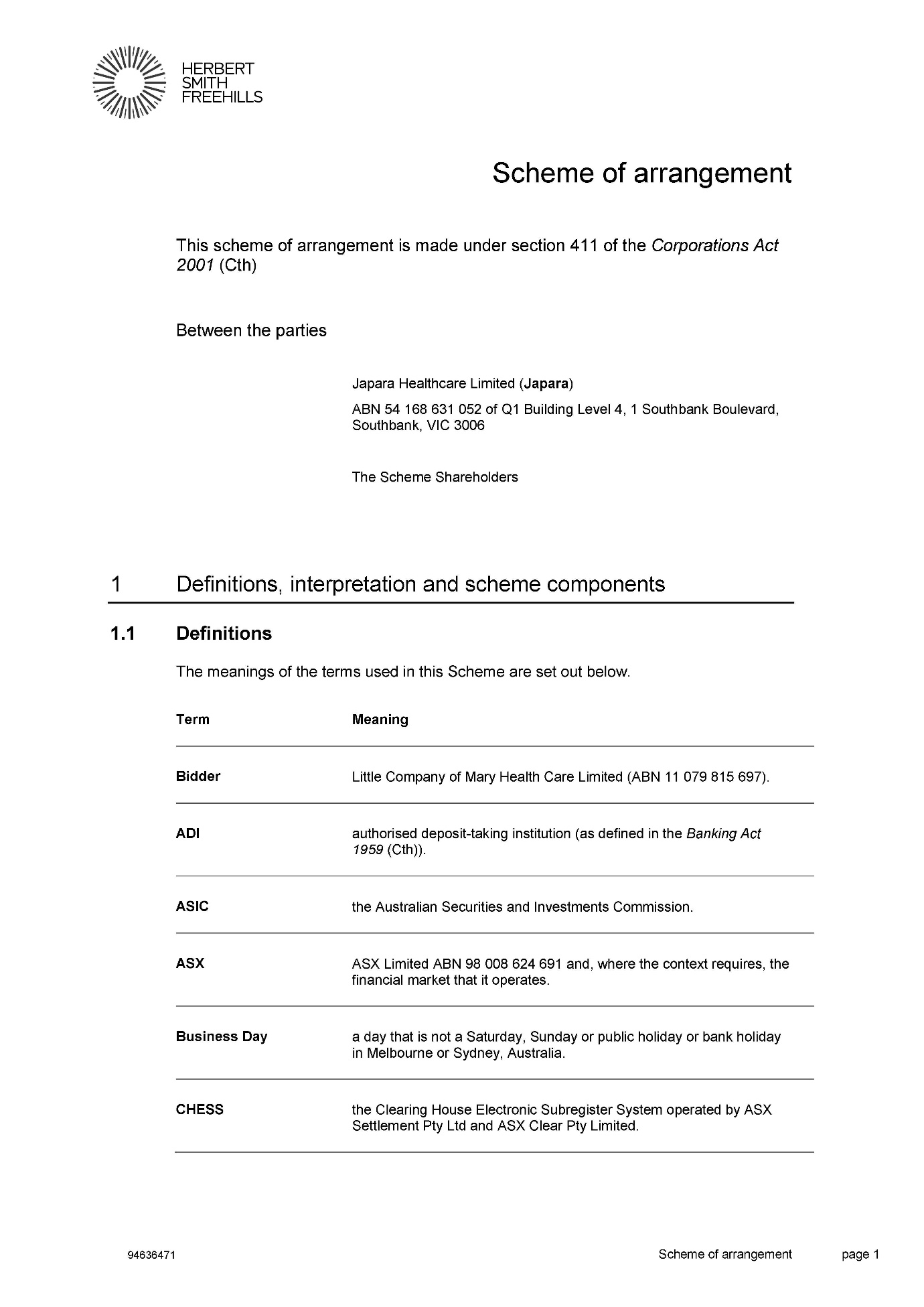
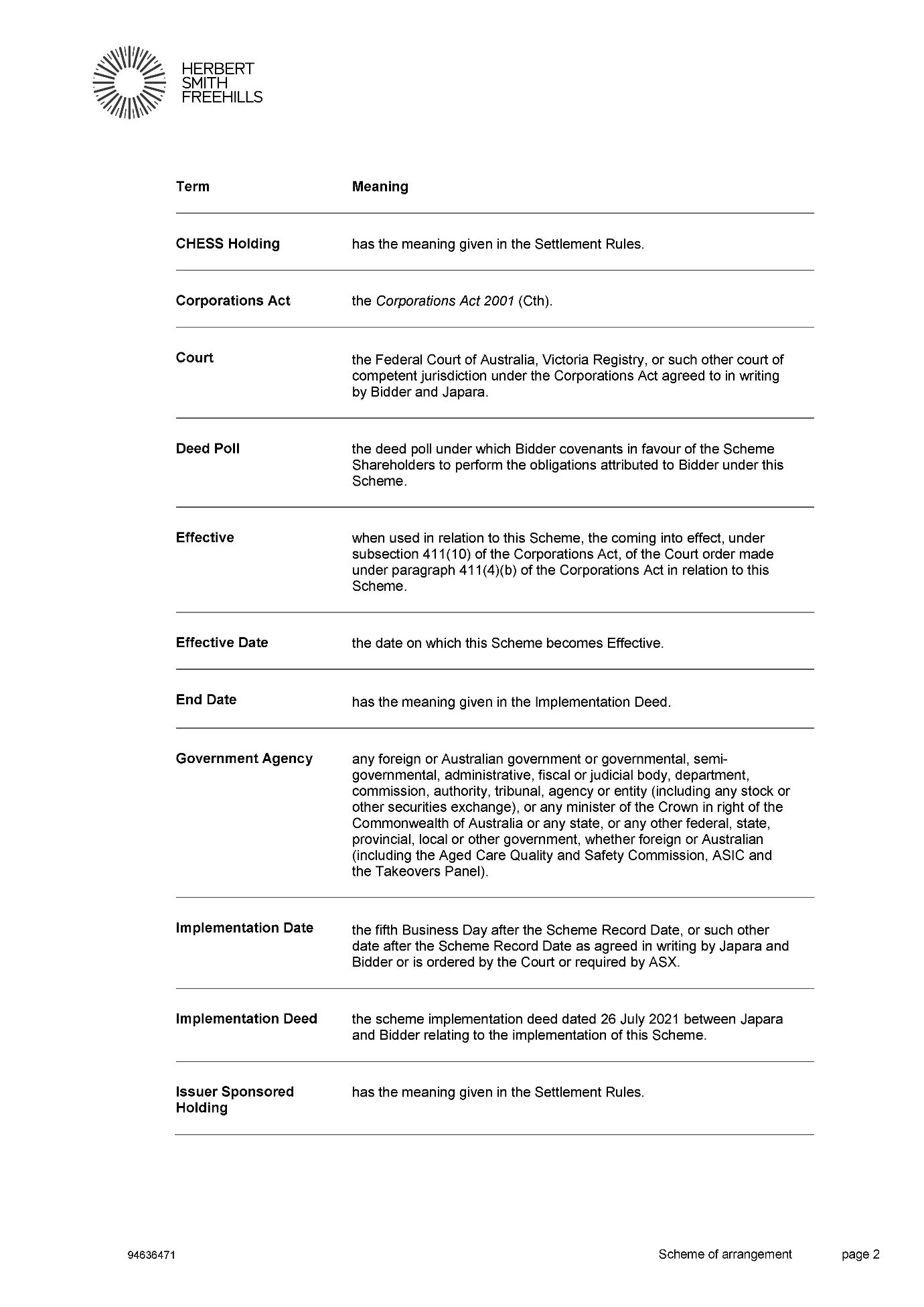
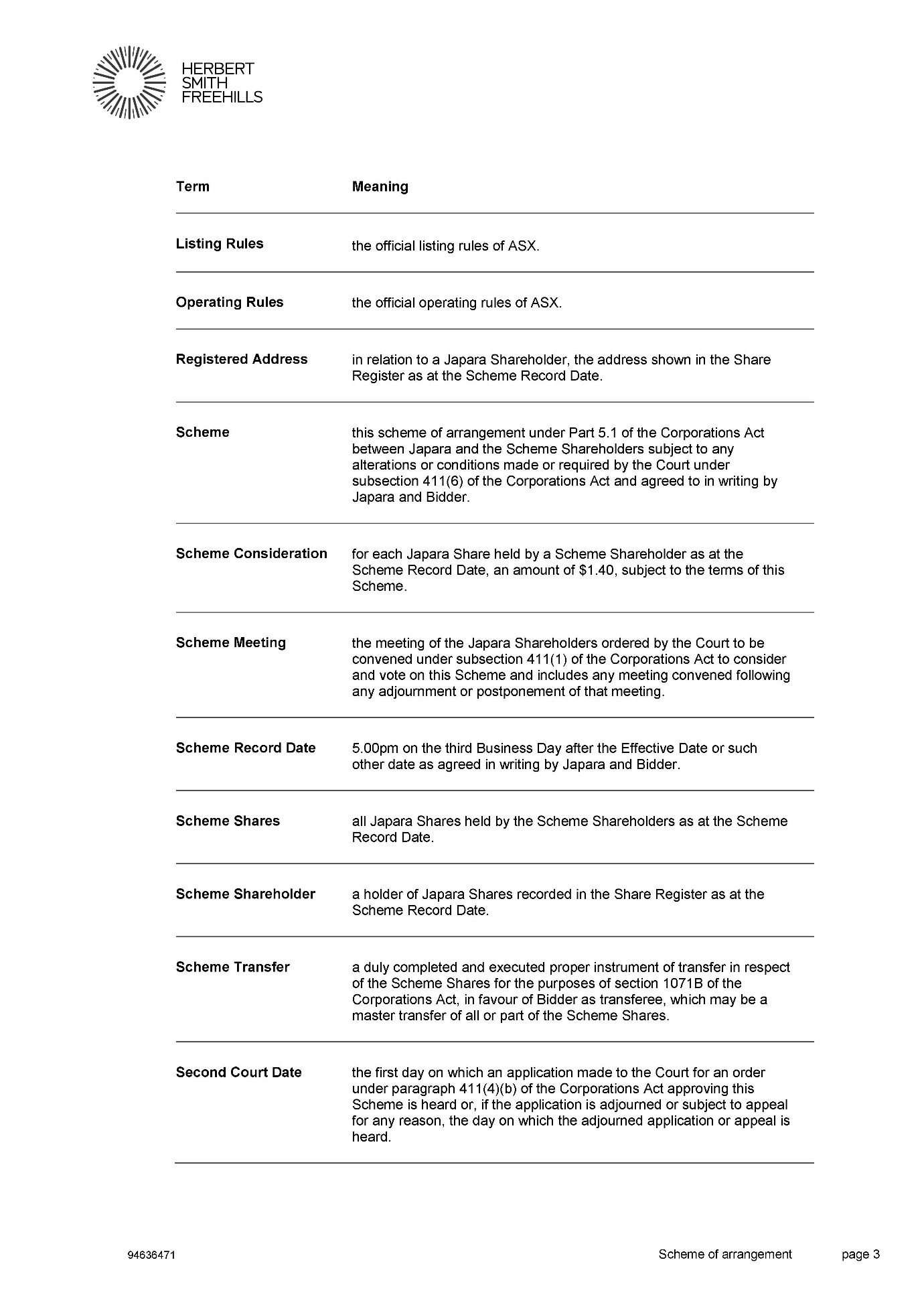
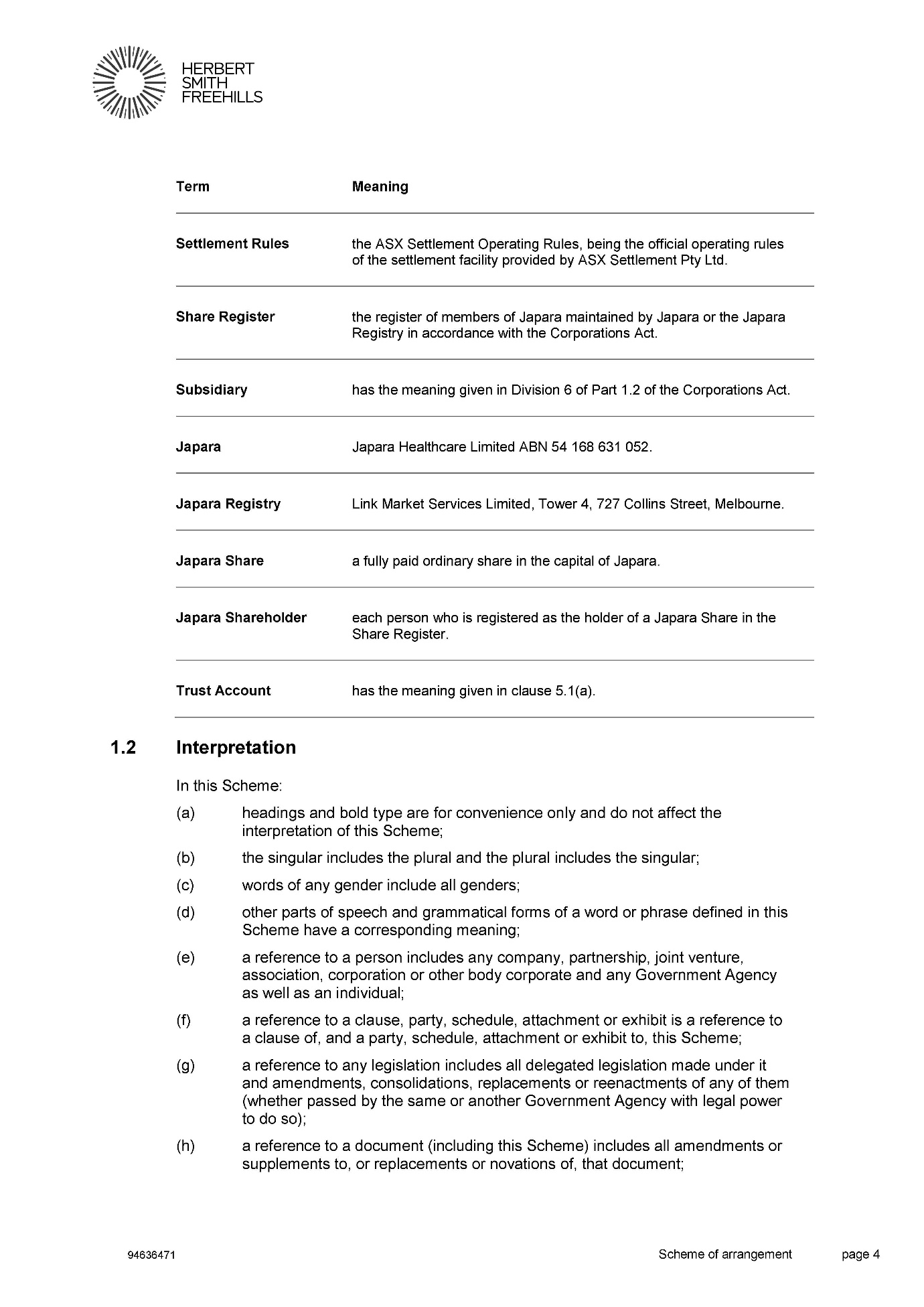
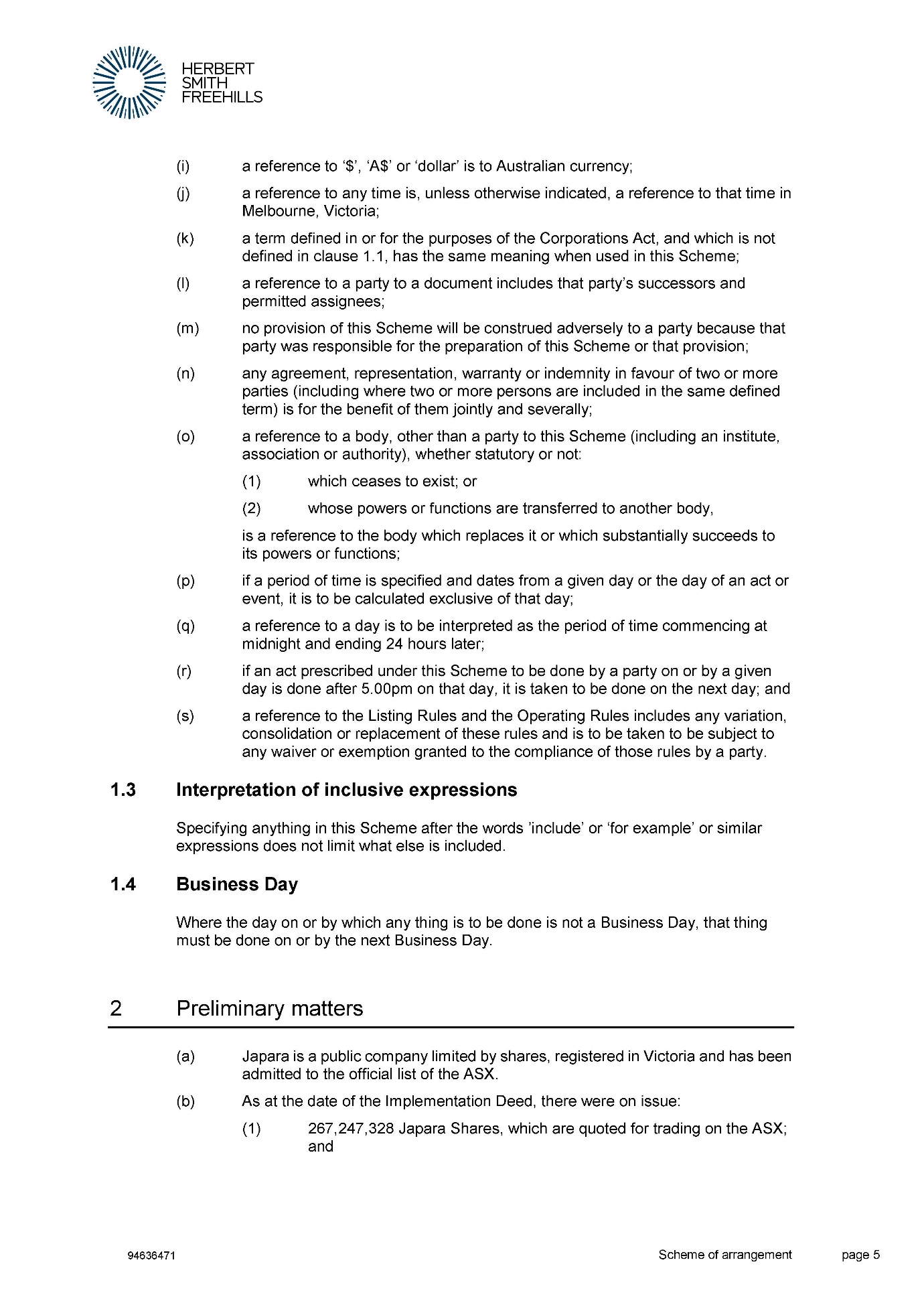
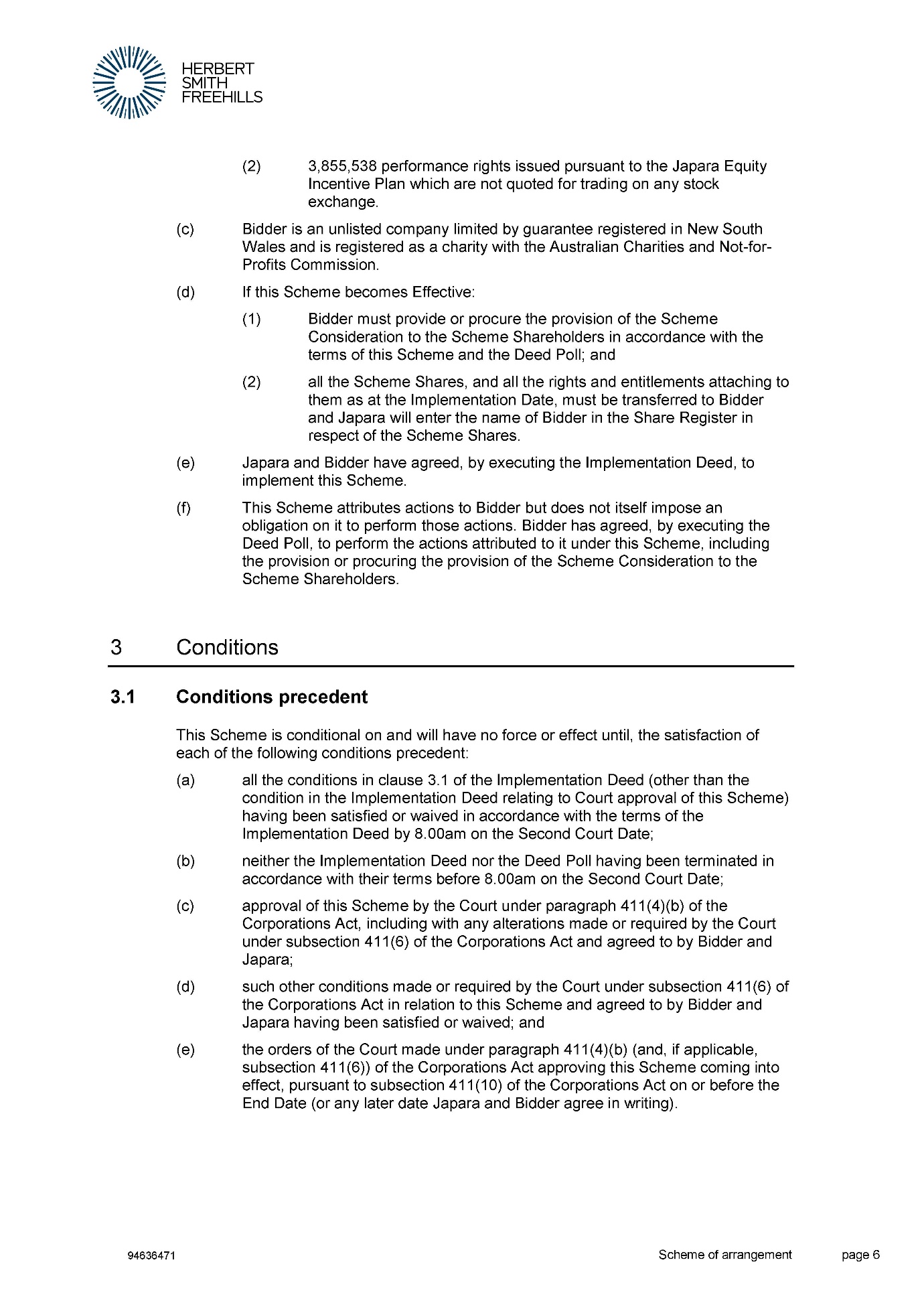
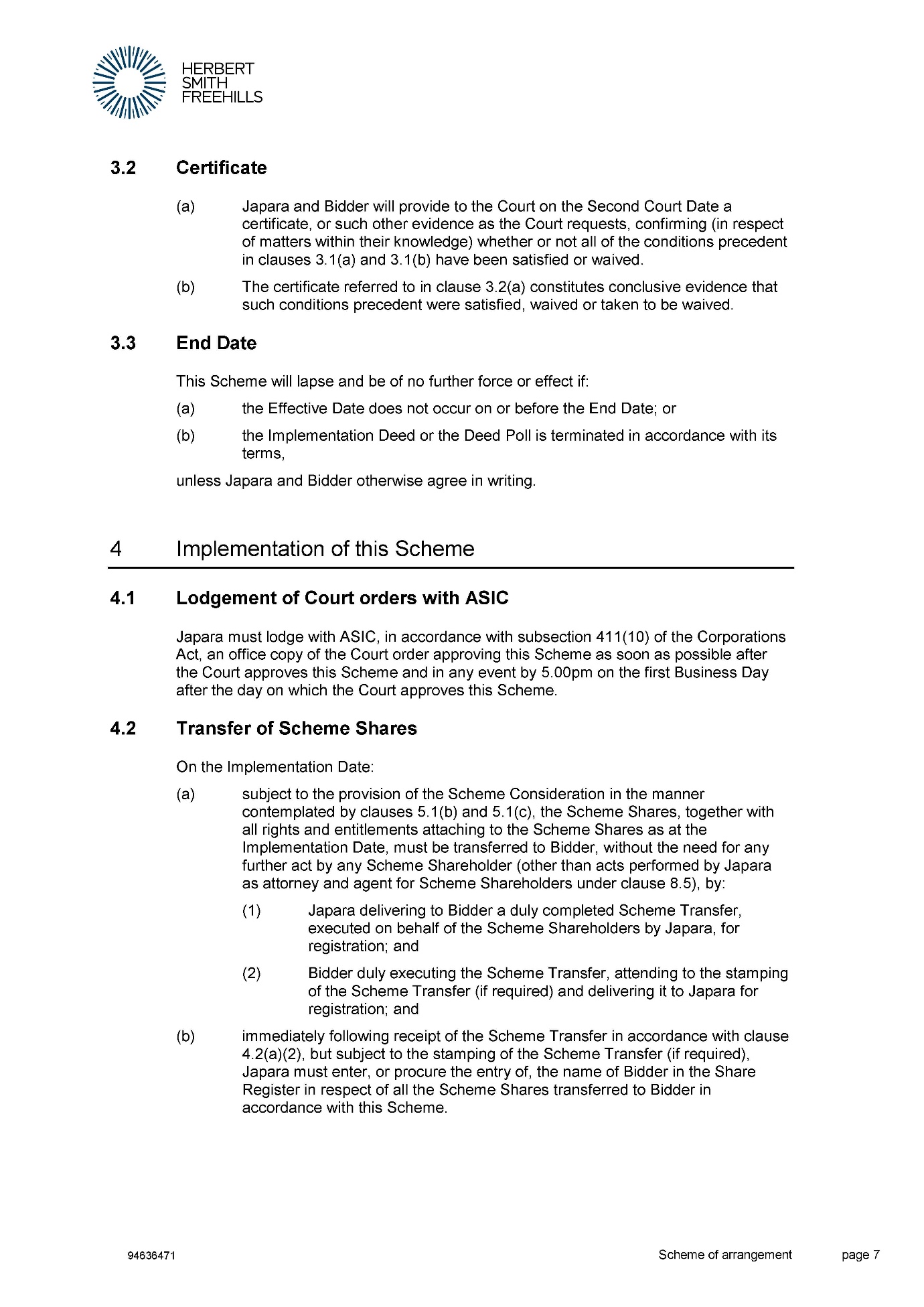
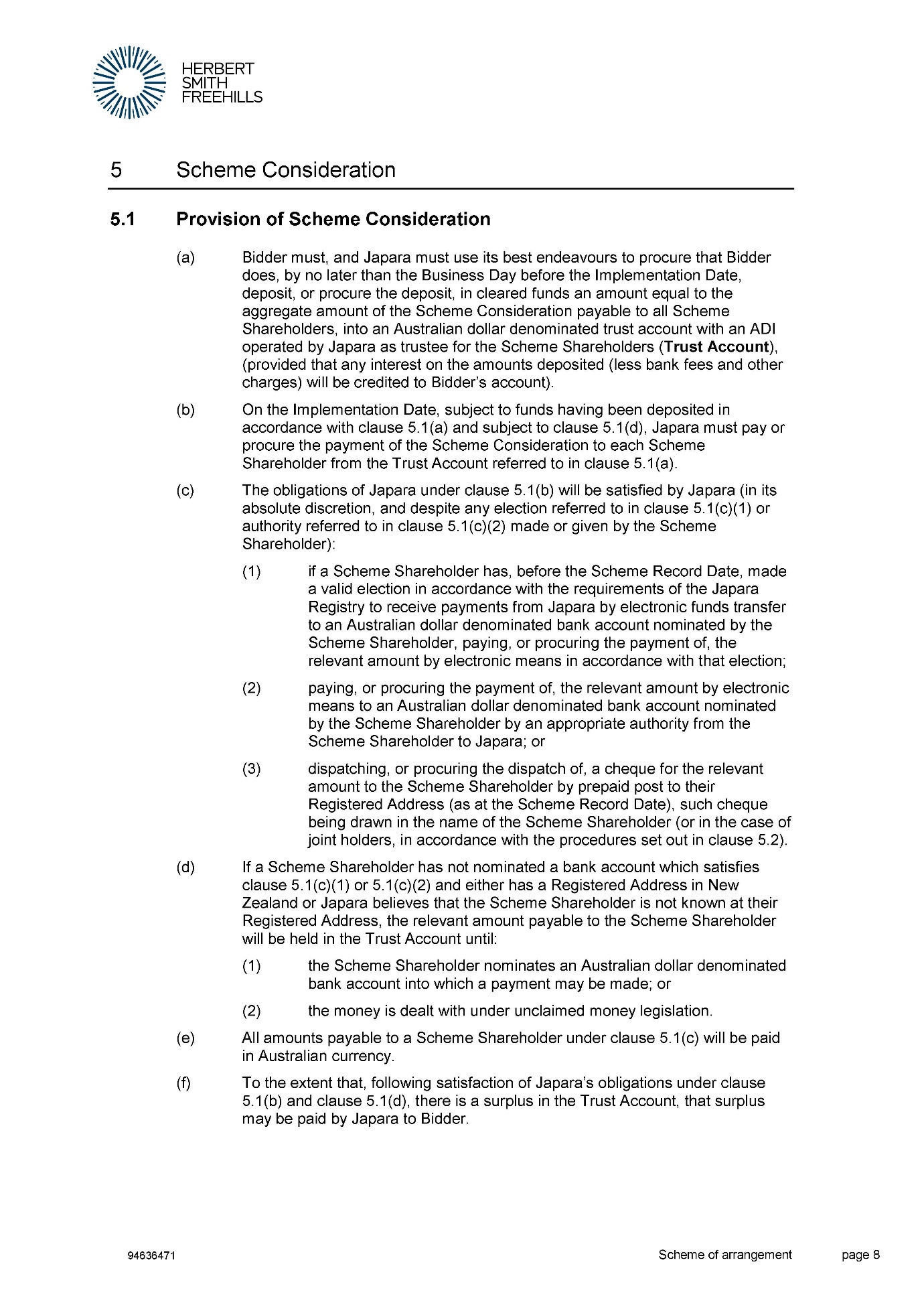
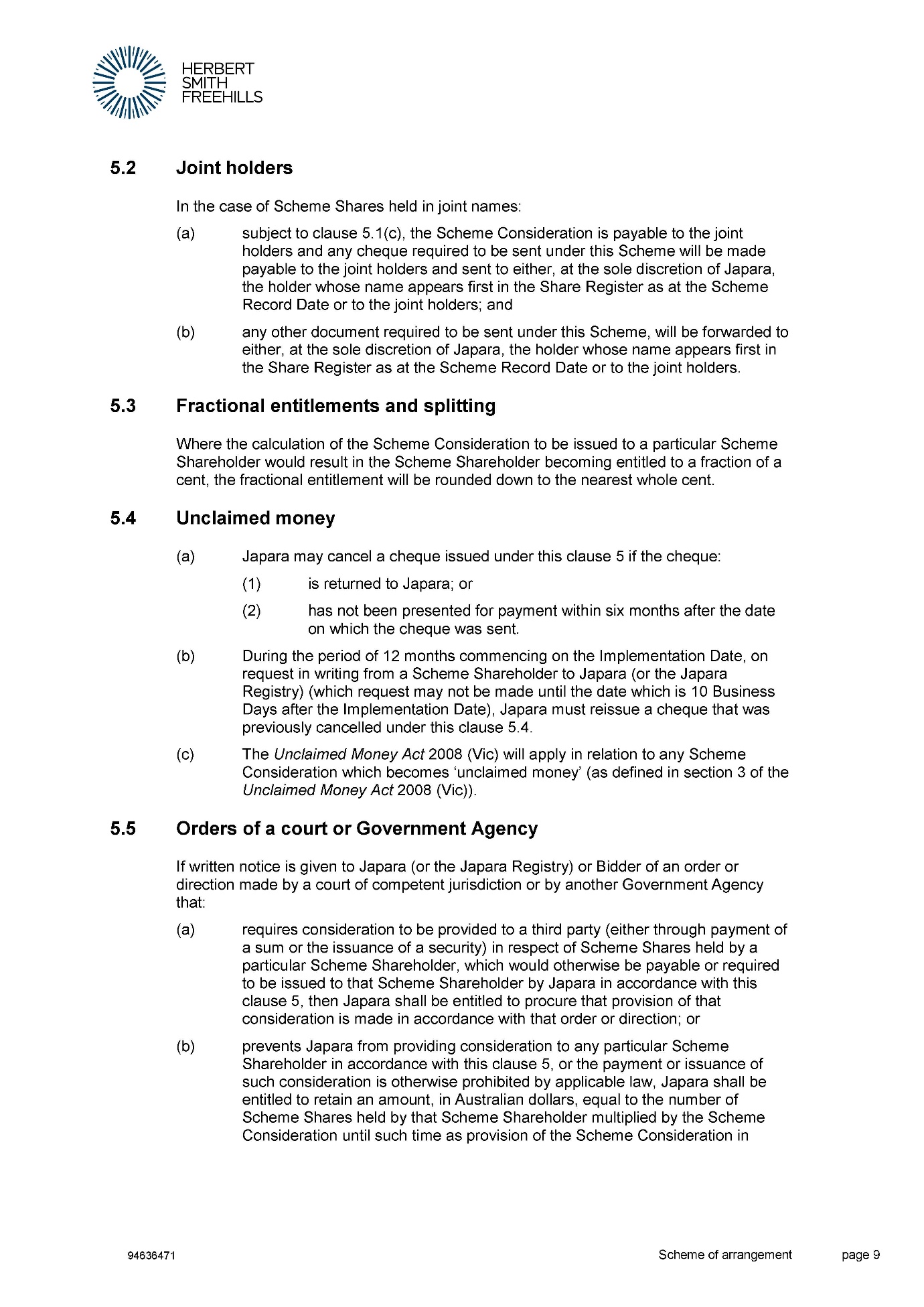
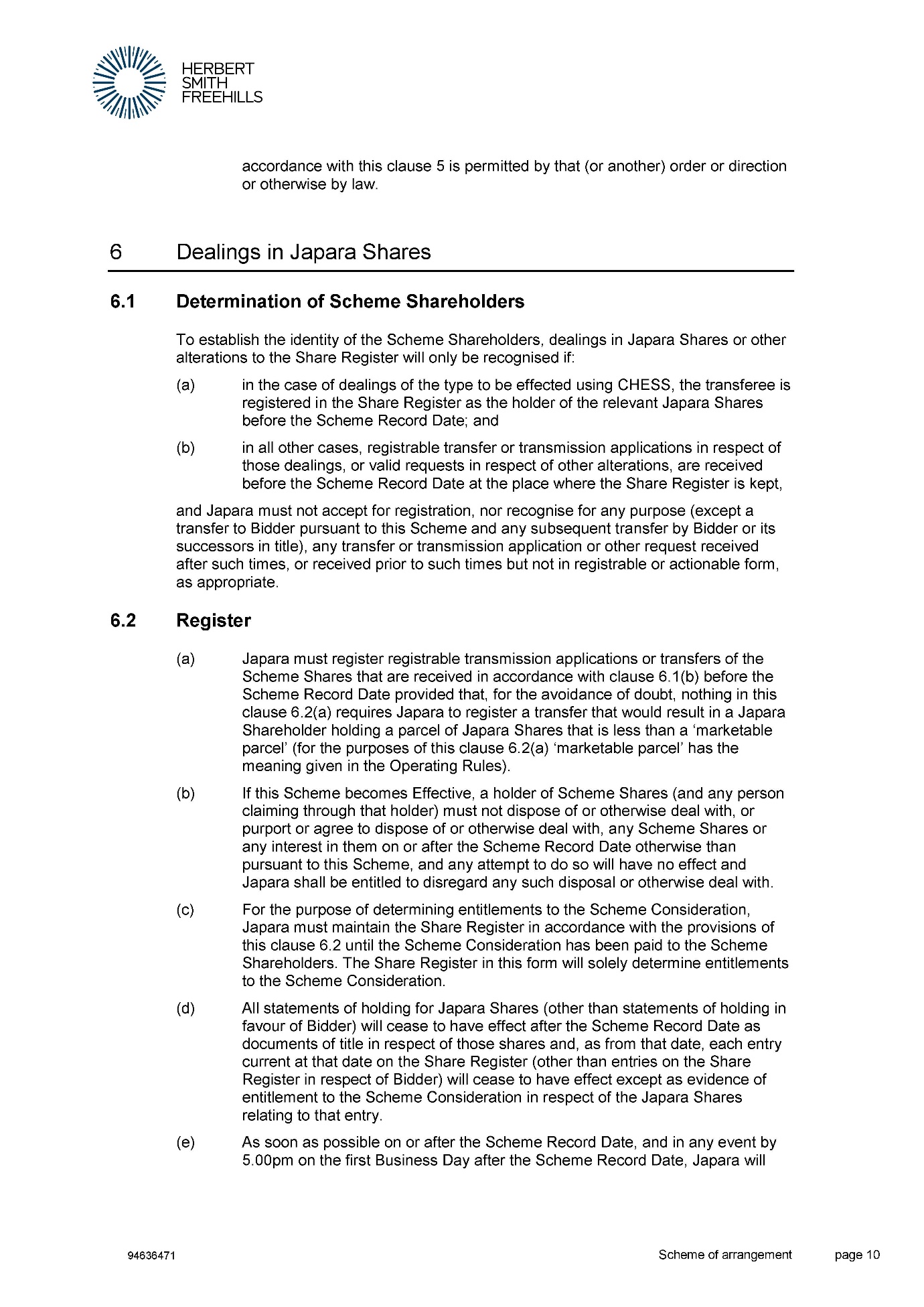
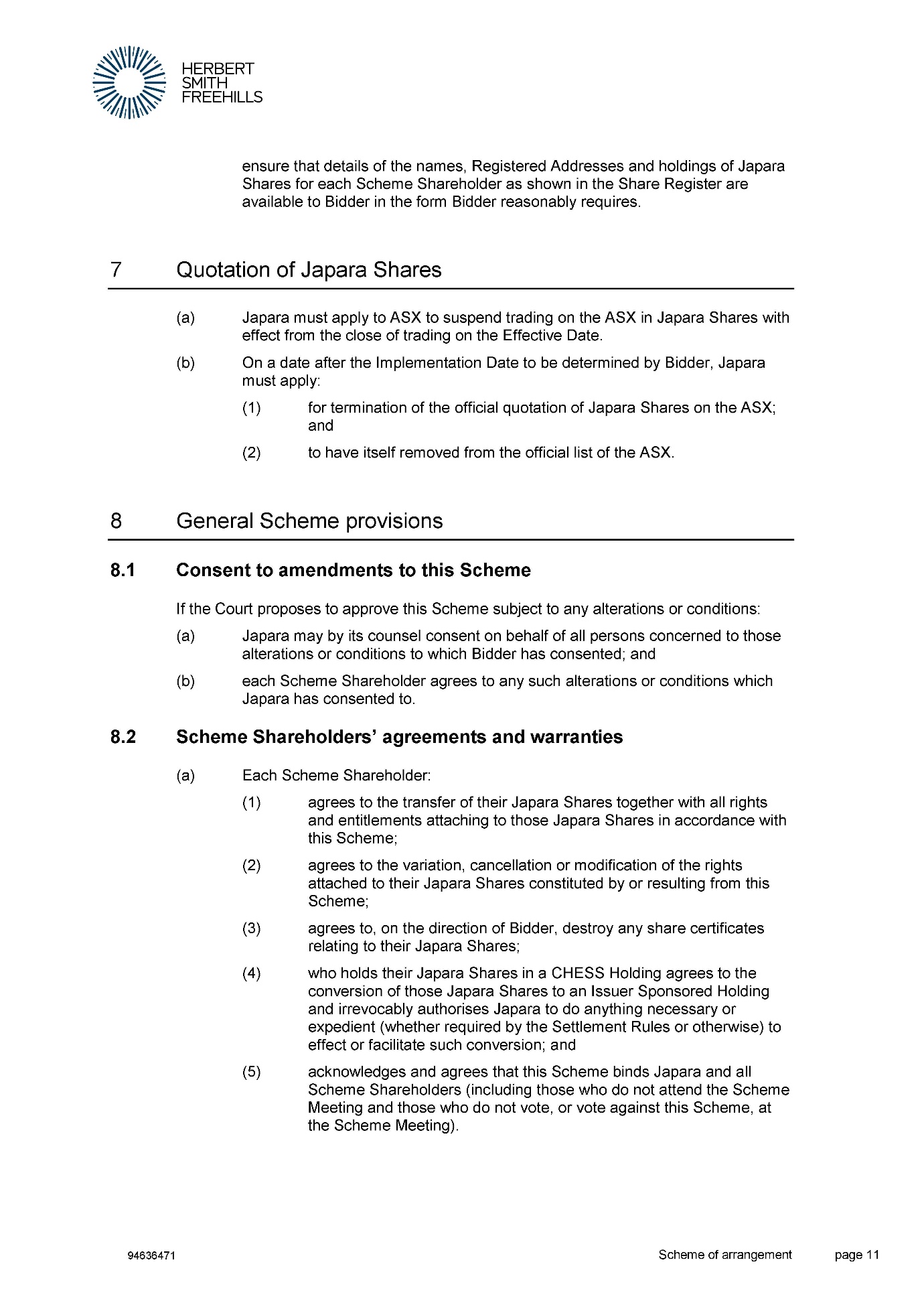
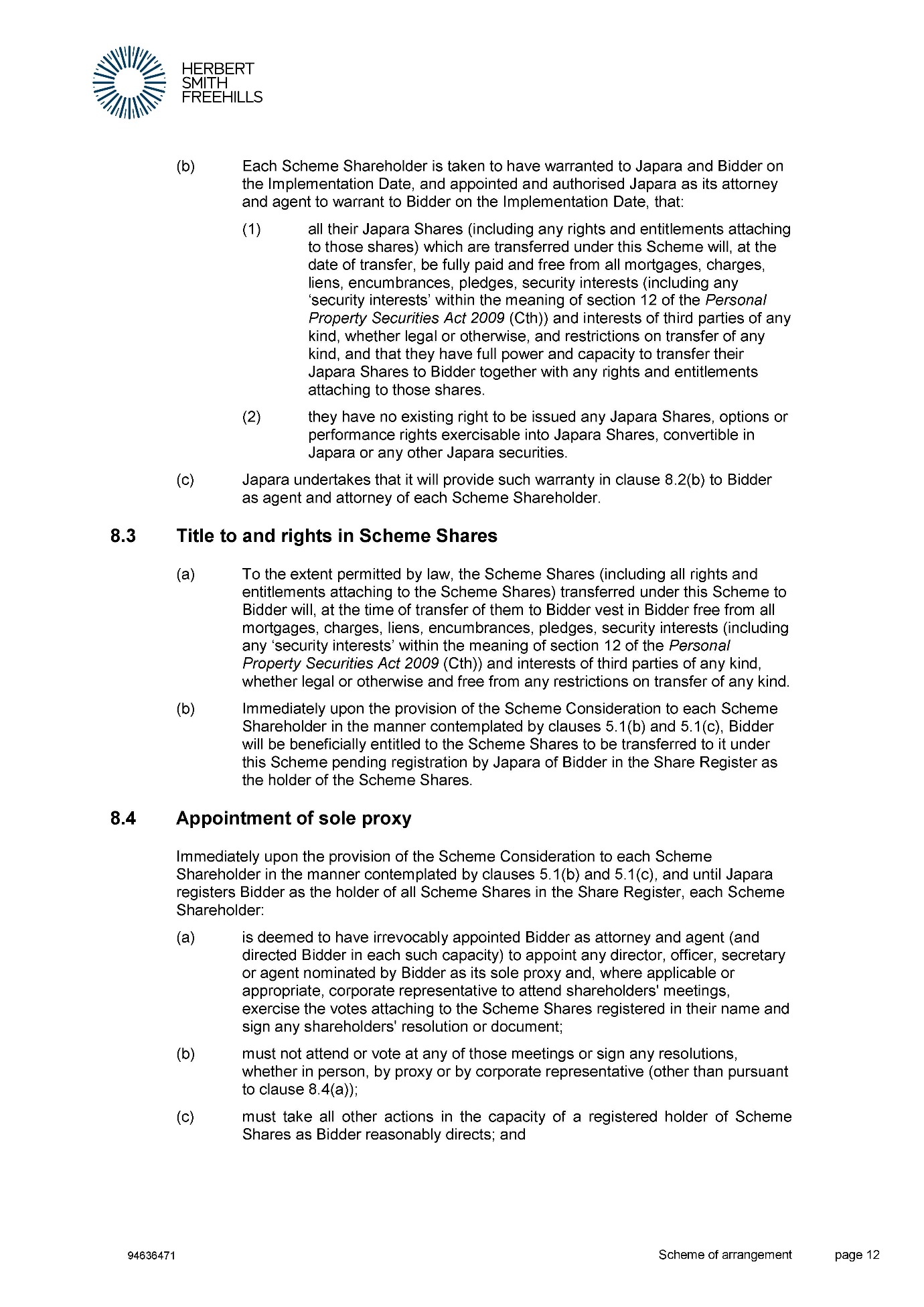
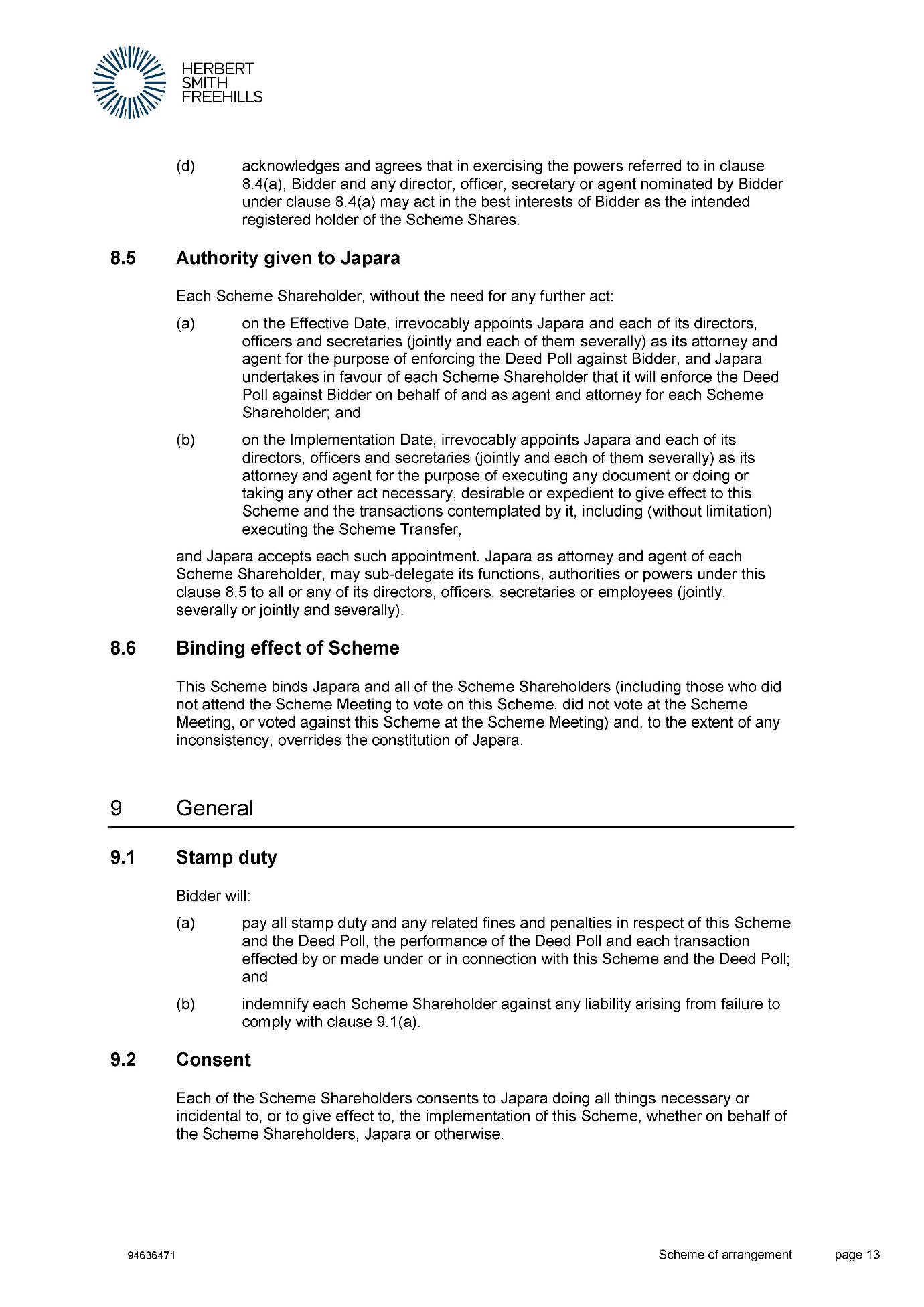
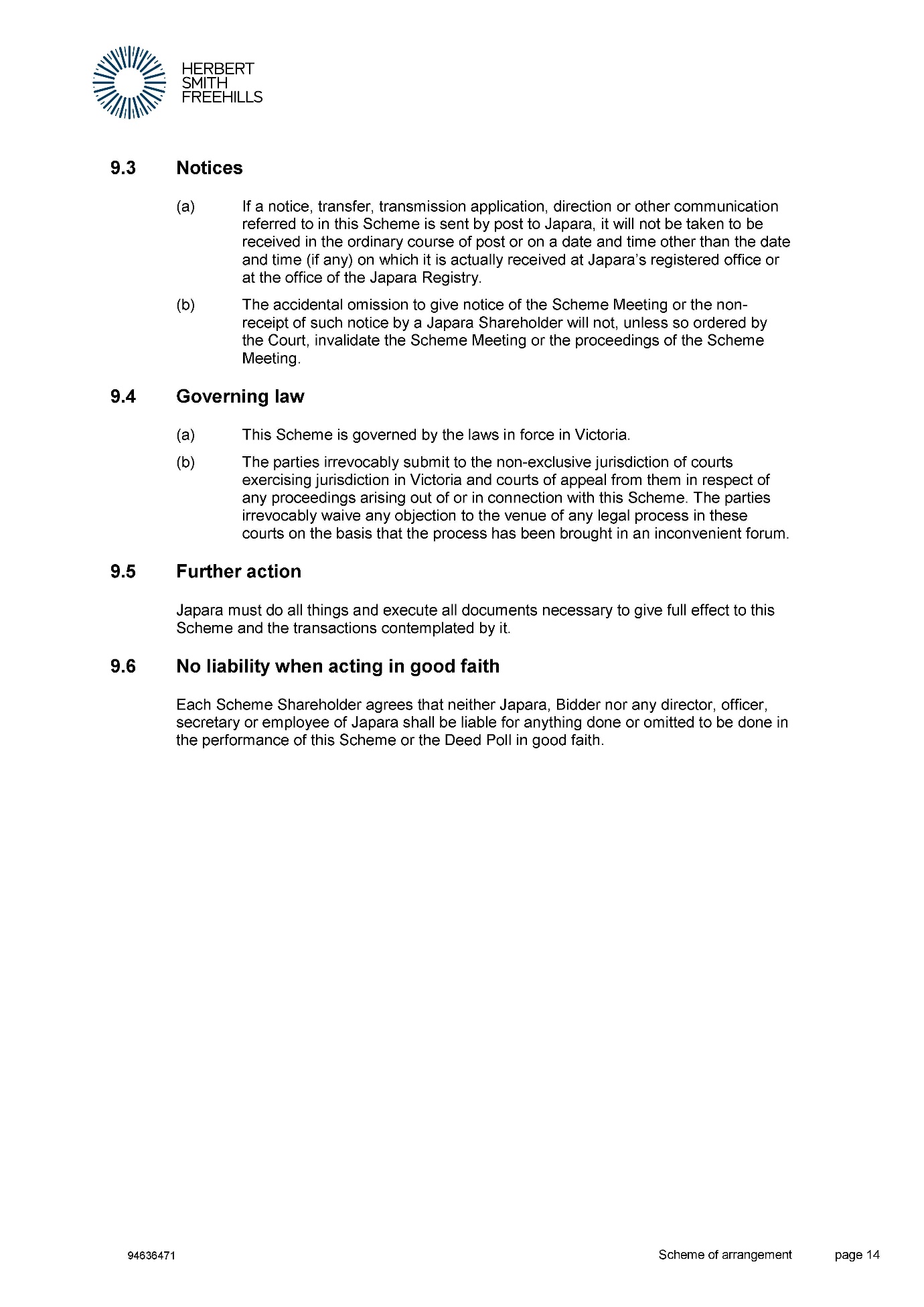
Scheme of Arrangement
ANNEXURE B
Notice of Second Court Hearing
Notice of hearing to approve compromise or arrangement
TO all the members of Japara Healthcare Limited (ACN 168 631 052) (Japara).
TAKE NOTICE that at 10.15 am on Monday, 25 October 2021, the Federal Court of Australia at Melbourne will hear an application by Japara seeking the approval of a compromise or arrangement between Japara and its members if agreed to by a resolution to be considered, and, if thought fit, passed at a meeting of such members to be held virtually through an online platform that can be accessed at https://agmlive.link/JHC21 on Thursday, 21 October 2021 commencing at 10.00 am (AEDT, being Melbourne time).
If you wish to oppose the approval of the compromise or arrangement, you must file and serve on Japara a notice of appearance, in the prescribed form, together with any affidavit on which you wish to rely at the hearing. The notice of appearance and affidavit must be served on Japara at its address for service at least 1 day before the date fixed for the hearing of the application.
The address for service of Japara is:
Attn: Rodd Levy
C/- Herbert Smith Freehills
Level 22, 80 Collins Street
Melbourne VIC 3000
Service via email will be accepted: rodd.levy@hsf.com
MOSHINSKY J:
Introduction
1 The plaintiff (Japara) applies for orders under s 411(1) of the Corporations Act 2001 (Cth) that, among other things, a meeting (Scheme Meeting) of the holders of ordinary shares in Japara be convened for the purposes of considering and, if thought fit, agreeing to a scheme of arrangement proposed to be made between Japara and its members (the Scheme).
2 Japara is an Australian public company limited by shares. Japara is admitted to the official list of the securities exchange conducted by the Australian Securities Exchange Limited (ASX) and its ordinary shares are quoted for trading on the securities exchange conducted by the ASX. Japara operates in five states of Australia and is one of Australia’s largest providers and developers of residential aged care. Japara’s business includes the operation of 50 residential care homes across Australia and 180 independent living units across five retirement villages (located adjacent to its residential care homes).
3 The commercial purpose of the Scheme is to provide for the acquisition of all the shares in Japara by Little Company of Mary Health Care Limited (Calvary). Calvary is a charitable not-for-profit unlisted public company limited by guarantee, with more than 12,000 staff and volunteers, 14 public and private hospitals, 17 retirement and aged care facilities, and a national network of Community Care centres. Calvary operates across six states and territories within Australia and is an approved provider of residential aged care.
4 If the Scheme is implemented:
(a) all Japara shares on issue as at the Scheme Record Date (Scheme Shares) will be transferred to Calvary;
(b) the holders of the Scheme Shares (Scheme Shareholders) will receive $1.40 per Scheme Share (Scheme Consideration), such amount to be paid by Calvary as consideration for the transfer of the Scheme Shares; and
(c) Japara will become a wholly-owned subsidiary of Calvary.
5 At the conclusion of the hearing on 17 September 2021, I made orders substantially in the terms proposed by Japara. I now set out my reasons for making those orders.
The application, evidence and hearing
6 The proceeding was commenced by originating process. By that document, Japara applied for orders including:
(a) an order under s 411(1) of the Corporations Act that Japara convene a meeting of its members for the purpose of considering, and if thought fit, agreeing (with or without alterations or conditions) to the Scheme; and
(b) directions under s 1319 of the Corporations Act as to the manner in which the Scheme Meeting is to be convened and conducted, the time and manner in which the Scheme Meeting is to be held, and the persons authorised to act as chairperson and alternate chairperson at the Scheme Meeting.
7 At the hearing on 17 September 2021, Japara relied on the following affidavits:
(a) an affidavit of Merryn Jill Quayle sworn on 25 August 2021. Ms Quayle is a Partner at Herbert Smith Freehills (HSF), the solicitors for Japara. The affidavit relevantly annexes a copy of the Scheme Implementation Deed (SID), an Australian Securities and Investments Commission (ASIC) company extract for Japara and a copy of the Constitution of Japara;
(b) an affidavit of Rodd Ashton Levy sworn on 14 September 2021. Mr Levy is a Partner of HSF. Mr Levy deposes to the lodgement of a first draft of the Scheme booklet with ASIC and the giving of notice to ASIC of the time and date of the first court hearing;
(c) an affidavit of Bruce Craig Paterson affirmed on 14 September 2021 in his capacity as Company Secretary of Japara (Paterson Affidavit). Mr Paterson deposes to information about Japara (Japara Information) and the agreement to enter into the Scheme. Mr Paterson provides an overview of the main features of the Scheme, and deposes to certain aspects of the SID (such as the exclusivity provisions and the reimbursement fee provisions). Mr Paterson gives evidence of the consideration of the Scheme by the Board of Directors of Japara (Japara Board), and he also gives evidence as to the proposed arrangements for the Scheme Meeting. Finally, the Paterson Affidavit outlines the process adopted to verify the Japara Information in the Scheme Booklet;
(d) an affidavit of Linda Bardo Nicholls AO affirmed on 10 September 2021 in her capacity as a director of Japara. It is proposed that Ms Nicholls be the chairperson of the Scheme Meeting, and her affidavit deposes to the necessary matters in relation to that role as required by r 3.2 of the Federal Court (Corporations) Rules 2000 (Cth) (Rules);
(e) an affidavit of JoAnne Maree Stephenson sworn on 10 September 2021 in her capacity as a director of Japara. It is proposed that Ms Stephenson be the alternate chairperson of the Scheme Meeting, and her affidavit deposes to the necessary matters in relation to that role as required by r 3.2 of the Rules;
(f) an affidavit of Timothy Tamer Farag affirmed on 14 September 2021 in his capacity as a Client Relationship Manager of Link Market Services Limited (Farag Affidavit). Link Market Services Limited has been retained by Japara to provide various services in relation to the Scheme, including the preparation and dispatch of materials to Japara shareholders relating to the Scheme and providing and administering an online platform for the conduct of the Scheme Meeting, through which Japara shareholders can participate in the Scheme Meeting and vote on the resolution to agree to the Scheme;
(g) an affidavit of Philip Charles Maloney sworn on 14 September 2021 in his capacity as National Director, Legal Governance & Risk of Calvary (Maloney Affidavit). Mr Maloney deposes to the verification of information about Calvary (Calvary Information) in the Scheme Booklet, and the negotiations of the exclusivity and reimbursement fee provisions in the SID. The Maloney Affidavit annexes an executed version of the Deed Poll given by Calvary in favour of Scheme Shareholders (Deed Poll);
(h) an affidavit of Tapan Parekh affirmed on 14 September 2021 in his capacity as an authorised representative of Deloitte Corporate Finance Pty Ltd (Deloitte). Deloitte was engaged by Japara to provide an independent expert opinion as to whether the Scheme is fair and reasonable and in the best interests of Japara shareholders. Deloitte has prepared an independent expert’s report (Independent Expert’s Report) containing that opinion, and Mr Parekh was involved in the preparation of that report; and
(i) a further affidavit of Mr Rodd Ashton Levy, sworn on 16 September 2021 (Second Levy Affidavit). This annexes a final draft of the Scheme booklet (Scheme Booklet) substantially in the form that Japara intends to provide to its shareholders.
8 Japara also tendered a letter from ASIC dated 16 September 2021. In the letter, ASIC referred to the proposed scheme of arrangement and noted that a draft explanatory statement had been provided to the ASIC on 2 September 2021 and a revised version had been provided on 15 September 2021. After referring to ASIC’s policy regarding statements under s 411(17)(b) of the Corporations Act, the letter stated that the requirement in s 411(2)(a) had been satisfied in relation to the current application. The letter stated that ASIC had examined the terms of the Scheme and the draft explanatory statement in accordance with its policy in Regulatory Guide 60 — Schemes of arrangement. The letter stated that ASIC did not currently propose to appear to make submissions or intervene to oppose the Scheme at the first court hearing under s 411(1).
9 At the hearing on 17 September 2021, Mr PD Crutchfield QC appeared with Mr BK Holmes for Japara and made submissions in support of the application. Detailed written submissions were also provided in advance of the hearing. Mr O Bigos QC appeared, with leave, on behalf of Calvary. He supported the application.
Background
10 As noted above, Japara is a public company limited by shares, and its shares are listed on the ASX. As at 6 September 2021, it had 5,696 shareholders and 267,247,328 shares on issue and 3,855,538 performance rights.
11 On 26 July 2021, Japara and Calvary entered into the SID. Under the SID, Japara agreed to propose the Scheme and Calvary agreed to assist Japara to propose the Scheme, and both parties agreed to implement the Scheme.
12 The terms of the Scheme are set out in Annexure BCP-1 to the Paterson Affidavit.
13 Japara has prepared the Scheme Booklet, which sets out a detailed description of the proposed Scheme. The Scheme Booklet includes the explanatory statement required by ss 411(2)(b)(i) and 412(1) of the Corporations Act. Japara proposes to provide the Scheme Booklet to its shareholders electronically for the purpose of the Scheme Meeting. The Scheme Booklet annexes a notice of meeting for the Scheme Meeting. It also annexes a copy of the Independent Expert’s Report, and sets out the Japara directors’ recommendation and voting intentions.
Conditions Precedent
14 There are a number of conditions precedent to the SID and to the Scheme. In particular:
(a) clause 3.1 of the SID provides that the Scheme will not become effective, and the respective obligations of the parties to implement the Scheme are not binding, until each of the conditions precedent set out in clause 3.1 of the SID is satisfied or waived. These include shareholder approval and court approval of the Scheme;
(b) clause 3.1 of the Scheme provides that the Scheme is conditional on and will have no force or effect until the satisfaction of each of the conditions precedent listed in clause 3.1 of the Scheme. These conditions include:
(i) all the conditions in clause 3.1 of the SID (other than the condition in the SID relating to court approval of the Scheme) having been satisfied or waived in accordance with the terms of the SID by 8.00 am on the Second Court Date (as defined in the SID);
(ii) neither the SID nor the Deed Poll having been terminated in accordance with their terms before 8.00 am on the Second Court Date;
(iii) approval of the Scheme by the Court under s 411(4)(b) of the Corporations Act; and
(iv) the orders of the Court approving the Scheme coming into effect.
15 If approved by the Court, the Scheme becomes effective on the lodging of an office copy of the Court’s approval order with ASIC: s 411(10) of the Corporations Act.
16 The Scheme Booklet notes in section 8.3(a) that, as at the date of the Scheme Booklet, Japara is not aware of any reason why the conditions will not be satisfied. Further, Mr Paterson deposes to the fact that, as at the date of his affidavit, he is not aware of any fact, matter or circumstance that has resulted in, or is likely to result in, the failure of the Scheme due to any conditions precedent to the Scheme not being satisfied or waived.
Scheme Mechanism
17 If all conditions precedent are satisfied or waived, then the Scheme Consideration is issued and the Scheme Shares are transferred as follows:
(a) by no later than the Business Day before the Implementation Date (as defined in the SID), Calvary must deposit or procure the deposit of an amount equal to the aggregate amount of the Scheme Consideration payable to all Scheme Shareholders into a trust account with an authorised deposit-taking institution operated by Japara as trustee for the Scheme Shareholders (Trust Account);
(b) on the Implementation Date, subject to the funds having been deposited into the Trust Account by Calvary, Japara must pay or procure the payment of the Scheme Consideration to each Scheme Shareholder from the Trust Account; and
(c) subject to the provision of the Scheme Consideration to Scheme Shareholders in the manner contemplated by clauses 5.1(b) and (c) of the Scheme, the Scheme Shares must be transferred to Calvary by:
(i) Japara delivering to Calvary a duly completed Scheme Transfer (as defined in the SID), executed on behalf of the Scheme Shareholders by Japara, for registration; and
(ii) Calvary duly executing the Scheme Transfer, attending to the stamping of the Scheme Transfer (if required) and delivering it to Japara for registration; and
(iii) Japara entering the name of Calvary in the register of Japara shareholders in respect of all the Scheme Shares transferred to Calvary in accordance with the Scheme.
18 The key terms of the Scheme are summarised in sections 4.1 to 4.3 of the Scheme Booklet, and at paragraph 19 of the Paterson Affidavit.
Deed Poll
19 As Calvary is not a party to the Scheme, it has executed a Deed Poll in favour of Scheme Shareholders binding Calvary to perform the actions attributed to it under the Scheme, including the payment of the Scheme Consideration.
Directors’ recommendation
20 The current directors of Japara are:
(a) Linda Bardo Nicholls AO (Non-Executive Chairman);
(b) Christopher Murray Price (CEO and Managing Director);
(c) David Paul Blight (Non-Executive Director);
(d) JoAnne Maree Stephenson (Non-Executive Director); and
(e) Leanne Rowe AM (Non-Executive Director).
21 The directors of Japara have unanimously recommended that shareholders vote in favour of the Scheme, and each director has indicated that he or she intends to vote any Japara shares held or controlled by him or her at the time of the Scheme Meeting in favour of the Scheme.
Independent Expert’s Report
22 The Independent Expert’s Report concludes that the Scheme is fair and reasonable and in the best interests of Japara shareholders. The basis for this conclusion is that the value of the Scheme Consideration of $1.40 lies within the assessed value range for Japara shares of $1.12 to $1.47 per Japara share.
Applicable principles
23 In Re Verdant Minerals Ltd [2019] FCA 556 (Re Verdant Minerals), I summarised the applicable principles at [20]-[30]. For ease of reference, I set out below the substance of those paragraphs of that judgment.
24 Part 5.1 of the Corporations Act provides a procedure whereby an arrangement between a company and its members (a scheme) can be made binding on all members.
25 The procedure involves three main steps:
(a) an application to the Court for an order that the company convene a meeting of its members;
(b) if such an order is made, the convening of such a meeting at which a resolution agreeing to the scheme is considered, and perhaps passed; and
(c) if the resolution is passed by the necessary majority (see s 411(4)), an application to the Court for approval of the Scheme.
26 The hearing on 17 September 2021 was concerned with the first stage of that process.
27 This procedure is regulated by s 412 of the Corporations Act and reg 5.1.01 of, and Sch 8 to, the Corporations Regulations 2001 (Cth), each of which relates to the information about the scheme that is required to be sent to the members.
28 The Scheme is also regulated by the Rules.
29 Section 411(1) of the Corporations Act confers a discretion on the Court to make an order if:
(a) a compromise or arrangement is proposed between a Part 5.1 body and its members (or any class of them);
(b) an application for the order is made in a summary way by the body;
(c) 14 days’ notice of the hearing of the application has been given to ASIC (or such lesser period as the Court or ASIC permits); and
(d) the Court is satisfied that ASIC has had a reasonable opportunity to:
(i) examine the terms of the proposed compromise or arrangement to which the application relates and a draft explanatory statement relating to the proposed compromise or arrangement; and
(ii) make submissions to the Court in relation to the proposed compromise or arrangement and the draft explanatory statement.
30 It is well established that a scheme designed to effect an acquisition by one company of the shares in another may be an “arrangement” for the purposes of s 411(1) of the Corporations Act: Re Foundation Healthcare Ltd (2002) 42 ACSR 252 (Re Foundation Healthcare) at [39]; Re BigAir Group Ltd [2016] FCA 1296 at [33].
31 A “Part 5.1 body” is defined in s 9 of the Corporations Act in terms that include a company registered under the Corporations Act.
32 Section 411 of the Corporations Act does not state the criteria that must be satisfied before a meeting is ordered, but it is clear that the court has a discretion to exercise in relation to whether the first meeting should be ordered: Re CSR Ltd (2010) 183 FCR 358 at [8].
33 As explained by Davies J in Re Cytopia Ltd [2009] VSC 560 at [3], in a passage relied on in Re AXA Asia Pacific Holdings Ltd [2011] VSC 4 at [11]:
The authorities make it clear that the Court’s role at this stage is not to express a view on whether the proposed scheme should be approved. It is also clear that it is not the Court’s role to usurp the shareholders’ decision, by attempting to intrude its own commercial judgment. The Court is to be concerned with whether there is adequate disclosure to the shareholders in the Scheme Booklet (or explanatory memorandum), whether the legal requirements otherwise have been complied with and whether the scheme, on its face, is one that is sufficiently “fair and reasonable” to be capable of being put to shareholders for their approval or rejection.
(Footnotes omitted.)
34 This requires the Court to be satisfied of two matters:
(a) that the scheme is fit for consideration by the proposed meeting in the sense that it is “of such a nature and cast in such terms that, if it achieves the statutory majority at the [members’] meeting the court would be likely to approve it on the hearing of a petition which is unopposed”: FT Eastment & Sons Pty Ltd v Metal Roof Decking Supplies Pty Ltd (1977) 3 ACLR 69 at 72 per Street CJ (see also Re Bank of Adelaide (1979) 22 SASR 481 at 494-495 per Wells J; Australian Securities Commission v Marlborough Gold Mines Ltd (1993) 177 CLR 485 at 504; Re Coles Group Ltd (2007) 25 ACLC 1380 at [29]-[36] per Robson J); and
(b) that “the members [are to be] properly informed as to the nature of the scheme before the scheme meeting”: Re NRMA Ltd (No 1) (2000) 156 FLR 349 at [30] (see also Re Foundation Healthcare at [38]; Re Skilled Group Ltd (No 1) (2015) 113 ACSR 525 (Re Skilled Group) at [27]).
The requirements relevant to the first court hearing
35 The evidence establishes that each of the requirements relevant to the first court hearing is satisfied:
(a) first, as required by s 411(1), Japara has made an application in relation to an arrangement that is proposed between a Part 5.1 body and its members;
(b) secondly, as required by r 2.4(2) of the Rules, the evidence relied upon by Japara includes an ASIC company extract recording the results of a search of the records of ASIC in relation to Japara carried out no earlier than 7 days before the originating process was filed;
(c) thirdly, as required by s 411(2), 14 days’ notice of the hearing has been given to ASIC, and ASIC has had a reasonable opportunity to examine the terms of the proposed Scheme and the draft explanatory statement, and to make submissions to the Court;
(d) fourthly, as required by r 3.2 of the Rules, the evidence about the proposed chairperson and alternate chairperson of the Scheme Meeting required has been provided; and
(e) fifthly, as required by r 3.3(1) of the Rules, the proposed orders annex a copy of the Scheme.
36 The Court’s discretion to make the convening orders is therefore enlivened.
Exercise of the Court’s discretion
37 The matters relevant to the exercise of the Court’s discretion are considered below.
The Scheme is fit for consideration
38 Japara submits, and I accept, that the Scheme is fit for consideration by Japara’s members.
39 In particular, there is no issue arising from the Scheme that would unquestionably lead to a refusal by the Court to approve the Scheme at the approval hearing. Furthermore, it cannot be said that the Scheme is on its face “so blatantly unfair or otherwise inappropriate that it should be stopped in its tracks before going any further”: see Re Foundation Healthcare at [44].
40 It is relevant that the Scheme Booklet contains a recommendation from all directors of Japara that shareholders vote in favour of the Scheme, and a statement that the directors intend to vote their Japara shares in favour of the Scheme. In addition, the Scheme Booklet annexes the Independent Expert’s Report, which states that the Scheme is fair and reasonable and in the best interests of shareholders.
41 The Court will scrutinise the terms of a scheme to satisfy itself that there is no unfairness that would be likely to preclude approval of the scheme. In this respect, Japara raises the following matters which are commonly addressed in acquisition schemes of this kind. Japara submits, and I accept, that none of these matters give rise to any likelihood that the Court would decline to approve the Scheme at the second court hearing.
Performance risk
42 Although Calvary is to pay the Scheme Consideration, it is not party to the Scheme and is not directly bound by it, and its obligations do not depend upon s 411 of the Corporations Act. As such, the Court needs to be satisfied that Calvary is bound to perform the actions attributed to it under the Scheme, in particular to pay the Scheme Consideration to Japara to be held on trust for Scheme Shareholders (as provided for in clause 5.1(a) of the Scheme).
43 Japara submits, and I accept, that the Court can be satisfied on this issue for two reasons:
(a) first, the terms of the Scheme in effect require the payment of the Scheme Consideration by Calvary before there is any obligation upon Scheme Shareholders to transfer the Scheme Shares to Calvary. This effectively removes any performance risk in so far as the transfer of Scheme Shares in return for the Scheme Consideration is concerned; and
(b) secondly, as noted above, Calvary has executed the Deed Poll in favour of Scheme Shareholders. This binds Calvary to perform the actions attributed to it under the Scheme, including the payment of the Scheme Consideration.
Reimbursement Fee
44 Clause 13 of the SID provides that a reimbursement fee equal to 1% of the value of the aggregate Scheme Consideration (approximately $3.8 million) (Reimbursement Fee) may be payable by Japara to Calvary in certain circumstances if the Scheme is not implemented.
45 In summary, the Reimbursement Fee is payable by Japara if:
(a) any Japara Board member withdraws, adversely revises or adversely qualifies their support of the Scheme or their recommendation that Japara shareholders vote in favour of the Scheme;
(b) a Competing Proposal is announced by a Third Party and, within 9 months of the date of such announcement, that Third Party acquires a Relevant Interest in 50% or more of Japara Shares or acquires Control of Japara or merges with Japara (as those capitalised terms are defined in the SID); and
(c) Calvary terminates the SID for material breach or breach of representations and warranties and the Transaction (as defined in the SID) does not complete.
46 The Reimbursement Fee will not be payable if the Scheme becomes Effective (as defined in the SID), that is, if the Court makes orders approving the Scheme and those orders are lodged with ASIC.
47 The circumstances in which the Reimbursement Fee may be payable by Japara are set out in more detail at paragraph 49 of the Paterson Affidavit and paragraph 23 of the Maloney Affidavit. The circumstances are summarised in section 8.3(d) of the Scheme Booklet.
48 As stated in the Paterson Affidavit at paragraph 51, clause 13.1 of the SID records the fact that:
(a) the Reimbursement Fee provisions in the SID were the subject of commercial negotiations between Japara and Calvary;
(b) without the provisions for the Reimbursement Fee, Calvary would not have entered into the SID or otherwise agreed to implement the Scheme; and
(c) Japara and the Japara Board believe that the implementation of the Scheme will provide benefits to the Japara shareholders, and that it is reasonable that Japara agree to the Reimbursement Fee in order to secure Calvary’s participation in the Transaction.
49 Mr Paterson deposes at paragraph 53 of his affidavit that he and the Japara Board consider that the Reimbursement Fee provisions in the SID are in the interests of Japara shareholders and are reasonable and appropriate in order to secure Calvary’s entry into the SID and its commitment to implement the Scheme on the terms and conditions of the SID.
50 The payment of a reimbursement fee (often referred to as a ‘break fee’) is a common feature of commercial transactions like the proposed Scheme. However, in certain circumstances, the payment of such a fee may be considered excessive or otherwise coercive in nature. Japara submits, and I accept, that in the circumstances of this case the Reimbursement Fee is neither excessive nor coercive in nature, and the terms requiring payment of the fee and the circumstances in which those terms were agreed are consistent with the requirements of the relevant authorities: see Re Amcor Ltd [2019] FCA 346 (Re Amcor) at [58]-[70]; Re Healthscope Ltd (2019) 139 ACSR 608 (Re Healthscope) at [146]-[153]; Re DuluxGroup Ltd (2019) 136 ACSR 546 at [31]-[32].
Exclusivity provisions
51 The SID contains exclusivity provisions in the form of ‘no shop’, ‘no talk’, ‘notification of approaches’ and ‘matching right’ obligations on the part of Japara. These provisions are discussed in more detail at paragraphs 57 and 58 of the Paterson Affidavit and are summarised in section 8.3(c) of the Scheme Booklet.
52 These provisions apply during the ‘Exclusivity Period’, which commences on the date of the SID (26 July 2021) and ends on the earliest of the termination of the SID, the End Date (being 26 January 2022 or such other date as agreed), or the Effective Date (which is the date on which court orders approving the Scheme are lodged with ASIC, which is currently anticipated to occur on 25 October 2021). Accordingly, the longest period during which the exclusivity provisions could be anticipated to apply is approximately six months.
53 The ‘no talk’ and ‘notification of approaches’ obligations are subject to what is commonly referred to as a ‘fiduciary carve-out’. In particular, these obligations do not prohibit any action or inaction by Japara in relation to a bona fide actual, proposed or potential Competing Proposal (as defined in the SID), which the Japara Board acting in good faith determines:
(a) after consultation with its financial advisers and external Australian legal advisors specialising in corporate law, that the Competing Proposal could reasonably expect to lead to a Superior Proposal; or
(b) after receiving written notice from Japara’s advisers specialising in corporate law, that the failure to take or not take such action would constitute, or would be likely to constitute, a breach of the fiduciary or statutory duties of the Japara Board members.
54 Mr Paterson gives evidence that the exclusivity provisions in the SID:
(a) arose from normal commercial negotiations between Calvary and Japara, both of whom were assisted in those negotiations by separate, independent legal and financial advisors in relation to the terms and operation of these provisions; and
(b) are, in his and the Japara Board’s view, in the interests of Japara shareholders and are reasonable and appropriate in order to secure Calvary’s entry into the SID and its commitment to implement the Scheme on the terms and conditions of the SID.
55 Similarly, Mr Maloney deposes in his affidavit that:
(a) the exclusivity provisions were included in the SID following robust and detailed arm’s-length commercial negotiations between the representatives of Japara and Calvary. Each of Japara and Calvary was advised separately by independent legal and financial advisers in relation to negotiating the SID; and
(b) he was closely involved in these negotiations as a representative of Calvary, and that Calvary would not have agreed to entering the SID if not for the inclusion of the exclusivity provisions.
56 Exclusivity provisions such as those in the SID are commonly found in merger implementation agreements and have been accepted in many company schemes of arrangement.
57 In Re Arthur Yates & Co Ltd (2001) 36 ACSR 758 (at 759-760), Santow J said that an exclusivity clause should exist for no more than a reasonable period which is properly defined; be subject to a fiduciary carve-out; and be given adequate prominence when disclosed in a scheme booklet. Further, it is desirable that the scheme proponents tender evidence directed to showing that the exclusivity provisions are the result of a normal commercial negotiation: see Re Verdant Minerals at [50(d)]; Re APN News & Media Ltd (2007) 62 ACSR 400 at [55].
58 These requirements have been satisfied in the present case: the exclusivity period is up to 6 months; the exclusivity provisions are subject to an appropriate fiduciary carve-out; there is clear disclosure of the provisions in the Scheme Booklet; and there is evidence that the exclusivity provisions were included in the SID as a result of normal commercial negotiations between Japara and Calvary.
Shareholder warranties
59 Clause 8.2(b) of the Scheme provides that each Scheme Shareholder is taken to have warranted to Japara and Calvary on the Implementation Date (as defined in the Scheme) that:
(a) all of their Japara shares that are transferred under the Scheme will, at the date of transfer, be fully paid and free from all mortgages, charges, liens, encumbrances, pledges, security interests and interests of third parties of any kind, whether legal or otherwise, and restrictions on transfer of any kind, and that they have full power and capacity to transfer their Japara shares to Calvary together with any rights and entitlements attaching to those shares; and
(b) they have no existing right to be issued any Japara shares, options or performance rights exercisable into Japara shares, convertible in Japara or any other Japara securities.
60 Deemed warranty clauses are commonly found in schemes of arrangement and are acceptable provided they are sufficiently disclosed.
61 Here, the deemed warranty clause in the Scheme is disclosed at section 4.5 of the Scheme Booklet.
62 Having regard to the above matters, I consider this deemed warranty clause to be acceptable.
Proposed treatment of executive incentives
63 Japara operates employee incentive plans under which short-term incentives (STI) and long-term incentives (LTI) are offered to executives and senior employees (Plan Participants) as an incentive and reward.
64 Japara has on issue 3,855,538 unvested LTI Performance Rights relating to the 2021 financial year that are subject to various vesting conditions, including time-based and performance conditions (Performance Rights).
65 The Japara Board has not yet made any decision in respect of the award of 2022 financial year STIs and LTIs, which performance periods measure from 1 July 2021 to 30 June 2022 and 1 July 2021 to 30 June 2025, respectively. Any award of these incentives would be determined by the Japara Board and would have regard to progress against certain hurdles and the elapsed portion of the performance periods.
66 The Japara Board has determined how to treat existing employee incentive arrangements for the purposes of the Scheme. The proposed treatment of these arrangements applies to Plan Participants who hold Performance Rights and/or 2022 financial year STIs and LTIs as at the time the Scheme becomes effective (that is, if the Court makes orders approving the Scheme). The proposed treatment of the employee incentive arrangements is as follows:
(a) Performance Rights: The Japara Board has determined that, absent exceptional circumstances and subject to the Scheme becoming effective, all Performance Rights will vest on the date the Scheme becomes effective; and
(b) 2022 financial year incentives: The Japara Board has determined to exercise its discretion to accelerate the timing for any award and payment (or part payment) of 2022 financial year STIs and LTIs, subject to the Scheme becoming effective. Any incentive award would be determined and paid in cash after the Effective Date (as defined in the Scheme).
67 The proposed treatment of the Japara executive incentive arrangements are summarised in section 8.4 of the Scheme Booklet.
68 There are two issues which can arise for consideration in the scheme context when arrangements of this kind are proposed: first, whether the proposed treatment of the incentives gives rise to the need for separate classes to be created to vote on the resolution to agree to the Scheme; secondly, the appropriateness of any directors who might receive a benefit from such arrangements making a recommendation to shareholders in relation to the proposed Scheme.
69 As to the first issue, a question may arise as to whether those persons with the benefit of Performance Rights who are also current Japara shareholders should form a separate class from those Japara shareholders who do not hold such rights because they will receive a benefit from the Scheme. It is submitted, and I accept, that holders of Performance Rights who are also current Japara shareholders do not constitute a separate class. This is because the legal rights of these shareholders are not so dissimilar from the rights of other shareholders as to make it impossible for them to consult together with a view to their common interest. They will each participate in the Scheme on the same basis and receive the same consideration as all other Japara shareholders: see Re Skilled Group at [60]-[86]; Re Healthscope at [107], [166]-[167]; Re Amcor at [83]-[86].
70 As to the second issue, as noted in section 8.1 of the Scheme Booklet:
(a) Japara’s Chief Executive Officer and Managing Director, Mr Chris Price, holds 1,440,000 Performance Rights and, subject to the Scheme becoming effective and the terms of the Performance Rights continuing to be satisfied at that time, Mr Price may be entitled to vesting of his 1,440,000 Performance Rights on or about the Effective Date (as defined in the Scheme of Arrangement), which would have an implied value of $2,016,000 at the Scheme Consideration of $1.40 per share; and
(b) subject to the Scheme becoming effective and the terms of any 2022 financial year incentives awarded to Mr Price continuing to be satisfied, Mr Price may be entitled to cash payments in relation to any 2022 financial year incentives, subject to the Japara Board’s determination, and having regard to performance against hurdles and elapsed time.
71 Differing views have been expressed on the question whether a director who is entitled to receive an additional benefit should make a voting recommendation:
(a) in some cases, the court has taken the view that, as a general rule, a director who will receive a substantial benefit should decline to make a recommendation to shareholders as to how they should vote, but that the making of such a recommendation may not preclude the court making orders convening a meeting if the benefits are adequately disclosed in the scheme booklet – see, eg, Re Gazal Corporation Ltd [2019] FCA 701 at [27]-[34], Re Ruralco Holdings Ltd (2019) 136 ACSR 628 at [26]-[28]; Re Navitas Ltd; Ex parte Navitas Ltd (No 2) [2019] WASC 218 at [31]-[32]; and
(b) in other cases, the court has taken a different approach, holding that it will ordinarily be appropriate for a director who is to receive a financial benefit to make a recommendation, but to fully and prominently disclose the benefit in the Scheme Booklet – see, eg, Re SMS Management & Technology Ltd [2017] VSC 257 at [24]-[26]; Re Kidman Resources Ltd (2019) 139 ACSR 122 at [104]-[115]; Re QMS Media Ltd [2019] FCA 2172 at [85]-[88]; Re DWS Ltd (2020) 148 ACSR 616 at [42]-[49]; Re RXP Services Ltd [2021] FCA 38 at [41]-[48]; Re BINGO Industries Ltd [2021] NSWSC 798 at [14]-[16]; Re Villa World Ltd (2019) 139 ACSR 550 at [27]-[40]; Re ERM Power Ltd [2019] NSWSC 1502 at [16]-[18]; Re Isentia Group Ltd [2021] NSWSC 910 at [19].
It has been observed that the divergence in the authorities on this question “may be more apparent than real”: see Re Wellcom Group Ltd [2019] FCA 1655 at [51], [59].
72 In my view, for the reasons set out in the cases referred to in paragraph (b) above, ordinarily the preferable approach is for a director who is to receive a financial benefit to make a recommendation, but to disclose the benefit in the Scheme Booklet.
73 In the present case, I consider that the nature and extent of any additional benefits that Mr Price will or may become entitled to if the Scheme is implemented are not such as to make it inappropriate for him to make a voting recommendation to members. Further, I consider that the arrangements are (in light of amendments proposed by ASIC) adequately disclosed in the Scheme Booklet, and shareholders are told to have regard to these arrangements when considering Mr Price’s recommendation of the Scheme.
Japara’s members will be properly informed
74 The second principal aspect relevant to the exercise of the court’s discretion is the adequacy of the information to be provided to shareholders.
75 Section 412(1) of the Corporations Act and Sch 8 (Pt 3) of the Corporations Regulations set out the disclosure requirements of the explanatory statement (which is included within the Scheme Booklet). The prescription of the contents of the explanatory statement in these provisions ordinarily provides guidance to the Court in assessing this matter, in a context where these applications are made in a summary way. Accordingly, if the court is satisfied that the statutory disclosure requirements are met, it will ordinarily be satisfied that information to be provided to shareholders is adequate for the purposes of the exercise of the court’s discretion to convene a meeting.
76 There are three main aspects to the requirements of section 412(1):
(a) first, the explanatory statement must explain the effect of the compromise or arrangement, and in particular state any material interest of the directors, and the effect on those interests of the compromise or arrangement in so far as it is different from the effect on the like interests of other persons. The effect of the Scheme is addressed in sections 1, 2 and 4 of the Scheme Booklet, and the required information in relation to the material interests of directors is addressed in sections 8.1, 8.2 and 8.5 of the Scheme Booklet. Those sections disclose that, other than the shares in Japara held by the directors and the proposed treatment of Mr Price’s executive incentive arrangements, the Japara directors do not have any material interests in relation to the Scheme;
(b) secondly, the explanatory statement must set out the prescribed information, being the information set out in reg 5.1.01 and Sch 8 of the Corporations Regulations. This requirement has been satisfied; and
(c) thirdly, the explanatory statement must set out any other information that is material to the making of a decision whether or not to agree to the compromise or arrangement. In this respect, it is submitted, and I accept, that the Scheme Booklet is clear and comprehensive, and (along with the Independent Expert’s Report annexed to the Scheme Booklet) contains a detailed evaluation of the Scheme, presented in a way that enables a Japara shareholder to form his or her own view of the merits of the Scheme.
77 I accept Japara’s submission that the information in the Scheme Booklet has been subject to thorough verification processes, such that the Court can be satisfied that it is accurate and includes all material information, that no material facts or considerations have been omitted, and that it is not misleading or deceptive.
78 It is necessary that the Scheme Booklet be registered by ASIC before being sent to Japara shareholders: s 412(6) of the Corporations Act. Before registering the Scheme Booklet, ASIC must conclude that it appears to comply with the requirements of the Corporations Act, and must form the opinion that the Scheme Booklet does not contain any matter that is false in a material particular or materially misleading in the form or context in which it appears: s 412(8). As indicated in paragraph 8 of the Second Levy Affidavit, ASIC’s comments on a draft of the scheme booklet have been addressed in the (final draft) Scheme Booklet. However, I note for completeness that in ASIC’s letter dated 16 September 2021 it states:
ASIC is not responsible for the contents of the draft explanatory statement. Although ASIC has reviewed the draft explanatory statement in accordance with our policy in RG 60, ASIC has not verified the information in the draft explanatory statement either as to accuracy or as to whether there may be additional information that is relevant to the Scheme that may need to be disclosed in the draft explanatory statement. ASIC has not formed any view as to the merits of the Scheme or as to how members should vote.
Conclusion regarding exercise of discretion
79 Japara submits, and I accept, that the Scheme is of such a nature and cast in such terms that, if it achieves the statutory majorities at the Scheme Meeting, the Court would be likely to approve it, and that it is therefore appropriate to make the orders sought convening the Scheme Meeting. I note in particular:
(a) the terms of the proposed Scheme are in a conventional form for an acquisition scheme;
(b) the Scheme is straightforward in its application, and involves an all-cash bid for all of the shares in Japara;
(c) there is no reason why the Scheme, if considered and agreed to by Japara shareholders, is not of such a nature as would be likely to be approved by the Court at the second hearing;
(d) Japara shareholders are to be presented with an appropriately detailed and clear explanation of the Scheme in the Scheme Booklet, as well as an analysis of the Scheme by an independent expert. They also have the benefit of the recommendation of the directors of Japara in relation to the Scheme;
(e) the Scheme Booklet meets all of the statutory requirements, has been carefully prepared and verified by Japara and Calvary, and has been examined by ASIC; and
(f) it cannot be said that the Scheme appears on its face “so blatantly unfair or otherwise inappropriate that it should be stopped in its tracks before going any further”: see Re Foundation Healthcare at [44].
Virtual meeting and electronic dispatch of Scheme Booklet
80 Japara proposes to provide the Scheme Booklet to shareholders electronically.
81 As to the conduct of the Scheme Meeting, as a result of the health risks associated with the COVID-19 pandemic, Japara proposes to hold the Scheme Meeting on 21 October 2021 electronically (virtually) through an online platform, and that there will be no physical meeting. The details of the proposed operation of that online platform are set out in the Farag Affidavit. Details on how shareholders can participate in the Scheme Meeting via the online platform will be provided in the Scheme Booklet and in the explanatory notes to the Notice of Meeting which is annexed to the Scheme Booklet, as well as in the Scheme Meeting Online Guide which will be made available to shareholders.
82 It is submitted, and I accept, that the Court has power under ss 411 and 1319 of the Corporations Act to order that the Scheme Meeting proceed virtually. These provisions confer a broad power on the Court to make orders for the conduct of scheme meetings. In particular, s 411(1) provides that the court may order that a meeting: “be convened in such manner, and to be held in such place or places (in this jurisdiction or elsewhere), as the Court directs”, and s 1319 provides that: “[w]here, under this Act, the Court orders a meeting to be convened, the Court may, subject to this Act, give such directions with respect to the convening, holding or conduct of the meeting, and such ancillary or consequential directions in relation to the meeting, as it thinks fit”. These provisions have been specifically relied upon in a number of cases to order virtual scheme meetings due to the COVID-19 pandemic.
83 Accordingly, it is submitted, and I accept, that the Court has power to order the meeting take place virtually, and that it is appropriate to do so in the present circumstances.
84 As to the proposed dispatch of the Scheme Booklet to Japara shareholders, two methods are proposed by Japara:
(a) Japara shareholders who have supplied an email address to Japara (Electronic Recipients) will be given access to the Scheme Booklet via a hyperlink contained in an email to be sent to Electronic Recipients. This method of dispatch has previously been adopted for schemes of arrangement for shareholders who have nominated an electronic address, independently of the COVID-19 pandemic. The Court has power to make such an order, as s 411 permits the Court to order that a scheme meeting “be convened in such manner … as the Court directs”; and
(b) Japara shareholders who have not supplied an email address to Japara (Hardcopy Recipients) will be given access to the Scheme Booklet via a URL and QR code set out in a hard copy document to be sent to Hardcopy Recipients. It is submitted, and I accept, that the Court has power to make such an order under s 411 of the Corporations Act, and such an order has been made in a number of recent schemes.
Conclusion
85 For these reasons, I concluded that it was appropriate to make orders substantially in the terms proposed by Japara.
I certify that the preceding eighty-five (85) numbered paragraphs are a true copy of the Reasons for Judgment of the Honourable Justice Moshinsky. |


