

FEDERAL COURT OF AUSTRALIA
Rockland on behalf of the Waanyi People v State of Queensland [2021] FCA 1139
ORDERS
DATE OF ORDER: |
BEING SATISFIED that an order in the terms set out below is within the power of the Court, and it appearing appropriate to the Court to do so, pursuant to s 87 of the Native Title Act 1993 (Cth).
BY CONSENT THE COURT ORDERS THAT:
1. There be a determination of native title in the terms set out below (“the determination”).
2. Each party to the proceedings is to bear its own costs.
BY CONSENT THE COURT DETERMINES THAT:
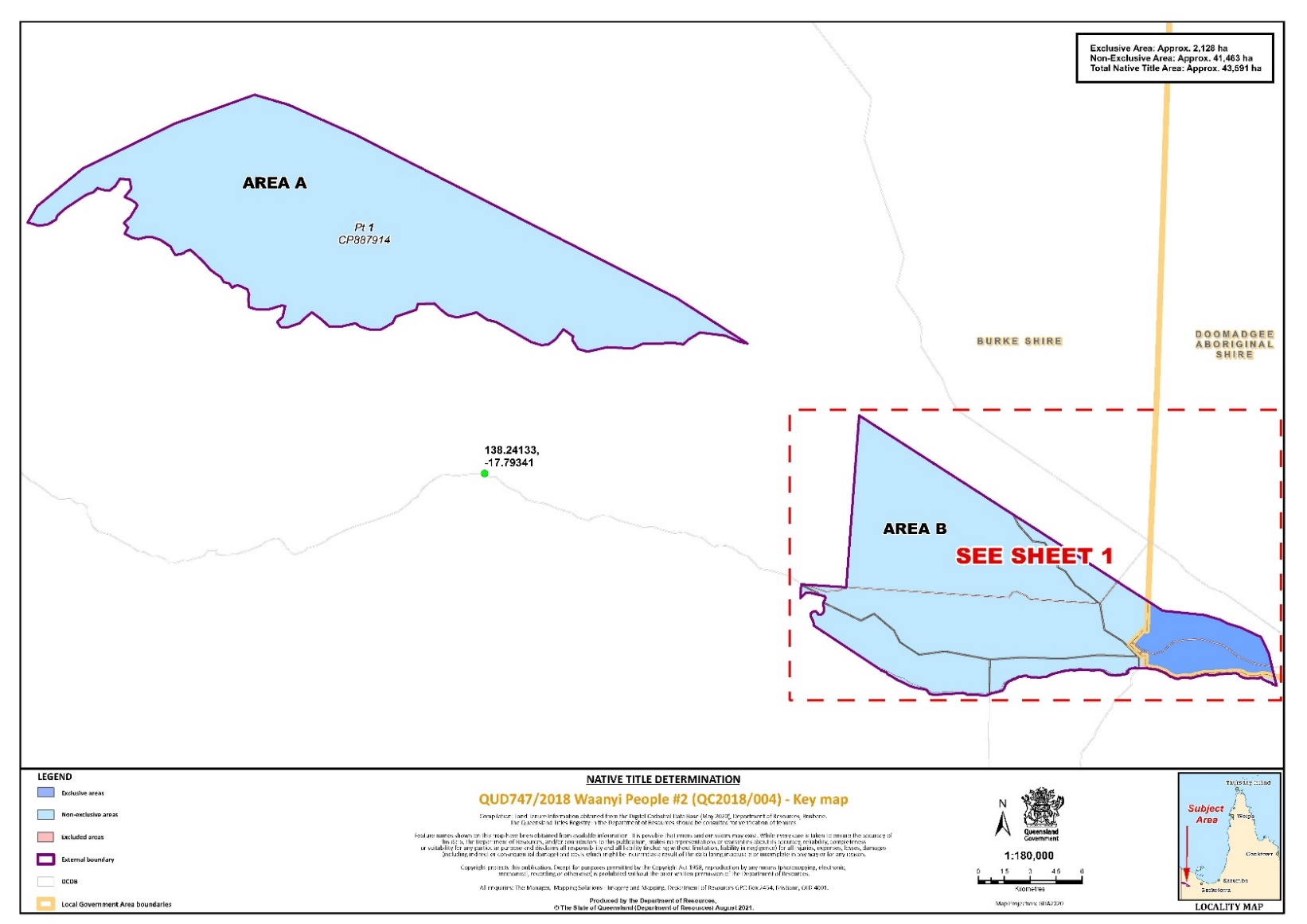
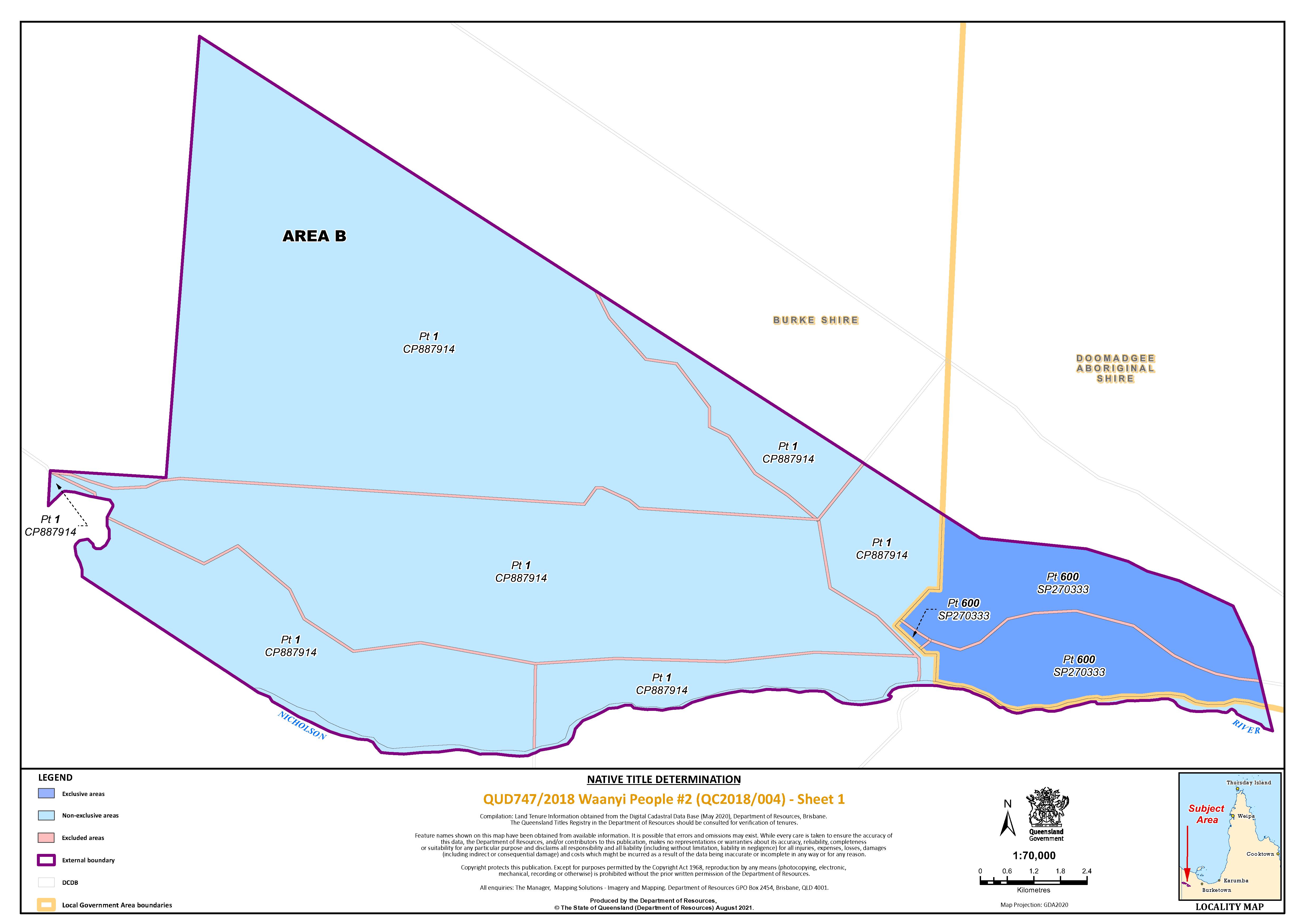
3. The determination area is the land and waters described in Schedule 2 and depicted in the map attached to Schedule 4, to the extent those areas are within the External Boundary and not otherwise excluded by the terms of Schedule 3 (“the Determination Area”). To the extent of any inconsistency between the written description and the map, the written description prevails.
4. Native title exists in the Determination Area.
5. The native title is held by the Waanyi People described in Schedule 1 (“the Native Title Holders”).
6. Subject to orders 8, 9 and 10, the nature and extent of the native title rights and interests, other than in relation to Water, are:
(a) in relation to that part of the Determination Area described in Part 1 of Schedule 2, the rights to possession, occupation, use and enjoyment of the area to the exclusion of all others;
(b) in relation to that part of the Determination Area described in Part 2 of Schedule 2, the non-exclusive rights to:
(i) access, to be present on and to traverse the area;
(ii) hunt, fish and gather on the area;
(iii) take Natural Resources from the area;
(iv) live on the land, to camp and, for those purposes, to erect shelters and other structures;
(v) light fires on the area for domestic purposes including cooking and heating but not for the purposes of hunting or clearing vegetation;
(vi) conduct religious, spiritual and ceremonial activities on the area;
(vii) be buried on, and bury Native Title Holders on, the area;
(viii) maintain, in the area, places and areas of importance or significance to the Waanyi People under their traditional laws and customs and to protect those places and areas, by lawful means, from physical harm; and
(ix) share or exchange Natural Resources from the area.
7. Subject to orders 8, 9 and 10, the nature and extent of the native title rights and interests in relation to Water within the Determination Area are the non-exclusive rights to:
(a) hunt, fish in and on and gather from the Water; and
(b) take, use and enjoy the Water for personal, domestic and non-commercial communal purposes.
8. The native title rights and interests are subject to and exercisable in accordance with:
(a) the Laws of the State and the Commonwealth; and
(b) the traditional laws acknowledged and traditional customs observed by the Native Title Holders.
9. The native title rights and interests referred to in orders 6(b) and 7 do not confer possession, occupation, use or enjoyment to the exclusion of all others.
10. There are no native title rights in or in relation to minerals as defined by the Mineral Resources Act 1989 (Qld) and petroleum as defined by the Petroleum Act 1923 (Qld) and the Petroleum and Gas (Production and Safety) Act 2004 (Qld).
11. The nature and extent of any other interests in relation to the Determination Area (or respective parts thereof) are set out in Schedule 5 (“the Other Interests”).
12. The relationship between the native title rights and interests described in orders 6 and 7 and the Other Interests is that:
(a) the Other Interests continue to have effect, and the rights conferred by or held under the Other Interests may be exercised notwithstanding the existence of the native title rights and interests;
(b) to the extent the Other Interests are inconsistent with the continued existence, enjoyment or exercise of the native title rights and interests in relation to the land and waters of the Determination Area, the native title continues to exist in its entirety but the native title rights and interests have no effect in relation to the Other Interests to the extent of the inconsistency for so long as the Other Interests exist; and
(c) the Other Interests and any activity that is required or permitted by or under, and done in accordance with, the Other Interests, or any activity that is associated with or incidental to such an activity, prevail over the native title rights and interests and any exercise of the native title rights and interests but do not extinguish them except in accordance with law.
DEFINITIONS AND INTERPRETATION
13. In this determination, unless the contrary intention appears:
Other words and expressions used in this determination have the same meanings as they have in Part 15 of the Native Title Act 1993 (Cth).
THE COURT DETERMINES THAT:
14. Pursuant to s 56 of the Native Title Act 1993 (Cth), the native title is not held in trust.
15. The Waanyi Native Title Aboriginal Corporation ICN 7448, incorporated under the Corporations (Aboriginal and Torres Strait Islander) Act 2006 (Cth), is to:
(a) be the prescribed body corporate for the purpose of s 57(2) of the Native Title Act 1993 (Cth);
(b) act as agent for the native title holders; and
(c) perform the functions mentioned in s 57(3) of the Native Title Act 1993 (Cth) after becoming a registered native title body corporate.
Note: Entry of orders is dealt with in Rule 39.32 of the Federal Court Rules 2011.
LIST OF SCHEDULES
Schedule 1 – Native Title Holders
Schedule 2 – Description of the Determination area
Schedule 3 – Areas Not Forming Part of the Determination Area
Schedule 4 – Map of Determination Area
Schedule 5 – Other Interests in the Determination Area
Schedule 1 – Native Title Holders
The Native Title Holders are the Waanyi People.
A person is a Waanyi person if and only if:
(a) the other Waanyi people recognise that he or she is descended (which may include by adoption) from a person who they recognise as having been Waanyi; and
(b) the person identifies himself or herself as a Waanyi person.
It is accepted that adoption may take place and that where adoption has occurred it confers upon the adoptee the right to identify as being a Waanyi person.
The following deceased persons are recognised as having been Waanyi people from whom living Waanyi people may be descended:
(a) King George (Gundawarinya), Mary Starr (Namura), Marrandu
(b) Johnny Rockland (Guyanda)
(c) Wuragaga (including his sons Toby Daly and Charlie Walden)
(d) Wirduga (including her sons King Pedro and Fred Mangala), Yurumburinya, Gudurju, Jagijagi (including her children Left-hand Dick, King Darby, Violet Darby), Lagayi, and Brenda Munara (including her children Duncan Hogan, Julie Darby, Dan Darby, Clara Darby, Frank Hogan, Arthur Peterson)
(e) Jack Riversleigh (including his children Doris Aplin and Vera Johnny, Annie King and Elaine Cairns)
(f) Diana (Dina) Jackson
(g) Fred Mangala (including his children Jimmy Doolan, Tommy Doolan, Oscar Gregory and Queenie Bell) and King Pedro (including his children Dinny, Jock and Cubby Pedro)
(h) Janggali (including his son Yarribija's children: Duncan Hogan, Julie Darby, Dan Darby, Clara Darby, Frank Hogan, Arthur Peterson; and his daughter Muranji's daughters: Jamuyu and Lidi Wayawarrinya)
(i) King Darby, Left Hand Dick and Violet Darby
(j) Ruby Lilwayi (including her daughter Elsie Foster), Polly Nganduyu (including her children: Nancy Carlton, Ned George, Sally O'Keefe, Bubi Dick, Netty Malbow and Nuts Logan), May Black Nijirijbina (including her children Nancy Wilson, Nora Black, Dora Doolan nee Black and Archie Black), Ruby Gijaya (including her children Mavis Carlton, Junie Clay, Maurice Carlton, Marina Dick, Mick Miller, Murray Donaldson), and Mailman Dick Gungayamaji (including his child Ivy George Ngayaya)
(k) Smiler Diamond (including his children: Mick Diamond Nguyjbirri and Jack Diamond Bandangala and Sydney Punjaub and Ruby)
(l) Mailman Jack Libaninji (including his son Fred Carlton Gajangga, daughter Rosie and her daughter Betty Lloyd Jayinbalina, and son Ned Ngaragulanji and his children Bessie Holt and Colin Holt)
(m) Rosie (including her daughter Lena Saville)
(n) June Jacob
(o) Opal
(p) Minnie (Myboogundji)
Schedule 2 – Description of the Determination Area
The Determination Area comprises all of the land and waters described by lots on plan, or relevant parts thereof, and any rivers, streams, creeks or lakes described in the first column of the tables in Parts 1 and 2 immediately below, and depicted in the maps in Schedule 4, to the extent those areas are within the External Boundary described in Part 3 and not otherwise excluded by the terms of Schedule 3.
All of the land and waters described in the following table and depicted in dark blue on the determination map contained in Schedule 4:
Area description (at the time of the determination) | Determination Map Sheet Reference |
That part of Lot 600 on SP270333 which is within the External Boundary.* | Sheet 1 |
* denotes areas to which ss 47, 47A or 47B of the Native Title Act 1993 (Cth) apply
Part 2 — Non-Exclusive Areas
All of the land and waters described in the following table and depicted in light blue on the determination map contained in Schedule 4:
Area description (at the time of the determination) | Determination Map Sheet Reference |
That part of Lot 1 on CP887914 which is within the External Boundary, excluding areas of historical road described by stations E-F-G, B-C-G-H and F-J as shown on CP887914. | Sheet 1 |
Save for any waters forming part of a lot on plan, all rivers, creeks, streams and lakes within the External Boundary described in Part 3 of Schedule 2, including but not limited to, the Nicholson River. |
Area A
Commencing on a southern boundary of Lot 1 on CP887914 (Turn Off Lagoons) at its intersection with a line between a point located at Longitude 138.008674° East, Latitude 17.654384° South and a point on the Northern Territory/Queensland border at Latitude 17.677553° South (being a point on the southern boundary of native title determination QUD66/2005 Gangalidda & Garawa People #2 (QCD2015/003)); then generally north easterly and generally south easterly along that determination boundary until again its intersection with a southern boundary of Lot 1 on CP887914 (Turn Off Lagoons), further described as:
then generally north easterly and generally south easterly through the following
coordinate points:
Longitude (East) | Latitude South |
138.008674 | 17.654384 |
138.032331 | 17.634817 |
138.080543 | 17.611232 |
138.121771 | 17.596390 |
138.139445 | 17.601666 |
138.174418 | 17.617281 |
138.340969 | 17.702018 |
then south easterly along a line toward a point located at Longitude 138.594116° East, Latitude 17.864824° South until its intersection with a southern boundary of Lot 1 on Plan CP887914 (Turn Off Lagoons).
then generally westerly along that southern boundary back to the commencement point.
Area B
Commencing on a western boundary of Lot 1 on CP887914 (Turn Off Lagoons) at its intersection with a line between points located at Longitude 138.340969° East, Latitude 17.702018° South and Longitude 138.594116° East, Latitude 17.864824° South (being a point on the southern boundary of native title determination QUD66/2005 Gangalidda & Garawa People #2 (QCD2015/003)); then generally south easterly along that determination to Longitude 138.615596° East; further described as:
then south easterly to Longitude 138.594116° East, Latitude 17.864824° South, then easterly along a line to Longitude 138.641622° East, Latitude 17.869594° South to intersect Longitude 138.615596° East.
then generally south easterly through the following coordinate points:
Longitude East | Latitude South |
138.624072 | 17.869569 |
138.627936 | 17.871501 |
138.634375 | 17.873433 |
138.645307 | 17.878577 |
138.649197 | 17.886914 |
138.649185 | 17.886955 |
then again south easterly to a point on the northern boundary of Lot 5 on Plan SP111112 (Lawn Hill Holding) at Longitude 138.653284° East (being a point on the northern boundary of native title determination QUD6022/1999 Waanyi Peoples (QCD2010/007)); then generally westerly, generally northerly and again generally westerly along that determination boundary to its intersection with a western boundary of Lot 1 on CP887914 (Turn Off Lagoons), further described as:
then generally westerly along the northern boundary of Lot 5 on SP111112
(Lawn Hill Holding) to Longitude 138.450955° East; then north westerly to a point on the right bank of Hedleys Creek at Latitude 17.872580° South; then generally
northerly and generally westerly along that bank to its intersection with a western boundary of Lot 1 on Plan CP887914 (Turn Off Lagoons).
then northerly, easterly and again northerly along western and northern boundaries of Lot 1 on CP887914 (Turn Off Lagoons) back to the commencement point.
The Determination Area specifically excludes all of the land and waters the subject of:
- QUD6022/1999 Waanyi Peoples (QCD2010/007) as determined by the Federal Court 09 December 2010.
- QUD66/2005 Gangalidda & Garawa People #2 (QCD2015/003) as determined by the Federal Court on 01 April 2015.
Note
Data Reference and source
• Application area boundary compiled by National Native Title Tribunal based on information or instructions provided by the applicants.
• Cadastral data sourced from Department of Natural Resources and Mines, Qld (August 2015).
Reference datum
Geographical coordinates have been provided by the NNTT Geospatial Services and are referenced to the Geocentric Datum of Australia 1994 (GDA94), in decimal degrees and are based on the spatial reference data acquired from the various custodians at the time
Use of Coordinates
Where coordinates are used within the description to represent cadastral or topographical boundaries or the intersection with such, they are intended as a guide only. As an outcome to the custodians of cadastral and topographic data continuously recalculating the geographic position of their data based on improved survey and data maintenance procedures, it is not possible to accurately define such a position other than by detailed ground survey.
Prepared by Geospatial Services, National Native Title Tribunal (25 May 2017).
Schedule 3 – Areas Not Forming Part of the Determination Area
The following areas of land and waters are excluded from the Determination Area as described in Parts 1 and 2 of Schedule 2, to the extent that they fall within the External Boundary described in Part 3 of Schedule 2:
1. Those land and waters within the External Boundary which at the time the native title determination application was made were the subject of one or more Previous Exclusive Possession Acts, within the meaning of s 23B of the Native Title Act 1993 (Cth) as they could not be claimed in accordance with s 61A of the Native Title Act 1993 (Cth).
2. Specifically, and to avoid any doubt, the land and waters described in (1) above includes:
(a) the Previous Exclusive Possession Acts described in ss 23B(2) and 23B(3) of the Native Title Act 1993 (Cth) to which s 20 of the Native Title (Queensland) Act 1993 (Qld) applies, and to which none of ss 47, 47A or 47B of the Native Title Act 1993 (Cth) applied; and
(b) the land and waters on which any public work, as defined in s 253 of the Native Title Act 1993 (Cth), is or was constructed, established or situated, and to which ss 23B(7) and 23C(2) of the Native Title Act 1993 (Cth) and to which s 21 of the Native Title (Queensland) Act 1993 (Qld), applies, together with any adjacent land or waters in accordance with s 251D of the Native Title Act 1993 (Cth).
3. For the avoidance of doubt, the Determination Area does not include any Roads that are within the External Boundary.
Schedule 4 – Map of Determination Area
Schedule 5 – Other Interests in the Determination Area
The nature and extent of the Other Interests in relation to the Determination Area are the following as they exist as at the date of the determination:
1. The rights and interests of Burke Shire Council under its local government jurisdiction and functions under the Local Government Act 2009 (Qld), the Stock Route Management Act 2002 (Qld), Biosecurity Act 2014 (Qld) and under any other legislation, for that part of the Determination Area within the area declared to be Council’s local government area under the Local Government Regulation 2012 (Qld), including any rights it or its employees or agents have:
(a) as the owner and operator of existing infrastructure, facilities and other improvements (including gravel pits and road related infrastructure located outside dedicated roads), which are located in the Determination Area at the date on which this Order is made; and
(b) to enter the Determination Area to perform its functions.
2. The rights, interests, or powers of the Doomadgee Aboriginal Shire Council:
(a) as the trustee of the Doomadgee DOGIT and as the local government under the Local Government Act 2009 (Qld) and under any other legislation, for that part of the Determination Area within the Doomadgee local government area under the Local Government Regulations 2012 (Qld), including:
(i) as the owner, operator, or holder of any interest in infrastructure, facilities, or other site improvements, including:
(A) buildings or other structures, including fencing;
(B) gravel pits, including but not limited to Six Mile Gravel Pit located on that part of Lot 600 on SP270333 for local government purposes; and
(C) water bores, water point facilities and other infrastructure for the supply of water, including but not limited to Corinda Water Point located on that part of Lot 600 on SP270333; and
(b) any rights of its employees, agents, or contractors to enter land, including:
(i) to perform its local government operational activities such as feral animal and weed control, erosion control, waste management, and fire and land management; and
(ii) to operate, inspect, maintain, and repair its infrastructure, facilities and other site improvements.
3. The rights and interests of the grantee and others under the Deed of Grant of Land (Reference 51055894) over that part of Lot 600 on SP270333 (“Doomadgee DOGIT”).
4. The rights and interests of Turn Off Lagoons Pastoral Holding Company Pty Ltd ACN 085 377 340 as lessee under PH8/5440, over Lot 1 on CP887914 (“Turn Off Lagoons Pastoral Holding”).
5. The rights and interests of the holders of any permit, licence, lease, other authority, agreement or contract issued or made under the Forestry Act 1959 (Qld) that authorises commercial harvesting operation or the taking of forest products or quarry material in the lands of the Determination Area as may be current as at the date of this Determination, including:
(a) The rights of Burke Shire Council to access and take quarry materials under sales permit no. 202009005.
6. So far as confirmed pursuant to s 212(2) of the Native Title Act 1993 (Cth) and s 18 of the Native Title Act (Queensland) Act 1993 (Qld) as at the date of this Determination, any existing public access to, and enjoyment of, the following places in the Determination Area:
(a) waterways;
(b) beds and banks or foreshores of waterways; and
(c) areas that were public places at the end of 31 December 1993.
7. Any other rights and interests:
(a) held by the State of Queensland or Commonwealth of Australia; or
(b) existing by reason of the force and operation of the Laws of the State and the Commonwealth.
[1] | |
[10] | |
[18] | |
[21] | |
[51] |
1 The parties to this application ask the Court to exercise its power under s 87 of the Native Title Act 1993 (Cth) (NT Act) to make a determination of native title by consent. For the reasons which follow I consider it appropriate to make the consent determination sought by the parties.
2 On 17 October 2018, Gary Rockland, Lloyd O’Keefe, Ada Walden and Terence George on their own behalf and on behalf of the Waanyi People filed an application for the determination of native title. The application was accepted for registration on 9 November 2018 and was notified in accordance with s 66(3) of the NT Act on 26 December 2018. Notification closed on 25 March 2019.
3 The respondents are the State of Queensland, Doomadgee Aboriginal Shire Council and Burke Shire Council.
4 The parties agree that it is appropriate for the Court to make a determination of native title without a hearing and have freely entered into a s 87 agreement which annexes the form of consent orders now sought by the parties. They have all had the benefit of competent, independent legal advice throughout the proceeding. I agree that a hearing is not necessary.
5 In these reasons, I refer to the form of orders annexed to the s 87 agreement as the proposed determination.
6 The determination area is set out in the proposed determination. It commences approximately 19 kilometres northwest of Doomadgee in the vicinities of Nicholson River and Cliffdale Creek. The western-most boundary adjoins the Queensland – Northern Territory border. The eastern and south-eastern boundaries adjoin an area of land and waters where the Court recognised the native title of the Waanyi People in a determination made on 9 December 2010: Aplin on behalf of the Waanyi Peoples v State of Queensland (No 3) [2010] FCA 1515 (Dowsett J) (first Waanyi determination).
7 The first Waanyi determination concerned an adjacent claim area, covering some 17,900 square kilometres of land and waters in the southern Gulf of Carpentaria and included pastoral lease land, camping and water reserves, resource reserves and Boodjamulla (Lawn Hill) National Park.
8 In the present case the Court has been provided with the application, the materials filed in support of the first Waanyi determination, additional connection material relating to the application and further affidavits affirmed by the solicitor for the applicant. The materials provided are extensive.
9 As a result of more recent good faith negotiations between the applicant and the State of Queensland, including the provision of further connection evidence about the nature and extent of the rights as a matter of Waanyi traditional laws and traditional customs, the parties have agreed to recognise some of the non-exclusive native title rights of the Waanyi People in a different form to those recognised in the first Waanyi determination. This represents a significant achievement by the parties and has paved the way to the current consent determination. The parties are to be congratulated. Their approach meets with the defining purposes of the NT Act as set out in its preamble, to which I refer below.
10 It is appropriate first to have regard to the provisions which enable the Court to make a determination by consent and which govern the way in which that power should be exercised.
11 Section 87 of the NT Act relevantly provides:
87 Power of Federal Court if parties reach agreement
Application
(1) This section applies if, at any stage of proceedings after the end of the period specified in the notice given under section 66:
(a) agreement is reached on the terms of an order of the Federal Court in relation to:
(i) the proceedings; or
(ii) a part of the proceedings; or
(iii) a matter arising out of the proceedings; and
(aa) all of the following are parties to the agreement:
(i) the parties to the proceedings;
(ii) the Commonwealth Minister, if the Commonwealth Minister is intervening in the proceedings at the time the agreement is made; and
(b) the terms of the agreement, in writing signed by or on behalf of the parties to the proceedings and, if subparagraph (aa)(ii) applies, the Commonwealth Minister, are filed with the Court; and
(c) the Court is satisfied that an order in, or consistent with, those terms would be within the power of the Court.
Power of Court
(1A) The Court may, if it appears to the Court to be appropriate to do so, act in accordance with:
(a) whichever of subsection (2) or (3) is relevant in the particular case; and
(b) if subsection (5) applies in the particular case—that subsection.
Agreement as to order
(2) If the agreement is on the terms of an order of the Court in relation to the proceedings, the Court may make an order in, or consistent with, those terms without holding a hearing or, if a hearing has started, without completing the hearing.
Note: If the application involves making a determination of native title, the Court’s order would need to comply with section 94A (which deals with the requirements of native title determination orders).
12 Section 87 authorises the Court to make a determination of native title if, after the end of period specified in the notice pursuant to s 66, each of the parties to the proceedings reach agreement and file the signed agreement with the Court. Each of these procedural requirements is satisfied in the present case.
13 Section 87 also requires the Court to be satisfied that an order in, or consistent with, the agreed terms is within its power.
14 Section 94A of the NT Act requires that an order of the Court making a determination of native title set out details of the matters specified in s 225.
15 Section 225 provides:
225 Determination of native title
A determination of native title is a determination whether or not native title exists in relation to a particular area (the determination area) of land or waters and, if it does exist, a determination of:
(a) who the persons, or each group of persons, holding the common or group rights comprising the native title are; and
(b) the nature and extent of the native title rights and interests in relation to the determination area; and
(c) the nature and extent of any other interests in relation to the determination area; and
(d) the relationship between the rights and interests in paragraphs (b) and (c) (taking into account the effect of this Act); and
(e) to the extent that the land or waters in the determination area are not covered by a non-exclusive agricultural lease or a non-exclusive pastoral lease—whether the native title rights and interests confer possession, occupation, use and enjoyment of that land or waters on the native title holders to the exclusion of all others.
Note: The determination may deal with the matters in paragraphs (c) and (d) by referring to a particular kind or particular kinds of non-native title interests.
16 The expression “native title rights and interests” appearing in s 225(b) is defined in s 223(1) as follows:
(1) The expression native title or native title rights and interests means the communal, group or individual rights and interests of Aboriginal peoples or Torres Strait Islanders in relation to land or waters, where:
(a) the rights and interests are possessed under the traditional laws acknowledged, and the traditional customs observed, by the Aboriginal peoples or Torres Strait Islanders; and
(b) the Aboriginal peoples or Torres Strait Islanders, by those laws and customs, have a connection with the land or waters; and
(c) the rights and interests are recognised by the common law of Australia.
17 Sections 56 and 57 relevantly provide:
56 Determination whether native title to be held in trust
Trust determination
(1) One of the determinations that the Federal Court must make is whether the native title is to be held in trust, and, if so, by whom.
…
57 Determination of prescribed body corporate etc.
…
Where not trustee
(2) If the determination under section 56 is not as mentioned in subsection (1) of this section, the Federal Court must take the following steps in determining which prescribed body corporate is, after becoming a registered native title body corporate, to perform the functions mentioned in subsection (3):
(a) first, it must request a representative of the common law holders to:
(i) nominate, in writing given to the Federal Court within a specified period, a prescribed body corporate for the purpose; and
(ii) include with the nomination the written consent of the body corporate;
(b) secondly, if a prescribed body corporate is nominated in accordance with the request, the Federal Court must determine that the body is to perform the functions;
…
Functions where not trustee
(3) After becoming a registered native title body corporate, the body must perform:
(a) any functions given to it as a registered native title body corporate under particular provisions of this Act; and
(b) any functions given to it under the regulations (see section 58).
…
18 The preamble to the NT Act provides important context to the provisions relating to the making of a determination of native title. It states:
…
The people whose descendants are now known as Aboriginal peoples and Torres Strait Islanders were the inhabitants of Australia before European settlement.
They have been progressively dispossessed of their lands. This dispossession occurred largely without compensation, and successive governments have failed to reach a lasting and equitable agreement with Aboriginal peoples and Torres Strait Islanders concerning the use of their lands.
As a consequence, Aboriginal peoples and Torres Strait Islanders have become, as a group, the most disadvantaged in Australian society.
…
19 The preamble goes on to state that the people of Australia intend to rectify the consequences of past injustices through the provisions of the NT Act, and to:
…ensure that Aboriginal peoples and Torres Strait Islanders receive the full recognition and status within the Australian nation to which history, their prior rights and interests, and their rich and diverse culture, fully entitle them to aspire.
20 The correct approach of the Court to the making of determinations which are the subject of consent between the parties was re-stated recently in Widjabul Wia-Bal v Attorney General of New South Wales [2020] FCAFC 34; 274 FCR 577 at [51] (Reeves, Jagot and Mortimer JJ) as follows:
Before considering the facts of the present case it is necessary to say something about the Court’s power to make a determination of native title in accordance with an agreement. The Court must be satisfied that it is appropriate to make the orders specified in the agreement and that there is power to do so: ss 87(1)(c) and 87A(4) of the NT Act. It has been stated that it is sufficient for a party in the position of the State to satisfy itself that there is a credible basis for the application: Lovett on behalf of the Gunditjmara People v State of Victoria [2007] FCA 474 at [37] (Lovett) citing Munn v Queensland [2001] FCA 1229; (2001) 115 FCR 109; see also Watson v Western Australia (No 6) [2014] FCA 545 at [29]. Further, in Lovett it was made clear that “[t]he Act does not intend to substitute a trial, in effect, conducted by State parties for a trial before the Court”. To fulfil its function under the NT Act, in the context of a mediation with a view to entering an agreement under ss 87 or 87A, the State is not required to obtain proof from an applicant which would demonstrate to the civil standard of proof, on the balance of probabilities, that the native title rights claimed by the applicant exist. Indeed, for the State to seek more from an applicant than such material as establishes a credible basis for the existence of the native title rights sought in the determination would be inconsistent with the obligation in s 94E(5) to act in good faith in the conduct of the mediation. It cannot be an act in good faith in the conduct of a mediation to require an applicant to provide the State with more than that which is legally necessary for the State to be in a position to inform the Court that, from the State’s perspective, it is appropriate for the Court to make the determination of native title in orders giving effect to the terms of an agreement as provided for in s 87 or 87A of the NT Act. To place such an unwarranted burden on an applicant would be fundamentally inconsistent with the scheme of the NT Act and in particular the provisions identified above which constitute the “special procedure”, which the Preamble to the statute recognises is required for the “just and proper ascertainment of native title rights and interests”. Such an act would readily be characterised as an act not in good faith in the conduct of a mediation.
21 A number of matters bear upon the exercise of the Court’s power to make a determination of native title. Amongst other things, the Court must have a valid application before it, there must not have been any previous determination made in respect of the proposed determination area (s 68); and the determination must not overlap the area of another determination application (s 67(1)). Each of these conditions is satisfied in the present case and I am satisfied that the Court does have the power to make the proposed determination sought by the parties.
22 There is a direct connection between the current application and the findings of the Court in the first Waanyi determination. In the third judgment delivered by Dowsett J in relation to the first Waanyi determination, which was based on material that is also before this Court, his Honour said:
[12] The material provides an overview of the anthropology, archaeology and history of the Waanyi People. Professor Trigger says:
“Waanyi” is an Aboriginal language of the southern Gulf of Carpentaria region. The existence, name and territorial location of the language has been well documented by ethnographers since the coming of European and Asian people to the region.
I believe that it may be safely inferred from the earliest ethnographic accounts that at the time that the British Imperial Crown asserted sovereignty in relation to the relevant parts of the Australian continent (being, I understand, in 1788), there was a group of Aboriginal people in the southern Gulf of Carpentaria region who had in common that they spoke the Waanyi language and acknowledged and observed a common body of laws and customs, and by those laws and customs had connection with, and rights and interests in relation to country, including country within the present claim area and also beyond that claim area in the Northern Territory.
[13] The first recorded European expedition into the mainland areas of the southern Gulf of Carpentaria was in 1841 when Stokes, in the Beagle, sailed up the Albert River to the present location of Burketown. He travelled 40 miles upstream and then continued on foot. He was so impressed with the soil and vegetation of the area that he called it “the Plains of Promise”. Overland explorers included Ludwig Leichhardt in 1845, Augustus Gregory in 1856 and Burke and Wills in 1861. In the following year, Norman, Landsborough and McKinley travelled through the region in search of Burke and Wills. In 1862, Landsborough wrote:
The [Gregory] River is here a quarter of a mile wide, running strong in two channels ….. it is the finest and grandest looking inland river I have seen in Australia, and the country it runs through consists of rich-soiled plains, just sufficiently wooded for pastoral purposes.
[14] The first pastoral runs were established at Beames Brook on the Gregory River and further east on the Leichhardt in 1864. Frank Hann established Lawn Hill in 1875 and Gregory Downs, Riversleigh and Lilydale were established later in that decade. The arrival of European settlers brought great hardship to indigenous people in the area, including the Waanyi. Conflict between settlers and traditional owners led to the dispersal or destruction of the Nguburindi people, whose land was to the east of traditional Waanyi country, and of the Injilanji people, whose land was to the south. The Waanyi people succeeded them as traditional owners of those areas or parts thereof. Waanyi people are now largely concentrated in communities situated in Doomadgee, Mornington Island, Burketown, Robinson River, Borroloola, Camooweal and Mt Isa. However they have maintained close contact with the determination area.
[15] Chapter 1 of the connection report gives a comprehensive overview of Waanyi society at first contact with European explorers and settlers and the impact of that contact on the lives of the people. Reference is made to the “wild times” when there were “violent reprisals for killing cattle and competition over land and water, as well as the emergent need for pastoral labour”. Problems were unhesitatingly resolved by the use of violence. I have read the affidavit of Mary Lorraine, filed on 5 November 2010. Ms Lorraine speaks about her father’s first contact with Europeans and the impact of the “wild times” on Waanyi people. The affidavit provides an important insight into the way in which Waanyi people have lived on, and maintained their connection to their country.
[16] The reports and the affidavits clearly demonstrate the existence of organized Aboriginal occupation and possession of the determination area. They demonstrate that the Waanyi people maintained an unbroken physical connection with their land during the period of early European settlement and that such connection has continued to the present day. It has involved their living in bush camps, working on the large pastoral properties, observing traditional laws and practices and utilising the resources of the country.
[17] Professor Trigger demonstrates, in chapter 6 of the connection report, that traditional laws and customs affiliate particular families to areas within the determination area. Such laws and customs are derived from traditional beliefs about creation and the importance of the acknowledgement and observance of those laws and customs. Evidence of such observance is provided in the connection report.
[18] I conclude that the Waanyi people are descended from a society of Aboriginal people who occupied the determination area continuously prior to sovereignty and thereafter. Such society was united by the acknowledgement and observance of traditional laws and customs. I am satisfied that the rights and interests which I recognize today are derived from the continuous observance of these laws and customs. Those conclusions are supported by the anthropological material.
23 Further materials were prepared by the applicant to provide evidence of the connection of the Waanyi people to the current determination area in accordance with the traditional laws that they acknowledge and the traditional customs that they observe. This includes an anthropological report by Professor David Trigger and Ms Pauline Cook that provides a map showing the general locations of Waanyi estates and of sites within and nearby to the determination area.
24 The report sets out in its summary of opinions that the Waanyi People are a group of Aboriginal people who collectively acknowledge traditional laws and observe traditional customs by which they possess rights and interests in and have a continuing connection with the proposed determination area. It notes that the proposed determination area is divided into Area A, known as “Guyanda country”, and Area B known as “Turn Off Lagoon/Corinda country”. It states the authors’ opinion that the laws and customs by which contemporary Waanyi People hold rights and interests in the determination area have been adapted since European settlement and sovereignty. However, the laws and customs have had a continuous existence and there are genealogical links for contemporary families to those forebears who occupied Waanyi country at the time of effective establishment of sovereignty in the southern Gulf country.
25 The report states that although it is difficult to establish a precise eastern boundary for Waanyi country in the vicinity of Area B at the time of establishment of sovereignty, it is possible that the area was part of a zone of transition towards what was Nguburindi country to the east and/or Yangarella (Yukulta, what is now known as Ganggalida) country to the north. If there has been actual Waanyi succession eastwards into Area B the report records the opinion of its authors that this process has been complete since at least the 1930s and that there is agreement on the part of the Ganggalida people to the east and north and Garawa people to the north and west that Area B is Waanyi country arising from regional traditional law and custom.
26 The report expresses the opinion of its authors that the traditional laws and customs for the westernmost part of the determination area (Area A) include that it is part of what is known as “Guyanda country” and its main Dreaming significance is Red Kangaroo. The Waanyi apical ancestor with particularly close ties to this area was Johnny Rockland, whose Waanyi name was Guyanda.
27 In relation to the easternmost part of the determination area (Area B), known as “Turn Off Lagoon/Corinda country”, the main Dreaming significance is Emu. This area includes locations of much historical residence and ceremonial activities among Waanyi People, all of whom hold generic rights in the area. Waanyi families with locality specific rights in the adjacent country to the west, known as “Najabarra/Nicholson River Country”, have particular traditional knowledge of and historical connection with this area.
28 The report concludes that there has been substantial continuity in the traditional connection of Waanyi people to the areas now claimed.
29 Affidavits given by Garrick George, Lloyd O’Keefe and Garry Rockland provide further detail of the continuing and strong family connections with the land the subject of the application.
30 I am satisfied that the claim has been subjected to appropriate anthropological consideration, that the State of Queensland has discharged its responsibility in making an appropriate assessment of the application for the determination of native title and that there is a rational basis for its agreement to the proposed determination.
31 I now turn specifically to the matters in s 225 about which the Court must set out details: NT Act s 94A.
32 In relation to s 225(a), being the identity of the holders of the native title rights and interests, the applicants named in the application are Gary Rockland, Lloyd O’Keefe, Ada Walden and Terence George. The native title claim group identified in the application includes the same description of the Waanyi People as that which applied in the first Waanyi determination, however, the proposed determination before the Court includes within the description of the native title holders in Schedule 1 an additional apical ancestor in paragraph (p) being Minnie (Myboogundji) who is to be recognised as having been a Waanyi person from whom living Waanyi people may be descended.
33 There is a history to the addition of Minnie to the native title claim group.
34 Before the making of the first Waanyi determination, two other decisions were published by the Court in relation to a dispute between the then applicant and a respondent to the claim, Gregory Phillips: Aplin on behalf of the Waanyi Peoples v State of Queensland [2010] FCA 625 and Aplin on behalf of the Waanyi People v State of Queensland (No 2) [2010] FCA 1326 (Waanyi (No 2)).
35 In Waanyi (No 2) the Court summarised the dispute and its resolution as follows:
[2] One outstanding issue, which was resolved by my previous decision, was a dispute between the applicant and Mr Gregory Lloyd Phillips, who is a respondent in the proceedings. Mr Phillips is descended from a lady called Minnie, who was, as the evidence before me disclosed, an Aboriginal woman who died near Burketown in about 1943. She had married a Chinese man and had children by him, including a number of daughters who survived her and had issue. Mr Phillips is Minnie’s great grandson. Mr Phillips claims that Minnie was a Waanyi woman and that, as her descendent, he is entitled to membership of the claim group. Such membership, as defined for the purposes of these proceedings depends primarily upon descent from a recognized Waanyi ancestor. The claim group does not recognize Minnie as such. There are many other descendants of Minnie who would be included in the claim group if Mr Phillips were successful in establishing his claim.
[3] This question was ventilated at great length before me during 2009. The matters in dispute involved the proper formulation of the criteria for membership of the claim group and whether Minnie satisfied that description. After considering the evidence concerning Minnie’s background and life, I declared as follows:
The laws and customs of the Waanyi People concerning who are Waanyi People are that a person is a Waanyi person if, and only if
(a) the other Waanyi people recognise that he or she is descended (which may include by adoption) from a person whom they recognise as having been Waanyi; and
(b) the person identifies him or herself as a Waanyi person.
[4] I also declared that Minnie:
(a) during her life identified herself as a Waanyi woman;
(b) was understood by the late Roy Seccin, from the early to mid 1920s, to be a Waanyi woman;
(c) has been understood by Yuen Hookey, from about 1942, to be a Waanyi woman;
(d) was from 1888 until at least 1939 recognized by the Waanyi people at Lawn Hill as a Waanyi woman, and
(e) was, from about 1916 until her death in 1943, recognised by the Waanyi people at Burketown as a Waanyi woman.
36 The Court did not name Minnie as part of the claim group. It noted that there was an ongoing reluctance to accept her as an apical ancestor, and noted that the question of Minnie’s status was not finally resolved in its reasons, because the matter had to be left to the claim group: Waanyi (No 2) at [21]. The Court noted that the description of the claim group was drawn in a way which would not exclude the inclusion of new members as apical ancestors after the determination, if the native title holders conclude that they are in fact apical ancestors.
37 By further good faith negotiations the native title claim group has now agreed to accept Minnie as being an apical ancestor and her descendants as being Waanyi people. The affidavit evidence of Mr Walkley sets out in some detail the steps taken to ensure that the claim group was properly constituted and voted in favour of the inclusion of Minnie within the group. He records, by reference to exhibited primary documents, that a meeting was advertised with the assistance of the Waanyi Native Title Aboriginal Corporation and the Carpentaria Land Council Aboriginal Corporation and that the meeting notice included a description of the business of the meeting as including whether or not Minnie was to be included in the determination orders. On 29 April 2021 a meeting was conducted and a resolution passed providing authorisation by the native title claim group for the inclusion of Minnie. Mr Walkley’s evidence demonstrates that the decision-making process used by the native title claim group on 29 April 2021 to make this resolution was relevantly the same as that used to make authorisation decisions in relation to the first Waanyi determination. Furthermore, Minnie is now included in the native title claim group in the proposed determination by the consent and agreement of the native title claim group and by the consent of the parties to the s 87 agreement.
38 The applicant relies on these circumstances to support the submission that it is in the interests of justice and consistent with the overarching purpose of s 37M(1) of the Federal Court of Australia Act 1976 (Cth) (FCA Act) for the Court now to make a determination that includes Minnie as an apical ancestor, despite Minnie not being named as a member of the native title claim group in the application filed with the Court. They submit that there is no prejudice to any party in so doing, and that s 84D of the NT Act provides jurisdiction for the Court to do so.
39 Although the description of the claim group in the application has not been amended to conform with the description in the proposed determination (which includes Minnie as an apical ancestor), the Court is not limited to making a determination in the form sought in the application and may proceed to make a determination in such form as it sees fit based on the evidence, provided the application is valid: Billy Patch on behalf of the Birriliburu People v State of Western Australia [2008] FCA 944 at [18] (French J); Watson on behalf of the Nyikina Mangala People v Western Australia (No 6) [2014] FCA 545 at [33] (Gilmour J).
40 In the present case, to the extent that the disconformity between the application and the proposed determination may give rise to a lack of authorisation, I find pursuant to s 84D(4) of the NT Act that it is in the interests of justice and appropriate for the Court to make the proposed determination. A similar approach has been taken by the Court on a number of occasions, including in Watson at [35]. In short form, my reasons for this conclusion are, first, that any defect in authorisation is purely formal, and does not sound in any prejudice to any of the parties, all of whom have agreed to the terms of the proposed determination. Secondly, the questions of ongoing authorisation and the inclusion of Minnie were properly notified to the native title claim group and specifically approved by it. Thirdly, the proposed inclusion of Minnie was widely notified and advertised as being one of the matters to be considered at the authorisation meeting. Fourthly, having regard to the findings in Waanyi (No 2) and the agreement of the parties to the proposed determination, there can be no dispute that Minnie was a Waanyi person. Fifthly, there will, by the making of the consent determination, be a satisfactory resolution of the application for all parties. Finally, I accept the submission advanced by the applicant that it is consistent with the overarching purpose stated in s 37M of the FCA Act to include Minnie in the list of known Waanyi ancestors in this way.
41 In relation to s 225(b), the nature and extent of native title rights and interests, the determination area is defined in order 3 as being the land and waters described in Schedule 2 and depicted in the map attached to Schedule 4, to the extent that those areas are within the External Boundary (as defined) and not otherwise excluded by the terms of Schedule 3. To the extent that there is any inconsistency between the written description and the map, the written description prevails.
42 The agreement reached by the parties recognises the native title claim group’s exclusive rights to possess, occupy, use and enjoy the area described in Part 1 of Schedule 2 (other than in relation to “water” as defined in the Water Act 2000 (Qld)). The parties agree that this area is part of the Doomadgee Deed of Grant in Trust (DOGIT) issued under the Land Act 1994 (Qld) and that one or more members of the claim group occupied the Doomadgee DOGIT at the time the determination application was made. Accordingly, I am satisfied that the criteria in s 47A(1) are met such that any prior extinguishment effected by the grant of the area in trust must be disregarded: s 47A(2).
43 In addition, the determination recognises the following non-exclusive native title rights (other than in relation to “water”) over the balance of the determination area described in Part 2 of Schedule 2. To:
(a) access, to be present on and to traverse the area;
(b) hunt, fish and gather on the area;
(c) take natural resources (as defined) from the area;
(d) live on the land, to camp and, for those purposes, to erect shelters and other structures;
(e) light fires on the area for domestic purposes including cooking and heating but not for the purposes of hunting or clearing vegetation;
(f) conduct religious, spiritual and ceremonial activities on the area;
(g) be buried on, and bury Native Title Holders on, the area;
(h) maintain, in the area, places and areas of importance or significance to the Waanyi People under their traditional laws and customs and to protect those places and areas, by lawful means, from physical harm; and
(i) share or exchange Natural Resources from the area.
44 The rights set out in (b)-(d) and (i) are somewhat different to the rights agreed in the first Waanyi determination and result from the fruitful discussions between the parties that led to their agreement.
45 The proposed determination provides that the native title rights and interests in the land are subject to and exercisable in accordance with the laws of the State of Queensland and the Commonwealth, and the traditional laws acknowledged and traditional customs observed by the native title holders. There are no native title rights in or in relation to minerals or petroleum.
46 In relation to s 225(c) and (d), the nature and extent of the other interests, these are identified in Schedule 5 of the proposed determination, and the relationship between the native title rights and interests and the other interests is provided for in order 12.
47 In relation to s 225(e), the determination area includes areas “not covered by a non-exclusive agricultural lease or a non-exclusive pastoral lease” (see Part 1 of Schedule 2, the second row of the table in Part 2 of Schedule 2 and the maps at Schedule 4). For those areas, the proposed determination identifies whether the native title rights and interests confer possession, occupation, use and enjoyment of the land or waters on the native title holders to the exclusion of all others (see orders 6, 7 and 9). This requirement is satisfied.
48 Turning to other formal matters, by s 56(1), the Court must make a determination as to whether the native title is to be held in trust and, if so, by whom. The evidence indicates that the native title is not to be held in trust. Order 14 provides accordingly.
49 By s 57(2), the Court must determine which prescribed body corporate is, after becoming a registered native title body corporate, to perform the functions set out in s 57(3). The Waanyi Native Title Aboriginal Corporation (ICN 7448) is a prescribed body corporate, has been nominated as the relevant body corporate and has consented to its nomination. It is the same body corporate as that which was prescribed in the first Waanyi determination. It is appropriate that the same entity be prescribed for both determinations: see Drury on behalf of the Nanda People v State of Western Australia [2020] FCAFC 69; 276 FCR 203 at [74]-[75] (Mortimer and Colvin JJ). Order 15 provides accordingly.
50 The Court has not been made aware of any circumstance that would indicate that the making of the proposed determination is inappropriate. I am satisfied that it is appropriate to give effect the parties’ agreement by making the proposed determination by consent.
51 The Waanyi People have achieved recognition by Australian law of their native title in the determination area. This marks a further step along a very long path for the Waanyi People that has included the initial application for recognition of native title in 1999, continued through to the first Waanyi determination in 2010 and been continued until the present day. Further steps are, no doubt, to be taken. The Waanyi People are to be admired for their persistence and determination, particularly in light of the many obstacles facing Aboriginal people and their communities. The applicant’s legal representatives provided excellent written submissions in support of the proposed determination and are to be congratulated for their ongoing support and assistance that they have provided. I should also like to acknowledge the positive role that the State of Queensland, as well as the other active participants in the proceedings, have played.
I certify that the preceding fifty-one (51) numbered paragraphs are a true copy of the Reasons for Judgment of the Honourable Justice Burley. |
Associate:


