

Federal Court of Australia
Bradshaw v BSA Limited [2021] FCA 1080
ORDERS
First Applicant SCOTT UREN Second Applicant | ||
AND: | Respondent | |
DATE OF ORDER: |
THE COURT ORDERS THAT:
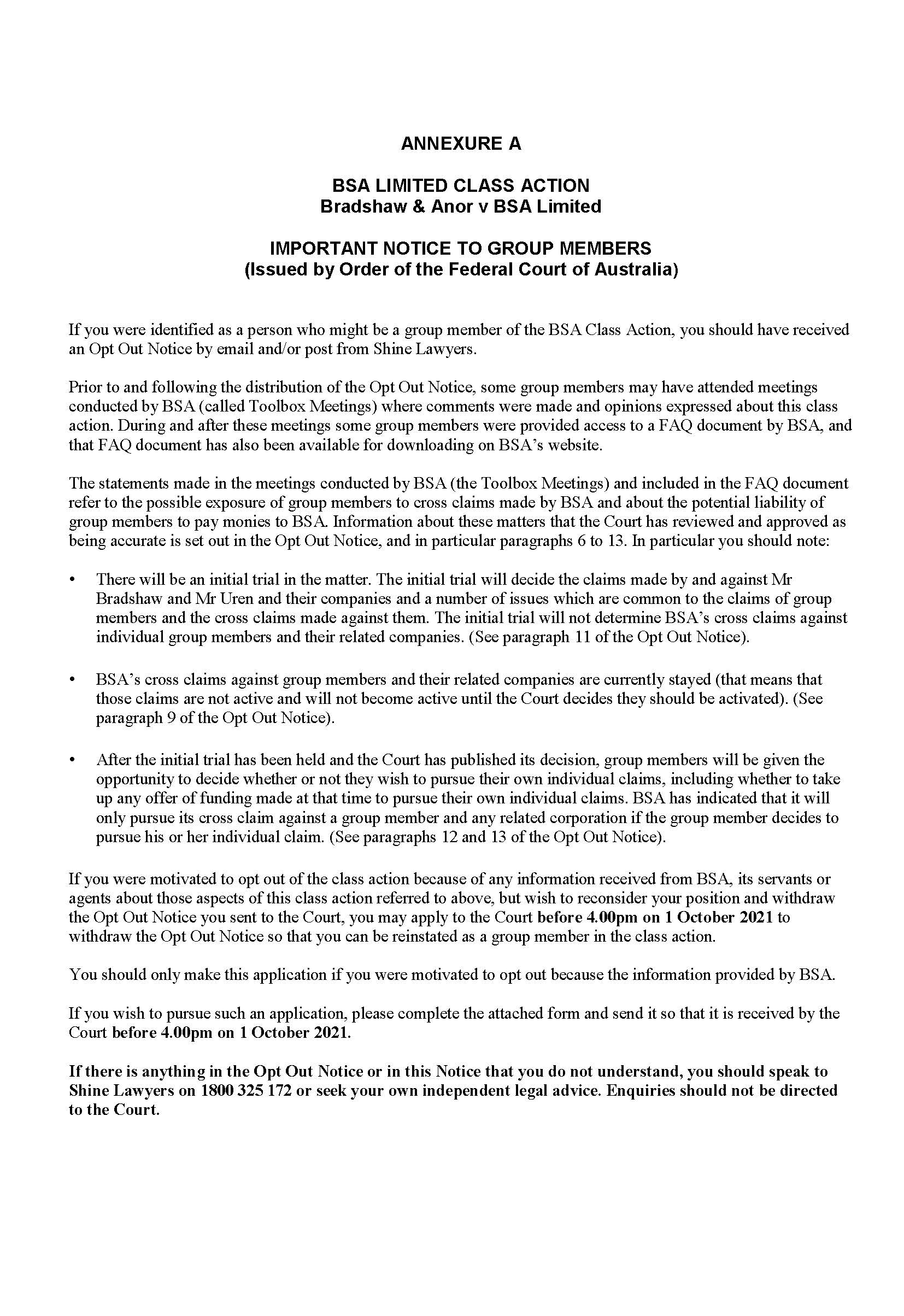
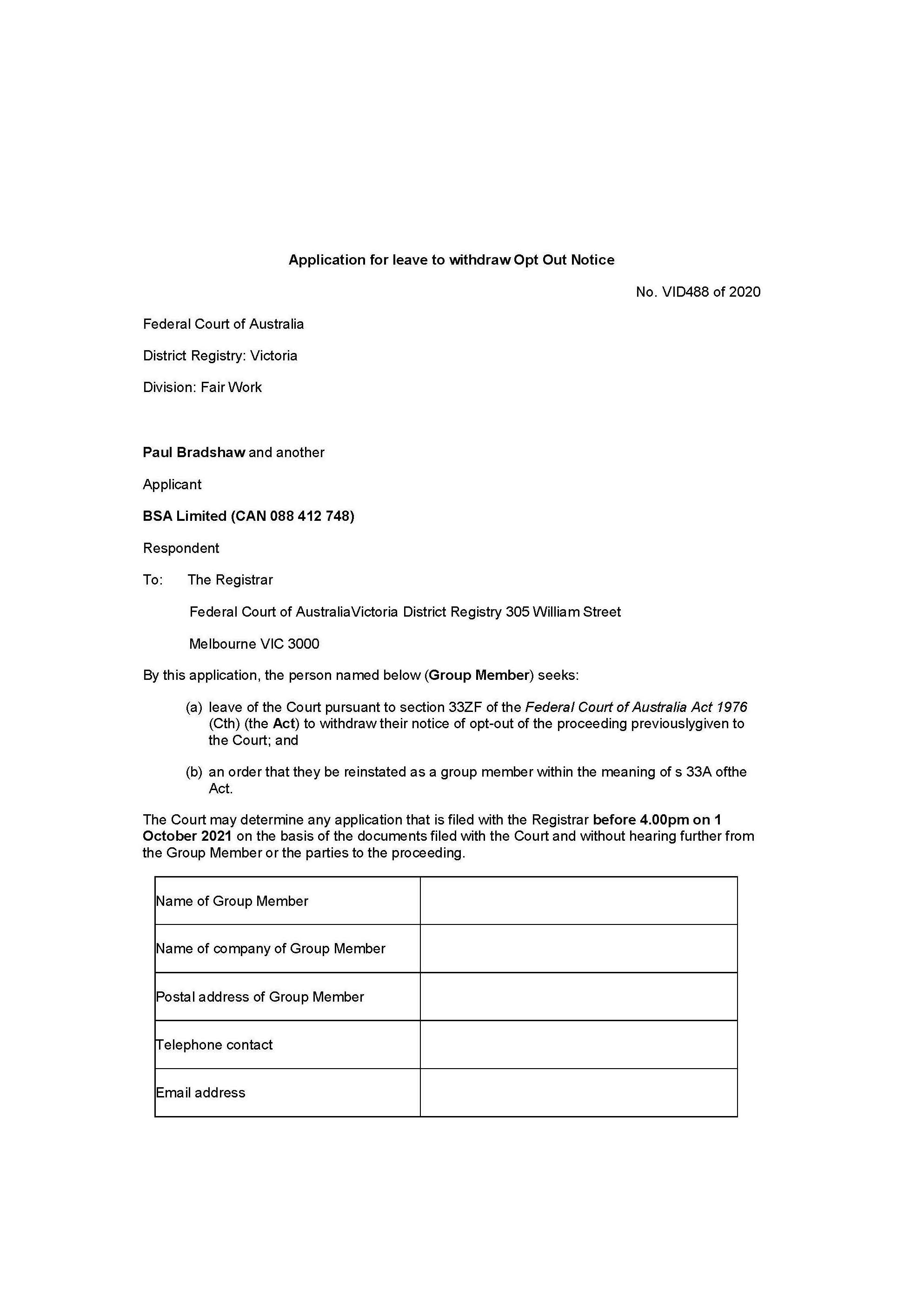
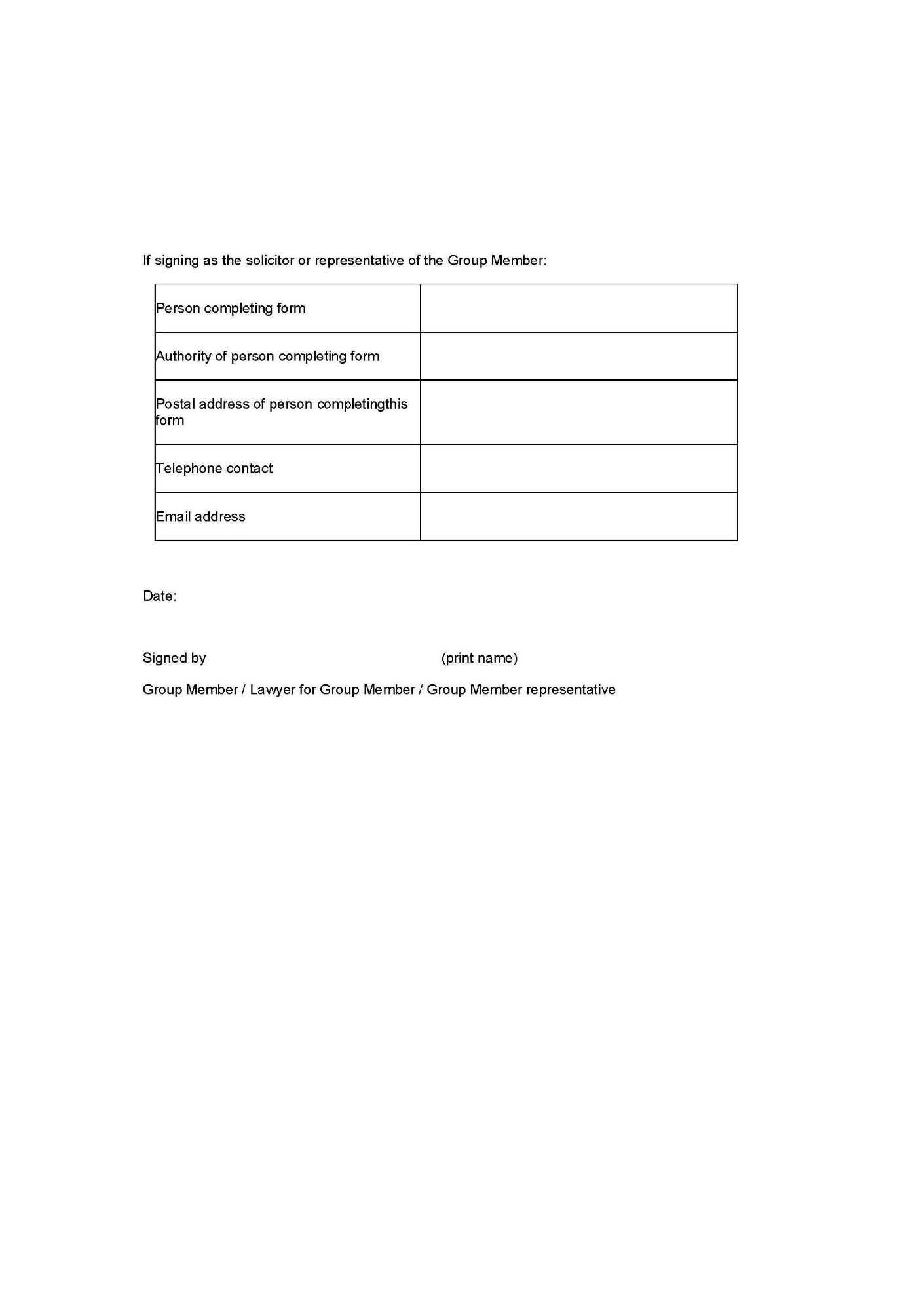
1. The Applicants cause the Notice attached as Annexure A to these orders (Notice) to be emailed forthwith and cause the Notice to be posted forthwith by a third party mail house to all known group members, including to any such person who may have filed an Opt Out Notice with the Court.
2. Each of the Respondent and solicitors for the Applicants cause the Notice to be posted in a prominent position on their respective websites including at https://www.bsatoolbox.com/ for the duration of the opt-out period until 25 September 2021.
3. The costs of the publication of the Notice referred to in Orders 1 and 2 is to be paid for by the Applicants on the basis that the question as to whether the Respondent should reimburse the Applicants for those costs is reserved.
4. Unless the Notice referred to in orders 1 and 2 is forthwith attached to the document described in the Court’s reasons for judgment as the “FAQ Document” displayed on the website(s) of BSA, including at https://bsatoolbox.com/, the Respondent forthwith remove that document from its website(s).
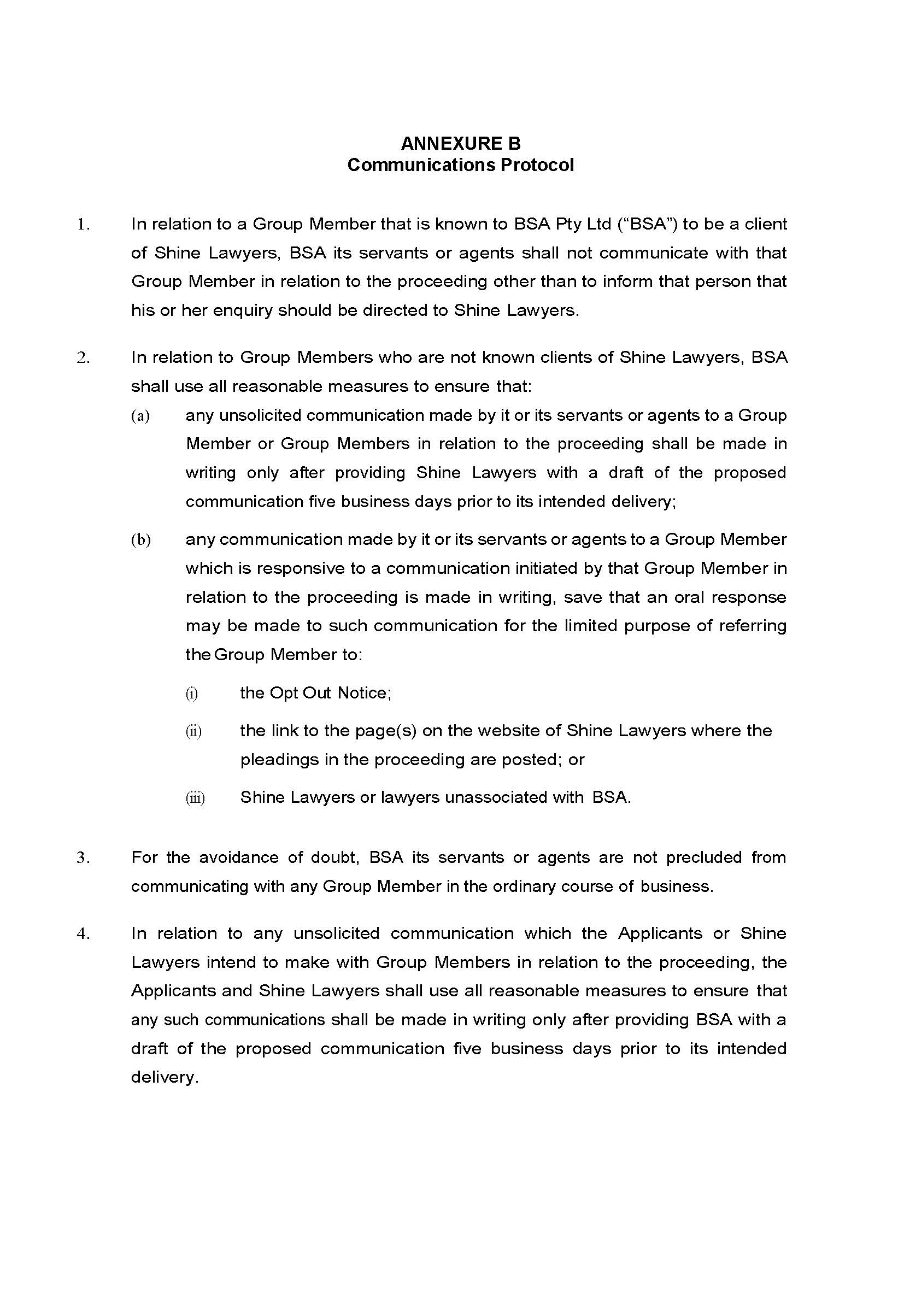
5. Until 25 September 2021, the Parties and Shine Lawyers shall comply with the Communication Protocol at Annexure B to these orders.
6. The interlocutory application of the Respondent filed on 3 September 2021 is dismissed.
7. The costs of the Applicants’ interlocutory application of 1 September 2021 and the costs the Respondent’s interlocutory application of 3 September 2021 are reserved.
Note: Entry of orders is dealt with in Rule 39.32 of the Federal Court Rules 2011.
BROMBERG J:
1 The fundamental question raised by this proceeding is whether or not the applicants and group members (the workers) provided their services to the respondent (BSA) as employees of BSA or, alternatively, as independent contractors or employees of another corporation (usually a corporation associated with the worker) providing services to BSA. The applicants claim that as employees of BSA the workers were denied entitlements due to them under various industrial instruments or the Fair Work Act 2009 (Cth). BSA has issued cross-claims against the workers and their associated corporations which, inter alia, seek the reimbursement of monies paid by BSA to the associated corporations in respect of the services of the workers, in the event that the Court determines that the workers were employees of BSA.
2 The Court has ordered a stay of the cross-claims other than those that relate to the applicants and their associated corporations. The applicants’ claims and the related cross-claims will be dealt with in the initial hearing of this proceeding. The individual claims of group members and the related cross-claims against them and their associated corporations will only be determined if the group members decide to pursue their individual claims after the claims dealt with at the initial hearing (including the common questions) are determined by the Court. BSA has stated that it only intends to pursue its cross-claims in relation to the group members who decide to pursue their individual claims, at which time BSA will seek that the stay on those respective cross-claims be lifted.
3 On 2 August 2021, following a hearing in which the terms of an opt out notice to be sent to group members were contested, the Court approved an opt out notice (Opt Out Notice) and, by doing so, resolved the competing positions taken by the parties as to its terms, including what the Opt Out Notice should advise group members about the cross-claims made by BSA. The opt out period commenced on 13 August 2021 and will close on 24 September 2021.
4 Since that order was made, the evidence before me demonstrates that BSA has communicated with group members in approximately 20 ‘tool box’ meetings held in July 2021 and in approximately 10 such meetings over the course of August 2021. Those meetings were attended by various managers and supervisors engaged by BSA and workers who continue to provide their services to BSA. The Court was not informed of the total number of the workers that attended, but has been informed that of the approximately 5,600 workers who are group members some 1,400 currently provide services to BSA.
5 At the tool-box meetings, a written script (script) was read to the workers who attended. There is a dispute, which I need not resolve, as to whether the representatives of BSA followed the script or made additional comments about the proceeding. The script advised the workers that a handout containing further information in a question and answer format (FAQ document) was available at identified BSA website pages.
6 Those communications made by BSA have led the applicants to make an interlocutory application filed on 1 September 2021 in which they seek, inter alia, the following relief:
(1) that a corrective notice be provided to group members forthwith and be posted on the websites of BSA and the solicitors for the applicants (Shine Lawyers);
(2) that BSA be restrained from communicating with group members until the opt out period closes;
(3) that the FAQ document be removed from BSA’s website; and
(4) that the respondent comply with a communication protocol (Communication Protocol) from the end of the opt out period.
7 In an apparent response to the applicants’ application, BSA has filed its own interlocutory application in which it seeks an order that it be permitted to distribute to group members and publish on its website a notice (Proposed Notice).
8 In the course of the hearing, BSA sought that the Proposed Notice not be dealt with via its own interlocutory application which it did not press. Instead, in circumstances where the Court was minded to impose a restraint on BSA’s communications with group members, BSA sought that the Proposed Notice be expressly excepted from any restraint imposed on communications between BSA and group members.
9 The urgency attending these interlocutory applications and my own availability allow for the following short reasons to be provided on an ex tempore basis.
10 I have been primarily guided by the following principles.
11 As Lee J stated in Webb v GetSwift Limited (No 2) [2018] FCA 994 at [50] “[t]he Court has a protective role and a duty to protect the integrity of opt out”.
12 In Uren v RMBL Investments Ltd [2019] FCA 1163, Murphy J made the following observations at [14]-[17]:
14 An informed decision regarding opt out can only be made if class members are provided with accurate and non-misleading information and are not subjected to unfair pressure regarding their rights and obligations in regard to opt out. It is for this reason that ss 33X(1)(a) and 33Y(2) requires Court approval of the opt out process and the form of the opt out notice. It is imperative that any communication made to class members in relation to the right to opt out be accurate: Williams v FAI Home Security Pty Ltd (No 3) [2000] FCA 1438 at [24].
15 Statements made or information provided to class members which is capable of misinforming or misleading them in relation to their right to opt out can undermine the integrity of a Part IVA proceeding by inducing a misunderstanding on their part. The same can be said of communications aimed at pressuring class members to opt out. The Court has an important role in managing a representative proceeding in the public interest to rectify any potentially misleading communications to class members in order to ensure that class members do not suffer any misunderstanding as to their rights and obligations and are not subjected to pressure in that regard: Johnstone v HIH Limited [2004] FCA 190 (Johnstone) at [102]-[105]; Davaria Pty Limited v 7-Eleven Stores Pty Ltd [2018] FCA 984, [26]-[29].
16 That is not to say that a respondent is precluded from communication with class members in the ordinary course of business. It would not be appropriate, for example, for the Court to seek to interfere with communications which occur for a legitimate purpose in the course of an ongoing business relationship between a respondent and class members. But as has been recognised in the USA, the existence of ongoing business relationships between class members and a respondent should not be used as a channel for improper communications: Conte, A., & Newberg, H. B., Newberg on Class Actions (Thomson/West, 4th ed, 2002) vol 3, 290.
17 When the Court is considering the effect, or possible effect, of a communication between a party and class members it exercises a protective role in relation to class member’s interests. If such a communication may mislead or confuse class members it may be appropriate to require that a corrective notice be sent to class members: Johnstone at [105]; Jarra Creek Central Packing Shed Pty Ltd v Amcor Limited [2008] FCA 575 at [18]-[19].
13 His Honour then set out the terms of what is currently clause 11 of the Court’s Class Actions Practice Note which is in the following terms and to which I have also had regard:
11.1 Unless leave is granted by the Court, if a class member is a client of the applicant’s lawyers then any communication with the class member by the respondent or the respondent’s lawyers or agents in relation to the proceeding shall only be through the applicant’s lawyers. However, there is no intention to limit the respondent’s communication with class members in the ordinary course of business. Where the respondent’s lawyers are uncertain as to whether the class member is a client of the applicant they should liaise with the applicant’s lawyers to clarify the status of the class member, before any communication takes place. In an appropriate case, the Court may make an order that the applicant’s lawyers inform the other parties whether class members are clients of those lawyers.
11.2 The Court may make orders concerning communications with class members who are not clients of the applicant’s lawyers, including establishing a protocol for such communications. Where class members are not clients of the applicant’s lawyers then the respondent and its lawyers or agents should use reasonable endeavours to ensure that any communications with class members in relation to the proceeding are in writing.
11.3 Where a respondent and/or its lawyers or agents communicate with a non-client class member suggesting that the class member do or not do something, the communication should, in plain language, explain the consequences of following the suggestion and encourage the non-client class member to obtain legal advice.
14 Justice Murphy continued at [19]:
There may be stronger reasons for the Court to intervene where a respondent’s communications about opt out with class members are by telephone rather than in writing, and there is a dispute on the evidence as to the content of those communications. The potential for class members to be misinformed, misled or pressured about their rights is precisely why the form of an opt out notice is approved by the Court, and why the Practice Note requires a respondent’s communications with class members to be in writing. The Court having supervised and approved the form of the opt out notice and the process by which class members are to be informed in relation to opt out, the Court should be careful to ensure that the integrity of the approved notice and process is not encroached upon by unsupervised communications by a party whose interests are adverse to the interests of class members. Telephone communications between a respondent and class members are ripe for misunderstanding.
15 I have also had regard to the cautionary remarks made by Middleton J in Davaria Pty Limited v 7-Eleven Stores Pty Limited [2018] FCA 984 at [9], [11], [12], [20] and [23] and the following observations made at [26]-[28] which, it appears to me, are consonant with the observations made by Lee J in GetSwift and Murphy J in Uren to which I have referred:
26 Misleading communications can undermine the integrity of Part IVA proceedings by inducing a misunderstanding on the part of recipients as to the nature and operation of the representative proceeding, and the rights and liabilities of the recipients in respect of the proceeding: see eg Johnstone v HIH Ltd [2004] FCA 190 at [102] (‘Johnstone’).
27 As Tamberlin J stated in Johnstone, in this context of potential misleading communications the Court has an important and continuing role in managing representative proceedings in the public interest. Specifically at [105], as his Honour stated:
The Court has an important and continuing role in managing representative proceedings in the public interest to rectify any potential misleading communications to class members or potential class members, in order to ensure that there is no misunderstanding engendered by such communications, particularly when they emanate from legal advisers, as to rights and obligations and procedures to be followed by recipients of such communications.
28 The importance of accuracy in communications to group members was articulated by Goldberg J in Williams at [24]:
The nature of class actions brought pursuant to provisions of Pt IVA of the Act are such that it is imperative that any communications made to group members, in whatever form, be accurate especially in relation to the rights which they have in relation to class actions of which they are a group member and the rights which they have to opt out of such proceedings.
16 A respondent’s capacity to communicate directly with group members who are not legally represented ought not to be restrained without good cause. However, communications which may mislead some or all group members or which may unfairly impose pressure or confusion on group members and therefore materially compromise the integrity of the opt out process ordinarily warrant the Court’s intervention in furtherance of its protective role.
17 The communications and prospective communication here in question are, in my view, directed (at least in part) to the opt out process and, in particular, to the decision to be made by group members as to whether or not to opt out of the proceeding. There are aspects of those communications that were and are apt to mislead at least a significant proportion of group members. I have reached that conclusion taking into account the evidence before me that, in the main, the group members are not sophisticated individuals likely to have a good understanding of the legal process.
18 The communications address the cross-claims filed against group members by BSA. That matter has been carefully addressed in the Opt Out Notice in a manner designed to inform group members of what they need to know for the opt out process, without causing unnecessary pressure or confusion about any potential risk that the cross-claims may impose upon them. For that purpose three matters in particular are stated in the Opt Out Notice. First, the cross-claims are currently stayed. Second, BSA intends to only pursue the cross-claims in circumstances where a group member pursues his or her individual claim. Third, a group member’s decision to pursue his or her claim can be made with the benefit of knowing the outcome of the initial trial. The import of those observations made in the Opt Out Notice is that it is not necessary for group members to take into account any potential future risk in relation to the cross-claims for the purpose of deciding whether or not to opt out. That assessment can be sensibly made after the initial trial in circumstances where the group member will have the benefit of the Court’s determination including as to the cross-claims made against the applicants, as well as the benefit of not having been excluded from participating in any settlement of the class action which may precede the initial trial.
19 The information sought to be conveyed by the Opt Out Notice is not, in my view, sufficiently conveyed by the communications in question. That means that group members are apt to be misled into thinking that the financial risks that may be inflicted upon them by the cross-claims provide a reason to opt out. The potential to mislead is heightened by statements in the communications which tend to misleadingly suggest that independent analysis has confirmed that workers have been overpaid and that their exposure to risk by reason of the cross-claims is real and not merely a matter of BSA’s belief.
20 In my view a corrective statement is warranted to address that matter, but only so as to alert group members to the fact that the most reliable information as to the cross-claims and their potential impact on their decision whether or not to opt out is to be found in the Opt Out Notice. With some modification, the corrective notice proposed by the applicants fulfils that purpose.
21 There are then a series of statements made by the relevant communications which are about matters which, to some extent, BSA sought to have included in the Opt Out Notice but which were not included largely on the basis that they were not appropriate matters for inclusion in an Opt Out Notice. Broadly stated, these matters deal with what BSA asserts are negative or prejudicial impacts of the proceeding upon BSA and the interests of the workers.
22 In that respect, the script and the FAQ document as well as the Proposed Notice variously assert that if the workers are held to be or to have been employees of BSA those that continue to provide services to BSA will have reduced flexibility in relation to their work arrangements, may earn less than they currently do as “contractors” and lose advantages associated with running their own businesses. Those assertions are expressed as BSA’s beliefs. However, the vice in those statements is that, made in the context of the opt out process and with the apparent purpose of informing group members of what they should take into account in deciding whether or not to opt out, the statements tend to misleadingly suggest that, by opting out, a group member can materially ameliorate or remove the risk of a finding being made in the proceeding that causes BSA to treat the continuing workers as employees and thereby impose upon them the asserted negative impacts to which the communications refer.
23 It is the proceeding instituted by the applicants, and not the participation of any particular group member, which may bring about the consequences feared by BSA, even if those consequences are real and not outweighed by other considerations. Recognising that difficulty in relation to statements to that effect made in the Proposed Notice, BSA accepted that it would be appropriate that, if it is to be distributed, the Proposed Notice contain the following qualifying statement:
For the avoidance of doubt, BSA does not represent that by opting out of the proceeding you will remove or necessarily ameliorate the risks identified [in the notice].
24 In my view there is some force in the contention that the corrective statement which will address the Script and the FAQ document should contain a clarification to that effect. However, no such clarification has been sought by the applicant and, on balance but primarily for that reason, I do not consider that it ought to be included.
25 The need for a corrective statement to be issued as well as BSA’s apparent intent to communicate with group members through the Proposed Notice, aspects of which I regard as problematic, support the proposition that the imposition of the Communication Protocol is appropriate. In relation to unsolicited communications with group members, the Communication Protocol should require the communications to be in writing and that 5 days’ notice of its intended delivery be provided. The protocol will thus provide an opportunity for consultation about the terms of any proposed communication and enable a contested communication to be assessed by the Court prior to its delivery on an appropriate application being made to the Court.
26 It is not appropriate, at this juncture, to impose a communication protocol which extends beyond the date upon which the opt out period closes. If that becomes appropriate, an application can be made at that time. The imposition of the Communication Protocol dispenses, in my view, with the need for any blanket restraint on communications during the opt out period of the kind the applicants have sought.
27 Given the stated preparedness of the applicants and Shine Lawyers not to communicate with group members during the opt out period, I consider it appropriate that the Communication Protocol should also apply to the applicants and to Shine Lawyers.
28 The applicants also seek the removal from BSA’s website of the FAQ document. I consider that relief of that kind is appropriate unless BSA forthwith attaches to that document a copy of the corrective notice to be issued.
29 I turn then to BSA’s application that the Proposed Notice be excepted from the restraint imposed by the Communication Protocol.
30 The Court is not unsympathetic to BSA’s contention that it ought to be generally free to communicate with group members. However, I consider BSA’s asserted need to communicate with group members because of an asserted informational imbalance with information provided to group members by Shine Lawyers to be largely overstated. Most of the information in question was provided by Shine Lawyers many months ago and over a year ago in many instances. None of it was provided during or approaching the opt out period. BSA has had opportunities to respond to that information and to some extent has done so. Its ‘tit for tat’ rationale is unpersuasive. If there was a need to correct any misleading or unfair information provided to group members by Shine Lawyers (and I do not seek to suggest that I have concluded that there is) that should have been addressed by a timely application for a corrective notice. It cannot be addressed by BSA providing information to group members which itself may mislead, pressure or confuse group members in a manner that may undermine the opt out process.
31 There are matters sought to be communicated by the Proposed Notice which are uncontentious. There are other subjects which were also dealt with by the Script and the FAQ document which, for the reasons stated earlier, are problematic. The discussion with Senior Counsel for BSA during the hearing and the submissions made by the applicants pointed to other aspects of the Proposed Notice which may cause group members to be misled.
32 It is neither appropriate nor convenient for the Court to now redraft the Proposed Notice. It is appropriate that the Proposed Notice be subjected to the Communication Protocol including the consultations that that process intends. BSA has not identified any prejudice which may be entailed in the Proposed Notice being subjected to the Communication Protocol and none is apparent.
33 There are costs issues, including the cost of issuing the corrective notice, which I will reserve for later determination after the parties have had an opportunity to consider these reasons. Should costs not be agreed, I will determine any contested application on the papers, having received written submissions (limited to two pages) from each of the parties at a time and in the sequence agreed upon by the parties.
34 For those reasons, the Court makes the orders which follow.
I certify that the preceding thirty-four (34) numbered paragraphs are a true copy of the Reasons for Judgment of the Honourable Justice Bromberg. |
Associate:


