

Federal Court of Australia
Oakwood Sydney Pty Ltd v Minister for Immigration, Citizenship, Migrant Services and Multicultural Affairs [2021] FCA 944
ORDERS
Appellant | ||
AND: | MINISTER FOR IMMIGRATION, CITIZENSHIP, MIGRANT SERVICES AND MULTICULTURAL AFFAIRS First Respondent ADMINISTRATIVE APPEALS TRIBUNAL Second Respondent | |
DATE OF ORDER: |
THE COURT ORDERS THAT:
1. To the extent necessary, leave be granted to the appellant to rely on particulars (b) and (c) to its ground of appeal included in its notice of appeal filed on 21 September 2020.
2. The appeal be dismissed.
3. The appellant pay the first respondent’s costs as agreed or taxed.
Note: Entry of orders is dealt with in Rule 39.32 of the Federal Court Rules 2011.
ORDERS
NSD 1047 of 2020 | ||
BETWEEN: | SEOUNGJIN GOO Appellant JAHYOUNG YOUN Second Appellant YUNSEO GOO Third Appellant | |
AND: | MINISTER FOR IMMIGRATION, CITIZENSHIP, MIGRANT SERVICES AND MULTICULTURAL AFFAIRS First Respondent ADMINISTRATIVE APPEALS TRIBUNAL Second Respondent | |
order made by: | Markovic J |
DATE OF ORDER: | 13 august 2021 |
THE COURT ORDERS THAT:
2. The appellants pay the first respondent’s costs as agreed or taxed.
[Note: Entry of orders is dealt with in Rule 39.32 of the Federal Court Rules 2011.]
MARKOVIC J:
1 There are two appeals before the Court brought by Oakwood Sydney Pty Ltd and Seoung Hun Goo and his family respectively. They appeal from orders made by the Federal Circuit Court of Australia on 25 August 2020 dismissing their respective and related applications for judicial review: see Oakwood Sydney Pty Ltd v Minister for Immigration; Goo v Minister for Immigration [2020] FCCA 2354 (Oakwood; Goo). Those proceedings concerned the nomination by Oakwood of Mr Goo for a position in Australia for the purpose of his related application for the grant of an employer nomination (permanent) (class EN) subclass 186 visa.
2 In summary, the second respondent (Tribunal) dismissed an application for review of a decision of a delegate of the first respondent (Minister) made on 8 June 2017 refusing the nomination. As a result the Tribunal also dismissed an application for review of a decision of the same delegate refusing employer nomination (permanent) visa applications made by Mr Goo and his family members.
3 Before the primary judge the parties agreed that, if Oakwood succeeded in its challenge to the Tribunal’s decision, Mr Goo and his family’s application must also succeed. Equally, if Oakwood failed in its challenge then Mr Goo and his family’s applications must also fail. The parties agreed that the same is the case in relation to the appeals before this Court.
Background
4 On 12 October 2016 Oakwood applied for approval of the nomination of Mr Goo for the occupation of management consultant.
5 On 13 October 2016 Mr Goo and his family applied for visas contingent on that nomination.
6 On 8 June 2017 a delegate of the Minister refused Oakwood’s nomination application on the basis that Oakwood had not fulfilled the training requirements prescribed by reg 5.19(3)(f) of the Migration Regulations 1994 (Cth).
7 On 24 August 2017 a delegate of the Minister refused the application by Mr Goo and his family for employer nomination (permanent) visas on the basis that they did not satisfy cl 186.223 of Schedule 2 to the Regulations.
8 Each of Oakwood, on the one hand, and Mr Goo and his family, on the other, applied to the Tribunal for review of the decision of the delegate to refuse, in the case of Oakwood, its nomination application and, in the case of Mr Goo and his family, their visa applications.
9 On 25 June 2019 each of Oakwood and Mr Goo and his family were invited to appear before the Tribunal to give evidence and present arguments relating to the decisions under review as they applied to them.
10 On 23 July 2019 the Tribunal held a joint hearing of the applications. Mr Goo appeared before the Tribunal to give evidence and present arguments and Seongkyun Anh appeared on behalf of Oakwood to give evidence.
11 Also on 23 July 2019 the Tribunal wrote to Mr Goo and his family members via their authorised representative, Youn Cho of HIS Lawyers, in relation to their applications for review of the decision to refuse to grant employer nomination (permanent) visas giving them an opportunity to comment “as soon as practicable” on the validity of two certificates issued pursuant to s 376 of the Migration Act 1958 (Cth) by the Minister’s department.
12 On 24 July 2019 the Tribunal sent a letter to Oakwood (Oakwood s 359A Letter) which, although not expressed as such, was taken to be an invitation to comment on or respond to information pursuant to s 359A of the Migration Act. That letter relevantly included (as written):
The particulars of the information are:
• Mr Seongjin Goo gave evidence at the hearing that the nominator does not do any business, it was only kept “alive” for his visa.
This information is relevant because it indicates that Oakwood Australia Pty Ltd is not actively and lawfully operating a business in Australia. If the Tribunal makes this finding, then r.5.19(3)(b) is not met which means that the nomination cannot be approved. The Tribunal may find that Oakwood Australia will not employ Mr Goo on a full-time basis in the position for at least 2 years as required by r.5.19(3)(d)(i).
In addition the member invited Mr Ahn to comment on or respond to information which it considered may lead it to affirm the decision at the hearing. For completeness, the information which the Tribunal considers would, subject to your comments or response, be the reason, or a part of the reason, for affirming the decision under review appears in writing below:
• On 27 January 2016, the nominator’s registration for remittance services was cancelled by AUSTRAC and it remains cancelled.
• On 27 June 2016 AUSTRAC cancelled the registration of ToKorea Pty Ltd, as independent remittance dealer, on the Remittance Sector Register (RSR). According to information on the AUSTRAC website, “the registration of this Case Number: 1713831 money transfer businesses was suspended on 11 May 2016, after it was determined that:
o it was failing to comply with its AML/CTF reporting obligations; and
o more likely than not, was ‘a party to a contravention of a civil penalty provision’ in that it assisted Oakwood Sydney Pty Ltd in continuing to send funds to South Korea notwithstanding the cancellation, on 27 January 2016, of that entities registration on the RSR.”
This information is relevant because the cancellation of Oakwood Australian Pty Ltd’s registration as a remittance dealer means it is illegal for this business to provide remittance services. If the Tribunal finds that Oakwood Australia Pty Ltd is not actively and lawfully operating a business in Australia, then r.5.19(3)(b) is not met which means that the nomination cannot be approved. The Tribunal may also consider that this is adverse information known to Immigration and, if it considers that it is not reasonable to disregard this information, find that r.5.19(3)(g) is not met.
If the Tribunal finds that any of the requirements in r.5.19(3) are not met, it will affirm the decision under review and the nomination will not be approved.
OAKWOOD SYDNEY PTY LTD is invited to give comments on or respond to the above information in writing.
The comments or response should be received by 7 August 2019. If the comments or response are in a language other than English, they must be accompanied by an English translation from an accredited translator.
(Original emphasis.)
13 By email dated 1 August 2019 from Mr Goo to the Tribunal, Mr Goo wrote:
On the 23rd of July at the tribunal I was given an opportunity to explain the adverse information that was submitted against my application and the judge delayed the decision to consider my statement against the adverse information. If you may, would you grant me two weeks of time to gather and prepare supporting evidence? I have supporting evidence and documents that will better explain the circumstance that put me into such a position.
14 By letter dated 6 August 2019 the Tribunal informed Mr Goo and his family members that:
I refer to an email from [Mr Goo] dated 1 August 2019 requesting further time. Please note that the Member has agreed to the request and has provided an extension of time until 15 August 2019. Any submissions and/or documents should now be provided by 15 August 2019.
In addition, I refer to the Tribunal’s letter dated 23 July 2019 sent to Mr Youn Cho. The Tribunal invited you to provide comments on the validity of the s.376 certificates, copies of which were provided to you. Please note that a response in relation to this letter dated 23 July 2019 should be received by 9 August 2019.
15 On 6 August 2019 Oakwood, through its lawyers, requested an extension of time to 15 August 2019 to reply to the Oakwood s 359A Letter which was refused by the Tribunal.
16 On 7 August 2019 Oakwood’s authorised representative, HIS Lawyers, responded on Oakwood’s behalf to the Oakwood s 359A Letter. In that letter Oakwood submitted that it was now a financial management consultant firm providing management consulting services and not a financial services provider; it had carried on a remittance service business until January 2016 when its registration was cancelled by the Australian Securities and Investments Commission (ASIC) due to its suspicion that Oakwood had failed to comply with anti-money laundering and counter terrorism financing reporting obligations which was never “contested at court and/or verified by ASIC”; since February 2016 it has provided its management consulting service to its clients including ToKorea Pty Ltd; Oakwood provided its financial services to ToKorea but does not have any interest in that company; ASIC determined that ToKorea assisted Oakwood “in continuing to send funds to South Korea” but “its determination failed to prove any contraventions made by” Oakwood; and Oakwood has been and is lawfully operating its business in Australia.
17 On 15 August 2019 Mr Goo sent an email to the Tribunal which was in the following form:
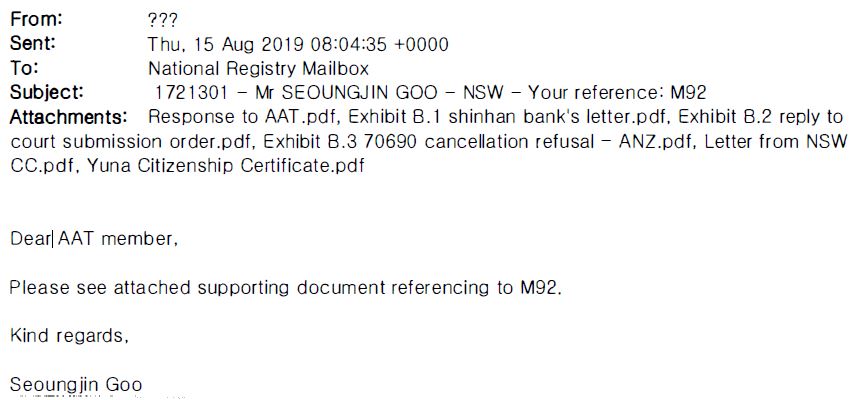
18 Attached to that email was a letter from Mr Goo to the Tribunal (Goo Letter) in which Mr Goo addressed a number of issues including relevantly:
I would like to first express my sincere gratitude for allowing me to further explain my circumstance regarding my appeal against the decision made by the Immigration Department.
…
Sun Sick Sim, Jun Won You and Jaykoo Kim, and who probably submitted the adverse information against me, are the main culprits behind the fall of Oakwood from its former glory. I would also like to mention that these people’s intent is malicious and fraudulent in nature.
Sun Sick Sim was appointed as a director to ToKorea, a sister company to Oakwood to act as the other end of the remittance business. He abandoned the project and embezzled project fund in 2015 and he is currently being sued for that in Australia.
Jun Won You was the manager to the city branch of Koreassongum (the trading name of Oakwood). He embezzled about $310,000 of customers’ money and I had to refund the lost amount out of my pocket because the customers were also my customers and they trusted me for the business. He was sued in a civil and criminal court in Korea and the court decision against him is attached as Exhibit A which is the Australian Supreme Court order of the Korean court. He is to pay back what he stole.
(Emphasis added.)
It was not in dispute that Exhibit A referred to in the Goo Letter was not attached.
19 On 20 August 2019 the Tribunal affirmed the decision under review in Oakwood’s application.
20 On 22 August 2019 the Tribunal wrote to Mr Goo and his family, via their authorised recipient, in relation to their application for review (Goo s 359A Letter). In that letter the Tribunal noted that it was required by the Migration Act to invite Mr Goo and his family to comment on, or respond to, information which it considered would, subject to their comments, be the reason, or part of the reason, for affirming the decision under review. It then provided the following particulars of the information:
• On 20 August 2019, the Tribunal affirmed the Department's decision not to approve the employer nomination of the position for which you were nominated by Oakwood Sydney Pty Ltd.
This information is relevant to the review because one of the requirements for the grant of the employer nomination visa is that the nomination of the position to which the application relates has been approved.
If the Tribunal relies on the information above, it may find that the relevant nomination in relation to you has not been approved. In the circumstances, you would not meet the requirements in cl. 186.223(2) of the Regulations and the decision under review would be affirmed.
Mr Goo and his family were given until 5 September 2019 to provide their response.
21 On 3 September 2019 Mr Goo sought an extension of time of up to one month to respond the Goo s 359A Letter because he and his family were attempting to retain a new migration agent. The Tribunal granted an extension to Mr Goo and his family to 18 September 2019 to provide their response.
22 On 26 September 2019 the Tribunal affirmed the decision under review in Mr Goo and his family’s application.
Relevant legislative framework
23 Sections 359AA and 359A are in Pt 5 of the Migration Act which concerns the review of “Part 5-reviewable decisions” by the Tribunal. Part 5-reviewable decisions relate to the grant or cancellation of visas in some circumstances but do not include, among others, protection visas, which are reviewable in accordance with Pt 7 of the Migration Act. Those sections relevantly provide:
359AA Information and invitation given orally by Tribunal while applicant appearing
(1) If an applicant is appearing before the Tribunal because of an invitation under section 360:
(a) the Tribunal may orally give to the applicant clear particulars of any information that the Tribunal considers would be the reason, or a part of the reason, for affirming the decision that is under review; and
(b) if the Tribunal does so—the Tribunal must:
(i) ensure, as far as is reasonably practicable, that the applicant understands why the information is relevant to the review, and the consequences of the information being relied on in affirming the decision that is under review; and
(ii) orally invite the applicant to comment on or respond to the information; and
(iii) advise the applicant that he or she may seek additional time to comment on or respond to the information; and
(iv) if the applicant seeks additional time to comment on or respond to the information—adjourn the review, if the Tribunal considers that the applicant reasonably needs additional time to comment on or respond to the information.
359A Information and invitation given in writing by Tribunal
(1) Subject to subsections (2) and (3), the Tribunal must:
(a) give to the applicant, in the way that the Tribunal considers appropriate in the circumstances, clear particulars of any information that the Tribunal considers would be the reason, or a part of the reason, for affirming the decision that is under review; and
(b) ensure, as far as is reasonably practicable, that the applicant understands why it is relevant to the review, and the consequences of it being relied on in affirming the decision that is under review; and
(c) invite the applicant to comment on or respond to it.
(2) The information and invitation must be given to the applicant:
(a) except where paragraph (b) applies—by one of the methods specified in section 379A; …
(3) The Tribunal is not obliged under this section to give particulars of information to an applicant, nor invite the applicant to comment on or respond to the information, if the Tribunal gives clear particulars of the information to the applicant, and invites the applicant to comment on or respond to the information, under section 359AA.
(4) This section does not apply to information:
(a) that is not specifically about the applicant or another person and is just about a class of persons of which the applicant or other person is a member; or
(b) that the applicant gave for the purpose of the application for review; or
(ba) that the applicant gave during the process that led to the decision that is under review, other than such information that was provided orally by the applicant to the Department; or
(c) that is non-disclosable information.
24 Regulation 5.19 of the Regulations concerns approval of nominated positions (employer nomination) and applied to Oakwood’s nomination of Mr Goo. At the relevant time it provided that:
(1) A person (a nominator) (including a partnership or unincorporated association) may apply to the Minister for approval of the nomination of a position in Australia.
…
(3) The Minister must, in writing, approve a nomination if:
(a) the application for approval:
(i) is made in accordance with subregulation (2); and
(ii) identifies a person who holds a Subclass 457 (Temporary Work (Skilled)) visa granted on the basis that the person satisfied the criterion in subclause 457.223(4) of Schedule 2; and
(iii) identifies an occupation, in relation to the position, that:
(A) is listed in ANZSCO; and
(B) has the same 4-digit occupation unit group code as the occupation carried out by the holder of the Subclass 457 (Temporary Work (Skilled)) visa; and
(b) the nominator:
(i) is, or was, the standard business sponsor who last identified the holder of the Subclass 457 (Temporary Work (Skilled)) visa in a nomination made under section 140GB of the Act or under regulation 1.20G or 1.20GA as in force immediately before 14 September 2009; and
(ii) is actively and lawfully operating a business in Australia; and
(iii) did not, as that standard business sponsor, meet regulation 1.20DA, or paragraph 2.59(h) or 2.68(i), in the most recent approval as a standard business sponsor; and
(c) either:
(i) both of the following apply:
(A) in the period of 3 years immediately before the nominator made the application, the holder of the Subclass 457 (Temporary Work (Skilled)) visa identified in subparagraph (a)(ii) has:
(I) held one or more Subclass 457 visas for a total period of at least 2 years; and
(II) been employed in the position in respect of which the person holds the Subclass 457 (Temporary Work (Skilled)) visa for a total period of at least 2 years (not including any period of unpaid leave);
(B) the employment in the position has been full-time, and undertaken in Australia; or
(ii) all of the following apply:
(A) the person holds the Subclass 457 (Temporary Work (Skilled)) visa on the basis that the person was identified in a nomination of an occupation mentioned in sub-subparagraph 2.72(10)(d)(iii)(B) or sub-subparagraph 2.72(10)(e)(iii)(B);
(B) the nominator nominated the occupation;
(C) the person has been employed, in the occupation in respect of which the person holds the Subclass 457 (Temporary Work (Skilled)) visa, for a total period of at least 2 years in the period of 3 years immediately before the nominator made the application; and
(d) for a person to whom subparagraph (c)(i) applies:
(i) the person will be employed on a full-time basis in the position for at least 2 years; and
(ii) the terms and conditions of the person’s employment will not include an express exclusion of the possibility of extending the period of employment; and
(e) the terms and conditions of employment applicable to the position will be no less favourable than the terms and conditions that:
(i) are provided; or
(ii) would be provided;
to an Australian citizen or an Australian permanent resident for performing equivalent work in the same workplace at the same location; and
(f) either:
(i) the nominator:
(A) fulfilled any commitments the nominator made relating to meeting the nominator’s training requirements during the period of the nominator’s most recent approval as a standard business sponsor; and
(B) complied with the applicable obligations under Division 2.19 relating to the nominator’s training requirements during the period of the nominator’s most recent approval as a standard business sponsor; or
(ii) it is reasonable to disregard subparagraph (i); and
Note: Different training requirements apply depending on whether the application for approval as a standard business sponsor was made before 14 September 2009 or on or after that day.
(g) either:
(i) there is no adverse information known to Immigration about the nominator or a person associated with the nominator; or
(ii) it is reasonable to disregard any adverse information known to Immigration about the nominator or a person associated with the nominator; and
(h) the nominator has a satisfactory record of compliance with the laws of the Commonwealth, and of each State or Territory in which the applicant operates a business and employs employees in the business, relating to workplace relations.
the tribunal’s decisions
The Oakwood application
25 The Tribunal identified the issue it was required to determine, namely whether the application met the requirements for approval of the nomination under the Temporary Residence Transition Nomination Stream set out in reg 5.19(3) of the Regulations. The Tribunal noted that for the nomination to be approved all requirements must be met.
26 The Tribunal noted that it had been informed at the hearing that Oakwood provides remittance services, primarily between Australia and Korea, and that the current organisation chart and employee list showed eight people including Mr Ahn, its managing director, and Mr Goo, who held the role of managing consultant. As set out above, both Mr Ahn and Mr Goo gave evidence at the hearing.
27 The Tribunal noted both that it had raised its concern as to whether Oakwood is “actively and lawfully operating” a business in Australia given that its registration as a remittance service provider had been cancelled by AUSTRAC in January 2016 and Mr Ahn’s explanation for the cancellation. The Tribunal also asked Mr Ahn whether he knew of a company called ToKorea. Mr Ahn confirmed that he did and described it as another business that carried out remittance payments which was registered with AUSTRAC. The Tribunal noted that it also raised concerns that in July 2016 AUSTRAC had cancelled the registration of ToKorea with “one of the reasons being listed as more likely than not, was ‘a party to a contravention of a civil penalty provision’ in that it assisted [Oakwood] in continuing to send funds to South Korea notwithstanding the cancellation, on 27 January 2016, of that entities (sic) registration on the remittance sector register”. The Tribunal recorded that it had indicated that it may consider this information to be adverse information known to Immigration about Oakwood, the nominator, or a person associated with it and would consider whether it was reasonable to disregard the information.
28 The Tribunal put a number of matters to Mr Ahn and invited him to comment on or respond to that information noting that he could seek additional time to do so. Relevantly at [13] of its decision record the Tribunal said:
… The information was regarding the cancellation of the registration of the nominator and the cancellation of the registration of [ToKorea]. Mr Ahn requested 15 minutes to allow him to speak to Mr Goo, who had been managing the business around the time of the registration cancellation, and the Tribunal agreed to adjourn the hearing for that period. Following the adjournment Mr Ahn advised that he had spoken to Mr Goo, but that he did not get a satisfactory response and requested that the Tribunal speak to Mr Goo directly. He said that Mr Goo had managed the business so he did not have any comment regarding the matter. Mr Goo had been listed as a witness for the nominator for the hearing. The Tribunal agreed to take evidence from Mr Goo.
29 At [14] of its decision record the Tribunal recorded the evidence given by Mr Goo at the hearing as follows:
Mr Goo confirmed that the remittance registration of the nominator had been cancelled and said it was because another person employed by the business had embezzled funds from clients. That person was Mr Jun Won Yoo who had managed the city office, while he had been in charge of the Strathfield office. Mr Goo told the Tribunal that the nominator was not operating, but had essentially been maintained for the purposes of nominating him for the Subclass 186 visa. He confirmed that he had been paid a salary by another business in 2017, which was in breach of condition 8107. He apologised. Mr Goo said that he had been assisting the NSW Crime Commission and Australian Federal Police with carrying out 1 transactions and had also been investigated in relation to a Korean drug dealer in 2012. He had assisted the NSW Government with drug and anti-money laundering investigations. Mr Goo referred to a meeting he had with an officer of AUSTRAC in January 2017 regarding punishing/penalising Mr Ahn to resolve the misunderstanding. He confirmed that the nominator was not currently registered with AUSTRAC and does not do any business. Mr Goo advised that he and Mr Ahn had kept the company “alive” because of his visa, but that the business itself does not do anything. Mr Ahn indicated that he had not known the details of these matters but had been trying to help Mr Goo.
30 The Tribunal referred to the Oakwood s 359A Letter which it sent following the hearing inviting Oakwood to comment on information it considered would be a reason for affirming the decision, including the information that it was no longer registered with AUSTRAC and Mr Goo’s oral evidence that Oakwood does not do any business. The Tribunal summarised the response received from Oakwood. In doing so it referred to the response from Oakwood’s solicitors as well as the Goo Letter. The latter is apparent from [21] of the Tribunal’s decision record where it said:
However, the Tribunal has obtained information which indicates that the nominator’s registration for remittance services was cancelled in January 2016 by AUSTRAC and it remains cancelled. In response to the Tribunal’s letter inviting comments on adverse information, it was submitted that the business now provides management consulting service to clients including ToKorea Pty Ltd and Hoju Jobs Pty Ltd. The Tribunal notes that when this information was put to the director, Mr Ahn, at the hearing he was unable to give a satisfactory response. He requested the Tribunal speak to Mr Goo, who confirmed that the nominator does not do any business but was kept “alive” for the purposes of his visa. Mr Goo subsequently provided a statement in which he claims there was an error made by the interpreter and that it has continued to operate.
(Emphasis added.)
31 The Tribunal observed (at [24] of its decision record) that, having considered the material, it had serious concerns that the Oakwood business is “lawfully operating”, that Oakwood appears to have continued to engage in remittance activities through other businesses, now referred to as its “clients”, and that it had proceeded to decide the matter on whether Oakwood meets reg 5.19(3)(g) and reg 5.19(3)(d) of the Regulations.
32 The Tribunal noted that on 12 June 2019 it wrote to Immigration about information from the AUSTRAC website that Oakwood’s registration had been cancelled on 27 January 2016 and that it considered that this was adverse information “known to Immigration” about Oakwood.
33 The Tribunal then referred to the cancellation of ToKorea’s registration by AUSTRAC as an independent remittance dealer on the Remittance Sector Register and to Oakwood’s submissions concerning the services it continues to provide to clients including ToKorea.
34 At [30]-[32] of its decision record the Tribunal set out its conclusions in relation to whether Oakwood had met reg 5.19(3)(g) and reg 5.19(3)(d) of the Regulations as follows (as written):
30. The Tribunal notes that AUSTRAC is the body that has been established by the Australian Government to ensure and protect the integrity of Australia’s financial system. According to the AUSTRAC website, it uses financial intelligence and regulation to disrupt money laundering, terrorism financing and other serious crime. It considers AUSTRAC’s decision to cancel the registration of the nominator and its concerns that the nominator was continuing to send funds to Korea after its cancellation through another entity to be adverse information within the meaning of r.1.13A. Mr Goo alleges in a written statement that he has been the victim of backstabbing from former associates. However, very limited evidence was provided of the circumstances and the outcomes of these allegations. The Tribunal notes that although Mr Goo submitted a police certificate check from Korea for his visa application, Mr Goo admitted that he is unable to obtain one from the Korean authorities and claims that this is because he assisted the NSW Crime Commission.
31. The Tribunal has considered whether it is reasonable to disregard this information, but having regard to the limited evidence before it, does not consider that it is reasonable to do so in this case. It thus finds that r.5.19(3)(g) is not met.
32. In relation to r.5.19(3)(d), the Tribunal notes that the financial statements provided show that the business has not been profitable for the past two financial years and has operated at a loss. The nominator’s registration as a remittance service business was cancelled in 2016 and the evidence of its claims that its current business is based on providing consulting services is made on the basis of assertions which are unsupported by evidence of written agreements/advice or transactions. The Tribunal has had regard to the claim that Mr Goo runs and manages the business of the nominator. The Tribunal has considered the material before it, and has formed the view that the business is only operating as a means for Mr Goo to obtain a permanent visa for himself and his family. The Tribunal has serious doubts that it will employ Mr. Goo on a full-time basis in the nominated position (Management Consultant) for at least 2 years as required by r.5.19(3)(d)(i). It thus finds that the Mr Goo will not be employed on a full-time basis in the position for at least 2 years.
The Goo family review application
35 The Tribunal described the history of the Goo family’s application for the visas including their application for review to the Tribunal and observed that Mr Goo had appeared before the Tribunal to give evidence and present arguments and that Mr Anh had given evidence on behalf of Oakwood. At [7] of its decision record the Tribunal said:
The Tribunal wrote to the applicants providing copies of non-disclosure certificates issued by a delegate of the Minister, inviting their comments or response to the validity of the certificates. The applicant responded with a detailed statement setting out various matters regarding his involvement with the NSW Crimes Commission and NSW Police, the possible responses of the Korean authorities to this involvement, betrayals from former business associates and his business activities in Australia. He did not specifically address the validity of the certificates, but for reasons explained below, the Tribunal has affirmed the decision on review without relying on the information covered by the certificates.
36 The Tribunal identified the issue on the review to be whether the position to which the visa application relates is the subject of an application for approval of a nomination in the Temporary Residence Transition Stream, noting that the approval needed to have identified the applicant for the position and the position must be one that was the subject of the declaration that was required to be made as part of the visa application. The Tribunal also noted that the criterion requires, among other things, that the nomination has been approved and has not been subsequently withdrawn.
37 The Tribunal noted that Mr Goo was identified in a nomination application made by Oakwood under reg 5.19(3) of the Regulations which was the position the subject of the declaration required to be made as part of the visa application, that the nomination application was refused by the Department on 8 June 2017 and that the Tribunal affirmed that decision on 20 August 2019. The Tribunal also noted that it wrote to Mr Goo and his family about this information and, upon Mr Goo’s request, permitted an extension of time for a response. However no response was received within the time as extended. Accordingly, the Tribunal proceeded to a decision.
38 The Tribunal found that, as the nomination had not been approved, cl 186.223(2) of the Regulations was not satisfied and thus cl 186.223 was not met. Accordingly the Tribunal affirmed the decision not to grant Mr Goo and his family employer nomination (permanent) visas.
federal circuit court proceedings
39 Oakwood and Mr Goo and his family each applied for judicial review of the Tribunal’s decisions as they relevantly related to them. Those proceedings were heard together by the primary judge and proceeded on the basis identified at [3] above.
40 Before the primary judge Oakwood relied on an affidavit affirmed by Mr Goo in which he deposed that:
1. On 15 August 2019, I sent an email to the Tribunal and intended to attach “Exhibit A” to my email however, I mistakenly did not attach “Exhibit A”. Please refer to page 119 of Court book in SYG2579/2019.
2. Attached hereto and marked with the letter ‘A’ is “Exhibit A” which I referred to in my letter to the Tribunal dated 15 August 2019. Please refer to page 121 of Court book in SYG2579/2019 and page 1021 in Volume 2 of Court book in SYG2394/2019.
3. “Exhibit A” which I had intended to attach to my email dated 15 August 2019 has been annexed to the Affidavit of Sai Priya Sivalohan affirmed on 19 August 2020.
4. If the Tribunal had notified me that “Exhibit A” had not been attached to my email on 15 August 2020, I would have provided “Exhibit A” to the Tribunal.
5. The email I sent to the Tribunal on 15 August 2019 was a response to the Tribunal Invitation to comment or respond to information for Oakwood Sydney dated 24 July 2019. Please refer to page 1008 of Court book in SYG2394/2019.
41 Exhibit A which was annexed to that affidavit is a “JUDGMENT/ORDER” entered in proceeding 2018/00315776 in the Common Law Division of the Supreme Court of New South Wales between Oakwood as plaintiff and Jun Won You as defendant on 11 January 2019 for a sum of KRW314,188,998.
42 In its amended application relied on before the Circuit Court Oakwood raised three grounds, only two of which are relevant to its appeal. Those grounds are:
2. In relation to its assessment of r 5.19(g) of the [Regulations], the Tribunal failed to give proper, genuine and realistic consideration to the Applicant’s claims and/or acted in a legally unreasonable way and therefore committed jurisdictional error.
Particulars
a) Mr. Goo, the nominee of [Oakwood] explained that the remittance registration had been cancelled by AUSTRAC as an employee of the business had embezzled funds from clients.
b) The Tribunal failed properly to consider and assess this claim as the reason for the remittance registration cancellation.
3. In relation to its assessment of r 5.19(d)(i) of the [Regulations], the Tribunal failed to give proper, genuine and realistic consideration to [Oakwood’s] claims and/or acted in a legally unreasonable way and therefore its decision was affected by jurisdictional error.
Particulars
a) [Oakwood] explained that [Oakwood] was operating a financial management consulting business and that Mr Goo, the nominee of [Oakwood], would be employed on a full-time basis for at least 2 years.
b) The Tribunal failed properly to consider and assess this explanation in determining that [Oakwood] is only operating as a means for Mr Goo and his family to obtain a visa.
43 In relation to ground 2 the primary judge first set out the submissions made on behalf of Oakwood, namely that there was a jurisdictional error because of the omission by Oakwood and its agent in providing Exhibit A with Mr Goo’s Letter, that there was jurisdictional error because the Tribunal acted legally unreasonably in failing to obtain Exhibit A and that it also amounted to a duty to inquire by the Tribunal because of the apparent absence of Exhibit A, being a document which the Tribunal could easily have sought to obtain.
44 The primary judge found that the Tribunal was under no duty to obtain further information from Oakwood unless there was an obvious inquiry about a critical fact that was easily ascertainable, which Exhibit A was not. His Honour found that it was Oakwood or its agent that had failed to provide Exhibit A. The primary judge did not accept that it was legally unreasonable for the Tribunal not to request Exhibit A in circumstances where Oakwood had been given an opportunity, through its migration agent, to provide further information and, accordingly, held that the omission did not give rise to any jurisdictional error on the part of the Tribunal.
45 The primary judge found that Exhibit A could not be said to be material to the Tribunal’s decision, noting that it was nothing more than a judgment of a state court, did not provide the circumstances and outcomes in relation to the alleged betrayal and provided limited information in relation to the entry of a judgment. The primary judge was satisfied that Exhibit A could not possibly have given rise to a different outcome in the application for review. The primary judge also accepted the submission advanced on behalf of the Minister that there is an independent basis for the adverse findings in any event, being a failure to meet the requirements of reg 5.19(3)(d) of the Regulations, by reason of which no jurisdictional error arises in respect of the alleged significance of the absence of steps to obtain Exhibit A: see Oakwood; Goo at [44]-[47].
46 In relation to ground 3 the primary judge found that Oakwood’s submission that the fact that the business was running at a loss was not of itself a basis why the Tribunal should have concluded that an adverse finding should be made under reg 5.19(d)(i) and was nothing more than an invitation to engage in merits review. His Honour found that the Tribunal provided logical and rational reasons in support of the adverse finding under that criteria and that no jurisdictional error as alleged was made out.
the appeals
47 As noted above there are two appeals before the Court. However, given their interdependency, it is only necessary to have regard to the single ground of appeal raised by Oakwood which is in the following terms:
The primary judge erred in finding that the [Tribunal], in its decision of 20 August 2019, had not committed a jurisdictional error in failing to request from [Oakwood] a copy of “exhibit A” referred to in the letter sent by [Mr Goo] to the Tribunal on 15 August 2019.
Particulars
The primary judge erred by:
(a) Failing to find that the Tribunal’s failure to request Exhibit A was legally unreasonable; and/or
(b) Failing to find that the Tribunal had failed to give the [Oakwood] a real and meaningful invitation to comment and/or respond under s 359A of the Migration Act 1958 (Cth).
(c) Failing to find that the Tribunal failed to take reasonably open and regular administrative procedural steps to permit or facilitate fulfilment of the real and meaningful nature of the invitation; and/or
(d) Failing to find that the Tribunal’s failure to request Exhibit A meant that it had failed to give proper, genuine and/or realistic consideration to the [Oakwood’s] explanation for the cancellation of its registration with AUSTRAC; and/or
(e) Failing to find that [Oakwood] and/or Mr Goo had made an obvious mistake in the provision of Exhibit A about a critical fact the existence of which is easily ascertained; and/or
(f) Failing to find that Exhibit A was material to the Tribunal’s decision; and/or
(g) Failing to find that the Tribunal’s errors were, alternatively error was, material its decision in relation to both r. 5.19(3)(d) and 5.19(3)(g) of the Migration Regulations 1994 (Cth).
A new ground raised on appeal
48 The Minister contends that particulars (b) and (c) are new and were not raised as a ground before the primary judge such that Oakwood requires leave to rely on those particulars. While the Minister also initially opposed the raising of particular (e) on the same basis, she withdrew her opposition to that particular at the hearing.
49 There is no dispute about the principles which govern when a court will grant leave to rely on a new ground on appeal. They were summarised by a Full Court of this Court in BXT17 v Minister for Home Affairs [2021] FCAFC 9 at [22]-[24] as follows:
22 In VUAX v Minister for Immigration and Multicultural and Indigenous Affairs (2004) 238 FCR 588 (VUAX) at [46] a Full Court of this Court (Kiefel, Weinberg and Stone JJ) said that leave to argue a ground of appeal not raised before the primary judge should only be granted “if it is expedient in the interests of justice to do so”. Their Honours observed (at [48]) that the Court may grant leave if a point that was not taken below, but which clearly has merit, is advanced and there is no real prejudice to the respondent in permitting it to be agitated.
23 However, as has also been observed, it is generally undesirable to grant leave to raise new grounds on appeal because it makes this Court a de facto court of first instance and renders the proceeding before the primary judge “little more than a preliminary skirmish”: see VUAX at [47] quoting Coulton v Holcombe (1986) 162 CLR 1 at 7. As Wigney J observed in SZWCO v Minister for Immigration and Border Protection [2016] FCA 51 at [31], to permit new grounds to be raised for the first time on appeal, in effect, defeats the statutory scheme in relation to judicial review of decisions of, in this case, the Authority. Parliament has conferred jurisdiction in respect of review applications on the Federal Circuit Court: see s 476A of the Act. Where new grounds are allowed to be advanced on appeal, that jurisdiction is then exercised by this Court.
24 At [48] of VUAX the Full Court noted that an explanation for the failure to raise the ground below is also required. In that regard, the question of whether the appellant was represented below is relevant: see Sun v Minister for Immigration and Border Protection (2016) 243 FCR 220 at [92].
50 Particulars (b) and (c) are based on the decision in SZJBA v Minister for Immigration and Citizenship (2007) 164 FCR 14. The Minister contended that grounds in the nature of those particulars had not been raised before the primary judge and objected to them being raised for the first time on appeal. Oakwood submitted that, while grounds in the nature of particulars (b) and (c) were not raised before the primary judge, submissions were made in reliance on SZJBA. It further submitted that there is no prejudice to the Minister in raising these matters on appeal, the ground as constituted by those particulars is clearly arguable and it is in the interests of justice that all issues that arise be determined.
51 While it is not clear from the primary judge’s reasons whether the Court was taken to SZJBA I accept the submission of counsel appearing for Oakwood, who also appeared before the primary judge, that submissions were made in reliance on that decision, albeit that, insofar as particular (b) is concerned, no ground was framed by reference to s 359A of the Migration Act. The Minister has made submissions in response to the ground of appeal as framed including particulars (b) and (c) and does not point to any prejudice.
52 In the circumstances of this case I am satisfied that it is in the interests of justice to permit Oakwood to raise the issues articulated by way of particulars (b) and (c) on appeal and, to the extent that the issues were not raised before the primary judge and leave is required, I would grant leave to it to raise them for the first time on appeal.
Consideration
53 In summary Oakwood contends that Mr Goo, acting on its behalf, made a clear and obvious error in failing to provide Exhibit A to the Tribunal in response to its request for information and that the Tribunal should have, but did not, request Exhibit A from Oakwood and Mr Goo. According to Oakwood, Exhibit A was an important piece of information substantiating Mr Goo’s allegations about the misconduct of Oakwood’s former employees which led to the cancellation of its registration with AUSTRAC, from Oakwood and Mr Goo.
54 In effect, and in light of the particulars to its ground of appeal, Oakwood raises three bases upon which it says that the primary judge erred. I will deal with each of them in turn.
Particulars (b) and (c) – request for information under s 359A Migration Act
55 By these particulars Oakwood contends that the primary judge erred in failing to find that, in turn, the Tribunal failed to give Oakwood a real and meaningful opportunity to comment or respond under s 359A of the Migration Act or that it failed to take administrative steps that were reasonably open to it to permit or facilitate fulfilment of the real and meaningful nature of the invitation to comment.
56 As noted above Oakwood relies on the decision in SZJBA. It submitted that in this case there was, as was found to be the case in SZJBA, a failure by the Tribunal to take the simple administrative step of telling Oakwood and Mr Goo that it had not received Exhibit A and requesting a copy of it. It also submitted that the Tribunal was obliged to, or must have, read the Goo Letter, that the Goo Letter explicitly referred to Exhibit A and that if the Tribunal had read it properly it must have noticed the mistake in not providing Exhibit A.
57 Oakwood contended that it was clear from the Goo Letter that Exhibit A was intended to be enclosed but that it had been omitted by mistake. It said that the failure by the Tribunal to take the simplest administrative steps to follow this up was to deny or destroy the genuineness and reality of the invitation to comment under s 359A of the Migration Act. It submitted that the Tribunal therefore committed jurisdictional error.
58 Before considering these submission it is convenient to set out the background facts and the principles which emerge from the decision in SZJBA. In that case, the appellant appeared at a hearing before the tribunal on 17 January 2007. On the following day the tribunal sent a letter, evidently issued under s 424A of the Migration Act, to the appellant’s migration agent, Beatriz Stotz of Playfair Visa & Migration Services, as his authorised recipient. Section 424A, which is in Pt 7 of the Migration Act, is in equivalent terms to s 359A of the Migration Act.
59 Thereafter, as recorded by the tribunal in its reasons, the following occurred: on 25 January 2007 the tribunal received a facsimile from the appellant’s advisor requesting an extension of time until 30 January 2007 to provide comments in response to the letter issued pursuant to s 424A of the Migration Act; on 29 January 2007 the Tribunal informed the appellant’s advisor that it had not granted an extension of time but that it would not take any steps to finalise the case until 31 January 2007 and would consider any materials submitted on or before that date; on 30 January 2007, at the tribunal’s request, the appellant faxed a copy of his passport to the tribunal; and at the time of writing the decision no submissions or materials had been received from the appellant or his advisor: see SZJBA at [9].
60 The tribunal proceeded to dispose of the application before it and, in doing so, disbelieved the appellant. The perceived failure on the part of the appellant to respond to the s 424A letter played a part in the tribunal coming to the view that it did: see SZJBA at [10].
61 The appellant sought review in the Federal Magistrate’s Court of Australia (as the Circuit Court was then known) raising two grounds of review including relevantly that the tribunal “failed to attain, or failed to exercise, jurisdiction, by reason that it failed to accord procedural fairness to [him] in not considering [his] five page written submission forwarded to the [tribunal] on 25 January 2007 by [his] Migration Agency, and being in answer to the [tribunal’s] letter of 18 January 2007”. In the particulars the appellant referred, by way of reference to page numbers in the court book, to a three page letter sent on 18 January 2007 by the tribunal to Ms Stotz and a facsimile from Ms Stotz to a tribunal case officer: see SZJBA at [11]-[12].
62 The appellant was not legally represented before the Federal Magistrate’s Court. However, he relied on an affidavit sworn by Ms Stotz in which she provided evidence of the steps she took to prepare the appellant’s response to the s 424A letter and its despatch to the tribunal. It is not necessary to set out the detail of that evidence. Relevantly, there was a factual contest as to whether, as the appellant asserted, the coversheet and five pages sent by Ms Stotz’s firm had been received by the tribunal or whether, as the Minister asserted, the tribunal had only received the cover page. The appellant contended that even if the Minister’s version of the facts was correct the tribunal should have taken steps to find out about the five pages, given what was written on the coversheet. The Minister contended that there was no duty to inquire. The Federal Magistrate agreed with the Minister’s contention, a conclusion which was challenged on appeal in this Court.
63 At [45] Allsop J (as his Honour then was) identified the question for resolution on appeal to be whether the tribunal erred in failing to call the number provided on the facsimile coversheet to enquire as to the whereabouts of the apparently intended five page response. In considering that question his Honour accepted (at [46]) that the tribunal is under no general duty to inquire when conducting a review. However, his Honour found that the tribunal had nevertheless committed jurisdictional error in failing to contact the appellant to obtain the five page document. At [48]-[50] his Honour said:
[48] The step that is said to have been required to have been taken here was to communicate with the representatives of the appellant, informing them of an apparently unsuccessful attempt to respond to a letter sent under s 424A. One can describe that as exercising a power. Any step in the administrative process is in one sense the exercise of power. It is more easily and aptly described as the taking of an administrative step within the context of the review process provided for by Pt 7 of the Migration Act. Not to take that step or not to exercise that power was, in practical terms, to deny the appellant the invitation that he had apparently taken-up to respond to the letter of 18 January. Given that it was apparent that the response had not been received, through human or machine error, a failure to exercise the power or take the step had the consequence of ensuring that the response, which s 424A, or the actions of the tribunal, contemplated was not received.
[49] The Migration Act, s 424, provides for the Tribunal “getting” information that it considers relevant. Section 424(1) says that if the Tribunal gets such information, it must have regard to it. Section 424A contains the well-known obligation to send a letter giving the applicant particulars of relevant information and inviting the applicant to comment. Section 424B requires the invitation to specify how the comments may be given. Section 424C(2) empowers the Tribunal to make a decision if the comments are not given within time “without taking any further action to obtain the applicant’s views on the information”. It is implicit in Div 4 of Pt 7 that the Tribunal must read and have regard to any response to an invitation to comment sent pursuant to s 424A. No express provision states as much, but Parliament did not need to. It would undoubtedly be wrong of the Tribunal to say that it may well have received the envelope containing the response, but it was not obliged to open it and read the contents, because it had no obligation to inquire. Such an obligation (together with one to have regard to the contents) inheres within Pt 7 and the undertaking of the review process. The Tribunal is conducting a review by reference to the material before it. Here, the material before it was a document which, on its face, clearly stated that a response was provided, but evidently, through some oversight or error, human or machine, it had not been transmitted.
[50] The giving of the invitation to comment (whether strictly required under s 424A or not) carries with it an obligation to deal with a communication in response to the invitation in a reasonably business-like way. Parliament does not have legislate for such matters. If it could be seen (as it could be from a plain reading of the coversheet) that a response was intended to be enclosed, but for some reason it was not, and the identity and the phone number of the sender was clear (as it was), not to take the simplest administrative steps to follow up the information was to deny or destroy, after the event, the genuineness and reality of the invitation to comment that had been given.
64 At [53] Allsop J emphasised that “the obligation of the Tribunal to give a real and meaningful invitation to comment carried with it the obligation to take reasonably open and regular administrative procedural steps to permit or facilitate fulfilment of the real and meaningful nature of the invitation, where not to take such steps would undermine or subvert the meaningfulness of the reality of the invitation”. His Honour observed that the obligation involved “such mundane things” as opening letters, reading them and taking at least basic simple steps that might be taken in any well run professional or government office conformable with the recognition of the importance of the response to the invitation to the rights of the applicant and the review process contained within, in that case, Pt 7 of the Migration Act and did not rest on a posited duty of enquiry: see too SZJBA at [59].
65 Another decision relied on by Oakwood is Minister for Immigration and Border Protection v Truong [2016] FCAFC 54. In that case, one of the grounds of appeal concerned the question of whether the tribunal had committed jurisdictional error by its failure to consider three missing pages of a document. Relevantly, the Circuit Court accepted evidence given by Ms Truong’s solicitor that she had provided the tribunal with a seven page document and a bundle of other documents and Ms Truong’s evidence that, as she did not have a copy of the seven page document, she requested that the tribunal copy it and return the original to her, which occurred. However, unknown to Ms Truong or her solicitor, the tribunal had only copied the first four pages of the seven page document and the review proceeded on that basis. The error only became apparent to Ms Truong after the tribunal published its decision. The missing pages assumed importance because Ms Truong wished to rely on information which appeared on page 5, which was one of the missing pages.
66 The Minister contended that there was no jurisdictional error because there was “virtually identical” information elsewhere in the material before the tribunal found in a witness statement. A Full Court of this Court (Mansfield, Tracey and Flick JJ) found that the information otherwise before the tribunal contained potentially significant differences and the similarities between the material were not such that the tribunal “inevitably would have reached the same conclusion if it had the missing pages and compared them with the information in the Witness Statement”: at [34].
67 The facts of this case are quite different to and can be distinguished from those before the Court in SZJBA and Truong. The chronology is set out above (see [4]-[22]). Relevantly:
(1) on 24 June 2019 the Tribunal sent the Oakwood s 359A Letter to Oakwood;
(2) on 6 August Oakwood, through HIS Lawyers, sought an extension of time to respond to the Oakwood s 359A Letter;
(3) on 7 August the Tribunal refused to grant any extension of time and informed HIS Lawyers, as Oakwood’s authorised representative, that any response was to be provided by 7 August 2019;
(4) accordingly, later on 7 August 2019 HIS Lawyers provided a response to the Oakwood s 359A Letter. That response made no reference to the Goo Letter, for example by referring to it as additional material on which it intended to rely once provided;
(5) on 1 August 2019 Mr Goo sought a two week extension to respond to what he described as the “adverse information that was submitted against [his] application” at the hearing on 23 July 2019;
(6) on 6 August the Tribunal informed Mr Goo, through his authorised representative, HIS Lawyers, that it had granted a two week extension to him and his family to respond; and
(7) on 15 August 2019 the Goo Letter was provided to the Tribunal without Exhibit A. Despite Mr Goo’s evidence before the primary judge, that letter in its terms did not purport to respond to the Oakwood s 359A Letter.
68 In contrast to the position in SZJBA, the missing document in this case was not the response to the Oakwood s 359A Letter. Oakwood’s response was before the Tribunal and was referred to by the Tribunal in its reasons. As the Minister submits, whether or not a response to an invitation to comment made pursuant to s 359A of the Migration Act (or, as was the case in SZJBA, pursuant to s 424A) is received is a key matter in determining a review. Unlike in SZJBA there is no suggestion that the Tribunal did not receive the response to the Oakwood s 359A Letter or any part of it. At [50] of SZJBA Allsop J pointed out that “the giving of the invitation to comment … carries with it an obligation to deal with a communication in response to the invitation in a reasonably business-like way”. That is exactly what occurred here; the Tribunal issued the Oakwood s 359A Letter and, having received a response, clearly read and considered it.
69 The missing document is Exhibit A which is referred to once in the Goo Letter as the “Australian Supreme Court order of the Korean court”. Exhibit A was intended to be included in the Goo Letter but was not. Oakwood does not contend that Exhibit A was sent to, but somehow overlooked or misplaced by, the Tribunal, as was the case in SZJBA. It contends that the Tribunal had a duty to inquire as to the whereabouts of Exhibit A. I do not accept that is so. The Goo Letter was not provided by Oakwood in response to the Oakwood s 359A Letter. Rather, I would infer that it was provided by Mr Goo in response to adverse information or issues raised by the Tribunal in relation to his and his family’s application for their visas, possibly in response to an invitation given under s 359AA of the Migration Act, although whether that is so is not clear. To the extent that it was before the Tribunal in relation to Oakwood’s application for review, which was heard at the same time as the Goo family’s application, it was additional material. It was not provided in response to the Oakwood s 359A Letter.
70 In those circumstances, the Tribunal did not fail to give Oakwood a real and meaningful opportunity to comment or respond under s 359A of the Migration Act. Nor did the Tribunal fail to take reasonable administrative steps to facilitate fulfilment of the real and meaningful nature of the invitation it gave pursuant to s 359A of the Migration Act.
Particular (e) – obvious inquiry about a critical matter
71 By this particular Oakwood contends that the primary judge erred in finding that the Tribunal had not committed a jurisdictional error in failing to request a copy of Exhibit A from Oakwood in that the primary judge failed to find that Oakwood and/or Mr Goo had made an obvious mistake in the provision of Exhibit A about a critical fact the existence of which is easily ascertained.
72 Oakwood accepts that the obiter statement of principle at [25] of Minister for Immigration v SZIAI [2009] HCA 39; (2009) 259 ALR 429 (see [75] below) is not to be applied as if it were a statute but submits that, nevertheless, in this case there was an obvious inquiry about a critical fact the existence of which could have been easily ascertained by the Tribunal in that: a clear mistake was made when Mr Goo failed to attach Exhibit A to his email dated 15 August 2019, a mistake which should have been apparent when the Tribunal reviewed the email; there was an obvious inquiry the Tribunal could have made, namely to ask Mr Goo to provide Exhibit A, which would have been an easy step to take and would have resulted in the provision of Exhibit A; and that was an important inquiry because Exhibit A formed part of the evidential basis supporting Mr Goo’s allegation that the deregistration of Oakwood by AUSTRAC had occurred because of the actions of rogue employees beyond Oakwood’s control.
73 The Minister submits that Oakwood does not identify with any specificity the “critical fact” that Exhibit A is said to be able to establish. The Minister says that even if the failure to attach Exhibit A had been apparent to the Tribunal, the remarks of the High Court in SZIAI at [26] would apply equally in this case. The Minister submits that, as the primary judge pointed out in Oakwood; Goo at [45]-[46], the “Appellants” had been given an opportunity to provide further information which they availed themselves of and the missing document itself “does not provide the circumstances and outcomes in relation to the alleged betrayals [and] provides limited information in respect of the entry of a judgment and cannot on its face be said to be material”.
74 SZIAI concerned an appeal from a decision of this Court which had, on appeal from the Federal Magistrates Court, quashed a decision of the Refugee Review Tribunal (RRT) on the basis that it had committed jurisdictional error by failing unreasonably to undertake its own inquiries into certain matters, namely certificates provided by SZIAI to the RRT, the authenticity of which had been impugned by a third party. The information provided by the third party was, in turn, provided to SZIAI for comment. The High Court allowed the appeal.
75 Two questions were raised on the appeal, the first of which was whether the RRT had committed jurisdictional error by not making its own inquiries in relation to the allegation that the certificates provided by SZIAI were forgeries: see SZIAI at [12]. In considering that ground at [25] the plurality (French CJ, Gummow, Hayne, Crennan, Kiefel and Bell JJ) said:
Although decisions in the Federal Court concerned with a failure to make obvious inquiries have led to references to a “duty to inquire”, that term is apt to direct consideration away from the question whether the decision which is under review is vitiated by jurisdictional error. The duty imposed upon the tribunal by the Migration Act is a duty to review. It may be that a failure to make an obvious inquiry about a critical fact, the existence of which is easily ascertained, could, in some circumstances, supply a sufficient link to the outcome to constitute a failure to review. If so, such a failure could give rise to jurisdictional error by constructive failure to exercise jurisdiction. It may be that failure to make such an inquiry results in a decision being affected in some other way that manifests itself as jurisdictional error. It is not necessary to explore these questions of principle in this case. There are two reasons for that.
(Footnote omitted.)
76 The two reasons referred to by the plurality were explained at [26] as follows:
The first reason is that there was nothing on the record to indicate that any further inquiry by the tribunal, directed to the authenticity of the certificates, could have yielded a useful result. There was nothing before the Federal Magistrates Court or the Federal Court to indicate what information might be elicited if the tribunal were to undertake the inquiry which was said to be critical to the validity of its decision. The inquiry suggested was telephone contact with the persons whose mobile telephone numbers were shown on the certificates. But the question whether the certificates contained false statements as to authorship or otherwise would not be able to be determined by calls placed to those telephone numbers. If the respondents to the calls admitted to the tribunal or its officers that the certificates contained false statements, then the grounds for a decision adverse to SZIAI would have been strengthened. If the respondents said that the contents were true, it would have added nothing to the statements effectively conveyed by the certificates themselves. The second reason is that the response made by SZIAI’s solicitors to the tribunal’s letter of 14 January 2008 itself indicated the futility of further inquiry. There was nothing that SZIAI or his solicitors were able to add, beyond a bare denial of what appeared in the National Ameer’s letter. For these reasons there is no factual basis for the conclusion that the failure to inquire constituted a failure to undertake the statutory duty of review or that it was otherwise so unreasonable as to support a finding that the tribunal’s decision was infected by jurisdictional error.
77 It was not in dispute that there is no duty on the part of a tribunal to inquire. However, Oakwood contends that the facts of this case fall within the narrow exception identified in SZIAI. That is, there was a failure on the part of the Tribunal to make an obvious inquiry about a critical fact, the existence of which was easily ascertained. Although finely balanced, in the circumstances of this case I accept that is so. Exhibit A was referred to by Mr Goo as part of his explanation as to why Oakwood could no longer operate as a remittance dealer and in support of his assertion that proceedings had been brought in Korea against Mr You, the former manager of Oakwood’s city branch. As explained by counsel appearing for Oakwood, the critical facts which could have been established were first, whether Oakwood had in fact brought a claim against Mr You; and secondly, whether Oakwood had in fact provided all of the evidence on which it intended to rely in relation to the assertion that it was the conduct of Oakwood’s former associates which had been the cause of AUSTRAC cancelling its registration.
78 As to the first matter, in the Goo Letter Mr Goo referred to suing Mr You in the civil and criminal court in Korea and said that the “court decision against” Mr You was attached as Exhibit A. An inquiry by the Tribunal to obtain a copy of the omitted Exhibit A would have produced the Supreme Court judgment supporting that statement. As to the second matter, at [30] of the its decision record the Tribunal says that “very limited evidence” was provided about the allegations in the Goo Letter in relation to Mr Goo’s former associates. However, a piece of the evidence referred to in the Goo Letter had been omitted in error such that all of Oakwood’s intended evidence was not before the Tribunal. Again, the Tribunal could have inquired as to the whereabouts of Exhibit A.
Particulars (a) and (d) – legal unreasonableness
79 Oakwood also contends that the primary judge erred in finding that the Tribunal had not committed a jurisdictional error in failing to request a copy of Exhibit A from it in that his Honour failed to find that the Tribunal’s failure to request Exhibit A was legally unreasonable and that the failure to do so meant that the Tribunal did not give proper, genuine and/or realistic consideration to Oakwood’s explanation for the cancellation of its registration with AUSTRAC.
80 Given the conclusion I have reached in relation to the characterisation of the error in particular (e) and whether that error is material (see below) it is not necessary to consider this aspect of Oakwood’s ground of appeal. That is because it again concerns Exhibit A and the effect of it not being before the Tribunal and thus arises from the same factual matrix and focusses on the same part of the Tribunal’s decision.
Particulars (f) and (g) - materiality
81 The next question that arises is whether the Tribunal’s failure to make the inquiry about the whereabouts of Exhibit A as found at [77]-[78] above was material to its decision that Oakwood did not meet the requirements of reg 5.19(3) of the Regulations and thus to affirm the decision under review. Oakwood contends that it was material and alleges that the primary judge erred in failing to find that was so and/or failing to find that the Tribunal’s error was material to its decision in relation to both reg 5.19(3)(d) and reg 5.19(3)(g) of the Regulations.
82 Oakwood submits that Exhibit A was a critical piece of evidence and, had it been provided to the Tribunal, there is at least a realistic possibility that it would have affected the Tribunal’s reasoning and decision. Oakwood contends that the Tribunal took into account, as a factor in disbelieving Mr Goo, the opinion that he had provided insufficient evidence supporting his contention that the cancellation of Oakwood’s registration with AUSTRAC had been the result of the conduct of its employees including Mr You. It says that the existence of additional evidence in the form of Exhibit A was material to that consideration.
83 Oakwood notes that the primary judge also found (at [47] of Oakwood; Goo) that there was an independent basis for dismissal of the application by reason of Oakwood’s failure to satisfy reg 5.19(3)(d) of the Regulations. Oakwood submits that it is evident from the Tribunal’s reasoning at [32] of its decision record that it disbelieved Mr Goo’s assertions in relation to the activities that were being conducted by Oakwood following the cancellation of its registration with AUSTRAC. It contends that no real reasoning was set out for rejecting that evidence and that it is likely that the Tribunal’s thinking was affected by the fact that it had also rejected other parts of Mr Goo’s evidence. Oakwood submits that there is a very real possibility that the Tribunal would have taken a different approach if it had believed Mr Goo’s evidence in relation to the reasons why Oakwood’s registration with AUSTRAC had been cancelled and, as demonstrated by Exhibit A, the steps that Oakwood had taken to claim against Mr You as a result. Oakwood submits that in those circumstances the error was material to the Tribunal’s findings under reg 5.19(3)(d) and reg 5.19(3)(g).
84 The Minister submits that even if the Tribunal could be said to have committed some error by not seeking out Exhibit A, which she does not accept to be the case, any such error is not jurisdictional in nature because any such error could not realistically have led to a different outcome and thus would not be material in the sense identified by the majority in SZMTA. The Minister notes, leaving aside the matters identified by the primary judge as to the insufficiency of information in Exhibit A in relation to the contentions of Mr Goo as to the conduct of his colleagues, that there was an independent reason for the decision to refuse the nomination and thus reject the visa.
85 The Minister observes that the matters identified in relation to Exhibit A go to reg 5.19(3)(g) of the Regulations, the adverse information provision, but that the Tribunal also found that reg 5.19(3)(d) was not satisfied. The Minister submits, as the primary judge found to be the case, that Oakwood’s challenge to the decision in relation to reg 5.19(3)(d) amounts to seeking merits review and it is not clear how it contends that the reasons given in relation to the issues the subject of reg 5.19(3)(d) are affected by the Tribunal’s failure to have Exhibit A before it.
86 In MZAPC v Minister for Immigration and Border Protection [2021] HCA 17 a majority of the High Court (Kiefel CJ, Gageler, Keane and Gleeson JJ) confirmed that the test for materiality was as set out in Minister for Immigration and Border Protection v SZMTA (2019) 264 CLR 421. At [2]-[3] their Honours said:
2 Materiality was subsequently explained in Minister for Immigration and Border Protection v SZMTA to involve a realistic possibility that the decision in fact made could have been different had the breach of the condition not occurred. Existence or non-existence of a realistic possibility that the decision could have been different was explained to be a question of fact in respect of which the plaintiff in an application for judicial review of the decision on the ground of jurisdictional error bears the onus of proof.
3 The explanation in SZMTA is sound in principle and consistent with precedent. SZMTA ought not to be revisited.
(Footnote omitted.)
87 In addressing the content and proof of materiality at [35] and [37]-[39] of MZAPC their Honours said:
35 Occasion both to examine the content of materiality and to consider the onus of its proof in an application for judicial review of an administrative decision arose in SZMTA. There the majority constituted by Bell, Gageler and Keane JJ held that "[a] breach is material to a decision only if compliance could realistically have resulted in a different decision" and that "the question of the materiality of the breach is an ordinary question of fact in respect of which the applicant [for judicial review] bears the onus of proof".
…
37 Subsequently, in CNY17 v Minister for Immigration and Border Protection, Kiefel CJ and Gageler J referred to the determination of materiality by a court as involving "a question of counter-factual analysis to be determined by the court as a matter of objective possibility as an aspect of determining whether an identified failure to comply with a statutory condition has resulted in a decision that has in fact been made being a decision that is wanting in statutory authorisation". The same point was made in different language by the Full Court of the Federal Court in BDY18 v Minister for Immigration and Border Protection, where it said that "[m]ateriality is concerned with the significance of the failure to conform to the statutory task entrusted to the decision-maker" and that "[t]he inquiry is backward looking and concerns what the decision-maker did in the particular case".
38 The counterfactual question of whether the decision that was in fact made could have been different had there been compliance with the condition that was in fact breached cannot be answered without determining the basal factual question of how the decision that was in fact made was in fact made. Like other historical facts to be determined in other civil proceedings, the facts as to what occurred in the making of the decision must be determined in an application for judicial review on the balance of probabilities by inferences drawn from the totality of the evidence. And like other counterfactual questions in civil proceedings as to what could have occurred — as distinct from what would have occurred — had there been compliance with a legal obligation that was in fact breached, whether the decision that was in fact made could have been different had the condition been complied with falls to be determined as a matter of reasonable conjecture within the parameters set by the historical facts that have been determined on the balance of probabilities.
39 Bearing the overall onus of proving jurisdictional error, the plaintiff in an application for judicial review must bear the onus of proving on the balance of probabilities all the historical facts necessary to sustain the requisite reasonable conjecture. The burden of the plaintiff is not to prove on the balance of probabilities that a different decision would have been made had there been compliance with the condition that was breached. But the burden of the plaintiff is to prove on the balance of probabilities the historical facts necessary to enable the court to be satisfied of the realistic possibility that a different decision could have been made had there been compliance with that condition.
(Footnotes omitted. Emphasis in original.)
88 The requirements of reg 5.19(3) are cumulative and thus, in order to succeed, Oakwood must establish that the Tribunal’s failure was material to the outcome in relation to both reg 5.19(3)(d) and reg 5.19(3)(g) of the Regulations.
89 Oakwood’s first submission is that Exhibit A could have made a difference to the Tribunal’s view that Oakwood did not meet the requirements of reg 5.19(3)(g) in relation to adverse information known to Immigration about it (see [32] above). Exhibit A was before the primary judge. It is, as observed above, a judgment entered in the Supreme Court of New South Wales on 11 January in a proceeding between Oakwood as plaintiff and Mr You as defendant for a sum of KRW314,188,998.
90 I am satisfied that there is a realistic possibility that a different outcome could have been reached in relation to reg 5.15(3)(g) of the Regulations if the Tribunal had inquired about the whereabouts of Exhibit A and it was before it at the time it made its decision. Exhibit A bears out the statement in the Goo Letter that Mr You was sued in the “a civil and criminal court in Korea”. Mr Goo expressly refers to Exhibit A as the “court decision against” Mr You “which is the Australian Supreme Court Order of the Korean Court. He is to pay back what he stole”. An inspection of Exhibit A reveals that it is a judgment in Korean Won based on which it can be inferred that judgment had been obtained in Korea against Mr You and steps had been taken to enforce that judgment in New South Wales. Further, Exhibit A was for a specific amount such that the Tribunal may have been able to consider whether that amount approximated the amount which Mr Goo said had been embezzled from Oakwood by Mr You.
91 The primary judge concluded that Exhibit A was not material because it was “nothing more than a judgment of a state court”, does “not provide the circumstances and outcomes in relation to the alleged betrayals” and “provides limited information in respect of the entry of a judgment”. But, with respect to the primary judge, Exhibit A is to be considered in the context of the Goo Letter under cover of which it was intended to be provided.
92 That leaves reg 5.19(3)(d) of the Regulations and whether the provision of Exhibit A could have made a realistic difference to the outcome in relation to that regulation. The Minister says that this was an independent basis on which the Tribunal reached the conclusion that Oakwood did not meet the requirements of reg 5.19(3) of the Regulations.
93 Regulation 5.19(3)(d) has two requirements, the first being that the person, in this case Mr Goo, will be employed on a full time basis in the nominated position for at least two years (see [24] above). The Tribunal considered whether Oakwood met the requirements of reg 5.19(3)(d) of the Regulations at [32] of its decision record (see [34] above). It is difficult to see how Exhibit A could have played any role in its consideration of that issue. The Tribunal found that Oakwood’s assertions that its business was based on providing consulting services was not supported by evidence of any written agreements or transactions. Exhibit A is not of that nature and does not contain any such evidence.
94 Oakwood submits that the Tribunal could have come to a different view in relation to compliance with reg 5.19(3)(d) if it had accepted Mr Goo’s evidence in relation to the facts considered in relation to reg 5.19(3)(g) of the Regulations. In other words receipt of Exhibit A went to the Tribunal’s attitude in relation to Mr Goo’s credibility. Two things can be said about that submission. First, the Tribunal records (at [21] of its decision record) that Mr Goo gave evidence that Oakwood does not do any business but was kept “alive” for the purposes of Mr Goo’s visa and that Mr Goo later resiled from that evidence asserting that there was an error made by the interpreter. However, in the absence of further evidence, such as a transcript of the hearing and evidence from an interpreter, the Tribunal was not required to accept that assertion. Secondly, even if it affected the Tribunal’s view of Mr Goo’s credit, there were other aspects of the evidence which led the Tribunal to reach the conclusion that Oakwood did not meet the requirements of reg 5.19(3)(d) of the Regulations. In those circumstances I am not satisfied that the provision of Exhibit A could realistically have resulted in a different decision in relation to the Tribunal’s satisfaction of reg 5.19(3)(d) and thus compliance with reg 5.19(3) of the Regulations.
95 It follows from the above that Oakwood has not established that the failure on the part of the Tribunal to make the inquiry identified at [72] above was material. It could not have made a difference to the outcome. That being so the error identified at [77] is not a jurisdictional error and, indeed, nor would any of the other characterisations of the error, had they been made out, sound in jurisdictional error).
The Goo family’s appeal
96 Mr Goo and his family raise only one ground of appeal in their notice of appeal, namely that the primary judge erred in finding that the Tribunal had not committed a jurisdictional error by reason of its determination that there was no approved nomination for Mr Goo’s visa. In other words, as observed above, the success of Mr Goo and his family’s appeal is dependent on Oakwood succeeding in its appeal. As Oakwood has been unsuccessful in establishing any of its grounds of appeal, Mr Goo and his family cannot succeed on their appeal.
conclusion
97 For the reasons set out above, Oakwood’s appeal and Mr Goo and his family’s appeal should each be dismissed with costs to be taxed as assessed or agreed.
98 I will make orders accordingly.
I certify that the preceding ninety-eight (98) numbered paragraphs are a true copy of the Reasons for Judgment of the Honourable Justice Markovic. |
Associate:


