

Federal Court of Australia
Shafston Avenue Construction Pty Ltd, in the matter of CRCG-Rimfire Pty Ltd (subject to deed of company arrangement) v McCann (No 3) [2021] FCA 938
ORDERS
DATE OF ORDER: |
THE COURT ORDERS THAT:
1. By close of business on 20 August 2021, the parties are to prepare and submit to my Chambers a draft set of orders to reflect the contents of these reasons and to address the question of costs.
Note: Entry of orders is dealt with in Rule 39.32 of the Federal Court Rules 2011.
REEVES J:
INTRODUCTION
1 This matter concerns three construction projects undertaken in Brisbane by CRCG-Rimfire Pty Ltd (CRCG), a building and construction company. The plaintiffs, Shafston Avenue Construction Pty Ltd (Shafston), 28 Baxter Street Construction Pty Ltd (Baxter) and Lincoln Street Construction Pty Ltd (Lincoln), are three related special purpose companies that was each incorporated to undertake one of these projects. The three companies are, in part, related because each possesses the same sole director, Mr Murray Thornton. He is also the Managing Director of Devcorp Pty Limited (Devcorp), another related company which acted as the management entity for all of the projects. Each of the plaintiffs entered into an agreement, or agreements, with CRCG between May 2016 and early 2017 related to the particular development project in which it was involved. In due course the agreement relating to each project was terminated.
2 CRCG entered voluntary administration on 16 November 2017, when Mr Said Jahani and Mr Michael McCann, the first and second defendants, were appointed its joint and several administrators (the Administrators). Subsequently, Shafston, Baxter and Lincoln each lodged an original and two amended Proofs of Debt in the administration claiming monies due under its agreement with CRCG. The final amended version of each of those Proofs of Debt was subsequently rejected by the Administrators.
3 In this proceeding, Shafston, Baxter and Lincoln have applied for orders that their Proofs of Debt be allowed in full under s 90-15 of Schedule 2 to the Corporations Act 2001 (Cth) (the Insolvency Practice Schedule).
FACTUAL BACKGROUND
4 As may be expected, each of the projects has a separate and unique history, the pertinent details of which are set out hereunder.
Shafston
5 On or about 17 May 2016, Mr Thornton, on behalf of Shafston, and Mr Adam Moore, CRCG’s Construction Director, on behalf of CRCG, signed a Letter of Intent relating to the design and construction of the Lume Project, a residential apartment complex situated at 25 Shafston Avenue, Kangaroo Point, in inner city Brisbane, intended to comprise 119 apartments. That Letter of Intent recorded, among other things: that Shafston and CRCG had “discussed entering into a contract” for the design and construction of the Lume Project “for the target lump sum price of $48,400,000 plus GST” (cl 1.1); that the purpose of the Letter of Intent was “to confirm the mutual intent of [Shafston] and [CRCG] to negotiate in good faith and use reasonable endeavours to agree” that contract (cl 1.2); that CRCG was authorised “to commence preliminary works which consist primarily of design and reasonable preliminary costs” (cl 1.4); and that the works “shall be designed and further detailed but that the Contract Sum shall not vary” (cl 2.1).
6 Clause 3.1 of the Letter of Intent provided that, “[i]n the event that [CRCG] and [Shafston] proceed to contract, the form of contract that will be entered into will be a Design and Construct Contract”. Further, cl 3.3 of the Letter of Intent provided that the parties would “use all reasonable endeavours to negotiate in good faith the terms of the Contract and agree its terms by 31 May 2016[.] If the contract is not executed by 30 June 2016, then [CRCG] may claim for design costs incurred on a monthly basis until the execution of the contract takes place”. Relatedly, cl 11.2 of the Letter of Intent provided that, if the parties had not entered into a contract by the date nominated in cl 3.3, then the Letter of Intent would “automatically terminate unless an extension is agreed in writing by both parties”. In that event, cl 11.4 of the Letter of Intent provided that:
Upon termination or expiry of this Letter, the Contractor will provide to the Principal all materials, designs, models, drawings, prints, samples, specifications, reports, documentation, manuals, software, or any other similar items produced by the Contractor or obtained from others pursuant to this Letter …
7 Following the signing of the Letter of Intent, CRCG undertook preliminary design works and other preparatory design and construction works in connection with the Lume Project. Shafston paid CRCG the total sum of $1,468,656.02 for those works.
8 Between 29 June 2016 and 31 May 2017, Mr John Petrie, Shafston’s Project Manager, sent letters to Mr Moore of CRCG on 14 occasions in the same format giving notice “[i]n accordance with Clause 11.2, we are extending the letter of intent automatic termination date to … [a particular date]”. Each letter went on to request a response in writing to confirm acceptance of the extension concerned. There is no evidence that CRCG responded to any of these letters so the parties seem to have proceeded on the footing that this process met the requirement of cl 11.2 for any extension of the Letter of Intent to be agreed in writing by both parties. The last of these extensions was from 31 May 2017 to 31 July 2017.
9 In the meantime, during November 2016, three meetings were held (on 10, 23 and 29 November) between representatives of Shafston and CRCG to conduct further negotiations to finalise the contract for the Lume Project. Thereafter, a Heads of Agreement (HOA) document was prepared by CRCG and executed by Mr Moore of CRCG. That document was then delivered to Shafston on 10 January 2017. In cl A of the introductory Background section, it contained a statement that CRCG “has or intends to enter into a Building Contract with [Shafston]” and, in cl D, that the parties “have agreed to be bound by this agreement and to execute all such other agreements or documents as reasonably required to give effect to this agreement”. However, it later emerged that this HOA document had not been properly executed as required by s 127 of the Corporations Act 2001 (Cth) (the Act), as it was said to have been. The deficiency was that it had only been signed by one director of CRCG, namely Mr Moore. Consequently, on 24 January 2017, Mr Thornton of Devcorp sent an email to Mr Moore requesting that one of CRCG’s other directors also sign the document. This was never done.
10 Between early January 2017 and early March 2017, a series of letters or emails passed between representatives of CRCG and Mr Petrie of Devcorp concerning different aspects of the Lume Project. They included: warnings about “cost creep” associated with design changes to the Project (letter dated 9 January 2017); a requirement that the balconies on the Project have flush thresholds (letter dated 16 January 2017); proposed amendments to the Principal Project Requests (letter dated 16 January 2017); a requirement for smoke exhausts to be installed in the lobbies of the building (letter dated 19 January 2017); clarification being sought as to whether air-conditioning had to be installed in the building’s foyers (letter dated 23 January 2017); and revised pricings being provided for the basement plans (letter dated 3 February 2017).
11 Soon after the last letter above, Mr Moore sent a letter (on 22 February 2017) to Mr Thornton enclosing a tender submission for the design and construction of the Lume Project. Among other things, Mr Moore stated in that letter: “Our offer is a conforming tender based on the Design Development to date … for a total lump sum price of $50,499,463 (ex GST), for a nominated build duration of 25 months from commencement on site to handover of site” (bold in original).
12 Apparently unaware of that letter, on 2 March 2017, Mr Cameron Kirkwood of CRCG sent a letter to Mr Petrie headed “LUME DEVELOPMENT – Design and Construct Contract – Outstanding Contract Terms and Conditions Reminder” (bold in original) which concluded with the statement “[w]e again request a meeting between Devcorp & [CRCG] to agree the final terms”.
13 On 6 March 2017, Shafston and CRCG entered into a Construction Management Agreement, under which CRCG was engaged as “Construction Manager” to “review the design and manage and control the construction and completion of the building” (cl 2). Under cl 3 of that agreement, CRCG’s duties were described as:
(a) In conjunction with [Shafston] produce a builder’s estimate of cost for construction of the project.
(b) In conjunction with [Shafston] produce a builder’s budget for the project.
(c) In conjunction with [Shafston] produce a building methodology for the project which will include site staffing, materials handling, craneage and programming to completion.
…
Further, cl 6(a) of that agreement provided: “[CRCG] shall commence construction of the building as soon as practicable after execution of the building contract”. The expression “Building Contract” was defined in cl 1.1 as follows: “The building contract to be made between [CRCG] and [Shafston] for the construction of the Building as varied from time to time”. Finally, under cl 8 and Item 4 of the Schedule to that agreement, CRCG was entitled to be paid a construction management fee of $1,755,000 as follows:
|
|
|
|
|
|
|
|
|
|
|
|
|
|
|
14 On 14 March 2017, an employee of St.George Bank Limited advised Mr Thornton of Shafston by email that St.George Bank was not willing to support CRCG as the builder for the proposed development. Among the reasons given were that:
1. Proposed project is very large and [CRCG] have no consistent track record for projects of this size or nature;
2. [CRCG] has only been in operation for 2 years and therefore has a relatively short term track record in the building industry;
3. [CRCG’s] rapid growth into large scale projects in such a short period of time;
4. Wider Westpac Group’s exposure to [CRCG] on other projects currently being funded by the Banking Group[.]
15 Similarly, on 26 April 2017, an employee of National Australia Bank Limited (NAB) advised Mr Thornton by email that: “Our discussion internally indicate that [CRCG] would not be considered acceptable for the project of this scale and as such we could not proceed on that basis”.
16 In early June 2017, through his involvement in the Lincoln on the Park Project, Mr Thornton became aware that one of CRCG’s “related entities [e.g. Rimfire Constructions (Qld) Pty Ltd] has experienced financial difficulty, and as a result, Subcontractors that are working on the Lincoln on the Park Project are owed money outside of payment terms”.
17 On 13 June 2017, a meeting was held between representatives of Devcorp (including Mr Thornton and Mr Petrie) and representatives of CRCG (including Mr Li Gangnan, its Managing Director, and Mr Zhao Dapeng, its Vice-Chairman). At that meeting, among many other things, the resignation of Mr Moore as General Manager of CRCG was discussed along with a number of items connected with the Lume Project. After that meeting, Mr Petrie sent an email to Mr Li and Mr Zhao in which he stated, among other things:
…
o 30 May 2017 was the first time CRCG was advised about the financial difficulty of Rimfire Construction Qld Pty Ltd (RCQ)
o There will be an announcement tomorrow regarding Adam’s [Moore] resignation to all staff
…
Lume
o Alex [Mr Zhao] and Charlie [Mr Li] have not reviewed the contract sum amount for Lume yet
o Murray [Thornton] proposed to change the approved 10% performance guarantee to be 5% and lower the pre-sales guarantee (Heads of Agreement) from 20% to 10%. The 5% removed from the performance to then be assigned to the pre-sales guarantee. So performance guarantee to be 5% and pre-sales guarantee 15%.
o [Mr Zhao] advised that as these numbers are now lower the approval is not as high level and so will seek an approval to this within 2 weeks from today
Lume Action Items
1. [Mr Zhao] will speak to Mr Lin regarding the 20% heads of agreement and have Mr Lin get it approved by the relevant party
2. If the 20% guarantee as approved by [Mr Moore] is not acceptable, then the reviewed 5% building contract performance guarantee and 15% heads of agreement will be proposed and seek approval to ensure construction of Lume can proceed shortly
3. [Mr Li] will speak to lawyer regarding security requirements from Devcorp.
…
(Bold and underlining in original)
18 On 16 June 2017, Mr Thornton sent a letter to Mr Li giving notice of the termination of the Letter of Intent in the following terms:
…
In accordance with Clause 11.1, we are terminating the letter of intent effective today, 16 June 2017. [CRCG] is to provide all information and documents in accordance with Clause 11.4.
[CRCG] is to cease with the early (civil connections) works and also retract the operational works and construction management plan approvals from Brisbane City Council. [CRCG] is to remove all site sheds and other equipment from the Site within two weeks.
(Emphasis added)
Part of the present dispute concerns the emphasised part of the first paragraph above and the operation of cl 11.4.
19 Soon after the termination of the Letter of Intent, Shafston circulated an Invitation to Tender with respect to the Lume Project. In response to that Invitation, on 28 August 2017, J Hutchinson Pty Ltd trading as Hutchinson Builders (Hutchinson) submitted a tender to Shafston. Shafston accepted that tender and subsequently entered into a contract with Hutchinson on 20 October 2017 to design and construct the Lume Project.
20 As already mentioned, CRCG entered voluntary administration and the Administrators were appointed on 16 November 2017. On 19 March 2018, the company entered into a Deed of Company Arrangement and the Administrators were appointed Deed Administrators.
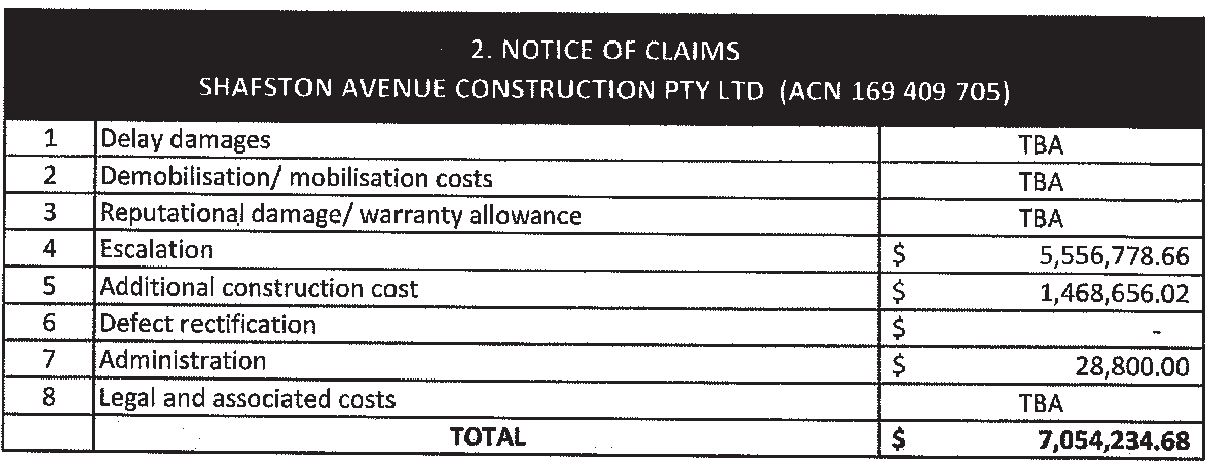
21 Shafston lodged its original Proof of Debt on 24 November 2017 in the sum of $7,054,234.68, particularised as follows:
22 After the Deed of Company Arrangement was entered into, Shafston lodged two amended Proofs of Debt – one on 23 April 2018 in the sum of $8,483,086.32 and the other on 24 August 2018 in the sum of $9,273,771.28. The details of these amended claims were set out in two letters from Macpherson Kelley, lawyers for the plaintiffs, to Clayton Utz, lawyers for the Administrators, one on 23 April 2018 and the other on 7 August 2018.
23 The Administrators initially allowed Shafston’s original Proof of Debt in the sum of $1 for voting purposes only. Ultimately, Shafston’s second amended Proof of Debt was wholly rejected by the Administrators on 17 September 2018. The Notice of Rejection document listed the correspondence passing between the lawyers for the parties in the period from 11 January 2018 to 7 September 2018 and noted that, in the last of these letters, Shafston indicated that it would “not be providing further information in support of its proof of debt” (italics in original). That Notice then summarised Shafston’s claims in support of its final amended Proof of Debt as follows:
(i) [CRCG] repudiated the [Letter of Intent]. That repudiation gives rise to:
A. a damages claim against [CRCG] for the additional costs to be incurred by Shafston to complete the construction of the development in the amount of $5,556,778 (Escalation Damages); and
B. a damages claim against [CRCG] arising from the delay of the completion of the development, being the cost of additional finance, in the amount of $2,248,337 (Delay Damages).
(ii) it was unable to obtain permission to use the Shafston Documents and it suffered loss as a result of a need to have new material prepared in the amount of $1,468,656 (Construction Costs).
24 Lastly, the Notice provided the following reasons for rejecting Shafston’s claim and disallowing the Proof of Debt:
…
Escalation Damages ($5,556,778) and Delay Damages ($2,248,337)
(g) Shafston’s proof of debt is based on an allegation that [CRCG] breached or otherwise repudiated the [Letter of Intent]. The [Letter of Intent] was terminated by Shafston in accordance with its terms, as outlined in the letter of termination dated 16 June 2017.
(h) The [Letter of Intent] was not a legally binding contract between Shafston and [CRCG] for the construction of the project. The obligations imposed by the [Letter of Intent] were largely limited to:
(i) an obligation on the parties to use all reasonable endeavours to negotiate and agree on the terms of a contract for the construction of the project; and
(ii) an obligation on [CRCG] to perform the preliminary works.
(i) Given the [Letter of Intent] did not give rise to an obligation to construct the project, the alleged escalation and delay damages are rejected.
(j) Even if a repudiation had occurred, which is denied, it would not have entitled Shafston to the amounts claimed in its proof of debt.
Construction Costs ($1,468,656)
(k) Shafston asserts that it has been unable to use the Shafston Documents as it could not be satisfied that it had authority to use the intellectual property existing in those documents.
(l) Given the terms of the [Letter of Intent] (clause 9.1), all intellectual property existing in the Shafston Documents was owned by Shafston. It did not require [CRCG’s] authority or permission to use the Shafston Documents.
(m) [CRCG] had no contractual obligation to satisfy Shafston as to its rights in respect of the intellectual property existing in the Shafston Documents. In any event, [CRCG] was permitted to, and did, transfer all intellectual property rights existing in the Shafston Documents to Shafston.
(n) Shafston had (and continues to have) the authority to use the Shafston Documents.
(o) [CRCG] has received no evidence that:
(i) Shafston did not, in fact, use the Shafston Documents;
(ii) new material was recommissioned and paid for to replace the Shafston Documents; and
(iii) requests were made to [CRCG] for permission to use the Shafston Documents.
Set-Off
(p) In addition to the above and assuming [CRCG] was indebted to Shafston, Shafston remains indebted to [CRCG] in the amount of $262,927.56 for work performed by [CRCG] pursuant to the [Letter of Intent]. The Deed Administrators are entitled to set off that amount against any debt or claim of Shafston.
…
(Italics and underlining in original)
Baxter
25 At the same time as CRCG signed the Letter of Intent for the Lume Project (17 May 2016), it signed a similar Letter of Intent with Baxter for the design and construction of a residential apartment complex situated at 28 Baxter Street, Fortitude Valley in Brisbane. The pertinent terms of that Letter of Intent mirrored those of the Shafston Letter of Intent set out above (at [5]). The Baxter Letter of Intent was also extended in the same manner as the Shafston Letter of Intent (see at [8] above), but only on four occasions, with the last being to 28 October 2016. On that date, it automatically terminated under cl 11.2 of the Letter of Intent, rather than being terminated by a notice under cl 11.1 as the Shafston Letter of Intent was.
26 Following the signing of the Letter of Intent, CRCG undertook preliminary works primarily related to the design of the apartment building. Baxter paid it $411,077.66 for those works.
27 Baxter lodged its original Proof of Debt with the Administrators on 24 November 2017 in the sum of $4,538,575.97, particularised as follows:
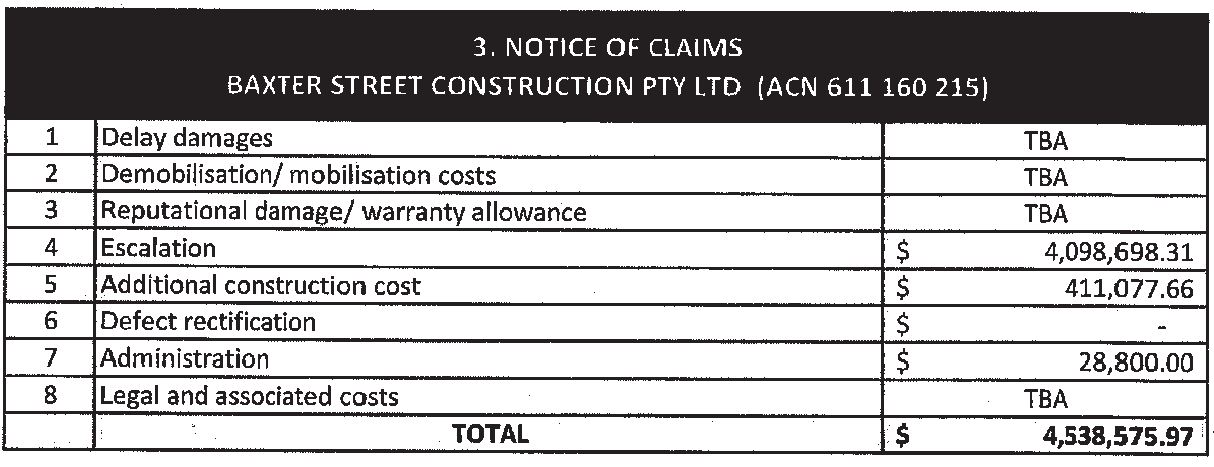
28 As with the Shafston Proof of Debt, the Administrators initially allowed Baxter’s Proof of Debt at $1 for voting purposes only. Further, as occurred with Shafston’s Proof of Debt, Baxter lodged two amended Proofs of Debt – one on 23 April 2018 and the other on 24 August 2018. Both were in the sum of $411,077.66 corresponding to item 5 “Additional construction cost” above.
29 The Notice of Rejection of the Baxter Final Proof of Debt followed the same format as the Shafston Notice of Rejection. First, the same chain of correspondence was referenced; secondly, the same refusal to provide further information was cited; and, thirdly, Baxter’s claim was summarised as follows:
Baxter asserts that it has been unable to use any of the Baxter Documents as it does not have authority to use the intellectual property existing in them. As a result, it claims damages of $411,077.66.
30 Finally, the Notice provided the following reasons for wholly rejecting that Proof of Debt:
…
(g) The Deed Administrators have:
(i) provided Baxter with a copy of all Baxter Documents held by the Deed Administrators; and
(ii) confirmed that Baxter has authority to use the intellectual property in the Baxter Documents.
(h) The Deed Administrators have received no evidence from Baxter in relation to:
(i) whether it made requests to [CRCG] for permission to use the Baxter Documents;
(ii) whether Baxter proposes to advance the works the subject of the [Letter of Intent]; or
(iii) if the works are proposed to be advanced, whether it proposes to utilise the Baxter Documents (ie. whether it proposes to construct a development with the same or similar specifications).
(i) It is the Deed Administrators’ view that:
(i) Given the terms of the [Letter of Intent] (clause 9.1), all intellectual property existing in the Baxter Documents was owned by Baxter.
(ii) [CRCG] had no contractual obligation to satisfy Baxter as to its rights in respect of the intellectual property existing in the Baxter Documents. Even if it did have such an obligation, [CRCG] was permitted to, and did, transfer all intellectual property rights existing in the Baxter Documents to Baxter.
(iii) Baxter has authority to use the Baxter Documents.
Set-Off
(j) In addition to the above and assuming [CRCG] was indebted to Baxter, Baxter remains indebted to [CRCG] in the amount of $7,557.11 for work performed by [CRCG] pursuant to the [Letter of Intent]. The Deed Administrators are entitled to set off that amount against any debt or claim of Baxter.
Lincoln
31 On 27 May 2016, Lincoln entered into a contract with Rimfire Constructions (Qld) Pty Ltd, a company related to CRCG, for the design and construction of a residential high rise apartment complex called “Lincoln on the Park” located at 48-54 Lincoln Street, Greenslopes in Brisbane (the Lincoln contract).
32 On 13 March 2017, the Lincoln contract was novated to CRCG and thereafter CRCG took over the role of contractor. As required by the novated Lincoln contract, on 10 April 2017, CRCG provided two bank guarantees to Lincoln totalling $2,150,000.
33 In the meantime, CRCG, and, before it, Rimfire Constructions, proceeded with the constructions of the Lincoln on the Park Project. As mentioned earlier, in early June 2017, Mr Thornton became aware that some of the subcontractors on that Project were not being paid (see at [16]) above. The primary concern at that time was to ensure that the construction works on the Lincoln on the Project were completed. That concern was reflected in the following passages in the email Mr Petrie sent to Mr Li and Mr Zhao on 13 June 2017 (see at [17] above)
Lincoln on the Park
o Murray advised that with Progress Claim 14 unless confirmation is given on payment of debt before payment due date, Devcorp will hold money to pay subcontractors directly
o Minter Ellison has advised CRCG that they are not obligated for the outstanding debt from [Rimfire Constructions]
o Adam [Moore] has shares and Adam [Moore] has proposed to sell shares to pay subcontractors, however, legal advice is that cannot be done
o CRCG priority is to keep site ongoing to finish on time
o CRCG board members have not approved to pay out the debts owed to the creditors
o CRCG (Alex [Mr Li] and Charlie [Mr Zhao]) advised that they will tomorrow start communication with creditors
o Charlie [Mr Zhao] advised that the plan is for CRCG to not pay the outstanding debts but speak to all of the creditors face to face
o Murray advised he believes [Rimfire Constructions] has deadline of June 22 for voluntary administration and so resolution of the creditors needs to happen immediately
Lincoln on the Park Action Items
1. CRCG to provide tomorrow signed letter advising of the General Manager position and also the action CRCG will take to ensure the Lincoln project will continue unaffected
2. CRCG to provide tomorrow written resolution nominating Charlie [Mr Zhao] as the General Manager
3. CRCG to provide tomorrow revised organisation chart nominated Charlie [Mr Zhao] as General Manager/Director
4. CRCG to provide tomorrow [CRCG] aged creditors report for the Lincoln project
(Bold and underlining in original)
34 On 24 August 2017, CRCG served a Notice of Anticipated Practical Completion of the Lincoln on the Park Project. In response, Mr Thornton, as Managing Director of Lincoln, sent a letter dated 4 September 2017 to Mr Kirkwood as CRCG’s Contractor’s Representative notifying him that “in accordance with clause 44.6(b) the Principal’s Representative will be inspecting Site 8am Tue 5 Sep 2017 to further inspect the works, to which the Contractor’s Representative is requested to attend” (underlining in original). It appears from Mr Thornton’s letter that the process of attending to defects in the building had commenced by agreement between the parties with onsite inspections from 29 June 2017. This puts in context the following paragraph of the letter:
Please be advised the defect reports issued to date & moving forward will continue to be considered Punchlists for the specific areas inspected. To date, the majority of items within the Units being inspected are minor in nature, however the items below are considered Punchlist A items that are required to be completed prior to Practical Completion on or before 5 October 2017.
(Underlining in original)
35 Under the heading “Punchlist A items - as at 4 Sep 2017 (all previously raised under separate cover)” (bold in original), the letter went on to list the following eight items:
- Eastern façade rectification (re; jointing, render, workmanship, windows)
- Automatic irrigation installation to all garden beds
- Basement storage cages installation
- Roof Top Pergola – workmanship, finishing & sagging issues
- Roof Top Pool – sharp step edges, compliance & safety concerns
- Kitchen sink scratches requiring rectification or sink replacement
- Unit 102 – Rectification of exposed plumbing drain through façade of building
- Lift – Compliance re weather protection (warranties, longevity, maintenance)
36 On 19 October 2017, CRCG made a formal request that a Certificate of Practical Completion be issued for the Project. In response, on 24 October 2017, Mr Thornton, as Principal’s Representative and Managing Director of Lincoln, sent a letter to Mr Kirkwood which stated, in part:
…
In accordance with clause 44.6(c)(ii) of the Contract, the Principal’s Representative advises that Practical Completion has not been achieved in accordance with the requirements of the Contract.
Accordingly, the Principal’s Representative gives the Contractor a Punchlist identifying the Punchlist A Items that must be completed and Punchlist B Items that the Principal’s Representative considers require rectification or completion by the Contractor (see Annexure [A] for Punchlist A Items and Punchlist B Items).
The Principal’s Representative further advises that Practical Completion has not been achieved for the following reasons:
1 all Units are not fully complete with no defects remaining to be rectified which could in any way affect the ability of the Principal to complete the Sales Contracts;
2 the Contractor has not complied with clause 36 of the Contract;
3 the Contractor has not provided to the Principal all Completion Documents which, in the opinion of the Principal’s Representative, are essential for the immediate use, operation, occupation and maintenance of the Works (see Annexure B for outstanding Completion Documents), and
4 all rubbish, debris, wrappings, containers and residual materials resulting from the Works have not been removed from the Site;
Further, the Principal’s Representative refers to its Notice – Defects Inspection & Punchlist – Clause 44.6(b) dated 4 September 2017 which sets out a number of Punchlist A Items which required rectification by the Contractor and which remain outstanding.
Punchlist A items (all previously raised under separate cover):
- Eastern façade rectification (re; jointing, render, workmanship, windows)
- Automatic irrigation installation to all garden beds
- Basement storage cages installation
- Roof Top Pergola – workmanship, finishing & sagging issues
- Roof Top Pool – sharp step edges, compliance & safety concerns
- Lift – Compliance re weather protection (warranties, longevity, maintenance)
In accordance with clause 44.6(d), the Contactor is required to rectify all Punchlist A items and complete all outstanding works detailed in this letter for the purposes of achieving Practical Completion under the Contract.
Terms capitalised but not otherwise defined in this letter have the same meaning as set out in the Contract.
The Principal reserves all its rights under the Contract and at law.
…
It is to be noted that the list of Punchlist A items above does not include the sixth (kitchen sink) and seventh (unit 102) items in the similar list in the 4 September 2017 letter above at [35].
37 Attached to this letter at Annexure A was a document headed “Punchlist A items & Punchlist B items” (bold in original) as follows:
Notes:
- Attached documents are noted as ‘A’ or ‘B’ to reflect the above Punch list category
- Punchlist A items are reasonably requested for completion by 14 Nov 2017
- Punch list B items are reasonably requested for completion by 28 Nov 2017
- In addition to the attached Punchlist items;
o the Landscaping has significant areas in poor condition, dying &/or in need of immediate maintenance. Given the living nature of this item, immediate repair is required by 31 Oct 2017 to avoid replacement of large areas of the Works.
…
38 There followed two reports by Better Building Group Qld Pty Ltd (BBG) – one prepared on 5 October 2017 listing 203 items and the other prepared on 19 October 2017 listing 250 items. The top of each of those reports contained the handwritten notation “A – Entire report Punchlist A due to the volume of defects impacting occupation”. As well, there were attached an email dated 15 October 2017 and several lists variously dated 25 August 2017, 15 September 2017, 5 October 2017, 9 October 2017, 15 October 2017 and 20 October 2017, some of which were marked “A” and others “B”.
39 Notwithstanding the contents of the letter above, two days later, on 26 October 2017, Mr Thornton, as Principal’s Representative and Managing Director of Lincoln, sent a letter to Mr Kirkwood notifying him that he had decided to issue the Certificate of Practical Completion as follows:
We refer to the following correspondence:
o letter from the Principal’s Representative to the Contractor dated 4 September 2017 (ref Notice – Defects Inspection & Punchlist);
o letter from the Contractor to the Principal’s Representative dated 19 October 2017 (ref Lincoln on the Park – Design and Construct Contract – Certificate of Practical Completion – Formal Request); and
o letter from the Principal’s Representative to the Contractor dated 24 October 2017 (ref Certificate of Practical Completion – Rejection of Formal Request).
In accordance with clause 44.6(f)(i) of the Contract and notwithstanding that Practical Completion has not been achieved by the Contractor under the Contract, the Principal’s Representative in its absolute discretion hereby issues to the Contractor the Certificate of Practical Completion. The Date of Practical Completion is 26 October 2017.
In accordance with clause 44.6(f)(i), the Principal’s Representative advises the Contractor that there are a number of Defects (including Punchlist A Items) which the Con tractor is required to rectify. These Defects are set out in Annexure A and include the incomplete and defective works that were notified by the Principal’s Representative to the Contractor on 24 October 2017 and 4 September 2017.
The Contractor is required to rectify the Defects within the corresponding time frames specified in Annexure A. In the event that the Contractor is either unwilling or unable to rectify the relevant Defects in the time required by this Certificate of Practical Completion, the Principal reserves all its rights under the Contract and at law, including its rights under clause 44.6(f)(i) to rectify such Defects itself and to reduce the Contract Sum by the cost of rectifying those Defects.
…
40 With one insignificant exception, the documents annexed to this letter were identical to those annexed to the 24 October 2017 letter above at [36]. The exception was that the notes at the beginning of the annexures included the six Punchlist A Items whereas they had been listed in the body of the earlier letter.
41 On 8 November 2017, Mr Wentao Gao of CRCG sent an email to Mr Mark Gaskin-Harris of Devcorp in which he agreed to undertake certain defects in the Lincoln on the Park building, but disputed CRCG’s liability for others as follows:
…
Please find attached an update on our internal tracking sheet for internal defects in the apartments and lobbies. Please also find attached our Basement defect tracking sheet. As mentioned yesterday we are working to close out any defects outstanding (that we do not dispute). We are also working through the basement defects provided by BBG and will notify of any defects we dispute In the coming days.
We have sufficient site resources to manage the defects that are not in dispute. We currently have 1 site manager , 1 foreman, 1 site engineer, 1 administrator and any required labour to complete defects not in dispute.
In response to the Defects raised in the Practical Completion dated the 26 October 2017 we dispute pursuant to clause 56.1. Consider this correspondence a Notice of Dispute.
In reference to the alleged Defects in your correspondence of the of the 24 October 2017 – “Certificate of Practical Completion – Rejection of Formal Request”.
We have marked up your correspondence with paragraph numbers “Mark-up of Correspondence dated 24 October” and provide the following details as to why we dispute these Defects:
Para 3 – Refer items 16 to 19 below which relates to the Principal’s Annexure A;
Para 4 – We dispute this statement – we have closed out all 3rd party defects by A Plus Property Inspections as at the 24 October 2017 which are representing the Principal for defect inspections of the
Internals of each unit as documented at this date other than minor items that are contained in the attached Outstanding Defects – Lincoln on the Park tracking register. We note that 26 units have settled successfully on the 27 October 2017. These
items are not affecting the ability for the Principal to settle units. Further have settled since this date;
Para 5 – We dispute this statement - we have issued all warranties that we are reasonably aware via drop box, USB and hardcopy as at COB 25/10. (drop box link attached)
…
Para 6 – We dispute this statement - As per paragraph 5 above;
Para 7 – We dispute this statement – The Site was cleaned and all rubbish removed by 27th October 2017;
Para 8 – Refer to our dispute of the item 9 to 14 below;
Para 9 – We dispute this statement - Eastern Façade is within tolerances and any rectification works are purely cosmetic and has no effect on the functionality of the building;
Para 10 – We dispute this statement - We previously responded via letter dated 11/9/17 disputing this item and have had no response to date;
Para 11 – We dispute this statement - We previously responded via letter dated 12/9/17 disputing this item and have had no response to date;
Para 12 – We dispute this statement – The Workmanship, Finishing & Sagging issues have now been rectified to within tolerances and have no effect on the functionality of the building;
Para 13 – We dispute this statement - We have form 16 and form 11 for the pool so it has been deemed safe and has been installed strictly in accordance with Devcorps design;
Para 14 – We dispute this statement - We have form 16 and form 11 for the Lift and the Lift contractor has inspected the final product and installation and the Lift contractor
Has provided all warranties;
Para 15 – We dispute this statement as per the reasons stated above and below;
Para 16 – These documents have never been provided nominated as punch list category ‘A’ or ‘B’. Notwithstanding we have attended to any defects that
were provided in these documents that we consider are defective and have not disputed.
Para 17 – All Punchlist ‘A’ items that are not disputed above and below will be completed by this date;
Para 18 – All Punchlist ‘B’ items that are not disputed above and below will be completed by this date;
Para 19 – We dispute this statement - the Principal has taken over these works – refer attached email 26 September 2017.
In summary we dispute the statements as set out above we do class the items disputed as defects.
A copy of this Notice will be hand delivered to the Principal’s Office.
(Errors and typography in original)
42 Four days after CRCG was placed into voluntary administration, Lincoln terminated the Lincoln contract by letter dated 20 November 2017 under cll 52.11(a)(v)(A) and 52.3(a)(vi), reserving its rights under cl 52.10. On the same day, Lincoln called on the bank guarantees mentioned earlier (at [32]) and subsequently received the sum of $2,150,000.
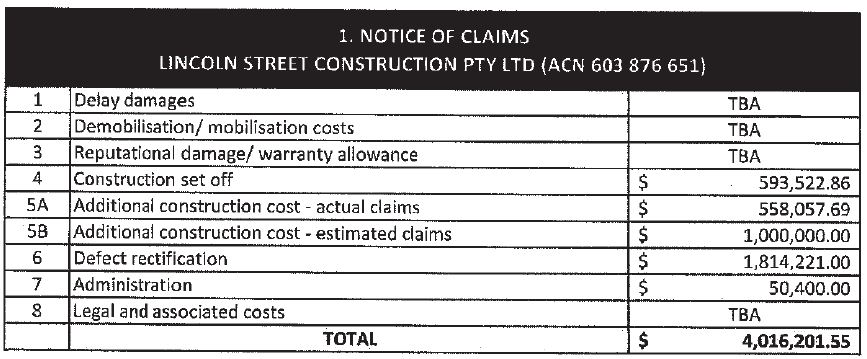
43 In lodging its Proofs of Debt in the administration, Lincoln followed the same pattern as that described for the other two projects above. Its original Proof of Debt was lodged on 24 November 2017. That was followed by two amended Proofs of Debt – one on 23 April 2018 and the other on 24 August 2018. Its original claim was for $4,016,201.55, particularised as follows:
44 In the period before Lincoln’s first amended Proof of Debt was lodged, it obtained two assessments relating to the estimated costs of rectifying the defects in the Lincoln on the Park Project – one by Gleeds Australia (East) Pty Ltd (Gleeds) on 20 November 2017 and the other by BBG on 29 March and 4 April 2018. A later report was prepared by Mitchell Brandtman on 19 April 2020 estimating the value of the trade warranties that were not provided for the Project.
45 The first amended Proof of Debt on 23 April 2018 was in the sum of $2,627,116.44. This claim took into account the $2,150,000 that Lincoln had received from calling on the guarantees provided by CRCG, as the following letter from Macpherson Kelley to Clayton Utz of the same date explained:
Defects report claim: $1,276,721.00
In or about late August or early September 2017, as the scaffolding for the Lincoln on the Park building works was being removed, it became apparent that several critical defects were present in the Lincoln on the Park works. On 4 September 2017, Murray Thornton of Lincoln sent a letter to [CRCG] outlining these defects and calling for their immediate rectification. A copy of that letter is attached.
On 26 October 2017, in accordance with 44.6(f)(i) of the Lincoln Agreement, Lincoln:
(a) Issued [CRCG] with a certificate of practical completion (PC Certificate); and
(b) Notified the Company, by way of a comprehensive defect report compiled by [BBG] (BBG Report), of a large number of Punchlist A and B defective items present in the building.
A copy of the certificate of practical completion and the BBG Report is attached.
On 20 November 2017, on the basis of the BBG Report and a further inspection of the defects by [Gleeds], Lincoln received a preliminary defects rectification estimate from Gleeds (Gleeds Report). The Gleeds Report calculated the cost of rectification in respect of the defects identified in the works to be $1,276,721.00. A copy of the Gleeds Report is attached.
In the premises, Lincoln has a claim against [CRCG] for the cost of rectification of the defects identified in the BBG Report and the Gleeds report in the sum of $1,276.271.00 (Lincoln Defects).
Further defects: $1,295,260.00
Subsequent to the receipt of the Gleeds Report, the following further defects have been identified in the works:
1. Air Conditioning installation defects; and
2. Defective balcony tiling; and
3. Water ingress into fire stairs.
Please find attached:
1. A report from [BBG] … dated 29 March 2018 estimating that the cost to rectify the Air conditioning installation defects and defective balcony tiling amounts to $1,260,260.00 (excluding GST); and
2. A further report from BBG dated 4 April 2018 estimating that the cost to rectify the water ingress into the fire stairs amounts to $35,000.00 (excluding GST).
The total cost to rectify the above defects therefore amounts to $1,295,260.00.
Warranties: $2,205,135.44
Clause 44.8 of the Lincoln Agreement relevantly required that upon practical completion being reached, [CRCG] was to provide to Lincoln all Completion Documents, being “those operation and maintenance manuals, as built design documents, warranties and other documents described as such in the Principal’s Project Requirements …” (emphasis added).
Clause 15.8 of the Principal’s Project Requirements for Lincoln on the Park relevantly required that the Contractor provide to the Principal warranties for the works to be performed as set out in the below table.
Item | Warranty period |
Glazing | Manufacturer’s warranty |
Roof sheeting | 7 years workmanship, materials to manufacturer’s warranty |
Waterproofing | 7 years workmanship, materials to manufacturer’s warranty |
Carpet | Manufacturer’s warranty |
Landscaping | 12 weeks maintenance, weeding and watering |
Electrical | 7 years workmanship, materials to manufacturer’s warranty |
Mechanical | 7 years workmanship, materials to manufacturer’s warranty |
Fire systems | 7 years workmanship, materials to manufacturer’s warranty |
Hydraulics | 7 years workmanship, materials to manufacturer’s warranty |
Lift services | 7 years workmanship, materials to manufacturer’s warranty 12 months’ maintenance included |
Pool | 7 years workmanship, materials to manufacturer’s warranty |
Other | Manufacturer’s warranty |
(together, the Warranties)
Subsequent to the issue of the PC Certificate, [CRCG] has refused or otherwise failed to provide Lincoln with all of the Warranties to the satisfaction of Lincoln in accordance with the Principal’s Project Requirements.
After Lincoln received the BBG Report, Gleeds Report, and the builder’s handover package, the Development Manager of Devcorp, Mark Gaskin-Harris identified that [CRCG] had failed to provide satisfactory warranties in accordance with the Principal’s Project Requirements.
Lincoln has since received a report dated 19 April 2018 from Mitchell Brandtman estimating the cost to provide the Warranties which have not been provided by [CRCG] to be $2,205,135.44.
Security: ($2,150,000.00)
Pursuant to Clause 5.2 of the Lincoln Agreement, as amended by Clause 4(g) of the Novation Deed, [CRCG] was required to supply bank guarantees in favour of Lincoln the sum of $2,150,000.00 as security for performance of [CRCG’s] obligations under the Lincoln Agreement (the Guarantees).
On 20 November 2017, in accordance with Clause 5.7 of the Lincoln Agreement, Lincoln instructed the Bank of China to make payment to Lincoln pursuant to the terms of the Guarantees. Lincoln received such payment on or about 8 December 2017.
Lincoln asserts claims against [CRCG] in the sum of $4,777,116.44 and acknowledges an offset in the sum of $2,150,000.00.
In the premises, Lincoln’s total claim against the company in the sum of $2,627,116.44 is calculated as follows:
Lincoln Defects: | $1,276,271.00 |
Further defects: | $1,295,260.00 |
Warranties: | $2,205,135.44 |
LESS Security: | ($2,150,000.00) |
Total Claim: | $2,627,116.44 |
…
46 The second amended Proof of Debt lodged on 24 August 2018 was in the same amount as above. It referred to the letter from Macpherson Kelley dated 23 April 2018 above and a further letter from that firm dated 7 August 2018. The latter letter contained further details about the defects and warranties claims as follows:
RECTIFICATION DEFECTS
4. Please find enclosed a defects matrix prepared by our client as at 20 July 2018. On 9 July 2018, we provided your office with a copy of all relevant invoices for rectification works completed to date. The defects matrix shows the entirety of construction defects identified and not rectified.
5. To the extent the defects have not yet been rectified, Lincoln is taking steps to rectify those defects and continues to receive requests from occupants to rectify same. We reserve our client’s rights to enlarge its claim should more defects be identified such that our client’s estimate of further defects is insufficient.
6. However, as an indicative sum in order to enable the Administrators to adjudicate our client’s proof of debt, the costs of the defects as at April 2018 have been independently assessed by a third party, that being [Gleeds] and [BBG], whose reports in relation thereto have been provided to you on 23 April 2018.
7. We note that our client has had extreme difficulty in seeking assistance from subcontractors of [CRCG] in rectifying construction defects. For example, we are instructed that our client has contacted [CRCG’s] air conditioning subcontractor, with such subcontractor refusing to provide assistance on the basis that it remained a creditor of [CRCG].
WARRANTIES
8. The warranties were required to be provided pursuant to the terms of the Construction Contract between Lincoln and Rimfire Constructions (Qld) Pty Ltd dated 27 May 2016. Being that [CRCG] is unable to provide warranties as required, Lincoln must source alternative warranty arrangements.
9. The value of such warranties has been independently verified by way of report completed by Darryl Bird of [Mitchell Brandtman] dated 19 April 2018. A copy of that report together with various instructions and documents referred to was provided to your office on 9 July 2018.
10. At this stage, it is not our client’s intention to utilise further resources in obtaining a further report from [Mitchell Brandtman].
11. Lincoln’s basis for asserting that the Lift installation is non-compliant is as identified in the Gleeds report dated 20 November 2017, which was provided to your office on 23 April 2018 (Gleeds Report).
12. We disagree with your observation in respect of the double counting of the cost of the Lift replacement and the costs of repairing the water penetration into the fire stairs. To that end, please see the attached email communication from Darryl Bird of Mitchell Brandtman clarifying this part of his report. We are instructed that our client continues to press the entirety of its claim in this regard on that basis.
13. The rectification work required to the east façade, existing pergola and pool tiling are all as identified and verified in the Gleeds Report.
14. In respect of the automatic irrigation and basement locker installation, we note that the requirement for [CRCG] to provide these items is as follows:
(a) section 10.4 of the Principal’s Project Requirements at Annexure C of the Design and Construct Contract between Lincoln and Rimfire Constructions Pty Ltd and later novated to [CRCG] (the Principal’s Requirements) required [CRCG] to install an automatic irrigation system; and
(b) section 6.11 of the Principal’s Requirements required [CRCG] to install a basement locker.
To assist your client in properly adjudicating Lincoln’s proof of debt, please find enclosed a spreadsheet setting out the calculations used in calculating Lincoln’s claims.
…
(Bold and underlining in original)
47 As with the other two projects, the Administrators initially allowed Lincoln’s original Proof of Debt at $1.00 for voting purposes only. The Administrators then wholly rejected Lincoln’s Proof of Debt on 13 December 2018. The Notice of Rejection of the Proof of Debt was in similar, but not identical, terms to that for the other two projects. It listed a different chain of correspondence passing between the lawyers for the parties, but referred to the same indication in Macpherson Kelley’s letter dated 7 September 2018 that Lincoln would “not be providing further information in support of its proof of debt” (italics in original). The Notice then summarised the claims Lincoln made as follows:
h) Lincoln claims the following amounts as against [CRCG]:
I. damages for the rectification of alleged defects in the amount of $2,571,981.00; and
II. damages for an alleged failure by [CRCG] to provide it with warranties in the amount of $2,205,135.44.
i) The above claim has been reduced by the amount of the guarantee called and paid to Lincoln resulting in a total claim of $2,627,116.44.
48 Lastly, the Notice contained the following reasoning for wholly rejecting Lincoln’s Proof of Debt:
Rectification of Defects
j) Lincoln relies on the following in order to establish the alleged defective works and the costs required to remedy those defects:
o report prepared by [Gleeds] dated 20 November 2017 identifying defects totalling $1,276,721.00;
o report from [BBG] dated 29 March 2018 identifying air-conditioning and balcony tiling defects which were estimated to cost $1,260,260.00 to complete; and
o report from [BBG] dated 4 April 2018 identifying water ingress defects which were estimated to cost $35,000.00 to complete.
k) The Deed Administrators have requested access to Lincoln on the Park in order to inspect the alleged defects and obtain an independent assessment of the costs to remedy those defects. Lincoln has not responded to those requests for access. As a result, the Deed Administrators have not been able to verify the defects and they cannot be accepted.
l) Further, the Deed Administrators have no evidence (with the exception of that set out below) that the alleged defects have been rectified, noting that Lincoln holds the funds paid to it as a result of its call on the bank guarantees. In addition, a number of the alleged defects listed in the Gleeds Report indicated that they are “closed”. Despite request, Lincoln has not confirmed whether it maintains those defect claims.
m) The Deed Administrators have been provided with the following identifying the costs incurred by Lincoln it alleges is associated with defects or incomplete works:
o Retention Tracking Summary from October to December 2017 (with relevant invoices) totalling $5,188.03 (excluding GST);
o Retention Tracking Summary from January 2018 (with relevant invoices) totalling $4,585.85 (excluding GST);
o Retention Tracking Summary from February 2018 (with relevant invoices) totalling [$]25,860.42 (excluding GST);
o Retention Tracking Summary from March 2018 (with relevant invoices) totalling $71,816.29 (excluding GST);
o Retention Tracking Summary from April 2018 (with relevant invoices) totalling $90,444.00;
o Retention Tracking Summary from May 2018 (with relevant invoices) totalling $175,542.11;
o Further Retention Tracking Summary from May 2018 (with relevant invoices) totalling $139,676.24.
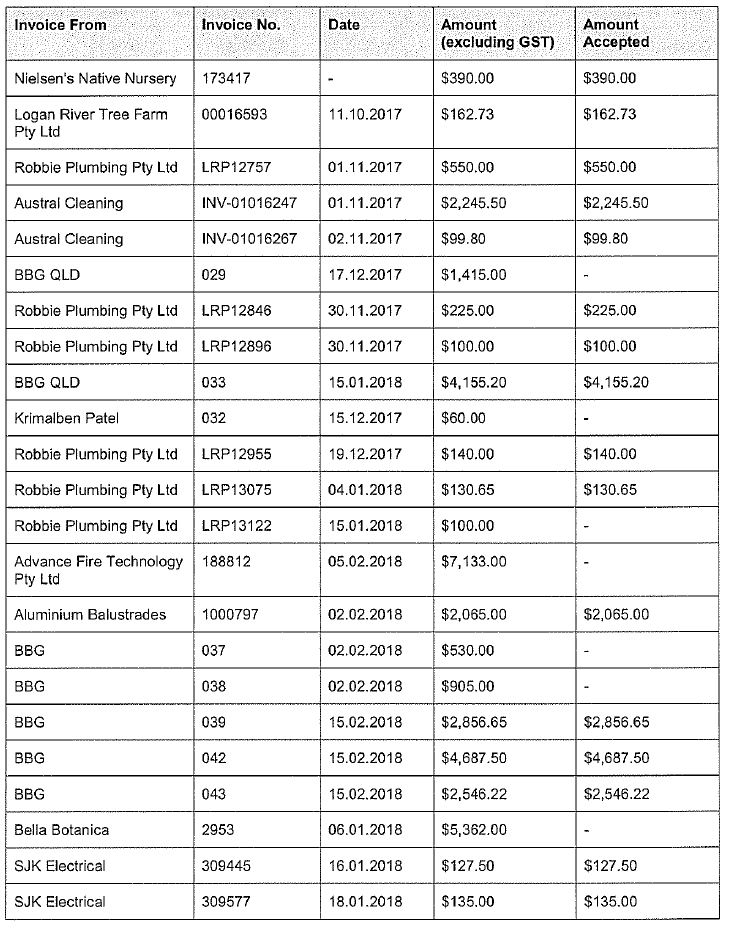
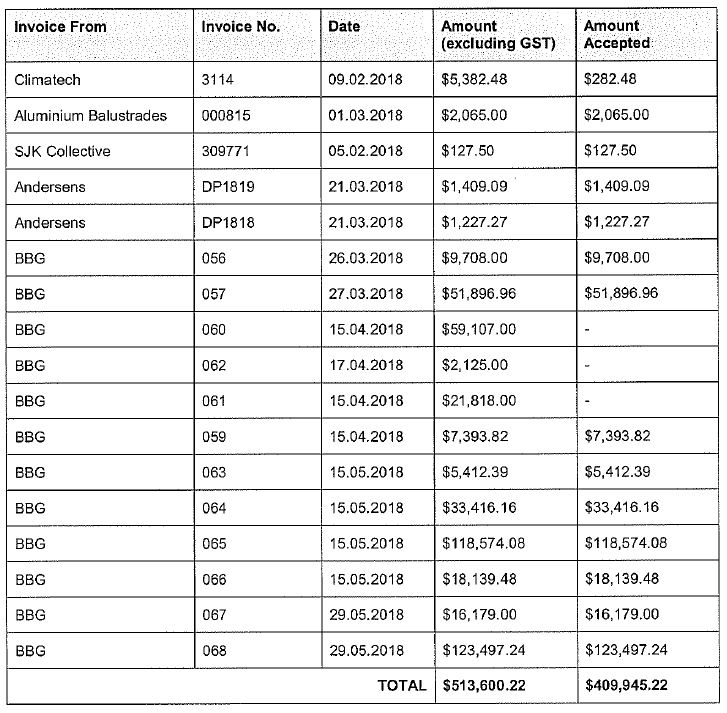
n) We set out in Annexure 1 the invoices accepted as being payable by [CRCG] in the amount of $409,945.22.
o) The Deed Administrators do not have sufficient information to accept any of the further defect claims and they are hereby rejected.
p) The value of the defects accepted by the Deed Administrators does not exceed the security held by Lincoln, which security has been applied to remedy the defects as outlined in the Retention Tracking Summary.
Warranty Claims
q) Lincoln alleges that [CRCG] did not provide warranties to Lincoln as required by clause 15.8 of the Principal’s Project Requirements forming Attachment 1 to the Novation Deed.
r) Lincoln has obtained a report of Mitchell Brandtman dated 19 April 2018 on which it seeks to rely in order to quantify its loss as a result of the alleged failure of [CRCG] to provide the stated warranties. The report quantifies the value of the work provided under the contract with respect to each trade and values the failure to provide the warranty for the first year as 5% of the total value of work performed. The value of the warranty then diminishes over the course of 7 years.
s) The Deed Administrators do not accept that this is the correct methodology for determining any loss suffered by Lincoln as a result of any failure to provide a warranty.
t) In any event, the Deed Administrators’ investigations indicate that:
o warranties were obtained and provided to Lincoln;
o on 8 November 2018 Wentao Gao of [CRCG] sent an email to Mark Gaskin-Harris for Lincoln indicating that [CRCG] had provided all warranties of which it was reasonably aware via USB, hard copy and drop box; and
o Lincoln was listed a Beneficiary under each Subcontract Agreement entered into with Subcontractors of [CRCG] and Rimfire. As a Beneficiary, Lincoln is entitled to enforce the warranties contained in those Subcontractor Agreements;
u) An officer of Lincoln, Murry [sic] Thornton, has signed an affidavit in which he stated “Lincoln has been required to source alternative warranty arrangements”. Despite request, Lincoln has not provided details of those alternative warranty arrangements of the cost to Lincoln of sourcing those arrangements.
v) On the information available to the Deed Administrators, they are not able to accept this claim.
Set-Off
w) In addition to the above Lincoln remains indebted to [CRCG] in the amount of $36,543.69 for work performed by [CRCG] pursuant to the Contract and Novation Deed but not paid. The Deed Administrators are entitled to set off that amount against any debt or claim of Lincoln.
(Italics in original)
49 Annexure 1 to this Notice was in the following form:
PROCEDURAL HISTORY
50 The plaintiffs’ originating application in this proceeding was filed on 18 September 2018. On 31 October 2018, the plaintiffs obtained leave to amend that document to seek an order to terminate the Deed of Company Arrangement that CRCG entered into on 19 March 2018. From that point, that application became the plaintiffs’ primary focus in this proceeding. It proceeded to hearing on 1 April 2019 and judgment was delivered on 30 August 2019 dismissing the plaintiffs’ application (Shafston Avenue Construction Pty Ltd, in the matter of CRCG-Rimfire Pty Ltd (subject to deed of company arrangement) v McCann [2019] FCA 1426]). The plaintiffs then filed an appeal against that judgment, which was heard by the Full Court on 14 February 2020 and dismissed on 22 May 2020 (Shafston Avenue Construction Pty Ltd v McCann [2020] FCAFC 85).
51 In the meantime, on 8 October 2019, the balance of the proceeding, namely the plaintiffs’ present challenges to the rejection of their Proofs of Debt, was tentatively set down for hearing for three days commencing 24 March 2020 and trial programming orders were made directed to achieving those trial dates. On 17 December 2019, because the plaintiffs had failed to comply with various aspects of those orders, they were amended, but the tentative trial dates were retained. Under that amended trial program, the plaintiffs were to file any expert evidence upon which they intended to rely by close of business on 9 January 2020. No such material was filed. Instead, on 15 January 2020, Macpherson Kelley sent a letter to Clayton Utz stating, in part:
We refer to the above matter and note that our clients’ expert reports were due to be filed on 9 January 2020.
As previously advised, it was our clients’ initial intention to simply put in the reports contained in the affidavit of Murray Thornton (that being [BBG], Gleeds, and Mitchell Brandtman) formally in as expert evidence.
Whilst we made attempts with our client’s experts at the end of last year to convert the reports into a format that they can be filed as expert evidence, we have been contacted by two of those experts, namely Gleeds and [BBG], who have advised that they no longer wish to be involved in any litigation against [CRCG]. Despite asking for further information from those experts, they will not provide us with any further details. We are still waiting to hear back from Mitchell Brandtman.
In the circumstances we are making enquires in relation to alternative experts for the purposes of obtaining reports to the same matters to those reports initially obtained by our clients. However, as you would appreciate, this will take some time. In the circumstances, we will be likely be seeking an adjournment of the hearing date which is currently set for March 2020 …
52 Approximately seven weeks later, on 2 March 2020, the plaintiffs’ lawyers filed an interlocutory application seeking to vacate the March trial dates, as foreshadowed in the final paragraph of their 15 January 2020 letter above. In his affidavit in support of that application, Mr Benjamin Rooks, the plaintiffs’ solicitor, set out two reasons for that course. The first was that he had attempted to obtain reports from the persons who had assisted Lincoln to prepare its Proofs of Debt in respect of the Lincoln on the Park project, namely Gleeds, Mitchell Brandtman and BBG, but had been informed by Gleeds and BBG that “they are now conflicted out of the matter and can no longer be part of the proceedings”. Accordingly, Mr Rooks said that Lincoln needed additional time “in which to engage new experts, to prepare expert reports on items which they had previously already had reports prepared” and that those new experts “will be briefed within the next seven days”. It will be noted that these statements are to substantially the same effect as those contained in the plaintiffs’ lawyers’ 15 January 2020 letter above (at [51]).
53 The second reason Mr Rooks provided for the adjournment was that 30 boxes of documents had recently been discovered in a property formerly occupied by CRCG which appeared to be relevant to the Lume and Lincoln on the Park Projects. In view of the steps both parties needed to take to examine and analyse those documents, Mr Rooks said that it would be “unlikely that the Plaintiffs will be in a position to proceed with the hearing on 24 March 2020”.
54 Because of the latter development and somewhat fortuitously for the plaintiffs given their dilatory approach to obtaining their replacement expert evidence, the March trial dates were vacated by consent and new trial dates were fixed for three days commencing on 7 July 2020. As a part of the amended trial program, Lincoln was ordered to file the expert evidence upon which it intended to rely by the close of business on 31 March 2020. No materials were filed by that time.
55 During April/May 2020, following the onset of the Corona Virus Disease 2019 (COVID-19) pandemic, the July hearing dates were initially treated as provisional and eventually vacated. Subsequently, new trial dates were proposed for early October 2020, but eventually they were fixed for the three days commencing 31 August 2020.
56 On 25 June 2020, the matter was listed for a pre-trial case management hearing because of concerns about the plaintiffs’ continuing non-compliance with the trial programming orders. At that hearing, the defendants relied on an affidavit by their solicitor, Mr Scott Sharry, which outlined in some detail the history of that non-compliance. It included:
not responding to the defendants’ objections to the plaintiffs’ affidavit materials;
not filing their opening submissions;
not providing a draft Index to the Court Book;
prevaricating in respect of the expert evidence they intended to rely upon.
57 As to the last of these items, during that case management hearing, the defendants’ counsel said that he had recently been informed by the plaintiffs’ lawyers that they intended to revert to their original proposal of relying upon the reports annexed to the affidavit of Mr Thornton dated 18 September 2018 (see the letter of 15 January 2020 at [51] above) and to seek the issue of subpoenas to those three persons. In response, the plaintiffs’ counsel confirmed that they had adopted that course to avoid incurring the additional expense associated with obtaining replacement expert evidence. Because this issue was likely to have an adverse effect on the preparations for trial, the parties were ordered to exchange materials outlining their positions with respect to it and a hearing date was fixed to resolve the issue. On the day before that hearing, the parties filed consent orders. The resulting orders made on 9 July 2020 provided that the plaintiffs could apply to issue subpoenas to the three persons concerned, namely: Mr Andrew King (Gleeds); Mr Steve Franklin-Bull (BBG) and Mr Darryl Bird (Mitchell Brandtman). Those orders also confined the evidence-in-chief which the plaintiffs could seek to adduce from those witnesses to the contents of the following reports:
(a) Mr King (being document 13 of Annexure MT-1 to the Affidavit of Murray John Thornton sworn 5 September 2018 and filed 18 September 2018 (the Thornton Affidavit);
(b) Mr Franklin-Bull (being documents 14 and 15 of Annexure MT-1 to the Thornton Affidavit); and
(c) Mr Bird (being document 16 of Annexure MT-1 to the Thornton Affidavit).
58 As well, Order 8 of those Orders also gave the plaintiffs leave to, by close of business on 17 July 2020:
… file and serve further lay evidence given by a suitable officer of the third plaintiff concerning the ongoing defects in the property at 54 Lincoln Street, Stones Corner in the State of Queensland and limited to the matters identified in [11] of the Affidavit of Mark Gaskin-Harris (unsworn) served on 6 July 2020.
The identified matters in question were:
(a) the nature of the particular Remediation Works which have been completed to date;
(b) the actual costs which Lincoln has incurred to date in performing the Remediation Works;
(c) the expenditure and depletion of the Guarantee Funds; and
(d) the nature of the Defects which have not yet been remediated to date, and which Lincoln is still required to remediate.
Finally, on 20 July 2020 (three days late, but an unsworn copy was filed on 17 July 2020), the plaintiffs filed an affidavit by Mr Gaskin-Harris as provided for in the order above. I will return to this affidavit later in these reasons when I come to consider the Lincoln defects issue (see below at [100]).
THE ISSUES
59 At the conclusion of the evidence at the trial and before they prepared their closing submissions, the parties agreed that some, or all, of the following issues fell to be determined in this matter, noting that issue 1(b) was ultimately not pressed:
Admissibility issue
1. Are the following admissible such that they should be received in evidence in the proceeding:
(a) the email from Matthew Molony to Mark Gaskin-Harris dated 2 August 2017; and
(b) the section headed “Rectification works” in the letter from Climatech to Steven Franklin-Bull dated 8 February 2017 (being an attachment to the Report of Steven Franklin-Bull dated 29 March 2018)?
Shafston construction contract claim
2. Did CRCG and Shafston enter into a binding contract for the construction of the Lume development, by way of:
(a) a partly written and partly oral agreement arising out of the Letter of Intent, three meetings on 10 November 2016, 23 November 2016 and 29 November 2016, and the Heads of Agreement?
(b) an agreement partly in writing and partly by conduct, consisting of the Letter of Intent, the Heads of Agreement and a course of conduct by CRCG performing works?
3. As to either alleged binding contract:
(a) Did CRCG and Shafston agree on a price of $48.4 million for the construction of the Lume development?
(b) Did CRCG and Shafston agree on the scope of works for the construction of the Lume development?
(c) Was the Heads of Agreement binding and enforceable against CRCG requiring it to provide bank guarantees to Shafston in connection with the Lume development?
(d) Did CRCG perform works in connection with the Lume development which were outside of the scope of works in the Letter of Intent, and if so, what were those works?
4. Has Shafston suffered any actual loss and damage in the sums alleged by reason of CRCG’s alleged non-completion of any binding construction contract in respect of the Lume development? As to these matters:
(a) Had Shafston secured funding for construction of the Lume development to proceed in accordance with a contract for the construction of that development with CRCG by the time of the purported termination in June 2017?
(b) Was the price for the construction of the Lume development under the contract which Shafston (or its related entity) entered into with Hutchinson Builders $53.9m?
(c) Was there a completion date for construction of the Lume development?
Shafston and Baxter intellectual property claims
5. On the proper construction of clause 11.4 of the Shafston and Baxter Letters of Intent, was CRCG required to provide Shafston and Baxter with confirmation that Shafston and Baxter could use the intellectual property in work undertaken by or on behalf of CRCG under the Letters of Intent?
6. Should a term be implied into the Shafston and Baxter Letters of Intent which required CRCG to provide permission to Shafston and Baxter to use and have the benefit of the intellectual property in the work undertaken by or on behalf of CRCG under the Letters of Intent (the Implied Term)?
7. Did CRCG fail to comply with clause 11.4 of the Shafston and Baxter Letters of Intent on its proper construction?
8. Did CRCG fail to comply with the Implied Term?
9. As to [7] and [8], if any obligation of CRCG arose:
(a) on what date did each of Shafston and Baxter request the provision of the intellectual property?
(b) on what date was the intellectual property provided?
10. Is the effect of clauses 9.1 and 9.2 of the Shafston and Baxter Letters of Intent that CRCG in fact complied with its obligations under clause 11.4 of Letter of Intent and the Implied Term?
11. Did any breach of contract on the part of CRCG cause either Shafston or Baxter to suffer loss? As to this, had either of Shafston or Baxter already incurred expense in relation to the intellectual property by the time it was provided?
12. What is the value (if any) of the loss or damage suffered by Shafston and Baxter?
Lincoln defects claim
13. What is the proper construction of the Lincoln contract in respect of the rectification of defects? As to this:
(a) Are subclauses 44.6(b) and (c) of the Lincoln Contract applicable to the claim made by Lincoln for the costs of rectifying defects in the Lincoln development?
(b) If subclauses 44.6(b) and (c) are applicable, on their proper construction, do they operate so that if they apply and have been complied with, Lincoln need not prove that defects identified in the Punchlist schedules are Defects within the meaning of the Lincoln contract?
(c) Is subclause 44.6(f) applicable to the claim made by Lincoln for the costs of rectifying defects in the Lincoln development?
(d) If subclause 44.6(f) is applicable, on its proper construction, does it operate so as to require CRCG only to rectify those identified defects in the Lincoln development which are Defects within the meaning of the Lincoln contract?
14. Has Lincoln proved that it has suffered loss and damage by reason of defects in the Lincoln development? In particular:
(a) Has Lincoln proved that there are defects in the Lincoln development?
(b) Has Lincoln proved that those defects are Defects within the meaning of the Lincoln contract?
(c) Has Lincoln proved what work is required to rectify the defects in the Lincoln development which are outstanding and the value of that work?
(d) Has Lincoln proved that there is work which has been undertaken by it or on its behalf to rectify defects in the Lincoln development and the value of that work?
(e) What is the total value of the work done or work required to be done to rectify defects in the Lincoln development which Lincoln can prove?
Lincoln warranties claim
15. What warranties was CRCG obliged to procure for Lincoln under clause 44.8 of the Lincoln contract and clause 15.8 of the Principal’s Project Requirements (Annexure C to the Lincoln contract)?
16. What warranties did CRCG in fact procure for Lincoln under clause 44.8 of the Lincoln contract and clause 15.8 of the Principal’s Project Requirements?
17. What is the appropriate methodology for valuing warranties which ought to have been procured under clause 44.8 of the Lincoln contract and clause 15.8 of the Principal’s Project Requirements? In particular, is it appropriate to:
(a) Take as a starting point the subcontract price for the value of the works the subject of the required warranties?
(b) Apply as a percentage for the value of the required warranties in their first year the retention amount stipulated in the Lincoln contract as required to be held by the principal for the first year after practical completion?
(c) Value the warranties in the years after their first year on the basis that only a warranty for workmanship would be provided and not a manufacturer’s warranty?
(d) Apply as a percentage for the value of the warranties in the years after the first year following practical completion, a diminishing compound factor with or without an increase for cost escalation?
(e) Add a component to the total value of the required warranties for builder’s preliminaries?
(f) Take into account when valuing the warranties which ought to have been, but have not been, procured for Lincoln, the benefit which Lincoln has received from warranties which have been procured on more favourable terms than those required by the Lincoln contract?
18. What is the value (if any) of the warranties which have not been procured by CRCG to Lincoln?
(Bold and error in original; underlining added)
60 Since the admissibility issue is connected with the Lincoln defects claim, that matter will be considered in conjunction with that issue. With that exception, these issues will be considered in turn below. However, first, it is convenient to say something about the nature of this proceeding and the plaintiffs’ onus of proof.
THE NATURE OF THIS PROCEEDING AND THE PLAINTIFFS’ ONUS OF PROOF
61 The principles bearing on the nature of this proceeding were helpfully summarised recently by Rees J in In the matter of Azmac Pty Limited (2020) 146 ACSR 113; [2020] NSWSC 204 (Azmac) at [41]-[44] where her Honour explained that this proceeding is properly brought under s 90-15 of the Insolvency Practice Schedule; that it proceeds as a hearing de novo; and that the critical question is whether the debt concerned is a true liability of the company, as follows:
41 An appeal to the Court challenging the decision of a liquidator with respect to a proof of debt was previously brought under section 1321 of the Corporations Act 2001 (Cth), now repealed, and, as explained by Gleeson JA in Hill v Esplanade Wollongong Pty Limited (subject to a deed of company arrangement), appeals are now made under section 90-15 of Schedule 2 Insolvency Practice Schedule (Corporations), Corporations Act: at [21]. The case law in respect of the earlier provision is, however, of continuing relevance: Re ACN 096 281 542 Limited (in liq) per Randall AsJ at [6]; El-Saafin v Franek (No 3) per Lyons J at [63]; see, for example, Hill v Esplanade Wollongong Pty Limited.
42 An appeal against a liquidator’s rejection of a proof of debt is a hearing de novo and thus the Court may make its decision on evidence that was not before the liquidator: Tanning Research Laboratories Inc v O’Brien at 340-1 per Brennan and Dawson JJ. As their Honours explained, when the liquidator is called upon to consider a proof of debt, the relevant consideration is whether the alleged debt is a “true liability of the company” or “is not legally enforceable” (at 339, 341) but, on an appeal, at 341: (emphasis added)
The liquidator may defend [the company’s] assets against the creditor’s claim on any ground on which the company may have defended the claim had it been sued by the creditor. … The issue in the proceeding is whether the liability referred to in the proof of debt is a true liability of the company enforceable against it.
43 As further explained in Tanning Research Laboratories v O’Brien at 339-341, in determining whether the debt is “a true liability of the company enforceable against it”, ordinarily the general law applies including statutes of limitation and equitable principles. There are some exceptions, however, where the liability, though enforceable against the company, is founded merely on some act or omission on the part of the company which unjustly prejudices the interests of the creditors or contributories in the assets available for distribution. For example, there may be a judgment debt against the company but there is some good reason why there ought not be such a judgment; the circumstances may tend to show that the judgment was obtained by collusion or an absurd compromise. In such circumstances, the liquidator is armed with grounds for rejecting the proof of debt additional to grounds available under the general law: at 340. Likewise, on an appeal, the liquidator is entitled to rely on this special defence which allows him, for example, to go behind a judgment in order to ascertain the true liability of the company: at 341. There is no suggestion that any of these additional grounds arise here.
44 Nor is the creditor, on such an appeal, strictly confined to each allegation and proposition by which it originally sought to advance the proof of debt, “As long as the claim remains the original claim, some change in the explanation of the way in which it is said to be a true liability of the company enforceable against it is permitted”: Johnston v McGrath at [26] per Barrett J citing Re Jay-O-Bees Pty Limited; Rosseau Pty Limited v Jay-O-Bees Pty Limited per Campbell J; Re St Gregory's Armenian School Inc per Black J at [34]-[35].
(Citations omitted)
62 As well as the matters mentioned by Rees J above, in Tanning Research Laboratories Inc v O’Brien (1990) 169 CLR 332 at 340, Brennan and Dawson JJ emphasised that “[t]he occasions when it is right to reject a proof of debt in respect of what is not a true liability of the company may not be susceptible of exhaustive definition”. However, their Honours did suggest that some guidance may be obtained from the observations of Barwick CJ in Wren v Mahony (1972) 126 CLR 212 as follows:
“Circumstances tending to show fraud or collusion or miscarriage of justice or that a compromise was not a fair and reasonable one, in the sense that even if not fraudulent it was foolish, absurd and improper, or resulted from an unequal position of the parties (see In re Hawkins; Ex parte Troup) offer occasions for the exercise by the Court of Bankruptcy of its power to inquire into the consideration for the judgment.”
(Footnote omitted)
63 As for the onus of proof, in Re Galaxy Media Pty Ltd (In Liq) [2001] NSWSC 917 (Galaxy Media), Santow J explained, by reference to several authorities, how it remained firmly on the plaintiffs and that a liquidator’s (Administrators in this matter) rejection of a proof of debt should not be upset unless the Court is properly satisfied that they have discharged that onus. In particular, his Honour said (at [25]-[26]):
25 Thus the notion of “appeal” is not so much directed at the nature of the review but to the onus lying upon the “appellant” who challenges the liquidator’s decision. Thus in Westpac Banking Corporation v Totterdell (at 154), Ipp J concluded:
“Although the issue before the court on the appeal is whether the liability referred to in the proof of a debt is a true liability of the company, enforceable against it (Tanning Research Laboratories Incorporated v O’Brien (at 341)), it remains incumbent on an appellant to show that the liquidator was wrong in admitting the proof of the debt. As Kennedy J said in Bradshaw v Medical Board (WA) at 328:
‘An appeal in the nature of a re-hearing under the [Medical Act 1984] remains an appeal and the court “must recognise the onus of the appellant to satisfy it that the decision below is wrong”: Powell v Streatham Manor Nursing Home at 255 per Lord Atkin.
Although Bradshaw v Medical Board (WA) concerned different legislation, the nature of an appeal under s 1321 is the same as that considered in that case and the rule mentioned by Kennedy J is equally applicable.”
26 More recently, in Lewis v Notrex Pty Ltd, Young CJ in Equity affirmed that the applicant has the onus “to establish the facts that would enable the proof of debt to be allowed” and “when one is trying a separate issue of fact, the same person bears the onus of proof as would have borne it had the question been tried with the rest of the questions at the final trial”: see at [15].
(Citations omitted, bold added)
33 Thus I agree with the submissions of the plaintiffs that the Court’s task in approaching the question de novo, is to bring to bear a proper rigour in reviewing all the relevant facts in their context, to determine whether indeed the debt should have been admitted or rejected, doing so by applying legal principle to those facts afresh. However, the onus still remains on the party challenging the liquidator's determination. The Court will not upset the liquidator's determination unless properly satisfied that that onus has been discharged, though there may well come a point where the onus shifts in an evidentiary sense.
34 In carrying out such a de novo review, 1 therefore so approach the matter, in determining whether the onus upon the parties challenging the liquidator’s decision has been discharged. If I am unable to conclude either way (as to whether the proof should be admitted) then the liquidator’s decision must stand.
(Bold added)
See also Re: Castleplex Pty Ltd (in liq) [2010] QCA 59 at [4] per McMurdo P, Fryberg and McMeekin JJ.
SHAFSTON CONTRACT CLAIM – ISSUES 2 TO 4
Introduction
65 Issue 2 relates to the existence of a contract between Shafston and CRCG for the construction and design of the Lume Project. As appears from the list of issues above and the contentions below, this issue revolves around the HOA that CRCG delivered to Shafston in January 2017 (see at [9] above) and the Letter of Intent that both parties signed, eight months earlier, in May 2016 (see at [5] above).
66 As well, having regard to the principles outlined earlier, it is important to highlight why the Administrators rejected Shafston’s Proof of Debt. That is so because those principles show that Shafston bears the onus of proving that the Administrators were wrong in making that rejection. The Administrators’ reasoning appears in the Notice of Rejection above (at [24(g)]-[24(j)]). While that reasoning focuses on the Letter of Intent, it should be noted that Shafston has altered its case in this proceeding, particularly in its closing submissions, to rely primarily upon the HOA. I should add that, while it is at the margins, this change of position probably falls within the leeway allowed to a creditor, as described by Rees J in Azmac above (see at [61(44)]).
The contentions
67 As foreshadowed above, Shafston’s primary submission was that the HOA, by its terms, was sufficient to bind the parties to a contract for the construction of the Lume Project. Alternatively, it contended that the Letter of Intent and HOA, together with its conduct and that of CRCG’s during the negotiations that took place in November 2016, and the works that CRCG performed which were outside the terms of the Letter of Intent and the HOA, evidenced a binding contract that CRCG would undertake the construction of the Lume Project. In respect of both alternatives, Shafston contended that, in consideration for the promises contained in the HOA, the parties bound themselves immediately to enter into a building contract for the contract price of $48,000,000.00 and to sign the documents necessary to do so. It contended that that was so because the terms of the HOA caused it to “operate immediately and [to] bind the parties from that moment”. It contended that the HOA stipulated a particular contract price and contained provisions with regard to the provision of bank guarantees in order to “facilitate the early commencement of works”. Thus, it contended, the “tenor” of the HOA was such that the parties were bound to take steps to perform immediately and that the failure to do so would constitute a breach of that contract. On this basis, it contended it was irrelevant to the existence of the contract that particular steps were not undertaken as anticipated by the HOA, for example that bank guarantees for the Project were never provided or that funding was never approved.
68 While it claimed that it was not necessary to “go past the [terms of the] HOA”, in the alternative, Shafston contended that the combined effect of the Letter of Intent, the HOA and the conduct of the parties evidenced a contract for the construction of the Lume Project. With respect to the latter, it pointed to the negotiations that were conducted in November 2016 and the fact that CRCG undertook preliminary works, which included works that “could only [have been] in relation to the construction of Lume”. It also pointed to other prior and subsequent conduct that it claimed was consistent with the existence of such a contract. That included “the previous history of completing projects together” and its requests for bank guarantees. Finally, it contended that its letter of termination dated 16 June 2017, albeit containing “nomenclature [that] was imperfect”, and its direction to CRCG to cease works on the Lume Project also provided evidence to the same effect.
69 In response, the Administrators contended that no such contract existed. To the contrary, they contended that Shafston’s case on this issue was “a contrivance” as evidenced by the “five different versions of the case” that it had put forward. They contended that the question whether a contract exists must be determined objectively, taking into account all the relevant circumstances. On that basis, they contended that the circumstances relevant to this matter showed that the parties did not intend to be bound by a contract for the construction of the Lume Project until one was agreed and executed and that this had never happened. They claimed this was evident from numerous factors, including the ambivalent terms of the Letter of Intent and the still unresolved questions with respect to the price and scope of works of the proposed contract. They also contended that the HOA was never properly executed and that parts of it were predicated on arrangements and events that had not occurred. As well, they pointed to the terms of Shafston’s letter of 16 June 2017 which gave notice that the Letter of Intent had been terminated and did not mention any other contract. Finally, they contended that neither the November 2016 negotiations, nor any of the conduct of the parties, was sufficient to permit an inference that the alleged contract existed.
Some relevant principles
70 It is convenient to begin with some relevant principles. First, an intention to create contractual relations “… describes what it is that would objectively be conveyed by what was said or done, having regard to the circumstances in which those statements and actions happened. It is not a search for the uncommunicated subjective motives or intentions of the parties” (see Ermogenous v Greek Orthodox Community of SA Inc (2002) 209 CLR 95; [2002] HCA 8 at [25] per Gaudron, McHugh, Hayne and Callinan JJ and Australian Broadcasting Corporation v XIVth Commonwealth Games Ltd (1988) 18 NSWLR 540 at 548-549 per Gleeson CJ).
71 Secondly, in making an objective assessment as to whether a contract exists, regard may be had to post-contractual conduct (see Tomko v Palasty [2007] NSWCA 258 at [67]-[68] per Einstein J (Mason P agreeing), Lederberger v Mediterranean Olives Financial Pty Ltd (2012) 38 VR 509; [2012] VSCA 262 at [23]-[21] per Nettle and Redlich JJA and Beach JA, and Hopcroft & Edwards v Edmunds (2013) 116 SASR 191; [2013] SASCFC 38 at [108] per White J (with whom Kourakis CJ and Stanley J agreed)).
72 Thirdly, there are, for present purposes, three classes of case where the parties to a negotiation can reach an agreement on the terms and have agreed that the matter should be dealt with by a formal contract. They are:
(a) where they “have reached finality in arranging all the terms of their bargain and intend to be immediately bound to the performance of those terms, but at the same time propose to have the terms restated in a form which will be fuller or more precise but not different in effect”; or
(b) where they “have completely agreed upon all the terms of their bargain and intend no departure from or addition to that which their agreed terms express or imply, but nevertheless have made performance of one or more of the terms conditional upon the execution of a formal document”; or
(c) where “the intention … is not to make a concluded bargain at all, unless and until they execute a formal contract”
In the first two of these classes, there will be a binding contract, but in the third there will not be (see Masters v Cameron (1954) 91 CLR 353 at 360 per Dixon CJ, McTiernan and Kitto JJ).
73 Fourthly, “[a]t common law an agreement is unenforceable by the courts as a contract if its essential terms are not sufficiently certain and definite (see Sino Iron Pty Ltd v Mineralogy Pty Ltd (2019) 55 WAR 89; [2019] WASCA 80 (Sino Iron) at [218]-[220] per Buss P, Murphy and Beech JJA and the cases there cited). In that respect, “[t]he three essential elements of an agreement are parties, subject matter and price” (see Sino Iron at [219]). Accordingly, “[t]he terms of an agreement are not sufficiently certain and definite if an essential term, such as price, is, on the proper construction of the contract, merely left to be the subject of further agreement between the parties” (see Sino Iron at [220]).
74 Fifthly, ordinarily a person’s signature to a written contract indicates their intention to be bound by its terms (see Toll (FGCT) Pty Limited v Alphapharm Pty Limited (2004) 219 CLR 165; [2004] HCA 52 at [45] per Gleeson CJ, Gummow, Hayne, Callinan and Heydon JJ).
75 Sixthly, the meaning of the terms of a written contract “is to be determined by what a reasonable person in the position of [the parties] would have understood them to mean … [which] … requires consideration, not only of the text of the documents, but also the surrounding circumstances known to [the parties], and the purpose and object of the transaction” (see Pacific Carriers Ltd v BNP Paribas (2004) 218 CLR 451; [2004] HCA 35 at [22] per Gleeson CJ, Gummow, Hayne, Callinan and Heydon JJ).
76 Finally, a recital clause in a contract “which expresses the object of the parties, as distinct from the terms of an agreement, is open to the construction that the parties intended to secure the announced object by means of the express provisions contained in the agreement and not otherwise”. Thus it may be used to resolve “doubts as to the construction of particular provisions in the agreement … thereby enabling the court to find in favour of that construction which is consistent with the object of the parties as it has been expressed”. However, it may not be used “so as to import into the agreement a provision in terms of the expressed object” (see Ansett Transport Industries (Operations) Pty. Limited v The Commonwealth of Australia (1977) 139 CLR 54 (Ansett Transport Industries) at 72-73, per Mason J).
Consideration
77 Having regard to these principles, I do not, for the following reasons, consider the HOA constituted a contract between Shafston and CRCG to construct the Lume Project. Nor do I consider the HOA, the Letter of Intent and the conduct of the parties, taken together, evidenced such a contract.
78 It is convenient to begin with the “Background” or recital clauses in the HOA upon which Shafston placed particular reliance. They are as follows:
A. | The Builder has or intends to enter into a Building Contract with [Shafston] to construct an apartment building on the Property. |
B. | The Builder is desirous of commencing construction in January 2017 and will assist [Shafston] by provision of certain Bank Guarantees in favour of [Shafston’s] Financier. |
C. | It is intended that the Bank Guarantee will replace the Financier’s pre-sale conditions which requires approximately $50 million in gross sales before draw-down of the construction funding. |
D. | The parties have agreed to be bound by this agreement and to execute all such other agreements or documents as reasonably required to give effect to this agreement. |
(Bold added)
The emphasis above indicates the passages within these clauses upon which Shafston has placed particular reliance.
79 First, it is to be noted that only the last of these clauses is stated to express the object of the parties. That is to say, cll A and B only expressed the intentions or desires of CRCG as the “Builder”, not the intentions of both it and Shafston. The words “Builder”, “Customer” and “Financier” are relevantly defined elsewhere in the HOA to mean “CRCG”, “Shafston” and “the National Australia Bank or a financier nominated by [Shafston]”, respectively. As for cl C, given that it refers to the Bank Guarantee in cl B, it can be inferred that the person holding the intention with respect to that guarantee was also CRCG. That is further borne out by the primary object of the HOA, which is discussed below (at [84]-[85]). Finally, while cl D did refer to the intention or agreement of “[t]he parties”, it essentially stated the obvious, namely that the parties had agreed to be bound by their agreement.
80 However, even that trite proposition is tenuous in this matter. That is so because of the issue that arose with respect to the execution of the HOA. As is mentioned in the Background section above (at [9]), CRCG did not execute that document in accordance with section 127 of the Act because only one CRCG director, namely Mr Moore, signed the document. This deficiency may have been of little moment were it not for the fact that it was Shafston that raised it with CRCG soon after it received the document and requested CRCG to remedy it. Since that did not happen and since there is no evidence that any directors of Shafston subsequently executed a copy of the document, the end result was that neither of the parties duly executed the document so as to indicate their intention to be bound by it. It is therefore difficult to see how Shafston can maintain that it constituted an immediately binding contract.
81 This difficulty is compounded when the operative terms in the body of the HOA are considered. That is to say, the HOA did not, by its terms, express the crucial elements of a building contract, namely the price to be paid to the builder and the scope of works to be performed for that price. As to the latter, the expression “Works” was defined in cl 1.1, but that was done in a circular manner to mean: “the works to be carried out under the Building Contract”. This was the only indication in the body of the HOA as to what the scope of works was to be. This deficiency is consistent with the contents of the letters and email described in the Factual Background section above (at [10]), which show that the scope of works for the Lume building contract was still being discussed in early February 2017, weeks after CRCG delivered the HOA to Shafston.
82 As for the price element, the only mention of that word in the body of the HOA was in the phrase “aggregate sale prices” in cl 2.1. The word “price” in that phrase, in turn, referred to the sale prices of the residential units in the Lume complex, not the contract price for the construction of the Lume Project. This, too, is consistent with the contents of the letters and emails in evidence, which show that the contract price for the Lume building contract remained unfixed until at least late February 2017. First, on 9 January 2017 (three days before the HOA was delivered) and on 30 January 2017 (approximately three weeks after that event), CRCG sent emails to Shafston providing a revised total price for the Project of $54,642,342.92 and $50,299,273.16 respectively. Then, on 22 February 2017, CRCG sent a tender submission to Shafston “for a total lump sum price of $50,499,000 (ex GST)” (see at [11] above).
83 As for the expression “Assumed Contract Value” in Item 4 of the Schedule to the HOA, upon which Shafston has seized, when the following terms of the HOA are considered in context, it becomes apparent what the HOA was truly directed to. To begin with, cl 2 stated that:
2.1 The Financier requires 100% debt coverage by way of approved acceptable Pre-Sale Contracts, the aggregate sale prices of which is to be not less than the sum of $50 million (Gross Pre-Sale Amount).
2.2 The Customer has not achieved sufficient pre-sales as at the date of this deed.
(Bold in original) [Court Book p 583]
84 Then, cl 3.1 set out the means by which that state of affairs was to be addressed, as follows: “To facilitate the Financier’s construction funding conditions and to allow Works to commence under the Building Contract, the Builder agrees to provide Bank Guarantees to the value of $12 million on the following terms …”. The conditions under which those bank guarantees were to be provided and activated were then set out in cll 4 and 5 of the HOA. In particular, cl 5 provided:
5.1 In the event that the Customer has not achieved sufficient Pre-Sale Contracts as required by the Financier at Practical Completion, the Financier will (as provided for in the Building Contract Tie In Deed) then draw down on the Bank Guarantee to cover the shortfall. The Financier agrees not to draw down on the Bank Guarantee before Practical Completion.
5.2 In the event that the Financier makes demand on the Bank Guarantee, the Customer must reimburse the Builder the amount drawn down on the Bank Guarantee by the Financier (Reimbursement Amount). The Reimbursement Amount will be a debt due and owing by the Customer to the Builder.
5.3 In discharge of the Customer's liability to pay the Reimbursement Amount under clause 5.2,The Builder agrees to accept completed lots in the development equal in value to the Reimbursement Amount plus reasonable transaction costs associated with the transfer of the lots to the Builder, including, but not limited to, stamp duty, registration fees and legal costs (Transfer Value).
5.4 The lots will be transferred to the Builder on registration of the Scheme.
5.5 The parties agree that the value of the lots will be determined by an independent valuer approved by the President for the time being of the Queensland Law Society. The costs of the valuation will be borne by the Customer.
5.6 The Builder may select the lots which are to be transferred to the Builder under clause 5.3 . This selection may be made from any of the lots which are unsold on the date of registration of the Scheme
5.7 The Customer is liable for any GST on the transfer of lots under clause 5.3.
5.8 If the lots transferred to the Builder under clause 5.3 have an aggregate value which is less than the Transfer Value , the Customer must pay the difference in the amounts to the Builder on settlement of the transfer.
5.9 If the lots transferred to the Builder under clause 5.3 have an aggregate value which is more than the Transfer Value, the Builder must pay the difference in the amounts to the Customer on settlement of the transfer.
(Errors in original)
85 It follows from these terms of the HOA that its true immediate object was not to enter into a building contract for the Lume Project, but rather to put in place a process to facilitate the provision of construction funding for the Project. That course was necessary because, as appears from cl 2 above, Shafston had not been able to achieve sufficient pre-sales of the residential units in the Project. It is true that, if this strategy had succeeded, CRCG would most likely have become the builder for the Lume Project. That would, in turn, have required Shafston to enter into a building contract with it.
86 However, that goal was never achieved, essentially because no financier would agree to provide finance for the construction of the Lume Project if CRCG was to be the builder (see the Factual Background section at [14] and [15] above). Hence, the HOA ultimately failed to achieve its primary objective. That had at least two consequences: CRCG did not ever have to provide its proffered bank guarantees and its desire to become the project builder for the Lume Project was thwarted. This may also explain why the parties instead entered into the Construction Management Agreement on 6 March 2017 (see at [13] above). It is to be noted that, by its terms, that document shows that a building contract for the Lume Project was, even as at that date, still a future event.
87 From this review of the terms of the recital (or Background) clauses to the HOA, the operative terms in the body of that document and the relevant surrounding circumstances, there is no support for Shafston’s case that the HOA evidenced a contract for the construction of the Lume Project.
88 While this reasoning also disposes of Shafston’s alternative case that such a contract can be inferred from the combination of the Letter of Intent, the HOA and CRCG’s conduct, it is worth adding the following observations with respect to that case. First, as the Administrators have pointed out, while the Letter of Intent anticipated the possibility of a building contract being entered into between the parties at some time in the future, it also contained a clause which provided that Shafston “may in its absolute discretion choose not to proceed with the Works or the Contract, or may choose in its absolute discretion to enter into a contract for the Works with an alternative contractor” (cl 3.4) [Court Book p 540].
89 Secondly, since the HOA, by itself, does not evidence a contract to enter into a building contract for the Lume Project, it necessarily follows that the November 2016 negotiations, upon which Shafston has relied, did not result in that outcome. Instead, those negotiations are entirely consistent with the parties continuing to attempt to reach agreement about the critical elements of that building contract. And, as the matters adverted to above demonstrate, that process continued well into 2017 and never reached finality. It was, therefore, a set of negotiations that, at their highest, fell within the third Masters v Cameron class (see at [72] above).
90 Thirdly, the same conclusion applies to the other matter that Shafston has relied on, namely the works performed by CRCG. Whether or not some of those works fell outside the description of “preliminary works which consists primarily of design and reasonable preliminary costs” under cl 1.4 of the Letter of Intent, the evidence shows that they were all claimed by CRCG and paid for by Shafston under cl 12 of that document. In this respect, it is important to note that cl 12(d) of the Letter of Intent appeared to anticipate some flexibility with respect to those costs because it allowed CRCG to claim “all other amounts then due to [CRCG] arising out of or in connection with the Works”.
91 Finally, the letter Shafston sent to CRCG on 16 June 2017 giving notice of termination of the Letter of Intent and not mentioning the HOA provides additional contemporaneous evidence that, at least from Shafston’s perspective, there was no other binding contract in existence by that date (more than five months later) that needed to be terminated. This contemporaneous evidence of Shafston’s conduct is to be contrasted with the subjective views of Mr Thornton and others expressed in their evidence at the trial of this matter that they considered the HOA to be a binding contract for the construction of the Lume Project. The principles set out at [70] above show why all that evidence is irrelevant.
Conclusion
92 For these reasons, based on the terms of the HOA itself and what was objectively conveyed by the statements and actions of the persons relevantly involved when considered in all the relevant circumstances, the answer to the question posed by Issue 2 above (at [59]) is that CRCG and Shafston did not enter into a contract for the construction of the Lume Project either by way of:
(a) a partly written and partly oral agreement arising out of the Letter of Intent, three meetings on 10 November 2016, 23 November 2016 and 29 November 2016, and the Heads of Agreement; or
(b) an agreement partly in writing and partly by conduct, consisting of the Letter of Intent, the Heads of Agreement and a course of conduct by CRCG performing works.
I interpose to observe that the incongruity between the wording above and the primary and alternative cases recorded in Shafston’s contentions as summarised earlier serves to support the Administrators’ contentions about the ephemeral nature of Shafston’s case on this issue (see at [69] above). It follows that all of the questions posed by Issue 3 above must be answered in the negative and it is unnecessary to answer the question posed by Issue 4 above. Put differently, Shafston has failed to discharge its onus to prove that the Administrators were wrong to reject its Proof of Debt based on its claim that it had entered into this contract.
SHAFSTON AND BAXTER INTELLECTUAL PROPERTY CLAIMS – ISSUES 5 TO 12
Introduction
93 Issues 5 to 12 inclusive above (at [59]) concern the construction of cl 11.4 in both the Shafston and Baxter Letters of Intent. That clause is set out above (at [6]). With respect to Shafston, it came into operation as a result of the letter dated 16 June 2017 that it sent to CRCG under cl 11.1 of its Letter of Intent giving notice of the termination thereof (see at [18] above). With respect to Baxter, it operated following the automatic termination of its Letter of Intent under cl 11.2 (see at [25] above).
94 The reasons the Administrators gave for rejecting these claims in Shafston’s and Baxter’s Proofs of Debt are set out at [24(k)]-[24(o)] above and at [30(i)] above, respectively. They are essentially the same as their contentions below.
The contentions
95 Both Shafston and Baxter contended there was an express obligation in cl 11.4 of each Letter of Intent to the effect that CRCG had to provide them with confirmation that they could use the intellectual property in the works undertaken on each Project by or on behalf of CRCG. Alternatively, they contended that there was an implied term in both Letters of Intent that CRCG would provide the necessary permission to them to enable them to use and have the benefit of the relevant Preliminary Work Product (including any associated intellectual property rights) if cl 11.4 was enlivened. In this respect, they both relied upon the principles expressed in BP Refinery (Westernport) Pty Limited v Shire of Hastings (1977) 180 CLR 266 (BP Refinery).
96 The Administrators contended that the meaning of the terms of the Letters of Intent must be objectively determined by examining their “text, context … and purpose”. On this objective approach, it was clear, so they contended, that cl 11.4 required only the specified materials and documents to be provided to Shafston and Baxter upon the termination of the Letters of Intent and did not require them to provide any confirmation with respect to the intellectual property rights in those materials. That was so, they contended, because cl 9.1 dealt separately with that issue. As regards the alternative implied term contention, the Administrators submitted that such an implied term was superfluous because cl 9.1 already operated to assign the intellectual property rights concerned to Shafston and Baxter.
Consideration
97 This issue can be dealt with briefly. Clause 9.1 of the Shafston and Baxter Letters of Intent provided:
All intellectual property rights created or developed in the performance of the Works or embodied in any deliverables will be owned by [Shafston or Baxter] (Works IP). [CRCG] assigns all Works IP to [Shafston or Baxter].
(Bold in original)
98 It can be seen from this clause that the Administrators are correct in their contention that it dealt with the ownership and assignment of the intellectual property rights that were created when CRCG performed the works under each of the Letters of Intent. It follows that this clause and cl 11.4 operated separately and by their own terms. Clause 11.4 identified the materials that CRCG was obliged to provide to Shafston and Baxter upon termination of the Letter of Intent under cl 11.1 or cl 11.2 and cl 9.1 separately confirmed the ownership and assignment of the intellectual property rights in those materials. Since so much could be readily ascertained by reading cl 9.1, there was no need for any confirmation of that state of affairs under cl 11.4, as Shafston and Baxter have claimed. It hardly needs to be added that this lack of necessity also explains why there is no justification for implying a term to that effect in cl 11.4 and why any attempt to do so would fail the test set out in BP Refinery at 283 (see also, more recently, Commonwealth Bank of Australia v Barker (2014) 253 CLR 169; [2014] HCA 32 at [21] per French CJ, Bell and Keane JJ and at [62] per Kiefel J).
Conclusion
99 There is therefore no merit in any of Shafston’s and Baxter’s contentions with respect to these issues. It follows that the answers to the questions posed by Issues 5 and 6 above at [59] is “no” and it is unnecessary to answer the questions posed by Issues 7 to 12 above (inclusive). More importantly, it also follows that both Shafston and Baxter have failed to discharge their onus to demonstrate that the Administrators were wrong to reject their Proofs of Debt insofar as they relied upon these claims.
LINCOLN DEFECTS CLAIM – ISSUES 13 TO 14
Introduction
100 These issues concern Lincoln’s claims for the costs of rectifying the defects that it claimed existed in the Lincoln on the Park Project. It can be seen from Lincoln’s lawyers’ letter to the Administrators at [45] above that their final amended Proof of Debt with respect to this claim fell into two categories:
(a) a claim of $1,276,721.00 for the original defects based on the preliminary rectification estimate prepared by Gleeds on 20 November 2017 with respect to the defects listed in the reports compiled by BBG and attached to the Certificate of Practical Completion which was itself attached to Lincoln’s letter to CRCG dated 26 October 2017; and
(b) a claim of $1,295,260 for the further defects based on the estimated costs of rectifying those further defects as identified in the two reports prepared by BBG, one on 29 March 2018 and the other on 4 April 2018.
101 As appears at [48(j)] to [48(o)] above, except for an amount of $409,945.22 which they accepted was payable to remedy defects in the Project, the Administrators rejected the claims Lincoln made in its amended Proof of Debt because they did “not have sufficient information to accept any of the further defect claims” (see at [48(o)]). Under the principles outlined earlier, Lincoln bears the onus of proving that the Administrators were wrong in rejecting its claims for that reason.
The evidence and the contentions
102 Lincoln’s attempt to discharge that onus was affected by the approach it adopted in its amended Proof of Debt and, more significantly, in the similar approach it ultimately adopted in adducing evidence at the trial of this matter. In this respect, the procedural history outlined earlier shows that, while it initially proceeded on a different path, it ultimately reverted to its original approach of deciding not to call any expert evidence at the trial and instead to rely on the three reports annexed to the affidavit of Mr Thornton (Order 7 of the 9 July 2020 orders) and the further affidavit of Mr Gaskin-Harris with respect to the four matters outlined in Order 8 of the 9 July 2020 orders (see at [57]-[58] above). Ultimately, with the exception of two documents it attempted to tender relating to the additional defects, it therefore elected at trial to rely on the same information as it had placed before the Administrators and which they had decided was insufficient to establish its claims.
103 However, to attempt to bolster its position on these issues, it also advanced an interesting construction of the Lincoln contract. That is, it contended that the items that appeared in the Punchlists that were attached to the Notice of Practical Completion dated 26 October 2017 were deemed to be defects for the purposes of cl 44.6 of the Lincoln contract. This meant, so it contended, that, if the Administrators wished to challenge that outcome in respect of any particular defect in those lists, they had to either prove that item was not a defect, or to prove that the Principal’s Representative had not acted in good faith in including that item in one of those Punchlists. Since the Administrators did not allege the latter and since, so Lincoln contended, they had not established the former, all of those items were deemed to be defects for the purposes of the Lincoln contract and CRCG was liable for the costs of remedying them. Finally, it contended that Mr Gaskin-Harris’ affidavit established those costs.
104 In response, the Administrators emphasised the nature of this proceeding as outlined earlier and the onus that Lincoln bore to prove that their rejection of its final amended Proof of Debt was wrong. They contended that Lincoln had not adduced the evidence necessary to discharge that onus. As for Lincoln’s construction of cl 44.6 of the Lincoln contract, they contended there were two regimes established by that clause which provided alternative paths to “practical completion”. They contended that the first regime, established under cll 44.6(a) to 44.6(e), allowed the Principal’s Representative to refuse to issue a Certificate of Practical Completion unless and until all the items included in a Punchlist, as provided for under those subclauses, had been remedied. They contended that the second regime was established under cll 44.6(f). It allowed the Principal’s Representative to issue a Certificate of Practical Completion despite the fact that defects remained in the building project. In that event, they contended, the Principal’s Representative could, by notice in writing, provide CRCG with an opportunity to remedy those defects, failing which Lincoln was entitled to undertake those remedial works itself and claim the costs thereof from CRCG. They contended that Lincoln had wrongly assumed that it could continue to rely on the former regime after the Principal’s Representative had issued a Certificate of Practical Completion thereby setting in place the second regime. Given that the latter event had eventuated, they contended Lincoln had to prove that each of the defects in fact existed in the Project and either the reasonable costs they had incurred in remedying the defects they had remedied, or the estimated reasonable costs of remedying the defects that had not been remedied.
Consideration
105 For the following reasons, I do not consider that either party has provided an entirely correct analysis of Lincoln’s rights to claim the costs of remedying the defects that existed in the Lincoln on the Park Project. To begin with, putting aside cases where the remedial works in a building project involve the demolition of all, or a part of, the building concerned (see Bellgrove v Eldridge (1954) 90 CLR 613 (Bellgrove) at 618 per Dixon CJ, Webb and Taylor JJ), a building owner is entitled to claim the reasonable costs of making building works comply with the building contract (see Bellgrove at 617, Tabcorp Holdings Ltd v Bowen Investments Pty Ltd (2009) 236 CLR 272; [2009] HCA 8 (Tabcorp) at [15] per French CJ, Gummow, Heydon, Crennan and Kiefel JJ and Clark v Macourt (2013) 253 CLR 1; [2013] HCA 56 (Macourt) [106]-[107] per Keane J (with whom Hayne J at [23] and Crennan and Bell at [24] agreed). In the present case, since the former issue does not arise, this principle means that Lincoln is entitled to recover from CRCG the costs of remedying those aspects of the works under the Lincoln contract that amount to defects.
106 Importantly, Lincoln’s entitlement in this regard is not affected by its termination of the Lincoln contract. As the High Court recently held in Mann v Paterson Constructions Pty Limited (2019) 267 CLR 560; [2019] HCA 32 (Mann), “where a party to a contract elects to accept the other party’s repudiation of the contract, both parties are released from contractual obligations which are not yet due for performance, but existing rights and causes of action continue unaffected” (see at [165] per Nettle, Gordon and Edelman JJ, see also at [69]-[70] per Gageler J and at [10] and [13] per Kiefel, Bell and Keane JJ (in dissent but not on this point)).
107 Hence, if this were simply a proceeding for the recovery of the loss Lincoln has suffered by having to remedy the defects in the Lincoln on the Park Project, to succeed, Lincoln would have to prove that those defects were defects as defined in the Lincoln contract and how much it had cost, or would cost, to remedy them. With respect to the former, it would ordinarily need to call evidence from a person with the relevant qualifications or experience who had inspected each item to explain why it constituted a “defect” under the Lincoln contract, specifically a “defect, discrepancy, deficiency, error, omission or other inadequacy of whatsoever nature in the Works or any part of the Works or in the work under the [Lincoln] Contract” (cl 1.1). As well, evidence of a similar kind would be required with respect to the latter, namely the reasonable costs of remedying each defect so identified.
108 However, as explained earlier, there is a different focus to the matters Lincoln has to establish in this proceeding. That is, it has to prove that the Administrators were wrong to reject the claims it made in its Proof of Debt with respect to the costs of remedying the defects in the Lincoln on the Park Project. This difference is important because the Administrators did not reject those claims on the footing they were not valid claims as such. Rather they accepted liability for approximately $410,000 of them and ultimately rejected the remainder because they considered Lincoln had failed, after several requests, to provide sufficient information to demonstrate that they constituted true liabilities of CRCG. It was therefore a question of Lincoln proving the elements of its claims, rather than a rejection to its right to make those claims.
109 This reasoning explains why Lincoln is quite wrong in its contentions that the Administrators, and not it, bear the onus of proof in respect of these issues. The critical question, therefore, is whether I am “properly satisfied” (see Galaxy Media at [64(33)] above), based upon the evidence that Lincoln adduced at the trial of this proceeding, that it has discharged its onus to prove that the Administrators were wrong to reject its claims for the reason set out above.
110 That brings me to Lincoln’s cl 44.6 argument. In my view, it is wrong about that argument too, but not for the reasons advanced by the Administrators. Its defect lies in the ruling made in Mann above (see at [106]). That is that, upon termination of the Lincoln contract, both parties were released from their contractual obligations under that contract. That includes, in my view, complying with any outstanding contractual procedures such as those concerning practical completion under cl 44.6 and defects under cl 40 of that contract.
111 Instead, Lincoln retained the “rights and causes of action” that existed up to that time. In this instance, as already mentioned, that means the right to pursue CRCG for the reasonable costs of remedying any defects that existed in the Project so as to provide it with a building that complied with the Lincoln contract, as explained in Bellgrove (see at [105] above). That means, in turn, that it would need to establish the matters identified above at [107], namely to prove that the items concerned were defects under the Lincoln contract and to prove how much it has cost, or will cost, it to remedy them. Put differently, even if the deeming effect of cl 44.6 existed before termination (a matter which, in the present circumstances, I do not consider I need to determine), that was not a “right” or “cause of action” that survived that event.
112 The problem for Lincoln in these conclusions has already been adverted to above. As the following review shows, in the absence of the expert evidence that it has elected not to adduce, it is left to rely on the three sets of reports annexed to the affidavit of Mr Thornton and none of those reports, nor the affidavit of Mr Gaskin-Harris and its various annexures, provides the evidence necessary to discharge its onus to prove that the Administrators were wrong to reject its amended Proof of Debt.
113 Turning, first, to the various documents prepared by Mr Franklin-Bull of BBG, particularly the Punchlists he prepared which were attached to Lincoln’s letter dated 24 October 2017. There were at least 453 items set out in those Punchlists. As the following examples show, while some of those items described matters which, at least on a prima facie basis, may appear to be genuine defects, many others did not:
Eastern Elevation / Communal Areas & Facades | (East Elev) | |
233. Staining and residue to pathway underneath fence in between mechanical vent and monitor cracking to pathway | East (85-89) | Defect |
234. Render and paint finish to base of wall outside of fire stairs exit | East (90) | Defect |
235. Paint finish to planter box LHS corner | East (91) | Defect |
236. Paint finish to podium edge over fire stairs exit | East (92) | Defect |
237. Capping and sealer/finish to external lapped timber fence | East (93) | Defect |
238. Plastic and residue to external windows | East (94-96) | Defect |
239. Residue to bottom of vertical screens | East (97-98) | Defect |
114 Mr Franklin-Bull did not, in his reports or letters, explain why the numerous items that do not, on their face, appear to be genuine defects are defects within the terms of the Lincoln contract. As to the items that did, at least on their face, meet that criterion, neither Mr Franklin-Bull, nor any of the other witnesses relied upon by Lincoln, has identified among those items an item that the Administrators had not accepted liability for in their Notice of Rejection of Lincoln’s amended Proof of Debt (see at [48(n)] and Annexure 1 to the Notice of Rejection of Lincoln’s Proof of Debt at [49] above) and explained why the Administrators were wrong not to include that item in that category.
115 The six major items that were listed in Lincoln’s letter dated 24 October 2017 raise different issues. Those items are already set out above (at [36]), however, it is convenient to extract them below:
Punchlist A items (all previously raised under separate cover):
- Eastern façade rectification (re; jointing, render, workmanship, windows)
- Automatic irrigation installation to all garden beds
- Basement storage cages installation
- Roof Top Pergola – workmanship, finishing & sagging issues
- Roof Top Pool – sharp step edges, compliance & safety concerns
- Lift – Compliance re weather protection (warranties, longevity, maintenance)
116 In one of his affidavits filed in this proceeding, Mr McCann summarised the Administrators’ position with respect to these items as follows:
(a) Eastern façade rectification - [CRCG] denied that there was any defect in relation to the eastern façade. The eastern façade was within tolerances and any proposed works were cosmetic;
(b) Automatic irrigation installation to all garden beds - [CRCG] denied that it was required to install an automatic irrigation system. The Principal’s Project Requirements stated that an automatic irrigation system should be installed where a suitable supply of harvested water is available. The contract drawings do not show any water harvesting and the landscape drawings do not show irrigation;
(c) Basement storage cages installation - [CRCG] denied that it was required to install basement storage cages as the preliminary drawings did not document storage cages. [CRCG] provided to Lincoln a variation request for the construction of the cages but received no direction from Lincoln in relation to the variation;
(d) Rooftop pergola - [CRCG] denied that the pergola was defective. Workmanship, finishing and sagging issues had been rectified to within tolerances;
(e) Rooftop pool - [CRCG] denied that the pool was defective. I understand that all certifications had been obtained such that the pool was deemed safe;
(f) Lift (estimated cost to repair, $511,312) - [CRCG] denied it was defective. I understand that all certifications had been obtained, the lift contractor had inspected the final product and installation and all warranties were provided to Lincoln.
It can be seen that there is a dispute as to whether items (b) and (c) above were required to be provided under the Lincoln contract. There is also a dispute as to whether items (a), (d), (e) and (f) above, which were accepted as included in the Lincoln contract works, were genuine defects under that contract. Mr Franklin-Bull did not provide any evidence to demonstrate why the Administrators are wrong about the position they have adopted in respect of these six items.
117 The three additional items that Lincoln claimed as defects in its amended Proofs of Debt present different issues again. The first two items are described in Mr Franklin-Bull’s letter of 26 March 2018. They related to the tile beds on the balconies of the Project and the internal air-conditioner wall units. Mr Franklin-Bull described those items in the following terms:
[Tiled beds on the balconies]
During the course of the [BBG] defect rectification works, it was discovered the tile beds were inadequate/not laid to industry standard and contained very little cementitious material and was mainly sand, which is why the tiles are drummy and now unsightly efflorescence stains are now appearing, in ever increasing amounts to the balcony edges, this was clearly evident in the defects rectification works conducted on unit 305 (Please be advised that further randomly selected units were investigated and [BBG] held discussions, with the project waterproofing contractor M&M Waterproofing, who confirmed our findings/suspicions, that all the unit balcony tile substrates were not installed to industry standards.
[Internal A/c wall units]
In addition, during the [BBG] defect rectification works and additional to complaints from occupants and tenants, it was discovered, that the internal AC wall units were leaking and reverberating during heavy rain, which suggests the condensate drainage is connected to the stormwater system in some way or form.
[BBG] then engaged the services of Climatech Pty Ltd to conduct an independent report on the internal AC units to all units a copy of the report is attached.
This report has confirmed that the internal AC units have not been installed correctly and not to industry standard and/or regulations, please refer the attached report from Climatech Pty Ltd.
118 He went on to provide the following cost estimate to rectify these items:
Rectification works to AC Units
• Rectification of Internal AC Units. | $90,000.00 | ||
• Plastering & Painting Services. | $120,600.00 | ||
• Waste Disposal. | $4000.00 | ||
• Cleaning Costs. | $27,900.00 | ||
• Unskilled Labour Costs. | $5,000.00 | ||
• BBG Qld Project Management/Site Management Costs | $30,000.00 | ||
Sub Total: | $277,500.00 | ||
Rectification Works to Tiled Balconies
• Removal of Tiles & Substrate to all Unit Balconies. | $200,960.00 | ||
• Removal & Degas & Store Condenser Units. | $18,800.00 | ||
• Waterproofing to all Unit Balconies. | $80,000.00 | ||
• Waste Disposal. | $20,000.00 | ||
• Install New Substrate to all Unit Balconies. | $135,000.00 | ||
• Supply & Install New Tiles to all Unit Balconies. | $275,000.00 | ||
• Elevated Work Platforms & Cranage. | $75,000.00 | ||
• Unskilled Labour Costs. | $18,000.00 | ||
• BBG Qld Project management/Site Management Costs. | $160,000.00 | ||
Sub Total: | $982,760.00 | ||
119 In Mr McCann’s affidavit, he described the Administrators’ attitude to these two items in the following terms:
…
(a) air conditioning units - the installation of the air conditioning was certified by an appropriately qualified inspector and a Form 16 Certification Certificate provided. Annexed to this affidavit and marked “MGM6-15” is a copy of that certificate. Despite request, the Deed Administrators have not been granted access to inspect the air conditioning units.
(b) tiled balconies - the tiling was certified by an appropriately qualified inspector and a Form 16 Certification Certificate provided. Annexed to this affidavit and marked “MGM6-16” is a copy of that certificate. Despite request, the Deed Administrators have not been granted access to inspect the balconies;
…
(Bold in original)
120 In their written submissions, the Administrators made the following contentions with respect to the adequacy of the information provided by Mr Franklin-Bull in respect of these items which I accept as fair and accurate:
[Tiled beds on balconies]
… Mr Franklin-Bull gives evidence about this defect with specific reference to one apartment (apartment 305) and otherwise relies upon hearsay of discussions with an unidentified person from a contractor who is alleged to have confirmed Mr Franklin-Bull’s findings/suspicions that all balconies were defective …
[Internal AC units]
… That alleged defect is supported by a letter from Climatech (an air-conditioning contractor). Whilst the report refers to Climatech inspecting each unit in the complex, it does not explain the defects identified with each air-conditioner, and nor does it provide individual photos …
(Footnotes omitted)
121 The third additional item concerned the fire stairs which were included as a part of the works for the Project. It was described in Mr Franklin-Bull’s letter dated 4 April 2018 in the following terms:
…
During the course of the [BBG] defect rectification works and ongoing investigations, it was discovered the source of the ingress of water to the base of Fire Stairs 01 on basement 3, was due to the building contractor not waterproofing the core filled masonry block wall between the external of the Fire Stairs 01 core filled masonry block wall, mechanical plenum and the exterior shotcrete wet wall.
This was found to be a major defect, the [BBG] held further discussions with the project waterproofing contractor M&M Waterproofing, who confirmed the area in question behind the core filled masonry block wall was never waterproofed.
Evidence was found, that attempts were made to rectify the ingress of water problem on the inside face of the Fire Stairs 01 compartment, these attempts were found to be totally useless and allowing copious amounts of water to flood the base of Fire Stairs 01 compartment and extend out onto the carpark slabs in basement 03.
…
122 He then provided the following costs estimate to rectify that item:
Rectification Works to the Ingress of Water to Fire Stairs 01
• Concrete Cutting and Core Holes. | $3,000.00 | ||
• Skilled labour & Material Costs. | $9,000.00 | ||
• Waste Disposal/Cleaning Costs. | $4,500.00 | ||
• Specialist Equipment/Tool Hire/Safety. | $4,500.00 | ||
• Unskilled Labour Costs. | $4,500.00 | ||
• Waterproofing Services. | $3,500.00 | ||
• BBG Qld Project Management/Site Management Costs. | $6,000.00 | ||
Sub Total: | $35,000.00 | ||
123 In his affidavit, Mr McCann expressed the Administrators’ attitude in respect of this item in the following terms:
(c) fire stairs - I have been provided with invoices, paid by Lincoln, which appear to relate to the work conducted in order to rectify defects to the fire stairs. Those invoices are accepted by me and are discussed further in paragraph 17 above. I note that the invoices include an amount of $24,895.62 paid to [BBG] (invoice numbers 033, 056, 059 and 063) for work to rectify water ingress issues to the fire stairs (which I infer relates to the work it identified in the [BBG] Report dated 4 April 2018). The amount of $35,000 is included in the Gleeds report for rectification of water penetration issues into the fire stairs. A further amount of $38,500 is then included in the [BBG] report dated 4 April 2018. As a result, I infer that costs to remedy the alleged defect have been claimed twice.
124 In their written submissions the Administrators made the following contention with respect to this item which I also accept as fair and accurate, that:
… Mr Franklin-Bull’s April quotation similarly does not identify that there is a defect in the waterproofing of the fire stairs. It relies on hearsay and pure assertion. No photographs are provided …
(Footnote omitted)
125 To sum up, I do not consider Mr Franklin-Bull’s evidence reliably establishes that the remainder of the original defects for which the Administrators have not accepted liability, nor any of the additional defects to which he referred in his 26 March and 4 April 2018 letters, were genuine defects for the purposes of the Lincoln contract.
126 Turning next to Mr King’s evidence, first, it is to be noted that the front sheet to his report dated 20 November 2017 contained the following qualifying notes:
- [Gleeds] accepts no responsibility or liability for the consequences of these documents being used for a purpose other than the purposes for which it was commissioned.
- This report is an estimate only and subject to actual builder’s quotes.
…
127 Secondly, in his oral evidence, Mr King said that that report was prepared with reference to a list of defects prepared by third parties that had been engaged by Devcorp, or Lincoln, and that it was a “scope of work prepared by those parties”. Further, he said that his report was not prepared for presentation in court and that it was not intended to be relied on in a claim for the rectification of defects. Instead, he said it was only “a preliminary defects rectification estimate”. He acknowledged that, if it were prepared as an expert report, he would have included further information such as the materials he relied upon, his assumptions and the process of reasoning he utilised to reach his conclusions.
128 Thirdly, in his report, Mr King included numerous items with significant costs estimates without providing any information from which the reasonableness of those estimates could be assessed. Examples include the following:
1 | Defects Schedule | |
1.1 | Basement 3 – Walls | 14,100 |
1.4 | Basement 2 – Slabs, Ramps and Car Parking Bays | 15,330 |
1.19 | Out of hours work to accelerate completion – 25% cost premium | 23,546 |
2 | Identify and repair water penetration source into Fire Stair (no details available, estimate based on Cannon Project @ Cannon Hill) | 35,000 |
3 | East Façade Rectification | 153,706 |
4 | Pergola Replacement | 61,043 |
4 | Lift Replacement | 511,312 |
7 | Professional Fees (including Off site Management / Administration / Project Management / Quantity Surveyor / Superintendent) (10%), Builder’s Site Management (15%), Builder’s Overhead & Profit (10%) | 331,002 |
(Bold in original)
129 Fourthly, with respect to the last item above, Mr King agreed in his oral evidence that it was a “general charge for preliminary administration, project management fees, etcetera” and that it was “a simple arithmetic exercise of taking the total of the other items in the summary and applying the percentages … indicated”.
130 To sum up, because Mr King’s evidence was based on the assumption that the items identified in Mr Franklin-Bulls reports and letters were defects for the purposes of the Lincoln contract, his evidence suffers the same fundamental defect as Mr Franklin-Bull’s evidence above. As for his evidence with respect to the reasonableness of Lincoln’s contended rectification costs, I do not consider Mr King has provided the requisite details with respect to the costs of remedying each of those alleged defect items sufficient to reliably establish that fact.
131 Before I turn to Mr Gaskin-Harris’ affidavit, I should add the following observations about Mr Bird’s evidence insofar as it affects this issue. His evidence was directed primarily to the next set of issues, namely the Lincoln warranties claims. Nonetheless, for completeness, I record that, to the extent it concerned this issue, it suffered from the same defects as the evidence of Mr Franklin-Bull and Mr King above. That is to say, he did not have any direct knowledge of any of the items of alleged defects such that he could establish that they were genuine defects under the Lincoln contract. As well, his cost estimates were so lacking in detail and satisfactory explanation that they cannot be accepted as reliable estimates of the cost of rectifying those items, even if they were genuine defects.
132 Finally, I turn to Mr Gaskin-Harris’ affidavit. First, at [5]-[7], he annexed three schedules which he claimed provided the details of the two categories of defects claims mentioned above (at [100]). Schedules A and B related to the first category and schedule C related to the second. He also described the reports that he had used to prepare those schedules, namely the Gleeds reports (for schedules A and B) and the BBG reports (for schedule C). Those three schedules were as follows:
(a) A – 18 minor defect items identified at the time of practical completion
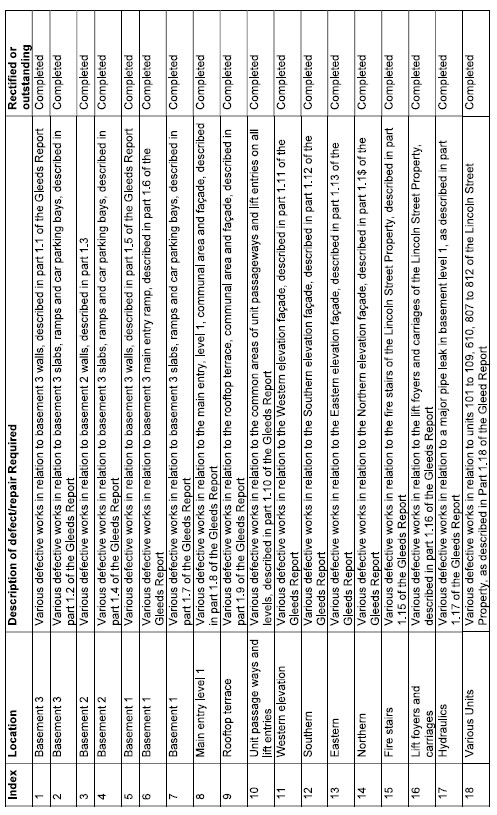
(c) B – six major defect items identified at the time of practical completion
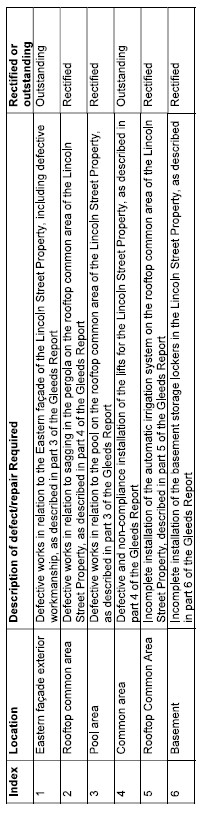
(d) C – four major defect items identified after practical completion
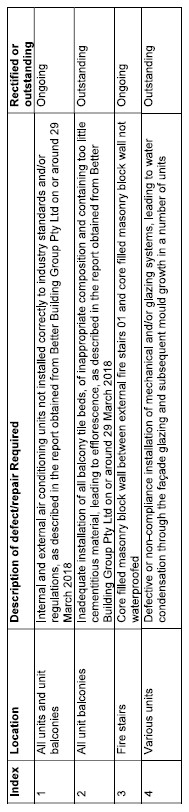
It is to be noted that all of these 28 items are assumed to be defects under the Lincoln contract, based on a general reference to a part of one of the Gleeds or BBG reports to which each is correlated without any attempt being made to explain why that conclusion is valid.
133 At [9] of his affidavit, Mr Gaskin-Harris summarised the costs totalling $1,299,565.01 which he claimed Lincoln had expended to date to remedy the 28 items of assumed defects identified in the three schedules above as follows:
(a) $875,412.94 paid to BBG for Remediation Works in respect of:
(i) completion of various minor defects identified in Schedule A;
(ii) rectification of defective installation of air conditioning units, being item 2 of Schedule C;
(iii) rectification of missing or defective irrigation to garden beds, being item 5 of Schedule B;
(iv) completion of incomplete and defective works in relation to basement storage areas, being item 6 of Schedule B;
(v) rectification of defective waterproofing and drainage in basement fire stairs, being item 3 of Schedule C;
(b) $69,090.90 paid to Xenia Constructions (QLD) Pty Ltd (Xenia), for Remediation Works in relation to:
(i) defective installation of glass balustrading by CRCG;
(ii) defective glass door panels in various parts of the Lincoln Street Property; and
(iii) rectification of fire rating deficiencies, including fire isolation systems for the Lincoln Street Property
(c) $62,015,47 [sic] paid to various other entities for sundry Remediation Works and associated incidental costs;
(d) $130,130 paid to Toohey Design Management Pty Ltd (Toohey), which relates to design services in respect of the Remediation Works;
(e) $43,291.69 paid to King & Wood Mallesons, which relates to legal work performed in relation to contractors and subcontractors ; and
(f) $119,624,01 [sic] recorded as costs of internal Devcorp personnel (Devcorp Internal Costs) upon which I elaborate below.
(Bold in original)
134 A number of observations are called for with respect to the six items set out above. First, no attempt has been made to reconcile any of those items above with the defect items for which the Administrators have accepted liability in the amount of $409,945.22 (see at [48(n)] and Annexure 1 to the Notice of Rejection of Lincoln’s Proof of Debt at [49] above). Secondly, with respect to [9(a)] above, no attempt has been made to apportion the total figure of $875,412.94 to the five items listed in that subparagraph. Thirdly, none of the three items in [9(b)] above appears to have been mentioned in any of the three schedules. Fourthly, no explanation was given as to how the sundry and associated incidental costs in [9(c)] above, the design services in [9(d)] above and the legal fees in [9(e)] above were connected with the remediation of any of the defects listed in the three schedules.
135 At [10], Mr Gaskin-Harris annexed the invoices which he claimed had been “rendered to, and paid by, Lincoln, in relation to the Remediation Works referred to in paragraph 9 above”. However, beyond the following general description, no attempt was made to reconcile any of the hundreds of items of assumed defects mentioned in the 367 pages of invoices attached, with any of the 28 items listed in the three schedules:
… In particular, invoices rendered:
(a) by BBG in relation to the Remediation Works referred to in paragraph 9(a) above are annexed at pages 25 to 220;
(b) by Xenia in relation to the Remediation works referred to in paragraph 9(b) above are annexed at pages 221 to 243;
(c) in relation to the sundry Remediation Works and incidentals referred to in paragraph 9(c) above are annexed at pages 244 to 297;
(d) by Toohey in relation to the services referred to in paragraph 9(d) above are annexed at pages 298 to 344;
(e) by King Wood & Mallesons in relation to the services referred to in paragraph 9(e) above are annexed at pages 345 to 391.
136 With respect to [9(f)] above (see at [133]), at [11]-[16] of his affidavit, Mr Gaskin-Harris annexed a further 62 pages of documents which he said comprised “copies of internal bills recording the Devcorp Internal Work”. Again, beyond the following general statements, no attempt was made to explain how that work was connected with the remediation of any of the 28 items listed in the three schedules:
15. On the basis of my experience in the construction and development industry, I believe that the rates recorded in the Devcorp Schedule are commensurate with rates charged by other entities in that industry.
16. In the premises of the preceding paragraphs 11 to 16 I believe that:
(a) the Devcorp Internal Work was a necessary element of the Remediation Works;
(b) the Devcorp Internal Costs were reasonably incurred;
(c) the quantum of the Devcorp Internal Costs reasonably reflects:
(i) the opportunity cost of engaging the Devcorp Personnel to complete the Devcorp Internal Work; and
(ii) the likely costs that Devcorp would have incurred had external resources been engaged to complete the Devcorp Internal Work.
137 From [17] of his affidavit, Mr Gaskin-Harris turned to address the matter of the “Remediation works outstanding”. He explained, at [18], that those works remained incomplete “owing to the nature and extent of the Defects”. At [19], he described those items in the following terms:
(a) defects in the construction of the eastern façade of the Lincoln Street Property, as set out in item 1 of Schedule B and the Gleeds Report;
(b) defective installation of the lifts in the Lincoln Street Property, which are presently non-compliant with relevant standards, as set out in item 4 of Schedule B and the Gleeds Report;
(c) defective installation of tiles on all unit balconies in the Lincoln Street Property, as set out in item 2 of Schedule C and the Gleeds Report;
(d) the Condensation Defects.
As with the three schedules above, with the exception of (d), for which no information was provided, the other three items were assumed to be defects under the Lincoln contract based on a reference to a part of the Gleeds report to which each is correlated without explaining why that conclusion is valid.
138 At [23], Mr Gaskin-Harris annexed a report which he said he had obtained on 15 July 2020 from Ripple Capital Solutions, a firm of quantity surveyors. He claimed that report disclosed that the estimated costs of the outstanding remediation works was approximately $3,263,200. When Mr Peter Dunning QC for Lincoln attempted to tender this report at the trial, Mr Turner for the Administrators objected. After hearing argument, that tender was rejected (see Shafston Avenue Construction Pty Ltd, in the matter of CRCG-Rimfire Pty Ltd (subject to deed of company arrangement) v McCann (No 2) [2020] FCA 1444). This is the first of the two further documents mentioned earlier that Lincoln attempted to tender with respect to this issue.
139 At this point, it is convenient to deal with the other document in that category. It related to the fourth item of Schedule B, namely the defect claimed to exist in the lifts in the Project, and raised the admissibility issue mentioned earlier (see at [60] above). Specifically, Mr Dunning sought to tender an email Mr Gaskin-Harris received on 2 August 2017 from Mr Matthew Molony of the firm, GoingUp Elevators. The subject of Mr Molony’s email was “Lift openings to outdoors”. This related to Item 4 in Schedule B above (at [132]). In the first two paragraphs of his email, Mr Molony stated:
To followup from our telephone conversation this morning I am writing to express my opinion that it would be highly negligent to construct a lift shaft with openings directly exposed to the elements. Should the lift doors be left unprotected it is inevitable that at some stage the lift will experience exstensive [sic] water damage rendering it unsafe to operate.
Australian lift code dictates that any ropes or safety equipment that come into contact with moisture is to be condemned and replaced which will result in expensive repairs and extended periods of shut down. In my experience I have seen multiple lifts written off during installation due to unprotected openings, the resulting insurance process is slow and will often result in the delay of the building handover for months.
140 In support of this tender, Mr Dunning relied on the business records exception (s 69) to the hearsay rule exclusion (s 59) in the Evidence Act 1995 (Cth) (the Evidence Act). He pointed out that Mr Molony’s email was created well before this proceeding was filed in September 2018 and was not therefore excluded as a document prepared in an anticipation of this litigation (s 69(3)(a)). He contended that the views expressed in the email were based on Mr Molony’s specialised knowledge gained from his training or experience. Accordingly, he contended that, provided that s 79 of the Evidence Act was adhered to, which he contended it was, the email was admissible under s 69 of the Evidence Act as a document kept in the ordinary course of a business undertaking “by a person who had or might reasonably be supposed to have had personal knowledge of the asserted fact”. Relying on s 58 of the Evidence Act, he also contended that the specialised knowledge Mr Molony possessed to make the observations he did in the email could be inferred from its contents. Finally, he contended that the judgment in Lithgow City Council v Jackson (2011) 244 CLR 352; [2011] HCA 36 (Lithgow) was not applicable to this tender because that matter concerned lay expert opinion evidence under s 78 of the Evidence Act.
141 Mr David Turner, for the defendants, contended that it was clear from the statement in the first line of Mr Molony’s email that he was expressing an opinion about the lift shaft openings. Since Lincoln did not rely upon s 78 of the Evidence Act, that meant, so he contended, that it had to comply with s 79. However, he contended it could not do that because there is no evidence as to Mr Molony’s specialised knowledge, in particular his qualifications, work experience or training. He contended that those matters could not be inferred from the face of the email itself. Finally, and in any event, he contended the email should be excluded on discretionary grounds, first, because Mr Molony was not made available for cross-examination and, secondly, because of the history of Lincoln’s failure to comply with case management orders relating to expert evidence.
142 For the following reasons, I do not allow the tender of Mr Molony’s email. First, it is clear from his email that Mr Molony has purported to express an opinion about the faulty construction of the lift shaft and the measures that may be taken to address that state of affairs. As such, it is common ground that Lincoln needs to comply with the opinion rule exception concerning specialised knowledge in s 79 of the Evidence Act. In this respect, I do not consider the following statement of French CJ, Heydon and Bell JJ in Lithgow (at [19]) draws any relevant distinction between ss 78 and 79 of the Evidence Act:
There are strong textual reasons supporting Basten JA’s doubts and indicating that the conclusion is not merely to be doubted, but is wrong. Section 69 is in Pt 3.2 of the Act. Sections 76-79 are in Pt 3.3. Section 56(1) (24) contemplates that relevant, ie otherwise admissible, evidence may be excluded by more than one exclusionary rule in Pts 3.2-3.11. One exclusionary rule is the hearsay rule. If evidence satisfies s 69, then by s 69(2) the hearsay rule does not apply. But s 69(2) does not provide that the evidence is admissible. It is only admissible if no other exclusionary rule applies. Section 76 excludes “[e]vidence of an opinion” – not “evidence by a witness of an opinion”. There is no indication in any other provision in Pt 3.3 that it operates only in relation to the opinions of witnesses.
(Italics in original)
143 The difficulty for Lincoln in complying with s 79 has been highlighted by Mr Turner. It is that there is no evidence as to Mr Molony’s qualifications, training or work experience in relation to lift shafts and their construction. Specifically, there is no information on the face of the email itself from which any of these matters could be inferred under s 58 of the Evidence Act. Indeed, the email does not even indicate what position Mr Molony holds in the firm GoingUp Elevators. Without such information as to the relevant specialised knowledge, if any, Mr Molony holds, the opinions expressed in his email do not meet the requirements of s 79 of the Evidence Act.
144 Secondly, and in any event, even if Mr Molony’s email were admissible under the provisions of the Evidence Act, I consider it should be rejected on case management grounds under s 37P(6)(c) of the Federal Court of Australia Act 1976 (Cth). The history of this proceeding recorded earlier shows a continual failure by Lincoln to comply with the trial programming orders made in this matter, in particular, with respect to the expert evidence Lincoln wished to rely upon. Ultimately, its failings resulted in it being restricted to the evidence listed at Order 7 of the orders made on 9 July 2020 (see at [57] above). Mr Molony’s email falls outside the terms of that Order and it does not fall within the terms of Order 8 (see at [58] above). Thus, to allow the tender of this expert evidence in this manner would serve to compound Lincoln’s aforementioned history of non-compliance with the orders of this Court. For these reasons, I reject the tender of Mr Molony’s email dated 2 August 2017. This rejection means that there is no evidence before the Court to demonstrate that there is a genuine defect in the lifts in the Project within the terms of the Lincoln contract.
145 To return to Mr Gaskin-Harris’ affidavit, most of the deficiencies in it have already been highlighted in passing above. In brief summary, they are:
(a) he provided the total cost of remedying all items on the assumption they were all genuine defects under the Lincoln contract without any explanation to justify that conclusion;
(b) related to (a) above, he made no attempt to distinguish between the defect items for which the Administrators have accepted liability and the remainder of the items in the three schedules annexed;
(c) he also made no attempt to reconcile any of the myriad invoices annexed to his affidavit to any of the 28 assumed defect items listed in the three schedules annexed;
(d) he included several items that on their face do not involve the remedying of defects, for example legal fees;
(e) he did not address each item individually and provide reliable evidence as to the reasonable costs of remedying each; and
(f) following the exclusion of the Priddle report, he has not provided any reliable evidence of the estimated costs of remedying any of the assumed defects items in Schedule C.
Conclusion
146 To return to the question posed above (at [109]), based on the evidence reviewed above, I am not satisfied that Lincoln has discharged its onus to prove that the Administrators were wrong to reject its amended Proof of Debt because it failed to provide sufficient information to demonstrate that the remainder of its claims for which the Administrators did not accept liability constituted true liabilities of CRCG. In this respect, it is important to reiterate that this conclusion stems directly from the deliberate forensic choice that Lincoln made not to adduce any expert evidence at the trial of this matter to explain why the items it had identified as defects were genuine defects under the Lincoln contract. Instead, it decided to rely only on the materials that it had already provided to the Administrators in its amended Proof of Debt and the two further documents mentioned above, the tender of which has been rejected. For these reasons, it is unnecessary to answer the question posed in Issue 13 above and the answer to each of the questions posed in Issues 14(a) to 14(d) above is “Except for the defects that have been accepted by the Administrators, ‘no’”. Finally, the answer to the question posed by Issue 14(e) above is “$409,945.22”, being the total amount of defects for which the Administrators have accepted liability.
LINCOLN WARRANTIES CLAIM – ISSUES 15 TO 18
Introduction
147 These issues concern the warranties that CRCG was required to procure and provide to Lincoln under the Lincoln contract. Issues 15 and 16 are directed to identifying which warranties CRCG failed to provide to Lincoln and Issues 17 and 18 are directed to quantifying the loss it suffered as a result of that failure.
148 In its original Proof of Debt, Lincoln’s claim for this item was stated “TBA” (see at [43] above). The details of its claims were therefore first provided in its first amended Proof of Debt where it claimed $2,205,135.44 and set out a table listing 12 warranty items that it claimed had not been provided (see at [45] above). This claim was based on a report prepared by Mr Darryl Bird of the firm Mitchell Brandtman. The reasons the Administrators gave for rejecting that claim appear at [48(q)]-[48(v)] above. In essence, they put two components of the claim in dispute: the methodology used by Mr Bird to calculate the claim; and which warranties had, or had not, been provided to Lincoln.
The warranties that CRCG was required to provide
149 The clauses of the Lincoln contract that defined the warranties that CRCG was required to provide to Lincoln were cl 44.8 in the body of the contract and cl 15.8 to Annexure C, where the “Principal Project Requirements” were delineated. The latter contained the following table:
ITEM | WARRANTY PERIOD/MAINTENANCE PERIOD |
Glazing | Manufacturers standard |
Roof Sheeting | 7 years |
Waterproofing | 7 years |
Carpet | Manufacturers standard |
Landscaping | 12 weeks maintenance, weeding and watering |
Electrical | 7 years |
Mechanical | 7 years |
Fire Systems | 7 years |
Hydraulics | 7 years |
Lift Services | 7 years |
Lift Services | 12 months maintenance to be incl. |
Pool | 7 years |
Other | Manufacturers standard |
150 In its closing submissions, Lincoln set out the following table which it claimed described the warranties that had, or had not, been provided by CRCG:
Item | Warranty Period/Maintenance Period Required | Actual Warranty Provided |
Glazing | Manufacturer’s standard | 10 years |
Roof sheeting | 7 years | None |
Waterproofing | 7 years | 10 years |
Carpet | Manufacturer’s standard | Manufacturer’s warranty |
Landscaping | 12 weeks maintenance, weeding and watering | None |
Electrical | 7 years | Workmanship – 1 year Switches – 1 year Light fittings 1 year Mains and submains 1 year GPO’s Data Points – 1 year |
Mechanical | 7 years | 1 year – vent plant and 5 years air conditioning plant |
Fire Systems | 7 years | 7 years |
Hydraulics | 7 years | 1 year |
Lift services | 7 years | 7 years |
Lift Services | 12 months maintenance to be incl | 7 years |
Pool | 7 years | Pump – 2 years Filter – 10 years Chlorinator – 2 years Waterproofing – 10 years Cosmetic – 3 years Structural – 6.5 years Spa light – 3 years |
Other | Manufacturer’s standard | Pumps – 1 years Timber doors – 5 years |
(Errors in original)
Subject to the matters noted below (at [158]), this table substantially corresponds to the similar tables set out in Mr McCann’s affidavit with respect to this issue so I accept it as broadly accurate.
The evidence on the methodologies used to calculate Lincoln’s loss
151 As already mentioned, to calculate the value of its loss, Lincoln relied upon the report prepared by Mr Bird. For their part, the Administrators relied upon a report prepared by Mr Michael Sanig. Both of these witnesses are qualified and experienced Quantity Surveyors. At the trial, they were both cross-examined on the contents of their reports.
Mr Bird’s report
152 Mr Bird prepared his report at the request of Mr Gaskin-Harris. Thus, in its first paragraph, he stated “We refer to your email of 16 April 2018 and provide herein our opinion in regard to the value of the Trade Warranty allowance of $2,052,619.00 proposed by Devcorp”. He then set out the documentation he had relied upon.
153 Thereafter Mr Bird set out the premises that he had relied upon and, under the heading “Valuation Methodology”, the methodology he had used in preparing his report. His premises were stated as follows:
The Trade Warranties the subject of the nominated allowance and required by the contract provisions with [CRCG], are largely not standard or typical in the industry and therefore the value of this contractual obligation should be given due consideration in this review.
We further note that the information presented indicates that the quantum of Defective works identified on this particular development to date is significant. We understand that [Lincoln] hold retention / security totaling [sic] $2.15M (being 10% of the contract sum) to assist in the rectification of such defects.
However, based on the estimated costs of the known defective works provided for the preparation of this report, this Retention provision is expected to be insufficient to cover the quantum of these known defective works.
Furthermore, it was noted during our review of the information presented for this report that some of the estimates for the rectification of defects presented could be lacking sufficient provisioning for particular cost factors such as:
• Builders Preliminaries type costs (eg. supervision of works, crane/materials handling, scaffolding, insurances, etc.). A provision of 20% of the cost of the subject works is not considered unreasonable.
• Construction Cost escalation - it is prudent to allow provision for Construction Cost escalation when provisioning / setting budgets for future constructions works. A minimum escalation allowance / provision of 2.5% per annum is considered reasonable.
• Decanting / Temporary Relocation Costs – given the nature of the major defect and warranty works already identified it is anticipated that there will be costs incurred in decanting and / or temporarily relocating owners / tenants, their belongings, etc. to facilitate the required works. The quantum of such costs cannot be calculated at this time however can be significant.
• Consequential Works / Costs – such as:
o Works to other trades, etc. that are required as part of the rectification of a particular defect item
o Provision of temporary services or alternate facilities whilst defective works are repaired
The quantum of these potential costs cannot be calculated at this time.
The quantum and scale of the identified defective works as well as the current estimated cost of rectifying these works is the basis for significant concern regarding the potential risk of further significant defect items on this project being identified into the future emphasizing the importance of and value of the Trade Warranty allowance.
154 He next described his valuation methodology in the following terms:
It is noted that the security / retention provisions under the contract for these works equate to 10% of the contract sum. Industry standard provisions are that retention is held during the Defects Liability Period (Warranty Period), being the period within which the contractor is to rectify any defects or omissions in or to the works under the contract for which the contractor is responsible, totaling [sic] 50% of the retention provision held during the course of the project works. For this project this provision would be 5% of the contract sum. These retention provisions provide basis / a starting point for our valuing of the Trade Warranty allowance proposed.
The Trade Warranty provisions apply only to the specific trades highlighted within your email of 16 April 2018. The valuation method herein is therefore limited to these trades with the exception of the Lift installation. The Lift installation has been separately included within this valuation assessment as, whilst it has and continues to operate, the installation currently in place is considered a non-compliant installation (on the basis of exposure to the elements / weather protection) and therefore will require replacement in the future. We note the estimate for the replacement of the current lifts is $510,000.00.
155 Finally, Mr Bird set out his calculations with respect to the three components of the warranty claims. The first was his calculation of the value of the 1 year / default Trade Warranties that had not been provided. He calculated that to be $45,717.30 (excluding GST). The second was his calculation of the 7 year Trade Warranties that had not been provided. He calculated that at $1,547,418.14 (excluding GST). The third and final component related to the lift installation. He calculated that component at $612,000.00 (excluding GST).
156 In the concluding paragraphs of his report, Mr Bird estimated the total value of the Trade Warranties that had not been provided at $2,205,135.44 (excluding GST) and expressed the following qualification:
…
We note that this report and valuation herein has been prepared within a short time frame and is therefore based on a desktop review of the documentation provided. The information and commentary herein should be reviewed when further and more detailed information is available.
…
157 Mr Bird annexed a table to his report which set out the details of his calculations. Lincoln provided an amended version of that table in its closing submissions stating that it had been amended to remove any reference to those items in respect of which warranties had been provided in accordance with the Lincoln contract. That amended table was in the following form:
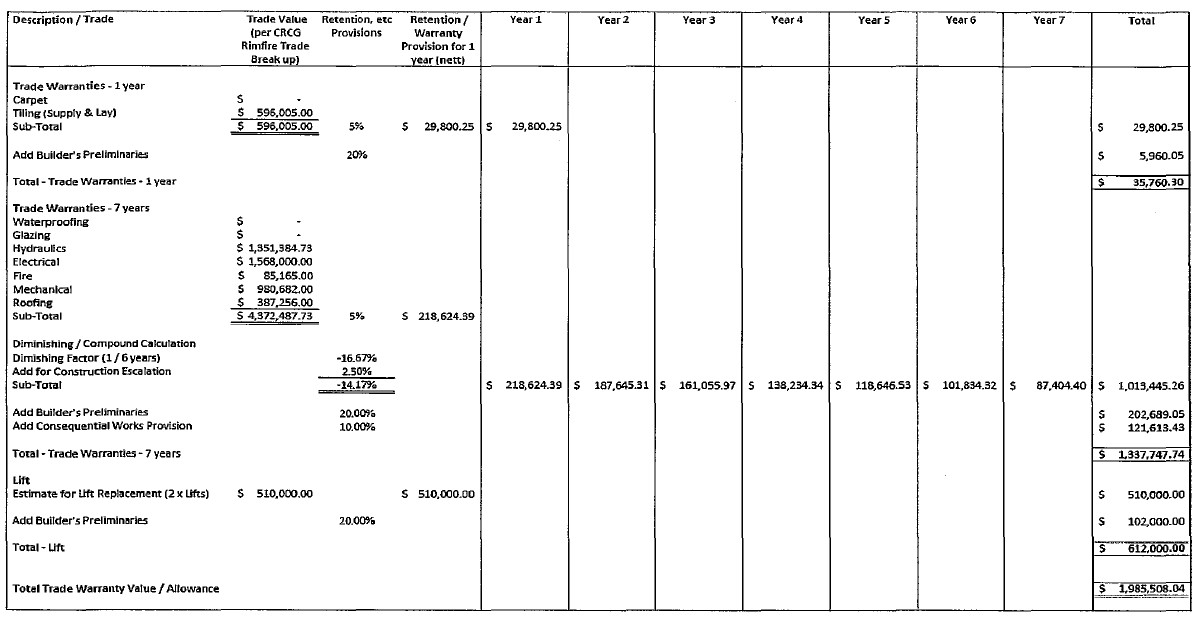
158 At this point, it is worth noting the following features of this table:
(a) the items relating to glazing, waterproofing and carpets have been excluded from the table at [150] above because full contractual warranties were provided for them;
(b) despite being treated as items where no warranties were provided, partial warranties were in fact provided for the items: hydraulics, electrical and mechanical (see at [177] below]);
(c) the items for landscaping and pool have been excluded from the table at [150] above apparently because of the short warranty period involved with the former and the substantial compliance in the provision of warranties with respect to the latter; and
(d) given the inclusion of the items for fire and hydraulics above, I presume the indication in the table at [150] above, that full warranties were provided for those items, is an error.
Mr Sanig’s report
159 Clayton Utz, the Administrators’ lawyers, requested Mr Sanig to prepare his report. Since it was expressly provided for the purpose of the present proceeding, at paragraph 2.24, it contained the following statement: “I have been provided with and read r.23.13 of the Federal Court Rules 2011 (Cth) (“Contents of an expert report”) together with a copy of Expert Evidence Practice Note GPN-EXPT and agree to be bound by them”. At paragraph 1.10 of the Executive Summary to his report, Mr Sanig set out the matters upon which he had been asked to provide his opinion. They were:
…
a. First, on the assumption that no warranties have been provided as required by the relevant parts of the Contract.
b. Secondly, on the assumption that warranties contained in the subcontracts that I have been provided with, have been provided.
I am also asked to comment on the methodology and some assumptions made by Lincoln’s quantity surveyor report prepared by Mitchell Brandtman …
160 As to the opinion sought in (a.) above, at paragraph 1.11 of the Executive Summary to his report, Mr Sanig summarised the opinions he had expressed in the body of his report as follows:
… I agree with [Mitchell Brandtman’s] overall methodology of how they have valued the warranties which I consider aligns with industry practice. However, I disagree with some of the assumptions and additions they have made to their calculation as follows:
a. I agree with [Mitchell Brandtman] that it is appropriate to use the retention amount as the cost of the warranty in year 1 because that figure represents the parties’ view of the chance that the warranty will be called upon. However, I disagree with the figure used. [Mitchell Brandtman] uses a baseline percentage of 5% for the value of the warranties in year 1 after the Date of Practical Completion (presumably because they were instructed that up to the Date of Practical Completion there was a retention value of 10%), however I consider that it is appropriate to adopt as the starting point for valuing the warranties the actual retention value for the period after the Date of Practical Completion as disclosed in the Contract. I explain this in more detail in Section 10.
b. [Mitchell Brandtman] has added figures to its warranty calculation for escalation costs and builder’s preliminaries. In my opinion those matters should not be added to the warranties as industry practice. I explain my reasons for this in Section 10.
c. Furthermore, [Mitchell Brandtman] has valued the warranties on a holistic basis for both workmanship and manufacturer supplied items for the entire duration of each warranty. However, in my opinion, warranties for manufacturer supplied items would generally never be given for more than 1 year. I have therefore calculated the value of the warranty for the period after year 1 on the basis that they are only for workmanship.
161 With respect to the retention value matter addressed in (a.) above (at [160]), Mr Sanig provided the following explanation in the body of his report:
10.10.6 | The amount of 5% which [Mitchell Brandtman] has adopted is consistent with the instructions that they were given. However, it is not consistent with the actual contractual documents. I have used, in my analysis in Spreadsheet B, the actual retention amount for the year following the Date of Practical Completion (i.e. 2.5%), because that is the amount in the contract. |
10.10.7 | To identify that amount, I have considered the following documents: |
a. | The original building contract dated 27 May 2016 which shows that 5% overall security retention will be held and 2.5% will be released upon reaching the Date of the Date of Practical Completion. Therefore, the retention security to be held for the Defects Liability Period (i.e. the year following the Date of Practical Completion) is 2.5%. See Clause 5.4 of the Contract and Item 11 in Annexure ‘A’. |
b. | The original contract superseded by the Deed of Novation dated 13 March 2017 which shows that 10% overall security retention will be held and 7.5% will be released upon reaching the Date of Practical Completion. Therefore, the retention security to be held for the Defects Liability Period is 2.5% (i.e. 10% less 7.5%). See Clause 4 (g) – (i) of Novation Agreement which includes an Amended Item 11 of Annexure ‘A’. |
c. | The original Trade Subcontracts which show that the 5% overall security retention will be held and 2.5% will be released upon reaching the Date of Practical Completion. Therefore, the retention security to be held for the Defects Liability Period is 2.5%. (See Clauses 4.1, 4.2 and 4.7 of Lift Installation Subcontract Agreement) |
(Errors and bold in original)
162 With respect to the matters of escalation costs and builder’s preliminaries addressed in (b.) above (at [160]), Mr Sanig provided the following explanation in the body of his report:
[Escalation costs] | |
10.9.4 | Whilst I agree with the methodology, I do not adopt the numbers or percentages to which [Mitchell Brandtman] has had regard. Nor do I adopt the additional components of the calculation, being, the construction escalation and builder’s preliminaries. I also do not agree with [Mitchell Brandtman’s] treatment of the warranties on a holistic basis. In my view, they should be split into the cost of labour and the cost of plant and equipment. I address my reasons for this disagreement in paragraph 10.10.9 below. |
[Builder’s preliminaries] | |
10.10.14 | [Mitchell Brandtman] has adjusted each warranty by a 20% mark-up to allow for Builder’s Preliminaries (i.e. the builder’s non-productive overheads on site such as toilets, site office etc.). However, I do not consider that it is appropriate when valuing future warranties to take this figure into account because, the Builder’s Preliminaries should not be part of the trade subcontractors warranty cost (as a cost which the subcontractor would allow for in its pricing of future warranties). If such a provision was to be made, I would expect that it would have been included in the builder’s initial contract price. |
10.10.15 | Further, in my more than 40 years’ experience in the construction industry it is highly unlikely that the Builder would be involved in warranty work years into a warranty period. It is therefore highly unlikely that any builder’s preliminaries would be required for such warranty work. For these reasons, I have not included this mark-up in my calculations. |
(Bold in original)
163 With respect to (c.) above (at [160]), in their closing submissions, the Administrators stated that they did “not press for the warranty claim to be reduced by 50% in years 2 and following, for it is acknowledged that the Lincoln contract does not contemplate that reduction”. To address this change of position, the Administrators attached to their closing submissions a recalculated version of Spreadsheet C which was attached to Mr Sanig’s report. That amended spreadsheet was in the following form:
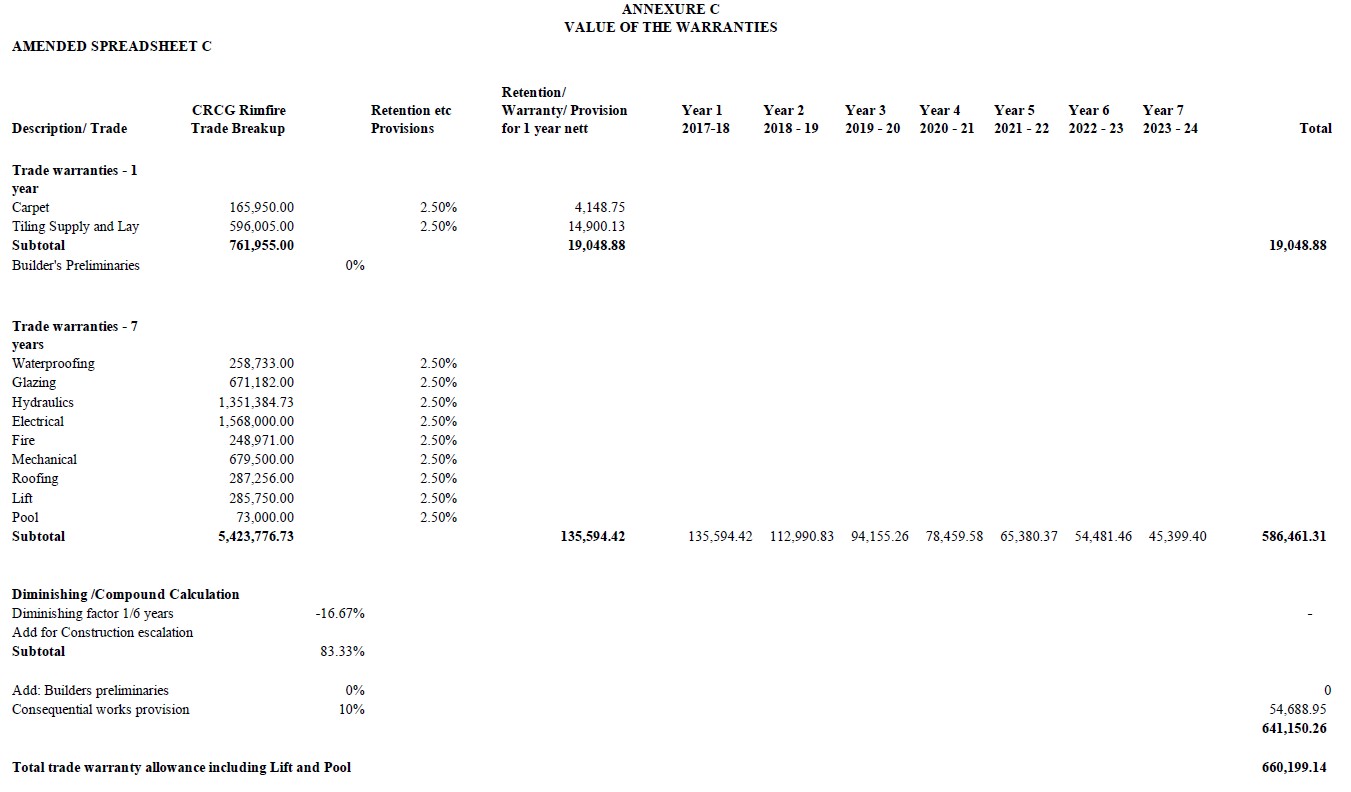
164 Next in the Executive Summary to his report, Mr Sanig addressed the opinion sought in (b.) above (at [159]). In respect of that matter, he stated (at paragraphs 1.13-1.14):
1.13 In terms of the second basis I have adopted the same considerations as I did for the first basis. In addition, I have departed from the Value Assumption made by [Mitchell Brandtman] because in my opinion that assumption which was made based on a trade breakup cannot, from the material available, be verified as representing the actual costs incurred. I have therefore used the contract sums in the various subcontracts as the best available information as to the value of the works.
1.14 To arrive at a value on this basis I have valued the warranties as required by the contract in accordance with my assumptions, and I have valued the warranties which I am instructed have been provided by or on behalf of [CRCG], to determine a value for the balance of warranties that were not provided. I explain this calculation in Section 10.
165 With respect to the value assumption matter addressed in paragraph 1.13 above, Mr Sanig explained in the body of his report that he had:
10.11.15 | … adopted the subcontract amounts in my calculations not by reason of any difference in methodology or principle (because as I describe above, I agree with [Mitchell Brandtman] that it is appropriate to value the warranties starting with the value of the works for which that warranty is provided), but, rather, because, practically, it is not possible on the material I have been provided with to verify whether the trade break-up relied upon by [Mitchell Brandtman] is accurate and represents the true amounts paid for the various subcontract works. I can however be satisfied that the values disclosed in the subcontracts were at least, at the time they were entered into, contemplated to be fair and reasonable value for the works. I therefore consider that those figures should be adopted in the absence of information to the contrary. |
166 In the penultimate paragraph to the Executive Summary of his report (1.15), Mr Sanig came to the following conclusion with respect to (b.) above (at [159]): “Based on my calculations the value of the warranties on this basis is $108,353.44 being the values calculated in Spreadsheets C and D which are attached to Annexure D”. With respect to the latter, in addition to annexing the recalculated version of Spreadsheet C to their closing submissions (see at [163] above), the Administrators also annexed a recalculated version of Spreadsheet D. It was in the following form:
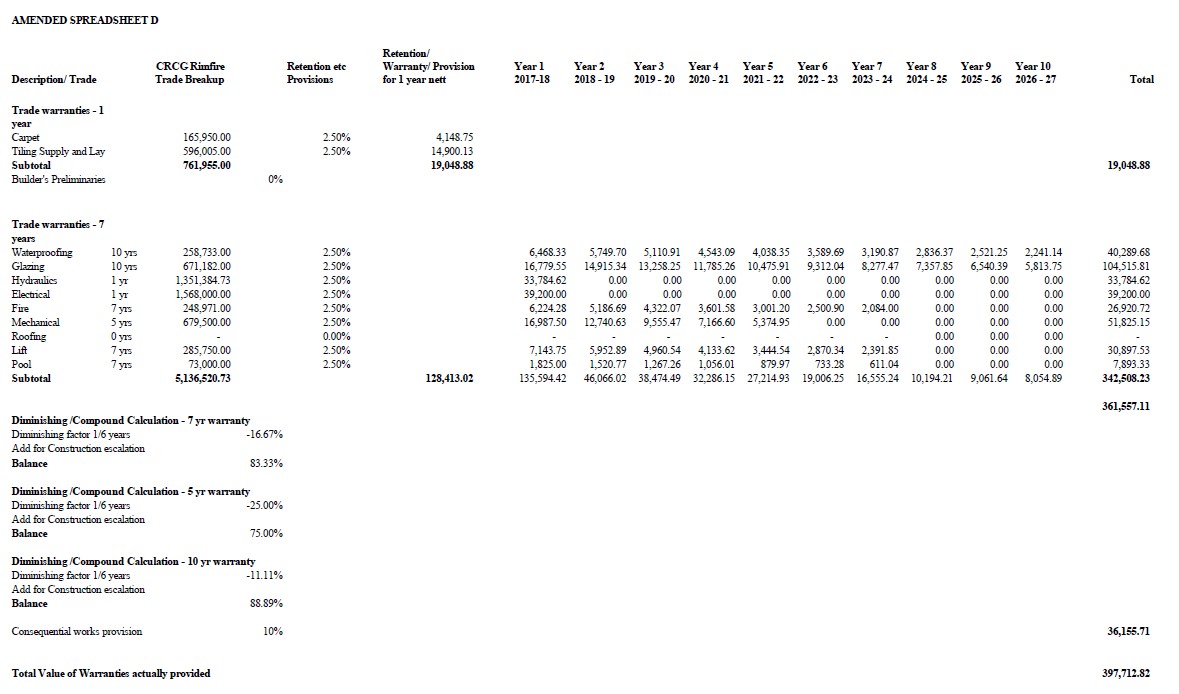
167 Finally, at paragraph 1.16 of the Executive Summary to his report, Mr Sanig said that he had not included the lift “at its claimed replacement cost”, but had rather “valued the lift warranty in accordance with my approach to all of the warranties”.
Contentions
168 Lincoln contended that most of the warranties required by the table in cl 15.8 were for a seven year period and, to the extent that they had not been provided by CRCG, it “did not get what it paid for and CRCG [was] in breach of the [Lincoln] contract”. It claimed that Mr Bird’s method of calculating the value of the loss of those warranties was valid and should be accepted. On the other hand, it contended that Mr Sanig’s valuation was “fundamentally flawed”, essentially because it made no allowance for years 2 to 7 of the workmanship warranties.
169 The Administrators contended that both Mr Bird and Mr Sanig had adopted a similar methodology for valuing the loss of those warranties and both had agreed that the purpose of the valuation was to value the risk of failure in the materials or workmanship supplied for the Lincoln on the Park Project. They contended that an allowance should be made for the full value of those warranties that CRCG had provided because the intention was to put Lincoln in the same position as it would have been if the contract had been performed. It contended that the following aspects of the methodology used by Mr Sanig should be adopted in preference to that of Mr Bird essentially because Mr Sanig’s report was prepared as an expert’s report and Mr Bird’s was not:
(a) the percentage amount applied to the value of the warranties in year 1 (which then also forms the basis for subsequent years) ought to be 2.5%, being that actual contract retention amount for the Defects Liability Period;
(b) the starting value for the warranties should be the actual subcontract amounts, rather than the unverified trade break-up summary used by Mr Bird;
(c) builders’ preliminaries should not be included, for they are not always likely to be needed when warranty works are undertaken, are often costs which a builder would factor in when pricing the work to be done under the building contract, and would not usually be taken into account by a subcontractor as the cost of providing a warranty;
(d) an escalation amount (for inflation) should not be included, for while it may be taken into account by a subcontractor when pricing a warranty, the subcontractor may also bear the increase in costs for inflation itself.
(Footnotes omitted)
Applying this approach and based on the amended spreadsheets attached to their closing submissions, they contended that the value of the warranties not provided by CRCG to Lincoln should be assessed to be in the total net sum of $262,486.32. This figure was obtained by deducting from the final figure shown in the recalculated version of Spreadsheet C (at [163] above), the final figure shown in the recalculated version of Spreadsheet D above (at [166]).
Consideration
170 One of the main principles pertinent to these issues has already been identified with respect to the previous issues (at [105] above). It is that Lincoln is entitled to a monetary sum by way of damages for CRCG’s breach of contract that puts it in the same situation “so far as money can do it, as it would have been in had the broken promise been performed”, or, put differently, “the monetary value of faithful performance” (see Macourt at [106] and [107] respectively per Keane J). That sum is intended to provide “reasonable compensation for the breach ‘without imposing a liability upon the other part exceeding that which he could fairly be regarded as having contemplated and been willing to accept’” (see Baltic Shipping Company v Dillon (1993) 176 CLR 344 at 380 per Deane and Dawson JJ).
171 On the other hand, as was made clear in Tabcorp and, before it, in Bellgrove, the proper measure of damages is not the difference in value between what the plaintiff paid and what it received or, in a building contract context, the value of the building actually constructed compared to its value had it been constructed in accordance with the contract (see Tabcorp at [15] and Bellgrove at 617, set out at [105] above). For this reason, I reject the Administrators’ contentions that Lincoln’s damages should be calculated by deducting the value of the warranties that CRCG actually provided to Lincoln from the value of those warranties that were contractually required to be provided. That contention is even more untenable where it concerns the warranties that CRCG provided for periods longer than the seven year period provided for in cl 15.8. That is so because it entirely ignores cl 36(a) of the Lincoln contract which expressly stated that “such additional warranties shall be provided to [Lincoln] by [CRCG] at no cost and expense to [Lincoln]”. It follows from these conclusions that the approach outlined by the Administrators above (at [169]) of deducting the total figure in Amended Spreadsheet D from that in Amended Spreadsheet C is fallacious and cannot be adopted. I will return to the question whether any deduction should be made to Lincoln’s damages for this factor later in these reasons.
172 That issue aside, the parties appear to have approached the assessment of Lincoln’s damages on a number of unstated, but nonetheless valid, mutual assumptions. They were:
(a) that there had been a breach of cl 44.8 of the contract and cl 15.8 of Schedule C thereto;
(b) that, as a result, there was more than a negligible chance of Lincoln suffering future loss, that is the future loss associated with being required to remedy faulty materials and/or workmanship in the Lincoln on the Park Project without having the ability to call on the trade warranties; and
(c) that the methodology used by Mr Bird and Mr Sanig to evaluate Lincoln’s loss was appropriate in the circumstances.
173 It should be noted that the assumption in (c) is valid because that methodology is properly directed to evaluating damages of this kind by assessing the probability of an event of the kind described in (b) above occurring (see Sellars v Adelaide Petroleum N.L. (1994) 179 CLR 332 at 350 per Mason CJ, Dawson, Toohey and Gaudron JJ and Malec v J.C. Hutton Proprietary Limited (1990) 169 CLR 638 at 643 per Deane, Gaudron and McHugh JJ). In respect of this approach to assessment, it is also worth noting the caution expressed by Brennan and Dawson JJ in Malec at 640 that “[d]amages founded on hypothetical evaluations defy precise calculation”. This caution serves as a convenient reminder that calculations of this kind are not intended to dictate a precise figure for Lincoln’s damages, but rather to provide an aid in assessing the fair and reasonable amount to be awarded for those damages.
174 Having regard to these principles and assumptions, it is necessary to turn to the calculations undertaken by Mr Bird and Mr Sanig. The methodology they employed was summarised in the body of Mr Sanig’s report as involving the following five factors (at 10.9.3):
a. Identify the warranties in the Contract to be valued and the relevant period for which those warranties were to be provided;
b. Establish the value of the work actually performed by the relevant subcontractors whose works are being warranted (i.e. in this case the component described in my instructions as the Value Assumption);
c. Identify, the value for the warranty in year 1 after the Date of Practical Completion by taking the relevant retention percentage for the period between the Date of Practical Completion and the completion of the Defects Liability Period (which amount is typically in the industry half of the retention percentage applicable from commencement of the contract to the Date of Practical Completion). This percentage is adopted because it is likely, in the majority of cases, that that amount would be sufficient to cover the likely costs of any defects that could arise in the year after the Date of Practical Completion. In my opinion it is appropriate to adopt that amount because it is the parties’ best estimate of the likelihood of those defects arising. In my opinion, such an approach is consistent with industry practice.
d. Identify the value of the warranties for years 2 to 7. To do this, [Mitchell Brandtman] starts with the year 1 percentage (i.e. specified in step c above) and reduces it on a compound basis, annually, for the following 6 years. This is done by reducing it each year by a further 1/6th (being the amount of time already elapsed since the Date of Practical Completion). For example, in year 2, the relevant percentage would be 5/6th of the percentage identified in year 1, then in year 3, the relevant percentage would be 5/6th of the percentage identified in year 2 etc.
e. The value of the warranty is then the total of the amounts assessed for each of years 1 to year 7.
175 Of these five factors, (a.) has already been addressed above (see at [149], [150] and [158]) and Mr Bird and Mr Sanig were agreed on factors (d.) and (e.). The areas of difference between them therefore concerned factors (b.) and (c.). As well, there were two additional components not mentioned in the methodology above. They were: escalation costs and builder’s preliminaries. There was also a third additional component upon which they were agreed, namely that a 10% allowance should be included for consequential work provisions.
176 Turning, then, to factor (b.) above (at [174]), the differences between Mr Bird and Mr Sanig with respect to that factor were described by Mr Sanig in the body of his report in the following terms:
10.11.5 | I have adopted the subcontract amounts in my calculations not by reason of any difference in methodology or principle (because as I describe above, I agree with [Mitchell Brandtman] that it is appropriate to value the warranties starting with the value of the works for which that warranty is provided), but, rather, because, practically, it is not possible on the material I have been provided with to verify whether the trade break-up relied upon by [Mitchell Brandtman] is accurate and represents the true amounts paid for the various subcontract works. I can however be satisfied that the values disclosed in the subcontracts were at least, at the time they were entered into, contemplated to be fair and reasonable value for the works. I therefore consider that those figures should be adopted in the absence of information to the contrary. |
177 This use by Mr Sanig of trade values, instead of the subcontractor values Mr Bird used, resulted in the following major differences with respect to the commencing figures each used in their calculations in relation to the following seven warranty items (including the lift item) as set out in Lincoln’s table at [157] above and the Administrators’ table at [163] above:
Warranty Item | Mr Bird | Mr Sanig |
Tiling | 596,005.00 | 596,005.00 |
Hydraulics | 1,351,348.73 | 1,351,348.73 |
Electrical | 1,568,000.00 | 1,568,000.00 |
Fire | 85,165.00 | 248,971.00 |
Mechanical | 980,682.00 | 679,500.00 |
Roofing | 387,256.00 | 287,256.00 |
Lift | 510,000.00 | 285,750.00 |
TOTAL | $5,478,456.73 | $5,016,830.73 |
178 It can be seen from this table that about a half of the difference between the total commencing figures is accounted for by the lift item. In that respect, as appears above (at [154]), the figure Mr Bird adopted for that item was based on it being a “non-compliant installation”. This information was provided to him by someone at Devcorp. Given the rejection of the tender of the Molony email (see at [144] above) and the state of the evidence with respect to the Lincoln’s defects claim issues discussed earlier, there is no evidence to support that assertion. That being so, I consider the approach adopted by Mr Sanig in his report should be adopted, namely that the lift item should be included with the other seven year trade warranty items using his figure of $285,750 (see at [166]-[167] above). That item aside, it is convenient to adopt Mr Bird’s commencing figure noting, again, the point made earlier about the general assistance, rather than precision, that these calculations are intended to provide.
179 Turning, next, to factor (c.) above, namely the appropriate retention percentage figure, it can be seen at [154] above that Mr Bird used a retention percentage figure of 10%. On the other hand, as appears at [161] above, Mr Sanig used a retention percentage figure of 5%. On this factor, having regard to the provisions of the contract that Mr Sanig has referred to at 10.10.7 of his report (see at [161] above), I accept his evidence that the appropriate figure to be used is 5%. Since both witnesses agree that that gross figure should be reduced by 50%, the final appropriate figure therefore is 2.5%.
180 Turning, next, to the first additional component: escalation costs, Mr Bird’s position on that matter is set out at [153] above, namely that the provision of a 2.5% per annum escalation allowance was considered reasonable. While Mr Sanig mentioned this matter in the body of his report at 10.9.4 (see at [162] above), he gave no explanation as to why he disagreed with its inclusion as an additional component. Having regard to the fact that some amount of price inflation is ever present in the Australian economy and in the absence of any explanation from Mr Sanig, I accept as reasonable Mr Bird’s allowance at 2.5% per annum for this component.
181 The second additional component concerns builder’s preliminaries. Mr Bird’s position on that item is set out at [153] above. It is that a provision of 20% of the costs of the subject works was not an unreasonable allowance. On the other hand, Mr Sanig’s position is set out at [162] above. It is that, based on more than 40 years’ experience in the construction industry, he did not consider it was reasonable to include such an allowance. On this matter, I am persuaded by Mr Sanig’s views and, accordingly, I consider no allowance should be included for builder’s preliminaries.
182 This review of the methodology and calculations used by Mr Bird and Mr Sanig results in the following changes being necessary to Mr Bird’s calculations in the table at [157] above:
(a) the “Retention, etc Provisions” should be reduced to 2.5%. As a result, the totals of $29,800.25, $1,013,445.26 and $121,613.35 should be reduced to $14,900.13, $506,727.63 and $60,806.67 respectively;
(b) the builder’s preliminary allowance should be deleted;
(c) the construction escalation allowance of 2.5% should be retained. As a result, the diminishing/compound calculation factor of 14.17% should also be retained;
(d) the consequential works allowance of 10% should be retained; and
(e) the lift item should be reduced to $285,750 and included in, and treated in the same manner as, the seven year trade warranty items.
183 By my calculation, if these changes are made, the resulting total warranty allowance in the table at [157] above should be $610,000 (rounded), assuming an allowance of approximately $30,000 is made for the lift item.
184 Finally, it is necessary to return to the question of the allowance the Administrators contend should be made for the partial warranties that were provided. For the reasons discussed earlier, I do not agree that Lincoln’s damages should be calculated according to the comparative values approach reflected in Spreadsheets C and D attached to the Administrators’ closing submissions. Nonetheless, I do consider some allowance should be made for this factor in calculating the probabilities of Lincoln’s future loss. That is so because those warranties do have the potential to reduce, to some extent, the risk of Lincoln suffering that loss.
185 Unfortunately, on this aspect, the calculations performed by Mr Bird and Mr Sanig do not provide me with a great deal of assistance. They approached this question from opposite extremes. Mr Bird focused on the fact that the Lincoln contract had been breached by the non-provision of the warranties and assumed that the partially provided warranties were not provided at all. On the other hand, Mr Sanig based his calculations on the comparative values approach, which I have rejected above, and he also took account of the additional warranties that were provided in contradiction of the express provisions of the Lincoln contract (see at [171] above). Nonetheless, this lack of assistance does not relieve me from the responsibility of making some estimate of this deduction (see Commonwealth of Australia v Amann Aviation Pty. Limited (1991) 174 CLR 64 at 83 per Mason CJ and Dawson J). That is to say, I am left to do the best I can “even if a degree of speculation is involved, and a broad brush approach has to be taken” (see Nationwide News Pty Ltd v Rush (2020) 380 ALR 432; [2020] FCAFC 115 at [578] per White, Gleeson and Wheelahan JJ, and the cases there cited).
186 Of the seven items included in the calculations of Mr Bird at [177] above, those items for which partial warranties were provided and the periods concerned were as follows:
Item | Period for which warranty provided | Value |
Hydraulics | 1 year | $1,351,384.73 |
Electrical | 1 year | $1,568,000.00 |
Mechanical | 1 year for vent and 5 years for air conditioners | $980,682.00 |
TOTAL | $3,930,066.73 |
Having regard to the relatively short periods for which these warranties were provided (with the exception of the “5 years for air conditioners” in respect of which there is no information as to what proportion of the mechanical item they comprised) and that these warranties affect only three of the seven warranty items above, I consider a fair deduction for the ameliorating effect of these partially provided warranties on Lincoln’s future loss would be in the vicinity of 6% to 8%. Applying that deduction to the figure at [183] above, I consider $570,000 to be reasonable compensation for the effect of CRCG’s breach of the Lincoln contract.
Conclusion
187 For these reasons, the answer to the ultimate question posed by these issues above, namely Issue 18, is $570,000. Since the answers to the questions posed by Issues 15 to 17 appear from my reasoning above, I do not consider it is necessary to provide individual answers to those questions. It follows that, on this issue, I consider Lincoln has discharged its onus to prove that the Administrators were wrong to reject its Proof of Debt. Instead, I consider this component of its Proof of Debt should be allowed in the sum of $570,000.
OVERALL CONCLUSION
188 For the reasons set out above, except to the following extent, I do not consider the plaintiffs have discharged their onus to prove that the Administrators were wrong to reject their amended Proofs of Debt:
(a) on the Lincoln defects claim, the amended Proof of Debt should be allowed in the sum of $409,945.22; and
(b) on the Lincoln warranties claim, the amended Proof of Debt should be allowed in the sum of $570,000.
The above items are exclusive of Goods and Services Tax. The parties did not provide any submissions with respect to the allowance, if any, that should be made to these two items to take account of the effect of taxation.
189 Finally, since allowance will need to be made in the final orders for the fact that Lincoln has exercised the guarantee with respect to the Lincoln on the Park Project, I direct the parties to prepare and submit to my Chambers a draft set of orders to reflect the contents of these reasons and to address the question of costs. If agreement cannot be reached as to the form of the costs order, those draft orders should contain a program for the exchange of submissions on that issue, which will thereafter be determined on the papers.
I certify that the preceding one hundred and eighty-nine (189) numbered paragraphs are a true copy of the Reasons for Judgment of the Honourable Justice Reeves. |
QUD 683 of 2018 | |
CHINA RAILWAY CONSTRUCTION GROUP CO LTD |


