

Federal Court of Australia
Australian Securities and Investments Commission v MobiSuper Pty Ltd [2021] FCA 855
ORDERS
DATE OF ORDER: |
THE COURT NOTES THAT:
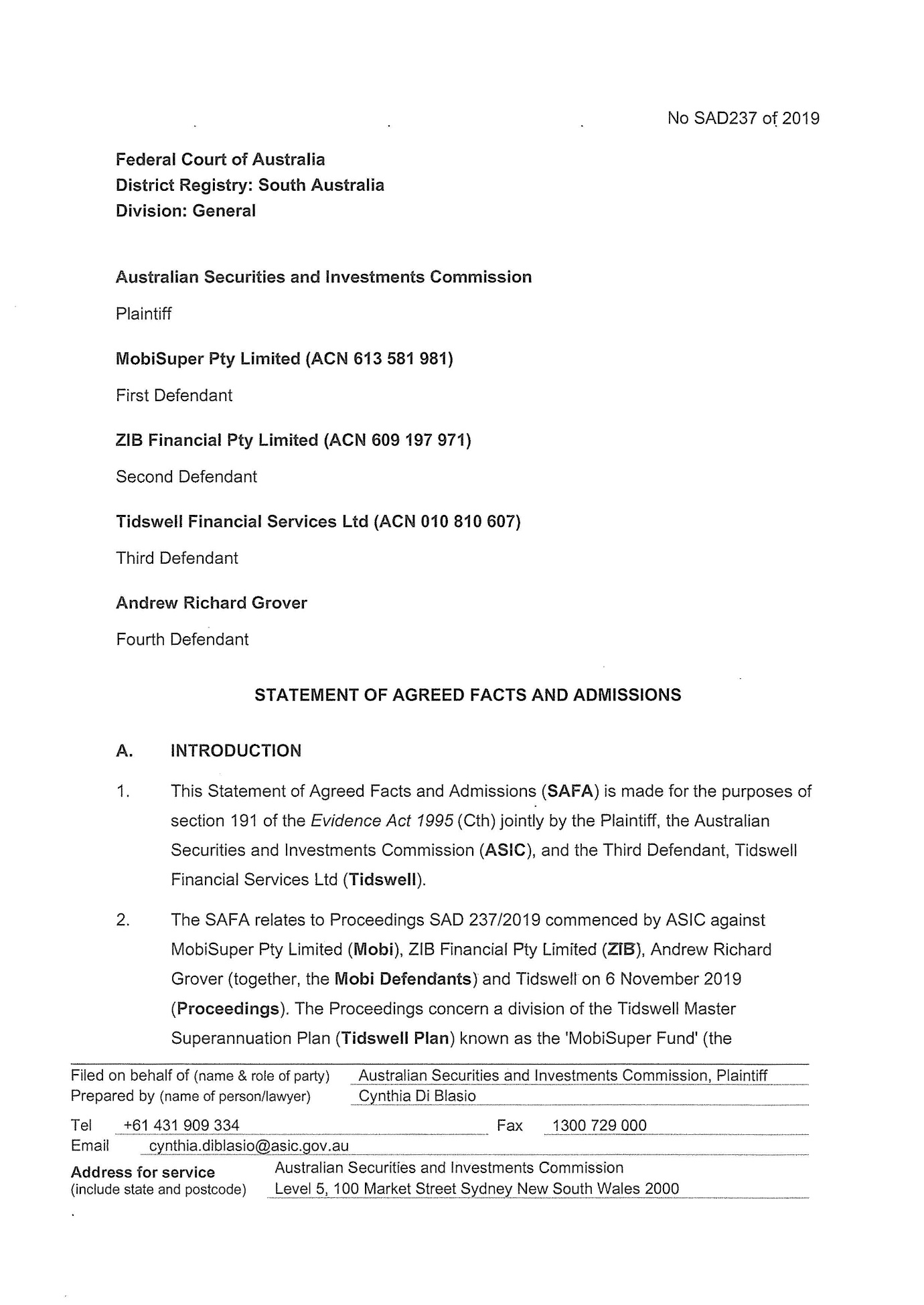
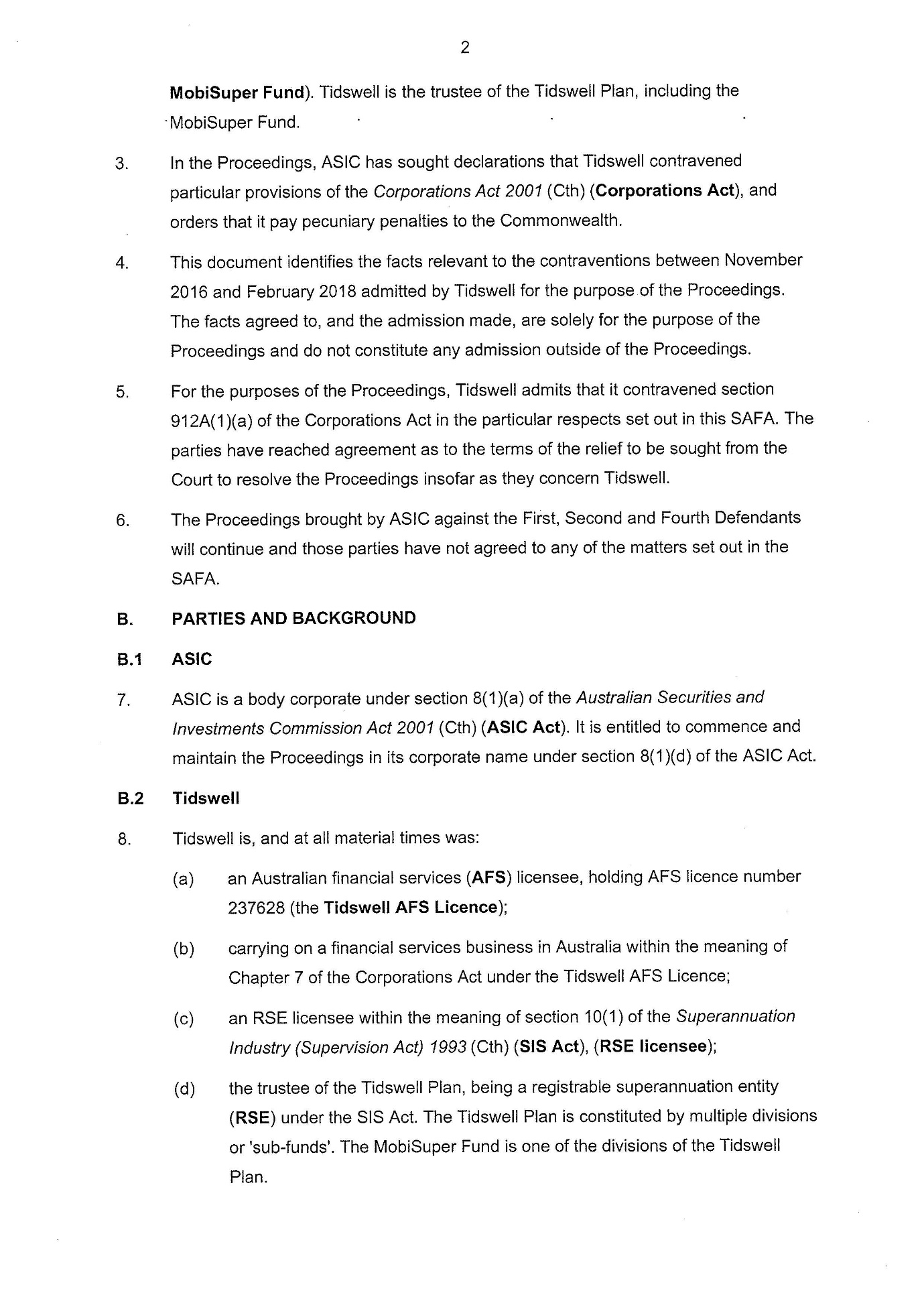
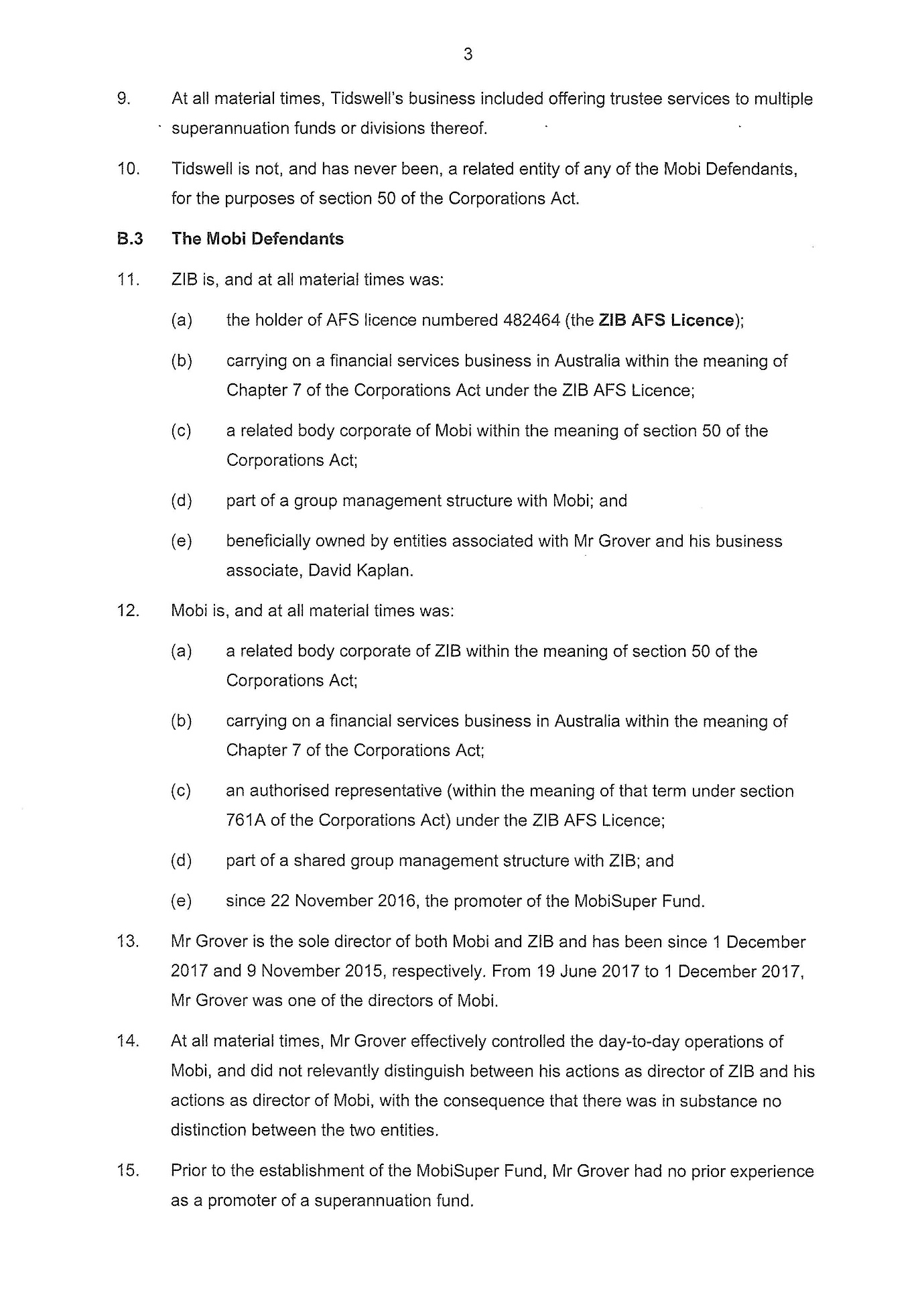
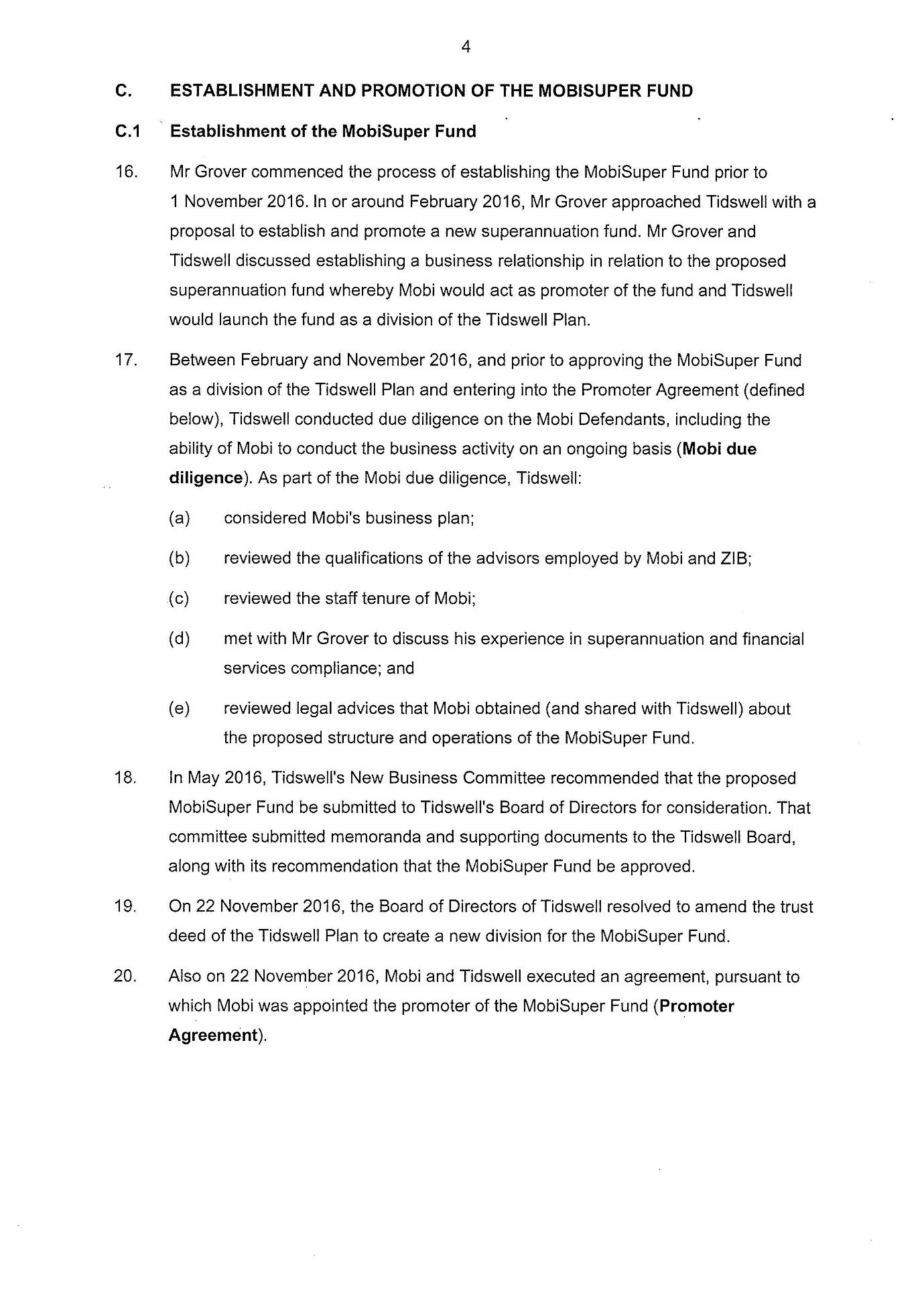
1. Following court ordered mediation, the plaintiff, the Australian Securities and Investments Commission (ASIC), and the third defendant, Tidswell Financial Services Ltd (Tidswell), have agreed to jointly propose orders to the court on the basis of the Statement of Agreed Facts and Admissions set out in Annexure A (SAFA).
2. Tidswell has applied to the Australian Prudential Regulation Authority to cancel its Responsible Superannuation Entity (RSE) Licence (as defined in the Superannuation Industry (Supervision) Act 1993 (Cth) (SIS Act)).
3. Pursuant to s 91 of the Australian Securities and Investments Commission Act 2001 (Cth), Tidswell agrees, upon the making of an order by ASIC for the same, to pay to ASIC $50,000 being part of:
(a) the expenses of the investigation into Tidswell paid by ASIC; and
(b) the cost to ASIC of making the investigation.
4. Tidswell undertakes to the court not to pay the costs referred to in note 3 and order 3 below from funds which it holds on trust under the Tidswell Master Superannuation Plan.
BY CONSENT THE COURT ORDERS:
1. The court declares pursuant to s 21 of the Federal Court of Australia Act 1976 (Cth) that Tidswell contravened s 912A(1)(a) of the Corporations Act 2001 (Cth) by failing to do all things necessary to ensure that the financial services provided by Tidswell and covered by its Australian Financial Services Licence (licence number 237628) in relation to the MobiSuper Division of the Tidswell Master Superannuation Plan (the MobiSuper Fund) (that is, the issue by Tidswell of interests in the MobiSuper Fund), were provided efficiently, honestly and fairly, in that during the period between at least 30 November 2016 and 14 February 2018 (terms that follow are defined in the Further Amended Statement of Claim, or otherwise in the SAFA set out in Annexure A):
(a) Tidswell failed to take the following steps:
(i) Tidswell did not adequately review and evaluate all of the First Defendant, MobiSuper Pty Ltd's (Mobi), reporting under the Promoter Agreement;
(ii) in respect of Mobi's online marketing activities (including the Mobi Websites), Tidswell did not:
(A) establish and enforce a policy of monitoring Mobi's online marketing activities;
(B) monitor websites used by Mobi to generate leads, including the Mobi Websites (independent of any material provided to Tidswell by Mobi for approval);
(C) refuse approval for the Lost Super Website used by Mobi to generate leads if it contained false or misleading representations;
(iii) in respect of the Call Centre and customer service operators (CSOs), Tidswell did not:
(A) refuse approval for the Call Scripts;
(B) establish and enforce a policy of monitoring the Call Centre and the conduct of the CSOs;
(C) monitor the Call Centre (for example, the Tidswell Compliance Team did not conduct regular site visits or audit samples of outbound calls made by CSOs);
(iv) in respect of the training provided to the CSOs, Tidswell did not:
(A) establish and enforce a policy for overseeing Mobi's training and supervision of the CSOs; and
(B) oversee Mobi's training and supervision of the CSOs (for example, by reviewing training materials and records of training carried out); and
(v) Tidswell did not allocate the Tidswell Compliance Team to monitor the areas listed in paragraphs 1(a)(i) to 1(a)(iv) above,
to ensure that the risks that Mobi would engage in the following conduct were addressed:
(vi) obtaining consumers' contact details through their Lost Super Search enquiries, where the primary function of Mobi's doing so was not to assist the consumer to find his or her lost superannuation, but rather to encourage the consumer to open a MobiSuper Fund account, transfer funds held in the customer's Existing Funds to the MobiSuper Fund and to take out one or more policies of MobiSuper Fund insurance;
(vii) failing to ensure that opening a MobiSuper Fund account, and taking out one or more policies of MobiSuper Fund insurance, were appropriate to the consumer's objectives, financial situation and needs and were in their best interests, and the consumer had adequate information to make those assessments;
(viii) failing to ensure that CSOs did not present closing any Existing Funds, losing the benefit of any associated insurance and rolling funds over into a MobiSuper Fund account as an obvious and uncontroversial course of action when that may not have been the case, particularly having regard to the incomplete information that the CSOs likely had available to them;
(ix) failing to structure and monitor its business model, including through the drafting and revision of call scripts, training and supervision of CSOs, and review of the personal details of consumers which CSOs had available to them and how those details were being used so as to minimise the risk that CSOs would give personal advice; and
(x) failing to ensure that no false or misleading representations were made to consumers in online advertising or during Telephone Advice Calls.
(b) by reason of the matters set out in paragraph 1(a)(i) to 1(a)(x) above, Tidswell failed to comply with paragraph 30 of the Superannuation (prudential standard) determination No. 3 of 2012, Prudential Standard SPS 231 Outsourcing made under s 34C(1) of the SIS Act.
2. These proceedings, so far as they concern Tidswell, are otherwise dismissed (subject to order 4 below).
3. Tidswell must:
(a) pay ASIC its costs of the claim against Tidswell fixed in the sum of $50,000; and
(b) bear its own costs, including the costs of the dismissed claims.
4. In the event that Tidswell's RSE Licence has not been cancelled within 30 days of the date of these orders, ASIC has liberty to apply for further orders in relation to the same.
Note: Entry of orders is dealt with in Rule 39.32 of the Federal Court Rules 2011.
Annexure A
JACKSON J:
1 In this case, a superannuation trustee operated a platform permitting other parties to promote individual superannuation funds under their own brands. The arrangements were structured on the basis that the other parties would be providing services to the trustee. For example, the putative service provider might operate a call centre, nominally as a service to the trustee, but the call operators would help consumers join a particular fund which was associated with that service provider.
2 This case is not the occasion on which to comment on the appropriateness of such 'outsourcing' arrangements or on whether, in substance, the service provider is providing services to the trustee or it is, in truth, the other way around. But what a superannuation trustee cannot outsource is its responsibilities to the present and potential members of its superannuation funds. Depending on the circumstances, it will often be necessary for the trustee to take active steps to make sure that the functions performed on its behalf by others are performed in the best interests of members.
3 The nature of the steps required will depend on the circumstances. It will generally be necessary for the trustee to take certain measures at the outset of the relationship, such as due diligence on the service provider and ensuring that the service provider is contractually bound to comply with all applicable laws. But those measures may not be enough. As this case illustrates, active monitoring of the third party's performance of its role in the overall structure of the superannuation fund may also be necessary. That is not merely an administrative requirement to ensure compliance. It is a broader obligation to ensure that the services that are provided to members are being provided efficiently, honesty and fairly. That is an obligation which finds expression in s 912A(1)(a) of the Corporations Act 2001 (Cth).
4 It is that section which has been breached by a lack of oversight in this case. The Australian Securities and Investments Commission (ASIC) seeks a declaration of contravention of s 912A(1)(a) against Tidswell Financial Services Ltd, the third defendant. It also alleges contraventions of other sections of the Corporations Act and the Australian Securities and Investments Commission Act 2001 (Cth) (ASIC Act) against three other defendants.
5 As a result of a court ordered mediation, Tidswell has reached agreement with ASIC to resolve the claim against it. These reasons determine the orders that will be made arising out of that agreement.
6 The other three defendants have reached no agreement with ASIC. On 25 February 2021, the docket judge, Charlesworth J, made an order for the allegations of liability against Tidswell and the grant of any remedy against it to be heard and determined in a separate trial and by a different justice of the court. I presided over that separate trial on 22 June 2021. The proceedings as between ASIC and the other defendants have been set down for trial before Charlesworth J later this year.
7 For the following reasons, I consider that the relief agreed between ASIC and Tidswell is appropriate and will be granted.
Agreed facts
8 ASIC and Tidswell have filed a signed statement of agreed facts and admissions (SAFA) for the purposes of s 191 of the Evidence Act 1995 (Cth). The SAFA is annexed to the orders as made. There is no need to set out all the facts in the body of the reasons, although I will include key passages and provide some comment by way of background and summary. The three defendants other than Tidswell have not agreed to the SAFA, so to the extent that it establishes any fact, it does so as between ASIC and Tidswell only.
9 Tidswell carried on business as the trustee of the 'Tidswell Master Superannuation Plan' (Tidswell Plan) which was comprised of a number of divisions or 'sub-funds'. One of those divisions was known as the MobiSuper Fund. Under arrangements described in more detail in the SAFA, including a written Promoter Agreement, Tidswell appointed the first defendant (Mobi) to act as the promoter of the MobiSuper Fund.
10 From 22 November 2016, Mobi promoted the MobiSuper Fund by way of a website which offered the service of identifying 'lost' superannuation accounts on behalf of consumers. Consumers who wanted to use the service could enter their details on the website, and would be contacted by a person working in a call centre operated by Mobi. The call centre also accepted inbound calls. The persons working in the call centre were known as customer service operators (CSOs).
11 The CSOs used scripts for consumer calls which Mobi gave them, and which Tidswell approved. The SAFA describes the usual practice of the CSOs in connection with a large number of calls that are specifically pleaded in ASIC's further amended statement of claim. It characterises advice given by the CSOs to the consumers during the calls as follows (para 26):
The advice provided in certain of the Specifically Pleaded Calls could reasonably be regarded as being intended by Mobi to:
(a) influence the consumer to dispose of interests in his or her Existing Funds;
(b) obtain a beneficial interest in the MobiSuper Fund; and
(c) acquire MobiSuper Fund insurance.
I understand this to be saying that the advice could reasonably be regarded as being intended by Mobi to influence the customers to do all three of those things, even though the reference to influence is confined in para (a) to the first of them. A footnote in ASIC and Tidswell's joint submissions confirms that understanding.
12 The SAFA does not establish that Tidswell knew what happened in the specifically pleaded calls or that it knew of the usual practice of the CSOs which emerged from the calls. But it does establish that Tidswell knew that the scripts contained references to the consumer disposing of interests in his or her existing funds, obtaining an interest in the MobiSuper Fund, and acquiring MobiSuper Fund insurance. It also establishes that Tidswell knew that Mobi sought to influence consumers while seeking to provide general financial advice only.
13 The SAFA outlines various steps that Tidswell took to monitor Mobi's activities. It goes on to say that in the circumstances of Tidswell's knowledge as above, and its knowledge of other identified matters, Tidswell (para 53):
knew, or ought to have known, that there was a risk that Mobi would engage in the following conduct:
(a) obtaining consumers' contact details through their Lost Super Search enquiries, where the primary function of Mobi's doing so was not to assist the consumer to find his or her lost superannuation, but rather to encourage the consumer to open a MobiSuper Fund account, transfer funds held in the customer's Existing Accounts to the MobiSuper Fund and to take out one or more policies of MobiSuper Fund insurance;
(b) failing to ensure that opening a MobiSuper Fund account, and taking out one or more policies of MobiSuper Fund insurance, was appropriate to the consumer's objectives, financial situation and needs and was in their best interests, and the consumer had adequate information to make those assessments;
(c) failing to ensure that CSOs did not present closing any Existing Funds, losing the benefit of any associated insurance and rolling funds over into a MobiSuper Fund account as an obvious and uncontroversial course of action when that may not have been the case, particularly having regard to the incomplete information that the CSOs had available to them;
(d) failing to structure and monitor its business model, including through the drafting and revision of call scripts, training and supervision of CSOs, and review of the personal details of consumers CSOs had available to them and how those details were being used so as to minimise the risk that CSOs would give personal advice;
(e) failing to ensure that no false or misleading representations were made to consumers in online advertising or during Telephone Advice Calls.
The term 'Existing Accounts' used in (a) is not defined in the SAFA, but 'Existing Funds' is defined in para 25(e) to mean superannuation held in accounts operated by other superannuation providers or the Australian Taxation Office.
14 The SAFA then sets out a number of steps which were available to Tidswell to ensure that those risks were addressed, but which Tidswell did not take (para 54):
(a) Tidswell did not adequately review and evaluate all of Mobi's reporting under the Promoter Agreement;
(b) in respect of Mobi's online marketing activities (including the Mobi Websites), Tidswell did not:
(i) establish and enforce a policy of monitoring Mobi's online marketing activities;
(ii) monitor websites used by Mobi to generate leads, including the Mobi Websites (independent of any material provided to Tidswell by Mobi for approval);
(iii) refuse approval for the Lost-Super Website used by Mobi to generate leads that contained false or misleading representations;
(c) in respect of the Call Centre and CSOs, Tidswell did not:
(i) refuse approval for the Call Scripts;
(ii) establish and enforce a policy of monitoring the Call Centre and the conduct of the CSOs;
(iii) monitor the Call Centre (for example, the Tidswell Compliance Team did not conduct regular site visits or audit samples of outbound calls made by CSOs);
(d) in respect of the training provided to the CSOs, Tidswell did not:
(i) establish and enforce a policy for overseeing Mobi's training and supervision of the CSOs; and
(ii) oversee Mobi's training and supervision of the CSOs (for example, by reviewing training materials and records of training carried out);
(e) Tidswell did not allocate the Tidswell Compliance Team to monitor the areas listed in (a) to (d).
15 The call centre ceased operating in February 2018.
The statutory framework and its application to this case
16 Tidswell's failure to take steps to address the risks of which it knew or should have known took place in the following statutory context.
17 Tidswell was at all material times the holder of an Australian financial services licence (AFSL) which ASIC issued under s 913B of the Corporations Act, and so was a 'financial services licensee' as defined in s 761A. Section 912A(1)(a) provides that a financial services licensee must 'do all things necessary to ensure that the financial services covered by the licence are provided efficiently, honestly and fairly'.
18 ASIC and Tidswell have filed joint written submissions which, together with the SAFA, identify the relevant financial service covered by the licence as the issuing of interests in the MobiSuper Fund. The MobiSuper Fund was a division of the Tidswell Plan which was created by amendment to the trust deed of the Tidswell Plan. While the MobiSuper Fund was associated with Mobi via its name, the interests in the MobiSuper Fund were issued by Tidswell. Mobi marketed and sold those interests to consumers. That involved Mobi applying on behalf of consumers for interests in the fund, or arranging for consumers to apply for those interests.
19 Under s 766A(1)(b) of the Corporations Act, for the purposes of Chapter 7 (in which s 912A is found), a person provides a financial service if, among other things, they 'deal in a financial product'. Section 766C(1)(b) defines dealing in a financial product to include issuing a financial product. Section 764A(1)(g) specifically includes in the meaning of 'financial product' a superannuation interest within the meaning of the Superannuation Industry (Supervision) Act 1993 (Cth) (SIS Act).
20 The trail of defined terms thus leads to s 10 of the SIS Act, which defines 'superannuation interest' to mean a beneficial interest in a superannuation entity, and 'superannuation entity' to be one of three kinds of fund or trust, all of which also come within the definition of 'registrable superannuation entity' (RSE) under that section, provided that they are not self-managed superannuation funds. The SAFA establishes that the Tidswell plan is an RSE, from which it follows that it must also be a 'superannuation entity' under the SIS Act. Interests in the Tidswell Plan, including units in the division of that plan which constitutes the MobiSuper Fund, are therefore superannuation interests and so financial products.
21 It follows that, in issuing superannuation interests in the MobiSuper Fund, Tidswell was providing a financial service. The SAFA establishes that Tidswell's AFSL included dealing in a financial product by issuing superannuation interests. Therefore the issue of units in the MobiSuper Fund by Tidswell was a financial service covered by Tidswell's AFSL. Tidswell was thus required under s 912A(1)(a) to do all things necessary to ensure that the issue of the units was 'provided efficiently, honestly and fairly'.
22 Before considering whether Tidswell did contravene s 912A of the Corporations Act, it is necessary to describe another set of applicable statutory requirements. As well as an AFSL, Tidswell is the holder of an RSE licence issued under s 29D of the SIS Act, and so Tidswell is an 'RSE licensee' as defined in s 10 of the SIS Act. Section 29E(1)(a) of the SIS Act imposes a condition on all RSE licences requiring the licensee to comply with 'RSE licensee law'. That is defined in s 10 to include 'prudential standards'. Under s 34C(1)(a) of the SIS Act, the Australian Prudential Regulation Authority (APRA) may determine prudential standards relating to prudential matters that must be complied with by all RSE licensees of registrable superannuation entities.
23 By the Superannuation (prudential standard) determination No. 3 of 2012, APRA has made the Prudential Standard SPS 231 Outsourcing (Outsourcing Standard). This applies to all RSE licensees: para 2. It defines outsourcing to involve 'an RSE licensee entering into an arrangement with any other party to perform, on a continuing basis, a business activity that currently is, or could be, undertaken by the RSE licensee itself': para 6. The standard only applies to outsourcing of a 'material business activity' (para 8), which is defined to be an activity that, having regard to a number of enumerated factors (para 9):
has the potential, if disrupted, to have a significant impact on an RSE licensee's business operations, its ability to manage risks effectively, the interests, or reasonable expectations, of beneficiaries or the financial position of the RSE licensee, any of its RSEs or its connected entities …
24 Paragraph 26 of the Outsourcing Standard requires an RSE licensee to notify APRA as soon as possible after entering into an outsourcing agreement in respect of outsourcing of material business activities, and in any event no later than 20 business days after the execution of such an agreement. On 23 December 2016 Tidswell gave APRA notice under that paragraph that it had entered into the Promoter Agreement with Mobi. At para 38 the SAFA says that that the Promoter Agreement 'gave rise to a "material business activity" within the meaning of the Outsourcing Standard'. I take this to mean that in appointing Mobi to promote interests in the MobiSuper Fund, Tidswell was outsourcing a material business activity within the meaning of the Outsourcing Standard, and I accept that to be the case.
25 As a result, the Outsourcing Standard applied to Tidswell's outsourcing of activities to Mobi by way of the Promoter Agreement. Paragraph 30 of the Outsourcing Standard provides:
An RSE licensee must ensure it has sufficient and appropriate resources to manage and monitor each outsourcing relationship at all times. The type and extent of resources required will depend on the materiality of the outsourced business activity. At a minimum, monitoring must include:
(a) maintaining appropriate levels of regular contact with the service provider. This will range from daily operational contact to senior management involvement; and
(b) a process for regular monitoring of performance under the agreement, including meeting criteria concerning service levels.
Orders sought
26 The parties submitted a draft minute of orders before the hearing and then, as a result of matters raised in the hearing, submitted amended orders. In substance, they seek to effect or record five things. The first is to record that Tidswell has applied to APRA to cancel its RSE licence. If Tidswell's RSE licence has not been cancelled within 30 days of judgment, ASIC will have liberty to apply. The second is that Tidswell has agreed to pay ASIC $50,000 pursuant to s 91 of the ASIC Act for part of the expenses of the investigation into Tidswell, and Tidswell undertakes to the court not to pay those costs, or the costs of this proceeding, from any funds which it holds on trust under the Tidswell Plan. The third is a declaration pursuant to s 21 of the Federal Court of Australia Act 1976 (Cth) that Tidswell contravened s 912A(1)(a) of the Corporations Act. The fourth is an order for Tidswell to pay ASIC the costs of the claim against Tidswell in this proceeding, fixed in the sum of $50,000. Finally, it is also proposed that the proceeding insofar as it concerns Tidswell is otherwise dismissed.
27 Contravention of s 912A(1)(a) is now also a breach of a civil penalty provision, namely s 912A(5A). But ASIC does not seek any order for a civil penalty against Tidswell. That is because s 912A(5A) was introduced by the Treasury Laws Amendment (Strengthening Corporate and Financial Sector Penalties) Bill 2019 (Cth) and only took effect on 13 March 2019. So at the time of the alleged contraventions here, a breach of s 912A(1)(a) did not entail any breach of a civil penalty provision. In its originating process, ASIC initially sought remedies for breaches of other civil penalty provisions against Tidswell, but does not now pursue those.
Approach where parties to regulatory proceedings propose order by consent
28 In Australian Competition and Consumer Commission v Coles Supermarkets Australia Pty Ltd [2014] FCA 1405, Gordon J set out the general principles applicable when parties to regulatory proceedings like the present one propose orders by consent:
[70] The applicable principles are well established. First, there is a well-recognised public interest in the settlement of cases under the Act: NW Frozen Foods Pty Ltd v Australian Competition & Consumer Commission (1996) 71 FCR 285 at 291. Second, the orders proposed by agreement of the parties must be not contrary to the public interest and at least consistent with it: Australian Competition & Consumer Commission v Real Estate Institute of Western Australia Inc (1999) 161 ALR 79 at [18].
[71] Third, when deciding whether to make orders that are consented to by the parties, the court must be satisfied that it has the power to make the orders proposed and that the orders are appropriate: Real Estate Institute at [17] and [20] and Australian Competition & Consumer Commission v Virgin Mobile Australia Pty Ltd (No 2) [2002] FCA 1548 at [1]. Parties cannot by consent confer power to make orders that the court otherwise lacks the power to make: Thomson Australian Holdings Pty Ltd v Trade Practices Commission (1981) 148 CLR 150 at 163.
[72] Fourth, once the court is satisfied that orders are within power and appropriate, it should exercise a degree of restraint when scrutinising the proposed settlement terms, particularly where both parties are legally represented and able to understand and evaluate the desirability of the settlement: Australian Competition & Consumer Commission v Woolworths (South Australia) Pty Ltd (Trading as Mac's Liquor) [2003] FCA 530 at [21]; Australian Competition & Consumer Commission v Target Australia Pty Ltd [2001] FCA 1326 at [24]; Real Estate Institute at [20]-[21]; Australian Competition & Consumer Commission v Econovite Pty Ltd [2003] FCA 964 at [11] and [22] and Australian Competition & Consumer Commission v Construction, Forestry, Mining and Energy Union [2007] FCA 1370 at [4].
[73] Finally, in deciding whether agreed orders conform with legal principle, the court is entitled to treat the consent of Coles as an admission of all facts necessary or appropriate to the granting of the relief sought against it: Thomson Australian Holdings at 164.
Effect of a statement of agreed facts
29 It is not necessary for the court to apply the principle at [73] of Coles here, because it has the benefit of a statement of agreed facts under s 191 of the Evidence Act.
30 The effect of s 191(2) is that (unless the court gives leave) evidence is not required to prove the existence of an agreed fact and evidence may not be adduced to contradict or qualify an agreed fact. While ordinarily the court will not make declarations without being satisfied by evidence that it should do so, a statement of agreed facts under that section means that evidence is not necessary to prove the existence of the necessary facts: Australian Competition and Consumer Commission v Skins Compression Garments Pty Ltd [2009] FCA 710 at [13] (Besanko J).
31 The court is not required to accept the statement of facts uncritically, however. It still needs to feel persuaded of the facts on which the parties seek to rely. In Minister for the Environment, Heritage and the Arts v PGP Developments Pty Limited [2010] FCA 58; (2010) 183 FCR 10 at [35], Stone J commented on the effect of s 191 as follows (emphasis in original):
Section 191 provides that, unless the court gives leave, the facts stated are not required to be proved by evidence and that evidence may not be adduced to contradict or qualify an agreed fact. The effect of s 191 is to admit the agreed facts as evidence. It still remains for the Court to determine whether the facts are to be accepted as true and to determine what weight to attribute to that evidence. Whether the Court accepts the agreed facts, in whole or in part, may depend, among other things, on the coherence of the narrative created by the facts or their inherent credibility. If, for example, a statement contained mutually inconsistent facts the Court would be obliged to take account of the inconsistency. In attempting to resolve the problem it would not be entitled to require evidence although, as provided in s 191(2), it might give leave to the parties to adduce evidence to resolve the inconsistency. In the absence of further evidence, and taking the context provided by other evidence including other agreed facts, it might possibly accept one or other of those facts. Clearly, however, it could not accept both of the facts in question as true.
Declarations
32 In addition to being satisfied as to the necessary facts, the court must also be satisfied that it has the power to make any declarations sought, and that they are appropriate: Skins Compression Garments at [14]. In Coles Gordon J went on to say:
[74] The court has a wide discretionary power to make declarations under s 21 of the Federal Court Act: Forster v Jododex Australia Pty Ltd (1972) 127 CLR 421 at 437-8; Ainsworth v Criminal Justice Commission (1992) 175 CLR 564 at 581-2 and Tobacco Institute of Australia Ltd v Australian Federation of Consumer Organisations Inc (No 2) (1993) 41 FCR 89 at 99.
[75] Where a declaration is sought with the consent of the parties, the court's discretion is not supplanted, but nor will the court refuse to give effect to terms of settlement by refusing to make orders where they are within the court's jurisdiction and are otherwise unobjectionable: see, for example, Econovite at [11].
[76] However, before making declarations, three requirements should be satisfied:
(1) The question must be a real and not a hypothetical or theoretical one;
(2) The applicant must have a real interest in raising it; and
(3) There must be a proper contradictor: Forster v Jododex at 437-8.
33 Here, there is a proper contradictor; even though Tidswell has admitted to contraventions, it is a party with a true interest to oppose the declaration: see Russian Commercial and Industrial Bank v British Bank for Foreign Trade Ltd [1921] 2 AC 438 at 448; Forster v Jododex Australia Pty Ltd (1972) 127 CLR 421 at 437-438; Australian Competition and Consumer Commission v Sampson [2011] FCA 1165 at [11]-[15].
34 It is well established that for various reasons it can be appropriate to grant declarations in cases brought by regulators. In Australian Securities and Investments Commission v McDougall [2006] FCA 427; (2006) 229 ALR 158 at [55] Young J said:
Since Australian Softwood Forest Pty Ltd v Attorney-General (NSW) (1981) 148 CLR 121; 36 ALR 257; 6 ACLR 45, especially at CLR 125; ALR 258; ACLR 47, the courts have recognised that the grant of declaratory relief on the application of a statutory body such as ASIC may serve important law enforcement purposes: see Corporate Affairs Commission (NSW) v Transphere Pty Ltd (1988) NSWLR 596 at 603; 14 ACLR 644 at 647; Australian Securities and Investments Commission v Sweeney [2001] NSWSC 114 at [30]-[31]; and [Australian Securities and Investments Commission v Pegasus Leveraged Options Group Pty Ltd [2002] NSWSC 310; (2002) 41 ACSR 561] at 571. ASIC is charged with the administration and enforcement of the Act, and there will be many cases where it is in the public interest for the courts to make a declaration on ASIC's application that the Act has been contravened in specified respects. The making of such a declaration does not simply record the outcome of enforcement proceedings; it may also be an appropriate way of marking the court's disapproval of the contravening conduct: see Tobacco Institute of Australia Ltd v Australian Federation of Consumer Organisations Inc (No 2) (1993) 41 FCR 80 at 97-99, 106 and 110; 113 ALR 257 at 265-7 and 274, 278; 25 IPR 509 at 517-19 and 525, 530.
35 In making declarations of breach of the Corporations Act on application by ASIC in pursuance of its public function as regulator, the court is itself exercising the public function of expressing its disapproval of the contravening conduct.
36 The declaration should identify the obligation of which the defendant is found to be in breach, the persons in respect of whom the breach occurred, the nature of the breach and the dates of the breaches: see Commonwealth Bank of Australia v Finance Sector Union of Australia [2002] FCAFC 193; (2002) 125 FCR 9 at [6].
37 The making of a declaration involves the exercise of a discretion. There may be a range of outcomes on which minds might reasonably differ. It is a proper exercise of the discretion in that context to pay particular, albeit not exclusive, regard to the parties' joint position, the fact that one of the parties is the regulator experienced in dealing with contraventions of the kind that are the subject of the proceeding, and the well-recognised public interest referred to in Coles at [70].
The standard in s 912A(1)(a)
38 The standard imposed on the holder of an AFSL by s 912A(1)(a) of the Corporations Act is to do all things necessary to ensure that the financial services covered by the licence are provided 'efficiently, honestly and fairly'. In Australian Securities and Investments Commission v Camelot Derivatives Pty Ltd (in liq) [2012] FCA 414; (2012) 88 ACSR 206 at [69]-[70], Foster J accepted as correct the following submissions made by ASIC (citations removed):
(a) The words 'efficiently, honestly and fairly' must be read as a compendious indication meaning a person who goes about their duties efficiently having regard to the dictates of honesty and fairness, honestly having regard to the dictates of efficiency and fairness, and fairly having regard to the dictates of efficiency and honesty.
(b) The words 'efficiently, honestly and fairly' connote a requirement of competence in providing advice and in complying with relevant statutory obligations. They also connote an element not just of even handedness in dealing with clients but a less readily defined concept of sound ethical values and judgment in matters relevant to a client's affairs.
(c) The word 'efficient' refers to a person who performs his duties efficiently, meaning the person is adequate in performance, produces the desired effect, is capable, competent and adequate. Inefficiency may be established by demonstrating that the performance of a licensee's functions falls short of the reasonable standard of performance by a dealer that the public is entitled to expect.
(d) It is not necessary to establish dishonesty in the criminal sense. The word 'honestly' may comprehend conduct which is not criminal but which is morally wrong in the commercial sense.
(e) The word 'honestly' when used in conjunction with the word 'fairly' tends to give the flavour of a person who not only is not dishonest, but also a person who is ethically sound.
39 In Australian Securities and Investments Commission v Westpac Securities Administration Limited [2019] FCAFC 187; (2019) 272 FCR 170 at [170]-[171], Allsop CJ reserved his position on the correctness of the view that 'efficiently, honestly and fairly' should be read compendiously, and at [424]-[427] O'Bryan J expressed considerable reservations about that view. But nothing turns on that issue in the present case. At [426] O'Bryan J noted that while the word 'fair' as used in s 912A(1)(a) has not received detailed judicial consideration:
… it seems to me that there is no reason why it cannot carry its ordinary meaning which includes an absence of injustice, even-handedness and reasonableness. As is the case with legislative requirements of a similar kind, such as provisions addressing unfair contract terms, the characterisation of conduct as unfair is evaluative and must be done with close attention to the applicable statutory provision: cf Paciocco v Australia and New Zealand Banking Group Ltd (2015) 236 FCR 199 at [364].
Should findings and a declaration be made now?
40 It is important to bear in mind that the three defendants other than Tidswell have not agreed to the facts which Tidswell has admitted in the SAFA, and those other defendants intend to contest ASIC's claim against them before Charlesworth J later in the year. Those defendants are Mobi, as well as ZIB Financial Pty Ltd and an individual named Andrew Grover, who are both associated with Mobi. They did not appear at the hearing before me and made no submission on the orders which ASIC and Tidswell seek.
41 Even though the trial of ASIC's claim against those other defendants will take place before a different judge, if I considered that there was a risk that the declaration I am asked to make might be inconsistent with findings her Honour may make, that could be a reason why I should refuse to make that declaration against Tidswell, at least until after her Honour has handed down her decision: see the discussion of the principles in Australian Competition and Consumer Commission v Woolworths (South Australia) Pty Ltd (Trading as Mac's Liquor) [2003] FCA 530; (2003) 198 ALR 417 at [27]-[32] (Mansfield J).
42 However I do not see any such difficulty here. The declaration, and the key findings made in reliance on the SAFA, are framed in terms of Tidswell's failure to take measures necessary to reduce risks that Mobi would engage in certain conduct. The declaration does not require, and save in certain limited respects the SAFA does not support, any finding that Mobi or the other defendants actually engaged in any contravening conduct.
43 Those limited respects are that, as I have mentioned, the SAFA does contain admissions that the CSOs had a usual practice in the telephone calls that are specifically pleaded in the further amended statement of claim, that the advice provided in those calls could be reasonably regarded as being intended by Mobi to procure certain ends, and that Mobi sought to influence consumers while ostensibly seeking to provide general financial product advice only. Mobi and the other corporate defendant take issue with these matters in their defences. However in the end the findings I make are against Tidswell only, on the basis of admissions that it has made for the purpose of settling the proceeding between itself and ASIC. It was also submitted to me, and I accept, that the tenor of the findings is not that Tidswell knew what Mobi's CSOs were actually saying to the consumers, albeit that it had approved the scripts. The complaint is, rather, that Tidswell did not know because it did not take adequate steps to find out. What is material is that Tidswell knew what the call scripts said, and so knew or ought to have known of the risk that Mobi was seeking to influence consumers in the manner alleged. Viewed in that light, it would not involve any logical inconsistency for the court to make findings against one defendant on the basis of admissions, where different findings are made against other defendants after a contested hearing in which evidence is adduced.
44 It is also significant here that the court is not being asked to make any declaration of general application which concerns the conduct of Mobi or the other defendants. The ultimate effect of the relief sought here will be an acknowledgment by the court that Tidswell failed to take adequate steps to minimise certain risks. It does not prejudice the integrity of the court's processes for a declaration to that effect to be made on the basis of admissions even if, subsequently, the court finds that ASIC has not made out its case against Mobi that it actually engaged in the impugned conduct.
45 Therefore I did not consider that the overlap between the SAFA and the matters that remain in issue between ASIC and the other defendants was a reason not to hear the case as between ASIC and Tidswell. Nor is it a reason against exercising the discretion to make a declaration against Tidswell now. The desirability of facilitating a final settlement of regulatory proceedings between ASIC and a legally represented commercial defendant like Tidswell is a strong reason in favour of making findings and orders now.
Findings and consideration
46 The SAFA presents a coherent narrative and there is no reason why I should not accept it on its face as establishing the matters set out in it for the purposes of ASIC's claim against Tidswell. I make findings of fact for those purposes in the terms set out in the SAFA. Those findings are subject to the observations I have made in the preceding section of this judgment.
47 I am satisfied that the findings support a declaration that Tidswell contravened s 912A(1)(a) of the Corporations Act. I have already identified the financial services to which the obligation pertains - the issue of superannuation interests - and have found that they are covered by Tidswell's AFSL. The section expresses the obligation that relates to those services in stringent terms; it is not an obligation to take reasonable steps or to make reasonable endeavours, but an obligation to 'do all things necessary to ensure' that the relevant financial services are provided efficiently, honestly and fairly.
48 I am satisfied that Tidswell failed to do all things necessary to ensure that the service of issuing interests in the MobiSuper Fund was provided efficiently, honestly and fairly. Consumers were speaking to CSOs from the Mobi call centre because the consumers had indicated a wish to use a service promoted on Mobi's website for locating lost superannuation accounts. The call scripts which Tidswell had approved went beyond merely locating existing superannuation accounts, to encompass the customers disposing of their interests in those accounts and other existing funds, and acquiring an interest in the MobiSuper Fund. There was a risk that Mobi's conduct could create the impression on the part of consumers that Mobi was providing the service of finding lost superannuation accounts, when Mobi's aim could have been, instead, to induce the consumers to become members of the MobiSuper Fund, and to acquire MobiSuper Fund insurance. There was a risk that Mobi would give the customers advice intended to procure those ends, which may not have been appropriate to the consumer's financial position and needs. The CSOs may not have had sufficient information about the consumer's financial situation and needs and the characteristics of the existing funds to give advice suited to the consumer's particular needs. For example, the consumers may have had insurance linked to the existing funds which might have been more advantageous to them than MobiSuper Fund insurance products.
49 In short, there was a risk in the circumstances known to Tidswell that MobiSuper, through its CSOs, would create an impression that the natural outcome of locating and, perhaps, consolidating lost superannuation accounts was to roll those accounts and other existing accounts into the MobiSuper Fund, and that this impression would be created because it was in Mobi's interests, and would be given without proper regard to the interests of each individual consumer. The issue of interests in the MobiSuper Fund in those circumstances would not have been provided 'efficiently, honestly and fairly', considered as a compendious term and (at least) not honestly and not fairly, considered as separate concepts. In Westpac Securities at [174] Allsop CJ said:
It could hardly be seen to be fair, or to be providing financial product advice fairly, or efficiently, honestly and fairly, to set out for one's own interests to seek to influence a customer to make a decision on advice of a general character when such decision can only prudently be made having regard to information personal to the customer.
The Chief Justice was speaking of the circumstances of the case before him, and did so after warning against elevating phrases used by judges in individual cases to explain their approach to s 912(1)(a) into rules of general application and so replacing the proper process of characterisation of the words used in the statute. But his Honour's words do capture the essence of the lack of honesty, fairness and sound ethical dealing which would have occurred in the present case if the risks I have described had come to pass.
50 I consider that in those circumstances, at least, Tidswell was required to engage in reasonably close supervision of Mobi's activities. It needed to monitor what Mobi actually did, including how it marketed its services on its websites after initial approval for the websites was given, and what the CSOs said to individual consumers. That required at least, frequent visits to the call centre and sample monitoring or review of actual calls. Even before that stage, Tidswell should have used its contractual ability to withhold approval of call scripts to ensure that the scripts would not lead CSOs to promote MobiSuper Fund products without regard to each consumer's interests. It should also have monitored the training of CSOs to ensure that this would not occur, for example by review of training materials.
51 The SAFA establishes that Tidswell did none of those things. Tidswell has, accordingly, formally admitted that it contravened s 912(1)(a). That admission is appropriate in the circumstances. Paragraph 1(a) of the proposed declaration is consistent with the admission.
52 Tidswell has also admitted that it failed to comply with para 30 of the Outsourcing Standard and the parties seek a declaration to that effect. I accept that Tidswell's failure to monitor Mobi as I have outlined means that it failed to meet the minimum levels required by para 30, of maintaining appropriate levels of regular contact with Mobi and establishing and observing a process for regular monitoring of performance under the Promoter Agreement.
53 The parties do not advance this breach of the Outsourcing Standard as one with operative consequences. For example they do not seek a declaration that as a result of the breach, Tidswell breached a condition of its RSE licence, which could have consequences such as cancellation of the licence. That is the case even though ASIC holds authority delegated by the primary regulator of that licence, APRA, to pursue any such breaches. Evidently one reason they are not pursued is that, as part of the settlement with ASIC, and as recorded in the proposed orders, Tidswell has already applied for the cancellation of its RSE licence.
54 The utility of the declaration of breach of para 30 of the Outsourcing Standard was, instead, put in terms of drawing attention to the existence of the standard and the obligation of RSE licence holders to comply with it. It is consistent with the principles summarised in McDougall to make a declaration for that purpose and also to indicate that the particular omissions by Tidswell here constituted a failure to comply with the Outsourcing Standard. It is relevant that ASIC provided the court with a letter indicating that APRA supports a declaration in terms of para 1(b) of the proposed orders.
55 Aside from those matters, the declaration sought here identifies the obligations breached, the persons potentially affected by the breaches (the consumers), the nature of the breaches (failing to monitor Mobi's activities properly to ensure that specified risks were addressed) and the period during which the breaches occurred. The declaration has utility and it is appropriate to make it.
56 I have already explained why no civil penalties are sought against Tidswell. It is also clear why no order for the implementation of a compliance program to enhance Tidswell's compliance with s 912(1)(a) in future is sought. Tidswell has effectively sought to hand its RSE licence back to APRA. Another entity has replaced it as trustee of the funds comprised in what was the Tidswell Plan, and at least one of the funds is in the process of being wound up or is likely to be wound up soon. A compliance program directed to the breaches that have occurred here would have no obvious utility.
57 The proposed order for payment of ASIC's legal costs of $50,000 is reasonable in the circumstances.
58 I am satisfied that the orders sought are within power, supported by the SAFA and within the range of appropriate outcomes, so they will be made.
I certify that the preceding fifty-eight (58) numbered paragraphs are a true copy of the Reasons for Judgment of the Honourable Justice Jackson. |
Associate:


