

Federal Court of Australia
Brass Homes Pty Limited v Macasa Homes Pty Limited [2021] FCA 746
ORDERS
BRASS HOMES PTY LIMITED (ACN 151 619 457) Applicant | ||
AND: | MACASA HOMES PTY LIMITED (ACN 622 610 048) First Respondent FANGLEI JIA Second Respondent LIXIN JIA Third Respondent | |
DATE OF ORDER: |
THE COURT ORDERS THAT:
1. The respondents’ interlocutory application filed on 4 June 2021 be dismissed.
2. The respondents pay the applicant’s costs of the interlocutory application as taxed or agreed.
3. Order 8 of the orders made on 15 April 2021 (as varied) be vacated.
Note: Entry of orders is dealt with in Rule 39.32 of the Federal Court Rules 2011.
NICHOLAS J:
1 Before me is an interlocutory application filed by the respondents seeking orders pursuant to r 19.01 of the Federal Court Rules 2011 (Cth), s 56 of the Federal Court of Australia Act 1976 (Cth) and s 1335 of the Corporations Act 2001 (Cth) that the applicant provide further security for costs in the amount of $169,659 or such other sum as the Court thinks appropriate “and without prejudice to the respondents seeking further security for costs”.
2 This proceeding was commenced on 1 September 2020 by an originating application and statement of claim. The applicant claims that it commissioned A&N Design Pty Ltd (“A&N Design”), a building design company, to prepare master architectural drawings for residential houses. Pursuant to written agreements between the applicant and A&N Design, A&N Design assigned the copyright in the works to the applicant. The first respondent, Macasa Homes Pty Limited (“Macasa”), is alleged to have infringed the copyright in the works by building residential dwellings that reproduced these drawings.
3 Various consent orders were made on 7 October 2020 which required the respondents (inter alia) to file and serve their defence and any cross-claim by 4 November 2020. Their defence was filed on 11 November 2020. The respondents rely on various pleaded defences by which they contend, in effect, that Macasa either had a licence to use the works or that the applicant is estopped from denying the existence of such a licence.
4 Since the defence was filed, the respondents have admitted that 21 residential dwellings Macasa built constitute three dimensional reproductions of the pleaded copyright works. However, subsistence and ownership of copyright in the relevant drawings is still in issue. There are a further 19 residential dwellings where reproduction remains an issue. The parties are proposing to adduce expert evidence directed to the question of whether those dwellings are three dimensional reproductions of any of the copyright works.
5 On 12 November 2020, following a case management hearing, further orders were made requiring the respondents to file and serve any interlocutory application for security for costs together with any affidavits in support by 20 November 2020. The hearing of the interlocutory application was fixed for 17 December 2020.
6 On 24 November 2020 the respondents filed an interlocutory application seeking an order that the applicant pay the sum of $204,000 into Court by way of security. The application was supported by an affidavit of the respondents’ solicitor, Ms Shannon Platt, sworn 24 November 2020. According to that affidavit, the respondents had by then already incurred in excess of $93,000 in costs in defending the proceeding, with an additional sum in excess of $66,000 recorded for work which had been carried out but not yet billed. So the respondents’ costs of defending the proceeding up to the close of pleadings already exceeded $150,000.
7 Ms Platt’s affidavit of 24 November 2020 included an estimate of future costs and disbursements to be incurred by the respondents up to and including the filing of affidavit evidence estimated to range between $99,000 and $125,000.
8 There were some negotiations between the parties’ solicitors in relation to the first security for costs application. These culminated in a letter of 3 December 2020 in which the applicant’s solicitors offered to provide the sum of $100,000 for security. In their reply the respondents’ representatives outlined the conditions on which they would accept that amount of security which included a term that the applicant acknowledge and agree in writing that the security was for the respondents’ costs “up to and including the conclusion of affidavit evidence (that is, up until [the applicant] files and serves its affidavit(s) in reply), and that the respondents each reserve their rights to seek further … security”. That offer was accepted subject to some minor variations to the proposed minute of order.
9 On 7 December 2020 the Court made orders which reflected the parties’ agreement. Those orders, which were expressed to be by consent, required the applicant to provide security for the respondents’ costs up to and including the closure of affidavit evidence in the amount of $100,000. The minute of the order also includes the following notation:
The Applicant is providing the Security Amount on a strictly without admission basis, and the Respondents’ right to seek further security for costs after the close of affidavit evidence is reserved.
10 Since the orders for security for costs were made, proceedings between Macland Investment Group Pty Ltd (“Macland”), an entity related to the respondents in the present proceeding have been transferred from the District Court of New South Wales into this Court. In that proceeding, Macland seeks to recover $541,390 plus interest from the applicant. It is anticipated that it will be heard with this proceeding. Orders referring both matters to mediation have been made.
11 On 1 April 2021 the respondents’ solicitors wrote to the applicant’s solicitors requesting that the applicant provide an additional $90,000 by way of security for costs “… for the costs of our clients from the conclusion of affidavit evidence to the conclusion of any mediation …”. I did not make an order for mediation until 15 April 2021. However, it is clear the additional $90,000 in further security that the respondents were then seeking was largely referable to the costs of preparing and attending a mediation. I have more to say in relation to the amount sought in respect of mediation costs later in these reasons.
12 Orders were made by me after a case management hearing held on 14 April 2021 which required, amongst other things, that the respondents file and serve a statement of particulars specifying the matters relied upon in support of any contention that copyright does not subsist in the relevant drawings. The purpose of that order was to ensure that the applicant was given proper notice of any argument upon which the respondents would rely in support of any positive assertion to that effect. Other orders were made relating to the respondents’ foreshadowed application for further security and for the filing of expert evidence in relation to infringement in circumstances where I was informed that the parties’ lay evidence had been filed. I also made an order for the filing of an agreed statement of issues which was originally scheduled to occur once the expert evidence had been filed and prior to the mediation.
13 On 23 April 2021 the respondents’ solicitors wrote to the applicant’s solicitors advising that, in light of the additional work that they would be required to carry out as a result of the orders made on 15 April 2021, they were now seeking the sum of $149,413.50 in additional security. An attachment to the letter provides a breakdown of the additional security sought which includes, in round terms, $26,000 in respect of expert evidence, $18,000 in respect of the preparation of a statement of issues and $53,000 in respect of the mediation. These amounts reflected Ms Platt’s estimate of what would be recoverable on taxation, not her estimate of the actual costs likely to be incurred.
14 The present application was subsequently filed by the respondents on 4 June 2021 seeking a revised amount of $169,659 in further security. In support of the application, the respondents relied on the three affidavits of Ms Platt sworn on 24 November 2020, 4 June 2021 and 21 June 2021. The last of these affidavits contained updated costs estimates and revised the amount the respondents seek in further security to $165,996.
15 The consent orders made on 7 December 2020 reflect the terms of an agreement made between the parties by their legal representatives. There were three relevant aspects to the agreement reached. First, the respondents agreed to accept the sum of $100,000 (rather than the $204,000 sought in the interlocutory application) as security for their costs to be incurred up to the close of the affidavit evidence. Second, the applicant acknowledged the respondents’ right to make a further application for security for costs in respect of costs incurred once affidavit evidence was complete. Third, by consenting to the making of the relevant order, the applicant was not to be taken to be admitting that the conditions justifying an order for security for costs were met.
16 The applicant does not submit that the consent orders made on 7 December 2020 preclude the Court from making any further order for security for costs before the close of affidavit evidence. However, it submits that the negotiated agreement reached between the parties is a significant matter that weighs heavily against the making of any further order for security until the affidavit evidence has been finalised.
17 The respondents submit that there is no restriction on their right to seek further security at this time. While they acknowledge that the affidavit evidence is not yet complete, they submit that the calculations underlying the respondents’ original claim for security for costs were based on a common assumption that the proceeding would follow what they describe as “the usual three stages of affidavit evidence”. They say that since the 7 December 2020 orders were made, the respondents have been required to perform additional work not anticipated at the time the agreement was reached between the parties.
18 In support of their contention that the consent orders of 7 December 2020 were entered into on the basis of a common assumption as to the “usual three stages”, the respondents point to Ms Platt’s affidavit of 24 November 2020 and, in particular, Annexure SEP-1 which is a table entitled “Estimate of Costs of Proceedings up to and including Evidence”. That annexure identifies 10 steps which Ms Platt contemplated would be taken up to the completion of the affidavit evidence. Steps 1 and 2 related to the costs of $94,000 (in round terms) incurred prior to and excluding the drafting and filing of the respondents’ defence, most of these costs related to reviewing the statement of claim and seeking production of documents referred to in the statement of claim. Step 3 relates to the drafting and filing of the defence including taking instructions and liaising with counsel. Steps 4 and 5 relate to the preparation for and attendance at the first case management hearing and preparation of the first security for costs application. Step 6 relates to an issue concerning a notice to produce the applicant had issued to the respondents. Most relevant to this application, however, are steps 7 to 10 which are covered by the following entries in SEP-1:
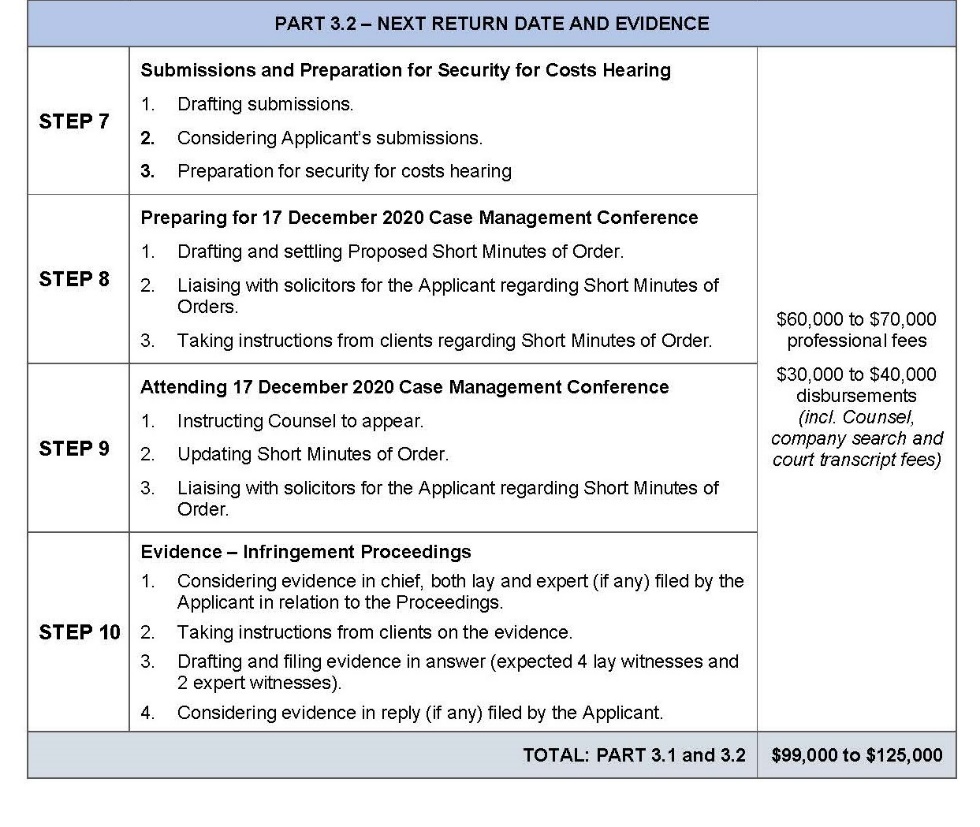
19 The respondents submit that SEP-1 shows that, at the time of the first security for costs agreement, the parties contemplated that there would be only one case management hearing after 25 November 2020 at which both the interlocutory application for security for costs would be heard and procedural orders would be made which would take the proceeding through to completion of the affidavit evidence. Thus, steps 7, 8 and 9 all relate to the hearing scheduled for 17 December 2020 with step 10 accounting for all work to be undertaken by the respondents in preparing affidavit evidence. Step 10 also allows for the costs which would be incurred by the respondents in considering the applicant’s evidence in reply.
20 One of the matters upon which the respondents relied in their submissions on the present application was the fact that the orders made by me in relation to the filing of affidavit evidence departed from what they describe as the “usual” sequence, in that those orders provided for the filing of all lay evidence before any expert evidence was filed. I do not think there is any substance to this point. Orders providing for the filing of lay evidence before expert evidence are often made by this Court, with the aim of ensuring that the expert evidence is founded on assumptions that will or may be proven by the lay evidence.
21 The respondents submit that at the time the original security for costs orders were made, the allegation that the respondents had infringed copyright was being defended by them solely on the basis that the respondents had the benefit of a licence to use the copyright works or, alternatively, that the applicant was estopped from denying the existence of such a licence. A review of the pleadings shows that this is not the case. Not only do the respondents not admit that copyright subsisted in the drawings or that any such copyright was owned by the applicant, the pleadings show that the respondents denied that the respondents had reproduced the drawings.
22 Some time has been spent by me at case management hearings seeking to understand on what basis the respondents contest the applicant’s allegations of copyright infringement apart from the licence issues. The statement of particulars that was filed by the respondents does no more than make clear that there are no particular matters relied upon by the respondents in support of their non-admission of subsistence but that they are, in effect, putting the applicant to proof that the relevant drawings are original works. The statement of particulars is, according to Ms Platt’s affidavit of 4 June 2021, the result of 9 hours of work on the part of senior and junior counsel, a partner and two other lawyers at a cost of $4,350. Ms Platt estimates that $3,375 could be recovered on taxation.
23 The costs the respondents expect they will incur includes $21,408 in respect of the statement of issues which the orders made by me on 15 April 2021 require the parties to prepare in consultation. That cost estimate is on the assumption that senior and junior counsel, a partner and two other lawyers will be required to spend approximately 46 hours preparing and finalising the document. The estimate of the time required to prepare a statement of issues seems to me to be excessive. In any event, preparation of the statement of issues is not a step that I expect the parties to undertake until such time as the evidence is complete. This is not presently reflected in the current timetabling orders due to the various extensions the parties have sought in relation to the filing of expert evidence.
24 A substantial component of the additional security for costs now sought includes the costs of a mediation that is presently scheduled to occur on 12 July 2021. The costs that the respondents attribute to the mediation was originally (in round terms) $64,000 of which they sought $50,000 in security. These amounts were revised to $46,000 and $33,500 respectively. Even on the revised estimate, this is, on any view, a very large amount for a mediation that is expected to last one day especially when the mediation will include a proceeding in which Macland is an applicant. There is no reference to the costs of mediation in SEP-1.
25 I am not satisfied that at the time the agreement was made it was Ms Platt’s assumption, much less an assumption shared by the applicant, that there would not be any mediation before the close of the evidence. The respondents pressed for an order for mediation prior to filing the original interlocutory application seeking security for costs and I do not accept that the possibility of a mediation was outside the contemplation of the parties at the time the consent orders were made. In those circumstances, I would not increase the amount of security to include the costs of a mediation in circumstances where these were not included in SEP-1.
26 Whether or not security should be provided by an applicant for the costs of the parties engaging in a mediation is not a matter about which it is necessary to express any firm view except to say that whether security should be provided in relation to such costs must depend on the circumstances. In the present case, given the existence of the related proceeding which are also to be mediated and, if not resolved, heard with this proceeding, I do not consider this an appropriate case in which to require the applicant to provide security for costs of the mediation even were I satisfied that the possibility of a mediation was outside the contemplation of the parties in November and December 2020.
27 That brings me to the question of what orders should be made in respect of the interlocutory application now before me.
28 The Court has a broad and unfettered discretion in making orders in relation to security for costs. This discretion is to be exercised judicially having regard to all the circumstances of the case and without any predisposition in favour of awarding security: see KP Cable Investments Pty Ltd v Meltglow Pty Ltd (1995) 56 FCR 189 at 196-197 where Beazley J cited various authorities in support of that proposition and also referred to a number of well-known guidelines which the Court typically takes into account in determining whether an order for security for costs should be made.
29 In the present case an order for security for costs has already been made and the question is whether it is appropriate to make a further order for security at this stage of the proceeding in circumstances where the consent orders made on 7 December 2020 were agreed to on the basis that the security would cover the respondents’ costs through to the close of the affidavit evidence. The guidelines referred to by Beazley J do not take account of the situation in which an order for security for costs has already been made in respect of a defined stage of the proceeding.
30 I am willing to accept that the material in evidence bearing on the capacity of the applicant to meet an order for costs in the event that the proceeding brought by it are dismissed shows that there is a significant risk that the applicant will be unable to meet such an order. I do so partly on the basis that the financial statements relied upon by the applicant as evidencing its capacity to meet such a costs order relate to an accounting period that ended about 12 months ago and which are not shown to have been verified or adopted by the applicant’s directors. It is unnecessary to comment further on those financial statements or a valuation report which is also in evidence.
31 However, for the following reasons I do not think it is appropriate to make any further order for security for costs at this stage of the proceeding.
32 First, the security provided by the applicant was the result of an agreement limiting the security to be provided through to the completion of the evidence to $100,000. The Court encourages parties to resolve their differences in relation to interlocutory issues of this kind, but there would be little purpose in doing so if the Court was too ready to permit a party to depart from such an agreement. In the absence of some material change of circumstance which would justify reconsideration of the quantum of the security ordered, it is not appropriate in the circumstances of this case to order the applicant to provide additional security at this time.
33 Second, for reasons already explained, I am not satisfied that the respondents could reasonably have expected the proceeding to follow the narrow procedural pathway they say is reflected in SEP-1. It may be that Ms Platt expected that there would be no need for further case management hearings after the original security for costs application was heard and that lay and expert evidence would be prepared and filed at the same time. But if that was her expectation, there is no reason to think that the applicant shared that view. It is apparent that the agreement reached in relation to the provision of security reflected a different view on the part of the respondents as to what was an appropriate amount of security to be provided compared to what was reflected in Ms Platt’s affidavit of 24 November 2020. It is significant that the respondents accepted the amount of $100,000 as security in circumstances where they had already incurred costs in the order of $160,000. In those circumstances, the compromise that was reached cannot be explained by reference to any mutually shared assumption as to the likely quantum of the respondents’ costs going forward.
34 The fact that the parties agreed on an amount of $100,000 reflects a broad approach to the matter of security and one which is consistent with the view that, for whatever reason, the respondents understood that their costs through to the completion of the affidavit evidence would greatly exceed the agreed amount. Nor do I overlook the fact that the applicant was opposing the interlocutory application for security on the basis that there was no reason to believe that it would be unable to meet a costs order. That may explain why the respondents were so willing to compromise on the amount of security that they were seeking.
35 In any event, I do not accept the submission that the parties, in consenting to the order made on 7 December 2020, were acting on the basis of a common understanding or expectation that the steps that the respondents would be required to take up to the date of completion of the evidence would be limited to those 10 steps identified in SEP-1.
36 Third, I am also satisfied that the amount of additional security that is sought by the respondents in their application of 4 June 2021, even if I was minded to make an order for the provision of further security at this stage, is excessive. I do not propose to comment in detail on the calculations informing Ms Platt’s most recent estimate but it includes, as I have mentioned, very significant amounts in respect of the mediation and the agreed statement of issues. Although these matters relate to the question of the quantum of any order for additional security, they also bear on the broader question of whether the Court should be making any further order for the provision of security before the evidence is complete.
37 Fourth, while the Court often makes orders for the provision of security for costs at various stages of a proceeding, it is not the usual practice to permit a respondent to make successive applications for additional security as the case progresses unless the applicant agrees to such a procedure. The present application does not include any amount in respect of the trial. Presumably the respondents anticipate making further applications for additional security as seems to be foreshadowed in the terms of the orders sought that the security awarded be “without prejudice to the respondents seeking further security for costs”. This approach to the provision of security for costs has the potential to cause the applicant significant prejudice due to the uncertainty it creates as to when, and in what amount, it may be required to provide security for costs.
38 Fifth, I have taken into account and given weight to the existence of the proceeding brought by Macland which will now be heard in this Court with this proceeding. Although the first respondent and Macland are different legal entities, they are closely related and are represented by the same counsel and solicitors. Work carried out by the parties in respect of the two proceedings will most likely be directed to resolution of the broader dispute between them which encompasses the monetary claims made by Macland.
39 In the result, the interlocutory application will be dismissed with costs.
40 As a result of variations made to the orders of 15 April 2021 on 2 June 2021 the present timetable requires the parties to file the agreed statement of issues before the filing of the expert evidence. That does not reflect my intention at the time I made the order for preparation of an agreed statement of issues. The relevant order of the 15 April 2021 orders will be vacated to ensure that this step (if it occurs at all) does not take place until after the expert evidence has been filed. With regard to the mediation, it is scheduled to take place on 12 July 2021. I am minded to leave that date in place but if the parties want to defer the mediation until after the expert evidence is filed then I am willing to make an order to that effect.
41 Orders accordingly.
I certify that the preceding forty-one (41) numbered paragraphs are a true copy of the Reasons for Judgment of the Honourable Justice Nicholas. |


