

Federal Court of Australia
DHL Supply Chain (Australia) Pty Limited v United Workers’ Union [2021] FCA 707
ORDERS
Applicant | ||
AND: | First Respondent CHRIS DUNDON Second Respondent IMOGEN BEYNON Third Respondent | |
DATE OF ORDER: |
UPON THE APPLICANT, BY ITS COUNSEL, UNDERTAKING:
(a) to submit to such order (if any) as the Court may consider to be just for the payment of compensation to be assessed by the Court or as it may direct, to any person, whether or not that person is a party, affected by the operation of the order or undertaking or any continuation (with or without variation) of the order or undertaking;
(b) to pay the compensation referred to in (a) to the person affected by the operation of the order or undertaking; and
(c) to preserve the documents and other materials that are delivered up to it pursuant to these orders until the final determination of this proceeding, or further order.
THE COURT ORDERS THAT:
1. Until the hearing and determination of the application or further order, the first respondent, whether by itself, its officers, servants, agents or howsoever otherwise, and each of the second and third respondents, be restrained from using, copying, publishing, distributing, disclosing or otherwise disseminating to any person, any information contained or recorded in any completed, or partially completed, Union Form provided to them or otherwise in their possession, power or control, other than for the purpose of complying with these orders.
2. On or before 4.30pm on Friday, 25 June 2021, each of the respondents deliver up into the possession of the solicitors for the applicant, marked to the attention of Michael Tamvakologos, all copies (including electronic copies) of any completed, or partially completed, Union Form in their respective possession, power or control.
3. On or before 4.30pm on Monday, 28 June 2021, each of the respondents deliver up into the possession of the solicitors for the applicant, marked to the attention of Michael Tamvakologos, all materials in whatever form, produced or derived from any of the information the subject of any request in the Union Form (other than Unnecessary Information), in their respective possession, power or control.
4. Any material delivered up in satisfaction of orders 2 and 3 may be redacted to the extent that it discloses any Unnecessary Information.
5. Upon compliance with order 2 above, the respondents forthwith delete and destroy all electronic copies of any completed, or partially completed, Union Form from any computer, telephone or other electronic device that is in their respective possession, power or control.
6. Upon compliance with order 3 above, the respondents forthwith delete and destroy all materials in whatever form, produced or derived from any of the information the subject of any request in the Union Form (other than Unnecessary Information) from any computer, telephone or other electronic device that is in their respective possession, power or control.
7. In the event that any of the information or materials referred to in orders 2 or 3 above comes into the possession, power or control of any respondent after the making of these orders, that respondent must comply with the substantive obligations in each of orders 2 to 6 with respect to that information or material, within 24 hours of it coming into their possession, power or control.
8. On or before 4.30pm on Friday, 25 June 2021, the first respondent generate a notice on its letterhead in the form set out below, signed by an authorised official of the first respondent, and:
(a) provide a copy of the notice (whether by hand, facsimile, email or any other means) to each of its delegates employed by the applicant; and
(b) provide a copy to the applicant.
Form of Notice
Dear UWU Delegate employed by DHL Supply Chain (Australia) Pty Limited
On 24 June 2021, the Federal Court of Australia ordered the United Workers’ Union (Union) to provide a copy of this notice to you.
Insofar as the Union, or any of its officials (including Chris Dundon or Imogen Beynon), have:
provided to you a copy of a two page document asking you various questions about the nature of DHL’s activities at the warehouse/distribution centre at which you work;
asked you to complete or fill out that two page document with responses to the questions there asked; and
asked you to return or otherwise provide copies of that completed, or partially completed, two page document to the Union (or any of its officials),
those requests are retracted and you should not do so.
9. To the extent necessary, service of the application and supporting affidavits of Grant Matthew Connolly affirmed on 23 June 2021 and Christopher Norman Sheehan affirmed on 23 June 2021 on the second and third respondents as required by Rule 10.01 of the Federal Court Rules 2011 (Rules) be dispensed with, and instead, the provision of those documents by way of email to the email addresses of chris.dundon@unitedworkers.org.au and imogen.beynon@unitedworkers.org.au on or before 8.15am on Thursday, 24 June 2021, shall be deemed as effective service on the second and third respondents respectively.
10. To the extent necessary, the time for service of the application and supporting affidavits of Grant Matthew Connolly affirmed on 23 June 2021 and Christopher Norman Sheehan affirmed on 23 June 2021 on each of the respondents as required by Rule 8.06 of the Rules, be abridged to 2.15pm on Thursday, 24 June 2021.
11. The costs of the interlocutory application are costs in the cause.
12. In these orders:
(a) “Union Form” means the document marked as Annexure “GMC-8” to the affidavit of Grant Matthew Connolly affirmed on 23 June 2021.
(b) “Unnecessary Information” means any of the following information, namely:
(i) information of the kind contemplated by the fields that appear in the top row of the Union Form; and
(ii) information about the number of members of the first respondent (whether permanent or labour hire) that comprise the workforce at any particular location.
TO: UNITED WORKERS’ UNION, CHRIS DUNDON AND IMOGEN BEYNON TAKE NOTICE THAT, PURSUANT TO ORDER 41.06 OF THE FEDERAL COURT RULES:
You are liable to imprisonment or to sequestration of property if:
(a) you refuse or neglect to do the things that this order requires you to do; or
(b) you do the things that this order requires you to abstain from doing, or otherwise disobey this order.
Note: Entry of orders is dealt with in Rule 39.32 of the Federal Court Rules 2011.
SNADEN J:
1 The applicant (“DHL”) is a third-party logistics provider that operates storage and distribution warehouses throughout Australia (and, relevantly for present purposes, New South Wales). The first respondent (the “UWU”) is a large and well-known trade union that represents at least some of those whom the applicant employs in connection with its business. The second and third respondents are employees and/or officials of the UWU.
2 By an application dated 23 June 2021, the applicant moves the court for relief against the respondents in the nature of declarations, injunctions, damages, interest and the delivery up of certain documents. The action is brought pursuant to the Corporations Act 2001 (Cth) (hereafter, the “Corps Act”) and in tort (and possibly also in equity). It pertains to measures that the respondents are alleged to have set in train recently to obtain information from the applicant’s employees about certain aspects of its business: in particular, information relating to the products that are stored at and distributed from its warehouses in New South Wales, and the clients to whom such services are provided.
3 Those measures are alleged to have occurred in the context of ongoing bargaining between DHL and the UWU over the terms of proposed enterprise agreements to be made under the Fair Work Act 2009 (Cth) (the “FW Act”). Presently, DHL’s operations are subject to a suite of existing enterprise agreements, almost all of which will nominally expire on 30 June 2021.
4 By its originating application, the applicant also seeks interlocutory injunctive relief to require that the respondents cease the endeavours upon which it is alleged that they have recently embarked, and to require that they destroy or deliver up all of the information that they have collected to date in consequence of them. It is to that interlocutory relief that these reasons pertain. For the reasons that follow, I will grant (indeed, at the conclusion of the hearing on Thursday, 24 June 2021, did grant) relief largely in the nature of what the applicant sought.
5 At the return of the application for interlocutory relief, the second and third respondents did not appear. They had not, to that point, been personally served with the material upon which the applicant moves; but that material had been sent to them by email early that morning. Evidence was led to substantiate their email addresses and their tendency to communicate by email. The applicant sought orders for substituted service. In the circumstances (which include that the matter was brought on for hearing quickly, that the second and third respondents are both employees or officials of the first respondent, that the material was brought to their attention by email, and that the first respondent—whose interests appear largely to align with those of the second and third respondents—was ably represented by counsel at the hearing), I am content to make orders in the form proposed.
6 The court’s power to grant interlocutory injunctive relief is not in doubt: Federal Court of Australia Act 1976 (Cth), s 23; Corps Act, s 1324. The circumstances that inform the court’s discretion to grant relief of that nature are similarly well-settled. In order to qualify for the relief that it seeks, DHL must demonstrate that it has a prima facie case and that the balance of convenience favours the grant of an injunction: Australian Broadcasting Corporation v O’Neill (2006) 227 CLR 57, 81-84 (Gummow and Hayne JJ, with whom Gleeson CJ and Crennan J agreed).
7 When considering the grant of an interlocutory injunction, the issue of whether an applicant has established a prima facie case and whether the balance of convenience favours injunctive relief are related inquiries. Whether there is a prima facie case is to be considered together with the balance of convenience: Samsung Electronics Co. Ltd v Apple Inc. (2011) 217 FCR 238, 261 [67] (Dowsett, Foster and Yates JJ).
8 In Bullock v FFTSA (1985) 5 FCR 464, Woodward J (with whom Smithers and Sweeney JJ relevantly agreed) stated (at 472):
…an apparently strong claim may lead a court more readily to grant an injunction when the balance of convenience is fairly even. A more doubtful claim (which nevertheless raises “a serious question to be tried”) may still attract interlocutory relief if there is a marked balance of convenience in favour of it.
9 An applicant for interlocutory injunctive relief must, in showing that the balance of convenience favours that outcome, point to inconvenience for which an award of damages at trial would not be a sufficient remedy: Castlemaine Tooheys Ltd v South Australia (1986) 161 CLR 148, 153 (Mason ACJ); Communications, Electrical, Electronic, Energy, Information, Postal, Plumbing and Allied Services Union of Australia v Blue Star Pacific Pty Ltd (2009) 184 IR 333, 339 (Greenwood J).
10 As has been stated, DHL’s action is brought (at least) pursuant to the Corps Act and in tort. Sections 182(1) and 183(1) of the Corps Act respectively provide as follows:
(1) A director, secretary, other officer or employee of a corporation must not improperly use their position to:
(a) gain an advantage for themselves or someone else; or
(b) cause detriment to the corporation.
…
(1) A person who obtains information because they are, or have been, a director or other officer or employee of a corporation must not improperly use the information to:
(a) gain an advantage for themselves or someone else; or
(b) cause detriment to the corporation.
11 Those provisions are “civil penalty provision[s]”: Corps Act, s 1317E(3). The court has power to grant declaratory relief against those who contravene such a provision: Corps Act, s 1317E(1). A person who is involved in another person’s contravention of a civil remedy provision is deemed also to have committed a contravention of the same provision: Corps Act, s 1317E(4). Such involvement may take the form of (amongst other things) counselling or procuring the primary contravention: Corps Act, s 79.
12 In addition to the Corps Act, DHL’s application for interlocutory relief is founded also in tort. It alleges that the respondents have induced and are inducing its employees (or some of them) to breach certain contractual terms pursuant to which DHL employs them.
13 Both causes of action are said to arise in the same way. It is convenient at this juncture to summarise the relevant facts. They emerge from two affidavits affirmed on 23 June 2021 in support of DHL’s application for interlocutory relief: one by Mr Grant Matthew Connolly, DHL’s “Senior ER/IR Specialist”; and one by Mr Christopher Norman Sheehan, DHL’s “Director – Life Sciences and Healthcare”. Both were read without objection. For obvious reasons, the matters deposed to within those affidavits have not been the subject of challenge and the factual summary to which I now turn is offered only at an interlocutory level.
14 DHL provides outsourced logistics and warehousing services for customers under contract. It operates at approximately 50 sites across Australia, approximately half of which are located in New South Wales. Approximately 3,000 permanent employees are engaged to that end, in positions such as storeperson, packer, delivery officer, coordinator, supervisor and others. Warehousing employees are eligible to be—and many are known to be—members of the UWU.
15 UWU members at each DHL warehouse elect delegates from amongst their number, whose role is to represent the UWU and liaise with DHL management on a day-to-day basis. There are approximately 57 UWU delegates at DHL’s NSW warehouses.
16 The employment of DHL’s warehousing employees is regulated by a suite of enterprise agreements made under the FW Act. There are 12 such agreements covering DHL’s NSW operations. Eleven of them are set to nominally expire on 30 June 2021. The other expired in October 2020.
17 DHL and the UWU are presently engaged in bargaining over the terms of enterprise agreements to replace those 12 NSW-facing instruments. The second and third respondents have been involved in those negotiations on behalf of the UWU. The bargaining is yet to bear fruit and DHL’s position is that it has reached something of an impasse.
18 Some observations should be made about DHL’s business. At its facilities, DHL stores and handles a range of products for a range of clients. Amongst other things, it stores pharmaceutical products (including opioids, other addictive drugs and vaccines), medical supplies, and hazardous and combustible materials (including chemicals, aerosols and batteries). Some of what is stored is valuable or dangerous or both. The handling and delivery of some is time-sensitive, in the sense that its distribution must be effected in a timely manner.
19 DHL employs an array of measures to protect the confidence of its customers. Key amongst them are contractual confidentiality obligations to which its employees are bound. Evidence was led to demonstrate the various guises that those measures have assumed over recent years. It is not necessary to summarise them; save to observe generally that DHL’s employees are bound, expressly by contract, to refrain from disclosing information detailing the products that DHL stores at its warehouses and the customers for whom it stores them.
20 Those obligations mirror (or are otherwise consistent with) duties incorporated in any event by implication into DHL employees’ contracts of employment, including duties to act with fidelity and good faith toward DHL: Lifeplan Australia Friendly Society Ltd v Wolf (2016) 259 IR 384, 448 [337] (Besanko J). Those duties carry with them an obligation not to divulge confidential information: Del Casale v Artedomus (Aust) Pty Ltd (2007) 165 IR 148, 158 [32] (Hodgson JA, with whom McColl JA agreed, Campbell JA agreeing in the result). “Confidential information”, in that sense, is information that a person of ordinary intelligence, in all of the circumstances of a given case—including, amongst others, the nature of the information, its importance to its owner and the circumstances of its communication—would recognise as such: Del Casale, 160 [39]-[40] (Hodgson JA, with whom McColl JA agreed), 180 [138] (Campbell JA, with whom McColl JA agreed).
21 A few days ago, DHL’s attention was drawn to efforts apparently orchestrated by the respondents to obtain from DHL employees (or, more specifically, those employees who fulfil the role of UWU delegate at its various NSW sites) details about (amongst other things) the products stored at its NSW warehouses and the customers to which those products relate. Evidence was led of a “WhatsApp” conversation (or “chat”) to which the second and third respondents (on the one hand) and various UWU delegates employed by DHL in NSW (on the other) were apparently party. That conversation records a message apparently authored by the second respondent in the following terms (errors and emphasis original):
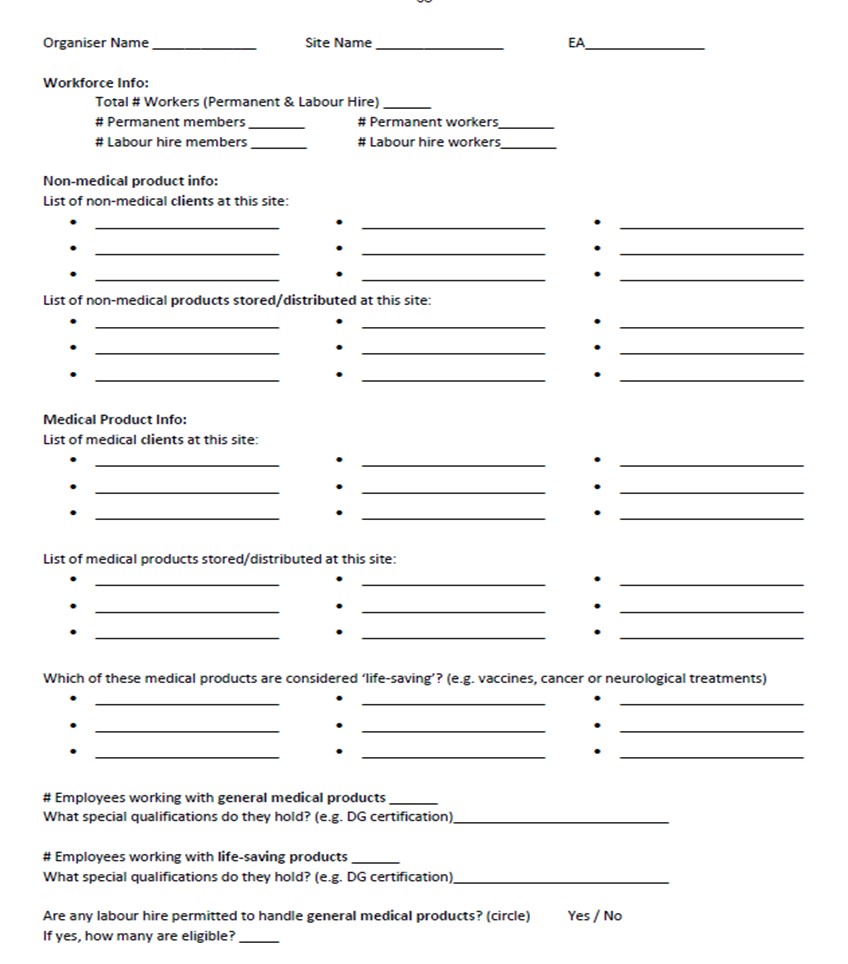
Guys I need this form filled out for each site Tonight! Or first thing tomorrow. I gave you all a copy on the union training day. Please fill it out, take a photo of it and text it to me.
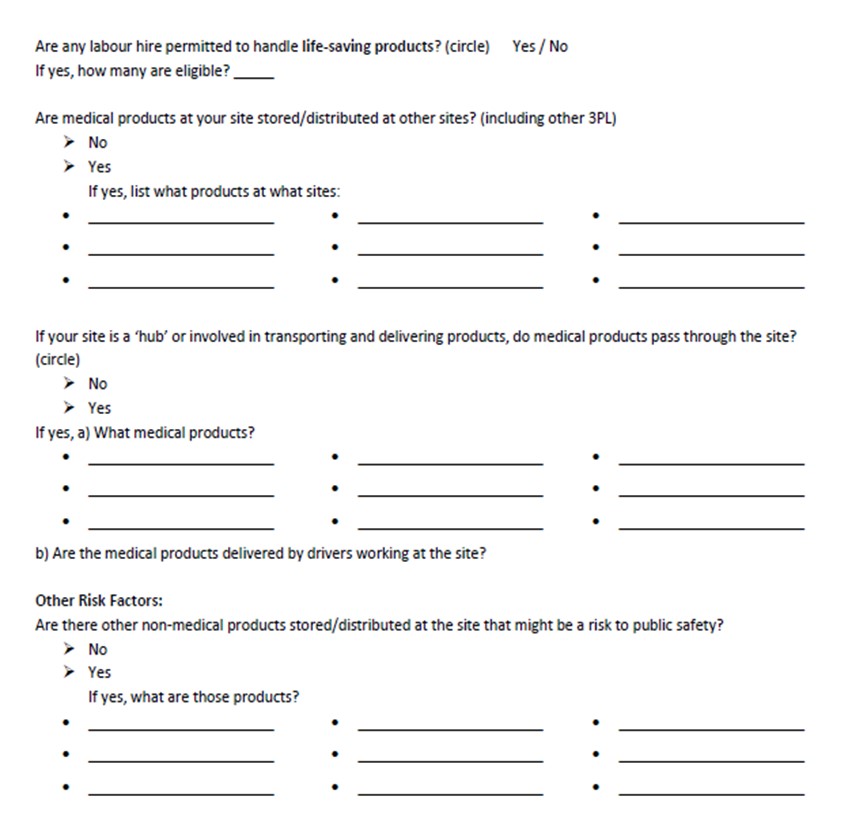
22 The reference to “this form” and “it” is a reference to a PDF attachment entitled “DHL Medical Contract Mapping.pdf”. That document (hereafter, the “Site Survey”) is a two-page form in the following terms:
23 The WhatsApp discussion also contains the following messages apparently attributable to the second respondent:
…Just a reminder This is for delegates eyes only!! Please send it through first thing tomorrow morning.
…
Just do it on the down low…
…
24 There then appears, within the confines of the same WhatsApp “chat”, a message from the third respondent, in which she seeks to solicit from somebody (whose identity is not known):
…as much info as possible to help the industrial officer.
25 Another message apparently sent by the third respondent appears to acknowledge (or evidence) receipt of information that involves a “level of detail” that she describes as “good”.
26 DHL submits that that evidence discloses, at least at a prima facie case level, that the respondents have embarked upon a campaign to solicit from its employees information about the materials that are stored and distributed from its warehouses (or some of them), and about the customers for whom it does so. Information so provided is or would be, so DHL submits, provided in contravention of the contractual provisions that restrain its employees from disclosing confidential information.
27 By correspondence sent on Friday, 18 June 2021, DHL’s solicitors brought that alleged reality to the first respondent’s attention. It sought undertakings that the UWU and its agents would (amongst other things) immediately stop organising the collection, storage and communication of the information that appears to have been solicited by means of the Site Survey. No such undertaking was provided.
28 DHL submits that there is a strong prima facie case that the respondents, by their conduct, have induced or are inducing (or have attempted or are attempting to induce) DHL’s employees to breach their contractual obligations to preserve and not disclose information confidential to DHL (and, by extension, its clients). Alternatively, it is said that the respondents have induced or are inducing (or have attempted or are attempting to induce) DHL’s employees (or some of them) to use their positions, or information to which they have been privy because of their positions, in order to gain an advantage for the UWU; and, thereby, are “involved in” breaches by those employees of obligations placed upon them by ss 182(1) and 183(1) of the Corps Act.
29 The first respondent accepts that it has embarked upon the Site Survey process but denies that the information that it has sought to procure from its delegates is confidential information. It sought, to that end, to read an affidavit of its industrial officer, Mr Rowan Payne. That affidavit was affirmed shortly before the hearing of 24 June 2021 commenced. It contained a paragraph that deposed as to the public availability of the information that the Site Survey sought to acquire. That paragraph consisted of a number of internet links, in which it was said that information of the kind sought by the Site Survey was, in any event, publicly available. The information contained within those websites was not reproduced. The applicant objected to the court’s receipt of that evidence on the basis that it assumed the form of unsourced hearsay. In any event, the court was told that the websites in question (or at least some of them) did not record any information in anything like the detail sought by means of the Site Survey. Were it otherwise, of course, there would be no reason why the respondents would have needed to embark upon the Site Survey process. Nothing of any substance can be made of that aspect of Mr Payne’s evidence.
30 I accept that there is a strong prima facie case that the respondents are acting or have acted in the manner that is alleged; and that they have done so (or will do so) tortiously or in breach of the relevant provisions of the Corps Act. As to the former, a respondent will commit the tort by intentionally procuring a third party to breach a contract that he or she has with an applicant. As to the latter, relevant impropriety will “…consist in a breach of the standards of conduct that would be expected of a person in his [or her] position by reasonable persons with knowledge of the [employee’s] duties, powers and authority”: Doyle v ASIC (2005) 227 CLR 18, 28 [35] (Gleeson CJ, Gummow, Kirby, Hayne and Callinan JJ).
31 Although the evidence is, as yet, untested, it is not apparent to me at this juncture on what basis it might be doubted that the respondents have sought to obtain from DHL employees information that they are not at liberty to disclose. The first respondent submitted that the evidence does not permit the court to find, by way of inference or otherwise, that the second and third respondents intended that the DHL delegates, when providing the information sought by the Site Survey, would do so in contravention of their contractual obligations of confidence. I reject that submission. The existence of such obligations is notorious, particularly amongst experienced union officials. Likewise, it is difficult to envisage any realistic possibility that the second and third respondents might not have appreciated that information of the kind sought was confidential. If the respondents genuinely believed that the information sought by the Site Survey was information that the DHL employees were at liberty to disclose, they (and, realistically, only they) could have led evidence to that effect. For the purposes of assessing the existence of a prima facie case, I can and do readily infer that the second and third respondents knew that the information that they sought was (and is) information that DHL’s employees are not at liberty to disclose (and, indeed, is of a kind that employees generally are bound not to disclose). That inference should, at this juncture, be drawn given the roles in which the second and third respondents are employed, the notorious nature of the obligation and its implications, the absence of evidence from the respondents, and the fact that the Site Survey was to be completed “on the down low”.
32 Given the temporal proximity of their campaign to the bargaining that is currently underway, the imminent expiry of DHL’s existing enterprise agreements and the concomitant prospect that they might soon be able to buttress their bargaining claims with protected industrial action (within the meaning given to that concept by the FW Act), it is all but impossible not to infer that the respondents have done what they have done in order that they might more successfully bring pressure to bear upon DHL to accept the bargaining claims that have been advanced. Indeed, Mr Payne confirmed as much by his affidavit. That being the case, it is difficult to escape the conclusion (at a prima facie case level) that the purpose of the information sought by means of the Site Survey is to confer upon the UWU an advantage that it would otherwise not enjoy.
33 Even if the character of the information sought by the Site Survey falls short of confidential information, it remains nonetheless strongly arguable that its procurement offends ss 182(1) and 183(1) of the Corps Act. Insofar as concerns the disclosure of information, those sections are not limited to information that is confidential: Hydrocool Pty Ltd v Hepburn (No 4) (2011) 279 ALR 646, 698 [355] (Siopis J); Digital Cinema Network Pty Ltd v Omnilab Media Pty Ltd (No 2) [2011] FCA 509, [163] (Gordon J—affirmed on appeal in Omnilab Media Pty Ltd v Digital Camera Network Pty Ltd (2011) 285 ALR 63, 82 [165] (per Jacobson J, Rares and Besnako JJ agreeing)).
34 That observation leads into consideration of the balance of convenience. To a large extent, the prejudice that DHL stands to endure unless interlocutory relief is granted is self-evident: it risks a prospect that confidential information pertaining to its operations (and to the operations of its customers) might fall into the possession of those who ought not to possess it. There are obvious reputational risks to which that inevitably gives rise.
35 Moreover, the disclosure of confidential information to the respondents is significant (or potentially significant) in the context of the bargaining in which DHL and the UWU are presently engaged. As has already been stated, that bargaining appears, on the evidence, likely to continue beyond 30 June 2021, when the existing suite of relevant enterprise agreements expire. From that point (and subject to compliance with various statutory processes), the UWU and its members will be at liberty to organise and engage in protected industrial action (within the meaning attributed to that term by s 408 of the FW Act). Armed with information detailing the products that are stored at certain sites and the customers to which they pertain, the UWU and its members will, at least potentially, be able to tailor any such action so as to impose upon DHL the greatest degree of operational inconvenience or reputational damage; and, in turn, bring to bear a degree of pressure in favour of acceptance of the terms for which it has bargained greater than that which it might otherwise be able to marshal. To the extent that industrial action were to target medical supplies stored at DHL’s sites, the UWU could potentially trigger statutory arbitration mechanisms (see, for example, ss 424 and 266 of the FW Act), which could lead to the imposition of conditions less favourable to DHL than what it might otherwise be able to secure through bargaining.
36 Injunctive relief at this point will, of course, adversely affect the respondents. If they are prevented from making use of the information collected by means of the Site Survey, there is a risk that any protected industrial action that is later organised will be less effective than it might otherwise be. Nonetheless, there are other, lawful measures available to the respondents to maximise the impact of any industrial action that they might later organise. The fact that they intend to put the information that they have acquired (or wish to acquire) to the service of lawful (and, no doubt, important) industrial objectives is not a circumstance that warrants the turning of a blind eye to the unlawful means that appear to have been employed (or that appear to be contemplated) to acquire it.
37 The orders that DHL seeks are in relatively standard terms. They serve not only to restrain the respondents from soliciting or using information provided in answer to the Site Survey, but also to require that the respondents take positive steps to deliver up or destroy such information provided to date, as well as any other derivative information created since. It also seeks an order that the UWU produce and circulate to its delegates who are employed by DHL a notice on its letterhead that serves to inform them of the court’s orders. Such notices are commonplace in applications such as this.
I certify that the preceding thirty-seven (37) numbered paragraphs are a true copy of the Reasons for Judgment of the Honourable Justice Snaden. |


