Federal Court of Australia
Mosaic Brands Ltd v Australian Communications and Media Authority [2021] FCA 669
ORDERS
Applicant | ||
AND: | AUSTRALIAN COMMUNICATIONS AND MEDIA AUTHORITY First Respondent JEREMY FENTON Second Respondent | |
DATE OF ORDER: |
THE COURT ORDERS THAT:
1. The application be dismissed.
2. The applicant pay the respondents’ costs.
Note: Entry of orders is dealt with in Rule 39.32 of the Federal Court Rules 2011.
KATZMANN J:
Introduction
1 The Australian Communications and Media Authority (ACMA) is an entity of the Commonwealth established by s 6 of the Australian Communications and Media Authority Act 2005 (Cth) (ACMA Act). It has a number of functions and powers. They include the regulation of telecommunications in accordance with the Telecommunications Act 1997 (Cth) and other functions and powers conferred on it by, or under, the Telecommunications Act and other Commonwealth statutes one of which is the Spam Act 2003 (Cth).
2 Section 522 of the Telecommunications Act authorises the ACMA to require a person, by written notice, to give it any information or produce to it any documents it has reason to believe are in the person’s possession which are relevant to the performance of any of the ACMA’s telecommunications functions or the exercise of any of its telecommunications powers. It is an offence to engage in conduct which contravenes a requirement in a notice issued under that section.
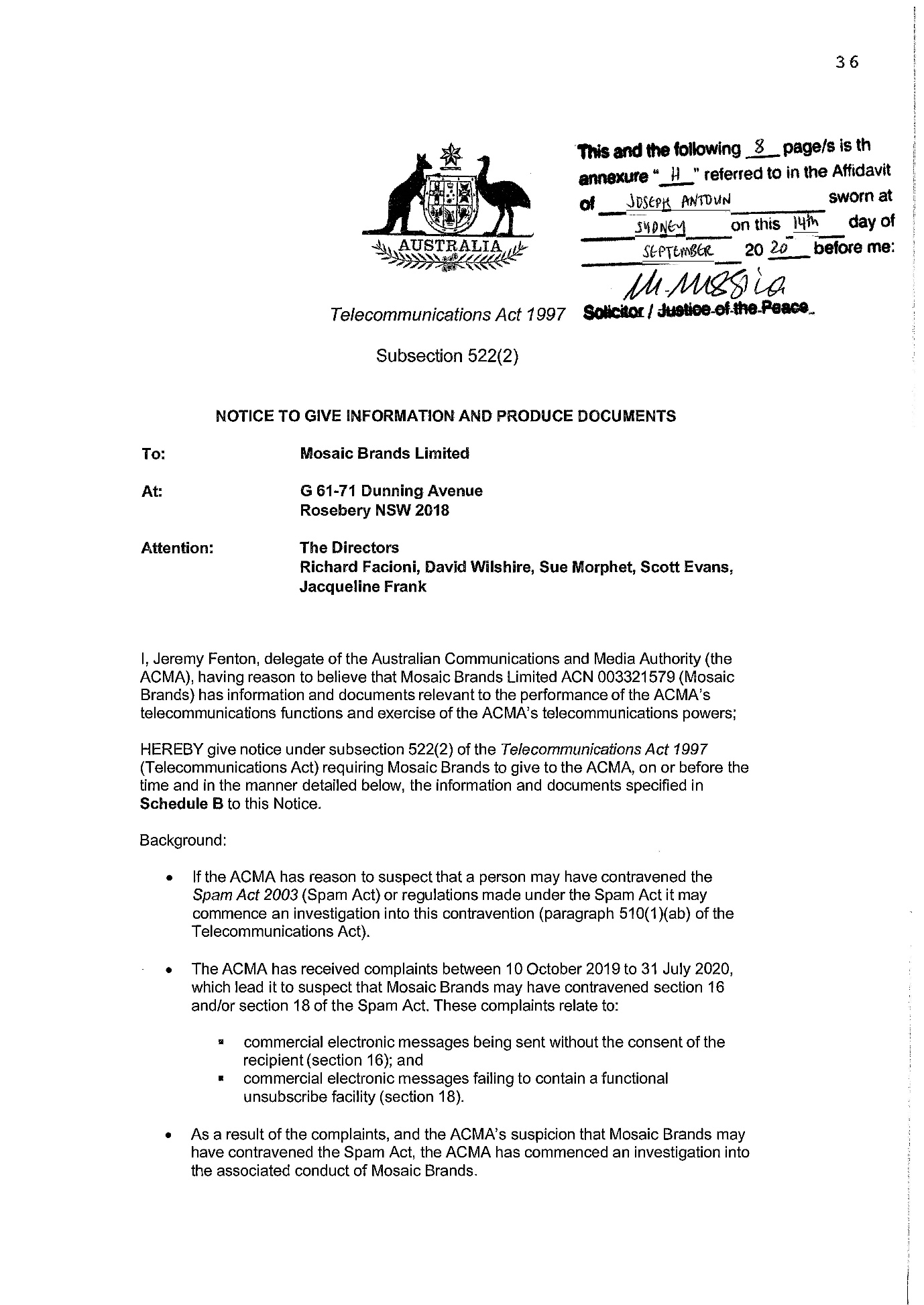
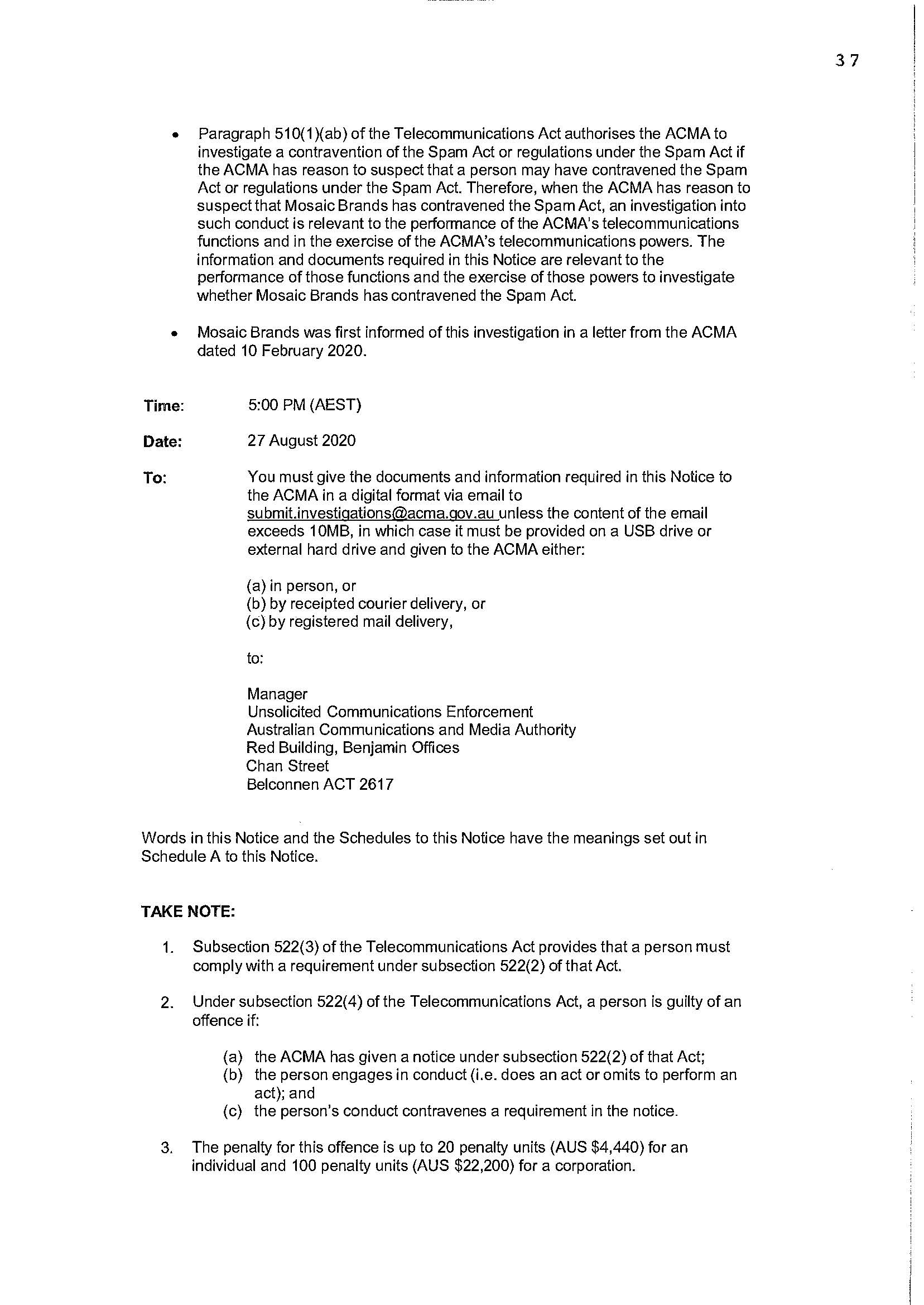
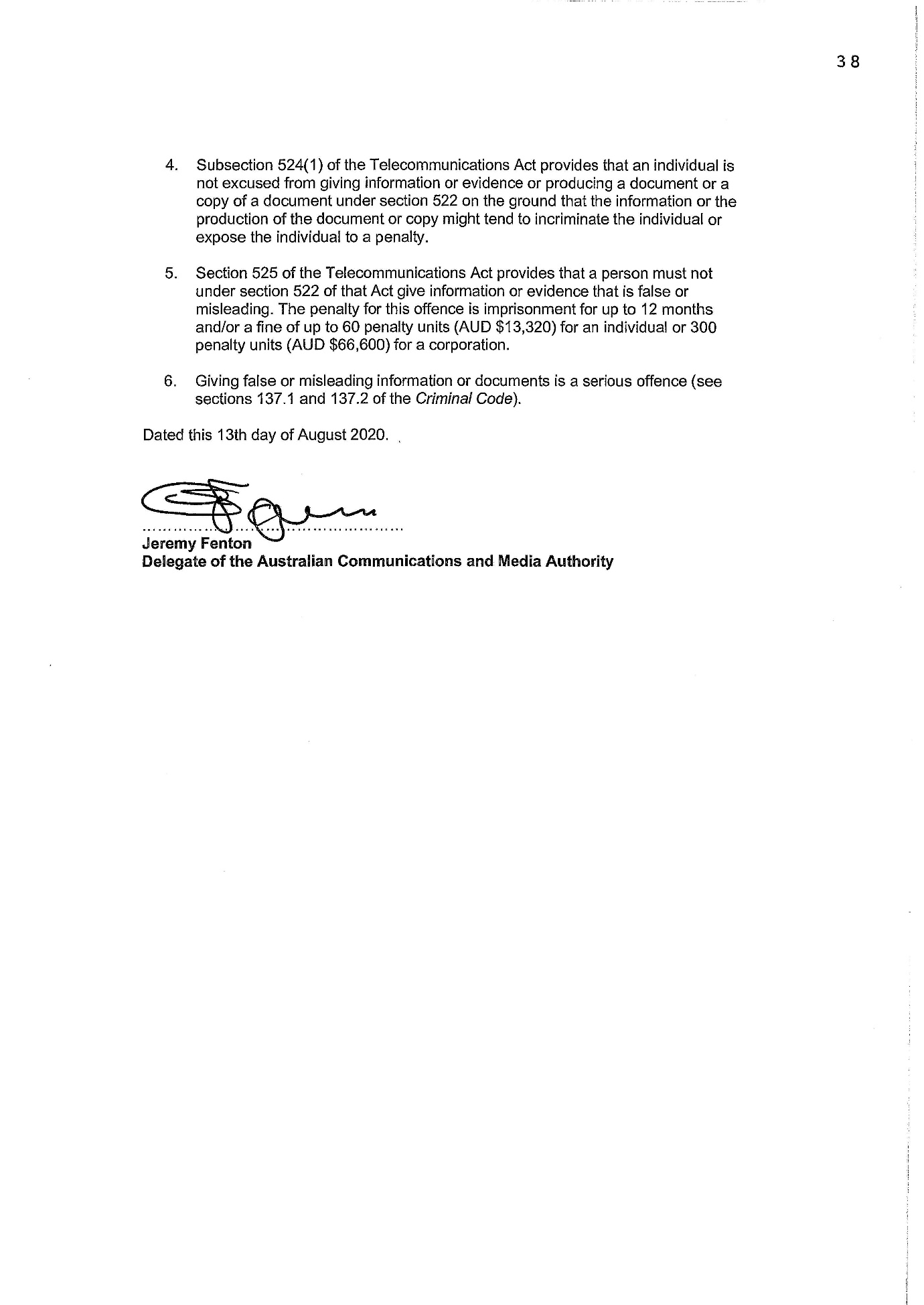
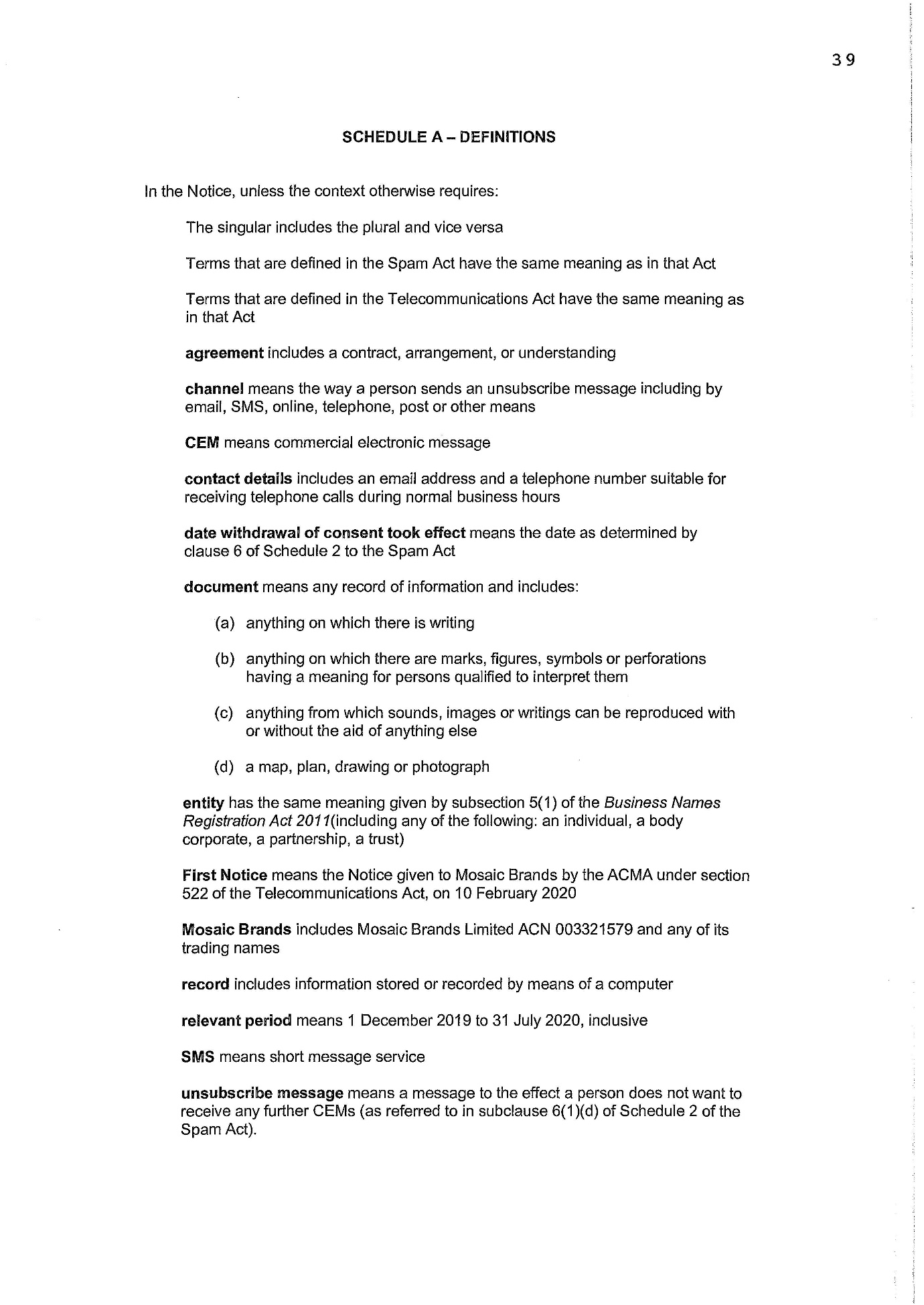
3 This case is concerned with the validity of such a notice. The Notice in question was issued by the ACMA to Mosaic Brands Limited (Mosaic) on 13 August 2020 (the Notice). The Notice required Mosaic to provide certain information and produce specified documents. By an originating application filed on 15 September 2020, amended on 28 October 2020 (the application), Mosaic contends that the decision to issue the Notice was not authorised by the Telecommunications Act and involved an error of law. It seeks a declaration that the Notice is void and of no effect and an order setting aside the decision to issue the notice. The application was supported by an affidavit of Joseph Antoun sworn on 14 September 2020, which annexed the Notice and relevant correspondence. Mr Antoun is a principal of the firm Uther Webster & Evans, which acts for Mosaic.
4 An order staying the operation of the Notice was requested in the originating application but was removed from the amended originating application. At the hearing of the application I was informed that the ACMA had agreed not to prosecute Mosaic for non-compliance with the Notice while the proceeding was still on foot.
5 For the reasons that follow the application must be dismissed.
The Notice
6 The Notice was served on Mosaic under cover of a letter from the ACMA dated 13 August 2020. In the covering letter the ACMA referred to an earlier letter dated 10 February 2020 in which it informed Mosaic that it had commenced an investigation into Mosaic for potential contraventions of the Spam Act. The covering letter recounted that, as part of the investigation, the ACMA had issued two notices under s 522, one on 10 February 2020, the second on 5 May 2020, that some information and documents had been provided by Mosaic in response to the first notice but that the ACMA required further information, and that the second notice had been withdrawn.
7 The Notice was addressed to Mosaic and marked for the attention of its directors. Annexed to these reasons is a copy of the Notice, as it appeared in Mr Antoun’s affidavit save for redactions made for privacy reasons to Schedule C, which contain lists of email addresses and mobile telephone numbers. It is nonetheless useful to refer here to some of its key parts.
8 The Notice began with this recital, flagging the authority upon which it relied and which it would go on to explain in more detail, to require the information and documents it sought:
I, Jeremy Fenton, delegate of the Australian Communications and Media Authority (the ACMA), having reason to believe that Mosaic Brands Limited ACN 003321579 (Mosaic Brands) has information and documents relevant to the performance of the ACMA’s telecommunications functions and exercise of the ACMA's telecommunications powers[.]
9 A summary of the background to the issue of the Notice followed:
• If the ACMA has reason to suspect that a person may have contravened the Spam Act 2003 (Spam Act) or regulations made under the Spam Act it may commence an investigation into this contravention (paragraph 510(1)(ab) of the Telecommunications Act).
• The ACMA has received complaints between 10 October 2019 to 31 July 2020, which lead it to suspect that Mosaic Brands may have contravened section 16 and/or section 18 of the Spam Act. These complaints relate to:
• commercial electronic messages being sent without the consent of the recipient (section 16); and
• commercial electronic messages failing to contain a functional unsubscribe facility (section 18).
• As a result of the complaints, and the ACMA’s suspicion that Mosaic Brands may have contravened the Spam Act, the ACMA has commenced an investigation into the associated conduct of Mosaic Brands.
• Paragraph 510(1)(ab) of the Telecommunications Act authorises the ACMA to investigate a contravention of the Spam Act or regulations under the Spam Act if the ACMA has reason to suspect that a person may have contravened the Spam Act or regulations under the Spam Act. Therefore, when the ACMA has reason to suspect that Mosaic Brands has contravened the Spam Act, an investigation into such conduct is relevant to the performance of the ACMA’s telecommunications functions and in the exercise of the ACMA’s telecommunications powers. The information and documents required in this Notice are relevant to the performance of those functions and the exercise of those powers to investigate whether Mosaic Brands has contravened the Spam Act.
• Mosaic Brands was first informed of this investigation in a letter from the ACMA dated 10 February 2020.
10 The Notice proceeded to inform Mosaic that the Telecommunications Act requires a person to comply with a requirement under s 522(2), that it is an offence to engage in conduct which contravenes a requirement in the Notice, that the privilege against self-incrimination does not excuse non-compliance, and that it is an offence to provide false or misleading information. The Notice also set out the penalties for the offences.
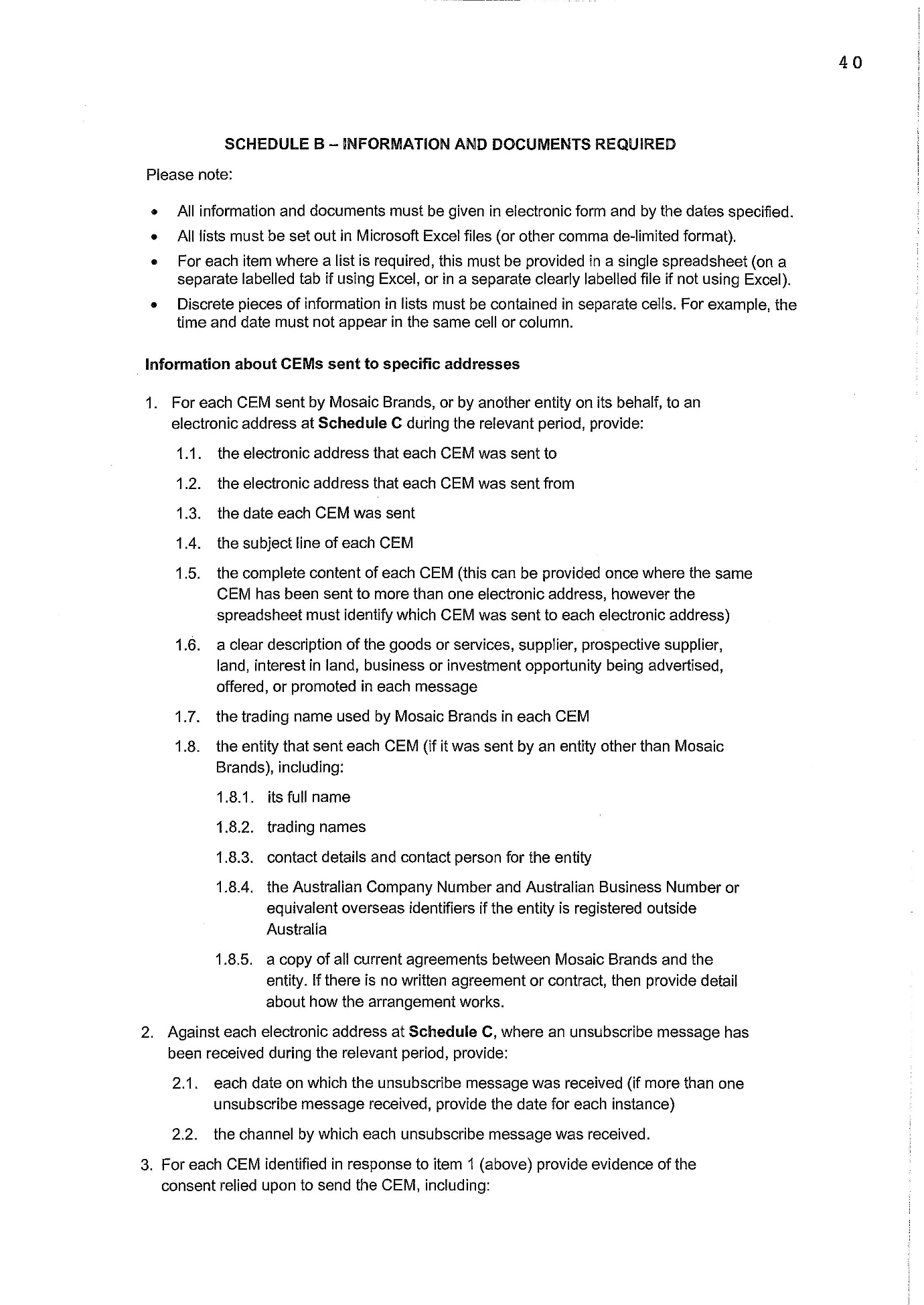
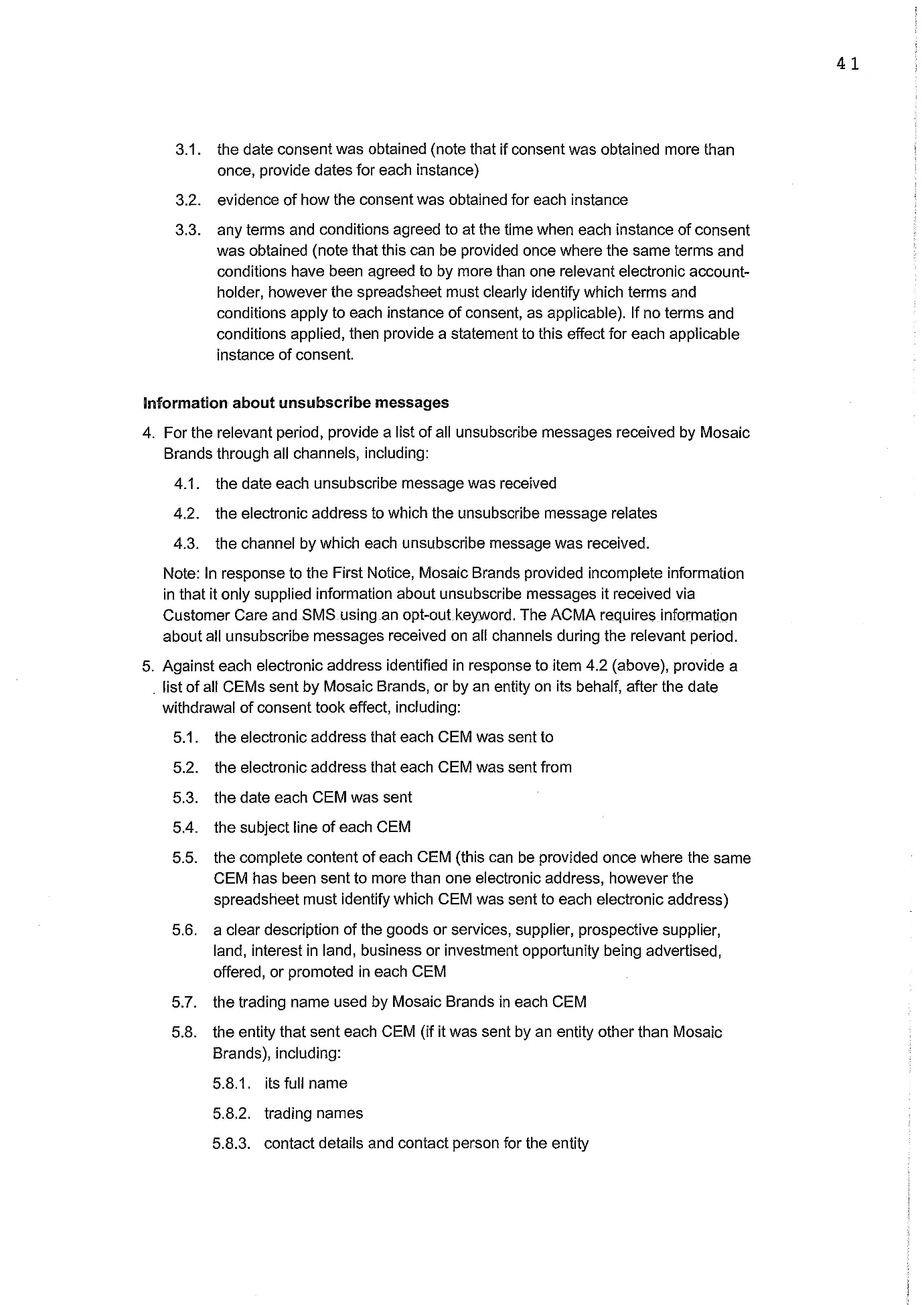
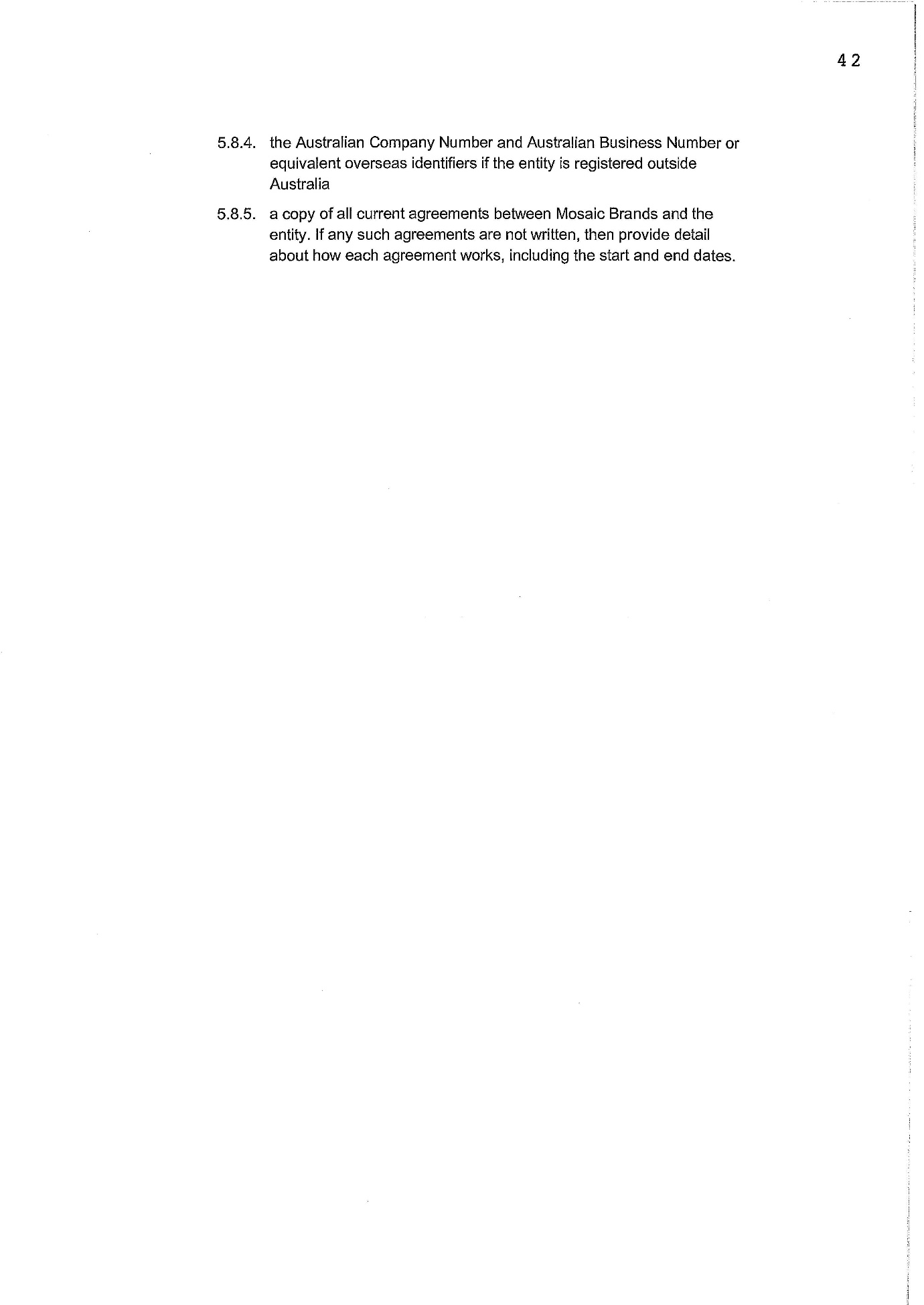
11 Four schedules were appended to the Notice. Schedule A contained definitions of the terms used in Schedule B. Schedule B described the information and documents sought by the ACMA. Broadly speaking, that consisted of certain information and, insofar as it required evidence of certain matters, documents relating to commercial electronic messages sent to the electronic addresses listed in Schedule C, including evidence of the consent upon which Mosaic relied to send those messages and certain information and documents concerning unsubscribe messages received by Mosaic. The requirement was also limited to the period between 10 October 2019 to 31 July 2020 during which the ACMA had received complaints which, it advised, had caused it to suspect that Mosaic may have contravened s 16 and/or 18 of the Spam Act. The Notice required Mosaic to provide the information and documents to the ACMA on or before 5.00 pm (AEST) on 27 August 2020.
12 I interpolate that s 16 of the Spam Act provides in subsection (1) that a person must not send, or cause to be sent, a “commercial electronic message” that has an “Australian link” and is not a “designated commercial electronic message”. Each of these terms is defined in the Act, the first two in ss 6 and 7, the third in Schedule 1. Subsection (2) provides that subs (1) does not apply if the relevant electronic account-holder consented to the sending of the message. Subsection (5) relevantly provides that a person wishing to rely on subs (2) bears an evidential burden in relation to that matter. “Consent” for this purpose is defined in Schedule 2.
13 Section 18(1) of the Spam Act prohibits a person from sending, or causing to be sent, a commercial electronic message that has an Australian link and is not a designated commercial electronic message unless:
(c) the message includes:
(i) a statement to the effect that the recipient may use an electronic address set out in the message to send an unsubscribe message to the individual or organisation who authorised the sending of the first-mentioned message; or
(ii) a statement to similar effect; and
(d) the statement is presented in a clear and conspicuous manner; and
(e) the electronic address is reasonably likely to be capable of receiving:
(i) the recipient’s unsubscribe message (if any); and
(ii) a reasonable number of similar unsubscribe messages sent by other recipients (if any) of the same message;
at all times during a period of at least 30 days after the message is sent; and
(f) the electronic address is legitimately obtained; and
(g) the electronic address complies with the condition or conditions (if any) specified in the regulations.
14 An “unsubscribe message” is defined for the purposes of the section in subs (9) as:
(a) an electronic message to the effect that the relevant electronic account-holder does not want to receive any further commercial electronic messages from or authorised by that individual or organisation; or
(b) an electronic message to similar effect.
15 Section 18(1) does not apply in certain circumstances listed in subsections (2), (3) and (4), but subs (5) provides that a person wishing to rely on any of those subsections bears an evidential burden in relation to that matter.
Mosaic’s application
16 The application seeks judicial review of the decision to issue the notice. It is brought under the Administrative Decisions (Judicial Review) Act 1977 (Cth), which entitles a person aggrieved by a decision to which the Act applies to apply to the Court for “an order of review in respect of a decision” on various grounds including, relevantly, that the decision was not authorised by the enactment in pursuance of which it was purportedly made (s 5(1)(d)) and that the decision involved an error law (s 5(1)(f)).
The legislative scheme
17 It is convenient at this point to describe the legislative scheme.
18 The ACMA’s investigatory powers are set out in Pt 26 of the Telecommunications Act (ss 507-519). In short, the ACMA may investigate certain “matters” relating to telecommunications (s 507). Those matters are listed in s 508. They include contraventions of the Telecommunications Act (s 508(a)) and contraventions of the Spam Act (s 508(ab)). A person may also complain to the ACMA about a matter (s 509). The circumstances in which the ACMA may investigate a matter are prescribed by s 510. Section 510 relevantly provides that:
(1) The ACMA may investigate a matter of a kind referred to in section 508 if:
(a) in the case of a matter covered by paragraph 508(a)—the ACMA has reason to suspect that a person may have contravened this Act; or
…
(ab) in the case of a matter covered by paragraph 508(ab)—the ACMA has reason to suspect that a person may have contravened the Spam Act 2003 or regulations under that Act; or
…
(b) in any case—a complaint is made under section 509;
…
(2) The ACMA must not conduct such an investigation if it thinks that the subject matter of the investigation would not be a matter relevant to the performance of any of its functions.
19 Before beginning an investigation of a matter to which a complaint relates, the ACMA must inform the respondent that the matter is to be investigated (s 512(1)) unless the matter relates to a possible breach of the Spam Act and the ACMA has reasonable grounds to believe that informing the respondent is likely to result in concealment, loss or destruction of a thing connected with the breach (s 512(1A)). Mosaic submitted that this exception was not engaged in this matter. The ACMA did not suggest otherwise. Nevertheless, it is no part of Mosaic’s case that the investigation was begun without informing Mosaic in accordance with s 512.
20 The ACMA’s information-gathering powers are contained in Pt 27 of the Telecommunications Act (ss 520–528).
21 Section 521 provides that the ACMA may obtain information and documents from carriers and service providers and specifies the circumstances in, and the means by, which the information and documentation can be obtained. It also imposes an obligation on the carrier or service provider to comply with a requirement issued by the ACMA in accordance with the section.
22 Section 522 is an analogous provision which entitles the ACMA to obtain information and documents from “other persons”. Section 522 relevantly provides:
(1) This section applies to a person if the ACMA has reason to believe that the person:
(a) has information or a document that is relevant to:
(i) the performance of any of the ACMA’s telecommunications functions; or
(ii) the exercise of any of the ACMA’s telecommunications powers;
…
(2) The ACMA may, by written notice given to the person, require the person:
(a) to give to the ACMA, within the period and in the manner and form specified in the notice, any such information; or
(b) to produce to the ACMA, within the period and in the manner specified in the notice, any such documents [.]
…
(3) A person must comply with a requirement under subsection (2).
(4) A person commits an offence if:
(a) the ACMA has given a notice to the person under subsection (2); and
(b) the person engages in conduct; and
(c) the person’s conduct contravenes a requirement in the notice.
Penalty: 20 penalty units.
(5) A notice under this section must set out the effect of subsection (4) and section 525.
(6) In this section:
engage in conduct means:
(a) do an act; or
(b) omit to perform an act.
23 Section 524 provides:
(1) An individual is not excused from giving information or evidence or producing a document or a copy of a document under this Division on the ground that the information or evidence or the production of the document or copy might tend to incriminate the individual or expose the individual to a penalty.
(2) However:
(a) giving the information or evidence or producing the document or copy; or
(b) any information, document or thing obtained as a direct or indirect consequence of giving the information or evidence or producing the document or copy;
is not admissible in evidence against the individual in:
(c) criminal proceedings other than proceedings under, or arising out of, subsection 522(4) or section 525; or
(d) proceedings under section 570 for recovery of a pecuniary penalty in contravention of section 521.
24 Section 525 creates an offence, punishable by imprisonment for 12 months, for giving information or evidence under ss 521 or 522 that is false or misleading.
Mosaic’s submissions
25 In a nutshell, Mosaic’s argument is this:
(1) Legislation which creates an offence for non-compliance with a notice of this kind and which does not give the decision-maker the power to require the recipient of the notice to provide any information or document but only “such information” and “such documents” as are relevant to a specified matter is construed in such a way as to impose a condition of validity of the notice.
(2) That condition, which Mosaic called the “entitlement disclosure condition”, is that the notice must disclose on its face that the administrative decision-maker is entitled to require the recipient to furnish the specified information.
(3) The Notice issued by the ACMA to Mosaic does not comply with that condition.
26 Mosaic submitted that the ACMA’s investigatory function under s 510 was relevantly limited to an investigation of a “matter” (or matters) where the ACMA has reason to suspect that a person has contravened the Spam Act or a complaint is made under s 509. It argued that the term “matter” was a reference to a body of facts which constitutes or may constitute a contravention of the Spam Act and that “[w]hether or not the relevant body of facts constitutes a contravention is a matter of law and does not turn on the perception or knowledge of the ACMA”, citing Seven Network Limited v Australian Competition and Consumer Commission (2004) 140 FCR 170 at 182 [49(iv)] (Sackville and Emmett JJ).
27 The argument is based on a line of authority, beginning with Federal Commissioner of Taxation v Australia and New Zealand Banking Group Limited (1979) 143 CLR 499 (FCT v ANZ).
28 Mosaic submitted that the recipient of the Notice would be unable to assess whether the requested information was “such information” or the requested documents “such documents” for the purposes of s 522(2)(a) and (b). Consequently, it argued, the Notice failed to disclose on its face that the ACMA was entitled to require the production of the specified information and documents and therefore failed to comply with the entitlement disclosure condition.
ACMA’s submissions
29 The ACMA submitted that Mosaic’s application should be dismissed for three reasons:
30 First, the power to issue a notice under s 522 of the Telecommunications Act is not conditioned on proving the relevance of the material sought to any “matter”. Neither is there any express requirement in s 522 that a notice disclose the ACMA’s entitlement to require the specified information and documents. The language of s 522 and the context of the Act similarly imply no such requirement. Mosaic’s attempt to import an entitlement disclosure condition from other statutory contexts, which involve language distinguishable from s 522, should be rejected.
31 Second, any conditions which arise in respect of s 522 are narrower than Mosaic contended. The text of s 522 does not indicate that the words “any such documents” refer to documents which are actually relevant to the ACMA’s functions and powers, but rather are conditioned only on the ACMA’s belief. Therefore, at most, a notice under s 522 needs to specify that the ACMA has “reason to believe” that the recipient has information or documents relevant to the ACMA’s telecommunications functions or powers. It does not require any investigation of the detail of the functions or powers which the ACMA would be exercising.
32 The ACMA submitted that this interpretation is consistent with the following aspects of the legislative scheme:
(1) The word “matter” is used in Pt 26, not Pt 27, of which s 522 is part and Mosaic’s contention to the contrary is wrong.
(2) There is nothing in the text of s 522 which would suggest that the power to issue a notice is dependent upon proving the relevance of material sought to any “matter” referred to in Pt 26 of the Act.
(3) Rather, s 522(1) is concerned with the functions and powers of the ACMA. It is a broad power to require information and documents in respect of those functions and powers. The section does not contain any reference to a specific factual matter such as the “matter” referred to in the cases upon which Mosaic relied.
33 Third, in any event the Notice complies with the entitlement disclosure condition as the relevance of the information and evidence it sought is obvious as the basis for both the ACMA’s reasonable suspicion and the matters which may amount to contraventions of the Spam Act were specified in the Notice.
Mosaic’s submissions in reply
34 In its submissions in reply, Mosaic argued that the ACMA’s interpretation of s 522 — that is, that the words “such information” and “such documents” in s 522(2)(a) and (b) refer to information and documents which the ACMA believes are relevant to its functions or powers, not those which are actually relevant — should be rejected. This is because, amongst other reasons, it would require the production of information and documents which are not relevant to any of the ACMA’s powers and functions and could not therefore be a law with respect to postal, telegraphic, telephonic or other like services within the meaning of s 51(v) of the Constitution or any other of its provisions.
35 On the basis of this submission, Mosaic filed a notice under s 78B of the Judiciary Act 1903 (Cth) which it served on the attorneys-general of the Commonwealth, States and Territories. The attorneys-general either declined to intervene or did not respond to the notice.
36 On 23 February 2021 the ACMA filed supplementary submissions addressing the constitutional issue raised by Mosaic.
37 After receiving these submissions, Mosaic accepted that the constitutional issue did not need to be determined.
The issues
38 It follows that the questions for determination are these:
(1) Is s 522(2) of the Telecommunications Act subject to an implied entitlement disclosure condition?
(2) If so, is the Notice compliant with such a condition?
(3) If not, was the decision to issue the Notice not authorised by s 522 or did the decision to issue the Notice involve an error of law?
(4) If the answer to (3) is yes, should the decision to issue the Notice be declared void and of no effect and the Notice set aside?
Is there an implied entitlement disclosure condition for notices under s 522(2) of the Telecommunications Act?
39 I am satisfied that there is an implied entitlement disclosure condition in s 522(2) of the Telecommunications Act.
40 It is convenient to begin the analysis with the authorities upon which Mosaic relied.
41 None of those authorities related to s 522 of the Telecommunications Act. The Explanatory Memorandum to the Telecommunications Bill 1996 (Cth) explained that Pt 27, of which s 522 is part, was based on Pt 4.9 of the Employment Services Act 1994 (Cth). The ACMA submitted, without demur, that there do not appear to be any authorities which have considered the implication of any such condition in respect of either s 522 or “the relevant equivalent” in the Employment Services Act.
42 In FCT v ANZ the High Court was concerned with s 264(1) of the Income Tax Assessment Act 1936 (Cth), which gave the Commissioner of Taxation the power: (a) to require any person by notice in writing to furnish the Commissioner with such information as the Commissioner may require; and (b) to attend and give evidence “concerning his or any other person’s income or assessment, and may require him to produce all books, documents and other papers whatever in his custody or under his control relating thereto”.
43 Gibbs ACJ held at 525 that:
To be valid a notice to produce documents under s. 264(1)(b) must of necessity identify with sufficient clarity the documents which are required to be produced. However the notice must in my opinion go further: it must show the person to whom it is addressed that any document which he is required to produce is one whose production the Commissioner is entitled to require. Where a notice is addressed to a taxpayer who is required to produce documents which relate to his own income or assessment, the very description of the documents (for example, “your books of account”) may be enough to show that the notice is within the power conferred by the section. Where however the notice is addressed to one person, requiring him to produce the documents of another, the notice must show that those documents relate to the income or assessment of a particular person, who must be identified. The power is confined to giving a requirement of a particular kind—a requirement to produce documents relating to the income or assessment of some person—and a notice requiring the production of documents not so related is beyond the scope of the power.
(Emphasis added.)
44 Most of the authorities upon which Mosaic relied, however, relate to s 155 of the Trade Practices Act 1974 (Cth) (TPA) (now the Competition and Consumer Act 2010 (Cth)).
45 At the time of the first of these authorities, Pyneboard v Trade Practices Commission (1982) 57 FLR 368; 39 ALR 565, s 155(1) of the TPA relevantly enabled a member of the Trade Practices Commission (now the Australian Competition and Consumer Commission) to require a person, by notice in writing to furnish information, produce documents to the Commission or give evidence “[w]here the Commission, the Chair[person] or a Deputy Chair[person] has reason to believe that [the] person is capable of furnishing information, producing documents or giving evidence relating to a matter that constitutes, or may constitute, a contravention of [the] Act …”. It was an offence to refuse or fail to comply with a notice under the section, punishable by a fine of $1000 or imprisonment for three months (s 155(5)).
46 In Pyneboard at 57 FLR 374; 39 ALR 570 the Full Court held that, where refusal or failure to comply with a notice under s 155 of the TPA is punishable by imprisonment or fine, the power to require information to be furnished and documents to be produced is subject to two “implicit conditions of validity” relating to the form or content of the notice.
47 The first is that the notice conveys “with reasonable clarity” the information the recipient is required to furnish or the documents the recipient is required to produce. Nevertheless the Full Court noted (at 375, 570–571):
Artificial dissection, in the cause of determined obfuscation, can introduce an argumentative element of uncertainty into words which, when read reasonably in context, are adequate to convey a plain and clear meaning. Provided a notice makes it reasonably clear, in the circumstances in which it is given and on a fair reading of its terms, what information or documents are required, the requirements of s. 155(1) as to clarity will be satisfied. In this regard, the mere fact that parsing and analysis in the artificial atmosphere of the courtroom can lead to the identification of a number of latent ambiguities will not invalidate what, as a matter of common sense, is reasonably clear.
48 The second is that the notice discloses that the Commissioner is entitled to require the recipient to furnish the information or produce the documents described in the notice. The Full Court held (at 375, 571), applying FCT v ANZ, that this requirement will not be satisfied “unless it appears from the notice that the information or documents sought are information or documents ‘relating’ to one or more ‘matters’ of a kind described in [s 155(1)]”. The Full Court stressed, however, that this question, like the former, is “not to be approached in an over-technical or hypercritical way” (at 376, 571).
49 In Seven Network at [49] Sackville and Emmett JJ summarised the effect of the authorities concerning the interpretation of s 155(1) of the TPA:
The authorities have established a number of propositions concerning the interpretation of s 155(1) of the TP Act. They include the following:
(i) In a context where refusal or failure to comply with a s 155 notice is punishable by imprisonment or fine, the notice must:
(a) convey with reasonable clarity to the recipient the information that must be furnished; and
(b) disclose that the ACCC is entitled to require the recipient to furnish the specified information:
Pyneboard Pty Ltd v Trade Practices Commission (1982) 57 FLR 368 at 374, per curiam.
(ii) The second of these requirements will not be satisfied unless it appears from the notice that the information sought is information “relating” to one or more “matters” of a kind described in s 155(1): Pyneboard v TPC at 375; SA Brewing v Baxt at 369-370; Bannerman v Mildura Fruit Juices Pty Ltd (1984) 2 FCR 581 at 584, per Bowen CJ and Neaves J. However, the question whether a notice discloses the necessary “relatedness” is not to be approached in an “over-technical or hypercritical way”: Pyneboard v TPC at 376. Moreover, the “relatedness” is to a proper inquiry into the suspected offences: Panelboard Pty Ltd v Trade Practices Commission (1981) 59 FLR 395 at 407, per Fox J.
(iii) Section 155(1) does not require the Chairperson of the ACCC to have “reason to believe” that a specified matter constitutes or may constitute a contravention of the TP Act. The Chairperson must, however, have reason to believe that the relevant person is capable of furnishing information relating to the matter specified in the notice: [WA Pines Pty Ltd v Bannerman (1980) 41 FLR 175] at 179, per Brennan J (with whom Bowen CJ agreed); TNT Australia Pty Ltd v Fels [1992] ATPR 40,595 (41-190) at 40,598-40, 599, per Gummow J. It follows that the Chairperson or other officer must believe that the person to whom the notice is directed is capable of furnishing information relating to the facts known or suspected: WA Pines v Bannerman at 180. In addition, there must be facts in existence which are sufficient to induce that belief in a reasonable person: George v Rockett at 112.
(iv) The word “matter” in s 155(1) is to be construed in its ordinary sense of an affair or thing: Melbourne Home of Ford Pty Ltd v Trade Practices Commission (1979) 36 FLR 450 at 474, per Franki and Northrop JJ; SA Brewing v Baxt at 369. It refers to a body of facts which constitutes or may constitute a contravention of the TP Act. Whether or not the relevant body of facts constitutes a contravention is a matter of law and does not turn on the perception or knowledge of the ACCC or its officers: WA Pines v Bannerman at 179.
(v) When s 155(1) speaks of a matter which may constitute a contravention, it refers to a body of facts not fully known and which may, when fully known, reveal themselves as constituting a contravention: WA Pines v Bannerman at 179. The words “may constitute” enable a court to judge from the material in the notice whether, if other facts which may or may not have occurred come to light, the whole body of facts would constitute a contravention: SA Brewing v Baxt at 370. It is not necessary for the Court to determine whether a contravention has occurred; but equally it will not “idly speculate” or “draw on improbable circumstances” to uphold a notice: SA Brewing v Baxt at 370. An alternative formulation is that the Court can take account of facts which may “reasonably be suspected” to have occurred: WA Pines v Bannerman at 179.
(vi) Where the matter referred to in the notice, after allowing for undiscovered facts, is incapable of amounting to a contravention, the issue of the notice is not a valid exercise of the power conferred by s 155(1): SA Brewing v Baxt at 371-372.
(vii) In view of the principle that a court should not adopt an “over-technical or hypercritical approach” to the construction of a notice, there is no requirement that the notice “plead” all the facts necessary to constitute a contravention or possible contravention of the TP Act: SA Brewing v Baxt at 370.
(viii) Information which tends to negative a suspected contravention or liability to conviction or which tends to exculpate a person suspected to be a party to a contravention, is within the ambit of s 155(1). It follows that an inquiry under s 155 may relate to a defence or possible defence available to the suspected person: WA Pines v Bannerman at 180.
50 The question at hand falls to be determined by reference to the text of s 522 of the Telecommunications Act considered in its context.
51 The ACMA submitted that s 522(5) expressly addresses what a notice is required to include: it “must set out the effect of subsection (4) and section 525”. The ACMA pointed to other sections of the Act which contain similar provisions. It argued that “the implication of an additional requirement as to the form of the notice over and above what can be gleaned from section 522 itself is inconsistent with this clear expression of legislative intent through the drafting mechanism of expressing what is required to be contained in a notice”.
52 It does not follow from the mere fact that the Act specifies that certain matters must be included that other matters need not be included. But there must be something about the nature, scope and/or purpose of the Telecommunications Act to indicate that an entitlement disclosure condition is implied.
53 So what is there about the nature, scope and/or purpose of the legislation to indicate that such a condition was implied?
54 The power conferred by s 522 is intrusive and its scope is broad. Critically, criminal sanctions are imposed for non-compliance and for providing false or misleading information.
55 While the authorities upon which Mosaic relied concern different legislation, the principles for which they stand are not confined to that legislation. In D’Anastasi v Environment, Climate Change and Water (NSW) (2011) 81 NSWLR 82 at [42], after referring to Pyneboard, Young JA (with whom Campbell JA and Sackville AJA agreed at [1] and [103] respectively) observed that the requirement that the giver of a notice specify in the notice that the information or documents sought were information or documents relating to one or more matters of a kind described in the legislation conferring the power to issue the notice was not unique to the Trade Practices Commission. To the contrary, his Honour added, “[i]t has been the standard for statutory notices for a long time”. In that case the principles in Pyneboard and SA Brewing Holdings Ltd v Baxt (1989) 23 FCR 357 (SA Brewing v Baxt) were applied to a notice purportedly issued under s 193 of the Protection of the Environment Operations Act 1997 (NSW).
56 The same approach has also been taken, for example, to the power to issue a notice under s 712 of the Fair Work Act 2010 (Cth) requiring the production of records or documents to a Fair Work Inspector: see Construction, Forestry, Maritime, Mining and Energy Union v Fair Work Inspector Lam [2018] FCA 1379 at [27] (Bromberg J); Fair Work Ombudsman v United Petroleum Pty Ltd [2020] FCA 590 at [35] (Anderson J); and 85 Degrees Coffee Australia Pty Ltd v Rodwell [2020] FCA 1190; 299 IR 280 at [20]–[23] (Katzmann J).
57 Since the refusal or failure to comply with a s 522 notice is a punishable by a fine and the giving of information that is false or misleading is punishable by imprisonment, the weight of authority indicates that the power conferred by s 522(2) is subject to an implied condition that the notice discloses that the ACMA is entitled to require the recipient to give the information or produce the documents described in the notice.
58 It is true, as the ACMA submitted, that Mosaic’s submissions focus on the ACMA’s power of investigation in Pt 26 of the Telecommunications Act, not its power to require the production of information or documents which is contained in Pt 27. It is true, too, as the ACMA also submitted, that there is no reference to “matters” in Pt 27. But Pt 27 cannot be read in isolation from Pt 26. “ACMA’s telecommunications functions” and “ACMA’s telecommunications powers” are defined terms in the Telecommunications Act. The former means “the functions that are telecommunications functions, in relation to the ACMA, for the purposes of the [ACMA Act]” and the latter the powers conferred on the ACMA by a number of Acts including, relevantly, the Telecommunications Act and the Spam Act (s 7). One of the ACMA’s telecommunications powers is the power to conduct an investigation. That is the power with which Pt 26 is concerned. It is evident that one of the purposes of the ACMA’s information-gathering powers, for which Pt 27 provides, is to facilitate or assist its investigation powers.
59 Where, as here, the information and documents are sought for such a purpose, in accordance with the line of authorities upon which Mosaic relied, a notice issued under s 522 of the Telecommunications Act must disclose that the ACMA has reason to believe that the person who is served with the notice has information or documents relevant to that purpose. It follows, too, from those authorities, that a notice issued under s 522 will be invalid if it does not appear from its terms that the information required to be given or the documents required to be produced relate to the exercise of those powers.
60 The ACMA argued that there is nothing in the text of s 522 to indicate that the words “any such documents” is a reference to documents which are actually relevant to the ACMA’s functions and powers. Rather, it submitted that s 522 is conditioned only on the ACMA’s belief that they are relevant. That is not so. The section applies to a person “if the ACMA has reason to believe …”. There must be facts in existence sufficient to adduce the relevant belief in a reasonable person: Seven Network at [49](iii) above.
61 The ACMA also argued that the absence of the word “matter” in s 522 or any link in s 522 to any “matter” indicates that there is no reason to limit the power conferred by s 522 by reference to a “matter”. In support of this argument the ACMA observed that the power to issue a notice under s 522 is not confined to information in connection with an investigation. The ACMA submitted that its telecommunications functions, for example, are defined in s 7 of the Telecommunications Act to mean telecommunications functions in relation to the ACMA for the purposes of the ACMA Act. These functions include “to advise and assist the telecommunications industry” (ACMA Act, s 8(1)(b)) and “to report to and advise the Minister in relation to the telecommunications industry” (ACMA Act, s 8(1)(c)). The ACMA submitted that a Pt 27 notice could be used for this purpose and none of these functions refers to “a matter”.
62 I accept the ACMA’s submission that the power conferred by s 522 is not confined to information (or documents) connected to an investigation. In the present case, however, the notice is being issued for the purpose of an investigation. The power to investigate conferred by s 510 is limited to a matter of a kind referred to in s 508. It seems to me that, where the power is being exercised for the purpose of an investigation, the entitlement disclosure condition will not be satisfied unless it appears from the notice that the information or documents sought relate to one or more matters of that kind. Here, those matters consist of a body of facts which, depending on what other facts may come to light during or as a result of the investigation, may constitute a contravention of s 16 or 18 of the Spam Act.
Does the Notice comply with the implied condition?
63 Mosaic submitted that the Notice did not comply with the implied entitlement disclosure condition for five reasons.
64 First, in stating that the ACMA’s function extends to the investigation of a contravention of the Spam Act if there is reason to suspect that a person may have contravened that Act, the first dot point in the “Background” section of the Notice “[overstates] the scope of the function” of s 510(1)(ab). Rather, the function is “not so broad” and is limited to investigating a matter “if the ACMA has reason to suspect that by that matter a person has contravened the Spam Act”.
65 Second, the complaint handling function is misrepresented in the second dot point. It is not sufficient that there be “generalised complaints which lead to generalised suspicion of contravention of the Spam Act unconnected to any matter”.
66 Third, the identification of the source of the investigation in the third dot point (as the complaints received by the ACMA and its suspicion that Mosaic may have contravened the Spam Act) is not limited by reference to any matter.
67 Fourth, the fourth dot point, which states that the ACMA is investigating “whether Mosaic Brands has contravened the Spam Act”, makes it impossible for the recipient of the Notice to assess whether the information and documents sought are relevant to the subject matter of the investigation and the ACMA’s suspicion that Mosaic has breached the Spam Act.
68 Finally, Mosaic contended that categories 4 and 5 of Schedule B to the Notice, which required Mosaic to provide information in relation to unsubscribe messages it received during the relevant period, contained insufficient detail to assess whether and to what extent that information was relevant to an investigation of a matter within the scope of the ACMA’s telecommunication functions.
69 The first proposition must be rejected. The statement in the first dot point is accurate. It precisely reproduced the terms of s 510(1)(ab):
The ACMA may investigate a matter of a kind referred to in section 508 if:
…
(ab) in the case of a matter covered by paragraph 508(ab)—the ACMA has reason to suspect that a person may have contravened the Spam Act 2003 or regulations under that Act [.]
70 The second proposition must also be rejected. In the second dot point the ACMA does not purport to describe the complaint handling function under the Act. Nor are the complaints to which the ACMA refers are “generalised complaints which lead to a generalised suspicion of contravention of the Spam Act unconnected to any matter”. To the contrary, the complaints are said to relate to suspected contraventions of s 16 in that they relate to commercial electronic messages being sent without the consent of the recipient and s 18 in that they relate to commercial electronic messages which do not contain a functional unsubscribe facility.
71 The third and fourth propositions must be rejected because they invite the Court to read the statements in them out of context, in isolation from the preceding recitals.
72 The final proposition must also be rejected. As the ACMA submitted, since it is obvious on the face of the Notice how the information sought in categories 4 and 5 relates to an investigation of suspected contraventions of ss 16 and 18 of the Spam Act. Those categories seek a list of unsubscribe messages received by Mosaic and a list of commercial electronic messages sent by Mosaic to particular electronic addresses after the date withdrawal of consent took effect. It is evident that the information being sought relates to whether unsolicited messages were sent to those addresses after the withdrawal of consent or whether messages were sent with a non-functional unsubscribe facility. As the ACMA submitted, if a person sought to unsubscribe but later received a message, that would indicate both a non-functional unsubscribe facility and the sending of the later commercial electronic message without the person’s consent.
73 Gibbs ACJ observed in FCT v ANZ at 525 that where a notice is directed to a person’s own documents the very description of those documents may be enough to show that the notice is within the relevant power. That appears to be the case here.
74 The approach urged on the Court by Mosaic smacks of the “precious”, “over-technical” or “hypercritical” approach to a statutory notice eschewed by the authorities. It is an approach, it will be recalled, that the Full Court in Pyneboard described as “[a]rtificial dissection, in the cause of determined obfuscation”, which “can introduce an argumentative element of uncertainty into words which, when read reasonably in context, are adequate to convey a plain and clear meaning”. The Notice must be read in context and in a fair, non-technical manner. Read in this way, the Notice makes it tolerably clear what documents and information were required and why the ACMA was entitled to require their production. In particular, the Notice made clear that the information and documents related to matters of the kind described in s 508 of the Spam Act.
75 The Notice explained that:
(1) the ACMA had received complaints relating to Mosaic sending commercial electronic messages without the consent of the recipient, which may be a contravention of s 16 of the Spam Act, and commercial electronic messages which do not contain a functional unsubscribe facility, which may be a contravention of s 18 of that Act;
(2) those complaints were received between 10 October 2019 and 31 July 2020;
(3) the complaints led the ACMA to suspect that Mosaic may have contravened the Spam Act;
(4) consequently, the ACMA was authorised to investigate the suspected contraventions;
(5) the ACMA had commenced an investigation into Mosaic’s “associated conduct”;
(6) the information and documents sought by the Notice were relevant to the performance of the ACMA’s functions and the exercise of its investigation powers because the ACMA had reason to suspect that Mosaic had contravened the Spam Act; and
(7) the information and documents related only to “the relevant period”, which was from 1 December 2019 to 31 July 2020.
76 In context, the reference to Mosaic’s “associated conduct”, and therefore the object of the investigation, was Mosaic’s involvement in the dispatch of commercial electronic messages without the consent of the recipients and without a functional unsubscribe facility.
77 Further, for categories 1–3 in Schedule B to the Notice, the Notice identified the specific electronic addresses in respect of which Mosaic was required to provide the relevant information and documents. For category 4, the Notice specified the date range of the unsubscribe messages sought (in order to address incomplete compliance by Mosaic with an earlier notice). Category 5 was limited to the electronic addresses identified in response to category 4.2.
78 For these reasons the relationship between the information and documents the ACMA sought to a matter of the kind referred to in s 508 is apparent on the face of the Notice.
79 Mosaic did not identify what further information the Notice was required to contain, except for an oblique reference to a “list…of the messages the sending of which was suspected as constituting those contraventions”. I acknowledge that Mosaic does not bear the onus of identifying the details the Notice should contain. But it does bear the onus of establishing that the Notice is invalid. To require a notice to contain the level of detail Mosaic insisted upon would be tantamount to requiring all the facts necessary to constitute a contravention or possible contravention to be pleaded. This approach is contrary to authority (see SA Brewing v Baxt at 370–371 and Seven Network at [49](vii)) and must be rejected. In SA Brewing v Baxt at 371 Fisher and French JJ held that:
Neither the constructional nor policy supports for the entitlement disclosure condition requires that a notice plead a contravention or suspected contravention. It is fundamental that the proper progress of legitimate investigation be not disrupted by what may amount to demurrer or strike out motions on the terms of the notice. Where, however, the “matter” referred to in the notice is incapable, after allowing for undiscovered facts, of amounting to a contravention, then the issue of the notice is not a valid exercise of power.
80 Mosaic has not established that the matter referred to in the Notice is incapable, after allowing for undiscovered facts, of amounting to a contravention.
Conclusion
81 The answers to the questions raised by Mosaic’s application are as follows:
(1) There is an implied entitlement disclosure condition in s 522(2) of the Telecommunications Act. The notice must specify (with reasonable clarity) that the information required to be given and/or the documents required to be produced relate to the performance of one or more of the ACMA’s telecommunications functions or the exercise of one of more of those powers. Where, as here, the relevant function or power is the power conferred by s 510 to investigate a matter of a kind referred to in s 508, that requirement will not be satisfied unless it appears from the notice that the information or documents sought relate to one or more matters of that kind.
(2) The Notice complies with the implied entitlement condition.
(3) It is unnecessary to answer the third or fourth question.
82 Mosaic’s case that the ACMA’s decision to issue the Notice was not authorised by the Telecommunications Act or involved an error of law because the Notice failed to comply with the implied entitlement condition has not been made out. Since the Notice complies with the implied entitlement disclosure condition, the originating application must be dismissed. Costs should follow the event. There will be orders accordingly.
I certify that the preceding eighty-two (82) numbered paragraphs are a true copy of the Reasons for Judgment of the Honourable Justice Katzmann. |
Associate:
Annexure