Federal Court of Australia
Chevron Global Energy Inc v Ampol Australia Petroleum Pty Ltd [2021] FCA 617
ORDERS
First Applicant CHEVRON INTELLECTUAL PROPERTY LLC Second Applicant | ||
AND: | AMPOL AUSTRALIA PETROLEUM PTY LTD Respondent | |
DATE OF ORDER: |
THE COURT ORDERS THAT:
1. The proceeding be adjourned for a further hearing on a date to be fixed.
Note: Entry of orders is dealt with in Rule 39.32 of the Federal Court Rules 2011.
O’CALLAGHAN J:
Introduction
1 The hearing of this proceeding was conducted on an expedited basis and concerned issues of liability only.
2 The first applicant (Chevron Global) is a company incorporated in the United States of America. Through its subsidiaries, it has for many years engaged in energy development, production, distribution, marketing and trading, including by licensing its CALTEX trade mark (and other related marks) for use on and in relation to retail service stations selling Caltex branded petroleum products. It has done this in Australia since the early 1940s.
3 The second applicant (Chevron IP) is the registered owner of the relevant trade marks, which include the words CALTEX, STARCARD and STAR MART registered in various classes, as well as logos. I will refer to the applicants collectively as Chevron unless it is necessary to draw a distinction between them.
4 The respondent (Ampol) is an Australian corporation that has for many years carried on business as an operator of retail service stations. The Ampol brand name has been in use in Australia for businesses supplying fuel since 1936. It is derived from Australian Motorists Petrol Company Ltd, the name under which Ampol was first incorporated. AMPOL has been registered as a trade mark for various classes of goods and services by Ampol and a related company, Ampol Management Services Pte Ltd. The first of the AMPOL trade marks recorded on the Register of Trade Marks was filed in 1941.
5 Before 1995, Chevron and Ampol were competitors in the Australian fuel market. The former operated service stations under the Caltex brand, the latter under the Ampol brand.
6 In 1995, the two competing businesses were merged. Ampol became the principal operating company for the merged business. Chevron owned 50% of Ampol indirectly, through an interest in a company then called Caltex Australia Limited.
7 From the late 1990s, Ampol rebranded all but ten of the service stations in its network to the Caltex brand. Those ten remaining service stations were small, independently owned country sites. As a result, around that time, the Ampol brand all but disappeared from the Australian market.
8 In 2015, Chevron divested its 50% stake in Caltex Australia Limited. All of the shares in that company have since been listed on the Australian Stock Exchange. It remains Ampol’s parent company, and is now called Ampol Limited.
9 In April 2015, and as a consequence of the divestment, Chevron Global and Ampol entered into a Trade Mark Licence Agreement (the TMLA), which licensed Ampol to use the CALTEX trade mark and other related marks. The TMLA superseded an agreement between the parties dated 26 June 2007, which in turn superseded an earlier agreement dated 21 September 2000. It was agreed that reference to those earlier agreements is not necessary for present purposes.
10 In June 2018, the parties amended the TMLA to reduce the minimum period of notice required to terminate it without cause from 12 months to 6 months.
11 In July 2019, the parties amended the TMLA again, this time to reduce the “Work-out Period” (the period in which Ampol must stop using the licensed marks following termination) from 48 months to 30 months, in the event of termination without cause. The new 30-month Work-out Period is divided into an 18-month “Exclusivity Period”, followed by a 12-month “Non-exclusivity Period”. During the Exclusivity Period, Ampol retains its right to exclusive use of the trade marks in Australia. Once the Non-exclusivity Period begins, Chevron will become entitled to use the trade marks alongside Ampol.
12 The July 2019 amendment also increased the annual royalty payable by Ampol to Chevron under the TMLA from $6.5 million to $18 million.
13 On 20 December 2019, Chevron gave notice that it was terminating the TMLA without cause, effective from the end of 30 June 2020, from which time the Work-out Period commenced.
14 Ampol thus has the exclusive rights to use the licensed trade marks until 31 December 2021 (being the Exclusivity Period), and Ampol and Chevron can both use the licensed trade marks from 1 January 2022 until 31 December 2022 (being the Non-exclusivity Period). After that date, the Work-out Period will end and Chevron will be free to do as it wishes with the marks.
15 Following receipt of Chevron’s December 2019 notice of termination, Ampol decided to transition its business to its own Ampol brand.
16 In the meantime, Chevron had acquired 360 “Puma” branded service stations. Once the Exclusivity Period expires, Chevron intends to re-brand each of them using the Caltex brand and trade marks.
17 There are about 1,900 service stations in Ampol’s network of Caltex branded retail sites. Ampol owns around 700 of them. Of the balance, about 700 are owned and operated by distributors or retailers, and about 500 are owned by EG Group Ltd (EG) (having previously been owned and operated by Woolworths Ltd).
18 The rebranding of those sites to Ampol is expected to be completed by July 2022. A total of 1,170 sites are scheduled to be so rebranded by the end of 2021, with the balance to be completed during 2022.
19 Ampol intends to sell fuel at service stations under both the Caltex and Ampol brands until July 2022 (although it is entitled to do so under the TMLA until the end of 2022). Chevron will also be entitled to sell fuel at service stations under the Caltex brand throughout 2022. From the beginning of 2023, that right will become exclusive to Chevron.
20 As at mid-March 2021, when most of the evidence was filed in this proceeding, about 79 Caltex sites had been rebranded to the Ampol brand.
THE issues
21 Three main issues arise for determination.
22 Chevron described those issues in their written closing submissions as follows:
(a) The Caltex Red Canopy Fascia:
i. The canopy on each of the retail outlets is a particularly prominent physical feature of the site. A key element of the Caltex visual identity over the last 25 years is that the station canopy fascia is coloured in a shade of red, Pantone 485C, known as Caltex Red (Caltex Red). The old Ampol branding (not used to any substantial extent in the last 25 years) used blue as its dominant colour and deployed blue on the retail site canopies.
ii. Rather than properly debranding, Ampol is permanently retaining Caltex Red as the colour of the canopy fascia on the retail sites.
iii. Ampol is now seeking to deploy Caltex Red on the fascia of canopies in conjunction with an Ampol logo.
(b) StarCard: Even at service stations which have now been branded Ampol, Ampol is continuing to promote and accept the Caltex StarCard, bearing Caltex registered trade marks, being the Caltex-branded loyalty card, rather than accepting an Ampol branded loyalty card in lieu of the Star Card, at those sites; and
(c) Use of Caltex and Ampol in conjunction: Ampol’s messaging concerning the transition from the use of Chevron’s Caltex branding to Ampol’s branding, uses the Caltex registered trade marks in conjunction with Ampol marks and wrongly conveys the impression that they are from the same stable and thereby that the Caltex brand is being retired from the Australian market by Ampol consequential on the change of name.
23 Chevron submits that by this conduct Ampol has breached the TMLA, contravened the Australian Consumer Law (being Sch 2 to the Competition and Consumer Act 2010 (Cth)) (ACL), and infringed its registered trade marks under s 120(1) of the Trade Marks Act 1995 (Cth) (Trade Marks Act).
24 There is a fourth (minor) issue, namely whether Ampol has breached the TMLA by causing or permitting EG to use main identification (MID) signs that display “EG” in a higher position than CALTEX.
25 Ampol denies any liability.
26 Ampol says that Chevron has “fundamentally misconceived the proper operation of the contractual and statutory rights that it is purporting to exercise”. It says that its conduct has been lawful and consistent with the terms of the TMLA, and that it has not contravened the ACL or infringed any of Chevron’s trade marks.
27 As to the canopy fascia claim, which senior counsel for Chevron described as its principal complaint, Ampol’s case in summary is that:
(a) while Chevron has repeatedly disclaimed that it is advancing an unregistered trade mark case based on a single colour, that it is precisely the effect of the injunctive relief it seeks;
(b) Chevron adduced no consumer evidence, by way of survey or otherwise, seeking to prove that any relevant association exists between the colour red and Caltex, and it did not prove any such association; and
(c) even assuming that the colour red on a canopy may facilitate the identification of the Caltex word mark or the Caltex star logo, that does not mean that a consumer seeing a clearly different trade mark on a red canopy would conclude that the service station provides goods and services having the same commercial origin as Caltex.
28 Ampol also says that Chevron did not prove the “Brand Standards” (as defined) upon which it relies, and that to the extent that Chevron’s case is founded on proof of the content of those standards, it is bound to fail.
The TMLA
29 The relevant provisions of the TMLA are set out below.
30 Under the heading “Background”, the following appears:
A Prior to the date of this Agreement, the arrangements with respect to the licensing and use of [Chevron]’s trade marks in Australia have been recorded in a Trade Mark Licence Agreement dated 26 June 2007 between [Chevron] and [Ampol] (the ‘Previous Agreement’).
B With effect from the Operative Date, it is the intention of the Parties to completely supersede the operation of the Previous Agreement and have their arrangements with respect to the trade mark license and use recorded in this Agreement.
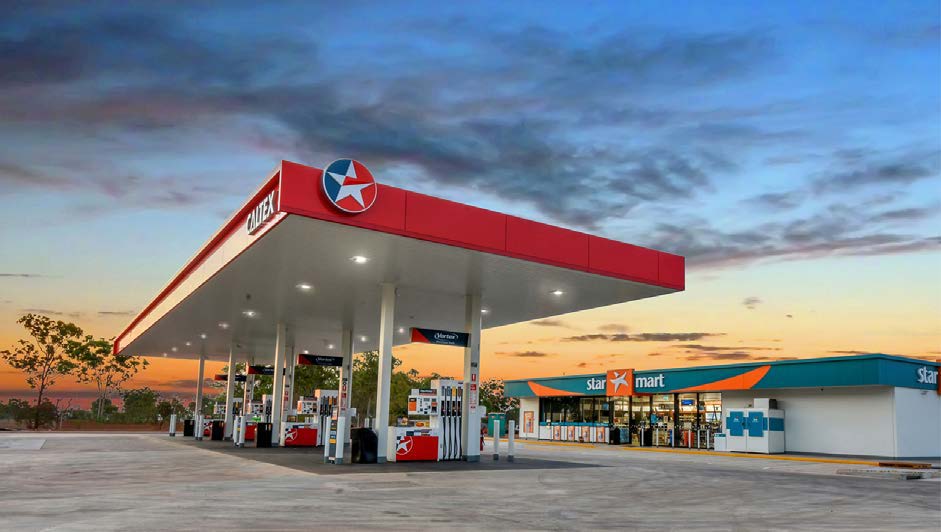
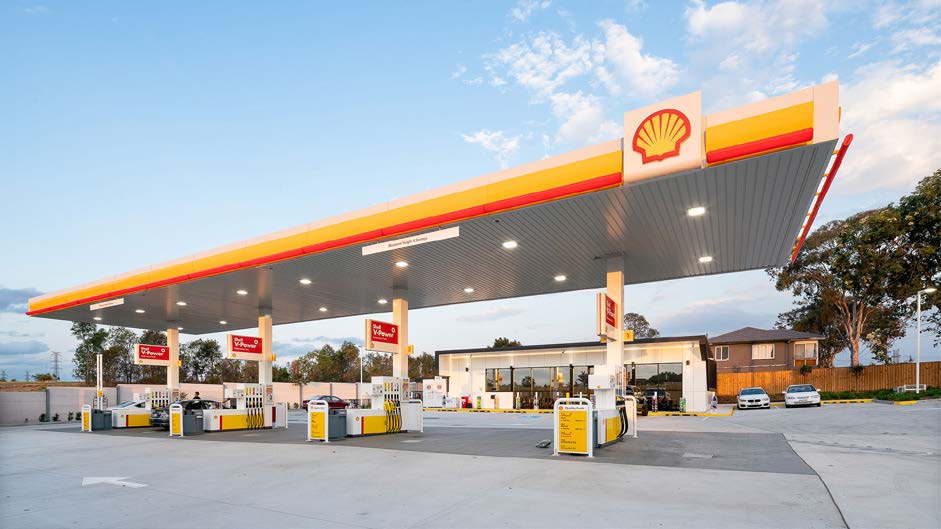
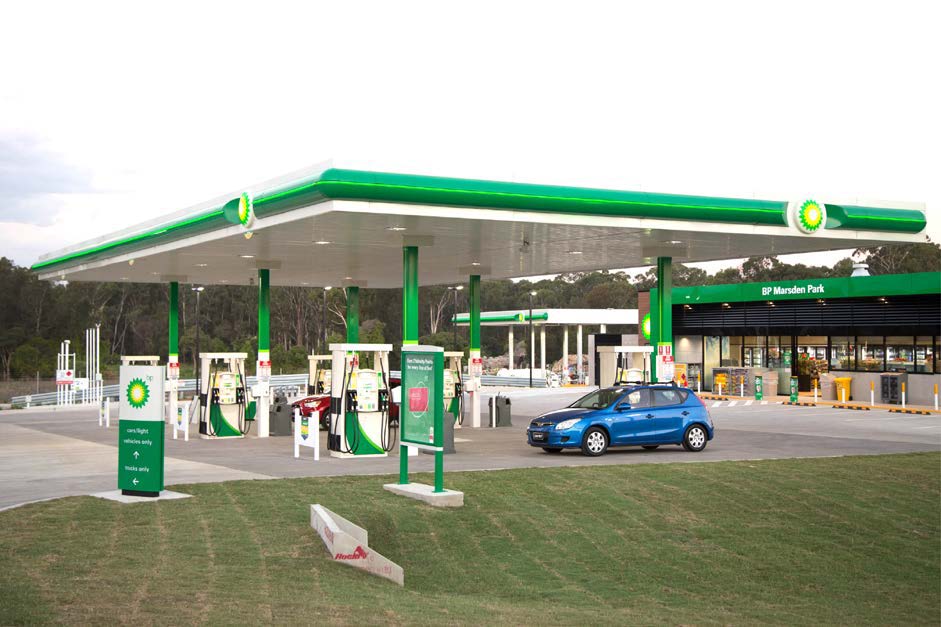
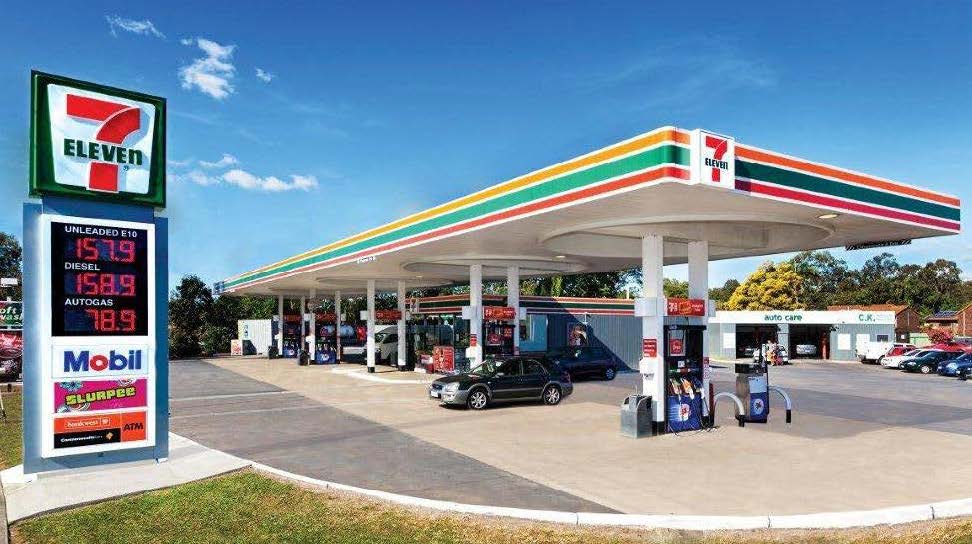
31 Clause 1.1 defines “Brand Standards” as follows:
[T]he visual identity standards documentation developed:
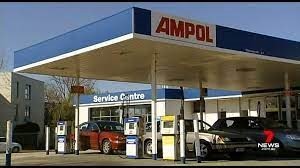
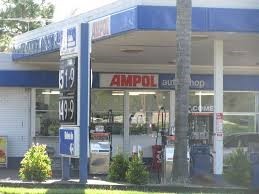
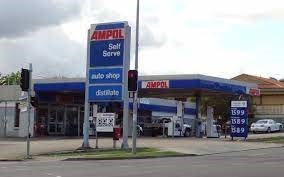
(i) by [Chevron] and issued to [Ampol] as of the Operative Date of the Previous Agreement;
(ii) as updated in accordance with the process in clause 4.3; and
(iii) as amended from time to time by the Parties in accordance with clause 4.5.
32 The “process in clause 4.3” referred to in the definition of Brand Standards is set out in Sch 3, which provides:
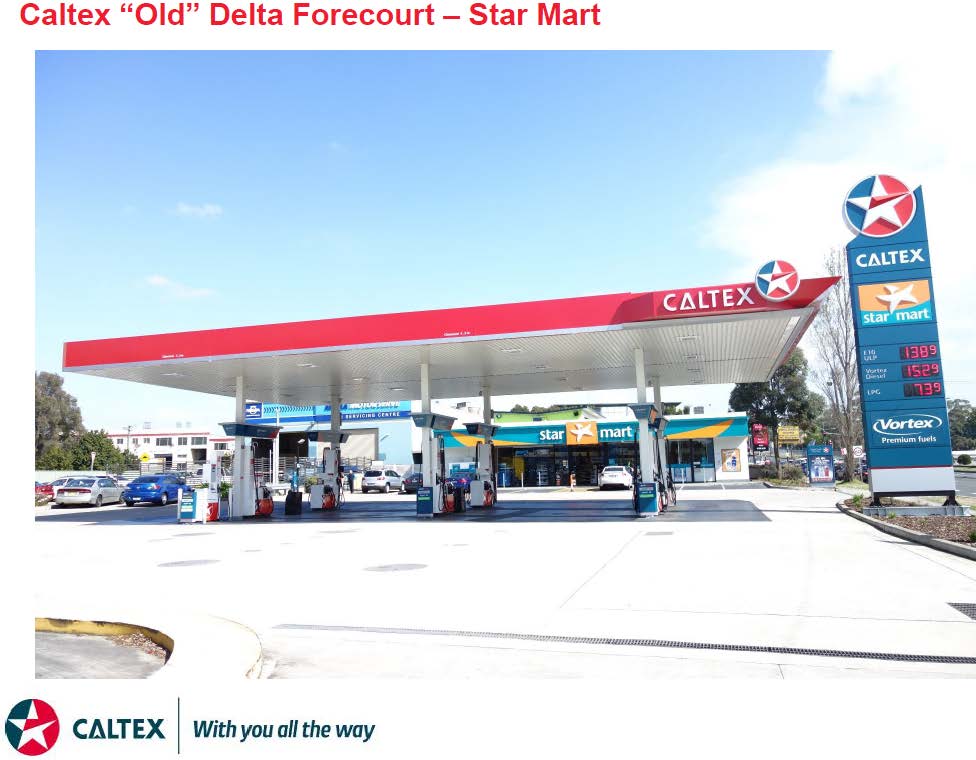
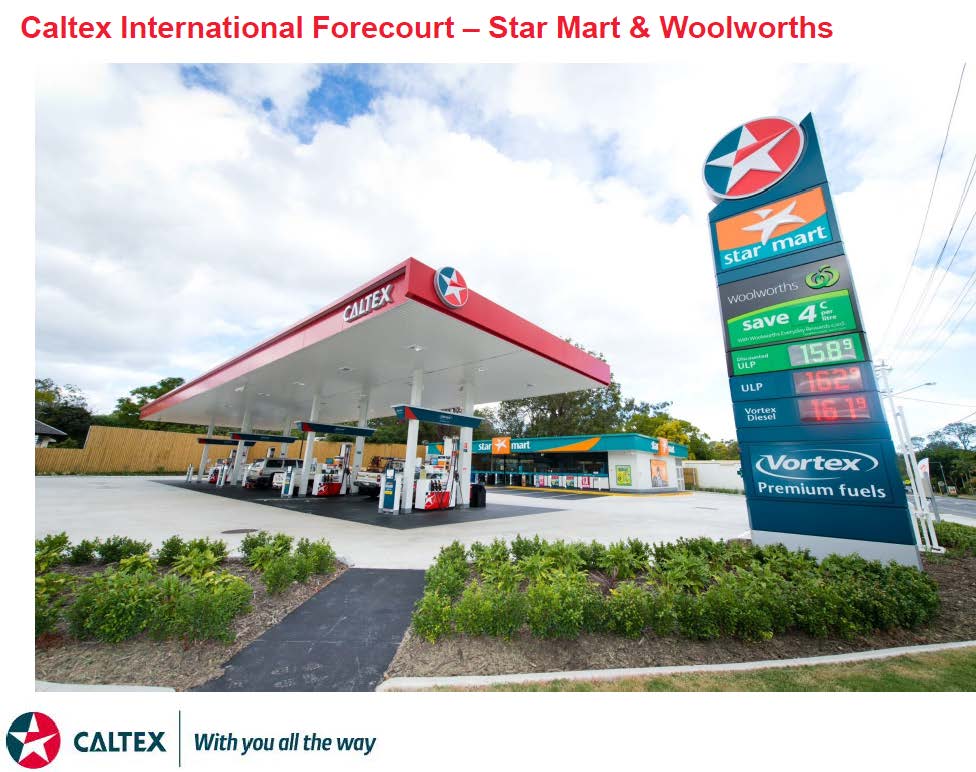
SCHEDULE 3 – PROCESS FOR DOCUMENTING THE BRAND STANDARDS
Action number | Business days | Action | ||
1 | Operative Date +5 | [Chevron] and [Ampol] to appoint project leads. [Ampol]’s project lead will be the Head of Brand and Communications. | ||
2 | Action 1 + 40 | [Chevron] to provide images of at least 3 representative samples of Retail Operations in the following categories from both metropolitan and regional sites: | ||
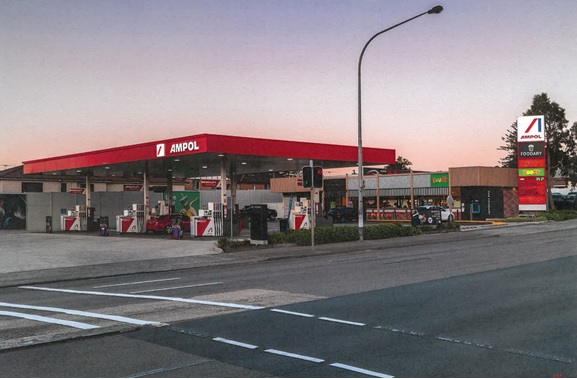
Company Owned, Company Operated | Company Owned, Retailer Operated | Retailer Owned, Retailer Operated | ||
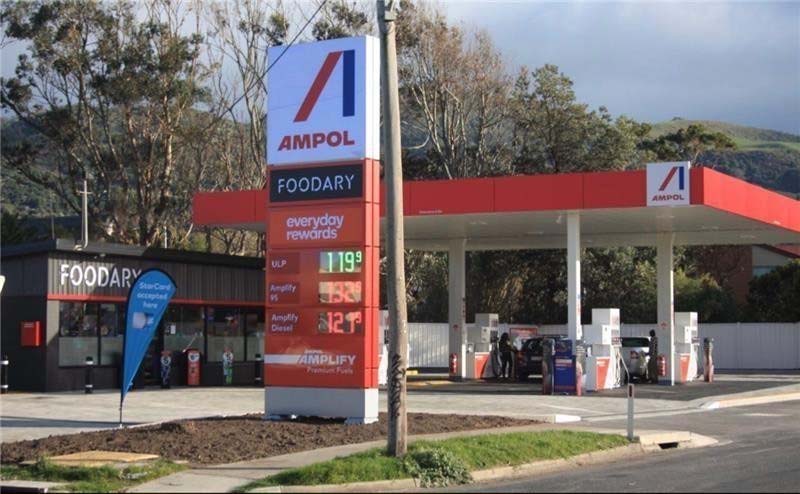
3 | Action 2 + 40 | [Ampol] will identify any other updates necessary to the Brand Standards and will present it to the Project Lead of [Chevron] along with the representative station images for final approval. | ||
4 | Action 3 + 30 | If [Chevron] raises any issues with the proposed Brand Standards these need to be discussed and resolved by the [Ampol] and [Chevron] project leads. | ||
5 | Action 4 + 30 | Final version of Brand Standards issued and agreed between the Parties. | ||
33 The process for amending the Brand Standards provided for in cl 4.5 is set out in Sch 4, which provides:
SCHEDULE 4 – CONSULTATION PROCESS FOR MINOR AMENDMENTS TO THE BRAND STANDARDS INITIATED BY EITHER PARTY
1. …
2. [Chevron] or [Ampol] shall provide a draft of its proposed revised Brand Standards or [sic] (the ‘Revised Brand Standards’) to the other Party, who shall provide comments and/or proposed revisions to the Revised Brand Standards within four (4) weeks of receipt of the Revised Brand Standards Guidelines.
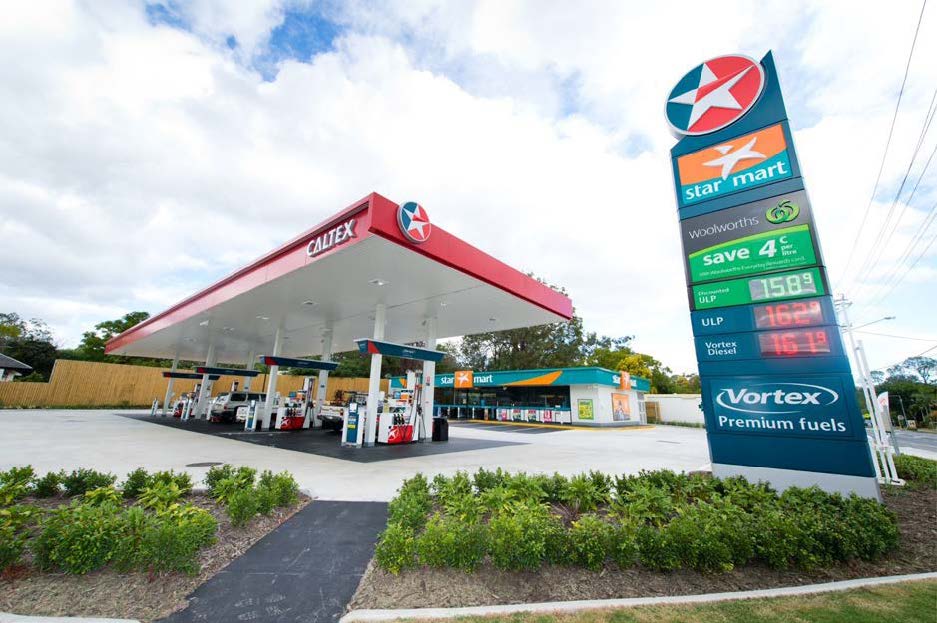
3. The Revised Brand Standards should:
a. only be for the purpose of protecting and enhancing the value of the Trade Marks;
b. be reasonable having regard to the nature of the businesses that use them
4. The Parties shall discuss in good faith the proposed Revised Brand Standards, with each Party taking into account the other Party’s legitimate concerns and representations any comments and/or proposed revisions provided by the other Party. A Party’s consent to the Revised Brand Standards shall not be unreasonably withheld, provided that it will be reasonable to withhold consent if a revision would result in a substantial cost being imposed on one or other of the parties.
5. After the Parties have agreed the Revised Brand Standards, [Chevron] shall issue the Revised Brand Standards in final form (the “Final Revised Brand Standards”), following which [Ampol] shall comply with the Final Revised Guidelines within a maximum of 6 months of the date of receipt of the Final Revised Brand Standards.
34 Clause 3.1 is headed “Licence” and relevantly provides:
3.1 Subject to the terms and conditions set forth herein, [Chevron] grants to [Ampol] solely in the Territory an exclusive licence for the Term and the Work-out Period to use:
(a) the Trade Marks upon or in relation to the goods or services in respect of which the Trade Marks are or will become registered;
(b) the word ‘Caltex’, ‘STAR CARD’ or ‘STAR MART'’ in any company name, in any registered business name or in any internet domain name;
(c) the Delta Marks, the trade marks ‘CALTEX’, ‘CALTEX Split Star Circled’, or any other trade name or trade mark containing in whole or in part the word ‘Caltex’, ‘STAR CARD’ or ‘STAR MART’ in connection with collateral materials, including but not limited to, stationery, business cards, signage and advertisements …
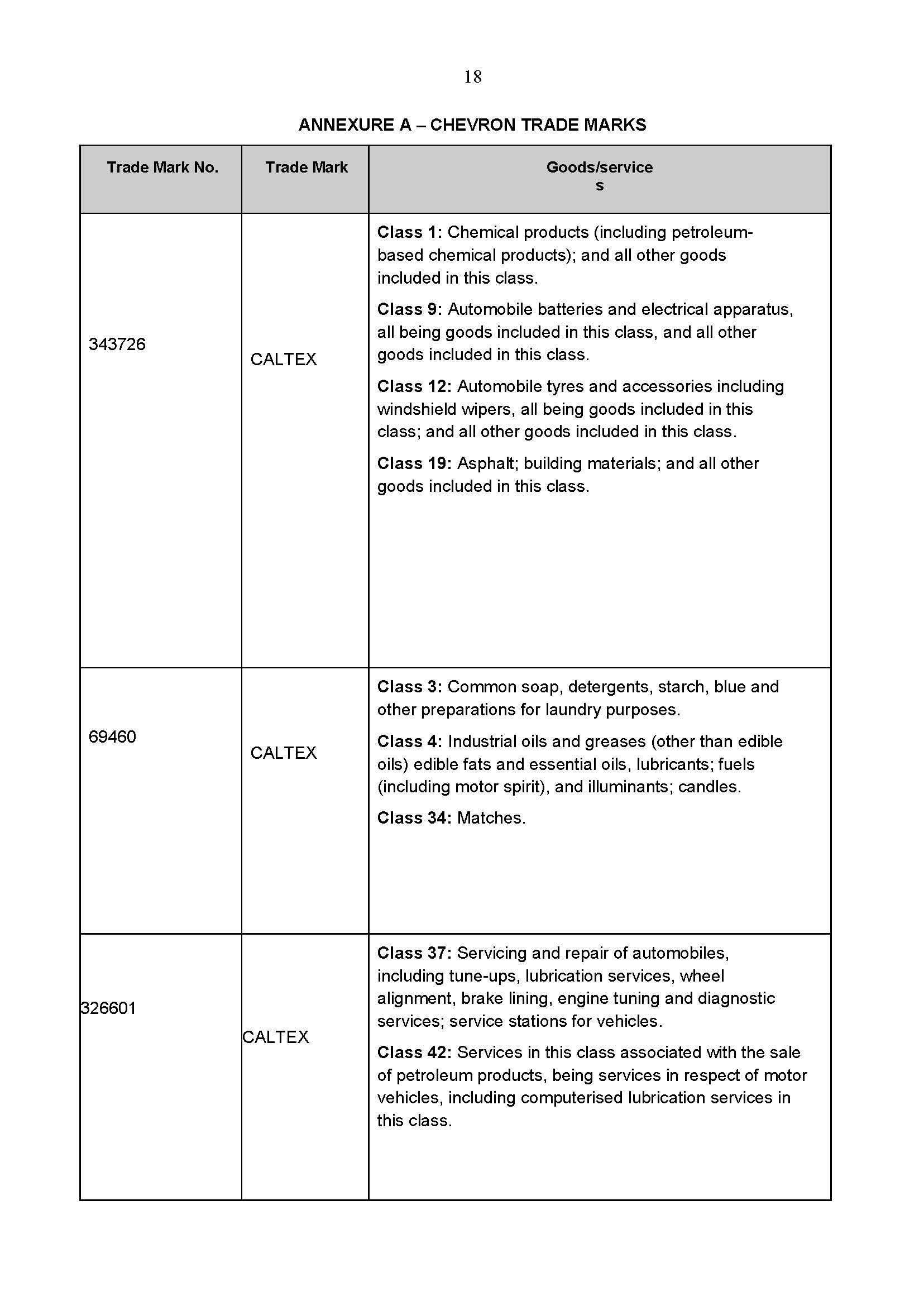
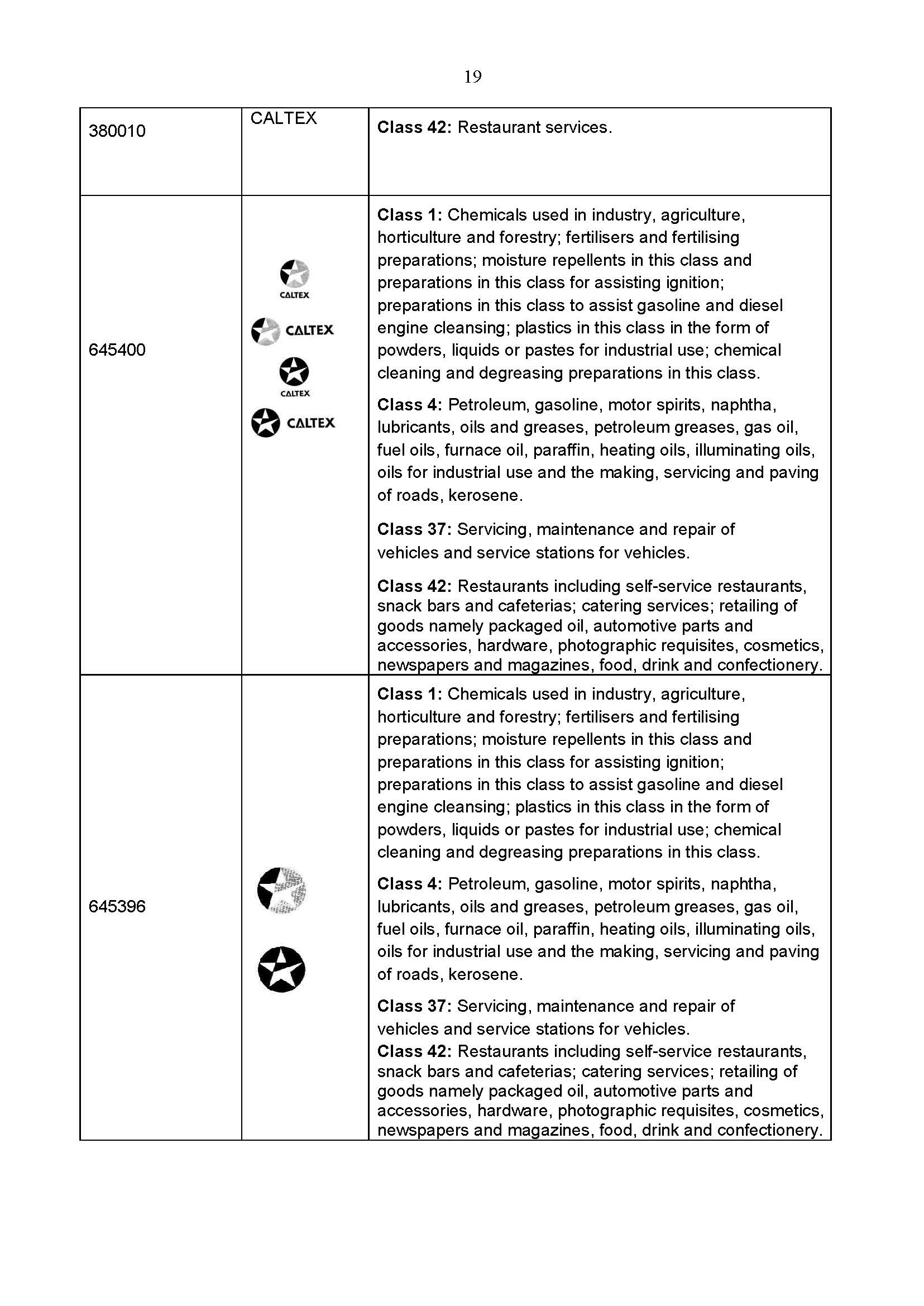
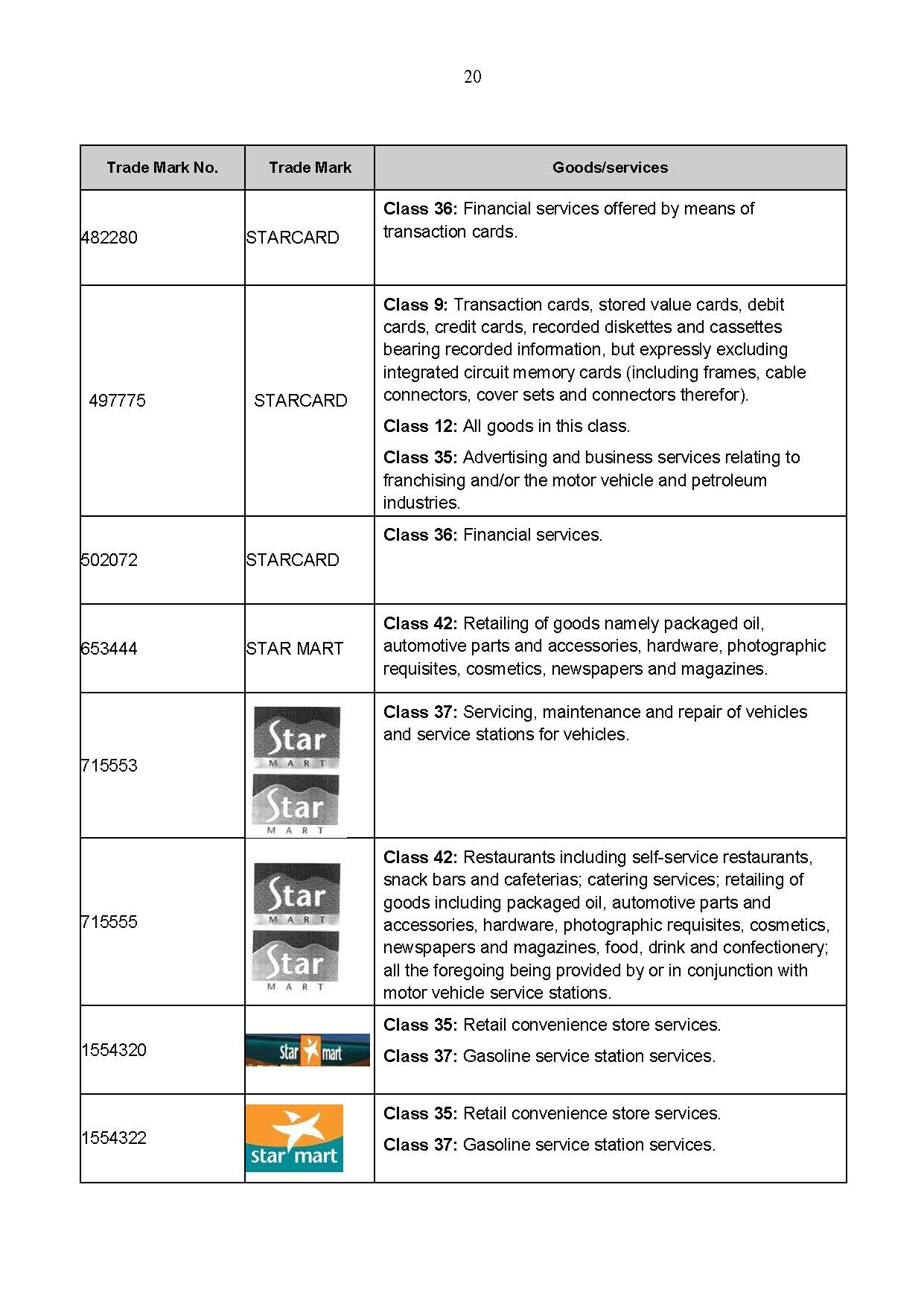
35 “Trade Marks” is defined in cl 1.1 to mean “the registered Trade Marks and Trade Mark applications specified in Schedule 1, together with any additions or deletions in accordance with clause 12 and includes the Delta Marks”. Those of the Trade Marks listed in Sch 1 to the TMLA which are relevant are set out in Annexure A to these reasons. Clause 1.1 also defines “Term” to mean “the term of [the TMLA] as set out in clause 6”, and “Territory” to mean “Australia and its territories”.
36 Clause 4 is headed “Use and Restrictions” and provides:
4.1 [Ampol] agrees that it shall:
(a) use the Trade Marks only in accordance with the Brand Standards;
(b) use the Trade Marks only in compliance with all applicable laws, government regulations and industry standards, including without limitation, all laws, government regulations and industry standards, related to the Permitted Businesses; and
(c) in relation to lubricant and/or speciality products which bear the Trade Marks, use such Trade Marks only in compliance with all product specifications, formulas, quality standards and/or other requirements as provided under the Lubricants Services Technical Service Agreement entered into between [Ampol] and Caltex International Pte Limited and dated 1 October 2005 (as varied, amended or replaced from time to time).
4.2 The Parties acknowledge that the brand standards annexed to the Previous Agreement require updating to include, among other things, Trade Mark usage at current Retail Outlets; however, [Chevron], having sufficient knowledge of current practice and its conformity with agreed upon brand standards, is satisfied with [Ampol]’s current practice as at the Operative Date in relation to the Trade Marks.
4.3 The Parties agree that the Brand Standards will be updated and documented following the Operative Date in accordance with the process set out in Schedule 3 so as to reflect [Ampol]’s current practice, and that the Brand Standards taken as a whole must reflect the standard of quality that would be expected of a market leading organisation in the field of transport fuel supply and oil refining.
4.4 [Ampol] recognizes, acknowledges and agrees that [Chevron] has the exclusive right and obligation to protect the distinctiveness and enforceability of the Trade Marks by exercising quality control over [Ampol]’s goods and services bearing the Trade Marks, by reference to the Brand Standards and compliance with clause 4.1. [Ampol] further agrees that it will not take any action that is likely to damage the distinctiveness or enforceability of the Trade Marks, and that marketing activities undertaken by [Ampol] shall not be inconsistent with the Caltex brand’s consumer value proposition as a promise of an experience that is clean, safe, reliable and respectfully helpful.
4.5 The Parties agree that, other than the documentation process set out in clause 4.3, there shall be no major or wholesale revisions to the Brand Standards for the Term or the Work-out Period. Either Party may propose a minor revision to the Brand Standards, including but not limited to, by way of addition or deletion, in accordance with the consultation process set forth in Schedule 4.
37 Clause 6 is headed “Term and Termination” and, as altered by the June 2018 amendment, relevantly provides:
6.1 This Agreement shall commence on the Operative Date and (unless earlier terminated in accordance with clause 6.5) shall continue until the expiry of a notice of termination given pursuant to clause 6.2 (‘the Term’). For the avoidance of doubt, clause 14 shall survive termination of this Agreement.
(a) …
(b) …
6.1A
(a) Sub-clauses 6.1(a) and (b) will cease to apply to this Agreement.
(b) Unless earlier terminated in accordance with clause 6.5, this Agreement shall continue for the Term until the expiry of any notice of termination given pursuant to clause 6.1A(c).
(c) Subject to clause 6.1A(d), either party may, without cause, terminate this Agreement by giving the other party not less than 6 months’ prior written notice.
(d) The earliest date on which this Agreement can terminate pursuant to this provision is June 30, 2019, with the termination notice to be given no later than 6 months prior (i.e., at least 6 months’ prior written notice).
6.2 Notwithstanding the foregoing, as soon as practicable after the date which is twelve (12) months before the expiration of the Term, [Ampol] shall, or shall cause its sublicensees to, provide a complete list of all Retail Outlets bearing the Trade Marks at that date to [Chevron].
6.3 [Ampol] shall, or shall cause it sublicenses [sic] to, complete removing (or cause to remove) signage and/or any other element displaying the Trade Marks from the remaining branded Retail Outlet(s) during the Work-out Period so that removal of all signage and/or other elements displaying the Trade Marks is completed on or before the last day of the Work-out Period, and will keep [Chevron] reasonably informed of its plans and actions.
6.4 [Ampol] shall include in its agreements granting sub-licensees rights to use the Trade Marks entered into after the Operative Date pursuant to clause 13 (not including a renewal of a sub-licence where the sub-licensee has a right and elects to renew the sub-license on its current term) in force as at the Operative Date) [sic]:
(a) termination provisions and/or [Ampol] non-renewal rights with respect to the licensees’ rights to use the Trade Marks at Retail Outlets no later than at the end of the Work-out Period;
(b) [Ampol]’s right to enter and de-brand said Retail Outlets and/or cause the Trade Marks to be removed from such Retail Outlets should any licensee fail to comply with its de-branding obligations by the end of the Work-out Period;
(c) a right for [Chevron] to exercise [Ampol]’s de-branding rights under its agreements with licensees if and to the extent that [Ampol] fails to exercise such rights within thirty (30) days following notice from [Chevron], as provided in clause 14.5.
38 Clause 8 is headed “Display of the Marks” and provides:
8.1 [Ampol] shall, or shall cause its licensees to, cause the Trade Marks to be displayed on or in connection with the goods and services offered, sold or otherwise available at the Retail Outlet(s) in accordance with the Brand Standards.
39 Clause 9 is headed “Signage” and relevantly provides:
9.1 During the Term, [Ampol] shall, or shall cause its licensees to, at its or their sole cost and expense (subject to rights of recovery from third parties) in accordance with the Brand Standards:
(a) repair or replace any material signage at or directly associated with any of the Retail Outlets or on any delivery vehicle on which one or more of the Trade Marks appear (‘Signage’) which suffers material accidental or wilful damage or is destroyed;
(b) keep all Signage in good repair and condition, in working order, ordinary wear and tear excepted;
and for the avoidance of doubt, [Ampol] is not required to take any action under this clause which goes beyond what is required under the Brand Standards or applicable law.
40 Clause 10 is headed “Intellectual Property” and provides:
[Ampol]:
(a) will not challenge [Chevron]’s right to license the Trade Marks as set forth in this Agreement;
(b) must not at any time do or omit to do any act or thing which will in any way impair the rights of [Chevron] or its Affiliates in the Trade Marks;
(c) must not at any time during the Term nor after termination of this Agreement challenge the rights of [Chevron] or its Affiliates in the Trade Marks nor contest the validity of any registrations of the Trade Marks; and
(d) acknowledges that all use of the Trade Marks by it shall inure to the benefit of [Chevron] and/or its Affiliates.
41 Clause 14 is headed “Action Upon Termination” and, as amended in July 2019, relevantly provides:
14.1 Within the period of 30 months from the date on which this Agreement terminates or expires pursuant to clause 6 of this Agreement (Work-out Period) [Ampol] shall:
(a) discontinue all use of the Trade Marks;
(b) remove or cause to be removed any and all signage and/or element bearing any of the Trade Marks from Retail Outlets and/or any other place of business displaying such signage …
…
14.1A The Work-out Period will consist of the following two periods:
(a) the 18 month period commencing on the date on which the Work-out Period commences (Exclusivity Period); and
(b) the 12 month period commencing on the date on which the Exclusivity Period expires (Non-exclusivity period).
14.1B During the Exclusivity Period all of the rights of [Ampol], including its right to exclusive use of the Trade Marks, granted pursuant to the TMLA continue to apply.
14.1C During the Non-exclusivity period, [Ampol] will continue to have all of the rights to use the Trade Marks granted pursuant to the TMLA, except that [Chevron] may use or licence another person to use the Trade Marks in the Territory.
…
14.3 To enable [Ampol] and its Affiliates to phase-out their use of the Trade Marks and to execute the orderly introduction of new branding for their goods and services in the Territory during the Work-out Period, notwithstanding the termination of this Agreement, the rights of [Ampol] under this Agreement shall continue in force and [Ampol] shall continue to be bound to perform and observe its obligations under this Agreement, including with respect to:
(a) demonstrating it is taking active steps to procure removal of the Trade Marks in accordance with this clause 14; and
(b) its use of the Trade Marks and other trade names and marks referred to in clause 3.1 during the Work-out Period.
14.4 [Ampol] shall be permitted to use the Trade Marks in conjunction with its own trade marks during the Work-out Period (or any period prior to the Work-out Period if [Ampol] has decided to transition away from the Trade Marks prior to the Work-out Period), for the sole purpose of educating customers that it is transitioning away from the Trade Marks. [Ampol] shall ensure that its use of the Trade Marks in this manner does not damage the value or distinctive character of the Trade Marks. [Ampol] shall consult in good faith with [Chevron] with respect to its proposed use under this clause and have proper regard to [Chevron]’s representations.
42 Clause 17 is headed “Non-Association with other trade marks” and relevantly provides:
Except as specifically permitted under this Agreement, to avoid confusion of third parties, [Ampol] or any licensee(s) shall not use any trade mark or sign of any third party on the goods or services on which the Trade Marks are used, unless approved in writing by [Chevron] in advance of such use such approval not to be unreasonably withheld …
Chevron’s pleaded case
43 Mr A McGrath SC, who appeared with Mr CH Smith for Ampol, made it clear that Ampol intended to hold Chevron to its pleaded case, and the trial was conducted on that basis.
44 In the end, the pleaded case was contained in a fourth further amended statement of claim dated 7 May 2021, which included amendments made in the course of Chevron’s closing address. Mr D Shavin QC, who appeared with Mr A Lang SC for Chevron, abandoned Chevron’s claim against the second respondent (Ampol Limited), and also its claim for an injunction restraining Ampol from using “Caltex Red” (Pantone 485c) on Ampol MID signs.
45 It is, regrettably, necessary to set out in detail Chevron’s pleaded case on liability. It is as follows:
Chevron’s trade marks
4. Chevron IP is, and at all material times has been, the registered owner under the Trade Marks Act 1995 (Cth) (TMA) of each of the trade mark registrations set out in Annexure A (collectively the Chevron Trade Marks).
5. Chevron Global is, and at all material times has been, an authorised user of the Chevron Trade Marks within the meaning of s 8 of the TMA.
…
Trade Mark Licence Agreement between Chevron Global and [Ampol]
6. On or about 28 April 2015, Chevron and [Ampol] entered into a written trade mark licence agreement (TMLA) …
…
8. There were terms of the TMLA (as amended) that:
(i) subject to the terms and conditions set out in the TMLA, Chevron Global grants to [Ampol] solely in Australia a licence for the ‘Term’ and the ‘Work Out Period’ to use inter alia the Chevron Trade Marks upon or in relation to the goods or services in respect of which they are or will become registered and in connection with the ‘Permitted Businesses’ (clauses 3.1(a) and (d));
(ii) [Ampol] shall use the Chevron Trade Marks only in accordance with the Brand Standards (clause 4.1(a));
(iii) [Ampol] shall, or shall cause its licensees to, cause the Chevron Trade Marks to be displayed on or in connection with goods or services offered, sold or otherwise available at [Ampol] service stations in accordance with the Brand Standards (clause 8.1);
(iv) [Ampol] may grant the right to use the Chevron Trade Marks to resellers, distributors, franchisees and other third persons who [Ampol] engages or deals with in the ordinary course of conduct of the Permitted Businesses provided that [Ampol] ensures that any third party granted such a sub-licence has been made aware of [Ampol]’s obligations under the TMLA in relation to use of the Chevron Trade Marks, and are under a legal obligation to comply with those obligations, in so far as those obligations relate to the use of the Chevron Trade Marks by the third party, and [Ampol] remains responsible and liable for the performance of such obligations of such sub-licensee (clauses 13.2 and 13.6);
(v) the Brand Standards are the visual identity standards documentation developed by Chevron Global and issued to [Ampol] as of 1 March 2007, as updated in accordance with clause 4.3 of the TMLA and as amended from time to time by the parties in accordance with clause 4.5 of the TMLA (clause 1.1);
(vi) the parties agree that the Brand Standards will be updated and documented following the operative date of the TMLA in accordance with the process set out in Schedule 3 to the TMLA so as to reflect [Ampol]’s current practice (clause 4.3);
(vii) [Ampol] recognises, acknowledges and agrees that Chevron has the exclusive right and obligation to protect the distinctiveness and enforceability of the Chevron Trade Marks by exercising quality control over [Ampol]’s goods and services bearing the Chevron Trade Marks, by reference to the Brand Standards and compliance with clause 4.1 of the TMLA (clause 4.4);
(viii) [Ampol] further agrees that it will not take any action that is likely to damage the distinctiveness or enforceability of the Chevron Trade Marks, and that marketing activities undertaken by [Ampol] shall not be inconsistent with the Caltex brand’s consumer value proposition as a promise of an experience that is clean, safe, reliable and respectfully helpful (clause 4.4); and
(ix) either party may terminate the TMLA without cause by giving the other party not less than 6 months’ prior written notice (clause 6.1A(c));
(x) after termination of the TMLA, there will be a Work Out Period of 30 months, consisting of:
(i) an 18 month period during which [Ampol] retains exclusive use of the Chevron Trade Marks in Australia (clauses 14.1A, 14.1B, 14.1C) (the Exclusivity Period); and
(ii) a subsequent 12 month period during which Chevron Global may itself use, or license another person to use, the Chevron Trade Marks in Australia (clauses 14.1A, 14.1B, 14.1C) (the Non-exclusivity Period);
(xi) during the Work Out Period:
(i) [Ampol] shall be bound to perform and observe its obligations under the TMLA, including with respect to the use of the Chevron Trade Marks (clause 14.3(b)); and
(ii) [Ampol] shall be permitted to use the Chevron Trade Marks in conjunction with its own trade marks for the sole purpose of educating customers that it is transitioning away from the Chevron Trade Marks (in which case [Ampol] shall ensure that its use of the Chevron Trade Marks in this manner does not damage the value or distinctive character of the Chevron Trade Marks, and [Ampol] shall consult in good faith with Chevron Global with respect to its proposed use and have proper regard to Chevron Global’s representations) (clause 14.4).
(iii) [Ampol] shall remove or cause to be removed any and all signage and/or any element bearing or displaying the Chevron Trade Marks from the Retail Outlets (as defined in clause 1.1, clause 6.3, clause 10(b), clause 14.1(b) and clause 14.4).
9. On 20 December 2019, Chevron Global gave [Ampol] written notice that the TMLA would terminate on 30 June 2020, pursuant to clause 6.1A(c) of the TMLA (as amended).
…
10. The TMLA terminated on 30 June 2020, the Work Out Period under the TMLA commenced on 1 July 2020, and the Non-exclusivity Period will commence on 1 January 2022 and will conclude on 31 December 2022.
Brand Standards
11. At all material times, the Brand Standards provided that:
(a) the hierarchy of displays on the main identification sign of the service station (MID sign) must be that the CALTEX word mark and CALTEX DELTA STAR logo mark are displayed at the top of the MID sign;
(b) the MID sign must comprise the colour deep ocean green as its primary background colour; and
(c) the canopy of the service station must comprise the colour red or alternatively the colour red with a silver stripe.
Particulars
(i) Pursuant to the 2007 TMLA the parties agreed to Brand Standards, which are reflected in documents in the possession of [Ampol], copies of which were supplied by the solicitors for [Ampol] to the solicitors for [Chevron] on 21 January 2021.
(ii) The Brand Standards were modified in or about 2010 by reference to a document referred to as the Caltex 20:20 Retail Image Guidelines, copies of which are available for inspection at the office of [Chevron]’s solicitors.
(iii) The conduct of the parties between 2007 and 2015 was to seek to give effect to the Brand Standards to the extent practicable given the circumstances of each retail site to which they were to be applied.
(iv) The requirements in sub-paragraphs (a), (b) and (c) were set out in the Brand Standards and are depicted in each of the 9 station images shown in the document titled “Caltex Australia Brand Images -October 2015” attached to the email from Kara Glamore to Brian Fisher dated 21 October 2015 (2015 Brand Images) which depicted the practical application of the Brand Standards by [Ampol] at the time of the TMLA.
Non-compliance with Brand Standards
[Paragraphs [12]-[15] not used]
16. As at the date of the commencement of this proceeding, [Ampol] is causing or permitting some [Ampol] service stations operated by EG Group Ltd or a related entity (EG Group) at which the Chevron Trade Marks are displayed under licence from [Ampol] to display an MID sign on which the hierarchy of signs has a sign for ‘EG’ displayed at the top of the MID sign above the CALTEX word mark and CALTEX DELTA STAR logo mark (EG Group MID sign).
…
17. The EG Group MID sign is inconsistent with the Brand Standards referred to in paragraph 11(a) above.
18. [Ampol] is liable to Chevron Global for the conduct of EG Group referred to in paragraphs 16 and 17 above pursuant to clause 13.6 of the TMLA.
[Paragraphs [19]-[20] not used]
21. By reason of the conduct alleged in paragraphs 16 to 18 above, [Ampol] is in breach of clauses 4.1(a) and 8.1 of the TMLA insofar as it or its sublicensee is using the Chevron Trade Marks at each of the [Ampol] service stations referred to in those paragraphs (Non-compliant [Ampol] service stations).
21AA. By reason of the use of Caltex Red on site canopies as particularised at paragraph 21A(v) below, [Ampol] is in breach of clauses 6.3, 10(b) and 14.1(b) of the TMLA.
Use of Chevron Marks in conjunction with AMPOL
21A. As at the date of this amended statement of claim, [Ampol] … is using and intending to use the Chevron Trade Marks in conjunction with the marks AMPOL and AMPOLCARD in a manner which conveys the representation that the Chevron Trade Marks, AMPOL and AMPOLCARD are owned by the same entity or entities which are associated, affiliated or otherwise connected (the Representation).
Particulars
(i) Use of CALTEX and/or STARCARD in conjunction with AMPOL and AMPOLCARD in relation to acceptance of AmpolCard: for example:
(A) Instagram post by accountholder ‘ampolaustralia’, dated on or about 21 October 2020 … in which it is stated:
‘As we transition to the Ampol brand, your AmpolCard will be accepted across our entire network of over 1,900 Caltex and Ampol locations’.
(B) LinkedIn post by an Ampol employee, Mr Jega Ponnambalam (Project Manager / Business Improvement Analyst), dated on or about 28 October 2020 … in which it is stated:
‘The AmpolCard replaces the award winning StarCard and over the next few months the new AmpolCard will be rolled out to our valued customers’.
…
(C) LinkedIn post by accountholder “Ampol Australia”, dated on or about 12 November 2020 … in which it is stated, inter alia:
‘AmpolCard – giving Australian businesses access to the country’s largest petrol and convenience network of more than 1,900 sites, as well as exclusive savings on fuel and other offers through local partners. As we transition from Caltex to Ampol, AmpolCard will be replacing our StarCard branded card product as we revitalise the iconic Australian Ampol brand over the next two years’.
(D) Accepting the AmpolCard as a means of payment at the point of sale at Caltex sites.
Examples (A), (B), (C) and (D) above convey the Representation, and more particularly, represent that the owner of the mark CALTEX has approved the use of the AmpolCard at CALTEX locations; and that the owner of the marks AMPOL and AMPOLCARD will cause to be phased out the use of the marks CALTEX and STARCARD such that those marks will no longer be used by it or any other entity.
(ii) Use of CALTEX and/or STARCARD in conjunction with AMPOL in relation to acceptance of the StarCard credit card: for example:
(A) Proposed AMPOL STARCARD Transition document … provided by [Ampol] to Chevron on or about 29 October 2020, containing statements such as:
‘As we roll out our revitalised Ampol stores across Australia, your local store may be branded Caltex or Ampol, in either case our service and commitment to you will remain the same. As we transition, you can continue to use your Starcard at this site’
This conveys the Representation, and more particularly that the owner of the mark STARCARD has approved the use of that mark and the mark AMPOL at Ampol sites; and that the owner of the mark AMPOL will cause to be phased out the use of the marks CALTEX and STARCARD such that those marks will no longer be used by it or any other entity.
(B) Banner advertising stating ‘STARCARD accepted here’ at Apollo Bay bearing AMPOL signage …
This conveys the Representation and more particularly, that the owner of the mark STARCARD has approved the use of that mark and the mark AMPOL at that site.
(C) Accepting the StarCard as a means of payment at the point of sale at AMPOL sites.
This conveys the Representation, and more particularly that the owner of the mark STARCARD has approved the use of that mark and the mark AMPOL at Ampol sites.
(iii) Use of CALTEX in conjunction with AMPOL in relation to acceptance of Woolworths Everyday Rewards Card: for example, proposed marketing material … provided by [Ampol] to Chevron on or about 28 October 2020 containing statements such as:
‘Caltex branded sites are changing to Ampol. Your Everyday Rewards Card is still welcome at all Caltex and Ampol branded sites’.
This conveys the Representation, and more particularly that the use of the marks CALTEX and AMPOL has been approved by the same entity or entities which are associated, affiliated or otherwise connected.
(iv) Use of STAR MART in conjunction with AMPOL in relation to acceptance of Woolworths Everyday Rewards Card: for example, proposed marketing material provided by [Ampol] to Chevron on or about 28 October 2020 containing statements such as:
‘Caltex Star Mart branded sites are changing to Ampol’.
This conveys the Representation, and more particularly that the use of the marks STAR MART and AMPOL has been approved by the same entity or associated entities which are associated, affiliated or otherwise connected.
(v) Use of Caltex Red on site canopies at newly Ampol branded [Ampol] service stations:
(A) The site forecourt canopy fascia is a major feature of retail outlets identifying to consumers the identity of the site and the origin of the products available for sale at that site.
(B) Under the TMLA, and in particular clauses 3.1(c) and 4.1(a), the colour Pantone 485C (Caltex Red) is specified and required to be used on associated signage and other materials, including site forecourt canopies, in connection with the Chevron Trade Marks.
(C) Caltex Red has been so used, inter alia, on the site forecourt canopies such that a Caltex Red site forecourt canopy fascia has become connected in the minds of consumers with the Chevron Trade Marks indicating a connection in the course of trade with products supplied by or authorised or approved by the owner of the Chevron Trade Marks and supplied at that service station.
(D) Ampol branded service station sites, especially those that have been [Ampol] service stations, continue to use a site forecourt canopy fascia [coloured Caltex Red].
(E) This conveys the Representation, and more particularly that (a) there is a continuing association, affiliation or connection between the owner of the Chevron Trade Marks and the owner of the mark AMPOL; and (b) the Chevron Trade Marks will no longer be used in Australia in conjunction with Caltex Red site canopies.
…
21B. The Representation is false.
Particulars
The Chevron Marks and the marks AMPOL and AMPOLCARD are not marks owned by the same entity or associated entities.
21C. Further or in the alternative, [Ampol] … is using and intending to use the Chevron Trade Marks in conjunction with the marks AMPOL and AMPOLCARD in such manner that both the Chevron Trade Marks and the marks AMPOL and AMPOLCARD distinguish or are apt to distinguish the goods and services supplied by or under the licence of [Ampol].
Particulars
See the particulars to paragraph 21A.
21D. By reason of the matters referred to in paragraphs 21A and 21B or 21C or all of those paragraphs, [Ampol] is using and intending to use the Chevron Trade Marks in conjunction with the marks AMPOL and AMPOLCARD other than for the sole purpose of educating customers that it is transitioning away from the Chevron Trade Marks in a manner that does not damage the value or distinctive character of the Chevron Trade Marks, in breach of clause 14.4 of the TMLA and in contravention of s 120(1) of the Trade Marks Act 1995.
21E. Further or in the alternative, by reason of the matters referred to in paragraphs 21A and 21B or 21C or all of those paragraphs, [Ampol] is taking action and intending to take action that is likely to damage the distinctiveness or enforceability of the Chevron Trade Marks in breach of clause 4.4 of the TMLA.
21F. Further or in the alternative, by reason of the matters referred to in paragraph 21A and 21B or 21C or all of those paragraphs, [Ampol] is engaging in conduct which impairs the rights of [Chevron Global] in the Chevron Trade Marks in breach of clause 10(b) of the TMLA.
21G. Further or in the alternative, [Ampol] … is making the Representation in trade or commerce.
21H. By reason of the matters referred to in paragraphs 21A, 21B and 21G above, [Ampol] … has engaged and intends to engage in:
(a) misleading or deceptive conduct in contravention of s 18; and/or
(b) false or misleading representations in contravention of s 29(g) and (h), of the Australian Consumer Law.
…
Infringement of the Chevron Trade Marks
22. By reason of the matters alleged in paragraphs 12 to 21 above, [Ampol]’s licence to use the Chevron Trade Marks does not extend to its use of the Chevron Trade Marks displayed at the Non-compliant [Ampol] service stations and that use of the Chevron Trade Marks is unlicensed.
23. In the premises, [Ampol] is infringing each of the Chevron Trade Marks by, without the licence or authority of Chevron Global or Chevron IP, using them as a trade mark in relation to goods or services in respect of which they are registered at each of the Non-compliant [Ampol] service stations.
23A. By reason of the matters referred to in paragraph 21A to 21F above, [Ampol]’s use and intended use of the Chevron Trade Marks in conjunction with the mark AMPOL or AMPOLCARD is unlicensed and constitutes an infringement of the Chevron Trade Marks.
…
46 Annexure A to the statement of claim, which is reproduced as “Annexure A” to these reasons, sets out each of the trade mark registrations to which the statement of claim refers.
47 The relief sought in the second further amended originating application dated 20 April 2021 is a follows:
1. An injunction pursuant to s 126(1)(a) of the Trade Marks Act 1995 (Cth) restraining [Ampol] from using the Chevron Trade Marks (as defined in the statement of claim) at the Non-compliant [Ampol] service stations (as defined in the statement of claim).
2. Further or alternatively to paragraph 1 above, an injunction requiring [Ampol] to forthwith amend the EG Group MID sign and Caltex Red station canopy (as each defined in the statement of claim) at each of the Non-compliant [Ampol] service stations so that they comply with the requirements of the Brand Standards referred to in paragraph 11 of the statement of claim.
2A. An injunction restraining [Ampol] from:
(a) using the Chevron Marks in conjunction with the mark AMPOL or AMPOLCARD in a manner which conveys the Representation, as defined in the amended statement of claim; or
(b) displaying the Caltex Red canopy fascia at Ampol branded service stations.
3. Damages, including additional damages for trade mark infringement under s 126(2) of the Trade Marks Act 1995 (Cth).
4. Alternatively, at [Chevron’s] option, an account of profits pursuant to s 126(1)(b) of the Trade Marks Act 1995 (Cth).
5. Damages for breach of the TMLA (as defined in the statement of claim).
5A. Damages pursuant to s 236 of the Australian Consumer Law.
5B. Such adverse publicity orders pursuant to s 247 of the Australian Consumer Law as the Court may determine.
6. Interest.
7. Such other order or orders as the Court think fit.
8. Costs.
48 The fourth further amended statement of claim is not, with respect, a model of good drafting. The sheer number of amendments and deletions made to it (including, as I said, last-minute amendments made during the course of Chevron’s closing address) doubtless contribute to that. By way of example, paragraph [22] relies on “paragraphs 12 to 21 above” to found the trade mark infringement claim in respect of the EG signs, but paragraphs [12], [13], [14], [15], [19] and [20] are deleted. What do lie between paragraph [22] and those earlier paragraphs are paragraphs [21A]-[21D], which contain, among many other things, the entirety of a completely separate trade mark infringement claim concerning the conjunctive use of the Chevron Trade Marks, AMPOL and AMPOLCARD. Here and elsewhere, the pleading requires the reader constantly to cross-refer to paragraphs, appearing either above or below, in order to know what the “matters” are that are alleged to establish a pleaded conclusion.
49 Moreover, the defined term “the Representation” does not always work, including in the critical paragraph ([21A], particular (v)).
50 Paragraph [21A] is a plea that: “[Ampol] … is using and intending to use the Chevron Trade Marks in conjunction with the marks AMPOL and AMPOLCARD in a manner which conveys the representation that the Chevron Trade Marks, AMPOL and AMPOLCARD are owned by the same entity or entities which are associated, affiliated or otherwise connected”, which representation is defined as “the Representation”. There is then sub-joined to paragraph [21A] a series of particulars concerning the use of CALTEX, STARCARD and STAR MART in conjunction with AMPOL and AMPOLCARD (particulars (i) through (iv)).
51 What was said at the hearing now to be Chevron’s principal claim – about the red coloured canopies – is, if I may say so with respect, buried in particular (v) to paragraph [21A], where the separate allegation is made that “[u]se of Caltex Red on site canopies at newly Ampol branded [Ampol] service stations … conveys the Representation”. Quite how use of Caltex Red on site canopies constitutes a use of “the Chevron Trade Marks in conjunction with the marks AMPOL and AMPOLCARD” (which is the use said in paragraph [21A] to give rise to “the Representation”) is not readily apparent. That disconnect was presumably apparent to the pleader, because particular (v) to paragraph [21A] was included in Chevron’s fourth version of its pleaded case, to allege as follows:
(a) the site forecourt canopy fascia is a major feature of retail outlets identifying to consumers the identity of the site and the origin of the products available for sale at that site;
(b) Caltex Red is required to be used on associated signage and other materials, including site forecourt canopies, in connection with the Chevron Trade Marks;
(c) Caltex Red has been so used on the site forecourt canopies such that a Caltex Red site forecourt canopy fascia has become connected in the minds of consumers with the Chevron Trade Marks indicating a connection in the course of trade with products supplied by or authorised or approved by the owner of the Chevron Trade Marks and supplied at that service station; and
(d) Ampol branded service station sites continue to use a Caltex Red site forecourt canopy fascia,
which in turn is alleged to convey “more particularly” that “there is a continuing association, affiliation or connection between the owner of the Chevron Trade Marks and the owner of the mark AMPOL” and that “the Chevron Trade Marks will no longer be used in Australia in conjunction with Caltex Red site canopies”.
52 In any event, Ampol accepted that the case concerning the red canopies was conducted on the basis that the “more particular” description of the Representation in sub-particular (v) to paragraph [21A] was squarely in issue.
53 I should add that the pleaded case against the third respondent, Smartsalary Pty Ltd, which was still contained in the final version of the pleading (see paragraphs [21I]-[21L]) was not referred to by counsel on either side in opening or closing addresses, so I assume that it was understood by both parties to be abandoned. So I say nothing about it. (Curiously, Smartsalary Pty Ltd is still referred to as the third respondent in the schedule to the second further amended originating application, but not in the schedule to the fourth further amended statement of claim.)
The evidence
Evidence about branding
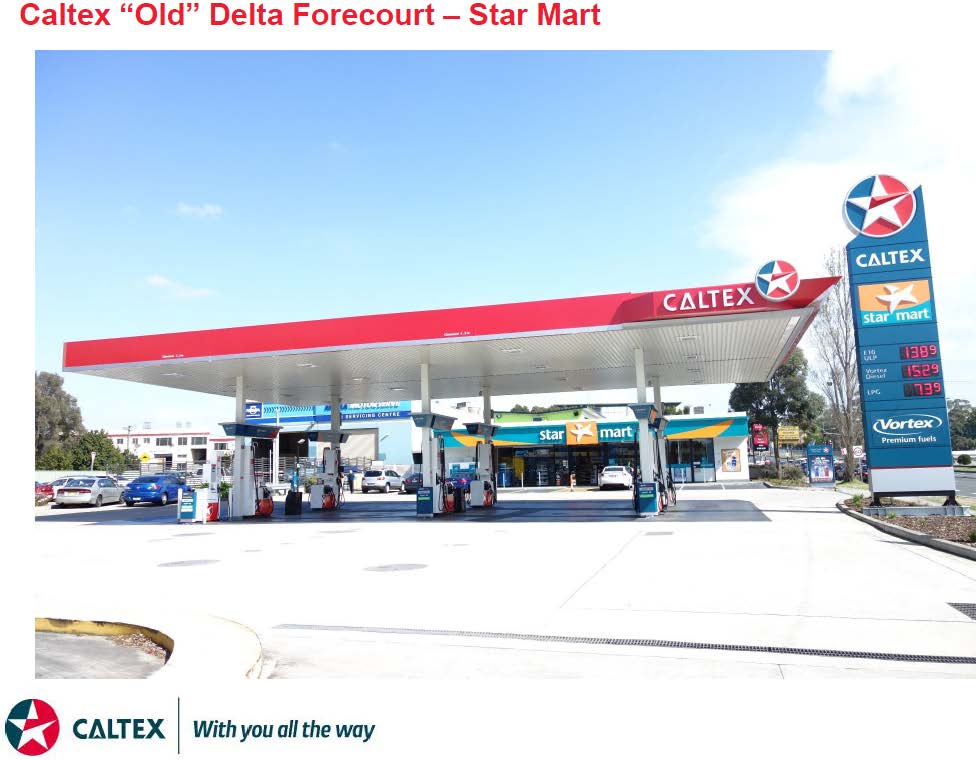
54 There was no dispute that coloured canopies which relate visually to a logo are a key branding element at service stations in Australia.
55 It was also common ground that the Australian market for retail fuel products is dominated by four brands, namely Caltex, Shell, BP and 7-Eleven. The following images, depicting similarly sized Caltex, Shell, BP and 7-Eleven service stations, were in evidence:
Mr Pucar’s evidence about branding
56 Mr Leo Pucar is a Commercial Director of EG Australia and a former employee of Ampol. He gave evidence on behalf of Chevron that in around 1995 Ampol service stations had the following appearance:
57 These depictions were put in evidence in aid of Chevron’s proposition that, prior to 1995, Ampol’s canopy fascia “were predominantly blue, which reflected the blue colour in the Ampol logo”.
Mr Fisher’s evidence about branding
58 Mr Brian Fisher was, from 2005 to 2011, a regional integrated marketing manager at Chevron. In 2011 he was appointed Caltex Brand Manager, and in that role had responsibility for overseeing the use of Chevron’s Caltex trade marks in Australia from 2015. His current position is Project Manager – Fuels Marketing and CVP Development.
59 Mr Fisher gave evidence on behalf of Chevron concerning the use of the Caltex marks, the visual identity of the service stations, and the standards applicable to them. The evidence relied on in closing was as follows.
60 From 1996, the CALTEX mark was used in combination with a colour scheme that used Caltex Red and Deep Ocean Green (Pantone 3035c) as the primary colours. This colour combination was introduced as part of a revision of the Caltex visual identity standards referred to as “Project Delta”. In about December 2006, and then again in 2010, the Delta visual identity standards were refreshed.
61 Forms of the Caltex word and logo appeared at Caltex service stations consistently with the manner in which they appeared in the Project Delta guidelines as follows:
62 From about 2010, a new visual identity was introduced referred to as “Project 20:20”. An example of it is as follows:
Ms Taylor’s evidence about branding
63 Ms Joanne Taylor is Ampol’s Executive General Manager, Retail, Brand and Culture.
64 In her evidence, she provided this depiction, among others, of a newly rebranded Ampol petrol station:
65 The precise appearance of such Ampol rebranded sites will, of course, depend on the precise size and configuration of the particular site on which they are located. This is a depiction of a smaller Ampol site:
66 Chevron submitted that “[i]t is immediately apparent that the Ampol canopies remain Caltex Red. Indeed, they are the same canopies. Ms Taylor, in her affidavit evidence, accepts that all Ampol has done in this respect is to remove the Caltex logo from the canopy and place the Ampol one on it”.
67 Chevron also relied on what it described in closing as certain “concessions” made by Ms Taylor in cross-examination. The effect of that evidence was said to be that coloured canopy fascia are used in the fuel industry “as a sign or element in a branding combination together with trade marks using the same colour scheme, in order to enhance the effect of those trade marks in the consumer’s mind” and that “colour elements associated with trade marks are important elements of brand communication”.
68 Counsel placed considerable emphasis on the supposed concessions, so I should set out the passages of the transcript on which they relied. These exchanges were said by Chevron to bear upon the importance of colour elements in service station branding, and to support its pleaded case:
From your work experience at Ampol and before, you know that trademarks and associated colour elements are important elements of brand communication to the public?---Yes.
Yes. And where you have products that are substantially homogenous, trademarks and associated colours are one of the significant means of differentiating products, are they not?---One of. Often price is - - -
Yes?--- - - - another means.
And you would accept, wouldn’t you, that petroleum products in Australia are substantially homogenous?---I – there are premium grades of - - -
Yes?--- - - - petrol, but in terms of in a customer’s mind of a standard product.
Yes. Perhaps you can say yes for the transcript, because it doesn’t record your nod?---Sorry. So - - -
That’s all right?---Yes. In terms of petroleum, there are grades that - - -
Yes?--- - - - differentiate. There are additives. But otherwise, it would be deemed to be a standard product.
Yes. And so within the industry, you know that each of the major suppliers seeks to differentiate their product to consumers?---They seek to differentiate their brand.
And they seek to do that to attract brand loyalty?---Yes.
Yes. And one of the ways in which they do that is by the use of trademarks?--- Yes.
And by the use of taking colours from those trademarks and using them on essential features of the retail outlets?---Yes. I would say colour is one aspect. The mark associated with the brand is also very important in distinguishing product, as well as any other good feelings or associations with the brand.
Yes. And they might be promoted in the eyes of consumers by advertising or marketing?---Yes.
Yes. And the trademarks and the colour are promoted by advertising?---The – the mark and the colour and the message of the brand. Yes.
Yes. And they are promoted by the way in which they’re displayed on the retail outlet?---Yes.
Yes. And in the industry, there is a close connection, isn’t there, between the colours used on the retail outlets and the colours used in the trademarks?--- Yes.
So that colour can enhance and distinguish a trademark?---It – it used to represent – in my words, the colour is used to represent the brand.
And the focal point initially is in the trademark itself, and you tie the trademark to the other colours used on the site?---Some brands choose to do that. Yes.
Yes. As does Ampol?---Yes.
As does Caltex?---Yes.
And BP?---Yes.
So you have BP Green, which is a particular Pantone shade of green which is reflected in the hologram and then back into surfaces, particularly the fascia of the canopies?---Yes. You see the green and yellow across a BP site, and typically, depending on the shop offer, you may also see additional colours.
Yes. But you do particularly see the focal point of green in the hologram replicated on the surfaces of the retail outlets?---Yes. You do see it replicated.
Yes. And the same with Shell. You see the yellow and the red in the Shell emblems, their trademarks?---Yes.
And you see in the canopies of the service station sites a red stripe and a yellow surface?---Yes. You do see it on the canopy. You see it on their spreaders, and you see then a colour on the convenience box as well.
Yes. And with 7-Eleven, you see the stripes, the coloured stripes that we’re all familiar with, appearing both within the trademark and on the surfaces of the retail outlets?---Yes. In the case of 7-Eleven, though, you also do see the Mobil fuel brand.
Yes. But that’s not on the canopy?---It is on the – it’s not on the canopy.
69 These exchanges are said also to demonstrate that Ms Taylor accepted that the coloured canopy formed one of the signs used to indicate the branding of a service station site:
And you knew that the colour of the canopy fascia is one of the important signs seen by motorists as they come down the road?---Only in combination with the mark. So the canopy, in my opinion, serves a clear purpose for the mark to be applied.
Yes. It is the thing on which the mark is mounted - - -?---Yes.
- - - and in combination, constitutes a sign to the public?---The mark constitutes a sign?
And in combination with the canopy fascia?---And in combination with the other assets on the [site], like the MID.
Yes, and as we have seen with BP and with Shell, that one of the ways in which you identify the site as a motorist is you see the trademark mounted on the fascia where the colour of the fascia of the canopy reflects the colours within the mark?---Yes, the mark and on the canopy. Yes.
Yes. It acts as a sign to the motorist?---It acts as one sign. I would add the MID acts as a very important sign to a traveling motorist as well.
Mr Foley’s evidence about branding
70 Chevron called Mr Nicholas Foley to give expert opinion evidence about branding.
71 Mr Foley is employed by a firm called Landor, where he “manag[es] a team of strategists, creatives and project managers involved in projects concerning brand innovation, management and renovation”. Mr Foley sought to establish relevant expertise as follows:
Throughout my tenure at Landor I have led teams engaged in various projects for BP. As part of this work, my team and I have undertaken detailed studies as to the retail environment in which BP operates in Australia including the operations of its main competitors, Caltex, Mobil, and Shell. In addition, my team and I have conducted extensive research and analyses of consumer preferences, loyalties and behaviours in the retail fuel, oil and lubricant market.
An example of my recent work for BP was a project that I led in 2018/2019 to develop a strategy for the introduction of a BP ‘loyalty offer’ in Australia. This loyalty offer became known as the BP Plus fuel card. The card can be used to charge purchases made by the holder of the card at BP service stations throughout Australia. One of the features of the card is the accumulation of points with purchases at BP petrol stations that can be redeemed with other merchants, including Qantas. An aim of the project was to use the credit card offer to further distinguish BP from other fuel outlets, and to add to BP’s loyal customer base. As part of this project, my team and I undertook a survey of the loyalty cards available to motorists from BP’s major competitors including Caltex (StarCard).
…
According to classical marketing theory as propounded by Philip Kotler, a brand will perform well when it is positioned in the mind of the target audience as desirable, distinctive, engaging and credible. At Landor we refer to these attributes as differentiation, relevance, knowledge and esteem. These are measured by means of consumer surveys and analysis of consumer purchasing behaviour.
…
In my opinion, the success of a brand in its early life is heavily dependent upon how different it is to its competitors and how relevant it is to its target audience. Once a brand can demonstrate the necessary differentiation and relevance, the next measure of its success is the esteem in which consumers regard the brand and the knowledge they have of that brand.
When both esteem and knowledge are at their highest, consumers place a substantial amount of trust in the brand. In my opinion, invariably, a successful brand is one where differentiation, relevance, knowledge and esteem for the brand are at their highest in the mind of the consumer. Market surveys and analysis of consumer purchasing behaviour consistently show that these are the circumstances under which consumers express the greatest level of loyalty to a brand.
(Emphasis added.)
72 Mr Foley purported to give independent expert evidence about the Caltex brand and how consumers would respond to the Caltex Red canopy fascia. By way of example, he was asked to provide his opinion as to whether he “identif[ied] any relationship between the Caltex Star device and the service station canopy” in the following photograph:
73 He opined that “Caltex Red provides a very firm relationship between the Caltex Star logo and the Caltex Red service station canopy which … will significantly drive consumer awareness of the Caltex brand and, to consumers at the service station, will reinforce that they are having a Caltex experience”.
74 He was also asked to provide his opinion as to what customers are likely to understand by Ampol’s use of Caltex Red on the station canopies of Ampol branded service stations. He did so as follows:
In my opinion the fact that the Caltex brand has been in Australia as one of four major fuel retailers operating nationally for a number of decades will have reinforced to a significant proportion of consumers a connection between the Caltex brand and Caltex Red. In addition, Caltex Red will have served as a mechanism for distinguishing the Caltex brand from other fuel brands.
75 In the end, Chevron, unsurprisingly, did not seek to place much weight on his evidence. The main obvious failing of it, as counsel for Ampol submitted, is that the foundations for his opinions were never established, because none of the “studies, research, surveys or analyses” upon which he purported to rely were anywhere attached or detailed.
76 Ampol submitted that “[a]ll his expressions of opinion on consumer preferences, loyalty and behaviours in the retail fuel, oil and lubricant market throughout his affidavit can therefore be set aside”.
77 I agree. As the Full Court said in Cadbury Schweppes Pty Ltd v Darrell Lea Chocolate Shops Pty Ltd (2007) 159 FCR 397 at 420 [107]-[108] (Black CJ, Emmett and Middleton JJ):
The evidence in chief of a witness giving opinion evidence must explain how the field of specialised knowledge possessed by the witness, by reason of training, study or experience, and on which the opinion is wholly or substantially based, applies to the facts established or assumed, so as to produce the opinion about which evidence is to be given. If those matters are not made explicit in chief, it would normally not be possible for the Court to make a judgment as to whether the prerequisites of s 79 have been satisfied and whether the evidence is in fact admissible.
Further, unless a witness states in his or her evidence in chief the grounds and reasoning that have led to the opinion, the opinion is valueless. Before the Court can assess the value of an opinion, it must know the facts on which it is based. If the opinion is based on irrelevant facts or facts that are clearly not going to be proved, the opinion is likely to be valueless. It should not be for a cross-examiner to endeavour to elicit the facts or assumptions upon which an opinion is expressed, and it would be unfair to leave such matters to the cross-examiner. Except in a straightforward, uncomplicated case, where the facts are admitted or otherwise readily identified, opinion evidence would normally be rejected under s 135 if the facts or assumptions upon which the opinion is based are not expressly stated.
See also Dasreef Pty Ltd v Hawchar (2011) 243 CLR 588 at 602-5 [31]-[42] (French CJ, Gummow, Hayne, Crennan, Kiefel and Bell JJ).
78 In any event, Mr Foley’s evidence was of no assistance. The general propositions that he advanced were either not controversial (brands are important in the retail fuel market) or matters of common sense (the prominence of the Ampol brand has been reduced by the hiatus in its use). And his specific contentions about consumers’ likely reactions to visual elements of service stations and the use of Caltex Red are questions for the court to decide, not a witness. As Wilcox, Heerey and RD Nicholson JJ explained in Domain Names Australia Pty Ltd v .au Domain Administration Ltd (2004) 139 FCR 215 at 221 [20]-[22]:
20 Opinion evidence sought to be adduced as to the likely characteristics or reactions of recipients might be met by the observation of Dixon CJ, Kitto and Taylor JJ in Transport Publishing Co Pty Ltd v Literature Board of Review (1956) 99 CLR 111 at 119 that
… ordinary human nature, that of people at large, is not a subject of proof by evidence, whether supposedly expert or not.
21 Certainly market research evidence has not been received with enthusiasm in this Court in recent years in cases like the present one. In Cat Media Pty Ltd v Opti-Healthcare Pty Ltd [2003] ASAL 55-103 at [55] Branson J said:
… It seems to me that evidence of opinions based on market research and expert appreciation of consumer behaviour will rarely be of assistance in litigation where the Court’s primary concern is with the behaviour to be expected of, and the judgments likely to be made by, ordinary (even if it might be thought, somewhat credulous) members of the community intent on making a relatively modest purchase in a conventional way. I endorse the comment of Beaumont J in Pacific Publications Pty Ltd v IPC Media Pty Ltd [2003] FCA 104 [(2003) 57 IPR 28] at [92] that where a claim is essentially a matter for the Court’s impression, expert views which are merely ‘impressionistic’ can be given no more than nominal weight …
23 Consideration of these difficulties shows the practical wisdom of the firm rule that the likelihood of conduct being misleading or deceptive is a question for the tribunal of fact and not for any witness to decide: General Electric Co (USA) v General Electric Co Ltd [1972] 1 WLR 729 at 738 per Lord Diplock, applied in a s 52 context by Gummow J, with whom Black CJ and Lockhart J agreed, in Interlego AG v Croner Trading Pty Ltd (1992) 39 FCR 348 at 387.
Other evidence about branding
79 Chevron also relied on some confidential sales figures concerning a fall in StarCard sales of fuel in the immediate period following Ampol’s rebranding in support of the propositions that the figures “[establish] clearly that at least many consumers purchase fuel by brand” and that there is “significant value in the Caltex trade marks”. Mr Ian Noble, Chevron’s General Manager, Global Brand Extension, gave evidence to similar effect, which was relied upon for the proposition that consumers would treat a service station business which offered the same products and services, but under a different brand, as a real and substantial difference in the consumer’s mind. I did not take any of these propositions to be controversial.
Evidence about StarCard
80 Mr Bradley Phillips is Ampol’s General Manager, Business-to-Business. He is responsible for Ampol’s fuel card product, among other things. He gave the following evidence.
81 Fuel cards enable customers to purchase fuel (and often other products and services) at service stations on credit, with costs paid to the fuel card provider by the account holder on a periodic basis. Generally speaking, an account holder is a business which provides a number of its employees with fuel cards for the purpose of allowing them to pay for their business-related fuel expenses on the business’s account. The account holder receives a moderate discount on fuel and the convenience of a single, centralised record-keeping and payment system for all of its employees’ fuel expenses (and other expenses for which the cards are used).
82 Ampol does not offer its fuel card product to individuals. It is a “business-to-business” product, and an applicant for an account must have an Australian Business Number. Ampol has about 68,000 fuel card account holders.
83 In addition to its service stations, Ampol is also rebranding its fuel cards and the fuel that it sells. It is changing the name of its fuel cards from STARCARD (a Chevron trade mark) to “AmpolCard”, and it is changing the names of its fuels from VORTEX (a Chevron trade mark) to Ampol’s new “Amplify” brand (although the fuels themselves will not be changed).
84 Ampol began to issue new fuel cards with AmpolCard branding in November 2020. Since then, Ampol has issued such cards to all new accountholders. Ampol has also begun the process of issuing replacement AmpolCard branded cards to its existing fuel card accountholders. This is occurring at a rate of approximately 90,000 cards per month. Given that there are approximately 1,000,000 existing cardholders, Mr Phillips estimates that replacing all the cards will take around a year.
85 Ampol’s fuel cards, whether branded StarCard or AmpolCard, have been and remain available for use to purchase products from businesses trading other than under the Caltex or Ampol brands, including:
(a) at certain other stores located on-site, including Star Mart, The Foodary and Woolworths Metro;
(b) at a large range of off-site car repair centres, with a wide range of trading names including Sunbury Holden, BMW Sydney, Subaru Melbourne and Jefferson Ford;
(c) at about 260 outlets of MyCar Tyre and Auto;
(d) at Bob Jane T-Marts, Tyrepower, Goodyear, Bridgestone, Beaurepaires and Dunlop stores;
(e) at O’Brien Autoglass stores;
(f) for roadside assistance from NRMA;
(g) for car parking with Secure Parking; and
(h) at other branded service stations, in more remote areas (where there is no local Caltex site).
86 In total there are more than 2,400 non-Ampol sites at which Ampol’s fuel card is accepted.
87 The StarCard looks like this:

88 In closing submissions, Chevron made the following submissions about its appearance, which I do not understand to be controversial: “The appearance of the StarCard associates it with Caltex: the Caltex star logo is used in the top left corner; the word ‘Star’ in ‘StarCard’ evokes the Caltex star logo; StarCard also aligns with the ‘StarMart’ branding for the Caltex convenience stores; and the Caltex Red and Deep Ocean Green colours are used prominently”.
89 On the reverse of the card, the following words appear (and have appeared for at least the last 15 years): “This card is accepted at Caltex and Ampol locations”.
The Brand Standards and Caltex visual identity documents
90 As I have outlined earlier, Chevron asserts, and Ampol denies, that it has proved the contents of the “Brand Standards” as that phrase is used in the TMLA.
91 The issue is relevant to Chevron’s case for two main reasons.
92 First, Chevron relies on the Brand Standards to prove what it says is a breach by Ampol of cll 4.1(a) and 8.1 of the TMLA. It will be recalled that Chevron says Ampol has breached the Brand Standards, and thus those clauses, by allowing EG to use MID signs that display “EG” above the CALTEX word mark and the CALTEX “Delta Star” logo mark.
93 Second, because “the Brand Standards and associated documentation … form part of the surrounding circumstances known to the parties”, Chevron submits that those documents are relevant on the question of construction about whether the Caltex Red canopy fascia must be removed by the end of the Work-out Period, namely:
whether the Caltex Red canopy fascia constitutes ‘signage and/or any element bearing any of the Trade Marks’ within the meaning of clause 14.1(b) or ‘signage and/or any other element displaying the Trade Marks’ within the meaning of clause 6.3.
94 Chevron says, in any event, that certain Caltex documents specifying “visual identities” from time to time “form part of the surrounding circumstances known to the parties at the relevant time concerning the practice with respect to Caltex service stations of using canopy fascia designed to bear and display the Caltex trade marks, and to use predominantly the colour Caltex Red, being the same colour red as contained in the trade marks which they bear and display”.
95 Ampol accepts in principle that, in construing the TMLA, regard may be had to the documents which Chevron says constitute “the Brand Standards and associated documentation” on the limited and different basis that they are relevant surrounding circumstances. It contends, however, that those documents prove the opposite of what Chevron says they prove.
Proof of the Brand Standards for the EG claim
96 The question of whether Chevron proved the Brand Standards can be dealt with immediately.
97 Ampol relied on the definition of “Brand Standards” in the TMLA (see [31]-[33] above), and submitted that Chevron had not proved the “visual identity standards documentation developed … by [Chevron] and issued to [Ampol] as of the Operative Date of the Previous Agreement” (being 1 March 2007) referred to in cl 1.1, or that such standards were “updated in accordance with the process in clause 4.3” or “amended from time to time by the Parties in accordance with clause 4.5”.
98 It was common ground that the “visual identity standards documentation developed … by [Chevron] and issued to [Ampol] as of the Operative Date of the Previous Agreement” was recorded in electronic format and provided by Chevron to Ampol on a CD-ROM on the date of the 2007 Trade Mark Licence Agreement (as that agreement records). Chevron does not hold a copy of that CD-ROM. Ampol did produce documents that it held on a CD-ROM, which concerned Caltex branding in 2006, pursuant to a notice to produce served by Chevron. However, it was unable to identify that CD-ROM as the relevant CD-ROM.
99 In the end, the best that Chevron could do was to submit that I should infer that the CD-ROM now held by Ampol was the relevant CD-ROM, despite the fact that neither party was able to confirm as much. I decline to make such an inference. Further, many of the documents relied upon by Chevron as Brand Standards post-date the 2007 agreement, and, as Ampol submitted, there is no proof at all that any of them became part of the Brand Standards by being updated or amended in accordance with the “very specific” provisions contained in cll 4.3 or 4.5 of the TMLA (see [31]-[33] above). And Chevron concedes that there is “no direct evidence” that iterations of its brand guidelines concerning Caltex service stations issued between 2007 and 2015 were provided to Ampol “in their entirety”.
100 It follows, in my view, that Chevron has not proved the content of the Brand Standards within the meaning of cl 1.1 of the TMLA.
101 But, as I say, it did prove, and Ampol did not dispute, that certain Caltex brand guideline documents were provided by Chevron to Ampol from time to time from 2006 onwards, to which reference may be had in construing the TMLA. I turn to that issue now.
Relevance of Caltex visual identity documents to the construction of the TMLA
102 Chevron relied on a number of Caltex “visual identity” documents produced by Mr Fisher which set out specifications applicable to Caltex service stations, including:
(a) Exhibits BJF-18 and BJF-19, both of which are dated December 2006. The former is entitled “Caltex Woolworths Re-Branding Manual”, and the latter “Level 3 Quick Reference Guide: Caltex Retail Identity System Standards”. They specify a Caltex canopy fascia consistent with the “Delta” visual identity, being predominantly Caltex Red, with a silver stripe at the bottom and the Caltex word mark and split star logo.
(b) Exhibit BJF-1, which is dated April 2010 and is entitled “Caltex Delta Image Guidelines”. In relation to colours and site canopies, it says:
The use of colour in retail environments is crucial and second in importance only to the use of the Caltex Name and Trademarks. Colour can be used not only to establish differentiation from competitors but also as a very effective communication device in identifying and promoting products and services.
The Caltex colour scheme enhances the brand image in its applications. The two primary identity colours are:
• Caltex Red
• Caltex Deep Ocean Green
Caltex Red is the dominant of the two colours. It has strong historical associations with Caltex.
Caltex Deep Ocean Green enhances and complements Caltex Red. As the primary companion colour, it sets off Caltex Red in a distinctive manner.
…
The Canopy is the second most important site identifier after the Primary Identity Sign.
The Canopy fascia treatment can be either angled or flat or a combination of angled and flat fascia.
Irrespective of the fascia treatment, every Canopy must have at least one Canopy Identify Sign.
(c) BJF-2, which is dated 2009 and is entitled “Caltex 2020 Retail Image Guidelines” and shows images of Caltex Red canopy fascia according to the “20:20 visual identity” and the three-dimensional Caltex word lettering and logo mounted on it.
(d) Nine photographs provided by Ampol to Chevron in 2015 which depict nine variants of the Caltex visual identity.
(e) Forms used by Chevron when inspecting Caltex sites under the relevant provisions of the TMLA, which refer to “signage” and include within that term “canopy fascia”.
103 This evidence was adduced by Chevron in support of the propositions that:
(a) “at the time of the TMLA the parties were aware in considerable detail of the practice of using predominantly red canopy fascia bearing and displaying the Caltex trade marks”;
(b) whatever variations there may have been in Caltex’s visual identity over time, “what remained consistent throughout is the use of canopy fascia which are Caltex Red with a silver stripe or entirely Caltex Red, and which bear or display the Caltex word mark and logo, itself incorporating Caltex Red”;
(c) the canopy fascia “bear” and “display” the trade marks within the meaning of the TMLA; and
(d) the concept of “signage” as used in the TMLA includes the canopy fascia.
104 I should mention here that Chevron also relied on evidence given by Ms Taylor in cross-examination to the effect that, in her opinion, the canopy fascia constitutes a sign, and submitted that I should in some (unexplained) way use that evidence of her subjective understanding to determine the objective meaning of the word “signage” in the TMLA. I decline to so. Compare, by way of example, Toll (FGCT) Pty Ltd v Alphapharm Pty Ltd (2004) 219 CLR 165 at 177-178 [35] (Gleeson CJ, Gummow, Hayne, Callinan and Heydon JJ); Mount Bruce Mining Pty Ltd v Wright Prospecting Pty Ltd (2015) 256 CLR 104 at 117 [50] (French CJ, Nettle and Gordon JJ).
105 Ampol says that, if resort is to be had to the guideline documents to resolve any ambiguity about the proper construction of the TMLA, they contain numerous references to the fact, and the parties must be taken to have understood, that the “signage” and “elements” referred to in the relevant clauses of the TMLA are separate from the canopy. As Mr McGrath put it in his closing address:
What it’s about is it’s the physical rendering of the trademarks that are on that canopy. Fascia treatment is regarded as something separate from the signs that are upon them. And if the parties knowing this had wanted to refer to the canopy or the fascia, it’s quite clear from this documentation that they were aware of all of the different styles of terminology, and those clauses don’t say, ‘You must change your colour’. Those clauses don’t say, ‘You must change your fascia’. Those clauses don’t say, ‘You must [change] your canopy’. Instead, what they did is they focused on the very thing that had to come to an end, which was the physical rendering of the registered trademarks.
106 Ampol pointed, by way of example, to the “Caltex Delta Image Guidelines”, which refer on the one hand to “Canopy Signage” and, on the other hand, to “associated Fascia Treatment”. (Although both those terms do appear under the rubric “Signs/Elements permitted in Zone 2”.) The Caltex Delta Image Guidelines also refer to “the Caltex Logo and Wordmark” appearing “on the canopy fascia”, and state that “every Canopy must have at least one Canopy Identity Sign”.
107 Ampol also relied on statements in the “Caltex 2020 Retail Image Guidelines” containing repeated references to “signs” and “signage” as something separate from, or not including, the canopy or “associated fascia treatment”. One example will suffice to make the point. The introduction to the document contains a heading called “Signs”, under which it is said that “[s]ite identification signs are backlit modular systems which allow greater flexibility in configuration and improve long distance visibility”. On the same page, under a separate heading called “Canopy”, it is said that “[t]he canopy design is updated to provide cost-effective canopy fascia construction while energy efficient LED downlighting enhances nighttime visibility. An energy saving under-canopy lighting system focuses light to key customer interaction points”. (Although in other parts of the document the canopy fascia is listed as an “element”.)
108 Ampol’s short point is that the various guideline documents do not support the notion that the fascia is a “sign” or “signage”, and that, quite to the contrary, the concepts when referred to in the TMLA are, as they are as a matter of ordinary English, quite distinct.
The irony point: Ampol’s unsuccessful May 2018 attempt to persuade Chevron to change the dominant colour of the MID signs at Caltex service stations from Deep Ocean Green to Caltex Red
109 For the purposes of its ACL claim, Chevron adduced evidence about Ampol’s unsuccessful May 2018 attempt to persuade it to change the dominant colour of the MID signs at Caltex service stations from Deep Ocean Green to Caltex Red.
110 In August 2017, Ampol commissioned an organisation called Houston to prepare a report. The purpose of the report was to assist Ampol to explore “minor design revisions” to the MID sign at its Caltex service stations.
111 On 17 May 2018, having received the report, Ampol wrote a letter to Chevron. That letter, to which both parties referred at some length, read as follows (omitting formal parts):
A. INTRODUCTION
… it was agreed that Caltex Australia [Ampol] would provide Chevron with information and background regarding Caltex Australia’s change of the Deep Ocean Green to Caltex Red used on the pylon Main Identifier (MID) sign at Caltex Australia’s retail sites in Australia.
Caltex Australia sets out below a detailed response setting out the rational[e], approach and process that has led to its decision to change from Deep Ocean Green to Caltex Red. In summary, based on the feedback and work to date, it is Caltex Australia’s view that:
(a) A change in the MID sign from Deep Ocean Green to Caltex Red will have a positive impact on the market presence of the Caltex brand in Australia; and
(b) The change is in line with the existing Brand Guidelines.
B. RESPONSE
1. Rationale
Following feedback from Chevron’s site visit in late 2017, the rollout and launch of Caltex Australia’s refreshed convenience offer, The Foodary, and on-going feedback from Caltex Australia’s customers, distributors and staff, it became apparent to Caltex Australia that existing design of the pylon MID signs needed to be reviewed.
The feedback that Caltex Australia received in relation to the MID signs mostly related to the use of the Deep Ocean Green as the background for the pylon MID signs. In particular, it became apparent to Caltex that the Deep Ocean Green background does not give Caltex Australia the requisite street presence or brand representation in an ever increasing competitive market:
(a) The MID signs are often the only signage that raises awareness to the customer that they are approaching a Caltex site as the canopy and shop signage is not visible on the road until the customer is at the site. However, the Deep Ocean Green tends to blend in to the general environment surrounding the MID signs (i.e. the trees, street signage and surrounding buildings), making it difficult for customers to be aware of an approaching Caltex site from a distance.
(b) In contrast with (a) above, Caltex Australia’s competitors have transitioned to a MID sign design and colour that gives them more street presence and visibility.
(c) In negotiations with Retail Owned/Retail Operated sites, the current Caltex MID sign is often raised as an inferior offering relative to its competitors with more visible signage.
(d) Customers do not associate the ‘Caltex brand’ with the Deep Ocean Green colour as it is generally not used by Caltex Australia in its general marketing and communications with the Australian market. In fact, the MID sign is one of the limited places that Caltex Australia uses the Deep Ocean Green.
Attached to this letter as Attachment A is a copy of a MID sign design overview document from Houston Group, Caltex Australia’s brand agency, that was briefed [on] 15 August 2017. This report from Houston supports the findings set out above.
2. Approach
Given the increased roll out of Caltex Australia’s New to Industry and refurbished sites in the latter half of 2018, Caltex Australia saw this is as an opportunity [to] refresh and roll out a new MID design as a part of the BAU property program.
At all stages of reviewing the change to the MID signs, Caltex Australia referred to the existing Brand Guidelines provided by Chevron in relation to the scope of changes Caltex Australia was in scope to address the issues identified above. We attach as a part of Attachment A, extracts from the relevant pages of the Brand Guidelines which Caltex Australia worked within.
Working within the Brand Guidelines, Caltex Australia identified that a change from the Deep Ocean Green to the Caltex Red (nominated as an approved colour within the Brand Guidelines) for the background of the MID signs would provide Caltex Australia a greater street presence and brand representation than the current design as:
(a) Caltex Red is the primary colour that customers identify with the Caltex brand.
This is because Caltex Red is the primary colour used by Caltex Australia in its customer communications and marketing. Caltex Australia therefore considered that the change of the MID signs to the Caltex Red brings consistency in Caltex Australia’s marketing / brand message in the Australian market (thereby making it easier for customers to quickly identify a Caltex offering). Caltex Australia notes that this is also what its competitors have done, leveraging the main colour used in its communications on its MID signs for quick brand recognition from customers.
(b) A Caltex Australia retail site often represents both Caltex Australia’s fuel and retail convenience offerings. The MID signs represents this dual offering and as such, it is Caltex Australia’s view that it could optimise brand recognition, site signalling, brand presence and promote the dual offerings on the site via a refresh of the MID sign to Caltex Red.
For clarity, we confirm that with the change in the colour to Caltex Red, the material type used on the MID sign refresh is also per the current … Brand Guidelines.
Implicit in the above is a consideration by Caltex Australia of the message hierarchy it displays to the Australian consumer on the MID signs, which in Caltex Australia’s view, does not contravene the requirements of the Brand Guidelines. From order of importance (and moving down the MID sign):
(a) The Caltex brand is the lead message, being the Delta Star and wor[d] ‘CALTEX’ at the top of the MID sign. The inclusion of word ‘CALTEX’ under the Delta Star becomes mandatory with the Caltex Red MID sign.
(b) The Caltex Australia national shop brand sits under the Caltex Brand (be it ‘Star Mart’, ‘The Foodary’ or any other national retail shop brands on offer at the relevant site);
(c) Fuel pricing information, including signage relating to the Vortex Premium fuel offering (if available at the relevant site);
(d) Other retail shop brand offerings available at the relevant site (for example, ‘McDonalds’, ‘Guzman y Gomez’, ‘Boost Juice’, ‘KFC’); and
(e) Other services available at the relevant site (for example, ‘Delo’, ‘Adblue’, ‘Australia Post’).
3. Initial Sales impact
Caltex has completed an initial sales analysis for the Ascot site for the two months post the launch of the new Red MID sign on 19th March 2018. Attached to this letter as Attachment B is the detailed analysis of the Ascot site sales performance compared to 10 similar sites in Western Australia.
With the only difference in offer and activity between the Ascot and the similar sites in WA being the change in the MID sign, Ascot has seen a lift in performance across the three metrics of fuel volume sales, Shop $ sales and transaction count.
The key findings from the analysis includes:
(a) Total Fuel volume impact: 12.6% volume increase (+5,500 litres per week on average), with higher uplifts with:
a. Premium fuel volumes at 15.5%.
b. StarCard customer volume at 18.8%.
(b) Total Shop $ sales impact: 4.1% shop sales increase (+$1,024 per week on average).
(c) Total transaction impact: 5.4% transaction count increase (+173 transactions per week on average).
This data confirms Caltex Australia’s rationale that a change in the MID sign to Caltex Red from Deep Ocean Green has a positive impact on the market presence of the Caltex brand in Australia.
4. Process
Caltex Australia confirms that its decision to change from the Deep Ocean Green to the similarly approved Caltex Red was not one taken lightly:
(a) The following internal departments were engaged in the consideration of both a refresh of the MID signs (within the boundaries of the Brand Guidelines) and the change to Caltex Red: Marketing, Fuels Pricing, Convenience Development, Property and Network and Caltex Australia signage contractors;
(b) Houston, a brand agency engaged by Caltex, was commissioned to apply the existing brand guidelines to consider a refresh of the MID sign to address the concerns identified above.
(c) The Decision Group for this change included Richard Pearson (Executive General Manager Retail), Prasad Kholkute (General Manager Retail Fuel), Beatrice Bowen (Acting General Manager Convenience Development) and Chris Day (Head of Brand and Communications).
(d) The final decision maker was Richard Pearson.
Given that Caltex Australia had worked within the scope of the Brand Guidelines from Chevron, Caltex Australia was of the view that it did not need to seek approval from Chevron but it decided to inform Chevron of its review of the pylon designs by way of email on 4 January 2018, with concept pictures of the red MID signs sent through on the 24 January 2018.
Based on the above, and Caltex’s adherence to the Brand Guidelines, Caltex Australia confirms that it has currently rolled out 3 of the new MID designs at Ascot North, Yangebup and Unanderra.
Caltex Australia confirms that [it] intends to continue the rollout of the new MID designs at 7 sites in the next 2 months. There are ~40 additional stores planned for rollout of the new sign in 2018.
C. CONCLUSION
Caltex Australia thanks Chevron for this opportunity to explain to Chevron its rationale, approach and process it has undertaken in relation to this project. Caltex Australia confirms that throughout this whole project, Caltex Australia was cognisant of the Brand Guidelines and worked within the limits of [them].
Caltex Australia would be more than happy to answer any follow up questions Chevron may have arising out of this letter.
112 The Houston Report annexed to the letter was in evidence (Exhibit A-6), but it is unnecessary to burden these reasons with any extracts from it in light of the summary of it in the letter.
113 Chevron relies on the letter in aid of the following propositions:
(a) It should be inferred that Ampol adopted the Caltex Red canopy fascia for its rebranded Ampol sites because it signified to the consumer a Caltex offering and was a significant driver of visitation to service stations, and it should be inferred that Ampol intended to benefit by that signification.
(b) Ampol’s candid recognition of the strength of Caltex Red as a signifier of Caltex, when combined with Caltex’s long-term use of that colour and the fact that none of its major competitors use it, leads to the conclusion that “it is likely that consumers will still associate the Caltex Red canopy with Caltex, even when Ampol uses it. That is, consumers are likely to think that there is an association between the Ampol and Caltex brands. In other words, consumers are likely to consider that the brands are owned by the same entity, or that the entities that own them are associated with each other”.
Other correspondence between the parties
114 Reliance was also placed on communications between the parties after Chevron gave notice of its intention to terminate the TMLA.
115 Ampol relied on part of a letter dated 11 September 2020 from Chevron’s then solicitors, Clayton Utz, which concerned Chevron’s approach to the meaning and effect of cl 14.4 of the TMLA. In general terms, the letter addressed “certain conduct or proposed conduct of [Ampol] which Chevron considers contravenes [Ampol]’s legal obligations”. The letter asserted at [35], relevantly, that the requirement in cl 14.4 of the TMLA for Ampol to use Chevron’s trade marks in conjunction with its own for the sole purpose of educating customers “necessarily requires the use to form part of a communication to the effect that: we are currently branded Caltex but are transitioning to the Ampol brand” (emphasis in original).
116 Ampol thus says that one of Chevron’s central complaints in this proceeding is about a form of words used in customer communications that Chevron itself required Ampol to adopt, because it was “necessarily require[d]”.
117 Chevron points to a subsequent communication from Chevron’s solicitors, Jones Day, which it says (admittedly, for reasons that I do not follow) puts a different gloss on things. In particular, it relies on a letter dated 17 November 2020, which includes the following:
… as you know from recent correspondence, a substantial controversy concerns your client’s messaging regarding ‘transitioning’ and conduct associated with such messaging. As was made clear in Clayton Utz’s letter of 11 September 2020, it is our clients’ view that the [TMLA] establishes that your client’s conduct during the Work Out period must be such as to not diminish the integrity and value of the licensed marks. This is a matter of overriding importance under the agreement and is established as a benchmark against which all conduct is to be judged. This is the context explicitly established at paragraph 33 of Clayton Utz’s letter for the discussion at paragraphs 34 and 35. Specifically, as stated in that letter, this requires that transitioning is to occur on a station by station basis. Your client has ignored this critical aspect of that letter.
The impugned communications deleted, amended or never sent
118 In the version of their pleading dated 16 November 2020 (the second version), Chevron complained about a number of communications published by Ampol which, Chevron alleged, conveyed the representation that the Chevron Trade Marks and the AMPOL and AMPOLCARD marks are owned by the same entity or associated entities. The impugned communications, which still form part of the last version of Chevron’s pleaded case (in paragraph [21A]), are:
(a) An Instagram post published by accountholder “ampolaustralia” on about 21 October 2020, stating: “As we transition to the Ampol brand, your AmpolCard will be accepted across our entire network of over 1,900 Caltex and Ampol locations”.
(b) A LinkedIn post published by an Ampol employee, Mr Jega Ponnambalam, on about 28 October 2020, stating: “The AmpolCard replaces the award winning StarCard and over the next few months the new AmpolCard will be rolled out to our valued customers”.
(c) A LinkedIn post published by accountholder Ampol Australia on about 12 November 2020, stating: “AmpolCard – giving Australian businesses access to the country’s largest petrol and convenience network of more than 1,900 sites, as well as exclusive savings on fuel and other offers through local partners. As we transition from Caltex to Ampol, AmpolCard will be replacing our StarCard branded card product as we revitalise the iconic Australian Ampol brand over the next two years”.
(d) A proposed flyer contained in an Ampol StarCard Transition Document provided by Ampol to Chevron on 29 October 2020, stating: “As we roll out our revitalised Ampol stores across Australia, your local store may be branded Caltex or Ampol, in either case our service and commitment to you will remain the same. As we transition, you can continue to use your StarCard at this site”.
(e) Proposed marketing material regarding acceptance of Woolworths Everyday Rewards Cards at Caltex and Ampol branded sites provided by Ampol to Chevron on or about 28 October 2020, stating: “Caltex branded sites are changing to Ampol. Your Everyday Rewards Card is still welcome at all Caltex and Ampol branded sites”.
119 Chevron accepted that the posts described in (a), (b) and (c) were deleted on 17 December 2020, 3 December 2020 and 17 December 2020 respectively. The flyer described in (d) was amended to Chevron’s satisfaction on an unspecified date by the inclusion of words to the effect that Ampol Limited, through a subsidiary, is a licensee in Australia of the CALTEX trade mark, but is in the process of transitioning its network. The marketing material described in (e) was never sent.
120 Ampol also relied on the fact that on 1 February 2021 it sent to all StarCard (and AmpolCard) account holders an email relevantly in these terms:
Hi there,
We’re well on the way to transitioning our service stations from the Caltex brand* to our very own, all-Australian owned Ampol brand. No matter which fuel card you hold, you and your drivers can continue to rely on our network of over 1,900 sites.
…
*Ampol Limited, through a subsidiary, is a licensee in Australia of the Caltex and StarCard trade marks, but is in the process of transitioning its network of over 1,900 sites to instead trade under its own Ampol trademark and use AmpolCard for its fuel card.
121 Ampol has included a similar statement on the homepage of its website, and in other materials and communications, including in flyers that are made available at service stations.
122 Chevron did not adduce evidence as to how many times the impugned posts were viewed or “liked”, or how many of the impugned flyers were distributed or read.
123 Chevron also played at the hearing something that was said to be an Ampol radio advertisement, and tendered a recording and a transcript of it. However, the advertisement was not referred to in the pleading, and when Mr Phillips from Ampol was asked about it, he said that he had no knowledge of it. Further, there was no evidence adduced about if, where, or when it was ever played. In those circumstances, I will have no regard to it.
consideration
Issue 1: Is Ampol in breach of the TMLA because it has not removed the “Caltex Red” canopy fascia?
124 It will be recalled that cl 14.1 of the TMLA requires Ampol within the Work-out Period to:
(a) “discontinue all use of the Trade Marks”; and
(b) “remove or cause to be removed any and all signage and/or element bearing any of the Trade Marks from Retail Outlets and/or any other place of business displaying such signage”.
125 Clause 6.3 also provides that Ampol “shall … complete removing (or cause to remove) signage and/or any other element displaying the Trade Marks from the remaining branded Retail Outlet(s) during the Work-out Period”.
126 The question posed is whether the red canopy fascia constitutes “signage and/or [any] element bearing any of the Trade Marks” within the meaning of cl 14.1(b) or “signage and/or any other element displaying the Trade Marks” within the meaning of cl 6.3.
127 It was common ground that the two provisions must be construed harmoniously.
128 Chevron submits that the canopy fascia, as a matter of fact, display and bear the Trade Marks, and that, accordingly, on the natural or ordinary meaning of the clauses, the canopy fascia fall within the obligation to remove signage or other elements bearing or displaying the Trade Marks.
129 Chevron says that a purposive approach to the question of construction also assists it, as follows:
That conclusion is supported by a purposive construction. The purpose of clauses 14.1(b) and 6.3 is to ensure that the retail sites are debranded at the end of the Work-Out period. Indeed, clause 6.4 uses the term ‘debrand’ to describe the same removal of elements from retail sites in the context of licensees. In imposing that requirement, there is an express recognition that not only the trade marks need to be removed, but also signage or other elements which bear or display them.
The reason for that is that the signage and other elements form, together with the trade marks, a combination of elements which signify the brand of the service station, ie act as an identifier of it. In particular, the canopy fascia are invariably designed to bear and display the trade marks of the service station, and to use predominantly the same colour scheme as the trade marks they bear and display. In the case of Shell, for example, the yellow canopy with red trim bears and displays a trade mark which is the yellow Shell logo with red trim. Because they are designed to combine to signify the brand of the service station, it would make no commercial sense, when debranding a Shell site, to remove the Shell logo, but leave in place the yellow canopy with red trim which bears and displays it. The same would be true for a BP site. It would make no commercial sense, when debranding a BP site, to remove the BP logo but to leave in place the green canopy fascia which bear and display it. The same is equally true of a Caltex site.
130 Chevron submits that the fact that, for many years prior to the date of the TMLA, as well as afterwards, canopy fascia have been designed to bear and display the trade marks of a service station, and to use predominantly the same colour scheme as the trade marks which they bear and display, is a surrounding circumstance that may properly be brought to bear in construing cll 14.1(b) and 6.3. In that regard, it referred to the photographs of the BP, Shell, Caltex and 7-Eleven service stations set out at [55] above which “all have had canopy fascia which bore and displayed trade marks and used predominantly the same colour scheme as the trade marks which they bore and displayed”.
131 Chevron submits that the colour schemes of each of those major brands “are readily differentiated from each other … allow[ing] the colour scheme of the canopy to perform an important role in helping the consumer quickly to identify the brand of the service station”. It contended that “[a]ccordingly, there was at all relevant times, and is, an industry practice by which the canopy fascia use predominantly the same colour scheme as the trade marks which they bear and display”. In support of these submissions, Chevron relies on the passages from the transcript of Ms Taylor’s cross-examination extracted at [68]-[69] above.
132 Chevron also submits that “at the time of the TMLA the parties were aware in considerable detail of the practice of using predominantly red canopy fascia bearing and displaying the Caltex trade marks” and that this “is apparent from the various documents used by the parties as indicating those aspects of the Caltex visual identity”. Chevron relies on the evidence set out above at [102]ff about Caltex branding in support of that proposition.
133 Chevron submits that those matters further demonstrate that, on the proper construction of clauses 14.1(b) and 6.3, the red canopy fascia constitute signage or another element bearing or displaying the trade marks, which Ampol is by virtue of those clauses bound to remove.
134 Ampol submits that on their plain meaning the words “signage and/or any other element displaying the trade marks” are directed to precisely the thing that is coming to an end, namely the licence to use the registered trade marks. Ampol says that Chevron’s construction would achieve “something much wider”, because what Chevron is seeking is the removal of something that “on any view, could only ever form part of an [unregistered] trade mark, which is the use of the colour [red]”. Ampol submits that only the physical rendering of the registered trade marks the subject of the TMLA must be removed.
135 As Mr McGrath put it in his closing address:
If one were to take the approach that’s taken by Chevron on the construction of that, which is to say, no, the physical manifestation of the word Caltex and the Caltex logo are not the only things that need to come down pursuant to those clauses, it would have the effect, your Honour, of bringing down, on their argument, the colour red. The colour red could never amount to part of the registration. The registered trademark does not include the colour red. The colour red could only ever form part of an unregistered trademark. So, in effect, the reading that is being sought to be given to those provisions is one which is beyond what would be the natural meaning of the words that are used.
…
[I]f the marks are on a sign, then the sign needs to be removed. If the marks are on some other element, then the mark needs to be removed from that element. And so it’s the element that must … come down. The signs are obvious here because we know that physically mounted upon the canopy is a physical rendering of each of the registered trademarks … And what needs to occur is they need to be physically removed from the canopy. The reading that’s sought to be given [by Chevron] to it is something much wider. It said what you need to do is you need to physically remove the trademarks and you need to remove the whole of the red fascia upon the canopy.
That’s said to be the obligation. Well, that, on our construction, goes well beyond … the plain meaning … [and] what the parties must have intended when what we know is that they are to cease using the registered trademarks. And that has to give some meaning to what’s sought to be interpreted in these words.
…
[W]hat they’re trying to do is, they’re trying to protect the unregistered colour, which they haven’t [licensed] to us in any event, and we say that it is a construction which does not naturally fall under the plain language.
136 In my view, Ampol’s construction of cll 6.3 and 14.1(b) is to be preferred. It makes little sense as a matter of ordinary English to construe an obligation on a licensee to remove “signage and/or [any] element bearing [or displaying]” any of the registered trade marks the subject of the TMLA as requiring Ampol to repaint the red coloured fascia some other colour, which was one way that Chevron cast the obligation. It seems to me that, as Ampol submitted, to impose such an obligation would be to construe an agreement granting a licence to use registered trade marks as granting to the licensor an exclusive right, as between it and the licensee, to use Caltex Red on the fascia of the canopies, in circumstances where the licensor has no registered or unregistered claim to the colour, and where the agreement never purported to license its use. In my view, such an outcome is at odds with commercial sense, and if such an uncommercial and unlikely outcome had been intended, it would surely have been made clear.
137 In those circumstances, that is, where the meaning of the clauses is tolerably clear, it is not necessary to have regard to the guideline documents. But, in any event, they too suggest that the canopy “fascia treatment” was a separate concept that the parties understood in addition to “signs”, “signage” or “elements”. That much is sufficiently clear from the plethora of (admittedly not entirely consistent) statements contained in those documents, referred to at [105]-[108] above.
138 For those reasons, in my opinion, the red canopy fascia do not constitute “signage and/or [any] element bearing any of the Trade Marks” within the meaning of cl 14.1(b) or “signage and/or any other element displaying the Trade Marks” within the meaning of cl 6.3, and Ampol is not in breach of those clauses as alleged for having not removed the fascia.
139 It follows from that conclusion, reading the provisions of the TMLA harmoniously, that the decision not to remove the red canopy fascia is also not a breach of any of the other more general clauses upon which Chevron relied, namely: cl 4.4 (prohibiting action likely to damage the distinctiveness or enforceability of Chevron’s trade marks); cl 10(b) (prohibiting acts or omissions that will impair Chevron’s rights in its trade marks); or cl 14.4 (restricting the conjunctive use of trade marks during the Work-out Period).
Issue 2: Does Ampol’s use of the Caltex Red canopy constitute misleading or deceptive conduct within the meaning of s 18 of the ACL or convey a false or misleading representation within the meaning of s 29 of the ACL?
140 The relevant applicable legal principles were not in dispute.
141 Section 18(1) of the ACL provides: “A person must not, in trade or commerce, engage in conduct that is misleading or deceptive or is likely to mislead or deceive”.
142 Sections 29(1)(g) and 29(1)(h) of the ACL provide: “A person must not, in trade or commerce, in connection with the supply or possible supply of goods or services or in connection with the promotion by any means of the supply or use of goods or services … make a false or misleading representation that goods or services have sponsorship, approval, performance characteristics, accessories, uses or benefits; or … make a false or misleading representation that the person making the representation has a sponsorship, approval or affiliation”.
143 The central question is whether the impugned conduct, viewed as a whole, has a sufficient tendency to lead a person exposed to the conduct into error (that is, to form an erroneous assumption or conclusion about some fact or matter). See, by way of example, Australian Competition and Consumer Commission v TPG Internet Pty Ltd (2013) 250 CLR 640 at 651-2 [39] (French CJ, Crennan, Bell and Keane JJ).
144 Further:
(a) conduct is likely to mislead or deceive if there is a real or not remote chance or possibility of it doing so;
(b) it is not necessary to prove an intention to mislead or deceive;
(c) it is unnecessary to prove that the conduct in question actually deceived or misled anyone;
(d) the question whether conduct is misleading or deceptive is objective and the court must determine the question for itself; and
(e) where the impugned conduct is directed to the public generally or a section of the public, the question whether the conduct is likely to mislead or deceive has to be approached at a level of abstraction where the court must consider the likely characteristics of the persons who comprise the relevant class to whom the conduct is directed and consider the likely effect of the conduct on ordinary or reasonable members of the class, disregarding reactions that might be regarded as extreme or fanciful.
See the cases referred to in support of each of those uncontroversial propositions in Australian Competition and Consumer Commission v TPG Internet Pty Ltd (2020) 278 FCR 450 at 458-9 [22] (Wigney, O’Bryan and Jackson JJ).
145 It is well understood that a trader can acquire a reputation for services or goods by reason of the get-up used. The (factual) question is whether the services or goods have become distinctive of, and associated with, a particular trader by reason of the get-up. And a get-up can acquire a reputation independently of trade names. See, eg, Peter Bodum A/S v DKSH Australia Pty Ltd [2011] FCAFC 98; 280 ALR 639 at 675 [185] (Greenwood J); Verrocchi v Direct Chemist Outlet Pty Ltd (2016) 247 FCR 570 at 580 [63] (Nicholas, Murphy and Beach JJ).
146 A trader may also establish a reputation in trade indicia or get-up that may include a colour scheme, which can constitute a significant component of the get-up used to attract consumer attention. And the get-up, including a colour scheme, may establish a reputation distinct from any trading name. See Verrocchi v Direct Chemist Outlet Pty Ltd (2016) 247 FCR 570 at 582 [70]; and Woolworths Ltd v BP plc (No 2) (2006) 154 FCR 97 at 119 [87] (Heerey, Allsop and Young JJ) (“We do not see the colour green … as having been used, separately, as a trade mark. Nevertheless, as a prominent element of the colour scheme of BP the colour green would no doubt be capable of founding a mental association with BP if used alone, depending on the context”).
147 Chevron relied on analogous cases dealing with an action for passing off. It is well accepted that regard may be had to the elements and nature of such a cause of action in the context of an action based on contravention of statutory misleading or deceptive conduct provisions. See, eg, ConAgra Inc v McCain Foods (Aust) Pty Ltd (1992) 33 FCR 302 at 327ff (Lockhart J); Kraft Foods Group Brands LLC v Bega Cheese Ltd [2020] FCAFC 65; 377 ALR 387 at 422-3 [133]-[134] (Foster, Moshinsky and O’Bryan JJ).
148 Chevron relied on the following paragraphs from Kraft (at 422-3 [133]-[134]):
The present case concerns the right to bring an action for passing off, or to bring an action based on contravention of statutory misleading or deceptive conduct provisions. It is relevant, therefore, to have regard to the elements and nature of such causes of action. As Crennan J stated in JT International [(2012) 250 CLR 1] at [292], an action for passing off protects any goodwill and reputation in product get-up. Her Honour stated: ‘In a passing off action in respect of get-up, a plaintiff must show not only goodwill and reputation in the product get-up, but also a representation by a defendant to the public leading to actual deception or the probability of deception, and actual damage or the likelihood of damage”.
In ConAgra [at 327], Lockhart J quoted from Reckitt & Colman Products Ltd v Borden Inc [1990] 1 WLR 491 [at 499] per Lord Oliver of Aylmerton (with whom Lord Goff of Chieveley, Lord Brandon of Oakbrook and Lord Bridge of Harwich agreed), where the elements of the action for passing off were described in terms that refer to get-up. The first element was that the plaintiff must establish ‘a goodwill or reputation attached to the goods or services which he supplies in the mind of the purchasing public by association with the identifying “get-up” (whether it consists simply of a brand name or a trade description, or the individual features of labelling or packaging) under which his particular goods or services are offered to the public, such that the get-up is recognised by the public as distinctive specifically of the plaintiff’s goods or services’. The second element of the cause of action was that the plaintiff must demonstrate a misrepresentation by the defendant to the public (whether or not intentional) leading or likely to lead the public to believe that goods or services offered by him or her are the goods or services of the plaintiff. In relation to this element, Lord Oliver stated: ‘Whether the public is aware of the plaintiff’s identity as the manufacturer or supplier of the goods or services is immaterial, as long as they are identified with a particular source which is in fact the plaintiff’. It is unnecessary for present purposes to refer to the third element of the cause of action as described by Lord Oliver. After an extensive review of the authorities in several jurisdictions, and in the context of considering an issue concerning the necessity or otherwise of local business in the forum, Lockhart J stated [at 340] that ‘the basis of the cause of action [for passing off] lies squarely in misrepresentation, for its underlying rationale is to prevent commercial dishonesty’. His Honour also stated (at 340) that reputation ‘is the key business facet that passing off protects’ … Lockhart J then stated [at 343]:
The real question is whether the owner of the goods has established a sufficient reputation with respect to his goods within the particular country in order to acquire a sufficient level of consumer knowledge of the product and attraction for it to provide custom which, if lost, would be likely to result in damage to him. This is essentially a question of fact.
149 Chevron put its ACL case concerning the red canopies in closing as follows:
(a) in the service station industry, consumers have been educated to use the colour of the canopy fascia as one sign identifying the branding of a service station, since all of the major industry participants use it in this way (see [55] above);
(b) the colour of the canopy fascia is one part of a branding combination, but it is a particularly important one, because colour provides a shortcut to recognising a brand, that is, it is a means by which consumers more quickly recognise the branding of a site;
(c) in the case of Caltex service stations in Australia, from 1996, the Caltex Red canopy fascia has been used pursuant to specifications provided to Ampol by Chevron;
(d) the Caltex service station network is the largest in Australia;
(e) no other “substantial service station network business” has used Caltex Red on its retail canopy fascia;
(f) in May 2018, Ampol put forward the view to Chevron (see [111] above) that Caltex Red is the primary colour that consumers identify with the Caltex brand, that this makes it easier for customers to quickly identify a Caltex offering, and that the red canopy was the main driver of visitation to a site; and
(g) it may be inferred that Ampol remained of those views when it adopted the Caltex Red fascia on its rebranding commencing in 2021.
150 The first five propositions (at [149(a)-(e)]) are uncontroversial. The sixth and seventh ([149(f)-(g)]) are largely so, because Ampol accepted in closing that “as a result of long-standing use of the Caltex mark against a red canopy background, there may be some level of association between the Caltex trade mark and the colour red as used on the canopy of a service station” (emphasis in original).
151 The sixth proposition is founded on the contents of the 18 May 2018 letter and the Houston report (see [111] above). Chevron relied in particular on Ampol’s own statement in that letter as follows:
Caltex Red is the primary colour that customers identify with the Caltex brand.
This is because Caltex Red is the primary colour used by Caltex Australia in its customer communications and marketing. Caltex Australia therefore considered that the change of the MID signs to the Caltex Red brings consistency in Caltex Australia’s marketing / brand message in the Australian market (thereby making it easier for customers to quickly identify a Caltex offering). Caltex Australia notes that this is also what its competitors have done, leveraging the main colour used in its communications on its MID signs for quick brand recognition from customers.
152 It also pointed to the assertion in the letter that referred to Ampol’s trial of the red MID signs, and the assertion that the modified sign had in two months produced at one site a total fuel volume increase of 12.6% and “higher uplifts” for premium fuel volumes (15.5%) and StarCard customer volume (18.8%).
153 Chevron’s closing written submission continued:
Furthermore, Ampol sent to Chevron, for the same purpose [as the 18 May 2018 letter], a report prepared by the marketing company Houston which referred to ‘red on the canopy’ being the ‘main driver for customer visitation’. By sending that report to Chevron in support of its proposal for red MID signs, Ampol implicitly endorsed that view.
There is no reason for thinking that Ampol did not genuinely hold those views, and there is no reason why Ampol would not have been candid in that context.
(Cross-references omitted.)
154 Chevron says, therefore, that “the proper inference is that Ampol adopted the Caltex Red canopy fascia with the view both that it signified to the consumer a Caltex offering and that it was a significant driver of visitation to a service station, and therefore [was] intending to benefit by that signification”.
155 Chevron accepted that the combination of elements used by Caltex includes not only Caltex Red, but also its word and logo marks, as well as the colour Deep Ocean Green, in particular on the MID signs, and that the combination used by Ampol includes the Ampol word and logo marks.
156 It also concedes that “it may be considered unlikely that a consumer will not at some stage observe the different brands Ampol and Caltex”.
157 Chevron submitted (in its written closing submissions), however, that:
(a) given the time that the Caltex Red canopy fascia have signified Caltex;
(b) the volume of that use;
(c) the fact that no other major market participants have used it; and
(d) Ampol’s own candid recognition of the strength of that signification,
“it is likely that consumers will still associate the Caltex Red canopy with Caltex, even when Ampol uses it”.
158 The submission continued: “That is, consumers are likely to think that there is an association between the Ampol and Caltex brands. In other words, consumers are likely to consider that the brands are owned by the same entity, or that the entities that own them are associated with each other”.
159 It was then said: “To put it informally, consumers are likely to think that Caltex and Ampol are stablemates … consumers are likely to think that the use of the two brands together with the same canopy fascia signifies that both brands are part of the same stable”.
160 Chevron submits that, accordingly, Ampol’s failure to remove the Caltex Red canopy fascia constitutes misleading or deceptive conduct in contravention of s 18 of the ACL. For substantially the same reasons, it also pleads that it gives rise to false representations within the meaning of ss 29(1)(g) and 29(1)(h) of the ACL.
161 Ampol submits that Chevron’s canopy ACL case is bound to fail.
162 First, Ampol submits that Chevron is effectively seeking to enforce trade mark-type monopoly rights in the use of the colour red on site canopies, by seeking an injunction restraining Ampol from displaying the Caltex Red canopy fascia at Ampol branded service stations, when it has no such rights.
163 Secondly, Ampol submits that Chevron has not laid an evidentiary foundation for proving even an association between the colour red and Caltex. It accepts, as I have said, that as a result of long-standing use there may be some level of association between the Caltex trade mark and the colour red as used on the canopy of a service station. But it says that Chevron has not led any survey evidence to establish how strong any such association may be.
164 Thirdly, Ampol concedes that colour can be associated with a particular trade mark and can facilitate the recognition of it by consumers. It agrees, therefore, that the colour red on a canopy may facilitate the identification of the Caltex word mark or the Caltex star logo. But it says that this “does not mean that a consumer seeing a clearly different trade mark on a red canopy would conclude that the service station provides goods and services having the same commercial origin as Caltex”.
165 Ampol submits that even if evidence establishing such an association had been led by Chevron and accepted by the court, Chevron would still fall short of establishing that use of the colour red by another person would make a relevant misrepresentation as to trade origin. It relies, by way of analogy, on the (trade mark) decision in Woolworths Ltd v BP plc (No 2) (2006) 154 FCR 97 at 125 [117]-[118] (Heerey, Allsop and Young JJ), where the Full Court said the following in relation to survey evidence that had been relied upon to prove that consumers had an association between BP and use of the colour green at its service stations:
Dr Bednall [BP’s expert who gave the survey evidence] concluded that there was a strong association between green and BP. This conclusion is hardly surprising. Green had been one of BP’s company colours since at least 1956. After 1989 it had been used as the predominant colour with yellow. In particular, in circumstances where there were only a few oil companies, where all have used colour historically to distinguish themselves, where BP has been the only company before 1995 to use green in that way, it is hardly surprising that people shown this stimulus would associate the green service station with BP service stations which have been coloured with a predominant green and accompanying yellow. That association does not lead to the conclusion that the use of colour from 1989 has included use, as a trade mark, of either green alone, or green as the predominant colour accompanied by any other colour. The mere fact that consumers associate green with BP does not, in our view, satisfy the test of distinctiveness required by s 41(6) of the [Trade Marks Act]. Evidence of promotion and use does not, without more, demonstrate distinctiveness …
Dr Bednall put it no higher [than] that the survey showed a ‘strong association’ in the minds of consumers. That conclusion is consistent with the answers given by participants to the survey which explored why 85% of people associated the stimulus with the BP brand. The reasons given included: ‘green is the colour of the BP brand/trademark’ (40.3%); ‘green is part of the BP symbol/logo’ (5.3%); ‘BP promote/advertise themselves with the colour green’ (5.4%); ‘All BP service stations I have seen are green’ (12.5%); ‘BP service stations are the only ones that are green’ (16.1%); ‘BP has been green since I can remember/traditional’ (13.6%); ‘BP colours are green and gold’ (4.7%); ‘BP colours are green and yellow’ (6.7%); ‘yellow is missing’ (1.0 per cent). These responses are consistent with a recognition that green has always been part of the BP colour scheme; however, they do not lead to the conclusion that green alone or green predominantly with other unspecified colours has been used as a trade mark.
166 Picking up on those passages, Ampol submits that, while a colour may be associated with a brand, a single colour will rarely act as a brand in itself. It gives the following examples of competing businesses that all use red in their get-up:
(a) each of McDonald’s and Hungry Jacks, two competitor businesses, is likely to be associated by consumers with the colour red … But a consumer seeing the colour red in connection with the promotion of hamburgers, or on a fast-food outlet will look for the McDonald’s word mark or logo, or the Hungry Jack’s word mark or logo respectively to identify the brand of that business; and
(b) each of Red Rooster and Kentucky Fried Chicken, two competitor businesses, is similarly likely to be associated by consumers with the colour red … And again, a consumer would look to the word mark or logo to identify the brand of the relevant business.
167 Fourthly, Ampol submits that the evidence showed that multiple fuel service station brands can be associated with the dominant use of a single colour, including on canopies.
168 For example, in relation to the colour green, Ampol pointed to the evidence (see [55] above) that green is the main colour used for BP service stations. And as for the colour red, Ampol says that it “would likely be associated by customers with … Coles Express, which co-brands with Shell. The canopies at those service stations may use the yellow and red colour scheme used by Shell, but the main colour presented on the MID [sign], and on the site overall, is red”.
169 Ampol submits that I should not accept Chevron’s submission “that consumers rely on canopy colour alone to recognise a brand”, not only because there was no survey evidence to support it, but also because “each of [the relevant service station] examples also involves a more stylised canopy presentation than simply a consistent block of colour as the background to the brand presented on the canopy. Shell uses yellow with a substantial red stripe, BP sometimes uses a three-dimensional green canopy against a white background, and 7- Eleven uses a seven-striped design involving four colours. Each of those stylisations involves more visual features, and is therefore better suited to distinguish – whether each does so in fact would need to be proven”.
170 Fifthly, and relatedly, Ampol submits that “consumers will rely on the relevant brand that is displayed on the site, although their identification of that brand in a particular instance will likely be facilitated by the consistent use of colour”. It says, by way of example, that “[t]he colour red facilitates recognition of the Coles Express brand just as much as it does the Caltex brand”. Its written closing continued:
… in every case, a consumer will rely upon the brand that is actually presented on the site. Chevron has not even attempted to prove otherwise.
For Ampol-branded sites, a consumer cannot realistically miss the prominently located Ampol branding. They would see it on the MID sign, prominently displayed on the red canopy, as well as on all of the pump signage and in the retail store. Such a consumer will readily understand that the brand of the retail offering is Ampol. Counsel for Chevron’s position in closing was that the Ampol brand would be seen, but that consumers would consider that it is owned by the same or a related entity to the owner of the Caltex mark.
Chevron did not seek to prove, for example by survey evidence, that any consumer seeing an Ampol-branded service station would consider that it was actually a service station of Caltex. Nor did it seek to prove that a consumer would make an assumption, based on the commonality of a single colour on the canopy alone, that there was a related source of commercial origin.
171 Mr McGrath summed up Ampol’s defence of Chevron’s canopy ACL claim in his closing address in these terms:
It’s about all of the circumstances and it’s not enough to do what has been done here, which is to, effectively, pull out the colour red alone as being the similarity that, above all, not just suggests association but proves the representation that’s made in paragraph 21A [of Chevron’s pleading] … the use of the colour red may just be assumed by the consumer that their attention has been sought. It’s attention grabbing and that’s why it has been used. And now we know, in this case, as a result of yesterday, that there is no complaint made about the use of the colour red in the [MID] sign. So whatever red appears on those main identification signs will remain and your Honour has to give full weight and consideration to that very fact.
These sites – these Ampol sites are not going to be bereft of their red. They will still have the attention grabbing effect, the visibility effect of the red on the MID. But it’s the artifice of saying, well, it’s just the canopy. It’s the canopy that …speaks, above all else, to the consumer … your Honour needs to give full weight in relation to the form of case that Chevron brings which is that single point of similarity. What they don’t do is they do not give full weight to the full set of colours that appears on a Caltex site. It’s not just a matter of looking at the Ampol site to think that there’s a similarity.
Your Honour has to give full effect to the whole of what a Caltex site looks like. And it was accepted that the Caltex site has a colour scheme which is not the same colour scheme as being used at the Ampol sites. The Caltex sites will have, as their main identification sign, the green. The predominant use of the green. So what is one to make, in the mind of a consumer, when one comes to associations about that very difference – stark difference. What will that do for the artificiality of the case that’s put about the representation. I saw green, I saw red. Two different signs prominently branded differently. But, apparently, on the case that’s put, that consumer is still supposed to proceed on the notion that because the canopies are the same, then there must be a same stable representation.
It’s just nonsense, the case that has been put. It really is nonsense. And as it’s retracted back to its core allegation of the canopy alone, it has become even more starkly absurd that the associations that are said to arise in the mind of the consumer would never remotely get close to the representation that’s pleaded in paragraph 21A.
172 In my view, Chevron’s case that Ampol’s use of the “Caltex Red” canopy constitutes misleading or deceptive conduct within s 18 of the ACL or conveys a false or misleading statement within the meaning of s 29 of the ACL must be dismissed, essentially for the reasons that Ampol advances.
173 It seems to me that the ultimate formulation of Chevron’s ACL canopy claim is founded on a non-sequitur. As set out above, the claim involves these cascading propositions (set out at [157]-[160] above), which are critical to the way Chevron puts its case, viz:
(a) given the time that the Caltex Red canopy fascia have signified Caltex, the volume of that use, the fact that no other major market participants have used it, and Ampol’s own candid recognition of the strength of that signification, “it is likely that consumers will still associate the Caltex Red canopy with Caltex, even when Ampol uses it”.
(b) “That is, consumers are likely to think that there is an association between the Ampol and Caltex brands”.
(c) “In other words, consumers are likely to consider that the brands are owned by the same entity, or that the entities that own them are associated with each other” (emphasis added).
174 The proposition that it is likely that consumers will associate the red canopy with Caltex is not the same thing as saying that consumers are likely to think that there is an association between the Ampol and Caltex brands. And neither of those propositions is another way of saying – or is to put it “in other words” – that consumers are likely to consider that the brands are owned by the same entity, or that the entities that own them are associated with each other. In my view, the second and third propositions do not at all follow.
175 But, in any event, in my view, absent any survey evidence or the like to the effect that consumers are likely to consider that the brands are owned by the same entity, or that the entities that own them are associated with each other, because Ampol uses a red canopy, the representation cannot be made out in the way Chevron would have it.
176 Even accepting (as Ampol does) that colour can be associated with a particular trade mark, that colour can facilitate the recognition of it by consumers, and that the colour red on a canopy may facilitate the identification of the CALTEX word mark or the star logo, Chevron’s ACL canopy case cannot be accepted because it is founded on only one point of similarity (the red canopy), and because it posits a most improbable consumer of Ampol branded fuel products, namely, one who sees the colour red on the canopy, but at the same time is taken to pay no regard to:
(a) the distinctly different Ampol signage;
(b) the differences in the MID sign;
(c) the absence of Caltex Deep Ocean Green as part of the colour scheme; and
(d) the differences between the (Caltex) StarMart on-site stores, with their green and orange colouring, and Ampol’s black Foodary branded on-site stores.
177 Viewed as a whole, in my opinion, no reasonable consumer is likely to think that there is any relevant “association” between the two entities, let alone that the Caltex and Ampol brands hail from the same stable. It seems to me that one only has to look at images of two comparable sites to see as much:
178 It is important to bear in mind that all the relevant circumstances must be considered in cases of this type. See Verrocchi v Direct Chemist Outlet Pty Ltd (2016) 247 FCR 570 at 581 [65] (Nicholas, Murphy and Beach JJ). I would adopt, as their Honours did in a not dissimilar context in that case, the following observations of Lord Lindley, which his Lordship made more than 115 years ago in Schweppes Ltd v Gibbens (1905) 22 RPC 601 at 607:
It appears to me that the real answer to the Appellants’ case is this – that they invite your Lordships to look, not at the whole get-up, but at that part of the get-up which suits their case. The resemblances here are obvious enough, but, unfortunately for the Appellants, so are the differences. The differences are not concealed; they are quite as conspicuous as the resemblances. If you look at the whole get-up, and not only at that part of it in which the resemblances are to be found, the whole get-up does not deceive.
179 Before leaving consideration of Chevron’s ACL canopy case, I should mention, lest it be thought that I overlooked the point, Chevron’s submission that its case was assisted by the following well-known proposition in Australian Woollen Mills Ltd v FS Walton & Co Ltd (1937) 58 CLR 641 at 657 (Dixon and McTiernan JJ):
The rule that if a mark or get-up for goods is adopted for the purpose of appropriating part of the trade or reputation of a rival, it should be presumed to be fitted for the purpose and therefore likely to deceive or confuse, no doubt, is as just in principle as it is wholesome in tendency. In a question how possible or prospective buyers will be impressed by a given picture, word or appearance, the instinct and judgment of traders is not to be lightly rejected, and when a dishonest trader fashions an implement or weapon for the purpose of misleading potential customers he at least provides a reliable and expert opinion on the question whether what he has done is in fact likely to deceive. Moreover, he can blame no one but himself, even if the conclusion be mistaken that his trade mark or the get-up of his goods will confuse and mislead the public.
180 Chevron sought to tie this principle – the practical application of which Dixon and McTiernan JJ said in the same paragraph as the extracted quote “may sometimes be attended with difficulty” – to the correspondence concerning Ampol’s unsuccessful May 2018 attempt to persuade Chevron to change the dominant MID sign colour from Deep Ocean Green to Caltex Red, and Ampol’s lauding of the advantages of using the colour Caltex Red. See [111] above. But in circumstances where I have found that the pleaded representation was never made, there is no room for the application of the principle in Australian Woollen Mills (itself a case where the probability of deception was found not to have been established). In any event, Chevron did not plead any intention to deceive on the part of Ampol, nor did it lead any positive evidence to prove that such an intention existed.
181 Ampol also took Chevron to be invoking the principle in Jones v Dunkel (1959) 101 CLR 298 in the following passage from Mr Shavin’s closing address:
… we refer to the correspondence in May 2018, where Ampol put forward the view to Chevron that Caltex Red is the primary colour that consumers identify with the Caltex brand, that this makes it easier for customers to quickly identify a Caltex offering, and that the red canopy was the main driver of visitation to a site.
It may be inferred that Ampol remained of these views when it adopted the Caltex Red fascia on its rebranding commencing in … 2020. And this may be inferred all the more readily, given Ms Taylor has acknowledged that there were documents created by Ampol relating to the decision to adopt the red colour scheme, but she did not consider it appropriate to put those forward in her affidavit.
(Emphasis added.)
182 But Jones v Dunkel does not apply in such a circumstance, because, as Ampol correctly submitted, Ms Taylor, who was never asked by Chevron to produce the documents described by counsel above, had no obligation to bolster Chevron’s (unpleaded) intention case. And the principle cannot, of course, be used by a party seeking to invoke it to “fill gaps” in evidence.
Issue 3: Use of Ampol and Caltex marks in conjunction
(i) Does Ampol’s use of the Caltex marks CALTEX and STARCARD in conjunction with the Ampol marks AMPOL and AMPOLCARD convey the representation that the Caltex marks and the Ampol marks are owned by the same entity, or by entities which are associated, affiliated or otherwise connected?
183 Ampol has, without objection, issued in accordance with the TMLA over a million StarCard branded cards over the course of the last 25 years which, for at least the last 15 years, have borne the words prominently on the reverse side “This card is accepted at Caltex and Ampol locations”. In those circumstances, one might be excused for thinking that it is passing strange for Chevron now to contend that the ACL proscribes the use of the card at Ampol locations on the ground that a consumer is likely to believe that the Caltex marks and the Ampol marks are owned by the same entity or by entities which are associated, affiliated or otherwise connected.
184 One might also be excused for thinking that a case that is, in considerable part, founded on impugned communications that were variously deleted, amended or never sent, would in all likelihood not amount to much, including when:
(a) there is no evidence as to how many consumers viewed the deleted online posts;
(b) a number of the statements conveyed a dominant message that was accurate in any event;
(c) Chevron makes no complaint about the amended posts, or the additional communications to account holders explaining that Ampol used the Caltex and StarCard brands under licence; and
(d) in the case of the impugned communication that announced that “we are currently branded Caltex but are transitioning to the Ampol brand”, the critical emphasised words were insisted upon by Chevron’s own solicitors.
185 The thrust of Chevron’s submissions in this regard was that the relevant communications establish the pleaded representation by using the terms “we”, “Caltex” and “Ampol” synonymously, which conveys “the impression that the brands are under the same or associated ownership … such that the transition to the Ampol brand involves the retirement of the Caltex brand from the Australian market”.
186 I will deal seriatim with each of the pleaded particularised ways in which Chevron says that use by Ampol of the Caltex marks CALTEX and STARCARD in conjunction with the marks AMPOL and AMPOLCARD conveys the representation that the Caltex marks and the Ampol marks are owned by the same entity or by entities which are associated, affiliated or otherwise connected.
187 For the reasons set out below, in my view, none of the pleaded particulars makes good the pleaded representation. I do not intend to deal with the “proposed” communications referred to in the particulars (ii)(A), (iii) and (iv) to paragraph [21A] of Chevron’s pleading because I fail to see, and it was not explained, how they could amount to a breach or a proposed breach of anything when the impugned wording was not used, and where there is no evidence Ampol intends to use it in the future.
188 The first particular ([21A(i)(A)]) is an Instagram post published by accountholder “ampolaustralia” on about 21 October 2020, which reads: “As we transition to the Ampol brand, your AmpolCard will be accepted across our entire network of over 1,900 Caltex and Ampol locations”.
189 This post was deleted on 17 December 2020.
190 In any event, as Ampol submitted, the dominant message of that communication was as to the locations at which cardholders with an AmpolCard branded fuel card can currently use their fuel card to pay for fuel. It was a correct message because, as the evidence showed, it is a fact that Ampol accepts AmpolCards at its service stations and convenience stores.
191 The second particular ([21A(i)(B)]) is a LinkedIn post published by an Ampol employee, Mr Jega Ponnambalam (Project Manager/Business Improvement Analyst) on about 28 October 2020, which reads: “The AmpolCard replaces the award winning StarCard and over the next few months the new AmpolCard will be rolled out to our valued customers”.
192 This post was deleted on 3 December 2020.
193 In any event, as Ampol submitted, the dominant message of that communication was that Ampol’s fuel card customers would be receiving an AmpolCard branded fuel card in replacement of their StarCard branded fuel card. That is a correct message and suggests a shift from StarCard to AmpolCard, not a connection between them.
194 The third particular ([21A(i)(C)]) is a LinkedIn post published by accountholder “Ampol Australia” on about 12 November 2020, which reads: “AmpolCard – giving Australian businesses access to the country’s largest petrol and convenience network of more than 1,900 sites, as well as exclusive savings on fuel and other offers through local partners. As we transition from Caltex to Ampol, AmpolCard will be replacing our StarCard branded card product as we revitalise the iconic Australian Ampol brand over the next two years”.
195 This post was deleted on 17 December 2020.
196 Like the previous post, as Ampol submitted, the dominant message of that communication was that Ampol’s fuel card customers would be receiving an AmpolCard branded fuel card in replacement of their StarCard branded fuel card. That is a correct message and suggests a shift from StarCard to AmpolCard, not a connection between them.
197 The fourth particular ([21A(ii)(B)]) is the use of banner advertising stating “StarCard accepted here” at an Ampol branded service station at Apollo Bay (which I assume to be in Victoria). I will return to the allegation that this conduct is a breach of the ACL below (at [244]), after considering whether it constitutes trade mark infringement or a breach of the TMLA.
198 The fifth particular ([21A(i)(D)] and [21A(ii)(C)]) is the act of “accepting”: (a) AmpolCard as a means of payment at Ampol’s Caltex branded sites; and (b) StarCard as a means of payment at Ampol’s Ampol branded sites.
199 In support of this part of its ACL claim, Chevron relied on confidential sales figures concerning a fall in StarCard sales of fuel in the immediate period following Ampol’s rebranding. It submitted that “at least for a significant proportion of consumers, they will only use a branded fuel card to purchase a brand of fuel they consider to be associated with the brand of the card”.
200 Ampol agrees, and it is obviously the case, that when a fuel card is accepted for payment in either of those two particularised cases “a consumer would understand that there is a commercial relationship or association of some kind between the owners of the respective trade marks, because if there were not such a relationship or association, the relevant fuel card would not be accepted for payment”.
201 It seems to me equally obvious that a reasonable consumer of retail fuel products is unlikely even to wonder whether the two brands are owned by the same entity. As Ampol submitted, “consumers understand from everyday experience that branded methods of payment may be accepted by businesses that are unrelated to the owner of the payment method brand”. In a non-automotive context, as Ampol pointed out, the purchase of gift cards from a shopping centre which can be used at any store in the complex are common enough. And consumers can travel interstate and use toll roads without fear of being fined for not using a “local” electronic tag or pass, because the respective operators of the roads make appropriate reciprocal arrangements. The notion that in such circumstances it might cross the mind of a consumer that the respective toll road operators are owned or controlled by the same entity or are related seems to me unlikely. And in the context of fuel cards, the evidence showed that, in the case of Ampol’s fuel card alone, there are more than 2,400 non-Ampol sites at which it is accepted as a method of payment. See [86] above. And fuel cards such as Fleet Card and WEX Motorpass are accepted at many different fuel retail sites, including Ampol, Caltex, BP, Shell, Mobil, United and 7-Eleven. As Ampol’s counsel put it in their written closing:
The above facts reinforce that it is a common experience for consumers to use a means of payment that bears Brand X to purchase goods or services by reference to Brand Y, including in relation to fuel cards specifically. If a consumer turned their mind to the issue at all, a consumer would expect that there is some commercial association or relationship between the owner (or licensee) of Brand X, and the owner (or licensee) of Brand Y that allows for that transaction to occur, but they would not sensibly form a conclusion that Brand X is owned by the same person that owns Brand Y.
202 I agree.
203 For those reasons, I do not accept Chevron’s contention that use by Ampol of the Caltex marks CALTEX and STARCARD in conjunction with the marks AMPOL and AMPOLCARD conveys the representation that the Caltex marks and the Ampol marks are owned by the same entity or by entities which are associated, affiliated or otherwise connected.
(ii) Does Ampol’s use of the Caltex marks CALTEX and STARCARD in conjunction with the Ampol marks AMPOL and AMPOLCARD constitute a breach of cll 4.4, 10(b) or 14.4 of the TMLA?
204 Chevron also alleges that the conduct described at [183]-[203] above gives rise to breaches of cll 4.4, 10(b) and 14.4 of the TMLA. (Those clauses are set out at [36], [40] and [41] above.)
205 In support of that allegation, Chevron says that Ampol’s conduct establishes not only the representation pleaded at paragraph [21A] of its pleading (concerning common ownership or association), but also the proposition it puts at [21C], which is that Ampol “is using and intending to use the Chevron Trade Marks in conjunction with the marks AMPOL and AMPOLCARD in such manner that both the Chevron Trade Marks and the marks AMPOL and AMPOLCARD distinguish or are apt to distinguish the goods and services supplied by or under the licence of [Ampol]”.
206 I have already concluded that the Instagram post and the LinkedIn posts (particulars (i)(A)-(C) to [21A]) do not give rise to the representation pleaded at [21A]. For the same reasons, that conduct is also not “likely to damage the distinctiveness or enforceability” of Chevron’s trade marks (cl 4.4). Nor does it “impair the rights of [Chevron] or its Affiliates in the Trade Marks” (cl 10(b)).
207 I have also already concluded that the communications which were merely proposed (particulars (ii)(A), (iii) and (iv) to [21A]) are irrelevant. For the same reasons, they cannot establish any breach of cll 4.4, 10(b) or 14.4 of the TMLA.
208 That leaves two questions on this part of the pleading, both of which relate to Ampol’s StarCard and AmpolCard products:
(a) whether (1) Ampol’s acceptance of AmpolCard as a means of payment at Caltex sites (particular (i)(D)), (2) Ampol’s acceptance of StarCard as a means of payment at Ampol sites (particular (ii)(C)), or (3) Ampol’s use of “StarCard accepted here” banners (particular (ii)(B)) constitute breaches of cll 4.4 or 10(b) of the TMLA; and
(b) whether any of those three types of conduct, or the Instagram or LinkedIn posts about the acceptance of AmpolCard, constitute a breach of cl 14.4 of the TMLA.
209 Chevron’s submissions with respect to cl 14.4 of the TMLA were as follows.
210 STARCARD is a registered trademark “in respect of financial services by means of transaction cards”.
211 Ampol has used the mark at its Ampol branded service stations in banner advertising stating “StarCard accepted here”, and it has used the mark in advertising to the effect that “StarCard will be accepted at Ampol branded sites”.
212 These are uses of STARCARD “in conjunction with” Ampol trade marks within the meaning of cl 14.4 of the TMLA.
213 Chevron submits that advertising and offering to accept a Caltex StarCard in relation to provision of services under the Ampol name for Ampol products is not a use of the marks in conjunction solely for the purpose of education within the meaning of cl 14.4 of the TMLA. It is, Chevron contends, instead a commercial, not an educative, use.
214 Ampol is therefore in breach of cl 14.4, from which it follows that its use of the STARCARD mark is not an authorised use.
215 Chevron also says that by advertising and offering to accept a Caltex StarCard in relation to the provision of services under the Ampol name for Ampol products, Ampol has used the STARCARD mark as a trade mark “in relation to a financial service” (being the provision of credit for the supply of goods) within the meaning of s 120(1) of the Trade Marks Act (which relevantly provides that “[a] person infringes a registered trade mark if the person uses as a trade mark a sign that is substantially identical with … the trade mark in relation to goods or services in respect of which the trade mark is registered”). In his closing address, Mr Shavin put Chevron’s case about why that is so as follows:
… it has to be use in relation to a financial service because the financial service is the provision, in a technical sense, of credit for the supply of goods – payment for the supply of goods by the acceptance of a record by the indentation or electronic acceptance of a card, so that the merchant acts as the accepter of the card for the transaction which is then provided to the issuer of the card, who reimburses the merchant, and in this case the merchant would have the intermediary – Ampol.
So from the point at which the cardholder presents the card as consideration for the receipt of the good there is the provision of a financial service. It’s an act of credit that’s met through the transaction of acceptance, interchange to the issuer who obtains payment from the account holder, and the fact that there is no identity between the cardholder and the account holder is irrelevant to the fact that there has been credit issued and the card accepted as a promise to pay in satisfaction of the demand by the merchant. And it’s used in relation to those services. There can, in our respectful submission, be no cogent argument that advertising the acceptance of a credit card is the use of a mark in relation to physical or other relation to the use of a service – the offering of a service. It’s just beyond argument, in our respectful submission.
216 Chevron’s submissions concerning cl 14.4 of the TMLA were directed entirely to the acceptance of StarCard at Ampol sites (and Ampol’s statements about that acceptance). Conduct relating to the acceptance of AmpolCard at Caltex sites (particular (i) to paragraph [21A] of the pleading) was mentioned only in passing.
217 Ampol submits it has three independent answers to Chevron’s allegation that it has breached cl 14.4 of the TMLA:
(a) the use alleged does not involve use of the STARCARD mark “as a trade mark”;
(b) if, contrary to (a), there is use as a trade mark, that use is licensed to Ampol under the TMLA; and
(c) there is no use of two marks “in conjunction” with each other within the meaning of cl 14.4 of the TMLA.
218 As to the first of those grounds (no use as a trade mark), Mr McGrath agreed that there is no issue that Ampol has used the STARCARD mark as a trade mark for the provision of financial services offered by means of a transaction card; that it continues to do so; and that it does so by offering and supplying credit to the account holders. But he submitted that the particular use alleged does not involve use of the STARCARD mark “as a trade mark” in relation to a financial service because:
(a) no offer of credit is taking place at the service station that accepts the StarCard for payment – the customer is only provided with “a retail service”; and
(b) the relevant financial transaction involves credit being extended to the account holder, not the card holder.
219 Mr McGrath sought to explain why in his closing address, as follows:
… no offer of credit is taking place at the service station … that accepts the StarCard for payment and is able to inform the customers that is the case. The cardholder is being informed at the service station … that it can use the StarCard for payment and it is not being offered credit, nor are they being provided with a financial service. They are being provided with the retail service of the fuel and acceptance of the payment is simply part of the retail service. The retail outlet, including the Ampol branded outlet, is not providing credit to the cardholder. The relevant financial transaction involves credit being extended to the account holder via the various systems and processes that Ampol has put in place to enable that to occur.
… it may be accepted that there may be a trademark use if the relevant [“StarCard accepted here”] message also functioned as a promotion of the provision of the fuel card services to potential new customers. That’s presumably why Chevron seeks to characterise the statements as advertisements in its submissions … A critical fact is that Ampol is no longer offering its fuel card service by reference to the StarCard mark. It’s transitioning to the AmpolCard mark, and all the new accounts are solely being offered by reference to the AmpolCard mark. No details are provided on how to sign up for a fuel card in any of the statements made.
There’s no endorsement of any attributes of the service contained in any of the notifications. These are matters relevant to concluding that they are not advertisements, and further, by providing information about the forms of payment that are accepted by a merchant involves the provision of information only. And the information is about the retail service that’s being provided, namely the means of payment that are accepted. There’s no financial service being provided by the merchant to the cardholder. And for the fuel card holders, the relevant person is one step removed. It’s the third party providing the financial service to the account holder.
220 As to the second of the grounds listed in [217] (the use, if it be one, is licensed) Ampol relies, among other things, on Chevron’s acknowledgment in cl 4.2 of the TMLA that it was satisfied of Ampol’s then current practice in relation to use of its trade marks, which included the statement on the back of StarCards that they can be used at both Caltex and Ampol service stations.
221 The submission was put along these lines in Ampol’s written closing submission. Clause 3.1(a) of the TMLA licenses each of the “Trade Marks” to Ampol “upon or in relation to the goods or services in respect of which the Trade Marks are or will become registered”. It is submitted that there is no clause that limits the scope of “financial services offered by means of transaction cards” that Ampol can provide using the STARCARD mark. Clause 3.1(d)(iii) also provides that Ampol is licensed to use the “Trade Marks” for the “provision of credit card, charge card and/or debit card services”.
222 Ampol’s fuel card customers have thus been able to use the StarCard on a long-standing basis for a wide range of third-party products and services, and not just at Caltex branded sites. It is submitted that it may thus “be inferred that Chevron has been aware of that conduct, as it maintains that it has exercised quality control over the use of its trade marks”.
223 Further, for at least the last 15 years the StarCard has carried a statement on the back stating that it can be used at both Caltex and Ampol outlets. Clause 4.2 contains an express acknowledgment by Chevron that it was “satisfied with [Ampol’s] current practice as at the Operative Date in relation to the Trade Marks”.
224 Accordingly, is submitted, the acceptance of the StarCard at Ampol branded outlets is expressly permitted under the TMLA.
225 As to the third and final of the grounds listed in [217] (there is no use of two marks “in conjunction” with each other), Ampol’s submission is as follows:
(a) clause 14.4 has to be construed in its overall context within the TMLA, including cl 17;
(b) the only clause in the TMLA that provides an exception to cl 17 is cl 14.4.
(c) clause 14.4, which is permissive in allowing Ampol to “use the Trade Marks in conjunction with its own trade marks during the Work-out Period”, contrary to the limitation in cl 17, is therefore not required to be relied on by Ampol – there is no breach by Ampol because it does not set out a relevant obligation with which Ampol must comply;
(d) Chevron seeks to read the words “in conjunction with” in cl 14.4 broadly, so that it contends that the STARCARD mark is being used “in conjunction with” the AMPOL mark because both marks are being used at the same location, despite being used for different services;
(e) for those reasons, cl 14.4 sits with cl 17, and should be construed accordingly, such that “in conjunction with” means in conjunction with the same product or service; and
(f) further, the parties to the TMLA should be understood to have been aware that the process of transitioning all sites in Ampol’s network from Caltex branding to a new trade mark would be lengthy; the fuel card would also need to be transitioned to a new brand; and this would need to happen in a manner that would not cause undue disruption either to Ampol’s business, or to the account holders and cardholders – this “contextual consideration” supports Ampol’s construction that the words “in conjunction with” in cl 14.4 should be read so as to refer to the same product or service.
226 Both parties adduced evidence and made submissions about whether it is, or is not, impracticable for Ampol to issue a million new fuel cards bearing its own brand within a particular period of time. Mr Phillips for Ampol said that Ampol’s current card supplier cannot produce more than 90,000 cards per month. He also said that the rebranding of Ampol’s fuel card in a manner involving two cards per cardholder would be impractical, and would involve increased risk of fraud if one card were lost, or if one card were made available to an unauthorised user of the card. It would also involve printing and distributing about 1 million duplicate cards, which is a process that he said would take about 12 months, as well as requiring substantial changes to be made to Ampol’s IT system to be able to deal with having multiple cards. Mr Fogarty for Chevron said that this issue could be resolved by seeking alternative or additional sources of supply. In the end, the evidence leads nowhere. In any event, its relevance to any pleaded issue was not explained.
227 In my view, Ampol’s use of the STARCARD mark at its Ampol branded service stations in a banner that says “StarCard accepted here” and in advertising which says that “StarCard will be accepted at Ampol branded sites” are uses of StarCard “in conjunction with” Ampol trade marks within the meaning of cl 14.4 of the TMLA.
228 I am also of the view that advertising and offering to accept a Caltex StarCard in relation to provision of services under the Ampol name for Ampol products is not a use of the marks in conjunction “for the sole purpose of educating customers” within the meaning of cl 14.4 of the TMLA. It seems to me, as Chevron contends, that such use is a commercial use, not an educative one.
229 It follows, in my view, that to the extent that Ampol has used the STARCARD mark at its Ampol branded service stations in a banner that says “StarCard accepted here” and in advertising which says that “StarCard will be accepted at Ampol branded sites” it is in breach of cl 14.4. It also follows that it is not an authorised use.
230 It seems to me, with respect, that Ampol’s submissions to the contrary are artificial and strain the plain meaning of cl 14.4.
231 It is helpful to repeat the relevant words of clause 14.4:
[Ampol] shall be permitted to use the Trade Marks in conjunction with its own trade marks during the Work-out Period … for the sole purpose of educating customers that it is transitioning away from the Trade Marks. [Ampol] shall ensure that its use of the Trade Marks in this manner does not damage the value or distinctive character of the Trade Marks.
232 On the plain meaning of those words, there is no suggestion that the provision only applies where Chevron’s “Trade Marks”, which include relevantly the STARCARD mark, are used in conjunction with Ampol’s trade marks in respect of the same goods or services. The prohibition, during the relevant period, is simply on the use of Ampol marks together with – in conjunction with – Chevron marks. Nor is the prohibition limited to use of the marks side-by-side, or anything along those lines. And the only permitted conjunctive use is use “for the sole purpose of educating customers that [Ampol] is transitioning away from the Trade Marks” (here, the STARCARD mark). The use here is, as Chevron submitted, obviously a commercial use, not one that seeks to educate customers about Ampol’s transition away from use.
233 I am unpersuaded that cl 17 has any relevance to the question. It deals with a different question, namely use of third party marks (“Except as specifically permitted under this Agreement, to avoid confusion of third parties, [Ampol] or any licensee(s) shall not use any trade mark or sign of any third party on the goods or services on which the Trade Marks are used”.)
234 I am also unpersuaded that Chevron’s acknowledgment in cl 4.2 of the TMLA that it was satisfied of Ampol’s then current practice in relation to its trade marks, which may be taken to have included the statement on the back of StarCards that they can be used at both Caltex and Ampol service stations, has any bearing on the issue of the proper construction of cl 14.4.
235 Ampol’s submission that the use alleged does not involve use of the STARCARD mark “as a trade mark” in relation to a financial service (no offer of credit is taking place at a service station that accepts the StarCard for payment, because the relevant financial transaction involves credit being extended to the account holder, not the card holder) seems to me, again, to be an artificially narrow approach to the question. Mr Shavin encapsulated why in his closing address in reply as follows:
… the provision of financial services goes at each limb of the relationship and the use of the credit card. It is in the limb certainly between the card issuer and the cardholder, but there is also a relationship in trademark terms in the offering of service and the use of a mark in association with a service [see s 7(5) of the Trade Marks Act]. And there can be no doubt that when the cardholder goes to the service station and fills the tank with petrol, he either pays cash or he gives on behalf of the card account holder a promise to pay, and that is done because what is offered and supplied is a service of accepting the offer on behalf of the employee in consideration for taking the goods and that is done by the merchant accepting the proffering of the card knowing that there’s a relationship with the card issuer who assumes the credit risk of recovering from the account holder.
Now, all parts of that are part of the provision of financial services, and advertising and offering to provide those services at the point of sale is as much a provision of services as entering into an agreement between the issuer and the account holder and you cannot bifurcate them and say that – when you say at a point of sale, ‘I’m taking Visa’, or something else, ‘and I am offering to supply the service of accepting Visa, but I am not using Visa as a trademark’. Now, when you are in that position, you are accepted as a user and there’s a licence [express] or implied, often, I suspect, [express], in terms of the agreement by which you are able to and do accept the proffering of the card in response to a promise that you will be paid by the person providing the service …
236 I agree with those submissions.
237 Ampol submitted that Chevron has not established that any relevant use by Ampol of the STARCARD mark has been such as to damage the mark’s “value or distinctive character” within the meaning of cl 14.4. But this was a hearing about liability. Whether the breach of cl 14.4 amounts to anything remains to be seen.
238 Little attention was given in submissions to the pleaded breaches of cll 4.4 (“damaging the distinctiveness or enforceability” of the CALTEX and STARCARD marks) and 10(b) (“impairing the rights” of Chevron in the CALTEX and STARCARD marks) of the TMLA. Chevron’s submission on the pleas comprised a single paragraph of its written closing, as follows:
Furthermore those uses [that is, Ampol’s use of the mark STARCARD at its Ampol branded service stations in a banner that says ‘StarCard accepted here’ and in advertising which says that ‘StarCard will be accepted at Ampol branded sites’] because they represent that the Caltex marks will no longer be used in Australia, impair Chevron’s planned uses of them in this market, and accordingly impairs the value of those trade marks in Chevron’s hands contrary to clause 10(b) of the TMLA, damages the distinctiveness of the trade marks contrary to clause 4,4 of the TMLA, and is damaging to the value and distinctive character of the trade marks contrary to clause 14.4.
239 I do not accept those assertions. Quite apart from anything else, I do not accept their premise, viz that the uses “represent that the Caltex marks will no longer be used in Australia”. In any event, there is no evidence to support the assertions.
240 I therefore reject Chevron’s case that Ampol’s use of the mark STARCARD at its Ampol branded service stations in a banner that says “StarCard accepted here” and in advertising which says that “StarCard will be accepted at Ampol branded sites” constitutes a breach of cll 4.4 or 10(b) of the TMLA.
(iii) Has Ampol infringed Chevron’s registered trade marks?
241 I have found that most of the pleaded uses of Ampol and Chevron’s marks in conjunction do not constitute breaches of the TMLA. It follows that those uses were authorised by Chevron under the terms of that agreement and that no trade mark infringement results.
242 The exception is Ampol’s use of the mark STARCARD at its Ampol branded service stations in a banner that says “StarCard accepted here” and in advertising which says that “StarCard will be accepted at Ampol branded sites”. That use was not authorised because, as I have explained, it was not for the sole purpose of educating customers that Ampol is transitioning away from the Caltex trade marks.
243 For the reasons given above, I agree with Chevron’s submission that this means Ampol has used the STARCARD mark “in relation to a financial service”, and has therefore infringed it under s 120(1) of the Trade Marks Act, having used it “as a trade mark … in relation to … services in respect of which the trade mark is registered”.
(iv) Does Ampol’s use of the mark STARCARD at its Ampol branded service stations in a banner that says “StarCard accepted here” and in advertising which says that “StarCard will be accepted at Ampol branded sites” constitute misleading or deceptive conduct within the meaning of s 18 of the ACL or convey a false or misleading representation within the meaning of s 29 of the ACL?
244 Chevron’s case in this regard was that this conjunctive use of the marks conveys the representation that those marks are owned by the same entity or entities that are associated with, or which endorse, each other.
245 For the same reasons given above, I am unable to accept that submission. In my view, the conjunctive use relied on, although a breach of cl 14.4 of the TMLA, does not convey any such representation.
Issue 4: Has Ampol breached the TMLA by causing or permitting EG to use MID signs that display “EG” in a higher position than CALTEX?
246 Chevron submitted that:
(a) clause 4.1 of the TMLA requires the Caltex trade marks to be used in conformity with the Brand Standards;
(b) the Brand Standards specify the appearance of the MID sign and show in particular that the Caltex logo is to appear at the top of all signage, including in circumstances where there is other relevant branding at the site such as Woolworths;
(c) EG is a sub-licensee of Ampol Limited, the parent company of Ampol;
(d) the MID sign used by EG features, at its top, a sign for “EG”; and
(e) that contravenes the requirement of the Brand Standards that the CALTEX word mark and Caltex “Delta Star” logo mark be displayed at the top of the MID sign, and accordingly constitutes a breach of cll 4.1(a) and cl 8.1 of the TMLA.
247 This claim fails, because, as I have found, Chevron did not prove the Brand Standards.
Disposition
248 I propose to adjourn the proceeding to a date convenient to the parties for a further hearing on the form of orders consequent upon these reasons.
I certify that the preceding two hundred and forty-eight (248) numbered paragraphs are a true copy of the Reasons for Judgment of the Honourable Justice O’Callaghan. |
Associate:
ANNEXURE A