

FEDERAL COURT OF AUSTRALIA
Kelly (Liquidator), in the matter of Halifax Investment Services Pty Ltd (in liquidation) v Loo [2021] FCA 531
ORDERS
DATE OF ORDER: |
THE COURT ORDERS THAT:
In these orders the following terms mean:
Distribution Process means the process for undertaking a cash distribution, as set out in Order 19 below.
Gain Suspense Account means a bank account of the third plaintiff (Halifax AU) called GAIN SUSP with Bankwest and with account number 302100 9049132.
Halifax Pro Suspense Account means a bank account of Halifax AU called HLFX PRO SUS with Bankwest and with account number 302100 9066457.
IB AU platform means the Trader Workstation platform for Halifax AU.
IB AU Prop Account means a bank account of Halifax AU called IB AU Prop Account with Interactive Brokers LLC and with account number U1430547.
IB NZ platform means the Trader Workstation platform for Halifax New Zealand Ltd (in liquidation) (Halifax NZ).
IB Suspense Account means a bank account of Halifax AU called IB SUSPENSE with Bankwest and with account number 302100 9023952.
Interactive Brokers means Interactive Brokers LLC.
MT4 platform means the MetaTrader4 trading platform licensed by Halifax AU from MetaQuotes Software Corp (MetaQuotes) and also known as “Halifax Pro”.
MT5 platform means the MetaTrader5 trading platform licensed by Halifax Capital Markets, a related entity of Halifax AU, from MetaQuotes and also known as “Halifax Plus”.
NAB GBP Account means a bank account of Halifax AU with the National Australia Bank (NAB) and with account number HAFAXGBP01.
NAB USD Account means a bank account of Halifax AU with the NAB and with account number HAFAXUSD01.
Post-Appointment Deposits means the funds totalling (as at 30 November 2020) AUD125,733 deposited on or after 23 November 2018 into the IB Suspense Account, the Halifax Pro Suspense Account, the Saxo Suspense Account, the Gain Suspense Account, the NAB USD Account, the NAB GBP Account and (by use of a credit card) account number 5353109291777640.
Pre-Appointment Deposits means the funds totalling (as at 30 November 2020) AUD25,000 deposited on 22 November 2018 into the Saxo Suspense Account, the IB Suspense Account and the Halifax Pro Suspense Account.
Saxo Suspense Account means a bank account of Halifax AU called SAXO SUSP with Bankwest and with account number 302100 9001247.
AMENDMENT OF ORDERS MADE ON 3 APRIL 2020
1. Pursuant to r 2.13(3) and (5) of the Federal Court (Corporations) Rules 2000 (Rules) and/or s 90-15(1) of the Insolvency Practice Schedule (Corporations), being Schedule 2 to the Corporations Act 2001 (Cth) (IPS), Fiona McMullin be added as the fifth defendant and appointed:
(a) to represent all clients of Halifax Investment Services Pty Ltd (in liquidation) (Halifax Australia) and all clients of Halifax NZ who invested before 1 January 2016 in order to propound the argument that investments made before there was a deficient mixed fund are traceable;
(b) to represent all clients of Halifax NZ who acquired shares before 1 November 2013 and who have not traded in those shares; and
(c) to represent all clients of Halifax Australia and Halifax NZ who transferred shares into the Saxo trading platform from another stockbroker and have not traded in those shares, which shares were transferred from the Saxo trading platform to the IB AU platform or the IB NZ platform and were recorded in a client account on the MT5 platform, the IB AU platform or the IB NZ platform.
CATEGORY 3 INVESTORS
2. The plaintiffs are justified in organising for the shares of clients of the third plaintiff, Halifax AU, and Halifax NZ that were transferred from another broker to the IB AU platform or the IB NZ platform, and were never traded (Category 3 Shares), to be transferred to a person nominated in writing (including by email) by the client in respect of whom the entitlement to those shares is recorded by Halifax AU or Halifax NZ (as the case may be).
3. The plaintiffs are justified in conclusively identifying clients of Halifax AU and Halifax NZ as those with an entitlement to Category 3 Shares by:
(a) sending a written communication (which may include an email) to all clients of Halifax AU and Halifax NZ with accounts on the IB AU platform or the IB NZ platform, which have open share positions recorded, asking them to confirm in writing within 21 days whether they contend that they have an entitlement to Category 3 Shares (Category 3 Communication); and
(b) proceeding on the basis that only affirmative responses of clients to the Category 3 Communication are to be further considered as to whether the clients responding hold an entitlement to Category 3 Shares.
4. If, within 35 days, the plaintiffs do not receive a written response to the Category 3 Communication they are justified in treating those who have not responded as having no entitlement to Category 3 Shares.
5. The plaintiffs are justified in requiring that all clients of Halifax AU and Halifax NZ from whom they receive an affirmative response to the Category 3 Communication pay to the first and second plaintiffs (Liquidators) a fee of AUD1,500 within 21 days of the plaintiffs’ request for such a fee together with a proportionate share of all additional fees and expenses of the Liquidators concerning their work in relation to the Category 3 Shares as approved by the Court.
6. If the Liquidators do not receive the fee of AUD1,500 requested pursuant to Order 5 above within 35 days of their request, the plaintiffs are justified in treating the shares the subject of the Category 3 Communication as not being Category 3 Shares.
CATEGORY 5 INVESTORS
7. The plaintiffs are justified in organising for the shares of clients of Halifax AU or Halifax NZ who:
(a) transferred shares from another broker to the Saxo platform and never traded in those shares, which shares were transferred from the Saxo platform to the IB AU platform or the IB NZ platform and were recorded in a client account on the MT5 platform, the IB AU platform or the IB NZ platform; or
(b) purchased shares through the IB NZ platform prior to 1 July 2013 and never traded in those shares; or
(c) purchased shares through the IB AU platform prior to 1 May 2012 and never traded in those shares,
(collectively, Category 5 Shares) to be transferred to a person nominated in writing (including by email) by the client in respect of whom the entitlement to those shares is recorded by Halifax AU or Halifax NZ (as the case may be).
8. The plaintiffs are justified in conclusively identifying clients of Halifax AU and Halifax NZ as those with an entitlement to Category 5 Shares by:
(a) sending a written communication (which may include an email) to all clients of Halifax AU and Halifax NZ with accounts on the IB AU platform or the IB NZ platform, which have open share positions recorded, asking them to confirm in writing within 21 days whether they contend that they have an entitlement to Category 5 Shares (Category 5 Communication); and
(b) proceeding on the basis that only affirmative responses of clients to the Category 5 Communication are to be further considered as to whether the clients responding hold an entitlement to Category 5 Shares.
9. If, within 35 days, the plaintiffs do not receive a written response to the Category 5 Communication they are justified in treating those who have not responded as having no entitlement to Category 5 Shares.
10. The plaintiffs are justified in requiring that all clients of Halifax AU and Halifax NZ from whom they receive an affirmative response to the Category 5 Communication pay to the Liquidators a fee of AUD1,500 within 21 days of the plaintiffs’ request for such a fee together with a proportionate share of all additional fees and expenses of the Liquidators concerning their work in relation to the Category 5 Shares as approved by the Court.
11. If the Liquidators do not receive the fee of AUD1,500 requested pursuant to Order 10 above within 35 days of their request, the plaintiffs are justified in treating the shares the subject of the Category 5 Communication as not being Category 5 Shares.
PRE-APPOINTMENT DEPOSITS
12. The plaintiffs are justified in organising for the Pre-Appointment Deposits to be returned to the client(s) who made those deposits and in returning those deposits.
POST-APPOINTMENT DEPOSITS
13. The plaintiffs are justified in organising for the Post-Appointment Deposits to be returned to the client(s) who made those deposits and in returning those deposits.
DATE OF CALCULATION OF VALUE OF CLIENTS’ ENTITLEMENTS
14. Subject to Orders 2, 7, 12 and 13 above, the plaintiffs are justified in adopting 27 November 2018 as the date at which the proportionate entitlements of clients are to be calculated.
E. POOLING AND DISTRIBUTION
15. Subject to Orders 2, 7, 12 and 13 above, the plaintiffs are justified in calculating client entitlements using the pari passu approach.
16. Subject to Orders 2, 7, 12 and 13 above, as soon as reasonably practicable, the plaintiffs are justified in closing out, or directing the closing out of:
(a) open positions of clients of Halifax AU recorded in accounts on the IB AU platform and the IB NZ platform;
(b) open positions of Halifax AU recorded in the IB AU Prop Account; and
(c) open positions of clients of Halifax AU and Halifax NZ recorded in client accounts on the MT4 and MT5 platforms.
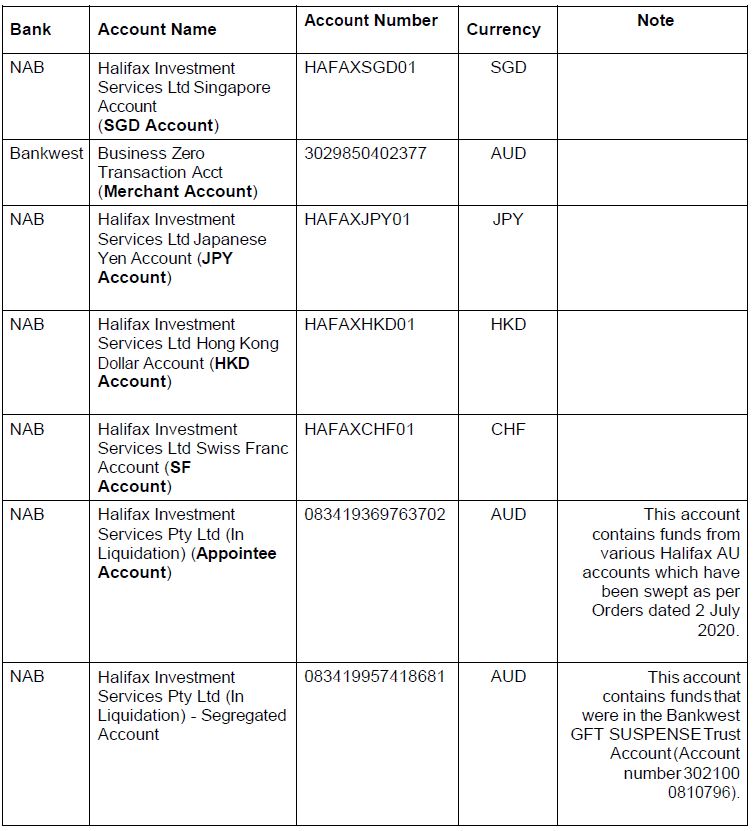
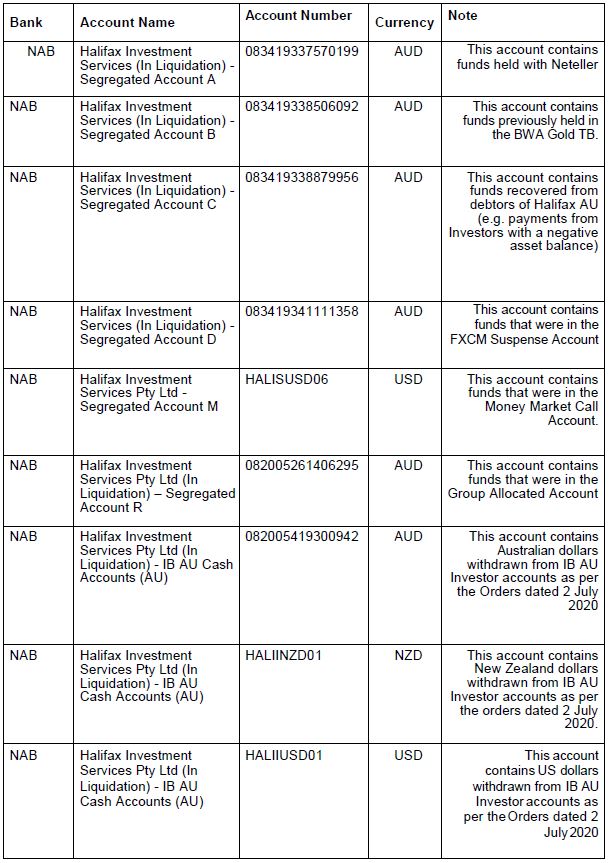
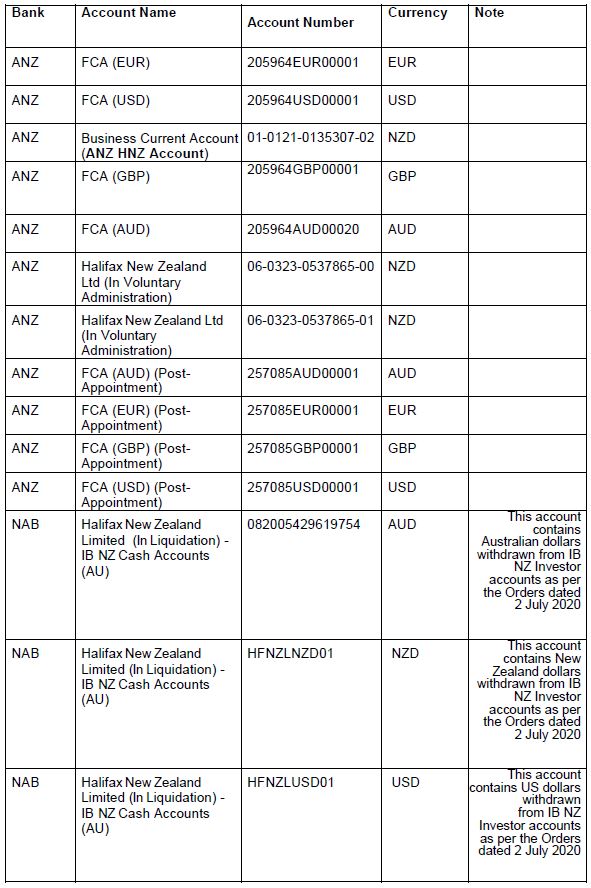
17. Subject to Orders 2, 7, 12 and 13 above, the plaintiffs are justified in pooling the funds in the bank accounts listed in Annexure A to these Orders.
18. For the purpose of calculating each client’s proportionate entitlement in accordance with Orders 14 and 15 above and/or for the purpose of making a distribution to clients in accordance with Order 19 below, the plaintiffs are, prior to making the calculation and/or distribution, justified in converting into Australian dollars or New Zealand dollars any foreign currency in the Liquidators’ or Halifax AU’s control.
F. DISTRIBUTION PROCESS
19. The plaintiffs are justified in adopting the following process to distribute client entitlements:
(a) the Liquidators are to email each client (or, if email is not, in the Liquidators' opinion, the most appropriate means of communication with an individual client, post to the client’s last known address) a notification providing them with unique login details to a secure, web-based client portal (Investor Portal) and instructing them that, upon logging into the Investor Portal, they will be notified of the value of their entitlement for the purpose of any distribution (Distribution Notice);
(b) in the Investor Portal, the Liquidators are:
(i) to ask clients to verify their identity and to confirm the value of their entitlement;
(ii) if a client disputes the value of their entitlement, to ask the client to notify the plaintiffs of this and provide reasons and supporting documentation (if any) in support of their position; and
(iii) to ask clients to provide their bank account details (Nominated Bank Account) for the distribution of an entitlement;
(c) clients are to be given 21 days to respond to the Distribution Notice by logging into the Investor Portal and completing the steps identified in Order 19(b) above;
(d) if, in response to the Distribution Notice, a client affirmatively disputes the value of their entitlement then, on the condition that their response is accompanied by both reasons and any necessary supporting documents:
(i) the Liquidators are to assess whether the dispute is well-founded;
(ii) if the dispute is well-founded, the Liquidators are to notify the client that the Liquidators agree with the issues raised in the dispute and have agreed to amend the value of the entitlement; and
(iii) if the dispute is not well-founded, the Liquidators are to notify the client that they may apply to the Court (in this proceeding) if the client considers that their dispute is well-founded and that otherwise the Liquidators may proceed to distribution on the basis of the value of the entitlement as set out in the Distribution Notice;
(e) the Liquidators are to proceed to distribution on the basis of the value of the entitlement of each client as recorded in the Investor Portal if:
(i) within 35 days of the Distribution Notice, the client confirms the value of their entitlement on the Investor Portal; or
(ii) the client does not log into the Investor Portal to confirm or dispute their entitlement within 35 days of the Distribution Notice; or
(iii) the client logs into the Investor Portal and disputes their claim but provides no particularity as to the basis of their dispute within 21 days of notification that the client must provide further particularity or else the distribution will proceed on the basis of the client’s entitlement as set out in the Distribution Notice; or
(iv) the Liquidators notify the client that their dispute is not well-founded in accordance with the process in Order 19(d)(iii) above and the client does not apply to the Court (in this proceeding) within 21 days of that notification.
SET-OFF
20. The plaintiffs are justified in proceeding on the following basis in respect of the calculation of entitlements of clients:
(a) where a client has multiple accounts on the IB AU platform and/or the IB NZ platform and/or the MT4 platform and/or the MT5 platform, the plaintiffs are entitled to combine the balances of those accounts to calculate the net position of a client; and
(b) setting off positive account balances credited to a particular client against negative account balances incurred by the same client.
LOW ACCOUNT BALANCES
21. The plaintiffs are justified in treating clients who have a credit balance of AUD100 or less as having no right to participate in the distribution of funds by the Liquidators.
ELECTRONIC COMMUNICATIONS
22. Subject to Order 19(a) above, the plaintiffs are justified in publishing or sending any notices, correspondence or other relevant material to clients as part of the distribution process set out in Order 19 by:
(a) sending copies of any notices, correspondence or other relevant materials to the email address of each client for whom the Liquidators, Halifax AU or Halifax NZ holds an email address; and
(b) by notice or link on https://home.kpmg/au/en/home/creditors/halifax-investment-services.html and https://home.kpmg/au/en/home/creditors/halifax-nz-limited.html.
COSTS
23. The eighth and ninth defendants are to pay the plaintiffs’ costs and expenses incurred by reason of their joinder to this proceeding, including in responding to the contentions raised by those defendants in the letter dated 3 July 2020 from their solicitors at the time, on an indemnity basis and in a lump sum in the amount of AUD351,810.05 (exclusive of 88.99% of GST).
24. On or before 2 June 2021 the plaintiffs (and any other party wishing to make a claim) are to file and serve their submissions, not exceeding three pages in length, in relation to any claim for costs as against the sixth and seventh defendants.
25. On or before 16 June 2021 the sixth and seventh defendants are to file and serve their submissions in response, not exceeding three pages in length.
26. If submissions are filed and served in accordance with Orders 24 and 25 above, any claim for costs against the sixth and seventh defendants will be determined on the papers.
NOTICE
27. The requirement to provide notice for the purpose of s 63(8) of the Trustee Act 1925 (NSW) (Trustee Act) is dispensed with.
28. The time fixed for making an application under s 63(10) of the Trustee Act is 14 days after the date of these Orders.
Note: Entry of orders is dealt with in Rule 39.32 of the Federal Court Rules 2011.
Annexure A
Bank accounts of Halifax AU
Bank accounts of Halifax NZ
[11] | |
[14] | |
2.1 An application for judicial advice and directions – legal principles | [14] |
[21] | |
[31] | |
[32] | |
[36] | |
[40] | |
[44] | |
[45] | |
[55] | |
[73] | |
[76] | |
[79] | |
[81] | |
[93] | |
3.10 Distribution of funds held by Halifax AU and Halifax NZ | [97] |
[97] | |
[98] | |
[105] | |
[109] | |
[118] | |
4.1 Moneys held by Halifax AU and Halifax NZ – legislative framework | [118] |
[134] | |
[147] | |
6.1 Did the funds held on trust by Halifax AU and Halifax NZ become commingled? | [149] |
6.2 Was there a deficiency in the funds held by Halifax AU and Halifax NZ? | [160] |
[165] | |
[166] | |
[167] | |
[172] | |
[181] | |
[197] | |
[198] | |
[210] | |
[216] | |
[231] | |
[253] | |
[254] | |
[258] | |
[267] | |
[283] | |
[283] | |
[288] | |
[298] | |
[312] | |
[325] | |
[329] | |
[340] | |
[366] | |
9.1 Correspondence between the Liquidators and the Shareholders | [366] |
[371] | |
[392] | |
[393] | |
[399] | |
[408] | |
[410] |
REASONS FOR JUDGMENT
MARKOVIC J:
1 Halifax Investments Services Pty Ltd (in liquidation) (Halifax AU) was incorporated on 30 May 2001. It is an Australian company. Its current ordinary shareholders are:
(1) Hong Kong Capital Holdings Pty Ltd (HK Capital) which holds 40.97% of the ordinary shares;
(2) Jeffrey Worboys who holds 40.97% of the ordinary shares; and
(3) Blunsdon Management Pty Ltd which holds 18.06% of the ordinary shares.
2 Halifax New Zealand Limited (in liquidation) (Halifax NZ) was incorporated on 21 May 2008. It is a New Zealand company. Prior to 9 October 2013 Halifax NZ was called Strategic Capital Management Limited (Strategic Capital). In 2013 Halifax AU purchased a controlling interest in Halifax NZ. Its current shareholders are:
(1) Halifax AU as to 70%;
(2) Kay Williams and Andrew Gibbs (Andrew Gibbs Family Trust) as to 29.5%; and
(3) Andrew Gibbs, the director of Halifax NZ, as to 5%.
3 Halifax AU and Halifax NZ were financial service providers dealing in financial products on behalf of their respective clients. Their operations are described in more detail below.
4 On 23 November 2018 Morgan John Kelly, Philip Alexander Quinlan and Stewart McCallum were appointed as joint and several voluntary administrators of Halifax AU pursuant to s 436A(1) of the Corporations Act 2001 (Cth) (Corporations Act). On 27 November 2018 Messrs Kelly, Quinlan and McCallum were appointed as joint and several voluntary administrators of Halifax NZ pursuant to s 239(1) of the Companies Act 1993 (NZ) (Companies Act (NZ)).
5 On 20 March 2019 Messrs Kelly, Quinlan and McCallum were appointed as liquidators of Halifax AU pursuant to s 439C(c) and s 446A of the Corporations Act and, on 22 March 2019, they were appointed as liquidators of Halifax NZ pursuant to s 241(2)(d) of the Companies Act (NZ).
6 On 9 and 13 May 2019 respectively Mr McCallum resigned from his appointment as a liquidator of Halifax NZ and of Halifax AU. I will refer to the remaining liquidators of those companies, Messrs Kelly and Quinlan, as the Liquidators in these reasons.
7 By way of interlocutory process dated 2 July 2019, the Liquidators and Halifax AU bring an application for directions and judicial advice regarding a number of questions that arise in relation to the distribution of funds held on trust by Halifax AU for its investor clients, including whether the Liquidators and Halifax AU would be justified in: pooling all or some of the funds held by each of Halifax AU and Halifax NZ in various accounts; paying each client their entitlement to the funds in the pool on a pari passu or on some other basis; converting funds held in foreign currency to Australian dollars and funds held in Australian dollars to New Zealand dollars for the purpose of distribution to clients of Halifax AU and Halifax NZ respectively; calculating the value of investments by each client for the purposes of distribution as at 23 November 2018, 27 November 2018, the date of realisation of each investment or some other date; setting off positive net account balances against negative net account balances for the same client; and excluding those clients who have a credit balance of AUD100 or less from participating in a distribution of funds.
8 By originating application for directions filed in proceeding CIV-2019-404-2049 (NZ Proceeding) in the High Court of New Zealand (High Court NZ) on 25 September 2019, the Liquidators and Halifax NZ seek judicial advice and directions in respect of the same questions.
9 This Court and the High Court (NZ) each determined to hear the interlocutory process filed in this Court and the originating application for directions filed in the High Court (NZ) concurrently: see Re Kelly; Halifax Investment Services Pty Ltd (in liq) (No 5) [2019] FCA 1341; (2019) 139 ACSR 56 (Kelly (No 5)) and Minute No (4) issued on 12 December 2019 in the NZ Proceeding.
10 Accordingly, since December 2019, this proceeding and the NZ Proceeding have proceeded in parallel with the two courts sitting concurrently to hear applications and conduct case management hearings and, ultimately, to conduct the hearings of the interlocutory application and the originating application in which, in each case, the Liquidators and either Halifax AU or Halifax NZ, as applicable, seek judicial advice and directions.
11 By orders made on 19 February 2020 in this proceeding and 3 April 2020 in the NZ Proceeding the following parties were appointed, for the purposes of this proceeding under r 2.13(3) and (5) of the Federal Court (Corporations) Rules 2000 (Cth) (Corporations Rules) and/or s 15(1) of the Insolvency Practice Schedule (Corporations) being Schedule 2 to the Corporations Act (IPS), to represent certain bodies of clients of Halifax AU and/or Halifax NZ:
(1) Choo Boon Loo as first defendant to represent all clients/investors of Halifax AU and of Halifax NZ whose proportionate entitlement to or share of funds from the “deficient mixed fund” (as that phrase is defined in [189] of the affidavit of Mr Kelly sworn 26 June 2019 in this proceeding (Kelly June 2019 Affidavit)) will be higher after the realisation of all extant investments than it was on the date administrators were appointed to Halifax AU and Halifax NZ (category 1 investors);
(2) Elysium Business Systems Pty Ltd (Elysium) as second defendant to represent all clients/investors of Halifax AU and of Halifax NZ whose proportionate entitlement to and share of funds from the “deficient mixed fund” (as that phrase is defined in [189] of the Kelly June 2019 Affidavit) will be lower after the realisation of all extant investments than it was on the date administrators were appointed to Halifax AU and Halifax NZ (category 2 investors);
(3) Jason Hingston as third defendant to represent all clients/investors of Halifax AU and of Halifax NZ who transferred shares into the Trader Workstation (also known as Halifax AU’s IB Platform or Halifax NZ’s IB Platform) from another stockbroker and have not traded in those shares (category 3 investors);
(4) Atlas Assets Management Pty Ltd as trustee for the Atlas Management Trust (Atlas) as fourth defendant to represent all clients/investors of Halifax AU and of Halifax NZ whose investments are not traceable and who wish to contend that all clients should share in any deficiency regardless of whether investments are traceable or not (category 4 investors); and
(5) Fiona McMullin as fifth defendant to represent all clients/investors of Halifax AU and of Halifax NZ who invested before 1 January 2016 in order to propound the argument that investments made before there was a deficient mixed fund are traceable (category 5 investors).
12 On 3 April 2020 Andrew Phillip Whitehead and Marlene Whitehead, in their capacity as trustees of the Beeline Trust and Andrew Phillip Whitehead (collectively, Whitehead Interests), were added as sixth and seventh defendants to this proceeding pursuant to r 2.13(3) and (5) of the Corporations Rules and/or s 90-15(1) of the IPS and to the NZ Proceeding to propound certain arguments in their own interest.
13 On 13 August 2020 and 21 September 2020 respectively Mr Worboys and HK Capital (collectively, Shareholders) were joined as eighth and ninth defendants to this proceeding and to the NZ Proceeding to propound particular claims relating to Halifax AU. On 12 November 2020 the solicitors for Mr Worboys and HK Capital filed a notice of ceasing to act. Thereafter Mr Worboys and HK Capital each notified the Court of their respective addresses for service. However, there was no appearance by them or on their behalf at the hearing of the interlocutory process.
2. The nature of the proceeding
2.1 An application for judicial advice and directions – legal principles
14 The application before this Court is, on the part of the Liquidators, for directions pursuant to s 90-15 of the IPS and, on the part of Halifax AU in its capacity as a trustee, for judicial advice. Before proceeding further it is convenient to set out the principles that guide the Court on such applications.
15 Section 90-15(1) of the IPS provides that the Court may make such orders as it thinks fit in relation to the external administration of a company which may include an order determining any question arising in the external administration of the company: see s 90-15(3)(a).
16 In Re Kelly, in the matter of Halifax Investments Services Pty Ltd (in liq) (No 8) [2020] FCA 533; (2020) 144 ACSR 292 at [50]-[59] Gleeson J set out the principles applicable to the exercise of the power in s 90-15 of the IPS including relevantly:
52 In Ample Source International Limited v Bonython Metals Group Pty Limited (in liquidation), in the matter of Bonython Metals Group Pty Limited (in liquidation) (No 8) [2018] FCA 1614 at [88]-[92], I set out the following matters concerning s 90-15:
[88] By s 90–20(1)(d) of the Insolvency Practice Schedule and the definition of “officer” in s 9 of the Act, a liquidator is a person who may apply for an order under s 90–15.
[89] The Court’s supervisory powers under s 90–15 of the Insolvency Practice Schedule are arguably as broad, or broader than, its powers under the previous provision, being the former s 479(3) of the Act.
[90] Section 479(3) allowed a court-appointed liquidator to apply to the Court for directions in relation to a matter arising under a winding up. The function of a liquidator’s application for directions under s 479(3) was to give the liquidator advice as to the proper course of action for him or her to take in the liquidation: Re MF Global Australia Ltd (in liq) [2012] NSWSC 994; (2012) 267 FLR 27 at [7].
[91] In Re Ansett Australia Ltd and Korda [2002] FCA 90; (2002) 115 FCR 409, Goldberg J explained at [44]:
When liquidators and administrators seek directions from the Court in relation to any decision they have made, or propose to make, or in relation to any conduct they have undertaken, or propose to undertake, they are not seeking to determine rights and liabilities arising out of particular transactions, but are rather seeking protection against claims that they have acted unreasonably or inappropriately or in breach of their duty in making the decision or undertaking the conduct. They can obtain that protection if they make full and fair disclosure of all relevant facts and circumstances to the Court. In Re G B Nathan & Co Pty Ltd (1991) 24 NSWLR 674, McLelland J said at 679–680:
The historical antecedents of s 479(3) …, the terms of that subsection and the provisions of s 479 as a whole combine to lead to the conclusion that the only proper subject of a liquidator’s application for directions is the manner in which the liquidator should act in carrying out his functions as such, and that the only binding effect of, or arising from, a direction given in pursuance of such an application (other than rendering the liquidator liable to appropriate sanctions if a direction in mandatory or prohibitory form is disobeyed) is that the liquidator, if he has made full and fair disclosure to the court of the material facts, will be protected from liability for any alleged breach of duty as liquidator to a creditor or contributory or to the company in respect of anything done by him in accordance with the direction.
…
Modern Australian authority confirms the view that s 479(3) ‘does not enable the court to make binding orders in the nature of judgments’ and that the function of a liquidator’s application for directions ‘is to give him advice as to his proper course of action in the liquidation; it is not to determine the rights and liabilities arising from the company’s transactions before the liquidation’: [cases cited omitted].
[92] At [65], Goldberg J concluded:
[T]he prevailing principle adopted by the courts, when asked by liquidators and administrators to give directions, is to refrain from doing so where the direction sought relates to the making and implementation of a business or commercial decision, either committed specifically to the liquidator or administrator or well within his or her discretion, in circumstances where there is no particular legal issue raised for consideration or attack on the propriety or reasonableness of the decision in respect of which the directions are sought. There must be something more than the making of a business or commercial decision before a court will give directions in relation to, or approving of, the decision. It may be a legal issue of substance or procedure, it may be an issue of power, propriety or reasonableness, but some issue of this nature is required to be raised. It is insufficient to attract an order giving directions that the liquidator or administrator has a feeling of apprehension or unease about the business decision made and wants reassurance. There must be some issue which arises in relation to the decision. A court should not give its imprimatur to a business decision simply to alleviate a liquidator’s or administrator’s unease. There must be an issue calling for the exercise of legal judgment.
53 In S & D International & Anor v MIG Property Services & Ors [2010] VSC 336; (2010) 79 ACSR 373, Warren CJ approved the liquidator’s compromise of legal proceedings involving competing claims over a property held on trust, exercising the power then conferred by s 511 of the Corporations Act. At [17], her Honour described the case as one that “dealt with the risk attendant upon a conscientious liquidator in an acrimonious liquidation environment” and considered that s 511 orders may have utility to protect liquidators “where such protection would be just and beneficial to advancing the liquidation process as a whole”.
…
56 In Re One.Tel Ltd and Ors [2014] NSWSC 457; (2014) 99 ACSR 247 at [35], Brereton J noted the need for caution in making a direction, saying:
But the fact that a direction under s 511 — unlike an approval under s 477(2A) or (2B) — exonerates the liquidator from personal liability, means that a closer examination of the liquidator’s decision is required than under s 477. In short, the court should not make a direction the effect of which is to exonerate the liquidator from personal liability in respect of a commercial judgment that the liquidator is concerned may prove contentious, unless satisfied that the liquidator’s decision is, in all the circumstances, a proper one.
…
58 In Re KSK Holdings (Australia) Pty Ltd (in liquidation) [2019] NSWSC 1463 at [18], Rees J explained:
The Court may give directions where it will be “of advantage in the liquidation”: Dean-Wilcox v Soluble Solution Hydroponics Pty Limited (1997) 42 NSWLR 209 at 212; (1997) 24 ACSR 79 at 81. The Court will not generally give a direction where the matter relates to the making or implementation of a business or commercial decision or when no legal issue is raised, or where there is no attack on the propriety or reasonableness of the liquidator’s decision, but it may do so where there is the prospect of such an attack: In the matter of Steel Distribution Pty Limited (in liquidation) (receivers and managers appointed) [2013] NSWSC 669 at [20] per Black J; In the matter of Dungowan Manly Pty Limited (in liq) [2018] NSWSC 1083 at [17].
17 Section 63(1) of the Trustee Act 1925 (NSW) (Trustee Act) enables a trustee to apply to the Court for an opinion, advice or direction on any question in relation to the management or administration of the trust property or the interpretation of the trust instrument.
18 The principles in respect of judicial advice to trustees were considered in Macedonian Orthodox Community Church St Petka Inc v His Eminence Petar The Diocesan Bishop of Macedonian Orthodox Diocese of Australia and New Zealand (2008) 237 CLR 66 (Macedonian Orthodox Church). There, the plurality (Gummow ACJ, Kirby, Hayne and Heydon JJ) observed at [56]-[60] that there is no limitation on the power of the Court to give judicial advice pursuant to s 63 of the Trustee Act but there is one jurisdictional bar to relief under the section. That is that an applicant “must point to the existence of a question respecting the management or administration of the trust property or a question respecting the interpretation of the trust instrument”: see Macedonian Orthodox Church at [58].
19 At [64] of Macedonian Orthodox Church, the plurality observed that s 63 of the Trustee Act operates as an exception to a court’s ordinary function of deciding disputes between competing litigants and affords a facility for providing private advice to a trustee, noting that it is private advice because, as is evident from the operation of s 63(2) of the Trustee Act, its function is to give personal protection to the trustee. Section 63(2) of the Trustee Act provides that, if the trustee acts in accordance with the opinion advice or direction, the trustee shall be deemed, so far as regards the trustee’s own responsibility, to have discharged its duty as trustee in the subject matter of the application provided that the trustee has not been guilty of any fraud, wilful concealment or misrepresentation in obtaining the opinion, advice or direction.
20 Given the nature of the relief sought, save in relation to the Shareholders, the Liquidators have quite properly taken a neutral approach in relation to controversial issues raised for resolution, while providing submissions to assist the Court. This is consistent with the approach to be taken where a dispute has arisen between beneficiaries of a trust as to their rights in the trust estate: see Re MF Global Australia (in liq) (2012) FLR 27 (MF Global) at [2].
21 Given its somewhat unique nature, it is appropriate to say something about the conduct of the hearing.
22 In Kelly (No 5) at [32], in considering the Liquidators’ application for the issue of a letter of request to the High Court NZ seeking for that Court to act in aid of and auxiliary to this Court in respect of the interlocutory process filed in this Court, to enable it and the proposed originating application (yet to be filed in the High Court NZ) to be resolved in an effective way, Gleeson J relevantly said:
More specifically, the request, if issued, would be that the NZHC agree to hear and determine the proposed NZ application by sitting jointly with the FCA whilst the FCA hears and determines the application in this proceeding, with a view to each court hearing all of the evidence and all of the submissions in both proceedings together (including evidence adduced by, and submissions by, those who may be joined to either proceeding or who may be given leave in either proceeding to be heard). This could be done in a manner to be jointly determined by the courts,... The letter of request, if issued by this Court as sought by the plaintiffs, would contemplate that the NZHC would deliberate together with the FCA so as to seek to achieve, so far as possible, an outcome in which inconsistency between the judicial advice or directions given by each Court in respect of the same commingled pool of funds is effectively eliminated.
23 At [60] her Honour also observed that:
… Further, it can be readily appreciated that, if the liquidators’ applications are not coordinated, there is a real and obvious prospect of inconsistent findings, inconsistent directions or advice and consequent additional litigation, all potentially to the detriment of creditors of Halifax AU. One means by which the NZHC might act in aid of and be auxiliary to this Court in connection with the application for the pooling order might be to participate in a concurrent hearing of the proposed NZ application with the hearing of the interlocutory process.
24 As set out above, this proceeding and the NZ Proceeding were case managed concurrently and the interlocutory application filed in this Court and the originating application filed in the High Court NZ were heard concurrently. The hearing was facilitated by the use of video conferencing technology with each Court sitting in its own jurisdiction over a period of seven days.
25 The parties were represented by the same solicitors and counsel in each proceeding (save that there was an additional member of the Liquidators’ counsel team who only appeared in the NZ Proceeding) and relied on the same evidence and submissions in each proceeding. Where a witness was cross-examined, he gave an oath or affirmation in each proceeding. Rulings on objections were made by each Court depending on the location of cross-examining counsel. For example, if there was an objection to a question asked in cross-examination by counsel physically situated in the High Court NZ, Venning J sitting in that Court ruled on the objection and the ruling was, in effect, adopted by this Court. No party opposed this approach.
26 The Liquidators submit that it is important to all parties to avoid, so far as possible, inconsistency in the directions and/or judicial advice to be given by this Court and the High Court NZ and that the Courts have recognised this to be the case. They say that an “obvious tool” available for avoiding inconsistency is for the Courts to deliberate together and urged that to occur. In their oral closing submissions, the Liquidators went so far as to suggest that this Court and the High Court NZ might produce or adopt a joint or common set of reasons, drawing an analogy to judges delivering the reasons of an appellate court.
27 The defendants each supported the notion that the two Courts would deliberate together to achieve, so far as possible, consistency in the judicial advice and/or directions to be given.
28 Given what has occurred in the operation of Halifax AU and Halifax NZ (which is described below), including the uncontroversial fact that there is a deficiency in moneys held on trust for the benefit of clients of those companies and a commingling of funds, it is of some importance to the administration of Halifax AU and Halifax NZ, and to their creditors, that there be consistency in the approach of this Court and the High Court NZ.
29 In Westpac Banking Corporation v Lenthall (2019) 265 FCR 21, an application for leave to appeal and appeal were heard concurrently by a Full Court of this Court (Allsop CJ, Middleton and Robertson JJ) with a matter before the New South Wales Court of Appeal, BMW Australia Ltd v Brewster (2019) 343 FLR 176, at the same time and in the same court room. At [2] the Full Court said:
… The issues in the two matters overlapped considerably; and, given the importance of the questions, in particular of the Constitutional questions, it was thought convenient for the administration of justice that both Courts have the advantage of written and oral argument of counsel on the same occasion. Each Court would, of course, decide the matter before it according to the views of the judges constituting the Court. One party, BMW, raised concerns about the procedure and, in particular, objected to any discussion among or between judges from the two Courts about the issues. In light of this, a protocol was announced at the commencement of the hearing of the two matters that dealt with such matters as judges from either Court asking any counsel questions in argument. Each Court had the written submissions relied on in both matters. To the extent that evidence was relevant it was read by affidavit in each proceeding. The Courts informed the parties that, without the consent of the parties, the members of the Courts would not discuss the substance of the arguments or their views thereon with the judges from the other Court, or exchange drafts. No argument was heard on this question and whether this was a necessary or proper precaution. It is appropriate to say, however, that (subject to being persuaded to the contrary) we would not have considered that the kinds of considerations discussed in Re JRL; Ex parte CJL [1986] HCA 39; 161 CLR 342 (see especially the judgment of Mason J at 350–352) would have made such communications in any way inappropriate. As Mason J said at 351, a judge may consult another judge of his or her court who has no interest in the matter or other court personnel whose function is to aid him or her in carrying out his or her judicial responsibilities. In an integrated federal judicature, with two benches hearing two matters with overlapping issues in federal jurisdiction, it would be passing strange if a principle underpinning the fair, impartial and due administration of justice prevented discussions between the members of the Courts involved in deciding the cases, having just heard all the arguments in the same courtroom, as if the members of the bench of the other Court were strangers or third parties having private communications with the Court. It would go without saying that if any issue raised in such discussions had not been adequately ventilated, natural justice might require that some step be taken (just as it would if judges of the same court were to consider such a new issue to be relevant).
(Emphasis added.)
30 In this case no objection was taken to deliberation between the Courts. Indeed, as I have already observed, the parties consented to that course and, in the circumstances of this case and in light of the nature of this proceeding and the NZ Proceeding, it was an appropriate course to adopt. Accordingly Venning J of the High Court NZ and I engaged in discussions about the issues before each of the Courts for resolution and the arguments raised by the parties. However, in my opinion, it is not appropriate that the two Courts adopt or deliver one set of reasons. Unlike an appellate court, this Court and the High Court NZ are each exercising their own jurisdiction, according to the applicable legislative framework and law. It is necessary for each Court to reach its own conclusions and to express its reasons for doing so.
31 I turn then to consider the factual background against which the issues arise for resolution.
32 From 19 February 2003 to 7 January 2019 Halifax AU held an Australian Financial Services License (AFSL). Halifax AU’s AFSL authorised it to provide financial product advice on a range of financial products, deal in financial products and make a market for foreign exchange contracts and derivatives.
33 Halifax AU was not a licensed broker but facilitated the acquisition of shares by clients through an online broker and made a range of financial products available to clients. It had 16 employees prior to going into administration and provided administrative and treasury functions for its own operations and those of Halifax NZ.
34 Halifax AU conducted its business by way of the following trading platforms:
(1) an Interactive Brokers LLC (IB) trading platform known as Trader Workstation, referred to as Halifax AU IB platform or IB AU;
(2) MetaTrader4 (MT4) trading platform also known as Halifax Pro which was licenced by MetaQuotes Software Corp (MetaQuotes);
(3) from about 8 August 2016 MetaTrader5 (MT5) trading platform also known as Halifax Plus and which was also licenced by MetaQuotes; and
(4) from about 2009 to about July or August 2016 the Saxo trading platform.
35 As Halifax AU was not a market participant on the Australian Securities Exchange (ASX), its clients with accounts on the various trading platforms could access those platforms and place trades at their own discretion.
36 Halifax NZ held a Financial Service Provider’s Licence (FSPL) granted by the Financial Markets Authority (New Zealand) which authorised it to sell derivatives, including contracts for difference (CFDs), options, futures, margin foreign exchange contracts and non-derivative products including warrants and margin foreign exchange, equities and exchange-traded funds. Halifax NZ also acted as a broker for its clients in respect of various exchange-traded products including shares and warrants. Halifax AU was an authorised body under Halifax NZ’s FSPL.
37 Halifax NZ was not a market participant on any exchange. It was an introducing broker and, in that capacity, introduced prospective clients to Halifax AU for the purpose of financial products trading. Prior to Halifax NZ going into administration it had four employees who were principally involved in sales.
38 Halifax NZ conducted its business by:
(1) providing access for its clients and for clients of Halifax AU to the IB trading platform referred to as the Halifax NZ IB platform or IB NZ; and
(2) facilitating access for its clients to Halifax AU’s IB AU, MT4 and MT5 platforms.
39 Halifax NZ’s revenue was principally derived from commissions earned from trades placed by its clients, either on the IB NZ platform or as a result of the introduction of clients to the platforms operated by Halifax AU referred to in the preceding paragraph.
3.3 Products offered by Halifax AU and Halifax NZ
40 Clients of Halifax AU and Halifax NZ were able to trade in the following financial products:
(1) shares;
(2) warrants;
(3) CFDs;
(4) equity and index options;
(5) options on futures;
(6) futures; and
(7) foreign exchange.
41 In addition, clients of Halifax NZ could trade in mutual funds.
42 The financial products in which clients of Halifax AU and Halifax NZ could trade were either:
(1) exchange-traded financial products. That is, investments which are traded on a regulated exchange such as the ASX, New York Stock Exchange (NYSE) or London Stock Exchange (LSE), including shares, warrants, futures and options; or
(2) over the counter (OTC) financial products comprising derivatives which were not listed on a regulated exchange such as the ASX but traded via private contracts between two parties, in this case the client and either Halifax AU or Halifax NZ. The value of the contracts is derived from the price of the assets or products such as shares, precious metals and commodities.
43 Exchange-traded financial products were available for trading through the IB AU, IB NZ and MT5 platforms and OTC financial products were available for trading through the MT4, MT5 and IB NZ platforms.
3.4 The trading platforms explained
44 The MT4, MT5, IB AU and IB NZ platforms were operated in Australia by Halifax AU. Clients of Halifax AU and clients of Halifax NZ were able to trade on all of the platforms regardless of whether they had executed a client service agreement (CSA) with Halifax AU or Halifax NZ although, in order to trade on a particular platform, it was necessary for a client first to have set up and funded an account in connection with the relevant platform.
45 IB operates an online trading platform across a range of jurisdictions and provides access to multiple markets in approximately 24 different countries. The Trader Workstation is one of the platforms offered by IB. IB provided that platform to Halifax AU and Halifax NZ and, in turn, each of those entities provided their clients with access to the platform for trading.
46 The Trader Workstation or IB platform is a single trading platform. Each of Halifax AU and Halifax NZ separately contracted with IB to access and utilise it. These contracts remain in place although the platforms are now in “close only” mode; investors can close positions but cannot place new trades.
47 The IB AU platform enabled clients to trade in shares, warrants, equity and index options, futures and options on futures. The IB NZ platform enabled clients to trade in shares, warrants, foreign exchange, equity and index options, futures, options on futures, mutual funds and CFDs on shares.
48 Halifax AU and Halifax NZ operated a white label system with IB. This meant that all trades and data in relation to the IB AU and the IB NZ platforms were recorded as being held by IB for Halifax AU or Halifax NZ and not for the individual clients.
49 In relation to trades undertaken through the IB AU and the IB NZ platforms:
(1) IB charged a commission to Halifax AU or Halifax NZ, as applicable, which Halifax AU or Halifax NZ then on-charged with a mark-up or commission to the client undertaking the trade. The commission was automatically deducted for each trade. Some clients also paid for live data through subscriptions with IB which deducted a fee for that service;
(2) IB provided a range of reports to Halifax AU, Halifax NZ and their clients;
(3) IB used custodians and clearing brokers for trading stocks, options and futures in different countries; and
(4) the platform was not a virtual platform. All positions were exchange-traded, with the purchase of stocks or other financial products supported on a 1:1 basis by cash, stocks or other financial products.
50 Under their respective contracts with IB, Halifax AU and Halifax NZ each hold a consolidated account with IB, which I will refer to respectively in these reasons as the IB AU Consolidated Account and the IB NZ Consolidated Account. Each of the IB AU Consolidated Account and the IB NZ Consolidated Account is comprised of three types of accounts:
(1) IB AU Master Account (in the IB AU Consolidated Account) and IB NZ Master Account (in the IB NZ Consolidated Account) which each held a pool of funds from which amounts were paid into individual client sub-accounts (IB Client Sub-Accounts);
(2) IB Client Sub-Accounts in connection with each of the IB AU Consolidated Account and the IB NZ Consolidated Account which record the investments (cash, shares and other securities) held on behalf of clients on the IB AU and IB NZ platforms. Clients could log into their respective IB Client Sub-Account and execute a trade on the IB platform or they could instruct Halifax AU or Halifax NZ to access their IB Client Sub-Account and execute a trade on their behalf; and
(3) IB AU Prop Account and IB NZ Prop Account which purport to hold:
(a) revenue derived by Halifax AU and Halifax NZ from commissions and interest;
(b) in the case of the IB AU Prop Account:
(i) shares as hedges against MT5 client positions as well as dividend income generated from these shares; and
(ii) a cash balance (which may result from the realisation of assets held as hedges, or cash that was transferred into the IB AU Prop Account from the IB AU Master Account to ensure there was sufficient collateral to open new hedge positions as required).
However, as Mr Kelly explains, the IB AU Prop Account and IB NZ Prop Account were just accounting records which did not hold any shares or cash.
51 Until about late 2015 Halifax AU offered three types of IB Client Sub-Accounts to clients on IB AU: a cash account, a margin account and a portfolio margin account. These accounts were maintained by IB and recorded the transactions entered into by the client and the balance of the account. After late 2015, IB AU no longer offered margin or portfolio margin accounts for individuals applying for a new IB Client Sub-Account but individuals who already held such an account could continue to use them. After this change, individuals residing in Australia who wished to trade in stock CFDs had to do so on the MT4 or MT5 platforms.
52 Joseph Lum is a technical support officer employed by Halifax AU. From September 2008 to April 2015, and from January 2016 to November 2018, he worked in the online trading support team. Mr Lum describes each type of IB Client Sub-Account as follows:
(1) cash accounts – clients with cash accounts could trade in shares and certain types of options. They did not trade in CFDs. If a client with a cash account wanted to execute a trade, the client had to have sufficient cash in the account to cover the cost of the trade. Where the account balance approached a negative value positions automatically closed out, i.e. the shares were sold, to prevent the account balance going into negative. IB decided which open positions to close out automatically and, according to Mr Lum, usually closed out the most liquid shares or positions recorded in an account. Clients could set up their accounts to direct IB to sell certain shares last in the event of an automatic close out; and
(2) margin or portfolio margin accounts – these accounts had to satisfy margin requirements, set by IB, in order for the client to conduct trades. That is, they had to record a net asset value equivalent to a certain percentage of the total value of the trade. Clients with margin accounts on IB AU could trade in shares, options, futures, futures options and US bonds. Clients with margin accounts on IB NZ could trade in shares, options, stock CFDs, futures, futures options, foreign currency and US bonds. If the making of a new investment or a change in value of an existing investment would otherwise have caused the overall balance of a margin account or a portfolio account on IB AU to fail to meet IB’s margin requirements, sufficient open positions recorded in that account would automatically close out to remedy the margin violation. IB decided which open positions to close out automatically and, as was the case with cash accounts, clients could set up their accounts to direct IB what it should sell last in any automatic close out. The principal difference between a margin account and a portfolio margin account was that, for a portfolio margin account, a client was required to have a higher balance in the account, at least around USD100,000, before IB would approve the enabling of the portfolio margin setting.
53 Notwithstanding that assets were recorded in individual IB Client Sub-Accounts, the assets in the IB Client Sub-Accounts were, as set out at [50(2)] above, held by IB on behalf of Halifax AU or Halifax NZ. In turn, Halifax AU or Halifax NZ held their interest in the assets on behalf of their clients. Clients of Halifax AU and Halifax NZ did not have a contractual relationship with IB. They had a contractual relationship with either Halifax AU or Halifax NZ.
54 The investments currently held by IB on behalf of Halifax AU and Halifax NZ are largely shares and cash. Shares are held by IB on behalf of Halifax AU and Halifax NZ in the Client Sub-Accounts.
55 As set out above, the MT4 and MT5 software is owned by MetaQuotes which licences the trading platforms to Halifax Capital Markets, a related entity of Halifax AU. At the time the administrators were appointed, Halifax AU was the licensee of the MT4 and MT5 software. The licence was transferred to Halifax Capital Markets shortly thereafter in line with a transfer agreement signed prior to the administrators’ appointment. Notwithstanding the transfer, Halifax AU continues to pay the ongoing licence fees to MetaQuotes.
56 The software for the MT4 and MT5 platforms consists of a client and server component. The server component was run by Halifax AU and the client software was made available to clients who used it to see live streamed prices and charts, place orders and manage their accounts. The servers for the MT4 and MT5 platforms are hosted by oneZero, which also provides IT infrastructure to connect the MT4 and MT5 platforms to the IB AU Prop Account and to lnvast Financial Services Pty Ltd (lnvast) and Gain Capital (Gain), which are both hedging counterparties. Halifax AU pays a service fee to oneZero.
57 The MT4 platform has been operational within the Halifax group since at least April 2016 and the MT5 platform has been operational within the Halifax group since about 8 August 2016, following termination of the Saxo platform. The majority of Halifax AU clients on the Saxo platform were migrated to the MT5 platform.
58 The MT4 and MT5 platforms are described as “virtual” trading platforms. The MT4 platform enabled clients to engage in virtual trading in foreign exchange derivatives and CFDs on indexes, metals and commodities and the MT5 platform enabled clients to engage in virtual trading in the same products as well as shares.
59 When a trade was placed Halifax AU did not buy the asset but, rather, held the moneys paid by the client and recorded the profit or loss in the client’s account based on the movement in value of the asset. In relation to the MT5 platform the only assets acquired by way of trading on that platform, shares, were in fact acquired on the IB AU platform and any assets acquired by Halifax AU for the purpose of its hedging activities (as described below) were acquired on another platform, IB AU, Invast or Gain. That is, there was no cash movement in or out of the MT4 or MT5 platforms; the funds were, or should have been, held by Halifax AU in statutory trust accounts in accordance with its obligations under s 981B of the Corporations Act (see [124] below). This was a procedure which Halifax AU did not always follow. Moneys paid by New Zealand clients for trading on the MT4 or MT5 platforms could be transferred into a New Zealand statutory trust account maintained by Halifax NZ or a statutory trust account maintained by Halifax AU.
60 The values of the virtual positions on the MT4 and MT5 platforms were, depending on the nature of the position, referable to the price of an underlying product listed on an exchange (e.g. the ASX) or the price of an underlying currency on a currency market. When a client decided to close out his or her position, the client’s account balance would either increase or decrease depending on the difference in the price of the underlying asset when the position was opened and the price when the position was closed (resulting in debits or credits to each party depending on the profit or loss of each trade).
61 Mr Lum explains that once the MT5 platform became available to clients of Halifax AU and Halifax NZ (whose access to the MT5 platform was facilitated by Halifax NZ through Halifax AU), clients with accounts on the MT5 platform (MT5 Client Accounts) could invest in shares as well as other financial products. When shares were traded by a client on the MT5 platform they were recorded in that client’s MT5 Client Account (with a special code indicating the trade was in shares) as well as in the IB AU Prop Account; there was a “bridge” between the MT5 platform and the IB AU Prop Account which facilitated automatic acquisition or sale of the shares on IB AU. Because Halifax NZ facilitated investment by its clients on the MT5 platform (in shares and stock CFDs) through Halifax AU, the shares that were acquired by clients and recorded in the IB AU Prop Account related both to Halifax AU and Halifax NZ clients.
62 Clients could also trade stock CFDs on the MT5 platform. Halifax AU hedged all client trades in stock CFDs on the MT5 platform by acquiring on IB AU the shares the subject of a CFD position on the MT5 platform. This was done through the “bridge” noted above. The shares which were acquired to hedge stock CFD trades executed by clients were recorded in the IB AU Prop Account. The client’s MT5 Client Account recorded the acquisition of a share CFD. The shares which were acquired on IB AU when a client traded in shares on the MT5 platform or as a hedged trade when a client traded in stock CFDs on the MT5 platform were not recorded in the IB AU Prop Account as relating to a particular client. However, according to Mr Lum, trades recorded in the IB AU Prop Account either corresponding to a share trade or relating to a stock CFD trade on the MT5 platform could be identified by a manual process which would require matching up client positions on the MT5 platform with corresponding positions in the IB AU Prop Account.
63 Clients who used the MT4 or MT5 platforms were divided into two categories: A-Book clients and B-Book clients. Mr Lum explains that all clients were initially treated as B-Book clients but those who traded in shares and stock CFDs were considered to be A-Book clients for the purpose of those trades. Clients who engaged in FOREX trading or trading in index CFDs and had a history of making significant profits or were considered to be “risky”, because they traded in large volumes, were also classified as A-Book clients.
64 If an A-Book client placed a FOREX trade on the MT4 or MT5 platforms, Halifax would automatically place the same trade through a bridge maintained by oneZero on lnvast or Gain (see [61] above). If the A-Book client made money on the FOREX trade, Halifax also made money on the corresponding trade that it had placed on lnvast or Gain. Conversely, if the A-Book client lost money on the FOREX trade, Halifax also lost money on its corresponding trade.
65 Halifax AU hedged trades made by A-Book clients and virtual trades made through the MT5 platform in shares and stock CFDs so that it was not exposed to profits or losses for those trades.
66 Both the shares acquired by Halifax AU to hedge stock CFDs in respect of which clients transacted with it and also, as explained above, the shares acquired by clients by trading on the MT5 platform were acquired immediately on the IB AU platform because the MT5 platform linked automatically to the IB AU platform.
67 Halifax did not hedge the virtual trades entered into by B-Book clients. Those clients only made trades in foreign exchange, index CFDs, metals and commodities.
68 For all trades made on the MT4 or MT5 platforms, Halifax AU earned revenue through either commissions or margin spreads. For B-Book clients Halifax AU also earned profits when clients made losses on trades.
69 The assets acquired by Halifax AU in hedging trades as described in [66] above were held in Halifax AU’s name and recorded in the IB AU Prop Account (which, as noted at [50(3)] above, was just an accounting record and did not hold any shares or cash) without differentiating between trades by clients in shares and CFDs in shares. They were not recorded in the name of any specific Halifax AU client but as part of a pool of stocks and were assets held by IB on behalf of Halifax AU.
70 In the same way as set out at [64] above for FOREX trades, when Halifax AU hedged trades made by A-Book clients on the MT5 platform it simultaneously acquired the same position as the client trade. For example, if a client entered into a virtual position of 50 shares in company A on 1 January 2018, Halifax AU bought 50 shares in company A on the same date. The shares had a value referable to a price listed on an exchange e.g. the ASX. If the client decided to close his or her position on 30 June 2019, Halifax AU would also sell the shares referable to that position on that date. If the value of the shares had increased, the balance of the client’s account on the MT5 platform would record the price increase and the client could elect to redeem that amount in cash.
71 As set out at [50(3)] above, Halifax NZ also had an IB NZ Prop Account with IB. Like the IB AU Prop Account, the IB NZ Prop Account was just an accounting record and did not hold any shares or cash. Moneys for rebates received, which were commissions that Halifax NZ was entitled to be paid by its clients, and interest earned from IB were held in Halifax NZ’s name and recorded in the IB NZ Prop Account.
72 lnvast and Gain held a pool of money as collateral for the hedged trades made by Halifax AU, comprising funds transferred by Halifax AU to Invast or Gain and funds realised from Halifax AU’s positions on its hedged trades. At various points in time, depending on the movement of the trades, funds were transferred to or from Halifax AU to maintain an appropriate collateral level.
73 Each of Halifax AU and Halifax NZ had a form of CSA. The most recent versions of the Halifax AU CSA and the Halifax NZ CSA (for individuals) are dated 3 September 2018 and 8 July 2018 respectively.
74 The Halifax AU CSA is between Halifax AU, referred to as “we” or “us”, the client, referred to as the “Client” or “you”, and the guarantor. It sets out the basis on which Halifax AU will enter into transactions with the client and governs each transaction entered into or outstanding between the client and Halifax AU on or after the CSA comes into effect. Among other things, it:
(1) includes the following definitions in cl 1 “definitions and interpretation”:
Agency Transaction means a Transaction under which Halifax facilitates the Client’s instruction of an acquisition or disposal of a Quoted Financial Product through a third party broker. For clarity, Halifax will not be a party to such a Transaction and will not hold any legal or beneficial interest in any Financial Product in respect of such Transaction on trust for the Client.
…
Financial Product includes securities, derivatives, deposit and payment products, foreign exchange, government securities and other financial investment products whether traded on an eligible exchange or over-the-counter, as those terms are defined in the applicable legislation or as used by market convention.
…
Quoted in respect of a Financial Product means quoted for trading on a stock exchange.
…
Transaction means each transaction entered into, or proposed to be entered into, by the Client under this Agreement.
…
(2) under the heading “Agency Transactions” provides:
(a) The Client acknowledges that Halifax is not an ASX participant nor is it a participant of any other stock exchange. Any Agency Transaction entered into by the Client will be arranged by Halifax as agent for the Client, through a third party Broker. Halifax takes no responsibility for the performance by the Broker of the Broker’s obligations in respect of any Transaction. Halifax will not hold any financial products on trust for the Client. Halifax’s Australian financial services licence does not authorise it to provide custodial or depository financial services. Financial Products acquired on behalf of the Client will be held either in the Client’s name, or in the name of the relevant Broker (or its custodian), on behalf of the Client. The terms of the agreement with a relevant Broker is available from Halifax by request. The Client should carefully review their terms as they will govern the Client’s rights and obligations in respect of Agency Transactions made through the Broker. Halifax will have no responsibility for the Client’s obligations to settle any Agency Transaction.
(b) For each Agency Transaction, the Client appoints Halifax as the Client’s agent to:
(i) arrange, through the relevant Broker, a transaction in the Financial Products on behalf of the Client pursuant to the instructions of the Client, or otherwise in accordance with the terms of this Agreement; and
(ii) do all things reasonably necessary to perform this function and all things reasonably incidental to the performance of this function.
(3) under the heading “CFD Transactions, FX Transactions and FX Option Transactions” provides:
CFD Transactions, FX Transactions and FX Option Transactions will be governed by the provisions in Schedule 1, in addition to the other provisions of this Agreement. To the extent of any inconsistency between the provisions of Schedule 1 and the other provisions of this Agreement, Schedule 1 prevails in respect of CFD Transactions, FX Transactions and FX Option Transactions.
(4) provides for the payment of commissions, fees and expenses by the client to Halifax AU;
(5) sets out the circumstances in which a “Default Event” will occur. These include if “it becomes or may become unlawful for [Halifax AU] to maintain or give effect to all or any of the obligations under this [CSA] or otherwise to carry on its business or if [Halifax AU] or the Client is requested not to perform or to Close Out a Transaction (or any part thereof) by any Governmental Agency whether or not that request is legally binding”;
(6) provides for the steps that Halifax AU can take after a Default Event occurs. These include closing out or reducing the notional amount in respect of any or all of the client’s Transactions or closing out, exercising or abandoning any option not yet exercised; and
(7) includes in Schedule 1, which governs “CFD Transactions, FX Transactions and FX Option Transactions” (see (3) above):
(a) the following definition of “Termination Amount”:
Termination Amount means the amount calculated by Halifax in relation to all Open Transactions as the amount of Halifax’s exposure to the Client if those Transactions were Closed Out at the specified termination time, based on the then current market value for those Transactions as determined by Halifax. If the amount so calculated is an amount that would be owing to:
(a) the Client, then the Termination Amount is that amount expressed as a negative number; or
(b) Halifax, then the Termination Amount is that amount expressed as a positive number.
(b) clause 11.2 which concerns “net termination sum” and which provides that:
If Halifax has given notice of termination to the Client, neither Halifax nor the Client need make further payments or perform the obligations required of it under the terminated Relevant Transactions or the Account. Instead, this paragraph 11.2 governs the payments to be made and the obligations to be performed.
On the specified termination date, Halifax must calculate in the Account Currency for the Client for the relevant Platform(s) the value of the Termination Amount and the Account as at the termination date.
Halifax then determines a single net sum payable between the parties in respect of the terminated obligations by subtracting the value of the Account from the Termination Amount.
If the resulting net amount is positive then the Client must pay this to Halifax on the date on which Halifax notifies the Client of the amount payable. The other provisions of this Agreement (including Halifax’s right to set off under paragraph 11.1(c)) apply to this amount.
If the resulting net amount is negative then Halifax agrees to pay this amount to the Client.
Halifax agrees to notify the Client of the result of those calculations as soon as practicable after making those calculations. The Client’s obligation to make any payment is not conditional on receiving any further information in relation to those calculations, or being satisfied with those calculations. Payments due under this paragraph must be made not later than 2 Business Days after Halifax gives this notice.
75 The Halifax NZ CSA is between Halifax NZ, the nominated client, referred to as Client, and each person named as a guarantor. Among other things, it:
(1) includes the following definitions:
Financial Product includes securities, derivatives, deposit and payment products, foreign exchange, government securities and other financial investment products whether traded on an Exchange or over-the- counter, as each of those terms are defined in the applicable legislation or as used by market convention.
…
Transaction means trading in the Financial Products described in the Client Details Form and such other Financial Products as may be agreed between Halifax NZ and the Client from time to time.
(2) under the heading “Appointment” provides:
a. The Client appoints Halifax NZ as its agent to:
i. enter into the Transactions on behalf of the Client;
ii. do all things reasonably necessary to perform the Transactions; and
iii. do all things reasonably incidental to the performance of the Transactions.
(3) under the heading “Other governance considerations” provides:
The Client and Halifax NZ agree that the terms of their relationship in respect of derivatives contracts, and any dealings between them concerning derivatives contracts, are subject to, and that they are bound by, the Financial Markets Conduct Act 2013, the Derivatives Issuer Licence, the NZX Operating Rules and the procedures, customs, usages and practices of NZX and its related entities, as amended from time to time, in so far as they apply to derivatives contracts.
(4) under the heading “Trusts and Segregated Accounts” provides, among other things:
The Client agrees and acknowledges the following:
a. All money and property deposited by the Client with Halifax NZ, or received by Halifax NZ on behalf of the Client, will, if required by law, be deposited in a trust account or client segregated account by Halifax NZ and held in accordance with applicable legal requirements.
(5) provides for the Client to pay to Halifax NZ commission, fees and certain taxes, costs and expenses.
3.6 Product disclosure statements
76 There were a number of product disclosure statements (PDS) issued by Halifax AU in the period January 2008 to April 2018 and by Halifax NZ in 2015 and 2016 in evidence. With the exception of the PDS issued on 30 January 2008 by Halifax AU, they relate to derivative products.
77 The most recent Halifax AU PDS in evidence was issued by Halifax AU with effect from 4 April 2018 for CFDs and foreign exchange (FX) products. It describes Halifax AU as the issuer of the CFD and FX products referred to in the PDS and as an entity which carries on a financial services business in accordance with its AFSL authorised to provide advice, dealing and making a market to retail and wholesale clients in derivatives which include CFDs and FX products.
78 The PDS sets out the key features of the financial products it covers namely CFDs, and FX products, which are OTC products including:
(1) a description and the key features of a CFD including that:
A CFD is an agreement by which you can make a profit or loss from changes in the market price, value or level of the relevant Underlying Product. The Underlying Product is usually an exchange-traded share or other security or a market index, commodity, bond or interest rate. The holder of a CFD does not own, or have any indirect interest in or right to, the Underlying Product. Because the value of the CFD is (in part) derived from the value of the Underlying Product, a CFD is a derivative financial product.
And:
A CFD offered by us is a financial product in the form of an agreement between you and us to trade the difference arising from movements in the price, value or level of an Underlying Product.
(2) a description and the key features of margin FX products including:
A Margin FX product is an agreement by which you can make a loss or a profit from movements in the level of an Exchange Rate for different currencies and/or precious metals (referred to as the Underlying Exchange Rate).
And:
A Margin FX product offered by us is a financial product in the form of an agreement between you and us to trade the difference arising from movements in the level of an Underlying Exchange Rate.
Margin FX transactions can either be FX transactions or metal transactions. The differences between the two are explained in the PDS;
(3) a description and the key features of FX options including:
Option contracts traded over Margin FX are referred to as FX Options. The buyer of an FX Option pays a Premium in exchange for the right, but not the obligation, to enter into a Margin FX Transaction with the seller at a predetermined Exchange Rate (called the Exercise Rate) on the Expiry Date.
And:
The key features of an FX Option are as follows.
(a) Call and Put Options: An FX Option is either a Call Option or a Put Option. From the buyer’s viewpoint, an FX Option that is:
(i) a Call Option gives the buyer the right, but not the obligation, to buy or enter long a Margin FX Transaction at the prescribed Exercise Rate in return for payment of a Premium; and
(ii) a Put Option gives the buyer the right, but not the obligation, to sell or enter short a Margin FX Transaction at the prescribed Exercise Rate in return for payment of a Premium.
The seller only has a right to a premium in return for which it accepts an obligation to sell or enter short, in the case of a call option, or to buy or enter long, in the case of a put option, a margin FX transaction at the exercise rate of the FX option if the FX option is validly exercised by the buyer;
(4) the risks of trading in the CFDs and FX products offered by Halifax AU. Among other things, it provides that the client will have a counterparty risk and thus an exposure to Halifax AU in relation to each transaction and that, while Halifax AU relies to a significant extent on hedging to manage its exposure, to the extent it does so it acts as principal and not as the client’s agent. It also notes that if Halifax AU becomes insolvent it may not be able to meet its obligations to the client in full or at all and that there may be considerable delays before the client is able to access the amount, if any, that it is able to recover;
(5) margin requirements noting that because CFD and FX products are subject to margin obligations, clients must have a sufficient balance in their account for security/margining purposes. Details of the two components of the margin requirement that a client is required to pay, the initial margin and the variation margin, are described;
(6) in relation to dealing with a client’s money that moneys paid in connection with any CFDs or FX products offered by Halifax AU will generally be subject to the Clients’ Money Rules which provide that clients’ money held by Halifax AU is taken to be held in trust by it for the benefit of its client and is required to be paid into an account maintained with an Australian bank or other authorised deposit taking institution. Relevantly, the PDS also provides:
Clients’ money will generally include money that you pay to us for crediting to your Account (including to satisfy your Margin Requirement) and any money due to you in relation to dealings in CFDs or FX products.
We are required to maintain segregation of clients’ money trust accounts which means that the money which can be paid into the account is generally limited to clients’ money and interest earned thereon. Although segregated from our own funds, your clients’ money will generally be co-mingled with other clients’ money in our clients’ trust accounts.
3.7 Bank accounts maintained by Halifax AU and Halifax NZ
79 The accounts held by Halifax AU and Halifax NZ as at 23 November 2018 (Bank Accounts) generally fell into one of five categories:
(1) accounts in the name of Halifax AU which hold Client Moneys and are designated as s 981B trust accounts (Named s 981B Accounts). Named s 981B Accounts were only designated as such since about January 2018. Prior to that time they were classified as Investor Fund Accounts (see below);
(2) accounts in the name of Halifax AU or Halifax NZ which hold Client Moneys but are not specifically named as s 981B trust accounts (Investor Fund Accounts);
(3) accounts in the name of Halifax AU or Halifax NZ but which are held by third parties such as IB, Invast and Gain (Third Party Accounts);
(4) accounts used for everyday company-related transactions, for example for paying company operating expenses (Company Accounts); and
(5) term deposits (Term Deposits) maintained by Halifax AU, some of which held funds that appear to be Client Moneys, being all moneys deposited by Halifax AU and Halifax NZ clients to invest on the trading platforms available to them, all margin payments made by those clients for transactions on the trading platforms and the proceeds of the closing out of any position but does not include interest payable on open positions or where a client account was overdrawn or fees and charges paid by clients to Halifax AU and Halifax NZ. They were held for various purposes including as security for lease obligations, to meet minimum liquidity requirements for Halifax AU’s AFSL and according to Ian Phillip Sutherland, a chartered accountant and director in the employ of the liquidators who has undertaken investigations into the affairs of Halifax AU and Halifax NZ, for the purpose of generating interest on Client Moneys.
80 Putting to one side Term Deposits, according to Mr Sutherland as at 23 November 2018:
(1) the following accounts were held by or for Halifax AU:
(a) 18 Named s 981B Accounts including:
(i) an account held with Bankwest styled “IB SUSPENSE” into which clients on the IB platform deposited funds (IB Suspense Account);
(ii) an account held with Bankwest styled “IB ALLOCATED” into which funds from the IB Suspense Account were transferred once the deposit made was allocated to a client (IB Allocated Account);
(iii) an account held with Bankwest into which clients trading on the MT4 and MT5 platforms deposited funds (Halifax Pro Suspense Account);
(iv) an account held with Bankwest into which the funds from the Halifax Pro Suspense Account were transferred once the deposit made was allocated to a client (Halifax Pro Allocated Account);
(b) 12 Investor Fund Accounts including:
(i) an account held with the National Australia Bank (NAB) into which New Zealand clients on the IB AU, IB NZ, MT4 and MT5 platforms deposited NZD and redemptions in NZD were made (NAB NZD Account);
(ii) an account held with the NAB into which clients on the IB AU, IB NZ, MT4 and MT5 platforms deposited USD and redemptions of USD were made and from which some company expense were also paid (NAB USD Account); and
(iii) an account held with Bankwest into which clients on IB AU, IB NZ, MT4 and MT5 platforms deposited funds via credit card (Merchant Account);
(c) 20 Third Party Accounts; and
(d) eight Company Accounts;
(2) the following accounts were held by or for Halifax NZ:
(a) five Investor Fund Accounts including:
(i) an account held with the Australia and New Zealand Banking Group (ANZ) used for deposits by New Zealand clients of Halifax NZ, redemptions for the IB NZ Consolidated Account and for New Zealand clients on the IB NZ, MT4 and MT5 platforms (ANZ HNZ Account);
(b) six Third Party Accounts; and
(c) two Company Accounts.
3.8 Assets held by Halifax AU and Halifax NZ
81 Through their investigations the Liquidators have identified that, as at the date of the appointment of the administrators to Halifax AU and Halifax NZ, those companies held the following assets:
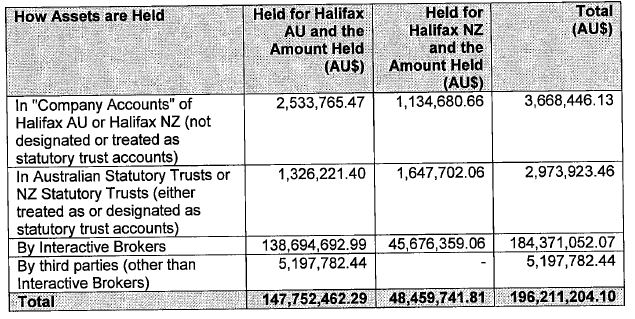
82 As at 31 October 2020 the open positions on each of the IB AU, IB NZ, MT4 and MT5 platforms were as follows:
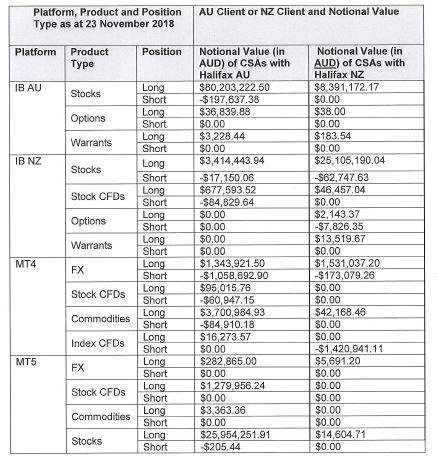
83 The Liquidators relied on evidence given by Mr Sutherland in relation to investigations he undertook to analyse when a deficiency first arose in relation to Client Moneys.
84 In doing so Mr Sutherland, together with Sarah Arnfield (a manager, Deal Advisory of KPMG), conducted investigations into:
(1) when any money required to be held on trust by Halifax AU and Halifax NZ pursuant to s 981B of the Corporations Act and s 77P of the Financial Advisors Act 2008 (NZ) (FA Act (NZ)) and reg 240 of the Financial Markets Conduct Act 2013 (NZ) and the Financial Markets Conduct Regulations 2014 (NZ) (FMC Regulations (NZ)) (i.e. Client Moneys) was in fact not held on trust or when those moneys were otherwise used contrary to the regulations; and
(2) when there was a shortfall in the available assets held by Halifax AU and Halifax NZ as trustees as well as in their own right which would be required to meet all client entitlements (referred to as a Client Moneys Shortage).
85 Based on Mr Sutherland and Ms Arnfield’s investigations carried out shortly after the Liquidators were appointed as administrators, as at 23 November 2018:
(1) the total balance of individual client accounts (Total Client Equity Positions) was AUD211.6 million;
(2) the total amount held in the Named s 981B Accounts, the Investor Fund Accounts and the Third Party Accounts was approximately AUD192.6 million; and
(3) the difference between the total client equity positions and the total moneys held in the Named s 981B Accounts, the Investor Fund Accounts and the Third Party Accounts was approximately AUD19 million.
86 Mr Sutherland explains that as at 23 November 2018:
(1) the total amount in the Named s 981B Accounts, the Investor Fund Accounts and the Third Party Accounts did not correspond to Total Client Equity Positions so that there was a trust deficiency; and
(2) the total amount in the Company Accounts and Security Term Deposits was AUD3,668,446.13, which was insufficient to make up the difference between the balance in the Named s 981B Accounts, the Investor Fund Accounts and the Third Party Accounts, on the one hand, and the Total Client Equity Positions, on the other, so that there was a Client Moneys Shortage.
87 The Liquidators are of the view that the Client Moneys Shortage arose because, between about January 2017 and November 2018, funds that should have been held on trust for clients were withdrawn from the relevant statutory trust accounts and applied to Halifax AU’s and Halifax NZ’s operating expenses and for other purposes unrelated to clients.
88 In their report to investors and creditors dated 31 August 2020 the Liquidators provided an update of the estimated deficiency as at 31 July 2020 compared with the position as at 23 November 2018 as follows:
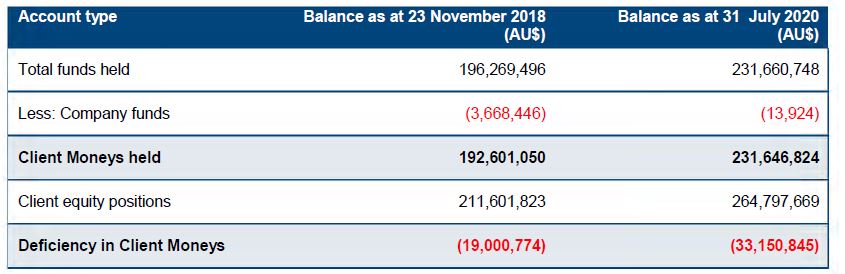
89 The Liquidators reported that the change in the Client Moneys Shortage from 23 November 2018 to 31 July 2020 was caused by movement in Total Client Equity Positions, ongoing market movements and fluctuation in unhedged positions and the costs of the voluntary administration and liquidation.
90 The Client Moneys are held in various currencies. However, they are not all held in the form of funds in accounts. Rather, the majority of the Client Moneys were, at the time Halifax AU and Halifax NZ went into administration, in the form of investments in stocks with the next largest asset class being cash and a small percentage being invested in open derivative positions.
91 In summary, the breakdown of assets held by Halifax AU as at 23 November 2018 was:
(1) total funds on deposit in Halifax AU accounts described or designated as statutory trust accounts – AUD1,384,513.15; and
(2) total amounts held by third parties on behalf of Halifax AU as deposits or unrealised investments – AUD143,892,475.43, with AUD112,534,311 of that amount being the value of stock positions held.
92 In summary, the breakdown of assets held by Halifax NZ as at 27 November 2018 was:
(1) total funds on deposit in Halifax NZ’s accounts that were described or designated as statutory trust accounts – NZD1,756,944.68; and
(2) total amounts held by third parties on behalf of Halifax NZ as deposits or unrealised investments – NZD48,704,701.69, with NZD31,862,689.15 of that amount being the value of stock positions held.
3.9 Client accounts with Halifax AU and Halifax NZ
93 As at 23 November 2018 the Halifax group had a total of 11,938 active client accounts, as opposed to individual clients, on its trading platforms made up as follows:
(1) IB AU, MT4 and MT5 platforms – 9890 active client accounts; and
(2) IB NZ platform – 2048 active client accounts.
94 Mr Kelly explains that, to the extent any clients have multiple accounts, the individual number of clients may be less. The trading platforms do not permit identification of clients with multiple accounts.
95 The Liquidators’ investigations revealed that there are 9,859 CSAs with Halifax AU and 1,777 CSAs with Halifax NZ. There are approximately 302 active client accounts with no associated signed CSA. They relate to clients who held accounts with Forex Capital Markets (also known as FXCM) and who were transferred to the Halifax group in 2016.
96 Data obtained by the Liquidators shows the geographic location linked to the active client accounts to be as follows:
(1) 6,772 active client accounts are connected with clients in Australia;
(2) 1,351 active client accounts are connected with clients in China;
(3) 499 active client accounts are connected with clients in New Zealand;
(4) 1,121 active client accounts are connected with clients in other countries; and
(5) 2195 active client accounts are connected with clients for whom the Liquidators cannot determine a place of residence.
3.10 Distribution of funds held by Halifax AU and Halifax NZ
97 The Liquidators are of the opinion that, save for funds deposited shortly prior to or after the appointment of the administrators which were not allocated to any client account:
(1) as a result of the significant commingling between the funds that were held in the Bank Accounts and between the MT4, MT5, IB AU and IB NZ platforms and across clients that have signed a CSA with Halifax AU or with Halifax NZ, it is not practically feasible to identify money in any particular Bank Accounts or statutory trust accounts held by Halifax AU or Halifax NZ (statutory trust accounts), or held by IB, Gain and lnvast, as belonging to any individual client of Halifax AU or Halifax NZ;
(2) the exercise of attempting to identify and trace funds deposited by each client into each statutory trust account would be extremely time consuming and expensive and the likely costs of undertaking such an exercise would be disproportionate to the likely deficiency and the potential benefits clients would gain from such an exercise;
(3) it is not feasible to determine how much of the deficiency should be regarded as standing to the credit of any particular statutory trust account, let alone to the credit of any particular clients of Halifax AU or Halifax NZ;
(4) a large part of the funds that make up the Client Moneys which, following the sale, closing out or realisation of investments on the IB platform, will be held by Halifax AU and Halifax NZ on trust for clients arise from, in effect, a single “deficient mixed fund” containing moneys held on trust both by Halifax AU for those clients who invested through it and by Halifax NZ for those clients who invested through it. Tracing of any entitlement on the part of individual clients is, in an extremely high percentage of cases, not practically feasible; and
(5) funds that Halifax AU received from and held for its clients became so commingled with the funds that Halifax NZ received from and held for its clients that the Liquidators are unable to distribute the trust funds in a manner which they can be satisfied accords with strict legal requirements.
3.10.2 In specie or cash distribution?
98 Mr Kelly gives evidence as to how the Liquidators might undertake an in specie distribution or a cash distribution and the benefits and limitations of each option. In Mr Kelly’s opinion, an in specie distribution would be more challenging to undertake than a cash distribution principally because the value of assets is constantly moving, making it difficult to calculate with accuracy the value of the assets to be distributed at a fixed point in time.
99 For the purpose of his analysis, Mr Kelly has assumed that the Court would direct that the assets of Halifax AU and Halifax NZ be pooled and that clients are entitled to a proportionate share of those assets based on their account balance as at the date on which the Court directs that client claims are to be valued (Adjudication Date).
100 According to Mr Kelly, in specie distribution would only be relevant to clients on the IB AU and the IB NZ platforms with open positions. As at 29 May 2020, there were 851 IB AU Client Sub-Accounts and 698 IB NZ Client Sub-Accounts with open positions. While in theory it may be possible to conduct an in specie distribution of all open positions, in practice it may not be because the rules governing the transfer of assets on different exchanges and trading venues where those open positions are listed may prevent this. However, in detailing certain parts of the process for an in specie distribution, Mr Kelly has assumed that all open positions (1,549 in total) would be capable of in specie distribution.
101 An in specie distribution is not available for clients on the MT4 and MT5 platforms because they are virtual platforms. However, it is theoretically possible to distribute the assets held by Halifax AU and Halifax NZ by way of a combination of an in specie distribution for clients who hold open positions in their IB Client Sub-Account and a cash distribution, although Mr Kelly believes that such a combination would be practically complex.
102 For an in specie distribution or cash distribution, the Liquidators would identify the value of the assets to be distributed to each client by:
(1) determining the claim or entitlement of each client by ascertaining the account balances as at the Adjudication Date which, depending on the Court’s orders may be different to the date on which the value of the assets available to be distributed to clients is calculated; and
(2) calculating the value of the assets available to be distributed to clients.
103 Based on his experience as a liquidator, Mr Kelly believes that it may take three months for the Liquidators to complete the process of assessing each client’s claim and notifying each client of the value of their claim or entitlement as at the Adjudication Date. This process would involve the Liquidators:
(1) making a preliminary determination of the value of each client’s claim as at the Adjudication Date (Liquidators’ Preliminary Determination);
(2) sending a notice to clients notifying them of the value of their claim and asking them to confirm the value of their claim within 21 days, which is the same timeframe that creditors would be given under regs 5.6.65 and 5.6.66 of the Corporations Regulations 2001 (Cth) (Corporations Regulations) in a liquidation where the liquidator gives notice of an intention to declare a dividend and creditors are given the opportunity to lodge a formal proof of debt in respect of that notice;
(3) after receiving the clients’ confirmations in relation to the value of their claims (Clients’ Confirmations), assessing any differences in the value of claims between the Liquidators’ Preliminary Determination and the Clients’ Confirmations. The time to undertake this assessment will depend on the number of Clients’ Confirmations that state a claim value that is different to the Liquidators’ Preliminary Determination. Mr Kelly has assumed that this process could be completed within two months; and
(4) after undertaking their assessment, notifying clients of the value of their claims.
104 If the Adjudication Date and the date at which the value of assets to be distributed to clients is calculated are the same, by the process described in the preceding paragraph, the Liquidators would also inform clients of the value of the assets they will actually receive. If the Adjudication Date and the date at which the value of assets to be distributed to clients is different, that process may happen twice – first, to notify clients of the value of their claim as at the Adjudication Date and secondly, to notify clients of how much will be distributed to them once all, or a proportion of, assets have been realised or, in the case of an in specie distribution, when the Liquidators are otherwise in a position to notify clients of this amount.
3.10.2.1 In specie distribution
105 According to Mr Kelly, an in specie distribution would involve the following steps:
(1) each client would be advised of the value of their claims by the notice referred to at [103(2)] above. Those clients on IB AU and IB NZ with open positions would, in theory, be entitled to the transfer of some of their open positions without liquidating those positions;
(2) clients would advise the Liquidators about their decision by completing a form, setting out the assets which they would like to be transferred to an alternate broker as part of an in specie distribution;
(3) so that assets can be transferred in specie, a client would need to have an account with an alternate broker. Those clients who did not already have such an account would need to open one, which can be time consuming due to “know your customer” processes;
(4) Halifax staff would process each individual transfer form completed by clients and provide instructions to IB for the transfer of assets. Assets would be transferred from a client’s IB Client Sub-Account to the client’s account with another broker. Assuming each client wanted an in specie distribution, Mr Kelly estimates that it would take Halifax staff around one month to process transfer forms;
(5) IB would process the transfer of assets which, based on inquiries made with IB, Mr Kelly estimates could take about four to six weeks to complete; and
(6) once the transfers had been effected, the Liquidators would undertake the close out of remaining client positions, being assets that still remain in IB Client Sub-Accounts for which the Liquidators had not received a request for in specie distribution, and the transfer of all cash realised from the close out of these positions to an account controlled by the Liquidators for distribution into clients’ nominated bank accounts. The time that it will take to complete that process will depend on, in relation to the remaining assets, the liquidity of those assets, including whether there is a market for their realisation and, in relation to the transfer of cash, a number of variables identified by Mr Kelly. Mr Kelly estimates that this process could take up to six months.
106 Based on the steps set out in the preceding paragraph, Mr Kelly estimates that an in specie distribution process could take 13 to 14 months to complete if there was an in specie distribution coupled with a cash distribution although, as set out at [321] below, in cross-examination he accepted that it could be done in less time.
107 The costs involved in an in specie distribution are brokerage and commission costs, continued platform operating costs and Liquidators’ remuneration. The quantum of platform operating costs and the Liquidators’ remuneration depends on the time that it takes to complete an in specie distribution.
108 Mr Kelly makes the following observations about the benefits and limitations of an in specie distribution:
(1) an in specie distribution could be a suitable way to distribute illiquid stocks to clients who themselves place value in those stocks;
(2) contrary to the view held by some clients, Mr Kelly believes that the cost of an in specie distribution would be higher than the cost of a cash distribution;
(3) some clients believe that an in specie distribution would be beneficial from a tax perspective but Mr Kelly is unable to comment on this; and
(4) Mr Kelly believes that there are a significant number of practical difficulties with an in specie distribution including:
(a) an in specie distribution would be complex because of complications arising from movements in the market and would take longer than a cash distribution; and
(b) some clients have suggested that they could contribute cash to account for the deficiency associated with their account and the assets in that account could be transferred in their entirety to the clients. That is, in effect, to fund their proportion of the deficiency with cash. Mr Kelly believes that this method of undertaking an in specie distribution would also be very difficult to achieve in practice because of complications arising from movement in the market and the associated administrative burden.
109 According to Mr Kelly, if the Court orders a cash distribution and the Adjudication Date is:
(1) in the future, the Liquidators would write to clients of Halifax AU and Halifax NZ notifying them that the close out of positions will commence after a period of time, e.g. four weeks. As the value of a client’s claim would not have been determined yet, giving the clients the opportunity to manage the order in which their assets are realised may enable them to maximise the value of their claim or minimise risk; and
(2) in the past (i.e. a date that is prior to the date on which the remaining assets are realised), the value of a client’s claim would already have been set. Thus clients would not be given the opportunity to close out their positions.
110 The Liquidators would then commence the process of realising assets in the IB Client Sub-Accounts. The time it would take to complete the close out would depend on the liquidity of the assets, including whether there is a market for their realisation. However, Mr Kelly has assumed that it would take about two weeks to realise the majority of assets or a large enough pool to make an interim distribution.
111 Once an asset in an IB Client Sub-Account had been sold, cash realised from the sale of the asset would be deposited into the relevant IB Client Sub-Account. The cash would then be transferred to an account controlled by the Liquidators.
112 The Liquidators would also manually close out open positions on the MT4 and MT5 platforms, which Mr Kelly assumes would be instantaneous because there are no assets on those platforms. However, if positions on the MT4 and MT5 platforms were hedged through Invast the closure of the position would automatically liquidate the hedge, resulting in a cash balance remaining with Invast which the Liquidators would request be remitted to their bank account.
113 After the assets in the IB Client Sub-Accounts were realised and the positions on the MT4 and MT5 platforms closed, the Liquidators would undertake the process of calculating the value of client entitlements and the amount of cash available to satisfy those entitlements. The cash in the account controlled by the Liquidators would be distributed into nominated bank accounts of clients according to each client’s proportionate entitlement. Mr Kelly has assumed that process could take one to two months.
114 Mr Kelly is of the view that the steps to be taken for a cash distribution could happen in tranches, depending on the speed with which assets could be realised. An interim distribution could be paid to all clients where the majority of assets had been realised and there was a small amount of assets remaining to be realised which may delay a distribution. At each interim distribution, all clients would receive the proportion of the pool of cash to which they are entitled. There would not be a risk of distributing an amount of cash to a client greater than their entitlement because the value of cash does not change and the proportionate entitlement of each client to a pool of cash can be calculated easily and quickly.
115 Mr Kelly estimates that a cash distribution would take about six months to complete from the time the Court makes final orders.
116 The costs involved in a cash distribution are brokerage and commission costs, platform operating costs and Liquidators’ remuneration, the latter two of which will depend on the time it takes to complete the process. But, because Mr Kelly estimates the time for a cash distribution to be shorter than for an in specie distribution, he believes the costs of a cash distribution will be lower.
117 Mr Kelly makes the following observations about the benefits and limitations of a cash distribution:
(1) a cash distribution will be quicker than an in specie distribution and less costly;
(2) in contrast to an in specie distribution, complications arising from market price movements of open positions do not arise in a cash distribution because all open positions are closed out to cash. Once an open position has been realised, except in relation to foreign currency movements, the value of the cash obtained following realisation does not change and thus there is no risk of an client being paid an amount that is greater than they are entitled to receive;
(3) some assets could be illiquid causing difficulties in converting them to cash;
(4) the conversion of assets to cash may disrupt the investment strategy of some clients and result in dividends no longer being received. In Mr Kelly’s opinion, there is no way to avoid this in a cash distribution process;
(5) an issue arises as to how foreign currency, and the risk of currency fluctuations, should be managed; and
(6) practical difficulties may arise in the payment of cash to clients in overseas locations. Clients of Halifax AU and Halifax NZ reside in at least 60 countries. Mr Kelly notes that these difficulties will also arise in an in specie distribution because it will be accompanied by a cash distribution.
4. Statutory framework and legal principles
4.1 Moneys held by Halifax AU and Halifax NZ – legislative framework
118 Chapter 7 of the Corporations Act concerns financial services and markets. Halifax AU holds an AFSL and is subject to the requirements of Ch 7.
119 Part 7.8 of Ch 7 is titled “Other provisions relating to conduct etc. connected with financial products and financial services other than financial product disclosure”. Division 2 of Pt 7.8 concerns dealing with clients’ money and, relevantly, Subdiv A of Div 2 concerns money other than loans and is relevant to the present application.
120 Section 981A of the Corporations Act sets out the circumstances in which Subdiv A applies to moneys paid by clients to a financial services licensee. It provides:
(1) This Subdivision applies (subject to subsections (2), (3) and (4)) to money paid to a financial services licensee (the licensee) in the following circumstances:
(a) the money is paid in connection with:
(i) a financial service that has been provided, or that will or may be provided, to a person (the client); or
(ii) a financial product held by a person (the client); and
(b) the money is paid:
(i) by the client; or
(ii) by a person acting on behalf of the client; or
(iii) to the licensee in the licensee’s capacity as a person acting on behalf of the client.
(2) This Subdivision does not apply to money paid as mentioned in subsection (1) to the extent that:
(a) the money is paid by way of remuneration payable to the licensee, or the licensee is entitled to deduct such remuneration from the money; or
(b) the money is paid:
(i) to reimburse the licensee for payments made to acquire, or acquire an increased interest in, a financial product; or
(ii) to discharge a liability incurred by the licensee in respect of the acquisition of a financial product or an increased interest in a financial product, or to indemnify the licensee in respect of such a liability; or
(c) the money is paid to acquire, or acquire an increased interest in, a financial product from the licensee, whether by way of issue or sale by the licensee; or
(ca) the licensee is a licensed trustee company, and the money is paid to the licensee in connection with traditional trustee company services provided by the licensee; or
(d) Subdivision B (loan money) applies to the money.
(3) If a person pays money to a financial services licensee in order for it to be deposited to the credit of a deposit product held by the person or another person with the licensee, that payment does not constitute money to which this Subdivision applies.
(4) The regulations may:
(a) exempt money paid in specified circumstances from some or all of the provisions of this Subdivision; or
(b) declare that this Subdivision applies in relation to money paid in specified circumstances as if specified provisions of this Subdivision were omitted, modified or varied as set out in the regulations.
(5) An exemption in regulations made for the purposes of paragraph (4)(a) may be made subject to conditions specified in, or imposed in accordance with, the regulations. The regulations may provide for consequences of a contravention of a condition.
(Note omitted.)
121 Section 766A(1) of the Corporations Act provides that for the purposes of Ch 7 a person provides a financial service, if, among other things, they “deal in a financial product”. In turn, s 766C sets out the meaning of “dealing” and relevantly provides that for the purposes of Ch 7 conduct (whether engaged in as principal or agent) that constitutes dealing in a financial product includes applying for or acquiring a financial product or issuing a financial product.
122 Section 764A(1) of the Corporations Act sets out specific things that are “financial products” for the purposes of Ch 7, which include a security and a derivative. A security is defined in s 761A to mean, among other things, “a share in a body”. A derivative is defined in s 761D to mean:
(1) For the purposes of this Chapter, subject to subsections (2), (3) and (4), a derivative is an arrangement in relation to which the following conditions are satisfied:
(a) under the arrangement, a party to the arrangement must, or may be required to, provide at some future time consideration of a particular kind or kinds to someone; and
(b) that future time is not less than the number of days, prescribed by regulations made for the purposes of this paragraph, after the day on which the arrangement is entered into; and
(c) the amount of the consideration, or the value of the arrangement, is ultimately determined, derived from or varies by reference to (wholly or in part) the value or amount of something else (of any nature whatsoever and whether or not deliverable), including, for example, one or more of the following:
(i) an asset;
(ii) a rate (including an interest rate or exchange rate);
(iii) an index;
(iv) a commodity.
123 Section 761E of the Corporations Act defines, among others, the terms “issued” and “issuer” in relation financial products and relevantly provides:
General
(1) This section defines when a financial product is issued to a person. It also defines who the issuer of a financial product is. If a financial product is issued to a person:
(a) the person acquires the product from the issuer; and
(b) the issuer provides the product to the person.
Note: Some financial products can also be acquired from, or provided by, someone other than the issuer (e.g. on secondary trading in financial products).
Issuing a financial product
(2) Subject to this section, a financial product is issued to a person when it is first issued, granted or otherwise made available to a person.
(3) Subject to this section, a financial product specified in the table is issued to a person when the event specified for that product occurs:
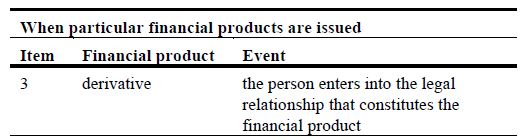
124 Section 981B obliges a licensee to ensure that money to which Subdiv A applies is paid into an account that satisfies the requirements set out therein. It provides:
(1) The licensee must ensure that money to which this Subdivision applies is paid into an account that satisfies these requirements:
(a) the account is:
(i) with an Australian ADI; or
(ii) of a kind prescribed by regulations made for the purposes of this paragraph;
and is designated as an account for the purposes of this section of this Act; and
(b) the only money paid into the account is:
(i) money to which this Subdivision applies (which may be money paid by, on behalf of, or for the benefit of, several different clients); or
(ii) interest on the amount from time to time standing to the credit of the account; or
(iii) interest, or other similar payments, on an investment made in accordance with regulations referred to in section 981C, or the proceeds of the realisation of such an investment; or
(iv) other money permitted to be paid into the account by the regulations; and
(c) if regulations made for the purposes of this paragraph impose additional requirements--the requirements so imposed by the regulations; and
(d) if the licence conditions of the licensee’s licence impose additional requirements--the requirements so imposed by the licence conditions.
The money must be paid into such an account on the day it is received by the licensee, or on the next business day.
125 Section 981C provides that regulations may deal with the following matters in relation to accounts maintained for the purposes of s 981B:
(a) the circumstances in which payments may be made out of an account, including the circumstances in which money may be withdrawn and invested and the kinds of investments that can be made;
(b) the minimum balance to be maintained in an account;
(c) how interest earned on an account is to be dealt with; and
(d) how interest or other earnings on an investment of money withdrawn from an account, or the proceeds of the realisation of such an investment, to be dealt with.
126 Regulations have been made for the purposes of s 981B including, relevantly, reg 7.8.02(1) which sets out the withdrawals which may be made from accounts maintained for the purposes of s 981B and provides:
(1) For paragraph 981C(1)(a) of the Act, payments may be made out of an account maintained for section 981B of the Act in any of the following circumstances:
(a) making a payment to, or in accordance with the written direction of, a person entitled to the money (subject to regulation 7.8.02A);
(b) defraying brokerage and other proper charges;
(c) paying to the financial services licensee money to which the financial services licensee is entitled (subject to regulation 7.8.02A);
(d) making a payment of moneys due to an insurer in connection with a contract of insurance;
(e) making a payment that is otherwise authorised by law;
(f) paying to the financial services licensee money to which the financial services licensee is entitled pursuant to the market integrity rules or the operating rules of a licensed market.
127 Regulation 7.8.02(7) concerns interest earned on money held in an account maintained under s 981B of the Act and provides:
For paragraph 981C(1)(c) of the Act, if money is held in an account maintained for section 981B of the Act:
(a) the financial services licensee is entitled to the interest on the account; and
(b) the interest on the account is not required to be paid into the account;
only if the financial services licensee discloses to the client that the financial services licensee is keeping the interest (if any) earned on the account.
128 Section 981F provides that the regulations may include provisions setting out how money in an account maintained under s 981B, or an investment of such money, is to be dealt with when certain things happen to the licensee including if the licensee becomes insolvent within the meaning of the regulations: see s 981F(b).
129 For the purposes of s 981F(b) of the Corporations Act, reg 7.8.03(2) applies if a financial services licensee is the subject of the appointment of an administrator or the commencement of a winding up. The operative provisions of reg 7.8.03 provide:
(4) For each person who is entitled to be paid money from an account of the financial services licensee maintained for section 981B of the Act, the account is taken to be subject to a trust in favour of the person.
(5) If money in an account of the financial services licensee maintained for section 981B of the Act has been invested, for each person who is entitled to be paid money from the account, the investment is taken to be subject to a trust in favour of the person.
(6) Money in the account of the financial services licensee maintained for section 981B of the Act is to be paid as follows:
(a) the first payment is of money that has been paid into the account in error;
(b) if money has been received on behalf of insureds in accordance with a contract of insurance, the second payment is payment to each insured person who is entitled to be paid money from the account, in the following order:
(i) the amounts that the insured persons are entitled to receive from the moneys in the account in respect of claims that have been made;
(ii) the amounts that the insured persons are entitled to receive from the moneys in the account in respect of other matters;
(c) if:
(i) paragraph (b) has been complied with; or (ii) paragraph (b) does not apply;
the next payment is payment to each person who is entitled to be paid money from the account;
(d) if the money in the account is not sufficient to be paid in accordance with paragraph (a), (b) or (c), the money in the account must be paid in proportion to the amount of each person’s entitlement;
(e) if there is money remaining in the account after payments made in accordance with paragraphs (a), (b) and (c), the remaining money is taken to be money payable to the financial services licensee.
(7) This regulation applies despite anything to the contrary in the Bankruptcy Act 1966 or a law relating to companies.
130 Section 981H of the Corporations Act imposes a trust on money that is paid to the licensee and to which subdiv A applies. It provides:
(1) Subject to subsection (3), money to which this Subdivision applies that is paid to the licensee:
(a) by the client; or
(b) by a person acting on behalf of the client; or
(c) in the licensee’s capacity as a person acting on behalf of the client;
is taken to be held in trust by the licensee for the benefit of the client.
(2) [Repealed]
(3) The regulations may:
(a) provide that subsection (1) does not apply in relation to money in specified circumstances; and
(b) provide for matters relating to the taking of money to be held in trust (including, for example, terms on which the money is taken to be held in trust and circumstances in which it is no longer taken to be held in trust).
No regulations have been made pursuant to s 981H(3)(a) exempting money from the trust imposed by s 981H(1) in specified circumstances.
131 In Re BBY Ltd (recs and mgrs appt) (in liq) (No 2) [2018] NSWSC 346; (2018) 363 ALR 492 (Re BBY (No 2)) at [32] Brereton J observed that:
… while s 981B requires that Subdivision A money be paid into a segregated account, which reg 7.8.01(5) requires be designated and operated as a trust account, s 981H has the effect that all Subdivision A money is taken to be held in trust by the licensee for the benefit of the client — and that does not depend on its being paid into, or remaining in, a s 981B segregated account.
132 His Honour also referred at [33] to the observations of Gordon J in Georges (in his capacity as joint and several liquidators of Sonray Capital Markets Pty Ltd (in liq)) v Seaborn International (as trustee for the Seaborn Family Trust) [2012] FCA 75; (2012) 288 ALR 240 (Sonray) in relation to the effect of the provisions of Subdiv A where her Honour said:
The effect of these provisions is to create one or more mixed trust funds with special characteristics: they are intended to be used specifically for the provision of financial services and for the holding of and dealing in financial products; they can be used to meet margin calls and to act as security for dealings in derivatives, including dealings on behalf of clients other than the depositing client; however, they cannot be used to satisfy the creditors of the licensee. Such money “is taken to be held on trust by the licensee for the benefit of the client”.
133 The legislative framework governing the moneys received from clients by Halifax NZ is found in the FA Act (NZ), the FMC Regulations (NZ). It is not necessary for me to set it out in any detail.
5. Client moneys are held on trust
134 There was no dispute that the moneys paid by clients to Halifax AU and Halifax NZ are held on trust for their benefit. That is borne out by the applicable statutory regimes as they applied to the operations of Halifax AU and Halifax NZ.
135 Insofar as Halifax AU is concerned, monies paid to it by clients was money to which Subdiv A of Div 2 of Pt 7.8 applies and thus, pursuant to s 981H of the Corporations Act, was taken to be held in trust by Halifax AU for the benefit of those clients. The reasons for reaching that conclusion follow.
136 First, Subdiv A of Div 2 of Pt 7.8 of the Corporations Act applies to money paid to a financial services licensee. Halifax AU was a financial services licensee, it held an AFSL. Notwithstanding the platform on which clients transacted their business and the account into which they paid their monies, those monies were paid to Halifax AU:
(1) in relation to shares, monies were paid by the client by Halifax AU debiting the balance of the IB Client Sub-Account in the case of the IB AU platform or by debiting the client’s MT5 Client Account in the case of the MT5 platform; and
(2) in relation to derivative products, monies were paid by satisfying margin requirements as described at [52] above.
137 Secondly, as required by s 981A(1)(a)(i) of the Corporations Act the monies were paid in connection with a financial service that was or will or may have been provided:
(1) a person provides a financial service if they deal in a financial product by issuing a financial product;
(2) shares and derivatives are each a financial product; and
(3) Halifax AU dealt in those financial products because it issued or made available the relevant financial products to its clients.
138 Thirdly, as required by s 981A(1)(b), the monies were paid by the client to Halifax AU, the licensee. Alternatively, in the case of shares, as set out in the Halifax AU CSA (see [74] above), while it was not a participant on the ASX or any other stock exchange it arranged “Agency Transactions” entered into by a client as agent for the client. In those circumstances, monies paid for share acquisitions satisfied s 981A(1)(b)(iii) in that they were paid to Halifax AU in its capacity as an agent for the client.
139 Section 981A(2) sets out limitations on the application of Subdiv A to monies paid to a financial services licensee. Relevantly s 981A(2)(c) provides that Subdiv A does not apply where monies are paid to acquire, or acquire an increased interest in, a financial product from the licensee, whether by way of issue or sale by the licensee. As submitted by the Liquidators, I am satisfied that this exception does not apply to the monies paid by clients to Halifax AU in relation to the acquisition of derivative products or shares.
140 Insofar as derivative products are concerned, although monies were paid to acquire a financial product from Halifax AU as principal pursuant to a contract between Halifax AU and its client, the monies were in fact paid by way of collateral as described in the PDS effective 4 April 2018 rather than actually to purchase the financial product.
141 This issue was addressed in Re BBY Ltd (No 2). There a submission was made that monies paid for the purchase of derivatives represented the purchase price paid by clients for the issue of a financial product, the derivative, and thus fell within the exception in s 981A(2)(c) so that margin funds were excluded from Subdiv A. At [157] Brereton J observed that whether s 981A(2)(c) is engaged to exclude the s 981H statutory trust depends on the characterisation of the moneys paid by a client to the relevant licensee as money paid to acquire, or acquire an increased interest in, a financial product. At [158] and [160] his Honour said:
158 In MF Global, Black J held that the reference to money “paid to acquire” a financial product in that subsection was to money paid by the client to the licensee on a final basis, in the nature of the purchase price for that product, and that payments made by clients to the licensee in respect of margin could not be treated as the purchase price for the relevant products, since they were paid “as collateral to secure Client’s obligations”:
“Whether the monies were within the scope of Pt 7.8 Div 2
201 Deutsche Bank contends that s 981A(2)(c) of the Corporations Act applies to monies used by MFGA to acquire equity swaps for hedging purposes and pay margins called upon them so that those monies were either never, or ceased to be, money to which Pt 7.8 Div 2 Subdiv A applied and cannot thereafter be client money, trust money or its traceable proceeds (Deutsche Bank SIC [87]).
202 One element of the exception in s 981A(2)(c) is satisfied, in that OTC clients acquired the relevant financial products from MFGA by the ‘issue’ of those products to those clients, since a derivative is treated as issued to a client when it enters into the legal relationship that constitutes that product under s 761E of the Corporations Act. However, it seems to me that the reference to money ‘paid to acquire’ a financial product in that subsection is to money paid by the client to the licensee on a final basis, in the nature of the purchase price for that product. The payments made by clients to MFGA in respect of margin cannot be treated as the purchase price for the relevant products since they were paid ‘as collateral to secure Client’s obligations’ under clauses 5(j) of the CFD client agreement and Margin FX client agreement and clause 5(g) of the Online FX client agreement. The construction of s 981A(2)(c) for which Deutsche Bank contends would also have the unlikely consequences that, first, Pt 7.8 Div 2 Subdiv A would have no application to derivatives trading and clients engaged in such trading would not have the benefit of client money segregation or the statutory trust and, second, s 981D of the Corporations Act would be otiose since the licensee which received monies in respect of the acquisition of derivatives, even by way of margin, would be entitled to apply those monies for any purpose. I therefore do not accept Deutsche Bank’s submissions in this regard.”
…
160 As Black J pointed out in MF Global, if all moneys paid in connection with acquiring an over-the-counter derivative fell within s 981A(2)(c), then trading in derivatives would never be subject to Subdiv A, which would be anomalous, because it would both deprive clients of any protection under Subdiv A, and leave s 981D no work to do.
142 At [161] his Honour concluded that the margin paid by clients in that case was not a purchase price for a product but the establishment of a running account required to be maintained at a sufficient level to cover the risk assumed by the relevant company and, thus, that s 981A(2)(c) was not engaged to exclude the margin payments from Subdiv A. The margin payments made by clients of Halifax AU served the same purpose. Accordingly, the same conclusion is reached here and the exclusion in s 981A(2)(c) does not apply to those payments.
143 In relation to shares, while the moneys were paid to acquire the shares, the vendor of the shares was not Halifax AU, but rather a third party.
144 It is apparent that none of the other exclusions in s 981A(2) apply in the case of monies paid by clients to Halifax AU. It is not suggested by any party that any other exclusion in the Corporations Act or the Corporations Regulations applies to monies paid by clients to Halifax AU.
145 It follows that all assets held by Halifax AU, other than any amount for commissions and fees payable by clients and interest earned on funds held in trust as permitted by the CSA (see [74] above), should be treated as being held on trust for clients.
146 The same conclusion has been reached in relation to Halifax NZ.
6. A single deficient mixed fund?
147 To the extent it held monies on trust for its clients, Halifax AU was permitted to commingle those monies: see s 981B(1)(b)(i) of the Corporations Act. In the case of Halifax NZ, the applicable legislative provisions did not preclude it from holding those monies in a single account and implicitly permitted that to occur: see s 77P(1A) of the FA Act (NZ) and reg 241 of the FMC Regulations (NZ).
148 However, according to the Liquidators, two things occurred, neither of which was permitted. First, the funds held by each of Halifax AU and Halifax NZ on trust for their respective clients became commingled. Secondly, Halifax AU used some of the monies which it held on trust for the benefit of its clients for corporate purposes in breach of trust.
6.1 Did the funds held on trust by Halifax AU and Halifax NZ become commingled?
149 There was a significant volume of evidence describing the flow of funds first, between accounts held by Halifax AU; secondly between accounts held by Halifax NZ; and thirdly between, on the one hand, accounts held by Halifax AU and, on the other, accounts held by Halifax NZ. It is not possible or of any utility to provide more than a high level summary of that evidence.
150 The principal investigations carried out on behalf of the Liquidators in relation to this issue is set out in a document titled “Funds Flow Memorandum” dated 25 June 2019 prepared by Mr Sutherland with the assistance of other KPMG staff for the Liquidators (Funds Flow Memorandum). The Funds Flow Memorandum sets out the extent to which assets held in the accounts within the Halifax group (including assets held by third parties) have been affected by the commingling of funds.
151 Mr Kelly explains that the Funds Flow Memorandum is to be understood on the basis that any reference in it to the IB AU Master Account or the IB NZ Master Account is intended to be a reference to the bank accounts operated by IB into which Halifax AU (IB’s Halifax AU Account) and Halifax NZ (IB’s Halifax NZ Account) each deposited funds and not a reference to the accounting record.
152 By way of summary Mr Sutherland reports in the Funds Flow Memorandum that:
1.4 Summary of commingling
There is extensive commingling of Halifax AU and Halifax NZ Client funds across all platforms (IB AU, IB NZ, MT4 and MT5) in the majority of accounts operated by the Halifax Group, including the:
• IB Allocated Account;
• Halifax Pro Allocated Account;
• Halifax IB Master and Client Account (controlled by IB);
• Halifax NZ IB Master and Client Account (controlled by IB);
• Various NAB Foreign Currency Accounts;
• BWA Merchant Account;
• ANZ HNZ Account;
• ANZ HNZ Foreign Currency Accounts;
• Accounts held by third parties including lnvast and Gain; and
• Halifax AU IB Prop Account and Halifax NZ IB Prop Accounts.
My investigations indicate that 98% of funds held on trust by the Halifax Group for the benefit of Clients are affected by commingling, with this commingling being across all platforms and between Halifax AU and Halifax NZ.
…
1.5 Summary of my key findings:
• The deficiency in Client Monies as at 23 November 2018 is estimated to be approximately $19.0 million.
• Myself and my staff have undertaken a review of 30,000+ transactions in accounts operated by the Halifax Group as at the date of the appointment of the Voluntary Administrators and have determined that there is no pattern behind the transfer of funds between the Halifax Group accounts and funds appear to have been transferred on an ‘ad hoc’ basis.
• The exception to there being no pattern of transfers is that, upon a client making a deposit with the Halifax Group and the deposit being allocated to an individual client, shortly afterwards a credit would have been made to the client’s account on the relevant trading platform.
• Our analysis confirms that there is extensive commingling of funds in the majority of section 981B Accounts and other segregated accounts within the Halifax Group.
• 98% of Client funds held on trust by the Halifax Group for the benefit of Clients is affected by the commingling and is unlikely to be traceable (with the exception of a number of specific circumstances as outlined in the Case Study Memorandum).
(Original emphasis.)
153 The bases for these findings and the investigations which underpin them are set out in greater detail in the Funds Flow Memorandum.
154 Among other things Mr Sutherland undertook an analysis of the funds flow process on the MT4, MT5 and IB platforms and considered how Client Moneys in relation to trading on each of those platforms should have been processed by Halifax AU and Halifax NZ and how they were in fact processed. For each platform, Mr Sutherland found there was incorrect treatment of Client Moneys. He makes three key points:
(1) funds deposited by clients on the IB platform were not segregated from funds deposited by clients on the MT4 and MT5 platforms, other than for a short time when the funds were in the relevant suspense account to which the client first made the deposit;
(2) funds have been mixed or commingled in such a way that it appears to affect the majority of clients on all platforms for both Halifax AU and Halifax NZ; and
(3) there appear to be substantial contraventions of the Client Money rules (being the requirements for dealing with money paid by clients to a licensee set out in Subdiv A of Div 2 of Pt 7.8 of the Corporations Act).
155 Mr Sutherland also undertook what he describes as funds flow investigations by reviewing in excess of 30,000 transactions in accounts operated by the Halifax group. Under the heading “3.1 Summary of funds flow investigations undertaken to date”, among other things, Mr Sutherland says:
Based on my review of the transactions, and my interviews with Halifax Treasury staff, I am of the view that:
• The only noticeable pattern of transfers between accounts is that, upon a client making a deposit with the Halifax Group and the deposit being allocated to an individual client, shortly afterwards a credit would have been made to the client’s account on the relevant trading platform (Credits to Platforms).
• Other than the pattern of Credit to Platforms, there is no pattern behind the transfer of funds between accounts (ie frequency, where funds were directed to, purpose of transfers);
• Funds appear to have been transferred on an ad hoc basis with no direct link to individual Client deposits; and
• The Halifax Group made transfers to maintain a balance of funds in various accounts (effectively running pooled accounts on an intermingled basis).
(Original emphasis.)
156 Mr Sutherland gives evidence about the process he undertook to produce the Funds Flow Memorandum and, in doing so, summarises the conclusions he reached in it as follows:
(a) The only noticeable pattern of transfers between accounts is the crediting of a client account on the relevant trading platform shortly following a client deposit being allocated to an individual client. Otherwise, there is no pattern behind the transfer of funds between the various accounts in the Halifax Group. There is no pattern in frequency of transfers, where funds were directed to, or the purpose of the transfers;
(b) Funds appear to have been transferred on an “as needs” basis. When I refer to an “as needs basis”, I mean that funds were transferred between the various Halifax Group accounts in round sum figures and on an ad hoc basis with no noticeable pattern other than to ensure sufficient funds remained in each of the accounts to facilitate ongoing operational requirements, such as ensuring sufficient funds were available to meet client redemptions, credit the platforms with Interactive Brokers, or make necessary company payments;
(c) Halifax AU and Halifax NZ both made transfers to maintain a balance of funds in various client accounts (effectively running pooled accounts on an intermingled basis);
(d) Most transfers of funds do not appear to relate to individual client deposits or redemptions (with the exception of transfers between suspense accounts and allocated accounts); and
(e) Tracing of client deposits appears not to be practically feasible in most instances.
157 Based on his investigations Mr Sutherland found that 98% of the funds held by Halifax AU and Halifax NZ are commingled. The balance of the commingled funds held by Halifax AU as at 23 November 2018 in 13 accounts was AUD144,651,293.72 and the balance of commingled funds held by Halifax NZ as at 27 November 2018 in five accounts was NZD50,456,419.78.
158 Mr Kelly also gives evidence about the flow of funds in Halifax AU’s and in Halifax NZ’s accounts. Insofar as Halifax AU is concerned, Mr Kelly gives the following evidence:
(1) clients who invested on the IB AU platform deposited money into the IB Suspense Account, the Merchant Account or a range of NAB foreign currency accounts. There were also instances where clients on the IB AU platform deposited money into the Halifax Pro Suspense Account. The deposits into the IB Suspense Account and the Merchant Account were all in Australian dollars and the deposits into the NAB foreign currency accounts were made in a range of currencies including Hong Kong dollars, British pounds, Singapore dollars, New Zealand dollars, Japanese Yen, US dollars, Euros and Swiss francs. From time to time IB AU clients also deposited funds into the ANZ HNZ Account;
(2) clients who invested on the MT4 or MT5 platforms and who had signed a CSA with Halifax AU either deposited money into the Halifax Pro Suspense Account, the Merchant Account or the NAB foreign currency accounts. At times clients on these platforms also deposited money into the IB Suspense Account or the ANZ HNZ Account;
(3) some clients on the IB AU platform had signed a CSA with Halifax NZ while others had signed a CSA with Halifax AU. Similarly, some clients on the IB NZ platform had signed a CSA with Halifax AU while others had signed a CSA with Halifax NZ. Mr Kelly notes that sometimes clients who signed a CSA with Halifax NZ deposited funds into accounts held in the name of Halifax AU and vice versa;
(4) where deposits were made in Australian dollars the funds were transferred from the IB Suspense Account to either the IB Allocated Account or, in the case of MT4 and MT5 clients, the Halifax Pro Allocated Account. At that point the Halifax treasury team credited the relevant client account with the amount of the deposit. Client accounts were not bank accounts but were records maintained by IB (for accounts on the IB AU and IB NZ platforms) and MetaQuotes (for client accounts on the MT4 and MT5 platforms). The record which constituted each client account was accessible by the relevant client on the relevant platform;
(5) in order for a client account to be credited, there needed to be sufficient funds deposited by Halifax AU and recorded in the IB AU Master Account. Halifax AU maintained a surplus “buffer” of funds with IB. These were additional funds, in excess of those which had been used to credit client accounts, that were held with IB and which enabled Halifax AU to credit client accounts on the IB platform immediately on receipt of a deposit rather than waiting 24 to 48 hours for a transfer from Halifax AU to IB to appear in the relevant account as cleared funds. Accordingly, funds were transferred from the IB Allocated Account, Halifax Pro Allocated Account, Merchant Account and NAB foreign currency accounts to IB as required;
(6) at any time after a client had made Australian dollar deposits into the IB Suspense Account, the Halifax Pro Suspense Account or the Merchant Account and the relevant client account had been credited, the client was permitted to transact through the IB AU, MT4 or MT5 platforms and acquire a range of financial products, depending on the platform and type of account held by the client;
(7) based on an examination of Halifax’s business records undertaken by staff under Mr Kelly’s supervision, it seems that moneys deposited into the NAB foreign currency accounts were disbursed in one of at least five different ways as follows:
(a) payments were made to or for the benefit of Halifax AU and/or Halifax NZ for purposes not directly connected with its clients. This was either by way of payment of an invoice to a service provider or for operating expenses or by way of a transfer to a bank account held with NAB in the name of Halifax AU which was not designated as a s 981B Account or any other form of trust account. This included, for example, payment of fees, commission and interest to Halifax AU and transfers of money which were accounted for by Halifax AU as gains made by it on derivative contracts entered into by it as principal with clients (who were B-Book clients) as the counterparty;
(b) payments were made to clients at their request;
(c) there were transfers to Invast and Gain for the purpose of, for example, hedging foreign currency and other derivative transactions entered into between clients and Halifax AU on the MT4 and MT5 platforms. This occurred automatically by way of a bridge;
(d) there were transfers to HSBC foreign currency accounts maintained in Australia in the name of IB to ensure that foreign currency held by IB in the name of Halifax AU was maintained at a level required by IB to enable the individual client account to be credited in accordance with deposits made. The credit to the account needed to occur before the client was able to transact in financial products; and
(e) there was a regular flow of funds from Halifax AU’s NAB NZ dollar account to the ANZ HNZ Account.
159 As the Liquidators submit, the evidence demonstrates that there was commingling between Halifax AU accounts; between Halifax NZ accounts; and between accounts of Halifax AU and Halifax NZ in at least the following ways:
(1) funds from the IB Allocated Account and various foreign currency accounts held by Halifax AU with the NAB were transferred to Halifax’s IB AU Account on an ad hoc basis. This resulted in a surplus of funds being held in Halifax’s IB AU Account;
(2) these transfers were “ad hoc” because, based on the review carried out under Mr Sutherland’s supervision of more than 30,000 transactions for the purposes of the Funds Flow Memorandum, there was no pattern to them beyond ensuring that there were sufficient funds to facilitate ongoing operational requirements, and no link to deposits made by individual clients;
(3) there was also movement of funds between the IB Allocated Account, which was used for trading on the IB platform, and the Halifax Pro Allocated Account, which was used for trading on the MT4 and MT5 platforms, and thus commingling of Client Moneys in respect of those platforms;
(4) despite the time it took for the funds deposited by Halifax AU and Halifax NZ clients to clear, they were credited immediately with funds which they could use to trade. This meant that clients were in fact using the commingled pool of funds deposited by other clients to trade; and
(5) according to the Funds Flow Memorandum, the most commonly used of the various NAB foreign currency accounts held by Halifax AU were the NAB USD Account and the NAB NZD Account. Mr Kelly explains that, once deposits were made into the NAB foreign currency accounts, those moneys were disbursed in a number of ways including to foreign currency accounts held by IB in Australia with HSBC. This was to ensure that IB had a sufficient buffer to enable individual client accounts to be credited in accordance with deposits made, a pre-requisite to trading by clients.
6.2 Was there a deficiency in the funds held by Halifax AU and Halifax NZ?
160 Having determined that the funds held by Halifax AU and Halifax NZ were commingled, the next issue that arises for determination is whether there was a deficiency or, to adopt the term used by the Liquidators, a Client Moneys Shortage. That is, whether there was a deficiency in the assets held by Halifax AU and Halifax NZ as trustees as well as in their own right required to meet all client entitlements as at the date of the appointment of the administrators in each case.
161 Based on the evidence before me, that question must be answered in the affirmative. As set out at [85]-[86] above, as at 23 November 2018 there was a Client Moneys Shortage of approximately AUD15.3 million. As at that date, the difference between the Total Client Equity Positions and funds held in Named s 981B Accounts, Investor Fund Accounts and Third Party Accounts was approximately AUD19 million. However, this amount was offset by the amount held by Halifax AU and Halifax NZ in Company Accounts and Security Deposits of approximately AUD3.668 million.
162 Thus as at 23 November 2018 there was a deficient mixed fund.
163 In Sonray at [82]-[86] Gordon J observed that when applying the provisions of Subdiv A of the Corporations Act (see [118]-[130] above) to a deficient mixed fund the following principles arise:
[82] In the present case, applying these provisions of the Corporations Act and the regulations is not straight forward. First, the words “entitled” and “entitlement” are not defined in the Corporations Act or the regulations. Given the statutory trust imposed by s 981H(1) of the Corporations Act, the liquidators submitted (and I accept) that these words import the principles applicable to trusts and, in particular, to deficient mixed trust accounts: compare Re Lehman Brothers at [67]–[72] and [181].
[83] Those principles provide that all contributors to a deficient mixed fund hold an equitable charge over the entire fund and its traceable proceeds to the value of their contributions, subject to any dealings and costs (Sutherland Re; French Caledonia Travel Services Pty Ltd (in liq) (2003) 59 NSWLR 361; 204 ALR 353; 48 ACSR 97; [2003] NSWSC 1008 (French Caledonia) and Australian Securities and Investments Commission v Letten (No 7) (2010) 190 FCR 59; 80 ACSR 401; [2010] FCA 1231 (Letten (No 7))) or are equitable tenants in common of the mixed fund as a whole, including its traceable proceeds, and subject to such deductions: R M Goode, Goode on Legal Problems of Credit and Security, 4th ed, Sweet & Maxwell/Thomson Reuters, London, 2008, at [6-11–6-14].
[84] Next, the Corporations Act and the regulations do not deal with the situation where it is not possible to work out precisely who is entitled to what moneys in particular segregated accounts. It was common ground that all the court can do in such circumstances is to permit the moneys in the segregated accounts to be pooled with a view to their proportionate distribution. The basis for the rateable distribution is the mixing of the funds: French Caledonia at [127] and [187].
[85] Such a course of action is consistent with the purpose of the statutory regime, namely the achievement of a fair outcome between clients by a pragmatic and even-handed distribution among them: see, by way of example, s 983E of the Corporations Act which provides that where the money received is insufficient to pay all proved claims, the court may “despite any rule of law or equity to the contrary, apportion the money among the claimants in proportion to their proved claims and show in the scheme how the money is so apportioned” and the second reading speeches in relation to the Financial Services Reform Bill 2001 (Cth) which indicate that the legislation was designed to produce a harmonised regulatory regime for market integrity and consumer protection across the financial services industry.
[86] Of course, rateable distribution is subject to an important qualification — it does not apply if the claimants do not have equal claims: French Caledonia at [176] and [185]. Put another way, it is necessary to determine whether there should be differential treatment of claimants. That question is determined on available evidence. Thus, if a claimant can establish a remedy founded on tracing, the court will grant relief founded on that evidence because it permits it to reach a different conclusion in respect of that claimant: French Caledonia at [178], [187] and [189].
164 With the exception of the Whitehead Interests, there was no dispute between the parties about the existence of a single deficient mixed fund and the applicability of the principles identified in Sonray. That is, given that the Liquidators have established that it is not possible to work out with any precision who is entitled to what moneys in the accounts held by Halifax AU and Halifax NZ, the moneys so held should be pooled. That is the inevitable outcome of the evidence before me.
7. Should any clients be excluded from the pooling order?
165 Before considering the extent and method of distribution of the pooled fund it is necessary to consider the position of the various categories of clients as represented by the representative defendants who seek orders that their assets be excluded from any pooling order. They are the Whitehead Interests, who contend that their assets should not form part of the single deficient mixed fund, and the category 3 investors, and to some extent the category 5 investors, who contend that their shares were not purchased from funds which form part of the single deficient mixed fund.
166 The Whitehead Interests oppose the making of a pooling order and seek a direction that their assets are held by Halifax NZ for their benefit. In particular, they object to:
(1) the Liquidators’ efforts to conflate the trading of Halifax AU and Halifax NZ into “a form of conjunctive trading”;
(2) the Liquidators’ characterisation of the administration and subsequent liquidation of Halifax AU and Halifax NZ as a “form of global liquidation of the two funds”;
(3) the Liquidators’ characterisation of the client funds of Halifax AU and Halifax NZ as a deficient single mixed fund;
(4) the proposal to pool all holdings of Halifax AU and Halifax NZ for the purpose of proportional distribution;
(5) the Liquidators’ suggestion that client positions are not capable of tracing or that there is a paucity of evidence meaning it is not possible to support the claims of any one individual; and
(6) the proposal to close out accounts and pool all proceeds of all accounts.
167 The Whitehead Interests entered into CSAs with Halifax NZ in April 2016. They were clients of Halifax NZ only, did not have a client relationship with Halifax AU and did not seek Halifax AU’s assistance in managing or advising them in relation to their investments. Mr Whitehead made all relevant investment decisions.
168 The Whitehead Interests understood that their relationship with Halifax NZ was as an introducing broker to a platform with IB. Mr Whitehead believed that the Whitehead Interests’ client accounts were within his control and ownership and that when he deposited money into Halifax NZ’s account he was paying money into a trust account. While Mr Whitehead understood that those moneys might be intermingled with other client moneys he did not see that as problematic, it being the usual course with all banks. However, there was never any intention that their investments would be managed with those of other clients of Halifax AU or Halifax NZ in any common fund.
169 Mr Whitehead understood that Halifax NZ was obliged to record and report on where and how the Whitehead Interests’ funds were held. Mr Whitehead says that it was always his understanding, based on representations made by Halifax NZ staff, that the Whitehead Interests’ accounts with Halifax NZ were fully disclosed accounts. He believed that trading via Halifax NZ on the IB platform was separate from trading by Halifax AU on the IB platform.
170 Mr Whitehead says that at the time of each deposit into Halifax NZ’s account it was represented to him that the moneys deposited had been “transferred and traced” into the Whitehead Interests’ relevant account and that, based on account statements, at all relevant times it was apparent that moneys that were deposited had been appropriately credited to the Whitehead Interests’ accounts. That is, money was not credited to the Whitehead Interests’ accounts without there having been a prior corresponding deposit into the relevant Halifax NZ account.
171 Mr Whitehead also sets out, in detail, the nature of the trading undertaken by the Whitehead Interests.
7.1.2 The Whitehead Interests’ submissions
172 The Whitehead Interests provided detailed written submissions. Their principle contentions can be summarised as follows.
173 First, the Whitehead Interests say that each of Halifax AU and Halifax NZ is a separate legal entity, which has implications for the presumptions that may be adopted about the intentions of clients of each of Halifax NZ and Halifax AU. They contend that Halifax AU or Halifax NZ, as applicable, entered into the relevant contracts with their respective clients as the agent of the client with the intention of enabling trading for the benefit of the particular client.
174 Secondly, they submit that each of Halifax AU and Halifax NZ only had authority to invest their respective clients’ funds subject to the instructions of those clients. They say that, significantly, all investments on the IB platforms were to be held by IB (or its nominee) as custodian in segregated client accounts in the name of each client and on trust for each client and that any funds in those accounts which were not invested in shares were to be held on trust for the client, segregated from general accounts operated by Halifax AU and Halifax NZ.
175 Thirdly, while they recognise that the Halifax group did not operate the business in accordance with the contracts with their clients because client funds became part of a pool of cash held by the Halifax group, and Halifax AU circulated those funds through the pool of funds via Halifax AU’s treasury operations for other purposes including to fund its expenses, they submit that the activity statements maintained on the IB platform record a debit and credit relationship which is directly reflective of the investment of funds for each client. They say that it has been generally accepted that the functionality of the IB platforms required all clients trading on them to be at least backed by funds deposited with Halifax AU or Halifax NZ prior to any credit entry being made in the relevant segregated client account and contend that it is thus difficult to correlate the Liquidators’ proposition that the entries in the activity statements of each segregated client account are not transactionally linked to the original deposit of each of the IB clients.
176 Fourthly, the Whitehead Interests contend that it does not appear to be disputed that, as at the date of administration of Halifax AU, Halifax NZ was solvent (in contrast to the position of Halifax AU) and, by extension, it is arguable that, but for the actions of Halifax AU in intermingling the trust funds of Halifax NZ with those of Halifax AU, the Halifax NZ trust which was held for the benefit of the NZ IB platform clients would have been solvent and refundable to NZ IB clients in its entirety.
177 Fifthly, the Whitehead Interests submit that their client relationship was with Halifax NZ; Mr Whitehead utilised Halifax NZ to access the IB platform to invest in shares; and it was both Mr Whitehead’s and Halifax NZ’s intention that IB would hold those securities as custodian on behalf of the Whitehead Interests and at their direction. They contend, based on their unchallenged evidence, that:
(1) there does not appear to be any suggestion by the Liquidators that any of the Whitehead Interests’ investments could be described as fictitious;
(2) they made the deposits outlined in Mr Whitehead’s evidence;
(3) their holdings were accurately recorded in the activity statements for their accounts on the IB platform and were not allocated to other clients; and
(4) those holdings are held in their accounts which have remained in an open position since the date of administration.
178 The Whitehead Interests submit that their holdings are identifiable, distinct, measurable and traceable transactionally and causally to their deposits and investments. Accordingly they are held by IB as custodian for their benefit separately from any other client.
179 Sixthly, the Whitehead Interests submit that the correct legal characterisation of the relationship between Halifax AU and Halifax NZ, by virtue of the provision of treasury services by Halifax AU, was as a bare trustee in respect Halifax NZ’s trust funds which were transferred from Halifax NZ and became wrongfully commingled in the accounts of Halifax AU. They submit that if the Liquidators’ propositions as to a long term deficiency in client funds of Halifax AU is accepted then it will be the case that:
(1) to the extent that it occurred prior to 2014, it predates the merger of Halifax NZ with Halifax AU;
(2) the funds received from Halifax NZ for each Halifax NZ client was subject to the taint of misapplication by Halifax AU (and by extension Halifax NZ) immediately on receipt; and
(3) the intended trustee, Halifax AU, thereby committed a breach of trust and was under a duty to remedy that breach to Halifax NZ and, by extension, to its clients.
180 The Whitehead Interests submit that there is not a single mixed fund as the Liquidators maintain but rather two discrete funds to which the various clients should have recourse for their respective beneficial interests. They say that to the extent that the Halifax NZ trust fund is maintained intact and is restored by the corporate funds available to Halifax AU, the Halifax NZ trust should not be pooled with the funds of Halifax AU. It should be maintained in its separate form and NZ IB clients should be able to recover their segregated client accounts by an in specie remedy, should they so elect.
181 As set out at [147]-[164] above I have already accepted that there was, at all material times, a single deficient mixed fund as between Halifax AU and Halifax NZ and have set out the evidence on which that conclusion is based. It follows that the contentions put by the Whitehead Interests cannot be sustained. This is particularly so to the extent that those contentions are based on a proposition that there was no deficient mixed fund when, in fact, there is; and a proposition that the Whitehead Interests were the beneficial owners of the shares recorded in their IB Client Sub-Accounts when, in fact, at law they had an equitable charge over the entirety of the fund to the extent of the value of their investments.
182 The Whitehead Interests’ submissions fail to address the way in which funds become tainted and the effect of tainting, as described in the authorities below.
183 In Sonray the liquidators sought a direction that they would be justified in pooling the balance of the segregated accounts into which clients deposited funds into a single bank account. Those accounts were held across different financial institutions and in different currencies. A number of those accounts were deficient and the evidence established numerous unauthorised dealings and breaches of trust by Sonray officers (referred to as defalcations) in one of the segregated accounts. At [91]-[92] Gordon J said:
[91] As discussed at [48] above, there were at least 1049 defalcations which directly or indirectly affected the funds held in the ANZ AUD segregated account. Due to the nature, number and frequency of the defalcations and the number and frequency of legitimate deposits, withdrawals, transfers, dealings and trading by Sonray clients, officers and providers, that account cannot practically or economically be the subject of a cash tracing exercise.
[92] When Sonray client money from the ANZ AUD segregated account was transferred into other segregated accounts, or was used for trading by Sonray clients who had deposited money into another segregated account for that purpose (the tainted transactions), those segregated accounts became “tainted” with both the deficiency in the ANZ AUD segregated account and the equitable joint charge over, or the equitable tenancy in common in, the money transferred or the money deposited but not used in the trading: see [83] above. Those accounts share with the ANZ AUD segregated account the character of being irreversibly deficient and mixed and too can no longer practically or economically be the subject of a cash tracing exercise.
184 At [214] her Honour said:
[214] The liquidators accepted that a Sonray client is beneficially entitled to shares on a (sic) their sub-account on a trading platform provided that the shares were not purchased with money that passed through a tainted segregated account or the proceeds of shares purchased with such money and were not otherwise “connected with” a tainted transaction.
185 The principles set out by Gordon J in Sonray at [91]-[94] were cited with approval in Re BBY (No 2) (at [43]). At [45] of Re BBY (No 2) Brereton J said:
Sonray proceeds on the principle that “all contributors to a deficient mixed fund hold an equitable charge over the entire fund and its traceable proceeds to the value of their contributions, subject to any dealings and costs … or are equitable tenants in common of the mixed fund as a whole, including its traceable proceeds, and subject to such deductions”. Thus a person who deposits money in a trust account, whose money by reason of subsequent transactions becomes mixed in a deficient second trust account, thereby acquires an equitable charge over all of the moneys in the second account, and so can be said to be “entitled” to money in the second account. In Sonray, the transfers of client money from one segregated account to others “tainted” the others with both the deficiency in the first account and the equitable joint charge over, or the equitable tenancy in common in, the money transferred; and because they could no longer practically or economically be the subject of a cash tracing exercise, they could be regarded as irreversibly deficient and mixed, and treated as one fund and pooled.
(Footnotes omitted.)
186 The question is, as the Liquidators identify, whether a particular asset has become tainted by other assets which are themselves tainted by deficiency and mixture.
187 The Liquidators’ evidence establishes that each of the deposits made by the Whitehead Interests passed though the ANZ HNZ Account which itself had become a deficient mixed fund by the time the Whitehead Interests made their first investment. The position is therefore not relevantly different to that which faced the Court in Sonray. The only available conclusion is that the Whitehead Interests’ holdings were purchased with funds from the deficient mixed fund and the consequences that flow from that apply equally to them. Accordingly there is no basis to exclude them from any pooling order.
188 The Whitehead Interests rely on a number of other submissions which I address briefly below.
189 First, they rely on the separate contractual arrangements between clients of Halifax AU and clients of Halifax NZ and the contractual arrangements between those companies and the platform providers. However, breaches of those arrangements do not assist the Whitehead Interests in circumstances where there was tainting of funds by, for example, the mixing by Halifax NZ of its fund with clients funds and with funds of Halifax AU.
190 While I accept, as the Whitehead Interests relatedly submit, that Halifax AU and Halifax NZ are separate legal entities each in liquidation, that does not address the fact that there has been mixing between the client funds of the two entities and of each entity’s funds with those of its clients.
191 Secondly, the Whitehead Interests contend that there were two separate trusts: one for the clients of the IB NZ platform and one for the clients of the IB AU platform who represented a separate and distinct class. However, that there were different platforms is of no effect. In considering whether there is a single deficient mixed fund, the inquiry concerns how funds flowed through the various bank accounts.
192 Thirdly, the Whitehead Interests’ contention that while “the intermingled fund and the credit to the segregated client account may have been temporarily backed by the buffer payments advanced to the HNZ Consolidated Account, the intermingled account and the trust fund was ultimately restored when NZ IB clients deposits were similarly transferred” misunderstands the Liquidators’ evidence about the buffer payments. That is, it was those payments and retained proceeds that were used to fund trades and not client deposits. Client deposits were retained in the ANZ HNZ Account and the allocated accounts in Australia and used for subsequent buffer payments.
193 Fourthly, the Whitehead Interests rely on what they describe as the “prima facie validity” of the records in their individual client accounts. They rely on the decision in Re Registered Securities Ltd (in liq) [1991] 1 NZLR 545 at 553 where the New Zealand Court of Appeal said:
… It must follow in our view that where a trustee mixes the funds of different beneficiaries a withdrawal which is expressly or by implication intended to be to the account of one particular beneficiary must be so treated. In such a case there is no apparent equity in that beneficiary entitling him to impose part of the loss on the other. …
194 However, in that case the New Zealand Court of Appeal was considering a “mortgage ownership certificate” which was issued to clients in relation to a specific mortgage advance. There is no equivalent document here. The activity statements relied on by the Whitehead Interests are records which relate to shares held in a pool of shares on behalf of Halifax NZ by a sub-custodian. Further, any “prima facie validity” is displaced by the Liquidators’ evidence that it is not practically feasible to undertake an exercise to trace funds from individual clients to particular shareholdings.
195 For those reasons the Whitehead Interests’ contention that they are in a different category and should be excluded from any pooling order is not made out.
196 In the alternative, the Whitehead Interests contend that they are entitled to an in specie distribution. That issue is addressed in the context of the submissions made by the first defendant, Mr Loo, on behalf of the category 1 investors.
197 The category 3 investors are represented by the third defendant, Mr Hingston. The category 3 investors are the clients of Halifax AU and Halifax NZ who transferred shares to the Trader Workstation (also known as the AU IB platform or NZ IB platform) from another stockbroker and have not traded in those shares.
198 Between 27 September 2012 and 13 September 2016 Mr Hingston acquired 225,212 shares (Hingston Altium Shares) in Altium Limited (Altium) through Computershare Limited Investor Centre (Computershare).
199 On 9 August 2016 Mr Hingston entered into a CSA with Halifax AU for the purpose of engaging Halifax AU to deal in financial products in accordance with the terms and conditions of the CSA and subject to the conditions and limitations imposed from time to time under the Operating Rules, as defined in the CSA, and Halifax’s AFSL.
200 On 10 August 2016 Mr Hingston received an email from Kim Adie of Halifax AU confirming that Mr Hingston’s account with Halifax AU and the Trader Workstation platform had been opened and provided Mr Hingston with his account number, username, password and links to enable him to download, configure and install the Trader Workstation platform.
201 On 8 February 2017 Mr Hingston received an email from Cassandra Moloney titled “Transfer from MT5 to TWS” which notified Mr Hingston of a new account number for his account with Halifax AU and the Trader Workstation platform (Hingston TWS Account).
202 On 7 February 2017 Mr Hingston acquired parcels of shares in three companies (one of which was Altium) through the Trader Workstation platform. Between 7 February 2017 and 27 February 2018 Mr Hingston sold all of those shares. Thereafter and until 19 March 2018, Mr Hingston held no shares through the Trader Workstation platform.
203 On 8 March 2018 Mr Hingston signed a securities transfer request form authorising Halifax AU to facilitate the transfer of the Hingston Altium Shares from Computershare to the Trader Workstation platform. That form recorded the security holder reference number (SRN) of the Hingston Altium Shares and identified BNP Paribas Securities Services Australia as the custodian to whom the Altium Shares would be delivered.
204 On 19 March 2018 the Hingston Altium Shares were transferred from Computershare to IB’s CHESS Holder Identification Number (HIN). From there they were delivered to the IB security account in the BNP Paribas custody platform (BNP Account) where they were held in the name of BNP Paribas Nominees Pty Ltd (BNP Nominees). In the course of the Hingston Altium Shares being delivered from IB to the BNP Paribas custody platform they became detached from their unique SRN number.
205 Also on 19 March 2018 the Hingston Altium Shares became visible in Mr Hingston’s Halifax trading account. Mr Hingston’s activity statement for the Trader Workstation for the period 25 July 2017 to 25 July 2018 records the transfer in of those shares. The activity statements issued to Mr Hingston for the Trader Workstation platform from 19 March 2018 to 25 July 2019 show that, subject to the sales described below, the Hingston Altium Shares were the only shares that Mr Hingston held through the Trader Workstation platform during that period.
206 As at 19 March 2018 a parcel of shares in Altium were held in the BNP Account on behalf of Halifax AU including the Hingston Altium Shares. Those shares were held in the BNP Account as part of a fungible mass.
207 Between 19 March 2018 and 23 November 2018 Mr Hingston sold a portion of the Hingston Altium Shares.
208 The relevant trading records show that, as at 23 November 2018, Mr Hingston had not traded any of the remaining Hingston Altium Shares since their transfer from Computershare to the Trader Workstation platform.
209 An IB activity summary dated 22 November 2018 for the account held by Halifax AU shows that 167,828 shares in Altium were held in the BNP Account as at that date.
210 In summary, Mr Hingston’s position is that:
(1) the remaining Hingston Altium Shares, being the balance of the shares transferred from Computershare to the BNP Account, which have not been traded are traceable into an equivalent number of Altium shares now held in the BNP Account;
(2) that being so, he has an equitable interest over the contents of the BNP Account equal to the value of the remaining Hingston Altium shares;
(3) in the circumstances, the value of his charge over the contents of the BNP Account should not be rateably reduced. The Altium shares available to satisfy that charge should not be applied to the indirect claims of the general Halifax clients. There are a sufficient number of Altium shares to satisfy claims made by Halifax clients identified in the records of Halifax as the holders of the balance of the Altium shares in the BNP Account (7,368 Altium shares). However, the claim of general Halifax clients is based upon those clients using the deficient mixed bank accounts to purchase their shares and is not the same as Mr Hingston’s direct proprietary claim; and
(4) the practical consequence is that Mr Hingston’s interest in the BNP Account should be carved out from any pooling orders. Mr Hingston says that his claim arising from the transferred and untraded Hingston Altium Shares can and should be dealt with independently from the overarching pooling of the trust assets held by Halifax AU and Halifax NZ for the purposes of meeting client claims because he has a discrete proprietary right which can be satisfied through the return of his shares from the BNP Account without there being a shortfall in the number of Altium shares recorded in the trading account of any client of Halifax.
211 The Liquidators identified the relevant question to be whether a particular asset has become “tainted” by other assets which are themselves tainted with deficiency and mixture. They note that the Hingston Altium Shares and those of other category 3 investors were transferred from another broker to the IB platform, were not acquired with deficient mixed funds, were never traded and thus were not assets which ever formed part of the deficient mixed fund or which were tainted by the deficiency. All that occurred was a change in the custodian who held the shares on behalf of the relevant Halifax entity which, in turn, held its beneficial interest on behalf of the relevant client. No money was paid to Halifax, or debited from the relevant client account, so as to find its way into the deficient mixed fund.
212 The Liquidators are of the view that the arguments propounded by Mr Hingston are well-founded and that category 3 investors should have their shares transferred to a broker nominated by them, but only to the extent that those shares were transferred from another broker and never traded.
213 It is only the fourth defendant, Atlas, who makes submissions contrary to the position propounded by Mr Hingston on behalf of the category 3 investors. Atlas’ position is that the facts are not sufficiently known at present to determine for any category 3 investor whether, or to what extent, the contention that their shares do not form part of a deficient mixed fund is correct.
214 Atlas submits that it is not known to what extent shares transferred to Halifax AU and Halifax NZ custodians by category 3 investors form part of a pool that was subsequently depleted such that it would affect the entitlement of the category 3 investors to trace. It says that shares held on behalf of Halifax AU and Halifax NZ and their clients were held through arrangements with one or more custodians and it is not apparent that shares held through the custodian arrangements were specifically identifiable by reference to particular clients, as distinct from being held for Halifax AU and Halifax NZ. Atlas contends that, in broad terms, what needs to be explained on the evidence is what happened to the overall pool of shares between the time the category 3 investors transferred their shares to Halifax AU or Halifax NZ and the date of the administrators’ appointment.
215 Atlas also relies on the decision in Caron v Jahani (No 2) (2020) 102 NSWLR 537 (Courtenay House), particularly at [178]-[180]. It submits that the position of the category 3 investors is not materially different to the position of the successful appellants in that case who were entitled to trace into the funds in the relevant account but whose right to do so was subject to the application of the lowest intermediate balance rule. Atlas contends that any entitlement of category 3 investors to trace into the fund should be approached in the same way.
7.2.3 The decision in Courtenay House
216 Given the focus on the decision in Courtenay House, not only to the resolution of the position of the category 3 investors but to issues raised by other defendants, it is convenient at this stage to set out the relevant facts and the findings of the New South Wales Court of Appeal (Court of Appeal) in that case.
217 The proceeding concerned a contest between two groups of investors in relation to limited funds which had originally been deposited into a bank account held with Westpac Banking Corporation (Westpac) operated by Courtenay House Trading Group Pty Ltd and Courtenay House Pty Ltd, together referred to as CH. Both companies were, at the time of the proceeding, in liquidation. It was not in dispute that they had operated a Ponzi scheme.
218 CH offered several forms of investments referred to as “standard products” and “special products”. Unknown to investors, but consistent with its character as a Ponzi scheme, capital deposits from new investors were used to pay purported returns on investment and of capital to earlier investors. Over the life of the scheme, between $213 million and $214 million was deposited by investors into bank accounts operated by CH. Contrary to CH’s marketing, to the effect that they conducted a foreign exchange trading business, little such trading was done and, to the extent it was done, it incurred an overall loss.
219 On 21 April 2017 at 3.11 pm the Australian Securities and Investments Commission obtained ex parte freezing orders over CH’s assets and orders restraining the companies from carrying on a financial services business until 1 May 2017. Those orders were served shortly after 4 pm on the same day. Relevantly, two things happened on and after 21 April 2017: first, on 21 April 2017 and up to and including 26 April 2017 a number of investors made further investments with CH; and secondly, on 21 April 2017 a withdrawal of $60,000 was made from the Westpac account. That withdrawn amount could not subsequently be recovered.
220 CH held about $21 million in the Westpac account. The contest before the Court was between, on the one hand, about 505 investors whose net claims amounted to approximately $57 million and, on the other, the appellants who were nine investors identified by the liquidators as “Category E” and “Category F” investors. They were respectively defined (at [33]) as investors who deposited their funds in the Westpac account:
(1) after the freezing order came into force but on the same day as the withdrawal of $60,000 from the Westpac account (namely, 21 April 2017); and
(2) after the withdrawal of $60,000 and whose funds could be specifically identified by the Liquidators.
221 The conundrum for resolution by the Court of Appeal was how the limited funds in the Westpac account were to be distributed between investors whose funds were deposited into and commingled in the account over a number of years, in circumstances where there were numerous deposits into and withdrawals from the account over that time.
222 President Bell (with whom Bathurst CJ and MacFarlan J agreed) identified three possible approaches: the first relied on the application of the rule in Devaynes v Noble (1816) 1 Mer 529; [1816] 35 ER 767 (Clayton’s Case) which his Honour noted had been rejected as an appropriate solution to the conundrum; the second was a rateable distribution of the fund by reference to the amount of individual investments proportionate to the remaining limited funds in the bank account, referred to as the pari passu simple or pro rata approach; and the third was the lowest intermediate balance rule which treats any given depositor’s share as rateably reduced whenever there is any withdrawal from the fund. In relation to the latter Bell P observed that, on the one hand, it is most consistent with the principles or rules of tracing and has been considered by some judges and commentators as likely to produce the most equitable result, in the sense of a fair distribution between depositors, as it reflects the accounting reality as disclosed by a running bank account; and, on the other, a practical problem that arises with it is that, depending on the number of depositors whose funds have been deposited into a mixed fund and the extent of movements in that fund over time, there may be enormous complexity in ascertaining the proportionate entitlement of persons with similar equitable claims over the fund. His Honour recognised that, given that the situation presently before the court would typically arise in an insolvency context, the costs involved in making the calculations may be thought by liquidators to be too great to make the exercise worthwhile.
223 In considering the conundrum that had been posed, Bell P first addressed a number of preliminary points. At [66] his Honour said:
As a result of the finding that CH was a trustee in respect of funds deposited by investors, CH owed equitable obligations as trustee to each investor and, the deposited funds having been mixed with the funds of other investors to whom similar obligations were owed, these obligations, as with those owed to other investors, are treated by equity as being secured by a charge over the blended fund (or more accurately, the chose in action against the bank) to the extent of the trust money. So much was made plain by Sir George Jessel MR in Re Hallett’s Estate; Knatchbull v Hallett (1880) 13 Ch D 696 at 709, 711 and 717 (Re Hallett); see also Sinclair v Brougham [1914] AC 398 at 420–2, 441–2 and 459–60 (Sinclair v Brougham) and Re French Caledonia Travel Service Pty Ltd (in liq) (2003) 59 NSWLR 361; 204 ALR 353; 48 ACSR 97; [2003] NSWSC 1008 (French Caledonia) at [153].
224 His Honour noted (at [74]-[75]) that the charges held by all investors over the single chose in action, namely CH’s bank account, were inadequate security as the blended fund had been depleted by withdrawals, presumably to pay out earlier investors, and subsequently by the authorised expenditure of funds by the liquidators. The critical question was how the limited funds were to be distributed between investors and whether there was a principled basis to differentiate the appellants, i.e. the category E and F investors, from the balance of the investors.
225 President Bell then considered the three alternative approaches that he had identified as possible answers to the conundrum of how to distribute limited funds invested in the mixed or commingled account. Commencing at [106], his Honour considered the lowest intermediate balance rule and said (at [106]-[107]):
[106] As was pointed out by Priestley JA in Keefe, pari passu distribution from a limited co-mingled fund becomes more complicated and potentially problematic from a practical (as opposed to principled) point of view, where it seeks to take into account and adjust rateable interests in light of ongoing deposits and withdrawals from the fund.
[107] Putting aside a case where the “value” of withdrawals from a blended or mixed account is itself able to be traced into assets or some other value, a question arises as to the significance of those withdrawals for the claims of the earlier depositors. Are those claims rateably reduced, or do they survive notwithstanding that at least some of the monies originally deposited have been dissipated in such a way that their value is lost? The lowest intermediate balance rule supports the first and rejects the second answer to this question (at least in cases where subsequent deposits to the blended fund are by innocent contributors rather than by the wrongdoer, in which case those deposits may be treated as repayments by the wrongdoer to the earlier depositors: see Scott at 133 and 137.)
226 At [120] Bell P noted that objections to the application of the lowest intermediate balance rule did not rest on principle but in a practical concern relating to the cost and complexity of its application, which has a greater potency the larger the number of contributors to the fund, the longer the time of its operation and the more obscure the state of the records. In other words, his Honour was conscious that the lowest intermediate balance rule might be rejected for practical reasons notwithstanding the acknowledgment of its logic and fairness. At [122]-[124] his Honour said:
[122] Whilst accepting that the authorities are not all one way, for the main part, the case law ties the application of the lowest intermediate balance rule in any given case to the availability of evidence to ascertain it, and the cost and complexity of assembling and analysing such evidence. In circumstances where either the parties have agreed that that would be too costly or complex (as in Barlow Clowes) or where the court reaches that view, the simple pari passu approach has been followed, not because it is superior as a matter of principle, but rather as a default position, being simpler in its application compared to the lowest intermediate balance rule and less arbitrary in its application than the rule in Clayton’s Case.
[123] But even where a liquidator and/or a court has formed the view that it is too costly or impractical to apply the lowest intermediate balance rule to the co-mingled fund as a whole for distribution purposes, that is not to deny the potential significance of the lowest intermediate balance rule to the case of a mixed fund in circumstances where an investor or contributor to the fund seeks to follow or trace into that fund to identify an equitable proprietary interest.
[124] The corollary of the lowest intermediate balance rule is that relatively clear property interests are not to be altered by reference to some notion of common misfortune: see MF Global at [78]; Re BBY at [83(6)]. Although both of these cases were principally concerned with pooling in the sense described at [27] above, the reasoning is analogous to a case such as the present.
227 Under the heading “[c]onclusion as to approach” Bell P observed (at [145]-[146]) that the lowest intermediate balance rule “recognises the continuing vitality of clearly discernible separate property rights”, that the value of particular investors’ interests in a commingled fund falls to be determined on the available evidence and that where evidence is available the rule has been applied and provides the fairest, most equitable and principled outcome for the allocation of limited funds between investors. His Honour set out in summary his reasons for why that was so by comparison to the alternative available distribution methods at [147] as follows:
True it is that more recent investors will do better than earlier investors under this method, but that result follows from the application of established principle and respects the historical operation of the account in which funds have been co-mingled and the investors’ underlying proprietary interests. This quintessentially factual approach is superior to the fiction or presumption upon which the so-called rule in Clayton’s case rests, and is also superior to the simple pari passu approach because, whilst incorporating a modified form of rateability, it is more consistent with equitable principle and the rules of tracing. The simple pari passu approach may also result in later investors whose funds were not, or were not significantly, dissipated, cross-subsidising earlier investors whose funds had, at least to some extent, been lost prior to any involvement of later investors.
228 President Bell then turned to consider the facts of the case before the Court of Appeal and the parties’ respective submissions as to the way in which the funds in the Westpac account should be distributed. The appellants favoured the application of the lowest intermediate balance rule while the respondent supported the primary judge’s conclusion that the pari passu method should be applied. At [165] his Honour observed that:
Application of what I have described as the simple pari passu or pro rata method or approach would result in the present case, for example, in the unsatisfactory consequence that fresh investments on and after 21 April 2017, the day CH’s accounts were frozen and the “business” was effectively shut down, being used to subsidise earlier investors who in fact had been defrauded. To adapt the language of Professor Smith to which reference has been made at [98] above, application of the simple pari passu approach is to force one victim to subsidise another in the face of evidence before the Court (namely that some or all of an earlier investor’s deposit had been dissipated) and openly to redistribute property.
229 His Honour concluded, contrary to the findings of the primary judge, that the fact that there were other investors on the other side of the freezing order line, that is investors who made their investments in the day or so prior to the day on which the freezing order was made, should not as a matter of principle prevent the appellants from tracing their investments into the Westpac account in order to identify their equitable proprietary interests.
230 Finally at [178] Bell P addressed the uncertainty that surrounded the withdrawal of the amount of $60,000 on 21 April 2017, the day on which the freezing order was made, and whether that withdrawal occurred prior to or after the freezing order was made. His Honour was of the opinion that the issue should be resolved having regard to the burden of proof and that, where a party seeks to trace into a mixed fund by identifying a proprietary interest in order to achieve a better outcome to that which may be achieved by earlier investors, it is for that party to establish its interest. At [179] Bell P said:
…This is the third of the approaches referred to by the Liquidators in their 2nd Report (see [40] above) and was accepted as a proper approach by the Appellants in their written submissions in order to achieve “the most equitable outcome possible” in the circumstances of the case.
231 The issues to be determined are first, whether the Hingston Altium Shares and, more generally, the shares belonging to the category 3 investors can be excluded from any pooling order; and secondly, whether any transfer of those shares must first be subject to application of the lowest intermediate balance rule as applied in Courtenay House.
232 I am satisfied that the Hingston Altium Shares and the holdings of other category 3 investors should not be pooled. It is not the case that once mixing is established pooling must follow: see Re BBY (No 2) at [46]. At [83] of Re BBY (No 2) Brereton J summarised the principles relevant to the issue of pooling in the context of a liquidator’s application for directions and advice including relevantly:
(4) The theoretical basis for pooling is the principle that all contributors to a deficient mixed fund hold an equitable charge over the entire fund and its traceable proceeds to the value of their contributions, subject to any dealings and costs or are equitable tenants in common of the mixed fund as a whole, including its traceable proceeds, and subject to such deductions, so that each contributor has an “entitlement” in each fund. In this context, a “mixed fund” is one that contains funds from more than one source; and while the typical case involves mixing “across accounts”, there is also “mixing” where funds of one trust are applied to meet obligations of another.
(5) The pragmatic nature of the jurisdiction means that neither strict proof of mixing such as would entitle a beneficiary to an equitable proprietary remedy, nor absolute impossibility of tracing, is required; pooling may be directed where the identification and tracing of the interests of individual clients is not in the circumstances of the particular case reasonably and economically practical, on the basis that it is reasonable in the circumstances that the funds be regarded as irreversibly deficient and mixed.
(6) However, relatively clear property interests are not to be altered by reference to some notion of common misfortune, nor should one fund unduly benefit at the expense of another. Because the effect of pooling two or more accounts is to treat each client’s entitlement to one as identical to its entitlement to the other(s), and so to treat each client as having a rateably equal interest in each fund, it will be warranted when the funds have become so intertwined that each client’s entitlement to one account may reasonably be regarded as identical to its entitlement to the other(s), and this will be so when it is reasonable to regard each as having a rateably equal interest in the mixed fund.
(7) The combination of mixing and impracticability of tracing does not of itself mean that it will necessarily be reasonable to treat each client’s entitlement to one account as identical to its entitlement to the other(s), and to regard each as having a rateably equal interest in the mixed fund. Whether that will be so is influenced by the scale of the mixing, and the relative sizes of the funds and the deficiencies, and above all the extent of the interest of the contributing fund (which I have called fund B) in the mixed fund (which I have called fund A). That requires the Court to form a view, if it can — albeit an imprecise and impressionistic one — as to what is likely to be the extent of the interest of the beneficiaries of each fund in the other(s). In doing so, the Court is informed, but not controlled, by equitable tracing principles.
233 There is no dispute that the Hingston Altium Shares are held on trust for Mr Hingston through a combination of custodial and agency arrangements. Mr Hingston’s interest in the BNP Account is held by the legal owner, BNP Nominees, on trust for him. BNP Nominees is also the trustee of the interests of other Halifax clients who are recorded as holding Altium shares in the BNP Account.
234 At the time the Hingston Altium Shares were transferred from Computershare into the BNP Account they became commingled in a fungible mass with other Altium shares held in that account on behalf of other Halifax clients. In the course of depositing the Hingston Altium Shares into the fungible mass in the BNP Account, they were disconnected from the SRN that had attached to them when they were held through Computershare. When this occurred, the Hingston Altium Shares became indistinguishable from the other Altium shares held in the BNP Account; Mr Hingston could no longer identify the Hingston Altium Shares with specificity; and Mr Hingston became entitled to an interest in an equivalent number of Altium shares in the BNP Account.
235 Mr Hingston’s interest in the BNP Account is an equitable proprietary right analogous to that of a depositor in a bank account as discussed in Courtenay House at [69] and [71]. That is, whether labelled a charge, equitable lien or tenancy in common, Mr Hingston has an equitable proprietary right which he can assert over the BNP Account valued to the extent of his interest in the BNP Account (as represented by the value of the remaining Hingston Altium Shares) in precedence to the body of general creditors.
236 Mr Hingston referred to the decision in Priest v Ross Asset Management Limited (in liq) [2016] NZHC 1803 (Priest) as an example of the application of this principle in an analogous context. That case involved what was, in effect, a Ponzi scheme. The first defendant, Ross Asset Management Limited (in liquidation) (RAM) provided discretionary investment management services and the second defendant, Dagger Nominees Limited (Dagger), was intended to act as a custodian to hold client investments. The plaintiffs, Mr and Mrs Priest, applied for declarations that certain shares held by RAM, Dagger and the third defendant, Nessock Custodian Limited, were held on a bare trust for them and were not part of the pool of assets for distribution to other investors. Justice Clifford considered whether a trust could be declared over part of a pool of unnumbered uncertificated shares. His Honour concluded that it could and (at [178]-[179]) relevantly said:
[178] Shares in one company are, amongst themselves, fungible. This means that there is no way to distinguish one share in a particular company from other shares in that company. A conceptual difficulty arises.
[179] Assume that, at the date of the acquisition by RAM/Dagger of shares comprising the Priest Holdings — say shares in Company X — RAM or Dagger already owned (for Other Investors) shares in Company X. In that circumstance, a question of the certainty of the subject matter of the trust would arise. That is, for a trust to come into existence the property which is the subject matter of the trust must be able to be identified with certainty. If RAM or Dagger already held shares in Company X for Other Investors, given that shares in a particular company are amongst themselves fungible, it could be argued it would not be possible to identify which of the pool of fungible shares was subject to the trust in favour of the Priests, and which were subject to the trust in favour of the Other Investors. I am not attracted to that argument. Given the ubiquity of decertificated shares, in my view it should be enough for a given number of those shares to be identified as having been earmarked for an investor for the trusts, bare or otherwise, recognised in managed funds to come into existence.
237 In Ellison v Sandini Pty Ltd (2018) 263 FCR 460 at [147]-[148] Jagot J (with whom Siopis J agreed) referred to the reasoning in Priest at [178]-[179] and concluded that, in terms of principle, the weight of authority is that there can be a valid trust over a fungible pool of assets provided the assets and relevant proportions for the different beneficiaries are identified with sufficient certainty.
238 In this case, a specific number of shares in the BNP Account had been “ear marked” for Mr Hingston through his Halifax TWS Account and the holdings of other Halifax clients who purchased Altium shares, albeit through the use of funds from the deficient mixed fund, are also identified in the records of Halifax AU and Halifax NZ.
239 The next question is whether Mr Hingston’s interest in the remaining Hingston Altium Shares should be rateably reduced.
240 It is clearly the case that the lowest intermediate balance rule is not confined to money but could be applied to a fund of shares: see Courtenay House at [70] quoting from Brady v Stapleton (1952) 88 CLR 322 (Brady v Stapleton) at 337-338. However, it does not follow that the lowest intermediate balance rule is to be applied in every case where there is a fungible fund or indistinguishable mass. I accept Mr Hingston’s submission that neither the authorities to which the Court was referred by Atlas nor the decision in Courtenay House dictates such an outcome: see Brady v Stapleton at 337-338; Re Goldcorp Exchange Ltd [1995] 1 AC 74 at 107E-G; Re Global Finance Group Pty Ltd (2002) 26 WAR 385 at [117]-[118].
241 In Brady v Stapleton Dixon CJ and Fullagar J applied the reasoning in Re Hallett’s Estate; Knatchbull v Hallett (1880) 13 Ch D 696 (Re Hallett) to a mixed fund. At [79] of Courtenay House Bell P, in explaining the rule in Clayton’s case, noted that that rule was not applied in Re Hallett. His Honour there observed that Re Hallett concerned the mixing of funds held by the solicitor trustee on behalf of a single beneficiary with the trustee’s own funds and dealt with the subordination of the interests of a wrongdoer who had mixed his own funds with that of an innocent contributor. It was not concerned with a case where there was blending of funds from multiple innocent contributors in a mixed fund. At [63]-[73] of Courtenay House, and in particular at [70], his Honour was not attempting to do more than set out the applicable principles. His Honour’s analysis, when read in the context of the reasons as a whole, does not permit of a reading which prescribes that the lowest intermediate balance rule is to be applied in each case where there is a mixed deficient fund of indistinguishable assets.
242 In Courtenay House the critical question identified by Bell P (at [75]) was how limited funds were to be distributed between investors and, in particular, whether there was a principled basis to differentiate between the appellants and the balance of investors. The Court of Appeal determined that there was a principled basis to so differentiate and that the lowest intermediate balance rule should be applied having regard to the relevant facts because it was the fairest approach. While the same question arises here, namely is there a principled basis to differentiate between the category 3 investors and the balance of clients, the facts and the issues before me are different to those that were before the Court of Appeal in Courtenay House. Those differences lead to the conclusion that the approach in Courtenay House is not apt to apply in the case of Mr Hingston and the category 3 investors.
243 First, in Courtenay House the timing of deposits into the deficient fund was a matter of some relevance. This was because the deposits were made into a bank account which was deficient and the timing of deposits was at the heart of the appellants’ case. The appellants said that they could trace into the Westpac account because there had been no subsequent withdrawals and argued that they should not have visited on them a breach by the trustee which occurred before they made their investment. The lowest intermediate balance rule is a method of distribution which is seen to meet that timing imperative. At [14]-[15] of Courtenay House Bell P described the lowest intermediate balance rule as one that “does not ignore the withdrawal of amounts for the fund over time, but treats any given depositor’s share as rateably reduced whenever there is a withdrawal from the fund” and one that will yield a different outcome depending on the timing of individual deposits. It is seen to be the method which produces the most equitable result, in the sense of a fair distribution between depositors, and one which favours recent depositors over earlier ones because of the “historical reality” that later deposits will not have been subject to as much dissipation by the defaulting trustee as earlier ones.
244 In contrast to the facts in Courtenay House, the Hingston Altium Shares are held in the BNP Account. There is no suggestion that the BNP Account was deficient nor evidence of any breach of trust associated with the operation of that account or with the holding of the Hingston Altium Shares. The underlying inequality in Courtenay House as between the later and earlier investors into the Westpac account does not arise here.
245 Secondly, it cannot be said that all clients have equal claims. As I have already observed, Mr Hingston has a direct proprietary right in the form of a charge over a mixed fund to the value of his contribution and can trace his interest in the Hingston Altium Shares into the equal number of shares now held in the BNP Account. The only other clients who could claim a direct proprietary interest in the Altium shares in the BNP Account are those who are identified as holders of Altium shares held in that account. If those clients made a claim and could establish a proprietary right in the fund of Altium shares held in the BNP Account (which would require them to establish that their own money was used to purchase the shares), they too could trace into the fund and obtain their shares. No issue would arise if that occurred because it seems that there are sufficient Altium shares held to meet the claims of all recorded shareholders.
246 In contrast, and contrary to Atlas’ submission, there is no evidence to support the proposition that the general clients in Halifax AU and Halifax NZ could trace into the BNP Account in the same way. The Liquidators’ evidence is that tracing is not practically feasible. Further, as Atlas seems to accept, the rights of the general clients are different to those of Mr Hingston (and the category 3 investors) and it is only with the benefit of additional information and more time that the Liquidators could identify who of the general pool of clients could trace into the pool of Altium shares held in the BNP Account. It is only if the Altium shares are pooled with the other assets of Halifax AU and Halifax NZ, so that the claims of the general pool of clients are treated as a claim against all of the assets of Halifax AU and Halifax NZ, that those clients could be treated as having a claim against the shares in the BNP Account. But, even if that was to occur, the general clients would not have the same quality of claim as Mr Hingston. They would not have the direct proprietary right that he enjoys.
247 Thirdly, Courtenay House concerned the question of how funds held in a mixed deficient fund should be distributed. It concerned the rights of one particular group of investors in circumstances where all of the investors in the fund had equal rights. The application made by the Liquidators in this Court is for directions. Such an application does not determine equitable proprietary rights; the effect of directions made by the Court is to immunise a liquidator from personal liability provided he or she acts in accordance with those directions: Courtenay House at [151]. As was recognised by Brereton J in Re BBY (No 2) (at [40]) in “a liquidator’s application for directions courts often have to do ‘rough justice’ because of the limitations of the available evidence” and in light of what is reasonably and practically economical.
248 In Courtenay House, there was only limited consideration of the intersection between an application for directions by a liquidator that he or she is justified in pooling funds and an application by an investor that he, she or it is entitled to trace into the fund. The two applications can co-exist. As was recognised by Bell P (at [148]) it is possible on an application for directions by a liquidator for the court to also consider and grant relief to a claimant who seeks a tracing remedy provided sufficient evidence is available to do so.
249 The position is somewhat more complicated on the facts before me. That is because any rights asserted by the general body of clients of Halifax AU and Halifax NZ are predicated on the making of a pooling order. Those clients do not make a separate competing claim entitling them to trace into the fund prior to the making of such an order.
250 Fourthly, in Courtenay House the Court of Appeal recognised that it is not the case that the lowest intermediate balance rule will always be applied. As was put succinctly by Bathurst CJ (at [5]) distribution by application of the lowest intermediate balance rule “may be of such complexity that a liquidator would be justified and entitled to distribute on a pari passu method”: see too Courtenay House at [16], [113] and [120] (per Bell P).
251 Atlas contends that the same method as described in Courtenay House at [179] could be applied here. In Courtenay House the lowest intermediate balance rule was to be applied to deposits made prior to the $60,000 withdrawal which occurred on 21 April 2017 by rateably apportioning that withdrawal to deposits made on 21 April 2017 in the same proportion as those deposits bear to those made by other claimants on the account as at 21 April 2017. However, the application of the lowest intermediate balance method to the category 3 investors is not straightforward; there has been no analogous depletion of the BNP Account because, as I have already observed, there has been no trustee default in relation to that account. Any transfers of shares out of the BNP Account simply changes the balance of shares held in the account. In the circumstances, the method proposed at [179] of Courtenay House is inapposite to the Hingston Altium Shares.
252 Given my conclusions, I do not need to consider Mr Hingston’s alternative submissions made on the basis that the Hingston Altium Shares were to be pooled.
253 Fiona McMullin was appointed as fifth defendant to represent the category 5 investors who are all clients/investors of Halifax AU and Halifax NZ who invested before 1 January 2016 in order to propound the argument that investments made before there was a deficient mixed fund are traceable.
254 Ms McMullin is the sole trustee of the Cool Creek Superannuation Fund (Cool Creek Fund). In about April 2010 the Cool Creek Fund entered into a CSA with Halifax AU and set up an account through Halifax AU on the Saxo platform. On 23 April 2020 Ms McMullin made her first deposit of funds into that account.
255 In about August 2016 Ms McMullin’s investments were moved to the IB platform.
256 In the period April 2010 to August 2016 Ms McMullin undertook a significant number of transactions. She made 158 share purchase transactions and 104 share sale transactions. Ms McMullin continues to hold shares purchased in that period today.
257 On the basis that the Liquidators have identified the deficiency date as January 2016, without nominating a specific date, Ms McMullin has proceeded on the basis that transactions subsequent to the deficiency date are those undertaken after 31 January 2016 but accepts that the date could be narrowed to a specific one in January 2016. On that basis:
(1) in the period between January 2016 and August 2016 Ms McMullin entered into one further share purchase transaction on 8 April 2016 with funds deposited into Cool Creek Fund’s account on 21 January 2016, and sold a number of shares on the Saxo platform; and
(2) in the period following the transfer of the Cool Creek Fund’s assets to the IB platform, Ms McMullin continued to undertake share sale and purchase transactions including selling some of the shares that were transferred from the Saxo platform to the IB platform and using proceeds of those sales to purchase other shares.
7.3.2 Ms McMullin’s submissions
258 According to Ms McMullin category 5 investors share the following characteristics:
(1) they deposited funds with Halifax AU and/or Halifax NZ prior to January 2016;
(2) they acquired investments using those funds prior to January 2016; and
(3) those investments have not subsequently been commingled in a deficient fund.
259 Ms McMullin submits that the category 5 investors who purchased shares and/or transferred shares prior to January 2016, being the date on which the liquidators say a deficiency arose, who have not traded in, realised or otherwise disposed of those shares, and still hold them today, will have proprietary claims in respect of those investments (Category 5 Investments).
260 Ms McMullin and the Liquidators agree that ascertaining the date on which the deficiency arose is critical to the category 5 investors’ claims. In that context, Ms McMullin contends that a preliminary issue is how any such deficiency ought to be defined, as a trust deficiency or as a Client Moneys Shortage.
261 She submits that, to the extent client funds may have been mishandled and caused a trust deficiency, any shortfall may have subsequently been made good and client positions restored. Ms McMullin submits that the Courts should adopt, as the definition of deficiency, a Client Moneys Shortage which she says is appropriate given the uncertainty in relation to the Liquidators’ conclusions in relation to the deficiency generally.
262 As to the date of any deficiency, Ms McMullin contends that given the lack of a sufficient evidential basis to support any earlier date, there is no reasonable basis for the Courts to make orders or give directions on the basis that the deficiency arose any earlier than January 2016.
263 Ms McMullin submits that the category 5 investors have proprietary claims in respect of the Category 5 Investments and that they are entitled to require distribution of those investments at their direction.
264 In closing submissions Ms McMullin identified three possible subcategories of category 5 investors:
(1) clients of Halifax AU or Halifax NZ who transferred shares from another broker to the Saxo trading platform, which shares were then transferred from the Saxo trading platform to the IB AU platform or the IB NZ platform and were recorded in a client account on the MT5 platform, the IB AU platform or the IB NZ platform and which shares were never traded (subcategory (a));
(2) clients of Halifax NZ who purchased shares through the IB NZ platform prior to the date on which Halifax AU purchased a controlling interest in Halifax NZ (2013) and never traded in those shares (subcategory (b)); and
(3) clients of Halifax AU and Halifax NZ who purchased shares through the IB AU platform, the IB NZ platform or the MT5 platform prior to the date of deficiency (as determined by the Courts), which shares were never traded (subcategory (c)).
265 Ms McMullin says that, in relation to the Category 5 Investments, the category 5 investors are not in a materially different position from the category 3 investors on the basis that shares which were purchased with pre-deficiency deposited funds or transferred prior to the deficiency are untainted and cannot possibly have become tainted by the deficiency. On the assumption that the deficiency date is fixed at 1 January 2016, Ms McMullin submits that there is no basis on which the Category 5 Investments have become tainted and, to the extent the deficiency did not arise until after the Category 5 Investments were acquired, they cannot have become tainted by the deficiency and remain held on trust, as is the case for the investments made by the category 3 investors.
266 Ms McMullin submits that if the category 5 investors have proprietary claims in respect of the Category 5 Investments, they must be distributed in specie with no proportionate deduction to represent a share of the deficiency. This is because the Category 5 Investments are not tainted by the deficiency. Thus Ms McMullin says it would be inappropriate to apply any deduction on that basis, which is consistent with the Liquidators’ position in relation to category 3 investors.
267 There was no opposition to Ms McMullin’s refinement of the category 5 investors into subcategories (a), (b) and (c) with the characteristics identified at [264] above. It was agreed that this Court and the High Court NZ should determine the issues having regard to these subcategories and that an order should be made amending the class of clients represented by Ms McMullin as fifth defendant. That being so, I will make an order to that effect. I turn then to consider the issues that arise in relation to each of the identified subcategories of category 5 investors.
268 It was not in contention that category 5 investors in subcategory (a) should be treated in the same way as category 3 investors. That is, there is no material difference between category 5 investors who transferred shares from another broker to the Saxo platform, which were then transferred from the Saxo platform to the IB platform and recorded in a client account on the MT5 or IB platforms, and were never traded, and category 3 investors. It follows that for the reasons set out at [231]-[251] above that subcategory (a) of category 5 investors should be treated in the same way as category 3 investors.
269 The Liquidators identified practical issues that might arise with identifying this class of clients by reference to the evidence of Mr Kelly and Mr Lum.
270 Mr Lum describes the process which was followed to transfer accounts from the Saxo platform to the MT5 platform and explains that the details of shares that were acquired through the Saxo platform were first recorded in the clients’ MT5 accounts and, thereafter, those details were transferred or uploaded from the Saxo platform to the IB AU Prop Account on Halifax AU’s IB platform. According to Mr Lum this process sometimes led to a discrepancy between the position recorded in the IB AU Prop Account and the MT5 platform. Mr Lum explains that issues arose in the uploading of accounts onto the MT5 platform by Think Liquidity, a financial technology provider whose role was to facilitate communication between the MT5 platform and the IB AU Prop Account. By way of example, if an MT5 client account did not record a cash balance, Think Liquidity could not record shares in that account or, sometimes not all financial products recorded in a client’s Saxo account were recorded in the client’s MT5 account. Mr Kelly notes the practical problems the Liquidators would face in conducting a tracing exercise in respect of a group of shares of a company in light of the discrepancies in the IB AU Prop Account identified by Mr Lum.
271 Notwithstanding these issues, the Liquidators’ position is that, in principle, assuming the qualifying criteria can be established, those category 5 investors who fall within subcategory (a) should be treated no differently to category 3 investors.
272 It is next convenient to address subcategory (b). They are category 5 investors who were clients of Halifax NZ, acquired shares prior to the date on which Halifax AU acquired a controlling interest in Halifax NZ and never traded in those shares.
273 One issue arises in relation to this subcategory. It concerns the relevant date prior to which share purchases were made for the purposes of a category 5 investor coming within subcategory (b): 1 July 2013, being the date on which Strategic Capital entered into an introducing broker agreement with Halifax AU; or 1 November 2013, being the date on which Halifax AU acquired its controlling interest in Halifax NZ. The Liquidators have not undertaken any investigations in relation to Halifax NZ prior to 31 July 2013 and accept that there is nothing in the evidence that suggests that there was any relevant deficiency in the funds held prior to that date. In cross-examination Mr Kelly accepted that from 1 July 2013 Halifax AU and Strategic Capital operated in a more coordinated fashion. However, he was not aware of the precise arrangement between them at that early stage. Mr Kelly also accepted that any evidence of a trust deficiency in 2009 or 2012 could only relate to Halifax AU and not Halifax NZ and that there was no evidence of either a trust deficiency or Client Moneys Shortage in Halifax NZ prior to 1 July 2013.
274 The difficulties of identification relating to subcategory (a), set out above, will apply equally to the identification of category 5 investors falling within this subcategory. However, assuming they can be identified, the Liquidators again accept that they are no different to the category 3 investors and that any category 5 investor coming within subcategory (b) should be treated in the same way. I accept that is so.
275 I turn then to subcategory (c) investors who make up the majority of the category 5 investors who invested before 1 January 2016. Ms McMullin contends that as their investments were made before there was a deficient mixed fund, and have not been traded, they are traceable. The issues that arise in relation to subcategory (c) investors concern the relevant notion or definition of deficiency and, subject to that, the identification of a deficiency date. Ms McMullin argues that the appropriate definition of deficiency to adopt is that of a Client Moneys Shortage as opposed to a trust deficiency. Ms McMullin says that, based on the best evidence available, the earliest date that a Client Moneys Shortage could have occurred is 1 January 2016 and the earliest date a trust deficiency could have occurred (in Halifax AU) is May 2012.
276 Atlas contends that the notion or definition of deficiency to be applied is that of a trust deficiency. It relies on Sonray at [83] (see [163] above) and [215]-[218] where Gordon J found that shares purchased with cash that had passed through a particular account, causing the cash to be tainted, were accordingly assets purchased with deficient mixed client funds and should be treated as subject to the equitable charge or equitable tenancy in common in favour of all contributors to the tainted accounts.
277 Atlas submits that the focus of the Court’s inquiry should be on whether there was a trust deficiency. That submission is accepted. The question to be resolved is whether the shares of category 5 investors in subcategory (c) are tainted like other shares acquired by Halifax AU and Halifax NZ. This, in turn, depends on whether they were purchased using funds in a deficient mixed fund.
278 Based on the available records, the Liquidators have identified that:
(1) the first apparent misuse of client funds in November 2009 involved the Saxo Allocated Account, which caused a potential trust deficiency in November 2009, although whether this in fact constituted a trust deficiency could not be confirmed on the available information;
(2) by December 2011 the Saxo Allocated Account and the IB Allocated Account were commingled;
(3) in May 2012 there was the first apparent shortfall in available assets held by Halifax AU as trustee as well as in its own right required to meet all client entitlements i.e. a potential Client Moneys Shortage;
(4) in May 2012 there was a trust deficiency involving the Saxo Allocated Account;
(5) by June 2015:
(a) the Saxo Allocated Account was commingled with the ANZ HNZ Account; and
(b) the ANZ HNZ Account and NAB foreign currency accounts, including the NAB NZD Account, were commingled;
(6) by, at the latest, January 2016 there was a Client Moneys Shortage. Buffer payments were being made from Halifax AU and Halifax NZ bank accounts to IB’s bank accounts and retentions were being transferred from IB to Halifax AU and Halifax NZ bank accounts;
(7) by February 2016 the IB Allocated Account and Halifax Pro Allocated Account were commingled; and
(8) with effect from 30 June 2016 Saxo terminated its agreement with Halifax AU for provision of the Saxo platform and between July and August 2016 client accounts on the Saxo platform were transferred to the MT5 platform.
279 The evidence also indicates that, despite the work undertaken to date on behalf of the Liquidators, it is not practically feasible to identify a precise date of deficiency. As explained by Mr Sutherland this is for two reasons: first, to do so would require a detailed analysis to be undertaken at every given point in time; and secondly, because of an insufficiency of records. Even if the Liquidators had sufficient records, such an exercise would be extremely time consuming and, it follows, costly.
280 The evidence does not permit a single conclusion as to the date on which a deficiency arose as urged by Ms McMullin. While the evidence shows that by, at the latest, 1 January 2016 there was a Client Moneys Shortage there is also evidence that there was a trust deficiency prior to that date, going back to as early as May 2012 or possibly November 2009, and a Client Moneys Shortage at least by January 2016 and possibly prior to June 2015 or even as early as May 2012. The totality of the evidence makes it plain that the Liquidators cannot identify a deficiency date of either kind with any precision.
281 As I have already observed, in an application for directions by a liquidator, courts often have to do “rough justice”. This is because of limitations on both the available evidence and what, in the circumstances of a company in liquidation, is reasonably practicable and economical: see Re BBY (No 2) at [40]. Having undertaken extensive investigation and analysis of the available records, the Liquidators are unable to reconstitute the accounts so as to identify the precise date on which a trust deficiency first occurred. It is not reasonably and economically viable for the Liquidators to undertake the necessary work to do so: see to the same effect Re BBY (No 2) at [16].
282 The available evidence leads me to conclude that by May 2012 there was a trust deficiency in Halifax AU and that as at 1 July 2013, when the introducing broker agreement was put in place, Halifax NZ clients who traded through Halifax AU were trading through a mixed fund which, as at that date, was deficient.
8. How should the pooled fund be distributed?
8.1 Category 1 and category 2 investors
283 The first defendant, Choo Boon Loo, was appointed to represent the interests of the category 1 investors who are clients of Halifax AU and Halifax NZ whose proportionate entitlement to funds from the deficient mixed fund will be higher after realisation of all extant investments than it was on the date of the administrators’ appointment to Halifax AU and Halifax NZ.
284 The second defendant, Elysium Business Systems Pty Ltd (Elysium), was appointed to represent the interests of category 2 investors who are clients of Halifax AU and Halifax NZ whose proportionate entitlement to funds from the deficient mixed fund will be lower after realisation of all extant investments than it was on the date of the administrators’ appointment to Halifax AU and Halifax NZ.
285 As at 31 July 2020:
(1) the proportionate entitlement of 1,028 clients (who are notionally in category 1) to the share of funds from the deficient mixed fund would be higher if all extant investments had been realised on 31 July 2020 than it would have been had they been realised on the date the administrators were appointed; and
(2) the proportionate entitlement of 10,910 clients (who are notionally in category 2) to the share of funds from the deficient mixed fund would be lower if all extant investments had been realised on 31 July 2020 than it would have been had they been realised on the date the administrators were appointed.
286 As at the date of the appointment of the administrators to Halifax AU on 23 November 2018, the value of client account balances who were notionally in category 1 was AUD81,908,935.41 and the value of client account balances who were notionally in category 2 was AUD129,692,896.28. By comparison, as at 31 July 2020, the value of client account balances who were notionally in category 1 was AUD138,036,324.77 and the value of client account balances who were notionally in category 2 was AUD126,761,344.07.
287 The different characteristics of category 1 and category 2 investors raise the following issues: first, how should the Liquidators make distributions to clients (distribution issue); and secondly, what is the date on which the Liquidators are to value the clients’ entitlements (date of valuation issue). Insofar as those issues are concerned:
(1) in relation to the distribution issue Mr Loo, on behalf of the category 1 investors, contends that there should be an in specie distribution of each client’s portfolio while Elysium, on behalf of the category 2 investors, has no principled objection to an in specie distribution but contends that the level of complexity of an in specie distribution should not be the main factor in determining the nature of an entitlement and that the principle of pari passu should be adhered to if possible; and
(2) in relation to the date of valuation issue Mr Loo, on behalf of the category 1 investors, contends that, if the Court is against him on an in specie method of distribution, the Liquidators ought to value all client positions as close as possible to the date for final distribution while Elysium, on behalf of the category 2 investors, contends that the Liquidators ought to value all client positions as at the date of the appointment of administrators to Halifax AU, 23 November 2018.
288 Mr Loo gave evidence and was cross-examined.
289 Mr Loo has two accounts with IB, one in his own name (personal account) and one in the name of Scribal Custom Pty Ltd (Scribal account), a company in which he is a 50% shareholder. These accounts were established in April and May 2016 respectively. As at 31 January 2020 the total value of those accounts was held in the following proportions:
(1) personal account: 97% in open positions and 3% in cash; and
(2) Scribal account: 99% in open positions and 1% in cash.
290 Mr Loo has been responsible for investments made in the personal account and the Scribal account. His investment strategy has generally been to hold a portfolio of shares over the long term with the aim of receiving dividends and capital gains and using options trading as an income strategy.
291 Mr Loo gives evidence about the shares held in his personal account and the Scribal account as at 10 August 2020, including changes in shareholdings as a result of sales and acquisitions since the date of appointment of the administrators to Halifax AU, and the change in value in those accounts as between 23 November 2018 and 10 August 2020. As to the former, to the extent that there were any share acquisitions in either of those accounts, it became clear that this was as a result of the exercise of options which had been acquired prior to the date of the administrators’ appointment. Mr Loo was not exercising a fresh right. As to the latter, Mr Loo’s evidence demonstrates that there was a significant increase in value in those accounts over that period.
292 Mr Loo gave the following evidence in relation to his share trading strategy since the date of the appointment of the administrators:
(1) as set out above, any shares acquired were as a result of call options acquired prior to the date of appointment of the administrators which later matured in favour of Mr Loo or Scribal Custom Pty Ltd with the result that the shares were automatically acquired at a favourable price using existing cash reserves in the relevant account;
(2) Mr Loo generally chose not to close out call options because he considered this would immediately crystallise any capital gains made with the effect that he would become liable for capital gains tax and, but for the administration and subsequent liquidation, his intention was generally to hold investments over the long term and to sell when he considered the risk of a long term fall in price of the investment outweighed the capital gains tax to which he would become liable on a sale;
(3) he has sold shares where he considers that the risks of the share price falling in the long term outweighs the capital gains tax implications of selling the shares; and
(4) in light of, among other things, the risk that the Liquidators may be directed to close out all positions to cash at an undetermined point in time in the future and the impact of the COVID-19 pandemic on share prices, he decided to “close” positions in circumstances where he would have either not closed the positions at all or closed a smaller number of positions and re-deployed available funds to investments that he considered less risky or offset the risks which then attended his portfolio.
293 Mr Loo also relies on evidence given by Barry Taylor, a chartered accountant, registered liquidator and trustee in bankruptcy with over 40 years’ experience working in the insolvency area. Mr Taylor prepared a report in which he addresses questions about the feasibility or otherwise of an in specie distribution and considers three distribution methodologies that, in his opinion, may result in an efficient and practical process for an in specie distribution. Of those, Mr Taylor’s preferred methodology was distribution methodology 3 (Methodology 3).
294 Mr Taylor explained Methodology 3 as follows:
(1) client entitlements are determined by calculating each individual client claim as a proportion of all client claims as at the date of appointment of the administrators. Each client will notionally be required to “make good” their proportion of the fund deficiency, being the difference between total client claims and Client Moneys held, from their investment portfolio before being entitled to receive the remainder of their portfolio, whatever its value may be as at the date on which the Liquidators effect a distribution;
(2) all clients will be required to maintain a minimum investor cash requirement (MICR), which is the minimum cash contribution required for a client to fund their share of the fund deficiency as at the date of administration and all subsequent recovery and liquidation costs (calculated as MICR = fund deficiency x investor proportionate share);
(3) the purpose of holding an MICR is to ensure that there are sufficient funds to cover all costs associated with the liquidation, including the Liquidators’ remuneration and disbursements and recovery costs as well as circumstances where a client portfolio is negative and/or they do not contribute their proportion of the MICR; and
(4) once the MICR has been deducted from the client’s portfolio, the client will be entitled to the remainder of their portfolio and all fluctuations in investment values after the date of administration will accrue to the client. By way of example, if the client elected to close out all their positions on the date of administration, then the value of their entitlement will remain unchanged after the date of administration. However, if the client elected to leave positions open and those positions increase in value, the client will receive the benefit of those open positions subject to deduction of the MICR.
295 Mr Taylor prepared the following example of the way in which Methodology 3 would operate:
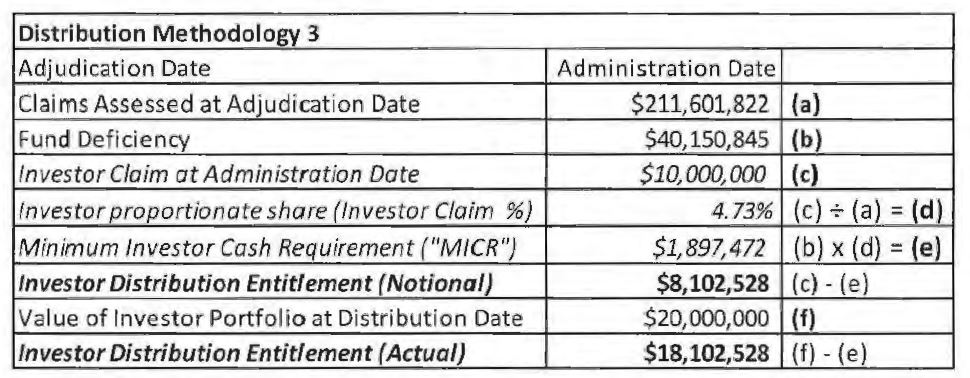
296 According to Mr Taylor, Methodology 3 accounts for elections made by clients about whether to keep open or to close positions after the date of appointment of the administrators which have, in turn, impacted the value of the deficient mixed fund and provides a process that accurately attributes to clients the outcomes of their investment choices.
297 In Mr Taylor’s opinion Methodology 3 provides the most equitable, certain and manageable outcome for clients because:
(1) fixing the date of appointment of the administrators as the date for determining client claims removes the uncertainty of fixing a future date given the nature of the assets, the values of which fluctuate constantly;
(2) notionally distributing to clients their investment portfolios on the date of appointment of the administrators, subject to withholding the MICR, gives certainty about client entitlements because each individual client assumes the risk for fluctuation in the value of their portfolio after the date of the appointment of the administrators with the effect that the risk is not borne by the Liquidators or other clients;
(3) the deficiency in the fund can be forecast with reasonable accuracy so that each client will be informed of the MICR required to fund their proportionate contribution to the deficiency, if necessary, and any unused portion of the MICR can then be the subject of a final cash distribution to clients;
(4) it most efficiently attributes the outcomes of each client’s individual investment choices since the date of administration to that client;
(5) it provides the simplest and most cost effective method for clients to elect to receive a distribution in specie, in cash, or in a combination of both; and
(6) the methodology reduces the risk of error in distributing the fund to clients by removing the risk of market volatility after the date of appointment of the administrators.
298 Mr Loo submits that the Court needs to find a distribution methodology which is fair, equitable and provides the most principled outcome. Accordingly Mr Loo, on behalf of category 1 investors, proposes an in specie distribution in accordance with Methodology 3. Mr Loo says that Methodology 3 recognises category 1 investors’ interests in the funds, increases in value in their investment positions and the fact that they have acquired shares since the date of administration.
299 Mr Loo submits that the evidence shows that he has made investment decisions since the date of the appointment of the administrators, for example by electing to keep positions open, by selecting the time at which to close positions and by electing to exercise call options. He says that there has been a significant change in his position since the administration date which was the result of the positive investment strategy that he pursued.
300 Mr Loo relies on the analysis in Courtenay House which he says has been undertaken in relation to facts that are analogous, albeit not the same, as the facts before this Court.
301 Mr Loo refers to Courtenay House at [88]-[89] where Bell P, in discussing distribution by the pari passu method, said:
[88] The pari passu approach to the distribution of a fund as between investors or contributors makes perfect sense in circumstances where all deposits were received at one time or, if not at one time, then before any material withdrawals from the fund were made, and where no subsequent deposits were made after those material withdrawals. …
[89] The pari passu approach may also be, and certainly has been, treated as appropriate where the nature of the investment involves investors knowing that their funds will be pooled with those of other investors for investment purposes. …
302 Mr Loo, relying on Courtenay House, refers to Professor Smith’s criticism of the approach adopted by the Ontario Court of Appeal in Law Society of Upper Canada v Toronto Dominion Bank (1998) 169 DLR (4th) 353; 42 OR (3d) 257 (Toronto Dominion). As explained at [98] of Courtenay House, in Toronto Dominion the Ontario Court of Appeal described the “pari passu ex post facto” approach as one in which remaining but insufficient funds in a blended account are shared amongst depositors in proportion to their contributions without regard to any intervening state of the mixed fund. Justice Blair, who delivered the judgment of the Ontario Court of Appeal, described the approach as the “most ‘convenient’ and ‘workable’”. In relation to that rationale, as set out in Courtenay House at [98], Professor Smith, who favours the lowest intermediate balance rule, said:
Is it really a principle of private law that parties’ rights may be forfeited to convenience? And if so, whose convenience?
303 Mr Loo submits that the Court would have regard to that criticism given that the only substantive argument put by the Liquidators against an in specie distribution is one of the time and cost associated with it. He says, based on his evidence given in cross-examination, that Mr Kelly’s estimate of the time considerations do not bear any real scrutiny and are manifestly overstated. As to cost, he says that Mr Kelly’s evidence is silent but a cost has been arrived at for an in specie distribution for category 3 investors. Mr Loo contends that there is no reason why the steps to be taken for and thus the cost of an in specie distribution for category 1 investors would materially differ to that for category 3 investors.
304 Having regard to [120] of Courtenay House (see [226] above), Mr Loo submits that there can be no question here that the size of the fund is too small and that there is a known pool of approximately 1,000 category 1 investors. To the extent there is any discrepancy about the precise number of shares that are held, that issue can be addressed. Mr Loo does not suggest that the lowest intermediate balance method or Methodology 3 should apply to all investors in Halifax AU and Halifax NZ but says that the inquiry should be made for those clients who have maintained open positions and/or acquired shares after the date of appointment of the administrators. Mr Loo contends that this can apply equally to category 2 investors insofar as they have kept open positions and that any appearance of disadvantage to them, because the overall value of category 2 investors’ holdings has decreased, is superficial because, to the extent that they hold open positions, the value of their shares may increase.
305 Mr Loo urges the Court to adopt the approach that is “most satisfactory”, referring to Courtenay House at [128] where Bell P, in turn, referred to the flexible approach articulated by Woolf LJ in Vaughan v Barlow Clowes International Ltd [1992] 4 All ER 22; [1991] EWCA Civ 11. In doing so, Mr Loo says that the Court should adopt an approach which differently treats the categories of clients but which is the most satisfactory. Ultimately, Mr Loo relies on Courtenay House at [133]-[134] where Bell P said:
[133] The effect of the decision in Registered Securities was pithily summarised by McGechan J in McKenzie v Alexander Associates Ltd (No 2) (1991) 5 NZCLC 67,046 at 67,065 as follows: “where there can be tracing, there shall be tracing. Where there cannot, the ‘nearest approach practicable to substantial justice’ shall be taken.” This translates, in my view, to adoption of the lowest intermediate balance rule which is, as was pointed out in Greymac at 689, “pro rata sharing on the basis of tracing” (see [109] above), with application of the simple pari passu approach to be undertaken if application of the lowest intermediate balance rule is not feasible or possible. As Brereton J has observed, in this context, the language “not possible” or “impossible” does not mean impossible in any absolute sense, but rather not economically or reasonably practical: Re BBY at [57].
[134] The continued ability of particular investors to seek to trace into a mixed or co-mingled fund was also at the heart of Santow J’s reasoning in Buckley. His Honour said (at 15,038) that:
“Otherwise they would be denied justice and equity, based on well settled principles of tracing, under the guise of doing equity and justice to the other investors, when there was no principled and fair basis for doing so as between the two groups.”
306 Mr Loo describes the issue of whether capital gains tax would be payable as a “bit of a red herring”. However, he observes that it is a complex matter and whether it will accrue to individual category 1 investors will depend on their individual circumstances but submits that the issue becomes less complex, and the likelihood of its accrual increased, for those clients in Australia if positions are closed out. Mr Loo says that is an additional reason why an in specie distribution would give greater justice and provide equity to those clients who have maintained their open positions.
307 Mr Loo submits that the adoption of the pari passu methodology for distribution of funds to clients will have the effect described at [165] of Courtenay House (see [228] above) on the category 1 investors. That is, there will be a redistribution of profits which were made after the administrators’ appointment. Had the category 1 investors closed out their investments as at the date of the appointment of the administrators, the total funds available for distribution would have been as set out at [286] above. Mr Loo says that by Methodology 3 everyone shares equally in the funds available as at the date of administration and no client is worse off. However, the gains which have been achieved by the category 1 investors, who made decisions to keep their positions open and/or to exercise options, are allocated to them. That being said, the category 1 investors accept, although not on any principled basis, that they would bear their proportionate share of any deficiency in the fund as at the date of administration caused by the decisions made by category 2 investors.
308 As set out above, the second defendant, Elysium, on behalf of the category 2 investors, does not take any in principle objection to an in specie distribution and submits that: first, the level of complexity should not be the main factor in determining the nature of an entitlement; secondly, the principle of pari passu should be adhered to if possible; and thirdly, any methodology chosen to allow an in specie distribution should be consistent with the selection of the date of appointment of the administrators to Halifax AU to value clients’ entitlements from the fund.
309 However, Elysium opposes the adoption of Methodology 3. That is principally because, despite Elysium having no objection to an in specie distribution, it contends that Methodology 3 is, in effect, counter to the position that a clients’ proportionate entitlement to the fund is to be valued at as the date of appointment of the administrators to Halifax AU and then calculated in dollar terms at the time of realisation of the fund’s assets.
310 Elysium submits that the observations of Barrett J in Australian Securities and Investments Commission v Idyllic Solutions [2009] NSWSC 1306; (2009) 76 ACSR 129 at [74] apply equally here. Namely that:
… Once a contribution is made to the fund, the contribution ceases to have any identity linked to its contributor. The contributor’s rights become proportionate rights in relation to the fund as it exists from time to time, as distinct from rights in respect of specifically traceable assets within it …
311 Elysium submits that the funds are held on trust, either constituted at general law or pursuant to s 981F(b) of the Corporations Act and reg 7.8.03(2)-(6) of the Corporations Regulations, and in that context two questions arise for consideration: first, should a single date be adopted for quantification of entitlements; and secondly, what is the appropriate date for quantification. Elysium says that the answer to the first question is yes and that the answer to the second question is 23 November 2018, the date of commencement of Halifax AU’s administration.
312 It is not in dispute that the Court has a discretion in relation to the method of distribution and whether it should order an in specie distribution. Whether that discretion should be exercised in favour of category 1 investors to permit an in specie distribution in accordance with Methodology 3 must be considered in the context of the relevant facts.
313 Of central importance to the resolution of the issues that arise in this case are the following propositions. First, once a contribution was made to the mixed fund, it ceased to be identifiable. All clients’ rights became proportionate rights to the fund as it exists from time to time. Secondly, once the assets of Halifax AU and Halifax NZ became part of a deficient mixed fund, any beneficial interest held by clients in particular assets acquired through their trading ceased to exist. As the Liquidators submit, the respective interests of clients in particular assets transmogrified into an equitable charge over all of the assets within the deficient mixed fund securing the value of the contribution made by each client in respect of those assets: see Sonray at [83].
314 Of course, if an in specie distribution was otherwise appropriate, there could be a distribution of shares in substitution for part of the amount secured by the equitable charge. Indeed, the Liquidators’ position is that if there was a fair and equitable way of effecting an in specie distribution, which was also practically feasible, then they would wish to embrace it. However, in this case any in specie distribution would not be a distribution of specific property to which the clients were beneficially entitled. Rather, it would be a distribution of property which the Court, in its discretion, would consider to be appropriate in all the circumstances.
315 Mr Loo accepts that the facts before the Court of Appeal in Courtenay House were different to those before me but nonetheless relies on the principles set out therein. Mr Loo contends for distribution by way of Methodology 3 which would allocate a proportionate share of net assets as at the date of administration subject to each client contributing a proportionate share of the deficiency. But, as was recognised by Bathurst CJ in Courtenay House at [5], distribution in accordance with the lowest intermediate balance method, which was the method contended for the appellants in that case, may be of such complexity that a liquidator would be justified and entitled to distribute on a pari passu basis. Putting to one side the category 3 and, as relevant, category 5 investors, this is such a case. That is, in my opinion, distribution in accordance with Methodology 3 would be of such complexity and would take so much time that the Liquidators would be justified to distribute on a pari passu basis.
316 The Liquidators’ evidence establishes that it is not possible to identify, by way of tracing, on behalf of which clients particular assets are held. Mr Sutherland’s evidence is that undertaking an exercise to trace all deposits since 2016 would cost between approximately AUD26.4 million and AUD37.5 million as well as the cost of additional employees and leasing.
317 Putting that to one side, the Liquidators have attempted, by way of worked examples, to find a way to achieve an in specie distribution which would be fair and equitable to clients as a whole but which would avoid the risks resulting from the constant fluctuation in the value of assets where open positions are still held. However, they have been unable to identify a way in which to distribute the assets that would operate fairly and equitably in relation to the body of clients as a whole.
318 Methodology 3 does not result in each client ending up with their proportionate entitlement of the available fund. That is because under Methodology 3 the total value of assets to be allocated to category 1 investors includes the increase in value in their investments between the date of administration and the date of distribution. This means that the value of entitlements of those receiving an in specie distribution under Methodology 3 would not be confined to the value of their proportionate entitlements calculated as at the date of administration. In contrast, the balance of clients, who would not receive an in specie distribution, would receive an entitlement confined to a value calculated as at the date of administration alone.
319 Methodology 3 results in most, if not all, post administration gains going only to some creditors, i.e. those with open positions, and thus discriminates between creditors. It is a divergence from the intent of reg 7.8.03(6) of the Corporations Regulations which, it has been observed, mandates a pari passu distribution: see MF Global at [102].
320 The cost of implementing Methodology 3 is also not certain. Mr Loo submits, based on the position reached as between the Liquidators and category 3 investors, that the likely costs to each client of an in specie distribution is AUD1,500. But, whether that is in fact so is not clear.
321 Mr Kelly’s evidence of the steps required for an in specie distribution are set out at [105] above. He estimates the process would take 13 to 14 months in total although, in cross-examination, he accepted that it could be done in less time.
322 Mr Kelly also gives evidence about the cost of an in specie distribution which would include brokerage and commission fees of between USD0 and USD85 per transfer, platform operating costs and associated staff and premises costs of at least AUD1.5 million based on a 13 to 14 month period to complete the process.
323 It is apparent that an in specie distribution by way of Methodology 3 would be more complex and costly than a cash distribution on a pari passu basis. I accept Mr Kelly’s evidence about the steps that would need to be followed and their associated complexities and costs. They exceed AUD1,500 per client and, even if they were to be borne by the category 1 investors who participated in the in specie distribution, there can be no guarantee that the overall costs of the administration would not, in any event, increase as a result of a process which would benefit only a relatively small number of clients.
324 Further, even if those steps could be achieved in a lesser time frame than Mr Kelly predicted, they would add to the overall time for achieving distribution to all clients given that any in specie distribution would have to precede the closing out of remaining investments.
325 Mr Loo submits that if the Court determines that an in specie distribution is not practically feasible then there should be a closing out of all extant investments with the date of calculation of respective entitlements being as close as practicable to the date on which distributions are to be made to clients in Halifax AU and Halifax NZ.
326 Mr Loo contends that in a case such as this where clients hold open positions, and there is volatility in the share price, the more appropriate date for calculation of entitlements is closer to the date of closing out and distribution.
327 As set out above, Elysium contends that the Liquidators ought to value all client positions as at the date of the appointment of administrators to Halifax AU, 23 November 2018.
328 The Liquidators adopt a neutral position on this issue.
329 There is no dispute between Mr Loo and Elysium that a single date should be appointed for the valuation of client positions.
330 In MF Global at [110] Black J observed that:
A single date must be adopted to value entitlements for the purposes of reg 7.8.03(6). As Briggs J noted in Re Lehman Brothers International (Europe) (in admin) [2010] 2 BCLC 301 at [290]:
The starting point must I think be that any pari passu distribution to the beneficiaries of a trust fund which is or may be in shortfall must proceed by way of a single date for calculation and, if necessary, valuation of competing entitlements. Otherwise those competing entitlements cannot fairly be rated as against each other. For a cogent explanation why that must be so: see Re Dynamics Corporation of America [1976] 1 WLR 757 at 764 d to f. This much was, or became, common ground.
331 His Honour then referred to Sonray at [112] where Gordon J said:
Whichever date is used to calculate a Sonray client’s rateable entitlement to money from the pool will possess a degree of arbitrariness and will be more beneficial or detrimental to some Sonray clients. Fairness requires only that the same date be applied to all Sonray clients and all accounts. The liquidators submitted, and I accept, that 22 June 2010, being the date of their appointment as administrators, is the logical date because active trading by Sonray clients ceased as at that date. No party expressed a different view.
332 To like effect in Re BBY Ltd (recs and mgrs apptd) (in liq) (No 3) [2018] NSWSC 1718 (BBY (No 3)) at [4] Brereton J said, in relation to the date on which client valuations are to be ascertained, that “as is uncontroversial, it would be preferable to use a consistent date and the appointment date is the obvious candidate”; see too Re BBY (No 2) at [372].
333 Mr Loo submits that in Sonray and BBY (No 3) no party spoke against the proposition that the appropriate date for valuation of a client’s proportional entitlement should be the administration date but the position is different here. In other words, Mr Loo says that in the absence of any contradictor in relation to the date of valuation the Court in those cases was not required to consider an alternative date. That may be so but in MF Global there was no consensus about the date. After setting out the differing positions put by the parties, at [114] Black J said:
I have referred to the structure of the relevant provisions above. Regulation 7.8.03(4) imposes a trust in favour of a person entitled to be paid money from an account maintained for s 981B at the point that, relevantly, an administrator is appointed to a financial services licensee under ss 436A to 436C of the Corporations Act. Regulation 7.8.03(6) specifies how money in the account is to be paid. In my view, the adoption of the Appointment Date as the date for the quantification of entitlements finds strong support in the approach adopted in trust law generally and in insolvency.
334 At [117] his Honour continued:
In the present case, the trust under reg 7.8.03(4) is imposed on the Appointment Date and that supports a quantification of entitlements under that trust for the purposes of distribution under reg 7.8.03(6) as at that date. The arguments for calculation as at the date of payment, which Underdog helpfully identified, are weakened by the fact that it will always be necessary to determine entitlements prior to the date of payment so as to allow the amounts to be paid to be calculated. In that case, a determination at the Appointment Date has a principled basis which an arbitrary later date closer to the date of payment would lack. The difference between a determination of entitlements at the Appointment Date and at the later date of payment under reg 7.8.03(6) may be reduced, at least where clients’ positions are closed on a licensee’s insolvency, if the concept of “entitlement” includes (as I hold in [135]-[145] below) at least contingent entitlements which will be realised on closing clients’ open positions.
(Emphasis added.)
335 Regardless of which date is chosen to value clients’ proportionate entitlements, prejudice will be suffered by one category or other of clients.
336 On the one hand, Mr Loo’s evidence focusses on suffering prejudice and subsidising clients who have lost value since the date of appointment of the administrators or who closed out their positions and have forgone any potential upside in exchange for eliminating their exposure. However, as Elysium submits category 2 investors stand to suffer an actual decrease in entitlement from their account value on the date of appointment of the administrators to Halifax AU should a later date be chosen by comparison to category 1 investors. As to the latter, their prejudice is not receiving the full benefit of the profits accrued to their account after the administration date. That that is so is illustrated by the investor update provided by the Liquidators dated 31 August 2020 by which they provide an estimate, by way of an Estimated Outcome Statement, of the distribution to be received by clients subsequent to the determination of this proceeding and the proceeding in the NZ High Court. In particular using 31 July 2020 as an alternative valuation date:
(1) a category 2 investor with a balance of AUD100,000 as at 23 November 2018 and a balance of AUD110,000 as at 31 July 2020 will receive a return of only AUD87,000 or AUD89,000 (depending on recoveries). That client would thus incur an actual loss of AUD11,000 or AUD13,000 on their November 2018 balance;
(2) by comparison, a category 1 investor with a balance of AUD100,000 as at 23 November 2018 and a balance of AUD150,000 as at 31 July 2020 will receive a windfall of AUD19,000 to AUD22,000 (depending on recoveries) on their 23 November 2018 balance; and
(3) if entitlements are valued as at 23 November 2018 both groups will see a return with a decrease, or increase, of AUD1,000 to AUD2,000 on their 23 November 2018 balances.
337 Having regard to the authorities referred to above, and in particular the comments of Black J in MF Global at [117], the more principled date for the date of valuation of clients’ entitlement is the date of appointment of the administrators.
338 One further issue arises. That is whether the date should be the date of the appointment of administrators to Halifax AU, 23 November 2018, or the date of the appointment of administrators to Halifax NZ, 27 November 2018. In that regard, it is more appropriate to adopt the latter, being the date of the appointment of administrators to Halifax NZ, because there may have been investment activity by clients of Halifax NZ between 23 and 27 November 2018.
339 Accordingly, the appropriate date for valuation of clients’ proportionate entitlements is 27 November 2018.
340 As set out at [13] above, on 13 August 2020 and 21 September 2020 the Shareholders were joined to the proceeding as the eighth and ninth defendants respectively. They sought to propound arguments in their own interests. At the time of their joinder and until 13 November 2020 Baker and McKenzie acted for the Shareholders. After that date no appearance was filed for the Shareholders and, despite them remaining as parties to the proceeding, there was no appearance by them or on their behalf at the hearing.
341 Notwithstanding that and because of the nature of the application made by the Liquidators, namely an application for directions and judicial advice, the Liquidators requested that the Court consider the claims made by the Shareholders so as to ensure a degree of finality to the issues raised. Relevantly, the Liquidators contend that the Shareholders’ claim is hopeless and, on that basis, seek an order for payment of their costs incurred by reason of their joinder on an indemnity basis and calculated as a lump sum. I accept that it is desirable in the context of this matter for the Liquidators to achieve a level of finality in relation to the issue of distribution of the assets held in trust for clients of Halifax AU. In those circumstances, recognising that the Shareholders were given an opportunity to appear at the hearing to propound the arguments they raise (set out below), it is appropriate for me to consider those arguments.
342 The arguments propounded by the Shareholders are set out in a letter dated 3 July 2020 from Baker and McKenzie, their lawyers at the time, to the Liquidators (3 July Letter). In that letter the Shareholders notified the Liquidators that they intended to make submissions about the following matters in this proceeding in which, as described by those lawyers, directions were sought to distribute assets of Halifax AU which were acquired in connection with the trading of financial products by its clients (referred to as Assets):
(a) the Assets are beneficially owned by Halifax and were not acquired by clients of Halifax nor held on trust for clients of Halifax (for the reasons described below);
(b) the terms of each contract between Halifax and a client constituted pursuant to trading by Halifax clients on each of the trading platforms offered by Halifax are formed pursuant to the relevant Product Disclosure Statement (PDS) and Client Services Agreement (Halifax CSA) that were on issue at the time of the trade (as at the time of being placed into Voluntary Administration, we understand this to be the PDS dated 4 April 2018 and Halifax CSA dated 3 September 2018);
(c) notwithstanding that the layout of each of the trading platforms accessible by clients of Halifax may suggest otherwise, the effect of (b) above is that each client of Halifax, when buying or selling a product on a Halifax trading platform, was entering into a contract for difference (CFD) with Halifax;
(d) the Assets were acquired by Halifax to hedge their exposure under certain CFD transactions;
(e) Halifax undertook a small volume of “Agency Transactions” (as that term is described in the Halifax CSA) from time to time however, so fat as we are aware, no such transactions remain open; and
(f) all proofs of debt in relation to open positions of Halifax clients should be determined as at the time of appointment of the Voluntary Administrations given the nature of the contractual obligations between Halifax and the clients and noting that under the terms of the Halifax CSA Halifax had the power to close out transactions on the insolvency of Halifax.
(Footnotes omitted.)
343 The 3 July Letter went on to set out in detail the basis for each of contentions (a) to (e), which the Liquidators have summarised. That summary, which I adopt, is set out in part below.
344 First, in relation to the contentions at (b) to (e), the Shareholders say that Halifax AU clients never acquired any interest in shares and what may have looked like a share acquisition was really an acquisition of an unleveraged stock CFD. This was in part because “the Halifax directors at the time considered” this to be so. Clients paid the full and final purchase price of the CFD upfront at the commencement of the transactions (at a price approximately equal to the price of the underlying stock). The Shareholders say that Halifax AU “fully hedged” these “unleveraged CFD transactions” by acquiring the underlying shares and, having regard to the allegation that the “full and final purchase price” was paid up front, this was money paid to acquire a financial product and thus, having regard to s 981A(2)(c) of the Corporations Act, it was money to which Subdiv A did not apply with the consequence that the money was not required to be paid into an account designated as a s 981B account and, in turn, was not taken to be held on trust for clients of Halifax AU pursuant to s 981H of the Corporations Act.
345 In relation to the contention at (f) of the 3 July Letter, the Shareholders contend that the appointment of the administrators to Halifax AU on 23 November 2018 constituted a “Default Event” under the relevant CSAs which permitted Halifax AU to immediately terminate each CSA and close out all client transactions. The Shareholders say that it would be “most normal ‘default’ position for the Liquidators to treat debts owing (sic) to creditors, in relation to the investor/client obligations, as being crystallised” on the date of the appointment of the administrators to Halifax AU and to make an estimation of the value of the investor/client obligations as at that date. On that basis the Shareholders argue, in effect, that any increase in the value of assets held on behalf of clients after 23 November 2018 did not accrue to the benefit of the clients but to the benefit of Halifax AU.
346 By letter dated 20 July 2020 the Liquidators’ solicitors, K&L Gates, responded to the 3 July Letter, setting out why the Liquidators disagreed with the arguments propounded by the Shareholders. They informed Baker & McKenzie that there was no merit in the position contended for by the Shareholders.
347 Thereafter, the Liquidators provided detailed written submissions setting out why, in their opinion, the contentions put by the Shareholders could not be sustained.
348 I have considered the Liquidators’ detailed submissions responding to the Shareholders’ contentions in the 3 July Letter. Those submissions, which I have summarised below, should be accepted. They explain why the Shareholders’ contentions should be rejected in their entirety.
349 First, the contentions at (b)-(e) of the 3 July Letter are based on instructions which do not reflect the facts. As has been established by the evidence before me clients who invested through Halifax AU frequently acquired a beneficial interest in shares, both on the IB AU platform and the MT5 platform. The legal interest was held by IB, or a sub-custodian of IB, on behalf of Halifax AU as trustee for the client who acquired the beneficial interest in the shares.
350 More particularly, the contentions at (b)-(e) of the 3 July Letter can be rejected for at least the following reasons.
351 First, the Shareholders rely on the CSA dated 3 September 2018 (see [74] above). Relevantly, the CSA includes a definition of the term “Agency Transactions” (see [74(1)] above) and includes cl 3(a) which concerns “Agency Transactions” and provides that “[a]ny Agency Transaction entered into by the Client will be arranged by Halifax as agent for the Client, through a third party Broker” (see [74(2)(a)] above).
352 That is, cl 3 of the CSA described the transactions facilitated by Halifax AU through IB on behalf of clients (with Halifax AU acting as agent) pursuant to which shares were acquired beneficially by clients on the IB AU platform. These share acquisitions, both on behalf of clients trading on the IB AU platform and on behalf of clients trading on the MT5 platform (which was automatically linked to the IB AU platform) occurred in large volumes. Contrary to the Shareholders’ assertion, Halifax did not undertake only a small volume of “Agency Transactions” nor is it the case that no such transactions remain open.
353 Secondly, the proposition that Halifax AU did not facilitate the investment by clients in shares, as distinct from CFDs, is inconsistent with the logo which appeared on many documents issued by Halifax AU and all activity statements issued by IB in respect of share acquisitions on the IB AU platform which referred to “global stocks, options, futures and forex” (emphasis added). There are also many examples in the evidence before me of Halifax holding itself out as facilitating investments in “stocks”. That Halifax AU held itself out in this way is inconsistent with the proposition that its clients never in fact or in law acquired any interest in shares.
354 Thirdly, as explained by Mr Lum, from late 2015 all new non-corporate clients of Halifax AU trading on the IB AU platform were required to have a cash account, as opposed to a margin account or a portfolio margin account. After this time, Halifax AU clients who were individuals residing in Australia and who wished to trade in stock CFDs had to do so on the MT4 and MT5 platforms.
355 Fourthly, share acquisitions made on the IB AU platform were recorded in activity statements which could be generated either by the client or by Halifax AU through each IB client subaccount. Those activity statements recorded “stocks” acquired on behalf of each client including the volume acquired. Clients who already had a margin account or a portfolio margin account prior to late 2015 were able to retain those accounts and new corporate clients were also able to operate such accounts. The evidence before me demonstrated that the activity statements for those clients also recorded significant acquisitions in shares. Activity statements were issued in the names of the clients of Halifax AU, not in the name of Halifax AU. Notably, the “Notes/Legal Notes” appearing at the end of each activity statement are clearly principally concerned with share trading.
356 Fifthly, shares could not only be acquired on the IB AU platform, they could also be sold on that platform. Mr Lum explains that clients could execute these trade themselves through the IB AU platform, although sometimes they sought assistance from Halifax AU.
357 Sixthly, shares that had been acquired by clients on the IB AU platform could be and were transferred by IB (or its sub-custodian) to an external broker or from an external broker to IB (or its sub-custodian). Where such a transfer was to occur a form titled “Securities transfer request” was completed. That provided that it “is required to transfer stocks into and out of the Trader Workstation platform to/from the issuer. One document needs to be completed per SRN”. The client had to provide their account details with Halifax AU, their personal details at the “receiving/delivery registry” and details of the asset to be transferred setting out “stock name”, “symbol code/ISIN”, “SRN” and “quantity”.
358 Seventhly, activity statements generated for Australian resident individual clients made no reference to CFDs in shares. In contrast, activity statements generated for clients trading on the IB NZ platform recorded “stocks” and “CFDs” in shares. This difference is to be understood in light of the change that occurred in 2015, limiting trading on the IB AU platform for individual Australian residents to shares, and highlights the weakness in the Shareholders’ argument that the acquisition of shares by clients of Halifax AU is to be regarded as an acquisition of a share CFD.
359 Eighthly, it is clear from Halifax AU’s records that, as at 31 July 2020, its clients who had traded on the IB AU platform held large open positions in stocks but held no positions at all in CFDs. As explained by Mr Lum, the same conclusions about trading in shares are available in relation to trading on the MT5 platform. As set out at [34(3)] above, from August 2016 Halifax AU facilitated trading by its clients (and those of Halifax NZ) on the MT5 platform. That platform permitted clients to acquire or dispose of their interest in shares by a contemporaneous link to the IB AU platform through which the acquisition or sale was effected. The MT5 platform was established following the termination of Halifax AU’s rights to operate the Saxo platform. Upon its establishment, the majority of clients that had been trading on the Saxo platform were migrated to the MT5 platform and, as a result, open positions in shares acquired on the Saxo platform were recorded in new client “investor accounts” referable to the MT5 platform, with the shares themselves being transferred to IB or its sub-custodian. Clients of Halifax AU could also trade in CFDs in shares on the MT5 platform. Mr Lum explains that Halifax AU hedged the trades of all clients in stock CFDs on the MT5 platform by acquiring the shares but that hedging was distinct from the share acquisitions effected by clients. Mr Lum explains in some detail in his evidence how trades in shares and in stock CFDs were recorded on the MT5 platform. It is apparent, from spreadsheets that Mr Lum has compiled, that there were a very large number of share acquisitions effected by clients transacting on the MT5 platform up to the date of the appointment of the administrators to Halifax AU and, in a significant number of cases, those shares continued to be held as at September 2020, the date to which Mr Lum undertook his analysis.
360 Ninthly, putting to one side the fact that the acquisition and sale of shares on either the IB AU platform or the MT5 platform fell comfortably within the scope of “Agency Transactions”, as defined in the CSA, the conduct of Halifax AU of its business and its own business records confirm that, as between Halifax AU and its clients when clients proceeded with a transaction on the IB AU platform styled “Stocks”, Halifax AU was facilitating an acquisition of shares. It was clear that after late 2015 there was no ability for clients of Halifax AU to acquire share CFDs on the IB AU platform where those clients were non-corporate Australian residents. Indeed, the CFD option was “greyed out” for those clients when they accessed the platform. On the MT5 platform Halifax AU informed its clients that they could undertake transactions in relation to shares or CFDs in shares and, depending on the symbols selected by a client in undertaking the trade, Halifax AU was conveying that it was either facilitating an acquisition of shares or an acquisition of a CFD in shares.
361 Lastly, there are a number of examples in the evidence before me of exchanges which included Mr Worboys and/or Mr Barnett in which it was quite clear that clients of Halifax AU entered into share transactions, including descriptions of the business undertaken by Halifax AU which referred to trading in stocks. It is not necessary to set out that evidence in detail.
362 Having regard to the matters set out above, it is evident that clients of Halifax acquired shares both through the IB AU and MT5 platforms, the shares acquired by clients of Halifax AU were distinct from CFDs in shares and, in acquiring shares, clients were not contracting with Halifax AU as principle. Accordingly, any monies paid by clients for the purchase of shares was not money paid to “acquire a financial product” from the licensee, Halifax AU. The shares were acquired from their respective vendors. For the reasons already explained at [139]-[142] the exclusion in s 981A(2)(c) of the Corporations Act does not apply. Rather:
(1) monies paid to Halifax AU for share acquisitions was money paid to a financial services licensee in connection with a “financial service” to be provided to the client: see s 981A(1)(a)(I) of the Corporations Act;
(2) the relevant “financial service” within the meaning of s 766A(1)(b) was “dealing” in a financial product which, in turn, is defined to include issuing a financial product: see s 766C and s 761E of the Corporations Act;
(3) it follows that the money paid by clients to Halifax AU was in connection with a “financial service” to be provided to the client in that it was paid in connection with the acquisition by those clients of a financial product, namely shares. It is sufficient for the purposes of s 981A(1)(b)(I) that the money is paid “by the client”;
(4) accordingly, for the reasons set out at [135]-[145] above, those monies were required to be held in an account complying with s 981B of the Corporations Act and to be held on trust for those clients in accordance with s 981H; and
(5) those clients are, in respect the money they paid to acquire shares and the shares so acquired, beneficiaries. They are not, as the Shareholders contend, unsecured creditors.
363 Given the conclusion I have reached in relation to the contentions in paras (b)-(e) the issue in para (f) does not arise. In any event, even if that was not the case, the contention is not made out.
364 The Shareholders rely on cl 20 of the CSA which is titled “Default” and which sets out the circumstances in which a “Default Event” will occur and the steps Halifax AU can take after a “Default Event” occurs (see [74(5)] and [74(6)] above).
365 Contrary to the Shareholders’ contention, the appointment of the administrators to Halifax AU did not mean that it was or may become unlawful for Halifax AU to maintain or give effect to any or all of its obligations under the CSA or otherwise to carry on its business. That is particularly so given that an intended purpose of the process of voluntary administration is to permit a company in administration to continue to operate. Further, cl 20(b)(ii) and/or (iii) of the CSA permitted Halifax AU “in its absolute discretion” to close out any or all “Clients Transactions”. Here, first the administrators and then the Liquidators, as the directing minds of Halifax AU, determined in their absolute discretion that they should not take that course. Relevantly, in Kelly (No 8) orders were made pursuant to s 90-15 of the IPS to the effect that the Liquidators were justified in refraining from realising any and all extant investments until the determination of the substantive issues in this proceeding.
9. The Liquidators’ claim for costs
9.1 Correspondence between the Liquidators and the Shareholders
366 On 27 October 2020 the Liquidators’ solicitors sent a letter to the Shareholders’ solicitors setting out the Liquidators’ detailed arguments in response to the contentions made in the 3 July Letter which were, in substance, the same as the submissions put to the Court in this proceeding and which I have recorded (and accepted) above. The letter was lengthy. In their concluding remarks the Liquidators’ solicitors said:
29. The contentions proffered by you on behalf of your clients are completely contrary to the facts, should never have been made, and must be rejected. In this respect, we note that in paragraph 6.1(a) of the Fuggle Affidavit, Mr Fuggle stated that your clients do “not intend to rely upon any evidence other than the evidence already served in the proceedings”; and that was repeated by Mr Pesman SC at T37 L24 on 31 July.
30. We invite your clients to accept, on an open basis, that this is the case. In the event your clients pursue its arguments, the Liquidators intend to seek indemnity costs
367 On 30 October 2020 the Shareholders’ solicitors responded to the Liquidators’ solicitors. By that letter the Shareholders, without accepting the correctness of the Liquidators’ response to their contentions, informed the Liquidators’, through their solicitors, that they found themselves unable to continue to participate in the proceeding “due to the concerns as to excessive costs burden”. The letter continued:
… It is also relevant to note that much of the material that your clients now seek to rely upon in addressing our clients’ contentions is material that our clients repeatedly asked the liquidators (and your firm) to provide to them prior to their request to be joined. We refer in particular, but again without limitation, to our letter of 18 June 2020 and your reply of 23 June 2020. Copies of that correspondence are at pages 501 to 504 of the exhibit to the affidavit of William Fuggle affirmed 27 July 2020 and filed in the proceedings. If the material requested had been provided earlier then it is possible that a different course would have been taken.
We are instructed to file a notice of ceasing to act and will do so in due course. Our clients will consent to an order that they be removed as parties and that the $50,000 security paid into court may be utilised by the parties. However they cannot and will not consent to any orders as to costs beyond the amount of that security. In our clients’ view, any costs incurred by your client in excess of that amount of security should not be paid by the liquidators or any other party and should be written off by your firm as they are patently not fairly or reasonably incurred.
Our clients do not otherwise intend to participate further in the proceedings and will not be filing any submissions or appearing at the final hearing. Neither your clients nor any other parties should incur any further costs on account of our clients’ joinder to the extent that they remain parties after today.
If your clients wish to make any submissions as to our clients’ further participation in the proceedings or in relation to costs in their or our absence then we insist that this letter be brought to the attention of the court.
368 By letter dated 3 November 2020 the Liquidators’ solicitors put the Shareholders on notice that, notwithstanding that the Shareholders did not intend to appear at the hearing, the Liquidators would seek declaratory relief to guard against any suggestion that the Shareholders have any claim on the assets of Halifax AU. They indicated, among other things, that the Liquidators did not consent to the withdrawal by the Shareholders from this proceeding (or the NZ Proceeding), that they would ask this Court and the NZ High Court to retain them as parties to ensure that they are bound by any orders, judicial advice or directions made by the Courts and that they would seek an indemnity costs order against the Shareholders.
369 By emails from Ms Smith of K&L Gates dated 4, 7 and 8 December 2020 the Shareholders were again informed of the Liquidators’ intention to apply for an order that they pay their costs on an indemnity basis and the date on which their application would be heard by the Court. They were also provided with a copy of an affidavit sworn by Jason Charles Opperman, a partner of K&L Gates, on 8 December 2020 on which the Liquidators intended to rely in support of their application for their costs to be quantified on a lump sum basis. In response:
(1) by email sent on 8 December 2020 sent at 6.08 pm AEDT Mr Barnett informed Ms Smith that he would be unable to attend Court either in person or by use of videoconferencing facilities; and
(2) by email sent on 8 December 2020 at 10.08 pm AEDT Mr Worboys informed Ms Smith that he would not be able to attend Court at the appointed time.
370 At the appointed time for hearing of the Liquidators’ application for an order that the Shareholders pay their costs occasioned by the Shareholders’ joinder on an indemnity basis to be calculated as a lump sum, there was no appearance by or on behalf of either of the Shareholders.
371 The Liquidators seek an order that the Shareholders pay their costs incurred by reason of their joinder on an indemnity basis and in a lump sum quantified in the amount of AUD351,810.05 (which is an amount exclusive of 88.99% of GST on the basis that the Liquidators are entitled to claim 88.99% of input tax credits in respect of any GST). The Shareholders were on notice of the Liquidators’ intention to seek such orders and were provided with the evidence in support of that application.
372 The first issue to address is whether the Shareholders should be ordered to pay costs and, if so, whether those costs should be payable on an indemnity basis.
373 Section 43 of the Federal Court of Australia Act 1976 (Cth) confers a wide discretion on the Court to award costs which is not to be read down otherwise than by judicial principle conformable with its amplitude: see DSE (Holdings) Pty Ltd v InterTAN Inc [2004] FCA 1251; (2004) 51 ACSR 555 at [14]. Without limiting the discretion conferred on the Court in relation to costs, s 43(3) of that Act permits the Court, among other things, to award a party costs in a specified sum and to order that costs awarded against a party be assessed on an indemnity basis.
374 The circumstances in which costs are sought against the Shareholders are somewhat unusual. The background to and reason why the application for costs is made can be shortly summarised. The Shareholders sought to be joined and were joined to the proceeding on 13 August 2020 to agitate the contentions set out in the 3 July Letter. Their joinder was on condition that they first provide security for the costs of the Liquidators and all other defendants to the proceeding by reason of their joinder in an amount of AUD50,000. Thereafter, the correspondence described above was exchanged between the Liquidators, on the one hand, and the Shareholders, on the other. Ultimately, after receiving a detailed outline of the Liquidators’ proposed submissions to be made in response to the contentions in the 3 July Letter, the Shareholders effectively capitulated: they notified their intention to withdraw from the proceeding; their solicitors filed a notice of change of address for service and the Shareholders did not appear at the hearing. At that stage it was evident that the Liquidators proposed to seek further security from the Shareholders for their costs of the proceeding. Putting that to one side, the Shareholders’ stated reason for being unable to continue to participate in the proceeding was their concern about the excessive costs burden of doing so although their solicitors also noted that it was relevant that much of the material the Liquidators sought to rely on in addressing the contentions raised in the 3 July Letter was material that the Shareholders had repeatedly asked the Liquidators to provide to them prior to their application to be joined to the proceeding. In that regard, they said that if the material requested had been provided earlier then it was possible that a different course would have been taken.
375 Based on that course of events, it is open to me to infer that the Shareholders determined not to further participate in the proceeding for two reasons: first, the potential costs of the proceeding going forward; and secondly, because they accepted that their prospects of succeeding in establishing the contentions in the 3 July Letter were low.
376 In the circumstances of this case, where the Shareholders sought to be joined and were joined to the proceeding to press the contentions notified in the 3 July Letter but withdrew, in that they notified their intention not to appear at the hearing, after the Liquidators had done significant work to meet those contentions, it is appropriate that there be an order for costs in favour of the Liquidators in relation to the costs they incurred by reason of the joinder of the Shareholders. That is particularly so given the nature of this proceeding which is brought in relation to a company which is in external administration and where they seek judicial advice and directions from this Court in order to ascertain how to distribute a fixed pool of assets.
377 The next issue to address is whether the costs order in favour of the Liquidators should be made on an indemnity basis or on the ordinary basis.
378 The Court’s power to make an order that costs be paid on an indemnity basis is not in doubt. In Colgate-Palmolive Company v Cussons Pty Ltd (1993) 46 FCR 225; (1993) ALR 248 at 256-257 Sheppard J set out the principles which his Honour had distilled from the authorities as to the circumstances in which such an order might be made. After recognising that the ordinary rule is that an order for costs when made is usually for payment of those costs on a party/party basis, his Honour said:
4. In consequence of the settled practice which exists, the court ought not usually make an order for the payment of costs on some basis other than the party and party basis. The circumstances of the case must be such as to warrant the court in departing from the usual course. … Most judges dealing with the problem have resolved the particular case before them by dealing with the circumstances of that case and finding in it the presence or absence of factors which would be capable, if they existed, of warranting a departure from the usual rule. But as French J said (at 8) in Tetijo: the categories in which the discretion may be exercised are not closed’’. Davies J expressed (at 6) similar views in Ragata.
5. Notwithstanding the fact that that is so, it is useful to note some of the circumstances which have been thought to warrant the exercise of the discretion. I instance the making of allegations of fraud knowing them to be false and the making of irrelevant allegations of fraud (both referred to by Woodward J in Fountain and also by Gummow J in Thors v Weekes (1989) 92 ALR 131 at 152, evidence of particular misconduct that causes loss of time to the court and to other parties (French J in Tetijo); the fact that the proceedings were commenced or continued for some ulterior motive (Davies J in Ragata) or in wilful disregard of known facts or clearly established law (Woodward J in Fountain and French J in J-Corp);the making of allegations which ought never to have been made or the undue prolongation of a case by groundless contentions (Davies J in Ragata); an imprudent refusal of an offer to compromise (eg Messiter v Hutchinson (1987) 10 NSWLR 525; Maitland Hospital v Fisher (No 2) (1992) 27 NSWLR 721 at 724 (Court of Appeal); Crisp v Kent (SC(NSW)(CA), 27 Sept 1993, unreported) and an award of costs on an indemnity basis against a contemnor (eg Megarry V-C in EMI Records). Other categories of cases are to be found in the reports. Yet others to arise in the future will have different features about them which may justify an order for costs on the indemnity basis. The question must always be whether the particular facts and circumstances of the case in question warrant the making of an order for payment of costs other than on a party and party basis.
379 The categories for which an order for indemnity costs can be made are not closed. As a Full Court of this Court (Besanko, Markovic and Banks-Smith JJ) recognised in Clifton v Kerry J Investment Pty Ltd t/as Clenergy (No 2) (2020) 277 FCR 382 at [31], to justify a special costs order there must be conduct deserving of criticism and resulting in greater expense to the innocent party.
380 The Liquidators rely on the lack of merit in the contentions raised by the Shareholders. They say those contentions should never have been made given the Shareholders’ understanding of the operations of the Halifax group.
381 I have found that the contentions put by the Shareholders in the 3 July Letter had no merit. Given the roles of Mr Worboys, one of the Shareholders, and Mr Barnett, the director of the second Shareholder, as directors of Halifax AU for most of the period in which that company operated until it was placed into administration, it is difficult to conceive how they could press those contentions. I am satisfied that those contentions ought never to have been made by the Shareholders given their involvement in and, necessarily, understanding of the business of Halifax AU. Ultimately the Shareholders elected not to participate in the proceeding thereby no longer propounding their contentions. But that was only after the Liquidators had undertaken a significant amount of work in order to establish, ultimately for the purposes of the proceeding, why it was that the contentions were without merit.
382 In those circumstances I am satisfied that it is appropriate to make the order sought by the Liquidators, namely that the Shareholders pay the Liquidators’ costs occasioned by their joinder on an indemnity basis.
383 Next the Liquidators seek their costs on a lump sum basis. In doing so they rely on two affidavits sworn by Mr Opperman on 8 and 15 December 2020.
384 Rule 40.02 of the Federal Court Rules 2011 (Cth) (Rules) permits a party who is entitled to costs to apply to the Court for an order that costs be awarded in a lump sum instead of any taxed costs. As observed by a Full Court of this Court (Logan, Kerr and Farrell JJ) in Coshott v Prentice (No 2) [2018] FCAFC 221 (Coshott) at [4] the purpose of the provisions conferring power on the Court to award costs in a lump sum is to avoid the expense, delay and aggravation of protracted litigation arising out of the taxation process. That that is so is also reflected in the Court’s costs practice note (GPN-COSTS) (Cost Practice Note) in which it is recognised that the procedure to determine the quantum of costs for a successful party at final hearing should not be delayed, should be as inexpensive and efficient as possible and, where costs are unable to be resolved by negotiation and require the involvement of the Court, the Court’s preference is to avoid, where possible, the making of costs orders that lead to potentially expensive and lengthy taxation hearings: at paras 3.1 and 3.3.
385 At [5] of Coshott the Full Court observed:
However, a lump sum costs order is not mandated in all cases. Rather, it is a matter for the Court to exercises its discretion as appropriate: Paciocco v Australia and New Zealand Banking Group Limited (No 2) [2017] FCAFC 146; 253 FCR 403 (Paciocco) at [19] citing Hudson v Sigalla (No 2) [2017] FCA 339 at [18]-[19]. In Paciocco, the Full Court (Allsop CJ, Besanko and Middleton JJ) noted (at [20]):
There is no particular characteristic that a case must possess for it to be suitable for the making of a lump sum costs order. Particular circumstances that may make a lump sum order especially appropriate include where in a large and complex commercial matter it would save the time, trouble, expense and aggravation of a taxation; where a taxation would require the parties to consume additional time and incur additional expenditure prolonging already protracted litigation; and generally to avoid an ongoing, counter-productive dispute as to costs, in the interests of achieving finality.
386 This is a case in which, in my view, it is appropriate to make a lump costs order as against the Shareholders. Taken as a whole the Liquidators’ application for directions and judicial advice is properly described as complex. Further, given the circumstances of this case, namely that it is the Liquidators who approached the Court seeking directions and judicial advice for the purpose of distributing the assets currently held by them, it is appropriate that any process which might follow the making of orders in the proceeding not be delayed, that the further administration of Halifax AU not be protracted and that the Liquidators not be put to any further expense in the pursuit of a taxation.
387 Mr Opperman’s affidavit sworn on 8 December 2020 was prepared in accordance with the guide for preparing a costs summary in support of an application for lump sum costs included at annexure A to the Costs Practice Note. Mr Opperman sets out how the lump sum the Liquidators seek has been calculated including: a summary of the categories of work incurred in the conduct of the proceeding insofar as it concerned the Shareholders; a summary of the work performed by each of the lawyers who worked on the matter insofar as it concerned the Shareholders, noting their respective charge out rate, total hours worked, total costs incurred (exclusive and inclusive of GST) and the percentage of that amount to the total; and a summary of the work undertaken by counsel and the fees charged by counsel.
388 By reference to Sch 3 to the Rules, the Court’s National Guide to Counsels’ fees dated 28 June 2018 and the National Guide to Discretionary Items Bills Of Costs dated 1 October 2014, Mr Opperman reviewed the charge out rates of solicitors in the employ of K&L Gates and counsels’ fees and, where necessary, reduced them to accord with those rates permitted by the guides. On that basis the Liquidators’ legal costs associated with the proceeding insofar as it concerned the Shareholders amount to AUD357,096.50 (excl GST) or AUD392,806.15 (incl GST). This amounts to a reduction of 17.9% overall by comparison to the Liquidators’ costs at K&L Gates’ and counsels’ usual charge out rates.
389 However, Mr Opperman says that if an order is made for the Shareholders to pay the Liquidators’ costs on an indemnity basis, it is appropriate that the discount of 17.9% be increased to achieve an overall discount of 20% of the Liquidators’ actual costs. Applying this discount will take into account contingencies that would apply in a formal costs assessment process.
390 Applying a discount of 20% the Liquidators seek their costs in a lump sum amount of AUD351,810.05 (exclusive of 88.99% of GST). Relevantly, the Liquidators are entitled to claim 88.99% of the input tax credits in respect of any GST.
391 Having regard to the fact that I am satisfied that the Liquidators are entitled to their costs occasioned by reason of the joinder of the Shareholders on an indemnity basis and Mr Opperman’s evidence, I am satisfied that an order should be made that the Shareholders pay the Liquidators’ costs on a lump sum basis in an amount of AUD351,810.05 (exclusive of 88.99% of GST).
392 There are a number of other issues in relation to which the Liquidators seek directions. They concern low account balances and the set-off of negative balances. I address each of those issues in turn.
393 The evidence before me established that there were as at 31 July 2020:
(1) 31 category 1 investors with an account balance of between AUD0 and AUD100;
(2) the total value of category 1 investor account balances in the range AUD0 to AUD100 was AUD1,106.21;
(3) 3,731 category 2 investors with an account balance of AUD0 to AUD100; and
(4) the total value of the category 2 investor account balances in the range AUD0 to AUD100 was AUD110,733.33.
394 Mr Kelly says that it is difficult to quantify the costs associated with distributing funds to each client with an account with a balance of less than AUD100. The steps to be taken vis a vis those clients do not differ from those to be taken in relation to clients with higher accounts balances. The Liquidators’ remuneration and the cost of Halifax AU staff in undertaking those steps will depend on the time taken to calculate the value of each client’s claim as at the relevant adjudication date, the ease with which a client can be contacted, and the extent of interaction between the client and the Liquidators or their staff about the value of their claim, the amount of cash that is to be distributed to them and the client’s account details. Mr Kelly is of the view that the costs associated with distributing funds to each client with an account balance of less than AUD100 will considerably exceed those clients’ account balances.
395 The Liquidators are of the opinion that the most appropriate course for these clients would be to disregard account balances which are under AUD100 at the time the Court makes its orders. No defendants opposed or supported this course which, if adopted, will affect 31 category 1 investors and 3,731 category 2 investors.
396 In particular, Elysium on behalf of the category 2 investors neither consented to nor opposed the Liquidators’ proposed direction. It took that position because of the volume of category 2 investors who will, to some extent, be prejudiced by the Court’s decision in relation to this issue. On Elysium’s calculation, if the Court makes the directions sought by the Liquidators, 34.2% of category 2 investors would lose any entitlement to a distribution. Conversely, if the Court does not make the directions by the Liquidators, 65.8% of category 2 investors will be prejudiced given the costs associated with distributing funds to each category 2 investor with an account balance of less than AUD100.
397 In Re BBY (No 2) Brereton J also considered the question of whether the liquidators in that case were justified in treating clients with account balances of AUD100 or less as having no entitlement to participate in the relevant recoveries. His Honour observed that a similar direction was made in Sonray and that such a direction gives “pragmatic effect to the reality that the costs to the administration (and thus creditors generally) associated with administering a claim for the amount specified are disproportionate to the benefit of the claimant”: at [396].
398 The same can be said in this case. That is, making the directions sought by the Liquidators in relation to accounts where balances are less than AUD100 will give effect to the reality that the costs associated with administering claims in relation to those accounts will exceed and are disproportionate to any benefit to the claimants. Accordingly, I will make the direction sought by the Liquidators that they are justified in treating clients with an account balance of AUD100 or less as having no right to participate in the distribution of funds.
10.2 Setting off negative balances
399 There are some clients with a positive balance in one or more accounts and a negative balance in other accounts. Accordingly, the Liquidators seek a direction or judicial advice as to whether they would be justified in setting off positive net account balances credited to a particular client against negative account balances incurred by the same client.
400 Mr Kelly explains that negative balances are “out of the money” positions in that the clients who hold negative positions have a liability owing at the date of expiry of a derivative contract. Based on investigations as to whether any of the accounts with negative account balances were accounts of clients who also had accounts with positive cash balances, Mr Kelly says that:
(1) as at 29 May 2020 there were 271 accounts with aggregate negative account balances of AUD541,735.10;
(2) of those 271 accounts with a negative account balance, 172 accounts had a negative balance of less than AUD100 totalling AUD2,808.44;
(3) the remaining 99 accounts with a negative account balance had a negative account balance which exceeded AUD100 totalling AUD538,926.65; and
(4) of those 99 accounts, the clients associated with 27 of those accounts have other accounts with a positive balance totalling AUD1,157,335.11.
401 As at 31 July 2020 only category 2 investors had an account with a negative balance. Relevantly, Mr Kelly provides the following summary of category 2 investors who have an account with a negative balance as at that date as well as category 2 investors who have an account with a positive balance and also have an account with a negative balance:

The Liquidators submit that there is no reason why, in those circumstances, the proposed setting off should not occur.
402 Elysium observes that, based on the evidence given by Mr Kelly and the data as at 31 July 2020, only category 2 investors are affected by the direction sought by the Liquidators and, relevantly, only five out of a total of 11,938 category 2 investors will in fact be prejudiced and stand to lose. Given that and the fact that no category 2 investor, when asked by way of an investor notice, opposed the Liquidators’ proposed direction Elysium supports the Liquidators’ position. No other party made any submission in relation to the Liquidators’ proposed direction.
403 In Re BBY (No 2) Brereton J considered the same issue. That is, whether the liquidators in that case were entitled to set off positive net account balances against negative net account balances in the same client. As is the case here, no party contended against there being a right of set-off. His Honour made the direction sought noting that there the client agreements gave a contractual right of set-off and, consistently with the approach taken in Sonray and MF Global, the liquidators were entitled to combine the balances of product line accounts to calculate the net position of individual clients without any need for set-off and or set off positive net account balances against negative net account balances in all accounts owned by the same BBY Group client: Re BBY (No 2) at [382]. In considering the issue Brereton J (at [376]) referred to MF Global where Black J said (at [157] and [159]):
[157] In Sonray, the liquidators sought a direction as to whether they were entitled to set off positive cash balances against negative cash balances in all accounts owned by the same client. Gordon J held (at [115]) that the contractual terms between Sonray and each client entitled the liquidators to set off or nett off positive cash balances with negative cash balances. I do not consider that s 981E of the Corporations Act requires a different result. That section relevantly provides that money to which the Subdivision applies is not capable:
(a) of being attached or otherwise taken in execution; or
(b) of being made subject to a set off, security interest or charging order, or to any process of a similar nature;
except at the suit of a person who is otherwise entitled to the money or investment.
In my view, that section is directed to protecting clients’ interests in CSAs against third parties exercising rights of set off against or taking security from the licensee over the CSAs and does not prevent an agreement between a client and a financial services licensee to set off positive and negative balances on different accounts in determining the client’s nett position.
…
[159] I am satisfied that MFGA is entitled to exercise a right of set off and I am satisfied that, on balance, it is appropriate for the Liquidators to do so although this will give the affected clients the benefit of 100 cents in the dollar in their positive balances, in the interests of the efficient distribution of the relevant client monies. I will make a direction to that effect.
404 Here, some but not all of the CSAs for Halifax AU contain a term permitting set-off of the nature sought by the Liquidators by reason of, in the case of the CSA for Halifax AU dated 3 September 2018, the combination of the definition of “Termination Amount” and cl 11.2 which concerns the “Net Termination Sum” (see [74(7)] above). Similar clauses are found in the Halifax AU CSAs dated 20 October 2014, 1 July 2015 and 20 October 2016. None of the CSAs for Halifax NZ contain equivalent provisions.
405 To the extent that Halifax AU’s CSAs include provisions in relation to set-off, the set-off proposed by the Liquidators should be permitted and the direction sought should be made.
406 The Liquidators submit that, even where the CSAs do not include an express provision permitting set-off, a direction should be made or judicial advice given that they would be justified in setting off negative account balances otherwise there will be unnecessary expense incurred to the detriment of all beneficiaries. This is because, absent such a direction or judicial advice, the Liquidators will be bound to distribute the relevant portion of positive account balances to clients and then to have to make demands and potentially bring proceedings to recover negative account balances. The Liquidators contend that, in any event, any claim by a client against the Liquidators in relation to set-off of negative account balances, in the absence of a contractual entitlement, would fail for circuity of action because the amount sought to be recovered would correspond with a liability on the part of the client to the relevant Halifax entity which could immediately be claimed back.
407 I accept the submission made by the Liquidators. It is in the best interests of all clients of Halifax AU and the efficient distribution of funds held that the direction sought be made permitting set-off in respect of all clients of Halifax AU who hold accounts with both positive and negative account balances.
408 Cash and other assets held by Halifax AU and Halifax NZ are held in multiple currencies. Mr Kelly deposes that, because of the fluctuations in currency values, it will be difficult to determine the value of the total pool of assets available to clients and each client’s proportionate entitlement to that pool. The Liquidators submit that one way of managing that is to convert all funds to Australian dollars. They therefore seek a direction or judicial advice that they would be justified in:
(1) converting cash held in foreign currency into Australian dollars for the purpose of determining the value of the total pool of assets available to clients and each client’s proportionate entitlement to the total pool; and
(2) converting funds in Australian dollars to New Zealand dollars for the purpose of making distributions to clients who reside in New Zealand or who elect to have their entitlement paid in whole in New Zealand dollars.
409 As a practical matter and in order to assist the efficient distribution of funds, I am satisfied that a direction in the terms sought by the Liquidators should be made
410 The only remaining issue is that of costs in relation to the joinder of and arguments propounded by the Whitehead Interests who appeared in their own interest and not as representative of any group of clients. They have been unsuccessful in establishing their claims. The Liquidators foreshadowed a claim for their costs (and those of the first to fifth defendants, although none of those parties in fact made any application or submission to that effect) in meeting the Whitehead Interests’ claims and ultimately requested that I reserve on that issue. I will do so but note that, as a general proposition, ordinarily costs will follow the event such that, in this case, the Liquidators would be entitled to their costs on the ordinary basis occasioned by the joinder of the Whitehead Interests.
411 If the issue of costs occasioned by the joinder of the Whitehead Interests cannot be resolved between the parties, and the Liquidators (or any other party) wish to pursue an order for costs against the Whitehead Interests, they should file and serve their submissions, not exceeding three pages in length, within 14 days of the date of publication of these reasons. Thereafter, the Whitehead Interests can file and serve their submissions in reply, not exceeding three pages in length, within 28 days of publication of these reasons. If that occurs, the question of costs arising from the joinder of the Whitehead Interests will be determined on the papers.
412 I will make orders and directions giving effect to these reasons.
I certify that the preceding four hundred and twelve (412) numbered paragraphs are a true copy of the Reasons for Judgment of the Honourable Justice Markovic. |
Associate:
NSD 2191 of 2018 | |
ATLAS ASSET MANAGEMENT PTY LTD | |
Fifth Defendant: | FIONA MCMULLIN |
Sixth Defendant: | ANDREW PHILLIP WHITEHEAD AND MARLENE WHITEHEAD IN THEIR CAPACITY AS THE TRUSTEES OF THE BEELINE TRUST |
Seventh Defendant: | ANDREW PHILLIP WHITEHEAD |
Eighth Defendant: | JEFFREY JOHN WORBOYS |
Ninth Defendant: | HONG KONG CAPITAL HOLDINGS PTY LIMITED |


