

Federal Court of Australia
Lawson on behalf of the Badimaya Barna Guda People v State of Western Australia (No 2) [2021] FCA 468
ORDERS
DATE OF ORDER: | 7 May 2021 |
THE COURT ORDERS THAT:
1. The interlocutory application filed by the State of Western Australia on 9 June 2020 be allowed.
2. The claimant application under s 61 of the Native Title Act 1993 (Cth) in proceeding WAD 7 of 2020, be dismissed pursuant to s 190F(6) of the Native Title Act.
3. For the avoidance of doubt, Part B of proceeding WAD 7 of 2020 be dismissed.
Note: Entry of orders is dealt with in Rule 39.32 of the Federal Court Rules 2011.
MORTIMER J:
1 On 9 June 2020, the State of Western Australia applied for dismissal of this proceeding, pursuant to one or both of two alternative processes for which the Native Title Act 1993 (Cth) provides.
2 The considerable delay between that application and these reasons is explained by the conscientious and proactive efforts made by Judicial Registrar Daniel of this Court, supported by Ms Jennifer Kershaw, Legal Case Manager in the Court’s Western Australia Registry, to assist the individual primarily responsible for the Badimaya Barna Guda application, Mr Adrian Lawson, to improve and begin to resolve the presently overwhelming defects in the content and structure of the application. Those efforts have been supported by the State, and have involved some other respondent parties. The native title representative body for the region of the claim, Yamatji Marlpa Aboriginal Corporation (YMAC) has also been indirectly involved. The efforts have occurred both in formal mediation settings and outside those settings.
3 Despite the best efforts of all concerned, and despite the filing of a proposed amended application under s 61 by Mr Lawson on behalf of the Badimaya Barna Guda applicant, substantial defects remain. In making that statement, I do not intend any personal criticism of Mr Lawson. I accept he is a proud Badimaya man, who genuinely wishes to be able to take responsibility for land and waters he has been taught form part of his country. I accept he genuinely believes the proceeding in this Court which resulted in a negative determination against the Badimia people (CG v State of Western Australia [2015] FCA 204; CG v State of Western Australia (No 2) [2015] FCA 507; and CG v State of Western Australia [2016] FCAFC 67; 240 FCR 466) was flawed and the outcome was unjust. I accept he has tried to reduce the area of the Badimaya Barna Guda claim to remove overlaps, and that he has good intentions in terms of negotiating with neighbouring claim groups to achieve this.
4 The difficulty is that insufficient progress has been made, and not all of the fundamental problems with the application have been addressed, even in its proposed amended form. The applicant remains without legal representation. It was not until 15 March 2021 that a proposed amended claim was filed to address the list of defects identified by the delegate in the registration decision, and repeated by the State in submissions on the interlocutory application more than 10 months ago. That proposed amended application was only able to be filed after substantial indulgences by way of leave were given to Mr Lawson, so that the absence of certain required formalities about signature and affidavits on behalf of other members of the applicant did not prevent the proposed amended application from being filed. The fact that Mr Lawson had to seek such indulgences is but one of many illustrations that he is essentially prosecuting this claim as an individual. That does not mean that, in the background, he may not have the support of others. However his method to this point in time, of being the sole prosecutor of the claim, emphasises the obvious difficulties with authorisation of the claim in accordance with the Native Title Act. I accept matters such as organising appropriate authorisation processes may appear too great a task for any lay person in Mr Lawson’s position. However, being a member of a native title applicant carries responsibilities for compliance with the Native Title Act and this Court’s rules and case management processes. Matters such as authorisation are not incidental: they are central because they are the mechanisms through which the Court (and other parties such as the State) can be satisfied that the claim for native title is brought with the endorsement of all those individuals who hold (generally, communally) the native title sought to be recognised.
5 In my opinion it is appropriate to uphold the State’s application for orders pursuant to s 190F(6), and it is not necessary to consider the State’s alternative submissions relying on s 84C of the Native Title Act. As I make clear towards the end of these reasons, the Court’s conclusion may not prevent other avenues being pursued.
Evidence and submissions
6 In its written and oral submissions, the State relied upon the affidavit of Ms Alicia Warren affirmed on 8 June 2020 in support of its interlocutory application. Ms Warren’s affidavit was not formally read at either the first or second hearing of the interlocutory application, but I have taken it as read.
Procedural background
7 What remains of this claim is Part B of the Badimaya Barna Guda application under s 61 of the Native Title Act. Part A was dismissed by orders made on 6 February 2020. In substance that was because of an overlap with the Yamatji Nation native title application, which was scheduled for consent determination a few days after the Badimaya Barna Guda application was filed. The urgent need to consider the application by the Yamatji Nation applicant for the Badimaya Barna Guda claim to be struck out led to the Court making orders dividing the Badimaya Barna Guda claim into two parts, Part A being the area which overlapped with the Yamatji Nation claim scheduled for consent determination, and Part B being the remainder of the claim area. On 28 January 2020 the Court made the following order:
Pursuant to s 67 of the Native Title Act 1993 (Cth), the Badimaya Barna Guda native title application (WAD7/2020) is divided into the following two separate proceedings:
a) Part A of WAD7/2020 which is the part of the Badimaya Barna Guda application area which overlaps proceedings WAD19/2019, WAD21/2019 Part A, WAD31/2019 and WAD345/2019; and
b) Part B of WAD7/2020 which is the balance of the land and waters claimed in the Badimaya Barna Guda application
8 The background to the dismissal of Part A, and to the present claim can be found in Lawson on behalf of the Badimaya Barna Guda People v State of Western Australia [2020] FCA 104.
9 Thus, what was left as an active claim was Part B of WAD 7 of 2020. It is Part B which is the subject of the State’s interlocutory application. Since the Badimaya Barna Guda claim was filed in January 2020, Mr Lawson has been assisted by Mr Bassell. Mr Bassell is not a lawyer. It is apparent from what Mr Lawson has said during case management that Mr Bassell continues to assist the applicant in this proceeding.
10 The Part B proceeds has been before the Court on two occasions for case management, each in substance being an attempt (by all concerned) to assist Mr Lawson to appreciate what needs to be remedied, and to confront the absence of proper authorisation of the claim. Those case management hearings were: 4 December 2020 and 9 March 2021. In addition, the interlocutory application was first listed for hearing on 28 July 2020, on which date the Court made orders adjourning the application and directing that a copy of the transcript of the hearing be provided to the applicant in the interests of justice. The purpose of this was to assist Mr Lawson in understanding what were said to be the problems with the Part B proceeding, and to assist him in seeking further advice about what steps might be taken to remedy those problems.
11 Prior to the last case management hearing, Mr Lawson was warned that in the absence of adequate progress or changes to the application, the State’s interlocutory application would be heard, having been adjourned from 28 July 2020, re-listed on 4 December 2020 and then adjourned again to 9 March 2021. Yet again on 9 March 2021, Mr Lawson asked for more time. He informed the Court that he had an amended application prepared, and that he had it in front of him. He explained why he could not get the other two members of the applicant to sign it, or to affirm their affidavits. In relation to Mr Godfrey Simpson:
But the nephew is gone. He’s going through tribal initiation. I won’t be – won’t see him for a couple of months. He’s out in the bush, locked up and can’t – I can’t go to him now, because he’s doing tribal initiation.
12 And in relation to Ms Yvonne Lawson:
HER HONOUR: So your sister can’t sign either?
MR LAWSON: She ... out yesterday, signed for the exemption, and four months. Sent her healthcare card. That’s to go with the exemption – and the four months. What I will – I will try and get her – I will serve a copy of her affidavit to try and get her signature. But she’s ... today. I forgot about that.
HER HONOUR: Well, how long is she going to be out bush?
MR LAWSON: She’s out there for a few months.
13 As a result of these explanations, and on the basis there was no objection from the other parties, the Court granted leave for the necessary documents relating to the proposed amendment to be filed without the signatures of the other two members of the applicant.
14 The Court explained to Mr Lawson that, given his acknowledgments about the need to involve all Badimaya/Badimia people in the claim, and even acknowledging the reduction of the claim area to remove overlaps with other claims, a preferable option might be to withdraw the present s 61 application, to engage in full consultation with all relevant Badimaya/Badimia people, and (if appropriate) to file a new, and properly authorised claim. Mr Lawson appeared to accept he should consider this option, having also had the opportunity prior to the case management hearing to have that process explained to him by Judicial Registrar Daniel.
15 Orders were made on 9 March 2021 requiring the Badimaya Barna Guda applicant to
(a) file and serve any documents, amended application and submissions about why the present claim should not be dismissed, and why it should be allowed to continue in an amended form; and
(b) advise the Court by email to Judicial Registrar Daniel copied to Ms Kershaw, whether the applicant was prepared to withdraw and discontinue the whole of the present claim so that a new claim could be filed after being authorised by the whole of the claim group.
16 If the applicant advised the Court there would be no withdrawal, the State and the other active parties were granted leave to file additional submissions on the strike out application, in part, so they could address the proposed amended claim. The orders provided that the strike out application would then be decided without a further hearing.
17 On 24 March 2021 the applicant, through Mr Lawson, informed the Court the applicant would not withdraw its present s 61 application. A proposed amended claim, and submissions on behalf of the applicant, were filed on 15 March 2021. The State and the Wajarri Yamatji applicant in proceedings WAD 28 of 2019 and WAD 32 of 2018 filed additional submissions.
18 With that background, I turn to explain why I have decided the Badimaya Barna Guda application under s 61 of the Native Title Act should be struck out, and the Part B proceeding dismissed.
The National Native Title Tribunal delegate’s decision
19 On 19 March 2020 the delegate determined that the Badimaya Barna Guda application should not be accepted for registration pursuant to s 190A of the Native Title Act. The delegate found the application did not meet a considerable number of the conditions for registration. Some were highly substantive. Notwithstanding the Court’s orders splitting the application into Part A and Part B, the delegate considered the whole of the s 61 application, on the basis of the terms of s 190A(1): see [4] of the delegate’s reasons. Thus, the delegate considered the application in relation to areas of land and waters covered by the dismissed Part A application. In saying that I intend no criticism of the delegate, as she explained her approach as being based on her understanding of s 190A(1), a matter not in issue before the Court. Nevertheless, from the Court’s perspective it is the case that orders have been made dismissing Part A. Therefore, the State’s strike out application, and the Court’s orders made today should reflect that fact. That is why there is an order dismissing the application (which reflects the terms of s 190F(6)), as well as an order for the avoidance of doubt, dismissing the Part B proceeding.
20 Ms Warren deposes that the Tribunal confirmed to the State in correspondence on 19 May 2020 that no application for reconsideration was made by the Badimaya Barna Guda applicant. Nor has any application to review the delegate’s decision been filed in this Court.
21 It is not necessary to set out in detail all the bases on which the delegate found that the Badimaya Barna Guda application should not be registered. They are summarised at [13] of the State’s primary written submissions and I accept that summary is accurate. Where appropriate, I refer to parts of the delegate’s reasons below.
The requirements of ss 190F(5) and (6)
22 Section 190F of the Native Title Act deals with two consequences of a decision by the Native Title Registrar (or her delegate) that a claim should not be registered. It first sets out a process for review of that decision in this Court. Second, it provides for the dismissal of an unregistered claim by this Court, if certain conditions are satisfied. Dismissal can occur if no review application has been made, or if a review application was made but has been finally determined without registration of the claim as a result.
23 Subsections 190F(5) and (6) provide:
(5) Subsection (6) applies in a case where:
(a) the Registrar does not accept the claim for registration either because, in the opinion of the Registrar or, if the claim is reconsidered under section 190E, of the member of the NNTT reconsidering the claim:
(i) it does not satisfy all of the conditions in section 190B; or
(ii) it is not possible to determine whether all of the conditions in section 190B have been satisfied because of a failure to satisfy section 190C; and
(b) the Court is satisfied that the avenues for:
(i) the reconsideration under section 190E of the Registrar’s decision; and
(ii) the review under this section of the Registrar’s decision; and
(iii) the review of orders made in the determination of an application under this section; and
(iv) the review of the Registrar’s decision under any other law;
have all been exhausted without the registration of the claim.
(6) The Court may, either on the application of a party or on its own motion, dismiss the application in which the claim was made (the application in issue) if:
(a) the Court is satisfied that the application in issue has not been amended since consideration by the Registrar, and is not likely to be amended in a way that would lead to a different outcome once considered by the Registrar; and
(b) in the opinion of the Court, there is no other reason why the application in issue should not be dismissed.
24 In Sambo v State of Western Australia [2015] FCA 954 Barker J described the process under these provisions in the following way (at [33]-[35]):
In that regard, there is a practical onus on an applicant to cause evidence to be supplied to the Court that may lead to the Court not being satisfied about those matters and not forming that relevant opinion: see Fazeldean on behalf of the Thalanyji People (No 2) v State of Western Australia [2012] FCA 1163 at [66].
In effect the proceeding now before the Court is in the nature of a show cause proceeding. The applicant has the opportunity to produce materials to show the Court that, notwithstanding the satisfaction of the preconditions to the exercise of the dismissal power, the application is likely to be amended in some way that would lead to a different outcome and/or there is another reason why the application should not be dismissed.
A practical burden falls on the applicant in this case therefore to deal with the different bases upon which the amended application failed the registration test and to show how a further amendment may be possible which would lead to a different outcome on a reconsideration; or that there is some other reason why the application should not be dismissed.
25 I respectfully agree. Subsections 190F(5) and (6) provide a mechanism for the Court to act on the detailed consideration given by the Native Title Registrar to the merits of a claimant application, and its compliance with the requirements of the Native Title Act. They do so in a context where an applicant has a chance to remedy some of the defects which have been identified, and has had a chance to challenge any decision that such defects exist.
26 Requiring the Court to be satisfied that “no other reason” exists which justifies retaining the application on foot is the legislature’s way of reinforcing the beneficial aspects of this legislation. The Court may be inclined to give an applicant further opportunities to improve the application – in substance that is what has happened in this proceeding over the last 9 months. Or, in a particular fact situation, and perhaps especially depending on the attitude of the other parties to the application, the Court may be inclined to allow the application to proceed in its current form, despite the registration decision. Subsection 190F(6)(b) authorises the Court, if it is persuaded it is in the interests of justice to do so, to decide not to dismiss an application even if all the preconditions are met. The phrase “no other reason” should not be either defined or confined – each case will depend on its own facts.
The proposed amended application and Mr Lawson’s submissions
27 As he had on all the other occasions this proceeding has been before the Court, Mr Lawson acted as the spokesperson for the applicant. It has been apparent from the start of this proceeding that Mr Lawson is the driving force in this application, although assisted by Mr Bassell.
28 Leave has not been granted to the Badimaya Barna Guda applicant to rely upon the proposed amended application for a determination of native title filed by Mr Lawson on 15 March 2021. Rather, as has been explained to Mr Lawson on several occasions, the reason for allowing him to file that proposed amended application is for the Court to decide, under s 190F(6)(a) whether the present native title application is “likely to be amended in a way that would lead to a different outcome once considered by the Registrar” or, under s 190F(6)(b), that the proposed amended application itself provides another “reason” why the application in issue should not be dismissed.
29 Therefore, I am satisfied it is appropriate to consider the proposed amended application for the purposes of ss 190F(5) and (6). I consider it is appropriate to resolve the strike out application on the basis that this is the version of the s 61 application which the Badiamaya Barna Guda applicant would move on (and which would be placed again before the Registrar), if the proceeding were not to be dismissed. It is therefore appropriate to describe the contents of the proposed amended application in some detail.
30 Under “Authorisation”, the following statement is made:
We the applicants are entitled to make this application as persons authorised by the native title claim group [Badimaya Barna Guda] to make this native title determination application. The applicant and the other members of the native title claim group being holders of a native title comprising individual rights and interests of Aboriginal people in relation to the area of land and waters, the subject of this application according to traditional laws and customs observed by each of us which rights and interests we possess under traditional laws acknowledged and traditional customs observed by Aboriginal peoples and by which laws and customs Aboriginal people have a connection with the land and waters.
31 Mr Lawson is identified as the “primary spokesperson” for the group and an elder of the Badimaya Barna Guda group.
32 The apical ancestors are identified in Schedule A in the following way:
AREA 1 Ninghan Freddie was born at Younmi Downs Station at Courlbarloo rockhole. Courlbarloo rockhole is within the Badimaya boundaries. This means that Ninghan Freddie was a Badimaya man.
Bauljarra recognised by Daisy Bates and the State of Western Australia that he was Badimaya
AREA 2 Timothy Benjamin
Bilygwi and Yilayajambin
Lizzie aka Juumbi
33 Aside from descent from these apical ancestors, membership of the claim group is expressed in Schedule A to be those people who
also identify as Badimaya who are connected under the traditional Badimaya lore and customs with the land and waters in the Determination area, and
Are accepted as Badimaya by other Badimaya people
Or, though not descended from these persons, have been incorporated into the Badimaya Barna Guda group in accordance with Badimaya Barna Guda traditional laws and customs.
AND
b. Identify themselves under traditional law and custom as Badimaya Barna Guda People.
AND
c. Have a connection with the land and waters of the claim area, in accordance with the traditional laws acknowledged and the traditional customs observed by the Badimaya People.
AND
d. Acceptance of the Group Name ‘way of doing things’
34 The main points to be made are two-fold. First, although at times there are references to “Badimaya Barna Guda” traditional law and custom, there is no affidavit or other material which supports the proposition that people comprising a group of that name have, since effective sovereignty, had a connection through traditional law and custom with the two parcels of land in the proposed amended application that is separate or distinct to any connection that may be held by the Badimia People. Second, there are points at which the description indeed refers to “Badimia People” (spelled Badimaya). The incorporation of “Badimaya” as the group of people who are the ones united by their observance of traditional law and custom in relation to the land claimed, is continued in Schedule B where the description “Badimaya country” is used. Although Mr Lawson deposes that the spelling “Badimaya” is correct, the reported decisions in CG use the spelling “Badimia”, as did the applicant documents in those proceedings. In these reasons I have used the spelling “Badimaya” when referring to Mr Lawson’s evidence or argument, or to the proposed amended applicant. I have used “Badimia” to refer to the claim, and the people, in CG. I infer that when Mr Lawson speaks of the “Badimaya people”, or “Badimaya law and custom” he is, broadly, speaking of the same group of people, and the same law and custom, as that identified in CG.
35 Notwithstanding the views he has expressed during the proceeding about the extent of Badimaya country, I accept that in Schedule B (and Schedule H), every effort has been made to remove any overlaps with existing claims or determinations, and the text in Schedule B is at pains to point that fact out. This is and should be recognised as a significant change from previous versions of the Badimaya Barna Guda claim.
36 Again importantly for the purposes of explaining the ongoing defects about authorisation, in Schedule F, where a “general description of native title rights and interests” is given, and after Mr Lawson is expressly identified in the document as the source of these propositions, the following is stated:
The tide of history has not washed away any real acknowledgment of Badimaya traditional Lore, story lines and culture. The claimant group know the Dreaming stories and song lines and where the dreaming tracks connect me to tjukurrpa, that gives me all the rights and responsibilities to Badimaya country.
As an initiated Badimaya man and a man of Lore, I know familial and cultural history. I can share some of this information orally and or written, and I can talk about some of it for ceremonial purposes. I can talk orally to the Court about places and cultural matters of significance.
Firstly, I say we do not own the land we belong to the land; we belong to the ancestors; that’s what my old people told me and that’s why I love going camping and hunting in Badimaya country. Badimaya country is my home place it gives me peace and responsibilities. When I am there, I look after the country.
….
Research undertaken by Leone Dunn on the Badimaya language published by Department of Linguistics. Research School of Pacific Studies, Australian National University (ANU) illustrates that my great grandfather Joe Benjamin was interviewed by Leone Dunn as a primary respondent to her study about Badimaya language. Joe Benjamin is Timothy Benjamin’s son from Coodingow Station. Timothy Benjamin is the brother of Rosie Benjamin and Annie Benjamin. Timothy, Rosie and Annie are all children of Mary Ann of Coodingow.
Dunn’s research focused on the Badimaya language. (syntax and semantics). Her research identified that virtually nothing has been recorded on the Badimaya language as a separate group. Dunn also noted that overtime the expression Yamadyi has been used by the Badimaya peoples, as it has also been used by the Watj arri and the coastal people, known by both the Badimiroaya and theWatj arri as Wirlugardi (seaside) (possibly the Nhanda).
….
As a Badimaya elder and initiated Lore man I and other Badimaya imitated men still practice initiation. We take the young men to neighbouring communities for culture so that when they come back as initiated men, they have the right to walk the land, look after sacred sites and customs.
A place of significance to all Badimaya people is Nyingarn bardi [Mt Singleton. Nyingarn bardi is the main big totem of Badimaya it represents all Badimaya language. My great grandfather is buried in the traditional manner on Ninghan station and facing towards Mt Singleton [Nyingarn bardi].
Back in the dreamtime, near Yalgoo and Gabyon Station there was the ‘weelarra’ dreaming. ‘weelarra’ means the ‘moon’. They called the people of that area the ‘moon people’. It was the Balya Djuniya [two sisters] that left the dreaming there on their travels.
37 In the affidavit in support of the proposed amended application, at [14] Mr Lawson gives evidence about what he means by the different use of the terms “lore” and “law”:
Interpretation: Collins dictionary of English Language 2nd Ed. 1986.
Lore: n. 1 collective knowledge or wisdom on a particular subject, esp. of a traditional nature. 2. Knowledge or learning. 3. Archaic. Teaching or something that is taught.
Law: n. 1. A rule or set of rules enforceable by the Courts, regulating the Government of a State, the relationship between the organs of Government and the subjects of the State, and the relationship or conduct of subjects towards each other.
NB: In Indigenous culture, ‘Law’ is consumed within Aboriginal ‘Lore’. Aboriginal ‘Lore’ [tradition and culture] sets the dreaming tracks, song lines and ceremonies and within that ‘Lore’, rules [‘laws’] to live by are laid out by the elders, breaches of which may result in penalty.
38 Whether or not those propositions should be accepted is not a matter that needs to be decided on the strike out application. I incorporate [14] here only to aid an understanding of the proposed amended application.
39 Nothing in these reasons should be seen as casting any doubt on the genuineness of the statements made in the extract above, nor on the genuineness with which Mr Lawson puts forward these propositions. The main point to be made for the purpose of the strike out application is that the source for all these matters is Badimaya (or Badimia) law and custom, including Mr Lawson’s account of his status as an initiated man.
40 In other words, there is no doubt this is a claim which needs to be authorised by those who make up the Badimaya/Badimia People.
41 Finally, although a smaller point, I note that in Schedule K – which deals with the identification of the responsible native title representative bodies (as that term is defined in the Native Title Act), the following entries appear:
Badimaya Barna Guda Peoples Claim
Badimaya Nyingarn Tjuba Indigenous Corporation
Dr James Taylor [ Anthropologist ]
Dr Craig Muller [ Historian ]
Fiona Hooks [ Archae-Aust Pty Ltd ]
42 None of those named are the native title representative body for the region in which the two parcels of land are located. The relevant body is YMAC. This kind of defect, if the only one, would not be fatal to an application. However I include it here as another illustration of how far the form of the proposed amended application departs from the reality of an application which is consistent with the terms of the Native Title Act. It has been obvious through case management hearings that Mr Lawson has communicated with YMAC at various stages. It has been obvious that he has been frustrated with YMAC, but there has also been material before the Court during case management which has made it clear that YMAC has attempted at various points to assist Mr Lawson, subject to him being willing to comply with its processes. The fact that the responsible representative body does not support, or has not been directly involved in, a s 61 application is not fatal to an application, but the “go it alone” approach that the entries in Schedule K reveal again illustrates that Mr Lawson has not understood, or refuses to understand, the need for an inclusive and comprehensive approach to a native title claim, so that all those who should be properly identified as native title holders can be seen to have been consulted and to have endorsed (in the manner required by s 251B of the Act), the making of the claim, and that the responsible representative body is also acknowledged. A supportive and selective sub-set of those who may hold native title is not enough.
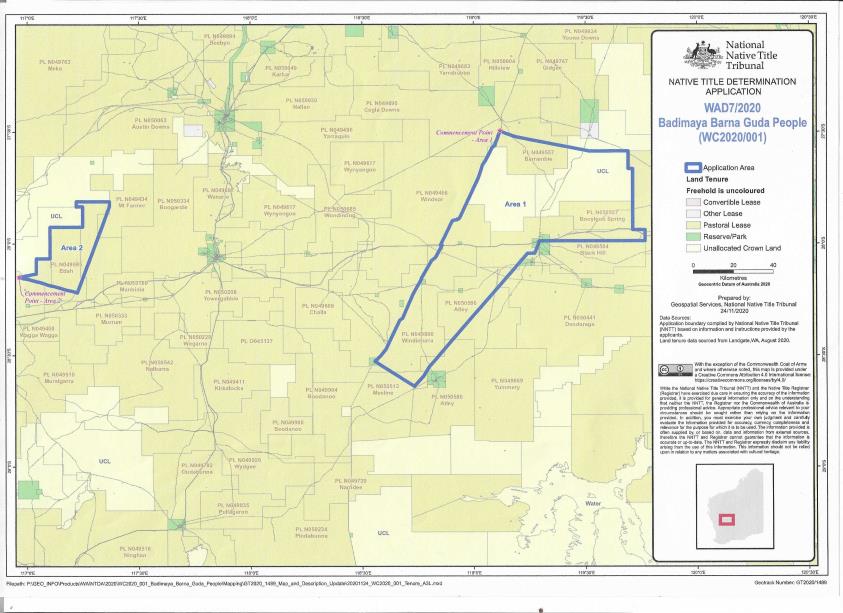
43 In summary, Mr Lawson contends that the preferable outcome is that the Badimaya Barna Guda application should be allowed to continue, since he has removed any overlaps with existing claims and determinations of native title, and has also amended the list of apical ancestors so that the amended list only relates to the two parcels of land which now remain the subject of the proposed amended application. Attached to these reasons is the map provided with the proposed amended application showing these two parcels.
44 He submits that he has been trying to advance a Badimaya claim since 2015, he has not been funded, and he claims he has not been properly assisted by YMAC.
45 Revealing some consciousness about what has been said by the delegate in the registration decision, by the State in its strike out application, and by the Court in case management, about the problems this claim has with proper authorisation, Mr Lawson also relies on what he describes as an “information meeting” at Yalgoo on 30 January 2021 (although the year is mistakenly put as 2020). In his submissions he contends:
I had notified Badimaya people by e-mail, word of mouth and phone about the meeting and about the proposed amended Claim and map of the two parcels of Badimaya country claimed in the Proposed Amended Claim. All the people I spoke to [at the meeting and elsewhere] are supportive of the Proposed Amended Claim. Unfortunately, the Yalgoo meeting was not as well attended as I had expected but it was helpful as two other Badimaya elders previously unknown to me were identified.
46 The annexures to the submissions, which record attendance at this meeting, show that eight people attended the meeting aside from Mr Lawson. One of them (Yvonne Lawson) is another member of the Badimaya Barna Guda applicant, and Mr Lawson’s sister. As the State submitted, five people from a list compiled by Mr Lawson appear to have attended the meeting, with another three, two of whom at least were persons previously unknown to Mr Lawson. As the State also submits and appears to accept, there were some elders amongst this group. Those elders identified people from a list that was prepared by the ethnographer Daisy Bates and which Mr Lawson had at the meeting, as people associated with the eastern portion (Area 1) of the proposed amended Badimaya Barna Guda application. The State also accepts that those at the meeting did indicate their support for the Badimaya Barna Guda claim. Yet, as the State submits, not all the people listed by Bates are then listed as apical ancestors on the proposed amended application: only Ninghan Freddie and Bauljarra are listed, and they are not on the Daisy Bates list. Accordingly, there is some internal confusion even within Mr Lawson’s own material about who are the correct apical ancestors.
The State’s submissions
47 The State contends that most of its initial submissions on the interlocutory application, and the registration test decision, remain pertinent despite the proposed amended application and Mr Lawson’s recent submissions. In its second set of submissions, the State identified those paragraphs of its first written submissions which it contends continue to be appropriate submissions to make, even on the proposed amended application.
48 In summary, the State submits:
The BBG Application failed the registration test on multiple grounds. The registration test decision reveals that the BBG Applicant was unable inter alia to satisfactorily demonstrate: its authorisation by all of the members of the native title claim group; the identity of the members of that group; the existence of traditional laws and customs shared by that group; any connection by traditional laws and customs of members of that group to the claimed area; or the nature and content of the claimed native title rights and interests (see paragraph [13] above).
Save for the failure to comply with the requirements of sections 190B(8) and 190C(2), all of the deficiencies identified by the Delegate are deficiencies that go to the substantive merits of the BBG Application rather than being purely procedural matters. In the First Respondent’s submission the fact that the BBG Application’s shortcomings were so numerous and fundamental in nature supports an inference of unlikelihood of their rectification by amendment.
Wajarri Yamatji submissions
49 The Wajarri Yamatji respondent’s interest in this application arises because the Badimaya Barna Guda claim partly overlaps the WAD 28 of 2019 Wajarri Yamatji #1 and the WAD 32 of 2018 Wajarri Yamatji #3 claims; and “technically overlaps” the Wajarri Yamatji Part A conditional determination. The Wajarri Yamatji respondent pointed to the recent orders made by the Court setting out a timetable towards resolution of its claims in WAD 28 of 2019 and WAD 32 of 2018 by consent determination, with the timetables having critical dates in May and July 2021. It notes the delays caused by the COVID-19 pandemic on finalisation of these claims, and submits that the Badimaya Barna Guda application, brought so recently and having the defects that it does, should not be permitted to further delay the consent determination process.
50 Since the proposed amended application removes all overlaps with the Wajarri Yamatji claims, this party’s objections would be removed if that proposed amended application were permitted to be filed. I accept on the s 61 application as it presently stands (and as it was considered by the delegate), these overlaps are significant impediments to the conclusion of the Wajarri Yamatji claims. However, given Mr Lawson has conducted his defence of the interlocutory application on the basis of the proposed amended application, there is no need to consider the Wajarri Yamatji submissions further.
Resolution
51 The State’s interlocutory application should be allowed on the basis of s 190F(5) and (6). It is not necessary to consider the alternative application under s 84C(1) of the Native Title Act.
Subsection 190F(5)
52 I am satisfied the preconditions in s 190F(5) are met. The claim has not been accepted for registration for the reason that it does not satisfy all of the conditions in s 190B of the Act: see s 190F(5)(a)(i). Further, I am satisfied that:
(a) There has been no application to the Tribunal for reconsideration under s 190E (s 190F(5)(b)(i));
(b) There has been no application to this Court for review of the registration decision (s 190F(5)(b)(ii));
(c) Accordingly, there has been no review of any orders made by this Court under s 190F (s 190F(5)(b)(iii)); and
(d) There has not been any other form of review of the registration decision or any other application for such review, such as judicial review (s 190F(5)(b)(iv)).
Subsection 190F(6)
53 I am also satisfied that the preconditions in subs (6) are met. The proceeding is not very far advanced in substantive terms, even though it has been in existence for some time. The fact it is not well advanced is something the Court can take into account as a matter of discretion: see Strickland v Western Australia [2013] FCA 677 at [14], per Jagot J.
Amendment (s 190F(6)(a))
54 Although there is a proposed amended application I am not satisfied the proposed amended application is likely to lead to a different outcome if considered again by the Registrar. It is still unlikely the application will be accepted for registration – the most notable of reasons being the lack of proper authorisation.
55 Section 190C(4) provides:
Identity of claimed native title holders
(4) The Registrar must be satisfied that either of the following is the case:
(a) the application has been certified under Part 11 by each representative Aboriginal/Torres Strait Islander body that could certify the application in performing its functions under that Part; or
Note: An application can be certified under section 203BE, or may have been certified under the former paragraph 202(4)(d). A representative Aboriginal/Torres Strait Islander body may certify the application, even if it is only the representative body for part of the area claimed.
(b) the applicant is a member of the native title claim group and is authorised to make the application, and deal with matters arising in relation to it, by all the other persons in the native title claim group.
Note: The word authorise is defined in section 251B.
56 It is common ground there is no certification in accordance with subs (a) of the Badimaya Barna Guda claim. The delegate therefore considered subs (b).
57 As the note to subs (b) indicates, the word “authorise” is defined in s 253, relevantly, to have the meaning given by s 251B.
58 Section 251B provides:
Authorising the making of applications
For the purposes of this Act, all the persons in a native title claim group or compensation claim group authorise a person or persons to make a native title determination application or a compensation application, and to deal with matters arising in relation to it, if:
(a) where there is a process of decision‑making that, under the traditional laws and customs of the persons in the native title claim group or compensation claim group, must be complied with in relation to authorising things of that kind—the persons in the native title claim group or compensation claim group authorise the person or persons to make the application and to deal with the matters in accordance with that process; or
(b) where there is no such process—the persons in the native title claim group or compensation claim group authorise the other person or persons to make the application and to deal with the matters in accordance with a process of decision‑making agreed to and adopted, by the persons in the native title claim group or compensation claim group, in relation to authorising the making of the application and dealing with the matters, or in relation to doing things of that kind.
59 Section 251B is one of the two important “authorisation” provisions in the Act, and has been much discussed in the authorities. I recently considered it in Nona on behalf of the Badu People (Warral & Ului) v State of Queensland [2020] FCA 983, at [77]-[100], [184]-[188]. I adopt those observations for the purposes of these reasons.
60 As the delegate explained (at [42]), s 251B requires identification of the decision-making process adopted by a group to authorise the making of an application, and how that decision-making process was “agreed to or adopted” by the persons in the native title claim group. The chapeau to s 251B refers to “all the persons”, and while the authorities are clear this should not be understood literally, nevertheless the inclusion of the word “all” suggests there must be a decision which can fairly be said, after a decision-making process, to represent the view of the claim group as a whole.
61 The delegate was correct to express uncertainty about whether the Badimaya Barna Guda material made it clear whether the decision-making process fell under (a) or (b) of s 251B. That remains the case even with the additional evidence supplied.
62 At [48], the delegate correctly stated:
I can find no information in the application or accompanying documents about how the members of the claim group were notified of the authorisation meeting. I understand that without information to show how the members of the claim group were given every reasonable opportunity to participate in the decision to authorise the applicant to make the application, s 190C(4)(b) will not be met.
(Footnotes omitted.)
63 At [52], the delegate correctly found:
As I discuss below in relation to s 190B(3), the claim group description which appears in Schedule A does not allow all the members of the claim group to be identified. The Lawson affidavit deposes that he knows the other applicant members and the other members of the claim group, and they each have a ‘connection’ to the application area. In my view, this does not illuminate the description which appears in Schedule A in any way which would allow for the claim group members to be identified. In the absence of such information, I am unable to be satisfied as to the identity of the claim group members.
(Footnotes omitted.)
64 The consistent use of the description “Badimaya” in both the original application, the proposed amended application, Mr Lawson’s affidavit evidence, and the documents relied upon (such as the January 2021 meeting documents) make it abundantly clear that the Badimaya Barna Guda claim is intended to be brought on behalf of those who identify as Badimaya/Badimia People. Yet there was no evidence before the delegate that the Badimaya/Badimia People as a whole had been adequately notified about the claim, and given an adequate opportunity to decide whether or not to authorise it. The evidence is overwhelming that Mr Lawson constructed this claim himself, with a small group of supporters who may have endorsed it. The delegate was quite correct to find there was no authorisation within the terms of s 251B.
65 That position has not altered with the new material filed more recently. The January 2021 meeting could not satisfy the requirements of the authorities as an authorisation meeting. There was simply no notice given to all those who might identify as Badimaya/Badimia People. That would have been a considerable and expensive undertaking, and no doubt Mr Lawson thought it beyond his resources. That may explain why it was not done, but it cannot cure the absence of a proper authorisation by the Badimaya/Badimia People.
66 Proper authorisation by the Badimaya/Badimia People, in accordance with the well-established principles set out by this Court in a series of cases, is what will be required, at minimum, for any new claim to have any reasonable prospect of being permitted to continue.
67 The features of the meeting, which I have set out at [46] above, led the State to make the following submissions in its supplementary submissions:
A question then arises as to the inclusiveness of the proposed amended claim group, and whether the apical ancestors of persons who attended the information meeting have been omitted from the proposed amended BBG Application, and conversely whether all people who may hold native title in the proposed amended BBG Application area were given an opportunity to attend the meeting on 30 January 2021.
68 I accept that submission. In a sense, the new material has muddied the waters further about precisely who has authorised the Badimaya Barna Guda claim, whether in its original or proposed amended form. As to the latter, some of those at the January 2021 meeting who purported to endorse the proposed amended Badimaya Barna Guda claim may well have in fact been excluded from it, because of the reduction by Mr Lawson of the apical ancestors nominated.
69 Aside from authorisation, I accept there may be other reasons that the Registrar would not accept the proposed amended application for registration. Some might be considered technical – such as the one given in the registration decision at [22]; namely that the supporting affidavits do not have the statement required by s 62(1)(ii) – that the applicant believes that none of the application area is covered by an approved determination of native title. As far as I can see, Mr Lawson’s recent affidavit in support of the proposed amended application does not have this declaration either. However this is, comparatively, a minor matter, and I would not have found that these kinds of matters should preclude the Badimaya Barna Guda application from continuing in this Court, if they were the only matters. But they are not.
70 I also accept that there are some matters which have been addressed by the proposed amended application, and that this means if the proposed amended application were considered by the delegate, not all of the same defects are likely to be identified. For example, the delegate found (at [104]-[106] of the registration decision) that, in relation to s 190B(5)(b), the factual basis in the original material was not sufficient to support the existence of traditional laws and customs, or the continuity of traditional laws and customs. Mr Lawson has adduced more material in his further affidavit which might be said to identify a sufficient factual basis. The additional material might also have changed the delegate’s views about matters such as s 190B(7) (physical connection).
Another reason (s 190F(6)(b))
71 As to s 190F(6)(b), and as I described above, the Court has in substance given the Badimaya Barna Guda applicant a lengthy opportunity to address the defects identified by the registration decision. It has been repeatedly emphasised to Mr Lawson that the best chance of the proceeding being allowed to continue would be for experienced native title lawyers to assist the Badimaya Barna Guda applicant to prepare an application. That way, the technical and complex requirements of ss 190B and 190C could have been addressed in a way more likely to produce a different outcome before the Registrar. While I accept Mr Lawson feels he has tried his best to secure the assistance of lawyers experienced in native title, and has tried to persuade YMAC to assist him, the fact is he has not secured such assistance and that means the proposed amended application remains in a form where many of the defects identified by the delegate are likely to be found to remain.
72 However the power in s 190F(6) is discretionary, and had a proposed amended s 61 application been prepared by experienced native title lawyers on instructions, and there were evidence of a more comprehensive attempt to give all Badimaya/Badimia People a chance to authorise the proposed amended claim, even if the application may have continued to have difficulties meeting the registration test, it is possible the Badimaya Barna Guda applicant may have been permitted to continue with the claim. That outcome might have been more likely had the Badimaya Barna Guda applicant put forward a detailed timetable to the Court of the steps to be taken to progress the application. As the State submits, this was discussed with Mr Lawson, and appears as an option in the mediation report to the Court from Judicial Registrar Daniel. No timetable was prepared. What this highlights, again, is that the Badimaya Barna Guda applicant needs experienced legal assistance. If in the future a claim is proposed that is inclusive of all potential native title holders and is preceded by a clear intention for a proper authorisation meeting to be held, it might be expected that legal assistance directly from YMAC or through funding, might be more readily forthcoming.
73 Since I have found it unnecessary to consider the State’s alternative basis to strike out the claim under s 84C(1) of the Act, I make no findings about the State’s submissions on the consequences for the Badimaya Barna Guda application arising from the negative determination of native title in respect of the Badimia People in the CG decisions cited above at [3]. However the existence of the negative determination cannot be ignored. Nor, as Mr Lawson has sought to do in his submissions and material, can it simply be asserted to be wrong. As a starting proposition, the negative determination likely binds all Badimia people who were members of the claim group in CG, including Mr Lawson. Any new claim will have to grapple with the factual and legal consequences of the negative determination. It is not impossible for that to occur. In particular it is not impossible that a properly prepared and authorised claim could, in time, be managed so as to include negotiations over a wider area of land and waters which might be of greater benefit to the Badimaya/Badimia People.
74 The State has made it clear it is prepared to engage constructively with a properly prepared and authorised claim. In its supplementary submissions, it states:
As a result, the State remains of the view that striking out or dismissing the current BBG Application is the only way in which a new, properly authorised and constituted application may be brought so that the State can be confident that all relevant Badimia people are included.
75 All is not lost. But the present applicant, and Mr Lawson in particular, would need to take a very different approach.
76 In the case of this proceeding, it is appropriate for the terms of ss 190F(5) and (6) to result in the dismissal of the Badimaya Barna Guda application, as the State has sought.
I certify that the preceding seventy-six (76) numbered paragraphs are a true copy of the Reasons for Judgment of the Honourable Justice Mortimer. |
Associate:
ANNEXURE
WAD 7 of 2020 | |
Respondent: | Commonwealth of Australia |
Respondent: | Nathaniel (Nathan) Bann |
LEONARD (JEFF) BARNARD | |
Respondent: | Leonie Gentle |
Respondent: | Evelyn Gilla |
Respondent: | Robyn Kelly |
Respondent: | Elaine King |
Respondent: | Russell Little |
Respondent: | Troy Little |
Respondent: | Audrey Shar |
Respondent: | William (Bill) Shay |
Respondent: | Verna Vos |
Respondent: | Brian Champion Snr |
Respondent: | James Champion |
Respondent: | Simon Champion |
Respondent: | Henry Richard Dimer |
Respondent: | Maxine Patricia Dimer |
Respondent: | Darren Indich |
Respondent: | RAELENE PEEL |
Respondent: | Rochelle Baumgarten |
Respondent: | Robin Boddington |
Respondent: | Robert Budd |
Respondent: | Nola Councillor |
Respondent: | Anthony Dann |
Respondent: | Gavin Egan |
Respondent: | Colin Hamlett |
Respondent: | David Jones |
Respondent: | Lance Mongoo |
Respondent: | Pam Mongoo |
Respondent: | Carrum Mourambine |
Respondent: | Elizabeth Papertalk |
Respondent: | June Pearce |
Respondent: | Max Prior |
Respondent: | Don Ryan |
Respondent: | Tim Simpson |
Respondent: | C Snowball Jnr |
Respondent: | David Walgar |
Respondent: | TELSTRA CORPORATION LIMITED (ABN 33 051 775 556) |


