

Federal Court of Australia
Singleton on behalf of the Yirrganydji Peoples v State of Queensland [2021] FCA 316
ORDERS
DATE OF ORDER: |
THE COURT ORDERS THAT:
1. Pursuant to r 28.67 of the Federal Court Rules 2011 (Cth), the whole of the Report of the referees, the Hon John Dowsett AM QC and Dr Paul Burke dated 6 March 2020 provided in accordance with orders of Robertson J on 5 April 2019 (as amended) is adopted for the purpose of resolving the questions referred to the referees.
2. For the purposes of r 2.32, leave be granted to any non-party to inspect the Report upon any application made pursuant to r 2.32(4) of the Rules.
3. The State of Queensland is released from any implied undertaking not to use the following documents except in particular proceedings and (to avoid doubt) the documents may be used by the State for purposes including the assessment of whether the requirements of s 223(1)(a) and (b) of the Native Title Act 1993 (Cth) are satisfied in relation to this or any other proceeding:
Document | Filed in | Filing date |
Report of Dr Sandra Pannell, “Expert Report”, July 2019 | QUD692/2016 | 15.04.2020 |
Report of Dr Sandra Pannell, “Gimuy Walubara Yidinji: Assessment/Draft Connection Report”, 2008 | QUD692/2016 | 15.04.2020 |
Report of Kim McCaul, “Anthropology Report for a Djabugay-Bulway-Yirrganydji Native Title Claim”, 10 February 2015 forming annexure GMB9 to the affidavit of Mr Bell | QUD692/2016 | 29.04.2020 |
Report of Kara Dunn, “Cairns Regional Claim Group Genealogies, Additional Information to accompany Appendix 5 to McCaul, K. March 2015, Anthropology Report for a Djabugay-Bulway-Yirrganydji Native Title Claim: A report to the North Queensland Land Council”, April 2017 forming annexure GMB10 to the affidavit of Mr Bell | QUD692/2016 | 29.04.2020 |
Report of Peter Blackwood, “Revised Expert Anthropological Report”, 8 August 2019 | QUD14/2019, QUD337/2015 | 20.04.2020 |
Report of Peter Blackwood, “Connection Report Yirrganydji (lrukandji) People Native Title Claim (QC2012/015, QUD602/2012) Instalment 1, Part 1”, 2013a. | QUD14/2019, QUD337/2015 | 20.04.2020 |
Report of Peter Blackwood, “Connection Report Yirrganydji (lrukandji) People Native Title Claim (QC2012/015, QUD602/2012) Instalment 2, Part 2”, 2013b. | QUD14/2019, QUD337/2015 | 20.04.2020 |
Joint Report of Dr Fiona Powell and Dr Philip Clarke, “Anthropological Report for the Cairns Regional Inquiry”, 22 July 2019 (as corrected 2 August 2019) | QUD23/2019 | 15.04.2020 |
Dr Fiona Powell and Dr Philip Clarke, “Addendum to the Clarke & Powell Report, prepared for the Cairns Regional Inquiry”, 7 August 2019 | QUD23/2019 | 15.04.2020 |
Joint Report of Dr Deane Fergie and Mr Ray Wood, “Consideration of the Native Title of the Cairns ‘Study Area’ at Sovereignty”, 2 August 2019 | QUD21/2019 | 15.04.2020 |
4. The applicant is to make no amendment to the originating application except with the leave of the Court.
5. The applicant’s interlocutory application filed on 31 July 2020 is dismissed.
Note: Entry of orders is dealt with in Rule 39.32 of the Federal Court Rules 2011.
ORDERS
QUD 337 of 2015 | ||
BETWEEN: | JEANETTE SINGLETON, KERRI SHEPPARD AND GEORGE SKEENE ON BEHALF OF THE YIRRGANYDJI PEOPLES #2 Applicant | |
AND: | STATE OF QUEENSLAND First Respondent COMMONWEALTH OF AUSTRALIA Second Respondent CAIRNS REGIONAL COUNCIL (and others named in Schedule B) Third Respondent | |
order made by: | charlesworth j |
DATE OF ORDER: | 1 april 2021 |
THE COURT ORDERS THAT:
1. Pursuant to r 28.67 of the Federal Court Rules 2011 (Cth), the whole of the Report of the referees, the Hon John Dowsett AM QC and Dr Paul Burke dated 6 March 2020 provided in accordance with orders of Robertson J on 5 April 2019 (as amended) is adopted for the purpose of resolving the questions referred to the referees.
2. For the purposes of r 2.32, leave be granted to any non-party to inspect the Report upon any application made pursuant to r 2.32(4) of the Rules.
3. The State of Queensland is released from any implied undertaking not to use the following documents except in particular proceedings and (to avoid doubt) the documents may be used by the State for purposes including the assessment of whether the requirements of s 223(1)(a) and (b) of the Native Title Act 1993 (Cth) are satisfied in relation to this or any other proceeding:
Document | Filed in | Filing date |
Report of Dr Sandra Pannell, “Expert Report”, July 2019 | QUD692/2016 | 15.04.2020 |
Report of Dr Sandra Pannell, “Gimuy Walubara Yidinji: Assessment/Draft Connection Report”, 2008 | QUD692/2016 | 15.04.2020 |
Report of Kim McCaul, “Anthropology Report for a Djabugay-Bulway-Yirrganydji Native Title Claim”, 10 February 2015 forming annexure GMB9 to the affidavit of Mr Bell | QUD692/2016 | 29.04.2020 |
Report of Kara Dunn, “Cairns Regional Claim Group Genealogies, Additional Information to accompany Appendix 5 to McCaul, K. March 2015, Anthropology Report for a Djabugay-Bulway-Yirrganydji Native Title Claim: A report to the North Queensland Land Council”, April 2017 forming annexure GMB10 to the affidavit of Mr Bell | QUD692/2016 | 29.04.2020 |
Report of Peter Blackwood, “Revised Expert Anthropological Report”, 8 August 2019 | QUD14/2019, QUD337/2015 | 20.04.2020 |
Report of Peter Blackwood, “Connection Report Yirrganydji (lrukandji) People Native Title Claim (QC2012/015, QUD602/2012) Instalment 1, Part 1”, 2013a. | QUD14/2019, QUD337/2015 | 20.04.2020 |
Report of Peter Blackwood, “Connection Report Yirrganydji (lrukandji) People Native Title Claim (QC2012/015, QUD602/2012) Instalment 2, Part 2”, 2013b. | QUD14/2019, QUD337/2015 | 20.04.2020 |
Joint Report of Dr Fiona Powell and Dr Philip Clarke, “Anthropological Report for the Cairns Regional Inquiry”, 22 July 2019 (as corrected 2 August 2019) | QUD23/2019 | 15.04.2020 |
Dr Fiona Powell and Dr Philip Clarke, “Addendum to the Clarke & Powell Report, prepared for the Cairns Regional Inquiry”, 7 August 2019 | QUD23/2019 | 15.04.2020 |
Joint Report of Dr Deane Fergie and Mr Ray Wood, “Consideration of the Native Title of the Cairns ‘Study Area’ at Sovereignty”, 2 August 2019 | QUD21/2019 | 15.04.2020 |
4. The applicant is to make no amendment to the originating application except with the leave of the Court.
5. The applicant’s interlocutory application filed on 31 July 2020 is dismissed.
Note: Entry of orders is dealt with in Rule 39.32 of the Federal Court Rules 2011
ORDERS
QUD 692 of 2016 | ||
BETWEEN: | TYRONE CANNON, WILLIAM BRIM, JEANETTE SINGLETON AND GLEN WILLIAMS ON BEHALF OF THE CAIRNS REGIONAL CLAIM GROUP Applicant | |
AND: | STATE OF QUEENSLAND First Respondent COMMONWEALTH OF AUSTRALIA Second Respondent CAIRNS REGIONAL COUNCIL (and others named in Schedule C) Third Respondent | |
order made by: | CHARLESWORTH J |
DATE OF ORDER: | 1 april 2021 |
THE COURT ORDERS THAT:
1. Pursuant to r 28.67 of the Federal Court Rules 2011 (Cth), the whole of the Report of the referees, the Hon John Dowsett AM QC and Dr Paul Burke dated 6 March 2020 provided in accordance with orders of Robertson J on 5 April 2019 (as amended) is adopted for the purpose of resolving the questions referred to the referees.
2. For the purposes of r 2.32, leave be granted to any non-party to inspect the Report upon any application made pursuant to r 2.32(4) of the Rules.
3. The State of Queensland is released from any implied undertaking not to use the following documents except in particular proceedings and (to avoid doubt) the documents may be used by the State for purposes including the assessment of whether the requirements of s 223(1)(a) and (b) of the Native Title Act 1993 (Cth) are satisfied in relation to this or any other proceeding:
Document | Filed in | Filing date |
Report of Dr Sandra Pannell, “Expert Report”, July 2019 | QUD692/2016 | 15.04.2020 |
Report of Dr Sandra Pannell, “Gimuy Walubara Yidinji: Assessment/Draft Connection Report”, 2008 | QUD692/2016 | 15.04.2020 |
Report of Kim McCaul, “Anthropology Report for a Djabugay-Bulway-Yirrganydji Native Title Claim”, 10 February 2015 forming annexure GMB9 to the affidavit of Mr Bell | QUD692/2016 | 29.04.2020 |
Report of Kara Dunn, “Cairns Regional Claim Group Genealogies, Additional Information to accompany Appendix 5 to McCaul, K. March 2015, Anthropology Report for a Djabugay-Bulway-Yirrganydji Native Title Claim: A report to the North Queensland Land Council”, April 2017 forming annexure GMB10 to the affidavit of Mr Bell | QUD692/2016 | 29.04.2020 |
Report of Peter Blackwood, “Revised Expert Anthropological Report”, 8 August 2019 | QUD14/2019, QUD337/2015 | 20.04.2020 |
Report of Peter Blackwood, “Connection Report Yirrganydji (lrukandji) People Native Title Claim (QC2012/015, QUD602/2012) Instalment 1, Part 1”, 2013a. | QUD14/2019, QUD337/2015 | 20.04.2020 |
Report of Peter Blackwood, “Connection Report Yirrganydji (lrukandji) People Native Title Claim (QC2012/015, QUD602/2012) Instalment 2, Part 2”, 2013b. | QUD14/2019, QUD337/2015 | 20.04.2020 |
Joint Report of Dr Fiona Powell and Dr Philip Clarke, “Anthropological Report for the Cairns Regional Inquiry”, 22 July 2019 (as corrected 2 August 2019) | QUD23/2019 | 15.04.2020 |
Dr Fiona Powell and Dr Philip Clarke, “Addendum to the Clarke & Powell Report, prepared for the Cairns Regional Inquiry”, 7 August 2019 | QUD23/2019 | 15.04.2020 |
Joint Report of Dr Deane Fergie and Mr Ray Wood, “Consideration of the Native Title of the Cairns ‘Study Area’ at Sovereignty”, 2 August 2019 | QUD21/2019 | 15.04.2020 |
4. The applicant is to make no amendment to the originating application except with the leave of the Court.
Note: Entry of orders is dealt with in Rule 39.32 of the Federal Court Rules 2011.
ORDERS
QUD 21 of 2019 | ||
BETWEEN: | JENNIFER MARTENS, SAM ADDO AND SAMMUT GARLING ON BEHALF OF THE KUNGGANDJI GURRABUNA PEOPLE OF KAMOI (KIMOI OR KIMUY) Applicant | |
AND: | STATE OF QUEENSLAND First Respondent COMMONWEALTH OF AUSTRALIA Second Respondent CAIRNS REGIONAL COUNCIL (and others named in Schedule D) Third Respondent | |
order made by: | CHARLESWORTH J |
DATE OF ORDER: | 1 APRIL 2021 |
THE COURT ORDERS THAT:
1. Pursuant to r 28.67 of the Federal Court Rules 2011 (Cth), the whole of the Report of the referees, the Hon John Dowsett AM QC and Dr Paul Burke dated 6 March 2020 provided in accordance with orders of Robertson J on 5 April 2019 (as amended) is adopted for the purpose of resolving the questions referred to the referees.
2. For the purposes of r 2.32, leave be granted to any non-party to inspect the Report upon any application made pursuant to r 2.32(4) of the Rules.
3. The State of Queensland is released from any implied undertaking not to use the following documents except in particular proceedings and (to avoid doubt) the documents may be used by the State for purposes including the assessment of whether the requirements of s 223(1)(a) and (b) of the Native Title Act 1993 (Cth) are satisfied in relation to this or any other proceeding:
Document | Filed in | Filing date |
Report of Dr Sandra Pannell, “Expert Report”, July 2019 | QUD692/2016 | 15.04.2020 |
Report of Dr Sandra Pannell, “Gimuy Walubara Yidinji: Assessment/Draft Connection Report”, 2008 | QUD692/2016 | 15.04.2020 |
Report of Kim McCaul, “Anthropology Report for a Djabugay-Bulway-Yirrganydji Native Title Claim”, 10 February 2015 forming annexure GMB9 to the affidavit of Mr Bell | QUD692/2016 | 29.04.2020 |
Report of Kara Dunn, “Cairns Regional Claim Group Genealogies, Additional Information to accompany Appendix 5 to McCaul, K. March 2015, Anthropology Report for a Djabugay-Bulway-Yirrganydji Native Title Claim: A report to the North Queensland Land Council”, April 2017 forming annexure GMB10 to the affidavit of Mr Bell | QUD692/2016 | 29.04.2020 |
Report of Peter Blackwood, “Revised Expert Anthropological Report”, 8 August 2019 | QUD14/2019, QUD337/2015 | 20.04.2020 |
Report of Peter Blackwood, “Connection Report Yirrganydji (lrukandji) People Native Title Claim (QC2012/015, QUD602/2012) Instalment 1, Part 1”, 2013a. | QUD14/2019, QUD337/2015 | 20.04.2020 |
Report of Peter Blackwood, “Connection Report Yirrganydji (lrukandji) People Native Title Claim (QC2012/015, QUD602/2012) Instalment 2, Part 2”, 2013b. | QUD14/2019, QUD337/2015 | 20.04.2020 |
Joint Report of Dr Fiona Powell and Dr Philip Clarke, “Anthropological Report for the Cairns Regional Inquiry”, 22 July 2019 (as corrected 2 August 2019) | QUD23/2019 | 15.04.2020 |
Dr Fiona Powell and Dr Philip Clarke, “Addendum to the Clarke & Powell Report, prepared for the Cairns Regional Inquiry”, 7 August 2019 | QUD23/2019 | 15.04.2020 |
Joint Report of Dr Deane Fergie and Mr Ray Wood, “Consideration of the Native Title of the Cairns ‘Study Area’ at Sovereignty”, 2 August 2019 | QUD21/2019 | 15.04.2020 |
4. The applicant is to make no amendment to the originating application except with the leave of the Court.
Note: Entry of orders is dealt with in Rule 39.32 of the Federal Court Rules 2011.
ORDERS
QUD 23 of 2019 | ||
BETWEEN: | GERALD EDWARD FOURMILE, GREGORY FOURMILE, SEITH HARDY FOURMILE, PETER HYDE, HENRIETTA MARRIE, AND ALLAN OLIVER ON BEHALF OF THE GIMUY WALUBARA YIDINJI PEOPLE Applicant | |
AND: | STATE OF QUEENSLAND First Respondent COMMONWEALTH OF AUSTRALIA Second Respondent CAIRNS REGIONAL COUNCIL (and others named in Schedule E) Third Respondent | |
order made by: | CHARLESWORTH J |
DATE OF ORDER: | 1 APRIL 2021 |
THE COURT ORDERS THAT:
1. Pursuant to r 28.67 of the Federal Court Rules 2011 (Cth), the whole of the Report of the referees, the Hon John Dowsett AM QC and Dr Paul Burke dated 6 March 2020 provided in accordance with orders of Robertson J on 5 April 2019 (as amended) is adopted for the purpose of resolving the questions referred to the referees.
2. For the purposes of r 2.32, leave be granted to any non-party to inspect the Report upon any application made pursuant to r 2.32(4) of the Rules.
3. The State of Queensland is released from any implied undertaking not to use the following documents except in particular proceedings and (to avoid doubt) the documents may be used by the State for purposes including the assessment of whether the requirements of s 223(1)(a) and (b) of the Native Title Act 1993 (Cth) are satisfied in relation to this or any other proceeding:
Document | Filed in | Filing date |
Report of Dr Sandra Pannell, “Expert Report”, July 2019 | QUD692/2016 | 15.04.2020 |
Report of Dr Sandra Pannell, “Gimuy Walubara Yidinji: Assessment/Draft Connection Report”, 2008 | QUD692/2016 | 15.04.2020 |
Report of Kim McCaul, “Anthropology Report for a Djabugay-Bulway-Yirrganydji Native Title Claim”, 10 February 2015 forming annexure GMB9 to the affidavit of Mr Bell | QUD692/2016 | 29.04.2020 |
Report of Kara Dunn, “Cairns Regional Claim Group Genealogies, Additional Information to accompany Appendix 5 to McCaul, K. March 2015, Anthropology Report for a Djabugay-Bulway-Yirrganydji Native Title Claim: A report to the North Queensland Land Council”, April 2017 forming annexure GMB10 to the affidavit of Mr Bell | QUD692/2016 | 29.04.2020 |
Report of Peter Blackwood, “Revised Expert Anthropological Report”, 8 August 2019 | QUD14/2019, QUD337/2015 | 20.04.2020 |
Report of Peter Blackwood, “Connection Report Yirrganydji (lrukandji) People Native Title Claim (QC2012/015, QUD602/2012) Instalment 1, Part 1”, 2013a. | QUD14/2019, QUD337/2015 | 20.04.2020 |
Report of Peter Blackwood, “Connection Report Yirrganydji (lrukandji) People Native Title Claim (QC2012/015, QUD602/2012) Instalment 2, Part 2”, 2013b. | QUD14/2019, QUD337/2015 | 20.04.2020 |
Joint Report of Dr Fiona Powell and Dr Philip Clarke, “Anthropological Report for the Cairns Regional Inquiry”, 22 July 2019 (as corrected 2 August 2019) | QUD23/2019 | 15.04.2020 |
Dr Fiona Powell and Dr Philip Clarke, “Addendum to the Clarke & Powell Report, prepared for the Cairns Regional Inquiry”, 7 August 2019 | QUD23/2019 | 15.04.2020 |
Joint Report of Dr Deane Fergie and Mr Ray Wood, “Consideration of the Native Title of the Cairns ‘Study Area’ at Sovereignty”, 2 August 2019 | QUD21/2019 | 15.04.2020 |
4. The applicant is to make no amendment to the originating application except with the leave of the Court.
Note: Entry of orders is dealt with in Rule 39.32 of the Federal Court Rules 2011.
CHARLESWORTH J:
1 The applicants in these five proceedings seek determinations of native title under the Native Title Act 1993 (Cth) (NT Act) in relation to overlapping areas in and around the city of Cairns. The State of Queensland is the first respondent in each of the five proceedings.
2 The claims are brought on behalf of the Gimuy Walubara Yidinji People (QUD23/2019), the Yirrganydji (Irukandji) People (QUD14/2019 and QUD337/2015), the Cairns Regional Claim Group (QUD692/2016) and the Kunggandji Gurrabuna People (QUD21/2019). On the originating applications as they presently stand, the four claim groups each assert that they possess native title rights and interests in the land or waters of their respective claim areas derived from their traditional laws and customs. They each assert that their apical ancestors held these interests before the acquisition of sovereignty and the subsequent establishment of the Cairns township in 1876 (the date of effective sovereignty).
3 Section 54A(1) of the Federal Court of Australia Act 1976 (Cth) (FCA Act) relevantly provides that the Court may refer one or more questions arising in a proceeding in the Court to a referee for inquiry and report in accordance with the Federal Court Rules 2011 (Cth). There is a similar referral power in r 28.61 of the Rules. Following a mediation in 2018 and 2019, the applicants and four Aboriginal respondents (together, the Aboriginal parties) agreed upon a protocol for the resolution of questions arising in each proceeding for the stated purpose of resolving the overlapping claims. In accordance with the agreed protocol, the Aboriginal parties jointly applied to the Court for orders under s 54A(1) of the FCA Act and r 28.61 of the Rules, expressed in relevantly the same terms in each proceeding.
4 By consent orders made on 5 April 2019 in each matter Robertson J referred three questions to a senior referee and an anthropological referee for inquiry and report (the referral orders). The referred questions were in terms framed by the Aboriginal parties. They were directed to the issue as to which group or groups held native title rights and interests in a specified area immediately before the acquisition of sovereignty and to the identification of the traditional owners’ apical ancestors. Following an inquiry, the referees gave their opinion on those questions in a report provided to the Court on 6 March 2020 (the Report).
5 Section 54A(3) of the FCA Act provides:
(3) If a report of a referee under subsection (1) is provided to the Court, the Court may deal with the report as it thinks fit, including by doing the following:
(a) adopting the report in whole or in part;
(b) varying the report;
(c) rejecting the report;
(d) making such orders as the Court thinks fit in respect of any proceeding or question referred to the referee.
6 To the same or similar effect, r 28.67 of the Rules provides:
28.67 Proceeding on report
(1) After a report has been given to the Court, a party may, on application, ask the Court to do any of the following:
(a) adopt, vary or reject the report, in the whole or in part;
(b) require an explanation by way of a further report by the referee;
(c) remit on any ground, for further consideration by the referee, the whole or any part of the matter that was referred to the referee for inquiry and report;
(d) decide any matter on the evidence taken before the referee, with or without additional evidence;
(e) give judgment or make an order in relation to the proceeding or question.
(2) A party must not adduce in the Court evidence given in an inquiry.
7 The Court now has before it a series of interlocutory applications filed by the State. By those applications, the State seeks an order in each proceeding that the Report be adopted under r 28.67 of the Rules. That part of the State’s application is opposed by the Yirrganydji and Kunggandji Gurrabuna applicants. It is not opposed by the Gimuy Walubara Yidinji applicant nor by the Cairns Regional Claim Group applicant.
8 In addition, the Yirrganydji applicants have filed their own interlocutory applications seeking declaratory relief concerning the “validity” of the Report, or at least a part of it.
9 The issue arising on these applications will be referred to as the Adoption issue.
10 The State also applies for orders concerning the use to which it might put 10 documents that were received by the referees (being expert reports or addendums thereto), and orders to the effect that the Report be “taken to be read in open court”. The intent behind those applications is to relieve the State from an implied undertaking that might prevent its use of the documents and the Report to aid in its assessment of each of the claims against the requirements of s 223 of the NT Act. I will refer to that as the Undertaking issue.
11 For the reasons given below, I have accepted the State’s arguments in respect of both the Adoption issue and the Undertaking issue and so will proceed to make orders substantially in the terms sought on the State’s interlocutory applications. The interlocutory applications filed by the Yirrganydji applicants should be dismissed.
12 Before proceeding further it is necessary to summarise the events leading up to the provision of the Report and the referees’ answers to the referred questions.
DEED AND ORDERS
13 On 22 May 2019, the Aboriginal parties entered into an agreement titled “Protocol Deed”, by which they agreed to be bound to a protocol for the progression of each matter. The salient features of the protocol were that the Aboriginal parties would approach the Court for orders (in terms of draft orders annexed to the Protocol Deed), providing for the referral of questions to two referees chosen by them. The parties’ draft orders identified the two referees as the President of the National Native Title Tribunal the Hon John Dowsett AM QC and an anthropologist, Dr Paul Burke. The Aboriginal parties further agreed that they would seek an adjournment in each proceeding to enable the protocol to be implemented. The Aboriginal parties agreed upon a date by which the referees’ report was to be provided to the Court, being 20 December 2019.
14 Clause 3 of the Protocol Deed provided:
3. Use of the Final Report
3.1 The Parties agree to be bound by the findings of the referees’ report such that:
(a) each of them will discontinue their claims to native title (or withdraw any assertions of native title) that are inconsistent with those findings;
(b) each of the Applicants will amend the claim boundary of their native title determination applications to remove any territorial claim that is inconsistent with those findings;
(c) no party will oppose any application by any other party to amend their respective determination application/s consistently with those findings; and
(d) no party will object to a determination of native title in terms that are substantially consistent with those findings.
15 A note to the referral orders recorded that the Aboriginal parties had agreed to a process “for the resolution of their overlapping claims” and that they had embodied that agreement in the Protocol Deed. The Court’s note is in the same terms as a note appearing on the draft orders and so reflects the Aboriginal parties’ joint purpose for seeking the referral orders.
16 The questions referred to the referees were set out in Annexure 1 to the referral orders. They were expressed as follows:
1. Immediately before the acquisition of sovereignty, what group or groups held native title rights and interests in the specified area outlined in the map attached to this Annexure as Attachment 1?
(In answering that question, have particular regard to the area that is subject to an overlap between the proceedings QUD23/2019, QUD14/2019, QUD337/2015, and part of QUD21/2019, and consider the relevance, if any, of a moiety system at the time immediately before sovereignty and the possible existence of any regional society. If more than one group is found to have interests in the specified area, then identify the relevant areas on a map.)
2. What was the normative system of law and custom pursuant to which that landholding group or those landholding groups held native title rights and interests?
3. If the normative system of law and custom was based on filiation, which particular individuals are likely to have occupied the specified area at a time closest to the acquisition of sovereignty (the apical ancestors)?
(In answering the question, identify the particular individuals earliest in time for whom evidence of occupation of the specified area exists, and identify which landholding group or groups they belonged to.)
17 The area specified in the first order was referred to by the referees as the “study area”. It is defined by a red boundary on a map forming Schedule 1 to the Report and now forming Schedule 1 to these reasons. The map consists of two pages, the second page depicting the study area in more detail.
18 The study area encompasses the city of Cairns and its surrounds. Its northern boundary runs along the Barron River from Freshwater Creek to the mouth of the river and extending a short distance into the estuarine waters of Trinity Inlet. The eastern boundary runs south, along the eastern edge of Trinity Inlet to Mackey Creek to just north of Gordonvale. From there, the study area extends west as far as the ridge formed by the Isley Hills and along the western bank of Lake Morris, north to Freshwater Creek.
19 The first page of the map also shows the boundaries of the claims made in each of the five proceedings and reveals the extent of the territorial overlaps between them.
20 As can be seen, the whole of the claim area for the Gimuy Walubara Yidinji People is encompassed by the study area. The Gimuy Walubara Yidinji People claim to be a traditional society including Yidinji patriclans.
21 The study area is wholly overlapped by the Kunggandji Gurrabuna People claim, which extends further north up the coast and offshore.
22 The Cairns Regional Claim Group claim overlaps with the Kunggandji Gurrabuna claim in the Redlynch area and then extends further inland. The Cairns Regional Claim Group includes Djabugay, Buluwandji, Nyakali, Guluy, and Yirrganydji component groups.
23 The two Yirrganydji claims overlap with the Kunggandji Gurrabuna claim and the Gimuy Walubara Yidinji claim. The claim in QUD14/2019 (known as Yirrganydji # 1) includes a number of discrete parcels of land in and around Cairns. The claim in QUD337/2015 (known as Yirrganydji # 2) surrounds those parcels within the study area and extends to encompass the whole of the city of Cairns and an area to the south, including Mount Sheridan.
24 The second page of the map depicts the northern part of the study area in more detail.
Inquiry
25 Each of the applicants, the State, the Commonwealth and the Aboriginal respondents participated in the referees’ inquiry and were legally represented for that purpose. The Yirrganydji and Cairns Regional Claim Group applicants presented their cases jointly (albeit with some divergences) and were represented by the same legal practitioners for that purpose.
26 Paragraph 4 of the referral orders provided that the referees may make such directions as the referees considered appropriate as to the conduct of the inquiry and otherwise conduct the inquiry in accordance with r 28.65 of the Rules. Rule 28.65(4) provides that a referee is not bound in the inquiry by the rules of evidence and may be informed in any way that the referee thinks fit. The inquiry proceeded on the basis that the rules of evidence did not apply.
27 Rule 28.65(7) requires that each party to an inquiry must, before the time fixed by the referee conducting the inquiry, give a brief statement of the findings of fact and law contended by them to the referees and any other party to the inquiry. In their respective statements, the claimant parties each asserted facts in support of their ultimate contention that they should be identified as the group that held native title rights and interests in the areas to which their claims related immediately before the acquisition of sovereignty. The various applicants pointed to records of ancestors either born in the study area before effective sovereignty or in occupation of land in the study in the decades following.
28 On 16 July 2019 the referees provided a ruling in relation to the interpretation of the third question contained in the referral. No party submits that the referees’ interpretation of that question was wrong. The effect of the ruling is discussed at [95] of these reasons.
29 The applicants relied upon expert reports including for the purposes of establishing the proposition that their respective claim groups held native title rights and interests in the study area immediately before the acquisition of sovereignty. They are:
a joint report of Dr Fiona Powell and Dr Philip Clarke dated 22 July 2019 as corrected on 2 August 2019 and an addendum dated 7 August 2019 (relied upon by the Gimuy Walubara Yidinji applicant);
a report of Dr Sandra Pannell dated July 2019 (relied upon by the Cairns Regional Claim Group and Yirrganydji applicants);
a report of Mr Peter Blackwood dated 8 August 2019 (relied upon by the Cairns Regional Claim Group and Yirrganydji applicants); and
a joint report of Dr Deane Fergie and Mr Ray Wood dated 2 August 2019 (relied upon by the Kunggandji Gurrabuna applicant).
30 In addition, a number of other reports that were referred to in the referee Report have subsequently been filed in the proceedings. These are:
a prior report of Dr Pannell dated 2008 (filed in the Cairns Regional Claim Group claim);
a report of Mr Kim McCaul dated 10 February 2015 with additional information in relation to an annexure provided in a report of Ms Kara Dunn dated April 2017 (filed in the Cairns Regional Claim Group claim); and
a two-part report of Mr Peter Blackwood dated 2013 (filed in the Yirrganydji claims).
31 A conference of experts was held on 11 August 2019. The experts then gave concurrent oral evidence and were cross-examined by Counsel for the participating parties over two days.
32 The participating parties then provided substantial written submissions. Reply submissions were subsequently provided by the Cairns Regional Claim Group and the Yirrganydji and Gimuy Walubara Yidinji applicants. The referees identified six supplementary questions and sought submissions from the participating parties on them.
33 Paragraph 6 of the referral orders required the referees to provide a draft report to the participating parties and to provide those parties with the opportunity to provide written submissions in response to it.
34 A draft report was circulated on 24 December 2019 and the participating parties were given the opportunity to provide submissions on the draft. A second draft report was circulated on 25 February 2020 and the participating parties were given the opportunity to provide further submissions in relation to the proposed amendments.
35 The final report was provided to the Court on 6 March 2020, the Court having granted extensions of earlier deadlines for its completion.
REPORT
36 The Report consists of more than 200 pages. It annexes 21 schedules.
37 At page 210 of the Report there appears the heading “ANSWERS TO THE INQUIRY QUESTIONS”. The first two questions were answered as follows:
Question 1
[559] Immediately before the acquisition of sovereignty, the groups holding native title rights and interests in the specified area outlined in the map attached to annexure 1 to the order of Robertson J made on 5 April 2019 were:
• Yidinji totemic patriclans; and
• Djabugay (including Bulway) and/or Yirrganydji totemic patriclans;
[560] The parties are agreed, and the Referees conclude that the ancestors of the groups identified above, asserting native title rights to the study area, were within the same regional society at effective sovereignty. There was a moiety system at the time immediately before sovereignty, the significance of which is fairly demonstrated by the following extract from submissions made on behalf of the State:
The system of named moieties inherited through the father was relevant to both social organisation and local organisation. Each moiety had a number of totems associated with it which facilitated regional links. Marriage rules specifying the preferred kinship category of spouses meant that one could not marry a person in the same moiety. Because of the patrilineal inheritance of named moieties, there were likely to have been a chequerboard of clan areas continually associated with one of the two moieties. At the broader level of areas associated with a particular language variety, there were no separate, amalgamated areas belonging to a single moiety, rather a chequerboard of clan areas with different moieties.
[Footnotes omitted.]
Question 2
[561] The normative system of law and custom pursuant to which those land holding groups held native title rights and interests is agreed as follows and we find accordingly:
• mutual recognition of patriclan estates;
• mutual recognition of the general areas associated with a language variety as identified by the people themselves (as opposed to technical linguistic analysis);
• social networks of kin and in-laws extending beyond local groups;
• social networks for organising regional events including initiation ceremonies, mortuary rituals, fighting tournaments, feasts of seasonally abundant food and dispute resolution meetings;
• trading networks;
• rules of succession to the territory of dwindling or extinct patriclans.
[562] These regional social networks were facilitated by a very similar hunter and gatherer economy, a network of pathways, outrigger canoes, shared understandings of message sticks, multilingualism and very similar traditional laws and customs relating to:
• ways of naming groups;
• kinship systems and marriage rules;
• a norm of generosity to kin;
• the partimoiety system and related totems;
• traditional authority structures;
• the institution of the healer/sorcerer;
• cosmology of a foundational era in which the foundational beings created the physical and social world;
• rites of passage relating to birth, initiation and death.
38 In response to Question 3, the referees concluded (at [563]) that the normative system of laws and customs was based in filiation. The persons likely to have occupied the study area at the time closest to the acquisition of sovereignty were then identified in a table which specified the group (defined as a patriclan) to which each person belonged.
39 Schedule 21 to the Report is a map of the study area showing “indicative internal boundaries”. It may be referred to as the “findings map”. It now appears at Schedule 2 to these reasons.
40 The findings map graphically depicts the referees’ opinion as to which groups held native title rights and interest at sovereignty in respect of particular parts of the study area. They are:
(1) an area north of Cairns and extending to the northern boundary of the study area described as “Yirrganydji Patriclans”;
(2) a large area encompassing the city of Cairns and extending to the southern and eastern boundaries of the study area, described as “Yidinji Patriclans”;
(3) an area extending to the western boundary of the study area described as “Bulway Djabugay Patriclans” extending northward to border the Yirrganydji Patriclans area and eastward to border the Yidinji Patriclans area; and
(4) an area in the north-west corner of the study area referred known as the “Redlynch Bump”, described as “Redlynch Patriclans”.
41 The referees’ findings were favourable to the Cairns Regional Claim Group in respect of the Redlynch Bump (being the only part of that claim falling within the study area).
42 The findings were favourable to the Gimuy Walubara Yidinji applicant in respect of that area described as “Yidinji Patriclans” and the “Bulway Djabugay Patriclans”, but not in respect of the area to the north of their claim determined by the referees to be that of the Yirrganydji Patriclans. The Gimuy Walubara Yidinji applicant does not resist the consequence that the boundary of their claim must be retracted southward in accordance with clause 3 of the Protocol Deed so as to align with the boundaries depicted in the findings map.
43 The referees’ findings are wholly adverse to the Kunggandji Gurrabuna applicant in that no part of the study area was found to be land in respect of which the Kunggandji Gurrabuna People held native title rights and interests at sovereignty.
44 The findings are also adverse to the Yirrganydji applicants to the extent that the Yirrganydji Patriclans land identified by the referees does not include southern portions of the Yirrganydji claim areas, particularly those parts encompassing the city of Cairns and an area to the south of the city.
45 For different reasons, the Kunggandji Gurrabuna applicant and the Yirrganydji applicants resist the contention that the boundaries of their claims must be redrawn so as to accord with the referees’ findings. Those applicants oppose the State’s applications for orders that the Report be adopted.
PRINCIPLES
46 As Allsop CJ said in Sheehan v Lloyds Names Munich Re Syndicate [2017] FCA 1340 at [9], the purpose of making a referral to a referee under s 54A of the FCA Act or r 28.61 of the Rules is to enable a partial resolution of the dispute. His Honour applied the following passage from Buckley v Bennell Design & Construction Pty Ltd (1978) 140 CLR 1 at 15 (Stephen J):
… such a reference ‘is a species of trial, and the decision is now equivalent to a form of judgment or verdict and not an award’. In such a reference the court’s procedures of adjudication are not abandoned in favour of extra-curial settlement of the dispute by arbitration. Instead, the court directs that, for the better resolution of the particular proceedings initiated before it, resort should be had to this special mode of trial which the legislation has made available.
47 Rule 28.67 has a predecessor in O72A r 11 of the Federal Court Rules 1979 (Cth) (the former rule). The former rule had a relevant analogue in Pt 72, r 13 of the Supreme Court Rules 1970 (NSW). In Chocolate Factory Apartments v Westpoint Finance & Ors [2005] NSWSC 784, McDougall J (at [7]) distilled the authorities concerning the exercise of the discretion under the New South Wales provision in 15 principles. His Honour’s helpful summary has been adopted with approval by this Court in relation to the FCA Act and the Rules, including by Allsop CJ in Sheehan (and see Kadam v MiiResorts Group 1 Pty Ltd (No 4) (2017) 252 FCR 298, Lee J (at [62]); VoR Environmental Australia Pty Limited v Taset Inc (No 2) [2019] FCA 1094, Lee J (at [29]). They are as follows:
(1) An application under Pt 72 r 13 is not an appeal either by way of hearing de novo or by way of rehearing.
(2) The discretion to adopt, vary or reject the report is to be exercised in a manner consistent with both the object and purpose of the rules and the wider setting in which they take their place. Subject to this, and to what is said in the next two sub paragraphs, it is undesirable to attempt closely to confine the manner in which the discretion is to be exercised.
(3) The purpose of Pt 72 is to provide, where the interests of justice so require, a form of partial resolution of disputes alternative to orthodox litigation, that purpose would be frustrated if the reference were to be treated as some kind of warm up for the real contest.
(4) In so far as the subject matter of dissatisfaction with a report is a question of law, or the application of legal standards to established facts, a proper exercise of discretion requires the judge to consider and determine that matter afresh.
(5) Where a report shows a thorough, analytical and scientific approach to the assessment of the subject matter of the reference, the Court would have a disposition towards acceptance of the report, for to do otherwise would be to negate both the purpose and the facility of referring complex technical issues to independent experts for enquiry and report.
(6) If the referee’s report reveals some error of principle, absence or excessive jurisdiction, patent misapprehension of the evidence or perversity or manifest unreasonableness in fact finding, that would ordinarily be a reason for rejection. In this context, patent misapprehension of the evidence refers to a lack of understanding of the evidence as distinct from the according to particular aspects of it different weight; and perversity or manifest unreasonableness mean a conclusion that no reasonable tribunal of fact could have reached. The test denoted by these phrases is more stringent than ‘unsafe and unsatisfactory’.
(7) Generally, the referee’s findings of fact should not be re-agitated in the Court. The Court will not reconsider disputed questions of fact where there is factual material sufficient to entitle the referee to reach the conclusions he or she did, particularly where the disputed questions are in a technical area in which the referee enjoys an appropriate expertise. Thus, the Court will not ordinarily interfere with findings of fact by a referee where the referee has based his or her findings upon a choice between conflicting evidence.
(8) The purpose of Pt 72 would be frustrated if the Court were required to reconsider disputed questions of fact in circumstances where it is conceded that there was material on which the conclusions could be based.
(9) The Court is entitled to consider the futility and cost of re-litigating an issue determined by the referee where the parties have had ample opportunity to place before the referee such evidence and submissions as they desire.
(10) Even if it were shown that the Court might have reached a different conclusion in some respect from that of the referee, it would not be (in the absence of any of the matters referred to in sub para (6) above) a proper exercise of the discretion conferred by Pt 72 r 13 to allow matters agitated before the referee to be re-explored so as to lead to qualification or rejection of the report.
(11) Referees should give reasons for their opinion so as to enable the parties, the Court and the disinterested observer to know that the conclusion is not arbitrary, or influenced by improper considerations; but that it is the result of a process of logic and the application of a considered mind to the factual circumstances proved. The reasoning process must be sufficiently disclosed so that the Court can be satisfied that the conclusions are based upon such an intellectual exercise.
(12) The right to be heard does not involve the right to be heard twice.
(13) A question as to whether there was evidence on which the referee, without manifest unreasonableness, could have come to the decision to which he or she did come is not raised ‘by a mere suggestion of factual error such that, if it were made by a trial judge, an appeal judge would correct it’. The real question is far more limited: ‘to the situation where it is seriously and reasonably contended that the referee has reached a decision which no reasonable tribunal of fact could have reached; that is, a decision that any reasonable referee would have known was against the evidence and weight of evidence’.
(14) Where, although the referee’s reasons on their face appear adequate, the party challenging the report contends that they are not adequate because there was very significant evidence against the referee’s findings with which the referee did not at all deal, examination of the evidence may be undertaken to show that the reasons were in fact inadequate because they omitted any reference to significant evidence.
(15) Where the court decides that the reasons are flawed, either on their face or because they have been shown not to deal with important matters, the court has a choice. It may decline to adopt the report. Or it may itself look at the detail of the evidence to decide whether or not the expense of further proceedings before the referee (which would be the consequence of non adoption) is justified.
48 As Lee J said in CPB Contractors Pty Ltd v Celsus Pty Ltd (No 2) (2018) 268 FCR 590 at [55] – [56] , unless and until the report of a referee is adopted, it can have no legal effect.
49 His Honour was not asked to consider a case (such as the present) where the parties have agreed to be contractually bound by the findings of the referee and to take steps to amend their claims in accordance with those findings, irrespective of whether the referees’ findings are adopted by the Court. The Report may well have legal effect as between the Aboriginal parties in the limited sense that its production to the Court may give rise to contractual obligations affecting the future conduct of proceedings. As explained below I consider the existence of the contractual obligations to be a relevant consideration in the exercise of the discretion to adopt the Report.
The Native Title Context
50 The parties inform the Court that the referral procedures in the FCA Act and the Rules have not previously been utilised in the context of proceedings under the NT Act.
51 With the unique statutory context in mind, it may be observed that the Protocol Deed and resulting orders were directed to the resolution of two types of dispute.
52 First, there is what might be described as an inter-proceedings dispute created by the commencement of more than one application for a determination of native title under s 61 of the NT Act relating to the same geographical area. Section 67 of the NT Act requires that the overlapping claims be dealt with in the same proceeding. Should that proceeding go to trial; it would be necessary to resolve the competing pleas that each claim group holds native title rights and interests in the land subject to the relevant overlaps at sovereignty, that being the factual foundation for the assertion of present day rights in each of the originating applications (at least as they are presently framed). Adoption of the Report would wholly resolve that aspect of the dispute because it would eliminate the overlap between the claims as they are presently framed. Claims inconsistent with the adoption would be rendered untenable and so liable to be struck out to the extent of the inconsistency if the originating applications were not amended to accord with the referees’ findings. If the boundaries of the claims were redrawn so as to eliminate the overlaps, s 67 of the NT Act would have no application.
53 Even in the absence of an overlap, a dispute may arise in each proceeding as to whether the present day claimants hold native title rights and interests in the study area by virtue of their descent from ancestors who held native title rights and interests in the area at sovereignty. Adoption of the Report in each proceeding would resolve that aspect of the dispute in each proceeding in a way that would bind not only each applicant but also each respondent in relation to the resolution of the referred questions, although only in relation to that part of the claimed determination area that falls within the study area. In respect of those inter-parties disputes, it should be noted that the referral orders included an order affording an opportunity to all parties in all proceedings to participate in the referees’ inquiry. It nonetheless remains open to all parties in each action to press for a trial of pre-sovereignty disputed facts relating to land and waters not falling within the study area. And it remains open to all respondents in all proceedings to challenge each applicant’s assertion of continuity of connection in respect of the whole of each claim area, including within the study area.
54 There is another aspect of the native title context that deserves consideration.
55 It was common ground at the inquiry that European settlement in and around the study area had rapid and profound consequences for the original Aboriginal occupants from the date of effective sovereignty and in the years that followed. The history of colonialisation in the area is characterised in part by “dispersal” by unlawful killing, dispossession, dislocation and cruelty (including the abduction of an Aboriginal child and retaliatory acts of violence). Against that history of disruption and dislocation, the questions referred to the referees were attended with considerable forensic difficulty. The subject matter of the proceedings is of great significance to the present day claimants. There is no suggestion that the facts asserted on the face of any one of the originating applications are not genuinely advanced.
56 Given that context, the Aboriginal parties are to be commended for entering into the Protocol Deed as a special mode of trial for resolving their competing claims. The Protocol Deed evidences the Aboriginal parties’ consensus that the referral and adoption procedure was a preferable means of resolving the overlapping claims when compared to a protracted and costly adversarial trial with all of its attendant formality, delay and expense. The likely necessity for a complex adversarial trial of the overlapping claims is a relevant consideration in the exercise of the Court’s discretion as to whether the Report should now be adopted, whether in whole or in part. It is a consideration to be afforded great weight, given that an alternative mode of trial was agreed by the Aboriginal parties to be the most appropriate mechanism for the resolution of the particular disputes to which I have referred.
THE ADOPTION ISSUE
57 The State seeks an order in each proceeding in the following terms:
An order pursuant to rule 28.67 of the Federal Court Rules 2011 that the Court adopt the whole of the report of the referees, the Hon John Dowsett AM QC and Dr Paul Burke, dated 6 March 2020, given in accordance with orders for referral pursuant to s 54A(1) of the Federal Court of Australia Act 1976 (Cth) made by Robertson J on 5 April 2019.
58 The Yirrganydji applicants object to the adoption of the Report on the bases set out in notices of objection filed on 15 May 2020. In addition, on 31 July 2020 the Yirrganydji applicants filed an interlocutory application in each of the two Yirrganydji matters seeking declaratory relief in the following terms:
A Declaration under subsection 39B(IA)(c) of the Judiciary Act 1903 the answers to Questions 1, 2 and 3 referred to the President of the National Native Title, John Dowsett AM QC and the anthropological referee, Dr. Paul Burke, for inquiry pursuant to s54A (1) of the Federal Court of Australia Act 1976 (Cth) by order of Robertson J, dated 5 April 2019, that appear at paragraphs [559] to [563] of the Report of the Referees dated 6 March 2020 (Referees Report), constitute the Report for the purposes of Rule 28.67 of the Federal Court Rules 2011 (Report) and that to the extent the associated reasoning in the Referees Report purports to be the Report it is invalid.
59 The Yirrganydji applicants argue that the Report contains findings about facts and circumstances existing at times after the assertion of sovereignty. They are concerned that the Court’s adoption of the Report as a whole would prejudice their interests in respect of a foreshadowed amended claim, described below. Their principal contention is that the “report” that is the subject of the Court’s adoption power is confined to that part of the Report in which the referees’ ultimate answers to the referred questions are set out (that is, at [559] – [563] of the Report as extracted and summarised at [36] – [37] of these reasons).
60 The statement of objections and the interlocutory applications of the Yirrganydji applicants give rise to a common question of law going to the proper construction of the relevant provisions of the FCA Act and the Rules. For the reasons explained at [80] – [94] below, I do not accept the submissions of the Yirrganydji applicants on the questions of construction. I consider it unnecessary to decide whether the declarations sought on the Yirrganydji applicants’ interlocutory applications could otherwise have been granted on their terms.
61 In addition, to the extent that the Yirrganydji applicants raise questions relevant to the exercise of the Court’s discretion, I am not satisfied that the matters raised by them form a proper basis for refusing the State’s applications.
62 The Kunggandji Gurrabuna applicant objects to the adoption of the Report on multiple bases set out in a statement of objection dated 15 May 2020 and in other documents. As detailed below, the Kunggandji Gurrabuna applicant submits that the referees’ reasoning is flawed and that the procedure adopted by them was unfair. For the reasons explained at [132] – [172], I am not satisfied that the bases for objection advanced by the Kunggandji Gurrabuna applicant (whether considered separately or cumulatively) are sufficient to warrant refusal of the State’s application.
Terms of the Protocol Deed
63 The issues raised in the objections are to be considered against the context of the Aboriginal parties having entered into the Protocol Deed and so having contracted to consent to the processes for which s 54A(1) of the FCA Act and equivalent rules provide.
64 By clause 3 of the Protocol Deed the Aboriginal parties agreed to be “bound by the findings of the referees’ report”. The parties’ mutual obligations under that clause were not expressed to be conditional on this Court adopting the Report in the exercise of the power under s 54A(3) of the FCA Act or the power in r 28.67 of the Rules. If all applicants retracted the boundaries of their claims so as to align with the boundaries depicted in the findings map, the overlapping claims would be resolved in relation to each other by virtue of the applicants compromising their positions by narrowing their claims.
65 It is significant that the note to the referral orders, as agreed by the parties, expressed that the parties had “agreed to a process for the resolution of their overlapping claims by a referee appointed by the Court”. As reflected in that note, the Protocol Deed was plainly intended by the Aboriginal parties to establish an enforceable process by which (at least) the inter-proceeding disputes created by the overlaps would be resolved.
66 The existence of the Aboriginal parties’ contractual obligations is a relevant consideration to be afforded considerable weight, but it is not determinative of the State’s application. The Court may adopt the answers provided by the referees to the questions directed to them for the purpose of determining a question arising in the proceedings, irrespective of the Protocol Deed. It would follow from that adoption that any claims inconsistent with those findings would be liable to be struck out or ultimately dismissed on their substantive merits, again irrespective of any contractual obligation of any party to withdraw a claim in whole or in part.
67 The above observations are to be understood against the claims as they are presently formulated. They apply at least in respect of the referees answers to the referred questions. Whether the word “findings” in the Protocol Deed bears a wider meaning is presently unnecessary to decide.
The Yirrganydji objection
68 When the Protocol Deed was executed, each of the claim groups asserted that they held present day native title rights and interests in their respective claim areas by a process of descent from ancestors in occupation of the land and waters at and before sovereignty. At that time, no claim group has previously asserted that their native title rights and interests were first acquired by ancestors in any part of the study area after sovereignty or effective sovereignty.
69 The Yirrganydji applicants now foreshadow amendments to their claim. To understand the bases for their objection to the State’s application, it is necessary to outline the asserted factual and legal foundation for the foreshadowed amendment, so far as that can be done on the limited material provided.
A new foreshadowed claim
70 The foreshadowed amendments relate to a part of the “Yidinji Patriclans” area defined by the blue boundaries on the findings map. The written submissions of the Yirrganydji applicants describe the foreshadowed claim as one “based on adaption, change and/or succession”. As Counsel for the Yirrganydji applicant frankly acknowledged, the foreshadowed claim is a challenge to the continuity of connection of the Yidinji people in relation to the Yidinji Patriclans area defined on the findings map. In oral submissions the foreshadowed claim was described as one derived from principles explained in the authorities discussed by Mansfield J in Croft on behalf of the Barngarla Native Title Claim Group v State of South Australia [2015] FCA 9; 325 ALR 213 as follows:
711 The question of whether it is permissible for a native title claim group to claim land that was not land to which their apical ancestors possessed any rights and interests to under their laws and customs is a question that has arisen in past cases but has not been authoritatively resolved.
712 In Dale v Moses [2007] FCAFC 82 (Dale), the Full Court (Moore, North and Mansfield JJ) said at [120]:
… The observations of … [Gleeson CJ, Gummow and Hayne JJ in Yorta Yorta at 443–444 [44]] do not establish a principle of the type apparently relied on by the appellants, namely that where the traditional laws and customs of one society provide for the transmission of rights and interests in land recognised by those laws and customs, then transmission to another society can be effected and the acquisition of the transferred rights in interest [sic] can ultimately be recognised as rights and interests of the transferee society for the purposes of the [NT Act]. The primary judge was probably correct in rejecting this contention. However it is not an issue which it is necessary for us to explore as the legal proposition, if correct, would only be engaged and operate in the appellants favour if certain matters of fact were established. In the present case, the required factual foundation is lacking in several important respects.
713 The required factual foundation was lacking because the trial judge failed to find on the evidence that (a) the appellants were a society for the purpose of the NT Act; (b) the traditional laws and customs in issue included a right of transmission; (c) there had in fact been a transmission: Dale at [121]. As such, the comments were obiter. A similar ‘succession’ argument had been rejected by Nicholson J in Daniel at [383].
714 The issue again arose in Western Australia v Sebastian (2008) 173 FCR 1; 248 ALR 61; [2008] FCAFC 65 (Sebastian), before a slightly differently comprised Full Court (Branson, North and Mansfield JJ). Its comments on the issue were again ultimately only obiter dicta: at [103].
715 In AB (dec’d) (on behalf of the Ngarla People) v Western Australia (No 4) (2012) 300 ALR 193; [2012] FCA 1268, Bennett J at [578] described the effect of the Full Court’s comments in Sebastian thus:
… [the Full Court] inclined to the view that there could be succession between two societies. However, the succession between the two ‘societies’ was in accordance with the common traditional laws and customs of the two clans and the Full Court was ‘informed’ by the closeness of the laws and customs finding, in effect, that there was, relevantly, one society.
716 Ultimately, Bennett J concluded in the circumstances of that case at [579] that ‘I do not need to decide whether there are differences between Dale and Sebastian …’
717 In my opinion, there is no inconsistency between the views expressed in Dale v Moses and Sebastian. A society for the purposes of native title jurisprudence is merely a ‘body of persons united in and by its observance and acknowledgment of a body of law and customs’: Yorta Yorta at [52] per Gleeson CJ, Gummow and Hayne JJ. If there are two groups that share a common or closely similar body of law and customs, then they are one ‘society’ for the purposes of native title. It is certainly possible for one group within a single society, in respect of land formerly possessed by another group within that society, to have obtained rights and interests in that land which are rights and interests possessed under traditional laws and customs. There is no reason why a society’s traditional laws and customs could not provide for such ‘transmission’ or ‘succession’ between groups in particular circumstances. However, if two groups’ traditional laws and customs vary to an extent such that they cannot be considered one ‘society’, then it is difficult to see how the ‘transmission’ of one group’s country to another group, or the ‘succession’ to one group’s country by another group, could lead to the ‘transferee’ group’s obtaining rights and interests in the relevant land that could be said to be possessed under traditional laws and customs.
…
719 It should be briefly noted that the applicant’s contention that ‘succession’ to another group’s country is in accordance with Barngarla traditional law and custom does not contradict the applicant’s contention that Barngarla country is inalienable. The ideas of alienability and ‘succession’ are distinct. The concept of alienability requires an alienor and an alienee. The concept of ‘succession’ requires only a formerly populated country that has now become ‘vacant’, and the subsequent ‘moving in’ of a neighbouring people.
(emphasis added)
71 In the case before him, it was not necessary for Mansfield J to determine whether the asserted legal principles underlying the claim founded in conjoint succession should or should not be accepted. His Honour’s conclusion is to be understood as assuming that such a claim may be made in law, but rejecting the claim on the basis that the essential factual elements for it were not established on the evidence. His Honour did not conclusively decide whether native title rights and interests may be transmitted from one society to another society (as opposed to estate groups within the same society). See also the more recent discussion in Smirke on behalf of the Jurruru People v State of Western Australia (No 2) [2020] FCA 1728 at [647] – [648] (Mortimer J).
72 In relation to the foreshadowed claim, the Yirrganydji applicants have commissioned a further report from Mr Peter Blackwood. The terms of reference require Mr Blackwood to:
1. Investigate, analyse and advise whether the Cairns Regional Claim Group/Yirrganydji People currently hold any native title rights and interests in the area described by the referees at sovereignty as ‘Yidinji Patriclans’ in Schedule 21 of their report (excluding that area south of Skeleton Creek) and the sea country adjacent to it (‘the Inquiry Area’).
2. If you are of the opinion that the Cairns Regional Claim Group/Yirrganydji People currently hold native title rights and interests in the Inquiry Area, identify:
(a) the native title rights and interests that they hold, including whether they are exclusive or non-exclusive; and
(b) having regard to the findings of the referees, the basis in traditional law and custom for the Cairns Regional Claim Group/Yirrganydji People holding such native title rights and interests.
73 At the time of publishing these reasons, the outcome of Mr Blackwood’s investigation and analysis (if there is one) is unknown to the Court.
74 Presumably the foreshadowed claim would allege that some time after sovereignty the land became “vacant” and that there was a subsequent “moving in” by Yirrganydji Patriclans (to adopt the language in Croft), and that there was a succession of native title rights and interests in accordance with the traditional laws and customs of at least the Yidinji people (as they relate to succession to the territory formerly occupied by dwindling or extinct Yidinji patriclans). At the time of the hearing of these applications, Counsel for the Yirrganydji applicants was unable to articulate the factual foundation for it in any other precise way. In particular, it is unclear whether it is intended to be asserted that the Yidinji and Yirrganydji people are to be regarded as estate groups or subgroups within the same traditional society. Either way, it appears that the foreshadowed claim proceeds from a different (indeed inconsistent) factual foundation than that relied upon before the referees as to the identity of the pre-sovereignty traditional occupants. Counsel did not otherwise elaborate on what was meant by the words “adaption” and “change”: it is unclear whether those words import legal notions distinct from the concept of transmission of rights or interests by a process of succession in accordance with traditional law and custom as discussed in Croft.
75 Were it not for the foreshadowed claim, the Yirrganydji applicants acknowledge that clause 3 of the Protocol Deed would impose upon them an obligation to retract the boundaries of the proposed determination area in each of the Yirrganydji claims because the maintenance of those boundaries would be inconsistent with the referees’ findings. However, it is submitted that upon the making of the foreshadowed amendments, no obligation could arise under the Protocol Deed for the boundaries of their claim areas to be withdrawn. That was said to be because the claim founded in succession is not inconsistent with the referees’ finding that the Yidinji Patriclans were the holders of native title in the relevant area at sovereignty. It was submitted that the question of continuity of the native title rights and interests of the Yidinji people after sovereignty was not referred to the referees and is therefore a contested issue that remains to be judicially determined in the proceedings. Further, it was submitted that the referees were not directed to express any opinion as to which group or groups presently hold native title rights and interests in the study area and so were not legally authorised to express any opinion in relation to that question.
76 The Court has not been asked to defer consideration and resolution of the State’s interlocutory applications until an application to amend the originating applications in the two Yirrganydji matters can be made and determined.
Basis for the objection
77 The Yirrganydji notices of objections are in identical terms and may be treated as a single notice. After setting out some of the relevant background, the objection proceeds as follows:
d. The effect of Order 1 of the Orders dated 5 April 2019 limited the scope of the Inquiry and the Report to the Referee giving opinions, making findings and/or drawing conclusions on the matters referred to in Questions 1 to 3 of Annexure 1 to the Orders dated 5 April 2019, in effect to the situation prior to or at 1876.
e. Findings or conclusions of the Report as to facts matters or circumstances that occurred after 1876 for any purpose other than the drawing of inferences as to the situation prior to or at 1876, (the Specified Purpose) are beyond the scope of the authority of the Inquiry and the Court should ensure adoption of those parts of the report only have that effect for the Specified Purpose.
f. S54A(3) (a)FCA and Rule 28.67 FCR provide for the Court to adopt the Report. The State seeks an order that the Court adopt the whole of the Report. The effect of adoption of the whole of the Report by the Court may (without qualification) be to adopt the opinions, findings and conclusions of the Referees contained in the Report as if they were evidence in these proceedings, of the fact matter or circumstance to which the opinion, finding or conclusion relates, and thereby may bind the Yirrganydji People to accept that evidence for a purpose other than the Specified Purpose, in the later stages of these proceedings.
g. If the Court adopts (without qualification), the opinions findings or conclusions that may be invalid for exceeding the scope of authority of the Referees (other than for the Specified Purpose), the Yirrganydji People would suffer injustice and be unfairly precluded from being able to assert evidence contrary to the opinion, finding or conclusion expressed in the Report that may otherwise be invalid for the reasons set out herein, during later stages of these proceedings.
78 As has been mentioned, the primary argument is that the Report is not a “report” for the purposes of s 54A(3) of the FCA Act except to the extent that it sets out answers to the referred questions at [559] – [563]. Relatedly, it was submitted that the Report is “invalid” to the extent that it purports to contain findings of fact concerning any period of time after sovereignty, because no question appertaining to that time period was referred to the referees. Alternatively, it was submitted that if the whole of the Report was a “report” within the meaning of s 54A(3) of the FCA Act, the Court should, in its discretion, only adopt that part of the document in which the final conclusions are expressed. It was submitted that the Court should not adopt specified sentences contained in the body of the document that are (or are at least perceived to be) prejudicial to the foreshadowed succession claim. In a further alternative, it was submitted that should the Court adopt those specified sentences, it should do so only for the purpose of answering the questions referred to the referees and for no other purposes. The specified sentences are set out at [5] of the notices of objection. They are dealt with collectively at [113] below.
79 The word “invalid” appears both in the objection notice and in the claim for declaratory relief made on the interlocutory applications filed by the Yirrganydji applicants on 31 July 2020. I consider the use of that word to be inapt in the present context. The Court has before it a document dated 6 March 2020. The first issue to be decided is whether that document (or any part of it) meets the description of “a report of a referee under” s 54(1) of the FCA Act. That involves a question of construction. More specifically, it is necessary to ask whether the “report” comprises only the ultimate answers given by the referees to the three referred questions, but not the intermediate findings or paths of reasoning underpinning their answers.
Proper construction of s 54A of the FCA Act
80 The referral orders in the present case were expressed to have been made in the exercise of the powers conferred under both s 54A(1) of the FCA Act and r 28.61 of the Rules. The word “report” appears in both provisions. It also appears in the adoption powers conferred under s 54A(3) of the FCA Act and r 28.67 of the Rules.
81 In construing the provisions, the starting point is the text, the language employed being “the surest guide to legislative intention”: Alcan (NT) Alumina Pty Ltd v Commissioner of Territory Revenue (2009) 239 CLR 27, Hayne, Heydon, Crennan and Kiefel JJ (at [46]). As McHugh, Gummow, Kirby and Hayne JJ said in Project Blue Sky Inc v Australian Broadcasting Authority (1998) 194 CLR 355 (at [78]):
… the duty of a court is to give the words of a statutory provision the meaning that the legislature is taken to have intended them to have. Ordinarily, that meaning (the legal meaning) will correspond with the grammatical meaning of the provision. But not always. The context of the words, the consequences of a literal or grammatical construction, the purpose of the statute or the canons of construction may require the words of a legislative provision to be read in a way that does not correspond with the literal or grammatical meaning. …
(footnotes omitted)
82 Approaching s 54A of the NT Act first, it can be seen that the word “report” is used as a noun, both in s 54A(1) and in s 54A(3). The word may be presumed to bear the same meaning throughout the enactment unless a contrary intention appears: Kline v Official Secretary to the Governor-General (2013) 249 CLR 645, French CJ, Crennan, Kiefel and Bell JJ (at [32]).
83 In its ordinary meaning, the noun “report” is the document that is to be provided by the referee after conducting an inquiry. It is the written means by which the referee communicates to the Court the outcome of the inquiry to which s 54A(1) refers. It may also be observed that the “report” is the only document required to be given by the referee under s 54A(1), and so is the only document that the Court may “deal with … as it thinks fit” under s 54A(3). In a case where one or more questions arising in a proceeding in the Court are referred to a referee, plainly enough the referee is required to include, in the report, the answers to the referred questions.
84 If the argument of the Yirrganydji applicants were to be accepted, the word “report” in s 54A(1) must be construed so as to prohibit the referee from including in the report any information other than the bare answers to the referred questions. The reasoning supporting those answers, and any intermediary factual findings or assumptions underpinning the answers would not be required to be provided. In my view, ascribing such a narrow meaning to the word “report” would be to frustrate the objectives of the referral regime as identified in the authorities discussed earlier in these reasons. It would deprive the parties of the information necessary for the referees’ answers to be appreciated and accepted. It would render the cognitive task of the referee opaque (if not arbitrary) and would deny both the Court and the parties access to information as to how the answers were arrived at.
85 Moreover, whilst the referee is not a judge of the Court, the inquiry conducted by the referee is said to provide an alternate mode of trial. In the general run of cases, a purpose for referring a matter to a referee is to draw upon his or her experience or expertise in respect of the referred subject matter to aid the judicial resolution of a disputed issue (or all disputed issues) in a proceeding. The parties have an interest in having sufficient information to comprehend how the referee has approached the task. In cases where the ultimate answers to the referred questions turn on multiple intermediate disputed questions of fact (as is common), the parties have a special interest in knowing the material upon which those findings were based, so as to be assured that they are founded in logic.
86 Moreover, the FCA Act is not cast in terms of the Court adopting referee’s “opinion”. No provision is made for the opinion to be disclosed in one document and the reasoning underpinning the opinion to be disclosed in another. And it is not to be supposed that an opinion on a disputed issue may be readily expressed or understood when divorced from the facts, law and reasoning upon which it is based. These are strong indications that a “report” provided under s 54A(1) may permissibly contain not only the referees’ findings or opinions but the intermediary factual findings upon which they are based, together with some disclosure of the reasoning process in which the referee has engaged. To the extent that such material is contained in a report, it forms a part of the subject matter that the Court may “deal with” in its discretion.
87 As has been mentioned, a Report has no legal effect in and of itself. The Court has a discretion to adopt a report in whole or in part. The discretion is to be exercised judicially and so requires consideration to be given to any unfairness or undue prejudice that might arise should any part of a report be adopted. In an appropriate case, considerations of prejudice or unfairness may result in the Court adopting only that part of a report in which an executive summary of the referee’s findings or opinions are contained, if that can be done by reference to the document itself. In that way, the FCA Act makes provision for unfairness and undue prejudice to be considered on a case by case basis. As a matter that may be relevant to the exercise of the Court’s discretion in the particular case. There is nothing in the text, context or purpose of the FCA Act to construe the word “report” in a way that would confine the operation of s 54A in the manner contended for.
Proper construction of the Rules
88 As has been mentioned, r 28.61 is in substantially similar terms as s 54A(1) of the FCA Act. It provides:
(1) A party may apply to the Court for an order under section 54A of the Act referring any of the following matters to one or more referees for inquiry and report:
(a) a proceeding in the Court;
(b) one or more questions or issues arising in a proceeding, whether of fact or law or both, and whether raised by pleadings, agreement of parties or otherwise.
(2) A referee to whom a matter has been referred under section 54A of the Act must give, in a report, the referee’s opinion on the matter.
89 Rule 28.66 provides:
28.66 Report
A referee must give to the Court a written report about the matter referred to the referee that:
(a) has attached to it the statements given by the parties under rule 28.65(7); and
(b) sets out the referee’s opinion on the matter; and
(c) sets out the referee’s reasons for the opinion.
90 It may be observed that the FCA Act contains no equivalent to r 28.66.
91 The word “report” for the purposes of the Rules is plainly intended to encompass a document containing not only the referee’s answers to the referred questions, but the path of reasoning and foundational facts or inferences upon which his or her opinion is based. Read together with r 28.66, the adoption power in r 28.67 would encompass the power to adopt not only the referee’s opinion, but the reasons for it. It is r 28.67 of the Rules that is invoked on the State’s applications, not s 54A(3) of the FCA Act.
92 For the purposes of construction, it is necessary to consider whether r 28.61 is a source of power that is separate and distinct from that conferred under s 54A(1) of the FCA Act. In my view it is not. On its terms, r 28.61 facilitates the making of an application under s 54A of the FCA Act. Accordingly, rr 28.61, 28.66 and 28.67 are not to be construed in a way that expands the adoption power conferred by r 2.67 beyond that for which the statute provides. It is s 54A of the FCA Act that is first to be construed. The Rules must then be construed in conformity with it.
93 Given what I have said above, I consider the word “report” in the FCA Act to be as wide as that indicated by the express words of r 28.66 in any event. It follows that the adoption power in r 28.67 is not ultra vires the FCA Act.
94 Returning to the present case, as implicitly authorised by s 54A(1) of the FCA Act and as expressly required by r 28.66 of the Rules, the Report provided on 6 March 2020 is a document that permissibly contains not only the referees’ opinion on the referred matter, but the referees’ reasons for that opinion. That is the document that may be dealt with as the Court thinks fit, including by adopting it, whether in whole or in part. Whether the Court should adopt only that part of the Report appearing under the heading “ANSWERS TO THE INQUIRY QUESTIONS” is a question to be determined in the Court’s discretion.
No excess of jurisdiction
95 To the extent that it was submitted that the referees had no “jurisdiction” to make findings of fact relating to any period of time after the assertion of sovereignty, that submission must also be rejected, for two reasons.
96 The first relates to the scope of one of the referred questions (extracted at [16] of these reasons). Relevantly for present purposes, Question 3 directed the referees to identify “which particular individuals are likely to have occupied the specified area at a time closest to the acquisition of sovereignty (the apical ancestors)”. In answering that question, the referees were ordered to “identify the particular individuals earliest in time for whom evidence of occupation of the specified area exists, and identify which landholding group or groups they belonged to”. As the referees correctly ruled, the third question was to be interpreted having regard to Questions 1 and 2: it was necessary to identify the normative system of laws and customs under which the landholding group identified under Question 1 held their native title rights and interests. It was the ancestors belonging to that group that were then the subject of the inquiry under Question 3. Given the manner in which Question 3 was phrased (and properly interpreted by the referees), it cannot be said that the referees exceeded their task by answering the question by reference to facts and circumstances existing after sovereignty. To the contrary, it formed a part of their task that they do so. The ancestors identified in response to Question 3 were found to have been born prior to effective sovereignty and/or had lifespans continuing into the post-sovereignty period.
97 The second relates to the nature of the proceedings in which the questions were referred, particularly Question 1. As has already been observed, for the purposes of the referred questions the date of sovereignty was 1788. It was common ground at the inquiry that the first European contact did not occur until around the time that Cairns was established in 1876. The referees observed (at [334]) that “virtually all of the early ethnographic material dates from, at the earliest, 1881”. In that circumstance, it was plainly permissible for the referees to draw inferences as to the pre-sovereignty position by reference to evidence of recorded observations made post-sovereignty. That is a legitimate (and usually necessary) method of fact finding in native title matters. As Mansfield J explained in the Lake Torrens Overlap Proceedings (No 3) [2016] FCA 899:
706 As I have earlier noted, but perhaps not in so much detail, it is not uncommonly the case that what is clearly established by evidence may support an inference, either by physical or by temporal proximity, to fill the gap in evidence because there was, realistically, no meaningful way of securing direct evidence. The most obvious example is the conclusion as to whether a native title holding group held native title rights and interests in a particular geographical area at sovereignty, when commonly there is no direct evidence to support that conclusion. That is not always the case. In particular, archaeological evidence may identify elements of a relevant Aboriginal society at sovereignty by direct expert opinion. While the archaeological evidence in this matter supports Aboriginal activity and use on and around the western shore of Lake Torrens of considerable antiquity, I have not found the archaeological evidence in this matter persuasive of a particular conclusion directed in favour of one or other of the three Applicants.
707 In such cases, what has been observed in relation to an Aboriginal group at the time of the first recorded observations has very often been used to support an inference that what existed at that time more probably than not existed at the time of sovereignty. Commonly, there is no reason not to draw such a conclusion. There may also be areas where the proximity of a particular native title holding group under their traditional laws and customs enables it to be inferred that they are the holders of native title rights and interests in adjacent country, where there is no other competing claimant group. That is particularly so where there is a broader cultural bloc of traditional people holding the native title rights and interests in that adjacent country. It has been assumed often that, even in the most desolate and confronting physical areas of Australia, it is more probable than not that the country was occupied at sovereignty by a particular group of Aboriginal people, provided there is some evidence of its occupation and use by that group at the time of first European contact.
98 Of course, the practical application of that principle may differ in cases in which European settlement results in the rapid displacement, unauthorised killing and extinction of estate groups. In such cases, the occupation of a person on land even a short time after sovereignty may not necessarily be a reliable indicator of the occupancy situation as it existed pre-sovereignty. The Report reveals that the referees were alert to that difficulty attending their fact finding task. But it was clearly permissible, indeed necessary, for the referees to base their answer to Question 1 on the outcome of a factual inquiry as to which Aboriginal persons were observed in and around the study area in a period of decades following the date of effective sovereignty and to inquire into how those persons came to be there. It would be difficult for the Yirrganydji applicants to maintain any submission to the contrary, given that they ran their own case at the inquiry by inviting the referees to consider the geographical location of their post sovereignty apical ancestors as a basis for drawing inferences backward in time. On a fair reading of the Report, that mode of reasoning (among other things) resulted in a favourable finding for the Yirrganydji applicants in respect of the area described as Yirrganydji Patriclans in the northern area depicted on the findings map.
Discretion and the Yirrganydji applicants
99 The Yirrganydji applicants do not complain of any illogicality or irrationality attending the factual findings or paths of reasoning underpinning the answers given to each of the referred questions. Nor do they point to any unfairness affecting the procedure adopted in the conduct of the inquiry. I am independently satisfied that the Report, on its face, sets out a reasoned and cogent basis for the opinions expressed.
100 On the question of construction, I have concluded that the Court’s power to deal with the Report as it thinks fit in accordance with s 54A(3) of the FCA Act and r 28.67 of the Rules includes the discretion to adopt both the referees’ opinions and the reasons for those opinions.
101 Underlying the objection is an assumption that to adopt the whole of the Report without qualification would be to bind the parties to the referees’ intermediary findings of fact to the post-sovereignty period for the purposes of other disputes yet to be determined in the proceedings. In other words, the Yirrganydji applicants perceive that adoption of the whole of the Report may have the effect that the Court must be taken to have adopted the referees’ intermediate findings and reasoning as if it had adjudicated the questions for itself and published reasons of its own following a conventional contested trial of a separated issue. It was submitted that that may have the consequence that the Court could not make findings inconsistent with any intermediary post-sovereignty finding of the referees for the purposes of determining any issue that is yet to be tried.
102 The Yirrganydji applicants’ submissions as to the legal consequences of adoption were tentatively expressed. It appears that the Yirrganydji applicants may reserve the right to argue that adoption of the whole of the Report would not in fact have the feared forensic consequences at a later stage of the proceedings should the foreshadowed amendments to their claims be made.
103 In some respects, adoption of the reasons of a referee serves the same purpose as the publication of reasons following a trial on a separate issue: both advance the objectives of transparency and public confidence in the administration of justice. But there are differences. By adopting the reasoning of the referees the Court does not make findings on the basis of evidence before the referees. The Court does not “adjudicate” the issue in the same way that it would by the mode of a contested trial at which the rules of evidence apply.
104 The Court’s discretion to adopt the Report is one that must be exercised in conformity with the purpose for which the referral orders were made, namely for the resolution of disputes encapsulated in the three referred questions. Having regard to that condition on the power, and in light of what follows, I propose to order that the whole of the Report be adopted, with the express qualification that it be so adopted for the purpose of resolving the disputed questions referred to the referees. The purposive form of wording may incidentally avoid the potential for prejudice to which Counsel for the Yirrganydji applicants adverted. However, it is appropriate to emphasise that the order will be expressed in that way because of the view the Court has taken as the limits of its powers, not because of an acceptance of the submissions relating to avoidance of prejudice to the foreshadowed amended claim.
105 I do not consider it necessary to reach a concluded view as to whether adoption of the whole of the Report would have the forensic consequences asserted by the Yirrganydji applicants in respect of any issue remaining to be tried. That is because I am satisfied that the whole of the Report should be adopted whether or not the adoption would have the consequence that the Yirrganydji applicants might be forensically disadvantaged in the conduct of their foreshadowed claim, should it ever be made.
106 Relevant to the discretion is the structure of the Report and the manner in which the referees’ opinions are expressed. Whilst there is a portion of the Report expressly dedicated to answering the referred questions, I do not consider that portion of the Report to be the only portion serving that purpose. To fully comprehend the referees’ opinion it is necessary to read the whole of the Report. I consider it especially undesirable to exclude particular sentences in the Report from adoption in the manner urged by the Yirrganydji applicants in their alternative submissions.
107 It is significant that a determination of native title affects not only the proprietary rights as between parties to the present day litigation, but is good against all of the world: Cox on behalf of the Yungngora People v State of Western Australia [2007] FCA 588, French J at [3]; see also Munn (for and on behalf of the Gunggari People) v Queensland (2001) 115 FCR 109 at [22]. Accordingly, the public interest in the resolution of native title proceedings is a matter of significance not only for the parties to these five proceedings but for all Australians. To the extent that the Report contains intermediary findings of fact, I consider it to be in the interests of all of the parties, and in the interests of the public at large, in having the referred questions now resolved by the Court in way that can be understood to have been founded on intermediary factual findings, albeit findings made by the alternative mode of trial of the referees’ inquiry. Adopting only the ultimate answers to the questions without their foundational facts and reasoning would not advance these important objectives.
108 As has already been observed, at the time of delivering these reasons, it remains that no claim founded in succession (or other latterly derived native title rights and interests) has been properly articulated. On the very limited materials before me I am not satisfied that there presently exists a proper factual and legal basis to commence such a claim.
109 It may be that in due course the matters bearing on the foreshadowed claim (and the question of leave to amend) will appear more compelling, but there is no basis to speculate either way. I must decide the present application on the limited materials before me. In and of itself, the circumstance that there is presently no claim founded in succession before the Court (and no proper basis demonstrated to plead such a case), is sufficient to reject the bases for objection advanced by the Yirrganydji applicants. The same reasoning applies in connection to any other claim to have acquired native title rights and interests after the date of effective sovereignty by any other presently unarticulated means.
110 The discretion must of course be exercised fairly. However, that does not mean that the Court must exercise its powers in a way that protects a party from a perceived forensic disadvantage that may or may not arise at some time in the future. Disadvantage does not equate to unfairness. When addressing the potential for unfairness, it is relevant to consider the extent to which any actual or perceived disadvantage is a consequence of the affected parties’ choices and conduct in the proceedings.
111 I have identified that the foreshadowed claim is factually inconsistent with the case advanced at the inquiry by the Yirrganydji applicants. That case was premised on the assertion (rejected by the referees) that the Yirrganydji applicants were the original occupants of the relevant land. More than that, they positively disputed the proposition that Yidinji Patriclans were first in occupation.
112 Whilst it is open to an applicant party in native title proceedings to advance alternative and inconsistent claims, like all parties to litigation in this Court, the party must observe the requirements of s 37N of the FCA Act. Practically speaking, s 37N required the Yirrganydji applicants to research and assert their alternate claims at the earliest opportunity and not hold them back until the risk of failure in the primary case transpired. On the material before me, and for present purposes only, I am not satisfied that the Yirrganydji applicants were in no position to contemplate or investigate the alternative case before entering into the Protocol Deed and participating in the inquiry. The argument that the Court should now exercise its discretion with a view to protecting the Yirrganydji applicants’ asserted interests in an inconsistent and as yet unformulated claim is hardly persuasive.
113 For reasons expressed earlier, I am otherwise satisfied that the particular sentences of the Report forming the subject of the specific objections are paragraphs properly falling within the referees’ scope of authority. I do not consider it necessary to consider any one of those objections separately, except to acknowledge that they contain sentences that either expressly or obliquely refer to facts and circumstances as they existed after effective sovereignty. However, the referees do not express any opinion about which persons held native title rights and interests at any time after sovereignty, save to the extent implicitly (and permissibly) encompassed within the answer given to Question 3. The effect of adopting the whole of the Report is that the apical ancestors identified in the answer to Question 3 must be taken to have been in occupation at the times identified in the remainder of the Report, particularly those parts of the Report where Question 3 is considered and the answers to the question explained. Adoption of the Report includes adoption of the findings as to the likely lifespans of those persons, including lifespans continuing into post-sovereignty times. When the referees’ answer to Question 3 is adopted, it will follow that the descendants of the apical ancestors named in that answer would have the forensic benefit of the referees’ answer as a factual basis for establishing their continuity of connection. Having regard to all of the circumstances, there is no unfairness in that outcome.
114 The bases for objection advanced by the Yirrganydji applicants are rejected. Their interlocutory application dated 31 July 2020 should be dismissed.
The Kunggandji Gurrabuna objections
115 The Kunggandji Gurrabuna applicant was represented on the applications by a non-lawyer, Ms Sarah Addo. Ms Addo is also one of the Aboriginal respondents.
116 The other Aboriginal respondents are: Chris Kornell Addo, Sam Addo and Berniece Carole Dwyer. The interests of the Aboriginal respondents in relation to the study area coincide with those of the Kunggandji Gurrabuna applicant. The reasons below given in connection with the submissions of the Kunggandji Gurrabuna applicant are to be understood as applying equally to the Aboriginal respondents who joined in them.
Documents
117 The Statement of Objections filed on behalf of the Kunggandji Gurrabuna applicant on 15 May 2020 (the May Objection) contains more than 11 closely typed pages of submissions as to why the Report should not be adopted.
118 In addition, Ms Addo sought to rely on four affidavits sworn by her on 29 October 2020, 9 November 2020, 16 November 2020 and 26 November 2020. The first two of those affidavits are identical, save for the addition of one page.
119 Ms Addo also relied on an affidavit of Ms Berniece Dywer sworn on 12 November 2020. In the form that it was filed, that affidavit has attached to it three additional affidavits sworn on 12 November 2020 by Ms Connie Garing-Miller, Mr Peter Addo and Mr Ernest Joseph Addo. Like Ms Dywer, the deponents of the additional affidavits are members of the Tribal Elders Council for the Kunggandji Gurrabuna people. The affidavits of the Tribunal Elders are expressed in substantially the same terms. Among other things, they confirm that Ms Addo is authorised to speak on behalf of the Kunggandji Gurrabuna applicant in opposition to the State’s application. It appears that the affidavits of Ms Garing-Miller, Mr Peter Addo and Mr Ernest Addo were intended to be lodged and accepted for filing as separate documents, rather than as enclosures with the affidavit of Ms Dywer. Subject to what is said below, I have read the additional affidavits as depositions in their own right.
120 Also relied upon was a document titled “interlocutory application” dated 13 December 2020 and accepted for filing on 15 December 2020. It was accepted for filing on the basis that it would be received as a submission.
121 By all of the above documents, the Kunggandji Gurrabuna applicant asserts facts concerning the native title rights and interests of the Kunggandji Gurrabuna people in the study area from a time before sovereignty. They are allegations that fall within the subject matter of the referees’ inquiry, particularly (but not exclusively) in relation to Question 1.
122 During the course of oral submissions, it was explained to Ms Addo that the purpose of the hearing was not to conduct a trial or rehearing of the factual questions that had been referred to the referees: Chocolate Factory Apartments at [7]. To the extent that the deponents of the affidavits attested to facts relating to those questions, the affidavits were read on the basis that they represented submissions by the Kunggandji Gurrabuna people about the case they say ought to have been advanced more forcefully by their legal representatives and experts at the inquiry and accepted by the referees. I have received the additional affidavits of the Tribal Elders Council on the same basis to the extent that they assert facts relating to the referred questions.
123 After judgment was reserved on the applications, Ms Addo filed a further affidavit sworn by her on 29 December 2020. I have proceeded on the assumption that the Kunggandji Gurrabuna applicant sought, by that affidavit, to reopen argument on the current applications for the purpose of making the further submissions and asserting the further facts contained in it. I have determined that argument should not be reopened for three reasons. First, I consider that the Kunggandji Gurrabuna applicant had sufficient time to prepare the evidence and submissions upon which it relied in advance of the adoption hearing, both in relation to the adoption of the Report and in relation to the issues raised on the interlocutory applications filed on behalf of the Yirrganydji applicant. Second, I consider the affidavit of 29 December 2020 to be largely repetitive of material already before the Court. To the extent that it contains new material, the material is not sufficiently compelling to justify reopening argument. Third, the affidavit to some extent voices opposition to the Yirrganydji applicants being permitted to amend their originating application. The occasion to decide that application has not yet arisen. The Kunggandji Gurrabuna applicant may oppose any such application should it be made, provided that it can demonstrate that the interests of the Kunggandji Gurrabuna claim group would be affected by any proposed amendment.
124 In declining to reopen argument, I have had regard to the circumstance that Ms Addo had sent an email to the Registrar of the Court in August 2020 attaching additional material relating to the applications. The additional material included a further Statement of Objections dated 13 August 2020. Although she is not a lawyer, I considered Ms Addo to be aware of the requirement that documents to be relied upon at a hearing must be filed in the Court and within the time specified in the Court’s orders. That is the procedure she has adopted (correctly) in relation to other materials. In a complex hearing involving multiple parties the Kunggandji Gurrabuna applicant should not be permitted to rely on materials emailed to a Registrar of the Court (but not filed), particularly in relation to contentious issues.
Nature of the objections
125 The May Objection raises complaints about the procedure adopted by the referees and in relation to the substantive findings in the Report. The Court will determine the complaints fairly outlined in that document, as elaborated upon in the other materials.
126 An issue also arises as to whether the complaints set out in the affidavits about the referees’ procedures were properly foreshadowed in the May Objection so as to properly put the other parties on notice of those complaints in advance of the adoption hearing. I have dealt with those issues adversely to the Kunggandji Gurrabuna applicant and hence have not invited further submissions from any other party in respect of them.
127 The procedural complaints are to the effect that the Kunggandji Gurrabuna applicant had insufficient funding and insufficient time to prepare their expert report for use in the inquiry. Relatedly, it is alleged that the Kunggandji Gurrabuna applicant was “not happy” with the content of the connection report prepared by the experts engaged by them and provided to the referees on their behalf.
128 It is also alleged that participants in the inquiry had conflicts of interests that should have precluded them from participating.
129 The May Objection also alleges that the referees have made factual errors, particularly relating to the genealogies of their ancestors and the ancestors of other claimants. Briefly summarised, the submission is that the present day members of the Kunggandji Gurrabuna claim group are descended from the apical ancestor Kari, his son George Christian and George Christian’s daughter Ida. It is submitted that Kari and George Christian had connections to (at least) the Yidinji Patriclans area at sovereignty in accordance with traditional laws and customs both by reason of their places of birth and (as I understood the submission) by reason of their having Yidinji affiliations by marriage.
130 It is submitted that the referees failed to have regard to records that demonstrated that Kari was born in the Cairns area before sovereignty.
131 It is submitted that other claim groups misappropriated the traditional language and stories of the Kunggandji Gurrabuna applicant (including in the presentation of their expert evidence in the course of the inquiry) and that the referees have wrongly attributed cultural information, language and stories to those other groups when reasoning to their conclusion on the referred questions.
Alleged conflicts of interests
132 On 19 December 2011, Dowsett J (in his capacity as a Justice of this Court) made a native title determination by consent in proceeding QUD6013/2001, known as the “combined Gunggandji claim”: Murgha on behalf of the Combined Gunggandji Claim v State of Queensland [2011] FCA 1511 (the Yarrabah consent determination). It related to land in the Yarrabah region on Cape Grafton to the west of the study area (although not contiguous with it). The native title claim group was identified as being the descendants by birth or adoption of 12 persons, one of whom was named “Kari (the father of George Christian)”.
133 For the purpose of the Yarrabah consent determination, the applicant relied upon a report of Dr Bruce Rigsby dated July 2002. Also before the Court was a report of Dr Fiona Powell. In giving reasons for the Yarrabah consent determination, Dowsett J referred to those reports and summarised some parts of their critical content as it related to the broader historical context in which the claim was made. His Honour said (at [15]):
In 1873, the Queensland Government commissioned George Dalrymple to ‘explore the coast and rivers between Cardwell and Cooktown’. He described the valley floor country around the Mulgrave and Russell Rivers as ‘eminently suitable for European occupation’. Dalrymple’s report soon attracted settlers. In a few years Cairns was a growing township. The influx of settlers, including miners and timber getters, inevitably displaced Aboriginal people, including the Gunggandji people. When the Yarrabah Mission was established by the Reverend John Gribble in June 1892, many Aboriginal people, dispossessed of their land by European and Chinese settlers, moved to the relative safety of the mission. Dr Rigsby says that the mission was a place of safety and sustenance for local people, for people from the wider region and for people from further away in Queensland who were also adversely affected by European settlement. The missionaries aimed to protect Aboriginal people from European vices and to convert them to Christianity. These well-motivated activities had the unfortunate, but inevitable effect of creating a relationship of authority over the Aboriginal people. Dr Rigsby’s report also discloses the sad history of Aboriginal life on the mission. Another consequence was that traditional owners, the Gunggandji People, were seen to be sharing their country with others who had come voluntarily to the mission or been forcibly moved there from their own country. This sharing of country created conflicting interests and expectations which have continued to the present time. Some of the conflict has been resolved in the course of these proceedings. No doubt other aspects remain to be resolved in the future.
134 On 12 September 2012 Dowsett J (again in his capacity as a Justice of this Court) made a determination of native title by consent in proceedings QUD6016/2001, known as the Combined Mandingalbay Yidinji-Gunggandji People’s claim: Mundraby on behalf of the Combined Mandingalbay Yidinji-Gunggandji People v State of Queensland [2012] FCA 1039. That determination related to land west and south of the Yarrabah consent determination, between Mission Bay in the north and the Mulgrave River in the south. The consent determination in Mundraby was made on the joint application of the Kunggandji and the Mandingalbay-Yidinji people (a subgroup of the Yidinji society). In his reasons for the consent determination, Dowsett J referred to the associations between the Kunggandji and the Yidinji people identified in expert reports upon which the applicants jointly relied. His Honour referred to an expert report of Dr Pannell, which opined that the “Mandingalbay Yidinji and Gunggandji people [together with other groups] … can be identified as members of a northern-focussed, rainforest-based regional society” which formed a part of a larger rainforest cultural area or “bloc”.
135 The Kunggandji Gurrabuna applicant now submits that the Hon John Dowsett AM QC (in his latter capacity as referee) had a conflict of interest by virtue of his prior involvement in native title matters affecting the claim group’s interests in his former judicial capacity and that, as a consequence, the Court should not adopt the Report. I understand that submission to include an assertion that the involvement of the senior referee in past determinations of this Court (in prior judicial capacity) gives rise to an apprehension of bias affecting the conduct of the inquiry or that it otherwise undermines confidence in the opinions expressed by the referee.
136 The submissions must be rejected for two reasons.
137 First, I am not satisfied that the consent determinations to which I have referred are such as to give rise to a conflict of interest or an apprehension of bias, nor am I satisfied that the prior judgments of the referee made in his former judicial capacity otherwise affect the legitimate interests of the Kunggandji Gurrabuna applicant in this proceeding. The reasons given by Dowsett J in relation to the determinations are to be understood in the context of s 87 of the NT Act, which provides for the resolution of native title proceedings by consent. In neither proceeding was it the task of the Court to determine any issue in dispute whether between the applicant and any respondent or as between competing claims between applicant groups. The determinations did not relate to the study area. Indeed, in giving reasons for the Yarrabah consent determination, Dowsett J made it plain that the determinations were made in a context of ongoing regional disputes that were yet to be resolved.
138 Second, the nomination of the senior referee was agreed to by the Kunggandji Gurrabuna applicant in circumstances where the applicant was aware of the determinations that had previously been made by the referee in his former judicial capacity. It may be that the Kunggandji Gurrabuna applicant had a subjective expectation that the Report would be more favourable to them because of the manner in which the reasons for the prior consent determinations had been expressed. But that of itself does not demonstrate that the senior referee had a conflict of interest, nor do the circumstances give rise to an apprehension of bias. I consider that the Kunggandji Gurrabuna applicant had a fair opportunity to object to the appointment of the senior referee by reason of any past involvement in prior consent determinations (a circumstance known to them) but elected not do so. The circumstance that the Kunggandji Gurrabuna applicant was legally represented at the inquiry supports the conclusion that any right to complain of an apprehension of bias that might have arisen (which has not been demonstrated) was waived by the Kunggandji Gurrabuna people by their conduct in agreeing to the identity of the referees and in failing to raise any objection of the kind now raised at any time before the referral orders were made. My comments in this regard are premised on an assumption that the rules in relation to apprehended bias have direct application to an inquiry conducted under s 54A of the FCA Act. If they do not apply, I would conclude in any event that an apprehension of bias would be relevant to the exercise of the discretion to adopt the Report.
139 The Kunggandji Gurrabuna applicant also submits that certain experts and lawyers having prior involvement in the preparation, prosecution or mediated outcomes in the prior proceedings ought to have been precluded from participating in the inquiry in any way that was adverse to its interests in the study area. Not all of those complaints were fairly foreshadowed in the May Objection. The complaints are expressed in terms that do little more than to point to the roles the participants have played in earlier proceedings, including the two consent determinations to which I have referred.
140 I do not consider it necessary to decide whether the prior involvement of the participants gives rise to a conflict of interest in fact or law. In my view, it has not been established that the facts giving rise to any relevant conflict of interest were unknown to the Kunggandji Gurrabuna applicant at the time of execution of the Protocol Deed or during the course of the inquiry. I consider that the existence of any such conflict of interest could and should have been brought to the attention of the Court and to the referees at an earlier time. As has been said, the Kunggandji Gurrabuna applicant was legally represented at the inquiry. Their legal representative did not raise any issue concerning the existence of, or implications of any conflict of interest before the referees so as to have the issue resolved before the Report was provided to the Court. Nor was any such issue raised with the Court itself. To the extent that any other participant in the inquiry had a conflict of interest, on the material before me I am not satisfied that the conflict had a material bearing on the answers given by the referees. The asserted conflicts of interest do not form a proper basis for refusing to adopt the Report in any one of the five proceedings.
141 To the extent that the conflict is said to have resulted in the misappropriation or unauthorised use of cultural information, it will be dealt with separately below.
Procedural unfairness
142 It may be accepted that an inquiry authorised by s 54A of the FCA Act or r 28.61 of the Rules should be undertaken in accordance with the rules of procedural fairness and that demonstrated irremediable procedural unfairness would provide a sufficient basis to refuse to adopt the Report.
143 The effect of Ms Addo’s submissions that the inquiry was procedurally unfair both because there was inadequate funding available for the Kunggandji Gurrabuna applicant to obtain a comprehensive connection report, and because the timeframes fixed by the referees did not afford a fair opportunity for the preparation of such a report in any event. She submitted that there was practical inequity in the allocation of both funding and time. For the purposes of what follows I will assume that inequities in public funding as between the applicant parties may form a basis to argue that the inquiry was procedurally unfair.
144 The evidence before me does not demonstrate that the degree of funding allocated to the Kunggandji Gurrabuna people was any less than that provided to the other applicant groups so as to give rise to any relative disadvantage. Whether the funding was inadequate for the preparation of an expert report in my view is a matter that an expert may opine upon, but it is not within the ordinary knowledge of this Court. I should add that to the extent that the funding allocated to the Kunggandji Gurrabuna applicant was insufficient to enable it to properly prepare and present its case, that might well have formed a basis for seeking an extension of the times fixed by the referees for the completion of tasks, perhaps necessitating an extension of the Court’s deadline for the provision of the Report.
145 The agreed initial deadline for the completion of the inquiry and the Report was known (and agreed by) to the Kunggandji Gurrabuna applicant at the time that the Protocol Deed was executed on their behalf. The draft orders stated that the date for the provision of the Report should be “approximately 6 months from the date of the orders”. It was open to the Kunggandji Gurrabuna applicant to withhold its consent to the orders if it considered the contemplated timeframe for the completion of the referees’ task was unachievable.
146 It may be accepted that the deadline fixed in the referral orders may have presented a unique challenge to the Kunggandji Gurrabuna applicant, given that its claim was not commenced until 10 January 2019 and that it may not at that time have commissioned a connection report specifically in relation to the study area. The other applicants may well have been more advanced in the preparation of their reports, their proceedings having been commenced some time earlier, but evidence on that topic is not before the Court. However, I consider that the timing of the commencement of the Kunggandji Gurrabuna application was at all times a matter for that applicant. As stated by Dowsett J in Murgha at [15], the existence of tensions and disputes in relation to the region including and surrounding the city of Cairns has been long-standing and (at least until the Protocol Deed), it has proven to be irresolvable. Ms Addo did not explain why the proceedings were commenced relatively late given the stated importance of the study area to the Kunggandji Gurrabuna applicant. In my view, if the timeframes were tighter in a practical sense for the Kunggandji Gurrabuna applicant, that is explained by the late commencement of their action and the decision to execute the Protocol Deed and their failure to seek orders or directions for longer time frames. No unfairness of the asserted kind was raised in the course of the inquiry as a basis for extending any deadline.
147 The initial statement of facts provided to the inquiry in June 2019 contained an assertion to the effect that the Kunggandji Gurrabuna applicant had not previously had an opportunity to obtain an expert report to support its position in connection with the study area. The statement of facts referred to (and attached) a draft report of Dr Powell of 1998. That report appears to have been prepared for the Northern Queensland Land Council in relation to the Yarrabah region.
148 The Kunggandji Gurrabuna applicant subsequently obtained a report from Dr Deane Fergie and Mr Ray Wood. That report was provided to the referees in August 2019. Detailed submissions were made in respect of it and the reasons of the referees disclose at some length why those submissions were not accepted (at [227] – [244], [250] – [255], [257] – [284]).
149 Ms Addo submitted that she was “not happy” with the expert report submitted to the referees on the Kunggandji Gurrabuna applicant’s behalf. However, Ms Addo did not furnish that submission with any detail and the Court was not taken to the expert report for that or any other purpose. It has not been established that there are material shortcomings in the Report of a kind that might be relevant to the Court’s present task. More particularly, it has not been demonstrated that any perceived shortcomings were the result of any departure from the rules of procedural fairness in the conduct of the inquiry.
150 In my view, Ms Addo’s submissions rise no higher than to express dissatisfaction with the manner in which the case of the Kunggandji Gurrabuna applicant was presented by its representatives at the inquiry and a desire to now present the factual case differently (or at least with different emphasis). So much is apparent from Ms Addo’s attempts to re-agitate the factual issues in this Court, as discussed below.
Incorrect genealogies
151 For the most part, the affidavit material relied upon by the Kunggandji Gurrabuna applicant relates to the factual issues forming the subject of the referees’ opinions. Ms Addo’s oral submissions also focussed principally on that issue. The submissions were directed at persuading this Court to refuse to adopt the opinion of the referees and to form a different opinion of its own on the basis of the affidavits.
152 I have considered the factual submissions and evidence for the limited purpose of ascertaining whether it could be said that the referees’ opinions find no support in the evidence before them and for the purpose of assessing whether the referees’ conclusions are illogical or unreasonable in the sense that no reasonable decision-maker could have arrived at them.
153 I do not consider the submissions to provide a proper basis for refusing to adopt the Report for three reasons.
154 First, it has not been established that the material contained in the affidavits before me is the same as that presented by the Kunggandji Gurrabuna applicant to the referees at the inquiry. To the extent that an alternative case may be presented, that is not a proper basis for refusing to adopt the Report, even if the alternate case has prima facie force.
155 Second, Ms Addo did not address the circumstance that the referees have relied upon a broader range of evidence, much of which was conflicting or otherwise open to differing interpretations. It is not enough to show that a different conclusion might have been reached had the referees evaluated the evidence differently.
156 Third, on its face, the Report details the submissions that were made by Counsel on behalf of the Kunggandji Gurrabuna applicant. There is no suggestion that the referees misapprehended the submissions detailed in that section of the Report, nor that they omitted any part of them, nor that they failed to meaningfully engage with them. Notwithstanding the absence of such a submission, I have considered it appropriate to independently satisfy myself that the reasoning of the referees is cogent, not only in relation to the Kunggandji Gurrabuna applicant but in relation to all of the applicants.
157 In so doing, I have had particular regard to the submission that the only Aboriginal person born in the study area before the date of effective sovereignty was Kari, the father of George Christian. The date and place of birth of those in occupation in the study area was a topic that was the subject of detailed submissions of all of the parties at the inquiry.
158 The referees were not bound to adopt the reasoning set out in expert reports that formed the basis of prior consent determinations, nor were they bound to accept the opinions expressed by any one of the reports presented to them at the inquiry.
159 It may be observed that in Mundraby, the determination application was made jointly by a Yidinji subgroup and the Kunggandji people on the premise that they formed a part of a traditional society. The determinations did not descend into detail as to which group within that society held native title rights and interests in respect of any particular part of the determination area.
160 In the present cases, the referees necessarily approached their task with a narrower focus, defining boundaries on the findings map by reference to the patriclans of particular claim groups and not by reference to any wider traditional society of which those patriclans may form a part. The narrow focus is explained by the litigious context in which the referral was made and by the manner in which the questions were framed by the Aboriginal parties themselves. It reflects the entrenched positions of the applicant groups in multiple proceedings in which each group denies the pre-sovereignty rights and interests of others, at least in the areas where their claims overlap. Unlike the prior consent determinations, the Kunggandji Gurrabuna applicant did not apply for a determination of native title in the study area jointly with any other group on the basis of the existence of a larger traditional society of which they claim to form a part.
161 Whilst to some extent the Kunggandji Gurrabuna applicant relied at the inquiry upon affiliations with the Yidinji people arising by marriage, it was not denied that rights and interests in the land and waters in the study area were derived under traditional laws and customs by patrilineal descent.
162 The referees stated that the evidence before them “seems to support a Kunggandji identity for both Kari and George Christian” (at [256]). The more contentious issue was whether Kari and George Christian were traditionally connected to the study area.
163 As the referees said, the Kunggandji Gurrabuna applicant made submissions addressing the location of the Kunggandji, the Yidinji and the Yirrganydji in the study area (at [279]) and acknowledging that there was “strong evidence” that the Cairns area was occupied by Yidinji. The referees understood the argument of the Kunggandji Gurrabuna applicant to mean that “if only two groups were identified, the Kunggandji must have been included in one of them, and it must have been Yidinji”.
164 The asserted bases for that connection included that suggested in the report of Dr Fergie and Mr Wood of August 2019, in which Dr Fergie asserted that a pattern emerged from the genealogical records of “intergenerational marriage between family members and their affines who are identified as ‘Idindji’ and ‘Kongandji’”. Dr Fergie asserted:
[227] In my view it is plausible that these repeated ‘anomalies’ reflect the playing out of a longer term pattern in which members of these families had married back and forth over a number of generations.
[228] It is my opinion that it is quite plausible that long-term bilateral cross cousin marriage would establish tenurial rights in the country of each family participating in that arrangement.
(footnote omitted)
165 The referees said that it was difficult to treat Dr Fergie’s theory as more than a “mere possibility” (at [263]). They observed that Dr Fergie’s language throughout the report was “of qualification and doubt” (at [268]) and that some of the factual foundations for her theory were speculative (at [266]). It was open to the referees to evaluate the opinion in that way having regard to the material portions of Dr Fergie’s opinion extracted in the Report and the other evidence before the referees as summarised in the Report as a whole. It can be seen that the referees otherwise placed considerable weight on historical maps and other materials which placed the traditional country of the Kunggandji on the east side of the Trinity Inlet and that of the Yidinji on the west (at [283]). The submissions of Ms Addo do not address the body of evidence that was contrary to the case of the Kunggandji Gurrabuna applicant, such as that to which I have just referred.
166 It is not to the point that different factual findings more favourable to the Kunggandji Gurrabuna applicant might have been open on the same material.
Alleged misappropriation of cultural knowledge
167 Ms Addo submitted that the information relied upon by the other claim groups before the referees was material that has been proven to be “Kunggandji tribal intellectual properties”. The complaint is articulated in the document titled “Interlocutory application” filed on 15 December 2020 and other documents, culminating in the following plea:
We therefore humbly seek [an] order from the Australian Federal [Court] for the referees to remove our intellectual tribal properties from their report and that the other Aboriginal parties are also to remove our intellectual tribal properties from their reports as they do not have permission to use our traditional languages.
168 The limited material before me does not support the claim that there has been misappropriation or misuse of material that has been “proven” to be Kunggandji traditional information. The circumstance that the respective applicants relied upon traditional information bearing similarities to that upon which the Kunggandji Gurrabuna applicant relied is insufficient, of itself, to make good the assertion of misappropriation. In my view, the complaint goes to the same complex subject matter referred to the referees and amounts to no more than an assertion that the referees are incorrect in their conclusions as to which ancestors of which claim group held native title rights and interests in the study area at sovereignty.
169 The submissions as to misappropriation were based on materials previously relied upon by the Kunggandji Gurrabuna applicant to secure the consent of the State in respect of the two determinations in Murgha and Mundraby. In making those determinations, it was not the role of the Court to find any part of the claims to have been “proven”. Rather, the Court satisfied itself that it was appropriate to give effect to the agreement that the parties had reached in each of the proceedings. The proposed determinations were not contested and they did not legally affect any future consideration of the existence of native title rights and interests in the study area at sovereignty.
170 Finally on this topic, the use of language, stories or other forms of traditional knowledge was subject matter upon which all of the participating parties were able to make submissions before the referees at the inquiry. The reasoning of the referees could not be fairly understood if the referees’ consideration of those submissions were to be excised from the Report. The referees’ summary of the submissions advanced by the Kunggandji Gurrabuna applicant do not include any reference to there being an allegation of misappropriation of language or other cultural knowledge. As I have said, it has not been submitted that the referees’ summary of the submissions is inaccurate or incomplete.
171 I do not accept the submission that the referees have themselves misused “tribal intellectual properties”. The referees were entitled (indeed obliged) to deal with the evidence of language and other cultural matters put before them, to draw conclusions related to language groups in particular, and to disclose its reasoning on those subjects in answering the referred questions.
Conclusion on the KG applicant’s objections
172 As McDougall J said in Chocolate Factory Apartments, an adoption hearing is not an occasion for the subject matter of the inquiry to be retried, nor is the hearing in the nature of an appeal from the findings of the referees. The opportunity to be heard does not include the opportunity to be heard twice. In my view, the larger part of the submissions made on behalf of the Kunggandji Gurrabuna applicant offends those principles. I am not otherwise satisfied that there was any procedural unfairness attending the inquiry of a kind that would warrant the Court refusing to adopt the Report. Nor has the Kunggandji Gurrabuna applicant identified any arguable basis for concluding that the Protocol Deed should not apply in accordance with its terms.
Resolution of the adoption issue
173 I am satisfied it is appropriate to adopt the whole of the Report in each proceeding for the purpose of resolving each of the referred questions as they relate to the study area.
174 In my view, it would be desirable to make orders for the preparation of a detailed description of the boundaries depicted in the findings map to facilitate the making of any consequential orders to give effect to these reasons.
175 Subject to further submissions, it may be necessary to make ancillary or consequential orders so as to ensure that the Court observes the requirements of s 67 of the NT Act to the extent that it has any continuing operation.
THE UNDERTAKING ISSUE
176 The State submits that upon adoption of the Report, the referees’ answers to the referred questions and the reasoning underpinning those answers should appropriately form a part of the public record. To “ensure clarity in that regard”, the Sate seeks an order that the Report is “taken to have been read in open court pursuant to rule 20.03 of the Federal Court Rules”.
177 Rule 20.03(1) provides that if a document is read or referred to in open court in a way that discloses its contents, any express or implied undertaking not to use the document except in relation to a particular proceeding no longer applies. I will deal with the issue of the implied undertaking in relation to the Report as a separate question. Before doing so, I consider it appropriate to clarify the legal basis upon which the public may have access to it.
178 At the commencement of the hearing of the present applications, the Report was marked for identification “MFI-A”. The document now forms a part of the records of the Registry of the Court within the meaning of r 2.31 of the Rules and so is a document that is within the District Registrar’s custody and control.
179 The parties have referred to the Report in their written and oral submissions. The Court was asked to read the whole of the Report for the purpose of determining the present applications and it has done so. However, it has not read the Report in open court in a way that has disclosed the whole of its contents. I do not consider it appropriate to order that it be “taken” to have been so read. It is preferable to take the more direct approach of releasing the State from the undertaking to which the rule refers and to make provision for the Report to be made publicly available.
180 The report of a referee provided to the Court is not listed among the document types to which a non-party to a proceeding may have access as of right: see r 2.32(2). Rule 2.32(4) provides that a person may apply to the Court for leave to inspect a document that the person is not otherwise entitled to inspect. In my view, the Court’s power to deal with the Report as it thinks fit includes a power to grant non-parties leave to inspect the Report for the purposes of r 2.32(4). Rule 2.32(5) relevantly provides that a non-party may be given a copy of a document which the non-party is entitled to inspect, upon the payment of a prescribed fee.
181 Insofar as public access to the Report is concerned, after prompting on the question, no party advanced a reason as to why any part of the Report should remain confidential or otherwise suppressed from publication. I do not consider the assertions of the Kunggandji Gurrabuna applicant in relation to intellectual property subsisting in the Report to form a proper basis for withholding the Report from public access. Facilitation of that access will advance the objectives of open justice in proceedings in which the referral procedures have been invoked for the resolution of important questions arising in each of these proceedings.
182 In each matter the State seeks a further order permitting it to use certain expert reports relied upon by the referees and subsequently filed in the various proceedings. The State seeks to use the documents for the purpose of assessing whether the requirements of s 223(1)(a) and (b) of the NT Act are satisfied in relation to one or more of the claims.
183 The State proceeds from the assumption that it is restricted in its use of the documents because they are documents to which an implied undertaking applies of the kind explained in Home Office v Harman [1983] 1 AC 280. To the extent that the implied undertaking arises in connection with any one of the documents, I accept that it may operate to prevent the State from using certain documents filed in one proceeding for purposes unconnected with that proceeding.
184 The State’s application to be released from the undertaking was not the subject of any discrete objection by any other party. To the extent that the submissions advanced in opposition to the adoption of the Report are also relied upon to oppose an order releasing the State from the undertaking, the submissions have been rejected. I am satisfied that releasing the State from the undertaking would advance the objects of the NT Act, including by aiding in the resolution of the remaining disputes by conciliation or negotiation. As mentioned, the preferable approach is to make an express order releasing the State from the undertaking, rather than any order referrable to r 20.03(1).
ORDERS
185 In each proceeding, there will be orders substantially allowing the State’s interlocutory applications, and otherwise giving effect to these reasons.
186 A case management hearing will be conducted immediately following the delivery of judgment and the publication of these reasons. In the meantime I consider it appropriate to make an order prohibiting each applicant from amending its claim except with the leave of the Court. That will ensure that any future consequential orders are expressed with the precision necessary to resolve the overlapping claims.
I certify that the preceding one hundred and eighty-six (186) numbered paragraphs are a true copy of the Reasons for Judgment of the Honourable Justice Charlesworth. |
Associate:
SCHEDULE 1
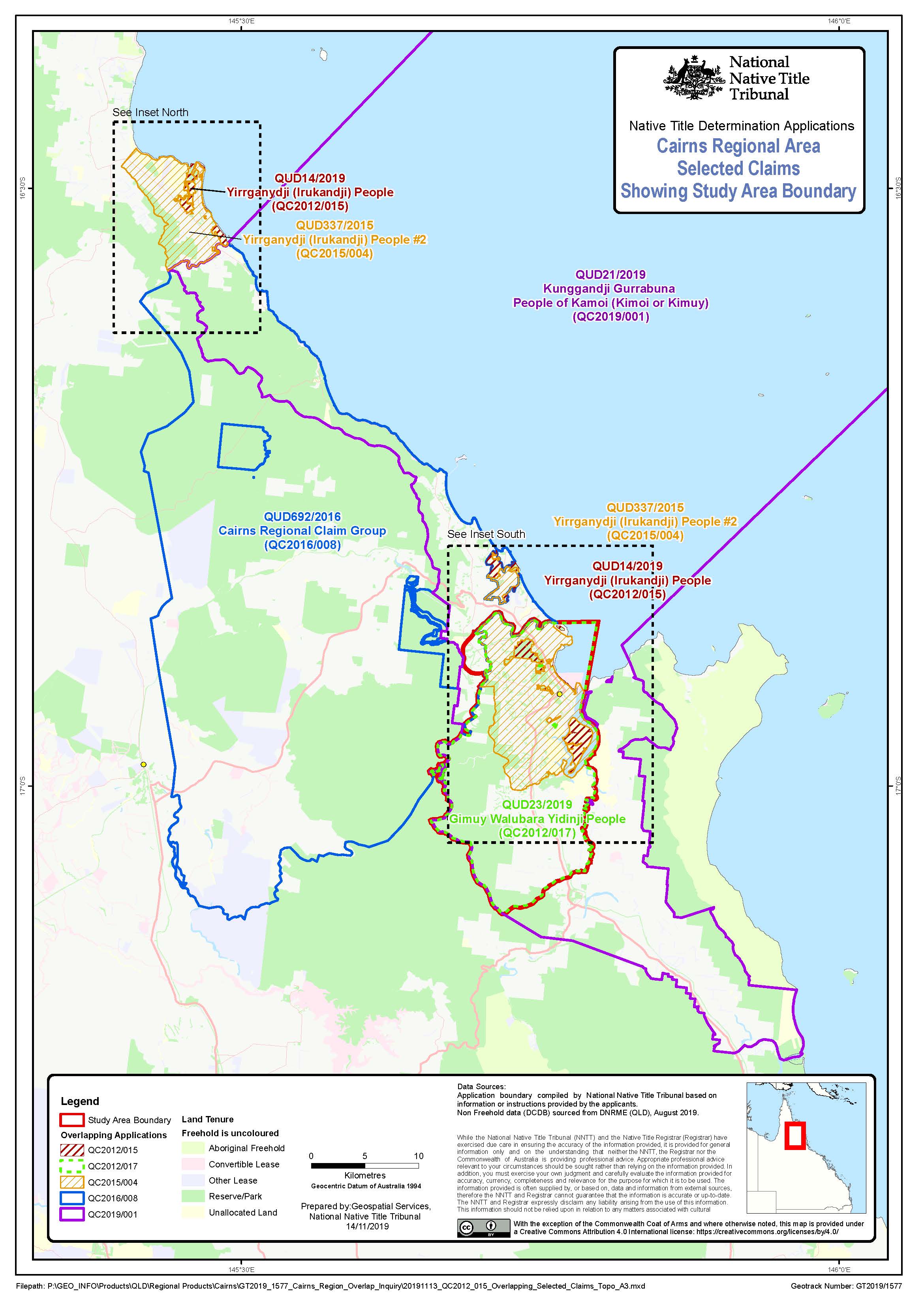
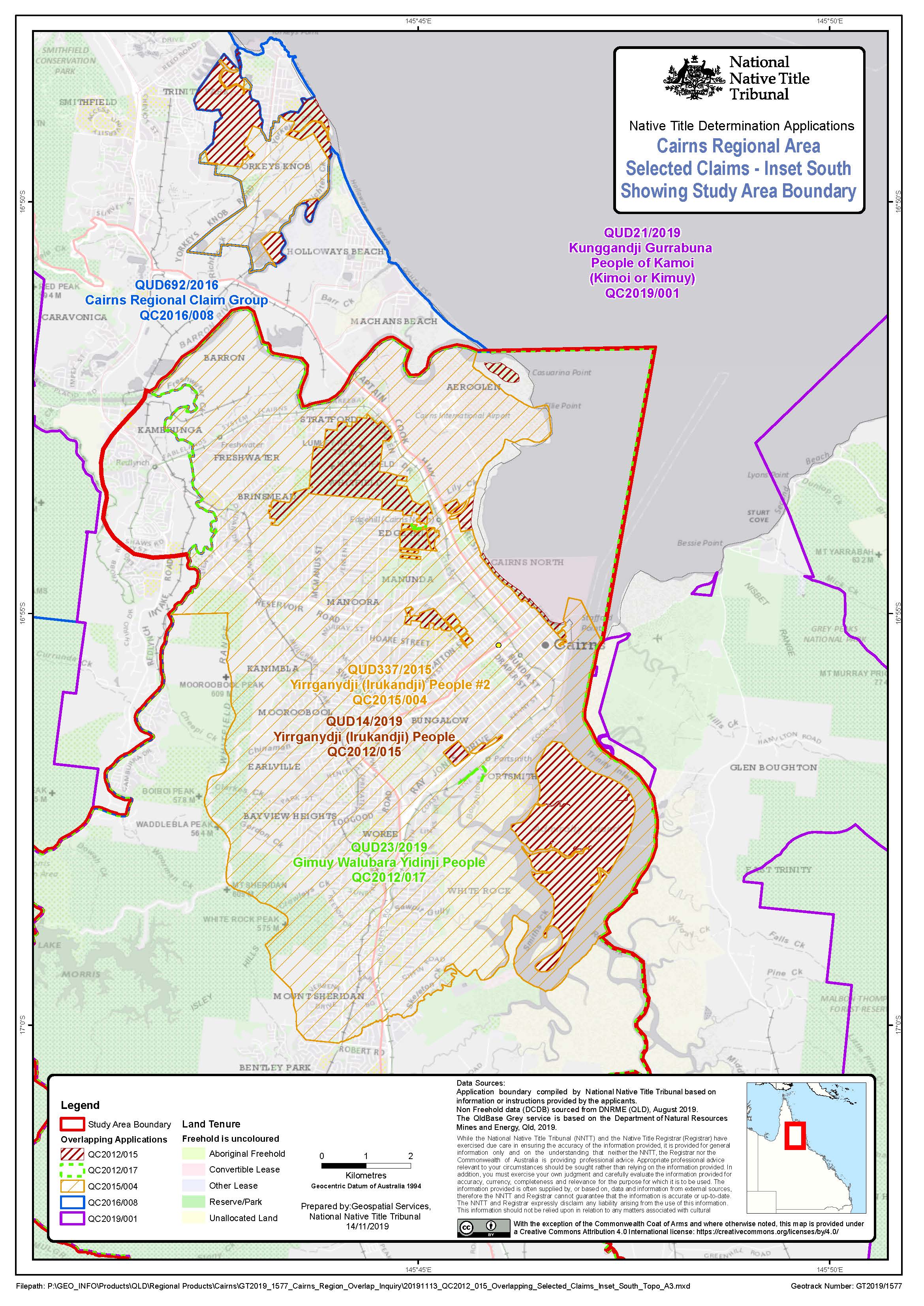
SCHEDULE 2
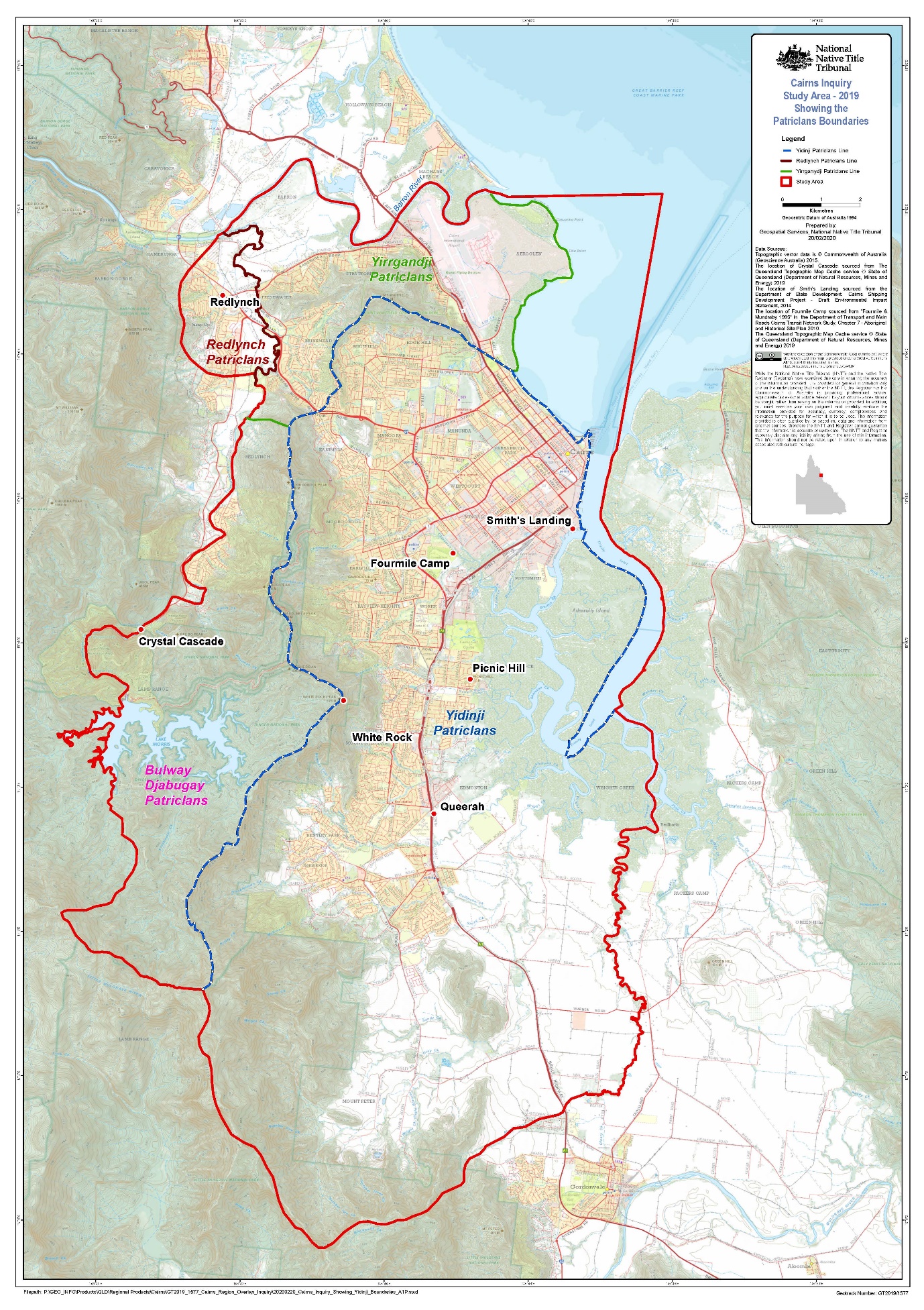
QUD 14 of 2019 | |
CHARLES KORNELL ADDO | |
Fifth Respondent: | SAM ADDO |
Sixth Respondent: | SARAH ADDO |
Seventh Respondent: | DJABUGAY NATIVE TITLE ABORIGINAL CORPORATION RNTB |
Eighth Respondent: | BERNICE CAROLE DWYER |
Ninth Respondent: | SEITH HARDY FOURMILE |
Tenth Respondent: | HENRIETTA LILIAN MARRIE |
Eleventh Respondent: | DESLEY UNDERWOOD |
Twelfth Respondent: | LEE YEATMAN |
Thirteenth Respondent: | ERGON ENERGY CORPORATION LIMITED ACN 087 646 062 |
Fourteenth Respondent: | FAR NORTH QUEENSLAND PORTS CORPORATION LIMITED |
SCHEDULE OF PARTIES B
QUD 337 of 2015 | |
Respondents | |
Fourth Respondent: | DOUGLAS SHIRE COUNCIL |
Fifth Respondent: | DOREEN BALL |
Sixth Respondent: | ROSS BOYLE |
Seventh Respondent: | ALFRED DIAMOND |
Eighth Respondent: | SEITH HARDY FOURMILE |
Ninth Respondent: | VERONA KAY FULERTON |
Tenth Respondent: | VINCENT MARK HILTON MUNDRABY |
Eleventh Respondent: | PATRICK DANIEL MICHAEL O'SHANE |
Twelfth Respondent: | NEVILLE RYAN |
Thirteenth Respondent: | FAR NORTH QUEENSLAND PORTS CORPORATION LIMITED (TRADING AS PORTS NORTH) ACN 131 836 014 |
Fourteenth Respondent: | TELSTRA CORPORATION LIMITED |
SCHEDULE OF PARTIES C
QUD 692 of 2016 | |
Respondents | |
Fourth Respondent: | DOUGLAS SHIRE COUNCIL |
Fifth Respondent: | MAREEBA SHIRE COUNCIL |
Sixth Respondent: | CHARLES KORNELL ADDO |
Seventh Respondent: | SARAH ADDO |
Eighth Respondent: | JABALBINA YALANJI ABORIGINAL CORPORATION |
Ninth Respondent: | TELSTRA CORPORATION LIMITED ABN 33 051 775 556 |
Tenth Respondent: | KEITH REGINALD ARMSTRONG |
Eleventh Respondent: | MARGARET ROSE ARMSTRONG |
Twelfth Respondent: | RON REDDICLIFFE |
Thirteenth Respondent: | SKYRAIL PTY LTD |
Fourteenth Respondent: | IAN WALLACE |
Fifteenth Respondent | ROBERT WALLACE |
Sixteenth Respondent | YVONNE WALLACE |
Seventeenth Respondent | DUANE CASH |
Eighteenth Respondent | COLDAV PTY LTD |
Nineteenth Respondent | CORRINE MARIE NOEL LA BAYSSE , THE EXECUTOR AND SOLE BENEFICIARY OF THE ESTATE OF MARC EDWARD ALIN LA BAYSSE |
Twentieth Respondent | HARTLEY’S CREEK CROCODILE FARMING CO PTY LTD |
Twenty First Respondent | DEAN MAHONEY |
SCHEDULE OF PARTIES D
QUD 21 of 2019 | |
Respondents | |
Fourth Respondent: | DOUGLAS SHIRE COUNCIL |
Fifth Respondent: | MAREEBA SHIRE COUNCIL |
Sixth Respondent: | HENRIETTA MARRIE |
Seventh Respondent: | SEITH HARDY FOURMILE |
Eighth Respondent: | DEWAYNE CLINTON MUNDRABY |
Ninth Respondent: | MANDINGALBAY YIDINJI ABORIGINAL CORPORATION |
Tenth Respondent: | WILLIAM BRIM |
Eleventh Respondent: | NORTH QUEENSLAND LAND COUNCIL ABORIGINAL CORPORATION |
Twelfth Respondent: | CAPE YORK LAND COUNCIL ABORIGINAL CORPORATION |
Thirteenth Respondent: | JEANETTE SINGLETON |
Fourteenth Respondent: | KERRY SHEPPARD |
Fifteenth Respondent: | GEORGE SKEENE |
Sixteenth Respondent: | ERGON ENERGY CORPORATION LIMITED ACN 087 646 062 |
Seventeenth Respondent: | FAR NORTH QUEENSLAND PORTS CORPORATION LIMITED ACN 131 836 014 |
Eighteenth Respondent: | TELSTRA CORPORATION LIMITED ABN 33 051 775 556 |
Nineteenth Respondent: | AFL CAIRNS LIMITED ACN 010 616 798 |
Twentieth Respondent: | CAIRNS AIRPORT PTY LTD ACN 132 228 221 |
Twenty First Respondent: | SKYRAIL PTY LTD |
Twenty Second Respondent: | DEAN MAHONEY |
Twenty Third Respondent: | CAIRNS DISTRICT JUNIOR RUGBY LEAGUE LIMITED |
Twenty Fourth Respondent: | HARTLEY’S CREEK CROCODILE FARMING COMPANY PTY LTD T/AS HARTLEY’S CREEK CROCODILE ADVENTURES |
Twenty Fifth Respondent: | THE CAIRNS CULTURAL CO-ORDINATING ASSOCIATION INC |
Twenty Sixth Respondent: | DUANE CASH |
Twenty Seventh Respondent: | BRUCE MOGENSEN |
Twenty Eighth Respondent: | STEVE ROSE |
SCHEDULE OF PARTIES E
QUD 23 of 2019 | |
Respondents | |
Fourth Respondent: | CHARLES KORNELL ADDO |
Fifth Respondent: | SAM ADDO |
Sixth Respondent: | SARAH ADDO |
Seventh Respondent: | DJABUGAY NATIVE TITLE ABORIGINAL CORPORATION RNTB |
Eighth Respondent: | BERNICE CAROLE DWYER |
Ninth Respondent: | ALLISON HALLIDAY |
Tenth Respondent: | VINCENT MARK HILTON MUNDRABY |
Eleventh Respondent: | NORTH QUEENSLAND LAND COUNCIL ABORIGINAL CORPORATION |
Twelfth Respondent: | KERRI SHEPPARD |
Thirteenth Respondent: | JEANETTE SINGLETON |
Fourteenth Respondent: | GEORGE SKEENE |
Fifteenth Respondent: | DESLEY UNDERWOOD |
Sixteenth Respondent: | DONALD JAMES HUSSEY |
Seventeenth Respondent: | AFL CAIRNS LTD ACN 010 616 798 |
Eighteenth Respondent: | CAIRNS CULTURAL COORDINATING ASSOCIATION INCORPORATED |
Nineteenth Respondent: | ERGON ENERGY CORPORATION LIMITED ACN 087 646 062 |
Twentieth Respondent: | FAR NORTH QUEENSLAND PORTS CORPORATION LIMITED |
Twenty First Respondent: | TELSTRA CORPORATION LIMITED |


