

Federal Court of Australia
O'Connor on behalf of the Palyku People v State of Western Australia (No 2) [2021] FCA 195
ORDERS
TAMMY O'CONNOR, PETER JAFFREY, CHERYL MACKAY AND KEVIN STREAM ON BEHALF OF THE PALYKU PEOPLE (PALYKU #1) Applicant | ||
AND: | Respondent (and others named in the Schedule) | |
WAD 483 of 2018 | ||
| ||
BETWEEN: | KEVIN STREAM, TAMMY O'CONNOR, PETER JAFFREY, CHERYL MACKAY AND WALTER STREAM ON BEHALF OF THE PALYKU PEOPLE (PALYKU #2) Applicant | |
AND: | STATE OF WESTERN AUSTRALIA Respondent (and others named in the Schedule) | |
THE COURT NOTES THAT:
A. The Applicant in proceedings WAD 23 of 2019 has made a native title determination application (Palyku #1 Application). The Applicant in proceedings WAD 483 of 2018 has made a native title determination application (Palyku #2 Application).
B. The Applicant in the Palyku #1 Application, the Applicant in the Palyku #2 Application, the State of Western Australia and the relevant Respondents to the Palyku #1 and Palyku #2 Applications (the parties) have reached an agreement as to the terms of the determination which is to be made in relation to part of the land and waters covered by the Palyku #1 Application and part of the land and waters covered by the Palyku #2 Application (the Determination Area). The external boundaries of the Determination Area are described in Schedule One to the Determination.
C. The parties have agreed that, in respect of the balance of the land and waters the subject of the Palyku #1 and Palyku #2 Applications, no determination is to be made at present. These areas comprise that portion of the Palyku #1 Application which is overlapped by native title determination applications WAD 20 of 2019 (Nyamal #1) and WAD 289 of 2018 (Nyamal Overlap #1) and that portion of the Palyku #2 Application which is overlapped by the Nyamal #1 Application and WAD 482 of 2018 (Nyamal Overlap #2).
D. Pursuant to s 87A(1)(d), (2) and (4) of the Native Title Act 1993 (Cth) (Native Title Act) the parties have filed with the Court a Minute of Proposed Consent Determination of Native Title setting out the terms of the agreement reached by the parties in relation to part of the Palyku #1 and Palyku #2 Applications.
E. The terms of the agreement involve the making of consent orders for a determination pursuant to s 87A and s 94A of the Native Title Act that native title exists in relation to the land and waters of the Determination Area (save for certain specified areas where it will be determined to have been extinguished).
F. The parties acknowledge that the effect of the making of the determination is that the members of the native title claim group, in accordance with the traditional laws acknowledged and the traditional customs observed by them, should be recognised as the native title holders for the Determination Area as set out in the determination.
G. Pursuant to s 87A(4) of the Native Title Act, the parties have requested that the Court determine the proceedings that relate to the Determination Area without holding a hearing.
H. The Applicants in the Palyku #1 and Palyku #2 Applications have nominated the Palyku-Jartayi Aboriginal Corporation RNTBC (ICN 9217) pursuant to s 56(2)(a) of the Native Title Act to hold the determined native title in trust for the native title holders.
BEING SATISFIED that a determination of native title in the terms set out in Attachment A would be within the power of the Court and, it appearing to the Court appropriate to do so, pursuant to s 87A and s 94A of the Native Title Act and by the consent of the parties:
THE COURT ORDERS THAT:
1. In relation to the Determination Area, there is a determination of native title in WAD 23 of 2019 and WAD 483 of 2018 in the terms provided for in Attachment A.
2. The Palyku-Jartayi Aboriginal Corporation RNTBC (ICN 9217) shall hold the determined native title in trust for the native title holders pursuant to s 56(2)(b) of the Native Title Act.
3. There is no order as to costs.
Note: Entry of orders is dealt with in Rule 39.32 of the Federal Court Rules 2011.
ATTACHMENT A
DETERMINATION
THE COURT ORDERS, DECLARES AND DETERMINES THAT:
Existence of native title: s 225 Native Title Act
1. Subject to paragraph 2, native title exists in the Determination Area in the manner set out in paragraph 4 of this determination.
2. Native title does not exist in those parts of the Determination Area that are identified in Schedule Three, which are shown as generally shaded pink on the maps at Schedule Two.
Native title holders: s 225(a) Native Title Act
3. The native title in the Determination Area is held by the Palyku People. The Palyku People are the people referred to in Schedule Six.
The nature and extent of native title rights and interests and exclusiveness of native title: s 225(b) and s 225(e) Native Title Act
4. Subject to paragraphs 2, 5, 6, 7 and 10, the nature and extent of the native title rights and interests in relation to the Determination Area are that they confer the following non-exclusive rights on the Palyku People, including the right to conduct activities necessary to give effect to them:
(a) the right to enter and remain on the land, camp, erect temporary shelters and travel over and visit any part of the land and waters of the Determination Area;
(b) the right to hunt, fish, gather, take and use the traditional resources of the land;
(c) the right to take and use water;
(d) the right to engage in cultural activities and the transmission of cultural knowledge on the Determination Area, including:
(i) visiting places of cultural or spiritual importance and maintaining, caring for, and protecting those places by carrying out activities to preserve their physical or spiritual integrity; and
(ii) conducting ceremony and ritual, including burial and burial rites; and
(e) the right to be accompanied on to the Determination Area by those people who, though not Palyku People and who (for the avoidance of doubt) cannot themselves exercise any native title right in the Determination Area, are:
(i) the non-Palyku spouses, parents or children of the Palyku People; or
(ii) people entering in connection with, and subject to, traditional law and custom for the performance of ceremonies or cultural activities on the Determination Area.
Qualifications on the native title rights and interests
5. The native title rights and interests set out in paragraph 4 are subject to and exercisable in accordance with:
(a) the laws of the State and the Commonwealth, including the common law; and
(b) the traditional laws and customs of the Palyku People for personal, domestic and communal purposes (including social, cultural, religious, spiritual and ceremonial purposes) but not for commercial purposes.
6. Notwithstanding anything in this Determination, there are no native title rights and interests in the Determination Area in relation to:
(a) minerals as defined in the Mining Act 1904 (WA) (repealed) and in the Mining Act 1978 (WA), except to the extent that ochre is not a mineral pursuant to the Mining Act 1904 (WA);
(b) petroleum as defined in the Petroleum Act 1936 (WA) (repealed) and in the Petroleum and Geothermal Energy Resources Act 1967 (WA);
(c) geothermal energy resources and geothermal energy as defined in the Petroleum and Geothermal Energy Resources Act 1967 (WA); or
(d) water captured by the holders of the Other Interests described in Schedule Four pursuant to those Other Interests.
7. The native title rights and interests set out in paragraph 4 do not confer:
(a) possession, occupation, use and enjoyment on the Palyku People to the exclusion of all others; or
(b) a right to control the access to, or use of, the land and waters of the Determination Area or its resources.
Areas to which s 47A of the Native Title Act applies
8. Section 47A of the Native Title Act applies to disregard any prior extinguishment in relation to the areas described in Schedule Five.
The nature and extent of any other interests: s 225(c) Native Title Act
9. The nature and extent of the Other Interests are described in Schedule Four.
Relationship between native title rights and Other Interests: s 225(d) Native Title Act
10. Except as otherwise provided for by law, the relationship between the native title rights and interests described in paragraph 4 and the Other Interests described in Schedule Four is that:
(a) to the extent that any of the Other Interests are inconsistent with the continued existence, enjoyment or exercise of the native title rights and interests, the native title rights and interests continue to exist in their entirety, but the native title rights and interests have no effect in relation to the Other Interests to the extent of the inconsistency during the currency of the Other Interests; and otherwise,
(b) the existence and exercise of the native title rights and interests do not prevent the doing of any activity required or permitted to be done by or under the Other Interests, and the Other Interests, and the doing of any activity required or permitted to be done by or under the Other Interests, prevail over the native title rights and interests and any exercise of the native title rights and interests but do not extinguish them.
Liberty to Apply
11. The parties have liberty to apply to establish the precise location and boundaries of the public works and adjacent land and waters identified in relation to any part or parts of the Determination Area referred to in clause 3 of Schedule Three of this Determination.
Definitions and Interpretation
12. In this Determination, unless the contrary intention appears:
'Determination Area' means the land and waters described in Schedule One and depicted on the maps at Schedule Two;
'land' has the same meaning as in the Native Title Act and, for the avoidance of doubt, includes any natural collection of water found on the land which does not fall within the definition of 'waters';
'Native Title Act' means the Native Title Act 1993 (Cth);
'native title holders' means the Palyku People as described in Schedule Six and referred to in paragraph 3;
'Other Interests' means the legal or equitable estates or interests and other rights in relation to the Determination Area described in Schedule Four and referred to in paragraph 9;
'resources' means flora, fauna, and other natural resources such as charcoal, stone, soil, wood, resin and ochre (except, for the avoidance of doubt, ochres for use in the manufacture of porcelain, fine pottery or pigments which are minerals pursuant to the Mining Act 1904 (WA) (repealed));
'use' includes by way of share and exchange but does not include use by way of trade; and
'waters' has the same meaning as in the Native Title Act.
13. In the event of any inconsistency between the written description of an area in Schedule One, Three, Four or Five and the area as depicted on the maps at Schedule Two, the written description prevails.
SCHEDULE ONE
DETERMINATION AREA
The Determination Area, generally shown as bordered in blue on the maps at Schedule Two, comprises all land and waters bounded by the following description:
AREA 1
All those lands and waters commencing at the intersection of the southeasternmost corner of Native Title Determination WAD47/2014 Kariyarra - Abydos (WCD2018/015) and a northeastern corner of Native Title Determination WAD23/2019 Palyku Part A (WCD2019/002) and extending generally northeasterly through the following coordinate positions:
Latitude (South) | Longitude (East) |
21.598590 | 119.106315 |
21.586234 | 119.113523 |
21.568729 | 119.126909 |
21.548822 | 119.142011 |
21.528915 | 119.159516 |
21.511067 | 119.174274 |
Then northeasterly to a southern corner of Native Title Determination WAD20/2019 Nyamal People #1 (WCD2019/010) at approximate Latitude 21.507206 South and Longitude 119.177269 East; Then generally southeasterly through the following coordinate positions:
Latitude (South) | Longitude (East) |
21.513187 | 119.182725 |
21.534487 | 119.200725 |
21.539087 | 119.204425 |
21.563087 | 119.223625 |
21.569888 | 119.229124 |
21.586888 | 119.240424 |
21.597989 | 119.248024 |
21.613489 | 119.257723 |
21.625589 | 119.266823 |
21.642590 | 119.280022 |
21.657090 | 119.290822 |
21.673590 | 119.305022 |
21.687290 | 119.318722 |
Then southeasterly to a northern boundary of Native Title Determination WAD23/2019 Palyku Part A (WCD2019/002) at Longitude 119.324150 East; Then generally northwesterly along the northern boundaries of that native title determination back to the commencement point.
AREA 2
All those lands and waters commencing at Latitude 21.787919 South and Longitude 119.545695 East and extending generally southeasterly through the following coordinate positions:
Latitude (South) | Longitude (East) |
21.799816 | 119.583766 |
21.866441 | 119.727961 |
21.922121 | 119.831706 |
Then southeasterly to a northwestern boundary of Native Title Determination WAD23/2019 Palyku Part A (WCD2019/002) at Latitude 21.928851 South; Then generally southwesterly and generally northwesterly along the northern boundaries of that native title determination to Latitude 21.771751 South; Then southeasterly back to the commencement point.
AREA 3
All those lands and waters commencing at a northeastern corner of Native Title Determination WAD23/2019 Palyku Part A (WCD2019/002) at approximate coordinate position Latitude 21.916154 South and Longitude 120.094753 East and extending easterly to Latitude 21.917792 South and Longitude 120.188853 East; Then generally southeasterly to an intersection with a northeastern corner of again Native Title Determination WAD23/2019 Palyku Part A (WCD2019/002) at approximate Latitude 21.961712 South and Longitude 120.237308 East; Then westerly, southerly, again westerly, northerly, northeasterly, again westerly and again northerly along the boundaries of that native title determination back to the commencement point.
EXCLUSIONS
Dedicated Road No. 3857
Note: Geographic Coordinates provided in Decimal Degrees.
Cadastral boundaries sourced from Landgate's Spatial Cadastral Database dated 1st October 2020.
For the avoidance of doubt the application excludes any land and waters already claimed by:
• Native Title Determination WAD6169/1998, WAD232/2009 & WAD47/2014 Kariyarra (WCD2018/015) as Determined in the Federal Court on 13 December 2018.
• Native Title Determination WAD20/2019 Njamal People #1 (WCD2019/010) as Determined in the Federal Court on 24 September 2019.
• Native Title Determination WAD23/2019 Palyku Part A (WCD2019/002) as Determined in the Federal Court on 12 March 2019.
• Native Title Determination Application WAD20/2019 Njamal (WC1999/008) as submitted to the National Native Title Tribunal on 28 September 2007.
• Native Title Determination Application WAD289/2018 Nyamal Overlap Claim (WC2018/011) as filed in the Federal Court on 28 June 2018.
Datum: Geocentric Datum of Australia 1994 (GDA94)
Prepared By: Graphic Services (Landgate) 12 October 2020
Use of Coordinates:
Where coordinates are used within the description to represent cadastral or topographical boundaries or the intersection with such, they are intended as a guide only. As an outcome to the custodians of cadastral and topographic data continuously recalculating the geographic position of their data based on improved survey and data maintenance procedures, it is not possible to accurately define such a position other than by detailed ground survey.
SCHEDULE TWO
MAPS OF THE DETERMINATION AREA
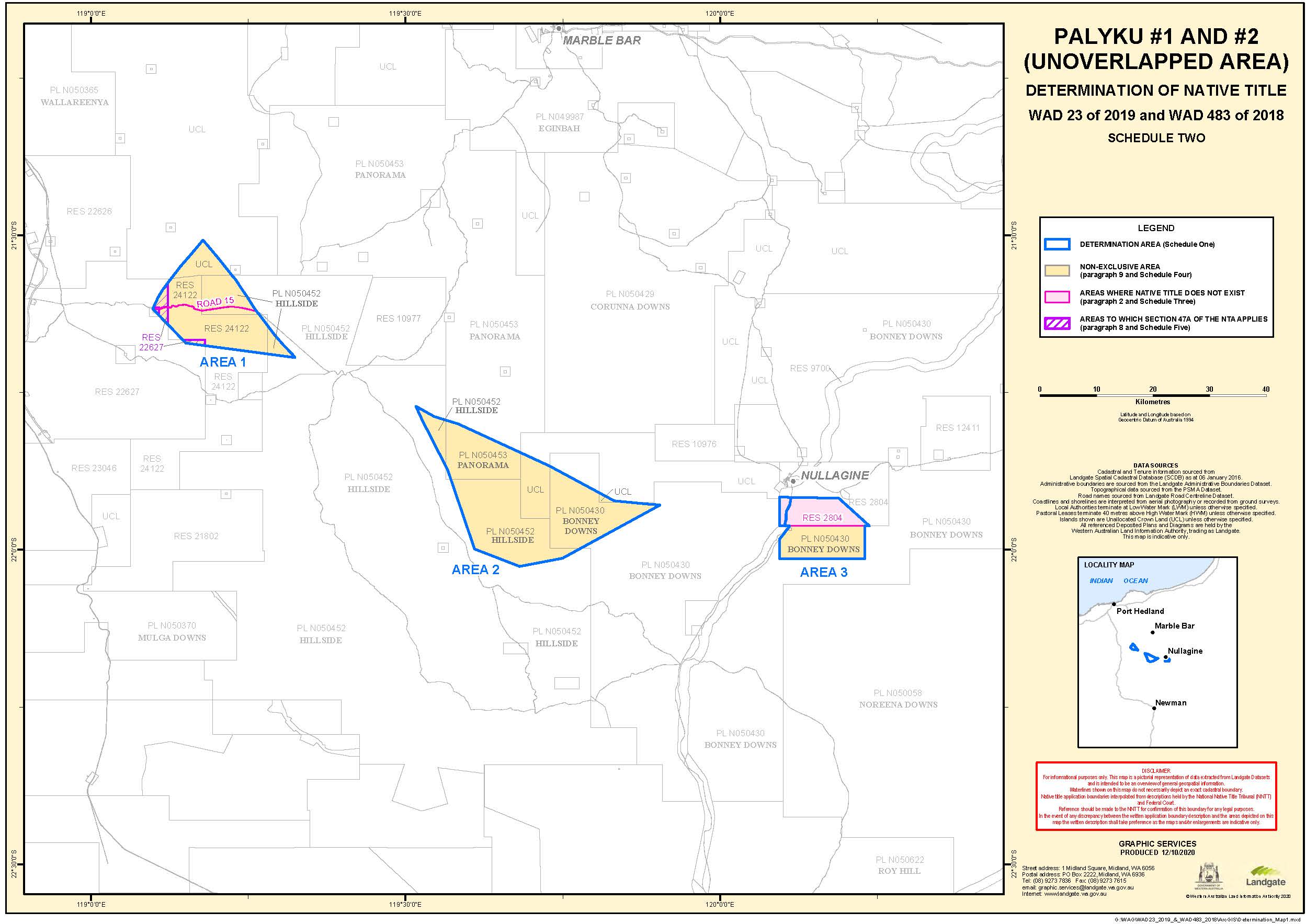
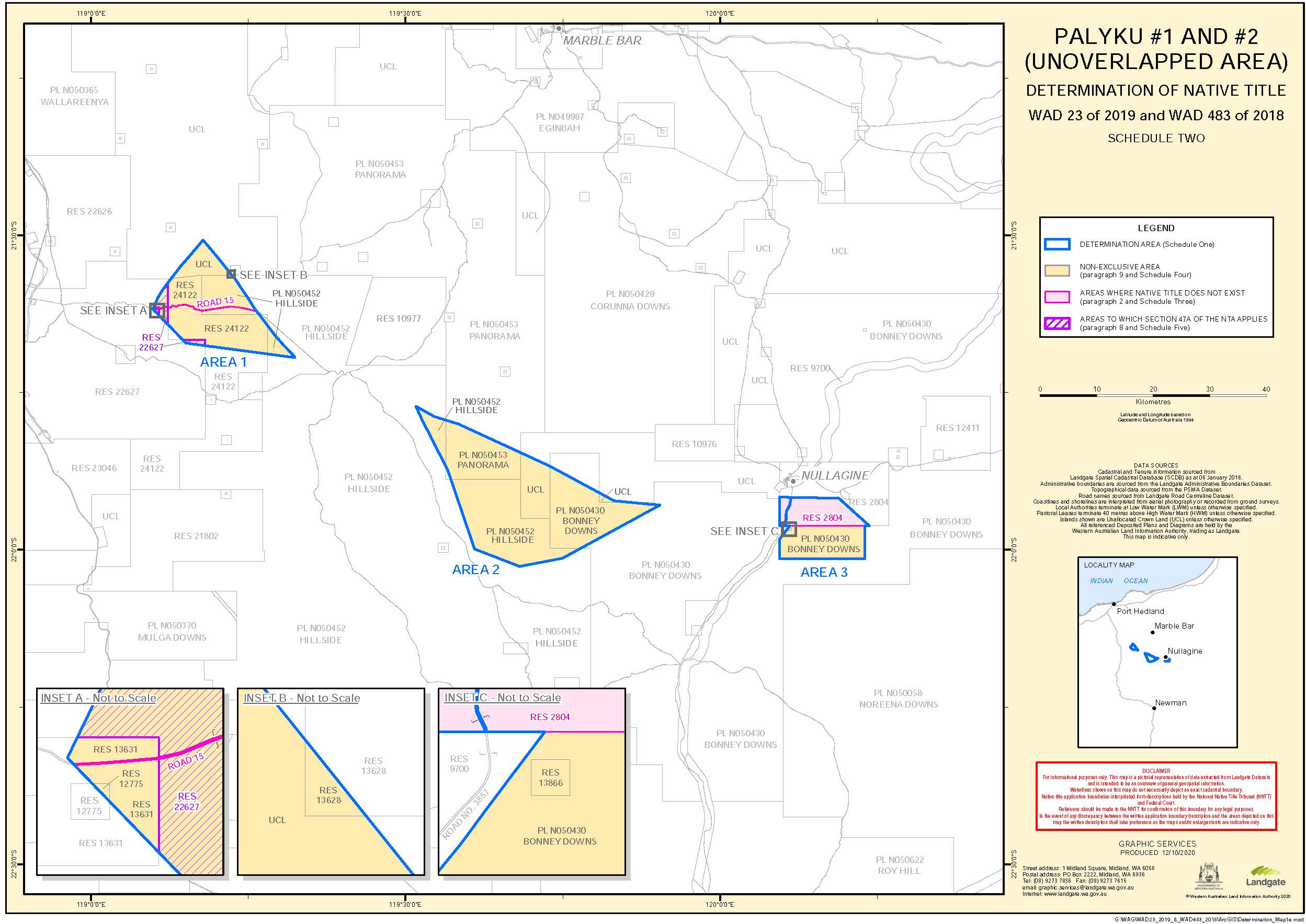
SCHEDULE THREE
AREAS WHERE NATIVE TITLE DOES NOT EXIST
Paragraph 2
Native title does not exist in relation to land and waters the subject of the following interests within the Determination Area, which, with the exception of public works (as described in clause 3 of this Schedule), are generally shown as shaded in pink on the maps at Schedule Two.
1. Reserves
The following reserves:
Reserve No. | Current / Last Purpose |
02804 | Commonage |
2. Roads
Dedicated roads, roads set aside, taken or resumed or roads which are to be considered public works (as that expression is defined in the Native Title Act and the Titles (Validation) and Native Title (Effect of Past Acts) Act 1995 (WA), including the following:
MapInfo ID. | Description | Shown on / in |
Road 15 | Road No. 00389 | Government Gazettes dated 31/08/1893, 07/06/1895, 01/04/1977 and 14/09/1979 and shown on Public Plan 503154 cancelled on 12/06/1952 and Public Plan 503165 cancelled on 16/07/1965 |
3. Public Works
Any other public works as that expression is defined in the Native Title Act and the Titles (Validation) and Native Title (Effect of Past Acts) Act 1995 (WA) (including the land and waters on which a public work is constructed, established or situated as described in s 251D of the Native Title Act) and to which s 12J of the Titles (Validation) and Native Title (Effect of Past Acts) Act 1995 or s 23C(2) of the Native Title Act applies.
SCHEDULE FOUR
OTHER INTERESTS
Paragraph 9
The nature and extent of the Other Interests in relation to the Determination Area are as follows.
Land tenure interests registered with the Western Australian Land Information Authority are current as at 1 October 2020. Mining tenements and petroleum interests registered with the Department of Mines, Industry Regulation and Safety are current as at 8 October 2020. All other interests are current as at the date of the determination.
1. Reserves
(a) The following reserves:
Reserve No.
Current / Last Purpose
12775
Water
13628
Timber
13631
Timber
13866
Water (Cadjiput Spring Well)
22627
Preservation of Aboriginal Cultural Materials and Historic Buildings and Grazing (Woodstock)
24122
Mining
(b) The rights and interests of persons who have the care, control and management of the reserves identified in subclause (a) above;
(c) The rights and interests of persons entitled to access and use the reserves identified in subclause (a) above for the respective purposes for which they are reserved, subject to any statutory limitations upon those rights; and
(d) The rights and interests of persons holding leases over areas of the reserves identified in subclause (a) above.
2. Pastoral Leases
(a) The following pastoral leases and the rights and interests of the holders from time to time of those pastoral leases:
Lease No.
Description
PL N050430
Bonney Downs
PL N050452
Hillside
PL N050453
Panorama
(b) Any rights and obligations of the pastoralists pursuant to the pastoral leases referred to in subclause (a) above to adopt and exercise best practice management of the pasture and vegetation resources, livestock and soils within the boundaries of the pastoral leases in order to manage stock and for the management, conservation and regeneration of pasture for permitted uses.
3. Mining Tenements
The following mining tenements granted under the Mining Act 1904 (WA) (repealed) and/or the Mining Act 1978 (WA) and the rights and interests of the holders from time to time of those tenements:
(a) Exploration Licences
Tenement ID
Tenement ID
Tenement ID
E 4502922
E 4504708
E 4601166
E 4504029
E 4504824
E 4601170
E 4504180
E 4504936
E 4601260
E 4504275
E 4504997
E 4601262
E 4504420
E 4505324
E 4601302
E 4504475
E 4600794
E 4601303
E 4504476
E 4600797
E 4601331
E 4504658
E 4601156
(b) Mining Leases:
Tenement ID
Tenement ID
Tenement ID
M 4500988
M 4500990
M 4500991
M 4600138
M 4600264
M 4600432
M 4600170
M 4600265
M 4600436
M 4600186
M 4600266
M 4600443
M 4600192
M 4600267
M 4600444
M 4600262
M 4600300
M 4600445
(c) Miscellaneous Licences:
Tenement ID
L 4500395
L 4600033
L 4600067
(d) Prospecting Licences:
Tenement ID
Tenement ID
Tenement ID
P 4503087
P 4601841
P 4601851
P 4601755
P 4601842
P 4601852
P 4601756
P 4601843
P 4601853
P 4601808
P 4601844
P 4601854
P 4601821
P 4601845
P 4601923
P 4601836
P 4601846
P 4601924
P 4601837
P 4601847
P 4601969
P 4601838
P 4601848
P 4601970
P 4601839
P 4601849
P 4601973
P 4601840
P 4601850
4. Access to Mining Tenements
(a) Without limiting the operation of any other clause in Schedule Four, but subject to clause 4(b) below, any rights of the holders from time to time of a mining tenement including those listed in clause 3 of this Schedule Four, to use (including by servants, agents and contractors) such portions of roads and tracks in the Determination Area (existing as at the date of this Determination) as are necessary to have access to the area the subject of the mining tenement or petroleum interest for the purposes of exercising the rights granted by that tenement or interest.
(b) Nothing in clause 4(a) above allows any upgrade, extension, widening or other improvement to the road or track other than work done to maintain it in reasonable repair and in order to leave it in substantially the same condition as it was prior to its use pursuant to clause 4(a).
(c) Nothing in Schedule Four will limit the rights of the holders from time to time of mining tenements, including those referred to in clause 3 of Schedule Four, including, without limitation, any right to exclude members of the public from entering onto the land and waters the subject of any mining tenement.
5. Woodstock Protected Area
The rights and interests comprised in, conferred under or in accordance with, or pursuant to the Woodstock protected area declared pursuant to s 19 of the Aboriginal Heritage Act 1972 (WA) by Order in Council published in the Government Gazette on 25 May 1979 (as amended by notice published in the Government Gazette on 18 July 2006).
6. Other
The following rights and interests in the Determination Area:
(a) Rights and interests, including licences and permits, granted by the Crown in right of the State or of the Commonwealth pursuant to statute or otherwise in the exercise of its executive power and any regulations made pursuant to such legislation;
(b) Rights and interests held by reason of the force and operation of the laws of the State or of the Commonwealth, including but not limited to, force and operation of the Rights in Water and Irrigation Act 1914 (WA);
(c) Rights and interests of members of the public arising under common law, including but not limited to:
(i) the public right to fish;
(ii) the public right to navigate; and
(iii) the right of any person to use and enjoy any roads in the Determination Area (subject to the laws of the State) over which, as at the date of this determination, members of the public have a right of access under the common law;
(d) The right to access the Determination Area by:
(i) an employee, agent or instrumentality of the State;
(ii) an employee, agent or instrumentality of the Commonwealth; or
(iii) an employee, agent or instrumentality of any local government authority,
as required in the performance of his or her statutory or common law duty, including for the purpose of pest management control and fire hazard management on areas of unallocated Crown land and unmanaged Crown reserves;
(e) So far as confirmed pursuant to s 212(2) of the Native Title Act and s 14 of the Titles (Validation) and Native Title (Effect of Past Acts) Act 1995 (WA) as at the date of this determination, any existing public access to and enjoyment of, the following places in the Determination Area:
(i) waterways;
(ii) beds and banks or foreshores of waterways;
(iii) coastal waters;
(iv) beaches;
(v) stock routes; and
(vi) areas that were public places at the end of 31 December 1993;
(f) Any other:
(i) legal or equitable estate or interest in the land or waters of the Determination Area; or
(ii) right (including a right under an option and a right of redemption), charge, power or privilege over, or in connection with:
(A) the land or waters of the Determination Area; or
(B) an estate or interest in the land or waters of the Determination Area; or
(iii) restriction on the use of the land or waters of the Determination Area, whether or not annexed to other land or waters.
SCHEDULE FIVE
AREAS TO WHICH SECTION 47A OF THE NATIVE TITLE ACT APPLIES
Paragraph 8
Section 47A of the Native Title Act applies with the effect that any extinguishment by the creation of the following interests (and by the creation of any other prior interests in relation to the area of the following interests) is to be disregarded:
Interest | Description / Purpose |
Reserve 22627 | Preservation of Aboriginal Cultural Materials and Historic Buildings and Grazing (Woodstock) |
SCHEDULE SIX
NATIVE TITLE HOLDERS
Paragraph 3
The Palyku People are those Aboriginal persons who:
(a) are the cognatic descendants of, or are culturally reared up (adopted) by such cognatic descendants of, one or more of the following apical ancestors:
(i) Pitawanu;
(ii) Pupu;
(iii) Winnie;
(iv) Wilyarpirna;
(v) Puyungayi;
(vi) Yurramara;
(vii) Munjarnpirna and Jukukayi;
(viii) Jujuna;
(ix) Fannie, Annie Patawani and Chinaman Janjanamarlu;
(x) Pijipangu;
(xi) Kijiempa;
(xii) Maggie Kuntuwarrpangu;
(xiii) Peter Long Wayalpa;
(xiv) Julimanga;
(xv) Wantungu;
(xvi) Kalurru;
(xvii) Alec Weatherall;
(xviii) Major and Judy;
(xix) Mary Barrdi; or
(xx) Sophie Bunbry; and
(b) identify themselves, and are recognised by a substantial number of the descendants of the above apical ancestors as, a Palyku person; and
(c) have rights and interests in, and a connection with, the land and waters of the Determination Area, in accordance with the traditional laws acknowledged and the traditional customs observed by the Palyku People.
JACKSON J:
1 The Native Title Act 1993 (Cth) (Native Title Act) provides for the recognition, by the laws of Australia, of rights and interests of Aboriginal people in relation to land or waters, under the traditional laws and customs of those people. That is recognition of the connection those people have to country. The rights and interests so recognised have existed since before British sovereignty, and have existed ever since.
2 In 1998 the Palyku people made applications for such recognition, by way of a determination of native title in relation to their traditional lands in the eastern Pilbara region of Western Australia. In 2019 this court made a determination by consent in relation to part of the land and waters covered by the applications. Also by consent, the parties now put before the court a proposed determination under s 87A of the Act in relation to further parts of those lands and waters. The proceedings remain pending over the balance of the area the subject of the claim, which is also the subject of overlapping applications by the Nyamal people.
3 For the following reasons, the court has power to make the determination sought, and it is appropriate to do so.
Procedural history
4 The determination is sought in two proceedings in this court: WAD 23 of 2019, O'Connor v State of Western Australia (Palyku #1); and WAD 483 of 2018, Stream v State of Western Australia (Palyku #2). The procedural history is quite involved; a summary of key events now follows.
Palyku #1
5 The history of the proceedings starts in 1998, when two applications were made to the Native Title Tribunal. One was an application in relation to a relatively small area of a reserve, which was lodged in response to a future act. The other was a claim to a broader area covering the land and waters of what became Palyku #1. The broader application included the area of the smaller one.
6 Both of the applications were lodged with the National Native Title Tribunal under the provisions of the Native Title Act as they stood before the commencement of the Native Title Amendment Act 1998 (Cth). Once that amending legislation came into effect, the applications were taken to have been made to this court.
7 In 1999 the court ordered that each of the two applications be combined into Palyku #1. The new proceeding kept the court file number of one of the previous applications, WAD 6287 of 1998. Palyku #1 was considered by the Native Title Register under s 190A of the Native Title Act (the registration test). The registrar was satisfied that the application addressed the criteria of the registration test and the application was entered on the Register of Native Title Claims. The registrar gave notice of the application to various persons and bodies, as required by s 66 of the Native Title Act. The statutory three month period after the notification day set in the notice ended on 16 August 2000.
8 On 31 August 2018 the court made an order for separate questions in Palyku #1 which had the effect of dividing the application area into two parts. Part A comprised the part of the Palyku #1 area which was not overlapped by a native title application known as Nyamal #1, and did not comprise the land and waters of a reserve, Reserve 2804, and a historical special purpose lease, SL 3116/2485. Part B comprised the remainder. The portion of Part B that does not comprise the land and waters of Reserve 2804 and SL 3116/2485 is now the subject of a separate proceeding, WAD 392 of 2018, known as the Nyamal Palyku Proceeding.
9 On 14 January 2019 Palyku #1 was given its present court file number, WAD 23 of 2019.
10 On 12 March 2019 the land and waters of Part A were the subject of a consent determination under s 87A of the Native Title Act: O'Connor on behalf of the Palyku People v State of Western Australia [2019] FCA 330. The court determined that persons described in the determination held native title in relation to the area of Part A. Those persons (Palyku People) are identical to the group of persons who will hold native title pursuant to the consent determination now proposed.
11 Section 64(1B) of the Native Title Act has the effect that an application is taken to have been amended to reduce the area of land or waters covered by it if an order under s 87A is made. The reduction is equivalent to the area that has been made the subject of a native title determination. After the determination in 2019, therefore, Palyku #1 no longer encompassed the land and waters in Part A and now only concerns Part B.
12 On 5 June 2020, Reeves J answered separate questions concerning Reserve 2804 and SL 3116/2485: Nyamal Palyku Proceeding (No 2) [2020] FCA 788. His Honour found that the reserve was validly created so that native title over it was wholly extinguished, but the special purpose lease (which expired in 1978) was not validly granted and so had no effect on native title. The area of overlap between the special purpose lease and Palyku #1 is comprised of part of a pastoral lease called Bonney Downs, and a different reserve, Reserve 13866.
Palyku #2
13 Palyku #2 was commenced under s 61 of the Native Title Act on 29 October 2018. The application is made on behalf of the Palyku People, that is the same group as the native title holders in the determination as to Part A of Palyku #1.
14 The area covered by Palyku #2 is adjacent to the area covered by Palyku #1. Most of Palyku #2 overlaps with applications made by the Nyamal people. But there are also two parts of Palyku #2 which are not subject to any overlap. They are north of the Palyku #1 area and are part of the proposed consent determination.
15 The Native Title Registrar was not satisfied that Palyku #2 met the registration test criterion in s 190C(3) of the Native Title Act (no previous overlapping claim groups). In any event, the registrar has notified the application pursuant to s 66 and the three month notification period ended on 13 May 2019.
The proposed consent determination
16 The parties have filed a minute of proposed consent determination with the court under s 87A(2) of the Native Title Act. The Palyku applicants and the State have also filed joint submissions in support of the proposed determination.
17 As required by s 87A, a registrar of the court, acting on behalf of the Chief Executive Officer of the court, has given notice to the parties in Palyku #1 and Palyku #2 that the proposed consent determination has been filed with the court. No party has raised any objections within the time set in the registrar's notice.
18 The proposed determination relates to three separate areas, of approximately 825 square kilometres in total. One of the areas is just south of the town of Nullagine. It is part of Palyku #1. The other two areas are a western portion and a southern portion respectively of the Palyku #2 claim area, which are not overlapped by any other native title application. I will call all three areas together the Determination Area.
19 In broad terms, the native title which is to be the subject of the determination encompasses non-exclusive rights to enter on the Determination Area, to hunt, fish, gather and take the traditional resources of the land, to take and use water, and to engage in cultural activities and the transmission of cultural knowledge on the Determination Area.
The seven conditions in s 87A of the Act have been met
20 It is well accepted that s 87A contains seven conditions which must be met before the court can make a consent determination in a proceeding in relation to an application for a determination of native title. Reeves J described and addressed each of them in O'Connor at [16]-[35].
21 In considering whether each of the conditions is satisfied, I rely on the joint submission filed by the Palyku applicants and the State. It is appropriate to do so in circumstances where the court is satisfied, as it is here, that the State, in its capacity as the party charged with looking after the interests of the community generally, has given appropriate consideration to the evidence available in order to reach the compromise that is proposed. The court must also be satisfied, and is here, that the State, through competent legal representation, is satisfied of the cogency of the evidence on which the applicants rely: see Munn for and on behalf of the Gunggari People v State of Queensland [2001] FCA 1229; (2001) 115 FCR 109 at [29]. In the context of a consent determination it is not necessary for the court to make findings of fact on the issues that may have arisen had the claim been contested: see Munn at [30].
22 The first condition that needs to be satisfied is that the period specified in the notice under s 66 for the application must have ended by the time the agreement that is the foundation of the consent determination is made: s 87A(1)(b). The s 66 notices are described in the summary of the procedural history given above; this condition is satisfied here for both Palyku #1 and Palyku #2.
23 Second, agreement must have been reached on a proposed determination of native title to an area that is included in the area covered by the application: s 87A(1)(b). As I have said, one of the areas the subject of the agreement that has been reached here is part of the area of Palyku #1, and the remaining two areas are part of the area of Palyku #2.
24 Third, s 87A(1)(c) describes a number of different categories of parties, and requires all persons or bodies who fall into one of those categories to be party to the agreement. I have examined the agreement and am satisfied that it is expressed to be the agreement of all such parties applicable here. They are:
Palyku #1
(1) Tammy O'Connor, Peter Jaffrey, Cheryl Mackay and Kevin Stream (applicant);
(2) State of Western Australia;
(3) Keydrive Pty Ltd;
(4) Startline Nominees Pty Ltd;
(5) Vanguard Enterprises Pty Ltd; and
(6) Hillside Station (WA) Pty Ltd;
Palyku #2
(1) Kevin Stream, Tammy O'Connor, Peter Jaffrey, Cheryl Mackay and Walter Stream (applicant);
(2) State of Western Australia;
(3) FMG Pilbara Pty Ltd;
(4) Mt Stewart Resources Pty Ltd;
(5) Nullagine Gold Pty Ltd;
(6) Witx Pty Ltd; and
(7) Mr Murray Jackamarra (who has signed in his capacity as an indigenous respondent to Palyku #2).
25 It is relevant to note that the applicant in Nyamal #1 is a respondent to Palyku #1. However because the areas which are the subject of the consent determination are not overlapped by the Nyamal claim, it is not necessary for that respondent to be a party to the agreement, and it is not: see s 87(1)(c)(ii) and s 87(1)(c)(vi). It is also relevant to note that while the Commonwealth Minister intervened in Palyku #1 in December 2017, that minister ceased to be an intervener on 8 February 2019, so there is no need for him to be a party to the agreement, and he is not.
26 Fourth, the terms of the proposed determination must be in writing and signed by or on behalf of each of the parties referred to in s 87A(1)(c). The minute of consent here records the agreement of each party to the orders and the determination contained in the minute, and it has been signed by or on behalf of each of the parties who are listed above. This condition has been met.
27 Fifth, s 87A(3) requires the Federal Court Chief Executive Officer to give notice to the other parties to the proceeding that the proposed determination of native title has been filed with the court, and s 87A(8) provides that in considering whether to make an order, the court must take into account any objections made by the other parties to the proceeding. As has been recounted in the procedural history, this notice has been given in each of Palyku #1 and Palyku #2 and no objections have been received.
28 Sixth, the court must consider that an order in, or consistent with, the terms of the proposed determination would be within its power: s 87A(4)(a). It will be within the power of the court to make a determination in the terms of the minute if the minute complies with s 94A of the Native Title Act, if the rights and interests described in it are recognisable by the common law of Australia, and if there is no other determination in existence over the Determination Area: O'Connor at [25].
29 Section 94A requires any order in which the Federal Court makes a determination of native title to set out details of the matters mentioned in s 225. Section 225 is:
225 Determination of native title
A determination of native title is a determination whether or not native title exists in relation to a particular area (the determination area) of land or waters and, if it does exist, a determination of:
(a) who the persons, or each group of persons, holding the common or group rights comprising the native title are; and
(b) the nature and extent of the native title rights and interests in relation to the determination area; and
(c) the nature and extent of any other interests in relation to the determination area; and
(d) the relationship between the rights and interests in paragraphs (b) and (c) (taking into account the effect of this Act); and
(e) to the extent that the land or waters in the determination area are not covered by a non-exclusive agricultural lease or a non-exclusive pastoral lease - whether the native title rights and interests confer possession, occupation, use and enjoyment of that land or waters on the native title holders to the exclusion of all others.
Note: The determination may deal with the matters in paragraphs (c) and (d) by referring to a particular kind or particular kinds of non-native title interests.
30 The first requirement in s 225(a) raises an issue which was also raised in O'Connor as to divergence between the claim group described in the application in Palyku #1, and the group designated in these reasons as the Palyku People. The determination will state that it is the latter group which will hold the native title. The description of that group is identical to the description of the native title holders in O'Connor (the determination of Part A of Palyku #1) and identical to the description of the claim group in Palyku #2. It is a group defined by descent from some 20 named apical ancestors, including adoption by the descendants of those ancestors. But the schedule to the application in Palyku #1 described the application as being brought on behalf of a closed group of 64 named people.
31 As is recorded in O'Connor at [29]-[31], recognition that defining the claim group in Palyku #1 that way was problematic led to agreement that a different description of the Palyku People should be used in the determination for Part A. If the court takes the same approach in this consent determination, then it will be making a determination of native title held by a group different to the group defined in the application for Palyku #1. But the court is not limited to making a determination in the terms of the application; it can make a determination in the terms it sees fit on the basis of the evidence before it (and in the case of a consent determination, other materials): Billy Patch on behalf of the Birriliburu People v State of Western Australia [2008] FCA 944 at [18]; Sharpe v State of Western Australia [2013] FCA 599 at [19]; O'Connor at [31]. I agree that the description of native title holders proposed is appropriate, in particular because it does not provide for a closed group which will cease to exist after its last member passes away, and because it is consistent with the determination made in Part A and the application in Palyku #2. There is evidence that the description of the Palyku People included in the minute was approved at a meeting of members of the Palyku claim group on 22 September 2020, and that the members of the group of 64 who were present at the meeting unanimously assented to the consent minute.
32 As for the other requirements of s 225, having read the minute I am satisfied that the determination will meet each of them and so will comply with s 94A.
33 The other matters necessary to fulfil the sixth requirement, that the rights and interests described in the consent determination are recognisable by the common law of Australia, and there is no other determination in existence over the Determination Area, are also satisfied here.
34 The seventh and final requirement is that the court considers it appropriate to make an order in, or consistent with, the terms of the proposed determination of native title without holding a hearing: s 87A(4)(b). The principles which guide the court in the exercise of this discretion are the same that apply to consent determinations under s 87: Brown (on behalf of the Ngarla People) v State of Western Australia [2007] FCA 1025 at [22]. The discretion is to be exercised judicially by reference to the subject matter, scope and purpose of the Native Title Act, including the importance placed in the scheme of the Act on resolving native title claims by mediation and agreement: Hughes (on behalf of the Eastern Guruma People) v State of Western Australia [2007] FCA 365 at [8]. Orders may be made when the court is satisfied that the parties have come to an agreement freely and on an informed basis: Ward v State of Western Australia [2006] FCA 1848 at [9]. The process followed by the State party respondent, particularly how it goes about assessing the underlying evidence as to the existence of native title, is critical: Nelson v Northern Territory of Australia [2010] FCA 1343; (2010) 190 FCR 344 at [14]. Also critical are whether the parties have independent and competent legal representation, whether the terms of the proposed order are unambiguous and clear and whether the agreement has been preceded by a mediation process: Nelson at [14].
35 I am satisfied that the parties here have arrived at the agreement in the consent determination freely and on an informed basis. I have already alluded to the importance of the role of the State, acting on behalf of the community as a whole. The State has taken an active part in the process of negotiating the agreement here. Also, the Palyku People have had legal representation throughout the negotiation, as have the other parties who have signed the agreement (apart from Mr Jackamarra). The court has also maintained oversight of the process through active case management and the supervision of native title registrars. The terms of the consent determination are unambiguous and clear. Both Part B (in Palyku #1) and Palyku #2 have been the subject of extensive mediation.
36 The Palyku People have provided materials to the State to demonstrate their connection to the Determination Area and the State has assessed those materials. Much of that material formed the basis of the determination the court made in relation to Part A. It includes anthropological reports of Dr Jitendra Kumarage, a summary of evidence regarding the ongoing occupation by the Palyku claimants of certain lands by Zsuzsanna Gonda dated April 2018, and witness statements of Terry Jaffrey, Margaret Derschow and Sally Morgan. In addition to those materials, the State has had regard to a letter from the legal representative of the Palyku #2 applicant dated 2 May 2020 and a further witness statement of Ms Derschow.
37 The State has confirmed that the description of that connection given in the submissions in O'Connor, which Reeves J set out at [36], is true in relation to the Determination Area just as it was in relation to Part A. It is appropriate to set it out again here to acknowledge the connection between the Palyku People and their country:
28. … Palyku is a unique socio-territorial language identity that has consistently been associated with the claim area since the late 19th century, commencing with the reports of pioneer pastoralists such as John G Withnell and other amateur observers such as Clement (1903) and Foster-Thompson (1907-14) and ethnographers and anthropologists such as Bates (1907-1940), Radcliffe-Brown (1911-1931) and Tindale (1940).
…
30. The Palyku system of traditional laws and customs connect the Palyku People to their country and the traditional spiritual beliefs of the Palyku People are firmly embedded within the physical landscape. The Palyku People believe that their laws and customs originate in a time beyond living memory known as Manygunpa. The term Manygunpa refers to a time when ancestral beings (Dreamings) such as rainbow snakes (Yurtulpa / Milurra) and the Two Men (Wati Kujarra / Wati Kutharra / Patu Kutharra Bugadjimbiri / Pakatjimbiiri) created the land and its features, gave language and country to the Palyku and neighbouring groups.
31. The Palyku's contemporary land tenure system is traditionally based, albeit with some modifications due to the effects of settlement. It appears to be derived from an earlier estate-based system which was typical of groups in the Pilbara at the time of sovereignty, with the estates having expanded or merged over time and now referred to as family blocks or runs.
32. Palyku social organisation is based on a classificatory form of kinship, the division of society into four named categories (sections, referred to by claimants as 'skin' or 'skin colours') and marriage rules which prescribe an individual's ideal partner in terms of both the section system and actual kin relationship. The Palyku laws and customs relevant to social organisation are, in most respects, the same as those observed by their neighbours, particularly the Nyiyaparli and Nyamal, and are generally consistent with those recorded in the earliest ethnographic records.
33. The Palyku People have a detailed knowledge of the natural environment and its resources, as well as sites within the Palyku Part A Determination Area. They are mindful of their responsibility to ensure that such knowledge is passed down to younger generations. Contemporary hunting, fishing and gathering practices are continuations of traditional practices that date back to sovereignty. The Palyku People also participate in regional initiation ceremonies.
38 That being so, there is cogent and credible material to demonstrate that the Palyku People have rights and interests that are possessed under the traditional laws they acknowledge and the traditional customs they observe, and that by those laws and customs, they have a connection with the land and waters comprised in the Determination Area. Those rights, interests, laws and customs existed before British sovereignty and (with some necessary modification) have existed ever since then. The connection has not been severed.
39 The State has conducted searches of land tenure, mining and petroleum registries to determine the nature and extent of the 'other interests' in relation to the Determination Area, which must be referred to in the determination (see s 225(b), quoted above). These are described at Schedule 4 to the proposed determination.
40 The consent determination also correctly reflects the outcome of the answers to the separate questions that were given in Nyamal Palyku. Accordingly, in the part of the Determination Area which is within Palyku #1, the area covered by Reserve 2804 is shown in the consent determination as an area where native title does not exist. As I have said, Special Purpose Lease SL 3116/2485 expired in 1978 and the area it covered is now part of the Bonney Downs pastoral lease and a different reserve. The consent determination shows native title as existing over that area.
Prescribed body corporate
41 As contemplated by s 56(2)(a)(i) of the Native Title Act, the Palyku People have nominated the Palyku-Jartayi Aboriginal Corporation RNTBC (ICN 9217) as the prescribed body corporate which will be the trustee of the native title to be recognised in the consent determination. As contemplated by s 56(2)(a)(ii), the written consent of that body corporate to act in that capacity has been included with the nomination. Accordingly, the consent determination provides for Palyku-Jartayi Aboriginal Corporation RNTBC to hold the determined native title in trust for the Palyku People pursuant to s 56(2)(b) of the Native Title Act.
Conclusion
42 The consent determination, recognising the native title of the Palyku People over the Determination Area since time immemorial, will be made. The Palyku People are to be congratulated for taking this further step towards acknowledgment of their connection to their traditional lands and the rights they hold in them, and all the parties are to be commended for their cooperation in helping achieve that outcome and furthering the objectives of the Native Title Act.
I certify that the preceding forty-two (42) numbered paragraphs are a true copy of the Reasons for Judgment of the Honourable Justice Jackson. |
Associate:
WAD 23 of 2019 | |
Applicant: | |
TAMMY O'CONNOR, PETER JAFFREY, CHERYL MACKAY AND KEVIN STREAM ON BEHALF OF THE PALYKU PEOPLE (PALYKU #1) | |
STATE OF WESTERN AUSTRALIA | |
BALFOUR DOWNS PASTORAL CO PTY LTD | |
KEYDRIVE PTY LTD | |
ANNE CATHERINE PAULL | |
STARTLINE NOMINEES PTY LTD | |
VANGUARD ENTERPRISES PTY LTD | |
HILLSIDE STATION (WA) PTY LTD |
WAD 483 of 2018 | |
Applicant: | |
KEVIN STREAM, TAMMY O'CONNOR, PETER JAFFREY, CHERYL MACKAY AND WALTER STREAM ON BEHALF OF THE PALYKU PEOPLE (PALYKU #2) | |
Respondents: | |
STATE OF WESTERN AUSTRALIA | |
COMMONWEALTH OF AUSTRALIA | |
FMG PILBARA PTY LTD | |
MT STEWART RESOURCES PTY LTD | |
NULLAGINE GOLD PTY LTD | |
WITX PTY LTD | |
MURRAY JACKAMARRA |


