

Federal Court of Australia
Stuart v State of South Australia (Oodnadatta Common Overlap Proceeding) (No 2) [2021] FCA 194
ORDERS
DATE OF ORDER: |
THE COURT ORDERS THAT:
1. The application to intervene before the parties make their final submissions is refused.
2. Further consideration of the application to intervene is adjourned until after delivery of the Court’s judgment on the overlapping claims.
Note: Entry of orders is dealt with in Rule 39.32 of the Federal Court Rules 2011.
WHITE J:
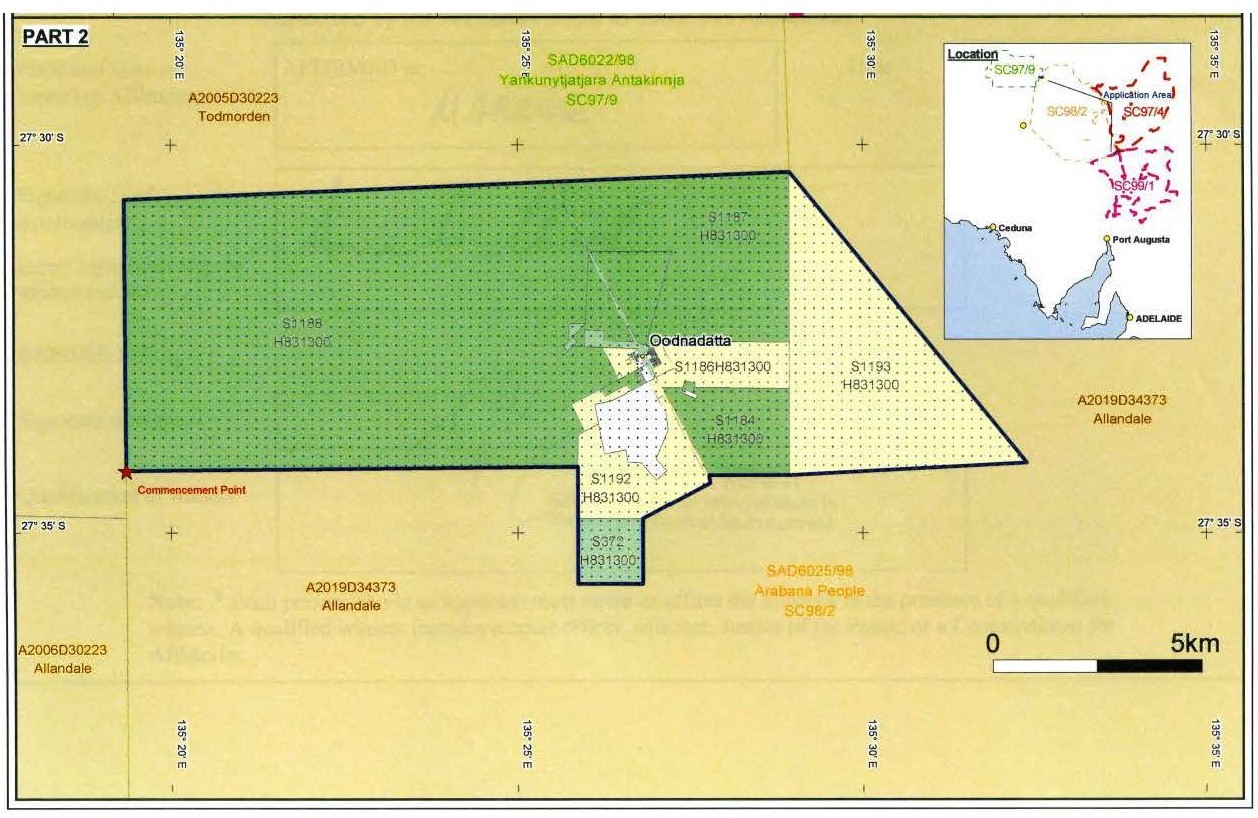
1 Nappamurra Pty Ltd (Nappamurra) has applied for leave to intervene in the native title proceedings known as the Oodnadatta Common Overlap Proceedings. Those proceedings concern the overlapping claims of the Arabana People and the Walka Wani People for determinations of native title over the town of Oodnadatta in the far north of South Australia, and the areas immediately surrounding it including the area known as the Oodnadatta Common (the Claim Area). The Claim Area is relatively small, comprising less than 150 km2, and is shown in the following map:
2 The proceedings are well advanced. The Court commenced the trial on 30 September 2019 and concluded receiving the non-expert evidence on 25 October 2019. It then adjourned the hearing to Monday, 6 April 2020 for the purpose of hearing the expert evidence in concurrent session in that week. By reason of the circumstances created by the COVID-19 pandemic, the hearing of the expert evidence did not proceed then. Instead, the Court heard the concurrent evidence over five days between 19 and 23 October 2020. At the request of the parties, the matter was then adjourned to 11 and 12 March 2021 for final submissions. The parties have provided extensive written submissions, including submissions in reply.
3 Nappamurra is the pastoral lease holder of Pastoral Lease No. 2408, known as Allandale Station. As is evident from the map, Allandale Station adjoins the southern and eastern boundaries of the Claim Area.
4 Nappamurra filed its application for leave to intervene after close of business on 23 December 2020, so effectively on 24 December 2020.
5 The circumstance which gives rise to Nappamurra’s application is its appreciation that the fenced boundaries between Allandale Station and the Claim Area do not conform with the cadastral boundaries. Nappamurra asserts that the fenced boundaries are, in part, in accord with an informal agreement reached in 1984 between a predecessor of Nappamurra and entities in Oodnadatta. There is also some evidence that, even before 1984, the fencing of a portion of Allandale Station had not followed the cadastral boundaries. The effect is that some portions of Allandale Station are within the fenced boundaries of the Oodnadatta Common and some (larger) portions of the Oodnadatta Common (that is, some of the claim area) are within the fenced areas of Allandale Station. Nappamurra is taking action with a view to having the cadastral boundaries of Allandale Station realigned so as to conform with the fenced boundaries established in accordance with the 1984 agreement but it is uncertain when, or even if, that will occur.
6 Nappamurra seeks leave to intervene in relation to a single issue, identified in its interlocutory application as follows:
1. …
a. in the event of any determination of native title (or of no native title), to what extent (if at all) should the interests of Nappamurra Pty Ltd in or under the following be recognised in the said determination:
i. Pastoral Lease 2408; and
ii. an agreement between Oodnadatta Aboriginal Housing Society Inc, Oodnadatta Progress Association Inc, and the proprietors of Allandale Station dated 24 March 1984.
…
7 Nappamurra states expressly in the interlocutory application that it does not wish to be heard on the question of who, if anyone, holds native title in the Claim Area, the content of any native title rights and interests, issues of extinguishment (to the extent that they arise), and that it does not seek access to any restricted evidence given in the proceedings or to material which was not adduced as evidence in open court. It also states that it does not seek to examine or cross-examine any witness who has already given evidence, unless such a witness is recalled to give evidence concerning the single issue on which it seeks to intervene.
8 Each of the Arabana and the Walka Wani oppose the grant of leave to Nappamurra to intervene, referring in particular to the prejudice to them resulting from the lateness of its application.
9 The State of South Australia adopted the submissions of the two applicant groups with respect to the issue of delay. It submitted that the Court should dismiss the present application for leave to intervene but on the basis that the Nappamurra have liberty to apply once the Court has published its findings on the underlying claims. The State submitted that an alternative course was for the application to be adjourned until that time. Although counsel for Nappamurra did not have formal instructions with respect to a “standing over” of the application until after the Court publishes its findings, he did embrace it, describing such a course as “very sensible”.
10 The remaining respondents (Airservices Australia and Mr Douglas Lillecrapp, the latter of whom holds the pastoral lease of Todmorden Station (immediately to the north and west of the Claim Area)) have not been active participants in the proceedings and have not expressed an attitude to the intervention.
11 Nappamurra makes its application under r 9.12 of the Federal Court Rules 2011 (Cth), which provides:
(1) A person may apply to the Court for leave to intervene in a proceeding with such rights, privileges and liabilities (including liabilities for costs) as may be determined by the Court.
(2) The Court may have regard to:
(a) whether the intervener’s contribution will be useful and different from the contribution of the parties to the proceeding; and
(b) whether the intervention might unreasonably interfere with the ability of the parties to conduct the proceeding as the parties wish; and
(c) any other matter that the Court considers relevant.
(3) When giving leave, the Court may specify the form of assistance to be given by the intervener and the manner of participation of the intervener, including:
(a) the matters that the intervener may raise; and
(b) whether the intervener’s submissions are to be oral, in writing, or both.
12 The principles on which the Court acts in determining whether to grant leave are similar to those stated by the High Court in the context of applications for leave to intervene in appeals in that Court. The Court in Roadshow Films Pty Ltd v iiNet Ltd (No 1) [2011] HCA 54; (2011) 248 CLR 37 followed the approach of Brennan CJ in Levy v Victoria (1997) 189 CLR 579 at 600-5 and said that “[a] non-party whose interests would be directly affected by a decision in the proceeding, that is one who would be bound by the decision, is entitled to intervene to protect the interest likely to be affected”. The Court went on to say:
[3] Where a person having the necessary legal interest can show that the parties to the particular proceedings may not present fully the submissions on a particular issue, being submissions which the Court should have to assist it to reach a correct determination, the Court may exercise its jurisdiction by granting leave to intervene, albeit subject to such limitations and conditions as to costs as between all parties as it sees fit to impose.
13 Although the High Court has spoken of an entitlement to intervene once it is shown that a relevant interest may be affected, I do not understand it to be indicating that discretionary considerations of the kind discussed in Aon Risk Services Australia Ltd v Australian National University [2009] HCA 27; (2009) 239 CLR 175 will not also be relevant. In any event, the terms of r 9.12 make such considerations relevant.
14 In relation to the underlying interest said to warrant the grant of leave to intervene, Nappamurra referred first to s 225(c) and (d) of the Native Title Act 1993 (Cth) (the NT Act) which, in combination with s 94A, require that a determination of native title set out particulars of the nature and extent of “any other interest” in relation to the determination area, and the relationship between those interests and the native title rights and interests. The term “interest” is defined expansively in s 253 of the NT Act to mean:
interest, in relation to land or waters, means:
(a) a legal or equitable estate or interest in the land or waters; or
(b) any other right (including a right under an option and a right of redemption), charge, power or privilege over, or in connection with:
(i) the land or waters; or
(ii) an estate or interest in the land or waters; or
(c) a restriction on the use of the land or waters, whether or not annexed to other land or waters.
15 Counsel emphasised the breadth of the interests encompassed by the expression “any other right … power or privilege over, or in connection with, … land”, citing State of Western Australia v Ward [2002] HCA 28; (2002) 213 CLR 1 at [387]. See also Chippendale on behalf of Wuthathi People #2 v Queensland [2012] FCA 310 at [14]; and Sumner v State of South Australia [2014] FCA 534 at [13].
16 Nappamurra contended that it does have an interest encompassed by the s 253 definition. For this purpose, it relied principally on the 1984 agreement to which reference was made earlier (the 1984 Fencing Agreement) which provides:
Oodnadatta
24th August 1984
On behalf of the Oodnadatta Aboriginal Housing Society Inc, Oodnadatta Progress Association, and Allandale Proprietors, we the undersigned agree to the fence line as pegged, delineating the boundary between the Oodnadatta Teamster and Travelling Stock Reserve, the freehold land (Section 372 - Aboriginal Lands Trust) presently leased to he (sic) Oodnadatta Housing Society, and Pastoral Lease 2408 "ALLANDALE".
For and on behalf of
Oodnadatta Housing Society Inc
George Tongerie (signature)
For and on behalf of
Oodnadatta Progress Association Inc.
Robin Greenwood (signature)
JP
For and on behalf of Allandale Proprietors
R K Napier, Mngr (signature)
JP
Dated at Oodnadatta
the 24th day of March 1984
(Emphasis in the original)
17 As is apparent, the signatories to the 1984 Fencing Agreement were the Manager of Nappamurra’s predecessor in title to Allandale Station, the Oodnadatta Housing Society Inc (by George Tongerie) and the Oodnadatta Progress Association Inc (by Robin Greenwood).
18 Counsel for Nappamurra also drew attention to a map suggesting that a fence erected in 1979 may in part also be a de facto boundary between Allandale Station and the Claim Area, but neither Mr Clarke nor Mrs Clarke (the principals of Nappamurra) deposed to that circumstance. Their evidence indicated that Nappamurra relies on the 1984 Fencing Agreement, with both referring to the fences erected following the entry into that Agreement. I note, however, that, despite referring to the fences erected since 1984, Mr Clarke expressed the view (somewhat inconsistently) that the fences erected had served to delineate Oodnadatta Common from Allandale Station “since 1979”.
19 Mr Clarke deposed specifically in relation to the 1984 Fencing Agreement:
[21] In the specific north-eastern portion of PL 2408 land there is water infrastructure. These are permanent water points, dams, tanks and troughs supplied by poly pipe or pumped water that provide for the cattle and horses on Allandale Station. The infrastructure and waterpoints serves those parts of Allandale Station lying within about six kilometres from the homestead.
[22] The nature of the land in this area provides the soft ground for breeding horses and cattle in the area. Should Nappamurra no longer have access to this area, it would require a major realignment to fence lines, with a compounding effect on other paddocks. Allandale Station has a 30 year paddock plan based on existing fence lines. Because the Crown does not pay the costs for fencing, any realignment of fences will have to be borne by Nappamurra.
[23] If this area were not recognised as part of Allandale Station and consequently the infrastructure had to be moved or replaced, I estimate this would cost in the order of $90,000 to $120,000.
20 Mr Clarke deposed, in addition, that if the fenced boundaries are brought into alignment with the cadastral boundaries, Nappamurra will lose carrying capacity for 30-50 head of cattle.
21 Mr Clarke also deposed that the 1984 Fencing Agreement had been honoured by the late Mr Tongerie in 1996 in the resolution of a dispute lodged with the Aboriginal Lands Trust Board arising from trenching work which he had undertaken near Hookeys Hole (close to the southern-most boundary of the Claim Area).
22 In the written submissions in support of the application for intervention, counsel for Nappamurra contended that, by reason of the 1984 Fencing Agreement, Nappamurra’s subsequent reliance on that Agreement, and the acceptance in 1996 of the fence lines as boundaries by the Aboriginal Lands Trust and the Dunjiba Community Council, Nappamurra had, at the least, an arguable case for an estoppel, whether by representation (referring to Commonwealth v Verwayen [1990] HCA 39, (1990) 170 CLR 394 at 422; Vaughan v Byron Shire Council (1999) 103 LGERA 321 at [21]), by convention (referring to Con-Stan Industries of Australia Pty Ltd v Norwich Winterthur Insurance (Aust) Ltd (1986) 160 CLR 226 at 244; Mineralogy Pty Ltd v Sino Iron Pty Ltd (No 6) [2015] FCA 825, (2015) 329 ALR 1 at [759]-[760] and Ewing International LP v Ausbulk Ltd (No 2) [2009] SASC 381 at [236]), or proprietary arising from its making of the improvements (referring to Waltons Stores (Interstate) Ltd v Maher (1988) 164 CLR 387 at 404).
23 In the oral submissions, counsel for Nappamurra acknowledged that the interest which it wishes to have recorded in the determination has not been fully defined but postulated that it may have an easement by prescription from usage for a period of more than 20 years, an equitable lease or an equitable underlease, the benefit of a constructive trust or a bare licence to occupy the fenced in area. Counsel also submitted that Nappamurra had a “privilege” in respect of the Claim Area of the kind to which the s 253 definition refers in that it could request the relevant Minister in South Australia to act under s 31 of the Pastoral Land Management and Conservation Act 1989 (SA) to alter the boundaries of Pastoral Lease 2408 so as to conform with the land actually occupied by Allandale Station.
24 For the purposes of resolving the present application, it is not necessary to express any view about these alternatives.
25 Next, counsel emphasised what he described as the “in rem” nature of a determination of native title (referring to Dale v Western Australia [2011] FCAFC 46, (2011) 191 FCR 521 at [92]; and to Wik Peoples v Queensland [1994] FCA 967, (1994) 49 FCR 1 at [8]-[19]). Counsel also referred to the uncertainty as to the effect of a positive determination of native title on other interests in the land which, while in existence at the time of the determination, are formally recognised only later. I accept that these are important considerations.
26 I will refer to other matters raised by Nappamurra later in these reasons.
27 Counsel acknowledged that Nappamurra’s application for intervention has been brought very late but submitted that the prejudice to the parties which might otherwise arise from this circumstance is mitigated by the circumstance that the issue which it wishes to agitate is narrow and discrete. Counsel also submitted (rather tongue in cheek it seemed) that the overarching purpose for which ss 37M and 37N of the Federal Court of Australia Act 1976 (Cth) (the FCA Act) provide have been better served by Nappamurra seeking to intervene now, rather than earlier in the proceedings.
Consideration
28 For the purposes of determining the question of intervention at this stage, I am willing to assume (without deciding) that Nappamurra may have an interest of the kind to which s 253 of the NT Act refers. Moreover, I am willing for present purposes to assume in Nappamurra’s favour that, had it notified the Court within the time specified in s 84(3)(b) of the NT Act that it wished to be a party to the proceedings, it is probable that it would then have been accepted that, for the purposes of s 84(3)(a), it had an interest in relation to the Claim Area which may be affected by a determination in the proceedings entitling it to be a party. Likewise, had Nappamurra applied in a timely way to be joined as a party to the proceedings, pursuant to s 84(5) of the NT Act, it may well have been so joined.
29 I am also willing to accept, for the purposes of determining the application, that, in the absence of intervention by Nappamurra, the Court is unlikely to receive any submissions concerning the effect of the 1984 Fencing Agreement or of the circumstance that the existing fencing does not conform with the cadastral boundaries between Oodnadatta Common and Allandale Station. Although the anthropologist called by the Arabana did provide a map showing a disconformity between the “contemporary pastoral boundaries” and the boundaries of the Overlap Area, that has not been an issue addressed in the evidence and no party has foreshadowed making a submission on that topic.
30 Nevertheless, I am not satisfied that it is appropriate, at this stage, to grant Nappamurra leave to intervene in the proceedings. Instead, consideration of Nappamurra’s application should be deferred until after the Court has published its findings on the overlapping claims. My principal reasons for that conclusion is the prejudice which a grant of leave to Napparmurra to intervene at this stage would cause the parties.
31 There is no difficulty in accepting that the parties’ energies since the filing of the application for leave to intervene have been directed to the completion of their written submissions and to preparation for the making the final submissions on 11 and 12 March 2021. There is also no difficulty in accepting that it would be a significant distraction for the parties to have to divert at this late stage to address the issue which Nappamurra wishes to agitate. Nappamurra did not advance any submissions to allay the Court’s concerns about this prejudice, beyond indicating that Nappamurra would be content with written submissions. It did not attempt to indicate how its intervention could be accommodated within the remaining time available for preparation and within the time set aside for the further hearing. In fact, counsel did not make any submission to the effect that the grant of intervention would not unreasonably interfere with the ability of the parties to conduct the proceedings as they wish (r 9.12(2)(b)) saying, amongst other things, that he was unaware of the evidence which had been adduced to date, that he could not say whether the intervention would “throw the final submissions into disarray”, and that he did not know whether it would require the recall of any witnesses.
32 Counsel for Nappamurra accepted that it may, as a condition of the grant of leave to intervene, have to bear the costs thrown away by the other parties or the additional costs which they may then have to incur. While that may have been a sensible recognition, I did not understand it to have been formally proposed and, in any event, it is plain that the prejudice to the present parties goes beyond costs. This has been a major piece of litigation to which the parties have committed considerable resources, and by that I am not referring only to financial resources.
33 Nappamurra acknowledged that it has not yet finalised the drafting of the provision it would seek to have included in any determination of native title and that it has not yet marshalled the evidence which it would wish to lead in the event that intervention is granted. It is not even clear when it proposes to marshal that evidence and to provide it to the Court and to the parties. That by itself adds to the prejudice which intervention would cause to the parties.
34 Counsel for the Arabana People informed the Court that these People do not have funding at this stage to deal with the issues proposed to be raised by Nappamurra. That is another source of prejudice.
35 The prejudice to the parties results from the lateness with which the application for intervention is made. That is a matter for which Nappamurra is responsible as, on its own evidence, it has been aware of these proceedings and of the boundaries of the Claim Area since September 2019. Moreover, it had by 3 February 2020 located a significant piece of the evidence on which it relies, in the form of a photograph of the 1984 Fencing Agreement and had, by June 2020, located a copy of the Agreement itself.
36 The Court had initially listed Nappamurra’s application for hearing on 29 January 2021, but the hearing was vacated and the hearing relisted for 24 February 2021 so as to take account of counsel’s convenience, including their commitments in the preparation of the written submissions.
37 Nappamurra’s present application for intervention is analogous to an application for joinder under s 84(5) of the NT Act. On an application of that kind the Court must be satisfied that it is “in the interests of justice” to allow the joinder. The matters which may bear on the interests of justice in the context of s 84(5) were discussed by Gyles J in Gamogab v Akiba [2007] FCAFC 74; (2007) 159 FCR 578 at [59]-[61]. These include the evident statutory purpose of having all persons before the Court whose interests may be affected by a determination of native title.
38 Nevertheless, there have been several instances in which the Court has refused to permit joinder because of the lateness of the application and the disruption and prejudice which the joinder would cause. These include Wakka Wakka People #2 v Queensland [2005] FCA 1578; TJ (on behalf of the Yindjibarndi People) v State of Western Australia [2016] FCA 553 at [171]-[172] and Agius v State of South Australia [2017] FCA 1162. However, as counsel for the Walka Wani quite fairly pointed out, Vea Vea on behalf of the Wadja People v State of Queensland [2020] FCA 405 is an instance of joinder being permitted despite delay and despite disruption to the proceedings. These decisions reflect an understanding that, while it is an evident purpose of the NT Act that all persons whose interests may be affected by a determination should be before the Court, the legislature also contemplates that native title proceedings should be conducted in a way which is efficient and expeditious (see ss 37M and 37N of the FCA Act), and that neither the Court nor the parties need move at the pace of those who are dilatory in seeking to be heard by the Court. The entitlement to have account taken of one’s interests does not mean an entitlement to be heard however late one seeks to be heard.
39 Several of the matters I have mentioned suggest that the dismissal of the application for intervention would be appropriate. However, as indicated, I have decided that it is appropriate to accede to the proposal made by the State and, in effect, adopted by Nappamurra in reply, namely, that intervention be refused at this stage but with further consideration of the application deferred until after the delivery of the Court’s judgment on the overlapping applications for the determination of native title. The parties will thereby be able to proceed with the final submissions in the manner which has been contemplated, and the worst aspects of the prejudice to them be avoided. Nappamurra will, in effect, be able to apply again for intervention albeit in the circumstances then known by reason of the Court’s findings on the overlapping claims. If that works to the prejudice of Nappamurra by reason that it will not have been heard with respect to the matters dealt with in the judgment, including the Court’s findings concerning evidence or witnesses on which it has not been heard, that will be a matter for which it will have to accept responsibility by reason of the lateness with which it has brought its application for intervention.
Conclusion
40 For the reasons given above, the order on the interlocutory application of Nappamurra filed on 24 December 2020 is that leave to intervene in the proceedings at this stage is refused. Further consideration of the application is adjourned to a date to be fixed after the delivery of the Court’s judgment on the overlapping applications for native title.
I certify that the preceding forty (40) numbered paragraphs are a true copy of the Reasons for Judgment of the Honourable Justice White. |
Associate:
SCHEDULE OF PARTIES
SAD 38 of 2013
First Applicant
Arabana No 2 Native Title Claim (Part 2) (SAD38/2013)
Applicant: JOANNE WARREN
Applicant: PETER WATTS
Applicant: GREG WARREN (SNR)
Applicant: WALKA WANI NO 2 NATIVE TITLE CLAIM
Applicant: WALKA WANI NO 1 NATIVE TITLE CLAIM
Applicant: HUEY TJAMI
Applicant: AUDREY STEWART
Applicant: DEAN AH CHEE
Applicant: CHRISTINE LENNON
Second Applicant
Walka Wani Oodnadatta Native Title Claim (SAD78/2013)
Applicant: HUEY TJAMI
Applicant: CHRISTINE LENNON
Third Applicant
Walka Wani Oodnadatta #2 Native Title Claim (SAD220/2018)
Applicant: DEAN AH CHEE
Respondents:
Respondent: AIRSERVICES AUSTRALIA
Respondent: DOUGLAS GORDON LILLECRAPP


