

FEDERAL COURT OF AUSTRALIA
Lyndon on behalf of the Budina 2 Claim Group v State of Western Australia [2021] FCA 134
ORDERS
CLIVE LYNDON, SCOTT LYNDON, URSULA LYDON AND MARIE LYNDON Applicant | ||
AND: | Respondent | |
DATE OF ORDER: |
THE COURT NOTES THAT:
1. The Applicant in this proceeding WAD 439 of 2019 has made a native title determination application (Budina 2 Application) that relates to the area of land and waters the subject of the consent determination of Native Title, being the determination set out in Attachment A to the orders (Determination).
2. The Applicant in the Budina 2 Application and the State of Western Australia (together the parties) have reached an agreement as to the terms of the Determination which is to be made in relation to the land and waters covered by the Budina 2 Application (Determination Area). The external boundaries of the Determination Area are described in Schedule One to the Determination.
3. Pursuant to s 87(1) of the Native Title Act 1993 (Cth), the parties have filed with this Court an agreement in writing setting out the terms of the agreement reached by the parties in relation to the Budina 2 Application.
4. The terms of the agreement involve the making of consent orders for a determination pursuant to s 87 and s 94A of the Native Title Act 1993 (Cth) that native title exists in relation to the land and waters of the Determination Area.
5. The parties acknowledge that the effect of the making of the Determination is that the members of the native title claim group, in accordance with the traditional laws acknowledged and the traditional customs observed by them, should be recognised as the native title holders for the Determination Area as set out in the Determination.
6. Pursuant to s 87(2) of the Native Title Act 1993 (Cth), the parties have requested that the Court determine the Budina 2 Application without holding a hearing.
7. The Applicant in the Budina 2 Application has nominated the Budina Aboriginal Corporation (ICN 8705) pursuant to s 56(2)(a) of the Native Title Act 1993 (Cth) to hold the determined native title in trust for the native title holders.
8. The Budina Aboriginal Corporation has consented in writing to hold the rights and interests comprising the native title in trust for the native title holders.
BEING SATISFIED that a determination in the terms set out at Attachment A would be within the power of the Court, and it appearing to the Court appropriate to do so, pursuant to s 87 and s 94A of the Native Title Act 1993 (Cth) and by the consent of the parties:
THE COURT ORDERS THAT:
1. In relation to the Determination Area, there be a determination of native title in WAD 439 of 2019 in terms of the Determination as provided for in Attachment A.
2. The Budina Aboriginal Corporation (ICN 8705) shall hold the determined native title in trust for the native title holders pursuant to s 56(2)(b) of the Native Title Act 1993 (Cth).
3. There be no order as to costs.
Note: Entry of orders is dealt with in Rule 39.32 of the Federal Court Rules 2011.
ATTACHMENT A
DETERMINATION
THE COURT ORDERS, DECLARES AND DETERMINES THAT:
Existence of native title (s 225 Native Title Act)
1. Subject to paragraph 2, native title exists in the Determination Area in the manner set out in paragraph 4 of this Determination.
2. Native title does not exist in those parts of the Determination Area the subject of the interests identified in Schedule Three, which are shown as generally shaded pink on the map at Schedule Two.
Native title holders (s 225(a) Native Title Act)
3. The native title in the Determination Area is held by the Budina People. The Budina People are the people referred to in Schedule Five.
The nature and extent of native title rights and interests and exclusiveness of native title (s 225(b) and (e) Native Title Act)
4. Subject to paragraphs 5 and 6, the nature and extent of the native title rights and interests in relation to the Determination Area are that they confer the following non-exclusive rights on the Budina People, including the right to conduct activities necessary to give effect to them:
(a) the right to enter and remain on the land, camp, erect temporary shelters and travel over and visit any part of the land and waters of the Determination Area;
(b) the right to hunt, fish, gather, take and use the traditional resources of the land;
(c) the right to take and use water;
(d) the right to engage in cultural activities on the Determination Area, including:
(i) visiting places of cultural or spiritual importance and maintaining, caring for, and protecting those places by carrying out activities to preserve their physical or spiritual integrity; and
(ii) conducting ceremony and ritual and the transmission of cultural knowledge; and
(e) the right to be accompanied on to the Determination Area by those people who, though not Budina People and who (for the avoidance of doubt) cannot themselves exercise any native title right in the Determination Area, are:
(i) the non-Budina spouses, parents or children of the Budina People; or
(ii) people entering in connection with, and subject to, traditional law and custom for the performance of ceremonies or cultural activities on the Determination Area.
Qualifications on the native title rights and interests
5. The native title rights and interests set out in paragraph 4:
(a) are subject to and exercisable in accordance with:
(i) the laws of the State and the Commonwealth, including the common law; and
(ii) the traditional laws and customs of the Budina People for personal, domestic and communal purposes (including social, cultural, religious, spiritual and ceremonial purposes) but not for commercial purposes; and
(b) do not confer any rights in relation to:
(i) minerals as defined in the Mining Act 1904 (WA) (repealed) and in the Mining Act 1978 (WA);
(ii) petroleum as defined in the Petroleum Act 1936 (WA) (repealed) and in the Petroleum and Geothermal Energy Resources Act 1967 (WA);
(iii) geothermal energy resources and geothermal energy as defined in the Petroleum and Geothermal Energy Resources Act 1967 (WA); or
(iv) water captured by the holders of the Other Interests pursuant to those Other Interests.
6. The native title rights and interests set out in paragraph 4 do not confer:
(a) possession, occupation, use and enjoyment on the Budina People to the exclusion of all others; or
(b) a right to control the access to, or use of, the land and waters of the Determination Area or its resources.
Areas to which s 47, s 47A or s 47B of the Native Title Act apply
7. Section 47, s 47A and s 47B of the Native Title Act do not apply to disregard any prior extinguishment in relation to the Determination Area.
The nature and extent of any other interests (s 225(c) Native Title Act)
8. The nature and extent of the Other Interests are described in Schedule Four.
Relationship between native title rights and other interests (s 225(d) Native Title Act)
9. Except as otherwise provided for by law, the relationship between the native title rights and interests described in paragraph 4 and the Other Interests is that:
(a) to the extent that any of the Other Interests are inconsistent with the continued existence, enjoyment or exercise of the native title rights and interests, the native title rights and interests continue to exist in their entirety, but the native title rights and interests have no effect in relation to the Other Interests to the extent of the inconsistency during the currency of the Other Interests; and otherwise,
(b) the existence and exercise of the native title rights and interests do not prevent the doing of any activity required or permitted to be done by or under the Other Interests, and the Other Interests, and the doing of any activity required or permitted to be done by or under the Other Interests, prevail over the native title rights and interests and any exercise of the native title rights and interests but do not extinguish them.
Liberty to apply
10. The parties have liberty to apply to establish the precise location and boundaries of the public works and adjacent land and waters identified in relation to any part or parts of the Determination Area referred to in cl 4 of Schedule Three of this Determination.
Definitions and interpretation
11. In this determination, unless the contrary intention appears:
Commonwealth means Commonwealth of Australia;
Determination Area means the land and waters described in Schedule One and depicted on the map at Schedule Two;
land has the same meaning as in the Native Title Act and, for the avoidance of doubt, includes any natural collection of water found on the land which does not fall within the definition of 'waters';
Native Title Act means the Native Title Act 1993 (Cth);
Other Interests means the legal or equitable estates or interests and other rights in relation to the Determination Area described in Schedule Four and referred to in paragraph 8;
resources means flora, fauna, and other natural resources such as charcoal, stone, soil, wood, resin and ochre (except, for the avoidance of doubt, ochres for use in the manufacture of porcelain, fine pottery or pigments which are minerals pursuant the Mining Act 1904 (WA) (repealed));
State means State of Western Australia;
use includes by way of share and exchange; and
waters has the same meaning as in the Native Title Act.
12. In the event of any inconsistency between the written description of an area in Schedule One, Schedule Three or Schedule Four, and the area as depicted on the map at Schedule Two, the written description prevails
SCHEDULE ONE
DETERMINATION AREA
The Determination Area, generally shown as bordered in blue on the map in Schedule Two, comprises all land and waters in the following description:
All those lands and waters commencing at the intersection of the westernmost corner of Native Title Determination WAD6212/1998 Thudgari People (WCD2009/002) and a prolongation southeasterly of a southeastern boundary of Native Title Determination WAD22/2019 Gnulli, Gnulli #2 and Gnulli #3 - Yinggarda, Baiyungu and Thalanyji People (WCD2019/016) and extending along that prolongation to a point on the eastern boundary of that native title determination at approximate coordinate point Latitude 23.604223 South, Longitude 114.764205 East; then generally northwesterly and generally northeasterly along the eastern boundaries of that native title determination to the intersection of a southern boundary of Native Title Determination WAD6113/1998 Thalanyji (WCD2008/003); then generally northeasterly along the southern boundaries of that native title determination to the intersection of a southwestern corner of Native Title Determination WAD131/2004 Budina People (WCD2017/006); then generally northeasterly and generally southerly along the western boundaries of that native title determination to the intersection of a northern boundary of Native Title Determination WAD6212/1998 Thudgari People (WCD2009/002); then northwesterly along the northern boundary of that native title determination back to the commencement point.
Note: Geographic Coordinates provided in Decimal Degrees.
All referenced Deposited Plans and Diagrams are held by the Western Australian Land Information Authority, trading as Landgate.
Cadastral boundaries sourced from Landgate's Spatial Cadastral Database dated 01 May 2020.
For the avoidance of doubt the application excludes any land and waters already claimed by:
Native Title Determination WAD131/2004 Budina People (WC2004/005) as Determined in the Federal Court on the 16th October 2017.
Native Title Determination WAD22/2019 Gnulli, Gnulli #2 and Gnulli #3 - Yinggarda, Baiyungu and Thalanyji People (WC1997/028) as Determined in the Federal Court on the 17th December 2019.
Native Title Determination WAD6113/1998 Thalanyji (WC1999/045) as Determined in the Federal Court on the 18th September 2008.
Native Title Determination WAD6212/1998 Thudgari People (WC1997/095) as Determined in the Federal Court on the 18th November 2009.
Datum: Geocentric Datum of Australia 1994 (GDA94)
Prepared By: Graphic Services (Landgate) 08 June 2020
Use of Coordinates:
Where coordinates are used within the description to represent cadastral or topographical boundaries or the intersection with such, they are intended as a guide only. As an outcome to the custodians of cadastral and topographic data continuously recalculating the geographic position of their data based on improved survey and data maintenance procedures, it is not possible to accurately define such a position other than by detailed ground survey.
SCHEDUE TWO
MAP OF THE DETERMINATION AREA
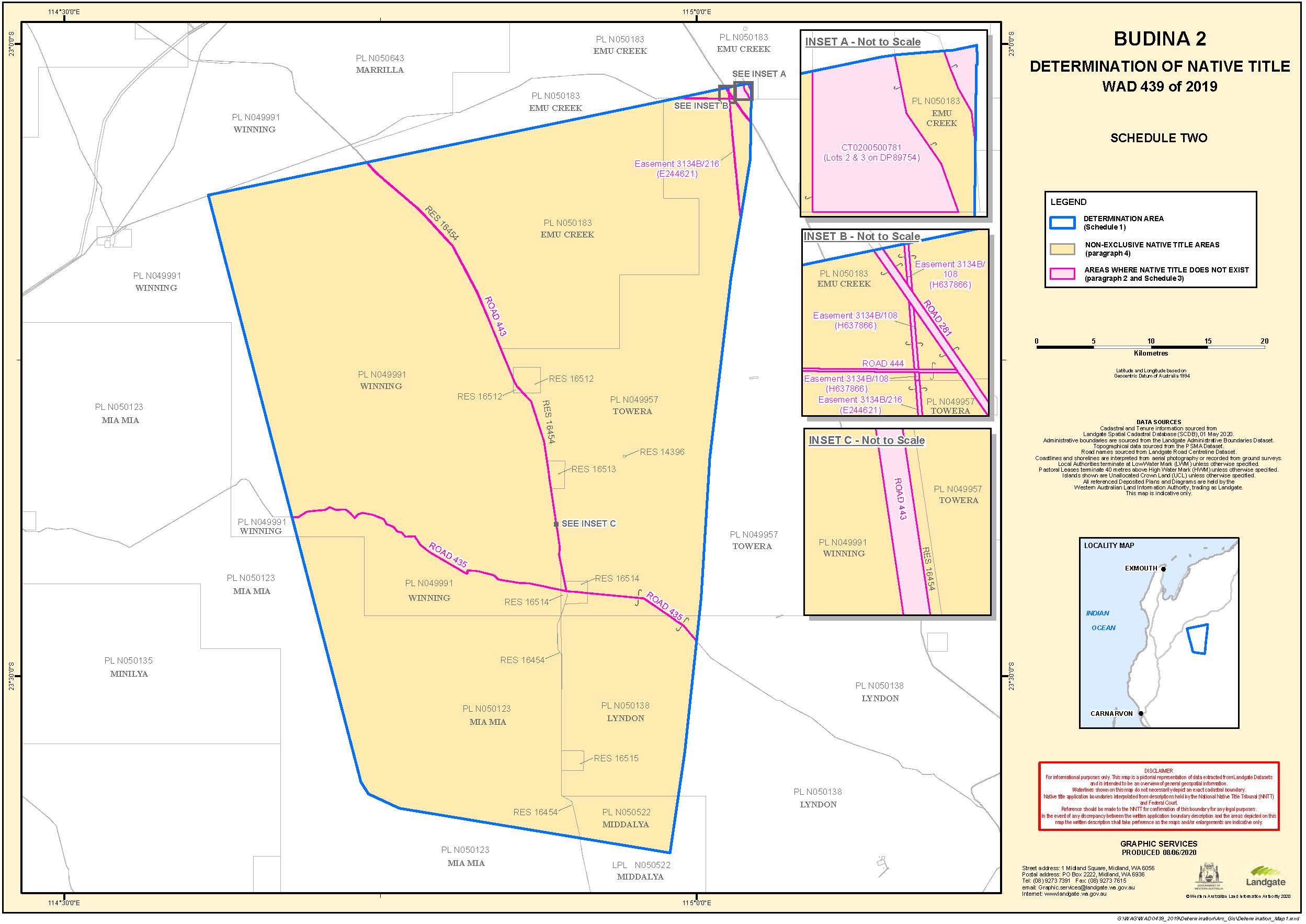
SCHEDULE THREE
AREAS WHERE NATIVE TITLE DOES NOT EXIST (PARA 2)
Native title does not exist in relation to land and waters the subject of the following interests within the Determination Area which, with the exception of public works (as described in cl 4 of this Schedule), are generally shown as shaded in pink on the map at Schedule Two:
1. FREEHOLD
Grants of estates in fee simple within the Determination Area including the following:
Freehold No. |
CT0200500781 |
2. ROADS
Dedicated roads, roads set aside, taken or resumed, or roads which are to be considered public works (as that expression is defined in the Native Title Act and the Titles (Validation) and Native Title (Effect of Past Acts) Act 1995 (WA)), including the following:
MapInfo ID1 | Description | Shown in |
ROAD 281 | Road 16542 / Lyndon-Towera Road | Government Gazette 5 December 1980 Cancelled Public Plan SF50-9 (1: 250,000) for Winning Pool dated June 1968 |
ROAD 435 | Road 8397 | Government Gazette 7 February 1930 |
ROAD 443 | Road 8472 | Government Gazette 11 April 1930 Cancelled public plan 503132 |
ROAD 444 | Road 8473 | Government Gazette 11 April 1930 Cancelled public plan 503131 |
1 Note that the MapInfo ID numbers for the roads in this table are derived from the MapInfo project prepared by Landgate for the Gnulli (WAD 6161/1998) native title determination application.
3. EASEMENTS CONTAINING PUBLIC WORKS
Easements containing public works granted to the State Energy Commission of Western Australia (and currently held by the Dampier to Bunbury Natural Gas Pipeline Land Access Minister) for the purposes of access to, and the construction, use and maintenance of, a natural gas pipeline and associated apparatus, appurtenances and infrastructure (Dampier to Bunbury Natural Gas Pipeline) for the transmission and conveyance of natural gas, including but not limited to the following:
Easement No. | Date of Grant |
Easement 3134B/216 (E244621) | 13 September 1988 |
Easement 3134B/108 (H637866) | 10 February 1988 |
4. PUBLIC WORKS
Any other public works, as that expression is defined in the Native Title Act and the Titles (Validation) and Native Title (Effect of Past Acts) Act 1995 (WA) (including the land and waters on which a public work is constructed, established or situated as described in s 251D of the Native Title Act), and to which s 12J of the Titles (Validation) and Native Title (Effect of Past Acts) Act 1995 (WA) or s 23C(2) of the Native Title Act applies.
SCHEUDLE FOUR
OTHER INTERESTS (PARA 8)
The nature and extent of the Other Interests in relation to the Determination Area are as follows.
Land tenure interests registered with the Western Australian Land Information Authority are current as at 1 June 2020. Mining tenements and petroleum interests registered with the Department of Mines, Industry Regulation and Safety are current as at 5 June 2020. All other interests are current as at the date of the Determination.
1. RESERVES
(a) The following reserves:
Reserve No. | Current Purpose |
14396 | Water |
16454 | Protection of Vermin Proof Fence |
16512 | Water |
16513 | Water Rabbit Department |
16514 | Water Rabbit Department |
16515 | Water Rabbit Department |
(b) The rights and interests of persons who have the care, control and management of the reserves identified in cl 1(a) above;
(c) The rights and interests of persons entitled to access and use the reserves identified in cl 1(a) above for the respective purposes for which they are reserved, subject to any statutory limitations upon those rights; and
(d) The rights and interests of persons holding leases over areas of the reserves identified in cl 1(a) above, if any.
2. PASTORAL LEASES
(a) The following pastoral leases and the rights and interests of the holders from time to time of those leases:
Lease No. | Station Name |
PL N049957 | Towera Station |
PL N049991 | Winning Station |
PL N050123 | Mia Mia Station |
PL N050138 | Lyndon Station |
PL N050183 | Emu Creek Station |
PL N050522 | Middalya Station |
(b) Any rights and obligations of the pastoralists pursuant to the pastoral leases referred to in cl 2(a) above to adopt and exercise best practice management of the pasture and vegetation resources, livestock and soils within the boundaries of the pastoral leases in order to manage stock and for the management, conservation and regeneration of pasture for permitted uses.
3. MINING TENEMENTS
(a) The following mining tenements under the Mining Act 1904 (WA) (repealed) and the Mining Act 1978 (WA) and the rights and interests of the holders from time to time of those mining tenements:
(i) Exploration Licences:
Tenement ID |
E 0801645 |
E 0801646 |
4. PETROLEUM INTERESTS
(a) The following petroleum title under the Petroleum Pipelines Act 1969 (WA) and the rights and interests of the holders from time to time of that petroleum title:
Title ID | Title Type |
PL 40 | Pipeline Licence |
(b) The interests of the Dampier to Bunbury Natural Gas Pipeline Land Access Minister in the land in the Dampier to Bunbury Natural Gas Pipeline Corridor, including State corridor rights, under the Dampier to Bunbury Pipeline Act 1997 (WA), and the interests of any other person in land in the Dampier to Bunbury Natural Gas Pipeline Corridor under s 34, s 36 and s 41(2)(b) of the Dampier to Bunbury Pipeline Act 1997 (WA), including but not limited to the land the subject of, or described in, the following taking orders and/or sundry document notices:
Document No. | Description |
I 761159 | Taking Order |
I 761282 | Taking Order |
I 761614 | Taking Order |
I 209642 | Taking Order |
H 637874 | Sundry Document (Easement 032) |
I 209641 | Sundry Document (Easement 043) |
H 637866 | Sundry Document (Easement 054) |
I 761158 | Sundry Document (Easement 065) |
I 761280 | Sundry Document (Easement 76) |
I 761281 | Sundry Document (Easement 87) |
2 As per MapInfo ID number in the Gnulli (WAD 6161/1998) MapInfo project.
3 As per MapInfo ID number in the Gnulli (WAD 6161/1998) MapInfo project.
4 As per MapInfo ID number in the Gnulli (WAD 6161/1998) MapInfo project.
5 As per MapInfo ID number in the Gnulli (WAD 6161/1998) MapInfo project
6 As per MapInfo ID number in the Gnulli (WAD 6161/1998) MapInfo project.
7 As per MapInfo ID number in the Gnulli (WAD 6161/1998) MapInfo project.
5. ACCESS TO MINING AND PETROLEUM AREAS
(a) Without limiting the operation of any other clause in Schedule Four, but subject to cl 5(b) below, any rights of the holders from time to time of a mining tenement or petroleum title, including those referred to in cl 3 and cl 4 of Schedule Four, to use (including by servants, agents and contractors) such portions of existing roads and tracks in the Determination Area as necessary to have access to the area the subject of the mining tenement or petroleum title for the purposes of exercising the rights granted by that tenement or title.
(b) Nothing in cl 5(a) above allows any upgrade, extension, widening or other improvement to the road or track other than work done to maintain it in reasonable repair and in order to leave it in substantially the same condition as it was prior to its use pursuant to cl 5(a).
(c) Nothing in this Schedule Four will limit the rights of the holders from time to time of mining tenements or petroleum titles, including those referred to in cl 3 and cl 4 of Schedule Four, including, without limitation, any right to exclude members of the public from entering onto the land and waters the subject of any mining tenement or petroleum title.
6. OTHER
The following rights and interests:
(a) rights and interests, including licences and permits, granted by the Crown in right of the State or of the Commonwealth pursuant to statute or otherwise in the exercise of its executive power and any regulations made pursuant to such legislation;
(b) rights and interests held by reason of the force and operation of the laws of the State or of the Commonwealth, including but not limited to, the force and operation of the Rights in Water and Irrigation Act 1914 (WA);
(c) rights and interests of members of the public arising under the common law, including but not limited to:
(i) the public right to fish;
(ii) the public right to navigate; and
(iii) the right of any person to use and enjoy any roads in the Determination Area (subject to the laws of the State) over which, as at the date of this Determination, members of the public have a right of access under the common law;
(d) the right to access the Determination Area by:
(i) an employee, agent or instrumentality of the State;
(ii) an employee, agent or instrumentality of the Commonwealth; and
(iii) an employee, agent or instrumentality of any local government authority,
as required in the performance of his or her statutory or common law duty;
(e) so far as confirmed pursuant to s 212(2) of the Native Title Act and s 14 of the Titles (Validation) and Native Title (Effect of Past Acts) Act 1995 (WA) as at the date of this Determination, any existing public access to, and enjoyment of, the following places in the Determination Area:
(i) waterways;
(ii) beds and banks or foreshores of waterways;
(iii) coastal waters;
(iv) beaches;
(v) stock routes; and
(vi) areas that were public places at the end of 31 December 1993;
(f) any other:
(i) legal or equitable estate or interest in the land or waters; or
(ii) any other right (including a right under an option and a right of redemption), charge, power or privilege over, or in connection with:
(A) the land or waters; or
(B) an estate or interest in the land or waters; or
(iii) restriction on the use of the land or waters, whether or not annexed to other land or waters.
SCHEDULE FIVE
NATIVE TITLE HOLDERS (PARA 3)
The Budina People are those persons who:
(a) Are descended from one or more of the following:
(i) Jirbar - the father of Nora Lyndon;
(ii) Tamiguru (Fanny) - the mother of Nora Lyndon;
(iii) Baliaat (Charlie Gray) - father of Ben Gray;
(iv) Parndabiddy (Milly) - mother of Ben Gray; or
(v) Topsy - the mother of Sambo Campbell, Hamish Cameron, and Kate Dawe,
where descent can be either by birth or adoption in accordance with traditional laws acknowledged and the traditional customs observed by the Budina People;
(b) Have a connection with the land and waters of the Determination Area in accordance with the traditional laws acknowledged and the traditional customs observed by the Budina People; and
(c) Are accepted as Budina in accordance with the traditional laws acknowledged and the traditional customs observed by other Budina People.
BANKS-SMITH J:
1 The Native Title Act 1993 (Cth) provides for Aboriginal people to apply to the Court for a determination of native title, a determination that recognises connections to the land that have existed since well before European settlement.
2 One of the objectives of the Native Title Act is the resolution of claims by agreement. Consistent with this objective, the parties to this application have agreed to and sought a consent determination under s 87 of the Native Title Act. Their application is before the Court for determination pursuant to s 225 of the Native Title Act.
3 By this application a determination of native title is sought with respect to certain land in the southern Pilbara, west of the area the subject of the native title determination in Lyndon on behalf of the Budina People v State of Western Australia [2017] FCA 1214 (Griffiths J) (Lyndon on behalf of the Budina People (1)). The application is made to rectify the difference between the full extent of traditional Budina country as understood and asserted by the Budina traditional owners and the area already determined.
4 For ease of reference, I will refer to the first determination as the Budina 1 Determination and will refer to this application and determination as the application or determination as applicable.
5 For the reasons that follow, it is appropriate that I make the determination of native title as sought.
This application
6 This application was filed with the Federal Court pursuant to s 61 of the Native Title Act on 3 September 2019. The application was subsequently notified by the Native Title Registrar pursuant to s 66 of the Native Title Act. The period after the notification day referred to in s 66 of the Native Title Act ended on 18 March 2020. The Native Title Registrar was satisfied under s 190A that the application addressed the criteria of the registration test and the application was entered on the Register of Native Title Claims on 15 November 2019.
The claim group
7 The application is made on behalf of the same native title claim group as was determined by consent to hold native title in the area the subject of the Budina 1 Determination.
About the area
8 The determination area covers land west of the area of the Budina 1 Determination, and is bound by the Gnulli determination area (Peck on behalf of the Gnulli Native Title Claim Group v State of Western Australia [2019] FCA 2090) to the west, the Thudgari determination area (Thudgari People v State of Western Australia [2009] FCA 1334) to the south, and the Thalanyji determination area (Hayes on behalf of the Thalanyji People v State of Western Australia [2008] FCA 1487) to the northeast.
9 The determination area is predominantly comprised of pastoral stations, including Winning, Mia Mia, Towera, Lyndon, Middalya and Emu Creek (formerly Nyang, and before that, Wogoola) stations.
10 The external boundaries of the determination area are described in Schedule 1 to the determination comprising Attachment A to the orders that are made and published with these reasons.
Signed minute of proposed consent orders
11 The parties have signed and filed a minute of proposed consent determination. The terms of the minute are reflected and incorporated in Attachment A to the orders.
Submissions
12 The Court has the benefit of a set of joint submissions prepared by the State Solicitor on behalf of the State and the Yamatji Marlpa Aboriginal Corporation (YMAC) on behalf of the Applicant (defined at [14] below). As explained by Mortimer J in Farrer on behalf of the Ngarrawanji Native Title Claim Group v State of Western Australia [2019] FCA 655 at [8] it is well-accepted practice for the Court to rely on the joint submissions of the parties. The basis for the Court's orders under s 87 is the agreement of the parties and the Court does not need to make its own inquiries as to the merits of the claim for native title, but must be satisfied that the conditions set out in s 87 of the Native Title Act are met (see below).
13 However there is one issue as to which the parties are not entirely in agreement, although they agree in the result. The Court sought supplementary submissions from the parties addressing the role of a working group that was established by the claim group, a matter addressed below. Separate submissions were received from the parties in this regard.
Notice of meeting of 27 March 2019 to authorise claim and authorise applicant
14 Mr Colin McKellar deposed to his involvement as a legal representative for the Budina People since 2013 and his involvement in both the application that resulted in the Budina 1 Determination and this application. He deposed to convening a meeting of the Budina native title claim group that was held on 27 March 2019. The notice of meeting provided that the meeting was for the purpose of authorising this claim, including selecting persons to be the applicant (Applicant) and selecting persons to be on the 'Budina 2 working group' (Working Group).
15 Mr McKellar deposed to YMAC maintaining a database of contact details for the members of the claim group at the time of the Budina 1 Determination and said that they are the same persons who are represented in this application. I am satisfied that all persons who are members of the Budina claim group were given the opportunity to participate in the 27 March 2019 meeting.
16 Mr McKellar also deposed to convening a meeting of the Working Group that was held on 25 May 2020. I will return to the significance of this meeting.
Authorisation of the Applicant
17 Section 61(1) of the Native Title Act permits the making of a native title determination application by a person or persons who are 'authorised by all the persons (the native title claim group) who, according to their traditional laws and customs, hold the common or group rights and interests comprising the particular native title claimed'. The authorised person or persons is defined by s 61(2)(c) jointly as the 'applicant'. The Native Title Act vests the carriage of a native title determination application in the applicant.
18 Section 251B provides:
Authorising the making of applications
For the purposes of this Act, all the persons in a native title claim group or compensation claim group authorise a person or persons to make a native title determination application or a compensation application, and to deal with matters arising in relation to it, if:
(a) where there is a process of decision-making that, under the traditional laws and customs of the persons in the native title claim group or compensation claim group, must be complied with in relation to authorising things of that kind - the persons in the native title claim group or compensation claim group authorise the person or persons to make the application and to deal with the matters in accordance with that process; or
(b) where there is no such process - the persons in the native title claim group or compensation claim group authorise the other person or persons to make the application and to deal with the matters in accordance with a process of decision-making agreed to and adopted, by the persons in the native title claim group or compensation claim group, in relation to authorising the making of the application and dealing with the matters, or in relation to doing things of that kind.
19 The process of authorisation is of central importance to the conduct of native title determinations. Those who purport to exercise rights on behalf of a group of asserted native title holders must have the authority of the group to do so: Daniel v State of Western Australia [2002] FCA 1147 at [11].
20 The four persons who together are referred to as the Applicant in this matter are Clive Lyndon, Marie Lyndon, Scott Lyndon and Ursula Lyndon. Each provided affidavit evidence as to their authorisation to fulfil the role of applicant. Each deposed to there being no process of decision-making under the traditional laws and customs of the native title claim group that must be undertaken for the authorisation, and said that the adopted decision-making process was a resolution passed by a majority vote of those members of the native title group present at a claim group meeting, such vote to be calculated on the basis of a show of hands. They each deposed to having been authorised by that process at the meeting of 27 March 2019.
21 On the basis of this evidence the Court is satisfied that Clive Lyndon, Marie Lyndon, Scott Lyndon and Ursula Lyndon jointly are the duly authorised Applicant.
'Applicant may deal with all matters in relation to the application': authorisation of consent determination
22 Section 62A of the Native Title Act relevantly provides that in the case of a claimant application (such as this), 'the applicant may deal with all matters arising under this Act in relation to the application'. It is not in issue that 'matters' includes consenting to a determination of native title pursuant to s 87 of the Native Title Act.
23 However, Mr McKellar gave evidence to the effect that it was the Working Group, and not the Applicant, that authorised the consent determination. The following record of the relevant resolutions and events is based on Mr McKellar's evidence.
24 A number of resolutions were passed at the claim group meeting of 27 March 2019, including:
…
5. The following:
Scott Lyndon, Ursula Lyndon, Clive Lyndon, Maria Lyndon
Are authorised to act as the applicant for the claim and to deal with all matters arising in relation to it, subject to the other [paragraphs] of this resolution and them consenting and being eligible to be a member
6. A person is considered to not consent to be a member of the Applicant if:
a) the person resigns or signs a document to say they do not consent to be an Applicant; or
b) the person refuses upon request by a member of YMAC staff to sign any document required under the Native Title Act AND the Working Group resolves that the person is considered to not agree to be a member of the Applicant.
7. A member of the Applicant will cease to be authorised on:
a) Death;
b) Resignation provided in writing to YMAC;
c) The Working Group passing a resolution for the removal of the person as a member of the Applicant following:
i) a medical practitioner certifying that the person does not have mental capacity to understand or make reasonable judgments about contracts or other legal matters; or
ii) the person refuses to sign a document in accordance with a direction or decision of the claim group or Working Group.
8. At any time if any member of the Applicant does not consent or ceases to be authorised to be a member of the Applicant:
a) the remaining members are authorised to act as the Applicant; and
b) YMAC is authorised to make applications under section 66B of the Native Title Act 1993 (Cth) to replace a person who is no longer authorised to be a member of the Applicant.
9. The Applicant is only authorised to make and deal with matters related to the claim to the extent authorised or directed in accordance with the decisions of the Claim Group or the Working Group (where the Working Group had the authority to make the decision validly delegated to it).
10. The Budina 2 claim group authorises and direct YMAC to do all things necessary to give effect to the instructions given during this meeting.
11. The Claim Group authorises the following people to act as the Budina 2 Working Group appointed for the Budina 2 claim to deal with the day to day matters of the claim:
Julie Ryder, Ursula Lyndon, Reynold Ryder, Clive Lyndon, Scott Lyndon, Adam Casley, Maria Lyndon, Belinda McHenry, Daniel Lyndon, Jeanette Parker
25 As is apparent from resolution number 11, the four persons who comprise the Applicant are also members of the Working Group. It should be noted, however, that according to Mr McKellar, 'ordinarily' the Working Group operates by majority vote. Therefore, there was at all times the potential for the Working Group to pass a resolution in circumstances where some or all of the members of the Applicant may have voted against it or may not have attended a meeting.
26 At the meeting of 27 March 2019, the claim group members present sought to authorise the Working Group to authorise the consent determination by unanimously passing the following resolutions:
The Budina people authorise the Budina Working Group to authorise a consent determination for the proposed Budina 2 claim if it is substantially the same as the Budina People determination.
The Budina people authorise the Budina Working Group to approve minor changes to the determination without requiring re-authorisation of the determination.
27 Mr McKellar deposed to convening a meeting of the Working Group that was held on 25 May 2020. He attended the meeting. He stated that at the meeting the Working Group unanimously passed the following resolution:
The Budina 2 Working Group authorises a consent determination of Budina 2 consistent with the Budina 2 draft consent minute presented and discussed at the meeting today. Budina 2 authorise and instruct YMAC lawyer to sign the consent minute on behalf of Budina 2.
28 Mr McKellar stated that each of the four Applicant members were present and supported the resolution.
29 Mr McKellar deposed to having attended a number of meetings with the Working Group prior to that meeting. He said that at all of those meetings he attended any voting was unanimous (the evidence did not disclose whether the four Applicant members attended each of those meetings).
30 It is therefore apparent that by the resolutions of 27 March 2019 the claim group placed significant limitations on the Applicant's powers, including to the effect that the Applicant had no real role as to the authorisation of the consent determination. That task was purportedly undertaken by the Working Group pursuant to the authority granted to it by the claim group's resolution of 27 March 2019 and by way of the Working Group's resolution of 25 May 2020.
31 Having regard to the powers vested in an applicant by the Native Title Act and having regard to the statutory regime generally, questions arise as to the validity of the authorisation of the consent determination by the Working Group.
The Applicant and the Working Group
32 It is the Applicant who has control of litigation for the claim group. As said by Drummond J in Ankamuthi People v State of Queensland [2002] FCA 897; (2002) 121 FCR 68:
[7] The provisions of that Act are clear. Section 61 makes provision for, among other things, a person authorised by all members of the native title claim group to bring an application for determination of native title on behalf of the claim group. Such a proceeding is obviously a representative proceeding. By s 61(2), it is provided that where a person authorised by a claim group to bring an application of native title on behalf of the group makes such an application, that person is the applicant and none of the other members of the claim group is the applicant.
[8] It is clear enough from that provision that it is only the named applicant who has control of the litigation instituted by the filing of the application for a determination of native title on behalf of the claim group. The other members of the group, so far as the Court is concerned and so long as the applicant remains the applicant in the proceedings, have no authority to take any step in the proceedings. That follows, by implication from s 61(2), from identifying the person who makes the application as the applicant and declaring that no other member of the claim group is the applicant. But if more were needed, it is to be found in s 62A, which explicitly states that to be the position.
33 In Roe v Kimberley Land Council Aboriginal Corporation [2010] FCA 809; (2010) 215 FCR 131 at [39], Gilmour J explained that the meaning of the word 'may' in s 62A is to permit or empower the applicant, and no other persons, to deal with all matters arising under the Native Title Act in relation to the application.
34 The terms of s 62A were also considered in some detail, although on an obiter basis, by Barker J in Gomeroi People v Attorney-General of New South Wales [2016] FCAFC 75; (2016) 241 FCR 301. Relevantly, in issue was the question of whether the claim group could direct the applicant as to its choice of legal representation.
35 Barker J came to the view that the claim group could impose some limitations on the exercise of the applicant's powers, although that did not mean that in every case the claim group will or should do so. His Honour said:
[70] Section 61(2)(d) expressly provides that none of the other members of the native title claim group is the applicant.
…
[73] It may be said, therefore, to be beyond debate that the 'applicant' as defined, for the purposes of the NTA, is quite separate from the claim group (even though the persons authorised to be an applicant must also be members of the claim group).
[74] The reasons for having a designated 'applicant' for a claimant application seem clear. Without such a designated applicant, dealings between those who brought a claim and third parties, including a legal representative, might prove difficult or be productive of accountability concerns.
…
[77] Section 62A, in this regard, is intended to lay out the metes and bounds of the power of an applicant. It is not an unlimited power, however. It enables the applicant to 'deal with all matters arising under this Act in relation to the application'. The relevant circumscribing expressions are 'matters', 'arising under this Act' and 'in relation to the application'. As the note to s 62A states, the section deals only with claimant applications or compensation applications. This helps to give meaning to the expression 'in relation to the application'. Thus, an applicant is not authorised to make an Indigenous Land Use Agreement (ILUA), to which subdivs B to E of Div 3 of Pt 2 of the NTA apply. The result is that an ILUA needs to be approved under those other provisions of the NTA by the claim group, not simply by an applicant, although it is often considered that an applicant may well be able to negotiate the terms of an ILUA subject to its approval by the claim group. By contrast, an agreement made under s 31 may be made by the applicant alone. See generally Justice Darryl Rangiah and Justin Carter, 'The Role of the 'Applicant' in Native Title Disputes' (2013) 87 ALJ 761.
[78] The Explanatory Memorandum to the Native Title Amendment Bill 1998 (Cth), at [25.41], says very little about the nature or extent of the power of an applicant, save largely to repeat the terms of s 62A. It does, however, state that an example of a matter that an applicant could deal with, 'would be attending a mediation conference convened under section 86B'. It also adds:
This ensures that all those who deal with the applicant in relation to matters arising under the NTA can be assured that the applicant is authorised to do so.
[79] As a result, there can be little doubt that the power of the applicant includes the power to instruct lawyers to act on behalf of the applicant in making and maintaining a claimant application.
[80] However, in my opinion, the terms of s 62A of the NTA do not mean that, in authorising the person or persons to be the applicant, under s 251B, the claim group may not limit the authority of the applicant effectively to act on its behalf, if it so wishes.
[81] The primary requirement under s 251B(a) or (b), is that the claim group 'authorise a person or persons to make a native title determination application … and to deal with matters arising in relation to it'. There is, in my view, no reason why the power to authorise should not include the power to authorise conditionally.
[82] For it to be suggested that the claim group has only two choices, to authorise an applicant without limitation on authority or to not authorise the applicant at all, would be to subvert the otherwise clear understanding to be drawn from the terms of ss 61, 62, the Form 1 application, and also, as discussed below, the terms of s 66B, which enables an applicant to be replaced by the authority of the claim group, that an applicant's authority to act and to continue to act is subject to the claim group's ultimate control.
[83] In this regard, s 66B of the NTA deals expressly with the question of replacing an applicant and by subs (1) and (2), provides the following process:
Application to replace applicant in claimant application
(1) One or more members of the native title claim group (the claim group) in relation to a claimant application, or of the compensation claim group (also the claim group) in relation to a compensation application, may apply to the Federal Court for an order that the member, or the members jointly, replace the current applicant for the application on the grounds that:
(a) one or more of the following applies to a person who is, either alone or jointly with one or more other persons, the current applicant:
(i) the person consents to his or her replacement or removal;
(ii) the person has died or become incapacitated;
(iii) the person is no longer authorised by the claim group to make the application and to deal with matters arising in relation to it;
(iv) the person has exceeded the authority given to him or her by the claim group to make the application and to deal with matters arising in relation to it; and
(b) the member or members are authorised by the claim group to make the application and to deal with matters arising in relation to it.
Note: Section 251B states what it means for a person or persons to be authorised by all the persons in the claim group to deal with matters in relation to a claimant application or a compensation application.
Court order
(2) The Court may make the order if it is satisfied that the grounds are established.
[original emphasis added]
…
[114] In my view, having regard to the reasons given in relation to ground 1, I consider the claim group has the power, under s 251B of the NTA, to limit the scope of the authority of an applicant, including as to the appointment of its legal representative.
[115] To so find, does not, however, mean that in every case a claim group will or should so limit the authority of an applicant.
36 That some limitations may be imposed by the claim group on the powers of an applicant was also accepted in McGlade v Native Title Registrar [2017] FCAFC 10; (2017) 251 FCR 172, a decision that, whilst concerned with indigenous land use agreements (ILUAs) rather than a native title determination, provides useful guidance in the context of s 62A and s 251B.
37 McGlade concerned the registration by the Native Title Registrar of six ILUAs negotiated between the State of Western Australia and the Noongar People. The applicants sought declarations that four of the agreements were not ILUAs within the meaning of s 24CA of the Native Title Act. They claimed that not all individuals who jointly comprised the 'registered native title claimant' for a claim within the ILUA area had signed the agreements.
38 The Full Court (North and Barker JJ, Mortimer J writing separately) accepted the applicants' contention that s 24CD(1) and (2) require that the various persons who jointly comprise the registered native title claimant or claimants in relation to each of the ILUAs must be parties to each ILUA. In doing so the Court placed emphasis on the definition in s 253 of 'registered native title claimant' (which states: 'in relation to land or waters, means a person or persons whose name or names appear in an entry on the Register of Native Title Claims as the applicant in relation to a claim to hold native title in relation to the land or waters') and the character of the applicant as a singular entity.
39 Although McGlade concerned the requirements of s 24CD(1) and (2) and the registration of ILUAs, the case has broader significance because in considering the character and powers of the 'registered native title claimant' and the signing of an agreement, the Court considered more generally, by way of analogy, whether a claim group for the purpose of dealing with a claim under s 62A can direct the manner in which the persons who make up the applicant might make their decisions in the course of 'dealing' with an application under s 62A (for example, by limitations or conditions such as permitting agreement by majority vote).
40 North and Barker JJ referred to the competing submissions of the parties on this question, but did not consider the question further. Mortimer J, however, traced in some detail the authorisation process and the nature and character of the 'applicant' under the Native Title Act: at [362]-[386]. For the purpose of this application, there are six aspects of her Honour's reasons that are particularly useful.
41 First, Mortimer J recognised that there is only one mechanism prescribed in the Native Title Act for the making of and dealing with a native title determination application, being s 61: at [365].
42 Second, her Honour explained that the applicant is a subset of the native title claim group. The applicant brings the application after the persons comprising the applicant have met two preconditions: first, they must be a member of the native title claim group; and second, they must be authorised by the native title claim group to bring the application. There is no applicant, for the purposes of s 61(2), other than an applicant that meets the two preconditions in s 61(1): at [370]. This is reinforced by the terms of s 61(2)(d) which provide that no other members of the native title clam group are the applicant.
43 Third, her Honour referred to the 'representative' and 'singular' nature of the applicant. The nature of native title proceedings as representative proceedings, with representation of the claim group limited to the 'applicant', is described at [367]-[369]. Under s 61(2)(c), where more than one person is authorised, the persons who are authorised 'are jointly' the applicant: at [369]-[370]. The significance is that Parliament has specifically provided for the applicant acting in a representative capacity, and no other entity, to deal with all matters arising under the Native Title Act in relation to the native title determination application.
44 Fourth, her Honour explained how s 251B is to be understood. The word 'authorise' in s 251B means to empower those representatives. It does not contemplate that those representatives will be overridden or disregarded: at [428]. However, those authorised persons are anticipated to have a role that is ambulatory and ongoing with respect to the native title determination application: at [425].
45 Fifth, her Honour considered that the extended operation of s 251B, in authorising people to 'deal with' matters arising in relation to the application, suggested that some terms and conditions might be placed on the terms of any authorisation of the applicant. There is some support in s 66B(1)(a)(iv), which refers to a person exceeding the authority given to them by the claim group, for the potential for some limits to be imposed: at [433].
46 Sixth, however, having considered the authorities, Mortimer J did not consider that such direction or limitation would extend to empowering the applicant to act by majority voting. This view was informed by the representative and singular character of the applicant, and the requirement under s 62(1)(a)(iv) that a claimant native title application must be accompanied by an affidavit sworn by the applicant stating that 'the applicant is authorised by all the persons in the native title claim group to make the application and to deal with matters arising in relation to it'.
47 Further, Mortimer J in McGlade also had regard to the competing authorities as to majority voting, and it is useful to include the following extracts from the reasons:
[435] Whether, given its extended operation to authorising 'dealing with' a native title application, s 251B should properly be construed as empowering a claim group to authorise its representative individuals who constitute an applicant/registered native title claimant to make decisions by a majority of the individuals who constitute the applicant is a matter I need not determine in these proceedings. There are single judge decisions in this Court which have held s 251B extends that far: see Anderson v Queensland [2011] FCA 1158; 197 FCR 404 at [62] (Collier J); Far West Coast Native Title Claim at [50]-[54] (Mansfield J). In KK v Western Australia [2013] FCA 1234, too, it was held that a claim group could authorise the applicant to act other than unanimously if the claim group directed the applicant to take a particular step and one of the persons constituting the applicant refused to do so: at [87]-[88] (Barker J).
[436] There are also decisions in which judges of the Court have expressed a different view, namely that a claim group cannot authorise majority decision-making: see Tigan v Western Australia [2010] FCA 993; 188 FCR 533 at [28] (Gilmour J); Gomeroi People v Attorney-General of New South Wales [2016] FCAFC 75; 241 FCR 301 at [176]-[177] (Bromberg J). In the latter case, Bromberg J (dissenting in the result) said (at [177]):
The short answer to the applicant's reliance upon s 251B, is that the applicant has mischaracterised that provision. Section 251B does not deal with the decision-making process of an applicant. It deals only with the process of decision-making to be utilised when a claim group decides to authorise a person or persons to be an applicant.
[437] As I have noted, read with s 66B(1)(a)(iv), it is appropriate to construe s 251B as empowering a claim group to place limits or conditions on the authority of the individuals it appoints as its representatives. However, the point Bromberg J makes has, I respectfully consider, some force. Like s 251A, s 251B is primarily a definitional provision and in its terms it does not purport to extend to the way in which those people who are authorised as the applicant make their decisions. In contrast, s 66B deals expressly with this issue.
[438] In Tigan, Gilmour J described (at [18]) the contention that individuals constituting an applicant could act by majority as 'inimical to the object of ss 61 and 62 in the context of the Act as a whole', finding (at [28]) that members of the applicant cannot act by majority but must act in concert. His Honour added (at [28]):
If dissension arises, as it seems has occurred here, between the named persons who are the applicant, then there are procedures under the Act for the native title claimant group to effect a change in the membership of the applicant. Indeed that has been foreshadowed in this case.
[439] It will be apparent from my reasoning that I would be inclined to agree, respectfully, with his Honour.
48 I should add that, with respect, I am also inclined to agree with the reasoning of Gilmour J in Tigan v State of Western Australia [2010] FCA 993; (2010) 188 FCR 533, as endorsed by Mortimer J in McGlade.
49 So, where does this leave the Working Group and the Applicant in this case? As I have noted, Mr McKellar's evidence indicated that the Working Group 'ordinarily' made decisions by a majority vote; the Working Group was able to direct the manner in which the Applicant could act; and the Applicant was only authorised to make and deal with matters related to the claim to the extent authorised or directed by the Working Group. The effect of this course was that the Working Group had the capacity to in effect usurp the position of the Applicant and determine for itself, and by majority vote, whether the consent determination should be entered into.
50 Authorisation of the consent determination is a decision of great significance. Having regard to the statutory provisions, I do not consider that such a final decision is to be made by a 'working group', however named, and with the capacity to act by majority, having regard to a regime that empowers the applicant, acting jointly, to bring and pursue an application for a native title determination. The introduction of a working group with such powers has the potential to change the effective composition of the applicant from the authorised applicant to the working group.
51 That is not to say, as observed by Barker J in Gomeroi People and by Mortimer J in McGlade, that it is not open to the claim group to impose appropriate conditions on the exercise by the applicant of its powers. But conditions or limitations that have the potential to in effect disempower the applicant from exercising its collective statutory role under s 62A of the Native Title Act are unlikely to be appropriate.
52 In my view, caution must be exercised where bodies such as a working group are established. Although they are no doubt established with good intentions to permit broad involvement of claim group members, and have the potential to perform an invaluable role, the delineation between their role and the statutory role of the applicant must be maintained and respected.
53 When the Court raised with the parties the question of the involvement of the Working Group, the State accepted that the wording of the resolution suggested that the claim group did not authorise the Applicant to consent to the making of a determination of native title, but rather sought to authorise the Working Group to do so, and for reasons that are unclear. The State submitted that on the face of it, the resolution appears to be contrary to the requirements of s 62A of the Native Title Act. The State also raised for consideration whether the Applicant could be taken to have been authorised to consent to the determination by authorisation of the Working Group, having regard to the fact that all members of the Applicant were members of the Working Group. However, the State properly made the point that there was an absence of probative evidence as to the conduct of the Working Group and, in particular, there is no evidence that a valid decision of the Working Group must have the support of all members of the Applicant. Therefore, absent further evidence, I am not satisfied that the parties intended or resolved that the matter be dealt with in that way. The State also referred to the difficulty that the collective and singular nature of the Applicant (citing McGlade at [379]) was not consistent with a model that is a larger group of persons who may include members of the Applicant.
54 The State submitted, however, that this is a case where the Court may exercise its powers under s 84D(4)(a) of the Native Title Act, a course to which I will return.
55 YMAC on behalf of the Applicant maintained that the authorisation process was valid, primarily by asserting that it was not necessary under the Native Title Act for an applicant to separately consider and authorise entry into the consent determination; it was submitted that entry into a consent determination could be authorised by the claim group and so there was no reason it could not also be authorised by a working group. YMAC referred to a number of cases which it said stood for the proposition that, in effect, the approval by the claim group members of entry into a consent determination was sufficient, and no decision or determination by the Applicant was required.
56 However, in each of the cases to which YMAC referred there is no evidence that the applicant was not properly authorised to act or did not exercise the powers granted to it by s 62A. The applicant's role and obligations were not subsumed by the approval indicated by the claim group for the proposed consent determination, and none of the cases suggest otherwise. Indeed, in some of those cases the importance of the role of the applicant was emphasised. The absence of detail in those case as to the operations of the applicant does not suggest a lack of decision-making or exercise of power, but rather that no specific issue arose in that regard, in contrast to the present application. In each case it is apparent that the Court was satisfied that the applicant (and no other party) was authorised to consent to the relevant determination. I do not consider the cases assist with the resolution of the issues raised in this application.
57 For completeness, the cases to which YMAC referred were: Carter on behalf of the Warrwa Mawadjala Gadjidgar and Warrwa People Native Title Claim Groups v State of Western Australia [2020] FCA 1702 at [52] but see also [47]-[53]; Shaw on behalf of the Boorroola Moorrool Moorrool Native Title Claim Group v State of Western Australia [2020] FCA 1700 at [40] but see also [37]-[41]; William on behalf of the Gumbaynggirr People and Attorney General of New South Wales [2019] FCA 1915 at [21]-[26] but see also [43]; Pacey on behalf of the Gumbaynggirr People and Attorney General of New South Wales [2019] FCA 1916 at [36]-[42] but see also [30], [51]; and Clancy on behalf of the Auburn Hawkwood People and State of Queensland [2019] FCA 1908 at [27]-[28] (where the reasons refer to the informed basis upon which the parties, including the applicant, negotiated and entered into the agreement and do not expressly engage with the question of authorisation of the applicant, but where the Court was satisfied that all requirements of the Native Title Act were met).
58 In any event, YMAC's argument in this regard ignores the particular events that occurred in this case, and understates the significance of the statutory regime. There is no basis for assuming that if entry into a consent determination is approved or endorsed by the claim group, the requirements of the Native Title Act, including the role of the applicant, may otherwise be ignored. Under s 62A it is the applicant that is empowered to bring the application and to deal with all matters that arise in relation to it. Although the claim group duly appointed the Applicant, the claim group's 27 March 2019 resolution quite clearly authorised the Working Group to authorise the consent determination, despite the terms of s 62A. The Court in this application is concerned with the validity of the purported empowerment of the Working Group to deal with the significant matter of the making of the consent determination (potentially by a majority vote), a power which the Working Group later purported to exercise. For the reasons already given, there are questions as to the efficacy of that process.
59 In the alternative, YMAC submitted that the resolution of the Working Group (reproduced at [27] above) should be read as if additional words were introduced as underlined:
The Budina 2 Working Group authorises the Budina 2 applicant to enter into a consent determination of Budina 2 consistent with the Budina 2 draft consent minute presented and discussed at the meeting today. The Budina 2 applicant is to authorise and instruct YMAC lawyer to sign the consent minute on behalf of Budina 2.
60 The difficulty with this submission is that there is no evidence that such a resolution was passed. There is no evidence that any thought was given by those present at the Working Group meeting to the respective roles of the Working Group and the Applicant or the capacity in which those persons were acting. Despite the invitation to do so, I am not prepared to find that each member of the Applicant, by voting on the Working Group meeting resolution, thereby voted as members of the Applicant. It follows that I am not prepared to find that by their participation in the vote, the Applicant (not the Working Group) thereby authorised entry into the consent determination.
61 In general terms, resolutions are to be interpreted in the same way as other documents: Lang AD, Horsley's Meetings: Procedure, Law and Practice (7th ed, LexisNexis Butterworths Australia, 2015) at [11.3]. I accept that the Working Group resolutions are not to be read strictly as if they were statutory provisions or the like. Resolutions are often drafted by those present at a meeting within time constraints and without the benefit of advice. Some informality of language is to be expected. However, in this case Mr McKellar convened the meeting of the Working Group and provided written legal advice ahead of the meeting. The amendment suggested is of a substantive nature, reflecting a different and specific manner of authorisation. Absent any relevant evidence, I would not infer that those voting on the resolution understood that despite the terms of the resolution, it was intended that they were in fact authorising the Applicant, and not the Working Group, to enter into the consent determination. The notice of meeting does not shed any light on the resolutions that were proposed to be made by the Working Group. Therefore, I decline to read the resolution as if the additional words were added.
62 Regardless, YMAC concurred with the State that this is an appropriate matter where the Court may make the determination despite any defect in authorisation, having regard to the interests of justice.
Section 84D
63 In this case, all members of the Applicant were also members of the Working Group, all members of the Applicant were present at the Working Group meeting and all voted in favour of authorisation of the consent determination. These are important facts. I accept that had the Working Group permitted and enabled only the members of the Applicant to authorise entry into the consent determination, then the result would have been the same: the Applicant would have authorised such entry.
64 Relevantly, s 84D, which is headed 'Proceedings affected by possible defect in authorisation', provides:
(3) Subsection (4) applies if:
(a) an application does not comply with section 61 (which deals with the basic requirements for applications) because it was made by a person or persons who were not authorised by the native title claim group to do so; or
(b) a person who is or was, or one of the persons who are or were, the applicant in relation to the application has dealt with, or deals with, a matter arising in relation to the application in circumstances where the person was not authorised to do so.
Note: Section 251B states what it means for a person or persons to be authorised to make native title determination applications or compensation applications or to deal with matters arising in relation to them.
(4) The Federal Court may, after balancing the need for due prosecution of the application and the interests of justice:
(a) hear and determine the application, despite the defect in authorisation; or
(b) make such other orders as the court considers appropriate.
65 Arguably there has been a defect in authorisation within the meaning of s 84D(3) in that the members of the Applicant have not authorised the consent determination or acted in accordance with their powers under s 251B and instead facilitated a purported authorisation by the Working Group.
66 However, notwithstanding any such defect, I am satisfied that it is appropriate in this case (subject to satisfaction of all other requirements of the Native Title Act) to make the orders sought by this application. For all of the reasons discussed above, compliance with s 61, s 62A and s 251B is vital to the proper administration of the consent determination regime. However, in this case the interests of justice clearly favour the determination being made. In coming to that view I have taken into account the following matters:
(a) all members of the Applicant (albeit as members of the Working Group) voted in favour of entry into the consent determination;
(b) the nature of any defect in authorisation does not arise out of any dispute within the Budina claim group, but rather relates to the inability to demonstrate that the claim group authorised the correct entity to make a decision consenting to the determination;
(c) I infer that the making of a determination by the Court has the knowledge and support of the Budina People generally, as no issues have arisen with respect to the notification or the conduct of the claim group meeting held on 27 March 2019;
(d) no issues have arisen with respect to the conduct of the Working Group meeting held on 25 May 2020;
(e) the application has been determined by the delegate of the Native Title Registrar to satisfy all conditions of s 190B and s 190C of the Native Title Act; and
(f) the exercise of the power under s 84D(4)(a) of the Native Title Act will result in a timely and satisfactory resolution of the application for all parties, without requiring any further meetings.
67 I should add that had the Working Group resolved by majority vote, rather than unanimously, to authorise the consent determination, it is unlikely that I would have been satisfied that there had been due authorisation of entry into the consent determination and, furthermore, I may have declined to exercise the power under s 84D. It is likely I would have requested evidence of further and proper authorisation.
68 I will now turn to other matters that are relevant to whether the consent determination should be made.
Assessment of connection
69 In Lyndon on behalf of the Budina People (1), Griffiths J said the following about the Budina People's connection to country:
[22] The Budina People's connection to country is inherently religious and spiritual. The spirits of Budina old people reside in Budina land and waters and imbue the land and waters with power over the living. Their presence regulates behaviour toward kin and country. The Budina People's belief that their ancestors inhabit the landscape provide them with the connection to land from which their rights in land arise. This foundational religious belief affects the behaviours and experiences of Budina People today.
[23] The Budina People today are descended from Budina ancestors, who occupied Budina country at or before effective sovereignty. Budina People must have a connection to Budina country, and be recognised by other Budina People as being Budina.
70 Given that this application is an extension of the Budina native title holders' claim to areas adjoining their existing native title determination area, the Applicant and the State agreed, for the purpose of efficiently resolving this proceeding, to narrow the focus of the connection enquiry to the following issues:
(a) whether the area the subject of this application was part of the country of the Budina society at sovereignty; and
(b) if so whether, by acknowledgement of their traditional laws and observance of their traditional customs, the Budina People have maintained connection to the application area from sovereignty to the present.
71 To that end, the Applicant sought to rely on the Budina Anthropological Report and appendices dated April 2016, co-authored by Ms Carmen Cummings and Dr David Martin (Connection Report), which was provided to the State for the purpose of the original Budina proceedings and is referred to by Griffiths J in Lyndon on behalf of the Budina People (1) at [15].
72 The Applicant also provided the State with a memorandum authored by Carmen Cummings dated 20 January 2020 identifying the parts of the Connection Report which are relevant to this application. The State assessed this memorandum and the Connection Report. The State Solicitor's Office provided advice to the State as to the question of connection.
73 Having considered the evidence, the State is satisfied that the material considered was sufficient to evidence the matters set out at [70] above. The State has confirmed in the joint submissions that it is of the view that the agreement reflected in Lyndon on behalf of the Budina People (1) in relation to issues concerning the Budina People's identity, the group's traditional laws and customs and the nature and extent of the native title rights and interests possessed by members of the claim group is equally applicable to this application. The State is also satisfied that the additional country claimed in this application was part of the traditional country of the Budina society at sovereignty and that, by acknowledgement of their traditional laws and observance of their traditional customs, the Budina People have maintained a connection to the application area from sovereignty to the present.
The conditions in s 87 have been met
74 Section 87 of the Native Title Act sets out conditions which must be met before the Court may make an agreed determination of native title.
75 The notice period under s 66 of the Native Title Act must have ended (s 87(1)). The application was notified by the Native Title Registrar pursuant to s 66 of the Native Title Act. The period of three months after the notification day referred to in s 66(8) and s 66(10)(c) of the Native Title Act ended on 18 March 2020.
76 The parties must have reached agreement on the terms of an order in relation to the proceedings. The parties have indicated their agreement by way of the signed minute that has been filed with the Court. Having examined the minute, I am satisfied this condition has been met.
77 The terms of that agreement, in writing signed by or on behalf of the parties, must be filed with the Court. Again, this has been met by way of the filing of the minute.
78 As noted by Mortimer J in Freddie v Northern Territory [2017] FCA 867:
[14] Where those preconditions exist, as they do in relation to the present application, the Court has jurisdiction under s 87(1A) of the Native Title Act to make orders in the form filed by the parties, or consistent with that form. Before it can make such an order, the Court must be satisfied of two matters:
(1) First, that the orders as filed or proposed are 'within the power of the Court' to make: s 87(1)(c).
(2) Second, that the orders filed or proposed are 'appropriate': s 87(1A).
79 As to the first of those matter, the orders sought set out the details of the matters required by s 225 of the Native Title Act (required by s 94A of the Native Title Act). They concern rights and interests which the Australian common law is able to recognise (s 223(l)(c) of the Native Title Act): Freddie v Northern Territory at [15].
80 This application is for a determination of native title in relation to an area for which there is no approved determination of native title (s 13(1)(a) of the Native Title Act) and there remains no approved determination in relation to the area the subject of the proposed determination (s 68 of the Native Title Act).
81 There are no other proceedings before the Court relating to native title determination applications that cover any part of the area the subject of the proposed determination area which would otherwise require orders to be made under s 67(1) of the Native Title Act.
82 The form of the proposed determination complies with s 94A and s 225 of the Native Title Act.
83 I am therefore satisfied that the proposed orders are within the power of the Court.
84 As to whether it is appropriate to make the orders sought under s 87(1A), the observations of the Full Court in Widjabul Wia-Bal v Attorney General of New South Wales [2020] FCAFC 34 (Reeves, Jagot and Mortimer JJ) are useful. In particular, the Full Court said the following:
[51] Before considering the facts of the present case it is necessary to say something about the Court's power to make a determination of native title in accordance with an agreement. The Court must be satisfied that it is appropriate to make the orders specified in the agreement and that there is power to do so: ss 87(1)(c) and 87A(4) of the NT Act. It has been stated that it is sufficient for a party in the position of the State to satisfy itself that there is a credible basis for the application: Lovett on behalf of the Gunditjmara People v State of Victoria [2007] FCA 474 at [37] (Lovett) citing Munn v Queensland [2001] FCA 1229; (2001) 115 FCR 109; see also Watson v Western Australia (No 6) [2014] FCA 545 at [29]. Further, in Lovett it was made clear that '[t]he Act does not intend to substitute a trial, in effect, conducted by State parties for a trial before the Court'. To fulfil its function under the NT Act, in the context of a mediation with a view to entering an agreement under ss 87 or 87A, the State is not required to obtain proof from an applicant which would demonstrate to the civil standard of proof, on the balance of probabilities, that the native title rights claimed by the applicant exist. Indeed, for the State to seek more from an applicant than such material as establishes a credible basis for the existence of the native title rights sought in the determination would be inconsistent with the obligation in s 94E(5) to act in good faith in the conduct of the mediation. It cannot be an act in good faith in the conduct of a mediation to require an applicant to provide the State with more than that which is legally necessary for the State to be in a position to inform the Court that, from the State's perspective, it is appropriate for the Court to make the determination of native title in orders giving effect to the terms of an agreement as provided for in s 87 or 87A of the NT Act. To place such an unwarranted burden on an applicant would be fundamentally inconsistent with the scheme of the NT Act and in particular the provisions identified above which constitute the 'special procedure', which the Preamble to the statute recognises is required for the 'just and proper ascertainment of native title rights and interests'. Such an act would readily be characterised as an act not in good faith in the conduct of a mediation.
85 Having regard to the joint submissions and the State's assessment of the connection material on advice from the State Solicitor's Office as referred to above, I am satisfied that the State has acted in accordance with its obligations by seeking and considering the connection material provided to it and that it has engaged in good faith with the claim group. I also note that both the Applicant and the State have been legally represented throughout this consent determination process. The parties have freely and on an informed basis come to an agreement.
86 The State has also conducted searches of land tenure, mining and petroleum registries to determine the extent of other interests within the proposed determination area, and those interests are included in Schedule 4 of the determination.
87 Having regard to all of those matters, I consider it is appropriate to make the orders sought under s 87 of the Native Title Act.
Prescribed body corporate
88 At the 27 March 2019 meeting the claim group resolved to nominate Budina Aboriginal Corporation (BAC) to be the prescribed body corporate (PBC) for the Budina 2 area.
89 The Court has also received a notice of nomination of BAC to be the PBC pursuant to s 56(2)(a)(i) of the Native Title Act and BAC's written consent to undertake that role.
90 I am satisfied that it is appropriate to order that BAC is to hold the determined native title in trust for the native title holders pursuant to s 56(2)(b) of the Native Title Act.
Orders
91 There will be orders as requested.
92 The parties are to be congratulated on bringing this application for a native title determination to fruition.
I certify that the preceding ninety-two (92) numbered paragraphs are a true copy of the Reasons for Judgment of the Honourable Justice Banks-Smith. |


