

Federal Court of Australia
Australian Leaders Fund Ltd v Equity Trustees Ltd, in the matter of Australian Leaders Fund Ltd [2021] FCA 88
ORDERS
AUSTRALIAN LEADERS FUND LIMITED ACN 106 845 970 Plaintiff | ||
AND: | EQUITY TRUSTEES LIMITED AS RESPONSIBLE ENTITY FOR THE WATERMARK ABSOLUTE RETURN FUND Defendant | |
DATE OF ORDER: |
THE COURT ORDERS THAT:
1. Pursuant to subsection 411(1) of the Corporations Act 2001 (Cth) (the Act):
(a) the Plaintiff, Australian Leaders Fund Limited (ACN 106 845 970) (ALF), convene a meeting (Scheme Meeting) of the holders of ordinary shares issued in ALF for the purpose of considering and, if thought fit, agreeing to (with or without modification) a scheme of arrangement proposed to be entered into between ALF and those shareholders (Scheme), the terms of which are contained in the Explanatory Statement, a copy of which is annexed to the affidavit of Saxon Naulls-Johnstone sworn 1 February 2021 in these proceedings (Scheme Booklet);
(b) the Scheme Meeting be held virtually at 11:00am (Sydney time) on 8 March 2021.
(c) John Abernethy or, failing him, Julian Gosse, be Chairperson of the Scheme Meeting;
(d) the Chairperson of the Scheme Meeting shall have the power to adjourn the Scheme Meeting in his absolute discretion;
(e) the Scheme Booklet be approved for distribution to shareholders;
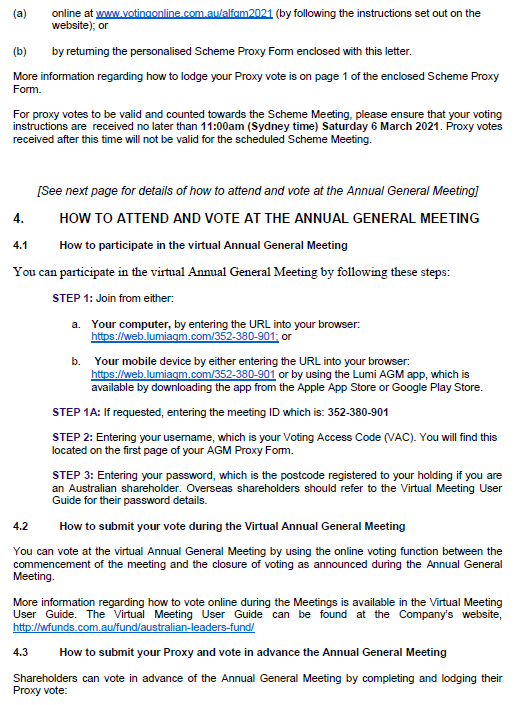
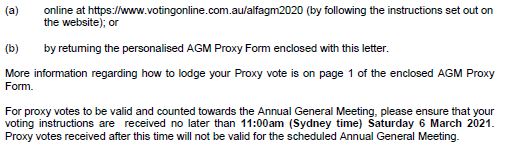
(f) on or before 5 February 2021, there be dispatched to each ALF shareholder who, in accordance with the Act, has consented to receiving shareholder communications electronically, an email containing, URL hyperlinks to the Scheme Booklet and the electronic proxy form, substantially in the form of Annexure A to these orders to the nominated email address of the shareholder.
(g) on or before 5 February 2021, there be dispatched to all ALF shareholders (other than those referred to in 1f above) by pre-paid post, or in the case of a member whose registered address is outside Australia, by pre-paid air mail, addressed to the relevant addresses set out in the register of members of ALF:
(i) a letter with the URL address to the Scheme Booklet substantially in the form of Annexure B to these orders to the registered address of all ALF shareholders;
(ii) a proxy form in substantially in the form of the document included with the Scheme Booklet; and
(iii) a reply paid envelope addressed to ALF,
(the Documents).
2. If the Scheme is agreed to at the Scheme Meeting, on or before 10 March 2021, ALF publish a Notice of Hearing substantially in the form of Annexure C hereto in The Australian Financial Review newspaper.
3. Rule 2.15 of the Federal Court (Corporations) Rules 2000 shall not apply to the Scheme Meeting.
4. The proceeding be stood over to 9.30am on 16 March 2021 for the hearing of any application to approve the Scheme.
5. Liberty to apply.
Note: Entry of orders is dealt with in Rule 39.32 of the Federal Court Rules 2011.
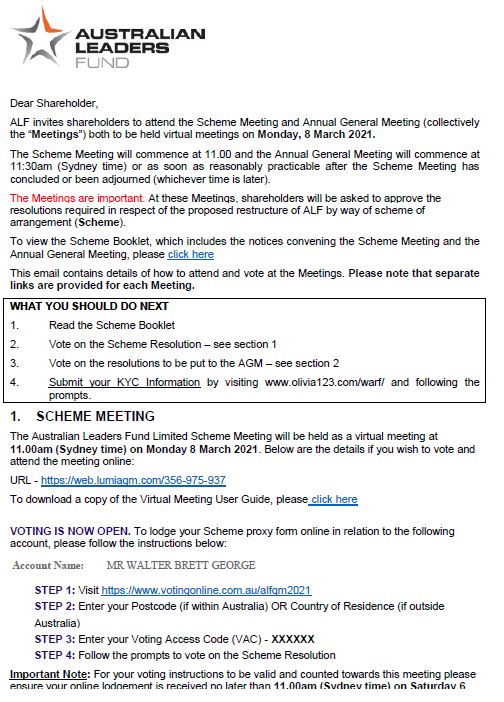 Annexure A
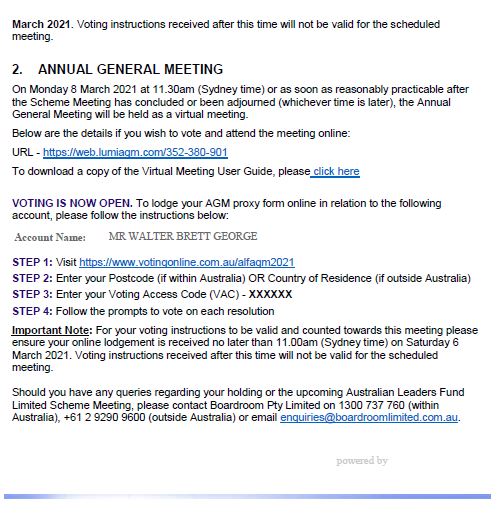
Annexure B
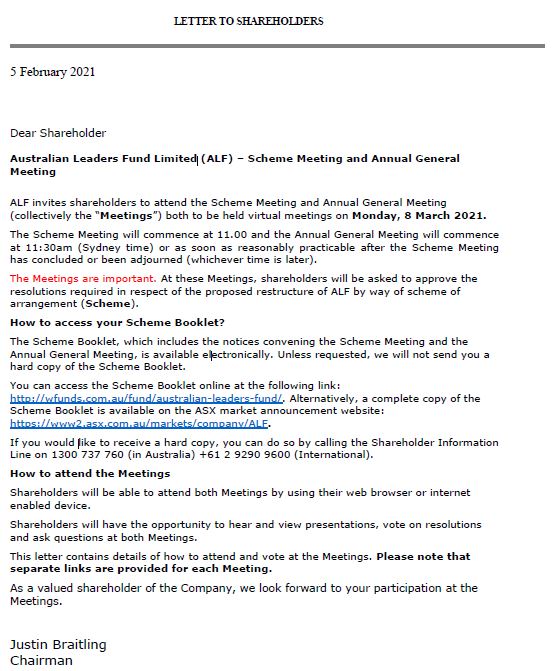
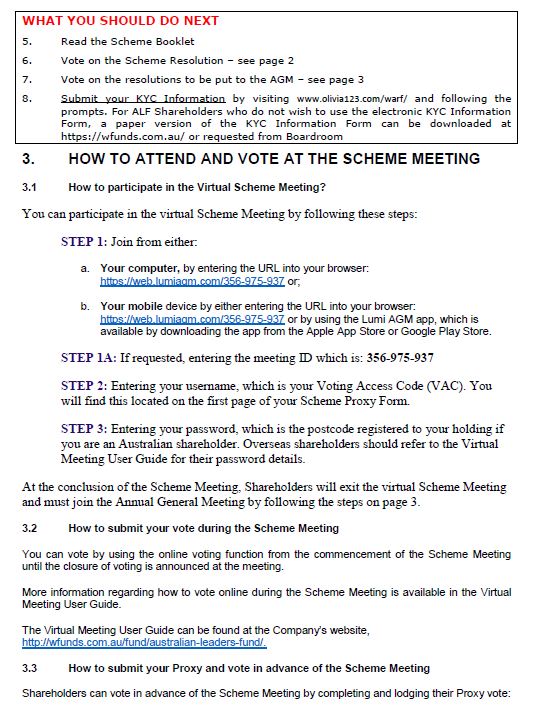
Annexure C
Australian Leaders Fund Limited ACN 106 845 970 (ALF)
Notice of hearing to approve compromise or arrangement
TO all the creditors and members of ALF.
TAKE NOTICE that at 9.30am (Sydney time) on 16 March 2021 the Federal Court of Australia at Law Courts Building, Queens Square, Sydney New South Wales 2000 will hear an application by ALF seeking the approval of an arrangement between ALF and its members agreed to by resolution at a meeting of such members.
If you wish to oppose the approval of the arrangement, you must file and serve on ALF a notice of appearance, in the prescribed form, together with any affidavit on which you wish to rely at the hearing. The notice of appearance and affidavit must be served on ALF at its address for service at least 1 day before the date fixed for the hearing of the application.
The address for service on ALF is: C/o- Mont Lawyers Suite 18 50 Stanley Street, Darlinghurst NSW 2010
Justin Braitling
Chairman, ALF
STEWART J:
Introduction
1 Australian Leaders Fund Ltd (ALF), a listed investment company on the ASX, seeks orders under s 411(1) of the Corporations Act 2001 (Cth) to convene a meeting of its members for the purposes of considering and, if thought fit, agreeing (with or without modification) to a scheme of arrangement proposed to be made between ALF and its shareholders. The amended originating process cites “Equity Trustees Ltd as Responsible Entity for The Watermark Absolute Return Fund” (ETL) as the defendant. That is not because the proceeding is adversarial; rather, the defendant is cited so that it can be bound by s 413 orders which will be sought at the anticipated second court hearing in the event that the scheme is adopted. The need for that will shortly become apparent.
Outline of the scheme
2 In summary, the shareholders’ interest as shareholders in ALF will be restructured so that they cease to be shareholders in ALF and become holders of units in an unlisted managed investment scheme known as the Watermark Absolute Return Fund (Watermark Fund) of which ETL will be the responsible entity.
3 The primary commercial rationale for the scheme is that listed investment companies, including ALF, as a commercial matter can and often do trade at a discount to their net tangible assets (NTA). By converting to a managed investment scheme structure the investment can be liquidated by a unit holder, when desired, under the managed investment scheme’s withdrawal of investment provisions at a price reflecting net asset value (NAV). There have been a number of these restructure schemes in recent years including as considered in Re Watermark Market Neutral Fund Ltd [2019] FCA 315, Re Watermark Global Leaders Fund Ltd [2019] FCA 316 and Re Ellerston Global Investments Ltd [2020] NSWSC 879.
4 It is explained in the Scheme Booklet, which is the “explanatory statement” required by s 412(1)(a) of the Act, that the board of ALF has bought back almost half of all shares on issue since ALF was listed in 2003 in an attempt to close the gap between the market price of the shares and ALF’s NTA. This has reduced the size of ALF substantially, and further reduction would pose a risk that its size would be so reduced as to become uneconomic. It is said that history has shown that reduced size and liquidity can exacerbate NTA discounts for smaller listed investment companies.
5 After consideration of a range of options, ALF announced on 28 September 2020 its support for a proposal to restructure ALF via a scheme of arrangement and to merge with the Watermark Fund. ALF and the Watermark Fund have the same fund manager and both employ a similar investment strategy.
6 ALF’s independent directors have recommended adoption of the scheme on the basis that they consider that it provides a solution to the difficulties faced by ALF for the following reasons:
(a) first, the elimination of any premium or discount to NTA backing should be achieved because the price of new units in the Watermark Fund is expected to reflect more closely the underlying value of the new units;
(b) secondly, it will allow investors to withdraw their investment approximate to the prevailing NAV per new unit on a monthly basis – this is because once the scheme has been implemented, new unit holders will have the ability to withdraw their investment each month;
(c) thirdly, it will provide investors with the option to retain an investment in an entity that employs the same investment strategy with the same risk and return characteristics as ALF, namely: returns that are uncorrelated with the broader share market, and the ability to protect capital using hedging strategies while targeting attractive returns over time; and
(d) fourthly, it will provide investors with an attractive management fee structure compared to other similar hedge fund strategies in the Australian market, noting that no management fees will be charged during the initial investment period.
7 If adopted, implementation of the scheme will involve the following:
(a) the ALF assets will be transferred to the Watermark Fund;
(b) ALF will pay a fully franked cash dividend and undertake an equal capital reduction, returning to ALF shareholders on an equal basis an amount equal to ALF’s post-tax NTA on the implementation date after payment of the fully franked cash dividend excluding a retention amount and cash required to fund outstanding transaction costs (if any), and cancelling all scheme shares after the scheme is implemented;
(c) ALF shareholders who participate in the scheme will receive new units, a new class of fully paid units in the Watermark Fund, at an exchange ratio of one new unit for every one ALF share held on the record date with no cash payment being required to be made for the new units;
(d) the current investment management agreement between ALF and its fund manager will be terminated with effect from the implementation date; and
(e) as new unit holders in the Watermark Fund, ALF shareholders may request the withdrawal of all or some of their new units in accordance with the constitution of the fund.
8 By operation of cl 4.3 of the scheme, various steps in implementing the scheme are required to be carried out simultaneously and no such step shall be deemed to be completed until all steps have been carried out. This is intended to cover performance risk.
9 After remaining liabilities have been satisfied it is the intention of the manager, Watermark Funds Management Pty Ltd, to convert ALF to a proprietary company and voluntarily wind up or deregister ALF although that is not a step covered by the scheme.
10 In broad terms the structure of the proposed scheme follows the structures approved in the cases referred to in [3] above, save that instead of ETL issuing units directly to scheme shareholders, they are first issued to ALF and then distributed by way of reduction of capital in ALF.
11 ALF’s independent directors have unanimously recommended that, in the absence of a superior proposal, ALF shareholders vote in favour of the scheme at the proposed scheme meeting.
12 Bradley Higgs, a director of Titan Partners Corporate Finance, the independent expert appointed by the directors on the independent board committee of ALF to assess the scheme, concluded that the scheme is fair and reasonable and therefore in the best interest of ALF’s shareholders. Mr Higgs is a Chartered Accountant with additional qualifications in finance and valuation and has 25 years’ experience in relevant business advisory and corporate advisory matters. He specialises in valuations, financial analysis, due diligence and corporate finance advice. He appears to be well-qualified to express an opinion with regard to whether or not the scheme is in the best interests of ALF’s shareholders and his advice appears to be based on his expertise and experience.
General principles
13 The general principles applicable to the court’s role in making an order for the convening of a scheme meeting and subsequently to the approval of a scheme are well settled.
14 There are three stages to an application under s 411. These stages are identified in Re CSR Ltd [2010] FCAFC 34; 183 FCR 358 at [7] per Keane CJ and Jacobson J:
(a) first, the court approves the convening of a scheme meeting and approves the draft explanatory statement to be sent to the scheme members;
(b) secondly, the members vote on the proposed scheme at the scheme meeting; and
(c) thirdly, the court approves the proposed scheme.
15 Without traversing in detail every matter relevant to the court’s role at the first court hearing, it is sufficient to note the following:
(1) As set out by Gleeson J in Alstom Signalling Solutions Pty Ltd v Alstom Transport Australia Pty Ltd [2016] FCA 838:
[20] The approach of the Court at the first court hearing is that “the court will not ordinarily summon a meeting unless the scheme is of such a nature and cast in such terms that, if it receives the statutory majority at the … meeting the court would be likely to approve it on the hearing of a petition which is unopposed”: per Street CJ (with whom Hutley and Samuels JJA agreed) in FT Eastment & Sons Pty Ltd v Metal Roof Decking Supplies Pty Ltd (1977) 3 ACLR 69 (“FT Eastment”) at 72. The High Court approved this observation in Australian Securities Commission v Marlborough Gold Mines Ltd [1993] HCA 15; (1993) 177 CLR 485 at 504. The FT Eastment approach has been consistently followed.
[21] At the first court hearing the Court exercises its supervisory jurisdiction to review the scheme and the explanatory statement and raise any queries with the plaintiff. In Re Crusader Ltd [1996] 1 Qd R 117; (1995) 120 FLR 219, Thomas J said at 125 that “the courts are concerned with the notion of a fair picture being presented” and went on to embrace the observations of the Full Federal Court (Black CJ, von Doussa and Cooper JJ) in Fraser v NRMA Holdings Ltd (1995) 55 FCR 452 at 468:
If every possible formulation of the commercial objective of the proposal, and arguments for and against every theoretical possibility, were set forth the total package of information to members would be likely to confuse rather than to illuminate the issue for decision, even for people having a familiarity with corporate law and commerce. The need to make full and fair disclosure must be tempered by the need to present a document that is intelligible to reasonable members of the class to whom it is directed, and is likely to assist rather than confuse.
(2) The court should consider whether the proposed scheme is not inappropriate, and is one that sensible business people might consider is of benefit to its members: see Re Sonodyne International Ltd (1994) 15 ACSR 494 at 499 per Hayne J; Re Integra Mining Ltd [2012] FCA 1414 at [11] per McKerracher J; Re Amcom Telecommunications Ltd [2015] FCA 341 at [10] per McKerracher J.
(3) The court does not need to be satisfied that no better scheme could have been devised: Re Foundation Healthcare Ltd [2002] FCA 742; 42 ACSR 252 at [44] per French J; Re Amcom Telecommunications Ltd [2015] FCA 341 at [10].
(4) The first hearing is in the nature of an interlocutory proceeding and the second court hearing is where the court makes its final determination: Australian Securities Commission v Marlborough Gold Mines Ltd [1993] HCA 15; 177 CLR 485 at 504-505 per Mason CJ, Brennan, Dawson, Toohey and Gaudron JJ; Re CSR Ltd [2010] FCAFC 34; 183 FCR 358 at [57] per Keane CJ and Jacobson J. The second court hearing is the most important hearing if the matter becomes contested, but in practice the first court hearing is where the court intervenes if it has concerns. One reason for this is that:
... court approval to convene the scheme meetings is viewed by the market as giving assurance that the scheme is at least in form and substance such as warranted receiving such preliminary court clearance. It must not be forgotten that trading thereafter takes place on that basis.
(per Santow J in Re Archaean Gold NL (1997) 23 ACSR 143 at 147.)
Matters for the court’s satisfaction
16 At the first court hearing, the court should order the convening of the scheme meeting and approve the Scheme Booklet if satisfied of the following matters (Re Amcom Telecommunications Ltd [2015] FCA 341 at [12]; see also Re Staging Connections Group Ltd [2015] FCA 1012 at [19]-[20] per Gleeson J; Re Xplore Wealth Ltd [2020] FCA 1868 at [23] per Markovic J):
(1) the proposed scheme is an arrangement in respect of which the court may order a meeting of the members pursuant to s 411(1). That is, the scheme is an arrangement; the scheme company is a Pt 5.1 Body; the scheme participants are members of the scheme company; the scheme meeting will be convened between members of the same class; and the proposed scheme is bona fide and properly proposed;
(2) the Australian Securities and Investments Commission (ASIC) has had a reasonable opportunity to examine the terms of the scheme and the Scheme Booklet and make submissions to the court in relation to those matters: s 411(2)(b) of the Act;
(3) the Scheme Booklet provides adequate disclosure (s 412(1)(a)(i) of the Act) and contains the prescribed information in section 412(1)(a)(ii) of the Act, reg 5.1.01 and the applicable clauses of Sch 8 to the Corporations Regulations 2001 (Cth);
(4) the procedural requirements of the Federal Court (Corporations) Rules 2000 have been met, however, I refer to [28] below in this regard; and
(5) there is no apparent reason why the scheme should not, in due course, receive the court’s approval if the necessary majority of votes are achieved.
17 The evidence that has been tendered satisfies me of all those matters.
18 At both court hearings there is a duty of disclosure which falls on the scheme company and its counsel, as set out in Re Permanent Trustee Company [2002] NSWSC 1177; 43 ACSR 601 at [7] per Barrett J:
The fact that the application is ex parte is not without some significance. The absence of any defendant or contradictor sharpens the duty of the applicant. While a case such as the present is distinguishable from one where an interlocutory injunction is sought in the absence of a defendant (in that there is here no defendant as such) I think it is fair to say that an applicant in this kind of situation, like an applicant ex parte for an injunction, carries the responsibility of bringing to the court's attention all matters that could be considered relevant to the exercise of discretion.
19 There are a number of matters which were specifically brought to my attention. Those matters are:
(a) a share cancellation scheme is proposed instead of a share transfer scheme;
(b) certain provisions of the scheme implementation deed and the scheme;
(c) the scheme contemplates s 413 orders; and
(d) the position of the scheme company creditors.
Share cancellation scheme
20 It was explained that the reason for a share cancellation scheme rather than a share transfer scheme is that ETL does not wish to hold shares in a company, the functions of which will become otiose, and the scheme shareholders are to receive a substitute economic interest in the form of their new units in the Watermark Fund.
The scheme implementation deed and scheme
21 The scheme is subject to the conditions precedent set out in cl 3.1 of the scheme implementation deed. Save for the usual court orders (approving the scheme) and such orders being lodged with ASIC, the conditions precedent need to be satisfied or waived by, at the latest, 8:00 am on the day of the second court date, so the scheme will be self-executing upon the making of the orders approving it at the second court hearing and lodgement of those orders with ASIC.
22 ETL is not a party to the scheme, so it is proposed that as an outsider it will be bound in by contract. This is achieved by deed poll in favour of scheme shareholders. The deed poll enables relevant scheme shareholders to directly enforce the obligation to provide the scheme consideration. The deed poll is governed by the law of New South Wales.
23 There is a limited performance risk issue because the scheme is drafted so that no key operative step shall be deemed to have been completed unless all such steps have been carried out: cll 4.2 and 4.3 of the scheme.
24 The capital reduction resolution contemplates the momentary reduction of the share capital to zero and the cancellation of all issued shares. Clause 4.2(r) of the scheme implementation deed then contemplates the issue of a share to the fund manager. This means that for a moment of time the scheme company is without capital. This is within existing authority: Re MB Group plc [1989] BCLC 672 at 680 per Harman J; Re Anglo American Insurance Co Ltd [1991] BCLC 564 per Harman J; Re Northern Engineering Industries plc [1994] 2 BCLC 704 at 709 per Millett LJ (Leggatt and Neill LJJ agreeing); Re Watermark Market Neutral Fund Ltd [2019] FCA 315 at [16] per Yates J.
The Scheme contemplates s 413 orders
25 Clause 4.2(d) of the scheme is proposed to be backed up by s 413 orders transferring the designated assets specified in the scheme to ETL as responsible entity of the Watermark Fund. Section 413 can apply where there is a scheme for reconstruction of Pt 5.1 bodies. The scheme company, ALF, and ETL is each a Pt 5.1 Body and what is contemplated is the transfer of part of the undertaking and property of the scheme company to ETL (a concept contemplated by s 413(1)(a)). The reconstruction relevantly consists of the reconstitution of the economic interest of the shareholders so that it is held via a managed investment scheme structure rather than a shareholder/company structure with the shareholders departing the scheme company and moving to become beneficiaries under the managed investment scheme structure.
The position of scheme company creditors
26 An affidavit of Justin Braitling sets out that ALF will not have any liabilities that will not be satisfied following the implementation date (26 March 2021) out of the retention amount ($100,000). The reason for this is as follows:
(1) all transaction costs, being costs and expenses associated with the scheme including all costs associated with implementing the scheme (which includes advisers expenses, legal expenses, counsel fees and the fees of the independent expert) will be paid by ALF prior to the implementation date;
(2) the ALF directors (Justin Braitling, Geoff Wilson AO, John Abernethy and Julian Gosse) will:
(i) be paid their remuneration up to the implementation date;
(ii) resign following the implementation date; and
(iii) not be entitled to any payment in connection with their resignation as directors of ALF;
(3) ALF does not have any costs or liabilities in respect of any premises;
(4) Watermark Funds Management Pty Ltd will be paid an early termination fee ($2.5 million) and any outstanding management fees accrued up to and including the effective date (17 March 2021); and
(5) ALF will retain the retention amount in order to satisfy the payment of any other liabilities with respect to the winding-up of ALF.
27 On that basis I am satisfied that creditors are not likely to be prejudiced by adoption of the scheme.
Corporations Regulations
28 I note that r 2.15 of the Corporations Rules relevantly sets out that regs 5.6.11 to 5.6.36A of the Corporations Regulations apply to meetings ordered by the court. Many of these regulations have been repealed and re-enacted in Div 75 of the Insolvency Practice Rules (Corporations) 2016 (Cth). Rule 2.15 relevantly states that the application of the referenced regulations is subject to any direction of the court to the contrary. Because of the identified lacuna and that the scheme approved at a scheme meeting will not take effect without a further order of the court approving the scheme, I ordered that r 2.15 shall not apply to the scheme meeting. It has become common to dispense with compliance with r 2.15 on the basis that it is unnecessary: Re HIH Casualty and General Insurance Ltd [2006] NSWSC 191 per Barrett J; Re Trust Co Ltd [2013] NSWSC 1680 at [21] per Black J; Re Watpac Ltd [2018] FCA 656 at [33] per Gleeson J.
Conclusion
29 On the basis of the above authority, evidence and considerations I was satisfied to make the orders that were sought albeit in slightly amended form.
I certify that the preceding twenty-nine (29) numbered paragraphs are a true copy of the Reasons for Judgment of the Honourable Justice Stewart. |
Associate:


