

Federal Court of Australia
RXP Services Limited, in the matter of RXP Services Limited [2021] FCA 38
ORDERS
RXP SERVICES LIMITED (ACN 146 959 917) Plaintiff | ||
DATE OF ORDER: |
OTHER MATTERS:
1. The Court notes that the Australian Securities and Investments Commission (ASIC) was provided with at least 14 days’ notice of the hearing of this application.
2. The Court is satisfied that ASIC has had a reasonable opportunity to:
(a) examine the terms of the proposed scheme of arrangement to which the application relates and a draft explanatory statement relating to that arrangement; and
(b) make submissions to the Court in relation to the proposed scheme of arrangement and the draft explanatory statement.
3. The Court notes the letter from ASIC to the Directors of RXP Services Limited dated 28 January 2021 at Annexure KAP-10 to the affidavit of Kelly Ann Powers dated 28 January 2021.
THE COURT ORDERS THAT:
1. Pursuant to s 411(1) of the Corporations Act 2001 (Cth) (Act), the Plaintiff convene and hold a meeting of its shareholders (Scheme Meeting):
(a) for the purpose of considering, and, if thought fit, agreeing (with or without modification), to the scheme of arrangement (Scheme) proposed to be made between the Plaintiff and its shareholders (RXP Shareholders), the terms of which are set out in Annexure A to these orders; and
(b) to be held on 2 March 2021 at 11.00 am (AEDT) and to be conducted electronically through an online platform (which is to be accessed in accordance with the instructions included in the Notice of Scheme Meeting to be sent to RXP Shareholders in accordance with order 2 below) in accordance with the provisions of Part 2 of the Corporations (Coronavirus Economic Response) Determination (No.3) 2020 (Cth).
2. The Scheme Meeting be convened by sending on or before 2 February 2021:
(a) an email to each RXP Shareholder with an email address recorded in the RXP share register (Email Shareholder) (or, in the case of joint holders, to the holder whose name appears first in the Plaintiff’s register), such email to be substantially in the form of Annexure DR-3 to the affidavit of David Royale affirmed on 28 January 2021 (Royale Affidavit) which contains links to:
(i) an electronic copy of a document substantially in the form of the Scheme Booklet, a draft of which is at Annexure KAP-12 to the affidavit of Kelly Ann Powers sworn on 29 January 2021 (which contains among other things the proposed Scheme and Notice of Scheme Meeting) (Scheme Booklet); and
(ii) an online portal or website that is accessible by the Email Shareholder and which enables the Email Shareholder to lodge their proxy for the Scheme Meeting and voting instructions online;
(b) the following hard-copy documents to each RXP Shareholder who is not an Email Shareholder (Postal Shareholder) (or, in the case of joint holders, to the holder whose name appears first in the Plaintiff’s register):
(i) a letter setting out the URL which provides access to an electronic copy of the Scheme Booklet (which contains among other things the proposed Scheme and Notice of Scheme Meeting);
(ii) a personalised proxy/voting form for the Scheme Meeting (Proxy Form), substantially in the form of Annexure DR-4 to the Royale Affidavit and a pre-addressed envelope for the return of completed Proxy Forms.
3. The documents referred to in order 2(b) be sent:
(a) in the case of RXP Shareholders whose registered address is within Australia, by prepaid ordinary post addressed to the relevant addresses recorded in the Plaintiff’s register; and
(b) in the case of RXP Shareholders whose registered address is outside Australia, by airmail or international courier service addressed to the relevant addresses recorded in the Plaintiff’s register.
4. Compliance with r 2.15 of the Federal Court (Corporations) Rules 2000 (Cth) (Rules) be dispensed with, except in so far as that rule applies r 75-15(2) of the Insolvency Practice Rules (Corporations) 2016 (Cth).
5. Voting on the resolution to approve the Scheme is to be conducted by way of a poll.
6. A proxy in respect of the Scheme Meeting will be valid and effective if, and only if, a Proxy Form is completed and delivered in accordance with its terms or a proxy is lodged online in accordance with the instructions by 11.00 am (AEDT, being Melbourne time) on 28 February 2021.
7. Mr John Pittard or failing him Mr Adrian Fitzpatrick, be Chair of the Scheme Meeting.
8. The Chair of the Scheme Meeting shall have the power to adjourn the meeting to such time, date and place as he considers appropriate.
9. Compliance with r 3.4 and Form 6 of the Rules be dispensed with.
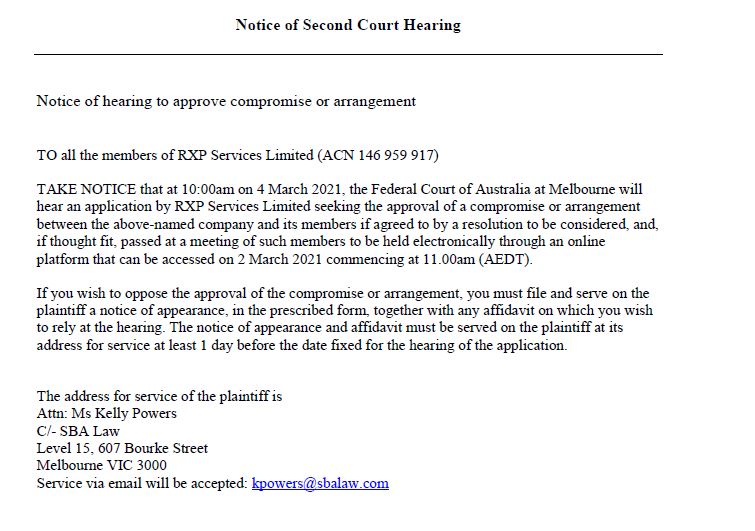
10. The Plaintiff publish a Notice of Hearing in The Australian newspaper, in substantially the form that appears at Annexure B hereto, not later than 5 days prior to the date fixed for the hearing of any application to approve the Scheme.
11. The further hearing of the Originating Process is adjourned to Justice Beach at 10.00 am (AEDT, being Melbourne time) on 4 March 2021 or as soon thereafter as the business of the Court allows.
Note: Entry of orders is dealt with in Rule 39.32 of the Federal Court Rules 2011.
ANNEXURE A
Scheme of Arrangement
[The order entered is available on the Commonwealth Courts Portal, which attaches the Scheme]
ANNEXURE B
REASONS FOR JUDGMENT
BEACH J:
1 RXP Services Limited (RXP) applies for an order under s 411(1) of the Corporations Act 2001 (Cth) for a meeting of RXP shareholders to be convened to consider a proposed scheme of arrangement (the Scheme).
2 RXP is an Australian public company limited by shares. It is admitted to the official list of the ASX, and its shares are quoted for trading. It is an Australian-based digital services consultancy provider.
3 The commercial purpose of the Scheme is to provide for the acquisition of all the shares in RXP by Capgemini Australia Limited (BidCo), a wholly owned subsidiary of Capgemini SE, a French company (Capgemini).
4 If the Scheme is implemented, RXP shareholders will receive $0.55 cash per RXP share less a special dividend of up to $0.05 per RXP share.
5 On 10 November 2020, RXP entered into a Scheme Implementation Deed with BidCo, which was subsequently amended on 19 January and 25 January 2021 (SI Deed). The SI Deed provided for RXP to propose the Scheme and that both RXP and BidCo would implement the Scheme on the terms of the SI Deed.
6 The Scheme provides for the acquisition by BidCo of 100% of the shares in RXP on issue (the scheme shares). Prior to BidCo receiving a transfer of the scheme shares, the scheme consideration must be provided to the holders of the scheme shares (the scheme shareholders). The scheme consideration will comprise the cash consideration. The cash consideration of $0.55 per scheme share less the amount of any special dividend is to be paid by BidCo. The obligation of BidCo to provide the scheme consideration has been secured by its entry into of a Deed Poll in favour of scheme shareholders. Following provision of the scheme consideration to scheme shareholders, all scheme shares will be transferred to BidCo. It is anticipated that the above steps will be completed on or around 26 March 2021.
7 Following the implementation of the Scheme, RXP will be a wholly-owned subsidiary of BidCo, and will be delisted from the ASX.
8 Now RXP has prepared a Scheme Booklet, which includes the explanatory statement required by ss 411(2)(b)(i) and 412(1). A draft of the Scheme Booklet was lodged with ASIC on 22 December 2020. Amendments to that version were subsequently made and provided to ASIC.
9 The Scheme Booklet sets out a detailed description of the Scheme and its advantages and disadvantages. It also annexes an updated independent expert report of Mr Craig Edwards of Lonergan Edwards & Associates Limited. In the updated independent expert report, Mr Edwards concludes that the Scheme is fair and reasonable and in the best interests of the scheme shareholders in the absence of a superior alternative proposal emerging. In particular, Mr Edwards has assessed the value of RXP shares on a 100% controlling interest basis to be between $0.46 and $0.54 per RXP share. The cash consideration is therefore above the upper estimate of his assessed valuation range for RXP shares.
10 The RXP Board has unanimously recommended that RXP shareholders vote in favour of the Scheme in the absence of a superior proposal and subject to Mr Edwards continuing to conclude that the Scheme is in the best interests of RXP shareholders.
11 Let me say something further on the provision of the scheme consideration. Under the terms of the SI Deed, the RXP Board may declare a fully franked special dividend of up to $0.05 per RXP share to be paid on or prior to the implementation of the Scheme. But whether a special dividend is ultimately declared and paid remains at the discretion of the RXP Board. But if the special dividend is declared, it will be paid to all persons registered as RXP shareholders as at the special dividend record date. The special dividend is expected to be fully franked. If the special dividend is declared, then under the Scheme the cash consideration of $0.55 per scheme share provided by BidCo will be reduced to the extent of any special dividend.
12 If the Scheme is to proceed, all conditions precedent other than Court approval must be either satisfied or waived by 8.00 am on the date of the second Court hearing, which will be on 4 March 2021. If the Scheme is agreed to by shareholders and approved by me, it will become effective on 5 March 2021, and the scheme consideration will be issued to scheme shareholders on 26 March 2021. The scheme shares will subsequently be transferred to BidCo on that date.
13 The mechanism for the transfer of the scheme shares to BidCo and the issue of the scheme consideration to scheme shareholders is as follows. Prior to the implementation date and prior to the transfer of any scheme shares to BidCo, BidCo must deposit into a trust account in cleared funds an amount equal to the aggregate amount of cash comprised in the scheme consideration payable to scheme shareholders, with that amount to be held by RXP on trust for the scheme shareholders for the purpose of RXP dispatching the aggregate cash comprised in the scheme consideration to the scheme shareholders to which they are entitled. On the implementation date, subject to the deposit of funds by BidCo, RXP must pay or procure the payment of the cash consideration to each scheme shareholder from the trust account referred to. And on the implementation date but after BidCo has satisfied its obligations to provide the scheme consideration, the scheme shares held by scheme shareholders will be transferred to BidCo.
14 Now whilst the scheme consideration is to be issued by BidCo, it is not a party to the Scheme and cannot be directly bound by it. So it has been necessary for it to execute a Deed Poll in favour of scheme shareholders. BidCo has now entered into a Deed Poll which contains a covenant by it in favour of scheme shareholders to perform its obligations in relation to the Scheme. This includes the obligation to provide or procure the provision of the scheme consideration to the scheme shareholders in accordance with the terms of the Scheme. And under the terms of the Scheme, RXP undertakes in favour of each scheme shareholder to enforce the Deed Poll against BidCo on behalf of and as agent and attorney for the scheme shareholders.
15 Let me move to some more general matters.
16 Section 411(1) confers a discretion on the Court to make an order if certain requirements are satisfied, namely:
(a) a compromise or arrangement is proposed between a Pt 5.1 body and its members or any class of them;
(b) application for the order is made in a summary way by the body;
(c) 14 days’ notice of the hearing of the application has been given to ASIC or such lesser period as the Court or ASIC permits; and
(d) the Court is satisfied that ASIC has had a reasonable opportunity to:
(i) examine the terms of the proposed compromise or arrangement to which the application relates and a draft explanatory statement relating to the proposed compromise or arrangement; and
(ii) make submissions to the Court in relation to the proposed compromise or arrangement and the draft explanatory statement.
17 Now these requirements have been satisfied in the present case. Accordingly my power has been enlivened. I am also satisfied that relevant provisions of the Corporations Regulations 2001 (Cth) and the Federal Court (Corporations) Rules 2000 (Cth) have been satisfied. Let me turn then to the exercise of my discretion.
18 Now as I have said on more than one occasion, my function on an application to order the convening of a meeting is supervisory. At this stage I should generally confine myself to ensuring that certain procedural and substantive requirements have been met including dealing with adequate disclosure, but with limited consideration of issues of fairness. But having said that, it is appropriate to consider the merits or fairness of a proposed scheme at the convening hearing if the issue is such as would unquestionably lead to a refusal to approve a proposed scheme at the approval hearing, that is, the proposed scheme appears now to be on its face “so blatantly unfair or otherwise inappropriate that it should be stopped in its tracks before going any further” (Re Foundation Healthcare Ltd (2002) 42 ACSR 252 at [44] per French J). But in the present case, in my view there is no issue arising from the Scheme which would unquestionably lead to a refusal to approve the Scheme at the approval hearing. It cannot be said that the Scheme on its face is “so blatantly unfair or otherwise inappropriate that it should be stopped in its tracks before going any further”. Put another way, the Scheme is not of such a nature and cast in such terms that if it receives the support of the statutory majorities at the meeting, nevertheless I would not be likely to approve it at the second court hearing.
19 In my view the Scheme is fit for consideration by RXP shareholders at the proposed meeting, in the sense referred to. The question whether or not to accept particular consideration for shares is a commercial matter for the members of RXP to assess, and they ought not be prevented from having the opportunity to do so provided that I am satisfied that they are acting on sufficient information and with time to consider what they are voting on. I am so satisfied. Further, it is relevant in this respect that the Scheme Booklet contains a recommendation from all directors that shareholders vote in favour of the Scheme, a statement that all directors intend to vote their RXP shares in favour of the Scheme, and an independent expert report that the Scheme is fair and reasonable and in the best interests of RXP shareholders.
20 Let me now discuss the following particular features of the Scheme that have been drawn to my attention, being:
(a) performance risk;
(b) shareholder warranties;
(c) the reimbursement fee;
(d) the exclusivity arrangements;
(e) separate classes and recommendations;
(f) the special dividend and financial assistance; and
(g) the purpose of the Scheme, and whether it is to avoid Ch 6 of the Act.
Performance risk
21 Although BidCo is to issue the scheme consideration, it is not a party to the Scheme and is not directly bound by it. As such, its obligations do not depend upon s 411. But the Scheme before me effectively eliminates any performance risk. This is because RXP has adopted safeguards to address the performance risk arising from the obligation of BidCo to issue the scheme consideration. In particular, the terms of the Scheme supported by the SI Deed prevent any transfer of the scheme shares to BidCo unless and until the scheme consideration has been issued, and BidCo has executed a Deed Poll as I have said. It follows that there is no material performance risk which would justify me not ordering the convening of the scheme meeting.
Shareholder warranties
22 The Scheme provides that each scheme shareholder is taken to have warranted to BidCo that, as at the implementation date, all of their scheme shares that are transferred under the Scheme will, at the date of transfer, be fully paid and free from all security interests and interests of third parties of any kind and from any restrictions on transfer of any kind, and that it has full power and capacity to sell and to transfer those shares together with any rights and entitlements attaching to such shares to BidCo under the Scheme. The warranty is in the usual form, and such clauses have been held to be acceptable, as long as the warranty is sufficiently disclosed in the explanatory statement to shareholders, which it is. In my view, this deemed warranty clause is acceptable.
Reimbursement fee
23 If the Scheme does not become effective, a reimbursement fee of $954,700 may be payable by RXP to BidCo.
24 The circumstances in which the reimbursement fee would be payable are set out in the SI Deed and explained in the Scheme Booklet. I do not need to set these out. They are in standard terms.
25 However, notwithstanding the occurrence of any event which would trigger a requirement to pay the reimbursement fee under the SI Deed, the reimbursement fee is not payable if the Scheme becomes effective.
26 Further, the reimbursement fee is not payable merely because the Scheme does not proceed as a result of RXP shareholders not approving the scheme resolution.
27 The value of the reimbursement fee of $954,700 represents approximately 1% of the total equity value of RXP, having regard to the value of the bid consideration at the time of the announcement of the transaction.
28 In my view the terms of the reimbursement fee and the circumstances in which it was agreed are consistent with the requirements of the relevant authorities, and do not represent a barrier to the convening of a meeting to consider the Scheme.
Exclusivity arrangements
29 The SI Deed contains a number of exclusivity provisions, including the usual “no shop” and “no talk” provisions which are common features of such agreements. In particular, as noted by me in Re Healthscope Ltd (2019) 139 ACSR 608, provisions such as those in the SI Deed are commonly found in merger implementation agreements.
30 The existence and nature of the exclusivity provisions are addressed in detail in the Scheme Booklet. The exclusivity provisions are in standard form. And the longest period during which the exclusivity provisions could be anticipated to apply is a little over six months. Further, there are the usual fiduciary carve-outs.
31 In my view, the fiduciary carve-outs in the SI Deed are appropriate. Further, the exclusivity period of around six months is reasonable in light of the size, nature and complexity of the transaction. For these reasons, the exclusivity arrangements do not prevent me from making an order to convene a meeting of members to vote on the Scheme.
Separate classes and recommendations
32 Let me deal with some other matters.
33 First, the potential availability of different forms of scheme consideration does not necessarily lead to the creation of more than a single class of shareholders. The question of classes and separate class meetings arises because of the reference in s 411(1) to an arrangement proposed between a company and its members “or any class of them”.
34 In Re Healthscope Ltd I engaged in a detailed review of the relevant authorities on classes at [105] to [120]. At [106], I said:
The well-established test for identifying a class for the purposes of a scheme of arrangement is that expressed by Bowen LJ in Sovereign Life Assurance Co v Dodd [1892] 2 QB 573 at 583. Sovereign Life Assurance concerned a creditors’ scheme of arrangement, but the test enunciated by Bowen LJ has been adopted ever since in members’ schemes (Re Foster’s Group Limited [2011] VSC 93 at [15] per Ferguson J). Bowen LJ expressed the class test in the following terms:
…The word “class” is vague, and to find out what is meant by it we must look at the scope of the section, which is a section enabling the Court to order a meeting of a class of creditors to be called. It seems plain that we must give such a meaning to the term “class” as will prevent the section being so worked as to result in confiscation and injustice, and that it must be confined to those persons whose rights are not so dissimilar as to make it impossible for them to consult together with a view to their common interest…
35 I also expressed the relevant question as being whether the rights of the relevant shareholders there under consideration were (at [107]):
so dissimilar from the rights of the other Healthscope shareholders as to make it impossible for them to consult together with a view to their common interest. Or put another way, do the differences in rights between NWH AssetCo (or its affiliates) and the other Healthscope shareholders mean that any community of interest between them has been displaced for the purposes of them considering and voting upon the proposed Scheme.
36 In relation to the specific question of whether different forms of scheme consideration give rise to the need for separate classes, it is appropriate to consider whether the existence of different proportional entitlements to different forms of consideration under a scheme of arrangement would necessitate the creation of separate classes of shareholders for the purpose of voting.
37 Now RXP has on issue 453,806 performance rights, which were issued to two executive employees (who are not directors of RXP) under the “RXP Services Limited FY20 STI Deferral Plan”, which relates to the financial year that ended on 30 June 2020 (Performance Rights). As explained in the Scheme Booklet:
(a) each vested Performance Right entitles its holder to acquire one RXP Share;
(b) pursuant to the terms of the RXP Services Limited FY20 STI Deferral Plan, all Performance Rights vest and are automatically exercised on a “Change of Control”, which is defined in the Plan to include a scheme of arrangement becoming effective in accordance with s 411(10) of the Act; and
(c) accordingly, the Performance Rights will vest and be automatically exercised on the effective date of the Scheme.
38 On vesting of the Performance Rights, RXP intends to issue new RXP shares to the RXP Employee Share Scheme Trust established for the purposes of the Plan. This will enable the relevant holders to participate in the Scheme and receive the scheme consideration.
39 Otherwise, RXP has no options, performance rights or any other securities on issue.
40 Let me deal with another matter.
41 Eight executives of RXP have “short term incentive” and “deferred STI” components of their remuneration packages that will become payable in cash on a “Change of Control”, which is defined consistently with the definition of that term in the RXP Services Limited FY20 STI Deferral Plan. These cash payments are proposed to be made to the relevant executives on the effective date of the Scheme. One of those executives is Mr Ross Fielding, who is also director of RXP, and who is to receive a cash payment of $574,087 pursuant to the above arrangements.
42 Now there is evidence before me that:
(a) Mr Fielding considers that it is appropriate for him to make a recommendation on the Scheme, given the importance of the Scheme and Mr Fielding’s role in the management of RXP;
(b) the RXP Board has, in the absence of Mr Fielding, determined that Mr Fielding can, and should if he wishes to do so, make a recommendation on the Scheme notwithstanding the nature and quantum of the above payment, given the importance of the Scheme and Mr Fielding’s role in the management of RXP; and
(c) the directors of RXP other than Mr Fielding have formed the view that Mr Fielding’s incentive arrangements:
(i) do not induce Mr Fielding to accept an offer or dispose of securities in connection with the Scheme; and
(ii) are not a benefit, but rather an acceleration of a payment that Mr Fielding may have become entitled to for the FY 2021, irrespective of RXP entering into the Scheme; and
(iii) even if a benefit, are given to Mr Fielding not in his capacity as a shareholder of RXP, but rather in his capacity as an executive of RXP.
43 These arrangements are discussed in the Scheme Booklet. The Scheme Booklet also refers to Mr Fielding’s arrangements whenever the recommendation of the directors to vote in favour of the Scheme is mentioned. Further, shareholders are instructed to have regard to these arrangements when considering Mr Fielding’s recommendation on the Scheme.
44 Now there are two issues in relation to the proposed treatment of the Performance Rights and the incentives. The first issue concerns classes, and the second concerns the appropriateness of Mr Fielding making a recommendations to shareholders in relation to the Scheme.
45 As to the first issue, in my view there is no need for separate class treatment. I need say nothing further.
46 As to the second issue, in Re DWS Limited [2020] FCA 1590, I reviewed the authorities in relation to this issue. I agreed with the approach taken by Robson J in Re SMS Management and Technology Limited [2017] VSC 257 at [26], O’Callaghan J in Re Kidman Resources Ltd (2019) 375 ALR 760 at [105] to [113] and Black J in Re Villa World Ltd (2019) 139 ACSR 550 at [38] to [40]. I concluded that the benefits under consideration in Re DWS Limited were not of such a nature that they ought to preclude the director from making a voting recommendation to members, and that in any event, the arrangements were adequately disclosed in the scheme booklet in that case, such that transparency had been properly served and preclusion from making a recommendation was unnecessary.
47 In addition, in Re Citadel Group Limited [2020] FCA 1580 a director of Citadel potentially became entitled to receive a proportionate amount of his annual incentive award if the Scheme became effective and he remained employed by Citadel. I held that the nature and extent of any additional benefits that it might be said that the director would become entitled to if the Scheme was implemented were not such as to make it inappropriate for him to make a voting recommendation to members. I also noted that, in any event, the arrangements were adequately disclosed in the scheme booklet in that case, and shareholders were expressly told to have regard to these arrangements when considering that director’s recommendation of the Scheme.
48 In my view the same conclusions ought to be drawn in the present case. That is, the nature and extent of any additional benefits that it might be said that Mr Fielding will become entitled to if the Scheme is implemented are not such as to make it inappropriate for him to make a voting recommendation to members. In any event, the arrangements are adequately disclosed in the Scheme Booklet, and shareholders are told to have regard to these arrangements when considering Mr Fielding’s recommendation of the Scheme.
The special dividend and financial assistance
49 The SI Deed provides that RXP may in its discretion declare and pay a special dividend of up to $0.05 per RXP share. The SI Deed provides that:
(a) the ability of RXP to declare and pay the special dividend is subject to the Scheme becoming effective, RXP having received a favourable draft class ruling from the Australian Tax Office to confirm the key taxation implications of the Scheme, including the availability of franking credits for certain classes of taxpayers, and RXP complying with the requirements of s 254T of the Act;
(b) the record date for the special dividend must be on or before the scheme record date. The special dividend record date is currently anticipated to be 7.00 pm on 11 March 2021, and the scheme record date is currently anticipated to be 7.00 pm on 19 March 2021; and
(c) the payment date for the special dividend will be determined by RXP in its absolute discretion, provided that the payment date occurs on or before the implementation date. The special dividend payment date is currently anticipated to be 18 March 2021, and the implementation date is currently anticipated to be 26 March 2021.
50 The SI Deed provides that if the special dividend is declared and paid, the scheme consideration payable to scheme shareholders will be reduced by the cash amount of that special dividend.
51 If the special dividend is declared and paid by RXP, there may arise a question whether financial assistance is given by RXP to BidCo to acquire the scheme shares.
52 Now s 260A provides that a company may financially assist a person to acquire shares in the company only if:
(a) giving the assistance does not materially prejudice (i) the interests of the company or its shareholders or (ii) the company's ability to pay its creditors;
(b) the assistance is approved by shareholders under s 260B; or
(c) the assistance is exempt under s 260C.
53 In considering the effect of those provision in relation to the special dividend, two questions arise: the first question is whether the proposal in relation to the special dividend constitutes financial assistance at all, within the meaning of the Act. The second question is whether, if it does, it is nevertheless permitted by s 260A.
54 As to the first question, the words “financial assistance” have no technical meaning. The task is to examine the commercial realities of the transaction to determine whether it can properly be described as the giving of financial assistance by the company.
55 In my view, payment of the special dividend is not relevant financial assistance. In this respect:
(a) BidCo is not currently a shareholder of RXP and therefore will not receive the special dividend;
(b) the effect of the payment of the special dividend is merely to reduce the consideration payable for the scheme shares pursuant to the Scheme in a manner that reflects the cash outflow from RXP and the consequential reduction in its net assets; and
(c) whilst the SI Deed anticipates the payment of the special dividend, the Scheme does not require the dividend to be paid. Declaration of the dividend is in the discretion of the RXP Board.
56 Properly characterised, these arrangements are not financial assistance within the meaning of the Act.
57 In any event, the payment of the special dividend will not prejudice RXP, its shareholders or its ability to pay its creditors for the purposes of ss 260A(1)(a)(i) to (ii). There is evidence before me from RXP’s Chief Financial Officer, Mr David Royale that the financial position of RXP generally and its asset and liability position in particular are such that RXP’s net asset position is more than sufficient to meet the payment of the special dividend, and that the payment would not prejudice the interests of RXP or its members or the ability of RXP to pay its creditors. In addition, the independent expert has opined that the Scheme is fair and reasonable and therefore in the best interests of RXP shareholders, in the absence of a superior proposal. Further, s 254T will not be infringed.
Section 411(17)
58 My power to approve a scheme is restricted by s 411(17). At the approval stage, I must be satisfied that there is no proscribed purpose as described in s 411(17)(a) or there must be provided to me a statement in writing by ASIC that it has no objection to the arrangement (s 411(17)(b)). But if such a statement is provided by ASIC, it will not be provided until the second court hearing.
59 In my view, s 411(17) does not present a bar to a meeting now being ordered to be convened as it seems likely that ASIC will produce the relevant statement at the second court hearing. Given that ASIC does not oppose the application for convening the meeting, it is appropriate for me to proceed at this stage on the basis that an application for approval would be unopposed by ASIC, and that ASIC will in due course provide a statement in the form contemplated by s 411(17)(b). I have taken comfort from ASIC’s letter dated 28 January 2021 to the directors of RXP in this respect.
60 Accordingly, in circumstances where it is likely that ASIC will produce a statement under s 411(17)(b) and there are presently no matters supporting an inference that there is any proscribed purpose, the requirements of s 411(17) do not present a bar to me ordering that a meeting be now convened.
Adequacy of information
61 Relevant to the exercise of my discretion is the adequacy of the information to be provided to shareholders by way of explanation of the Scheme. This involves considering the adequacy of the disclosure in the Scheme Booklet.
62 There are three aspects to the explanatory statement required by s 412(1)(a).
63 First, the explanatory statement must explain the effect of the arrangement, and in particular state any material interest of the directors, and the effect on those interests of the arrangement so far as it is different from the effect on the like interests of other persons. These matters are addressed in the Scheme Booklet.
64 Second, the explanatory statement must set out the prescribed information. I have no reason to doubt that relevant disclosure requirements have been met in the Scheme Booklet.
65 Third, the explanatory statement must set out any other information that is material to the making of a decision whether or not to agree with the arrangement, being information which is within the knowledge of the directors and has not previously been disclosed. The Scheme Booklet appears clear and comprehensive. In addition, the updated independent expert report contains a detailed evaluation of the Scheme, presented in a way that enables a shareholder to form a view of the merits of the Scheme.
66 Further, the verification procedures implemented to ensure that the Scheme Booklet does not contain any misleading or deceptive statements and satisfies the applicable disclosure requirements in relation to the information set out in the Scheme Booklet are, in my view, adequate.
67 Let me deal with another aspect.
68 As the Scheme is a members’ scheme only, it is necessary that the explanatory statement be registered by ASIC before the notice of meeting is sent to RXP shareholders. Before registering the statement, ASIC must conclude that it appears to comply with the requirements of the Act, and must form the opinion that the statement does not contain any matter that is false in a material particular or materially misleading in the form and context where it appears.
69 RXP has provided the proposed Scheme Booklet to ASIC, together with all amendments. There does not appear to be any unresolved matter of disagreement between ASIC and RXP such as to impede registration. I do not see any difficulty concerning registration.
70 Now s 411(1) provides that if I have made an order convening a meeting of members, I may approve the explanatory statement. But I do not propose to formally do so. In view of the requirement for registration by ASIC and the criteria that ASIC must apply, it is more appropriate that the explanatory statement for a members’ scheme be dealt with in that fashion. But I should stress that not to so formally approve should not be seen as casting any doubt on the accuracy or adequacy of the Scheme Booklet which comprises the explanatory statement or that it is not suitable for registration by ASIC.
Scheme meeting
71 It is proposed that the scheme meeting will be held virtually at 11.00 am (Melbourne time) on 2 March 2021 via an online platform. As a result of the health risks associated with the COVID-19 pandemic, it is not appropriate to have a physical meeting. Instead, the meeting is to be held electronically through an online platform. Shareholders will be able to access the online platform by visiting a particular webpage address specified in the notice of meeting, which is annexed to the Scheme Booklet. The online platform will enable participants to view the scheme meeting live, vote on the relevant resolution in real time and ask questions online. Such an arrangement is in accordance with the Federal and State government directions and restrictions and the Treasurer’s determination regarding electronic shareholder meetings. In particular, Pt 2 of the Corporations (Coronavirus Economic Response) Determination (No.3) 2020 (Cth) modifies the relevant provisions of the Act to permit shareholder meetings to be held electronically.
Conclusion
72 I am satisfied that the Scheme is of such a nature and cast in such terms that, if it achieves the statutory majorities at the scheme meeting, I would be likely to approve it, and that it is therefore appropriate to make the orders sought by RXP
73 In summary, the terms of the proposed Scheme are in a conventional form for an acquisition scheme. Further, there is no reason why the Scheme, if considered and adopted by the members, is not of such a nature as would be likely to be approved by me at the second hearing. Further, the RXP shareholders are to be presented with an analysis of the proposed Scheme by an independent expert, including a discussion of its advantages and disadvantages. Further, the Scheme Booklet appears to meet the statutory requirements. Finally, it cannot be said that the Scheme appears on its face so blatantly unfair or otherwise inappropriate that it should be stopped in its tracks before going any further.
I certify that the preceding seventy-three (73) numbered paragraphs are a true copy of the Reasons for Judgment of the Honourable Justice Beach. |
Associate:


