

Federal Court of Australia
Quintis Ltd (Subject to Deed of Company Arrangement) v Certain Underwriters at Lloyd’s London Subscribing to Policy Number B0507N16FA15350 [2021] FCA 19
File number: | NSD 733 of 2020 |
Judgment of: | LEE J |
Date of judgment: | 28 January 2021 |
Catchwords: | INSURANCE – directors and officers’ liability insurance – four policies of insurance – amount of cover for “Entity Securities Liability Optional Extension” (“Side C cover”) – whether Side C cover sub-limited to primary policy – whether policies should be rectified – whether up to $50 million in Side C cover – Lloyd’s insurance market – no expert evidence – principles applicable to construction and rectification of insurance policies – policies represent bundle of contracts between insured and insurers CONTRACTS – construction of policies of insurance –interaction between primary and excess policies – distinction between construction and rectification – must not subconsciously allow evidence of parties’ actual intentions to affect questions of interpretation and construction – no ambiguity – no resort to extrinsic material EQUITY – rectification – consideration of relevant principles – standard of proof – policies represent bundle of contracts between the insured and insurer – impact of rectification on third party rights – inability to rectify primary policy to automatically affect excess policies – brokers – attribution of knowledge – common intention to be proved between broker and each insurer – volumes of contemporaneous material – common intention found between broker and some insurers – whether partial relief should be granted – equity should prevent unconscientious departure from true accord – form of rectification – focus on ascertaining the substance of intention EVIDENCE – circumstantial evidence – principles applicable to inferential reasoning – volumes of contemporaneous material – no witnesses called – adverse inferences – consideration of Blatch v Archer (1774) 1 Cowp 63 and Jones v Dunkel (1959) 101 CLR 298 REPRESENTATVE PROCEEDINGS – two class actions – settlement reached – policies of insurance only asset of value – settlement approval application – application adjourned – whether insured amount inadvertently incorrect – proceeding commenced against insurers |
Legislation: | Corporations Act 2001 (Cth) s 237 Evidence Act 1995 (Cth) ss 140, 144 Federal Court of Australia Act 1976 (Cth) s 33V |
Cases cited: | American Airlines Inc v Hope [1974] 2 Lloyd’s Rep 301 Australian Broadcasting Corporation v Chau Chak Wing [2019] FCAFC 125; (2019) 271 FCR 632 Australian Casualty Co Ltd v Federico (1985) 160 CLR 513 Australian Securities and Investments Commission v Hellicar [2012] HCA 17; (2012) 247 CLR 345 Australian Securities and Investments Commission v Rich [2009] NSWSC 1229; (2009) 236 FLR 1 Axon v Axon (1937) 59 CLR 395 Blatch v Archer (1774) 1 Cowp 63 Boyle v Wiseman (1855) 156 ER 598 Bradshaw v McEwans Pty Ltd (1951) 217 ALR 1 Briginshaw v Briginshaw (1938) 60 CLR 336 Brit UW Ltd v F & B Trenchless Solutions Ltd [2016] Lloyd’s Rep IR 68 Burke v LFOT Pty Limited [2002] HCA 17; (2002) 209 CLR 282 Chapmans Limited v Australian Stock Exchange Limited (1996) 67 FCR 402 CMG Equity Investments Pty Ltd v Australia and New Zealand Banking Group Ltd [2008] FCA 455; (2008) 65 ACSR 650 Codelfa Construction Pty Ltd v State Rail Authority of New South Wales (1982) 149 CLR 337 Commissioner of Stamp Duties (NSW) v Carlenka Pty Ltd (1995) 41 NSWLR 329 Con-Stan Industries of Australia Pty Ltd v Norwich Winterthur Insurance (Australia) Ltd (1986) 160 CLR 226 Craddock Brothers v Hunt [1923] 2 Ch 136 Crane v Hegeman-Harris Co Inc [1939] 1 All ER 662 Crane v Hegeman-Harris Co Inc [1939] 4 All ER 68 Drake Insurance Plc v McDonald [2005] EWHC 3287 (Ch) Dunlop Haywards (DHL) Ltd v Erinaceeous Insurance Services Ltd [2009] Lloyd’s Rep IR 149 Eagle Star Insurance Co Ltd v Spratt [1971] 2 Lloyd’s Rep 116 Electricity Generation Corporation v Woodside Energy Ltd [2014] HCA 14; (2014) 251 CLR 640 Equuscorp Pty Ltd v Glengallan Investments Pty Ltd [2004] HCA 55; (2004) 218 CLR 471 Fowler v Fowler (1859) 4 De G & J 250 Franklins Pty Ltd v Metcash Trading Pty Ltd [2009] NSWCA 407; (2009) 76 NSWLR 603 Galea v Bagtrans Pty Limited [2010] NSWCA 350 General Reinsurance Corporation v Forsakringsaktiebolaget Fennia Patria [1983] QB 856 Girlock (Sales) Pty Ltd v Hurrell (1982) 149 CLR 155 Halford v Price (1960) 105 CLR 23 Hall (Inspector of Taxes) v Lorimer [1992] 1 WLR 939 Harris v Smith [2008] NSWSC 545; (2008) 14 BPR 26,223 Hawksford Trustees Jersey Ltd v Stella Global UK Ltd [2012] EWCA Civ 55 Ho v Powell [2001] NSWCA 168; (2001) 51 NSWLR 572 Hung v Warner, in the matter of Bellpac Pty Ltd (Receivers and Managers Appointed) (In Liquidation) [2013] FCAFC 48 Icon Co (NSW) Pty Ltd v Liberty Mutual Insurance Company Australian Branch trading as Liberty Specialty Markets [2020] FCA 1493 Igloo Homes Pty Ltd v Sammut Constructions Pty Ltd [2005] NSWCA 280; (2005) ATC 4,986 Insurance Commissioner v Joyce (1948) 77 CLR 39 Jana Pty Ltd (atf Azizi Family Trust) v Ezistipdemo Pty Ltd [2017] NSWSC 1135 Jones v Dunkel (1959) 101 CLR 298 Joscelyne v Nissen [1970] 2 QB 86 Julian Praet et Cie S/A v HG Poland Ltd [1960] 1 Lloyds Rep 416 Kennedy v De Trafford [1897] AC 180 Kuhl v Zurich Financial Services Australia Ltd [2011] HCA 11; (2011) 243 CLR 361 Leibler v Air New Zealand Ltd (No 2) [1999] 1 VR 1 Maralinga Pty Ltd v Major Enterprises Pty Ltd (1973) 128 CLR 336 Marley v Rawlings [2015] AC 129 Marriner v Australian Super Developments Pty Ltd [2016] VSCA 141 Mayo v W & K Holdings (NSW) Pty Ltd (in liq) (No 2) [2015] NSWCA 119 McCann v Switzerland Insurance Australia Ltd [2000] HCA 65; (2000) 203 CLR 579 Morley v Australian Securities and Investments Commission [2010] NSWCA 331; (2010) 274 ALR 205 Mount Bruce Mining Pty Ltd v Wright Prospecting Pty Ltd [2015] HCA 37; (2015) 256 CLR 104 Muriti v Prendergast [2005] NSWSC 281 NIML Ltd v MAN Financial Australia Ltd [2006] VSCA 128; (2006) 15 VR 156 North & South Trust Co v Berkeley [1971] 1 All ER 980 O’Donnell v Reichard [1975] VR 916 Payne v Parker (1976) 1 NSWLR 191 Permanent Trustee Australia Ltd v FAI General Insurance Co Ltd (1998) 153 ALR 529 Perpetual Ltd v Myer Pty Ltd [2018] VSC 2 Perpetual Ltd v Myer Pty Ltd [2019] VSCA 98 Pukallus v Cameron (1982) 180 CLR 447 QBE Insurance Australia Ltd v Vasic [2010] NSWCA 166 Queenfield Pty Ltd v Gordon Finance Pty Ltd [2020] VSCA 282 Ryledar Pty Ltd v Euphoric Pty Ltd [2007] NSWCA 65; (2007) 69 NSWLR 603 Scott v Davis [2000] HCA 52; (2000) 204 CLR 333 Seymour Whyte Constructions Pty Ltd v Oswald Bros Pty Ltd (in liq) [2019] NSWCA 11; (2019) 99 NSWLR 317 Simic v New South Wales Land and Housing Corporation [2016] HCA 47; (2016) 260 CLR 85 Slee v Warke (1949) 86 CLR 271 Sprackling v Sprackling [2008] EWHC 2696 (Ch) Thomas Bates and Son Ltd v Wyndhams (Lingerie) Ltd [1981] 1 WLR 505 Touche Ross v Baker [1992] 2 Lloyd’s Law Rep 207 Transport Industries Insurance Co Ltd v Longmuir [1997] 1 VR 125 Weatherbeeta Limited v Hammersmith Nominees Pty Ltd [2019] VSC 559 WorkPac Pty Ltd v Rossato [2020] FCAFC 84; (2020) 378 ALR 585 XL Insurance Co SE v BNY Trust Company of Australia Limited [2019] NSWCA 215 |
Texts cited: | Birds J, Lynch B and Milnes S, MacGillivray on Insurance Law (Sweet & Maxwell, 14th ed, 2019) Dal Pont G E, Law of Agency (LexisNexis Butterworths, 3rd ed, 2014) Derrington D K and Ashton R S, The Law of Liability Insurance (LexisNexis Butterworths, 3rd ed, 2013) Henley C and Kemp S, The Law of Insurance Broking (Sweet & Maxwell, 3rd ed, 2016) Heydon J D, Cross on Evidence (LexisNexis Butterworths, 10th ed, 2015) Hodge D, Rectification: The Modern Law and Practice Governing Claims for Rectification for Mistake (Thomson Reuters, 2010) Lord Nicholls of Birkenhead, ‘My Kingdom for a Horse: The Meaning of Words’ (2005) 121 (Oct) Law Quarterly Review 577 |
Division: | General Division |
Registry: | New South Wales |
National Practice Area: | Commercial and Corporations |
Sub-area: | Commercial Contracts, Banking, Finance and Insurance |
404 | |
11 August 2020; 18 September 2020 | |
Counsel for the Applicants: | |
Solicitor for the Applicants: | Piper Alderman |
Counsel for the First and Third Respondent: | Mr M Jones SC with Mr E Ball |
Solicitor for the First and Third Respondent: | Wotton & Kearney |
Counsel for the Second Respondent: | Mr M R Elliott SC with Mr R J Pietriche |
Solicitor for the Second Respondent: | Colin Biggers & Paisley |
Solicitor for the Fourth Respondent: | The fourth respondents filed a submitting notice save as to costs |
ORDERS
DATE OF ORDER: |
THE COURT ORDERS THAT:
1. By 3 February 2021, Quintis is file, serve and provide to the Associate to Justice Lee any written submissions limited to four pages in length on the issues of relief and costs.
2. By 10 February 2021, the Relevant Insurers are to file, serve and provide to the Associate to Justice Lee any written submissions limited to four pages in length on the issues of relief and costs.
3. By 12 February 2021, Quintis is to file, serve and provide to the Associate to Justice Lee any written submissions in reply limited to two pages in length.
4. If a party wishes to be heard orally on the issues of relief and costs, that party is to notify the Associate to Justice Lee no later than 4pm on 16 February 2021 (and if there is no such notification any outstanding issues as to relief and costs will be determined on the papers).
Note: Entry of orders is dealt with in Rule 39.32 of the Federal Court Rules 2011.
[1] | |
[6] | |
[17] | |
[17] | |
[28] | |
[33] | |
[34] | |
[38] | |
[44] | |
[61] | |
[64] | |
[66] | |
[67] | |
[69] | |
[70] | |
[74] | |
[78] | |
[80] | |
[81] | |
[82] | |
[90] | |
F.3 The Evidence as a Whole and the Principles Applicable to Inferential Reasoning | [99] |
[100] | |
[104] | |
[108] | |
[109] | |
[124] | |
[131] | |
[138] | |
[208] | |
F.4.6 Subsequent events and evidence of post-contractual conduct | [220] |
[221] | |
[223] | |
F.5 The Principles Applicable to Inferential Reasoning Continued | [250] |
[251] | |
[258] | |
[262] | |
[264] | |
[270] | |
[273] | |
[282] | |
[309] | |
[310] | |
[310] | |
[320] | |
[328] | |
[337] | |
[337] | |
[349] | |
[355] | |
[356] | |
[357] | |
[366] | |
[371] | |
[384] | |
[388] | |
[391] | |
[393] |
LEE J:
1 The background to this proceeding is an unusual one. Its genesis is an application for approval of a conditional settlement of two class actions (NSD 1983 of 2017 and NSD 862 of 2018) brought on behalf of persons who acquired shares in a sandalwood plantation investment company, being the first applicant in this proceeding (Quintis). The class action applicants and group members alleged that Quintis, and others, engaged in conduct in contravention of various statutory norms causing loss and damage for which they seek compensation. For present purposes, further details of the class action claims are immaterial.
2 Quintis is subject to a deed of company arrangement, and it became evident to those acting for the applicants in the class actions that the only asset of any value held by Quintis was the proceeds of any responsive insurance policy. Following a mediation, an “in principle” settlement agreement was struck; however, prior to the hearing of the settlement approval application, it emerged that representations made during the course of the class actions by the solicitors for Quintis as to the relevant insured amount might have been inadvertently incorrect. When that became apparent to Mr Lawrance, counsel for Quintis in the class actions, he ensured that documents were disclosed, which illuminated the true position. That course, if I may say so, was in the best traditions of the Bar and prevented the settlement approval application proceeding on a false (or at least potentially false) basis.
3 In any event, following this revelation, compulsory process was issued seeking production of documents relating to the true position. Following production, this proceeding was commenced in July 2020, and leave was subsequently granted pursuant to s 237 of the Corporations Act 2001 (Cth) for relief to be sought on behalf of Quintis.
4 The assertion of the applicants in the class actions (and now Quintis) is that Quintis carried Investment Managers Insurance (IMI) policies for the period 30 September 2016 to 31 March 2018 and those policies provided up to $100 million in coverage for directors and officers’ (D&O) liability. It is contended that the common commercial intent when these policies came into existence was for Quintis to have up to $50 million in what is conventionally called “Side C” cover, by way of an “Entity Securities Liability optional extension” (so-called because the base coverage did not include such cover). That intention is now said to be reflected in the proper construction of those polices (Construction Claim), but in the event the mutual intention of the parties miscarried in the drafting of the instruments recording the paction, then it is said the policies need to be rectified to reflect the true accord (Rectification Claim). However, the position of Quintis’ underwriters is that Quintis’ Construction Claim is misconceived (and there is only $10 million in Side C cover) and the equity of rectification is unavailable. This is despite the fact that it is not in dispute, and the documentary record makes pellucid, that Quintis and its Australian broker intended to secure up to $50 million in Side C cover.
5 The following reasons are set out in the following structure:
Part B will outline the relevant actors and the policies;
Part C will deal with the procedural issues concerning Quintis’ amended originating application and the clarification of the relief sought;
Part D will outline a number of principles agreed by the parties applicable to the placement of insurance in the Lloyd’s of London (Lloyd’s) market;
Part E will address the Construction Claim;
Part F will, regrettably at some length, address the Rectification Claim, including setting out the evidentiary record and making findings in relation to any contested facts in issue; and
Part G will address the question of relief.
B THE RELEVANT ACTORS AND THE POLICIES
6 It is first convenient to set out the relevant actors and the policies.
7 Quintis was listed on the Australian Securities Exchange (ASX) and engaged in the business of cultivating and selling Indian sandalwood and products derived from Indian sandalwood.
8 AR (WA) Pty Ltd t/as PSC Insurance Brokers Perth (PSC) was Quintis’ Australian insurance broker. Ms Sarah Purdy was an Account Executive, and Ms Caroline Jackman was the Principal (Corporate and Agribusiness).
9 Price Forbes & Partners Ltd (Price Forbes) was a London-based insurance brokerage firm through which PSC arranged Quintis’ 2016-17 IMI in the Lloyd’s insurance market. Mr Shaun Butler was a Director and Mr Adrian Fox was Head of Financial Products.
10 The present respondents comprise the various Lloyd’s underwriting syndicates subscribing to the following policies:
(1) a Policy Schedule identified as policy number B0507N16FA15350 and Munich Re Financial & Professional Risks Policy 09/14 policy wording (2016-17 Primary, the subscribing syndicates being the first respondent (Primary Insurers));
(2) a first excess layer policy identified as policy number B0507N16FA15360 (2016-17 1XS, the subscribing syndicates being the second respondent); and
(3) a second excess layer policy identified as policy number B0507N16FA15370 (2016-17 2XS, the subscribing syndicates being the third respondent).
(the policies collectively, 2016-17 Policies; the 2016-17 1XS and 2016-17 2XS collectively, Excess Policies; the respondents collectively, Relevant Insurers; the second and third respondents collectively, Excess Insurers).
11 There was also a third excess layer policy identified as policy number B0507N16FA15380 (2016-17 3XS). The underwriters of that policy have filed a submitting appearance in this proceeding; the reason being that in May 2017, those underwriters executed a retrospective endorsement excluding any liability for Side C cover (see [224]).
12 It is also convenient, for reasons that will become evident, to outline the policies comprising Quintis’ 2015-16 insurance programme as relevant to the current proceeding:
(1) a Policy Schedule identified as policy number PGLAUP1011178 and Munich Re Financial & Professional Risks Policy 09/14 policy wording (2015-16 Primary);
(2) a first excess layer policy identified as policy number FLD-368431 (2015-16 1XS);
(3) two second excess layer policies identified as policy number CFD212004A15 and policy number 50000/27/2015/0009 (2015-16 2XS);
(4) a third excess layer policy identified as policy number 05CH010390 (2015-16 3XS); and
(5) a fourth excess layer policy identified as policy number B0507N15T2300 (2015-16 4XS) (it appears that in the Court Book and some parts of the parties’ written submissions that this was referred to as a third excess layer policy – however, in oral submissions and as makes intuitive sense, this policy was referred to as a fourth excess layer policy in respect of the D&O component of the 2015-16 insurance tower).
(the policies collectively, 2015-16 Policies).
13 The syndicates comprising the Relevant Insurers to the 2016-17 Policies, and their level of participation at the D&O layer of each of the 2016-17 Policies, is summarised in the following table:
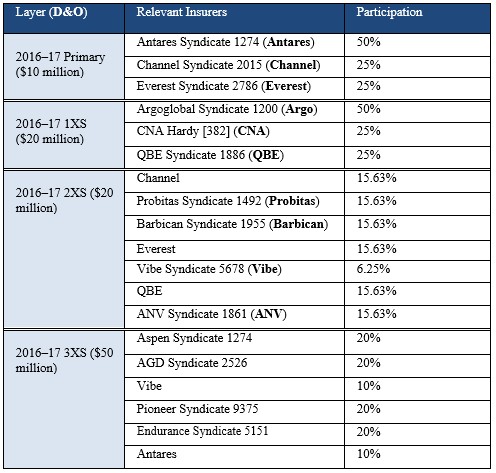
14 The participation levels for the 2016-17 2XS are not whole numbers because the policy was oversubscribed (i.e. over 100%) and the indicated participations were written down proportionately in accordance with the subscription terms.
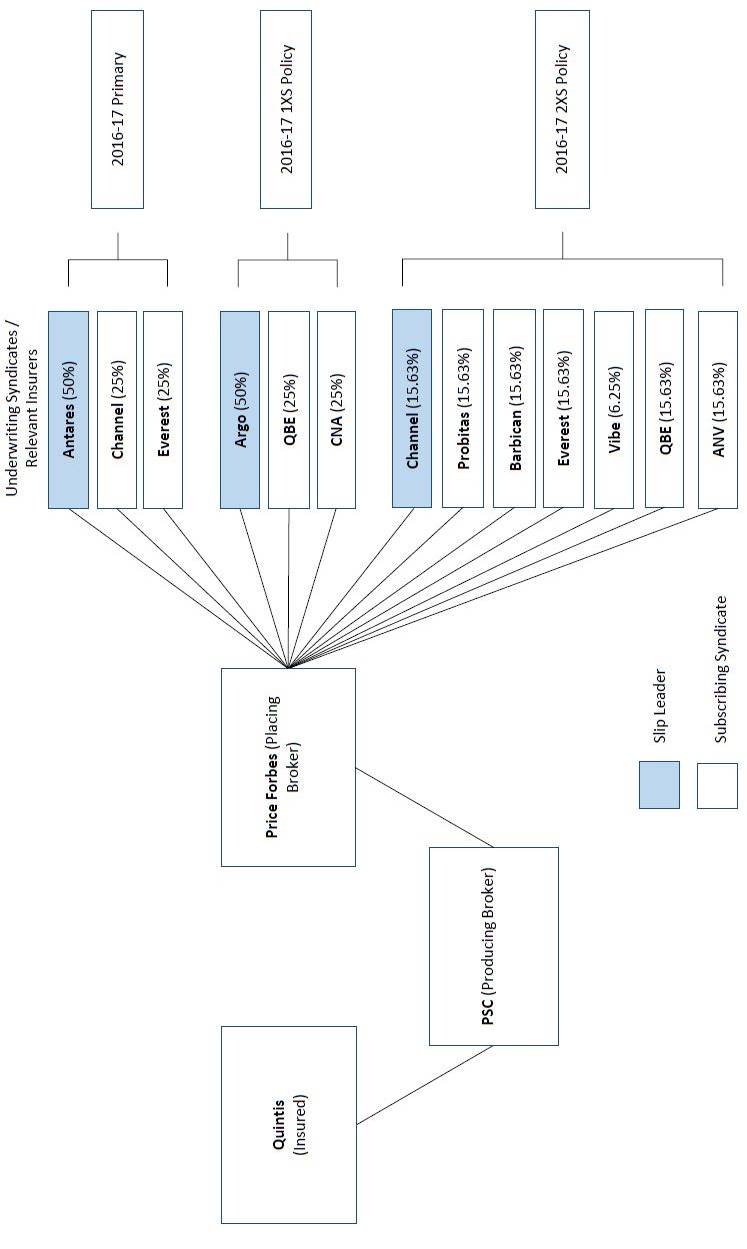
15 The “slip leaders” for each of the policies were:
(1) Antares for the 2016-17 Primary;
(2) Argo for the 2016-17 1XS; and
(3) Channel for the 2016-17 2XS.
16 Diagrammatically, the relevant actors to the 2016-17 Primary, 2016-17 1XS and 2016-17 2XS can be identified as follows:
C.1 Amended Originating Application
17 On 10 August 2020, the day before the proceeding was listed for hearing, Quintis served on the Relevant Insurers a proposed amended originating application (Amended Application) to include the following (as underlined) in its claim for declarations and rectification relating to the 2016-17 Policies:
Details of claim
The Applicant claims:
1. A declaration that Quintis Ltd is entitled to rectification of policy number B0507N16FA15350 issued by the First Respondent for the period 30 September 2016 to 31 October 2017 (Policy) and, to the extent necessary, policy number B0507N16FA15360 issued by the Second Respondent (1st Excess) and policy number B0507N16FA15370 (2nd Excess) issued by the Third Respondent to the extent they incorporate the terms of the Policy, such that:
a. the words “4.9 Entity Securities Liability $10,000,000” are deleted, and in lieu thereof the words “4.9 Entity Securities Liability Included” or “4.9 Entity Securities Liability $50,000,000” are inserted at page 2 of the Policy Schedule; and
b. the words “4.9 Entity Securities Liability AUD $10,000,000” are deleted, and in lieu thereof the words “4.9 Entity Securities Liability Included” or “4.9 Entity Securities Liability AUD $50,000,000” are inserted at page 2 of the Market Reform Contract annexed to the Policy.
2. An order that the Policy and, to the extent necessary, the 1st Excess and 2nd Excess to the extent they incorporate the terms of the Policy, be rectified such that:
a. the words “4.9 Entity Securities Liability $10,000,000” are deleted, and in lieu thereof the words “4.9 Entity Securities Liability Included” or “4.9 Entity Securities Liability $50,000,000” are inserted at page 2 of the Policy Schedule; and
b. the words “4.9 Entity Securities Liability AUD $10,000,000” are deleted, and in lieu thereof the words “4.9 Entity Securities Liability Included” or “4.9 Entity Securities Liability AUD $50,000,000” are inserted at page 2 of the Market Reform Contract annexed to the Policy.
3. An order that a copy of Order 2 be endorsed on the Policy (including any copy of the Policy attached to the 1st Excess or 2nd Excess if such documents exist) and, to the extent necessary, the 1st Excess and 2nd Excess.
18 The reason for the proposed amendment arose out of arguments identified by the Relevant Insurers in their submissions served a few days earlier, being: (1) the assertion that rectification of the 2016-17 Primary has no effect on the “follow” Excess Polices; and (2) that the Excess Insurers sought to position themselves as strangers to the relief sought, such that they would be prejudiced by any extension of its consequences to them.
19 Leave to file the Amended Application was opposed by the Excess Insurers on the basis that the Excess Insurers had prepared their defence on the basis that their subjective intent was not in issue, they had not interviewed relevant witnesses, and the proposed amendment would therefore cause them prejudice.
20 The Excess Insures asserted that rectification of the Excess Policies was not sought on the basis of a “deliberate forensic choice” and pointed to the remarks of Mr Edwards, counsel for Quintis, in response to the following query I raised at a case management hearing on 13 July 2020 (at T5.5–12):
HIS HONOUR: … So rectification is only sought in respect of the policy issued by the first respondent …
MR EDWARDS: Yes. I mean, there’s a real question about whether all these other second layers and whatnot actually need to have active part because their policies follow form against that one. I mean, I understand they have an interest because they will get exposed quicker or slower, depending upon the answer. But, really, it’s not a case where we have to make out 30 rectification slips.
21 However, on the application to amend, an affidavit sworn by the solicitor on record for Quintis, Mr del Gallego, was read. He gave the following unchallenged evidence:
… During the course of the 13 July CMH, Mr Pietriche submitted in relation to the nature of the case, “we would expect that the applicants would need to demonstrate the case of rectification by having regard to documents visa-vis each of the syndicates involved. And where there at [sic] least 10 syndicates involved in the underwriting of this particular policy and where there are three separate parties, effectively, on the respondents side, we would expect that, in order for the applicants to make out their case as well as for each of the respondents to properly respond, that is a process that will necessarily take some time.” (T4:29-36)
I understood Mr Pietriche to be submitting that the Second Respondent’s position was that its characterisation of the forensic contest was that there was a factual dispute in contest as to the subjective intention of all the insurers. Mr Ball did not make any substantive submissions during the 13 July CMH, and I took from his silence and Mr Pietriche’s reference to that being a difficult exercise where [sic] “where there at least 10 syndicates involved in the underwriting of this particular policy” (T4:31) that this was the common position of the Respondents.
(Emphasis added, underline in original).
22 It was uncontroversial that at all times the case advanced by Quintis was that it had up to $50 million in Side C cover. Quintis did not initially consider that this would involve rectification of the Excess Policies as well as the 2016-17 Primary. However, given the unchallenged evidence of the solicitor with carriage of Quintis’ case, supported by the remarks of Mr Edwards both written and orally, I rejected the notion that some form of “deliberate forensic choice” was made. The reality is that despite the point taken by the Excess Insurers, at all times prior to the exchange of submissions in advance of the hearing, there was simply an asymmetry in the views taken by those advising the parties as to what was necessary in order to obtain utile relief. Given the requirement for the Court to facilitate the just resolution of disputes, I granted leave for Quintis to file and rely on the Amended Application.
23 This leave was granted notwithstanding I accept this course occasioned some prejudice to the Excess Insurers. To alleviate any prejudice, it seemed to me the appropriate course was for the hearing to be adjourned, for Quintis to file points of claim and thereafter there be a joinder of issue, particularly in relation to any equitable defences that may be called in aid by the Excess Insurers. Importantly, I also proposed a timetable for the filing of additional affidavit material and submissions, with the hearing to be reconvened on a date to be fixed.
24 Counsel for Quintis conceded that this course was, given the circumstances, the most suitable even though the vacation of the hearing would likely have adverse costs consequences. Notwithstanding this, the Relevant Insurers opposed any adjournment. The alternative proposed by Mr Jones SC, counsel for the first and third respondents, was that given there had been no opportunity to call witnesses and that the third respondent was prepared to run a defence on the documentary material filed to date, I should proceed to hear the case, with the express caveat that I would not make any adverse inferences against the Excess Insurers for their inability to call any witnesses. The second respondent endorsed this course. Indeed, counsel for both the second and third respondents, after I sought assurances, stated that they were in a position to meet the case advanced against them, that they wished to adduce no further evidence, that there were no additional documents to be discovered and despite the amendment, they were happy to proceed.
25 In those circumstances, and given that Quintis had only been given leave to file the Amended Application at the hearing, on balance it seemed to me consistent with the overarching purpose, and in particular with the need to facilitate the resolution of this dispute as quickly and inexpensively as possible, that the hearing proceed. No doubt if the evidence had concluded within the time initially allocated for the hearing, any inference that would otherwise have been available to be drawn by reason of the Excess Insurers not calling witnesses, would have been met with the response that there was a reasonable excuse not to call witnesses who, up until the time of the amendment, had not been considered material.
26 In any event, any discussion concerning prejudice or making limited enquires because of an alleged lack of understanding as to how Quintis was to run its case, ended up disappearing. That is because, when it became clear that the proceeding would run over the one day which had been allocated, I made orders to the effect that, inter alia, the Relevant Insurers file and serve any affidavit evidence upon which they proposed to rely in relation to the relief sought in the Amended Application (on the basis that given leave to amend was allowed, they were automatically entitled to reopen their evidence at the hearing, and read any further affidavit material they wished to read).
27 As it happened, the hearing was adjourned part heard to 18 September 2020. Although I deal below comprehensively with the evidential position, I should note here that apart from an affidavit relating to the verification of the list of documents produced by the first and third respondents, no additional affidavit material was relied upon, nor were any witnesses called. Given this, and the importance of inferences in this case to determining issues of intention, one might think it is unsurprising the Relevant Insurers did what they could to have the matter heard and resolved on the basis that no adverse inferences arising from the absence of witnesses could be drawn.
D Placing Insurance at Lloyd’s
28 With an understanding of the relevant actors, polices and the relief sought in mind, it is now appropriate to turn to the substance of Quintis’ claims. Before doing so, it is useful to canvass some largely uncontroversial aspects regarding the way in which Lloyd’s operates and how the current facts fit within that contemporary market practice. That is because such an understanding of the commercial context informs how a number of relevant issues should be approached.
29 No expert evidence was adduced in relation to the operation of the Lloyd’s market. Nor are such matters, to the extent they are factual, common knowledge allowing s 144 of the Evidence Act 1995 (Cth) (EA) to be engaged. As a consequence, and because it seemed to me the commercial context was of importance, prior to the second day of the hearing, my Associate sent the parties a document which (based on the submissions of the Relevant Insurers and my understanding of relevant cases), outlined the following principles applicable to placing insurance at Lloyd’s and how they apply in the present circumstances. The parties accepted the accuracy of this document. Although the initial list of principles sent to the parties included some additional matters, the following are those points which ended up being pertinent to the current proceeding:
(1) insurance placed with Lloyd’s must be undertaken through the agency of a broker who is registered to place business in the Lloyd’s market: see Julian Praet et Cie S/A v HG Poland Ltd [1960] 1 Lloyds Rep 416 (at 416–7 per Morris LJ); North & South Trust Co v Berkeley [1971] 1 All ER 980 (at 982 per Donaldson J); Brit UW Ltd v F & B Trenchless Solutions Ltd [2016] Lloyd’s Rep IR 68 (at [165] per Carr J); Birds J, Lynch B and Milnes S, MacGillivray on Insurance Law (Sweet & Maxwell, 14th ed, 2019) (at [37-008]–[37-009]); Henley C and Kemp S, The Law of Insurance Broking (Sweet & Maxwell, 3rd ed, 2016) (at [12-003]–[12-004]) (Henley and Kemp);
(2) there were two brokers intervening between the insured (Quintis) and the underwriters (the Relevant Insurers), being the “producing broker”, PSC (in direct contact with Quintis) and the “placing broker”, Price Forbes (in direct contact with the Relevant Insurers), who is the designated “Lloyd’s broker”;
(3) PSC and Price Forbes are both agents of the insured, however, it was Price Forbes as the placing broker who was the contracting agent (to use that term at a high level of generality) of Quintis at Lloyd’s: American Airlines Inc v Hope [1974] 2 Lloyd’s Rep 301 (at 304 per Lord Diplock, with whom Lord Wilberforce, Viscount Dilhorne, Lord Simon of Glaisdale and Lord Kilbrandon agreed);
(4) it is common that a placing broker will seek out a market “leader’” to endorse the “slip” as part of marketing efforts to attract other potential insurers and that although the traditional “slip” (as distinct from the separate policy document) is now a thing of the past (having been replaced by the Market Reform Contract (MRC)), the term “slip” is still widely used in the market to refer to an MRC (for example, a “quote slip”, as used in the present circumstances, commonly refers to a draft MRC used to negotiate the contract with underwriters (terms that I will use interchangeably in these reasons)): Henley & Kemp (at [12–008]) (I should note that this point was not expressly conceded by Quintis, but is clearly consistent with the entire documentary record);
(5) the slip method of placing insurance, by signing the MRC and stating the proportion of the risk that the underwriter is prepared to subscribe results in the conclusion of separate contracts between the insured and each subscriber of the slip: see General Reinsurance Corporation v Forsakringsaktiebolaget Fennia Patria [1983] QB 856 (at 864 per Kerr LJ, with whom Slade and Oliver LLJ agreed); Eagle Star Insurance Co Ltd v Spratt [1971] 2 Lloyd’s Rep 116 (at 124 per Lord Denning MR);
(6) the severability of each contract of insurance between the insured on the one hand and the individual subscribing underwriters is consistent with the autonomy of each underwriter: see Touche Ross v Baker [1992] 2 Lloyd’s Law Rep 207 (at 210 per Lord Mustill, with whom Lords Templeman, Jauncey of Tullichettle, Brown-Wilkinson and Slynn of Haldey agreed); and
(7) hence, while there may only be one primary policy and three excess polices, there are in fact nineteen separate contracts reflected by the 2016-17 Policies (although the 2016-17 3XS is not relevant to the Rectification Claim, and some underwriters subscribed at multiple levels of the tower).
30 It is worth noting that by the end of the case it was common ground that the 2016-17 Policies reflected a bundle of contracts and importantly, in response to a question posed by me, the parties accepted, as a matter of principle, that if common intention was proved in relation to only some underwriters, some relief may be available in relation to the separate contracts with the Relevant Insurers found to have held the relevant common intention.
31 It is convenient here to deal with the further issue as to when the contracts between Quintis and the Relevant Insurers were formed. It is apparent that a Firm Order Noted (FON) was sought and provided by email from all Relevant Insurers and an MRC in full form was also subsequently signed by each Relevant Insurer in days following. The first and third respondents stated in their written submissions that:
The reason as to why [Price Forbes] took the course of seeking an email ‘FON’ as well as obtaining signature on the complete MRC is a matter of speculation. It ultimately does not matter much what the reason was. Both the ‘FON’ confirmation and the signing of the complete MRC occurred relatively contemporaneously.
32 Quintis advanced its submissions on the basis that there was a continuum of intention culminating in the accord being reached at the time of the FON. This was presumably because, as will be discussed below, the excess policy terms were only attached to the complete MRC when it was signed. The second respondent submitted that it was preferable to treat the signing of the complete MRC as the time of formation, given that this is the instrument sought to be rectified. While the reasoning in Dunlop Haywards (DHL) Ltd v Erinaceeous Insurance Services Ltd [2009] Lloyd’s Rep IR 149 recognises that formation can occur at the time of the FON or the signing of a complete MRC, I do not think that an examination of the exact moment of formation is fruitful. That is because these actions occurred relatively contemporaneously and, while I accept that there is not in evidence any correspondence of the excess policy terms prior to the signing of the complete MRC, for reasons that will become evident, I do not think this materially alters any findings I am going to make. In any event, no party made any detailed submissions on the issue of formation to persuade me to conclude either way.
33 Contrary to the way in which Quintis framed its case, it is appropriate to the deal with the Construction Claim before the Rectification Claim. This is because the equity would be unnecessary if the legal position was determined in favour of Quintis. It might be thought telling as to the merits of Quintis’ Construction Claim that it was only addressed briefly at the end of their submissions and as an alternative to the Rectification Claim.
34 I recently set out the principles relating to the construction and rectification of insurance contracts in Icon Co (NSW) Pty Ltd v Liberty Mutual Insurance Company Australian Branch trading as Liberty Specialty Markets [2020] FCA 1493. I do not propose to repeat those principles at length here. It is only necessary to emphasise three important propositions.
35 First, it is trite that the process of construing insurance contracts is governed by ordinary principles of contractual interpretation: Australian Casualty Co Ltd v Federico (1985) 160 CLR 513 (at 520 per Gibbs CJ); McCann v Switzerland Insurance Australia Ltd [2000] HCA 65; (2000) 203 CLR 579 (at 589 [22] per Gleeson CJ). A clause in an insurance policy must be considered in the context of the policy as a whole, and the policy must be set in its surrounding circumstances or factual matrix, including, if excess policies are involved, the broad scheme of insurance cover intended to provide layers of insurance against the same risk: Derrington D K and Ashton R S, The Law of Liability Insurance (LexisNexis Butterworths, 3rd ed, 2013) (at 422 [3–64]); see also Mount Bruce Mining Pty Ltd v Wright Prospecting Pty Ltd [2015] HCA 37; (2015) 256 CLR 104 (at 116 [46] per French CJ, Nettle and Gordon JJ). This principle is not limited to instruments between the same parties: see McVeigh v National Australia Bank Ltd [2000] FCA 187; (2000) 278 ALR 429 (at 438–40 [30]–[34] per Finkelstein J, and at 447–51 [67]–[77] per Kenny J).
36 Secondly, as Mason ACJ, Murphy and Deane JJ notably remarked in Taylor v Johnson (1983) 151 CLR 422 (at 429) the objective theory of contract is “in command of the field”. As one would expect, the bulk of the evidence adduced by Quintis was directed to the subjective intention of the parties, and although this is central to the Rectification Claim, it must be put out of mind when having regard to the Construction Claim: see Simic v New South Wales Land and Housing Corporation [2016] HCA 47; (2016) 260 CLR 85 (at 95 [18] per French CJ); Ryledar Pty Ltd v Euphoric Pty Ltd [2007] NSWCA 65; (2007) 69 NSWLR 603 (at 655 [261] per Campbell JA, with whom Tobias JA relevantly agreed).
37 Thirdly, surrounding circumstances known to the parties is one of the elements required to be considered in the construction exercise. However, resort to evidence of those circumstances is confined. The classic authority for that proposition is the “true rule” as stated by Mason J (Stephen and Wilson JJ concurring) in Codelfa Construction Pty Ltd v State Rail Authority of New South Wales (1982) 149 CLR 337, which does not require further elaboration. Despite debate in the authorities, for the reasons I recently set out in Icon (at [55]–[60]), I adhere to the view that the “true rule” remains as Mason J stated it in Codelfa. I therefore proceed on the basis that it is only permissible for me to have regard to extrinsic material going to surrounding circumstances if, as Quintis contends, there exists ambiguity in the 2016-17 Policies.
38 Quintis’ Construction Claim can be summarised by reference to the following two contentions: (a) on its proper construction, the 2016-17 Primary does not impose a “sub-limit” on Entity Securities Liability, but the reference to “4.9 Entity Securities Liability AUD $10,000,000” is a reference to the corresponding Limit of Liability for Section 1B coverage taken on by the Primary Insurers (Construction Contention); and (b) alternatively, the 2016-17 Primary is ambiguous and ought be resolved against the Relevant Insurers in accordance with the contra proferentem rule (Ambiguity Contention). I deal with each of these contentions in turn below.
39 It is noteworthy that Quintis’ submissions on the Construction Claim were prefaced by the proposition that “all relevant participants in Quintis’ 2015-16 insurance program were of the view that Quintis was insured for $50m of Entity Securities Liability”. To paraphrase the words of Lord Nicholls of Birkenhead, and with no intended disrespect, I must be alive to the ploy of counsel placing evidence of the parties actual intentions before the Court on a rectification claim in the hope of consciously or subconsciously affecting the Court’s thinking on questions of interpretation and construction: see Lord Nicholls of Birkenhead, ‘My Kingdom for a Horse: The Meaning of Words’ (2005) 121 (Oct) Law Quarterly Review 577 (at 578).
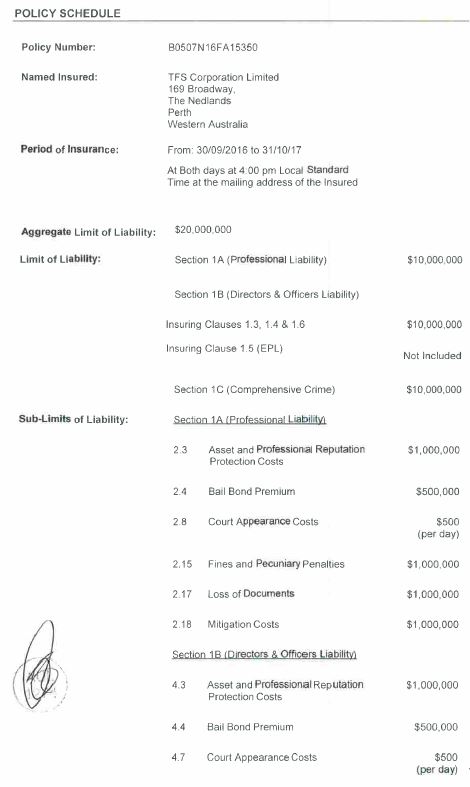
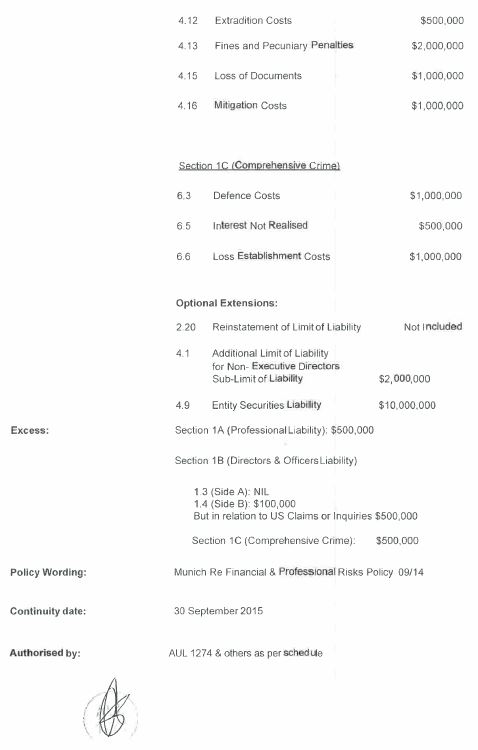
40 It is next convenient to set out the relevant terms of 2016-17 Primary Schedule:
41 It is also convenient to set out the provisions of the 2016-17 Primary relevant to the Construction Claim, which are as follows:
4 SECTION 4: EXTENSIONS TO SECTION 1B (DIRECTORS & OFFICERS LIABILITY)
Subject to all the terms, conditions and exclusions, including all definitions of the Policy, the Insurer further agrees to extend cover provided under Section 1B of the Policy as follows:
4.1 Additional Limit of Liability for Insured Persons
Notwithstanding subclauses 8.14(a) and (b) of this Policy, the Insurer will pay for any Insured Person under Insuring Clause 1.3, the Sub-Limit of Liability stated in the Schedule, in addition to the Limit of Liability applicable to Section 1B (Directors & Officers Liability), provided that each of:
(a) the Limit of Liability applicable to Section 1B (Directors & Officers Liability);
(b) any other directors and officers liability policy which covers the Insured Person; and
(c) all other indemnification available to the Insured Person
has been exhausted.
This extension is not automatic and will only apply if it is specifically included in the Schedule.
This extension does not provide any cover to the Insured Organisation.
…
4.9 Entity Securities Liability
The Insurer will pay on behalf of the Insured Organisation the liability and associated Defence Costs which the Insured Organisation is legally liable to pay as a result of a Securities Claim alleging a Wrongful Act first made the Insured Organisation, and notified to the Insurer, during the Period of Insurance.
This extension is not automatic and will only apply if it is specifically included in the Schedule.
The maximum amount payable by the Insurer under this extension is the applicable Sub-Limit of Liability specified in the Schedule. This sub-limit is part of and not in addition to the Limit of Liability.
…
8 SECTION 8: CONDITIONS APPLICABLE TO ALL COVER SECTIONS
…
8.14 Limit of Liability
(a) The maximum amount payable by the Insurer under each of Sections 1A, 1B and 1C of the Policy (and their associated Extensions) is the applicable Limit of Liability.
(b) The Limit of Liability is inclusive of any Defence Costs, Sub-Limits of Liability and any other amounts insured under each part of the Policy but does not include costs incurred by the Insurer in determining whether the relevant part of the Policy provides insurance to the Insured.
(c) Aggregate Limit of Liability
The total aggregate limit of the Insurers’ liability under all of Sections 1A, 1B and 1C of the Policy (and their associated extensions) is the Aggregate Limit of Liability. The Aggregate Limit of Liability is inclusive of any Defence Costs, Sub-Limits of Liability and any other amounts insured under the Policy.
(d) If any amounts insured under the Policy are covered under one or more parts of the Policy, then the maximum amount payable by the Insurer will be the highest of the applicable Limits of Liability or Sub-Limits of Liability and the Excess will be the applicable Excess for the Insuring Clause or Extension to which that Limit of Liability or Sub-Limit of Liability applies.
(Emphasis in original to signify defined terms).
42 The “Limit of Liability” is defined in the Definitions section of the 2016-17 Primary as:
Limit of Liability means the limit of liability stated in the Schedule and referred to in clause 8.14 of the Policy.
(Emphasis in original to signify defined terms).
43 Lastly, I should set out the following provisions contained in the Excess Policies (which for all relevant purposes are identical):
EXCESS LIABILITY INSURANCE
In consideration of the payment of premium and subject to the terms of this Policy, Insurers agree with the Insured that:
Section 1 - Insuring Section
1. Insurers shall provide the Insured with insurance coverage for claims first made against the Insured during the Policy Period in excess of the Primary Insurance and in excess of any Underlying Insurance. Insurance coverage hereunder will apply in conformance with the terms, conditions, endorsements, limitations and warranties of the Primary Insurance and any Underlying Insurance except as otherwise stated in this Policy.
…
Section 4 - Depletion of Primary Insurance and Underlying Insurance
…
4.4 In the event that the Primary Insurance or any Underlying Insurance specifically provides for a sub-limit of liability it is agreed that:
(a) where such sub-limit of liability is totally exhausted solely as a result of payment of losses under the Primary Insurance or any Underlying Insurance, then this Policy shall not provide any coverage in respect of such sub-limit of liability; or
(b) where such sub-limit of liability is partially exhausted solely as a result of payment of losses under the Primary Insurance or any Underlying Insurance, then this Policy shall continue for subsequent losses that would be subject to such sub-limit of liability provided that the amount payable hereunder shall not exceed the balance of the amount remaining under such sub-limit of liability and shall otherwise be part of and not in addition to the Limit of Liability.
(Emphasis in original to signify defined terms).
44 Quintis located its Construction Contention in the factual matrix culminating in the execution of the 2015-16 Policies. It was said this was a matter of significance to Quintis not only because of the level of cover available to it, but because it was an aspect of a comprehensive insurance review conducted by PSC in April 2015 in response to the “extremely low levels” of D&O insurance held by Quintis at that time. Indeed, Quintis asserted that it is clear that the 2016-17 Policies “just adopted the policy wording of the 2015-16 Policies without much particular thought”. For the reasons outlined above, this evidence of surrounding circumstances would only become relevant to the construction exercise if I were to find ambiguity in the 2016-17 Primary. Furthermore, before canvassing Quintis’ Construction Contention, it is necessary to address its submissions as to the purported formatting errors in the 2016-17 Primary, namely: (a) that the last paragraph under cl 4.9 is in fact a continuation of cl 4.9; and (b) that the sub-heading “Optional Extensions” should not be indented under the sub-heading “Sub-Limits of Liability”, but should sit as its own, separate sub-heading. I accept the former is a formatting error, but the same is not true of the latter.
45 As noted above, the core of Quintis’ construction contention was that, on its proper construction, the reference to “4.9 Entity Securities Liability AUD $10,000,000” is simply a reference to the corresponding Limit of Lability for Section 1B coverage taken on by the Primary Insurers. The argument proceeded along the following lines.
46 The significance of the distinction between the sub-headings “Sub-Limits of Liability” and “Optional Extensions” is that each of the clauses under “Sub-Limits of Liability” is automatic, in that they do not have to be specified as being included or not included. By contrast, each of the clauses under the heading “Optional Extensions” (cll 2.20 (which it was agreed should read cl 2.19), 4.1 and 4.9) are expressed to “only apply if ... specifically included in the Schedule”. One of those extensions – cl 2.19 – is not susceptible to a sub-limit at all. Hence, while cll 4.1 and 4.9 permit the identification of a sub-limit, a sub-limit is not required, as these are extensions to heads of primary cover under Section 1B, which, in any event, is subject to a Limit of Liability. This also formed the foundation for Quintis’ contention that those items contained under the heading “Optional Extensions” are not solely concerned with “Sub-Limits of Liability”, but rather noted the existence of any relevant Optional Extension.
47 Moreover, Quintis distinguished cl 4.1 from cl 4.9. In cl 4.1 there is a reference to “the sublimit of liability”, whereas in cl 4.9 reference is made to “the applicable sublimit of liability”. Quintis asserted that the term applicable is capable of being read as “if any”, reinforcing that cl 4.9 does not mandate that a sublimit must be specified, but that a sublimit may be specified, and if so specified, then that sublimit would be described as the “applicable” sublimit. Quintis argued that this is supported by the fact that the figure of $2 million attached to cl 4.1 includes, by express language, a “Sub-Limit of Liability” and the figure of $10 million attached to cl 4.9 does not. Hence viewing the Schedule as a whole, “[o]ne would think that if [cl 4.9] was intended to be sub-limited, it would say so expressly as is the case with the cl 4.1 extension”.
48 It was upon this foundation that Quintis argued the “unadorned figure” of $10 million attached to the term “Entity Securities Liability” could be regarded as doing no more than simply restating the Limit of Liability for Section 1B cover under the 2016-17 Primary, or at the least, there exists ambiguity in the 2016-17 Primary. Indeed, it was said looked at purely from the perspective of the Primary Insurer, it would be curious if the 2016-17 Primary expressed a “sub-limit” equal to its Limit of Liability for the very same Section of cover. That is, it would not be expected that the amount of $10 million would be specified in the 2016-17 Primary as a “sub-limit” of any Limit of Liability of the same amount. Quintis argued that this construction is supported by the commercial difficulty created by the alternative finding that a sub-limit must be specified. Quintis submitted that if it is true that: (a) cl 4.9 requires there to be a sub-limit applied to Entity Securities Liability; and (b) the effect of cl 8.14 is that the sub-limit must be an amount equal to or less than the Limit of Liability for Section 1B cover under the 2016-17 Primary, reading the 2016-17 Primary together with the Excess Policies would mean that no insurance arrangement involving the further term cl 4.4 could ever provide cover greater than $10 million in respect of Entity Securities Liability. Quintis asserted this was an “implausible construction … that would place considerable limits on the commercial freedom of the parties to make arrangements as to cover under what appear to be standard form terms”.
49 Despite Quintis saying everything it could, its Construction Contention cannot be sustained when the terms of the 2016-17 Primary and Excess Policies are properly considered.
50 Section 4 of the 2016-17 Primary (of which cl 4.9 forms part) recognises, by virtue of its chapeau, that the extensions set out in that section are “provided under Section 1B of the Policy”. Further, cl 4.9, after describing the nature of the cover available under the Entity Securities Liability Optional Extension, provides that “[t]he maximum amount payable by the Insurer under this extension is the applicable Sub-Limit of Liability specified in the Schedule” and “[t]his sub-limit is part of and not in addition to the Limit of Liability”. Hence, the nomination of a figure alongside “Entity Securities Liability” is a nomination for the purposes of being a sub-limited term, which is to be part of and not in addition to the Limit of Liability.
51 This is supported by the fact that the “Limit of Liability” is defined as the “limit stated in the Schedule and referred to in clause 8.14 of the policy”. The 2016-17 Primary Schedule provides that the Limit of Liability for Section 1B cover is $10 million in the aggregate and cl 8.14 states that “[t]he Limit of Liability is inclusive of any Defence Costs, Sub-Limits of Liability and any other amounts insured under each part of the Policy”. Hence, cl 8.14 underscores what cl 4.9 already makes plain, namely that the Entity Securities Liability sub-limit is part of and not in addition to the $10 million Limit of Liability for Section 1B cover. This conclusion is sound regardless of whether I found that the heading “Optional Extensions” is erroneously indented under the heading “Sub-Limits of Liability”.
52 Nor does an examination of the Excess Policies assist Quintis. It is a commonly accepted principle of contractual construction that a clause such as cl 1 of the Excess Policies has the effect of incorporating the relevant terms from the one contract into another, except as stated otherwise: Permanent Trustee Australia Ltd v FAI General Insurance Co Ltd (1998) 153 ALR 529 (at 560 per Hodgson CJ in Eq). Where this occurs, the incorporated terms become terms of the subject contract itself; the fact that those terms are not restated or reproduced in full in the contract is of no moment: see, eg, Weatherbeeta Limited v Hammersmith Nominees Pty Ltd [2019] VSC 559 (at [133] per Connock J); WorkPac Pty Ltd v Rossato [2020] FCAFC 84; (2020) 378 ALR 585 (at [363]–[364] per White J). It is noteworthy that while the term “Primary Insurance” is defined in cl 2.5 of the Excess Policies as the “policy identified as such in Item 4 of the Schedule”, there is in fact no Schedule attached to the Excess Policies. Instead, there is a document titled “Risk Details” as the first page of the MRC, which includes the condition “Full Follow Form As attached Primary Policy Number B0507N16FA15350”. It is clear (as Quintis accepted and as would make sense (D1, T49.37–44)), that the reference to “Primary Insurance” in cl 1 is a reference to the “Primary Policy Number” referred to in this condition, which is the 2016-17 Primary.
53 Thus, by virtue of cl 1, one of the terms incorporated into the Excess Policies from the 2016-17 Primary was cover in respect of Entity Securities Liability with a sub-limit of $10 million. Importantly, cl 4.4 further clarifies that incorporation, by limiting the cover extended by that term only to the uneroded portion of the $10 million Entity Securities Liability sub-limit and only on the basis that the sub-limit is part of and not in addition to the Limit of Liability of the Excess Policies. Hence, if it is the case that the sub-limit is not exhausted under the 2016-17 Primary because of, for instance, payment of defence costs or claims under cl 1.3, cover continues under the 2016-17 1XS, but only to that limited extent. Furthermore, while it is not entirely relevant to the Construction Claim, it is also clear that the reference to “Limit of Liability” in the Excess Policies, which is defined in cl 2.3 as the “amount stated in item 3 of the Schedule”, is the Limit of Liability stated on the first page of the MRC.
54 These reasons are sufficient to dispose of Quintis’ Construction Claim. However, for completeness, I will continue to deal four particular submissions advanced.
55 First, Quintis’ submission regarding the nomination of a figure contemplated by cl 4.9 being optional not mandatory, does not deal with the express words employed by the parties in a prudent businesslike way. The relevant sentence of cl 4.9 contains two elements: (a) it addresses a topic (the maximum amount payable); and (b) it identifies where to find that amount (the Schedule). In the commercial context of an insurance contract, where limitations on coverage are of key concern to the parties, the suggestion that the parties took the trouble to introduce a topic, but are taken to have agreed that they intended that the Schedule may not address such a topic, does not commend attraction. A more businesslike construction would be to read the sentence as requiring a mandatory nomination in the Schedule if the cover is taken up, so that the precise limits of that cover are expressly dealt with. That the parties, objectively, are to be taken as having intended such an outcome is further evident by reference to the final sentence of cl 4.9, which commences “This sub-limit” – a reference to the “sub-limit” described in the preceding sentence. Indeed, the clause does not state that if there is an applicable sub-limit specified in the Schedule, then the maximum amount the insurer is liable for is the amount there specified. Related to this, I am unpersuaded by Quintis’ submission that it is “implausible” to read the reference to $10 million as a sub-limit as this would mean that no insurance arrangement involving the excess term cl 4.4 could ever provide cover greater than $10 million in respect of Entity Securities Liability. While I do accept such a construction is limiting (in the sense that the Excess Polices only provide cover for the uneroded portion of the sub-limit), that does not mean that it is commercially unsound, let alone implausible.
56 Secondly, two reasons may explain the different terminology used in cll 4.1 and 4.9: (a) both clauses are in different forms, which may itself explains a choice of different words; and (b) the entry for cl 4.1 needed to achieve more than that required for cl 4.9. In the case of cl 4.9, all that was required was the nomination of a figure for the clause to operate on its terms. By way of contrast, the cl 4.1 entry not only dealt with nomination of a figure, but the modification of the scope of cover provided. This is evident when one has regard to the terms of cl 4.1, which describe an available extension for persons within the class of “Insured Person” for the purposes of cl 1.3. The definition of “Insured Person” is broader than “Non-Executive Directors”, which is referenced in the Schedule alongside cl 4.1. Functionally, the reference in the Schedule thus limits the scope of the persons to which the extension is to relate. By doing so, the Schedule also nominates the number as a sub-limit so that there is no confusion as to the coverage for that sub-class overall.
57 Indeed, even if one was to view this reference to a sub-limit as hard to reconcile with the fact that the same is not provided next to Entity Securities Liability, I do not think that such a reference creates ambiguity in the plain words of cll 4.9 and 8.14. That might have been the case if there were a number of nominations in the same form as cl 4.1, but this is simply one example, which in my view, can be justified. I am not of the view that Quintis’ comparative analysis of cl 4.1 introduces ambiguity into the terms of the 2016-17 Primary or supports the overall submission that Entity Securities Liability is not sub-limited.
58 Thirdly, Quintis’ construction of the 2016-17 Primary necessarily requires the Court to conclude that the parties intended to nominate a figure that was objectively unnecessary since the contract already provided for a Limit of Liability for Section 1B cover, which controlled that section and all extensions to it (including cl 4.9). As was noted in Chapmans Limited v Australian Stock Exchange Limited (1996) 67 FCR 402 (at 411 per Lockhart and Hill JJ), “[a] court will strain against interpreting a contract so that a particular clause is nugatory of ineffective, particularly if a meaning can be given to it consonant with the other provisions in a contract.” Nor is there any justification for the finding that the nomination of a figure in the Schedule is redundant: see XL Insurance Co SE v BNY Trust Company of Australia Limited [2019] NSWCA 215 (at [72] per Gleeson JA, with whom Bell P agreed). Indeed, such a submission neglects the words of cl 4.9, which refers to nomination of a sub-limit and does not refer to the nomination of a Limit of Liability.
59 Fourthly, I reject the submission that since the figure of $10 million for Entity Securities Liability is the same as the Limit of Liability for Section 1B cover, this is somehow suggestive of error which means one ought not treat the former figure as a sub-limit. Not only would this involve a construction of the 2016-17 Primary that is contrary to the express terms of cll 4.9 and 8.14, but there is nothing unusual about the sub-limit being the same as the limit for the section of cover (it would simply mean that the whole of the Limit of Liability could be applied to meeting a cl 4.9 liability). That position is even less surprising here, due to the existence of excess layer terms. Indeed, the operation of cl 4.4 of the Excess Policies proceeds on the existence of a sub-limit in the 2016-17 Primary: where the Section 1B cover Limit of Liability under the 2016-17 Primary is exhausted as a result of payments not made under cl 4.9, cl 4.4 of the Excess Policies provides that the unexhausted portion of the sub-limit continues into the Excess Policies, provided again that the remaining amount of the sub-limit shall be “part of and not in addition to the Limit of Liability” of the Excess Policies.
60 For the above reasons, the Construction Contention must be rejected.
61 Alternatively, Quintis argued that there exists ambiguity in the 2016-17 Primary, which ought be resolved by “recourse to events, circumstances and matters external to the terms of the 2016-17 [Primary], so as to identify the actual intentions of the parties”. For the above reasons, I do not accept that there is ambiguity in the 2016-17 Primary, making it unnecessary to look to extrinsic material, including the background of Quintis’ recent “comprehensive insurance review”.
62 Even if ambiguity were to be identified, I reject that it would lead to a different construction of the 2016-17 Policies. It is well established that if one is permitted to have resort to extrinsic material, evidence of surrounding circumstances is only admissible if it is known to the parties: Electricity Generation Corporation v Woodside Energy Ltd [2014] HCA 14; (2014) 251 CLR 640 (at 656–7 [35] per French CJ, Hayne, Crennan and Kiefel JJ); Codelfa (at 352 per Mason J), the rationale for which was explained by Allsop P (as the Chief Justice then was) in QBE Insurance Australia Ltd v Vasic [2010] NSWCA 166 (at [22], with whom Giles and Macfarlan JJA agreed). Such evidence is also not admissible to support the subjective intention or expectations of the parties: see Ryledar (at 655–6 [262]–[265] per Campbell JA, with whom Mason P and Tobias JA agreed).
63 The reason I emphasise these points is that it was Quintis’ submission that any ambiguity in the 2016-17 Policies ought be resolved by reference to the fact that Quintis had the commercial object of seeking to preserve its expiring amount of cover, that the 2016-17 Primary relevantly adopted the wording of the 2015-16 Primary, and importantly, that the policy wording was understood by Quintis, PSC and the expiring insurers to provide for up to $50 million is Side C cover. Furthermore, Quintis submitted that the evidence leading up to placement of the 2016-17 Policies demonstrates that such a “commercial object” was shared by Quintis and the Relevant Insurers. The difficulty with these submissions is twofold: (a) only four of the Relevant Insurers to the 2016-17 Polices provided insurance under the 2015-16 Policies, and even then, none of those insurers provided Side C cover (see [122])); and (b) this once again elides the distinction in the material sought to be relied upon by Quintis in its Construction Claim to that in its Rectification Claim. Quintis submitted in writing, in little more than a sentence, that the evidence relevant to its Rectification Claim was substitutable as extrinsic material in support of its Construction Claim. I shall not repeat the reasons for why that approach is misconceived. The fact is the evidence does not reveal that the parties objectively intended to provide Side C cover of up to $50 million and that this was not sub-limited. Hence, even if there was ambiguity in the 2016-17 Policies, I am not satisfied that the admission of the extrinsic material identified would alter the conclusion I have reached.
64 Quintis also submitted that in the event there was ambiguity, “it is an ambiguity in the real sense that ought to be resolved against [the Relevant Insurers] in accordance with the contra proferentem rule”.
65 Even if I was to accept that the Relevant Insurers were the proferens in the transaction (a questionable submission given that the insurance policies were drafted and presented by Price Forbes to the Relevant Insurers: cf Halford v Price (1960) 105 CLR 23 (at 30 per Dixon CJ with whom Menzies J agreed and at 34 per Fullagar J)), the contra proferentem rule is but one of a number of rules of contractual construction. Although it was traditionally the case that the contra proferentem rule applied strongly in insurance contracts, the rule is one of last resort, to apply only when ambiguity remains after all other avenues of construction have been exhausted. That view accords with the established position that the process of construing insurance contracts is governed by ordinary principles of contractual interpretation. Hence, even if there was ambiguity in the contract, I am not of the view that the contra proferentem rule assists Quintis.
66 It follows that on their proper construction, the instruments recording the 2016-17 Policies did not provide Side C cover of up to $50 million.
67 It is then necessary to wade into the brume of the Rectification Claim advanced by Quintis. Given the length of the reasons which are dedicated to resolving this claim, it is useful to first set out how this section of the judgment will be structured:
Part F.1 will first set out the general principles applicable to a claim for rectification and the standard of proof necessary to succeed in such a claim;
Part F.2 will articulate three preliminary issues, namely (a) the specific common intention to be established; (b) the documents that need to be rectified; and (c) whose intention is relevant to the rectification of those documents;
Part F.3 will make general comments about the evidentiary record and the principles applicable to inferential reasoning;
Part F.4 will detail the documentary record by way of chronology, including outlining how the parties intend to use each document in support of their case (by approaching the evidence in this way, one is able to understand and contextualise the inferences the Court is being asked to draw);
Part F.5 will expand upon the principles applicable to inferential reasoning by reference to the “rules” in Blatch v Archer (1774) 1 Cowp 63 and Jones v Dunkel (1959) 101 CLR 298;
Part F.6 will make findings as to the intention of Price Forbes and each of the Relevant Insurers, drawing on the evidentiary record outlined in Part F.4 and the submissions made by the parties; and
Part F.7 will examine whether the relevant intention was commonly held by any of the parties.
68 Prior to setting out the relevant legal principles, considering the evidence and making relevant findings, it is appropriate to commence the journey by setting out Quintis’ articulation of its alleged equity. Quintis seeks a declaration (along with an order giving effect to such a declaration to be endorsed on the 2016-17 Policies) that is entitled to rectification of the 2016-17 Primary, and to the extent that the Excess Policies incorporate the terms of the 2016-17 Primary, the Excess Policies, such that:
(1) the words “4.9 Entity Securities Liability $10,000,000” are deleted, and in lieu thereof the words “4.9 Entity Securities Liability Included” or “4.9 Entity Securities Liability $50,000,000” are inserted at page 2 of the 2016-17 Primary Schedule; and
(2) the words “4.9 Entity Securities Liability AUD $10,000,000” are deleted, and in lieu thereof the words “4.9 Entity Securities Liability Included” or “4.9 Entity Securities Liability AUD $50,000,000” are inserted at page two of the MRC annexed to the 2016-17 Primary.
69 The principles relevant to the equitable remedy of rectification were not in dispute. I recently set them out at length in Icon (at [111]–[118]). A summary follows.
F.1.1 General principles of rectification
70 The purpose of the equitable remedy is to make a contractual instrument “conform to the true agreement of the parties where the writing by common mistake fails to express that agreement accurately”: Maralinga Pty Ltd v Major Enterprises Pty Ltd (1973) 128 CLR 336 (at 350 per Mason J). Its rationale has been said to be the avoidance of an unconscientious departure from the common intention of the parties to an agreement: Franklins Pty Ltd v Metcash Trading Pty Ltd [2009] NSWCA 407; (2009) 76 NSWLR 603 (at 710 [444] per Campbell JA, with whom Allsop P and Giles JA agreed); Ryledar (at 667 [315] per Campbell JA, with whom Mason P and Tobias JA agreed); Mayo v W & K Holdings (NSW) Pty Ltd (in liq) (No 2) [2015] NSWCA 119 (at [57] per Gleeson JA, with whom Meagher JA and Sackville AJA agreed).
71 In Simic (at 117 [103]–[104]), Gageler, Nettle and Gordon JJ summarised the elements of rectification in the following way:
Rectification is an equitable remedy, the purpose of which is to make a written instrument “conform to the true agreement of the parties where the writing by common mistake fails to express that agreement accurately”. For relief by rectification, it must be demonstrated that, at the time of the execution of the written instrument sought to be rectified, there was an “agreement” between the parties in the sense that the parties had a “common intention”, and that the written instrument was to conform to that agreement. Critically, it must also be demonstrated that the written instrument does not reflect the “agreement” because of a common mistake. Unless those elements are established, the “hypothesis arising from execution of the written instrument, namely, that it is the true agreement of the parties” cannot be displaced.
The issue may be approached by asking – what was the actual or true common intention of the parties?
(Citations omitted).
72 As to the ascertainment of that common intention, it is useful to draw on the observations of Tobias JA in Ryledar (at 642 [182]–[186]), cited with approval in Simic (at 117 [104] n 113)):
First, the common intention which must be established by clear and convincing proof to justify rectification must be the actual or true common intention of the parties. Second, evidence of that intention may be ascertained not only from the external or outward expressions of the parties manifested by their objective words or conduct but also from evidence of their subjective states of mind.
Third, where, for instance, the correspondence between and/or conduct of the parties establishes a positive lack of an “objective” common intention, then that evidence must be taken in conjunction with the evidence (if any) of their subjective states of mind to determine whether the necessary common intention has been established. …
Fourth, in Westland Savings Bank v Hancock [1987] 2 NZLR 21 at 31, it was held by Tipping J that a party subsequently acting as if the instrument stood in the form into which it is sought to be rectified was strong evidence of that party’s intention at the time to execute the instrument in its rectified form. Such conduct is obviously of significance but, depending on other evidence, if any, is not necessarily conclusive although in the absence of any such evidence it may be.
Fifth, it follows that where the correspondence and/or conduct positively establishes the necessary common intention, then assertions by the party opposing rectification of his or her subjective state of mind which is inconsistent with that party’s outward manifestation of his or her intention, being unexpressed and uncommunicated, is unlikely to trump his or her expressed intention. But this is because that party is unlikely to be believed.
Sixth, where … the outward expression of the parties’ common intention is at best inconclusive, then establishing that the subjective states of mind of the parties evinces the relevant common intention becomes critical if the necessary standard of proof to support an order for rectification is to be achieved.
(Emphasis added).
73 Furthermore, in Ryledar, Campbell JA (with whom Tobias JA and Mason P agreed) discussed whether an “outward expression of accord” is necessary for the grant of relief by way of rectification (an issue considered, but not decided, by Kiefel J in Simic (at 103 [43]–[45], with whom French CJ agreed) and by Wilson J in Maralinga (at 452, with whom Gibbs CJ agreed)), concluding that an outward expression need not be by words that say in substance “this is my intention”, but rectification still requires disclosure of some form. This accords with what now appears to be a resolution of this issue by the High Court in Simic (at 117 [104] per Gageler, Nettle and Gordon JJ) that “[t]here is no requirement for communication of that common intention by express statement, but it must at least be the parties’ actual intentions, viewed objectively from their words or actions, and must be correspondingly held by each party”.
F.1.2 Proof necessary for rectification
74 As to the establishment of that common intention, the evidence necessary to discharge the onus needs to be convincing: see Fowler v Fowler (1859) 4 De G & J 250 (at 265 per Lord Chelmsford), cited with approval in Maralinga (at 449 per Mason J, with whom Menzies J agreed), Pukallus v Cameron (1982) 180 CLR 447 (at 457 per Brennan J) and Simic (at 102 [41] per Kiefel J, with whom French CJ agreed). Another formulation is that “clear and convincing proof” is necessary: Commissioner of Stamp Duties (NSW) v Carlenka Pty Ltd (1995) 41 NSWLR 329 (at 345 per McLelland AJA); Franklins (at 712 [451] per Campbell JA, with whom Allsop P and Giles JA agreed); Ryledar (at 638 [161] per Campbell JA, with whom Mason P and Tobias JA agreed); Joscelyne v Nissen [1970] 2 QB 86 (at 98 per Russell, Sachs and Phillimore LJJ). Elsewhere, it has been said that “it is not sufficient to show that the written instrument does not represent their common intention unless positively also one can show what their common intention was”: Perpetual Ltd v Myer Pty Ltd [2019] VSCA 98 (at [117] per Whelan, Niall and Hargrave JJA), citing with approval the remarks of Simonds J in Crane v Hegeman-Harris Co Inc [1939] 1 All ER 662 (at 665), which were themselves cited with approval in Slee v Warke (1949) 86 CLR 271 (at 281 per Rich, Dixon and Williams JJ). This insistence on clear proof reflects an ancient concern to not undermine the integrity of written agreements: Seymour Whyte Constructions Pty Ltd v Oswald Bros Pty Ltd (in liq) [2019] NSWCA 11; (2019) 99 NSWLR 317 (at 323 [13] per Leeming JA),
75 Furthermore, as I noted in Icon (at [116]–[118]), these observations must be viewed in the light of the mandatory considerations in s 140(2) of the EA, including the nature of the subject matter of the proceeding; namely, the unlikelihood that commercial persons would have formed a common intention which was not reflected in the agreement which they deliberately reduced to writing. Such inherent unlikelihood can be seen as a reflection of what Mason J termed the “hypothesis arising from execution of the written instrument, namely, that it is the true agreement of the parties”: Maralinga (at 350), quoted with approval in Simic (at 117 [103] per Gageler, Nettle and Gordon JJ); see also Equuscorp Pty Ltd v Glengallan Investments Pty Ltd [2004] HCA 55; (2004) 218 CLR 471 (at 483 [33] per Gleeson CJ, McHugh, Kirby, Hayne and Callinan JJ). Indeed, as Brightman LJ observed in Thomas Bates and Son Ltd v Wyndhams (Lingerie) Ltd [1981] 1 WLR 505 (at 521), “[i]t is not, I think, the standard of proof which is high, so differing from the normal civil standard, but the evidential requirement needed to counteract the inherent probability that the written instrument truly represents the parties’ intention because it is a document signed by the parties.”
76 In Franklins, Campbell JA echoed these considerations when he explained (at 713 [459]) that great care is required in making factual findings of common intention. The reasons include issues of policy, such as the practical importance and social institution of making contracts in writing, of people ordinarily being able to rely upon documents that are apparently regular, meaning what they say, and of the danger associated with imposing on a party a contract which they did not make.
77 The reason why I have dwelled so heavily on these statements of principle is because, as will become clear, the evidence adduced is largely circumstantial. That means that close attention needs to be paid to the question of onus and, in particular, the faithful application of s 140 of the EA.
78 As can be gleaned from these principles, three preliminary issues of central importance arise for determination in Quintis’ Rectification Claim:
(1) what is the specific common intention contended to have existed between the parties?;
(2) which documents need to be rectified to give effect to this common intention?; and
(3) who must it be proven held that common intention?
79 It is only once these preliminary questions have been addressed that one can turn to examine the evidence relating to intention.
F.2.1 What is the common intention alleged?
80 Quintis’ case is that the parties intended to execute the 2016-17 Policies on the basis that Side C cover was not subject to a sub-limit of $10 million, but was in fact equal to the Limit of Liability for Section 1B cover provided for by each of the 2016-17 Primary, the 2016-17 1XS and the 2016-17 2XS, meaning that the 2016-17 Policies collectively provided Side C cover of up to $50 million. I will refer to this purported intention as the Side C Coverage Intention.
F.2.2 Which documents need to be rectified?
81 Quintis submitted that its Rectification Claim could succeed in two alternative ways: (a) the primary argument advanced was that only the 2016-17 Primary needs to be rectified given that the Excess Policies contain the term “CONDITIONS: Full Follow Form As attached Primary Policy Number B0507N16FA15350” (Follow Form Argument); or (b) in the event that the primary submission is incorrect, each of the Excess Policies must also be rectified to the extent necessary.
82 Quintis’ foundation for the assertion that only the 2016-17 Primary needs to be rectified is that conceptually, rectification, if ordered, is “to be read as if it had been originally drawn in its rectified form”: citing Craddock Brothers v Hunt [1923] 2 Ch 136 (at 151 per Lord Sterndale MR). Alternatively stated, if the Excess Policies “Follow Form” up to $50 million for Section 1B cover, an order for rectification of the 2016-17 Primary has an “automatic” effect on the Excess Policies. It was said that this conclusion is supported by the fact that the 2016-17 Primary was not physically attached to the Excess Policies as the above term contemplates, meaning that the 2016-17 Primary should not be considered as some static version of a notionally attached document, but a “living” construct (that is, the actual paction reached between the parties, not the instrument purporting to record it).
83 The Relevant Insurers advanced a number of submissions as to why rectification of the 2016-17 Primary could not operate so as to affect the Excess Policies.
84 First, it was said that such a contention proceeds on the mistaken premise that cl 1 of the Excess Policies has ambulatory operation, when the terms of the “Primary Insurance” are instead as set out at the policies inception, being the basis upon which the Excess Insurers agreed to subscribe to the risk (explained by reference to, inter alia, the fact that the Excess Policies refer to the 2016-17 Primary “[a]s attached”, “attached hereon” and “as agreed”).
85 Secondly, it was said that the proposed rectification falls squarely within the ambit of cl 6 of the Excess Policies, which mandates that “a change of any kind to the Primary Insurance … by endorsement, rewrite, written agreement, verbal agreement or otherwise” is ineffective in extending the scope of the Excess Policies “until agreed in writing” by the underwriters to the respective policy; the underlying purpose of which, it was asserted, is a desire for certainty on the part of the Excess Insurers at the time of contracting.
86 While these submissions do carry weight, and I would be inclined to accept them, they overcomplicate the more fundamental, and in my view, fatal flaw with the Follow Form Argument. As Campbell JA stated in Franklins (at 750 [644], with whom Allsop P and Giles JA agreed), “an order of the court for rectification, once made, relates back so that the rights of the parties are treated as having always been in accordance with the contract as so rectified” (emphasis added). This statement of authority was relied upon by Quintis, but I do not see how it assists its case. Applied to the current context, the “rights of the parties” must be seen as a reference to the parties to the 2016-17 Primary. While I accept that the Excess Policies conditionally adopt, by express reference, the terms of the 2016-17 Primary, these constitute separate bargains struck between the Excess Insurers and Quintis. It would be to turn established principle on its head if the equitable remedy of rectification could effectively “run through” the Excess Policies in circumstances where it has not been established (in the absence of some finding of agency, which Quintis has eschewed in accepting the severability of each contract underpinning 2016-17 Policies) that the parties to those policies shared the common intention purported to ground rectification of the 2016-17 Primary.
87 I would, in any event, refuse a grant of rectification of the 2016-17 Primary in such a way that impacts, in some automatic way, upon the operation of the Excess Policies. It is well accepted that the prejudice of a grant of rectification on the rights or interests of bona fide third parties may operate strongly against the grant of that relief (or may warrant the grant of relief on terms to minimise any such prejudice). As Lord Neuberger said Marley v Rawlings [2015] AC 129 (at 148 [40], cited with approval by Leeming JA in Seymour Whyte (at 324 [16]–[17]):
… if it is a question of rectification, then the document, as rectified, has a different meaning from that which it appears to have on its face, and the court would have jurisdiction to refuse rectification or to grant it on terms (eg if there had been delay, change of position, or third party reliance).
88 This principle applies not only in circumstances where a bona fide purchaser for value has acquired a later equitable interest without notice of the right to rectify (see, eg, Harris v Smith [2008] NSWSC 545; (2008) 14 BPR 26,223 (at [49] per Brereton J)), but more broadly, where third party rights are at risk: see, eg, CMG Equity Investments Pty Ltd v Australia and New Zealand Banking Group Ltd [2008] FCA 455; (2008) 65 ACSR 650 (at 657 [26] per Finkelstein J).
89 Hence, despite the appealing simplicity of the Follow Form Argument, in circumstances where (without examining any evidence to the contrary) the Excess Insures have acted in reliance on the 2016-17 Primary in its unrectified form and would have done so to their detriment if the 2016-17 Primary is now rectified, I would, in any event, refuse to grant rectification of the 2016-17 Primary in a way that “automatically” impacts upon the operation of the Excess Policies. In effect, all roads lead to Rome – whether the Excess Insurers acted in reliance on the 2016-17 Primary in its unrectified form, requires an examination of whether they held the common intention contended. With Quintis’ Rectification Claim now refined, it is necessary to turn to critical question of intention.
F.2.3 Whose intention is relevant?
90 In accepting that Quintis’ claim rests on rectification of the 2016-17 Primary and the Excess Policies, it follows I must be satisfied the Side C Coverage Intention existed between Quintis and each Relevant Insurer (the issue of whether the intention of some Relevant Insurers is proved but not others is addressed below).
91 This is all complicated by the intermediate position of brokers PSC and Price Forbes. The Relevant Insurers submitted that despite Quintis and PSC holding the Side C Coverage Intention, unless it can be established that Price Forbes also held such an intention, the Rectification Claim must fail. The reason given was that since Price Forbes is the “contracting agent” of Quintis at Lloyd’s, its intention is to be attributed to Quintis and is paramount to the Rectification Claim. While Quintis accepted at a general level Price Forbes could be described as its “agent”, it did not accept that this meant only Price Forbes’ intention was relevant and should simply be attributed to Quintis. Indeed, it argued that the evidence revealed that Price Forbes had no ultimate decision making power, but was simply an intermediary which effected the intention of Quintis as directed by PSC. On this basis, Quintis asserted that the only relevance of Price Forbes’ state of mind is what should be inferred was communicated by Price Forbes to the market, which it submitted was always consistent with Quintis’ intention.
92 Given these conflicting positions, it is necessary to explore the principles applicable to the relationship between Quintis and Price Forbes.
93 As Lord Herschell famously observed in Kennedy v De Trafford [1897] AC 180 (at 188), “[n]o word is more commonly and constantly abused than the word “agent”.” However, if one seeks to understand how this term is applied in a commercial context, it is best described as an authority in one person (A) to create legal relations between a person occupying the position of principal (B) and a third party (C): Scott v Davis [2000] HCA 52; (2000) 204 CLR 333 (at 408 [227] per Gummow J). Given the agreed fact that Price Forbes was the London-based insurance broker through whom PSC arranged Quintis’ 2016-17 IMI at Lloyd’s, the descriptor “agent” is apt (whether the term “agent” or “contracting agent” is used). This aligns with the long accepted position that, generally speaking, a broker is the agent of the insured, not the insurer: Con-Stan Industries of Australia Pty Ltd v Norwich Winterthur Insurance (Australia) Ltd (1986) 160 CLR 226 (at 239 per Gibbs CJ, Mason, Wilson, Brennan and Dawson JJ).
94 The issue that then arises is how does this affect the question of intention? The principles applicable to the attribution of an agent’s intention to its principal for the purposes of a rectification suit were set out at length by Ipp JA (with whom Santow JA agreed) in Igloo Homes Pty Ltd v Sammut Constructions Pty Ltd [2005] NSWCA 280; (2005) ATC 4,986. Relevantly, his Honour noted (at 4,995–6 [78]–[80]):
In Permanent Trustee Australia Co Ltd v FAI General Insurance Co Ltd (2001) 50 NSWLR 679 Handley JA (with whom Meagher JA and Powell JA agreed) after referring to a number of authorities, including Blackburn Low & Company v Vigors (1887) 12 App Cas 531, said that where an agent is authorised to commit the principal to a transaction and the agent’s state of mind is relevant to that transaction, “the acts of the agent are the acts of the principal and the agent’s state of mind must be the state of mind of the principal as well.”
The decision of the Court of Appeal in Permanent Trustee Australia Co Ltd v FAI was reversed by the High Court on different grounds: (2003) 214 CLR 514. Gummow and Hayne JJ, however, (at 548 [87]) approved the following statement of Handley JA:
“Where the agent acts within his authority with the knowledge and question present to his mind, the principal should be bound by that knowledge, however acquired. I see no basis for ignoring any part of the agent’s knowledge, present to his mind, when he is doing the authorised act. The source of the knowledge seems irrelevant. What must matter is the agent’s state of mind when doing the authorised act.”
As is apparent from Permanent Trustee Australia Co Ltd v FAI, the same principle governs the intention of the agent. Thus, where the agent acts, with a particular intention, within his or her authority, that intention is attributed to the principal.
(Emphasis added).
95 However, before attributing this characterisation to the relationship between Quintis and Price Forbes, it is necessary to deal with the contention advanced by Quintis, namely, that Price Forbes had no ultimate decision making power, but was simply an intermediary. The intention of an agent will only be attributable to the principal where the agent acts as a decision maker, rather than a person conducting a “mere negotiation”: Perpetual Ltd v Myer Pty Ltd [2018] VSC 2 (at [106] per Croft J, upheld on appeal in Perpetual Ltd v Myer Pty Ltd [2019] VSCA 98 per Whelan, Niall and Hargrave JJA); Hawksford Trustees Jersey Ltd v Stella Global UK Ltd [2012] EWCA Civ 55 (at [41] per Patten LJ, with whom Etherton and Rix LJJ agreed). While it is true that PSC advised Price Forbes on behalf of Quintis to execute a particular insurance programme, Price Forbes was not a mere conduit in negotiations. Although, as Quintis highlighted, Price Forbes ultimately adopted the “Munich RE wording” of the expiring programme, the decision to do so was made by Price Forbes. Furthermore, Price Forbes retained the decision making power to formulate the layers of Quintis’ 2016-17 insurance programme, make judgment calls on which underwriters to engage and at what level of the policy, as well as draw, present and negotiate the terms of the draft quotes to the underwriters for subscription.
96 As Nettle JA (as his Honour then was) observed in NIML Ltd v MAN Financial Australia Ltd [2006] VSCA 128; (2006) 15 VR 156 (at 169 [43], with whom Buchanan JA and Bongiorno AJA agreed), discussing the rule of agency that where an agent is authorised to enter into a transaction in which his own knowledge is material, the agent’s knowledge may be attributed to the principal:
… it is based or at least based in part on the idea that there are occasions in which an agent may be an agent to know. It applies among other situations where an agent retains a principal because the principal expects that the agent’s knowledge will be of benefit to the principal in connection with the transaction in view. Thus, for example, where an insured retains a broker, the insured generally expects that the broker will use the knowledge which the broker has acquired in the insurance market to obtain more favourable terms than the insured could secure for itself. In those circumstances the broker is an agent to know and thus the agent’s knowledge will bind the principal.
97 The knowledge and intentions of Price Forbes were material to the entry into the 2016-17 Policies. Applying the principles explained in NIML and Igloo Homes, Price Forbes’ particular intentions when entering into the 2016-17 Policies and in negotiating and contracting with the Relevant Insurers should be attributed to Quintis. Speaking at a level of principle, such a finding does not absolve the broker from liability to the insured for negligence if the insured can prove that the loss suffered was caused by the broker’s tortious conduct: See Dal Pont G E, Law of Agency (LexisNexis Butterworths, 3rd ed, 2014) (at 564 [22.29]). Such issues, of course, are beside the point for present purposes.
98 Although Quintis resisted the notion of attribution in this way, I do not think that the position for which it advocates leads to a materially different result. If, as Quintis contends, Price Forbes simply communicated the instructions it received from PSC, and continually sought guidance when making decisions, that would mean that Price Forbes’ intention would have at all times been consistent with that of Quintis. Alternatively stated, the necessity of a finding that Price Forbes held the Side C Coverage Intention is consistent with the case advanced by Quintis, that is, there existed a continuity of intention from it, through PSC to Price Forbes, and which was ultimately communicated to the Relevant Insurers. Indeed, as will be demonstrated below, a number of the inferences relied upon by Quintis are based on what I should infer was orally communicated by Price Forbes to the Relevant Insurers. If it was the case that I did not need to be satisfied that Price Forbes held the Side C Coverage Intention, how could any of these inferences be sustained? Hence, my findings as to the relevance of Price Forbes’ intention are sound even if one were not to apply the basic principles of agency; it could hardly be said that there was a common Side C Coverage Intention between Quintis and the Relevant Insurers if Price Forbes, the only point of communication between Quintis and the Relevant Insurers, did not also carry that intention.
F.3 The Evidence as a Whole and the Principles Applicable to Inferential Reasoning
99 Before turning to the evidence regarding intention, it is necessary to say something about: (a) the evidence as a whole; and (b) the general principles applicable to inferential reasoning. This is because, as Mr Edwards acknowledged (at T90.25–6), “this is a case which [Quintis] seeks to make out on the basis of inferences”.
100 Given the class action proceedings had been listed for settlement approval, and it was only on the morning that that application was due to be heard that the uncertainty surrounding Quintis’ insurance cover emerged, it was important to ensure that any such contention be determined as quickly as the demands of the Court permitted. To that end, on 29 May 2020, the Court approved the issuing of subpoenas, requiring the each Relevant Insurer to relevantly produce:
2. Any documents for the period 1 August 2016 to 31 October 2016 that relate to the negotiations and placement of the Investment Managers Insurance Policy for TFS Corporation Ltd.
3. Any documents for the period 1 August 2017 to 31 October 2017 that relate to the negotiations and extension of the Investment Managers Insurance Policy for Quintis Ltd.
101 On 13 July 2020, the Court supplemented the production under the subpoenas by making an order that the Relevant Insurers provide discovery of any documents in their possession, custody or control of which they were aware and which were adverse to their case.
102 As will become apparent when analysing the evidence, it is clear that the documentary record is manifestly incomplete. Two examples serve to demonstrate this: (a) Antares has not produced or discovered any communication between itself and Price Forbes in connexion with its initial quote for the 2016-17 Primary, nor even the quote itself; and (b) CNA has not produced a single document in connexion with its entry into the 2016-17 1XS. Moreover, there are a large number of references in the documentary record of oral communications between Price Forbes and the Relevant Insurers in respect of which there is no contemporaneous note.
103 In making this observation, I am not intending to be in any way critical of the practitioners involved (all of whom co-operated well in bringing the matter on quickly), but the lack of a complete documentary record is both curious and regrettable. In these circumstances, before examining the evidentiary record, it is necessary to outline the general principles applicable to inferential reasoning. It will later be necessary to explore further the related principles most commonly associated with the reasoning in Blatch v Archer and Jones v Dunkel.
F.3.2 The principles applicable to inferential reasoning
104 As Sir Owen Dixon emphasised in a number of cases: (a) when the law requires proof of any fact, the tribunal of fact “must feel an actual persuasion of its occurrence or existence before it can be found” (Briginshaw v Briginshaw (1938) 60 CLR 336 (at 361)); (b) a party bearing the onus will not succeed unless the whole of the evidence establishes a “reasonable satisfaction” on the preponderance of probabilities such as to sustain the relevant issue (Axon v Axon (1937) 59 CLR 395 (at 403)); and (c) the “facts proved must form a reasonable basis for a definite conclusion affirmatively drawn of the truth of which the tribunal of fact may reasonably be satisfied” (Jones v Dunkel (at 305)).
105 However, it is also true that where there is no direct evidence of a fact that a party bearing the onus of proof seeks to prove, “it is not possible to attain entire satisfaction as to the true state of affairs”: Girlock (Sales) Pty Ltd v Hurrell (1982) 149 CLR 155 (at 169 per Mason J). However, in such a case, the law does not require proof to the “entire satisfaction” of the tribunal of fact: see Transport Industries Insurance Co Ltd v Longmuir [1997] 1 VR 125 (at 141 per Tadgell JA, with whom Winneke P and Phillips JA agreed). Indeed, a party may advance a case relying on circumstantial evidence, on the basis that collectively viewed, a combination of proven facts can provide a sufficient basis for inferring the ultimate fact to be proved. A comprehensive statement as to the sufficiency of circumstantial evidence in a civil case to support proof by inference from directly proved facts was given by the High Court in Bradshaw v McEwans Pty Ltd (1951) 217 ALR 1 (at 5 per Dixon, Williams, Webb, Fullagar and Kitto JJ):
Of course as far as logical consistency goes many hypotheses may be put which the evidence does not exclude positively. But this is a civil and not a criminal case. We are concerned with probabilities, not with possibilities. The difference between the criminal standard of proof in its application to circumstantial evidence and the civil is that in the former the facts must be such as to exclude reasonable hypotheses consistent with innocence, while in the latter you need only circumstances raising a more probable inference in favour of what is alleged. In questions of this sort, where direct proof is not available, it is enough if the circumstances appearing in evidence give rise to a reasonable and definite inference: they must do more than give rise to conflicting inferences of equal degrees of probability so that the choice between them is mere matter of conjecture. But if circumstances are proved in which it is reasonable to find a balance of probabilities in favour of the conclusion sought then, though the conclusion may fall short of certainty, it is not to be regarded as a mere conjecture or surmise …
(Citation omitted).
106 Furthermore, in assessing a circumstantial case, the question of whether an inference is open and can be drawn as a matter of probability is to be determined by considering the combined weight of all the relevant established facts, rather than by considering each fact sequentially and in isolation: Marriner v Australian Super Developments Pty Ltd [2016] VSCA 141 (at [75] per Tate ACJ, Kyrou and Ferguson JJA). Indeed, as the Full Court of this Court recently stated in Australian Broadcasting Corporation v Chau Chak Wing [2019] FCAFC 125; (2019) 271 FCR 632 (at 674 [134] per Besanko, Bromwich and Wheelahan JJ):
In assessing a circumstantial case, it is important to bear in mind that the facts ultimately to be proven are those that are in issue, and not necessarily all the circumstantial facts themselves. As Dawson J observed in Shepherd v The Queen (1990) 170 CLR 573 at 580, “[T]he probative force of a mass of evidence may be cumulative, making it pointless to consider the degree of probability of each item of evidence separately.” This invites consideration of the combined weight of circumstantial facts, for it is the essence of a circumstantial case that the combined force of its components should be considered, and proof of some circumstantial facts may be affected by the court’s assessment of other circumstantial facts: Chamberlain v The Queen (No 2) (1984) 153 CLR 521 at 535 (Gibbs CJ and Mason J). Courts may fall into error by compartmentalising circumstantial facts, rather than standing back and assessing the broader picture.
107 With these principles in mind, it is necessary to turn to the evidence of intention.
108 Regrettably, despite the mind-numbing nature of the detail that follows, given Quintis’ case is dependent upon inferences drawn from the content of volumes of contemporaneous communications, it is necessary to canvass the relevant evidence both in depth and chronologically. By setting out the communications between the parties in this way, I am making findings as to the occurrence and contents of those communications. Furthermore, to enhance the usefulness of this section of the reasons, I will also outline how each party relying on a particular document seeks to use that document in the Rectification Claim. Since the first, second and third respondent’s submissions were mutually supportive, I will refer only to the Relevant Insurers when discussing submissions of the respondents. The process is tedious, but noting the submissions made by the parties in this way will truncate and (hopefully) add clarity to the assessment in the following section of whether Price Forbes and the Relevant Insurers held the Side C Coverage Intention.
109 Much of the background evidence canvassed below seemed primarily relevant to establishing the intention of Quintis and PSC, which was not in dispute. However, when I asked Mr Edwards as to whether it was necessary to examine such evidence, he said that it informed the inferences he was asking the Court to draw.
110 A PSC document titled Financial Lines Renewal Report (PSC Report), dated September 2016, details the developments in Quintis’ insurance cover (this being the document that was originally disclosed by Quintis in the class actions, which threw doubt over the amount insured). It notes that in April 2015, PSC completed a risk review of Quintis’ insurance policies and recommended that coverage be increased from the $10 million it had prior to this time. It also notes that following marketing of the insurance programme in both Australia and London by PSC, Quintis obtained $50 million of D&O insurance for the balance of the 2014-15 policy period with a new panel of four Australian-based insurers.
111 In respect of the 2015-16 renewal, which took place with effect from 30 September 2014, the PSC Report records:
The 2015/2016 renewal options included increasing limits of liability and additional cover including Side C under the D & O Policy. The recommendations to increase limits were accepted by the Board and the policy was renewed including a $100m limit for D & O (Side A and B) and a $50m limit for Side C. The PI limit was increased to $50m and Crime to $20m. The panel of insurers was increased and the London market provided considerable capacity for the excess layers on both D & O and PI.
(Emphasis added).
112 That report outlines that Quintis’ 2015-16 IMI was secured in the below structure, with the primary risk taken by a Munich RE entity (“Tower One” depicting D&O cover).
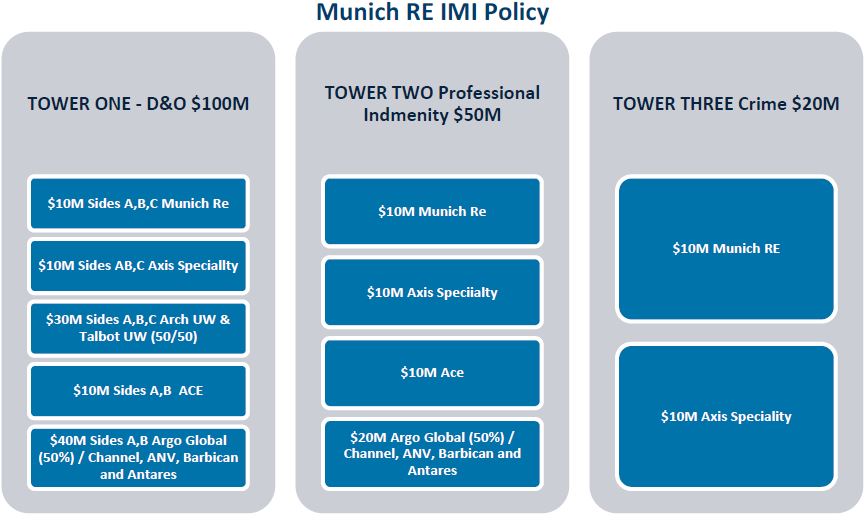
113 A PSC schedule also outlines Quintis’ 2015-16 coverage with respect to D&O coverage:
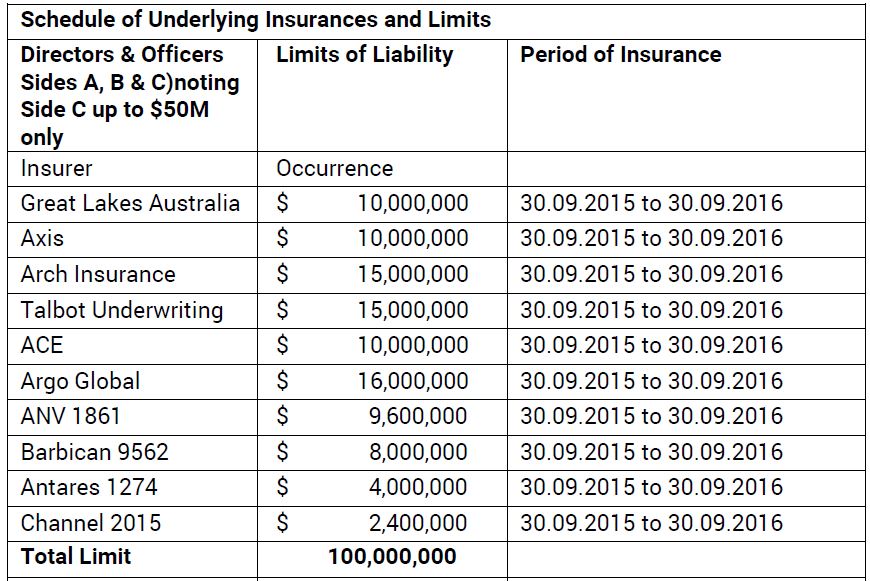
114 In relation to the finalisation of the 2015-16 Policies, on 29 September 2015, Ms Purdy of PSC sent an email in the following terms to Arch Insurance (Arch) and Talbot Underwriting (Talbot):
Please can you confirm ARCH and TALBOT’s acceptance of the instruction to bind $30M excess $20M on the D&O ABC tower for $105,000+++ on a 50/50 basis.
Once in receipt in your acceptance our closing will follow, a full policy wording once issued as per your conditions.
115 Moreover, PSC’s premium invoice dated 30 September 2015 included the following terms under the heading “Optional Extensions”:

116 The invoice also included the following breakdown under the heading “Program Structure and Participation”:
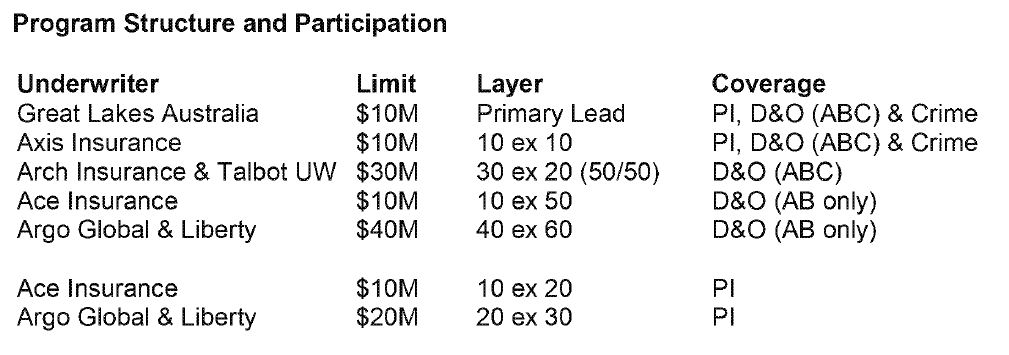
117 A confirmation of insurance dated 25 February 2016 also noted that the Limit of Liability for Side C cover was “$50,000,000”.
118 Together, these documents indicate that the insurers Great Lakes Australia (on behalf of Munich RE) (as primary to $10 million), Axis Insurance (as first excess to $20 million aggregate) and Arch and Talbot (as second excess to $50 million aggregate), insured sides A, B and C D&O liability together to an aggregate limit of $50 million.
119 However, what is of note is that the 2015-16 Primary uses the same Munich RE wording in all relevant respects as was subsequently adopted in the 2016-17 Primary. The only notable difference is that that the 2015-16 Primary also attaches the PSC placement slip for that period to the policy wording, which records “Entity Securities Liability $10,000,000” under a non-indented heading “Extensions” (as opposed to the indented heading “Optional Extensions”). Other than this, the 2015-16 Primary, like the 2016-17 Primary, included the term “4.9 Entity Securities Liability $10,000,000” in the policy Schedule.
120 Similarly, the 2015-16 1XS included the following provision:
If any Underlying Limits are subject to a Sub limit then coverage hereunder shall not apply to any Claim which is subject to such Sub limit, provided however, that the Underlying Limit shall be recognised hereunder as depleted to the extent of any payment of such Claim subject to such Sub limit.
(Emphasis in original to signify defined terms).
121 The submission put by Quintis was that if the reference to “4.9 Entity Securities Liability $10,000,000” is construed as a sub-limit, this means that the Excess Insurers to the 2015-16 Polices were not liable for Side C cover above $10 million; a proposition it asserted was clearly inconsistent with the intention of the underwriters to those policies. The proper construction of the 2015-16 Policies is not, however, an issue that I am required to decide.
122 The involvement of the Lloyd’s syndicates (Argo, ANV, Barbican, Antares and Channel) in the 2015-16 D&O tower should be noted. These insurers covered Sides A and B (not Side C) at the fourth excess level in the amount of $40 million (excess $60 million). Of relevance, the slip leader of the 2015-16 4XS, Argo, together with the subscribing insurers, Antares and Channel, all became slip leaders for the 2016-17 Policies in the London takeover of Quintis’ insurance programme: Antares became the 2016-17 Primary slip leader; Argo became the 2016-17 1XS slip leader; and Channel became the 2016-17 2XS slip leader. Price Forbes also acted as the London broker for the 2015-16 4XS.
123 Quintis submitted that it “would be absurd if those insurers did not have an understanding of the 2015-16 programme that they were providing excess insurance over”. It was said that since the risk undertaken by each excess insurer to the 2015-16 Polices was interdependent on the risk assumed by the other layers of the policy, the reasonable and obvious inference to be drawn is that as at May 2016, Argo, Channel, Antares, Barbican and ANV knew the overall structure of the programme in which they were presently participating, which included up to $50 million in Side C cover.
124 In advance of the expiry of the 2015-16 Policies, PSC (on behalf of Quintis) commenced approaching existing insurers for renewal quotes for the 2016-17 insurance programme, as well as investigating whether it could place Quintis’ entire programme in the London market. To this end, in May 2016, a Quintis presentation titled “TFS Corporation Ltd May 2016 Financial Lines Insurer Update” (Insurer Update Presentation) was delivered to various underwriters in London. It is also apparent that representatives of Price Forbes attended the presentation. That presentation included a breakdown of Quintis’ business and risk profile.
125 Relevantly, one of the slides in the Insurer Update Presentation titled “IMI Program Structure” included the following information:
• The structure of the current IMI program was put in place at renewal last year in Sept.
• The limits placed are not likely to be increased this year.
• Participants in the program last year will be asked if they are still able to participate in the 2016-17 renewal.
• Axis Australia will not be able to participate in the program this year, and this ‘gap’ is being promoted to fill, currently $10M excess of primary $10M across full program D&O, PI and Crime.
126 The evidence of handwritten notes of representatives of Antares, Channel, Vibe, ANV and Barbican regarding the Insurer Update Presentation suggests they attended (it is agreed that at least Antares, Vibe and Channel attended). In particular, Quintis highlighted that the signed notes taken by personnel from Vibe record: (a) “Unchanged programme on the IMI … Looking for continuity!”; (b) that they are told who is issuing the 2015-16 Primary (Great Lakes Australia); and (c) that there is a “[$]100 limit on D&O”. However, there is also a note immediately following a reference to “D&O policy up to $100m” which states: “[d]oes not know until June/July time & will see what pricing looks like then”. Similarly, an annotated version of the Insurer Update Presentation discovered by Channel contains the words “can do more” on the slide of the presentation titled “IMI Program Structure”.
127 Quintis asserted that I should infer from this information that at the Insurer Update Presentation these insures were told: (a) of the existing limits of cover; (b) that Quintis was seeking from them an unchanged renewal of its existing cover; and (c) that the existing cover included Side C cover of up to $50 million. According to Quintis, this objectively apparent exchange represents the beginning of the thread of common intention.
128 The PSC Report also discusses the contents of the May 2016 Insurer Update Presentation. Of note, that report stated the following under the heading “Marketing Approach”:
For the current renewal PSC has worked closely with the Australian market whilst increasing our engagement in the London market with our partner Price Forbes.
Our objectives for renewal were to:
• Achieve a reduction in premium rates;
• Maintain the limits across the program;
• Expand the current market capacity to increase competition;
• Broaden the global reach of the policy to cover all existing and future jurisdictions
Our annual presentations to the London markets occurred in May 2016. Peter Burtenshaw (PSC) was accompanied by Alistair Stevens and Quentin Megson who presented to both currently participating underwriters and new markets, specifically on financial lines. The presentation was very well received by underwriters, creating a new interest in this sector and greater understanding of TFS’s vertically integrated business model and global operations.
The presentations enabled TFS to:
• Provide a company update on TFS so the potential insurance markets were able to see the growth of the company, and understand the next stages of development;
• Demonstrate the quality of the risk management across all sectors of the business
• Present the latest key financial and operational results
• Provide an overview of Sandalwood products existing supply agreements and future markets
129 Quintis submitted that this information assists in understanding what was discussed at the May Insurer Update Presentation.
130 On 4 May 2016, Mr Butler of Price Forbes wrote to PSC noting that “I am pleased to confirm that the presentation went very well and we have had extremely positive feedback from the underwriters who attended”, and that the “[i]nsurers would like to take discussions further with regard to expanding the London market participation across the programme.”
F.4.3 Initial engagement of Price Forbes by PSC
131 On 28 July 2016, there was an exchange of emails in which Mr Butler of Price Forbes confirmed to Ms Purdy of PSC that: (a) he would “be doing the renewal as per last year”; (b) the “London market were very receptive to TFS” and “generally they want to provide more capacity, and more involvement on the program”; and (c) “a call would be good for next week to get our ducks aligned”.
132 On 9 August 2016, Ms Purdy sent Mr Butler an email setting out an “agreed timetable” for the proposed renewal and a range of documents “which can be distributed amongst the market for quotations”. It appears there was no response to this email. An email in very similar terms was re-sent on 16 August 2016 (while the statement of agreed facts said these emails were identical, this is not strictly accurate but it is true the differences are not presently material). In the email of 16 August 2016, Ms Purdy stated:
Hi Shaun,
It was good to touch base with you last Thursday on this client and discuss how we wish to proceed with renewal this year. As discussed in the telephone conversation we already have a timeline which we need to adhere to, to ensure all board papers and presentations are kept on schedule.
As agreed the timetable should go as follows;
9th August – renewal information out to markets
12th August – client to return renewal questionnaire which has some queries on it from the current primary lead (Munich Re), but no proposal form is being completed this year.
24th August – any underwriters queries to be group complied and forwarded to client for responses.
8th Sept – all terms and program structures to be received by PSC Perth
15th Sept – PSC Perth to provide board papers to TFS for circulation
29th Sept – Board resolution and instructions
Attached to this email are the following documents which can be distributed amongst the market for quotations;
§ Current IMI program Structure and participants
§ Unaudited 9mth Financials to March 2016
§ Update on ASX announcements from May – Jun 2016
§ Annexure A – Updated Organisational Structure
§ Annexure F - ASX announcement 21 July 16 New Senior Note Secure
* Presentation from May 2016 as delivered to the London Markets – removed already with you.
The client has suggested that full and final financials may be available at the end of Aug, obviously we’ll all know once released. Additional information requested from the client and we hope to be in receipt of this soon;
§ Details of new investor clients in the 15 16 period
§ Commentary on ongoing dispute with former employee & investor (grower) Teague Czislowski
With respect to the ASIC s912 Notice in March 2016, issued to TFS Properties Ltd TFS remark that their responses were provided and no further correspondence has been received from ASIC since.
As discussed on the phone Shaun, we would be happy for you to approach the market for the whole of the program, at present we are looking to deliver premium savings to the client, with as broad a coverage as possible.
I hope this all makes sense to you, let me know if you need anything else.
Kind Regards
Sarah Purdy
133 It appears that the document “Current IMI program Structure and participants” was not attached to this email, as in a matter of hours, Mr Butler requested Ms Purdy to “send … over the current structure program”. Ms Purdy replied the same day in the following terms:
Please see below, this shows it as a visual, but the Liberty would part [sic] would need to be replaced with the other lines that filed in and are shown in the premium table I have sent over.
If you have any queries please let me know essentially we have separate towers on $100M D&O (AB) including $50M side C, PI at $50M and Crime at $20M.
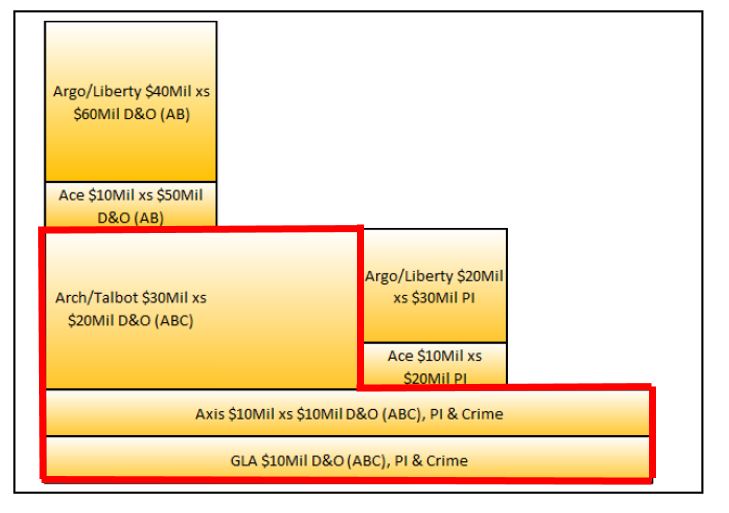
(Red outline added to demonstrate what Quintis contended demonstrates $50 million in Side C cover in the expiring insurance programme).
134 Incidentally, the second and third excess policies for the PI element of the 2015-16 tower did not appear to be in evidence (hence why they were not defined in the relevant section of these reasons above). However, it was not submitted that these policies were material in any way.
135 Quintis contended that this document is the simplest possible graphical description of the proposed insurance tower; being the base information that quoting insurers needed in order to price the risk they were being asked to underwrite. Further, Quintis said that the only reason apparent for Ms Purdy providing the structure diagram to Mr Butler in connexion with him “approach[ing] the market for the whole of the program”, was in order for the structure diagram to be provided to quoting insurers and/or to assist Price Forbes in explaining the existing cover to be replaced to those insurers. It was said that the content of these communications and the fact that they were attended by the benefit of oral discussion means that it would have been made clear to Price Forbes that Quintis was seeking to renew its existing amount of cover, which included up to $50 million in Side C cover.
136 Armed with this information, Price Forbes began seeking quotations from the London market.
137 At this time, Ms Purdy also communicated with the incumbent Australian insurers. Relevantly, Talbot was told that “Talbots current line is; D&O (ABC) - $30M(50/50 co share with Arch) xs $20M”; and Arch was told that “Arch’s current line is; D&O (ABC) - $30M (50/50 co share with Talbot) xs $20M”. Both insurers were then asked the following: “Please advise if you would like to quote these lines or would like to quote elsewhere in the towers, this year the program is being opened fully to the London Market as well, across the D&O, PI and Crime.” It appears that Axis ceased underwriting in Australia at this stage. Quintis argued that the content of these communications provides support for the proposition that none of the Australian insurers that offered Side C cover under the 2016-15 Policies were of the view that such cover was sub-limited at $10 million.
F.4.4 Negotiations with the Relevant Insurers
138 On 16 August 2016, Mr Butler forwarded Ms Purdy’s email and attached documents to Mr Wren of Vibe and Mr Robertson of Argo. Mr Robertson was also sent the Insurer Update Presentation slide deck, presumably given he was not at the Insurer Update Presentation. The email to Mr Wren was as follows:
Hi mate please see below and attached.
I will send over other info on separate emails so not to clog up your system.
Antares had quoted the primary the [sic] Primary is AUD 20,000,000 two towers of combined PI/Crime AUD 10,000,000 and D&O 10,000,000.
Their premium AUD 295,000,000
Line 50%
So if you would like to support 50% let me know.
Kind regards
Shaun
An email to Mr Robertson was of the same explanatory effect, although did not include that Antares had quoted the primary or the offer to support 50% of the primary.
139 Contemporaneously, Mr Butler also forwarded Ms Purdy’s email containing the structure diagram to Mr Robertson and Mr Wren; the only document sent by Price Forbes to Vibe and Argo that recorded the full structure of the expiring programme with explicit reference to sides A, B and C. Quintis submitted that given the email and structure diagram related to the whole of Quintis’ insurance programme, both Mr Robertson and Mr Wren would have placed initial emphasis on the structure diagram.
140 The documentary record reveals that Argo was also forwarded, contemporaneously, the placement slip for the 2015-16 Primary, together with a draft schedule and policy wording for the 2016-17 Primary copied from the prior year. As Mr Elliott SC, counsel for the second respondent, accepted, “while this is the placement slip for the expiring programme, it has obviously been provided [to] Mr Robertson for the purposes of the list [i.e. current] placement” (D2, T85.41–3). The provisions of the draft policy schedule and policy wording were identical in all relevant respects to those ultimately adopted in the 2016-17 Primary. Quintis submitted that while the placement slip and policy wording did contain the term “Entity Securities Liability $10,000,000”, the surrounding context of Argo’s negotiations with Price Forbes lends no credence to any inference that Argo considered at that time that Side C cover was sub-limited, and that the timing of these communications confirms that each must be read in conjunction. Together, it was argued that these documents indicate that Quintis was seeking a renewal of the 2015-16 Policies, on the basis that such cover included up to $50 million in Side C cover not otherwise depicted on the face of the 2015-16 Primary.
141 It is next relevant to identify an internal Vibe document dated 16 August 2016. This document includes the following text under the heading “Underwriting Decision/General Notes/Subjectives”: (a) “client meeting attended by APW [Austin Ren]”; (b) “agri-funds not normally a risk we would entertain but these folks are very well established and are involved from the primary functions right up to the end products for which they have secure buyers”: and (c) “Price Forbes now have an opportunity of quoting for the whole programme”. The document also contained the following under the hearing “Expiring Terms/Markets”:
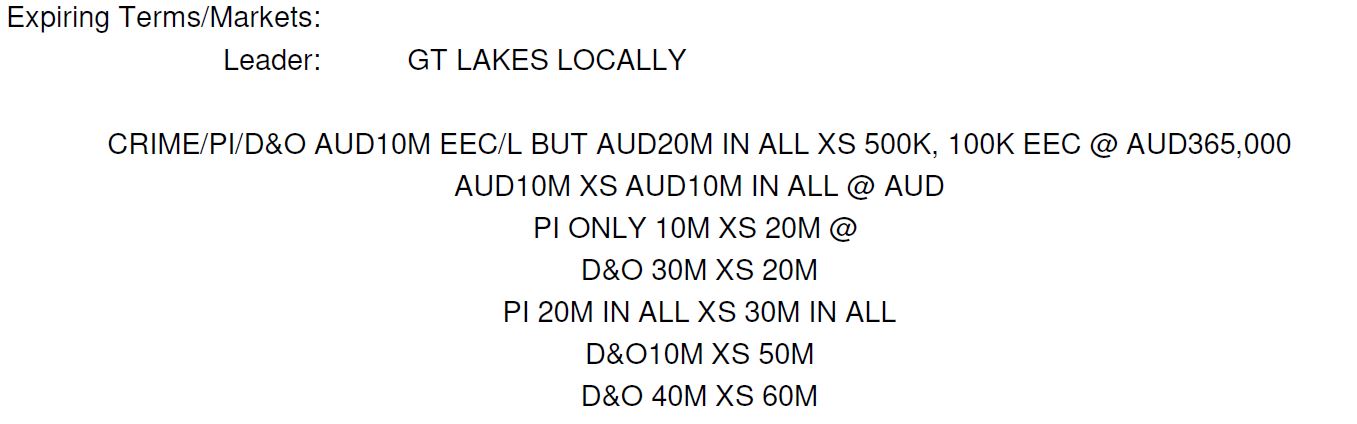
142 Quintis argued that given the structure of these notes mirrors what is contained in the structure diagram, this document supports the conclusion that Vibe had regard to and considered the structure diagram it was provided that day, and would have understood that the expiring programme provided for up to $50 million in Side C cover.
143 Moreover, a draft quote sheet (attaching the expiring policy wording) prepared by Price Forbes (evident by its letterhead on the document) and stamped by Antares on 17 August 2016 was produced, although, curiously, not by Antares. The attached policy wording was identical in all relevant respects to that which ultimately formed the 2016-17 Primary (including the term “4.9 Entity Securities Liability AUD $10,000,000”. The quote sheet bears annotations indicating that Antares was willing to take 50% of the risk, that the policy could extend 18 months on a pro-rata adjustment and that the proposed premium was $295,000:
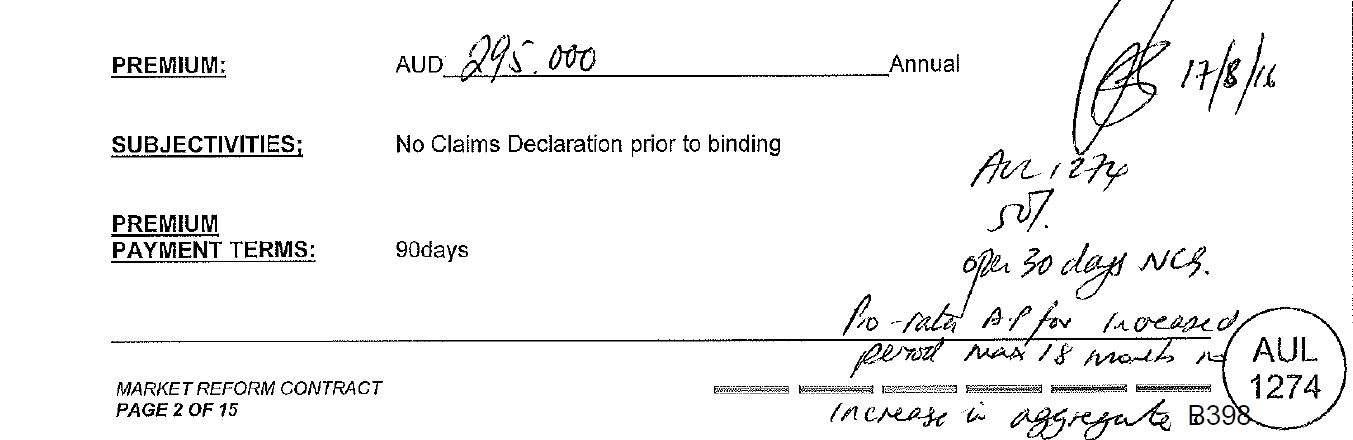
(Extract of the annotated section of the draft MRC).
144 Quintis asserted that given Antares’ apparent interest in taking the primary business from its Australian competitor Munich RE, it is perhaps unsurprising that it seems to have “borrowed” the Munich RE policy wording.
145 Quintis submitted that there are further inferences to be drawn from the terms of the Antares quote and how it has been adduced into evidence (there being no discovered evidence of communications between Antares and Price Forbes as to how this quote came about). Quintis argued that since the only other two insurers that Price Forbes contacted on 16 August 2016 (Argo and Vibe) were sent the same material, the only reasonable inference is that Antares was provided that material, including the structure diagram or a description of it either orally or in writing. Quintis submitted that such an inference is entirely consistent with Antares providing a signed quote the following day, on 17 August 2016. Further, Quintis argued that the use of the Munich RE policy wording is consistent only with Antares sharing the manifest intention of Quintis to renew unchanged its existing amount of cover. The only other document in evidence relating to the circumstances of the quote is an internal underwriting file note of Antares, signed by Mr Redding of Antares on 4 October 2016, which records details of Quintis’ business and that Antares won the tender for the 2016-17 Primary.
146 On 17 August 2016, after a further exchange of emails following on from the structure diagram, Ms Purdy responded to a request from Mr Butler to know “what the primary and first excess layer was paying last year”, noting “[b]ase premiums last year; Primary $390, 175, Axis $10M ex $10M $215,000”. Ms Purdy also stated “if you have a primary under consideration in London could you send over the wording?”, to which Mr Butler responded, “we think we have got the primary AUD 295,000 so a very good result” and that “our initial thoughts is [sic] to use the current wording but tweak it update, add on take off etc”. On 18 August 2016, Mr Butler sent an email to Ms Purdy confirming Antares as the prospective 2016-17 Primary lead. Quintis argued that the context and timing of these communications indicates that Mr Butler was speaking for Price Forbes and Antares together based upon their discussions in connexion with the primary quote, demonstrating Antares’ comprehension of the intention to renew (with different insurers) the 2015-16 Policies.
147 Also on 17 August 2016 (at twenty to midnight), Mr Wren replied to Mr Butler’s email attaching the structure diagram, in which he outlined that “[f]ollowing a review of the updated information for TFS”, Vibe would struggle to support the primary premium and that it was therefore looking at excess layer participation only. Mr Wren indicated that he thought Price Forbes had “obtained a great deal for the client on the primary”. He then set out a list of proposed premiums. It is important to extract how these proposed premiums were structured, as Quintis contends they are reflective of the structure diagram and mirror the Vibe internal document extracted above (see [141]):
Crime/PI combined and D&O AUD10m eel/c but AUD20m in the agg & AUD10m eec and in the aggregate xs primary (and underlying deductibles) @ AUD195,000
D&O only AUD30m in all xs AUD20m in all @ AUD110,000
D&O only AUD10m xs AUD50m @ AUD35.000
D&O only AUD40m xs AUD60m @ AUD118,500
PI only AUD10m in all xs AUD20m @ AUD85,000
PI only AUD20m in all xs AUD30m @ AUD140,000
All + any applicable taxes
Brokerage 25%
Wording, terms and conditions as expiry
148 The Relevant Insurers, on the other hand, submitted that I should infer that given the timing of this email (being just after Antares had signed the draft quote for the 2016-17 Primary), Mr Wren’s reference to “updated information” and “primary” indicate that he had been provided with the Antares quote and this was the document upon which he was operating. The Relevant Insurers said that this inference is supported by Mr Wren’s reference to “[w]ording, terms and conditions as expiry” (given the Antares quote adopted the expiring wording), along with the fact that the verified list of documents relating to Vibe records that a copy of the Antares and Channel quotes were in Vibe’s control on or before 12 September 2016 but are no longer in its control (of course, on 17 August 2016, Mr Wren could not have had in his possession the Channel quote, as it had not yet been executed).
149 It is also worth extracting the subsequent wording of Mr Wren’s email, which the Relevant Insurers submitted demonstrates the figures given were simply a non-binding indication:
Subject to:
Details of US exposures (revenue derived from the same) and Details of contractors/consultants whom the insured may have vicarious liability for
No cover given
Indication open until natural expiry Subjectivities to be complied with prior to inception
Shaun – we have AUD7.5m capacity which I am happy to use for this entity (despite it’s an agri-fund!) as I have met with them and they are an excellent organisation – though would prefer to spread it across the programme if we were to utilise the full line
150 Mr Wren’s premium proposals were met with some hostility on Price Forbes’ end, with Mr Butler, by way of reply email on 18 August 2016, stating: “I am trying to support you but you are massively overpriced for a company that you came to see and it’s a sandalwood producer”. Mr Butler inserted “the real pricing” (i.e. how much is being paid on the current programme) alongside Mr Wren’s proposed premiums. Quintis submitted that this exchange demonstrated that the structure was explained to Mr Wren with Side C cover of up to $50 million and, in the light of such an explanation, that Vibe needed to beat current pricing.
151 Also on 18 August 2016, Mr Robertson of Argo sent the following email to Mr Butler:
Shaun
Many thanks for your email and your others on the same risk.
We can offer as follows:
AUD 10,000,000 D&O limit (A, B and C cover) in excess of a primary AUD 10,000,000 limit (Anatres [sic] or whomever) and separately
AUD 10,000,000 PI and Crime combined in excess of a primary AUD 10,000,000 limit (Anatres [sic] or whomever).
(in other words – an AUD 10 million xs AUD 10 million with 2 towers – one for D&O and one for PI/Crime) for a premium of AUD 120,000 annual.
Brokerage is 25%.
We would be able to write 100% of this.
This offer of terms is subject to 1) as per any subjectivities imposed by the primary carrier and 2) review and approval of the primary quoted coverage.
We hope this helps and await your advices in due course.
Best regards
Andrew
(Bold and underline in original).
152 Quintis argued that this email solidifies the conclusion that Mr Robertson was focussed on the structure diagram, not the draft wording he had received. The Relevant Insurers, on the other hand, argued that given the reference to Antares being the prospective leader of the 2016-17 Primary, and the timing of this email (being after Antares had executed the draft quote for the 2016-17 Primary), it should be inferred that the Antares quote was sent to Argo.
153 A draft quote of the 2016-17 1XS dated 18 August 2016 also appears in evidence and contains the handwritten note “Argo line 100%” and premium “AUD 120,000” (although, not discovered by Argo). Quintis submitted that given the contents of the above email, it should be inferred that this is an Argo document (it is noteworthy that Argo did not end up subscribing 100% to the 2016-17 1XS). Quintis said that this draft quote did not contain any reference to sub-limits, pointing to Argo quoting on the basis of the structure diagram. Interestingly, however, that quote did contain the following terms in the “Short Excess Wording” attached to the policy (and signed by Argo):
In the event a sub limit of liability exists in the Underlying Policy, any payments of claims that are subject to such sub limit shall be deemed to apply toward exhaustion of the limits of liability of the Underlying Policy for purposes of coverage under the Policy.
154 The Relevant Insurers submitted that given the pagination difference, it should be inferred that this wording was attached to the draft quote by Argo, and that in the absence of objection to such wording by Price Forbes, one should infer that both parties were operating on the common intention as to how the sub-limit terms worked and understood that there was a “sub-limit applying to all the layers going forward”.
155 Also on 18 August 2016, Mr Butler informed Ms Purdy that “he had more good news”: he had secured a premium of $120,000 in relation to the 2016-17 1XS.
156 On 19 August 2016, Mr Fox sent an email to Mr Martin Fletcher of QBE in the following terms:
Fletch, per our brief conversation today please find attached the Submission together with the Primary terms from Antares.
The program is:
Primary 10,000,000 @ 295,000
1st XS 10,000,000 xs 10,000,000 DO/EO/CRIME @ 120,000 (100% ARGO)
2nd XS 30,000,000 xs 20,000,000 DO/EO only @ T B A
3rd XS 50,000,000 xs 50,000,000 DO only @ 135,000 (Aspen 20% lead line).
Looking for you to support the open layers and quote the 30 xs 20.
I’ll be in to discuss.
Best Regards
Foxy
157 “Foxy” included a number of attachments, including, relevantly, the Insurer Update Presentation and the Antares quote.
158 On 19 August 2016, Mr Fox also sent Mr Charles Boorman of Probitas a broad outline of the programme and an invitation to discuss the “opportunity” with Price Forbes:
Charlie, we’re putting together quotes for IMI – AUD 50,000,000 EO/AUD 100,000,000 DO and AUD 20,000,000 Crime. This is an interesting risk in that they are the world’s leading Sandalwood oil manufacturer – from plantations to end product. They mange [sic] various funds associated – basically each planting is owned by a separate set of investors. I’ve attached hereto the submission and would welcome the opportunity of discussing it with you.
I look forward to hearing back from you.
Best Regards
Andrew Fox
159 That email also included a number of attachments, including, relevantly, the Insurer Update Presentation. Contemporaneously, it also appears that Probitas received and scanned a hard copy of the Antares quote (from the email address probitasscanner@gmail.com).
160 Mr Colombera of Everest was sent an email in the same terms as that sent to Probitas, including the same attachments. At this time, the Antares quote had not been provided to Everest.
161 Quintis submitted that the terse terms of each of the foregoing emails and the references to further discussions make clear that each of QBE, Probitas and Everest would need to speak to Mr Butler or Mr Fox in order to ascertain more information about the programme before participating. Indeed, none of those insurers provided quotes to Price Forbes until several days later (QBE on 12 September 2016; Probitas on 24 August 2016; Everest on 22 August 2016). Quintis argued that this evidence supports the inference that the representatives of Price Forbes were acting to carry out Quintis’ intention of replacing its existing programme and that it is proper to infer that their conversations with the representatives of QBE, Probitas and Everest in the days following 19 August 2016 would have conveyed the same information as supplied to Vibe and Argo.
162 Pausing here, Price Forbes’ progress in placing Quintis’ D&O insurance cover in the London market can be summarised as follows (excluding the 2016-17 3XS):
(1) it had secured a quotation from Antares as slip leader for the 2016-17 Primary with a 50% line (in the amount of $10 million);
(2) it had secured a quotation from Argo as slip leader for the 2016-17 1XS (in the amount of $10 million) with a 100% line;
(3) it had not yet secured a quote for the 2016-17 2XS (in the amount of $30 million), except from Vibe, which was rebuffed; and
(4) it had approached QBE, Probitas and Everest for their support in the programme.
163 On 22 August 2016, Mr Fox of Price Forbes sent Mr Martin Campbell of Channel an email in the following terms, attaching a number of documents including the Antares quote and an unsigned quote slip for the 2016-17 2XS (an email also forwarded, including its attachments, to Mr Laurence Brunton of Channel):
Campbell, please find attached the info together with the ANTARES quote.
I’ve also attached hereto the quote sheet for the 30 xs 20 layer.
Talk later.
Foxy
164 Mr Campbell responded the same day in the following terms:
Foxy,
Please find attached our quote terms for the 30x20 as discussed. I think the agg[regate] should be AUD60m as we discussed too? I have annotated this on the slip. We will also agree to support Antares’s primary terms with 25% too.
Look forward to discussing further with you.
165 The quote slip for the 2016-17 2XS attached to Mr Campbell’s email bears the Price Forbes header, making it safe to deduce that it was prepared by Price Forbes in the same way as the Antares and Argo quotes. The annotations to the quote by Mr Campbell demonstrate, inter alia, that: (a) Channel is taking a 25% line; (b) the premium is $325,000; (c) the quote is on a “subject to no changes” basis; and (d) that Channel is also subscribing at the primary level (“+ 25% of Primary terms @ AUD 295k”). The “Interest” on the quote is recorded “[a]s more fully defined in the PRIMARY wording and clauses attached herein being Munich Re Fin Professional Risks Policy 09/14 as expiry and as agreed” and the “Conditions” are recorded as “Full Follow Form as attached”.
166 There are two other documents in relation to Channel best noted here: (a) a page of underwriting notes of Channel in evidence dated 22 August 2016, which include, under the heading “Notes”, the terms “full follow form on expiring – Munich Re/Great Lakes”; and (b) an undated set of notes of Mr Campbell (which seem to have been sourced from Mr Laurence Brunton of Channel from a file share site and sent to Mr Campbell on 8 October 2016) recording some details about Quintis’ business and the risk ultimately undertaken by Channel. No reference is made to Side C cover in these notes.
167 Also on 22 August 2016, Mr Fox emailed the Antares quote to Mr Colombera of Everest, stating, “Christian, thanks for this afternoon. As promised please find attached the Submission and primary terms”. Quintis argued that it should be inferred that the discussion that afternoon would have been on the basis of the structure diagram, which clearly outlined that the bottom three layers of D&O tower in the expiring programme covered Sides A, B and C.
168 Mr Colombera replied that same day in the following terms:
Dear Adrian
Thanks for your time earlier and approach on this account. I confirm we would support the primary with 25% line (per the attached quotation), as we discussed, and also the layer AUD30m xs 20m @ AUD325,000 plus tax with a 25% line; however need to see slip to understand with there is any RI built in. Please let me know and I will confirm line size.
Brokerage 25%.
This is subject to receipt and acceptance of a NCD signed and dated as at inception, along with any other subjectivities imposed by lead markets.
I hope this assists and look forward to discussing this further with you.
Thanks & best regards
Christian
169 Mr Colombera reattached the Antares quote to that email, which included the addition of the Everest stamp, scratched with the date 22/08/16 and confirmation of a 25% line.
170 It is also worth dealing at this point with a document relied upon by the Relevant Insurers as contemporaneous underwriting notes of Everest. Of note, the relevant document contains the following terms:
UW Points
Excess no Side C
…
• Wording: standard IMI; Side C sub-limited to Primary (no sub-limits carried in excess layers), which is preferred.
• Strategy: Manage capacity given our small portfolio and Australian legal environment to 25% primary and circa 20% 2nd excess providing ventilation, and on basis on no Side C above Primary (other than erosion exposure), given overall favorable [sic] pricing and acceptable risk profile.
171 The Relevant Insurers submitted that these notes demonstrate that Everest was operating with the intention that Side C cover was sub-limited at $10 million. On the other hand, Quintis contended that this document should not be seen as probative, given its metadata reveals that while the document was created on 17 May 2016, it was last modified on 27 June 2017, and there is also no record of who created the document or that that person might reasonably be supposed to have had personal knowledge of the facts contained in the document. I will deal with this contention when considering the intention of Everest below.
172 Also on 22 August 2016, Price Forbes appears to have first communicated with Barbican. The email from Mr Stanley of Barbican to Mr Fox has the subject line “TFS” and commences with “I refer to our conversation at the box this afternoon on the above”; a statement Quintis asserts demonstrates there was prior oral communication. Mr Stanley continues:
As discussed I would be prepared to offer as a VRI a lead line of AUD6m part of AUD30m x/s AUD20m @ AUD325,000 (com 25%) but AUD60m in the AGG for the PI and D&O only (noting the underlying can be eroded via a BB claim).
At this stage and based on the information available I cannot confirm our terms until review of the final submission and primary wordings.
173 Further, handwritten notes of that day produced by Barbican were in the following terms:
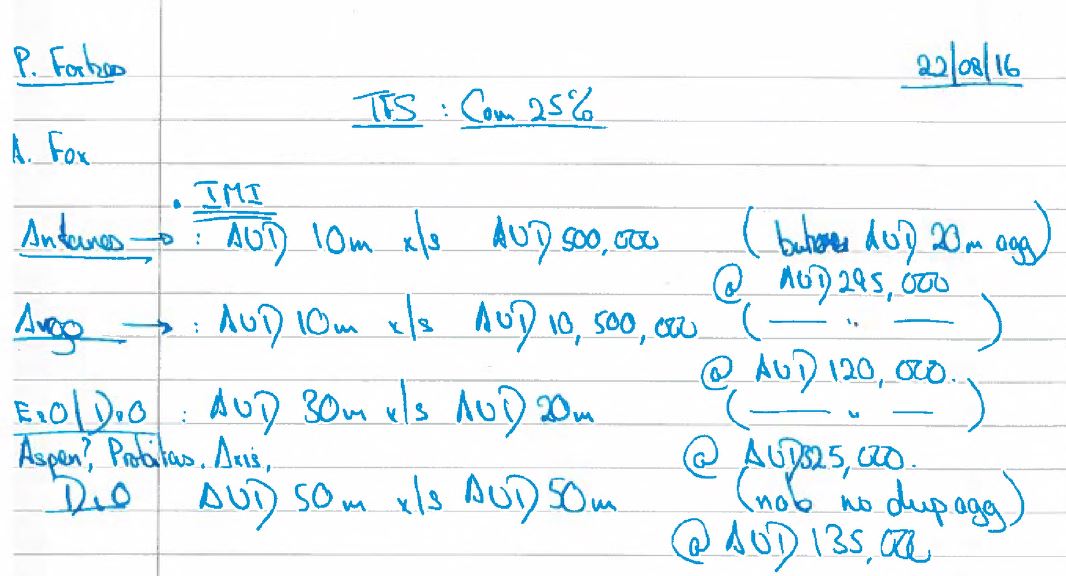
174 On the same day, Mr Fox replied in the following terms: “Gav, thanks for the email please find attached the Primary Slip and Wording plus the renewal submission”. This email included all the attachments to Ms Purdy’s email dated 16 August 2016, including the additional attachment “Un-audited Interim financial report 9 months ended 31 March 2015.pdf” (which appeared in the initial email of Ms Purdy dated 9 August 2016). There is no evidence of the structure diagram being sent to Mr Stanley. Quintis argued I should find Mr Fox would have given Mr Stanley the minimum information he regarded as important to Quintis’ renewal, including the basic structure of the tower, which layers provided Side C cover and on what terms. It was said this would simply be consistent with the structure diagram upon which Mr Fox was operating.
175 On 23 August 2016, Mr Fox sent the Channel quote to Mr Colombera of Everest as requested (see [168]).
176 Also on 23 August 2016, Mr Fox emailed the Antares and Channel quotes to Mr Gavin Davies of ANV, accompanied by the following description:
Gavin, further to the meeting with the client back in May this year we’ve been working through a London ground-up quote alternative to the local markets.
We’ve now received terms for the whole limit being AUD 100,000,000 DO/50,000,000 Eo and 20,000,000 for Crime.
We’ve built this up in 4 layers;
Primary 10,000,000 – Eo/DO/Crime @ 295,000 – Antares lead
1st XS 10,000,000 – EO/DO/Crime @ 120,000 - ARGO
2nd XS 30,000,000 – DO/Eo @ 325,000 – CHN lead
3rd Xs 50,000,000 – DO @135,000 – Aspen lead
I’ve attached hereto the quote slip for the primary and 2nd XS. The 1st XS is being written 100% by ARGO and the 50 xs 50 DO is lead by ASPEN (they haven’t signed the quote sheet yet).
The thought is for you to review supporting the primary 10 and/or the 30 xs 20 at this stage.
What’s your availability to review tomorrow?
Best Regards
Adrian
177 Mr Davies informed Mr Fox that he would look at the quote and attachments and “give [Mr Fox] a call”, to which Mr Fox replied that he was “[h]appy to take [Mr Davies] through the deal”. Quintis submitted I should infer from this exchange that Mr Fox would have taken Mr Davies through the structure diagram sent to Argo and Vibe even if there is no evidence of that document in fact being sent to ANV, because “it was information that was critical … in order [for Mr Fox] to do his job of marketing the program”: D2, T20.29–30.
178 On 24 August 2016, Mr Fox sent the Channel quote to Mr Boorman of Probitas, upon a reminder from Mr Boorman in the following terms: “You were going to send me the Channel terms for that excess layer to agree. Just a reminder!”. Mr Boorman agreed that same day to support the 2016-17 2XS, noting that he had “put [Probitas] down as second Lloyds [sic] on slip, but if it any of your other markets get ‘emotional’ then happy to stand back!”. Attached to that email was a copy of the Channel quote with the Probitas’ stamp, scratched with the terms “25% All as per lead”. The Relevant Insurers submitted that the reference to other markets getting “emotional” refers to Channel wanting to have an active role in claims administration.
179 On 25 August 2016, Mr Fox sent Ms Purdy each of the quotes obtained from the London market under the cover of the following email:
Sarah, I refer to my earlier email today and have pleasure in attaching hereto the preliminary terms we’ve received from our marketing efforts in London.
We have quoted for the full DO 100,000,000/EO 50,000,000 and Crime 20,000,000 in 4 layers.
We have support for the primary – 75%/1st XS 100%/2nd XS 100% and 3rd XS a lead line (we’ve not pushed this yet).
The deal all hangs together as one – i.e. ARGO will be supporting an Antares lead. If the primary lead changes – say the incumbent stands up then we will need to review with ARGO and the markets on the other 2 layers.
These terms represent the best we’ve been able to achieve to date and are based on the EXPIRING FORM. We felt it easier to follow this as the client knows the wording.
We ill [sic] be placing this 100% in Lloyd’s [sic]
We are continuing to market the risk and are awaiting fro [sic] several insurers to come back to us. WE [sic] do not foresee any problems in being able to fill the capacity 100% in Lloyd’s.
We can chat through these preliminary numbers tomorrow.
Best Regards
Adrian Fox
180 On 26 August 2016, Mr Davies sent the following email to Mr Butler recording the support of ANV to the 2016-17 2XS, under the subject heading “ANV’s Renewal Support 2016”:
Hi Adrian
Thanks for your email and we advise that we are able to offer the following support to Channel’s quote:
Cover: Excess D&O and Excess E&O
Period: 12mths from (tbc)
(up to 18mths with pro rata AP – no increase in agg limits)
Limit: AUD30m in the agg xs AUD20m in the agg
(separate towers for each section)
Premium: AUD325,000 plus applicable taxes
Brokerage: 25%
ANV Line: 25% (AUD7,500,000 in the agg for each section)
Subject to: As per leads subjectivities.
No cover given, terms open for 30 days.
We now await your comments and please advise should you have any queries in the interim or require any additional capacity.. [sic]
Kind regards
Gav
181 On 5 September 2016, Mr Butler replied to an update request from Mr Wren of Vibe:
Hi mate,
…
Got terms as Follows:
Primary Premium 10 mio AUD 195,000 over lined
First Excess 10 mio xs 10 AUD 210,000 over lined
Second Excess 20 xs 30 AUD 325,000 over lined [This appears to be a typographical error and should read “30 xs 20”]
Third Excess 50 xs 50 D&O only AUD 135,000 25% left
Everyone we have seen mate wants a line on it as you can imagine.
If you want some on the D&O only sides A,B,C let me know.
Kind regards
Shaun
182 Mr Wren responded that same day confirming Vibe’s support for the 2016-17 2XS and 2016-17 3XS:
Hi Shaun
Yes, not good is it?!
Thanks for the updates on this one – following on our conversation we would be pleased to offer support of 10% on the PI/D&O 30m xs 20m layer and a 10% on the top 50m xs 50m D&O layer
I presume the leader has requested up to date NCD/NMCD prior to inception given the time between our meetings and the start of the policy (?)
Please could you also confirm details of US revenue and number of Authorised Representatives they may have
Thanks
Kind regards
Wrenny
183 Quintis argued that what is apparent in relation to this latest round of insurer participants – Channel, ANV, Barbican and Vibe – is that each had discussions with Price Forbes outside what is recorded in the documentary evidence: (a) Mr Boorman of Channel makes express reference to a discussion and there are contemporaneous notes recording information beyond Price Forbes’ email; (b) the email from Mr Davies of ANV indicates “a call” before its participation; (c) Barbican produced notes which appear to relate to a conversation with Price Forbes; and (d) Mr Wren of Vibe commences his email as “following on our conversation”. Quintis submitted that while it is true the written contractual arrangements were contained in quote sheets provided by Price Forbes to the Relevant Insurers, these quote sheets did not comprise the whole of the negotiation, and were not regarded by any participant as an exhaustive statement of the contractual intentions of Quintis. Instead, it was said that the obvious inference is that Price Forbes told each of the Relevant Insurers the information it is recorded as providing to Vibe and Argo, including the structure of the proposed D&O tower and that it provided for Side C cover up to $50 million.
184 Also on 5 September 2016, upon a request from Mr Fox, Ms Purdy of PSC sent Price Forbes a version of the expiring policy wording in word (.docx) format. Notably, the email from Mr Butler commenced “as per our call this morning”. The only discrepancy between this document and the version of the expiring wording attached to the Antares quote is that the continuity date changed from 14 December 2012 to 30 September 2015. By way of reply email, Mr Butler noted that he “is seeing Antares tomorrow morning to iron out the wording and will revert”. After a further exchange of emails, Mr Butler noted to Ms Purdy that he was available for a chat, presumably given she had requested to “see how everything’s settled”, and stated that “[w]e have all the layers sorted now” and that “we are just amending the wording and seeing the leader [Antares] this am”.
185 On 7 September 2016, Mr Fox emailed Ms Purdy, attaching a clean and tracked changes version of the “agreed wording”, accompanied by the statement that “Shaun and I suggest that we call you tomorrow to run through this”. The tracked changes document reveals hand written deletions of certain clauses and amendments to particular wording. The revised policy wording was stamped “agreed” by Antares and dated 6 September 2016. Importantly, as the parties accepted, there were no changes to the Schedule or any clause relevant to the present dispute. That is, the agreed wording presented back to PSC was, in all relevant respects, in the same form to that Price Forbes first presented to Antares.
186 Up until this point, the overall structure of the 2016-17 Policies in relation to D&O cover corresponded to the 2015-16 Policies they were replacing – in particular, the total D&O cover of the 2016-17 1XS was $10 million (in excess of $10 million) and the 2016-17 2XS was $30 million (in excess of $20 million). The only differences were that: (a) the 2016-17 structure had subsumed the cover provided for by the 2015-16 3XS and 2015-16 4XS into one 2016-17 3XS; and (b) the 2016-17 Policies did not bifurcate the PI component at the second excess layer, nor market the D&O and PI components of this layer as separately insurable risks.
187 However, it appears that by a notation dated 8 September 2016, on the quote slip already provided by it, Channel noted as “Option 2” that the 2016-17 2XS be reduced to $20 million (excess $30 million) at a premium of “AUD$170k”, noting that “All other terms as per quotation below CHN 25%” (the corresponding reweighing being picked up by the 2016-17 1XS, which was to be increased to $20 million (excess $10 million)).
188 Quintis argued that this was simply a change in weighting as between the 2016-17 1XS and 2016-17 2XS and was not indicative of any different approach to the fundamental nature of the cover being quoted. In fact, Quintis submitted that this proposed change rather supports the proposition that the tower up to $50 million was being treated as part of the same risk, whereas the 2016-17 3XS was providing different and more limited cover than the layers below it.
189 The position with respect to the reweighting is clarified by the email of Mr Fox to Ms Purdy dated 9 September 2016, in which he states:
Sarah, further to our call this morning we’ve been busy in the market trying to save TFS more money.
We were at a premium for the IMI program – DO 100/EO50/Crime 20 at a premium of 875,000. We’ve not reconstructed part of the program and now have a IMI program – DO 100/EO50/Crime 20 at a premium of 775,000 (see attached spread sheet). This is a DEAL for the whole program.
As you can see from the spread sheet we’ve amended the First XS to a 20 xs 10 with ARGO leading. The second XS we’ve amended to a 20 xs 30. By doing this we’ve been able to make the additional 100,000 premium saving. We’ve not had time today to obtain the support from the original follow market for the 30 xs 20 but to be honest we don’t expect any kick back.
We need to secure a 25% capacity to the 20 xs 10 – we can do this in London.
We’ve “sold” this to the markets such as Channel as a complete deal and would be hard pushed to lose a layer – we therefore hope that the overall premium for the London deal sells this to the client at a 775,000 Annual – a 30% discount to expiring.
We can chat through next Tuesday. In the meantime we’ll proceed to fill the program out.
Let us know your thoughts.
Best Regards
Adrian Fox
190 The spreadsheet Mr Fox provided to Ms Purdy was in the following form:
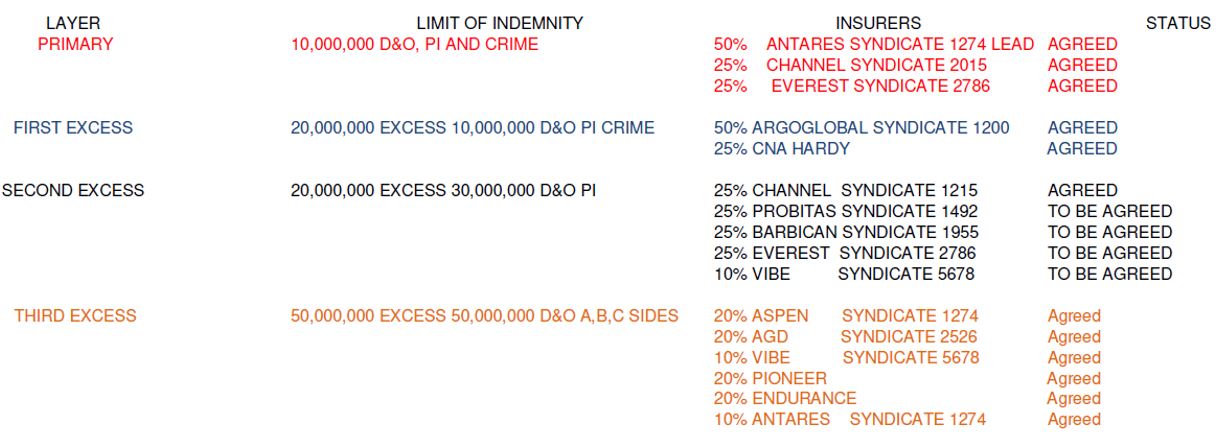
191 Quintis argued that this document relevantly indicated that the first three layers (i.e. the 2016-17 Primary, 2016-17 1XS, and 2016-17 2XS) covered “50,000,000 D&O A,B,C Sides” and that this further establishes that Price Forbes had a particular understanding of the insurance structure it was actively marketing in London. Indeed, it was said that while this document does not mention sub-limits, since the evidence establishes that Price Forbes understood what Quintis was seeking (i.e. a renewal of its insurance with the cover limits intact) and prepared the document itself, it must be inferred that it intended to refer to Side C cover of up to $50 million. Quintis said that there is no basis to conclude that any participant in the London market had a different apprehension of this document than the evidently experienced London broker. Quintis did accept, however, that this document records (or at least suggests) that the 2016-17 3XS also provided coverage over Side C liability (contrary to the retrospective endorsement later executed).
192 I note for completeness that there is no reference to ANV in the reweighting spreadsheet, despite it having offered terms at this point. This is also the first communication that notes that Argo’s line on the 2016-17 1XS has been reduced to 50%.
193 On 10 September 2016, Mr Butler responded to a request for an update from Mr Wren of Vibe in the following terms (including attaching the below updated spreadsheet):
HI [sic] Wrenny,
We spoke to them on Thursday and their issue is the second excess is un balanced [sic] the program.
We had to go to market yesterday and change it
Attached is the new structure.
All on the second layer have agreed just need you to do the same.
Then we are hopefully good to go.
Best
Shaun
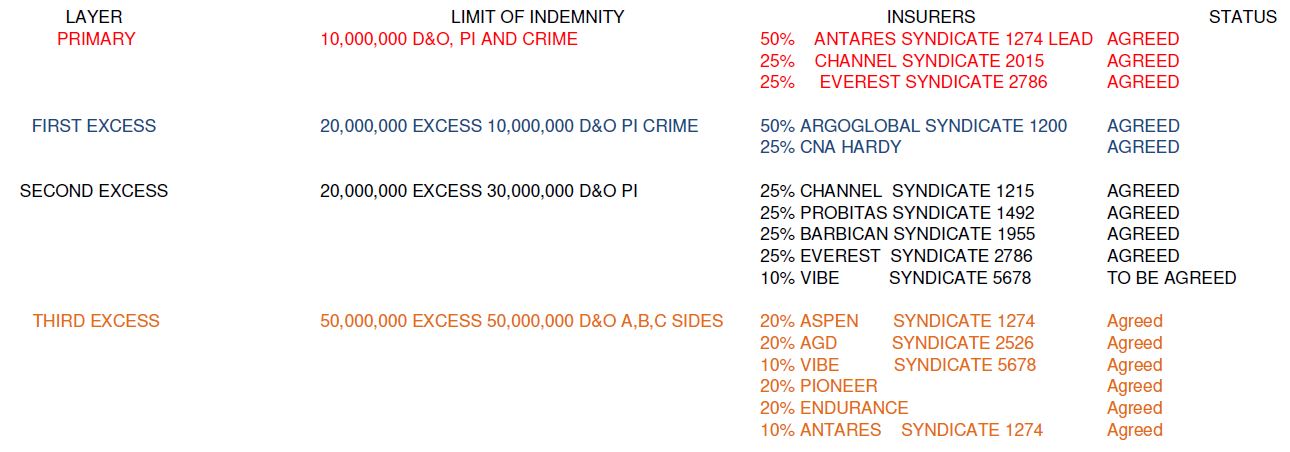
194 Contextually, Quintis accepted that the reference to “them” may be understood as a reference to PSC and that the “new structure” may be understood as a reference to that which is reflected in the restructure spreadsheet attached.
195 On 12 September 2016, Mr Wren of Vibe responded to Mr Butler stating “Thanks for the updates – fine with me (though the other deal was better!!) – pleased to confirm our 10% lines for the two top xs layers”. Mr Butler replied the same day confirming “Vibe participation on both layers”.
196 Quintis submitted that, given the updates to the spreadsheet and the reference in Mr Butler’s email on 10 September 2016 that “[a]ll on the second layer have agreed”, the other underwriters on the second layer had understood, and assented to, the revised structure. But this cannot be right because two days later, on 12 September 2016, Mr Butler is recorded sending a reweighting spreadsheet to Mr Boorman of Probitas and Mr Gavin of Barbican asking “Can you please agree your layer asap as wholesaler needs to present terms formally tomorrow”.
197 Probitas and Barbican agreed to the reweighting that same day.
198 Quintis submitted that the evidence demonstrates that each of Vibe, Probitas and Barbican concluded their agreement to the revised structure by reference to a spreadsheet that indicated their participation included Side C cover, without any reference to a very significant sub-limit that might have been thought to affect substantially the risk contemplated (and hence premium price). Indeed, it was said that the reweighting spreadsheet is further objective evidence of the common continuous intention of the parties to renew, not alter, Quintis’ existing insurance, save for the expressly negotiated rebalancing between the 2016-17 1XS and 2016-17 2XS.
199 It is also worth dealing at this point of the narrative with an internal Probitas spreadsheet titled “Probitas – Risk Entry Front Sheet”. That document referred to a “quote date” of 5 September 2016 and recorded participation “25% of AUD 20m xs 30m”. Furthermore, under a section titled “UW Rationale/Risk Description & Exposure”, the following text appeared:
Justification: Good financial performance, v strong cash flow generation. TA AUD1.35bn. v low st debt, AUD430m lt debt (maturity profile looks ok especially given high generative cash flows). Net worth AUD657m. FACTIVA search ok. Share price performance positive over last 4 years having doubled in price. Although Side C coverage, attachment point looks ok and line size smaller at AUD5m.
(Emphasis added).
200 Quintis argued that the reference to “AUD5m” should be understood as Probitas’ 25% share of $20m before its participation was written down to 15.63%, and that this internal document is consistent only with an understanding by Probitas that Side C cover was not subject to a sub-limit of $10 million, as “the concern expressed is hardly one that would be made without reference to such an important qualification”. Quintis further submitted that this internal document bolsters the conclusion that Price Forbes explained to Probitas that the programme included Side C cover of up to $50 million, and this was the basis upon which Probitas quoted.
201 Also on 12 September 2016, QBE reemerges (not having subscribed after the first email to it on 19 August 2016). Mr Fox provides Mr Fletcher of QBE a comprehensive outline of the programme (as revised), with a reference to Quintis being “the account that Shaun and I discussed with you recently” and attaching “the most salient document the insurer presentation”. While lengthy, it is necessary to set out the structure outlined by Mr Fox:
The program is an IMI –
Primary
PI AUD 10,000,000
DO AUD 10,000,000
Crime AUD 10,000,000
AUD 20,000,000 IN ALL
Excess
PI & Crime AUD 500,000
DO AUD 100,000 but AUD 500,000 for US.
@ annual Premium AUD 295,000
Less 25%
Antares leading with 25% [this appears to be a typographical error and should read 50%]
1st XS
PI AUD 20,000,000
DO AUD 20,000,000
Crime AUD 10,000,000
AUD 40,000,000 IN ALL
Excess
Primary PI AUD 10,000,000
Primary DO AUD 10,000,000
Primary Crime AUD 10,000,000
AUD 20,000,000 IN ALL
Excess
Underlying
Premium AUD 175,000
Less 25%
ARGO leading with 50%
2nd XS
PI AUD 20,000,000
DO AUD 20,000,000
Crime AUD not covered
AUD 40,000,000 IN ALL
Excess
Primary PI AUD 30,000,000
Primary DO AUD 30,000,000
Primary Crime AUD 20,000,000
AUD 40,000,000 IN ALL
Excess
Underlying
Premium AUD 170,000
Less 25%
Channel leading with 25%
3rd XS
50,000,000 xs 50,000,000 DO Only @ AUD 135,000
Aspen leading with 20%
202 Mr Fox also noted the following in this email:
We’re looking for you to support us on the 1st Excess – 25%. To enable you to do so we can give you a line elsewhere.
This entity has been loss free and is an end to end supplier of Sandalwood Oil – from plantation growth through tot [sic] end product. The IMI covers the Fund Management business of operating Funds per Plantation growth.
Look forward to hearing back from you.
203 Mr Fletcher responded that same day, subscribing 25% to each of the 2016-17 1XS and 2016-17 2XS.
204 There is no record of any communication between Price Forbes and Argo or CNA (as underwriters to the 2016-17 1XS), or to Everest or ANV (as underwriters to the 2016-17 2XS) in connexion with the reweighting. Quintis argued that given the communications to the other insurers, it may be inferred that each offered their agreement as “it just doesn’t sustain logic to think that [Price Forbes] went to the trouble of explaining the re-writing of the programme and writing it out in that way and sending it” to some of the excess insurers and not the rest of them (D2, T17.38–40).
205 Furthermore, Quintis asserted that despite CNA producing no documents in relation to this period, it should be inferred that it must have subscribed to the 2016-17 1XS before 12 September 2016, given that the email from Mr Fox to Ms Purdy of that date stated “[w]e need to secure a 25% capacity to the 20 xs 10 – we can do this in London” (being after Argo signed on but prior to QBE). This must be correct as its name appears on the reweighting spreadsheet extracted above (at [190]), which was in existence on 10 September 2016.
206 On 15 September 2016, Ms Purdy emailed Mr Butler, outlining, relevantly:
Thanks for you [sic] time yesterday…
Once primary underwriter returns to London, please can we seek to have the removal of S.8.14(c) which should never of [sic] been in the policy wording. If you could confirm this via return email I would be grateful.
207 That deletion was later confirmed by Price Forbes, who replied attaching the relevant page of the policy with cl 8.14(c) scratched out, signed by Antares. The Relevant Insurers submitted that while this fact is not directly relevant to the rectification case, it does demonstrate that a process of review had been undertaken on PSC’s end and this was communicated to Price Forbes.
F.4.5 Formalising the placement
208 On 16 September 2016, PSC provided the PSC Report to Quintis proposing a renewal of its PI, D&O and Crime insurance for the period of 30 September 2016 to 31 October 2017. The base premium was quoted at $775,000, although since Quintis had asked to move the expiry date, the actual premium for the 13-month period was quoted at $840,821.92. This was a reduction on the like-for-like premium in respect of the 2015-16 programme, that premium having been $1,021,375.
209 In that document (along with the information already extracted above (see [110]–[112])), PSC informed Quintis that “[t]he base policy wording across the IMI policy for the 16-17 periods is to be retained with enhancements including those identified in our May 2016 board paper.” The changes to the wording (which are presently irrelevant) were then summarised. Furthermore, a breakdown of the 2016-17 Policies described the Aggregate Limit of Liability for Section 1B cover (i.e. D&O cover) as $100 million. With respect to extensions, the PSC Report recommended the following:
Optional Extensions
2.20 Reinstatement of Limit of Liability Not Included
4.1 Additional Limit of Liability for Non- Executive Directors $ 2,000,000 (sub limited)
4.9 Entity Securities Liability $ 50,000,000 (aggregated)
210 The PSC Report also contained a page entitled “Acceptance Advice”, by which Quintis was to authorise the renewal of insurances and confirm the non-existence of claims or circumstances that may give rise to a claim.
211 That same day, the PSC Report was circulated to the members of Quintis’ Risk Committee, containing a brief summary which relevantly noted with respect to “Financial Lines Renewal”, “D&O $100m (plus $50m Side C)”.
212 On 19 September 2016, PSC responded to a request from Quintis for “Commentary on the Protection and Strength of the $100m D&O Tower?” in these terms:
The D&O tower is stand alone (i.e. it is not shared with the PI or Crime cover). As such limits are not diluted by claims under the other sections. Side C is only provided to the $50Mil limit, whereas Side AB goes through to $100Mil. There is an additional $2M aggregate limit for non-executive directors in excess of the $100M.”
213 On 27 September 2016, Price Forbes obtained the advance FON for Antares to the 2016-17 Primary, who provided its acceptance “effective 30/9”.
214 On 29 September 2016, Quintis provided to PSC a signed instruction from Mr Gooding on behalf of Quintis in the form of the “Acceptance Advice”.
215 On the same day, PSC provided to Price Forbes a placement slip “for the 13th month renewal of the IMI policy as approved by the TFS board this morning” and confirmed ”[p]olicy wording is as agreed and scratched thorough as per our emails, please provide full wording and policy number when available”. The placement slip corresponded to the PSC Report, including the following terms in the breakdown of cover:
Extensions Additional Limit of Liability for Non Executive Directors Sub limit of Liability $2,000,000
Entity Securities Liability $50,000,000
216 Quintis submitted that it is notable that there is no reference in the above to any sub-limit applicable to Entity Securities Liability (and contextually such cover would not be understood to be limited because of the preceding reference to another sublimit) and Price Forbes must have understood the placement slip as being consistent with the cover it had placed in the London market.
217 On 30 September 2016, Price Forbes requested FON from all other underwriters and received confirmations from Everest, Channel, Probitas, ANV, Argo, QBE, Barbican, and Vibe. Quintis argued that it should be inferred a similar confirmation was received from CNA.
218 Also on 30 September 2016, Ms Jackman of PSC emailed Quintis stating that they had received “confirmation of bound cover from all insurers” and on 6 October 2016, Mr Butler emailed Ms Purdy the final policies including the signed lines of the various underwriters (the slips indicate that all underwriters signed between 30 September 2016 and 4 October 2016).
219 Also on 6 October 2016, Mr Butler emailed all underwriters (and PSC separately) a “clean version of the policy document”.
F.4.6 Subsequent events and evidence of post-contractual conduct
220 It is also necessary to set out the evidence in relation to subsequent events and post-contractual conduct relied upon in ascertaining the true intention of Price Forbes and the Relevant Insurers. Before doing so, however, it is necessary explain its relevance to the Rectification Claim.
221 While evidence of post-contractual conduct is not admissible as an aid to construction, it may be admissible in assessing the parties’ common intention for the purposes of rectification: see Jana Pty Ltd (atf Azizi Family Trust) v Ezistipdemo Pty Ltd [2017] NSWSC 1135 (at [87] per Sackar J), quoting Heydon J D, Cross on Evidence (LexisNexis Butterworths, 10th ed, 2015) (at [39–290]). Indeed, as Tobias JA stated in Ryledar (at 642 [184], with whom Mason P and Campbell JA agreed):
[I]n Westland Savings Bank v Hancock [1987] 2 NZLR 21 at 31, it was held by Tipping J that a party subsequently acting as if the instrument stood in the form into which it is sought to be rectified was strong evidence of that party’s intention at the time to execute the instrument in its rectified form. Such conduct is obviously of significance but, depending on other evidence, if any, is not necessarily conclusive although in the absence of any such evidence it may be.
See also Franklins (at 616 [13] per Allsop P, and at 725 [512] per Campbell JA).
222 However, as Warren J observed in Drake Insurance Plc v McDonald [2005] EWHC 3287 (Ch) (at [35]), while “[c]onduct after the date of the relevant document can constitute evidence of the intention of the person effecting it … standing by itself, it might not ordinarily amount to the strong and clear evidence which is required in cases of rectification”. Furthermore, as Norris J aptly observed in Sprackling v Sprackling [2008] EWHC 2696 (Ch) (at [73]) “[t]he dangers of reading back from subsequent events to assess intention at a prior stage are well known”.
Evidence of post-contractual conduct
223 On 22 May 2017, Quintis, via Price Forbes, notified the Relevant Insurers of its receipt of a letter from Bannister Law in relation to Quintis’ 10 May 2017 ASX announcement. The purpose of that letter was, as the document sets out, to notify the Relevant Insurers of:
• a Securities Claim, pursuant to clauses 8.15 and 4.9 of the Policy; and
• various facts, matters or circumstances which might give rise to claims or investigations/inquiries against or involving Insureds which may be covered under the Policy, pursuant to clause 8.15 of the Policy and section 40(3) of the Insurance Contracts Act 1984 (Cth).
224 On 26 May 2017, the underwriters to the 2016-17 3XS executed the following retrospective endorsement excluding any liability for Side C cover:
Full follow form as attached Primary Policy Number, N16FA15350 except that Section 4: Extensions to Section 18 (Directors and Officers liability) 4.9 Entity Securities Liability is NOT COVERED HEREON.
225 The covering email from Mr Fox to Ms Jackman of PSC attaching that endorsement was in the following terms.
Caroline/Sarah, on behalf of Shaun and in accordance with your instructions I attach hereto the endorsement amending the scope of D&O coverage to exclude Securities Entity coverage from the 50,000,000 excess 50,000,000 layer.
226 Mr Edwards, counsel for Quintis, questioned why at this point did Quintis not also seek to have the contractual position as to any purported sub-limit for Entity Securities Liability corrected – the obvious answer, it was said, was that it remained of the view that there was no such sub-limit and that the 2016-17 3XS endorsement was “academic”.
227 On 19 June 2017, Mr Colombera sent an internal email to his colleagues at Everest in relation the potential claim against Quintis and its exposure. That email included the following information:
Our Exposure:
• [Redacted] See participation below (max AUD5.624m ventilated; noting side C max AUD2.5m)
…
NB:
(a) Side C by way of Section 1B D&O extension 4.9 AUD10m ita sublimit, which is part of the Limit of Liability (my understanding is this is section 1B i.e. max AUD10m ita all ABC cover)
(b) Excess: Clause 4.4 relates to sub-limits: Side C limit restricted to primary – no exposure under excess.
(Underline in original).
228 The Relevant Insurers submitted that this document clearly demonstrates that Mr Colombera was not of the view that the 2016-17 Policies provided Side C cover of up $50 million. It was said that the reference to there being no Side C exposure under 2016-17 2XS may refer to the lack of exposure to the potential claim, or to cover more generally, but in any event, it cannot be read as conveying that the 2016-17 2XS was fully exposed to Side C liability. It was also said this fortifies the conclusion that throughout negotiations Mr Colombera was operating on the basis of the policy wording and quote sheets provided to him.
229 On 12 September 2017, during the negotiations for a renewal or extension of the 2016-17 Policies, Mr Andrew John Wyma commenced proceedings in this Court (NSD1568 of 2017) against Quintis (only) (a claim now consolidated in one of the class actions). No claim was, at this time, made against any director, meaning that only Side C cover was in issue.
230 On 18 and 19 September 2017, a Quintis presentation was delivered in person in London to the Relevant Insurers in relation to the claim and any renewal or extension of its existing policies. Indeed, the itinerary of the meeting refers to an “Update on Current Claims” with specific reference to the “Bannister Law Class Action”. It appears from contemporaneous records that an underwriter was present from all of the Relevant Insurers except CNA.
231 On 22 September 2017, Mr Butler of Price Forbes emailed Ms Jackman of PSC a document titled “Financial Lines Meeting Atendee [sic] List 18th & 19th September 2017” and stated “[p]lease find attached full list of attendees for both day meetings, including possible further capacity insurers”.
232 On 24 September 2017, it appears that Ms Jackman integrates this information, along with other information relating to credit ratings, into a spreadsheet in the same form as that sent to the Relevant Insurers in relation to the reweighting. This is supported by the text of Ms Jackman’s reply email to Mr Butler, which commences, “Thank you for providing this, I’ve overlaid as well as I can into the market sheet to provide to Alistair with some context.” The attachment to that email is labelled, “IMI_Credit Ratings.xlsx”. It is unnecessary to extract the whole of the spreadsheet, but I note that other than what appears below, the following is recorded next to each syndicate: (a) the syndicate’s credit rating; (b) the name of the underwriter who attended the September meetings; and (c) the date on which they attended. The relevant portion of that spreadsheet is as follows (noting the removal of the reference to “Side C” from the 2016-17 3XS):
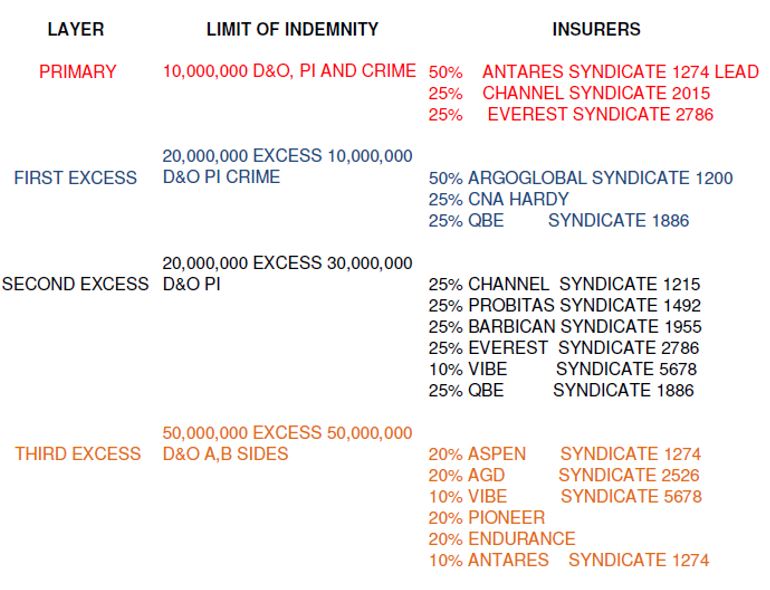
233 In its written submissions, Quintis suggested that this spreadsheet was amended by Price Forbes and sent to PSC. That is not what appears from the documentary record and the terms of the email from Ms Jackman to Mr Butler.
234 In any event, on 26 September 2017, Mr Butler sent the following email to Ms Jackman and Mr Burtenshaw of PSC titled “Quintis Update”:
Dear Caroline & Peter,
Further to our conversation with Caroline last Friday please find attached spreadsheet showing comments received from discussions we’ve had with current underwriters on the program as well as new potential markets..
As we advised Friday morning Antares and the co-insurers are not able to offer any renewal due to the uncertainty of the restructure/recapitalisation and ALL feel that an extension is the ONLY way forward.
The leader, with consensus from the Excess Layer leaders and the following market have so far advised that they would be prepared to offer an extension for a further five months at an addition [sic] premium.
Such Additional Premium we are now in discussion with. Much will depend on the insurers [sic] desire to ensure that the Sum Insured does not double up for follow on claims originating from a related event. They want to ring-fence the loss into one overall aggregate sum insured. I.E. all events emanating from the original loss causation to be limited to the single overall sum insured – “no double hit” in their words.
We are reviewing the Interrelated Wrongful Act language with Antares and they should get back to us later this week (Steve is travelling for the next couple of days).
We’re both around tomorrow if you want to discuss. We will be available from around 8:30.
We also discussed the ASIC matter with Steve and Julia will be responding separately on this matter.
Best Regards
Shaun & Adrian
235 Mr Butler attached a revised spreadsheet titled “Mkt position post Quintis presentations 22.9”, which included the following relevant information (noting the specific inclusion of each D&O side next to the layers of cover). It appears that this was also the first time ANV had been added to the spreadsheet):
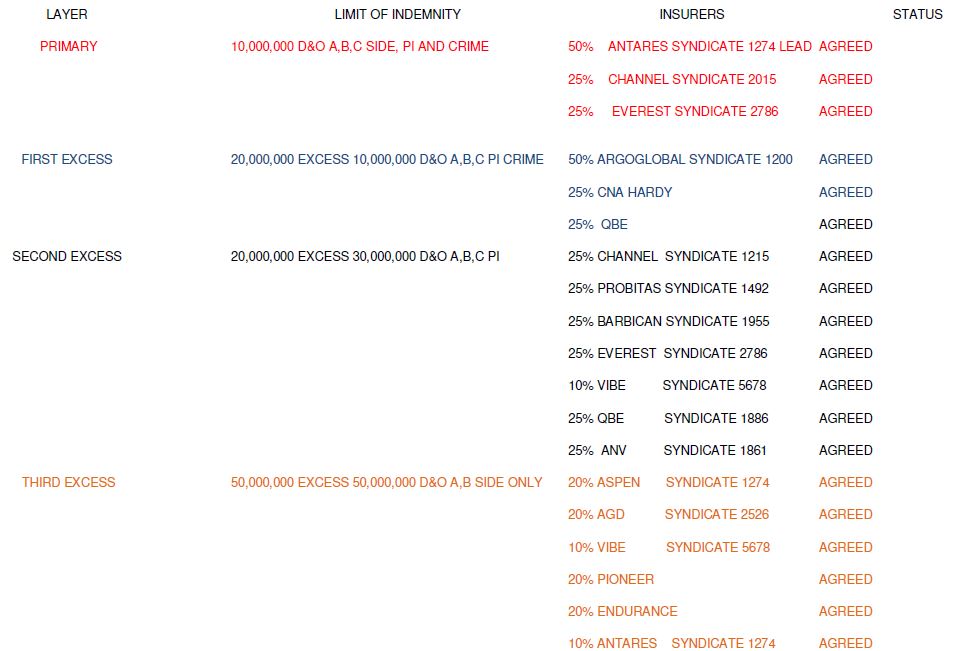
236 Quintis submitted that it is noteworthy that Price Forbes’ spreadsheet of 26 September 2017 was prepared after the September meetings and indicates, without mention of any sub-limits, that each of the 2016-17 Primary, 2016-17 1XS and 2016-17 2XS covered Side C liability. Quintis argued that this sustains the inference that there was nothing said at those meetings which suggested to Price Forbes that the Relevant Insurers “didn’t think they were on the hook for Side C up to $50 million” and that those discussions, of which no evidence has been adduced, must have taken place on the basis that there was exposure for these insurers of Side C cover up to $50 million. Indeed, Quintis argued that the only reasonable inference that arises from the iterations of the above spreadsheet and the particular efforts made to execute a retrospective endorsement for the 2016-17 3XS, is that the earlier spreadsheets were mistaken as to the 2016-17 3XS, and that the parties went to special lengths to correct any misapprehension as to the insurance structure that had been agreed. Quintis submitted, however, that the insurance structure as corrected remained consistent with its case. Indeed, it was said that this again indicates that the programme of insurance depicted in the structure diagram was a more important aspect to the formation of intention than the brief quote sheets.
237 On 20 and 21 October 2017, the Relevant Insurers signed endorsements extending the 2016-17 Primary, 2016-17 1XS (as modified by an endorsement signed by Argo (see [246]), 2016-17 2XS and 2016-17 3XS to 31 March 2018, on payment of an additional premium.
238 At this stage, it is appropriate to refer to a number of further documents relating to post-contractual conduct, which the parties asserted supports the intention of specific insurers, namely: (1) Probitas; (2) Vibe; (3) Argo; and (4) ANV.
239 First, on 18 September 2017, an internal Probitas claim update was circulated by Mr Paul Montgomery, a Senior Claims Manager at Capita Insurance Services (Capita), with a covering email that stated “[t]his precautionary notification involves an Australian shareholder class action. From the information available if the class action was to be successful there appears to be a potential for the underlying limit of AUD30M to be exhausted”. Attached to this email was a document titled “Major Loss Report Form”, authored by Mr Dean Plumridge, a claims handler at Capita, dated 13 September 2017. Of relevance, it records:
Cover, on behalf of the Primary layer, was confirmed in June 2017 under the D&O section of cover (Entity Securities Liability Extension), and they agreed to advance Defence Costs in connection with the class action. Cover has not yet been confirmed in respect of the ASIC investigation or the separate representation of the directors.
If the class action is successful, there is a real risk of the underlying layers being exhausted. There is also a risk that any negotiated settlement of the class action will exceed A$30m.
240 Quintis submitted that the statement contained in Mr Montgomery’s email would only be the case if there was full Side C cover in the layers underling the 2016-17 2XS, given at this time the claim had only been brought against Quintis, meaning only Side C cover was in issue. Indeed, it was said the omission of any reference to a sub-limit in these circumstances is surprising if Probitas had considered its potential exposure under the 2016-17 2XS was protected in that way.
241 Secondly, in relation to Vibe, there is an internal document titled a “Financial Institutions Control Sheet”, dated 20 September 2017. That document records under the heading “Underwriting Decision/General Notes/Subjective”, inter alia, that “D&O cover only has Side C cover up to 15m and only the entity has been sued”. Quintis submitted that the figure of $15 million bears no relationship to any of the 2016-17 Policies and if accepted to be a mistake, could as easily have meant $50 million as $10 million. The reason given for this was that “fifteen” is phonologically closer to “fifty” than to “ten”, such that if the document records something discussed over the phone, it is more likely that was being discussed was the existence of $50 million in Side C cover.
242 Also in relation to Vibe, an internal spreadsheet is in evidence that appears to relate to the pricing of Vibe’s 2017 extension. That spreadsheet relevantly included the following table:
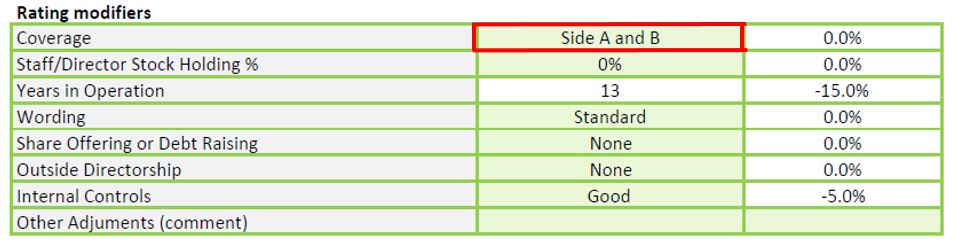
(Red outline added for the Relevant Insurers’ emphasis).
243 The Relevant Insurers submitted that it is of significance that when the rating was being completed, it only included Sides A and B, not Sides A, B and C (which, as a screenshot of the excel sheet demonstrated, was a function that could be selected). It was said that this suggests that Side C cover was not considered important for rating purposes by Vibe.
244 Thirdly, in relation to Argo, the evidence reveals that Mr Robertson resisted extending Argo’s proportion of cover provided by the 2016-17 1XS on the basis that its risk profile had increased substantially by reason of the Bannister Law class action against Quintis. After some ruminating, Argo agreed to extend cover conditionally, as evidenced by the following email from Mr Robertson to Mr Butler on 12 October 2017:
Shaun
Hello there.
Many thanks for your email.
This has taken a fair bit of thought.
We hereby confirm our willingness to extend the above [the 2016-17 1XS] by 5 months (making for a policy period of 18 months) at pro-rata additional premium +10%.
In so doing, however, our excess policy would have to be amended, with effect from 31st October, 2017, such that it will not provide cover for / cease to follow the provisions of 4.9 Entity Securities Liability (“Side C cover”) of the primary policy. In effect, Side C cover would not apply during the 5 month extension with regard to entity securities claims that are unrelated to those matters that have been advised to us. Side C cover would be available to the extent that any claims made during the extension period are indeed related to those matters notified to us provided, of course, that policy terms and conditions so allow (I understand that you believe this is the case).
The reason for this change in cover is that if we accept that the primary policy is likely to be eroded and our layer is likely to be impaired due to the matters notified, then in extending the policy we would effectively become the primary carrier for Side C claims that are unrelated to the matters notified. We would not be willing to do this. Even if we were to consider then I doubt we would be willing to do so at pro-rata additional premium +10%. – if we did we would effectively be the primary carrier for Side C claims for 5 months but the additional premium would be pro-rata of our excess layer premium, not a primary rate. If the policy were renewed at natural renewal date with Side C cover on our layer, then we would reattach in excess of AUD 10,000,000. The primary policy is not been renewed now, however, so we are not in that position.
I await your thoughts.
Best regards
Andrew
245 This email came as a surprise to Mr Butler, who replied: “this was not the response we were expecting” and “that this is quite a serious issue”. Mr Robertson stated that he was “happy to chat through” the extension and, in probably the most compelling sentence contained in the entire court book, noted that “I honestly don’t think anyone has thought this through”.
246 Despite a push from Mr Butler to extend Side C cover at an additional premium, Mr Robertson expressed his regret in being unwilling to budge. To this end, on 17 October 2017, Mr Robertson outlined the exact wording of the extension in an email to Mr Butler. Relevantly, it contained the following terms:
It is agreed that this policy is extended to expire on 31st March, 2018 at 4.00 pm Local Standard Time at the mailing address of the Insured.
It is further agreed that for the part of the Policy Period that is 31st October, 2017 to 31st March, 2018 at 4.00 pm both days Local Standard Time at the mailing address of the Insured, this Policy does not follow nor provide cover in respect of the provisions of SECTION 4: EXTENSIONS TO SECTION IB (DIRECTORS & OFFICERS LIABILITY) 4.9 Entity Securities Liability of the Primary Insurance.
It is additionally agreed, however, that the forgoing, with regard to any claim notified after 31st October, 2017 at 4.00 pm Local Standard Time at the mailing address of the Insured , [sic] shall not affect this policy to the extent that it follows and is subject to SECTION 8: CONDITIONS APPLICABLE TO ALL COVER SECTIONS 8.1 Claims Aggregation.
(Emphasis added).
247 On 19 October 2017, this draft endorsement wording was also sent by Mr Butler to Ms Jackman and Mr Burtenshaw of PSC, under the cover of the following email:
Caroline & Peter,
Prior to our call tomorrow Adrian & I wanted you to see the endorsement that ArgoGlobal require for the extension.
They essentially want to exclude Side C cover for the extension in respect of new side C cover (Unrelated to the class already notified)
However after conversations with Argo and our summary of the “incident” Argo have accepted our interpretation and he has expressed his intent is to exclude any other claims which are not related to the current class action and is aware that if another action which is related to the such action it would be covered.
Lets chat further tomorrow.
Best
Shaun & Adrian.
248 There is no evidence of the call that occurred between PSC and Price Forbes. An identical copy of the endorsement signed by Argo does, however, appear in evidence. The Relevant Insurers submitted that Argo’s email above can be understood as relating to a concern that the $10 million sub-limit for Entity Securities Liability might extend into the 2016-17 1XS if not fully satisfied under the 2016-17 Primary. Quintis, on the other hand, labelled that submission “fanciful”, arguing that such an explanation does not shed light on Argo’s concern about being “the primary carrier for Side C claims that are unrelated to the matters notified” (emphasis added). It was said that Argo manifestly did not want to be liable for new Entity Securities Claims against Quintis “in excess of AUD $10,000,000”.
249 Fourthly, and much later in the piece, on 28 February 2018, an internal ANV email received from Ms Kate Hunt of AmTrust notes the entry of Quintis into administration and its own exposure to a “messy” claim. This email records the terms of the 2016-17 2XS as “Aggregate PI / D&O A,B & C AUD 20m xs 30m – 1861 25%” (the reference to 25% being incorrect as their share had scaled down to 15.63%). Quintis submitted that the omission of any reference to sub-limits in this email is surprising, unless ANV did not apprehend that a sub-limit applied to Side C claims.
F.5 The Principles Applicable to Inferential Reasoning Continued
250 Before assessing the above evidence and making findings as to the intention of Price Forbes and each of the Relevant Insurers, it is worth returning to the principles applicable to inferential reasoning and how they are sought to be deployed.
F.5.1 Blatch v Archer and Jones v Dunkel
251 Quintis submitted that given the limited documentary evidence produced by the Relevant Insurers, along with their failure to call any witnesses, when considering whether there existed a common Side C Coverage Intention, one must have regard to the principles commonly associated with the reasoning in Blatch v Archer and Jones v Dunkel.
252 In Blatch v Archer, Lord Mansfield (at 65) famously remarked that “all evidence is to be weighed according to the proof which it was in the power of one side to have produced, and in the power of the other to have contradicted.” Such a maxim is reflective of the problem that in deciding issues of fact on the civil standard of proof, the Court is concerned not just with the question of probabilities on the limited material available, but also whether that limited material is an appropriate basis on which to reach a reasonable decision: Ho v Powell [2001] NSWCA 168; (2001) 51 NSWLR 572 (at 576 [14] per Hodgson JA, with whom Beazley JA agreed). Considering the latter of these propositions, Hodgson JA stated (at 576 [15]) that “it is important to have regard to the ability of parties, particularly parties bearing the onus of proof, to lead evidence on a particular matter, and the extent to which they have in fact done so”.
253 A particular application of the maxim enunciated in Blatch v Archer is the “rule” in Jones v Dunkel (at 308 per Kitto J, at 312 per Menzies J, and at 320–1 per Windeyer J). That rule, said to be founded on “plain common sense” (Jones v Dunkel (at 321 per Windeyer J)), was more recently explained by French CJ, Gummow, Hayne, Crennan, Kiefel and Bell JJ in Australian Securities and Investments Commission v Hellicar [2012] HCA 17; (2012) 247 CLR 345 (at 412–13 [165]–[167]). A year earlier in Kuhl v Zurich Financial Services Australia Ltd [2011] HCA 11; (2011) 243 CLR 361, Heydon, Crennan and Bell JJ observed as follows (at 384–5 [63]–[64]):
The rule in Jones v Dunkel is that the unexplained failure by a party to call a witness may in appropriate circumstances support an inference that the uncalled evidence would not have assisted the party’s case. That is particularly so where it is the party which is the uncalled witness. The failure to call a witness may also permit the court to draw, with greater confidence, any inference unfavourable to the party that failed to call the witness, if that uncalled witness appears to be in a position to cast light on whether the inference should be drawn. …
The rule in Jones v Dunkel permits an inference, not that evidence not called by a party would have been adverse to the party, but that it would not have assisted the party.
254 Elsewhere it has been remarked that the failure by a party to deny or explain facts which it is within that party’s power to explain or deny “gives a colour to the other evidence against him” (Boyle v Wiseman (1855) 156 ER 598 (at 600 per Baron Alderson)) and that “when circumstances are proved indicating a conclusion and the only party who can give direct evidence of the matter prefers the well of the court to the witness box a court is entitled to be bold”: Insurance Commissioner v Joyce (1948) 77 CLR 39 (at 49 per Rich J); see also Longmuir (at 131 per Winneke P). Of course, the rule in Jones v Dunkel is not confined to the unexplained failure of a party to call a witness, but also extends to the tendering of documents: see Jones v Dunkel (at 320–1 per Windeyer J); Burke v LFOT Pty Limited [2002] HCA 17; (2002) 209 CLR 282 (at [134] per Callinan J); Galea v Bagtrans Pty Limited [2010] NSWCA 350 (at [2] per Allsop P, with whom Macfarlan JA agreed).
255 Importantly, however, the rule cannot be employed to fill gaps in evidence, or to convert conjecture and suspicion into inference: Jones v Dunkel (at 305–6 per Dixon CJ, at 309–10 per Menzies J and at 317 per Windeyer J). As Sir Owen Dixon stated in Joyce (at 61):
It is proper that a court should regard the failure of [a party] to give evidence as a matter calling for close scrutiny of the facts upon which he relies and as confirmatory of any inferences which may be drawn against him. But it does not authorize the court to substitute suspicion for inference or to reverse the burden of proof or to use intuition instead of ratiocination.
256 Indeed, before there can be greater confidence in an inference unfavourable to a party, the inference must already be available on the evidence. Conversely, if the party’s case is otherwise proved, the inference that the absent witness would not assist the party’s case does not detract from the proof, nor lead to a discounting of the evidence actually called: see Morley v Australian Securities and Investments Commission [2010] NSWCA 331; (2010) 274 ALR 205 (at 322 [634] per Spigelman CJ, Beazley and Giles JJA); Hellicar (at 413–4 [169]–[170] per French CJ, Gummow, Hayne, Crennan, Kiefel and Bell JJ, and at 442 [253] per Heydon J).
257 While Quintis accepted that Jones v Dunkel represented a particular application of the maxim enunciated in Blatch v Archer, the way in which its submissions were structured could be taken to suggest that these principles should separately inform the inferential reasoning process. It is true that Blatch v Archer stands for a wider principle than Jones v Dunkel. That position was most comprehensively outlined by Austin J in Australian Securities and Investments Commission v Rich [2009] NSWSC 1229; (2009) 236 FLR 1 (at 93 [439]–[440]). But I do not think anything said there means that Blatch v Archer empowers the Court to approach the current inferential reasoning task in a way that Jones v Dunkel does not: see Hellicar (at 441–5 [250]–[259] per Heydon J). Lord Mansfield’s comments in Blatch v Archer should be viewed as an overarching conception; the particular application of that overarching conception as relevant to the current context manifested through the reasoning in Jones v Dunkel. In any event, this is an academic point, given that throughout the hearing, Quintis did not press for any application of Blatch v Archer distinct to that available on the principled application of Jones v Dunkel.
F.5.2 Jones v Dunkel and the current facts
258 As might be expected, Quintis submitted that the inferences contended are available on the documentary record and that in the absence of clear evidence from Price Forbes and the Relevant Insurers contradicting any inference available from the material relied upon by it, the Court can more readily draw such an inference.
259 The Relevant Insurers made similar submissions in relation to the evidence concerning Price Forbes, meaning a preliminary question arises as to whose role it was to call the representatives of Price Forbes and the Relevant Insurers.
260 The rule in Jones v Dunkel cannot be applied to the non-calling of a witness unless: (a) the missing witness would be expected to be called by one party rather than the other; (b) his evidence would elucidate a particular matter; and (c) his absence is unexplained: see Payne v Parker (1976) 1 NSWLR 191 (at 201 per Glass JA). Speaking in terms of the first of these conditions, Glass JA said (at 202):
… it is also described as existing where it would be natural for one party to produce the witness, or the witness would be expected to be available to one party rather than the other, or where the circumstances excuse one party from calling the witness, but require the other party to call him, or where he might be regarded as in the camp of one party, so as to make it unrealistic for the other party to call him, or where the witness’ knowledge may be regarded as the knowledge of one party rather than the other, or where his absence should be regarded as adverse to the case of one party rather than the other. It has been observed that the higher the missing witness stands in the confidence of one party, the more reason there will be for thinking that his knowledge is available to that party rather than to his adversary.
(Citations omitted).
261 See also O’Donnell v Reichard [1975] VR 916 (at 929 per Newton and Norris JJ); Powell (at 576 [16] per Hodgson JA, with whom Beazley JA agreed); Hung v Warner, in the matter of Bellpac Pty Ltd (Receivers and Managers Appointed) (In Liquidation) [2013] FCAFC 48 (at [55] per Jacobson, Gordon and Robertson JJ).
262 Given that the intention of Price Forbes is crucial to the Rectification Claim, a point of contention was in whose “camp” Price Forbes belonged. At first glance it might be thought that given Price Forbes was the “agent” of Quintis at Lloyd’s, it was therefore in Quintis’ camp. That was precisely the position taken by the Relevant Insurers. As Mr Elliott posited in the course of oral submissions (at D2, T83.14–5), “[t]he idea that a paid agent would voluntarily … give evidence not for its principal but for the counter-party is … unthinkable”. Quintis, on the other hand, originally labelled any submission that it was incumbent upon it to call representatives of Price Forbes as “unreal”, asserting, to the contrary, that given Price Forbes was and is a London based insurance broker, the evidence of which demonstrates a fraternal and jocular relationship between its representatives and those of the Relevant Insurers, it was far more natural for the Relevant Insurers to have called the relevant representatives of Price Forbes. During the course of oral submissions, that position was watered down, and in a response to a question posed by me asking whether it was Quintis’ submission that it was incumbent upon the Relevant Insurers to call the representatives of Price Forbes, Mr Edwards responded that the obligation “doesn’t fall on us” (D2, T99.5–21).
263 I generally accept this refined position of Quintis. While Price Forbes might superficially be thought to fall in Quintis’ camp, the reality is that no one from Quintis ever communicated with the representatives of Price Forbes (that communication always being made through PSC). Placing Price Forbes in either party’s “camp” is highly artificial and, in all the circumstances, to draw any relevant adverse inference would be misconceived.
264 The position of the Relevant Insurers is straightforward. It was natural for the Relevant Insurers to have called their own representatives. Those representatives were also plainly in a position to give an independent account of their intention at the time of entry into the 2016-17 Policies. This is clear from the documentary record, which reveals that those representatives separately negotiated with Price Forbes as to the placement of insurance; a large portion of which, the evidence demonstrates, was conducted orally. The expectation of those representatives being called to give evidence was compounded by the fact that the documentary record is largely incomplete; a matter entirely out of the control of Quintis, which could do little more in terms of meeting the onus of proof than sit tight and hope that the Relevant Insurers would produce documents in answer to the subpoenas or comply with the discovery order made. It is also necessary to reiterate that the Relevant Insurer’s failure to call any witness or tender any document was not due to any procedural unfairness that arose given the expedition of the hearing or the initial asymmetry as to the issues. The Relevant Insurers were given ample opportunity to arrange and call any witnesses they wished (see [26]); a course which they specifically eschewed and for which they provided no explanation: D2, T6.22–7.10. That tactical move in adversarial litigation was entirely open to them, but it is a move that does not come without consequence.
265 Given these reasons, I am willing to infer, speaking at a level of generality, that the evidence of the representatives of the Relevant Insurers would not have assisted their case, and, to adopt the words of the plurality in Khul (at 384–5 [63]), to draw with greater confidence, any inference unfavourable to the Relevant Insurers if their representatives appear to be in a position to cast light on whether an inference should be drawn. Of course, the extent and influence of such an inference will be dependent upon the precise evidence adduced in relation to each of the Relevant Insurers and must be applied consistently with the principles I have articulated.
266 Before leaving this section on inferences, two further points should be noted.
267 First, it is necessary to note that the second respondent labelled any Jones v Dunkel inferences as “benign … particularly in the context of a rectification suit where [Quintis] bears a heavy onus – it being an inference entirely consistent with the underwriters having no recollection of this particular transaction back in 2016, in amongst the vast volumes of business undertaken within the Lloyd’s marketplace each year”. I reject that submission. Inferences can bear considerable importance in any type of case and particularly in a case where subjective intention is determinative. It is no answer to the non-calling of a witness to propose, without evidence, that their answer to every question put to them would likely be “I cannot recall”.
268 Secondly, there was some suggestion throughout the course of oral submissions that an adverse inference should be drawn against Quintis for not calling its own representatives or those of PSC to shed light on what was said at the May 2016 Insurer Update Presentation or the September 2017 meetings. I am not quite sure where that submission goes. It is an agreed fact that Quintis and PSC held the Side C Coverage Intention. To my mind, that is the precise reason why no representative of Quintis or PSC has been called. In any event, as will be demonstrated below, this submission is immaterial to the ultimate findings I make.
269 The next step is to turn to and consider whether Price Forbes and each of the Relevant Insurers held the Side C Coverage Intention.
F.6 Was there a common Side C Coverage Intention?
270 As outlined above, for Quintis to succeed it must be established that the Side C Coverage Intention was held by Price Forbes and each of the Relevant Insurers at the time of entry into the 2016-17 Policies (the issue of whether it is found that some of the Relevant Insurers held that intention, but others did not, is addressed below). The most convenient way to address the question of intention is by adopting the approach endorsed by the majority in Simic (at 117 [104] Gageler, Nettle and Gordon JJ), namely, “by asking – what was the actual or true common intention of the parties?”
271 In doing so, I will bear in mind the words of Sir Edward Sungden LC in Mortimer v Shortall (1842) 2 Dr & War 363 (at 371, cited with approval in Franklins (at 713–4 [454] per Campbell JA, with whom Allsop P and Giles JA agreed)):
I must be certain that there has been a mistake, and that the mistake is such as ought to be corrected. I do not mean to say, that the evidence must be all one way, or that there must not be any conflict: there must, however, be such a preponderance, as will satisfy my mind.
272 I should also note that although the parties provided detailed and helpful submissions both in writing and orally, the lack of a granular approach to the evidence relevant to the intention of each Relevant Insurer by Quintis in writing has made my task of preparing this judgment a complex and very time consuming one. Having said this, at my direction and following the hearing, a table was prepared (MFI 1), which identified and particularised the evidentiary material relied upon in relation to the intention of each Relevant Insurer.
273 Before considering the specific evidence applicable to Price Forbes and each Relevant Insurer, it is convenient to deal with the background evidence Quintis contended was generally relevant to the question of intention: (a) the involvement of Price Forbes, Argo, ANV, Barbican, Antares and Channel in Quintis’ 2015-16 insurance programme; and (b) the evidence concerning the May 2016 Insurer Update Presentation.
274 Price Forbes arranged the 2015-16 4XS, and Argo, ANV, Barbican, Antares and Channel all provided cover under such a policy. That policy did not, however, provide Side C cover. Nevertheless, Quintis placed emphasis on the fact that since the layers formed part of a larger structure and were interdependent upon each other, Price Forbes and these insurers would have been aware of that overall structure. I accept that proposition, but would caveat such awareness with the qualifier “generally”. That is because Side C cover was not a risk that these insurers quoted on, nor a risk that affected the way in which the policies applied to their layer of cover. It was similarly not a risk that Price Forbes would have had to contemplate in the arrangement of this policy. It is therefore unlikely that Price Forbes and these insurers would have had the same level of knowledge in relation to how Side C cover operated as they would in relation to those risks that they were actually insuring.
275 A number of reasons support this conclusion. First, the 2015-16 4XS (being $40 million excess $60 million for D&O cover Sides A and B) did not even sit beside the layers that provided Side C cover (there being an intermediate third excess policy (see [12])). Secondly, while I accept that Price Forbes and these insurers would have seen the 2015-16 Primary (given that the 2015-16 4XS included the term “per primary wording attached”), there is no evidence to suggest that Price Forbes and these insurers saw the terms of the 2015-16 1XS or 2015-16 2XS in order to demonstrate an appreciation of how those policies interacted with the 2015-16 Primary. Thirdly, and following on from the previous point, the 2015-16 Primary was identical in all relevant respects to the 2016-17 Primary (including the term “Entity Securities Liability $10,000,000”), meaning that even if Price Forbes and these insurers did concern themselves with Side C cover, there is no reason why they would not have interpreted Side C cover to be subject to a sub-limit. Fourthly, the 2015-16 4XS actually included a term identical to that of cl 4.4 of the 2016-17 Excess Policies, meaning, if anything, Price Forbes and these insurers had familiarity with the sub-limit wording, and that this wording was acceptable to Quintis. I am therefore inclined to treat the involvement of Price Forbes, Argo, ANV, Barbican, Antares and Channel in Quintis’ 2015-16 insurance programme as no more than a neutral consideration.
276 I should also note here Quintis’ submission that if the 2015-16 Primary wording was simply adopted in 2016-17, then the insurers must have had the same understanding of Side C cover as they did the previous year. That submission may have some force if it involved an insurer providing Side C cover in the expiring programme, but Argo, ANV, Barbican, Antares and Channel did not. To assert that these underwriters had the intention to provide Side C cover of up to $50 million because the underwriters providing Side C cover in the previous programme intended as much, is purely a matter of speculation.
277 I turn now to the May 2016 Insurer Update Presentation. As I noted above (at [126]), I find representatives of Price Forbes, Antares, Channel, Vibe, ANV and Barbican attended. However, for the reasons that follow, I do not think I should place a great deal of reliance on the evidence surrounding the Insurer Update Presentation in making an overall assessment of whether Price Forbes and the Relevant Insures held the Side C Coverage Intention.
278 First, the Insurer Update Presentation occurred three months prior to when Price Forbes approached the London market for quotations. Secondly, while the Insurer Update Presentation slide deck notes that “the limits placed are not likely to be increased this year” (see [125]), this statement is not definitive as to whether Quintis was going to maintain its current amount of cover, nor what that cover was. Indeed, there is no evidence to suggest that Side C cover was discussed. At the most, given the handwritten notes of Vibe outlining “Unchanged programme on the IMI … looking for continuity” and that there is a “$100m limit on the D&O”, it seems it was proposed Quintis was anticipating maintaining its current amount of cover and that the level of cover was explained at a high level of generality. However, even then, a reference in Vibe’s notes to “D&O policy up to $100m” is immediately followed by the text “does not know until June/July time & will see what pricing looks like then”, indicating an element of fluidity in the content of the 2016-17 renewal at this stage. Thirdly, this presentation was not actually part of the formal renewal process and the “Underwriting Update” formed only part of a broader presentation given by Quintis in relation to the company’s performance, business strategy and risk appetite.
279 Furthermore, contrary to Quintis’ submission, it would be dangerous to place reliance on the PSC Report of September 2016, at which time Quintis had secured its programme for 2016-17, to inform myself of the discussions had at the Insurer Update Presentation. This is because it is unknown whether the objectives specified in that report and the actions PSC took had crystallised by the Insurer Update Presentation. Moreover, the PSC Report records the view of PSC, of whom the question of whether they held the Side C Coverage Intention is not in dispute. Indeed, while I accept the PSC Report characterises the presentation as “specifically on financial lines”, the explanatory dot points following this statement indicate the focus of the presentation was providing a business update (see [128]).
280 I am unable to conclude that the participants at the Insurer Update Presentation would have been told that Quintis was seeking to secure up to $50 million of Side C cover in the 2016-17 period. I do infer, however, that the representatives of Price Forbes and the Relevant Insurers would have understood that: (a) Quintis was looking for continuity; (b) the expiring programme included up to $100 million in D&O cover; and (c) the limits of cover were not likely to change. The Relevant Insurers submitted that even if I were to accept that such information was conveyed, for that evidence to have weight, it would need to carry with it an understanding that the underlying layers were not written on a sub-limited basis. I do not think that is correct. Of course, at risk of stating the obvious, the less specific the finding can be made on the evidence, the less probative it is to Quintis’ Rectification Claim, but that does not mean it does not form part of the overall mosaic.
281 I now turn to consider the evidence in relation to Price Forbes and each of the Relevant Insurers.
282 As will be recalled, Quintis submitted that Price Forbes’ state of mind was not directly relevant to the Rectification Claim. This meant the evidence relevant to Price Forbes’ intention was addressed somewhat peripherally. In saying this, it was Quintis’ position that based on the documentary record and the inferences the Court should draw, Price Forbes held the Side C Coverage Intention.
283 It was common ground that the communications between PSC and Price Forbes are relevant to ascertaining the intention of Price Forbes. In my view, that is the most convenient place to commence in assessing whether Price Forbes held the Side C Coverage Intention.
284 The initial communications between PSC and Price Forbes regarding Quintis’ 2016-17 renewal are important in a number of respects. The most pertinent aspect of those communications, upon which Quintis placed emphasis, is the email sent from Ms Purdy to Mr Butler on 16 August 2016 containing the structure diagram (see [133]). An important point to note about this email is that it was sent off the back of the longer overview provided by Ms Purdy attaching an array of documents relevant to Quintis’ renewal (see [132]) and which noted the following: (a) “[i]t was good to touch base with you last Thursday on this client and discuss how we wish to proceed with renewal this year; and (b) “[a]s discussed on the phone Shaun, we would be happy for you to approach the market for the whole of the program, and at present we are looking to deliver premium savings to the client, with as broad a coverage as possible”. Furthermore, this diagram was also sent at the request of Mr Butler, who specifically asked Ms Purdy if she could “send … over the current structure program”. This suggests that Mr Butler wanted a document that outlined the structure of the expiring programme either for his own understanding or for distribution to the market. I am inclined to think the purpose was both. That is because Mr Butler was collating information necessary to pitch Quintis’ renewal to the London market and further, the purpose of Ms Purdy’s initial email was to provide information that “can be distributed amongst the market for quotations”. This conclusion is supported by the fact that Price Forbes actually sent the structure diagram to Argo and Vibe.
285 The question that arises is what does this structure diagram represent? Quintis argued that the diagram and accompanying blurb given by Ms Purdy made plain that the outgoing structure included up to $50 million in Side C cover and showcased the layers that provided this cover. The Relevant Insurers, on the other hand, attempted to downplay the diagram because Ms Purdy identified it as a “visual”, and because it only depicts at a general level the layers and underwriters of the expiring programme. In particular, as a visual, the structure diagram does not record any terms applicable to each layer, nor indicate any terms of limitation such as sub-limits. For example, the Relevant Insurers submitted that the GLA layer (the 2015-16 Primary) included 16 sub-limits, none of which are denoted in the diagram. It was said that what should instead be extrapolated from the “inelegant” reference to “$50M Side C” and the use of the notation “(ABC)” in the diagram is the layers of the tower offering Side C cover (which together add up to $50 million), not the terms upon which it is offered. Indeed, the Relevant Insurers maintained throughout the course of the hearing that there was technically $50 million available in Side C cover, but given the sub-limit, only $10 million could actually be paid.
286 I reject the Relevant Insurers’ submissions. The structure diagram is the simplest graphical description of Quintis’ outgoing insurance programme and clearly depicts that such a programme included up to $50 million in Side C cover. This is consistent with the reference in Ms Purdy’s email to Quintis having “separate towers on $100M D&O (AB) including $50M side C, PI at $50M and Crime at $20M” (emphasis added). When read together, it would be artificial to construe this email to mean other than that the D&O layers provided Side C cover up to $50 million, particularly when what is being recorded is the limits of cover. While I accept the relevant sub-limits are not included in the diagram, such an argument cannot be deployed to contradict the plain words of $50 million of Side C cover being included in the tower; a proposition I do not find to mean there exists $10 million that might dribble through. Furthermore, in the absence of any other explanation, one must give weight to the context of the email, being a request by Mr Butler to Ms Purdy for an outline of the expiring programme after she had provided a comprehensive overview of the renewal and there had been discussions over the phone in anticipation of Price Forbes engaging the London market.
287 Based on this evidence, at the commencement of negotiations, I find Price Forbes was told that the commercial intent of Quintis was to maintain its current amount of cover, which included up to $50 million in Side C cover. I would also go a step further and infer, for the reasons I have outlined, that Price Forbes would not have apprehended Side C Cover was sub-limited at $10 million. I am fortified in this conclusion by the fact that the PSC Report outlined objectives for the renewal were to, inter alia, “[a]chieve a reduction in premium rates”; and “[m]aintain the limits across the program” (see [128]) (an intention I infer was communicated to Price Forbes in its discussions with PSC at the commencement of negotiations). I note that above I found the contents of the PSC Report could not support the inference of what was conveyed at the Insurer Update Presentation. The point of distinction being that here the contents of the PSC Report support the inference of what was communicated by PSC to Price Forbes at the commencement of negotiations (mid-August), at which time I am willing to infer the renewal strategy was more concretely established.
288 The difficulty that arises is Price Forbes adopts the expiring wording as the draft primary wording it presents to Antares (which, on its proper construction, does not provide for $50 million in Side C cover). Quintis submitted that the simple adoption of the expiring wording by Price Forbes meant that it did not conduct a detailed review of the wording and would have assumed this was consistent with the structure diagram provided to it. On the other hand, the Relevant Insurers submitted that the expiring wording was selected by Price Forbes, indicating that independent judgment had been made on the terms of the policy ultimately presented to Antares and the other Relevant Insurers.
289 While it is true that Price Forbes decided to employ the expiring wording for the 2016-17 Primary, noting to Ms Purdy that “[o]ur initial thoughts is [sic] to use the current wording but tweak it update, add on take off etc” (see [146]), I do not accept that at this moment in time anyone from Price Forbes had actually given consideration to the policy wording, let alone cross checked that it adequately reflected the level of cover I infer it had been told was provided for by the expiring programme. To my mind, any broker viewing the outgoing wording would operate on the assumption that it meant what they were told it provided, particularly when there was no indication to the contrary. Indeed, as would be expected for someone seeking to replicate the outgoing level of cover, Mr Butler simply copied the expiring wording verbatim; a course he presumably saw as an efficient method of carrying out the advice of PSC. Hence, the conclusion that Price Forbes adopted the 2016-17 Primary wording on the basis that it adequately reflected the expiring programme is highly probable and realistic.
290 However, the conclusion that Price Forbes understood the expiring programme provided Side C cover of up to $50 million, and therefore was acting with the Side C Coverage Intention, must be tested against a close examination of the events that followed up until, and subsequent to, the execution of the 2016-17 Policies. That involves an examination of Price Forbes’ communications with PSC and the Relevant Insurers in the subscription market. Given the nature of this analysis, it is also convenient to structure the reasoning chronologically.
291 A preliminary point to note is that, as the documentary evidence reveals, there is minimal mention of Side C cover throughout the exchanges between Price Forbes and the Relevant Insurers (with reference usually made only to D&O cover, without a breakdown of specific sides A, B and C).
292 While the analysis must take account of all material, there are eight aspects of the evidence that merit particular mention in considering whether Price Forbes held the Side C Coverage Intention.
293 First, is the reference in early negotiations to “Side C” cover found in the email from Mr Robertson of Argo dated 18 August 2016 (see [138]). There, Mr Robertson outlines that Argo is able to offer “AUD 10,000,000 D&O limit (A, B and C cover) in excess of a primary AUD 10,000,000 limit (Anatres [sic] or whomever)” (emphasis in original). However, this email, like a number of communications between Price Forbes and the Relevant Insurers, is consistent with both parties’ case (i.e. on Quintis’ case that there was full Side C cover provided by the Excess Policies and on the Relevant Insurer’s case that there was the potential for the uneroded portion of the sub-limit to be picked up by the Excess Policies when the 2016-17 Primary Limit of Liability had otherwise been exhausted). In any event, since this email was sent from Argo, and does not appear to reflect oral discussion, I do not think it is of real significance in ascertaining Prices Forbes’ intention.
294 Secondly, is the draft quote signed by Argo, which attaches a form of “Short Excess Wording” (see [153]). This Short Excess Wording includes a slice of the sub-limits clause similar to what appeared in the 2016-17 Excess Policies. I accept, as the Relevant Insurers submitted, that given the pagination difference and absence of Price Forbes’ letterhead on the Short Excess Wording, it should be inferred that this wording was attached by Argo. However, I do not accept the Relevant Insurers’ submission that the absence of any objection to this wording by Price Forbes sustains the inference that Price Forbes understood that there was a “sub-limit applying to all the layers going forward”. Such a submission suffers from two flaws: (a) Side C cover was not the only sub-limited term (meaning that even if Side C cover was not the subject of a sub-limit, the sub-limited wording would still be necessary); and (b) this conflates two separate issues: (i) that Price Forbes understood how the sub-limit term operated; and (ii) that the reference to $10 million was intended to be a sub-limited term. I am therefore of the view that the attachment of the Short Excess Wording to the 2016-17 1XS quote by Argo is relatively neutral in ascertaining Price Forbes’ intention.
295 Thirdly, is Mr Fox’s email to Ms Purdy dated 25 August 2016 (see [179]). There, Mr Fox attaches the “preliminary terms” received for each of the 2016-17 Policies and states “[w]e have quoted for the full DO 100,000,000/EO 50,000,000 and Crime 20,000,000 in 4 layers”, noting “[t]hese terms represent the best we’ve been able to achieve and are based on the EXPIRING FORM. We felt it easier to follow this as the client knows the wording”. Despite the Relevant Insurers submitting that this email demonstrates Price Forbes had purposefully adopted wording known to Quintis (seemingly on the basis that this meant Price Forbes had given independent thought to the terms of the policy), it seems to me this email supports the notion that Price Forbes was giving effect to the indications received from PSC and was acting with the intention to replicate the level of cover provided for by the expiring programme.
296 Fourthly, is the evidence of Antares, Price Forbes and PSC reviewing the policy wording in the negotiation process. As will be recalled, in early September 2016, Mr Butler requested a word version of the policy from Ms Purdy for his meeting with Mr Redding of Antares “to iron out the wording” (see [184]). The evidence of annotations to that policy demonstrates that a detailed review had taken place by Price Forbes and Antares, revealing deletions of certain clauses and minor amendments to particular wording. The evidence also reveals that Mr Butler and Mr Fox then discussed those changes with Ms Purdy (see [185]).
297 It is true that when there exists a process of negotiation and those negotiations are reduced into writing, revised and reaffirmed, the Court should be less willing to accept that the contract does not reflect the intention of the parties: see, eg, Franklins (at 713 [460] per Campbell JA, with whom Allsop P and Giles JA agreed). The difficulty with applying this line of reasoning to the current facts, however, is that this is not a case where solicitors have overseen an evolution from caterpillar to butterfly, in which a mismatch of terms have been thoroughly scrutinised and skilfully transformed into an artful legal document. While I do accept that Antares and Price Forbes reviewed the policy wording and discussed the amendments, the wording that ultimately formed the 2016-17 Primary was identical in all relevant respects to that initially provided to Price Forbes by PSC.
298 It is too simplistic to say this process of revision somehow extinguished the Side C Coverage Intention. This is particularly the case when one appreciates that there is unlikely to have been a focus on Side C cover in the revision process. That is because Antares was subscribing at the primary level, meaning that it was only ever going to be providing Side C cover (or section 1B cover as a whole for that matter) of up to $10 million (even if this was not sub-limited). To my mind, this provides good reason for why neither party took issue with the form of Side C cover provided for by the policy wording in the revision process. This conclusion is fortified by the fact that Mr Butler emailed the revised wording and updates back to Ms Purdy who gave no indication that there was a need to alter the way in which Side C cover was presented (despite it being an agreed fact that it was operating with the Side C Coverage Intention). Further, while I do not place great weight on this factor, the absence of issue being taken with the policy wording by PSC throughout the negotiation process would be consistent with the fact it had used the exact same wording (in all relevant respects) in the previous year on the assumption that it provided for up to $50 million in Side C cover.
299 Fifthly, is the internal Everest document, which is consistent with the Relevant Insurers’ case. That document records that there is no Side C cover above the 2016-17 Primary (other than erosion exposure) because such cover is sub-limited (see [170]) (this document is dealt with at length below (see [331]–[334])). However, in considering this document, it is not inconsistent with the other evidence pointing to a finding that Price Forbes held the Side C Coverage Intention. That is because, in the absence of any other evidence, it seems this document was based on an Everest employee’s subjective view of the policy wording. Indeed, an asymmetry in understanding between Everest and Price Forbes would align with the fact that Everest was not a participating insurer to the 2015-16 Policies, nor does the evidence reveal that any Everest representative attended the Insurer Update Presentation or was sent the structure diagram in negotiations. However, as noted below, this document will prove damaging in being able to reach the level of satisfaction required to conclude Everest held the Side C Coverage Intention.
300 Sixthly, is the email chain between Mr Butler and Mr Wren of Vibe when Vibe reengages in the programme (see [181]). As will be recalled, after a request for an update by Mr Wren, Mr Butler expressly outlined the layers that Vibe could subscribe in the programme. Mr Butler indicated that “[i]f you want some on the D&O only sides A,B,C let me know”, to which Mr Wren relevantly responded, “following on from our conversation we would be pleased to offer support of 10% on the PI/D&O 30m xs 20m layer and a 10% on the top 50m xs 50m D&O layer”. While it is true that Mr Butler refers to the 2016-17 3XS being “D&O only” in the breakdown and indicates that if Mr Wren wants to subscribe to the “D&O only sides A,B,C let me know”, I do not interpret this to mean that somehow only the third excess provided Side C cover, but that this is the only layer which was not over lined, and therefore the layer which Mr Butler wanted Mr Wren to take up in order to complete the deal. This email, however, does indicate there is some confusion as to the 2016-17 3XS also providing Side C cover (a position contrary to the retrospective endorsement executed by the insurers to the 2016-17 3XS). In any event, to be describing the Excess Policies as Side C indicates that Mr Butler was at least acting consistently with the intention that Side C cover runs through the Excess Policies to their full limit of liability.
301 Seventhly, is the reweighting spreadsheet sent by Price Forbes to a number of Relevant Insurers. It will be recalled this spreadsheet included the notation “50,000,000 Excess 50,000,000 D&O A,B,C Sides” alongside a reference to the 2016-17 3XS (see [190]). While the Relevant Insurers mounted a number of arguments against any weight being given to this spreadsheet, these were mainly directed to its use in ascertaining the intention of the Relevant Insurers. I will address those submissions in their appropriate context below. Quintis said that the importance of this document is that it further establishes that Price Forbes had a particular understanding of the insurance structure that it was actively marketing in London. Indeed, it was said that while this document does not mention sub-limits, since the evidence establishes that Price Forbes understood what Quintis was seeking (i.e. a renewal of its insurance with cover limits intact) and prepared the document itself, it must be inferred that it intended to refer to Side C cover of up to $50 million. I generally accept this submission. However, again, there does seem to be some confusion, as Quintis accepted, that the 2016-17 3XS also provided Side C cover.
302 Eighthly, is the email from Ms Purdy to Mr Butler and Mr Fox attaching the placement slip including the term “Entity Securities Liability $50,000,000” (see [215]), to which Mr Butler and Mr Fox took no issue. This indicates that Price Forbes must have understood the placement slip as being consistent with the cover it had placed in the London market.
303 While I accept that a number of aspects of the evidence I have discussed are equivocal, the weight of the evidence sufficiently points to Price Forbes holding the Side C Coverage Intention at the time of execution of the 2016-17 Policies.
304 This conclusion is fortified by the events that follow.
305 First, is the retrospective endorsement issued on 26 May 2017 (see [224]). Indeed, the execution of the endorsement is a manifestation of the parties acting consistently with the asserted common intention: see Ryledar (at 616 [184], with whom Mason P and Campbell JA agreed); Franklins (at 616 [13] per Allsop P, and at 725 [512] per Campbell JA). In any event, even if it was the case that Price Forbes was operating on the assumption that the 2016-17 3XS provided Side C cover up until the retrospective endorsement, this does not negate the finding that it intended for the other layers of the 2016-17 Policies to provide full Side C cover.
306 Secondly, is the iterations of the spreadsheet circulated between Price Forbes and PSC following the September 2017 meetings, which eliminate any doubt that the 2016-17 Primary, the 2016-17 1XS and the 2016-17 2 XS provide Side C cover of up to $50 million (see [232]–[234], [235]). Indeed, any submission that, at this time, the spreadsheet simply noted the layers that provided Side C cover would have to withstand the obvious fact that Side C cover was the topic of discussion at these meetings. This finding is consistent with the fact that the itinerary of the meeting refers to an “Update on Current Claims” with specific reference to the “Bannister Law Class Action” (see [230]).
307 Finally, to adopt the words of Mummery J in Hall (Inspector of Taxes) v Lorimer [1992] 1 WLR 939 (at 944), it is necessary to stand back and view this mosaic of evidence “from a distance, making an informed, considered, qualitative appreciation of the whole”: see also Longmuir (at 141 per Tadgell JA, with whom Winneke P and Phillips JA agreed). Indeed, one must give significant weight to the extent of communication between PSC and Price Forbes during the negotiation period and the agreed fact that PSC held the Side C Coverage Intention. Given the evidence that I have discussed, it is quite unrealistic to think that the communications between the PSC and Price Forbes, conducted upon a common belief that what was being placed was the same level of cover as the expiring programme, did not involve an understanding that this included up to $50 million in Side C cover. Further, I note for completeness that there was no suggestion, nor could there reasonably have been any, that the intention of Mr Butler (as Director of Price Forbes) and Mr Fox (as Head of Financial Products) was not the intention of Price Forbes.
308 Needless to say, in making this finding I have had regard to s 140(2) of the EA and the repeated cautions in the authorities as to the need for clear and convincing proof in a rectification suit.
309 It is then necessary to turn to the question of whether the Relevant Insurers held the Side C Coverage Intention. In doing so, it is necessary to exercise an added degree of caution. That is because I am being asked to infer that Price Forbes exercised its role as Quintis’ placing broker with reasonable skill and diligence in communicating the Side C Coverage Intention to the Relevant Insurers, that the Relevant Insurers understood there to be $50 million in Side C Cover and that this was not sub-limited, and that this was the intention upon which they executed the 2016-17 Policies.
310 Antares was an insurer in the previous year’s programme and attended the Insurer Update Presentation. However, for the reasons explained above, these factors, by themselves, are not determinative of the question as to whether attendees held the Side C Coverage Intention.
311 As is evident from the documentary record, there is limited evidence surrounding the initial communications between Price Forbes and Antares, apart from the existence of the Antares primary quote (although, not discovered by Antares). This meant that Quintis was forced to rely largely on inferences it invited the Court to draw given the content of contemporaneous communications between Price Forbes and the other Relevant Insurers. Quintis submitted that given the date of the Antares quote (17 August 2016), I should infer that Antares was provided with the same material sent by Price Forbes to Argo and Vibe on 16 August 2016 (which included the structure diagram) or that, at the very least, a description of the structure diagram and Quintis’ intention to renew its existing cover was given orally to Antares.
312 The Antares primary quote could not just have magically appeared and there must have been communication between Price Forbes and Antares. That is evidenced by the fact that the Antares quote bears the Price Forbes letterhead. However, even if I were to infer that Antares was provided with the structure diagram or a description of it orally, what was ultimately presented by Price Forbes to Antares was a draft policy that included, under the heading “Sub Limits of Liability”, a reference to “4.9 Entity Securities Liability $10,000,000” and corresponding terms identifying this figure as a sub-limit. Quintis submitted that in the light of any inconsistency between the policy wording and the structure diagram, reliance ought be placed on the structure diagram, as this is the document upon which Antares would have negotiated with Price Forbes. At this stage of the narrative, this position is plausible, but it cannot be sustained when the remainder of the evidence is considered.
313 As outlined above (see [184]–[185]), the evidence reveals Price Forbes and Antares comprehensively revised the policy wording, with deletions of certain clauses and minor amendments to particular wording. The Relevant Insurers submitted that the reasonable inference arising from this process is that Mr Redding of Antares would have been well acquainted with the terms of the 2016-17 Primary and that there is no reason to assume that he was instead acting on the basis of a structure diagram; a proposition supported by the fact that he signed and dated the clean wording as amended on 6 September 2016 as “agreed”.
314 I generally accept this submission, although I understand that this may at first seem difficult to reconcile with the above reasoning in relation to Price Forbes. In my view, there are two points of distinction requiring a different conclusion: first, Price Forbes received the structure diagram and adopted the primary wording on the basis that this was consistent with the amount of cover provided for in the expiring programme, whereas Antares was simply presented with the quote by Price Forbes; and secondly, as stated above, there is good reason why Antares did not take issue with the form of Side C cover, given that it would only ever be liable for $10 million (even if Side C cover was not sub-limited).
315 While I accept oral communication took place between Price Forbes and Antares in relation to the amendments (see [185]), I think to draw any adverse inference against Antares would be converting conjecture and suspicion into inference. The fact is that there is nothing to suggest a confused adoption of the policy wording by Antares. As the Relevant Insurers convincingly submitted (D2, T56.29–33):
This is not a case … where the parties have a common intention and then seek to document that common intention. This is a case where the documentation is the clearest evidence of the common intention … [where] the placing broker produces a wording, in effect, and says this is what the client wants … the document informs the common intention in the first place; it’s actually presented as the intention.
316 Furthermore, the only other amendment after this stage (apart from updating the policy number to replace the “TBA” and the period of insurance to “20/09/2016 to 31/0/17”) was a deletion of cl 8.14(c), following a request from PSC to Price Forbes (see [206]). The approval of this request by Antares meant that it once again reviewed one of the sections pertinent to the operation of sub-limits without issue. This chain of events suggests further that there is no confusion in the wording ultimately adopted by Antares.
317 Taken as a whole, the evidence does not point convincingly to the conclusion that Antares had an intention inconsistent with the policy wording presented to it by Price Forbes, and which it reviewed, amended and further agreed.
318 For completeness, I note no party made any submission as to how, if at all, Antares’ involvement in the 2016-17 3XS should influence the question of its intention, but I accept that this factor is unlikely to be material.
319 It has not been established to the requisite standard that Antares held the Side C Coverage Intention.
320 Given the lack of communication in evidence between Channel and Price Forbes, reliance was placed on inferring that Channel, as one of the insurers to the 2015-16 4XS and because it was an attendee at the Insurer Update Presentation, was aware of Quintis’ expiring programme and understood that Quintis was seeking continuity of cover. For the reasons outlined above, I do not place any decisive weight on this evidence. Indeed, the emphasis placed by Quintis on the notation “can do more” by a Channel representative on the slide titled “IMI Program Structure”, is overstated. This does not, nor do any other handwritten notes of those present at the Insurer Update Presentation, demonstrate that attendees were told the precise structure of the expiring programme, particularly in relation to the Side C cover.
321 The documentary record reveals that the first communication between Price Forbes and Channel is an email from Mr Butler to Mr Campbell of Channel on 22 August 2016, attaching a number of documents including the Antares primary and an unsigned quote slip for the 2016-17 2XS (see [163]). Communication of the structure diagram to Channel is not in evidence. The 2016-17 2XS quote, like the one presented to Antares, bears the Price Forbes logo, making it safe to find it was prepared by Price Forbes. As is detailed above (see [164]–[165]), Mr Campbell responded the same day, reattaching Channel’s “quote terms for the 30x20 as discussed”, agreeing also “to support Antares’s [sic] primary terms with 25%”. This led Quintis to submit that “Channel quoted on the basis of supporting Antares’ primary terms and providing excess” (D1, T76.23–4); a proposition made good by Mr Campbell’s annotation of the quote with “+ 25% of primary terms @ AUD295k” (indicating that he had digested the Antares quote, given the premium was located within the quote). However, I do not see how this submission assists Quintis’ case. As I outlined in relation to Antares, the primary wording was clear in its terms as to the amount of Side C cover, being $10 million.
322 The issue is whether I should infer that the structure diagram was sent to Mr Campbell, or alternatively, that Mr Fox explained the level of Side C cover to him in their “discussions”. I am unwilling to infer that the structure diagram was sent to Mr Campbell. That is because there was no need for Mr Fox to send Mr Campbell the structure diagram when he could simply send him the quotes upon which he was seeking subscription.
323 Mr Campbell’s reply demonstrates a thorough engagement with both the 2016-17 Primary and 2016-17 2XS draft quotes (even picking up on an error in the aggregate amount in the 2016-17 2XS quote). The notation on the 2016-17 2XS quote that Channel’s subscription is “subject to no changes” indicates that Mr Campbell had recorded his contractual intention into writing. Furthermore, his express reference to agreeing “to support Antares’s [sic] primary terms with 25% too” and his handwritten notes of the same day recording “follow form on expiry” indicates that he was operating on the basis of the policy wording (see [166]). Indeed, there is not a basis to support a compelling inference that Mr Campbell formed a relevant intention in relation to Side C cover based upon conversations with Mr Butler or Mr Fox. It is at the very least equally probable that he had regard only to the words of contractual documents presented to him, and upon which he quoted.
324 In saying this, it is noteworthy that the excess policy quote slips did not attach the excess policy wording in the process of negotiations (save for one distinct mater concerning Argo). However, I do not think that this makes any difference. This is because all excess policy quotes noted that they “follow form” with the 2016-17 Primary, which is clear in its own terms that Side C cover is sub-limited at $10 million, that this is the maximum amount payable and that this sub-limit is part of, and not in addition to, the Limit of Liability for the 2016-17 Primary. In other words, the excess policy wording confirms the terms of the primary wording. In any event, the absence of the excess policy wording being attached to the excess quotes in the negotiation process does not support the finding that a Relevant Insurer held the Side C Coverage Intention, but rather seems to me to suggest that they were indifferent to such terms. Indifference is insufficient to ground a claim for rectification: see Perpetual v Myer (at [117] per Whelan, Niall and Hargrave JJA).
325 Furthermore, I am not willing to infer that the reweighting spreadsheet was sent to Channel. That is because the evidence reveals that a Channel representative signed and stamped the 2016-17 2XS quote on 8 September 2016 with the terms “Option 2: AUD 20m xs 30m” (see [187]), and it was not until the following day that the spreadsheet was first sent to Ms Purdy, which itself noted that Channel was the only second excess insurer that had already agreed to the reweighting.
326 Any post-contractual conduct relevant to the intention of Channel as at the time of entry into the 2016-17 Policies cannot make good these deficiencies in the contemporaneous material.
327 It has not been satisfactorily established that Channel held the Side C Coverage Intention.
328 Everest was not a participating insurer in the 2015-16 4XS, and the evidence does not reveal that any associated personnel attended the May Insurer Update Presentation.
329 The first communication in evidence between Price Forbes and Everest is an email from Mr Fox to Mr Colombera on 19 August 2016, outlining the nature of Quintis’ business and the limits of cover for the renewal, and attaching the Insurer Update Presentation. The contents of this email indicate that Mr Colombera did not have pre-existing knowledge of the risk he was being approached to underwrite.
330 The next communication between Price Forbes and Everest is an email from Mr Fox to Mr Colombera on 22 August 2016, which states “Christian, thanks for this afternoon. As promised please find attached the Submission and primary terms” (see [167]). Given the brief terms of this email, it is likely there were other communications but any findings as to their content would be speculative. Indeed, in Mr Colombera’s reply email he attached a stamped and signed version of the Antares quote and confirmed Everest’s support for the 2016-17 2XS, but only when he had seen the slip (see [168]). Hence, there is no compelling basis to support a finding that Mr Colombera was operating on anything other than the primary wording and quote sheets presented to him. To the contrary, it appears that he placed emphasis on these documents.
331 This reasoning is confirmed by the internal underwriting notes of Everest (see [170]). As will be recalled, these notes make it clear that Side C cover was sub-limited to the 2016-17 Primary in the amount of $10 million. As outlined above, Quintis contended that this document should not be seen as probative, given its metadata reveals that while the document was created on 17 May 2016, it was last modified on 27 June 2017.
332 For a party bearing the evidentiary and persuasive onus, this submission is, with resepct, somewhat superficial. That is because: (a) the document was created and last modified by Mr Colombera; (b) there is nothing to demonstrate what was modified in the document; (c) the document records underwriting notes, and the only underwriting of this risk that took place in the relevant period was in 2016 (negotiations concerning renewal and extension not occurring until October 2017); (d) the notes are written in a way that suggests they are contemporaneous as at the time of underwriting; and (e) as at June 2017, the rectification suit was three years away.
333 Mr Edwards, as one would expect from careful counsel, eschewed any allegation that there had been an ex post facto alteration of the document. I thus accept that I should give this internal Everest document some weight despite no-one being called to explain how it was produced.
334 Turning now to the contents of this document, I am of the view that the underwriting notes weigh heavily in favour of the conclusion that during negotiations Mr Colombera was operating solely on the basis of the policy wording, and had no doubt that Side C cover was sub-limited to the 2016-17 Primary in the amount of $10 million. As stated above, this aligns with the fact that Everest was not a participating insurer to the 2015-16 Policies, and the evidence does not reveal that any Everest representative attended the May Insurer Update Presentation or was sent the structure diagram in negotiations.
335 The conclusion that the evidence in relation to Everest falls short of the mark is fortified by the post-contractual conduct of Mr Colombera, whose internal email to others at Everest of 19 June 2017 demonstrates an understanding consistent with that recorded in the underwriting notes (see [227]).
336 The evidence does not provide a sufficient basis to conclude that Everest held the Side C Coverage Intention.
337 Although I reach the conclusion below that Argo did hold the Side C Coverage Intention, it is useful to commence by going through the material in a chronological way as I have with the other Relevant Insurers.
338 Argo was a participant in the 2015-16 4XS (as the slip leader). There is no evidence, however, to suggest that Argo was a participant at the Insurer Update Presentation.
339 The initial communications between Mr Robertson and Mr Fox are of note. That is because, unlike the other Relevant Insurers (excluding Vibe), along with being sent a copy of the expiring wording (see [138]–[140]), Mr Robertson was sent the structure diagram of the expiring programme (which made clear that there was up to $50 million in Side C cover) and the email from Ms Purdy (which outlined that Quintis was, at the least, seeking to maintain its current limits of cover) (see [132]). The draft quote in evidence dated 18 August 2016 reveals Argo subscribed 100% to the 2016-17 1XS (although, in the end this reduced to 50%).
340 The question that arises is on what basis did Mr Robertson provide this quote: the structure diagram or the policy wording? I am inclined to conclude in favour of the former. That is because in his reply email, Mr Robertson makes express reference to being able to offer, “AUD 10,000,000 D&O limit (A, B and C cover) in excess of a primary AUD 10,000,000 limit (Anatres [sic] or whomever)” (emphasis in original). He also agrees to support “separately AUD 10,000,000 PI and Crime combined in excess of a primary AUD 10,000,000 limit (Anatres [sic] or whomever)” (emphasis in original). Indeed, what it appears Mr Robertson does is select a layer of the structure diagram (namely, the first excess) and quotes on it. I am fortified in this conclusion by the fact the structure diagram was the only document sent to Argo recording the full structure of the expiring programme with explicit reference to sides A, B and C, as also appears in Mr Robertson’s email.
341 In making this finding, I accept that the Argo quote attached “Short Excess Wording” which included a sub-limitation clause similar to that which appeared in the final Excess Policies (see [153]) and that given Mr Robertson’s express reference to Antares, he may have been sent the Antares quote. But these factors are not critical. As I stated above in relation to Price Forbes, and without reversing the onus, the attachment of the Short Excess Wording to the quote sheet by Argo does not translate into a finding that Argo intended Side C Cover to be sub-limited. Further, even if Mr Robertson had the Antares quote, the policy wording attached to that quote was identical in all relevant respects to that already in his possession.
342 Furthermore, I infer that Argo offered its agreement to the reweighting (at which time it was subscribing to 50% of the 2016-17 1XS). This is supported by the reference in Mr Butler’s email to Ms Purdy on 9 September 2016 that “[w]e’ve not had time today to obtain the support from the original follow market for the 30 xs 20”, indicating they had secured the support of the 2016-17 1XS layer insurers (see [189]). However, it is speculative as to whether this assent was achieved by emailing the restructure spreadsheet to Mr Robertson (as was the case with Vibe, Probitas and Barbican) or by some other means. I am therefore inclined to take the absence of evidence on this point as neutral.
343 The only other evidence relevant to Argo in the placement process is its provision of the FON, signing the final 2016-17 1XS and receiving a clean version of the primary wording from Mr Butler on 6 October 2016. There is no evidence of Mr Robertson taking issue with the apparent inconsistency between the policy wording and the structure diagram upon which I am satisfied he quoted.
344 Two further matters fortify the conclusion that Argo held the Side C Coverage Intention.
345 First, is the post-contractual conduct of Mr Robertson in conditionally extending cover. This later conduct is rationally probative, in the absence of any countervailing evidence, of Argo holding the Side C Coverage Intention at an earlier and material time. The email exchange between Mr Butler and Mr Robertson in which Mr Robertson refuses to extend Side C cover for securities claims unrelated to those already notified is significant in this respect (see [244]). At the time of the hearing, I was inclined to think this email could best be seen as neutral and simply demonstrated a concern by Argo that the $10 million sub-limit might extend into the 2016-17 1XS. However, upon closer examination and a consideration of context, I am satisfied this assessment would be incorrect.
346 While I acknowledge that Mr Robertson’s email is written in the context of a securities claim against Quintis which may engage Side C cover, and that there was the prospect of an Australian Securities and Investment Commission investigation and/or potential claims against directors, none of these factors explain Argo’s concern of becoming the “primary carrier for Side C claims that are unrelated to the matters notified” (emphasis added). Indeed, if Argo was operating with the intention that Side C cover was sub-limited at $10 million, then its position in the event of a claim would be that it is only liable for the uneroded portion of the sub-limit and any new claims would be of limited or no concern given that the sub-limit would likely be exhausted. Yet, that is not the tenor of what is conveyed by Mr Robertson’s email. What is conveyed is a concern by Argo that in the event of a new securities claim, it will be liable for Side C cover in excess of $10 million. Indeed, Mr Robertson even notes that Argo would in effect be taking on a primary level risk for an excess level premium.
347 Secondly, the conclusion reached on such evidence as there is that Argo held the Side C Coverage Intention as at the time of entry into the 2016-17 Policies is easier to reach by reason of the fact that Mr Robertson, a centrally important witness, could have been called to cast light on the material in evidence, but he was not. This is a case where the inference that the uncalled evidence would not have assisted Argo should be drawn. The absence is particularly relevant in relation to the email relating to the extension of cover, which reveals Mr Robertson had clearly thought long and hard about his decision and had fashioned a solution to reflect Argo’s distinct risk appetite.
348 Assessing the evidence as a whole (including the inferences that can be drawn from the material in evidence), and notwithstanding the need for clear and convincing proof, I am satisfied that Argo did hold the Side C Coverage Intention.
349 QBE was neither a participating underwriter in the expiring programme, nor a participant at the Insurer Update Presentation.
350 The first exchange in evidence between Price Forbes and QBE is an email of 19 August 2016. There, Mr Fox notes that “per our brief conversation today please find attached the Submission together with the Primary terms from Antares”, and sets out the limits for each layer of the programme (see [156]). As with the other insurers, Quintis submitted I should infer that Price Forbes either sent the structure diagram to Mr Fletcher, or orally communicated the structure of the expiring programme to him. I do not accept that the structure chart was communicated via email, or that any oral communications provided more information than is evident from the documentary record. That is because the initial email from Mr Fox sufficiently sets out the structure of the programme in writing and attaches the Antares primary quote (see [157]). Similarly, it would be odd if the “brief” discussion between Mr Fox and Mr Fletcher included details of Side C cover not included in the follow up email. That is because a follow up email after a conversation about a topic would likely outline in more depth, or at least to some level of detail, the information discussed.
351 In any event, as the evidence reveals, this initial communication seems to have fizzled out. That is because the next engagement between Price Forbes and QBE is an email dated 12 September 2016. There, Mr Fox labels Quintis as “the account that Shaun and I discussed with you recently”, and once again outlines (although, this time in more detail) the structure of Quintis’ renewal (see [201]) (the inference that there had been no other communications between Price Forbes and QBE is bolstered by the fact that QBE is absent from the restructure spreadsheet sent by Price Forbes to PSC only a couple of days earlier).
352 Quintis submitted that I should infer there were further conversations between Price Forbes and QBE from 19 August 2016. However, I am more inclined to the view that Mr Fox’s statement is simply a reference to the first discussions. In any event, the comprehensive breakdown of the programme provided by Mr Fox did not include any reference to sides A, B or C.
353 The only other relevant piece of evidence leading up until the placement of insurance is QBE providing the FON, signing the final 2016-17 1XS, and receiving a clean version of the primary wording from Mr Butler on 6 October 2016. There is no evidence in relation to QBE that demonstrates it intended to provide cover inconsistent with the terms of the 2016-17 Primary. No post-contractual material suggests otherwise.
354 The evidence is insufficient for me to be reasonably satisfied that QBE held the Side C Coverage Intention.
355 Minimal evidence has been produced in relation to CNA. In fact, no direct communication between Price Forbes and CNA in relation to Quintis’ 2016-17 insurance programme has been produced, other than Price Forbes’ request for the FON (but even then, there is no reply to that email in evidence). No application was made for further discovery, nor were interrogatories sought which may have shed light on why there is such a dearth of material. In the circumstances, I am not satisfied to the requisite standard that CNA held the Side C Coverage Intention.
356 I have already examined the evidence in relation to the intention of Channel, Everest and QBE at other layers of the 2016-17 Policies, including their involvement in the 2016-17 2XS. That leaves consideration of only Probitas, Barbican, Vibe and ANV.
357 Probitas was neither an insurer in the previous programme, nor is there any evidence to support a finding Probitas attended the May Insurer Update Presentation.
358 The first communication to Probitas is an email from Mr Fox to Mr Boorman in the same terms as that sent to Everest (see [158]), which, as I stated above, does not indicate pre-existing knowledge of Quintis’ business. In addition, it appears that Probitas received the Antares quote (see [159]). The next communication surfaces five days later, when Mr Fox sends the Channel quote to Mr Boorman upon a reminder from him to “send … the Channel terms … to agree” (see [178]). Mr Boorman replied that same day, attaching the scratched slip for the 2016-17 2XS. Given the tenor of these emails and the lacuna that exists between them, I accept they do not comprise the whole of the communications between Probitas and Price Forbes.
359 But the question is: what else was communicated? I am unwilling to infer that the structure diagram was sent via email to Mr Boorman. That is because Mr Fox simply could, as he did, send the Antares and Channel quotes upon which he was seeking subscription. Nor, without any other supporting evidence, am I satisfied that Mr Fox orally outlined to Mr Boorman that the expiring programme provided for up to $50 million in Side C cover and that Mr Boorman quoted on this basis. I reach this conclusion notwithstanding two aspects of evidence that were suggested to point in a different direction.
360 First, is the internal Probitas document bearing the notation “[a]lthough Side C coverage, attachment point looks ok and line size smaller at AUD5m” (see [199]). Quintis submitted that the reference to “AUD5m” in this document can be understood as Probitas’ 25% share of $20 million before its participation was written down to 15.63%. It was said that given Probitas was only looking to subscribe to the 2016-17 2XS, such a notation can only be consistent with an understanding that Side C cover was not sub-limited, as “the concern expressed is hardly one that would be made without reference to such an important qualification”.
361 The difficulty with this submission is that it does not rely upon what is recorded, but invites speculation as to what Probitas thought was an adequate record for its own purposes. Indeed, while one might question why a second excess insurer placed emphasis on Side C cover, the fact is that this document is not inconsistent with the Relevant Insurers’ case; in the sense that Probitas’ exposure extended to the uneroded portion of the Entity Securities Liability sub-limit where the limit of liability of the underlying layers had otherwise been exhausted. This document is somewhat equivocal or, at best, not sufficiently decisive. In saying this, I accept that no one from Probitas has been called to give evidence of what was intended by this notation, but I cannot use this failure to fill gaps in evidence, or convert conjecture into inference.
362 The second aspect is the reweighting spreadsheet sent by Mr Butler to Mr Boorman (see [196]). Quintis submitted that the reference in the reweighing spreadsheet to the 2016-17 3XS being “50,000,000 Excess 50,000,000 D&O A,B,C Sides” makes it plain that the 2016-17 Policies provided for up to $50 million in Side C cover, and that all insurers who assented to the reweighting would have been aware of this. Once again, the difficulty with this submission is that this spreadsheet could be interpreted as recording the layers where the Side C cover sub-limit flowed. Furthermore, the spreadsheet simply records the agreement of underwriters (who had already accepted to underwrite Quintis’ risk) to a reweighting of the cover provided for by the Excess Policies. That is, it is not presented as altering any of the underlying conditions of cover as expressed by the policy wording.
363 I am inclined to the view that where prior evidence supports the finding that a Relevant Insurer held the Side C Coverage Intention, then I accept that receipt of and assent to this spreadsheet is consistent with such a prior intention. This is because it is intuitive to interpret the spreadsheet as denoting the excess layers provided full Side C cover (rather than on a sub-limited basis). However, where there is no prior evidence supporting that an insurer held the Side C Coverage Intention, this document is equivocal. Since I have found Probitas was operating on the basis of the policy wording, the reweighting spreadsheet is not of great assistance to me in reaching the level of being reasonably satisfied Probitas held the Side C Coverage Intention.
364 For completeness, I note that I do not think that the post-contractual conduct in relation to Probitas alters this conclusion. That is because the “Major Loss Report Form” attached to the email dated 18 September 2017 was not authored by a representative of Probitas (see [239]), but a third party a claims handler.
365 Hence, while I accept that I must weigh all of the relevant established facts rather than by considering each fact sequentially and in isolation (see Marriner (at [75] per Tate ACJ, Kyrou and Ferguson JJA)), I am unable to reach the level of satisfaction required to conclude that Probitas held the Side C coverage Intention.
366 Barbican was an insurer in the expiring programme and also attended the Insurer Update Presentation.
367 The first communication in evidence between Barbican and Price Forbes, unlike the other Relevant Insurers, is an email sent from Mr Stanley of Barbican to Mr Fox on 22 August 2016 (see [172]). Plainly, the leading sentence of that email, commencing “[a]s discussed”, indicates that the initial engagement between Price Forbes and Barbican was transacted orally. I accept that in such discussions, Mr Fox would have outlined the layers that he was seeking to fill in Quintis’ insurance programme. This is supported by the outline provided in Mr Stanley’s email and his contemporaneous notes of the discussion (see [173]). Of note is that these documents simply refer to D&O cover without any reference sides A, B or C.
368 Further, Mr Stanley noted in his email that “[a]t this stage and based on the information available I cannot confirm our terms until review of the final submission and primary wordings” (see [172]). This indicates that there was finer detail that Mr Stanley wanted to cross check with the policy terms before subscribing. It was on that same day that Mr Fox sent the Antares primary to Mr Stanley (see [174]). Although not in evidence, it is apparent from the documentary record that Mr Stanley subscribed at the level indicated (although ultimately written down) and there is nothing to demonstrate that when reading the primary wording Mr Stanley took issue with the reference to Entity Securities Liability of $10 million, or that this cover was the subject of a sub-limit.
369 The only other written correspondence between Price Forbes and Barbican is securing its approval to the reweighting, providing the FON, signing the final 2016-17 2XS, and receiving a clean version of the primary wording from Mr Butler on 6 October 2016. Quintis argued that Mr Stanley assenting to the restructure spreadsheet affirms the inference he was at all times acting with the Side C Coverage Intention (see [196]). I reject that submission for the same reasons outlined in relation to Probitas, particularly in circumstances where this would be inconsistent with the primary wording upon which Mr Stanley placed emphasis. Indeed, while Mr Stanley could have been called, to conclude on the material in evidence that Probitas held the Side C Coverage Intention would involve impermissible conjecture.
370 I am not satisfied Barbican held the Side C Coverage Intention.
371 Vibe was not an insurer in the previous programme, and as stated above, taking its handwritten notes of the Insurer Update Presentation at their highest, what I can infer is that the attendees were told Quintis was looking for continuity of cover, that the expiring programme included up to $100 million in D&O cover, and that the limits of cover were not likely to change.
372 On 16 August 2016, Mr Butler forwarded Mr Wren a range of material including the structure diagram of the expiring programme and the email from Ms Purdy which made clear that Quintis was seeking to maintain its current level of cover (see [138]–[139]). Mr Butler also noted in that email the potential of Vibe to lead the 2016-17 Primary with 50% participation. Two days later, Mr Wren indicated he was unable to support the 2016-17 Primary, that he was instead looking for excess layer subscription, and set out some proposed premiums (see [147]). The interesting aspect of this exchange is the way in which Mr Wren’s reply is structured. Indeed, both the internal notes of Mr Wren (see [141]) and his reply email to Mr Butler (see [147]) are recorded in a way that mirrors the layers set out in the structure diagram; which, as will be recalled, noted there was up to $50 million in Side C cover provided by the insurance tower.
373 The Relevant Insurers submitted I should infer that at the time of Mr Wren’s reply he would have received the Antares primary and this was the basis upon which he was quoting. The reasoning advanced in support was the reference in Mr Wren’s email to “[f]ollowing a review of the updated information for TFS” and noting that the quotes were based on “wording, terms and conditions as expiry”. To my mind, the reference to “updated information” should be read as referring to the attachments supplied in Mr Butler’s earlier email. However, the fact that Mr Wren stated “wording, terms and conditions as expiry” is of note. That is because Mr Wren has either seen the expiring terms (which the Relevant Insurers submitted would be consistent with him being provided the Antares quote), or he is simply taking a chance. The reasonable inference based on the documentary record is that Mr Wren was sent the placement slip for the 2015-16 Primary, together with a draft schedule and policy wording for the 2016-17 Primary copied from the prior year. This would mean that Price Forbes’ communications to Argo and Vibe were consistent with each other.
374 However, even if Mr Wren did have the Antares quote, two things are clear from this exchange: first, Mr Wren is operating on the basis that Quintis’ insurance programme is following the expiring form; and secondly, Mr Wren’s email demonstrates a thorough engagement with the structure diagram of the expiring programme. This is confirmed by the fact that Mr Wren is replying directly to the email of Mr Butler forwarding the structure diagram. In fact, Mr Jones accepted that “what [Mr Wren] does is he provides a split quote consistent with the boxes in the structure chart he was given”: D2, T75.16–7.
375 The Relevant Insurers submitted that, even if Mr Wren was quoting on the basis of the structure diagram, the indications he provided were in vain, given that they were ultimately rejected by Quintis. Implicit in this submission was that this exchange should be discounted for the purpose of ascertaining whether Vibe held the Side C Coverage Intention. I reject that submission. Although Mr Wren’s quotes were rejected, his intention at that time adds something to the overall picture as to the continuing intention of Vibe up to the date of execution of the 2016-17 Policies.
376 The evidence relevant to Vibe remerges in an exchange of emails between Mr Butler and Mr Wren on 5 September 2016 (see [182]). I have discussed these emails above in relation to Price Forbes (see [300]). In Mr Wren’s reply he stated “following on our conversation we would be pleased to offer support of 10% on the PI/D&O 30m xs 20m layer and a 10% on the top 50m xs 50m D&O layer”. As this demonstrates, Mr Wren not only subscribed to the 2016-17 3XS, but also to the already full 2016-17 2XS (causing the risk undertaken by each of the other underwriters to the 2016-17 2XS to be proportionally written down). The most interesting aspect of this reply, however, is that it highlights a conversation between emails. Given the directed purpose of this exchange, it seems likely Mr Wren and Mr Butler would have discussed Vibe’s subscription options, and more specifically, which layers provided what cover and the relevant terms. This naturally follows from the fact that Mr Butler had made specific reference to sides A, B and C in his email to Mr Wren, and that the prior evidence reveals Mr Wren was operating on the basis of the structure diagram. This conclusion is easier to reach given that there is no reasonable explanation proved as to why Mr Wren could not give evidence as to his conversation with Mr Butler.
377 When Vibe formally subscribed to the 2016-17 programme is unclear. The Relevant Insurers submitted that this did not occur until after the reweighting, given that the terms of Mr Butler’s email on 10 September 2016 indicate that Vibe was not considered as part of the “market” of subscribers yet, and the indication to “agree” for the first time to the structure as revised. That submission is questionable, particularly given that later in that email it is said that “[a]ll on the second layer have agreed just need you to do the same”. In any event, even if I was to accept the Relevant Insurers’ characterisation, this does not mean that the intention formed up until this point should be disregarded.
378 Turning to the reweighting more specifically, while I outlined above that the level of satisfaction necessary for the Rectification Claim is not reached where the reweighting spreadsheet is the only evidence supporting the Side C Coverage Intention, the position in relation to Vibe does not fall within this category. That is because the evidence reveals that up until the reweighting: (a) Mr Wren provided an initial quote on the basis of the structure diagram, which made it clear there was up to $50 million in Side C cover; and (b) Mr Wren provided the revised quote in response to an email outlining that the excess layers provided Side C cover. Given these findings, in the absence of other evidence, I consider that Mr Wren, in assenting to the reweighting spreadsheet, was acting consistently with the notion there was up to $50 million in Side C cover provided by the 2016-17 Policies.
379 One factor has caused me to pause before concluding that Vibe held the Side C Coverage Intention. That is if both the email from Mr Butler and the reweighting spreadsheet could be taken to indicate there was also Side C cover provided by the 2016-17 3XS, how should I be satisfied as to the accuracy of Vibe’s intention? While the onus always remains with Quintis, two factors allow me to resolve any concerns in this regard: (a) the retrospective endorsement which provided that Side C liability was not covered by the 2016-17 3XS is consistent with Vibe holding the Side C Coverage Intention and demonstrates a realisation by the underwriters to the 2016-17 3XS that there was no express exclusion of Side C cover from their policy; and (b) in any event, even if Vibe was acting on the intention that full Side C cover was provided by the 2016-17 3XS up until the time of the retrospective endorsement, that does not negate the finding that Vibe was also acting on the intention to provide full Side C cover at the 2016-17 2XS level. Once again, these conclusions are fortified by the fact that Mr Wren could have been called to dispel these inferences, which are reasonably available on the evidence.
380 I should note that there is no mention in evidence of when Vibe saw the Antares or Channel quotes. The verified document list states that these were in Vibe’s possession on or before 12 September 2016. However, there is no evidence Vibe placed reliance on the terms of these documents.
381 The post contractual documents in relation to Vibe are relatively neutral (see [241]–[243]). The internal document recording Side C cover of “only … up to 15M” is consistent with neither Quintis’ nor the Relevant Insurers’ case, and in my view, is clearly a mistake. While the Relevant Insurers placed emphasis on the term “only” to assert that the figure meant to be recorded was in fact $10 million, the use of the term “only” could equally refer to the fact that Side C cover was “only” equal to a portion of the total D&O cover or that it did not extend into the other layers Vibe had subscribed, namely the 2016-17 3XS.
382 Similarly, the screen shot of the Vibe internal pricing document, which, given the chronology, is sometime in September 2017, is of little assistance. That is because Vibe was also a subscriber to the 2016-17 3XS, which only covered Sides A and B, indicating good reason why some calculations might have been done on such a basis. Similarly, it may have been that Vibe was assessing whether to extend Side C cover in the 2017 period given the developments in the claim against Quintis. In any event, no representative of Vibe was called to explain these notes.
383 Given the above reasoning, and conscious of the state of satisfaction needed, I conclude Vibe held the Side C Coverage Intention.
384 ANV occupies a position similar to that of CNA, in that there was minimal evidence adduced in relation to its involvement in the 2016-17 renewal of Quintis’ IMI. This meant that Quintis was left to rely largely on inferences it submits should be drawn based on the proven facts in relation to the other Relevant Insurers.
385 While it is true that ANV was a participant in Quintis’ 2015-16 insurance programme and attended the Insurer Update Presentation, as I have outlined above, this is not determinative.
386 The only other document in evidence between Price Forbes and ANV is an email chain from Mr Fox to Mr Davies of ANV on 26 August 2016 attaching the Antares and Channel quotes and providing a broad outline of the layers (see [123]–[124], [126]). While there is mention of an indication to “talk through the deal”, I am unable to infer that it was explained to Mr Davies, and he formed his intention to be bound on the basis, that there was $50 million in Side C cover, rather than the terms of the quote sheets that were presented to him.
387 I am not satisfied that ANV held the Side C Coverage Intention.
F.6.4 Conclusions on common intention
388 I have found that Price Forbes, Argo and Vibe held the Side C Coverage Intention as at the time of entry into the 2016-17 Policies. These findings have been arrived at conscious of the cautions in the authorities and by standing back, viewing the mosaic of evidence in relation to each participant contextually and as a whole.
389 The conclusion that Argo and Vibe held the Side C Coverage Intention might be thought to be unsurprising given Argo and Vibe were the only two Relevant Insurers who were actually forwarded the email from Ms Purdy of 16 August 2016 (others were sent attachments to this email), along with the email containing with the structure diagram of the expiring programme. Together, these emails made clear that the aim of Quintis’ renewal was, at the least, to maintain the limits of cover provided for by the expiring programme and that such cover included up to $50 million of Side C cover. This initial communication, considered together with the chain of evidence for each of these insurers and the inferences I have drawn, allows me to reach my conclusion that they held the Side C Coverage Intention.
390 This conclusion is even less surprising when one appreciates that the important but missing witnesses, Mr Robertson and Mr Wren, were the key contacts for Argo and Vibe respectively throughout the whole placement process in 2016 and the whole extension negotiations in 2017 – there was no patchwork of human actors involved with these Relevant Insurers and their intention is clearly the intention to be attributed to their respective syndicates.
F.7 Was the Side C Coverage Intention commonly held?
391 As I stated above, although the common intention must be “communicated” between the parties, it is not a requirement that that intention be expressly stated: Simic (at 117 [104], per Gageler, Nettle and Gordon). Although lengthy, passage in Campbell JA’s reasons in Franklins (at 660 [281]) is to be emphasised in this respect:
In my view, when that intention relates to the terms upon which they will contract with each other, it is still necessary for them to know enough of each other’s intentions for it to be said that there is a common intention. They might come to know of each other’s intentions in this way through those intentions being directly stated, or they might come to know of them through the various other means by which one person’s intention can become known to another person. Those means can sometimes involve a process of conscious and deliberate inference. Those means can sometimes involve simply perceiving a gestalt in a series of events. Those means can depend to some extent on the people involved sharing a common understanding of how particular bodies of knowledge or markets or social institutions they are operating in work – the experienced surgeon, or the experienced chess player, can sometimes see what another surgeon, or chess player, is seeking to do, in a way that an inexperienced person cannot. What matters for present purposes is that for a negotiating party to perform actions or say words from which the other party can gather his or her intention is itself a form of communication. Negotiation of any contract takes place in a context in which various facts are known or assumed by the negotiating parties. Sometimes, for example, if a contract is negotiated in a context where there are well understood business practices and conventions, and nothing is said about those practices and conventions not applying, it can be legitimate to conclude that both parties to the contract intended to act in accordance with those practices and conventions, even if they did not expressly communicate to each other that they intended to act in accordance with those practices and conventions. This view of what is needed before an intention is a common intention, accords, it seems to me, with the Australian case law since Joscelyne.
(Emphasis added).
392 The documentary record does not reveal an “express statement” between Price Forbes and Argo or Vibe as to the precise nature of Side C cover provided for by the 2016-17 Policies. However, giving weight to Campbell JA’s remarks, I am of the view that the suite of documents that passed between Price Forbes and Argo and Price Forbes and Vibe, along with the inferences I have drawn based on those documents, allow me to conclude that the common intention was held between Price Forbes and these insurers.
393 It is then necessary to turn to the question of relief.
394 In Franklins, Campbell JA (at 711 [446], with whom Allsop P and Giles JA agreed) set out the relevant principles as to the form of a remedy for rectification as follows:
The remedy that is granted is, as with all equity’s remedies, one that will seek to undo, so far as is in practice possible, the departure, that the litigation has shown to exist, from equity’s standards of conscientious behaviour. The way this is achieved, when a remedy of rectification is granted, is by rewriting the contract so that it no longer departs from the common intention of the parties. The rewriting is done in a quite literal sense — the proper form of order identifies the precise words of the contract that are to be struck out, the precise words that are to be inserted, and where those words are to be inserted. As well the order usually (but not always — for example, Wilson v Registrar-General (NSW) [2004] NSWSC 1220; (2004) 12 BPR 22,667 at [13]–[14]) involves calling in the original document and actually endorsing the order on the instrument that is to be rectified. In that way the executed contractual document is no longer able to be a potential source of error and confusion, by appearing to state legal relations that in truth are not as the document says.
(Some citations omitted).
395 I outlined above the form of relief Quintis seeks (see [68]). However, that form of relief was premised upon all parties being found to have held the Side C Coverage Intention. Two issues therefore arise given the conclusions I have reached: (a) whether the Rectification Claim can succeed given my findings; and (b) if so, how should equity respond.
396 The answer to the former of these questions is simple. Both parties accepted that consistently with each of the 2016-17 Policies in fact representing a bundle of separate contracts between the insured and each Relevant Insurer, it was possible for the Rectification Claim to succeed against some of the Relevant Insurers but not others. However, the answer to the latter of these question is more complex. While both parties accepted that the Rectification Claim could succeed in theory, given the case was presented in a binary fashion, no detailed submissions were provided as to the calibration of relief in the present circumstances.
397 Quintis did make the submission that the original order for rectification could simply be supplemented by the insertion of appropriate further language under the “Conditions” of the 2016-17 Primary, although no details were given as to what that language should read. In any event, given the proper construction of the 2016-17 Policies, both alternative forms of relief sought by Quintis would lead to incoherence in the policies before any additional language could be supplemented as a “condition”. The reason for this is that since I have found cl 4.9 mandates the provision of a sub-limit, simply replacing the term “4.9 Entity Securities Liability $10,000,000” with “4.9 Entity Securities Liability $50,000,000”, would mean there exists a sub-limit that significantly exceeds not only the relevant aggregate Limit of Liability for Section 1B cover but also the Aggregate Limit of Liability for the 2016-17 Primary at large. Furthermore, since on its proper construction the 2016-17 Primary Limit of Liability is inclusive of sub-limits, and cl 4.4 of the Excess Polices only extends cover to the uneroded portion of the sub-limit (again, on the basis that the sub-limit is part of and not in addition to the limit of liability of the Excess Policies), this would mean that the proposed change would not result in any additional cover actually being provided. Similarly, to replace the term “4.9 Entity Securities Liability $10,000,000” with “4.9 Entity Securities Liability Included” would mean that one would be absent as to the amount of the operable limit payable by each insurer for the Entity Securities Liability extension.
398 However, should the fact that Quintis has not yet articulated the precise form in which it says the 2016-17 Policies ought be rectified mean that it should be denied relief? I do not think so.
399 In Fowler v Fowler (at 265), Lord Chelmsford said that “[i]t is clear that a person who seeks to rectify a deed upon the ground of mistake … must be able to show exactly and precisely the form to which the deed ought to be brought.” However, as is explained in Hodge D, Rectification: The Modern Law and Practice Governing Claims for Rectification for Mistake (Thomson Reuters, 2010) (at 232 [3–91]), this statement does not reflect the modern approach of the courts to claims for rectification. Indeed, as was put by Simonds J in Crane v Hegeman-Harris Co Inc [1939] 1 All ER 662 (at 669 per Simonds J), approved on appeal in Crane v Hegeman-Harris Co Inc [1939] 4 All ER 68 (at 72 per Sir Wilfrid Greene MR, with whom Clauson and Goddard LJJ agreed):
It is, of course, true that, for the purposes of rectification, one must find that which was specifically intended, but the exact form of words in which the common intention is to be framed appears to me to be immaterial as long as in substance and in detail [the parties’] intention is to be ascertained.
400 See also Leibler v Air New Zealand Ltd (No 2) [1999] 1 VR 1 (at 27–8 [71]–[73] per Kenny JA, with whom Winneke P and Phillips JA substantially agreed at 5 [11]); Muriti v Prendergast [2005] NSWSC 281 (at [132]–[137] per White J); Queenfield Pty Ltd v Gordon Finance Pty Ltd [2020] VSCA 282 (at [80]–[87] per McLeish, Niall and Sifris JJA).
401 This focus on substance over form is also evident in the reasoning of Campbell JA in Franklins (at 711 [450]):
Crafting a remedy in rectification involves close attention to the words of the document. However, in the prior step of making a finding about a common intention, for the purpose of a rectification order, it is important that the court not confine itself to a narrow focus on particular words of the document. It is the document as a whole that is rectified, and the point of the exercise is that, once rectified, the document will not be contrary to the common intention of the parties to the document.
402 It would be at odds with equity’s flexibility to relieve against unconscientious departure from an accord to conclude a bargain existed that is not reflected in a written instrument, but deny an equitable remedy on the basis that the precise form of relief reflecting the conclusions reached in this judgment was not articulated in the Amended Application.
403 The appropriate course is for each party to provide submissions on the specific question of relief in the light of these reasons and, except in circumstances where the parties wish to be heard orally, that such a question be determined on the papers. Further, given the mixed result, the parties should also provide submissions on the issue of costs.
404 Finally, I should mention a matter raised by the second respondent in their written submissions. It was said that Quintis has not contended that if an order for rectification was made it would result in any insurer having to pay any sum to settle the class actions in excess of the sum that would have to be paid absent rectification. It was further said that if such a contention was to be made it would have had to have been advanced in this case, to enable the Relevant Insurers to defend such a claim on the basis of delay and change in position. The difficulty with this submission is that pursuant to s 33V of the Federal Court of Australia Act 1976 (Cth), the settlement is conditional upon Court approval. Without deciding the merits of such a s 33V application, I find difficult to see how the Court could approve a settlement when the conditional settlement deal was informed by a mistaken view as to the true position as to insurance. Any present deal with the insurers must, I assume, have been conditional on settlement of the class actions being approved. If I have not understood or fully appreciated this submission of the second respondent (which was not articulated orally), they should explain it further in the supplementary written submissions.
I certify that the preceding four hundred and four (404) numbered paragraphs are a true copy of the Reasons for Judgment of the Honourable Justice Lee. |
Associate:
Dated: 28 January 2021


