

FEDERAL COURT OF AUSTRALIA
Booth v Dakkak [2020] FCA 1882
Table of Corrections | |
In the quoted extract in paragraph 16, the words “person who has not committed” have been replaced with “person who has committed”. | |
31 December 2020 | In the second sentence of paragraph 2 of Annexure B to the Orders, the word “been” has been inserted after the word “has”. |
31 December 2020 | In sub-paragraph 10(e) of Annexure B, the word “fiancé” has been replaced by “fiancée”. |
ORDERS
Applicant | ||
AND: | Respondent | |
DATE OF ORDER: |
THE COURT ORDERS THAT:
Interim control order
1. An interim control order pursuant to s 104.4 of the Criminal Code Act 1995 (Cth) be made in the terms set out in the Schedule to these orders.
Case management hearing
2. The day on which the respondent may attend Court for the Court to either confirm (with or without variation) the interim control order, or declare the interim control order to be void, or revoke the interim control order, is 22 March 2021 at 9.30 am and the matter be listed for a case management hearing at that date and time.
THE COURT NOTES:
Undertaking
3. The applicant undertakes to the Court and the respondent that the applicant, and AFP appointees (as defined by s 4 of the Australian Federal Police Act 1979 (Cth)) who are under her command, will not contact any person who is the subject of a notification provided by the respondent pursuant to an obligation, prohibition or restriction the substance of which is sought by the applicant by Control 9 proposed in Annexure SB-01 to the affidavit of the applicant sworn 21 December 2020, unless:
(a) the applicant or the relevant AFP appointee considers that a failure to so contact the person would be prejudicial to security (as defined in s 4 of the Australian Security Intelligence Organisation Act 1979 (Cth)); or
(b) the contact is for purposes unrelated to, and does not refer to, the respondent.
ENDORSEMENT PURSUANT TO RULE 41.06:
To: Radwan Dakkak
You will be liable to imprisonment, sequestration of property or punishment for contempt if:
(a) for an order that requires you to do an act or thing - you neglect or refuse to do the act or thing within the time specified in the order; or
(b) for an order that requires you not to do an act or thing - you disobey the order.
Note: Entry of orders is dealt with in Rule 39.32 of the Federal Court Rules 2011.
SCHEDULE
1. This Interim Control Order relates to the Respondent, Radwan Dakkak.
2. The Court is satisfied on the balance of probabilities that the Respondent has been convicted in Australia of an offence relating to terrorism or a terrorist organisation (s 104.4(1)(c)(iv) of the Criminal Code Act 1995 (Cth).
3. The Court is satisfied on the balance of probabilities that each of the obligations, prohibitions and restrictions to be imposed on the Respondent by the order is reasonably necessary, and reasonably appropriate and adapted, for the purpose of:
3.1. protecting the public from a terrorist act (s 104.4(1)(d)(i) of the Criminal Code Act 1995 (Cth));
3.2. preventing the provision of support for or the facilitation of a terrorist act (s 104.4(1)(d)(ii) of the Criminal Code Act 1995 (Cth)); or
3.3. preventing the provision of support for or the facilitation of the engagement in a hostile activity in a foreign country (s 104(1)(d)(iii) of the Criminal Code Act 1995 (Cth)).
4. The obligations, prohibitions and restrictions to be imposed on the Respondent by this Interim Control Order are those set out in Annexure A to this Schedule.
5. A summary of the grounds on which the order is made is set out in Annexure B to this Schedule.
6. This Interim Control Order does not begin to be in force until it is served personally on the Respondent and the Respondent is released from custody.
7. If this Interim Control Order is confirmed, the confirmed control order is to be in force for 12 months after the day on which this Interim Control Order is made.
8. The Respondent may attend the Federal Court of Australia which is located at the Law Courts Building, Level 17, 184 Phillip Street, Queens Square, Sydney, NSW 2000, on 22 March 2021 at 9.30 am for the Court to:
8.1. confirm (with or without variation) this Interim Control Order,
8.2. declare this Interim Control Order to be void, or
8.3. revoke this Interim Control Order.
9. The Respondent’s lawyer may attend the Australian Federal Police Sydney office at 110 Goulburn Street, Sydney, NSW 2000 between 9:00 am and 4:00 pm, Monday to Friday in order to obtain a copy of this Interim Control Order.
ANNEXURE A
1. Control 1
1.1. You are required to remain at premises:
a. nominated by you within 6 hours from the time that this Interim Control Order comes into force; and
b. approved in writing by the AFP Superintendent
(the specified premises),
between the hours of 11:00 pm and 5:00 am (the curfew period) each day from the day on which this Interim Control Order comes into force until the day that it ceases to be in force.
1.2. You must present and identify yourself at the specified premises during the curfew period upon request by a police officer.
2. Control 2
2.1. You are required to report to a police officer every Monday and Friday between 7:00 am and 7:00 pm local time (the reporting period), at Parramatta Police Station at 95 Marsden Street Parramatta, NSW 2150, or such other Police Station as notified to you in writing by an AFP Superintendent.
3. Control 3
3.1. You are prohibited from being at any of the following areas:
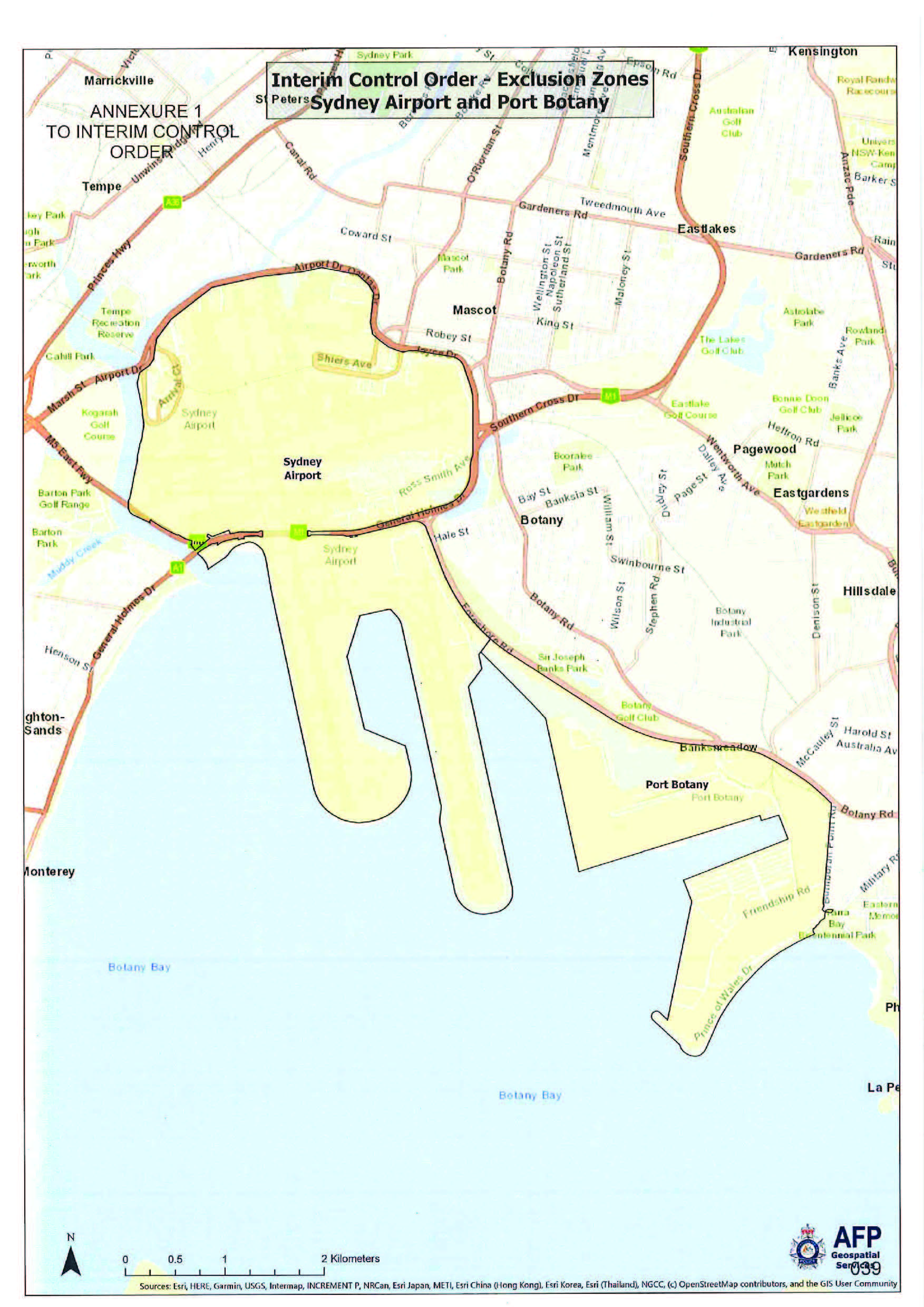
a. within the exclusion zone at Sydney Airport, as identified by yellow shading in Annexure 1;
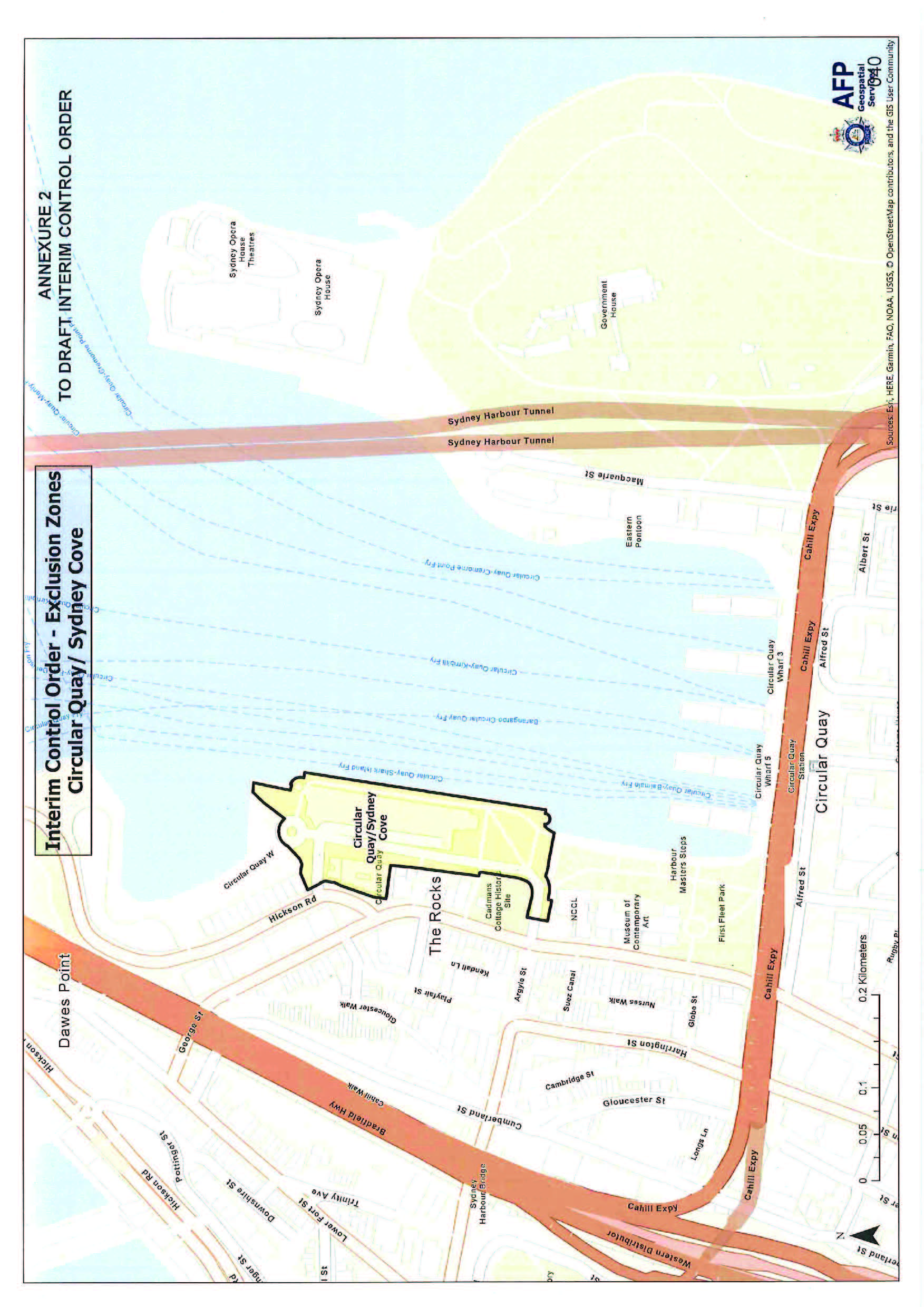
b. within the exclusion zone at Circular Quay, as identified by yellow shading in Annexure 2;
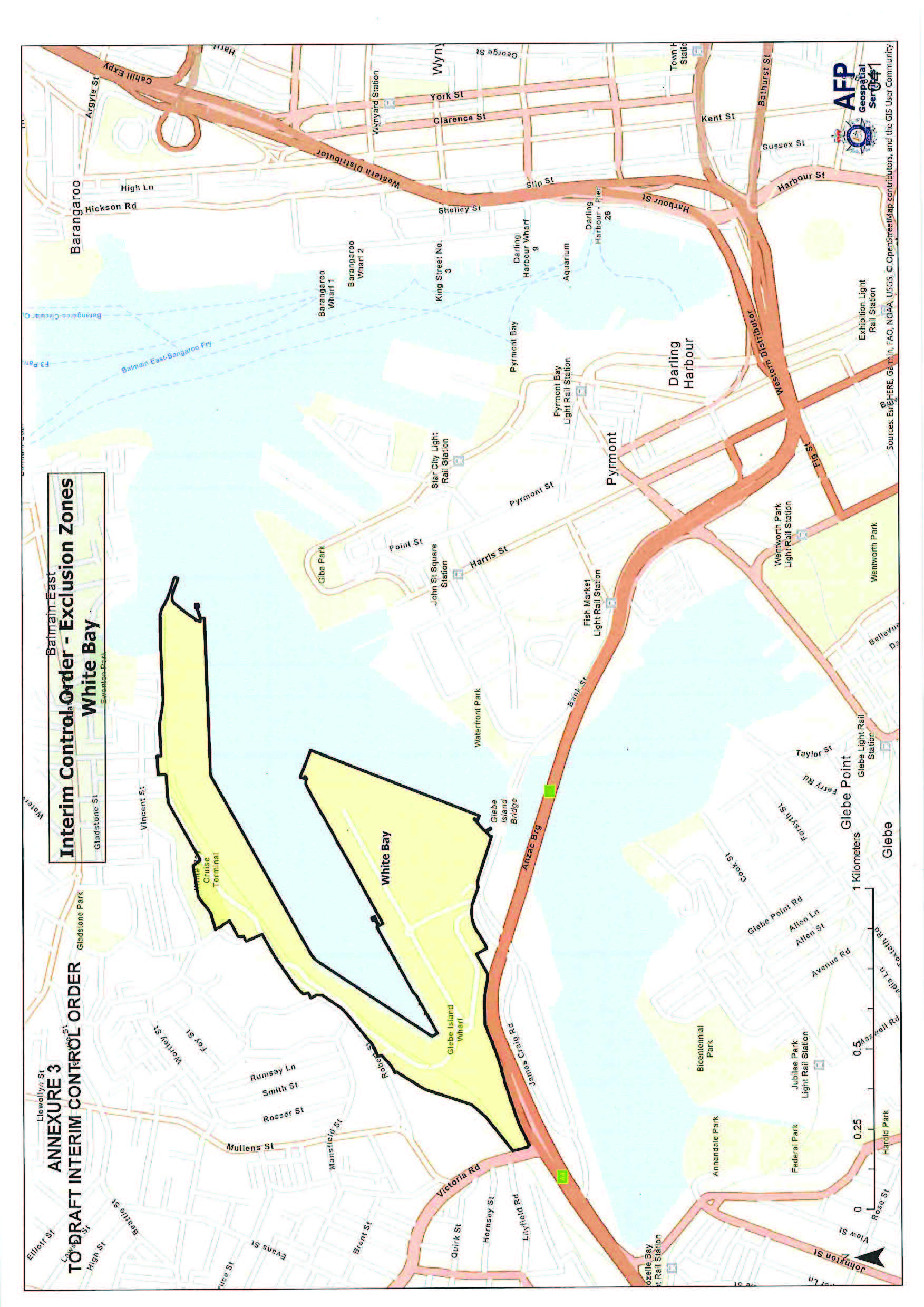
c. within the exclusion zone at White Bay, as identified in Annexure 3;
d. within 1 km of any Australian airport (besides Sydney Airport, which is addressed in Control 3.1.a) which has an international point of departure, or from which a person can board or charter a flight for an international destination;
e. within 1 km of any Australian port (besides Circular Quay and White Bay, which are addressed in Controls 3.1.b and 3.1.c) which has an international point of departure, or from which a person can board or charter a marine vessel for an international destination;
f. inside, or in the grounds of, any prison or correctional facility unless you are incarcerated there;
g. at the residence of any person with whom, by reason of Control 11, you are prohibited from communicating or associating;
h. any place in Australia outside the state of New South Wales;
i. any firing range or other place which sells or hires firearms or ammunition, or any military surplus store; and
j. attending any premises of any person, organisation or entity (not being premises occupied by an Australian police service or members thereof) where firearms or ammunition are kept or stored.
4. Control 4
4.1. You are prohibited from leaving Australia.
5. Control 5
5.1. You are prohibited from carrying out the following activities (including in respect of your work or occupation), namely:
Unlawful Activity & Activities would undermine the purpose of the Control Order
a. Committing any offence against a law of a State or Territory or the Commonwealth of Australia punishable by a term of imprisonment.
b. Providing any false information or misleading information or withholding any information about your whereabouts, activities or associations when asked by an AFP Superintendent.
Groups
c. Forming, joining or affiliating with any group, club or organisation, including any internet based social networking service, without written permission from an AFP Superintendent.
d. Forming any corporation, partnership, incorporated association, registering any business names, or operate a business without first notifying an AFP Superintendent in writing.
Financial
e. Transferring money or money’s worth to another person equal to or exceeding the value of $500 whether by cash, cheque or electronic transfer without first notifying an AFP Superintendent in writing of your intention to do so and, providing a receipt of payment thereafter.
f. Making any gift, donation, or financial contribution to any organisation, association, entity or charity howsoever described without first notifying an AFP Superintendent in writing of your intention to do so and, providing a receipt of payment thereafter.
Public Appearances, Education and Counselling Services
g. Presenting at, or appearing as a presenter or speaker at, or appearing on stage at, or providing public endorsement of any other presenter or speaker at, any public gathering that is publicly or privately broadcast via the internet or any telecommunications network, and/or attended by 5 or more people.
h. [Deleted].
i. Make any public appearances or statement for publication in any form to any person, or cause any statement to be published by any person on your behalf, in relation to any of the following matters:
i. Carrying out, authorising or permitting violence;
ii. Activities of any terrorist organisation;
iii. The ideology of or any material published, produced or endorsed by any terrorist organisation;
iv. Use of weapons, firearms, ammunition or explosives;
v. Any of the matters set out in control 6.1(b)(i);
vi. Adherence to any fatwa, decree, ruling or statement of the following persons:
i. Ayman al-Zawahiri;
ii. Osama bin Laden;
iii. Abu Muhammad al Maqdisi;
iv. Abu Bakr Al-Baghdadi;
v. Ahmad Musa Jibril;
vi. Shaykh Abu Muhammad Al-‘Adnani ash-Shami;
vii. Hassan Mahat Omar, aka Sheikh Hasan Hussein;
j. Providing counselling, teaching, mentoring or marriage services, whether privately or in exchange for a fee, which involves you or any person on your behalf, making any statement in relation to any of the matters set out in Control 5.1.i.
Activities Pertaining to Travel
k. Applying for travel documents for any country.
Activities Pertaining to Weapons and Firearms
l. Possessing, purchasing or using any firearms or ammunition.
m. Permitting storage or use of any firearms or ammunition at your place of residence.
n. Hunting or trapping any animal or game, or using any weapon in connection with hunting or related activities. This includes spear fishing but does not include fishing with a net or line
6.1. You are prohibited from carrying out the following specified activities (including in respect of your work or occupation), namely: accessing, acquiring, possessing, recording, copying or storing documents (including documents in electronic form) or electronic media, or attempting to access, acquire, possess, record, copy or store documents (including documents in electronic form) or electronic media, or directing any person to access, acquire, possess, record, copy or store any document (including documents in electronic form) on your behalf, which:
a. Instruct, counsel the carrying out or use of, or are supportive of the carrying out of or use of, or in that context describe:
i. anti-surveillance or counter surveillance;
ii. execution;
iii. beheading;
iv. suicide attack;
v. bombing;
vi. terrorist attack;
vii. assassination;
viii. torture;
ix. genocide; or
b. Instruct, counsel the use or making of, or are supportive of the use or making of, or in that context describe:
i. explosives, explosive devices, initiation systems or firing devices;
ii. firearms, ammunition ;
c. Relate to any of the following:
i. propaganda and promotional material for a ‘terrorist organisation’ within the meaning of s 102.1(1) of the Schedule to the Criminal Code Act 1995 (Cth); or
ii. activities of, or associated with, any ‘terrorist organisation’ within the meaning of s 102.1(1) of the Schedule to the Criminal Code Act 1995 (Cth),
unless that material is:
d. published by a ‘constituent body’ of the Australian Press Council;
e. published by the Australian Broadcasting Corporation (ABC), Special Broadcasting Service (SBS), Al Jazeera, the British Broadcasting Corporation (BBC), CNN or the Guardian;
f. broadcast on Australian free to air television;
g. broadcast on Australian pay television;
h. shown in a commercial movie cinema;
i. broadcast on one of the following streaming services: Netflix, STAN, ABC iView, Amazon Prime or SBS on demand; or
j. contained in material that is served on you or your legal representative by or on behalf of the applicant in the Federal Court proceeding related to this order including any appeal from that proceeding, and is assessed, possessed, and stored solely for the purposes of proceedings in the Federal Court relating to this Control Order, including any appeal from such proceeding.
7. Control 7
7.1. You are prohibited from the following specified activities (including in respect of your work or occupation), namely: collating, editing, producing or distributing documents (including documents in electronic form) or electronic media relating to:
a. explosives, explosive devices, initiation systems or firing devices;
b. firearms, ammunition or knives;
c. anti-surveillance or counter surveillance;
d. execution;
e. beheading;
f. suicide attack;
g. bombing;
h. terrorist attack;
i. assassination;
j. torture;
k. propaganda and promotional material for a ‘terrorist organisation’ within the meaning of s 102.1(1) of the Schedule to the Criminal Code Act 1995 (Cth);
l. activities of, or associated with, any ‘terrorist organisation’ within the meaning of s 102.1(1) of the Schedule to the Criminal Code Act 1995 (Cth);
m. material that is served on you or your legal representative by or on behalf of the applicant in the Federal Court proceeding related to this order including any appeal from that proceeding.
8. Control 8
8.1. You are prohibited from carrying out the following specified activities (including in respect of your work or occupation), namely: renting, purchasing, or driving any vehicle which exceeds a gross vehicle mass of 4.5 tonne.
9. Control 9
9.1. You are prohibited from carrying out the following specified activities (including in respect of your work or occupation), namely: undertaking paid employment without first notifying the AFP Superintendent.
9.2. In notifying the AFP Superintendent, you must submit a written notice to the AFP Superintendent providing information about the proposed employment, including details of the employer (including their name and place of business) and the nature of the work that will be undertaken.
10. Control 10
10.1. You are prohibited from possessing or using, or causing any person to act on your behalf to possess or use, any of these specified articles or substances, namely:
a. firearms, firearm part of or ammunition within the meaning of s 4 of the Firearms Act 1996 (NSW);
b. a ‘prohibited weapon’ within the meaning of the Weapons Prohibition Act 1998 (NSW);
c. any quantity of petrol exceeding 4 litres that is not contained in the petrol tank of a vehicle that you have purchased, rented or are driving in compliance with Control 8.1;
d. any quantity of any chemical which is not consistent with reasonable domestic use;
e. an article or device, not being a firearm, capable of discharging by any means:
i. any irritant matter in liquid, powder, gas, chemical form or any dense smoke; or
ii. any substance capable of causing bodily harm;
f. a detonator;
g. a fuse capable of use with an explosive or a detonator;
h. a knife, in a public place, without reasonable excuse;
i. anything intended, by the person having custody of the thing, to be used to injure or menace a person or damage property.
11.1. You are prohibited from communicating or voluntarily associating with:
a. any person incarcerated in any correctional facility unless you yourself are incarcerated in that correctional facility;
b. any person on parole or on bail, or in the community subject to a control order made under Division 104 of the Criminal Code Act 1995 (Cth) or an interim or extended supervision order made under the Terrorism (High Risk Offenders) Act 2017 (NSW);
c. any person convicted of, or currently charged with an offence relating to terrorism in Australia within the meaning of section 3(1) of the Crimes Act 1914 (Cth);
d. any person convicted of an offence under the Crimes (Foreign Incursions and Recruitment) Act 1978 (Cth) or Part 5.5 of the Criminal Code Act 1995 (Cth); and
e. the following persons, either directly or indirectly using a third party: any person located in Lebanon, Jordan, Saudi Arabia, Afghanistan, Turkey, Iraq, Syria, Pakistan, India, Egypt, Somalia, The West Bank, Yemen, Sudan, Philippines or Indonesia other than a close family member as defined in s 102.1(1) of the Criminal Code Act 1995 (Cth) where the communication or association relates only to a matter that could reasonably be regarded (taking into account your cultural background) as a matter of family or domestic concern;
f. any of the following specified individuals:
i. Isaac El Matari (DOB: 17 March 1990)
ii. Hozan Alou (DOB: 30 October 1999)
iii. Abdullah Azari (DOB: 31 December 1994)
iv. Adnan Elkassir (DOB: 8 December 1987)
v. Wisam Haddad (DOB: 9 May 1980)
vi. Hassan Mahat Omar aka Sheikh Hassan Hussein, Hassan Mahat Omar aka Xasaan Xuseen (DOB: 10 April 1979)
vii. Ahmad Teyba (DOB: 7 May 1989)
viii. Mohammad Junaid Thorne (DOB: 10 June 1989)
ix. Joseph ‘Yussef’ Saadieh (DOB: 1 June 1997)
x. Seeyar Siddiqi (DOB: 11 April 1996)
12. Control 12
12.1. You are prohibited from accessing or using, any mobile telephone device and SIM card other than one mobile telephone device (the permitted mobile phone) at any one time
a. before using the permitted mobile phone for the first time, you must present it to the AFP Superintendent (or a police officer specified in writing by the AFP Superintendent) for inspection;
b. before using the permitted mobile phone for the first time, you must advise the AFP Superintendent, in writing, of the following information:
i. the International Mobile Equipment Identity number for the permitted mobile phone;
ii. the Integrated Circuit Card Identifier for the SIM card you will use with the permitted mobile phone;
iii. the telecommunication service provider which you will use with the permitted mobile phone;
iv. the password for the permitted mobile phone; and
v. the phone number to which the permitted mobile phone will be connected.
c. Once you have advised the AFP Superintendent of the information required by paragraph 12.1.b above, you must not change, remove, modify or disconnect or cause any other person to change, remove, modify or disconnect on your behalf (including any employee or person acting on behalf of a telecommunications service provider) the SIM card, telecommunication service provider or phone number connected to the permitted mobile phone; and
d. if you change the password for the permitted mobile phone, you must provide the new password to the AFP Superintendent, or a police officer acting under the AFP Superintendent’s direction, if you are requested to do so by the AFP Superintendent or the police officer.
12.2. If the permitted mobile phone is one that the AFP has provided to you, controls 12.1.a and 12.1.b.i do not apply.
12.3. You are prohibited from causing or permitting another person to use or access the permitted mobile phone.
12.4. You are prohibited from causing or permitting another person to use or access any mobile telephone device on your behalf.
13. Control 13
13.1. You are prohibited from accessing or using any fixed or landline telephone service other than one service that has been approved in writing by the AFP Superintendent for you to access or use.
13.2. To seek approval, you must:
a. submit a written request to the AFP Superintendent which nominates the fixed or landline telephone service; and
b. provide any other information requested by or on behalf of the AFP Superintendent for the purpose of identifying the nominated fixed or landline telephone service.
13.3. You are prohibited from causing another person to use or access any fixed or landline telephone service on your behalf.
14. Control 14
14.1. You are prohibited from accessing or using, or causing any person to access or use on your behalf, any public telephone except in the case of an emergency, provided that you contact the AFP Superintendent as soon as possible after accessing or using such a public telephone and:
a. provide sufficient detail to the AFP Superintendent to identify the public telephone that you accessed or used, the date, time and phone number called; and
b. you explain the nature of the emergency which required you to access or use, or cause another person to access or use on your behalf, that public telephone.
15. Control 15
15.1. You are prohibited from accessing or using, or causing any person to access or use on your behalf, any satellite telephone service or UHF/VHF radio.
16. Control 16
16.1. You are prohibited from accessing or using, or causing any person to access or use on your behalf, any of the following websites, applications or computer programs (collectively, platforms), as the case may be:
a. Facebook;
b. Facebook Messenger;
c. FaceTime;
d. Google Duo;
e. Google Hangouts;
f. Google Talk;
g. Instagram;
h. KIK;
i. Signal Private Messenger;
j. Skype;
k. Snapchat;
l. Telegram;
m. Twitter;
n. Viber; and
o. WhatsApp.
16.2. In addition to the platforms listed in Control 16.1, you are prohibited from accessing or using, or causing any person to access or use on your behalf, any gaming applications or gaming software that connects to other users or servers, via the internet or Local Area Network (LAN).
16.3. In addition to the platforms listed in Control 16.1, you are prohibited from accessing or using, or causing any person to access or use on your behalf, any Voice Over Internet Protocol (VOIP) service, including any software, mobile application or hardware.
16.4. In addition to the platforms listed in Control 16.1, you are prohibited from accessing or using, or causing any person to access or use on your behalf, any internet based messaging service, including any software, mobile application or hardware.
16.5. Controls 16.1, 16.2, 16.3 and 16.4 do not prohibit you from accessing or using a website which includes an ‘instant chat’ function that allows a visitor to the website to send messages to, and receive messages from, the website host concerning customer service, or prohibit you from accessing or using such a function on a website if you do so for the purpose of obtaining or receiving customer service, solely for the purpose of obtaining or providing customer service.
16.6. Controls 16.1, 16.2, 16.3 and 16.4 do not prohibit you from accessing or using any platform, VOIP or website for the purpose of participating in any proceeding in an Australian Court to which you are a party or witness.
17. Control 17
17.1. You are prohibited from accessing or using any internet service other than:
a. a service that has been approved in writing by the AFP Superintendent for you to access or use (permitted internet service); and
b. a television connected to an internet service at the specified premises, subject to all of the existing Controls.
17.2. To seek approval:
a. you must submit a written request to the AFP Superintendent which:
i. nominates the internet service provider account; and
ii. nominates the devices you will connect to the internet service (including but not limited to computers and televisions);
b. provide any other information requested by, or on behalf of, the AFP Superintendent, in relation to, or for the purpose of identifying, the nominated account and devices.
17.3. You are prohibited from causing any other person to access or use on your behalf any other internet service.
17.4. You are prohibited from allowing any other person to access or use a permitted internet service.
17.5. You are prohibited from:
a. using a virtual private network (VPN) service);
b. using the TOR network; and
c. accessing any Darknet services (denoted by "onion" top level domain suffix).
18. Control 18
18.1. You are prohibited from accessing or using any electronic mail (email) account other than an account that has been approved in writing by the AFP Superintendent for you to access or use (the permitted email account).
18.2. To seek approval:
a. you must submit a written request to the AFP Superintendent which nominates the email account; and
b. provide any other information requested by, or on behalf of, the AFP Superintendent in relation to, or for the purpose of identifying, the nominated account which you will be accessing or using.
18.3. You are prohibited from causing or permitting another person to use or access the permitted email account.
18.4. You are prohibited from causing any other person to access or use on your behalf any email account.
19. Control 19
19.1. You are prohibited from accessing or using any computer other than a computer or tablet device that has been approved in writing by the AFP Superintendent for you to access or use (the permitted computer or permitted tablet device) and your use of the permitted computer or tablet device is subject to the following conditions:
a. before using the permitted computer or tablet device for the first time, you must provide the password for the permitted computer to the AFP Superintendent; and
b. if you change the password for the permitted computer or tablet device, you must provide the new password to the AFP Superintendent, or a police officer acting under the AFP Superintendent’s direction, if you are requested to do so by the AFP Superintendent or the police officer.
19.2. You are prohibited from causing or permitting another person to access or use any computer or tablet device on your behalf.
19.3. You are prohibited from allowing any other person to access or use the permitted computer or the permitted tablet device.
19.4. To request approval under Control 19.1 you must:
a. submit a written request to the AFP Superintendent which nominates the computer or tablet device; and
b. provide any information requested by or on behalf of the AFP Superintendent in relation to, or for the purpose of identifying and accessing, the nominated computer or tablet device.
20. Control 20
20.1. You are required to consider, in good faith, participating in counselling or education relating to your psychological and physical wellbeing, with a suitably qualified professional, for at least 60 minutes per week.
If you agree to participate in such counselling or education you must advise the AFP Superintendent in writing that you have commenced the counselling or education and provide the AFP Superintendent the name and qualifications of the professional you have engaged.
21. Exemption Requisition by you
21.1. You may request the AFP Superintendent approve an exemption to the requirements or prohibitions (as the case may be) specified in Controls 1-20 above.
21.2. To request an exemption, you must:
a. submit a written request to the AFP Superintendent which:
i. identifies the Control in respect of which you seek an exemption;
ii. explains the extent to which you seek to be exempted from the Control; and
iii. explains your reason(s) for seeking the exemption; and
b. provide any other information requested by, or on behalf of, the AFP Superintendent for the purposes of determining whether to approve the exemption.
21.3. The AFP Superintendent may grant an exemption subject to conditions specified in writing.
21.4. You must comply with all of the conditions specified in writing by the AFP Superintendent. If you do not comply with a condition to an exemption, the exemption is (and will be taken to have been for all purposes) of no effect.
21.5. A request for an exemption must be made before the material time and date.
21.6. If the AFP Superintendent has not approved an exemption by the material time and date, the request is deemed to have been refused.
22. Exemption granted by the AFP without a request from you
22.1. An AFP Superintendent may grant an exemption, initiated by the AFP, to the requirements or prohibitions specified in the Controls with your consent.
22.2. The AFP Superintendent may grant an exemption subject to reasonable conditions specified in writing provided on reasonable notice to you and to which you consent in writing.
22.3. You must comply with all of the conditions specified in writing by the AFP Superintendent. If you do not comply with a condition of an exemption, the exemption is (and will be taken to have been for all purposes) of no effect.
23. Interpretation
23.1. In this Interim Control Order:
a. Material time and date means:
i. in relation to a Control that requires you to do an act – the time and date that you are required to do that act;
ii. in relation to a Control to that prohibits you from doing an act – the time and date that you propose to do that act;
iii. in relation to a Control that requires to you be present at an area or place – the time and date that you are required to be present at that area or place;
iv. in relation to a Control that prohibits you from being present at an area or place – the time and date that you propose to be present at that area or place.
b. AFP Superintendent means a member of the Australian Federal Police performing the duties of a Superintendent within the Counter Terrorism portfolio and includes any AFP member or special member authorised to perform duties or functions or otherwise act on behalf of a Superintendent within the Counter Terrorism portfolio in connection with this control order.
c. Password includes but is not limited to any passcode, swipe pattern or any information or function necessary to facilitate access to the applicable device.
d. Police officer means a ‘member’ or ‘special member’ of the Australian Federal Police, as defined by the Australian Federal Police Act 1979 (Cth), or a ‘police officer’ within the meaning of the Police Act 1990 (NSW).
ANNEXURE 1
ANNEXURE 2
ANNEXURE 3
ANNEXURE B
1. The following is a summary of the grounds on which the interim control order is made, for the purposes of s 104.5(1)(h) of the Criminal Code Act 1995 (Cth) (the Criminal Code).
Overview
2. Radwan Dakkak has been convicted of two counts of associating with a terrorist organisation contrary to s 102.8 of the Criminal Code. Accordingly, s 104.4(1)(c)(iv) of the Criminal Code is satisfied as he has been convicted in Australia of an offence relating to terrorism or a terrorist organisation (within the meaning of subsection 102.1(1)).
3. Pursuant to s 104.4(1)(d) of the Criminal Code, each of the obligations, prohibitions and restrictions imposed on Dakkak by the interim control order is reasonably necessary, and reasonably appropriate and adapted, for the purpose of:
a. protecting the public from a terrorist act;
b. preventing the provision of support for or the facilitation of a terrorist act; or
c. preventing the provision of support for or the facilitation of the engagement in a hostile activity in a foreign country.
4. Having regard to the matters set out in both the 'Statement of facts relating to why the order should be made' appearing in Annexure SB-03 to the affidavit of Sandra Booth sworn 21 December 2020 (SoF) and the 'Statement of facts relating to why the order should not be made' appearing in Annexure SB-04 to that affidavit (SoFN), Dakkak presents an ongoing risk of being involved in:
a. supporting or facilitating a terrorist act in Australia or overseas, or
b. supporting or facilitating the engagement in a hostile activity in a foreign country.
5. The risk posed by Dakkak is demonstrated by:
a. his longstanding and ongoing commitment to an extremist Islamic ideology supportive of religiously motivated violence;
b. his prolific promotion and distribution of extremist material via multiple social media accounts;
c. his demonstrated support of IS though his association with Isaac El Matari
d. his demonstrated support of IS though his association with Ahlut-Taweed Publications (ATP); and
e. his continued association with persons of national security concern.
6. It is also necessary to consider the risk of Dakkak engaging in similar conduct after release.
7. Each of those matters is addressed further below.
Conviction and sentence
8. On 18 December 2020, Dakkak was convicted of two counts of associating with a terrorist organisation contrary to s 102.8 of the Criminal Code.1 The offences involved Dakkak intentionally associating with El Matari, Sheikh Hassan Hussein and ATP:
a. knowing that they were members of, and persons who promoted and/or directed the activities of, Islamic State (IS), and
b. in circumstances where the association provided support to IS and Dakkak intended that the support would assist IS to expand or continue to exist.
9. The offences for which Dakkak was convicted related to terrorism or a terrorist organisation.2
Longstanding and ongoing commitment to an extremist Islamic ideology supportive of religiously motivated violence
10. Dakkak has demonstrated a close and ongoing interest in and support for IS, its ideology, intentions and activities. His interest has been enduring, extending over a number of years, from at least 2015. Prior to his incarceration he:
a. frequently accessed IS and other extremist and material supportive of violent jihad on the internet, including media depicting or describing explosives, bombings, executions, violence and terrorist attacks: SoF [28]
b. promoted and distributed pro-IS material, including videos, pictures, messages and radio content, through various social media platforms: SoF [16]-[24], [27]
c. assisted with the publication of IS and other extremist material supportive of violent jihad on the internet, including the ATP pro-IS online magazine 'From Dabiq to Rome': SoF [44]-[53]
d. associated with a number of individuals in Australia or overseas, who supported the ideology and activities of IS, and were involved in the commission of terrorism offences: SoF [39]-[43], [54]-[55], [65]-[71], [72]-[114]
e. on 26 April 2019 the accused pledged allegiance to the Caliphate and Abu Bakr AI-Baghdadi, leader of the Islamic State of Iraq and the Levant (ISIL), and required his fiancée to do the same before he would marry her. Dakkak also renewed that pledge of allegiance on 24 May 2019: SoF [26(v)], [26(x)].
11. Although Dakkak has denied being an Islamic extremist, or sharing the same views as IS (SOFN [11 (a)], [13(a)], [14]), that assertion must be treated with a high degree of caution in view of the following:
a. Dakkak has frequently accessed IS and other extremist material online. This access and interest is not fleeting, dating back to at least 2015: SoF [28];
b. Dakkak promoted and distributed material supportive of IS through his online social media accounts, which were activated using various pseudonyms so he could 'stay hidden from the government': SoF [16], [49];
c. the fact that he encouraged El Matari not to advise the AFP of his intention to travel overseas, and agreed to keep what he knew 'private' so El Matari would not have 'issues ... with the government': SoF [43(i)], [43(o)];
d. the assertion having come at a time at which it served his interests to distance himself from IS (namely, in the context of his criminal proceedings);
e. the content of Dakkak's communication with persons inside and outside the prison environment, and
f. Dakkak's continued association with persons who have been convicted of terrorism-related offences or who are of national security concern.
Social media accounts and networking platforms
12. Dakkak's commitment to an extremist ideology supportive of religiously motivated violence is of even greater concern in view of his prolific online presence.
13. Since 2015, Dakkak has utilised numerous social media accounts and online platforms to share, distribute and increase the availability of IS propaganda and imagery. The various posts espoused pro-Salafi-jihadist content, IS propaganda, quotes from various pro-IS Sheiks and links to other pro-IS material. Some of those posts attempted to legitimise violent jihad through religion and influence and convince others to hold similar views. Dakkak cross-promoted and replicated posts across his various social media accounts, channels and groups, providing greater opportunity to radicalise a wider audience in a shorter period of time: SoF [16]-[24], [27].
14. Dakkak has also used his various social media accounts and online platforms to communicate with other persons in Australia and around the world who hold similar extremist views: SoF [16]-[24], [54]-[55].
15. In circumstances where the overwhelming balance of the available evidence suggests Dakkak's ideological beliefs have not changed, there is a substantial risk that upon his release, and in the absence of appropriate controls, Dakkak will continue to use social media and online platforms to:
a. support the ideology, intentions and activities of IS, including the carrying out of terrorist attacks by its members;
b. share, distribute and increase the availability of IS propaganda, promotional material and other material supportive of terrorist attacks and violent jihad more broadly; and
c. engage with persons of national security risk and other associates who hold the same extremist ideology, both within Australia and overseas.
Support and encouragement of El Matari to prepare for foreign incursion
16. Between February and April 2019 El Matari actively made plans and prepared to travel overseas to engage in hostile activities with the Islamic State Khorasan Province (IS-KP): SoF [39]. As a result of those activities, El Matari was arrested and charged on 2 July 2019 with contravention of s 102.3(1), s 119.4(1) and s 101.6(1) of the Criminal Code. On 2 October 2020 El Matari pleaded guilty to 2 offences, namely preparation for incursion into Afghanistan to engage in hostile activities (s 119.4(1)), and other acts done in preparation for, or planning, a terrorist act (s 101.6(1)).
17. Although Dakkak denies knowing El Matari was an extremist (SOFN [13(b)]), the available evidence shows he knowingly and actively supported and sought to assist El Matari to travel overseas and engage in hostile activities with the IS-KP. Specifically:
a. Dakkak made enquiries with a person in Syria who was associated with IS, as to whether he had a contact in Khorasan who could help El Matari travel to Khorasan through Pakistan: SoF [43(c)]; and
b. Dakkak had numerous conversations with El Matari during which Dakkak provided support and encouragement for El Matari's plans to travel and fight with IS-KP, including counselling El Matari to 'be careful' and not to advise the AFP of his intentions to travel: SoF [43].
18. Dakkak's association with El Matari underpins the first charge for which he was convicted.
Promotion and support of IS through ATP
19. ATP is a pro-IS media operation that translates and disseminates IS material, including through online publications and various social media platforms. One such online publication is 'From Dabiq to Rome', which promotes Salafi-jihadism and has been used by IS to claim responsibility for various terrorist attacks around the world.
20. Dakkak was actively involved in assisting ATAP with the translation, promotion and further distribution of pro-IS material, including the 'From Dabiq to Rome' publication. He also assisted ATP to produce and distribute videos: SoF [44]-[53].
21. Dakkak's association with ATP underpins, at least in part, the second charge for which he was convicted.
Continued association with persons of national security concern
22. Prior to his incarceration, Dakkak associated with a number of persons who supported the ideology and activities of Islamic State, both in person, on the telephone and online through social networking platforms: SoF [13], [26], [43], [48]-[49], [54]-[55], [65]-[67]. He has continued some of those associations. Dakkak's associates include other persons in Australia posing a risk to national security, associates who are located overseas, and associates who have travelled to foreign conflict zones. His network is wide ranging, and interactions include discussions about extremist ideology and religiously motivated violence, including jihad.
23. Dakkak was closely connected with the activities and intentions of El Matari, who has been convicted of preparing for incursion into Afghanistan to engage in hostile activities and other acts done in preparation for, or planning, a terrorist act. Dakkak has continued to correspond with El Matari whilst they have both been incarcerated: SoF [68].
24. In the lead up to his arrest on 2 July 2019, Dakkak told various associates that he was in contact with Sheik Hassan Hussein on a regular basis, and that the Sheik provided him with religious guidance and clarity on various questions he had about Salafi-jihadism: SoF [54]-[55]. This association heightened the legitimacy of Dakkak's views amongst his associates who hold similar views, thereby increasing his capacity to influence others.
25. Throughout his incarceration, Dakkak has also maintained contact with associates who hold extremist views, have been convicted of terrorism offences or have links to other extremists including Adnan Elkassir, Hazan Alou, Abdullah Azari, Talal Alameddine, and Mohammad Junaid Thorne: SoF [72]-[114].
26. Dakkak's wide ranging network of associates who hold similar extremist views, including those online, increases his means and opportunity to:
a. support and facilitate terrorist acts in Australia or overseas; and
b. support and facilitate engagement in a hostile activity in a foreign country.
Risk of conduct after release
27. In view of the matters set out above, the Applicant anticipates that once released from custody, and in the absence of appropriate controls, Dakkak will continue his pattern of behaviour for which he has been convicted.
28. Whilst the Applicant does not anticipate Dakkak would, himself, commit a terrorist act, the nature of the risk posed by Dakkak is complex and multifaceted. Having regard to the matters set out above in paragraphs 12-27, the Applicant considers there to be a real risk that upon his release, and without appropriate controls in place, Dakkak will continue to direct his efforts towards supporting and facilitating a terrorist act, either by providing encouragement and support to individuals, or by further distribution of online propaganda designed to influence and radicalise others.
29. In addition, the interim control order will ensure Dakkak:
a. is provided with an opportunity to engage positively with the community (through employment, religious observation, counselling and education);
b. is capable of being monitored by police during his reengagement with the community, and
c. is prohibited from engaging in those behaviours, being exposed to associates and influences, which may lead him to commit, provide support for or facilitate a terrorist act or support or facilitate the engagement in a hostile activity in a foreign country
and thereby reduce the risks outlined above.
YATES J:
1 The applicant, who is the Commander, Counter Terrorism Enduring Risk Investigations of the Australian Federal Police (AFP), requests the Court to make an interim control order pursuant to s 104.4 of the Criminal Code Act 1995 (Cth) (the Code) in respect of the respondent.
2 The respondent, Radwan Dakkak, pleaded guilty to two offences under s 102.8(1) of the Code (associating with terrorist organisations). The offence created by s 102.8(1) is within Pt 5.3 of the Code, entitled “Terrorism”. The charges against the respondent were particularised as follows:
Charge 1 (association with Isaac El Matari)
On two or more occasions, between 1 January 2019 and 2 July 2019, did intentionally associate with another person, namely Isaac El Matari, knowing that he was a member of, and a person who promoted and/or directed the activities of an, organisation, namely Islamic State, and knowing that the organisation was a terrorist organisation, in circumstances where the association provided support to the organisation and intending that the support assist the organisation to expand or continue to exist.
Charge 2 (association with Sheikh Hussein and Ahlut-Tawhid Publications)
On two or more occasions, between about 26 July 2017 and 2 July 2019, did intentionally associate with other persons, namely Sheikh Hassan Hussein and a person or persons at Ahlut-Tawhid Publications, knowing that they were members of, and were persons who promoted and/or directed the activities of, an organisation, namely Islamic State, and knowing that the organisation was a terrorist organisation, in circumstances where the association provided support to the organisation and intending that the support assist the organisation to expand or continue to exist.
3 As a consequence of his pleas of guilty, the respondent admitted, in respect of each charge, that: (a) he intentionally associated with another person on two or more occasions; (b) he knew that the other person was a member of or a person who promotes or directs the activities of an organisation; (c) the organisation was a terrorist organisation, and the respondent knew this; and (d) the association between the respondent and the other person provided support to the terrorist organisation.
4 The fault element for the offence is “intention” and, by pleading guilty, the respondent admitted that he intended to support each organisation, named in the charges, to expand or continue to exist by his association with them.
5 On 18 December 2020, the respondent was convicted of the offences and sentenced in the Supreme Court of New South Wales to imprisonment. The last of the sentences imposed will expire on 1 January 2021. The present application has been brought on urgently because the applicant seeks to have the interim control order in place upon the respondent’s release from prison.
6 The application is supported by the applicant’s affidavit made on 21 December 2020. The affidavit is lengthy. It annexes and exhibits a large number of documents to which the applicant makes reference. The annexures comprise: (a) a draft of the interim control order the applicant seeks (subsequently amended following discussions between the parties); (b) the AFP Minister’s consent to the applicant’s request for the interim control order; (c) a statement of facts relating to why the interim control order should be made; (d) a statement of facts of which the applicant is aware relating to why the interim control order should not be made; (e) information about the respondent’s age; and (f) a summary of the grounds on which the interim control order should be made.
7 The affidavit in support gives an explanation as to why each of the proposed obligations, prohibitions or restrictions (the controls) in the proposed interim control order should be made. It includes the applicant’s statement that she is not aware of any additional reasons why the controls should not be imposed.
8 I am satisfied that the affidavit in support fulfils the requirements of s 104.3 of the Code and that, as a consequence, the request, which is made by a senior AFP member (within the meaning of s 100.1(1) of the Code), is one that satisfies the requirement of s 104.4(1)(a) of the Code. The Court has not required further information to be provided: see s 104.4(1)(b) of the Code.
9 The remaining questions are whether, on the information before me, I am satisfied, on the balance of probabilities, that one or more of the matters identified in s 104.4(1)(c) of the Code have been established and whether, according to the same standard of proof, each control, as sought to be imposed on the respondent, is reasonably necessary, and reasonably appropriate and adapted, for one or more of the purposes identified in s 104.4(1)(d) of the Code. The latter provision clearly invokes considerations of proportionality: Thomas v Mowbray [2007] HCA 33; 233 CLR 307 at [19] (Gleeson CJ); see also at [99] (Gummow and Crennan JJ).
10 As to s 104.4(1)(c), the applicant submits that the respondent has been convicted in Australia of an offence relating to terrorism or a terrorist organisation, within the meaning of para (iv) of that provision. Alternatively, the applicant submits that the Court should be satisfied, to the prescribed standard, and for the purposes of para (vi) of the provision, that the interim control order would substantially assist in preventing the provision of support for, or the facilitation of, a terrorist act. Satisfaction of either paragraph would be sufficient for an interim control order to be made, subject to satisfaction of the requirements of s 104.4(1)(d).
11 As to s 104.4(1)(d), the applicant submits that each control is reasonably necessary, and reasonably appropriate and adapted, for the purpose of protecting the public from a terrorist act; preventing the provision of support for, or the facilitation of, a terrorist act; or preventing the provision of support for, or the facilitation of, the engagement in a hostile activity in a foreign country.
12 Although the structure of Div 104 of Pt 5.3 of the Code contemplates that the request for an interim control order will be an ex parte procedure, subject to later confirmation in accordance with the procedures stipulated in Sub-Div D (ss 104.12 – 104.17), the respondent has appeared, by counsel, on the present application. Orders made on 22 December 2020 by the then Duty Judge provided for the respondent to file and serve any affidavits on which he wished to rely, and any written submissions. The respondent has not filed any affidavits. He has, however, provided written submissions and made oral submissions at the hearing of this application.
13 The respondent accepts, correctly in my view, that he has been convicted of an offence “relating to terrorism” within the meaning of s 104.4(1)(c)(iv) of the Code and that, accordingly, this Court can make an interim control order in relation to him. The question of substance that remains is whether the interim control order sought by the applicant should be made. As to this, the respondent concedes, properly, that some controls are clearly justified in light of both the operation of Div 104 and the nature of his conduct. He contends, however, that it does not follow from this concession that all the controls sought by the applicant are justified.
14 In order to assess what is reasonably necessary and reasonably appropriate and adapted in the circumstances, the respondent submits that the offence created by s 102.8(1) of the Code, for which he was convicted, is one of the least serious terrorism offences. Indeed, he submits that it appears to be “the least serious” terrorism offence. Echoing the words of the sentencing judge, the respondent submits that it is an offence which, contrary to the traditions of the common law, exposes citizens to potentially severe punishment as a result of “guilt by association”. He submits that the nature of the support provided by him for which he was convicted and sentenced is “a long way removed from any actual terrorist act or foreign incursion activity”.
15 The respondent argues that his correspondence with various people, both inside and outside prison, indicates that he remains committed to a strict form of Islam, but that this is not an offence and does not of itself suggest that he will involve himself in criminal activities in the future. He has no previous criminal record. The respondent points to the finding by the sentencing judge that, although he has made contact, while in prison, with a few people who hold extremist views, there is nothing in the correspondence that espouses any philosophy of violent jihad or other inclinations towards terrorism. In fact, the respondent points to the applicant’s statement in her affidavit that she does not anticipate that the respondent would, himself, commit a terrorist act.
16 In his written submissions, the respondent submits:
…the proposed orders sought by the applicant need to be viewed in the context of a person who has committed what appears to be the least serious terrorist offence known to the law, who is not violent, who has not advocated or planned any violent acts and while his religious focus has been described as ‘extreme’, there is no suggestion that is sought to impose it on anyone else.
17 Without debating whether the offence created by s 102.8(1) is the least serious terrorist offence created by the Code, the applicant accepts that, on the spectrum of offences, it is at the “less serious” end. This is not to say, however, that the offence is not objectively serious. I observe, as the sentencing judge also observed, that the maximum penalty imposed by the Code (three years’ imprisonment) indicates that the offence created by s 102.8(1) is a serious one when considered in the context of all offences known to the criminal law.
18 It is important to record that the sentencing judge remarked on the clear evidence of the respondent’s radicalisation which, his Honour concluded, was a substantial part of the respondent’s motivation to associate with people he knew to be members of a terrorist organisation. The sentencing judge also noted that there was no evidence that the respondent had been “de-radicalised”.
19 Further, the sentencing judge was unable to accept that the respondent had established any contrition or remorse for his offending. On the basis his youth, prior good character and family support, his Honour was only prepared to find that there were “some prospects” of the respondent’s rehabilitation. Even then, his Honour was not prepared to give this consideration much weight. His Honour noted the extreme nature of the respondent’s views and reasoned that these views must be taken into account in considering the protection of the community.
20 This observation is particularly pertinent when regard is had to the objects of Div 104 expressed in s 104.1, namely protecting the public from a terrorist act; preventing the provision of support for, or the facilitation of, a terrorist act; and preventing the provision of support for, or the facilitation of, the engagement in a hostile activity in a foreign country. Section 104.4(2) of the Code stipulates that these objects are a paramount consideration when assessing whether each control sought to be imposed by an interim control order is reasonably necessary, and reasonably appropriate and adapted, for the purposes set out in s 104.4(1)(d).
21 Commendably, the parties have discussed the controls which the applicant seeks and have reached agreement on some matters that would otherwise be in contest between them. Unfortunately, their opportunity to engage in discussions has been limited. The parties’ agreement does not, of course, relieve the Court of its own task under s 104.4, and s 104.4(1)(d) in particular. But, for the purposes of these reasons, it is convenient to focus on the controls which remain in dispute, at least as between the parties.
22 When, in dealing with these issues, I refer to a control sought by the applicant as “proportionate” I mean that, on the material presently before the Court (bearing in mind that the present application is interlocutory in character and that further evidence may be before the Court at a confirmation hearing), the control is reasonably necessary, and reasonably appropriate and adapted, for at least one of the purposes specified in s 104.4(1)(d) of the Code.
23 As a general observation, I also note that the Court’s power to vary an interim control order at a confirmation hearing is limited to removing a control: see s 104.14(7)(b). This is consonant with s 104.11A(2)(b) of the Code which provides that an interim control order can be varied only if the variation does not involve adding any obligations, prohibitions or restrictions to the order. I accept the applicant’s submission that I should proceed cautiously before limiting a proposed control that is prima facie justified, in terms of s 104.4(1)(d), on the material presently before the Court, in circumstances where the respondent has not yet filed evidence or has merely provided an untested explanation for an amendment he seeks, which can only be fully explored at a confirmation hearing.
Control 1.1
24 This control imposes a curfew. As originally sought, it required the respondent to remain at designated and approved premises between 10.00 pm and 6.00 am each day. It seems that these hours would interfere with the respondent attending night and morning prayers. He argues for a curfew between 12.00 am and 4.00 am. In response, the applicant argues that a curfew between 11.00 pm and 5.00 am would be appropriate and would address the respondent’s concerns. Unfortunately, through no fault of the respondent or his legal advisers, there has been no opportunity to obtain the respondent’s instructions on the applicant’s revised proposal. It does, however, appear to address the respondent’s concern. I am satisfied that the revised proposal is proportionate.
Control 2.1
25 This control imposes a reporting requirement at Parramatta Police Station. As originally proposed, the control provided for reporting at Wentworthville Police Station, near where the respondent will live. It now emerges that Wentworthville Police Station is manned only within very limited hours. The Wentworthville Police Station is within the Parramatta Police Area Command. I am satisfied that the revised proposal is proportionate.
Controls 5.1(g) and (h)
26 Control 5.1(g) prohibits the respondent from presenting at, or appearing as a presenter or speaker act, or appearing on stage at, or providing public endorsement of any other presenter or speaker at, any public gathering that is publicly or privately broadcast via the Internet or any telecommunications network, and/or attended by five or more people. Control 5.1(h) as sought would prohibit the respondent from publishing, authorising or approving to be published, collected or produced, any material for publication in any form (e.g. written, audio, visual).
27 For context, I note that control 5.1(i) prohibits the respondent from making any public appearances or statement for publication in any form to any person, or causing any statement to be published by any person on his behalf, in relation to: carrying out, authorising or permitting violence; the activities of any terrorist organisation; the ideology of or any material published, produced or endorsed by any terrorist organisation; the use of weapons, firearms, ammunition or explosives; adherence to any fatwa, decree, ruling or statement of certain nominated persons; and the matters stated in control 6.1(b)(i) (also dealing with explosives, explosive devices, initiation systems or firing devices, firearms and ammunition). Control 6, more generally, prohibits the respondent from carrying out a number of specified activities involving accessing, acquiring, possessing, recording, copying or storing documents or electronic media (subject to certain exceptions). Control 7 prohibits the respondent from carrying out a number of specified activities involving collating, editing, producing or distributing documents or electronic media.
28 Controls 5.1(g) and (h) are expressed in broad terms—control 5.1(h) particularly so. The respondent submits that, as so expressed, they would prevent him from talking about or writing about anything. He draws attention to the more focussed controls intended to be implemented through, for example, control 5.1(i).
29 In order to consider these controls, it is necessary to say something more about the respondent’s past conduct. I have already referred to the sentencing judge’s remarks about the respondent’s radicalisation and his lack of contrition or remorse for his offending. A number of paragraphs in the statement of facts relating to why the order should be made annexed to applicant’s affidavit establish that the respondent adheres to an extremist ideology consistent with that of Islamic State. He has done so since at least 2015. The statement of facts also establishes that the respondent has actively promoted and supported Islamic State and attempted to radicalise and influence others by prolifically sharing, distributing and increasing the availability of Islamic State propaganda and imagery, particularly online.
30 The applicant seeks to justify controls 5.1(g) and (h) on the basis that they are part of a suite of measures that are designed to prevent the respondent from producing or disseminating material which could be used to plan a terrorist act or which could have a radicalising influence on him or others. The applicant submits that these prohibitions are particularly important in circumstances where the respondent’s previous conduct was in large part a product of his radicalisation, his exposure to an extensive amount of extremist material and his prolific promotion and distribution of Islamic State propaganda via social media. In oral submissions the applicant described these controls as:
… a proportional response to take reasonably strong steps to stop the respondent doing the very sorts of things that [led] to his offending and his incarceration in the first place. … it would be inappropriate … to permit him to return to doing that sort of thing or doing aspects of it in a way that would be very difficult for the AFP to monitor to determine if it was for a benign or a malign purpose.
31 The applicant also stresses that the present application is for an interim order; the fact that the respondent has not advanced any evidence as to how or why he might wish to present at public appearances or how or why he might want to publish, or authorise or approve the publication of, any material for publication; the limiting operation of ss 104.11A(2)(b) and 104.14(7) to vary an interim control order; and that the appropriate occasion to address the respondent’s objection(s) to these controls is at a confirmation hearing at which the objection(s) can be advanced by evidence, and tested.
32 With reference to the more focused controls to be implemented by control 5.1(i), the applicant submits that controls 5.1(g) and (h) are intended to avoid conduct that led to the respondent’s offending and incarceration and which, by a “technicality”, might fall outside the proscriptions of the more specifically-limited controls. The applicant also submits, in effect, that, for the purposes of the present application, the Court should not be diverted by presently hypothetically-expressed prejudice.
33 I am not persuaded that control 5.1(h) is proportionate having regard to its extreme breadth and the extensive prohibitions already to be implemented by controls 5.1(i), 6 and 7. Control 5.1(g) stands in a somewhat different position. It is more limited than control 5.1(h) in that it is referenced to specific forms of presentation. Although I harbour some reservations, on balance I am persuaded that control 5.1(g) is proportionate (in the sense in which I use that word in these reasons) when taken with the facility proposed in the interim control order to seek exemptions in respect of specific conduct. Thus, if there is some apparently benign presentation which the respondent wishes to make, he can seek an exemption under cl 21 of the interim control order. At the present time, there is nothing before me which indicates any specific and practical curtailment of the respondent’s likely day-to-day activities that would be visited upon him by order 5.1(g) that is real rather than hypothetical.
Control 9
34 This control prohibits the respondent from undertaking paid employment without notifying the AFP Superintendent. As explained in the applicant’s affidavit, the purpose of this control is to ensure that the AFP is aware of any paid work that may equip the respondent with the means to commit, support or facilitate a terrorist act or expose him to criminal elements at certain specific workplaces who may influence the respondent in this regard. If the AFP becomes aware that the respondent is being exposed to such means or influences, it can take steps to mitigate any risks arising from that exposure.
35 The respondent’s objection to this control lies not in the requirement to notify, but in his concern that, once notified, the AFP will inform the respondent’s employer or prospective employer of his offending and thus interfere with him obtaining gainful employment.
36 The applicant has made clear that this is certainly not the intention of the proposed control. Indeed, she submits that one of the main purposes of the controls, as a suite of measures, is to assist the respondent’s rehabilitation and reintegration into society. Obtaining gainful employment could be expected to be one of the main ways in which this could be achieved. The applicant says that she has no desire to prejudice the applicant from obtaining such employment. To this end, the applicant offers an undertaking to the Court that the AFP will not contact the respondent’s employer or prospective employer unless there is a security concern about his employment.
37 In practical terms, the control imposed by control 9 would be minimal. It simply involves the respondent not undertaking paid employment without prior notification which, I accept, can be given relatively easily. The control does not subject the respondent’s paid employment to prior approval. The undertaking is offered merely to assuage the respondent’s concerns. I am satisfied that the control is proportionate. The Court will, however, accept the undertaking that is proffered.
Control 11.1(e)
38 This control prohibits the respondent from directly or indirectly communicating or voluntarily associating with any person located in specified geographic areas, including Lebanon, Jordan and Saudi Arabia. The purpose of this control is to prevent the respondent from contacting persons who are engaged in conflict in Afghanistan, Syria or Iraq or who are involved in the facilitation of persons into those conflict zones or who otherwise support IS or religious extremism.
39 The respondent’s objection to this control is twofold. First, the respondent contends that he has relatives and friends in Lebanon and Jordan with whom he wishes to communicate. These relatives have not been identified in specific terms. Secondly, the respondent contends that he wishes to contact Islamic libraries in Saudi Arabia for his personal education, as I understand it. At the present time, the respondent has not been more definite or precise about his wishes in this regard.
40 Section 102.8(4)(a) of the Code provides that s 102.8 (associating with terrorist organisations) does not apply if the association is with a close family member (defined in s 102.1(1) of the Code), where the association relates only to a matter that could reasonably be regarded (taking into account the person’s cultural background) as a matter of family or domestic concern. Section 104.5(4) provides that s 102.8(4) applies to s 104.5(3)(e)—which is the source of power for imposing, by way of an interim control order, prohibitions and restrictions on a person communicating or associating with specified individuals—in the same way as that subsection applies to s 102.8 and a person’s association.
41 Thus, as I understand it, s 104.5(3)(e) does not empower the imposition of a prohibition or restriction on communication or association where the communication or association is between the person concerned and a close family member, as defined, where the association relates only to a matter that could reasonably be regarded (taking into account the person’s cultural background) as a matter of family or domestic concern.
42 Given that control 11.1(e) is expressed in unqualified terms, it is arguably broader than the power contained in s 104.5(3)(e) on which it is purportedly based. Therefore, it should be circumscribed to conform to that power. Thus, control 11.1(e) should be amended by adding the following qualification:
…other than a close family member as defined in s 102.1(1) of the Criminal Code Act 1995 (Cth) where the communication or association relates only to a matter that could reasonably be regarded (taking into account your cultural background) as a matter of family or domestic concern.
43 So qualified, I am satisfied that control 11.1(e) is proportionate. If there is a justifiable and reasonable need for wider communication then, in the interim, the respondent can seek an exemption under cl 21 of the interim control order. This applies equally to the respondent’s desire to communicate with libraries in Saudi Arabia.
Control 16
44 This control prohibits the respondent from accessing or using, or causing any person to access or use on the respondent’s behalf, nominated websites, applications or computer programs. Control 16.1 prohibits the respondent’s access to or use of specific social media platforms. Controls 16.2, 16.3 and 16.4 prohibit, respectively, the respondent’s access to or use of gaming software and applications that connect to other users or servers, via the Internet or a Local Area Network; the respondent’s access to or use of any Voice Over Internet Protocol; or an Internet-based messaging service. For context, I note, once again, that control 7 prohibits the respondent from carrying out a number of specified activities involving collating, editing, producing or distributing documents or electronic media.
45 The respondent objects to the inclusion in this control of the following social media platforms: Facebook; Facebook Messenger; Instagram; Telegram; Twitter; Viber; and WhatsApp. The respondent’s objection to this control raises similar issues to those noted with respect to controls 5.1(g) and (h).
46 The evidence before me is that if the respondent has unrestricted access to these Internet-based communication platforms, services and technologies identified in control 16, his communications and online activities would be significantly more difficult, and potentially impossible, to monitor. For example, I am informed that WhatsApp uses end-to-end encryption and that Telegram is an encrypted cloud-based instant messaging platform.
47 As I have discussed, the respondent’s previous conduct was in large part a product of his radicalisation, including through his exposure to extensive extremist material and Islamic State propaganda online. His conduct also involved the extensive and prolific publication of such material on social media platforms. The evidence is that many of the platforms listed in control 16 are frequently used by terrorist organisations and others who adhere to extreme ideological views to promulgate their message. Online gaming applications and gaming software include an instant chat functionality which could enable communication between the respondent and persons of national security concern.
48 The applicant submits that, while it is not possible to exhaustively list all the potential avenues for accessing extremist material, or to anticipate platforms that may become available in the future, the purpose of restricting the respondent’s use of the nominated platforms is to reduce the risk that he will be exposed to or seek out such material, which has been a feature of his radicalisation in the past.
49 The applicant submits, therefore, that it is necessary for police to be able to monitor the respondent’s online activities to ensure that he does not access, publish or distribute such material again and, if he does, to take appropriate steps. The applicant submits that the ability of police to monitor the respondent’s communications will assist in detecting and preventing the respondent from communicating with the persons identified in control 11, or engaging in communications in preparation for, or support of, a terrorist act or in support or facilitation of the engagement in hostile activities in a foreign country.
50 In support of this control, the applicant also calls into aid the considerations I have summarised at [31] above.
51 For his part, the respondent submits that the social media platforms he seeks to have excluded from control 16 are probably the most popular social media platforms used by people of his age group, particularly Facebook and Facebook Messenger. The respondent submits that, even though his previous criminal activities involved use of a number of the platforms he now seeks to have excluded from the control, this control, without the amendments he seeks, would be onerous because it would inhibit him in his day-to-day communications, particularly with his family and those who are his friends (such as those from university). The respondent draws attention to the prohibitions and restrictions in control 7 and, in addition, argues that the better course would be to permit him to use the social media platforms (he seeks to have excluded from the control) on the basis that he reports his communications on these platforms to the police.
52 In light of his past conduct, his radicalisation and his lack of remorse or contrition for his past offending, not to mention the problematic nature of his prospects of rehabilitation, as alluded to by the sentencing judge, I am persuaded that, although far-reaching, control 16 is proportionate, particularly given that a number of the platforms which the respondent seeks to have excluded are the very platforms he used at the time of his offending. I note, in particular, the respondent’s use of Facebook, Instagram, Twitter, and Telegram which, at the time of his offending, he operated under his own name, his kunya “Abu Bakr At-Tarabulsi”, and various other aliases. I am not persuaded, at the present time, that self-reporting of the kind suggested by the respondent is appropriate or viable. The better course, at the present time, is to prohibit the use of these platforms, which will not interfere with the respondent’s day-to-day use of other modes of communication, including emails and the use of a mobile telephone.
53 For completeness, I note that the respondent seeks to qualify controls 16.2, 16.3 and 16.4 with the words “without written permission from an AFP Superintendent”. The respondent accepts that the addition of these words may well be superfluous, given the presence of the exemption provided by cl 21. In my view, the suggested qualification is superfluous. Further, I observe that it will be open to the respondent to seek, where appropriate and justified, an exemption under cl 21 in respect of any particular aspect of the operation of control 16.
54 I have considered the other controls that are sought by the applicant in the interim control order. It is not necessary for me to summarise their effect or discuss them in order to express my satisfaction for the purposes of s 104.4(1)(d) of the Code that each obligation, prohibition and restriction is reasonably necessary, and reasonably appropriate and adapted, for the purpose of preventing the provision of support for, or the facilitation of, a terrorist act, or preventing the provision of support for, or the facilitation of, the engagement in a hostile activity in a foreign country.
55 Subject to the amendments I have noted above, I will make the interim control order that is sought. Separately, I will make the programming orders on which the parties have agreed to bring this matter into readiness for a confirmation hearing.
I certify that the preceding fifty-five (55) numbered paragraphs are a true copy of the Reasons for Judgment of the Honourable Justice Yates. |
Associate:


