

FEDERAL COURT OF AUSTRALIA
Goodman Fielder Pte Ltd v Conga Foods Pty Ltd [2020] FCA 1808
ORDERS
DATE OF ORDER: |
THE COURT ORDERS THAT:
1. By 4.00pm on 1 February 2021 the parties are to confer and provide proposed short minutes of order to chambers, with any areas of disagreement noted in mark-up, which:
(a) Give effect to these reasons;
(b) Provide for any proposed suppression order pursuant to s 37AF of the Federal Court of Australia Act 1976 (Cth) in respect of any evidence read or tendered in this proceeding; and
(c) Provide for any proposed redactions of the reasons for judgment published today.
2. The proceeding be listed for case management hearing at 9.30am on 5 February 2021.
3. Until further order, the text of the reasons for judgment published today is to be published and disclosed only to the parties to these proceedings and their external legal representatives who are party to confidentiality arrangements.
Note: Entry of orders is dealt with in Rule 39.32 of the Federal Court Rules 2011.
[1] | |
1.1 The trade marks | [3] |
1.2 The dispute | [9] |
1.3 The designated goods | [18] |
2. THE WITNESSES | [21] |
2.1 The applicants’ witnesses | [21] |
2.2 The respondents’ witnesses | [32] |
3. RELEVANT FACTUAL FINDINGS | [38] |
3.1 Chronology of trade mark use by the applicants | [38] |
3.1.1 Use from 1999 to 2007 | [39] |
3.1.2 Use from 2008 to 2009 | [57] |
3.1.3 Use in 2010 | [58] |
3.1.4 Use in 2011 | [61] |
3.1.5 Use in 2012 | [62] |
3.1.6 Use in 2013 | [64] |
3.1.7 Use in 2014 | [68] |
3.1.8 Use in 2015 | [74] |
3.1.9 Use in 2016 | [83] |
3.1.10 Use in 2017 | [85] |
3.1.11 Use in 2018 | [90] |
3.1.12 Use in 2019 | [94] |
3.2 The Quantium data presentation | [95] |
3.3 The display of chilled products in supermarkets | [99] |
4. LACK OF USE OR INTENTION TO USE: S 59 AND S 92(4)(a) AND (b) | [109] |
4.1 Introduction | [109] |
4.2 Relevant law | [111] |
4.2.1 Section 59 – lack of intention to use mark | [111] |
4.2.2 Section 92(4) – lack of intention to use mark and failure to use mark within specified periods | [126] |
4.3 The submissions | [131] |
4.4 Consideration: the 473 word mark | [135] |
4.4.1 Findings of use | [136] |
4.4.2 Findings as to intention | [142] |
4.4.3 Application of section 59 | [146] |
4.4.4 Application of sections 92(4)(a) and 92(4)(b) | [156] |
4.5 Consideration: the 906 composite mark | [160] |
4.5.1 Findings of use | [161] |
4.5.2 Findings as to intention | [168] |
4.5.3 Application of section 59 | [171] |
4.5.4 Application of sections 92(4)(a) and 92(4)(b) | [173] |
4.6 Consideration: the 2015 marks | [176] |
4.6.1 Findings of use | [177] |
4.6.2 Findings as to intention | [179] |
4.6.3 Application of section 59 | [191] |
4.6.4 Application of section 92(4)(a) | [199] |
5. LACK OF DISTINCTIVENESS: S 41 | [201] |
5.1 Relevant law | [203] |
5.1.1 The scheme of s 41 | [203] |
5.1.2 Inherent adaptability to distinguish | [211] |
5.2 The submissions | [223] |
5.3 Consideration: the 473 word mark | [229] |
5.4 Consideration: the 906 composite mark | [243] |
5.5 Consideration: the 2015 marks | [246] |
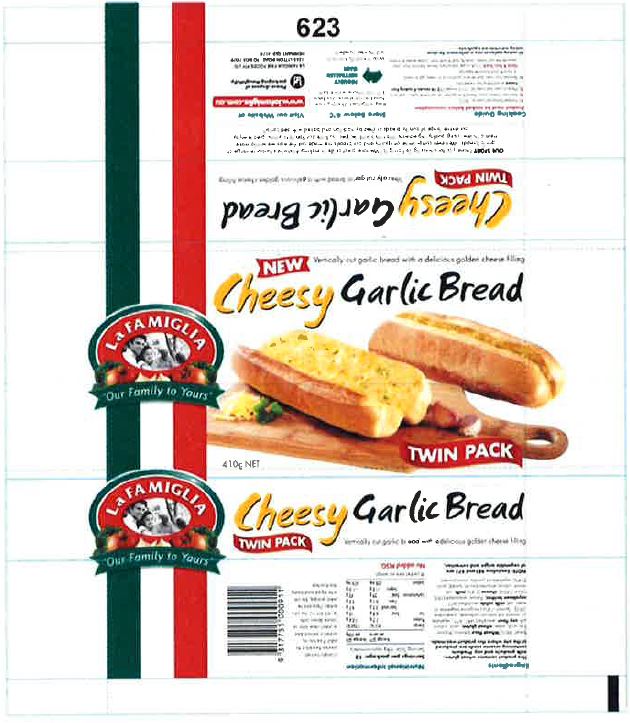
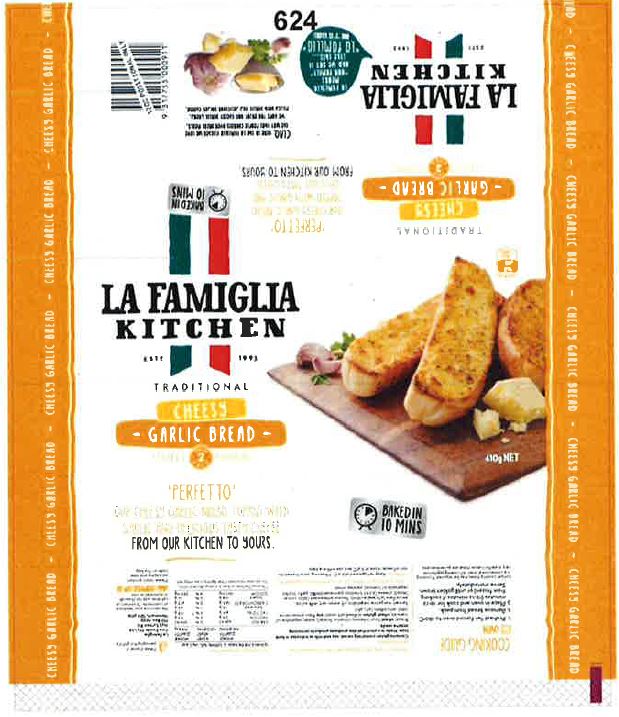
6. EXERCISE OF DISCRETION: S 88(1) AND S 101 | [255] |
6.1 Introduction | [255] |
6.2 Relevant law concerning the exercise of discretion | [262] |
6.2.1 Section 101(2) | [262] |
6.2.2 Section 88(1) | [273] |
6.2.3 “Goods of the same description” and “similar goods” | [275] |
6.3 Consideration: exercise of discretion | [287] |
6.3.1 The 473 word mark and the 906 composite mark | [287] |
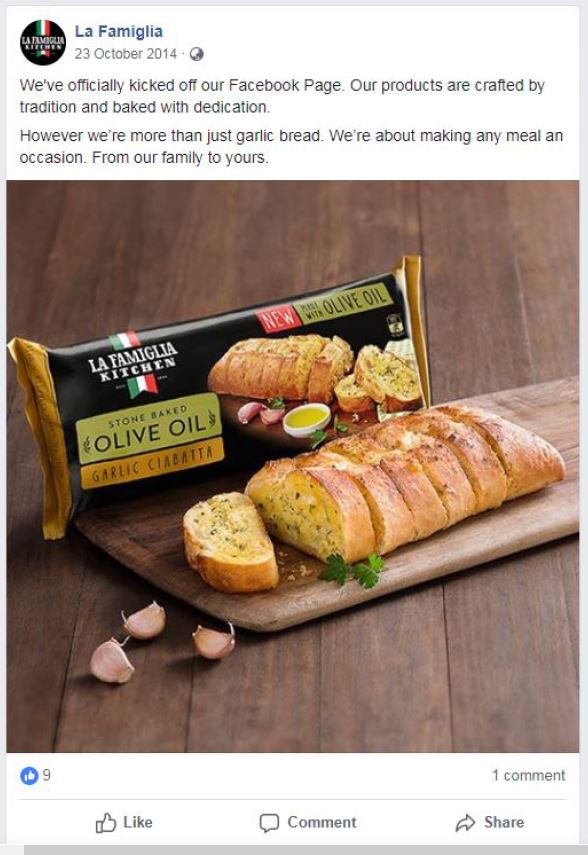
6.3.2 The 2015 marks | [315] |
6.4 Conclusions in relation to rectification | [318] |
7. INFRINGMENT | [319] |
7.1 Introduction | [319] |
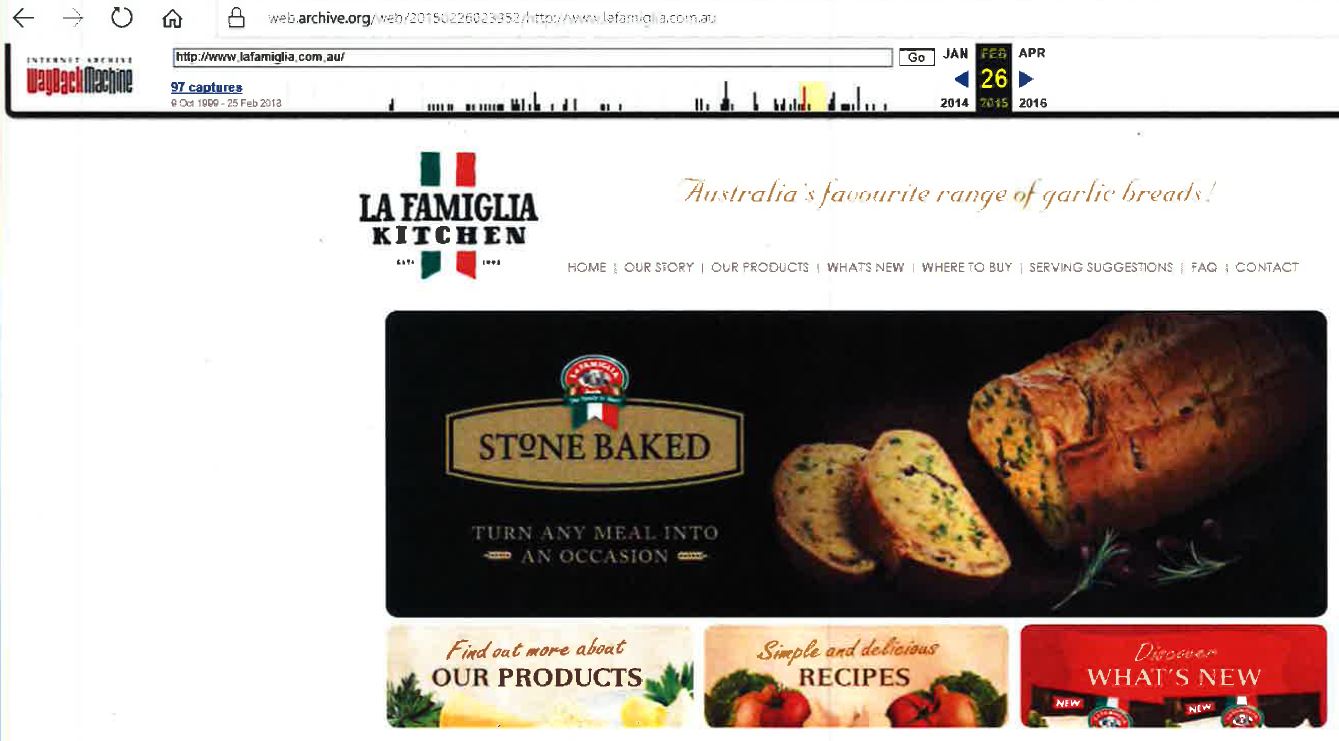
7.2 The impugned use by the respondents | [321] |
7.2.1 The Rana mark | [321] |
7.2.2 The words “LA FAMIGLIA RANA” | [324] |
7.3 Deceptive similarity | [326] |
7.3.1 Relevant law | [327] |
7.3.2 The Rana mark | [340] |
7.3.3 The words “LA FAMIGLIA RANA” | [353] |
7.4 Are pasta products the same goods as any of the registered goods? | [355] |
7.5 Are filled pasta products goods of the same description as the registered goods? | [358] |
7.6 Does the defence under s 120(2) apply? | [361] |
8. CONCLUSION | [369] |
BURLEY J:
1. INTRODUCTION
1 Trade mark cases often metastasize from simple disputes about easily identified issues into something bigger. This case is no exception. At its centre is whether the respondents are able to use the words “La Famiglia Rana” as a sign to designate their fresh pasta products in the face of the applicants’ trade mark registrations for the words “La Famiglia” in relation to bread, particularly garlic bread. The respondents anticipated a problem when they launched their products in Australia, and tried to clear the way by seeking to revoke six of the applicants’ trade marks for non-use. The applicants then sued for infringement of two of those marks. The respondents then cross claimed, alleging the marks lacked distinctiveness and that the applicants did not have the requisite intention to use them as at their filing dates. The result is a somewhat messy case requiring a matrix of decisions concerning whether and how, over a period of some 20 years, the applicants have used their six marks. Only after that had been determined could the central question of infringement be decided. The case raises issues about whether “La Famiglia Rana” in the form that it has been used by the respondents is deceptively similar to “La Famiglia” and whether bread, and in particular garlic bread, falls within the definition of “goods of the same description” as fresh pasta. It also involves consideration of whether “La Famiglia” as a trade mark is sufficiently distinctive to remain on the Trade Marks Register, the extent to which the six trade marks have been used or were intended to be used, and the proper scope of the exercise of a discretion to remove designated goods from the Register when they have not been used.
2 In the end, I have decided in favour of the applicants, although it has not all gone one way. The applicants abandoned two of the six marks in closing submissions, and as a result of my decision must significantly narrow the scope of the designated goods for the remaining four. But enough of the designated goods for each of the asserted marks are to remain on the Register to enable me to conclude that the respondents have infringed those marks, for the reasons set out in quite a lot of detail below.
1.1 The trade marks
3 In 1993 a small, family owned business called La Famiglia Fine Foods Pty Ltd (LFFF) (the second applicant) began producing and selling garlic bread. It later branched out into herb bread, restaurant style pan bread and crusty garlic rolls. Business flourished and LFFF was subsequently acquired by a company within the Goodman Fielder Group, Goodman Fielder Pte Ltd (the first applicant) in December 2005. I refer to LFFF and Goodman collectively as the applicants. Over time LFFF registered a number of trade marks in class 30 which consisted of or included the words LA FAMIGLIA:
(a) Trade mark number 701727 (727 composite mark) was filed on 5 February 1996 and is in the following form:

(b) Trade mark number 1130187 (187 word mark) is for the words LA FAMIGLIA TAKE AND BAKE and LA FAMIGLIA TAKE ‘N’ BAKE. It was filed on 16 August 2006;
(c) Trade mark number 1155473 (473 word mark) is for the words LA FAMIGLIA and was filed on 8 January 2007;
(d) Trade mark number 1171906 (906 composite mark) was filed on 19 April 2007 and is in the following form:
(e) Trade mark number 1689133 (133 word mark) is for the words LA FAMIGLIA KITCHEN, and trade mark number 1689131 (131 composite mark) is in the following form:
Both the 133 word mark and the 131 composite mark were filed on 23 April 2015, and I refer to them together as the 2015 marks.
The goods in respect of which the 473 word mark, the 906 composite mark and the 2015 marks are registered are set out in the annexure to these reasons, and where necessary I refer to these as the 473 original goods, the 906 original goods, and the 2015 original goods.
4 Each of the marks was assigned by LFFF to Goodman in 2017, but the assignment was not recorded on the Register of Trade Marks until March 2018. With respect to the use of the marks, no point is taken by the respondents arising from the fact that until March 2018 it was LFFF rather than Goodman who was the owner of the marks.
5 Pastificio Rana SpA is a successful Italian company that has since 1962 made and distributed fresh pasta. On 23 February 2017 Rana filed trade mark application number 1827822 for the following composite mark (Giovanni Rana mark):

6 This mark was accepted and registered in January 2018.
7 On 22 September 2017 Rana filed trade mark application number 1875074 for the following composite mark (Rana mark):
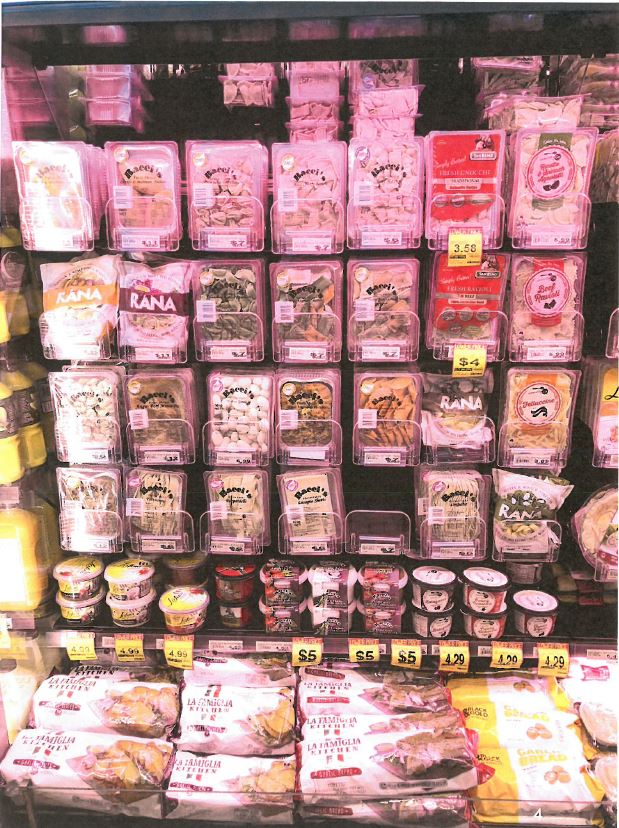
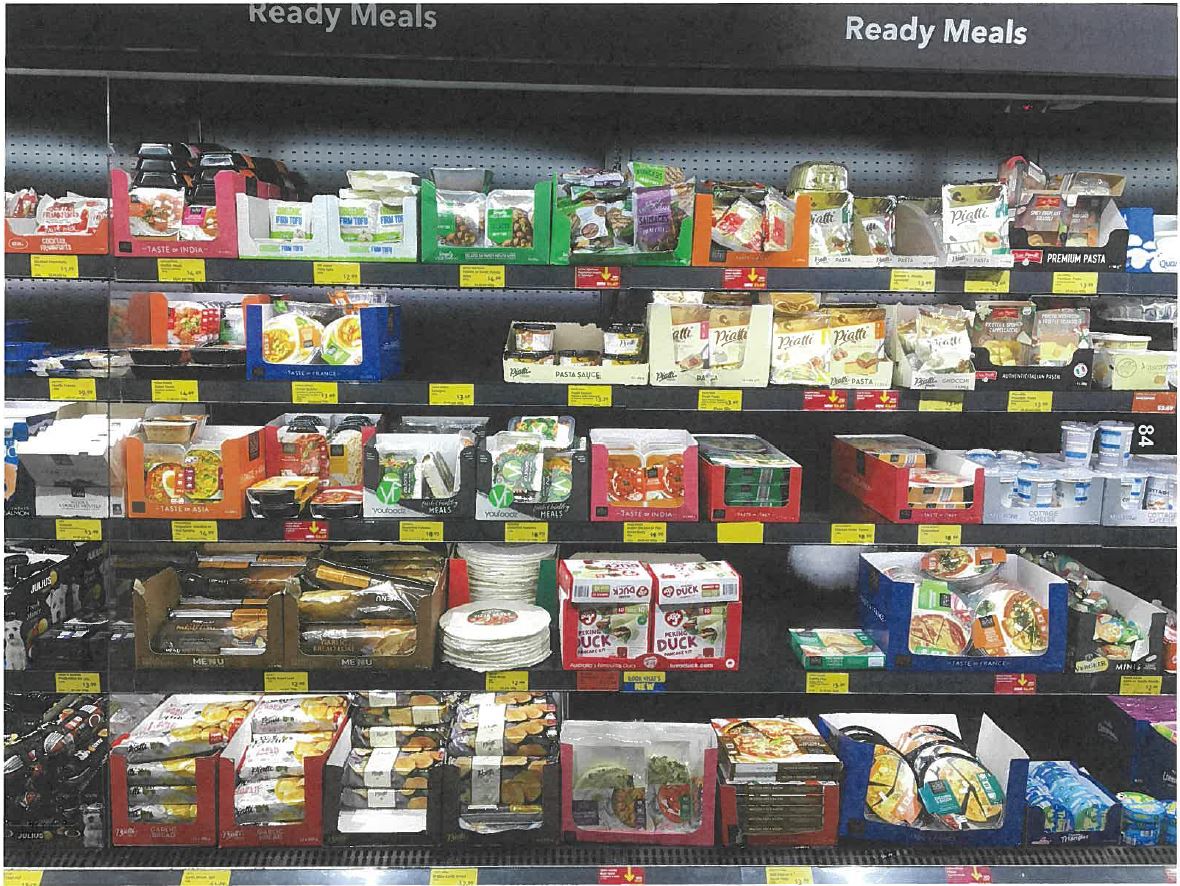
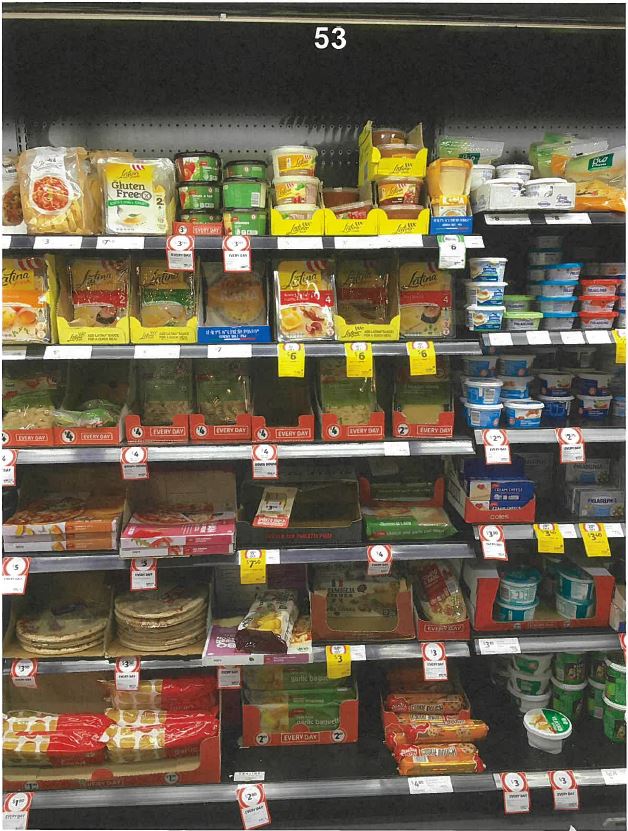
It seeks registration in class 30 in respect of:
Precooked, fresh, or frozen meals consisting primarily of pasta or rice; pizza; pasta; pasta with fillings, including tortellini, tortelloni, ravioli, cappelletti, flour-based gnocchi; condiments; sauces.
8 The application to register the Rana mark was deferred on 21 February 2018, pending the resolution of the issues in these proceedings.
1.2 The dispute
9 In November 2017 Conga Foods Pty Ltd began importing Rana pasta products into Australia for distribution and sale. The packaging of the Rana pasta products includes the Rana mark.
10 In their amended statement of claim the applicants allege that Rana and Conga (collectively, respondents) have infringed the 473 word mark and the 133 word mark in breach of s 120 of the Trade Marks Act 1995 (Cth). They seek declarations of infringement, injunctive relief, delivery up and pecuniary relief for trade mark infringement. They also seek an order that Rana withdraw the application to register the Rana mark. In their amended defence the respondents deny that the use alleged constitutes the use of a sign that is deceptively similar to these word marks.
11 The issues arising from the applicants’ claim concerning the application of s 120 of the Trade Marks Act are: first, the identification of the impugned use by the respondents; secondly, whether or not that use is deceptively similar to the asserted 473 and/or 133 word marks; thirdly, whether or not the use is in relation to the same goods, or goods of the same description, as the goods in respect of which those two word marks are registered; fourthly, whether the respondents’ use is not likely to deceive or cause confusion; and fifthly, what, if any, is the appropriate relief.
12 On 2 January 2018 and 13 February 2018, before the infringement proceedings commenced, Rana filed non-use applications for the rectification of the Register in respect of the applicants’ trade marks before the Registrar of Trade Marks. Upon the commencement of the infringement proceedings, the non-use applications were referred to this Court by the Registrar pursuant to s 94 of the Trade Marks Act and incorporated into the amended statement of cross claim advanced by the respondents.
13 In their cross claim the respondents contend that each of the six trade marks currently owned by Goodman and identified above ought to be cancelled or amended pursuant to either s 88 or s 92 of the Trade Marks Act. Although the respondents press for the revocation of the impugned marks in their entirety, as will be seen below, much of the evidence and legal debate concerns the identification of which particular designated goods in respect of which each mark is registered ought to remain on the Register.
14 The issues that arise on the cross claim are: first, whether the Register ought to be amended to limit the goods in respect of which each of the Goodman marks is registered to “bread and bread products” only, because at the respective filing dates of the trade marks LFFF lacked a bona fide intention to use the marks in respect of goods other than bread and bread products within s 59 or s 92(4)(a) of the Trade Marks Act; secondly, whether there has been use of the Goodman marks during their respective non-use periods within s 92(4)(b) of the Trade Marks Act; thirdly, whether the Goodman marks ought to be cancelled on the ground that they are signs that are not inherently adapted to distinguish or do not in fact distinguish the applicants’ goods from the goods of other persons within s 41 of the Trade Marks Act; and fourthly, whether the Goodman marks ought, in the exercise of discretion, not to be removed from the Register in respect of all or any of the goods in relation to which each mark is registered within either s 88(1) or s 101 of the Trade Marks Act.
15 The Trade Marks Act was relevantly amended on 15 April 2013, with amendments brought about by the Intellectual Property Laws (Raising the Bar) Act 2012 (Cth) (RTB Act). These have most relevance to the section 41 ground, because the 2015 marks were filed after the introduction of the changes. Unless otherwise stated, references to the Trade Marks Act are to the post RTB version.
16 On 18 September 2018 I ordered that questions arising under the cross claim and the liability of the respondents for infringement, together with any questions of non-pecuniary relief should be heard separately and before questions of the quantum of any relief.
17 Significant portions of the evidence were the subject of confidentiality claims, although no formal application for a suppression order was made. I will direct that the parties confer and provide to my chambers the terms of a final confidentiality order, and propose any redactions to be applied to the published version of this judgment to reflect the scope of confidentiality sought to be preserved. Such redactions will, if appropriate, then be applied.
1.3 The designated goods
18 In the course of closing submissions the applicants indicated that they would not contest the non-use applications brought in respect of the 727 composite mark and the 187 word mark, with the result that they consent to an order for the removal of those marks from the Register pursuant to s 97(2) of the Trade Marks Act. I refer to the remaining four trade marks that are the subject of the cross claim collectively as the Goodman marks even though for a substantial period they were owned by LFFF. As the annexure to these reasons indicates, each of the 473, 906 and 2015 original goods included a large number of goods in class 30, ranging from “preparations made from or containing cereals” to “yoghurt based snack foods” to “chocolate”, “confectionary”, “coffee”, “drinks” and “baking powder”. In their closing submissions the applicants elected to reduce the range of goods for each trade mark to a much narrower subset. That election was appropriate having regard to the paucity of any evidence of use or intention to use the marks in relation to the majority of the 473, 906 and 2015 original goods.
19 The class 30 goods which the applicants seek to retain on the Register, and upon which the applicants rely in answer to the rectification suit brought by the respondents are as follows:
(a) In respect of the 473 word mark (473 designated goods):
Bread, bread rolls, buns, flat bread, pizza bases, pizza dough, ciabatta and focaccia bread and rolls; garlic bread; herb bread; cheese bread; bread sticks; frozen, chilled and shelf stable bread; foodstuffs having a base of rice, of flour or of cereals, also in the form of ready made dishes.
(b) In respect of the 906 composite mark (906 designated goods):
Pizza bases, pizza dough, ciabatta and focaccia bread and rolls; garlic bread; herb bread; cheese bread; bread sticks; frozen, chilled and shelf stable bread; foodstuffs having a base of rice, of flour or of cereals, also in the form of ready made dishes.
(c) In respect of the 2015 marks (2015 designated goods):
Pizza bases, pizza dough, ciabatta and focaccia bread and rolls; garlic bread; herb bread; cheese bread; bread sticks; sandwiches; frozen, chilled and shelf stable bread; foodstuffs having a base of rice, of flour or of cereals, also in the form of ready-made dishes.
20 The applicants submit that in the event that the Court finds that any of the Goodman marks are liable to be removed because a ground of rectification advanced by the respondents has been made out, then nevertheless the Court should exercise its discretion pursuant to either s 88 or s 101 of the Trade Marks Act not to remove from the Register the 473, 906 and 2015 designated goods, save that the underlined words “foodstuffs having a base of rice, of flour or of cereals, also in the form of ready made dishes” (the general foodstuffs category) in the 473 and 906 designated goods should be replaced by the words “Italian-style ready made dishes being rice and pasta-based meals such as risotto, lasagne and spaghetti bolognese” (the ready made meal category).
2. THE WITNESSES
2.1 The applicants’ witnesses
21 Christine Siow Yin Fung is the Head of Marketing – Retail at Goodman Fielder Consumer Foods Pty Ltd (GFCF). In her affidavit of 22 February 2019, she gives evidence that she has been employed by GFCF since January 2015. From 2005 to 2013 she worked in a number of different companies as a brand manager or marketing manager. In January 2015, she commenced work for the Goodman Group in the role of Marketing Manager – Specialty & Chilled Breads. In July 2015, she moved to the role of Marketing Manager – In Home Baking until November 2018, when she became Head of Marketing – Retail. In her current role she is directly involved with the retail brands of the Goodman Group’s business in Australia across all product categories.
22 Ms Fung gives evidence about the Goodman Group’s acquisition of LFFF and the acquisition of the Goodman marks from LFFF, as well as the history of the trade marks now owned by Goodman. She also gives evidence about the fast moving consumer goods industry, the LFFF chilled bread products (which consist of garlic, herb, pan bread, ciabatta and sourdough products), and evidence (some of which is confidential) about past and future proposed uses by the applicants of the Goodman marks. She annexes to her affidavit images of product packaging, print outs of various iterations of the website located at www.lafamiglia.com.au (Goodman website) from 1999 to 2018, and images from the Facebook page operated under the name “La Famiglia” (Goodman Facebook page). She also gives evidence about marketing and promotional advertising undertaken by the applicants.
23 In her second affidavit Ms Fung provides evidence of a Facebook message she caused to be sent to a consumer who enquired about the relationship between the applicants and one of Rana’s pasta products, and updates her evidence as to the Goodman Group’s current marketing plans and proposals in respect of the “La Famiglia brand”. In her third affidavit Ms Fung again provides a further update as to the Goodman Group’s current marketing plans and proposals in respect of the “La Famiglia brand”. Ms Fung was cross-examined.
24 Susan Carmel Charleson is the National Account Manager – Wraps and Chilled Bread at GFCF. She commenced her employment with that company in about December 2012 in the position of Victorian Account Manager in its Retail Baking and Grocery divisions. In March 2014 she moved to the role of National Account Manager for Metcash and Aldi. She worked across various retail grocery categories between March 2014 and July 2016 before becoming National Account Manager – Wraps and Chilled Bread within the Goodman Group’s retail division in about July 2016. She gives evidence about fast moving consumer goods, the retail sales of LFFF chilled bread products and other products under the trade marks in suit, and the promotion of those products. Ms Charleson was cross-examined.
25 Brett Darren Allan is Head of Category – Retail at GFCF. He has been employed in that position since 2018, and has been employed by GFCF since 2013. He has been working in various roles in the fast moving consumer goods industry for about 20 years. He gives evidence about a confidential annexure to his affidavit that is a presentation dating from around October 2018 using data from a company called “Quantium” that collects data from the physical scanning of products and loyalty cards at supermarket checkouts. Mr Allan was cross-examined.
26 Donna Joy Vicente is a Social Media Assistant employed by Resolution Media. Resolution Media is a third party digital marketing agency that manages social media accounts for various clients, including the Goodman Group. Ms Vicente gives evidence about a private message that was received on 6 June 2019 via the Goodman Facebook page, from a user who enquired as to whether a Rana pasta product was one of the applicants’ products, and her reaction to that message. She was cross-examined.
27 Deborah Jane Loosley is the founder and director of TRIO Marketing, a strategic brand and marketing consulting firm. Since 1981 she has worked in various marketing roles, and in 1994 founded TRIO. She was engaged by LFFF in July 2001 as its Marketing Manager to develop a strategic marketing plan for its LA FAMIGLIA brand of garlic bread and other food products. She continued to consult to LFFF until it was acquired by the Goodman Group and thereafter consulted to the Goodman Group until October 2006. She gives evidence about LFFF’s strategic marketing plan and various forms of the LA FAMIGLIA trade marks used on products and in advertising during her period of tenure as marketing consultant for LFFF and later the Goodman Group. She was cross-examined.
28 Isobel Sarah Taylor is a solicitor employed by Norton Rose Fulbright. She attended the State Library of New South Wales and took photographs of advertisements of LFFF chilled bread products in various editions of the Super Food Ideas magazine and Table magazine in 2006. She was not cross-examined.
29 Harrison Hunter Ottaway is a solicitor employed by Norton Rose Fulbright. He gives evidence of photographs that he took of the chilled food products section in three supermarkets located in Melbourne in February, October and November 2018 where Rana pasta products were on display. He purchased the products and took photographs of those as well. Mr Ottaway also annexes pages from www.rana.com.au (the Rana website), and the Facebook and Instagram pages operated under the name “La Famiglia Rana” (respectively, the Rana Facebook page and the Rana Instagram page), as at October and November 2018. He was not cross-examined.
30 Louis John Lao is a solicitor employed by Norton Rose Fulbright. His affidavit annexes extracts from various websites dated between November and December 2018 about: the use of the Goodman marks on the Facebook page and website operated by Goodman Fielder Food Service; promotions of the LFFF chilled bread products; the “bundling” by supermarkets of pasta and bread products; a visit he made to an Aldi supermarket in December 2018; and extracts from various Coles and Woolworths supermarket catalogues ranging in date between early-2013 and late-2018. He also annexes versions of the Rana website, Rana Facebook Page, Rana Instagram page, and a YouTube page operated under the name “La Famiglia Rana” (Rana YouTube page). He was not cross-examined.
31 D’arcy Lawrence Hope is yet another solicitor employed by Norton Rose Fulbright. Like Mr Ottaway, he gives evidence about the chilled product sections of various supermarkets which he attended in January 2019, including the availability of the Rana pasta products and their proximity to LFFF’s chilled bread products. He also gives evidence about LFFF chilled bread products appearing in Woolworths and Coles catalogues between December 2014 and February 2018. He was not cross-examined.
2.2 The respondents’ witnesses
32 Federico Chiavegatti is the Commercial and Marketing Director Europe of Rana. In 1996 he obtained a degree in Business Administration from L.Bocconi University in Milan. He has over 20 years of experience in marketing, including over 15 years working for Rana in a number of brand and marketing roles. He has been employed by Rana since 2004 and has variously occupied the positions of Export Brand Manager, Marketing Manager – Italy, Marketing Director – Italy, and has held his current role since 2016. He explains that in his present role he is responsible for commercial and marketing matters in all countries in the world except for the United States, Canada and Mexico. Mr Chiavegatti gives evidence about the history of Rana and the development of the Rana brand, including the logos used by Rana and the design of the Rana mark. He gives evidence about the promotion and advertising of Rana pasta products and the events that led to Rana’s entry into Australia with the Rana mark. He also gives evidence about the use of the words “la famiglia” by other traders in Italy, and responds directly to the allegations made by the applicants. Mr Chiavegatti was cross-examined.
33 Daniel James Thompson is Chief Sales and Marketing Officer at Conga. Prior to his recent appointment to that position, he was General Manager, Sales and Marketing, from March 2016. From April 2013 to March 2016 he was the National Business Manager for Conga. He has over 14 years’ experience in sales and marketing, and has held sales, marketing and management positions in Balfours Bakery Pty Ltd and L’Oreal. He gives evidence about the background to the business of Conga, the development of the relationship between Conga and Rana, the introduction, promotion and advertising of Rana pasta products in Australia, the placement of those products in major supermarkets in Australia, and of the absence, so far as he is concerned, of any confusion between those products and any other trader. He was cross-examined.
34 Francesca Stephanie Sian Lee Teng is a solicitor employed by Clayton Utz. She exhibits documentary evidence of: the use of the Rana mark on the Rana website and Rana Facebook and Instagram pages; the promotion and offer for sale of Rana pasta products in Australia; translations of the word “family” into various other languages; searches she conducted to identify businesses which use foreign language translations of the word “family” in their business name; searches she conducted on various websites to identify products with “la famiglia” in their name; statistics taken from the Australian Bureau of Statistics Census Data; various websites that have used or referred to the Goodman marks; various websites that have used or referred to the “Latina Fresh” and “Leggos” brands; and photographs of displays of Rana pasta products in supermarkets. She was not cross-examined.
35 Brett Chapman Doyle is a solicitor employed by Clayton Utz. He annexes or exhibits the results of searches of the online trade marks records of IP Australia and the WIPO Global Brand Database for marks containing the word “family” in English and in various other languages. He was not cross-examined.
36 Dean Gerakiteys is a solicitor employed by Clayton Utz. He gives evidence about attending the Rookwood Necropolis in Lidcombe, New South Wales, where he observed a number of family vaults displaying the words “Famiglia” or “Famiglie”. He also exhibits various DVDs and pages from the Dymocks website. He was not cross-examined.
37 Beth Victoria Miller is a paralegal employed by Clayton Utz. She exhibits photographs of the refrigerated units displaying the Rana pasta products for sale at about 20 different supermarkets located in and around Sydney between 1 June 2018 and 2 February 2019. She was not cross-examined.
3.1 Chronology of trade mark use by the applicants
38 The cross claim for rectification raises questions going to when and how each of the Goodman marks has been used, both before and after the 2007 and 2015 filing dates. Before addressing each ground of revocation it is convenient to set out some relevant findings of fact which have been drawn from the evidence and an agreed chronology.
3.1.1 Use from 1999 to 2007
39 Evidence of the Goodman website as at 24 August 1999 shows that the 727 composite mark and the 473 word mark were in use from at least that date. There is only one page of the 1999 Goodman website in evidence, which shows the 727 composite mark in colour in the top left corner of the page. The page is headed “July and August Recipe”, and provides a recipe for “wilted baby spinach and melted parmesan on La Famiglia Herb Bread”. There are no website pages in evidence for 2000, but the captures from 2001 again show the use of the 727 composite mark in the top left corner of the page, and the 473 word mark is used on the “about us” page, for example: “All of La Famiglia’s products have been designed so consumers can make them into a meal with ingredients generally found in the pantry”.
40 Exhibited to Ms Charleson’s affidavit is confidential evidence of sales data relating to LFFF’s products, sourced from Information Resources, Inc (IRI). IRI keeps a record of retail sales of fast moving consumer goods made by Coles, Woolworths and Metcash. IRI data is provided from 2001 to 2018, and records the total number of units of LFFF products sold, and the sales revenue of those products. Each of the products listed in the IRI data begins with the 473 word mark, for example “La Famiglia Bread Herb”, and “La Famiglia Bread Garlic Cheesy”. Although the IRI data cannot be matched with the product packaging or composite marks used from time to time, the evidence permits me to infer that there was some continuity and consistency of packaging and trade mark use in respect of the products listed.
41 The IRI data shows substantial supermarket sales of LFFF products in 2001 ($XXXXXXX). This amount consists primarily of sales of LFFF chilled bread products, though there are also some sales of a product identified as “La Famiglia Pizza Garlic Style 385g” which achieved sales of $XXXX in 2001, but that product does not appear to have been sold in subsequent years.
42 In around 2001, LFFF engaged Ms Loosley (through her company TRIO) as LFFF’s Marketing Manager. Ms Loosley gives evidence about her knowledge of the use of the 473 word mark and the 906 composite mark between 2001 and 2007. She explains that TRIO was engaged to assist in the development of strategic marketing for LFFF’s “La Famiglia brand” from 2001 until October 2006. During that time she observed iterations of various composite marks being used in conjunction with various products, but the consistent use of the 473 word mark.
43 Ms Loosley gives evidence that in about 2001 or 2002 she developed the following mark, which I refer to as the hybrid mark:
In colour, it features an oval shaped green disk of four colours, starting with a green outline, a thin inner white band, a dominant red band on which the words “LA FAMIGLIA” appeared above ears of wheat, and the centre in yellow background with a black and white image showing the heads of two parents and a child above a band saying “such good taste”.
44 Ms Loosley’s evidence is that the hybrid mark was introduced to the public in about April 2002 through a print and television advertising campaign. Ms Loosley gives evidence that in 2002, as a consequence of the rebranding to use the hybrid mark, she was involved in writing copy and preparing content for a redesign of the Goodman website. Website captures show that by at least September 2002 the hybrid mark had replaced the 727 composite mark in the top left corner of the page. The 473 word mark was still being used to describe the company and LFFF’s products, for example, “La Famiglia is Australia’s favourite garlic bread…”. The hybrid mark and the 473 mark continued to be used on the Goodman website throughout 2003, 2004, 2005 and 2006. For example, an entry on 21 July 2005 is headed “About La Famiglia” which describes the history of LFFF and identifies products by reference to the words “LA FAMIGLIA”. Such pages promote “La Famiglia Fine Foods” and LFFF products as “Australia’s No. 1 manufacturer and marketer of chilled specialty breads, servicing both domestic and export markets”.
45 IRI data for 2002 to 2004 shows substantial supermarket sales of LFFF chilled bread products totalling a combined $XXXXXX. Apart from use on the Goodman website and the IRI data there is no other evidence of use of any of the Goodman marks in 2003 and 2004.
46 Ms Loosley gives evidence that Goodman launched a new “salsa” product for sale in about 2005. She exhibits a “trade presenter” which displays the salsa product and the hybrid mark, and evinces various uses of the 473 word mark: for instance, the document promotes “Cross Promotional Opportunities with top-selling La Famiglia breads!”, identifies the Goodman website, and provides info@lafamiglia.com.au as a contact email address. She also exhibits photographs of the salsa packaging and a copy of a magazine advertisement for the salsa products, as well as a retail brochure listing several LFFF chilled bread products and the salsa product. These documents again show the hybrid mark and the 473 word mark. Usually the 473 word mark is used in the domain name for the Goodman website and/or email address, although on some documents it is also used to describe the advertised product, for example “La Famiglia Pan Bread”.
47 The respondents submit that it ought not be accepted that, on the balance of probabilities, the salsa product was sold. They acknowledge that “significant preparatory steps were taken” towards launching the salsa product, but submit it was never sold and rely on Ms Taylor’s evidence to prove a negative. She attended the New South Wales State Library and reviewed each monthly edition of the Super Food Ideas magazine and Table magazine from August 2006 until November 2006. She found no advertisements for any salsa product. She did, however, find advertisements for La Famiglia Really Cheesy Fingers, La Famiglia Café Italia fruit toast, La Famiglia Traditional Wholemeal Garlic Bread Slices and La Famiglia Baker’s Pride garlic bread.
48 Certainly, salsa was not included in any of the IRI data. However, as I have noted, there was marketing evidence concerning this product given by Ms Loosely, and in cross examination she had a specific recollection that there had been a product made available and placed on the market before her company ceased to work on the applicants’ account in October 2006. She explained that the absence of sales figures in the IRI data may be explained by the fact that salsa is in a different category of goods to chilled bread, but accepted that, in any event, there had only been a “very small amount” of salsa product sold.
49 Having regard to the evidence, including the images of the product in the marketing materials, I am satisfied that there was some use of the 473 word mark and the hybrid mark in respect of the salsa product. The evidence does not support a conclusion that sales of that product contributed in any meaningful way to the ability of the trade mark to distinguish within s 41(5) or (6) of the pre-RTB Trade Marks Act.
50 On 30 September 2005, LFFF was acquired by the Baking Division of Burns, Philp & Company Limited (Burns Philip).
51 In November 2005 a document prepared on behalf of LFFF by a research or strategy agency called “Torch” spoke of an “innovation pipeline” quickly to capitalise on the Goodman Group’s upcoming acquisition of the LFFF business (2005 Torch document). The contents of this and a number of other strategy and planning documents are relied upon by the applicants to demonstrate an intention to use the Goodman marks in respect of a range of products. They are addressed in more detail later in these reasons.
52 On 21 December 2005, the Goodman Group acquired certain businesses, including LFFF, from Burns Philip. Ms Loosley gives evidence that at the time the Goodman Group acquired LFFF the development and launch of the La Famiglia Café Italia fruit toast product was in progress. She recalls that that product was ultimately introduced to the public some time in 2006. As noted above, Ms Taylor’s evidence shows that the fruit toast product was advertised in Super Food Ideas magazine and Table magazine by at least mid-2006, and those advertisements incorporated the domain name for the Goodman website and the hybrid mark.
53 IRI data shows supermarket sales of LFFF products for the 12 months prior to 11 December 2005 were in the amount of $XXXXXX.
54 In April 2006 Ms Loosely prepared a brand plan for the LFFF products for financial year 2007 (2007 brand plan). The hybrid mark was used in this document.
55 Ms Loosley gives evidence that she observed that the applicants began to use the 906 composite mark first in late 2006 or early 2007. However, there are no examples in evidence of any promotional material or packaging in a form that includes the 906 composite mark in 2006 and 2007. As I note below, the first evidence of the use of that mark was when it was applied to a document in 2010.
56 The IRI data in respect of 2006 shows supermarket sales of LFFF products in the amount of $XXXXXXX, while sales in 2007 totalled $XXXXXX. In 2007 there were also sales of the New York Pizza Bread product in Coles in the amount of $XXXX. There are no screen captures in evidence showing what marks, if any, were used on the Goodman website in 2007. As noted above, the 473 word mark was filed on 7 January 2007, while the 906 composite mark was filed on 19 April 2007.
3.1.2 Use from 2008 to 2009
57 The confidential IRI data shows total supermarket sales of $XXXXXX in 2008 and $XXXXXX in 2009. It appears that some pizza base products were launched in 2009, as IRI data shows sales of a combined total of $XXXXX in respect of “La Famiglia Pizza Base Gourmet 550g”, “La Famiglia Pizza Garlic Bread/Prmsn 260g” and “La Famiglia Pizza Base Psly 250g”.
3.1.3 Use in 2010
58 By 2010 the applicants were promoting the LFFF chilled bread products under the 906 composite mark. Ms Fung exhibits a PowerPoint presentation apparently created in 2010 bearing Goodman’s name and entitled “Pasta Sauce Category” (2010 Presentation).
59 Ms Fung also exhibits a presentation given by Goodman to Woolworths dated May 2010 entitled “La Famiglia NPD [New Product Development] Workshop” (2010 Woolworths Presentation).
60 No screen captures of the Goodman website as it appeared in 2010 were tendered. The IRI data indicates supermarket sales of LFFF chilled bread products were in the amount of $XXXXX in the 12 months prior to 5 December 2010, and sales of pizza bases were in the amount of $XXXXXX.
3.1.4 Use in 2011
61 In 2011 the 473 word mark and/or the 906 composite mark were used on the Goodman website in conjunction with at least the following products: LFFF chilled bread products; gourmet pizza bases; Italian cheese melt; and restaurant style pizza breads. The IRI data shows supermarket sales of LFFF products were in the amount of $XXXXXX, including $XXXX in respect of pizza bases, for the 12 months prior to 4 December 2011.
3.1.5 Use in 2012
62 Ms Fung exhibits a Goodman PowerPoint presentation dated 29 November 2012 entitled “La Famiglia Kitchen Pre-Read: Steer-Co Update” (2012 Steering Committee Presentation).
63 The 906 composite mark and 473 word mark continued to be used on the Goodman website in 2012, in conjunction with products such as traditional garlic bread and traditional sourdough loaf with garlic butter. The IRI data shows supermarket sales of $XXXXX in the 12 months prior to 2 December 2012. No pizza bases were recorded as sold during this period.
3.1.6 Use in 2013
64 The 2013 product packaging shows that both the 906 composite mark and the 131 composite mark were applied to packaging of different LFFF chilled bread products. For example, the packaging of the cheesy garlic bread twin pack was:
The 2013 packaging of another cheesy garlic bread product was:
65 Mr Lao gives evidence that he accessed a website called Catalytics at https://catalytics.com/, where he browsed a number of Coles and Woolworths product catalogues dated between 2013 and 2018. During his review, he took screenshots of:
(1) Promotions of Goodman’s products alone;
(2) Promotions of Goodman’s products with fresh pasta products in “meal deals”;
(3) Promotions of Goodman’s products on the same page as fresh pasta products, but not in “meal deals”; and
(4) Promotions of third party garlic bread products in “meal deals” with third party pasta products. There are five examples of this sort of promotion in evidence, dated between November 2014 and June 2018.
66 Only one catalogue from 2013 is in evidence. It includes a promotion for “La Famiglia Stone Baked Sourdough Bread 330g-480g”, and the product packaging used in the catalogue displays the 906 composite mark.
67 The IRI data demonstrates that the applicants continuously sold in major supermarkets monthly volumes of chilled bread products such as garlic bread, parmesan pan style bread and herb bread. In the 12 months prior to 1 December 2013 the value of LFFF’s products sold through those supermarkets was $XXXXXX.
3.1.7 Use in 2014
68 In the 12 months prior to 30 November 2014 the IRI data shows supermarket sales of $XXXXXX. Ms Fung gives evidence of total amounts of direct marketing expenditure and promotional activity expenditure for the “La Famiglia brand” during the period from 2014 to 2018. In 2014 the applicants spent $XXXXXX.
69 In catalogues published by Coles and Woolworths throughout 2014 the 906 composite mark is almost always used on LFFF chilled bread product packaging, whether the product is promoted alone, in conjunction with pasta products, or on the same page as pasta products. However, in a Coles catalogue dated 6 August 2014 the 131 composite mark is used instead in a promotion for “La Famiglia Sourdough Bread 330g-480g” alone.
70 Only the 906 composite mark, and not the 131 composite mark, was used on the Goodman website in 2014. The 906 composite mark was only used in relation to the LFFF chilled bread products.
71 Both the 906 composite mark and the 131 composite mark were used on LFFF chilled bread product packaging in 2014. The packaging samples that Ms Fung exhibits indicate that, as in 2013, products were sold with either the 906 composite mark or the 131 composite mark applied.
72 The first Facebook post on the Goodman Facebook page in evidence is dated 23 October 2014. It includes a photograph of a garlic bread product, with the 131 composite mark applied on the packaging. The page’s profile picture is the 131 composite mark with a black background, and the handle used is @lafamigliakitchen, although the page name is simply “La Famiglia” and not “La Famiglia Kitchen”:
73 Mr Lao and Ms Teng’s evidence of screen shots of the Goodman Facebook page shows use of the 131 composite mark in numerous posts from October 2014 to 5 December 2017. The 906 composite mark appears in very few of the Facebook posts in Mr Lao or Ms Teng’s evidence, and does not appear in any posts made in 2014. The 131 composite mark appears in almost every post that contains a photograph, whether on the advertised or promoted product or as a logo applied to the photograph. Occasionally the text of the post will refer to a product using the 473 word mark, for example “La Famiglia Stone Baked Garlic Bread”.
3.1.8 Use in 2015
74 Ms Fung gives evidence that from about October 2014 until December 2014 and then February 2015 to April 2015 the applicants ran an extensive advertising campaign they called “Sit-Down Comedians”. Australian actor Gyton Grantley was engaged as a “brand ambassador”, and the campaign used web advertisements, online videos, radio, social media and public relations. The materials exhibited demonstrate use of the 473 word mark, the 133 word mark and the 131 composite mark in respect of the LFFF chilled bread products.
75 Ms Fung also exhibits screenshots of posts made on the Goodman Facebook page between January 2015 and April 2016. These posts, which feature the 473 word mark (as both the name of the page, and in relation to specific products such as “La Famiglia Garlic Bread loaf”), the 131 composite mark (as the profile picture and occasionally in photographs) and the 133 word mark (as the “@” handle, and as a banner running across the top or bottom of many of the photographs), promote the consumption of LFFF chilled bread products with pizza and pasta. One post, dated 28 April 2015, displays a LFFF chilled bread product with the 906 composite mark applied to it. It appears to be the only post which uses the 906 composite mark.
76 From about February 2015 the Goodman website shows both the 906 and 131 composite marks being used in conjunction with the promotion of LFFF chilled bread products. Sometimes both marks were used together, as may be seen in the following screen shot of the website as at 27 February 2015:
The 473 word mark continued to be used to promote the company and its products on the “Our Story” page of the Goodman website.
77 Ms Fung exhibits screenshots of posts published on the Goodman Facebook page from June 2015 to October 2016 that promote the LFFF chilled bread products in conjunction with meals, cooking ideas or recipes. Each post typically uses the 131 composite mark, either on a photograph of a product, or in the bottom left or right of the photograph. Some also use the 473 word mark to describe Goodman products such as “La Famiglia Stone Baked Ciabatta with pure Garlic Butter”.
78 Ms Fung also gives evidence about and exhibits a confidential PowerPoint presentation dated 10 March 2015, which she instructed a creative agency called Bonney Creative to prepare (2015 Bonney Creative Presentation).
79 As noted earlier, the 2015 marks were filed on 23 April 2015. There is only one sample of 2015 product packaging available in the evidence. It is for “Just for 2 Garlic Loaf” and bears the 131 composite mark. In calendar year 2015 Goodman spent $XXXXX on marketing and advertising, and IRI data indicates that supermarket sales of LFFF chilled bread products in the 12 months prior to 29 November 2015 were in the amount of $XXXXXX. In the Coles and Woolworths catalogues in evidence, the 906 composite mark is typically used, though there are two instances where the 131 composite mark is used.
80 Ms Charleson gives evidence that she attended the “Metcash Expo 2015” on the Gold Coast in about July 2015, where a flyer exhibited to her affidavit (Metcash expo flyer) was given to store owners and head buyers of stores such as IGA and Foodworks. The flyer bears the 131 composite mark and suggests that stores can “Offer shoppers ready meal solutions for both lunch and dinner”. Some suggested “ready meal” packages include: “Winter Night In”, consisting of soup, garlic bread and chocolate mousse; “Pasta Night”, consisting of pasta, pasta sauce and garlic bread; and “Saturday Night Footy” consisting of garlic bread, pizza and cola. Only the garlic bread component of these packages includes a LFFF trade mark, usually the 906 composite mark, although in one instance the 131 composite mark is used. The other components are from third parties. Ms Charleson also exhibits a photograph she took of the applicants’ display stand at the Metcash Expo 2015, which shows a refrigerator stocked with various LFFF chilled bread products which use the 131 composite mark on their packaging, as well as third party products including salmon, sausages, chocolate mousse, pizza, and Coca-Cola.
81 Ms Fung gives evidence that between August 2015 and September 2017 Goodman ran an advertising campaign using the phrase or tagline: “MAKE THE FAMILIAR LA FAMIGLIA”. Advertising proofs and photographs of digital screen advertisements in shopping centres exhibited to Ms Fung’s affidavit evidence show that the advertisements were for garlic bread: they include the statement “Discover Australia’s best tasting garlic bread”. Many of the images used in the campaign show garlic bread accompanying pasta, lasagne or pizza. The mark used on the advertisements is not the 131 composite mark, but is rather the following mark which bears some similarities to the 131 composite mark but omits the words “kitchen” and “Est 1992”, as shown below:
This mark also appears in some of the videos posted to the Goodman Facebook page between 23 September 2015 and 15 October 2015, which are exhibited to Ms Fung’s affidavit. However, most photographs posted to the Goodman Facebook page use the 131 composite mark either on the product depicted or in the bottom left or right corner of the photograph.
82 Ms Charleson also exhibits a document which summarises the promotional materials that were used as part of the “MAKE THE FAMILIAR LA FAMIGLIA” campaign in Foodland stores between October and December 2015. These promotional materials display the 131 composite mark on product packaging, and encourage consumers to “buy any 2 La Famiglia products”, thereby using the 473 word mark. The advertisement itself (excluding the product packaging included within the advertisement) uses the mark identified at [81] above. Ms Charleson also exhibits several confidential PowerPoint presentations that were made in connection with the “Ritchies La Famiglia Dinner Drivers Challenge”, which took place between 7 October 2015 and 17 November 2015 (Ritchies presentations). These presentations, and photographs within them, use the 473 word mark, the 906 composite mark, the composite mark set out at [81] above, and the tagline “MAKE THE FAMILIAR LA FAMIGLIA”. One of the presentations instructs Ritchies store owners to display La Famiglia chilled breads in proximity to third party products for certain periods of time, including in proximity to pizzas, Coca-Cola varieties, mince meat, pasta sauce, salad mix and chicken fillets.
3.1.9 Use in 2016
83 Ms Fung gives evidence of a campaign called “Just for 2” which was run in 2016 and which was intended to promote the launch of a new garlic bread product. She exhibits screenshots of posts on the Goodman Facebook page made as part of this campaign which contain photographs depicting the use of the 131 composite mark on product packaging. She also exhibits advertising mock ups for the Coles website which features the 131 composite mark as well as the “MAKE THE FAMILIAR LA FAMIGLIA” tagline.
84 The applicants spent a total of $XXXXX on advertising and marketing in 2016. Throughout 2016 there remained some dual usage of the 131 composite mark and 906 composite mark on the home page of the Goodman website, as in the example given in [76] above. On other pages, such as pages dedicated to particular products, only the 131 composite mark is used, along with the 473 word mark. However, by 2016 the applicants’ product packaging appears exclusively to use the 131 composite mark, not the 906 composite mark. The IRI data shows supermarket sales of LFFF chilled bread products in the amount of $XXXXXXX in the 12 months prior to 27 November 2016. There was some use of the 906 composite marks in Coles and Woolworths catalogues in early 2016, but by July 2016 the 131 composite mark was being used.
3.1.10 Use in 2017
85 On 1 January 2017 LFFF assigned the Goodman marks to Goodman, although that assignment was not recorded on the Register until 2 March 2018.
86 Ms Charleson exhibits a Coles “meal deal” offer which she saw on 3 May 2017, which consisted of the joint promotion of pizza, pasta, pasta sauce and garlic bread products. None of these products are LFFF products, nor do they use any of the Goodman marks.
87 Ms Fung exhibits confidential evidence of data collected by a third party agency acting for the applicants which indicates that in the week of 3 July 2017 social media promotions of the general advertising of the “La Famiglia brand” was of in excess of 5 million impressions. The materials in the promotions indicate that impressions in the order of 650,000 were achieved for post about an “Antipasto plate” that featured a photograph of the applicants’ ciabatta on an antipasto plate, with the 131 composite mark in the bottom right of the photograph, accompanied by the words “A romantic dinner for two can be as simple as a rustic antipasto plate. And instead of plain bread why not try La Famiglia Stone Baked Traditional Ciabatta?”. Other promotions for LFFF chilled bread products are also depicted in the document.
88 Ms Charleson exhibits several Coles meal deal promotions which she saw between 8 November 2017 and 30 May 2018. Each of these advertises either La Famiglia Garlic Bread Slices or La Famiglia Stonebaked Garlic Bread in conjunction with Latina branded filled pasta and Latina branded pasta sauce. The 131 composite mark is used both on the product packaging for the LFFF chilled bread product, and in the bottom right corner of the promotion in conjunction with the Latina logo.
89 The IRI data shows that in the 12 months prior to 26 November 2017 LFFF chilled bread product supermarket sales were in the amount of $XXXXXXXX. $XXXXXX was spent on advertising and marketing. There are only two examples of 2017 product packaging available in the evidence, and both feature the 131 composite mark only. The home page of the Goodman website continued to feature both the 906 composite mark and the 131 composite mark, while other pages used only the 131 composite mark, but identified products using the 473 word mark. The 906 composite mark was used in a Woolworths catalogues dated 1 and 22 February 2017. After that time, the 131 composite mark was used in catalogues published in 2017.
3.1.11 Use in 2018
90 Ms Fung gives evidence about and exhibits a confidential three year marketing plan dated July 2018 (2018 Goodman Plan).
91 Ms Fung also exhibits and gives evidence about a confidential PowerPoint presentation prepared by her colleague, Head of Marketing – Baking Ms Sterling-Lewis, in September 2018 entitled “La Famiglia’s positioning has evolved over time....” (2018 Evolved Over Time Presentation).
92 Exhibited to Mr Lao’s affidavit are a screen shots taken on 30 November 2018 from the Woolworths website at www.woolworths.com.au. Those screenshots show that as at that date Woolworths promoted certain “bundles” of products, such as one consisting of Leggos Ricotta and Roast Vegetable Tortellini, Leggos Creamy Tomato Sauce and La Famiglia Just for 2 Garlic Bread Slices. The webpage shows an image of the Just for 2 Garlic Bread product packaging, which uses the 131 composite mark.
93 The 2018 product packaging in evidence shows use of the 131 composite mark only. In the two 2018 Woolworths catalogues in evidence, the 131 composite mark is used. IRI data shows that supermarket sales of LFFF chilled bread products in the 12 months prior to 25 November 2018 totalled $XXXXXXX. The applicants spent $XXXXXX on marketing and advertising in 2018. In February 2018 the Goodman website continued to display both the 906 and 131 composite marks, but there are no screen shots of the Goodman website after February 2018 in evidence. In her 4 September 2019 affidavit Ms Fung gives evidence that the Goodman website has not been working since about September to December 2018.
3.1.12 Use in 2019
94 In her affidavit affirmed on 4 September 2019, Ms Fung gives confidential evidence that no new product lines under the “La Famiglia brand” were launched by the applicants between the Goodman 2018 plan and the date of her affidavit. XXX XXXX XXXXXX XXXXX XXXX XXXXX XXxXXX XXXXXX XXXX XXXXXX XXXXX XXXXXXX XXXXX XXXX XXXXXX. She gives evidence that as at September 2019, Goodman’s Baking Marketing Team was working on a draft La Famiglia brand plan (2019 draft brand plan), a confidential copy of which was annexed to her affidavit. In her third affidavit, affirmed on 21 November 2019, Ms Fung annexes the confidential final version of the brand plan (2019 final brand plan).
3.2 The Quantium data presentation
95 In October 2018 a document was prepared by the applicants using data collected by an organisation called Quantium (the Quantium data presentation). As mentioned above, Quantium collects data from the physical scanning of products and loyalty cards at supermarket checkouts. One form of data provided by Quantium is “basket affinity data”, which is compiled by aggregating supermarket baskets and identifying associations between products within each basket. It is said to represent a measure of the likelihood of two products being purchased in the same transaction. Mr Allan gives evidence that the Quantium data presentation was prepared for the purposes of an internal Goodman presentation concerning the “basket affinities” of various products in the LFFF chilled bread product range. It addresses basket affinity for the 26 weeks prior to 18 September 2018. Based on the figures set out, Mr Allan interprets the data as predicting that if a customer has La Famiglia Stone Bake Ciabatta 330g in their basket, they are XXXX times more likely also to have in their basket XXXX XXXX XXXXXXX XXX XXX XXX, and XXX times more likely to also have XXXX XXXX XXX XXX. The figures also indicate that customers having 400g La Famiglia Garlic Bread in their basket are XXXX times more likely to have XXXXX XXX XX and XXXX times more likely to have XXXX XXXX XXXX XXXXX XXX.
96 There is no evidence as to how Quantium calculates the figures identified, the assumptions made in the figures, or adjustments made to the underlying data. No witness from Quantium was called to give evidence.
97 There are a number of difficulties in reaching conclusions based on the Quantium data to which Mr Allan refers. One is the sample size. As Mr Allan readily accepted, the degree of affinity between products is based on a very small number of individual shoppers displaying the relevant behaviour. Additionally, the figures do not expressly account for the prospect that a consumer: (a) purchased the two products with no thought that they may be connected; (b) was induced by a sale price or promotion that induced the purchase rather than any affinity; and/or (c) responded to a “meal deal” offering in selecting the two products in the same basket.
98 Taken as a whole, and given the lack of evidence in relation to the calculation of the figures, I am sceptical of the value of the Quantium basket affinity data and I give it no weight.
3.3 The display of chilled products in supermarkets
99 In evidence are numerous photographs depicting the manner in which chilled items are displayed and sold in supermarkets. They are placed by retailers using various different methods of organisation.
100 Ms Charleson gives evidence about the positioning of LFFF chilled bread products on shelves in supermarkets. She accepted that the applicants only sell refrigerated bread products under the La Famiglia brand. She describes the LFFF chilled bread products as “bake-at-home” products, which are not to be eaten straight from the packet, but which require cooking first. I accept that garlic bread, herb bread and cheese bread are goods within the designated goods for each of the Goodman marks that are necessarily displayed in refrigerated shelving because they contain perishable ingredients.
101 Ms Charleson in her evidence in chief says that the applicants work with retailers to position the LFFF chilled bread products on shelves “adjacent to meals they are typically consumed with, such as pasta, pasta sauce, pizza bases and pre-made meals”. She refers to this positioning as “complementary presentation” of products, and gives evidence that it is a means by which retailers provide consumers with what she terms a “meal solution”.
102 In cross-examination it became apparent that such a targeted approach is not uniform. The applicants do not themselves have control over where their products are stocked on shelves, leaving aside the fact that as chilled bread products they must be put into the refrigerated section. It was not uncommon for retailers to place the LFFF chilled bread products close to products that are not likely to be eaten together with garlic bread as a meal, such as uncooked pastry, cookie dough, chilled wontons, chilled Asian noodles, or bacon.
103 Although in her evidence in chief Ms Charleson emphasises the proximity of Italian meals such as pasta and pizza to the LFFF chilled bread products, in the Metcash Expo flyer it is apparent that the applicants promoted to Metcash the placement of LFFF chilled bread products with a variety of meals including: salad, salad dressing and sausages; soup and chocolate mousse; smoked salmon; as well as with Italian meals of pasta and pizza.
104 Some sample supermarket displays are depicted below.
105 In June 2018 Ms Miller attended a Supabarn located in Gymea, New South Wales, and took the following photograph:
The photograph shows a range of fresh pasta products, including the Rana pasta products, as well as third party pasta products, displayed above a small selection of pasta sauces. Below the pasta sauces is a selection of LFFF chilled bread products, as well as one third party garlic bread product.
106 In December 2018 Mr Lao attended an Aldi store in Campberwell, Victoria, and took the following photograph of the “Ready Meals” section:
Mr Lao’s photograph shows a number of products on display over five shelves. “Piatti Fresh” pasta products and pasta sauce are displayed on the right side of the two top shelves. “Piatti Fresh” garlic bread products are displayed in the two bottom left shelves, next to pizza bases or ready made pizza products. A number of other products are also displayed, including duck pancakes, tofu, and other types of ready made meals.
107 In January 2019 Mr Hope attended the Coles supermarket in Melbourne Central, Victoria, and took the following photograph:
Displayed in the top shelf are pasta sauces, and on the two shelves below there are fresh pasta products, including one of the Rana pasta products. On the next shelf are ready made pizzas, and on the following shelf there is at least one LFFF chilled bread product. On the final shelf there are third party garlic bread products, as well as a cookie dough product. To the right of all of these products are a range of cheese products in what appears to be a different section of the chiller.
108 The above photographs are a few examples of many similar photographs that were in evidence. These photographs show that chilled bread products are often, if not typically, displayed in the chilled sections of supermarkets in very close proximity to fresh pasta and pasta sauces, as well as pizza bases and ready made pizzas. A consumer pausing to consider purchasing any of these products will no doubt observe the other products in close proximity.
4. LACK OF USE OR INTENTION TO USE: S 59 AND S 92(4)(a) AND (b)
4.1 Introduction
109 The respondents plead that the Register should be amended pursuant to s 59 of the Trade Marks Act such that the goods in respect of which the Goodman marks are registered are “bread and bread products only”, because at the filing date of each of the Goodman marks LFFF had no intention to use those marks in relation to any other goods, and the Goodman marks have only been used in respect of bread and bread products. The respondents further plead that the Goodman marks should be removed for lack of intention to use and non-use under s 92(4) of the Trade Marks Act.
110 The applicants contend that LFFF had the requisite intention to use the marks as at their filing dates, and that they have used, the Goodman marks in respect of the 473, 906 and 2015 designated goods, as set out in [19] above.
4.2 Relevant law
4.2.1 Section 59 – lack of intention to use mark
111 Section 59 provides:
59 Applicant not intending to use trade mark
The registration of a trade mark may be opposed on the ground that the applicant does not intend:
(a) to use, or authorise the use of, the trade mark in Australia; or
(b) to assign the trade mark to a body corporate for use by the body corporate in Australia;
in relation to the goods and/or services specified in the application.
112 Section 88(2)(a) facilitates that s 59 may be a ground for amendment or cancellation of a mark once registered.
113 Section 17 provides that a trade mark is a sign used or intended to be used to distinguish goods or services dealt with or provided in the course of trade by one person from goods or services provided by any other person. Section 7(1) provides:
If the Registrar or a prescribed court, having regard to the circumstances of a particular case, thinks fit, the Registrar or the court may decide that a person has used a trade mark if it is established that the person has used the trade mark with additions or alterations that do not substantially affect the identity of the trade mark.
114 A trade mark is used (or intended to be used) if it is used to indicate a connection in the course of trade between the goods and the person who applies it to the goods: Johnson & Johnson Australia Pty Limited v Stering Parmaceuticals Pty Limited [1991] FCA 402; 30 FCR 326 (Lockhart J at 341, Burchett J at 342, Gummow J at 251); Shell Co of Australia v Esso Standard Oil [1963] HCA 66; 109 CLR 407 at 424-425 (per Kitto J, with whom Dixon CJ, Taylor J and Owen J separately agreed).
115 Use must be use of the trade mark the subject of the registration, although s 7(1) of the Trade Marks Act, set out above, allows some leeway.
116 In this context, it may be noted that the registration of a word mark provides particularly strong protection to a trader. In E & J Gallo Winery v Lion Nathan Australia Pty Ltd [2010] HCA 15; 241 CLR 144 (Gallo HC) the High Court (French CJ, Gummow, Crennan and Bell JJ) noted that the monopoly given by a registration of the word BAREFOOT alone was wide enough to include the word together with a device which did not substantially affect the identity of the word mark (at [69]). The Court dismissed an argument that there had been no use of the word mark because that word always appeared in close conjunction with an image of a bare foot. It said at [69]:
The device is an addition to the registered trade mark that does not substantially affect its identity. Accordingly, the use of the registered trade mark with the device constitutes use of the registered trade mark in accordance with s 7(1).
117 In order to make good a s 59 ground, the respondents must establish that as at the filing date of each of the Goodman marks, LFFF did not intend to use, authorise the use of or assign those marks in Australia: Food Channel Network Pty Ltd v Television Food Network GP [2010] FCAFC 58; 185 FCR 9 (Keane CJ, Stone and Jagot JJ) at [74]; Health World Limited v Shin-Sun Australia Pty Ltd [2008] FCA 100; 75 IPR 478 (Jacobson J) (Health World (Jacobson J)) at [158].
118 The filing of an application to register a trade mark has long been taken to be prima facie evidence of an intention to use the trade mark in relation to the prescribed goods: Aston v Harlee Manufacturing Co [1960] HCA 47; 103 CLR 391 at 401 (Fullagar J).The burden then falls to the opponent (or, as here, the applicant for rectification) to prove the absence of intention: Health World (Jacobson J) at [163]. However, where a trade mark applicant or owner has been put on notice that its intention to use the mark is in issue, and it fails to respond to the opponent’s evidence, the Court may infer that there is or was no intention to use: Health World (Jacobson J) at [162].
119 The requisite intention to which s 59 is directed is a “real and definite intention” of the applicant for registration to use the mark publicly as a trade mark: Health World (Jacobson J) at [160].
120 The intention in this connection is not to be regarded as meaning an intention to use immediately or within any limited time: Health World (Jacobson J) at [160]. To use an example provided by Fullagar J in Aston at 401, a confectionery manufacturer would be entitled to register three trade marks in relation to confectionery with the specific intention of using two of them even if it had not made up its mind as to which two it would use. If it does not in fact use them, they could be removed for non-use. However, a manufacturer of confectionery, who had no intention of ever manufacturing vehicles, might be held to be disentitled to register a trade mark in relation to cars.
121 A more general intention to expand a business at some future time will not supply the requisite intention, particularly if the trade mark applicant lacks the capacity to expand the business to provide the goods or services covered in the registration: see In Re the Registered Trade Marks of John Batt & Co [1898] 2 Ch 432 at 439-440, cited in Kimberly-Clark Worldwide, Inc v Goulimis [2008] FCA 1415; 253 ALR 76 (Jagot J) at [10]; and Suyen Corporation v Americana International Ltd [2010] FCA 638 (Dodds-Streeton J) at [241].
122 In Nikken Wellness Pty Ltd v van Voorst [2003] FCA 816; AIPC ⁋91-904 Wilcox J said at [55] (in relation to the cognate requirement in s 92(4)(a)):
The case-law establishes that the relevant intention is a ‘definite and present intention’ to deal in the goods, or provide the services: see Re J Batt & Co (1898) 15 RPC 534 at 538. There must be ‘a resolve to use it in the immediate future … and real intention to use, not a mere problematical intention, not an uncertain or indeterminate possibility, but it means a resolve or settled purpose which has been reached at the time when the mark is to be registered’: see Re Ducker’s Trade Mark (1928) 45 RPC 397 at 402.
123 It is not sufficient if the intention is “merely speculative” or of “an uncertain or indeterminate possibility: Optical 88 Limited v Optical 88 Pty Limited (No 2) [2010] FCA 1380 (Optical 88 (No 2)) at [265]-[267] (Yates J, upheld on appeal in Optical 88 Limited v Optical 88 Pty Limited [2011] FCAFC 130 (Cowdroy, Middleton and Jagot JJ)).
124 In addition, establishing a relevant lack of intention on the part of an applicant at the filing date of an application for registration of a trade mark “may involve the consideration of the intention of the applicant having regard to any of his or her statements of intent, prior uses consistent or otherwise with that intention, and uses shortly after the filing date”: see Bauer Consumer Media Ltd v Evergreen Television Pty Ltd [2019] FCAFC 71; (2019) 367 ALR 393 at [247] (per Burley J, with whom Greenwood J agreed at [18]). The scope of the inquiry may be broad but it starts from the prima facie position set out in Aston at 401.
125 An intention to use may of course be demonstrated or inferred by actual use by the trade mark owner or its authorised user after the filing date. Conversely, a failure to use after the filing date may enable a Court to infer that there was a lack of intention: Food Channel at [74]; Nikken at [61]. A relatively small amount of genuine use may be sufficient to maintain a registration: Gallo (HC) at [64].
4.2.2 Section 92(4) – lack of intention to use mark and failure to use mark within specified periods
126 Under the scheme contemplated in Part 9, an applicant may apply to the Registrar for removal of a trade mark pursuant to s 92, and that application may, as happened in the present case, be referred to this Court pursuant to s 94. Any person may oppose the application by filing a notice of opposition: s 96. Here the opponents are the applicants. If the opposition is unopposed, the trade mark will be removed from the Register, in whole or in relation to particular goods or services: s 97. If opposed, the opponent has the onus to establish relevant use or intention to use: s 100. However, there remains a broad discretion for the Court or the Registrar to decline to remove the trade mark: s 101. See generally Hungry Spirit Pty Limited ATF The Hungry Spirt Trust v Fit n Fast Australia Pty Ltd [2020] FCA 883 (Burley J) at [6]-[10].
127 Section 92(4) provides:
92 Application for removal of trade mark from Register etc.
…
(4) An application under subsection (1) or (3) (non‑use application) may be made on either or both of the following grounds, and on no other grounds:
(a) that, on the day on which the application for the registration of the trade mark was filed, the applicant for registration had no intention in good faith:
(i) to use the trade mark in Australia; or
(ii) to authorise the use of the trade mark in Australia; or
(iii) to assign the trade mark to a body corporate for use by the body corporate in Australia;
in relation to the goods and/or services to which the non‑use application relates and that the registered owner:
(iv) has not used the trade mark in Australia; or
(v) has not used the trade mark in good faith in Australia;
in relation to those goods and/or services at any time before the period of one month ending on the day on which the non‑use application is filed;
(b) that the trade mark has remained registered for a continuous period of 3 years ending one month before the day on which the non‑use application is filed, and, at no time during that period, the person who was then the registered owner:
(i) used the trade mark in Australia; or
(ii) used the trade mark in good faith in Australia;
in relation to the goods and/or services to which the application relates.
128 In the present case, Rana filed two non-use applications. The first, in respect of the 473 word mark and the 906 composite mark, was filed on 2 January 2018. Accordingly, the period mentioned in s 92(4)(a) is the period ending on 2 December 2017 and the non-use period of 3 years mentioned in s 92(4)(b) is from 2 December 2014 until 2 December 2017. The second, in respect of the 2015 marks, was filed on 13 February 2018. Accordingly, the period mentioned in s 92(4)(a) is the period ending on 13 January 2018. In the present case, the s 92(4)(b) does not apply to the 2015 marks because, at the time that Rana filed its non-use applications, a s 92(4)(b) non-use application could not be made earlier than five years after the filing date of the trade mark: s 93(2) of the Trade Marks Act. Section 93(2) has since been amended, and now provides that a s 92(4)(b) non-use application cannot be made earlier than three years after the particulars of the trade mark are entered into the Register.
129 In relation to the 92(4)(a) ground, the applicants must establish that on the filing date of each of the impugned marks, LFFF had the intention in good faith to use the mark in relation to the goods to which the mark relates. Section 92(4)(a) also requires that there has been no actual use, or no good faith use of the marks, up to one month before the filing of the application for removal. By operation of ss 100(1)(a) and (b), the onus lies on the applicants.
130 Under s 92(4)(b) a mark may be removed from the Register if has not been used, or used in good faith, in a three year period which ends one month before the filing of the application for removal. The s 92(4)(b) ground raises, in relation to the 473 word mark and 906 composite mark, the specific issue of whether they had been used during the non-use period of 2 December 2014 to 2 December 2017. Section 100(1)(c) requires the applicants to rebut the allegations of non-use, however ss 100(2)(a) and (3)(a) provide that the non-use allegation is rebutted if the applicants establish that the trade mark has been used “with additions or alterations not substantially affecting its identity”, if that use was in good faith. This calls to mind the same question that arises under s 7(1), to which I have referred in [115] and [116] above.
4.3 The submissions
131 The respondents’ contentions may be shortly stated. They accept that the evidence supports a finding that each of the Goodman marks has been used in relation to “bread and bread products” and that as at their respective filing dates LFFF had a bona fide intention to use them in relation to those goods. They submit, however, that in relation to any other products:
(a) The respondents have established that LFFF lacked the requisite intention within s 59;
(b) LFFF has failed to establish that it had the requisite intention within s 92(4)(a); and
(c) The applicants have not established that they have used the 473 word mark and 906 composite mark within their non-use periods for the purposes of s 92(4)(b).
132 For their part the applicants submit that whether considered having regard to the onus under s 59 or under ss 92(4) and 100, they have made out their case based on intention to use and actual use. In relation to intention to use, they emphasise that it is not disputed that LFFF had a bona fide intention to use the Goodman marks at their filing dates in relation at least to bread and bread products. Although not expressly stated in their submissions, I infer that they mean by this that they contend they have used the marks in relation to bread, bread rolls, buns, flat bread, ciabatta and focaccia bread and rolls, garlic bread, herb bread, cheese bread, bread sticks, frozen and chilled and shelf stable bread within their designated goods. The applicants submit that the evidence also establishes a bona fide intention in relation to at least pizza bases, pizza dough, and the general foodstuffs category.
133 The applicants submit that the Court may make findings of intention to use based on the 2005 Torch document, the 2007 brand plan, the 2010 Presentation, the 2010 Woolworths Presentation, the 2012 Steering Committee Update, the 2015 Bonney Creative Presentation, the 2018 Evolved Over Time Presentation, the 2018 Goodman plan, the 2019 draft brand plan and the 2019 final brand plan. They submit that these materials demonstrate a thread of consistency of the applicants’ plans, and that “pizza and Italian style ready-made meals” (being part of the general foodstuffs category) consistently appear in the applicants’ plans because the applicants believe in them and consider that they should go to market. They then submit, somewhat confusingly, that such evidence ought to lead to the conclusion that LFFF held a sufficient intention to use the marks “in relation to, at the very least, the goods which are relied upon for infringement”.
134 In relation to the s 92(4)(b) non-use applications, the applicants point to use on: the Goodman website and its domain name; the Goodman Facebook page; their product packaging; supermarket catalogues; the Metcash expo flyer; the “MAKE THE FAMILIAR LA FAMIGLIA” advertising campaign; and the Ritchies presentations. This, it submits, is sufficient evidence of use to rebut the presumption of non-use arising under s 92(4)(b) and discharge the onus under s 100 during the non-use periods for the 473 word mark and the 906 composite mark.
4.4 Consideration: the 473 word mark
135 The 473 word mark was filed on 8 January 2007 and the 473 designated goods are:
Bread, bread rolls, buns, flat bread, pizza bases, pizza dough, ciabatta and focaccia bread and rolls; garlic bread; herb bread; cheese bread; bread sticks; frozen, chilled and shelf stable bread; foodstuffs having a base of rice, of flour or of cereals, also in the form of ready made dishes.
136 I refer to the evidence summarised in section 3 above. I make the following findings concerning the use of the 473 word mark.
137 I am satisfied having regard to the evidence, including the website captures, the IRI data, marketing and advertising materials including catalogues produced by Coles and Woolworths, and social media screen shots, that the 473 word mark has been used consistently since at least 2001 in relation to chilled bread products and fruit toast. Additionally, it was used in 2001 in relation to garlic pizza bases, between 2007 and 2011 in relation to various types of pizza bases, and for a very short period in about 2006 in relation to salsa.
138 One month before the non-use application in respect of the 473 word mark was filed on 2 January 2018, and during the s 92(4)(b) non-use period of 2 December 2014 to 2 December 2017, the 473 word mark was used in relation to all the products listed in [137] above, with the exception of salsa, fruit toast and pizza bases.
139 Furthermore, I am satisfied that consumers and traders alike used the spoken words “La Famiglia” as a way of identifying the applicants’ products. Ms Loosley’s evidence is that a number of people pronounce “famiglia” with a hard “g”, but notes that the correct pronunciation in Italian is for the “g” to be silent.
140 I also consider that the domain name of the Goodman website represents a trade mark use of the 473 word mark in relation to the goods that the Goodman website promotes. It is used to identify the website which promotes the goods listed in it for sale: see Flexopack S.A. Plastics Industry v Flexopack Australia Pty Ltd [2016] FCA 235; 118 IPR 239 at [64] (Beach J). Furthermore, the addition of the www. prefix and suffix (if it be that) of “.com.au” do not substantially affect the identity of the trademark within s 7(1) of the Trade Marks Act: see, in similar circumstances the findings in Sports Warehouse, Inc v Fry Consulting Pty Ltd [2010] FCA 664; 186 FCR 519 at [155] (Kenny J). I conclude that the use of www.lafamiglia.com.au also amounts to use of the 473 word mark. In that regard, I note that the evidence of the Goodman website depicts the 473 word mark in use from at least 1999 to 2006, and 2011 to early 2018, in conjunction with the products available for purchase, which accounts for much of the range of products sold under the Goodman marks from time to time.
141 I consider that it is appropriate to characterise the use by the applicants as use in relation to “bread and bread products” and, as I explain further below, that such use encompasses all of the goods in the 473 designated goods, with the exception of pizza bases, pizza dough (which is an ingredient for cooking) and the general foodstuffs category.
4.4.2 Findings as to intention
142 Having regard to my findings in relation to use, it is necessary only to focus on intention insofar as it concerns the balance of the 473 designated goods, being pizza bases, pizza dough and the general foodstuffs category.
143 The 2005 Torch document canvassed 16 bread “concepts”, salsa idea starters, and a packaging review. The document was exhibited to the affidavit evidence of Ms Fung, but was created at a time when Ms Loosley was engaged by the applicants as a consultant. Neither Ms Fung nor Ms Loosley provided evidence explaining its content, or indicating what, if anything, the applicants did with it. It is short on content and does not clearly indicate any direction for product development.
144 The 2007 brand plan refers to a proposal to increase brand development outside of the “traditional usage” and includes a reference to the launch of a “slab style pizza base”. No evidence indicates that Goodman adopted this plan, although the IRI data indicates that LFFF sold approximately XXXX units of “La Famiglia Bread Pizza New York 185g” through Coles in 2007, and in following years also sold other types of pizza bases.
145 The evidence does not permit a finding that the multiple suggestions made in the 2005 Torch document or the 2007 brand plan reflected any real or definite intention on the part of the applicants to expand the LFFF product range into the additional products listed in either document. I do not consider that these documents can amount to sufficient evidence of intention as at 1 January 2007.
4.4.3 Application of section 59
146 The question arises as to whether the mark was intended to be used in relation to the other goods specified in the registration now sought to be defended by the applicants (being the 473 designated goods). Section 59 provides that the registration may be opposed on the ground that the applicant did not intend to use the mark “in relation to the goods and/or services specified in the application”. However, this is not to be understood as an indication that a lack of intention to use (or lack of use) should be considered with an eye to fine distinctions between goods on the Register. For instance in McHattan v Australian Specialised Vehicle Systems Pty Ltd [1996] FCA 481; 34 IPR 537 at 544 (Drummond J) the Court considered (in the context of s 92) that it would be permissible to regard use of a sedan motor car to amount also to use in respect of a utility motor car. Some latitude is to be permitted: in Pioneer Computers Australia Pty Ltd v Pioneer KK [2009] FCA 135; 176 FCR 300 at [138] Bennett J explained that registration with respect to clothing should not be removed if the owner sells some clothing, but not a particular item of clothing such as swimwear. In another context, a registration designated for fishing hooks should not be removed if there is use in respect of fishing rods, floats and sinkers, but not hooks.
147 In the present case the use established permits the inference that the 473 word mark was intended to be used in respect of all the 473 designated goods, with the exception of the general foodstuffs category. In this respect I am satisfied that the actual use established in relation to what I have characterised as bread and bread products permits that inference to be drawn. Although “pizza bases” and “pizza dough” may be regarded as outliers of “bread and bread products”, Ms Charleson’s evidence is that the range of products sold by the applicants may be described as “bake-at-home products” which are not to be eaten straight away from the packet, but which require cooking first. In my view pizza bases and pizza dough are sufficiently similar to the type of bread products in respect of which the applicants have used the 473 word mark to defeat any suggestion of non-use or lack of intention to use in respect of those products; the distinction between the chilled bread products in which there has been established to be use and these products is too fine to conclude otherwise. Furthermore, the combined effect of the 2007 brand plan and the IRI data of pizza base sales satisfies me that there was the requisite intention at the filing date.
148 However I am not satisfied that LFFF had an intention to use the 473 word mark at the date of filing in relation to the broad general foodstuffs category. The following matters lead me to that conclusion.
149 First, I have found that the 2005 Torch document was but a broad and preliminary pitch, and reflected no real or definite intention on the part of LFFF. The 2007 brand plan does not extend beyond reference to a pizza base.
150 Secondly, the applicants sought to address intention by adducing the evidence of Ms Loosley and Ms Fung, who exhibited the documents on which the applicants rely. Yet no one from LFFF or Goodman came forward to give evidence, independent of those documents, as to intention at the date of filing. Nor did anyone give evidence as to what, if anything, was done. Instead, the applicants simply left it to the documents to speak for themselves. For the reasons set out above, I am not satisfied that the documents supply evidence of LFFF’s intentions as at the date of filing.
151 Thirdly, where an applicant for removal has made out a prima facie case for removal under s 59, the onus shifts to the trade mark owner to establish intention to use: Health World (Jacobson J) at [162]-[163]. In my view the applicants adopted the evidentiary burden in this case by asserting in their defence a positive intention to use the 473 word mark in respect of the 473 designated goods, and by leading evidence in that regard.
152 Fourthly, the fact that the 473 original goods covered a large range of goods which extended well beyond bread and bread products (including: chocolate; coffee; drinks; baking powder; and yoghurt based snack foods), and the fact that since the filing date LFFF has come nowhere near to launching, or discussing the use of the mark in relation to products other than bread and bread products, indicates that it made something of an ambit claim for registration, extending well beyond even the general foodstuffs category. That is perhaps indicative of an approach to registration that is not aligned with genuine intention, but rather to a desire to cover a field beyond the range of expected or intended use. Such an approach diminishes the benefit of any imputation arising from the fact of registration itself in the sense contemplated in Aston.
153 Fifthly, it is not sufficient that there has been use of a small subset of the general foodstuffs category (being bread and bread products). Although the general includes the more specific, I do not consider it appropriate to conclude the opposite. To permit such an approach would be to frustrate an important policy underlying the Trade Marks Act, namely to ensure that designated goods are used or intended to be used.
154 Sixthly, there is no evidence that the applicants had the capacity in 2007 to produce goods beyond bread products.
155 Accordingly, I find that LFFF possessed the requisite intention in relation to all of the 473 designated goods, with the exception of the general foodstuffs category. Subject to the exercise of discretion, that category of goods must be removed from the Register.
4.4.4 Application of sections 92(4)(a) and 92(4)(b)
156 Section 92(4)(a) requires first an assessment of the intention of LFFF to use the mark in Australia on the filing date (8 January 2007) and secondly consideration of whether the registered owner used the mark in relation to the designated goods at any time before one month before the non-use application is filed. In this case, Rana’s non-use application in respect of the 473 word mark was filed on 2 January 2018. It is therefore necessary to assess the applicants’ use of the mark before 2 December 2017.
157 I reach the same conclusion as to intention in relation to the ground advanced under s 92(4)(a) of the Trade Marks Act as I did with respect to the ground advanced under s 59. In this regard the onus to establish intention under s 92(4)(a) falls upon the applicants from the outset: s 100. If I am incorrect in my analysis as to an evidentiary shift to the applicants under s 59, then my comments set out above would in any event apply under the s 92(4)(a) ground as to intention, with the same conclusion.
158 I also have found that the applicants’ use by 2 December 2017 encompasses all products in the 473 designated goods with the exception of the general foodstuffs category. The same findings apply in respect of use by the applicants for the purposes of s 92(4)(a), being use in the non-use period.
159 Accordingly, I find that the grounds of rectification under s 59 and s 92(4)(a) and (b) are made out in relation to the 473 word mark. Subject to the exercise of my discretion under s 88 or s 101 of the Trade Marks Act, the Register should be rectified to include only the 473 designated goods, but not the general foodstuffs category.
4.5 Consideration: the 906 composite mark
160 The 906 composite mark was filed on 19 April 2007, and the 906 designated goods are similar to but not the same as the 473 designated goods:
Pizza bases, pizza dough, ciabatta and focaccia bread and rolls; garlic bread; herb bread; cheese bread; bread sticks; frozen, chilled and shelf stable bread; foodstuffs having a base of rice, of flour or of cereals, also in the form of ready made dishes.
161 I refer to the evidence summarised in section 3. I make the following findings concerning the use of the 906 composite mark.
162 The evidence, particularly the evidence of the Goodman website as it appeared from time to time, as well as promotional materials such as magazine advertisements, demonstrates that for the most part the hybrid mark was applied to the packaging and promotional materials of products sold by the applicants from April 2002 until 2006, and it was possibly used in small amounts in 2007.
163 Section 7(1) of the Trade Marks Act provides that a person may be taken to have used a mark if it is established that the person has used the mark with additions or alterations “that do not substantially affect the identity of the trade mark”. I consider that use of the hybrid mark depicted in [43] above is use of the 906 composite mark with additions or alterations not substantially affecting the latter’s identity. There are many similarities between the marks: both feature an oval shape, with coloured bands of green, white and red. Inside the red band the words “LA FAMIGLIA” appear, above a central image of people rendered in black and white. While the people in the hybrid mark are set against a yellow background and the people in the 906 composite mark are not, I do not think this is a material difference. In the hybrid mark ears of wheat appear above the green banner at the bottom of the oval, but in the 906 composite mark the ears of wheat are replaced with vegetables. Again, I do not consider this a material difference, as the produce in both marks is a secondary element of them. Most, if not all, renditions of the mark will be so small as to render these differences barely perceptible to the consumers’ eye. Finally, it is true that the words in the green banner in the hybrid mark are “SUCH GOOD TASTE” while the 906 composite mark banner contains the words “OUR FAMILY TO YOURS”, however in my view the overall impression of both of the marks is sufficient for the purposes of s 7(1).
164 Although it was Ms Loosley’s evidence that she began to observe the use of the 906 composite mark in late 2006 or early 2007, there is no other evidence of the use of the 906 composite mark before its filing date of 19 April 2007. As noted above, there was a general lack of evidence in relation to use of almost all of the Goodman marks between 2007 and 2009. However, by May 2010 the 906 composite mark was being used by the applicants to promote their products. I therefore consider it likely that the 906 composite mark was used at some point in time between 19 April 2007 and 2010.
165 The evidence of the Goodman website demonstrates steady use of the 906 composite mark only (that is, not in conjunction with or at the same time as the 131 composite mark) from February 2011 until 2013, when the 131 composite mark first appeared on product packaging. During this period, the 906 composite mark was used in relation to chilled bread products, as well as gourmet pizza bases and restaurant style pizza breads.
166 From 2014 to February 2015 there was dual usage of the 906 composite mark and the 131 composite mark on product packaging and in promotional materials. During this period, the 906 composite mark was used on the Goodman website and on product packaging in relation to chilled bread products.
167 There is limited evidence of continued use of the 906 mark after February 2015. Between March 2013 and February 2017 there was use of the 906 composite mark in Coles and Woolworths catalogues in relation to garlic bread and herb bread, which I infer was use by or on behalf of the applicants. I also note that from February 2015 to February 2018 there was limited use of the mark on the product packaging for stone baked breads displayed on the home page of the Goodman website, in the manner set out in [76] above.
4.5.2 Findings as to intention
168 Having regard to my findings in relation to use, it is necessary only to focus on intention insofar as it concerns the balance of the 906 designated goods, being pizza bases, pizza dough and the general foodstuffs category. My findings set out in section 4.4.2 above are relevant here also.
169 No evidence was led as to the purpose of the 2010 Presentation or what, if anything, was done with it. It provides a review of pasta sauces available on the market by reference to the headings “consumer insight”, “shopper behaviour”, “category overview” and “category trends”. Included on one slide under the last heading is a box marked “opportunities” that depicts a tub of traditional bolognese sauce in a container bearing the 906 composite mark. Next to it is a jar that appears to have bolognese sauce in it also, but with generic packaging. Generic packaging is used under a later “opportunities” box in the context of pastes, lasagne and bolognese sauce. The seventieth and final page of the presentation is headed “forecast” but makes no recommendation or proposal for product development. Nor does it refer to branding. Taken as a whole, I do not consider that the 2010 Presentation is any more than a survey of the state of the market. The author’s faint reference to the 906 composite mark in the context of bolognese sauce does not in my view amount to a proposal or recommendation that a bolognese or pasta sauce product line be developed in the near future, but rather is a place holder for a potential brand range that could be considered at some indeterminate time in the future, perhaps with a suggestion that the 906 composite mark or something like it may be applied to such a line if launched.
170 The 2010 Woolworths Presentation bears the 906 composite mark, as do almost all the products shown within it. Under the heading “Marketing Activity” reference is made to a proposed “meal solution” whereby LFFF chilled bread products are sold together with a different brand of ravioli that is made by an unrelated supplier. Later in the document, under the heading “NPD Innovation” the presentation refers to the sale of “mini cheese pizzas” which appear to be mini pizza bases covered in cheddar and mozzarella cheese spread. Ms Fung confirmed in her oral evidence that this product did not proceed to launch. Under “NPD Renovation” reference is made to gourmet pizza bases infused with garlic or Italian herb as a new product idea. The presentation states that “Garlic bread already has linkage to pizza occasions….. the great advantage for La Fa in pizza is that it is targeting a well established occasion and established behaviours…”. Again, Ms Fung confirmed that this product did not proceed to launch. Under the heading “Future NPD” reference is also made to bread and dip kits. There is no evidence that this product ever proceeded to launch. I find that this document does not represent a real and definite intention on the part of the applicants to launch the products proposed.
4.5.3 Application of section 59
171 The question posed under s 59 concerns the intention of LFFF to use the mark as at the 19 April 2007 filing date.
172 Having regard to my findings above in 4.5.1, I am satisfied that the 906 mark was sufficiently used by the applicants in relation to bread and bread products. Indeed, the respondents in their submissions accept that this is so. I find that they had the requisite intention to use the mark in respect of all of the 906 designated goods, including pizza bases and pizza dough, but excluding the general foodstuffs category. For substantially the reasons given above in relation to the 473 word mark (see section 4.4.3) and additionally taking into account the documents referred to in section 4.5.2, I am not persuaded that LFFF had a real and definite intention to use the 906 composite mark in relation to the general foodstuffs category. Subject to the exercise of discretion, all of the 906 designated goods ought to remain on the Register, save for the general foodstuffs category.
4.5.4 Application of sections 92(4)(a) and 92(4)(b)
173 I reach the same conclusion regarding intention in relation to the ground advanced under s 92(4)(a) of the Trade Marks Act, although different dates and considerations of onus apply. If I am incorrect in my analysis as to an evidentiary shift to the applicants under s 59, then my comments set out above would in any event apply under the s 92(4)(a) ground, such that I am satisfied that the applicants have not established that by 19 April 2007 LFFF intended to use the 906 composite mark in relation to the general foodstuffs category. Further, Rana’s non-use application in respect of the 906 composite mark was filed on 2 January 2018. The relevant period for the consideration of use under s 92(4)(a) ground is therefore prior to 2 December 2017. For the reasons given, I am not satisfied that the applicants have established sufficient use of goods within the general foodstuffs category within that period.
174 In respect of the s 92(4)(b) ground, again there is no contest that the mark was used in relation to bread and bread products within the non-use period of 2 December 2014 to 2 December 2017. No evidence supports the proposition that the 906 composite mark was used more broadly than this and, in particular, that it was used on or in the general foodstuffs category during the s 92(4)(b) non-use period, beyond the use of bread and bread products.
175 As a consequence, in relation to the 906 composite mark, I find that the grounds of rectification under s 59 and s 92(4)(a) and (b) are made out. Subject to the exercise of my discretion under s 88 or s 101 of the Trade Marks Act, the Register should be rectified to include only the 906 designated goods, but excluding the general foodstuffs category.
4.6 Consideration: the 2015 marks
176 The 2015 marks were filed on 23 April 2015, and the 2015 designated goods are:
Pizza bases, pizza dough, ciabatta and focaccia bread and rolls; garlic bread; herb bread; cheese bread; bread sticks; sandwiches; frozen, chilled and shelf stable bread; foodstuffs having a base of rice, of flour or of cereals, also in the form of ready-made dishes.
177 I consider that the use by the applicants of the 131 composite mark will also serve as use of the 133 word mark. The use of the words LA FAMIGLIA KITCHEN with the device element in the 131 composite mark does not substantially affect the identity of the word mark alone. It is the words “LA FAMIGLIA KITCHEN” that will be recognised as distinctive in this context, albeit with the embellishment supplied by the device components: see Gallo (HC) at [69]; Woolworths Ltd v BP plc (No 2) [2006] FCAFC 132; 154 FCR 97 at [48] (Heerey, Allsop and Young JJ); Trade Marks Act s 7(1).
178 The 2015 marks were used before their filing date of 23 April 2015. They appear to have been first used in 2013, when they were applied to some of the LFFF chilled bread product packaging. From 2014 to 23 April 2015 they were used on social media, in Coles and Woolworths catalogues, and on the Goodman website in respect of chilled bread products. After their filing date, and up to the date of trial, the 2015 marks were used in relation to chilled bread products.
4.6.2 Findings as to intention
179 It is necessary to consider the intention of LFFF as at the filing date of the 2015 marks, being 23 April 2015. Having regard to my findings as to actual use, I focus here on evidence suggesting an intention that falls within the general foodstuffs category beyond “bread and bread products”.
180 In the 2012 Steering Committee Presentation, one page refers to the “Strategic intent for the La Famiglia Kitchen” and lists chilled bread products in the form of garlic bread, bake-at-home bread, and artisan bread, in addition to pizza bases and pasta sauces. The pasta sauce is depicted in a tub bearing a mark similar to the 131 composite mark. Projected launch dates are provided, together with a statement that by financial year 2016 there would be “further extensions on Italian meal solutions”. Ms Fung explains that the steering committee is made up of the Australian leadership team of Goodman, who regularly provide guidance on key strategic projects.
181 I am not persuaded that the 2012 Steering Committee Update reflects any real intention with respect to pizza bases or pasta sauces on the part of the applicants. First, it is described by Ms Fung as a presentation, but she does not explain its particular purpose. Was it an update on marketing thoughts by more junior personnel, a plan that was evolving, or a concrete proposal? The use in the title of the words “pre-read” suggests a preliminary proposal. Secondly, the proposals in the document appear on their face to be tentative and undeveloped. Thirdly, no evidence indicates what, if anything, was the outcome of the steering committee meeting. Taken together, I consider that this document is not a reliable indication of any real or definite intention on the part of the applicants in 2012. In cross examination Ms Fung confirmed that the “meal solutions” development did not eventuate by 2016 and has not eventuated yet.
182 As summarised by Ms Fung (in her non-confidential affidavit), the 2015 Bonney Creative Presentation was written when the applicants were investigating a marketing proposal to expand the “La Famiglia brand” to a “ready meal” product. The presentation includes several images of what appear to be proposed chilled bread products, in almost all cases non-LA FAMIGLIA marks are applied to them. It includes only a single image of a proposed XXXX XXXXXXX product bearing the 131 composite mark. Ms Fung does not give evidence, as she easily could have, as to what, if anything, was the outcome of the presentation or the fate of the investigations into whether the product should be launched. The XXXXXX XXX was never launched. I infer that the proposal in the Bonney Creative presentation did not leave the drawing board. It was by no means a definite plan. The proposed product required the assistance of a third party to manufacture, and there is no evidence to indicate that any third party was ever approached or procured to make or supply the product.
183 The 2018 Goodman plan bears the 131 composite mark. Of particular relevance is mention of a “ready meal solution”. This was one of a number of proposals set out on a single slide in a presentation of some 22 pages. The packaging of each of the proposed LFFF products, except the ready meal solution for which there is no proposed packaging, displays the 131 composite mark. One form of promotion required to take the concept further is said to be “Activat[ion]: In Store” by promoting LFFF chilled bread products with: third parties’ chilled pasta products; foods “beyond the chiller” such as LFFF branded minced meat and garlic bread, which are pictured alongside an image of spaghetti. In cross examination Ms Fung accepted that further investigation was required in order to be ready to launch. I am not persuaded that the 2018 Goodman plan represents any real or definite intention on the part of the applicants to produce a ready meal solution.
184 The 2018 Evolved Over Time Presentation was made by a member of the Goodman Baking Marketing Team to the Goodman Retail Marketing Team, and Ms Fung was then a member of the latter. The document includes reference to the “stretch potential” of the “La Famiglia brand” within the chilled bread category and “beyond”. One page is entitled “Examples of NPD considered in the past...”. Of 16 packaging mock-ups included on that page there are two products that might be regarded as not being within the chilled bread products range. One is a tub of bolognese sauce bearing the 906 composite mark. Another is a “Mezze Pack” of ciabatta and dips bearing the 906 composite mark. In cross-examination Ms Fung confirmed that the bolognese sauce product has never been launched. It is apparent from Ms Fung’s evidence that this presentation simply catalogues past ideas that have never left the drawing board, and I do not consider it reflects any real or definite intention on the part of the applicants.
185 The confidential 2019 draft brand plan refers to some of the concepts mentioned in the 2018 Goodman plan. These concepts include XXX XXXX XX XX XXXX XXX XX XXXX X XXX and potential expansion of the brand into: XXX XXX XXX XXX XXX XXXXX XXXX XXXX X XXX XXX XXX XXX XXX XXXXX XXXX XXXX X XXX XXX XXX XXX XXX XXXXX XXXX XXXX X XXX XXX XXX XXX XXX XXXXX XXXX XXXX X XXX XXX XXX XXX XXX XXXXX XXXX XXXX X XXX XXX XXX XXX XXX XXXXX XXXX XXXX X XXX. In more detailed sections reference is made to XXX XXX XXX XXX XXX XXXXX XXXX XXXX XXX XXXX XX. Mock-ups of the packaging for such products are included, and each bear the 131 composite mark. Ms Fung gives evidence that research is also being undertaken by the team into the market for XXX XXX XXX XXX XXX XXXXX XXXX XXXX XXXXX XXXX. The overarching strategy, she says, is to XXXX XXX XXX XXX XXX XXXXX XXXX XXXX X XXX XXX XXX XXX XXX XXXXX XXXX XXXX X XXX XXX XXX XXX XXX XXXXX XXXX XXXX X XXX XXX XXX XXX XXX. At the time of her 4 September 2019 affidavit the 2019 draft brand plan was yet to be presented within Goodman.
186 The 2019 final brand plan includes the products to which I have referred above. In her 21 November 2019 affidavit Ms Fung gives evidence that the 2019 brand plan was presented to the Australian leadership team of Goodman at a meeting on 13 September 2019, and was approved at that meeting. She gives confidential evidence that XXX XXX XXX XXX XXX XXXXX XXXX XXXX X XXX XXX XXX XXX XXX XXXXX XXXX XXXX X XXX XXX XXX XXX XXX XXXXX XXXX XXXX X XXX XXX XXX XXX XXX.
187 As part of these short term plans a workshop was held on 1 November 2019 with the purpose of brainstorming potential new La Famiglia branded products that could be brought to market in a short time frame. A copy of the slide deck used to facilitate the workshop is annexed to Ms Fung’s affidavit. The slides identify XXX XXX XXX XXX XXX XXXXX XXXX as two broad categories of product that could be launched quickly. Following that workshop, a presentation was given to the Australian leadership team of Goodman on 4 November 2019, with the purpose of providing recommendations about new product development ideas. A copy of the slide deck from that meeting is annexed to Ms Fung’s affidavit. One slide identifies opportunities in XXX XXX XXX XXX XXX XXXXX XXXX XXXX X XXX XXX XXX XXX XXX XXXXX XXXX XXXX X XXX XXX XXX XXX XXX XXXXX XXXX XXXX X XXX XXX XXX XXX XXX XXXXX XXXX XXXX XXXX XX. Since that meeting, Goodman proposed the launch of two new bread products which, on the date of Ms Fung’s affidavit, were being presented to Woolworths and were scheduled to launch in the first quarter of 2020.
188 Ms Fung also states that the 2019 final brand plan includes XXX XXX XXX XXX XXXXX XXX XXX XXX XXX XXXXX XXX XXX XXX XXX XXXXX XXX XXX XXX XXX XXX XXX XXX XXX XXXXX XXX XXX XXX XXX XXXXX XXX XXX XXX XXX XXX XXX XXX XXX XXXXX XXX XXX XXX XXX XXXXX XXX XXX XXX XXX XXX XXX XXX XXX XXXXX XXX XXX XXX XXX XXXXX XXX XXX XXX XXX XXX XXX XXX XXX XXXXX XXX XXX XXX XXX XXXXX XXX XXX XXX XXX XXX XXX XXX XXX XXXXX XXX XXX XXX XXX XXXXX XXX XXX XXX XXX XXX XXX XXX XXX XXXXX XXX XXX XXX XXX XXXXX XXX XXX XXX XXX XXX XXX X.
189 Ms Fung also gives evidence that a company called Wilmar is in the process of increasing its stake in Goodman. Her evidence is that this increased stake will give the applicants direct access to Wilmar’s capabilities including its manufacturing abilities. XXX XXX XXX XX XXX XXX XXX XXX XXXXX XXX XXX XXX XXX XXXXX XXX XXX XXX XXX XXX XXX XXX XXX XXXXX XXX XXX XXX XXX XXXXX XXX XXX XXX XXX XXX XXX XXX XXX XXXXX XXX XXX XXX XXX XXXXX XXX XXX XXX XXX XXX XXX XXX XXX XXXXX XXX XXX XXX XXX XXXXX XXX XXX XXX XXX XXX XXX XXX XXX XXXXX XXX XXX XXX XXX XXXXX XXX XXX XXX XXX XXX XXX XXX XXX XXXXX XXX XXX XXX XXX XXXXX XXX XXX XXX XXX XXX XXX XXX XXX XXXXX XXX XXX XXX XXX XXXXX XXX XXX XXX XXX XX XXX XXX XXX XXX XXXXX XXX XXX X.
190 The 2019 draft brand plan is not cogent evidence of intention, but the 2019 final brand plan was approved by the Australian leadership team. It does refer to “longer term plans” for expansion. These plans may in fact be more definite, although these plans were by no means in place in April 2015. No witness gives evidence that they were so much as a twinkle in the applicants’ eye at that time. In my view plans formulated almost five years after the filing date which themselves are “longer term” and contingent on production capacity are not probative evidence of a real or definite intention as at the filing date. The plans were tentative, and designed to be carried out somewhat in the future.
4.6.3 Application of section 59
191 I now turn to consider the application of s 59 of the Trade Marks Act. My findings as to use in section 4.6.1 indicate sufficiently that the applicants intended to use the 2015 marks in relation to all of the designated goods with the exception of the general foodstuffs category. This raises the question of whether the respondents are able to establish that as at 23 April 2015 LFFF lacked a real and definite intention to use each of the 2015 marks in relation to those goods. For the following reasons I consider that they have.
192 First, the 2015 Bonney Creative Presentation includes a creative mock-up of a XXX XXX XXXxX XXX which bears the 131 composite mark. While such a foodstuff perhaps extends beyond bread, I find that there is insufficient evidence to conclude that anything in the 2015 Bonney Creative Presentation amounts to a definite plan, and Ms Fung confirmed that the product was never launched.
193 Secondly, more recent plans and proposals were put into evidence by Ms Fung, however in my view these are too remote in time to reflect any real and definite intention on the part of the applicants to use the 2015 marks in relation to the general foodstuffs category as at the filing date of the applications. In this regard my comments in relation to the 2019 final brand plan in section 4.6.2 apply.
194 Thirdly, no one from Goodman or LFFF came forward to give evidence that the intention of LFFF at the time of filing was to make use of the marks in relation to the general foodstuffs category. Ms Fung was employed by Goodman at the filing date, and could have given evidence in this regard. For the reasons given earlier, it is apparent that the applicants adopted the evidentiary burden on this issue, but left it to the documents to speak for themselves. For the reasons set out above, the documents do not supply evidence of that state of mind.
195 Fourthly, the fact that the 2015 original goods covered a large range of goods which extended well beyond bread and bread products, and the fact that since the filing date the applicants have not come close to launching any products other than bread and bread products, indicates that the applicants made a broad ambit claim for registration that extended well beyond their real and definite intentions to use the 2015 marks.
196 Fifthly, for the reasons given earlier, although the general includes the more specific, I do not consider it appropriate to conclude that the specific (bread and bread products) includes the general (the general foodstuffs category).
197 Sixthly, there is no evidence that the applicants had the capacity to produce goods beyond bread or bread products.
198 Accordingly, subject to the exercise of discretion, the general foodstuffs category must be removed from the Register.
4.6.4 Application of section 92(4)(a)
199 I reach the same conclusion in relation to the ground advanced under s 92(4)(a) of the Trade Marks Act, although different dates and considerations of onus apply. If I am incorrect in my analysis as to an evidentiary shift to the applicants under s 59, then my comments set out above would in any event apply under the s 92(4)(a) ground. I am satisfied that the applicants have not rebutted the presumption that by 23 April 2015 LFFF did not intend to use the 2015 marks in relation to the general foodstuffs category. I am also satisfied that the applicants’ use of the 2015 marks did not extend beyond bread and bread products and into the general foodstuffs category by 3 December 2018 (being one month before the filing of the non-use application).
200 As a consequence of these matters, I find that, subject to the exercise of discretion, each of the s 59 and s 92(4)(a) grounds are made out in relation to each of the 131 word mark and 133 composite mark insofar as they concern the general foodstuffs category.
5. LACK OF DISTINCTIVENESS: S 41
201 The respondents contend that each of the Goodman marks ought to be cancelled pursuant to s 88(1)(a) with effect from their filing dates on the ground that the signs in respect of which registration was sought were not inherently adapted to distinguish or did not in fact distinguish the applicants’ goods from the goods of other persons. It is not in dispute that because s 41 provides a ground on which a trade mark could be opposed, this ground is an available ground for revocation for each of the impugned marks: s 88(2)(a).
202 The applicants dispute that the Goodman marks lack capacity to distinguish. The argument centres around two issues. First, the question of whether the impugned marks are to any extent inherently adapted to distinguish the designated goods from the goods or services of other persons. If the Goodman marks are either not sufficiently adapted to distinguish or not adapted to distinguish at all, the second issue is whether by their respective priority dates they had a sufficient measure of acquired distinctiveness to entitle them to registration. This involves consideration of the extent and nature of the use of the Goodman marks within s 41(5) and (6) of the pre-RTB and s 41(3)(b) and (4)(b) of the post-RTB version of the Trade Marks Act.
5.1 Relevant law
5.1.1 The scheme of s 41
203 The 473 word mark and the 906 composite mark were filed in 2007, and accordingly the pre-RTB Act version of the Trade Marks Act applies to those marks, while the post-RTB version applies to the 2015 marks, which were filed on 23 April 2015.
204 The pre-RTB version of s 41 provides:
41 Trade mark not distinguishing applicant’s goods or services
(1) For the purposes of this section, the use of a trade mark by a predecessor in title of an applicant for the registration of the trade mark is taken to be a use of the trade mark by the applicant.
Note 1: For applicant and predecessor in title see section 6.
Note 2: If a predecessor in title had authorised another person to use the trade mark, any authorised use of the trade mark by the other person is taken to be a use of the trade mark by the predecessor in title (see subsection 7(3) and section 8).
(2) An application for the registration of a trade mark must be rejected if the trade mark is not capable of distinguishing the applicant’s goods or services in respect of which the trade mark is sought to be registered (designated goods or services) from the goods or services of other persons.
Note: For goods of a person and services of a person see section 6.
(3) In deciding the question whether or not a trade mark is capable of distinguishing the designated goods or services from the goods or services of other persons, the Registrar must first take into account the extent to which the trade mark is inherently adapted to distinguish the designated goods or services from the goods or services of other persons.
(4) Then, if the Registrar is still unable to decide the question, the following provisions apply.
(5) If the Registrar finds that the trade mark is to some extent inherently adapted to distinguish the designated goods or services from the goods or services of other persons but is unable to decide, on that basis alone, that the trade mark is capable of so distinguishing the designated goods or services:
(a) the Registrar is to consider whether, because of the combined effect of the following:
(iii) the extent to which the trade mark is inherently adapted to distinguish the designated goods or services;
(ii) the use, or intended use, of the trade mark by the applicant;
(iii) any other circumstances;
the trade mark does or will distinguish the designated goods or services as being those of the applicant; and
(b) if the Registrar is then satisfied that the trade mark does or will so distinguish the designated goods or services—the trade mark is taken to be capable of distinguishing the applicant’s goods or services from the goods or services of other persons; and
(c) if the Registrar is not satisfied that the trade mark does or will so distinguish the designated goods or services—the trade mark is taken not to be capable of distinguishing the applicant’s goods or services from the goods or services of other persons.
Note 1: For goods of a person and services of a person see section 6.
Note 2: Use of a trade mark by a predecessor in title of an applicant and an authorised use of a trade mark by another person are each taken to be use of the trade mark by the applicant (see subsections (1) and 7(3) and section 8).
(6) If the Registrar finds that the trade mark is not to any extent inherently adapted to distinguish the designated goods or services from the goods or services of other persons, the following provisions apply:
(a) if the applicant establishes that, because of the extent to which the applicant has used the trade mark before the filing date in respect of the application, it does distinguish the designated goods or services as being those of the applicant—the trade mark is taken to be capable of distinguishing the designated goods or services from the goods or services of other persons;
(b) in any other case—the trade mark is taken not to be capable of distinguishing the designated goods or services from the goods or services of other persons.
Note 1: Trade marks that are not inherently adapted to distinguish goods or services are mostly trade marks that consist wholly of a sign that is ordinarily used to indicate:
(a) the kind, quality, quantity, intended purpose, value, geographical origin, or some other characteristic, of goods or services; or
(b) the time of production of goods or of the rendering of services.
Note 2: Use of a trade mark by a predecessor in title of an applicant and an authorised use of a trade mark by another person are each taken to be use of the trade mark by the applicant (see subsections (1) and 7(3) and section 8).
205 The post-RTB version of s 41 provides:
41 Trade mark not distinguishing applicant’s goods or services
(1) An application for the registration of a trade mark must be rejected if the trade mark is not capable of distinguishing the applicant’s goods or services in respect of which the trade mark is sought to be registered (the designated goods or services) from the goods or services of other persons.
Note: For goods of a person and services of a person see section 6.
(2) A trade mark is taken not to be capable of distinguishing the designated goods or services from the goods or services of other persons only if either subsection (3) or (4) applies to the trade mark.
(3) This subsection applies to a trade mark if:
(a) the trade mark is not to any extent inherently adapted to distinguish the designated goods or services from the goods or services of other persons; and
(b) the applicant has not used the trade mark before the filing date in respect of the application to such an extent that the trade mark does in fact distinguish the designated goods or services as being those of the applicant.
(4) This subsection applies to a trade mark if:
(a) the trade mark is, to some extent, but not sufficiently, inherently adapted to distinguish the designated goods or services from the goods or services of other persons; and
(b) the trade mark does not and will not distinguish the designated goods or services as being those of the applicant having regard to the combined effect of the following:
(i) the extent to which the trade mark is inherently adapted to distinguish the goods or services from the goods or services of other persons;
(ii) the use, or intended use, of the trade mark by the applicant;
(iii) any other circumstances.
Note 1: Trade marks that are not inherently adapted to distinguish goods or services are mostly trade marks that consist wholly of a sign that is ordinarily used to indicate:
(a) the kind, quality, quantity, intended purpose, value, geographical origin, or some other characteristic, of goods or services; or
(b) the time of production of goods or of the rendering of services.
Note 2: For goods of a person and services of a person see section 6.
Note 3: Use of a trade mark by a predecessor in title of an applicant and an authorised use of a trade mark by another person are each taken to be use of the trade mark by the applicant (see subsections (5) and 7(3) and section 8).
(5) For the purposes of this section, the use of a trade mark by a predecessor in title of an applicant for the registration of the trade mark is taken to be a use of the trade mark by the applicant.
Note 1: For applicant and predecessor in title see section 6.
Note 2: If a predecessor in title had authorised another person to use the trade mark, any authorised use of the trade mark by the other person is taken to be a use of the trade mark by the predecessor in title (see subsection 7(3) and section 8).
206 As I have noted above, section 17 defines a trade mark as a sign used, or intended to be used, to distinguish goods or services provided by one person from those provided by another. This reflects an objective of the legislation that the Register will protect distinctive trade marks and afford protection to the owner in the form of relief from infringement: Cantarella Bros Pty Limited v Modena Trading Pty Limited [2014] HCA 48; 254 CLR 337 at [17] (French CJ, Hayne, Crennan and Kiefel JJ).
207 Section 41 requires that a trade mark application be rejected if it is not capable of distinguishing the applicant’s goods or services from those of other persons: s 41(1); pre-RTB s 41(2). The principle underlying this section is that unless a mark is sufficiently distinctive of the trader’s goods or services, then it will not serve its basic function as a means for identifying to consumers and traders alike the source of the goods or services. A trader may establish distinctiveness either by use of the mark or by selecting a trade mark that possesses the characteristic of being “inherently adapted to distinguish” its goods and services from other traders. The elusive concept of inherent adaptation to distinguish marks derives from earlier Australian trade marks legislation, which followed in many respects statutory language used in trade marks legislation in the United Kingdom: Cantarella at [24].
208 The question posed by s 41(3) of the pre-RTB version of the Trade Marks Act requires consideration of whether the trade mark is inherently adapted to distinguish the designated goods or services from those of others? The potential answers to that question are, by textual implication, guided by the sub-sections that follow and are either:
(a) yes, the mark is inherently adapted to distinguish, and on that basis alone the mark is capable of distinguishing the designated goods within pre-RTB s 41(2);
(b) yes, the mark is to some extent inherently adapted to distinguish, but there is some uncertainty, and so the mechanism provided by pre-RTB s 41(5) must be considered. This involves consideration of whether the mark does or will distinguish the designated goods as being those of the applicant for the mark, taking into account the combined effect of: (i) the extent to which the mark is inherently adapted to distinguish the goods or services; (ii) the use or intended use of the trade mark; and (iii) any other circumstances; or
(c) no, the mark is not to any extent inherently adapted to distinguish, so the mechanism provided by pre-RTB s 41(6) must be considered, which involves consideration of use of the mark before the filing date to determine whether it has acquired distinctiveness as a matter of fact.
See Aldi Foods v Moroccanoil Israel [2018] FCAFC 93; 261 FCR 301 at [113]-[120] (per Perram J, with whom Allsop CJ and Markovic J separately agreed). See also Blount Inc v Registrar of Trade Marks [1998] FCA 440; 83 FCR 50 at 56-57 (Branson J); Apple Inc v Registrar of Trade Marks [2014] FCA 1304; 227 FCR 511 at [7]-[10] (Yates J).
209 Section 41 was amended by the RTB Act in order to clarify that the presumption of registrability in s 33 also applies to s 41: Explanatory Memorandum, Intellectual Property Laws Amendment (Raising the Bar) Bill (2011) at p 146. Despite quite different language, the practical operation of the new section is similar to the old.
210 Under s 41(1) the ultimate question remains whether the trade mark is capable of distinguishing the applicant’s goods or services from those of others. Section 41(2) is a deeming provision, whereby only if a trade mark falls within s 41(3) or s 41(4) will it fail to be capable of distinguishing within s 41(1). The first enquiry arising will be: is the mark is inherently adapted to distinguish the designated goods or services from those of others? Then:
(a) if it is not to any extent so adapted (s 41(3)(a)), and the applicant has not used the mark before the filing date to such an extent that it does in fact distinguish (s 41(3)(b)), then the application will fail;
(b) if it is to some extent but not sufficiently inherently adapted to distinguish (s 41(4)(a)), then if, having regard to the combined effect of: (i) the extent to which the mark is inherently adapted to distinguish; (ii) the use or intended use of the mark by the applicant; and (iii) any other circumstances; the trade mark does not and will not distinguish the designated goods (s 41(4)(b)), then the application will fail;
(c) if neither of the alternatives in s 41(3) and s 41(4) applies, then the mark will be considered to be capable of distinguishing.
5.1.2 Inherent adaptability to distinguish
211 In Apple Inc Yates J succinctly posed the question at [11]:
What does it mean to say that a trade mark is inherently adapted to distinguish the goods or services of one person from the goods or services of another? The notion of inherent adaptation is one that concerns the intrinsic qualities of the mark itself, divorced from the effects or likely effects of registration. Where the mark consists solely of words, attention is directed to whether those words are taken from the common stock of language and, if so, the degree to which those words are, in their ordinary use, descriptive of the goods or services for which registration is sought, and would be used for that purpose by others seeking to supply or provide, without improper motive, such goods or services in the course of trade.
The test so stated is drawn from the well-known passage from the judgment of Kitto J in Clark Equipment Co v Registrar of Trade Marks [1964] HCA 55; 111 CLR 511 at 513-514 (citing in turn Lord Parker of Waddington in Registrar of Trade Marks v W & G Du Cros Ltd [1913] AC 624 at 634-635) and which was adopted by the plurality in Cantarella at [26]; see also Aldi Foods at [124].
212 In Clark Equipment, Kitto J said that whether a trade mark consisting of a word is “adapted to distinguish” certain goods is to be tested (at 514):
.... by reference to the likelihood that other persons, trading in goods of the relevant kind and being actuated only by proper motives – in the exercise, that is to say, of the common right of the public to make honest use of words forming part of the common heritage, for the sake of the signification which they ordinarily possess – will think of the word and want to use it in connexion with similar goods in any manner which would infringe a registered trade mark granted in respect of it.
213 Note 1 to section 41(4), and note 1 to pre-RTB s 41(6), provide an indication of the type of trade marks found in case law to be not inherently adapted to distinguish goods or services. These include trade marks that consist wholly of a sign that is ordinarily used to indicate the kind, quality, quantity, intended purpose, value, geographical origin or some other characteristic of goods or services.
214 In Cantarella the question was whether the appellant’s trade marks “ORO” and “CINQUE STELLE” were inherently adapted to distinguish Cantarella’s goods, being coffee or in the nature of coffee beverages, within the meaning of pre-RTB s 41(3): at [3], [6]. The primary judge found that although an Italian speaker would appreciate that “ORO” signifies some connection with gold, and that “CINQUE STELLE” signifies five stars, it could not be concluded that those words would generally be understood in Australia as having those meanings (at [4]). The plurality found that the inherent adaptability of a trade mark consisting of a word, whether foreign or otherwise, is to be tested by checking the ordinary meaning (that is the “ordinary signification”) of the word to anyone ordinarily purchasing, consuming or trading in the relevant goods: at [28], [30].
215 After reviewing authority, the plurality said at [59]:
The principles settled by this Court (and the United Kingdom authorities found in this Court to be persuasive) require that a foreign word be examined from the point of view of the possible impairment of the rights of honest traders and from the point of view of the public. It is the "ordinary signification" of the word, in Australia, to persons who will purchase, consume or trade in the goods which permits a conclusion to be drawn as to whether the word contains a "direct reference" to the relevant goods (prima facie not registrable) or makes a "covert and skilful allusion" to the relevant goods (prima facie registrable). When the "other traders" test from Du Cros is applied to a word (other than a geographical name or a surname), the test refers to the legitimate desire of other traders to use a word which is directly descriptive in respect of the same or similar goods. The test does not encompass the desire of other traders to use words which in relation to the goods are allusive or metaphorical. In relation to a word mark, English or foreign, “inherent adaption to distinguish” requires examination of the word itself, in the context of its proposed application to particular goods in Australia.
216 This passage serves to emphasise that in assessing whether a word mark is inherently adapted to distinguish a factual finding is first required to establish what may be the ordinary signification of the word, even if it is a foreign word. In the present case, the respondents contend that the words “LA FAMIGLIA” make a direct reference to the character or quality of the goods in question. In that context, they rely on a decision of a delegate of the Registrar in Re Applications by Maxam Food Products Pty Ltd [1991] ATMO 12; 20 IPR 381 where it was found that a trade mark for the words LA DELIZIOZA (Italian for “the delicious one”) should be rejected because the predominant feature of the mark is for an Italian expression which is laudatory and has a direct reference to the supposed character or quality of the goods. Such a meaning was found as a matter of fact to be transparent to the general public.
217 In Cantarella the plurality referred at [46] to the decision of Parker J in Philippart v William Whiteley Ltd (Diabolo Case) [1908] 2 Ch 274, who found that the Italian word “diabolo” was unregistrable because it applied to a well-known game in England called “the devil on two sticks”, and so could not be treated as an invented word. The plurality observed at [48] that it is not the meaning of a foreign word as translated which is critical, although it might be relevant, but rather what is critical is the meaning conveyed by a foreign word to those who will be concerned with the relevant goods.
218 Accordingly, in a case such as the present, it is necessary to consider the ordinary signification of the words “LA FAMIGLIA” in the context of the “target audience”, being traders and consumers of the relevant goods. Upon determining that question, it is then necessary to consider whether the meaning so given is one that ordinary traders are likely to wish to use.
219 In setting about the task, the plurality in Cantarella said at [71] (footnotes omitted, emphasis added):
As shown by the authorities in this Court, the consideration of the "ordinary signification" of any word or words (English or foreign) which constitute a trade mark is crucial, whether (as here) a trade mark consisting of such a word or words is alleged not to be registrable because it is not an invented word and it has "direct" reference to the character and quality of goods, or because it is a laudatory epithet or a geographical name, or because it is a surname, or because it has lost its distinctiveness, or because it never had the requisite distinctiveness to start with. Once the "ordinary signification" of a word, English or foreign, is established an enquiry can then be made into whether other traders might legitimately need to use the word in respect of their goods. If a foreign word contains an allusive reference to the relevant goods it is prima facie qualified for the grant of a monopoly. However, if the foreign word is understood by the target audience as having a directly descriptive meaning in relation to the relevant goods, then prima facie the proprietor is not entitled to a monopoly of it. Speaking generally, words which are prima facie entitled to a monopoly secured by registration are inherently adapted to distinguish.
220 The descriptive capacity of words and their capability to distinguish the goods of one person from those of others will vary, depending on the circumstances. The decision whether a mark is inherently adapted to distinguish “requires a practical evaluative judgment about the effect of the relevant mark in the real world”: Kenman Kandy Australia Pty Ltd v Registrar of Trade Marks [2002] FCAFC 273; 122 FCR 494 at [47] (per French J).
221 In the present case, the “target audience” is traders and consumers of the designated goods for each of the Goodman marks. Those goods are ordinary food items made available for sale in supermarkets and smaller food shops. The consumer will be the general populace which acquires such goods. The relevant traders are those who sell and supply food products.
222 The question of adaptability to distinguish must be assessed by reference to the scope of the registration and by reference to the nature of the trade mark itself.
5.2 The submissions
223 The respondents submit that none of the Goodman marks were distinctive as at their respective filing dates, such that each was not capable of distinguishing the applicants’ goods from those of other traders within the meaning of s 41 as it stood at each priority date. They rely in particular on the reasoning of the High Court in Cantarella, and seek to distinguish the outcome of that case from the present by reference to the fact that in that case the plurality found at [76] that the evidence led by the party seeking revocation “fell well short of proving that “cinque stelle” is understood in Australia by persons concerned with coffee products to be directly descriptive of the character or quality of such goods”, whereas in the present case the evidence indicates that the words “LA FAMIGLIA” are much simpler, more readily understood and more familiar: they clearly mean “the family”. The words “LA FAMIGLIA KITCHEN” clearly mean “the family kitchen” and, the respondents submit, the evidence supports such a finding.
224 The respondents submit that the words “LA FAMIGLIA” are a direct reference to “family” or would easily be deduced or guessed to mean “family” because the pronunciation and spelling is almost the same, and many other languages, both visually and aurally, use a very similar word. In support of this proposition the respondents rely on evidence of the written translations for “family” and “the family” from 20 languages, including Albanian, Basque, Danish, Esperanto (if that is properly to be considered a language), French, German, Italian, Latin, Swahili and Swedish. The respondents also submit that the use of the words “LA FAMIGLIA” is ubiquitous in its presence in the advertising materials and the trading names of other traders. It particularly relies on three examples of usage: one a use by the Italian restaurant Criniti’s in the expression “Be a part of la famiglia”, deployed on its website (as at May 2019) along with the expressions “Join la famiglia” and “When you’re here, you’re family”; a second by an Italian restaurant called Vapiano, which promotes “love of food, wine and ‘la famiglia’” on its website; and a third the use by the Oporto restaurants, which promotes a “Familia Feed” shared meal. With a nod to the macabre, the respondents’ evidence (which, like the applicants’ evidence, was not short on detail) includes the use of the word “famiglia” on graves and family burial vaults dating back to the 1900s. It also includes extensive reference to books published and available in Australia featuring the words “la famiglia” in their title, a 1998 movie titled “La Famiglia”, a sculpture in Canada Bay, New South Wales with that name, and other similar evidence.
225 In closing oral submissions the respondents captured what they contend is the meaning of the words “LA FAMIGLIA” when used in relation to bread products:
… that it’s a family product intended to be consumed with your family on an occasion that will bring the people together around the table with shared food. It’s a sharing food.
226 In relation to the 473 word mark, in their written closing submissions the respondents separately characterise the ordinary signification of “LA FAMIGLIA” as being “for the name of a family owned and operated enterprise, and one which made food for families and for family-type occasions”. In another submission the respondents contend that the words “LA FAMIGLIA” do not contain an allusive reference to the registered goods, or to bread. They submit that the words “describe the origin of the goods (a family company) and/or the consumer of the goods or the occasion for their consumption (a family)”. When it comes to the 906 composite mark the respondents submit that the words “LA FAMIGLIA ‘OUR FAMILY TO YOURS’” simply reinforce the ordinary signification of the words LA FAMIGLIA, that is, “made by a family company with the intention that the food inside be enjoyed by families and friends, on family occasions”. In relation to the 133 word mark, the words “LA FAMIGLIA KITCHEN” are, the respondents submit, no more inherently adapted to distinguish food than the words “my family kitchen”. The 131 composite mark, the respondents submit, adds nothing to the words, and should be treated the same.
227 The respondents next contend that because none of the Goodman marks are to any extent inherently adapted to distinguish, it falls to the applicants to demonstrate pursuant to s 41(6) pre-RTB Act that the 473 word mark had become distinctive in fact by virtue of use as at its filing date of 8 January 2007. They contend, in relation to the 133 word mark and the 131 composite mark, that s 41(3) applies and that each mark must have become distinctive in fact by virtue of use by the applicants by 23 April 2015.
228 The applicants submit that neither the words “LA FAMIGLIA” nor “THE FAMILY” is directly descriptive of the goods specified in the trade mark registrations. They submit that even if the case is analysed based on the English translation of THE FAMILY, when those words are applied to bread products they convey no more than an allusive or metaphorical reference to a family.
5.3 Consideration: the 473 word mark
229 The 473 word mark is for the words “LA FAMIGLIA” themselves, not limited by any stylistic or design elements. The registered owner is entitled to a monopoly in the use of the words in whatever form they are rendered, whether in stylised or plain form, with or without capitalisation or partial capitalisation and whether or not design elements are used.
230 I accept that a substantial number of consumers and traders in Australia would understand that the words LA FAMIGLIA are foreign words that mean “the family”. A table of foreign language dictionary definitions supplied in evidence indicates that “la famiglia”, “la famille”, “a familie”, “la família” and “de familie”, respectively in Italian, French, Portuguese, Spanish and German, mean “the family”. The August 2006 census taken by the Australian Bureau of Statistics shows that over 550,000 people in Australia spoke one or other of these languages at home. To this number may be added those in the population who speak or understand one of those languages or who simply recognise the similarity, in either the written or spoken version, between “la famiglia” and “the family”. The common Latin root of “familia” in many Romance languages will be evident to many people who speak English only. It is unnecessary to review the extensive evidence on this subject in detail. The understanding is likely to have been widespread. Furthermore, the words are not within the class of foreign words where their original meaning is opaque to English speakers. Whether pronounced with a hard “g” or (as in Italian) with a silent “g”, the word “famiglia” sounds like “family”. Many people who understand English are likely to perceive that this is so. However, I doubt that all English speakers would draw this connection. Those whose first language is not a Romance language or whose ethnic background is from countries that do not speak a Romance language – for instance those who speak Mandarin and English – are perhaps unlikely to draw the connection, particularly if they see, but do not hear the words spoken aloud. Nevertheless, one signification of the trade mark LA FAMIGLIA is likely to be that it is a foreign word, probably Italian (or another Romance language, such as Spanish) that means “the family”.
231 The respondents submit that so understood, the 473 word mark is not to any extent inherently adapted to distinguish the 473 designated goods as being those of the applicants. They submit that the words, so applied are not merely an allusive reference, but amount to a shorthand for a group of qualities or assessments. Any adjective stands in place of a longer description and “LA FAMIGLIA” conjures to the mind of the viewer a set of ideas that stand in the place of the longer idea that “this is a multi-serve product designed to be shared, intended to have a feel-good factor that you will enjoy with your family and friends”. They submit that by saying “family product”, the mark supplies a direct description of its quality and characteristics.
232 Despite the care with which this submission was put, I am unable to agree. There was little evidence as to how consumers and traders are likely to perceive the mark in relation to the designated goods. No doubt that was sensibly because, as the 473 designated goods are normal consumer goods, the Court is able to make its own assessment of the mark’s meaning having regard to the likely context in which it is or will be used. As I have noted, Ms Loosley consulted to LFFF prior to 2007. In cross examination she gave evidence of what she understood the words were likely to connote to consumers, being variously:
The family;
Communal dining, the whole family together;
Convivial family meeting situations;
A feeling of traditional Italian-style cooking;
A style or way in which the products are made; and
Products that one can enjoy with family and friends.
233 This evidence serves to demonstrate that the use of the two words in conjunction with the designated goods have no directly descriptive character. Indeed, the submissions advanced by the respondents (see [225] and [226] above) suggest yet further permutations in meaning.
234 The words connote whatever association an individual may have to an Italian (or other Romance language) version of the words “the family”. To many, as Ms Loosley thought, the mark is likely to import a reference to positive attributes relating to Mediterranean or Italian dining and cooking, such as eating in a larger group. However, the addition of the definite article leaves the noun sitting there, awaiting interpretation. The mark so understood is not “family sized” or “family made” but “the family”. It will evoke for those who recognise the language an Italian feel, with whatever connotations or associations that supplies. In that regard it is somewhat different to the “la deliziosa” example relied upon by the respondents, the reference to “delicious” being a more direct reference to a quality of a product: Maxam Food Products.
235 I am conscious that the subtleties of language are such that the concepts of the distinctive and the descriptive meaning of words are not necessarily binary: see Stone & Wood Group Pty Ltd v Intellectual Property Development Corporation Pty Ltd [2018] FCAFC 29; 357 ALR 15 at [66] (Allsop CJ, Nicholas and Katzmann JJ). However, in the present case I consider that those reading the words “la famiglia” would not understand those words as other than an allusive reference such that it did not convey any meaning or idea sufficiently tangible to amount to a direct reference to the character or quality of the goods: Mark Foys v Davies Coop & Co Ltd [1956] HCA 41; 95 CLR 190 at 195 (Dixon CJ) and 201 (Williams J); Cantarella at [52]. In Mark Foys, the words “tub happy” went no further than suggesting “in a vague and indefinable way a gladsome carelessness á propos of the tub” and in so doing they had an emotive tendency, but did not, according to Dixon CJ, convey any meaning or idea sufficiently tangible to amount to a direct reference to the character or quality of the goods: at 195.
236 In the present case, and in the context of the goods to which they are applied, the words “la famiglia” have vague, if any definite meaning, and connote, in relation to the designated products, no more than an emotive tendency that the designated goods (like garlic bread) perhaps may ultimately be consumed in a convivial dining setting a bit like that in which Italian families are imagined to dine when together, or perhaps may be concerned with family. To institute a search for a meaning almost necessarily implies that in ordinary English speech the words do not possess a connotation sufficiently definite to amount to a direct reference to the character or quality of the goods: Mark Foys at 194 (Dixon CJ).
237 In these circumstances, the question of whether other traders would desire to use the mark does not arise. That test refers to the legitimate desire of other traders to use a word which is directly descriptive in respect of the same or similar goods: Cantarella at [59].
238 Nonetheless, for completeness, and in deference to the extensive evidence filed on the subject, I note that the evidence does not lead me to conclude that other traders would wish to use the words “LA FAMIGLIA” in relation to the designated goods.
239 There is no evidence of traders using the words “LA FAMIGLIA” in connection with the 473 designated goods. Evidence of registered business names, Australian Business Number (ABN) registrations and from the Australian Securities and Investments Commission’s (ASIC) organisation and business name database must be treated with some caution, because it is not evidence of usage in the market place, but rather registrations, which may have gone nowhere (the same may be said of trade mark registrations alone). Nevertheless, this evidence exemplifies that the words “LA FAMIGLIA” are foreign words that may be used adjectivally in association with the provision of services, typically in conjunction with another noun (such as “La Famiglia Waterfront Steakhouse”, “La Famiglia Trust”, “La Famiglia Café”), thereby perhaps connoting either “family owned” or “a place where family can come”. Similarly, the uses of the words “LA FAMIGLIA” by Critini’s, Vapiano and Oporto relied upon by the respondents in their submissions, are in quite different contexts to that of the designated goods.
240 The conclusions reached by the plurality in Cantarella in relation to “ORO” and “CINQUE STELE” are apt in the present case. They noted at [73] that the test does not refer to the desire of traders to use words, English or foreign, which convey an allusive or metaphorical meaning in respect of certain goods. The words “ORO” and “CINQUE STELLE” were not shown to convey a meaning or idea sufficiently tangible to anyone in Australia concerned with coffee goods as to be words having a direct reference to the character or quality of the goods. The evidence adduced by the respondent to the appeal to the effect that some traders in Australia used the expression “five star” on packaging of coffee and many used “five star” in respect of a range of services was considered to fall well short of proving that “CINQUE STELE” was understood in Australia by persons concerned with coffee products to be directly descriptive of the character or quality of such goods: at [76].
241 Accordingly, in my view the words “LA FAMIGLIA” when notionally applied to the 473 designated goods, are inherently adapted to distinguish the designated goods from those of other traders.
242 My conclusion as to the meaning of the 473 word mark is sufficient to conclude that the first question to be posed under pre-RTB s 41 is to be answered in the affirmative (see [208(a)] above). In my evaluation, there is no uncertainty as to the degree of inherent adaptation to distinguish, and so it is unnecessary to consider the mechanism provided by s 41(5). If I am wrong about that, I would nevertheless conclude that the significant evidence of use of the 473 word mark set out in section [4.4.1] above demonstrates that the requirements of s 41(5) are satisfied.
5.4 Consideration: the 906 composite mark
243 It will be recalled that the 906 composite mark is as follows:
The 906 designated goods, in respect of which registration is sought to be defended, are set out at [19] above.
244 The 906 composite mark includes prominent features that visually add to the words “LA FAMIGLIA”. The oval shaped disc and banner bearing the words OUR FAMILY TO YOURS are immediately noticeable. Less noticeable is the range of vegetables and the image of the two men and two women in the centre. A dominant feature is the words “LA FAMIGLIA”, but the visual elements to which I have referred are also conspicuous. I accept that the words “OUR FAMILY TO YOURS” tend to reinforce that the words “LA FAMIGLIA” mean “the family”.
245 In the present case, I consider that ordinary consumers are likely immediately to perceive the 906 composite mark as a trade mark indicating the origin of the goods to which it is applied. Taking the elements together, the mark presents as a single brand which is likely to be referred to in spoken form as “LA FAMIGLIA”. In this context, it is not the case that the words LA FAMIGLIA overwhelm the more elaborate presentation of the mark, which contains the elements to which I have referred: cf Bayer Pharma Pty Ltd v Farbenfabriken Bayer Aktiengesellschaft [1965] HCA 71; 120 CLR 285 at 293 (Kitto J). I consider that the answer to the first of the questions to be answered under pre-RTB s 41 is in the affirmative. I do not doubt that the 906 composite mark is sufficiently capable of distinguishing the designated goods from those of other traders such that it is not necessary to proceed to the next question under s 41(5). I note that it is generally more difficult to conclude that a composite mark, containing a number of language and visual features, is not capable of distinguishing goods or services. That is because of the problem that it is hard to demonstrate that other traders, without improper motive, are likely to wish to use such a combination for the sake of any ordinary signification that it possesses.
5.5 Consideration: the 2015 marks
246 It will be recalled that the 133 word mark is for the words “LA FAMIGLIA KITCHEN”.
247 I have found that “LA FAMIGLIA” will be understood by a substantial number of consumers and traders alike to mean “the family”. That word is combined with the English word “kitchen”. Taken together, although presented in two languages, they are likely to be understood as meaning “the family kitchen”, perhaps with an Italian or Mediterranean feel. Taken in the context of the 2015 designated goods, the 133 word mark is perhaps a more descriptive use than “LA FAMIGLIA” by itself. That is because by the addition of “KITCHEN” the words LA FAMIGLIA may be understood more directly to indicate that the source is a family kitchen: a place where home cooking is done.
248 The evidence indicates that “LA FAMIGLIA” is perhaps likely to be used by other traders in this way, although in relation to services rather than goods. As I have mentioned above, the ASIC and ABN databases include registrations for “La Famiglia Trust”, “La Famiglia Restaurant” and “La Famiglia Café”. Whilst those registrations do not amount to evidence of trade usage, it is perhaps more to the point that they demonstrate a natural usage of “LA FAMIGLIA” in combination with an English noun, despite the fact that they are drawn from two languages. Further evidence shows that current websites and businesses, unsurprisingly, use a combination of Italian and English in a similar way, such as “La Famiglia Italian Restaurant” in Epping, Victoria, and “La Famiglia Pizza Restaurant” in Wentworth Falls, New South Wales. However, it is true to say, as the applicants submit, that no evidence indicates that traders (other than the applicants) have used the combination of words deployed in the 133 word mark.
249 Having regard to these matters, it seems to me that by the addition of the word “KITCHEN” to “LA FAMIGLIA” the trade mark begins to move into the territory of being a mark which is less allusive and more literal in its meaning. Consumers could possibly understand “LA FAMIGLIA KITCHEN” when applied to the designated goods to be a reference to “family kitchen” cooked food (here, bread). Nevertheless, the reference to the potential origin of the goods is indirect and the combination of Italian and English is, in my view, sufficient to impart a sufficient degree of inherent distinctiveness to satisfy s 41(1), because it likely that consumers would understand that the trader had added an allusive reference to Mediterranean or Italian origins.
250 I consider that the 133 word mark sits near the borderline but conclude that the mark is sufficiently inherently adapted to distinguish for s 41 not to apply. I reach the same conclusion in relation to the 131 composite mark. It contains as its dominant feature the words “LA FAMIGLIA KITCHEN” centred in a vertically aligned striped ribbon feature that, when shown in colour, is in the three colours of the Italian flag. The registration, however, is not limited as to colour, and may appear in black and white.
251 If I am wrong about this, I now proceed to consider the alternative. The scheme of s 41 relevantly provides that a trade mark will not be capable of distinguishing the designated goods from those of other persons if, after considering the two steps in s 41(4), the answer remains negative. First, is the trade mark to some extent, but not sufficiently, inherently adapted to distinguish the designated goods from those of other persons? I will now assume that this is answered in the affirmative. Secondly, does and will the use of the trade mark distinguish the designated goods as those being of the applicant having regard to the combined effect of: (i) the extent to which the mark is inherently adapted to distinguish the designated goods from those of other persons; (ii) the use, or intended use of the trade mark by the applicant; and (iii) any other circumstances.
252 In this regard I refer generally to my findings of use in section 3 above.
253 I note the following matters:
(a) that by 2013 the applicants had begun to use the 131 composite mark in relation to packaging on LFFF chilled bread products;
(b) that LFFF chilled bread products were sold in very large volumes under the 131 composite mark before the 23 April 2015 filing date; and
(c) that through the combined effect of those sales and the educative effect of advertising by reference to the Goodman website, the Goodman Facebook page and other promotional activities, a large number of consumers, and particularly those who acquire chilled bread products, are likely to have understood by the filing date that the words LA FAMIGLIA KITCHEN, whether with or without the other elements of the 131 composite mark, were used as a trade mark to denote bread and bread products sold by the company applying that mark.
254 These matters enable me to conclude that by the filing date the 2015 marks did and would distinguish the products in respect of which the 2015 marks have actually been used as having an acquired distinctiveness in relation to all but the general foodstuffs category.
6. EXERCISE OF DISCRETION: S 88(1) AND S 101
6.1 Introduction
255 I have found above that the grounds under s 59 and s 92(4) are made out insofar as the registrations for any of the Goodman marks extends to the general foodstuffs category.
256 Anticipating these findings, the applicants do not press for the retention of the general foodstuffs category in relation to the 473 designated goods and the 906 designated goods, but submit that the Court should exercise its discretion under s 88(1) and s 101(3) of the Trade Marks Act not to grant the relief sought in the cross claim, and for the Register to be rectified by the addition to it of the ready made meal category, which is:
Italian-style ready made dishes being rice and pasta-based meals such as risotto, lasagne and spaghetti bolognese.
257 The applicants submit that the ready made meal category is a “narrowing” of the general foodstuffs category, and that it is open to the Court to order such a narrowing having regard to the legal principles applicable to the exercise of discretion.
258 The applicants’ approach to the 2015 designated goods is somewhat different. They seek to defend their registrations in respect of the general foodstuffs category, which is:
foodstuffs having a base of rice, of flour or of cereals, also in the form of ready-made dishes.
259 In broad compass, the applicants submit that the discretion ought to be exercised having regard to the following four considerations:
(a) they have used the marks in respect of similar goods or closely related goods;
(b) to avoid fragmented ownership and attendant confusion of the public;
(c) the applicants’ commercial interests outweigh those of the respondents; and
(d) they have not abandoned the 473 and 906 marks, which were previously used in relation to pizza and pizza bases.
260 The respondents’ primary submission is that the Goodman marks should be cancelled in their entirety, but alternatively, if they are narrowed, then they should be narrowed only to “bread and bread products”. They submit that where an ingredient is as versatile and common as “flour”, but is only used on very limited goods, such as bread and bread products, the range of goods protected by the registration should be confined to those goods upon which the mark is actually used, and should not be permitted to remain in respect of anything as broad as the general foodstuffs category, or the more limited version proposed in the ready made meal category. As a further alternative, the respondents submit that the mark should in any event be limited by adding an endorsement to the registrations to the effect that “Registration gives no right to the exclusive use of the words ‘la famiglia’”, however having regarding to my findings as to distinctiveness under s 41 that submission must be rejected.
261 The respondents submit that the applicants’ evidence of alleged intention to consider using the marks on products other than bread should not be accepted as evidencing ordinary and genuine use or intention to use, judged by commercial standards, citing Gallo (HC) at [62]-[64]. They submit that the public interest lies in the integrity of the Register as an accurate record of trade marks to perform their statutory function, namely to indicate the trade origins of the goods to which it is intended that they be applied, citing Health World Ltd v Shin-Sun Australia Pty Ltd [2010] HCA 13; (2010) 240 CLR 590 (Health World (HC)) at [22].
6.2 Relevant law concerning the exercise of discretion
6.2.1 Section 101(2)
262 Section 101(2) provides that subject to the discretion conferred by s 101(3), and to s 102 (which concerns the localised use of a trade mark, and is not presently relevant), if at the end of proceedings relating to an opposed application the Court is satisfied that the grounds on which the application was made have been established, the Court may order the Registrar to remove the trade mark from the Register “in respect of any or all of the goods and/or services to which the application relates”.
263 Section 101(3) also concerns the exercise of the discretion by the Court or the Registrar:
101 Determination of opposed application—general
…
(3) If satisfied that it is reasonable to do so, the Registrar or the court may decide that the trade mark should not be removed from the Register even if the grounds on which the application was made have been established.
264 Section 101(4) refers only to the exercise of discretion by the Registrar, and provides:
(4) Without limiting the matters the Registrar may take into account in deciding under subsection (3) not to remove a trade mark from the Register, the Registrar may take into account whether the trade mark has been used by its registered owner in respect of:
(a) similar goods or closely related services; or
(b) similar services or closely related goods;
to those to which the application relates.
265 The discretion conferred by s 101(3) is broad and is unfettered in the sense that there are no express limits on it. It is to be understood as limited only by the subject-matter, scope and purpose of the legislation and, in particular, by the subject-matter scope and purpose of Part 9 of the Trade Marks Act: Austin Nichols & Co Inc v Lodestar Anstalt [2012] FCAFC 8; 202 FCR 490 at [35] (Jacobson, Yates and Katzmann JJ).
266 The scope and purpose of the Trade Marks Act strikes a balance between various disparate interests. On the one hand there is the interest of consumers in recognising a trade mark as a badge of origin of goods or services and in avoiding deception or confusion as to that origin. On the other is the interest of traders, both in protecting their goodwill through the creation of a statutory species of property protected by the action against infringement, and in turning the property to valuable account by licensing or assignment. This balance was articulated by the High Court in Campomar Sociedad, Limitada v Nike International Ltd [2000] HCA 12; 202 CLR 45 at [42].
267 These observations were made in relation to the Trade Marks Act 1955 (Cth), but have been accepted as relevant to the 1995 Act: JT International SA v Commonwealth of Australia [2012] HCA 43; 250 CLR 1 at [30] (French CJ), [68] (Gummow J); Austin Nichols at [36].
268 The particular purpose of Part 9, within which s 101 falls, is to provide for the removal of unused trade marks from the Register. It is designed to protect the integrity of the Register and in that way the interests of consumers. At the same time, it seeks to accommodate, where reasonable to do so, the interests of registered trade mark owners: Austin Nichols at [38].
269 The Court must be positively satisfied that it is reasonable that the trade mark should not be removed. The onus in this respect lies on the trade mark owner to persuade the Court that it is reasonable to exercise the discretion in favour of the owner: Austin Nichols at [44]. This a reflection of the importance of the public interest in maintaining the integrity of the Register (Austin Nicholls at [38]) and so, as in the present context, ensuring that trade marks that fail to comply with the conditions that underpin the entitlement to statutory monopoly be removed from the Register.
270 The exercise of discretion is expressed in s 101(3) in the present tense. This has been interpreted to mean that the discretion requires consideration of whether, at the time that the Court is called upon to make its decision, it is reasonable not to remove the mark: Austin Nichols at [41].
271 Section 101(4) does not refer to the Court, but provides that the Registrar may take into account use by the registered owner of similar goods or closely related services. However, the breadth of the discretion conferred under s 101(3) has been interpreted to include the matters listed in s 101(4) as one of a number of matters for potential consideration by the Court: Pioneer Computers at [173].
272 In E & J Gallo Winery v Lion Nathan Australia Pty Limited [2008] FCA 934; 77 IPR 69 (Gallo (Flick J)) at [202]-[203], Flick J stated that the following factors set out by Falconer J in Hermes Trade Mark [1982] RPC 425 were of assistance in considering the exercise of the discretion:
(a) there had been no abandonment of the trade mark;
(b) the registered proprietors of the mark still had a residual reputation in the mark;
(c) there had been sales by the registered proprietors of the goods for which removal was sought since the relevant period ended;
(d) the applicants for removal had entered the market without having taken steps to ascertain from the Register whether anyone had a right to exclude their use of the mark; and
(e) the registered proprietors were not aware of the applicant’s sales under the mark.
6.2.2 Section 88(1)
273 I considered the principles relevant to the exercise of the discretion under s 88(1) of the Trade Marks Act, which are applicable in respect of the grounds of revocation that I have found apply in this case under ss 59 and 41, in Bohemia Crystal Pty Ltd v Host Corporation Pty Ltd [2018] FCA 235; 354 ALR 353 at [243]-[244]:
[243] Subsection 88(1) includes within it a discretion for the Court to decline to make an order for rectification; Crazy Ron’s Communications Pty Ltd v Mobileworld Communications Pty Ltd [2004] FCAFC 196; (2004) 61 IPR 212 (Moore, Sackville, Emmett JJ) at [129]. In Anchorage Capital Partners Pty Ltd v ACPA Pty Ltd (No 3) [2015] FCA 1436; (2015) 331 ALR 512, Perram J concluded at first instance that upon a finding of a ground of revocation being made out, the prima facie position is that the Register should be kept accurate (or ‘pure’) by an order for cancellation, unless good cause is shown by the registered owner as to why it should not be (at [8]), citing Health World Ltd v Shin-Sun Australia Pty Ltd (2010) 240 CLR 590 (Health World).
[244] On appeal, in Anchorage Capital Partners Pty Ltd v ACPA Pty Ltd [2018] FCAFC 6 (Anchorage), the Full Court (Nicholas, Yates, Beach JJ) concluded that unless s 89 of the TM Act is engaged (which does not arise in the present circumstances), the discretion under subsection 88(1) is at large, constrained only by the general scope and objects of the Act; Anchorage at [146]. In this context, it found that the correct question to ask when deciding whether to exercise the discretion is whether sufficient reason appears not to order the cancellation of a registered mark once the statutory discretion to make such an order has been enlivened. If the evidence does not disclose sufficient reason not to cancel the mark then it should be cancelled. In the ordinary course of events, it will be for the party that resists the cancellation to persuade the Court that there is a sufficient reason not to order its cancellation; Anchorage at [158].
274 It may be seen that for both s 88 and s 101, the question is whether, having regard to the policy and purpose of the Trade Marks Act, it is appropriate in all of the circumstances for the Court to exercise its discretion to permit a trade mark (or, as here, goods in respect of which a mark is registered) to remain on the Register, notwithstanding that a ground for removal of the mark has been established. In both cases, the onus lies on the owner of the trade mark.
6.2.3 “Goods of the same description” and “similar goods”
275 Under s 101(4), one of the relevant considerations for the Registrar to take into account in exercising the discretion under s 101(3) is whether the trade mark has been used by its registered owner in respect of “similar goods or closely related services”. In enacting the amendment in the Trade Marks Amendment Act 2006 (Cth) that brought about this provision, Parliament did not include it specifically as a factor that the Court may also take into account, no doubt because it nevertheless falls within the broad discretion of the Court: see Elkington B, Hall M, Kell D, Annotated Trade Marks Act 1995 (3rd ed, LexisNexis Butterworths, 2020) at p 177.
276 In their submissions the applicants place emphasis on the proposition that garlic bread on the one hand, and goods within the ready made meal category and pizza bases and pizza dough on the other, may be characterised as goods of the same description. They submit, accordingly, that this is a factor in favour of the retention or inclusion of those goods on the Register. As this has significance in the context of the infringement case also, it is necessary to consider the legal propositions relevant to this point in a little detail.
277 Whether or not certain goods amount to “goods of the same description” as those appearing on the Register arises in several contexts in the Trade Marks Act. Under s 44(1) an application for registration may be refused if an application is for a mark that is substantially identical with or deceptively similar to a prior mark in respect of “similar goods”, which, by reason of the definition provided in s 14(1) include goods of the same description as that of the other goods. Under s 44(4) the Registrar has a discretion not to reject an application for a trade mark if the mark has been continuously used in relation to similar goods since before the date of filing the application to register the mark. The term also arises under s 120(2), where a substantially identical or deceptively similar mark may infringe a registered mark if it is applied in relation to goods of the same description as that of goods in respect of which the mark is registered. This has the effect of broadening the protection afforded to a registered owner of a trade mark under s 120(1), which confines infringement to marks that are substantially identical or deceptively similar to the registered mark, and are used in relation to the same goods or services in respect of which the mark is registered. By contrast, s 120(3) provides that a person infringes a registered mark by use of a sign that is substantially identical with or deceptively similar to that mark in relation to goods that are not of the same description. Section 120(3) applies where the registered trade mark is “well known” and the impugned sign would be likely to be taken to indicate a connection between the registered mark and the unrelated goods, or between the unrelated goods and the registered owner of the mark. Accordingly, the broadest protection is afforded to a well known mark that will be infringed if the marks are deceptively similar, despite not being used in respect of goods of the same description.
278 The term “goods of the same description” has been the subject of judicial consideration under the present and previous versions of the Trade Marks Act, so much so that it is now considered a “term of art”: Davison M and Horak I, Shanahan’s Australian Law of Trade Marks and Passing Off (6th ed, Thomson Reuters, 2016) at [35.505].
279 In Southern Cross Refrigerating Co v Toowoomba Foundry Pty Ltd [1954] HCA 82; 91 CLR 592 at 606 the High Court (Dixon CJ, McTiernan, Webb, Fullagar and Taylor JJ) observed that there may be many matters to be considered in determining whether one product is a good of the same description as another. One is the inherent nature of the respective goods. Others include: their respective uses; the trade channels through which they are each sold; their origin; their purpose; whether they are produced by one and the same manufacturer or distributed by the same wholesale houses; whether they are sold in the same shops over the same counters during the same seasons and to the same class or classes of customers; and whether they are regarded by those engaged in their manufacture and distribution as belonging to the same trade. No single consideration is conclusive in itself. The classifications contained in the schedules to the Trade Marks Act are not a decisive criterion.
280 Broadly, it may be said that the authorities establish that there are three principal factors to be considered in this regard. They are: (1) the nature of the goods, including their origin and characteristics; (2) the uses made of them, including their purpose; and (3) the trade channels through which the goods are bought and sold. In McCormick & Company Inc v McCormick [2000] FCA 1335; 51 IPR 102 Kenny J said of the last of these (at [18]):
... it may be relevant to consider whether the goods being compared are produced by the same manufacturer or distributed through the same channels; whether they are sold in the same shops; whether they are sold to the same sort of customers; and whether those engaged in the manufacture and distribution of the goods are considered as belonging to the same trade: see In Re Jellinek’s Application (1946) 63 RPC 59 at 70-72; In Re John Crowther & Sons (Milnsbridge) Ltd’s Application (1948) 65 RPC 369 (“Crowther’s Application”) at 372; In Re Frank George Whiting’s Application (1952) 69 RPC 219 at 221; and Reckitt & Colman (Australia) Ltd v Boden (1945) 70 CLR 84 at 94 …
281 Numerous decisions have grappled with the question of what will amount to goods of the same description. In McCormick instant batter was found to be of the same description as “spices, condiments, seasonings, extracts and essences for flavouring foods, herbs, sauces and gravies” (at [26]-[28]); in New South Wales Dairy Corporation v Murray Goulburn Co-operative Company Ltd [1989] FCA 124; 14 IPR 26 at 43 Gummow J found that packaged cheese was not a good of the same description as flavoured milk; in In Re J & J Colman Ltd’s Application (1929) 46 RPC 126 (Eve J), mustard and semolina were held not to be goods of the same description; in San Remo Macaroni Company Pty Ltd v San Remo Gourmet Coffee Pty Ltd [2000] FCA 1842; 50 IPR 321 at [36], an interlocutory decision (Goldberg J), it was not considered to be seriously arguable that pasta products, macaroni and spaghetti on the one hand and coffee on the other were goods of the same description. In E & J Gallo Winery v Lion Nathan (Aust) Pty Ltd [2009] FCAFC 27 (Gallo (FC)) at [72] the Full Court (Moore, Edmonds and Gilmour JJ) found that beer and wine were goods of the same description, overturning the decision of Flick J at first instance which was to the opposite effect.
282 However, looking at the outcome of other cases on their facts is unlikely to be of great assistance. That is particularly because of the challenge to find consistency in those decisions absent a detailed knowledge of the evidence in each case: see Burrell R and Handler M, Australian Trade Mark Law (2nd ed, Oxford University Press, 2016) at p 239-240; Shanahan’s at [35.2010-35.2035].
283 A focus on the policy underlying the term of art is more useful. The purpose of the test may be understood having regard to the general policy objective that underlies the Trade Marks Act as set out in Campomar at [42], namely in preserving the balance between the twin objectives of the interests of traders in protecting their goodwill and the interests of consumers in recognising a trade mark as a badge of origin and avoiding deception or confusion as to that origin.
284 In Polo Textile Industries Pty Ltd v Domestic Textile Corporation Pty Ltd [1993] FCA 265; 42 FCR 227, where sheets and towels were found to be goods of the same description at 241, Burchett J said of s 23(2) of the Trade Marks Act 1955 (Cth) (which allowed the Court to refuse an application to remove a trade mark registration for non-use in relation to any goods) at 240:
[The object of s 23(2)] seems plainly to be the avoidance of confusion and deception in the market place, which would be likely to arise should a mark become available for use by two or more different companies, which are unrelated, upon goods of the same description. From that point of view, the expression “goods of the same description” is generally to be understood in such a sense that, if two different items are held not to fall within the expression, their sale under the same mark by different companies is not likely to lead to confusion or deception. That approach would seem to me to accord with the common sense business view recommended by Lord Evershed.
285 This passage was quoted with approval by the Full Court in Gallo (FC) at [71]; see also MID Sydney Pty Ltd v Australian Tourism Company Ltd [1998] FCA 1616; 90 FCR 236 (Burchett, Sackville and Lehane JJ) at 243-244; Dr August Wolff GmbH & Co. KG Arzneimittel v Combe International Ltd [2020] FCA 39; 149 IPR 1 (Stewart J) at [29]; Allergan Australia Pty Ltd v Self Care IP Holdings Pty Ltd [2020] FCA 1530 (Stewart J) at [187].
286 Accordingly, courts in recent times have consistently found it to be of significance that the policy underlying the expression “goods of the same description” is the need to avoid any confusion and deception in the market place which would be likely to arise should a mark become available for use by two or more different companies upon goods of the same description. That policy, when considered in the context of modern shopping practices in large stores where multiple products can be displayed near each other, such as in supermarkets, tends to expand the likelihood that products that at first blush are of quite different character and which are manufactured differently will nonetheless be goods of the same description because there is an increased likelihood that goods will be placed in close proximity to each other in the same store.
6.3 Consideration: exercise of discretion
6.3.1 The 473 word mark and the 906 composite mark
287 The applicants submit that if the Court finds, as I have, that there was no relevant intention to use or actual use of its mark in relation to the general foodstuffs category, nevertheless the Register should be amended to include the ready made meal category in the 473 and 906 registered goods.
288 As I have noted, they submit that there are four broad reasons for so doing, as set out at [259] above. I have taken each of these, and, to the extent that they are different, the following matters into account in the exercise of discretion.
289 First, consideration of the policy and purpose underlying the Trade Marks Act indicates that a trade mark unused, and not intended to be used at the date of filing, ought not to have been registered and ought not to remain registered. That is because of the essential requirement that there be a connection in the course of trade between the trade mark and the goods in respect of which they are registered. In the absence of any real and definite intention, and any actual use, that connection is likely to be absent. That may explain why the onus lies on the applicants to satisfy the Court that the discretion should be exercised in their favour.
290 Secondly, the indefensible range of goods in respect of which LFFF obtained the registrations (see the annexure to these reasons) was not justified either by dint of use or intention. Its effect has been to serve as a deterrent to traders as diverse as the producers of chocolate, yoghurt and foodstuffs made of grain (with all of the width that that connotes) from using a mark substantially identical with or deceptively similar to LA FAMIGLIA. I have found in sections 4.4 and 4.5 above that no inference may be drawn in favour of the applicants arising from the fact of filing the applications to register the 473 word mark and 906 composite mark that it ever intended to use the marks on goods other than bread and bread products.
291 The ready made meal category falls within the scope of the 473 designated goods only because of the overly broad scope of the 473 original goods. Otherwise, such an amendment would fall foul of the requirement of s 83(1)(b) of the Trade Marks Act, which provides that the Registrar may only amend particulars entered in the Register if the amendment does not have the effect of extending the rights that, apart from the amendment, the owner has under the registration. Whilst this section does not limit the exercise by the Court of the discretion under s 101(2) or s 88(1), it evidently would be contrary to the policy underpinning the Trade Marks Act to permit an amendment that expands the scope of a registration. A similar policy is apparent from s 65(7) of the Trade Marks Act (which concerns amendments to trade mark applications), the purpose being to ensure that there is some certainty as to the nature and scope of the subject matter of a trade mark, once it has been applied for and registered: Woolworths Ltd v BP plc [2006] FCAFC 132; 154 FCR 97 (Heerey, Allsop and Young JJ) at [43]-[46]. In my view it is a relevant consideration for the exercise of discretion that this policy may be frustrated if, as here, a trade mark owner files an excessively broad application and then relies on that fact to justify a narrower class of goods that it did not intend to use at the date of filing and still has not used.
292 Thirdly, the evidence did not disclose any evidence of use of the marks within the ready made meal category, even by the time of the hearing. Furthermore, for the reasons that I have given, there is unconvincing evidence of an intention to use the 473 word mark or the 906 composite mark in relation to the ready made meal category, even at the date of trial.
293 Fourthly, it is necessary to consider the applicants’ submission that the ready made meal category consists of goods of the same description as bread. The ready made meal category as proffered by the applicants was drafted, no doubt, with a view to formulating a defensible subset that is consistent with a successful prosecution of its infringement claim. It was proposed as part of the applicants’ closing submissions. Little of the applicants’ evidence addresses the nature of the products which fall within it.
294 The ready made meal category is “Italian-style ready made dishes being rice- and pasta-based meals such as risotto, lasagne and spaghetti bolognese”. The words “ready made” indicate that little is required in the form of cooking, and that it is a “meal” in the sense that it constitutes one of the regular repasts of the day, being either breakfast, lunch or dinner (Macquarie Dictionary, (3rd ed, 2001, Sydney)).
295 Ms Fung gives evidence that “Italian ready meals” launched by the applicants would be able to be microwaved and ready to eat out of the packet. No evidence addresses the ingredients of lasagne, spaghetti bolognese or risotto, or how such ready made meals are cooked. However, it is not too much of a stretch to take judicial notice within s 144 of the Evidence Act 1995 (Cth) that lasagne and spaghetti bolognese are meals involving multiple ingredients, usually including mince meat, cheese, tomato, onion, garlic and spices. To fall within the ready made meal category, these must be cooked and packaged in a way that is capable of being supplied as “ready made”.
296 In their submissions, the applicants provide a list of similarities shared by garlic bread and the ready made meal category, including as to their nature and character, and as to their presentation to consumers, and submit that they are goods of the same description.
297 Garlic bread is a baked product made substantially with wheat and including dairy product in the form of butter, together with garlic. It is a side dish that accompanies a meal. It is a chilled bread product, because the perishable dairy content of the butter requires refrigeration. It is displayed for sale in the refrigerated section of a shop. The evidence supports the proposition that similarly, ready made meals within the ready made meal category will be displayed for sale in the refrigerated section of a shop.
298 The uses made of garlic bread and ready made meals are similar at the level of generalisation that they are both eaten. However, the cases to which I have referred above indicate that this is not sufficient of itself to qualify them as goods of the same description. There are some obvious differences. Garlic bread is a side dish that is an adjunct to a meal. It supplies a source of carbohydrate. Ready made meals, one may infer, are dishes designed to supply a consumer’s meal requirements, or possibly main course requirements. In that context, it is likely to be a source of protein as well as carbohydrate and vegetables. Whilst consumers may wish to consume both garlic bread and a ready meal together, they are consumed for different purposes.
299 However, I accept that there is a perception in the Australian market that garlic bread is an “Italian food” and that it is likely to be understood by a substantial number of consumers as being a natural accompaniment to Italian meals, such as those in the ready made meal category. In this regard, the evidence of Ms Fung and Ms Charleson in cross-examination tends to support that this is the consumer perception, and that as a result the applicants focus their large-scale advertising on promoting garlic bread together with pizza and pasta.
300 It is not difficult to conclude, as I do, that consumers would consider there to be a close relationship between different types of what they perceive to be Italian food. In this regard, the fact that Mr Chiavegatti, an Italian, says that garlic bread is not a product which Italians would traditionally consider eating as an accompaniment to pasta (to the extent that such a generalisation may be given weight) is not of material significance. Purists from abroad no doubt from time to time look with horror (or perhaps fascination) on the eating customs of Australians, as foreign customs and traditional habits brought to Australia evolve to suit local tastes. It may well be, as the respondents submit, that garlic bread developed not in Italy but in the United States. However, those matters of cultural and historical background are of less significance than the perceptions of consumers in Australia.
301 No evidence addresses the facilities required to prepare ready made meals, where they might be cooked, how they are prepared, or in what form they are delivered to shops. The evidence of Mr Thompson is, unsurprisingly, that a ready made meal would not be cooked in a bakery, from where garlic bread will originate. It is apparent that the means of making goods in the ready made meal category is different to that of garlic bread, although of course flour may be an ingredient common to both. Mr Chiavegatti gives evidence that he is not aware of any manufacturer or producer of pasta (whether fresh or dried) that also manufactures bread or garlic bread and that he is not aware of any manufacturer or producer of pasta that also manufactures bread or garlic bread. Mr Chiavegatti is not an Australian trader, but no evidence indicates that any company in Australia manufactures both garlic bread and goods in the ready made meal category, although in Aldi stores both have been supplied under the same brand, “Piatti Fresh”. I accept that the manufacturers of goods in the ready made meal category are likely to be different to those that manufacture garlic bread. That is a factor pointing away from ready made meals being a good of the same description as the garlic bread or pizza goods.
302 In relation to trade channels, the evidence supports the proposition that ready made meals are likely to be sold in the refrigerated section of supermarkets, where they will be displayed near chilled bread products including garlic bread. In this regard I note the following evidence:
That the applicants, Coles and Woolworths have taken efforts over the years to promote garlic bread in conjunction with or in proximity to the sale of Italian style foods such as pizza and pasta dishes, often, but not exclusively, at the behest of the applicants;
The applicants have, however, also taken efforts to promote garlic bread in conjunction with other meals, including barbequed meals, salads, fondue and antipasto and dips, among other things;
That an Aldi supermarket has a “ready meals” section where chilled products are displayed on shelves;
That Woolworths on its website has promoted and offered for sale bundles of goods sold together at a single price, including LFFF chilled bread products, Leggos pasta sauce and Leggos pasta and that Coles and Woolworths supermarket catalogues in 2014, 2015, 2016, 2017 and 2018 had similar promotions; and
In a general sense, supermarkets typically display chilled bread products in close proximity to fresh pasta products, pasta sauces, pizza bases and ready made pizzas. Often, if not typically, these products are placed on shelves directly above or below each other.
303 These matters, which form but a fraction of the voluminous evidence of supermarket practices and displays, inform a view that is a matter of common sense: namely, that in modern shopping, almost any food product is to be found on the shelves of a large enough supermarket. Furthermore, when a product must of necessity be refrigerated, then, depending on the size of the store, it may well be located near any number of other refrigerated items. Sometimes, the collocation of products available will be mere happenstance. At other times, products are carefully arranged side by side in order to promote sales.
304 Nevertheless, after considering the circumstances in which garlic bread and ready made meals are offered for sale, in my view there is indeed a likelihood that they will be displayed in close proximity. Sometimes they may be side by side, sometimes a short distance apart. Sometimes the placement will be deliberate – whether orchestrated by the producer of the product or the supermarket – and on other occasions by happenstance.
305 Ultimately, as I have noted above, it appears that the policy underlying the Trade Marks Act directs particular attention towards the likelihood that consumers would be confused, were the same trade marks to be applied in relation to the different goods under consideration. If consumers are likely to be confused, then the goods are more likely to be considered “goods of the same description”: Polo Textile Industries at 240.
306 In the present case, in my view the balance of considerations weighs in favour of a finding that garlic bread and the ready made meal category fall within the definition of goods of the same description.
307 Fifthly, the applicants submit that, in any event, garlic bread and goods in the ready made meal category are sufficiently closely related such that there is likely to be confusion if unrelated parties have fragmented ownership of deceptively similar marks for those goods. They rely on the fact that both the applicants and the respondents have plans to expand their current product ranges to the same products, and on the fact that Rana has obtained registrations in the European Union for trade marks including in respect of bread, pizza and pasta. The applicants submit that it is undesirable for there to be a fragmented ownership of LA FAMIGLIA trade marks.
308 To some extent, meeting the statutory definition of “goods of the same description” may be considered to be a proxy for a finding that the goods are sufficiently similar such that the two trade marks could not co-exist on the Register, because the use of one would impair the ability of consumers to distinguish between competing trade marks. The Trade Marks Act tolerates a degree of overlap between deceptively similar marks where they are not goods of the same description: see, for instance, s 44. Nevertheless, in considering the exercise of discretion, I take into account the prospect that there may be some degree of confusion between a trade mark for LA FAMIGLIA in respect of garlic bread and products within the ready made meal category bearing a deceptively similar mark. This is relevant to the exercise of discretion.
309 Sixthly, also relevant is the fact that the evidence of LFFF’s intention to use the 473 word mark on goods within the ready made meal category was, at best, long term planning and at preliminary stages. In relation to the 2018 Goodman plan, Ms Fung’s evidence was that the applicants did not at that point have the manufacturing capacity to produce such goods. Ms Fung’s evidence as to the 2019 final brand plan indicates that even as at that date the applicants’ plans were tentative, and designed to be carried out somewhat in the future. In this regard see also section 4.5.2 above.
310 Seventhly, the applicants rely on the parties’ respective private commercial interests. They submit that their use of the Goodman marks goes back to the 1990s,with very significant sales, that new branded products are “continuing to be introduced”, and that they have consistently considered introducing ready made meals because they believe in such products and think they should go to market. On the other hand, they contend that Rana has entered the Australian market with its “eyes wide open” to the registrations of the Goodman marks and their scope, and submit that Rana could have chosen to use a different trade mark, such as the Giovanni Rana mark, which it has used in overseas markets, and that any inconvenience to Rana caused by the registration of the Goodman marks must be assessed in light of Rana’s failure to take such an alternative option.
311 There is a circularity to this argument. The applicants have been found to have registered trade marks in respect of goods which they had no intention to use, and have not used. The fact that an alleged infringer may have searched and been warned off from using a similar mark by reason of that registration does not provide an additional argument in favour of the retention of the applicants’ mark on the Register. Indeed, the fact is that since 2007 the applicants have retained the registration of 473 word mark and 906 composite mark, which may have had the effect of deterring traders from legitimately using them. This is contrary to the policy and purposes of the Trade Marks Act, and I give this factor no weight in favour of the applicants.
312 Finally, I note the applicants’ submission that they have not abandoned the 473 and 906 marks, that the 473 word mark and the 906 composite mark were previously used in relation to pizza bases, and that the applicants have repeatedly considered expanding their product range to include pizza products and ready made meals.
313 Taking all of these matters into consideration, I am not satisfied that it is an appropriate exercise of discretion to permit the ready made meal category to be retained on the Register for the 473 word mark or the 906 composite mark.
314 Finally, to the extent that I am incorrect in finding that there has, in effect, been use of the 473 and 906 marks in relation to pizza bases and pizza dough, having regard to the nature of the use of those marks in relation to bread and bread products, I would conclude that the discretion to retain pizza bases and pizza dough on the Register should be exercised in favour of the applicants. In this regard I find that each of these are goods of the same description as the bread products that I have found have been used by the applicants, and that otherwise the discretionary factors favour the retention of those goods on the Register.
6.3.2 The 2015 marks
315 The applicants do not seek to narrow the 2015 designated goods by reference to the ready made meal category. Although not entirely clear from the way in which they advanced their closing submissions, it is apparent that the applicants contend that the general foodstuffs category should be maintained on the Register for these marks, notwithstanding the findings made in relation to the grounds for rectification.
316 In my view the general foodstuffs category is too broad. There is no evidence that the 2015 marks have been used other than in relation to bread products. The form of “ready made dishes” within the general foodstuffs category is not narrowed, as the applicants sought to do in relation to the 473 word mark and the 906 composite mark, by reference to particular dishes in the ready made meal category.
317 I would, however, to the extent necessary exercise my discretion to permit pizza bases and pizza dough to remain on the Register, having regard to the matters I have set out above.
6.4 Conclusions in relation to rectification
318 For the reasons set out above I have concluded that:
(1) The 473 designated goods must be rectified as follows:
Bread, bread rolls, buns, flat bread, pizza bases, pizza dough, ciabatta and focaccia bread and rolls; garlic bread; herb bread; cheese bread; bread sticks; frozen, chilled and shelf stable bread; foodstuffs having a base of rice, of flour or of cereals, also in the form of ready made dishes.
(2) The 906 designated goods much be rectified as follows:
Pizza bases, pizza dough, ciabatta and focaccia bread and rolls; garlic bread; herb bread; cheese bread; bread sticks; frozen, chilled and shelf stable bread; foodstuffs having a base of rice, of flour or of cereals, also in the form of ready made dishes.
(3) The 2015 designated goods must be rectified as follows:
Pizza bases, pizza dough, ciabatta and focaccia bread and rolls; garlic bread; herb bread; cheese bread; bread sticks; sandwiches; frozen, chilled and shelf stable bread; foodstuffs having a base of rice, of flour or of cereals, also in the form of ready-made dishes.
7. INFRINGMENT
7.1 Introduction
319 In their amended statement of claim the applicants plead that Rana and Conga have each infringed the 473 and 133 word marks by importing, offering for sale and selling Rana pasta products marked “LA FAMIGLIA RANA”. The applicants submit that there have been two relevant infringing uses: first, use of the Rana mark on the packaging of Rana pasta products; and secondly as the plain words “LA FAMIGLIA RANA” on the Rana website, Rana Facebook page and Rana Instagram page.
320 There are five issues for consideration in relation to infringement. The first concerns the identification of the impugned trade mark use by the respondents, and whether it can be characterised as use within s 17 of the Trade Marks Act. The second is whether the respondents’ use is deceptively similar to each of the 473 and the 133 word marks. The third is whether the respondents' use is in respect of the same goods as those in respect of which the 473 and 133 word marks are registered. If they are not the same, the applicants raise the fourth issue, which is whether pasta products of the type sold by the respondents are goods of the same description as garlic bread within s 120(2). The fifth arises if the applicants succeed only on the fourth issue, and is whether the respondents may be taken not to have infringed the 133 and 473 word marks because they can establish that using the sign as they do is not likely to deceive or cause confusion within s 120(2). The applicants contend that the respondents are precluded from raising this point, because it has not been specifically pleaded. If it is allowed to be raised, the applicants contend that it is not made out.
7.2 The impugned use by the respondents
7.2.1 The Rana mark
321 The Rana mark is applied to the packaging of a number of Rana’s products including not only fresh-filled pasta, but also fresh sauces (such as basil pesto and parmigiana reggiano sauce), flat cut pasta and gnocchi. Infringement is only alleged in respect of the filled pasta products, which come in six varieties: ricotta and spinach tortellini, pumpkin and roasted onion ravioli, four cheese ravioli, porcini mushroom ravioli, tomato and mozzarella tortellini and feta and kalamata olives tortellini. Each pasta product has a different colour scheme, but substantially the same packaging. A page from the Rana website that displays the varieties is set out below:
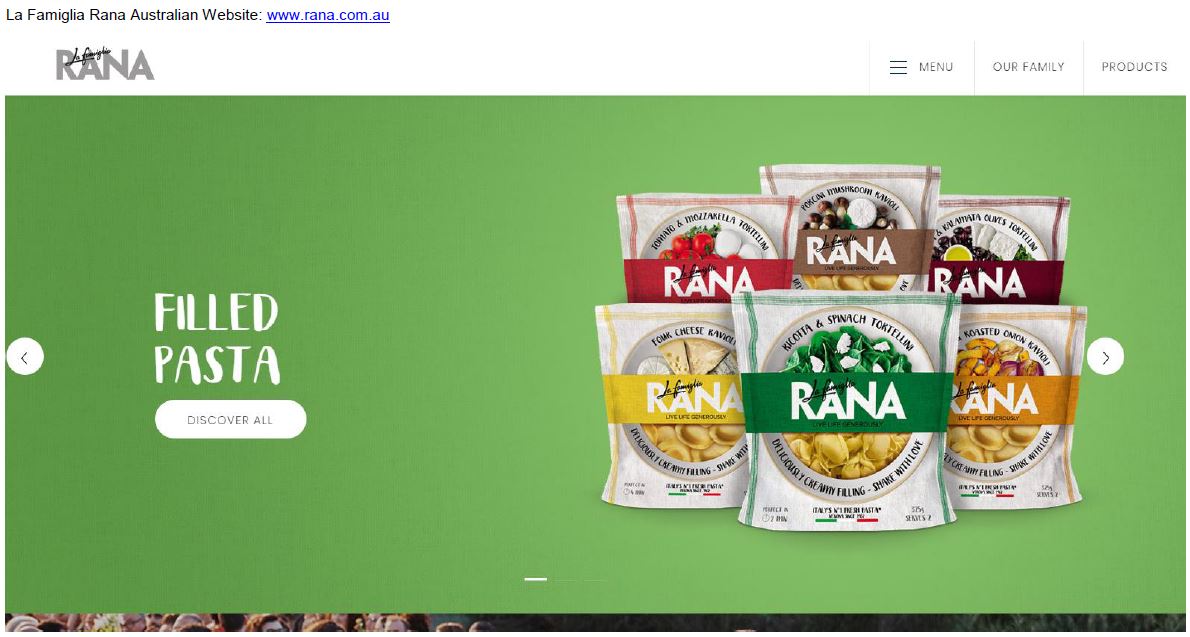
322 It may be seen that on the front of the packaging the words “LA FAMIGLIA” are rendered in a stylised cursive script over the top of the word RANA which is in large block font set in white against a contrasting coloured background, which changes depending on the variety of pasta product. On the back of the packaging, the colours are inverted, so that “RANA” appears in colour, against a white background. Images of the packaging of one of the Rana pasta products are set out below:
Front | Back |
|
|
Top | Base |
|
|
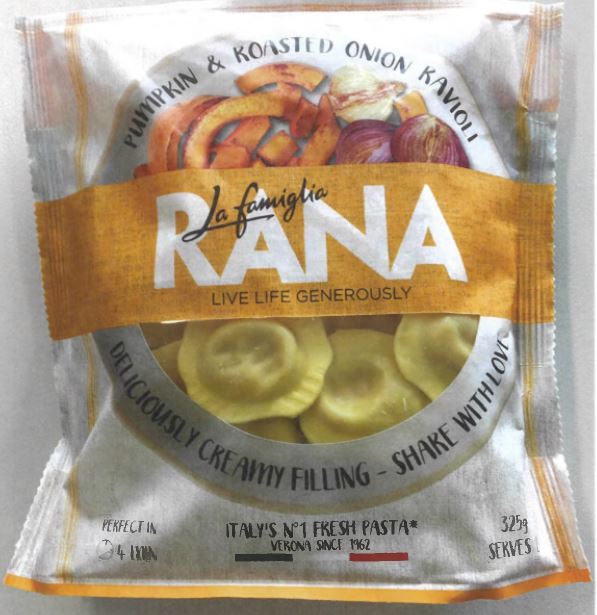
323 The respondents accept that the use of the Rana mark on Rana pasta product packaging amounts to use as a trade mark, in that it is a sign that distinguishes the goods of Rana from those of other traders.
7.2.2 The words “LA FAMIGLIA RANA”
324 The applicants also contend that there is use of the words LA FAMIGLIA RANA as a trade mark both as the account name and in the social media handle “@lafamigliarana” on the Rana Facebook page and Rana Instagram page. An example from the Rana Facebook page is as follows:
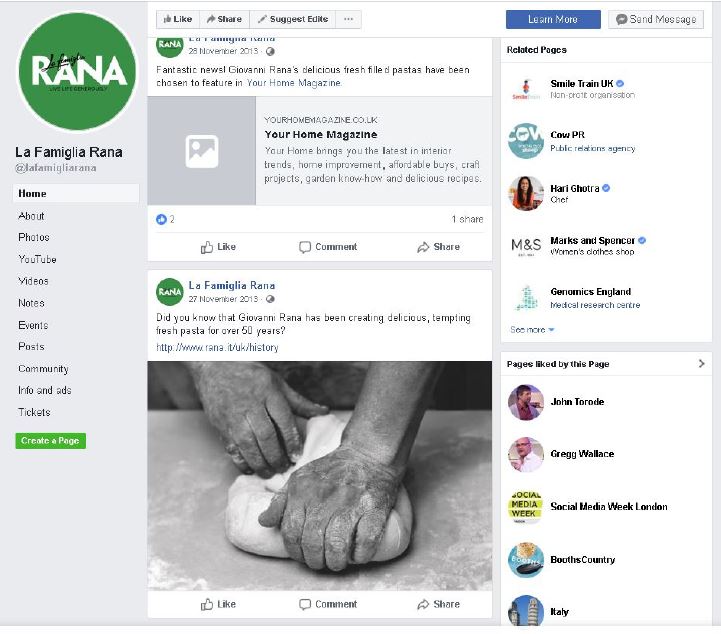
325 In my view each of the account names and the @lafamigliarana handles amount to trade mark uses. A consumer would not see them as merely being descriptive. They indicate a connection in the course of trade between the goods and the person who applies the mark to the goods: Johnson & Johnson (Lockhart J at 341, Burchett J at 342, Gummow J at 251); Shell Co (per Kitto J at 424-425, Dixon CJ, Taylor J and Owen J separately agreeing). They are used to identify the Rana Facebook page or Rana Instagram page, each of which provides a means by which goods sold by Rana are displayed and presented: see, by analogy in relation to a domain name Flexopack at [64] and Sports Warehouse at [154].
326 The next issue is whether the Rana packaging use and the Rana social media use are deceptively similar to the 473 word mark or the 133 word mark.
7.3.1 Relevant law
327 Sections 120(1) and (2) of the Trade Marks Act provide:
120 When is a registered trade mark infringed?
(1) A person infringes a registered trade mark if the person uses as a trade mark a sign that is substantially identical with, or deceptively similar to, the trade mark in relation to goods or services in respect of which the trade mark is registered.
(2) A person infringes a registered trade mark if the person uses as a trade mark a sign that is substantially identical with, or deceptively similar to, the trade mark in relation to:
(a) goods of the same description as that of goods (registered goods) in respect of which the trade mark is registered; or
(b) services that are closely related to registered goods; or
(c) services of the same description as that of services (registered services) in respect of which the trade mark is registered; or
(d) goods that are closely related to registered services.
However, the person is not taken to have infringed the trade mark if the person establishes that using the sign as the person did is not likely to deceive or cause confusion.
328 Section 10 of the Trade Marks Act provides that a trade mark is taken to be deceptively similar to another trade mark if it so nearly resembles that other trade mark that it is likely to deceive or cause confusion.
329 The approach to the question of whether one trade mark so nearly resembles another as to be likely to deceive was said by the High Court in Cooper Engineering Co. Pty Ltd v Sigmund Pumps Ltd [1952] HCA 15; 86 CLR 536 (Dixon, Williams and Kitto JJ) at 538 to be well settled and summed-up by Parker J, as he then was in In the Matter of An Application by the Pianotist Company Ltd for the Registration of a Trade Mark (1906) 23 RPC 774 at 777 in the following passage:
You must take the two words. You must judge of them, both by their look and by their sound. You must consider the goods to which they are to be applied. You must consider the nature and kind of customer who would be likely to buy those goods. In fact, you must consider all the surrounding circumstances; and you must further consider what is likely to happen if each of those trade marks is used in a normal way as a trade mark for the goods of the respective owners of the marks. If, considering all those circumstances, you come to the conclusion that there will be a confusion – that is to say, not necessarily that one man will be injured and the other will gain illicit benefit, but that there will be a confusion in the mind of the public which will lead to confusion in the goods – then you may refuse the registration, or rather you must refuse the registration in that case.
330 In Australian Woollen Mills Ltd v F S Walton & Co Ltd [1937] HCA 51; 58 CLR 641 Dixon and McTiernan JJ said at 658:
… in the end, it becomes a question of fact for the court to decide whether in fact there is such a reasonable probability of deception or confusion that the use of the new mark and title should be restrained.
In deciding this question, the marks ought not, of course, to be compared side by side. An attempt should be made to estimate the effect or impression produced on the mind of potential customers by the mark or device for which the protection of an injunction is sought. The impression or recollection which is carried away and retained is necessarily the basis of any mistaken belief that the challenged mark or device is the same. The effect of spoken description must be considered. If a mark is in fact or from its nature likely to be the source of some name or verbal description by which buyers will express their desire to have the goods, then similarities both of sound and of meaning may play an important part. The usual manner in which ordinary people behave must be the test of what confusion or deception may be expected. Potential buyers of goods are not to be credited with any high perception or habitual caution. On the other hand, exceptional carelessness or stupidity may be disregarded. The course of business and the way in which the particular class of goods are sold gives, it may be said, the setting, and the habits and observation of men considered in the mass affords the standard. Evidence of actual cases of deception, if forthcoming, is of great weight.
331 The degree of confusion required is not an actual probability of deception such as is required in an action for passing off. Rather, it is “sufficient if the result of the user of the mark will be that a number of persons will be caused to wonder whether it might not be the case that the two products come from the same source”: Southern Cross at 595 per Kitto J at first instance, upheld on appeal to the High Court at 608 (Dixon CJ, McTiernan, Webb, Fullagar and Taylor JJ). See also Registrar of Trade Marks v Woolworths Ltd [1999] FCA 1020; 93 FCR 365 (Registrar v Woolworths) at [43], [50] per French J, Tamberlin J agreeing at [104].
332 In determining whether the Rana mark is deceptively similar to the 473 word mark the impression based on recollection (which may be imperfect) of the LA FAMIGLIA 473 word mark, that persons of ordinary intelligence and memory would have, is compared with the impression such persons would get from the Rana mark; the deceptiveness flows not only from the degree of similarity itself between the marks, but also from the effect of that similarity considered in relation to the circumstances of the goods, the prospective purchasers and the market covered by the monopoly attached to the registered trade mark. The essential comparison in an infringement action is one between the trade marks involved: see New South Wales Dairy Corporation at 589, which was adopted by the Full Court (Ryan, Branson and Lehane JJ) in CA Henschke & Co v Rosemount Estates Pty Ltd [2000] FCA 1539; 52 IPR 42 at [44] and subsequently cited with approval by the Full Court (Allsop CJ, Besanko and Yates JJ) in Australian Meat Group Pty Ltd v JBS Australia Pty Limited [2018] FCAFC 207; 268 FCR 623 at [39].
333 The premise underlying the enquiry concerning deceptive similarity under s 120(1) or (2) is that purchasers are assumed to have knowledge of the mark alleged to have been infringed when they are placed in the context of the circumstances of purchasing the alleged infringer’s goods. However, any reputation that may have accrued to the trade mark owner by dint of use of its mark is generally to be set to one side for the purpose of this comparison: see CA Henschke at [45]-[52].
334 When considering the question of deceptive similarity a range of factors contribute to the overall assessment required. The factors include consideration of: the idea of the mark which will naturally be suggested to the mind of one who sees it (Jafferjee v Scarlett [1937] HCA 36; 57 CLR 115 (Latham CJ) at 121); any aural similarity; in the case of a composite mark, the whole of the marks and devices, which may consist of a number of elements, which must be considered in their context including the size, prominence and stylisation of words and device elements used in the mark and their relationship to each other, and any essential feature that emerges from it (Optical 88 (No 2) at [100]-[111]).
335 Ultimately, however, as Dixon and McTiernan JJ explained in Australian Woollen Mills at 659:
The main issue in the present case is a question never susceptible of much discussion. It depends on a combination of visual impression and judicial estimation of the effect likely to be produced in the course of the ordinary conduct of affairs.
336 An important threshold question arises in the distinction between s 120(1) and s 120(2). In the former, infringement is established if a person uses as a trade mark that is, relevantly, deceptively similar to the registered trade mark in relation to the goods in respect of which the trade mark is registered. In s 120(2), a person may establish infringement where the deceptively similar mark is not used in relation to the goods in respect of which the trade mark is registered, but rather in relation to “goods of the same description as that of goods in respect of which the trade mark is registered” (s 120(2)(a), emphasis added). I have considered the legal requirements concerning goods of the same description in section 6.2.3 above. In addition, s 120(2) provides that the person is not taken to have infringed the trade mark if the alleged infringer “establishes that using the sign as the person did, is not likely to deceive or cause confusion”. I address the defence in section 7.6 below.
337 The question of the deceptive similarity of an impugned mark is not to be determined solely by consideration of the respective marks in question. The analysis cannot be divorced from a consideration of the similarity of the goods in respect of which the trade mark is registered and those in respect of which the impugned mark has been used. As French J noted in Registrar v Woolworths at [39]-[40] (Tamberlin J agreeing at [104]), whilst s 10 defines deceptive similarity solely in terms of the degree of resemblance of the trade marks in question, and whether that degree of resemblance is likely to deceive or cause confusion, in the end there is “one practical judgment to be made” which combines consideration of the relationship between the goods to which the impugned mark has been applied and the goods in respect of which registration has been obtained, as well as deceptive similarity between the marks:
...Whether any resemblance between different trade marks for goods and services renders them deceptively similar will depend upon the nature and degree of that resemblance and the closeness of the relationship between the services and the goods in question. It will not always be necessary to dissect that judgment into discrete and independent conclusions about the resemblance of marks and the relationship of goods and services. Consistently with that proposition, the Registrar or a judge on appeal from the Registrar could determine in a particular case that, given the limited degree of resemblance between the relevant marks he or she could not be satisfied, no matter how closely related the goods and services concerned, that the use of the applicant’s marks would be likely to deceive or to cause confusion.
338 The first impugned use is the words “LA FAMIGLIA” as they appear on the Rana pasta product packaging. The respondents contend that the use is not deceptively similar to the 473 or 133 word marks. In this regard they emphasise the fact that the words “LA FAMIGLIA” are small and that the prominent feature is the word “RANA” in large, bold writing which stands out against a contrasting background. They submit that consumers would naturally recognise that the word “RANA” is the brand of the goods: “RANA” is how Woolworths and Harris Farm list the brand on their websites, and how Coles lists the brand on consumers’ tax invoices. The words “LA FAMIGLIA” play a negligible role in the Rana mark and are an obvious reference to the “the family”, being a descriptive use which could not lead to any deception or confusion within the meaning of s 10 of the Trade Marks Act. In the unlikely event, they submit, that any consumer is in any doubt about the import of those words, the answer is immediately provided: it is “LA FAMIGLIA RANA”. The situation, they submit, is the same as if the applicants had managed to obtain a registration for the English words “the family” and the respondents were using “the family Rana”.
339 The respondents submit that by choosing a name that has a descriptive aspect to it, the applicants ran the risk that others in the trade would use it descriptively and that it would not distinguish the applicants’ products. Having chosen to evoke “Italianness” by adopting “LA FAMIGLIA” as a trade mark, the applicants cannot preclude genuinely Italian companies from using these words. In this context, the respondents submit that the decision in Stone & Wood is relevant, where the word “pacific” had become descriptive, and was used descriptively in the impugned mark (at [66]-[67], [98]-[100]). They submit that non-distinctive elements of the mark are to be given reduced significance in any comparison. Here, the respondents submit that the ordinary person would be credited with an understanding that the two elements of the Rana mark, “LA FAMIGLIA” and “RANA”, have ordinary significations and would be understood separately. Taken in combination, the risk of confusion between the marks does not rise above mere possibility.
340 For the reasons set out below, I am satisfied that the Rana mark is deceptively similar to the 473 word mark, because it so nearly resembles the 473 word mark that it is likely to deceive or cause confusion within s 120(2) of the Trade Marks Act.
341 Fresh pasta products and goods within the 473 designated goods are fast moving consumer goods which are selected by consumers from supermarket aisles. The class of consumer of such products is the broad spectrum, including those who shop in supermarkets. The Rana pasta products will be displayed in, and selected from, refrigerated shelving, because they contain temperature-sensitive ingredients. Consumers will typically pass down the aisle and select goods at varying places, but taking note of the packaging. The items are relatively inexpensive and do not call for much deliberation in the purchase. It is likely that consumers will have occasion to refer to such products by name amongst themselves and if asking where to find the products.
342 I first consider the 473 word mark. It is for the words LA FAMIGLIA alone, however rendered, and whether rendered with or without a logo. The words may be rendered in cursive within the scope of the registration. The ordinary consumer will perceive that it is of two words, one short and commencing with “L” the second being longer which looks and sounds somewhat like the English word “family” with a foreign twist. That is the impression that many consumers are likely to take away and remember. A significant number (but by no means all) will no doubt understand the two words to mean “the family” in another language. That is the idea that they will recall (Jafferjee at 121 (per Latham CJ, with whom McTiernan J agreed at 126); Telstra Corporation Limited v Phone Directories Company Australia Pty Ltd [2015] FCAFC 156; 237 FCR 388 (Besanko, Jagot and Edelman JJ) at [213]). The consumer will pronounce the words with either a hard or a soft “g”.
343 The Rana mark shows the words “LA FAMIGLIA” in cursive script in a flourish like a signature or handwriting, rendered over the larger sans serif “RANA”. I do not accept the submission that consumers and traders are unlikely to notice the words “LA FAMIGLIA”. They are spread across the central aspect of the front of the packaging and are repeated with every rendition of the large word RANA, on the top and base of the packaging. Sometimes, the words are more easily visible, particularly where the mark is rendered in lighter yellow, orange and light brown colours, but it is still visible when the other variety of colours are used. The signature-style rendition of the words renders them prominent to the eye.
344 Consumers will read the words “LA FAMIGLIA RANA” on the packaging and, having an impression (which may be imperfect) of the 473 word mark, likely notice that the words “LA FAMIGLIA” in both are the same. They are the first two words of the impugned use and they look and sound the same. They also mean the same thing. In my view these aspects are likely to form a strong impression on consumers. Only the word “RANA” distinguishes the two marks. It is rendered in large letters in a different font to “LA FAMIGLIA”. However, in my view the presence of “RANA” will not prevent a substantial number of consumers from wondering whether it might not be the case that products bearing the impugned mark come from the same source. Many will consider that that mark has been entirely used on the packaging, and that the word “RANA” is an addition, connoting either a variant or sub-brand of “LA FAMIGLIA”.
345 The respondents contend that the word “RANA” makes plain to consumers that the words “LA FAMIGLIA” are simply descriptive, and that there can be no doubt that the words simply mean “the family Rana” thereby making plain that “Rana” is the trader whose sign is being used. However, I do not consider that consumers who recall the 473 word mark and view the Rana mark on product packaging would understand it to be a reference to “the family Rana”, and thereby set to one side the words “LA FAMIGLIA”. As I have noted, the words “LA FAMIGLIA” are not directly descriptive. They are allusive. The addition of a further word (“RANA”) which, significantly, and unlike the word “KITCHEN” in the 2015 marks, has no English meaning is not likely to diminish the trade mark significance of those words, in contrast to the position in Stone & Wood at [66].
346 Furthermore, it has long been recognised that for the purposes of considering infringement, it is beside the point that the alleged infringer has added other material to the impugned trade mark, even if the steps taken were to avoid the likelihood of deception.
347 In Mark Foys Williams J (Dixon CJ agreeing) said as follows (citations omitted) at 205:
In Aristoc Ltd v Rysta Ltd Vicount Maugham cites the following appropriate passage from the judgment of Lorde Greene MR in Saville Perfumery Ltd v June Perfect Ltd:
In an infringement action, once it is found that the defendant’s mark is used as a trade mark, the fact that he makes it clear that the commercial origin of the goods indicated by the trade mark is some business other than that of the plaintiff avails him nothing, since infringement consists in using the mark as a trade mark, that is, as indicating origin.
Needless to say, if the defendant uses the words of the plaintiff’s trade mark as indicating origin, it is still an infringement notwithstanding that the defendant always adds his own name.
348 In my view the respondents’ reliance on the usage by Woolworths and Harris Farm is misplaced. The selection of “RANA” as the descriptor by those companies could as well be because the words “LA FAMIGLIA” are taken by the applicants, because the word Rana is conveniently short, or because Rana is a convenient contraction of the second respondent’s name: see the authorities collected in Optical 88 (No 2) at [99].
349 I now turn to consider the evidence of Ms Vicente, whose role included managing Goodman’s social media accounts for its La Famiglia brand. Her evidence is relied upon by the applicants as evidence of confusion. She received an enquiry from a person identified as “Far Lou” via the Goodman Facebook pahe which attached a photograph of the front of the Rana packaging for ravioli, although the packaging was empty, and enquired whether the ravioli was one of the applicants’ products. Ms Vicente looked at the photograph. She was familiar with the LFFF chilled bread products but had not encountered Rana’s pasta products, and was uncertain whether it was a new product in the applicants’ La Famiglia range. She initially thought that the word “RANA” may have been the flavour of the ravioli product. On the same day, she enquired of the applicants whether or not it was one of their products, who subsequently confirmed that it was not.
350 I accept the respondents’ submission that Ms Vicente was not a typical consumer and that she was not engaged in any shopping at the time when she perceived the packaging. Furthermore, I accept that having regard to her role, she was particularly sensitised to the Goodman marks. Nevertheless, she had a spontaneous reaction to the Rana packaging, which was to identify the words “LA FAMIGLIA” as separate to “RANA”, and having separate trade mark or branding significance. To that limited extent her evidence might be regarded as tending to support the view that I have reached. On balance, however, I do not consider it appropriate to place reliance on it. Where evidence of confusion consists of a small sample it is particularly important to pay close attention to the context in which it appears to have arisen. If it is remote from the typical consumer experience (as here) or absent contextual information (as was Far Lou’s message), then it must be approached with considerable caution.
351 These matters inform my view that the impression based on an imperfect recollection of the 473 word mark that persons of ordinary intelligence and memory would have, when compared with the impression that they would get from the Rana packaging use, is such that there is a real tangible danger of deception or confusion occurring on the basis that a number of persons will be caused to wonder whether it might not be the case that the two products come from the same source: Southern Cross at 594-5; Registrar v Woolworths at [50].
352 I reach the same conclusion in relation to the 133 word mark although it is perhaps unnecessary to do so as the applicants seek no relief in their Originating Application in respect of this mark. Again, it is a word mark and its registration covers the rendition of the words in cursive script. The sound, look and meaning of the words “LA FAMIGLIA” are likely to form the more powerful part of a consumer’s reaction, with “KITCHEN” playing a secondary role. The rendition of the Rana mark on the Rana packaging includes the words LA FAMIGLIA in their entirety. A not insubstantial number of consumers with a recollection of the 133 word mark perceiving the Rana packaging are likely to be caused to wonder whether the Rana pasta products come from the same source.
7.3.3 The words “LA FAMIGLIA RANA”
353 The applicants contend that the use of “La Famiglia Rana” and “@lafamigliarana” respectively as the account name and handle on the Rana Facebook page and the Rana Instagram page are deceptively similar to the 473 word mark and 906 composite mark.
354 I have found each of these to be a trade mark use. Each uses, as a significant component of the account name and handle, the words “LA FAMIGLIA”, which are the entirety of the 473 word mark as I have described in section 7.3.2. In the written form of these uses the word “RANA” recedes yet further in significance as the last four letters of a mark otherwise identical to the 473 word mark. In the @lafamigliarana usage the letters do not form a separate word. For these reasons, and also the reasons set out in section 7.3.2 in my view these uses are also deceptively similar to the 473 word mark and the 133 word mark.
7.4 Are pasta products the same goods as any of the registered goods?
355 I have found in section 6 above that the scope of the goods in respect of the 473 word mark is eligible to remain registered are as follows:
Bread, bread rolls, buns, flat bread, pizza bases, pizza dough, ciabatta and focaccia bread and rolls; garlic bread; herb bread; cheese bread; bread sticks; frozen, chilled and shelf stable bread.
356 The scope of goods in respect of which the 133 word mark is eligible to remain registered are as follows:
Pizza bases, pizza dough, ciabatta and focaccia bread and rolls; garlic bread; herb bread; cheese bread; bread sticks; sandwiches; frozen, chilled and shelf stable bread.
357 None of these goods is “the same as” filled pasta, as is required by s 120(1) of the Trade Marks Act. Accordingly, Goodman’s infringement case must be assessed by reference to s 120(2).
7.5 Are filled pasta products goods of the same description as the registered goods?
358 I have in section 6.2.3 addressed the principles of law relevant to consideration of whether or not identified goods are “goods of the same description” as those in respect of which a trade mark is registered for the purpose of s 120(2) Trade Marks Act.
359 In section 6.3.1 at [293] to [306] I explain why I conclude that goods in the ready made meal category are goods of the same description as garlic bread. In my view, filled pasta is very similar, if not the same in character as a “ready made meal”. As Mr Chiavegatti points out, it is a meal in itself that simply requires boiling for a few minutes. In my view, by virtue of being, or being of the same character as, a “ready made meal”, filled pasta is also a good of the same description as garlic bread. For brevity, I do not here repeat my conclusions in section 6.3.1, but note that:
(a) Garlic bread is a side dish that would be regarded by many Australians as a dish to be eaten with an Italian meal, such as filled pasta (pace Italian purists);
(b) Pasta and garlic bread are both made substantially from flour that is formed into dough, but the filled component of the Rana pasta products is not, and bread and filled pasta would be made by different manufacturers;
(c) The trade channels of ready made meals, including filled fresh pasta and chilled garlic bread, significantly overlap, such that there is a real likelihood that those products will be displayed side by side or in close proximity, notwithstanding that other products that have no Italian connotation may also be displayed in similar proximity from time to time; and
(d) Traders such as Coles and Woolworths promote Italian main meals, including pasta in conjunction with garlic bread, thereby reinforcing the connection in the minds of consumers of an association between the two.
360 Accordingly, both the Rana mark and the use of the words “LA FAMIGLIA RANA” is in respect of goods of the same description as the designated goods in the 473 word mark.
7.6 Does the defence under s 120(2) apply?
361 The respondents submit that in the event that any of the impugned uses are found to be of a deceptively similar trade mark that is used on goods of the same description as the applicants’ goods within s 120(2), nevertheless the use should not be found to infringe by reason of the defence arising under that section, which provides that:
However, the person is not taken to have infringed the trade mark if the person establishes that using the sign as the person did is not likely to deceive or cause confusion.
362 Two issues arise. First, the applicants submit that the respondents have not pleaded reliance on the defence and so cannot rely on it. The respondents contend that it is sufficient to provide a general denial of infringement of s 120(2), and submit that the defence is an element of s 120 and is required to be considered by the Court in every case. The second is whether the requirements of the defence are made out. In this regard, the respondents contend that their use is not likely to deceive or cause confusion for essentially the same reason that the trade mark applied to the Rana packaging is not deceptively similar, namely that they have made clear that “RANA” is the name of the trader from where the goods originate, and “LA FAMIGLIA” is simply descriptive.
363 As a matter of law, the defence under s 120(2) proceeds on the basis that there has been a finding of deceptive similarity and the existence of all other matters necessary to establish infringement. The requirement is that the respondent establish that using the mark in the manner that it did was not likely to deceive or cause confusion. In Gallo (FC) the Full Court at [76] pointed out that the words “as the person did” direct attention to the way in which, as a matter of fact, the alleged infringer has used the allegedly infringing trade mark. The Full Court went on to say:
...In a sense, an affirmative answer to the question of whether the alleged infringing mark was deceptively similar would be the starting point. If it was, then it would, in many instances, render it more likely (though not inevitable) that the actual use of the allegedly infringing mark was likely to deceive or cause confusion. Also relevant, in our opinion, would be the matters considered in determining whether the alleged infringer's goods are of the same description as the goods in respect of which the registered mark is registered.
364 The defence may give rise to consideration of what additional features are used in conjunction with the trade mark, which may suggest that there was no likelihood of deception or confusion. This was alluded to by Yates J in Optical 88 (No 2) at [99] (emphasis added):
So too it is recognised that, for the purposes of considering infringement under s 120(1), it is beside the point that the alleged infringer has added other material to the impugned trade mark, even if those steps were taken to avoid the likelihood of deception: Saville Perfumery Ltd v June Perfect Ltd (1941) 58 RPC 147 at 161 (Sir Greene MR) and at 174 (Viscount Maugham); Lever Brothers, Port Sunlight Limited v Sunniwite Products Ltd (1949) 66 RPC 84 at 89; Mark Foy’s Ltd v Davies Coop and Co Ltd (1956) 95 CLR 190 at 205; Polaroid Corporation v Sole N Pty Ltd [1981] 1 NSWLR 491 at 495; New South Wales Dairy Corporation v Murray Goulburn Co-Operative Company Limited (1989) 86 ALR 549 at 589; Polo Textile Industries Pty Ltd v Domestic Textile Corporation Pty Ltd (1993) 42 FCR 227 at 231-232. Considerations of this kind, if raised by an alleged infringer, are relevant when considering infringement under s 120(2) and may be relevant when considering infringement under s 120(3). However, the general position under s 120(1) is that infringement cannot be avoided by, for example, the use of additional matter if the mark itself is taken and used. Once again, if the test is not applied in this fashion a trade mark owner may be deprived of the monopoly conferred by registration.
365 The learned authors of Shanahan’s suggest that the only aspects of a respondent’s use that should be considered relevant to the defence are those in some way peculiar to the respondent’s own product, such as the use of some special get-up or the inclusion of the respondent’s label of its company or business name (at [85.765]). The comparator, for the purpose of the defence, is not, however, against any actual use by the registered trade mark owner, but rather against the fair and normal use of its trade mark within the scope of its registration. Such an approach was adopted by the Full Court in Gallo (FC) at [78], no doubt to accommodate the statutory language “using the sign as the person did is not likely to deceive or cause confusion” – the likelihood being judged against such notional use.
366 In Lift Shop Pty Ltd v Easy Living Home Elevators Pty Ltd [2014] FCAFC 75; 311 ALR 207 at [62], [67], [68] the Full Court (Besanko, Yates and Mortimer JJ) noted in obiter dicta that the primary judge’s findings that the term “lift shop” had an understood generic connotation, and that at the point at which certain web search results were displayed there was no respectable possibility of confusion that the respondent was associated with the applicant, were sufficient circumstances to give rise to the defence under s 120(2).
367 Turning now to consideration of the issues, in my view the applicants’ first submission is to be accepted. To fall within the s 120(2) defence, a respondent to an infringement action must establish that its use of the impugned sign is not likely to deceive or cause confusion. That is what the words “if the person establishes” require: Gallo (Flick J) at [89]; Optical 88 (No 2) at [99]. This requires consideration of such matters as the respondent puts forward to establish the fact, and, in my view, a pleaded case to support that. It is not to the point to submit, as the respondents in this proceeding do, that their case relies on no matters that would be of an unexpected kind. That speaks only to the respondents’ position. Once made aware of the facts, matters and circumstances upon which a respondent may wish to rely, an applicant may wish to call evidence in answer, which is something that cannot be done if it has no notice of the case to be run against it. Accordingly, as a matter of principle in my view a respondent should plead or at the least provide notice of its intention to advance a positive case at trial that using the impugned mark as the respondent did was not likely to deceive or cause confusion. The respondents have not done so here.
368 In any event, in my view the respondents fail on the second issue. For the same reasons that I have found in relation to the issues determined under the headings of “deceptive similarity” and “goods of the same description” in sections 7.3 and 6.2.3 above, I do not consider that the actual use by the respondents in the context either of the Rana mark or the words “LA FAMIGLIA RANA” is such that that use is not likely to deceive or cause confusion. In this regard, the respondents rely on no matter additional to the fact that the word “Rana” is the name of the trader. However, for the reasons explained in section 7.3.2, that fact alone is insufficient. The presence of “RANA” will not prevent consumers from wondering whether the words “LA FAMIGLIA” indicate that the goods come from the same source as the owner of the 473 and/or 133 word marks.
8. CONCLUSION
369 For the reasons set out in more detail above I have concluded that the respondents’ cross claim seeking rectification of the Register pursuant to s 41 of the Trade Marks Act fails, but that it succeeds pursuant to s 59 and s 92(4) insofar as:
(a) The designated goods for the 473 word mark be rectified such that they are confined to the following:
Bread, bread rolls, buns, flat bread, pizza bases, pizza dough, ciabatta and focaccia bread and rolls; garlic bread; herb bread; cheese bread; bread sticks; frozen, chilled and shelf stable bread.
(b) The designated goods for the 906 composite mark be rectified such that they are confined to the following:
Pizza bases, pizza dough, ciabatta and focaccia bread and rolls; garlic bread; herb bread; cheese bread; bread sticks; frozen, chilled and shelf stable bread
(c) The designated goods for each of the 2015 marks be rectified such that they are confined to the following:
Pizza bases, pizza dough, ciabatta and focaccia bread and rolls; garlic bread; herb bread; cheese bread; bread sticks; sandwiches; frozen, chilled and shelf stable bread.
370 I have also concluded that the applicants’ trade mark infringement case has been established. I will set in place a timetable for the parties to confer and jointly provide short minutes of order giving effect to these reasons.
I certify that the preceding three hundred and seventy (370) numbered paragraphs are a true copy of the Reasons for Judgment of the Honourable Justice Burley. |
ANNEXURE
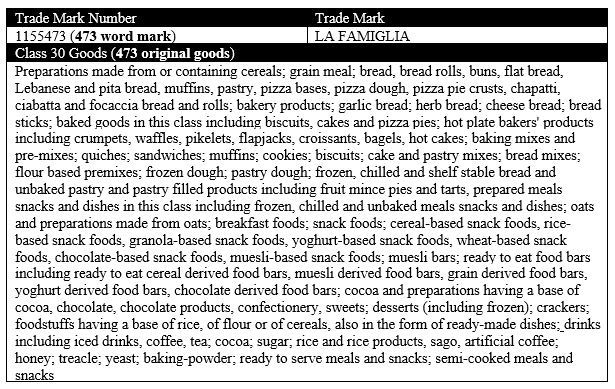
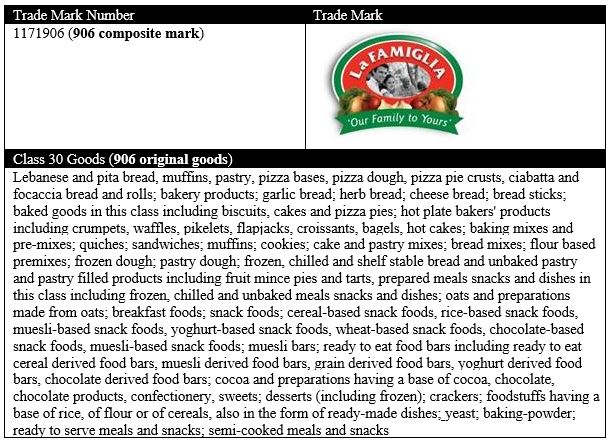
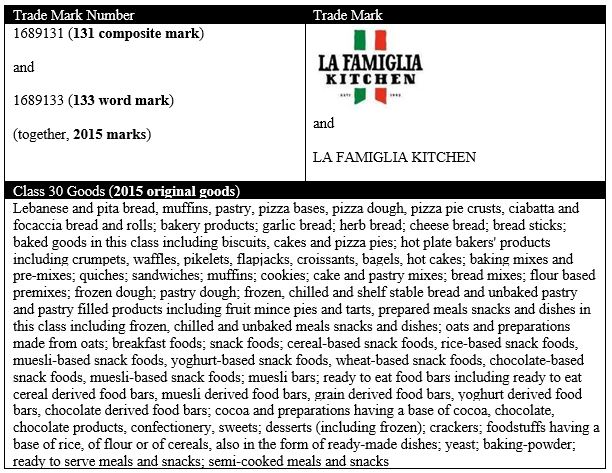
NSD 328 of 2018 | |
PASTIFICIO RANA SPA | |
LA FAMIGLIA FINE FOODS PTY LTD |


