

FEDERAL COURT OF AUSTRALIA
Smirke on behalf of the Jurruru People v State of Western Australia (No 2) [2020] FCA 1728
Table of Corrections | |
12 January 2021 | In paragraph 153, the name “Windiwarri” has been changed to with the name “Jarndunha”. |
In paragraph 934, the word “decent” has been replaced by “descent”. | |
12 January 2021 | In paragraph 1013, the word “Rover” has been replaced by “River”. |
12 January 2021 | In paragraph 1275, the word “not” has been replaced by “no”. |
ORDERS
WAD 537 of 2018 | ||
| ||
BETWEEN: | IVAN SMIRKE, ALEC ALEXANDER, KELLMAN LIMERICK Applicant | |
AND: | STATE OF WESTERN AUSTRALIA & ORS Respondents | |
WAD 538 of 2018 | ||
| ||
BETWEEN: | IVAN SMIRKE, ALEC ALEXANDER, KELLMAN LIMERICK Applicant | |
AND: | STATE OF WESTERN AUSTRALIA & ORS Respondents | |
ROY TOMMY, NANCY TOMMY, E.G., MARY MILLS Applicant | ||
AND: | STATE OF WESTERN AUSTRALIA & ORS Respondents | |
DATE OF ORDER: |
THE COURT ORDERS THAT:
1. The questions reserved for consideration be answered as follows:
But for any question of extinguishment of native title, are native title rights and interests (as defined in s 223 of the Native Title Act) held in the Overlap Area by:
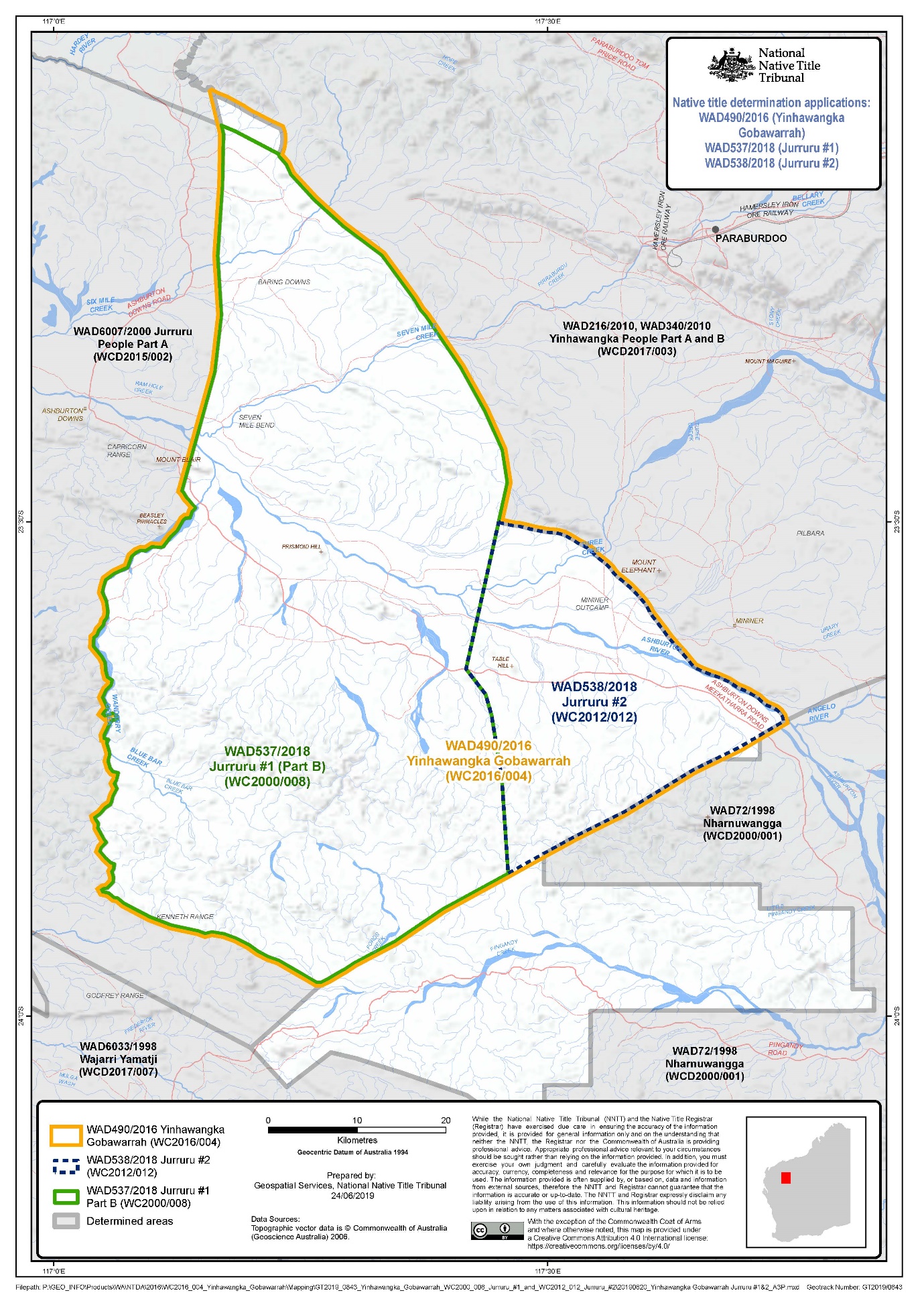
(a) members of the Yinhawangka Gobawarrah native title claim group under traditional laws and customs; and if so
(i) by whom?;
Answer: Yes, but native title is held by members of the Yinhawangka Gobawarrah native title claim group as Yinhawangka people, under Yinhawangka traditional law and custom, and therefore other Yinhawangka people may also be native title holders in the part of the Overlap Area set out in (a)(ii) below.
(ii) which part or parts of the Overlap Area?; and
Answer: In those parts north of the Ashburton River, and more likely than not in some sites or areas south of the Ashburton River but close to that river, but the Court makes no findings yet about which sites. Nor does the Court make findings yet about who holds native title in the Ashburton River itself, or the site Jabaguru (Jurruru site 12; Yinhawangka Gobawarrah site 29).
(iii) what are those rights and interests?; and/or
Answer: They are the rights and interests set out in the Yinhawangka Part A and B determination: Jones on behalf of the Yinhawangka People v State of Western Australia [2017] FCA 801.
(b) members of the Jurruru native title claim groups under traditional laws and customs; and if so:
(i) by whom?;
Answer: Yes, by those people falling within the description of the native title holders in the Jurruru Part A determination: Smirke on behalf of the Jurruru People v State of Western Australia [2015] FCA 939.
(ii) which part or parts of the Overlap Area?; and
Answer: In those parts south of the Ashburton River, aside from any sites or areas south of the Ashburton River but close to that river which are, in accordance with the Court’s reasons held by the Yinhawangka people, although, the Court makes no findings yet about which sites. Nor does the Court make findings yet about who holds native title in the Ashburton River itself, or the site Jabaguru (Jurruru site 12; Yinhawangka Gobawarrah site 29).
(iii) what are those rights and interests?
Answer: They are the rights and interests set out in the Jurruru Part A determination: Smirke on behalf of the Jurruru People v State of Western Australia [2015] FCA 939.
Note: Entry of orders is dealt with in Rule 39.32 of the Federal Court Rules 2011.
TABLE OF CONTENTS
[1] | |
Summary | [3] |
A note spellings, words and descriptions used | [15] |
BACKGROUND | [18] |
The history of native title applications over the overlap area, and the surrounding areas | [18] |
THE PARTIES’ CONTENTIONS IN SUMMARY | [44] |
Jurruru applicant preservation evidence | [58] |
Toby Smirke | [59] |
Peggy Smirke | [65] |
David Smirke | [70] |
Yinhawangka and GMY preservation evidence | [75] |
David Cox | [78] |
Nancy Tommy | [81] |
Other significant Yinhawangka Gobawarrah people | [84] |
Mabel Tommy | [84] |
Nyimili Tommy | [89] |
Jambu Giggles | [95] |
Muyit Smith | [97] |
The Jurruru claim group and the key Jurruru witnesses for the overlap dispute | [99] |
Ivan Smirke | [105] |
Marlon Cooke | [109] |
Brendon Cook | [113] |
The Yinhawangka Gobawarrah claim group and the key Yinhawangka Gobawarrah witnesses for the overlap dispute | [116] |
Roy Tommy | [122] |
Julie Walker | [125] |
Donald Limerick | [130] |
Leon Galby | [135] |
Kurston Tommy | [140] |
The family connections between the Smirke and Tommy families | [145] |
The Cooke/Cook family | [149] |
The Limerick family | [151] |
The Cox family | [153] |
The Galby family | [156] |
OTHER EVIDENCE | [158] |
Documentary evidence | [162] |
Relevant claim documents | [162] |
Other documentary evidence | [163] |
Maps and site lists relied on by both parties | [165] |
Aide materials | [167] |
Expert reports and other anthropological research documents | [168] |
Dr McGrath’s report and research materials | [170] |
Dr Palmer’s reports and research materials | [175] |
Dr Vachon’s draft report | [181] |
Mr Haydock’s 1999 research materials | [184] |
Dr Kenny’s draft Jurruru overlap report and field reports | [191] |
Dr Sackett’s reports | [200] |
Historical anthropological and ethnographic reports | [205] |
Alfred Radcliffe-Brown | [206] |
Dr Palmer’s 1979 West Angelas Project report | [207] |
Professor Tonkinson’s 1985 ethnographic research | [208] |
Experts’ conference and joint report | [211] |
General approach to the expert material | [212] |
SOME GENERAL FINDINGS | [214] |
My approach to the witness evidence, the preservation evidence and the lay evidence drawn from earlier sources | [215] |
Toby Smirke | [221] |
David Cox | [228] |
Mabel Tommy | [246] |
The younger witnesses | [253] |
Ivan Smirke | [254] |
Brendan Cook | [259] |
Marlon Cooke | [275] |
Roy Tommy | [284] |
Julie Walker | [323] |
The apical ancestors identified in the parties’ applications | [337] |
Kantitharra | [338] |
Punartu | [346] |
Thurantajinha | [351] |
Wilga | [358] |
Nijawarla | [360] |
Gujarda | [364] |
The probative value of Mr Haydock’s 1999 materials | [367] |
Finding | [379] |
The paucity of historical ethnographic material relating to the overlap area | [382] |
Daisy Bates | [394] |
Alfred Radcliffe-Brown | [398] |
Norman Tindale | [403] |
Robert Tonkinson | [409] |
Finding | [415] |
The significance of the 2001 and 2010 boundary agreements | [416] |
The 2001 Jurruru and Innawonga agreement | [418] |
The different iterations of the GMY claim area | [439] |
The 2010 GMY and Innawonga intra-indigenous agreement | [458] |
Findings | [468] |
Jabaguru | [473] |
The late filing of the Jurruru #2 claim | [479] |
Other evidence that Jabaguru is Jurruru country | [487] |
Evidence that Jabaguru is shared country | [495] |
Finding | [515] |
The debates about the relevance of birth (and burial) on country | [528] |
The Jurruru evidence | [529] |
The Yinhawangka Gobawarrah evidence | [533] |
The expert opinions | [541] |
The parties’ submissions | [554] |
Did the Jurruru object to Mabel Tommy’s burial at Jabaguru in 2001? | [559] |
Findings | [576] |
One normative system | [588] |
Lay evidence | [589] |
Expert evidence | [598] |
Findings | [611] |
The Lake Torrens overlap proceeding and the relevance of the surrounding consent determinations | [618] |
The Yinhawangka Part A and Part B determination (Jones) | [627] |
The Jurruru Part A determination (Smirke) | [632] |
Findings | [635] |
SUCCESSION | [637] |
Lay evidence | [650] |
Expert evidence | [678] |
Dr McGrath | [680] |
Dr Palmer | [742] |
Observations | [760] |
Other experts | [781] |
Dr Sackett | [781] |
Dr Kenny | [788] |
Findings | [790] |
IS THE ASHBURTON RIVER A BOUNDARY? | [821] |
Jurruru submissions | [824] |
Yinhawangka Gobawarrah submissions | [838] |
The State’s submissions | [842] |
Findings | [849] |
THE OVERLAP AREA AT SOVEREIGNTY | [854] |
The landholding system at sovereignty | [856] |
Methods of identifying estate groups at sovereignty | [873] |
Dr McGrath | [875] |
Dr Palmer | [908] |
The parties’ submissions | [913] |
The evidence about the estates of the apical ancestors | [922] |
The Jurruru apical ancestors | [925] |
Kantitharra | [925] |
Punartu | [935] |
The Yinhawangka Gobawarrah apical ancestors | [938] |
Thurantajinha | [939] |
Wilga | [952] |
Nijawarla | [962] |
Gujarda | [977] |
Findings on the overlap area at sovereignty | [994] |
General findings | [994] |
Was the overlap area at sovereignty affiliated with Yinhawangka or Jurruru identifying estate groups? | [1009] |
What parts (if any) of the overlap area at sovereignty fell within the respective estates of the Yinhawangka Gobawarrah apical ancestors? | [1023] |
Thurantajinha | [1024] |
Wilga | [1027] |
Nijawarla | [1028] |
Gujarda | [1044] |
THE OVERLAP AREA POST-SOVEREIGNTY | [1049] |
Yinhawangka Gobawarrah evidence about continuing connection to the overlap area post-sovereignty | [1049] |
The area north of the Ashburton River | [1052] |
Six Mile Creek (Bijiji) | [1052] |
Seven Mile Creek | [1059] |
Marni (YG site 40) | [1063] |
Wilugari Claypan (YG site 72) | [1066] |
Bugurda Bugurda Range (YG site 12) | [1067] |
Wilugari Hill (YG site 71) | [1068] |
Yalayari (YG site 76) | [1069] |
Thurriri (Turee Creek) | [1070] |
Sites on or near the Ashburton River | [1082] |
Dreaming stories | [1082] |
Wanyanu (YG site 68) | [1084] |
Pilingurra claypan (YG site 63) | [1085] |
Jabaguru (YG site 29) | [1086] |
Bilgi (YG site 8) | [1087] |
Mindurl (YG site 50) | [1089] |
Marlanya (YG site 29) | [1090] |
Dhardhudhu (YG site 17) | [1091] |
Wirdharadji (YG site 73) | [1092] |
Binbidnga (also spelt Binbirrnta) (YG site 11) | [1095] |
Gurriga (YG site 26) | [1101] |
The area south of the Ashburton River | [1107] |
Site along Fords Creek | [1109] |
Secret Creek (Wurndagalpa (YG site 74)) | [1110] |
Dardhudhu flat (YG site 18) | [1111] |
Gadamulha (also spelt Katamulha) (YG site 19) | [1112] |
Other sites mentioned by Mabel Tommy | [1113] |
Jurruru evidence about continuing connection to the overlap area post-sovereignty | [1114] |
The area north of the Ashburton River | [1115] |
Wanuwanu (Jurruru site 26) | [1115] |
Charcoal Well (Jurruru site 46) | [1116] |
Ngulunganga (Mt Elephant) (Jurruru site 47) | [1120] |
Sites on or near the Ashburton River | [1121] |
Binbin Pool (Jurruru site 3) | [1121] |
Jabibuga (Jurruru sites 43, 13) | [1123] |
Wirdaraji (Ten Mile Pool) (Jurruru site 29) | [1126] |
Baringgara (Jurruru site 2) | [1128] |
Garamula (Jurruru site 6) | [1129] |
Garilyi (Jurruru site 7) | [1130] |
Thuriri (Jurruru site 24) | [1131] |
Jabaguru (Jurruru site 12) | [1133] |
Mininer Outcamp (Jurruru site 21) | [1134] |
Gumbariri (Jurruru site 9) | [1135] |
Dalarang (Jurruru site 5) | [1137] |
Other pools along the Ashburton River | [1142] |
Sites in the Jurruru Part A determination area | [1143] |
The area south of the Ashburton River | [1144] |
Wandarry Creek | [1144] |
Marduwara (Jurruru site 17) | [1147] |
Gubara (Jurruru site 8) | [1149] |
Jijili (Jurruru site 54) | [1152] |
Top Camp (Jurruru site 16) | [1153] |
Mardin (Jurruru site 16) | [1154] |
Gunari (Jurruru site 10) | [1155] |
Marrabay (Kenneth Ranges) (Jurruru site 19) | [1156] |
Sites in the Jurruru Part A determination area | [1161] |
Findings on the overlap area post-sovereignty | [1162] |
CAN YINHAWANGKA GOBAWARRAH HOLD NATIVE TITLE AS A SUB-GROUP OF THE YINHAWANGKA PEOPLE? | [1192] |
Some relevant authorities | [1208] |
De Rose (No 2) | [1209] |
Daniel/Moses | [1218] |
Ward | [1221] |
Starkey | [1232] |
Lay evidence | [1234] |
Mabel Tommy | [1234] |
Yinhawangka Gobawarrah witnesses | [1240] |
Nancy Tommy | [1240] |
Roy Tommy | [1245] |
Other Yinhawangka Gobawarrah witnesses | [1252] |
David Cox | [1255] |
Jurruru witnesses | [1257] |
Ivan Smirke | [1257] |
Marlon Cooke | [1261] |
Brendon Cooke | [1263] |
Expert evidence | [1264] |
Joint experts’ report | [1264] |
Dr McGrath | [1266] |
Dr Palmer | [1272] |
Dr Sackett | [1280] |
Findings | [1289] |
ALTERNATIVELY, DO THE YINHAWANGKA HOLD NATIVE TITLE? | [1310] |
CONCLUDING REMARKS | [1314] |
MORTIMER J:
INTRODUCTION AND SUMMARY
1 Today the Court has given answers to separate questions formulated by Barker J in February 2018. This is the culmination of a long and heavily contested dispute between two groups of people who have different language identities, but essentially observe a similar system of traditional law and custom and who, in fact, have been bound together by marriage and other close family relationships. At issue is a more-or-less triangular area of 3423 sq km in the Pilbara, sitting between land and waters held by the Jurruru People (to the west), the Yinhawangka People (to the east), and the Nharnuwangga People (to the south), through the middle of which runs the Ashburton River. The Jurruru People claim it is their country under traditional law and custom. On the other side of the dispute is a group of Yinhawangka people, who call themselves the Yinhawangka Gobawarrah, who have long asserted they hold a particular, distinct set of rights over this area to the broader Yinhawangka group.
2 The separate questions are:
But for any question of extinguishment of native title, are native title rights and interests (as defined in s 223 of the Native Title Act) held in the Overlap Area by:
(a) members of the Yinhawangka Gobawarrah native title claim group under traditional laws and customs; and if so
(i) by whom?;
(ii) which part or parts of the Overlap Area?; and
(iii) what are those rights and interests?; and/or
(b) members of the Jurruru native title claim groups under traditional laws and customs; and if so:
(i) by whom?;
(ii) which part or parts of the Overlap Area?; and
(iii) what are those rights and interests?
Summary
3 I have found that the Jurruru applicant has proven its case in relation to the area south of the Ashburton River, subject to the findings I summarise in the next two paragraphs. I have found the Yinhawangka Gobawarrah applicant has proven that the area north of the Ashburton River is Yinhawangka country and not Jurruru country. That finding is also subject to the findings I summarise in the next two paragraphs.
4 The Court has not accepted the Yinhawangka Gobawarrah applicant’s argument that the claim group as defined in the Yinhawangka Gobawarrah application is a native title holding group. It has accepted the contentions of the State and the Jurruru applicant that the group is not a “traditional” one; it is not a community which observes and adheres to a distinct system of traditional law and custom from other Yinhawangka People. Nor has it been proven that there is anything in traditional Yinhawangka law and custom which provides for the separate and distinct holding of native title by a sub-set or sub-group of Yinhawangka People who are descended from certain apical ancestors. Rather, the evidence establishes that Yinhawangka traditional law and custom allows for intramural allocation of responsibilities and interests in particular areas of country, based on a number of factors, including descent from certain ancestors, but also other matters such as birth and death on country. The Court has also found that Mabel Tommy, the person whose knowledge, accounts and narratives are the principal source of the arguments made on behalf of the Yinhawangka Gobawarrah applicant, identified clearly as a Yinhawangka person, and spoke of and described traditional law and custom about rights in land, and about what connected her to the land of her ancestors, which arose under the normative system of the Yinhawangka People. The same finding is made about Jambu Giggles and Muyit Smith.
5 The Court has accepted the Jurruru arguments about succession in relation to the southern part of the overlap area, and has found that the only Jurruru apical ancestor with descendants who identify as Jurruru, Kantitharra, is likely to have had some pre-sovereignty rights and interests in a small part of the western part of the overlap area, but not in the south, so that he and his descendants have succeeded to the land of other Jurruru people who did not, after sovereignty, survive as estate groups who could continue to maintain a connection to their country.
6 The Yinhawangka Gobawarrah applicant has succeeded in proving that two of their four nominated apical ancestors, Thurantajinha and Nijawarla, had rights and interests in the areas north of the Ashburton River in the overlap area. In addition, the Yinhawangka Gobawarrah applicant has succeeded in proving – principally but not exclusively through the accounts of Mabel Tommy, Jambu Giggles and Muyit Smith – that it is more likely than not that all of the area north of the Ashburton River was, at sovereignty, Yinhawangka country. Although it was a difficult issue to resolve, the Court accepted this contention over the evidence of Toby Smirke, being the principal witness for the Jurruru applicant. In relation to the northern area, it found there was insufficient evidence of connection through traditional law and custom for the Jurruru case to be proven; rather there was evidence of familiarity and presence by Toby Smirke and his family when they were working, which led to an intimate and deep knowledge of the country, but did not demonstrate that Jurruru traditional law and custom connected the Smirke family with this area; nor connected any other Jurruru people whose families have not survived.
7 The Court has found that the Ashburton River does not represent a hard boundary between the two native title holding groups, but does provide a geographical indicator of where one group’s country moves into the country of another group. It has found that the area of the river itself, and sites such as Jabaguru, are most likely to have been shared country. It is more likely than not that there are some sites south of the river, but close to it, which are held under Yinhawangka traditional law and custom.
8 The Court has no made specific findings about what these sites are, nor about how a boundary is to be identified for the purposes of making two determinations of native title in the overlap area, which is what the Court has found should occur. The Court expects the parties to negotiate and reach agreement on how this boundary is to be drawn. Failing such agreement after a reasonable period of time, there will need to be a further trial with further evidence and the Court will need to determine and draw the boundary for the parties. That is an outcome which should be avoided if at all practicable.
9 The parties did not spend a lot of time in evidence or submissions on the content of the native title rights and interests. On the basis of the evidence as it stands, and giving primary weight to the fact that there are existing determinations for the Jurruru People and for the Yinhawangka People, the Court finds that the content of the rights should be determined to be the same as the rights set out in the respective determinations. Whether these rights should be determined to be exclusive or non-exclusive was not a matter addressed in any detail by the evidence and submissions. Like the other outstanding matters, the Court expects the parties should be able to negotiate an outcome on this issue.
10 This dispute has existed now for decades, and sadly as in many other longstanding native title disputes, the generation of people with the closest, most direct and fulsome knowledge of facts most material to resolving the dispute are no longer alive, or are no longer well enough, to assist the Court. In this case, preservation evidence played a critical role, but some of the most important evidence was not fully tested. The records made in 1999 with the assistance of Mr Phillip Haydock have also been critical; yet the elders who spoke to Mr Haydock were no longer available to give evidence and so, again, their evidence could not be tested. These forensic difficulties do not absolve the Court from making findings, but they do make the task more difficult.
11 The parties, their experts and lay witnesses, and their legal representatives, also faced a difficult task. Although the Court makes findings accepting some evidence, and argument, and rejecting others, I accept that all concerned have done their best to assist the Court, for which the Court is grateful.
12 The Court also expresses its gratitude to Transcripts Australia for the care taken in the exercise of preparing the transcript of the on-country evidence, the expert evidence, and the parties’ closing submissions.
13 In Drill on behalf of the Purnululu Native Title Claim Group v State of Western Australia [2020] FCA 1510 at [13] I said:
As I explain below, the Court’s answers to the separate questions depend on reaching a view about what, on the evidence before it, are more likely than not to be the facts. That is what the civil standard “balance of probabilities” means. The Court does not decide what the “truth” is in any absolute sense. The Court is not in that sense the arbiter of history. The Court decides whether the party who must prove the necessary facts has shown the facts it contends for are more likely than not to have existed. In circumstances which involve the level of historical reconstruction that these separate questions do, that is not only all that is required; it is all that can reasonably be expected. This exercise is carried out on the basis of the evidence adduced, and inferences which can reasonably be drawn from that evidence. The Court must assess what, reasonably and rationally, can be made of the evidence before it. It does so from a more objective perspective than that brought by the parties, and for that reason, it may well see some evidence as persuasive although one party does not. Conversely, it may see other evidence as unpersuasive, although a party, its expert or the claim group members find that evidence persuasive. Even where the task is challenging, and the evidence pulls in different directions (as it does in many of the factual issues to be resolved in these separate questions), the Court’s function is to make a decision, and to decide if the party with the onus of proof has discharged it.
14 Those observations are equally apposite in this proceeding.
A note spellings, words and descriptions used
15 In these reasons, I have adopted the practice of referring to all witnesses by their full name, although from time to time depending on context I will also refer to them by “Mr” and “Mrs” or “Miss” and their surnames. For people who are referred to in the evidence but were not witnesses, especially people from previous generations, I have generally used the person’s first and second name on each occasion. Where a person had both an Aboriginal and non-Aboriginal name, I have used the names as they appeared most frequently in the submissions and the evidence, particularly in those parties’ submissions which relied on that witness’ evidence. For example, the original members of the applicant in the Gobawarrah Minduarra Yinhawangka claim (WAD6173/98), and important persons to this proceeding, were Mabel Patterson (formerly Mabel Tommy) (Jirridinku), Limpet Giggles (Jambu), and Amy Smith (Muyit). I use the names Mabel Tommy, Jambu Giggles and Muyit Smith as this is how the parties, particularly the Yinhawangka Gobawarrah applicant, most often referred to them. With the apical ancestors, I have adopted a single name as they have customarily been identified. Further, one of the Yinhawangka Gobawarrah named applicants sadly passed away after judgment was reserved in this proceeding, and at the request of the Yinhawanga Gobawarrah applicant, I have referred to him as Mr E.G. in these reasons.
16 In terms of the spelling of other native title applications in the region, I have taken the spellings from the map that was provided to the Court and tendered by the parties. The spellings of the names in some of the applications varied from time to time and I have attempted to use the spellings as they appeared on the maps in whichever iteration of the claim history I am discussing.
17 Anthropologists and other experts are referred to by the title “Dr” where they are known to have been conferred with a PhD, regardless of whether it was conferred before or after creating the materials that are in evidence (eg Dr Pamela McGrath’s PhD was conferred after her 2001 field trip with members of the Jurruru claim group).
BACKGROUND
The history of native title applications over the overlap area, and the surrounding areas
18 In this section of my reasons I explain the three current native title applications in the overlap area, the applications which preceded them, and the native title determinations in the areas surrounding the overlap area. This context is important in understanding how the respective claims take the form they now do.
19 Two of the applications in the overlap area have been lodged by the Jurruru claim group, being:
(a) the Jurruru #1 application (WAD537/2018, formerly WAD6007/2000), which was filed on 24 July 2000; and
(b) the Jurruru #2 application (WAD538/2018, formerly WAD327/2012), which was filed on 22 November 2012 and seeks a native title determination over an area to the east of the Jurruru #1 application area, including a site called Jabaguru, which featured prominently in the evidence.
20 I refer to these as the “Jurruru claims” in these reasons.
21 The third application in the overlap area has been lodged by the Yinhawangka Gobawarrah claim group. The application was filed on 17 October 2016 (WAD490/2016). I refer to it as the “Yinhawangka Gobawarrah claim” in these reasons.
22 The following map depicts the boundaries of the Jurruru claims and the Yinhawangka Gobawarrah claim, and the overlap between those claims. Aside from a relatively small portion of land in the very north of the Yinhawangka Gobawarrah claim area, the overlap between the Yinhawangka Gobawarrah claim and the two Jurruru claims is complete. I shall refer to this area as the “overlap area” in these reasons. As I understand the parties’ cases, the claim of the Yinhawangka Gobawarrah People to the very small section in the north of the Yinhawangka Gobawarrah claim area stands or falls with the outcome of the separate question hearing. No separate evidence was advanced about this area. The map also depicts the native title determinations in the areas surrounding the Jurruru and Yinhawangka Gobawarrah claims.
23 The map shows that the following native title determinations lie adjacent to the overlap area:
(a) the Jurruru People Part A determination, which lies to the west of the overlap area, being that part of the Jurruru #1 claim which was determined by consent in Smirke on behalf of the Jurruru People v State of Western Australia [2015] FCA 939. The remaining “Part B” of the Jurruru #1 claim falls within the overlap area in this proceeding;
(b) the Yinhawangka People Part A and B determination, which lies to the north and east of the overlap area, being an area which was determined by consent in Jones on behalf of the Yinhawangka People v State of Western Australia [2017] FCA 801;
(c) the Nharnuwangga determination, which lies to the south-east of the overlap area and was determined by consent to be country over which the Nharnuwangga, Wajarri and Ngarlawangga peoples are the native title holders: Smith on behalf of the Nharnuwangga, Wajarri and Ngarla People v State of Western Australia [2000] FCA 1249; 104 FCR 494; and
(d) the Puutu Kunti Kurrama People and Pinikura People #1 and #2 determination, which lies to the north-west of the top corner of the overlap area and was determined by consent in Chubby on behalf of the Puutu Kunti Kurrama People and the Pinikura People #1 and #2 [2015] FCA 940.
24 The historical native title claims related to the overlap area are described in the parties’ further amended statement of agreed facts and written submissions, and are largely uncontested.
25 The first relevant application was a combined native title application lodged with the National Native Title Tribunal on 4 June 1996 on behalf of the Innawonga, Banjima and Nyiyaparli peoples. I refer to it as the “IBN claim” in these reasons. The land and waters forming the subject-matter of the IBN claim ran from Cheela Plains station in the west, through Rocklea station, parts of Turee Creek station and across to Juna Downs station in the east, taking in part of the Hamersley Range. Broadly, it did not come south into Mininer station, nor into the overlap area. However, it included, and extended further east of, the area which would become the subject of the subsequent Yinhawangka Part A claim (which I describe at [37] below).
26 On 25 June 1997, the Gobawarrah Minduarra Yinhawangka application (WAD6173/98) was lodged with the NNTT. I refer to it in these reasons as the “GMY claim”. The individuals who constituted the applicant in the GMY claim are the family members of the present claimants in the Yinhawangka Gobawarrah claim. Their accounts of their traditional country are central to the Yinhawangka Gobawarrah claim.
27 The original GMY applicant comprised Jambu Giggles, Mabel Tommy and Muyit Smith. The GMY claim group consisted of descendants of two married Yinhawangka ancestors, Thurantajinha and Wilga. Thurantajinha and Wilga constitute one of the apical ancestor groups in the Yinhawangka Gobawarrah claim.
28 The initial GMY Form 1 was prepared without legal assistance and included an approximation of the claim boundaries. The GMY claim area map was finalised in December 1997. Amended versions of the Form 1 were filed in 1997 and 1999, but the members of the applicant remained the same.
29 The GMY applicant subsequently obtained legal representation from the Pilbara Aboriginal Land Council, and later from the Yamatji Marlpa Barna Barba Maaja Aboriginal Corporation (which became the Yamatji Marlpa Aboriginal Corporation).
30 The GMY claim sat to the south of the IBN claim, taking in all of the overlap area, which included part of Ashburton Downs station, then running east over Mininer station, to the boundary with the (then) Ngarlawangga People’s claim to the east, and bordering the Nganawongka, Wadjari and Ngarla claim to the south.
31 The Innawonga application (WAD6285/1998) was lodged with the NNTT on 29 September 1998, and an amended Form 1 was filed on 16 June 1999. I refer to it in these reasons as the “Innawonga claim”. The applicant comprised Chubby Jones, Nicholas Cooke (the father of Brendon Cook, one of the Yinhawangka witnesses for the Jurruru applicant in this proceeding), Doris Limerick (the mother of Marlon Cooke, another of the Yinhawangka witnesses for the Jurruru applicants in this proceeding), Tadjee Limerick, Stuart Injie and Lola Young.
32 The individuals comprising the claim group in the Innawonga claim were descended from the Yinhawangka ancestors Minatangunha and/or Jardunha, being different ancestors to the apical ancestors referred to in the GMY claim.
33 The Innawonga claim covered land and waters entirely within the GMY claim, and was to the south of the IBN claim, largely over Mininer station, part of Ashburton Downs station and part of Turee Creek station. The Innawonga claim also covered part of the overlap area in this proceeding.
34 To recap, the Jurruru #1 application was filed in July 2000, and in its eastern part overlapped with the GMY claim, and in its north-eastern part overlapped with the Innawonga claim.
35 On 13 March 2001, an agreement was reached between the Innawonga and the Jurruru #1 applicants to amend the boundaries of both claims so as to remove the overlap between them. Those making the agreement for the Innawonga applicant were people who would later form part of the Yinhawangka claim group. As a result of this amendment, the Innawonga claim no longer covered any part of the overlap area. The 2001 boundary agreement is of some considerable relevance in these proceedings, and I deal with the evidence about it in more detail later in these reasons.
36 In 2010, the applicants in the GMY and Innawonga claims entered into an intra-Indigenous agreement for the purpose of combining the claims. This agreement was in evidence. The new combined claim did not include the overlap area, but it was this agreement which was implemented in the new Yinhawangka Part B application filed in 2010. By this time, the Banjima People also had their own separate native title application to the north-east of the overlap area, much of it covering Juna Downs station. In that sense, the IBN claimants had split into the Banjima People’s application, and the Yinhawangka People’s applications.
37 After the 2010 agreement, two Yinhawangka applications were filed:
(a) the Yinhawangka Part B application (WAD216/2010), filed on 12 August 2010, which covered the area of the overlap between the Innawonga and GMY claims, and an eastern portion of the GMY claim which did not overlap with the Innawonga claim (I refer to it in these reasons as the “Yinhawangka Part B claim”); and
(b) the Yinhawangka Part A application (WAD340/2010), filed on 11 November 2010, which covered an area to the north of the Yinhawangka Part B claim which was previously within the boundaries of the IBN claim (I refer to it in these reasons as the “Yinhawangka Part A claim”).
38 The GMY claim was then amended on 12 August 2010, pursuant to the agreement reached, to withdraw the claim over an area which was the subject of the Yinhawangka Part B claim. This meant the GMY claim then covered only the area which is now the overlap area in this proceeding. In September 2010, the Innawonga claim was combined with the Yinhawangka Part B claim, and the latter claim became the lead application.
39 The GMY claim was struck out on 30 June 2016, for reasons described at [29] of the parties’ amended agreed statement of facts:
On 30 June 2016 the GMY claim was struck out on the grounds that the claim was not authorised under s 84C of the [Native Title Act] and the GMY applicant had not complied with the orders in relation to the bringing of an application to amend the claim.
40 The Yinhawangka Gobawarrah claim was filed less than four months later, in October 2016. As I note above, it followed the boundary of the former GMY claim, and was brought on behalf of substantively the same claim group members.
41 The Yinhawangka Part A and Part B claims were determined in Jones. The Yinhawangka Part A and B determination referred to three groups of apical ancestors, who were not related to each other. The three groups of apical ancestors were:
(a) Jardunha;
(b) Minatangunha; and
(c) Thurantajinha and Wilga.
42 Thurantajinha and Wilga are two of the apical ancestors in the Yinhawangka Gobawarrah claim, as they were on the GMY claim. There is no dispute that most if not all members of the Yinhawangka Gobawarrah claim group (and certainly those who were the key witnesses) are also members of the Yinhawangka native title holding group, and indeed Roy Tommy has been an active member of the Yinhawangka prescribed body corporate.
43 It is also common ground that the Yinhawangka families who are descended from the ancestors Minatangunha and Jardunha, the other two apical ancestor groups in the Yinhawangka Part A and B determination, do not claim rights in the overlap area and are not involved in the Yinhawangka Gobawarrah claim.
THE PARTIES’ CONTENTIONS IN SUMMARY
44 In the parties’ statement of facts and issues it was an agreed matter that significant European presence or settlement in the overlap area did not occur until approximately 1870 to 1880, despite the agreed date for British sovereignty in Western Australia being 1829. There were also statements to the effect that it was agreed there is a “Yinhawangka society” and a “Jurruru society”, each of which has existed since prior to 1829 and has continued to acknowledge and observe their respective traditional laws and customs.
45 In closing submissions, counsel framed this issue slightly differently. Both accepted that there was essentially one system of traditional law and custom across the Pilbara, and aspects such as men’s law were shared across groups. The following facts were agreed in the proceeding:
There are different kinds of Law, including Yindjibarndi (Bidara) Law, Desert Law, Banjima Law and Yinhawangka Law. Some Yinhawangka people go through one kind of Law, some go through another kind. But it’s all part of the same big Men’s Law for the country. The Lawmen mix and help each other in the meetings.
Law is shared in the Pilbara but some of the practices are different from place to place.
46 It was also accepted (including by the State) that there was one landholding system applied across the Pilbara region, said to be a system “characterised by descent and affiliation with a particular corporate entity (a local descent group) in relation to a particular tract of country within the broader group territory”: see AB on behalf of the Ngarla People v State of Western Australia (No 4) [2012] FCA 1268; 300 ALR 193 at [141].
47 Notwithstanding this, only the Yinhawangka Gobawarrah applicant rely upon a descent-based pathway of acquiring rights and interests in the overlap area. The Jurruru applicant relied on a “succession” concept for the overlap area, which had a descent aspect, and which I deal with in detail later in these reasons. This, the Jurruru applicant contends, is the same basis as native title was recognised in Smirke. For present purposes, the point is that, despite the way the agreed issues were expressed, as I understand it each of the Jurruru and the Yinhawangka Gobawarrah applicants rely on the same normative system, although they have separate, and distinct, native title determinations in their favour, the explanation for this appearing to be that the normative system recognises (through a post-sovereignty adaptation) native title being held at a language identity level. What they appear to contend is that there are two competing arguments about how this system applies to rights and interests in the overlap area, and to the maintenance of connection to the land and waters in the overlap area.
48 The Jurruru applicant’s primary case is that, at sovereignty, the overlap area contained “estate groups” associated with the Jurruru language. These estate groups all observed the same system of traditional law and custom. It contends that, post-sovereignty, these estate groups disappeared through “forced demographic change” and through traditional, albeit adapted, “processes of succession”, native title rights and interests are now held over the entirety of the overlap area by a “single communal language group”, being the Jurruru People. This, it contends, was also the case for the area now covered by the Jurruru Part A determination. In oral closing submissions, this was referred to by the State and adopted by the Jurruru applicant as the “devolution” from individual estate groups to the communal language group.
49 In closing submissions, and I infer reflecting at least one impression from the evidence as adduced, the Jurruru applicant accepted it was possible that, at sovereignty, there may have been estate groups in the overlap area north of the Ashburton River who identified as a “mix of both” Jurruru and Yinhawangka. The Jurruru applicant submitted that despite this feature the overlap area in its entirety has come to be regarded as Jurruru country through these processes of “succession”. This appears to reflect the Jurruru applicant’s “alternative” submission put at [22] of the joint statement of facts and issues filed before the hearing, to the effect that if (contrary to the Jurruru primary case) the overlap area (or part of it) belonged to members of both Yinhawangka and Jurruru societies at sovereignty (ie it was shared country) and some Yinhawangka people have maintained a connection to it, then any such Yinhawangka people have only “non-exclusive rights which may be exercised for personal, domestic and communal purposes (including social, cultural, religious, spiritual and ceremonial purposes)”. In other words, the Jurruru applicant did not concede that any possessory or ownership rights could be held by Yinhawangka people in the overlap area.
50 The Jurruru applicant made three principal submissions in relation to the Yinhawangka Gobawarrah claim:
(a) the Yinhawangka Gobawarrah applicant has failed to prove that the four apical ancestors held inheritable rights and interests in estates that encompassed the whole of the overlap area;
(b) the Yinhawangka Gobawarrah are not a “traditional group” capable of holding a separate native title to the overlap area under the traditional laws and customs of the Yinhawangka society, because Yinhawangka society only recognises a single communal native title over all of Yinhawangka country; and
(c) the Yinhawangka Gobawarrah claim group do not have a connection to the overlap area under Yinhawangka traditional laws and customs because Yinhawangka society does not recognise their rights and interests in that area.
51 The Yinhawangka Gobawarrah applicant submits that the Yinhawangka Gobawarrah claim group hold native title in the whole of the overlap area under Yinhawangka traditional laws and customs (that is, by descent from apical ancestors who held rights in that area at effective sovereignty), but as a separate sub-group of Yinhawangka society. The Yinhawangka Gobawarrah applicant submits the content of those rights and interests are the same as in the adjoining Yinhawangka consent determination of Jones. It contends that such an approach – a subset of a larger native title holding group being recognised as holding native title in a separate area of land and waters – is what occurred in De Rose v South Australia (No 2) [2005] FCAFC 110; 145 FCR 290, and native title can be determined in the same way in relation to the overlap area.
52 The Yinhawangka Gobawarrah applicant submits that, at sovereignty, the overlap area fell within the respective estate areas of four Yinhawangka Gobawarrah apical ancestors, being Nijawarla, Gujarda, Thurantajinha and Wilga. There is a dispute between the parties whether Gujarda is a daughter of Thurantajinha or an apical ancestor in her own right. The Yinhawangka Gobawarrah applicant acknowledges that “the Yinhawangka local estate groups have substantially changed since sovereignty”, but submits that the Yinhawangka Gobawarrah claim group have inherited those estates as descendants of these ancestors and have continued to observe traditional Yinhawangka laws and customs across the overlap area.
53 In the alternative, the Yinhawangka Gobawarrah applicant submitted that whole of the overlap area is shared country between the Yinhawangka People and the Jurruru People. The Jurruru applicant did not agree with this contention, going only as far as the acceptance I have recorded at [49] above.
54 The State generally supported the position of the Jurruru applicant. It accepted the existence of native title in the overlap area and contended that there are greater difficulties with the Yinhawangka Gobawarrah applicant’s case.
55 The State submitted that, on the evidence, it seems “tolerably clear” that the estate groups located north of the Ashburton River in the overlap area contained both Jurruru and Yinhawangka people at sovereignty. However, the State says that the Yinhawangka Gobawarrah applicant’s account of what occurred post-sovereignty is an “anomaly” within the Pilbara region, while the Jurruru applicant’s account is “familiar and orthodox” and consistent with other native title determinations in the wider Pilbara region, including the adjacent Yinhawangka and Jurruru consent determinations.
56 The State further submitted that the Yinhawangka Gobawarrah applicant did not establish that the Yinhawangka Gobawarrah are a group capable of holding native title rights and interests under the traditional laws and customs of the Yinhawangka society, separately to the Yinhawangka People.
57 In the following sections, I describe some of the older people from whom preservation evidence had been taken in the past, as well as describing some of the other key older people relevant to determining the separate questions. I also describe the respective claim groups and the lay witnesses who gave oral evidence (not including preservation evidence, to which I refer separately). Much of the factual material in this section is taken from the agreed facts.
Jurruru applicant preservation evidence
58 The Jurruru applicant relied on witness statements from Toby Smirke dated 27 May 2013, Peggy Smirke dated 5 June 2013 and David Smirke dated 28 May 2013, all filed in the Jurruru proceedings. These witnesses gave evidence at the preservation of evidence hearing before Barker J on 23 July 2013. The Jurruru applicant relied on the transcripts and the Court’s video recording of the preservation evidence hearing.
Toby Smirke
59 Toby Smirke was born in 1944 on Jurruru country. He is a senior elder of the Jurruru People and is recognised under traditional Jurruru laws as being responsible for, and speaking for, Jurruru country. He has spent most of his life living or working in Jurruru country.
60 Mr Smirke’s bush name is “Gidja”, which is a Guruma word and was given to him by his mother. His skin is Milanga. His biological father was a white man, but he was reared up by his Aboriginal father, Jimmy Smirke, whom he treated as his “real” father. Jimmy Smirke treated Toby Smirke as a son and they were treated by all Jurruru people in that way, as other evidence reveals. He has two brothers (David Smirke and one who has passed away) and five sisters (Peggy Smirke, Linda Smirke, Lorraine Smirke and two who have passed away). He has four children from his first marriage, to Nancy Tommy: Ivan Smirke, Alloway Smirke, Nathaniel Smirke and Kieran Smirke.
61 When Mr Smirke was young, his parents worked on Ashburton Downs station. He would travel to Kooline station for important law business meetings. In holidays he would travel around Jurruru country. He did not go to school, although his (white) biological father wanted him to, because his mother was afraid he would be taken away to Perth. When he was older, Mr Smirke first worked on Ashburton Downs station, Mt Vernon station and Wyloo station, mostly mustering and building and fixing buildings and equipment. He started work when he was about 12 years old.
62 In relation to his marriage to Nancy Tommy, Mr Smirke’s evidence was:
I know all the skin rules about traditional marriage. I learnt all those rules from the old people like old Kaoline Mick and my father and mother. They told me, ‘You don’t go with that wrong way woman’. That ‘right way’ stuff does not happen much anymore – it does not really fit with modern ways. But most people still know those rules and talk about them. And we pass that knowledge on to our children and grandchildren.
…
When we got married it was traditional Aboriginal way for Jurruru and Innawonga. This means that Nancy’s family and my family got together. People talked to us about how we were ‘straight’ for each other and not ‘wrong way’, and how that was a good thing.
63 In relation to his Jurruru language and identity, his evidence was:
The Jurruru language is the language of the Jurruru people and the Jurruru country. We usually use ‘word’ instead of ‘language’. It means the same thing but ‘word’ is Aboriginal English. I can understand Jurruru word but I can’t speak it very well. ...
Speaking language is very important to me, it is part of who I am. I wish I had learnt to speak Jurruru word.
64 Mr Smirke gave evidence that, when he was young, he “knew the proper old people who told [him] a lot about country”. His father and Kooline Mick, a Yinhawangka man who learned about Jurruru country from the old Jurruru people, taught him where Jurruru country ended and where other people’s country started. He learned about Jurruru culture, law and history from the old people who were living on Ashburton Downs station when he was growing up, even if they were not themselves Jurruru, because “they all knew about other groups’ law as well as their own”.
Peggy Smirke
65 As I have noted, Peggy Smirke is Toby Smirke’s sister. She does not know her date of birth but estimated in 2013 that she was around 60 years old. She was born on Jurruru country. Her father was Jimmy Smirke.
66 Mrs Smirke’s written evidence about her childhood was (at [20]-[23]):
My parents were real ‘bush people’. They lived in the bush most of their lives. They did not like town life. They spent most of their lives working on Jurruru country, on Ashburton Downs Station and Kooline Station.
I remember when my father worked on Ashburton Downs Station as a dogger and station worker. We were always travelling around with him, we did not live at the station much. Instead, we stayed out in the bush and camped and ate a lot of bush food. We would often eat emu or kangaroo.
When we were at the station we stayed at the black fella’s camp down by the Ashburton River. There were many old people living with us there. I remember Junki Smith (a Ngarla law man), and Mabel Tommy (Julie Walker’s mum – I can’t remember which group she belonged to), and Buddy Smith (another Ngarla law man and brother to Junki). (‘Ngarla’ is the name I use for the Ngarlawangga who are Jurruu’s neighbours. All Jurruru people call them this.)
Then welfare came and took us. I don’t know how old I was but I think I was only just a teenager. We were taken away because they said that we had been living in the bush too long. The welfare people said that we had to go to school.
67 Mrs Smirke left school when she was around 15 years old and went to work on Kooline station. Later she was “moved off the stations when equal pay came in”.
68 Mrs Smirke has three children: Richard Cox, Sherlene Cox and Stella Cox. They follow their father as Yinhawangka, which is “the old way”, but Mrs Smirke’s evidence is that they could follow her as Jurruru if they wanted to.
69 Growing up, she was raised by her parents and other old people, who told her about Jurruru country and being Jurruru. Mostly she learnt from her parents as she went with them all over the stations in Jurruru country. Her evidence was that she does not know as much about Jurruru country as her brothers, because she was taken away when she was young.
David Smirke
70 David Smirke was born in about 1955 at Ashburton Downs station. He passed away in 2016. His Aboriginal name was Aduwayi. He was a senior Jurruru law man. His skin was Milanga.
71 As I have noted, David Smirke was Toby Smirke’s brother and Jimmy Smirke’s son. He had two children, Anthony Smirke and Kelman Smirke, who were born on Midaroo station, which is not Jurruru country. Mr Smirke’s evidence was that his children are Jurruru, “because they are in [his] line”, although their mother was Banjima and “they can follow their mother’s side too”.
72 Like Toby Smirke, David Smirke grew up with his parents on Ashburton Downs station, travelling around when his parents were not working. His evidence was that, growing up, “[t]here weren’t just Jurruru people, it was like a jigsaw puzzle – different people around in that time – at Ashburton Downs Station and Kooline Station too”.
73 David Smirke did not go to school. His evidence was that his parents “hid [him] away in the bush” so that he would not be taken by the welfare. When he was around 10 or 11 years old, he got really sick and spent six months in hospital in Perth. After that, he spent time in Roebourne.
74 As an adult, he worked on Ashburton Downs station and later Kooline station. His father and other older people taught him about country and law. His evidence was:
I learnt about country mostly from my father – he would tell me the stories about country and show me places like the dalus, while we were travelling around.
Old Kooline Mick, he was an Innawonga man. He could talk Jurruru and he knew a lot about Jurruru country, so he told me a lot as well. He was also a relation to my father – some sort of uncle I think. I don’t know how he came to know so much about Jurruru country and law and culture, but he must have been around Jurruru country a long time to know so much. He was a very strict law man. He would take me around and tell me about Jurruru country.
There were some other old people at Ashburton Downs Station when I was very young who also told me a lot about country, but I can't remember their names now.
Yinhawangka and GMY preservation evidence
75 The Jurruru applicant and the Yinhawangka Gobawarrah applicant relied on preservation evidence from both the Yinhawangka Part A and Part B applications and the GMY application.
76 David Cox gave evidence on behalf of the Jurruru respondents at the on-country preservation evidence hearing in the GMY proceeding in 2016. He also gave preservation evidence in 2014 as part of the Yinhawangka Part A and Part B proceedings. The Jurruru applicant relies on David Cox’s witness statement dated 22 May 2014 and his oral evidence on 2 July 2014 at the Ballary Springs community, in the Yinhawangka Part A and Part B proceedings, and on his witness statement dated 22 April 2016 and his oral evidence on 16 and 17 May 2016 at the Wilugari community in the GMY proceeding.
77 Nancy Tommy gave evidence for the GMY applicant at the on-country preservation evidence hearing in the GMY proceeding. The Yinhawangka Gobawarrah applicant relies on Nancy Tommy’s witness statement dated 1 May 2016 and her oral evidence on 16 May 2016 at the Wilugari community in the GMY proceedings.
David Cox
78 David Cox was born in 1942 at Rocklea in Yinhawangka country, which is where he grew up. His Aboriginal name is Barndu. He is a Yinhawangka elder and his skin is Karimarra.
79 Mr Cox’s father was Frank Cox (Wiribungu) and his mother was Daisy Cox (Windi). Growing up, his parents worked at Rocklea station, and later Wyloo, Mt Stuart, Boolaloo and Nautarra stations. His parents owned horses and a wagon and were independent. As an adult, he worked on different stations in Pinikura country, Banjima country and Thalanjyi country. In the 1960s he moved to Onslow and helped set up the Bindi Bindi community.
80 Mr Cox conceded in cross-examination that he did not learn much about country from his father because he “left here when I was a kid”. He was taught about Yinhawangka country mostly by Stanley Dellaport, an elder variously described by different witnesses as a Yinhawangka, Guruma or Banjima man. Mr Cox’s written evidence was (at [62]):
I got the Yinhawangka law from other Yinhawangka people, from Stanley Dellaport, Jerry Hyland, Joe Injie, Joe Limerick and Cookie. Old Dellaport was a leading man in my teaching of Yinhawangka law, he taught me everything. Old Jerry Hyland, Tadgee Limerick’s dad, was a Ngarla but he knew a lot about Yinhawangka country because he travelled through that country a lot and he was a next door neighbour. Hyland was a cheeky man. What they taught me was all the Yinhawangka law. I know Yinhawangka country, and the special places and the songs. I know big ceremony songs for when we hold our ceremonies on Yinhawangka country. These are very old songs that have been handed down to us.
Nancy Tommy
81 Nancy Tommy is the elder sister of Roy Tommy, and she is also a member of the applicant in the Yinhawangka Gobawarrah claim. She was also formerly a member of the applicant in the GMY claim, and was married to Toby Smirke.
82 Mrs Tommy was born in 1951. She identifies as Yinhawangka. Her mother was Mabel Tommy and her biological father was Johnson Hicks, who identified as Guruma. Her skin is Purungu and her Aboriginal name is Bimbayurra (a name given to her by Nyimili Tommy).
83 Mrs Tommy knew Jimmy Smirke before she married his son, Toby Smirke, during the time they were both living near the homestead at Ashburton Downs. It is an agreed fact that Nancy “always recognised that Ashburton Downs homestead was [Jimmy’s] Jurruru country”. Jimmy Smirke later lived with Nancy and Toby at Kooline station, in Jurruru country. It is an agreed fact that they never lived together in the overlap area, and never talked together about sites in that area or who that area belonged to.
Other significant Yinhawangka Gobawarrah people
Mabel Tommy
84 Although Mrs Tommy was in no sense a witness in these proceedings, her presence through the Mr Haydock’s tapes recorded in 1999, and her prominence otherwise in the evidence, makes it appropriate to say a little bit more about her early on in these reasons.
85 Mrs Tommy was born in about 1926 in Guruma country to the north of the overlap area. Her Aboriginal name was Jirrirringu. Her mother was Maggie Bimba and her maternal grandmother was Kurta Kurta, who was born and died in Jabaguru. Her siblings were Jambu Giggles, Inji, Limerick, Muyit Smith and Kurnti.
86 Mrs Tommy identified as Yinhawangka and was a fluent Yinhawangka speaker. Her first husband was Nyimili Tommy.
87 Later, she was with Chunki Smith and then Algie Patterson. Her own children were Nancy Tommy, Roy Tommy, Julie Walker and Moira Tommy.
88 Mrs Tommy was a member of the applicant in the GMY claim and helped draw the boundaries of the claim. She knew a lot of old balgabi songs and was a traditional midwife under Yinhawangka law and custom. She was buried at Jabaguru in 2001. Her daughter Moira was also buried at Jabaguru in 2001. The fact that they were each buried at Jabaguru features in several aspects of the evidence.
Nyimili Tommy
89 As I have noted, Nyimili Tommy was Mabel Tommy’s first husband. His Aboriginal name was Bulkangari and he was also known as Ashburton Tommy. It is an agreed fact that he was a “big Law man” and “mabarn” man. It is also an agreed fact that his parents, Nijawarla and Gujarda, both had Yinhawangka ancestors.
90 David Cox’s evidence was:
I don’t know what mob he from. Might be Ngarla, you know? Because he talk Ngarla. Most of the time he’d talk Ngarla.
91 Nancy Tommy’s evidence was:
My old father (babu juju) is Nyimili Tommy also known as Ashburton Tommy. He is a Yinhawangka man. He only ever talked about himself as Yinhawangka. My mother was young when she got with him. She told me it was a traditional promised marriage – arranged by her grandmothers. She said the old people arranged for her to be with Nyimili Tommy to strengthen our Yinhawangka people’s connection to our land.
92 Mabel Tommy’s account in Mr Haydock’s 1999 tapes was:
He Yinhawangka. He born from Yinhawangka, he Yinhawangka in the mother way, he Yinhawangka in the father way.
93 Nyimili Tommy helped set up Mininer station and built the stockyard at Jabaguru. He was Roy Tommy’s “raising father”; Roy spent his early years with him at Ashburton Downs station, where Nyimili Tommy was working.
94 As an old man, Nyimili Tommy moved to Onslow, where he died.
Jambu Giggles
95 Jambu Giggles was one of the original members of the GMY applicant. His parents were Kalpi/Galby and Maggie Bimba, and his siblings included Mabel Tommy and Muyit Smith. He does not appear to have had children.
96 Jambu Giggles’ skin was panaka. He was a senior Yinhawangka man who went through the Law in the 1940s at Jigalong. It is an agreed fact that he was “high up in the Law”. He passed away in 2018, at nearly 100 years of age.
Muyit Smith
97 As I have noted, Muyit Smith was a sister of Jambu Giggles and Mabel Tommy, and her parents were Kalpi/Galby and Maggie Bimba. Her non-Aboriginal name was Amy, which was given to her at Rocklea station, where her mother worked as a cook.
98 Muyit Smith identified as Yinhawangka and was one of the original applicants in the GMY claim. She married a Guruma man called Jack Smith and had six children. Two of her children identify as Yinhawangka and the rest identify as Guruma.
The Jurruru claim group and the key Jurruru witnesses for the overlap dispute
99 The applicant in the Jurruru #1 claim originally comprised Toby Smirke, David Smirke, Peggy Smirke, Linda Smirke, Shirley Smirke and Lorraine Smirke. Subsequently an amended Form 1 was filed which altered the constitution of the applicant to Ivan Smirke, Shirleen Cox, Paula Smirke, Kellman Limerick and Nathaniel Tommy. After an amendment, the same people comprised the applicant for the Jurruru #2 claim.
100 After the hearing of the separate questions, an interlocutory application under s 66B of the Native Title Act 1993 (Cth) was made on 3 July 2020. The interlocutory application was not opposed by either the State or the Yinhawangka Gobawarrah applicant. On 1 October 2020, the Court made orders in both proceedings replacing the applicants with Ivan Smirke, Kellman Limerick and Alec Alexander: Smirke on behalf of the Jurruru People v State of Western Australia [2020] FCA 1410.
101 The apical ancestors in the Jurruru #1 and Jurruru #2 claims are named as Kantitharra and Punartu. There was some debate in the evidence whether or not they may have been brothers. Kantitharra is the Jurruru apical ancestor on which there was a focus in the evidence. Each of the members of the current Jurruru applicant, and indeed most if not all of the claim group members, are descendants of the apical ancestor Kantitharra through Jimmy Smirke, who was Kantitharra’s son, and Jimmy Smirke’s wife Alice Wilyardany. I have identified their children, including Toby and David Smirke, above. Peggy Smirke’s and David Smirke’s evidence was that another son, Rodney Smirke, was taken by welfare and never seen again.
102 Of the members of the current applicant:
(a) Ivan Smirke is the son of Toby Smirke and Nancy Tommy;
(b) Kellman Limerick is the son of David Smirke and Pauline Limerick; and
(c) Alec Alexander is the son of Linda Smirke.
103 The Jurruru applicants relied on evidence from the following lay witnesses at the hearing of the separate question:
(a) Ivan Smirke;
(b) Marlon Cooke; and
(c) Brendon Cook.
104 Although Kellman Limerick is a member of the Jurruru applicant, and part of the younger generation of the Jurruru People, and although he is mentioned quite frequently in the evidence (including by Dr McGrath), he did not give evidence. There is no explanation in the evidence about why this was so.
Ivan Smirke
105 Ivan Smirke was born in 1971 in Carnarvon, Western Australia. He identifies as Jurruru through his father, Toby Smirke. His mother, Nancy Tommy, is a member of the applicant in the Yinhawangka Gobawarrah claim.
106 Ivan Smirke grew up on Kooline station, which is within the Jurruru Part A determination area. He learned and spoke the Banjima language growing up, which was the main language spoken in the places he lived.
107 Mr Smirke’s skin is panaka, which is the same as his maternal grandmother, Mabel Tommy (Jirrirringu). Ivan Smirke used to spend time with his grandmother at the Waramboo outcamp on Yarraloola station, and also at the Bellary Aboriginal community near Tom Price.
108 Mr Smirke gave evidence that he went through the Yindjibarndi Law on Yindjibarndi country. When he went through the Law, his mother Nancy Tommy, maternal grandmother Mabel Tommy, Jambu Giggles, Muyit Smith and Gladys Walker (Muyit Smith’s daughter) were with him at the Law camp. Jambu Giggles joined Ivan Smirke at the men’s camp.
Marlon Cooke
109 Marlon Cooke was born in 1982 in Dampier, Western Australia, and grew up around Roebourne. He identifies as Yinhawangka and is a native title holder under the Yinhawangka Part A and B determination.
110 Mr Cooke’s mother, Doris Limerick, was Yinhawangka. His maternal grandfather, who Marlon never met, was known as Cookie, and was Yinhawangka. His maternal grandmother was Dora Dellaport, who was Guruma. Marlon Cooke’s father was a non-Aboriginal man. When he was 12 years old, Mr Cooke’s mother married Joseph Limerick, a Ngarlawangga/Yinhawangka man.
111 In his evidence, Mr Cooke described how on his grandmother’s side “you go back” to the ancestors common to both the Yinhawangka determination and the Yinhawangka Gobawarrah claim – Thurantajinha and Wilga. However, in his oral evidence he accepted that the main ancestor through whom he claims is Minatangunha.
112 Mr Cooke has been through the wardilba Law. Like Brendan Cook, Marlon Cooke gave evidence as a Yinhawangka person in support of the Jurruru claims.
Brendon Cook
113 Brendon Cook was born on 6 September 1966 in Onslow, Western Australia. He grew up around Onslow, Carnarvon, Wittenoom and Roebourne.
114 Mr Cook’s Aboriginal name is Bagadu. He identifies as Yinhawangka through his father, Nicholas Cook, who was a member of the applicant in the former Innawonga claim. Mr Cook’s mother, Joyce Drummond, is Malgana and Nanda, from further to the west. His six siblings all identify as Yinhawangka through their father.
115 Brendon Cook shares paternal grandparents with Marlon Cooke: Brendon’s paternal grandfather was known as Cookie or “Cookie Cutacross” and his paternal grandmother was Dora Dellaport. Both of his paternal grandparents lived and worked at Ashburton Downs station which covers a significant part of the overlap area, although the area around the homestead is just outside the overlap area to the west, on Jurruru country. Mr Cook’s father Nicholas also spent time on Ashburton station as a child, where Mr Cook’s evidence was that he would be looked after by Mabel Tommy.
The Yinhawangka Gobawarrah claim group and the key Yinhawangka Gobawarrah witnesses for the overlap dispute
116 The Yinhawangka Gobawarrah applicant comprises Roy Tommy, Nancy Tommy, Mr E.G. and Mary Mills. The members of the applicant are all descendants of the children of Maggie Bimba and Kalpi/Galby. Maggie Bimba was a daughter of Kurta Kurta, and through Kurta Kurta the granddaughter of the Yinhawangka Gobawarrah apical ancestors Thurantajinha and Wilga.
117 Nancy and Roy Tommy are both children of Mabel Tommy. Their Aboriginal father was Nyimili Tommy, who was the son of Gujarda and Nijawarla Johnny. Gujarda is another Yinhawangka Gobawarrah apical ancestor. Gujarda’s genealogy is disputed by the Jurruru applicant and the State.
118 Mary Mills is the daughter of Muyit Smith, another of Maggie Bimba and Kalpi/Galby’s daughters.
119 Mr E.G. is the son of Kurnti Kalbi, who was one of the sons of Maggie Bimba and Kalpi/Galby.
120 The Yinhawangka Gobawarrah applicant called the following lay witnesses at the hearing of the separate question:
(a) Roy Tommy;
(b) Julie Walker;
(c) Donald Limerick;
(d) Leon Galby; and
(e) Kurston Tommy.
121 The Yinhawangka Gobawarrah applicant had initially proposed also to call Nancy Tommy. Mrs Tommy had given preservation evidence in 2016 as part of the GMY claim. During the course of the hearing, counsel for the Yinhawangka Gobawarrah applicant indicated it proposed to rely on Mrs Tommy’s evidence from that proceeding. Neither the Jurruru applicant nor the State objected to this course. The Court did hear some brief explanations of various plants found at Jabaguru from Mrs Tommy, with Julie Walker.
Roy Tommy
122 Roy Tommy was a key lay witness, and as I have explained also a member of the applicant for the Yinhawangka Part A and Part B applications. At the time of trial, he was employed as Senior Heritage Officer at the Yinhawangka Aboriginal Corporation.
123 Mr Tommy was born on 11 August 1959 in Roebourne. He identifies as both a Yinhawangka and Gobawarrah Yinhawangka man. His skin is Purungu, and his Aboriginal name is Pitithangu. His mother was Mabel Tommy and his “raising father” was Nyimili Tommy.
124 Roy Tommy spent his early years at Ashburton Downs station, with his mother, Mabel Tommy, Nyimili Tommy and his twin sister Julie. He went through the Law at Cane River in the 1980s.
Julie Walker
125 Julie Walker is the twin sister of Roy Tommy, and is also a member of the applicant in the Yinhawangka Gobawarrah claim. She is also a common law native title holder in the Yinhawangka Part A and B determination.
126 Mrs Walker identifies as both Yinhawangka and Yinhawangka Gobawarrah. Her Yinhawangka name is Walkyn, and that name was given to her by her maternal grandmother Maggie Bimba. Julie’s skin is Purungu, which is the same skin as her ancestor Wilga, who is classified as Ms Walker’s sister under the Yinhawangka kinship system.
127 Like her twin brother, Mrs Walker spent her early years, until age five, living at Ashburton Downs station. She went to school in Onslow, but during holidays she and Roy went back to Ashburton Downs and some other stations on neighbouring Ngarla country, depending on where her mother and father were working at the time. The family used to travel and camp back and forth along the Meekatharra Ashburton Downs road where it goes through the overlap area. She also spent some time living at Kooline station when she was around 14 or 15 years old, when she was looking after her sister Nancy’s son, Ivan Smirke. Under the Yinhawangka kinship system, Ivan Smirke calls Mrs Walker mum.
128 After being the first Aboriginal student to finish year 12 at Port Hedland, Mrs Walker moved to Perth to study at university and graduated with degrees in social work. She would return to the Pilbara for holidays, including to visit her mother Mabel Tommy who was then living with Algie Patterson, an old Robe River Guruma man. Julie Walker can speak some Yinhawangka words, and considers language an important part of her identity.
129 Mrs Walker recalls visiting sites in the area known as Jabaguru (the pool in the river, the nearby hill and the meeting camp area) with her mother when she was young. She has visited those sites many times, both with her mother and with her own children. She visits the area at least twice a year to maintain the grave sites there and to pay respect to the spirits of her ancestors.
Donald Limerick
130 Donald Limerick is a member of the Yinhawangka Gobawarrah claim group.
131 He was born on 11 September 1966 in Onslow. His father, Joe Limerick, was Yinhawangka. Joe’s mother was Maggie Bimba and his father was Kalpi/Galby. Thus, Joe Limerick was a sibling of Mabel Tommy.
132 Mr Limerick’s mother, Tadjee, is a Ngarla woman. He has three brothers.
133 Mr Limerick was raised at Koodarie station, near Onslow, where his mother and father worked. Like many others, he went to primary school in Onslow and then high school in Port Hedland. After he left school and married he worked at Yaraloola station, where he regularly visited his aunt Mabel Tommy, who was then living at the outcamp at Yaraloola with Algie Patterson. He moved around in those days to work on different stations. He then moved to Port Hedland and got married again. He lived there for about 11 years and then moved to Karratha with his third wife and ended up getting a job at West Angelas, where he works now.
134 Mr Limerick went through the Bidarra Law in 1984 at the Yindjibarndi Law Ground at Woodbrook, near Roebourne. He is involved in Law business in the Pilbara in places including Woodbrook, Cane River, Bellary, Wakkathuni, Jigalong and La Grange.
Leon Galby
135 Leon Galby is a member of the Yinhawangka Gobawarrah claim group.
136 Mr Galby was born on 17 May 1981 at Carnarvon. His mother is Lynette Galby, and his mother’s father was Kurnti Kalbi, who was another sibling of Mabel Tommy and Joe Limerick from their mother Maggie Bimba. His skin is karimara.
137 Leon Galby grew up around Carnarvon, Karratha, Onslow and Bellary. As a teenager, he lived with his uncle Mr E.G. at the Bellary community for a few years. Mr Galby’s classificatory grandfather (his maternal grandfather’s oldest brother) was Jambu Giggles, and his classificatory grandmother (his maternal grandfather’s oldest sister) was Mabel Tommy. They were both living at the Bellary community when he was living with Mr E.G.
138 Leon Galby went through the Bidarra law at Woodbrook in 1998.
139 Mr Galby assisted with the burial of Moira Tommy (Mabel’s daughter) at Jabaguru in 2001, along with his Uncle Mr E.G., and his Aunt Nancy Tommy’s sons Ivan, Halloway and Nathaniel.
Kurston Tommy
140 Kurston Tommy is a member of the Yinhawangka Gobawarrah claim group.
141 Kurston Tommy was born in 1978. His mother is Julie Walker. He has two brothers. His skin is banaka, which is the same skin as his grandmother, Mabel. His Aboriginal name, Kurumangu (which is also his totem, the goanna), was given to him by his old grandfather Algie Patterson, Mabel Tommy’s last husband. Kurston Tommy has ancestry from Halls Creek and the Noongars in south-west Western Australia on his father’s side, but he identifies as Yinhawangka, through his mother. He is married to a Thursday Island woman and he helps bring up her children.
142 When he was young, Kurston Tommy lived with his mother in Perth, and later in Onslow. He would visit his grandmother Mabel and Algie Patterson during the holidays at Algie’s country near Pannawonica. He has moved around quite a lot, but he did the last three years of his apprenticeship in Paraburdoo where Mabel and Moira Tommy were living at the time.
143 In 1999 or 2000, Mabel Tommy arranged for Kurston Tommy to go through the Bidarra Law (being the Yindjibarndi Law). Mr Tommy is able to participate in Law Business in places like Cane River, Bellary or Wakkathuni.
144 Kurston Tommy helped to prepare Mabel Tommy’s burial site at Jabaguru. He visits his ancestors’ graves in Jabaguru from time to time, as well as Mabel’s father’s grave (that is, Kalpi/Galby) near the Ashburton Downs homestead, on Jurruru country.
The family connections between the Smirke and Tommy families
145 The family relationships between the groups may well be apparent by this stage, but it is appropriate to emphasise them.
146 Nancy Tommy was married to Toby Smirke. They separated when their son Ivan Smirke was around ten years old.
147 The children of Nancy and Toby – Ivan Smirke, Halloway Smirke, Nathaniel Smirke and Kieran Smirke – have both Yinhawangka and Jurruru ancestry. Through their mother, they can claim a connection to Thurantajinha and Wilga. Ivan Smirke identifies as Jurruru. Halloway Smirke and Nathaniel Smirke identify as Jurruru through their father and Yinhawangka through their mother. Kieran Smirke started identifying as Yinhawangka after his mother, but has recently made it clear he wants to follow his Guruma grandmother’s side.
148 Dr McGrath, the Jurruru expert anthropologist in this proceeding, described the close familial connection between members of the Jurruru and Yinhawangka Gobawarrah claim groups in her expert report:
[T]he Jurruru people and members of the Yinhawangka Gobawarrah group are very close family; in fact, as close as you can get. The most senior elder of the Jurruru people, Toby Smirke, was at one time married to a senior elder of the Yinhawangka Gobawarrah group, Nancy Tommy. Toby and Nancy have four sons, whom variously identify as either Jurruru or Yinhawangka. Other members of the Jurruru people include the children of Toby Smirke’s siblings and other extended family members who share descent from Jurruru ancestors; other members of the Yinhawangka Gobawarrah people include the children of Nancy’s siblings and other extended family members who share descent from Yinhawangka ancestors.
The Cooke/Cook family
149 As I have stated, Marlon Cooke and Brendon Cook are Yinhawangka men who appeared as witnesses on behalf of the Jurruru applicant in this proceeding.
150 They are both second-generation descendants of Cookie Cutacross (who was Yinhawangka) and Dora Dellaport (who was Guruma). Dora Dellaport’s grandmother, Maybanba Millie, was the sister of Maggie Bimba (who was Mabel Tommy’s mother). The descendants of Dora Dellaport in the Cook or Cooke family, like members of the Tommy family, can trace their ancestry to Kurta Kurta, and then to Thurantajinha and Wilga.
The Limerick family
151 The Limerick family are close relatives of the Tommy family. Joe Limerick was Mabel Tommy’s brother. He had seven children and one of his sons, Donald Limerick, is a member of the Yinhawangka Gobawarrah claim group and appeared as a witness for the Yinhawangka Gobawarrah in this proceeding. One of Donald Limerick’s brothers, Joseph Limerick, married Doris Cooke (a daughter of Cookie Cutacross and Dora Dellaport). Joseph and Doris’s son is Marlon Cooke.
152 Through marriage, the Limerick family are also related to the Smirke family. Donald Limerick’s late sister, Pauline, was married to David Smirke. Pauline and David’s son, Kellman Limerick, is a member of the applicant in the Jurruru claims.
The Cox family
153 The Cox family are descendants of a Yinhawangka ancestor named Jarndunha. One of Jarndunha’s descendants is David Cox.
154 Through marriage, the Cox family are related to the Smirke family. David Cox’s brother, Gilbert Cox, was married to Peggy Smirke. Their daughter, Shirleen Cox, is a member of the applicants in the Jurruru #1 and #2 applications.
155 David Cox’s family have associated with the Tommy family in the past. His three children were occasionally fostered by Mabel Tommy during school holidays, when Mabel was living with Algie Patterson.
The Galby family
156 The Galby family are related through marriage to the Tommy family. Kalpi/Galby was Maggie Bimba’s husband, and together they were the parents of six children (from oldest to youngest): Jambu Giggles, Inji, Mabel Tommy, Joe Limerick, Muyit Smith and Kurnti Kalbi. Kalpi/Galby died at Ashburton Downs station and was buried at the station.
157 Kurnti Kalbi had two children: Mr E.G. and Lynette Galby. Lynette’s son, Leon, is a member of the Yinhawangka Gobawarrah claim group and appeared as a witness for the Yinhawangka Gobawarrah applicant in this proceeding.
OTHER EVIDENCE
158 Both applicants put a number of different categories of evidence before the Court during the oral hearing. This evidence was filed as part of a court book and supplementary court book prior to the on-country hearing. A further supplementary court book was filed in relation to the expert evidence hearing in December 2019. During the course of the separate question hearing, both the Yinhawangka Gobawarrah applicant and the Jurruru applicant raised objections to documents and parts of documents in these court books on several occasions, and the Court advised the parties that a final court book would need to be settled and filed prior to closing oral submissions. Most objections were resolved by agreement.
159 Having advised the Court that while the majority of the contents of the final court book were agreed, on 20 February 2020, the Yinhawangka Gobawarrah applicant and the Jurruru applicant filed written submissions in relation to the outstanding objections between them. Rulings were made on 21 February 2020 excluding several documents from the court book. A final version of the court book was filed on 24 February 2020 and marked as an exhibit in the proceeding. There are also three exhibits that were received during the course of the trial but not included in this final court book: a map of the overlap area, a map of the surrounding region and a photograph of a Yinhawangka shield.
160 After the closing submissions, the parties filed replacement versions of three court book items, as the former versions were missing pages that were subsequently referred to by the parties in closing submissions.
161 In considering all of the evidence, in particular the lay evidence (whether preservation evidence or given as part of the separate question hearing), I have taken into account the parties’ statements of cultural and customary concerns which was filed in this proceeding. That statement provides a guide, and a reminder, to the Court about some of the particular challenges and circumstances which arise in considering evidence given in native title proceedings. However, the document does not require the Court to make any particular findings about particular evidence, nor does it preclude it from making findings that particular evidence is not reliable or credible.
Documentary evidence
Relevant claim documents
162 The following documents were put to the Court to be admitted into evidence which related to other proceedings:
(a) GMY Form 1 filed 25 June 1997;
(b) GMY amended Form 1 filed 23 December 1997, including a NNTT file note;
(c) Innawonga amended Form 1 filed 16 June 1999;
(d) GMY amended Form 1 filed 30 August 1999; and
(e) GMY amended Form 1 filed 3 August 2010.
Other documentary evidence
163 The following documents relating to the Jurruru claims are in evidence:
(a) Genealogy of Jurruru preservation evidence witnesses prepared in 2013 (Jurruru preservation evidence Exhibit #2);
(b) Book of photographs referred to in Jurruru preservation evidence prepared in 2013 (Jurruru preservation evidence MFI #3);
(c) List of words used for Jurruru preservation evidence dated 11 June 2013 (Jurruru preservation evidence Exhibit #4); and
(d) Photograph of a shield received during the course of the separate question proceeding marked as Exhibit #J1.
164 The following documents relating to the Yinhawangka Gobawarrah claim are in evidence:
(a) Genealogy of Nancy Tommy’s mother’s side of the family (GMY preservation evidence Exhibit #7);
(b) Genealogy flow chart of Nancy Tommy’s father’s side of the family (GMY preservation evidence Exhibit #8);
(c) Photograph at Ngurlunana (Site No 75) of Minier Hill and Mt Elephant taken in January 2010, marked Annexure C (GMY preservation evidence Exhibit #13);
(d) Indigenous Deed of Agreement between Innawonga Native Title Claimants and GMY Native Title Claimants undated from 2010 (GMY preservation evidence Exhibit #10);
(e) Yinhawangka Gobawarrah photographs titled:
(i) Limerick, wife and others;
(ii) Mabel Tommy, Roy Tommy and children cooking emu;
(iii) Marrabaya;
(iv) Muyit making fighting stick;
(v) Roy Tommy and grandson at grandfather’s grave;
(vi) Mr E.G. at Wilugari Claypan taken in 2015;
(f) A further book of undated Yinhawangka Gobawarrah photos;
(g) Book of photographs compiled in 2016 (GMY preservation evidence hearing Exhibit #9); and
(h) Abbreviated genealogies of Yinhawangka Gobawarrah apical ancestors Thurantajinha and Wilga, and Nijawarla and Gujarda dated July 2019.
Maps and site lists relied on by both parties
165 A number of maps and site lists relating to the overlap area are in evidence, including:
(a) Map of original GMY claim area dated 13 May 2019;
(b) Map of proposed Jurruru claim area dated 20 June 2000;
(c) Maps and site lists tendered as exhibits during the Jurruru preservation evidence;
(d) Maps and site lists tendered during Yinhawangka Part A and B preservation evidence;
(e) Maps tendered during GMY preservation evidence;
(f) Topographical maps of Yinhawangka determination area dated 9 May 2019;
(g) Map of native title determinations surrounding the overlap area dated 10 May 2019 prepared by YMAC;
(h) Maps prepared on behalf of the Yinhawangka Gobawarrah applicant:
(i) Yinhawangka Gobawarrah map PB#1 – map showing Yinhawangka Gobawarrah and Jurruru sites dated 3 June 2019;
(ii) Yinhawangka Gobawarrah map PB#2 – map showing Yinhawangka Gobawarrah sites dated 3 June 2019;
(iii) Yinhawangka Gobawarrah map PB#3 – map showing Jurruru sites dated 3 June 2019;
(iv) Yinhawangka Gobawarrah map PB#4 – regional map showing Yinhawangka Gobawarrah sites dated 3 June 2019;
(v) Yinhawangka Gobawarrah map PB#5 – regional map showing earlier native title claims dated 3 June 2019;
(vi) Yinhawangka Gobawarrah map PB#6 – regional map showing current claims and determinations;
(i) Yinhawangka Gobawarrah site list correlating with the Yinhawangka Gobawarrah site maps above;
(j) Map from the GMY amended Form 1 dated 26 November 1997;
(k) Map of the overlap area with markings by witnesses, marked up as Exhibit #1 in this proceeding; and
(l) Map of the wider region around and including the overlap area with markings by witnesses, marked as Exhibit #2 in this proceeding.
166 There was also an affidavit in evidence of Mr Ambrose Cummins, solicitor and director of Cross Country Native Title Services, dated 2 July 2019 regarding the preparation of these Yinhawangka Gobawarrah maps. Mr Cummins’ affidavit deposes that these maps were prepared by Paperbark Corporation Services based on Dr Daniel Vachon’s anthropological data, information provided by Mr Cummins relating to his research for the Yinhawangka Gobawarrah claim, and the map prepared by YMAC dated 1 October 2018 produced at p 276 of the expert overlap report of Dr McGrath. The consultant who prepared the maps advised Mr Cummins that, due to the method used to transcribe the Jurruru sites, these sites are only accurate to within 400 m.
Aide materials
167 The Yinhawangka Gobawarrah applicant tendered a list of the main people connected to the separate question proceeding, with short information on each about their family and claim group connections. It also tendered a short list of Yinhawangka words and their English translation.
Expert reports and other anthropological research documents
168 Prior to the commencement of the hearing of the separate question, it became apparent that there were pre-existing anthropological reports relevant, or potentially relevant, to the question of which people hold native title in the overlap area. The Jurruru applicant and the Yinhawangka Gobawarrah applicant, with the assistance of the State and the apparent concurrence of YMAC, reached agreement about the production and use of several of those pre-existing anthropological reports, many of which are now in evidence and are described below.
169 However, not all of the pre-existing anthropological reports were made available to both parties. The Jurruru applicant sought to obtain reports by Dr Anna Kenny and Dr Lee Sackett by way of subpoena addressed to YMAC. YMAC objected on the bases of legal professional privilege and without prejudice privilege, and an interlocutory hearing was held. YMAC ultimately did not maintain its objection to the production of this report by Dr Kenny and the Court overruled its objections to the production of Dr Sackett’s reports: see Tommy on behalf of the Yinhawangka Gobawarrah v State of Western Australia (No 2) [2019] FCA 1551. These reports are now in evidence and are described below. There remains however, one other report by Dr Kenny which was not tendered in evidence.
Dr McGrath’s report and research materials
170 Dr Pamela McGrath appeared as an expert witness, called by the Jurruru applicant. Amongst other qualifications, Dr McGrath holds a PhD in Interdisciplinary Cross-Cultural Research (Anthropology and History) in relation to the “ethnographic history of the settlement of the Western Desert in the [1950s]” from the Australian National University. She has also worked previously in the overlap area between 2000 and 2002 when she was employed as a Research Project Officer with the Pilbara Native Title Services where she undertook field work relating to the Jurruru claim. She has previously prepared a connection report for the Puutu Kunti Kurrama People and the Pinikura native title claim in the Pilbara region.
171 Dr McGrath’s report is dated 1 November 2018. She explains at [167]-[168] of her report that she was unable to undertake on-country field work due to heavy rains, and rather relied on interviews with Jurruru, Yinhawangka and Ngarlawangga people in June 2018 and her on-country fieldwork in the overlap area in 2001 undertaken in the course of her employment with the Pilbara Native Title Services. Only parts of her research and source materials are in evidence. They are:
(a) Handwritten field notes from 15 November 2000 to 22 July 2001, including records of conversations with people significant to this proceeding such as Toby Smirke, Peggy Smirke, and Mabel Tommy, records of a “Jurruru/Innowonga boundary negotiation” on 13 March 2001, and the minutes of the “Jurruru Working Group” meeting on 22 July 2001.
(b) Video recordings of Dr McGrath interviewing:
(i) Toby Smirke on 14 March 2001 at the number nine crossing at Kooline station; and
(ii) David Smirke, Dinny Tumbler, Slim Parker and Alloway Smirke on 12 March 2001 titled “Jurruru boundary interviews”; and
(c) Handwritten field notes taken from interviews with Jurruru, Yinhawangka and Ngarlawangga people in June 2018.
172 Dr McGrath explains how she prepared her report:
During the course of my investigations for the Brief I undertook the following activities:
(a) In-depth review of relevant published and unpublished documentary sources, including:
i. Field notes, manuscripts, genealogies, maps, and audio recordings produced by anthropologists, linguists and other non-Aboriginal researchers and observers;
ii. Peer-reviewed articles and books produced by anthropologists, linguists and other non-Aboriginal researchers and observers;
iii. Published oral histories, biographies and autobiographies of Pilbara Aboriginal people;
iv. Legal documents pertaining to Jurruru and Yinhawangka native title matters;
v. Heritage survey reports and other unpublished reports relating to the Area of Interest;
(b) Interviews and on-country visits with members of the Jurruru native title group and other Aboriginal people from the region with relevant knowledge of the Area of Interest, including with individuals who identify as Yinhawangka and Ngarlawangga people.
173 Dr McGrath explains that she was not provided with anthropological research undertaken by Dr Kingsley Palmer and Dr Anna Kenny in relation to the Jurruru #1 native title application previously as “it is subject to without prejudice privilege”. She also states that, at “a very late stage in drafting of this report”, she received a collection of oral history recordings and related material taken by Philip Haydock in 1999 documenting the knowledge of Yinhawangka Gobawarrah elders Mabel Tommy, Muyit Smith and Jambu Giggles. These are what I describe in these reasons as the “Haydock materials”. Despite the limited time available, Dr McGrath stated that she had “been able to substantially review the material”.
174 The Yinhawangka Gobawarrah applicant contended that Dr McGrath does not provide an analysis of the Yinhawangka Gobawarrah ancestors and has “not attempted” to analysis the Yinhawangka Gobawarrah’s evidence. The Jurruru applicant, on the other hand, submitted that Dr McGrath was “quite properly not prepared to draw the inferences that Dr Palmer drew based on limited data” in relation to the Yinhawangka Gobawarrah ancestors, and was “similarly unwilling” to draw such inferences in relation to the Jurruru apicals Kantitharra and Punartu.
Dr Palmer’s reports and research materials
175 At a fairly late stage of the proceeding, after the on-country hearing, the Yinhawangka Gobawarrah applicant engaged Dr Kingsley Palmer. He produced an expert anthropological report dated October 2019. I will call this the “2019 Palmer report”. The unfortunate history of attempts to secure an anthropological expert for the Yinhawangka Gobawarrah after the departure of Dr Vachon (due to lack of funding) before his report was completed is set out in the subpoena ruling referred to above: see Tommy (No 2) at [4]-[7].
176 Dr Palmer was provided with the documents contained in the trial court book and supplementary court book, along with transcripts of the on-country evidence, Dr Kenny’s 2011 report and Dr Sackett’s 2010 reports referred to below. He explained his approach to this material and writing in his report at [22]:
My approach in tackling the task assigned to me was simple enough. I first gave consideration to the issues identified for me and decided how best they might be addressed from an anthropological point of view. I then read such materials as I felt were likely to be relevant and which I could peruse in the time available to me. I make further comment on the limitations imposed upon me in this regard in paragraph 23 to 29 below. I then drafted the report, addressing each issue and associated supplementary questions in turn. I next reviewed what I had written, making such corrections and amendments as I thought necessary. I provided the draft report to Cross Country Native Title Services on 23rd October 2019. On the evening of 27 October I was furnished with some comments relating to matters of fact, the evidentiary basis of opinions and typographic errors along with the identification of data included in the extensive materials already provided to me (see below) for my further consideration. I addressed these matters and delivered the final version of this report to the client on 30th October 2019.
177 Dr Palmer has conducted anthropological fieldwork in the Pilbara region since the early 1970s and produced expert reports in relation to four native title claims in the Pilbara: Jurruru, Banjima, Kariyarra and Yindjibarndi. In relation to the Jurruru claim, Dr Palmer prepared a connection report in 2007 for the Jurruru Part A determination. I will call that the “2007 Palmer Jurruru report”. He also prepared a report about the overlap between the Jurruru #1 claim and GMY claim in 2008, covering the overlap area in this proceeding between the Jurruru #1 claim and the Yinhawangka Gobawarrah claim. I will call that the “2008 Palmer overlap report”. These reports were provided to the State in support of the Jurruru People’s connection with the Jurruru Part A Determination area: Smirke at [14]. Both of these reports are also in evidence, as well as Dr Palmer’s consolidated field notes taken in relation to the Jurruru connection report between 2006 and 2007.
178 The Jurruru applicant cautioned against too much reliance on the 2007 Palmer Jurruru report and the 2008 Palmer overlap report. It contended the 2007 report did not consider the overlapping GMY claim, and the 2008 overlap report only considered information from some of the GMY people and not the broader Yinhawangka. The Jurruru applicant contends Dr Palmer has done only very limited work with Yinhawangka people.
179 The Jurruru applicant submitted that while Dr Palmer is an experienced and respected anthropologist, the Court should be cautious about relying on his opinion where it contradicts that of Dr McGrath’s due to the limitations apparent in his 2019 report, namely the limited nature of his brief and the limited time available to him to prepare, which limited the extent of the material he considered. It further contends that Dr Palmer’s opinions were “based on inference bordering on speculation” and challenged a number of aspects of his methodology, which I discuss below in more detail.
180 The Yinhawangka Gobawarrah applicant contended that Dr Palmer’s evidence should be considered in the context of his extensive experience in the Pilbara, in native title claims and as an anthropologist. It relies on all of the reports by Dr Palmer in evidence, where relevant.
Dr Vachon’s draft report
181 Dr Daniel Vachon was initially engaged as the Yinhawangka Gobawarrah applicant’s anthropological expert; however, due to difficulties faced by the Yinhawangka Gobawarrah applicant in securing funding, he was not funded to complete his report and accordingly he did not complete it.
182 Excerpts of his expert report were filed with the Court on 19 January 2019, including a draft site register, site map, and table of sites dated November 2018. Dr Vachon also attended the first experts’ conference with Dr McGrath prior to the on-country hearing; however, the outcomes of that conference are not in evidence.
183 The Yinhawangka Gobawarrah applicant does not rely on Dr Vachon’s report, other than to identify the sites he recorded, which were also relied on by Dr Palmer and Dr McGrath in their expert opinions. The Jurruru applicant contends that the report should be given no weight, as it is incomplete and the author was not called. The excerpts from Dr Vachon’s report were seldom referred to in evidence or submissions.
Mr Haydock’s 1999 research materials
184 In 1999, anthropologist Philip Haydock and a lawyer named Noel Olive conducted ethnographic research with Jambu Giggles, Mabel Tommy and Muyit Smith. The research was commissioned by the GMY claim group from funds received from a future act negotiation. This research included genealogies and video recordings of these senior people talking about (amongst other things) their connection to country, including in the overlap area. The audio component of the video recordings was transcribed by linguist Doug Marmion. The following materials from this research are in evidence:
(a) Parts of video recordings and transcripts of Mr Haydock’s research from April 1999-October 1999 (referring to tapes 1-2, 4-9, 11-15, 17-20, GMYB1, GMYB4, GMYB5) that record statements from Mabel Tommy, Jambu Giggles and Muyit Smith at multiple sites;
(b) Extracts of the above tapes and transcripts of cultural songs and stories;
(c) Handwritten field notes of Mr Haydock from April 1999 to June 2000;
(d) Typed field notebook notes prepared by Mr Haydock in 1999;
(e) A table prepared by Mr Haydock in 1999 with GMY place names, locations and a short description about the type of place;
(f) Handwritten genealogies prepared by Mr Haydock in 1999; and
(g) A map of the sites recorded by Mr Haydock’s research, prepared by Dr Vachon.
185 Mr Ambrose Cummins, solicitor for the Yinhawangka Gobawarrah applicant, has filed an affidavit dated 22 November 2016, with the following annexures:
(a) a compilation of extracts from the Haydock tapes of approximately 2 hours 45 minutes;
(b) an accompanying table of information about the recordings and their related transcript; and
(c) extracts of the transcript that correlate with the compilation of the tapes and the accompanying table.
186 The Yinhawangka Gobawarrah applicant also relied on a shorter compilation of extracts from the Haydock tapes of approximately 9 minutes, 45 seconds duration and an accompanying transcript.
187 Roy Tommy described purpose of funding Mr Haydock’s research in oral evidence:
We made a bit of agreement with a gold mine and we used most of our money just to do all the sort of recording and we spent quite a fair bit of money just making sure that mum record and my uncle and my little mum record our land, because we know that – and my – especially my mum knew that, you know, we needed to do this because we never know what happens, you know, down the future and making sure we recorded our land, our history, our songs, all our sacred sites, you know, all our important waterholes in a way it is so we can actually pass this knowledge onto – not only to us as their siblings or their sons and daughters, but also through to the next generation, so grandchildrens, you know, and their grandchildren, so we know in the future that they will – that knowledge is there for them.
188 At the time of the recordings, only the GMY claim existed over the overlap area and the Jurruru #1 claim was not filed until a year or so later.
189 Both Dr Palmer and Dr McGrath reviewed the Haydock materials and used the materials as part of the basis for their opinions in this proceeding. Dr McGrath referred to the recordings of Mabel Tommy in the Haydock materials as “incredible video evidence” and “remarkable”. In expert evidence, Dr Palmer said:
The strength of that material in my view is that Haydock was asking people what I call the right questions in terms of native title. He was asking people – he asked them lots of things obviously – but in these particular bits that I pulled out and hopefully now corrected more exactly so that my legal friends can trace the actual origin of the statements which is the subject of that errata document we were talking earlier on. The questions and the time, particularly with his primary informant, gave him access to information which probably isn’t available first hand any more simply because this was a woman who had lived and known people a long way back.
190 The Yinhawangka Gobawarrah applicant and the Jurruru applicant made substantial submissions about this material, which is dealt with in my reasons below from [367].
Dr Kenny’s draft Jurruru overlap report and field reports
191 Dr Anna Kenny was contracted by YMAC in late 2010 to conduct research into the overlap area because of the ongoing dispute. She conducted fieldwork with both the Jurruru and GMY claim groups, as well as Yinhawangka people who were not part of the GMY claim group.
192 Three reports prepared by Dr Kenny are in evidence (after the process to which I have referred above):
(a) Jurruru field report from 31 October 2010 to 6 November 2010 prepared by Dr Kenny in February 2011 for her work with the Jurruru claimants and some Yinhawangka people in regards to the overlap area. Parts of this report are redacted by agreement.
(b) GMY field report from 7 to 14 November 2010 prepared by Dr Kenny in February 2011, for her work with the GMY claimants in regards to the overlap area.
(c) A report entitled “Confidential and without Prejudice. Draft Expert Report on Jurruru Overlap Area and Triangle Area” dated 27 May 2011. I will call this the “Kenny overlap report”.
193 At [5] of her overlap report, Dr Kenny explained that after conducting her research she formed a view about both groups and expressed it in a (further and apparently separate) confidential report to YMAC. In a turn of events which is disappointing, but consistent with previous attitudes about the Court seeing all expert opinions produced in relation to this overlap area, Dr Kenny’s further report is not in evidence, and as far as I am aware, has not been seen by Dr McGrath or Dr Palmer.
194 Rather, the purpose of Dr Kenny’s overlap report that is in evidence was to outline the rights and interests of the Jurruru People only, without accounts from the GMY claimants. Dr Kenny explained her brief at [4]:
The brief for this report asks to use my previous research with the Jurruru people and any other non-GMY claim members and not to use or refer to any material that records information from GMY members. I did not conduct any further research for this report. I worked on this additional report for two days.
(Emphasis added.)
195 She further stated at [5]:
The findings in this report, however, are based only on the evidence presented to me by Jurruru and non-GMY Yinhawangka people in interviews and a fieldtrip between the 31 October 2010 - 3 November 2010, reports by Dr Kingsley Palmer and Dr Lee Sackett and in-house YMAC materials prepared with respect to the subject areas that were made available to me for this inquiry and my general knowledge of and experience in Aboriginal Australia since 1991.
196 The Jurruru applicant relies on Dr Kenny’s report for its case. It submitted that
[w]hile it may be said that Dr Kenny did not consider the basis for the YG claim now put forward by Dr Palmer, it is apparent she was not presented with such a basis by the GMY, which supports the Jurruru submission that the YG claim is a recent construction.
197 Roy Tommy gave evidence that he had shown Dr Kenny the Haydock materials and had offered her a copy of the materials, but she was not interested or refused to receive it. Somewhat in contrast, Julie Walker’s evidence was that Dr Kenny invited the GMY claim group to submit any materials they would like her to consider, and they did not provide the Haydock materials. Her explanation was:
[T]here’s sensitive stuff on that material that you wouldn’t give to people without agreement, and we didn’t have a – I worked for a Wangka Maya language centre, and how we do things is that we have agreement to – before we release material to people … and binding them to a confidentiality and also to ensure that they don’t copy or use it for any other purpose. And we didn’t – I never got that agreement from here.
198 When asked whether the Yinhawangka Gobawarrah had asked for such an agreement, Julie Walker’s evidence was unclear.
MR WRIGHT: Right. But you didn’t ask her for that agreement?
JULIE WALKER: Pardon?
MR WRIGHT: Did you ask her for that agreement?
JULIE WALKER: Well, she didn’t ask for the ’99 tapes either – recordings either.
MR WRIGHT: Right. But she asked just for any material that you wanted to have her consider?
JULIE WALKER: Yes. Well, she asked for material for the – that we – we’d already shared with her, so we shared – like, my brother had given her access to the audio on – and she was with – she came to the house at Haddy’s house on Tom Price, and he was playing it to her.
MR WRIGHT: Yes.
JULIE WALKER: So, she had access to that, yes.
199 It is a fair inference in my opinion that, whatever the explanation, Dr Kenny did not have the opportunity to consider the Haydock materials in detail, unlike Dr McGrath and Dr Palmer.
Dr Sackett’s reports
200 Dr Lee Sackett’s reports were obtained by the Jurruru applicant by way of subpoena to YMAC and by orders of the Court in Tommy (No 2). The following reports were produced by YMAC and tendered by the Jurruru applicant:
(a) Yinhawangka connection report dated 2010 prepared in relation to the former relating to the former Innawonga, GMY and Innawonga Bunjima native title claims. I will call this the “Sackett connection report”.
(b) “Gobawarrah Minduarra Yinhawangka and Jurruru Claims to the Overlap Area and the Unoverlapped Jabagurra Area, Confidential Report to YMAC, Perth” dated 2010. This is a short supplementary report to the Yinhawangka connection report by Dr Sackett of only nine pages, which addresses the overlap area. I will call this the “Sackett overlap report”.
201 Dr Sackett had not previously undertaken field research in the Pilbara prior to embarking on his research for these reports; however, he did substantially review anthropological materials relating to the area and undertook field research, involving a mixture of interviews, participant observations, and country visits and site recordings in three blocks, from 5-16 November 2007, 12-23 May 2008 and 8-17 September 2008. He relied substantially on data from Yinhawangka Gobawarrah members Nancy Tommy, Roy Tommy, Gladys Walker and Jambu Giggles.
202 In the Sackett overlap report, Dr Sackett explained that his views were largely shaped through his work with Yinhawangka people and he “undertook no real research with Jurruru people except for some individuals, such as Halloway Smirke”. He also qualified his opinions by reference to “severe time constraints”, which he explained meant he had not been able to review other relevant materials, including his own field notes, “to the extent that I otherwise might have”.
203 The Yinhawangka Gobawarrah applicant contended in closing written submissions that, despite Dr Sackett’s reliance on Yinhawangka Gobawarrah claim members, there are a number of errors in Dr Sackett’s reports and that his conclusions should therefore be read critically. It submitted that Dr Sackett’s unfamiliarity with the overlap area, along with only 11 days of on-country field work, “contributed to some misconstruction of the data”, including misunderstandings of the geography of the overlap area and the identities of, and personal relationships between, the informants and upper generations. For example, it contends that Dr Sackett “appears to misconstrue references to ‘Ashburton Downs’ as meaning the entirety of the pastoral lease, rather than the homestead (Site 37) as it is commonly described”, and Dr Sackett “fails to realise” that Mabel Tommy was married to Nyimili Tommy when she was a teenager, which “leads him to the incorrect conclusion” that Mabel Tommy’s children Nancy, Roy and Julie Tommy were born prior to their marriage.
204 The Yinhawangka Gobawarrah applicant further submitted that Dr Sackett’s GMY and Jurruru overlap report should be given limited weight due to Dr Sackett’s “failure” to consider the 1999 Haydock materials, which it contends “calls into question the comprehensiveness of Dr Sackett’s report, his familiarity with the Overlap Area and the accuracy of his conclusions”. In particular, it submitted that Dr Sackett’s conclusions about Mabel Tommy and her influence over the GMY people must be read critically. For example, Dr Sackett concludes in his overlap report that GMY claimants accept that all the places named and mentioned by Mabel Tommy in the recordings “ipso facto must be in Yinhawangka country”.
Historical anthropological and ethnographic reports
205 There was limited material in this category. All parties accepted the paucity of historical ethnographic materials relating to this particular part of Western Australia.
Alfred Radcliffe-Brown
206 Alfred Radcliffe-Brown was an English social anthropologist who conducted field work with Aboriginal people in Australia with the assistance of Daisy Bates. During a journey through Western Australia in 1911, Mr Radcliffe-Brown collected information and published it in an article called “Three Tribes of Western Australia” in The Journal of the Royal Anthropological Institute of Great Britain and Ireland (Jan-June, 1913), parts of which are in evidence.
Dr Palmer’s 1979 West Angelas Project report
207 Dr Palmer prepared an anthropological report in December 1979 for the West Angelas mining project detailing the “likely impact of development on sites and places important to Aboriginal people living in the Pilbara region”, extracts of which are in evidence. This is the “fourth and final report” in a series that Dr Palmer prepared, concerned with anthropological matters rather than archaeological, and thereby focuses on “research into the relationship between people and the country in which they, or their forbears had (and continue to have) certain rights and obligations”.
Professor Tonkinson’s 1985 ethnographic research
208 Professor Robert Tonkinson conducted an “archaeological and ethnographic survey” for the Centre for Prehistory at the University of Western Australia in February 1985 in the Paraburdoo area. It was commissioned by Hamersley Iron Pty Ltd in connection with its planned extensions of the mining operations. Paraburdoo falls within the Yinhawangka determination area, to the north-east of the overlap area.
209 Professor Tonkinson explained the plan of the survey at p 92 of the report, which included:
1. a check on available anthropological literature to ascertain the identity of the ‘tribal’ groups in the Paraburdoo and surrounding areas and any additional information of relevance to Aboriginal occupation of the area;
2. ascertaining the likely location of the largest number of Aborigines with interest in the area concerned. Information from several different sources correctly identified the town of Onslow;
3. a visit to Onslow with several interrelated goals in mind: … using Aboriginal sources, to identify all Aborigine who can claim an association with, and interests in, the Paraburdoo area and to interview as many of them as possible; to ascertain the bases for the claimed associations; to list as many sites in the survey area as possible, and collect relevant cultural information …
4. with the assistance of the Aboriginal guides, to carry out the survey at Paraburdoo and identify all known sites within and surrounding the lease areas to be affected by the extension of mining activities.
210 His main informant was Stanley Dellaport, whom Professor Tonkinson described as appearing “to have the fullest knowledge of the Paraburdoo area among the Aborigines claiming it as their homeland” and who “members of the Onslow community” agreed was the most appropriate guide.
Experts’ conference and joint report
211 A conference of experts was convened by Judicial Registrar McGregor in Perth on 2 and 3 December 2019 pursuant to Court orders made on 29 August 2019. Dr Palmer and Dr McGrath attended and the experts each expressed opinions attributed to them as set out in the joint experts’ report of the conference in evidence. The experts agreed with a number of propositions, many of which form the basis of the parties’ agreed facts. Concurrent expert evidence was given by both experts shortly after, on the 5 and 6 December 2019.
General approach to the expert material
212 In contrast to the early ethnographic material, there is a considerable body of recent expert opinion about the overlap area, and about the surrounding Jurruru and Yinhawangka country. I have taken the parties’ submissions about the relative strengths and weaknesses of that material into account, including the fact that only Dr McGrath and Dr Palmer gave oral evidence. No criticisms were made of the expertise of any of the modern anthropologists, although there were criticisms of their methodology, or the scope of the materials on which they relied. Where relevant, I consider those maters below. However, both Dr Kenny and Dr Sackett are respected experts in their field, and I have found their reports helpful and reliable, in part because they each have different emphasis and focus. I have also found Professor Tonkinson’s work of assistance.
213 Regrettably, Dr Vachon’s considerable substantive work was not able to be taken into account. The funding and other decisions made about this meant a great deal of time, and financial and human resources were consumed without the intended objective of a completed admissible expert report being achieved. As this case and the Purnululu decision have demonstrated, it is important that Indigenous parties with claims which cannot be described as frivolous or vexatious have access to funded representation and if necessary, expert assistance, so that the administration of the Native Title Act operates fairly and equitably amongst different Indigenous groups. Under the Act, setting aside the flexibilities afforded to negotiated outcomes, the Court is the sole arbiter of the recognition of native title in any contested circumstance, recalling a determination of native title operates in rem, rather than only against the parties. The Court relies on the parties to provide all relevant materials, and therefore relies also on representative bodies performing their functions and discharging their responsibilities under the Act, so that the Court has – through the funded parties – the materials required to perform its function. Where negotiation has failed, it is not always wise for representative bodies to “pick a winner” in contested litigation and only fund that party. As the Court’s conclusions in both Purnululu, in other cases such as Murray on behalf of the Yilka Native Title Claim Group v State of Western Australia (No 5) [2016] FCA 752, and in this case demonstrate, in an adversarial context, answers may not be straightforward or one-sided.
SOME GENERAL FINDINGS
214 In this section I set out my findings on a number of more general matters which affect the resolution of the parties’ competing submissions on the separate question.
My approach to the witness evidence, the preservation evidence and the lay evidence drawn from earlier sources
215 I accept all witnesses who gave lay evidence on country in 2019 did their very best to assist the Court, and to explain their connection to country in the overlap area. Without wishing to be disrespectful, the view I formed during the on-country hearing was nevertheless that contemporary knowledge about the overlap area was not deep, nor was it sourced in having spent a lot of time at the sites people spoke about, with the exception of Jabaguru. That impression related to witnesses for both applicants. Some knowledge appeared to be more derived from maps than first-hand understanding of sites or geographical features, borne of regular time spent across the overlap area over longer periods of time. Some knowledge could only be expressed at the most general of levels, and witnesses were quite frank in admitting they did not know much more than the general – Ivan Smirke’s evidence had this feature on several occasions. Some of the knowledge appeared to have been learned from other sources, such as the Haydock materials. Some witnesses were given to broad generalisations which seemed to have little basis in their direct experience. My impression in this respect is in contrast to the content of the preservation evidence, and also in contrast to what was said by Mabel Tommy, Jambu Giggles and Muyit Smith on the Haydock tapes.
216 This feature of the evidence on both sides means the evidence with the higher probative value about connection to the overlap area lies in first, the preservation evidence, and second in secondary sources such as the Haydock materials. It resides in the generation above the present lay witnesses. Those people are of a generation where they knew their country first-hand, spent a lot of time on it, had lived experiences with their elders and were closer to the inheritance of the oral traditions. I say that without questioning the commitment of the present generation of native title claimants to their country, its recognition, preservation and protection.
217 In this section, I outline my approach to the evidence drawn from earlier sources, namely the Jurruru preservation evidence, the GMY preservation evidence, and the 1999 Haydock materials.
218 Impressions formed from a witness’ written word may be different to those formed once a witness has also been heard and seen. The Full Court in Wyman on behalf of the Bidjara People v State of Queensland [2015] FCAFC 108; 235 FCR 464 noted the importance of observing witnesses at [193]:
Sometimes, not until further explored, either in chief or cross-examination, or in reply, will the significance and weight to be accorded to a witness’s evidence become clearer. If the primary judge has been engaged in such a process, the primary judge obviously has an advantage over the appeal judge, who has only the transcript of what was said in the Court below from which to assess the quality and significance of the evidence and so the weight to be accorded it. All sorts of impressions may be drawn from a witness’ written word, when different impressions will almost inevitably be drawn from also seeing and hearing the witness talk about the matters the subject of their written word. That is why the trial process is so important and a trial judge’s task so exacting.
219 In this matter, the Court had no opportunity to observe the witnesses whose evidence it has found to be most reliable and informative, and the closest in time to accounts which reflect the position at or shortly after effective sovereignty. The video tapes and transcript (both of the preservation evidence and of Mabel Tommy, Jambu Giggle and Muyit Smith, as well as the affidavit material of some older generation witnesses) provide a reasonable, but not commensurate, substitute. While there was an opportunity for the preservation witnesses to be cross-examined, that was not undertaken in the precise context of the arguments as put on the separate question. Further, as I note elsewhere, the evidence of Toby Smirke, Peggy Smirke and David Smirke was not subject to cross-examination from the perspective of the interests of the GMY applicant, or the Yinhawangka Gobawarrah applicant. I also accept that there was no opportunity for Mabel Tommy, Jambu Giggles and Muyit Smith to be questioned, and this must be weighed in the assessment of what is said in the Haydock materials. The same observation applies to the older native title application affidavit deponents. On the other hand however, the three elders, and Mrs Tommy in particular, were giving their accounts in what might be seen as a less artificial setting, not directed by the structure of a particular native title claim.
220 The situation may be less than ideal, but the Court must do its best with the evidence it has, taking account of all the circumstances which may affect the reliability and weight of the variety of evidentiary sources before it.
Toby Smirke
221 Toby Smirke is the most senior living Jurruru witness. He was unable to give evidence in the separate question proceeding, but the Court has his witness statement, the transcript of his preservation evidence, and the video tapes of it. His evidence relates to sites across the Jurruru #1 application area; that is, it does not differentiate between the Jurruru Part A determination area and the overlap area.
222 The Jurruru applicant submitted that Toby Smirke was the “main witness” for the Jurruru claim group, and that he is “the most knowledgeable about Jurruru sites and Jurruru country”. It contended that he had learned about the boundaries of Jurruru country from his father, Jimmy Smirke, and from other senior men including Yinhawangka men.
223 I note that Toby Smirke was born in 1944, making him almost 20 years younger than Mabel Tommy.
224 The Yinhawangka Gobawarrah applicant did not make submissions about the reliability of Toby Smirke’s evidence, but contended he did not give evidence at locations in the overlap area specifically. The Jurruru applicant submitted that:
one location near the Beasley Pinnacles which is in the – where he gave the evidence was in the overlap area just – it’s about 800 metres within the overlap area near the western boundary of it, contrary to what’s said in our learned friend’s written opening. But consistently with our case that preservation evidence did not differentiate between the overlap area and what’s now the Jurruru determination area, so the preservation evidence was presented simply in relation to what was said to be the whole of Jurruru country.
225 It is clear from both his written evidence and the video tape of his evidence given at various sites that Toby Smirke knows the overlap area well indeed, and is speaking from his direct knowledge and lived experience in working in and around it, and being shown many different sites and places by his father Jimmy Smirke, and other elders – not necessarily Jurruru identifying people. His identification of boundaries to Jurruru country proceeded largely by reference to geographical features. At [80]-[86] of his statement he described the boundaries in this way:
Jurruru country starts from Hardey Junction (the most northerly point of the Jurruru claim) and then runs south following the top of the William Range (Nyamari [#77 D3]. Nyamari is a long range, like a train, that you can see from Kooline Station. Jurruru is responsible for the whole area.
The Thudgari People’s country is on the other side, on the south, while Jurruru talks for the northern side – that’s because on the northern side the water flows into the Ashburton, and on the southern side it flows into Glen Florrie Station, into the Wannery Creek. The Thudgari People have a pastoral lease called Ullawarra Station which comes into Jurruru country a bit. But that bit is still Jurruru country.
Then the boundary line heads south east to the Tabletop Hill [#13 Blue Billy Creek Unnamed Tabletop D4] and then down to Blue Billy Bore [D4]. From there it heads to the start of Gurdubaya [#44 F6] (the Godfrey Range) taking in the Irregully Creek and then heads up to the Kenneth Range and goes along the top of the Kenneth Range and across to Gunari [#41 I5] (Mt Boggola). Gunari [#41 I5] is Mount Boggolla and it's near the boundary with Ngarla.
At around the beginning of the western ends of the Godfrey and Kenneth Ranges, Thudgari country stops and Wadjarri country starts. Wadjarri People speak for the other side of the ranges and Jurruru speak for the northern side because the water runs off into the Ashburton River.
Somewhere around the south east end of the Godfrey Range [F6-G6] – that’s where Wadjarri country stops and Ngarla country starts. Ngarla and Jurruru boundary goes from there to Dalarang Pool [#23 I5] – Pingandy Creek [H6-I6] is Ngarla.
The boundary line then goes north west through Mininer Station, and across close to Ngurlunana [#75 I4] (Mt Elephant). Ngurlunana marks the boundary with Innawonga. Then the boundary line goes north west to a tabletop that is in the area of big open mulga flat [#21 G3]. The table top is about 3 or 4 kilometers north east of Charcoal [#20 G3]
Then it goes north west right to 29 bore, and continues north west to Barol [#8 F2] and on to Jila Spring [#55 F2]. Here it heads across the top of the dolomite range and to Walumuga Creek to Walumuga [#88 D1], which is an old camp, and from there to Hardey Junction [C1]. On the other side of the boundary along this bit is first Kurama country, and then that changes to Pinikura country as it goes west back to Hardey Junction.
226 Having watched the videos of his evidence, it is clear he was highly familiar with the geographical features of the area, and he was clear about which areas were inside Jurruru country and which were not. I accept Toby Smirke was faithfully relating what he understood he had been taught by his elders about Jurruru country and its extent, and that he knew the country he was describing from his own direct and lived experience over many decades.
227 One feature of his evidence which must be considered is that Toby Smirke was not cross-examined by anyone representing the GMY or Yinhawangka Gobawarrah claimants. His preservation evidence occurred in 2013, and was taken in the Jurruru applications. The only cross-examination was by the State, and it was brief and relatively supportive. It certainly did not attempt to put the case articulated by the GMY or Yinhawangka Gobawarrah claimants, which the State has never accepted. Thus, it would not be appropriate in my opinion to approach Mr Smirke’s evidence as if it had been tested on the matters now in issue in the separate question, and by a true contradictor. A contrast can be drawn, for example, with the evidence of David Cox in 2016, to which I refer below.
David Cox
228 David Cox gave preservation evidence in the GMY and the Yinhawangka Part A and Part B proceedings. The Jurruru applicant relies on David Cox’s evidence about the boundaries of Jurruru country. It contended that Mr Cox “is a very senior Yinhawangka elder, and a Law boss”, citing Donald Limerick’s evidence that Mr Cox is a “boss” who goes to Onslow to do Law.
229 The Yinhawangka Gobawarrah applicant contended that Mr Cox’s evidence is influenced by his own personal “animosity” toward Mabel Tommy and Jambu Giggles and a “general lack of interest in their knowledge and history” in the overlap area. It submitted that his animosity to Mrs Tommy and Jambu Giggles means that little weight can be given to his evidence.
230 Referring to David Cox by his Aboriginal name Barndu, the Yinhawangka Gobawarrah applicant submitted (in closing submissions at [88]-[89]):
In terms of the Overlap Area itself, Barndu feigns a lack of interest, stating that the country around Gobawarrah “not important for me. I wouldn’t go there”. It is submitted that if he was so disinterested he would not have sat in Court every day during the hearing in July 2019 nor would he call out at YG witnesses. He admitted he has a lack of knowledge of and interest in the Overlap Area, YG ancestors and their connection to country. He admitted that a lack of knowledge means that a person should not speak for that country yet did so regardless about the Overlap Area. It is submitted that his animosity to Mrs Tommy and Jambu Giggles means that little weight can be given to his evidence. …
It is submitted that Barndu, as a senior Yinhawangka man, has taken a personal position as to who exercises rights in Yinhawangka country. It seems because he did not consider the Gobawarrah area important and did not want to go there it was not important to any other Yinhawangka people.
231 David Cox was asked about Gobawarrah country in his GMY preservation evidence:
MR CUMMINS: Okay. Anyway, just going back to that question about the – the Gobawarrah and whose country it is, we've heard that that country from where the Gobawarrah junction is with the Seven Mile Creek – you know where I'm talking about there?
DAVID COX: Yes.
MR CUMMINS: And then the Gobawarrah junction with the Angelo River – it was called the Inddibiddi but you – you say that's different, but with the Angelo River, that section in between is – is Yinhawangka country and we've heard that old – old people, like Mabel Tommy, Bimba Maggie – we've heard that people like Jambu Giggles, Muyit, Inga – the mother of Stanley Dellaport - - -
DAVID COX: Mm.
MR CUMMINS: - - - and her sister, Jessie, Dinah Bimbirr, Nyimili Tommy – that they all said that that was – that that was Yinhawangka country, all along that river. So there’s a lot of old people there with a lot of knowledge; would you agree? That maybe they’re right? Maybe they got that right?
DAVID COX: No. I think they got that wrong.
MR CUMMINS: Okay. The - - -
DAVID COX: I wouldn’t go – I wouldn’t go there.
MR CUMMINS: You wouldn’t go there, no.
DAVID COX: No.
MR CUMMINS: No.
DAVID COX: I stop at Gobawarrah.
MR CUMMINS: Yes. Well, that’s not really your area, is it, there? Even - - -
DAVID COX: No, I wouldn’t go there.
MR CUMMINS: Even - - -
DAVID COX: I born here, in Rocklea, you know, country.
MR CUMMINS: Yes.
DAVID COX: I stop here.
MR CUMMINS: Yes.
DAVID COX: I wouldn't go there.
MR CUMMINS: That’s not all that – not really all that important to you, that country down there, is it?
DAVID COX: No - - -
MR CUMMINS: You've got other country - - -
DAVID COX: - - - not important to me.
MR CUMMINS: No.
DAVID COX: Might be for them; not me.
MR CUMMINS: Might be important for them but not for you.
DAVID COX: Yes.
232 He said he only speaks for his own country in Rocklea station:
DAVID COX: Look, you can’t go and talk for different people’s country.
MR CUMMINS: Yes.
DAVID COX: I don’t go and talk about his country.
MR CUMMINS: Yes.
DAVID COX: No. I talk about my own.
MR CUMMINS: Yes. Yes. So is it right – well, is it fair to say that, if you don’t have the knowledge of country and the connection to that country, you shouldn't speak for that country?
DAVID COX: True.
MR CUMMINS: Yes.
DAVID COX: Yes.
MR CUMMINS: And so – so – and I think you’ve talked about areas that you – you know, you speak for.
DAVID COX: Mm.
MR CUMMINS: Like – especially like - - -
DAVID COX: Mm.
MR CUMMINS: Where? Where would you say you speak for mainly?
DAVID COX: Oh, I speak for this country; my country. Where I born.
MR CUMMINS: Yes.
DAVID COX: And where I grew up. I speak for - - -
MR CUMMINS: Rocklea.
DAVID COX: Yes, not – not anywhere outside, after that – you know, Guruma side?
233 He agreed that his knowledge of country was better in the Yinhawangka Part A area, rather than the Part B area. That was because, he explained, of his connection to the Rocklea station area, which is located in the Part A area:
MR CUMMINS: Heading – heading towards the Ashburton River.
DAVID COX: Yes. Well, yes, I got a little bit of knowledge for there.
MR CUMMINS: A little bit of knowledge, yes.
DAVID COX: Yes.
MR CUMMINS: But not – not nearly as much as your knowledge up round Rocklea.
DAVID COX: No.
MR CUMMINS: Right. Because - - -
DAVID COX: I born in Rocklea, see? I grew up there.
234 Mr Cox continued to emphasise the restrictions on what he knew, and what he could talk about in areas that fell within the Yinhawangka Part B area. It was put to him that he did not have many places near the Gobawarrah area (that is, the Ashburton River) which were important to him. He said:
MR CUMMINS: So you can see here you’ve got a lot of places that are important that you’ve mentioned but, down here, not so much.
DAVID COX: No. I - - -
MR CUMMINS: And that's fine - - -
DAVID COX: Yes, but I don’t talk about that, because it’s not mine.
MR CUMMINS: That’s not your area - - -
DAVID COX: Yes.
MR CUMMINS: - - - down there.
DAVID COX: Yes.
MR CUMMINS: Okay.
DAVID COX: See, I don’t talk about somebody else’s country.
MR CUMMINS: But, just to be clear, I’m – I’m talking about - - -
DAVID COX: Yes.
MR CUMMINS: - - - the Yinhawangka claim area.
DAVID COX: Yes. Yes, I’ll talk about the Yinhawangka – inside.
MR CUMMINS: Yes.
DAVID COX: But not on that side.
235 He also gave evidence that he did not know about the West Angelas side of the Yinhawangka determination. His evidence was Yinhawangka country did not go that far and that he considered that Ngarla country. He also denied that Dalarang and Mt Elephant were in Yinhawangka country, despite both these places falling within the boundaries of the Yinhawangka determination area.
236 Quite significantly in my opinion, his evidence was that it was “wrong” that the site of Ngulunganga (Mt Elephant) is now identified as being in the Yinhawangka Part B determination area, rather than as Jurruru country:
MR CUMMINS: Okay. Yes. Alright. So have you talked to other Yinhawangka people about - - -
DAVID COX: What?
MR CUMMINS: - - - Mount Elephant? About – about Mount Elephant, whether it’s in Jurruru country or – or not?
DAVID COX: Yes. But most of the Yinhawangka don’t.
MR CUMMINS: And what do most of the Yinhawangka think - - -
DAVID COX: Well - - -
MR CUMMINS: - - - about where it is, which country it’s in?
DAVID COX: They know it – they think Jurruru country. Specially the older person like old Nicholas Cooke, but he’s not here.
237 Then, after being shown a map, with the location of Ngulunganga pointed out to him, Mr Cox gave the following evidence:
DAVID COX: Yes.
MR CUMMINS: Alright? And it shows Ngurlunana in the Yinhawangka Part B claim.
DAVID COX: No. That’s wrong. I don’t know who done that.
MR CUMMINS: When you say it’s wrong, do you mean that it – the map is wrong or do you mean that it’s - - -
DAVID COX: Yes, the – I think that map is wrong.
MR CUMMINS: Do you?
DAVID COX: Yes. Yes. Wonder who done that.
MR CUMMINS: Okay. So you’re sure - - -
DAVID COX: I - - -
MR CUMMINS: - - - that Mount Elephant is in the - - -
DAVID COX: Yes, it goes right alongside - - -
MR CUMMINS: - - - Jurruru - - -
DAVID COX: - - - of the Ashburton River. Not far from Manduarra.
MR CUMMINS: So it – if the – if Mount Elephant happens to be – if it is inside the Yinhawangka Part B claim area - - -
DAVID COX: No.
MR CUMMINS: - - - then - - -
DAVID COX: No.
MR CUMMINS: - - - then do you think that the Yinhawangka Part B claim area needs to be changed? Needs to be changed so that it’s not inside it?
DAVID COX: Yes. Yes.
238 The view expressed by Mr Cox in this evidence is consistent with what he told Dr Kenny in 2011, not long after the 2010 boundary agreement. At [14] of her 2011 overlap report, Dr Kenny records that Mr Cox:
maintains that Mt Elephant is Jurruru, as well as Mt Boggola and said that ‘We were told by the old people where country is. The old people told us. At that meeting [referred to by Ivan Smirke above] we agreed were boundaries are, it goes through that hill and Yinhawangka lies north’ and ‘What Toby says is true, Julie’s mother [Mabel Tommy] did not know’.
(Footnotes omitted.)
239 He was also asked about his relationship with Mabel Tommy. He said he did not mix with Mabel Tommy much but that he “grew up with old Muyit [Smith]”, and that Mabel Tommy “grew up somewhere else down that end. At Turee Creek somewhere”. He said he “had a lot of argument” with Mabel Tommy at the Bellary community during the 1990s. He had been shown the 1999 Haydock materials by a lawyer but he “didn’t want to hear it … Because it’s not true”.
240 Mr Cox agreed in cross-examination that Jiwarlangu, Kurta Kurta’s son, was “the top man” for Paraburdoo and Turee Creek:
MR CUMMINS: - - - how well – just tell me what did you know about him? How much – how well did you know him? Or did you know him?
DAVID COX: Yes, I knew him when – I seen him when he was a kid – when I was a kid.
MR CUMMINS: How old were – would he have been, do you think?
DAVID COX: Oh, gee, I - - -
MR CUMMINS: You know?
DAVID COX: No.
MR CUMMINS: Okay. Well, we’ve heard – we’ve heard that he was the – was the top man for the Thuriri, or the Turee Creek. He spoke for that country. He was the top man for that country, for the Thuree Creek – Turee Creek. What would - - -
DAVID COX: Turee?
MR CUMMINS: What would you say about that? That’s possible?
DAVID COX: Yes. Yes, but he wasn't - - -
MR CUMMINS: Is he - - -
DAVID COX: He was top man here.
MR CUMMINS: Yes. He was the top man.
DAVID COX: He - - -
MR CUMMINS: He was the top - - -
DAVID COX: He - - -
MR CUMMINS: - - - top lawman and - - -
DAVID COX: All across yes.
MR CUMMINS: Yes?
DAVID COX: Yes.
MR CUMMINS: So – and he had responsibilities to look after the Thuree Creek – Turee Creek?
DAVID COX: Oh, yes.
MR CUMMINS: Yes?
DAVID COX: Yes.
MR CUMMINS: And so if someone said, ‘Well, he was the top man for that Turee Creek’ - - -
DAVID COX: Yes.
MR CUMMINS: - - - going right down Turee Creek, right down to the Ashburton - -
DAVID COX: Yes.
MR CUMMINS: - - - would you agree with that?
DAVID COX: Yes, of course.
241 This evidence is consistent with other evidence about Kurta Kurta.
242 David Cox disagreed that Jambu Giggles was a senior Yinhawangka elder and said he was “not telling the truth” about Gobawarrah (Ashburton River) being Yinhawangka country. It is not clear whether Mr Cox spoke to Jambu Giggles about Yinhawangka Gobawarrah laws and customs.
243 In cross-examination, Dr McGrath agreed that Mr Cox appeared “cranky” and made disparaging comments during the on-country hearing from the public seating during the Yinhawangka Gobawarrah evidence. However, she disagreed that Mr Cox had any personal antagonism towards the Yinhawangka Gobawarrah:
MS JOWETT: So would you say from that observation that he has some personal antagonism towards the YG?
DR McGRATH: No. I’d take from that that he is in agreement with the understanding of Brendan and Marlon about the extent of Yinhawangka country, and he’s very unhappy – he’s – I think we’re all clear, from David – from Mr Cox’s evidence and various bits of material about his statements that he disagrees very strongly with the YG claim. So I don't take that as being a sign of some personal antagonism; I take that as a sign of his fundamental disagreement with the places in the claim being Yinhawangka.
MS JOWETT: Right.
DR McGRATH: Mm.
MS JOWETT: So would you see it as a sign of disrespect towards the YG witnesses?
DR McGRATH: I don't know. That would really go – that’s a question that maybe only Mr Cox can answer. I'm not – you know - - -
MS JOWETT: I just thought, anthropologically, you would’ve observed such things at meetings from time to time when people call out - - -
DR McGRATH: Oh, well, people get angry when they feel they’re being disrespected and, you know, it may’ve been cutting both ways that Mr Cox felt he was being profoundly disrespected by the existence of this claim over an area that he is very clear is in Yinhawangka country. He likely felt it was a great disrespect to the law, in fact, not just to him personally but an affront to the law and the decisions that had been made by law people about the area. So - - -
MS JOWETT: He didn’t give that evidence in 2016 though, did he?
DR McGRATH: No. Not that I’m aware of, no.
244 It was clear during the 2019 on-country hearing that David Cox was antagonistic towards the Yinhawangka Gobawarrah application and the Yinhawangka Gobawarrah claimants. As the exchange above indicates, he interjected regularly, and was critical of the Yinhawangka Gobawarrah evidence. That antagonism was apparent on the transcript of his oral evidence from 2016.
245 It seems likely his antagonism has several sources. I accept Dr McGrath’s opinion that in part it could well be sourced in feeling disrespected as a Yinhawangka person by a claim made over an area he does not consider to be Yinhawangka country. How that sits with his apparent acceptance, at least until his oral evidence in the GMY preservation hearing, of the Yinhawangka Part B determination extending to areas Mr Cox considers to be Jurruru country was not really explored in the evidence. Nor was his concession about the extent of Jiwarlangu’s country. There is something of a contradiction in Mr Cox’s positions during his evidence. It may well be explained by his evidence about the 2001 and 2010 boundary agreements, to which I refer below. In my view, it is likely Mr Cox believed agreements had been struck in 2001 and then again in 2010 and they should be honoured, irrespective of whether that meant the allocation of country which did not entirely accord with a traditional understanding of where the boundaries lay. What this means for the separate questions is a matter to which I return later in these reasons. On this basis, I consider his evidence needs to be approached with some care.
Mabel Tommy
246 The Jurruru applicant contends Mabel Tommy is the main person from whom the Yinhawangka Gobawarrah witnesses learned about the overlap area and that much of their knowledge has been “reconstructed” from studying Mabel Tommy’s recordings in the 1999 Haydock materials. It accepted that Mabel Tommy “did have a genuine belief” that the overlap area north of the Ashburton River was Yinhawangka country and that her family had an identity as Gobawarrah Yinhawangka, but submitted:
The fact senior Yinhawangka people, including those high up in Aboriginal Law, would not defer to recorded information from Mabel Tommy gives rise to the inference that she and her children are not regarded amongst the Yinhawangka community as being knowledgeable about traditional boundaries.
247 It is not quite clear to whom the reference to people “high up in Aboriginal law” refers, although it may include people such as David Cox.
248 The Jurruru applicant contends that the 1999 Haydock materials only disclose a claimed association by Mabel Tommy with the area around the pastoral camp she referred to as Marrabayi (Top Camp), but contends this association came not from traditional law and custom but rather “because of Nyimili’s involvement with the pastoral camp there”.
249 Dr McGrath agreed in cross-examination that at the time the tapes in the Haydock materials were recorded in 1999, Mabel Tommy most likely would have been the most knowledgeable person in relation to the overlap area. Dr McGrath spoke about the gendered relationships around talking about land that may have been a part of “what’s happened” with Mrs Tommy:
DR McGRATH: Yes. If there’s someone who’s more knowledgeable and responsible for an area within a language group country, then you would generally let them speak for that area, yes.
MS JOWETT: So when Mabel Tommy speaks about her area in those tapes she is likely to be the most knowledgeable person about that area that she's talking about in those tapes. And she’s at a few different areas - - -
DR McGRATH: Mm.
MS JOWETT: - - - when she recorded, isn’t she?
DR McGRATH: Yes.
MS JOWETT: And there wouldn’t have been many people with more knowledge than her at that time in 1999 when she was filmed at those different places.
DR McGRATH: No, no. I don’t imagine so. You know, but, as a woman, as I think I said yesterday, her gender would’ve excluded her perhaps from some of the discussions that were happening amongst senior men, and there were some very senior men around at that stage, too, including the Cox brothers and - - -
MS JOWETT: So is that a possibility, then, that Mabel was being ignored - - -
DR McGRATH: No.
MS JOWETT: - - - when she was asserting rights to country - - -
DR McGRATH: No, I don’t think I’d characterise it as being ignored, and, look, it is – it’s probably not useful, because it is speculation. I just suspect that there’s sort of a degree of tension there between, you know, men’s law and – and women’s involvement in men's law has really been more – you know, it’s been a bit of an issue in the Pilbara, that sort of history of female researchers and women getting involved in talking about country.
MS JOWETT: And when you say ‘an issue’, how does it manifest itself - - -
DR McGRATH: Well, it’s, you know, women getting in – I think there’s, you know, a story about a woman researcher – it was one of the stories we were told when we started there, to be very careful about talking and going to men’s sites, and it was a story of a archaeologist – female archaeologist who’d been taken to a site and got sick and wasn’t able to work in the Pilbara afterwards, because it had seemed she’d broken the law. So, you know there’s sort of – I guess what I’m saying is that there’s a very gendered – relationships around talking about land and, yes, that’s probably – I’m sure that’s probably where part of what happening or what’s happened.
MS JOWETT: With Mabel.
DR McGRATH: Yes, quite possibly, yes.
250 I agree with Dr McGrath that the evidence does suggest Mabel Tommy’s knowledge about country, and her speaking up about it, may not have been viewed positively in Yinhawangka society, or amongst senior elders in the broader Pilbara region. One of the features of this case, in contrast to other trials, is that outside the Yinhawangka Gobawarrah claimants, there are no senior Jurruru or Yinhawangka women speaking up about who are the right people for country. Witnesses such as Peggy Smirke, although clearly knowledgeable about many matters, disclaimed such a role, saying
If someone asked me now if they could go onto Jurruru country I would tell them to ask Toby and David. They are the senior Jurruru men and they have the say about that.
…..
Most of the big decisions are left to the senior Jurruru men, particularly for law business.
251 However, I am not persuaded this fact takes the Yinhawangka Gobawarrah case very far. The real questions are first, what was the source of Mabel Tommy’s knowledge – was it traditional law and custom, and second, if so, how what she has said is to be reconciled with the Jurruru evidence about rights and interests in the overlap area.
252 Neither the Jurruru applicant nor the State sought to impugn or challenge what Mabel Tommy is recorded as saying in the Haydock materials, in terms of the information she recounted. They did not submit what she said was anything but her genuine beliefs. Dr McGrath, as I have noted, considered the tapes rich source material. The real issues are the ones I have just outlined.
The younger witnesses
253 As I have explained, the evidence of what I shall call, meaning no disrespect, the younger witnesses, stands in contrast to the preservation evidence and Mabel Tommy’s accounts. In his oral evidence, under questions from counsel for the State, David Smirke made what I consider to be some pertinent and relevant observations about younger claim group members, as well as about some of the adaptations of traditional law and custom to accommodate the changes in peoples’ lives brought about by dispossession in particular:
MR RANSON: Before we stopped, I was talking to you about some of those changes in the rules that you were talking about, from following your father to - - -
DAVID SMIRKE: Yes.
MR RANSON: - - - following your mother and your father.
DAVID SMIRKE: Yes. Yes.
MR RANSON: And, again, in your statement you talk about, nowadays, since Native Title came along, people have started also following their grandparents.
DAVID SMIRKE: Yes.
MR RANSON: Can you tell me a bit about that? Is that a – that a – that’s a new thing, is it? Is that a new – a new idea, that you can follow your grandparents’ country as well?
DAVID SMIRKE: Yes.
MR RANSON: And how does that work? How would that – does that mean you can have – if you – if you have a grandparent who’s a – from a different group, from Innawonga or Ngarla or any one of those groups, you can choose to follow them instead?
DAVID SMIRKE: Oh, not really.
MR RANSON: Not really. Is that – maybe I’ll ask you this way: is that a rule that younger people now can follow, but maybe not people your age don’t follow that rule?
DAVID SMIRKE: Yes, I think you might be right, yes. Because, you know, the younger people, they don’t know much about the runs, you know, countryside and all the - - -
MR RANSON: Yes.
DAVID SMIRKE: - - - how the country’s been lived and how they run by old generation, you know? They don’t know nothing about that. But all the person like us, we know. Maybe it’s like that now.
MR RANSON: Is that maybe because those younger people haven’t had that chance to live out on country - - -
DAVID SMIRKE: Yes. Yes, that’s true.
MR RANSON: And so they can’t get that knowledge the same way.
DAVID SMIRKE: Yes. Yes.
Ivan Smirke
254 The Jurruru applicant submitted that Ivan Smirke learned “generally about Aboriginal law and country from senior Aboriginal men” and about “about Jurruru boundaries particularly from his father and from attending the 2001 boundary meeting with Innawonga”. It contends that Mr Smirke’s evidence about Jurruru boundaries should be accepted as “being genuine and based on oral tradition”.
255 There is an available descent pathway for Mr Smirke to claim rights and interests in Yinhawangka country through his mother Nancy Tommy, which he explained in his evidence he does claim, but not as his primary focus:
Well, like the way - the position I’m in, like any - any indigenous person, you know, you come from two different people. You know, you don’t just come from one tribe; you can come from two. I got the rights as a Yinhawangka person through my mother. I got rights in the Yinhawangka country as well you know. But as a Jurruru person and being the older son, or the eldest son I’ve got responsibilities with the Jurruru people, you know.
256 Mr Smirke also explained what he thought he should do, and what he is doing, about the fact that his mother, and his uncle and his aunt (Roy Tommy and Julie Walker) are bringing the Yinhawangka Gobawarrah claim:
Set them straight. You know, because they - like, I know they are wrong. And what - what my mothers are teaching their children and grandchildren is something that’s wrong. They teaching them that there was a tribe that went from the Hamersley Ranges across the Ashburton River into the Exhj Ranges and became neighbours with the Thudgari and Wadjarri.
That stuff wasn’t - that’s not true. That’s never been around for thousands of years. And they’re going to bring in a new thing like that there, that’s just culturally wrong, traditionally.
…
Like I said, I’ve got that responsibility to my brothers and sisters on my - on the Jurruru side to make sure that they don’t get their land stolen from them, and I’ve got a responsibility to my brothers and sisters and nephews and nieces on the - on the YG side for them to not to be taught something that isn’t true, you know.
257 Mr Smirke explained the conflict caused by the dispute in relation to the overlap area:
MR WRIGHT: And so obviously there’s been a fair bit of conflict within the family.
IVAN SMIRKE: Mainly with myself on that, yeah. I’m the one wearing it all because I’m stuck in the middle here. I had to make a choice, you know, because I love - I love my mothers and I love my fathers too. Whichever - whichever choice I make, you know the choice I make, even if I were to - I would have been - on the bad books of these. I made a choice that I thought was right, that I thought was the traditional and correct decision to make, and that - and that’s through - I come to that decision just from my life experience, from the people I grew up with and that, and the fact that I never heard of this group before, and by consulting with the wider community with Yinhawangka people, Ngarlawangga people, and Guruma and everyone else, you know, Banjima.
And that’s why I reckon I come to the right decision.
258 My overall impression of Ivan Smirke was that he was a direct and honest witness. He was frank about what he did not know, as well as what he did. He did not appear to me to have a great depth of knowledge about the country in the overlap area, but he was clear about the basis on which it should be considered Jurruru country. He was clear about what his father had taught him. In particular I accept his evidence at [257] above, and that – in challenging circumstances – he has made the choice he considers best aligns with his understanding, as taught to him, of traditional law and custom, not only of the Jurruru People, but of the neighbouring peoples.
Brendan Cook
259 I accept Mr Cook gave his evidence genuinely and to the best of his ability but my impression was his sources of knowledge about matters were of more recent origin, as his cross-examination revealed:
MS JOWETT: Okay. And you also said that you hadn’t heard where the Jurruru boundary was until native title came in?
BRENDAN COOK: That’s correct.
MS JOWETT: So, you learnt about that boundary after native title came in?
BRENDAN COOK: That’s correct.
MS JOWETT: And when – do you remember when that was, what year?
BRENDAN COOK: It was when I was doing the mapping, so that would have been late 2000, 2001 area.
MS JOWETT: And when you say you were doing the mapping, does that mean that you were doing mapping for the Innawongga claim that started with an “I” then?
BRENDAN COOK: That’s correct.
260 He agreed that he was also a Banjima native title holder, a Guruma native title holder and a Yinhawangka native title holder, although he said he concentrated on the latter “since native title”, although he admitted to not being a current member of any of the three native title corporations for those three areas of country, as – in his words – “they…kicked [him] out” of the Yinhawangka Aboriginal Corporation because he did not agree to the signing of mining agreements.
261 He explained how he learned about Yinhawangka country from a Banjima/Guruma man, called Herbert James. When asked more about why a Banjima/Guruma man would be teaching him about Yinhawangka country, he said
Those old people were always together, so they know Yinhawangka and Banjima and Guruma.
262 He explained how Herbert James and two other men were all living at the Wakathuni community, and that Mr Cook was taught about country by them, along with a group of other people in his 20s and 30s. He explained how he learned not only about Yinhawangka country, but also “a little bit of Banjima and a little bit of Guruma”, saying that it “depend[ed] on where [they] were going shooting at the time”. He agreed that they did not have to ask permission if they were on Banjima, Guruma or Yinhawangka country because they had senior men from each of those three groups with them. When asked about Ngarla, this was his evidence:
MS JOWETT: Right. But what if you went to Ngarla country, would you have to ask permission then?
BRENDAN COOK: Yes, in the old days.
MS JOWETT: In the old days?
BRENDAN COOK: Yes.
MS JOWETT: But not anymore?
BRENDAN COOK: Not really.
263 With further questioning, Mr Cook modified this positon somewhat, explaining how, out of respect he would not go onto a stranger’s country without asking, and that if he did he might get sick. However, my impression was he was not at all sure about the permission rules, and his evidence was somewhat confused, or uncertain. He admitted that he was on a different “side” from the Yinhawangka Gobawarrah claimants. When asked whether the Yinhawangka Gobawarrah claimants (then the GMY claimants) should have been asked to go on the 2001 boundary reconnaissance trip, he disagreed, saying the GMY claimants were “playing in different camps” and agreeing he was “against” them.
264 Brendan Cook said that he and his father Nicholas Cooke (who was accepted as an important Yinhawangka elder especially for the southern part of Yinhawangka country) were “the reasons why we came together to get native title”.
265 This was, as I understood his subsequent evidence, a reference to securing the Yinhawangka Part A and B native title determination.
266 It was also clear Mr Cook had firm views about Roy Tommy, in particular. This was his evidence:
MS JOWETT: So, all of the people in that determined native title group, and they’re called common law native title holders, they’re all descended from those three sets of ancestors aren’t they?
BRENDAN COOK: They’re descended from them three sets of ancestors but they are not all Yinhawangka.
267 When pressed, and after some further questioning, he made it clear what he meant:
BRENDAN COOK: Roy Tommy hasn’t got the right to speak for Yinhawangka land or Guruma land.
MS JOWETT: Well, that’s a very bold statement, Mr Cook, isn’t it? And that’s - - -
BRENDAN COOK: It’s true.
MS JOWETT: Well – and that’s very disrespectful to him isn’t it?
BRENDAN COOK: Your questions are not good questions.
MS JOWETT: Well, they mightn’t be good questions, but I’m saying to you that pointing at Roy Tommy in this court who is an Yinhawangka man and saying he has got no right to speak about Yinhawangka country is disrespectful isn’t it, because he’s your elder?
BRENDAN COOK: I think he’s being disrespectful in putting in this claim over Jurruru country.
268 After an objection to a further question, Mr Cook was asked about the fact that the GMY claim had Mabel Tommy, Muyit Smith and Jambu Giggles as the applicant, not Roy Tommy. This was his response:
Roy and Jilly would have put the claim in.
269 And later:
I assume it, given the education factor.
270 He added:
Since native title we’ve been all studying and, if we are studying, the facts or theories.
271 Somewhat remarkably, Mr Cook then made an admission about the circumstances in which he was involved in drawing up the 2001 boundary map, which I extract later in these reasons. The admission is, in substance, that he had never visited the country over which he was responsible for drawing lines on the boundary agreement map.
272 It should be apparent that Mr Cook’s evidence was problematic in a number of respects, as to his sources of knowledge, his lack of knowledge of country, and his antagonism towards the Tommy family. It was also problematic in terms of some of the opinions he expressed about people speaking up when they should not – such as the woman he called “Aunty Lola” (Lola Young), who he agreed wrote a book and spoke up for her country but who he said should not have because she was a woman. Mr Cook’s evidence was that in the earlier days she would have been “flogged”. This could be added to other examples in these reasons of a gendered approach to women speaking about country and speaking about their knowledge of country. I do not consider Mr Cook’s evidence had a traditional basis, but it certainly had a gendered basis.
273 Similarly, later in his evidence he appeared to be suggesting that the elder known as Jirriwing (Nijawarla’s son and Nyimili Tommy’s half-brother) should not have gone on a field trip in 1979 with Dr Palmer because Mr Cook did not know that elder as a Yinhawangka person, but as a Banjima/Guruma person. I note that Dr Palmer’s 1979 report describes him as Banjima, especially on his mother’s side, but with his father’s father being Yinhawangka (spelt “Inawunga”) from the “lower Turee Creek”. Mr Cook made the same kind of remarks about Stanley Dellaport.
274 I did not find Mr Cook’s evidence persuasive. His knowledge appeared shallow, he seemed well prepared to venture a guess as an answer when it would turn out he in fact knew very little, and he was opinionated in a way which led him to make sweeping statements, when under cross-examination it became apparent there was no real basis for those statements. His own categorisation of people – as Banjima, or Guruma, or Yinhawangka, or not Yinhawangka – appeared to be affected by views he did not entirely disclose.
Marlon Cooke
275 The Jurruru applicant submitted that while Marlon Cooke is more junior in years to David Cox he is “still highly qualified in Aboriginal Law” and that his evidence as to the understanding of the Jurruru and Yinhawangka boundary was based on “what he had learned from his old people”. Marlon Cooke gave evidence that he had “finished” Law:
MARLON COOKE: I’ve been through everything and I’m finished. I can talk for country here.
MR WRIGHT: Yes.
MARLON COOKE: I’ve got the pass.
276 The Yinhawangka Gobawarrah applicant submitted that Marlon Cooke was influenced by David Cox. It cited Mr Cooke’s evidence that he did not spend any time with Jambu Giggles and that he was spending more time with David Cox and his brother at the time, who took him on country around Turee Creek station and “through the homestead”. When asked in cross-examination what he did there, Mr Cooke replied:
MS JOWETT: And you say we’re out here. What are you doing out there?
MARLON COOKE: Just having look around. Business, you know. Some things around that area to do with the things.
MS JOWETT: So you’re going out there and looking after country, are you?
MARLON COOKE: Just looking around, yeah. Not only there, all around back this way, Kuyungarna.
MS JOWETT: So you go around there with David Cox as well?
MARLON COOKE: Went there a few times, yeah.
MS JOWETT: So between Turee Creek Station and back to Paraburdoo, is that sort of the area that you were looking at?
MARLON COOKE: Mmm.
277 However, Mr Cooke’s evidence was that he had learnt about Yinhawangka law and custom from many old people, including his two “mothers” Doris Limerick and Lola Young, Chubby Jones, George Mirruru, and “old fella Mr Cox, David, and his brother, Thomas”. Mr Cooke said he had spent time with them on country “right through growing up” and that they “went all around”.
278 Mr Cooke also gave evidence about Chubby Jones, another Yinhawangka elder, taking him out on country, and denied that the area around Jabaguru was Yinhawangka, based on what Chubby Jones had told him:
MS JOWETT: Okay. I’m sorry, Mr Cooke. So getting back to old Jambu, we were just talking about him, he also said that Jabaguru is Yinhawangka country. What do you say about that?
MARLON COOKE: Oh I was told that’s Jurruru country, yeah.
MS JOWETT: Who told you that?
MARLON COOKE: That old fella now, Chubby.
MS JOWETT: Old Chubby?
MARLON COOKE: Yeah.
MS JOWETT: Right. So if - - -
MARLON COOKE: Not only me; he told everyone, you know, when we were going camping around they used to talk.
MS JOWETT: So he was talking for that Minatangunha ancestor for his country?
MARLON COOKE: Sorry?
MS JOWETT: Did he talk around that Minatangunha area himself, Chubby Jones? Was that his country that he spoke about?
MARLON COOKE: He speak about a lot of areas.
MS JOWETT: But was he strong for over that Turee Creek, Minatangunha area?
MARLON COOKE: Well, would have been, yeah. Rocklea too.
MS JOWETT: And Rocklea as well.
MARLON COOKE: The whole area.
MS JOWETT: Did you go out on country with him over to that Minatangunha area in the east?
MARLON COOKE: We used to go to Kalkamunda.
MS JOWETT: Where’s that one?
MARLON COOKE: That’s also would be east from here.
MS JOWETT: East from here.
MARLON COOKE: North-east.
MS JOWETT: How long does it take you to get that way?
MARLON COOKE: Oh only by car half an hour. I don’t know.
MS JOWETT: So not long way. What about West Angelas, did you ever go out there?
MARLON COOKE: No, I never went there.
MS JOWETT: You never went there?
MARLON COOKE: No.
MS JOWETT: With any of the old people?
MARLON COOKE: I been there, yeah, but not - not with that old fella.
MS JOWETT: And what about, did he take you up to Rocklea and show you around there?
MARLON COOKE: We - we used to go around there, yeah.
MS JOWETT: So he was really strong for Rocklea, was he?
MARLON COOKE: Yeah.
279 I accept Mr Cooke was shown around some parts of Yinhawangka country by his elders, as he described, at quite a young age, as he admitted in cross-examination. I accept he was told about that country. None of this evidence really touched on the overlap area.
280 The Yinhawangka Gobawarrah applicant also contended that Mr Cooke has not “maintained a connection to country” in the overlap area because he “chooses not to” claim through Thurantajinha and Wilga (via his adopted father), but rather through the apical ancestor Minatangunha (via his biological father) and “he doesn’t believe that that’s his country”. In closing submissions, I had the following exchange with counsel for the Yinhawangka Gobawarrah applicant:
MS JOWETT: Marlon Cooke can go both ways. He can go through Thurantajinha and Wilga or he can go through Jarnduhna or Minatunga. Minhatangha. So he can go through Minatunga I think, I believe, Mr Wright’s agreeing, or he can through Thurantajinha or Wilga, but he chooses not to and he has given evidence to that effect, that he doesn’t choose to go through Thurantajinha or Wilga. …
MS JOWETT: He has not maintained a connection to country that is in this overlap area.
HER HONOUR: It’s not an individual issue, is it? The continuity test, it’s not an individual test. You don’t have to satisfy as a member of the claim group that every individual has maintained a connection.
MS JOWETT: No.
HER HONOUR: So he could be – if you’re clients secure a determination of native title in this overlap area on the basis it’s in the Form 1, he could be a member of the claim group.
MS JOWETT: He could be.
HER HONOUR: Does anything stop him?
MS JOWETT: No. Except that he hasn’t maintained a connection.
HER HONOUR: Well, where in the law does an individual have to prove that they’ve maintained a connection to be a member of the claim group?
MS JOWETT: It’s our case, your Honour, that that’s how you get rights to country. It’s in our Form 1 application.
281 The Yinhawangka Gobawarrah applicant referred to Marlon Cooke’s evidence that he was a member of the Yinhawangka Aboriginal Corporation through his ancestor Minatangunha. This is in contrast to Dr McGrath’s description of him in her report:
Marlon (born 1982) is a descendant of Yinhawangka ancestors Thurantjina and Wilga, and despite his relatively young age, holds considerable cultural knowledge and standing in relation to wardilba Law and Yinhawangka cultural practice.
282 The basis for Dr McGrath’s opinion that Marlon Cooke “holds considerable cultural knowledge and standing” was unclear. I did not get the same sense from Mr Cooke’s oral evidence, although I do accept he has been through Law and has some standing because of that. His evidence was reasonably generalised.
283 My impression of Mr Cooke was that he took his role in the proceeding seriously, although he was obviously nervous to begin with. As he settled into his evidence a little, he became more confident. My impression was that his evidence had a sure footing in what he had been taught as part of traditional law and custom. However, the basis for the somewhat elevated standing in the Yinhawangka community that the Jurruru applicant, and Dr McGrath, sought to give him was unclear. I return to why I reject the Yinhawangka Gobawarrah’s contentions about ongoing individual connection below.
Roy Tommy
284 Roy Tommy claimed to have learned traditional knowledge about the overlap area from being on country with his parents.
285 The Jurruru applicant contended that Mr Tommy had not learned traditional knowledge through being on country, but rather through studying the 1999 Haydock materials, and that therefore his evidence should not be accepted. It contended in written closing submissions at [36]:
He was an unimpressive witness, whose evidence in chief appeared rehearsed. Given he left Ashburton Downs station at the age of 5 and never returned apart from some holiday visits, he could not have learned all the information he claimed to have learned from his family as a child (T602-609; and see Ex CB4.51 p 53, and the evidence of his twin sister Julie Walker T752, 763, 799). He conceded that in more recent times, as part of the native title claim process, he and his sister Nancy have studied the 1999 GMY material (T556-557, 614-615, 624, 628–632 (referring to Ex CB4.55 pp 9-11), 635, 646, 657, 739). He is also studying Yinhawangka language (T613-614). He sought to downplay his previous lack of knowledge of the Overlap Area by disputing matters contained in Dr Palmer’s fieldnotes (T616-628, 666; cf Dr Palmer Ex CB4.51 pp 55-57, T1240-1241). Given the Court has the 1999 GMY material (referred to below), little weight should be given to Mr Tommy’s oral evidence on the question of traditional Jurruru and Yinhawangka country (and see e.g. T663-664). Furthermore, Roy Tommy does not have the standing in Aboriginal Law that the other Yinhawangka witnesses have (T610-613). The evidence of the witnesses called by the Jurruru should be preferred.
286 The field notes by Dr Palmer referred to by the Jurruru applicant are Dr Palmer’s notes from a day field trip on 15 May 2008 with Roy Tommy, along with his wife Karen Dhu, his sister Julie and her son Garet Condon, and Donald Limerick. At p 56 of the notes, Dr Palmer recorded:
Here they say there a hill somewhere (they’re not sure where). This was called Boundary Hill by Mabel their mother and marked the boundary between Jurruru and Yinhawangka. This hill, they think it’s the same, which is the hill at No 5 Well is called Bugurda Bugurda. They have the photo of this which is dated 1999. The name is on the back. Mabel had said something about Bugabugara, but now they weren’t sure exactly what she had said.
287 Roy Tommy was cross-examined about this field trip. Mr Tommy recalled going on the trip with Dr Palmer but denied much of what Dr Palmer recorded. When asked if it was correct that he could not remember what his mother Mabel Tommy had told him about Bugurda Bugurda, Mr Tommy said:
ROY TOMMY: No, it’s not correct. At that time - because we were - at that time where we - because we only just lot mum that year. We were still over-thinking - you know, not in the right frame of mind.
MR WRIGHT: Sorry, you only lost your mum when?
ROY TOMMY: We lost - well, 1981, but at that time we went out here we were still in the process of trying to process thoughts.
MR WRIGHT: Okay. Just to be clear, this is 2008.
ROY TOMMY: Yeah.
MR WRIGHT: I think your mother, you buried in 2001.
ROY TOMMY: That’s right, yeah. And I was saying, it took us a long while to actually gather mum’s thoughts on the history and you know, our stories with that. And I’ve - we have always known No 5 - No 4 - No 5 as Bugurda Bugurda.
288 The direction of the cross-examination was justified. It appeared to me that Mr Tommy was searching for justifications to explain why he could not remember, when he was out with Dr Palmer, what his mother Mabel Tommy had told him about Bugurda Bugurda. I do not accept the explanation he gave – his mother had passed away seven years prior, and his explanation as given was simply not persuasive. The more likely explanation is that in the moment when he was out with Dr Palmer, he could not recall what the Haydock materials said about Bugurda Bugurda. I make that finding because I accept that most of Mr Tommy’s detailed information about the overlap area has come from a close study of the Haydock materials.
289 Mr Tommy also denied that he or anyone else on the trip said that Boundary Hill/Bugurda Bugurda marked the boundary between Jurruru and Yinhawangka. He agreed that after the 2008 interview with Dr Palmer he referred back to the 1999 Haydock materials:
MR WRIGHT: Okay. And is it the case that subsequently after 2008 you have used that 1999 material to go back and hear what your mother has said about Bugurda Bugurda?
ROY TOMMY: That’s correct because in – in that – we have always have to refer back to our knowledge, right. We have to – and learning about land, you have to recall your memories because you sometimes forget about things.
290 This evidence is consistent with the finding I have made above. I am not being critical of Mr Tommy in making that finding – what made his evidence less persuasive was that he attempted to convey the impression he had direct knowledge of these matters, when in reality it is more likely than not that his knowledge is largely derived from the Haydock materials. As he explained himself, listening to elders is how knowledge is learned. I accept that was his sincere and genuine intention, and likely the intention of those who participated in the tapes – Mabel Tommy, Jambu Giggles and Muyit Smith; namely, to help pass knowledge on to their family. Here, Mr Tommy’s knowledge has to a significant degree come through listening to his mother on the tapes that formed part of the Haydock materials, and it is their content which is the more direct evidence, not Mr Tommy’s recitation or interpretation of it. I accept he and his sisters were also told matters directly by their mother during her lifetime. In that sense, the comparative exercise is not different to the one between Ivan Smirke relating what his father Toby Smirke told him, and an assessment of Toby Smirke’s evidence itself.
291 Dr Palmer’s field notes then record the following:
This trip with Haydock was with Julie’s sister Nan and a younger sister (now deceased) and [Mr E.G]. The information they all have is from their mother. She recorded much of this on tapes which they now have. But she talks in Inawangga. She explained where the boundaries were and who was born in what places.
292 Roy Tommy said that he could understand what his mother was saying on the tapes because his mum taught him the language:
No, I could understand - as I grew up with mum prior to Native Title, like I said my mum was actually recording language and now and again I would always - especially on the holidays I would sit down with her and she would actually teach me the language.
293 Dr Palmer’s notes then record:
They say it would be OK for me to have a copy of this disc and Olivia will try to arrange this [I am later told that Julie decided that this material should not be made available to me].
294 Roy Tommy agreed he was involved in making the decision not to supply the Haydock materials to Dr Palmer
Because at that time we had a lot of conflicts with YMAC and - and also with not allowing our material to be available based on because we had the experience in terms of informations not being used wisely.
295 Dr Palmer’s notes also record that:
Mabel put the names for the country. …
We discuss the way they learnt from their mother. She told them many things which they learnt. The tapes [and now CD] were part of this record, but they learnt from her first. She had an enormous amount of knowledge.
Roy and Julie reiterate their claims to this area of country where we are having lunch. This is what their mother always told them – it is Inawangga country.
296 Mr Tommy was also asked about the following statement recorded in Dr Palmer’s notes:
They agree that the present boundary is perhaps a little too far to the west by perhaps 5 kilometres or so.
297 Mr Tommy denied that he had ever said that to Dr Palmer. He also denied ever saying to Dr Palmer that no one sings Mabel Tommy’s song for Marrabayi today and that “it’s just on the tape recorded”.
298 Roy Tommy was also a principal informant for the Sackett connection report and the Sackett overlap report. In his overlap report, Dr Sackett observed that while on country, on a number of occasions Roy Tommy held or sorted through photographs he was seeking to place in a landscape context. These photographs were taken by Noel Olive and annotated by Mr Haydock when conducting their field work with Mabel Tommy. Dr Sackett’s view was that Mabel Tommy knew the named places in those areas. However, regarding Roy Tommy’s reliance on these photographs, Dr Sackett said (at [26]-[28] of his overlap report):
Second, whatever Mable’s knowledge, neither Julie nor Roy seem to have any great knowledge of the countryside. On one occasion, when travelling along a track to Top Camp, Roy and Julie continued some kilometres past their destination. It was only when the track dead-ended that Roy said to me ‘I’m not sure where it [Top Camp] is. Have you got a map?’ On another occasion, when searching for Number 5 Bore on Ashburton Downs Station, the two again sailed past the intended spot. Arriving at Number 4 Bore, Julie asked ‘This is Number 5?’ On yet another occasion, after unsuccessfully searching for Seven Mile Creek, Julie remarked ‘I wish we could find Seven Mile’.
Beyond this, rather than working off the lay of the land, the two sought to use the above mentioned photographs to find places in the countryside. As Roy said as we prepared to move from one stop to another, ‘We’ll spot some more landscape [along the way]’. This is a fraught process, however. From a photograph labelled ‘Marrabia…Rough Hill’, Roy pointed and observed ‘That range right there’. In the event, to my eye the photograph did not depict the range in question. When I asked Roy if he was certain he had the correct place, he said ‘Maybe not be’.
Even in more certain context, the names of the places first and foremost adhere to the photographs and only then to the places that seemingly were located. For example, the photograph of a distinctive hill to the south of the Ashburton Downs-Meekatharra Road was labelled and accepted as being “Cigarette Hill”. This almost certainly was a mishearing and misconstruing of “Sacred Hill”.
(Footnotes omitted.)
299 The Jurruru applicant submits that Roy Tommy does not have the “standing” in Aboriginal Law that the other Yinhawangka witnesses have. It is an agreed fact that Roy Tommy went through the Law at Cane River in the 1980s. He was born in 1959. In cross-examination, Mr Tommy’s evidence suggested it would have been in the later part of the 1980s and he would have been either in his 20s or 30s. He said:
Right. Now, I went through law pretty late, right, because I live - most of my time I was living up in Hedland, right. At that time when we was going back to there because we used to go back there all the time, so I would probably have to recall what time in terms of I went through law at a old age. I suppose that’s where you’re getting to.
300 He acknowledged that he was less senior than people like David Cox but maintained that he was not more or less senior than his nephew Marlon Cooke:
MR WRIGHT: And is it correct that you have only been through the first stage of the law?
ROY TOMMY: The first stage, no. What - no, I went through what they call - not the first stage - is we call it Warmaru which is the next stage up. The first stage is the initiation; the Warmaru is where you go in the next stage, right.
MR WRIGHT: Okay, yes. And well we heard from Marlon Cooke that there were various stages and that Marlon’s been through all the stages.
ROY TOMMY: Yeah.
MR WRIGHT: But you haven’t been through all the stages; is that right?
ROY TOMMY: I have been going back. If you - I have been going back to - to the law. I have been going back to - when my nephews went back. Like I said, my - the main people that actually looked after me - - -
MR WRIGHT: Well, sorry, rather than you might be going off on a tangent.
ROY TOMMY: No, no, righto.
MR WRIGHT: Did I understand - did I hear you correctly because, sorry, your voice is a bit soft.
ROY TOMMY: Yeah, no worries.
MR WRIGHT: Did I understand you just said then you haven’t been through all the stages?
ROY TOMMY: All the stages? I have been going back there.
MR WRIGHT: You have been going back?
ROY TOMMY: I’ve been going back. I went through - I’ve been going back there for my nephews, right, which is Kirsten, Ivan, so I actually have been going back for them, and also for Garrett, right. Now, if - because I’m not practising law like others are, it doesn’t mean to say I haven’t been through law.
MR WRIGHT: Okay.
ROY TOMMY: And yes, I - and you’re right in the fact that I’m not going back there and practising law more, which you know, that’s probably my where I sit in that and - but it doesn’t stop - it doesn’t say I haven’t been through law.
MR WRIGHT: Okay. And when you say you’ve been back when these others nephews and so on have been through - - -
ROY TOMMY: Yeah.
MR WRIGHT: - - - you’ve been back to watch them and participate and support them as they go through?
ROY TOMMY: That’s right, yeah.
MR WRIGHT: So would you accept that Marlon Cooke is more senior in the law than you?
ROY TOMMY: No, I don’t accept that because Marlon is a nephew, and I don’t - I don’t answer for Marlon. I don’t answer for Marlon. His - his role - his family, he looks after his family. I’m not part of his family. So Marlon’s not answering for me and I’m not answering for Marlon.
MR WRIGHT: Okay. And what about David Cox, Barndu, is he more senior than you in the law?
ROY TOMMY: Oh definitely he’s more than senior than me but also is Stuart. Stuart Injie’s actually senior to me.
301 I find Mr Tommy has been through the Law to the extent he described, and continues to have involvement in law business in supporting younger men as they go through the Law. I accept Mr Tommy is not as actively engaged, on an ongoing basis, in Law business as – for example – Marlon Cooke. There is an insufficient evidentiary basis for the Court to make findings about where in any kind of hierarchy the two men might sit, and it is not necessary to do so. Insofar as it is relevant to the reliability of his evidence, and the weight to be given to it, I accept that Mr Tommy does understand how key aspects of traditional law and custom operate. In making that finding however, it is also my view that Mr Tommy’s personal knowledge of country in the overlap area in particular was not embedded through the practice of traditional law and custom and direct experience. I accept however, that just as with people such as Ivan Smirke, his knowledge was acquired from his elders, in that sense in a traditional way.
302 There were regular instances during Mr Tommy’s evidence where I find he tended to exaggerate, or become defensive, in ways which did not assist the reliability of his evidence. For example, when being pressed in cross-examination about matters in Dr Palmer’s notes which may not have been entirely favourable to the Yinhawangka Gobawarrah case, Mr Tommy said:
HER HONOUR: - - - is a typed up version of notes taken by Dr Palmer, the anthropologist, so these are Dr Palmer’s notes that he took at the time of his meeting with you and your family.
ROY TOMMY: Dr Palmer, I’ve never actually met and worked with Dr Palmer.
HER HONOUR: No, no, no, no.
ROY TOMMY: Sorry. Righto.
(Emphasis added.)
303 If what Mr Tommy meant was that Dr Palmer was at all times an anthropologist retained by YMAC for the Jurruru applicant, that statement could be understood as correct. However, he gave this answer in the context of being asked about Dr Palmer’s notes from a field trip taken by Mr Tommy, his wife, his sister Julie and her son, and Donald Limerick: in other words, those who support the GMY and Yinhawangka Gobawarrah claims. They, and only they, went on this field trip with the express purpose of providing information to Dr Palmer about where they say their claim group had native title in the overlap area. This answer disclaimed such involvement.
304 Another example was the cross-examination about Marlon Cooke’s evidence that if Mr Cooke wanted to go and get wood to make boomerangs, from suitable trees in an area near No 11 Well, the person he would ask for permission was Toby Smirke. The No 11 Well is in the overlap area along Ashburton Downs Meekatharra Road, just south of the Ashburton River near Fords Creek. Ultimately, at the end of this section of cross-examination, Mr Tommy agreed that under traditional law, permission needed to be sought:
MR WRIGHT: Do you agree that, under Aboriginal law and custom, it would be a breach of law and custom to go and cut a tree to make an artefact in somebody else’s country without their permission?
ROY TOMMY: That’s correct, yes.
305 Yet earlier on, Mr Tommy’s evidence had been less straightforward about the propriety of what Mr Cooke had done by asking Toby Smirke (inferentially, instead of asking Mr Tommy):
MR WRIGHT: Okay. And so if he – is it your understanding that if he went into somebody else country and cut a tree without getting permission from the right people he could suffer spiritual harm?
ROY TOMMY: That’s correct, yes. Yes.
MR WRIGHT: Yes. So do you think that, because he got permission from Toby Smirke and David Smirke, he did the right thing under law and custom?
ROY TOMMY: With – he had – did the right thing for – with Toby, yes. That’s – that’s what he’s done, that’s what he’s done.
MR WRIGHT: So getting permission from Toby meant that he wouldn’t suffer that spiritual harm in that country?
ROY TOMMY: If that – he – if he’s believe that he didn’t – Toby said that he won’t get harm, well, that’s his – that’s his belief: Toby said he won’t get harmed.
MR WRIGHT: And is it your belief that he won’t get harmed?
ROY TOMMY: My belief, if he travel – if he went on places that we say are not – that you could get – could get harm, he would get harm.
…..
MR WRIGHT: Yes. You know the location where he went and got the wood, near Number 11 Well?
ROY TOMMY: Yes, I know that, yes.
MR WRIGHT: Yes. So if he went and got wood from there with permission of Toby Smirke, do you believe that he would suffer spiritual harm?
ROY TOMMY: Not at that particular place.
MR WRIGHT: Okay. Why not?
ROY TOMMY: Because there’s no – there’s no sites of – that can harm you round that area, not at Number 11.
306 The responses given by Mr Tommy do not engage with the question being asked. I recall this evidence being given. My impression is that Mr Tommy did not wish to say that Marlon Cooke should have asked him. He did not wish to say that harm might come to Marlon Cooke because he asked a person who Mr Tommy was contending (in this proceeding) was not the boss for the overlap area. He did not wish to articulate what were the obvious consequences of the application of traditional law about seeking permission. Instead, he stepped back from these consequences by phrasing what he said around Mr Cooke’s “belief” and speaking about harmful places, rather than harm to a person because of a failure to abide by the law about getting permission. That is to some extent understandable given the tensions which exist because of this dispute about the overlap area.
307 One of the matters which emerged as something of a theme in the Yinhawangka Gobawarrah evidence, and was especially apparent in Mr Tommy’s evidence, was that the way native title is conceived to be held is by a family group. While the Yinhawangka Gobawarrah claim is framed by reference to descent, one impression I gained from listening to the evidence, and watching the dynamics of the on-country hearing, was that the Tommy family (in using that phase I mean no disrespect) presented as feeling somewhat under siege, with their backs against the wall, and seeing others as just that – others. A stark example emerged in cross-examination about why it was Mr Tommy who did the welcome to country at Paraburdoo:
MR WRIGHT: Just at the commencement of the court hearing last week you did a Welcome to Country, and you’re aware that David Cox was here at that time?
ROY TOMMY: Yes, that’s correct, yes.
MR WRIGHT: Yes. Did you ask David whether he wanted to do the Welcome to Country?
ROY TOMMY: I was asked to do a Welcome to Country and speak Yinhawangka, and I spoke in Yinhawangka.
MR WRIGHT: Yes. Would it have been more appropriate to ask David Cox as the most senior Yinhawangka person to do a Welcome to Country?
ROY TOMMY: My obligation as – is to my family. I’m not answerable to other families. Other families have got their own responsibility. My only obligation is for my family.
308 A welcome to country is an important ritual. While as I have explained above, it is true that some of David Cox’s evidence suggested that he had less direct connection to the Yinhawangka Part B area (in which Paraburdoo is located), he was at the time of the on-country hearing one of the most senior Yinhawangka elders and was present in the room. Mr Tommy’s explanation could be seen as showing a disregard for traditional custom and as quite disrespectful. Whether or not he was asked to do a welcome was not to the point. If according to traditional custom it was not appropriate, he could have refused. His response could also be seen, and this is my finding, as an indication that the extended family Mr Tommy represents perceives itself as separate from other Yinhawangka people, not by reason of traditional law and custom, but by reason of a contemporary dispute between families. That acrimony has led to a breakdown of traditional rituals, as the evidence about the welcome to country appears to demonstrate. Although Paraburdoo is in the Yinhawangka Part B determination area, Mr Tommy’s response, indicating interest only in his family, is not compatible with a response based on customary practice. It is consistent with the dynamics of this dispute, as the Court has observed them.
309 An example of Roy Tommy’s tendency to exaggerate is the following evidence:
ROY TOMMY: Yeah, we always go around. We used to always travel from Ashburton through to - through to Pingandy. We always used to pull up in Jabaguru, all these main waterholes, Gadamulha, Jabaguru. They were the main places we used to always pull up. In between we used to pull up in places, mainly to either - if we needed to gather food or plant - firewood.
MS JOWETT: And did you go hunting out there?
ROY TOMMY: Yeah, we go constantly hunting out there.
310 Mr Tommy was cross-examined about this evidence:
MR WRIGHT: - - - yesterday I made a note that you said that as a child and as a young person that you were constantly visiting Jabaguru.
ROY TOMMY: Yep.
MR WRIGHT: So I suggest to you that’s a bit of an exaggeration to say constantly visiting.
ROY TOMMY: Well, constantly we travelled. Every time we travelled from Ashburton - when we travelling from - when we was living at Ashburton Downs we travelled, right. We travelled on to country. So we actually - as young kids, we were actually travelling along that country, so we travel there, we pull up at these places. We pull up at Garamula and we pull up Baringgara, we pull up in Jabaguru.
So as we travel, we pull up there. Every time we used to travel, we used to pull up to those places.
311 As I have described, Mr Tommy’s own evidence was that he left Ashburton Downs station as a five year old. In cross-examination, he then explained that what he was referring to was what happened when he came back from school in Onslow in the school holidays, in August and at Christmas, and he would be collected from the airport and his family would drive around on the way to wherever his mother was working. Indeed that was his evidence in chief:
School holidays we used to travel back to Ashburton Downs or Pingandy or Mt Vernon. It’s all depends on whether my mother was actually working on the station.
312 Thus, at most, this was twice a year, and that calculation does not allow for roads being impassable because of weather, nor for differing routes depending on where his mother was working (these locations being in quite different directions from Paraburdoo). A description of “constantly” was not appropriate in those circumstances. It may seem like a small point, but in my opinion Mr Tommy’s evidence tended to exaggeration, when he sought to emphasise his connection with the overlap area.
313 One further example will suffice. When describing when his father, Nyimili Tommy, moved away to Onslow, in evidence in chief Roy Tommy said it was “either ’68, ’69, 68 or around that time”.
314 He then gave this evidence:
MR WRIGHT: And so with your father Nyimili, am I right in saying you wouldn’t have spent much time at all with Nyimili down on that country around Ashburton Downs?
ROY TOMMY: I spent a life time - I spent times with him until I was - until he passed away. He passed away in 1971. I was about the age of - what’s that - 12 I think - November ’71. For ten years - - -
MR WRIGHT: So you were about 12 years old?
ROY TOMMY: Yeah, 12 years, yeah. And for ten years I spent most - my time with my old dad in - in Ashburton Downs.
MR WRIGHT: You said that you and he both moved up to Onslow.
ROY TOMMY: Yes. She moved - he moved - well, moved to actual - to Onslow in ’71, right - ’70 sorry, in the 70s. So for ten years he was - I was with him in Ashburton Downs.
MR WRIGHT: You’re sure it was the 1970s that he moved?
ROY TOMMY: Well, 70s or - will be around the 70s and between ’69, ’70 he’s actually moved.
MR WRIGHT: But you were in Onslow so you weren’t spending time with him on country around Ashburton Downs when you were living in Onslow?
ROY TOMMY: Yeah, when I was actually going to school in - yeah, it’s when I was about eight or nine, right, because we going what do you call - going back to country.
MR WRIGHT: On the school holidays.
ROY TOMMY: School, yeah. So I spent my time there with him in Onslow, right in the 70s, ’70, ’71 - sorry, in ’60 - ’60 and ’70, right. Prior to that, I spend my times with him on country.
MR WRIGHT: Sorry, I’m just trying to understand that.
ROY TOMMY: Yeah.
MR WRIGHT: When you say you spent time with him on country, are you talking about during school holidays?
ROY TOMMY: No, when he was on Ashburton Downs Station.
MR WRIGHT: Yes, but when were you there at Ashburton Downs Station?
ROY TOMMY: When I was - when I was in my school age - in my teenagers - when I was from the age of the time I was born until the time I - until he moved to Onslow, I spent my time with him on Ashburton Downs.
MR WRIGHT: I thought we established that you moved to Onslow when you were about five years old?
ROY TOMMY: No, I didn’t say I moved to Ashburton Downs - to school. I only went to school, right - put it this way. When the school holidays, I go back there, I spent my time with him.
MR WRIGHT: Yes.
ROY TOMMY: So every school holidays I spent time with him.
MR WRIGHT: Perhaps just to clear up, when did you start going to school in Onslow? How old were you?
ROY TOMMY: Age of five, right.
315 It is an agreed fact that Mabel Tommy married Nyimili Tommy in a “give away marriage” when Nyimili Tommy was around 50 years old. It is also an agreed fact that Nyimili Tommy died in Onslow in 1971, aged around 80 years old, having moved to Onslow as “an old man”.
316 It is also an agreed fact, in relation to Julie Walker:
After her father got pensioned off and went to live at the reserve in Onslow Ms Walker used to visit him there until he died (when she was about 10 or 11).
317 In oral evidence, which I accept, Mrs Walker said Nyimili Tommy:
stopped working when he went on the Ashburton when he was – he stayed there still there in the camp, but he got a pension of about 75, 76. He was already old – pretty old when we – when he went to Onslow Reserve.
318 This means it is likely Nyimili Tommy moved to Onslow in about 1966, when Roy Tommy and Julie Walker were about 7 years old.
319 On a strict numerical calculation, Roy and Julie may have been 12 years old when their father died, it being an agreed fact they were born in 1959. However it is a clear inference, which I draw, that their father was not travelling back from Onslow to the overlap area, or other country around there, in the year or two before he died. Indeed, Mrs Walker did not mention that he came back to Ashburton Downs station or the overlap area at all after he moved to Onslow, and I find she would have been likely to have mentioned that if it had occurred.
320 In other words, I find it is more likely than not that if Roy Tommy spent any time with his father on country, it was likely to have been either when he was under five, and before he went to school, or for only one or two years after that during some school holidays but at a time his father was already elderly. The point of this somewhat lengthy extract from the evidence is to show that Mr Tommy could be given to exaggerating aspects of the factual narrative, generally at points where the exaggeration might aid the impression he spent a lot of time on country with elders, and had acquired more knowledge directly from them than might otherwise seem to have been the case. It can be accepted Mr Tommy took this approach because of his genuine commitment to having the overlap area recognised in a way which was consistent with his understand of what his mother and other elders had told him. However, these features of his evidence must be taken into account.
321 Finally, during the site visits, my distinct impression from observing Mr Tommy was that he was frequently not particularly sure of his geography, when pointing sites out, giving directions or speaking about landmarks. In my opinion, it was evidence by someone who was not familiar through lived experience with many of the places he spoke of. Again, that is not intended to be pejorative; rather it is a consequence of Mr Tommy’s circumstances, in terms of where he grew up and what his life history has been, as well as where he fits in a generational sense. Like Ivan Smirke, he did not have the chance to spend his working life on country, as their parents’ generation did.
322 All these kinds of matters have meant that I have approached Roy Tommy’s evidence with some caution. I am certainly not suggesting Mr Tommy intended his evidence to be misleading. The circumstances which have led to the separate question involve a tragic schism between families and have been difficult for all concerned. However, as I found at the outset, the best evidence in my opinion is from the next generation up from the present lay witnesses, and that includes – prominently – Mabel Tommy.
Julie Walker
323 The Jurruru applicant submitted that:
While it is clear that Julie Walker has a genuine emotional attachment to Jabaguru because of her family’s historical connection to that area (e.g. T773), she did not display much traditional knowledge of the location of Jurruru and Yinhawangka country (T763-765, 801, 822-823). She said her mother told her Yinhawangka bordered Wajarri country around the Kenneth Ranges (T818); cf Ex CB6.23; Ex#3 agreed facts [33], [159]; Ex CB4.57 [5], [7], [13], [66], [132], [278], [303]; Ex CB8.1 proposition 11. She did know of some places and stories which she had learned from her mother and father and other old people but did not purport to know a lot about the Overlap Area (T770, 772). As with her siblings, Julie had viewed the 1999 GMY material and other information recorded by her mother, which she kept confidential for some time (T775, 777, 802-807; Ex CB4.51 p 56).
324 Julie Walker’s evidence was that she was told by Jambu Giggles to look after country in the overlap area:
MS JOWETT: So, what gives you the right to be able to give evidence here for this country?
JULIE WALKER: Well, I’m – I’m giving evidence primarily on behalf of my mum and my little mum, my Amy Smith, and my Uncle Jambu Giggles. They grew up around there as kids themselves, but they’re not longer with us. But they always told me that Jabaguru was their granny’s country, Gudugudu’s country. So, that’s why I’m giving evidence.
MS JOWETT: Did they always tell you that?
JULIE WALKER: Yes, my – and I had a long relationship with my old uncle, Uncle Juju, and I used to spend holidays – Christmas with him every year till he passed away. And he always tell me, he always said, ‘You make sure you look after your – my granny’s country, that’s my grandmother.’ You know, that’s his granny’s country. And – but he was the oldest Yinhawangka. My uncle passed away, and he would have been about 98.
325 There were some aspects of Mrs Walker’s evidence that may not have been reliable, but overall I found her to be a straightforward witness, with a life which has had a number of challenges, and notwithstanding them, she has achieved a great deal. She described some of those early challenges (which were equally present for Roy Tommy):
JULIE WALKER: … Then when we was about – well, I was turning, what, five, turning six, we was put in the Gilliamia Native Welfare Hostel, and all of us went there. A lot of other kids from everywhere went there. And we stayed at the Gilliamia Hostel until – and mum – and my sister came also, my younger sister she came there. And when my younger sister came to the hostel, there was no more kids left at – like, there was no more kids left in Ashburton Downs. All the kids was in the hostel.
MS JOWETT: What were they doing there?
JULIE WALKER: Sorry?
MS JOWETT: What were they doing at the hostel?
JULIE WALKER: We went for schooling, so we went for education.
MS JOWETT: The school.
JULIE WALKER: And it was under the Native Welfare Act that all the kids went to hostels – native welfare hostels.
MS JOWETT: Were there other Yinhawangka children there?
JULIE WALKER: Oh, yes. There was Yinhawangka, Guruma, Yindjibarndi, and I met my other – my father’s family because they’ve got Yinhawangka links too. I met them at the hostel, so the Blacks and Eva – Sister Eva Black and Sharon and May Byrne, and I met them at the hostel.’
MS JOWETT: Can you just remind the judge how the Blacks are related to your family?
JULIE WALKER: So, the Blacks are related through my old dad, Nyimili Tommy, and through his father, Johnny Nijawarla and Minnie Gujarda. But through the father, through Johnny Nijawarla, yes.
326 As a primary school aged child, Mrs Walker also spent a lot of time in hospital and in hostels in Perth, recuperating from surgery. She had to go through this alone.
327 There were some aspects of her evidence which seemed to cause some consternation in those listening. For example, when she began her evidence talking about the hair belt made when boys go through the law, David Cox became quite agitated and had to be taken out of the room by Ivan Smirke. My impression was Mr Cox disapproved of Mrs Walker revealing such matters in public. It is difficult to know whether this was another example of the gendered approach to which I have referred before, or a more traditional concern about the revelation of business connected with men’s law, which traditionally should not be discussed in public.
328 Mrs Walker gave evidence about camping on country during the school holidays:
But in the long school holidays we went to – we used to go and camp at Pilingarra Claypan, and we had an old Bedford truck, and my – we used to put up the ground sheet and we used to camp there. And not just me, but we had other family members there.
329 Pilingurra claypan is in the overlap area, on the western side and a short way south of the Ashburton River. Mrs Walker described who was there:
MS JOWETT: Okay. So, Bardi Smith was there. Do you remember who else?
JULIE WALKER: Well, Aunty Didit, and I don’t know her white fella name, but Aunty Didit used to look after me as a baby because my mum had twins, and I was quite sick – a sick kid. And she used to nurse me, so – and she didn’t have any children, so that – I was sort of her baby, and she looked after me through all the time I was in Ashburton. Aunty Nellie Jones, Uncle Chubby, and Toby’s father was there, Jimmy Smirke. And Jerry Highland was there for a little while as I remember. And mum, Kathleen John – Johnson and Uncle Warren and Colin Clarke.
And we had the wood chopper whose – I think his white fella – his name is Frank Carpenter, he was there. And Herbert James and they was there, and Michael Lisson - Lisson and, yes, my cousins, Jane, Mary and her sisters was also there, Mary James and Darryl James and us. So, they was also there.
330 This list of people is, on the evidence, a mix of Yinhawangka, Jurruru, Ngarla, Guruma and Banjima people.
331 Dr Sackett’s comments about Roy Tommy above at [298] also applied to Julie Walker. Mrs Walker was quite frank in accepting some degree of uncertainty about locations when she was on that trip, and explained why:
MR WRIGHT: Alright. And is it the case that in 2008 you weren’t really sure where the boundary was between Jurruru country and Yinhawangka country?
JULIE WALKER: No, no, I wasn’t absolutely sure, but – because we hadn’t been out there for – you know, and I hadn’t been out there, and how my mum found her way around the country was different to how we was doing it. We was driving to places and she walked. So, there was a different map, I suppose. There was a different way of getting to places when she was – how she did. And that’s what she was doing with Phil and Noel, she would take them on bush tracks where they walked.
332 This is the kind of evidence which reinforces my view that the best and most reliable evidence for the Court to assess is the generation above the present lay witnesses.
333 Mrs Walker tended, in my opinion, to take a more conciliatory approach to the present impasse. She was asked about the field trip with Dr Palmer on 15 May 2008 with Roy Tommy and others. She recalled meeting Dr Palmer on this day and she was asked about this note in Dr Palmer’s field notes:
I spent some time at the end of the discussion talking about the possibility of a shared agreement between Inawangga and Jurruru. There’s some hesitation and they think Toby would be unlikely to agree. But I say that’s not the issue and focus discussion on their views. They agree in the end that such an arrangement would be acceptable to them.
334 Mrs Walker’s evidence was:
MS JOWETT: - - - and then at the end of the talk he’s recorded that he talked to you about sharing country with the Jurruru, do you remember that?
JULIE WALKER: Yes, well, not completely but, yes, yes, I got – that was a fair while ago.
MS JOWETT: Okay.
JULIE WALKER: But, yes, basically, yes, yes.
MS JOWETT: That sounds right to you that - - -
JULIE WALKER: Yes, that’s right.
MS JOWETT: - - - you talked about that?
JULIE WALKER: Yes.
MS JOWETT: Do you remember what you said to him?
JULIE WALKER: Oh, well, I didn’t – my view was that the overlap could be shared between Jurruru and – because we spent most of our life together anyways, you know, the families had been together, and I – and that’s – that was my view that we could share the country.
335 The Jurruru applicant submitted:
Julie spoke of Jurruru and YG sharing the Overlap Area (T797), but Jurruru submit this was a political statement rather than a reflection of traditional law and custom.
336 I reject the use of the adjective “political” in this context. In my opinion Mrs Walker was simply acknowledging the reality of the situation, without retreating from her own firmly held views about at least part of the overlap area. Her evidence was more heavily focused on Jabaguru, although that was also a feature of all of the Yinhawangka Gobawarrah evidence. That is hardly surprising, given the relatives who are buried there. Mrs Walker was also, in my opinion, reflecting on the reality of a situation (which accords with my own impression) where neither side has an especially strong and clear probative basis to claim native title over the whole overlap area.
The apical ancestors identified in the parties’ applications
337 This section outlines what is known about the Jurruru and Yinhawangka Gobawarrah apical ancestors. I address the evidence about the country of each later in my reasons.
Kantitharra
338 Kantitharra, also sometimes spelt Gandithara, is one of two apical ancestors in the Jurruru applications. The Jurruru claim group are descendants of Kantitharra through Jimmy Smirke, who was Kantitharra’s son. Kantitharra is also an apical ancestor on the neighbouring Jurruru Part A determination. Kantitharra’s Jurruru identity is uncontested.
339 Kantitharra’s wife was a Jurruru woman Waykalpiti, and together they had two children: Jimmy Smirke and Susie Moses. Toby and David Smirke identified Kantitharra as their father’s father and a Jurruru man.
340 Toby Smirke’s evidence was that Kantitharra and his brother Punartu were the “bosses” for all of Jurruru before his father, Jimmy Smirke, “took over from them and became the boss”. He explained that:
To be a boss you got to know the country, to run things you got to be taught how to be a boss. You teach your close family these things. So the close family would become the boss after you.
341 Of course, this description is somewhat colloquial, and on the rest of the evidence may not accurately describe the situation at effective sovereignty, at which time it is agreed the overlap area (like the Jurruru and Yinhawangka country around it) was divided into landholding groups which the experts called estate groups. That being the case, it seems unlikely one person was “the boss” of all the estates, in the expansive way spoken of by Mr Smirke.
342 David Smirke’s written evidence was that his father, Jimmy Smirke, was also called Kantitharra – “the name for the country where his father was born”. He also said that Jimmy Smirke “took over” from his father Kantitharra and Punartu. He explained that his marlyi (“birth right”) is a hill kangaroo that comes from the Kantitharra area, so he “can be called Kantitharra too”.
343 According to Toby Smirke, Kantitharra died before 1944, when Toby Smirke was born, and was buried on Ashburton Downs station, at a site where other Aboriginal people were also known to be buried “not far down from the river crossing on the Ashburton/Meekatharra Road”. I note that on this evidence, Kantitharra was buried on his country, in accordance with traditional law, as Dr Palmer explained it, and probably around the same period as the Yinhawangka ancestor Kurta Kurta.
344 Dr McGrath estimated Kantitharra’s date of birth to be circa 1880, based on Jimmy Smirke’s estimated date of birth of 1900. She stated that Kantitharra’s birth very likely pre-dates the establishment of the Ashburton Downs station in the early 1880s. Dr Palmer found that Kantitharra was likely to have been born prior to 1880. Again, I note the correlations with Kurta Kurta.
345 Kantitharra was associated with his birthplace at Gandithara, a yinda (permanent pool) that has since been filled in, located approximately 15 km to the west of the overlap area. Toby Smirke said that Kantitharra was named after this pool “because this was his country, because he was born there”. The significance of this association in terms of Kantitharra’s rights and interests is addressed later in my reasons.
Punartu
346 Punartu is named as the other apical ancestor in the Jurruru claims. There is very little evidence about Punartu.
347 Toby, David and Peggy Smirke simply identify Punartu as a “brother” to Kantitharra and a Jurruru man. Toby Smirke said Kantitharra and Punartu were “the bosses then for all of Jurruru” before his father Jimmy Smirke “took over from them and became the boss”. I repeat my observations above about the “boss” description being a present day colloquial one with little application to the time of effective sovereignty.
348 Dr McGrath stated in her report that the two were brothers. At the expert evidence hearing she suggested they may have shared a father:
My record of him was that he was – they shared the same father I think. You know, it’s information that Toby and his brother David would’ve gained from their father who probably knew these men. So as reliable as any other genealogical data that we’re dealing with in this matter that comes from elder Aboriginal witnesses.
349 During expert evidence Dr Palmer was not willing to state unequivocally that they were brothers, noting that the term “brother” may not necessarily mean blood brother and it rather could be a classificatory relationship. He said:
My understanding of my data was that there was no clear view that Punartu was what you would call a blood brother, either who shared a parent or both parents. The difficulty I have is, it’s a difficulty we all encountered trying to do genealogies, is that in the high generations the people you are working with will say “they were brothers”, and then when you drill into it and say “what do you mean like real brothers, full brothers?”, and “well, maybe your cousin brother”, and then we get these phrases cousin brother. What did you mean, that they, you know, there was a connection or was it? Because the system is a classificatory kin system so you can have lots of brothers but they’re not necessarily brothers in the sense that western cultures would accord that relative designation to, and this is the case in point. So I’m not – the evidence is that Punartu seems to have been regarded as having a Jurruru identity. He does have descendants where his country was, and his relationship to Kantitharra is, in my view, not – I express the view that I don’t feel there’s enough for me to express an opinion on it because the information isn’t there.
350 Dr Palmer and Dr McGrath accepted that Punartu had a Jurruru identity. However Punartu’s descendants did not appear to be involved in the claim. Punartu’s son was called Tumbler, and Tumbler had a son called Dinny Tumbler, who in turn had his own children. Dr Palmer noted that Punartu may not have descendants who identify as Jurruru, while Dr McGrath said:
So, his grandson, Dinny Tumbler was someone who I recall was often involved in Jurruru matters and it’s kind of contextual in a way that he was – people recognised him or talked to him, “Oh yeah, he’s Jurruru too”, you know that sort of thing, but I think it’s more about how his children today choose to assert their primary group identity. My understanding is that they’re not involved in native title matters, but I’m not 100% sure about that. I interviewed Dinny’s daughter and she was happy to talk to me about her Dad, but was kind of like, well, I’m not really involved.
Thurantajinha
351 It is an agreed fact that Thurantajinha was Yinhawangka and that he was the father of Kurta Kurta and therefore the great grandfather of Mabel Tommy. He was a partner to Wilga, who was the mother of Kurta Kurta. Thurantajinha is an apical ancestor (along with Wilga) in the Yinhawangka Part A and B determination.
352 Thurantajinha was also agreed to be the father of Dinah Binbirr, however Dinah had a different mother to Kurta Kurta. Dinah Binbirr was married to Jimmy Bugurda.
353 Dr McGrath estimated Kurta Kurta’s birth date to be circa 1887 “assuming a generational timeframe of 20 years” back from Mabel Tommy’s estimated birth date of 1927. Dr Palmer also adopted this date and the parties appeared to accept 1887 as Kurta Kurta’s approximate date of birth. In closing written submissions, the State suggested that assuming a 20 year generational timeframe, Thurantajinha’s birthdate would have been around 1867, placing his birth prior to effective sovereignty.
354 In his 2019 report, Dr Palmer stated that Thurantajinha and Wilga raised their children at Marni, a site which is located on the joint site map just north of the Ashburton River and just inside the western boundary of the overlap area. Mabel Tommy described in the Haydock materials how Thurantajinha (spelt “thirantaji” in the Haydock transcript) went to Marni claypan with Kurta Kurta:
Before Tommy time, that was my old great-grandfather, old {thirantaji}, he’s the one firstt, before, he come down here, and when he was, when my grandmother, kurta-kurta, kurta-kurta, {nyimakarti, kawirringu}, old Yankee, with his first kids.
355 However in cross-examination Dr Palmer appeared less certain whether Thurantajinha and Wilga had raised their children at Marni, stating that he was
not saying this was Thurantajinha and Wilga’s country … what I’m really saying here, children or no children, and raising or not, that these – according to this, they were there at this particular place called Marni ---
356 Thurantajinha also appeared to have engaged in some kind of non-traditional work for a period of time. Mabel Tommy described how Thurantajinha and Nijawarla “got a job” in the area during “shovelling time”:
That’s where they, and they got a job, old thirantaji, my great, And Johnny ngijawula, he got a job, that's was shovelling time, then. Johnny ngijawula, when he come here, \??\, that’s they {palkapitjara}.
357 She explained how Thurantajinha, Nijawarla and Nyimili Tommy “all went back” to Rocklea station to work and that Thurantajinha and Nijawarla were buried at Rocklea station:
And my old husband, he start, when he went back big, went back to Rocklea again, when that Rocklea was starting, station, and they all went back, even my old great-grandfather. Thirantaji. And he went back to Rocklea, buried in Rocklea. Same as ngijawula, Johnny ngijawula, he went back, he buried in Rocklea station. That’s they run, and all this, this one, pirtapartu side.
Wilga
358 It is an agreed fact that Wilga was Yinhawangka and that she was the mother of Kurta Kurta and therefore the great grandfather of Mabel Tommy. Under the Yinhawangka kinship system Wilga is classified as Julie Walker’s sister and they have the same skin – purungu.
359 Nancy and Roy Tommy gave evidence that Wilga’s parents came from the West Angelas and the Governor area.
Nijawarla
360 It is an agreed fact that Nijawarla (also referred to as Johnny Nijawarla) and Gujarda were the parents of Nyimili Tommy and that each had a Yinhawangka ancestor. It is also agreed that Nijawarla’s mother was Guruma. His father’s name was Wurlgata. Nijawarla and Gujarda are not apical ancestors on the Yinhawangka Part A and B determination.
361 Nyimili Tommy’s agreed age at the time of his death in 1971 was approximately 80 years. Given this, the State submitted that it can be inferred that he was born around 1891 and that his parents Nijawarla and Gujarda were therefore likely born before effective sovereignty. Both Dr McGrath and Dr Palmer recorded that Nijawarla was born at Johnny’s Gorge near Paraburdoo and Nijawarla Creek in the Nyimili Range, near Tom Price and outside the overlap area. Consistent with this, Roy Tommy’s evidence was that Nijawarla was born at Nyimili Ranges.
362 Nijawarla was said to have had five children: Nyimili Tommy, Pilingurra, Ngarrangardi, Jirriwing, and Annie Black. Gujarda was the mother of at least Nyimili Tommy and Pilingurra. Maggie Yuluwarra, a Banjima woman, was the mother of Jirriwing and Annie Black. Mr Tommy’s evidence was that Pilingurra was born in the overlap area, at the Pilingurra claypan.
363 In his 1979 report, Dr Palmer recorded Nijawarla as having a “spiritual association” with “Gudagarli” rock hole in Johnny’s Gorge and also recorded Nijawarla as a Guruma man. Dr Palmer also recorded Jirriwing (spelt “Djiriwin” in his 1979 report) as being a Banjima person with a particular association with the eastern portion of the Yinhawangka Part A and B determination area. Nijawarla’s father was reported as being “Inuwanga”, from the lower Turee Creek with “no other details known”. In oral evidence, Dr Palmer was not able to identify a location beyond what was in his report, and acknowledged there were inconsistencies in the data he collected at that time. Jirriwing was reported as approximately 70 years of age in 1979.
Gujarda
364 It is agreed that Gujarda had a Yinhawangka ancestor. Her mother was Ngarla. She was born and buried at a place that the Yinhawangka Gobawarrah applicant refers to as Wanyanu, near the junction of the Angelo and Ashburton rivers, just east of the overlap area.
365 Gujarda’s children with Nijawarla included at least Nyimili Tommy and his younger brother Pilingurra. Roy Tommy gave evidence that Gujarda had a brother called Yalbara, who was also Yinhawangka. He said that Yalbara was buried in a cave near “Mimbitnga”, and that Yalbara had two sons, Frank and Henry.
366 The Jurruru applicant and the State submitted that Gujarda was the paternal granddaughter of Thurantajinha and Wilga and that any relevant Yinhawangka descent-based rights would be limited to their estates, because her mother was Ngarla. This issue is dealt with later in my reasons.
The probative value of Mr Haydock’s 1999 materials
367 As I have outlined, a collection of oral history recordings and related material prepared by Philip Haydock and Noel Olive in 1999 for the GMY claim are in evidence, documenting interviews with Yinhawangka Gobawarrah elders Mabel Tommy, Muyit Smith and Jambu Giggles. They include video recordings, transcripts, field notes, genealogical charts and a map. A full list of the materials in evidence is above at [184].
368 The Yinhawangka Gobawarrah applicant relied heavily on the Haydock materials to support various aspects of its claim and submitted that the materials were “very important” to its case. It contended that these materials should be considered in the context of recordings of elders about country with “no agenda regarding the assertions of rights over and above the Jurruru” and that the materials
provide reliable data from people who were elderly in 1999 and knew their grandparents. Those grandparents were likely to have been born in the 1880s.
369 Counsel for the Yinhawangka Gobawarrah applicant also made submissions about the importance of these materials as evidenced by the context in which they were made:
And just for the context of the tapes, after a right to negotiation process, which is in the evidence, they spent, the GMY as they were then but comprising the same people as now, over $150,000 having those tapes made. They didn’t buy Toyotas, they didn’t go and buy new sheets or fancy things like that; they went and recorded their old people, and our submission is that’s significant that they thought it was so important.
They knew their old people were slipping away. I mean, the irony is that Mr Giggles didn’t die until two years ago and kept on going until almost but they thought, and they were quite right, that Mrs Tommy and Muyit Smith did die not long after that. But Mr Giggles kept on going very strongly in Port Hedland in a care facility.
But Mr Wright complained that when they were going around, Mr Haydock and Noel Olive who were asking the questions, didn’t have the benefit of knowing that there was an overlapping Jurruru claim. Well, my submission is it makes it not infected in that way - is that these people, with not the Sword of Damocles over them, not worried or concerned that someone else is claiming their country, it’s not a self-serving recording. It’s just done for prosperity.
That’s the only reason it’s done. It’s not done because oh look, the Jurruru have made a claim and we want to get one up on them; we just want to record our old people, genuinely record them and go around from place to place and record them. So it was all done on country and quite genuinely done in that way that you would do preservation evidence, as your Honour knows.
And sure, there was a few things, probably questions I would have liked to have asked that weren’t asked, but generally, it’s been done very thoroughly. Of course there’s some transcription problems but we get that all the time, but particularly with people with accents, strong Aboriginal English or barely English at all, like Mrs Tommy was and Mr Giggles and Mrs Smith.
So given all of those slight deficiencies, it’s our submission that it’s very good evidence and very strong evidence, and it’s not poisoned by any artificiality about an overlapping claim, and some of it is in the overlap area. So, again, it demonstrates back in ’97 the claim was put over the area, all over to the south. In ’96 it was put over to most of the north, and of course to the Jabaguru side. That wasn’t covered by the Jurruru until 2012.
And, then, they in 1999 carefully go through all important places in their country which includes this overlap area that they could get into.
370 The Jurruru applicant did not object to this material being received as evidence of Mabel Tommy’s knowledge and that of her siblings Muyit Smith and Jambu Giggles. It submitted that, while the genuineness of Mabel Tommy’s connection to the overlap area was not doubted, the basis for her claim was one based on an “historical association” with the overlap area and not one founded in traditional law and custom.
371 The Jurruru applicant relied on some of the Haydock materials for its own case. However, it submitted that
its weight must be assessed having regard to the facts that it was prepared for the purposes of prosecuting the GMY claim, and the issues that are now raised by this separate question were not explored and Jurruru did not then and do not now have the opportunity to explore those issues with Mabel, Amy or Jumbo.
372 This was further explained by senior counsel for the Jurruru applicant in closing oral submissions:
…we have accepted it’s admissible and can be relied upon but we do, in terms of its weight, we point to the limitation that it was obviously prepared by the then GMY claimants to support their claim. It was prepared in 1999 so before the Jurruru claims were lodged and it doesn’t go into a lot of the crucial issues in relation to this overlap area. So it’s a very large body of material. A lot of it was to do with place names and areas that are not relevant to the overlap area, so when you come to the particularly important bits they’re relatively limited and no criticism of course to the people who were conducting that exercise, but it just wasn’t at the forefront of their minds to investigate what is now an overlapping claim situation between Jurruru and Yinhawangka. So some material is a bit left up in the air, and you say “well, I wished they’d ask further questions” or “that doesn’t quite make sense” but it’s just not explored because it was just not an issue at that point in time. So that gives rise to obvious difficulties as well as the fact that of course the Jurruru didn’t have a chance to cross-examine Mabel.
373 Senior counsel for the Jurruru applicant fairly conceded that the fact that this material was not prepared with “an eye to an overlapping claim” but rather to “advancing a particular claim” could cut both ways, in that sometimes in both circumstances different evidence will be emphasised or given less weight.
374 Dr Palmer and Dr McGrath both attested to the importance of the 1999 Haydock materials. Dr McGrath described them as “absolutely incredible video evidence” and “remarkable”. Dr Palmer relied on these materials in many aspects of his 2019 report and assessed them in the following way (at [147]):
I have found Mr Haydock’s materials to be helpful because, at least in the instances cited, he asked questions relating to the country wherein the forebears of those with whom he spoke were considered to have held customary rights. His approach appears to have favoured this course of questioning, rather than a focus on language group identity which for reasons explained above I find of little help when attempting to determine the allocation of rights to country in times past. My necessary reliance on data collected by Mr Haydock means that my conclusions do not always benefit from access to other corroborating materials.
375 This last point made by Dr Palmer should not be overlooked; it is one of the factors which suggests some caution is necessary in how the materials are to be used. Another challenge inherent in the nature of this material is illustrated by the parties’ arguments about the proper interpretation of some statements made by Mabel Tommy, Muyit Smith and Jambu Giggles. For example, on tape 20 of the Haydock materials dated 13 July 1999, there is the following exchange (as transcribed in the accompanying Haydock transcript, with “NO” referring to Noel Olive, the lawyer assisting Mr Haydock with the research for the 1999 materials, and “MT” referring to Mabel Tommy):
NO And what about that area up at the north-west, up around {Cello} plains, you got boundary up that way?
MT {Cello} boundary of mine right up to {cello} pool.
NO And what tribal group is on your boundary up there?
MT Jurruru.
NO Jurruru. And what about right over on the west, south-west, that Kenneth Range?
MT Kenneth Range. Ah, other side you mean, that's all…
NO Do you go that far out?
MT …
NO …your boundary?
MT Other side Ashburton?
NO Yeah.
MT No, other side Ashburton, that’s Jurruru. He going straight over to whatayacallem.
NO So is your boundary the Ashburton, or beyond the Ashburton?
MT No, other side, ahh, Seven Mile.
NO The Seven Mile. And that’s past the Ashburton?
MT Past it, yeah but this side Ashburton River, right up to whatayacallem, from number 17.
NO Yeah, no good spitting these wells at me, because they’re all over the place. Okay, so am I true in saying that your boundary is somewhere along the Ashburton?
MT Hmm, Ashburton, yeah.
NO And may go to some parts of the Kenneth Range?
MT Kenneth Range… No, that’s Jurruru’s.
NO Okay, so you certain of that, that's Jurruru country, Kenneth Range?
MT That’s down from Ashburton.
NO So Jurruru is on your boundary?
MT Yeah, right to Ashburton.
376 The Yinhawangka Gobawarrah applicant submitted that Mabel Tommy had “mixed up” the names of the Kenneth and Kennedy Ranges when talking about the boundary. It cites Mr Haydock’s field notes from later that day which state:
Mabel commented that she was mixed up in her interview mixing up Kenneth and Kennedy when talking about the boundary with Noel. She was very disappointed not to finish off her story at *Nyiiriimbana. I said he would start there next time. She thought it was too late because the video was done, but I said we would have the video camera next time.
377 The two ranges are similar in name but are far apart. The Kenneth Range is in the far south of the overlap area, possibly coming into or forming the southern boundary of the overlap area and extending west into the Jurruru Part A determination area, while the Kennedy Range is significantly outside of the overlap area, to the south-west. The Jurruru applicant submitted that the Kennedy Range is “nowhere near” the overlap area and that it is clear from this tape that Mabel Tommy was talking about a range south of Ashburton River, namely the Kenneth Range. It contended that this tape shows Mabel Tommy identifying her country as around the Ashburton River, but not in the country south of it.
378 These sorts of matters could have been clarified if Mrs Tommy were a witness, but are left somewhat unresolved because of the nature of the Haydock materials. In my opinion this feature again means some caution should be applied in what can be taken from the tapes as probative, especially when there is debate between the parties about what was said, or what it means.
Finding
379 I have watched and considered the videos in evidence. Several were also played during the on-country hearing. It is understandable why Dr McGrath described them as she did. Dr Palmer’s assessment extracted above at [374] seems to me to be a fair assessment, and I accept it. I find that Mabel Tommy is clearly speaking from her lived experience and direct knowledge; her narrative is spontaneous and unprompted. The same finding is made about the other two elders, although the focus of the tapes is clearly on Mabel Tommy. Mr Haydock, if I might say so with respect, elicited information from her in a fair and open-ended way, allowing Mrs Tommy to guide the narrative, and making his questions clear. There were times at which the same cannot be said for the contributions of Mr Olive, but those occasions are not so frequent as to detract from what I consider to be the overall reliability of the content of the tapes. What probative basis that content provides for the parties’ respective contentions is a matter I address later in these reasons. Parts of what Mrs Tommy says support each side.
380 I reject the Jurruru submission that the content of the tapes is nothing more than Mrs Tommy speaking about some kind of historical association. Her own experiences, and those of her husband Nyimili Tommy, are certainly part of the narrative, but there is also content which is very much about traditional law and custom, and about which people belong to which country. Those parts are no difference in substance to the evidence of Toby Smirke.
381 Although I accept that the Jurruru applicant did not have a chance to ask Mrs Tommy (or the other two elders) any questions about what she said, and that some weight should be given to that, the same is true of Toby and David Smirke. The Yinhawangka Gobawarrah applicant did not have an opportunity to cross-examine them. They were subject only to the mildest and friendliest questioning from counsel for the State. The differences between the testing of what David Cox gave evidence about, and the evidence of Toby, David and Peggy Smirke, is stark. In that sense, both native title applicants are at a similar disadvantage with some of the most important evidence on the separate question.
The paucity of historical ethnographic material relating to the overlap area
382 The parties accepted there is a paucity of ethnographic materials relating to this particular part of Western Australia at effective sovereignty. This means that ethnography and research that was done with other groups in the West Pilbara has been utilised by the parties and by the experts to draw inferences about the laws and customs in the overlap area at sovereignty.
383 Dr Sackett’s assessment in his 2010 connection report is that there was a “dearth of earlier research in the Yinhawangka area” meaning that “we have no real knowledge of the more fine-grained specifics of traditional land tenure”. He reported that no earlier researchers worked with claimants’ ancestors nor “recorded the sorts of information” that could be used to support the proposition that the rights and interests now claimed by Yinhawangka claimants are the same rights and interests as existed at sovereignty. He stated that instead, he had drawn on and from the “more general findings of those who worked in the wider region”, including Ms Bates, Professor Radcliffe-Brown, Mr Tindale, and Professor Tonkinson. In his 2010 overlap area report, Dr Sackett again noted the lack of earlier materials, stating:
the earlier ethnography is by no means so detailed and specific that it clearly rules out the area at issue falling within Yinhawangka country.
384 Dr Palmer made a similar observation in his 2007 Jurruru report at [24]:
Generally, the Jurruru have not been the subject of academic, scholarly or ethnographic research. Much of the literature which has some relevance to the application area has been produced by linguists and is of limited assistance to this inquiry. There have been no direct anthropological studies of the Jurruru, or of their near neighbours. Consequently, collaborative material derived from other published sources, including the general anthropological literature relevant to Aboriginal Australia, is also relied upon where such a process is judged helpful.
385 Dr Kenny in her 2011 overlap report also noted the ambiguities and limitations of the historical ethnographic material in the overlap area. Her view was that in these circumstances, it is the view of the majority of people who share a body of laws and customs that is the deciding factor for determining rights and interests in country. At [34] of her report she said:
the ethnographic record on the extent of countries and their boundaries is limited. This record indicates where language or tribal groups’ countries are most likely located, but does not set precise or definite boundaries. Given this situation, i.e. these ambiguities, it is the view of the majority of people who share a common body of laws and customs relating to land that defines ultimately the extent and language affiliation of countries. The majority of people belonging to the regional society with a common body of laws and customs relating to land regard the subject areas as Jurruru.
386 In the separate question proceeding, both Dr McGrath and Dr Palmer echo the comments by Dr Sackett and Dr Kenny about the lack of early ethnography in the overlap area. They agreed in the joint experts’ report that there was a traditional landholding system at effective sovereignty in the overlap area whereby rights to country were acquired and perpetuated through local groups, and that this system was the same or very similar as elsewhere in the Pilbara region of Western Australia, particularly with respect to the West Pilbara. However, they acknowledged that due to the lack of historical ethnographic material relating to the overlap area, this opinion was formed through inference from both ethnographic materials in surrounding areas and from the evidence of the claim group now and their immediate ancestors.
387 Dr McGrath provided an overview of what is and is not in the ethno-historical materials at [154]-[160] of her report:
There are very few historical records or ethnographic materials in existence that relate to the Aboriginal people of the Area of Interest prior to the early 1900s. Those records that do exist are few in number and scant on detail; they vary in detail and reliability and, in comparison to other areas of Australia, they are relatively few in number.
Historian Neville Green has commented on the paucity of locality-specific archival sources for the Ashburton district in particular, noting that those that do exist tend to render Aboriginal people virtually invisible. Very few provide any meaningful information about the social identities of the Aboriginal people they mention, beyond their sex, estimated age and physical condition. Individual’s names were sometimes recorded, although in the context of no or limited mutual language skills and in the absence of a universal orthography for the transcription of Aboriginal languages, the accuracy of these cannot be taken as a given. Even in the histories of the pastoral stations of the region, whose economic survival so depended on Aboriginal labour up until the 1970s, Aboriginal people barely receive a footnote. Many records that may have contained valuable personal information have been lost, and personal details from records such as welfare reports are not available for privacy reasons.
Further complicating our understanding of the early post-contact history of the Ashburton District is a lack of information about when and where pastoral leases and early mines were established, expanded, sold or consolidated. The names and boundaries of stations such as Ashburton Downs changed frequently, at times making it difficult to know exactly which area of country is under discussion in any given document. The numbers of European residents on stations and at mines in the area at any given time is also not known, making it difficult to assess their collective impact on the Aboriginal population of the area.
In addition, the nature of the records about Indigenous people in the Pilbara differ significantly from those of other Western Australian regions in that there are no mission records or (prior to the 1950s) school records. Between 1901 and 1951 there were no annual inspections of stations, and files were only created for matters related to health, removal, rationing and criminal or disruptive behaviour. Consequently, says Green, ‘there are gaps in the history of the indigenous population that cannot be filled by extrapolation from the experiences of other regions.’
Nevertheless, there is sufficient detail in archival and other historical records to enable identification of the key local and regional events that likely impacted on Aboriginal peoples’ lives and residential patterns in the Area of Interest. These events are summarised below at 3.2 Occupation history, page 44. Historical records reviewed and cited in this report include reports from travelling inspectors, police reports, and government correspondence files held in the State Records Office of Western Australia (‘SROWA’).
Early ethnographic material is similarly sparse and none deals exclusively or substantially with the traditional occupants of the Area of Interest. Prior to the 1980s when the first sources authored by Aboriginal people themselves began to appear, the few anthropologists and linguists who did conduct primary research in the region gathered their data primarily via single interviews of limited duration that were conducted in English and which took place at a distance from the home country of the Aboriginal informant.
All of these factors limit our ability to fully comprehend the character and complexity of Aboriginal people life-worlds as they operated in the Area of Interest more than a century ago.
(Footnotes omitted; emphasis added.)
388 The experts also agree that the geographic extent of each local estate (let alone its location) cannot be mapped now with any degree of certainty in the overlap area. In his report, after reviewing what ethno-historical data there is available, Dr Palmer concluded that it is not possible now to determine the size and range of “estates” within the overlap area at [51] of his 2019 report:
Given these variables and limited ethnography I am of the view that it is not now possible to determine the size of a range relevant to the application area with certainty. Based on the data set out above I consider that it might be reasonable to assume that for the claim area, an individual is likely to have exercised rights across an area of some dozens of kilometres within a single estate. However, if a person held rights in multiple estates, then rights might be exercised across a considerably larger tract of land.
389 Dr McGrath similarly qualified her opinion at [29] of her report:
My opinion on this matter is qualified by the paucity of detailed information in early ethnohistorical material about the traditional owners of the Area of Interest and the scope and content of their laws and customs. The little information that does exist about the territorial associations of particular Aboriginal groups in this area is generally lacking sufficient geographic specificity to understand its relevance in relation to the Area of Interest [i.e. the overlap area].
390 The issue about the number, size and possible location of local estates in the overlap area was the subject of analysis by both Dr Palmer and Dr McGrath, and both were cross-examined on it. I discuss this issue later in these reasons as it contributes to my conclusions about the parties’ respective arguments on succession.
391 The limited early ethnographic material in relation to traditional associations with country and language affiliation was also acknowledged by the experts’ in their respective reports. For example, both experts acknowledged the lack of ethnography at sovereignty about the apical ancestors and about other issues such as the significance of birth and burial on country under traditional law and custom.
392 Dr McGrath considered that there were nevertheless some early ethno-historic materials “of reasonable quality and reliability” which, taken together, contain enough detail to express an opinion about the likely traditional landholding group at effective sovereignty. The “most useful and reliable” materials that she relied on were the works of Ms Bates, Professor Radcliffe-Brown, Mr Tindale and Carl von Brandenstein.
393 Dr Palmer considered the charts of Professor Radcliffe-Brown to be more reliable than those of Ms Bates. He disagreed with Dr McGrath’s interpretation of Mr Tindale’s material and that recorded by some of the other early ethnographers.
Daisy Bates
394 Ms Bates embarked on a field expedition with and Professor Radcliffe-Brown in 1910. They visited the lock hospitals on Bernier and Dorré Islands, which are off the cost of Carnarvon in Western Australia, before separating and going their own ways in March 1911. Ms Bates then appeared to have spent time in the Ashburton, Gascoyne, Murchison and Fortescue River catchments before returning to Perth in 1912. A description of Ms Bates and her work more generally is set out in my reasons in Narrier v State of Western Australia [2016] FCA 1519 at [462]-[489].
395 In his 2007 Jurruru report, Dr Palmer states at [56]:
It is unclear whether Bates actually visited the Ashburton. She, along with Radcliffe-Brown, may have collected some relevant materials from Aboriginal people who had been removed from the region to be institutionalised in hospitals on Bernier and Dorre islands (White 1985, 8; Bates 1966, 96-104). Bates also has material she collected from a European called Cornally who may have lived in the region.
396 At [62] onwards, Dr Palmer discusses Ms Bates’ references to the “Ashburton district tribes”, but concludes she was likely referring to people west of Jurruru country and closer to the coast. His conclusion was (at [66]):
In my view Bates’s materials may at best provide an indication of cultural practices and beliefs, but her ideas are often poorly developed and rest on assumptions about social formations that her data do not support. In the case of the Jurruru the material she has left to posterity is limited, providing only a glimpse of incomplete aspects of the culture of neighbouring groups of the Ashburton River region. Moreover, her direct references to the Jurruru are limited to identifying them in relation to their country, an enterprise in which she showed no precision or consistency.
397 Dr McGrath identified the “most significant information” collected by Ms Bates and of relevance to the overlap area as lists of the names of pools and places associated with the Jurruru, as well as field data about Jurruru totemic divisions in the Ashburton District. Dr McGrath described her methodology as being to cross-reference this information with knowledge of present day claimants. This is discussed in detail later in these reasons.
Alfred Radcliffe-Brown
398 After a field trip with Ms Bates in 1911, Professor Radcliffe-Brown travelled north to the Pilbara where he completed field work with the Kariyarra People of the Pilbara region. His field notes survived although Dr Palmer describes them (at [53] of his 2019 report) as “incomplete”, “fragmentary” and typically “cryptic … recorded with minimal detail, as brief notes, with no narrative or explanatory text”.
399 Professor Radcliffe-Brown drew on his research with the Kariyarra People to develop a model of the general features of the traditional landholding system at sovereignty, which consisted of primary rights in country being exclusively held and enforced by patrilineal local descent groups focused around totemic sites. Both experts in this proceeding drew from Professor Radcliffe-Brown’s Pilbara descriptions in forming their own opinions about how rights and interests were held at sovereignty in and around the overlap area, albeit they both noted that there was some confusion and anthropological debate about Professor Radcliffe-Brown’s terminology.
400 Professor Radcliffe-Brown also produced a map of language identities which includes the overlap area and its surrounds. This map was based on his work with people from the coastal region of the Pilbara and is reproduced in Dr Sackett’s 2010 connection report at p 29. Professor Radcliffe-Brown himself expressed reservations about this map, cautioning that (quoted in Dr Sackett at [105]):
The exact position of the more inland tribes is open to some doubt as I was unable to penetrate so far into the interior owing to…drought.
401 Thus, whether or not Professor Radcliffe-Brown actually ventured anywhere near the overlap area, or indeed the area of the Jurruru and Yinhawangka determinations, is not clear. Dr Palmer’s opinion, both in his 2019 report and by adoption and cross-reference to his 2007 Jurruru report, is that the work of Professor Radcliffe-Brown was more useful and relevant than Ms Bates, but he nonetheless approached this material with caution. Dr McGrath similarly expressed the view that (at [410] of her report):
None of Radcliffe-Brown’s material, either written nor illustrated, provides sufficient geographical detail to establish his view of socio-territorial language group associations with the [overlap area]. Nevertheless, his 1913 work represents the earliest comprehensive ethnography of Aboriginal social organisation in the Pilbara region, and I therefore examine his propositions about socio-territorial organisation in some detail, but do so with caution.
402 In my respectful opinion this caution was justified as little of Professor Radcliffe-Brown’s work is directly related to the overlap area, requires extrapolation from his opinions about the Kariyarra People, and his mapping of language identifying groups does not appear to be based on personal observation or any direct familiarity with the areas he was mapping. I discuss the material and the experts’ opinions in more detail later in these reasons.
Norman Tindale
403 Norman Tindale published two descriptions and maps of the Yinhawangka People, the first in 1940 and the second in 1974. These maps are reproduced in Dr Sackett’s Yinhawangka connection report at pp 32 and 36 respectively. In his 1940s map he places the “Innawonga” on the Ashburton River between Seven Mile Creek and the Angelo River Junction, as well as on Turee Creek, somewhat mirroring the geography of the overlap area. In his 1974 map however, he places Innawonga country extending up the Ashburton River and further east past the Angelo River outside the overlap area, as well as country east of Paraburdoo that has now been determined as Banjima country. At [126] and [128] of his 2010 Yinhawangka connection report, Dr Sackett states:
While Tindale appears to have recorded relatively little about the Inawongga, he nonetheless in 1974 held they were:
On Hardey River south of Rocklea; southeast along upper Ashburton River from Turee Creek upstream to Kunderong Range and Angelo River; south only a short distance from the main Ashburton River channel to the north of Mount Vernon Station. Enmity with the Ngarla-wongga prevented them from visiting Tunnel Creek.
….
Unlike the Yinhawangka claim, Tindale’s 1974 map has Inawongga country extended up the Ashburton River past the Angelo River. It also has country east of Paraburdoo as lying in Pandjima country rather than, as claimants would have it, in Yinhawangka country.
(Footnotes omitted.)
404 This description appears to be over part of the overlap area from the junction of Ashburton and Angelo rivers in the eastern corner, up to the junction of Turee Creek and Ashburton and then in a north-west direction towards Rocklea station.
405 The 1974 map does not show Jurruru (identified as “Tjuroro”) country extending across all of the overlap area. However, as I explain below, Mr Tindale did obtain information from a Jurruru man which suggested Jurruru country went some way into the overlap area.
406 While he explains why some of Mr Tindale’s concepts (such as “tribes”) are no longer considered accurate, in his 2007 Jurruru report Dr Palmer explains (at [95]ff) how Mr Tindale did meet with at least one Jurruru person, a man named Bob Williams. They met in Carnarvon in 1966, and Mr Tindale obtained information about Jurruru (“Tjuroro”) country from this gentleman. At [97]-[98], Dr Palmer explains why he considers Mr Tindale’s work is of assistance:
In his 1940 paper Tindale has Tjuroro at the Hardey River, north of the Ashburton (Tindale 1940, 211). By 1974 this was expanded to be ‘on the Ashburton River southeast from Kooline to Ashburton Downs and Turee Creek junction’ (Tindale 1974, 257). North and south they went ‘only to the headwaters of local creeks on Kenneth and Capricorn Ranges’ (ibid.). He adds that the name is meant to mean ‘lowlanders’ in contradistinction to the ‘highlanders’ who were the Kurama (ibid.).
Brandenstein, a linguist (1967, 1) stated that Tindale’s boundaries were ‘of necessity a matter of conjecture’, which overlooks the source of his data, a Jurruru man. Tindale’s contribution to this inquiry is that he confirms materials provided by others as to the existence of a Jurruru language speaking group in the southern Pilbara and on the Ashburton River.
407 Dr McGrath also relied on Mr Tindale’s data collected from Mr Williams. She was cross-examined about the fact that at the time Mr Tindale spoke to him, Mr Williams had not lived on Jurruru country for around 30 years:
MS JOWETT: And he hadn’t lived in Jurruru country for many years when he was interviewed by Norman Tindale, had he? I think you said yesterday he was living Carnarvon.
DR McGRATH: Yes. No, I’m not sure that’s necessarily an issue. I think Jambo – Jambo Giggles hadn’t lived in YG country for many years when he was interviewed about his knowledge of the area.
408 I agree with Dr McGrath. I do not consider it is possible to devalue the information given by Mr Williams to Mr Tindale simply on the basis of him having lived outside Jurruru country for several decades. If extent of country is a matter of customary knowledge, present place of residence (even for some time) tells one little. That said, as I explain below, I did not find the information from Mr Williams took the resolution of the separate questions very far.
Robert Tonkinson
409 As Dr Sackett noted in his 2010 Yinhawangka report at [135], Professor Tonkinson’s research largely accorded with what Mr Tindale had mapped in 1974. He described Professor Tonkinson as “possibly … the first social researcher to work with some claimants and claimants’ ancestors in the area of the claim”.
410 Professor Tonkinson undertook heritage survey work in the Paraburdoo area in late 1984, for the purpose of the mining developments by Hamersley Iron Pty Ltd. It is worth setting out what Professor Tonkinson said about who he consulted, this being almost a decade prior to the introduction of the Native Title Act (at pp 94-96 of his 1985 report):
My major informant was Jerry Wednesday Wing, the locally acknowledged senior man for the Paraburdoo area, assisted by Miru George who, like Jerry, was born on Rocklea Station not far north of where the town of Paraburdoo now stands; see Map) and others, such as Wobby and Herbert Parker, who know some parts of the survey area well. When the meeting resumed after lunch, I obtained from those present a list of Aborigines associated with the Paraburdoo region. I subsequently contacted and interviewed as many of these people as possible.
On November 29, with Jumbo Giggles as guide, we travelled to Warrambu outstation on Yaraloola Station to interview Jumbo’s sister Mrs Mabel Tommy, a senior woman of the Paraburdoo-area group. She was not there, but came to Onslow the following day, so an interview eventuated. After a very productive afternoon session with Stanley Dellaport, who appears to have the fullest knowledge of the Paraburdoo area among the Aborigines claiming it as their homeland, he agreed to act as our major guide and consultant for the actual survey. Jerry Wing, citing his advanced age and other commitments, declined to make the trip, but, together with other members of the Onslow community, agreed with the choice of Mr Dellaport as the most appropriate guide. He also requested that his ‘son’, Mr Winston Bobby, accompany us so that Stanley could instruct Winston about the sites in the Paraburdoo area. It was also agreed to Onslow that we should approach Mr Chubby Jones, currently working at Rocklea Station and a long-time resident in the Paraburdoo area, to assist in the survey.
On December 1, I interviewed Mrs Mabel Tommy together with two other senior Paraburdoo-area women, Mrs Lerry Dellaport and Mrs Dulcie Condon (nee Cox; I also talked at Onslow to their brothers, Bill, Gilbert and David). I questioned them about women’s interests in the Paraburdoo area, but they know of no places secret-sacred to women there, and stated that they were happy for Stanley Dellaport to represent them in the homeland.
On December 2, Messrs Clarke, Dellaport, Bobby and I drove to Paraburdoo and that afternoon located Chubby Jones at Munma, a Rocklea outstation some 20kms north of Paraburdoo township. After explaining the survey to Chubby, we enlisted his services as a guide, and he accompanied us on two full-day trips.
On December 6, Ken Piggott of Hamersley Iron Pty Ltd, Stanley Dellaport, Winston Bobby and I drove north to Camper Anderson to talk to Peter Stephens, a Paraburdoo-area Aborigine with extensive knowledge of the sites in that region. We acquainted him with the survey, discussed sites and checked the list of Aborigines belonging to the survey area, to see if anyone living in the Roebourne-Karratha area had been omitted. He affirmed that Amy Smith (who is Mabel Tommy’s sister), Mrs Alice Smith, her son Desley and daughter Eva are the Roebourne-area Aborigines with knowledge of their homeland Paraburdoo area.
411 Stanley Dellaport’s country was somewhat contested by the witnesses in this proceeding. David Smirke said that he was a Banjima man, Brendan Cox said he was Guruma and Donald Limerick said he was both Guruma and Yinhawangka. David Cox referred to Stanley Dellaport as “the top boss for us Yinhawangka” and Ivan Smirke agreed that he “went the Yinhawangka way”.
412 The man Professor Tonkinson called “Jerry Wednesday Wing” is the man I have referred to earlier as Jirriwing, who was Nijawarla’s son and Nyimili Tommy’s half-brother: see [362]-[363] above.
413 In terms of which people had interests in the areas he was concerned with, Professor Tonkinson concluded at pp 97-99:
My initial supposition concerning Aboriginal interests in the survey area was that those with the strongest claims to speak for the area would be the descendants of members of the ‘tribal’ group in whose territory the development area is situated. Map 3 (from Tindale 1974) shows tribal areas according to Tindale, and although often somewhat inaccurate as to the location of boundaries and the spelling of names, his data on the Paraburdoo region accord well with the information I received from a wide variety of Aboriginal informants. As Map 3 indicates, the entire development area that is the subject of the survey traditionally belonged to members of the Yinhawangga group (rendered by Tindale as Inawonga). However, once discussions began in Onslow, it quickly became clear that some descendants of the Gurrama, Banjima, Jurrur and Ngarla groups are also interested parties in the survey area.
The involvement of members of these other groups derives from the circumstances of the contact situation in the area. Long before any of the Aborigines alive today were born, the expansion of the pastoral frontier into the Ashburton area dislocated Aboriginal groups from their traditional nomadic existence and drew them into the station economy, thus transforming their society into a much more sedentary and increasingly dependent one. The traditional forms of local organisation were abandoned as members of formerly separate (but interacting) groups gathered together on stations scattered through the area. Increasingly intermarriage further fused members of the several ‘tribal’ groups into new non-traditional forms of grouping, the ‘station mobs’. Although the tribal boundaries and associated languages were not forgotten, people began to identify strongly in terms of birthplace in, and association with, station properties, In the Paraburdoo area, the station whose Aborigines are most closely associated with this stretch of country and are acknowledged as its bosses, is Rocklea, which encompasses much of the area surrounding Paraburdoo. The station was for a long time home to a large number of Aborigines drawn principally from the five groups listed above. Those who worked as stockmen, fenders, doggers, etc. gained extensive knowledge of the area around Paraburdoo in the course of their work and off-duty activities, such as hunting and gathering, which took them at times down onto Turee Creek, south of the development area.
There was some movement of Aborigines among the various station properties in the wider region of the Ashburton-Hamersleys, so birth on Rocklea Station is not the sole criterion of eligibility to speak for the Paraburdoo area. Some people who are acknowledged as senior members of the ‘Rocklea mob’ were not born on the station, but came there from neighbouring stations as small children and then grew up there. The criterion of long association must therefore be added to birth, and both these criteria entail an expectation that the Aborigines concerned have extensive firsthand knowledge of the Paraburdoo area. These criteria explain why my initial supposition that the ‘bosses’ for the Paraburdoo area would be restricted to descendants of Yinhawangga people, the traditional land-owning group, was only partially correct. Most members of the ‘Rocklea mob’ are of mixed descent, with Yinhawangga prominent but affiliations to the other four groups also present as elements of individual identity, stemming from generations of intermarriage among station-dwellers. All those born on Rocklea have their ties to the land established and affirmed through the operation of conception totemism (see Tonkinson 1978: 61-63), which links individuals spiritually to the land, natural species and the Dreaming. This bond is still an important element in the identity of the Rocklea people and in their continued sense of belonging to the Paraburdoo area, despite the fact that most them now live elsewhere.
414 Although this is a long extract, it is important because it emphasises the impression gained by Professor Tonkinson of the somewhat “mixed” nature of rights in country around the overlap area, at least in terms of the way it is viewed by more recent generations who identify though language, which is consistent with the views I have formed, especially in relation the area of, and directly around, the Ashburton River.
Finding
415 The short point to be made here is that there is very little source material which provides a probative basis to inform the answers to the separate questions, aside from some basic propositions about the social and landholding organisation of Aboriginal people in and around the overlap area at effective sovereignty. Consistently with my approach in other cases (see eg Narrier at [479]-[483]; and Purnululu at [399]-[404]), I consider generally such ethnographic and historical sources should be approached with caution, and rarely used as a principal probative source. However these sources may often be useful to confirm or corroborate other evidence, and on some occasions there are features about the source material itself which enhance its reliability sufficiently to justify it being used as a primary source. Here, my opinion is intensified because of the absence of source material directly relating to the overlap area. I have nonetheless carefully considered what all the experts have said about this material, in particular Dr Palmer and Dr McGrath who were called as witnesses. There are some general themes or points which emerge from the material, which I have noted in this section.
The significance of the 2001 and 2010 boundary agreements
416 The first of the two boundary agreements reached between native title claim groups relevant to the overlap area is the 13 March 2001 agreement between the Innawonga and the Jurruru #1 applicants. The agreement was to amend the boundaries of both claims so as to remove the overlap between them, which meant that the Innawonga application no longer covered any part of the overlap area in this proceeding. The second is the 2010 intra-indigenous agreement between the GMY and the Innawonga applicants to combine their claims into the Yinhawangka claims, and remove that part of the GMY claim comprising the overlap area, so it became a “stand-alone” claim.
417 The Jurruru applicant contended that the fact that Yinhawangka people agreed to amend the boundaries of their native title claim in 2001 demonstrates the Yinhawangka Gobawarrah applicant does not have a credible basis for its claims. It accepted that the GMY elders were not present at, or involved in, the 2001 agreement, but it contended that the subsequent 2010 agreement to combine the GMY claim with the Innawonga application meant that, in substance or effect, the GMY also agreed to the 2001 boundary agreement.
The 2001 Jurruru and Innawonga agreement
418 The Yinhawangka Gobawarrah applicant contended little or no weight should be given to the fact of the 2001 agreement, because GMY elders were not involved, despite the GMY application also overlapping with the Jurruru #1 and Innawonga applications at the time of negotiations. The following map shows the boundaries of these claims and the overlap between them prior to the 2001 agreement, with the overlap area in this proceeding outlined in red: 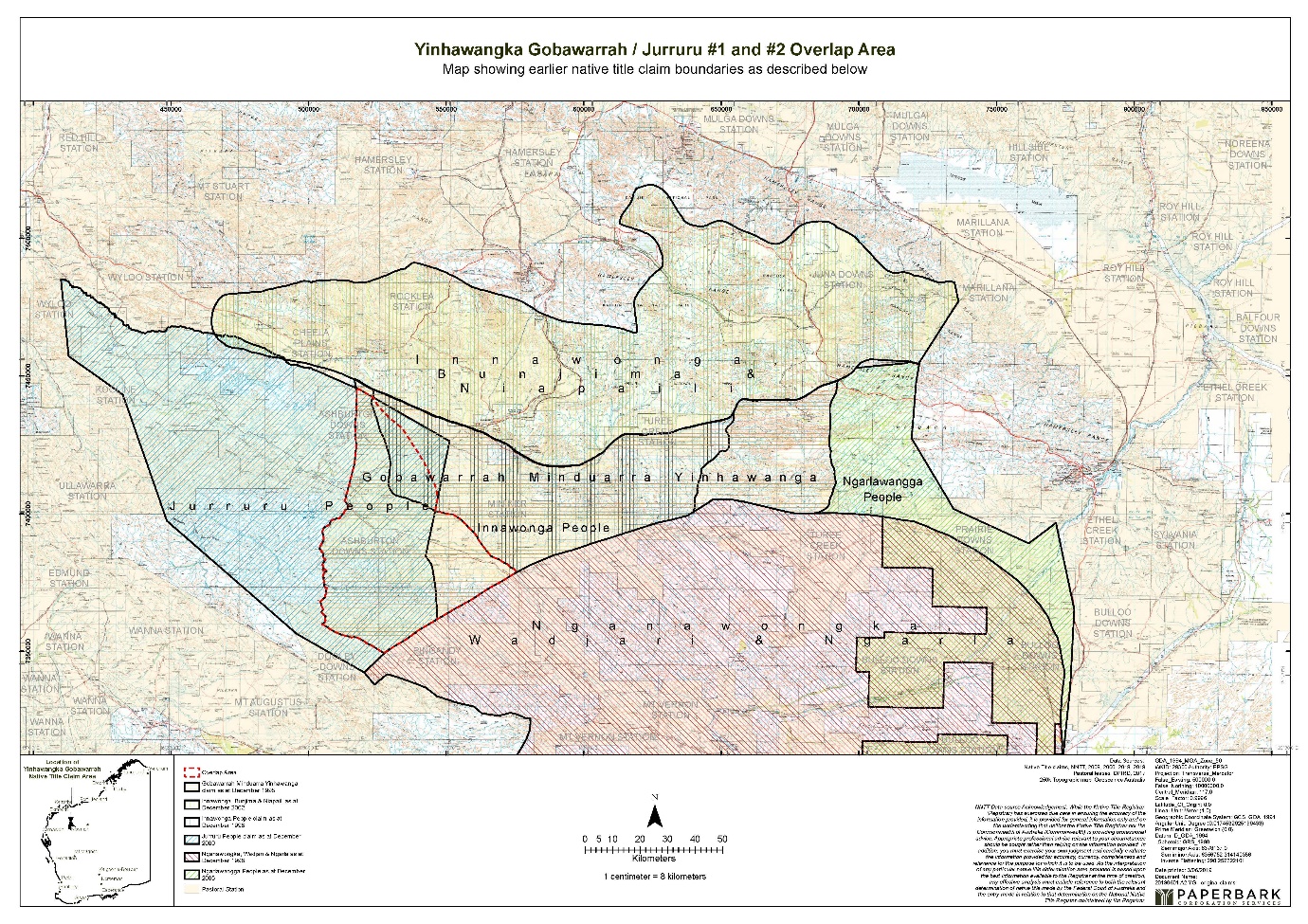
419 While employed at the Pilbara Native Title Service, Dr McGrath took part in the on-country field trip which occurred as part of the Innawonga and Jurruru overlap negotiations in 2001. The Yinhawangka Gobawarrah applicant contended:
On the field trip … between Innawonga and Jurruru in March 2001 only the Yinhawangka elders who were descendants of Jardhunha, David and Thomas Cox, and Minatangunha, Nicholas Cooke, Lola Young (nee Cooke) and Doris Limerick (nee Cooke) were present (as well as some young people). No one from the GMY group were invited although Jambu, Mabel and Muyit were all still alive. No descendants from the Yinhawangka apical ancestors, Tharantajinha and Wilga were invited. McGrath did not know why they were not asked to attend. Nevertheless, at that time McGrath did contact Mabel about Toby Smirke’s ancestry and found her to be a reliable informant.
(Footnotes omitted; references omitted.)
420 Dr McGrath’s field notes from that trip, dated 13 March 2001, record the names of people who were present. The Jurruru claimants in attendance at that meeting were Toby Smirke, David Smirke, Dinny Tumbler, Linda Smirke, Peggy Smirke, Shirley Smirke, Ivan Smirke, Halloway Smirke, Alex Alexander and Kieran Smirke. The Innawonga claimants in attendance at that meeting were Nicholas Cooke, Lola Young, Doris Limerick, David Cox and Thomas Cox. Dr McGrath recorded that there was first a “lengthy discussion as to where the boundary runs” followed by “boundary agreed and videoed”.
421 In cross-examination, Dr McGrath was asked how it was decided which people would attend the boundary negotiation. She denied that she had any active role in making this decision but rather “would’ve just had responsibility for making it happen, organising chairs and tables and TA”. I infer “TA” refers to travel allowances for people to attend. Dr McGrath initially said she was unaware of who would have made the decision about which people attended:
I couldn’t say. I think it would’ve come out of conversations between Slim Parker who was the Aboriginal liaison officer and Nick Green who himself had been through law and various representatives of the working groups. There were working groups. Each group had a working group that acted as the means through which we communicated with the broader people about how things were going to happen.
422 And then shortly after, Dr McGrath suggested the decision may have come about through discussions at working group meetings:
MS JOWETT: Thank you. I’m just trying to work out whether the Yinhawangka people that attended this meeting were selected by perhaps the Jurruru people that attended, or was it the responsibility of the staff of the Pilbara Native Title Services or was there consultation – or was it ad hoc?
DR McGRATH: No, it would’ve come out of discussions at working group meetings where there would’ve been identified a need to have a boundary negotiation because there was an awareness that there were different opinions and the matter would’ve been discussed at working group meeting, and the members of the working group would’ve themselves said, well, we want so and so to be there and we want so and so to be there. So it certainly wouldn’t have been a decision made by anybody else other than the representatives of those groups.
MS JOWETT: Am I to understand that Toby Smirke would’ve been happy to have those that did attend from the Yinhawangka side there?
DR McGRATH: I don’t think he would’ve had a choice about it.
MS JOWETT: He wouldn’t have a choice?
DR McGRATH: No, he wouldn’t have said, no that person can’t come. It wasn’t his decision. It was the Yinhawangka people who were representing the Yinhawangka native title claim who would’ve decided who their representatives were.
423 The difficulty with this evidence, as Ms Jowett then pointed out to Dr McGrath, was that the GMY applicant had a separate claim which covered part of the area which was the subject of the boundary negotiations. It is an agreed fact that no members of the GMY claim group were invited to attend the 2001 boundary negotiations. The evidence is clear, as the questions to Dr McGrath disclosed, that Mabel Tommy, Jambu Giggles and Muyit Smith, were all still alive at the time of the 2001 agreement, although as the extract from Roy Tommy’s evidence below at [426] reveals, they may not have been in the best of health.
424 Nancy Tommy’s evidence was that the Innawonga claimants excluded the Yinhawangka Gobawarrah from their boundary discussions at this time and that they were never involved. In her witness statement at [268] she said:
The other problem was that Innawonga claimants talked to the Jurruru about the boundary between Yinhawangka and Jurruru without including us Gobawarrah Yinhawangka, even though we have the Yinhawangka knowledge and connection for that country. They made an agreement with Jurruru about that country without us there. That was the wrong way to do it.
425 In cross-examination, Nancy Tommy was asked on what basis she said the 2001 boundary agreement was “not right”:
MR WRIGHT: And on what basis do you say it’s not right? Why do you think your knowledge is better than theirs?
NANCY TOMMY: Because we were always never involved. They never even said - oh even my brother Roy, none of us people, they didn’t accept it as - and the YMAC mob didn’t even come and say, “Look, they have to come in there too and put their evidence in there too.” Because my mum had passed on, surely anyone with a bit of respect can come and ask us.
426 Roy Tommy’s evidence was that the GMY claimants were not a part of the Innawonga claim group due to conflict between the two groups:
MS JOWETT: So, well, did you or any of the elders in that GMY group talk to any of the other Yinhawangka people about lodging that claim?
ROY TOMMY: We’ve actually – we did actually because it was – we put a – you have to put a notice out at the time and you say, “Well, there’s a – there’s a – we’re putting a claim here. If you’re interested, you could be part of it.” Oh, that was – that actually happened the same thing with the Innawongga – Innawongga with an “I”, they put a notice saying that if you – if you want to be a part of it because those things – that actually came to us as well that if you’re interested in part of this claim, let us know. We’ve actually done the same thing because the notice – I’ve got it – still got the copy of that notice that was sent to my mother.
MS JOWETT: From that Innawongga with an “I” claim?
ROY TOMMY: Yes. Yes, yes.
MS JOWETT: Yes. Did your mum attend that Innawongga with an “I” meeting?
ROY TOMMY: No, she never did.
MS JOWETT: And do you know why?
ROY TOMMY: Oh, the reason is is because we had a lot of – when native title started up we might have had a lot of conflicts amongst families. And sometimes conflicts are no good for you, especially when you’re elders. When they’re elderly old people you don’t want to try and – you try and keep them away from conflicts, especially my mum and my two mums, they weren’t well. You know, my mum and my old uncle and my old uncle just started going blind at that time. And my little mum had a major operation. So, we didn’t really want them, you know, in an environment where it’s – it’s too conflicts, too much conflicts can occur.
427 David Cox’s evidence in cross-examination was that the Yinhawangka people who were descended from Kurta Kurta were not included because they “got a different claim” and that there was conflict between the Innawonga and GMY claim groups. I extract some of his evidence below, as I consider it is significant not only to an understanding of the perceived effect of these agreements, but it also informs the answers to the separate questions.
428 Ivan Smirke’s evidence was that while he remembers attending the 2001 boundary negotiation, he was “only a young fella” and “wasn’t paying attention to what’s happening” but was “under the impression that everyone was invited to come there, have their say about the boundary”. Clearly that impression was incorrect.
429 Brendan Cook was not on the 2001 boundary trip with Dr McGrath, but he recalled that it had occurred. When asked whether the GMY claimants should have been asked to go on the 2001 boundary reconnaissance trip, this was Mr Cook’s evidence:
MS JOWETT: So, that was your claim. And so, when you went – when they went out on that trip, your dad and Aunty Lola and Aunty Doris and David Cox and Thomas Cox, and then all the Smirke family that I read out to you before, no-one on that trip was from that GMY claim were they from the Tommy family?
BRENDAN COOK: Yes.
MS JOWETT: They weren’t included were they?
BRENDAN COOK: Because they were pursuing that claim of the GMY.
MS JOWETT: But they were also still claiming that same area that you were all going out to talk about weren’t they?
BRENDAN COOK: It’s shown there.
MS JOWETT: Either side of that red dotted line - - -
BRENDAN COOK: Yes.
MS JOWETT: - - - they had a claim in over all of that area didn’t they?
BRENDAN COOK: Yes.
MS JOWETT: Yes. So, they should have been invited on a trip to talk about boundaries shouldn’t they?
BRENDAN COOK: We’re playing in different camps there.
MS JOWETT: Who was playing in two different camps?
BRENDAN COOK: They’re pursuing their angle of the GMY claim and we’re pursuing our angle.
MS JOWETT: So, you were saying you’re against them?
BRENDAN COOK: Yes.
MS JOWETT: And you’re still against them now aren’t you?
BRENDAN COOK: My father and I are the reasons why we came together to get native title.
430 This was, as I understood his subsequent evidence, a reference to securing a determination for the Innawonga claim at the time.
431 As a result of the 2001 agreement, the Jurruru #1 application was amended to pull the north-eastern boundary of the claim back further west, while the Innawonga application was amended to pull the south-western boundary of the claim back further east. The new boundary between these two applications then ran from approximately No 29 Bore, which is a short distance north of the Yarraloola to Kalgoorlie Gas Pipeline, and then south-east passing a short distance to the west of Middle Well, before turning south. This removed the overlap between the two applications. The original overlap was some 630 sq km, so each set of claimants had, roughly, reduced their claim area by approximately half of that amount.
432 It was put to Dr McGrath in cross-examination that this was a pragmatic decision between the Innawonga and the Jurruru groups:
MS JOWETT: So I suggest to you that was a pragmatic boundary decision to pull back, equally, from both groups.
DR McGRATH: I wasn’t privy to the discussions that happened between Yinhawangka and Jurruru people about the basis on which they made that decision to pull back. In my experience in these matters, pragmatism and a sort of – a quality of, “Oh, well, you know, let’s just cut it in half” – that isn’t usually how senior people go about negotiating these kinds of disputes. There's a – there's other bases that are put forward and – so – but I wasn’t present, I think, when some of those critical decisions were made, because, as I said, they were closed meetings.
The men went off and spoke somewhere and some of the really critical decisions they just asked the staff to leave.
433 Dr McGrath was cross-examined at some length about why at this time she did not engage with Mabel Tommy about the GMY claim. Dr McGrath’s response was, in substance, that it was not her role at the time, and it was a matter for Nick Green at YMAC. She expressed doubt that people such as Roy and Nancy Tommy would have been pleased if she had spoken to their mother about such things, although she agreed that she was indeed having such conversations with the Innawonga and Jurruru claim group representatives, through their working groups.
434 Brendan Cook gave evidence that he did the “mapping” with his ”grandfather” Chubby Jones and his “uncle” Des Smith for the Innawonga claim around 2000 and 2001 in Roebourne, prior to the 2001 boundary negotiations. In light of the changes to the boundary arising from the 2001 negotiations, Brendan Cook said he had got the prior mapping “wrong” and it was his “mistake”:
BRENDAN COOK: As I said, I did that map that the Innawongga with the “I” there check it in Roebourne looking at a map and talking with my grandfather Chubby Jones and my Uncle Des Smith.
MS JOWETT: And Chubby was a very knowledgeable man, wasn’t he, for country?
BRENDAN COOK: Yes.
MS JOWETT: So, you just followed what he told you just to do didn’t you?
BRENDAN COOK: To the best of my ability and I got it wrong.
MS JOWETT: Why do you say you got it wrong?
BRENDAN COOK: Well, that trip proved it.
435 He was asked about the boundary line drawn after the 2001 boundary agreement, shown on the map above at [418] as a red dotted line:
MS JOWETT: So, that’s – that’s a very sort of hard line that goes across the north of the Jurruru claim and then down the east side of the Jurruru claim. You can see that that red dotted line is in the middle of the two isn’t it?
BRENDAN COOK: Can see that.
MS JOWETT: Yes. So, it’s right down the middle?
BRENDAN COOK: Close.
MS JOWETT: Yes. And it doesn’t follow a creek or a river that red line, does it, the red dotted line?
BRENDAN COOK: It’s following the hills I think.
MS JOWETT: So, it’s following the hills, and your grandfather Chubby didn’t tell you that the claim had to follow the hills?
BRENDAN COOK: To think back to where that time when we did that, I did it to my best of my ability and understanding and I got it wrong.
436 As I found earlier at [271], Mr Cook then made some admissions about never having been out on the country he was drawing boundaries for as part of this agreement. Mr Cook then made this admission about the circumstances in which he was involved in drawing up the Innawonga boundary:
MS JOWETT: So you had never been out on that country when you drew up that map?
BRENDAN COOK: That’s correct.
MS JOWETT: And it was the same for the western side too where - remember I was taking you to that side where the little red line was.
BRENDAN COOK: That’s correct.
MS JOWETT: You hadn’t been out there either?
BRENDAN COOK: True.
MS JOWETT: And did you ever go out there to - - -
BRENDAN COOK: No.
MS JOWETT: To that western side.
BRENDAN COOK: No.
MS JOWETT: You still haven’t been out there?
BRENDAN COOK: No
437 There is some evidence (in Dr McGrath’s field notes) that suggests that after the 2001 boundary agreement, there was a delay in making the amendments to at least the Jurruru #1 claim so attempts could be made to resolve the overlap with the GMY application. Dr McGrath could not recall this in her oral evidence but did assert that
it wasn’t like GMY were being ignored. It was a – everyone working at YMAC was alert to the overlap and the necessity to try and resolve it.
438 Subsequent to the amendments after the 2001 boundary agreement, the GMY application remained overlapping with both applications, and importantly, it remained overlapping with part of the Jurruru #1 application in part of the area that comprises the overlap area in this proceeding.
The different iterations of the GMY claim area
439 Before turning to the 2010 intra-indigenous agreement, it is necessary first to outline the evidence and the parties’ submissions in relation to the shifting boundaries of the GMY claim, particularly as it relates to the overlap area.
440 The original GMY claim, filed on 25 June 1997, covered only part of the overlap area but extended further north-west into the area now subject to the Jurruru determination, and extended east as far as Newman. Roy Tommy’s evidence was that this initial claim in June 1997 was lodged with the assistance of the NNTT. Mr Tommy was cross-examined about why the claim area was initially so large, and this was his evidence:
MR WRIGHT: Yes. Okay. But before it was amended with the assistance of Pilbara Land Council, was it your decision to put the claim as far east as Newman?
ROY TOMMY: At that time, yes, we – we just actually put a blank claim over there to actually then amend it.
MR WRIGHT: Okay. And so did you understand at that point that you had – you or your family had some traditional rights east to Newman?
ROY TOMMY: No, we didn’t. We’ve always said Newman’s a – other – part of a – the other claim. It’s just at that time we just put a blank claim over there.
MR WRIGHT: So when you say “blank” do you – are you trying – are you meaning the word “blanket”?
ROY TOMMY: Blanket?
MR WRIGHT: Okay.
ROY TOMMY: Yes, yes. A blanket, yes.
MR WRIGHT: Blanket claim.
ROY TOMMY: Yes, well, basically, what we – there was land – vacant land there. We just lodge a claim over there, right?
MR WRIGHT: I see. So anything that wasn’t the subject of a Native Title claim.
ROY TOMMY: That’s right, yes. And then we had to sit down and amend the claim - - -
MR WRIGHT: I see.
ROY TOMMY: - - - with the old people.
MR WRIGHT: And so is that the same to the northwest?
ROY TOMMY: North - - -
MR WRIGHT: You see that claim area extended quite far – to the west beyond the current overlap area?
ROY TOMMY: Yes. Yes.
MR WRIGHT: Yes. So how – how did you determine to take that original map all the way out there to the northwest?
ROY TOMMY: At that time there – we just put a blank claim. Like I’m saying there, we just lodge a claim, we’ll just go like this, we lodged a claim over that, with the assistance of the Native Title Tribunal - - -
MR WRIGHT: Okay. And so at that time when you lodged that claim, did you have an understanding of where Yinhawangka country was?
ROY TOMMY: I – at that time I had a understanding where Yinhawangka country is, yes.
MR WRIGHT: And – and so do I – is it fair to say from what you’ve said that, even though you understood Yinhawangka country was smaller, you put in a Native Title claim over a wider area?
ROY TOMMY: That’s correct, yes. I knew the – the claim was smaller. A claim – I know where my – the places where I knew were Yinhawangka is – is. Right? But I just – at that time we just put a blanket claim over and then we had to – sit down with old people just to draw up where the – where the proper boundaries was.
441 If that was the attitude of the GMY claimants in 1997, as I find it was, and Mr Tommy in particular as the leading actor on behalf of the GMY, as I find he was, it is little wonder that the GMY as a group raised the ire of other groups in the region. This is not an attitude with any apparent basis in traditional notions of connection to country; indeed it is the opposite.
442 An amended Form 1 was filed on 23 December 1997. The western boundary was reduced to the north but extended further south, and the eastern boundary was substantially pulled back to remove Newman and other areas. It was at this stage that the application covered all of the overlap area. Mr Tommy’s evidence was that this amended claim was filed with the assistance of the Pilbara Land Council.
443 He was cross-examined about the amended December 1997 claim, and about how the newly identified boundary north of the Ashburton River was drawn. His answer was:
Just – because there was already old claim that was lodged on the Yinhawangka part, and we didn’t want to have a overlap with the Yinhawangka mob. We said this is our – and this is where – this is where our land was.
444 When asked for a second time, he said:
That boundary is determined when – when the Native Title – Pilbara Land Council went out on a trip with us. I wasn’t part of that trip.
445 The Jurruru applicant contended that Roy Tommy’s knowledge of boundaries is not from “his own understanding of the traditional boundaries”, but rather, based on information he obtained from Mabel Tommy, Jambu Giggles and Muyit Smith using maps and the boundary trip that Roy Tommy did not attend. Roy Tommy’s evidence about his involvement in lodging the GMY claim was that he and his sisters and Gladys Walker first “sat down” with the “three old people” to talk about the claim:
And he said, well – and they said – like, said, “Well, this is our land. This is the Gudjara land, and we need to go there and making sure that we actually look after those land. And because native title started early, I think we just had to sort of find a way to actually, you know, lodge it in so we can actually start to actually work on looking after our land.
446 He spoke about the role that he played in the mapping of the claim:
MS JOWETT: Could any of them read or write, those three old people?
ROY TOMMY: No, none of them could read or write, and I think, you know, we spent a lot of time with them just explaining, you know, about our lands and where our places are, and sat down with them and with my – with especially the old people, they can actually name a lot of the places, and all you had to do is just say, “Well, whereabouts is this place? How do you know that it’s in Auger?” And they’ll say, “Well, this is why it’s in Auger.” And I say, then, well, we’re actually mapping a – when we’re putting our country on map, the boundaries on the map we was naming these places that connect to us through language and through sites.
MS JOWETT: But they couldn’t show you on a map?
ROY TOMMY: No, they can’t. No, but what they could do is actually name the place. So, they could name - - -
MS JOWETT: And then you’d find that place?
ROY TOMMY: And then you could find it, yes, because you – because normally – a lot of the old people, yes, because they lived on the land and because of settlements being there, they had these land forms and named places, so, for like – for instance, if – if we say a number – name of a bore, “Oh, I know that bore.” That’s that the name of that – we know that as Aboriginal name for that bore.
If you – if you name a big hill like, say, Mt McHarry because it’s a well-known form, I say, “You know this big hill there?” “Oh, I know that place and that’s named – it’s got an Aboriginal name to it.” Oh, and if you – and then you have the, like Paraburdoo. “Oh, well, do you know this place around Paraburdoo? What’s here looking at Paraburdoo?” Oh, that’s Bidurra Hill or, if you go down to the gorge.” “Oh, what’s the name of this gorge?” “Garry Garry Gorge.” So, you can actually – oh, so you can actually – you can actually start to – and the old people can tell you the place, and go, “I know that place because it’s already there.”
447 He said he initially did not go on any trips to work out some of these places because of work commitments but that his sisters, Nancy Tommy and Julie Walker, and Donald Limerick and Eric Galby went on some trips. He said that they spoke with an elder Peter Stevens, a Guruma and Yinhawangka man, and with Alice Smith, a Guruma Banjima woman, but not others
because there was so much conflicts happening, we couldn’t talk to the other families because of that conflicts, and it made it hard to actually stand and trying to work things out … And I think that’s the reason why we went and started working with the old people to lodge our claim.
448 The GMY claim was amended again in 1999. The members of the applicant remained Jambu Giggles, Mabel Tommy and Muyit Smith. The application was expressed to be have been prepared by the Pilbara Land Council as the relevant native title representative body under the Native Title Act. A list of names was provided, said to be the members of the “Yinhawangka, Gobawarrah Minduarra People”. The boundary of the claim was expressed to be a “language boundary”. The list of the claim group was identified in the application as:
1. PATERSON (TOMMY) Mabel
2. GIGGLES Limpet (Jumbo)
3. SMITH Amy
4. FLATFOOT Arthur
5. FLATFOOT Sena
6. [Mr E.G]
7. MILLS Mary
8. SMIRKE Alloway
9. SMIRKE Nathaniel
10. SMITH Gloria
11. SMITH Kenzie
12. SMITH Roy
13. TAYLOR Beverley
14. TOMMY Julie
15. TOMMY Kurston
16. TOMMY Moira
17. TOMMY Nancy
18. TOMMY Robyn
19. TOMMY Roy
20. WALKER Bradley
21. WALKER Damien
22. WALKER Gladys
23. WALKER Peter
449 Two supporting affidavits in the application were given by Gladys Walker and Arthur Flatfoot. They were in identical terms. There was third affidavit from Damien Walker. There were also affidavits from the three main elders on which the GMY claim, and now the Yinhawangka Gobawarrah claim, relied. There was an affidavit from Jambu Giggles. His affidavit deposed:
I have always had physical contact with my country, the land which belongs to the Gobawarrah Minduarra Yinhawangka people. As a lawman and elder of this tribe I have a responsibility under Aboriginal Law to look after sites and to teach our young people about our law, culture and our land.
I was born in Hamersley station, my grandfather’s country in 1920. My mother’s name was Pimpa (Pirljpangurli) she was Yinhawangka woman and my father’s name was Kakkie he was from La Grange. My grandmother’s name (Mother’s family) was Kurta Kurta, she was a Yinhawangka and her husband was a Kurrama man called Purntanirrindj.
I grew up on my Grandfather’s country on Rocklea Station and I started work there. I then went to work at Wyloo where I met and married my wife Judy a Kurrama woman.
I started my law at Jiggalong, we had to ride there on horseback, it was during the war with the Japanese. I then returned to my country to follow my law and to finish it in my country.
I go bush all the time to get bush food, bush medicine and make artefacts that’s all we know, never knew needles or tablets. We went bush all the time, walking and riding horses, mustering and shifting cattle.
We never know Christmas. Christmas time we were in the bush, we were collecting wild oranges, and bush food. We have a good time, bit hard, but we learned a lot of things. This was the time we visited sites and held ceremonies.
They call me ‘Jampu’ because I do everything with my left and, I can speak little bit of Yinhawangka, Thalanji, Yindjiparndi and Kurrama.
I still go bush now, following the law, never stop. We help our young boys. We get them ready for the law and teach them about law. They take over from us, take on our culture.
I still visit and live on my country, to gather wood for artefacts and medicines. I have also gone back to my land to carry out ceremonies and to show the kids.
450 There was also an affidavit from Mabel Tommy. She deposed:
I have always had a strong physical and traditional connection with my land which has been ongoing from generation to generation by the Gobawarrah Minduarra Yinhawangka people. The meaning is the top end of the Ashburton Angelo river.
Jampu Giggles, Amy Smith and I are the last remaining elders of the Gobawarrah Mindurra Yinhawangka people.
I was born in the bush down from Mt. Brockman station in 1927 near a river called Jidigoo. My brothers Jampu Giggles and Joe Injie was born at Hamersley Station. My deceased brother Joe Limerick was born near a place we called Jooda Winjie near Murimamba Station and my sister Amy Smith was born at the Murimamba Homestead.
My mother Maggie Pimpa was born at Nyimirli Hill near tom Price which is on Gobawarrah Minduarra Yinhawangka and Guruma boundry. My father was born at Kajiwinha, he was an elder of the Injibandi tribe.
I had 3 Grandmothers, when their husbands died they remained single, they would take us bush and we would walk our country visiting springs, waterholes and gathering and hunting bushtucker and medicine. They taught me all about the bush, we would gather Kajawari, Jilbukarri, Jibulyu and Burdarbu.
When my parents weren’t working they would take us bush and we would go fishing and looking for bush honey (jandaru). We would move all about our country and meet up with other people and there would be lots of corroborees, dancing and when there were enough boys to go through the tribal lore then we held our ceremonies.
My brother Jampu Giggles went through the tribal lore at Jiggalong.
As a young woman I have worked on Turee Station, Ashburton Downs and from there Milgin, Mulgul, Mt Vernon and Pingandy Stations. All these Stations are on Yinhawangka country.
During the time I lived on the stations my husband taught me to muster sheep and gather bush tucker and medicines. He also taught me the Yinhawangka land and he was a Yinhawangka leader (boss man).
My Grandmother Kurta Kurta taught me Aboriginal songs, this was passed on to my Morther Maggie Pimpa. Today I am the only Yinhawangka woman who have my own corroborees and songs. I have continued to teach this to my children and non-Aboriginal children in Paraburdoo.
When my kids started school, my husband Nymirli (Tommy) took them to Onslow Native reserve and I stayed at Ashburton Downs Station. They would visit me during the school holidays. I liked working on the stations riding and chasing wild cattle as I was still on my country. I left Ashburton Downs and then worked on other stations like Yaraloola with my new husband Algie Paterson. I stayed with him for 25 years and still visited my country. After his death I returned to live in my country.
451 There was an affidavit from Amy (Muyit) Smith. She deposed:
I have always had strong physical and traditional connection with my land which has been ongoing from generation to generation by the Yinhawangka people.
I was born at Murimamba Homestead (this station is no longer there) near Mt. Brockman. My mother was Maggie Pimpa (Pirlljpangurli) she was a Yinhawangka woman and my father was Galby he was an Injibandi man.
When I was growing up, my mother used to take us in a horse tray gathering bush tucker, (no cars around then).
As a child I remember, we used to have separate women dances, all over the country.
When I was about 14 years old, people used to teach us how to bury the people proper way – wrap them up in the blanket. This was the old funeral. I remember seeing my Grandmother’s aunty being buried at Rocklea Station.
When I got married, I stayed at Goboo Windmill.
I stayed and worked with my husband Jack Smith. We worked around Wyloo, Rocklea and Ashburton Downs stations.
I had 5 kids. My eldest was born at Cobbin and my first son in Juna Downs and my second son was at Muthaygoonie which is on the Gobawarrah Minduarra boundary.
When we weren’t working we was gathering bush tucker and having ceremonies and meetings.
In about 1965 we moved from Mulga Downs to Roebourne where I had my youngest child, Gloria Smith, up until then we were living in the bush.
452 Gordon Yuline deposed:
I have known Limpet (Jumpu) Giggles since I was a boy, they call him Jumpu because he is left handed.
Since growing up I know that he is a top Tribal man and a top Lawman. Limpet Giggles is locally known throughout the region as an Elder of the Yinhawangka Gobawarrah Minduarra people.
Jumpu Giggles has lived on his country all of his life. He knows all the history of his land, he practices and teaches the young people about their law and culture which has been passed on from generation to generation.
Jumpu often goes bush to gather bushfood, medicines and wood to make his own spears and boomerangs. He also speaks his own language and understands others.
Jumpu went through the Aboriginal Law at Jigalong but then returned to his own country to finish the law.
453 Dolly Boonga deposed:
I am a Yinjibandi elder. I married William Yilwanie (Wylool) who is the maternal uncle of Jampu (Lippet Giggles, Amy Smith and Mabel Tommy.
As his common law (Aboriginal) wife, William Yilwanie and I was responsible for putting Jampu Giggles through Aboriginal customary law. To this day I am his (Jampu Giggles) mother through Aboriginal law.
To the best of my knowledge, Lippet (Jampu) Giggles, Mabel Tommy and Amy Smith is the only Yinhawanga elders and has the right to claim the area covered by their claim.
I believe that all the statements made in this affidavit are true.
454 Peter Stevens deposed:
I have known Jumby Giggles since we were kids together. His name is Limpet Giggles but is known as Jumpu because he is left handed. He is a Gobawarra Minduarra Yinhawangka Elder, following his Grandmother and Mother’s country.
He was born in Hamersley Station and then went to Mt. Broackman Station. From there went to Rocklea Station, been here as kids and grew up and worked on Rocklea Station.
He was taken to Jigalong along with Clarrie Smith, they went through the law together (Yalburas). then was brought back to his own country to learn and see everything about his law here. Finished up his law here, top Lawman.
His father was Gaggles, he was a bullock team driver, burried in Hamersley.
He is a top Law and Culture Elder. He is still making boomerangs and spears but he is a bit blind now.
455 The Yinhawangka Gobawarrah applicant contended that
These affidavits indicate the approval of the claim boundaries by knowledgeable Pilbara elders. These elders must surely be considered to form part of Dr McGrath’s ‘jural public’.
456 I accept that these affidavits are relevant. They are the only sworn evidence of Mabel Tommy, Jambu Giggles and Muyit Smith supporting the claim to the overlap area as Yinhawangka country. The other deponents should, I accept, be taken by the giving of their affidavits to have supported the claim over the overlap area. In my opinion if it had been as clear as the Jurruru applicant contends it is that the overlap area was Jurruru country, it is unlikely those deponents would have signed supporting affidavits. The Court was not directed to any evidence seeking to impugn the affidavits given by the supporting deponents, nor those by the three key elders. At the time of the 1999 amendments, six listed members of the group completed affidavits stating that they wished to be removed from the claim so that they could join the overlapping Innawonga claim. Those people were: Colleen Fisher, Rohan Fisher, Andrea Fisher, Regina Fisher-Lewis, Joseph Limerick and Peter Limerick. Donald Limerick (the brother of Joseph and Peter Limerick) explained this change in cross-examination in the following way:
They was an [I infer the witness meant “on”] then they followed my mother on the Ngarla side then.
457 As I explain below, the GMY claim was amended again following the 2010 GMY and Innawonga intra-Indigenous agreement, this time to withdraw the claim from the land and waters the subject of the Yinhawangka Part B claim. The GMY claim then only covered the area which is now the overlap area in this proceeding.
The 2010 GMY and Innawonga intra-indigenous agreement
458 The 2010 GMY and Innawonga agreement was signed by Nancy Tommy, Arthur Flatfoot, and Roy Tommy, for the GMY, and Nicholas Cooke, Lola Young, and Stuart Injie for the Innawonga. Lola Young is the woman that Brendan Cook gave evidence would in earlier days have been “flogged” for the book she wrote about her country. Relevantly it contains the following recitals:
The GMY Claimants and [Innawonga] Claimants agree that they are all members of the Yinhawangka language group, with rights and interests over Yinhawangka country. The GMY Claimants and [Innawonga] Claimants have decided, on the basis of expert legal and anthropological advice, to come together to lodge one single Yinhawangka claim over all Yinhawangka country.
Although they are members of the Yinhawangka language group, the GMY Claimants assert a distinct identity as GMY based on their family traditions. It is important to the GMY Claimants that they are able to maintain their identity.
The [Innawonga] Claimants acknowledge that the GMY Claimants assert a distinct identity and are willing for the GMY Claimants to maintain their GMY identity within the context of a single united Yinhawangka claim.
459 In clause 1, the operative part of the agreement, the parties made the following promises:
1.1 The GMY Claimants covenant and agree to work towards the lodgement and progression of a single Yinhawangka claim over Yinhawangka country; and
1.2 The INN Claimants covenant and agree to work towards the lodgement and progression of a single Yinhawangka claim over Yinhawangka country.
460 There were some disagreements between the Innawonga and the GMY claimants initially about the eastern portion of the GMY claim that did not overlap with the Innawonga claim. This eastern portion covered the West Angelas area, in which Rio Tinto operates a large iron ore mine. The Innawonga claimants and the GMY claimants disagreed about whether this was Yinhawangka country. The Innawonga applicant asserted it was not Yinhawangka country; however, the GMY elders in the GMY applicant strongly disagreed. David Cox was one of the Innawonga claimants who opposed the inclusion of West Angelas and Jabaguru in the Yinhawangka claims.
461 The Innawonga claimants subsequently agreed to include West Angelas in the combined claim. Following this agreement, the Yinhawangka Part B claim was filed over the Innawonga and GMY overlap and over the eastern portion of the GMY claim comprising the West Angelas, and the Innawonga claim was combined with the Yinhawangka Part B claim. The GMY claim was amended and from this point onwards it only covered the overlap area which is the subject of this proceeding.
462 The Jurruru applicant contended that this 2010 agreement meant that the GMY claimants agreed, under traditional law and custom, to the western boundary of the Innawonga claim, which was the result of the 2001 boundary agreement with the Jurruru claim group. It also contended that the current Yinhawangka Gobawarrah application area is, conversely, a “product of the native title claim process and a dispute between the Yinhawangka families, and not a reflection of traditional law and custom”.
463 Nancy Tommy explained her view of the 2010 negotiations at [263]-[270] of her witness statement filed in the GMY proceeding (which was tendered in this proceeding by agreement):
We were told by YMAC that we had to agree on a single Yinhawangka claim to sort out the overlap between the GMY and Innawonga claims.
There were meetings between the GMY claimants and the Innawonga claimants to try and agree the boundaries for a single Yinhawangka claim. The Innawonga claimants didn’t want to include the West Angelas and Gobawarrah areas. They were saying the West Angelas area was not Yinhawangka even though we knew it was.
In the end the Innawonga claimants agreed to include the West Angelas area in the single Yinhawangka claim. There is a big mine in that area and the single Yinhawangka claim group has received a lot of compensation from that mine. Nowadays some of those Innawonga people in the single Yinhawangka claim want to have all the say for the West Angelas area. Barndu Cox and Nicholas Cooke say they speak for that country even though they didn’t recognise it as Yinhawangka country before the single Yinhawangka claim.
We wanted to include the Gobawarrah side in the single Yinhawangka claim. We tried to explain our ancestors’ connection to the Gobawarrah but the people who were talking up for the Innawonga claim didn’t want to listen. The videos my ngunga, uncle Jambu and little mum Muyit did in 1999 about Yinhawangka boundaries and sites and culture were not looked at by the Innawonga claimants or by the YMAC lawyers or anthropologists.
YMAC lawyers didn’t spend time with my family getting our cultural information. I never got asked by the YMAC lawyers about my connection to the Gobawarrah area and nobody every prepared my witness statement before.
…
The GMY claim group ended up reaching an agreement with the Innawonga claim group to put in the single Yinhawangka claim without the Gobawarrah area. We weren’t happy about leaving out the Gobawarrah but YMAC told us we could sort that out later.
The agreement between the GMY and Innawonga groups was written up by YMAC lawyers. The Innawonga claimants agreed we could keep our Gobawarrah Yinhawangka identity in the single Yinhawangka claim.
(Emphasis added.)
464 Roy Tommy’s evidence in cross-examination was that there was disagreement between the GMY and the Innawonga claim groups about the western boundary of the combined claim:
MR WRIGHT: When it came to the western boundary of the single Innawonga claim, that western boundary was agreed to be the boundary of the Innawonga with an I claim.
ROY TOMMY: It was agreed to between the Innawonga; it wasn’t agreed to between us, the GMY. But because we had to lodge a claim that everyone had to agree with - - -
MR WRIGHT: Yes.
ROY TOMMY: - - - we had to agreed with that this is what we agreed with, with the A and the B claim - - -
MR WRIGHT: Yes.
ROY TOMMY: - - - but we still dispute the fact that the west part was still Yinhawangka country, and our old people always said that the Yinhawangka part on the west side was Yinhawangka.
465 He was later asked if he eventually agreed to the western boundary for the purpose of a single Yinhawangka application:
MR WRIGHT: But, ultimately, you agreed, didn’t you, in 2010, to accept that western boundary for the purpose of the single Innawonga claim?
ROY TOMMY: Mm. No, I didn’t agree – I didn’t agree to that that the – that they had covered all the Yinhawangka land. I only agreed on the basis that we came together just to lodge that A and B.
MR WRIGHT: Alright. So you definitely entered into this agreement that you’ve got in your hand.
ROY TOMMY: Yes.
MR WRIGHT: Yes. And you were one of the people who signed it.
ROY TOMMY: That's correct, yes.
MR WRIGHT: Yes. And it said that it was meant – this agreement was about coming up with a single Innawonga claim that would cover all Innawonga country.
ROY TOMMY: When all was agreeing that that was Innawonga country. But we said – said that the west part was Yinhawangka. They didn’t agree with it. We said we agreed with that the west was still Yinhawangka. The other Innawonga people said it wasn't Yinhawangka country. So, in order to be – come together as one Innawonga – lodging one Innawonga, we had to be together to lodge one Innawonga claim in order to get all together to lodge the claim, right?
MR WRIGHT: Yes.
ROY TOMMY: In order to – and to – and to get this determination at – at the moment what you have.
MR WRIGHT: Yes.
ROY TOMMY: They still not agree – they weren’t agreeing that this was Yinhawangka country on the west. We always said it was Yinhawangka.
MR WRIGHT: Okay. I understand that.
ROY TOMMY: Yes.
MR WRIGHT: But I’m putting to you, yes there was a disagreement but in 2010 you gave in to their view and agreed that the single Innawonga claim that covered all Innawonga country was to follow their western boundary.
ROY TOMMY: No, I didn’t agree with it.
(Emphasis added.)
466 Like his sister Nancy, Mr Tommy’s evidence was that he had tried to persuade the other Yinhawangka groups to include the overlap area in the combined Yinhawangka claim. His evidence emphasised how he had tried to get them to watch the tapes from the 1999 Haydock materials of the Yinhawangka Gobawarrah elders, particularly of his mother Mabel Tommy:
MS JOWETT: Right. So, when the Parts A and Parts B was all finalised about the right area for that, what did everyone decide about this overlap area amongst the Yinhawangka groups?
ROY TOMMY: We – we constantly said – and my family always said that the Yinhawangka – my old people always said it’s Yinhawangka, and we said, “No, this is Yinhawangka”, and they still didn’t believe it. And I said, will you try to sit down with them. You know, they were simply not agreeable. They absolutely dismissed my mother’s information, and I tried to sit down and then show my mother’s information at least.
MS JOWETT: When you say “show”, what do you mean by “show”?
ROY TOMMY: You know, we – at one particular time we sat down in a hall there and we wanted to show my mum’s video to say, “Look, my mum’s saying this is my old people saying this is Yinhawangka country.”
…
MS JOWETT: And did they say that they listened to your mother’s tapes?
ROY TOMMY: No, they weren’t interested.
467 “They” is a reference to Ivan Smirke, David Cox, Brendan Cook, and Cecil Parker, amongst others. Roy Tommy further said:
ROY TOMMY: I think some of them wanted to see the tape, it’s just that unfortunately my nephew [Ivan Smirke] had this – oh, you know, I don’t really want to discredit him or any ways, but unfortunately he would not listen to the way his grandmother’s stories and why he’s saying that this is Lola, you know.
MS JOWETT: Did he say why?
ROY TOMMY: Because he – see, he doesn’t want to listen to our – the grandmother’s story, more so on the – you know, I understand that he wants to protect his father’s country but, you know, I don’t really want to – but to say things about his grandmother without – which can be hurtful at times, but I don’t want to be seen to be a person that holds a grudge against anyone, and all I want to do is actually have people listen to my mother’s story and my old people’s story and say why this is Yinhawangka country.
Findings
468 I find that although people such as Ivan Smirke attended the 2001 meeting, he was on the periphery because of his age and lack of seniority and the presence of people like his father, David Cox and Nicholas Cooke. I find that the 2001 boundary agreement was not a comprehensive attempt to resolve the boundary disputes in this region; rather it was something of a partisan attempt because, by that time, there as already enough ill-feeling between at least certain members of the Yinhawangka and certain members of the Jurruru on the one hand, and the GMY claimants (and the Tommy family in particular) on the other, that a conscious and deliberate decision was made to exclude the GMY claimants from the boundary field trip, and the meetings and agreement which flowed from them. This is despite the fact that all who attended, including Dr McGrath and others from the (then) Pilbara Native Title Services, knew that the GMY claim overlapped with the very boundaries under discussion.
469 Whatever the conflicts between the families, those professionals involved should have well understood that excluding the GMY precluded the reaching of finality over these boundaries. The approach taken means that almost 20 years later the matter remained unresolved.
470 I also find that by around 2010, when the second agreement was made, there remained enough mistrust that each side came away with a different understanding about the consequences of the 2010 agreement. Mr Tommy’s understanding is set out above. It is plain from his evidence that the GMY were never going to surrender their claim to the overlap area, even if they were otherwise prepared to join in a single Yinhawangka claim for what they saw as the rest of Yinhawangka country. It is also clear that some of the key Yinhawangka figures at the time (David Cox, Nicholas Cooke) were not prepared to extend any claim for Yinhawangka country into the overlap area. In my view that position stemmed as much from the fact of the 2001 agreement as anything else. So much was clear from David Cox’s evidence (with my emphasis):
MR CUMMINS: Yes. So why didn’t you invite those people into that - - -
DAVID COX: Hey? Well - - -
MR CUMMINS: Why didn’t you ask them to come along - - -
DAVID COX: Yes - - -
MR CUMMINS: - - - so you could all talk about it?
DAVID COX: Yes, but they got the GMY, see?
MR CUMMINS: I know they’re on a different - - -
DAVID COX: Because we’re - - -
MR CUMMINS: - - - claim. I understand that.
DAVID COX: They got a different claim.
MR CUMMINS: Yes, I understand that. But, really, you were reaching an important – coming to reach an important agreement, weren’t you, between Yinhawangka people and Jurruru people - - -
DAVID COX: Yes.
MR CUMMINS: - - - about the boundary.
DAVID COX: Yes.
MR CUMMINS: It was an important agreement.
DAVID COX: Yes. Course it was important.
MR CUMMINS: Yes. And ever since that agreement you’ve really felt you had to – you have to stick to that agreement, haven’t you?
DAVID COX: That’s for sure. Can’t – can’t move it.
MR CUMMINS: You can’t move it.
DAVID COX: No.
MR CUMMINS: Yes.
DAVID COX: We’re stuck with it.
MR CUMMINS: Because it’d be a shame if you changed it.
DAVID COX: That’s for sure.
MR CUMMINS: Yes.
DAVID COX: And I’d be ashamed of myself going over that.
MR CUMMINS: So you made that decision, really, without hearing the information that the people from Nancy Tommy’s family, didn't you?
DAVID COX: No.
MR CUMMINS: You didn’t include them in that meeting.
DAVID COX: No.
MR CUMMINS: In that discussion.
DAVID COX: Yes.
MR CUMMINS: Yes. And you didn’t have their cultural information.
DAVID COX: No.
MR CUMMINS: And is that really why, now, you feel that you can’t really – you’re not that interested in really looking at their materials - - -
DAVID COX: No.
MR CUMMINS: - - - because you’ve already made the decision - - -
DAVID COX: Yes.
MR CUMMINS: - - - it’s already set in stone and it's locked in place.
DAVID COX: Yes. Finish.
MR CUMMINS: Yes.
DAVID COX: We can’t move any more.
MR CUMMINS: Can’t move because of that deal that you did - - -
DAVID COX: Yes.
MR CUMMINS: - - - before.
DAVID COX: It’s there now.
MR CUMMINS: If – well - - -
DAVID COX: We can’t bring it back.
…
DAVID COX: Yes, but they never asked us when they put the GMY claim.
MR CUMMINS: Well - - -
DAVID COX: Why – why should we ask them?
(Emphasis added.)
471 Mr Cox continued with this emphasis in re-examination, when senior counsel for the Jurruru applicant was trying to extract evidence from him that there was a traditional reason for the boundary being set where it was in the 2001 agreement:
DAVID COX: We don’t want to change it now. We don’t want to change it – maybe it has something to do with Native Title.
MR WRIGHT: Yes. And you mentioned the word ‘shame’ before.
DAVID COX: Yes.
MR WRIGHT: What was the shame?
DAVID COX: Well, I’m ashamed to go to another man’s country and take over another people’s country. That’s wrong. I wouldn’t go that far.
472 The difficulty in this evidence, especially the last piece is that David Cox, on his own evidence, does not consider areas such as Ngulunganga (Mt Elephant) to be Yinhawangka country and yet he agreed, in 2001, to the boundary being set so that would be the outcome. I infer he well knew and understood these matters at the time. Ngulunganga is a significant site in the region. I find that what occurred was that he, and it would appear, other Yinhawangka people, participated in a boundary negotiation which, as counsel for the Yinhawangka Gobawarrah applicant described it, had some pragmatism to it. The 2001 agreement did not reflect the views of all senior Yinhawangka people about the boundaries of their country: it reflected an agreement they were prepared to make, and live with, with the Jurruru, and to make while excluding the GMY claimants. Despite Dr McGrath’s opinions, it does appear the two sides essentially split the overlapping area in half. People such as Brendan Cook took responsibility for drawings lines on maps in relation to country they had never visited. The evidence suggests little that was “traditional” about what occurred in 2001. The exclusion of Mabel Tommy might be explained by gender factors (although no witness did), but the exclusion of Jambu Giggles cannot be. The evidence suggests pragmatism. The evidence about the 2001 negotiation also reveals a desire to cut out the GMY claim group, based in my opinion by this stage more on personal animosities than anything to do with traditional law and custom. This animosity extended to not wanting to listen to and watch the tapes from the Haydock materials in order to see why Mabel Tommy was explaining that at least some of the overlap area was country passed down from her ancestors. The principal Yinhawangka people were simply not open to discussion about the overlap area, despite what is now acknowledged to be the objective quality of what Mrs Tommy was saying, according to (amongst others) Dr McGrath, although I accept she did not see these materials until 2019.
Jabaguru
473 It is appropriate to collect some of the evidence and arguments about Jabaguru, and to make some general findings about those matters. Jabaguru is the site which featured most prominently in the evidence, especially of the Yinhawangka Gobawarrah applicant.
474 Jabaguru is located in the eastern part of the overlap area, on the Ashburton River. The Court visited Jabaguru during a site visit in the first week of the hearing, and evidence was given at that site by Roy Tommy, Nancy Tommy and Julie Walker.
475 Ultimately, and despite the way its case is advanced in its Form 1, the Yinhawangka Gobawarrah applicant submitted that Jabaguru is “shared country”. Precisely what is meant by that expression will need to be explored later in these reasons.
476 The Jurruru applicant contended that Jabaguru is part of Jurruru country, and that while many non-Jurruru Aboriginal groups, including Yinhawangka people, visited and had an “historical association” with Jabaguru as a site, these “associations” do not give rise to inheritable rights and interests in Jabaguru or surrounding areas based in traditional law and custom.
477 The parties’ further amended agreed statement of facts contains the following information about Jabaguru at [110]-[112]:
Jabaguru is an important site located in the eastern part of the Overlap Area on the Ashburton River.
Jabaguru used to be a Law and meeting place for different groups. Aboriginal people from the neighbouring language groups used to go there for corroborees, marriage arrangements, and Law business.
There is permanent water at Jabaguru and it used to be very rich country for bush tucker. It has changed because of all the sheep and cattle grazing.
478 Jabaguru is also the place where a number of Aboriginal people associated with claims over the overlap area have been buried. The parties’ further amended agreed statement of facts refers to the following people, whose burial sites are located at Jabaguru:
(a) Mabel Tommy;
(b) Moira Tommy;
(c) Kurta Kurta;
(d) Pilingurra (Nyimili Tommy’s brother); and
(e) Bindimaya (also spelt Bindimayi), a Guruma man and son of an ancestor known as Windiwarri. Bindimaya was David Cox’s paternal “grandfather” (his father’s “step-father who raised him up”).
The late filing of the Jurruru #2 claim
479 The Jurruru #2 application was filed over Jabaguru and its surrounds in 2012, significantly after the GMY application over this area. The Jurruru #1 application does not and at no time did cover this eastern part of the overlap area.
480 The Jurruru applicant submitted that no inference can be drawn from this later filing that the Jurruru #2 claim reflects a recent or 2012 understanding that the area was Jurruru country. It contended that that understanding “has always been there, has always been the case”.
481 The only evidence about why the Jurruru #2 claim was filed at a later stage is from Ivan Smirke, who was asked about this during his evidence in chief:
I think it was something with the - with the legal - all the legal stuff because I think GMY was with YMAC then and because YMAC was representing us at the time, and YMAC were trying to do things, to try and make deals, and like that there, trying to make - so half of the time we didn’t know where we were going and that, like not - we knew but like, we always know where our country is in our head, you know, but because of those legal issues, “Oh you’ve got to put a line here, you’ve got to put a line there,” you know those things, “Oh these people got that claim there, what you going to do?”
Like, you know, so had advice from YMAC as well, “Because there’s that overlap, maybe if you pull it back” and things like that there. Those were the things that were going on in our head. But we always believed - well, we always believe we know where the, yeah, Jurruru country is by their natural features, not by lines.
482 The Jurruru applicant contended that Toby Smirke has reported the boundaries of Jurruru country consistently with the external boundaries of the combined Jurruru #1 and #2 claims since 2001, and that he learnt those boundaries from his father, Jimmy Smirke, and other senior men including Yinhawangka men. His evidence was that he was taught a lot about country by Kooline Mick, a Yinhawangka man. Mr Smirke said that Yinhawangka, Ngarlawangga and Gurama are all closely related to the Jurruru sharing laws, customs, marriage and ceremonies. He explained his understanding of the boundaries of Jurruru country to Dr McGrath in 2001. In this video, Toby Smirke identified the eastern boundary of Jurruru country as running between the following features, which are generally consistent with the eastern boundary of the Jurruru #2 claim:
(a) Gunari (Mt Boggola) (Jurruru site number 10);
(b) Dalarang (Jurruru site number 5);
(c) Mininer Outcamp (Jurruru site number 21);
(d) Ngulunganga (Mt Elephant) (Jurruru site number 47); and
(e) Marduwara (Jurruru site number 17).
483 The Jurruru applicant provide a number of other references to Toby Smirke’s statements since 2001 about Jurruru boundaries, and I accept these statements are again generally consistent with the boundaries of the combined Jurruru #1 and #2 applications; that is, the whole of the overlap area.
484 David Smirke also gave evidence about the traditional boundaries of Jurruru country which was consistent with Toby Smirke’s account.
485 Peggy Smirke’s written evidence was that although she did not know the boundaries “as well as Toby and David”, her “old people” told her that (at [74]-[84]):
Jurruru country starts up at Hardey Junction near Kaoline Pool [#45 03], and then goes across the top of Jurruru country roughly following the Hardey River. On the other side are the Kurama people.
Then the boundary drops down to Dalarang Pool [#23 15] and on the other side of this bit of the boundary are the lnnawonga people.
From Dalarang Pool [#23 15] the boundary goes back over the Kenneth [#64 F6] and Godfrey Ranges [#44 F6], and on the other side of this bit of boundary are the Ngarla people. …
Once the boundary leaves the ranges it goes back up through lrregully to Hardy Junction [C1] again. On the other side of this bit of the boundary are the Thudgari people.
The Ashburton River runs through the middle of Jurruru country.
486 Ivan Smirke gave evidence consistent with that of his father Toby and his uncle David. His evidence was that there is no distinction between the Jurruru Part A determined area and the overlap area.
Other evidence that Jabaguru is Jurruru country
487 David Cox’s evidence was that Jabaguru is in Jurruru country. He maintained that consistently.
488 Marlon Cooke also said he was told by Chubby Jones (a senior Yinhawangka man) that Jabaguru was Jurruru country. He agreed in cross-examination that Chubby Jones was “really strong for Rocklea” and that he and Chubby Jones “used to go around there”. He also gave evidence of a Jurruru shield design which he was taught was associated with the Ashburton River area, including with Jabaguru.
489 Brendan Cook’s evidence was that he understood Yinhawangka country did not go all the way to the Ashburton River but stopped at Mt Elephant and said Jabaguru was Jurruru country. I note that this account is inconsistent with the Yinhawangka determination, although consistent with Toby Smirke’s evidence, and with David Cox’s opinions. The discrepancy may be explained by the 2001 boundary agreement.
490 Dr McGrath’s opinion, based on her own interviews with Jurruru and Yinhawangka people, was that Jabaguru was Jurruru country. She said in her report at [1010]:
Knowledgeable informants who described Jabaguru as a ‘tribal meet up place’ for Ngarlawangga, Jurruru and Yinhawangka people also clearly stated that they believed Jabaguru is on Jurruru country, and explained that the fact that people from surrounding groups participated in law there did not undermine the identity of the area as Jurruru country.
491 Her view was that non-Jurruru people may have what she termed contingent and non-inheritable rights in some parts of the overlap area, particularly Jabaguru:
With regards to Jabaguru (Site 12), in my opinion some Ngarlawangga people (namely Tadgee Limerick’s brothers) may have held contingent rights in relation to the ceremonial ground on the basis of their cultural responsibilities there. I have not seen any evidence that suggests any Ngarlawangga people continue to assert contingent rights in the area of Jabaguru.
In my opinion, members of Mabel Tommy’s family currently hold contingent rights of visitation and care in relation to known burials in the Jabaguru area, but these rights are of a different order to primary native title rights and do not impact the rights and interests of the Jurruru people in the area.
(Emphasis original.)
492 Somewhat curiously however, Dr McGrath agreed with the following proposition (proposition 27) in the joint experts’ report:
The area known as Jabaguru is an area where both Jurruru and Yinhawangka Gobawarrah, claimants have connection to country, which gives rise to a right to speak for that country.
493 She qualified her agreement with the following statement:
The basis to these connections are diverse and the rights that people hold in this area are complex.
In my opinion, the Jurruru people have decent [descent] based rights to speak for this area on the basis of their ongoing association to the area.
The Yinhawangka people may likely have descent-based rights in the area, but I am less certain of this.
If Yinhawangka people do have descent-based rights in this area, then they would be held by all Yinhawangka people.
Any rights Yinhawangka Gobawarrah people hold in relation to burials in the area is a separate question.
494 This appeared to be a shift from the position adopted in her report where she nominated the family of Mabel Tommy (not all Yinhawangka) as having only “contingent” rights in Jabaguru, largely arising from the birth and burial of family members there.
Evidence that Jabaguru is shared country
495 The lay witnesses were prepared to accept that the two main family groups (the Smirke and the Tommy families), in earlier times at least, would both come from Ashburton Downs station, and would visit the overlap area and interact together.
496 All the Yinhawangka Gobawarrah witnesses gave evidence of having visited Jabaguru from time to time, particularly to attend to the burial sites there. Nancy Tommy said the main focus of her visits to Jabaguru was to visit the place some members of her family are buried. She described Jabaguru as her family’s yulu budja (traditional country) and said that it had been the country of her ancestors Kurta Kurta and Thurantajinha and Wilga.
497 Roy Tommy’s oral evidence at Jabaguru was that it was a meeting place for the Yinhawangka, Jurruru, Ngarla, Banjima, Guruma and Wajarri people. He indicated that the last meetings at Jabaguru were held in the 1950s, and that they stopped before he was born (being prior to 1959). He said that he had “constantly” visited Jabaguru throughout his childhood and he continued to return “now and again”. He said he had seen Toby Smirke’s family around Jabaguru, but not many other Yinhawangka people.
498 In 2008 Roy Tommy and Julie Walker told Dr Palmer that Jurruru could go freely up the river to Jabaguru and that a shared agreement for the overlap would reflect the culture.
499 In cross-examination by the State, Roy Tommy was asked about the meaning of the name Jabaguru. His evidence was that it is a word from the Yinhawangka language, meaning “plenty of food”. He said his mother had told him Jabaguru was a Yinhawangka word, and he rejected the proposition put to him by counsel for the State that Jabaguru may also be a word in the Jurruru language. However, he appeared to accept that, given Jabaguru was a known meeting place for a number of Aboriginal groups in the Pilbara, it is possible that other language groups use the name Jabaguru, although Mr Tommy said that those groups would have “difficulty … actually translating what it actually means”. Counsel for the State referred Mr Tommy to examples of words including “kulyu” and “marli” which are known to be common amongst different language groups in the Pilbara region, and Roy Tommy offered his own example of the word “murra”.
500 It was clear, as the Jurruru applicant acknowledged, that Julie Walker has a genuine emotional attachment to Jabaguru because of her family’s historical connection to that area. She gave evidence that she visited Jabaguru during the school holidays and continues to visit the graves at Jabaguru, as well as her grandfather’s grave at Ashburton Downs homestead in the Jurruru determination area. She described Jabaguru in the following way:
Well, they said Jabaguru used to be a meeting camp, but Jabaguru was a place where there was plenty of food. It was – you know, a lot of place – a place where they used to get a lot of food from. And that’s what Jaba - Jabaguru mean. That’s how my mum explain it to me. Jabaguru means your – like Jaba means you’re, like, shopping and gathering food and stuff. And guru means – well, guru means dead sort of thing, or something that’s dead, like you’re chopping – chopping meat. And that was a land – like a land of – a lot of food was there, so they was always collecting food and tucker.
501 Julie Walker said in evidence that she understood it to be a Yinhawangka place but was of the view that the overlap area could be shared between Jurruru and Yinhawangka people because they spent most of their lives together and their families had been together.
502 Julie Walker also stated that she was told by her mother that Jabaguru is a shared meeting and ceremonial place, a view shared by Ivan Smirke who also stated that Jabaguru is an “old law ground” shared by the Jurruru and Yinhawangka along with Ngarlawangga. Similarly, Dr Palmer stated in his 2008 overlap report that Gladys Walker considered that senior Jurruru claimants were able to exercise rights in Jabaguru as well as her family.
503 Donald Limerick gave evidence that there was an old law ground at Jabaguru that was “shared … with everybody when the law was there” (emphasis added). He said that his three elders (Mabel Tommy, Jambu Giggles, Muyit Smith) told him it was their country, and that he had to listen to them.
504 In the 1999 Haydock materials, Mabel Tommy identified her parents as “coming from” top end of the Ashburton River, including Jabaguru, and this being the country of her grandmother Kurta Kurta. While at Marni (in the north west of the overlap area), Mabel Tommy told the story and sung a song of Jiwarlangu (her uncle) travelling to Jabaguru to meet with other family members staying at Jabaguru, following the death of his mother Kurta Kurta. Mabel Tommy also explained in the Haydock materials that she wanted to be buried at Jabaguru to be buried with her grandmother, Kurta Kurta, because that was her “place”.
505 Jambu Giggles also identified Jabaguru as part of Yinhawangka country. Dr Palmer recorded the following in his 2006-7 field notes:
[Jambu Giggles] says he’s too old but there are bosses (he uses the term nyambali) for it now and that’s his nieces Julie Walkyn [daughter to Mabel], Nancy [Mabel’s daughter; thus his ‘niece’] and Roy Tommy [brother to Nancy]. They are the main ones because their mother is buried there. …
For him, then Jabaguru is associated with the Inawangga language, legitimised by the myth and currently asserted by past and more recent burials. Spirits of the deceased remain active at the place and so assert the person-place identity and connection. He places responsibility for the country now on the descendants of Mabel who he calls ‘sister’ and with whom he shares a common ancestry to Minnie’s father and mother Wilga and Thurantajina.
506 In his evidence, Toby Smirke said that Jabaguru was shared country:
MR WRIGHT: Yes. And Jabarguru you said is in Jurruru country?
TOBY SMIRKE: I think that’s shared by Jabarguru and by Ngarla and all. That’s everybody’s meeting ground, you know. I think, yes, I mean Jabarguru is what’s-a-name, between Ngarla and Jurruru.
507 Toby Smirke is also recorded in Dr Palmer’s field notes talking about Jabaguru:
This side of Toby’s family (affinal; mother [Nancy Tommy] of his three boys) ‘belonged’ to this country, but were all related before.
508 In Part 7.8 of her report, entitled “Correspondences between Jurruru and Yinhawangka sites”, Dr McGrath notes that there is a “correspondence” between the place name for Jabaguru as reported by the Jurruru People, and as reported by Mabel Tommy in evidence she gave in the GMY claim. Dr McGrath goes on to state:
I do not have sufficient expertise in Jurruru or Yinhawangka language to me able to comment on the linguistic origins of particular place names.
In my opinion, a degree of correspondence between place names is to be expected given the social and cultural proximity of these two groups. As has previously been commented on, Toby Smirke and other Jurruru people received aspects of their cultural education about country from Yinhawangka and Ngarlawangga men, as did Mabel Tommy, and it is therefore unsurprising that these two key informants for places in the Area of Interest would use the same, or similar, names for particular places.
509 Dr Palmer referred to evidence of Jabaguru being a word from the “Inawangga” language in some consolidated field notes contained in the Court Book. Dr Palmer’s field notes record the following information from an interview he conducted with Jambu Giggles on 6 May 2008:
Down at Nanutarra the river is called Minduru. When you come up to Ashburton Downs area it’s called Pilyapilyangu. But when you get up into Mininer Station country it’s called Jabaguru. This is further up stream than Dalarang Pool [sic]. Jabaguru is ‘a good way up’. I ask about the language that is in these names. Ego tells me that Pilyapilyangu is not Inawangga. But Dalarang is and so is Jabaguru.
…
The thuru [snake] ‘got Inawangga’ at Jabaguru’. If you talk to him there you must use the Inawangga language. If you use a different language ‘he won’t listen’. If you used the Jurruru language, ‘it might be alright’.
510 Dr Palmer also places the estate of Thurantajinha as encompassing Jabaguru.
511 The Yinhawangka Gobawarrah applicant submitted:
The Jurruru did not take Dr Palmer to Jabaguru while he was undertaking field work in 2007, which he thought was significant. In 2008, Dr Palmer interviewed Roy and Julie Walker (nee Tommy) who said they shared country and that the Jurruru and Yinnawangka families were “all one”. The same point was made to Dr Palmer by Toby Smirke when discussing Jabaguru saying that people would come together and share country. Dr Palmer wrote in 2008 about the Jurruru, stating that Mabel and Moira Tommy’s burial at Jabaguru and their significance to the GMY was “not a matter for contention”.
512 Dr Palmer’s 2008 overlap report did not address the overlap area between the Jurruru #2 application and the now Yinhawangka Gobawarrah application, as the Jurruru #2 application had not been filed at the time. In his 2008 overlap report Dr Palmer said the following about Jabaguru (at [46]):
The burials at Jabagura and their significance to the GMY claimants is, as far as I have been able to discover, not a matter for contention. When I was undertaking my field work with the Jurruru claimants, the site was pointed out to me, but we did not visit it. Speculatively I am of the view that the Jurruru claimants respected the GMY claims to the place and so did not take me to visit it. I also formed the view, based on the information provided to me at that time that Jurruru claimants asserted rights over areas within which Jabagura was situated while recognising that Nancy Tommy’s family and ancestors also ‘belonged to’ this country.
513 And at [50] of his 2008 overlap report:
The site Jabagura represents a significant area for GMY claimants because Inawangga forbears are buried there. In more recent years there have been two additional burials at this location of former GMY claimants. In my view, and based on the field data I have collected and noted above, the beliefs and customs associated with all burials indicate a continuity of customary practice on the part of claimants. They also demonstrate the claimants’ continuing attachment to and signal their concomitant rights to the area. I noted above that Jabagura is outside of the overlap area. Its relevance is then to demonstrate the importance of burial places to GMY claimants as well as their affiliation to and assertion of rights within areas adjacent to the overlap area.
514 Dr Kenny in her Jurruru field notes recorded:
Stuart Injie said that Ashburton is Yinhawangka; Jabagura is a ceremony place …
[Stanley Dellaport], old man in Onslow, told him that Ashburton belonged to Yinhawangka, right to the Turee Creek Junction where the Turee meets Ashburton River.
Finding
515 At least on the evidence on the separate question, it does appear that the burial of Mabel Tommy and her daughter Moira at Jabaguru is now the subject of some contention. There was some cross-examination of witnesses such as Ivan Smirke, designed to illustrate that he apparently willingly participated in the burial, but Mr Smirke himself put a rather different complexion on his participation. I address this issue in the next section below.
516 However, the evidence is relatively unanimous about the fact that at effective sovereignty, and going forward, Jabaguru was an important law ground, a meeting place for many (now) language identifying groups. This is consistent with Toby Smirke’s written evidence, although in this evidence he does identify the area as Jurruru country (at [116]):
If there was going to be a law ceremony at Jabaguru [#47 H5] on Jurruru country, the senior law men from Jurruru had to be there, and so did the senior law men from these neighbouring groups, and all the senior law men together ran it. And it is still the same today.
517 At [330] of his witness statement he states:
Jabaguru [#47 HS] is on Jurruru country but the law ground is owned by the Ngarla, Jurruru and lnnawonga together.
518 This is the kind of evidence which may have been further explained if it had been fully tested, along with what he is recorded as saying in the extracts at [506] and [507] above. It is difficult to know precisely what Mr Smirke means by “owned” (see [517] above), but it does suggest some kind of possessory rights, and clearly with a source in traditional law.
519 David Smirke’s written evidence was to the same effect (at [183]):
There used to be big corroborrees long time ago, at Jabaguru [#47 HS]. Before free rights and before all down town drinking everyone used to come there. They’d talk about work on the station, and talk about land and different things happening on country. They’d have a corroboree - dancing and singing. All different tribes would meet up there even from Meekatharra, like Banjima, Yindjibarndi people too, Ngarla, Jurruru - a big mob of people in that time. The old mail truck used to come, and people might get a lift on it to the meeting. They used to have a lot of trucks in that time - some Aboriginal people had trucks and they'd come in their trucks. They had no cars. A big mob of people lived at Rocklea Station at that time, and they’d drive a truck to Jabaguru [#47 HS].
520 I do not consider much flows from the Yinhawanga Gobawarrah applicant’s submissions extracted at [511] above that some significance might be attached, as Dr Palmer did, to the fact that the Jurruru did not take Dr Palmer to Jabaguru. At that stage (2007-2008), Jabaguru was not covered by the Jurruru #1 application and the Jurruru #2 application had not been filed. That in itself might be noteworthy. However, Dr Palmer stated in his 2008 overlap report at [51] that:
There was one GMY claimant who took the view that Jurruru claimants could also exercise rights up the Ashburton River as far as Jabagura (see paragraph 113 below for details). This was consistent with the view held by Jurruru claimants and communicated to me during my field visit to the area in 2007.
(Emphasis added.)
521 That GMY claimant was Nancy Tommy. At [113], Dr Palmer states:
I inquired of Nancy whether she considered that Jurruru people also had a right to go into the area upstream from 7 Mile Pool to Jabagura and also north of the river. She replied in the affirmative and stated that, ‘there’s no problem about that’. She added that should there be any mining proposed in the area or other development they could ask the Jurruru people, ‘maybe David Smirke’ as he could ‘talk for’ that country. In my view Nancy privileged David Smirke in this comment rather than Toby Smirke because of the personal animosity extant between herself and her former husband.
(Footnotes omitted.)
522 At [114], Dr Palmer records the following:
Julie and Roy Tommy were also of the view that Jurruru claimants could go freely up the river at least as far as Jabagura.
(Footnotes omitted.)
523 Thus, there is little support in the evidence for Jabaguru and its surrounds being seen as exclusively Yinhawangka country. Although the late claiming of it by the Jurruru applicant has not in my opinion been satisfactorily explained on the evidence, the evidence of Toby and David Smirke is clear about Jabaguru being country shared by the Jurruru with others, and in some statements Toby Smirke goes further, saying it is Jurruru country, used by several groups for Law business. Yet there is the “ownership” description by Toby Smirke, extracted at [517] above and his statements about his children with Nancy Tommy “belonging” there, which is also not further explained In my opinion a witness such as Toby Smirke should be taken to understand that “own” has a particular kind of meaning. On the other hand, Jabaguru was also an area of key focus for Mabel Tommy and Jambu Giggles, and this should be given some weight in terms of the way they describe the extent of Yinhawangka country.
524 I do not consider either native title applicant has demonstrated on the balance of probabilities that Jabaguru and its surrounds was land and waters belonging under traditional law and custom to either the Jurruru People or the Yinhawangka People, to the exclusion of the other. Instead, the present evidence supports the proposition that at effective sovereignty it may have been country held by estate groups comprising both Jurruru and Yinhawangka people, and those rights and interests have been passed down, or otherwise acquired (if the succession thesis is accepted) by people who now identify as Jurruru and Yinhawangka.
525 The evidence about Jabaguru being a law ground shared amongst several language identifying groups also suggests that assigning one group possessory or ownership rights could only be done on clear evidence, including evidence of acceptance from the other groups. While there is some evidence that Jabaguru is asserted to be Jurruru country by Toby Smirke, his evidence recognised “ownership” in other groups of the law ground. The boundaries of the law ground were not identified in the evidence. I accept David Cox maintained Jabaguru was on Jurruru country, but as I have explained, I consider his views were affected by the “deal” done in the 2001 boundary agreement. Jambu Giggles’ account placed it as Yinhawangka. David Smirke’s account gave it a more mixed character.
526 The detailed knowledge about distinctions between kinds of traditional or customary interests in a site such as Jabaguru has been lost to time. Neither native title applicant has proven on the balance of probabilities that Jabaguru was an area in which only one of the Jurruru or the Yinhawangka had rights and interests of a possessory or ownership nature. In my opinion the evidence available to the Court can only lead to the conclusion that it is more likely than not that Jurruru and Yinhawangka groups (and perhaps Ngarla as well) had traditional and customary interests in the area, and that both those sets of interests had a possessory or ownership character – but how they were worked out as between these groups is simply not knowledge any longer available.
527 As the later part of these reasons explains, it is not possible for the Court on the available evidence or draw a particular line on a map in the surrounds of the Ashburton River about where Yinhawangka country finishes and Jurruru country begins. The area of Jabaguru likewise cannot be delineated between the groups. In the first instance, the two groups will need to try and negotiate an outcome based on the Court’s findings. Failing agreement, further and more specific evidence might be required.
The debates about the relevance of birth (and burial) on country
528 The parties placed reliance on where a number of significant ancestors and family members were born, and sometimes also where they were buried. For the Jurruru applicant, this was the case for the apical ancestor Kantitharra, and claim group members Peggy Smirke, and Linda Smirke. For the Yinhawangka Gobawarrah applicant, this included Kurta Kurta, Gujarda, Mabel Tommy, and her daughter Moira Tommy. The significance of members of other Aboriginal groups being buried in the overlap area was also said to be relevant, for example Yinhawangka man David Cox’s grandfather Bindimaya is buried at Jabaguru and his brother Gilbert is buried at Wilugari.
The Jurruru evidence
529 On the relevance of birth places and burial sites to the Jurruru People, Toby Smirke said:
Most Jurruru people have a bush name. Some of them do have meaning. Me and my brother and sisters, we were all born on country, and you can get your bush name from where you were born. The name could be a name of a pool or hill in Jurruru country. If somebody was born outside Jurruru country, in someone else’s country, they can still get their name from there even though it is not their country. Bush names are only used by other family members and close friends.
…
In Jurruru culture the place where you are born is more special for you … If it is something about country, you have a greater say in things about what’s happening in that country where you are born – like looking after it. … If you are born on Jurruru country but your parents were not Jurruru, then you can come in to help about the place you were born, but only about that place. I’m the eldest so I speak for Jurruru country, but decisions about the country are made by the whole family and I don’t make decisions on my own. So, being born somewhere doesn’t mean you get to make the decision about that area on your own – just have a say.
… Even though decisions are made by all the family and not just one person, I have a greater say in things to do with this place because I was born there. The place where you are born puts some of its spirit in you.
But being born on Jurruru country does not make a person Jurruru … Being buried on Jurruru country does not give that person’s family right in Jurruru country. It can make that place a bit special for their family and they can visit but it does not make them or their family Jurruru – it does not give them rights to claim that country.
530 In oral evidence Ivan Smirke was asked whether being buried on Jurruru country gave a person or their family any rights to that country, and he said:
No. No. People give birth and die all over the country, you know. People, they moved. Geographical features they stay the same for thousands of years. That’s how - that’s how traditional boundaries are - that’s how the God gave us directions on how to read the traditional boundaries, not where people are buried or where people are born, or something like that there. You know, because people migrated. Hills and river systems stay the same.
531 David Smirke did not comment on the significance of birth or place of birth, stating that it was women’s business. Regarding burials, he said:
Whole family comes for the funeral, that’s also what I remember from when I was younger and that’s what we do now. The family would cut their hair, and cut their kids’ hair…We have to smoke out his camp, so the spirit can leave the camp, otherwise they will be there all the time, and they might bother your family or the family that stays there. You wouldn't bury someone next to a camp ground.
532 Peggy Smirke identified her place of birth as Marnietha claypan near Barringara in the overlap area. Linda Smirke did not give evidence but there was evidence led by the Jurruru applicant that she was also born in the overlap area, at Binbin, a pool in the Ashburton River upstream from the Ashburton Downs homestead and just inside the overlap area.
The Yinhawangka Gobawarrah evidence
533 In the 1999 Haydock materials, Mabel Tommy identified Nyimili Tommy’s mother as having been born and buried in the junction of Angelo and Ashburton rivers, at Pilingurra claypan in the overlap area. Mabel described Nyimili as “belonging there”. Mabel Tommy also said that Paul O’Brien, her cousin whose mother was Yinhawangka, was buried at Marrabayi (Top Camp).
534 Nancy Tommy identified places in the overlap area which she said were associated with Yinhawangka Gobawarrah ancestors through birth and burial and life experiences. In particular, she considers Wilugari claypan as significant to her because her mother began her labour there. During cross-examination she agreed that the fact of being born somewhere did not give rights to country without more:
MR WRIGHT: Yes. But the fact that you were born on another mob’s country, just being born there that doesn’t give you any rights to that country does it?
NANCY TOMMY: No, it shouldn’t, but if they – if you’re not a family member and if they accept you, then you respect that their traditional way and you learnt their language and that there, then you’re given a pathway, and they will give you a okay. They will say well, you take over next.
535 She also agreed that the same would occur where a person is buried outside their country:
MR WRIGHT: And so, can I ask the same question, when someone passes away on country, if they pass away – a Yinhawangka person passes away in Guruma country, and they get buried in that Guruma country, would you agree that that doesn’t give them any rights to that – or that doesn’t give their family members any rights to that place that they passed on?
NANCY TOMMY: Well, no, slow down there. I don’t know what you’re saying.
MR WRIGHT: Yes, sorry.
NANCY TOMMY: I don’t know what you’re - how you’re saying it.
MR WRIGHT: Yes. So, can an Yinhawangka person - - -
NANCY TOMMY: So, if I died in where, Karratha?
MR WRIGHT: Yes, say, Karratha, yes.
NANCY TOMMY: I get buried there, well, I just have to get buried there, but I don’t take over the rights of my son’s folk. They’ve got to come back to – Toby Smirke’s country.
MR WRIGHT: They’ve got to come back to a place where they’ve got the family connection?
NANCY TOMMY: Kooline, yes. Jurruru country, Kooline. They grew up there, so why can’t they come back to Kooline Station?
536 Roy Tommy also gave evidence that Nyimili Tommy’s brother was born in the overlap area at Pilingurra claypan. He said:
This Claypan is a place – birthplace for my father Nyimili's brother. His name was Pilingurra. My father’s mother and father, Johnny Nijawarla, gave birth – Gudjarda gave birth to Pilingurra on this place and he’s actually name is Pilingurra ... his name was Pilingurra because it’s the place where he was actually born. That’s where his birthplace here, and his name is Pilingurra.
537 Julie Walker also gave evidence about the significance of birthplace:
MR WRIGHT: Yes. Now, your father was born around the Nyimili Ranges, is that right?
JULIE WALKER: That’s right, yes.
MR WRIGHT: Yes. And is it correct to say that the Nyimili Ranges is also your country?
JULIE WALKER: Well, it’s my father’s country, so it’s really – his family is that country.
MR WRIGHT: Do you have some special responsibility to look after that country?
JULIE WALKER: My – Nyimili Range has got my grand – my grandmother born there also, so there’s Bimba Springs - - -
MR WRIGHT: Yes.
JULIE WALKER: - - - on the Nyimili Range, so that area, and also around where Johnny Nijawarla, which is a spring sort of at the nose of the Nyimili Range, and there’s a pool there but there’s a grinding stone and where there was grinding stones and similar to that stuff like at Marni, and that’s not far from where the – oh, it’s on the nose of the range.
MR WRIGHT: Right, yes.
JULIE WALKER: So – yes, so, the grinding stones and those sort of things, that’s the womans’ responsibility.
MR WRIGHT: Okay.
JULIE WALKER: Woman look after those sort of sites.
MR WRIGHT: Yes.
JULIE WALKER: And it’s a birthplace, so obviously, you know, our foreman would have been there to give birth. And I know from my mother that when women give birth on country, and I seen this happen myself in Ashburton, there’s a woman’s ritual involved in the afterbirth, and I seen that myself. So, that afterbirth would be there somewhere in that – where that birth place is.
MR WRIGHT: Yes. Alright. But going back to my question – or perhaps I’ll just ask it again or a slightly different question: do you understand that your family have given you some special responsibility for that Nyimili area?
JULIE WALKER: For me, only – only for places in the Nyimili - - -
MR WRIGHT: Okay.
JULIE WALKER: - - - because Nyimili is a big range, it’s huge, yes, yes.
MR WRIGHT: Yes. Yes. So, the places you’ve just described?
JULIE WALKER: Yes.
538 It is an agreed fact that the Yinhawangka Gobawarrah ancestor Kurta Kurta was born and died at Jabaguru. Mabel Tommy also identified Kurta Kurta and her mother Maggie Bimba’s country as including parts of the overlap area.
539 There was also evidence that Mabel Tommy and her daughter Moira chose to be buried at Jabaguru because Mabel’s grandmother Kurta Kurta was buried there. The transcript of the tape records Mabel Tommy as saying:
I’m givin that way, same as I givin up here to take over. That’s way I learn, when I was 8, when I with my old grand, {yarnpangu}. He died there, {Brockman}, people call me… with \?\ I used to help them carry ‘im. {Yamparra}, that’s him. They call ‘em {yamparra}. Mean carrying person, yamparrala. I walk with my mother, that’s when I start, that’s the one mother giving me for my land and everything. {Minumarrankala}. That’s my grant. I already {sign that too much}, and I already {sign}, way up, if I buried, I going to top of Ashburton Downs, bury me with my grandmother. …
…
That’s my place. Japakuru kupawara. Where my grandmother, kurta-kurta, where my brother-in-law puringkara, Tommy’s young brother, and where my old marli, mapiji, from marli, belong to Ashburton downs…
540 In cross-examination Ivan Smirke accepted that his mother Nancy Tommy buried his grandmother Mabel Tommy at Jabaguru because she asked to be buried there, believing it was her land.
The expert opinions
541 The experts held differing views about the relevance of this kind of evidence, or inferences about the location of births and deaths which might be drawn from other evidence.
542 In relation to births, Dr McGrath considered that it was not possible to infer an ancestor’s country from their known birthplace where this inference was contested by other witnesses. In her expert report, she said (at [293]-[295]):
In my experience, in a situation such as this where a group of native title claimants can only rely on oral testimony in order to demonstrate their forebears’ connections to their traditional lands, evidence such as a known birthplace would usually be accepted as sufficient basis for inferring the ancestor in question was part of the society who traditionally occupied the occupation at the time of sovereignty. But such an inference can only be made in the absence of any evidence to the contrary.
One of the main reasons given by those who disagree with the drawing of this inference—among whom are descendants of Kurta Kurta—is that Jabaguru was traditionally a well-known camping and ceremonial ground that regularly hosted large numbers of people from different language groups throughout the region. It follows, therefore, that Kurta Kurta may have been born at Jabaguru while her parents were in the area to attend a meeting there, and the fact of her birth there cannot be taken as evidence of traditional ownership.
The difficulty of drawing inferences about traditional associations with country from oral evidence in a situation where Aboriginal witnesses disagree about the validity of those inferences is one of the reasons why, in the discussion that follows, it has been necessary to focus so closely on the evidence of the ethno-historical record and early Aboriginal testimony, rather than on the oral testimony of present-day Jurruru and Yinhawangka people themselves.
(Footnotes omitted.)
543 In relation to the last sentence, although Dr McGrath expresses this opinion, in reality she relies quite heavily in her report on what her present day informants said to her.
544 In relation to the significance of burial to the Jurruru People generally, Dr McGrath observed at [868] of her report:
Among Jurruru people, after death a person’s spirit is considered to remain active and close family are obliged to ensure that the spirit of the deceased is at peace, at home, and close to family (but not too close). The ideal of being buried on one’s traditional country and/or close to family is often expressed: “Better to be buried out in the bush, where country is”. But burials are usually set away from the places where people camp and sleep to ensure that people remain undisturbed by the spirits of the dead.
545 Despite the opinions I have described above, Dr McGrath expressed the view that birth and burials on Jurruru country give rise to “highly localised, non-inheritable and non-exclusive contingent rights and interests in country”. She stated that:
In my opinion, the normative laws and customs of Jurruru people—some of which are shared by other members of the regional public with who I have spoken—provides for holders of contingent rights to be recognised as having a special relationship with the particular place they are associated with, but that their rights do not negate, subsume or otherwise override the rights of traditional owners, whom are recognised as holding ultimate responsibility for, and interest in, the area.
546 In contrast to Dr McGrath, at least in relation to the situation at effective sovereignty, Dr Palmer was willing to infer that the site of birth and death is likely the area in which people had rights around effective sovereignty. For example, Dr Palmer inferred from the fact that Kurta Kurta was born and buried at Jabaguru that Jabaguru was part of Thurantajinha’s traditional estate (and therefore also Kurta Kurta’s).
547 Dr Palmer agreed that rights reliant on a contingency, ie place of birth, are usually more localised than rights gained by descent and are not generally transmissible unless that contingency is replicated in a subsequent generation. In his opinion, the act of birth, in and of itself, would not give rise to, or be the source of, rights in country under Jurruru or Yinhawangka Gobawarrah traditional law and custom, although he added the reservation that as a man he would perhaps not be familiar with women’s sacred law. He said that where coupled with spiritual connectivity however, place of birth may be an “important means of bolstering the assertion of rights to ancestral country”. In his 2019 report, he said:
I think it reasonable to conclude that it was likely to have been usual for a person’s spiritual origins to have been anchored within ancestral country, if that is where an individual’s parents spent most of their time. However, autochthonous spirituality unreservedly and comprehensively links the essence of a person to place, which seems to me to be the core of the belief. Personal totemic connections are better understood then in my view as a means that might amplify spiritual links to the individual’s ancestral country or, in the event that spiritual correspondence was believed to have occurred outside of that country, as a means to highlight attachment to country elsewhere.
Based on these data I am of the view that it is likely that within the Overlap Area conception totemism formed a part of customary ways of relating people to country and may have provided a means whereby a person could assert rights to places associated with that totemic link.
548 In terms of contemporary significance of birthplace, Dr Palmer in his 2019 report referred to his views expressed in his 2007 Jurruru report, which are based on data he collected from his own fieldwork with members of the Jurruru claim group. Consistently with Dr McGrath, he says:
The claimants hold the view that birth on Jurruru country furnishes a spiritual and emotional connection with that country. From the data I have collected I am of the view that the place (or area) of birth is regarded as having a particular significance for the individual which provides for an elevated recognition of belonging to that place, in both a spiritual and physical sense. As a consequence, there is recognition amongst the claimants that they may exercise rights to their birth place or area in advance of others. The recognition of such rights is in no way exclusive since all rights are exercised by the claimants together.
549 Dr Palmer confirmed his opinion is that those beliefs remain a part of the Jurruru’s and the Yinhawangka Gobawarrah’s normative systems today. He considered that the evidence suggests that birth totemism is accorded less weight than is likely to have been the case in earlier times, with descent being the principle means of gaining rights to country. Dr Sackett also observed this shift in his report.
550 In expert evidence, both experts acknowledged that it is difficult to make inferences from the place of burial because of logistical difficulties associated with people’s movements and the unpredictability of death. These issues aside, they agreed that there may be a correlation between place of burial and traditional country. Although neither expert was aware of any detailed ethnography about the traditional laws and customs of either the Jurruru People or the Yinhawangka People with respect to place of burial, they considered that it was probable that the laws and customs were very similar to other groups across the West Pilbara, the underlying principle being that it was preferable for people to be buried on their own country:
HER HONOUR: What evidence or information is there about what traditional law and custom – I am asking this in relation to Jurruru now – says about where a person should be buried? How at all can you marry up the place of somebody’s burial with, in this case Jurruru law and custom? Can I ask you both that question?
DR McGRATH: I think it can’t be taken at face value as evidence of an inheritable right in that area. For the very reason that you can’t predict where you’re going to die necessarily. Sometimes you might be able to. My understanding is that perhaps people knew if they were – they may have moved, got closer to country as they perhaps were. …
I guess the other point of course is that you may – when a person passes away for whatever reason, accident, illness, argument, you’re not necessarily going to be on your own country. You could be some distance away.
…
HER HONOUR: What if anything is known about whether – I’m not suggesting the intents were always successful, but was there any traditional law in Jurruru culture about where a person should be buried, if they could be? Then you might go to the particular example of did that happen in this case, but is there?
DR McGRATH: Look, I’m not aware of a detailed ethnography about that but Dr Palmer might be.
DR PALMER: I agree with my colleague about the logistics of burial, particularly post sovereignty. People moved all over the place. To go specifically to your Honour’s question, I don’t have any information specifically about the normative values that Jurruru or Yinhawangka people might have with respect to burial, but I can answer the question more broadly with respect to my experience across the Pilbara and indeed elsewhere.
HER HONOUR: That’s relevant because I think it’s agreed between both of you that the normative system that these two groups abide is one that’s common across at least the western part of the Pilbara, have I got that right?
DR PALMER: I think, your Honour – I don’t have that document in front of me, but I think we actually made that comment in relation to the land tenure system, but I think that there are many, to use the legal sense, northern customs which are applicable here in this Ashburton River which are also applicable elsewhere. There are regional variations, but in my submission I’d say with respect to the issue about where it’s best to be buried, which I can explain if we go ahead with this, I can’t say that I asked those sorts of questions directly or I can’t recall that I’ve got information in that on my field data, but if it’s of assistance I can answer that in a more general sense. It depends on my colleague agreeing with the fact that these are likely to have been similar beliefs across other areas where I’ve worked in the Pilbara. If you were to agree to that, then perhaps we could go ahead. If you disagree with that, well then perhaps it’s more difficult.
HER HONOUR: Yes, although Dr McGrath can tell me I think what she thinks about it, but if you’re starting from saying that at the time that Gandithara died there was a general system in that area that in your opinion might have been applicable for a Jurruru man like this, you can go ahead on that basis.
DR PALMER: Talking generally without going to the specifics of this particular man, I would say this. This is not unique to Aboriginal culture I’d have to say. That at least for those people that I’ve worked with, death is seen as a transition from the physical world which we here inhabit to a spiritual world, and that the underlying principle of the relationship between Aboriginal people and country is one that has to do with the correspondence of spirituality. Therefore to bury somebody in country where they don’t have that correspondence with spirituality is highly distressing and is sought to be avoided, and that’s why people go to all sorts of lengths to get themselves returned to their own country to be buried, because that’s seen to be – I’ve got dozens of examples where people have told me, “when I die, I want to be buried in my own country”, and I’m sure – I think that’s not controversial. That’s a feature of indigenous culture as indeed it is of many other cultures where that is possible. I think what I’ve tried to add to that is my understanding anthropologically of why people see that which has to do not just with sentiment, but to do in the sense “I’d like to be buried where I grew up”, but to do with the law that relates to a person’s spiritual imbuement and attachment to country and relationships to the spirituality of that country which deeply informs this culture as it does with many others.
…
DR McGRATH: I agree with Dr Palmer that perhaps the general character of laws and customs around burial were probably very similar between groups in this part of the Pilbara, in the West Pilbara or in the Ashburton basin, but perhaps differed. They differed in the specificity to do with what language they were exercised in or perhaps there were certain peculiarities with each group. I think Mrs Tommy’s evidence and Julie Tommy’s evidence about burials and burial rights is extraordinary and I just wanted to recognise that. So there is – that’s an extraordinary bit of ethnography if you like and the extent of that to which the specificity of that report can be applied to Jurruru I’m not entirely sure, but the general underlying ideas and values perhaps would be definitely shared. That’s partly a consequence of the fact that people married outside of their language on any group, so there wouldn’t be any strict cultural boundaries around this stuff perhaps within a single cultural region.
551 The State and the Jurruru applicant also made submissions that Dr Palmer’s 2019 approach was arguably inconsistent with his observation in his 2008 overlap report that there was no necessary correlation between place of birth and ancestral estate, although this was not put directly to Dr Palmer during cross-examination. In his 2008 overlap report at [74] Dr Palmer said:
I noted above (paragraph 54) that birth in a country other than that with which an individual asserts a language-speaking identity does not yield rights beyond an expectation of inclusion (see also Palmer 2007, 215-218). In my view the GMY claimants with whom I worked base their claim to portions of the overlap area first on their assertion that it is Inawangga ancestral country (again, see paragraphs 105-107 below). Events like birth, burial or totemic connection bolster this claim and makes it more acute.
552 And at footnote 65 of the same report Dr Palmer recorded the following statement from Toby Smirke:
It’s [place of birth] not enough just on its own, the right to the country still follow the family line through the mother or the father.
553 Dr Palmer’s point here is that place of birth can be important, but not alone. As I understand his opinions, the fact of birth (or death) on country is capable of being important in understanding and ascertaining where people may have rights and interests in land. I accept that opinion.
The parties’ submissions
554 The Yinhawangka Gobawarrah applicant relied on Dr Palmer’s opinion and his reasoning that the site of birth and death is likely the area in which people had rights around effective sovereignty.
555 The Jurruru applicant submitted that the Ashburton River area was a popular site for the burial of many Aboriginal people and groups and that this did not give rise to any particular rights in land. For example, Ivan Smirke said that Kalpi/Galby, a Yindjibarndi man, was buried at Ashburton Downs. In closing written submissions at [19] the Jurruru applicant contended:
… while the fact of knowledge (including stories, songs and place names), occupation and use may in some cases give rise to an inference that the occupation and use (including birth and burial) was an exercise of rights under a normative system of traditional law and custom of the Aboriginal society with which the relevant persons identify, such inference cannot necessarily be drawn where there are overlapping claims: see Starkey at [80]-[87]; Dempsey at [807].
556 This largely accords with Dr McGrath’s opinion that it was not possible to infer an ancestor’s country from their known birthplace where this inference was contested by other witnesses.
557 The Jurruru applicant also submitted that it was not valid to make an inference about an apical ancestor’s estate from the fact of their or their descendants being born or buried there, as it contended that Dr Palmer did in relation to identifying Thurantajinha’s estate from the birth and burial of Kurta Kurta at Jabaguru. In cross-examination, Dr Palmer did not accept that this was an invalid or unreasonable inference to make, but acknowledged that it was possible for these events to occur on the country or estate of others by way of permission:
DR PALMER: Well, there might be an inference. I mean, if you’re born – if you’re following a hunting and gathering lifestyle and you spend most of the time in country where you have rights, if you then give – as a woman give birth, you’re going to be in the country where you have rights. And if you’re following a hunting and gathering society way of life and you die, you’re most likely to die in country wherein you have rights. So, I don’t altogether agree with what – the – I don’t accept that what you’re saying is unreasonable. I think it’s arguable to say well, they were somewhere else perhaps.
MR WRIGHT: Yes. So – and just to pick up the point you made then, someone – if they are born in a place, it may be that they’re in a place which is outside of their estate, so they have no estate rights in that area?
DR PALMER: That’s – that’s possible and that’s – yes, of course that’s possible.
MR WRIGHT: And it’s possible that they are in that place by permission of other people who are the local estate owners?
DR PALMER: Well, I think it’s more – if – in traditional formations, if you’re outside of the country wherein you have rights, especially to do something fairly momentous like giving birth, you would expect there to be a licence or some permission to some arrangement to be negotiated about your presence there because that’s the way - my understanding of the way the system worked, yes.
558 The State submitted that Dr Palmer’s use of Kurta Kurta’s association with Jabaguru to “infer backwards” that she obtained descent-based rights in that area from Thurantajinha “self-evidently” does not engage with the requirement of assessing continuity of law and custom and connection from sovereignty and through each subsequent generation to the present as per Members of the Yorta Yorta Aboriginal Community v Victoria [2002] HCA 58; 214 CLR 422 at [85]-[89].
Did the Jurruru object to Mabel Tommy’s burial at Jabaguru in 2001?
559 There was some debate during the trial as to whether the Jurruru objected, at the time, to the burial of Mabel Tommy at Jabaguru in 2001. The Jurruru #2 claim did not cover that area in 2001. The Yinhawangka Gobawarrah applicant contended that the Jurruru People did not object to Mabel Tommy’s burial there, and that the reason for this is because in 2001 the Jurruru People did not assert it was their country.
560 The Jurruru applicant submitted that the Jurruru People were aggrieved by Mrs Tommy’s burial and that Ivan Smirke did express this grievance at the time. It contended that, in any event, Toby Smirke was asserting in 2001 that Jabaguru was part of Jurruru country and therefore
even if Jurruru did not say anything publicly against the burial there were cultural and familial [sensitivities] involved; and everyone accepts now (and Jurruru have always said) that burial on Jurruru country does not give native title rights to the non-Jurruru family.
561 In oral evidence, Ivan Smirke said that he heard that Mabel Tommy was going to be buried at Jabaguru when Julie Walker and Roy Tommy were organising the burial. His evidence was that he had raised the concern with his mother, Nancy Tommy:
MR WRIGHT: And what did you do when you heard about that?
IVAN SMIRKE: I was - and well when - and dad found out about it, and dad rang me to try and, you know, tell them that they going to the wrong country. I brang that up to my mum and then yeah - but like me trying to talk to them was like, yeah, I can’t - I had no say whatsoever.
MR WRIGHT: So when you talk about “them” who do you mean?
IVAN SMIRKE: Uncle Roy, Aunty Julie and mum - my mothers, yeah.
MR WRIGHT: But you say you - - -
IVAN SMIRKE: Mum - mum rang old Clarrie Smith up and - because he didn’t really care what was happening, yeah, and just - - -
MR WRIGHT: So you - - -
IVAN SMIRKE: Well, when I - when I raised the concern, you know, that dad - dad didn’t want, yeah, that - yeah - - -
MR WRIGHT: So you raised that with your mother?
IVAN SMIRKE: Yeah.
MR WRIGHT: Was that in a phone call or face-to-face?
IVAN SMIRKE: Face-to-face when we were sitting in Hardy, up there, and then she immediately picked the phone up, rang old Clarrie Smith up and told him about - yeah, I don’t know what the conversation was, and then he put the phone down and said, “No, Uncle Clarrie said it was all right.” And me, I can’t - I couldn’t argue back to them, you know. I didn’t have the confidence to argue back anyway, but you couldn’t.
MR WRIGHT: Do you know why your father didn’t raise it directly? Why did he come to you?
IVAN SMIRKE: Because in our traditional law, you know like, he talking about his nyirdi, his mother-in-law, and yeah, he can’t do that to that, yeah, you know. He had to get me to bring the thing up, and it was pretty awkward for him too, you know put him in an awkward position. So yeah - - -
MR WRIGHT: Why do you say it was awkward for him, because of that nyirdi thing?
IVAN SMIRKE: Yeah, because that’s his nyirdi. You know, he not allowed to - he can’t be going - yeah, talking to my mothers about bloody - yeah, their mum sort of thing in a cultural like. So yeah, he sort of gave me the job to do it but I - yeah, I was more than able to do it.
562 The Jurruru applicant submitted that as Nancy Tommy did not give evidence during the separate question hearing (other than short, site-related information at Jabaguru), Ivan Smirke’s evidence about his conversation with her is not contradicted and should be accepted.
563 Mr Smirke was then asked whether he knew whether his father raised any objection with other Aboriginal men about Mabel Tommy’s proposed burial at Jabaguru to which he answered:
IVAN SMIRKE: No, I don’t think so, but this little YG group you cannot object to them. They just do what they want to do anyway. They just - yeah.
MR WRIGHT: Well, I won’t ask you to speculate. You don’t know.
IVAN SMIRKE: Yeah, I know. That’s what I’m saying like - yeah, I can’t really - and he raised it with other lawmans and thing - like that old fella there and other old people saying the same thing, it was wrong.
564 In cross-examination, Ivan Smirke agreed that he had helped dig the grave for Mabel Tommy at Jabaguru, along with Donald Limerick and Kurston Tommy. Then the following exchanged occurred:
MS JOWETT: And you didn’t go to your mother or any of her sisters or brothers and say that it was wrong for old Mabel to be buried there, did you?
IVAN SMIRKE: Yes, I did.
MS JOWETT: Well, I put it to you that you didn’t. You did not broach that subject with your mother because you were scared?
IVAN SMIRKE: I did - I remember at one - at Hardy Avenue there, at 21B, she - and my mother picked the phone up and rang Clarrie Smith.
MS JOWETT: Now that didn’t happen, did it?
IVAN SMIRKE: It bloody did.
MS JOWETT: All right. Well, if it did happen - - -
IVAN SMIRKE: Yeah.
MS JOWETT: - - - Clarrie Smith was a very senior Ngarlawangga man, wasn’t he?
IVAN SMIRKE: Yeah.
MS JOWETT: And you were just saying that all the laws are shared around this area, the Ngarlawangga, the Yinhawangka, and the Jurruru, that would have been an appropriate thing for her to do to ring a senior man about an issue like that, wouldn’t it?
IVAN SMIRKE: Yeah.
MS JOWETT: And she did the right thing, didn’t she?
IVAN SMIRKE: Protocols, yeah. Through protocol, yeah, she did the ring thing.
MS JOWETT: So why didn’t you talk to Uncle Jambu about it?
IVAN SMIRKE: Bloody he - he was in Roebourne then. Like I couldn’t bring that subject up, right. I just lost my grandmother. I was in a thing - my dad telling me they’re going in the wrong place, and I know my mothers they are just too pig-headed to try and tell anything to. They wouldn’t have listened to me.
565 Ivan Smirke was then cross-examined about whether he knew why Mabel Tommy had asked to be buried there. He denied any such knowledge, and denied the proposition put to him that in 1999 Mabel Tommy had indicated she wanted to buried at Jabaguru because her grandmother was buried there. It emerged that Mr Smirke had never watched or listened to the tapes from the Haydock materials. Excerpts were played for him and he was questioned about what Mabel Tommy was saying. Ultimately he accepted that Mabel Tommy had indeed expressed a wish to be buried at Jabaguru. However, he then said:
Well, that – but that – well, hang on. She’s saying there she want to get buried with her old people. That don’t – just because them old people buried there, that don’t mean that’s their country. They passed away there, that's all, when meeting times or something like that.
(Emphasis added.)
566 The last bolded assertion echoes an assertion made by Dr McGrath. And a little later:
IVAN SMIRKE: It’s put – how you put it into context. Like, when she was explaining it there, she was saying where she wanted to be buried, and then Noel says, “Oh, that’s your place”. And she took it in that, “Yes, that's the place I want to get buried”. That’s – that’s the context - - -
MS JOWETT: That’s how you take it, is it?
IVAN SMIRKE: That’s the context I’d put it in.
MS JOWETT: And she says she wants to be buried with her old marli. Who’s her old marli?
IVAN SMIRKE: Her old grandfather.
MS JOWETT: Yes. So - - -
IVAN SMIRKE: Yes.
MS JOWETT: - - - just for the judge, what does “marli” mean?
IVAN SMIRKE: Grandfather on your father’s side.
567 Ivan Smirke then agrees that Mabel Tommy’s marli is Kurta Kurta. It appears Mr Smirke intended to convey that marli refers to grandmother on one’s mother’s side:
MS JOWETT: So who is your grandmother’s marli?
IVAN SMIRKE: Oh, who? Not (Kulakula)? No, I don’t – yes, I can’t remember. Yes. I mean, she said it there but I – yes, you know.
MS JOWETT: She said it earlier?
IVAN SMIRKE: Yes - - -
MS JOWETT: Would it be Kurta Kurta?
IVAN SMIRKE: Kurta Kurta.
MS JOWETT: Yes.
IVAN SMIRKE: Yes.
MS JOWETT: Kurta Kurta.
IVAN SMIRKE: Yes.
MS JOWETT: So that’s the marli.
IVAN SMIRKE: Yes.
568 Mr Smirke then re-iterated:
- - - too far back. But it's – but, see, this is it. My – my mothers are basing this claim on family lines and where people are buried and born and stuff like that. Like I said earlier, people migrate. Traditional boundaries can’t be relied on just because they burying people there.
569 Peggy Smirke’s written evidence was:
The Tommy family then buried their mother and their sister on Jurruru land. They did not ask our permission to do this. They made us very upset.
570 Nancy Tommy’s written evidence was:
When I was with Toby Smirke he never talked about Jabaguru. He never claimed Jabaguru then, he never said it was Jurruru. He only started saying that lately.
When we buried my ngunga at Jabaguru in 2001 Toby Smirke came to the funeral. He is nyirdi to my ngunga. He never said anything to me or my family about my mother being buried on his country. He never said we shouldn’t bury her at Jabaguru. My family and I knew Jabaguru was our country and Toby never said anything different.
My ngunga would never have wanted to be buried on her nyirdi’s country. She was very respectful of her nyirdi.
Later we buried my sister at Jabaguru and Toby never said anything then either. He would have said something if he thought we were burying her on Jurruru country.
At that time (when we buried my mum and my sister) the Smirkes weren’t claiming Jabaguru. Their claim stopped a fair way short of Jabaguru. It was only quite a few years later that Toby and his family started to say that Jabaguru is Jurruru and they put in a claim over Jabaguru. If they thought Jabaguru is Jurruru they should have claimed it to start with.
571 In cross-examination, Nancy Tommy was asked if Toby Smirke ever said anything to her about Mabel’s burial:
MR WRIGHT: And you said he never said anything to you about your mother, like he never said your mother shouldn't be buried there at Jabaguru?
NANCY TOMMY: He never said nothing.
MR WRIGHT: And would you agree or disagree with this, that it wouldn't be right for him to say anything to you because that’s his nyirdi?
NANCY TOMMY: Well, that's true, he shouldn’t but then again if he knew that was Jurruru country before my mother passed away, why didn’t he try and tell me so I can relate it to my mother, but nothing, not even Barndu Cox, not even Nicholas Cooke ever confronted my mother when she was alive and saying anything about Jabaguru country. When my mother was giving evidence and telling everybody Jabaguru, where the boundary line, them elders, Barndu Cox and Nicholas Cooke never opened their mouth. They never told my mother nothing. And even when we went and bury her, it's still no Jurruru people said nothing. No Yinhawangka people said, ‘No, don't bury her there.’ Nobody tell us nothing.
572 And then there was this exchange:
MR WRIGHT: Well, have you - you can just tell me if you’ve heard this or haven't heard this - have you ever heard that Toby did complain to other people about - - -
NANCY TOMMY: Yes. But he done it behind our back, too. So did Nicholas Cooke and Barndu [David Cox].
MR WRIGHT: And that - where your family is buried, where your mother is buried there is in the camping group near - close to the river.
NANCY TOMMY: Well, that’s a new news because you know what, that – if they said that’s a camping ground, before we went and - when we was digging a hole and when we asked Jack Harvey for the please to bury our mother there, why didn’t they open - open the mouth then and tell us we are in the wrong? Nobody said nothing.
MR WRIGHT: Do you now understand that in older times they used to bury people further away from the river?
NANCY TOMMY: How come? How far is - but you didn’t see where dad Pilingurra grave. He not far from the river too. And my mum and little sister just not very far from the river. Where’s this - where your information to that?
MR WRIGHT: Yes. I’m just asking you if you - have you heard people say that where they were buried is not the right place to bury someone?
NANCY TOMMY: Well, no-one ever did.
573 Roy Tommy’s evidence was that “everyone was aware. All my family knew then” about Mabel Tommy’s burial at Jabaguru. He said the process took a number of months to organise because they had to get permission from the State government and from pastoralists.
574 It is an agreed fact that Donald Limerick and Kurston Tommy helped dig Mabel Tommy’s grave. It is also an agreed fact that Toby and Ivan Smirke did not tell Mr Limerick at that time that there was a problem with Mabel Tommy being buried there, and Kurston Tommy also did not hear any arguments about this.
575 Dr McGrath also stated in her report at [673]-[676]:
I have been informed by Ivan Smirke (see footnote 332, this page) that permission was never sought from Toby Smirke or other Jurruru people to bury Mabel Tommy at Jabaguru.
Although members of the Yinhawangka Gobawarrah group evidently did not believe that such permission was required because they assert that it is their traditional country, other members of the regional public interpreted this failure to ask permission as demonstrating a fundamental lack of respect for the traditional ownership rights of Jurruru people. The fact that Toby did not publicly challenge the decision to bury Mrs Tommy at Jabaguru is attributed by his family to the nature of his classificatory relationship with her. As his mother mother-in-law, a nyirdi respect relationship existed between Toby and Mrs Tommy that demanded strict avoidance of interpersonal relations, even after death.
The lack of respect that many Jurruru people feel was shown as a result of the decision to bury Mabel Tommy in Jabaguru without first gaining the permission of Jurruru people is corporeally experienced and finds expression in statements such as Peggy Smirke’s that,
It makes me feel pretty bad that they buried their mother out there.
In my opinion, such expressions of hurt and offence are indicative of a perceived breach of traditional law and custom in relation to a group’s primary rights and interests in land.
Findings
576 The relevance of this evidence, at least on the Yinhawangka Gobawarrah case, is that Mabel Tommy’s request is to be properly understood as a request to be buried on her own country, that also being the country where her grandmother Kurta Kurta is buried (and was born). This plank in the Yinhawangka Gobawarrah case is of some importance because of the improbability, I infer it contends, that a traditional woman such as Mabel Tommy would ask to be buried on someone else’s country.
577 Thus, the Yinhawangka Gobawarrah case is not a case about acquiring rights in country by birth or burial, which sometimes appeared to be how the Jurruru applicant sought to characterise it. Rather, it is a case which relies on the evidence about what Mabel Tommy said in 1999 as strong circumstantial evidence tending to prove that Mabel Tommy was consistent in identifying the area (at least) up and around the Ashburton River, coming down from accepted Yinhawangka country further to the north, as her country, and as Yinhawangka country. This includes the area around Jabaguru. As I understand it the Yinhawangka Gobawarrah case is not that any of the descendants of Mabel Tommy have acquired rights in and around Jabaguru because she is buried there. Rather, it is that they were following her wishes to be buried on her own country, being also the country of her grandmother Kurta Kurta who was also buried there.
578 Despite the agreed facts at [574] – which are not directly contradictory to the finding I now make, but are to some extent discordant – I accept it is more likely than not that Ivan Smirke did have a conversation with Nancy Tommy in 2001 and attempted to persuade her not to bury Mabel Tommy at Jabaguru. I accept he had this conversation because he believed Jabaguru was Jurruru country and it was wrong for his grandmother to be buried there, because it was not her country. I accept he had this conversation because his father asked him to. I have generally found Ivan Smirke to be a frank and straightforward witness. Somewhat ironically, his evidence confirms the way the Yinhawangka Gobawarrah case is put; namely that traditional law and custom would suggest that it is wrong consciously to bury a person on country that is not theirs, if there are other options (as I infer there were in 2001), and without the permission of the people whose country it is. His evidence confirms that to do so would be disrespectful of traditional law. To that extent, the witnesses on both sides have a common understanding.
579 Aside from some explanations about plants given at one of the site visits, which was not the giving of evidence as such, I have not had the opportunity to observe Nancy Tommy giving evidence, although she was present for the on-country hearing. Her evidence as extracted above is not all inconsistent with what Ivan Smirke has said. Both witnesses accept Toby Smirke himself did not approach any Yinhawangka Gobawarrah person about the proposed burial. Nancy Tommy’s own evidence is that he objected “behind her back”. Nancy Tommy’s evidence appears to suggest she thought any objection should come from senior men and should be made directly, which she appeared to consider had not occurred. Perhaps she did not consider her son was sufficiently senior to be “officially” conveying any objections. Perhaps she has forgotten the conversation. It is not possible to know.
580 Viewed as a whole, including the evidence of Roy Tommy, in my opinion the Tommy family had an immovable position that they were going to bury their mother where she had expressed a wish to be buried. They were convinced that it was her country, Yinhawangka country, because she had said it was. They needed no more and were not going to be deterred. They were ready for a debate and confrontation about it if necessary, and were seeking to “prove” their position by the use of the Haydock materials. The Jurruru People did not wish to engage in any such confrontation, and once it became obvious the Tommy family were going to press ahead regardless, the Jurruru People did not actively seek to stop them. Indeed, how they might have stopped them, short of some physical confrontation, is hard to imagine. Bearing in mind Mabel Tommy was a respected elder and family member for both families, that was surely inconceivable. In my opinion this was what Ivan Smirke was seeking to convey in his evidence: despite his opposition, and his objection, the burial was going to go ahead, and out of respect for his grandmother, he participated as custom required him to.
581 I find that the Jurruru people also did not want to be persuaded about why Mabel Tommy wished to be buried at Jabaguru. Ivan Smirke’s evidence made this clear. They had their own opinions, and privately at least, stuck with them. In my opinion, the evidence discloses that there was not, nor ever has been, any real openness from the Jurruru claim group to considering if the Haydock materials might indeed reveal matters they have not been aware of, and which might be probative of a different status for the overlap area. The dispute about the burial of Mabel Tommy at Jabaguru is a tragic manifestation of the deeply entrenched positions of each side.
582 This aspect of the evidence by no means determines the resolution of the separate questions, but it does confirm in my opinion that Mabel Tommy sought to act consistently, and in a traditional way, with her own understanding of where her country was.
583 Conversely, in their objections to Jabaguru as the burial site for Mabel Tommy (whether directly expressed to the Tommy family or not), Ivan and Toby Smirke did the same.
584 One further matter, arising from the opinions expressed by Dr Palmer, should be specifically noted. I accept Dr Palmer’s opinion that, at or around the time of effective sovereignty and before the post-sovereignty interruptions that may have meant logistically it was more difficult for people who had been moved away to be buried on their country, under the general system of traditional law and custom operating in the Pilbara birth and burial on country was indeed seen as part of “the law that relates to a person’s spiritual imbuement and attachment to country and relationships to the spirituality of that country which deeply informs this culture as it does with many others”.
585 That opinion is relevant, and may indeed be significant, because of the birth and burial of Kurta Kurta at Jabaguru. Dr Palmer used the fact of Kurta Kurta’s birth and burial at Jabaguru to infer that Jabaguru was a part of Thurantajinha’s estate. It is not disputed that Kurta Kurta, who was born around 1887 and died around 1945, was born and buried at Jabaguru. That is at a time where, as Dr Palmer explained, it was more likely that Aboriginal people were still living on their country, and were much more likely to be born on their country, although he acknowledged in cross-examination that it was possible for these events to occur on the country of others by way of permission. He explained his approach in expert evidence:
What I have done in this is to draw some inferences from [Thurantajinha’s] daughter, Kurta Kurta, in relation to where – obviously one generation down and therefore is more within the oral tradition of claimants, both earlier and now, and that her attachments and affiliations to particularly Jabaguru and the Ashburton River there. So you have to say, how did she get that? People are saying this Jabaguru, the area around Jabaguru is really important to her, it’s like the main place for this lady. Well, why? What’s the reason? Well, if we’re talking about a system which is descent based, then she’s got to have got it from somebody. So I am drawing some inferences there, but we all have to draw these inferences given the nature of the data.
586 The Jurruru applicant, relying on Dr McGrath, contended that Dr Palmer’s inference was invalid in situations of contest between two groups, such as the present case, when there are “competing inferences” as to why a person was born or buried in a particular place, no inference can be drawn. The competing inference put forward by the Jurruru applicant is that Kurta Kurta may have been born at Jabaguru while her parents were in the area to attend a meeting, given that Jabaguru was a traditional camping and ceremonial ground that regularly hosted people from different language groups throughout the region.
587 That suggestion by the Jurruru applicant is nothing more than speculation. It is not based on any evidence at all. There is no evidence Kurta Kurta’s parents were present at Jabaguru for Law business when she was born. Further, no explanation was offered in the evidence, nor by the Jurruru applicant, for why Kurta Kurta was buried at Jabaguru, other than the explanation arising from traditional law as Dr Palmer has described it. This is in contrast to one of the other people the Court heard about Nyimili Tommy’s brother, Bilingurra, who on the evidence given at Jabaguru was killed in a fight by Nyimili Tommy (perhaps over Law business, according to Roy Tommy) on the other side of the river at Jabaguru. In the absence of any other argument based on probative evidence, I consider there is a sufficient probative basis for the Court to infer that Kurta Kurta was likely to have been born and buried at Jabaguru because it was her country. That is the same inference the Jurruru applicant seek to have the Court draw about Kantitharra.
One normative system
588 Although each of the Jurruru and the Yinhawangka Peoples have their own determinations of native title, it is clear on the evidence that – despite the way the parties had expressed the agreed issues ahead of trial – both groups operate under the same broad normative system of traditional law and custom.
Lay evidence
589 Toby Smirke in his witness statement explained the close relationship and shared laws and customs between the Jurruru and Yinhawangka Peoples, and other groups in the region.
590 His written evidence was that he learnt about Jurruru law and culture from “old people” who were living at Ashburton Downs station and Kooline station. He said:
Even though this was Jurruru country we were all from different groups, and there were different languages spoken, but we were all one mob and went droving and working together.
591 He identified one of these “old people” as including “senior Innawonga law man” Kooline Mick (at [111]):
My father was the oldest Jurruru man so he was the senior law man for Jurruru. My father and my mother taught me a lot about Jurruru culture, and so did Kooline Mick. He was a bit older than my Dad. He was a senior Innawonga law man but he spent most of his life in the Ashurton and when he was growing up he was with all the old Jurruru people then. He was a grandfather to me Aboriginal way through my mother. He could speak Jurruru and taught me a lot about Jurruru law and culture. I used to call him “Pop”.
592 He also said he learned about Jurruru law and culture from Stanley Dellaport, a “Kuruma senior law man”. He explained (at [115]) that:
All these men knew a lot about Jurruru law and culture because the Innawonga, the Ngarla, and the Kurama were all closely related to us. We shared the same sort of law and customs, we went to the same law ceremonies, and there were lots of marriages between the groups. And this had always been like that and still is.
593 As these reasons later disclose, this is the kind of mixing of language identifying groups, and a sharing of knowledge and rights between them, which there is some evidence was occurring at effective sovereignty, at an estate group level.
594 Toby Smirke explained how these groups came together for law ceremonies (at [116]-[118]):
If there was going to be a law ceremony at Jabaguru [#47 H5] on Jurruru country, the senior law men from Jurruru had to be there, and so did the senior law men from these neighbouring groups, and all the senior law men together ran it. And it is still the same today.
If a senior law man from one of these other groups worked and lived on Jurruru country on a pastoral station, the senior Jurruru law men would tell them about Jurruru country and Jurruru sites and stories, so that's how all these old fellas could teach me about Jurruru even when they were not Jurruru themselves - they all knew about other groups’ law as well as their own.
When people go to a law meeting, and different groups meet up there, they all tell one another about their law and their country and their stories. If I go to another law man’s country I would expect him to talk to me about his county, and take me to places on his country, and I do the same - show him my country and tell him my stories.
595 Nevertheless, he identified these groups as having differently bounded country (at [119]:
We all still knew our own languages and boundaries but we knew other groups’ boundaries and languages as well. Some people could speak a number of different languages. Kooline Mick could talk Jurruru, Innawonga, Banjima and Kurama. I can talk Kurama, Banjima, Ngarla and I can understand Wadjarri word and Jurruru word. Just because I speak another group’s language does not give me any rights in their country.
596 Ivan Smirke similarly spoke about “one law” for Jurruru, Ngarlawangga, Yinhawangka and other groups in his evidence about the site Jabaguru:
Well, really in those days there was no individual person who would be in charge of it, you know. Like that was a law ground for the Jurruru, Ngarlawangga, and the - you know, Yinhawangka and that. Like they was all - they all followed the same law, you know. They had no, yeah, one group one tribe with one law for itself. That law is a system that they all have to follow sort of thing.
597 Marlon Cooke spoke about going through wardilba Law in the following way in his oral evidence:
MARLON COOKE: Wardilba is a sort of song line. That’s what you’ve got to go through when you get through your business.
MR WRIGHT: Yes.
MARLON COOKE: But that’s for the – let you know the country and everything like that and animals, and some thing is spirit sacred and some things a little bit not, you know?
MR WRIGHT: Yes.
MARLON COOKE: That’s what the wardilba.
MR WRIGHT: So, which Aboriginal groups are involved in that wardilba?
MARLON COOKE: Oh, a big mob, Nyaparli, Banjima, Guruma, Ngarlawangga, Jurruru, Yinhawangka.
Expert evidence
598 Both Dr McGrath and Dr Palmer agreed in the joint experts’ report that at sovereignty, “local estate groups” were the mechanisms through which rights in land were perpetuated in the overlap area. These estates (relatively small areas of land focused around totemic sites) were owned by, and the primary responsibility, of a group defined through descent (and with an emphasis on patrilineal descent). Members of the estate groups in the overlap area recognised commonalities with others through bonds of kinship and shared laws and customs, including those expressed through commonalities of languages, and in that sense “they belonged to the same ‘society’ or community”. There was a rule of exogamy which meant estate group members would marry persons from other estate groups, resulting in them and/or their children having rights in different estates. Members of an estate group could also hold rights to more than one estate and would also use country outside their estates.
599 The disagreement between the experts, and the dispute between the Jurruru and the Yinhawangka Gobawarrah applicants, is not so much about the architecture or structure of the normative system, but rather about: (a) who held rights and interests in the overlap area under it at sovereignty; and (b) how have these rights and interests in the overlap area been transferred through to the present day.
600 In her report, Dr McGrath said that both the Jurruru and Yinhawangka Peoples are “very close in terms of kinship, cultural practice, and social history” on the basis that they were/are very close family, they generally observe many of the same/similar cultural practices, and shared experience of colonisation. She said:
Jurruru and Yinhawangka peoples (in their entirety) generally observe many of the same (or similar) principles and protocols in relation to the operation of cultural authority and rights and interests in land, which are derived from a suite of regionally practiced traditional laws and customs. Jurruru and Yinhawangka people, along with Ngarlawangga people, share a particular form of Law referred to as wardilba, and both Jurruru people and Yinhawangka people (including members of the Yinhawangka Gobawarrah group) participate in regional Law ceremonies to initiate their young men … In my opinion, the Jurruru and Yinhawangka groups share similar understandings and attitudes about their traditional rights and responsibilities in relation to land, but there are differences between how each group expresses and performs these in their own cultural context.
601 Dr McGrath’s opinion was that Jurruru society rested within a larger “regional public” which included the Yinhawangka People and which “endorsed and perpetuated” rights in land through “shared social institutions” (at [43]-[44] of her report):
On the basis of the evidence I have examined, I am of the opinion that although Jurruru people had their own body of traditional laws and customs at the time of effective sovereignty, they were nevertheless part of a broader regional public whose members endorsed and perpetuated the rights and interests of its constituents in particular tracts of land via the observance of a number of shared social institutions. These social institutions drew upon, among other things:
• mutually comprehensive languages;
• a degree of shared classificatory kinship;
• collaborative cultural practice; and
• the use of a four-class section system and totemic phratries (section sub-divisions).
Yinhawangka and Ngarlawangga people were also part of this regional public and shared with the Jurruru a significant degree of social familiarity and cultural commonality that has continued to this day. This commonality was in part facilitated by institutions of social organisation that provided for language group exogamy. The traditional basis of this regional public is discussed from page 62.
602 And further at [331] of her report:
Furthermore, Jurruru, Yinhawangka and Ngarlawangga people are understood by members of the present-day regional public to participate in the same elements of the same kind of ‘Law’, known as warldiba. Through their collaborative acknowledgement of wardilba law, Jurruru, Yinhawangka and Ngarlawangga people support the cultural education of each other’s young men and, ultimately, endorse each other’s authority in their respective country.
603 However, Dr McGrath concluded that despite their social and cultural proximity, the Jurruru People and Yinhawangka Gobawarrah group are “nevertheless two separate socio-political groups who assert discrete and exclusive rights and interests in the Area of Interest through different descent pathways and under the laws and customs of different societies” (emphasis added). It is unclear how Dr McGrath was here using the concept of “society”.
604 Yet, during cross-examination, Dr McGrath agreed that the normative values relating to rights in land as between the Yinhawangka and Jurruru Peoples were shared:
MS JOWETT: … Dr Sackett, in his report, says Banjima, Yinhawangka, Jurruru, they are all sharing the same laws and customs, and you'd agree with that, wouldn't you?
DR McGRATH: Yes, the sort of – yes, the sort of normative values of it, yes. Specifically, they have different you know, the details are different - - -
MS JOWETT: Yes. But they apply land rights – ownership, in the same way, through descent-based rights.
DR McGRATH: Mm.
MS JOWETT: They sometimes do different men’s law, but that doesn’t affect their rights to land, does it - - -
DR McGRATH: No.
605 Dr Palmer in his 2008 overlap report noted that although he had not at the time undertaken extensive field work with Yinhawangka people, he understood the GMY claim to be based on “customary principles which are also consistent with similar principles enunciated by the Jurruru”.
606 Dr Sackett’s view was that while there might be said to be one overall normative system of traditional law and custom in the Pilbara, the Yinhawangka People fell within the concept of “society” as explained Yorta Yorta at [49] (Gleeson CJ, Gummow and Hayne JJ) (namely, a “body of persons united in and by its acknowledgment and observance of a body of laws and customs”). At [235]-[236] of his Yinhawangka connection report, he explains that although “on the face of it the systems of the Yinhawangka and their neighbours do not seem to differ one from another”:
Certainly from the point of view of Yinhawangka claimants there is, as discussed, a Yinhawangka people-Yinhawangka country nexus. More than this, though, there is a Yinhawangka people-Yinhawangka country-Yinhawangka Law nexus. Nicholas Cook, adopting a different perspective from the one voiced above, avers that some of the songs sung by men during certain rituals describe the nature and extent of Yinhawangka country. That is, as he, supported by other Yinhawangka men gathered around him, presents it, there is a direct and unbroken association between Yinhawangka Law – as this is expressed in what are said to be Yinhawangka songs – Yinhawangka singers and Yinhawangka country. Nicholas also asserts:
We still keep the law and custom that belongs to this country. We still got it together.
(Footnotes omitted.)
607 Dr Kenny adopted and agreed with Dr Sackett’s views in her 2011 overlap report at [23]:
Yinhawangka and Jurruru people are part of a regional social and cultural network of peoples who share a common body of law and customs relating to land (see Sackett 2010:59 [225]). Yinhawangka and Jurruru people become members to their respective land holding group by cognatic descent (Palmer 2007, Sackett 2010).
608 In this proceeding, the experts agreed (at proposition 5 of the joint experts’ report) that language was a “defining feature of describing country and individuals’ connection to country”, and (at proposition 9) that the “traditional tenurial system in the Overlap Area was the same or very similar as elsewhere in the Pilbara region of Western Australia”, especially in relation to the Western Pilbara.
609 At proposition 16, the experts agreed:
Members of the Overlap Area estate groups recognised commonalities with others, some of whom belonged to different estate groups, through bonds of kinship and shared laws and customs including those expressed through commonalities of languages and in that sense they belonged to the same ‘society’ or community.
610 They also agreed (at proposition 18) that all of the apical ancestors identified by the parties “shared laws and customs, beliefs, practices and normative values in common”; and further (at proposition 24) that
The Yinhawangka people and Jurruru people have substantially similar laws and customs.
Findings
611 In the parties’ statement of facts and issues, the parties have accepted the following:
Yinhawangka native title
7. There is a Yinhawangka society that has existed since prior to 1829, the members of which have continued to acknowledge and observe Yinhawangka traditional laws and customs throughout that time.
8. Members of the Yinhawangka society who meet the criteria described in paragraph 9 below hold native title rights and interests in relation to the land and waters of the Yinhawangka consent determination area under Yinhawangka laws and customs. The native title rights in relation to the Yinhawangka consent determination area are those identified in Jones on behalf of the Yinhawangka People v State of Western Australia (2017] FCA 801 (“Jones”) at paragraphs 4 and 5 of the determination.
9. Native title rights and interests in the Yinhawangka consent determination area are held by the Yinhawangka people who:
(a) are descended from: Minatangunha, Jarndunha; or the couple Thurantajinha and Wilga; and
(b) identify themselves as Yinhawangka and are so identified by other Yinhawangka people as Yinhawangka; and
(c) have a connection with land or waters in the Yinhawangka consent determination area in accordance with the traditional laws and customs acknowledged and observed by the Yinhawangka people.
Jurruru native title
10. There is a Jurruru society which has existed since prior to 1829, the members of which have continued to acknowledge and observe Jurruru traditional laws and customs throughout that time.
11. Members of the Jurruru society who meet the criteria described in paragraph 12 below hold native title rights and interests in relation to the Jurruru consent determination area under Jurruru laws and customs. The native title rights in relation to the Jurruru consent determination area are those identified in Smirke on behalf of the Jurruru People v State of Western Australia [2015] FCA 939 at paragraph 4 of the determination.
12. Native title rights and interests in the Jurruru consent determination area are held by the Jurruru people who:
(a) are descended (including by adoption according to traditional laws and customs) from Kantitharra or Punartu; and
(b) identify themselves as Jurruru and are so identified by other Jurruru people as Jurruru; and
(c) have a connection with the land or waters in the Jurruru consent determination area of Jurruru country in accordance with the traditional laws and customs acknowledged and observed by the Jurruru people.
612 The development of separate native title determinations in the Pilbara around language identity, in the face of the kinds of characterisations about the normative system in the Pilbara given by the experts, is not a matter necessary to address to resolve the separate questions. This Court has recognised both Jurruru and Yinhawangka Peoples as holding separate and distinct native titles over other areas of land and waters, in the two determinations in Smirke and Jones. Inherent in that recognition is the identification of rights and interests possessed under a particular body of laws and customs that are observed by a particular body of people by which they have a connection to particular land or waters: State of Western Australia v Ward [2002] HCA 28; 213 CLR 1 at [14]-[19].
613 In answering the separate questions, this Court should adopt and apply the effect of those determinations: see Starkey on behalf of the Kokatha People v State of South Australia [2018] FCAFC 36; 261 FCR 183 at [201]-[204].
614 As the majority of the Full Court explained in Drury on behalf of the Nanda People v State of Western Australia [2020] FCAFC 69 at [49] (Mortimer and Colvin JJ) while it is possible for there to be more than one native title recognised over the same area of land and waters, and for two Prescribed Bodies Corporate to be nominated under the Native Title Act, such recognition can only occur where the Court is satisfied there is more than one distinct “native title” which
is and remains the possessory interest or belonging to the land that is commensurate with the whole of the traditional laws and customs observed as an expression of the shared and common spiritual connection to the area. Native title is the full extent of the title of the community. It encompasses all of the communal, group and individual rights and interests conferred by laws acknowledged and customs observed by people with a connection to a particular area.
615 It may well be that the adaptations of traditional law and custom which have been necessary post-sovereignty, because of the decimation of communities through disease, massacre and removal, and the entrenchment of language identity as one of unifying features of group can assist in explaining how these groups have come to identify themselves as functioning in a traditional sense quite separately by reference to language identity, while nevertheless recognising the commonalities of the normative system of law and custom which provides the traditional structure for their communities, and for their rights and interests in land and waters.
616 In my respectful opinion, Dr Palmer identified the conundrum accurately in his 2019 report at [111]-[113]:
In providing my opinions in relation to those aspects of Issue One I addressed in chapter 2, I did not find cause to make mention of a society (whether wider or narrower) although I did write about language groups and their role in furnishing identity – amongst other things. Since I am provided with two terms as seeming synonyms (‘society’ and ‘language identity group’; Brief 24) I will make the assumption that the latter might conveniently be used in place of the first. Indeed I have discussed how anthropological models may serve to furnish the necessary conceptual tools for a native title inquiry which unavoidably introduces legal concepts into the mix which do not rightly belong to an anthropological analysis (Palmer 2018, 29-53). For the purposes of this discussion I will define a ‘language identity group’ as a set of those who recognise linguistic commonalities, either through speaking a common language, or owning it (in the sense outlined above; see paragraph 75 above). Further members of such a group share laws, customs and normative referents in common. Without going to too greater a degree of specificity I think it reasonable to assume that such a body can be recognised in native title considerations as a ‘society’.
Regarding the terms ‘society’ and ‘language identity group’ as synonymous would not hold up anthropologically without qualification since those who share laws and customs need not necessarily speak the same language or share the same language identity. I am of the view that the narrowing of language identities is a relatively recent social phenomenon as all the evidence points to there having been multilingualism generally across Aboriginal Australia and consequently much less atomisation of groups into what I have identified as contemporary ‘tribes’ (see paragraphs 80 to 83 above). Accepting this to be the case, those who shared laws and customs in times past probably were not corralled along language identity lines, but rather more broadly by reference to regional overarching beliefs, practices and normative value. This is likely to have included a range of ritual practices and mythological beliefs, customary ways of interacting with the natural world as well as shared kinship conventions including regulation of preferred marriage partners. That such broader (perhaps ‘regional’ societies) were a feature of customary relationships is supported by other anthropologists who have written of the region (Sackett 2010a, 228-231; Kenny 2011, 22, 23, 34 and 36).
For the sake of clarity then and with respect to the native title claims considered here the ‘native title society’ can conveniently be understood as a language identity group since that appears to be one defining characteristic of the societies documented by different researchers, myself included (Palmer 2007, 138-9; Sackett 2010a, 90-7; McGrath 2018, 370-6).
617 I consider Dr Palmer’s conceptual approach is the appropriate one in the present circumstances. This approach is necessary to accommodate, let alone accept, the Jurruru applicant’s arguments about succession, for those arguments are entirely built around language identification as the uniting feature of a land-owning group.
The Lake Torrens overlap proceeding and the relevance of the surrounding consent determinations
618 The land the subject of the Lake Torrens Overlap Proceedings (No 3) [2016] FCA 899 was Lake Torrens, Australia’s second-largest salt lake, together with Andamooka Island, an island within the lake. The parties agreed that the land was unusually desolate and was unsuited to long-term occupation. However, surrounding the lake were lands and waters in respect of which native title rights and interests had been determined or found to exist: to the west, held by the Kokatha Uwankara people (see Starkey v State of South Australia [2014] FCA 924; 319 ALR 231); to the east, held by the Adnyamathanha people (see Adnyamathanha No 1 Native Title Claim Group v South Australia (No 2) [2009] FCA 359); and to the north, held by the Arabana people (see Dodd v State of South Australia [2012] FCA 519). Each of these group claimed exclusive rights and interests, or, in the alternative, shared rights and interests, in the lake and island.
619 The Jurruru applicant relies on the Lake Torrens Overlap Proceedings (No 3) for the proposition that the Court could find that “overlapping native titles are held separately over the same area by the Jurruru and by the [Yinhawangka Gobawarrah]”. The case does indeed support that proposition, although ultimately Mansfield J dismissed each of the applications on the basis that none of the applicants had met the requirements in s 223(1) of the Native Title Act. The difficulties faced by the applicants are of some relevance to the applications before the Court in this proceeding.
620 First, his Honour observed that, where different groups advanced claims to exclusive rights and interests in the same lands or waters, and unlike in proceedings where only one claim is advanced (albeit opposed by non-Indigenous respondents), “the further the individual cases of the Applicants were advanced, the more there would be evidence directed also to showing that another Applicant, or Applicant group, did not have the native title rights which were asserted” (at [45]). In such circumstances, it can be difficult to advance a shared claim in the alternative, as such a claim is likely to be substantially inconsistent with the thrust of the main claim.
621 Second, his Honour observed that the existence of overlapping claims can make it more difficult for the Court to draw inferences which might support a particular application for recognition of native title rights and interests than where there is only one claim before the Court. In the Lake Torres Overlap Proceeding (No 3), there was archaeological evidence of, at the very least, Aboriginal presence in and around the lake (see [367]-[386]). The difficulty for the applicants was that this evidence was incapable of supporting any one of the applications over the others. At [98], his Honour said:
[I]t will not readily be inferred on any of these three Applications from the existence of adjoining native title rights at sovereignty that such connection, and therefore such rights, extended naturally into Lake Torrens because that inference (without more) would apply equally to the Kokatha People from the west and to the Adnyamathanha (or Kuyani) People from the east, although perhaps not so strongly to the Barngarla People from the south, except to a limited extent into the southern part of Lake Torrens.
622 Third, his Honour observed that the existence of determinations surrounding the lake, binding not only to the parties to those determinations but on the whole world, constrained the way in which the applicants could put their case in the Lake Torres Overlap Proceeding (No 3). During the trial, the Adnyamathanha People and the Barngarla People tried to lead evidence that indicated that at sovereignty the area of the Kokatha determination was Kuyani and/or Barngarla traditional country, and not the traditional country of the Kokatha People. His Honour ruled that no weight would be given to any lay or expert evidence that was inconsistent with the prior consent determinations so as to undermine or contradict the findings underpinning those determinations: at [54], [57], [171], [364], [479] and [743]. Similarly, his Honour held at [190] that:
The premises upon which expert opinion evidence is based are fundamental, as expert evidence “is only as helpful as the evidence and assumptions on which it is based”: Anikin v Sierrai (2004) 79 ALJR 452 at [28]. Consequently, to the extent that the expert anthropological views are premised upon the Kokatha People not having native title rights and interests in the area immediately to the west of Lake Torrens at sovereignty, I do not place weight on it. That is not to question the scholarship and integrity of any of the expert anthropologists. But, as a matter of record, the premise referred to is fundamental to the Kokatha Part A determination, and the Court must proceed on the basis of it.
623 All three claim groups appealed, and contended that the primary judge had erred in failing to determine native title in accordance with s 233(1) and in denying the availability of an inference that their proximate native title rights and interests may extend to Lake Torrens: Starkey. The appeal was dismissed.
624 On appeal, the Adnyamathanha and the Barngarla Peoples contended that the primary judge had misused the surrounding consent determinations as a “filter” or a “yardstick” against which to assess, weigh and reject evidence: Starkey at [188].
625 Dismissing this ground, Reeves J at [200]-[201] and [204], with White J agreeing at [401], said:
The native title and the native title rights and interests referred to in s 225 are defined in s 223(1) (see at [45] above). It is that native title and those rights and interests that are recognised and protected by the provisions of s 11(1) of the NTA (see Ward HC at [16]). Fundamental to that definition are the traditional laws and customs from which those native title rights and interests derive (see Ward HC at [20]). Specifically, those rights and interests which “owed their origin to the traditional laws acknowledged and the traditional customs observed by the Indigenous peoples concerned” (see Yorta Yorta HC at [37]). To gain that recognition and protection the rights and interests concerned must therefore be possessed under traditional laws and customs (see Yorta Yorta HC at [40]-[42]). It was only those rights or interests which survived the change in sovereignty such that they could be recognised after the assertion of the new sovereignty. Any rights and interests in land that came into existence post sovereignty were not given effect by the new sovereign order (see Yorta Yorta HC at [43]-[44]).
It necessarily follows that one of the most important fundamental matters disposed of, once and for all, by a determination of native title made under the NTA is that the native title rights and interests described in that determination are of that traditional nature and having those pre-sovereignty origins. It therefore follows that one of the main reasons why the Kokatha Part A determination was made was because the Kokatha People had established that their native title rights and interests in the area covered by that determination area were of that traditional nature and having those pre-sovereignty origins. The Adnyamathanha appellants are therefore wrong in their contention that the three consent determinations and, in particular, the Kokatha Part A determination, were not conclusive as to why the Kokatha People hold the native title rights and interests they do in the Kokatha Part A determination are.
…
For these reasons, I do not consider the primary judge committed any error in any of the rulings above concerning the effect of the consent determinations and, in particular, with respect to the Kokatha Part A determination. That is, his Honour was correct in ruling that those determinations determined that the three Peoples concerned held (and hold) the traditional rights and interests described in them with respect to the area to which they related at sovereignty and at all times since then. Furthermore, I consider his Honour committed no error when he ruled that he would accord no weight to any evidence that was directly inconsistent with those determined facts. Expressed with particular reference to Kokatha Part A, I do not consider his Honour committed any error in ruling that he would place no weight on any evidence that was premised upon the Kokatha People not holding traditional native title rights and interests in the area immediately to the west of Lake Torrens at sovereignty, and at all times since then. As his Honour correctly explained at [190], that premise was fundamental to the Kokatha Part A determination. The Adnyamathanha and Barngarla appellants’ contentions to the contrary must therefore be rejected. Furthermore, for the reasons that follow, I also reject their related contentions that his Honour incorrectly applied those rulings in the Reasons when he came to weigh the lay and expert evidence before him.
(Emphasis added.)
626 Jagot J dissented. If I were free to do so, I would be inclined to agree with her Honour. However the reasons of Reeves and White JJ are binding on me as a single judge. As I explain later in these reasons, there are some arguments in this proceeding to which the majority approach in Starkey informs the answer.
The Yinhawangka Part A and B determination (Jones)
627 The native title in the Yinhawangka Part A and B determination is declared to be held by the Yinhawangka People, who are defined at Sch 7 as those persons who:
(a) are descended from, in accordance with the traditional laws acknowledged and the traditional customs observed by the Yinhawangka People:
(i) Minatangunha;
(ii) Jarndunha; or
(iii) the couple Thurantajinha and Wilga; and
(b) identify themselves as Yinhawangka under traditional law and custom and are so identified by other Yinhawangka People as Yinhawangka; and
(c) have a connection with the land and waters of the Determination Area, in accordance with the traditional laws acknowledged and the traditional customs observed by the Yinhawangka People.
628 Thus, the three cumulative components to being a member of the native title holding group, declared to exist under the traditional laws and customs observed by the Yinhawangka People are: a descent-based pathway, identification as Yinhawangka – both by the individual and by the rest of the native title holding group; and “connection” with the land and waters which are the subject of the determination.
629 In relation to the third component, Bromberg J described the Yinhawangka People’s connection at [25]-[26]:
Yinhawangka People believe that the ancestral beings created the features of the landscape and laid down the laws and customs when the world was soft. As the joint submissions explain, these laws and customs connect the Yinhawangka people to their country.
The joint submissions further detail that, under Yinhawangka traditional laws and customs, the Determination Area is, and has been since prior to sovereignty, the traditional country of the Yinhawangka People. The Yinhawangka People today can trace their lineage to a Yinhawangka ancestor who had a traditional connection to the Determination Area. Membership of the Yinhawangka People requires what traditional laws and customs recognise as descent from such a Yinhawangka ancestor, and self-identification as a Yinhawangka person and acceptance of that identity by other members of the Yinhawangka People in accordance with traditional laws and customs. It also requires connection with Yinhawangka country in accordance with traditional Yinhawangka laws and customs.
630 The Yinhawangka Gobawarrah claim contains a similar, but not identical formulation. It alleges:
The native title claim group comprises those descendants of the following Yinhawangka ancestors:
(i) Wilga and Thurantajinha;
(ii) Nijawarla and Gujarda
who identify as Yinhawangka or Gobawarrah Yinhawangka and have a connection with the land and waters in the application area in accordance with traditional Yinhawangka laws and customs.
631 Thus, the three components are present, with a more limited number of apical ancestors, and with the identification component differently expressed: it does not include a component that the members are “so identified by other Yinhawangka People as Yinhawangka”. On one view, this is a result of the circumstances and history of the Yinhawangka Gobawarrah claim; but on the evidence there is of course no doubt that the Yinhawangka Gobawarrah claim group members are, and have been, identified by other Yinhawangka People as Yinhawangka.
The Jurruru Part A determination (Smirke)
632 The native title in the Jurruru Part A determination is held by the Jurruru People, who are described at Sch 5 as those persons who:
(a) are descended from Kantitharra or Punartu or are adopted by such biological descendants in accordance with traditional laws acknowledged and the traditional customs observed by the Jurruru People;
(b) identify themselves as Jurruru under traditional law and custom and are so identified by other Jurruru People as Jurruru; and
(c) have a connection with the land and waters in the Determination Area, in accordance with the traditional laws acknowledged and the traditional customs observed by the Jurruru People.
633 McKerracher J described the Jurruru People’s connection to country at [16]:
The joint submissions provide the following information regarding the Jurruru People’s connection to country:
(a) European The country of the Jurruru People is located in the southern Pilbara region of Western Australia and comprises central portions of the Ashburton River valley. Jurruru traditional laws and customs connect the Jurruru people to their country. The Jurruru traditional laws and customs are believed to have been put in place by the ancestral beings when the world was created. The Jurruru believe that a long time ago this land was soft and malleable. It was at that time that the ancestral beings created the current physical features of the land including the claim area. The ancestral beings also laid down the laws to govern the Jurruru People and how they behave. These laws are binding on the Jurruru people and country and have been handed down from the old people as well as set out in rock engravings which in turn came from the ancestral beings. It is these laws and customs of the ancestral beings that connect the Jurruru people to their country.
(b) Under the traditional laws and customs of the Jurruru people, Jurruru country is, and has been since prior to sovereignty, the traditional country of the Jurruru people who occupied and used the claim area prior to sovereignty. They comprised a single society who identified as Jurruru, who spoke a common Jurruru language, and who acknowledged and observed the same body of laws and customs relating to rights and interests in land and waters.
(c) Members of the Jurruru community are those who can trace their lineage to a Jurruru ancestor, observe the traditional laws and customs of the Jurruru People and assert a Jurruru language identity. Under the Jurruru traditional laws and customs, Jurruru people must be descended from a Jurruru person. Those persons are in turn descended from Jurruru people who, along with other Jurruru people at the time who may not have any Jurruru descendants today. In this way, the Jurruru people today believe, and their laws and customs provide, that they are descendants of the Jurruru people who belonged to Jurruru country when it was created in the dreaming time.
634 The Jurruru applicant does not contend, in the way its application is formulated, that the native title in the overlap area has been acquired through some form of succession. The concept of succession is not referred to in the Jurruru Part A determination. These differences do not preclude that basis being relied upon here, but the emphasis in both the present Jurruru #1 and #2 applications, and in the Jurruru Part A determination on a descent pathway should not be overlooked.
Findings
635 No party made any specific submissions about what the component of “connection” in both existing determinations nor in the three current applications means, or what evidence in this proceeding establishes it. As I explain later, by reference to Mansfield J’s decision in Croft on behalf of the Barngarla Native Title Claim Group v State of South Australia [2015] FCA 9; 325 ALR 213, proof of connection by traditional law and custom to the overlap area is one of the aspects of s 223(1) of the Native Title Act which does, in my opinion, distinguish the strength of the two competing cases put in this proceeding. The situation is unlike the consent determinations, where none of these matters needed to be tested or closely scrutinised, because they were agreed.
636 An application of the principles set out by the majority in Starkey is not in my opinion problematic in this separate question proceeding. Unlike Starkey, neither native title applicant seeks to impugn the position at sovereignty or thereafter, as determined by this Court, in either of the determined areas. However, the terms of each of the determinations may prove problematic for each native title applicant in different ways: to the Yinhawangka Gobawarrah applicant in relation to its contentions about native title existing in a sub-set of Yinhawangka people; and to the Jurruru applicant in relation to its contentions that the Jurruru People have acquired native title in the overlap area not through descent, but through succession.
SUCCESSION
637 As I have noted, despite the almost identical articulation of claim group membership in each of their respective applications for native title, in the development of their cases on the separate question, the Jurruru and the Yinhawangka Gobawarrah applicants claim rights in the overlap area by different pathways. The Jurruru People contend their native title in the overlap area is held through succession. The State submits this is a “familiar and orthodox” concept within the Pilbara region. On the other hand, and more closely aligned to how their native title application is expressed, the Yinhawangka Gobawarrah claim rights primarily by descent, although as the trial advanced, they developed an alternative claim to the south-west portion of the overlap area based on succession.
638 The purpose of this section is to explain and make findings about the contentions that rights and interests in the overlap area have been acquired through “succession”. This topic needs to be dealt with separately because, as I have explained, it is not a concept invoked in either party’s native title application as the source of rights and interests in the overlap area. Rather those applications are based on descent from apical ancestors as the primary pathway, with additional requirements of identification and connection, as I have explained.
639 This section will not deal with the detail of the evidence about specific associations with specific places, and whether the Jurruru and/or the Yinhawangka Gobawarrah do in fact have rights and interests in the overlap area. That is addressed in the next section of these reasons.
640 It is convenient to begin by setting out my understanding what the parties meant by the term “succession”.
641 In closing submissions, counsel for the Jurruru applicant referred to two kinds of succession: first, succession in the “classical anthropological” sense, where one local estate group perishes and another local estate group takes possession and control over the first group’s country; second, “a more modern concept, said to be an adaption of traditional law and custom”, where identifiable estate groups “have disappeared through forced demographic change”, and where there is a shared language, the language group as a whole “succeeds” to the estate groups’ country as a whole.
642 The first kind of succession was described by Dr Peter Sutton in Native Title in Australia: An Ethnographic Perspective (Cambridge University Press, 2003) at p 5, extracted in Dr McGrath’s overlap report (at [683]):
Group succession occurs when, for example, the territories of extinct groups are subsumed by one or more extant groups… There are other cases where physical and cultural occupation of lands whose former occupants had shifted elsewhere, and/or become locally depleted, have turned into controversial bases for legal claims by members of the historically incoming groups. These are not readily categorizable as cases of succession, nor can they be likened to conquest, since they involve the assertion or assumption of rights which in some cases are recognised by descendants of the original inhabitants and in others area not, but there is no conclusive evidence of a formal handover of title nor of forcible occupation.
643 The Jurruru applicant disclaimed reliance on this form of succession. That is not surprising, since there was no real evidence that the ancestors of the present claimants had moved into, or physically occupied lands of other estate groups, and no evidence at all this had occurred in the overlap area.
644 The Jurruru applicant submits that the Jurruru People have acquired rights in the overlap area by a second, “modern” kind of succession. In closing submissions, senior counsel for the Jurruru applicant submitted that its case can be explained in two ways:
You can either reason that the Jurruru who exist today have succeeded to all of the estate groups that used to be there, … or you can reason it through, as Dr McGrath does, … which is simply that there – it’s always been part of the Jurruru language group territory. There is today a Jurruru language group and therefore they have Native Title in the whole of the area.
645 The State disagreed that what senior counsel for the Jurruru applicant had described were properly characterised as different “types” of succession, and submitted they were “symptoms of the same thing”:
At sovereignty, there would have been a series of local groups, all intact and functioning and vital. Unfortunately, the effects of settlement were to undo that to a very great extent and very quickly, and that’s both people literally dying from disease or other causes, but it’s also just disruption of the remaining people by pastoralism and mining and other things.
So you would have both estate groups where the estate group is deceased, I mean, everybody is essentially gone. The principle seems to be – and Dr McGrath’s certainly – evidence certainly was to this effect – that neighbouring Jurruru estate groups could look after that country and take it over. So that’s a – that’s succession of that kind. And maybe – maybe the notion of succession of the whole group to the whole area is not a separate concept but it’s essentially just the aggregate, if you like, of that process happening in slightly different ways throughout the country.
646 In reply, senior counsel for the Jurruru applicant said he was “happy to agree with [the State] that they’re all one concept, but with different applications”.
647 Underpinning these arguments is the proposition that the correct way to see the landholding group under traditional law and custom in these areas is not at the estate group level, but rather at a wider community or group level. That is, there need not be any precise correlation between assertions of possessory rights in particular tracts of country and the identification of ancestors who had or asserted rights in those particular tracts of country. In Moses v State of Western Australia [2007] FCAFC 78; 160 FCR 148 at [338]-[343] the Full Court discussed this proposition:
In several recent cases the Court has found that a number of estate groups or subgroups have together formed the native title holding community or group. These cases have rejected the argument now relied upon by the State that the land holding community or group was at the estate group or subgroup level. Whilst this question is one of fact to be determined in each case on the evidence, the authorities are a useful guide to the relevant issues to be considered.
In Ward (FC) 99 FCR 316 Beaumont and von Doussa JJ upheld Lee J’s conclusion that native title rights and interests were held at a community not estate group level, and said at [160]-[161]:
[The primary judge] addressed the question of whether a communal title was held by the Miriuwung and Gajerrong community, or vested in persons who “speak for” the “estate groups” of the Miriuwung and Gajerrong community as asserted by the Territory applicants.
His Honour observed that the clear thrust of the evidence from both the applicants and the Territory applicants was to the effect that there is an organised community of Aboriginal people, described as Miriuwung and Gajerrong, which possess the languages and the Ngarranggarni that are part of, or run through, the claim area being a community which observes traditional laws and customs. Without exception the “primary” witnesses identified themselves as Miriuwung or Gajerrong, and were regarded by others as Miriuwung and Gajerrong. His Honour said (at 542): Being satisfied that there is a Miriuwung and Gajerrong community that has an ancestral connection with the Aboriginal community, or communities, which occupied the claim at the time of the assertion of sovereignty in the State or Territory, it follows that the communal title in respect of the claim area is the title of the Miriuwung and Gajerrong people. In observing, or acknowledging, customary rules or practices, the community may be so organised that responsibility for, and, indeed, control of parts of the area occupied by the community may be exercised by subgroups whether described as “estate groups”, families or “clans” but the traditional laws and customs which order the affairs of the subgroups are the laws and customs of the community, not laws and customs of the subgroup.
In Neowarra [2003] FCA 1402, Sundberg J applied this approach and said at [386]-[387]:
The body of evidence in pars [162]-[322] shows that the claimants regard themselves as part of a community inhabiting the Ngarinyin, Worrorra and Wunambal region. Throughout the evidence there is an emphasis on shared customs and traditions that transcend any particular dambun or language area. Central to this sharing is the belief in Wanjina; that Wanjina impressed themselves on the landscape, principally in painting sites. Wanalirri, though in Ngarinyin country, is regarded throughout the claim area as the source of the laws and customs laid down by Wanjina. This belief extends beyond the borders of the claim area into the claim region. The Wunggurr tradition also extends across the claim area and beyond, as do other practices and customs: moieties, the marriage rules, wurnan, wudu, rambarr, traditional burial, dambun and kinship rules. The evidence collected earlier is inconsistent with any description of the group or groups that hold the native title rights other than those who are members of the Wanjina-Wunggurr community.
It will be recalled that, assuming native title is found to exist; the respondents submit that it should be recognised at a dambun, or perhaps a language, level. Professor Sansom’s evidence was directed to these alternatives. A dambun based determination would not reflect the evidence that individual members of a dambun have kinship links with dambun other their own. It would not reflect the succession laws, namely that on the death of the last member of a dambun, a neighbouring clan will take over the country, including rights and interest in it. A dambun formulation of native title would see the title expire on the death of the last member, which is not what happens. A dambun formulation would not accommodate the evidence that close relatives of dambun members have rights and interests in the land. There was much evidence that close family could come onto their relatives’ dambun without asking permission; and indeed were entitled to do so. There was evidence of dambun grouping and that members of some neighbouring clans regards their neighbours as really the same as them. The evidence was clear that a person whose Wunggurr place was in dambun other than his or her own had rights and interests in the Wunggurr dambun. A dambun based formulation of native title would not reflect that entitlement, and must be rejected.
In Alyawarr (FC) 145 FCR 442, the Full Court upheld the trial judge’s findings in relation to an application for a native title determination by seven estate groups in relation to land south east of Tennant Creek. The trial judge found, in a passage reproduced in Alyawarr (FC) 145 FCR 442 at [108] in the judgment of the Full Court as follows:
In this instance I am satisfied that the claim group as asserted by the applicants does constitute an identifiable community, that its members identify and recognise those persons within the description as members of the broader community notwithstanding their different estate groups, and that the community as described lives under a common set of laws and customs. Within the claim group, there are different subgroups or persons who have a particular responsibility for the particular parts of the claim or particular sites. The evidence shows nevertheless that there is a significant crossing or sharing of such responsibilities across particular persons from different estate subgroups which arises under the broader communal laws and customs. Not all community members enjoy the same rights in respect of all parts of the claim areas. For example, there are areas where women and children may not go, but the fact that there may be different individual rights in respect of different parts of the claim area does not mean that the claim group does not enjoy communal rights and interests over the claim area.
The Court referred to the argument of the Northern Territory at [110] as follows:
The Northern Territory contended at the hearing of the appeal, by what appeared to be a distinct line of argument that the “connection” to the land required by s 223(1) (b) was not made out at the level of the native title claim group in this case. The requisite connection could only be identified at the estate group level as a reflection of the identified native title rights and interests. Counsel submitted that “each of these groups have a particular relationship with a part of the claim area but not with the whole of the claim area”. The word “connection” referred to “relationship with country” which would depend on the traditional laws and customs and what they say about relationship of the people with the land. Counsel posed the rhetorical question:
What is the nature of the general relationship with the entire claim area?
She contended that the requisite relationship with the entire claim area had not been identified other than through membership of some community the boundaries of which were not at all certain.
and concluded at [111]-[112]:
The argument of the Northern Territory on this point took a restrictive view of “connection” as it appears in s 223(1)(b). The concept has been discussed earlier in these reasons in the general consideration of the law relating to native title. It involves the relationship of the relevant community to its country defined by laws and customs which it acknowledges and observes. The relationship may be expressed in various ways including, but not limited to, physical presence on the land. It does not depend on the precise locus, within a community, of native title rights and interests intramurally allocated, provided that they can be regarded as held by a community as a whole.
The reasoning and findings in the judgment under appeal reflected a mode of analysis of the evidence consistent with that explained in Yorta Yorta. The findings of fact on which the trial judge based his characterisation of the relevant community were not attacked on the appeal. The evidence of extensive connections across the seven groups supports his characterisation of them as one native title holding community. On the basis of his findings the necessary connection with the land in the claim area is shown to exist at a communal or claim group level. There was no error in the reasoning leading to the determination of communal rights. His Honour was correct to treat the relevant title as communal over the whole area rather than as severally held by the estate groups in respect of their particular estates.
Special leave to appeal to the High Court from this judgment was refused on 19 May 2006.
In De Rose (No 2) (FC) 145 FCR 290, the Court explained at [39] that:
… group rights and interests may be those held by a subset of a wider community, the traditional laws and customs of which determine who has interests in particular sites or areas. The members of the subset may or may not themselves be an identifiable community, but their rights and interests are determined by the traditional laws and customs observed by the wider community. The members of the subset might be expected, under the traditional laws and customs, to share common characteristics in relation to certain land or waters, such as rights and responsibilities as the custodians of particular sites. Ordinarily, it might be expected that the “group” holding native title rights and interests would have a fluctuating membership, the composition of which would be determined by the relevant body of traditional laws acknowledged and customs observed.
648 In a document handed up during closing submissions, the Jurruru applicant identified a number of other cases addressing loss of estate groups, many in the context of challenges to continuity of connection: see Bodney v Bennell [2008] FCAFC 63; 167 FCR 84 at [62]-[66], [78]-[83]; AB at [155], [778]-[785]; Banjima People v State of Western Australia (No 2) [2013] FCA 868; 305 ALR 1 at [361], [398]-[402], [510]-[511]; Croft at [619]-[628], [672]; Wyman at [255]-[263]. I return to Wyman below, as it is an important case to be considered in the context of the present argument.
649 The Yinhawangka Gobawarrah applicant does not deny the existence of succession as a concept; indeed, as I have noted, by closing submissions it also advanced an alternative case based on succession. However, its position is that the Jurruru applicant cannot have acquired rights in the overlap area by succession because succession only operates “[i]f a void opens up”. The Yinhawangka Gobawarrah applicant’s submissions on the Jurruru’s case based on succession are therefore intertwined with its submissions on its own case based on descent. In short, the Yinhawangka Gobawarrah applicant submits that there was and is no “void” in the overlap area:
The YG submit that there has been no succession to the Overlap Area as native title has been proved by the YG to the whole area. Dr Palmer’s opinion is that the vast majority of the Overlap Area fell within the respective estate areas of the YG apical ancestors Nijawarla, Gujarda, Thurantajinha and possibly Wilga. Hence under Yinhawangka traditional laws and customs native title rights in these areas are held by the descendants of those ancestors.
It is submitted that the issue of succession is not applicable to any of the areas where the ancestors held rights at effective sovereignty because, as Dr Palmer put it, “the question of succession to that country doesn’t arise because there appears to be descendants of apical ancestors who are alive and well and saying this is our country”.
(Footnotes omitted.)
Lay evidence
650 As I have explained, the Jurruru succession case rests on an adaptation of traditional law and custom whereby all those who now identify as “Jurruru”, being a language identity, are able to assert rights and interests in country with which they have no connection by descent from apical ancestors who had rights in those areas, but which is said to be and to have always been, country of those identified as Jurruru people. Thus, the common uniting thread is language based, and with this (as I understand it) the identification of a particular set of traditional laws and customs which have been continuously observed and practiced by those who identify with that language.
651 Toby Smirke’s evidence in his witness statement (at [64]-[67]) was:
The Jurruru language is the language of the Jurruru people and the Jurruru country. We usually use ‘word’ instead of ‘language’. It means the same thing but ‘word’ is Aboriginal English. I can understand Jurruru word but I can’t speak it very well.
The Jurruru People, the Jurruru language and the Jurruru country - all were made at the same time, they all belong together.
Speaking language is very important to me, it is part of who I am. I wish I had learnt to speak Jurruru word.
When I was growing up I knew people who could speak Jurruru. My father Jimmy Smirke could speak it and so did my mother. So could Kaoline Mick, who was an Innawonga man. All the Jurruru speakers are finished (deceased) now. I learnt Kurama from my mother and her uncle (Johnny Dick – mother’s mother’s brother, a Kuruma man). Old fella Bob Williams was one of the last to speak Jurruru.
652 Mr Smirke also gave evidence about the language he generally spoke. I include this because his evidence made it clear that first, his Jurruru language ability was limited, and second, Jurruru language was no longer a means of primary communication. Logically, that must mean that communications about matters of traditional law and custom occur in other languages now. The following evidence indicates that has been the case for some time, at least since the middle of the 20th century (at [68] and [71] of Toby Smirke’s witness statement):
I can also understand Thalanyji word and Pinikura word but I don't speak them. I speak Kurama word, Banjima word and Ngarla word. I learnt all these languages when I was a kid on Ashburton Downs and Kaoline Stations. There was a big mob of Aboriginal people working on these stations and most were Banjima, Kurama and Ngarla. There weren't as many Jurruru People, so Jurruru word was not spoken so much while the others were spoken all the time, especially Banjima.
…
We speak Banjima word in the house in front of my grand children and they are picking it up real fast.
653 Toby Smirke said in his oral evidence:
MR WRIGHT: Yes? And what about other parts of Jurruru country where families might’ve passed away? What happens to that country?
TOBY SMIRKE: Well, I think it’s all the same. It’s whatever the Jurruru last lived close to that – you know, close relation, he’s got to look after the place, yes.
MR WRIGHT: And, one day when you pass on and David passes on, what’s going to happen then?
TOBY SMIRKE: Well, have to be one of our boys that’s - - -
(Emphasis added.)
654 This was the only reasonably direct evidence from Toby Smirke on this topic that the Court has been able to find. Other evidence, as I explain below, was not entirely supportive of the succession contention in relation to the overlap area.
655 Toby Smirke confirmed in cross-examination that the only Jurruru people remaining are those who are descended from his father, Jimmy Smirke. He was asked how it came to be that one family spoke for all of Jurruru country:
MR RANSON: - - - it’s really been just your father and his family that are the Jurruru People?
TOBY SMIRKE: Yes. Yes.
MR RANSON: And so your family talks for that whole Jurruru area - - -
TOBY SMIRKE: Jurruru area, yes.
MR RANSON: - - - and you speak for that whole area?
TOBY SMIRKE: Yes.
MR RANSON: And how do – how did it come to be that just one family ends up speaking for that great big area that we see on the map?
TOBY SMIRKE: Well, it’s been – you know, I mean, all the outsiders, because they know the Jurruru People got to look after they country. You know - - -
MR RANSON: Yes.
TOBY SMIRKE: - - - I mean, it’s been a lot of – been a lot of mixture, you know, old people there, but they – they don’t go – they don’t talk for the country, you know?
MR RANSON: Okay.
TOBY SMIRKE: Only Jurruru People talk. You know? If they got something they do or something to complain about, it’s got to be Jurruru People for the country.
656 Without wishing to be disrespectful to Mr Smirke, this answer was not responsive to the question asked. The cross-examination continued, with further attempts. The leading nature of the questions is an example of what I have described elsewhere as the “friendly” style of cross-examination, designed to support the Jurruru case rather than to contradict it:
MR RANSON: … In the old days when there were more Jurruru people, is it - - -
TOBY SMIRKE: Mm.
MR RANSON: - - - is it your understanding that people had different areas; each family had a different place?
TOBY SMIRKE: Yes.
MR RANSON: Have you ever heard that?
TOBY SMIRKE: Yes.
MR RANSON: That sounds right to you?
TOBY SMIRKE: Yes.
MR RANSON: And so when – if all the people in one of those families disappear - - -
TOBY SMIRKE: Yes.
MR RANSON: - - - and passed away – and it sounds like you’re saying that’s what happened in some of those families – if one of those families or the people pass away - - -
TOBY SMIRKE: Yes.
MR RANSON: - - - what happens to that country that belongs to that family?
TOBY SMIRKE: Well, somebody, close relation, will sort of, you know - - -
MR RANSON: Okay.
TOBY SMIRKE: - - - go look after the place, you know, go - - -
MR RANSON: And is that – is that maybe how it’s ended up with your one family - - -
TOBY SMIRKE: Family, yes.
MR RANSON: - - - looking after that big area?
TOBY SMIRKE: Yes.
MR RANSON: With all those other areas – the neighbours or other relations take over.
TOBY SMIRKE: Relations, yes, yes. And, I mean, the same, like, just – just what you saying about how we – whatsaname – the same thing about, like, Ngarla People, you know, in the Ashburton River. There’s not too many Ngarla left now.
MR RANSON: Yes.
TOBY SMIRKE: You know, one time, well, the Ngarla used to be right from Jabaguru up to Tooheys Creek and Bulla Downs, all those places, you know, all the – when I was a kid, there was a lot of old people. They’s all gone.
657 As an aside, this evidence from Mr Smirke about the Ngarla People being “right from Jabaguru up to Toohey’s Creek and Bulla Downs” is a further illustration of the apparently “mixed” nature of the rights in country held around the Ashburton River, and – relevantly to this proceeding – especially around Jabaguru.
658 In a similar style of questioning, counsel for the State then asked Toby Smirke about the impacts of the pastoral industry in the region and in particular the phenomenon of other Aboriginal groups coming to work and live at Ashburton Downs station, which Mr Smirke asserted to be Jurruru country:
MR RANSON: Okay. And in those days, there were lots of other people, not Jurruru people, but other people, like those old fellas we been talking about. They were all working on the stations around - - -
TOBY SMIRKE: Stations, yes. Well, like at Kooline, Ashburton Downs, and Mount Vernon, Rocklea, you know; all the Aboriginal used to be, you know, the family of people. Not only family, you know – in-laws and that comes in. You know - - -
MR RANSON: Yes.
TOBY SMIRKE: - - - there used to be stations all with lot of Aboriginal. You know, what stuffed it all up then is the – whatsaname – wages get - - -
MR RANSON: Yes, it changed.
TOBY SMIRKE: Change, yes. You know, the station kind of put – get rid of everyones. You know, they had to get rid of all the Aboriginals. That’s when old – most of the old Aboriginal moved into town and lived in town.
MR RANSON: Yes. And when those old fellas came and worked on those stations, did they sort of bring their families with them and - - -
TOBY SMIRKE: Yes.
MR RANSON: - - - live they while they were working there?
TOBY SMIRKE: Yes. The – family used to stop – well, in Ashburton Downs, they used to – all the family stop in the station.
…
MR RANSON: And did any of those fellas – I know they came to do station work, but did any of those fellas have to ask the Jurruru People if that was okay to come and live and work on the country?
TOBY SMIRKE: No, not really. Those day, they used to all fit in. You know, anyone come there, you know, there’s nobody complain they shouldn't be there.
MR RANSON: Yes. So - - -
TOBY SMIRKE: Yes, no, they all work together, yes.
MR RANSON: So that idea about people asking – having to ask to come on, has that always been that rule, or is that a bit more, these days, and not so much that - - -
TOBY SMIRKE: No, I think it’s a bit more these days.
MR RANSON: Okay.
TOBY SMIRKE: Because those days, you know, any old people come from wherever, you know, and if they know each other they get on, yes.
659 This evidence may indicate the level of damage to customary practices about access to land which was brought about by the movement of Aboriginal workers in the pastoral industry. It does not provide a very firm evidentiary basis for the Jurruru’s present case about succession.
660 Toby Smirke was then asked about the nature of the boundaries of Jurruru country:
MR RANSON: And that’s one idea of what the boundary is, but I guess I’m talking about in your mind, you know, when you think of where Jurruru country is, did that always stay the same - - -
TOBY SMIRKE: Yes.
MR RANSON: - - - where Jurruru country is?
TOBY SMIRKE: Yes.
MR RANSON: And that thing we were talking about before, where, you know, a family of old people might have passed away and your family now looks after that country - - -
TOBY SMIRKE: Yes.
MR RANSON: - - - that doesn't cause any of the boundaries to shift or the way it – where Jurruru country is? It’s always Jurruru country.
TOBY SMIRKE: Always Jurruru, yes.
661 Finally he was asked about descent pathways in relation to his children, whom he said could follow his Jurruru line or their mother’s (Nancy Tommy’s) Yinhawangka line:
MR RANSON: And they could – they can follow you or they can follow their mum; is that right?
TOBY SMIRKE: That's right, yes.
MR RANSON: And is that – has that always been a rule for Jurruru People and Innawonga People?
TOBY SMIRKE: Well, I think that’s always been a rule in – all Aboriginal people, yes.
MR RANSON: Yes? So if you have a mum from one place and a dad from another place - - -
TOBY SMIRKE: Place, yes.
MR RANSON: - - - you can follow one or the other.
TOBY SMIRKE: The other, yes.
MR RANSON: And – and do you have to make a choice and only follow one of them, or can you stay with both?
TOBY SMIRKE: I think, what I know, you can stay with them both.
662 David Smirke’s witness statement contained the following (at [65]-[69]), under the heading “Jurruru Language and Identity”:
Jurruru is the name for the tribe; it’s the mob of people together. We talk a different language to the other tribes. Jurruru is also the country.
The names for places in Jurruru country are Jurruru words, because Its Jurruru country. The Jurruru language and the Jurruru names come from a long time ago, from the munguny (a Banjima word) – that’s like Jesus name, like Jesus day - long time back, when they put the country like that. There's a Jurruru word for munguny, but I don’t remember it.
The old people taught us all these names, and they got it from their old people. These were the people who knew the country - knew where the dalu (where a spirit lives) were; and they knew the names. And now we (Toby and me) know all of the country and know all the names.
If you didn’t know the country you might die. To be in this country you must minu (know). Then you are nguraji. Nguraji also means to ‘know’ the country.
By language, the whole country belongs to the whole language group. The whole Jurruru owns the whole country together.
663 In further “friendly” cross-examination, David Smirke was asked about the traditional rules for following your father for country and how it has changed:
MR RANSON: And one of the things that I saw written in your statement was that in the old days maybe when you were a kid and maybe even before your time, that the rule used to be that you had to follow your father for country, is that right?
DAVID SMIRKE: Yes, that’s true.
MR RANSON: Was that a really strict rule that you had to - - -
DAVID SMIRKE: Oh, that is a strict law, yes.
MR RANSON: Yes.
DAVID SMIRKE: You can’t take over someone else’s place, you’ve got to take over your country.
MR RANSON: Yes.
DAVID SMIRKE: If you go over to someone else’s place you’re going to be in serious trouble with other blokes.
MR RANSON: Yes. That was how it worked in those days?
DAVID SMIRKE: Yes, yes, in those days, yes.
MR RANSON: And that country that was your country, that was your father’s country?
DAVID SMIRKE: Yes, that’s true.
MR RANSON: And has that changed a little bit more recently?
DAVID SMIRKE: Yes. Yes you might be ... that many people doesn’t understand that much now. And it flows on you know a few people does. But like we can’t tell … according to our places take over.
MR RANSON: Yes.
DAVID SMIRKE: There’s no real problem in that there.
MR RANSON: So it’s got a bit harder, people are a bit more mixed up - - -
DAVID SMIRKE: Yes, yes.
MR RANSON: - - - when the white fellas came along?
DAVID SMIRKE: Yes.
MR RANSON: I think you said in your statement since the white people came along - - -
DAVID SMIRKE: Yes.
MR RANSON: - - - you can follow your father or your mother?
DAVID SMIRKE: Yes, that’s true, yes.
MR RANSON: And how long has that – how long has it been like that that you can follow your father or your mother?
DAVID SMIRKE: But if you look back at every other point you know mother will carry you. You can still go back to your mother too after the part, and father you have to grow you up in your area and you think about your country. We born and reared up too, yes.
MR RANSON: Yes. So, it’s a little bit mother and father but also the country you grew up in?
DAVID SMIRKE: Yes.
MR RANSON: That you know about?
DAVID SMIRKE: Yes. No one but one but he born in different place. But you see Peggy worked here at where you born in that country.
MR RANSON: Yes.
DAVID SMIRKE: That could be your country too.
MR RANSON: So if I asked just about you, your mother was a Kurama?
DAVID SMIRKE: Yes.
664 He then talked about ownership and country:
MR RANSON: - - - did different families have different areas in Jurruru country? Like, somebody would be Police Camp area and another person might be Ashburton Downs area? Did families have different spots?
DAVID SMIRKE: Yes. Could be. But they – nobody owns this countryside. Like, because all them people been living, this our country to arguing where it stop. You can’t come say, “Oh, we own it. We come from this place”. No.
MR RANSON: Okay. So people might've said, “Well, this is a special place for me” - - -
DAVID SMIRKE: Yes.
MR RANSON: - - - but it was still shared with everybody else.
DAVID SMIRKE: Yes. They was shared with everyone, yes.
MR RANSON: Okay. And was that – when it was shared with everybody else, was it just shared with Jurruru People - - -
DAVID SMIRKE: Yes.
MR RANSON: - - - or was it shared with other people?
DAVID SMIRKE: Yes. It was altogether. Once – time. Yes. But, now, those old people ran out and they – older people never been in that area what – I don’t know, they going to take the whole place if somebody say, you know, that’s not your countryside, just belong to them Jurruru people.
MR RANSON: Yes.
DAVID SMIRKE: Long time back. You don’t take over their place.
MR RANSON: Has it got a bit more difficult to work out now - - -
DAVID SMIRKE: Yes. Yes.
MR RANSON: - - - now that people don’t live there so much?
DAVID SMIRKE: Yes.
(Emphasis added.)
665 The passage in bold is, again, not particularly supportive of the Jurruru case, but is supportive of the conclusions I have reached (and which I explain below) about these areas being more mixed than either native title party’s case contended. Again, this kind of evidence from David Smirke might have been explored in more detail if there had been an active contradictor. One view is that it might be a complaint about the attitude of the Yinhawangka Gobawarrah group. On the other hand it might reveal the lack of certainty even in elders such as David Smirke about the precise extent of Jurruru country, especially to the north and to the east
666 David Smirke gave further evidence about the “mixed” nature of the area:
MR RANSON: Yes. So those people that they end up at Waka - - -
DAVID SMIRKE: Yes.
MR RANSON: - - - a lot of them used to be the people who worked on the stations - -
DAVID SMIRKE: Yes.
MR RANSON: - - - down this way?
DAVID SMIRKE: Yes, like Ashburton Down and Rocklea Station over here, and Wyloo and Kooline, you know.
MR RANSON: Yes. And are they Jurruru people?
DAVID SMIRKE: Oh, well, they’ve been a bit of mixed people with Jurruru and some Banjima people, you know.
MR RANSON: Yes.
DAVID SMIRKE: Yes, and they’re all mixed with our people now.
MR RANSON: Yes. Who’s that, the Innawonga mob and those ones?
DAVID SMIRKE: Yes, yes, Innawongas, yes.
…
MR RANSON: So there’s been nobody really living on Jurruru country for a long time?
DAVID SMIRKE: That’s true, yes.
MR RANSON: And I think one of the things that – in this native title claim is that people are wanting to try and find some land down there to live.
DAVID SMIRKE: Yes. Yes. But I mean we’ve been in that station for a while in Kooline yes.
MR RANSON: Yes.
DAVID SMIRKE: And I sort of swapped the country around and I went to get some different stations then.
667 David Smirke then gave evidence about his Aboriginal “grandfathers” and his father, Jimmy Smirke, teaching him about country while he was growing up on and around Ashburton Downs station:
MR RANSON: Those old grandfather fellas, are they all Jurruru people or are some of them Innawonga and Banjima and others?
DAVID SMIRKE: There was, oh, yes, Innawonga and Banjima peoples too. You know they was – there are mixed people living in that countryside.
MR RANSON: And so they knew a lot about that Jurruru country as well?
DAVID SMIRKE: Yes, yes.
MR RANSON: And was that okay having all those Innawonga people and Banjima people and Kurama people - - -
DAVID SMIRKE: Yes.
MR RANSON: - - - living in that country?
DAVID SMIRKE: Yes, a lot of Ngarla people been living there, see?
MR RANSON: And Ngarla people?
DAVID SMIRKE: Yes, the black and white peoples, yes.
MR RANSON: And that – that wasn’t a problem, that’s okay for them to come there?
DAVID SMIRKE: That was okay. That was no problem, yes.
MR RANSON: Did they ever have to ask before they came and moved in there?
DAVID SMIRKE: Oh, they must have had a share of our countryside, you know, and you know want this country ... so it was okay to each of them.
MR RANSON: Okay.
DAVID SMIRKE: So when everybody went there they just say, “Oh, that’s not our country anymore, that’s that bloke – there will be another generation will take over now.
MR RANSON: Yes.
DAVID SMIRKE: And the next door neighbours.
MR RANSON: So, it was okay in those days for the next door neighbours to - - -
DAVID SMIRKE: Yes.
MR RANSON: - - - share their country with each other a bit?
DAVID SMIRKE: Yes.
MR RANSON: And what about were there any special places where those old fellas weren’t allowed to go?
DAVID SMIRKE: Oh, not really.
MR RANSON: So, it was okay?
DAVID SMIRKE: Okay, yes.
(Emphasis added.)
668 Once again, this kind of evidence is not entirely supportive of the Jurruru case about a specific succession of only Jurruru people to areas where there may once have been Jurruru estate groups. It is more supportive of a mixed and fluid approach to rights in land, adapting to the changes brought about by the incursions and effects of non-Aboriginal settlement.
669 Peggy Smirke’s evidence in her witness statement (at [51] and [56]-[59]) was:
To be Jurruru you have to be descended from Jurruru ancestors. My father, Jimmy Smirke, was a Jurruru law man so I followed him.
…
The Jurruru language and the Jurruru country were passed down from the old people to Kantitharra, and his brother, Punartu. They then passed it to my father, Jimmy Smirke, and his family. Then it came to Toby and David and all of us.
But just speaking language does not make you Jurruru.
When I was a kid on Jurruru country my father could speak Jurruru. Mum spoke Kurama.
When I was working on Kaoline Station people were speaking all different languages. I learnt a bit of this and that. But when we moved to Onslow I lost it all except a few words. Mostly when I speak language I speak Injibarndi now. Lots of people around Onslow speak Injibarndi.
670 In his oral evidence, Ivan Smirke explained he identified as Jurruru but that he had Yinhawangka connections through his mother:
On the Yinhawangka side, my mother’s Yinhawangka, yeah. Yeah, I got Yinhawangka connections and that but, you know, because I’m my father’s oldest son and he was a boss for his brothers and sisters, it’s my duty just to - yeah, to speak up for the Jurruru people. Yeah, I’m looked at – my brothers and sisters they look at me as the next leader.
671 He explained further how he got rights through both his mother and his father:
Well, like the way - the position I’m in, like any – any indigenous person, you know, you come from two different people. You know, you don’t just come from one tribe; you can come from two. I got the rights as a Yinhawangka person through my mother. I got rights in the Yinhawangka country as well you know. But as a Jurruru person and being the older son, or the eldest son I’ve got responsibilities with the Jurruru people, you know.
I still got Native Title rights in both areas.
672 He was asked which group his brothers Kieran and Nathaniel Smirke identified with, which he said he could not answer but said:
They can - I mean, really, they can go any way. They can go on their mother’s side, like Kieran he going on Guruma side at the moment but that’s following my grandmother on my father’s side, yeah. She was a Guruma lady
673 He gave evidence that although the Jurruru people now were a small group they all had a responsibility to look after country:
MR WRIGHT: Yes. So your understanding of how Jurruru work - - -
IVAN SMIRKE: Yeah.
MR WRIGHT: Like their particular areas that people speak for or - - -
IVAN SMIRKE: Well, you know, like the Jurruru people, we got pretty much right down to about three - three old people was left. So when you’re in that situation, it’s everybody’s duty to look after the country but like, yeah, every Jurruru.
674 And later:
MR WRIGHT: Now, I asked you before about the old fella - sorry – [Kantitharra], and where his country was, and you said it was all of the Jurruru country.
IVAN SMIRKE: Yeah.
MR WRIGHT: So what about today, amongst present Jurruru people today, where for example would you say is your country as a Jurruru person?
IVAN SMIRKE: Like my responsibility is to the whole lot of it, that’s how I look at it. Like we only a little group and that, and it’s up to all of us to have that responsibility to the whole - the whole Jurruru country. I don’t think there’s such a thing as designating different areas for different people. That’s not a society.
675 Ivan Smirke denied that non-Jurruru people could gain rights in Jurruru country through being born or dying on country, or by living on country for a long period time, but said that non-Jurruru people could come on to country to hunt and gather food:
Like yeah - like I said, that’s been happening for centuries. You know, like yeah, Yinhawangka people used to go down to Seven Mile into Jurruru country, you know, but once they got out - yeah, you know, to get - when fruits was in season or when there’s good season down there, if they had to go out of the hills they can go there, get what they need, maybe trade with the Jurruru and things like that, but yeah, once they got out of these hill system and into that river system they knew they were in Jurruru country then.
Yeah, like I said, they all had access to all those things and they would have, you know, thing but the true - yeah, they knew the custodians of that land were the Jurruru, and like once the Jurruru get up in the hills they know the custodians of the hills is the Yinhawangka.
676 In terms of lay evidence from Yinhawangka Gobawarrah witnesses supporting their alternative case of succession, the Court was not directed to any evidence in the Yinhawangka Gobawarrah’s submissions, and I have not been able to identify any. Indeed, evidence such as that given by Nancy Tommy is clear evidence of a straightforward descent pathway (at [87]-[89] of her witness statememt):
My old people always said the Gobawarrah and Jabaguru is my family’s yulu budja (traditional country), passed down from Kurta Kurta and Thurantajinha and Wilga. Our wirrpa (spirit) has been there all the time. Lots of old people told me this - my ngunga (mother), my kandayi Bimba Maggie (mother’s mother), uncle Jambu Giggles, little mum Muyit, yayu Bimbirr (Thurantajinha’s daughter), yayu Inga, babu juju (old father) and others.
We have other country too, but the Gobawarrah is our heartland and that’s why we call ourselves Gobawarrah Yinhawangka.
I get my rights through my mother’s line going back to Bimba, Kurta Kurta and Wilga. I follow in my mother’s footsteps.
677 If the Yinhawangka Gobawarrah’s alternative case on succession is confined to the south-western parts of the overlap area, as far as I have been able to ascertain it is not supported by any lay evidence, nor is it supported by any expert evidence. Dr Palmer’s view, as I explain below, is that the process of succession in the south-western area of the overlap area may not be “entirely finished” and that “the competing parties have taken the matter to be settled in this venue here through the native title process”. Conversely, Dr McGrath expressed a view that succession may have been occurring in the 20th century in the area to the north of the Ashburton River.
Expert evidence
678 Although Dr McGrath and Dr Palmer ultimately disagreed about who held rights in the overlap area, and how those rights had been acquired, there was degree of agreement in their evidence about the concept of succession. The points of agreement and difference in their positions is revealed in the following passage from the current expert evidence. It is a long passage, but with respect Dr Palmer sets out the issues clearly. I have set out only what I consider to be the most relevant parts of the passage:
MR WRIGHT: Dr Palmer, taking up her Honour’s invitation, would you like to say some more about your opinions about succession in the overlap area?
DR PALMER: Yes, well, let me start by saying this is a very big subject anthropologically. Maybe also legally, but that’s a matter for my colleagues. Very briefly, we could say this. That there is evidence from the general ethnography collected across many areas of Australia, that there were times when a local estate group, a group of people who held rights to country ceased to exist for one reason or another. Right? So then the question arises, well, what happened?
…
there’s the debate that follows then, well, how did that happen and what was the customary basis upon which a succession could take place
….
With respect to this bottom southern area, it seems to me that the evidence is that there probably was a local group or estate group or groups that has disappeared, probably as a consequence of the effect of the frontier. So then the question, well, what happens to that country? I point out of course that for the whole of the Jurruru claim area there is only one local group that we know about. One family really. I mean setting aside Punartu who may or may not have been the same family, and that the process of succession was accepted there, that was the argument I put in my expert report in relation to the Jurruru, that they had succeeded to the country. There wasn’t much discussed because it wasn’t a matter of debate because, of course, it was consent. The sorts of things you look for, where there’s a lacuna in the traditional system of land tenure, is how people are able according to law and custom to then sort of step over and say, well, this country has now got no owners, who is going to look after it? One of the determining factors, based on the literature, is undoubtedly a commonality of law and custom, and that would include of course language identity.
So Jurruru people in this process, we are looking at it hypothetically, would have the leverage if you like and the legitimating references according to law and custom to take over country. But there is no doubt that people from another language group can also – have been able to assert rights to country, particularly based on proximity, you know territorial proximity, and a commonality of law and custom. So, for example, if they all practised the same law which in this case is known as wardilba law which is one of the first stages of law, but is important to this river valley and my colleague does have a section in her report where that’s discussed, but that would be understood as a driver to enable that succession to have taken place. Now of course people aren’t admitting that there’s succession, we are passed that stage, but one take on this from my point of view as an anthropologist is that what’s going on in that southern area is that the process of succession has not entirely finished. It is still a matter of debate and where you have a lacuna in terms of an area of country, there may be competition for what is then going to become legitimate recognition of rights to that country. In my view, what’s happened in this case is that the competing parties have taken the matter to be settled in this venue here through the native title process.
MR WRIGHT: Dr McGrath, did you want to comment on that succession issue?
DR McGRATH: Thank you, and thank you Dr Palmer, that makes my job a lot easier, providing that extensive description of the process of succession. I guess where my opinion differs to Dr Palmer’s is in I am of the opinion that we do know there were Jurruru identifying estate groups in that area south of the river, and that through the process of succession, the Jurruru descendants of Kantitharra and possibly Punartu, that is then part of the estate that they have acquired through that succession that’s based on the commonality of language group identity. So it’s no different, it’s the same area of territory, the same character of land that they succeeded to in other areas of the Jurruru estate.
So that’s my fairly clear opinion about that in that there was unlikely Yinhawangka identifying language estate groups in that area, and therefore the sort of succession to those estates on the basis of language group identity probably didn’t happen there. Part of my certainty about that, your Honour, is the statements from Yinhawangka people themselves about Yinhawangka country not really going over the Ashburton down south, and that Kenneth Range was Jurruru country, which was something that Mabel Tommy said in one of her statements, and a statement from a very senior Guruma man.
HER HONOUR: Kenneth Range doesn’t go to the Ashburton though, does it?
DR McGRATH: No, but at the Ashburton, on the Ashburton you’ve got the Bates local estate group that’s associated with Thuriri. So in the north on the Ashburton you’ve got the Thuriri that was recorded by Bates. At the south you’ve got Kenneth Range or Marrabay, that was documented by Bob Williams. Mabel Tommy herself said Jurruru country. Peter Stevens who was a very senior Guruma man who knew Mabel quite well and they lived together with – I’m not sure if she lived with him, but he certainly – when she was living with Algie Patterson on Kuruma Marthudunera country, he said that Marrabay was Jurruru country. So you’ve got kind of a range there that in my opinion provides a degree of certainty and other than the material put forward by the Yinhawangka Gobawarrah people, no other evidence of Yinhawangka local estate groups in that area.
So I agree with Dr Palmer that in that southern area there has been a succession. Probably, we don’t know. Kantitharra may have had a local estate group there, we don’t know, but the Jurruru people now, the descendants of Kantitharra are responsible for that area.
North of the river I think is the complicated space. So in the Yinhawangka determination area, Yinhawangka people have succeeded to the country. Those Yinhawangka families who remain today, the survivors, they’ve succeeded to Yinhawangka identifying local estate groups in Yinhawangka and that’s certainly Dr Sackett’s modelling of this. Then in the area of the overlap, that’s where there’s been processes of succession happening but not completed. So my feeling is – I’m not certain about this, it may well have been Jurruru country – there’s been a process of succession started involving Yinhawangka people due to the fact that people like Toby Smirke’s father was elsewhere and not actually on country for periods of time during the 20th Century. So a process of succession has happened but it hasn’t been resolved, so the underlying title in that area north of the river is particularly problematic and, as Dr Palmer says, one way of viewing this is that that process is playing out in this forum about ultimately, who should hold and be responsible for this area.
(Emphasis added.)
679 With that context, it is convenient to address Dr McGrath’s and Dr Palmer’s evidence in turn.
Dr McGrath
680 Dr McGrath’s opinion was that “the Jurruru and Yinhawangka groups share similar understandings and attitudes about their traditional rights and responsibilities in relation to land, but there are differences between how each group expresses and performs these in their own cultural context” (overlap report at [5]). Dr McGrath noted that the groups “have a shared experience of colonisation”, “both groups lived together on Ashburton Downs station”, and “[t]he forebears of both groups have association with the Area of Interest and can be demonstrated to have been present in [the area] around the time of effective sovereignty” (at [6]).
681 Relevantly to the succession contention, Dr McGrath’s view was that, at effective sovereignty, “the Area of Interest was under the control of local groups associated with the Jurruru society” (at [26]) (original emphasis). She qualified this opinion at [27]-[28]:
My opinion is qualified in the following way. I am firmly of the opinion that the section of the Area of Interest to the south of the Ashburton River, including the main river channel, was likely occupied at the time of effective sovereignty by local groups associated with a Jurruru language group.
Although the evidence is more equivocal, on balance I am of the opinion that the section of the Area of Interest to the north of the Ashburton River was also most likely occupied at the time of effective sovereignty by local groups associated with a Jurruru language group.
(Emphasis added.)
682 Dr McGrath based this opinion on what she called the “foundational ethnographies” of Ms Bates, Professor Radcliffe-Browne, Mr Tindale and Carl von Brandenstein, and I return to her analysis of these sources later in these reasons.
683 Dr McGrath’s opinion was that the Jurruru estate groups have disappeared through “the population loss that followed colonisation” resulting in people “renegotiating how they lived together in country, [who] got authority where” and that through this process, the Jurruru language group as a whole has “succeeded” to the estate groups’ country as a whole. In cross-examination, her evidence about this transition was:
DR McGRATH: Well – so that's at sovereignty - - -
HER HONOUR: Yes.
DR McGRATH: - - - in the traditional arrangement, where land – the local authority in land was far – far more localised, if you like. The – the local estate groups held authority in much – there were many more people who held many more estates and in certain areas there would've been intermarriage between people who identified with different languages. With the impact of population loss that happens and there's loss of population and they're really – the loss of that fine detail of the local authority.
And so you're left with much – many fewer men of authority to take responsibility for a much greater area of land, and that those relationships have to be – renegotiated between people. And that's where, in the contemporary sense, the – the decisions that have been made about that have been, "Well, we're only going to go – we're going to go with our – with the totality of the area of groups who associated with Yinhawangka or Jurruru and that's the country that we're going to be responsible for". This is succession – the succession issue. And that's what's happened in Jurruru.
And that around the edges, where there would've been much – these things would've changed quite a bit around the edges, I suspect, depending on whether, you know, a particular family had male children or female children - - -
HER HONOUR: I'm still not understanding it, Dr McGrath.
DR McGRATH: So I guess what I'm saying is that – the descent-based rights can't be assumed to have - - -
HER HONOUR: Are you saying there's some re-negotiation of descent-based rights after effective sovereignty for the area north of the Ashburton River that has resulted in it only being recognised as Jurruru country? Are you saying that?
DR McGRATH: That's what's happened, in my view, about Toby – I'm not saying it wasn't Yinhawangka country; I'm saying that the Jurruru - - -
HER HONOUR: Well, just to be clear, Dr McGrath, that's how I'm reading the recording of your agreement to that proposition.
DR McGRATH: - - - there were local estate groups there that probably had members for both groups, and the – the authority – and there were – if you think about it in Native Title terms, there would've been many different, you know, kind of smaller estates, smaller little areas of authority. The line now is drawn much broader, at the totality of the Yinhawangka identifying estates and the Jurruru identifying estates. But what that means in the contemporary sense is something that's had to be negotiated.
And my understanding is that Toby's knowledge about where that boundary is has come from what he's been told by older people about where Jurruru country should be. And that that's – something that's had to – that fact, that social fact today, his understanding of that boundary, is something that's come out of a perpetual negotiation of who speaks for where. And that authority is predicated on him being a Jurruru person that's descended from other Jurruru people, rather than being a Jurruru person who's descended from a specific Jurruru estate.
So the descent is now not highly localised; the descent rule is now much broader.
684 This passage is illustrative of the movement in Dr McGrath’s opinions which was, with respect, sometimes difficult to follow. However, it does reveal the weight placed by Dr McGrath on Mr Smirke’s recitation of boundaries as a means of identifying country, and also on Dr McGrath’s own uncertainty about who held native title in the area north of the Ashburton River at sovereignty. In relation to the connection between descent and language, Dr McGrath’s evidence in her report was (at [35]):
In light of data from Bates and Radcliffe-Brown about local group and totemic associations with some of these places, I am of the opinion that at time of effective sovereignty there was at least one (possibly several) local Jurruru descent groups associated with these places who occupied the Area of Interest who held cultural authority in these places, whose rights and interests in land were exercised on an everyday basis by a number of local residence groups. I am also of the opinion that the stable social unit through which the primary rights and interests of local groups in the vicinity of the Area of Interest were traditionally perpetuated was the language group.
685 Again, this opinion was said by Dr McGrath to be informed by the work of Ms Bates and Professor Radcliffe-Brown (at [360]ff of her report). I confess to not entirely understanding what is meant by Dr McGrath when she speaks of a language group as a “stable social unit”, if this is intended to delineate a landholding group. This does not accord with the approach set out in previous decisions of this Court, nor with the evidence in this case.
686 As to the law, in Sampi on behalf of the Bardi and Jawi People v State of Western Australia [2010] FCAFC 26; 266 ALR 537 the Full Court said at [71]:
The circumstances of each native title application are different. They depend heavily on the facts concerning the beliefs, histories, and practices of the particular native title claim group. It is therefore not normally useful to compare the facts in one case to the facts in others. However, the Court has ruled on quite a large variety of circumstances of native title claim groups so that certain lines have emerged between the characteristics of those groups which fall within the requirements laid down in Yorta Yorta and those which do not. Whilst it is not possible to push the comparisons too far, it is noteworthy that the Court has found in a number of cases that a native title claim group which adhered to an overarching set of fundamental beliefs constituted a society notwithstanding that the group was composed of people from different language groups or groups linked to specific areas within the larger territory which was the subject of the application.
687 The Full Court referred to Neowarra v State of Western Australia [2003] FCA 1402 and Northern Territory of Australia v Alyawarr, Kaytetye, Warumungu, Wakaya Native Title Claim Group [2005] FCAFC 135; 145 FCR 442 as examples. It then stated at [74]-[75]:
A similar set of circumstances can be found in the case of King v Northern Territory of Australia (2007) 162 FCR 89; [2007] FCA 944 in which Moore J made a determination in favour of a claimant group which comprised peoples from nine different estate groups and six neighbouring estate groups. All 15 of these estate groups were either Mudburra or Jingili or mixed Mudburra/Jingili. Mudburra and Jingili (the latter often pronounced Jingulu or Jingilu) are distinct languages associated with definable tracts of land. Many of the applicants spoke the Mudburra language fluently, whereas only a small number are fluent in Jingili. In this case the Northern Territory accepted, and the other respondents did not make submissions challenging the view that the applicants constituted a single native title holding community. His Honour found that the evidence supported a finding that they did.
Thus in our judgment the linguistic evidence, the evidence of distinct territories or the existence of self-referents was not sufficient to displace the inference from the wealth of other evidence that the Bardi and Jawi people were a single society at sovereignty.
688 The point of these quotations is not to apply what was decided in Sampi to different claims with different evidence. It is to illustrate that generalised terms such as those used by Dr McGrath, without careful definition and explanation, may be apt to assume a significance they should not be given.
689 As to the evidence, the extracts above from the evidence of Toby and David Smirke in particular demonstrate that in the decades after effective sovereignty at least, there was a considerable mixture of language identifying groups associated with the region of the overlap area. These witnesses did not suggest that the language identities correlated with particular tracts of country, because of the language identity or because language was some kind of “social unit”. Indeed, the evidence demonstrates that even the elders at the generation of Toby and David Smirke did not communicate in Jurruru.
690 Consistently with Dr Palmer’s evidence below, language identity has been described as following a connection to country – that is, one’s relationship with a particular area, derived through descent or other means, may be the basis for language identification but not vice versa.
691 Dr McGrath’s opinion was that “primary descent rights in land were traditionally reckoned via an ideal of patrifiliation from individuals associated with Jurruru local descent groups”, although there were likely to have been “contingent rights of non-Jurruru residents on Jurruru Country” (at [47] of her report). Her opinion was that such contingent rights are likely to have been “highly localised, non-exclusive and non-inheritable” (at [47]), although there may have been processes “provid[ing] for the transformation of contingent rights of residence to become primary rights of descent over time in response to shifts in catastrophic demographic change” (at [48]).
692 Relevantly to the Yinhawangka Gobawarrah, Dr McGrath’s opinion about contingent rights was (at [96]):
On the basis of the material I have reviewed, I am of the opinion that highly-localised and noninheritable contingent rights providing for residence and resource use can be gained by non-Jurruru people via the following pathways: long-term residency, birth, death and burial of a close family member, and possession of cultural knowledge of country. The site of a person’s death or burial is, in my opinion, generative of highly-localised, non-exclusive and non-primary rights for the family of the deceased. This principle is normatively expressed by Jurruru people and other members in relation to the rights of the family of Mabel and Moira Tommy in the area of Jabaguru (Site 12).
693 Pausing there, this opinion does not sit comfortably with the main thrust of the Jurruru case about the burial of Mabel Tommy and Moira Tommy at Jabaguru, which was that it was contrary to traditional law and custom.
694 Dr McGrath’s opinion was that it was a “necessary” implication, based on recognition and surrounding determinations, that the Jurruru people today who were descended from Jurruru people who occupied Jurruru country at effective sovereignty hold rights and interests in the overlap area (at [50] of her report):
The Jurruru identity of present-day Jurruru people is universally acknowledged by members of the regional public, and the identity and survival of Jurruru society has been legally recognised in the Jurruru People Part A determination and agreed to by the parties involved in this matter. It is therefore entirely reasonable, indeed necessary, to assume that Jurruru people today are descended from Jurruru people who occupied Jurruru country in its entirety at the time of effective sovereignty and, by implication, the Area of Interest.
695 With respect, this is something of a “bootstraps” reasoning process when the whole issue arising on the separate question is whether the overlap area is Jurruru country. I do not accept Dr McGrath’s opinion that much at all can be drawn from the Jurruru Part A determination (even if this were a matter within her expertise, which I doubt), other than that a Jurruru native title holding group has been recognised as holding native title over a specific area. Again, the central issue, and the reason for this separate question proceeding, is how far east that native title extends. The way this opinion is expressed also glosses over, in my respectful opinion, the fact that there is only one family who now constitute the “Jurruru People” and that, in fact, all that is known is that they are descended from Kantitharra. Dr McGrath’s assertion that this family is “descended from Jurruru people who occupied Jurruru country in its entirety” is not only inconsistent with the evidence, but it is really no more than an assertion.
696 Dr McGrath did express a conclusory opinion that the Jurruru People conceive of themselves as one people having one country (at [77]):
I am firmly of the opinion that Jurruru country within the Area of Interest is conceived of by Jurruru people as an extension of, and indivisible from, Jurruru country located to the west of the Area of Interest. They are all part of the same Jurruru ‘cultural landscape’, or alternatively, ‘cultural geography’. I use these terms interchangeably here.
697 And at [82]:
Jurruru people do not articulate a western boundary for the Area of Interest, as they do not perceive any discontinuity between Jurruru country in the Area of Interest and Jurruru country further to the west; it is all part of the same, continuous cultural landscape.
698 I give little weight to these kinds of expressions of opinion. First, as with a lot of Dr McGrath’s key opinions, they use the Jurruru Part A determination as a springboard, when it can indeed be no more of a springboard than the Yinhawangka Part A and B determination to the north and west of the overlap area. While I accept that the Jurruru witnesses, and the Jurruru case, posited no “western boundary” at the western edge of the overlap area, again at that level of generality the same proposition could be made about the northern boundary of the overlap area with the Yinhawangka Part A and B determination. I also accept that a distinction is the position adopted by the three Yinhawangka witnesses (David Cox, Brendan Cook and Marlon Cooke), but in my opinion this illustrates the lack of utility in broad generalisations of the kind made by Dr McGrath. Nor is it useful – if Dr McGrath’s opinion does no more than say because there is a Part A determination, there is a Jurruru society, the Court does not need expert assistance to reach that conclusion. Second, this notion of “cultural landscape” is not one I find helpful. There was no detailed articulation by Dr McGrath of what she intended to convey by the use of this phrase. It seems to be some general and vague notion based on the fact that people like Toby Smirke can name and describe sites. So can Mabel Tommy, so can the Tommy children, although I note that there is no positive evidence the next generation of Smirke descendants are able to do so. For example, Dr McGrath says of Kellman Limerick (David Smirke’s son, whom Dr McGrath reports as identifying as Jurruru and Ngarlawangga):
For some people, like David Smirke’s son Kelman Limerick (who primarily follows his Ngarlawangga mother but who nevertheless still identifies as Jurruru), opportunities to learn from older Jurruru people have been few and far between. He didn’t grow up with his father, and when he did see him his father ‘didn’t talk much’. … He is also the youngest of all the Smirke cousin-brothers. Nevertheless, before David’s death in 2016, Kelman had an opportunity to go on a number of heritage surveys in Jurruru country with his father during which time he showed him many places of cultural and historical significance. Kelman couldn’t name or recall the names or exact locations of these places during our interview (which took place in Wakathuni) but he was confident that the knowledge will come back to him when he next has the opportunity to visit country.
699 Thus on both sides of the debate are people who can in this vague sense to draw a “cultural landscape”. It tells the Court nothing of substance about the origins of rights in the overlap area at sovereignty, nor their acquisition by later generations, and how that acquisition occurred. Third, Dr McGrath appears to ignore certain factors which do not sit compatibly with her hypothesis, such as the fact that the Jurruru #2 claim was not filed until 2012. That would seem to significantly detract from this “continuous cultural landscape” hypothesis of which she speaks.
700 As to the role of language in the creation of a single Jurruru identity, Dr McGrath’s oral evidence was:
In my opinion, language has always played a role in the reckoning of rights to land. It might not have been the primary role traditionally, but it certainly was an important role and an important way that people distinguished themselves from other people. There was this kind of, the idea of your language identity and your country are conceptually linked in the Pilbara. That’s my understanding, and my understanding is that that’s not a novel invention.
So what’s happened post sovereignty in the decimation of the – maybe that’s too strong a word, but the loss of population amongst people in this area and so you’ve got a larger area of country and much fewer people to look after it. In that space, new relationships to land are negotiated and that amongst Yinhawangka people, those people who come from those estates and what we now see are Yinhawangka country and who identify as Yinhawangka, they have agreed and negotiated that that’s the extent of their country, is to that language boundary, or the extent of those language groups.
701 And later:
MR WRIGHT: Could you just explain in your view how language group identity and boundaries may or may not have relevance to rights in land under traditional law and custom?
DR McGRATH: Sure. My reading of Dr Palmer’s discussion about the significance of language identity is that he is suggesting that in the traditional land tenure system here, that language didn’t really have any bearing on rights in land. That language identity was related to – that people were multilingual and it was more related to use and that the crystallisation of Aboriginal land tenure in this region inter-language groups is a sort of novel – that relationship between language ownership and rights and land today is a sort of novel arrangement. I disagree with that position. I think there is certainly no orthodoxy about it. The suggestion that this is something that’s been agreed to by all anthropologists who work in this area isn’t correct. There’s long been discussion about the difference between language use and language ownership. In a lot of the key texts about this, for example Michael Walsh’s 2002 article, it’s very clear he’s not saying that language ownership is a new thing in and of itself. In some areas, there’s a sort of retrospective, particularly in areas where there’s been a lot of settlement, that can be the case that in fact language identity didn’t have any territorial implications in traditional life or perhaps it was minimal. People are kind of reading into what they’ve seen from anthropologists’ maps. My feeling and certainly Peter Sutton in writing about this says there’s many variations around the country about the relationship in traditional society between language ownership and identity and rights in land.
HER HONOUR: What do you mean by language ownership?
DR McGRATH: This is a distinction between the language – spoken language or the language use and the sense of owning a language, the relationship – it’s the country – the relationship to land, language and person. So in this area of the Pilbara, and I think you’ve heard evidence about this, that it’s in the country. Language is present in the country and that a person’s relationship to country and their home country, your countrymen, is through that lens of language. “This is my country and part of the reason this is my country is because this country and I have the same language.” It’s not to do necessarily with what language you use every day to communicate, it’s to do with the language – it’s kind of like an imbuement, the consubstantiation that you share the same essence with country and that that is mediated through a language identity, and that you own that language in that sense. That language is part of your cultural identity. In somewhere like the Pilbara there’s so many language distinctions really over a relatively small area that it’s not – the language distinctions aren’t because of cultural – sorry, environmental barriers. In the Ashburton region you’ve got Jurruru, Ngarlawangga and Yinhawangka, they’re all sharing a cultural landscape, they’re all inter-marrying. The distinctions that are made about language, they’re not through necessity of communication. They’re a cultural distinction that relates to land. There’s a lot of evidence. I think that that’s always been the case in the Pilbara, that that’s not a novel way of viewing the world. Certainly, every single native title claim I’ve ever seen in the Pilbara has been couched in some way in relationship to language. You don’t have native title claims that just have a name that’s not language. It’s always there. That relationship is really crucial.
702 Relevantly to the implications as to descent (see [694] above), Dr McGrath’s opinion was that recognition of rights by “the regional Aboriginal public” was and is critical (at [98] of her report):
In my opinion, the role of the regional Aboriginal public in endorsing and sanctioning the rights and interests of particular groups in particular areas was and remains a critical one. The evidence I have examined affirms that the Jurruru primary rights and interests in the country of the Area of Interest are, with the notable exception of members of the Yinhawangka Gobawarrah group, broadly recognised in precisely this way by members of the surrounding regional public, and most importantly by their Yinhawangka and Ngarlawangga neighbours.
703 I note that at [956] of her report, where Dr McGrath purports to discuss this “regional public” recognition in detail, she refers to four non-Jurruru people: “Ngarlawangga woman Tadjee Limerick; and Yinhawangka men David Cox, Marlon Cooke and Darren Injie”. The other non-Jurruru people that she interviewed for her report, listed at p 38, were Diane Limerick, Kellman Limerick, Michelle Hubert, Angie Cox, and Kirsten Cox.
704 Tadjee Limerick was raised by Jimmy Bugurda and Dinah Binbirr after her mother, Ruby Pirabidu, passed away. She was married to Joe Limerick, Kurta Kurta’s grandson. At [599] of her report, Dr McGrath states that
Tadgee Limerick describes both her mother Ruby Pirapidu and her father Jerry Hyland as Ngarlawangga people, but explained that Ruby was known as a Yinhawangka woman ‘because she been born on Yinhawangka country’. Toby Smirke has previously described Ruby as a Ngarlawangga person, while some younger members of her family remember her as a Yinhawangka woman.
(Footnotes omitted.)
705 This description illustrates the different perspectives available on how a person should be identified. Dr McGrath’s recalls her view at [965] that:
Ngarlawangga elder Tadgee Limerick (born c. 1937), who was married to Kurta Kurta’s grandson, Joe Limerick, stated that the Area of Interest is Jurruru country, and that Ivan Smirke’s family are ‘right for that country’.
706 In her own descent chart at Appendix G of her report, Dr McGrath identifies Tadgee Limerick as “Ngarlawagga” and “Yinhawangka”. She does not advert to that in her opinion above, although in oral evidence she did say she understood she went “Ngarlawannga way”.
707 Darren Injie is the grandson of Inji, one of Maggie Bimba’s children, a sibling of Jambu Giggles and Mabel Tommy and a descendant of Thurantajinha and Wilga. He is cited by Dr McGrath as one of the Yinhawangka people who dispute that Jabaguru is Yinhawangka country, and as providing information about laga and wardilba Law. Dr McGrath also summarised his views at [976] and [978]:
Darren Injie, aged 50, is an initiated Yinhawangka man and a descendant of Yinhawangka ancestors Wilga and Thurantjinha (see Figure 42: Ancestor Chart of Darren Injie, (Appendix G, page 287). Darren is clear in his belief that the Area of Interest is Jurruru country and that Yinhawangka country does not extend any further south or west in to the Area of Interest. Darren reportedly accompanied senior Yinhawangka man Chubby Jones when they mapped the southern boundary for the Yinhawangka claim (date not known), and he’s ‘happy with that’; that is, he is satisfied that Chubby Jones and other senior Yinhawangka people had the knowledge and standing to be able to determine the location of the boundary in the area.
…
Traditionally-acquired knowledge about who the right people for country are in the Area of Interest comes with some profound cultural responsibilities that weigh heavily on those individuals who hold it. Darren Injie, for example, feels conflicted about supporting Jurruru people’s claim to the area because he doesn’t want to get into an argument with family members who are also descendants of Wilga and Thurantjinha but who otherwise believe the area to be Yinhawangka Gobawarrah country. At the same time, Darren told me that he doesn’t want Jurruru people to experience ‘the injustice of having their country claimed by someone else’.
(Footnotes omitted.)
708 Dianne Limerick is the daughter of Tadgee Limerick. She is quoted by Dr McGrath as one of the proponents of the “visiting rights only” approach to the interest of the Tommy family in Jabaguru. Interestingly, and somewhat inconsistently with the Jurruru case on permission Diane Limerick is also cited as the source for the following statement by Dr McGrath at [743] in her report:
In another example of standing permission that is specific to the Area of Interest, when Yinhawangka/Ngarlawangga woman Diane Limerick and her family occasionally visit Jabaguru (Site 12) in order to hunt kangaroo, they do not seek permission from either Jurruru people, nor anyone else, before doing so.
709 Dr McGrath attempts to reconcile this position, and similar information provided by Kellman Limerick, but in my opinion the inconsistency is apparent.
710 Diane Limerick is also the subject of the following statements by Dr McGrath (at [977]):
The only non-Jurruru individual who I interviewed who was unsure about whether the Area of Interest is Jurruru country was Yinhawangka and Ngarlawangga woman, Diane Limerick, daughter of Tadgee Limerick. Diane told me she used to think the area was Yinhawangka until ‘Toby and that’ said otherwise. She referred in vague terms to a story about Tadjee’s brother, Ngarlawangga man Clarrie Smith, ‘giving that area’ to Mabel Tommy ‘to make a home there’. Mabel lived with Clarrie’s brother Tjunkai [Chunkeye] Smith in the Ashburton Downs area for a period, before she re-partnered with Martuthunira man Algie Patterson and went to live in Warramboo on Kurrama Martuthunira country. In a seemingly contradictory statement, Diane also said that she believed that the children of Mabel Tommy should have ‘shown Toby some respect and asked him before they buried her down there [at Jabaguru]’, in my opinion illustrates that she also perceives Toby and his family to hold some form of primary rights in the area.
711 The fact that Diane Limerick was “told otherwise” by Toby Smirke is not further explored – in particular whether this came about after the 2001 boundary agreement.
712 Kellman Limerick is the son of David Smirke and Tadgee Limerick. Dr McGrath describes him as identifying as “both Jurruru and Ngarlawangga”. In that sense, he cannot really be described as outside the Jurruru group for Dr McGrath’s “regional public” analysis.
713 Michelle Hubert is Dinny Tumbler’s only daughter, and she acknowledges her paternal grandfather was a Jurruru man, although Dr McGrath reports she does not identify as Jurruru but rather identifies as Ngarlawangga. Dr McGrath does not otherwise rely on any statements by this woman in her report.
714 Angie Cox is identified by Dr McGrath as a Kurrama woman “who was born on Jurruru country at Kooline station in the 1950s, and who knew Jimmy Smirke and his family well”.
715 In another account which is not consistent with the Jurruru case on permission, Dr McGrath says of Angie Cox (at [742] of her report):
Kurrama woman Angie Cox, who grew up on Kooline station with Toby Smirke and who is close family to Mabel Tommy (Angie’s mother married Mabel’s brother), spent extended periods of time at Ashburton Downs station as a child and a young woman to visit her mother, Judy July, and other ‘old people’ who worked there. She recalls that during these stays, she would go fishing and hunting ‘up and down the river’ from the station homestead, in search of catfish and gurumarndu (goanna). She doesn’t recall asking permission, but says she always knew that she was on Jurruru country because that’s what the old people told her.
716 In an attempt (I infer) to reconcile this kind of information with the need for permission to go onto another person’s country, Dr McGrath attributes this account as another example of what she calls “standing permission”, but that is, in my opinion, an extrapolation by Dr McGrath which is not justified by the sources on which she relies.
717 Dr McGrath does record (at [966] of her report) Angie Cox as saying
Angie has emphatically stated that Ashburton Downs station is Jurruru country, and that Jurruru country goes ‘all the way to Jabaguru’.
(Emphasis original.)
718 Kirsten Cox is identified in Dr McGrath’s table as “Jurruru/Yinhawangka”, just as she identifies Ivan Smirke. There is only one reference to information supplied by Kirsten Cox in Dr McGrath’s report which identifies her as a “younger Jurruru” person, but this reference otherwise is not relevant to the present issues and relates to younger people being able to visit the overlap area.
719 On the meagre evidence as it stands, Kirsten Cox cannot be described as “outside” the Jurruru claim group for the purpose of this “regional public” concept.
720 Of all these people, only two gave evidence in this proceeding – David Cox and Marlon Cooke. That is significant because only those two people were available to have their views explained and tested, which assists the Court in assessing the reliability of what they say. It is unclear why preservation evidence was not taken from people such as Angie Cox. There is no explanation why Tadjee Limerick and Darren Inje were not called as witnesses, although there may well be explanations. This is another example where, as I explain below, I found Dr McGrath tended to exaggerate the nature and extent of the source informant she relied on, and perhaps also to gloss over the circumstances in which the information was obtained. To describe four people as “their Yinhawangka and Ngarlawangga neighbours” without qualification, is insufficently accurate, and therefore not persuasive. Especially given some of those four are listed as identifying as Jurruru or having Jurruru ancestors. The slenderness of the source material is masked, and that is inappropriate. That weakness affects my views of the persuasiveness of the rest of Dr McGrath’s evidence about the views of neighbouring groups.
721 As Dr McGrath herself appropriately discloses at [167] of her report, because she could not conduct a field trip in 2018, she drew heavily on the work she had done in March 2001, and the field trip at that time, all of which was undertaken in the context of the 2001 boundary agreement while Dr McGrath was employed by the then representative body Pilbara Native Title Services. Dr McGrath was at that time participating as an anthropologist actively advocating for the Jurruru. I do not discern any consciousness in her report of the need to reassess – for example – what questions she asked, who she spoke to and who she did not speak to in 2001 – now that she had quite a different role as an independent expert. Nor did I see any consciousness in her report that the Yinhawangka Gobawarrah informants were not equal and primary sources for her work in 2001.
722 I do not give Dr McGrath’s views on these matters a great deal of weight, especially in the light of the fact that there was no evidence about why these individuals were not called as witnesses, so that their positions could be explained more fully, and tested.
723 Further, I accept Dr Palmer’s criticism of the reliance on this “jural public” concept in this context, even if Dr McGrath’s source material could, contrary to my opinion, otherwise be said to sufficiently representative. Dr Palmer’s opinion was:
It seems to me that the term – the phrase “jural public” is being used somewhat loosely here. I’m obviously speaking as an anthropologist, not as a lawyer, or in terms of Native Title, but as an anthropological concept, I’m not although sure what is meant. It is in the literature, as my colleague’s pointed out, but it consists of two words, doesn’t it, obviously: jural and public.
And the first word indicates that the manner whereby information, opinion, rulings are made is in accord with some form of normative system. Jural: to do with law; law and custom. And obviously, in Aboriginal Australia, we understand that the nature of law is fundamental to the manner in which a lot of decisions are made and the way in which people behave and understand that other people should behave.
So if one is to consider – I’m talking in general terms – that there is such a thing as a jural public, apart from identifying who they are – that is, a public which is not attached to a particular group that are central to an activity which is going on, that’s something which is sort of outside of that, in the general sense that we use the word “public” to be, you know, outside of our immediate associations, then the question is what are the bases on which these people are giving an opinion.
And that, to me, is not very clear. And the danger, of course, with an absence of that, or a non-demonstrated presence of that, is that the difference between a jural public and a public that just gives an opinion, which could be based on personal feelings, emotion, prejudice, internecine strife, whatever, is unclear. And if there’s going to be the operation in a system of some kind of regulatory body which is called a jural public, then it needs to be founded and demonstrated to be founded upon traditional law and custom.
724 To which I might add, and it needs to be proven to be representative and authoritative. Dr Palmer added, and I agree:
[W]here there’s a dispute, unless it’s very carefully documented in terms of traditional law and custom, jural – the notion of a jural public isn’t terribly useful, because, as I’ve said, you know, how can one distinguish – just by calling it “jural public” doesn't mean to say it’s legitimate.
725 In cross-examination, Dr McGrath’s opinion was that the “jural public” for the overlap area would be Jurruru, Yinhawangka and Ngarlawangga people, as well as Wajarri people to the south. This was despite her evidence, which I have quoted below, pitching Wajarri against these other three groups. In any event, Dr McGrath did not identify any Wajarri informants on which she relied, and identified only one Kurrama informant, four Ngarlawangga informants (some of whom also had Jurruru or Yinhawangka ancestry) and only three Yinhawangka informants (and some Jurruru informants who also had Yinhawangka identification or ancestry). This is unpersuasive and there is no evidence such a small sample is in any way representative, particularly when the individuals were not called as witnesses. David Cox, as I have explained, has a particular antagonism towards the GMY claimants and his evidence must be viewed accordingly.
726 I do not consider there is any sufficient evidence before the Court to justify the use of this concept in resolving the separate questions, and even if there were more persuasive evidence, I would nevertheless be inclined to agree with Dr Palmer’s doubts about its utility. That is not to suggest such evidence could never be probative – all will depend on the circumstances, such as on the strength of the evidence about the informant’s regional standing and independence from the claim group, the consistency with proven traditional law and custom in the region, representativeness, the unanimity and the probative value of the evidence together with the absence of some of the negative features described by Dr Palmer.
727 Dr McGrath’s opinion is that the existence of a dispute over the overlap area does not preclude the conclusion that the Jurruru People are recognised as having rights in the overlap area:
On my reading of the evidence, I am of the opinion that such a breakdown in the normative operation of cultural authority has not occurred. The primary cultural authority of the Jurruru people in the Area of Interest continues to be widely recognised and endorsed by senior members of the surrounding regional public, among whom are descendants of recognised Yinhawangka ancestors that the Yinhawangka Gobawarrah group assert were also Yinhawangka Gobawarrah people: Wilga and Thurantajinha, and Nijawarla and Gujarda.
As far as I have been able to determine, it is only members of the Yinhawangka Gobawarrah group who have ever challenged the asserted rights of Jurruru people in the Area of Interest.
(Emphasis added.)
728 I do not find this reasoning persuasive. The Yinhawangka Gobawarrah are as much Yinhawangka people as any others. I do not understand what the word “only” is intended to convey in this context, especially given Dr McGrath’s recognition and acceptance of the value of the accounts given by Mabel Tommy in the 1999 Haydock materials. Numerically, there are quite a few people who identify as Yinhawangka Gobawarrah. In contrast the “senior members of the surrounding regional public” refers again only to the people Dr McGrath identified in her report, only two of whom gave evidence, where the evidence of one of those two must in my opinion be approached with caution.
729 It is my assessment of the evidence that Dr McGrath’s opinions about both the importance of more contemporary language identity in shaping what she sees as a single Jurruru landholding group, and the acquisition of rights by succession – that is, negotiation of rights which are then recognised by the jural public – have affected her methodological choices, in particular the inferences she was and was not prepared to make. The following exchange in oral evidence, although lengthy, is worth extracting because it illustrates some of the differences in this respect between Dr McGrath and Dr Palmer that, on the parties’ submissions, were critical to questions raised by this proceeding:
HER HONOUR: It’s a negotiation between current claimants which has resulted in recognition of rights by the boundaries drawn, is that what you’re saying?
DR McGRATH: Yes, except that it’s not the – the negotiation of interests and land isn’t just a contemporary thing, it’s been going on – it’s an ongoing process and the negotiations that might have ended up with where say the boundary is between Gobawarrah and Yinhawangka, that may have had its last negotiation in the 2002 boundary negotiation meeting, but the discourse around that is something that’s been going on for generations. It’s had to be negotiated. It just hasn’t always been as necessary as – the imperative hasn’t been to nail it down in a way that native title insists on nailing it down. Is that what you’re asking?
HER HONOUR: I might ask another question, but I’ll ask Dr Palmer what his response is, if any?
DR PALMER: The questions you’ve raised are complex. I will try and just go along a line which I’m hoping would be helpful and keep it brief. First of all, there is no doubt from an anthropologist’s point of view, maps with boundaries drawn on them that are the result of the native title process are not helpful to our research. In fact I’ve always tried to conduct my field work, if I use a map, to make sure a get a copy with no boundaries on it. Just in terms of the methodology we use, because once you have a map with a line on it, everybody is very interested in the lines and you can see that. So that’s the first point to make.
You made some comment about the – a question about the research we do in the post native title era which is all the research we do – would it be really different if we were approaching as it were a greenfield site, there’d be no boundaries, no consent determination. I think I understood how different that would be. Well, I’d like to feel that the research I do would yield the same results because I try hard not to form my views in relation to what I think are quite arbitrary lines on the map. But that takes me back to the first point. That the nature of the data is already highly contaminated. The negotiations which have gone on in relation to consent determinations, people drawing back boundaries and all the rest of it, I don’t accept are necessarily done according to traditional law and custom. They may have been done for all sorts of expedient reasons. We just don’t know. I don’t accept that just because a line was agreed that that reflects law and custom. What it reflects is that the two parties have through some kind of mediation agreed, well, that’s the best we can get and at least we get native title. Because that’s the background to a lot of this area. If that’s not quite what you were asking, then I apologise.
HER HONOUR: No, no, that is. I’m just interested in understanding from you both because eventually I have to make some determinations which do reflect lines on maps.
DR PALMER: Of course.
HER HONOUR: What I’m just struggling with at the moment is what you both have expressed that you’re also struggling with and that is that you can’t do that with some of these areas. So when, as I am no doubt going to hear a lot more about, I am asked to consider Mabel Tommy’s evidence about the Jurruru having rights in the Kenneth Range, I have to decide what that means and where does that stop? Does it stop the moment you come out of the foothills? Some of that it seems to me is affected by the fact that there are these lines and here you have a disputed area where you do come down out of the ranges onto the river flats. What I’m trying to explore is what if you didn’t have that eastern boundary and that western boundary running north/south. How would these questions be then approached from an anthropological perspective? I think Dr Palmer you’ve said you would be asking the same sorts of questions and getting the same sort of information?
DR PALMER: I don’t know if I’d be getting the same sort of information, your Honour.
HER HONOUR: No, that’s right, yes.
DR PALMER: Certainly for me the critical factor has to go back to the apical ancestor. If the system is a descent of right. I am talking generally now, not just about this case, but that’s why I did this in this report because, as I have discussed and great length and explained reasons, the language thing is very difficult but if we’re talking about a descent of rights and recognising that the Bates material that my colleague has produced shows in this area that there are mixed, and by your own admission they’re mixed Yinhawangka Jurruru according to Bates – Brown’s annotation. So for me, the methodology that I use is to say okay, I have to listen to what people say about language and boundaries and all of those sorts of things but at the end of the day the important factor is from my practice of anthropology is that okay, if you get rights by descent, who do you get them from? Who were these antecedents? Okay, we go back. Where did this person come from? Where was their country? Because that is the system which is being recognised and discussed in this particular proceedings. So that to me is what I would do, and I would do that lines on maps, no lines on maps, that’s the way I would do it.
(Emphasis added.)
730 Dr McGrath was asked what her opinion was about this methodological issue:
HER HONOUR: Where their rights are. Now, do you agree that that is the method because my sense is from what you’ve just said, you might not?
DR McGRATH: No, I don’t. I think that’s important – pay attention to how people themselves reckon their rights, but in a situation which both Dr Palmer and I acknowledge is a situation of succession across the whole area where you’ve had a lot more people, a much finer grained social landscape, following the population loss that followed colonisation, from those very early days people have had to be renegotiating how they lived together in country, whose got authority where. That’s how rights happen, is through the creation of a relationship between two people in an area. So rights don’t – while the pathway and the principle might be descent, that’s the principle, but at the end of the day Aboriginal people have had to get together and make decisions about this themselves. They’ve had to do that because they are succeeding to an area that wasn’t – it’s no longer as it was.
HER HONOUR: I might not have understood that, Dr McGrath, I thought – no, I might not have understood. Is it your opinion that the succession principle applies across the whole overlap area? I didn’t pick that up.
DR McGRATH: In the south? Well, it’s happened across the whole Pilbara. It’s across the whole Pilbara.
HER HONOUR: Thankfully I don’t have to decide the whole Pilbara. I’m having enough trouble with the overlap area. So I’ll just stick to the overlap area.
DR McGRATH: It’s similarly how Dr Sackett models what’s happened amongst Yinhawangka local estate groups. Much finer grained social landscape at sovereignty, a loss of people. A loss of the fine grain of estates and responsibility having to fall on the shoulders of fewer people and people having to decide where they draw the line. Where do we draw the line, now that I’m responsible for five, six, seven, eight deceased estates, where do I say my country stops now in these circumstances? People have been negotiating that amongst themselves since the date of effective sovereignty, and that’s what I’m saying is the logic that people themselves are applying in this instance is the logic of the language identity. I guess what I’m saying is that in my view in the south, that that Jurruru recognition has happened in relation to Jurruru people. I think there’s evidence there that that’s fairly settled despite the existence of this native title claim. I think there’s evidence that that’s generally an agreed social fact, but north is where the process has become really complicated due to – it’d be a very different story if Mabel Tommy was still alive today and Toby Smirke was able to kind of be engaged and be involved in the negotiation of what’s going on here.
HER HONOUR: Can I just come back again to my question?
DR McGRATH: Yes.
HER HONOUR: In terms of anthropological method –
DR McGRATH: Yes.
HER HONOUR: Just explain to me if it’s different to the way –
DR McGRATH: Do you mean in terms of today, like understanding today?
HER HONOUR: No, because the task is to identify who according to traditional law and custom holds rights in this land, according to traditional law and custom.
DR McGRATH: Yes.
HER HONOUR: That’s the task. That’s the judicial task and that’s insofar as the anthropology contributes to it, that’s the anthropological task.
DR McGRATH: Yes.
HER HONOUR: So in doing that, what’s your response to how Dr Palmer has described the method?
DR McGRATH: I think one of the most important things to be paying attention to are the processes by which people are – people who have some kind of currency that their using, the basis on which they’re asserting their rights to pay attention to the process. The process by which they’re doing this to create new kinds of social facts about who owns country where. So talking to people about –
HER HONOUR: Where does that connect to customary law or traditional law?
DR McGRATH: They themselves are relying on normative understandings of customary law. So this is where my grandmother born, this is where my father went through law, so these people are putting different cards on the table, different avenues by which they’re asserting – but they’re all involved in different processes and ways of doing that. My feeling is that they – in this instance, the processes by which that would normally happen for whatever reason possibly due to Mrs Tommy’s gender, possibly to do with other things, that the normal processes that would be accepted as being the basis by which you assert, or you can be recognised by your Jurruru public that they haven’t been completed. I’m not sure if that gives you quite what you’re after. I guess what I’m saying is it’s always negotiable. It’s always been negotiated.
HER HONOUR: I don’t think I need – I asked what your method was, that’s what I was interested in.
DR McGRATH: My method is to pay attention to how people themselves are looking at the issue today and to then investigate the relationship between what they’re putting forward and what we know about what was happening at sovereignty. So starting with what the picture was at sovereignty – are you working forward or back? That’s kind of, if you start with today and work back from what people are saying to what you can find in the ethno-historical record. I guess it’s about trying to piece –
HER HONOUR: Is that how you – I don’t want to put words in your mouth, but is that – is it fair to say that’s the difference in your approach from the approach that Dr Palmer’s identified, that you start with the present and work backwards?
DR McGRATH: No, I’m not sure I’d want to characterise it necessarily like that.
HER HONOUR: Alright. I won’t explore it any more.
(Emphasis added.)
731 I found Dr McGrath’s evidence about her method difficult to follow. Like her concept of “cultural landscape”, I did not understand, nor did Dr McGrath explain, what she means when she uses what appears to be jargon such as “social facts”. It was also incorrect in places, such as when she states in this extract that “both Dr Palmer and I acknowledge is a situation of succession across the whole area”. That is not an accurate summary of Dr Palmer’s opinion in relation to the overlap area, nor his approach.
732 What then happened at the trial was that counsel for the State, taking advantage of his ability to ask leading questions, and doing so in support of the Jurruru case, asked Dr McGrath a number of leading questions putting a thesis supportive of the Jurruru case to her, in an attempt, I infer, to assist her clarify her position.
733 It began in the following way:
MR RANSON: And I hope – I risk adding an extra layer of evidence about that, but hopefully a helpful extra layer. So I just want to put to you very briefly my understanding of your account of that - - -
DR McGRATH: Yes.
MR RANSON: - - - and make sure that I've got that clear.
DR McGRATH: Yes.
MR RANSON: Starting pre-sovereignty, you've identified in your report that:
… Bates and Radcliffe-Brown identified approximately 150 local estates in the Ashburton district.
DR McGRATH: Yes.
MR RANSON: And so that’s Jurruru and other groups up and down the Ashburton River.
DR McGRATH: Yes.
MR RANSON: And I think your evidence is that those two identify roughly 16 of those estate groups as being Jurruru estate groups.
DR McGRATH: Yes, that’s correct.
MR RANSON: Now, would that suggest that each of those estate groups commanded a relatively small area?
DR McGRATH: It’s hard to know, yes. But it’s certainly numerous, yes.
734 And so it went, with counsel putting the evidentiary propositions himself, and Dr McGrath agreeing. This was not for the purpose of establishing a basis to then ask an open-ended question; rather it was remedial work attempting to clarify what had to this point become very unclear in Dr McGrath’s own evidence.
735 Then there was this evidence, essentially given by counsel:
MR RANSON: And it's agreed between you and Dr Palmer that that defined system of estate group ownership is now gone in this region?
DR McGRATH: Yes.
MR RANSON: And as I understand your evidence yesterday and this morning, as those estates over time have become vacant, those rights to those areas devolve to other people that are left behind.
DR McGRATH: Yes, that’s correct.
MR RANSON: And because the primary ownership right vested with the members of the estate group by descent, that process of devolution involves other people negotiating succession to that area.
DR McGRATH: Yes, that’s correct.
MR RANSON: Am I understanding you correctly?
DR McGRATH: Yes.
MR RANSON: And part of that process of working out succession, if I can put it that way, involves people appealing to perhaps what I might call secondary rights or interests.
DR McGRATH: Yes.
MR RANSON: So, for example – well, I know language identity and ownership is one that you’re, think is deeply important.
DR McGRATH: Yes.
736 I did not find this exercise at all persuasive. Indeed I found it heightened my concerns that Dr McGrath herself was not clear in her own mind what her thesis was, or why her methodology was more appropriate than that used by Dr Palmer. That is in stark contrast to Dr Palmer. Dr McGrath was being led the entire way. She is an independent expert and it is her expertise and knowledge which is designed to assist the Court. It is not persuasive for an expert to allow herself or himself simply to be led along, confirming the thesis counsel is putting.
737 Both the witness and the questioner were quite clear about what was going on, as this extract discloses:
MR RANSON: But once that approach – that process is complete, the result, as I understand you to be saying, is effectively what is accepted by the broader regional public. So some people's claims will, over time, eventually be accepted by the wider West Pilbara community, if I can put it that way - - -
DR McGRATH: Yes.
MR RANSON: - - - and then given normative effect, effectively, by that acceptance.
DR McGRATH: Yes.
MR RANSON: I'm just trying to couch it in the simplest terms - - -
DR McGRATH: Yes.
MR RANSON: - - - I can, and let me know if I’m misquoting what I think your evidence is.
DR McGRATH: No, you’re doing a great job.
MR RANSON: Thank you. So there’s a process of recognition and I think you used the word “negotiation” but I might use “recognition” as well - - -
DR McGRATH: Yes, sure.
(Emphasis added.)
738 This format continued for the rest of her evidence, with counsel for the State only diverging to ask what he described as an “open ended question” as his final question. I do not consider Dr McGrath was exercising any real independence during this questioning; rather she was following along with what she perceived to be friendly and helpful questioning after having had a difficult time in cross-examination. I did not find key aspects of her evidence persuasive or of assistance.
739 After counsel for the State had finished that series of questions, there was this exchange:
HER HONOUR: Okay. Just before you re-examine, Mr Wright, Dr McGrath, I've just got one question which I think I need to raise with you. In that series of propositions that Mr Ranson’s just put to you with which you've substantially agreed, particularly the first part of it - - -
DR McGRATH: Mm.
HER HONOUR: - - - that seemed to me to be a thesis largely based on the concept of succession which – and I’m not pretending to be intimately familiar with all this yet but I didn’t see that in your report.
DR McGRATH: Mm.
HER HONOUR: Would that be right? Is that a view you’ve come to after writing your report?
DR McGRATH: It’s certainly something I’ve thought more about, having seen Dr Palmer’s report and Dr Sackett’s report. Because my position in my report was about the fact that it was Jurruru country, that’s what the evidence seemed to be that I’d had before me at that point, that it was – the early ethnohistorical material certainly was pointing to that – in that direction, and that this – the Jurruru People had already today been found to be responsible for the rest of the Jurruru estate, I didn’t explicitly deal with the succession question in my report.
HER HONOUR: Okay. Thank you.
740 I consider this to be of some significance. It makes it difficult to understand precisely what Dr McGrath’s opinions really are. As she explained, she initially took what appeared to be a descent-based approach by reference to the (slim) material in existence from Ms Bates and Professor Radcliffe-Browne, combined with what she received from present day informants. Then, as I have explained, certainly in oral evidence her opinions seemed to move into some kind of sociological construct using concepts which were never explained, and to move away from opinions about any descent-based pathway to rights and interests. She still did not really talk about succession until Mr Ranson led that out of her. And thereafter when asked a question from the Court, she still did not really embrace it. I found her evidence too confusing to rely on in relation to some of the most significant issues in the separate question proceeding.
741 There was nothing in Dr McGrath’s brief re-examination which altered my view.
Dr Palmer
742 As I have noted, there were several reports by Dr Palmer in evidence: the 2007 report, the 2008 overlap report and the 2019 report. Each of these contains material relevant to the question of whether rights in the overlap area have been acquired by succession or descent, although, as I explain below, the Jurruru applicant submits that Dr Palmer’s approach changed between his 2007 and 2008 reports on the one hand and his 2019 report on the other hand.
743 In his 2007 Jurruru report, Dr Palmer gave the following explanation of the concept of succession (at [179]-[183]):
Country groups with few members are potentially vulnerable. Peterson is of the view that country groups were, by their very nature, ‘constantly under threat from the demographic process’ (Peterson 1983, 135). It is reasonable to assume that in pre-contact times there may have been extraordinary circumstances which resulted in the demise of one or more country groups. Such circumstances might include a major natural disaster (like a tsunami), disease or even warfare. It is possible that a small country group might simply become extinct because its members produced no surviving children. Given acceptance of this possibility, it is also likely that there would have been a customary mechanism for a succession to the estate of a country group that was no longer in existence.
Anthropologists in Australia have accepted that succession and changes of the apportioning of rights in country was most likely a feature of traditional systems. Discussion of the process of succession may be found in the writings of such anthropologists as Sutton (2003, 5-8, 121-122), Peterson (1983) and Peterson, Keen and Sansom (1977). Some of these accounts also show that country groups were likely to have been subject to continuing change, so consequential alteration to the ownership of estates would have been quite common (Peterson 1983, 139; Peterson and Long 1986, 147).
Sutton states that some processes of succession are products of major demographic changes of the post-colonial era (Sutton 2003, 5). There is an inference here that these cases of succession are not based on customary rules or socially legitimating referents, although he provides no detail in this regard. He regards group succession, ‘in a strict sense’ as relying on, ‘territorial proximity and pre-existing systemic grounds for territorial amalgamation’ (ibid., 6). This might include, ‘commonality of language, shared rights in Dreamings, geographic unity (e.g. “We all one river”), and shared kin-class standing’ (ibid.). ‘Kin-class standing’ (section or sub-section membership) may be relevant if there is understood to be a correspondence between those with rights to an estate and a site within it.
Peterson (1983, 137) stated that it was the variety of interests in estates that facilitated succession. Thus while he regarded patrilineal inheritance as the most important means of recruitment to the country group, other rights were also gained through such things as matrifiliation, birth, conception or burial (ibid.). These ‘non- patrilineal interests’ could be used as the basis for the ‘incorporation of dying clans by those expanding’ (ibid.).
According to these accounts then, succession requires that there be some commonality understood to exist between the country group that has ceased to exist and the successor. This would provide for a legitimating framework for succession, based on the argued perception that the in-coming group was ‘the same’ as those deceased. However, if the in-coming group were also able to assert some existing rights to the country which were gained by means other than descent, then assertion of those rights in the absence of any opposition would facilitate the process. Over time, and perhaps over just a few generations, the original estate holders would be lost to memory (Sutton 2003, 6).
744 This, with respect, is a clear and coherent explanation of the concept.
745 In the same report, Dr Palmer’s opinion was that the Jurruru, as a single group, had succeeded to the whole of Jurruru country (at [229]-[230], [236]-[250]). This was notwithstanding his views about the historical primacy of descent in acquiring rights (at [212]-[214]). In his opinion, the two are not incompatible:
The claimants assert rights to Jurruru country. These rights are considered to be a concomitant of their descent from Jurruru ancestors and their consequential Jurruru identity. Thus being Jurruru is also to have rights in Jurruru country. Toby Smirke told me, ‘the Jurruru country belongs to Jurruru people’. This relationship reckoned by reference to descent is not conceived of as being wholly in the past. The Jurruru ancestors (commonly referred to by the claimants as ‘the old people’) continue to inhabit the application area as spirits. There is believed to be a spiritual continuity of connection between the ‘old people’ and the claimants who, in my view, can be understood to be living together in the country, when they visit it – the one metaphysical, the other physical.
David Smirke told me that, ‘you go back to the mother and the father’ by which he meant that you can trace your identity and the country to which you claim rights through either your mother or your father. He added that, ‘from the parents its two ways, mother and father’. He stated that both were regarded as equal. Reliance on the principle of descent meant that people have different ‘runs’, areas that they ‘know’ from their parents. In David’s view just being born on Jurruru country did not make you Jurruru. Rights to Jurruru country were gained via descent. I will return to the significance of birth is subsequent paragraphs of this chapter.
Descent would appear, in my view, to constitute a core tenet in the acquisition of rights to country. It is from this relationship with Jurruru ancestors that contemporary relationships with land and the exercise of rights and duties upon it develop. These relationships to country and the exercise of rights within it are underpinned by a complex set of beliefs, concepts and customs. They are founded upon a metaphysical ideology that links people to country through belief in spiritual forces which articulate relationships mediated by reference to natural objects and animal species.
(Footnotes omitted.)
746 And in his 2008 overlap report (at [62]):
I have identified the principle of descent as a fundamental means whereby people gain rights to country (Palmer 2007, 212-214). In this regard I have also stated that individuals were probably associated with specific areas or estates which they claimed by reference to descent (ibid., 229). However, I also stated that it was my view that rights were gained via other means to locales within the country of the individual’s language-speaking society (ibid., 250). In this regard it is relevant to ask whether the overlap area was likely to have been Thurandajina’s ancestral country.
747 In the next paragraph ([63]), he went on to express the view that it was “at least possible that areas of the overlap north of the Ashburton River could have comprised Thurandajina’s [Thurantajinha’s] ancestral country”. I return to this opinion later in these reasons.
748 In his 2019 report, Dr Palmer was asked to address “[t]he traditional basis/pathway(s) for acquiring and holding native tile rights and interests in land and waters in the Overlap Area” (at [30]). Relying on “[d]iarists and essayists in the early years of colonial settlement” (at [36]), Dr Palmer’s opinion was (at [40]):
Early and unsophisticated though these accounts are, they provide a basis for an understanding of local organisation. Discrete areas of country were regarded as the property of individuals or family groups and these group members were free to use the resources of that country as well as to defend them from use by others. Rights to the country in question passed by descent, in these accounts through patrifiliation. Groups had an obligation to protect and defend neighbours by admitting them into their country, provided they shared kin relationships.
749 Like Dr McGrath, Dr Palmer referred extensively to the research of Ms Bates and Professor Radcliffe-Brown. Relying in part on this research in the broader region (at [64]), Dr Palmer’s opinion was that personal and conception totemism are likely to have been understood within a normative system in both (Jurruru and Yinhawangka society) as “amplify[ing] spiritual links to the individual’s ancestral country or, in the event that spiritual correspondence was believed to have occurred outside of that country, as a means to highlight attachment to country elsewhere” (at [65]). However, his view is that, in the present, “totemism is accorded less weight than is likely to have been the case in earlier times, rendering descent (and now cognatic descent) the principal if not only means of gaining rights to country” (at [68]).
750 Contrary to Dr McGrath’s position, Dr Palmer’s view appeared to be that, while language helped shape certain social identities, it did not play a significant role in the acquisition of rights to country (at [73]-[75]):
Members of the local groups and the residence groups of which they formed a part were, of course, speakers of Indigenous languages which, for the area in question, are likely to have included Jurruru (Palmer 2007, 100-10, 161) as well as Yinhawangka and probably others as well. I think it reasonable to conclude that language use was an important part of any person’s identity that served to link them to other members of the same language group (Sutton 1997, 240; Evans, 2010, 277). However, the ‘exuberant multilingualism of Indigenous Australia’ as one linguist has termed it (Evans 2010, 276) reflects ‘ideologies’ that unite and link people, rather than hold them apart (ibid., 277-8). Speaking more than one language serves as a means to bolster recognition of commonality and shared experiences rather than to create social distance which is a feature of mono-linguistic societies. Rumsey states that any language-land correlation, as expressed through the language use of residents, is at best, a very loose one as there is ‘an enormous amount of overlap’ between language areas (Rumsey 1993, 193). In my view this is to be expected where residence groups moved over different areas of country and members espoused more than one language group identity.
Ethnographies drawn from other areas of Aboriginal Australia support the opinion that country can sometimes have ascribed to it a linguistic identity (Sutton 1997, 240; Rumsey 1993, 199-200). Rumsey argues against understanding the land-language link as one ‘between language and people (as in Western ideologies of ‘tribe’ and nation)’ describing them instead as, ‘direct links between particular languages and particular tracts of country’ (Rumsey 1993, 199). In his ethnography it was not the case that,
Jawoyn country is called that because it is or was occupied by people who speak the Jawoyn language. Rather, it is called Jawoyn country because it is the region in which that language was directly installed or “planted” in the landscape by Nabilil “Crocodile”, a Dreamtime creator figure …
Rumsey 1993, 199-200.
The link between language and country is then a complex one which may explicate and expound mythology but does not effect proprietorship although it may reflect it. With the rise in singular language owning groups (which I discuss below, see paragraphs 80 to 83) the relationship between language identity and country has become more direct as contemporary social formations seek to assert rights to defined areas of country through the native title process. Consequently, ascription of language to place names in particular is observable in my own contemporary field data and I described how Jurruru claimants identified certain places names as categorically ‘Jurruru’ (Palmer 2007, 133-7). This nominalisation through language identity is also evident in the court transcripts of the hearings held in 2019. It provides a means of asserting rights to country by linking that country to a person’s identity. It is an artefact of human creation and social process even though it may be characterised by the actor as somehow innately or autochthonously derived. The shift from language use to language ownership (that is, where a language is mostly no longer spoken; Walsh 2002, 233) has simplified this arrangement since language ownership is typically singular in contemporary dealings, as the examples above illustrate. Thus the complexities and intricacies that developed from multilingualism in times past with respect to people’s relationships with one another and to tracts of country is now reduced to a contracted equation that associates one language to one area of country.
(Footnotes omitted; emphasis added.)
751 Dr Palmer thus took issue with Dr McGrath’s view that
neither local descent groups nor local residence groups were likely the primary socio-territorial identity through which rights and interests in land were reckoned; rather, that was the function of the larger language group identity.
752 Dr Palmer’s opinion was that “this is contrary to the majority if not all modern anthropological accounts” (at [86]). He also considered that it is “manifestly untrue” (at [94]) that, in Dr McGrath’s words,
Neither local descent groups nor local residence groups continue to be socially reproduced among Jurruru, Yinhawangka or Ngarlawangga people.
753 Dr Palmer’s view was (at [94]):
Local descent groups find their contemporary form in the descent groups of those who make claim for the recognition of native title and are represented in my own and Dr McGrath’s genealogical charts and accounts of family history. Were there no descent groups there would be no claimants and consequently I suppose no native title. The hunting and gathering residential groups that moved across the countryside in pre-sovereignty times are no longer found in their original form. However, I have been on field trips with claimants (as I am sure Dr McGrath has done) with what amount to classic residential groups of the anthropological literature: a husband and wife, grandparents, children, affines and perhaps other more distantly related kin. Indigenous households in the regional towns are also often typified by a population similarly (but perhaps not as extensively) represented and also admit to representatives from two or more country groups.
754 Dr Palmer’s summary of his response opinion on the traditional basis or pathways for acquiring and holding rights in land was (2019 report at [97]-[108]):
97 The following summary and conclusions are based upon the materials and related opinions I have set out in the preceding paragraphs of this chapter.
Factors that characterise the holding of rights to country
98 First, rights to tracts of country (or estates) were determined according to customary principles that governed their acquisition, maintenance and perpetuation through time. For a hunting and gathering society I am of the view that it is reasonable to conclude that the system in effect at the time of sovereignty and before gave economic certainty in that a residence group comprising members of country groups could access and use, as of right, sufficient country for its needs (both economic and social) in a sustainable manner.
99 Second, the land-holding unit or country group found in the Overlap Area was likely to have been a descent group of those who traced filiative links to common forebears. It is further likely that these groups were primarily recruited through patrifiliation although those tracing descent through other means (principally through matrifiliation) also enjoyed rights in the same country. It is also likely that they shared totemic commonalities, both with each other and with other non-filiates with whom they also held spiritual correspondence through totemic beliefs and observances. Based on the comparative material I have considered from another area of Aboriginal Australia, I think it likely that members of these totemic groupings probably held rights to the country or area of the totemic sources with which they found spiritual correspondence and were free to access that area and enjoy its resources, as of right.
100 Third, since the country group was essentially totemic the relationship between a person and country and the assertion of rights in that country was fundamentally spiritually based. It was founded on a belief in the congruence between a person and the country wherein they consequently held rights.
101 Fourth, the country group, at least in the form of a descent group, was exogamous. Consequently, residence groups were comprised of members from at least two country groups (husband and wife) and based on field data available, generally half a dozen or so more. The members of the residence group hunted and foraged over the country of its member’s estates wherein constituent members held customary rights.
102 Fifth, in my opinion based on the materials I have considered here as well as more generally in the course of my work and research in Aboriginal Australia, rights to country were also gained via a totemic connection believed to have been occasioned by the spiritual quickening of the mother some time after physical conception. Given that country of occupation might commonly include ancestral country it would be common for place of spiritual quickening to occur within ancestral country, but not invariably so. Gaining rights to country through spiritual imbuement is consistent with the principle I identified in paragraph 100 above.
103 Sixth, place of physical birth on a forebear’s country also served to promote sentiment between a person and their ancestral country. However, unless it is understood as an act that yielded a totemic relationship it did not bind that person spiritually in correspondence with the country.
104 Seventh, based on the contemporary ethnography collected from the claimants it seems that those whose ancestral countries lay elsewhere but who claimed a totemic attachment to a particular place either through acquisition of a personal totem or through place of birth are today accepted as having a spiritual attachment to, as well as a correspondence with, that place. Consistent with the principles set out in paragraph 100 above this might accommodate the exercise of rights within the immediate area whence the totemic connection was sourced but this does not appear to be consistently applied. The act of birth, in and of itself, would neither furnish totemic attachments nor consequential rights.
105 Eighth, rights reliant on a contingency (place of birth, spiritual conception) are not generally transmissible unless the contingency provision is replicated in the subsequent generation. However, contingent rights may over time become accepted as determinative rights, usually in my experience in conjunction with a process of succession (see paragraph 96 above).
106 Ninth, the system as I have characterised it provided access as of right to multiple countries, such rights being gained through filiation, as well as negotiable through totemic leverage, bonds of kinship and ritualised commonalities through totemic clan membership and the custom of name exchanges. Consistent with other aspects of a hunting and gathering society the system emphasised amity rather than enmity, sharing rather than personal acquisition and accumulation. It afforded a secure economic base as well as a wide field for social, political and ritual activities forged through bonds of kinship and commensality.
Factors that do not characterise the holding of rights to country
107 The use of language and language identity was likely a significant part of social relationships, interactions, the presentation of self and the perception of self by others. However, language identity was likely not singular, particularly where those speaking different languages lived alongside one another. Moreover identities can shift with time and the sets of social relationships that allow construction of identities have no form or hierarchy. They are then unsuited if not incapable of serving a function as a land owning corporation. Rather, and so it is generally agreed between Australian anthropologists today, it was the local or country groups whose members together hold rights to tracts of country, commonly called estates.
108 As a result of a number of factors including in some areas the loss of any knowledge of estates or the local groups that held rights in them, there has developed a view that those named for a particular language and frequently corporatized through dealings with the wider Australian society and economy, hold rights across an area of country which probably once comprised the estates of numerous local groups. In my view it is reasonable to understand such contemporary formations (‘modern tribes’) as having continuity with local groups in that they are usually recruited via descent, they share laws and customs in common and they assert rights to common country. However these are to be understood in contemporary exchanges and interactions they should in my view be comprehended as modifications of customary formations. Consequently when seeking to understand wherein customary rights to country might lie it is important not to consider the modern and novel ‘language tribe’ as a point of departure, but rather as an imperative admit to the account the country groups (descent groups, local groups, in early writings, ‘clans’). These in my view, based on an understanding of the scholarly literature as well as my own field research over many decades, might reasonably be supposed to have been composed of those who together held rights to the land in question prior to the date of effective sovereignty and before.
(Footnotes omitted; emphasis added.)
755 In terms of his method for establishing whether any group had descent-based rights in the overlap area, Dr Palmer’s opinion was that “deep history which seeks to elucidate details of apical ancestors who were born a hundred years ago or more are unlikely to be reliably recalled through the oral account”, particularly where there is “substantial intra-indigenous disagreement” (at [149] of his 2019 report). Nonetheless, he noted that “the lack of any significant archival records relevant to these applications and the ancestors that feature in them … means that sole reliance must be placed on the oral account”, and he considered that in the circumstances greater weight should be given to “who could personally recall times in the earlier decades of the last century” (at [150]). At this point in his report, Dr Palmer does not refer to particular informants, but it appears from other parts of his report that he gave particular weight to what Mabel Tommy told to Mr Haydock. That is consistent with the approach I have taken, and includes placing greater reliance on what Toby and David Smirke have said, for the Jurruru.
756 Dr Palmer was of the view that the descent-based rights of the Jurruru claimants are confined to the estate of Kantitharra. In oral evidence he summarised his opinion in this way:
the descendants of Kantitharra, given my views about where his country likely lay, would have held rights in the overlap area. The extent to which his country and therefore the descent of rights in that country extended eastwood or south-eastwards down the Ashburton River of course we can’t know, and whether it extended all the way to the Jurruru No 2 claim is not impossible in my view, but the degree to which I’d be enthusiastic about the proposition is probably directly inversely proportionate to the distance from Kantitharra Pool in that sense.
757 And on the “succession” issue:
However, then you’re left with the idea, has there been a process of succession? Talking about the main Ashburton River valley rather than the southern area, why this is then a bit different to the one in the south is that in my view there are identifiable estate areas for the reasons we’ve discussed in addressing Question 3 and, therefore, the question of succession to that country doesn’t arise because there appears to be descendants of apical ancestors who are alive and well and saying this is our country.
(Emphasis added.)
758 In answer to a question from the Court, the experts explained the rationale for how succession might occur in terms of which groups might seek to assert rights in an area that was no longer connected to an identifiable estate or landholding group. Dr Palmer’s opinion was:
Unfortunately – well, it’s a fact that the studies that have been done of this, both in native title undertakings but also prior to that, people who have looked at succession, weren’t looking at places where there was sort of dispute. The idea is, to put it very simply, there’s a vacuum created by a deceased estate, who takes over – well, the neighbouring group moves in. So then you say – what happens is there’s a neighbouring group on both sides which is perhaps the case here, who wins as it were, who prevails and upon what grounds? I’m not sure that I’m in a position to answer that but going back to what is important in my understanding of native title law, is what is the customary basis, the traditional law and custom upon which those assertions could be made? Whether they prevailed or not in contemporary discourse is another matter, but in terms of a customary system, in my view the laws and customs which would be relevant were the commonality, the shared – I call them points of leverage. So, for example, if you had a strong totemic connection within your family line that was also identified with a site in this area, then that would give you an argument to say, “well, my spirituality is bound up with this particular natural species, this natural species is in here, therefore I have a right to speak for that country”. The same with more esoteric aspects of traditional law and custom to do with the practice of men’s business which I would rather not have to go into detail here. Perhaps I can just put it in shorthand, that some aspects of that practice could be used as a point of leverage.
Where you have a dispute in my understanding of this ethnography, is that people are lining up, if you like, their arguments for saying that this is actually right with their country, as it were, we are saying in parenthesis, yes, as a result of succession. Then it’s a matter for a lot of the debate which is going on here as to which one is the kind of real owner. I think that that’s not an easy question to answer, except through an anthropological understanding of the social process which seems, in my observation, to be a part of this contemporary discourse right now.
(Emphasis added.)
759 Dr McGrath’s opinion was:
Well, to return to your question about why didn’t people from the south not come up into this area, which I think is a really interesting question. They actually did according to Mabel Tommy. So one of the stories Mabel tells is about a huge fight that happened following the Wajarri people coming up from the south and taking over country that didn’t belong to them. Now we don’t know exactly where that country was, but it’s in this general vicinity, and a sort of alliance of Yinhawangka, Jurruru and Ngarlawangga people coming together and forcing them out.
So there’s obviously a sort of commonality there. There’s a shared social space I think in terms of – if you think of it as a catchment. The whole Ashburton River generally tends to be associated – there’s a regional similarity there and if you think about it as the main river channel as offering a focal point for social life, and people come up away from and return to the river, up and down the basins, and then where you’ve got a range like the Kenneth Range, on the other side, people are facing the other way in a way. On the other side of the Kenneth Range they’re facing south and their life is focused more on the rivers and the creeks that run off that side of the range and down into their own country. So in that sense, you can see where there would be a natural alliance between Yinhawangka, Jurruru and Ngarlawangga people to defend from these intruders from the south. But then when it gets down to the nuts and bolts about who amongst themselves have to take authority over particular places – it could be particular sites that have a very strong and important ritual significance – that then turns into this interplay of who holds what knowledge about where and how powerful they are in various forums and what authority they can assert over other people.
In this instance, there really does seem to be a bit of people using different channels to assert, you know, from the basis of men’s law I think is very – underpins a lot of the Jurruru and the other Yinhawangka people’s [assertions] of rights in this area as coming out of that kind of space. Whereas the knowledge of an older and very knowledgeable woman is kind of informing the other – an assertion there. I think it’s a modern dilemma might be the best way to characterise that in the sense that I suspect traditionally that women, and I think Julie noted this, the sort of role of women in negotiating this authority in land perhaps wouldn’t have been quite as strong as it has been in modern times for a whole lot of reasons. That’s not to undermine Mrs Tommy’s knowledge or authority.
(Emphasis added.)
Observations
760 A number of observations can be made about these aspects of Dr McGrath’s and Dr Palmer’s evidence. These observations are part of my findings.
761 As to Dr McGrath’s evidence, as I have explained, it contains some exaggeration and glosses I have identified above as a problematic part of her evidence. To assert that “discourse around that is something that’s been going on for generations” is, as far as I can see, not based in any evidence. Certainly the evidence suggests a dispute over the overlap area, and different views and shifting positions about boundaries in the region generally since the enactment of the Native Title Act in 1993. That is hardly “generations”. Indeed, so far as I can see on the evidence, there have been three generations of people involved: those at the generation of Mabel Tommy, Jambu Giggles and Jimmy Smirke; those at the generation of Toby Smirke, Nancy Tommy and Roy Tommy; and those at the generation of Ivan Smirke, Kurston Tommy and Leon Galby. However the “discourse”, or disputes, are coincident with the introduction of the Native Title Act regime. The evidence of witnesses such as David Smirke, which I have extracted earlier in these reasons, illustrates that in the early and middle part of the twentieth century, there was a mixing and firm interrelationship of interests in land in and around the overlap area, with a number of different language identifying groups involved, who may or may not, at the time of they were living in and around the overlap area on places such as Ashburton Downs station, have only identified themselves by language group. There is little contemporary evidence from this period which is probative one way or the other.
762 Second, Dr McGrath’s evidence was generally harder to follow, and therefore less helpful, because she did not directly answer some of the questions asked. Her evidence tended to range somewhat over a number of matters, rather than dealing with what she had been asked.
763 Third, the part I have highlighted in bold above at [729]-[730] reveals in my opinion that Dr McGrath paid little or no attention to how the native title claims were framed by the parties, nor to the role of descent as it is understood. Rather she has framed her opinions around some contemporary sociological constructs, which at the generalised level at which the concepts were used, was of little assistance in resolving questions under the Native Title Act. As other parts of these reasons demonstrate, and indeed as the parties’ own application criteria make clear together with the table of determinations supplied by the parties, descent pathways remain predominant.
764 As to Dr Palmer, I agree with and accept his opinion that the way boundaries are drawn in a native title context may not necessarily reflect boundaries in accordance with traditional law and custom. They may have been done for all sorts of expedient reasons. That may be because in pre-sovereignty times, there was no hard boundary, as the native title system now requires. It may be, as Dr Palmer suggested, for reasons of expediency and compromise. That is what David Cox’s evidence in this proceeding suggests, and his own evidence confirms that country which on Mr Cox’s view traditionally was Jurruru was agreed to be determined as Yinhawangka country. That is not to say there is anything impermissible, or wrong, with such negotiations. Quite the contrary: they can be productive, pragmatic methods by which finality can be achieved, and they can empower and provide autonomy to the native title holding communities which conduct the negotiations. To accept those matters does not mean it must be accepted that the boundaries have been drawn to reflect the way rights and interests in land were held pre-sovereignty. That is why the purpose and flexibility inherent in the consent determination provisions of the Native Title Act are so vital to the operation of the legislative scheme. When negotiations break down, and a court must resolve questions of rights in land and waters by reference to the legislative scheme and in accordance with law however, the outcomes of those negotiations may or may not have weight.
765 I also accept, as a primary and significant matter, what Dr Palmer has said about methodology. I will return to this issue below, but in my opinion Dr Palmer’s approach should be accepted. The evidence and previous native title determinations do support the general proposition that the Pilbara system of law and custom is a descent-based system. There are no other pathways recognised, although the evidence is that the laws may recognise particular relationships between certain individuals and certain country depending on matters such as birth, totems and the like. But rights and interests are acquired by descent, often incorporating traditional adoption, as the Jurruru applications do. Language identification is contended to be a criterion for group membership but nowhere is it said to be the pathway through which rights and interests in particular tracts of land are acquired and passed on. That would be a departure from the established views of the systems in the Pilbara.
766 Despite Dr McGrath’s emphasis on negotiation and recognition of rights, and despite the Yinhawangka Gobawarrah applicant’s submission that she “fails to appreciate that succession can only occur in places where there are no descent-based rights in existence”, it appeared to me that Dr McGrath did acknowledge that, where descent-based rights had been established, those rights could not be negated by some process of succession entailing a refusal by another group to recognise those rights. Her evidence was:
HER HONOUR: Are you saying that, in that system, there are recognised under traditional law exceptions to the descent-based taking which revolve around a group of people granting or withholding recognition of someone? Are you saying that's part of the normative system in this area?
DR McGRATH: In this area and - - -
HER HONOUR: From sovereignty?
DR McGRATH: - - - that there would’ve been, in particular circumstances, I think of succession, that would’ve been one of the claims that could be brought to - - -
HER HONOUR: As an exception – that is, someone who has a right that’s descent-based under what we might say is the primary rule, as I understand the way that you and Dr Palmer have described it that under traditional law there’s – there can be an exception to that revolving around withholding of recognition of people? Are you saying that?
DR McGRATH: It’s one of the cards that might be played, if you like, and it’s – and in the absence of someone who could play a strong or assert a stronger right that might be either descent-based or descent-based plus ritual knowledge plus, you know, something else – a birth site or whatever – that that might be – through ritual knowledge, that might be a basis through which rights would be then recognised.
…
HER HONOUR: - - - this concept of a group deciding who’s in or who’s out, it doesn’t trump, in your – you’re not saying it trumps a clear descent-based right under traditional law.
DR McGRATH: No. Well, no. I wouldn’t think so. I think if your descent from a Yinhawangka person or a Jurruru person could be evidenced, you know, and this happens a lot. People turn up from Perth and say, “I’m actually a Jururru person”, or, you know, “Yinhawangka person from my great great grandmother” and people are, like, “Well, we’ve never heard of you”, you know, “Where’s your – let’s talk about this. Where’s your proof?”.
But I can’t imagine that anyone would deny a descent-based connection in the contemporary arrangements at all, no. And that does have, as far as I’m aware, a basis in traditional law and custom. But I think traditionally, these things are forgotten much more quickly. Those upper levels, the deep genealogical knowledge, you know, it’s much shallower genealogy – genealogical knowledge in traditional law and – traditional arrangements.
767 Despite this, the Jurruru applicant’s position in closing submissions appeared to be that recognition by the “jural public” was a condition of the existence of rights based on descent.
768 I do not consider Dr Palmer’s position in his 2019 report and in his oral evidence to the Court establishes any inconsistency or incompatibility with his position in his 2007 Jurruru report. In the latter he examined the concept of succession in detail and, with respect, with clarity and persuasiveness. He then articulated (at [210]) that one of the questions he needed to consider in respect of the Jurruru claim was:
A second aspect to my analyses of the field data I have collected in relation to rights to country concerns continuity. The Jurruru claimants represent one surviving cognatic lineage. It is reasonably to assume that at the time of effective sovereignty other lineages (either agnatic or cognatic) would have existed. I will examine my field data to determine what evidence there might be of the former existence of other country groups. In addition I will examine what evidence there is to show how a process of succession may account for the asserted exercise of rights to country by members of just one descent group.
(Footnotes omitted.)
769 He remained of the view (at [214]) that descent was the “core tenet” in the acquisition of rights to country. However he did conclude (at [229]) that at sovereignty
it is likely … that such estates did exist. It is also likely, again in my view, that totemic sites were located within these estates and were the responsibility of senior members of the relevant country group.
(Footnotes omitted.)
770 Dr Palmer concluded (at [238]) that:
In my discussion of succession I noted that cultural similarities (for example, speaking the same or similar language or being associated with the same river) have been regarded by anthropologists as providing a basis for the legitimate succession of one country group to the estate of another (see paragraph 181 above). I also noted that existing rights in an estate, derived by means other than descent could be used to legitimate succession to that estate (see paragraph 182 above). Given my field work data and acceptance of these understandings, it would appear reasonable to me to conclude that the process of succession that I have described for the claimants is based upon or develops from a customary system of law.
771 From [239] onwards, he gave a particular example, relating to a bardi dalu situated around 14 km west-north-west of Ashburton Downs station and for which his informants said the man with ritual responsibility for the dalu and the person regarded as its “boss” was a man called Bardi Smith, whose mother was Ngarla and father was Yinhawangka. At [241], Dr Palmer explained:
Bardi died without sons. According to the account provided to me, responsibility passed (at Bardi’s request) through his sister to his sister’s daughter’s son. This man is Kellman Limerick, who is David Smirke’s son. Kellman lives at Wakathunni which is not far from Paraburdoo and is therefore quite close to the application area. Toby Smirke explained that this ‘brought it back to Jurruru’, implying perhaps that the correct ‘boss’ should be a Jurruru man – which Kellman is through his father. Since Kellman is still quite a young man, David and Toby must now take responsibility for the dalu, until, presumably, Kellman is considered old enough, and ritually qualified, to command the dalu. This restores what senior claimants considered to be the customary process whereby rights to command dalu are derived via patrifiliation or, in the absence of a man’s son, via that man’s sister to her son.
(Footnotes omitted.)
772 At [246] and [249] Dr Palmer further concluded:
The claimants today comprise membership of a single country group. The details of what former country groups existed and the names of those who belonged to them is now lost to the claimants’ memory. I have been able to provide evidence from my field data that indicates that these other country groups probably existed. Radcliffe-Brown’s field notes (see paragraphs 186 to 188 and 194 above) also confirm this to have been the case.
…
In my view the demise of multiple country groups within Jurruru land indicates a substantial modification to the pre-sovereignty system where several local groups would have been associated with more or less well-defined areas of country. However, the surviving country group would appear to have succeeded to the estates of now deceased Jurruru ‘old people’. In my view the process and legitimating requirements for this process accord to a normative and customary system, which has been reported for other areas of Australia.
773 Thus, there is no doubt, as the Jurruru applicant submitted, that Dr Palmer endorsed and supported the application of a concept of succession to the Jurruru #1 claim.
774 There is no basis in the evidence to impugn Dr Palmer’s conclusion, nor did the Yinhawangka Gobawarrah applicant really seek to do so. I accept that – in principle – the concept of succession is also capable of application in relation to the overlap area.
775 By “in principle”, what I mean is that there is clear and unchallenged expert opinion supporting the proposition that this is how the Jurruru People, now comprised as Dr Palmer explained, by a single descent group (and in that sense, a single extended family), conceive of their rights to land and waters – namely as a single group, with a single language identity. I accept that this is a post-sovereignty adaptation of the kind of succession which is more likely than not to have existed pre-sovereignty where estate or local groups did not continue to exist, whether because of the absence of children, or natural disaster, or conflict – it is not, as Dr Sackett explained, possible to be certain about the likely causes.
776 The application of this concept is therefore capable of meaning that even if the available evidence does not establish it is more likely than not that the Jurruru apical ancestors Kantitharra and Punartu had rights and interests which extended across the entire overlap area, if there is otherwise sufficient evidence for the Court to be satisfied that the land and waters in the overlap area was Jurruru country at sovereignty, then the Court could be satisfied the current Jurruru claim group, now comprised only of the extended Smirke family, have succeeded to that area.
777 The condition is: can the Court be satisfied there is otherwise sufficient evidence that the land and waters in the overlap area was Jurruru country at sovereignty? It is at this point that Dr Palmer’s 2019 report becomes relevant.
778 In 2019 Dr Palmer was asked different questions by the Yinhawangka Gobawarrah applicant, as he pointed out in oral evidence. Both the Jurruru applicant and the State criticised his evidence in the separate question proceeding as not consistent with his earlier report, and also as methodologically flawed. I do not accept either criticism. The extracts I have identified earlier explain his method, and I see no difficulty at all with it. Indeed, I found it far clearer and more persuasive than Dr McGrath’s explanation of her approach, which I found difficult to understand.
779 For his report in this proceeding, Dr Palmer was asked about which people had rights in the overlap area at sovereignty. And having been asked those different questions, and having looked at the source material he was given, his view was that there was no place for the succession concept to operate in at least the northern part of the overlap area, because of the continued existence of descent-based groups, including Yinhawangka-identifying groups. He expressed a different view in respect of the southern portion of the overlap area. I see no incompatibility in that position, and therefore I see no reason to discount or give less weight to his opinions.
780 Whether or not I am persuaded by his opinions in his 2019 report as to the continued existence of descent-based groups, including Yinhawangka-identifying groups, is a matter to which I turn below.
Other experts
Dr Sackett
781 In his Yinhawangka connection report, Dr Sackett’s opinion was that the majority of his informants spoke of cognatic descent being the applicable pathway, and as a post-sovereignty adaptation of patrilineal descent. He found “no evidence in support of the idea of rights flowing from non-descent based connections”. At [295] he concluded:
In my opinion, though, the claimants’ cognatic descent system has clear roots in what we can make out of the landscape of the traditional system. To the extent that the traditional system was not wholly patrilineal, the parallels become more striking. Importantly, as best as can be determined, descent defines both the traditional system and the claimants’ system for acquiring rights and interests in land.
782 Dr Sackett agreed with Dr Palmer’s views that the descent-based pathway had undergone some post-sovereignty adaptations, but nevertheless remained an expression of traditional law (at [297]):
Whether this be termed adaptation, change or something else entirely, I find myself in agreement with Palmer’s view that what we see today is built upon what was there in the past. Significantly, the shift from a situation wherein there likely was a heavy stress on patri-filiation to the current situation of cognation sees the clear maintenance of and adherence to the fundamental principal of descent.
(Footnote omitted.)
783 Dr Sackett then endorses other anthropologists who have expressed the view that the descent-based pathway has shifted from estate or small-group level to what Dr Sackett calls, a more “tribal” language-identifying level. At [298]-[302] he describes it in the following way:
This is only part of the situation, though. I have noted (para 180) that it is likely that traditionally estates or country areas were owned by estate groups or country groups. I further have noted (para 247) that today Yinhawangka country is collectively owned by Yinhawangka people. As Palmer suggests, in this we see the earlier association between small local groups and local group areas transition to an association between larger language groups and language group areas. The former coalesced into the latter.
In this regard, Yinhawangka claimants’ relationship with Yinhawangka country is not unlike that which anthropologists Alan Rumsey and Peter Sutton have termed “New Tribes” or “Language-Named Tribes” and tribal areas. As these two researchers observe, “New Tribes” have emerged in more settled parts of Australia as and when, for example, attachments to more limited stretches of countryside have become blurred and members of a wider, language unit, have come to share equally in the “New Tribe’s” combined lands.
As Sutton remarks:
[p]articular cognatic groups often continued to maintain a particular association with one part of the tribal land, based on the location of a former clan estate, or on repeated foraging in the same area etc., but also commonly took the view that all the tribe’s members collectively held all the tribe’s lands.
This development is not simply in levels of scale, however. As Palmer points out, estate groups were landholding or landowning units. By contrast, it is likely that in earlier years, at least, Yinhawangka was a language speaking unit. All the same, in recent years Yinhawangka has become a landholding or landowning unit.
In the end, Palmer nonetheless regards landowning groups such as that presented by Yinhawangka claimants as rooted in tradition. I agree. The post-sovereignty development of Yinhawangka as a landowning group is the product of the settlement process, and the impact this had on Yinhawangka people and Yinhawangka local organization. While this has seen landowning go from the local to the tribal level, it remains, at least as far as can be determined, that descendants of former landowners of those local areas claim ownership of their combined areas today. And the mechanism of acquiring rights and interest in these combined, and now shared areas, remains descent.
(Footnotes omitted.)
784 Dr Sackett had given the same opinion in his executive summary (at [7]-[8]):
A dearth of earlier research in the Yinhawangka area itself means we have no real knowledge of the more fine-grained specifics of traditional land tenure. It is likely, though that, as E Clement, Daisy Bates and AR Radcliffe-Brown reported in respect to other areas of the Pilbara, patri-clan or estate groups and local exploitation groups likely held and occupied portions of Yinhawangka country in the pre-sovereignty period. Such sub-groups disappeared long ago, however.
Today, claimants see themselves as jointly owning or holding Yinhawangka lands. From their point of view, there is a Yinhawangka people-Yinhawangka country nexus. (Kingsley Palmer found much the same situation among the neighbouring Jurruru.) More than this, though, they indicate there is a Yinhawangka people-Yinhawangka country-Yinhawangka Law nexus. What is central is that the claimants, as Yinhawangka people, are united in and by their acknowledgement and observance of a body of law and custom, which they take to be Yinhawangka law and custom, giving rise to rights and interests in Yinhawangka lands. For them, just as they are Yinhawangka through their descent from Yinhawangka ancestors, so they acquire rights and interest in Yinhawangka lands through their descent from previous Yinhawangka landholders.
785 In none of these passages does Dr Sackett use the term “succession”. Indeed, that is not a term found in his Yinhawangka connection report. Nevertheless, I am satisfied that what Dr Sackett is describing here, including by reference to other anthropological opinion, is what the Jurruru applicant has called “succession”.
786 I am satisfied it is in substance the same concept described by Dr Palmer in his 2007 Jurruru report.
787 The Jurruru applicant submitted that Dr McGrath’s evidence in this proceeding is consistent with Dr Sacket’s report in the Yinhawangka claim, but as I have explained, I am not persuaded that is the case.
Dr Kenny
788 Consistently with Dr Sackett’s views, and in a passage relied on by the Jurruru applicant, Dr Kenny’s opinion was (in her 2011 overlap report at [22]):
It is important to note here that the acknowledgment by members of ones regional social network or regional society with whom one has cultural commonalities is an important element of traditional law and custom that legitimises claims to land ownership (see also Palmer’s consolidated field notes of the 5 May 2007, p. 38 and Palmer 2008:35).
789 Her conclusion that the overlap area is Jurruru depended in part on language identity and recognition (at [33]-[34]):
The evidence I have examined indicates that it is more likely than not that ‘the overlap area’ and ‘the triangle’ are Jurruru. In my view the following points determine Jurruru claimants’ ownership of the disputed areas:
Firstly, the ethnographic record on the extent of countries and their boundaries is limited. This record indicates where language or tribal groups’ countries are most likely located, but does not set precise or definite boundaries. Given this situation, i.e. these ambiguities, it is the view of the majority of people who share a common body of laws and customs relating to land that defines ultimately the extent and language affiliation of countries. The majority of people belonging to the regional society with a common body of laws and customs relating to land regard the subject areas as Jurruru.
Findings
790 I referred earlier to the Full Court’s decision in Wyman at [255]-[263]. Wyman involved three overlapping applications for native title by the Bidjara People, the Brown River People, and the Karingbal People.
791 The primary judge found none of the claims had been proven and made a determination that native title did not exist in relation to the overlap area. The Bidjara and the Brown River Peoples appealed. One of the key findings of the primary judge was that there was no continuous observance of traditional law and custom giving rise to rights and interests in the overlap area. There are several passages from the Full Court’s description of the primary judge’s findings which should be extracted, so as to understand why I consider Wyman of relevance in the present context.
792 At [95]:
The primary judge found, at [625] of her reasons, that there was a strong Bidjara identity, having regard to the evidence of the Bidjara witnesses, and that the evidence supported the inference that a Bidjara society had continued to exist since sovereignty, “at least in the common, rather than the NTA, sense of a society”. Her Honour explained what she meant in this regard by stating:
That is, a distinct body of people who identify as Bidjara existed at sovereignty and may be inferred from the evidence to have continued to exist at all subsequent times.
793 At [98]:
Her Honour found, at [627], that the anthropological evidence about the pre-sovereignty system for the acquisition and enjoyment of communal rights in land of the Bidjara must have included differential rights and responsibilities based on “familial/environmental clusters”. Her Honour said that the only additional observation which should be made was that the extent of the geographic differences of the areas incorporated within Bidjara country were so vast that the notion that all Bidjara held all of the same rights and interests in the whole of Bidjara country under the pre-sovereignty traditional laws and customs was “untenable”.
794 At [100]-[101]:
Her Honour also noted that while Floyd Robinson said he had been told about people getting different parts of country, it was apparent that other contemporary Bidjara witnesses denied the existence of any such notions in their current dealings with each other. Even Floyd Robinson, who had been told these things, accepted the basic rule now was that the whole of Bidjara country belongs equally to all Bidjara. Her Honour said that was in “stark contrast” to the position that would have existed under traditional Bidjara law and customs.
Her Honour specifically accepted, at [629], a submission made by the State that:
The idea that all 10,000 Bidjara people hold undifferentiated — and therefore unregulated — rights and interests in the whole of such area of land and waters as may properly be found to be Bidjara country is not consistent with what can reasonably be presumed to have been the normative system in place at sovereignty.
795 And at [230], the Full Court summarised an important factual issue for the primary judge’s ultimate finding, based on the evidence of Professor Peter Sutton, the anthropologist called for the State at trial:
He considered that in this area, however, one would normally expect there to be a series of patrilineal clan estates. He also considered that internal differentiation in a number of areas collapsed due to population collapse and external impacts, and those groups maintain those areas as a single entity with no internal differentiation. Her Honour noted that Professor Sutton concluded, on this topic:
So I think it’s an expectable reaction to (a) population decimation, (b) cultural change, etcetera, that you do — you can end up with a single language area with no internal subdivisions, other than family history associations with particular parts of it.
796 The Bidjara People’s contentions on the appeal were summarised by the Full Court in the following way (at [134] to [137], [139] and [144]-[145]):
The Bidjara contend the evidence demonstrates that a significant cohort of Bidjara people worked to preserve and pass on traditional law and custom. Besides Uncle Rusty, Bob Mailman, Betty Mailman, Dusty (Archie) Fraser, Fred Lawton, Amby and Sammy Albury, Nell Robinson (Fraser), Uncle Frank Geebung, Bernie Mailman, Uncle Joe Lawton, Aunt Jessie Turner (Fraser), Uncle Len Mailman, Ritchie Fraser, Wally Mailman, Doreen Fraser and Henry Gadd were all other observant and knowledgeable Bidjara persons of that same generation. They in turn had learned from people such as Jack Fraser, Patricia Fraser’s grandfather, born in 1887. It is submitted Patricia Fraser was also very strict and knowledgeable about Bidjara law and customs. The concern of Uncle Rusty’s generation for preservation extended to concerns about desecration of sites, including removal of remains.
The Bidjara also note that Keelen Mailman, who was 47 years of age at the time of the hearing, speaks the Bidjara language fluently, having been taught by her mother Betty Mailman. It is submitted language and spirituality are connected. Her mother (Yungella) also taught her Bidjara women’s business and she in turn teaches her grandchildren Bidjara language, culture and traditions. Ms Mailman was also taught how to live off the land and she has learnt about bush fruits and how to kill, clean and cook budburra (echidna). She said there was a form of familial tenure, that women’s business was still observed, and that budburra was pretty much everyone’s favourite food. She described a rule about the distinction between the prohibition on moving stones, axes and artefacts and moving a coloured piece of rock like a gemstone, which could be moved so long as it remained in Bidjara country.
The Bidjara also emphasised the evidence given by Floyd Robinson, Patricia Fraser, Bob Mailman, Brendan Wyman, Raymond Robinson, Rodney Mailman and John Leslie in similar ways.
In short, the Bidjara submit the primary judge did not regard, as evidence of continuity, the considerable body of evidence about the number of Bidjara who consistently and for many years worked to preserve sacred sites, secure the return of remains and were active against desecration, which developed into cultural heritage work.
….
Additionally, the Bidjara submit the anthropological evidence supports a finding of continuity. Professor Sutton, they say, gave evidence that Bidjara country included the upper Warrego River system as far up as the Carnarvon Gorge at sovereignty and the continued close connection to Carnarvon Gorge. He considered it was convincing that Bidjara people had been exercising custodial rights in heritage in the Gorge since the 1960s. The Bidjara submit the primary judge’s perspective that the necessary connection (through language, dance and song) finished with the death of Uncle Rusty jars with the evidence of a close relationship to the land in question as reflected in the long-term protection of cultural heritage.
….
The Bidjara, therefore, submit that the primary judge applied a standard of strict observance and acknowledgment of a body of traditional laws and customs under which rights and interests to land are held, by reference to eight factors mentioned above, and that approach diverted from the task of assessing the fact and degree of changes in practices, if any, and the reason for those changes. For example, burials could not take place in bark as they had in the past because it was illegal. Spearing and death for contravening customs or practices is not tolerated, although a norm described by Uncle Rusty.
The Bidjara say that if the primary judge had applied a test of whether the whole of Bidjara traditional laws and customs had been acknowledged and observed substantially uninterrupted and having regard to interruptions and adaptations, her Honour would have found continuity.
797 The Full Court dismissed that part of the appeal which concerned these findings. Having referred to the terms of s 223 of the Native Title Act, the Full Court then emphasised key findings of the High Court in Yorta Yorta, and the Full Court of this Court in Bodney v Bennell and De Rose v South Australia (No 2) [2005] FCAFC 110; 145 FCR 290 about what was required to find that the system of law and custom relied on by a native title claimant was a “traditional” one, which had existed continuously (allowing for adaptations) since before British sovereignty.
798 At [163], the Full Court said:
The judge thus made the point, at [469], that the question is not merely whether a society has continued. The question is whether there has been continued acknowledgment and observance of pre-sovereignty laws and customs of that continued society, albeit recognising that change, adaptation and interruption may not be fatal in that “[s]o long as the changed or adapted laws and customs continue to sustain the same rights and interests that existed at sovereignty, they will remain traditional”: see Bodney at [74]. She said that, putting it another way, for the purposes of the NTA, it is the continued acknowledgment and observance of pre-sovereignty laws and customs that enables it to be said that the relevant society itself has continued.
(Emphasis original.)
799 As both the primary judge in Wyman, and the Full Court (at [165]), acknowledged, the requirements of the Native Title Act are a legislative construct, which bear no necessary relationship to, and say nothing about, contemporary Aboriginal and Torres Strait Islander communities or “societies”. The Full Court also emphasised (at [170]) that
it will always be a question of evidence in any case as to whether particular laws and customs have been “lost”, abandoned, or otherwise ceased to exist, or rather whether they have adapted to new circumstances, and so are still “traditional” for the purposes of s 223.
800 As to adaptation, taking what was admittedly a straightforward example, the Full Court said at [174]):
For example, it is not difficult to see that a contemporary practice of hunting a kangaroo with a rifle and preparing it for cooking with a knife is an adaptation of a classical custom of hunting and preparing food with pre-sovereignty implements. What has changed is the way the rule or practice (the law or custom) is done; but not the rule or practice. As the plurality in Yorta Yorta said at [82], in cases where laws and customs have been adapted in response to the impact of European settlement, difficult questions of fact and degree may emerge, not only in assessing what, if any, significance should be attached to the fact of change or adaptation, but also in deciding ‘what it was that was changed or adapted’.
(Emphasis (in bold) added.)
801 At [176] the Full Court explained that in the factual assessment about loss or adaptation, much will depend on the nature of the law or practice in issue, and the degree of its connection to the central question raised by s 223; that is, rights and interests in land and waters. So laws about taboos on naming people who have died (the example given by the Full Court) may carry little weight.
802 That point is of relevance in the present context because the law or practice which is said to have adapted or changed (by the emergence of the concept of “succession” by a language group) is utterly central to the s 223 inquiry – that is, it concerns how rights and interests in land are acquired and passed on.
803 At [255], the Full Court came to the key point which I consider is relevant to the resolution of the present separate questions:
In context, the primary judge’s finding in this regard must be taken to represent a finding that the current ‘tenure rule’, to the effect that all persons who are descended from a Bidjara ancestor have an equal say in the whole of traditional Bidjara country, is a new rule and not an acceptable adaptation of the old, sovereignty rule.
(Emphasis original.)
804 The Full Court continued at [260]-[261]:
If local groups and environmental clusters, for example, are shown by the evidence to have ‘coalesced’ (as Professor Sutton’s evidence suggested may happen), it may be that a contemporary ‘tenure rule’ can be explained by the exigencies of post-sovereignty depopulation and population movement, and seen as an acceptable adaptation of the pre-sovereignty rule designed to ensure appropriate people spoke for country, protected sites, carried on the Law, and enjoyed the resources of the country, for example. For this reason, reference to the ‘tenure system’ as it operated at sovereignty may be misleading and likely to lead to a false inquiry. The question would remain, in such a case, whether the contemporary ‘tenure system’, for s 223 purposes, can still be shown to be rooted in pre-sovereignty law and customs.
In each case the evidence before the Court will dictate whether any relevant change in the ‘tenure system’ is an acceptable adaptation of a pre-sovereignty rule, or a new rule reflecting a lack of continuity of the traditional normative system.
(Emphasis original.)
805 While not approving – in that appeal or more generally – the use of systems such as a “tenure” system, the Full Court concluded (at [262]-[263]) that, in the absence of any evidence which explained the evolution of the new rule that all Bidjara people held rights and interests in all Bidjara country, the Full Court was not prepared to gainsay, and find erroneous, the approach taken by the primary judge.
806 In resolving the application of the “succession” concept to the Jurruru claim over the overlap area, it will be necessary to focus, as the Full Court indicated, on what is the evidence which explains the evolution of that system for the land and waters in the overlap area. Obviously, a precondition is that the country is established on the evidence to have been Jurruru country at sovereignty. However, the Jurruru applicant must also then make good, at an evidentiary level, the proposition that their traditional law has adapted to accommodate succession of any remaining Jurruru families to all Jurruru land, and that this is not a “new”, or post-sovereignty, rule. That is a forensic consequence of this being a contested hearing, and not the culmination of a consent determination process.
807 In Wyman, one of the features of the evidence was that there was a comparatively large number of claim group members who asserted “undifferentiated” rights in a large claim area, being an area the primary judge accepted was, at sovereignty, Bidjara country in which Bidjara people had rights and interests, albeit on a differential basis in “familial/environmental clusters”.
808 Nevertheless, the Full Court did not disturb the primary judge’s conclusion that the claims to the whole area by the Bidjara People involved the application of a “new rule” rather than an adaptation of a pre-sovereignty rule.
809 In the case of the Jurruru, the numerical situation is the opposite – there is essentially one family group remaining. However as the Full Court pointed out, it can still be the case that (at [186]):
Even a few claimants, or a single claimant, may possess such rights and interests, as indeed the s 223 definition of native title allows.
810 That said, the evidence about numbers and the existence of one family group are not irrelevant. Is it the case that the normative rules to which the Jurruru People adhered prior to effective sovereignty can be said to have continued, albeit adapted, in a way which permits one family to acquire native title in very large tracts of land and waters when at sovereignty one family would have, on the evidence, had rights and interests in smaller tracts?
811 In AB at [780], Bennett J made the following finding about the adaptation of traditional law by the Ngarla People:
There have been changes to the system of runs and estates since sovereignty, in particular, in the case of deceased estates. In this regard, the evidence of Dr Smith about changes since sovereignty and, in particular, about the ownership of land, is relevant. Ngarla land is presently held either by the local descent-based group, or cared for by a Ngarla neighbour or relative, or by a senior Ngarla person as ‘caretaker’, or by the Ngarla communally.
812 It is difficult to see how any similar finding could be made on the evidence about the Jurruru People in the overlap area. There is no descent-based local group for the overlap area – save perhaps for whatever range might be attributed to Kantitharra in the west of the overlap area, such range being unidentifiable by the lay witnesses or the experts. Although there is some general evidence from Toby Smirke that “you know, close relation, he’s got to look after the place, yes”, there was no evidence from Mr Smirke, or anyone else, about who were the ancestors that his generation of Jurruru people were the “close relation” to, and who had rights in the overlap area. Instead, there is the assertion of where Jurruru country boundaries are, as a whole, and evidence about knowledge of sites within them.
813 In many of the previous cases these arguments denying native title considered by the Court had been put on behalf of the State. For example in AB at [784], Bennett J said:
The state says that the passing of land outside the specific descent-based group represents a significant departure from the position at sovereignty.
814 Her Honour rejected this proposition, finding at [784]-[785]:
I do not consider that the system of appointment of a ‘caretaker’ or communal responsibility for deceased estates means that there has been a substantial interruption to the acknowledgment and observance of descent-based ownership and responsibility for Ngarla land. Rather, there has been an acceptable adaptation of the traditional system, in circumstances where the traditional laws and customs included a concept of communal ownership or entitlement. That is, the adaptation finds its origin in pre-sovereignty laws and customs: Bodney at [120].
I accept that there has been an adaptation of the Ngarla traditional laws and customs regarding the system of runs and estates. The changes that have occurred represent an adaptation of the local descent group system, which does not preclude a continuing right to exclusive possession of Ngarla land by the Ngarla. However, the evidence of the adaptation of the system of runs and estates to communal ownership over certain of that land is not sufficient evidence that the Ngarla have continued to acknowledge and observe the law or custom of exclusive possession substantially uninterrupted: Yorta Yorta at [89]–[90]; Bodney at [96].
815 Similarly, the Jurruru argument about succession (and the Yinhawangka Gobawarrah argument to the extent it is also put), depends on succession to a language-identifying group (and which may have no descent connection to the land and waters claimed) being accepted to be an adaptation of traditional law and custom about how rights in land are acquired and passed on.
816 Based on the table of relevant determinations submitted by the parties as part of their final submissions, I accept that there are a number of determinations in the Pilbara which describe the native title holding group in a way which included language identity. However almost all of them use as their principal definition of the native title holding group a descent-based criterion, generally by reference to named apical ancestors. I accept there are a small number of determinations (such as Warrie (formerly TJ) on behalf of the Yindjibarndi People v State of Western Australia (No 2) [2017] FCA 1299) which define the native title holding group only by reference to language. In Schedule 6 of that determination, the native title holders (having been described as “the Yindjibarndi People”, are defined as those
Aboriginal persons who recognised themselves as, and are recognised by other Yindjibarndi People as, members of the Yindjibarndi People language group.
817 As I have now noted several times, both native title applications in relation to the overlap area rely on descent as the primary criterion, along with identification and the somewhat unclear “connection” criterion. Thus neither party advances a case in the nature of the Yindjibarndi People. If the point of the table was to emphasise that language identification plays a role in the criteria for native title in the Pilbara, that much can be accepted. I do not consider the table otherwise takes either party any further towards its contended resolution of the separate questions.
818 It can be accepted that the “succession” concept was advanced to the State, through Dr Palmer’s 2007 Jurruru report, as a basis on which connection to the Jurruru Part A determination could be accepted for the purposes of the State’s consent determination guidelines. Although the Court’s reasons do not refer to the concept, given that Dr Palmer’s reports are in evidence, and the State appeared to accept this was the case, I am prepared to infer this was at least in part the basis for that determination. Nevertheless, the criteria for membership of the native title holding group, as expressed in the Court’s orders and determination, remains the same as that in the Part B application – descent from named apical ancestors, identification as Jurruru and “connection” (whatever that is said to mean).
819 This, however, is not a consent determination proceeding. The flexibilities inherent in ss 87 and 87A of the Native Title Act are inapplicable. It being a contested proceeding, the parties bear the usual burdens of proof, on admissible evidence. That is one of the consequences of a failed negotiation process; there is no room for compromise of legal principles, including evidentiary requirements.
820 Thus, while the existence of the concept – as an aspect of pre-sovereignty traditional law and custom – can be accepted, it must be proven on the evidence to have existed in the community or society in issue. Its contemporary operation must then be proven to be, at least, an adaptation of traditional law and not a “new rule”. And underpinning all this, the land and waters over which the normative traditional rule is asserted to operate must be proven to have been Jurruru country at sovereignty.
IS THE ASHBURTON RIVER A BOUNDARY?
821 It is an agreed fact that “[t]he Ashburton River runs through country of different Aboriginal people. For example, some sections of the Ashburton River are Jurruru”.
822 As I understand that agreed fact, it does not purport to relate only to the overlap area, but to reflect the prominence of the Ashburton River as a waterway in this part of the Pilbara, and to recognise that it runs through the country of various groups. I understand the second sentence to refer to that part of the Ashburton River which lies within the Jurruru Part A determination.
823 What emerged during the trial of the separate questions, and particularly in some of the evidence of Dr McGrath, was a suggestion that the Ashburton River which runs through the overlap area might function as something of a boundary between country which was (on Dr McGrath’s hypothesis) entirely Jurruru (to the south of the river) and country where there was some likelihood that at sovereignty groups with mixed language identities occupied the area (to the north of the river) and may all have had some form of proprietary rights and interests in that area.
Jurruru submissions
824 The Jurruru applicant’s case, as put in closing oral submissions, is that the river does not function as a boundary because all of the overlap area is Jurruru, although it accepts there is some evidence of “mixed” groups occupying the northern area around sovereignty:
at sovereignty, the overlap area was occupied south of the Ashburton River by estate groups that were Jurruru only estate groups, and north of the Ashburton River by estate groups that contained Jurruru people and identified as Jurruru but may also have contained Yinhawangka people and perhaps identified as mixed Yinhawangka and Jurruru.
So the situation post-supervising [sovereignty] is that the estate groups have disappeared and, through an adaptation of traditional law and custom, Native Title has now become held by the Jurruru communally across the whole of the area. So it’s the Jurruru language group as it’s today constituted that has maintained a connection to what we say has always been territory associated with the Jurruru society. So the entirety of the overlap area was part of the Jurruru society.
825 The Jurruru applicant drew a distinction between north and south of the river only because of this different evidence:
So the only – the reason for drawing a distinction between north and south of the Ashburton River is that there is a difference in the evidence about the position north of the Ashburton because both experts express the opinion that there were likely to have been some Yinhawangka people who had interests in the estate groups north of the Ashburton River. And the evidence – and I’ll come to this in more detail but the evidence is not clear as to whether those estate groups identified as Jurruru or Yinhawangka or perhaps a mix of both of them, but the evidence is that they contained people who identified as Jurruru and people who identified as Yinhawangka.
So that raises a further issue north of the Ashburton River as to how we’ve gone from that situation at sovereignty to the present situation where we say Native Title is held only by the Jurruru language group. And we say in relation to that that, if it’s necessary, then we do rely upon the principles of succession to say that, to the extent there might’ve been some mixed interests of Yinhawangka and Jurruru people north, the situation now is that, through the process of succession, it’s become accepted that it’s the Jurruru language group alone that holds Native Title in the are[a] to the north.
…
[I]n the alternative, we say, if, north of the Ashburton River, Yinhawangka did continue or do continue to have rights, then it’s the Yinhawangka language group, the whole of the Yinhawangka as described in the Yinhawangka determination and not the YG as a subgroup who have Native Title – shared or overlapping Native Title in that area.
So the particular issues that arise in relation to the Jurruru case concern, certainly, the area south of the Ashburton, whether that was solely Jurruru or indeed whether Jurruru had rights there at all, which seems to have been raised in Dr Palmer’s evidence, and then whether the Jurruru have maintained their connection across the whole of the overlap area in the same way that they have a connection to the Jurruru determination area.
826 In response to questions from the Court, senior counsel for the Jurruru applicant clarified that it is not the Jurruru applicant’s case that the river formed a boundary as such:
Yes. There’s no evidence from the Jurruru witnesses to say that the Ashburton River is a boundary, so the concept of it being a boundary is somewhat of an artefact of the expert evidence because Dr McGrath said she found some evidence that suggested it was likely Yinhawangka people had some interests north of the Ashburton River, and that really was an inference that she drew from those Radcliffe-Brown Bates materials that I referred to earlier, whereas she’s found no evidence to suggest that there were Yinhawangka interests south of the Ashburton River. So your Honour is right, none of the Aboriginal witnesses say, it’s a boundary because the Jurruru say, well, none of it is Yinhawangka country so it would be inconsistent with their evidence to suggest it’s a boundary, so it’s really come about because of this early ethnographic material.
Now there was a debate between Dr Palmer or some differences in evidence between Dr Palmer and Dr McGrath about the likelihood that there were different Yinhawangka rights to the north and south of the Ashburton River, so as I say, it was really Dr McGrath saying there’s a lot of evidence and it’s not - there is actual evidence that she relied upon that south of the Ashburton River was Jurruru country. North, she found some evidence that Yinhawangka might have had an interest there, so that’s really where that boundary has come from.
(Emphasis added.)
827 As I point out below, in fact there were some accounts given by Toby Smirke to Dr Palmer, and Mabel Tommy to Mr Haydock, which suggested precisely this.
828 A little bit later senior counsel for the Jurruru applicant qualified his submission:
I should qualify also, sorry, there was direct evidence of the Ashburton River being a boundary and that direct evidence came from the YG witnesses – no longer with us, but in the 1999 material, we say that the evidence in the 1999 material from Jambu Giggles and Amy, his sister, so these were the brother and sister of Mabel Tommy. We say they identified the Ashburton River as being the boundary of their country of GMY country. Now that I think is disputed, that interpretation of their evidence. They drew a distinction, we say, the evidence is qualitatively different, we say, between the area to the north and south when it comes to the YG. Now, we would classify it all as being evidence of historical association but it’s clearly a stronger historical association to the north than it is to the south. Indeed to the south, we say really the only evidence of YG interests to the south focus on what was called Top Camp or Marabayi, and that was a pastoral camp that Mabel and Nyimili Tommy lived at, and in fact Nyimili Tommy was involved in establishing it as a pastoral camp. So we say the evidence is very compelling that the YG have no interests south of the river and as I say, we acknowledge that there is a lot more evidence north of the river – people were born there, people were buried there and so on to the north. So again, there are reasons why you would draw a distinction between north and south. I come back to the point that from the Jurruru’s point of view it’s not a boundary because they don’t accept that Yinhawangka had interests in any of it, or if they did, they were only interests as part of Jurruru estate groups.
829 The Jurruru applicant relies on the expert opinion of Dr McGrath (at [80] of closing written submissions):
Dr McGrath remained of the opinion that in the area north of the Ashburton River, “there were very likely to be local estate groups who had members who identified as Jurruru people and that they had primary or descent based rights in that area” (T1007). Dr McGrath also remained of the opinion that the part of the Overlap Area south of the Ashburton River, including the Kenneth Range, was and is only Jurruru country. See e.g. Ex CB4.57 [271], [446]-[453], [462]-[463], [489], [948], [963], [982], [1031]-[1042]; Ex CB8.1 proposition 28; T1008-1010, 1014-1016, 1133. She considered the Ashburton River differentiated the estate groups in the north and south of the Overlap Area, and referred to the water flow from the Kenneth Range as indicating the area to the south was Jurruru country. She said it was unlikely that there were Yinhawangka local groups in the south traditionally, although Yinhawangka people probably used the area. Dr McGrath noted the YG sites along Ford Creek but did not consider they were a reason to conclude the area was traditionally Yinhawangka country (T1019-1020).
830 In cross-examination, Dr McGrath’s evidence, which is referred to in the extract from the Jurruru applicant’s submissions immediately above, was:
DR McGRATH: Look, that’s not inconsistent with my understanding that – or certainly other statements from Toby that – so one of his statements is that Yinhawangka country isn’t in the overlap but it’s definitely not south of the river. So it’s partly why I feel a bit more certain about south of the river but it’s very sort of definitive statement, “It’s definitely not south of the river”, but north of the river, everything else, it’s all a bit more mixed up.
And that certainly would go to that sense of there being people belonging to country and people grappling with what that means in terms of actual – who should actually be talking about country.
MS JOWETT: So Toby’s always said that, has he?
DR McGRATH: No, I don’t think he’s always said it but there’s - - -
MS JOWETT: I’m sorry. Just – I thought ---
DR McGRATH: No, he said – one of the statement – I’m – I can’t remember which statement it is, but it’s one of the reasons why, like I said, I feel more certain about the south than the north, is that in – asked about it, he says – and I can get the reference for you; it’s in my notes – but Yinhawangka don’t – Yinhawangka aren’t in the area – oh, well, they don't go down – it’s not Yinhawangka country, definitely not over the river. So there’s a sort of – I guess there’s a – less certainty in that statement for him about the north than the south. Yes.
So I want to be clear that it’s not that he’s saying it’s not Jurruru country, but I think he’s acknowledging the kind of confusion of the situation in the north.
831 The Jurruru applicant submits that much of the knowledge of the Yinhawangka Gobawarrah witnesses about the overlap area has been “reconstructed from the 1999 GMY material”. It submits that Mabel Tommy, as recorded on the 1999 Haydock tapes:
did have a genuine belief that the Overlap Area north of the Ashburton River was Yinhawangka country and that her family had an identity as Gobowarrah Yinhawangka. However she did not assert the area south of the Ashburton River was her country, except around the pastoral camp she referred to as Marrabayi (Top Camp).
832 The Jurruru applicant also submitted:
Dr Palmer’s evidence did not establish that they had inheritable rights across the whole of the Overlap Area, particularly areas south of the Ashburton River.
(Emphasis added.)
833 The Jurruru applicant submitted that Marlon Cooke’s evidence was that, while “the traditional Yinhawangka boundary included a portion, in the north east, of the Overlap Area … the remainder, including the portion of the Overlap Area south of the Ashburton River, was always Jurruru country” (emphasis added). The Jurruru applicant gave references to part of the transcript where Mr Cooke had sought permission from Jurruru elders to collect wood from that area. The Jurruru applicant also submitted that overall, the Yinhawangka Gobawarrah witnesses “gave very little evidence to substantiate the area south of the Ashburton River being traditional Yinhawangka country”.
834 The Jurruru applicant also referred to lay evidence which on one view supports the proposition that the Ashburton River formed some kind of a boundary. The transcript of an interview with Mabel Tommy (tape 20 of the Haydock materials) was:
NO: Okay, so let’s talk about your country, not the place where you were born, your country. Where is your country? We talked about this before, this question I raised before, and I think perhaps we need to now talk about it again, to redefine the boundaries of that country, being your country, as part of the GMY country. Now, can you tell me again, the boundaries of that country?
MT: Boundary.
NO: What are the boundaries?
MT: Boundary, other side {Pingandy}. Other side Wajarri.
NO: Wajarri is ah, another tribal group, huh?
MT: Yeah, another one.
NO: That’s down on the Pingandy boundary?
MT: Yeah.
NO: But what is another boundary? Can I ask you, is {yintapirri} a boundary? The Angelo River, is that a boundary?
MT: Yeah, yintapirri. Another boundary, yintapirri couming through in…Mt Governor?
NO: Does it come from Mt Governor? Does it come up that high?
MT: Yeah! It’s the boundary. Ah, that's only the line, on the boundary, you know, from Mt Robinson, yintapirri;
NO: Comes down?
MT: Yeah. yintapirri, and you come also, whatayacallem, {parlukuju}, that's ah, \?\ Ngarla this side.
NO: So, if we got, so you mention the Ngarla, you say the Ngarla tribal group is on the yintapirri boundary, with you, okay?
MT: Yeah.
NO: And you say that the yintapirri comes down from the Governor, and Mt Robinson?
MT: Yeah.
NO: And who are the tribal group is up there?
MT: Where?
NO: Up on the Governor area of Mt Robinson, with the boundary with you?
MT: Oh, that’s…nyiyaparli. Nyiyaparli.
NO: Nyiyaparli? You got a boundary with Nyiyaparli?
MT: Yeah. You know that {wirlawalhi}? That's between Panyjima and, other side, not Mt Robinson, that's my boundary, other side I gotta meet Nyiyaparli.
NO: Nyiyaparli?
MT: Yeah, Panyjima and Nyiyaparli.
NO: Panyjima and Nyiyaparli. Do you know exactly where the Panyjima and Nyiyaparli come to your boundary, or they all together?
MT: Yeah, we meet up in Mt Robinson. Down, that’s a Panyjima. Up, that’s a Nyiyaparli, \?\ to Mt Newman.
NO: And what about that area up at the north-west, up around {Cello} plains, you got boundary up that way?
MT: {Cello} boundary of mine right up to {cello} pool.
NO: And what tribal group is on your boundary up there?
MT: Jurruru.
NO: Jurruru. And what about right over on the west, south-west, that Kenneth Range?
MT: Kenneth Range. Ah, other side you mean, that’s all…
NO: Do you go that far out?
MT: …
NO: …your boundary?
MT: Other side Ashburton?
NO: Yeah.
MT: No, other side Ashburton, that's Jurruru. He going straight over to whatayacallem.
NO: So is your boundary the Ashburton, or beyond the Ashburton?
MT: No, other side, ahh, Seven Mile.
NO: The Seven Mile. And that’s past the Ashburton?
MT: Past it, yeah but this side Ashburton River, right up to whatayacallem, from number 17.
NO: Yeah, no good spitting these wells at me, because they’re all over the place. Okay, so am I true in saying that your boundary is somewhere along the Ashburton?
MT: Hmm, Ashburton, yeah.
NO: And may go to some parts of the Kenneth Range?
MT: Kenneth Range… No, that’s Jurruru’s.
NO: Okay, so you certain of that, that's Jurruru country, Kenneth Range?
MT That’s down from Ashburton.
NO: So Jurruru is on your boundary?
MT: Yeah, right to Ashburton.
(Emphasis added.)
835 I understand “Cello plains” to be a reference to Cheela Plains station, which is located north of Kooline and Ashburton Downs stations.
836 The Jurruru applicant also referred to interviews in the Haydock materials with Jambu Giggles and Muyit Smith in which, it submitted, neither asserted any interest in the area south of the Ashburton River. In one interview, Muyit Smith identified Yinhawangka country as extending “right down to kupawara”. It was an agreed fact that “[t]he names Gobawarrah [kupuwara] and Minduarra are used by various Aboriginal people to refer to parts of the Ashburton River”.
837 In a different interview, Jambu Giggles said (referred to by the initial “L”):
NO: Is the country between here and the Ashburton river your country, is it?
L: Ashburton...
NO: Between here and Ashburton river, is that your country?
L: Ashburton belong to {Jurruru}.
NO: Yeah, Ashburton, but the country between here and the Ashburton, who owns that?
L: In the middle there somewhere?
NO: Yeah.
L: That’s our.
NO: That’s your country?
L: That’s our country, yeah.
Yinhawangka Gobawarrah submissions
838 The Yinhawangka Gobawarrah applicant also disclaimed any suggestion that the river operated as a boundary. It submitted:
It is submitted that the Ashburton River is not a boundary in any other neighbouring determinations in which it flows through, including the adjoining Jurruru determination and Nharlawangga, Wajarri and Ngarla People’s determination. There is no evidence from any of the Jurruru or YG claimants that the boundaries of either claim area stops at the Ashburton River or any other river. It is illogical for those seeking the benefits of a riverine economy to halt any hunting and foraging on the banks of a river and not take advantage of the entire river valley. In concurrent evidence in relation to river systems Palmer stated that hunters and gatherers used country and they would follow water courses as it often has an abundance of wild life. He considered that Fords Creek, running south to north to the Ashburton would have provided a thoroughfare into this hill area into the south. Dr McGrath agreed that knowledge of sites along the Fords Creek could have been based on knowledge from the time of effective sovereignty
839 The Yinhawangka Gobawarrah applicant referred to evidence of Yinhawangka-identifying groups on both sides of the river.
840 With respect to the area north of the Ashburton River, the Yinhawangka Gobawarrah applicant referred to the following evidence of Dr McGrath:
[M]y opinion is that, traditionally, there were Yinhawangka identifying local estate groups probably north of the river, and that the issue of who has rights today north of the river and among Yinhawangka people themselves, hasn’t been negotiated. That’s part of this problem is that the jural public hasn’t settled on that, that there’s disagreement about that.
841 With respect to the area south of the river, the Yinhawangka Gobawarrah applicant refers to Dr Palmer’s opinion that Gujarda was associated with the Angelo and Ashburton Rivers junction at Dalarang, although the Yinhawangka Gobawarrah applicant acknowledged that Dr Palmer’s opinion was that, the further south in the overlap area he went, the less certain he was about the Yinhawangka:
Again, as I did with the previous number one, I’d seek to divide that south-west area into sort of the northern part. You remember I was talking about the flood plain or the lower creek course as they come in from the south. The inference I draw from that based on the information I have about the descent of rights in local groups which is set out in my report, I would say that there’s reasonable grounds for me to draw the inference that there were people in that area, which includes what you’re broadly calling the south-west area, that would have identified and continue to identify as Yinhawangka.
The degree of certainty as you go further south I think becomes less, particularly with respect to the Yinhawangka. My reason for that is, as with the Jurruru, we don’t have any information about any local groups or how they were identified. It’s a pity that Radcliffe Brown didn’t collect a genealogy of the sort that my colleague has just said and identified it as Fords Creek or Top Camp or, indeed the Kenneth Ranges, but that’s not there. There is nothing there for us to go on. So as I said, I’ve already told the Court that I think that it’s a reasonable inference to draw that there were Jurruru people there. With respect to the Yinhawangka at sovereignty, I’m not so sure. In that southern most area. I don’t rule it out.
The State’s submissions
842 The State submitted there was some support in the evidence for, at least, differences in the landholding groups north and south of the river at sovereignty. It submitted (at [73]-[74]):
First, there seems to be reasonable support, particularly in the expert evidence, for a broad inference to be drawn that there may be a distinction between the parts of the Overlap Area north and south of the Ashburton River, at least at sovereignty. Those two parts were distinguished in the Report of the Conference of Experts, with Dr McGrath agreeing that the pre-sovereignty local estate groups north of the river, but not south, likely included Yinhawangka people and Dr Palmer appearing more equivocal about Yinhawangka estates or presence to the south than to the north. Dr McGrath was more prepared to describe the river as a boundary (though one “fuzzy around the edges”) than Dr Palmer.
Second, and relatedly, it seems tolerably clear that the pre-sovereignty estate groups north of the Ashburton River were mixed groups containing both Jurruru and Yinhawangka people.
(Footnotes omitted.)
843 In support of its submission that the two parts were distinguished in the joint experts’ report, the State refers to propositions 1, 2 and 3 from the joint report. Both experts agreed with proposition 1, which provided:
At effective sovereignty, north of the Ashburton River, in the overlap area, there were likely local estate groups who identified with either Jurruru or Yinhawangka language or both.
844 The experts did not agree about the next two relevant propositions. The second proposition was:
At effective sovereignty, south of the Ashburton River, in the overlap area, there were likely local estate groups who identified with either Jurruru or Yinhawangka language or both.
845 Dr McGrath disagreed with the second proposition. Dr Palmer also disagreed, but in a more qualified way. He considered that, south of the river, there were likely groups who identified with the Jurruru language but whether those groups also favoured a Yinhawangka identity cannot be known. In oral evidence, Dr Palmer said that he would divide the south-west part of the overlap area into two parts: for the “northern” part, on the flood plains or the lower creek course, he considered there was enough evidence to infer at sovereignty there were Yinhawangka-identifying estate groups. However, further south, he considered it a reasonable inference to draw that there were Jurruru people there, but was “not so sure” with respect to the Yinhawangka at sovereignty. This evidence again does not suggest he considered the river to be any kind of boundary.
846 The third proposition was:
At effective sovereignty, the area of the Jurruru #2 claim south of the Ashburton River, in the overlap area, there were likely local estate groups whose members identified with either Jurruru or Yinhawangka language or both.
847 Dr Palmer agreed with this proposition, and Dr McGrath disagreed. Dr Palmer’s opinion here indicates why he did not see the river as any kind of “hard” boundary, as he said in his oral evidence.
848 The evidence of Dr McGrath which the State referred to was:
DR McGRATH: Yes. So my opinion about the likelihood of there being Jurruru local estate groups in that eastern portion, south of the river. It’s the same opinion for the other side of that line. I would just observe that I think there is some good evidence or some good information that suggests that the Ashburton River may have been quite – it may have formed a boundary as a feature in the landscape. There’s always areas, I think it’s generally accepted in the literature that there’s areas where you can’t always know where an estate’s boundaries are. It’s kind of a bit fuzzy around the edges. There are also lots of examples where there’s some very clear features in the landscape that mark a change in the kind of cultural identity of the underlying landscape. I think in this instance there’s been a number of statements about the importance of water flow and I think the catchment off the Kenneth Range running north into the Ashburton River is a culturally determinative feature of the landscape in this area, and so while I accept that in some instances the estates of local groups in any given area might overlap or be, kind of undetermined around the edges, I think here that river may well have been quite an important marker of territory between different groups.
MR WRIGHT: When you just said undetermined around the edges, do you mean geographically or identity wise?
DR McGRATH: Both I guess in a way. That’s part of my position about the north of the area which I guess I’ll just talk about now, which is it was likely – it’s likely that there were local estate groups that featured individuals who identified with what or more language ownership group, and in that sense they were multilingual, not just in use – I’m talking about in terms of country identity, so they were socially connected and that sort of creates also some I guess fuzziness around where the country of those estates may not – which language they may or may not end up being associated with. But within that kind of framework I do think that the river itself may have been quite a clear demarcation.
MR WRIGHT: Such that the situation south is different?
DR McGRATH: Yes, that’s right, but there’s different – the catchment running north off the Kenneth Range into the Ashburton was considered a culturally different kind of landscape, a linguistically different landscape. The ownership – the language associated with it was probably different to the language associated with the country to the north with the catchment running off the ranges and into the Ashburton.
Findings
849 There is evidence from both of the lay witnesses whom I consider likely to give the most reliable evidence (Mabel Tommy and Toby Smirke) that the Ashburton River was seen as some kind of delineation of country by them. At least, as a geographical feature by which in broad terms they navigated a change in rights and interest in country, and which provided a reference point for such a change. That is, at the time they were being recorded, or giving their views, each made statements to the effect that Yinhawangka country went up to the Ashburton, but over the river was Jurruru country. I have referred to Mabel Tommy’s statements at [834] above, and I refer to Toby Smirke’s statements to that effect at [1164]-[1165] below.
850 That said, as the Yinhawangka Gobawarrah applicant submitted and Dr Palmer explained in his 2008 overlap report at [105]-[117], reflecting on the resources available on the Ashburton River, and the fact that further north and further south (outside the overlap area) it does not operate as a hard boundary between native title holding groups, there may be no rational reason to draw such an inference, in respect of the position at sovereignty.
851 As I explain in more detail below, the position at sovereignty was one of small estate groups who were identified as landholding groups. While the early ethnographers may have recorded them as referring to sites on one side or other of the river, I am not persuaded that recorded information says anything much about the range or location of the landholdings. It certainly does not provide a basis to infer that the landholdings ran only along, or back from, one side of the river. The evidence suggests the position was not uniform across the whole overlap area – the Yinhawangka Gobawarrah evidence about Seven Mile Creek might suggest at that part of the overlap area, Yinhawangka country went not much further than the Ashburton River, because it was following Seven Mile Creek as it ran down into the Ashburton River. In contrast on the eastern side of the overlap area, as Dr Palmer explained, there may well have been Yinhawangka sites, and landholding groups associated with those sites, at least some way south of the river, as it moves towards the junction with the Angelo River.
852 Relying on Dr Palmer’s opinions, which I have generally found the most persuasive, and accepting the “at sovereignty” source material is thin, I consider it is more likely than not that the estate groups which did exist, did not have rights and interests in the land and waters which treated the Ashburton River as some kind of hard boundary. Some groups are more likely to have spilled over on both sides, some may have had country for which they asserted possessory rights located further away from the river. It is difficult to discount the possibility that there may have been Yinhawangka-identifying people in at least some areas to the south of, but close to, the river, although as Dr Palmer explained probably not very far south.
853 I accept Dr McGrath was somewhat tentative in her suggestion about the river as a boundary. As it has turned out, there is certainly merit in the general concept of the Ashburton River as being an area where landholding groups’ estates met, and perhaps bled into each other. As I explain later in these reasons, the evidence is sufficiently clear and consistent that, when speaking about country, the river was used, as I have said, as a kind of broad geographical indicator of where one group’s country ended and another’s began, taking into account that some sites around the river, such as Jabaguru, are identified with a number of groups.
THE OVERLAP AREA AT SOVEREIGNTY
854 As I have explained, it is agreed between the parties and the expert witnesses that in the overlap area and surrounds, rights in land were held by members of local estate groups at sovereignty. Dr McGrath and Dr Palmer agreed that this traditional “tenurial” system was the same as that which applied elsewhere in the Pilbara region. I acknowledge that the Full Court in Wyman cautioned against the use of such terms, but it is the term the experts used.
855 The real issue between the parties is the question of whether the local estate groups in the overlap area were Jurruru-identifying or Yinhawangka-identifying groups, or both. It has not been substantively suggested there could have been groups identifying with any other language. The experts also disagreed about the inferences that could be drawn from the available material, and disagreed also about available inferences concerning the extent of the apical ancestors’ estates.
The landholding system at sovereignty
856 Both experts agreed that pre-sovereignty there were a number of “estates” focused around totemic sites that were owned by and primarily the responsibility of a group defined through descent, with an emphasis on patrilineal descent. It was these estate groups which were the mechanism through which rights in land were perpetuated in the overlap area. Dr Sackett had reached a similar conclusion in his connection report. They agreed the system in operation in the overlap area was similar to the systems operating across the Pilbara, especially in the West Pilbara. There was a rule of exogamy which meant estate group members would marry persons from other estate groups, resulting in them and/or their children having rights in different estates. The experts agreed that under this system a person could hold rights to more than one estate. They agreed (and Dr Sackett had also said) that members of an estate group would also use country outside their estates.
857 The experts also both drew a distinction in their reports between two types of groups which they consider existed pre-sovereignty. One type is those groups that are formed on the basis of descent and hold rights and interest in land in local estates (variously referred to as “local estate groups”, “descent-based estate-owning groups”, “clans”, “patriclans” and “country groups”). The other type is a residence group (also referred to as a “horde” or “band”) that would comprise people of different descent groups and therefore would have access to the estates of its constituent members.
858 Dr Palmer explained the distinction in his 2019 overlap report at [44]:
For clarity in what follows I will use the term ‘country group’ (following Keen 2004, 421) for the group that holds rights to a parcel of country. That parcel of country I call an ‘estate’ (Pink 1936, 278; Stanner, 1965, 2; Peterson and Long 1986, 52-9). The land using group – that is the economic unit whose members hunted and foraged over the landscape and would have been visible upon it – I call the ‘residence group’ (Palmer 2018, 72), a term also used by Keen (2004, 105 et seq) and Sutton (e.g. 2003, 45, 50).
(Footnotes omitted; emphasis added.)
859 In cross-examination Dr Palmer confirmed that he was using the term “country group” in broadly the same sense as anthropologists use the term “estate group”.
860 At [364] of her report Dr McGrath explained the system which is generally accepted to have existed:
The model widely accepted today, and the one which in my opinion is most appropriately applied in this instance, is that territorial rights and interests of local descent groups were traditionally obtained via filiation (ideally patrifiliation), and that these were exercised in-situ through the everyday communal lives of local residence groups (‘hordes’, ‘bands’). As a consequence of the practice of exogamy, not all members of a local residence group would belong to the same descent group and, as a result, local residence groups potentially has access to and ranged across the various estates of its constituent members.
(Footnotes omitted; emphasis original.)
861 Somewhat curiously, Dr McGrath went further and expressed an opinion (at [366]), somewhat inconsistently with the Jurruru applicant’s case, that pre-sovereignty
neither local descent groups nor local residence groups were likely the primary socio-territorial identity through which rights and interests in land were reckoned; rather, that was the function of the larger language group identity.
862 In other words, on this opinion expressed by Dr McGrath no succession concept is necessary, indeed no adaptation is necessary because the landholding group under traditional law was, and always has been, at the “larger language group identity”. This, it seems to me , is not only not consistent with the Jurruru applicant’s case, but it is also not consistent with what I had understood to be largely accepted views that pre-sovereignty language identification did not operate as part of a normative rule for acquiring and passing on rights to land and waters.
863 The issue about the number, size and possible location of local estates in the overlap area at sovereignty was also the subject of analysis by both Dr Palmer and Dr McGrath. The experts agreed the geographic extent of these estates varied according to a number of factors and cannot be mapped with any degree of certainty in the overlap area.
864 In his 2019 overlap report at [45], Dr Palmer estimated that, on the basis of data compiled by Peterson and Long (1986), residence groups probably varied in size from a minimum of 8 to a maximum of 30 people, with between 4 and 10 country groups represented. He also stated at [50] in relation to the “range” of country where rights might be exercised:
The extent of country wherein rights might be exercised (a ‘range’) is likely to have varied in size depending on the environment, aridity and population pressures (Tindale 1974, 20). The size of a range wherein rights were exercised may have altered over time as circumstances and populations changed (Peterson and Long 1986, 36-7, 43-4).
865 Dr Palmer explained at [51]:
Given these variables and limited ethnography I am of the view that it is not now possible to determine the size of a range relevant to the application area with certainty. Based on the data set out above I consider that it might be reasonable to assume that for the claim area [that is, the overlap area], an individual is likely to have exercised rights across an area of some dozens of kilometres within a single estate. However, if a person held rights in multiple estates, then rights might be exercised across a considerably larger tract of land.
866 In expert evidence Dr McGrath criticised Dr Palmer’s approach in his report:
Dr Palmer in his report presents – he relies on some ethnography to make some general assumptions about how large an estate might be. … generally I think you rely on some ethnography from a different part of Australia that was quite a different ecological zone and life space as a basis for some of the assumptions that Dr Palmer makes, and given the variability of estate group sizes across Australia I just again feel that that’s not a reliable assumption to then – which you might draw inferences about how big or in what direction someone’s country might be.
867 However Dr McGrath based her own numerical estimate on (as I understand the footnote reference) the work of Petersen, which Dr Palmer also used. Dr McGrath in her report at [367] stated that the “likely” size of a local descent group (or “estate group”) comprised “no more than 25 individuals” and that
their potential size was limited by available resources and they were constantly under threat from the demographic process and were prone to being dismembered and incorporated into one or more other estates on the basis of different ties of outsiders to different parts of the estate.
868 In other words, having criticised Dr Palmer for using “ethnography from a different part of Australia”, Dr McGrath then also uses the same source, and having criticised Dr Palmer for estimating the size of groups and their range, Dr McGrath then does the same thing.
869 Dr Palmer at [90] of his report states that Dr McGrath “confuses the residential and the country group as [Professor] Radcliffe-Brown had done” in the passage extracted above. He explained at [91]:
Dr McGrath’s ‘local descent groups’ (or country groups as I prefer to call them) were neither ‘social units’ nor economic units. A local group was structured determinatively according to filiation and descent. Their viability through time depended solely upon human reproduction and where this failed through infertility or catastrophe a descent group might become extinct. A member of a descent group was represented in a residence group whose members were social and whose activities were economic. In terms of an anthropological analysis of how rights to country were organised the two formations are quite different. The conflation of terms mars the exegesis and renders the meaning unclear.
870 Dr McGrath’s opinion is that neither local descent groups nor local residence groups continue to be socially reproduced among Jurruru, Yinhawangka or Ngarlawangga people. Dr Palmer disagreed with this at [94] of his report. I have extracted this passage earlier in my reasoning on the succession concept, but it is important to emphasise it again here:
In my view this is manifestly untrue. Local descent groups find their contemporary form in the descent groups of those who make claim for the recognition of native title and are represented in my own and Dr McGrath’s genealogical charts and accounts of family history. Were there no descent groups there would be no claimants and consequently I suppose no native title. The hunting and gathering residential groups that moved across the countryside in pre-sovereignty times are no longer found in their original form. However, I have been on field trips with claimants (as I am sure Dr McGrath has done) with what amount to classic residential groups of the anthropological literature: a husband and wife, grandparents, children, affines and perhaps other more distantly related kin. Indigenous households in the regional towns are also often typified by a population similarly (but perhaps not as extensively) represented and also admit to representatives from two or more country groups.
(Emphasis added.)
871 The Yinhawangka Gobawarrah applicant at [52] of closing submissions contended that:
In terms of the local estate group model, Dr McGrath appears to conflate the residential group and country group, stating that “local descent groups (country groups) were structurally incapable of being demographically and economically self-sustaining.” Country groups are structured determinatively according to filiation and descent, whereas members of that country group were represented in residential groups whose members were social and whose activities were economic.” The meaning of Dr McGrath’s analysis is therefore unclear, and the assertion that the country group is unstable is unsubstantiated.
(Footnotes omitted.)
872 As I explain below, I accept Dr Palmer’s opinion, and the Yinhawangka Gobawarrah submissions, on this matter.
Methods of identifying estate groups at sovereignty
873 The matter of the language identification of estate groups in the overlap at sovereignty is not a matter on which the lay evidence touched, it being accepted people’s memories and knowledge did not reach back into these generations. Rather, it was a matter on which the parties relied on the expert evidence.
874 In the joint experts’ report, the experts agreed that at effective sovereignty, there were likely local estate groups to the north of the Ashburton River in the overlap area who identified with either Jurruru or Yinhawangka language or both. Dr Palmer considered that the same situation applied to the overlap area south of the Ashburton River, while Dr McGrath disagreed, stating instead that the local estate groups in the south likely only identified as Jurruru. Dr McGrath accepted in her oral evidence that the situation north of the Ashburton River was more mixed. Each articulated a different methodology in reaching their opinions.
Dr McGrath
875 In Dr McGrath’s view, what was crucial was “[t]he correlation between information in the foundational ethnographies about the names of places associated with Jurruru society, and the testimony of present-day members of Jurruru society about the location of these same places” (at [268] of her report). However she said that (at [287]):
The following inquiry into the identity of the Aboriginal society who occupied the Area of Interest at the time of effective sovereignty relies primarily on data found in foundational ethnographies and other historical records, rather than on the post-native title oral testimony of Aboriginal people. This has been necessary because of the nature of the disagreement between these two groups, and the problems this presents when attempting to draw inferences about historical occupation and rights and interests in land.
876 As I have noted, Dr McGrath did not rely on inferences from place of birth for the same reason, that is, “[b]ecause such inferences are themselves the subject of dispute by members of the Aboriginal parties involved” (at [30]).
877 Dr McGrath reported that between them, Professor Radcliffe-Brown and Ms Bates identified close to 150 local descent groups among the “tribes” of the “Ashburton district”, 16 of which were identified as associated with a Jurruru (spelt variably as Curoro, Turoro, or Tjuroro) language group.
878 Why Ms Bates adopted, at approximately the same time as she was making the various records, quite different spellings for what Dr McGrath interprets as all meaning “Jurruru”, is not explained by Dr McGrath, or otherwise in the evidence. Nor is it explained why, if there were 150 local descent groups, it is rational to see three different spellings, all recorded around the same time, as necessarily indicating a wider group now spelled as “Jurruru”.
879 Dr McGrath considered there was some direct evidence in this material, albeit limited, of Jurruru association with the overlap area at or shortly after effective sovereignty. Specifically, Dr McGrath refers to four places documented by Professor Radcliffe-Brown and Ms Bates that Dr McGrath says are “very likely” places in the overlap area where Jurruru people continue to hold knowledge. These places are (at [269]):
• Kobabara / Gubara (Site 8)
• Marduwarara / Ma:rdawa:ra / Marduwara (Site 17)
• T,uriri / Turirri / Thuriri (Site 24)
880 Gubara (Jurruru site 8) is located just south of the Ashburton River near the centre of the overlap area. Dr McGrath’s view is that this corresponds with the record of a place named “Kobabara” appearing in a list compiled by Ms Bates of 16 places associated with the “Tchuraru” (in Dr McGrath’s report at Figure 7: Bates n.d.: “Tchuraru” places). Other than a reference to alliteration, Dr McGrath does not explain why Ms Bates’ spelling of “Kobabara” leads Dr McGrath to read this as “Gubara”. The informants and date for this information are unknown. The places are (extracted in Dr McGrath’s report at [399]):
N.E Angelo R. Yuriguli, Koojadnardi, Kobabara, Minni-er-unga, Marlinga, Malyuja, Kurunkuruna, Warugumbu, Thuriri, Kalgarli, Minibil, Bardari, Mulain, Wirdaraji, Miriji.
(Emphasis original.)
881 Aside from the reference to “N.E Angelo R”, which fairly obviously correlates to “North East Angelo River”, the locations of these named places are not identified by Ms Bates. Dr McGrath does not explain what the non-bolded locations are said to be, nor where they are. However, Gubara does not on the trial map appear to be anywhere near the Angelo River.
882 Marduwara (Jurruru site 17) is located in the overlap area south of the Ashburton River and south of Jabaguru. It is said by Dr McGrath to be the same site the site “Ma:rdawa:ra” documented by Ms Bates as associated with a Jurruru person on a genealogy. Dr McGrath explained at [349] of her report:
On a genealogy taken circa 1910-12 from Curoro* [Jurruru] man Wurbulain of the Paljeri class, Daisy Bates noted that Wurbulain’s mother, Wárenari, of the Karimera class, was associated with the jigura (catfish) totem and a place called Marduwara (Figure 3: Bates (c.1910-12): Genealogy of Wurbulain showing connection with Marduwara, below). Given the striking similarity in name, I am of the opinion that this place was very likely the same Marduwara (Site 17) that was mapped in the Area of Interest by Jurruru man Toby Smirke in 2001.
(Footnotes omitted; emphasis original.)
883 “Marduwarara” also appears on a handwritten list of 21 pools by Ms Bates completed around 1910-12, said to be associated with the Jurruru. Dr McGrath’s opinion is that this list, which is included in her report at Figure 8, was likely gleaned from the interviews Ms Bates conducted with Jurruru women on Dorré and Bernier Islands between 1910 and 1912. Again, the location and association of all the other pools listed in Figure 8 by Ms Bates is not explored by Dr McGrath.
884 Based on oral testimony of Aboriginal people today, Thuriri (Jurruru site 24) is considered by Dr McGrath to be a traditional ceremonial ground where collaborative meetings involving Jurruru, Yinhawangka and Ngarlawangga people were traditionally held. Dr McGrath’s view is that Thuriri is the same site as a site recorded by Ms Bates on the “Tchuraru” list and also in a genealogy Ms Bates completed around 1910-12. In this genealogy, Ms Bates associated three people with a site named “T,uriri”. At [350] Dr McGrath explained:
In addition, on a genealogy taken by Bates around the same time from Tchuraru* [Jurruru] woman, Maluluin of the Kaimera* [Karimera] class, Bates noted that both Maluluin’s mother and brother were Tchuraru* people associated with T,uriri* (Figure 4: Bates (c. 1910-12): Genealogy of Maluluin showing connection to T,uriri, above). Again, given the similarity in the names, I am confidently of the opinion that this is the same place as Thuriri (Site 24), which was mapped by Toby Smirke in 2001 and 2002 and is also located in the Area of Interest.
(Footnotes omitted; emphasis added.)
885 “Thuriri” (Jurruru site 24) is shown on the joint site map on the Ashburton River around the middle of the Jurruru #1 claim, however in oral evidence Dr McGrath corrected this location. Her evidence was that this site should be further upstream (to the east) near the Ashburton River’s junction with Turee Creek.
886 In her oral evidence, Dr McGrath developed this a little more:
there’s a yinta there, a water hole there and the water hole itself is my understanding of what – it was a site that was reported by Toby Smirke during Jurruru field work sometime in the 2000s, can’t remember exactly when. So that site – the significance of this place in my view is that that name, Thuriri, appears on a genealogy in the Bates-Brown material of the Jurruru family and it’s two generations. So it’s a place associated with a Jurruru woman and then again with her Jurruru son, so it’s repeated and there’s an inter-generational documentation of that – kind of repeating, which suggests to me that it’s certainly possible that it was an inherited kind of association. Anyway, I think that’s very good evidence that likely what’s been recorded there is an estate kind of relationship. So on that basis, I think that’s one of the reasons why I feel quite certain about Jurruru – well, not quite certain, whose going to be certain about this stuff – but I think it’s pretty good evidence. There’s not normally that kind of evidence in these matters in my experience where you actually have something that specific in Bates and then also repeated in an ethnographic material reported by claimants themselves. So that’s one particular strong piece.
887 I note on the bottom of Figure 4, Ms Bates has recorded that Maluluin, her informant, was “too ill” to complete this chart, and she has recorded the same thing at the top. I do not see anywhere that Dr McGrath has considered whether these sorts of statements affect the reliability of what is recorded.
888 Wirdaraji (Jurruru site 29) is located at Ten Mile Pool on the Ashburton River near its junction with Seven Mile Creek in the overlap area. Dr McGrath’s view is that this is the same place recorded by Ms Bates on the “Tchuraro” list (Figure 7 in her report). Again, Dr McGrath does not address the significance – or lack of it – that there are a majority of sites in this list which she does not correlate with sites identified by Toby Smirke.
889 One further matter about these sources, and Dr McGrath’s use of them, should be noted. Returning to Figure 7, Dr McGrath notes that Ms Bates recorded “Biraburdu” as “Jiwarli country”, which Dr McGrath equated with Pirraburdu Creek which is now a part of the Yinhawangka Part A and B determination. At [407], Dr McGrath states:
This anomaly cannot immediately be explained, although it is not entirely inconsistent with Bates’ representation of Tchewarlee* on her ‘tribal map’ (Figure 6: Bates c. 1907 – c. 1938, ‘Geographical distribution of tribes’, above). It could be that Bates’ information here is simply incorrect; however, it does potentially support historical statements from Aboriginal people, such as Thalanyji man Globe Hill Jack (born abt. 1895, interviewed by Tindale 1953) that territory in this area had been ‘taken over’ by people ‘from the east’. Unfortunately there is insufficient detail in relevant ethnohistorical records to establish if, where and when such a ‘take over’ might have occurred.
890 The Court was not directed to any evidence about who the “Jiwarli” were, and what happened to them. Dr Sackett mentions them briefly in his 2010 connection report at [133]. The Court was not directed to any suggestion in any of the earlier anthropological material in support of the Yinhawangka determination that the Yinhawangka had “taken over” land belonging to other groups. Yet that is apparently what Dr McGrath is here suggesting. This is a rather radical suggestion by Dr McGrath, and to my mind demonstrates how prepared she was in her report to engage in speculation. It did not provide any assurance that her opinions were being carefully and thoroughly formed; rather it suggested she was prepared to jump at slivers of information and express an opinion about them. Second, and also notably, without advancing any rational analysis, Dr McGrath dismisses Ms Bates’ work as “incorrect” when it does not fit with the hypothesis she seeks to advance in her report. That is not an approach which assists the Court. It suggests some predetermination, I accept perhaps unconscious, which might well be consistent with the length of time Dr McGrath has worked on tasks supporting the Jurruru case, which began in 2001.
891 In addition to the evidence about these four sites, Dr McGrath referred in her report to a number of other sources that she said located Jurruru society in the overlap area, “most consistently along the stretch of the Ashburton River downstream from Angelo River, and the Kenneth Range” (at [271]). At Table 5 of her report she provides a summary of historical records that connect the Jurruru language group with places in or near the overlap area, including: Ashburton Downs, Ashburton River, Capricorn Range, Hardey River, Kenneth Range, Turee Creek, “Upper Ashburton”, and “N[orth] E[ast] Angelo”. The sources for this table are Ms Bates, Professor Radcliffe-Brown and Mr Tindale.
892 Dr McGrath also referred in her report to corroborative records about a Jurruru woman named Muwaring, recorded as being born around 1847 by Ms Bates, and a woman named “Murraring”, recorded by Travelling Inspector Straker as being born around 1848 and at Ashburton Downs station in 1893 as “further evidence of early Jurruru occupation of country in the immediate vicinity of the [overlap area]” (at [619]).
893 In the joint experts’ report and her oral evidence, Dr McGrath also referred to the information provided by a Jurruru man, Bob Williams, to Mr Tindale in the 1950-60s as one of the bases for her opinion that at sovereignty there were likely estate groups in the overlap area south of the Ashburton River who identified as Jurruru, and not Yinhawangka. Bob Williams, Jimmy Smirke’s half-brother, was born around 1900 and worked in pastoral stations in the Ashburton region for much of his life before living at Carnarvon until his death. Dr McGrath referred in her report and in her oral evidence to two details in particular. The first is a 1957 biography of Mr Williams where it is said Mr Williams is described as “being a Jurruru man from Kupoora*, the Ashburton River”, which Dr McGrath locates as Gobawarrah due to the alliteration between the two names. The second is Mr Williams’ interview with Mr Tindale in 1966, which Dr McGrath interprets as Mr Williams identifying the Kenneth Range, which runs along the south-west border of the overlap area, as Jurruru country.
894 Dr McGrath was cross-examined about her interpretation of Mr Williams’ interview with Mr Tindale, where she explained Mr Williams’ apparent hesitancy to describe Yinhawangka country as a traditional rule not to speak for other peoples’ country.
895 Dr Palmer noted in the joint experts’ report that he disagrees with Dr McGrath’s interpretation of the Williams material. In his oral evidence he refers to the issue of “the reliability of Tindale and his manner of eliciting information”. These criticisms were not further explored by the parties in Dr Palmer’s oral evidence however in closing submissions, counsel for the Yinhawangka Gobawarrah applicant referred to the following passage from Dr Palmer’s 2007 Jurruru report (at [92]):
Many Aboriginal people were (and continue to be) multi-lingual, so identity forged from a language affiliation may be complex and language areas may not be neatly or exclusively demarcated. In addition, local names which may serve as a means of framing group identity are not always language names and are not necessarily exclusively applied.
896 At [98] of that report, Dr Palmer makes the following conclusion about the limited usefulness of Mr Tindale’s data:
Tindale’s contribution to this inquiry is that he confirms materials provided by others as to the existence of a Jurruru language speaking group in the southern Pilbara and on the Ashburton River.
897 In relation to the Yinhawangka, Dr McGrath’s opinion was that there was “little evidence in the ethnohistorical record or foundational ethnographies” to indicate that members of the Yinhawangka society even occupied the overlap area at effective sovereignty (at [37] of her report), although her opinion appeared to be that the paucity of evidence did not necessarily mean that the area referred to as Gobawarrah was not traditionally associated with Yinhawangka society (at [41]).
898 At [276]-[277] she said:
There is limited evidence in the foundational ethnographies of traditional Yinhawangka associations with places in the Area of Interest. There are references to ‘Ashburton River’, ‘Turee Creek’, and ‘the Upper Ashburton’, however these are ambiguous and are not in my opinion sufficient to demonstrate with any certainty a traditional association with specific places in the Area of Interest itself.
In my opinion, and as evidenced by the oral histories of Yinhawangka people and aspects of the video material provided by Yinhawangka Gobawarrah people, some forebears of present-day Yinhawangka people had personal associations with the Area of Interest along and to the north of the Ashburton River corridor that pre-date effective sovereignty. What is not certain, however, is the traditional language group identity of these individuals, or the exact nature of their rights and interests in this part of the Area of Interest.
899 I confess to not immediately understanding why Dr McGrath discounts these references so easily. It is one of the critical debates in this case whether Yinhawangka country runs down to the Ashburton River through the overlap area. Otherwise, the Yinhawangka Part A and B determination only reaches and runs along the Ashburton River for a short distance near its junction with the Angelo River. Therefore, an independent expert would, I would have thought, have paid careful attention to such references in the early ethnography. There is also, for example, Ms Bates’ entry to which I refer to below (Figure 7) of “Inawonga – Angelo River”, which Dr McGrath appears not to have assessed at all.
900 In the joint experts’ report and her oral evidence, Dr McGrath revised her opinion about the extent of Yinhawangka interests in the overlap area in the part north of the Ashburton River at effective sovereignty, as a result of having identified some records from Professor Radcliffe-Brown or Ms Bates which appear to indicate that some members of estate groups in the north-eastern part of the overlap area had a Yinhawangka identity, such that the estate groups had a mixed Jurruru and Yinhawangka identity. Her oral evidence was:
there’s also another genealogy that shows a family of a marriage between a Jurruru man and two Yinhawangka sisters and that genealogy has on it a reference to Turee country. It also has on it a reference to two places that in fact – one place that both Mabel Tommy, Mrs Tommy, and Toby Smirke reported, and that’s not in the overlap area but it’s just to the north-west of the overlap area. So if you look on this map at the far most northern point of the overlap area and then you see the Cheela Plains Station in pale grey font, so if you just head north-west to the Hardey River and there’s two places there, one of them is Kulyungarranu. So that’s a kulyu wild potato– refers to a wild potato place and it’s a place that Mrs Tommy documented. She tells a beautiful story of just the generosity of the bush potatoes in this area and the importance of this place as a place of bush potato. The reason I mention that is because on this genealogy that was done around 1912, something like that, on this genealogy of two Yinhawangka sisters married to a Jurruru man, there’s mention to a kulyu thalu, so a kulyu increase site. Which I think may well correspond with that Kulyungarranu site that was recorded by both Toby and Mabel Tommy. So you have a genealogy that puts this mixed up Yinhawangka Jurruru family both associated with the Turee region – I mean Turee Creek is a very long creek and there’s only a small part of it in the overlap area, but nevertheless there’s not necessarily a clear cultural distinction why that should be divided and then also up in the north-west corner about 20 kms from the overlap area. So I think that where previously my opinion was – I really wasn’t sure about the traditional Yinhawangka connections there, the evidence wasn’t there, doesn’t mean that it didn’t have it, it just means there might have been – we don’t know the evidence isn’t there, it might just be that it was never recorded, but I think on the basis of that genealogy, I have to say that in this area, on balance it probably was landscape that also featured Yinhawangka people who held estates there, either on their own or with Jurruru people or Guruma people.
901 The genealogy to which Dr McGrath referred does not appear to be in evidence, nor in her report. She did not expand on this evidence, by reference for example to her earlier opinions about the practice of exogamy, and the establishment of relationships between local groups, and how this might have operated on the specific example she discovered, given that the two places – Kulyungarranu and Turee Creek – referred to in the genealogy are some way apart. Kulyungarranu is to the north-west of the overlap area, apparently on the edge of the Jurruru Part A determination or in the Puutu Kunti Kurrama People and the Pinikura determination, and the Turee Creek begins halfway into the overlap area, and extending east into the Yinhawangka determination on the northern side of the Ashburton River. Dr McGrath does not engage in any real analysis of this information.
902 In her report (and as I understood it separately from the opinion I have just quoted), and referring to agreed events such as the birth of Kurta Kurta at Jabaguru at or around effective sovereignty, Dr McGrath’s view was that non-Jurruru residents may have held “contingent rights” in the overlap area under the traditional rules operating at the time, however that these were not “of the same order as primary descent rights in land” (at [283]). She does not explain what it is that leads her to classify the rights of a person such as Kurta Kurta as “contingent”. Dr McGrath explains that such rights are “contingent” in that “they depend upon the satisfaction of a contingency, and they are generally not inheritable” (at [653]). She does not however explain why that is the only, or preferred way, to see the rights of a person born before effective sovereignty. Dr McGrath identifies several possible pathways for the acquisition of contingent rights in the overlap area by non-Jurruru people at [656]: long-term residency, birth, burial of a close family member, and the possession of cultural responsibility for particular site or ceremony. An example of a (contemporary) contingent right provided by Dr McGrath is the ongoing visitation by immediate family members of Mabel Tommy’s burial site in Jabaguru. However she then asserts that there were “likely also traditional processes in place that provided for the transformation of contingent rights into primary descent rights over time” (at [284]). She does not say whether it is her view that this is likely to have occurred with Kurta Kurta, or not. It is difficult to see the relevance otherwise of such a general statement. I found this aspect of Dr McGrath’s report confusing.
903 Dr McGrath did not provide an analysis of the Yinhawangka Gobawarrah apical ancestors in her report and in oral evidence she did not give an indication of the estates of the apical ancestors, on the basis that she did not consider there was enough information. Generally, she tended to discount contemporary accounts of the Yinhawangka people, because of the current dispute. Her view in the joint experts’ report was that each of the apical ancestors “would have possessed rights in the overlap area that were associated through shared language country identity” with either Jurruru or Yinhawangka local estate groups but she clarified during oral evidence that such rights were limited to rights such as a right of access, and not descent-based rights. Her views about Kurta Kurta are an example. At [293]-[295] of her report, Dr McGrath explained her reluctance to draw inferences about the estates of the apical ancestors from evidence such as place of birth in circumstances where there is disagreement about the validity of those inferences. I have set out her views on this earlier in my reasons.
904 Dr McGrath’s contention that inferences about rights in country arising from birth “can only be made in the absence of any evidence to the contrary” should be rejected. I do not understand whether Dr McGrath intended this to be an anthropological opinion, or a legal one, or a mix of both. The footnote she has to this proposition refers to a PhD thesis, not in evidence, entitled “Drawing inferences in the proof of native title – historiographic and cultural challenges and recommendations for judicial guidance”. Without access to that article, it is not possible to assess the considerations which may have informed the view taken by Dr McGrath, nor even to check if that is indeed what the author states. It quite an absolute proposition, and not one with which I agree, insofar as the proposition speaks to legal or judicial reasoning.
905 Where there is conflicting evidence, or evidence tends in different directions (as it does in many of the factual issues that have arisen in the resolution of these separate questions), there is no difficulty with a Court drawing a factual inference based on its view of which of the conflicting or competing evidence is the more reliable and persuasive. Of course, inferences must, however, reasonably and logically arise from probative material, but it is for the Court to assess which evidence is the most probative, and why.
906 In Gomeroi People v Attorney General of New South Wales [2017] FCA 1464 at [82]-[83], Rangiah J explained the principles in this way, with which I respectfully agree:
In G v H (1994) 181 CLR 387, Brennan and McHugh JJ said at 390:
An inference is a tentative or final assent to the existence of a fact which the drawer of the inference bases on the existence of some other fact or facts. The drawing of an inference is an exercise of the ordinary powers of human reason in the light of human experience; it is not affected directly by any rule of law.
The facts proved must give rise to a reasonable and definite inference, not merely to conflicting inferences of equal degree of probability so that the choice between them is a mere matter of conjecture: Jones v Dunkel (1959) 101 CLR 298 at 304, Girlock (Sales) Proprietary Limited v Hurrell (1982) 149 CLR 155 at 161-162, Trustees of the Property of Cummins v Cummins (2006) 227 CLR 278 at [34].
907 The important point for present purposes is that, even where there is competing evidence, a factual inference can still be drawn. That Dr McGrath would make such an absolute statement and then reason from it that Kurta Kurta could not have had possessory or ownership rights in the area where she was born is another example of why I found much of her opinion evidence in this case not to be persuasive, and not to be borne of careful and thoughtful analysis. It tends to be too broad brush, and Dr McGrath is too ready to jump to an assertion or gloss.
Dr Palmer
908 Dr Palmer disagreed with Dr McGrath. His view is that at effective sovereignty, there were likely local estate groups in both the north and the south of the Ashburton River within the overlap area that identified with the Jurruru or Yinhawangka languages, or both.
909 Dr Palmer’s opinion was that “deep history which seeks to elucidate details of apical ancestors who were born a hundred years ago or more are unlikely to be reliably recalled through the oral account”, particularly where there is “substantial intra-indigenous disagreement” (at [149] of his 2019 report). In this, he and Dr McGrath broadly agreed, as the report from the experts’ conference indicated. Nonetheless, he noted that “the lack of any significant archival records relevant to these applications and the ancestors that feature in them … means that sole reliance must be placed on the oral account”, and he considered that in the circumstances greater weight should be given to “who could personally recall times in the earlier decades of the last century” (at [150]). At this point in his report, Dr Palmer does not refer to particular informants, but it appears from other parts of his report that he gave particular weight to what Mabel Tommy told to Mr Haydock. As I have explained, I agree with this, and I also include Toby Smirke’s evidence in this category, even though he is some twenty years’ younger than Mrs Tommy, who is closer to the age of his father Jimmy Smirke.
910 Dr Palmer thus articulated a different methodology to Dr McGrath for identifying native title rights and interests at sovereignty. He looked to trace the ancestors of the current claimants and to identify the estates of those ancestors, that is, the “areas of country wherein the individuals … exercised customary rights”. Language identity was not his primary tool.
911 Dr Palmer in his report explained that he had “reconstruct[ed]” the apical ancestors’ estates according to the data available to him although such estates were not “definitively bounded” and that such reconstructions were a general indication only, with greater or lesser degrees of certainty depending on the ethnography available. He outlined his approach to mapping the estates and mapping rights to country in his 2019 report from [180]-[181]:
In so far as there are data available I have used them to reconstruct the areas of country wherein the individuals named exercised customary rights – with greater or lesser degrees of certainty depending on the ethnography available. While I am able in the majority of cases to provide an indication of an ancestor’s general area of country wherein he or she may have exercised rights, such areas of not definitively bounded. In fact they would appear to overlap to some extent. For example, the area I have identified for Kantitharra may have coincided with that I have identified for Nijawarla. The area I have identified for Wilga may have coincided with parts of that described for Thurantajinha and his country with parts of that identified for Gujarda. Thurantajinha may have exercised rights at Marni which lay in country wherein Nijawarla exercised rights (see paragraph 156). The data I have reviewed provides support for the conclusion that an individual may have exercised rights beyond the area I have identified as their country, perhaps through birth or other totemic attachment. In one case (Nijawarla) the data support the conclusion that an individual held rights in two different areas.
Given these understandings mapping estates by drawing hard lines on a map would not reflect the allocation of rights across the landscape. Indeed, such an exercise would in my view be quite misleading. Rights to a particular area, place or resource were not in this system exclusive to one lineage. Rather they were shared between members of country groups by appeal to legitimating determinants of the tenurial system: filiation and totemic connection. Much of the detail of how this system operated in times past are now lost to us. However, there is sufficient data available to support the conclusion that the country groups whose members trace descent from the six apical ancestors discussed above are likely to have shared portions of country together. I have shown that some of the country so identified is included in what is now identified as the Overlap Area.
912 During expert evidence, Dr Palmer further explained his methodology, which I have accepted, despite the criticism of it.
The parties’ submissions
913 The parties each made submissions in relation to the experts’ respective methodologies and, in particular, the Jurruru applicant and the State criticised Dr Palmer’s methodology.
914 During closing submissions, the Jurruru applicant raised several issues with the way that Dr Palmer assessed the ancestors’ estates and how he reached his opinion in terms of whether and where they were likely to have held rights and interests in the overlap area.
915 The first issue raised by the Jurruru applicant is that Dr Palmer conflated the concepts of “estate” and “range” in his use of the term “country groups” and in assessing the likely estates of the apical ancestors, thereby conflating rights in land with other rights, such as the right to hunt.
916 The Jurruru applicant submitted that in cross-examination Dr Palmer “seemingly would not accept the distinction between rights as part of a resident’s group and the area of an estate”, instead treating a person’s estate or country as “anywhere they exercised any right”. It contended:
What it masks is in fact that if there are to be inheritable rights arising from these apical ancestors, then you have to identify where their estate was, not just where the range of their rights or activities that they might have exercised or we can use that general word, associations were and Dr Palmer didn’t do that. So it renders his analysis unclear. So there’s a difference, we say, between treating someone who has rights as a patrilineal descendant of an estate group in the same way that one would treat a distant relative who might just merely be hunting on country. But in Dr Palmer’s exegesis it all gets grouped together under this general term country group.
917 Dr Palmer did not accept this criticism when put to him in cross-examination. The Jurruru applicant submitted that Dr McGrath’s analysis should be preferred. The difficulty I have with that submission, as will now be apparent, is that I do not consider Dr McGrath had a persuasive analysis. Further, the source material is simply too thin to make the kind of distinctions that the Jurruru applicant and Dr McGrath sought to make; it is also unpersuasive that the Jurruru applicants seek to defeat the Yinhawangka Gobawarrah case on that basis, when their own case is simply based on an assertion that all country has been “succeeded to” by one Jurruru family, rejecting that they need to prove any more.
918 Another issue raised by the Jurruru applicant is that it contended that Dr Palmer’s inferences had an insufficient evidentiary basis. Particularly, the Jurruru applicant takes issue with Dr Palmer’s reliance on the 1999 Haydock materials, contending some of the materials are ambiguous, and are not reliable. Dr Palmer was cross-examined about his reliance on these materials. I have addressed the reliability of these materials above, where I found those materials were generally a reliable and persuasive source. Of course, particular statements need to be assessed in the context they are sought to be used. The alleged ambiguities in particular parts of the material will be dealt with as they are relevant to the issues in dispute.
919 Much of the criticism from the Jurruru applicant and the State revolved around their contention that Dr Palmer was “reasoning backwards” from the information provided by the contemporary claimants.
920 In closing submissions, counsel for the State submitted:
Dr Palmer’s approach to identifying a country group, which is what he called it, and I think he agreed in cross-examination by Mr Wright that that country group was formed when Mabel Tommy and Nyimili Tommy married – in our submission, that’s an unusual approach. We think, with respect to Dr Palmer, it’s a somewhat post facto rationalisation.
We think the orthodox course for the court is to begin with identifying the normative system at sovereignty and the persons or groups to whom that system allocated rights and then to trace those persons and groups and the descent of their rights forwards through each generation.
…
So we say, to the extent that Dr Palmer may have done that, there’s a risk in identifying a group in that way and working backwards that one steps too far away from the Yorta Yorta task, your Honour, of tracing continuity of groups and rights from sovereignty through each generation to the present. And I think, not expecting Dr Palmer to be a lawyer, we suspect he has, to some extent, in doing that, stepped away from the strict Yorta Yorta approach. Or it’s at least not clear and your Honour might need to consider whether that is, in fact, what he’s done.
It’s not clear to us that Dr Palmer has anywhere contended that this present-day country group is the same as the earlier estate groups … [what’s] contended [by the YG] is that it’s an adaptation – perhaps an amalgamation in some way of the estates of all four.
921 The Yinhawangka Gobawarrah applicant submits the Court should not accept Dr McGrath’s opinion mostly on her language-based approach, and her rejection of a descent analysis. It contended that Dr McGrath “has not attempted to consider or analyse the YG’s evidence”.
The evidence about the estates of the apical ancestors
922 This section canvasses the evidence of the rights and interests of both parties’ apical ancestors in the overlap area. Some of the evidence is from the upper generation of the Jurruru and Yinhawangka People, such as Toby Smirke and Mabel Tommy, however the parties again mostly relied on the expert evidence.
923 As I have explained, Dr McGrath did not give an indication of the estates of the apical ancestors. Her view is, in summary, that each of the apical ancestors would have possessed a “right of access” to the estates of local Jurruru or Yinhawangka estate groups “by virtue of the common language identity that they share with country”.
924 Dr Palmer did provide a view about the likely estates of each of the apical ancestors, although he conceded that he could not locate each estate with certainty or precision. His opinion in summary is that:
(a) Kantitharra probably held rights in the vicinity of Gandithara pool, a site to the east of the overlap area, but it is probable his rights extended into the overlap area;
(b) There is insufficient data to provide a view about Punartu;
(c) Thurantajinha probably held rights to the valley of Turee Creek from somewhere in the vicinity of Mt Maguire downstream to the junction of the Ashburton River and then up that river to Jabaguru;
(d) Wilga held customary rights approximately 35 km from the overlap area around Mt Channar and Mantarangu but that it is possible that her rights extended to include portions of the overlap area;
(e) Nijawarla, on the balance, may have held rights to portions of the overlap area in the area of the Seven Mile Creek drainage basin. He also held rights to country further to the north; and
(f) Gujarda probably held rights in the eastern portions of the overlap area and may have included the country in the vicinity of the Angelo River and Ashburton River junction.
The Jurruru apical ancestors
Kantitharra
925 As I have explained, the Jurruru case is said not to depend upon descent-based rights directly from Kantitharra, but instead upon the Jurruru group as a whole having succeeded to his (and other ancestors’) estates. Nevertheless, the question of whether or not Kantitharra held rights in estates in the overlap area is at least relevant to the question of whether the overlap area is traditionally Jurruru or Yinhawangka country. The Jurruru applicant submitted that Kantitharra had rights as part of an estate group in at least parts of the overlap area, although senior counsel conceded that there is limited evidence to support a finding that Kantitharra had rights over the whole of the overlap area.
926 The Court was not directed to any evidence that Kantitharra had associations with specific sites within the overlap area. It was not contested that Kantitharra had an association with Gandithara, a yinda (permanent pool) which was his birthplace. The pool has since been filled in, and is located approximately 15 km to the west of the overlap area. Toby Smirke said that Kantitharra was named after this pool “because this was his country, because he was born there”. That reasoning of course, is diametrically opposed to the Jurruru case about Kurta Kurta, yet the Jurruru applicant appear content to rely on it in relation to Kantitharra. The Jurruru applicant did not place the same qualifications and doubts round Mr Smirke’s evidence as it did around the agreed fact of where Kurta Kurta was born (and buried).
927 Dr Palmer’s opinion was that the descent-based rights of the Jurruru claimants is confined to the estate of Kantitharra, although the extent of those rights was difficult to say. He considered Kantitharra’s association with this pool meant it was reasonable to assume Kantitharra would have exercised rights in the vicinity of the pool, and given its proximity to the overlap area, he considered it probable that Kantitharra’s rights extended eastward to include at least the western portions of the overlap area. He explained:
Well, from my perspective, the ethnography that I have associates him with a pool of that name and it’s not unusual in this ethnography for people to bear names, bush names, indigenous names that relate to a place which is significant to them. The information that I gained from the Jurruru people with whom I worked in 2007 is that this man was – maybe born, buried – associated in a spiritual sense with this pool. …
In fact, I recall being told by those with whom I was working something along the lines, “Gandithara is our ancestor, we are Gandithara”. Meaning, I think, by my interpretation of that data that we are not only the descendants of Gandithara the person, but we are representatives of Gandithara, the pool. That’s why I don’t have a difficulty with saying, I think based on that, that’s the data that I’ve collected, it’s field work data, there’s no archival material, just to be clear, your Honour, about my sources. Based on that, I feel there is some reasonable grounds for saying it’s likely that his country was around that area. So then, of course, you go to the second part of the question to say well, does that include the overlap area? In my report what I’m saying based on the reasoning that I’ve got in my report, although it is outside of the overlap area, as your Honour will see looking at the map – you located the site on the map, it’s to the west of the overlap area, but I think it’s reasonable to assume that a man who – centralised the focus of his country was this particular pool, would have exercised rights in a country group area which was bigger than just a pool and I think it’s reasonable to say that it would’ve extended down the river to include parts of the overlap area.
928 Later, in answer to a question from the Court, Dr Palmer said:
Based on my view that the river formed a pathway, a corridor in movement, I think it’s reasonable to surmise that his country extended eastward along the river and some directions north and south for some distance, at least as far as the overlap area. If someone was to say, if I was to be rigorously cross-examined about it and somebody said, “yes, but can you be certain that this site Gandithara was right in the middle of his country, but not on the edge, and that in fact his country went westward, what do you say to that.” I’d say, well, because that’s possible. We don’t know except for the fact that the claimants today, the Jurruru claimants are saying that Gandithara’s country did go this way, which seems to be one of the bases upon which the original claim, boundary, which of course went further to the east than the determination area was, and included the overlap area, which is in my view one of the reasons why they said that this was country wherein they exercise customary rights, and that was my view when I wrote the 2007 report.
929 I accept that the level of source information available does not enable any more precision than that expressed by Dr Palmer.
930 Dr Palmer in his report concluded that Kantitharra was likely buried at Gandithara but not born there, but he explained that in either scenario at [171] of his 2019 report:
My own view was that Kantitharra probably had a spiritual association with the pool whence he derived his name. I note that the field data now collected by Dr McGrath has it that Kantitharra was also born at Ganditharra which was initially suggested but then rejected by those with whom I worked in 2007 (see footnote 61 above). This reflects a process of consolidation that has taken place with respect to Kantitharra’s attachment to a particular locale over the passage of years probably in response to competing claims to country. That stated, the eponymizing of person to place is found in other instances in this ethnography (see Palmer 2007, 150, 404; 2008, 56; Sackett 2010a, 346) and in my view serves to articulate a relationship between a person and place. For this reason I remain of the view that it is likely that Kantitharra probably held rights to the area round Ganditharra, which is located a short distance downstream from where the Ashburton Downs Road crosses the Ashburton River. This places the site some dozen or so kilometres from the western border of the Overlap Area. Given my views regarding the likely extent of an estate (see paragraph 46 to 51 above), I think it probable that Kantitharra exercised customary rights in at least western portions of the Overlap Area. How far they extended to the south or south east (up the Ashburton River) cannot be known.
(Footnotes omitted.)
931 Dr McGrath explained her opinion in oral evidence in the following way:
As with the Yinhawangka ancestors, I am of the view that he would have had a sort of right of access to the estates of Jurruru local estate groups in the area by virtue of the common language identity that they share with country. In terms of his inheritable rights and where his estate was located, we don’t know. It may have included – he may have had estates in the south of the river, we don’t know. …
So that he as a Jurruru man would have possessed kind of this right of access. He would’ve been safe to go anywhere on Jurruru country by virtue of his Jurruru identity. He wasn’t a stranger to the country, if you like. He shared the same flesh as the country to put it a bit metaphorically. Where his inheritable estate was, we don’t know. It may have included areas south of the river, north of the river, we don’t know.
932 Dr McGrath was unprepared to accept the relevance of Kantitharra’s birthplace to the issues in the separate question. Having denied the relevance of Kurta Kurta’s birth and death at Jabaguru in ascertaining the position at sovereignty, Dr McGrath said in cross-examination:
MS JOWETT: Well, that’s not the case with the Jurruru, though, is it?
DR McGRATH: What do you mean?
MS JOWETT: Well, your clients are telling you that Kantitharra was born at Gandithara - - -
DR McGRATH: Mm.
MS JOWETT: - - - and Dr Palmer’s got a methodology that he must’ve had arranged somewhere - - -
DR McGRATH: Yes, well you know how I feel about Dr Palmer’s methodology and the assumptions that he uses, but, yes.
MS JOWETT: But David Cox isn’t saying that’s wrong. No one’s saying that’s wrong.
DR McGRATH: About Kantitharra? Well, it’s not – because they’re not – people aren’t saying its Kantitharra’s country; people are saying its Jurruru country. And – Dr Palmer’s very – he done a nuanced argument, which was obviously persuasive, about the fact that there’s been succession across the full Jurruru estate and the descendants of Jimmy Smirke and are – are responsible for that full estate. So when it comes to Kantitharra, the issue of where his personal estate might’ve been at the time of sovereignty doesn't come into the play of the reckoning of rights today that there's been succession.
MS JOWETT: Alright.
DR McGRATH: His descendants are now responsible for the whole area. Yes.
MS JOWETT: But there was also descent-based rights coming from Kantitharra, wasn’t there?
DR McGRATH: Yes, absolutely.
MS JOWETT: And there still is today.
DR McGRATH: Yes, that’s right. Yes.
933 Dr McGrath was then asked about her opinion on the significance of Kantitharra’s burial site, to which she said:
DR McGRATH: We don’t know when he passed away. We don’t know why or how or where, or why he was buried there. I think given the general violence of the post sovereignty era in this area, we can’t sure that that his death and the way he was then dealt with was done according to how he might have preferred it, or his family might have preferred it. I’m just thinking here about the numerous stories to do with people meeting violent ends, particularly during the early pastoral era and the gold rush era. So, again, I just feel very reluctant to – while I would dearly love to be able to draw some reliable inferences, I just don’t feel I can.
I guess while we’re talking about this, Dr Palmer in his report presents – he relies on some ethnography to make some general assumptions about how large an estate might be. I think he relies on – sorry, I don’t want to talk on your behalf – just trying to find the references, I can come back to it – generally I think you rely on some ethnography from a different part of Australia that was quite a different ecological zone and life space as a basis for some of the assumptions that Dr Palmer makes, and given the variability of estate group sizes across Australia I just again feel that that’s not a reliable assumption to then – which you might draw inferences about how big or in what direction someone’s country might be.
HER HONOUR: Does your caution extend to – you’re not saying that you’re not prepared to draw the inference that he was buried on his country, or are you saying that you wouldn’t even be comfortable doing that?
DR McGRATH: I’m pretty certain he’s buried on Jurruru country, if that’s what you mean. I just don’t know if he’s buried in the centre of his local estate. This was a man who was probably a senior law man who may have held multiple estates across the bigger kind of area of country identified with the Jurruru language. We just don’t know where they were. It’s in determined Jurruru country, that’s not why I’m saying I think it’s Jurruru country. I think the ethnography is very strong about that area. Everyone seems to agree that that’s Jurruru country.
934 Overall, I found Dr Palmer’s opinions persuasive, and more consistent with the application of a descent-based pathway which is what both native title applications identify as the primary way in which rights and interests are acquired and passed on. That is not, as I have explained earlier to reject the Jurruru “succession” thesis. Rather, it is to emphasise that I do consider there is a probative and persuasive method from which to assess what the rights and interests in the overlap area looked like at effective sovereignty, by using the available post-sovereignty information, and focusing on the orthodox proposition that in the Pilbara, traditional law has rights in land and waters passing by descent, originally probably patrilineal and now cognatic as a post-sovereignty adaptation. Dr McGrath’s excessive caution seemed, with respect, to be influenced by the underlying succession theory on which the Jurruru case depended, as she well understood. I also found her position somewhat inconsistent, as between her willingness to look at and use early ethnographic material to support the Jurruru case, but then her refusal to engage with a descent-based analysis at a wider level, incorporating more contemporary material. It was not, for example, that she assessed the more contemporary material and selected what she considered reliable and what she did not. She refused to engage in any such exercise. I find that was because such an exercise undermined the Jurruru succession case.
Punartu
935 Both experts were unable to locate the estate of Punartu. Dr McGrath noted there is “very little” data in relation to Punartu aside from “vague” genealogical information and that he was identified as a Jurruru man by contemporary Jurruru people. Her understanding is that there may not be any people identifying through him as Jurruru, or if he had descendants it was unclear whether they had been involved in native title matters.
936 Dr Palmer similarly found that there is insufficient data to provide a view about Punartu’s country. The “closest” indication he could provide is that Punartu would have the same descent-based rights as Kantitharra if they were in fact brothers, although whether Kantitharra “gained his rights to the pool whence he gained his name from his birth and consequential totemic connections with that place or through filiation cannot be known” (at [179] of his 2019 report).
937 It is unclear why, when there is no real evidence about him, Punartu is included as an apical ancestor. However, there was no real dispute that it would be appropriate for the Court to accept he was a Jurruru man. No more than that can be found, including the likely locations of areas in which he had rights and interests under traditional law.
The Yinhawangka Gobawarrah apical ancestors
938 The Jurruru applicant submitted that the Yinhawangka Gobawarrah case, and Dr Palmer’s opinions, are built on the “historical associations” of Yinhawangka Gobawarrah apical ancestors with, and knowledge of, places in the overlap area, rather than a case based on traditional law and custom. It acknowledged that these associations may have existed pre-effective sovereignty but contended this was due to places like Jabaguru being a law and meeting ground for multiple groups and because the Ashburton River “was a place of relative abundance”. It further submitted that these “associations were likely to have intensified post-effective sovereignty through involvement in the pastoral industry”. The associations themselves are generally not in dispute and the Jurruru applicant did not doubt the genuineness of the attachment the Yinhawangka Gobawarrah witnesses and elders such as Mabel Tommy expressed and felt for the overlap area.
Thurantajinha
939 To recall, Thurantajinha is agreed to be the father of Kurta Kurta. The lay witness evidence associated Thurantajinha with a wide area, including at a hill called the Governor in the far north eastern corner of the Yinhawangka Part A determination area and across west into the overlap area. The State noted in closing submissions that the Governor is approximately 140 km outside the overlap area.
940 Nancy Tommy’s evidence was somewhat unclear however she identified Thurantajinha, and Wilga’s parents, as having come from the Governor and as having country “right down here” into the overlap area.
941 Roy Tommy’s evidence was that Thurantajinha and his wife Wilga had a connection to the West Angelas area through their mothers and fathers, including to the Governor. He said that Thurantajinha’s connection was “mainly down around the Rocklea and to the Gobawarrah area”.
942 Marlon Cooke’s evidence was that “old fella” Mr Stevens told him Thurantajinha’s country was around “some areas” of the “Kuntara Claypan”, east of Paraburdoo.
943 There is also information about Thurantajinha from Mabel Tommy, recorded in the Haydock materials. In tape 9, Mabel Tommy described how Thurantajinha passed on his country to her uncle Jiwarlangu. She said Jiwarlangu’s country ran from the “top of the Turee” and “all the way down” Turee Creek and “right up to Ashburton”. She said that Jiwarlangu took over from Thurantajinha “because he knows his grandfather country”.
944 As I have noted, in tape 6, Mabel Tommy also described how Thurantajinha (together with Nijawarla and his son Nyimili Tommy) travelled from the Nyimili Range to Marni claypan in the overlap area, Thurantajinha also travelling with his daughter Kurta Kurta. Mrs Tommy described how Thurantajinha and Nijawarla “got a job” in the area during “shovelling time”, and that they moved to Rocklea station, when it was established to work.
945 Dr McGrath was not able to locate Thurantajinha’s local estate (or estates) in the overlap area, particularly given his association with areas on the Yinhawangka determination area around Rocklea. In particular, Dr McGrath’s view is that on the basis of such a broad geographical spread of associations, it was difficult to locate an estate in which he clearly held descent-based rights:
Now in relation to Thurantajinha, what I know of him is that Mrs Tommy associated him with Mt Meharry which is in the far north of the Yinhawangka claim, kind of over the other side of Karijini I think. She described Mt Meharry as being his country. I can give you the references if you want at some point. He is also associated with Rocklea, so Dr Sackett associated him – sorry, Dr Sackett’s report contains testimony from people he spoke to, Yinhawangka people, that he was born and died and lived for a period at Rocklea which is north of the overlap area. Phil Haydock’s field notes again – probably from Mrs Tommy – associates him with the top end of Indabiddy which is Angelo River. So Angelo River is the one that flows into the far eastern point, so that river is quite long, so that’s saying his country is up that way. Mt Governor which is again way up to the east, and Marni Rockhole which is in the overlap area, just inside the boundary of the Jurruru where he is said to have lived. So that to me suggests quite a large footprint of associations across the full Yinhawangka estate, as it’s currently kind of understood, and I just think it’s really difficult to be able to say which one of those might have been a local estate association and which one wasn’t. So that’s my hesitancy to drawing any inferences out of his particular association to Marni Rockhole.
946 Dr Palmer’s view was that Thurantajinha probably held rights in the overlap area, in the valley of Turee Creek from somewhere in the vicinity of Mt Maguire, downstream to the junction of the Ashburton River, and then up that river to Jabaguru. At p 42-3 of his 2019 report he sets out the sources and data in table that he had regard to for his opinion. Much of this information relates to Thurantajinha’s daughter Kurta Kurta and her association with Jabaguru, from which Dr Palmer inferred that she had descent-based rights in that area.
947 Dr Palmer’s opinion was also based on the information from Mabel Tommy about Jiwarlangu gaining his rights in country from Thurantajinha, being country around Turee Creek. Dr Palmer assumed in his report that this included the river valleys and drainages of its tributaries but acknowledged that “this is not specified”.
948 Dr Palmer also referred to his data about Thurantajinha’s country taken from his 2008 overlap report, in which he concluded it was “at least possible that areas of the overlap north of the Ashburton River could have comprised [Thurantajinha’s] ancestral country”. Dr Palmer stated:
Roy and Julie Tommy told me that the Inawangga apical ancestor, Thurandajina, was born ‘towards’ the Hardy River, ‘but not too far’ from the 7-Mile Creek. They believed that Thurandajina’s sister was born at 7-Mile creek. Other GMY claimants took the view that Thurandajina came from north and east of the overlap area, but were not certain as to the location. The same claimants thought that his wife, Wilga, came from Mt Channar which is approximately 37 kms south east of Paraburdoo.
(Footnotes omitted.)
The “other GMY claimants” refers to Alloway, Nathaniel and Kieran Smirke.
949 The Jurruru applicant submitted that Mabel Tommy’s statements in the Haydock material relied upon by Dr Palmer as the basis for his inference as to the country of Thurantajinha were not persuasive. In particular, it submitted that tape 6, in which Mabel Tommy recounts Thurantajinha and Nijawarla travelling to Marni and working in the area during “shovelling time”, as best interpreted as Mabel Tommy recounting how the Yinhawangka Gobawarrah ancestors came to the overlap area to work in the pastoral or mining industries which were then opening up in the Ashburton River area, rather than as evidence of traditional connection to this area. Dr McGrath’s view was that Mabel Tommy’s discussion about these ancestors at Marni is “not clear” whether “they were returning to country or whether they were coming down – down to that area for the first time” for the purpose of work.
950 Dr Palmer clarified during cross-examination that by his reference to Mabel Tommy’s statements in tape 6 about Marni was evidence that Thurantajinha did visit this place called Marni, but he was “not saying this was Thurantajinha and Wilga’s country” as his view is that Thurantajinha’s country was around Turee Creek.
951 The Jurruru applicant also contended that Dr Palmer did not take into account the lay evidence from Roy and Julie Tommy that Thurantajinha was associated with the eastern side of Yinhawangka country, namely his association with the Governor and surrounds. Dr Palmer was not cross-examined about Thurantajinha’s association with the Governor specifically but he was cross-examined about Wilga’s parents association with the Governor, which I return to below.
Wilga
952 The Yinhawangka Gobawarrah applicant seemingly places less emphasis on Wilga’s connections to the overlap area than the other apicals, submitting that the overlap area fell within the “respective estate areas” of “Nijawarla, Gujarda, Thurantajinha and possibly Wilga” (emphasis added).
953 Nancy and Roy Tommy gave evidence that Wilga’s parents came from the West Angelas and the Governor area. Nancy Tommy placed the Governor as a hill out to the east near Newman. On being asked by counsel for the State about “Gobawarrah country”, and then being asked about Thurantajinha and Wilga’s country, this was her evidence:
MR RANSON: Okay. A long time ago, that Wilga and Thurantajinha - if I'm saying their names right?
NANCY TOMMY: Yeah.
MR RANSON: That had that same area, that was their country?
NANCY TOMMY: No, they used to go towards the - well, they used to go up and down around, then come back.
MR RANSON: Yes.
NANCY TOMMY: Like the whole of the - we talking about - only talking about the whole Yinhawangka, not just the thing, because that's where Thurantajinha and Wilga used to go towards the Governor.
MR RANSON: Okay.
NANCY TOMMY: Wilga’s parents of the Governor, but we just went on Wilga and Thurantajinha being Kurta Kurta’s mother and father.
MR RANSON: Just for the Court, the Governor is like a - - -
NANCY TOMMY: Yeah.
MR RANSON: - - - hill or something, isn’t it, up
NANCY TOMMY: The Governor, yeah.
MR RANSON: More up this way? Which way is it from here?
NANCY TOMMY: Through Newman it’s a bit - - -
MR RANSON: Yes, a bit sort of to the east almost.
NANCY TOMMY: Hey?
MR RANSON: Further east. I don't know which way I’m facing today.
HIS HONOUR: More towards Tom Price, is it?
NANCY TOMMY: No, no. You going - from Aski Roadhouse you got to go right up to Newman and you go past - when you going to Newman - - -
MR RANSON: Yes.
NANCY TOMMY: - - - there’s two hills, the Governor and Mt Robinson.
MR RANSON: Okay.
NANCY TOMMY: And the bitumen go to Newman is in the middle.
MR RANSON: So it's a fair way away from this overlap country that we’re talking about - - -
NANCY TOMMY: Yeah, that’s just on the one - Yinhawangka, yeah.
MR RANSON: So - - -
NANCY TOMMY: That - that's where Thurantajinha and Wilga's further back family going back - - -
MR RANSON: Okay.
NANCY TOMMY: - - - come from.
MR RANSON: Just so I can try and understand that a bit better, so they had different country, Wilga and Thurantajinha, their country was a bit different to this overlap area?
NANCY TOMMY: No, they come along right down here. They used to go to the - Wilga is pretty sure in one of the thing mum saying, because I don't know Wilga - I didn't - Wilga died before me, see, but she's talking about her great - talking about her great grandmother Wilga and Thurantajinha.
MR RANSON: Yes.
NANCY TOMMY: I'm pretty sure in her hill, that Mt Nameless - - -
MR RANSON: Tom Price?
NANCY TOMMY: Yeah, Tom Price, she’s buried there somewhere.
954 This was evidence being given at Paraburdoo, inside the Yinhawangka determination, so that when Mrs Tommy says “here”, and also speaks about Tom Price, in my opinion it is fair to infer she is referring to area around Paraburdoo and Tom Price.
955 Roy Tommy said in his evidence in this proceeding that Wilga is “through the Gobawarrah area as well”. However, I did not hear any real basis given for that extension, and in my opinion it conflicts with his sister Nancy Tommy’s evidence, which I consider is more likely to be reliable, as it was quite detailed and clear.
956 As with Thurantajinha, Dr McGrath did not think it was possible to locate Wilga’s estate but associated Wilga with the central Turee Creek area around Mt Channar, which is east of Paraburdoo, and around the border between the Yinhawangka Part A and the Yinhawangka Part B determination areas. Dr McGrath’s view was that Wilga would have had “some kind of right of access” in the overlap area with other Yinhawangka local estate group members across Yinhawangka country but not necessary a descent-based right. Dr McGrath explained in concurrent expert evidence:
My position is the same as for her husband, Thurantajinha. She was a Yinhawangka identifying woman and she would have had some kind of right of access with other Yinhawangka local estate group members across Yinhawangka country. Sort of right of access, I want to be clear about that. I’m not saying it’s kind of a – it was traditionally necessarily a descent based right. Her own personal footprint includes Seven Mile Bend within the overlap area where she appears to be – a place where she raised her children. I’m not sure, I think that appears in Dr Palmer’s report, I can’t find the original reference, but there is clearly a residential association. Like her husband, she demonstrates associations to places across the Yinhawangka broader estate including being born in the Hamersley Range at a place called Wilara Dhargii or Gum Point. She dies at a place called Biiyu.uyu, a place with a crane which is not in the overlap, and that she’s associated with Middle Yinhawangka. Middle Yinhawangka is the description Mrs Tommy used. Mt Channar which is just south of Parabardoo. Minturu and Mantaruna which is on the Turee east of Mt McGuire, so it’s quite far. The Turee is a very, very long creek and there’s a few associations further up the creek. So I think that again creates a very large footprint of places she was associated with, all of which makes drawing any particular inferences about where her authority, any authority she had in country and any ownership she had might have lay – I think I’ll just leave it at that, thank you.
957 I do not know what Dr McGrath meant by “her own personal footprint”. This is another example of lack of clarity in her evidence, sometimes attenuated by the informality of the way she expressed matters, which made it difficult to understand precisely what she meant. The Court was not directed to any evidence showing Wilga as having been born “in the Hamersley Range at a place called Wilara Dhargii or Gum Point”.
958 Dr Palmer also associated Wilga with the area of central Turee Creek, including Mt Channar and a place called Mantarangu, in the Yinhawangka Part A determination area. Although Mt Channar is approximately 37 km from the eastern boundary of the overlap area and Mantarangu is approximately 8.5 km further south-east, Dr Palmer’s view was nevertheless that it is possible that Wilga’s rights extended into the overlap area. In expert evidence Dr Palmer said:
The information that I looked at, the data I looked at, seems to place her in terms of where she came from. Your Honour would appreciate that perhaps when you’re looking at information, the native title question wasn’t answered in the originating text. Where was your local estate group country, or something like that. But people asked respond in a sense they might indicate, “oh she came from” or “that was the area she came from”. So that probably applies to a lot of these comments that I’m making. But what we get in my analysis is some places which my colleague has just mentioned. Mt Channar. Information which came from some Jurruru claimants with whom I worked in 2008 with respect to Wilga, as well as Mt McGuire. Mt McGuire is on the bend of the Turee River just sort of south of Parabardoo Mine, on that range which is just north. The Turee Creek runs up in a north easterly direction from Ashburton and then it sort of trends north, and then it does almost an elbow, just where it hits the range and Mt McGuire is just about there. Mt Channar, although on the map there’s Mt Channar Mine, the topographic reference to Mt Channar is actually a bit further east, but it’s all within a few dozen kilometres, probably less.
So I think that insofar as we’re able to provide a view with respect to Wilga, her area, the country wherein she exercised traditional rights, was that part of the Turee Creek which incidentally is, if you like, the next country up from her husband’s. Now the question is, well that’s all very well, does that extend into the overlap area? You’ll notice in my report I say, well, that of course depends on how big you decide that an area wherein you exercised as of right access to use and command the country, how big that area was. I’m saying I think that it’s not impossible that her country did extend down into her husband’s country.
959 Dr Palmer based his opinion on information from both Jurruru informants and the Tommy family, including Mabel Tommy. Dr Palmer cites Mabel Tommy’s statements in tape 9 of the Haydock materials (“wilyka” is a reference to Wilga):
NO Did wilyka have any country or anything to pass on…
MT Wilyka? 'E \?\ the mob, belong to the whatayacallem? Mantarangu. That's on Turee. Wilyka that side, in the middle.
NO So she would pass that country to somebody, to who?
MT She never pass it, because young people take over.
960 In cross-examination, Dr Palmer was asked about Nancy and Roy Tommy’s evidence that Wilga was associated with the West Angelas and the Governor area:
MR WRIGHT: Alright. If I can just ask you about Wilga, if I ask you to accept this proposition for the moment, that Wilga’s parents came from the area around West Angeles and the Governor, would that affect your opinion as to where Wilga had rights under traditional law and custom?
DR PALMER: Well, I don’t – I don’t accept the proposition. I mean I – I haven’t come across information that would support that, that Wilga came from, and was born and had a traditional country over at The Governor. I mean, I’m happy to – as I said, you know, there may be material I haven’t looked at. Did you want to take me to the source of that statement or - - -
MR WRIGHT: I don’t need to take you to the source. That’s why I couched it as if you accept that proposition that Wilga’s parents came from the West Angeles area and around The Governor, does that make it less likely that she had rights in the overlap area?
DR PALMER: Well, it would depend on – you know, it’s a descent of rights, so it perhaps might be more relevant to say well, where did – where did her father’s father come from or her mother’s father? You know, it’s not just – it’s not just one generation. As you know, with a cognatic system they’re multiple choices which are exponential over the generations as you ascend. So, to say that two pair – that the parents came from a particular place, which is perhaps unlikely given the exogamous nature of local groups. But setting that aside, for the picture to be complete, one would need to be able to look at some of the other lines of descent that might give her rights to country.
961 Although I accept Dr Palmer was doing his best to answer the question, this was one of the times where he and senior counsel for the Jurruru applicant became a little combative. I consider Dr Palmer was going beyond any real factual basis for his opinion. As I have said above, my view is that Nancy Tommy’s evidence about where Wilga’s country was, is more likely than not to be the best evidence available.
Nijawarla
962 The evidence indicates that Nijawarla was born at, and primarily associated with, country around Johnny’s Gorge near Paraburdoo and Nijawarla Creek in the Nyimili Range, near Tom Price. Johnny’s Gorge is located outside the overlap area, west of Paraburdoo. According to the joint trial map, it would be at least 15 km from the overlap eastern boundary.
963 Julie Walker’s evidence was that Nijawarla, Nyimili Tommy and Maggie Bimba had an association with the Nyimili Range. She confirmed it is a special place for her family although she does not follow him for country.
964 Roy Tommy’s evidence was that Nijawarla was born at Nyimili Ranges and agreed that Nijawarla had had a spiritual association with Johnny’s Gorge. However he confirmed that he based his connection to Gobawarrah through Nijawarla and the other ancestors who had “actually been living and occupying that land”. He also gave evidence that Nijawarla and Gujarda’s son Pilingurra was born at the Pilingurra claypan in the overlap area.
965 Nancy Tommy’s written evidence identified Gobawarrah as Nijawarla’s country, however in cross-examination and re-examination she said she may have made a mistake by identifying Nijawarla with Gobawarrah and instead identified him as belonging to a rock hole in Johnny’s Gorge known as “Gadagarli”. Nancy Tommy said that Nijawarla still had rights in Gobawarrah country. In her evidence she that Nijawarla knew Yinhawangka songs and stories for country and that he was associated with a balgabi (traditional song):
NANCY TOMMY: Yes, Johnny’s gorge, he used to shepherd sheep there. This is the story my mum said. And it’s come with a balgabi. This is not just false information, this a strong – which I believe in - it’s – because it comes with this song (Aboriginal language spoken). He’s showing you in the songline.
MR CUMMINS: In the songline?
NANCY TOMMY: Yes, balgabi is a song, traditional song.
MR CUMMINS: And you mentioned Johnny’s Gorge. Is there a - - -
NANCY TOMMY: That’s where he used to shepherd the sheep for old man Smith - -
MR CUMMINS: Yes.
NANCY TOMMY: - - - of Rocklea Station.
966 This is consistent with Dr Palmer’s 1979 anthropological survey in the West Angelas where he recorded Nijawarla as having a “spiritual association” with “Gudagarli” rock hole in Johnny’s Gorge. Dr Palmer also recorded Jirriwing as being a Banjima person with a particular association with the eastern portion of the Yinhawangka determination area. Nijawarla’s father was reported as being from the lower Turee Creek (“no other details known”), although Dr Palmer was not able to say where and acknowledged there were inconsistencies in the data he collected at that time.
967 There was evidence that Nijawarla spent time in the overlap area, particularly around Marni. In the 1999 Haydock materials, Mabel Tommy described how Nijawarla and his son Nyimili Tommy travelled from the Nyimili Range to Marni in the overlap area to grind seeds that they picked up along the way:
We here, place, marninha. {Marni waluwarra}, claypan. Marnta, this hill, kunthanmarra, grinding with a, my old husband, nyimili, he started from nyimili hill, here when he was little, with his father, Johnny Ngijawulu. And they come down, this is a main place for them, they pick up all the seed on their way, {pakalkunma}, that's where they sit down grinding.
968 Mabel Tommy described Marni claypan as “their feeding place”. She described Yinhawangka people travelling along a marlara (traditional route) to Marni: “Marlara mean, that’s the road, for Yinhawangka people, and they come here, they pick up their seeds, and they come here”. She referred to Yinhawangka people having a “run” down Seven Mile Creek to Ashburton River and a camp at Ten Mile. Mabel Tommy then sings a song that “belong to Johnny [Nijawarla]” and her husband Nyimili Tommy used to dance to.
969 On the same tape, Mabel Tommy described how Nijawarla and Thurantajinha “got a job, that’s was shovelling time, then. Johnny ngijawula [Nijawarla], when he come here”. As with Thurantajinha, the Jurruru applicant submitted that the better interpretation of this tape is that Mabel Tommy was recounting how the Yinhawangka Gobawarrah ancestors came to the overlap area to work in the pastoral or mining industries which were then opening up in the Ashburton River area. The State suggested in closing written submissions that Mrs Tommy’s reference to “shovelling time” was a reference to gold mining activity in the overlap area. It cited Dr McGrath’s interpretation of this in her evidence:
So Nijawarla Johnny came down to Marni Rockhole with Thurantajinha, the first apical that we spoke about, with Nyimili Tommy when he was a small boy, and they came down according to my reading of this from Nyimili Hill during the digging time. So that’s during the time that there were two gold fields in this area and that that’s where they came down. They were there when they got a job and it was shovelling time.
970 The State also cited “corroborating evidence” from Nancy Tommy that Nijawarla’s son, Nyimili Tommy, came to the areas of Turee Creek and Ashburton Downs pursuing pastoral or other work. In the passage cited by the State, Nancy Tommy explains in cross-examination that Nyimili Tommy and Mabel Tommy, and her mother Maggie Bimba, moved around pastoral stations for work. Nancy Tommy gives quite specific evidence about where her parents and grandparents moved around, and then gives this evidence:
MR RANSON: And so all that moving around, why were they doing that moving around?
NANCY TOMMY: Work.
MR RANSON: Work reasons.
NANCY TOMMY: Couldn't stop in one place. You couldn't stop in one homeland because you had to work somewhere else. Even Uncle Jambu had to go work in some Minduarra and Mt Minnie and all that.
971 Julie Walker also gave evidence that her father Nyimili Tommy travelled between Rocklea station and Ashburton Downs station for work purposes.
972 Dr McGrath’s view was that Nijawarla held rights
on the basis of shared language identity, as a kind of country man, he might of well have had rights of access over the totality of the Yinhawangka local estate areas. Just be clear that I don’t think that was necessarily a descent based right at sovereignty.
973 Dr McGrath again explained her reluctance to draw any inferences from Nijawarla’s association with the overlap area to any inheritable rights he may have possessed:
I guess what I’m saying, I don’t want to read too much into that but it just raises the possibility that the family was there, or that Nijawarla Johnny anyway was there for other reasons. So it adds to my hesitation to draw too many inferences from these place based associations in this situation of contest. There wasn’t any argument about whose country it was. I think it would be on quite a powerful piece of information, if you understand what I mean. It’s the drawing of the inference when the inference itself is questioned that I have difficulty with.
974 Dr Palmer’s opinion was that Nijawarla “may have held rights to portions of the overlap area in the area of the Seven Mile Creek drainage basin”. In expert evidence he explained
I place him with respect to this enquiry on the Paraburdoo Creek and a place called Johnny Gorge, which is marked I think on the maps, and then running down Paraburdoo Creek joins Seven Mile Creek, and then runs into the Ashburton at a place called Binbirr Pool which is not too far to the east or south-east of Ashburton Downs.
975 Dr Palmer provided a table of “data and opinion relating to Nijawarla” in his 2019 report at p 45-6 detailing those sources that he had reference to in reaching his opinion. He referred to two in particular during his oral evidence, namely his field work in 1979 with Jirriwing (Nijawarla’s son and Nyimili Tommy’s half-brother), which he said “lend[s] support to my conclusion”, and the 1999 Haydock material. He said he placed “some weight” on Mabel Tommy statements in the 1999 Haydock material and that it had been “influential in forming [his] opinion”.
976 Dr Palmer noted in his 2019 report at [161] that there “is some inconsistency” in the accounts of Nijawarla and Nyimili Tommy’s country. He reasoned at [166]-[167]:
These data appear to support the conclusion that Nijawarla held rights to two different areas of country – one which could be identified as Nyimili, west of Wakathuni and some distance from the Overlap Area – the other the Seven Mile and Pirraburdu Creeks flowing down to the Ashburton. This would include portions of what is now identified as the Overlap Area. The information (which I collected) that Nijawarla’s father was from the lower Turee Creek is inconsistent with these accounts.
It is possible in my view that Nijawarla could have held rights in more than one country as this is consistent with the accounts of the customary derivation of rights I have set out in an earlier section of this report (see paragraph 127). I conclude that on balance there are data to support the conclusion that Nijawarla may have claimed rights to portions of the Overlap Area in the Seven Mile Creek drainage basin. Data also support the view that he may also have held rights in areas further to the north.
Gujarda
977 Nancy and Roy Tommy gave evidence that Gujarda gave birth to Pilingurra, Nyimili Tommy’s younger brother, at Pilingurra claypan in the overlap area. Nancy Tommy said in her witness statement at [46] (where baba juju is the name she gives to her father Nyimili Tommy):
Babu juju’s mother was Gudjarda. That’s the Yinhawangka word for spear. She is my kaparli (paternalgrandmother). Babu juju always used to say that his ngunga’s (mother’s) country was Gobawarrah, Indibidi (Angelo River) and Nyimili Ranges. My ngunga told me that too.
978 I note those three locations cover a very broad area.
979 Roy Tommy said while giving evidence at Gadamulha that Gujarda “comes from this country here”, and that she was Yinhawangka. He said that her brother, Yalbara, was also Yinhawangka, that Gobawarrah was also his country, that Yalbara was buried in a cave near “Mimbitnga”, and that Yalbara had two sons, Frank and Henry.
980 Mabel Tommy identified the “top end” of the Gobawarrah and Marrbayi as the traditional country of Nyimili Tommy’s mother Gujarda in the 1999 Haydock materials. I note that Mrs Tommy identified the “top end” of the Ashburton River as the part of the river near where the Turee Creek first runs into it followed by the Angelo River. This was her account:
MT Mother, where that mother come from? In Angelo junction, that's the mother's run.
PH Angelo junction?
MT Yeah, Angelo, he born there and he buried there.
PH Kupawara?
MT Yeah, top end.
PH So where did he belong?
MT He belong there.
PH Kupawara, top end?
MT Yeah, all over {marrapaya}, top \?\.
PH And that's his father's side now?
MT That's his mother's side!
PH Mother's side, sorry. And his father was from Rocklea?
MT Yeah.
PH So, when he followed his mother's side…
MT He Yinhawangka. He born from Yinhawangka, he Yinhawangka in the mother way, he Yinhawangka in the father way.
PH Alright. Both sides Yinhawangka, his mother was Yinhawangka, his father was Yinhawangka.
981 The Jurruru applicant and the State submitted that Gujarda was the paternal granddaughter of Thurantajinha and Wilga and that any relevant Yinhawangka descent-based rights would be limited to their estates, because her mother was Ngarla. The effect of this would mean that descent from Gujarda cannot therefore give rise to any Yinhawangka descent-based rights in her own right as an apical, as distinct from Thurantajinha and Wilga.
982 The basis for this submission was Dr McGrath’s opinion as expressed at the expert’s conference and in oral evidence. Dr McGrath did not show Gujarda as the granddaughter of Thurantajinha and Wilga in the genealogies she constructed in her report and nor did she express this opinion elsewhere in her overlap report.
983 Dr McGrath agreed with Dr Palmer that Gujarda would have possessed rights in the overlap area, but again said it would only be those that were “associated through shared language country identity” and that it was not known where those local estate(s) were located and that:
Any decent based rights that she possessed in relation to her Yinhawangka identity would have been the same as her paternal grandparents Tharantajinha and Wilga, because her mother was Ngarlawangka.
984 Dr McGrath explained in oral evidence that her opinion that Gujarda is the granddaughter of Thurantajinha and Wilga is “from the genealogies that were recorded by Bill Haydock and informed by Mrs Tommy”. These genealogies are in evidence.
985 On the relevant genealogy dated 28 June 1999 taken at German Rock Hole, “Guddjarda” is shown as the daughter of “Jimangari (Guda Guda’s bro)”. Above this is a line leading to “Wilgana’s son see Guda Guda”.
986 The Yinhawangka Gobawarrah applicant submitted “the late and uncertain evidence that Gujarda is not an apical ancestor in her own right was not able to be scrutinised by Dr Palmer and should not be given any weight”. Dr Palmer’s view was that it was possible but he was unable to say one way or another:
My view about that is that may be so, but I haven’t had the opportunity to look at the data or interrogate the data with sufficient intensity to say that that was reasonably established. I can talk about that more if it is of significance to the Court in its deliberations, but I’m just flagging that as an issue. You can, or somebody can take it up with me if they think it’s necessary.
987 No party asked the experts to investigate the matter any further. Dr Palmer further discussed the difficulties with relying on genealogical charts in cross-examination. In his 2019 report he noted that he had reviewed Dr McGrath’s ancestry charts in her report and Dr Sackett’s account of the descendants of Thurantajinha and Wilga, neither of which showed Gujarda as the granddaughter of these two apical ancestors.
988 Dr Palmer’s opinion at [141]-[143] of his 2019 report was:
Dr Sackett has it that the ancestors Thurantajinha and Wilga had four children: Jimuni (male), Kurtakurta (female), Kawathingu and Yagi (Sackett 2010a, 211). Dr Sackett states that, ‘nothing more is known about the latter two except that it is claimed that Yagi was sent to Rottnest’ (ibid.). Dr Sackett cites his field notes as the source for this information. Dr Sackett then writes that,
Jimuni and a Ngarlawangka wife had Kujarta. It is said that Kujarta married a Yinhawangka/Ngarlawangka man. They seemingly had no descendants.
(Sackett 2010a, 212)
This genealogical account is not reflected in Dr McGrath’s ancestry charts (McGrath 2018, Appendix G, Figure 39, following page 280). Here she shows Gujarda without antecedents married to Johnny Nijawarla with son Ashburton Tommy.
I have no further information about the relationship between Gujarda and Thurantajinha and Wilga who according to Sackett may have been her grandparents (FF, fm). If this account is correct then Ashburton Tommy would have married his mfzdd, which according to my calculations would have made them of the correct marriageable section (Palmer 2007, 349-355; Sackett 2010a, 315-7).
(Footnotes omitted.)
989 “Jimangari” is also shown as the father of Gujarda on the abbreviated Yinhawangka Gobawarrah ancestry chart of Nijawarla and Gujarda. In a note to Jimangari, the genealogy states “Jimangari is the eldest brother of Kurta Kurta (see R. Tommy, substance of evidence at [12])”. Roy Tommy did not give this evidence during the on-country hearing, and the abbreviated Yinhawangka Gobawarrah ancestry chart of Thurantajinha and Wilga does not show Jimangari or Gujarda as descendants. Unfortunately this was not explained by the parties in closing submissions. However it would appear consistent with Dr Sackett’s opinions.
990 In terms of the location of Gujarda’s country and her rights, the difference between the experts’ willingness to draw inferences from the information available was again a feature. Dr McGrath explained the difficulty she had with inferring that Gujarda had rights in country in the overlap area in her evidence:
I’d just like to begin by noting that Gujarda is not an apical in her own right in the sense that she, from the genealogies that were recorded by Bill Haydock and informed by Mrs Tommy, that she was actually the granddaughter of Thurantajinha and Wilga. I would also note that she had – sorry, I’ll have to check the source of this, but it’s reliable that her – in fact I think it’s even an agreed fact – that her mother was a Ngarlawangga woman. So that if we’re looking specifically at inheritable rights, descent based rights, any estate rights she possesses or she possessed would have come through her father and then her grandparents. What we know of – the fact that she had a Ngarlawangga woman, now Gujarda’s associations tend to be very strongly around the Angelo River junction, that Angelo River area which I point out is where the Ngarlawangga country is said to meet. At the very least we know it meets Yinhawangka country there. My view would be it also meets Jurruru country there, but Ngarlawangga country comes in and is at that Angelo River junction. So what we know of her association is that she was said to have been born and buried at Wayanu Jiribuga or Dalarang, so the name and I think this is important, that name Wayanu was a place that would have been, if you like, associated with both Ngarlawangga and Yinhawangka people. In my view, we can’t be certain that any right that she held there had come via her association with Yinhawangka identifying estate group. It could have been it was a Yinhawangka Ngarlawangga identifying estate group, we don’t know. That’s the point is that the certainty around this – well, there is no certainty around this at all. It’s a very difficult assumption to make in my view. She was described as Gobawarrah being her country.
One of the things that I wanted to point out was there is material in the Bates-Brown archives about that the place called Wayanu was associated with the Ngarlawangga local groups. So that’s in a particular – Bates, it’s definitely Bates, not Brown in this instance. So on a list of “Ngala wongi”, “local groups” that Wayanu was associated with Ngarlawangga. That doesn’t mean that that Ngarlawangga group didn’t include people who were Yinhawangka identifying people, but it just adds to the uncertainty about the assumption that because she was born there that it was Yinhawangka identifying country. It’s the messiness around the edges that we butt up against every time.
991 Dr Palmer stated in expert evidence:
I place Gujarda around the Angelo Junction, roughly speaking your Honour, within that area which is identified as the Jurruru No 2 but probably going outside it, but certainly to the north. The basis for that is almost solely from material which is derived from Mrs Tommy and her interviews with Haydock.
992 In her interviews with Mr Haydock, Mabel Tommy identified the top end of the Gobawarrah and Marrbayi is the traditional country of Nyimili Tommy’s mother Gujarda. Dr Palmer also referred to her statements as recorded in Mr Haydock’s field notes:
his father Johnny? From Bidiwalina (Palm Springs) right up to Waranara (Rocklea) Mother [Gujarda]. Angelo Junction. Born and buried there.
993 And further:
… turnoff for Dhalaranga crossing (Talerang. Off Ashburton Road 576 528E 7374 271N) Tommy’s mother’s country Gudjara Warnyarno.
Findings on the overlap area at sovereignty
General findings
994 Giving weight to the statements of Aboriginal people who, through their own lived experiences, knew elders and ancestors directly, and had direct knowledge of an area of country because of the way they lived, especially as young people, is an approach which I recently adopted in Purnululu at, eg: [282]-[283], [503], [535]-[537]. In my opinion, this approach gives appropriate recognition to the lived experiences of Aboriginal people. I accept that in circumstances of a dispute, such as in Purnululu and also this proceeding, it is also important carefully to evaluate statements and evidence to ensure that what is being said has not been influenced by the dispute, in a way which affects its reliability. I also accept that ethnographic and historical sources can assist in reconstructing the situation at sovereignty and in the periods after it, but as I have now made clear in several judgments, in my respectful opinion those sources have to be approached with caution, and it is vital not to treat them in any different way to the way a court would evaluate other kinds of (hearsay) documentary evidence for reliability and probative value. Anthropological opinion can be of great assistance, but it is similarly important that in expressing their opinions, anthropologists only draw inferences from primary sources which are rational and reasonable, having taken an objective and thorough approach to the reliability of the source. It is important that anthropological opinion not cross the line into speculation. I recognise the temptation to do so when primary sources are sparse, or difficult to interpret.
995 As Dr McGrath noted at [408] of her report and as I have explained, Professor Radcliffe-Brown’s work, and Ms Bates’ work, was not done in the locations they were recording information about, but rather at Bernier and Dorré Islands by Ms Bates and along the coast of the Pilbara region in the case of Professor Radcliffe-Brown, and other unknown places of which the details of where and with whom are “not readily available”.
996 I explained in Narrier at [479]-[483], [487] and [490] why I did not find Ms Bates’ work persuasive as a primary source. I adhere to those views, and repeated them in Purnululu at [399], [499]-[503]. In my respectful opinion, Dr McGrath was too ready to grasp at little more than possible spelling similarities in these materials, without objectively interrogating the circumstances of the recording, the reliability of the informants, and the other rational possibilities about what the meaning of the recorded words was. As I have noted, Ms Bates uses at least five spellings, all of which Dr McGrath simply asserts refer to “Jurruru” in her report – “Tchuraru” (Fig 7); “Churoro” (Fig 8); “Curoro” (at [54] and Table 4); “Tchooraroo” (at [394]); and “T’uroro” (see Dr McGrath at [385] and [398]). Professor Radcliffe-Brown also uses the spelling “Churoro” (see Dr McGrath at Table 5) and “Tjuroro” (see Dr McGrath at [416]). Mr Tindale also used the spelling “Tjuroro” (at [436] and Table 5). Dr McGrath offers no analysis or assessment of why Ms Bates might, contemporaneously, refer to the same group with five quite different spellings. Indeed, Dr McGrath offers no explanation of why it might be correct to assume that each of these four spellings is referring to a language identity, and that therefore where Ms Bates uses these words in lists with dozens of other labels, they are all language identities. I accept that both Dr Palmer and Dr Sackett appear to have also accepted this, but for present purposes I am assessing the reliability of Dr McGrath’s opinion, by reference to these sources.
997 Dr McGrath also appears to have ignored, or not assessed, on Fig 7 the notation “Inawonga Angelo River”.
998 On Fig 7, Dr McGrath has also not explained what the notation under the one she relies on means. That notation is “Tchuraru is E of Piniguru”. Later on in the same page, Ms Bates recorded “Piniguru N.E. of Talainji”, but Dr McGrath does not offer any analysis of the connections between these references. In his 2007 Jurruru report, Dr Palmer mentions “Binigura” as a language group identified by Professor Radcliffe-Brown, west of Jurruru country from Walumuga Creek. There is no further analysis there either. These may be references to “Pinikurra”, which is the spelling in the PKK determination. However, there is no evidence linking up these references and providing any reasoning on this issue.
999 While in relation to Fig 7, Dr McGrath singles out some location names which in her opinion correlate with locations identified by Toby Smirke, there is no analysis by Dr McGrath of the other location names given by Ms Bates in the same list. Is there no correlation with them? Where are those places? What does the setting out of these other location names say about the probative value of the entire list? None of these matters were addressed by Dr McGrath. These are the kinds of matters obviously raised on the face of these kinds of records, yet remaining unexplored. That is another reason I do not find such records generally persuasive as primary source.
1000 Dr McGrath also discusses a map prepared by Daisy Bates (at Dr McGrath’s Fig 6 in her report), although she ultimately places little weight on it. While Dr McGrath indicates that there is conflicting research about the date the map was prepared, Dr McGrath’s opinion is (at [392]) that the map should be seen as prepared after 1912, and the handwritten annotations on the map made between 1936 and 1939; that is, after Ms Bates’ other work on which Dr McGrath relies.
1001 It is worth pausing to note what the map shows. As Dr McGrath notes, the map shows “Tchooraroo” country as “expansive”, incorporating what Dr McGrath states is “recognised today as being associated with Kurrama, Yinhawangka and Banyjima country”. It does not, according to Dr McGrath (at [392]):
include any of the area to the west of Wandarry Creek that was recently determined to be Jurruru country.
1002 There is a handwritten annotation on the map which Dr McGrath described as placing
Innawonga* inside the area Bates designated as Tchooraroo*, on the Ashburton River upstream from its junction with the Angelo River, to the east of [the overlap area].
1003 What Dr McGrath does not assess, is how her opinion about the lack of accuracy of this map might affect some of the records by Ms Bates on which she relies. The timing of the handwritten annotations on the map suggests Ms Bates used her earlier work (on which Dr McGrath relies) to draw the map. Yet the map cannot be accepted as accurate, especially in the context of commonly agreed positions in the Pilbara, as well as now other existing determinations. There is no analysis by Dr McGrath about whether this should affect how she uses some of Ms Bates’ source material, or not. Thus, while there are small pieces of Ms Bates’ work which Dr McGrath has attempted to align with accounts given by Toby Smirke, the majority of Ms Bates’ work is wildly out of alignment with what has, first, been determined to be Jurruru country and second, what is claimed by Toby Smirke to be Jurruru country.
1004 I also prefer Dr Palmer’s opinion about the importance of keeping the concept of local/estate groups and the concept of residential groups separate, and I accept that Dr McGrath mixed the concepts in a way which does not reflect the apparently agreed position that rights in country are acquired, and passed on by descent. Indeed, she agreed with proposition 12 of the joint experts’ report, which was to this effect. The notion that Kantitharra had “rights of access” across the whole of the overlap area because he was Jurruru, but it is not possible to say where his “inheritable estate” was, has in my opinion at least two difficulties.
1005 First, it is not apparent how, and on the basis of what source material, Dr McGrath chose to conclude Kantitharra only had “rights of access” and that they were across the whole overlap area (and, presumably, across the whole of the Jurruru Part A determination area). The Court has not been directed to any source material which indicates that was the position at sovereignty. If it is intended to be some application of the concept of succession (which, however, Dr McGrath said she had not used), then as I understand the authoritative sources on this subject, it is a post-sovereignty adaptation of traditional law, responsive to the dispossession of and destruction to Aboriginal communities caused by white settlement.
1006 Second, it seems at odds with the primacy of descent as the principal basis on which rights and interests in land are acquired under traditional law in the Pilbara, a matter which was agreed between the parties and is well entrenched in the determinations of this Court. It is also the basis of the Jurruru and Yinhawangka Gobawarrah native title applications. If descent is the pathway by traditional law, then this is the pathway which must continue to be observed for the Court to be able to find there has been a continuous acknowledgment of, and adherence to, traditional law since sovereignty. That is the point made by the decisions in Wyman, at first instance and on appeal. Dr McGrath’s reasoning about Kantitharra’s acquisition of rights, at sovereignty and presumably under still functioning traditional law, do not adhere to these orthodox and necessary principles. Instead, they post some kind of “new rule”.
1007 As I have indicated elsewhere, I also do not accept Dr McGrath’s reliance on the “jural public” concept from contemporary witnesses. I accept the opinions of Dr Palmer about why this concept is of little utility in assessing either what the correct situation under traditional law at sovereignty was, or what it is now. I also do not accept that those individuals Dr McGrath elevated to the “jural public” are sufficiently representative, or only motivated by adherence to traditional law.
1008 Finally, I do not accept the criticism levelled at Dr Palmer for some change in methodology between his 2007 and 2008 reports, and his 2019 report. I have explained why I see no incompatibility earlier in these reasons: see [768]-[779].
Was the overlap area at sovereignty affiliated with Yinhawangka or Jurruru identifying estate groups?
1009 The ethnographic record is so thin, it is difficult to reach any conclusions based on that material, even if I were otherwise inclined to reach conclusions relying that kind of material as a primary source. I have explained above why I do not find Dr McGrath’s use of that material persuasive.
1010 The evidence about Kantitharra and Punartu above is largely on the edges of the overlap area and does not in my opinion take the issue very far one way or the other.
1011 In my opinion the most that can be said is that it is more likely than not that there were people who would now be identified as Yinhawangka people, and people who would now be identified as Jurruru, in part of the overlap area at and before effective sovereignty.
1012 There are some limited historical records for the southern area of the overlap area. Dr McGrath referred to Mr Tindale’s interview with Bob Williams which Dr McGrath interpreted as Mr Williams describing the Kenneth Range as Jurruru country. In any event, that is nowhere near the time of effective sovereignty. The experts disagreed about what could be drawn from what was said in this interview by Mr Williams. Given that disagreement, and the fact that it is at least third-hand hearsay, it is so remote as to not be probative of anything.
1013 The records for the area around the Ashburton River (including at Jabaguru) and the northern part of the overlap area, tend to suggest groups which would now be described as having mixed language identification. This includes the records from Ms Bates and Professor Radcliffe-Brown that Dr McGrath identified as sites historically associated with the Jurruru language group (Marduwara, Gubara, Thuriri and Wirdaraji), and the association of the Yinhawangka language group in similar historical records with Ashburton River, Turee Creek, the “Upper Ashburton” and “Inawonga – Angelo River”. I have explained above why I do not consider Dr McGrath’s use and interpretation of these sources is either complete or reliable. I consider she tended to look for material which confirmed the view she already had. I consider that material may show a more mixed position around the Ashburton River, and north of it, than Dr McGrath was prepared to admit.
1014 Dr Sackett also assessed the early mapping and accounts of Jurruru and Yinhawangka country by researchers including Ms Bates and Professor Radcliffe-Brown in his connection report at [489]-[490]:
True, the reports of earlier researchers were not uniform. Some, like Connelley (para 109) and von Brandenstein (para 118), did not note Yinhawangka at all. Others, like Davidson (paras 110-112) and Capell (para 117) simply drew directly from the work of people like (Radcliffe-)Brown and Tindale. More significantly, others still, like Tindale (Map 9) and Oates (para 134), found and interpreted elements of the material in differing ways.
Researchers, such as Tindale, who were more specific and descriptive in their mapping and/or accounts, tended to locate Yinhawangka country on and/or north of the Ashburton River, though Bates (see Map 3) mapped it to the south of the Ashburton. (Radcliffe-)Brown (paras 103), Tindale (para 114 and 126) and Thieberger (paras 132) had it running west to the area of the Hardey River and Seven Mile Creek. Bates (para 100-102), Tindale (para 114) and Thieberger (paras 132) and had it running east to the area of the Angelo River. Tindale (para 114) and Thieberger (para 132) had it running north at least to, and possibly somewhat beyond, Turee Creek. This said, Dench (Map 13) had Panyjima lands embracing both Rocklea and Turee Creek Homesteads, country well to the south of Turee Creek.
1015 At [492], Dr Sackett stated his understanding of how the Yinhawangka and their neighbours viewed their country today:
Today, the Yinhawangka and their neighbours in some instances are in agreement with the findings of earlier researchers. In other instances, they disagree with those earlier findings. As they see it, the Yinhawangka meet the Jurruru in the west, the Guruma in the northwest, the Banjima in the north, the Ngarlawangka in the east and south.
1016 He concludes at [502] that:
In my view, the area claimed by Yinhawangka claimants is well supported by what earlier evidence there is. Significantly, this suggests Yinhawangka country is largely limited and marked by the Hardey River, Seven Mile Creek, Turee Creek and the Angelo River, ie the water courses that to a large extent define the Yinhawangka claim.
1017 While this is a conclusion about the Yinhawangka Parts A and B determination areas, it supports to some extent the views I have reached on the basis of other evidence.
1018 Accepting the method used by Dr Palmer, as I do, in my opinion the evidence from members of the two groups, and from the earlier anthropological work done in and around the overlap area, is consistent with the proposition that members of local estate groups at sovereignty around the Ashburton River and north of it, tended to consist of groups with what would now be described as mixed language identification, both Jurruru and Yinhawangka. This kind of mixing is also consistent with evidence from later times from people such as David Smirke, to which I have referred earlier.
1019 There is a much thinner evidentiary base to make findings about the southern area of the overlap area at sovereignty. It is not seriously suggested Kantitharra’s estate would have extended that far. In any event it was not the Jurruru case that Kantitharra did have any rights and interests at an estate level in the southern part. Its case was that he was, so to speak, the last Jurruru person who had descendants and he succeeded to all Jurruru areas.
1020 Nor was it suggested that the country of any of the Yinhawangka Gobawarrah apical ancestors went this far.
1021 Taking into account my findings about the evidence of the contemporary Yinhawangka Gobawarrah witnesses being largely derivative, the only direct evidence about this southern area came from the Haydock materials and the accounts of Mabel Tommy. I make findings at [1035]-[1040] below about Top Camp/Marrabayi in favour of the Jurruru contentions. I consider Mabel Tommy was describing associations with that area which stemmed from historical experiences, no more than that.
1022 In terms of proving on the balance of probabilities that the southern area was occupied by estate groups who would now be described as Jurruru-identifying, that leaves the boundary drawing and site evidence from Toby Smirke. I am satisfied it is more likely than not that the southern area is Jurruru. Toby Smirke’s evidence about sites in this area (see the summary below) is in my opinion reliable and persuasive. It is also not contradicted by evidence on behalf of the Yinhawangka Gobawarrah applicant.
What parts (if any) of the overlap area at sovereignty fell within the respective estates of the Yinhawangka Gobawarrah apical ancestors?
1023 The apical ancestors Thurantajinha and his wife Wilga are apical ancestor on the Yinhawangka determination, and therefore have been recognised by the Court as having rights and interests under traditional law and custom in the Yinhawangka determination area at effective sovereignty.
Thurantajinha
1024 As Dr Palmer noted in his 2008 overlap report, and repeated in his evidence in this proceeding, Roy Tommy and Julie Walker’s view is that Thurantajinha, was born “towards” the Hardey River, “but not too far” from Seven Mile Creek. Seven Mile Creek crosses the overlap area from north-east to south-west, running into the Ashburton Rover at Seven Mile Junction on the western edge of the overlap area. The Hardey River runs east to west across Cheela Plains and Rocklea stations, north of the overlap area. The evidence of Mr Tommy and Ms Walker would thus place Thurantajinha’s place of birth, in the middle of the 19th century (Kurta Kurta was born in 1887), outside but not far to the north of the overlap area. It is not clear to me why, taking into account the period in history at which he was born, it would not be a reasonable inference that he was born on country in which he had rights and interests under traditional law. Indeed, that appears to be the assumption inherent in the Yinhawangka determination. I accept there is also evidence, and information, which places his country further east in the Yinhawangka determination area, and in particular Mabel Tommy’s statements about his country being around the Turee Creek, running down to the Ashburton River, places him further east, again mostly in Yinhawangka Part B determination area, but perhaps also to a small extent in the overlap area.
1025 Therefore, finding as I do that Dr Palmer, as a highly experienced anthropologist in this region, is prepared to say it is likely that Thurantajinha had rights in at least some estates in the overlap area, I am prepared to find it is more likely than not to have been the case. I consider it is likely that most of his estate lay to the north of the overlap area, but, consistently with other findings I make based on Mabel Tommy’s statements about Thurantajinha passing his country on to Jiwarlangu, his country is likely to have run down to the Ashburton River, around the Turee Creek area. To recap, Mrs Tommy’s account was that Jiwarlangu’s country ran from the “top of the Turee” and “all the way down” Turee Creek and “right up to Ashburton”. She said that Jiwarlangu took over from Thurantajinha “because he knows his grandfather country”. This is also consistent with the other evidence about Kurta Kurta and her birth and death around Jabaguru, which is in this region.
1026 I accept the Jurruru applicant’s contentions that Mabel Tommy’s accounts of Thurantajinha and Nijawarla travelling to Marni and working in the area during “shovelling time”, are best seen as accounts of those two men coming to work in the overlap area to work in the pastoral or mining industries. In my opinion this account is more likely than not an account of an historical, post-sovereignty association with this area. However, as I find below in relation to Nijawarla, I consider other parts of Mabel Tommy’s account about Marni are based in traditional knowledge, and I do not consider her reference to the family group passing through Marni for work related purposes should be found to be the only reason that they used and occupied the area.
Wilga
1027 In my opinion the most reliable evidence about Wilga is what Mabel Tommy said, and what Nancy Tommy said, as I have extracted above. That is not inconsistent with Dr Palmer’s and Dr McGrath’s opinions, associating Wilga with the area of central Turee Creek, including Mt Channar and a place called Mantarangu, in the Yinhawangka Part A and B determination area. It does however suggest that if the areas in which she had rights and interests under traditional law expanded, they probably expanded north and east rather than west, and south. I accept Dr Palmer’s opinion that it may well be the case that her estate adjoined, or was close to that of her husband Thurantajinha, who I have found had rights in at least that part of the overlap area around Turee Creek, where it flows in to the Ashburton, and around Jabaguru.
Nijawarla
1028 I consider there is a reliable account from Mabel Tommy about Nijawarla’s country coming down Seven Mile Creek, and this being a “run” down to the Ashburton River, a camp at Ten Mile and the place called Marni which she describes as where they collected seeds and ground them. She says:
We here, place, marninha. {Marni waluwarra}, claypan. Marnta, this hill, kunthanmarra, grinding with a, my old husband, nyimili, he started from nyimili hill, here when he was little, with his father, Johnny Ngijawulu. And they come down, this is a main place for them, they pick up all the seed on their way, {pakalkunma}, that's where they sit down grinding.
That’s their feeding place. From here they go seven mile junction. Before Tommy time, that was my old great-grandfather, old {thirantaji}, he's the one firstt, before, he come down here, and when he was, when my grandmother, kurta-kurta, kurta-kurta, {nyimakarti, kawirringu}, old Yankee, with his first kids.
PH Which place are we at now, Mabel?
MT Marni. Waluwarra. This is marninyu waluwarra. This a Marlara mean, that's the road, for Yinhawangka people, and they come here, they pick up their seeds, and they come here, when that wind blowing, \??\ and they grab all the seeds, {partayalarra} mean that all the seeds.
(Emphasis added.)
1029 And later:
And this time people not say, ‘oh you can't go there, woman not allowed’. But not been this, Yinhawangka. My old husband say, from my old great, you don’t have to bring your law in this one, this is our country, Yinhawangka.
1030 That description, in my opinion, is intended to cover the site at Marni, where Mrs Tommy was giving this account.
1031 It is true that Mrs Tommy does say:
and they got a job, old thirantaji, my great, And Johnny ngijawula, he got a job, that’s was shovelling time, then. Johnny ngijawula, when he come here, \??\, that’s they {palkapitjara}.
1032 However, this has to be read in context in my opinion. Mrs Tommy then continues by saying:
And when me, nyimili, Tommy, first we come, here, first two first, me and him, and I done my washing there, and this is our washing place here, and we used to stop here, waiting here for me. And whole lot, marni was little bit {dry} then, that time.
1033 In my opinion this is an example of Mrs Tommy running together a number of accounts, some from her own personal experiences, and some where she is relating traditional knowledge. I find it is more likely than not that Mrs Tommy did travel through Marni with her husband and his father, and that they did so when the men were travelling for work (“shovelling time”). But, in contrast to her accounts about Top Camp, when she is describing Marni, and what happens there, she is also giving traditional accounts. She is talking about grinding stones, she is talking about landscape related stories – the “marrka” or praying mantis, and then the dingo. She is identifying the area as Yinhawangka country. This mixing of personal and traditional accounts in her later years is entirely understandable. She was a traditional woman, who was the subject of a “give away” marriage when only in her teens, to a man who was in his fifties, to whom she was then bound. When looking back on her time with Nyimili Tommy, but also being asked to recount what she knows of Yinhawangka country, it is hardly surprising she blends personal and traditional knowledge and experiences. I do not consider her reference to the family group passing through Marni for work related purposes should be understood as meaning this is the only reason her husband and his father used and occupied the area.
1034 I have watched the video of this account from Mrs Tommy and my clear impression is she was speaking about her husband’s father’s country from her direct knowledge. She had a song that “belong to Johnny [Nijawarla]” and that her husband Nyimili Tommy used to dance to. Whether or not this was a song associated with country, or more of a balgabi is not in my opinion decisive. Johnny’s Gorge is also in the vicinity of Seven Mile Creek, further north and I accept Dr Palmer’s opinion that Nijawarla “may have held rights to portions of the overlap area in the area of the Seven Mile Creek drainage basin”.
1035 I do not consider that Nijawarla’s country includes Top Camp or the area around it, located south of the Ashburton River. Although it is a small piece of evidence, when at Marni and describing how her husband and his father came though at “shovelling time”, Mrs Tommy says:
That’s, he started top camp. That one, what I did, that’s the one, he want…
1036 I infer Mrs Tommy is describing how her “old husband” established a camp at this location, and is speaking about her lived experiences with her husband, which at times are understandably intertwined with in her accounts about Yinhawangka country. Another example on this transcript is her account of her husband burning snakes at Top Camp. In my opinion it is more likely than not that these accounts about Top Camp were recitations of her own personal experiences living at the camp with her husband, and listening to her husband’s stories about the camp. It is notable that in these accounts, Mrs Tommy does not describe this as Yinhawangka country, as she does for other areas.
1037 The Yinhawangka Gobawarrah applicant also referred to other statements about Top Camp by Mabel Tommy in the Haydock materials. In one tape, Mrs Tommy describes Marrabayi (Top Camp) as Gujarda’s country, extracted above at [980]. In another, she is asked about her favourite fishing spots in her country and she says “Kupawarra fishing, ahh, right through to {marrapayiya}”. In another however, she talks about Marrabayi meaning that “people get … homesick”:
PH That name for that number 11, and that country around top camp, you called that marapaya.
MT Yeah, {marrapaya}. Matapaya mean people get, you know, homesick, marrapayakulayi. Some Yinhawangka from this side, they get homesick bottom side Yinhawangka, marrapayakurtu.
PH The people get homesick?
MT Yeah, call 'em marrapaya.
1038 Mr Haydock also input the following record in his field notes:
Mabel was cook at Ashburton 15 years. Tommy got a pension? Mabel was with Tommy through the war. She was with him through to ’50 with Tommy, Nancy and all the kids. During the war? Government wouldn’t help him on Top Camp, he was trying to take over. The war was on and government wouldn’t supply him the tucker. He had his old wife, mother to Paula Brown – she died in Top Camp ? mother or Paula? She’s buried there. Top camp is straight across from Jabaguru, Madabiya Madabaya, No. 11 (bore?) – station – Jack Harvey bought it later. Paulo Brown, once he was a little boy, born in Kuridu [Turiida? Kuriida?] Kurriigka-claypan near Turee Creek on before Ashburton Junction. Bush name Kuriidka. Mother and father was Yinhawangka. Jack Brown – father whiteman – named Paulo reared him schooled him. Jack Brown died Pigandy Station, his son went back to where he came from – moved his cattle – his mother was in Jabguru, and he was at Madabiya Madabaya Top Camp, he had all his cattle, ram and everything …
…
Top Camp was not up but Paulo Brown, he moved his cattle from Pingardy to Top Camp. He was just a stockman. Old Aboriginal people used to live there before him. Guda Guda, Jimangarrii and others.
1039 “Paula Brown” and “Paulo Brown” are submitted by the Yinhawangka Gobawarrah applicant to be a reference to Yinhawangka man Paul O’Brien. Roy Tommy described Mr O’Brien as his “uncle dad” and Nyimili Tommy’s “cousin-brother”.
1040 I consider all these references are likely to be descriptions of post-sovereignty experiences, borne out of people working in the region, and travelling as they worked. They do not provide a probative basis for the finding that Nijawarla, or any other Yinhawangka person, had rights and interests under traditional law and custom in this southern part of the overlap area.
1041 I find it is more likely than not that Nijawarla had rights and interests under traditional law and custom in the overlap area around Seven Mile Creek where it runs through the overlap area and down to the junction with the Ashburton, and sites such as Marni. His country is also likely to have extended north up to Johnny’s Gorge.
1042 Nijawarla was also associated by Mabel Tommy with country further north around Palm Spring:
My husband, well he belong, his father, Johnnie, {Ngijawula}, that's in {pirriwarlinha}, Palm Springs, that's his there, right up to {warnarra}, Mt Rocklea, that's the father.
1043 Dr Palmer reasoned that this appeared to support the conclusion that Nijawarla held rights to two different areas of country – one which he identified as Nyimili, which included Palm Springs and the area west of Wakathuni but was some distance from the overlap area – and the other which included the portion of the overlap area that I have described. I accept that opinion.
Gujarda
1044 Some of the discrepancies which emerge because of Dr McGrath’s oral evidence were not really clarified or addressed in final submissions. At a very late stage in the hearing, Dr McGrath produced an annotated genealogy which the Jurruru applicant sought to tender. The Yinhawangka Gobawarrah objected and I ruled it should not be admitted, as its admission this late in the hearing, with a number of entries on it not really explained, was unfair and prejudicial to the Yinhawangka Gobawarrah applicant. However this new genealogy and its very “last minute” preparation confirmed to me that Dr McGrath was not as careful in her opinions as I would have expected an expert to be, and she simply continued to add to and change her opinions as matters moved, sometimes on a fairly slim basis.
1045 A further example is that in oral evidence, Dr McGrath had also identified Minatangunha as a descendant of Thurantajinha and Wilga, and this was inconsistent with agreed fact [32].
1046 The question of the genealogical connection between Gujarda and Thurantajinha and Wilga is not one I consider there is a solid basis to resolve. Dr Palmer felt he was not equipped to do so, in part because he had not seen the source material on which Dr McGrath relied, which was entirely understandable. In his report he appeared content to adopt Dr Sackett’s findings, which did posit some genealogical connection.
1047 There was evidence Gujarda’s country was around the Angelo River, and if inside the overlap area, it was only just. This was the evidence of Nancy Tommy, and also was the account given by Mabel Tommy. Dr Palmer expressed an opinion to this effect.
1048 There is no suggestion that any person claims rights in the overlap area through Gujarda who does not also claim them through Thurantajinha and Wilga. I do not consider a finding should be made where the issue is relatively peripheral, and the evidence is uncertain.
THE OVERLAP AREA POST-SOVEREIGNTY
Yinhawangka Gobawarrah evidence about continuing connection to the overlap area post-sovereignty
1049 The Yinhawangka Gobawarrah applicant led evidence of Yinhawangka people’s knowledge of a number of sites in and immediately adjacent to the overlap area, including any Yinhawangka names for these sites. Some of these sites were associated with Dreaming stories, both the north and south sides of the Ashburton River at Marni, Wilugari Hill, Dardahudhu Flat and Ngadjurinha. Julie Walker also told a snake creation story for the Gobawarrah and Angelo rivers. Other sites were old Law grounds in or close to the overlap area, including Jabaguru and Gurriga on the Ashburton River, Barlubunda located just outside the overlap area in the north, and Marimbana in the south.
1050 There was also evidence about the use of the name “Gobawarrah” to describe the Ashburton River and the overlap area. For example, Mabel Tommy said that Gobawarrah was “[i]n the top end of Ashburton” and that it was the “main camp” for tucker and hunting place for her ancestors and her family. She also talked about travelling through and conducting ceremonies at places in the overlap area. It is an agreed fact that:
Mabel Tommy’s parents had a horse and buggy and she and her brothers Limpet and Inji used to walk beside it. During the ‘pink eye’ time (holidays from station work) they would go bush to Wanyanu, Jabaguru, Mt Elephant and other places along the Ashburton River in the Overlap Area.
1051 The Yinhawangka Gobawarrah applicant also led evidence of knowledge about Yinhawangka people’s use of river beds in the overlap area as walking pathways, and fishing sites along these waterways when there was water in them. Other sites were associated with balgabi songs, particularly Mabel Tommy’s knowledge of balgabi as recorded in the Haydock materials, however it is an agreed fact that having a balgabi about a place does not necessarily mean that the place is a person’s traditional country. Other sites were noted as birth or burial grounds for Yinhawangka people.
The area north of the Ashburton River
Six Mile Creek (Bijiji)
1052 Six Mile Creek is in the top northern part of the overlap area, running downstream towards the Ashburton River from north-east to south-west. Along the creek and a short distance east of the overlap area, in the far north, were two Yinhawangka Gobawarrah sites. Roy Tommy gave evidence that there is a spring and important goanna rock carving at Jilbarndi (YG site 31). He also gave evidence that his mother showed him Bandimana (YG site 16), also known as Day Day Springs, and that Bandimana is the Yinhawangka name for this site.
1053 Inside the overlap area, Mabel Tommy gave the name Wandiwilyaru (YG site 69) for the place otherwise known as Charcoal Well. She told Mr Haydock she knew but will not say the meaning of the name for cultural reasons. Roy Tommy said Mabel Tommy said she could not tell him about it but that he would have ask his uncle Jambu Giggles, which he did.
1054 Mabel Tommy and Jambu Giggles described the hill and gorge at Bijiji (YG site 7).
1055 Mabel Tommy spoke near the Stone Hut (YG site 66) in the Haydock materials. She referred by her as “Ngardungandarnu” (YG site 58) in Mr Haydock’s field notes and described it as “Pirryarranyaana” country. She described using yarruwarri (kind of bush tobacco), mixed with ashes to make pulyku. She is shown burning the right kind of wood to make this ash, lighting a fire on the ground and then singing a balgabi song about Coppin Pool. She then shows and provides information about various plants that grow nearby including: a particular type of wattle tree with edible fruit (ngampanyu), a vine growing there (thurla) boiled up and used as medicine for sore eyes, another plant called pipipa, from which a kind of milk can be extracted, another plant called minjari used to stun fish, another plant called warnamarra with black seeds that are ground up and used to make damper.
1056 Approximately 2.5 km west of the overlap area, in the far north, there is a site called Yilikujipirna. Mabel Tommy and Jambu Giggles described the meaning of this place as a big rainbow place, rainbow going down to the ground at both ends. Roy Tommy further explained in his oral evidence that Yilikujipirna (transcribed “Illi Gudju Bina”) is a rainbow site and that one end of the rainbow is in the Jurruru side, the other end of it is in Yinhawangka Gobawarrah country. He said that in a Dreamtime story, the rainbow is warning sign that the thuru (water snake) is on the move, need to be careful of the yintas (permanent water holes where the thuru lives).
1057 South from Yilikujipirna and just outside the overlap area on Six Mile Creek is a site called Mangaruna Thalu. Mr Haydock also recorded in his notes statements by Mabel Tommy that when her daughter Nancy was a child, her husband Nyimili Tommy used to go to Mangaruna Thalu and conduct a ceremony which included calling out different Yinhawangka country places for the kangaroos to “breed up” in, including Gobawarrah and Turirii (Turee Creek).
1058 Mabel Tommy also described the meaning of Mijigurndi (YG site 43) as little rocks alongside black hill which are associated with a water hole and a clay pan. She also described Mardanggarda (YG site 37) as the red creek next to a hill located downstream from Mijigurndi.
Seven Mile Creek
1059 Yinhawangka elder Stanley Dellaport, the great grandson of Kurta Kurta, referred to several sites along Seven Mile Creek in the overlap area in the information he provided to Professor Tonkinson in 1985, namely: Barlubunda (YG site 4), Dadal (YG site 14), Wilugarri (YG site 72) and Binbirr (Bimbidnga YG site 11). Barlubunda and Dadal sit on the western edge of the overlap area and Bimbidnga is near the junction of Seven Mile Creek and the Ashburton River, towards the western edge of the overlap area and on the way towards the Ashburton Downs homestead. Professor Tonkinson recorded the general agreement of Yinhawangka people at the time (including Jambu Giggles) “with the choice of Mr Dellaport as the most appropriate guide”, Professor Tonkinson having assessed him as the person with the “fullest knowledge” of the Paraburdoo area. However, from the list above, it is clear that Stanley Dellaport was identifying sites which ran well south of Paraburdoo, and into the overlap area. It is difficult to understand why he would have done that, unless he saw and treated the area as Yinhawangka country.
1060 Mabel Tommy is recorded in Mr Haydock’s field notes as describing a marlara (traditional route) along Seven Mile Creek (“Jijingunha”) for her and Nyimili Tommy’s ancestors travelling down to Marni (YG site 40) near the Ashburton River. As I have set out earlier in these reasons, Mrs Tommy described Marni claypan as a “feeding place” that Yinhawangka people would travel to stop off along the marlara to grind and wash seeds that they picked up along the way. She referred to a “road, for Yinhawangka people, and they come here, they pick up their seeds, and they come here”.
1061 Mabel Tommy said that Dinah Binbirr (“pinpirr”), a daughter of Thurantajinha, “belong to seven mile, that’s his”. I infer Mrs Tommy here was referring to Dinah Binbirr.
1062 Nancy Tommy and Roy Tommy also gave evidence about a Yinhawangka path from the Nyimili Ranges, along Seven Mile Creek down to the Ashburton River. Nancy Tommy said that Inga and Jessie, granddaughters of Kurta Kurta, and Dinah Binbirr told her that Gobawarrah and Seven Mile Creek were her family’s traditional country and that when she was young she walked the country with them. Roy Tommy explained in his evidence how his mother would dig a soak along the creek bed to get clean filtered water from the creek bed. He gave evidence that he has brought his children and grandchildren around Seven Mile Creek. While he said he did this “quite often”, which may be something of an exaggeration, I accept he has done so. While that is in no way determinative, it is also not irrelevant.
Marni (YG site 40)
1063 As well as her statements about Marni being a “feeding place”, Mabel Tommy also provided information about a marrka (praying mantis) Dreaming story at this site and spoke about the rock engravings put there by the marrka during “yurlu nyuyungka time” (Dreamtime, when the world was “soft”). Roy Tommy also referred to the rock carvings at Marni formed by the praying mantis in creation time in his oral evidence.
1064 Nancy Tommy’s written evidence about Marni at [190] was:
Marni is near the Jijingurra (Seven Mile Creek) not far from the junction with the Gobawarrah. … Marni is a very special place for us Gobawarrah Yinhawangka. Marni is the Yinhawangka word for mark or sign. There are rock carvings there, made in the yurlu nyuyu (creation time, when the world was soft). The man was passing through and he put that sign on the rock and then he changed himself into a marrka (praying mantis). My mother told me that. I’ve been there with her.
1065 Mabel Tommy also recounted a dingo Dreaming story at this site. Nancy Tommy’s written evidence at [191] was:
My mother also told me a yurlu nyuyu story for Marni about the dingo. Long haired spirit people came here to wash their thumpu (bottoms). After they washed them they put them on the rocks to dry out. But when they went to pick up their dry thumpu some of them got the wrong one! That’s when they changed into dingos. Ever since then, they always smelling each other’s thumpu whenever they meet, trying to find out if they got the right one!
Wilugari Claypan (YG site 72)
1066 Nancy Tommy gave evidence that she lived here until she was four or five years old and that it was the main camp for her mother and the old people she lived with. This claypan is just north of Seven Mile Creek, in the central northern area of the overlap area. The Court stopped at this site during the on-country hearing. Roy Tommy’s evidence was that he comes to visit this site with his children and grandchildren “to show them our country, where our old – my mum and my dad was here, and point out those places making sure that, you know – that they understand that this is their land”. On the Jurruru case, for Mabel Tommy and her husband Nyimili Tommy to have this as a “main camp”, with extended family, they would be doing so on other people’s country. Yet there was no evidence from Toby Smirke and David Smirke to the effect that during these years (in the 1950s according to Nancy Tommy’s agreed year of birth, being 1951) the extended Tommy family were, in effect, trespassing on Jurruru country and treating it as their own.
Bugurda Bugurda Range (YG site 12)
1067 Mabel Tommy identified this range of hills in the Haydock materials. She explained that the name of this site means “all the spirit”. Nancy Tommy also gave evidence about these hills while at Wilugari claypan and explained that there are dangerous spirits in them which she keeps away from. Roy Tommy, Donald Limerick and Julie Walker gave similar evidence about these hills being associated with bad or dangerous spirits.
Wilugari Hill (YG site 71)
1068 Mabel Tommy explained the meaning of the name for Wilugari hill (painted man standing up). She told a Dreaming story about the people at the Bugurda Bugurda Range (YG site 12) who sent the march fly to Wilugari hill to find out if it was a hill or a man standing up. Nancy Tommy and Roy Tommy also recounted this story in their evidence.
Yalayari (YG site 76)
1069 Mabel Tommy described this site as a fishing place. Roy Tommy further explained in his evidence that a lot of bulrushes grow here and that it is a place where his old people “used to catch these bony fish”, called jigorra.
Thurriri (Turee Creek)
1070 It is an agreed fact that before European settlement, Yinhawangka people used to walk along the Turee Creek and Ashburton River to meet up with other Aboriginal people, including Ngarla people, at Jabaguru.
1071 Mabel Tommy said that her “old uncle” Jiwarlangu, son of Kurta Kurta, called himself Thurrirringkura which “mean[s] he belong to Turee”. She sings a song about him in the Haydock materials. She said that Jiwarlangu had country “all the way down” Turee Creek and that he took over from his grandfather, Thurantajinha. Her account was as follows:
PH Can I ask about that country that jiwarlangu belonged to?
MT Thurrirri?
PH {Thuriya} down, cause we at the top of the Turee creek, aren't we?
MT We at the top of the Turee.
PH And he had that country going all the way down?
MT All the way down.
PH And what do you call that yapu?
MT Yapu, yeah.
PH Downstream.
MT Yeah.
PH Did he have any other place that was his country as well?
MT Other place? He had right up to Ashburton. He come right through japakuru with mother. Mum, \?\, they got…'e mix up with Tommy. My mother, my uncle, and my great-grandfather, he right up to where we going now. And between all that \?\, that's between his grandfather.
1072 In a different tape, she explained the meaning of Thurriri as “dragonfly”.
1073 Jambu Giggles and Muyit Smith also told Noel Olive in the Haydock materials that Turee Creek was their country “up the river” to Winthapil (which is near the “elbow” in Turee Creek, closer to Paraburdoo) and down to “kupawara” (Gobawarrah), and that it was Jiwarlangu’s country before them. Their accounts are generally consistent with the account by Mabel Tommy.
1074 One feature which in my opinion is a consistent theme in these materials from Jambu Giggles and Muyit is the repetition of “right down to Kupawara” (Gobawarrah), indicating in my view that wherever they are speaking about, they are very clear their country goes “right down” to the Ashburton River.
1075 In evidence I have extracted earlier in these reasons, David Cox agreed in cross-examination that Jiwarlangu was a top Lawman, he was the top man for Turee Creek, and had responsibility to look after it right down to the Ashburton River: see [240].
1076 This evidence is significant. It supports the Yinhawangka Gobawarrah case about the southerly extent of Yinhawangka country. It is also consistent with the findings I have made earlier that David Cox’s opposition to the Yinhawangka Gobawarrah claim is based on more recent events, arising from the 2001 boundary agreement.
1077 This cross-examination also shows the different perspective which can be placed on the position of a witness when subject to cross-examination by a party which is a real contradictor. There was no such testing of Toby, David and Peggy Smirke’s evidence. I accept there was also no such testing of Mabel Tommy’s account. However, there is a material difference. That is that the evidence of the three Smirke family witnesses was carefully and thoroughly prepared by the Jurruru applicant’s legal representatives, with a specific eye to this native title application. That observation is not made critically, but rather to point out the factual difference. It is plain on its face that the evidence of these three witnesses was deliberately constructed and targeted (as one would expect from experienced legal representatives). It is quite possible, as often occurs with carefully prepared statements, that under cross-examination from a real contradictor, more evidence contrary to the Jurruru case may have emerged, as it did in the cross-examination of David Cox.
1078 While Mabel Tommy’s account has also not been tested by a contradictor, it was what I might call a “raw” and natural account, meaning no disrespect. It was spontaneous, coming in my opinion directly from her own memories and knowledge, with no legal intermediary, at least not in the parts on which I have relied. As I said there were occasion when Mr Olive tried to lead her in certain directions, but those were not the critical parts of her accounts. In contrast, Mr Haydock asked open ended and focused questions, as Dr Palmer noted. Thus, I see the absence of testing by a real contradictor as not affecting the weight to be given to Mrs Tommy’s account as much as it affects the weight to be given, on some critical matters, to the preservation evidence of the three Smirke siblings.
1079 Stanley Dellaport also mentioned Guriga (YG site 26) and Minmirr (YG site 47) as sites on the lower Turee Creek, as part of the information he provided to Professor Tonkinson in 1985. Again, in my opinion Mr Dellaport, as a senior Yinhawangka man, delegated to speak for the Yinhawangka people to Professor Tonkinson, would not have nominated these sites if he did not know them as within Yinhawangka country.
1080 Nancy Tommy gave evidence that she had heard about this site from her mother and that other people also told her that Jiwarlangu was the top man for Turee Creek.
1081 The Yinhawangka Gobawarrah applicant also led evidence about connection to specific sites along the Turee Creek, including (listed in order as the sites appear heading downstream to the junction with the Ashburton River, a north-east to south-west direction):
(a) Minbitnga (YG site 48). Roy Tommy said his father’s uncle Yalbara (the brother of Nyimili Tommy’s mother Gujarda) was buried in a cave here in the Mimbitnga range.
(b) Gurriga (YG site 26). Mabel Tommy described Paul O’Brien as being born at Gurriga and refers to it as her husband Nyimili Tommy’s country and main Aboriginal camp where he went through the Law.
(c) Minbirrnga (YG site 47), described by Mabel Tommy and Jambu Giggles as a pool with a steep bank on each side.
(d) Irnjirrnga (YG site 48), explained by Mabel Tommy as meaning sharing, passing around.
Sites on or near the Ashburton River
Dreaming stories
1082 Mabel Tommy explains a Dreaming story about two sisters crying and calling out to one another at two hills near Ngadjurinha (YG site 57).
1083 Julie Walker gave evidence that her mother told her a thuru (snake) creation story for the two Gobawarrah and Angelo Rivers, where snakes met up, made each other a man, and the two men would sing out to each other from the Nyimili Range and they created the two rivers.
Wanyanu (YG site 68)
1084 Wanyanu is at the junction of the Angelo and Ashburton rivers. Nancy and Roy Tommy gave evidence that Gujarda was born there and that her country included this area. Mabel Tommy is also recorded as saying this in the 1999 Haydock materials.
Pilingurra claypan (YG site 63)
1085 As I have said, Pilingurra claypan was the place given for the birth of Pilingurra, Gujarda’s son. Mabel Tommy also pointed out this site in the Haydock materials and explained that the name means big white claypan. Mr Haydock’s field notes record the following note about “Bilingarra” (alternative spelling of Pilingurra):
Bilingarra country from Miinariidjii creek big claypan near river. Bilingaru – name of Tommy’s brother…Jiirarajiijirrarjii Caves. Bilingara was born on the claypan, and in the rainy time, shifted into the cave. Peak and small hills (two).
Jabaguru (YG site 29)
1086 I have addressed the evidence about Jabaguru at [473] to [527] above.
Bilgi (YG site 8)
1087 Mabel Tommy is recorded in a field note by Mr Haydock as associating Bilgi with Thurantajinha:
Sand dune country Biilgii – close by Mininer Outcamp Birthplace Miidudu – one grandfather Guda Guda’s father.
Guda Guda is a reference to Kurta Kurta. The Yinhawangka Gobawarrah applicant contend that Guda Guda’s father is therefore a reference to Thurantajinha.
1088 Roy Tommy gave evidence that his father’s brother Pilingurra died at Bilgi, and that Nyimili brought him to Jabaguru to bury him. This was not contradicted by any Jurruru evidence.
Mindurl (YG site 50)
1089 Mabel Tommy explained the meaning of the name for this place as spear tree, also used for making dancing sticks. Mr Haydock recorded a field note with her that recorded “Mindurrul is claypan south west of Elephant Hill goes to Ashburton”.
Marlanya (YG site 29)
1090 Mabel and Nancy Tommy both explained that this site is named after the marla (bush parsnip).
Dhardhudhu (YG site 17)
1091 Mabel Tommy is recorded in Mr Haydock’s field notes as saying:
Dhardhudhu Pool middle of Ashburton River…Name for hill too between Dhardhudhu and 10 Mile Pool (Wirrdharadjii), not far from Dhardhudhu.
Wirdharadji (YG site 73)
1092 Mabel Tommy explained that “Wirtaraji” (Wirdharadji) is the Yinhawangka name for Ten Mile Pool and that it means “long leg”. Roy Tommy also said this in his evidence.
1093 Mabel Tommy said that this pool is “shared with Jurruru”. She provided information about traditional fishing at this site. I note this pool is relatively close to the western edge of the overlap area, and to the Jurruru determination area. It is also a site nominated in the Jurruru evidence.
1094 Roy Tommy also gave evidence that his deceased little sister was born near here, her marlyi (conception totem) was the bintharra (freshwater eel) and that she is spiritually connected to that place and the Gobawarrah through her marlyi.
Binbidnga (also spelt Binbirrnta) (YG site 11)
1095 Binbidnga was also spelt Binbirrnta or “Pinpa” in the 1999 Haydock materials and referred to by the Jurruru as Binbin Pool. It is a site located near the junction of Seven Mile Creek and the Ashburton River, just outside the western boundary of the overlap area. This was also a site of significance to the Jurruru People (Jurruru site 3).
1096 Moira Tommy’s marlyi, a bindarra (fresh water eel), is agreed to be from Binbirrtna.
1097 Yinhawangka elder Stanley Dellaport mentioned Binbirr (Bimbidnga) as part of the information he provided to Professor Tonkinson in 1985. I have explained why I consider this is a matter of some weight.
1098 Mabel Tommy provided information about traditional fishing at “Pinpa”.
1099 Roy Tommy gave evidence that his great grandmother Dinah Binbirr, the daughter of Thurantajinha, was born here and took her name from this pool. Dr McGrath said in her report that Dinah Binbirr was Linda Smirke’s urrurru (mother’s midwife) and that Linda Smirke was also born at this pool.
1100 Nancy Tommy gave evidence about Binbirrnta, identifying it as a yinta where she does a ceremony for the thuru that she was taught “by the old people”. Her evidence was this was the country of yayu (“big mother”) Dinah Binbirr. This is an example of evidence suggesting some mixing of rights and interests in the area around the Ashburton River.
Gurriga (YG site 26)
1101 Mabel Tommy identified “kurrika” as her husband Nyimili Tommy’s country and “main Aboriginal camp, that’s where my old husband Tommy went through [Law]”. In his evidence Roy Tommy also recalled his mother telling him this. This is material evidence in support of the Yinhawangka Gobawarrah applicant’s contentions, as well as supporting the contention that Nyimili Tommy’s parents Nijawarla and Gujarda were Yinhawangka. Although David Cox speculated Nyimili Tommy was Ngarla, that was based on nothing but the language he spoke:
I don’t know what mob he from. Might be Ngarla, you know? Because he talk Ngarla. Most of the time he’d talk Ngarla.
1102 I consider this was speculative at best and is not reliable. If that approach was applied to Ivan Smirke, he would be described as Banjima, that being the language Mr Smirke he said he mostly spoke. Mr Cox’s principal position was that he did not know.
1103 In contrast, Nancy Tommy’s evidence about her own father was:
My old father (babu juju) is Nyimili Tommy also known as Ashburton Tommy. He is a Yinhawangka man. He only ever talked about himself as Yinhawangka. My mother was young when she got with him. She told me it was a traditional promised marriage – arranged by her grandmothers. She said the old people arranged for her to be with Nyimili Tommy to strengthen our Yinhawangka people’s connection to our land.
1104 And Mabel Tommy’s account was:
He Yinhawangka. He born from Yinhawangka, he Yinhawangka in the mother way, he Yinhawangka in the father way.
1105 Gurriga is mapped by the Yinhawangka Gobawarrah applicant on the joint site map in the middle of the overlap area along the Ashburton River. The Jurruru applicant appeared to challenge the location of this site, contending area in the applicants’ joint table of factual contentions that Gurriga is “more likely to be the name of a claypan near Turee Creek but outside the overlap area”. This site, referred to by Mabel Tommy in the Haydock materials, is recorded by Mr Haydock as a claypan “near Turee [Creek] before Ashburton [River]” and it was mapped by Dr Vachon as appearing where it does on the joint site map, in the middle of the overlap area near the junction of Turee Creek and Ashburton River. The Jurruru applicant appeared to challenge this on the basis of Professor Tonkinson’s recording of a site called “Guriga” as a “large claypan southwest of Narnu” at p 108 of his 1985 report. From the list, it appears that “Guriga” is further east-north-east along Turee Creek than “Minmirr”, Mt Elephant and Yirlin, all sites that are outside the overlap area. I accept the mapping by Dr Vachon.
1106 The evidence about Gurriga, which was not seriously challenged otherwise, is important in my opinion.
The area south of the Ashburton River
1107 The Jurruru applicant submitted that Mabel Tommy, as apparent from the 1999 Haydock materials, “did not assert the area south of the Ashburton River was her country, except for around the pastoral camp she referred to as Marrabayi (Top Camp)”. This is Yinhawangka Gobawarrah site 41. However it contended that it is “most likely” that her association with Marrabayi “came about because of Nyimili’s involvement with the pastoral camp there”. In summary, as I have explained, I accept that position.
1108 My conclusion is also supported by the other evidence to which the Jurruru applicant refer in their submissions, which I also accept:
Overall, the YG witnesses gave very little evidence to substantiate the area south of the Ashburton River being traditional Yinhawangka country. They made several references in their evidence to Top Camp, which they called Marrabayi (Ex#3 agreed fact [114]; Ex CB6.17 YG site 41). Nancy Tommy told Dr Palmer in 2008 that she did not know why the southern area was included in the GMY claim (Ex CB4.51 p 51, and see p 57 regarding most of Mabel’s stories being for the area north of the Ashburton). Roy said that Top Camp was set up by Nyimili Tommy as part of his work on the pastoral station (T652). Roy was unable to give any information about other sites near Top Camp other than to confirm that they were recorded as part of the 1999 GMY material (T654-662). Roy agreed Wandarry Creek had a Jurruru name (T653-654). Roy Tommy’s unwillingness to accept that most of Mabel Tommy’s stories were for areas north of the Ashburton was unconvincing (T665- 669; Ex CB4.51 p 57).
Site along Fords Creek
1109 Other than the evidence about Marrbayi (Top Camp), which I have addressed above, there are a number of other sites along the Ford Creek that were identified by Mabel Tommy in the Haydock material. These are:
(a) Marimbana (also spelt Martinpanha) (YG site 38), which is said by Mabel Tommy to be a big meeting place and Law ground. She referred to Martinpanha as the last man to go through the Law there.
(b) Bilurubuga (also spelt Pilurupuka) (YG site 10), which Mabel Tommy described as a place with “red rock” and puka (salt water) “coming out from that”.
(c) Banbar Pool (YG site 3) is recorded by Mr Haydock in his field notes as a site identified by Mabel Tommy.
(d) Mijirrinybanha (YG site 44), which Mabel Tommy explains is named after a particular tree that grows there – the mijaring tree. Roy Tommy also gave this evidence.
Secret Creek (Wurndagalpa (YG site 74))
1110 Mabel Tommy described “Wurntakapla” (shown on map as Wurndagalpa) as a Jurruru word that refers to Secret Creek (transcribed as “Cigarette” creek). She thinks that Wurntakalpa refers to shield dance. She explained that this is where the Jurruru country starts.
Dardhudhu flat (YG site 18)
1111 Mabel Tommy is recorded in Mr Haydock’s field notes as referring to this site: “Dhardhudhu flat right around the small hills here down to the river, and up to Marabaya (Top Camp)”. Roy Tommy said that Dhardhudhu Flat is also referred to as “the old carpet snake” and that he learnt about it from his mother and other old people.
Gadamulha (also spelt Katamulha) (YG site 19)
1112 Mabel Tommy said this is a yinta that is a fishing place. Roy Tommy gave evidence at this site was that this place used to be a permanent waterhole that has since dried up and it was a place where kulyu (sweet potato) grows. He said it was a place he used to camp at with his mum and dad and that they would travel through onwards to Jabaguru or Pingandy.
Other sites mentioned by Mabel Tommy
1113 The remaining Yinhawangka Gobwarrah sites in the southern part of the overlap area showing on the site map – Mungujaru (YG site 56), Jirrarajijirraji (YG site 32), Manjina (YG site 34), Mulanya (YG site 55), Ngajurinha (YG site 57), Yurrari (YG site 81), Widhayugara (YG site 70), Gumburari (YG site 22), Burtingurra (YG site 13) – are those taken from Mabel Tommy’s reference to them in in the Haydock materials. However the evidence is largely descriptive of their names, with little more about them.
Jurruru evidence about continuing connection to the overlap area post-sovereignty
1114 The Jurruru applicant led evidence of contemporary Jurruru people’s knowledge of a number of sites in and immediately adjacent to the overlap area. Some of these sites signify the boundary between Jurruru country and their neighbours’ countries. As I have explained, Dr McGrath’s opinion is that four of the sites can be identified with Jurruru people in early ethnographic records. I have not entirely accepted her opinion on this as either reliable, or an opinion formed on a complete and independent consideration of all the information in these sources. Some of the sites are places with which contemporary Jurruru people have a physical connection, including through birth. Some of the sites are pools, which Jurruru refer to as a yinda. Other sites are places where there is a spirit, which Jurruru refer to as dalu, and there are also engraving sites. Many of the sites have associated Jurruru spiritual beliefs including the existence of thuru (spiritual snakes) and ancestral spirits, and rules as to appropriate behaviours.
The area north of the Ashburton River
Wanuwanu (Jurruru site 26)
1115 This was the Jurruru name for Seven Mile Creek, according to Toby Smirke. He described the creek as coming out of Yinhawangka country and into Jurruru country.
Charcoal Well (Jurruru site 46)
1116 Charcoal Well is in the far north of the overlap area. This was the site referred to by the Yinhawangka Gobawarrah as Warndiwilyaru (YG site 69). Toby Smirke’s evidence about this site was that it was “an old camping place for old people”, where
There used to be a yinda there but the thuru might have gone because the thuru was disturbed, because there was drilling around that area. I know there is no thuru there now because the yinda has dried up.
1117 David Smirke described a tabletop hill near Charcoal Well as a marker at or near the boundary of Jurruru country with Yinhawangka country, explaining that Jurruru country is
around the bottom of the bed – where the Hardey River takes that bend up towards Tom Price. From there Jurruru country goes straight to Charcoal … Near Charcoal Well … there is a hill or tabletop … the boundary goes southeast from here to Mt Elephant … then down to Dalarang Pool … This is the eastern boundary of my country”.
1118 I note this is another example of a description of the northern boundary of Jurruru country as going up to Mt Elephant, which is part of the Yinhawangka Part A and B determination. It is further support for the conclusion I have reached that the 2001 boundary agreement was a pragmatic evolution of boundary issues, and did not necessarily mark out people’s traditional understanding of boundaries. That is not to say, of course, that I accept the contention that the area south of Mt Elephant is Jurruru country only. First, the Court cannot make that finding by reason of the Yinhawangka determination. Second, it is this part of the evidence about boundaries (that is, the northern boundaries) which I have found the most problematic.
1119 Toby Smirke also identified the boundary as a tabletop hill that is in the area of a big open mulga flat, which he placed approximately 3-4 km north-east of Charcoal Well. The Jurruru applicant marked this as Jurruru site 45 and it is situated just outside of the overlap area to the east.
Ngulunganga (Mt Elephant) (Jurruru site 47)
1120 The Jurruru and the Yinhawangka use the same name for this hill situated just west of the overlap area. Toby and David Smirke identified this as the eastern boundary between Jurruru and Yinhawangka country.
Sites on or near the Ashburton River
Binbin Pool (Jurruru site 3)
1121 Binbin is the Jurruru name for a pool on the Ashburton River, near the junction of Seven Mile Creek, that used to be a yinda before it dried up according to Toby Smirke. Toby Smirke said in his written evidence was that Binbin Pool was Linda Smirke’s country because she was born there.
1122 Dr McGrath also recorded this in her report. Linda Smirke was an informant to Dr McGrath’s report, and Dr McGrath records at [993] that Alice Smirke’s urrurru (midwife) was Dinah Binbirr, who took her name from this pool. Dr McGrath also said that Ivan Smirke camped at this site while mustering and on hunting trips.
Jabibuga (Jurruru sites 43, 13)
1123 Toby Smirke said that Jabibuga is the Jurruru name for a hill (Mt Blair), and a nearby pool (9 Mile Pool) on the Ashburton River. Toby Smirke is also recorded by Dr McGrath in her report at [1022] describing this site:
The gap in the range next to Jabibuga is called Marlbu [not mapped]. It’s the gap between Jabibuga and the other ranges to the west of Jabibuga [Capricorn Range]. That gap is where Marlbu creek flows through. Marlbu is the name of the runner that grow up in the tree, that what we call marlbu. They’re still there now but they used to grow thick.
1124 David Smirke said the name Jabibuga comes from “Jabi”, the word for lizard with a small stripy tail, and that Jabibuga is a dalu for that lizard.
1125 Ivan Smirke said he had never been there but had heard of it and he marked it on Exhibit #1 during the on-country hearing as located in the middle of the north of the overlap area along Seven Mile Creek, at a different location as Jurruru sites 43 and 13.
Wirdaraji (Ten Mile Pool) (Jurruru site 29)
1126 This pool is relatively close to the western edge of the overlap area, and to the Jurruru determination area. To recall, this is the site that Dr McGrath said was likely the same site recorded by Daisy Bates in 1910-15 as being associated with the Jurruru language identity. Toby Smirke identified this the Jurruru name for Ten Mile Pool as Wirdaraji in his evidence.
1127 As I have noted this was also the same site identified by Mabel Tommy as a pool “shared with Jurruru”. She said that the Yinhawangka name for this site is “Wirtaraji” (Wirdharadji), a word that I note is similar to Wirdaraji.
Baringgara (Jurruru site 2)
1128 This is the same site referred to by the Yinhawangka Gobawarrah as Baringarra, Bilingarra or Pilingurra. Toby Smirke’s evidence was that his sister Peggy Smirke was born at Baringarra, which he described as a camp on Jurruru country. Dr Palmer in his 2007 Jurruru report and Dr McGrath in her overlap report, also reported Peggy Smirke’s birth at this site, citing field visits with Peggy Smirke. Dr McGrath also stated that Peggy was born while her parents, Jimmy and Alice Smirke, were camped on their own while in the area for dogging (at [864]). I note this is an explanation of Jimmy and Alice Smirke working the overlap area, an activity which, when applied to Yinhawangka Gobawarrah evidence (such as Mabel Tommy’s account of “shovelling time”) is said by the Jurruru applicant and the State to be evidence of an “historical association” only and not evidence that has importance or relevance to the question of rights and interests in country. However, the Jurruru applicant and the State do not apply the same standard to the Jurruru evidence. In a similar vein, the evidence about Peggy Smirke being born at this site would not – on the approach of the Jurruru applicant and the State to the Yinhawangka Gobawarrah evidence about places of birth – be of any relevance. While I have not accepted such a blanket approach, I point it out here to note – as I explain below – that the paucity of detail about the sites is further heightened if this kind of evidence is set aside, as the Jurruru applicant, the State and Dr McGrath suggest it should be.
Garamula (Jurruru site 6)
1129 Garamula is a yinda at the junction of Ford Creek and the Ashburton River. Toby Smirke identified this site and the name Garamula as the Jurruru name for this pool. His evidence was that it is a Jurruru yinda, and that, until a flood in the 1960s, it was as far upstream as catfish and eels would go. He said that “mula” means point in Jurruru language, and it was called “garamula” by Jurruru people because this was the point to which eels and catfish went.
Garilyi (Jurruru site 7)
1130 Toby Smirke’s evidence was that Garilyi is the Jurruru name for a pool on the Ashburton River and a nearby claypan, where turtles can be found when it rains. Mr Smirke said that some old people told him they ate the turtles, but that he did not eat them.
Thuriri (Jurruru site 24)
1131 To recall, Thuriri is the site identified by Dr McGrath as being recorded by Daisy Bates circa 1910 during an interview with Jurruru woman Maluluin on Dorré Island lock hospital as a place where Maluluin’s mother, Mindarain and her son Bija were both associated with, although she did not identify the location. Toby Smirke referred to the name Thuriri during prior field trips, as noted by Dr McGrath at [1047] and [1051] of her report.
1132 In her report at [1051], Dr McGrath quotes Mr Smirke’s description of attending the “last big tribal meeting” at a Law Ground “where Turee Creek meets the Ashburton River” sometime in the late 1950s (paraphrased by YMAC anthropologist Adele Millard):
Clarrie Smith was there; Julie’s mother Mabel [Tommy] was there. She went there from Ashburton Downs. A few [people] came from Wyloo (the Injies, Julie’s mother’s brother, now deceased). Jurruru, Yinhawangka, Panyjima, Ngarlawangka, quite a few others too. About 30-40 people there. Law business. Passing law on. Senior men met on their own. Singing, dancing. We had a big corroboree every night. Mob of kids was there. I was dancing. Painted me up. [I] remember the dance we did. Red ochre paint. They used to have a different dance for the kids or women. One old fella whose song it was from Boola Downs. He dreamt the song and only the big p[eople] danced. When the kids danced they tapped the boomerangs. Men and women sing when kids dancing. All joined in. Diff[erent] people bring different songs to the Jurruru. Like the Jigalong p[eople] brought the Lugga [laga] song when I was a kid at Ashburton Downs.
Jabaguru (Jurruru site 12)
1133 I have addressed the evidence about Jabaguru above at [473] to [527]. Toby Smirke identified Jabaguru as the eastern boundary for Jurruru country in his oral evidence.
Mininer Outcamp (Jurruru site 21)
1134 Toby Smirke gave evidence that the Jurruru name for Mininer Outcamp is Miyananu, which is also the name of a nearby hill. Mr Smirke described Miyananu as a traditional camping place for Jurruru old people, and as a place where Jurruru, Ngarla and Yinhawangka used to meet up.
Gumbariri (Jurruru site 9)
1135 Toby Smirke said that Gambariri is the Jurruru name for another traditional camping site for Jurruru people, nearby Minier Outcamp. He said that Gumbariri was also a place where Jurruru, Ngarla and Yinhawangka used to go to meet up.
1136 Mr Smirke’s evidence also described a time when he saw “two long clouds like a snake fighting” and there was a “huge flood” in the valley and the water rose over the top level of a tank at Gumbariri. He said:
We started to move our furniture to high ground, and then turned off the generator as the flood rose. It kept coming and so we escaped to the high ground. Then when it had gone down we went back to the old earth homestead it was all ruined and all our belongings were scattered over a wide area where the flood had taken them. This was the warning that those snakes had given in the sky.
Dalarang (Jurruru site 5)
1137 Dalarang is located just outside the far eastern point of the overlap area, and is also a site identified by the Yinhawangka Gobawarrah as Wanyanu (YG site 68). Toby Smirke’s and David Smirke’s evidence was that it was a meeting ground for Jurruru, Yinhawangka and Ngarla people who would come from Angelo Creek, Turee Creek and Mt Vernon station to sing corroborees and hold meetings. Peggy Smirke also recalled going to Dalarang pool when she was growing up, and being told that it was Jurruru country.
1138 Toby Smirke said that Dalarang is the Jurruru name for a yinda that marks a boundary for Ngarla and Jurruru, which he learned about that from old Aboriginal people of his grandfather’s generation, when he was on country with them mustering. However later in his evidence he said he was unsure of whether Jurruru country went right up to Dalarang:
Well, that’s I think – well, not right up to Dalarang I don’t think what’s-a-name Jurruru goes. Jurruru only go far as the Jabarguru that I know of.
1139 And then during cross-examination:
TOBY SMIRKE: And, you know, you need to know the name of the river – main pool, like, starting from – oh, start from Police Camp right up to Dalarang Pool, I always been told that’s the - - -
MR RANSON: Yes.
TOBY SMIRKE: - - - Jurruru country. Like, when you get to Dalarang Pool, because the – you know, you come across to where the river split - - -
MR RANSON: Yes.
TOBY SMIRKE: - - - that – that’s as far as we used to go to. That Dalarang Pool, well, there used to be the first – proper meeting ground was at Jabaguru.
1140 Mrs Smirke and David Smirke both gave evidence that Dalarang pool was a boundary place, with Yinhawangka people on the eastern side. David Smirke said that from Mt Elephant to Dalarang pool was the eastern boundary of his country, and that he was told that Dalarang Pool is Jurruru country.
1141 Dr McGrath stated in her report that Ivan Smirke explained that “Jurruru country starts at Walyan/Dalarang pool, because that’s where the walyan (wild potato) stops growing” (at [997]).
Other pools along the Ashburton River
1142 Toby Smirke identified the Jurruru name for a number of other pools along the Ashburton River in the overlap area including:
(a) Nyirbin (Jurruru site 22);
(b) Wardurdu (Jurruru site 27), a yinda that has since dried up, located near the tabletop hill where the Fords Creek meets the Ashburton River; and
(c) Jidarduwanga (Jurruru site 14), located two pools along from Binbin Pool.
Sites in the Jurruru Part A determination area
1143 The Jurruru applicant also led evidence of a number of other sites along or close to the Ashburton River just west of the overlap area, in the Jurruru Part A determination area. These included Jantinyi Creek (Jurruru site 35), Yulbuna (Jurruru site 36), Ashburton Downs homestead (Jurruru site 37), Ganditharra (Jurruru site 38) which was associated with the Jurruru apical ancestor Kantitharra, Bilyabilyangu (Jurruru site 39), Bugurbardi (Jurruru site 40), Dila (Jurruru site 41), and Maribu (Jurruru site 42).
The area south of the Ashburton River
Wandarry Creek
1144 Wandarry Creek, also known as Secret Creek, runs along the western boundary of the overlap area south from the Ashburton River. There was evidence about a number of sites along this creek, including Jurruru-named yindas, meeting places and camping sites:
(a) Guran (Jurruru site 11), said by Toby Smirke to be a traditional Jurruru camping and ceremony ground. He described Guran as one of the “proper old meeting places”, and described how Jurruru people camp along Wandarry Creek during summers and “people for other groups” would meet with them there for meeting and corroborees. On Mr Smirke’s evidence, luga, a type of law, was also held around Guran.
(b) No 9 Well Camp (Jurruru site 30) was a site Toby Smirke said he used to camp with his family.
(c) Yilin (Jurruru site 28) was described by Toby Smirke as a place where corroborees were once held and “old people used to go looking for kangaroo or looking for dingoes around there”.
(d) Wangadamadara (Jurruru site 25), which Toby Smirke recalled that it had big tall bull rushes around it. He said Jurruru and other Aboriginal people working on Ashburton Downs and other pastoral stations used to camp there over the summer, including to hold corroborrees.
(e) Banganu (Jurruru site 1), which Toby Smirke recalled in his evidence as a big spring with a camping area.
1145 Dr McGrath described Wandarry Creek in her report not as a boundary but as “an integral part of the broader cultural landscape of Jurruru country”. She explained at [1063]:
Wandarry Creek was reportedly part of a traditional walking track that was used by people from northern groups, including Jurruru, to meet and trade with their southern neighbours, Thudgari and Wadjarri people.
1146 Mabel Tommy also said that Wandarry Creek (transcribed as “cigarette” but agreed by the parties to refer to Secret/Wandarry Creek) was where Jurruru country starts.
Marduwara (Jurruru site 17)
1147 Toby Smirke’s evidence was that Marduwara is the Jurruru name for a law ground, meeting place and corroboree ground and associated yinda located on the Ashburton River not far from Jabaguru. He said that Marduwara was in Jurruru country and many corroborees were held there. Mr Smirke’s first wife’s mother and her sister were buried there.
1148 This was also a site identified by Dr McGrath as being likely the same site documented by Daisy Bates circa 1910 in her list of the 21 “Churoro” (Jurruru) pools.
Gubara (Jurruru site 8)
1149 Toby Smirke identified Gubara as a pool that “comes from the clay pan” (witness statement at [202]) and “a hill that has a lot of rock carvings on top of the hill” (at [241]).
1150 This was another site identified by Dr McGrath as being likely the same site as one recorded by Daisy Bates circa 1910 as being associated with Jurruru country. Jurruru man Bob Williams was also described in a biography of his life as being a Jurruru man from “Kupoora”, which Dr McGrath similarly identifies with this site.
1151 Dr McGrath also stated in her report at [475]:
‘Gubara’ is also the name that Jurruru people give to the section of the Ashburton River that runs through the [overlap area]. In his witness statement for the Jurruru native title claim, Jurruru man David Smirke stated that ‘the name for Ashburton River is Gubara’. He also stated that this name applies from the headwaters of the river in the Area of Interest in what he asserts is Jurruru country, downstream through Jurruru country to Bululu Station on Thalanyji country, where it changes its name to Minturu*:
Gubara means red ochre and is the word used for this part of the Ashburton River [in the vicinity of Kooline Station and Ashburton Downs Stations]. It’s the old name for the Ashburton River that everyone uses…
Gubara is its name until you get down into Bululu [Boolaloo] Station country – somewhere near to where Duck Creek comes in. Then it’s Thalanyji country and the name of the Ashburton River changes to go with it to Minturu – that’s the Thalanyji name for the Ashburton River.
(Footnotes omitted.)
Jijili (Jurruru site 54)
1152 Jijili is the Jurruru name for a flat area and cave. Toby Smirke described Jijili as on Ashburton Downs station not far from Baringgara claypan. Toby Smirke and David Smirke both gave evidence that Jijili is a dalu for guramandu (goanna). David Smirke said that it was on Jurruru country and that it was his and Toby Smirke’s responsibility to look after it.
Top Camp (Jurruru site 16)
1153 Toby Smirke’s evidence was that non-Jurruru Aboriginal people who were working or travelling in this area would request permission from Jimmy Smirke to come on to country “because it’s Jurruru country”. He also said there is a burial there that his father showed him. Peggy Smirke remembered visiting Top Camp.
Mardin (Jurruru site 16)
1154 Toby Smirke said that Mardin is the Jurruru name for a spring and yinda at one end of Fords Creek. His evidence was that his family would travel through the area, through the Irregully Creek area up to Mardin, and camp there, travelling by horse. Mr Smirke said that where Fords Creek runs into the Ashburton River is Jurruru country.
Gunari (Jurruru site 10)
1155 Gunari is the Jurruru name for Mt Boggola, located just south of the south-eastern boundary of the overlap area. Toby Smirke described Gunari as “near the boundary with Ngarla”. David Smirke also described it as a marker of the end of Jurruru country, but that Gunari was Jurruru.
Marrabay (Kenneth Ranges) (Jurruru site 19)
1156 Toby Smirke said that Marrabay is the Jurruru name for the Kenneth Range, which is rugged and difficult to access. He said that there are many special Jurruru areas are within the Marrabay area. When he was young, he used to travel through this area with his father, who was a dogger. He remembers travelling through the area with his father when he was 13 years old and camping at the Gumayi permanent pool.
1157 Mr Smirke described travelling through the Marrabay area on horseback during holidays and camping there with old people. He said that the old people kept going back every two years or so to visit, and described taking an anthropologist to where his family used to camp in 2002. On that trip he found old toys from when he had visited as a child with the old people. He said he had taken several anthropologists through Marrabay in the mid-late 2000s.
1158 Mr Smirke said that on these trips, his father would teach him how to tell where Jurruru country stopped and another group’s country began. His evidence, and the evidence of David Smirke, was that the boundary of Jurruru country ran across the top of the Marrabay and across to Gunari, and that Wadjarri country starts around the beginning of the western ends of the Godfrey Range and Marrabay. Toby Smirke said that Jurruru speak for the northern side because the water runs off into the Ashburton River.
1159 Toby and David Smirke both gave evidence that there is rock art all through the Marrabay area. Toby Smirke said that he was shown by the old people when he was a child. He says there were some places that were secret and he was not allowed to see as a child. David Smirke agreed that some of art should not be shown to children, and also said that some of the art is men’s business.
1160 Ivan Smirke similarly described this area in his evidence:
MR WRIGHT: Yes, Kenneth Range. So have you heard about that country?
IVAN SMIRKE: Well, yeah, that’s a hard country to get in there. And last people who was living in that country was my dad, his little brother, and his younger sister, and they used to go up that way with the horse and cart, and this was before Aunty Lynn and Aunty Peggy was born, they was in a horse and cart, and my dad used to be riding a horse. He’s riding a spare horse bareback. And yeah, it’s that rough the only way you can get in there is on horseback and horse and cart.
And like that’s where my dad grew up in that Kenneth Ranges there, and from what I was told, that’s where old Jimmy Smirke took my father to hide him away from the white mans when they was taking kids away, and he stayed up there for, I don’t know, until he was about working age. That’s when he come - he come down and started working around Ashburton Downs and that then, yeah.
MR WRIGHT: And whose country is that around - - -
IVAN SMIRKE: That’s - that’s Jurruru - that’s Jurruru heartland, that Kenneth Ranges. That’s - there’s a lot of stuff in there that’s Jurruru. That’s belong to Jurruru people, yeah. That’s where - that’s why that old fella took my dad up there because that country kept him safe.
Sites in the Jurruru Part A determination area
1161 The Jurruru applicant also led evidence about a number of sites that were within the Jurruru Part A determination area situated close to the western boundary of the overlap area. These included:
(a) Jalbaringa (Jurruru site 18) was said by Toby Smirke to be the Jurruru name for the place around the waterfall in Irregully Creek, on the other side of Gumayi. Mr Smirke said that his mother’s father, a Kurama man named Donald, was buried there. Mr Smirke stated that Donald should have been buried on Kurama country, but because of the heat and the distance from Kurama country, he was buried at Jalbaringa where he died.
(b) Gumayi (Jurruru site 20) is the Jurruru name given by Toby Smirke for a rock hole and pool west of Wandarry Creek, although David Smirke said the name referred to the waterfall in the same area. Toby Smirke gave evidence that his family would walk to Gumayi from their camp at No 9 Well, and from Gumayi through the Irregully Gorge back to the Ashburton River. Toby Smirke also described taking a helicopter trip over the area in 2010 with an anthropologist and seeing a kangaroo dead in the water at Gumayi, and explained that there were many rock carvings in the area. David Smirke described in his evidence an encounter with a Bugarra (devil) at Gumayi:
When I was a boy, when I was swimming in Gumayi [#38 F5], I touched a bugarra on the leg! We were kids and we were playing a game where we knocked rocks together under the water, but after that, we never played that game in that pool again.
(c) Wunggunnyanara (Jurruru site 31) is the Jurruru name for the Capricorn Ranges. Toby Smirke gave evidence that he spent time around this area as a child and as a young man while working on Ashburton Downs station. He described Wunggunnyanara as “a long hill, like a train” and visited the area to “check up on country”.
(d) Gajiriwari (Jurruru site 32) and Gurbinwari (Jurruru site 33) are the Jurruru names for hills just west of Wandarry Creek, also known as the Beasley Pinnacles. Toby Smirke said he learned these names from his father and other old people, and that old people used to camp in the claypans nearby. David Smirke also gave evidence that he used to travel through the area with his family in a horse and cart as a child.
Findings on the overlap area post-sovereignty
1162 In my opinion, the weight of the evidence suggests it is more likely than not that the areas north of Ashburton River were part of Yinhawangka country at sovereignty, and have remained identified as Yinhawangka country. I have explained why I do not accept David Cox’s evidence as adduced in this proceeding should be accepted. In my opinion his position reflected a (no doubt genuine and honourable) view that the terms of the 2001 boundary agreement should be adhered to. Those terms included an allocation of country he considered Jurruru country to the Yinhawangka People (around Mt Elephant). In other words, both sides gave up country. No doubt the personal animosities between the GMY claim group, the Jurruru group and some other Yinhawangka people who support the Jurruru claim (such as David Cox) have also played their part. As I have also explained, there are other accounts given by David Cox which do recognise country up to the Ashburton River as Yinhawangka country.
1163 I have explained why I generally consider what Mabel Tommy has narrated on the Haydock tapes is a reliable source. The same is true of what was said by Jambu Giggles and Muyit Smith. I have also explained how there are accounts from people such as Stanley Dellaport which support this analysis. There is an ample amount of unprompted evidence about Yinhawangka people going down to the Ashburton River, and following significant waterways such as Seven Mile Creek and Turee Creek, down to the Ashburton River.
1164 There is also evidence from Toby Smirke to this effect. In Dr Palmer’s 2006-7 field notes for the Jurruru claim, he recorded the following discussion with Toby Smirke (at p 55):
We also discussed the areas to the south of the Ashburton. Toby says that ‘everyone’ always knew that Inawangga only came as far as the river and never south of it. I suggest that he think about suggesting they do not pursue that side of their claim; but perhaps he could also ask for more recognition further up the river as far as Jabaguru. Toby already feels he’s given up quite a lot of ground going up the river as he pulled back his boundary. He believes Jurruru traditionally went right up to the Angelo junction (Dalarang pool). But he’s agreed to pull it back because he wanted to get the matter settled. He asks how he can have an agreement with one group of Inawangga, but not the other. He says they are really all the same families. I say I don’t know.
(Emphasis added.)
1165 Dr Palmer in his 2008 overlap report stated at [111]:
Toby Smirke was strongly of the view that Inawangga country only ever came as far south as the Ashburton River and did not extend south beyond it. Such a view broadly concurs with Tindale’s 1974 account (Tindale 1974; map. N.W. Sheet; see also Palmer 2007, 91-9990). Gladys Walker told me that when performing songs she ‘pulled up’ (i.e. stopped) when the content of the songs related to the Ashburton River (see paragraph 81 above).
(Footnotes omitted, emphasis added.)
1166 These accounts are not consistent with Toby Smirke’s preservation evidence. It does not appear he was confronted with these during his preservation evidence. As I have explained, the absence of a real contradictor when he gave evidence, unlike when David Cox gave evidence, meant that much of his evidence was not really tested.
1167 Barker J stated in Banjima (No 2) at [404]:
Knowledge of the extent of country is one of those factors, while not determinative on its own, that bespeaks an association, a connection with country.
1168 I respectfully agree. As the evidentiary context in this separate question proceeding has shown, much will depend on the quality and nature of that knowledge, and the circumstances in which it has been both acquired, and expressed.
1169 When the evidence about sites, which I have set out in detail above, is considered as a whole, in my opinion there is a qualitative difference between the evidence on the two sides. Mabel Tommy’s accounts are much more detailed, they include traditional songs, they include stories associated with particular places, accounts of totems, accounts of traditional activities.
1170 Toby Smirke’s evidence on the other hand, is mostly bare descriptions of places. Where there is more detail, it is sourced in more contemporary activities consistent with his father and mother, Mr Smirke himself and his siblings having stayed at places while his father was working in the overlap area dogging. Events such as the birth of Peggy Smirke at a location in the overlap area are not suggested to have occurred because of any deliberate decision that she should be born there; but rather because of the circumstances that the family was working in the area. While it can be accepted that, after her birth, the place had special significance for her, and for the Smirke family, as Dr Palmer and several lay witnesses explained, birth in a location well after effective sovereignty does not necessarily say anything about whether the person born was born with rights and interests in the area, or whether the person had acquired such rights through a descent pathway. I have explained earlier why I consider birth on country at or prior to effective sovereignty might be seen quite differently, there being little or no evidence suggesting other explanations for presence of a family in an area.
1171 Where there are (relatively few) further details about sites, their subject matter is once again observations which are likely to have been made by any person who was visiting these places, and acquired some familiarity with them. That is especially so, I find for the sites in and around the Ashburton River, and to the north of it.
1172 As Mansfield J’s decision in Croft explains (see [1205] below), for native title to be recognised, it is critical that an applicant prove connection to the land in question through the continued acknowledgment of traditional law and custom. As I have explained below, while it may be the case that proof of continued acknowledgement and observance of traditional laws and customs will make out this connection, this will always depend on the evidence and what is says about the link between the claim group members and the land in question. As Mansfield J said in Croft at [71], summarising Bodney v Bennell:
it may be found that there is no evidence of sufficient connection with a particular part of the claim area, despite there being evidence of sufficient connection in other parts of the claim area.
1173 In my opinion, those principles are applicable here. Toby Smirke’s evidence about boundaries does not descend to the level of establishing the content of Jurruru laws and customs which connect Jurruru people with the area north of the Ashburton River, and the area around the Ashburton River in the overlap area. I except from this finding the area of Jabaguru, which as I have explained earlier the evidence suggests was an area shared under traditional law and custom between Yinhawangka, Ngarla and Jurruru. For Thuriri, I accept Mr Smirke describes a big law meeting attended by “Jurruru, Yinhawangka, Panyjima, Ngarlawangka, quite a few others too”, but this is not evidence of connection of Jurruru only under traditional law to that site. I also accept that for some of these sites (such as Wirdaraji (Ten Mile Pool)), there are statements by Mabel Tommy that this site is “shared with Jurruru”.
1174 Mr Smirke’s evidence for the southern area has more such content, but only barely so. The tipping point for the southern area is that there is really no contradictory Yinhawangka evidence, and so I am more prepared to draw the requisite inference needed for s 223(1)(b). In contrast, Mabel Tommy does give accounts of traditional activities, and customary accounts of Yinhawangka dreaming, connected with particular sites in north of the Ashburton River, and around the Ashburton River. That is evidence of connection as required by s 223(1)(b). The way that Mansfield J applied these principles to the evidence before him (in Croft at [722]-[729]), illustrates, in my opinion, the same kind of approach that I have taken here.
1175 Toby Smirke’s most detailed evidence is about the areas south of the Ashburton River, in the south of the overlap area around the Kenneth Ranges and in the west around Wandarry Creek along the edge of the overlap area. In his witness statement at [33], he speaks about a trip to the Kenneth Ranges with the anthropologist Nic Green in 2002, and what he found there. There is no real contradictory first hand lay witness accounts about this area – I have explained my conclusions about Mabel Tommy’s accounts about Top Camp and why I consider they are of a different nature. The additional detail Toby Smirke could put on the sites and areas in the south of the overlap area is consistent with my conclusions that this area is indeed more likely than not to have been within the estates of Jurruru-identifying people at sovereignty, and which, I accept (consistently with the Jurruru Part A determination) has been acquired through a process of succession by the remaining Jurruru-identifying family.
1176 I do not consider what scarce ethnographic records exist are sufficiently probative to support any different finding. As I have explained, the records from Ms Bates and Professor Radcliffe-Brown are fraught with ambiguities, and I consider Dr McGrath has been selective in her analysis, really looking for slices of information that support the Jurruru case, and not assessing the information as a whole, nor assessing information which might contradict that case.
1177 While I accept some of those records appear to show people in four locations which could be seen as common to the overlap area, I am not persuaded that Dr McGrath’s analysis is sufficiently robust even on these matters. First, there is the absence of information about how the information was gathered by Ms Bates and Professor Radcliffe-Brown. Next, at least one of her informants was seriously ill. Next, nothing is known about how reliable her informants were. Next, just as Dr McGrath suggests any references to Yinhawangka people could be to them as members of residence groups rather than landholders, so this could be the case in reverse, yet Dr McGrath does not seem to have considered that possibility. If, as I explain below, Jurruru country is largely confined to areas south of the Ashburton River, then the presence of Jurruru People north of the Ashburton River is hardly unlikely. Although not quite at the same period of time, as the accounts about Marrabayi (Top Camp) shows. People moved around the region for a number of reasons, post-sovereignty. Ms Bates was recording these ethnographies around 1912, at time when the pastoral industry had begun.
1178 Next, there is probative evidence about at least two apical ancestors having rights and interests in parts of the overlap area at sovereignty – Thurantajinha and Nijawarla. I am less persuaded about Wilga, because I see Nancy Tommy’s evidence as reliable about her country being further north. As for Gujarda, it is relatively common ground that her country starts around the Angelo River, right at the eastern edge of the overlap area. I do not consider there is sufficient probative evidence for a finding that she had rights and interests under traditional law and custom in the overlap area.
1179 Contrary to the Jurruru case, but consistently with their own native title application, the primary pathway under traditional law to rights and interests in land and waters is descent. I have accepted Dr Palmer’s opinion that the way he has approached the assessment of which apical ancestors had rights in the overlap area at sovereignty is the correct approach. My conclusion about the likely estates of Thurantajinha and Nijawarla including land and waters within the overlap area, mostly north of the Ashburton River, and at sites immediately to the south of it, supports my view that this is the pathway which existed, and continued to exist, for the Yinhawangka People in at least the parts of the overlap area including north of the Ashburton River.
1180 I have also accepted Dr Palmer’s opinion that while succession as a concept is well established, and while it is a concept capable of operating in the overlap area, where there are existing groups, descended from estate groups in the area at sovereignty, the concept of succession has no role to play. That is the case I have found, for the areas north of the Ashburton River, and along the Ashburton River, in the overlap area.
1181 None of this is to say that the Ashburton River operates as a hard boundary. I accept Dr Palmer’s evidence about that. Indeed, there is sufficient probative evidence about a number of Yinhawangka Gobawarrah sites on the south side of the Ashburton River, although close to it. These are not matters it is appropriate for the Court to make kilometre by kilometre findings about: rather the parties will need, at least in the first instance, to try and negotiate a division.
1182 There are certain sites that I have found are likely to have been shared, reflecting the lowlands around the river as a rich resource area, the traditional narratives associated with the river and the ability of various groups to travel to it for Law business and other activities. Jabaguru is one such place. While I have accepted Dr Palmer’s opinion, and the lay evidence, including the accounts of Mabel Tommy, that the fact that Kurta Kurta was born and buried there is likely to indicate the area is Yinhawangka country, it is clear from other evidence that Jabaguru is an important site for other groups. As I found above at [524], the evidence supports the proposition that both Jurruru and Yinhawangka people have rights and interests in Jabaguru, and perhaps with Ngarla, the boundaries of which were not defined. I also take into account that it was only comparatively recently lately included into the Jurruru claim by the filing of the Jurruru #2 application (in 2012). I do not consider that fact is a matter which should be put to one side and given no weight at all, especially since there was reliance on Toby Smirke’s accounts from the start of the first Jurruru claim. The lateness of the claim is more explicable as referable to the agreement done in 2010, and an opportunity seen by the Jurruru People.
1183 This far from sovereignty, with such an impoverished ethnographic record, it is difficult to make any express findings about one side having a different quality and nature of rights to another in a site such as Jabaguru. That kind of suggestion, which marked aspects of Dr McGrath’s evidence was, in my respectful opinion, just that – speculation.
1184 At [114] of Dr Palmer’s 2008 overlap report he noted:
The belief that parts of the Ashburton River and its valley were shared by two groups was also remarked upon by Jumbo Giggles. Speaking of the Inawangga and probably the Jurruru, he told me that, ‘they share the country. This is the true way, mix up meeting’.
(Footnotes omitted.)
1185 In my opinion, this is certainly the case for sites such as Jabaguru. It may also be true of other of the sites along the southern side of the Ashburton River, such as Mininer Outcamp, Thuriri and Wirdaraji (Ten Mile Pool). Some of David Smirke’s evidence suggests such mixing. Some of Toby Smirke’s statements also presented a less firm picture than the case put forward by the Jurruru legal representatives. I have also taken into account, as I have explained, that none of the preservation evidence by the Smirke siblings was tested by a true contradictor. That is in the first instance a matter for the parties to try and negotiate.
1186 Where does this leave the evidence of Toby Smirke, in particular? I have found this the most difficult issue in the proceeding. While I am comfortably satisfied about the Yinhawangka evidence as I have explained it, I have struggled to understand how it is that Toby Smirke gives such a clear account of the boundaries of Jurruru country to the north of the Ashburton River.
1187 It is, as I have noted, the case that in the past he has given accounts which are not consistent with his primary description of boundaries, and where he has acknowledge the Yinhawangka country coming down to the Ashburton River. These occurred in conversation with Dr Palmer, perhaps in a more spontaneous and less formal setting.
1188 It may well be that Toby Smirke’s account about what he says are the Jurruru boundaries north of the Ashburton River were significantly affected by the 2001 boundary agreement, just as David Cox’s views were. There are snippets of evidence which might suggest that, such as the account by Diane Limerick of how she thought the overlap area was Yinhawangka until she was “told otherwise” by Toby Smirke. It seems to me to be quite plausible that, just like David Cox, Toby Smirke thought it important to recognise and adhere to what was agreed in 2001, and the agreement is the real source of his firm conviction about the extent of Jurruru country north of the Ashburton River, it being an agreement between those Mr Smirke likely considered the senior Yinhawangka people and himself as the senior Jurruru person. Those senior Yinhawangka people had a considerable level of animosity towards the Tommy family, who were excluded from those negotiations. Of course none of this was put to Mr Smirke, and there is an insufficient probative basis to make a positive finding to this effect. However, I do find it is a plausible explanation for the firmness of his account about the northern and north-eastern boundaries of the overlap area. Those accounts were all given at the time of or after the 2001 boundary agreement.
1189 The fact that there is a plausible explanation is a matter I have taken into account in deciding whether his evidence should outweigh what I consider to be the reliable, generally unprompted and highly authentic accounts from Mabel Tommy, Jambu Giggles and Muyit Smith (in that order). I have decided Toby Smirke’s evidence about the northern boundaries does not outweigh this other, more persuasive, evidence. Factored into this are the many smaller findings I have made throughout these reasons which do not establish a consistent picture that the area around the Ashburton River and north of it has always been seen as Jurruru country. Those findings include what I have said at [708] and [715]-[716] about the informants’ accounts given to Dr McGrath about no need for permission from Jurruru before undertaking certain activities; the evidence and inferences I have drawn about Kurta Kurta’s birth and death at Jabaguru; the evidence of lay witness such as David Smirke about the “mixed” nature of groups in and around the overlap area with no one group being singled out; and the persuasiveness of Dr Palmer’s opinions about Yinhawangka rights and interests in this part of the overlap area.
1190 Despite my conclusions, there is one matter I should make clear. I have no doubt whatsoever that Toby Smirke knows the country in the overlap area in a way which is unparalleled by any other living lay witness. I accept entirely that he spent most of his life living and working in and around it, travelling and working on it with his father, and then on the pastoral stations. I accept his account of the sites on the country is not derivative, as it was for the generation of lay witnesses below him. But there is a compelling competing hypothesis about the source of this knowledge, which is his lived experience with his father. Added to this is what I have described as a plausible hypothesis or explanation for his firmness about the northern and north-eastern boundaries stemming from the 2001 boundary agreement. That does not necessarily involve the Court disbelieving Toby Smirke’s evidence that his father told him about these places, and boundaries. It does involve a finding that on the evidence before the Court the Jurruru applicant has not proven that account to be correct.
1191 It must also be recalled that the Jurruru applicant’s case is not that Jimmy Smirke was descended from anyone with rights over any part of the overlap area but perhaps a small section in the west. Its whole case rested on “succession”, as a post-sovereignty event. That means the Jurruru applicant must prove the whole overlap area was Jurruru country at sovereignty, and that the succession principle can operate across it all because no other group has rights by descent – and, I might add, no other group has succeeded to the area. As these reasons have sought to explain, the Jurruru applicant has not discharged that burden of proof, and the Yinhawangka Gobawarrah applicant has discharged its burden of proof about the existence and continuation of Yinhawangka rights and interests in that part of the overlap area around and north of the Ashburton River.
CAN YINHAWANGKA GOBAWARRAH HOLD NATIVE TITLE AS A SUB-GROUP OF THE YINHAWANGKA PEOPLE?
1192 The last remaining substantive issue is to address the parties’ contentions relevant to the Yinhawangka Gobawarrah’s status as a group capable of being recognised as holding native title. The Yinhawangka Gobawarrah applicant does not contend that the Yinhawangka Gobawarrah claim group constitute a separate society with a separate normative system of traditional law and custom to the Yinhawangka society. Rather, it submits its members hold rights and interests in the overlap area “under Yinhawangka traditional laws and customs” as a sub-group of the Yinhawangka People.
1193 The Jurruru applicant submits that the Yinhawangka Gobawarrah are not a “traditional group” separate from the Yinhawangka People and there cannot hold separate native title. It submits, in effect, that the group was created for native title purposes when the broader Yinhawangka would not authorise a claim over the overlap area and that this inference can be drawn upon consideration of the history of native title applications in and around the overlap area, which I have discussed. It also contends that the Yinhawangka Gobawarrah are not recognised as a separate group by either the Jurruru People or the broader Yinhawangka People.
1194 In particular, the Jurruru applicant pointed to the proposed amendment to the (then) GMY application in 2016 to be made on behalf of all Yinhawangka people, which non-GMY Yinhawangka people refused to authorise. Roy Tommy was cross-examined about this proposed amendment and the subsequent refusal. His evidence was:
They refused to do that because they did not want to listen to my old people’s stories of why we are connected to this land. They refuse to see my old people say this is Yinhawangka country … They wouldn’t accept to listen to my old people.
1195 He was asked further about this:
MR WRIGHT: - - - what do you mean by they – what do you mean by that?
ROY TOMMY: We went there and asked them to listen to my mother.
MR WRIGHT: How would they listen to your mother?
ROY TOMMY: By the video. We were there to – try and present them a video of the recording of my mother's saying this is Yinhawangka country.
MR WRIGHT: Yes.
ROY TOMMY: They refused to listen to it because they were – interrupted by the Jurruru people that was invited to that meeting, when the meeting was supposed to be called for Yinhawangka people, not Jurruru people.
MR WRIGHT: And isn’t it the case that the other Yinhawangka people, who are not part of the GMY, said to you that they support Tony Smirke and Ivan and they believe that's Jurruru country?
ROY TOMMY: They said that but they refused to listen to my mother’s information.
1196 The State also highlighted the wider Yinhawangka groups’ “refusal to endorse or legitimise” the Yinhawangka Gobawarrah’s group rights in the overlap area, submitting that this “may be seen as a clear signpost that native title rights and interests in the overlap area do not exist under the normative system of Yinhawangka society”.
1197 As the State noted, an alternative view for which the Yinhawangka Gobawarrah applicant contends, is that the wider Yinhawangka group’s refusal to authorise the 2016 proposed amendment and to generally support the Yinhawangka Gobawarrah’s claim to the overlap area is based in factors extraneous to native title, namely, personal animosity between Yinhawangka families.
1198 A further submission by the State is that the Yinhawangka Gobawarrah applicant must establish that the normative system of Yinhawangka laws and customs, as found to exist in Jones, “in fact provides for one set of norms and rights and interests in the overlap area and another in the remainder of Yinhawangka country” in order to follow the principles enunciated in Starkey. Starkey is considered further below.
1199 The Yinhawangka Gobawarrah applicant submits the Yinhawangka Gobawarrah are “descendants of local estate groups at sovereignty”, and that their identity as a separate group represents “an acceptable adaption and change that is envisaged through traditional law and custom”. In relation to Jones, the Yinhawangka Gobawarrah applicant submitted that it “does not consider that it is estopped from seeking a determination that a different group of Yinhawangka people had rights and interests in a different area of the land” (emphasis added). Counsel for the Yinhawangka Gobawarrah applicant contended:
But the facts in relation to this case are entirely different from those Consent Determinations. This is a specific area by a specific group of two different people, and your Honour has to look at those facts and what rights and interests people have exercised under their traditional laws and customs in that particular area.
1200 It submits that a determination in favour of the Yinhawangka Gobawarrah applicant would be consistent with the Yinhawangka Part A and B determination in Jones because, in summary:
(a) It is an agreed fact that in the Yinhawangka Part A and B determination, there are three apical ancestor descent groups and the apical ancestors are not related to each other;
(b) The descendants of Jardunha and Minatangunha are not included in the Yinhawangka Gobawarrah claim group because:
(i) they do not claim or assert rights in the overlap area; and
(ii) they “do not have the requisite connection with the overlap area in accordance with traditional Yinhawangka laws and customs”; and
(c) The descendants of Thurantajinha and Wilga, and/or Nijawarla and Gujarda, are the only Yinhawangka people who hold native title rights in the overlap area.
1201 In closing oral submissions, counsel for the Yinhawangka Gobawarrah applicant further explained the “requisite connection” submission. To recall, the Yinhawangka Gobawarrah claim group is defined on its Form 1 by reference to three criteria, expressed to be cumulative. Those criteria are first, that a person is descended from the four nominated apical ancestors, second, a person identifies as Yinhawangka or Yinhawangka Gobawarrah, and third, a person has “a connection with the land and waters in the application area in accordance with traditional Yinhawangka laws and customs”. Counsel confirmed that there are some Yinhawangka people who are descended from the apical ancestors but are not included in the Yinhawangka Gobawarrah claim group on the basis that they “have no connection to this area, and they say it’s not their country” but that they “could activate those rights if they wanted to”. Counsel referred to Marlon Cooke as an example. He is a descendant of Thurantajinha and Wilga. Counsel made the following submissions (with my emphasis):
MS JOWETT: He has not maintained a connection to country that is in this overlap area.
HER HONOUR: It’s not an individual issue, is it? The continuity test, it’s not an individual test. You don’t have to satisfy as a member of the claim group that every individual has maintained a connection.
MS JOWETT: No.
HER HONOUR: So he could be – if you’re clients secure a determination of native title in this overlap area on the basis it’s in the Form 1, he could be a member of the claim group.
MS JOWETT: He could be.
HER HONOUR: Does anything stop him?
MS JOWETT: No. Except that he hasn’t maintained a connection.
HER HONOUR: Well, where in the law does an individual have to prove that they’ve maintained a connection to be a member of the claim group?
MS JOWETT: It’s our case, your Honour, that that’s how you get rights to country. It’s in our Form 1 application.
HER HONOUR: I don’t think that’s what it says, is it? Let me check. Court Book 1.1? Yes, I’m looking at the definition in Schedule A on Court Book 1.1.
MS JOWETT: Yes, thank you.
HER HONOUR: Comprises those descendants of either Wilga and Thurantajinha or Ngarlawangga and Gujarda who identifies Yinhawangka or Gobawarrah Yinhawangka and have a connection with the land and waters in the application area in accordance with traditional Yinhawangka laws and customs.
MS JOWETT: So we say that Marlon Cooke doesn’t have a connection with the land and waters in the application area.
HER HONOUR: But I thought the connection was because of descent?
MS JOWETT: No. It’s the two-pronged test, your Honour. It’s the test that’s applied by the Court in 223 that they must have continuity and a connection in 223(1)(b).
HER HONOUR: So you’re asserting some kind of filter on membership of the claim group that depends on an individual proving what – don’t use the word connection – an individual proving what? That they’ve kept visiting the area, that they’ve maintained sites as an individual, they have to prove that before they get to be a member of the claim group? What is it?
MS JOWETT: That is the words that are in the determination in Jones. That’s exactly what the Court is determined in Jones for Yinhawangka people who have rights and interests in the adjoining land.
HER HONOUR: That doesn’t answer my question because I’m trying to pin down so I can make sure your case, what a person in the position of Marlon Cooke, what would be his position. You have said to me he doesn’t have a connection. I’m trying to understand what that means.
MS JOWETT: I’m not saying that he doesn’t have connection. He is saying he doesn’t have connection.
HER HONOUR: No. You are making a submission based on his evidence that he doesn’t have connection, but I don’t know what that means.
MS JOWETT: He says –
HER HONOUR: He says this is not Yinhawangka country.
MS JOWETT: Yes.
HER HONOUR: So that’s a different point.
MS JOWETT: He also says it’s not his country.
HER HONOUR: Still. I don’t understand what you mean.
MS JOWETT: He is saying that he doesn’t believe it’s his country. Now his belief is his belief. No-one can take that away from him. We say that if he has not been taught under traditional laws and customs that he has rights and interests in the overlap area as a descendant from Thurantajinha and Wilga, then he does not believe he has rights and interests in that country because he hasn’t been told that, and just because one person who is Yinhawangka who is descended from Thurantajinha and Wilga says that they don’t have rights and interests in this area and they don’t believe it’s Yinhawangka doesn’t mean that my client’s fail. That is one person. There will be lots of people out there. Dr McGrath gave evidence –
HER HONOUR: Now you’ve moved onto a different issue, Ms Jowett. I’m trying to – I do want this to be clear – we are past the realm of proof here. The premise of my question is that your clients have a determination in their favour. So let’s start with that. The premise is your clients have got a determination of native title. I’m trying to understand how you say a person in Mr Marlon Cooke’s position either comes within – is a member of the claim group or not, on that premise.
MS JOWETT: Marlon Cooke is a member of obviously the Jones determination claim group and no doubt is a member of the PBC. If your Honour finds for us and says that we have some form of native title and we then have a prescribed body corporate which we will have to have usually under the Act, he will be able and be entitled to become a member if he wants to exercise that right to do so.
HER HONOUR: So therefore, I come back to this, the formulation in the Form 1 when it says “has a connection”, doesn’t mean has a connection through an apical ancestor, does it? Or does it mean something else?
MS JOWETT: Well, yes, have a connection with the land and waters in the application area in accordance with traditional Yinhawangka laws and customs could definitely be read in that way. At any stage, if Marlon Cooke wanted to activate his rights if we ever do have a successful determination he could do so, but the evidence he has given is he doesn’t believe that that’s his country. From what he knows. As I said, that’s his genuine belief. There are lots of people – Dr McGrath approached for example, I remember her giving evidence about the daughter of Dinny Tumbler and going to her and saying “are you Jurruru, I’d like to interview you”, and she said “no, I don’t want to have anything to do with it”. Some people don’t want to activate those rights for whatever reason, they choose not to do so. But this is a group of people, some do not want to participate in the native title process at all and others very actively want to do so and there are people in between who want to, as I said, exercise their choice towards their Guruma side or their Banjima side or their Yinhawangka side or their Jurruru side, but as the evidence of Toby Smirke in the field notes of Kingsley Palmer say, “we’re all related, we all have family in these different groups”, and they do. Mr Smirke for example has a biological Guruma father, but he follows Jimmy Smirke because he was raised by him. In the same way as Roy and Nancy and Julie Tommy all followed Nyimili Tommy because they were raised by him Yinhawangka way they say. So everyone exercises these choices or are told by old people, as Mr Smirke would’ve been, “I’m your raising father, you are my son, you are Jurruru, this is your Jurruru country”. If that kind of knowledge is not passed down, and this is part of the connection and continuity, that must be tied up with land and waters. If that is not passed down to that person like it was to Mr Smirke, or in the case with Julie and Roy and Nancy, then they don’t learn about that country, they’re not taught about that country and they don’t have that connection with the land and waters anymore because they know nothing about it, but they can always activate it if they want to. Or they may choose not to. But that’s under traditional laws and customs that they can do that.
1202 It was not clear to me that any submission was made which went beyond this. In other words, I understand the Yinhawangka Gobawarrah case on the third criterion for membership of the claim group to be simply that a person, who otherwise is within the descent pathway and identifies as Yinhawangka, is able to “activate” her or his rights, or “choose” to follow this pathway. In this separate question, the Court is not ruling on the validity of the criteria in either the Jurruru or Yinhawangka Gobawarrah native title applications. Both seek to follow the descriptions in their respective determination. The point here is to try and understand how the Yinhawangka Gobawarrah applicant contends this third criterion in particular works, for its sub-group argument. As I have stated, it appears that it accepts a person descended from any of the four apical ancestors in its Form 1 could “activate” or “choose” to follow that ancestor into the sub-group.
1203 It is important to clarify here that this criterion in the claim group description – “connection” – is generally better understood as reproducing the requirement in s 223(1)(b) of the Native Title Act that
the Aboriginal peoples …, by those laws and customs, have a connection with the land or waters;….
1204 That is, for example how I have understood the criterion is used in the Jurruru #1 and #2 applications, where native title is said to be held (at (c)) by those persons who:
have a connection with the land and waters in the application area, in accordance with the traditional laws acknowledged and the traditional customs observed by the Jurruru People.
1205 As Mansfield J said in Croft at [71], by reference to the Full Court’s decision in Bodney v Bennell at [165]-[179], the “inquiry required by s 223(1)(b)” should not be “fused” or “confused” with the “rights and interests” inquiry in s 223(1)(a). That is, the connection inquiry concerns the continued acknowledgement and observance of traditional laws and customs, being the laws and customs which connect a group of persons with the land and waters concerned. This connection is not simply an incident of native title rights and interests, it exists through their laws and customs. While it may be the case that proof of continued acknowledgement and observance of traditional laws and customs will make out this connection, this will always depend on the evidence and what is says about the link between the claim group members and the land in question. This is the mirror of the Full Court’s decision in Fortescue Metals Group v Warrie on behalf of the Yindjibarndi People [2019] FCAFC 177; 273 FCR 350 – evidence and facts relevant to one area of land and waters may or may not be the same as evidence and facts relevant to another area of land and waters, even if the same claim group is involved.
1206 With respect, it seems to me the Yinhawangka Gobawarrah’s contentions were dealing with something else, and not a matter capable of affecting the composition of the claim groups for those parts of the overlap area I have found the Yinhawangka people had, and have continued to have rights and interests in under traditional law and custom and with which they have maintained a connection through those laws and customs to the present day.
1207 Counsel for the Yinhawangka Gobawarrah applicant also submitted that, as in the decision of Warrie, the Court “can find here that the Yinhawangka have communal Native Title, who then in their Yinhawangka Jones Determination area, intramurally allocate their rights and interests”, and that the Yinhawangka Gobawarrah applicant claim native title in the overlap area “as Yinhawangka people under traditional laws and customs, exercis[ing] their rights in their family area”. As I explain, and with respect, I consider this submission misunderstands the authorities, and I do not consider Warrie is an authority which supports the Yinhawangka Gobawarrah arguments on this issue. As I have explained, Warrie does offer the Yinhawangka Gobawarrah some support in its arguments why Jurruru people do not have a connection to areas north of the Ashburton River.
Some relevant authorities
1208 It is convenient to begin this section by considering some cases in which the question of whether a subgroup can hold native title has arisen and other relevant cases.
De Rose (No 2)
1209 De Rose (No 2) concerned an application by members of the Yankunytjatjara and Pitjantjatjara for a determination of native title over an area of land within the boundaries of three pastoral leases in far north-west South Australia. At first instance, O’Loughlin J had dismissed the application primarily on the basis that the applicant had failed to prove that the claim group maintained a connection with the land the subject of the proceeding: De Rose v State of South Australia [2002] FCA 1342. The Full Court allowed an appeal: De Rose v State of South Australia [2003] FCAFC 286; 133 FCR 325. Remitter being impractical in circumstances where the primary judge had retired, De Rose (No 2) concerned two outstanding matters: first, whether one or more of the appellants had satisfied the requirements of s 233(1)(a) of the Native Title Act; second, whether the native title of the appellants had been wholly or partially extinguished.
1210 The Yinhawangka Gobawarrah applicant relies on De Rose (No 2) for the proposition that the Court can make a native title determination “in favour of individuals or small groups who held native title rights under the traditional laws and customs of a society or community of which they are a part”. In De Rose (No 2), the applicant did not contend “that [the members of the applicant], or any other persons who might be [traditional owners of] the claim area, constituted a discrete cohesive society or community at any given time” (at [33]). At [39], the Court said:
The distinction between group and individual rights and interests (to the extent it matters) is perhaps more difficult to identify. An example of group rights and interests may be those held by a subset of a wider community, the traditional laws and customs of which determine who has interests in particular sites or areas. The members of the subset may or may not themselves be an identifiable community, but their rights and interests are determined by the traditional laws and customs observed by the wider community. The members of the subset might be expected, under the traditional laws and customs, to share common characteristics in relation to certain land or waters, such as rights and responsibilities as the custodians of particular sites. Ordinarily, it might be expected that the “group” holding native title rights and interests would have a fluctuating membership, the composition of which would be determined by the relevant body of traditional laws acknowledged and customs observed.
(Emphasis added.)
1211 This is paragraph is cited in the Yinhawangka Gobawarrah applicant’s closing submissions, but as I explain, it does not support their contentions.
1212 Considering the constitution of the claim group, and the observance (or lack of observance) by each member of the group of traditional law and custom, the Full Court said at [58]:
[Section] 223(1)(a) of the NTA requires a native title claimant community or group to establish that they have rights and interests possessed under the traditional laws acknowledged and the traditional customs observed by that community or group. This proposition does not mean, however, that a claim to communal or group native title rights and interests can succeed only if every member of the claimant community or group has acknowledged and observed the relevant traditional laws and customs. It is a question of fact and degree as to whether the definition of native title rights and interest in s 223(1) is satisfied. There are likely to be cases in which a claim by a community or group succeeds notwithstanding that not all members of the community or group have acknowledged and observed traditional laws and customs. In such cases the question is likely to be whether the community or group, as a whole, has sufficiently acknowledged and observed the relevant traditional laws and customs.
(Original emphasis.)
1213 The Court found (at [100]):
The evidence to which we have referred showed that at least some of the appellants continued to acknowledge the traditional laws and customs of the Western Desert Bloc relating to rights and interests in land, especially the rules governing the identification, and the rights and responsibilities, of the Nguraritja for the claim area.
1214 On the facts of the case, the Full Court found that the applicant had proven the necessary observance of law and custom in relation to the land the subject of the application notwithstanding a period of absence from the land.
1215 Thus, De Rose (No 2) is not so much about recognising separate native title in a sub-set of a larger native title holding group, as about the requirements for proof of continuity of observance of traditional law and customs, and the proposition that continued observance may be established at a sub-group or sub-set (or even individual) level, and does not need to be established in respect of every member of the wider native title holding group.
1216 De Rose (No 2) must also be seen in its proper context as a claim made by members of what is known as the “Western Desert” society, a point made by the Full Court in Alyawarr at [80]:
If, on the other hand, the society identified as the repository of the traditional laws and customs is a cultural bloc whose members are dispersed in groups over a large arid or semi-arid area an inference of communal ownership of native title rights and interests derived from its laws and customs may be difficult if not impossible to draw. In De Rose v South Australia (No 2) [2005] FCAFC 110 the Court held that a native title determination could be made in favour of individuals or small groups who held native title rights under the traditional laws and customs of a society or community of which they are part. That was identified as the Western Desert Bloc. It was not necessary that the native title holders constituted a society or community in their own right. Each case will, of course, depend upon its own facts.
1217 Thus, the outcome in De Rose (No 2) was very much linked to the nature of the wider society or community whose laws and customs served as the traditional source of rights in land and waters. There is no direct extrapolation from the circumstances of a group adhering to the laws and customs of what is sometimes called the “Western Desert Bloc”, and how they might hold rights in land, and the situation in the Pilbara with which this proceeding is concerned.
Daniel/Moses
1218 Daniel v State of Western Australia [2003] FCA 666 concerned separate applications made by (a) the Ngarluma and Yindjibarndi peoples, (b) the Yaburara and Mardudhunera peoples and (c) a group identified as the “Wong-Goo-TT-OO group” for determinations in relation to overlapping areas in and around the Pilbara region in Western Australia. Of the third group, RD Nicholson J said (at [384]):
It should also be stated in relation to the families in the third applicant group whose history can be traced back to sovereignty, that there is no evidence that before the constitution of the Wong-Goo-TT-OO group they had any common relation or purpose other than their familial commonality if it can be made out.
1219 The State relies on Daniel for the proposition that “a familial relationship between members” may be sufficient to qualify them as a group, but the group must be a traditional group. There may be some debates about what precisely is meant by this term “traditional group”. It was because the Wong-Goo-TT-OO group failed to satisfy this requirement that his Honour dismissed the group’s claim, although he found that the first and second groups held native title in the claim area. This finding was not disturbed on appeal, with the Full Court saying (Dale v Moses [2007] FCAFC 82 at [117]):
As noted earlier, the appellant’s claim to constitute a group capable of holding native title was based on a familial relationship between the three families, being the Douglas, the Hicks and the Ramirez families. The evidence given by the members of the appellant claim group, taken together with the other evidence before his Honour, did not support a finding that there was an actual genealogical connection between the Ramirez family and the other families, although there was some anthropological evidence of a link. It was open to the primary judge on the evidence to make the finding he did, namely that there was no genealogical connection between the Ramirez family and the other two families. The finding that the appellants were not a cognatic kin group was destructive, at a fundamental level, of the case which had been advanced by the appellants as to why they presently, and had since sovereignty, constituted a group possessing and exercising native title rights and customs over the claim area.
1220 What this passage emphasises is that if by the applicable traditional law and custom the pathway to rights and interests in land is said to be descent, then at a minimum what an applicant group must established is the necessary linkage of all members of the group through descent (or, I accept, in many cases traditional adoption). That may be what is meant by “traditional” group. I do not consider this reasoning assist the Yinhawangka Gobawarrah. I have in large part accepted they have proved their case on descent, at least as to two of their nominated apical ancestors.
Ward
1221 Ward on behalf of the Miriuwung and Gajerrony People v State of Western Australia [1998] FCA 1478; 159 ALR 483 concerned overlapping applications brought by three groups over land in the north of Western Australia around the town of Kununurra, the Ord River Irrigation area, Lake Argyle and the Argyle Diamond project, and the Keep River National Park.
1222 In Ward at p 529, Lee J said:
There was accord between the anthropologists that in respect of parts of the claim area “local descent” or “estate groups”, anchored in areas of country by a particular site or geographic feature with which they had a special bond, were part of the framework of the traditional laws or customs of the Miriuwung and Gajerrong people in respect of land.
The rights distributed to such subgroups under traditional laws or customs included the right to use a particular area of land for benefit of the “estate group” and the right of some in that group, (the “dawawang”) to “speak for” that land, in particular, as to the use thereof.
Attached to those rights were responsibilities which included a duty to “care for” the country, in particular, to care for and protect Dreaming sites, art sites and other places of significance in the “estate” area. “Estate groups”, however, were not self-contained, or autonomous functioning societies in occupation of the land. They were subgroups of the Miriuwung and Gajerrong community from which rights and duties devolved under the traditional laws and customs of that community. When the anthropologists speak of “ownership” of “estate” country, or of “dawawang” as “owners” of such country, those words do not bear their legal meaning but are the best description the anthropologist can supply to a relationship that encompasses the rights and duties acknowledged under traditional laws and customs: K Maddock, Ex A56 pp 213-15.
1223 The Yinhawangka Gobawarrah applicant submits that this was “accepted” by the Full Court State of Western Australia v Ward [2000] FCAFC 191; 99 FCR 316 at [160]-[162] and it submits this passage shows there is legal and anthropological recognition of subgroups holding rights and interests in land under laws and customs of the broader group of which they are a part. I do not accept those submissions by the Yinhawangka Gobawarrah. Paragraphs [160]-[162] in the Full Court reasons are no more than the recitation, or part the recitation, of the primary judge’s reasoning process.
1224 However, the following passages of the Full Court’s reasons are relevant. At [179], after having set out the often quoted extracts from Mabo v State of Queensland (No 2) [1992] HCA 23; 175 CLR 1, Beaumont and von Doussa JJ said:
Brennan J contemplated that under the laws and customs of a community holding communal native title there could be within that community smaller groups, even individuals, that enjoyed particular rights (and responsibilities) in relation to different parts of the land in relation to which the native title rights and interests existed.
1225 Then, at [200] onwards, Beaumont and von Doussa JJ dealt with the State’s challenge to the finding by the primary judge of native title in the Miriuwung Gajerrong peoples as a single group:
The evidence led by the applicants in support of their claim for a determination in favour of the Miriuwung and Gajerrong as a composite community identified within the claim area separate estate groups who treated as their ‘‘country’’ discreet areas within the claim area. Within the State the evidence showed that there were the Yirralalem, Yardanggarlm, Wiram, Ngamoowalem, Mandangala, Gulalawa and Nganalam estate groups and in the Territory there were the Bindjen, Damberal and Nyawamnyawam estate groups. It is clear, however, that his Honour treated those estate groups as subgroups of either the Miriuwung or Gajerrong communities. Further, while his Honour treated the territory of the Gajerrong community as adjacent to and separate from the territory of the Miriuwung community, he held that they shared economic and ceremonial links which were reinforced when the extensive depletion of Gajerrong people after European settlement saw the Miriuwung and Gajerrong ‘become regarded as a composite community with shared interests’: at ALR 541. This finding is criticised by the State because his Honour did not say by whom they had ‘become regarded’ as a composite community, but we think it is clear that his Honour meant that the members of each of the communities so regarded themselves. The effect of his Honour’s findings is that the composite community, which had ancestral connection with the Aboriginal community or communities which occupied the claim area at the time of sovereignty, observed in common traditional laws and customs, in the observance of which subgroups, whether described as estate groups, families or clans, had responsibility for and control of discreet areas of ‘country’ within the claim area.
In our opinion, those findings, assuming that they are justified by the evidence, support a finding that the native title rights and interests existing in the area were possessed by the Miriuwung and Gajerrong community. The enjoyment of particular rights or responsibilities and control for different areas of ‘country’ followed from the observance of the traditional laws and customs of that community.
1226 In other words, the Court treated this as the existence of a single (communal) native title, under one normative system, whereby the laws of the normative system itself provided for family or clan responsibilities for particular areas. Their Honours went on to find (at [202]), that while the Native Title Act requires precision in the identification of boundaries for a claim, and for a determination:
Within that area, however, the NTA does not require the determination to specify precisely which members of the community that is the common law holder of the native title rights and interests, have or may exercise particular rights in relation to particular areas of land. The enjoyment of the communal rights or some of them is a matter which is left for the common law holders to determine among themselves in accordance with the traditional laws and customs as currently acknowledged and observed.
1227 This, with respect, is precisely what has occurred in the Yinhawangka Part A and B determination. A single native title holding group is identified, but the descent connections of particular families or groups to particular areas or sites within the determination area may well lead to a differential exercise of native title rights within the group. The traditional law and custom which is the source of the Yinhawangka native title allows for the intramural allocations of rights and responsibilities for particular areas. It is the opposite of the contention put forward by the Yinhawangka Gobawarrah applicant.
1228 Similar circumstances may be found in Yarmirr v Northern Territory [1998] FCA 771; 82 FCR 533, in which Olney J described the relevant claim group at [89] as follows (with my emphasis):
The applicants (other than Phillip Galbanyara) together with the peoples on whose behalf this proceeding was brought comprise the members of five different estate groups which have traditional connections with the land and sea country within the boundaries of the claimed area. Many, but not all, live on Croker Island. Others live on the mainland, are related to those who reside on Croker Island and visit them there. All are members of one or other of the yuwurrumus representing the patrilineal descendants of the indigenous inhabitants who occupied the islands at or prior to the acquisition of sovereignty or have other secondary rights in the estates of one or more of those yuwurrumus. But not all Croker Island residents are members of a relevant estate group. Those who are not members are not regarded as having, nor do they claim, any traditional rights within the claimed area, and this notwithstanding that their physical connection with Croker Island may go back several generations. Although each estate group asserts traditional rights in respect of discrete areas of land and sea, the members of the several estate groups regard themselves as a single community (hereafter referred to as the Croker Island community) and bring this application on that basis rather than as separate groups or as individuals claiming native title rights and interests in relation to their respective estates. Such an approach was adopted in the declaration made in Mabo No 2 and is clearly contemplated by the reference in s 223(1) of the Native Title Act to “the communal, group or individual rights and interests of Aboriginal peoples ...”. In Mabo No 2, Brennan J observed (at p 62) that a communal native title enures for the benefit of the community as a whole and for the sub-groups and individuals within it who have particular rights and interests in the community’s lands.
1229 In Alyawarr at [81], the Full Court explained how findings such as those made in Ward sat well within the concepts in the Native Title Act, and comfortably with Yorta Yorta:
There have been native title determination cases, preceding the decision in Yorta Yorta, which involved multiple groups. These were cited as well as post Yorta Yorta cases, but each turns on the facts found at first instance. In Ward, Lee J found the Miriuwung and Gajerrong groups, which were territorially adjacent and shared economic and social links, could be regarded as a composite community with shared interests. There was ‘an ancestral connection’ with the Aboriginal community or communities which occupied the claim area at sovereignty. The historical ‘societal’ analysis described in Yorta Yorta was not expressly adverted to. There may be a question whether ancestral connection with a presovereignty community would be sufficient to establish the continuity of traditional law and custom required under the NT Act as interpreted in Yorta Yorta although in context it may amount to a finding of societal continuity. The Full Court rejected a contention on appeal that the evidence before the trial judge did not show that the Miriuwung and Gajerrong people were a single community. Although there were witnesses whose full array of rights only existed in particular estate areas, this did not preclude the existence of ‘a Miriuwung and Gajerrong community which acknowledges and observes traditional laws and customs under which different members of the community employ differing arrays of rights within and outside their particular family or estate country’: Ward FC 1 at [239]. What this says, relevant to the present case, is that a composite community of estate holding groups may comprise a community which enjoys communal ownership of the native title rights and interests albeit there may be intramural allocations between particular family or clan groups or other sub-sets of the community.
(Emphasis added.)
1230 It is not always the case that the evidence reveals a single, communal title, as the Full Court in Alyawarr explained (at [86]), by reference to a Queensland determination:
By way of contrast in Lardil, Kaiadilt, Yangkaal and Gangalidda Peoples v Queensland [2004] FCA 298, Cooper J made a determination of native title held severally by each of four groups in respect of discrete defined areas of land. His Honour found that the original Lardil, Yangkaal, Kaiadilt and Gangalidda peoples each occupied part of the claim area at sovereignty: (at [69]). He said (at [140]):
At sovereignty, there was no over-reaching communal system of traditional law acknowledged or customs observed with respect to the land and waters within the claim area by the applicant group as a whole, or by the groups separately, which gave any constituent group rights or interests in the traditional territories of the other constituent group. Any cross-grouping rights were held at an individual level under the specific traditional laws and customs of the constituent group in whose territory the particular land and waters were located. Any agreement made post-sovereignty by the four claimant groups to treat the determination area as a single communal area held by them jointly with four internal areas which they each held separately, is not one recognised by the Act: Yorta Yorta at [43]-[44].
1231 Lardil, Kaiadilt, Yangkaal and Gangalidda Peoples v State of Queensland [2004] FCA 298 demonstrates that the appropriate characterisation of who holds any native title will be highly fact dependent, including dependent on proof of the situation at sovereignty, or effective sovereignty. New post sovereignty arrangements will not confer native title that is different in its structure and source from that held prior to sovereignty. In a way this is akin to the “new rule” approach in Wyman. However expressed, post sovereignty agreements (or post sovereignty claims, as in Wyman) must be sourced or rooted in pre-sovereignty traditional law.
Starkey
1232 The State submitted that the effect of Starkey is that the Court is bound to accept the fundamental facts that support the Yinhawangka consent determinations, and contended this was problematic for the Yinhawangka Gobawarrah applicant’s claim as a sub-group. It submitted that:
While findings of fact may well differ about the nature and content of the rights and interests in different areas of land and waters arising under traditional law and custom, even though the same normative system is involved, in the First Respondent's submission it is nonetheless relevant to consider whether the YG's case seeks to contradict the Yinhawangka determination, or the findings which were essential to that determination, contrary to the principles enunciated by the Full Court in Starkey v South Australia. If so, the First Respondent submits that Starkey suggests the YG applicant can only do so by establishing that the normative system of Yinhawangka laws and customs found to exist in Jones in fact provides for one set of norms and rights and interests in the Overlap Area and another in the remainder of Yinhawangka country. It may be relevant that the members of the YG claimant group were also members of the Yinhawangka claimant group in Jones, which agreed that the determination in that matter reflected Yinhawangka traditional law and custom. YG applicant, Roy Tommy, was an applicant on the Yinhawangka Part A and Part B applications when the determination in Jones was made.
The difficulty for the YG is that their claimed native title rights and interests “owe their existence” to the Yinhawangka normative system of traditional laws and customs, yet the YG rules about separate “country group” rights in the Overlap Area are not normative amongst the Yinhawangka people in relation to the system of land ownership from which the YG contend their specific group rights derive. Indeed, there is clear evidence that the Yinhawangka native title holders, including those who are descendants of Thurantajinha and Wilga (but not members of the YG claim), entirely disagree with the YG’s claim. They expressly deny that the Overlap Area is subject to the Yinhawangka normative system of laws and customs at all.
(Footnotes omitted.)
1233 In closing oral submissions, the counsel for the State submitted:
We would say the fundamental facts extend so far as to say that the court, in this case, can’t conclude, for example, that Native Title in the Jones determination area is not held on a communal and undifferentiated basis. That seemed to us to be a foundational part of that determination. I don’t understand anyone’s contending for that, but that's an example. Of course, the Full Court in FMG v Warrie identified that it is possible for different facts in different places to lead to different results under the same set of traditional laws and customs.
So that, in a sense, is a balance to Starkey. Starkey talks about the need not to undermine or contradict other determinations, in rem determinations, which one could understand. Warrie talks about the fact that, nevertheless, you might, on the facts, discover that the position under a system of traditional law and custom is different in one claim area to another, and that that’s possible as a matter of fact. It seems to us, your Honour, that the result of those two cases operating together in that way is that it is open to the YG to be able to prove that the system of law and custom provides for different outcomes each side of the line.
But that becomes, essentially, a fact that they need to establish on the balance of probabilities that that, in fact, the situation under the same set of Yinhawangka traditional laws and customs leads to a different result in the overlap area, which is group rights held by particular estate group descendants and not other Yinhawangka people as opposed to communal title next door. So to – provides communal title – the Yinhawangka law and custom provides communal title in some places but local title, effectively, only in the overlap area.
And can I say, your Honour, that seems to be their case, in any event, judging by today’s discussion. But Starkey and Warrie seem to us to confirm that that's the way your Honour needs to approach it, that it's a possible finding but it needs to be proven that, in fact, the single set of laws and customs provides for both. Otherwise you run into the potential problem of inconsistency with the determination.
Lay evidence
Mabel Tommy
1234 In one of the 1999 Haydock interviews (24 April 1999), Mabel Tommy discussed the significance of the word “Gobawarrah” or “Kupawara” and the distinction between Yinhawangka and Yinhawangka Gobawarrah. Counsel for the Yinhawangka Gobawarrah applicant read an extract from the transcript of the interview in closing submissions:
[Phil Haydock]: So, which language group do you belong to? What’s the name of your language group?
[Mabel Tommy]: Inhawangka.
[Phil Haydock]: And, where do your parents come from?
[Mabel Tommy]: My parents come from, they from top end of Ashburton, where the {japanguru}.
[Phil Haydock]: Top end of Ashburton…?
[Mabel Tommy]: Yeah, that’s my grandmothers.
[Phil Haydock]: What’s the name of that country?
[Mabel Tommy]: They country, they kupawara.
[Phil Haydock]: That’s your grandmothers?
[Mabel Tommy]: Yeah, kupawara, that’s the river, and the waterhole, that’s the {japakurru}.
[Phil Haydock]: That’s the waterhole on kupawara?
[Mabel Tommy]: Yeah, waterhole.
[Phil Haydock]: And kupawara, what’s that name for?
[Mabel Tommy]: Kupawara…
[Phil Haydock]: Where is that in the country, that’s the Ashburton?
[Mabel Tommy]: That’s where whitefella call ’em top end of Ashburton.
[Phil Haydock]: Top end of Ashburton? Which creek is near that?
[Mabel Tommy]: Near, Angelo, junction with Ashburton, and Turee, that’s japakurru ’tween there.
[Phil Haydock]: So japakurru is between Angelo river and Turee creek. And that Aboriginal name for Turee creek…
[Mabel Tommy]: {Turirri}.
[Phil Haydock]: And that bush name for Angelo river?
[Mabel Tommy]: {Wanyanu}.
[Noel Olive]: What is the Aboriginal name for the Ashburton river?
[Mabel Tommy]: Ashburton, that’s the one, kupawara.
[Phil Haydock]: But that’s the top end Ashburton, kupawara?
[Mabel Tommy]: Kupawara, yeah.
[Phil Haydock]: So there’s this other name, mintuwara?
[Mabel Tommy]: {Mintururra}. That’s bottom end. Coming toward Ashburton station.
[Phil Haydock]: And which creek is near on that on that country?
[Mabel Tommy]: {Minturrura} is…{wuntakalpa}, that's Aboriginal name, cigarette, that’s coming from the south side. That ends in the {minturrura}.
[Phil Haydock]: What’s that Aboriginal name?
[Mabel Tommy]: Wuntakalpa.
[Phil Haydock]: Is that the name of the creek coming in to the Ashburton?
[Mabel Tommy]: Yeah, wuntakalpa.
[Phil Haydock]: What’s the whitefella name for that creek, wuntakalpa?
[Mabel Tommy]: Cigarette.
[Phil Haydock]: Cigarette creek. So that’s mintuwara?
[Mabel Tommy]: {Minturrura}. Minturru…ra.
[Phil Haydock]: Minturrura?
[Mabel Tommy]: Yeah.
[Phil Haydock]: So, the mob that you belong to, you’ve called yourselves kupawara minturrura yinhawangka?
[Mabel Tommy]: Yeah; {kupawara minturrura yinhawangka}.
[Phil Haydock]: So what does that whole name mean, does that mean you’re a different kind of Yinhawangka from another Yinhawangka mob?
[Mabel Tommy]: Yeah, we top end Yinhawangka, kankala. Top end, kankala. Bottom side Yinhawangka, they {kalajuntu}. That’s half of the family belong to us, too, we relation by my great-grandfather, he had my great-grandfather, he had a wife, my old, \??\ wilyka, another wife too that was, wife belong to him with a {wirajurtu}, that’s on the {kalajuntu} side, \?\ plain side, and another one wife, with a payali, he on the {wala} side, another one wife with a Wajarri side, he had four wife.
[Phil Haydock]: So they sometimes had differents stripes, these wives, different language groups, different tribes?
[Mabel Tommy]: Yeah.
1235 During closing submissions, counsel for the Yinhawangka Gobawarrah applicant also referred to the following extract of an interview with Mabel Tommy where she discussed how she referred to herself, in the context of the GMY claim, and how a person might become a member of that group:
[Noel Olive]: Yeah. What do you call your group, your family group? And this country. I’m asking a question about your group, your group of Aboriginal people and the country they come from; that’s the sort of question I’m coming from. You know, that group is defined by that country, and so that’s the group in that sense that I’m asking you. So, what is the name of that group?
[Mabel Tommy]: Group is ahhh…
[Noel Olive]: What do you call yourself now?
[Mabel Tommy]: I call myself Inyawangka.
[Noel Olive]: Yes, okay, what sort of Inawangka.
[Mabel Tommy]: Inyawangka, I’m {kupawara} Inyawangka.
[Noel Olive]: And what does that mean?
[Mabel Tommy]: That mean I belong to the Inyawangka country…
[Noel Olive]: Yes.
[Mabel Tommy]: …but they sit out at {kupawara}, where I born, but I born in the core of my country.
[Noel Olive]: What does ‘kupawarra’ mean?
[Mabel Tommy]: {kupawara} mean that’s a main tucker in place for Aboriginal people.
[Noel Olive]: The main;
[Mabel Tommy]: Tucker, Aboriginal tucker, they used to get a bagful of…wild onions, and they used to fill the bag, they used to fill ’em right up, {50 bag}, onion, and {jintapi}, is that flower out of seed, we call ’em {kuntharnmarra}. What whitefella call ’em?
[Noel Olive]: I don’t know; kunthanmarra, what are you talking about?
[Mabel Tommy]: {kunthanmara}, that’s a seed, {kurnti}, that’s a make seed have to pick up a seed from a seed, from the…
[Noel Olive]: You not talking about spinifex seed?
[Mabel Tommy]: No, it’s one in, ahh, Julie this you gonna get tangled up on your leg, seed?
[Julie?]: Grass-seed, eh?
[Mabel Tommy]: Grass-seed.
[Noel Olive]: But what you’re saying is, kupawara is a place of a lot of tucker. But we refer to your group as the GMY: ‘kupawara {minduwara} Yinhawangka’. Explain then, what does ‘kupawara {minduwara}’ mean in this context of being a Yinhawangka.
[Mabel Tommy]: Yeah, kupawara; kupawara, that’s a bush tucker they get ’em in places, for tucker in place, where they have tucker, and they main camp for them fellas, stop around there, and all the bush-tucker, emu. thing and all that animal…
[Noel Olive]: Okay, well where is that place?
[Mabel Tommy]: Kupawara?
[Noel Olive]: Yeah, where is the place where all this tucker is?
[Mabel Tommy]: In top end of Ashburton.
[Noel Olive]: Top end of Ashburton…river, is it?
[Mabel Tommy]: Yeah, where we been.
[Noel Olive]: So you’re saying ‘kupawara’ is a place of food at the top end of the Ashburton river.
[Mabel Tommy]: Yeah.
[Noel Olive]: And is that the area of your tribal group?
[Mabel Tommy]: Yeah.
[Noel Olive]: And…what does ‘mintuwara’ mean.
[Mabel Tommy]: {Minturrara} mean, that’s all, river going down, it’s like Ashburton Downs.
[Noel Olive]: So it’s the top end of the Ashburton going down, down the Ashburton River.
[Mabel Tommy]: Yeah, {minturru}’s going down, just like Ashburton River going down.
[Noel Olive]: How does a person get, or become, a member of that group? How does an Aboriginal person or anyone become a member of the GMY group?
[Mabel Tommy]: From the old people.
[Noel Olive]: From the old people?
[Mabel Tommy]: Oldest peoples. Before my grandmother time.
[Noel Olive]: That’s when it started, you’re saying?
[Mabel Tommy]: Yeah, started.
[Noel Olive]: And so, can you tell me, how a person might become a member of that group today? Or, let me put the question differently; how do you know whether a person is a member of that group or not?
[Mabel Tommy]: How do I know? I know from my old husband, from my old grandmother, \??\. They the first one went there. I worked there on Ashburton Down, that’s with \??\ grandmothers.
[Noel Olive]: Yes, you know from the old people, whether a person is a member of the group?
[Mabel Tommy]: Yes, they always remembered.
[Noel Olive]: So what are you saying to me, are you saying that the old people would tell you, or are you saying that they are relatives of the old people, who are members of the group?
[Mabel Tommy]: What, my old uncle and all that?
[Noel Olive]: Yeah.
[Mabel Tommy]: Yeah.
[Noel Olive]: Are you saying that, to be a member of that group, that you have to be related to those old people that you mentioned? Or not?
[Mabel Tommy]: Yes, I mentioned that two old people, the oldest.
[Noel Olive]: Who?
[Mabel Tommy]: {Tirantaji}.
[Noel Olive]: Tirontaji, and who else?
[Mabel Tommy]: Old {wilyka}.
[Noel Olive]: Wilka. Tirontaji, is that husband and wife?
[Mabel Tommy]: Yeah.
[Noel Olive]: Any others?
[Mabel Tommy]: From Tirantaji, I know from… Tirantaji mother, from wilyka’s mother, {winpinypa}…
[Noel Olive]: So wait a minute, wilyka’s mother, her name was what?
[Mabel Tommy]: {winpilypa}.
[Noel Olive]: Wilbilba?
[Mabel Tommy]: {winpinypa} [seems to alternate between ‘ny’ and ‘ly’].
[Noel Olive]: Winbilba. So that was her mother, and tirantaji’s mother was who?
[Mabel Tommy]: {tirantaji}’s mother…I never \??\ tirantaji, no just wilyka.
[Noel Olive]: So the people that you’ve mentioned, that are important to decide who is in the group, if a person is related to tirantaji, wilyka, and wilyka's mother winpilypa, then all people related to them are members of this group, is that what you’re saying?
[Mabel Tommy]: Yeah. From wilyka, from winpinypa, wilyka, from wilyka, that’s come into, they went, old people from wilyka, to my old grandmother, {kurta-kurta}, and all my four…{marli}, what you call {marli}? Grandmother’s side.
[Noel Olive]: Yes.
[Mabel Tommy]: My mother and father, uncles, they got it from {thirantaji}, all the stories, and from {thirantalji} and from {wilyka}, and they out of their father, all the story what we got from, right up to my old uncle, he was the oldest.
(Emphasis added.)
1236 What is important about this this extract, it seems to me, is that the primary, and first, way Mabel Tommy identifies herself is as “Inyawangka”. When pressed she says she is “Inyawangka, I’m {kupawara} Inyawangka”; and when asked what that means, she says “That mean I belong to the Inyawangka country…”.
1237 It is only with some prompting from the lawyer, Mr Olive, that more specificity is elicited. Some of the questions are clearly leading; this was, with respect a feature of some of Mr Olive’s questioning on the tapes, in contrast to Mr Haydock. For example later in this passage when Mr Olive asks Mrs Tommy “And is that the area of your tribal group”, this question suggests the answer that first, the “kupawarra” is the only area for Mrs Tommy and her ancestors (which is contrary to a great deal of other statements she makes) and second that there is some separate group, when as I have explained, my understanding is that Mrs Tommy is identifying as Yinhawangka.
1238 When Mrs Tommy is asked how a person becomes a member of that group, Mrs Tommy replies “From the old people….. Oldest peoples. Before my grandmother time.” That is, plainly in my opinion, a reference to the acquisition of rights by descent. It does not suggest the independent and separate existence of any rights holding group other than Yinhawangka.
1239 Counsel for the Yinhawangka Gobawarrah applicant submits that, where the transcript records Mrs Tommy as saying “I was born in the core of my country”, which I have emphasised, she actually said: “I was born in Guruma country”. I accept that may be the case, but it is not relevant to the present issue.
Yinhawangka Gobawarrah witnesses
Nancy Tommy
1240 In her written evidence Nancy Tommy referred to the Yinhawangka Gobawarrah this way (at [3]):
I am a Gobawarrah Yinhawangka woman. I am from the Gobawarrah clan of the Yinhawangka people. Gobawarrah is our ngurratji (homeland). Sometimes I might say I’m Yinhawangka but mainly I say I’m Gobawarrah Yinhawangka. They are both right. I’m both.
1241 In cross-examination by counsel for the Jurruru applicant, her evidence appeared to be that Yinhawangka Gobawarrah membership was largely a question of descent and familial relations:
MR WRIGHT: Now, you talk in your statement about a Gobawarrah clan, do you remember using that term?
NANCY TOMMY: Well, what I mean for that is that with us mob from Kurta Kurta generation down, Wilga Smith – Wilga and Thurantajinha’s – us mob.
MR WRIGHT: Yes.
NANCY TOMMY: That’s what I mean, our family, from our family tree.
MR WRIGHT: Yes.
NANCY TOMMY: And maybe that away.
MR WRIGHT: Yes.
NANCY TOMMY: Say it instead of clan. I might have just said clan because I don’t know how to really put it into words - - -
MR WRIGHT: Yes.
NANCY TOMMY: - - - in English.
MR WRIGHT: So, other Yinhawangka families would have their own clan or does that just mean their own family own line, their own ancestor that they traced descent from?
NANCY TOMMY: Well, Jambu and – well, David Cox and Nicholas Cooke should have Jambu and (Mittatong’s) people with it, or whatever they call family.
MR WRIGHT: Yes. And that’s when you say that word “clan”, you just mean that – all those people - - -
NANCY TOMMY: That little group there.
MR WRIGHT: - - - who come from that old person?
NANCY TOMMY: Yes. Well, Nicholas Cookes’s mother and who is – oh, well, Nicholas Cookes’s mother and father and who is David Cox’s mother and father.
MR WRIGHT: Right, yep. So, that Gobawarrah clan that you talk about, so - - -
NANCY TOMMY: That’s me and my mob, yes.
MR WRIGHT: Yes. Yes. So, who – who’s part of that Gobawarrah clan? How would you describe that family group?
NANCY TOMMY: From Uncle Jambu’s downward.
MR WRIGHT: Yes.
NANCY TOMMY: Yes. Well, Wilga and Thurantajinha first. Wilga and Thurantajinha’s daughter is Kurta Kurta, and Kurta Kurta’ daughter, Maggie Bimba, my grandmother, and Millie, and brother Stan Dellaport’s grandmother. And did I say me? Hang on, I’ll start again. Wait on. Uncle Jambu got no kids, and Stuart Inji and them for Uncle Inji - - -
MR WRIGHT: Yes.
NANCY TOMMY: - - - and oh, now me, then Diane (Denny), then Auntie Muyit, your mum, and Uncle Kurnti. So, that’s Dave’s kids then like us mob.
MR WRIGHT: Yes.
NANCY TOMMY: Oh, I think I’m jumping a fence here. Yayu Inga is Stan Dellaport’s mother, and that’s Kurta Kurta’s granddaughter too. And her mother is Millie, and I’ll go back to that. Millie, and from Millie is Maggie Bimba, and from Maggie Bimba is (Stuart Jamina), William, and from William is Mami Flatfoot.
MR WRIGHT: Yes. So is it all those families, all those people you’re mentioning now?
NANCY TOMMY: Yes.
MR WRIGHT: They’re all part of those Gobawarrah claims?
NANCY TOMMY: Yes, Gobawarrah family tree, and it’s – I should get that tree off you.
MR WRIGHT: No, that’s all right, I understand that – all those people that were in that exhibit 7 tree.
NANCY TOMMY: Yes.
MR WRIGHT: So, that includes – you’ve already mentioned, so your – you had an Uncle Inji?
NANCY TOMMY: Yes.
MR WRIGHT: And he’s got children?
NANCY TOMMY: Yes, that’s gadja Stuart and them.
MR WRIGHT: Stuart and them.
NANCY TOMMY: But Stuart and them I don’t – oh, Stuart is following Thurantajinha and Wilga’s side, but the other side, Ken, they follow Janduna.
MR WRIGHT: Right.
NANCY TOMMY: So, I don’t – I can’t speak for Ken and them or Jandu’s side and that one.
MR WRIGHT: Yes. But Stuart and his kids - - -
NANCY TOMMY: Yes.
MR WRIGHT: - - - are they – so, they’re part of this Gobawarrah claim?
NANCY TOMMY: Well, I don’t know how many of his kids are following us because they’ve never been with us.
MR WRIGHT: Right. And Stuart, do you count him as being part of your - - -
NANCY TOMMY: Yes, Stuart. Yes, he’s always with – in the meetings and everything with us.
1242 Mrs Tommy gave similar evidence during cross-examination by counsel for the State:
MR RANSON: … I want to start asking you again about that Gobawarrah clan, your family. I know you don't like that word “clan” maybe but you mean your family.
NANCY TOMMY: Well, I don’t - I don't know what the best way to say what - when youse talk about your family tree or - you know, just my little group of families.
MR RANSON: And I understand that that’s those people descended from Wilga and Thurantajinha?
NANCY TOMMY: Yeah.
MR RANSON: And that family, that Gobawarrah mob, if I can call them that?
NANCY TOMMY: Yeah.
MR RANSON: They have some country that’s their country?
NANCY TOMMY: Yeah.
MR RANSON: That’s what you’re telling us?
NANCY TOMMY: Yes.
MR RANSON: And so there’s - you can also say - you can say there’s a Gobawarrah clan or a Gobawarrah family - - -
NANCY TOMMY: Yeah.
MR RANSON: - - - and they have Gobawarrah country?
NANCY TOMMY: Yeah.
MR RANSON: And that area of land, that passes down in that family all the time; is that right?
NANCY TOMMY: Yeah.
1243 In her witness statement, Mrs Tommy stated that Yinhawangka people who are not Yinhawangka Gobawarrah do have some rights in the overlap area:
Other Yinhawangka people don’t need our permission to go hunting or fishing on the Gobawarrah but it’s the Gobawarrah Yinhawangka elders who speak for that country.
1244 Again, Nancy Tommy is not in my opinion indicating that the GMY or Yinhawangka Gobawarrah hold rights separately and independently from other Yinhawangka; she is indicating her understanding of a descent-based system where, intramurally, different people may speak or have responsibilities for, and have particular affiliations to, particular areas.
Roy Tommy
1245 In his evidence-in-chief, Mr Tommy said he did not “follow” the Yinhawangka ancestors Jardunha and Minatangunha, and then gave the following evidence:
MS JOWETT: So, that Jarndunha family, do they have an area that they speak for?
ROY TOMMY: They’ll speak for their country, yes.
MS JOWETT: Do you know where that is?
ROY TOMMY: Where – on the – their areas is within the AN determination and they - you know, I can’t speak for them, but I think it’s best for them to actually say which part of their land is it they – because it’s actually not right for other families to – can say who you speak for – what country you speak for.
MS JOWETT: Right.
ROY TOMMY: I think it’s probably good for them to actually say, “Well, this is my land, this is where I speak for this land.”
MS JOWETT: But do those families from those other two ancestors that you just mentioned, do they speak for this overlap area?
ROY TOMMY: No, they don’t speak for this overlap because they say this is not part of their land – their – why they don’t – why they say they - well, they don’t speak for it because they say it’s not their – they can’t speak for it.
1246 This concept of “speaking for” country remained somewhat unexplained. It is capable of meaning a number of things. It certainly does not necessarily mean the holding of some kind of exclusive rights, separately from the remainder of a group of which the person (such as Mr Tommy) is a recognised member.
1247 During cross-examination, Roy Tommy’s evidence was that the Yinhawangka Gobawarrah had “always [been] known as the Gobowarrah”, and that the Yinhawangka Gobawarrah essentially comprised his family group:
MR WRIGHT: Okay. Now, this name, Yinhawangka Gobawarrah, that you’re using for the current claim – yes?
ROY TOMMY: Yes.
MR WRIGHT: Now, that’s not a name of any traditional Aboriginal group, as far as you’re aware, is it?
ROY TOMMY: It’s the name of the Ashburton – we are from the Ashburton; the Gobawarrah Yinhawangka. So it – we refers to as the Yinhawangka People from the Ashburton.
MR WRIGHT: Okay. And that's just a name that you’ve come up with to describe your Native Title claim.
ROY TOMMY: No. That – we’ve always – known as the Gobawarrah. Gobawarrah. And we’re from the Gobawarrah and we are the Yinhawangka People from the Gobawarrah.
MR WRIGHT: Okay. And who is the “we” that you're referring to? How would you describe - - -
ROY TOMMY: My family, as Thurantajinha, Wilga, Nijawarla, Gudjarda.
1248 Mr Tommy agreed that it was his understanding that
all the GMY People and all of the Innawonga People have rights throughout the whole of Innawonga country …
1249 When confronted with the GMY claim description, Mr Tommy appeared to agree that Yinhawangka people have rights in the overlap area if they choose to pursue them:
MR WRIGHT: And you see the sentence about on the fourth line, there’s a sentence, after you’ve talked about your family, the GMY claim group, there’s a sentence that says:
We also accept that other Yinhawangka people have some rights in the GMY claim area –
you see that?
ROY TOMMY: Yes.
MR WRIGHT:
so the GMY claim group has decided to amend the claim to include other Yinhawangka people.
ROY TOMMY: That’s correct, yes.
MR WRIGHT: So at that point I put to you that you were acknowledging that other – Yinhawangka people had rights in the – in what is now the overlap area.
ROY TOMMY: Other Yinhawangka people?
MR WRIGHT: Yes.
ROY TOMMY: Yes, they have – yes, if they – they have rights there if they are pursuing their culture and the laws of – pursuing their rights over there. But aren’t – they're not pursuing their rights over there.
MR WRIGHT: Well, you didn’t put those qualifications into this affidavit - -
-
ROY TOMMY: Yes. Mm.
MR WRIGHT: - - - did you? At that point you just said that you:
… accept that other Yinhawangka people have some rights in the GMY claim area - - -
ROY TOMMY: Yes, that’s right.
MR WRIGHT: And so that was your understanding back in 2016 on that?
ROY TOMMY: That’s right, yes.
MR WRIGHT: Alright. And when we talk about “some rights”, they could come on and hunt, for example?
ROY TOMMY: Yes, that’s right.
MR WRIGHT: Yes. And they could do that pursuant to Yinhawangka law and custom.
ROY TOMMY: That’s correct, yes.
MR WRIGHT: Yes. So is that still your understanding today, that other Yinhawangka people can come and do things like hunt on this overlap area under Yinhawangka law and custom?
ROY TOMMY: That’s correct, yes.
1250 In re-examination, his evidence was:
MS JOWETT: … You said earlier to Mr Wright that some people can come on – other Yinhawangka people can come on and hunt? Do you remember saying that to Mr Wright?
ROY TOMMY: Yes.
MS JOWETT: But for any other reason, do – can they come onto the country and do anything else?
ROY TOMMY: No, they can’t because we’ve got sites there that we need to protect, and we’ve got burial sites there, and if they don’t know those places, those sites can be destroyed, and it’s important that the people have the knowledge to inform people that we’ve got sites there.
1251 I consider this evidence is reflective of the breakaway nature of the GMY and Yinhawangka Gobawarrah group, and the determination of Mr Tommy in particular to assert that he and his family have some kind of special place, or special rights, in the overlap area. His assertions about denial of access do not stem, in my opinion, from any aspect of traditional law and custom.
Other Yinhawangka Gobawarrah witnesses
1252 Donald Limerick agreed with the proposition that “as an Yinhawangka person, [he could] go anywhere in Yinhawangka country”.
1253 Kurston Tommy’s evidence was that, as a Yinhawangka person, he could “go anywhere in Yinhawangka country” and that his grandfather “could speak for all Yinhawangka country”:
MR WRIGHT: What you were just talking about there, that shared – that concept of shared country, so, do you understand now that this overlap area is country that Jurruru people can speak for as well?
KURSTON TOMMY: No, not for – like places like Jabaguru, definitely not.
MR WRIGHT: So, that shared concept that – you don’t think that applies in this overlap area?
KURSTON TOMMY: Well, I believe not, that that’s what my ancestor – my old people always said, it was always Yinhawangka country, and they followed their ancestors. So, it’s always been Yinhawangka country.
MR WRIGHT: And you spoke about your grandfather, Nyimili Tommy?
KURSTON TOMMY: Yes.
MR WRIGHT: Yes. And could he speak for all Yinhawangka country?
KURSTON TOMMY: Yes, he was an Yinhawangka man and he was a powerful Yinhawangka man.
MR WRIGHT: Yes. And so, that – when you talked about he could speak for Turee Creek and so on - - -
KURSTON TOMMY: Yes.
MR WRIGHT: - - - is that all the way up the Turee Creek?
KURSTON TOMMY: All the - - -
MR WRIGHT: And up near West Angeles and so on?
KURSTON TOMMY: Yes.
MR WRIGHT: And was that all your mother’s country as well, all that Yinhawangka country?
KURSTON TOMMY: Yes, that’s my mother’s – yes, my kandayi and my nana’s country too, and all her family and her ancestors.
MR WRIGHT: Yes. And so now, your country as well?
KURSTON TOMMY: Yes, my country now.
MR WRIGHT: So, you can go anywhere in Yinhawangka country?
KURSTON TOMMY: I can go anywhere in Yinhawangka country, and my nana passed that down to me. She – you know, like as any – as any Aboriginal person would on their country, and not just Yinhawangka.
MR WRIGHT: Yes. And just to be clear, when I’m talking about Yinhawangka country I’m talking about that Yinhawangka determination area. So, you can go anywhere on that Yinhawangka determination area?
KURSTON TOMMY: I can go – I can go to West Angeles, and I can go – I can go to Rocklea and my – I’ve got ancestors that are there, and buried there, and from there down to Jabaguru. It’s all about connection.
1254 In my opinion Kurston Tommy’s understanding reflects the position under traditional law, and it was in substance what Mabel Tommy was articulating as well.
David Cox
1255 In his written evidence, David Cox’s evidence was that there was “just one Yinhawangka”:
There is just one Yinhawangka. My mother and father would only talk about Yinhawangka. There is no different Yinhawangka, just Yinhawangka. I never heard that about Top End and Bottom End Yinhawangka. Yinhawangka people all share Yinhawangka country with each other. It’s not just that we own the country but we also have to look after it.
1256 As I have described earlier in these reasons, Mr Cox had a firm and abiding opposition to the GMY and Yinhawangka Gobawarrah claims, considering country in the overlap area should not have been claimed. However, on this point, his evidence accords with the weight of the rest of the evidence and should be accepted.
Jurruru witnesses
Ivan Smirke
1257 Ivan Smirke’s evidence was that he had only heard the name “Yinhawangka Gobawarrah” in the early 2000s and that Mabel Tommy had always referred to herself as Yinhawangka:
MR WRIGHT: Now, you’ve obviously heard this term “Yinhawangka Gobawarrah”.
IVAN SMIRKE: Yeah.
MR WRIGHT: When did you first hear that term?
IVAN SMIRKE: Probably about year 2000, 2001 somewhere around there, yeah. About year 2000 I think, yeah, that’s the first time I heard it.
MR WRIGHT: And what’s your understanding of what Yinhawangka Gobawarrah means?
IVAN SMIRKE: Well, like, YG’s version of it is that the Gobawarrah and the Yinhawangka from the Ashburton River, right, that’s their thing, but my understanding is the Yinhawangka do not go into the Ashburton River. So there’s no such thing as Yinhawangka Gobawarrah.
MR WRIGHT: So when you said you heard about it in around 2001 - - -
IVAN SMIRKE: Yeah.
MR WRIGHT: - - -what did your hear, in what context?
IVAN SMIRKE: Just when Native Title claims come out, just in Native Title. That’s the first time I heard it. I grew up with my grandmother. I never ever heard her call herself a Gobawarrah Yinhawangka. She always referred to herself as Yinhawangka.
MR WRIGHT: And you’re referring there to Mabel?
IVAN SMIRKE: Yeah.
(Emphasis added.)
1258 Later, in cross-examination, his evidence was:
MS JOWETT: And you have this very strong responsibility to protect Jurruru country?
IVAN SMIRKE: Yeah.
MS JOWETT: Why don’t you have that same responsibility to protect Yinhawangka country that’s claimed by your mother and your aunty and your uncle?
IVAN SMIRKE: Because I don’t believe it exists. I do not ever - I’ve been saying it from the start, there never was a Yinhawangka Gobawarrah. There’s only Yinhawangka, Jurruru, Ngarlawangga, Guruma, Binigura. I never ever heard of no YG.
MS JOWETT: How old are you, Mr Smirke?
IVAN SMIRKE: 47.
MS JOWETT: And you’re quite a young man to be talking up for a whole family of people, aren’t you?
IVAN SMIRKE: I don’t reckon. I think 50s - nearly 50 is pretty old.
MS JOWETT: So you consider yourself an elder, do you?
IVAN SMIRKE: Amongst my group, yeah. Yeah.
MS JOWETT: But in other groups, 47 would be young, wouldn’t it ?
IVAN SMIRKE: Like I don’t think - being an elder isn’t how old you are. Being an elder is how much you are respected by other people around you. I am well-respected within the Guruma people. I’m respected by that old chap over there, and he is one of the top old lawmans in the country, and a lot of other lawmen. I am respected by other people. That’s what - and my only little Jurruru gang, they respect the things that I’m going to - that I - yeah.
MS JOWETT: You don’t afford the same respect for your mothers and your uncle, do you?
IVAN SMIRKE: Not when they’re doing something as foolish as what they are doing.
MS JOWETT: Well, that’s not respectful, is it, saying that?
IVAN SMIRKE: I have been saying this for so long. Look, this is going on – I am here to put my case forward. You know, it can’t - anybody try and tell my mothers anything, so try and - a lot of people, the Jurruru people, the Yinhawangka people, Guruma people, everyone been trying to tell them that they going to the wrong place. And when people try and tell them something, “Oh you’re being disrespectful because you’re telling me”, but everybody’s disrespectful to them.
MS JOWETT: But you’re being disrespectful to them, aren’t you?
IVAN SMIRKE: Because they have put me in this position where I have to be.
MS JOWETT: All right. Well, isn’t your father also putting you in that position but putting on an overlapping claim over their claim?
IVAN SMIRKE: No, he is just going over his own country. They are the ones going into another people’s country with a made-up tribe.
MS JOWETT: Now, have you ever talked to your grandmother Mabel about her country?
IVAN SMIRKE: I grew up listening to her, and she talking and that, and I never ever heard her once say Gobawarrah thing, and I never ever heard her say that she go down into that river country. I used to sit with her in Bellary there with my Aunty Jambu and Uncle Dinny and the common theme there was Jurruru people come from the river, and Yinhawangka people in the hills.
(Emphasis added.)
1259 I accept Mr Smirke’s evidence about how he heard his grandmother Mabel Tommy describe herself, and that she did not call herself a “Gobawarrah Yinhawangka”, but he always heard her refer to herself as Yinhawangka. In my opinion, that is consistent with how Mrs Tommy generally speaks on the 1999 Haydock tapes.
1260 I also accept his own recollection may be to the effect set out in the evidence in bold at [1258] above. However, the tapes are quite clear to a different effect, and I do not consider Mrs Tommy was inventing what she was saying on those tapes, or doing anything other than explaining her true understanding of her country, which I have broadly accepted.
Marlon Cooke
1261 Marlon Cooke’s evidence-in-chief on this point was broadly consistent with Ivan Smirke’s evidence:
MR WRIGHT: Have you heard the term Yinhawangka Gobawarrah?
MARLON COOKE: I heard about that thing, yes, name.
MR WRIGHT: Yes.
MARLON COOKE: Lately, yes.
MR WRIGHT: Lately?
MARLON COOKE: Yes.
MR WRIGHT: Or the term Gobawarrah Minduara Yinhawangka?
MARLON COOKE: Yes.
MR WRIGHT: Have you heard that term?
MARLON COOKE: Well, they were telling before it was part of the river, Ashburton River.
MR WRIGHT: Yes.
MARLON COOKE: Or Minduara, that’s the same river, but it’s another section, you know?
MR WRIGHT: Right. So, which section of the river do you understand is called Gobawarrah?
MARLON COOKE: Well, it must be up – up Jabaguru area, you know when you get to, I think, Jabaguru.
MR WRIGHT: Yes.
MARLON COOKE: It change over there and come down to that – what’s that bloody – where the seven mile hits that Ashburton.
MR WRIGHT: Yes.
MARLON COOKE: It change over to Minduara there.
MR WRIGHT: Right. And then, what, Minduara down to?
MARLON COOKE: Minduara right through there.
MR WRIGHT: To the sea?
MARLON COOKE: Yes.
MR WRIGHT: Yes. So, did you ever hear the old people talk about a Gobawarrah Yinhawangka group?
MARLON COOKE: Well, not the group, they just tell us that name of what is – where it is, you know?
MR WRIGHT: Yes.
MARLON COOKE: Yes.
MR WRIGHT: So, you said the heard the name – that name, Gobawarrah Minduara recently, like - - -
MARLON COOKE: Yes.
MR WRIGHT: When was the first time you think you heard about that?
MARLON COOKE: Oh, gee, I can’t remember now.
MR WRIGHT: In the last few years?
MARLON COOKE: Oh, a bit – a bit more longer.
MR WRIGHT: Yes.
MARLON COOKE: Well, late ‘90s like.
MR WRIGHT: And where did you hear in the late ‘90s? In what context did you hear about that?
MARLON COOKE: Just about the corporation or something or some sort of group, yes.
1262 Marlon Cooke also gave evidence that, as a Yinhawangka person, he could go anywhere on Yinhawangka country:
MR RANSON: And if you’re on your Yinhawangka country, do Yinhawangka people ever have to ask other Yinhawangka people for permission to go places/
MARLON COOKE: Not if you belong there.
MR RANSON: So is there any country where you would have to ask the Tommy family for permission to go?
MARLON COOKE: On Yinhawangka country?
MR RANSON: Or anywhere really?
MARLON COOKE: I don’t - no, not the Yinhawangka country. Well, I’m Yinhawangka myself, yeah.
MR RANSON: Yes. So you can go anywhere on Yinhawangka country?
MARLON COOKE: Yeah.
Brendon Cooke
1263 Brendan Cooke’s evidence-in-chief was that there was “no such group” as the Yinhawangka Gobawarrah:
MR WRIGHT: Have you ever heard a name – the Aboriginal name for the Ashburton River?
BRENDAN COOK: I did hear the name but it’s – I don’t believe it’s Gobawarrah.
MR WRIGHT: Right. So, you’ve obviously heard the term “Gobawarrah” or “Gobawarrah?
BRENDAN COOK: Since native title.
MR WRIGHT: Right. Well, perhaps that – I’ll just ask the question: have you ever heard of a group called the Yinhawangka Gobawarrah?
BRENDAN COOK: No such group. There’s only Yinhawangka.
Expert evidence
Joint experts’ report
1264 To set the context for the expert opinion on this issue, it is helpful to extract propositions 21, 22, 23 from the joint experts’ report, and Dr McGrath’s and Dr Palmer’s responses to the propositions:
Proposition 21:
Amongst those who identify as Yinhawangka Gobawarrah or Yinhawangka (‘the wider Yinhawangka group’), there is an intramural allocation of rights. That is to say, some members of the ‘wider Yinhawangka group’ hold rights to areas of country that are not held by some other members of that group.
Opinion of expert | |
Dr McGrath (Expert for Jurruru) | Dr Palmer (Expert for Yinhawangka Gobawarrah) |
Disagree The Yinhawangka Gobawarrah as currently constituted is neither a local estate group nor a language country group. Their rights in relation to the Yinhawangka determined area are not intramurally distinguished. The rights of all Yinhawangka people have undergone transformation from locally held estate rights to recognition of rights held by those identifying Yinhawangka language. We don’t know the location of any traditional estates held by Yinhawangka people at effective sovereignty. On top of that, there are no clear social, linguistic, territorial distinctions between Yinhawangka and Yinhawangka Gobawarrah identifying individuals and as Sackett says the groups are interpenetrating and interpenetrated. | Agree There is an intramural allocation of rights. This [is] a consequence of descent from ancestors who held rights to specific areas of country. This matter was discussed by me in my report in paragraph 122. |
Proposition 22:
It is possible that country held by those people who now identify as members of the Yinhawangka Gobawarrah claim group is not held by other people who also identify with the Yinhawangka language. This is because the totality of the country of all people who identify with the Yinhawangka language (and/or with the Jurruru language) is intramurally divided so that some people (as members of an estate group) have rights to one area but not to another.
Opinion of expert | |
Dr McGrath (Expert for Jurruru) | Dr Palmer (Expert for Yinhawangka Gobawarrah) |
Disagree, for the following reasons: • The Yinhawangka Gobawarrah as currently constituted is neither a local estate group nor a language country group. • Their rights in relation to the Yinhawangka determined area are not intramurally distinguished. • The rights of all Yinhawangka people have undergone transformation from locally held estate rights to recognition of rights held by those identifying Yinhawangka language. • We don't know the location of any traditional estates held by Yinhawangka people at effective sovereignty. • There are no clear social, linguistic, territorial distinctions between Yinhawangka and Yinhawangka Gobawarrah identifying individuals and as Sackett says the groups are interpenetrating and interpenetrated (Sackett 2010a [186]) | Agree Subject to the understanding advanced in my report that rights to country are likely to have been to multiple estates and not just to one. Thus it is possible that other apical ancestors, not considered here, may have held rights to portions of the Overlap Area. However I have no data with respect to these individuals and, as far as I know, none has been provided in the form of evidence or field data. |
Proposition 23:
It is possible that some descendants of Yinhawangka Gobawarrah apical ancestors hold rights in the overlap area that are not possessed by other descendants of the same ancestors.
Opinion of expert | |
Dr McGrath (Expert for Jurruru) | Dr Palmer (Expert for Yinhawangka Gobawarrah) |
Disagree. Rights in land are obtained by serial filiation, and all descendants of these ancestors possess potential rights of land in the country of these apicals. | Disagree Based on acceptance of the assumption that rights are gained solely through descent. It is my view that in a system where rights to country are gained by more than one pathway, people may exercise a choice over the country wherein they assert rights. Rights not subject to such a choice, nevertheless remain as potential rights, while unrealised. |
1265 It is apparent from this extract that the experts’ opinions on these matters flow from their other opinions about how rights in the overlap area existed at sovereignty and were acquired and passed on after that. It is also apparent that Dr Palmer’s opinion, which I accept, is that the fact of descent from an apical ancestor is what enlivens rights to country, whether or not a person chooses to engage with or exercise those rights.
Dr McGrath
1266 Dr McGrath’s opinion was that
there is no evidence in the early ethnohistorical literature or otherwise of the existence of a Yinhawangka Gobawarrah socioterritorial identity.
1267 It is apparent from Dr McGrath’s report that part of her methodology involved searching through the early ethnographical literature for the term “Gobawarrah”:
I have undertaken extensive searches of early historical records and the foundational ethnography seeking references to ‘Gobawarrah’ and Yinhawangka local groups.
I have not found any references to a ‘Yinhawangka Gobawarrah’ socio-territorial group in the early ethnohistorical literature. As mentioned above in the discussion about the evidence in the ethnohistorical literature, the place name ‘Gobawarrah’ does appear, however, and although inconsistently defined is undoubtedly in my opinion a traditional name that refers to a site or locale within the Area of Interest on the Ashburton River
1268 In her report, Dr McGrath discusses references to “Gobawarrah”, and what are apparently different spellings of the same name, such as “Kobabara”, in Daisy Bates’ research, and in more recent research by Graham Wilson (1995) and Noel Olive (1997). Her opinion was that this referred to a place (although the exact extent of the location did not appear to be constant) rather than a group.
1269 Dr McGrath’s conclusions in her report as to “the standing of the Yinhawangka Gobawarrah people” was qualified by the fact that she had not interviewed their members and was therefore largely based on secondary sources:
During the course of my research for the Brief I have reviewed many publicly available secondary sources in order to attempt to understand the traditional basis of the Yinhawangka Gobawarrah group’s asserted rights and interests in the Area of Interest. These sources are included in Appendix C: List of Materials Reviewed. I have also reviewed the 1999 video recordings of Mabel Tommy and her siblings prepared for the Gobawarrah Minduarra Yinhawangka (‘GMY’) native title claim.
I have not, however, received the informed consent of the Yinhawangka Gobawarrah group to undertake primary research with their members, nor have I had the opportunity to do so. In this situation, it would be both unethical and methodologically flawed to attempt to offer a definitive opinion about their contemporary observance of traditional law and custom or their ongoing connections to the Area of Interest.
As it transpires, given my opinion that the Area of Interest was most likely associated with Jurruru society at the time of effective sovereignty, and the absence of any evidence of Yinhawangka traditional rights and interests in the area or the existence of a traditional Yinhawangka Gobawarrah socioterritorial group, it has not been necessary for me to address the question of the continuity or otherwise of a body of Yinhawangka Gobawarrah traditional laws and customs.
As is the case with the Jurruru people, there is evidence in the material I have reviewed that certain forebears and senior members of the Yinhawangka Gobawarrah group have long-term and intergenerational associations with the Area of Interest, and that some Yinhawangka Gobawarrah people hold traditional cultural knowledge about places within the Area of Interest. The attachment that members of the Yinhawangka Gobawarrah express towards the country of Area of Interest appears to be genuinely and deeply felt, and it is clear the area is fundamental to their sense of identity as Pilbara Aboriginal people.
While the evidence does not in my opinion support the assertion that Yinhawangka Gobawarrah people hold primary descent rights in the Area of Interest, the material that I have reviewed raises the possibility that members of the Yinhawangka Gobawarrah may hold some contingent rights and interests in the Area of Interest, in particular in the area of Jabaguru (Site 12), where Mabel Tommy and her daughter Moira Tommy were buried in 2001. If this is the case, these contingent rights and interests are not primary native title rights of control and ownership, but rather are non-inheritable rights derived from personal associations with the Area of Interest gained via personal instances of birth, burial and residency. The possible contingent rights of Yinhawangka Gobawarrah people in the Area of Interest are discussed in more detail from page 144.
1270 It is unclear whether Dr McGrath is referring to “contingent rights” held by individuals, as individuals or as part of a family group. In the case of a person being born in a place, Dr McGrath’s view is that this event gives rise to a contingent right held by that particular individual to access their birth place and have a say in its management, although ultimately are “subservient to the holders of primary descent rights”. In the case of a person’s burial on country, such as Mabel Tommy’s burial at Jabaguru, Dr McGrath’s opinion is that this gives rise to contingent rights held by “close family members of the deceased” to access and care for certain areas on country. In other places, Dr McGrath uses language that suggests they are held as part of a group – for example at [681] she refers to the “the contingent rights and interests of Yinhawangka local groups” (emphasis added) in the context of discussing the potential for the transformation of contingent rights into descent-based primary rights. In concurrent evidence, Dr McGrath said:
So what’s happened post sovereignty in the decimation of the – maybe that’s too strong a word, but the loss of population amongst people in this area and so you’ve got a larger area of country and much fewer people to look after it. In that space, new relationships to land are negotiated and that amongst Yinhawangka people, those people who come from those estates and what we now see are Yinhawangka country and who identify as Yinhawangka, they have agreed and negotiated that that’s the extent of their country, is to that language boundary, or the extent of those language groups. I struggle to see how the descendants – when the descendants of Thurantajinha and Wilga, which includes Gujarda – putting aside Nijawarla Johnny for the moment – when they are part of the society who holds rights in the rest of the Yinhawangka estate, that has kind of changed and renegotiated rights and land to this kind of broader language group. I struggle to see how this one part of that group might’ve retained some kind of more traditional link to a smaller estate or area.
I could understand it if they weren’t in the other group. If they weren’t also in the other Yinhawangka and if the footprints of both their ancestors and the descendants of Minatunguna – so that’s the apicals who belong to the other Yinhawangka group – their associations come this way as well. They also come into the overlap area and, for example, I think it’s Minatunguna himself who is identified as being from the Mt Channar area, so the same area that Wilga is identified with and from which there’s – Dr Palmer infers an estate might have extended down to the river. So that kind of cross-over of what we know of the apical ancestors from both Thurantajinha and Minatunguna, I can’t see where their estates are separate. I can’t see any social distinction. I can’t see any territorial distinction at sovereignty.
So my opinion, to cut a long story short, is that if Yinhawangka people were to be – if they did negotiate and they were recognised as holding title in this area, and I’m talking about their own Jurruru recognition, that title would be held by all Yinhawangka people in common. Not by a sub-group of it because I just can’t see the uniqueness.
1271 In her report, Dr McGrath also referred to what she described as “Mabel Tommy’s statements to the effect that her country was Gobawarrah and her siblings held country elsewhere; and Jambu Giggles’ and Muyit Smith’s statements about whether they had their own areas, and if so where those areas area were”, which she considered “undermine the proposition that the rights and interests asserted by the Yinhawangka Gobawarrah native title group are traditional in character and arise from normatively observed traditional laws and customs”. One reference she gives is to the following discussion between Mabel Tommy and Noel Olive in the Haydock tapes:
[Noel Olive]: So Chubby Jones comes from around this place too?
[Mabel Tommy]: No, they thataway.
[Noel Olive]: Yeah, but you say jampu and he might share some country.
[Mabel Tommy]: Back thataway, mantarinya way. Because he want mantari, jampu want mantari, but this be covered under mantari, and Turner. Jampu, and {muyirr}. I’m taking over here, because I been around here more than they. Because this is my, I’m following my grandmother kurta-kurta.
[Noel Olive]: And this was here country?
[Mabel Tommy]: This is where they…yeah. Country from kupawara. And this is the part, my…grandmother, and mother took over, mum. This way we gotta…you took to juju, {papu}, jampu, and Amy. Like you was saying, how to share it, who want to take over who’s side, the three of us, like you say that.Yeah, that’s why \??\, and I talk to him, I don’t think he’ll get, I don’t know about my sister Amy, I don't think ’e know about the \?\, this one.
Dr Palmer
1272 One of the issues that Dr Palmer was asked to address in his 2019 report was:
whether the traditional basis and/or pathway(s) for being connected to country and for acquiring and holding native title rights may mean that only some members of the wider Yinhawangka society or language identity group hold such rights in the Overlap Area, while other members of the wider Yinhawangka society or language identity group do not. In addressing this question please consider (among other things) whether the YG constitute a traditional land holding group capable of holding native title rights and interests in the Overlap Area.
1273 Dr Palmer made it clear that, in his opinion, whether the group now known as the Yinhawangka Gobawarrah had had that name in the past, or any other name, was of marginal relevance to the question whether the Yinhawangka Gobawarrah is a group capable of holding native title in the overlap area:
Whether the name ‘Yinhawangka Gobawarrah’ was ever used in pre-sovereignty times of a country or residential group can never be known. It is possible. However, in my view the use of a modern name (if it is to be so judged) to identify a native title claim group is hardly novel and is certainly not unique. Use of the name is an artefact of the native title process and reflects the social formation defined by conditions specified in the application (paragraph 117 above). The defining characteristic of the group is that of descent from four apical ancestors. Those tracing filiative links to the ancestral pairs Thurantajinha and Wilga and Nijawarla and Gujarda comprise a single descent group through the marriage of Ashburton Tommy (son of Nijawarla and Gujarda) and Mabel Tommy (daughter’s daughter’s daughter of Wilga and Thurantajinha). Based on the opinions I have advanced in the second chapter of this report, the living descendants of these ancestors would, according to customary rules governing the descent of rights to country, gain rights to the country of these ancestors. The country group now represented by these descendants is then in my view the body that holds these rights according to customary principles. That these descendants are now called (or call themselves) ‘Yinhawangka Gobawarrah’ is an artefact of the native title claims process and in no way diminishes the viability of the claims asserted.
(Footnote omitted.)
1274 Dr Palmer added:
Whether the Yinhawangka Gobawarrah are ‘capable of holding native title rights and interests in the Overlap Area’ seems to me to be a legal matter. However, I hope I have made it clear in paragraph 122 above that I am of the view that as a contemporary representation of a customary formation, the group could rightly be understood as comprised of those who hold rights to certain areas of country – subject to the other stipulated requirements: self-identity and cultural connection to country.
1275 Again, therefore, for Dr Palmer, it is apparent that the question whether the Yinhawangka Gobawarrah exist as a subgroup in the relevant sense is tied up with the question of whether rights in the overlap area have been acquired by descent. I have accepted this is the appropriate approach, and it is the one on which both the Jurruru and Yinhawangka Gobawarrah native title applications are based. Appropriately, he goes no further than that, seeing (correctly in my respectful view) the consequence of this opinion to involve questions of law about the operation of the Native Title Act and s 223 in particular.
1276 In cross-examination, Dr Palmer explained his opinion that the relevant group for native purposes was formed as a result of the marriage of Mabel Tommy and Nyimili Tommy:
MR WRIGHT: Yes. And so, if a country group was used in the sense of an estate group, then the descendants of those four people would not constitute a single estate group?
DR PALMER: Well, they do now because of the marriage of Mabel and Tommy Ashburton and their resulting offspring. So, they – they trace common descent to separate areas, and I think what’s happened is that there’s been a sort of an amalgamation. Remember this – the idea of these individual estates is the product of my research, right?
MR WRIGHT: Yes.
DR PALMER: And the basis of the claim, as far as I understand it, or the assertion of rights is to the whole of this area. And this is my interpretation of how they’ve got there, but it hinges on obviously a descent from – well, it hinges on descent, and in this case a cognatic descent through the lines of Mabel, which take you up through to Thurantajinha and Wilga, and through Ashburton Tommy to Nijawarla and Gujarda.
MR WRIGHT: And so, can I put this proposition to you, until such time as that marriage took place between Mabel and Ashburton Tommy, there was no such country group of the kind you’re referring to in paragraph 122?
DR PALMER: The way I categorised – bear in mind this paragraph is about the term “Yinhawangka Gobawarrah”, I’m trying to understand how the Yinhawangka Gobawarrah as a group of people could be understood in terms of their traditional relationship to country, and that’s my interpretation of it.
MR WRIGHT: Alright. So, again, I’ll just ask that question again, and perhaps if you can try and answer it directly.
DR PALMER: Yes.
MR WRIGHT: Until that marriage of Mabel and Ashburton Tommy, there was no such country group of the kind that you’re referring to in paragraph 122?
DR PALMER: Correct.
1277 This aspect of Dr Palmer’s evidence (among others) was criticised by the Jurruru applicant:
That evidence is particularly unpersuasive. Such a ‘group’ only formed as a result of the marriage of Mabel and Nyimili Tommy. The YG apicals were previously members of different country groups ([160]). On that basis, any collection of Yinhawangka ancestors and their descendants could be similarly characterised. See T1213-1216. The country of this new ‘group’ is simply an aggregation of the countries of Mabel’s and Nyimili’s ancestors (see similarly T1209.15-.25).
1278 Without committing to a position, the State appeared to doubt that there was a sufficient evidentiary basis for finding that any group formed upon the marriage of Mabel Tommy and Tommy Ashburton “has the requisite continuity with the estate groups from which the Yinhawangka Gobawarrah applicant asserts the country group’s rights descended”.
1279 Later in cross-examination, Dr Palmer gave an explanation of his methodology and confirmed that his opinion was not that Yinhawangka Gobawarrah are a country group in the pre-sovereignty sense but were rather “a contemporary representation of that sort of group”:
MR WRIGHT: Now, the YG, and I’ll use that shorthand phrase, do you understand that they assert rights throughout the whole of the Yinhawangka determination area?
DR PALMER: That’s my understanding of the application before the court, yes.
MR WRIGHT: Well, I better clarify that. I’m talking about – maybe it’s my question, sorry – that they assert rights throughout the whole of the Yinhawangka determination area and the overlap area that we’re dealing with now?
DR PALMER: Oh, I have no knowledge of the Yinhawangka matter I’m sorry. I don’t know the answer to what they’re claiming with respect to the Yinhawangka. You’d have to tell me. You’d probably know.
MR WRIGHT: Alright. Well, if I tell you that they as a – the people who make up the Yinhawangka Gobawarrah group - - -
DR PALMER: Yes.
MR WRIGHT: - - - will you just accept this for the moment - - -
DR PALMER: Yes.
MR WRIGHT: - - - assert rights across the whole of the overlap area and the whole of the Yinhawangka determination area?
DR PALMER: Right. Okay, yes, I’ll accept – I’ll accept that as correct, of course, that you’re telling me.
MR WRIGHT: Yes. So, would you accept that that – the consequence of that is that they do not have any territorial distinction between them and the broader Yinhawangka language group?
DR PALMER: Well, no, because I don’t know what the basis is upon which they are included or excluded – well, on the basis on which they’re included in the original Yinhawangka claim. I mean I can only presume there to be evidence that they trace descent from ancestors who held rights in that area at sovereignty, but I’m not aware of that. I mean, well, Mt Channar and up there and the, what I call, Middle Turee, I don’t know what claim that’s in, but they trace descent from her, for example. I don’t know whether that’s of assistance to you.
MR WRIGHT: Yes, and all the way across to the Governor and those areas, and if I told you that they assert rights throughout that area, does that affect your opinion as to the YG being a distinct subgroup of the Yinhawangka holding a distinct set of rights?
DR PALMER: Well, the – my job as an anthropologist is not really to – at least for the purposes of what I’m doing here isn’t to sort of analyse why it is that people belong to certain claim groups. What I have to try and do is understand what’s the customary basis upon which the claim is founded. So, the example I’ve just given you, for example, is that well, if – well, first of all I said I don’t know the basis of the Yinhawangka claim that the ancestors that were listed and how people claim descent from them. So, maybe it’s better just to leave it at that because otherwise I’m – you know, I’m really asking you to give me ethnography upon which I can comment upon, which is perhaps not altogether a good anthropological expedition.
MR WRIGHT: Well, perhaps I’ll just ask you this question: is it your opinion in this proceeding that the Yinhawangka Gobawarrah as a country group, as you’ve described them in paragraph 122, have a distinct area of country for which they are the country group?
DR PALMER: Well, that’s the assertion that they’re making and that I – in the research that I’ve done in terms of the descended right from ancestors, have demonstrated the degree to which I think that might be so.
MR WRIGHT: And if that – those rights extend further beyond this application area, is that something that you have taken into account?
DR PALMER: No, because I didn’t – I didn’t answer – look, address, and therefore did not answer, the question about - which would have been, “Where else did the Yinhawangka Gobawarrah group claim traditional rights?” In other words, no-one asked me to answer the question, “Did Gujarda’s country extend into what is now understood to be the Yinhawangka determination area?” I didn’t answer that question because I wasn’t asked it.
MR WRIGHT: So, just to be clear in my mind, and I apologise if I’m perhaps going over the same ground, what do you say to the proposition that the Yinhawangka Gobawarrah as a current country group, as you define it, is not a subgroup of the broader Yinhawangka people?
DR PALMER: Well, just to be clear, I actually wrote that I have the view – that I am of the view that as a contemporary representation of a customary formation, they’re not the country group in the sense that they would have been at sovereignty. So, just to be clear, you know - - -
MR WRIGHT: Yes.
DR PALMER: - - - because you’re tending just to slide across a bit, I think, here and say I’m calling them a country group. And they are a group today who are a contemporary representation of the sort of group that at sovereignty held rights to country. That’s what I’m saying.
Dr Sackett
1280 In his Yinhawangka connection report Dr Sackett expresses some opinions, which I find persuasive, which support the views I have taken about the Yinhawangka Gobawarrah’s case that the overlap area is held under a separate native title. Dr Sackett was not of course addressing the issues raised in this separate question proceeding, but he was closely considering what the (then) GMY claimants, as well as other Yinhawangka people, said about rights and interests in country.
1281 Dr Sacket’s opinion was that there is a single Yinhawangka People, that today collectively own Yinhawangka country (at [8], [10] of his connection report):
Today, claimants see themselves as jointly owning or holding Yinhawangka lands. From their point of view, there is a Yinhawangka people-Yinhawangka country nexus. (Kingsley Palmer found much the same situation among the neighbouring Jurruru.) More than this, though, they indicate there is a Yinhawangka people-Yinhawangka country-Yinhawangka Law nexus. What is central is that the claimants, as Yinhawangka people, are united in and by their acknowledgement and observance of a body of law and custom, which they take to be Yinhawangka law and custom, giving rise to rights and interests in Yinhawangka lands. For them, just as they are Yinhawangka through their descent from Yinhawangka ancestors, so they acquire rights and interest in Yinhawangka lands through their descent from previous Yinhawangka landholders. …
This is only part of the situation, though. I have noted that it is likely that traditionally estates or country areas were owned by estate groups or country groups. I further have noted that today Yinhawangka country is collectively owned by Yinhawangka people.
(Emphasis added.)
1282 This was echoed later in the report and is reflected in language, for example:
As in part comes across in the statements of Doris and Darren, it is not just a case of Yinhawangka people relating to Yinhawangka country, it is one of all Yinhawangka people sharing all Yinhawangka country. This further is apparent in how people speak with or to the countryside itself. According to Dench, the term ngurrara means “country, homeland”. Claimants say the word ngurraratji means a person who owns or belongs to the country. In the event, they use ngurraratji when referring to themselves as individuals in relation to Yinhawangka country as a whole.
1283 Dr Sackett expressly addressed the idea that the then-GMY might be seen as a separate group, which he considered “oversimplified reality”:
Third, although at times the Yinhawangka identifying descendants of Minatangunha and Jarndunha were spoken of, and some spoke of themselves, as being the INN claimants, and the Yinhawangka claimants of the IB claim group, and the Yinhawangka identifying descendants of Thurantajinha and Wilga were spoken of, and some spoke of themselves, as being the GMY claimants, this oversimplified reality. For one, and as will become clearer below (paras 189-222), intermarriage between descendants of the three apicals means that a number of claimants were and are able to trace their descent from more than one of the apicals, meaning they could and did appear in both the INN/IB and the GMY family trees. In this regard, for example, GMY claimant Gladys Walker is Thurantajinha and Wilga’s daughter’s daughter’s daughter’s daughter; she also is Minatangunha’s son’s son’s daughter. Similarly, INN/IB claimant June Injie is Jarndunha’s daughter’s daughter’s daughter’s daughter; she also is Thurantajinha and Wilga’s daughter’s daughter’s son’s daughter.
1284 At [180] of his connection report:
Gladys Walker, among others, expresses the view that in the past Yinhawangka families held sub-areas of Yinhawangka country. This roughly parallels the idea that clan or estate groups and local exploitation groups likely held and occupied portions of Yinhawangka country in the pre-sovereignty period. If true, it would mean that formerly sub-groups of Yinhawangka held sub-sets or sub-areas of Yinhawangka country. As Tonkinson notes, though, such sub-groups disappeared long ago. He suggests that well:
before any of the Aborigines alive today were born, the expansion of the pastoral frontier into the Ashburton area dislocated Aboriginal groups from their traditional [semi-] nomadic existence and drew them into the station economy, thus transforming their society into a much more sedentary…one. The traditional forms of local organization were abandoned as members of formerly separate (but interacting) groups gathered together on stations scattered through the area.
1285 At [244]:
As in part comes across in the statements of Doris and Darren, it is not just a case of Yinhawangka people relating to Yinhawangka country, it is one of all Yinhawangka people sharing all Yinhawangka country. This further is apparent in how people speak with or to the countryside itself. According to Dench, the term ngurrara means “country, homeland”. Claimants say the word ngurraratji means a person who owns or belongs to the country. In the event, they use ngurraratji when referring to themselves as individuals in relation to Yinhawangka country as a whole.
Lola Young said, “ngurraratji – that mean you belong to the land.”
Nancy Tommy suggests ngurraratji means “I’m belong to here too, I’m one of your spirits.”
(Footnotes omitted.)
1286 And at [247]-[249]:
Yinhawangka claimants’ claims to undifferentiated and undivided Yinhawangka land further are to be seen in the way they appear to interact with it. Damian Walker, for example, remarks, “We [he and his brothers] go all over the place [Yinhawangka country].” The idea here is that as Yinhawangka men they can and do freely access Yinhawangka country, barring sites they as yet may not have been introduced to. They are not confined to portions of the claim area, nor do they require permission from any other Yinhawangka to access the land.
The undifferentiated and undivided nature of Yinhawangka country comes across at another level as well. I below (see paras 258-259; see also para 180) look at how it has been suggested that prior to sovereignty the Yinhawangka were divided into estate or local groups, and Yinhawangka lands were divided into estate or local group areas, each of which in turn was associated with one or more dalu or totemic sites. If this was the case in the past, it is not the case today. Significantly here, the dalu or totemic sites on Yinhawangka country are held not by Yinhawanga sub-sets or sub-groups, but by all Yinhawangka.
(Footnotes omitted.)
1287 From [330] of his connection report Dr Sackett notes the demise of the estate group system as it existed pre-sovereignty, and then observes:
This said, I recorded a few claimants speaking about something that at first blush appears to constitute a development of sorts on the former estate and estate group system.
Some (then) GMY claimants spoke of the claim area as being made up of, or divisible into, three portions, each of which was associated with one of three of Thurantajinha and Wilga descendants, and, in turn, with their descendants.
1288 After setting out how this was put to him (mostly by Roy Tommy and Julie Walker), Dr Sackett explains (at [333]-[339]) why he finds their accounts, and the accounts of others (eg Gladys Walker), of divided country between different Yinhawangka families confusing and problematic. He concludes (at [338]-[340]):
When all is said and done, though, there is no real evidence that the three alleged areas or portions of the claim promoted by Roy and Julie were/are anything more than the outcomes of relatively recent residential or employment activities. As Gladys says, “I just like to talk about the area where I been…West Angelas right up to just past Mud Spring.” She indicates that that is where she and her family lived when she was young. Similarly, Jambu/Limpet grew up on Rocklea; of Bellary he says, “I made a yard there.” And Nancy and Roy recall growing up on Ashburton Downs, to the west of the claim area.
Likewise, it appears Lola’s feelings for parts of the eastern portion of the claim area arose or stemmed from the fact that it was an area she and her family moved in, though and around when she was a girl. And Churchill points out that the area he feels at ease in is that said to be where his father’s father, Turtja/Cutacross George, was born.
In the end, while some claimants indicate they have links to particular portions of the claim area, they and their fellows, as has been noted (paras 242-247), also indicate that all Yinhawangka share all Yinhawangka country. While some claimants declare links to specific areas within the claim area, in the end their interests clearly do not stop at such places or areas. Rather, it might be said that such areas for some mark the foundations of their interests, being areas with which they and/or their relatively immediate ancestors were directly associated.
(Footnotes omitted, emphasis added)
Findings
1289 Dr Sackett was not called as a witness in this proceeding, and I would not rely on his opinions as the sole source for any findings. However his reports were in evidence, and both the lay and expert witnesses commented upon them, and the parties made submissions about them. I consider his opinions support the conclusions I have reached having considered all of the evidence.
1290 The names and labels which are adopted by claimants as the name of the group said to hold native title are many and varied. I agree with Dr Palmer that the issue is not the name or label a native title claim group gives itself. The critical issues, as the Jurruru applicant and the State contend, is whether the Yinhawangka Gobawarrah are capable of being recognised as a native title holding group under the Native Title Act, and second, whether the evidence establishes on the balance of probabilities that they do hold such native title under traditional law and custom.
1291 I accept, as cases such as De Rose (No 2) demonstrate, that there is no necessary numerical minimum inherent in the Native Title Act’s statutory concept of native title in s 223. As that decision indicates, in a given factual circumstance, there may be only a small number of people (or even only one) who can meet the requirements of s 223. Native title may nevertheless exist, and be recognised. Thus it is not the size of the Yinhawangka Gobawarrah group, nor the fact it is essentially comprised of one extended family, which is the issue. Indeed, the Jurruru claim group also comprises essentially one family, and is numerically smaller. Thus, the Yinhawangka Gobawarrah claim group is capable of being a native title holding group, if they establish they satisfy the requirements of s 223.
1292 In my opinion, the evidence does not support the Yinhawangka Gobawarrah applicant’s contention that, as a group, they hold a native title in the overlap area (or parts of the overlap area, on my findings) which is a separate and distinctive native title from the Yinhawangka People. Rather, in my opinion, native title is held in those parts of the overlap area I have identified in these reasons by the Yinhawangka People, including the members of the Yinhawangka Gobawarrah claim group. It is the traditional law and custom of the Yinhawangka People which connect them to that land and waters. It is not any separate system of law and custom. Further, there is no proven aspect of Yinhawangka traditional law and custom which apportions separate and distinct rights and interests to a sub-group of people.
1293 Rather, the evidence suggests, as it does for other areas of the Yinhawangka Part A and B determination, that certain people have particular associations or affiliations with certain parts of the land and waters over which native title is held, and assume particular responsibilities for certain areas, or may be recognised as able to “speak” for those areas. The evidence shows those circumstances may arise because of the acquisition of rights through descent from particular ancestors. It may arise though other matters – birth, death and burial, lived association, and the like. Those matters are not the source of the rights, but they are aspects of traditional law and custom which form part of the connection of the Yinhawangka People to their land. They are, nevertheless, matters for intramural allocation.
1294 The lay evidence, including the statements from Mabel Tommy, demonstrates that the term “Gobawarrah” is generally recognised as a Yinhawangka word identifying a particular stretch of the Ashburton River. There is some evidence of early recognition and use of this word association. However, prior to around the time at which the GMY claim was first made, there was no traditional understanding that those who now constitute the Yinhawangka Gobawarrah were anything other than people who identified as Yinhawangka. After that time, there was certainly a contemporary understanding that this group were Yinhawangka-identifying people who claimed that Yinhawangka country was broader than other Yinhawangka-identifying people considered it to be. This situation offers no probative evidence of any aspect of traditional law and custom which would support a finding of the claim group described by the Yinhawangka Gobawarrah as a group holding separate native title in the part of the overlap area I have found they do have rights and interests, and with which they have maintained a connection under traditional law. What the evidence shows is that these matters all have as their foundation Yinhawangka traditional law.
1295 Country to the thrust of the Yinhawangka Gobawarrah applicant’s case, I find it is more likely than not that this is the way Mabel Tommy viewed the matter. She identified herself as a Yinhawangka person first, but she had a view that her ancestors’ country ran all the way down to the Ashburton River, a view which I have in substance upheld in this proceeding. There is likely to be some truth in the view expressed by Dr McGrath that, especially in the 1990s, Mabel Tommy may not have been taken as seriously, or her account given as much weight, because she was a woman.
1296 The use of “Gobawarrah” by Mabel Tommy, Jambu Giggles, Muyit Smith and perhaps other older Yinhawangka people, has been turned into something it was never intended to be, in my respectful opinion. The reason for that may lie in the deep animosity between the groups, and a search for a way through it to a native title outcome. Whatever the motivation, I do not accept it has a proven basis which is compatible with the terms of s 223 of the Native Title Act.
1297 On this question, the expert evidence is more unanimous than on some of the other topics. The fact that none of the experts who have worked in this area over a long time unequivocally saw the Yinhawangka Gobawarrah as a separate and distinct native title holding group should be given some weight.
1298 I agree with the submissions of the Jurruru and the State that if Dr Palmer was advancing a thesis that a “country group” was formed as a result of the marriage of Mabel Tommy and Nyimili Tommy, being a group holding a distinct native title, that should be rejected. This was an approach rejected by Dr Sackett in his connection report. I agree there was no real evidentiary basis for such a finding, especially since this was a post-sovereignty event. What I find can be said about the marriage was that it made available to the descendants of Mabel Tommy and Nyimili Tommy, by reasons of the post-sovereignty adaptation of rights being taken by cognatic descent rather than only patrilineal descent, the taking of rights through both their father and their mother. That is an orthodox application of a descent-based pathway with, as I have observed, the post-sovereignty adaptation to cognatic descent.
1299 However, I do not consider Dr Palmer was advancing such a thesis, as the extract from his evidence at [1279] above makes clear. Although at one point in his evidence it might appear as if he agreed to the proposition, I find the better view of his evidence in context is that Dr Palmer rejected the suggestion he apprehended senior counsel for the Jurruru applicant was making that the Yinhawangka Gobawarrah could be described as a “country group”, in the sense Dr Palmer had used that term in his 2019 report to refer to local estate groups, which held traditional or customary rights to particular tracts of land and waters at the time of effective sovereignty. His opinion was, I accept, that the Yinhawangka Gobawarrah are a “contemporary representation of the sort of group that at sovereignty held rights to country.” That is, they are a group which takes its rights by descent from apical ancestors who held rights in, and a connection to, particular tracts of country. There is no assertion inherent in that opinion about whether or not the contemporary representation of the sort of group that at sovereignty held rights can meet the requirements of s 223 of the Native Title Act: Dr Palmer expressly disclaimed venturing into that territory, and correctly so.
1300 On the evidence then, this aspect of the Yinhawangka Gobawarrah case must fail. The evidence, lay and expert, and the accounts from Mabel Tommy, Jambu Giggles and Muyit Smith in particular, establishes comfortably that the Yinhawangka People are a single community, with shared customs and traditions, and shared laws about the acquisition of rights in land and waters, although within that single community there may be descent-based groups with particular affiliations and responsibilities for particular areas. I am satisfied this was the kind of affiliation and responsibility of which Mabel Tommy spoke, when she described those areas of country around the Ashburton River she felt responsible for, having inherited that responsibility from her parents and grandparents. But she did so as a Yinhawangka person, recognising and adhering to what she understood to be Yinhawangka law and custom, the same law and custom which governed her, and her family, in relation to the land and waters which are covered by the Yinhawangka Part A and B determination. The fact this determination was not made until sometime later does not affect how her accounts in 1999 are to be understood – she was, I am satisfied, speaking about law and custom operating across all of Yinhawangka country.
1301 All of the Yinhawangka Gobawarrah claimants, as well as the Yinhawangka witnesses, and especially the three elders on the 1999 Haydock tapes, spoke of a singular “connection” to country identified as Yinhawangka in the way described by the Full Court in Alyawarra at [88]:
From the preceding it can be seen that ‘connection’ is descriptive of the relationship to the land and waters which is, in effect, declared or asserted by the acknowledgment of laws and observance of customs which concern the land and waters in various ways. To observe laws and acknowledge customs which tell the stories of the land and define the rules for its protection and use in ways spiritual and material is to keep the relevant connection to the land. There is inescapably an element of continuity involved which derives from the necessary character of the relevant laws and customs as ‘traditional’. The acknowledgment and observance, and thereby the connection, is not transient but continuing.
1302 Although the members of the Tommy family, if I might use that descriptor, have come together to make this claim, and have adopted a name for the claim which reflects both their Yinhawangka identity and their understanding of the centrality of the Ashburton River to Mabel Tommy’s understanding of her country, the label or name attached to the claim does not necessarily render those who gather together under it “native title holders” as the Native Title Act employs that concept.
1303 Lastly, and critically in my opinion, this aspect of the Yinhawangka Gobawarrah argument must fail because of the existence and content of the Yinhawangka native title determination in Jones. The Yinhawangka Gobawarrah claimants are native title holders under the Yinhawangka determination, through two of the four apical ancestors they claim under in their present application. The Court’s determination in Jones recognises, as the Court’s reasons state (at [26]):
The joint submissions further detail that, under Yinhawangka traditional laws and customs, the Determination Area is, and has been since prior to sovereignty, the traditional country of the Yinhawangka People. The Yinhawangka People today can trace their lineage to a Yinhawangka ancestor who had a traditional connection to the Determination Area. Membership of the Yinhawangka People requires what traditional laws and customs recognise as descent from such a Yinhawangka ancestor, and self-identification as a Yinhawangka person and acceptance of that identity by other members of the Yinhawangka People in accordance with traditional laws and customs. It also requires connection with Yinhawangka country in accordance with traditional Yinhawangka laws and customs.
1304 And at [36]:
Ms Holloman deposes that the identified apical ancestors in both of the Yinhawangka Applications and the Determination are the same. The description differs in that the Determination adds additional qualifiers, requiring a person to “identify” him or herself as a Yinhawangka person under traditional law and custom and to be so identified by Yinhawangka people, and also to have a connection with the land and waters of the Determination Area in accordance with the traditional laws acknowledged and the traditional customs observed by the Yinhawangka people. In the affidavit, Ms Holloman states that these additional qualifiers provide a “more accurate” way of describing the proposed native title holders, are consistent with the traditional laws and customs of the Yinhawangka People, and are consistent with the anthropological evidence outlined in the Connection Material.
(Emphasis added.)
1305 At [39] and [51], the Court accepted all these matters (and others), and made the determination of native title on the basis of them.
1306 The Determination made was (at [3]):
The native title in the Determination Area is held by the Yinhawangka People. The Yinhawangka People are the people referred to in Schedule Seven.
1307 Schedule Seven provided:
The Yinhawangka People are those persons who:
(a) are descended from, in accordance with the traditional laws acknowledged and the traditional customs observed by the Yinhawangka People:
(i) Minatangunha;
(ii) Jarndunha; or
(iii) the couple Thurantajinha and Wilga; and
(b) identify themselves as Yinhawangka under traditional law and custom and are so identified by other Yinhawangka People as Yinhawangka; and
(c) have a connection with the land and waters of the Determination Area, in accordance with the traditional laws acknowledged and the traditional customs observed by the Yinhawangka People.
1308 These are descriptions which plainly equate with the descriptions of a single community made up of various descent groups, with connections to particular areas within the wider country held communally by the whole group, as described by the Full Court in Alyawarra in the passage I have extracted at [1229] above, and consistently with the principles set out in Bodney v Bennell and Croft to which I have earlier referred. In the face of that determination, it is difficult to see how this aspect of the Yinhawangka Gobawarrah’s case could ever have succeeded. However, as I have found, it also fails on the accounts given by Mabel Tommy, Jambu Giggles and Muyit Smith, the principal sources of the Yinhawangka Gobawarrah applicant’s positive case.
1309 While I accept Jones was a consent determination, and therefore more flexibility may have been applied to the establishment of the requirements in s 223 of the Native Title Act, the members of the Yinhawangka Gobawarrah claim group, as native title holders in Jones, are bound by that determination. Their present case seeks to depart from its premises in a fundamental way.
ALTERNATIVELY, DO THE YINHAWANGKA PEOPLE HOLD NATIVE TITLE?
1310 As will be apparent from my reasoning to this point, the answer to that question is: yes.
1311 I accept that this is not a conclusion which will be welcomed by some Yinhawangka people; David Cox, Marlon Cooke and Brendon Cook being prime examples. My conclusions as a whole are also unlikely to satisfy the Yinhawangka Gobawarrah claimants, because they do not deliver the control over the overlap area which was sought by their separate application for a determination of native title.
1312 Nor will the Court’s conclusions satisfy the Jurruru applicant and claim group, who had, as the Court’s reasons explain, a single minded perspective that the whole overlap area was Jurruru country which the Court has found was not borne out by persuasive evidence.
1313 These are some of the consequences of a litigated rather than a negotiated outcome: the parties lose control over the final position.
CONCLUDING REMARKS
1314 The two native title applicants have each been partially successful. The separate questions will be answered to reflect this partial success. These answers indicate there should be two separate determinations of native title in respect of the overlap area, and there may be an area which should be determined as subject to both native titles – that is, as shared country.
1315 The nature of the Court’s findings means that one of two courses of action must now be undertaken.
1316 Either the parties can negotiate an outcome in relation to the overlap area which reflects the Court’s findings; or if they cannot, there will have to be a further trial so that the Court can make findings of fact about where exactly through the overlap area a line should be drawn to reflect the two separate native titles the Court has found exist in the overlap area. It would be a tragic and costly outcome indeed if the parties could not now resolve the matter, and the Court had to embark on such an exercise.
1317 The parties will be given a reasonable amount of time to reflect on the Court’s reasons and to discuss options. The matter will be brought on for case management early in 2021. The Court, through Judicial Registrars, stands ready and willing to assist in early mediation if that is appropriate.
I certify that the preceding one thousand three hundred and seventeen (1317) numbered paragraphs are a true copy of the Reasons for Judgment of the Honourable Justice Mortimer. |
Associate:


