Federal Court of Australia
Buurabalayji Thalanyji Aboriginal Corporation v Onslow Salt Pty Ltd (No 9) [2020] FCA 1717
ORDERS
DATE OF ORDER: |
THE COURT ORDERS THAT:
Trial of the cross-claims
1. The dates set down for the hearing of the second, third and fourth cross-claims, being 21-24 December 2020, are vacated.
2. Orders 8-17 of the orders made on 20 May 2020 and order 5 of the orders made on 15 October 2020 programming the matter to hearing are vacated.
Pleadings
3. The applicant have leave to file and serve a further amended defence and counterclaim in the second, third and fourth cross-claims in the forms annexed to the Affidavit of Margaret Mary Joy Tannock affirmed on 10 November 2020 by 26 November 2020.
4. The applicant pay the costs of the second, third and fourth cross-claimants thrown away by reason of leave being granted by order 3 above.
5. The second, third and fourth cross-claimants file any reply and defence to the counterclaim in the second, third and fourth cross-claims by 16 December 2020.
Particulars
6. By 2 December 2020, the second, third, and fourth cross-claimants file and serve any requests for particulars of the further amended defence and counterclaim in the second, third and fourth cross-claims.
7. By 9 December 2020, the applicant, as second, third, and fourth cross-respondent, file and serve its responses to any requests for particulars that are made in accordance with order 6 above.
Separate hearing
8. By 7 December 2020, the parties are to file any application, and any supporting affidavits and submissions, to vacate order 1 of the orders made on 15 August 2019 that the second, third, and fourth cross-claims be heard and determined prior to the further programming or hearing of the principal proceeding and the first cross-claim.
9. By 14 December 2020, any party opposing the application file and serve its affidavits and submissions.
10. By 17 December 2020, the moving party file and serve any responsive affidavits and submissions.
11. Any application made in accordance with order 8 above be listed for hearing at 10.15am (AWST) on 21 December 2020.
Next case management hearing
12. The matter be listed for a case management hearing at 10.15am (AWST) on 21 December 2020.
Mediation
13. Pursuant to s 53A of the Federal Court of Australia Act 1976 (Cth), the proceedings be referred for a mediation in accordance with Pt 28 of the Federal Court Rules 2011 (Cth), to be completed by no later than 16 April 2021.
Note: Entry of orders is dealt with in Rule 39.32 of the Federal Court Rules 2011.
MCKERRACHER J:
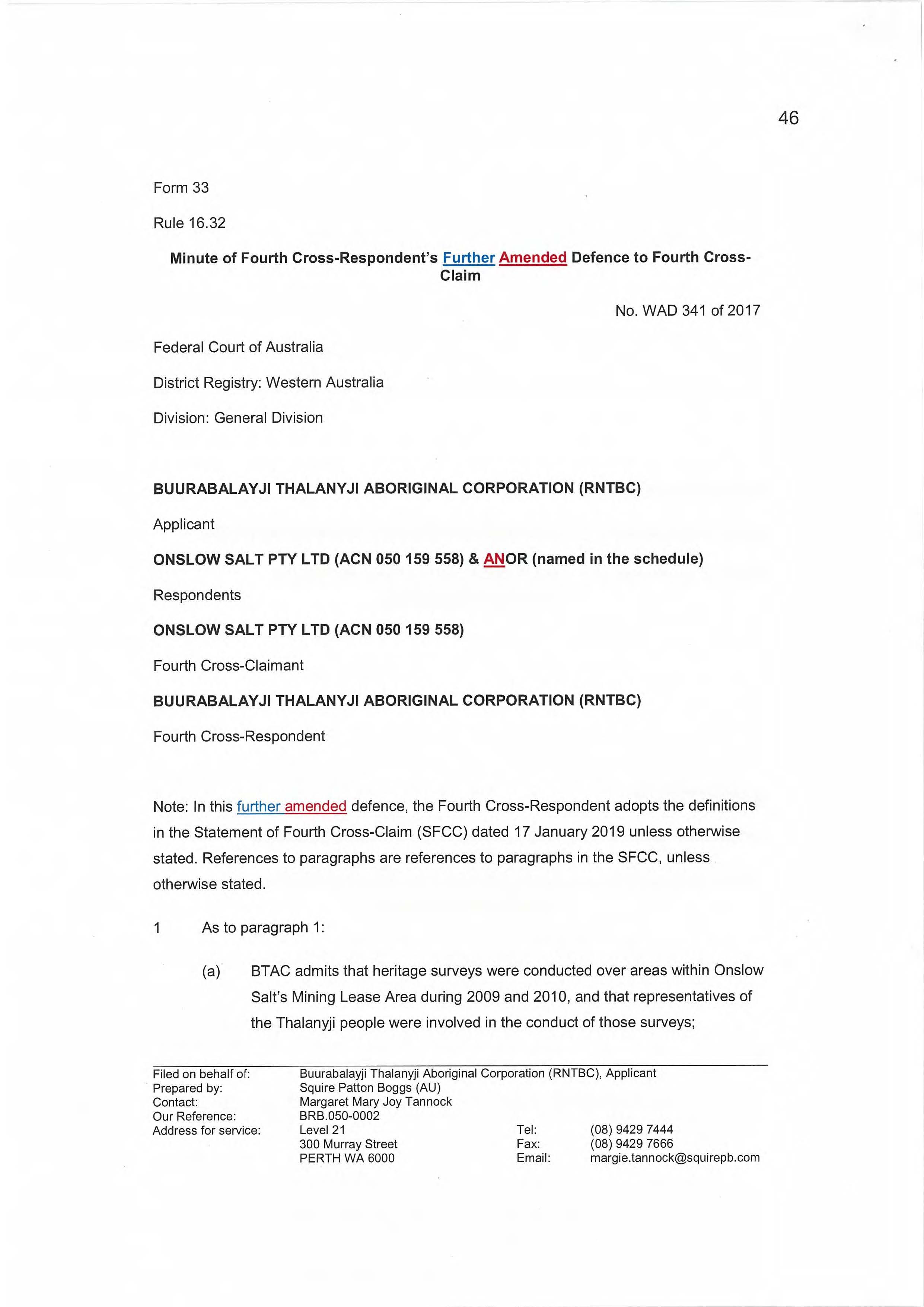
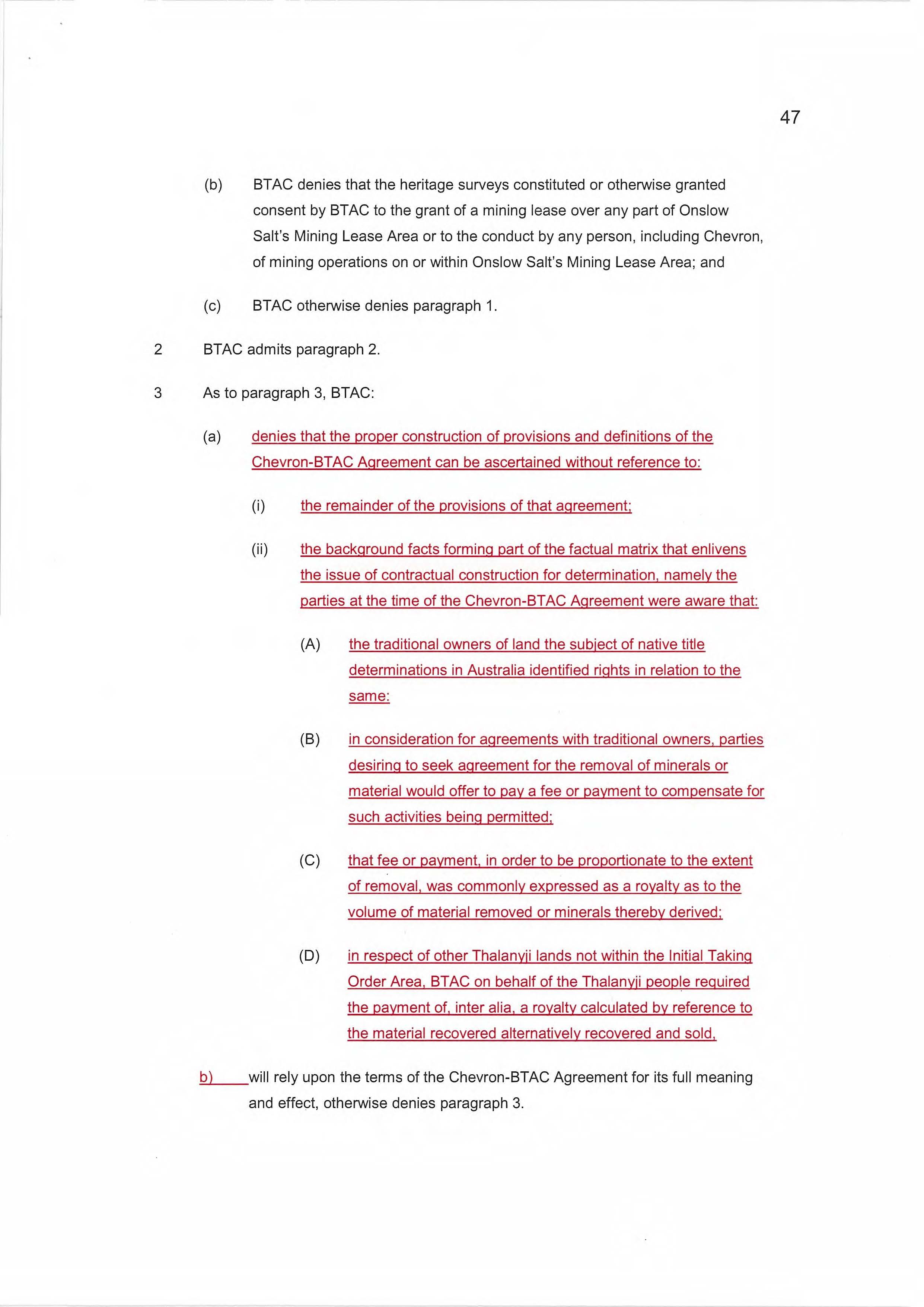
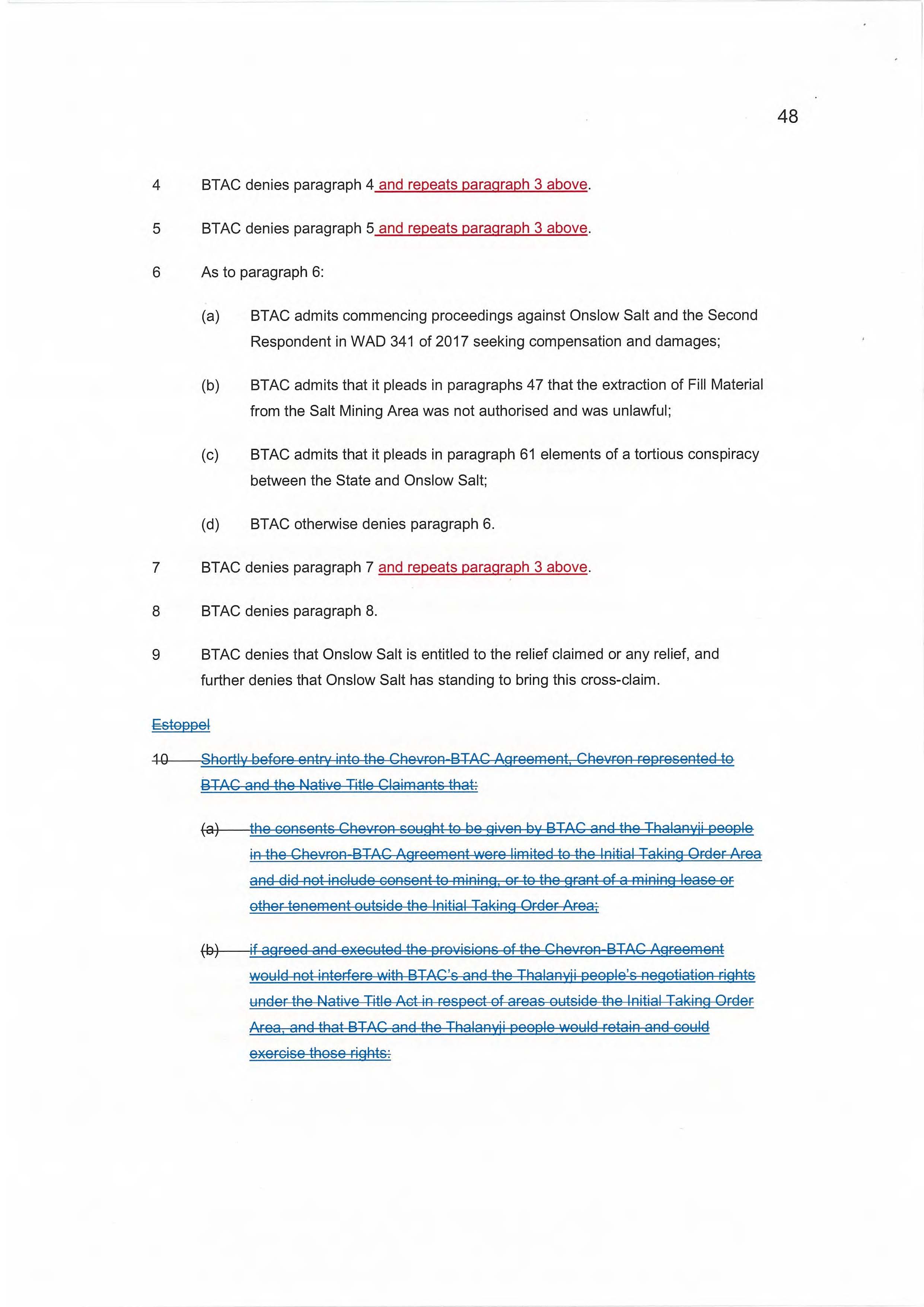
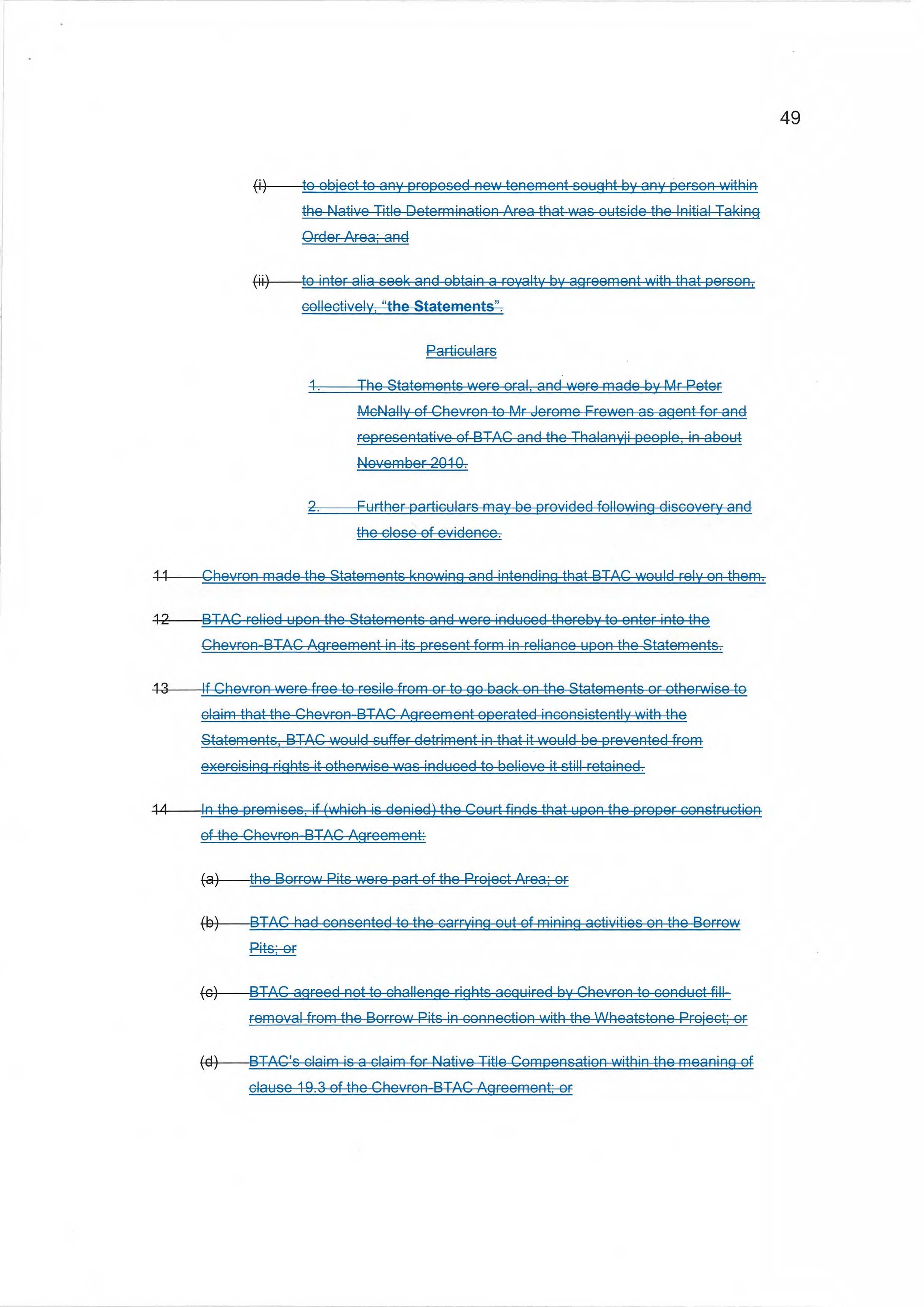
1 Buurabalayji Thalanyji Aboriginal Corporation (RNTBC) (BTAC), seeks to amend its defences to the second, third and fourth cross-claims in accordance with the three minutes annexed to these reasons as Annexures A, B, and C respectively. Leave is firmly opposed by all cross-claimants. The minutes are not identical but the arguments and these reasons focus on the most expansive forms of the amendments in order to examine issues of prejudice should the amendments be permitted. The amendments are textually expansive but the real question is one of substance as to what they add to BTAC’s case that is sufficiently new to occasion prejudice to the cross-claimants when the trial is due to commence in five weeks.
2 In opposing BTAC’s application, the cross-claimants (Chevron Australia Pty Ltd, the State of Western Australia and Onslow Salt Pty Ltd) rely on my rulings and observations in Buurabalayji Thalanyji Aboriginal Corporation v Onslow Salt Pty Ltd (No 8) [2020] FCA 1488 (BTAC (No 8)). In that decision, delivered five weeks ago, BTAC sought to avoid the operation of a springing order which would have struck out substantial portions of its defences to the cross-claims. It also applied to vacate the trial dates and foreshadowed that it would be seeking to amend its defences. While refusing to vacate the trial dates, I gave BTAC a further week to file its evidence and avoid the springing order, and otherwise dismissed its application. In compliance with that order, and after some months of previous non-compliance that had given cause for the springing order, BTAC filed four witness statements in defence of the cross-claims. It now applies, it says, to amend its defences to conform to the evidence that is properly available. Much of the detail of what has transpired since the current trial dates were set down on 20 May 2020 remains unexplained. As noted in BTAC (No 8) (at [2]) following non-compliance by BTAC with the trial timetable and the granting of certain extensions, BTAC formally changed its solicitors on the record on 14 September 2020.
3 By the cross-claims, each of the cross-claimants rely on certain terms of the Native Title Agreement (the NT Agreement) between Chevron and BTAC in relation to the Wheatstone Project which purport to operate as a covenant not to be sued: BTAC (No 8) (at [1]). In pleading the NT Agreement, the cross-claimants seek to resist BTAC’s principal claim, in which BTAC seeks damages and declarations against Onslow Salt and the State for the removal of some 10 million cubic meters of fill from ‘borrow pits’ which BTAC alleges was in breach of Onslow Salt’s Mining Lease such that it infringed the native title rights of the Thalanyji people.
4 The pleadings in their current, and most expansive form, disclose three points of defence to the cross-claims. They can be shortly described as follows:
(a) the Proper Construction argument by which BTAC denies that the NT Agreement has the effect of barring it from seeking relief against the conduct it alleges in the principal claim;
(b) the Estoppel Claim in the alternative, by which BTAC contends that it was induced to enter the NT Agreement by oral statements made by Chevron such that the cross-claimants should be estopped from asserting an operation of the NT Agreement inconsistent with those statements; and
(c) the Misleading or Deceptive Conduct Claim in the alternative by which BTAC seeks relief under the Australian Consumer Law in respect of the alleged statements made by Chevron prior to the execution of the NT Agreement.
5 The amendments to the defences now proposed, in their most expansive form seek to do the following:
(a) reformulate the Estoppel Claim by re-particularising the precise nature of the two alleged representations by Chevron, identifying two instances when they are alleged to have been made and identifying the persons who witnessed the alleged representations consistently with the witness statements now filed;
(b) add a fresh claim for misleading or deceptive conduct by silence (the Silence Claim) by which BTAC claims that while purporting to negotiate the NT Agreement in good faith with BTAC, Chevron was also negotiating the removal of the fill from the borrow pits with Onslow Salt on the pretence that Onslow Salt would not apply for a new mining tenement or for its Mining Lease to be varied and did not disclose these facts to BTAC;
(c) particularise the relief sought in respect of the Misleading or Deceptive Conduct Claim and the Silence Claim by adding a counterclaim for a variation of the NT Agreement and for damages.
6 BTAC pleads all four alternative defences against Chevron in the second cross-claim. Excepting that the Estoppel Claim is not pleaded against the State or Onslow Salt in the third and fourth cross-claims, the alternative defences and the proposed amendments to them are not, for present purposes, materially different across the three cross-claims.
7 For the reasons that follow, and after careful consideration of the arguments put which reveal the factors for and against to be finely balanced, I will allow BTAC to amend its defences in the terms sought. It must be accepted that the cross-claimants have had to wait a long time to have their relatively simple point be resolved and that almost all the responsibility for the delay rests with BTAC. That is not to say in my assessment that there has been delay by BTAC’s current representatives. No delay has been caused by the respondents. However the position is not simple. There has been recent change in BTAC’s legal representation and BTAC has been under special administration for much of this year.
8 More importantly, however, the obvious cause of the amendments is that BTAC’s evidence as now filed was never to be capable of matching the existing pleadings. It is plain from the affidavit material in support of the application that the new solicitors have attempted to establish what evidence can properly be given as soon as possible in the short time after formally coming on the record when they had the right and obligation to do so. With the amendments permitted, BTAC will proceed on a pleading which more closely reflects the foreshadowed evidence and the evidence filed by the cross-claimants. Savings in time, costs, and stress to witnesses in cross-examination would be likely displaced with legal arguments said to flow from a less controversial evidentiary position. As I said, the considerations are very finely balanced. There is obvious prejudice to the respondents if the trial dates are lost (if indeed they need to be), but that can at least in part be accommodated by a costs thrown away order. As against that, BTAC would be obliged to go to trial on an existing artificial pleading which would not reflect the evidence it can and seeks to adduce. It would be deprived of legal arguments which cannot be said to be so weak that they should not be permitted had they been advanced at an earlier time. The significance and importance of these parts of BTAC’s defences is abundantly clear. Although the cross-claimants are not at fault, the vagaries in this complex litigation and BTAC’s earlier procedural non-compliance should not bar BTAC from making good significant aspects of its defences in circumstances where it has acted swiftly and diligently to progress the matter since changing its representation.
9 BTAC relies upon the affidavit of Ms Tannock, solicitor, which confirms that her firm came onto the record on 14 September 2020. She has previously described all the work carried out since coming onto the record, which is clearly extensive and has been carried out in an abridged timeframe. The affidavit also annexes the proposed amendments to each of BTAC’s defences which are now Annexures A, B, and C to these reasons.
10 BTAC also relies upon an affidavit of Mr Richard West, Chief Executive Officer of BTAC, affirmed on 18 November 2020, which is designed to address the contention by the cross-claimants that BTAC may be unable to meet orders for any costs thrown away if the amendments are allowed. He confirms that BTAC’s cash on hand as at the date of his affidavit was in excess of $173,000, which did not at that stage include a sum of $7 million in cash and $1.2 million in property due from the Western Australian State Government in a settlement..
11 Onslow Salt contends that the application should be refused. In addition to the recent refusal to vacate the trial dates and allow amendments to the defences at some future time in BTAC (No 8), it notes that BTAC’s application for a stay of proceedings was also refused on 30 April 2020 during the special administration: Buurabalayji Thalanyji Aboriginal Corporation v Onslow Salt Pty Ltd (No 7) [2020] FCA 572. Onslow Salt says there is nothing before the Court now justifying any change from previous rulings. Any consideration whether to grant leave to amend a defence must be considered in the context of the overarching purpose to facilitate the just resolution of the dispute according to law and ‘as quickly, inexpensively and efficiently as possible’.
12 Onslow Salt cites considerations addressed by Gleeson J in Tamaya Resources Ltd (in liq) v Deloitte Touche Tohmatsu [2015] FCA 1098 (at [127]) as follows:
The principles articulated by the High Court in Aon apply to matters in this Court: Cement Australia Pty Ltd v Australian Competition and Consumer Commission [2010] FCAFC 101; (2010) 187 FCR 261 (“Cement Australia”) at [43]. Relevant matters the Court is to consider include:
(1) The nature and importance of the amendment to the party applying for it: Aon at [102];
(2) The extent of the delay and the costs associated with the amendment: Aon at [102];
(3) The prejudice that might be assumed to follow from the amendment, and that which is shown: Aon at [5], [100] and [102];
(4) The explanation for any delay in applying for that leave: Aon at [108]; and
(5) The parties’ choices to date in the litigation and the consequences of those choices: Aon at [112] and Luck v Chief Executive Officer of Centrelink [2015] FCAFC 75 (“Luck”) at [44];
(6) The detriment to other litigants in the Court: Aon at [93], [95] and [114] and Luck at [44]; and
(7) Potential loss of public confidence in the legal system which can arise where a court is seen to accede to applications made without adequate explanation or justification: Aon at [5], [24] and [30].
13 No party took issue with this statement of principle, nor are the relevant principles to be applied contested by the parties.
14 Onslow Salt observes that the extent of the delay is significant. In particular, because BTAC asserts its relevant officers and members had a certain understanding of how they assumed things would occur in 2009 and 2010 when negotiating with Chevron and that they did not know of the happenings regarding fill removal until sometime between 2012 and 2014. Onslow Salt says those claims should have been included by BTAC from the commencement. It commenced proceedings after a pre-action discovery application made in September 2016, knowing of the agreement with Chevron and knowing the need to address why that agreement would not then apply.
15 Onslow Salt notes that there is prejudice to the cross-claimants, particularly to Chevron now called upon to respond to the new Silence Claim. The proposed amendments, it is said, will entail additional discovery review, the giving of advice and the seeking of instructions from all parties to address necessary amendments to the pleadings and to properly prepare for trial.
16 Any explanation for the delay is said to fall short. Onslow Salt notes that I explicitly recognised in BTAC (No 8) (at [58]) the absence of an adequate (or any) explanation from BTAC itself as to what has happened in the 17 months since the defences to the cross-claims were filed and why BTAC now finds itself in this position. No one from BTAC has explained to the Court why the matters now sought to be pleaded were not raised earlier. Onslow Salt also notes my further observation in BTAC (No 8) (at [66]) that the cross-claimants ‘have had to wait a long time with repeated procedural non-compliance by BTAC to assert their argued contractual entitlement’ and (at [78]) that:
… BTAC has had more than a generous opportunity to prepare its case on the preliminary issue … and, BTAC has failed to provide sufficient reasons as to why the discretion should be exercised to grant the relief it seeks [an adjournment] ...
Onslow Salt asserts that the difficulties which BTAC faces in preparing for the hearing are of their own making, having engaged other lawyers in May 2020. It is said that that timing in and of itself tells against a late grant of leave to amend pleadings. BTAC’s solicitor deposes she was engaged on 23 May 2020, 212 days before the hearing which was then scheduled to commence on 21 December 2020. This application has been brought only 41 days before that hearing date.
17 It should be observed that there is some difficulty with the contention that the informal engagement of BTAC’s current solicitors in May 2020 indicates a delay on their part. Although the evidence is limited, the current solicitors have certainly acted quickly since formally coming on record on 14 September 2020. It is true that BTAC’s application in BTAC (No 8) was effectively dismissed for the reasons that Onslow Salt cites, however, that application was of a very different character to that which BTAC presently seeks. It sought further time to file evidence, the opportunity to amend its defences in the future and a vacation of the trial dates; all without any indication as to what evidence would be filed or amendments sought, or indeed when the trial could realistically be re-listed. In contrast, the evidence has now been filed (in compliance with the orders in BTAC (No 8)) and the amendments now sought primarily seek to bring the pleadings in line with that evidence. Consideration of the exercise of the discretion thus proceeds on a much more confined basis, and there is greater precision to the analysis of the consequences of allowing the amendments.
THE STATE’S GROUND OF OPPOSITION
18 The State firmly opposes leave being granted to amend BTAC’s defence, primarily on the ground that the amendments are deficient in that they are embarrassing and disclose no reasonable defence. It says that it could not sensibly plead a reply. In support of this position, reliance is placed on an affidavit of Mr Edward Fearis, solicitor, which annexes exchanged correspondence with BTAC’s representatives pointing out the deficiencies in the proposed amendments. The State says it has not received an adequate response from BTAC and raises the same issues in its written submissions.
19 At the outset, it should be observed that the matters raised by the State in opposition to the proposed amendments can, in substance, be dealt with at trial. This is particularly so in relation to the State’s complaints about the merits of the Proper Construction argument that BTAC pleads, in circumstances where no amendment is presently sought to that part of the defence. The State simply argues that the proposed amended pleading and evidence exacerbates the uncertainty. In my view that is doubtful and it has not been explained why that is so.
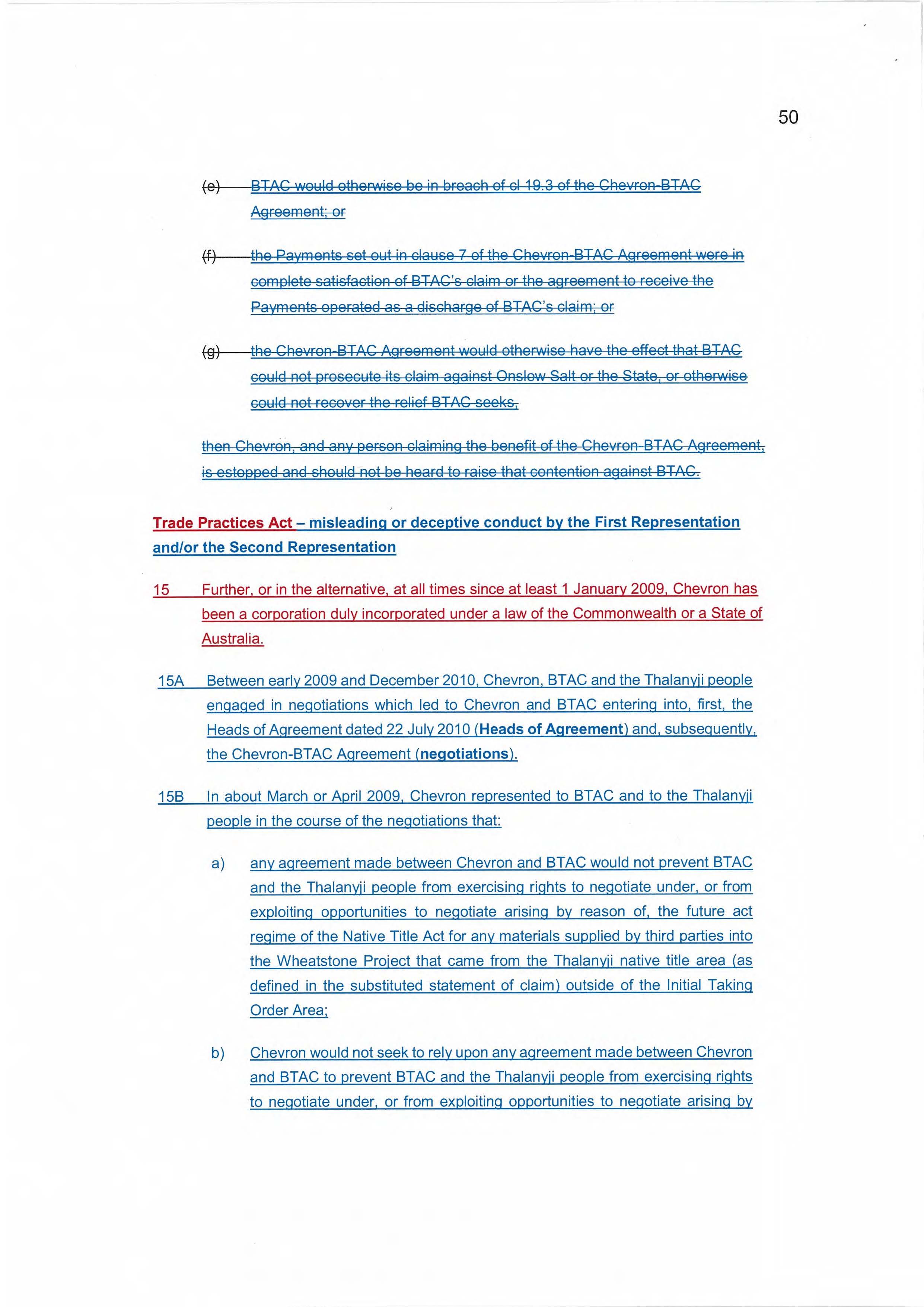
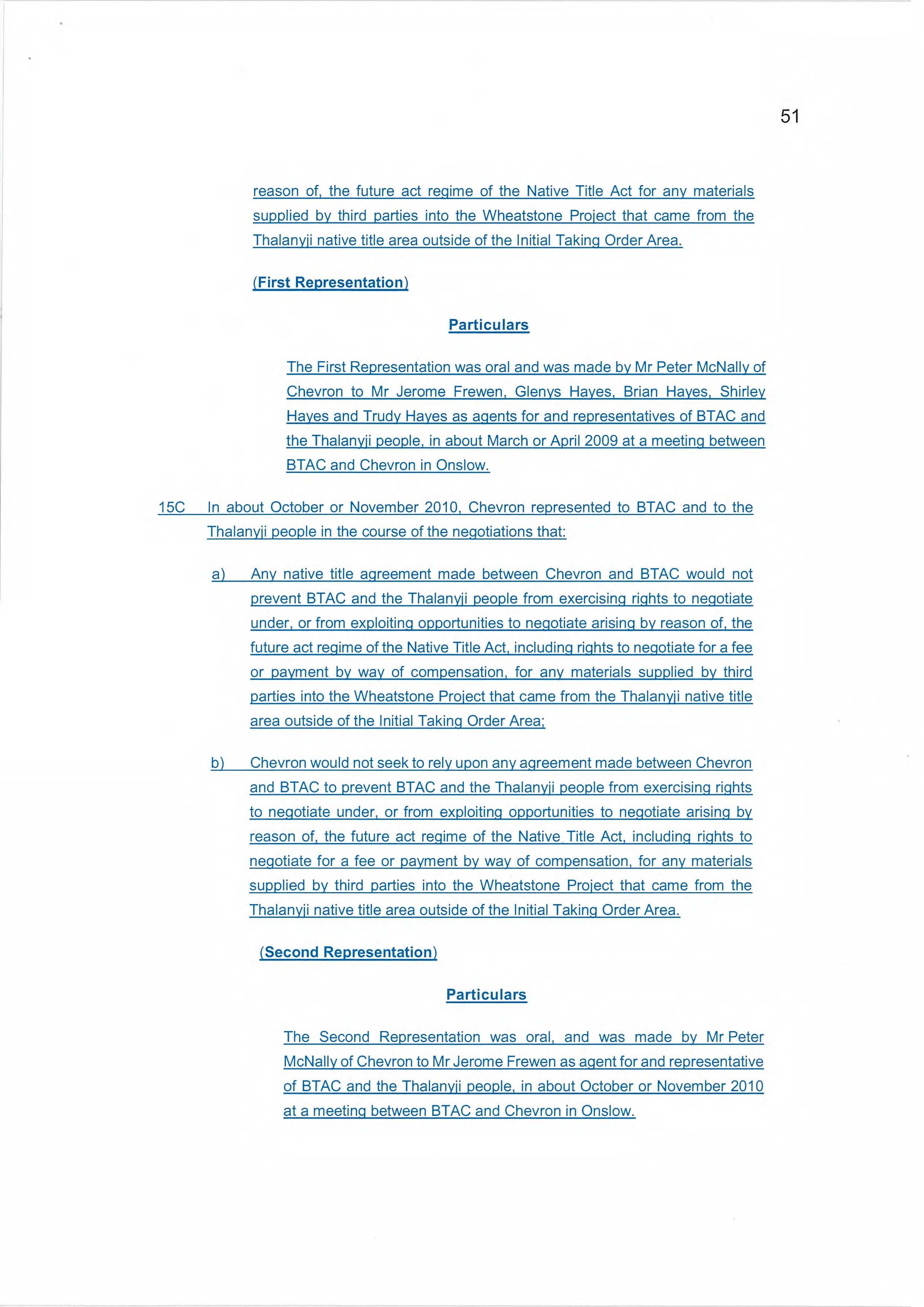
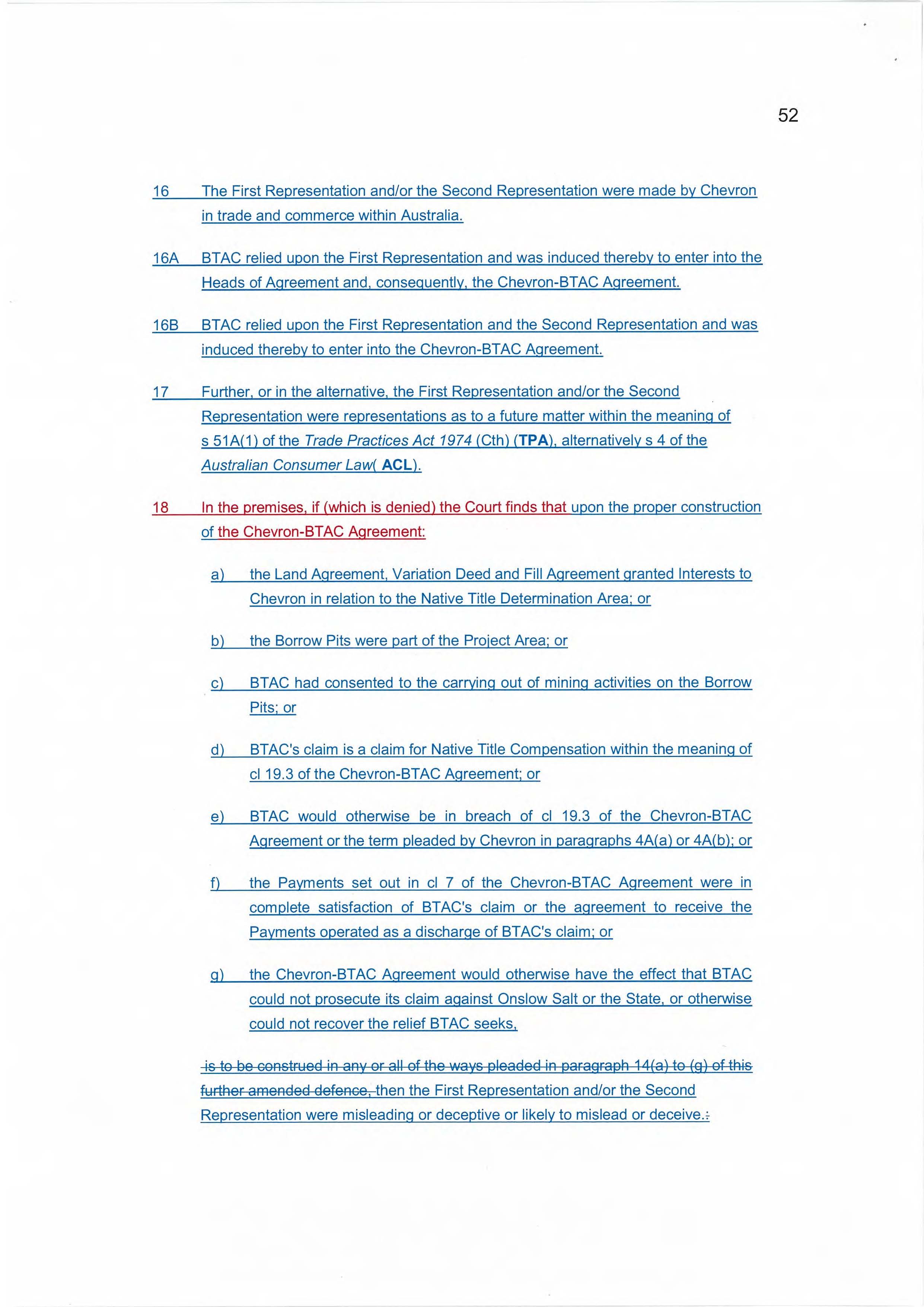
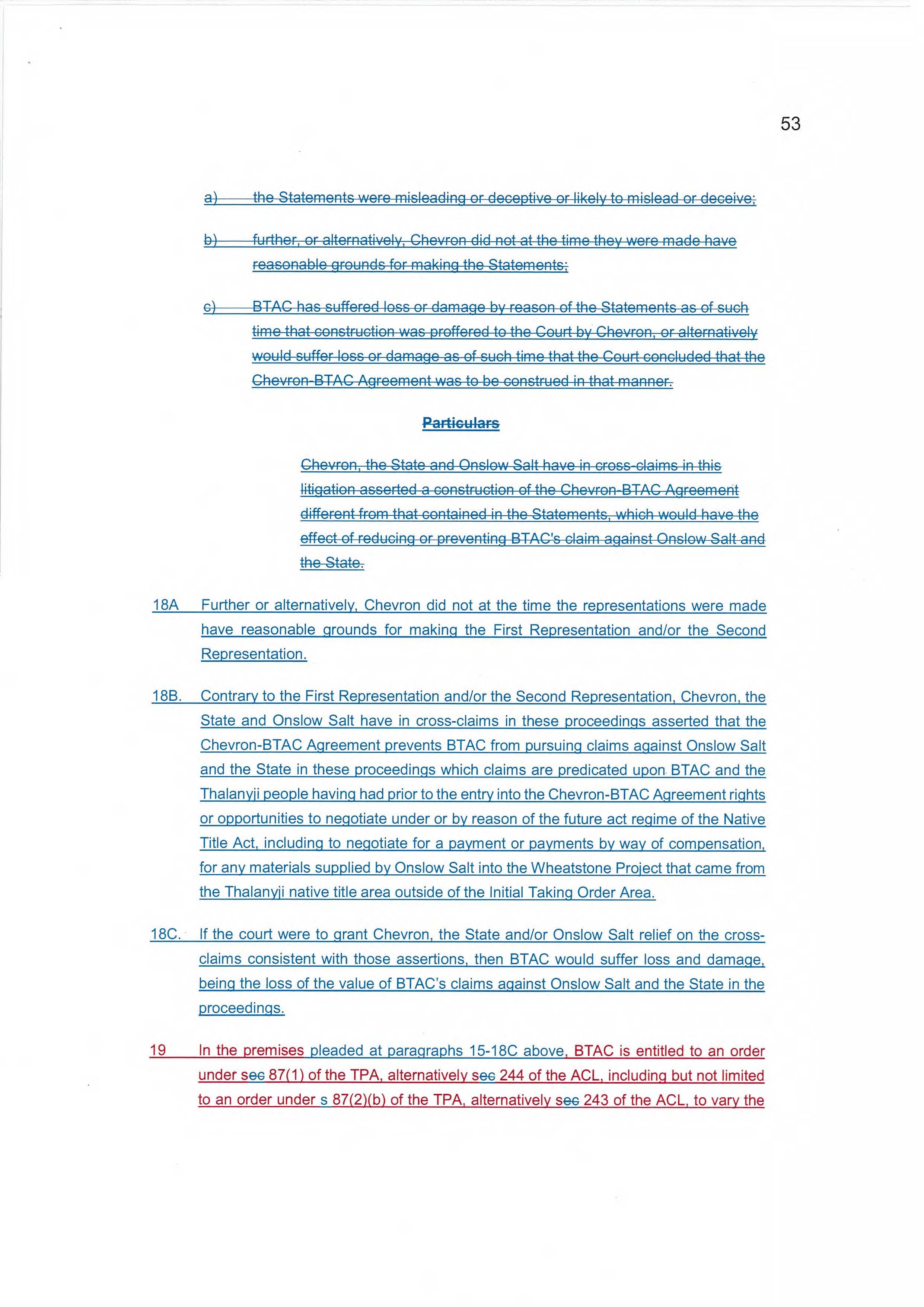
20 As to the proposed amendments to the Misleading or Deceptive Conduct Claim, the State points out that BTAC now alleges two occasions on which representations were made during the negotiations of the NT Agreement with Chevron. Both alleged occasions, the first in about March or April 2009 and the second in about October or November 2010, include similar representations to two effects.
21 The first effect is that the NT Agreement does not preclude BTAC claiming under the Native Title Act 1993 (Cth) against a third party in respect of the third party’s extraction of material from Thalanyji land for use in the Wheatstone Project. BTAC’s allegation in this respect concerns Chevron’s representation about the proper construction of the NT Agreement (the Construction Representation).
22 Second, BTAC wishes to plead that Chevron represented on both occasions that it would not rely on the NT Agreement to prevent BTAC from exercising its right to negotiate with third parties who apply to extract material from Thalanyji land for use in the Wheatstone Project (the No Opposition Representation).
23 BTAC pleads both representations were made orally by Mr Peter McNally of Chevron to representatives of BTAC, however the State points out that none of the witness statements mention a representation similar to the No Opposition Representation. In its reply submissions BTAC clarified that the No Opposition Representation is ‘necessarily implicit’ in the Construction Representation.
24 The State takes issue with the Construction Representation on the basis that it is inconsistent with the Proper Construction argument. It submits that:
35. BTAC has pleaded that the Construction Representation was correct. Proposed Defence [33] alleges that, if (among other things) the NT Agreement has the effect of precluding BTAC’s claim against a third party miner, which BTAC denies, then the Construction Representation was misleading or deceptive or was likely to mislead or deceive.
36. That plea has the form:
The Construction Representation was correct (and therefore was not misleading or deceptive) but if it was not correct then then it was misleading or deceptive.
37. That discloses no reasonable defence and is an embarrassing pleading to which the State could not be expected to sensibly reply with facts.
38. At proposed Defence [34], BTAC alleges that Chevron did not have reasonable grounds for the Construction Representation. That is said in the context that BTAC’s primary plea is that the Construction Representation was correct. It is not clear what “reasonable grounds” might be relevant to the making of an admittedly correct statement.
39. Next at proposed Defence [31B], it is said that the Construction Representation induced BTAC to enter the [Native Title] Agreement, again in the context that BTAC alleges it was correct. It is not clear how reliance on an admittedly correct statement could be relevant or prejudicial.
25 I am unable to accept the contradiction submission. BTAC’s defence clearly pleads the Misleading or Deceptive Conduct Claim and the Silence Claim (and the Estoppel Claim against Chevron) in the alternative to its Proper Construction argument. This is obvious from [24], [30] and [36] of the defence to the State’s cross-claim (see Annexure B). This approach accords entirely with r 16.06 of the Federal Court Rules 2011 (Cth) and any inconsistency that the State perceives in alternative points of defence pleaded by BTAC is not a reason for refusing the amendments now sought: see also Otsuka Pharmaceuticals Co., Ltd v Generic Health Pty Ltd [2019] FCA 230 per Yates J (at 28]).
26 A similar charge is laid against the pleading of the No Opposition Representation in relation to [33(g)] of BTAC’s defence to the State’s cross-claim. For the same reasons, the submission should be rejected.
27 The State takes further issue with the No Opposition Representation as follows:
43. The No Opposition Representation addresses the contingency of a third party who applies (to the State) to extract material from Thalanyji land for supply into the Wheatstone Project, thereby engaging BTAC’s right to negotiate, under Part 2 Division 3 Subdivision P of the Native Title Act, with any such third party for the payment of money. Mr Frewen’s evidence refers to such negotiations with persons unconnected with the litigation.
44. The No Opposition Representation does not include a representation by Mr McNally that Chevron would not rely on the NT Agreement to prevent BTAC seeking payment from the State. That omission reflects the law, it is not a pleading oversight, because section 125A(1) Mining Act 1978 (WA) provides:
(1) If compensation is payable to native title holders for or in respect of the grant of a mining tenement, the person liable to pay the compensation is —
(a) if an amount is to be paid and held in trust, the applicant for the grant of, or the holder of, the mining tenement at the time the amount is required to be paid; or
(b) otherwise, the applicant for the grant of, or the holder of, the mining tenement at the time a determination of compensation is made.
45. BTAC’s proposed Defence is clear that both aspects of both alleged representations concern BTAC’s right against any applicant for a mining tenement, or, to be more precise, any applicant for the creation (or variation) of a “right to mine” (see sections 25(1)(a) and 26(1)(c)(i) and (ii) Native Title Act). The State is never such an applicant.
46. Therefore, the inclusion of the words “and the State” in proposed [33(g)]; [34A] and [34B] exceeds the pleaded bases of the alleged misleading or deceptive representations. In respect of the words “and the State”, these draft pleas do not disclose a reasonable defence.
28 In relation to the new Silence Claim, the State submits as follows:
54. BTAC seeks leave to plead as follows: (a) that Chevron knew that BTAC assumed that Onslow Salt would apply for a new or amended mining lease to remove the fill, by which application BTAC’s right to negotiate would arise against Onslow Salt; (b) Chevron knew, however, that Onslow Salt did not intend to apply for a new or varied mining lease; (c) but despite this knowledge, Chevron kept silent about Onslow Salt’s intention; and (d) that silence misled BTAC into assuming that Onslow Salt would apply, and induced BTAC to sign the NT Agreement.
55. That is to say, BTAC seeks leave to plead that Chevron’s silence led BTAC to assume the very thing it already assumed. On its face, the silence did not mislead BTAC; it failed to correct BTAC’s misunderstanding.
56. BTAC attempts to circumvent that problem by alleging that Chevron had an obligation to negotiate in good faith (proposed Defence [37(a)]) from which BTAC reasonably expected to be informed by Chevron if Chevron knew that Onslow Salt’s intention was not to apply for a mining lease (proposed Defence [42]). In that way, BTAC claims that it was deceived or misled by silence in the context of a duty to inform.
57. There are no particulars by which the State might understand the plea. There is no particular to the effect that anyone within BTAC actually thought:
I assumed that Onslow Salt will apply for a mining lease, Chevron would tell me if that was not correct, Chevron has not told me that it is not correct, therefore I presume that Onslow Salt will apply for a mining lease and therefore I need not try to vary the [Native Title] Agreement.
58. This makes it impossible to understand how BTAC says that it relied on the silence to its (further?) detriment. Who relied? In point of common-sense causation [March v Stramare (1991) 171 CLR 506; Allianz Australia Insurance Ltd v GSF Australia Pty Ltd (2005) 224 CLR 568; Wallace v Kim (2013) 250 CLR 375], the only thing that any person in BTAC relied upon (i.e., that was causative of a failure to amend the NT Agreement) was that person(s) own extant misunderstanding.
59. The proposed plea discloses no reasonable defence against the State. It is embarrassing for the State to plead in reply.
29 The State also contends that the Court would never make an order varying the terms of the NT Agreement. In that regard, the State makes the following further submissions:
60. BTAC seeks against Chevron an order that the NT Agreement be varied to accord with the Construction Representation and the No Opposition Representation.
61. Even if it were otherwise open to order such variation of the NT Agreement, it cannot be varied any further than is required to match the Construction Representation or the No Opposition Representation.
62. Neither representation affects the State’s cross claim under section 11 of Property Law Act 1969 (WA): as identified above, the Construction Representation is alleged to be correct, and the No Opposition Representation relates only to opposition from Chevron and only from Chevron in respect of applicants for a right to mine.
63. The form of the order sought is at proposed Defence [35]. Particular 1 of the order sought is a definition of a new expression: “Third Party Negotiation Rights and Opportunities”. The proposed definition is in two parts: a generally applying part and a specifically inclusionary part.
64. The specific inclusion partly complies with the State’s submissions above, in that it is confined to the preservation of BTAC’s contractual capacity (under the NT Agreement) to pursue a (statutory) right to negotiate against applicants for a right to mine.
65. However, the general part exceeds the pleaded basis. The general part is not confined to third parties and is not confined to the right to negotiate. It instead addresses the whole of the “future act regime”, which is a reference to the whole of Division 3 in Part 2, rather than to the right to negotiate which is only Subdivision P of Division 3 in Part 2.
66. Further, the general part creates inconsistency with other parts of the NT Agreement. It allows BTAC to claim against Chevron and its contractors, contrary to the clear object of clauses 19.1 to 19.3 and clause 5.2(A).
67. A large inconsistency is caused by including within BTAC’s proposed definition in Defence [35] (and [48]) a right to negotiate with Onslow Salt in respect of something (the Borrow Pits) that is defined as the Wheatstone Project. That has the effect that, under the processes of Subdivision P, BTAC could delay or even defeat development of the Wheatstone Project (by holding out for a very large payment). It is impossible to accept this is within the NT Agreement or that it could be consistent with the rest of the NT Agreement.
68. Because the general part of the proposed definition over-reaches the pleading which purports to support it, there is no reasonable defence disclosed. Leave should not be granted in respect of proposed Defence [35].
30 Finally, the State makes the following submissions to support a contention that the proposed amendments to the defence fail to accord with the evidence filed:
72. However, the proposed Defence does not resolve the discord between the existing pleading and the witness statements. The witness statements include nothing as to the following proposed pleadings:
(a) No witness mentions the No Opposition Representation.
(b) No witness says that he or she understood that, in saying that the NT Agreement does not bar BTAC’s claims, Mr McNally was thereby assuring BTAC that Chevron will not rely on the NT Agreement to bar such claims.
(c) No witness says that he or she understood Mr McNally to be saying that BTAC was free under the NT Agreement to claim against the State in respect of a State involvement in development of the Wheatstone Project.
(d) The proposed Defence alleges that Chevron knew that BTAC assumed that Onslow Salt would apply for a new or amended mining lease. There is no evidence of this and no available inference.
(e) The proposed Defence alleges as fact that Chevron’s silence led BTAC to assume something. There is no evidence that anyone had the kind of thought process mentioned above.
(f) There is no evidence as to why any such person, having such a doubt, did not raise it in the manifold discussions with Mr McNally.
73. BTAC should not be granted leave to amend its Defence in a manner that is not arguably supported by its evidence.
31 It must be acknowledged that the State has in a short period of time since this application was filed, collated numerous arguments that might well ultimately succeed, or might do so in similar form when finally advanced at trial, depending on the evidence which emerges. But in terms of the considerations set out above (at [12]), I find these contentions less compelling on the issue of leave to amend. Shortly stated, it seems that the proposed amendments are very important to BTAC’s prospects on the defence, considering the state of the foreshadowed evidence. But if they do not involve major additional practical measures in gathering evidence, the State in my assessment would not be unduly prejudiced by BTAC’s new representatives being able to run the case the way they consider is necessary. The real consideration is the interests of justice.
32 Chevron’s opposition to the application for leave to amend is directed to the additional time and resources that it will have to commit to responding to what it says are significant alterations to, and expansion of, BTAC’s case. It says that the practical consequence of allowing the amendments will be that the current trial dates will need to be vacated. Chevron understandably opposes any delay to the trial and any orders that put the trial dates at risk.
33 In an affidavit affirmed on 16 November 2020, Mr Dylan McKimmie, solicitor for Chevron, sets out in considerable detail the work that Chevron would be required to undertake to respond to the proposed amendments to BTAC’s defence. Having reviewed the proposed amendments, he is of the view that they raise new factual issues including:
(a) how Chevron and BTAC have conducted themselves in accordance with the NT Agreement since its execution on 22 December 2010, specifically the monetary payments made and non-monetary benefits given by Chevron to Onslow Salt (which arises on [30], [35(a)] and [48(a)] of the minute at Annexure A);
(b) the opportunity allegedly lost by BTAC to negotiate and agree with Chevron additional payments under the NT Agreement for the removal of fill material and the quantification of this claim (which arises on [35(b)] and [48(b)] of the minute at Annexure A); and
(c) BTAC’s knowledge of Chevron’s negotiations with Onslow Salt regarding the extraction of fill material from the borrow pits on the Mining Lease (which arises on [36] to [48] of the minute at Annexure A).
As these issue were not the subject of the ordered categories discovery that were determined on the existing pleadings, they have not been directly considered by Chevron in conducting its internal document review.
34 The process by which Chevron identifies and preserves documents which are relevant to legal proceedings in which it is involved is then explained by Mr McKimmie. He deposes that Chevron initially issued an internal preservation order on 9 August 2018 following service of the first cross-claim filed against it by Onslow Salt. In short, the internal preservation order directs employees and contractors of Chevron to identify and preserve documents which fall within the scope of the order, which is drafted with regard to the subject matter and issues of the dispute. Relevantly, Mr McKimmie indicates that:
(a) preservation orders can only be sent to employees and contractors who have current accounts and access to Chevron’s computer system; and
(b) if an employee is leaving or has left Chevron and they are subject to a preservation order, their computer and responsive documents are preserved by Chevron. If an employee is leaving Chevron and they are not subject to a preservation order, and their documents are not otherwise preserved or transferred, the documents they hold on their computer are deleted.
35 Accordingly, Mr McKimmie says that he will need to consider whether the preservation order was broad enough to capture information relevant to the new issues raised by the proposed amendments. If he considers that the preservation order was not broad enough, such information may be retrievable from employees who are still employed by Chevron. In respect of former employees, however, such information may be irretrievable, given that it is Chevron’s business practice to delete the accounts of departing employees. Consequently, certain relevant information may be lost.
36 The new factual matters raised by the proposed amendments are said to relate to personnel who span multiple working teams within Chevron. Based on his knowledge of the matter and instructions from Chevron, Mr McKimmie considers that the following Chevron personnel will need to be proofed to ascertain what evidence they may provide relevant to the new issues in dispute:
(a) the land tenure manager on the Wheatstone Project around the time that the relevant agreements were entered into;
(b) the corporate affairs manager responsible for managing the implementation of the NT Agreement;
(c) the supply chain advisor responsible for managing the Thalanyji contracting targets;
(d) the human resources representative for employment targets responsible for tracking NT Agreement employment targets and related programs;
(e) the corporate affairs manager for the Wheatstone Project at the time that the relevant agreements were entered into;
(f) the commercial manager leading negotiations with Onslow Salt in relation to the agreements negotiated with it;
(g) the aboriginal heritage manager on the Wheatstone Project around the time that the relevant agreements were entered into;
(h) the heritage officer on the Wheatstone Project around the time that the relevant agreements were entered into; and
(i) personnel from Perpetual Nominees, the corporate trustee of the Thalanyji Direct Benefits Trust and the Thalanyji Charitable Trust.
37 Of these personnel, it is deposed that:
(a) the preservation order was issued to two of the personnel listed above, being the land tenure manager and the commercial manager leading negotiations with Onslow Salt, during the relevant period;
(b) two of the personnel who are not subject to the preservation order are still employed by Chevron;
(c) three of the personnel listed above are no longer employed by Chevron, and are also not subject to the preservation order, being the corporate affairs manager (though it is not clear whether it be the corporate affairs manager at (b) or (e) above, or whether they are the same person), aboriginal heritage manager and heritage officer; and
(d) the personnel from Perpetual Nominees were not employed by Chevron.
38 Once the above personnel have been proofed, witness statements will need to be prepared for those who are to be called as witnesses.
39 In order to assess the information and documents potentially held by those personnel still employed by Chevron, Mr McKimmie says that the scope of the preservation order will need to be reviewed and similar work conducted in relation to the personnel that are not subject to the preservation order. For the personnel no longer employed by Chevron, and Perpetual Nominees, instructions will need to be sought from Chevron as to requests that they voluntarily provide evidence, or alternatively, that subpoenas issue.
40 Based on his knowledge of the matter and experience in commercial litigation, Mr McKimmie considers that the time required to properly proof witnesses will take at least a couple of months, after which BTAC will require an opportunity to provide responsive evidence. The prospect of needing expert evidence to respond to BTAC’s claim for damages and the quantification of that claim is also raised as a possibility that will require further consideration.
41 As a consequence of completing any further internal review of documents and witnesses, Mr McKimmie indicates that Chevron may then require further discovery to be given by BTAC and Onslow Salt. The potential procedural steps involved in settling categories of discovery is then detailed.
42 The purpose of this detailed analysis of the likely procedural consequences of allowing the amendments is to demonstrate Chevron’s strong belief that the trial of the cross-claims could not possibly proceed on the current dates if the amendments are allowed. Emphasis is placed on the need for comprehensive amendments to Chevron’s reply to address the new factual matters and to include a defence to the counterclaim. Chevron notes further that BTAC has not quantified, nor particularised in any meaningful way, the damages it now claims. As such, Chevron will likely need to request particulars of the damages claimed before filing any responsive material.
43 Finally, Mr McKimmie deposes to his concern about BTAC’s ability to meet any order for costs thrown away if the proposed amendments are allowed. BTAC’s October 2020 newsletter and 2019 financial reports are annexed in support, however, as noted above, (at [10]), BTAC has filed an affidavit of its Chief Executive Officer, Mr West, which appears to adequately respond to this concern.
44 Chevron acknowledges that the Court has a broad discretion to grant leave to amend and to adjourn trial dates, but says that it is a discretion to be exercised with regard to the overarching purpose set out in s 37M of the Federal Court of Australia Act 1976 (Cth). It relies upon principles articulated by the High Court in Aon Risk Services Australia Ltd v Australian National University (2009) 239 CLR 175. Although Chevron accepts that the ultimate objective of the Court is the attainment of justice between the parties (as discussed in Aon at [30]), in considering whether the determination of litigation is just, Chevron stresses that:
(a) regard must be had to the interest of the other parties to the litigation and other litigants in other cases; justice requires the consideration and balancing of all parties’ interests: Aon (at [30]);
(b) speed and efficiency, in the sense of minimum delay and expense, are aspects of the just resolution of proceedings: Cauldron Energy Ltd v Beijing Joseph Investment Co Ltd [2016] WASC 22 (at [135]-[138]); and
(c) parties should be afforded a sufficient opportunity to present their case; this does not require that a party be given an unlimited opportunity to present a case or defence: Westgem Investments Pty Ltd v Commonwealth Bank of Australia Ltd (No 3) [2018] WASC 73 (at [47]).
45 Chevron observes that BTAC first put these proceedings in motion in 2016 by its application in the Supreme Court of Western Australia for pre-action discovery against Onslow Salt in Buurabalayji Thalanyji Aboriginal Corporation (RNTBC) v Onslow Salt Pty Ltd [2017] WASC 19, pursuant to which BTAC sought and obtained access to documents to ascertain whether or not it had enforceable legal rights against Onslow Salt arising out of the removal of fill material from the Mining Lease. On receipt of these pre-action discovery documents, BTAC commenced these proceedings in this Court against Onslow Salt and the State on 16 June 2017. Chevron commenced the second cross-claim against BTAC on 28 November 2018, by which it brought into issue in these proceedings the impact of the NT Agreement on BTAC’s claims against Onslow Salt and the State. BTAC filed its defence to the second cross-claim on 14 February 2019, which it amended on 9 May 2019 to introduce its defences based on the Estoppel and Misleading or Deceptive Conduct Claims. Similar timelines were observed in relation to the third and fourth cross-claims brought by the State and Onslow Salt respectively, albeit some months after Chevron filed the second cross-claim.
46 The amendments sought by BTAC go to matters which have been in issue in the proceedings since 9 May 2019. It commenced proofing witnesses in relation to these matters in 2018 as revealed in BTAC (No 8) (at [50]). BTAC has been afforded ample opportunity, Chevron says, to present its case and it has failed to take advantage of that opportunity.
47 Since May 2019, the parties have progressed the proceedings based on the current formulation of BTAC’s defences to the cross-claims, including:
(a) the application and orders by the Court to determine the second, third and fourth cross-claims separately and prior to the principal proceedings (which were made on 15 August 2019 in Buurabalayji Thalanyji Aboriginal Corporation v Onslow Salt Pty Ltd (No 4) [2019] FCA 1275 (BTAC (No 4)));
(b) the determination of categories of discovery relevant to the determination of the cross-claims; and
(c) lay evidence filed by the cross-claimants.
48 Chevron argues that there is a distinction between amendments which are necessary for the just and expeditious resolution of the real issues in the proceedings and amendments which raise new claims and new issues, which BTAC is now seeking to do. Justice does not permit BTAC to simply raise any arguable case at any point in the proceedings upon the payment of costs thrown away.
49 Chevron contends that factors such as the stage a litigation has reached relative to trial, and when an application to amend is made are relevant to the exercise of the Court’s discretion, particularly where, if allowed, the amendment will lead to the trial being adjourned. It is clear, Chevron says, that the trial would have to be adjourned if the amendments are permitted.
50 Chevron also complains that the absence of an adequate explanation is relevant. Nothing in the affidavit of Ms Tannock sworn in support of the application for leave to amend explains with any degree of adequacy the reason for the amendments being sought at such a late stage in the proceedings. BTAC has not sufficiently explained why, for instance, it now seeks to advance a new defence significantly reformulating its relief and bringing a new counterclaim to rewrite the NT Agreement and for damages and why these matters were not pleaded earlier when they were always available to BTAC and should have been in the contemplation of BTAC since May 2019.
51 As noted in Commonwealth Bank v linvest [2016] NSWSC 1846 (at [17]), a change in legal team, which brings fresh eyes to bear on the controversy and seeks to refashion in a way that better accords with their view of how the case may be presented to their client’s best advantage is not, alone, a sufficient explanation. Chevron says that no other adequate explanation has been provided by BTAC.
52 As to the nature and effect of the amendments sought by BTAC, Chevron says that they do significantly more than reconcile its pleading with its evidence filed and served on 22 October 2020. In particular, by the proposed amendments BTAC seeks variations to the NT Agreement, which underpins a major economic project, in ways which are materially different to its express terms: see Annexure A (at [30], [35] and [48(a)]). The amendments sought contend for a significantly greater limitation on the scope of the consents and releases given by BTAC under the NT Agreement than as currently pleaded, as can be seen from the nature of the Construction Representation and the No Opposition Representation which are in materially different terms to the ‘statements’ in the current pleading: see the struck out text of [26] of Annexure A. The dramatic rewriting of the NT Agreement is sought in circumstances where the rights and interests under the Agreement were significant to both parties, it was negotiated over a lengthy period of time, and both parties were independently legally represented. Chevron argues that the Court must be slow to impose upon the parties a regime which could not represent the bargain they would have struck between them. In the short time that this application was brought on, Chevron says it could not identify any authority where the Court allowed such significant rewriting of a commercial contract. This is a factor which weighs against leave to amend, especially when the consequence of allowing the amendment is that the trial dates will be lost.
53 Chevron points out that it has pleaded waiver, acquiescence and laches in reply. A similar plea will have to be assessed by reference to the operation of the Heads of Agreement (negotiated prior to the NT Agreement) and the NT Agreement over the 10 years since its execution, and takes new significance in response to the amendments now proposed by BTAC. Now relevant to the amendments proposed by BTAC is how Chevron and BTAC have conducted themselves in accordance with the terms of the NT Agreement since its execution, some 10 years ago. Over this time, BTAC has received, without objection or reservation, significant monetary payments and non-monetary benefits from Chevron based on Chevron’s performance of the NT Agreement. This has continued since Chevron’s cross-claim was commenced against BTAC and BTAC raised its Estoppel and Misleading or Deceptive Conduct Claims in defence. If the proposed amendments are allowed, Chevron ought to be afforded a proper opportunity to put into issue by way of pleadings and evidence such matters. To do so, would require Chevron to source and review a significant number of documents from its internal databases and proof various witnesses some of whom are no longer employed by Chevron, in relation to matters spanning a period of 10 years. Such work cannot be completed prior to a trial commencing on 21 December 2020. Further, more than six years have passed since the alleged loss and damage giving rise to the claimed relief was incurred. To the extent the proposed counterclaim seeks fresh relief by a new claim not currently pleaded, Chevron says that BTAC is out of time. It will need to consider the implications of this and the availability of a limitation defence.
54 Chevron correctly points out that there is no quantification of the counterclaim for damages in the proposed amendments. It is said to be for:
(a) the opportunity BTAC allegedly lost to negotiate and agree with Chevron additional payments under the NT Agreement for the fill material; or
(b) BTAC’s claims against Onslow Salt and the State in the proceedings.
55 Chevron says that no claim for liability or damages was previously made by BTAC against Chevron in these proceedings, including in the principal proceedings. It is said to be a significant shift in position and, again, more than six years has passed since the alleged loss and damage was incurred such that Chevron will need to consider the implications of this and the availability of a limitation defence.
56 It is unclear how BTAC intends to prove this claim or quantum at trial, including whether expert evidence is required. No particulars have been given or evidence filed and served by BTAC in relation to this aspect of its claim. It is impossible for these matters to be determined at the trial currently listed in December 2020. The practical consequence of allowing such an amendment would be to derail the preliminary determination of the cross-claims which has been the basis upon which the proceedings have advanced since 15 August 2019.
57 As to the new Silence Claim, it introduces, Chevron says, new factual issues into the proceedings, significantly, BTAC’s knowledge of Chevron’s negotiations with Onslow Salt regarding the extraction of fill material from the borrow pits on the Mining Lease. As noted, if the amendment were allowed, Chevron would be entitled to further discovery from BTAC and to consider any further lay evidence regarding the new factual issue which could give rise to further procedural steps.
58 Further, Chevron argues that the proposed amendments are not consistent with BTAC’s claim in the principal proceedings. The premise of Chevron’s cross-claim is that cl 19.3 of the NT Agreement is a covenant not to sue, which captures BTAC’s claims against Onslow Salt and the State in the principal proceedings. It contends that the proposed change to BTAC’s defence and introduction of the new counterclaim to the cross-claims are not consistent with BTAC’s claim in the principal proceedings. The alleged conduct giving rise to BTAC’s claims against Onslow Salt and the State are that the removal of fill material from Onslow Salt’s Mining Lease was done without lawful authority which interfered with the native title rights and interests held by BTAC. The basis upon which BTAC claims there was no lawful authority is that the removal of fill material was not permitted by the Mining Lease and was not a proposal the State could validly approve pursuant to its agreement with Onslow Salt.
59 BTAC’s proposed amendments do not address how this alleged illegality impacts upon the construction or scope of cl 19.3 of the NT Agreement. It simply pleads that various alleged representations give rise to defences and counterclaims of promissory estoppel and misleading or deceptive conduct. The consequence of this, BTAC claims, is a varying of the express terms of the NT Agreement to preserve BTAC’s right to negotiate access and royalties with Onslow Salt. If that defence and counterclaim is allowed and succeeds, it does not sit, Chevron says, coherently with BTAC’s illegality claim in the principal proceedings.
60 Moreover, in the principal proceedings, the loss and damage alleged to have been suffered by BTAC is (in addition to the denial of the right to negotiate access and royalties from Onslow Salt) loss, diminution and impairment of BTAC’s native title rights and interests being:
(a) damage to the landscape and permanent alteration of it; and
(b) damages to the spiritual forces that inhabit Thalanyji country.
61 Chevron says that the proposed reformulation of BTAC’s defence and new counterclaim with respect to the rewriting of the NT Agreement does not extend to the alleged damages in (a) and (b) above. Chevron assumes, therefore, that BTAC accepts that if Chevron’s construction of the NT Agreement is accepted by the Court, noting that BTAC does not plead an alternative construction, cl 19.3 of the NT Agreement does capture these claims against Onslow Salt and the State, which amounts to a significant abandonment of BTAC’s claim in the principal proceedings. Chevron says that the cross-claims emanate from BTAC’s claims in the principal proceedings, such that no amendments to BTAC’s defence ought to be permitted until BTAC clarifies how it intends to run its principal claim in light of the amendments sought by the application.
62 As to prejudice, Chevron says the trial cannot possibly proceed on 21 December 2020 as contemplated. As it stands, completing the trial within four days was not without its challenges, but any expansion of the case or issues means it cannot be done. If the trial dates are lost, given the number of parties involved, each with senior counsel briefed, the delay in re-listing is likely to be significant, perhaps 12 months. Chevron says that such a lengthy adjournment will undoubtedly lead to inefficiencies and increased costs in the preparation of the matter for trial.
63 Chevron says justice cannot always be measured in money and the inevitable strains that litigation imposes upon litigants and potential witnesses must be taken into account in weighing the adverse consequences of delay. This applies not only to personal litigants, but also to corporate litigants such as Chevron whose employees and officers may be crucial witnesses and have to bear the strain of impending litigation and the disappointment when such litigation is not brought to an end: see Aon (at [101]).
64 This case turns heavily on evidence of oral communications between parties which happened over 10 years ago. In the circumstances, Chevron says the risk of prejudice to the parties which may be suffered by further delay is greater.
65 Further, the new issues bring into relevance documents and information which may not have been preserved by Chevron over the passage of time, and may be key to Chevron’s defence of the new claims.
BTAC’S RESPONSES AND GENERAL CONSIDERATION
66 BTAC frankly concedes that the proposed amendments are necessary having regard to the contents of the witness statements filed on 22 October 2020, including the witness statement of Mr Jerome Frewen, whose evidence is accepted to be critical to proving the representations that underpin the Estoppel Claim and the Misleading or Deceptive Conduct Claim: BTAC (No 8) (at [43]). BTAC says that Mr Frewen’s statement is broadly consistent with the witness statement of Mr McNally filed by Chevron.
67 It cannot be asserted, in my view, that all of the amendments arise from that difficulty. It is correct, however, to say that this is not a case where the amendments are sought be made without regard to the evidence to be led at trial. Rather it is to the contrary.
68 BTAC says the application is not premised on a change in legal team that has brought ‘fresh eyes to bear’ and which seeks to ‘refashion the case in a way that better accords with their view as to how the case may be presented’. Rather, the application is premised on the witness statements filed and identified documentary evidence. BTAC says that the amendments are brought so that the real issues in the proceedings can be ventilated, heard and determined. However that explanation cannot and does not explain the delay in bringing this application at the last minute albeit that the possibility of an application to amend was foreshadowed in BTAC (No 8). Nor does that part of BTAC’s argument explain why it is now necessary to run a claim in damages and to seek to rewrite the NT Agreement.
69 It is considerably more doubtful however in my view whether the underlying substance of the factual issues raised by the proposed amendments to the Estoppel Claim and the liability aspect of the Misleading or Deceptive Conduct Claim are substantively new. The factual enquiry continues to revolve around the content of the negotiation of the NT Agreement regarding BTAC’s retention of rights and opportunities to negotiate with respect to future acts within the native title determination area. BTAC contends that against that background, there is no new issue of substance raised by the amended allegations in respect of the Estoppel Claim that Chevron has not already addressed or is not presently in a position to address.
70 As to the liability aspects, clearly the Silence Claim is new, but equally clearly it is factually interrelated with the Misleading or Deceptive Conduct Claim. BTAC says both pleas emerge from the negotiations and their background narrated, for the most part, consistently by Mr McNally and Mr Frewen and more broadly the pre-existing and well understood allegations as to the broad factual substratum of those negotiations. BTAC argues and I think correctly, that it is not the case that the Silence Claim raises for the first time an entirely new factual issue as to BTAC’s knowledge of Chevron’s negotiations with Onslow Salt for fill. It is already addressed in both of Mr McNally’s filed witness statements and it may therefore be assumed that Chevron already intends to agitate that factual issue in its cross-claim. The suggestion that further discovery and lay evidence will be required at the expense of the existing trial dates is not well made in that context, BTAC argues.
71 In relation to the proposed pleas for relief in respect of the misleading or deceptive conduct claims, BTAC says the form of its principal alternative relief claim, being a variation of the NT Agreement is not new. That relief has been sought since May 2019. All that BTAC has done now is to provide particulars at the State’s request of the variations to the NT Agreement that are sought. What is particularised reflects the form of the alleged misleading or deceptive conduct and follows as a logical consequence of that conduct.
72 BTAC says that consequently if Chevron has not yet attended to such matters as reviewing internal documents and briefing witnesses in respect of this issue, that is the responsibility of Chevron and not a basis for resisting the amendments now sought.
73 The allegation that BTAC has suffered loss and damage by reasons of Chevron’s misleading or deceptive conduct is also not new, BTAC says. The substance of the proposed plea at [35(b)(ii)] and [48(b)(ii)] of Annexure A is factually similar to the presently pleaded defence at [34(c)]. BTAC now asserts an equitable set-off in respect of those damages.
74 BTAC acknowledges that the proposed plea as to loss and damages suffered (at [35(b)(i)] and [48(b)(i)] of Annexure A) is factually new. However, it does not seek to supplement the witness evidence it has already filed, nor does it anticipate adducing documentary evidence outside the existing discovery. Mr McNally is apparently the Chevron executive who had principal responsibility for negotiating the NT Agreement and it may be assumed that he is well placed to provide any relevant evidence in response to that allegation. It can be expected, BTAC argues, based on the timely production of Mr McNally’s responsive witness statement that any such additional evidence can be obtained from him within a timeframe that will preserve the existing trial dates. In any event, and again, an equitable set-off is also asserted in respect of these damages and similar considerations apply to if and when the Court may consider it appropriate to hear and determine the issue relevant to quantum.
75 BTAC says that more generally it is uncontroversial to say that Chevron is a large and well-resourced company and is no stranger to litigation. Its lawyers are experienced and sophisticated litigators. Its legal team comprises senior and junior counsel, Mr McKimmie and his team, and Chevron’s in-house lawyers. It is reasonable to infer that Chevron has the means and capacity to adequately respond to the proposed amendments within the time presently available before trial.
76 On the topic of delay, BTAC argues that it is not delay in the abstract that is material, but delay measured by reference to the time taken to seek leave. While the application comes near to the trial, there is little delay where leave to plead the amendments could only be sought once there was evidence supporting them. That evidence was obtained only recently in September and October 2020 and was filed on 22 October 2020. That an amendment might be forthcoming was foreshadowed in connection with, and not foreclosed by, the decision in BTAC (No 8).
77 BTAC says that it does not seek an adjournment of the trial, and disputes that one is necessary. However, it accepts that if trial dates were vacated, detriment in the form of costs thrown away would be occasioned and would be met by costs orders in the application, which BTAC has proven it can meet. In that regard, it refers to the affidavit of Mr West, indicating the financial position of BTAC.
78 Otherwise, BTAC argues that the detriment pointed to by Chevron is general in its nature. Although Chevron contends inefficiency and strains, BTAC says it has no direct or specific evidence of either of them. The risk that recollections of critical witnesses will diminish is overstated. The oral representations which BTAC relies upon were made by Mr McNally to Mr Frewen and the evidence of both persons has been filed. In any event, given that BTAC carries the onus of proof, any prejudice arising from the effluxion of time weighs more heavily against BTAC than it does against Chevron.
79 In contrast, and significantly, the prejudice to BTAC if the amendments are not permitted is that its current evidence does not conform to the current pleadings, which the present solicitors did not draw. If the amendments are not allowed, BTAC will be shut out of arguably legitimate defences to the claims brought by the cross-claimants, which cross-claims, if successful, may largely dispose of BTAC’s principal claims, at least as against the State and possibly as against Onslow Salt. Chevron’s argument that there is a supposed incoherence between the defences as amended and the principal claim is an issue unrelated to the proposed amendments, but rather to the defence generally and in substance as it has been run since May 2019. That contention does not provide a basis to refuse the proposed amendments.
80 In my view, BTAC’s submissions are essentially correct. I would observe again, however, that almost all of the delays in this litigation have been occasioned by BTAC’s conduct and that the addition of the quantum issue has added significantly to the matters to be dealt with at trial. It is patently clear on any assessment of the case that issues of quantum could not be dealt with within the current four day trial and would have to be deferred. Of course, if BTAC fails in its defence to the cross-claims, such issues will not arise in any event.
81 In relation to the Misleading or Deceptive Conduct Claim and the Estoppel Claim, it is true that new factual matters are raised, but it is not apparent how this would expand the evidence. The added background facts as pleaded at [4(b)(ii)] of the proposed pleading (at Annexure A) may or may not or be established.
82 As to the Estoppel Claim, the proposed changes are said to do two things. First, they bring the pleading into line with the actual evidence and, second, the actual evidence between the two participants in the relevant conversation is said to be significantly closer now than it would have been relying on the previous pleading. If that is so, it would seem that little time would be added to the trial, if any, and, rather, that some time might be saved. Whether it is necessary for any person, such as Mr McNally, to be reproofed on the new version is unclear, but it is certainly not clear that this exercise would be lengthy. The differences in the Estoppel Claim can be seen from [26]-[30] of Annexure A, with its existing formulation styled by strike-through text to indicate BTAC’s proposed amendments. In essence, the amendments propose a reformulation of the representations alleged to have been made by Chevron and now specify the two occasions on which the representations are alleged to have been made.
83 The Estoppel Claim as amended does not seem to raise new evidence beyond that which is contained in the witness statements now filed, and sets out a basis for the estoppel argument.
84 The observations concerning the proposed amendments to the Misleading or Deceptive Conduct Claim are very similar. The same facts are relied upon. Some additional formalities are added, including a pleading as to a representation as to a future matter. The absence of reasonable grounds on which to assert a future matter may be potentially a new consideration. While at a technical level, Chevron would have the onus under the statute of proving that it did have reasonable grounds, Chevron’s position has always been that the representation was not made in the way asserted or with the effect asserted by BTAC. Although there is evidence as to Chevron’s belief as to its need to reproof key witnesses on these events, it is not clear that in respect of this particular pleading, delay and cost difficulties would be occasioned. The same witness would be involved. The real argument is that no such representation having the effect asserted by BTAC was ever made. It seems that the possibility of this occasioning prejudice in the sense of requiring the trial dates to be vacated is not particularly strong.
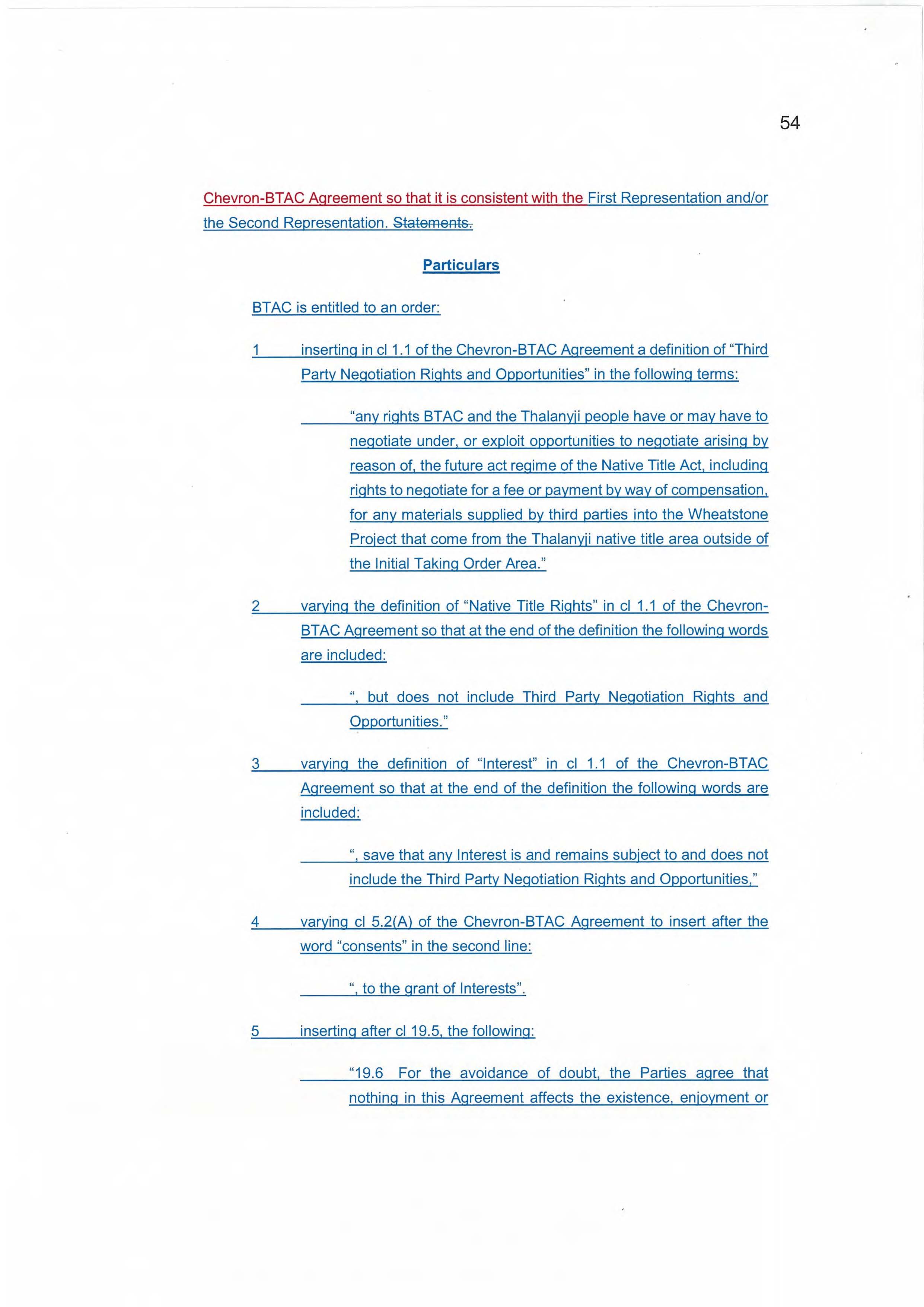
85 Paragraph 35 of BTAC’s proposed further amended defence to Chevron’s cross-claim introduces BTAC’s claim for a variation of the NT Agreement and damages and is in the following terms:
35 In the premises pleaded at paragraphs 31-34C above, BTAC is entitled to an order under s 87(1) of the TPA, alternatively s 244 of the ACL. alternatively by way of equitable set-off, including but not limited to an order under s 87(2)(b) and/or s 82 of the TPA, alternatively s 243 and/or s 236 of the ACL:
a) to vary the [NT Agreement] so that it is consistent with the First Representation and/or the Second Representation;
Particulars
BTAC is entitled to an order:
1 inserting in cl 1.1 of the [NT Agreement] a definition of "Third Party Negotiation Rights and Opportunities" in the following terms:
"any rights BTAC and the Thalanyji people have or may have to negotiate under, or exploit opportunities to negotiate arising by reason of, the future act regime of the Native Title Act. including rights to negotiate for a fee or payment by way of compensation, for any materials supplied by third parties into the Wheatstone Project that come from the Thalanyji native title area outside of the Initial Taking Order Area."
2 varying the definition of "Native Title Rights" in cl 1.1 of the [NT Agreement] so that at the end of the definition the following words are included:
", but does not include Third Party Negotiation Rights and Opportunities."
3 varying the definition of " Interest" in cl 1.1 of the [NT Agreement] so that at the end of the definition the following words are included:
", save that any Interest is and remains subject to and does not include the Third Party Negotiation Rights and Opportunities,"
4 varying cl 5.2(A) of the [NT Agreement] to insert after the word "consents" in the second line:
", to the grant of Interests".
5 inserting after cl 19.5, the following:
"19.6 For the avoidance of doubt. the Parties agree that nothing in this Agreement affects the existence, enjoyment or enforcement of the Third Party Negotiation Rights and Opportunities by the Native Title Parties and BTAC."
b) further or alternatively, damages from [Chevron] in an amount equivalent to the value of:
i) the opportunity BTAC lost to negotiate and agree with [Chevron] an additional payment or payments to be made to BTAC by [Chevron] under the [NT Agreement] by way of compensation for any materials supplied by Onslow Salt into the Wheatstone Project that came from the Thalanyji native title area outside of the Initial Taking Order Area;
ii) further or alternatively, BTAC’s claims against Onslow Salt and the State in the proceedings.
86 This is a significant addition as a matter of law and argument, but I have not been alerted to any perceived evidentiary difficulty which the addition would occasion, aside from the possibility of expert evidence on quantum which would have to be deferred in any event. The truth of the matter is that it does raise the same issues in principle that have been ventilated in the pleadings earlier exchanged. It simply seeks a new form of relief, being a rewriting of the NT Agreement. It may be for all the reasons (advanced at length by the State and alluded to by the other parties) that such relief is unlikely to be granted, but that does not seem to be a good reason to refuse an application to amend to seek the relief. It is clearly drawn with care and with some restraint and it is not an additional pleading which could be said to be doomed to failure on its face.
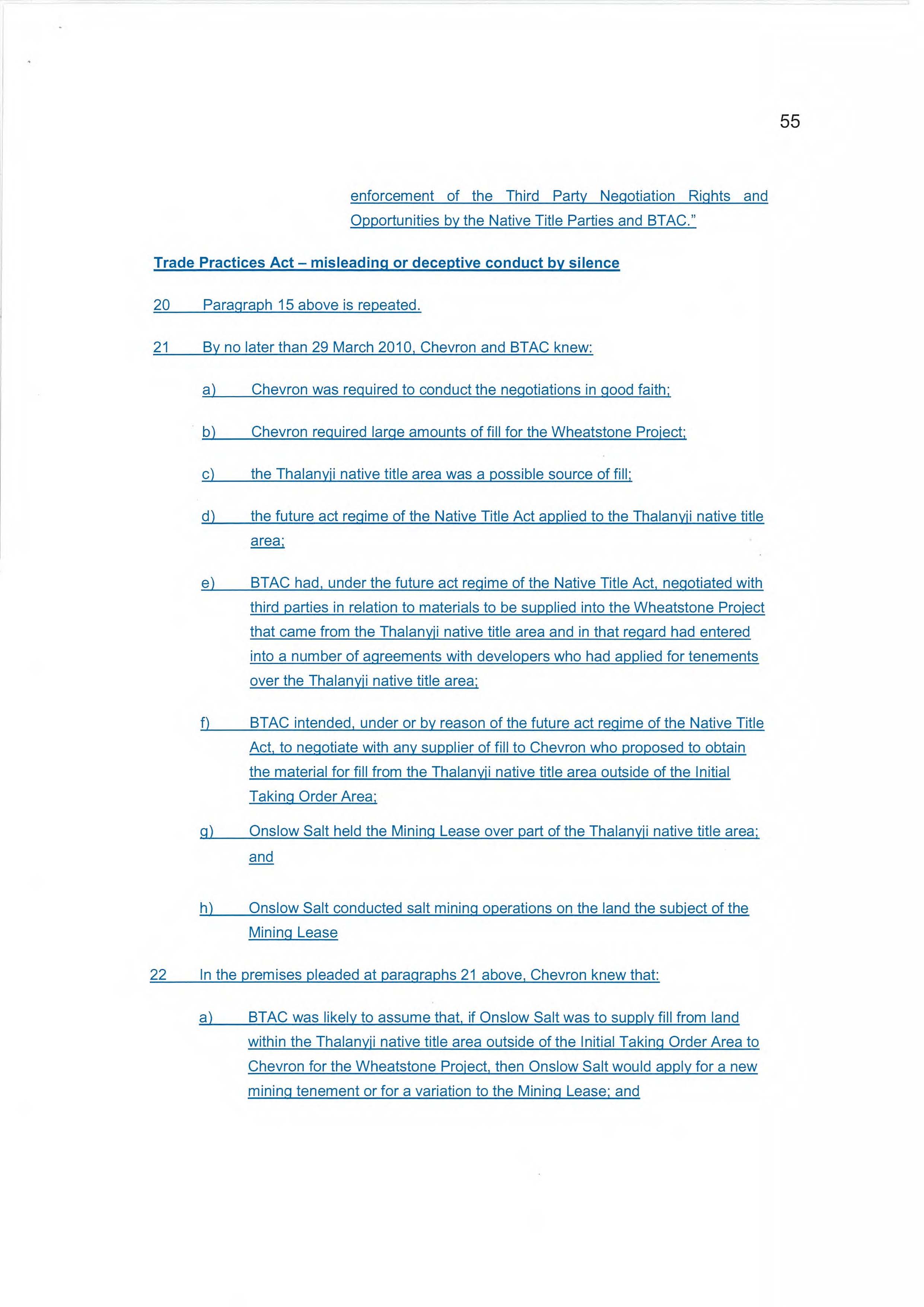
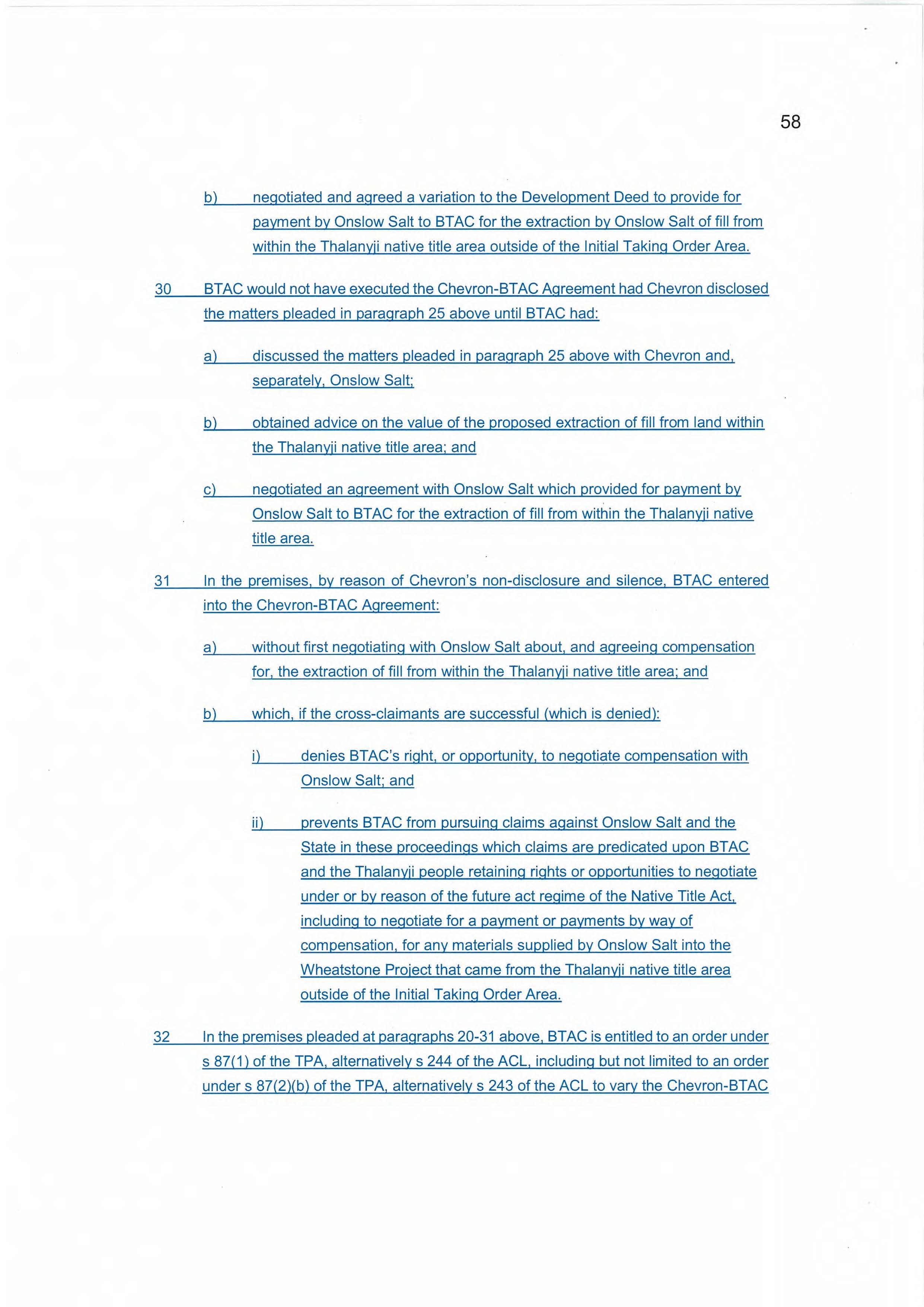
87 On the new Silence Claim, some similar issues arise. It is in the following terms:
26. Between early 2009 and December 2010, [Chevron], BTAC and the Thalanyji people engaged in negotiations which led to [Chevron] and BTAC entering into, first. the Heads of Agreement dated 22 July 2010 (Heads of Agreement) and, subsequently, the Native Title Agreement (negotiations).
…
Trade Practices Act - misleading or deceptive conduct by silence
36 Paragraph 26 above is repeated.
37 By no later than 29 March 2010, [Chevron] and BTAC knew:
a) [Chevron] was required to conduct the negotiations in good faith;
b) [Chevron] required large amounts of fill for the Wheatstone Project;
c) the Thalanyji native title area was a possible source of fill;
d) the future act regime of the Native Title Act applied to the Thalanyji native title area:
e) BTAC had, under the future act regime of the Native Title Act, negotiated with third parties in relation to materials to be supplied into the Wheatstone Project that came from the Thalanyji native title area and in that regard had entered into a number of agreements with developers who had applied for tenements over the Thalanyji native title area;
f) BTAC intended, under or by reason of the future act regime of the Native Title Act, to negotiate with any supplier of fill to [Chevron] who proposed to obtain the material for fill from the Thalanyji native title area outside of the Initial Taking Order Area’
g) Onslow Salt held the Mining Lease over part of the Thalanyji native title area; and
i) [sic] Onslow Salt conducted salt mining operations on the land the subject of the Mining Lease.
38 In the premises pleaded at paragraphs 37 above, [Chevron] knew that:
a) BTAC was likely to assume that, if Onslow Salt was to supply fill from land within the Thalanyji native title area outside of the Initial Taking Order Area to [Chevron] for the Wheatstone Project, then Onslow Salt would apply for a new mining tenement or for a variation to the Mining Lease; and
b) if Onslow Salt applied for a new mining tenement or for a variation to the Mining Lease, BTAC would, under or by reason of the future act regime of the Native Title Act. negotiate with Onslow Salt in respect of any application.
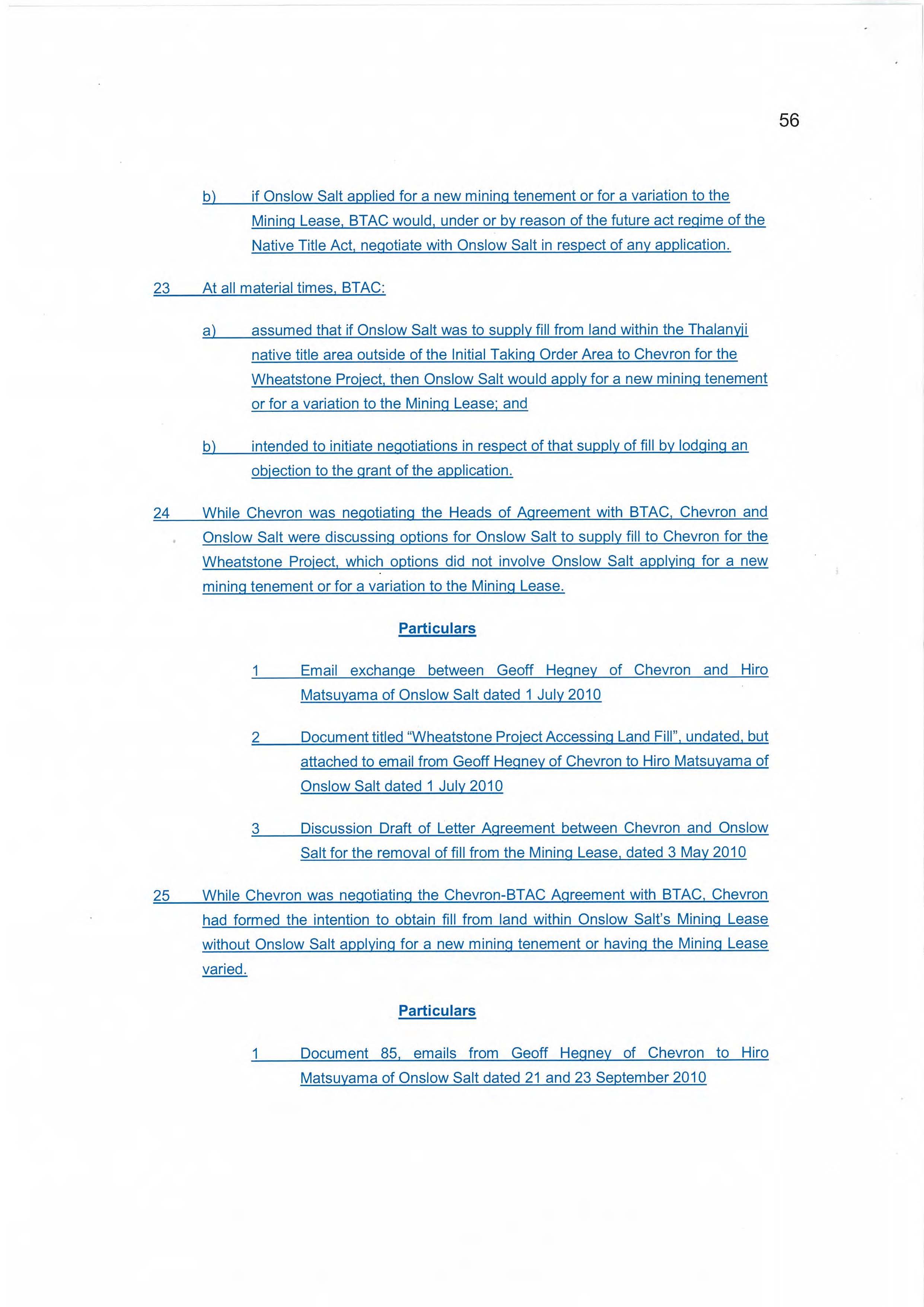
39 At all material times, BTAC:
a) assumed that if Onslow Salt was to supply fill from land within the Thalanyji native title area outside of the Initial Taking Order Area to [Chevron] for the Wheatstone Project, then Onslow Salt would apply for a new mining tenement or for a variation to the Mining Lease: and
b) intended to initiate negotiations in respect of that supply of fill by lodging an objection to the grant of the application.
40 While [Chevron] was negotiating the Heads of Agreement with BTAC. [Chevron] and Onslow Salt were discussing options for Onslow Salt to supply fill to [Chevron] for the Wheatstone Project. Which options did not involve Onslow Salt applying for a new mining tenement or for a variation to the Mining Lease.
Particulars
1 Email exchange between Geoff Hegney of [Chevron] and Hiro Matsuyama of Onslow Salt dated 1 July 2010
2 Document titled " Wheatstone Project Accessing Land Fill", undated, but attached to email from Geoff Hegney of [Chevron] to Hiro Matsuyama of Onslow Salt dated 1 July 2010
3 Discussion Draft of Letter Agreement between [Chevron] and Onslow Salt for the removal of fill from the Mining Lease, dated 3 May 2010
41 While [Chevron] was negotiating the [NT Agreement] with BTAC. [Chevron] had formed the intention to obtain fill from land within Onslow Salt’s Mining Lease without Onslow Salt applying for a new mining tenement or having the Mining Lease varied.
Particulars
1 Document 85, emails from Geoff Hegney of [Chevron] to Hiro Matsuyama of Onslow Salt dated 21 and 23 September 2010
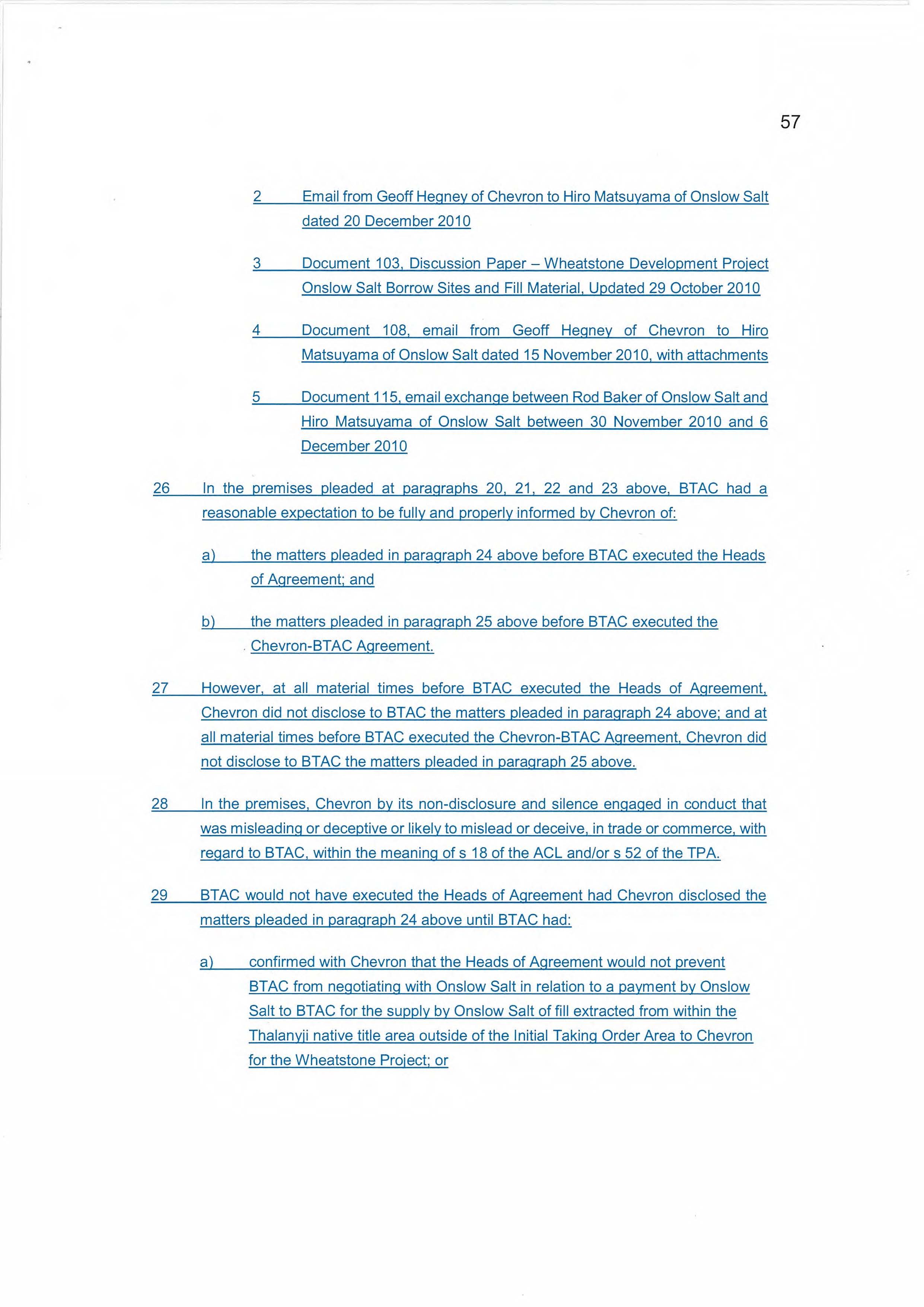
2 Email from Geoff Hegney of [Chevron] to Hiro Matsuyama of Onslow Salt dated 20 December 2010
3 Document 103. Discussion Paper - Wheatstone Development Project Onslow Salt Borrow Sites and Fill Material, Updated 29 October 2010
4 Document 108, email from Geoff Hegney of [Chevron] to Hiro Matsuyama of Onslow Salt dated 15 November 2010, with attachments
5 Document 115, email exchange between Rod Baker of Onslow Salt and Hiro Matsuyama of Onslow Salt between 30 November 2010 and 6 December 2010
42 In the premises pleaded at paragraphs 36, 37, 38 and 39 above, BTAC had a reasonable expectation to be fully and properly informed by [Chevron] of:
a) the matters pleaded in paragraph 40 above before BTAC executed the Heads of Agreement: and
b) the matters pleaded in paragraph 41 above before BTAC executed the [NT Agreement].
43 However, at all material times before BTAC executed the Heads of Agreement, [Chevron] did not disclose to BTAC the matters pleaded in paragraph 40 above: and at all material times before BTAC executed the [NT Agreement], [Chevron] did not disclose to BTAC the matters pleaded in paragraph 41 above.
44 In the premises, [Chevron] by its non-disclosure and silence engaged in conduct that was misleading or deceptive or likely to mislead or deceive, in trade or commerce, with regard to BTAC, within the meaning of s 18 of the ACL and/or s 52 of the TPA.
45 BTAC would not have executed the Heads of Agreement had [Chevron] disclosed the matters pleaded in paragraph 40 above until BTAC had:
a) confirmed with [Chevron] that the Heads of Agreement would not prevent BTAC from negotiating with Onslow Salt in relation to a payment by Onslow Salt to BTAC for the supply by Onslow Salt of fill extracted from within the Thalanyji native title area outside of the Initial Taking Order Area to [Chevron] for the Wheatstone Project: or
b) negotiated and agreed a variation to the Development Deed to provide for payment by Onslow Salt to BTAC for the extraction by Onslow Salt of fill from within the Thalanyji native title area outside of the Initial Taking Order Area/
46 BTAC would not have executed the [NT Agreement] had [Chevron] disclosed the matters pleaded in paragraph 41 above until BTAC had:
a) discussed the matters pleaded in paragraph 41 above with [Chevron] and, separately, Onslow Salt:
b) obtained advice on the value of the proposed extraction of fill from land within the Thalanyji native title area; and
c) negotiated an agreement with Onslow Salt which provided for payment by Onslow Salt to BTAC for the extraction of fill from within the Thalanyji native title area.
47 In the premises, by reason of {Chevron’s] non-disclosure and silence. BTAC entered into the [NT Agreement]:
a) without first negotiating with Onslow Salt about, and agreeing compensation for the extraction of fill from within the Thalanyji native title area; and
b) which, if the cross-claimants are successful (which is denied):
i) denies BTAC’s right, or opportunity, to negotiate compensation with Onslow Salt; and
ii) prevents BTAC from pursuing claims against Onslow Salt and the State in these proceedings which claims are predicated upon BTAC and the Thalanyji people retaining rights or opportunities to negotiate under or by reason of the future act regime of the Native Title Act, including to negotiate for a payment or payments by way of compensation, for any materials supplied by Onslow Salt into the Wheatstone Project that came from the Thalanyji native title area outside of the Initial Taking Order Area.
48 In the premises pleaded at paragraphs 36-47 above. BTAC is entitled to an order under s 87(1) of the TPA, alternatively s 244 of the ACL. alternatively by way of equitable set-off. Including but not limited to an order under s 87(2)(b) and/or s 82 of the TPA, alternatively s 243 and/or s 236 of the ACL:
a) to vary the [NT Agreement] so that it is consistent with the First Representation and/or the Second Representation;
Particulars
The particulars of paragraph 35(a) are repeated
b) further or alternatively, damages from [Chevron] in an amount equivalent to the value of:
i) the opportunity BTAC lost to negotiate and agree with [Chevron] an additional payment or payments to be made to BTAC by [Chevron] under the [NT Agreement] by way of compensation for any materials supplied by Onslow Salt into the Wheatstone Project that came from the Thalanyji native title area outside of the Initial Taking Order Area:
ii) further or alternatively, BTAC’s claims against Onslow Salt and the State in the proceedings.
88 The addition of this pleading may well occasion some difficulty. However, the additional facts pleaded are confined to inferences to be drawn from a small number of documents, taken together with other facts which have already been the subject of pleading by way of different causes of action. It is not clear to me that the addition of this plea would add significantly to the length of time of the trial or to the burden of preparation for it, or that it ought be excluded for any other reason. A fair assessment of the pleading is that it adds a different basis at law for an assertion that the clause in the NT Agreement on which the cross-claimants principally rely ought not be permitted to have the effect sought or that the NT Agreement should be amended so as to give it an effect consistent with the true position between the parties.
89 Nothing I have said in these reasons should be treated as any comment on the likely success of any of the amendments sought. But while the amendments would add some legal argument, and indeed, some clarification to BTAC’s pleading, I consider that the interests of justice favour the amendments being permitted and I remain of the view that the hearing of the cross-claims could have proceeded from 21 to 24 December 2020 on all issues save as to quantum. However, given the abridged time within which the present application was brought on and determined, I gave advance notice to the parties on 23 November 2020 of my decision to allow the amendments with these reasons to follow. At what was previously intended to be the pre-trial directions hearing, on 25 November 2020 Chevron sought orders to vacate the trial dates which were not opposed by any party. As a matter of record though, senior counsel for BTAC noted its non-opposition was grounded in the reasons it had advanced for a vacation in the application the subject of BTAC (No 8), and did not arise by reasons of the amendments now sought.
90 The amendments are certainly late and while leave to amend will be granted, BTAC will be required to pay any costs thrown away. Orders will be made in terms of BTAC’s application. Orders will also be made vacating the current trial dates and programming forward the filing of amended replies and any requests for particulars. In addition, at Chevron’s unopposed request, orders will be made to allow any application to set aside the orders made in BTAC (No 4) that the cross-claims be heard separately to, and in advance of, BTAC’s principal claim to be brought on for hearing this year.
I certify that the preceding ninety (90) numbered paragraphs are a true copy of the Reasons for Judgment of the Honourable Justice McKerracher. |
Associate:
ANNEXURE A
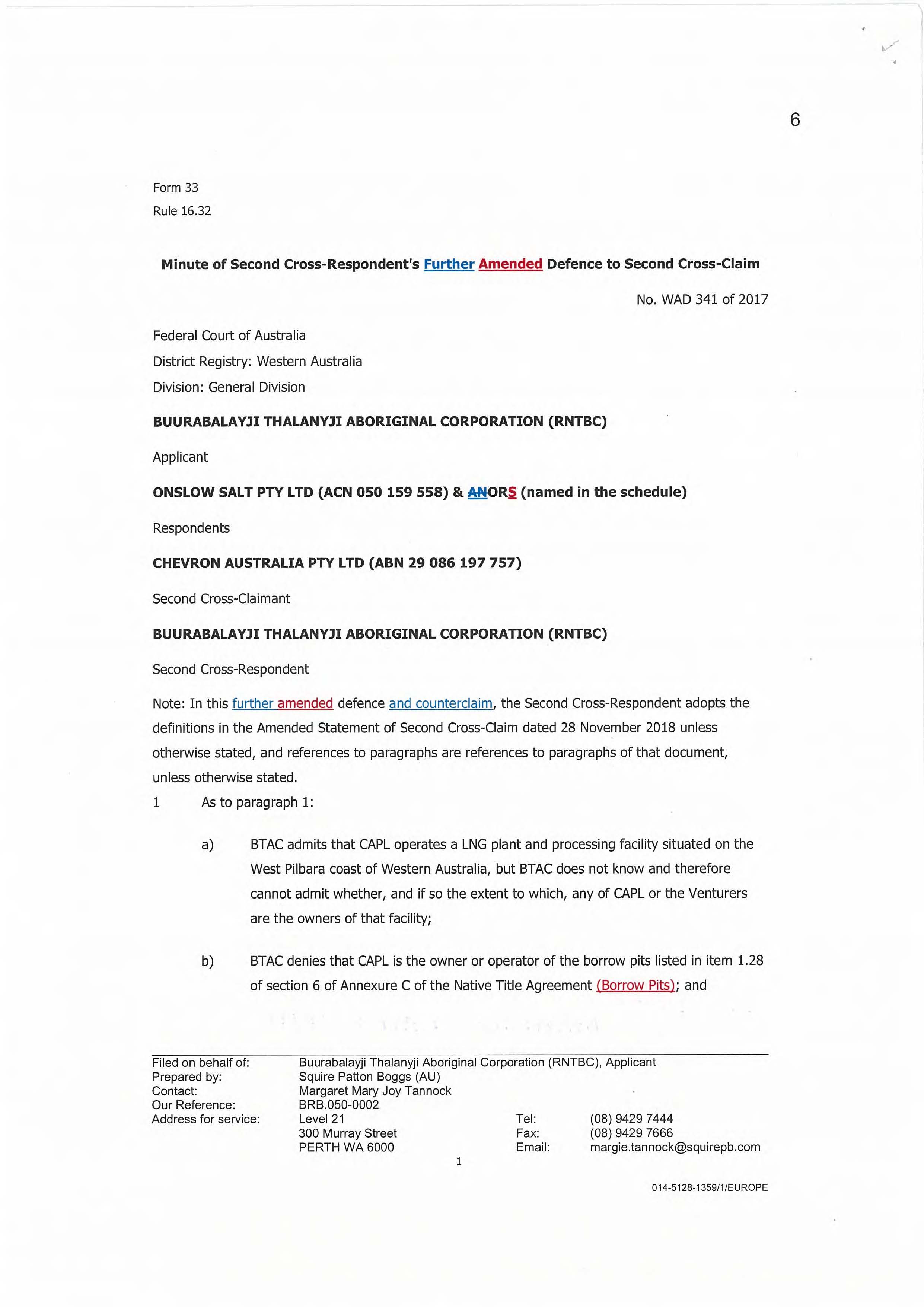
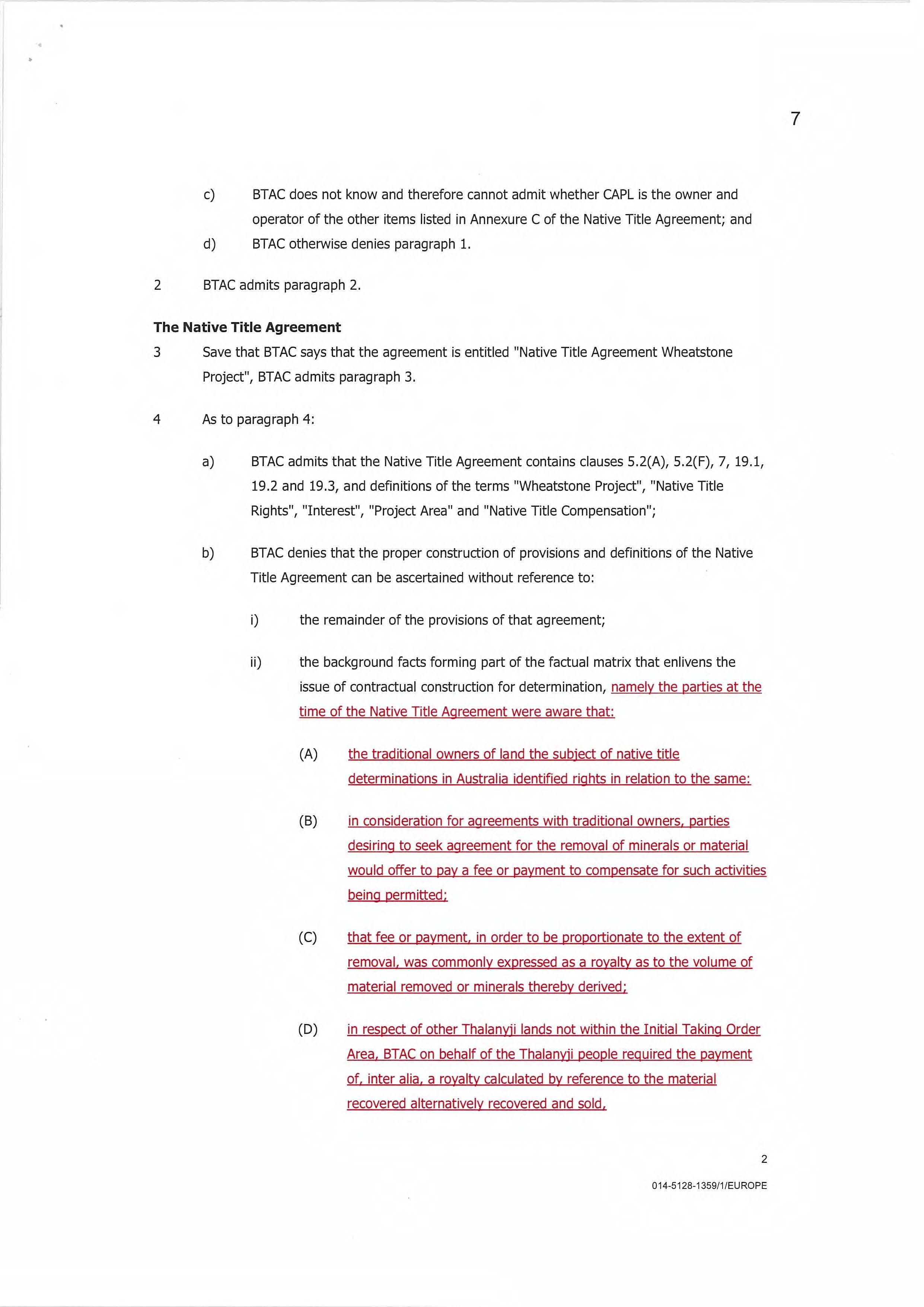
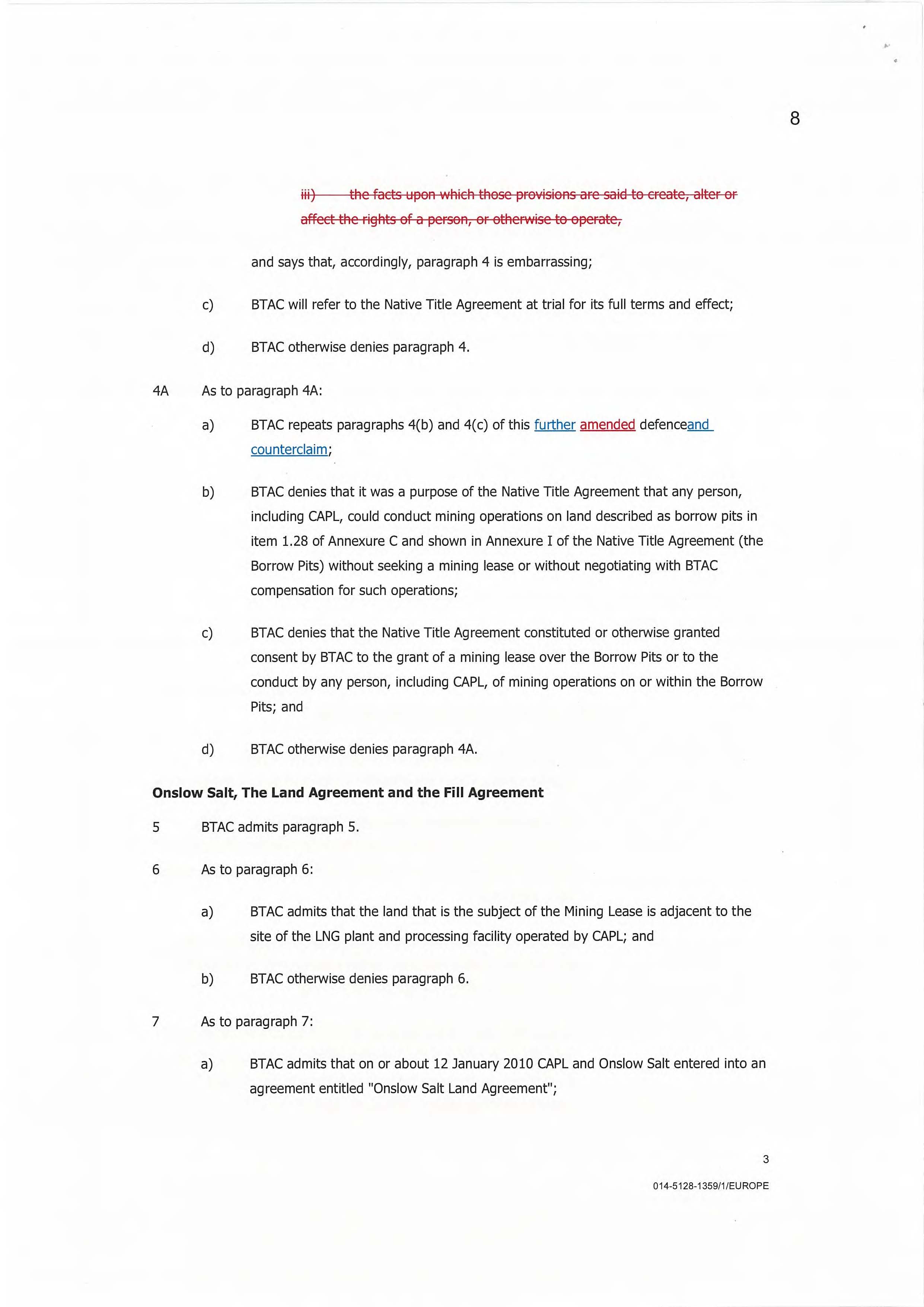
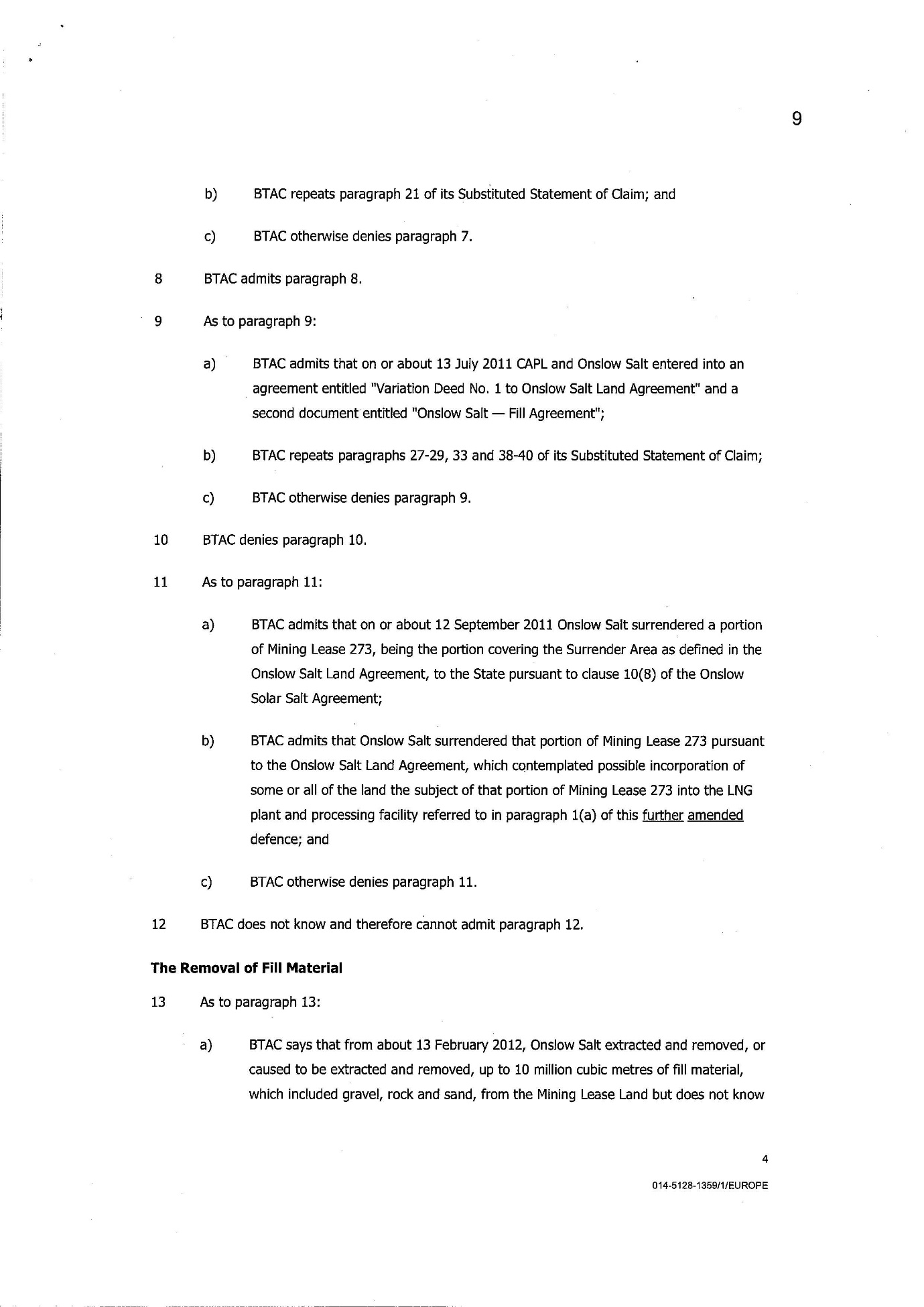
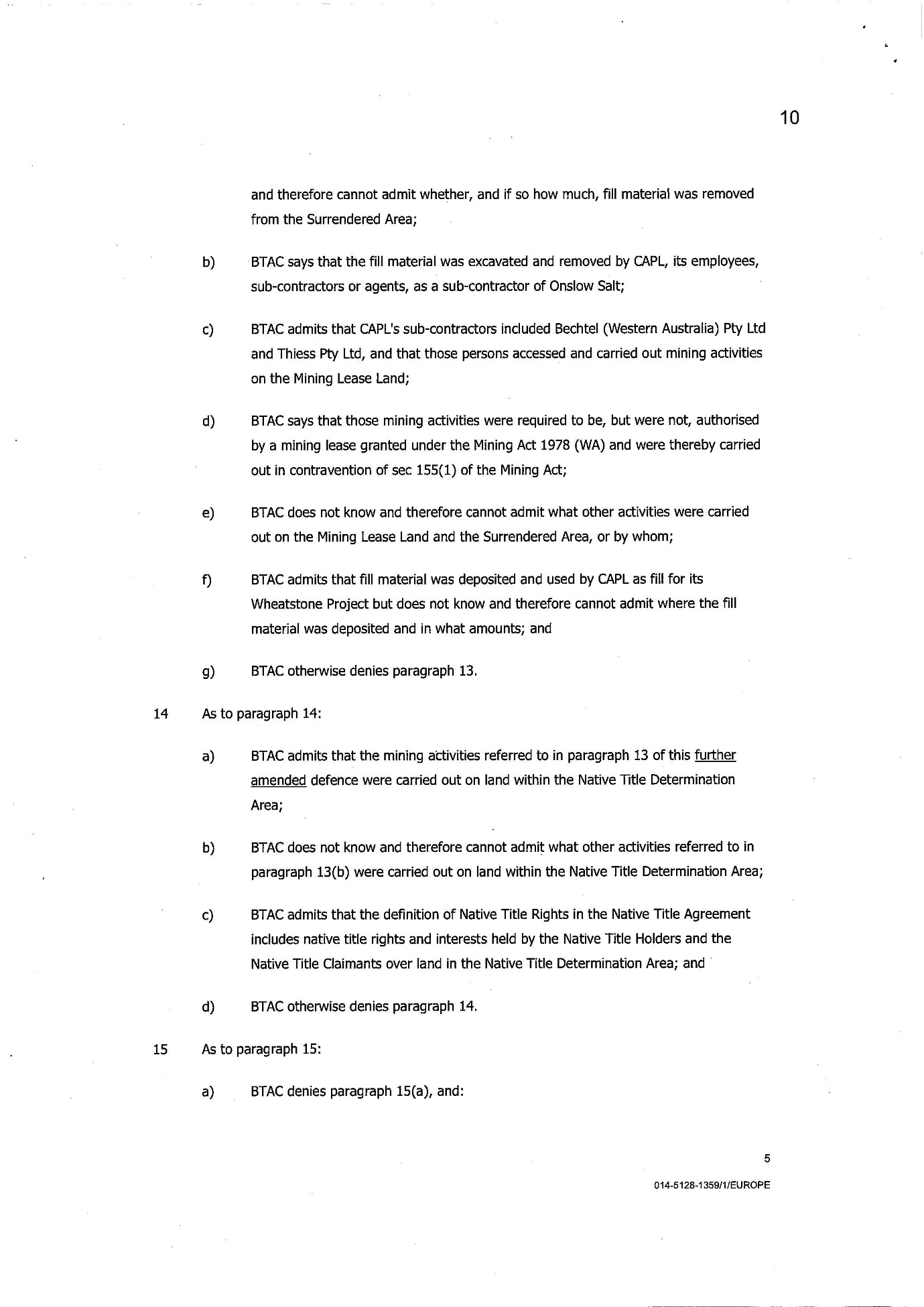
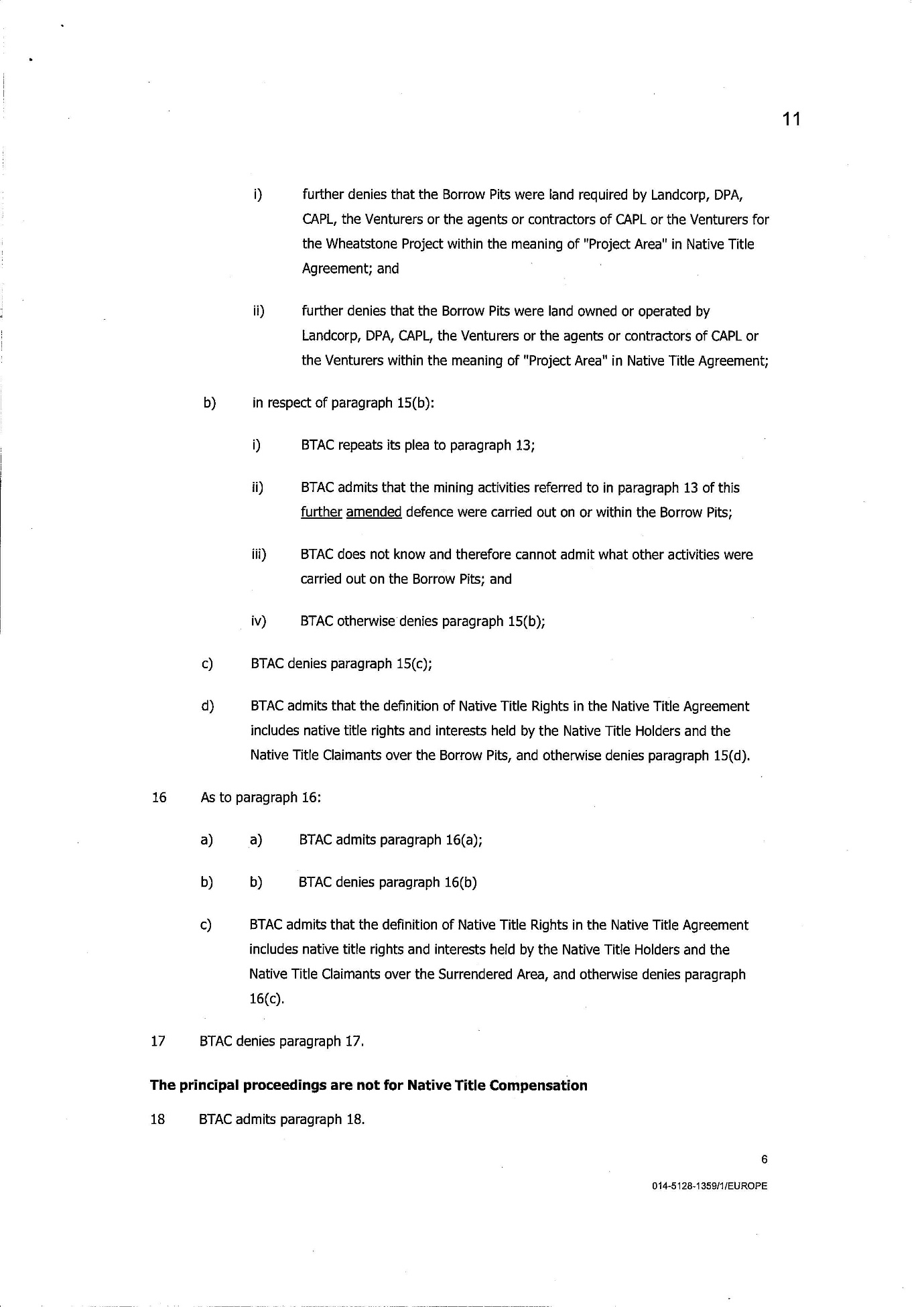
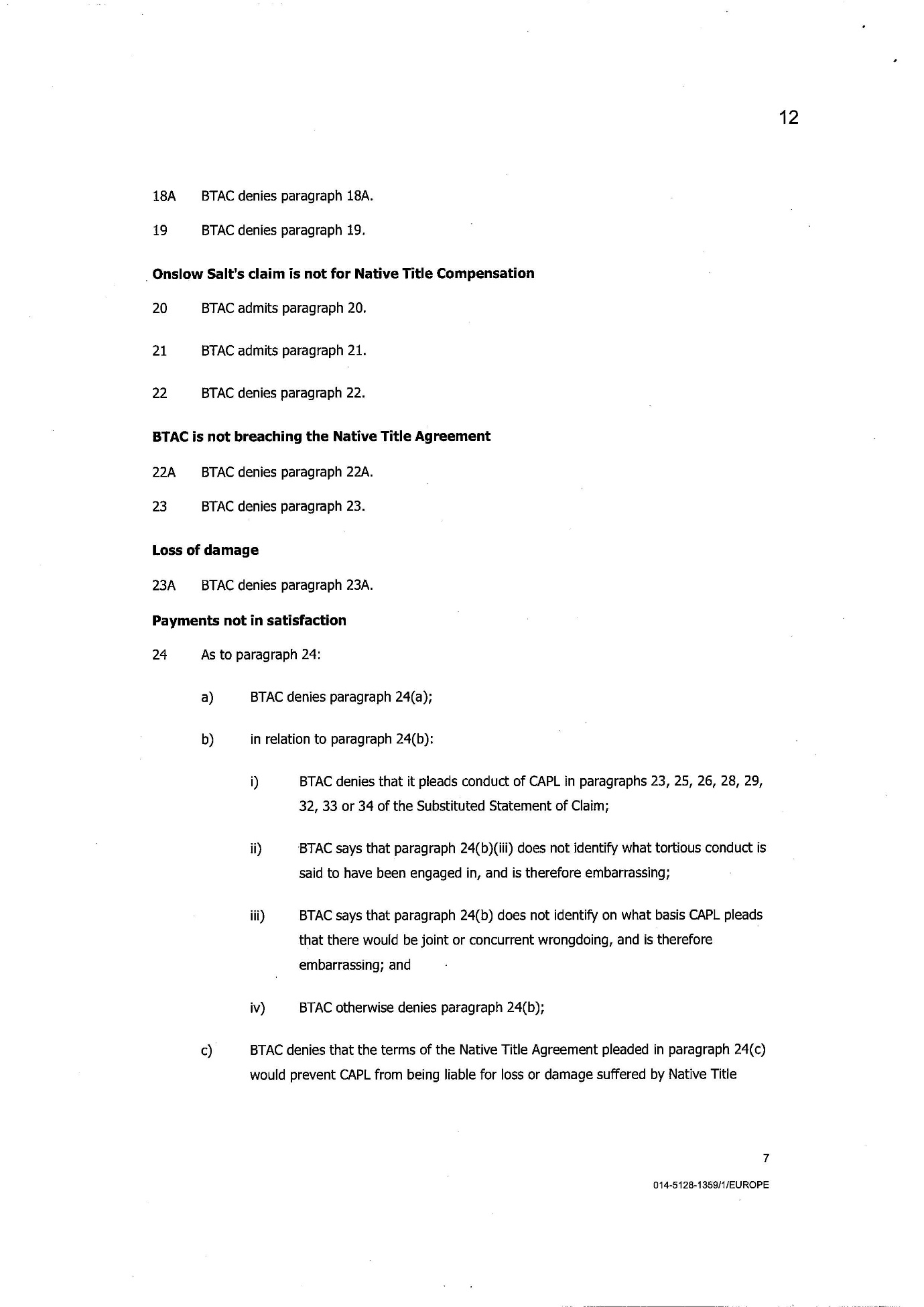
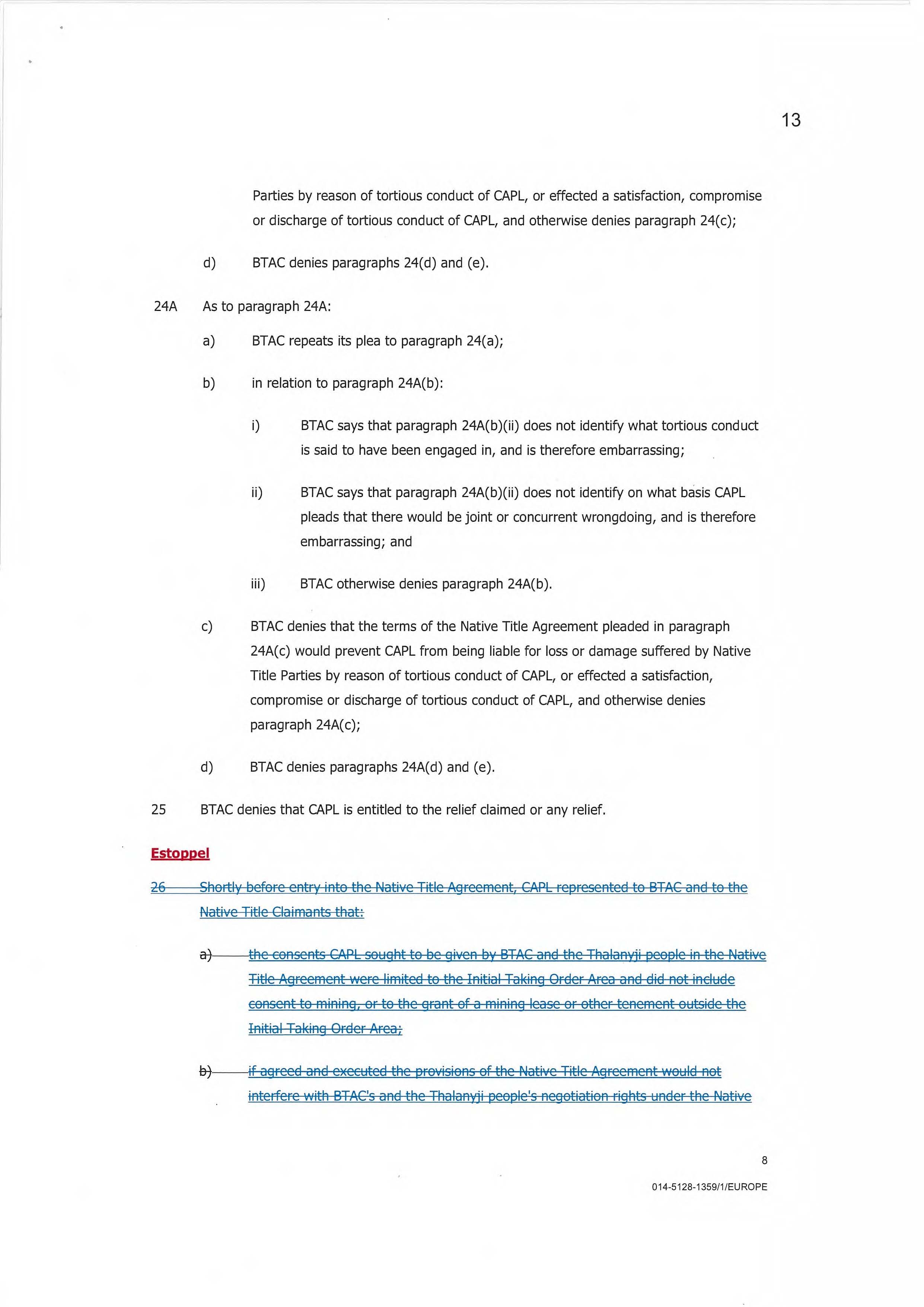
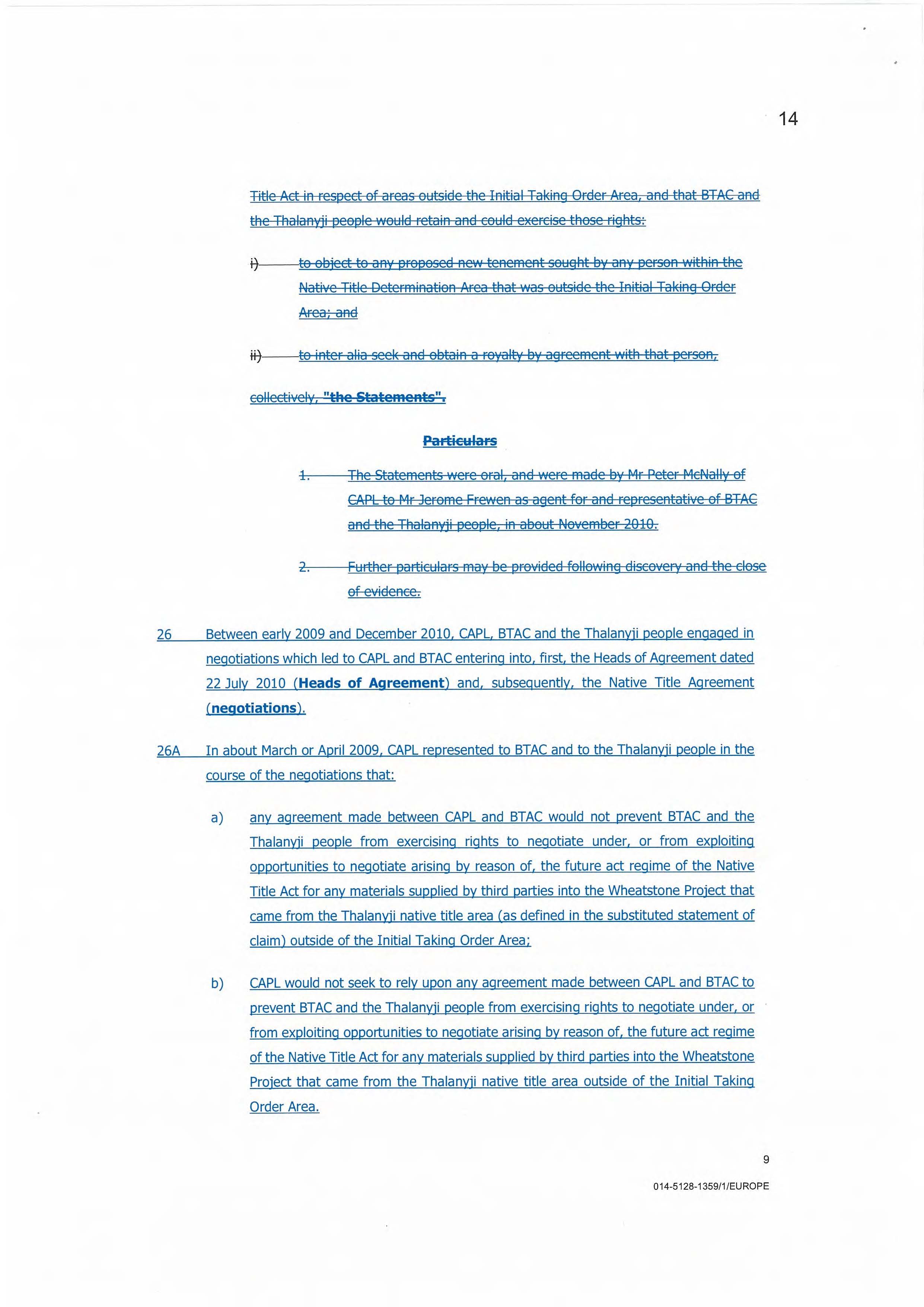
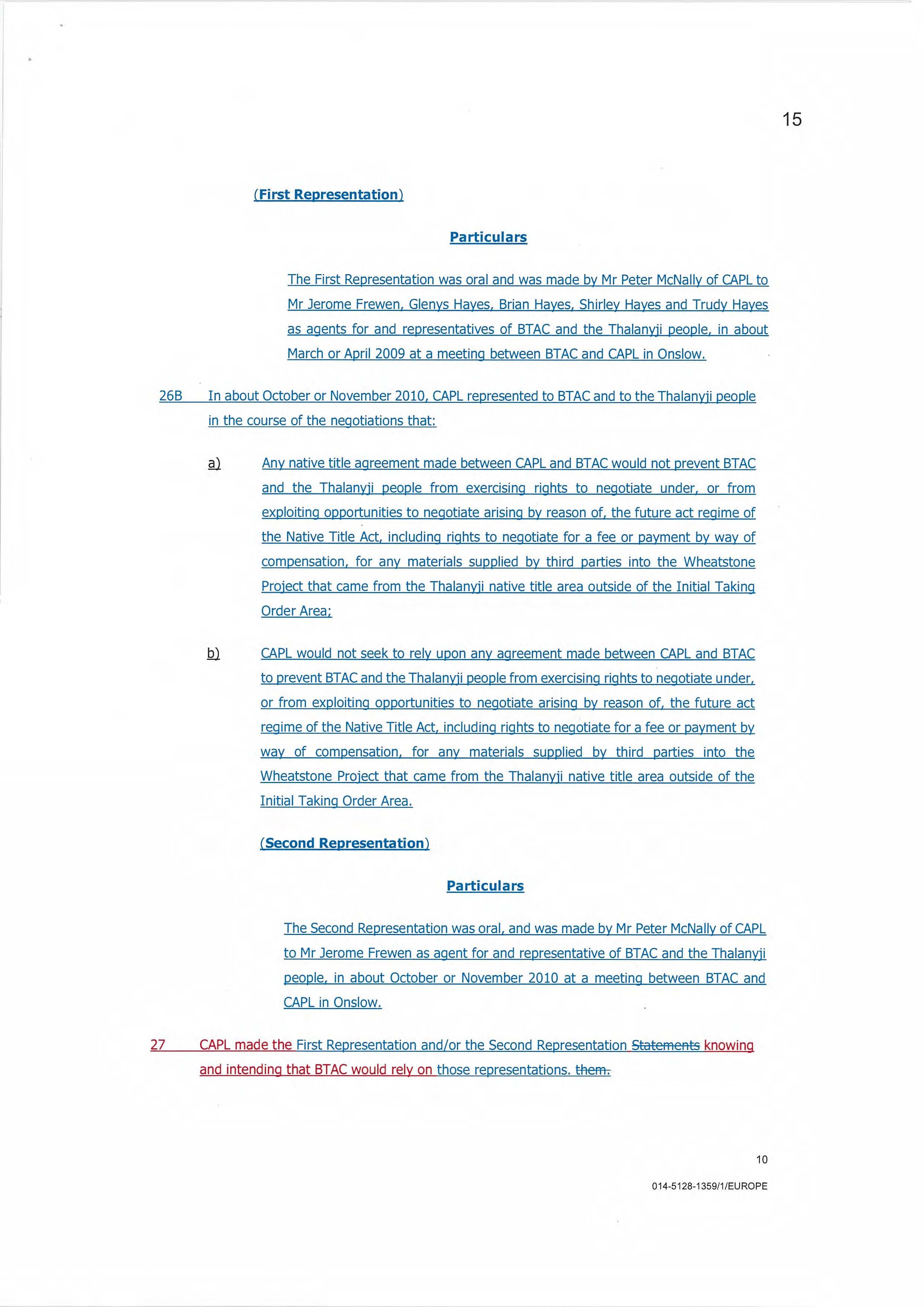
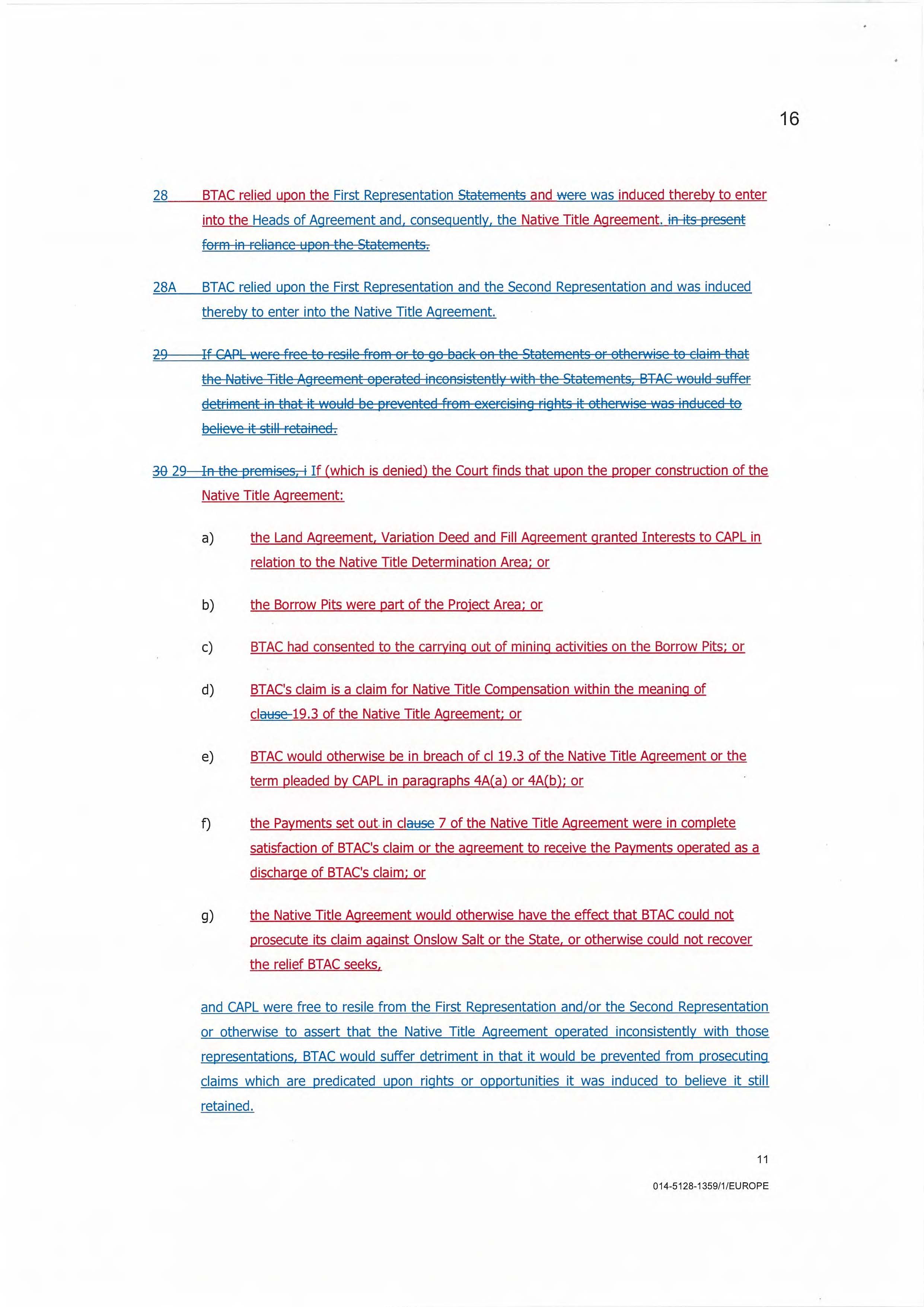
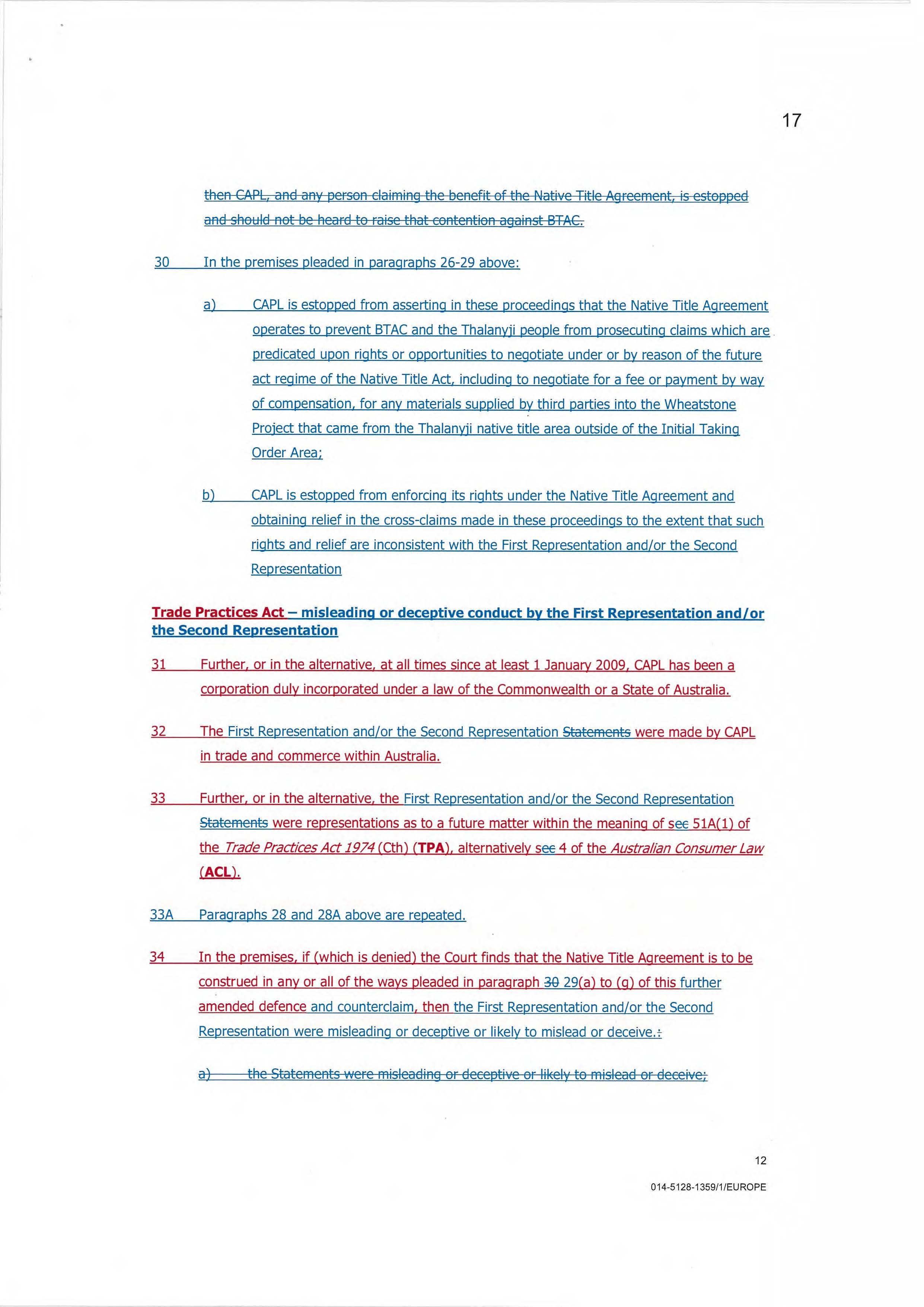
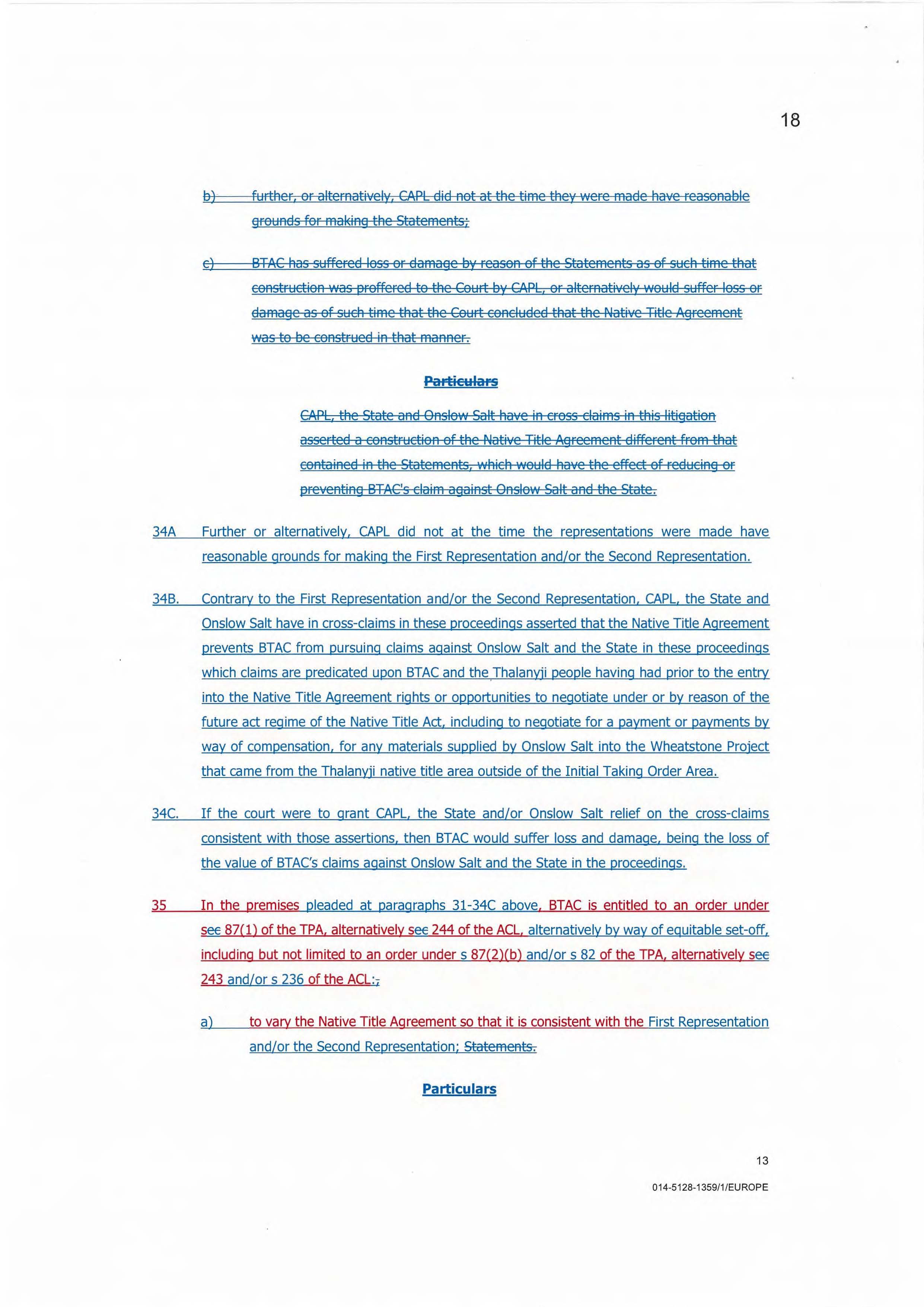
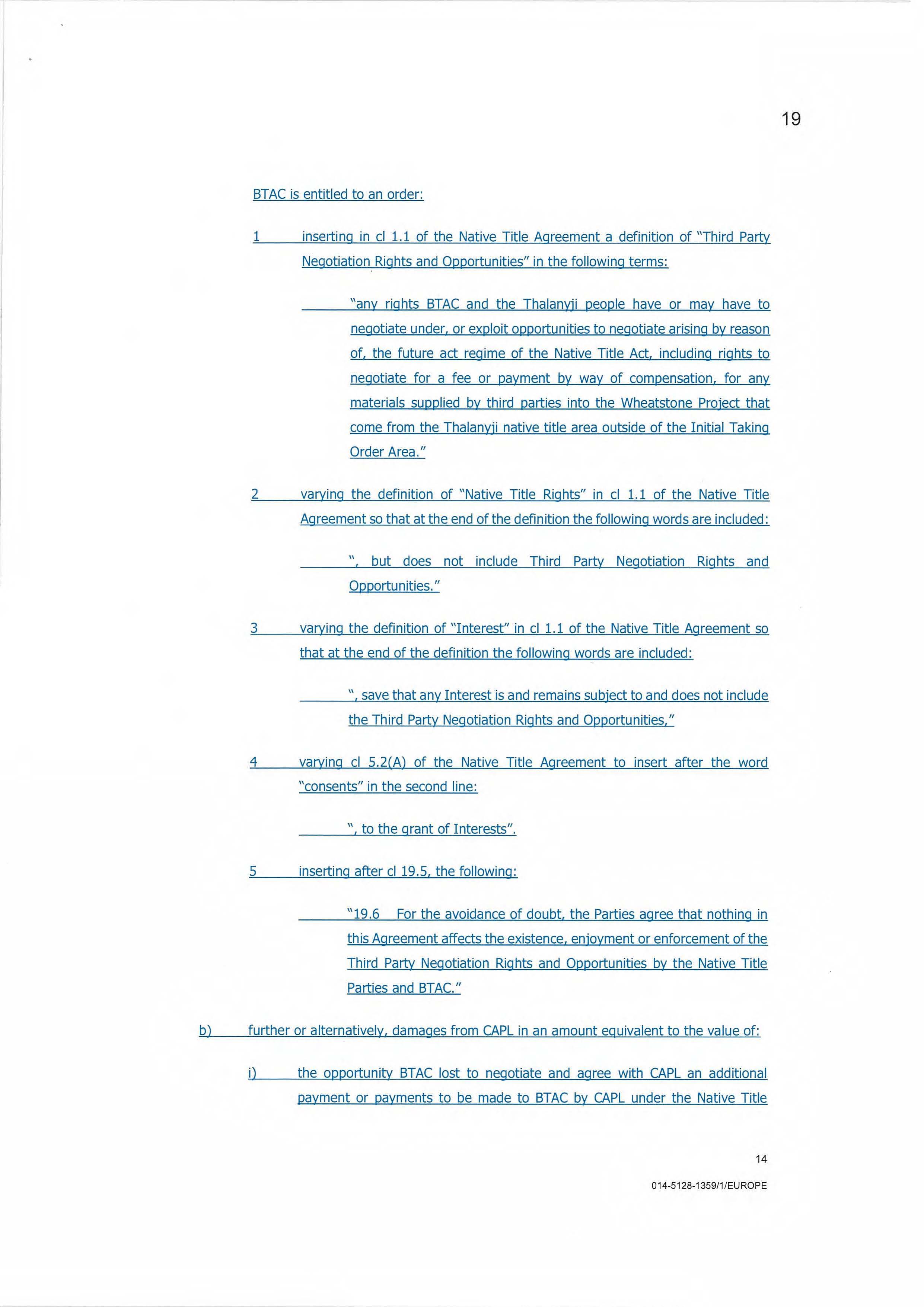
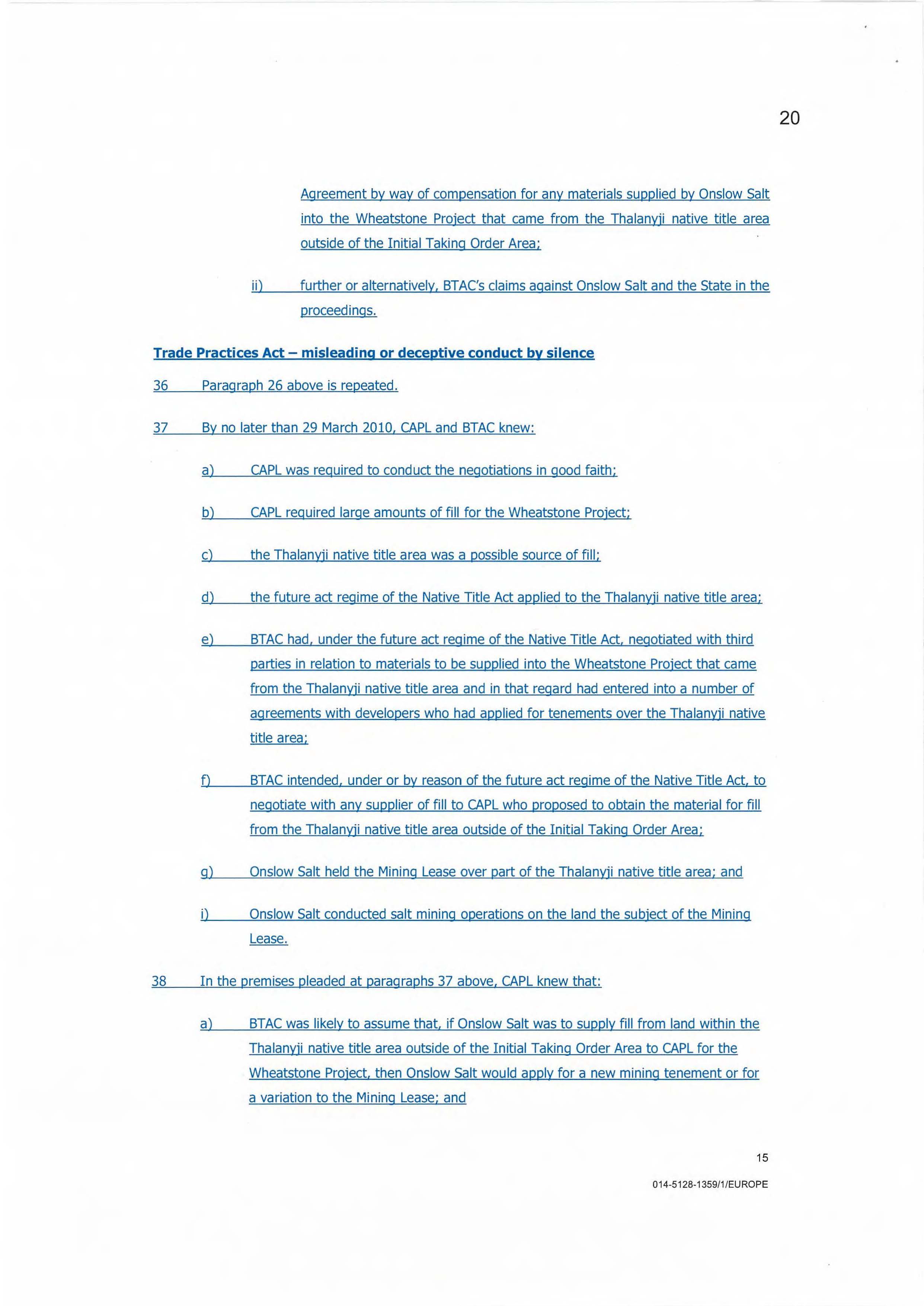
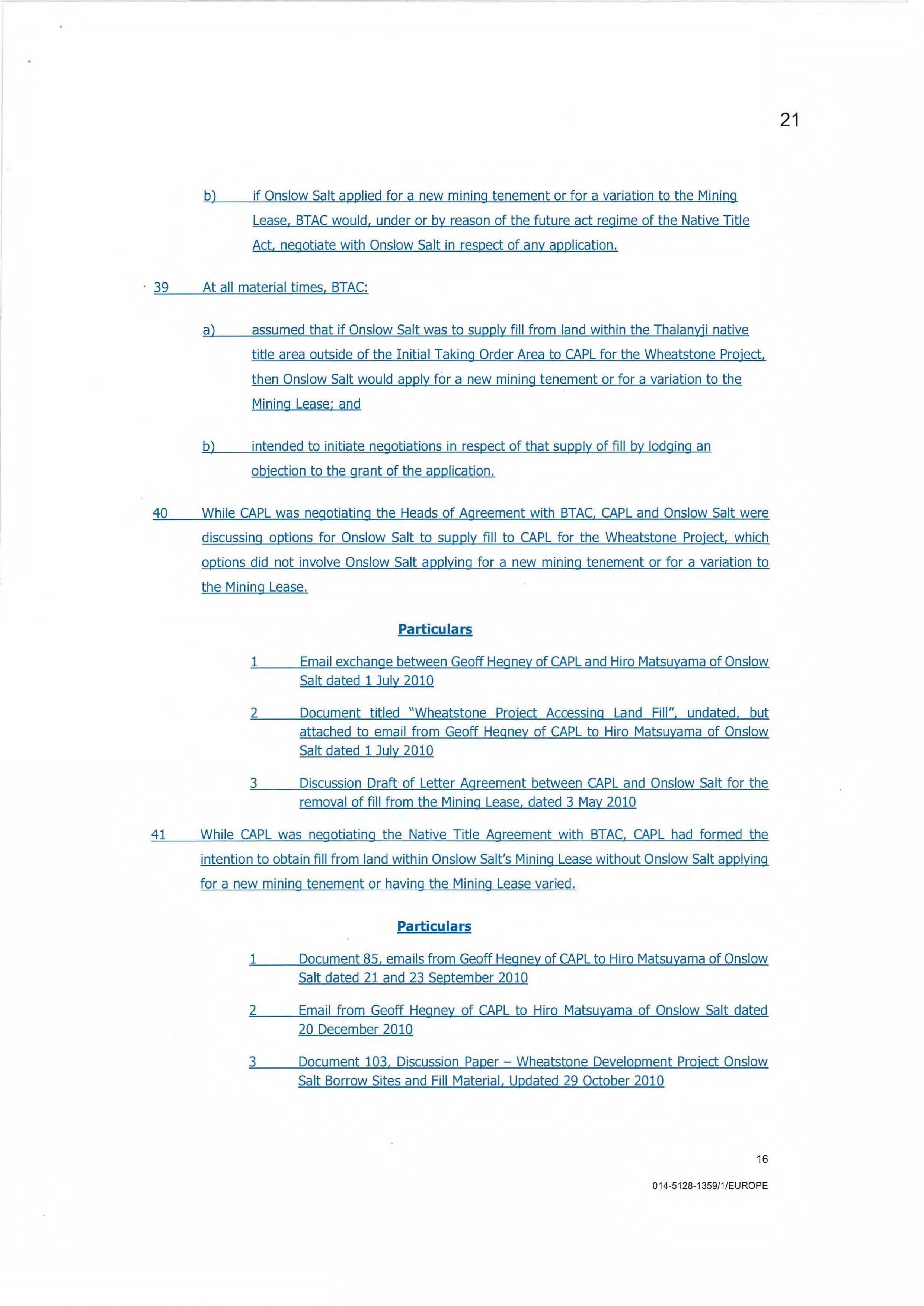
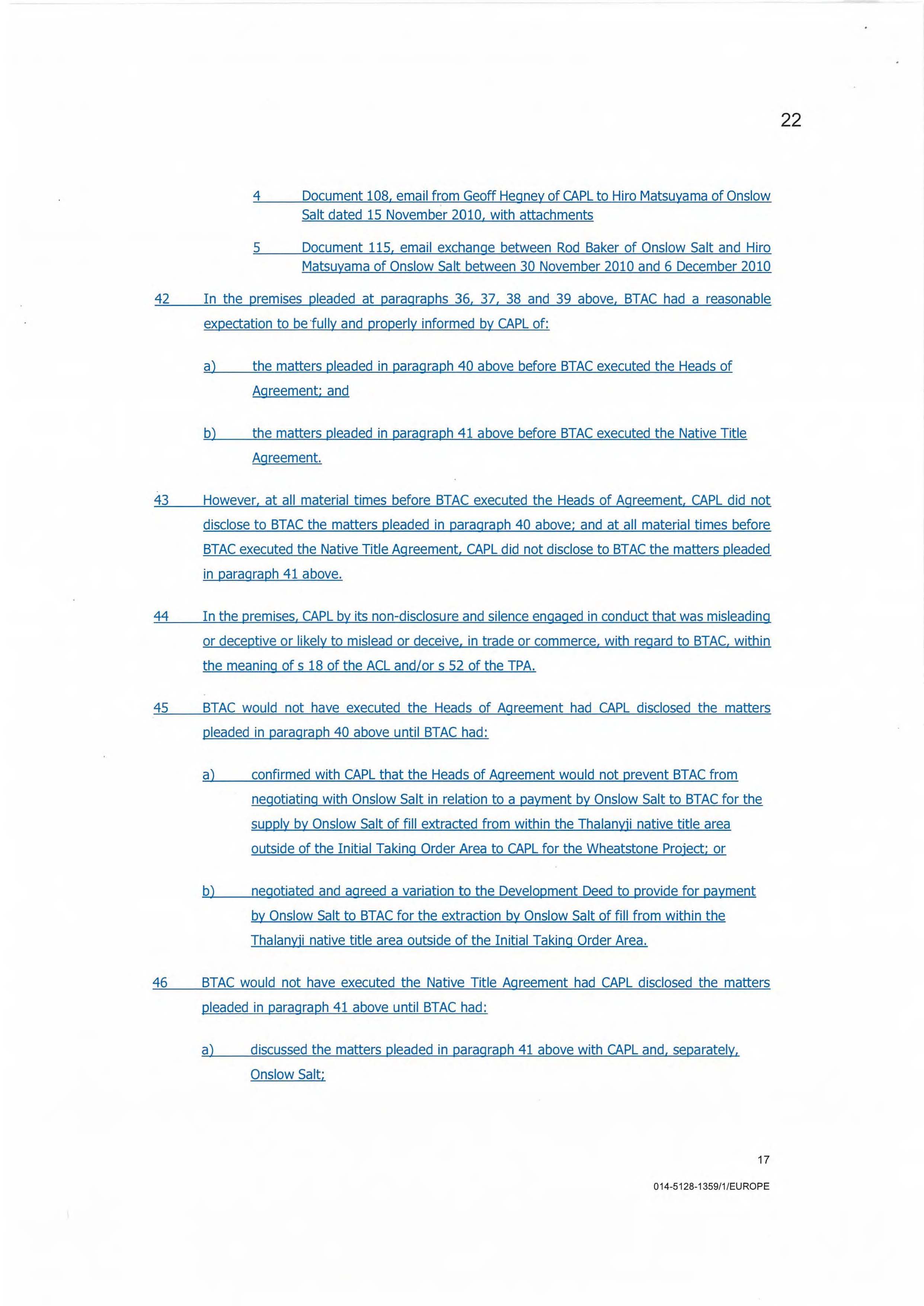
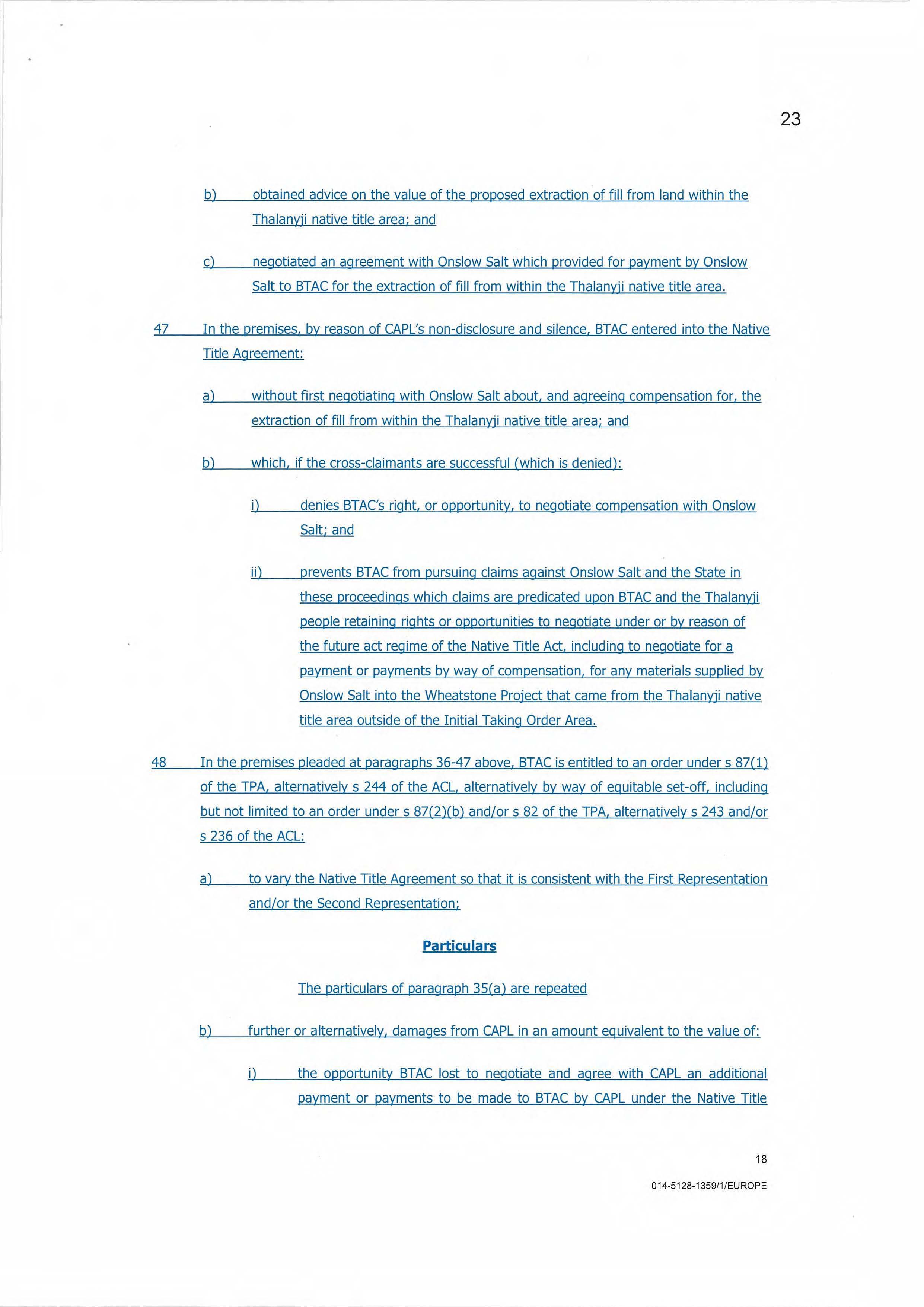
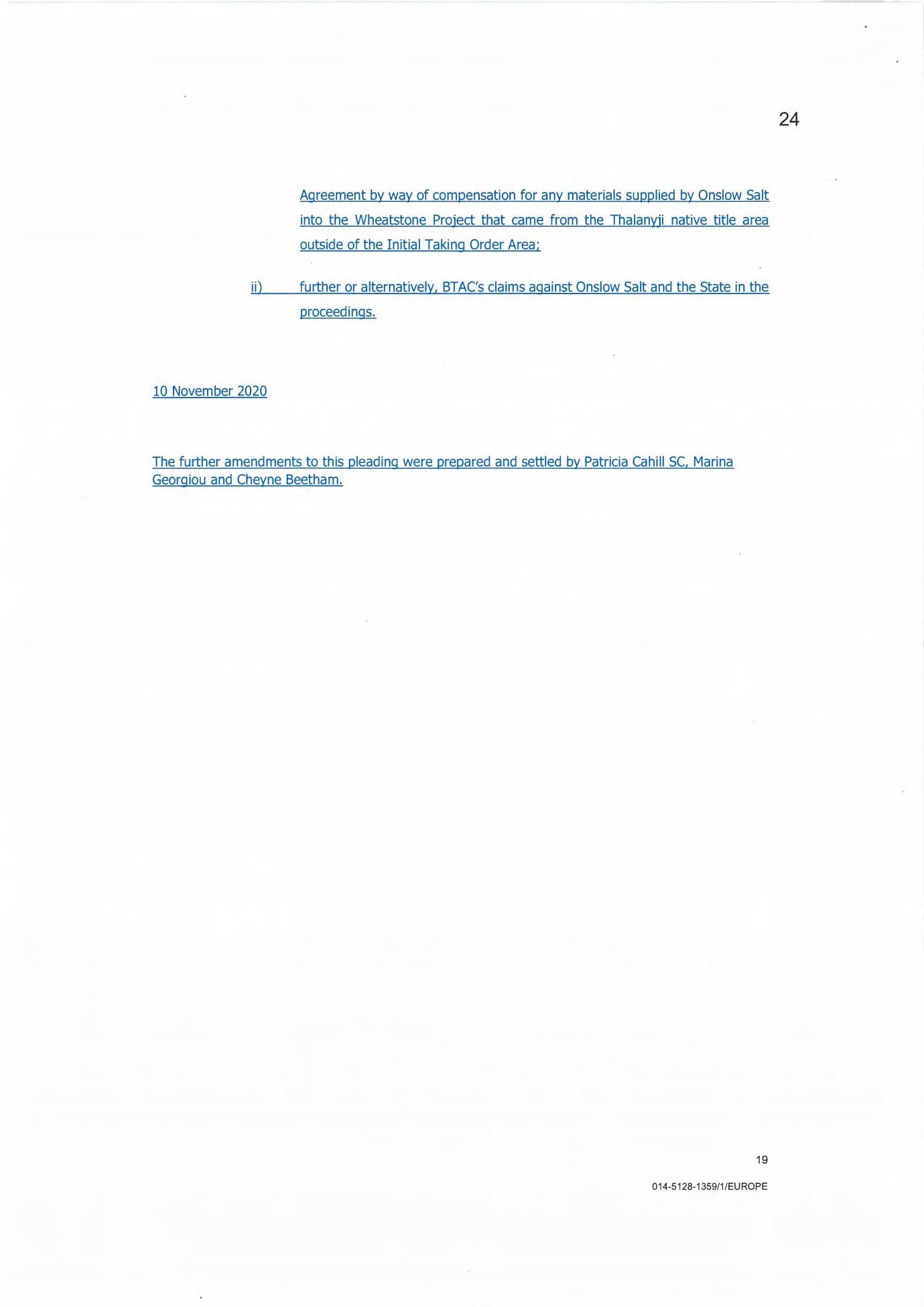
ANNEXURE B
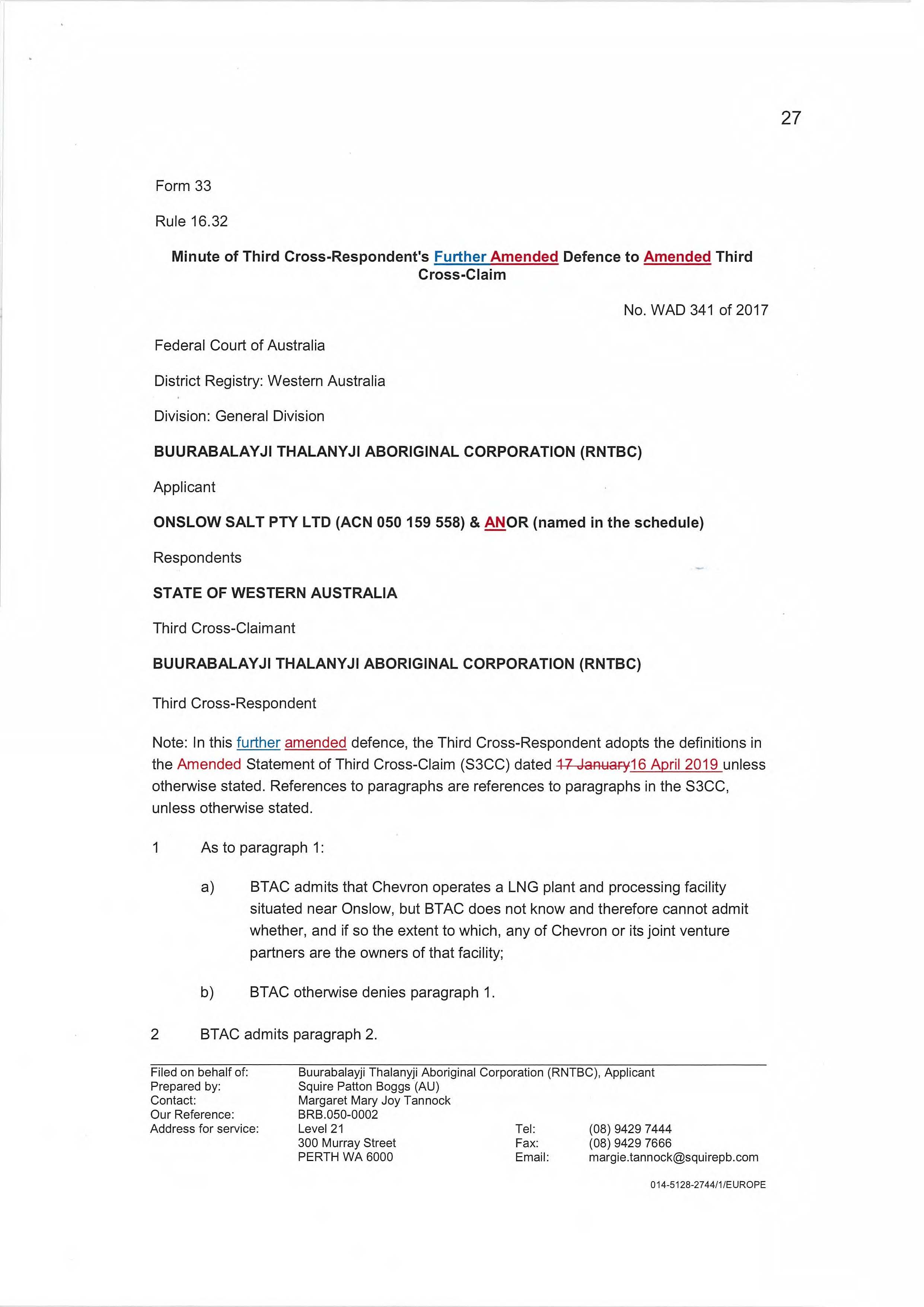
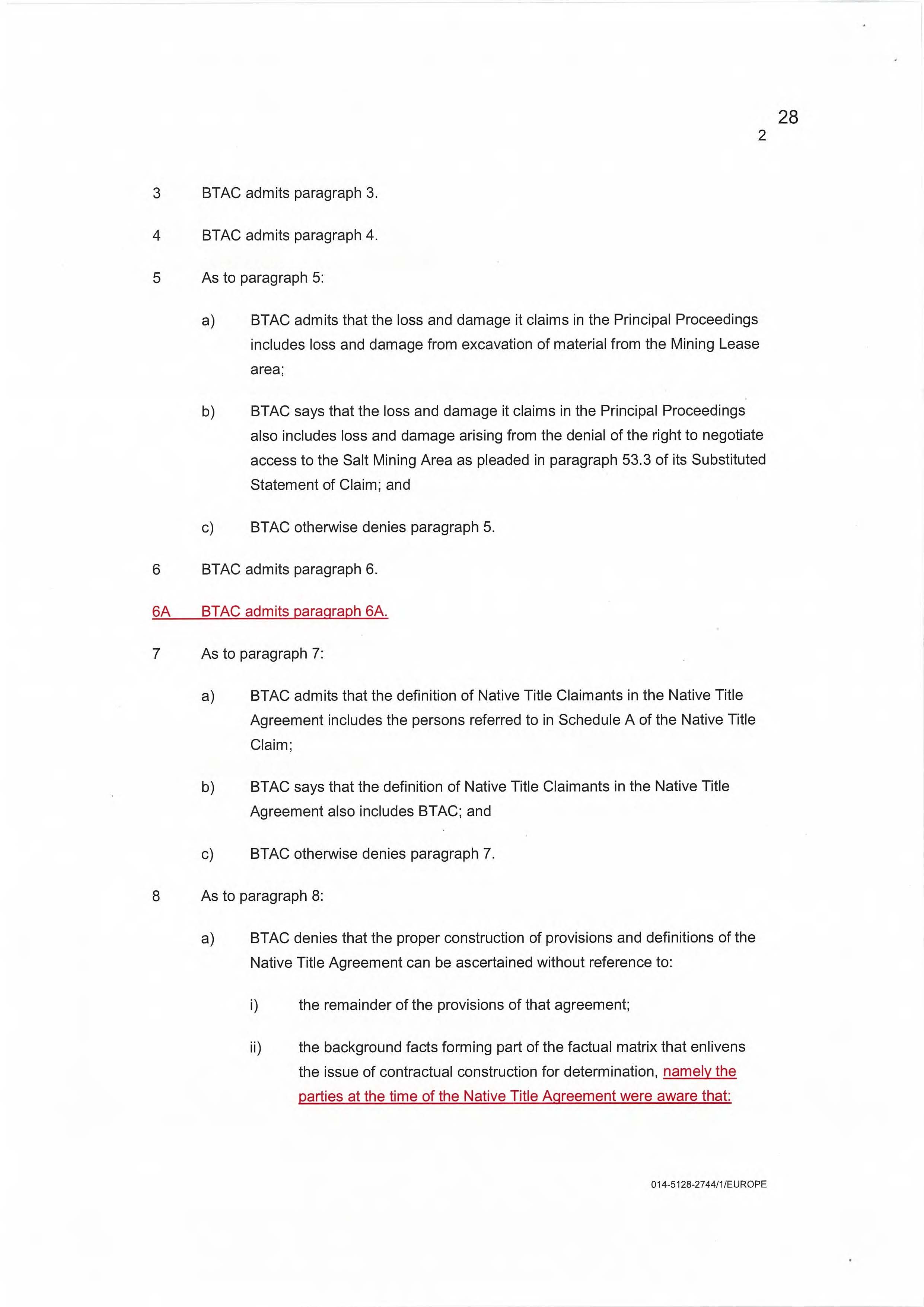
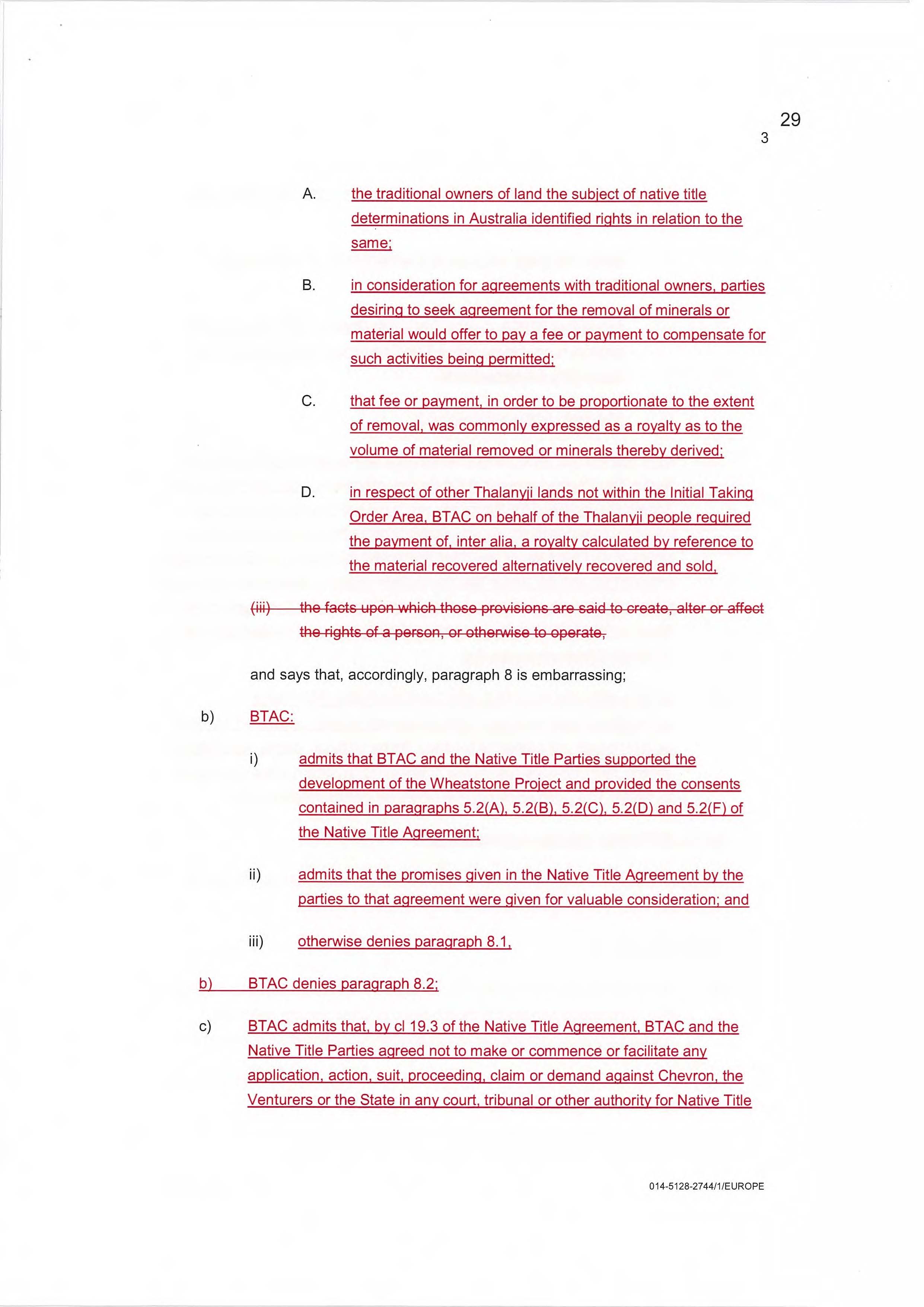
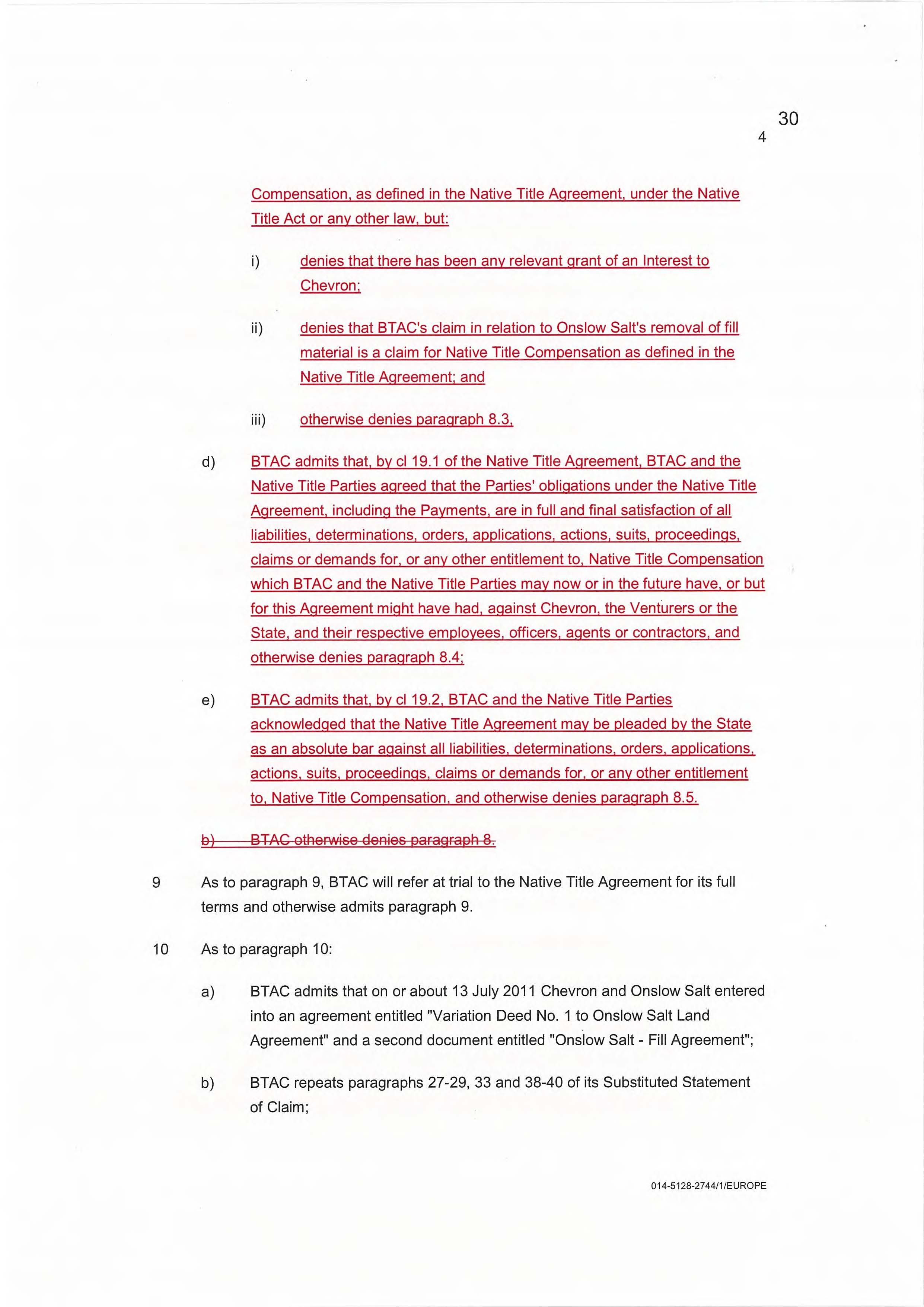
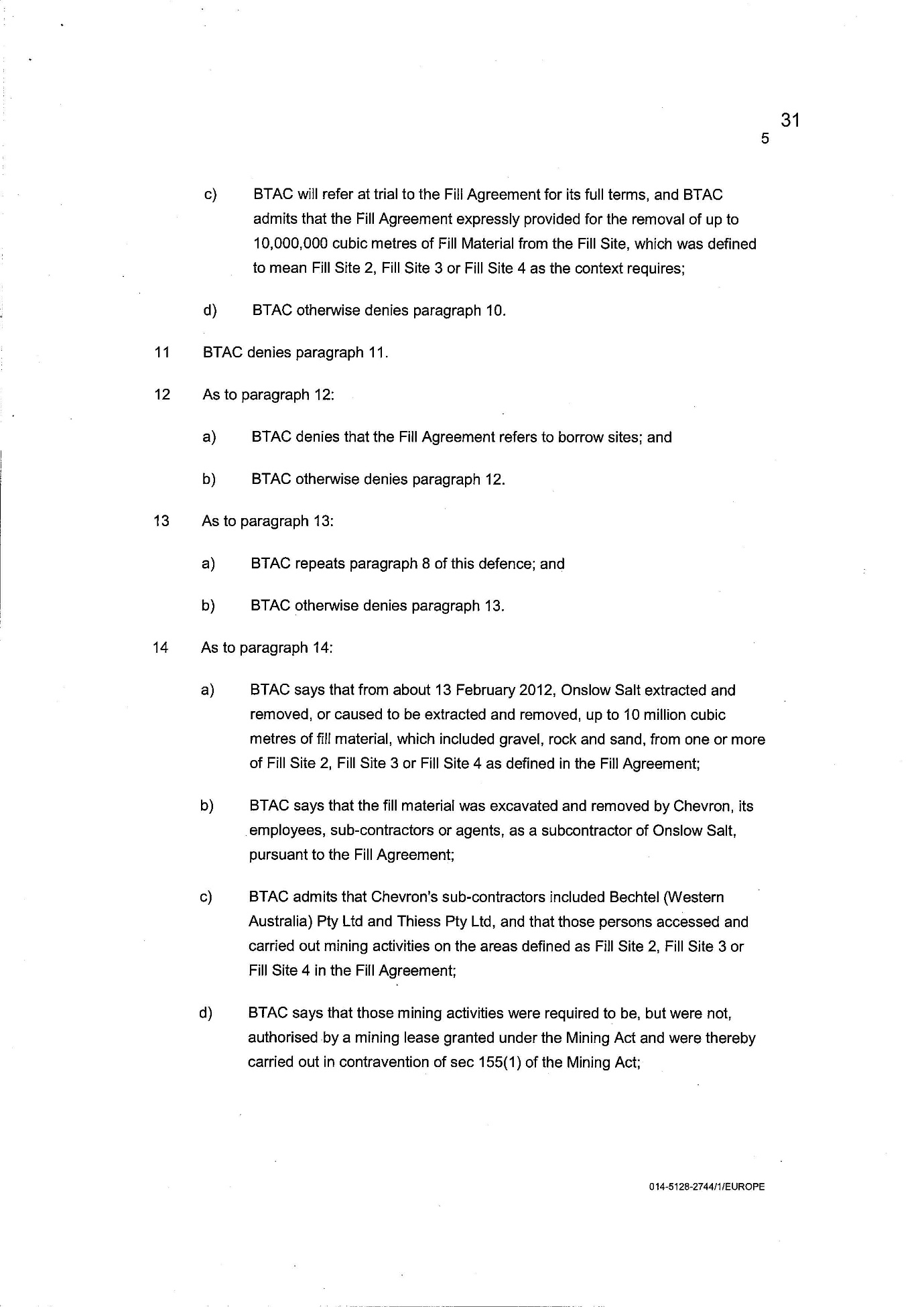
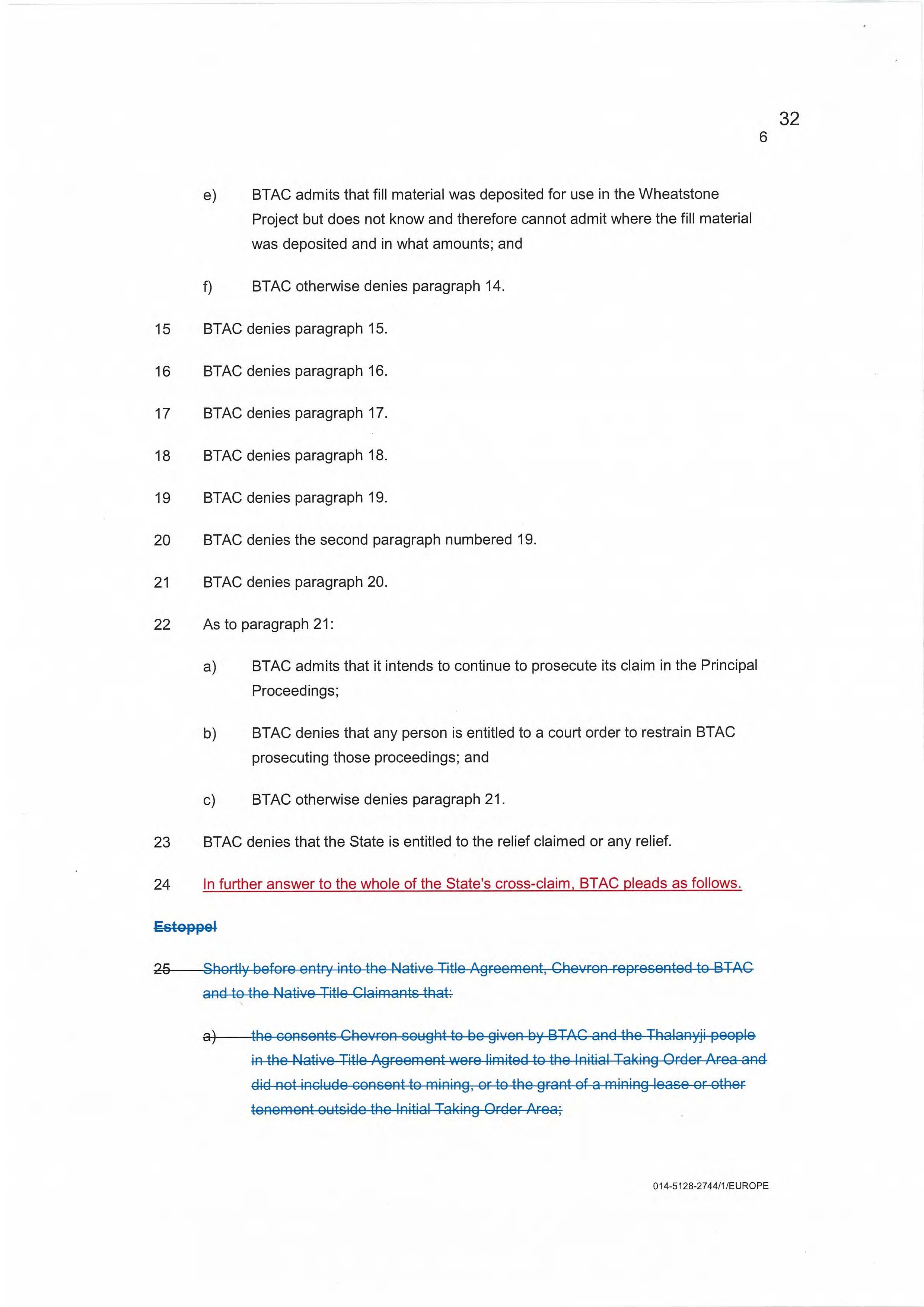
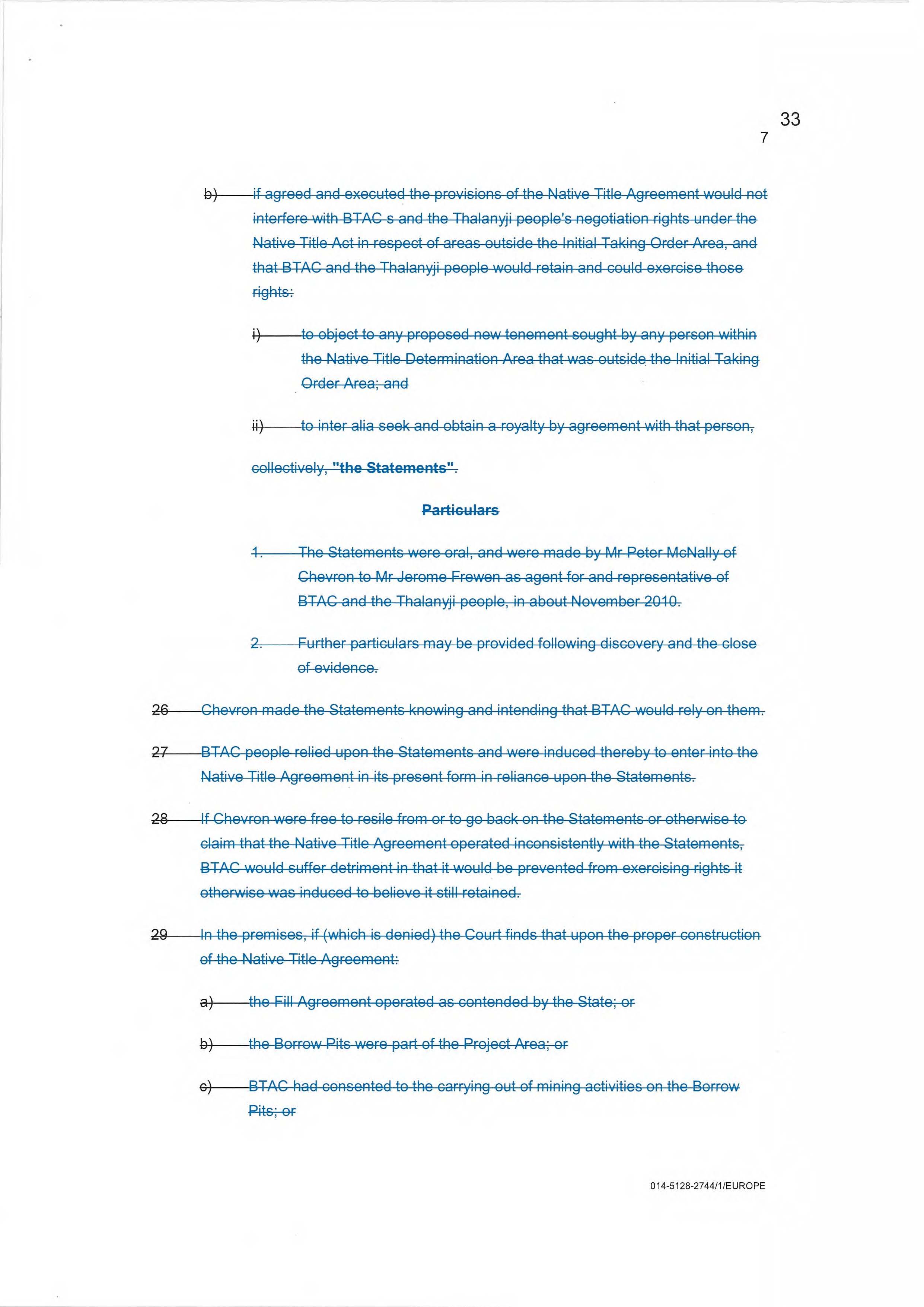
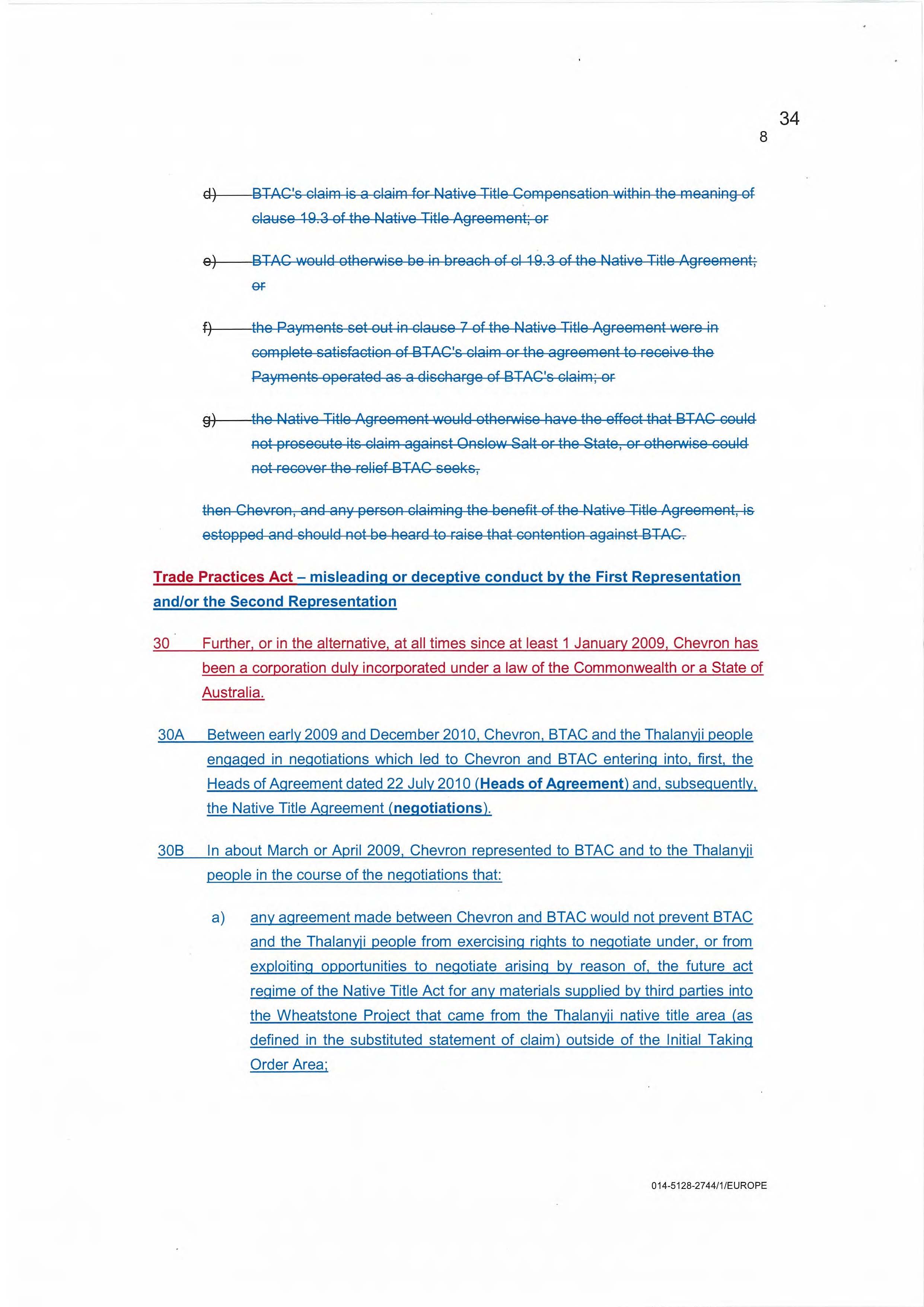
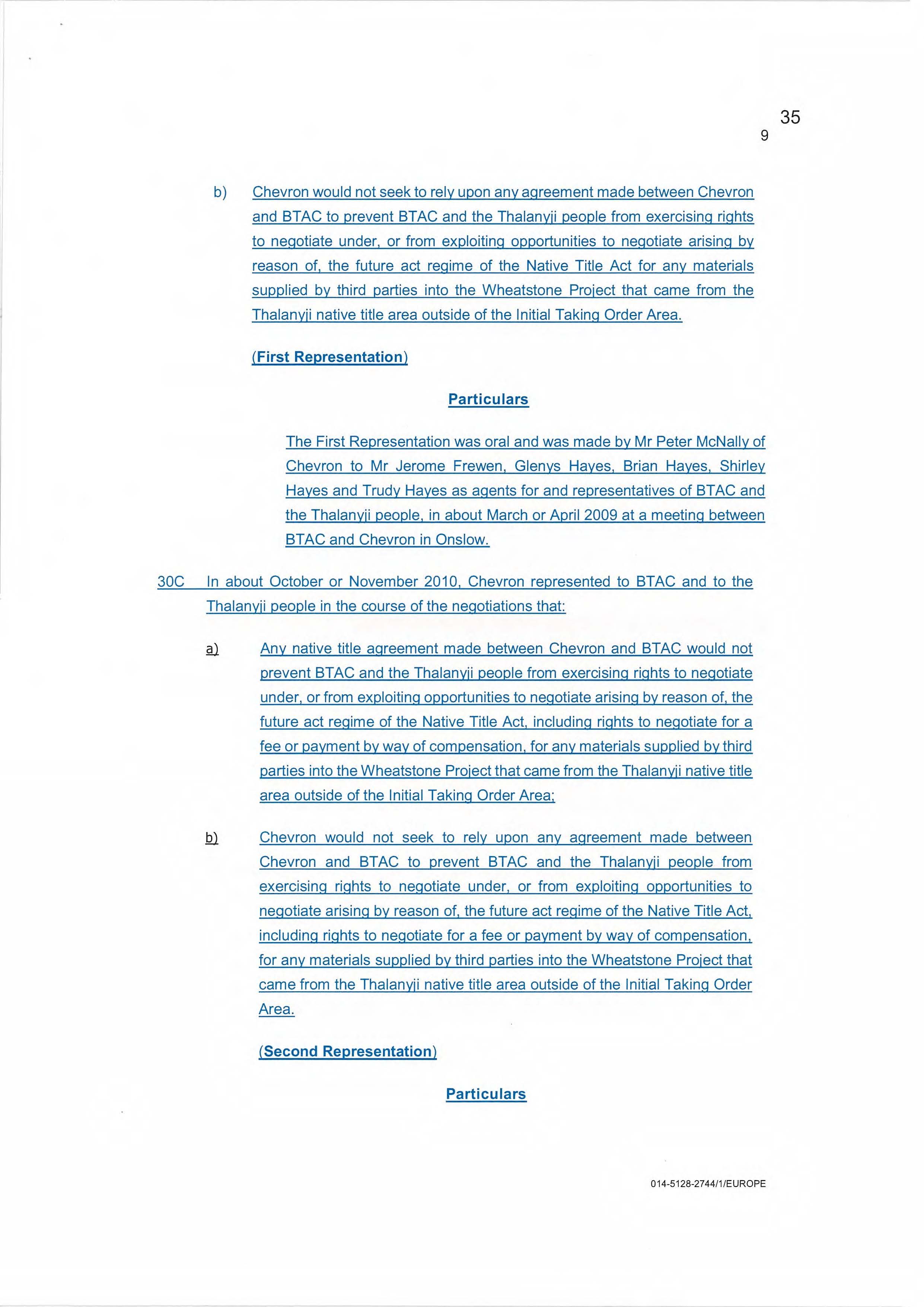
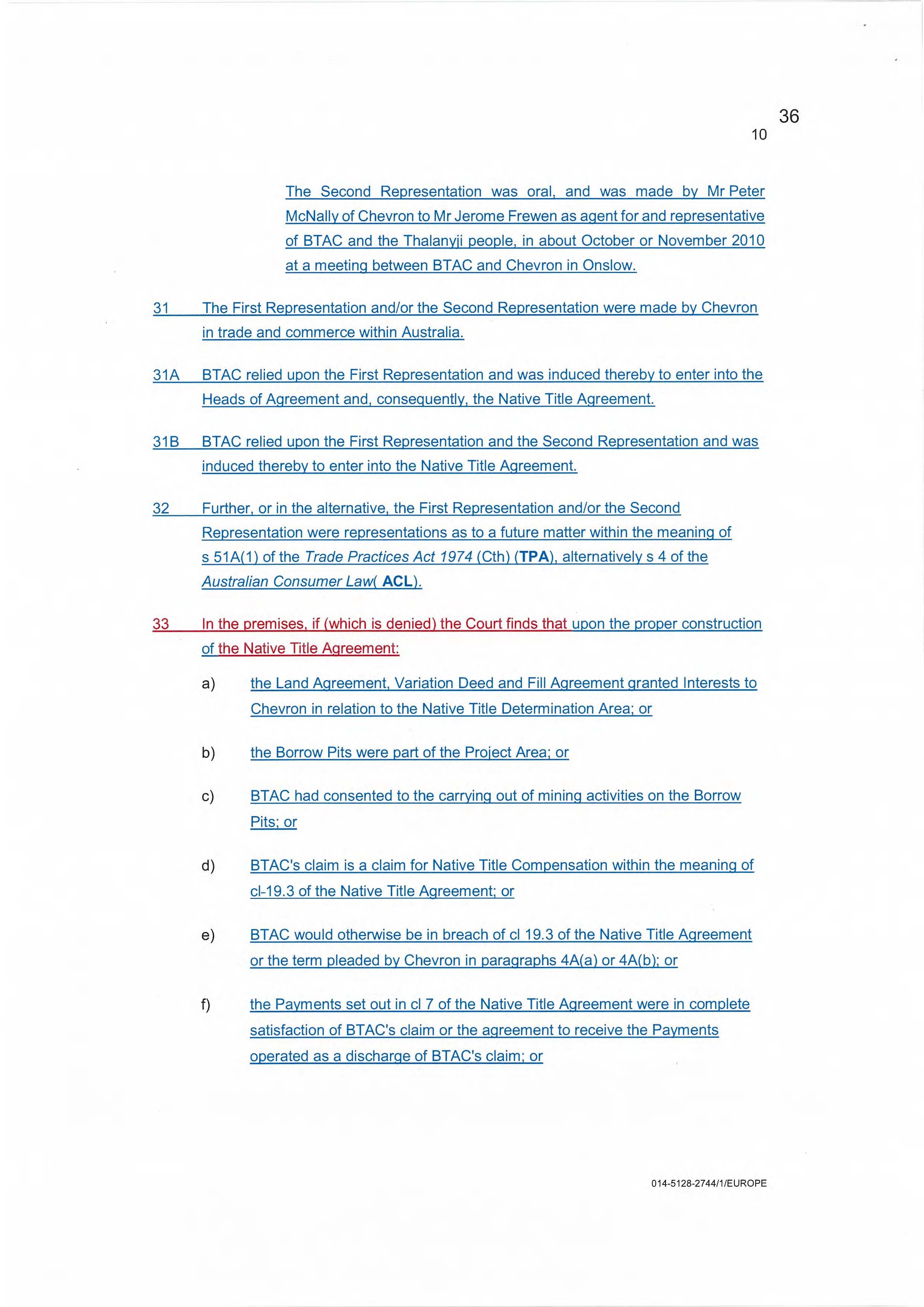
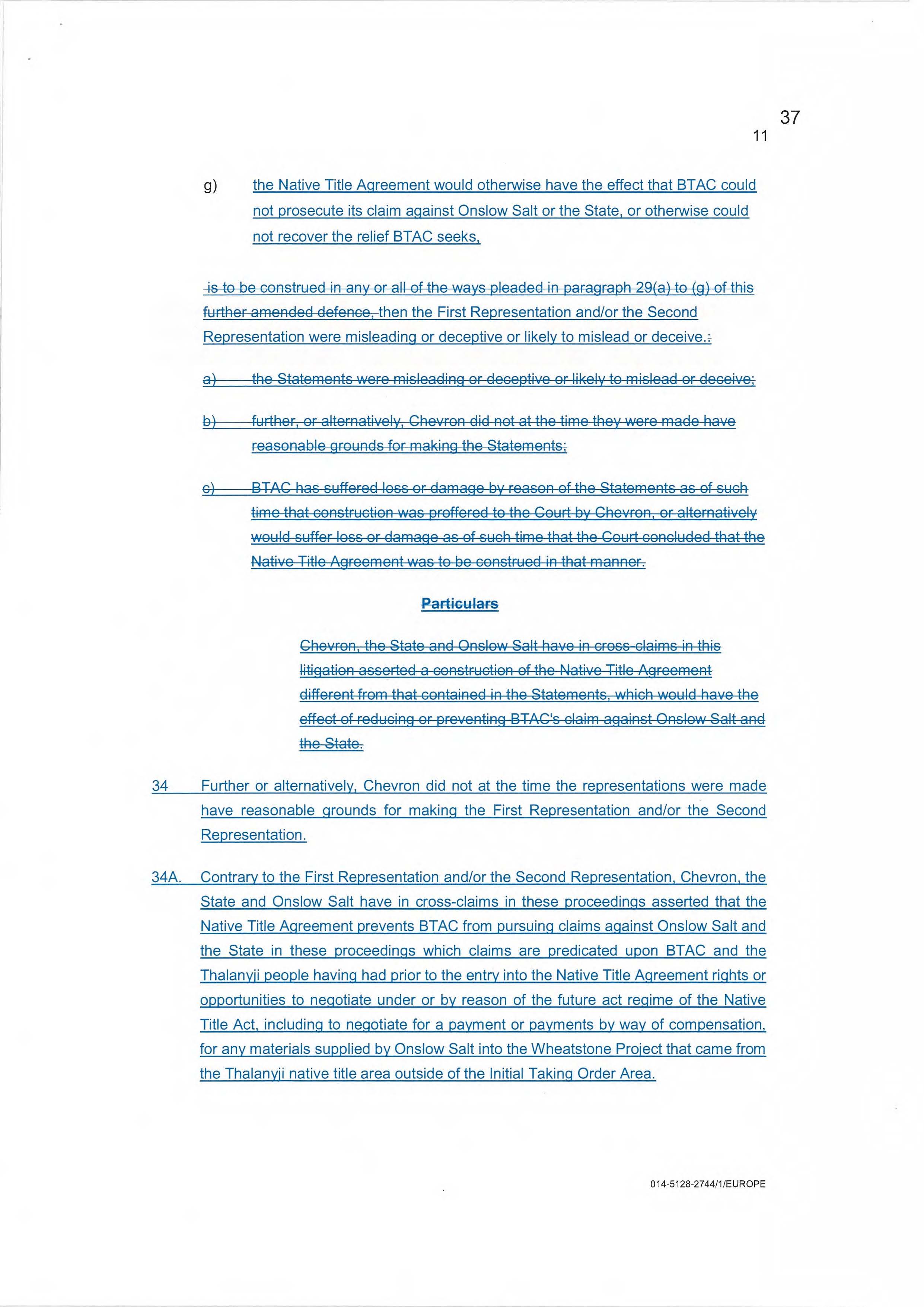
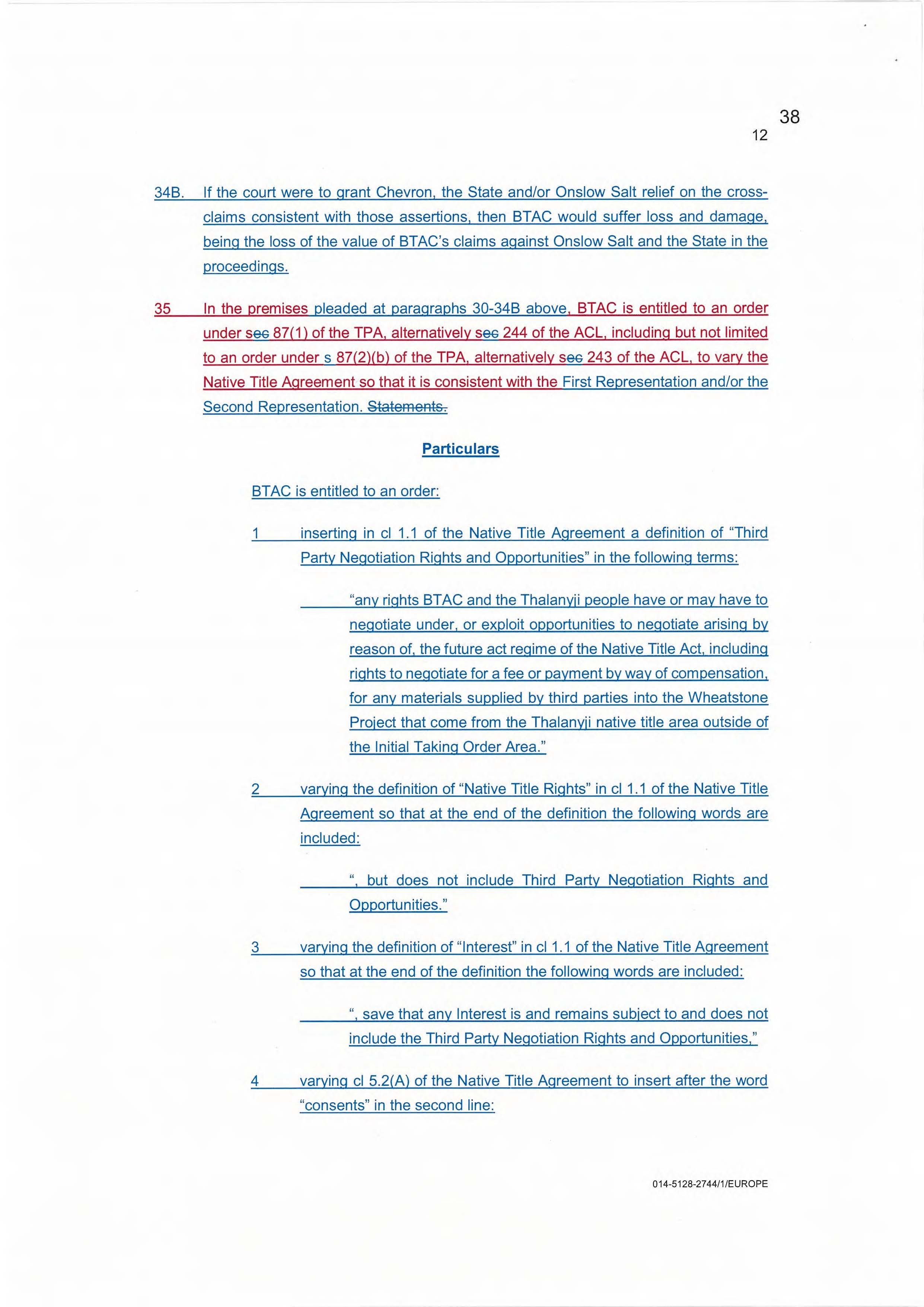
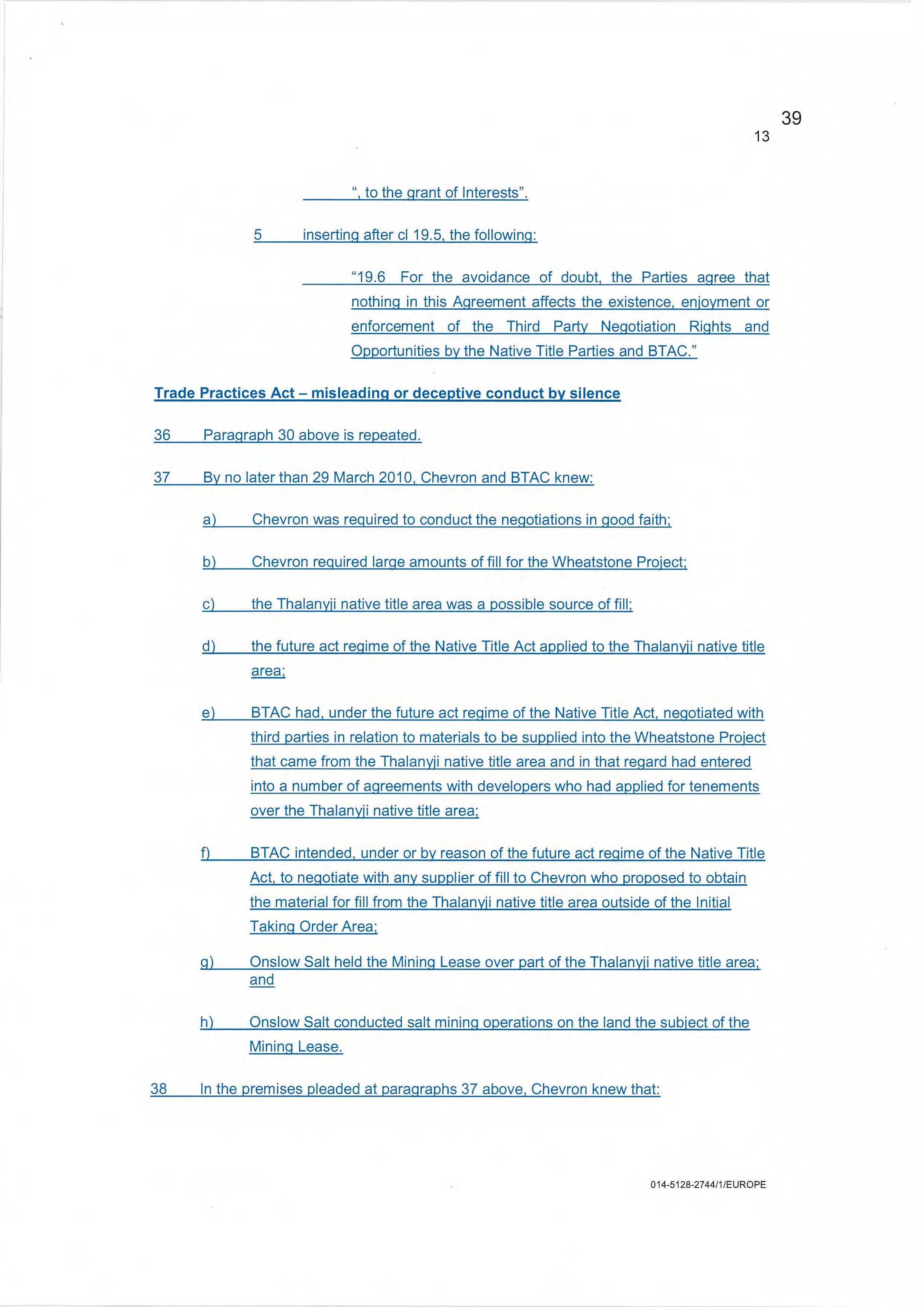
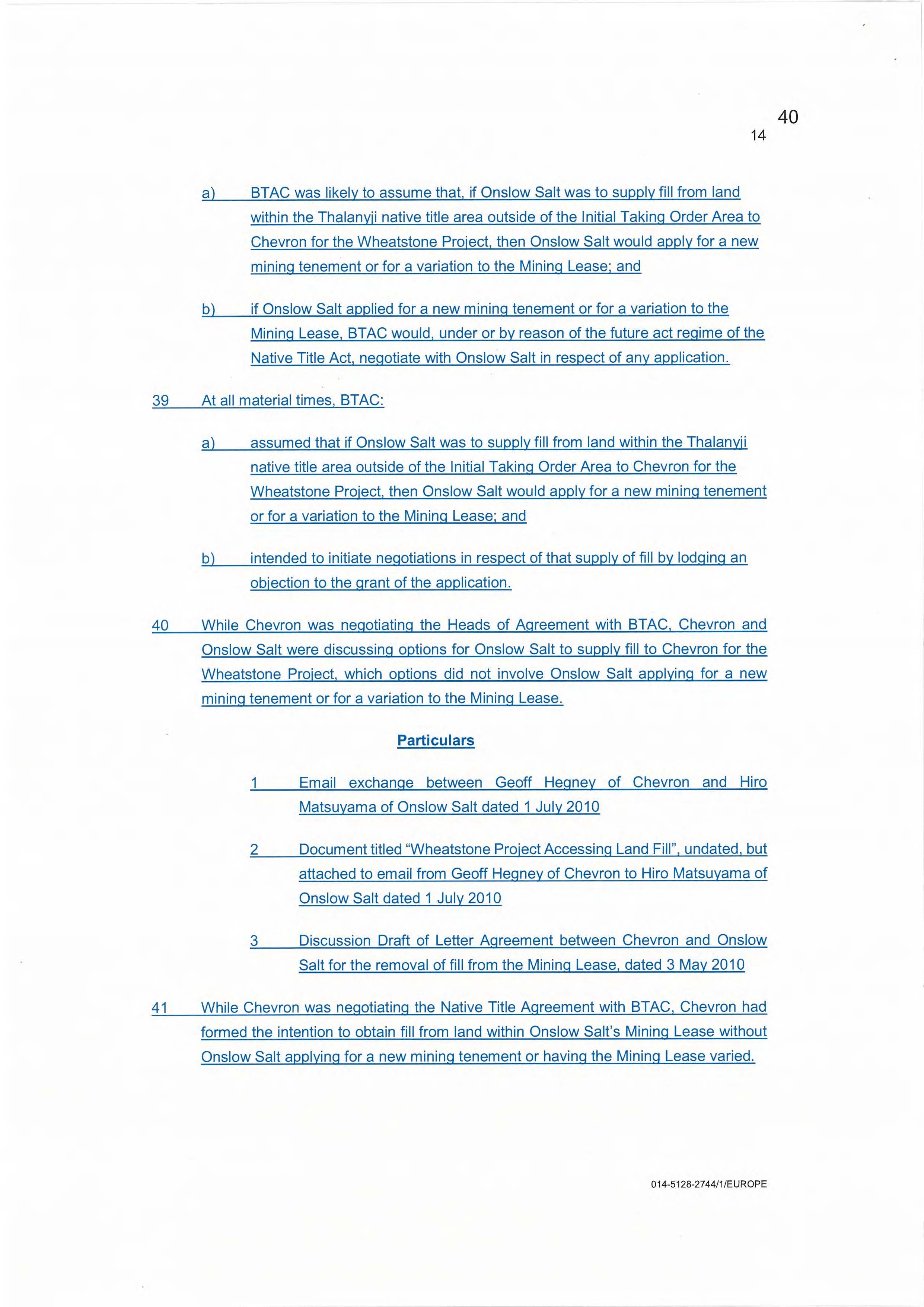
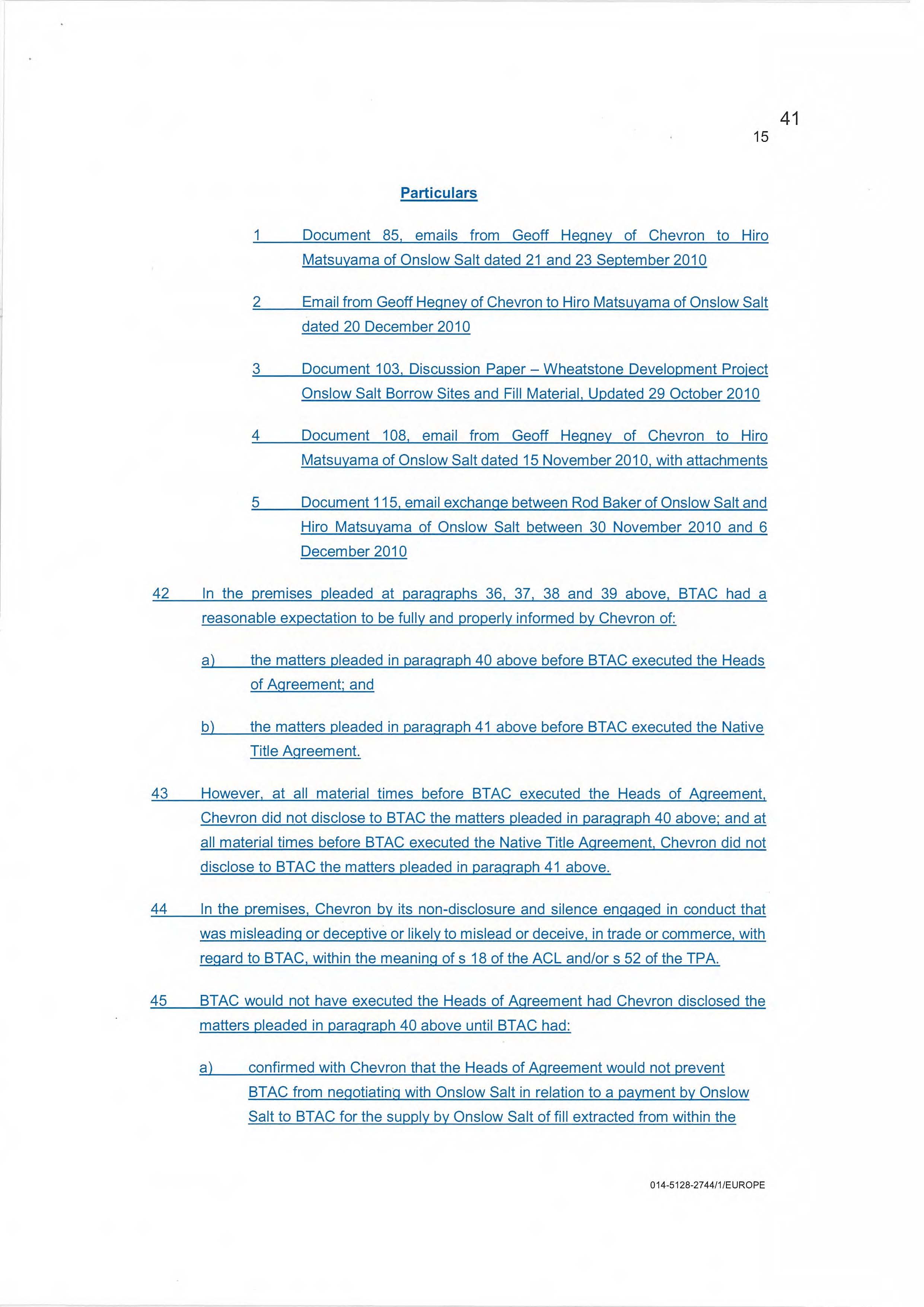
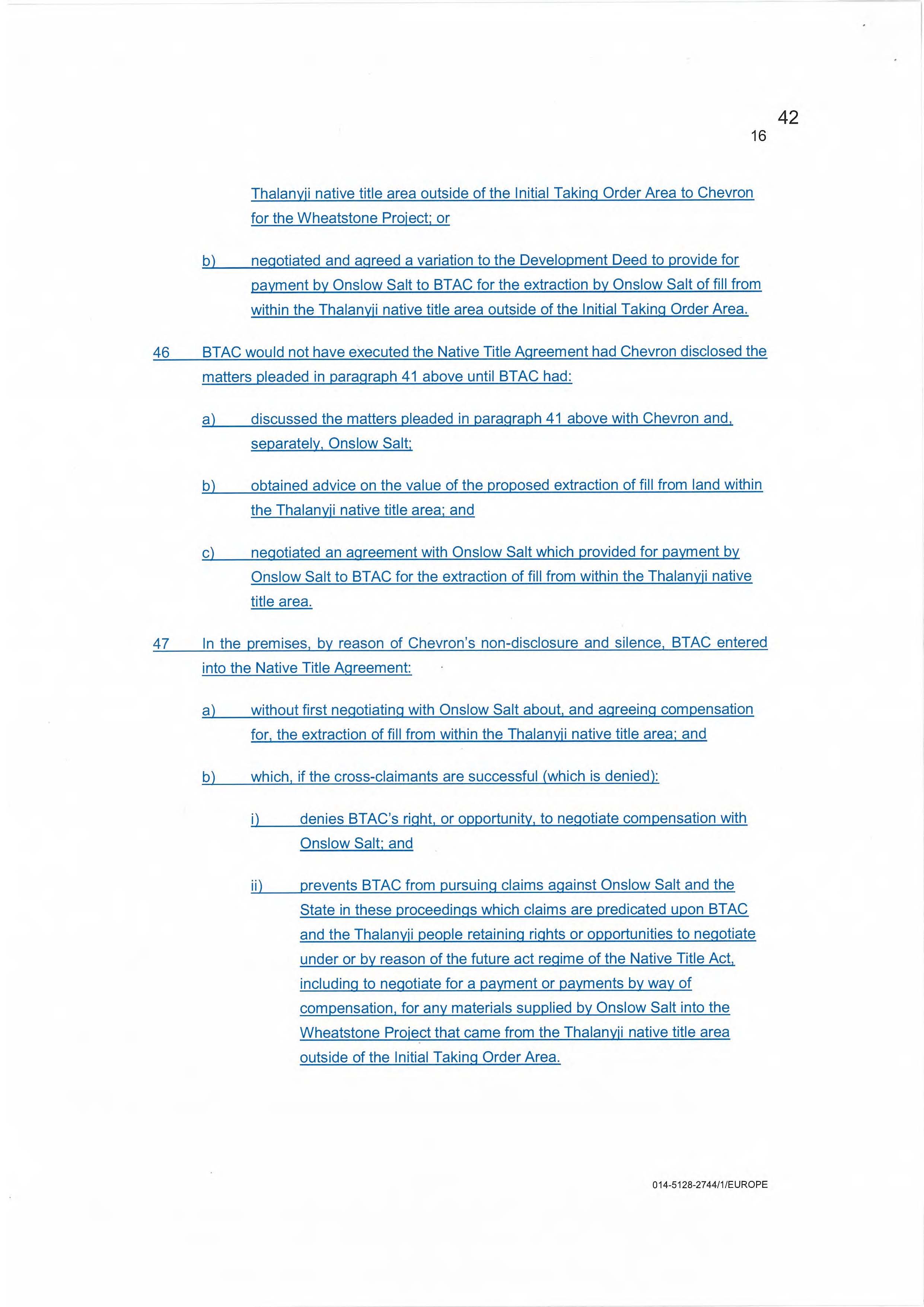
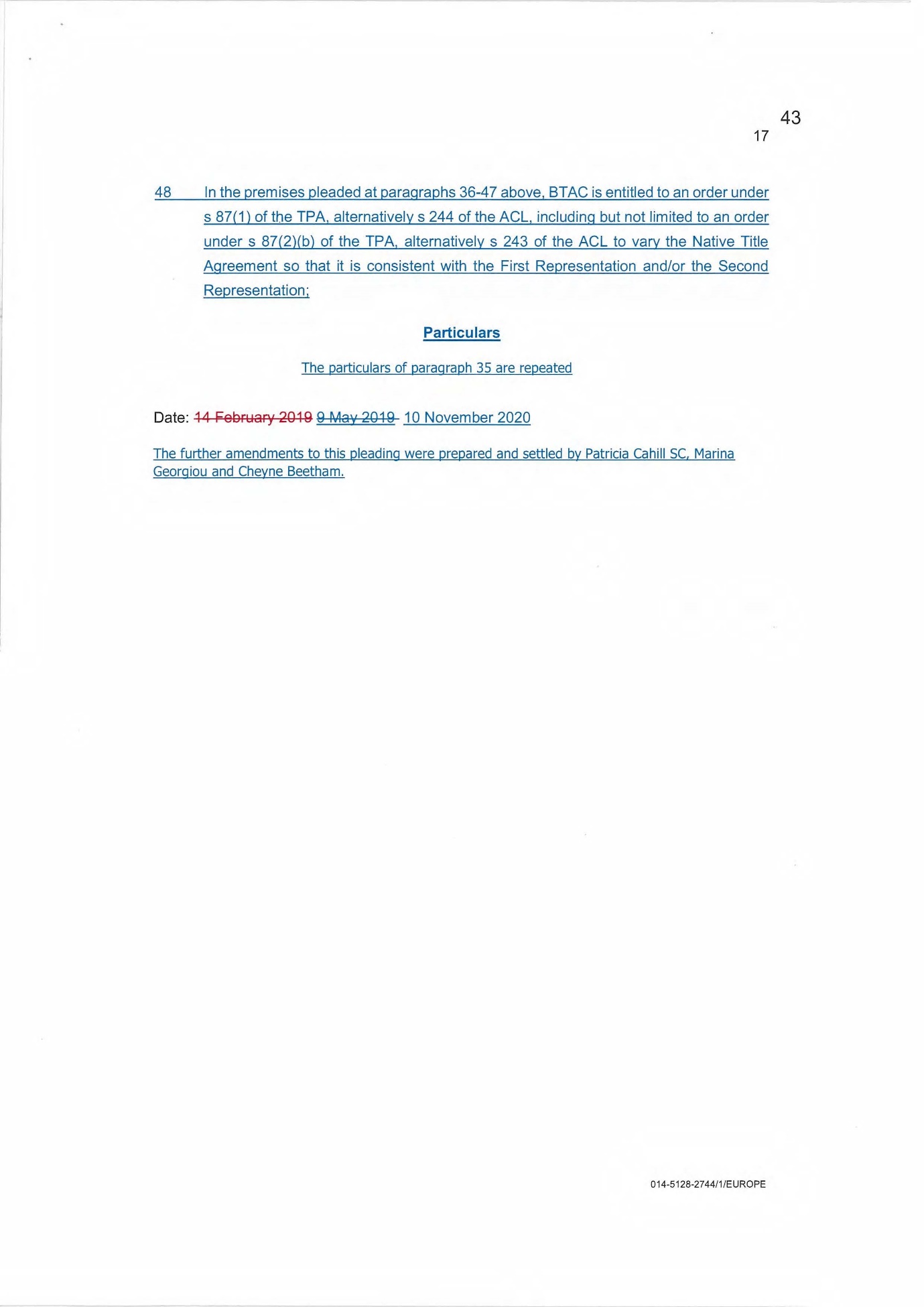
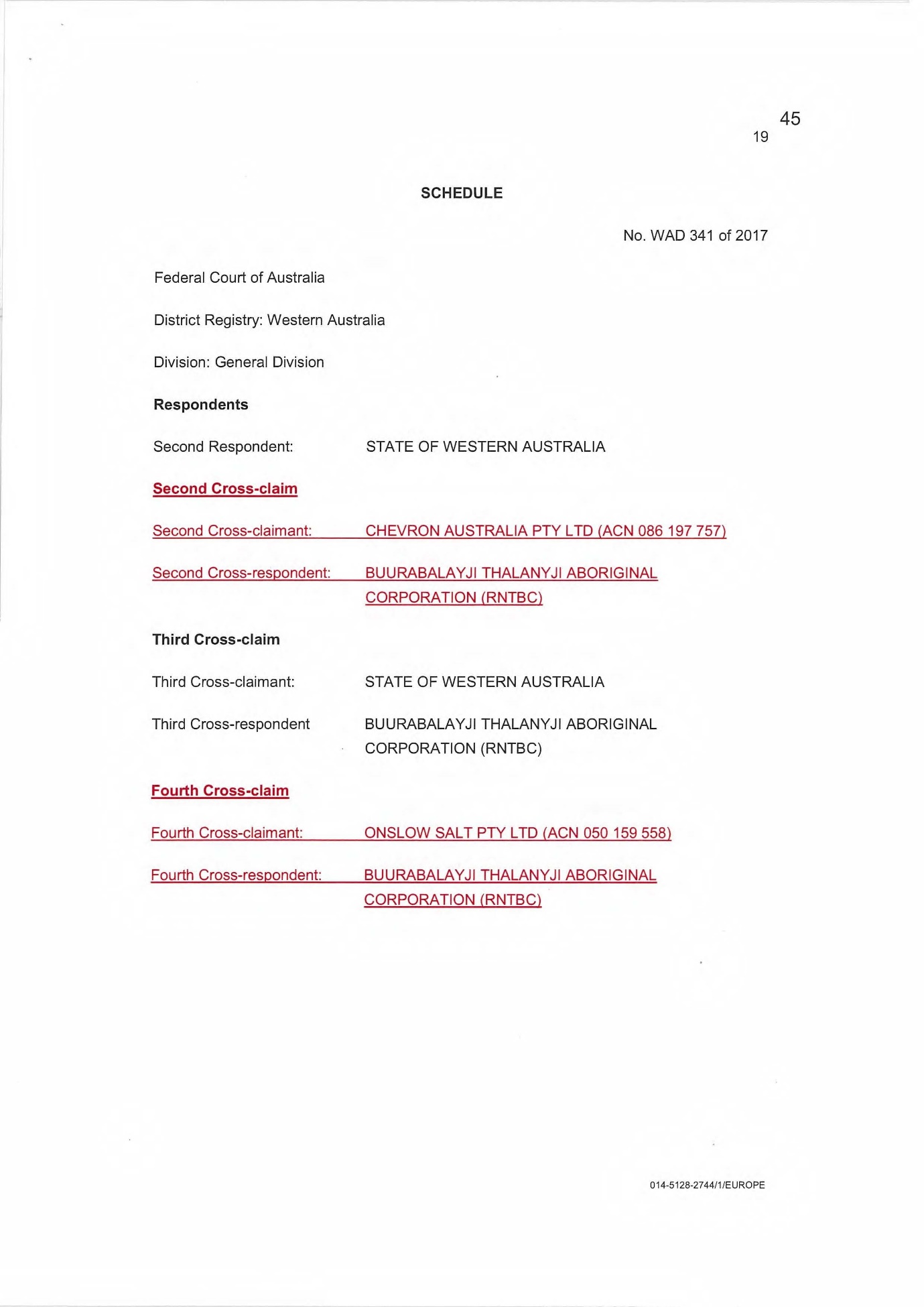
ANNEXURE C