

Federal Court of Australia
National Tertiary Education Industry Union v University of Sydney [2020] FCA 1709
ORDERS
NATIONAL TERTIARY EDUCATION INDUSTRY UNION First Applicant TIM ANDERSON Second Applicant | ||
AND: | First Respondent STEPHEN GARTON Second Respondent ANNAMARIE JAGOSE Third Respondent | |
DATE OF ORDER: |
THE COURT ORDERS THAT:
1. The application be dismissed.
Note: Entry of orders is dealt with in Rule 39.32 of the Federal Court Rules 2011.
1 The National Tertiary Education Industry Union (NTEU) and Dr Tim Anderson (the applicants) alleged that the University of Sydney, Professor Stephen Garton and Professor Annamarie Jagose (the respondents) engaged in 21 contraventions of the Fair Work Act 2009 (Cth) (FW Act).
2 There were seven alleged contraventions of ss 50 and 340 of the FW Act connected with each of the following three events:
(1) the first warning made by the University on 2 August 2017;
(2) the final warning made by the University on 19 October 2018; and
(3) the termination of Dr Anderson’s employment on 11 February 2019.
3 There were two enterprise agreements which relevantly covered and applied to Dr Anderson in his employment with the University and covered and applied to the University in relation to Dr Anderson’s employment:
(1) between 16 January 2014 and 26 April 2018, the University of Sydney Enterprise Agreement 2013-2017 (the 2013 Agreement); and
(2) from 27 April 2018 until the termination of Dr Anderson’s employment, the University of Sydney Enterprise Agreement 2018-2021 (the 2018 Agreement).
4 The parties proceeded on the basis that the two enterprise agreements were identical in all respects relevant to the disposition of the proceedings. In those circumstances, it is sufficient to refer mostly to the 2018 Agreement.
5 The 21 alleged contraventions gave rise to two principal sets of issues:
(1) The first set of issues related to alleged contraventions of s 50 of the FW Act and concerned a claimed right to “intellectual freedom”. As framed by the applicants, this part of the proceedings gave rise to the following questions:
(a) whether cl 315 of the 2018 Agreement created an enforceable right to the exercise of “intellectual freedom” and, if so, the content of that right;
(b) whether conduct constituting the exercise of “intellectual freedom” was capable of constituting misconduct or serious misconduct within the meaning of cl 3 of the 2018 Agreement;
(c) whether the conduct of Dr Anderson on which the first warning, final warning and the termination of his employment was based constituted the exercise of “intellectual freedom” and was therefore not capable of constituting “misconduct” or “serious misconduct” within the meaning of cl 3 of the 2018 Agreement; and
(d) whether, if cl 315 of the 2018 Agreement did not immunise the conduct of Dr Anderson leading to the final warning and the dismissal, that conduct was otherwise “misconduct” or “serious misconduct” within the meaning of cl 3 of the 2018 Agreement.
(2) The second set of issues related to alleged contraventions of s 340 of the FW Act. This part of the proceedings gave rise to the questions whether:
(a) Dr Anderson exercised a workplace right by making “complaints” within the meaning of s 341(1)(c)(ii) of the FW Act; and
(b) the University had established that it did not impose the first warning or the final warning or terminate Dr Anderson’s employment because Dr Anderson exercised any one or more of the workplace rights.
6 The applicants also contended that Professors Garton and Jagose breached s 550 of the FW Act by being involved in the alleged contraventions of ss 50 and 340. The accessorial liability claim against Professor Jagose was abandoned shortly after she gave evidence.
7 For the reasons which follow, in summary:
(1) The 2018 Agreement, including by cl 315, does not recognise the existence of, or give rise to, a legally enforceable right to intellectual freedom of the kind identified the exercise of which can never: (a) constitute “misconduct” or “serious misconduct”; or (b) be the subject of the processes contemplated by cl 384.
(2) The University did not contravene ss 50 or 340 of the FW Act.
(3) The question of accessorial liability on the part of Professor Garton does not arise in light of the fact that the contraventions are not made out. It is not appropriate to hypothesise what conclusions would have been reached if contraventions of ss 50 and 340 had been established, because the answer would depend on factual findings which have not been made.
8 Dr Anderson commenced part-time employment with the University of Sydney on 16 February 1998. He had previously worked at a number of universities in various positions. His first position at the University was on a part-time basis in the role of Associate Lectureship in what was then the Department of Economics.
9 On 1 January 1999, Dr Anderson was appointed to an ongoing position at the University, in the role of Associate Lectureship in the Political Economy Group, within the Department of Economics. Throughout his employment with the University, Dr Anderson was principally employed part-time at 0.5 full-time equivalent, except for a period between 1 January 2008 and 31 December 2009, when Dr Anderson worked at 0.75 full-time equivalent.
10 On 1 January 2000, Dr Anderson was promoted to the position of Lecturer. On 1 January 2008, Dr Anderson was promoted to the position of Senior Lecturer. On 30 October 2017, Dr Anderson was elected as a representative of academic staff to the Academic Board. Elected terms to the Academic Board run for two years.
11 Dr Anderson maintained a Facebook account under the name ‘Tim Anderson’ (Facebook Account). The Facebook Account was accessible to the public and used only by Dr Anderson. Until at least mid-2018 the Facebook Account identified Dr Anderson as working at the University.
12 Dr Anderson also operated a Twitter account with the handle ‘@timand2037’ (Twitter Account). The Twitter Account was accessible to the public and used only by Dr Anderson.
13 At the time of the termination of his employment, in February 2019, Dr Anderson was employed as a Senior Lecturer in the Department of Political Economy in the School of Social and Political Sciences in the Faculty of Arts and Social Sciences (FASS). He was employed on a part-time basis, at 0.5 full-time equivalent. Dr Anderson taught:
a post-graduate course, Human Rights and International Development (ECOP6130), in semester 2 of 2015, semester 2 of 2016 and semester 1 of 2018; and
a third-year undergraduate unit, Human Rights in Development (ECOP3017), in semester 1 of each of 2015, 2016, 2017 and 2018.
B.2 Professor Garton and Professor Jagose
14 Professor Garton has been employed by the University since 1987 in various academic roles. Between 2009 to September 2019, Professor Garton was the Provost and Deputy Vice-Chancellor of the University. Professor Garton is currently the Senior Deputy Vice-Chancellor of the University.
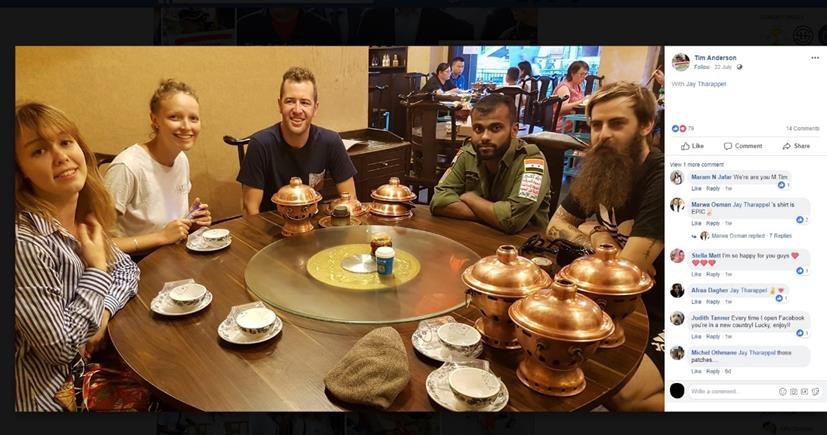
15 Professor Jagose has been employed by the University since 3 January 2011. At all times material to the proceeding, she was the Dean of the FASS. She has held that position since January 2017.
16 At all times material to this proceeding, the following University policies were in operation:
Code of Conduct – Staff and Affiliates effective from 12 September 2016;
Code of Conduct – Staff and Affiliates effective from 16 October 2017;
Charter of Academic Freedom effective from 6 May 2008;
Public Comment Policy effective from 1 February 2007;
Bullying, Harassment and Discrimination Prevention Policy 2015;
Bullying, Harassment and Discrimination Resolution Procedures 2015;
Resolution of Complaints Policy 2015; and
Policy on the Use of University Information and Communication Technology Resources (ICT Resources) effective from 31 August 2006.
B.4 Events leading to the “First Allegations” made on 30 May 2017
17 On about 21 April 2017, the University notified to Mr Jay Tharappel allegations of misconduct made against him. Mr Tharappel was employed by the University as a tutor in subjects taught by Dr Anderson. Between 22 and 26 April 2017, Professor Jagose and Dr Anderson corresponded by email about the allegations against Mr Tharappel.
18 Between 4 and 10 or 11 May 2017, Dr Anderson made various tweets on his Twitter Account and posts on his Facebook Account. These were referred to in the Further Amended Statement of Claim (FASOC) as the “first comments”. The various tweets and posts, among other topics, related to media coverage concerning Mr Tharappel. An example is as follows:
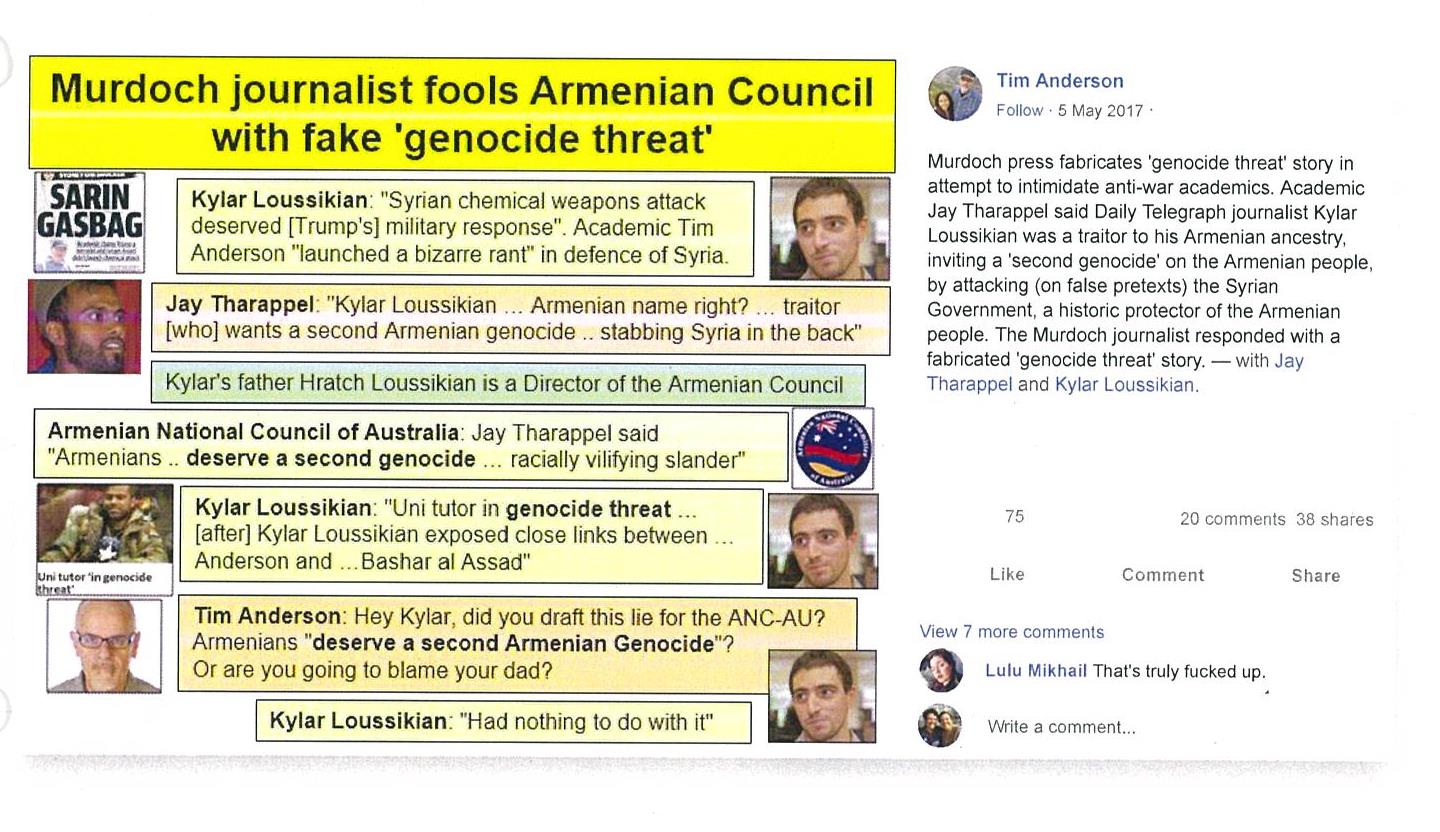
19 The final tweet, a copy in evidence of which was dated 11 May 2017, described Senator John McCain as “a key US war criminal”.
20 On 19 May 2017, Dr Anderson wrote to Professor Jagose. The letter concerned allegations against Mr Tharappel and the investigation of those complaints. Dr Anderson referred to the letter in the FASOC as the “first complaint”. As with each of the asserted complaints, the character of the “first complaint” as a “complaint” covered by s 341(1)(c) of the FW Act is at issue.
B.4 30 May 2017: First Allegations
21 On 30 May 2017, the University sent to Dr Anderson a letter signed by Professor Jagose containing allegations in relation to Dr Anderson’s conduct. It stated that the allegations, if substantiated, may constitute “misconduct” or “serious misconduct” as defined in cl 3 of the 2013 Agreement. These were referred to in the FASOC as the “first allegations”. Professor Jagose had determined to deal with the allegations under cl 309(c) of the 2013 Agreement (equivalent to cl 384(c) of the 2018 Agreement). The letter stated:
Allegations
The allegations, which relate to material published on your Twitter account and Facebook account are that:
(a) You have breached the Code of Conduct - Staff and Affiliates, by engaging in conduct that:
(i) does not constitute an exercise of the best professional and ethical judgment, or the carrying out of duties and functions with integrity and objectivity;
(ii) is not fair and reasonable;
(iii) does not treat members of the public with respect, impartiality, courtesy and sensitivity;
(iv) does not comply with the University’s Public Comment Policy.
(b) You have breached the Public Comment Policy, by engaging in conduct that:
(i) does not uphold the outstanding reputation of the University in the community;
(ii) does not constitute the exercise of good and ethical judgement in public comment;
(iii) is not professional or exercise appropriate restraint;
(iv) does not maintain the highest professional standards;
(v) may bring the University into disrepute.
22 The letter attached 11 posts and tweets giving rise to the allegations.
23 The letter also included:
Confidentiality
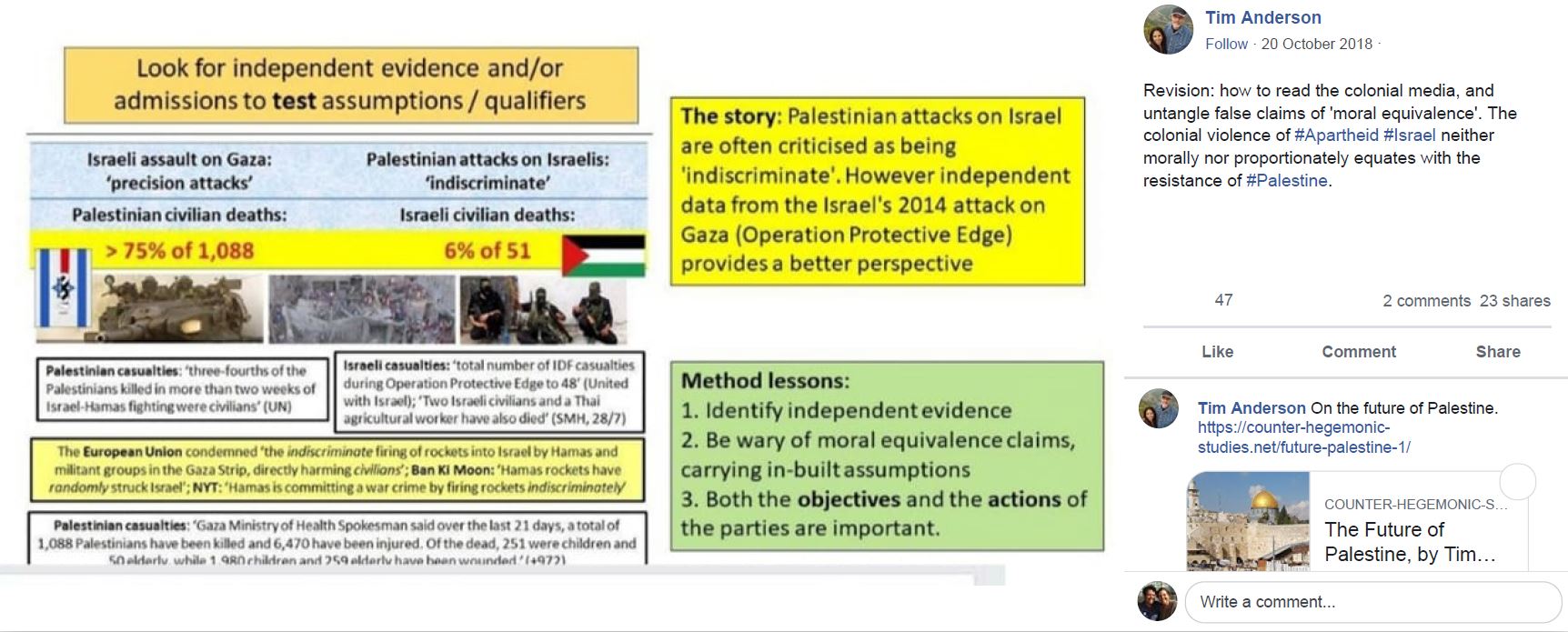
This [sic] matters raised in this letter are confidential, and I direct you to refrain from disclosing to, or communicating with, anyone, the contents of this letter, the Allegations or any information or documents relating to them, other than to members of your family (or support person), your professional adviser on the basis they provide you with an undertaking that they will comply with the above confidentiality direction or unless you are required to do so by law or with the prior written consent of the University. You may of course speak with University staff who are directly involved in the process such as myself or Kim Fletcher, Associate Director, HR Relationship Group.
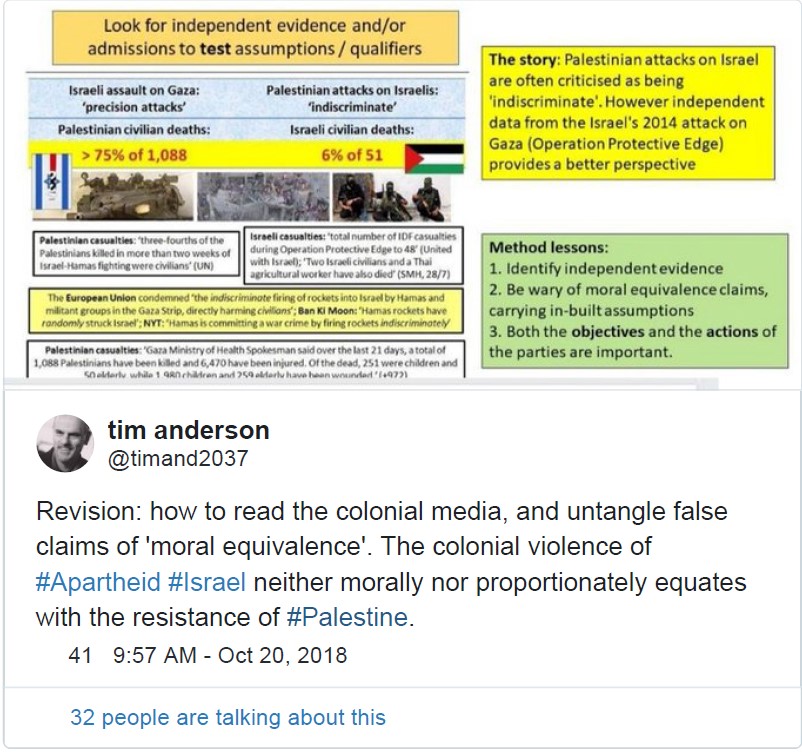
The University takes the need for confidentiality very seriously, and reserves the right to take disciplinary action if the confidentiality direction is not adhered to.
B.5 Dr Anderson’s reaction to the 30 May 2017 allegations
24 On 30 May 2017, as a result of the first allegations, Dr Anderson posted the following to his Facebook and Twitter Accounts respectively:
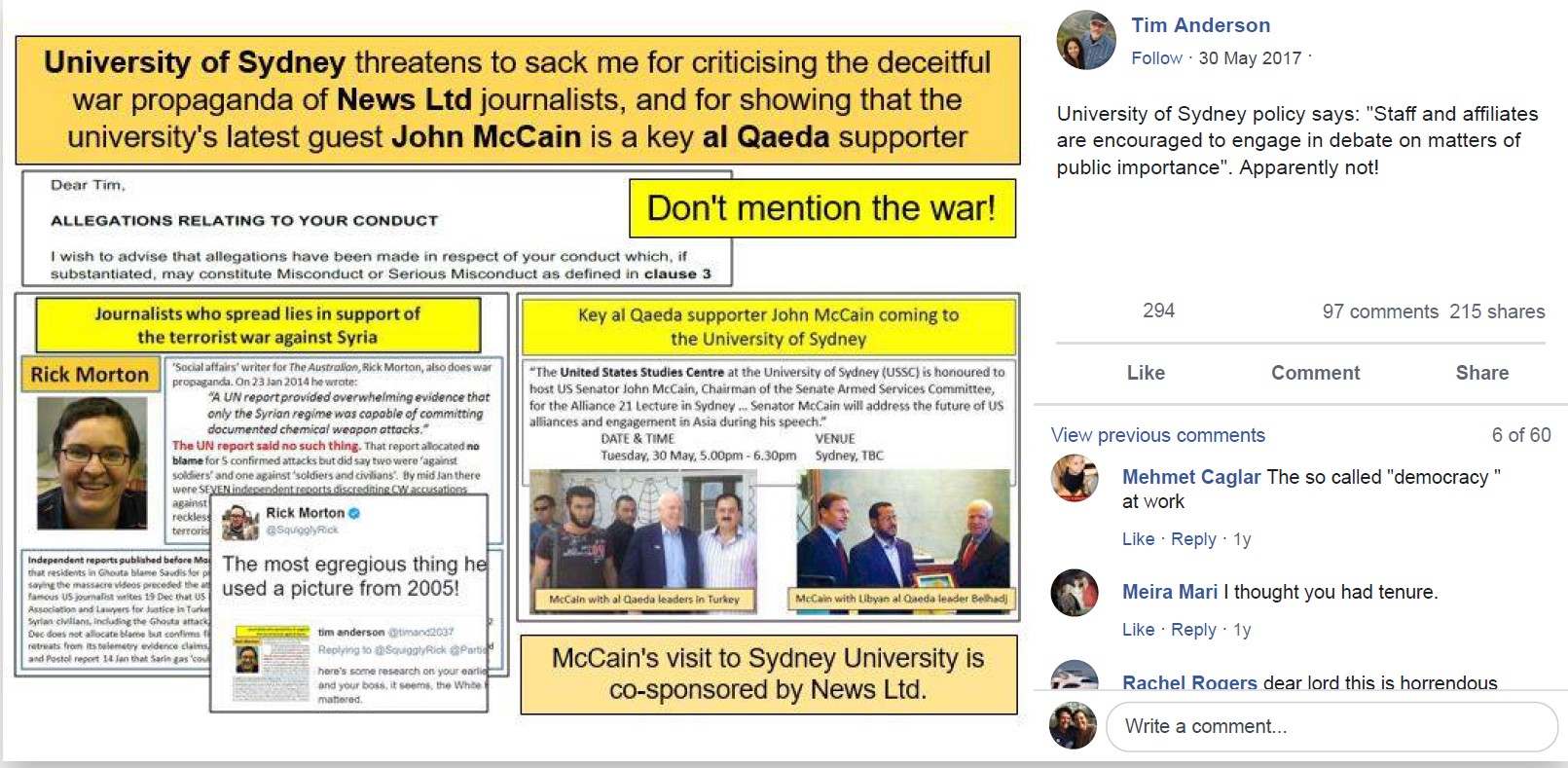
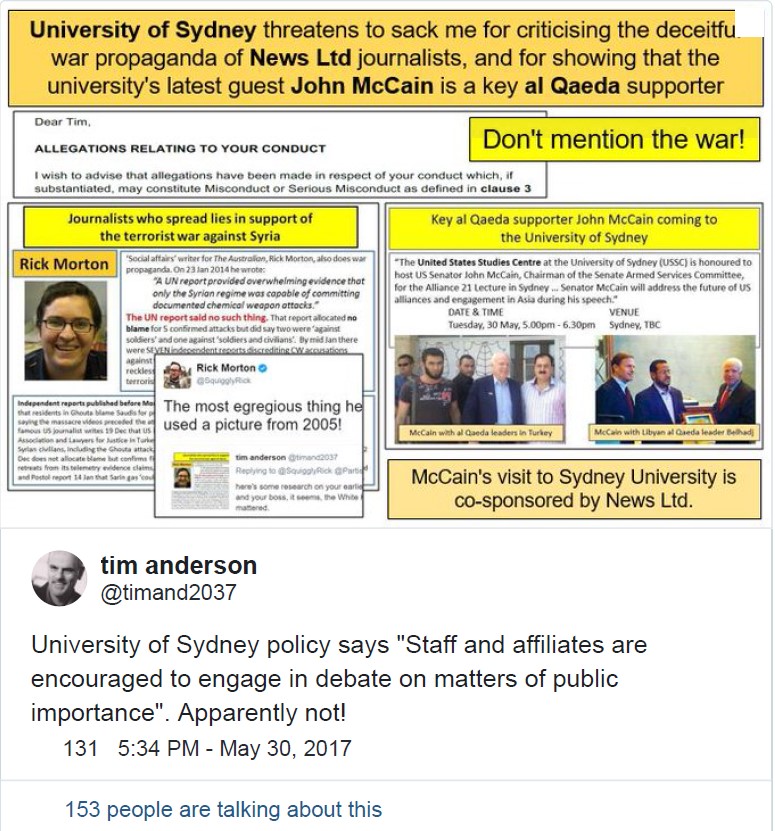
25 These were referred to in the FASOC as the “second comments”.
26 On 31 May 2017, Dr Anderson sent an email to the Department of Political Economy Board, Department of Political Economy Casual Tutors and Department of Political Economy Honorary Associates with the subject line “USyd management trying to gag anti-war academics”. This included the following:
Anti-war academic gagged at Sydney University
Tim Anderson
Anti-war academic Jay Tharappel - a tutor and doctoral student - has been gagged by an effective ‘secret social media police’ group set up at the University of Sydney, to monitor public comments by staff involved in controversy.
This extraordinary development began with an anonymous leak from University management to the Daily Telegraph that Jay was “under investigation” for a “racially charged social media attack”. The tabloid ran a front page story (11 April) vilifying the young academic. He found about his employer’s investigation through the Daily Telegraph’s smear story. That front page story would not have occurred had university management not helped create it.
A week later, when Faculty of Arts and Social Sciences (FASS) Dean Annamarie Jagose did press misconduct charges, she swore the casual tutor to secrecy.
The Daily Telegraph story formed part of a torrent of abuse, mostly from News Limited media, against organisers of our successful conference ‘After the War on Syria’, which took place on 18-19 April at Sydney University. The conference was seen as pro-Syria and anti-war, while virtually all the corporate and state media backed Trump’s 6 April missile strike on Syria. In fact media attacks helped swell attendance at the successful conference, video of which is online here: https://counter-hegemonic-studies.net/.../syria-conference-2.../
The Murdoch media through repeated abuse of us (“Sarin Gasbag”, “Pro-Assad Boffin”, “Uni loonies”, “genocide slur”) tried to pressure the university to act against the conference and its organisers. Jay’s comments were in response to two of these crusading journalists.
Dean Jagose’s 20 April letter to Jay, after the conference, cited several of his posts and the University’s code of conduct. However it did not detail any particular imputations, as is normally required in civil law. Rather it called for his ‘defence’, while demanding that nothing of the inquiry be made public.
Jay, myself and an NTEU union representative urged that Dean Jagose state specific imputations (the University’s Enterprise Agreement states that ‘the staff member will be provided with allegations in sufficient detail to ensure that they have a reasonable opportunity to respond’) but she refused. She also refused to release any detail of complaints that had been made against Jay to the university. Jay was left to present a ‘defence’ without any detailed knowledge of what had been alleged against him.
There was no hearing. In her 17 May ‘outcomes’ letter Dean Jagose found ‘misconduct’ proven, but gave only a little more detail.
Jay’s criticism of journalist Kylar Loussikian (his surname indicates Armenian heritage) was that he was a ‘traitor’ to Armenians for backing the missile attack on Syria. Historically, Syria provided refuge to Armenians, after the genocide under the Ottoman Empire. Dean Jagose, however, wrongly claimed Jay’s criticism was “on the basis of” his ethnicity. In his criticism of Fairfax journalist Michael Koziol, Jay had used the word “pathetic”, because Koziol had quoted him out of context. Dean Jagose also regarded this as a form of misconduct.
The FASS Dean concluded there was ‘misconduct’, but not ‘serious misconduct’, and issued a ‘warning’. However the sting was in the tail. Any similar indication of lack of “respect, impartiality, courtesy and sensitivity” to the public would lead to “further Disciplinary Action, up to and potentially including the termination of your employment”. A regime of “appropriate monitoring” would be set up to police this threat.
Further, Dean Jagose added, “this matter is confidential” and he was “directed to refrain from disclosing [it] to anyone ... the University takes the need of confidentiality very seriously, and reserves the right to take disciplinary action if you fail to adhere to this direction.” The star chamber was to remain hidden.
However I was sent a copy of this letter and I did not agree to any such confidentiality. The abuse of process under this secret regime deserves to see the light of day.
University of Sydney management clearly colluded with the Daily Telegraph to smear a young academic in their care - even though he is only employed three hours a week - and then set about trying to gag him. As the initial ‘findings’ were based on such flimsy grounds, it appears likely the secret monitoring group is ready to jump on almost any conflictual interaction by staff with powerful media groups.
Meanwhile Murdoch journalists are no doubt waiting with baited breath for another chance to smear. What a shameful exercise and breach of trust by university management.
27 On 6 June 2017, Dr Anderson sent Professor Jagose a letter asking her to recuse herself from dealing with the first allegations against Dr Anderson, being those identified in the 30 May 2017 letter. This letter was referred to in the FASOC as the “second complaint”. The letter stated:
Dear Annamarie,
With respect to your letter of 30 May, let me begin by asking you to step aside.
1. I criticised your conduct of charges made against Mr Jay Tharappel, a tutor and doctoral student in my care. Indeed, in response to my private 19 May letter to you, which contained some blunt criticism, you responded with two emails in rapid succession which strongly suggest that your 30 May letter is a reprisal. In your email (22 May at 5.30pm) you simply reject all criticism, adding the claim that “this letter itself breaches our Code of Conduct”. Almost simultaneously (22 May at 5.26pm) you wrote to me: “I would like to meet with you, following some of your recent social media activity ...” The immediate history, combined with these emails, leads me to conclude that this latest exercise is a reprisal.
2. In my letter of 19 May I criticised what I regard as an attempt to bully and gag Mr Tharappel, by colluding with journalists from the Daily Telegraph to smear him in a front page tabloid attack. He was a junior academic for whom both you and I had a duty of care. That tabloid attack would not have appeared had you not leaked information about your ‘investigation’. Indeed Jay first heard of your ‘investigation’ through the Daily Telegraph. I regard that as a breach of trust on your part.
3. I infer that the charges against Mr Tharappel were motivated by a concern to protect the university from media criticism it was receiving over the 18-19 April conference on Syria that we organised. It also seems that you and Simon Tormey (apparently your designated ‘monitor’ of social media activity) are concerned at adverse media coverage, as a result of staff engaged in critical discussion of the war on Syria. However I remind you of the University’s specific support for intellectual freedom (EA s.254), including on “the operations of the university”, including “controversial views” so long as there is not “harassment, vilification or intimidation”. There is nothing in my comments which constitutes “harassment, vilification or intimidation”.
4. In the course of your secretive proceedings against Mr Tharappel you refused to provide specific details of your allegations (imputations), a course you repeat against me in your 30 May letter. You pretend to draw my attention to s.309(c) of the Enterprise Agreement (“the staff member will be provided with allegations in sufficient detail to ensure that they have a reasonable opportunity to respond”), but it appears you have little regard for it. Instead you, or Simon Tormey on your behalf, have trawled through some social media comments then, making not even one specific imputation, present me with 10 pages and an implicit ‘please explain’. I regard this as an abuse of process.
5. For these reasons I apprehend serious bias. I cannot accept that you are acting as an impartial manager and I ask you to step aside and pass the matter to someone who might be regarded as impartial. I further ask that the new investigator provides the necessary further details or imputations regarding the allegations, prior to my response.
Yours sincerely
Tim Anderson
Political Economy, SSPS
28 On 8 June 2017, Professor Jagose sent Dr Anderson an email, which stated:
Dear Tim,
I am not persuaded by the position you set out in your email in a number of respects.
First, your comments in relation to the process the University conducted in response to complaints about the conduct of Jay Tharappel suggest that you do not understand (or possibly do not accept) the obligations of staff under University policy and the University’s rights to investigate complaints of misconduct against a staff member. The process followed was appropriate in all respects. Your concerns are without foundation and I do not propose to respond any further in relation to them.
Second, I do not accept that the allegations put to you in my letter dated 30 May (Allegations) lack sufficient specificity. Both the relevant University policies and the conduct alleged to be in breach of the policy were identified, and copies of the social media comments that are the subject of the allegations were attached to the letter. However, to further assist you, I will provide by separate letter, further particulars of the Allegations and extend the timeframe for your response. I aim to provide this letter to you by close of business tomorrow, failing which, it will be next Tuesday. Although you are not required to respond, the Allegations are serious, and I would encourage you to treat them as such and provide a considered response.
Third, I reject your allegation against me of bias. You have provided no facts nor other information that provides any basis for a genuine concern that I am (or could reasonably be perceived to be) prejudiced or otherwise unfairly influenced against you. It is my responsibility as Dean to manage allegations of misconduct against members of staff and I am satisfied that there are no grounds for me to step aside from my responsibilities in relation to this investigation.
Finally, the serious accusations you make against me individually and the University, which you have repeated in other public communications, as well as other recent conduct of yours raise further concerns and, in my view, require further allegations to be put to you for your response. These will be provided to you in writing at the same time as I provide the additional particulars of the 30 May allegations referred to above.
Best,
Annamarie.
29 On 9 June 2017, the NTEU sent a letter to the University supporting Dr Anderson’s view that Professor Jagose should not be regarded as impartial and requesting that the investigation be allocated to another member of staff. This letter was not relied upon by the applicants as comprising a “complaint” for the purposes of s 341(1)(c).
30 On 23 June 2017, Ms Karen Haywood, the Delegated Officer (Staffing) under the 2013 Agreement, sent a letter to the NTEU advising that the matters raised in Professor Jagose’s letter dated 30 May 2017 would be referred to Professor Garton.
B.6 26 June 2017: Second Allegations
31 On 26 June 2017, the University sent a letter from Professor Garton to Dr Anderson with the subject line “Further Allegations Relating to Your Conduct”. The letter stated that, since the first allegations made by letter dated 30 May 2017, the University had become aware of further matters concerning Dr Anderson’s conduct which required additional allegations to be put to Dr Anderson and which, if substantiated, might constitute “misconduct” or “serious misconduct”. These were referred to in the FASOC as the “second allegations”.
32 The letter identified the further allegations in the following way:
The Further Allegations, are that:
(a) On 30 May 2017, you published or caused to be published:
(i) on Facebook, a ‘post’ a copy of which is Appendix B; and
(ii) on Twitter, a ‘tweet’ a copy of which is Appendix C.
(b) The post and tweet referred to in paragraph[(a)]:
(i) stated that the University had “threatened to sack” you, which was false and without foundation;
(ii) included an extract from the 30 May Letter:
(A) which was confidential;
(B) which related to a confidential matter; and
(C) the publication of which was in breach of the direction with respect to confidentiality given to you in the 30 May Letter.
(c) On 31 May 2017, you sent or caused to be sent an email to staff members in the Department of Political Economy faculty making allegations about Annamarie Jagose personally and the University (31 May Email). In the 31 May Email, you:
(i) made statements which were without foundation and were derogatory in nature, including that:
(A) the University has an “effective social media police” group which monitors public comments by staff involved in controversy;
(B) the University colluded with the Daily Telegraph to smear Mr Tharappel:
(C) the University engaged in a “shameful exercise and breach of trust”.
(ii) published details of a confidential matter relating to Mr Tharappel’s employment with the University.
A copy of the 31 May Email is Appendix D.
(d) on 6 June 2017, you sent or caused to be sent an email to Annamarie Jagose making allegations about her personally and the University (6 June Email). In the 6 June Email, you made statements which were without foundation and were derogatory in nature, including that:
(i) the 30 May 2017 Letter was a reprisal by Annamarie Jagose against you;
(ii) Annamarie Jagose leaked information to the Daily Telegraph about the investigation relating to Mr Tharappel;
(iii) the allegations put to Mr Tharappel were motivated by a concern to protect the University from media criticism of the 18-19 April conference on Syria;
(iv) the investigation relating to Mr Tharappel was not properly conducted and Annamarie Jagose had little regard for the Enterprise Agreement;
A copy of the 6 June Email is set out in Appendix E.
(e) The conduct referred to in paragraph (c), (d), (e), (f), constitutes a breach by you of the Code of Conduct - Staff and Affiliates, in that it:
(i) does not constitute an exercise of the best professional and ethical judgment, or the carrying out of duties and functions with integrity and objectivity;
(ii) is not fair and reasonable;
(iii) does not treat staff with respect, impartiality, courtesy and sensitivity; and
(iv) discloses confidential University information.
(f) Further, the conduct referred to in paragraphs (c), (d), constitutes a breach by you of:
(i) the Code of Conduct - Staff and Affiliates, in that it is conduct that does not comply with the University’s Public Comment Policy; and
(ii) the Public Comment Policy, in that it:
(i) does not uphold the outstanding reputation of the University in the community;
(ii) does not constitute the exercise of good and ethical judgement in public comment;
(iii) is not professional or demonstrates appropriate restraint;
(iv) does not demonstrate the highest professional standards; and
(v) may bring the University into disrepute.
33 The letter enclosed a “Schedule to the 30 May Letter”, which contained an explanation as to why the 11 tweets and posts might breach the Code of Conduct – Staff and Affiliates and/or Public Comment Policy.
34 The letter also included:
Confidentiality
Tim, I remind you that the matters raised in this letter, and in the 30 May Letter, are confidential, and I direct you to refrain from disclosing to, or communicating with, anyone, the contents of this letter, the 30 May Letter, the Allegations, the Further Allegations, or any information or documents relating to them, other than to members of your family (or support person), your professional adviser on the basis they provide you with an undertaking that they will comply with the above confidentiality direction or unless you are required to do so by law or with the prior written consent of the University. You may of course speak with University staff who are directly involved in the process such as myself or Ms Kim Fletcher, Associate Director, HR Relationship Group.
I remind you that the University takes the need for confidentiality very seriously, and reserves the right to take disciplinary action if the confidentiality direction is not adhered to.
35 On 5 July 2017, Dr Anderson sent to the University his response to the first (30 May 2017) and second (26 June 2017) allegations letters.
B.7 2 August 2017: First Warning
36 On 2 August 2017, the University, by Professor Garton, sent to Dr Anderson a letter with the subject line “Re: Outcome – Allegations of Misconduct or Serious Misconduct”. This letter concluded that the various allegations which had been set out in the first and second allegations letters had been made out. Professor Garton was satisfied that disciplinary action was appropriate and that the letter should be treated as a written warning in relation to Dr Anderson’s conduct. The letter included the following:
As an employee of the University, you owe obligations to the University with respect to your behaviour. The University has in place policies including the Code of Conduct – Staff and Affiliates and the Public Comment policy. These policies apply to you and you are expected to comply with them.
As you have stated in your Response, the University is committed to the protection and promotion of intellectual freedom. Academic staff are encouraged to contribute to public comment in their area of expertise.
However, the University, as your employer, has the right to set standards of behaviour in relation to the way in which public comment occurs, and to require that you meet those expectations. In this regard, it is reasonable for the University to require that you comply with standards of behaviour, including by treating members of the public with respect, impartiality, courtesy and sensitivity, and ensuring that your conduct is professional and exercises appropriate restraint. It is also reasonable for the University to require that matters relating to the employment of individual employees are kept confidential.
37 On 21 August 2017, Dr Anderson sent a letter to members of the NTEU employed at the University. The letter stated:
Dear colleagues
During the current EB round NTEU members might be interested to hear how USyd management has been tearing up the ‘intellectual freedom’ provisions of the previous EA.
DVC Stephen Garton has tried to censure staff with no regard for the provisions of EA 254 (iv), which affirms the “the protection and promotion of intellectual freedom ... [including the right] to express unpopular or controversial views, provided that in doing so staff must not engage in harassment, vilification or intimidation”.
Before and after an April conference on the conflict on Syria, conference organisers were attacked by the corporate media, for questioning (on Facebook and Twitter) the Middle East wars up to and including President Trump’s missile attack on Syria.
The vicious media attacks on us also tried to wedge the university, with infantile headlines such as ‘Sydney University at centre of pro-Assad push’ and ‘Sydney University trashes its brand - yet again’. That pressure worked.
After the conference USyd management tried to intimidate us with ‘misconduct’ charges first laid against tutor Jay Tharappel for his counter-criticism of journalists. Management leaked the ‘news’ of these charges against Jay well before he was even informed, resulting in a front page Daily Telegraph smear story.
After that the FASS Dean also charged me with ‘misconduct’, for criticism of journalists and of an invitation extended by the University’s US Studies Centre to Senator John McCain, a public supporter of al Qaeda terrorists in Libya and Syria. She also charged me over a private letter in which I criticised her handling of the complaint against Jay.
The NTEU backed me up, insisting that the Dean stand aside. My matter was then taken up by DVC Garton, who pretended to scold me for an alleged lack of ‘respect, impartiality, courtesy and sensitivity’. In doing so he completely ignored the cited, relevant provisions of EA 254 (iv). His ‘warning’ does not allow for any independent review (EA 309( d)). That lack of accountability must have encouraged his cavalier approach to industrial law.
Staff may like to know that management pays little regard to the intellectual freedom clause, and that social media comment will be monitored and censured, if it causes some embarrassment to the university.
Best wishes
Tim Anderson
Political Economy
38 For a period thereafter, things settled. The “third allegations” were made a little over a year later.
B.8 Events leading up to the Third Allegations
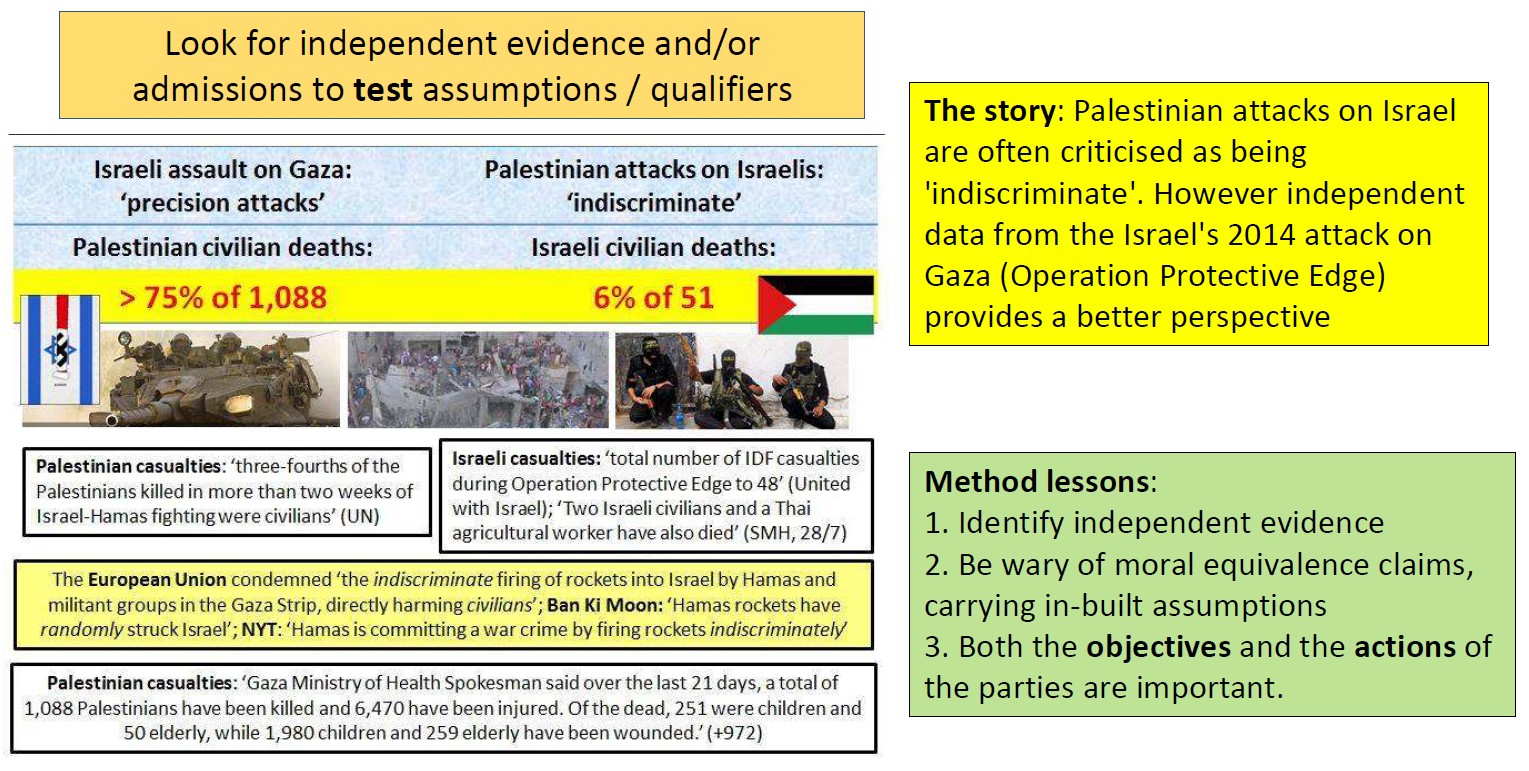
39 On 21 April 2018, Dr Anderson delivered a PowerPoint presentation at a seminar titled “Reading Controversies”, which he had organised (the PowerPoint Presentation). The PowerPoint Presentation contained an infographic which included what the parties described as an Israeli flag with a superimposed swastika. In fact, the picture was probably of an Israeli flag with the middle being ripped downwards and exposing a Nazi flag behind it.
40 Although the presentation occurred before the “third allegations” were notified to Dr Anderson on 10 August 2018, the material in the presentation was not the subject of the “third allegations”. Nevertheless, the material is relevant to later allegations and is set out here so that the events can be seen in context.
41 On 23 April 2018, Dr Anderson posted the slides from the PowerPoint Presentation to his Facebook Account, along with some comments. The infographic, described by the parties as the “third comments”, was as follows:
42 On Sunday 22 July 2018, just before commencing annual leave, Dr Anderson posted on his Facebook Account a photo referred to as the “lunch photo”:
43 Mr Tharappel is seated at the table second from the right in the photo.
44 Dr Anderson was on approved annual leave between 23 and 30 July 2018. Between 31 July 2018 and 2 December 2018, Dr Anderson was on approved Special Study Period leave. Between 3 and 10 December 2018, Dr Anderson was on approved annual leave.
45 On 2 August 2018, 7NEWS Sydney posted a video news story by Channel 7 reporter Mr Bryan Seymour about the lunch photo, focussing on the badge on Mr Tharappel’s shirt and commenting on Dr Anderson. The story was titled “University student sparks outrage: A University of Sydney academic has outraged many in the Muslim and Jewish communities by wearing an offensive slogan”. Among other things, Mr Seymour described Dr Anderson and Mr Tharappel as a “fervent supporters of … Kim Jong Un”.
46 On 3 August 2018, Dr Anderson:
(1) twice posted to his Facebook Account:
Colonial media promotes ignorance, apartheid and war. Channel 7’s Bryan Seymour accuses Indian Australian student of ‘racism’ for siding with #Yemen and other Arab states against #ApartheidIsrael. Also lies about those in solidarity with #Korea #DPRK.
https://m.facebook.com/story.php?story_fbid=2248128551877932&id=108878629136279
(2) tweeted:
Colonial media promotes ignorance, apartheid and war. Channel 7’s Bryan Seymour accuses Indian Australian student of ‘racism’ for siding with #Yemen and other Arab states against #ApartheidIsrael. Also lies about those in solidarity with #Korea #DPRK . [Link attached to 7NEWS video story]
47 These were referred to in the FASOC as the “fourth comments”.
48 On 3 August 2018, Dr Anderson received a letter from the University, signed by Professor Jagose, which formally directed Dr Anderson to remove the lunch photo and the fourth comments from his social media accounts. Professor Jagose’s letter stated:
I refer to the social media posts that have recently been made on your Facebook and Twitter accounts (see Annexure A for the details of these posts) (Social Media Posts).
I am formally directing you to remove these Social Media Posts.
The University has serious concerns that the Social Media Posts have the potential to bring the University into disrepute.
I require that you confirm in writing by 1.00pm AEST on 4 August 2018 that the posts have been taken down.
Should you not comply with the directions in this letter, I note that disciplinary action may be taken against you.
The University is considering what action is appropriate in relation to the Social Media Posts. If it is determined that a misconduct process needs to be commenced in respect of your conduct, I will write to you separately in relation to that process.
This letter is to be kept confidential and I especially require that you do not share this publicly or with any third party.
Should you not comply with the directions in this letter, I note that disciplinary action may be taken against you.
49 On 4 August 2018, Dr Anderson sent an email to Professor Jagose in the following terms:
I never respond favourably to secret demands and threats. You should know that you have no right to demand any censorship of my social communications. Your claim for secrecy of communications is also rejected.
50 Dr Anderson did not remove the lunch photo or the fourth comments.
B.9 10 August 2018: Third Allegations
51 On 10 August 2018, the University sent a letter from Professor Jagose with the subject line “Allegations Relating to Your Conduct”. The letter of 10 August 2018 stated that allegations had been made in relation to Dr Anderson’s conduct which, if substantiated, might constitute “misconduct” or “serious misconduct” within the meaning of the 2018 Agreement and stated that the allegations would be dealt with under cl 384(c) of the 2018 Agreement. These were referred to in the FASOC as the “third allegations”. The allegations were identified as follows:
Allegations
The Allegations are as follows:
1. On 22 July 2018, you published or caused to be published on your Facebook account, a photo containing imagery that can be considered as endorsing or promoting racial hatred and/or racism:
(a) a copy of the photo which was uploaded to the Facebook photo album “Beijing 2018 is included as Post #1A and #1B (Post #1) in Annexure B); and
(b) Post #1 includes an image of Mr Tharappel wearing a shirt which has a patch/flag with Arabic text which translates to state words to the effect of: “Allah Akbar [or “God is the Greatest”]; Death to America; Death to the Israeli; Curse the Jews; Victory to all Islam” (Patch).
2. On 2 August 2018, you published or caused to be published on your Facebook account, a “post” (a copy of the post is included as Post #2 in Annexure B), which states:
Colonial media promotes ignorance, apartheid and war. Channel 7’s Bryan Seymour accuses Indian Australian student of ‘racism’ for siding with #Yemen and other Arab states against #ApartheidIsrael. Also lies about those in solidarity with #Korea #DPRK.
https://m.facebook.com/story.php?story_fbid=2248128551877932&id=108878629136279
3. On 2 August 2018, you published or caused to be published on your Facebook account, a “comment” on Post #1 referred to above (a copy of the comment is included as Post #3 in Annexure B), which states:
Colonial media promotes ignorance, apartheid and war. Channel 7’s Bryan Seymour accuses Indian Australian student of ‘racism’ for siding with #Yemen and other Arab states against #ApartheidIsrael. Also lies about those in solidarity with #Korea #DPRK.
https://m.facebook.com/story.php?story_fbid=2248128551877932&id=108878629136279
4. On 3 August 2018, you published or caused to be published on your Twitter account, a “tweet” (a copy of the tweet is included as Post #4 in Annexure B), which states:
Colonial media promotes ignorance, apartheid and war. Channel 7’s Bryan Seymour accuses Indian Australian student of ‘racism’ for siding with #Yemen and other Arab states against #ApartheidIsrael. Also lies about those in solidarity with #Korea #DPRK.
https://m.facebook.com/story.php?story_fbid=2248128551 ...
5. In relation to Posts #1, #2, #3 and #4, you published or caused to be published content that was derogatory and/or offensive in nature.
6. In relation to Posts #2, #3 and #4 you published or caused to be published content that is derogatory of the journalist Bryan Seymour, by:
(a) stating that Bryan Seymour’s new story was an example of “Colonial media [which] promotes ignorance, apartheid and war”;
(b) stating that Bryan Seymour and/or Channel 7 “lie[d] about those in solidarity with [the Democratic People’s Republic of Korea]”; and
(c) stating that Bryan Seymour “accuses Indian Australian student of ‘racism’ for siding with [Yemen] and other Arab states against [Apartheid Israel]”.
7. On 4 August 2018, you refused to comply with the direction issued to you on 3 August 2018 at 6:00pm by Professor Annamarie Jagose, Dean of FASS that you delete Posts #1, #2, #3 and #4 (the letter of direction is attached and your email to the Dean is also attached).
The conduct that is the subject of the Allegations above is similar in nature to the conduct that was the subject of the Previous Warning.
52 As noted earlier, the allegations did not concern the infographic which contained the modified Israeli flag. The allegations concerned the lunch photo and Dr Anderson’s posts responding to the 7NEWS Sydney report.
B.10 15 to 24 August 2018: Dr Anderson’s bullying complaint and Sydney Morning Herald article
53 On 15 August 2018, Dr Anderson made a written complaint to the University’s Director of Workplace Relations, Ms Jodi Dickson and the Director of Safety, Health and Wellbeing, Ms Julia Cohen, making allegations about the conduct of Professor Jagose. This was referred to as the “third complaint”. The letter stated:
Dear Ms Jodi Dickinson [sic] and Ms Julia Cohen
Subject of complaint: FASS Dean Annamarie Jagose
This is a complaint about bullying and harassment by Annamarie Jagose, currently Dean of the Faculty of Arts and Social Sciences (FASS).
Over almost 17 months she has launched trivial, vindictive and vexatious complaints against me, by email or letter, and mostly in relation to my social media posts.
Last year the NTEU had her disqualified from personal involvement in judging such complaints, however she has returned to the game this year. I believe she does this in a misguided attempt to protect the university from adverse publicity, but without regard to my personal rights and agreed on principles of academic freedom.
Her acts go well beyond her authority as a manager. As an academic I have never worked under the direction of a Dean; yet she now attempts to give me secret directions on self-censorship in public comment.
I research and publish in the controversial area of contemporary war propaganda and am subject to repeated abusive personal attacks from the tabloid media. Bullying from Dean Jagose aggravates that. She seems to believe that intimidating me into silence will somehow lessen the tabloid media attacks (and consequent perceived adverse publicity for the university); yet these attacks persist due to the substance of my work.
In particular, I say that between April 2017 and August 2018 Dean Jagose:
1. Has made repeated trivial and vexatious formal complaints about me (2017-2018).
2. Pressured me to self-censor my self-defence from - and criticism of - abusive and dishonest tabloid journalists (e.g. Kylar Loussikian of the Daily Telegraph in April 2017, Bryan Seymour at Channel 7 in August 2018).
3. Has ignored my rights as a human being, to defend myself from abusive attacks, even though I do not engage in gratuitous or abusive criticism or counter-criticism.
4. Refused to acknowledge my right to academic freedom, as set out in s.254 of the University’s Enterprise Agreement, which specifically supports intellectual freedom, including on “the operations of the university” and including “controversial views” so long as there is not “harassment, vilification or intimidation”. Dean Jagose seeks to trivialise this formulation.
5. Falsely claimed that my political criticisms of journalists amount to ‘personal attacks’, or are ‘discourteous’ and ‘derogatory’, even though my criticisms (unlike the tabloid attacks) contain no gratuitous remarks nor abuse (2017-2018).
6. Raised spiteful and vexatious formal complaints about me, even for my *private* written criticism of her conduct in assisting tabloid media (the Daily Telegraph) to defame tutor and PhD student Jay Tharappel (in April 2017).
7. Went well beyond her powers as a dean by demanding, without any specified or justified reason, that I self-censor particular social media posts (August 2018).
8. Raised unjustified and petty ‘misconduct’ charges against me for posting a photograph of friends at lunch in Beijing, because of one of the badges (from Yemen) on one person’s jacket; a peculiar form of ‘guilt by association’.
9. Plagiarised false claims from the tabloid media (Channel Seven, August 2018) about alleged ‘incitement to racial hatred’ implied by the Yemeni badge. However when I studied that badge (which was not the subject of my post) I saw nothing which came close to ‘inciting racial hatred’. Dean Jagose’s letter (August 2018) simply copied false allegations from the tabloid media story, including a poor translation of the Arabic text in that badge.
10. Went well beyond her authority as a dean by threatening me with dismissal on trivial and unjustified grounds, while improperly demanding that her written threats against me be kept secret (2017-2018).
11. Carried out this vexatious campaign of harassment against me, at times calling her allegations ‘serious’, yet knowing full well that nothing in them could amount to ‘serious misconduct’ and so could not be subject to independent review.
Could you please call this manager to account? Her actions have been threatening, unreasonable and divert me from my work while wasting time. Could you ask her to desist from this bullying and, if necessary, communicate any relevant matters in a civil way through the head of the Political Economy Department?
Yours sincerely
Tim Anderson (Dr),
Senior Lecturer in Political Economy, Camperdown
54 On 17 August 2018, Dr Anderson received an email from Michael Koziol, a journalist from Fairfax media. This stated:
Hi Tim,
Just following up on this. The university has confirmed it is investigating your conduct in relation to this matter.
Is there any comment you would like to provide?
thanks,
Michael
---------- Forwarded message ----------
From: Michael Koziol [redacted email address]
Date: 14 August 2018 at 14:55
Subject: Inquiry from the SMH
To: [redacted email address]
Hi Tim,
Hope all well. Apologies, I know I had your mobile number at some point but I can’t find it.
I’m hoping you can give me a call on [redacted] or let me know how to reach you directly.
I’d like to ask about your recent trip to the DPRK, as well as your remarks about your former colleague Jay Tharappel, including this tweet:
https://twitter.com/timand2037/status/1028823749531848704
Many thanks,
Michael
55 The same day, Dr Anderson forwarded this email to Professor Jagose, stating:
Annamarie
Can i take it that someone in your team has provided information to journalists (see below) to smear me in the media?
Tim Anderson
56 On 19 August 2018, the Sydney Morning Herald published an article by Mr Koziol entitled “Sydney Uni lecturer investigated for defending ‘Death to Israel’ badge”.
57 On 20 August 2018, the University sent to Dr Anderson a letter signed by Professor Garton which stated that the “misconduct process” would be put on hold whilst Dr Anderson’s bullying complaint against Professor Jagose was considered. The letter stated that queries in relation to the misconduct process should be directed to Professor Garton and that queries in relation to the bullying investigation should be directed to Mr Strbik, Associate Director of Workplace Relations, or Mr Tait, Workplace Relations Advisor.
58 On 22 August 2018, Dr Anderson wrote a letter to Mr Strbik. The letter explained that Dr Anderson would address the misconduct process and the bullying complaint together, stating:
Provost Stephen Garton has written to me to say that my 15 August bullying complaint against Dean Jagose will be considered before Dean Jagose’s 10 August 2018 misconduct allegations against me. He adds that any queries about the bullying complaint be referred to you, while queries about the misconduct allegations be referred to him.
I would like to add and respond to both matters now, as I am about to go overseas for most of the next three and a half months, on study leave. For convenience, I will address both matters together …
59 The letter then addressed the relevant matters in detail. This letter was described as comprising the “fourth complaint”.
60 On 23 August 2018, Professor Garton sent an email to Dr Anderson, stating:
Private and confidential
Dear Tim
I refer to your email dated 17 August 2018 addressed to the Dean. In view of your complaints against the Dean which are currently being reviewed, it is appropriate that I respond to you on behalf of the University.
At no time has information been provided to journalists by anyone in the University “to smear” you in the media and such an allegation is entirely without foundation and should be withdrawn.
The University, through its Media Office, in response to contact from the media, made a public statement that it had initiated an investigation in relation to your alleged conduct. In making such a statement (which you know to be a true one), the University did not breach the confidentiality obligation (which you share) which is directed to ensuring that the investigation is not compromised by details of the allegations or the process being disclosed to or discussed with third parties. The University reminds you of your obligation to keep confidential details of the investigation in accordance with the letter of allegations issued to you on 10 August 2018. To be clear, however, this does not prevent you (or the University) from disclosing the fact that the investigation is being conducted.
Should you have any questions, please let me know.
Stephen
61 The same day, Dr Anderson responded, stating:
Dear Stephen
Dont be disingenuous. You know very well that that SMH story would not have run without that official statement.
Tim
62 On 24 August 2018, Mr Simon Kempton of the NTEU sent to the University a letter to the effect that the University should not have disclosed that Dr Anderson was being investigated for misconduct and concluding:
The NTEU believes that the University should make a formal and public apology to Dr Anderson and also acknowledge that this inappropriate release of information has an affect on his life and may damage his career. This must be taken into account when considering the matters he has raised about bullying and inappropriate behaviour on behalf of University staff.
B.11 September 2018: Defamation Act 2005 (NSW) concerns notice and response
63 On 8 September 2018, Dr Anderson sent a concerns notice under the Defamation Act 2005 (NSW) to the University’s Vice Chancellor, Dr Michael Spence AC. This was described as the “fifth complaint”. The letter opened with the following two paragraphs:
I write to inform you that I consider the University of Sydney to be partly and jointly responsible for recent defamation of my reputation, by colluding with media outlets to publicise false claims about my alleged ‘promoting [of] racial hatred and/or racism’.
Whatever the motives and duties of university mangers [sic], disclosure of an ‘official investigation’ into these bogus claims was also made in breach of university confidentiality procedures. The joint University of Sydney - public media defamation (which compile a collection of false claims and defamatory innuendo) has led to a stream of hate mail and threats (see attached).
64 On 14 September 2018, Dr Spence AC responded in the following terms:
Dear Tim
University of Sydney statements relating to Tim Anderson
I refer to your letter dated 8 September 2018 in which you allege that the University has been involved in defamation of you.
The tenuous basis for your allegations appears to be the public statement made by the University, through its Media Office, in response to contact from the media, that it had initiated an investigation in relation to your alleged conduct.
I reject any suggestion that the making of that statement (which was clearly true) by the University could or did contribute to the alleged defamation of you by media outlets or any other third parties.
The University bears no responsibility (partial, joint or otherwise) for the media reports that you allege constitute the defamation, and there is no basis for your demand that the University “make appropriate amends”. Accordingly, your offer of settlement is rejected.
Yours sincerely,
Michael Spence
B.12 8 October 2018: Outcome of bullying complaint
65 On 8 October 2018, Professor Garton sent to Dr Anderson a letter regarding the outcome of the investigation into his complaint against Professor Jagose. The letter included:
Findings
Mr Tait’s investigation of these allegations has now been completed. After carefully examining all of the evidence available, Mr Tait has made the following findings on the balance of probabilities in relation to the allegations that were raised:
l. That the allegations against Professor Jagose could not be substantiated and that Professor Jagose’s interactions with you were deemed to fall within reasonable management actions as defined by Bullying, Harassment and Discrimination Prevention Policy 2015.
Determination
I have considered the process undertaken by Mr Tait and the findings set out above. I am satisfied that Mr Tait reasonably considered the evidence in an impartial manner and conducted a fair process. I have therefore decided to accept the findings of the investigation.
As a result of this, Professor Jagose is not deemed to have breached the University’s Bullying, Harassment and Discrimination Prevention Policy 2015, and no formal disciplinary action will result.
I consider this matter to now be closed.
Confidentiality
I note that your obligations relating to the confidentiality of this investigation continue to apply. The substance and fact of the investigation must be kept confidential.
…
66 On 8 October 2018, Dr Anderson responded to the letter of 8 October 2018 by way of an email to Professor Garton, Mr Darren Burdon and Mr Kempton in the following terms:
Dear Stephen and Darren
I have your letter of 8 October, in which you provide a precis of a report by Mr Tait.
Please provide me with a copy of the full report.
Please note also that, especially following some managers’ practice of abuse by press release, I will disregard your claims for secrecy in correspondence.
Be aware that I will make public parts of the correspondence from managers as and when I see fit.
This is my right, both to defend myself from defamation, and to pursue my research speciality. You know about this, I have told you before.
Best wishes
Tim Anderson
67 On 9 October 2018, Professor Garton replied, by way of an email from Mr Burdon, to Dr Anderson’s email of 8 October 2018 to Professor Garton, Mr Burdon and Mr Kempton. This included:
Requirement to maintain confidentiality and allegations of defamation and abuse
There is no justification for your stated intention to breach your confidentiality obligations in relation to these matters and your claim of a ‘practice of abuse by press release’ is without foundation and totally inappropriate.
Your rights to defend yourself against any perceived defamation of you and to pursue your research speciality are not incompatible with your obligations as an employee of the University to comply with University policy and procedures, including the Code of Conduct - Staff and Affiliates, the Public Comment Policy, and any other obligations relating to your employment. These include the obligation to follow reasonable and lawful directions by your manager and to maintain confidentiality over particular information, documents or processes.
Direction to maintain confidentiality
I reaffirm that you are directed not to publish or disclose confidential information or correspondence relating to the bullying investigation, the misconduct process, or any other confidential information. Any breach of this direction may result in disciplinary action against you.
B.13 19 October 2018: Final Warning
68 On 19 October 2018, the University, by Professor Garton, sent to Dr Anderson a letter advising of the outcome of the misconduct investigation. The letter advised that Professor Garton was, on balance, satisfied that the allegations had been largely substantiated. Detailed findings were set out by way of annexure to the letter.
69 The letter referred to the written warning issued on 2 August 2017 and then stated:
It is of significant concern to me that you have repeated conduct in respect of which you received a formal warning.
I am satisfied that Allegations 2, 3, 4, 6 and 7 are substantiated and Allegation 5 is partially substantiated, and that your breaches of the Code of Conduct - Staff and Affiliates (Code of Conduct) and Public Comment Policy amount to Misconduct.
I am satisfied that throughout this process, you were afforded a reasonable opportunity to respond to the allegations.
This letter constitutes a final warning that you must appropriately discharge your obligations pursuant to your contract of employment with the University, the Enterprise Agreement, the Code of Conduct and the Public Comment Policy going forward.
I specifically remind you of the requirement to exercise good and ethical judgment in any public comment, demonstrate professionalism (including in public comment) and exercise appropriate restraint. I also remind you of your obligations to act fairly and reasonably, and treat all relevant persons, including staff and members of the public, with respect, impartiality, courtesy and sensitivity.
Should any further incidents of this nature occur, the University will rely upon the 2 August 2017 letter, and this final warning letter to determine any appropriate further Disciplinary Action, up to and potentially including the termination of your employment …
70 The letter also addressed a new issue, namely posts of which it had become aware which included one which contained a modified Israeli flag. The letter stated:
[T]he University is aware of other posts made on social media accounts in your name which raise serious concerns about your willingness to comply with your employment obligations. In particular, I refer to a Facebook Post of a presentation in a “Reading Controversies” Seminar delivered for the Centre for Counter Hegemonic Studies. This post was made on 23 April 2018 and shows a cropped Swastika superimposed over the Israeli flag (see Annexure C to this letter).
Given the period of time which had elapsed from when you had made the post and when it was referred to the University, a decision was made not to include it in the allegations. In the circumstances, the University will not raise this post with you formally. However, in my view, a reasonable person would regard the superimposition of a cropped Swastika over the Israeli flag as offensive.
Please immediately add a disclaimer in any medium in which this post appears that the presentation is not connected in any way with the University of Sydney and remove any references to the University of Sydney from the relevant posts.
You must also make it clear in any future posts relating to the Centre for Counter Hegemonic Studies that it is not associated with, or endorsed by, the University of Sydney in any way, consistent with guideline (e) of the Public Comment Policy.
I have separately written to the NTEU in relation to the matters that they have raised on your behalf. I confirm that you are able to confirm the fact of the allegations, but not the substance of them. I also confirm that you are required to keep confidential the contents of this letter, including on social media.
…
71 As to the lunch post (which formed the part of allegation 5 which was considered to have been substantiated) the annexure to the letter included:
ALLEGATION 5
…
Post#1
While I have found that the content of Post #1 does not, on balance endorse or promote racial hatred and/or racism (see finding in relation to Allegation 1), I am satisfied that the content is offensive or derogatory.
In my view, whether the meaning of the Arabic text on the Patch worn by Mr Tharappel is “Death to Israel”, “Death to Israeli” or “Death to the Israeli”, when it is coupled with “Curse the Jews”, it is an incitement for the death of people of the predominantly Jewish inhabitants of the state of Israel and not a purely political statement seeking the demise of a nation state as you have suggested.
The University is committed to supporting and encouraging the free expression by its students and staff of opinions and ideas, regardless of whether they are controversial, unpopular or objectionable to others and regardless of whether they are contrary to the views of the University. However, that general freedom is not unconditional and importantly, does not override policies of the University that are directed to ensuring that all staff, students and members of the public are treated with respect and courtesy by members of the University community, regardless of religion, race, ethnicity, political belief or other difference.
The University supports the free exchange of ideas relating to the state of Israel. However, content that calls for a death to a State and the people within it, and a curse on people who are of a particular religion, does not form part of a respectful debate.
In my view a reasonable person is likely to find the Patch worn by Mr Tharappel and posted by you to be offensive and/or derogatory. This allegation is substantiated.
72 As to Posts #2, #3 and #4 concerning Bryan Seymour, the annexure included:
ALLEGATION 6
In relation to Posts #2, #3 and #4 you published or caused to be published content that is derogatory of the journalist Bryan Seymour, by:
(a) stating that Bryan Seymour’s new story was an example of “Colonial media [which] promotes ignorance, apartheid and war”;
(b) stating that Bryan Seymour and/or Channel 7 “lie[d] about those in solidarity with [the Democratic People’s Republic of Korea]’; and
(c) stating that Bryan Seymour “accuses Indian Australian student of ‘racism’ for siding with [Yemen] and other Arab states against [Apartheid Israel]”.
In your Response, you state that you believe you are entitled to state these things under cl 254 of the Enterprise Agreement. I assume that you intended to refer to cl 315 of the Enterprise Agreement (which was cl 254 in the predecessor to the Enterprise Agreement and related to intellectual freedom).
Clause 315 refers to the right of academic staff to “engage in the free and responsible pursuit of all aspects of knowledge and culture ...” (my emphasis). Further, the right recognised in clause 315 needs to be read alongside the commitment in clause 317 to “uphold the principle and practice of intellectual freedom in accordance with the highest ethical, professional and legal standards.”
This means, among other things, that an exercise of a freedom of intellectual freedom must be responsible and considered and in compliance with the standards of behaviour set in the Code of Conduct.
In my view, the statement made by you (and set out above) are, on any objective view, derogatory of Bryan Seymour and go beyond the expression of an opinion about the underlying issue.
Your statement is an attack on the credibility of an individual journalist rather than the views expressed by him, in that you directly associated Mr Seymour with the “colonial media”, thereby inferring that he promotes “ignorance, apartheid and war.”
The statements that Mr Seymour “lies about those in solidarity with #Korea #DPRK” and that he “accuses Indian Australian student of ‘racism’ for siding with [Yemen] and other Arab states against [Apartheid Israel]” are personal attacks on the reporter rather than a fact-based statement about an issue and, in my view, are derogatory and offensive.
Finding relating to Allegation 6
This allegation is substantiated.
73 The annexure also included:
ALLEGATION 7
On 4 August 2018, you refused to comply with the direction issued to you on 3 August 2018 at 6:00pm by Professor Annamarie Jagose, Dean of FASS that you delete Posts #1, #2, #3 and #4 (the letter of direction is attached and your email to the Dean is also attached).
Professor Jagose provided a lawful and reasonable direction to you, as someone in a supervisory position relating to your employment, that you remove posts that she considered had the potential to be in breach of University’s expectation of employees under the Code of Conduct and Public Comment Policy. It was reasonable for her to issue that direction to you in circumstances where she had formed the view that the content of your posts was contrary to your obligations under the Code of Conduct and Public Comment Policy.
You have admitted that you refuse to comply with Professor Jagose’s direction.
Finding relating to Allegation 7
The Allegation is substantiated.
74 Dr Anderson stated in his affidavit that, after receiving the final warning, he removed “the University of Sydney” from the “about” details of his Facebook and Twitter Accounts.
75 Dr Anderson had not previously heard of any complaint about the infographic in his Reading Controversies slides, referred to by Professor Garton in the final warning. He stated that he examined the slide and could not see a swastika in it. In his affidavit he then stated:
By way of asserting my right to freedom of political and intellectual freedom, and to once again make use of a teaching aid of which I was, and remain, quite proud, on 20 October 2018, I reposted the Gaza Graphic slide to my Facebook and Twitter accounts with the caption:
Revision: how to read the colonial media, and untangle false claims of ‘moral equivalence’. The colonial violence of #Apartheid #Israel neither morally nor proportionately equates with the resistance of #Palestine.
76 On 19 or 20 October 2018, Dr Anderson posted an image from the PowerPoint Presentation and tweeted that image on the Twitter Account. These were referred to in the FASOC as the “fifth comments”. The Facebook post was:
77 The Twitter post was:
78 Dr Anderson also commented on the 19 or 20 October 2018 Facebook post with a link to an article he had written and published on the Centre for Counter Hegemonic Studies site, entitled “The Future of Palestine”.
B.14 26 October 2018: Fourth Allegations
79 On 26 October 2018, the University sent to Dr Anderson a letter with the subject line “Further Allegations Relating to Your Conduct”. The letter contained allegations that publication of the 19 or 20 October 2018 Facebook and Twitter posts might constitute misconduct. These were referred to as the “fourth allegations”. The letter included by way of background:
Background
On 3 August 2017, you were issued with a written warning following an investigation that substantiated allegations of misconduct against you and found that your conduct breached the Code of Conduct -Staff and Affiliates (Code of Conduct) and Public Comment Policy. The letter is attached (noting it is dated 2 August 2017 but was emailed to you on 3 August 2017). The relevant misconduct involved the posting by you of material on your social media accounts that was offensive or inappropriate and in breach of University policy and your employment obligations.
…
On 19 October 2018 you were issued with a written final warning following an investigation of further allegations of misconduct by you in relation to the posting of inappropriate material by you on your social media accounts and found that your conduct breached the Code of Conduct and Public Comment Policy. The letter is attached. You were advised that should any further incidents of a similar nature occur, the University would rely on the 2 August 2017 warning and the 19 October 2018 final warning.
The 19 October 2018 letter also referred to a post made by you to your Facebook account on 23 April 2018 that depicted a cropped Swastika superimposed over the Israeli flag (altered image of the Israeli flag). You were advised that while the post had not formed part of the allegations in respect of which the final warning was issued, it was the University’s view that a reasonable person would regard the altered Israeli flag image as offensive.
80 The letter then set out the following further allegations:
Further Allegations
I have now been made aware of fresh allegations of misconduct by you which again relate to your social media activity and which involve the republication by you of the altered Israeli flag image (Further Allegations).
Given the serious nature of the Further Allegations, I have determined to deal with them under clause 384(c) of the Enterprise Agreement.
The Further Allegations are as follows:
(a) on 19 October 2018 at 4:57PM, you published or caused to be published on your Twitter account (Post #1 in Annexure B), a photo depicting the altered image of the Israeli flag, along with the text “Revision: how to read the colonial media, and untangle false claims of ‘moral equivalence’. The colonial violence of #Apartheid #Israel neither morally nor proportionately equates with the resistance of #Palestine.” (Twitter Post);
(b) the content of the Twitter Post was also posted on 20 October 2018 at 10:55AM on your Facebook account (Post #2 in Annexure B) (Facebook Post);
(c) you posted as a comment to the Facebook Post at 11:02AM stating “On the future of Palestine. https://counter-hegemonic-studies.net/future-palestine-1/”, which included a hyperlink to the Centre for Counter Hegemonic Studies website;
(d) the Facebook Post and the Twitter Post (due to the fact it included the altered image of the Israeli flag) are derogatory and/or offensive in nature;
(e) the altered image of the Israeli flag included in the Facebook Post and the Twitter [Post] can be reasonably seen as racist towards or seeking to target and/or offend Israelis and/or Jewish people and/or Jewish victims of the Nazi regime;
(f) there is no legitimate academic or intellectual purpose served by the inclusion of the altered image of the Israeli flag in the Facebook Post or the Twitter Post;
(g) you were aware or should reasonably have been aware that the inclusion of the altered image of the Israeli flag in the Facebook Post and the Twitter Post was offensive; and
(h) the making of the Facebook Post and Twitter Post with the inclusion of the altered image of the Israeli flag was a deliberate and direct contravention by you of the final warning issued to you on 19 October 2018.
81 The letter informed Dr Anderson that the further allegations, if substantiated, would amount to “serious misconduct” and may justify the termination of Dr Anderson’s employment. Dr Anderson was invited to respond.
82 Annexed to the letter were screenshots of Dr Anderson’s Facebook and Twitter profiles and various screenshots of Dr Anderson’s posts and an enlarged image of the Israeli flag from the Facebook and Twitter posts. This is the latter image:

83 On 26 October 2018, Dr Anderson sent to Professor Garton and others an email which concluded by stating that he did not intend to respond further in relation to the letter dated 26 October 2018 which he had received. This was referred to as the “sixth complaint”. The email stated:
Dear Stephen
Following are the reasons why I categorically reject your letter of 19 October, along with your clumsy, unprincipled ttempts to act as political censor of my public comments.
1. Your letter of 2 August 2017 refused to respond to or even acknowledge the existence of principle of academic freedom, spelt out in s.254 of our university’s Enterprise Agreement (2013-2017). For that reason alone I consider the letter legally incompetent.
2. In your 19 October 2018 letter you belatedly recognize this principle (now s.315 in the EA 2018-2021), but try to downgrade its meaning. You specifically avoid the wording I have quoted to you on two separate occasions, that academic staff are entitled to “express unpopular or controversial views, provided that in doing so staff must not engage in harassment, vilification or intimidation”. These are the most relevant formulations to most of the complaints you make about my pubic [sic] comments. You abandon these formulations, the agreed industrial rules of our university, and substitute your own idea of what someone might find ‘offensive’. That is just dishonest. Your evasiveness on this matter leads me to conclude that you have little respect for intellectual freedom.
3. Your attempts to police and censor my public statements have included double standards and public abuse. You have demanded secrecy of your ‘investigations’ into alleged misconduct, but proceed to issue press releases on those same matters. I have sent a concerns notice under defamation law to the Vice Chancellor about this. Now, after the NTEU drew your attention to this abuse, you have revised your position. You now say I am entitled to defend myself in public from such abuse, but only within certain terms that you have decided. This is unacceptable.
4. There is dishonesty in your attempt to dismiss the behaviour of Dean Annamarie Jagose who (as I pointed out in my letter of 22 August 2018) plagiarised a false arabic translation (of part of a badge worn by someone else) to falsely accuse me of racism. You now respond: “In my opinion whether the meaning of the Arabic text on the patch word by Mr Tharappel is “Death to Israel” or “Death to Israeli” or “Death to the Israeli” … it is an incitement for the death of people of the predominantly Jewish inhabitants of the state of Israel”. You are wrong and you are dissembling. You do not want to understand the difference between a state and people. Further, you ignore and try to cover up Dean Jagose’s plagiarism of the false translation, to assist her false accusation.
5. Some of your comments are garbled and contradictory. You rightly reject Dean Jagose’s outrageous claim that my innocent social media post (of friends at lunch in Beijing) ‘promotes racial hatred’; yet you claim maintain that the photo was ‘offensive or derogatory’. You ‘substantiate’ complaints (e.g. #3) which are not even formulated to include an accusation of misconduct. This is incompetent and reckless abuse.
6. You add your own complaint about another social media post, on ‘reading controversies’ (your appendix three); a complaint which is improper in substance and process. You make false statements about that post before presenting your summary conclusion, and without seeking my response. You claim this post – which you say you ‘will not raise formally … raises serious concerns about [my] willingness to comply with employment obligations’. This accusation is a case study in how little you respect your colleagues’ rights. Firstly, this was not a presentation for the Centre for Counter Hegemonic Studies, as you claim; it is an excerpt from my teaching materials in a unit of study called ‘Human Rights in Development’ (ECOP3017). Second, there is no ‘cropped swastika[’] on the post. That is simply a false statement. You show no understanding or interest in what that graphic is about.
7. Your subsequent demand that I add a disclaimer to ‘this medium’ is an attempt to interfere in my teaching materials. I infer that you are unhappy with the criticism of Israel in this educational graphic. I totally reject this politically motivated interference. That graphic is one of several I use, and will continue to use, to help students ‘read controversies’ and decipher false statements in what I call the colonial media.
8. You object to my use of the term ‘colonial media’, to describe stories which normalise war and illegal foreign intervention. You fail to appreciate that this is precisely the domain of my research and legitimate academic freedom. I do not care if you disagree with my views. What I object to you is your abusive behaviour as a manager. You misrepresent my criticism of journalists as ‘personal attacks’, just as you defend the sensitivities of those who engage in gutter journalism and mount actually abusive personal attacks on me. That is a failure in your duty of care towards a colleague.
For the above reasons I reject: your 19 October letter, your attempts to interfere in my academic independence, your attempts to constrain my right to defend myself from public abuse and your clumsy and unprincipled attempts at censoring my social media comments. If you insist on continuing with this abuse, take it to an independent tribunal. Your dishonesty and lack of commitment to principle makes any further dialogue pointless.
I received and have read your additional letter of 26 October, it contains nothing new in substance and I do not intend to respond further.
Yours sincerely
Tim Anderson (Dr)
Senior Lecturer
Political Economy
84 In cross-examination, Dr Anderson stated that he had forgotten that the Israeli flag contained a cropped swastika and that was why he stated, in paragraph 6 of his email of 26 October 2018, that Professor Garton’s assertion that it did was false.
85 This evidence stands in contrast to his evidence that the image was carefully selected and the fact that he had been shown a close up of the image attached to the University’s letter of 26 October 2018.
86 His evidence in cross-examination included:
And the reason that you reposted, on 20 October, the image as we see on page 340 is that you knew that this would provoke the very issue that you thought was the consequence of the 19 October letter, and that was upset of disregard the university, you say, had for your work. So it was provocative, wasn’t it?---No, that’s quite false. That’s not why I posted it.
And given that you had - - -?---Would you like it if I posted - - -
Can I finish? Given that you had the capacity to change the graphic images, it would’ve been a relatively simple thing to remove this graphic of the Israeli flag with a superimposed swastika, wouldn’t it?---I could’ve removed the graphic.
But you didn’t?---And I didn’t because I felt that was a very important graphic and it was an important part of my work, and that every element of that graphic had something to say that was useful for my work.
87 Professor Garton prepared a document entitled “Briefing Paper to the Senate People and Culture Committee” dated 26 November 2018. The Briefing Paper set out Professor Garton’s proposed course of action in relation to the findings Professor Garton had made of serious misconduct by Dr Anderson. The Briefing Paper set out the factual background and included as an annexure a summary of complaints which had been made against Dr Anderson since January 2014.
B.15 December 2018: Suspension of Employment
88 On 3 December 2018, the University sent to Dr Anderson a letter signed by Professor Garton suspending Dr Anderson from his employment. The letter included:
RESPONSE AND CONSIDERATION
On 27 October 2018, you sent me an email in which you stated that you rejected the final warning I issued you in my letter on 19 October 2018.
You also made a number of allegations against me including that I made “clumsy unprincipled attempts to act as political censor” of your “public comments” and that I was, dishonest, evasive and lacking in respect for intellectual freedom and that I had engaged in censorship and politically motivated interference in relation to your work. I reject those allegations.
In relation to the allegations contained in my 19 October 2018 letter, you stated that your Facebook Post on 23 April 2018 (referred to at Annexure C in my letter of 19 October 2018) is an excerpt from your teaching materials in a unit of study called ‘Human Rights in Development’ (ECOP3017), and that there is no cropped swastika on the post.
You have not denied making the Facebook Post on 23 April 2018, the Twitter Post on 19 October 2018 or the Facebook Post on 20 October 2018.
In my view, it is clear that the altered image of the Israeli flag - which you included in your Twitter Post on 19 October 2018, and Facebook Posts on 20 October 2018 and 23 April 2018 - depicts a cropped Swastika. In my view any reasonable person would associate such a cropped image of the Swastika as a reference to the flag of the Nazi Party/National Socialist German Workers’ Party, which was the flag of Germany during 1933 until 1945. Thus in my view an image of a Swastika superimposed over the Israeli flag references Nazi symbolism. I do not accept your denial on this matter.
I have verified that the altered image of the Israeli flag appears on your teaching materials for ‘Human Rights in Development’ (ECOP3017); in particular, the presentation slides for “Reading Contemporary Controversies: Dr Tim Anderson, University of Sydney Seminar, 21 April 2018”, which students enrolled in ECOP3017 were able to download from Canvas. A copy of the relevant slide is included in Annexure A to this letter. It is of significant concern that the altered image was created by you and presented to students in the course of your employment.
It is also inappropriate for you to publish your lecture materials on a public forum such as Facebook and to advertise University seminars on a website relating to the Centre for Counter Hegemonic Studies which is not affiliated to the University.
The University supports the principles of academic freedom and the right of academic staff to discuss and express opinions on controversial topics. However, as you have been reminded on several occasions, any expression of academic freedom must be in accordance with the highest ethical, professional and legal standards, and must comply with the University’s policies including the Code of Conduct - Staff and Affiliates and the Public Comment Policy. The inclusion of the altered image of the Israeli flag in your Twitter Posts, Facebook Posts and teaching materials is disrespectful and offensive, and contrary to the University’s behavioural expectations and requirements for all staff.
You were provided until 12 November 2018 to provide a response to the Further Allegations. Your only response was your email of 27 October 2018.
I am satisfied that you have been afforded a reasonable opportunity to respond to the Further Allegations.
DETERMINATION
I have considered all of the information available to me and I am satisfied that the Further Allegations are substantiated. In reaching this view I have not had regard to the allegations that you have made against me personally.
You have not provided any information or explanation that mitigates your conduct.
I am satisfied that your conduct amounts to Serious Misconduct and is in breach of your obligations under the University of Sydney Enterprise Agreement 2018 - 2021 (Enterprise Agreement), your contract of employment, the Code of Conduct- Staff and Affiliates and the Public Comment Policy.
OUTCOME
I am proposing that the appropriate Disciplinary Action is the termination of your employment with the University due to your Serious Misconduct, particularly in the context of previous warnings issued on 2 August 2017 and 19 October 2018 in respect of similar conduct.
You have the opportunity to have this proposed decision reviewed by a Review Committee in accordance with clause 460 of the Enterprise Agreement. If you wish to take up this opportunity you must advise Mr Frank Strbik in writing before 5.00pm on Monday, 10 December 2018.
I note that, in accordance with clause 384(f)(ii) of the Enterprise Agreement, you may be suspended without pay if you request a review of the proposed decision.
If you do not respond or do not request that the proposed decision be reviewed by a Review Committee within the timeframe specified, a final decision will be made and communicated after the time set out above.
89 On 4 and 5 December 2018, Dr Anderson made posts to his Facebook and Twitter Accounts. On 7 December 2018, the University sent to Dr Anderson a letter in the following terms:
Dear Tim,
YOUR SOCIAL MEDIA POSTS ON 4 & 5 DECEMBER 2018
I refer to my letter to you dated 3 December 2018 relating to the outcome of the further allegations about your conduct.
I have since become aware that on 4 December 2018 at approximately 12.55pm you made a post on your Facebook account (https://www.facebook.com/timand2037), as set out in Annexure A. The post refers to the proposal to terminate your employment, and then subsequently posts screenshots of the text of my 3 December 2018 letter to you (not including attachments/annexures) in the comments on that post.
I have also become aware that on 5 December 2018 at approximately 8.51pm you published a post on your Twitter account (https://twitter.com/timand2037), as set out in Annexure B. The post names the Fairfax media journalist who published a story commenting on your post and shows the statement you made on your Facebook account referred to above.
I consider your posts on social media, especially the fact that you posted my 3 December 2018 letter to you in full on social media as inappropriate and contrary to my previous statements that you are not to post University letters on social media.
I have confirmed in previous correspondence to you on 19 October 2018, and separate correspondence to the NTEU, that you are able to confirm the fact of the allegations more broadly, but not to disclose the substance of them. I have also confirmed that the contents of correspondence such as private and confidential University letters are not to be posted on social media.
In my letter to you dated 26 October 2018, I confirmed that the Allegations of misconduct against you are confidential and they were not to be discussed with anyone other than a support person, representative or personal adviser (such as a lawyer, doctor or counsellor) or disclosed in any manner or form on social media.
You were told that you “must not victimise or otherwise subject any person, to detrimental action as a consequence or that person raising, providing information about, or otherwise being involved in the resolution of a complaint, including the disciplinary process.” This includes showing the names of individuals involved in disciplinary processes, such as your managers and those in support functions at the University.
You were also informed that it is open to the University to “take disciplinary action against you if you breach confidentiality, or knowingly become involved in victimisation or other detrimental action.”
I understand that you have requested a review of the proposal to terminate your employment, as you are entitled to do. I respect your decision and will respect the outcome of that process.
Whilst that process is ongoing, the University will not take any further action relating to your disclosure of the letter on social media. However, the University reserves its rights to review this matter further after the review process has completed.
I confirm that you are directed to specifically not post this letter on social media or to disclose its contents more broadly, save for the letter or its contents being disclosed to a support person, representative or personal adviser (such as a lawyer, doctor or counsellor), or by either you or the University as part of the review of the proposal to terminate your employment.
Yours sincerely,
Professor Stephen Garton
90 On about 5 December 2018, Dr Anderson requested that a Review Committee review the proposed termination of his employment. A Review Committee was convened on 17 December 2018. On 14 January 2019, Dr Anderson lodged submissions to the Review Committee. Also on 14 January 2019, the University lodged with the Review Committee: the witness statement of Professor Garton; a chronology with relevant documents annexed; and an outline of submissions on behalf of the University’s delegate. Dr Anderson and the University lodged further submissions to the Review Committee on 21 January 2019. On 24 January 2019, the Review Committee conducted a hearing at which Professor Garton and Dr Anderson gave oral evidence. On 25 January 2019, Dr Anderson lodged a further submission to the Review Committee.
B.17 Termination of Employment
91 On 8 February 2019, the Review Committee published its findings. It contained the following recommendations:
RECOMMENDATIONS
The Committee has reviewed the proposed decision to terminate the employment of Dr Tim Anderson.
Ms McLeay and Prof Pattison endorse the proposed course of action, based on the findings that:
• Serious Misconduct has occurred;
• the procedures that were followed afforded Dr Anderson procedural fairness in accordance with the Agreement; and
• the proposed termination of Dr Anderson’s employment is reasonable in the circumstances.
Dr Maclean does not endorse the proposed termination of Dr Anderson’s employment. This recommendation is based on the findings that:
• a finding of misconduct is supported by the evidence before the review;
• there are systemic factors in the process that mitigate against a finding of serious misconduct; and
• the proposed termination of Dr Anderson’s employment is not reasonable in the circumstances.
The Committee’s reasons are set out in separate sections later in this report.
92 On 11 February 2019, the University sent to Dr Anderson a letter terminating his employment and a copy of the Review Committee’s findings dated 8 February 2019.
C RELEVANT ENTERPRISE AGREEMENTS, CODES OF CONDUCT AND POLICIES
93 As mentioned, the parties proceeded on the basis that the 2013 Agreement and 2018 Agreement were relevantly the same. Accordingly, reference is made only to the 2018 Agreement.
94 The first principal area of dispute concerned the meaning and effect of cl 315. The second principal area of dispute concerned various clauses relevant to disciplinary action, misconduct and serious misconduct.
95 Part A of the 2018 Agreement is entitled “Operation of Agreement” and includes in cl 3 the following definitions of relevance:
DEFINITIONS
3 In this Agreement:
…
Code of Conduct means the University’s Code of Conduct - Staff and Affiliates or Research Code of Conduct, as amended or replaced from time to time.
…
Misconduct means conduct or behaviour of a kind which is unsatisfactory. Examples of conduct or behaviour which may constitute Misconduct include:
(a) a breach of a Code of Conduct (as defined in this clause); or
(b) a refusal or failure to carry out a lawful and reasonable instruction.
…
Serious Misconduct means:
(a) serious misbehaviour of a kind that constitutes a serious impediment to the carrying out of a staff member’s duties or to other staff carrying out their duties; or
(b) a serious dereliction of duties.
Examples of conduct which may constitute Serious Misconduct are:
(a) a serious breach of a Code of Conduct (as defined in this clause);
(b) theft;
(c) fraud;
(d) assault;
(e) serious or repeated bullying or harassment, including sexual harassment;
(f) persistent or repeated acts of Misconduct; or
(g) conviction of an offence that constitutes a serious impediment to the carrying out of a staff member’s duties.
96 Clauses 13 and 14, also contained in Part A, provide:
RELATIONSHIP TO OTHER AGREEMENTS, AWARDS AND POLICIES
13 This Agreement is a closed and comprehensive agreement and wholly displaces any awards and agreements which, but for the operation of this Agreement, would apply.
14 Policies, guidelines, procedures and Codes of Conduct of the University, whether referred to in this Agreement or not, do not form part of this Agreement. The University will consult with the Joint Consultative Committee and through the University’s collegial processes in relation to the introduction or amendment of policies, guidelines, procedures and Codes of Conduct that have a significant and substantial impact on matters pertaining to the employment of staff under this Agreement, including for example, policies dealing with recruitment and selection, performance planning and development, performance management and academic promotion.
97 Clause 315 is located in “Part G: Management of Work and Performance”. Part G includes:
PART G: MANAGEMENT OF WORK AND PERFORMANCE
PERFORMANCE OF WORK
305 Staff may be directed by the University to carry out such functions and duties as are consistent with the nature of their appointment, classification/level and employment fraction, and are within their skill, capability and training and are without risks to health and safety. Other factors to be taken into account when assigning work will include:
(a) the importance of maintaining an appropriate balance between work and family life;
(b) provision of appropriate opportunities for career development;
(c) the working hours specified in this Agreement; and
(d) ensuring equity within each work unit.
WORKPLACE CONDUCT
306 Staff must comply with the Codes of Conduct (as defined in clause 3).
307 Workplace bullying is unacceptable behaviour and is defined as repeated, unreasonable behaviour directed towards a staff member or a group of staff that creates a risk to health and safety. It does not include reasonable management action or practices.
308 The University is committed to eliminating workplace bullying and to providing staff with information and training about this. This commitment is supported by the Bullying, Harassment and Discrimination Prevention Policy and the Bullying, Harassment and Discrimination Resolution Procedures, which provide a framework for managing any incidents of workplace bullying in a fair and timely manner. These policies will remain in force and will not be changed without consultation with the Unions through the normal process and through the Joint Consultative Committee, including consultation over the final form of the policy.
309 Staff must co-operate with the University and comply with all reasonable directions of the University directed at preventing, responding to or minimising the risk of workplace bullying.
…
312 Staff who want to make a complaint of bullying should do so in accordance with the Bullying, Harassment & Discrimination Resolution Procedures. In these circumstances, the University will appropriately deal with the complaint, including:
(a) conducting any preliminary assessment of alleged bullying in a timely manner;
(b) where it is determined by the University that an investigation is appropriate, an Investigator will be appointed by the University;
(c) taking reasonable steps to secure the safety of the complainant, the respondent and other impacted staff during the investigation and resolution; and
(d) if it is determined that bullying has occurred, the University will take reasonably practicable steps and actions to address the bullying.
313 Where a staff member does not accept the outcomes of a preliminary assessment or the actions taken under clause 312(d), they may have the matter referred to the Delegated Officer (Staffing) for a review.
314 Nothing in this Agreement prevents a staff member from applying to the Fair Work Commission at any time for Anti-Bullying orders under the Fair Work Act.
INTELLECTUAL FREEDOM
315 The Parties are committed to the protection and promotion of intellectual freedom, including the rights of:
(a) Academic staff to engage in the free and responsible pursuit of all aspects of knowledge and culture through independent research, and to the dissemination of the outcomes of research in discussion, in teaching, as publications and creative works and in public debate; and
(b) Academic, Professional and English Language Teaching staff to:
(i) participate in the representative institutions of governance within the University in accordance with the statutes, rules and terms of reference of the institutions;
(ii) express opinions about the operation of the University and higher education policy in general;
(iii) participate in professional and representative bodies, including Unions, and to engage in community service without fear of harassment, intimidation or unfair treatment in their employment; and
(iv) express unpopular or controversial views, provided that in doing so staff must not engage in harassment, vilification or intimidation.
316 The Parties will encourage and support transparency in the pursuit of intellectual freedom within its governing and administrative bodies, including through the ability to make protected disclosures in accordance with relevant legislation.
317 The Parties will uphold the principle and practice of intellectual freedom in accordance with the highest ethical, professional and legal standards.
98 As mentioned, the second principal area of dispute concerned disciplinary action for misconduct and serious misconduct. Part H of the 2018 Agreement is entitled “Planning and Development”. It includes cl 384 which relevantly provides:
MISCONDUCT AND SERIOUS MISCONDUCT
384 Where a staff member’s Supervisor or a relevant Delegate becomes aware of allegations that the staff member may have engaged in Misconduct or Serious Misconduct:
(a) The Supervisor or relevant Delegate may undertake or arrange such preliminary investigations or enquiries as they consider necessary to determine an appropriate course of action to deal with the matter;
(b) The Supervisor or relevant Delegate may, in the case of a less serious matters, seek to resolve the matter directly with the staff member concerned through guidance, counselling, warning, mediation or another form of dispute resolution;
(c) In cases other than those which are dealt with under clause 384(b), the staff member will be provided with allegations in sufficient detail to ensure that they have a reasonable opportunity to respond. The staff member will be given ten days to respond to the allegations.
(i) If the staff member admits the allegations in full, the relevant Delegate may take Disciplinary Action.
(ii) In other cases the relevant Delegate may:
(A) proceed to deal with the matter under clause 384(d); or
(B) if the Delegate considers it appropriate to do so, appoint an Investigator to investigate the allegations and report to the relevant Delegate on their findings of fact and any other matters requested by the relevant Delegate. The Investigator will determine the procedure to be followed in conducting the investigation, subject to the requirement that such procedure must allow the staff member concerned with a reasonable opportunity to respond to the allegations against them, including any new matters, or variations to the initial allegations resulting from the investigation process. The Investigator will provide a written report to the relevant Delegate and a copy to the staff member.
(d) Where the relevant Delegate is satisfied that a staff member has engaged in Misconduct or Serious Misconduct, the relevant Delegate may take Disciplinary Action against the staff member, provided that:
(i) before taking Disciplinary Action the relevant Delegate must be satisfied the staff member has been given a reasonable opportunity to respond to the allegations against them;
(ii) in any case of Disciplinary Action other than counselling, a direction to participate in mediation or an alternative form of dispute resolution or a written warning, the staff member must be given notice of the proposed Disciplinary Action and an opportunity to have the allegations examined by a Review Committee in accordance with clause 460, A request for a review must be made within five working days of receipt of notice of the proposed Disciplinary Action; and
(iii) a staff member’s employment may be terminated only if they have engaged in Serious Misconduct, as defined in clause 3 of this Agreement …
99 The University’s Code of Conduct - Staff and Affiliates included:
1 Principles
This Code has been formulated to provide a clear statement of the University’s expectations of its staff and affiliates in respect of their professional and personal conduct.
The Code reflects, and is intended both to advance the object of the University, namely the promotion of scholarship, research, free inquiry, the interaction of research and teaching, and academic excellence, as well as to secure the observance of its values of:
• responsibility and service through leadership in the community;
• quality and sustainability in meeting the needs of the University’s stakeholders;
• merit, equity and diversity in our student body;
• integrity, professionalism and collegiality in our staff; and
• lifelong relationship and friendship with our alumni.
These values must inform the conduct of staff and affiliates in upholding and advancing:
• freedom to pursue critical and open inquiry in a responsible manner;
• recognition of the importance of ideas and ideals;
• tolerance, honesty, respect, and ethical behaviour; and
• understanding the needs of those we serve.
…
4 Personal and Professional Behaviour
In performing their University duties and functions, the behaviour and conduct of staff and affiliates must be informed by the University’s object and its values and the principles enunciated in Part 1 above. All staff and affiliates must:
• maintain and develop knowledge and understanding of their area of expertise or professional field;
• exercise their best professional and ethical judgement and carry out their duties and functions with integrity and objectivity;
• act diligently and conscientiously;
• act fairly and reasonably, and treat students, staff, affiliates, visitors to the University and members of the public with respect, impartiality, courtesy and sensitivity;
• avoid conflicts of interest;
• maintain a co-operative and collaborative approach to working relationships; and
• comply with all applicable legislation, industrial instruments, professional codes of conduct or practice and University policies, including in relation to:
• the conduct of research;
• confidentiality and privacy of information;
• equal opportunity;
• health and safety policies and practices;
• efficient and effective use of University resources including information communication and technology resources; and
• protection of the University’s interests in intellectual property arising from its teaching and research.
100 The University also had a Public Comment Policy, which was applicable from 1 February 2007 and to which Professor Garton had regard in making the first warning. This document referred to a “Charter of Academic Freedom”. The Public Comment Policy included:
Vision
The University actively encourages and facilitates high quality contributions by staff to public debate and deliberation on issues spanning local, national and international boundaries.
The University’s Charter of Academic Freedom, in particular, provides that the University “supports the responsible transmission of … knowledge ... openly within the Academy and into the community at large, in conformity with law and the policies and obligations of the University”.
Purpose
The purpose of this policy is to outline the responsibilities and obligations of staff when making public comment and simultaneously identifying themselves as staff members of the University.
The policy differentiates between academic freedom of staff as members of a learned profession and their personal or professional comments as University officers.
Public Comment policy applies to all full-time, part-time and casual staff of the University of Sydney, including staff on fixed term contracts and holders of Honorary, Adjunct or Clinical titles.
Scope
Academic staff are encouraged to contribute to public comment in their area of expertise. The University encourages the ideal of the “public academic” willing and able to comment on matters.
All staff have a professional responsibility to uphold the outstanding reputation of the University in the community and to exercise good and ethical judgement in any public comment.
All staff have an obligation to respect the confidentiality and privacy of information entrusted to them in the course of their employment.
Related Documents
• The University of Sydney Code of Conduct (2002)
• University of Sydney Strategic Directions, 2006 - 2010
• Charter of Academic Freedom (2008)
Policy
Objectives
• To provide guidance to staff in contributing to public commentary.
• To clarify the distinction between public and private comments.
• To prevent abuse or misuse of privilege arising from academic and administrative positions.
• To provide guidance to external parties (eg the media) as to the principles under which staff are obliged to conduct themselves in this matter.
Guidelines
a) The University encourages academic staff to participate in public debate and be available to the media for comment in their field of expertise.
b) Staff contributing to public commentary should identify themselves using their University title, appointment and/or qualifications when they are writing or speaking publicly on a matter within their academic or professional field of expertise or specialisation.
c) Statements should be accurate, professional and exercise appropriate restraint.
…
f) When commenting in public, staff are expected to act in good faith and not misrepresent their expertise.
…
h) Staff should maintain the highest professional and ethical standards when they associate themselves with the University in public statements. Any public statement made by a member of staff should not bring the University into disrepute.
i) Staff should be aware that the University may take disciplinary action where this policy or the Code of Conduct have been breached.
…
l) If a member of Staff is concerned that a statement they have made or are about to make may be defamatory or if they receive a claim or an intimation of a claim that a statement which they have made is alleged to be defamatory they should contact the Office of General Counsel [redacted phone number] for advice as to the options which are available to them.
D.1 The applicants’ contentions
101 The applicants contended that cl 315 of the 2018 Agreement created “an enforceable right to intellectual freedom” and that any conduct which was properly classified as an exercise of that right was incapable of constituting “misconduct” or “serious misconduct” within the meaning of cl 3 of the 2018 Agreement and, accordingly, was not able to be the subject of action taken under cl 384 of the 2018 Agreement.
102 This construction placed particular emphasis on the word “rights” in cl 315 and the identification of those “rights” such as the rights to: “engage in the free and responsible pursuit of all aspects of knowledge and culture”; “express opinions about the operation of the University and higher education policy in general”; and “express unpopular or controversial views, provided that in doing so staff must not engage in harassment, vilification or intimidation”.
103 It was submitted that cl 315, properly construed, created legally enforceable rights of a kind referred to therein and that the ability to exercise those rights was limited only to the extent provided in the clause itself. Thus, for example, the right of an employee to “express unpopular or controversial views” was subject only to one limitation, namely: “provided that in doing so staff must not engage in harassment, vilification or intimidation”.
104 The applicants emphasised the historical background against which the enterprise agreement should be construed. The concept of academic freedom is of considerable antiquity and one which might be regarded as lying at the very core of a university’s existence: James Cook University v Ridd (2020) 382 ALR 8 at [88]; Burns v Australian National University (1982) 61 FLR 76 at 88 (Ellicott J). The concept of academic freedom allows academics to engage in intellectual pursuits without fear; it allows for robust debate without fear of reprisal. The applicants emphasised the particular nature of the relationship between academics and their employers (about which there was little direct evidence) and the particular circumstances of Dr Anderson’s approximately thirty year employment history, twenty of which were with the University of Sydney.
105 It was submitted that Dr Anderson’s employment was characterised by “the complete absence of any day-to-day supervision over Dr Anderson or his work”. Neither Dr Anderson nor any other academic was directed what to research or how to research. They were not directed about how to deliver the syllabus for their approved courses. Their teaching materials were a matter for them. They were not directed about when to engage in public discourse or the substance of what they could say. In the case of Dr Anderson, prior to the first allegations, he had not had any form of management contact with the University outside of the approval of his courses and his annual performance review.
106 The applicants referred to “the unique nature of [the] relationship in the freedom that academics, including Dr Anderson, had to engage in public discourse”. Dr Anderson was free to decide what public discourse he would engage in, when he engaged in it and the substance of what he would say. He never had to seek permission or authority to give interviews or concerning the substance or content of what he would say.
107 This demonstrated, it was submitted, the unique nature of the particular employment relationship, showing that intellectual freedom was directly linked to the obligations of an academic to research, learn, teach and disseminate knowledge.
108 The applicants also emphasised the surrounding legislative context. It was noted that Australian universities were regulated under a number of Acts, including the Tertiary Education Quality and Standards Agency Act 2011 (Cth) (TEQSA Act), the Higher Education Support Act 2003 (Cth) (HES Act), and in the case of public and some private universities, the statute incorporating the university. The University was established by s 4 of the University of Sydney Act 1989 (NSW) as a continuation of the University of Sydney established by Act 14 Vic No 31.
109 The applicants referred to the objects of the HES Act set out in s 2-1, which includes (emphasis added):
The objects of this Act are:
(a) to support a higher education system that:
(i) is characterised by quality, diversity and equity of access; and
(ii) contributes to the development of cultural and intellectual life in Australia; and
(iii) is appropriate to meet Australia’s social and economic needs for a highly educated and skilled population; and
(iv) promotes and protects free intellectual inquiry in learning, teaching and research; and …
110 The applicants referred to s 58 of the TEQSA Act which provides for a Higher Education Standards Framework (HESF). The HESF is administered by the Tertiary Education Quality and Standards Agency. Various standards have been made under s 58(1) which were said to relate directly or indirectly to intellectual freedom. The applicants referred specifically to para B1.1.2 of the HESF, which requires a higher education provider to have a “clearly articulated higher education purpose that includes a commitment to and support for free intellectual inquiry in its academic endeavours”. All Australian universities must meet this standard in order to be registered as a higher education provider and lawfully offer or confer higher education awards: ss 21, 58, 105 TEQSA Act.
D.2 The respondents’ contentions
111 The respondents contended that cl 315:
(1) was incapable of being contravened because it did not create rights; rather, it was a clause which was in the nature of a statement of commitment or purely aspirational; and
(2) did “not confer an immunity from the operation of the Code of Conduct and/or from any lawful right of the University to impose any sanction upon [Dr Anderson] or give him directions as to his conduct”.
112 The respondents relied, amongst other things, on Ridd at [35] for these contentions. I deal with the significance of Ridd below.
113 As to the general context relied upon by the applicants, the respondents submitted that Dr Anderson did not have a unique employment relationship. The respondents accepted that Dr Anderson decided how he conducted his research, what he researched, when he researched, when he published and what he published, but that had to be seen in the context of the overall operation of the University. Dr Anderson was part of a particular faculty. Dr Anderson did not have autonomy over when he taught courses, or to teach a course that was not approved.
114 The respondents noted that Dr Anderson agreed in his evidence that he was required to obtain prior approval for any teaching that he wished to undertake, and he was subject to annual academic planning and development processes. Dr Anderson had to seek approval for overseas travel and to account for his time. He had to seek approval in relation to when he took annual leave or special study leave by way of a sabbatical. The fact that there was little direct supervision, guidance or regulation of conduct may well be Dr Anderson’s perception or experience but that did not mean that it was generally applicable to staff at the University, including academic staff.
D.3 The significance of the decision in Ridd
115 Whilst a similar issue arose in Ridd, the 2018 Agreement and the Code of Conduct in the present proceedings contain material differences to the enterprise agreement and Code of Conduct considered in Ridd. In Ridd:
(1) clause 14 of the enterprise agreement was in terms which included that James Cook University (JCU) “is committed to act in a manner consistent with the protection and promotion of intellectual freedom within the University and in accordance with JCU’s Code of Conduct”;
(2) clause 13.3 of the enterprise agreement provided that the parties “note that the Code of Conduct is not intended to detract from Clause 14, Intellectual Freedom”.
116 Clause 14 provided:
14. INTELLECTUAL FREEDOM
14.1. JCU is committed to act in a manner consistent with the protection and promotion of intellectual freedom within the University and in accordance with JCU’s Code of Conduct.
14.2. Intellectual freedom includes the rights of staff to:
• Pursue critical and open inquiry;
• Participate in public debate and express opinions about issues and ideas related to their respective fields of competence;
• Express opinions about the operations of JCU and higher education policy more generally;
• Be eligible to participate in established decision making structures and processes within JCU, subject to established selection procedures and criteria;
• Participate in professional and representative bodies, including unions and other representative bodies.
14.3. All staff have the right to express unpopular or controversial views. However, this comes with a responsibility to respect the rights of others and they do not have the right to harass, vilify, bully or intimidate those who disagree with their views. These rights are linked to the responsibilities of staff to support JCU as a place of independent learning and thought where ideas may be put forward and opinion expressed freely.
14.4. JCU acknowledges the rights of staff to express disagreement with University decisions and with the processes used to make those decisions. Staff should seek to raise their concerns through applicable processes and give reasonable opportunity for such processes to be followed.
14.5. Staff, as leaders and role models to students and the wider community, must adhere to the highest standards of propriety and truthfulness in scholarship, research and professional practice.
14.6. Staff members commenting publicly in a professional or expert capacity may identify themselves using their University appointment or qualifications, but must not represent their opinions as those of JCU. The University expects that staff will maintain professional standards when they intentionally associate themselves with its name in public statements and/or forums.
14.7. Staff who contribute to public debate as individuals and not in a professional or expert capacity, must not intentionally identify themselves in association with their University appointment.
117 Clause 13 provided:
13. CODE OF CONDUCT
The parties to this Agreement support the Code of Conduct as it establishes the standard by which staff and volunteers conduct themselves towards others and perform their professional duties on behalf of JCU.
13.1. The parties agree that the Code of Conduct will only be changed following consultation with the JCC [Joint Consultative Committee].
13.2. JCU is committed to achieving and maintaining the highest standards of ethical conduct and through the Code of Conduct will ensure that staff:
• Seek excellence as a part of a learning community;
• Act with integrity;
• Behave with respect for others; and
• Embrace sustainability and social responsibility.
13.3. The parties note that the Code of Conduct is not intended to detract from Clause 14, Intellectual Freedom.
118 As to the two matters emphasised at [115] above:
(1) clause 315 does not contain any statement of commitment to protect and promote intellectual freedom “in accordance with [the University’s] Code of Conduct”;
(2) there is no equivalent in the present case to cl 13.3. In Ridd at [78] to [82], the majority concluded that the Code did not “detract” (cl 13.3) from cl 14 because the two were not inconsistent.
119 These two matters were important to the reasoning in Ridd.
120 In any event, as the majority noted in Ridd at [95] to [97], there is no common understanding across the university sector as to the content of any principle of intellectual freedom or as to where the bounds of any such freedoms should be set:
[95] In considering the industrial realities of the modern university system and, in the light of the customs and working conditions of this particular industry (Holmes [(1989) 30 IR 362] at 378-9; Skene [(2018) 264 FCR 536] at [197]), it must be understood that all public Australian universities now have enterprise agreements which, to a greater or lesser degree, contain clauses referring to intellectual freedom or to academic freedom (French Review, Ch 21). A survey of these clauses reveals that greater or lesser degrees of freedom are to be found across the university sector, no doubt as a consequence of the relative weight the parties have given to such freedom in the course of the industrial bargaining process. One university’s enterprise agreement states that, “The University promotes and protects Academic Freedom of Expression, as set out separately in University Policy”. That Policy describes a core value of the university being “to preserve, defend and promote the traditional principles of academic freedom … so that all scholars at the University are free to engage in critical enquiry, scholarly endeavour and public discourse without fear or favour”. The Policy expressly recognises that scholars are entitled to express their ideas and opinions even when doing so may cause offence. The right to exercise academic freedom of expression is subject to two principles: that all discourse must be undertaken reasonably and in good faith; and all discourse should accord with principles of academic and research ethics.
[96] A quite different approach is taken by another university whose enterprise agreement provides, “Without derogating from or limiting the employment and other legal obligations of Academic Employees, including the obligations to comply with reasonable and lawful directions and requests, the parties to the Agreement are committed to the principles of promoting and protecting academic freedom”. Those principles are said to include the rights of all Academic Employees to, inter alia, “express unpopular or controversial views, but this does not mean the right to harass, bully, vilify, defame or intimidate”. The definition of both misconduct and serious misconduct within this particular enterprise agreement includes the refusal to carry out a lawful and reasonable instruction.
[97] These two examples, from amongst the 44 referred to in the French Review (Appendix 8), illustrate that there is no common understanding across the university sector as to the content of any principle of academic freedom or of intellectual freedom, nor any unanimity as to where the bounds of any such freedoms should be set.
121 Whilst the reasoning of the majority (Griffiths and SC Derrington JJ) and Rangiah J (dissenting in the result) in Ridd is instructive, the ultimate conclusion in Ridd turned on the particular clauses and is by no means determinative of the issues raised in the present case.
D.4 Relevant principles of construction
122 The nature of an enterprise agreement was discussed in Ridd. Griffiths and SC Derrington JJ noted at [42]:
An enterprise agreement is a statutory artefact made by persons specifically empowered in that regard, and under conditions specifically set down by the FWA (Toyota Motor Corporation Australia Ltd v Marmara (2014) 222 FCR 152; [2014] FCAFC 84 at [90]). The Full Court explained the effect of an enterprise agreement made under the FWA at [89]:
[T]he Act does more than merely impose conditions upon, and give additional legal effect to, an agreement made between private parties. The effect of the legislation is to empower the employer and the relevant majority of its employees to specify terms which will apply to the employment of all employees in the area of work concerned. The legal efficacy of those terms will arise under statute, not contract, and … will be felt also by those who did not agree to them. Someone such as an employee subsequently taken on, who had nothing to do with the choice of the terms or the making of the agreement, will be exposed to penal consequences under s 50 if he or she should happen to contravene one of the terms. When viewed in this way, it is not difficult to share in the perception that an enterprise agreement approved under the FW Act has a legislative character.
123 Rangiah J also referred to Toyota Motor Corporation Australia Ltd v Marmara (2014) 222 FCR 152 at [89] (at [223]) and stated at [222]:
Enterprise agreements are not contracts: cf Byrne v Australian Airlines Ltd (1995) 185 CLR 410 at 421–2, 452–3; 131 ALR 422 at 427–8, 451–2 (Byrne v Australian Airlines). Neither are enterprise agreements legislative instruments within s 8 of the Legislation Act 2003 (Cth). Although enterprise agreements have been described as having a “legislative character” and “statutory force” and as being “a creature of statute”, they are not laws.
124 The principles applicable to the construction of an enterprise agreement were not in dispute. In WorkPac Pty Ltd v Skene (2018) 264 FCR 536 at [197], the Full Court stated:
The starting point for interpretation of an enterprise agreement is the ordinary meaning of the words, read as a whole and in context: City of Wanneroo v Holmes (1989) 30 IR 362 (Holmes) at 378 (French J). The interpretation “turns on the language of the particular agreement, understood in the light of its industrial context and purpose”: Amcor Limited v Construction, Forestry, Mining and Energy Union (2005) 222 CLR 241 (Amcor) at [2] (Gleeson CJ and McHugh J). The words are not to be interpreted in a vacuum divorced from industrial realities (Holmes at 378); rather, industrial agreements are made for various industries in the light of the customs and working conditions of each, and they are frequently couched in terms intelligible to the parties but without the careful attention to form and draftsmanship that one expects to find in an Act of Parliament (Holmes at 378–9, citing George A Bond & Company Ltd (in liq) v McKenzie [1929] AR (NSW) 498 at 503 (Street J)). To similar effect, it has been said that the framers of such documents were likely of a “practical bent of mind” and may well have been more concerned with expressing an intention in a way likely to be understood in the relevant industry rather than with legal niceties and jargon, so that a purposive approach to interpretation is appropriate and a narrow or pedantic approach is misplaced: see Kucks v CSR Limited (1996) 66 IR 182 at 184 (Madgwick J); Shop, Distributive and Allied Employees’ Association v Woolworths SA Pty Ltd [2011] FCAFC 67 at [16] (Marshall, Tracey and Flick JJ); Amcor at [96] (Kirby J).
125 In Ridd at [65], the majority summarised the relevant principles in the following way:
The relevant principles applicable to the interpretation of an enterprise agreement may be stated as follows:
(i) The starting point is the ordinary meaning of the words, read as a whole and in context (City of Wanneroo v Holmes (1989) 30 IR 362 (Holmes) at 378; City of Wanneroo v Australian Municipal, Administrative, Clerical and Services Union (2006) 153 IR 426; [2006] FCA 813 (City of Wanneroo v AMACSU) at [53]; WorkPac Pty Ltd v Skene (2018) 264 FCR 536; 362 ALR 311; [2018] FCAFC 131 (Skene) at [197]).
(ii) A purposive approach is preferred to a narrow or pedantic approach — the framers of such documents were likely to be of a “practical bent of mind” (Kucks v CSR Limited (1996) 66 IR 182 at 184; Shop Distributive and Allied Employees’ Association v Woolworths SA Pty Ltd [2011] FCAFC 67 at [16]; Skene at [197]). The interpretation “turns upon the language of the particular agreement, understood in the light of its industrial context and purpose” (Amcor Ltd v Construction, Forestry, Mining and Energy Union (2005) 222 CLR 241; 214 ALR 56; [2005] HCA 10 at [2]).
(iii) Context is not confined to the words of the instrument surrounding the expression to be construed (City of Wanneroo v AMACSU at [53]). It may extend to “… the entire document of which it is a part, or to other documents with which there is an association” (Short v FW Hercus Pty Ltd (1993) 40 FCR 511 at 518 (Short); Australian Municipal, Administrative, Clerical and Services Union v Treasurer (Cth) (1998) 82 FCR 175 at 178).
(iv) Context may include “… ideas that gave rise to an expression in a document from which it has been taken” (Short at 518).
(v) Recourse may be had to the history of a particular clause “Where the circumstances allow the court to conclude that a clause in an award is the product of a history, out of which it grew to be adopted in its present form…” (Short at 518).
(vi) A generous construction is preferred over a strictly literal approach (Geo A Bond and Co Ltd (in liq) v McKenzie [1929] AR 499 at 503-4; City of Wanneroo v AMACSU at [57]), but “Awards, whether made by consent or otherwise, should make sense according to the basic conventions of the English language. They bind the parties on pain of pecuniary penalties” (Holmes at 380).
(vii) Words are not to be interpreted in a vacuum divorced from industrial realities but in the light of the customs and working conditions of the particular industry (Holmes at 378-9; Skene at [197]).
126 There are three clauses under the heading “Intellectual Freedom”, namely cll 315 to 317. They are repeated for convenience:
INTELLECTUAL FREEDOM
315 The Parties are committed to the protection and promotion of intellectual freedom, including the rights of:
(a) Academic staff to engage in the free and responsible pursuit of all aspects of knowledge and culture through independent research, and to the dissemination of the outcomes of research in discussion, in teaching, as publications and creative works and in public debate; and
(b) Academic, Professional and English Language Teaching staff to:
(i) participate in the representative institutions of governance within the University in accordance with the statutes, rules and terms of reference of the institutions;
(ii) express opinions about the operation of the University and higher education policy in general;
(iii) participate in professional and representative bodies, including Unions, and to engage in community service without fear of harassment, intimidation or unfair treatment in their employment; and
(iv) express unpopular or controversial views, provided that in doing so staff must not engage in harassment, vilification or intimidation.
316 The Parties will encourage and support transparency in the pursuit of intellectual freedom within its governing and administrative bodies, including through the ability to make protected disclosures in accordance with relevant legislation.
317 The Parties will uphold the principle and practice of intellectual freedom in accordance with the highest ethical, professional and legal standards.
127 A number of aspects of cl 315 should be noted. First, as a matter of ordinary language, the first sentence is a statement of commitment to protect and promote intellectual freedom. That a clause opens with language of “commitment” is not a bar to concluding that the clause might otherwise impose an enforceable obligation. The following clause was considered in National Tertiary Education Union v La Trobe University (2015) 254 IR 238:
The University is committed to job security. Wherever possible redundancies are to be avoided and compulsory retrenchment used as a last resort. The University reserves the right to use the agreed redundancy procedures and provisions set out in this Agreement when all reasonable attempts to mitigate against such action and to avoid job loss have been unsuccessful.
128 No member of the Court held that the statement of commitment in the first sentence created an enforceable right. Jessup J (at [30], [35]) considered that the second sentence of the clause also did not create a binding obligation. However, Bromberg J (at [67], [91]) and White J (at [110]) considered that the second sentence did create an enforceable obligation: the first sentence introduced the subject matter and made a statement of aspiration; the second sentence created a binding obligation. Justice White observed at [108]-[109]:
[108] Although it may be a statement of the obvious, it is appropriate to keep in mind that the document which the Court is asked to construe is an enterprise agreement made pursuant to the regime in Pt 2-4 of the Fair Work Act 2009 (Cth) (the FW Act). It is in the very nature of these agreements that they are intended to establish binding obligations. The manner of making such agreements is subject to detailed prescription and their operation is contingent upon approval by the Fair Work Commission, the obtaining of which is itself a matter of detailed prescription. In my opinion, it is natural to suppose that parties engaging in this detailed process intend that the result should be a binding and enforceable agreement. To my mind, that is an important matter of context when approaching the construction of [the clause].
[109] That does not mean that parties to an enterprise agreement may not include in their agreement some matters which are in the nature of statements of aspiration or commitment and not themselves intended to be enforceable obligations or entitlements. Clearly, they may: Reeves v MaxiTRANS Australia Pty Ltd (2009) 188 IR 297 at [19]-[22] …
129 In the present case the statement of commitment is included in the same sentence as that said by the applicants to create enforceable rights. It is not in terms which suggest an enforceable right to intellectual freedom.
130 Secondly, the language of cl 315 can be contrasted with language found elsewhere in the 2018 Agreement which, as a matter of ordinary language, expressly creates rights and obligations. As noted earlier, cll 306 and 309, for example, state:
306 Staff must comply with the Codes of Conduct (as defined in clause 3).
…
309 Staff must co-operate with the University and comply with all reasonable directions of the University directed at preventing, responding to or minimising the risk of workplace bullying.
131 Thirdly, the concept “intellectual freedom” is not exhaustively defined in cl 315. However, much of the concept is defined. The phrase “including the rights of” introduces what is included within the concept “intellectual freedom”. That which the parties are committed to protecting and promoting includes the “rights” identified.
132 Fourthly, cl 315 recognises the existence of the identified “rights”. There would be no point in protecting and promoting “rights” which did not exist. As a matter of express language, cl 315 does not create the “rights” identified. It assumes the existence of the “rights”.
133 Fifthly, cl 315 contains requirements which must be satisfied before conduct could constitute the exercise of intellectual freedom and it contains what might be referred to as limitations. In respect of the “right” in para (a) of cl 315, for example, the “right” is to engage in the “free and responsible pursuit of all aspects of knowledge and culture”. If the pursuit of knowledge in a particular case were not “responsible”, the pursuit would not fall within para (a). Likewise, the pursuit of knowledge is “through independent research”. Paragraph (b)(iii) contains an express limitation in providing that the “right” to “express unpopular or controversial views” is subject to the proviso “that in doing so staff must not engage in harassment, vilification or intimidation”. That proviso only applies to para (b)(iii). It does not apply to the other “rights” identified in cl 315.
134 Sixthly, leaving aside whether cl 315 gives rise to legally enforceable “rights”, cl 315 does not expressly state that the “rights” mentioned in the clause, with or without the internal limitations, are ones which may be exercised in all circumstances. Rather, there is merely a commitment to protect and promote intellectual freedom including the “rights” identified in the clause. At a general level, there will be situations where conflicting commitments arise and where one must give way to the other. At a more specific level, there is no express statement in the 2018 Agreement that cl 384 is subject to the “rights” identified in cl 315 as ones which the parties are committed to protecting and promoting.
135 Seventhly, cl 317 – which also appears under the heading “intellectual freedom” – is important to the construction of cl 315. Clause 315 as a matter of ordinary language contains a statement of commitment. On the other hand, cl 317 states that the parties “will uphold the principle and practice of intellectual freedom in accordance with the highest ethical, professional and legal standards” (emphasis added). The word “will” is language which, in the context of an enterprise agreement, implies the parties intended to create enforceable rights and obligations: La Trobe University at [110]. Four points should be made about cl 317:
(1) First, cl 317 recognises the existence of the right to intellectual freedom. The right to intellectual freedom to which it refers is that defined by cl 315.
(2) Secondly, cl 317 contains a statement that the parties “will uphold” the principle and practice of the right to intellectual freedom. Clause 317 creates an obligation to uphold the principle and practice of the right to intellectual freedom including the “rights” identified in cl 315.
(3) Thirdly, cl 317 requires that the manner in which the “rights” comprising “intellectual freedom” are to be upheld and “practiced” (or exercised) must be in accordance with “the highest ethical, professional and legal standards”. Clause 317 contains an enforceable or binding obligation which applies to the University as employer and to those exercising the right to intellectual freedom, including the University’s employees.
(4) Fourthly, the matters just referred to indicate that:
(a) the Codes of Conduct and other University policies apply to conduct which might otherwise be described as an exercise of “intellectual freedom”. Such documents constitute or contain relevant “standards”;
(b) the exercise of a right to intellectual freedom is not, of its nature, immune from the processes contemplated by cl 384.
136 In amplification of the last point, if for the purposes of cl 384, “a staff member’s Supervisor or a relevant Delegate becomes aware of allegations that the staff member may have engaged in Misconduct or Serious Misconduct”, the processes in cl 384 may be engaged notwithstanding that the allegations relate to conduct which might be an exercise of intellectual freedom which falls within that concept as defined in cl 315. There is no necessary inconsistency between cll 315 to 317 and cl 384. Nor is there any necessary inconsistency between cll 315 to 317 and cl 306.
137 In the context of cl 306, the applicants raised cll 13 and 14 which provide:
RELATIONSHIP TO OTHER AGREEMENTS, AWARDS AND POLICIES
13 This Agreement is a closed and comprehensive agreement and wholly displaces any awards and agreements which, but for the operation of this Agreement, would apply.
14 Policies, guidelines, procedures and Codes of Conduct of the University, whether referred to in this Agreement or not, do not form part of this Agreement. The University will consult with the Joint Consultative Committee and through the University’s collegial processes in relation to the introduction or amendment of policies, guidelines, procedures and Codes of Conduct that have a significant and substantial impact on matters pertaining to the employment of staff under this Agreement, including for example, policies dealing with recruitment and selection, performance planning and development, performance management and academic promotion.
138 As the applicants emphasised, cl 14 has the consequence that the Codes of Conduct and University policies do not form part of the 2018 Agreement. The applicants submitted that cl 306 could not operate to require an employee to comply with the Code of Conduct to the extent that the Code of Conduct is inconsistent with a right the employee has under the 2018 Agreement. Accordingly, the applicants submitted, if cl 315 creates a right to intellectual freedom, an employee would not need to comply with the Code of Conduct to the extent that compliance with the Code of Conduct would be inconsistent with an exercise of the right to intellectual freedom.
139 It is correct that the Codes of Conduct and University policies do not form part of the 2018 Agreement. However:
(1) First, cl 14 contemplates the existence of the Codes of Conduct and policies whether referred to in the 2018 Agreement or not.
(2) Secondly, cl 14 recognises that policies and Codes of Conduct may have a significant and substantial impact on matters pertaining to the employment of staff under the 2018 Agreement, including by way of policies dealing with performance management.
(3) Thirdly, and importantly, whilst the Codes of Conduct referred to in cl 306 do not form part of the 2018 Agreement by reason of cl 14, the obligation to comply with the Codes of Conduct created by cl 306 does form part of the 2018 Agreement – cf: Australian Rail, Tram & Bus Industry Union v KDR Victoria Pty Ltd (t/as Yarra Trams) [2014] FCAFC 24 at [9].
140 Having regard to the matters referred to above:
(1) I accept the University’s submission that cl 315 is not capable of being contravened because it does not create any enforceable obligation. Clause 315 contains:
(a) a statement of commitment to protect and promote the right to intellectual freedom; and
(b) an identification of what is included in the right to intellectual freedom.
(2) Clause 317 does create obligations enforceable according to its terms. For example, if a university directed an academic to teach a course in line only with the views expressed by a particular political party and not in accordance with the academic’s independent research, a breach of cl 317 might be established. The likely conclusion would be that the university had not “uph[e]ld the principle and practice of intellectual freedom in accordance with the highest ethical, professional and legal standards”.
(3) Clause 317 does not give rise to an unfettered or unqualified enforceable right to exercise intellectual freedom of a kind which falls within cl 315. Rather, so far as it concerns the exercise of the right to intellectual freedom, cl 317 requires that the manner in which the right is “practiced” must be in accordance with “the highest ethical, professional and legal standards”.
(4) I reject the applicants’ argument that an exercise of intellectual freedom cannot constitute “misconduct” or “serious misconduct” within the meaning of cl 3 of the 2018 Agreement. Clause 315 does not recognise, and cl 317 does not give rise to, “rights” the exercise of which cannot constitute “misconduct” or “serious misconduct” or which cannot be the subject of the processes contemplated by cl 384.
(5) Where it is asserted that particular conduct constitutes the exercise of intellectual freedom within the meaning cl 315, the question whether the conduct involves “misconduct” or “serious misconduct”, if it arises, must be answered by reference to all of the circumstances including the fact that cl 317 creates an obligation to “uphold the principle and practice of intellectual freedom in accordance with the highest ethical, professional and legal standards”. Those standards might be reflected in Codes of Conduct with which staff must comply by reason of cl 306.
(6) Clause 315 does not identify as part of the concept of intellectual freedom a general and unfettered “right” to make whatever comment one might wish to make on the basis that the making of a comment involves an intellectual process. The concept of “intellectual freedom” as used in the 2018 Agreement is not the same as free speech. It is significantly more limited.
141 The applicants did not plead a case based on cl 317 creating an enforceable right to intellectual freedom. In its submissions, the University recognised that cl 317 created obligations which would be inconsistent with the unfettered right to intellectual freedom which the applicants contended was created by cl 315. If the applicants had pleaded a case based on breach of cl 317, the result would not have been any different.
E THE COURT’S ROLE IN RELATION TO BREACH OF CLAUSE 384
142 The applicants pleaded that:
(1) the “fourth comments” (the Bryan Seymour posts) did not “constitute misconduct within the meaning of s 3 of the 2018 Agreement”: FASOC [69(b)]; and
(2) the “fifth comments” (the 19 or 20 October Facebook and Twitter posts) did not “constitute serious misconduct within the meaning of s 3 of the 2018 Agreement”: FASOC [78(b)],
with the result that cl 384 was breached in relation to the final warning and the termination of employment. There was no equivalent pleading in relation to the comments relevant to the first warning.
143 The applicants’ position was that the role of the Court was “to determine whether or not the University could lawfully [have] applied the disciplinary action and that requires determining whether or not there was [as a matter of fact] misconduct or serious misconduct”. This was said to arise from the terms of s 50 of the FW Act providing: “A person must not contravene a term of an enterprise agreement”. It was submitted that, even if the University’s view that Dr Anderson had engaged in misconduct (in relation to the final warning) or serious misconduct (in relation to the termination) was reasonably open, the Court had to reach its own conclusion on the merits about those matters and, if the Court reached a different view, then the consequence was that the University’s disciplinary action was unlawful by being in breach of cl 384 and that the University would have thereby contravened s 50 of the FW Act, a civil remedy provision.
144 The applicants’ position in this respect is misconceived.
145 The relevant part of cl 384 of the 2018 Agreement provides:
MISCONDUCT AND SERIOUS MISCONDUCT
384 Where a staff member’s Supervisor or a relevant Delegate becomes aware of allegations that the staff member may have engaged in Misconduct or Serious Misconduct:
…
(d) Where the relevant Delegate is satisfied that a staff member has engaged in Misconduct or Serious Misconduct, the relevant Delegate may take Disciplinary Action against the staff member, provided that:
…
(iii) a staff member’s employment may be terminated only if they have engaged in Serious Misconduct, as defined in clause 3 of this Agreement …
146 In respect of the final warning and termination, Professor Garton had become aware of allegations that Dr Anderson “may have engaged in Misconduct or Serious Misconduct”. Accordingly, the opening words of cl 384 were engaged. As to paragraph (d) of cl 384, Professor Garton was “satisfied that a staff member has engaged in Misconduct or Serious Misconduct” and he could therefore “take Disciplinary Action against the staff member”, provided that he did so in compliance with the other requirements or provisos of the clause.
147 Professor Garton could not have taken disciplinary action under cl 384 if he was not satisfied that Dr Anderson had engaged in “misconduct” or “serious misconduct”. If he had taken disciplinary action without being so satisfied then cl 384 would have been breached. The breach of cl 384 would have resulted in a contravention of s 50 of the FW Act. The applicants did not plead (or open their case on the basis or submit) that Professor Garton was not satisfied that Dr Anderson had engaged in misconduct or serious misconduct. The applicants did not put to Professor Garton in cross-examination that he was not so satisfied. There was no real attack in cross-examination on Professor Garton being satisfied that the relevant conduct was misconduct or serious misconduct (as applicable).
148 Apart from pleading that the conduct could not be “misconduct” or “serious misconduct” because the relevant conduct was an exercise of intellectual freedom, the applicants did not plead a case directed to the decision-maker’s satisfaction about the conduct amounting to “misconduct” or “serious misconduct”. Rather, as mentioned, the applicants’ case, as explained in closing submissions, was that the Court had to substitute its view on the merits for those of the decision-maker by reaching its own conclusion as to whether the conduct amounted to “misconduct” or “serious misconduct”.
149 A breach of cl 384 is not established by convincing a Court in civil remedy proceedings asserting a contravention of s 50 of the FW Act that, had the Court been in the position of the employer, it would not have been satisfied on the merits that the relevant conduct amounted to “misconduct” or “serious misconduct”. If it were otherwise, disciplinary action taken on a perfectly reasonable and open view that certain conduct constituted misconduct or serious misconduct would amount to a contravention of s 50 of the FW Act on the happenstance that the Court took a different view on the merits which was equally open and reasonable.
150 The applicants sought to support their argument on this issue by reference to subpara (iii) of cl 384(d): “a staff member’s employment may be terminated only if they have engaged in Serious Misconduct, as defined in clause 3 of this Agreement”. Properly construed, all that cl 384(d)(iii) does is to make it clear that termination is only available if the decision-maker is satisfied that there has been “serious misconduct”; if the decision-maker were only satisfied that there had been “misconduct” that would insufficient to justify disciplinary action in the form of termination. Clause 384 is engaged on the satisfaction of the decision-maker. It is not engaged only once there is in fact serious misconduct. The applicants’ submission in relation to subpara (iii) also highlights the absence of a clause which states that disciplinary action can only be taken where there is (in fact) misconduct as opposed to serious misconduct.
F.1 Alleged contraventions of s 50 of the FW Act
151 In respect of the first warning, the first set of asserted contraventions are contraventions of s 50 of the FW Act. The allegations were, in summary, that:
(1) the “first comments” and “second comments” constituted the exercise by Dr Anderson of “intellectual freedom” within the meaning of cl 254 of the 2013 Agreement (which was the same as cl 315 of the 2018 Agreement) and, for that reason, could not constitute “misconduct” within the meaning of the 2013 Agreement;
(2) by imposing the first warning, the University:
(a) breached cl 254 of the 2013 Agreement and, accordingly, twice breached s 50 of the FW Act, once in relation to the first comments and once in relation to the second comments;
(b) failed to comply with cl 309 of the 2013 Agreement (which was the same as cl 384 of the 2018 Agreement) and, accordingly, twice breached s 50 of the FW Act, once in relation to the first comments and once in relation to the second comments.
152 In what follows, and to avoid confusion where equivalent issues arise in relation to later events, reference will be made to the 2018 Agreement rather than the 2013 Agreement.
153 As noted earlier, unlike the position with respect to the final warning and termination, the applicants did not plead in respect of the first warning an alternative case that, irrespective of whether Dr Anderson’s conduct was an exercise of intellectual freedom it was, in any event, not “misconduct”. If the applicants had pleaded such a case, I would have rejected it for reasons analogous to those for rejecting that case in relation to the final warning and termination.
F.1.1 Did the first and second comments constitute the exercise of intellectual freedom?
154 The applicants submitted that the first and second comments were an exercise of “intellectual freedom” because they fell within cl 315(a) and (b)(iv) of the 2018 Agreement. It was not submitted that they were an exercise of intellectual freedom for any reason outside of those clauses.
155 The first comments comprised the series of Twitter and Facebook posts made between 4 and 10 or 11 May 2017 which commenced with Dr Anderson’s post in which he asserted that the Murdoch press had fabricated a “genocide threat” story in an attempt to intimidate anti-war academics, a reference which at least included Mr Tharappel. The first comments culminated in the post in which Dr Anderson described John McCain as “a key US war criminal”.
156 The University concluded that Dr Anderson engaged in misconduct on the basis that, in part, his comments constituted intemperate personal attacks on journalists, and because of his description of John McCain as a war criminal. In relation to the remarks about the journalists, the applicants submitted:
(1) Dr Anderson was responding to media reporting which, variously, was published under the banner headline “Sarin Gasbag”, described Dr Anderson as a “loonie” and as having “launched a bizarre rant”, and in which Mr Tharappel was falsely accused of calling for a “second Armenian genocide”.
(2) The rights conferred by cl 254 of the 2013 Agreement (equivalent to cl 315 of the 2018 Agreement) included the right to participate in public debate.
(3) By his response to the media reports, Dr Anderson engaged in a public debate which he did not invite and in which his professional and personal integrity had been impugned. To the extent that Dr Anderson made comments about the journalists directly, he did so in the context of having been the subject of sensationalist and inflammatory reporting.
(4) Dr Anderson was entitled, as an exercise of intellectual freedom, to defend himself and to comment on the conduct of those who had authored the media reports. Dr Anderson’s comments did not constitute “harassment, vilification or intimidation” within the meaning of cl 315(b)(iv). He was engaged in public debate.
157 In relation to the remarks about John McCain, the applicants submitted that Dr Anderson’s remarks constituted the expression of his opinion about the proper characterisation of Mr McCain’s conduct during his time as a United States Senator. The view he expressed may have been unpopular or controversial. But it was nonetheless a view held by Dr Anderson, within his area of academic expertise and based on his research and teachings. Dr Anderson was permissibly engaging in public debate about the conduct of a public figure. He was entitled to do so.
158 The respondents submitted that the first comments were “intemperate personal attacks on journalists which cannot properly be characterised as Dr Anderson disseminating the outcomes of his research by engaging in public debate”.
159 The second comments comprised the posts made on 30 May 2017 in response to the University’s letter of 30 May 2017 which conveyed the first allegations, as extracted at [24] above. These both included the same text:
University of Sydney policy says “Staff and affiliates are encouraged to engage in debate on matters of public importance”. Apparently not!
160 It is by no means clear that the first and second comments were the exercise of “intellectual freedom” falling within cl 315(a) and (b)(iv):
(1) As to cl 315(a), it is difficult to see that Dr Anderson was engaged in “independent research” or in the “dissemination … of research”. As to the applicants’ submission that cl 315(a) conferred the right to participate in public debate, the better construction is that the “right” is “to engage in the free and responsible pursuit of all aspects of knowledge and culture through independent research, and to the dissemination of the outcomes of research in discussion … and in public debate”. “Public debate” is one way in which the dissemination of the outcomes of research might occur. The clause does not recognise as falling within the concept of “intellectual freedom” a freestanding right to engage in public debate outside of dissemination of research in the academic’s areas of independent research or expertise. An academic has the right to engage in public debate outside of the 2018 Agreement as any person does subject to the general law. Further, the engagement in public debate, contemplated by cl 315(a) for the purpose of dissemination of research, must also be “responsible”. If the engagement in public debate is not “responsible” it will not be an exercise of intellectual freedom falling within the “rights” identified in cl 315(a).
(2) As to cl 315(b)(iv), most of the material comprising the first and second comments would not ordinarily be described as expressing “unpopular or controversial views”. Although in its express terms, cl 315(b)(iv) does not confine the subject matter about which unpopular and controversial views might be expressed, read in context, it must be the expression of such views in the context of pursuing the “intellectual freedom” referred to in cl 315.
161 Nevertheless, I will assume for the purposes of argument that the first and second comments were exercises of intellectual freedom within cl 315.
F.1.2 Did the University breach cl 315 and fail to comply with cl 384?
162 The imposition of the first warning did not breach cl 315 (cl 254 of the 2013 Agreement) because cl 315 did not create a legally enforceable right to exercise intellectual freedom and did not have the effect that anything that could be classified as an exercise of intellectual freedom falling within cl 315 could not constitute “misconduct”.
163 Neither cl 315 nor 317 immunise an exercise of the “rights” referred to in cl 315 so as to prevent the University from engaging the processes contemplated by cl 384 (cl 309 of the 2013 Agreement) or from reaching a conclusion that it was satisfied that conduct purportedly or in fact constituting an exercise of intellectual freedom within cl 315 was “misconduct”.
164 By reason of cl 317 (cl 256 of the 2013 Agreement) an exercise of intellectual freedom must be practiced in accordance with the “highest ethical, professional and legal standards”. It is open to the University to invoke the processes contemplated by cl 384 and to be satisfied that there has been “misconduct” where, in the context of an exercise of intellectual freedom, the standards required by cl 317 or other relevant clauses of the relevant enterprise agreement have not been met.
165 The University did not breach cl 315, did not fail to comply with cl 384 and did not contravene s 50 of the FW Act in relation to the first warning.
F.2 Alleged contraventions of s 340 of the FW Act
166 Section 340(1) of the FW Act provides:
340 Protection
(1) A person must not take adverse action against another person:
(a) because the other person:
(i) has a workplace right; or
(ii) has, or has not, exercised a workplace right; or
(iii) proposes or proposes not to, or has at any time proposed or proposed not to, exercise a workplace right; or
(b) to prevent the exercise of a workplace right by the other person.
Note: This subsection is a civil remedy provision (see Part 4‑1).
167 The term “workplace right” is defined in s 341. The applicants relied only on s 341(1)(c)(ii):
341 Meaning of workplace right
Meaning of workplace right
(1) A person has a workplace right if the person:
…
(c) is able to make a complaint or inquiry:
(i) to a person or body having the capacity under a workplace law to seek compliance with that law or a workplace instrument; or
(ii) if the person is an employee—in relation to his or her employment.
168 No case was put under s 341(1)(c)(i). As to s 341(1)(c)(ii), the applicants only put a case that Dr Anderson was “able to make” a “complaint” and did not rely upon him being “able to make” an “inquiry”.
169 As to the meaning of “complaint”, Dodd-Streeton J in Shea v TRUenergy Services Pty Ltd (No 6) (2014) 314 ALR 346 stated:
[579] In Hill v Compass Ten Pty Ltd (2012) 205 FCR 94; [2012] FCA 761 (Hill) Cowdroy J applied the distinction drawn in Zhang between a grievance and a request for assistance. In Hill, the applicant alleged that his employer, the operator of a disability care centre, dismissed him in contravention of ss 340(1) and 772(1)(e) of the Act, because he had made inquiries of the relevant government department expressing concern about staffing levels. He had also discussed with a building inspector his concerns about the adequacy of the respondent’s building works.
[580] Cowdroy J found that the applicant’s emails (seeking support from the relevant government departments and officers about employing residents or staffing guidelines) did not constitute a complaint. His Honour noted that the applicant made “oblique reference to tension between his perceived responsibilities to residents and responsibilities to the director”, but did not mention “any particular issue with which he has a grievance”: at [48].
[581] Cowdroy J stated (at [48]):
[48] … A complaint must state a particular grievance or finding of fault. A complaint should be distinguished from a mere request for assistance: see Zhang v Royal Australian Chemical Institute Inc (2005) 144 FCR 347; [2005] FCAFC 99 at [36]–[37].
…
[626] As held in Ratnayake, it is, in my view, unnecessary that the employee, in making a complaint that he or she is able to make, expressly identifies the communication as a complaint or grievance, or uses any particular form of words. It is necessary only that relevant communication, whatever its precise form, would be reasonably understood in context as an expression of grievance or a finding of fault which seeks, whether expressly or implicitly, that the employer or other relevant party at least take notice of and consider the complaint.
[627] Whether an employee has made a complaint is a matter of substance, not form, which should be determined in the light of all the relevant circumstances. It does not depend solely on the words used. An employee’s communication of a grievance or accusation could amount to making a complaint within the meaning of s 341(1)(c)(ii) despite an express disavowal of any intention to complain if a reasonable observer would conclude from the employee’s words and conduct in the circumstances (including the nature and gravity of the grievance or accusation) that he or she intended to bring the grievance to the employee’s attention for consideration or other appropriate action.
170 These passages were referred to by Bromberg J in Cummins South Pacific Pty Ltd v Keenan [2020] FCAFC 204, where his Honour stated at [13]:
The natural meaning of the term “complaint” in the context in which it is used in s 341(1)(c) connotes an expression of discontent which seeks consideration, redress or relief from a matter in relation to which the complainant is aggrieved. A complaint is more than a mere request for assistance and must state a particular grievance or finding of fault: Shea … at [579]-[581] (Dodds-Streeton J) and the authorities there cited. Whether an employee has made a complaint is a matter of substance, not form, and is to be determined in light of all the relevant circumstances, it being only necessary that the relevant communication, whatever its form, is “reasonably understood in context as an expression of grievance or a finding of fault which seeks, whether expressly or implicitly, that the employer or other relevant party at least take notice of and consider the complaint”: Shea at [626]-[627] (Dodds-Streeton J).
171 The term “adverse action” is defined in s 342. It is sufficient to refer to Item 1 of s 324(1):
342 Meaning of adverse action
(1) The following table sets out circumstances in which a person takes adverse action against another person.
Meaning of adverse action | ||
Item | Column 1 Adverse action is taken by ... | Column 2 if ... |
1 | an employer against an employee | the employer: (a) dismisses the employee; or (b) injures the employee in his or her employment; or (c) alters the position of the employee to the employee’s prejudice; or (d) discriminates between the employee and other employees of the employer. |
172 The applicants pleaded that the first warning constituted adverse action within the meaning of Item 1(b) or (c) of s 342(1) of the FW Act. In closing submissions, it was clarified that reliance was not placed on para (b). Submissions were only advanced in respect of para (c). The applicants pleaded that the “adverse action” was taken against Dr Anderson for reasons which included that Dr Anderson had made the first complaint and the second complaint or either one of them.
173 It follows from the terms of ss 340 and 341 and the way the applicants have put their case, that the applicants bear the onus of establishing that:
(1) Dr Anderson had a “workplace right”, namely that he was able to make a complaint in relation to his employment;
(2) Dr Anderson exercised the workplace right, that is, that what he did in fact constituted the making of a “complaint” or “complaints”; and
(3) the University took adverse action by altering Dr Anderson’s position to his prejudice.
174 If the applicants discharge the onus of establishing these matters, then – by reason of ss 360 and 361 of the FW Act – the University bears the onus of proving that the adverse action was not taken because of the exercise of the identified workplace right or for a reason which included that reason: Perez v Northern Territory Department of Correctional Services [2016] FCA 476 at [51]–[54]; Board of Bendigo Regional Institute of Technical and Further Education v Barclay (2012) 248 CLR 500 at [41]–[44], [56]–[59], [104], [140]; Tattsbet Ltd v Morrow (2015) 233 FCR 46 at [119]; Construction, Forestry, Mining and Energy Union v Anglo Coal (Dawson Services) Pty Ltd (2015) 238 FCR 273 [27]–[28]; Short v Ambulance Victoria (2015) 249 IR 217 at [54]–[55].
175 Sections 360 and 361 of the FW Act provide:
360 Multiple reasons for action
For the purposes of this Part, a person takes action for a particular reason if the reasons for the action include that reason.
361 Reason for action to be presumed unless proved otherwise
(1) If:
(a) in an application in relation to a contravention of this Part, it is alleged that a person took, or is taking, action for a particular reason or with a particular intent; and
(b) taking that action for that reason or with that intent would constitute a contravention of this Part;
it is presumed that the action was, or is being, taken for that reason or with that intent, unless the person proves otherwise.
(2) Subsection (1) does not apply in relation to orders for an interim injunction.
176 In Cummins at [83], Bromberg J explained:
The statutory presumption created by s 361 places an onus on a respondent to establish the fact that the reason alleged was not a reason which actuated the adverse action taken by the respondent: BHP Coal at [192]. Given that, for s 340(1) to be engaged, the reason which actuated the adverse action must be a “substantial and operative” reason, the respondent’s burden is that of negating the alleged reason as a “substantial and operative” reason for the taking of the adverse action in question. A failure to displace the statutory presumption enables the allegation by an applicant that the adverse action was taken for a particular reason to stand as sufficient proof of the fact: Short at [56].
F.2.2 Have the applicants established that Dr Anderson had and exercised a “workplace right”?
177 The evident object of s 340 of the FW Act is to provide an employee with protection, additional to any protection offered under the general law, against adverse action because he or she has exercised a “workplace right”.
178 It has been said that the additional protection is broad, but it has limits, including those which arise by the definition in s 341 of “workplace right”: PIA Mortgage Services Pty Ltd v King (2020) 274 FCR 225 at [10]. It has also been said that the phrase “is able to make a complaint or inquiry” in the definition of “workplace right” in s 341(1)(c)(ii) of the FW Act operates to limit the scope of the protection provided in that the complaint “must be founded on a source of entitlement, whether instrumental or otherwise”: Shea at [29(f)], [625]; PIA Mortgage Services at [11] to [19].
179 In Shea, at [29(f)] and [625], Dodds-Streeton J stated:
[29] I concluded, for reasons set out below, that in the context of s 341(1)(c)(ii) of the [Fair Work] Act: …
(f) a complaint that an employee is able to make in relation to his or her employment is not at large, but must be founded on a source of entitlement, whether instrumental or otherwise
…
[625] In my opinion, the requirement that the complaint be one that the employee “is able to make” in relation to his or her employment suggests that there are complaints which the employee is not able to make in relation to his or her employment. The ability to make a complaint does not arise simply because the complainant is an employee of the employer. Rather, it must be underpinned by an entitlement or right. The source of such entitlement would include, even if it is not limited to, an instrument, such as a contract of employment, award or legislation.
180 The Full Court in PIA Mortgage Services at [11] and [12] approved what was said by Dodds-Streeton J in Shea at [625]. The Full Court stated that:
(1) the complaint “must be underpinned by an entitlement or right to make a complaint”; s 341(1)(c)(ii) does not capture any complaint by an employee concerning an entitlement or right related to his or her employment: at [13];
(2) there must be an identifiable source of that entitlement or right: at [14];
(3) for the purposes of s 341(1)(c)(ii) there were three obvious potential sources of an employee’s ability to make complaints which fall outside s 341(1)(a), (b) and (c)(i) but within (c)(ii): legislative provisions that are not workplace laws, contractual terms providing a right to make complaints and the general law: at [16];
(4) under the general law, an employee is “able to make a complaint” about his or her employer’s alleged breach of the contract of employment; this ability is “underpinned by” the right to sue in respect of the breach and extends to making a verbal or written complaint to the employer about an alleged breach of the contract: at [19].
181 The conclusion in Shea at [29(f)] and [625] and the reasoning in PIA Mortgage Services was carefully considered in Cummins. If it had been necessary, Bromberg J would have declined to follow PIA Mortgage Services on the basis that it was plainly wrong: at [67]. It was, however, not necessary because the appeal was allowed on other grounds. Mortimer J agreed with Bromberg J on this point: at [209].
182 Bromberg J accepted that the provision was not intended to provide protection from retribution for any and all complaints. The protection was from retribution in respect of complaints about the employee’s employment or the matters that relate to it. His Honour stated at [14]:
As Dodds-Streeton J observed in Shea at [619], the relevant object of s 340 (in combination with s 341(1)(c)) “is to protect employees from retribution in the form of adverse action because they have exercised a workplace right by making a complaint in relation to their employment”. The protection from retribution is not a protection provided for any and all complaints. What is protected is the right of an employee to complain about the employee’s employment and the matters that relate to it. That seems to be based on the rationale that an employee should be entitled to advocate in support of her or his interests in the employment without fear of retribution for having raised those interests with her or his employer or another person or body to whom the employee has turned for assistance.
183 Bromberg J did not consider it was necessary for the ability to complain to be sourced in some identified right or entitlement to complain, stating at [19]:
In my view, for the purposes of s 340(1)(c) of the FW Act, a complaint need not be sourced in the right or entitlement of the employee to make the complaint or be about a right or entitlement held by the employee. The imposition of either limitation is not supported by the text, context or purpose of the provision.
184 His Honour proceeded to explain that conclusion by reference to the language and history of the provision, including a review of relevant authorities: at [20] to [66]
185 Anastassiou J considered that the Court should follow PIA Mortgage Services in relation to the criterion referred to by Dodds-Streeton J in Shea at [29(f)]. His Honour considered PIA Mortgage Services had not been shown to be plainly wrong: [214], [291].
186 As a single judge, I am bound by PIA Mortgage Services and have to follow it irrespective of my view about whether it was plainly wrong on this point. It follows that there is no point in me expressing a view about it. Nevertheless, the existence of the debate and the carefully reasoned decision of Bromberg J in Cummins, suggest that I should also consider the position on the basis that PIA Mortgage Services was wrongly decided. For the reasons which follow, the result would not have been different if Dr Anderson only had to show that the complaints were “in relation to” his employment and did not need a relevant entitlement or right to complain in the sense indicated in PIA Mortgage Services.
187 In its closing submissions, the University contended that the applicants had not identified the source of the entitlement of the right to complain. Cummins had not been delivered before the conclusion of the hearing and, accordingly, was not addressed by the parties. In closing reply submissions, the applicants identified the source of the entitlement as partly the Code of Conduct, partly the Complaints Policy and that it was also “underpinned by the contract of employment”. When asked whether it was necessary to identify more specifically what gave rise to the right to complain, it was submitted that it was not necessary to be specific. If PIA Mortgage Services was correctly decided, and I am bound to proceed on the basis that it was, this submission is not correct. It may be accepted that it is not necessary for the employee, when making a complaint, to identify the source of the right or entitlement to complain. However, if PIA Mortgage Services is correctly decided, it would be necessary to identify the source of the contended right in proceedings which allege a contravention of s 340. Ultimately, little turns on this. The contraventions are not made out even if it is unnecessary to establish that the asserted complaints were “founded on a source of entitlement” contrary to what was said in PIA Mortgage Services.
188 The first complaint was said to be constituted by the letter dated 19 May 2017. The letter of 19 May 2017 constitutes a rejection of the University’s “outcome” letter in relation to Mr Tharappel. The concluding paragraph of the letter stated:
In sum, I reject this process you have steered against a junior member of staff, apparently to ingratiate the university with a powerful media corporation. I urge you to abandon this sad attempt at political censorship by voiding your 17 May ‘outcome’ letter to Jay Tharappel.
189 The letter is aggressive and critical of Professor Jagose, but does not suggest that it was written with a view to some action being taken against Professor Jagose or that it sought any redress. In his evidence, Dr Anderson stated that the letter was intended to be a private letter which was not to be distributed to any person other than Professor Jagose. I do not accept that Dr Anderson subjectively intended the letter to be a complaint, as opposed to a request that Professor Jagose void the “outcome” letter sent to Mr Tharappel. The letter does not contain any implication that Dr Anderson wished for Professor Jagose’s conduct to be examined by another person and that was not Dr Anderson’s subjective intention. It was not a letter which carried an implied request for some action to be taken against Professor Jagose or any other person. The letter as a whole was written as a form of support for Mr Tharappel as opposed to a “complaint” seeking some form of redress.
190 No attempt was made in submissions to identify the specific source of the right or entitlement on the part of Dr Anderson to complain or show how the letter constituted an exercise of that specific right or entitlement – cf: PIA Mortgage Services. Nevertheless, the outcome would be no different if a source of entitlement to complain had been established. I proceed on the basis that one was established or that it was unnecessary for one to be established.
191 There is an allied question of whether the asserted complaint was “in relation to” Dr Anderson’s employment. As to the meaning of “in relation to” in s 341(1)(c)(ii), and in the context of explaining why he considered Shea at [29(f)] and [625] (and PIA Mortgage Services) to be wrongly decided, Bromberg J stated in Cummins:
[39] As I said in Walsh v Greater Metropolitan Cemeteries Trust (No 2) [2014] FCA 456 at [41], the words “in relation to” are words of wide import. It is the nature and purpose of s 341(1)(c) which informs the relationship or the requisite nexus between the “complaint” and the “employment” for which the words “in relation to” provide: see Pilbara Iron Company (Services) Pty Ltd (No 3) [2012] FCA 697 at [63]-[64] (Katzmann J); Walsh at [41] and Milardovic v Vemco Services Pty Ltd (Administrators Appointed) [2016] FCA 19 at [68]-[69] (Mortimer J).
[40] Within the limit there identified for the phrase “in relation to”, complaints or inquiries in relation to an employee’s employment cover a broad field. On the plain language of s 341(1)(c)(ii), “in relation to his or her employment” is a far broader field than the available field if the provision had said “about his or her rights or entitlements” in the employment. The adoption of the view that for a complaint or an inquiry to fall within the scope of s 341(1)(c)(ii) it must be concerned with a right or entitlement of the employee would essentially re-write the subject matter of a complaint or inquiry to which s 341(1)(c)(ii) plainly refers.
…
[44] True it is that “in relation to his or her employment” gives rise to a wide field of potential dissatisfactions that may fall within the scope of the protection provided for by the scheme in question. However, to my mind, that has been deliberately provided for in recognition of the fact that dissatisfaction in respect of a wide range of matters relating to employment may actuate the behaviour that the FW Act seeks to prohibit. There is neither a purposive nor a rational basis for confining that protective field to complaints or inquiries about an extant right or entitlement of the employee.
…
[47] The correctness of that conclusion is supported by the Explanatory Memorandum, which states at [1370] that subpara 341(1)(c)(ii) of the Fair Work Bill 2008 (emphasis added) “specifically protects an employee who makes any inquiry or complaint in relation to his or her employment”, and that it would “include situations where an employee makes an inquiry or complaint to his or her employer”. This suggests that the legislature intended that the only limitation on the protection of complaints and inquiries would be that the subject matter of the complaint or inquiry be “in relation to [the employee’s] employment”.
192 The meaning of “in relation to” in s 341(c)(ii) has also been considered by Steward J in The Environmental Group Ltd v Bowd (2019) 288 IR 396 at [125] to [127].
193 Dr Anderson agreed that, in his private letter to Professor Jagose, he did not intend to make any complaint about any treatment directed to himself. Nevertheless, recognising a broad meaning of the phrase “in relation to”, the asserted complaint might be seen to be “in relation to” Dr Anderson’s employment given his association, in the context of his employment and areas of academic interest, with Mr Tharappel and the underlying nature of the dispute between Mr Tharappel and the University and Dr Anderson’s involvement in the underlying events.
194 In relation to the first complaint, the applicants have not discharged the onus of establishing that the letter was a “complaint” within the meaning of s 341(1)(c)(ii). I otherwise proceed on the basis that the requirements of s 341(1)(c)(ii) have been satisfied.
195 The second complaint was said to be constituted by the letter dated 6 June 2017. This letter was written in partial response to the first allegations made in the University’s letter dated 30 May 2017. The letter of 6 June 2017 commenced by asking Professor Jagose to “step aside”. The letter stated that Dr Anderson considered the “latest exercise” (which is a reference to the first allegations letter) to be a reprisal. The concluding paragraph of the letter stated:
For these reasons I apprehend serious bias. I cannot accept that you are acting as an impartial manager and I ask you to step aside and pass the matter to someone who might be regarded as impartial. I further ask that the new investigator provides the necessary further details or imputations regarding the allegations, prior to my response.
196 Again, Dr Anderson accepted in cross-examination that this letter was intended to be “private”. Dr Anderson agreed that, at the time it was written, it was not intended for anybody else to take action. Dr Anderson’s intention was to ask Professor Jagose to stand aside and nothing more. I do not accept that Dr Anderson subjectively intended the letter to be a complaint, or to seek any form of redress, as opposed to a simple request for Professor Jagose to agree to “step aside”.
197 No attempt was made in submissions to identify the specific source of the right or entitlement on the part of Dr Anderson to complain or show how the letter constituted an exercise of that right or entitlement. It was not shown how asking someone to step aside was an exercise of a right or entitlement to complain – cf: PIA Mortgage Services. Nevertheless, the outcome would be no different if a source of entitlement to complain had been established. I proceed on the basis that one was established or that it was unnecessary for one to be established.
198 In relation to the second complaint, the applicants have not discharged the onus of establishing that the letter was a “complaint” within the meaning of s 341(1)(c)(ii). If I had accepted the letter was a “complaint”, I would have accepted it was made “in relation to” Dr Anderson’s employment. I otherwise proceed on the basis that the requirements of s 341(1)(c)(ii) have been satisfied.
F.2.3 Have the applicants established that adverse action was taken?
199 The University contended that the first warning was not “adverse action” as defined in Item 1(c) of s 342(1). The meaning of “alters the position of the employee to the employee’s prejudice” was considered by Steward J in Rangi v Kmart Australia Ltd [2019] FCA 1778 at [38] to [40] where his Honour stated:
[38] …. In Blair v Australian Motor Industries Ltd (1982) 3 IR 176, Evatt J considered s 5(1)(e) of the Conciliation and Arbitration Act 1904 (Cth) (which was in comparable terms to s 342(1) of the FW Act) and the proper construction of “alter his position to his prejudice” in the opening sentences of that section. Her Honour adopted and applied the views of Smithers J in Childs v Metropolitan Transport Trust (1982) 29 AILR 24, where his Honour observed that the word “position” should be read to:
… refer to a man’s employment position in all its attributes and that to find what those attributes are in any particular case, you look at the terms of the agreement in relation to the particular employment …
[39] In Patrick Stevedores Operations No 2 Pty Ltd v Maritime Union of Australia (No 3) (1998) 195 CLR 1 (“Patrick Stevedores Operations”), in considering former s 298K(1)(c) of the Workplace Relations Act 1996 (Cth), the High Court held that “alter the position of an employee to the employee’s prejudice” is a “broad additional category which covers not only legal injury but any adverse affection of, or deterioration in, the advantages enjoyed by the employee before the conduct in question” (at 18 [4]).
[40] More recently, as the primary judge recognised, Gyles J in Unsworth at 137 [24] stated that a “before and after” test is usually applied to see whether there has been any prejudicial alteration of position of the employee by reason of any act of the employer.
200 The applicants submitted that the first warning made Dr Anderson’s position less secure. That submission should be accepted. It was accepted as true of a final warning by Murphy J in Automotive, Food, Metals, Engineering, Printing and Kindred Industries Union v Visy Packaging Pty Ltd (No 3) (2013) 216 FCR 70 at [119]. It was accepted as true of warnings more generally by Branson J in Construction, Forestry, Mining and Energy Union v Coal and Allied Operations Pty Ltd (1999) 140 IR 131 at [95], to which Murphy J referred in Visy Packaging at [118]. Of course it ultimately depends on the particular facts, but in my view the first warning made Dr Anderson’s position less secure because, as at 2 August 2017, it was more likely by reason of the first warning that his employment would be terminated should he engage in further conduct about which the University took issue. In the circumstances of this case, and without the benefit of hindsight, that was reasonably likely.
F.2.4 Was the adverse action taken because of the first or second complaint or both?
201 The applicants’ case was that the University issued the first warning because Dr Anderson had made the first complaint and the second complaint or each of them: FASOC [67]. Strictly, this question does not arise because I have concluded that the first and second asserted complaints were not “complaints” within the meaning of s 341(1)(c)(ii). However, I consider it against the possibility that my conclusions in that respect are wrong.
202 The Court’s task is to determine why the employer took adverse action against the employee and to ask whether it was for a prohibited reason or reasons which included a prohibited reason: Barclay at [5] (French CJ and Crennan J); [101] (Gummow and Hayne JJ). Where adverse action is taken as a result of a decision made by an individual within a corporation, the identification of the operative reasons for taking the adverse action turns on an inquiry into the mental processes of the relevant individual: Barclay at [140] (Heydon J); Construction, Forestry, Mining and Energy Union v BHP Coal Pty Ltd (2014) 253 CLR 243 at [7] (French CJ and Kiefel J); [85] (Gageler J). It is usual for direct evidence to be given from the individual responsible for the employer’s action. This may properly include positive evidence that the action was not taken for a prohibited reason. The object of the inquiry is to determine the actual reasons.
203 In Victoria (Office of Public Prosecution) v Grant (2014) 246 IR 441 at [32], Tracey and Buchanan JJ summarised the following propositions from Barclay at 517 (French CJ and Crennan J); 542 (Gummow and Hayne JJ); 545-546 (Heydon J) and BHP at [19]-[22] (French CJ and Kiefel J); [85]-[89] (Gageler J):
• The central question to be determined is one of fact. It is: “Why was the adverse action taken?”
• That question is to be answered having regard to all the facts established in the proceeding.
• The Court is concerned to determine the actual reason or reasons which motivated the decision-maker. The Court is not required to determine whether some proscribed reason had subconsciously influenced the decision-maker. Nor should such an enquiry be made.
• It will be “extremely difficult to displace the statutory presumption in s 361 if no direct testimony is given by the decision-maker acting on behalf of the employer”.
• Even if the decision-maker gives evidence that he or she acted solely for non-proscribed reasons other evidence (including contradictory evidence given by the decision-maker) may render such assertions unreliable.
• If, however, the decision-maker’s testimony is accepted as reliable it will be capable of discharging the burden imposed on the employer by s 361.
204 In Short at [54] and [55], the Full Court (Dowsett, Bromberg and Murphy JJ) stated:
[54] When an employee alleges that an employer has taken action against him or her because the employee exercised a workplace right s 361 casts the onus on the employer to “prove otherwise”. Under s 360, while there may be multiple reasons for an employer to have taken the adverse action, the employer takes action for a prohibited reason if the reasons for the action include that reason. The rationale for the presumption was explained by Mason J in General Motors-Holden’s Pty Ltd v Bowling (1976) 136 CLR 676 (note); 51 ALJR 235 at 241 per Mason J as being to throw on to the employer the onus of proving that which lies peculiarly within its own knowledge (cited with approval in Board of Bendigo Regional Institute of Technical and Further Education v Barclay (2012) 248 CLR 500; 220 IR 445 at [50] (French CJ and Crennan J)).
[55] Where adverse action is taken by one person against another, the task of a court in a proceeding alleging contravention of s 340 or s 351 is to determine why the person took the adverse action and to ask whether it was for a prohibited reason or reasons which included a prohibited reason (Barclay at [5], [44] per French CJ and Crennan J). The question is whether a prohibited reason was a “substantial and operative” reason for the respondent’s action (Barclay at [104] per Gummow and Hayne JJ, see also [59] per French CJ and Crennan J). The relevant inquiry is therefore into the “particular reason” of the decision maker for taking action (Barclay at [42] per French CJ and Crennan J, [102] per Gummow and Hayne JJ), which is a determination of fact to be made by the court taking account of all the facts and circumstances of the case and available inferences (Construction, Forestry, Mining and Energy Union v BHP Coal Pty Ltd (2014) 88 ALJR 980 at [7] per French CJ and Kiefel J, Barclay at [45] per French CJ and Crennan J, [79] per Gummow and Hayne JJ).
205 Referring to Short at [55], Bromberg J (with whom Mortimer J agreed) observed in Cummins at [80]:
There are three important points there made of relevance here. First, the task of a court is to determine why the adverse action was taken and specifically was it taken for a prohibited reason (or what I earlier called an “actuating circumstance”). Second, the prohibited reason must be a “substantial and operative” reason for the action taken. Third, whether the decision-maker took the adverse action for a prohibited reason is a factual question to be determined by the court taking into account all the facts and circumstances of the case and any available inferences.
206 In Rumble v The Partnership (t/as HWL Ebsworth Lawyers) (2020) 375 ALR 453 at [34], Rares and Katzmann JJ stated:
Accordingly, the employer or decision-maker acting on its behalf who took the alleged adverse action must prove, as a fact, that none of his or her reasons for that action included as a substantial and operative factor any reason or intent that the Act proscribed him or her from having: Barclay at [56]–[59] per French CJ and Crennan J, [104] per Gummow and Hayne JJ, [140] per Heydon J. As French CJ and Crennan J held (Barclay at [41]–[44]), the Court must determine the question of fact, namely “why was the adverse action taken?” …
207 The decision-maker in the present case was Professor Garton. Professor Garton denied making the decision because of the fact that a complaint or complaints had been made. Professor Garton said that the reasons for deciding the first warning should be issued were those set out in the first warning letter. Professor Garton was not directly challenged with the proposition that he issued the first warning because of the first complaint or the second complaint or both of them. It was established that he was aware of the two letters asserted to be the first and second complaints and it was also established that he considered the content of the second of them, being the letter of 6 June 2017, to be without foundation and that he considered it to lack courtesy. But that is different from taking action by issuing a warning because the complaints or each of them had been made. The first warning letter included:
4. The allegations set out in paragraph (d) of the Further Allegations Letter are substantiated.
In your Response you do not deny that you made the statements referred to in paragraph (d), and you set out your view that the assertions in the letter were “factual, relevant to the matter, based on genuine belief and not abusive.”
Having carefully reviewed the 6 June Email, I find that the language used in the 6 June Email was derogatory in nature, unprofessional and failed to meet the University’s expectation that you treat other staff with respect, impartiality, courtesy and sensitivity.
208 Paragraph (d) of the Further Allegations Letter was as follows:
(d) on 6 June 2017, you sent or caused to be sent an email to Annamarie Jagose making allegations about her personally and the University (6 June Email). In the 6 June Email, you made statements which were without foundation and were derogatory in nature, including that:
(i) the 30 May 2017 Letter was a reprisal by Annamarie Jagose against you;
(ii) Annamarie Jagose leaked information to the Daily Telegraph about the investigation relating to Mr Tharappel;
(iii) the allegations put to Mr Tharappel were motivated by a concern to protect the University from media criticism of the 18-19 April conference on Syria;
(iv) the investigation relating to Mr Tharappel was not properly conducted and Annamarie Jagose had little regard for the Enterprise Agreement;
209 Professor Garton, during cross-examination, recognised the right to make complaints and to be able to do so without reprisal. He concluded in the first warning that the 6 June 2017 letter was “derogatory in nature, unprofessional and failed to meet the University’s expectation that you treat other staff with respect, impartiality, courtesy and sensitivity”. I am not satisfied that he decided to issue the warning for a reason which included the fact that the 6 June 2017 letter had been written or because complaints had been made.
210 I am satisfied that Professor Garton did not issue the first warning because, or for a reason which included that, Dr Anderson had made the first complaint or the second complaint or the combination of them. In reaching that conclusion, I have taken into account all of the circumstances, including the nature and content of the asserted complaints and the proximity of them to the decision to issue the first warning.
G.1 Alleged contraventions of s 50 of the FW Act
211 As noted earlier, the University, by Professor Garton, issued Dr Anderson with the final warning letter on 19 October 2018. In summary, the letter identified the following as substantiated misconduct:
(1) Dr Anderson posting on his Facebook account a photograph of a group of friends eating lunch (the lunch photo);
(2) Dr Anderson posting to his Facebook and Twitter Accounts a comment about a video news report by Channel 7 reporter Bryan Seymour (fourth comments); and
(3) Dr Anderson failing to comply with a lawful and reasonable direction to delete the above posts.
212 The applicants submitted that the lunch photo was not conduct engaged in by Dr Anderson in the course of his employment, and was therefore not capable of constituting misconduct within the meaning of cl 3 of the 2018 Agreement.
213 The applicants submitted that, in relation to the fourth comments:
(1) Dr Anderson’s posts were acts of intellectual freedom protected by cl 315 of the 2018 Agreement and were therefore not capable of constituting misconduct.
(2) Dr Anderson’s conduct was not misconduct within the meaning of the 2018 Agreement, irrespective of whether or not his comments were protected by cl 315. Dr Anderson’s comments were a reasonable, factual and proportionate response to the media reporting about him and his work. Seen in context, it was not conduct that was “unsatisfactory” within the meaning of the definition of “misconduct” in cl 3 of the 2018 Agreement.
(3) For either or both of these reasons, Dr Anderson did not engage in misconduct within the meaning of cl 3 of the 2018 Agreement and, consequently, the University did not have power to discipline him under cl 384 of the 2018 Agreement.
G.1.2 Did the fourth comments constitute the exercise of intellectual freedom?
214 It was not asserted that the posting of the lunch photo was an exercise of intellectual freedom. I proceed on the basis that the fourth comments (the Bryan Seymour posts) could amount to the exercise of intellectual freedom.
G.1.3 Did the University breach cl 315 and fail to comply with cl 384?
215 The imposition of the final warning did not breach cl 315 of the 2018 Agreement because cl 315 did not create a legally enforceable right to exercise intellectual freedom and did not have the effect that anything that could be classified as an exercise of intellectual freedom falling within cl 315 could not constitute “misconduct”.
216 Neither cl 315 nor 317 immunise an exercise of the “rights” referred to in cl 315 so as to prevent the University from engaging the processes contemplated by cl 384 or from reaching a conclusion that it was satisfied that conduct purportedly or in fact constituting an exercise of intellectual freedom within cl 315 was “misconduct”.
217 By reason of cl 317 an exercise of intellectual freedom must be practiced in accordance with the “highest ethical, professional and legal standards”. It is open to the University to invoke the processes contemplated by cl 384 and to be satisfied that there has been “misconduct” where, in the context of an exercise of intellectual freedom, the standards required by cl 317 or other relevant clauses of the relevant enterprise agreement have not been met.
218 As noted earlier, unlike the position with respect to the first warning, the applicants pleaded that the “fourth comments” (the Bryan Seymour posts) did not “constitute misconduct within the meaning of [cl] 3 of the 2018 Agreement”: FASOC [69(b)]. The applicants contended that, if the Court reached a different view on the merits, then it followed that cl 384 had been breached and that there was, accordingly, a contravention of s 50 of the FW Act. The applicants did not challenge the fact that Professor Garton was in fact so satisfied or mount a case that, apart from the intellectual freedom issue, he could not lawfully have been so satisfied. For the reasons identified at [142] to [150] above the applicants’ case in this respect was misconceived.
219 Although the question is irrelevant to the case as pleaded or run in respect of the “fourth comments”, I would record that the applicants did not establish that Professor Garton was not satisfied that the conduct engaged in by Dr Anderson was “misconduct” or that his satisfaction was in some way vitiated or not open. No such case was put to Professor Garton. The applicants did submit that the lunch photo could not constitute misconduct because it was private conduct which the University was not entitled to regulate. I address this next.
220 Dr Anderson posted the lunch photo to his Facebook account on 22 July 2018. One of the people depicted in the lunch photo, Mr Tharappel, was wearing a jacket with a patch bearing an emblem of Ansar Allah, a group active in the central parts of Yemen. Part of the patch translates as “Death to Israel”. Other parts translated to “Curse the Jews” and “Victory to all Islam”.
221 By its letter of 10 August 2018, the University informed Dr Anderson of allegations which had been made in respect of his conduct, which included the posting of the lunch photo.
222 As noted at [71] above, Professor Garton stated his thinking in the final warning in the following way:
While I have found that the content of Post #1 does not, on balance endorse or promote racial hatred and/or racism (see finding in relation to Allegation 1), I am satisfied that the content is offensive or derogatory.
In my view, whether the meaning of the Arabic text on the Patch worn by Mr Tharappel is “Death to Israel”, “Death to Israeli” or “Death to the Israeli”, when it is coupled with “Curse the Jews”, it is an incitement for the death of people of the predominantly Jewish inhabitants of the state of Israel and not a purely political statement seeking the demise of a nation state as you have suggested.
The University is committed to supporting and encouraging the free expression by its students and staff of opinions and ideas, regardless of whether they are controversial, unpopular or objectionable to others and regardless of whether they are contrary to the views of the University. However, that general freedom is not unconditional and importantly, does not override policies of the University that are directed to ensuring that all staff, students and members of the public are treated with respect and courtesy by members of the University community, regardless of religion, race, ethnicity, political belief or other difference.
The University supports the free exchange of ideas relating to the state of Israel. However, content that calls for a death to a State and the people within it, and a curse on people who are of a particular religion, does not form part of a respectful debate.
In my view a reasonable person is likely to find the Patch worn by Mr Tharappel and posted by you to be offensive and/or derogatory. This allegation is substantiated.
223 The applicants submitted that Dr Anderson’s conduct in posting the lunch photo was not misconduct, because it was not conduct engaged in by Dr Anderson in the course of his employment and did not have the requisite connection to that employment. Dr Anderson posted the lunch photo to his personal Facebook Account. That account identified him as an employee of the University, but was a personal account. The applicants submitted that there was nothing on the account that suggested it had any formal connection to the University, or that Dr Anderson was representing that the content posted was endorsed by the University. The photograph depicted events that occurred while Dr Anderson was on sabbatical from the University. Its subject matter was a group of friends having lunch. It was not captioned, and Dr Anderson made no comment about it, or the patch. The applicants submitted that the posting of the lunch photo was private conduct that the University was not entitled to regulate; it was not capable of constituting misconduct within the meaning of cl 3 of the 2018 Agreement.
224 As noted earlier, cl 3 of the 2018 Agreement included:
DEFINITIONS
3 In this Agreement:
…
Code of Conduct means the University’s Code of Conduct - Staff and Affiliates or Research Code of Conduct, as amended or replaced from time to time.
…
Misconduct means conduct or behaviour of a kind which is unsatisfactory. Examples of conduct or behaviour which may constitute Misconduct include:
(a) a breach of a Code of Conduct (as defined in this clause); or
(b) a refusal or failure to carry out a lawful and reasonable instruction.
…
225 The definition of misconduct is “conduct or behaviour of a kind which is unsatisfactory”. A breach of the Code of Conduct is only an example of possible misconduct. It was open to conclude or be satisfied that the posting of the lunch photo was conduct which was offensive and/or derogatory and that it was “conduct or behaviour of a kind which [was] unsatisfactory” irrespective of whether it breached the Code of Conduct. The conclusion that a reasonable person might notice the patches and appreciate the significance of them finds objective support in one of the posted comments to the lunch photo: “Jay Tharappel those patches….”. Further objective support is provided by the fact of the 7NEWS video to be mentioned next. That is not to say that the 7NEWS video was in fact objective or that it was courteous or fair.
226 As noted earlier, the applicants also submitted that the posting of the lunch photo did not occur in “performing … University duties and functions” within the meaning of cl 4 of the Code of Conduct. I have earlier mentioned that misconduct does not need to be sourced in a breach of the Code of Conduct. The basis for this submission was that Dr Anderson was on sabbatical and was merely posting a personal photo of friends having lunch.
227 Reading the Code of Conduct as a whole, in particular having regard to the Principles in cl 1, a narrow view should not be taken of the phrase “duties and functions” in cl 4. Academics might engage in public debate in their respective areas of interest outside of working hours and outside of them actually performing a specific task. An academic on sabbatical is perfectly capable of engaging in public debate in their area of academic interest or expertise and might thereby be seen to be exercising his or her duties and functions. As to the submission made that Dr Anderson’s Facebook Account was personal, it may be accepted that it was his personal account. However, he chose to make posts on it which he described in these proceedings as the exercise of his intellectual freedom as an academic employed by the University of Sydney. In other words, it was a personal account which Dr Anderson chose to use for purposes which included the expression of his views as an academic. No doubt the lunch photo was a photo of friends, but it was a photo of friends connected in academic interest, published on an account which was, and was intended, to be accessed by people interested in hearing Dr Anderson’s expressions of academic opinion. It is unnecessary for the Court to state what conclusion it would have reached as to whether the posting of the photo was misconduct on the basis that it was “unsatisfactory” and/or because it breached the Code of Conduct. It is sufficient to note that the view taken by Professor Garton was open and that his actually being satisfied was not directly challenged or shown to be affected by some vitiating error.
228 As noted earlier, 7NEWS Sydney posted a video news story by Channel 7 reporter Mr Bryan Seymour about the lunch photo, focussing on the badge and commenting on Dr Anderson. Among other things, Mr Seymour described Dr Anderson and Mr Tharappel as a “fervent supporters of … Kim Jong Un”. The report was sensational and provocative.
229 In response to Mr Seymour’s report, Dr Anderson posted to his Facebook Account and his Twitter Account the following text, along with a link to the video news article:
Colonial media promotes ignorance, apartheid and war. Channel 7’s Bryan Seymour accuses Indian Australian student of ‘racism’ for siding with #Yemen and other Arab states against #Apartheidlsrael. Also lies about those in solidarity with #Korea #DPRK.
230 As noted at [72] above, Professor Garton concluded that the post was “derogatory” of Bryan Seymour and went beyond the expression of an opinion about the underlying issue. Professor Garton stated in the final warning dated 19 October 2018:
In my view, the statement made by you (and set out above) are, on any objective view, derogatory of Bryan Seymour and go beyond the expression of an opinion about the underlying issue.
Your statement is an attack on the credibility of an individual journalist rather than the views expressed by him, in that you directly associated Mr Seymour with the “colonial media”, thereby inferring that he promotes “ignorance, apartheid and war.”
The statements that Mr Seymour “lies about those in solidarity with #Korea #DPRK” and that he “accuses Indian Australian student of ‘racism’ for siding with [Yemen] and other Arab states against [Apartheid Israel]” are personal attacks on the reporter rather than a fact-based statement about an issue and, in my view, are derogatory and offensive.
231 The applicants submitted that Dr Anderson’s comment was “a contribution to public debate on matters within his knowledge and expertise, in response to public reporting about him and his work”. The statement that the “colonial media promotes ignorance, apartheid and war” was, it was submitted, “the expression of an opinion about a class of media outlet in relation to which Dr Anderson holds the expressed view and which is based on his academic research and teachings”.
232 The applicants submitted that the statement that Mr Seymour lied “about those in solidarity with” Korea is a reference to the Mr Seymour’s statement that Dr Anderson is a “fervent supporter of … Kim Jong Un”. It was submitted that, at the time of the 7NEWS video, Dr Anderson had not made any statement in which he expressed support for, or opposition to, Kim Jong Un. It was submitted that Mr Seymour did not ask Dr Anderson for comment before he posted the article. Dr Anderson concluded, it was submitted, that when Mr Seymour made the comment, Mr Seymour had no basis for it and could not have believed it to be true. Dr Anderson’s response was, it was submitted, a contribution to the public debate occasioned by broadcast of the 7NEWS story.
233 Again, it is unnecessary for the Court to state what conclusion it would have reached as to whether the relevant posts amounted to misconduct on the basis that the conduct was “unsatisfactory” and/or because it breached the Code of Conduct. It is sufficient to note that the view taken by Professor Garton was open and that his actually being satisfied was not directly challenged or shown to be affected by some vitiating error.
Failure to follow a lawful and reasonable instruction
234 The University also concluded in the final warning letter that Dr Anderson had failed to follow a lawful and reasonable direction to delete the posts. The applicants submitted that the instruction was not lawful or reasonable. The University, it was said, had no power to direct Dr Anderson to remove:
(1) the lunch photo, because it was not connected to his employment;
(2) the Seymour posts, because they did not constitute misconduct.
235 In my view, the directions to remove the posts were lawful.
236 The posting of the lunch photo to the Facebook Account which identified Dr Anderson as employed by the University and which was used by him, amongst other things, to post commentary connected with his areas of academic interest was sufficiently connected to Dr Anderson’s employment.
237 It was open to the University to conclude that posting of the Seymour posts was misconduct and to give a direction that they be removed.
238 The University did not breach cl 315, did not fail to comply with cl 384 and did not contravene s 50 of the FW Act in relation to the final warning.
G.2 Alleged contravention of s 340 of the FW Act
239 The applicants contended that the final warning was issued because of or for a reason which included the fact that Dr Anderson had made the first to fifth complaints or one or other of them.
G.2.1 Have the applicants established that Dr Anderson had and exercised a “workplace right”?
240 The relevant principles have been set out at [177] to [181] above.
The first and second complaints
241 These have been addressed at [188] to [198] above.
The third and fourth complaints
242 The third and fourth complaints were said to be constituted by the letters dated 15 and 22 August 2018 being an allegation of bullying made against Professor Jagose. Whilst the applicants did not specifically identify the source of the entitlement to make a complaint, assuming that to be necessary (as I must, being bound by PIA Mortgage Services), it is clear that one existed. Clauses 312 and 313 of the 2018 Agreement provided:
312 Staff who want to make a complaint of bullying should do so in accordance with the Bullying, Harassment & Discrimination Resolution Procedures. In these circumstances, the University will appropriately deal with the complaint, including:
(a) conducting any preliminary assessment of alleged bullying in a timely manner;
(b) where it is determined by the University that an investigation is appropriate, an Investigator will be appointed by the University;
(c) taking reasonable steps to secure the safety of the complainant, the respondent and other impacted staff during the investigation and resolution; and
(d) if it is determined that bullying has occurred, the University will take reasonably practicable steps and actions to address the bullying.
313 Where a staff member does not accept the outcomes of a preliminary assessment or the actions taken under clause 312(d), they may have the matter referred to the Delegated Officer (Staffing) for a review.
243 Dr Anderson had a right or entitlement to make a complaint about bullying which was a “workplace right” and, properly construed, his letters dated 15 and 22 August 2018 constitute the exercise of the right to make a “complaint”. It does not matter to the outcome whether the third and fourth complaints were one or two separate complaints.
244 The fifth complaint was said to be constituted by the concerns notice under the Defamation Act 2005 (NSW) dated 8 September 2018. This was not a complaint within the meaning of s 341(1)(c) of the FW Act. In issuing a concerns notice under the Defamation Act, Dr Anderson was not exercising a “workplace right”. I do not accept that Dr Anderson subjectively intended the letter to be a complaint in relation to his employment. He was availing himself of a procedure made relevant to him in pursuing rights potentially available to him under the Defamation Act.
G.2.2 Have the applicants established that adverse action was taken?
245 The relevant principles have been set out at [199] and [200] above, when dealing with the first warning.
246 The final warning made Dr Anderson’s position less secure because, as at 19 October 2018, it was more likely by reason of the final warning that his employment would be terminated should he engage in further conduct about which the University took issue. In the circumstances of this case and without the benefit of hindsight, that was reasonably likely.
G.2.3 Was the adverse action taken because of any, or any combination, of the first to fifth complaints?
247 The applicants’ case was that the University issued the final warning because Dr Anderson had made the first to fifth complaints or one or other of them: FASOC [89]. I approach the task on the basis that the question is whether adverse action was taken because of any one of the complaints individually or because of any combination of them.
248 Professor Garton denied making the decision because of the complaints or any one of them. Professor Garton said that the reasons for deciding that the final warning should be issued were those set out in the final warning letter. Professor Garton was not directly challenged with the proposition that he issued the final warning because of the fact that one or other or some combination or all of the various complaints had been made. Professor Garton recognised and respected the right to make complaints without retribution.
249 I approach the task on the basis that all of the circumstances are relevant including the content of the complaints and the proximity of them to the final warning. I also take into account the broader factual context, including that some in the University are likely to have had a concern about adverse reputational consequences to the University arising from some of the underlying facts. I take into account that the bullying complaint contained allegations against Professor Jagose. Taking all of the circumstances into account, I accept that the complaints, whether viewed individually or in various combinations, were not a substantial or operative reason for why the adverse action was taken.
250 Even if it is assumed that each of the five asserted complaints were the exercise of a workplace right under s 341(1), I am satisfied that Professor Garton did not issue the final warning for a reason which included the fact that any of the complaints had been made or that some combination of them had been made.
251 As noted at [70] above, the final warning issued to Dr Anderson on 19 October 2018 recorded that the University had become aware of the teaching materials posted to Dr Anderson’s Facebook Account. The final warning stated that, in Professor Garton’s view, a reasonable person would regard the superimposition of a cropped swastika over the Israeli flag as offensive and directed Dr Anderson to add disclaimers in any medium in which the post appears that the presentation was not connected in any way with the University and to remove any references to the University from the posts. The letter included:
[T]he University is aware of other posts made on social media accounts in your name which raise serious concerns about your willingness to comply with your employment obligations. In particular, I refer to a Facebook Post of a presentation in a “Reading Controversies” Seminar delivered for the Centre for Counter Hegemonic Studies. This post was made on 23 April 2018 and shows a cropped Swastika superimposed over the Israeli flag (see Annexure C to this letter).
Given the period of time which had elapsed from when you had made the post and when it was referred to the University, a decision was made not to include it in the allegations. In the circumstances, the University will not raise this post with you formally. However, in my view, a reasonable person would regard the superimposition of a cropped Swastika over the Israeli flag as offensive.
Please immediately add a disclaimer in any medium in which this post appears that the presentation is not connected in any way with the University of Sydney and remove any references to the University of Sydney from the relevant posts.
You must also make it clear in any future posts relating to the Centre for Counter Hegemonic Studies that it is not associated with, or endorsed by, the University of Sydney in any way, consistent with guideline (e) of the Public Comment Policy.
252 On 19 or 20 October 2018, following receipt of the final warning, Dr Anderson posted to his Facebook and Twitter Accounts the slide that the University had stated it considered offensive. This gave rise to the “fourth allegations”. As noted at [80] above, the allegations put to Dr Anderson by the fourth allegations letter dated 26 October 2018 were, in summary, that:
(1) the Facebook and Twitter posts made on 19 or 20 October 2018 were derogatory and/or offensive in nature due to the fact that they included an altered image of the Israeli flag, showing a swastika;
(2) the altered image of the Israeli flag included in the 19 or 20 October 2018 Facebook and Twitter posts can be reasonably seen as racist towards or seeking to target and/or offend Israelis and/or Jewish people and/or Jewish victims of the Nazi regime;
(3) there was no legitimate academic or intellectual purpose served by the inclusion of the altered image of the Israeli flag in the 19 or 20 October 2018 Facebook or the Twitter posts;
(4) Dr Anderson was aware or should reasonably have been aware that the inclusion of the altered image of the Israeli flag in the 19 or 20 October 2018 Facebook and Twitter posts was offensive; and
(5) the making of the 19 or 20 October 2018 Facebook and Twitter posts with the inclusion of the altered image of the Israeli flag was a deliberate and direct contravention by Dr Anderson of the final warning issued on 19 October 2018.
H.1 Alleged contraventions of s 50 of the FW Act
253 The applicants submitted that:
(1) While the infographic containing the altered image of the Israeli flag may have been controversial, it formed part of Dr Anderson’s teaching materials in an area of his academic expertise, consistent with his research and teachings. The creation, use and posting of the infographic (fifth comments) was an exercise of intellectual freedom. Dr Anderson’s conduct in making the posts of 19 October 2018 did not constitute serious misconduct because it was an exercise of his right to intellectual freedom and therefore was not capable of constituting serious misconduct within the meaning of cl 3 of the 2018 Agreement.
(2) Irrespective of whether Dr Anderson’s conduct was an exercise of intellectual freedom, it was not “serious misconduct”. The phrase “serious misconduct” was defined to mean “serious misbehaviour of a kind that constitutes a serious impediment to the carrying out of a staff member’s duties or to other staff carrying out their duties” or “a serious dereliction of duties”. The applicants submitted that Dr Anderson’s conduct did not meet that threshold and that, by relying on that conduct to dismiss Dr Anderson from his employment, the University breached cl 384 of the 2018 Agreement and thereby breached s 50 of the FW Act.
H.1.2 Did the fifth comments constitute the exercise of intellectual freedom?
254 The real issue is whether the posting of the infographic on 19 or 20 October 2018 (fifth comments) constituted the exercise of intellectual freedom. The answer to that is not supplied by answering whether its creation and use as part of teaching materials was the exercise of intellectual freedom.
255 The reason Dr Anderson posted the infographic was that he wanted to express his view that he had a right to post material of that kind if he wished and that he considered he was able to do so without censure. He stated in his affidavit: “I reposted my graphic to reassert my right to use my own educational material, in public. I intended this as an assertion of my intellectual freedom”. Dr Anderson also gave evidence to the effect that he posted the graphic for purposes connected with his teaching or, as he put it in his affidavit: “to once again make use of a teaching aid of which I was, and remain, quite proud”. He stated that he linked the Facebook post to an article he had written and published on the Centre for Counter Hegemonic Studies, entitled “The Future of Palestine”. No satisfactory explanation was given of what it was that he was teaching at the time which made it relevant to post the infographic on 19 or 20 October 2018. The timing of the posts makes the real reason for posting the infographic obvious. It was intended by Dr Anderson as an assertion of an unfettered right to exercise what he considered to be intellectual freedom. It was intended to convey that Dr Anderson could post such material if he wanted and the University had no right or entitlement to prevent him from doing so. It was deliberately provocative.
256 The posting of the infographic on 19 or 20 October 2018 was not a genuine exercise of intellectual freedom in the senses given in cl 315(a) or (b)(iv) of the 2018 Agreement, being the clauses upon which the applicants relied.
257 Even if the posting of the infographic was a genuine exercise of intellectual freedom in the senses given in cl 315(a) or (b)(iv), for the reasons which follow, it would not matter to the result.
H.1.2 Did the University breach cl 315 and fail to comply with cl 384?
258 The termination of employment did not breach cl 315 of the 2018 Agreement because cl 315 did not create a legally enforceable right to exercise intellectual freedom and did not have the effect that anything that could be classified as an exercise of intellectual freedom falling within cl 315 could not constitute “serious misconduct”.
259 Neither cl 315 nor 317 immunise an exercise of the “rights” referred to in cl 315 so as to prevent the University from engaging the processes contemplated by cl 384 or from reaching a conclusion that it was satisfied that conduct purportedly or in fact constituting an exercise of intellectual freedom within cl 315 was “serious misconduct”.
260 By reason of cl 317 an exercise of intellectual freedom must be practiced in accordance with the “highest ethical, professional and legal standards”. It is open to the University to invoke the processes contemplated by cl 384 and to be satisfied that there has been “serious misconduct” where, in the context of an exercise of intellectual freedom, the standards required by cl 317 or other relevant clauses of the relevant enterprise agreement have not been met.
261 As noted earlier, in a way equivalent to that which the applicants alleged in respect of the final warning, the applicants pleaded that the “fifth comments” (the 19 or 20 October Facebook and Twitter posts) did not “constitute serious misconduct within the meaning of [cl] 3 of the 2018 Agreement”: FASOC [78(b)]. The applicants submitted that, even if the University’s view that Dr Anderson had engaged in serious misconduct was reasonably open, the Court had to reach its own conclusion about that matter and, if the Court reached a different view on the merits and decided that Dr Anderson had not engaged in serious misconduct, then the University’s disciplinary action was unlawful and it would have breached cl 384 of the 2018 Agreement and thereby the civil remedy provision being s 50 of the FW Act.
262 The applicants’ case in this respect was misconceived for the reasons given earlier – see: [142] to [150] above.
263 Although the question is irrelevant to the case as pleaded or run, I would record that the applicants did not establish that Professor Garton was not satisfied that the conduct engaged in by Dr Anderson, relevant to termination, was “serious misconduct” or that his satisfaction was in some way vitiated or not open. No such case was put to Professor Garton. I make the following further observations.
264 Clause 3 of the 2018 Agreement included:
DEFINITIONS
3 In this Agreement:
…
Code of Conduct means the University’s Code of Conduct - Staff and Affiliates or Research Code of Conduct, as amended or replaced from time to time.
…
Misconduct means conduct or behaviour of a kind which is unsatisfactory. Examples of conduct or behaviour which may constitute Misconduct include:
(a) a breach of a Code of Conduct (as defined in this clause); or
(b) a refusal or failure to carry out a lawful and reasonable instruction.
…
Serious Misconduct means:
(a) serious misbehaviour of a kind that constitutes a serious impediment to the carrying out of a staff member’s duties or to other staff carrying out their duties; or
(b) a serious dereliction of duties.
Examples of conduct which may constitute Serious Misconduct are:
(a) a serious breach of a Code of Conduct (as defined in this clause);
(b) theft;
(c) fraud;
(d) assault;
(e) serious or repeated bullying or harassment, including sexual harassment;
(f) persistent or repeated acts of Misconduct; or
(g) conviction of an offence that constitutes a serious impediment to the carrying out of a staff member’s duties.
265 A narrow interpretation of the word “duties” should not be taken where that word is used in paras (a) and (b) of the definition of “serious misconduct”. An employee’s “duties” would include all duties, including the implied duty of fidelity and to obey the lawful directions of the employer. Dr Anderson’s “duties” included carrying out his employment duties in accordance with his contract of employment, the 2018 Agreement, the Codes of Conduct and various other policies. A refusal to follow lawful directions, with the result that the employments duties are not carried out in a way which the employer can lawfully direct that they be carried out, is capable of being “serious misbehaviour of a kind that constitutes a serious impediment to the carrying out of a staff member’s duties”. Whether it will constitute “serious misconduct” depends on all of the facts. No doubt different reasonable minds will differ as to the answer as they in fact did in this case (see Review Committee’s recommendation at [91] above).
266 The University’s letter of 19 October 2018 had included:
Please immediately add a disclaimer in any medium in which this post appears that the presentation is not connected in any way with the University of Sydney and remove any references to the University of Sydney from the relevant posts.
You must also make it clear in any future posts relating to the Centre for Counter Hegemonic Studies that it is not associated with, or endorsed by, the University of Sydney in any way, consistent with guideline (e) of the Public Comment Policy.
267 I am not satisfied that a disclaimer was added to the Facebook post. It was well within the capacity of Dr Anderson to have given clear evidence in that respect if he had made such a disclaimer – cf: Blatch v Archer (1774) 1 Cowp 63. Further, the Facebook Account and linked articles or pages made it apparent that Dr Anderson was connected with the University of Sydney and with the Centre for Counter Hegemonic Studies. The comment made by Dr Anderson on his 19 or 20 October 2018 Facebook post included a link to an article posted on the Centre for Counter Hegemonic Studies website. The “About” page of the Centre for Counter Hegemonic Studies website indicated that Dr Anderson was the Director of that Centre and that he was from the University of Sydney. There was nothing on that page or the Facebook Account to indicate that the Centre was “not associated with, or endorsed by, the University of Sydney”.
268 In the circumstances of this case, which included that Dr Anderson had refused to follow lawful directions and where it would be reasonable to infer that he would continue to refuse to follow lawful directions, it was reasonably open for Professor Garton to conclude that the making of the fifth comments was such as to constitute “serious misconduct”.
269 The University did not breach cl 315, did not fail to comply with cl 384 and did not contravene s 50 of the FW Act in the ways contended in relation to the termination of Dr Anderson’s employment.
H.2 Alleged contravention of s 340 of the FW Act
270 The applicants contended that Dr Anderson’s employment was terminated because of or for a reason which included the fact that Dr Anderson had made the first to sixth complaints or one or other of them: FASOC [92].
H.2.1 Have the applicants established that Dr Anderson had and exercised a “workplace right”?
271 The relevant principles have been set out at [177] to [181] above.
272 These have been addressed earlier. I have concluded that:
(1) Dr Anderson had an entitlement to make the third and fourth complaints and that the letters said to constitute those complaints were an exercise of the entitlement to make a “complaint” within the meaning of s 341(1)(c) of the FW Act.
(2) The applicants have not discharged the onus of establishing that the first, second and fifth complaints were “complaints” within the meaning of s 341(1)(c)(ii).
273 Against the possibility that I am wrong in my conclusions concerning the first, second and fifth complaints, I will address the remaining issues on the basis that they were “complaints” within the meaning of s 341(1)(c) and were the exercise of “workplace rights”. Whilst I have concluded that Dr Anderson did not establish that he had a relevant entitlement to make the first, second and fifth complaints in accordance with PIA Mortgage Services, I proceed on the basis that he has established such an entitlement or that it is not necessary to establish one.
274 The sixth complaint was said to be constituted by Dr Anderson’s email dated 26 October 2018, by which he rejected the final warning dated 19 October 2018 and stated that he would not be responding further to the fourth allegations made in the letter of 26 October 2018: FASOC [53]. The applicants pleaded that the letter was a complaint about Professor Garton’s conduct. The applicants declined to identify with precision the contended source of the right or entitlement to complain.
275 The objective construction of the letter is that it was a rejection of the final warning and a notification that Dr Anderson did not propose to respond further to the allegations. The letter is aggressive, discourteous and critical of Professor Garton, but its context is not such as to suggest that it was written with a view to some action being taken against Professor Garton or that it sought redress or that it was in the nature of a complaint. The applicants have not discharged the onus of establishing that the letter was a “complaint” within the meaning of s 341(1)(c). I do not accept that Dr Anderson subjectively intended the letter to be a complaint, as opposed to rejecting the final warning and stating that he did not propose to respond further to the allegations. Nevertheless, against the possibility that the sixth complaint was a “complaint” covered by s 341(1)(c), I will address the remaining issues on the basis that it was also the exercise of a “workplace right” and that source of entitlement was either established or unnecessary.
H.2.2 Have the applicants established that adverse action was taken?
276 Termination of employment was plainly adverse action.
H.2.3 Was the adverse action taken because of any, or any combination, of the first to sixth complaints?
277 The applicants’ case was that the University terminated Dr Anderson’s employment because he had made the first to sixth complaints or one or other of them or for reasons which included those complaints: FASOC [89]. I approach the task on the basis that the question is whether adverse action was taken because of any one of the complaints individually or because of any combination of them.
278 Professor Garton referred, amongst other things, to the sixth complaint in his 26 November 2018 Briefing Paper. Professor Garton set out the background events in some detail in the Briefing Paper. He referred to the “formal complaint of bullying and harassment against Professor Jagose” made on 15 August 2018 (the third complaint). He also stated:
On 27 October 2018, Dr Anderson advised me by email that he rejected the Final Warning and made a number of allegations against me including that I had engaged in censorship and politically motivated interference in relation to his work. Dr Anderson claimed that the Image was an excerpt from his teaching materials, and that the Image did not depict a swastika over the Israeli flag (which I do not accept).
…
Proposed action
In my view, Dr Anderson’s rejection of the Final Warning and his republication of the Image was deliberately provocative and demonstrates that he does not accept the authority of the University or its right to determine whether his behaviour complies with his employment obligations and University policies.
In my view, having regard to the substantiation of the First, Second and Third Allegations and the Warning and Final Warning already issued to Dr Anderson, Dr Anderson’s conduct in relation to the Fourth Allegations amounts to serious misconduct, within the meaning of the EBA. It is clear that Dr Anderson is unwilling to accept the University’s authority and conform to the behavioural expectations and requirements for all staff. If Dr Anderson’s employment were to continue, I consider it highly likely that Dr Anderson will engage in similar conduct in the future, exposing the University to ongoing risk of reputational damage and possible legal claims.
For these reasons, and in all the circumstances, in my view the appropriate disciplinary action is the termination of Dr Anderson’s employment.
…
279 There was no dispute between the parties that the 27 October 2018 email referred to in the Briefing Paper was the email which was in evidence bearing the date 26 October 2018. Dr Anderson was overseas when the email was sent. Professor Garton gave evidence that the reason why he referred to Dr Anderson’s 26 October 2018 email was that he considered it important that others knew that Dr Anderson had made criticisms of Professor Garton’s actions so that those others could make their own assessments with full knowledge that those criticisms had been made of him. He denied taking action because Dr Anderson had criticised him. I accept Professor Garton’s evidence.
280 I approach the task on the basis that all of the circumstances are relevant including the content of the complaints and the respective proximity of the various complaints to the decision. I take into account that Professor Garton was aware of the various complaints and referred to the existence of them. I also take into account the broader factual context, including that some in the University are likely to have had a concern about adverse reputational consequences to the University arising from some of the underlying facts.
281 Professor Garton denied making the decision to terminate Dr Anderson’s employment because of the complaints or any one of them. I accept his evidence. Professor Garton was not directly challenged with the proposition that he terminated Dr Anderson’s employment because of one or other or a combination of or all of the various complaints. Professor Garton recognised and respected the right to make complaints. Even if it is assumed that each of the six asserted complaints was the exercise of a workplace right under s 341(1), I am satisfied that Professor Garton did not decide to terminate Dr Anderson’s employment for a reason which included the fact that any of the complaints had been made alone or in any combination. Taking all of the circumstances into account, I accept that the complaints, whether viewed individually or in various combinations, were not a substantial or operative reason for why the adverse action was taken.
282 Even on the assumption that each of the first to sixth complaints were “complaints” within s 341(1)(c), I am satisfied that the adverse action was not taken for a reason which included that any one or more of the complaints had been made.
283 It is unnecessary to determine the claims for accessorial liability made against Professor Garton. Nevertheless, I will make some observations in that regard.
284 Section 550 of the FW Act relevantly provides (notes omitted):
550 Involvement in contravention treated in same way as actual contravention
(1) A person who is involved in a contravention of a civil remedy provision is taken to have contravened that provision.
(2) A person is involved in a contravention of a civil remedy provision if, and only if, the person:
(a) has aided, abetted, counselled or procured the contravention; or
(b) has induced the contravention, whether by threats or promises or otherwise; or
(c) has been in any way, by act or omission, directly or indirectly, knowingly concerned in or party to the contravention; or
(d) has conspired with others to effect the contravention.
285 In Fair Work Ombudsman v Devine Marine Group Pty Ltd [2014] FCA 1365, White J stated (extracts omitted):
Relevant principles
[176] Although the general principles relating to accessorial liability are settled, their application in a case such as the present is not without difficulty. In order to aid, abet, counsel or procure the relevant contravention, the person must intentionally participate in the contravention with the requisite intention: Yorke v Lucas (1984) 158 CLR 661 at 667. In order to have the requisite intention, the person must have knowledge of “the essential matters” which go to make up the events, whether or not the person knows that those matters amount to a crime: Yorke v Lucas at 667. Although it is necessary for the person to be an intentional participant and to have knowledge of the matters or things constituting the contravention, it is not necessary for the person to know those matters or things do constitute a contravention: Rural Press Ltd v Australian Competition and Consumer Commission [2002] FCAFC 213; (2002) 118 FCR 236 at [159]-[160]. That is to say, it is not necessary that the accessory should appreciate that the conduct in question is unlawful. …
[177] Actual, rather than imputed, knowledge is required. So much was made clear in Giorgianni v The Queen (1985) 156 CLR 473 at 506–7 by Wilson, Deane and Dawson JJ …
[178] The notion of being “knowingly concerned” in a contravention has a different emphasis from that of aiding, abetting, counselling or procuring” a contravention. To be knowingly concerned in a contravention, the person must have engaged in some act or conduct which “implicates or involves him or her” in the contravention so that there be a “practical connection between” the person and the contravention: Construction, Forestry, Mining and Energy Union v Clarke [2007] FCAFC 87; (2007) 164 IR 299 at [26]; Qantas Airways Ltd v Transport Workers’ Union of Australia [2011] FCA 470; (2011) 280 ALR 503 at [324]–[325].
[179] As indicated, these principles are not in doubt. The more difficult question arises from their application to the circumstances of this case and, in the identification of the essential facts about which an accessory must have actual knowledge.
286 This summary was accepted by Flick and Reeves JJ as accurate in Fair Work Ombudsman v Hu (2019) 289 IR 240 at [15], although their Honours noted that the terms of s 550 have given rise to some potential divergence, referring to EZY Accounting 123 Pty Ltd v Fair Work Ombudsman (2018) 282 IR 86 at 90 to 91 (Flick, Bromberg and O’Callaghan JJ).
287 If I had concluded that cl 315 of the 2018 Agreement gave rise to a right to intellectual freedom such that an exercise by Dr Anderson of such a right consistently with the internal limitations contained in that clause could not amount to “misconduct” or “serious misconduct”, the applicant would likely have established a breach of cl 315. In assessing the accessorial liability claim, I would have concluded that Professor Garton’s view was that cl 315 did not have the operation for which the applicants contended and that any right to intellectual freedom was subject to other relevant Codes of Conduct and University policies. This was made clear in Professor Garton’s evidence, including in his cross-examination. I will refrain from expressing a view on whether Professor Garton would have been liable as an accessory in respect of a hypothetical contravention of cl 315 because it may well depend on findings which have not been made.
288 If I had concluded that the final warning or termination was taken for a reason which included the fact of one or other or a combination of the complaints having been made and that a contravention of s 340 had otherwise been established, the conclusion as to whether Professor Garton would have been liable as an accessory would have depended on the precise nature of the factual findings giving rise to that conclusion. Given that I have not made such findings, it is not appropriate to speculate on what the position would have been.
289 The University raised the question why the first applicant, the NTEU, was a party to the proceedings. The NTEU was a party to the 2013 and 2018 Enterprise Agreements. It had standing to commence proceedings: s 539 of the FW Act. The University submitted that the applicants did not identify on what basis the NTEU might be a beneficiary of any order made if the Court found in the applicants’ favour. The Originating Application sought relief specific to the NTEU, seeking “[a]n order for pecuniary penalties, to be paid to” the NTEU. This ground of relief was not abandoned by the NTEU. On the basis that the NTEU sought relief which was different to the relief sought by Dr Anderson, the NTEU was properly a party to the proceedings. In any event, the NTEU had a right to be heard because of its interest in the proceedings, for example, in the proper construction of the 2013 and 2018 Enterprise Agreements. That does not necessarily translate into a right to be joined as a party, but as I have said, the NTEU sought relief independently of Dr Anderson.
290 The proceedings must be dismissed.
I certify that the preceding two hundred and ninety (290) numbered paragraphs are a true copy of the Reasons for Judgment of the Honourable Justice Thawley. |
Associate:


