Federal Court of Australia
Opticomm Limited, in the matter of Opticomm Limited [2020] FCA 1679
ORDERS
Applicant | ||
AND: | ||
Interested Person | ||
DATE OF ORDER: |
OTHER MATTERS:
There has been produced to the Court a statement in writing by the Australian Securities and Investments Commission (ASIC) in accordance with s 411(17)(b) of the Corporations Act 2001 (Cth) stating that ASIC has no objection to the Scheme of Arrangement referred to in this order.
THE COURT ORDERS THAT:
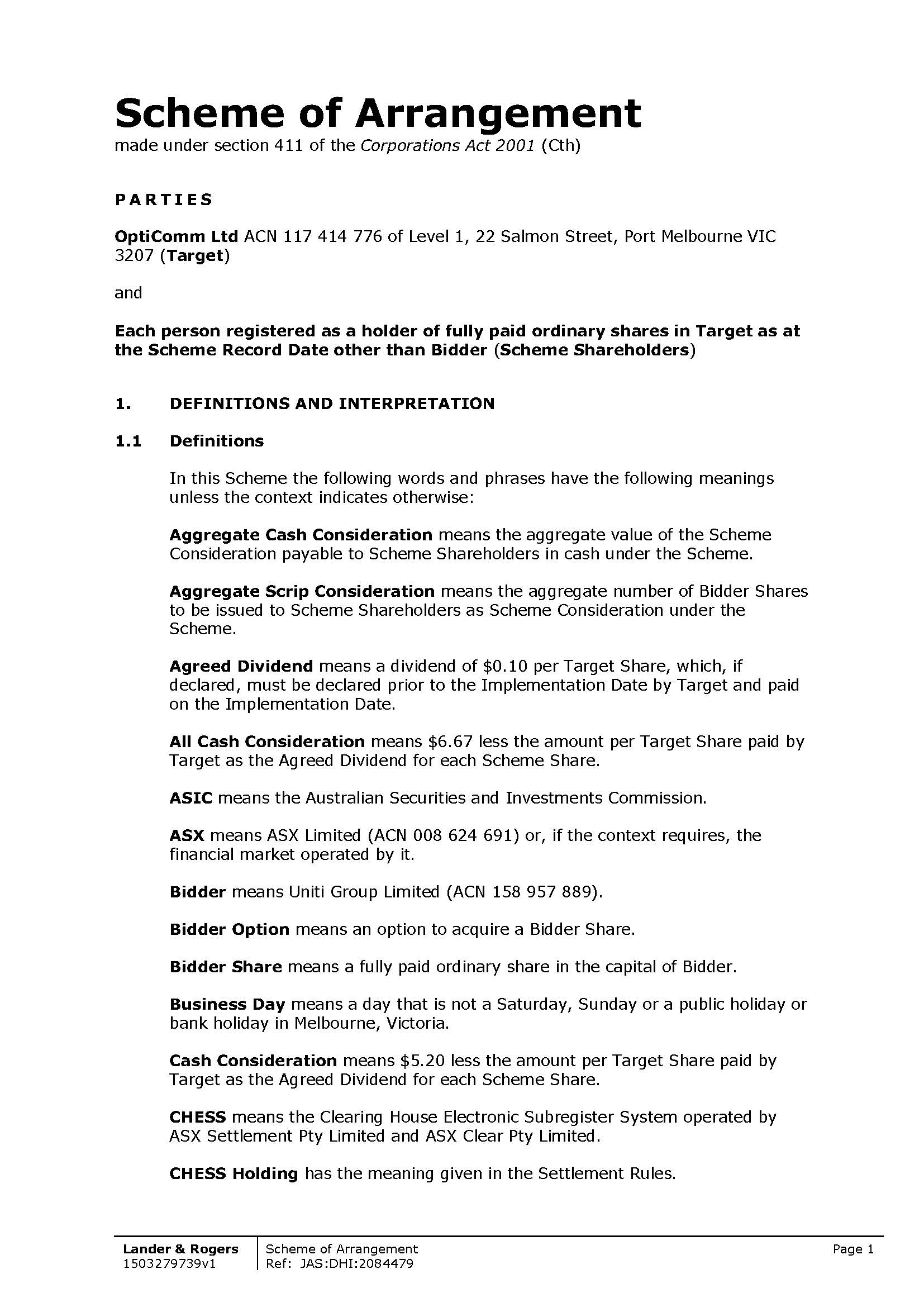
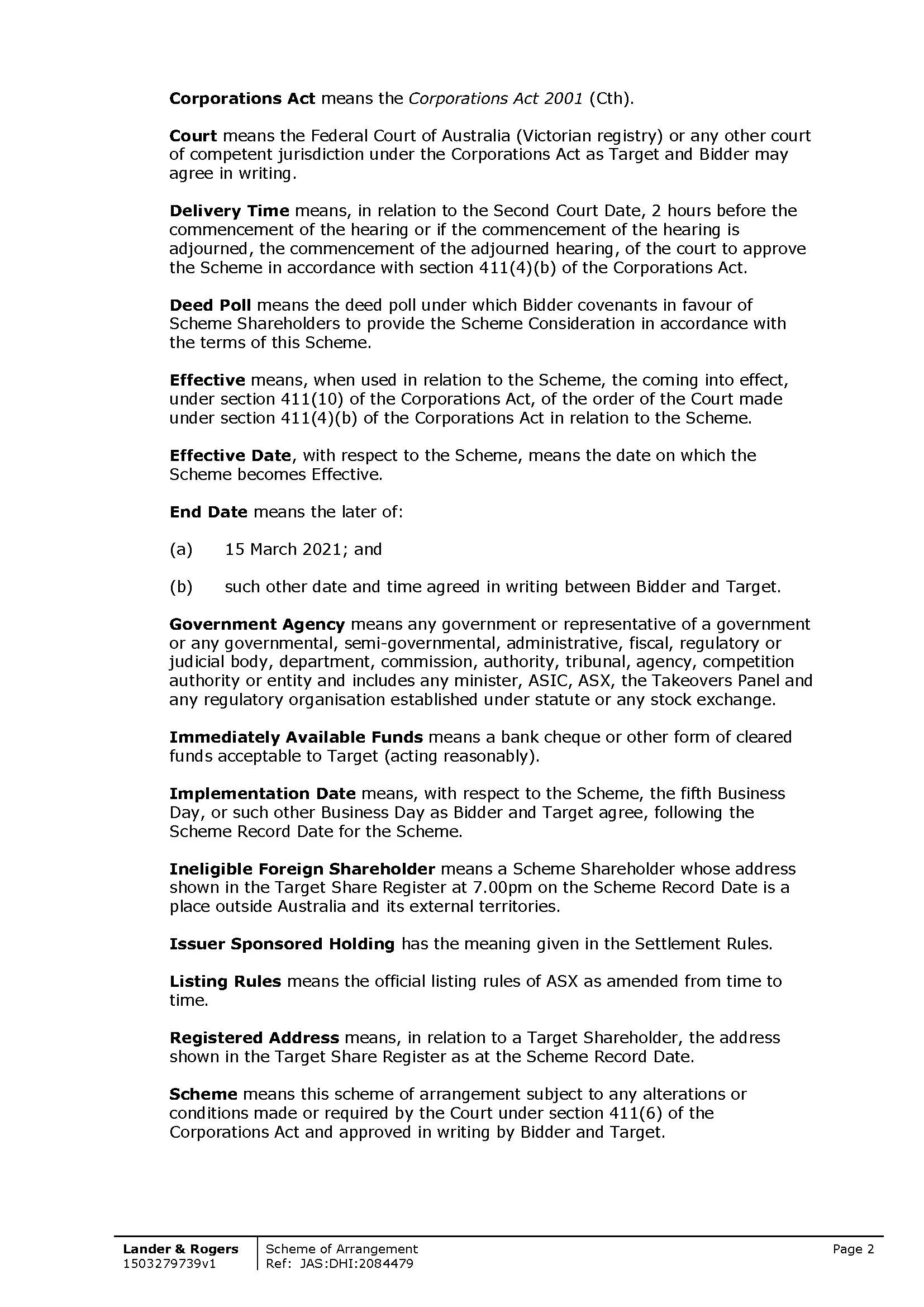
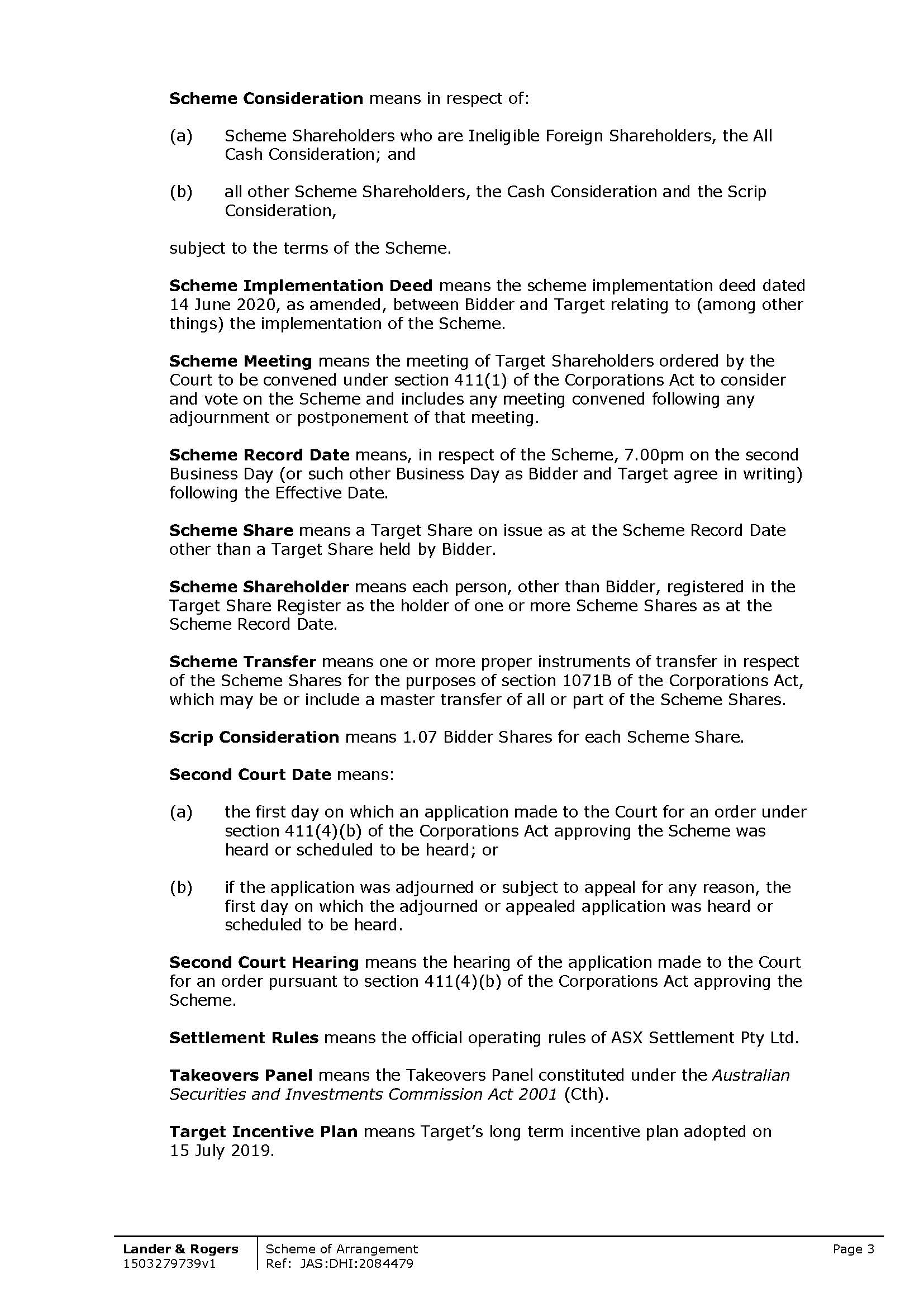
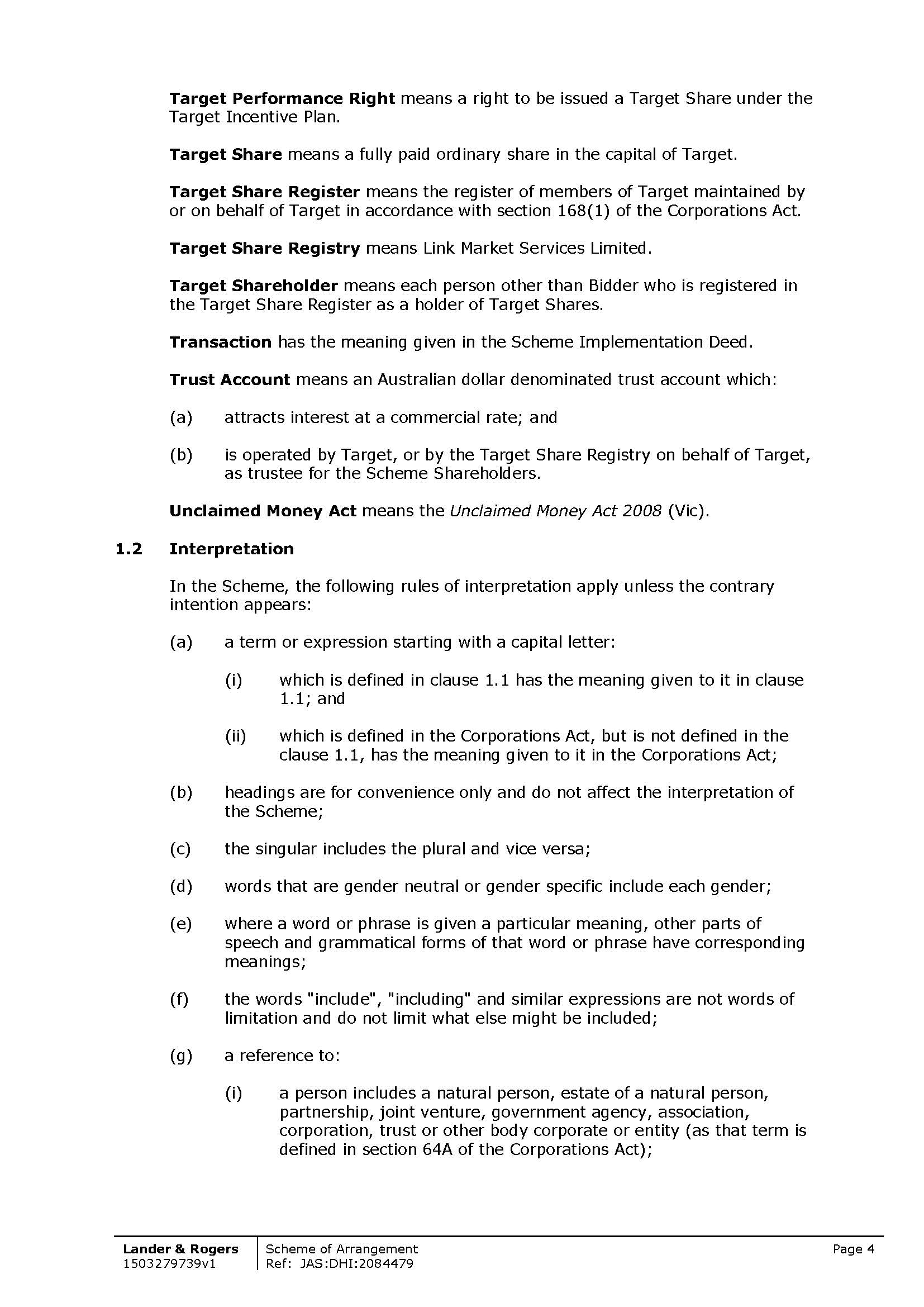
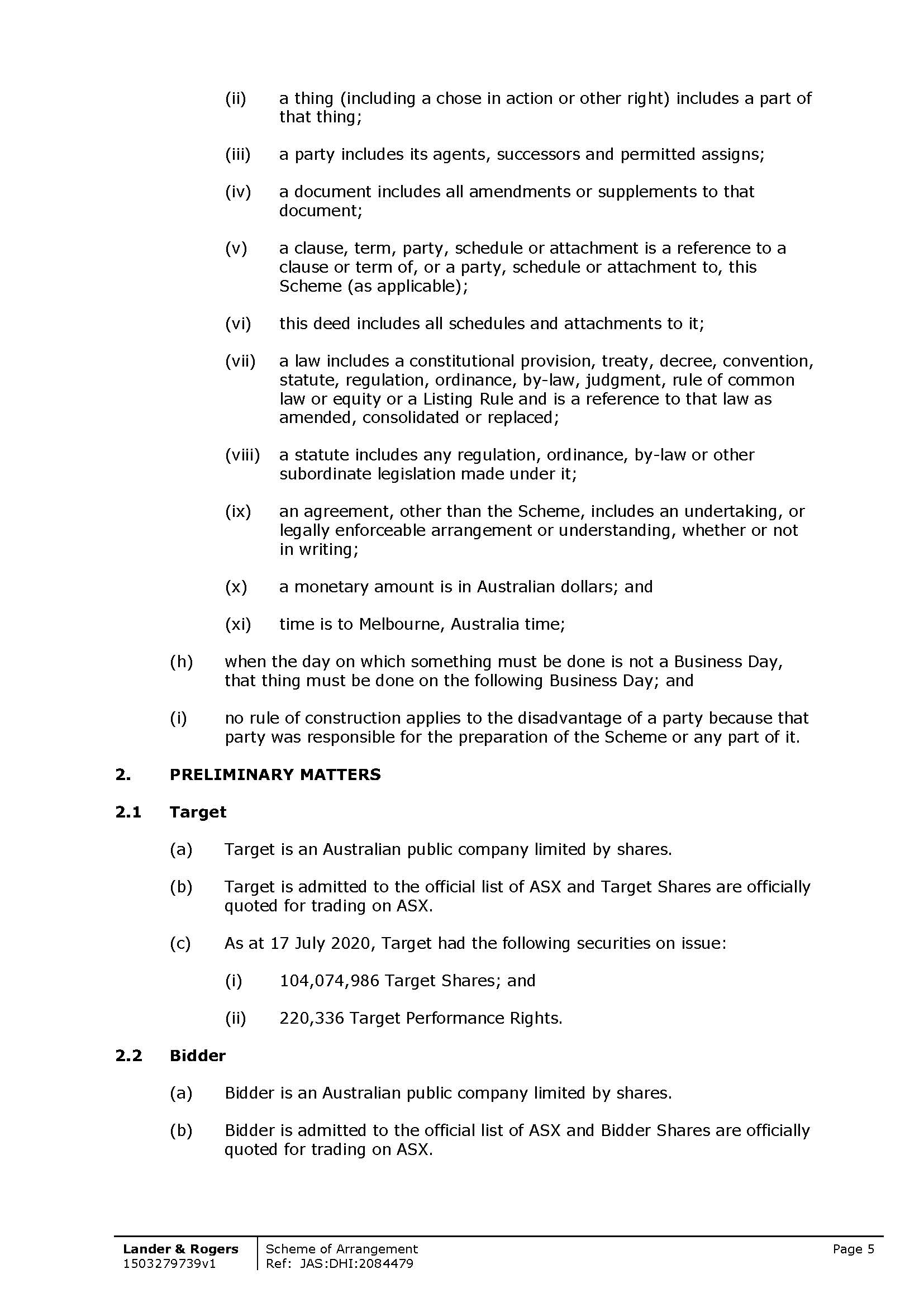
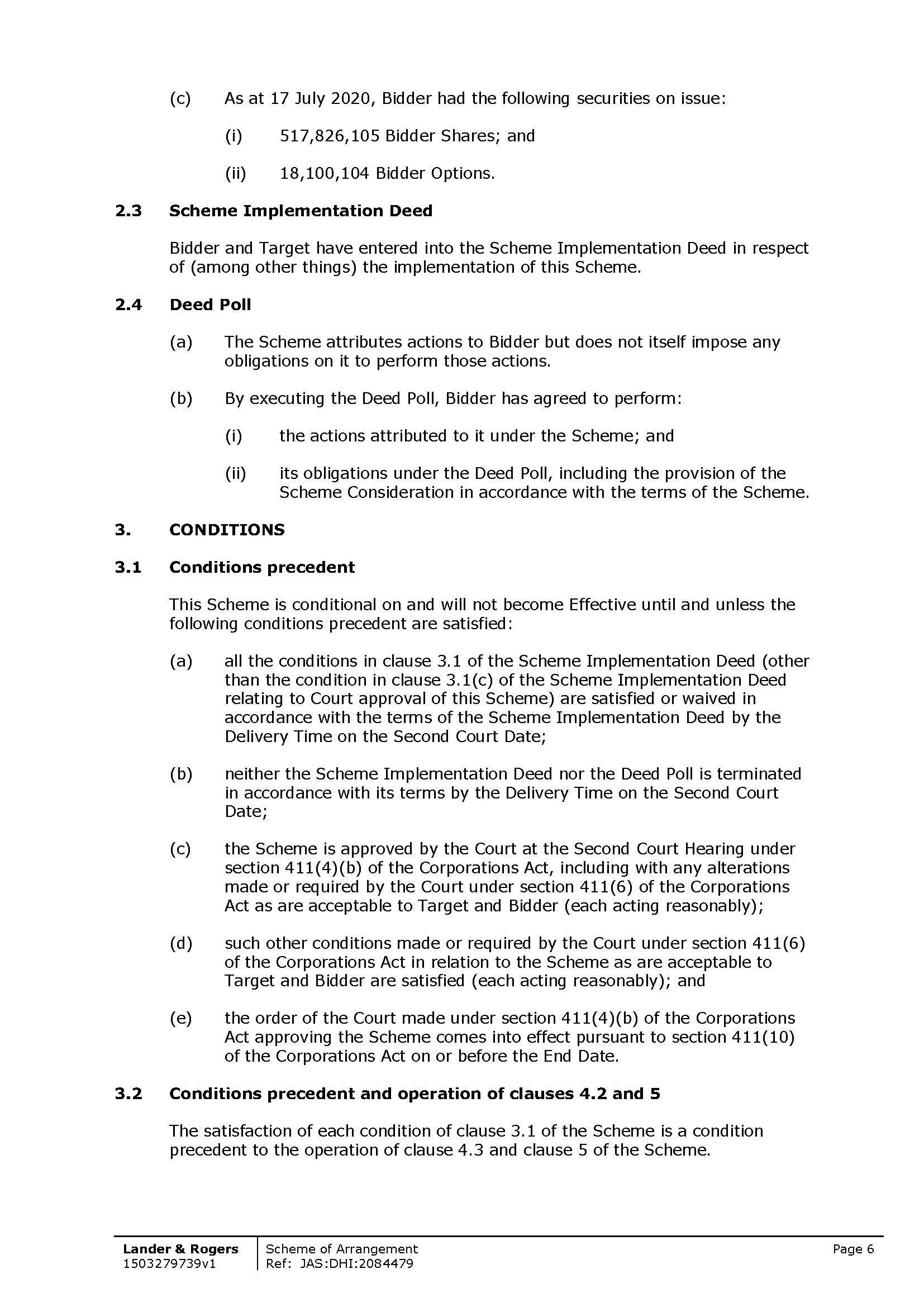
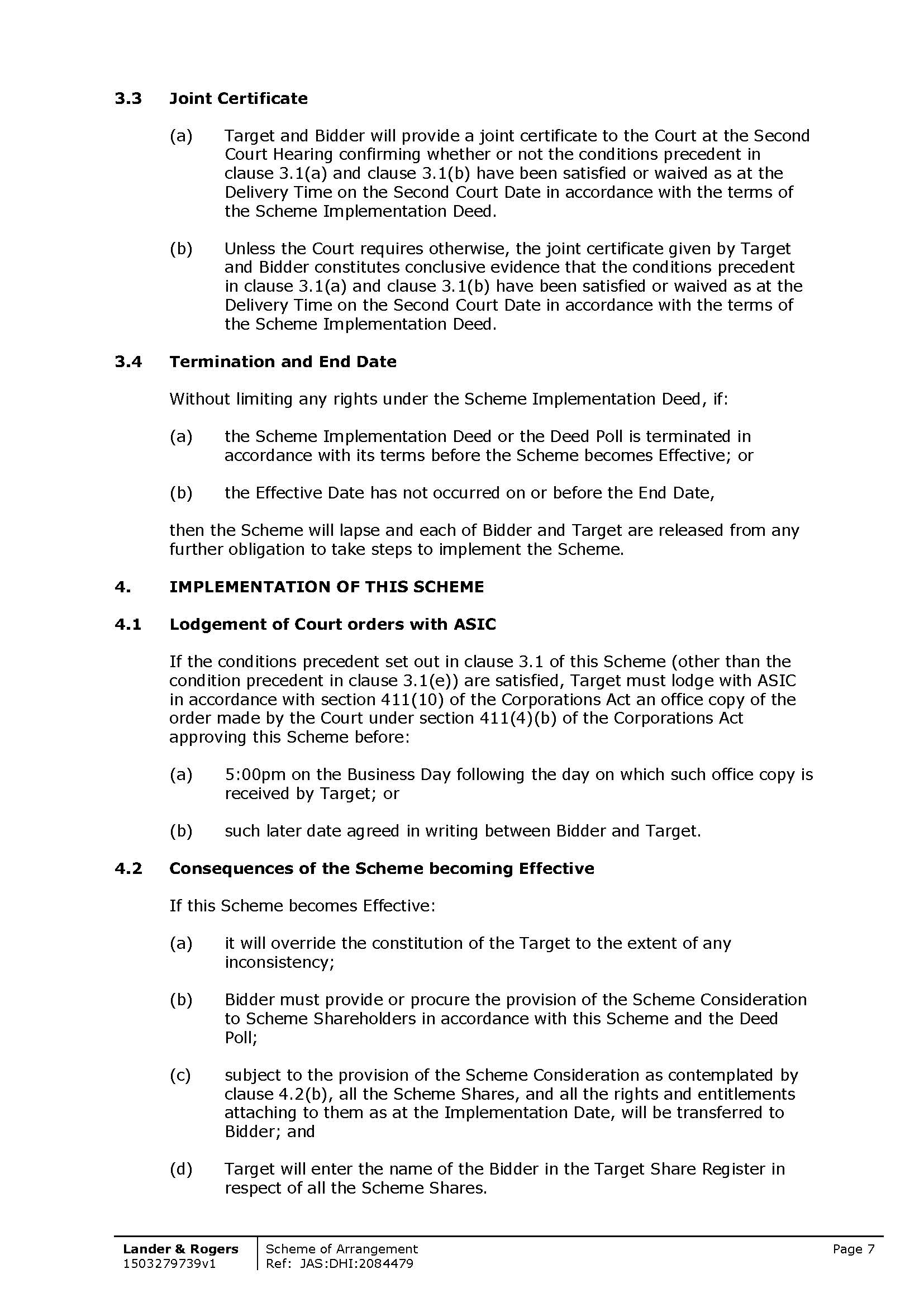
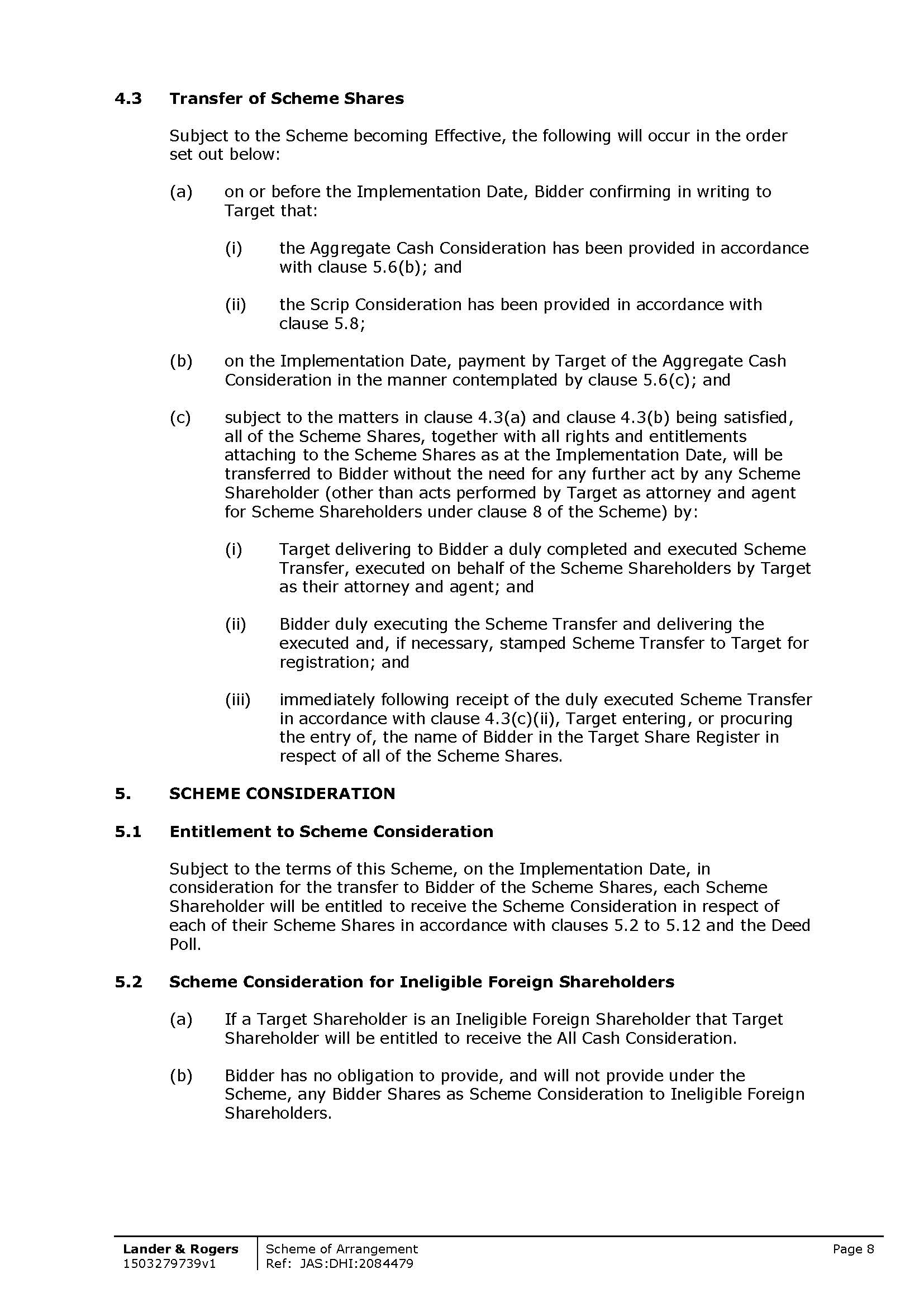
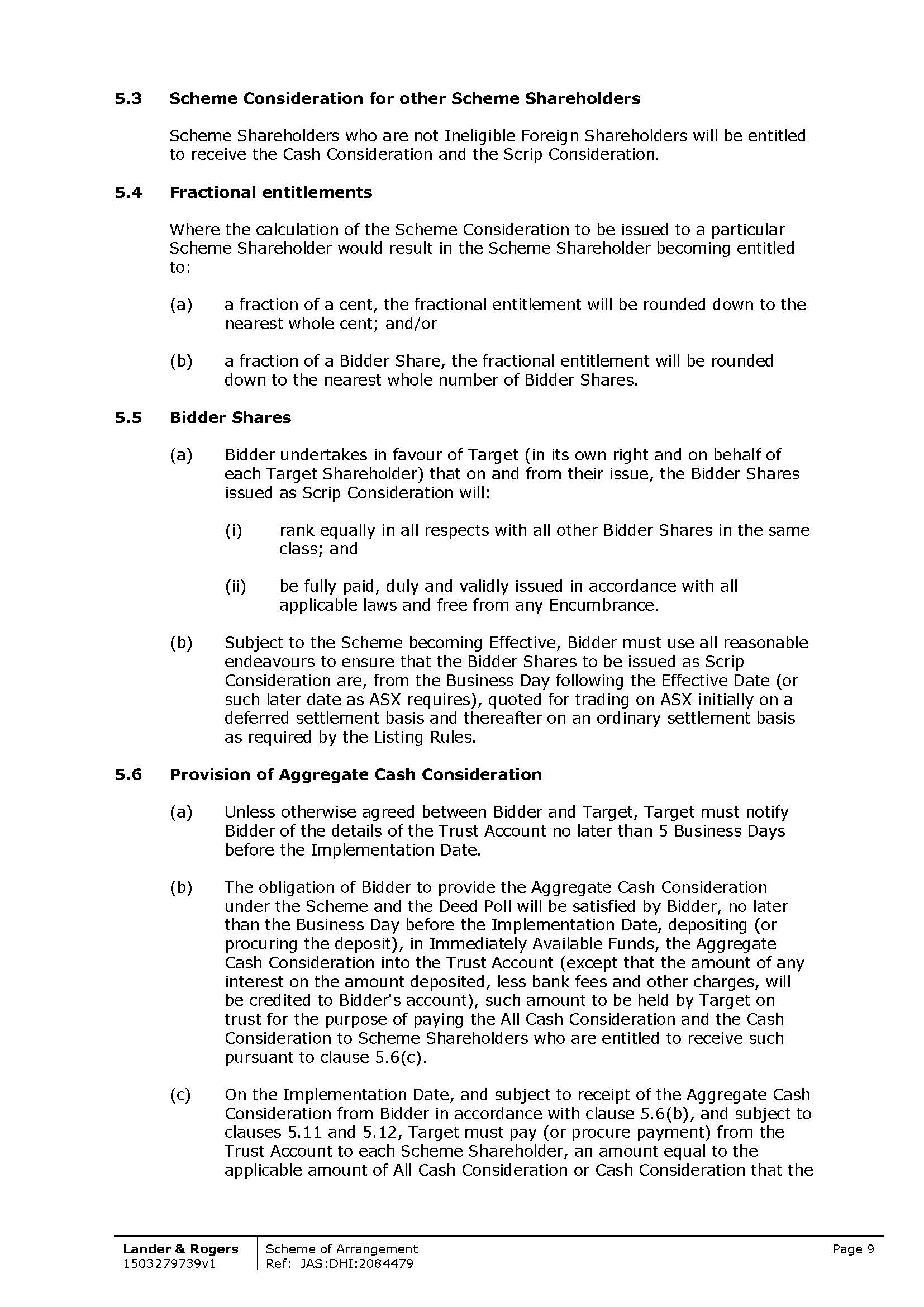
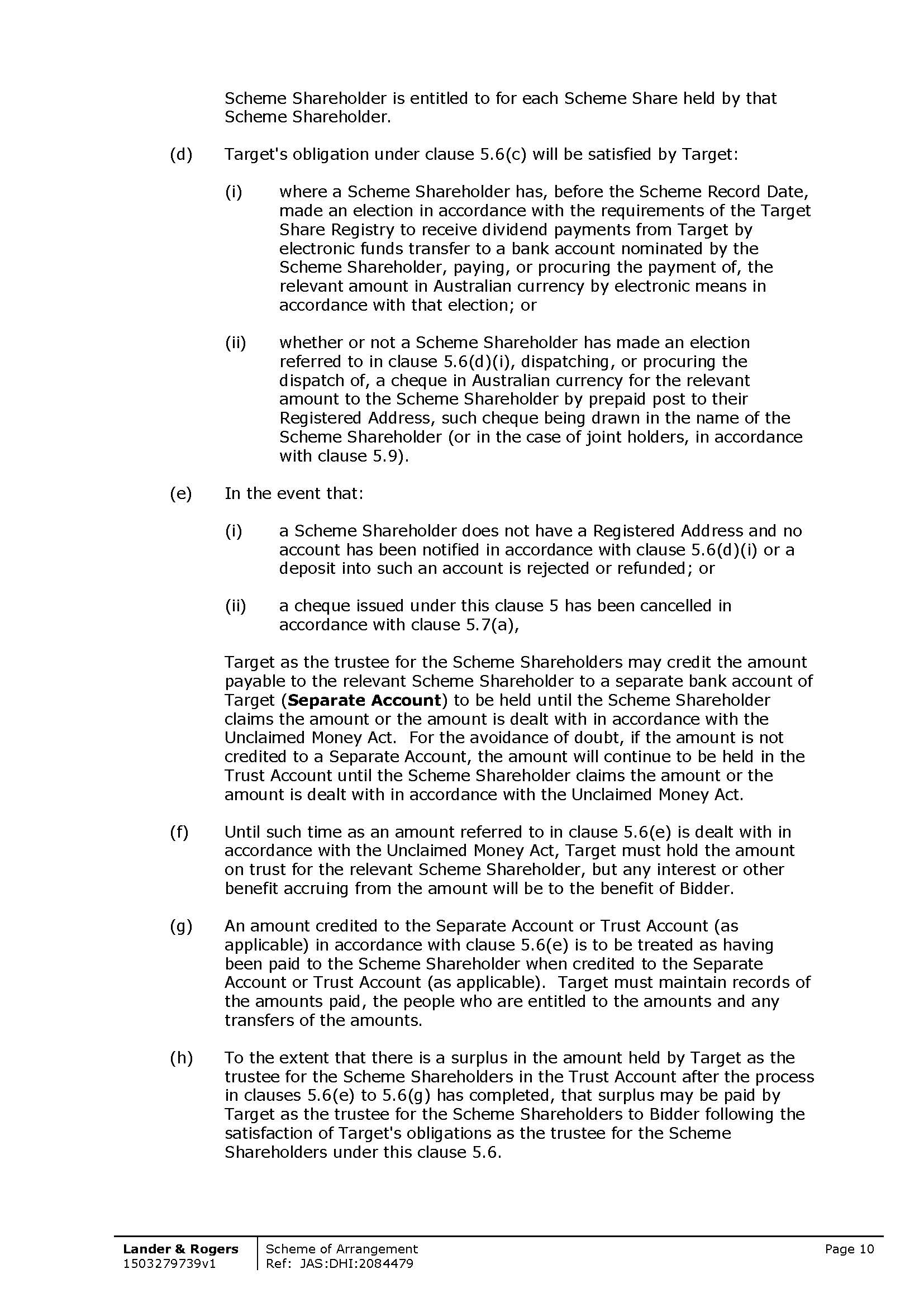
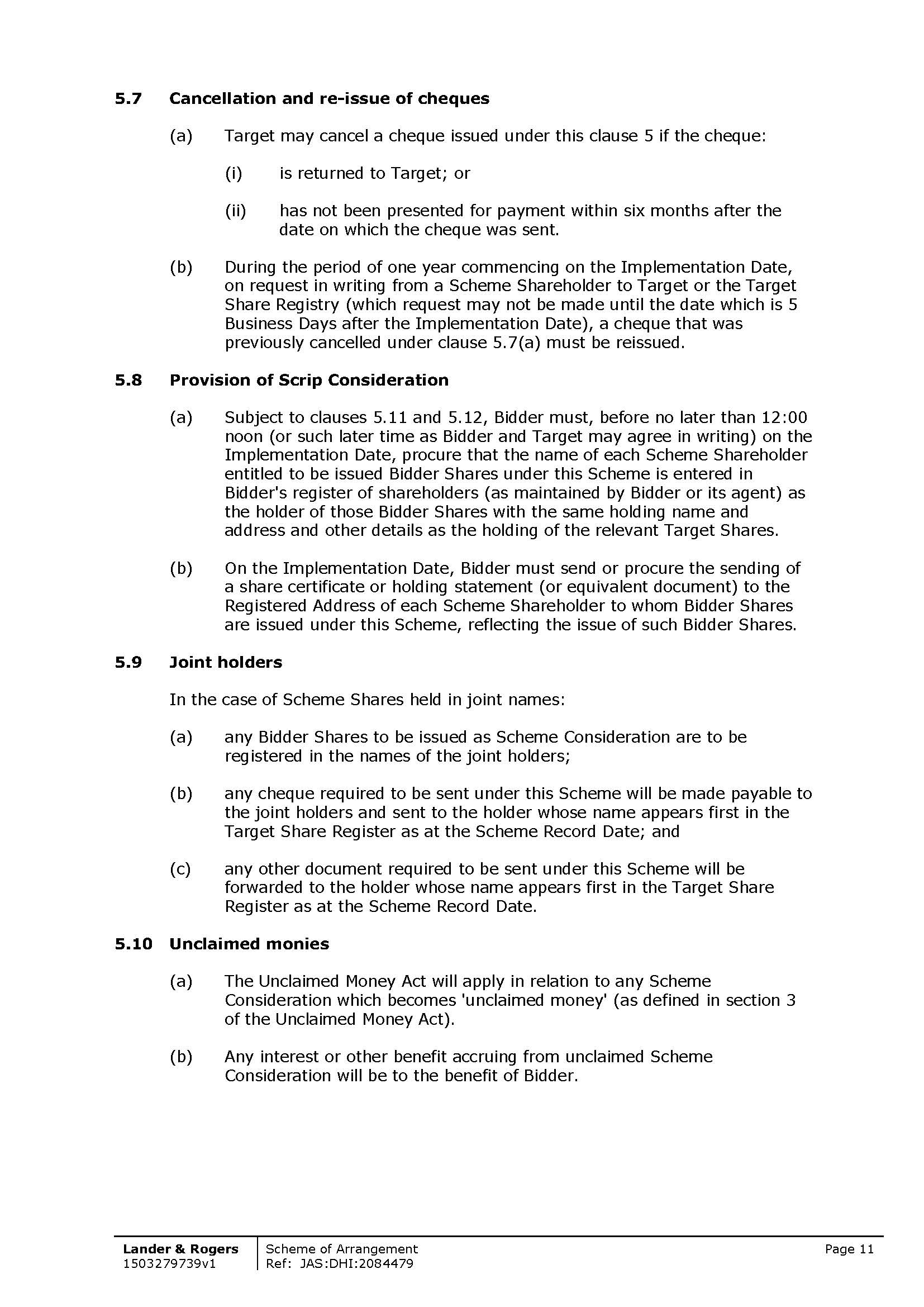
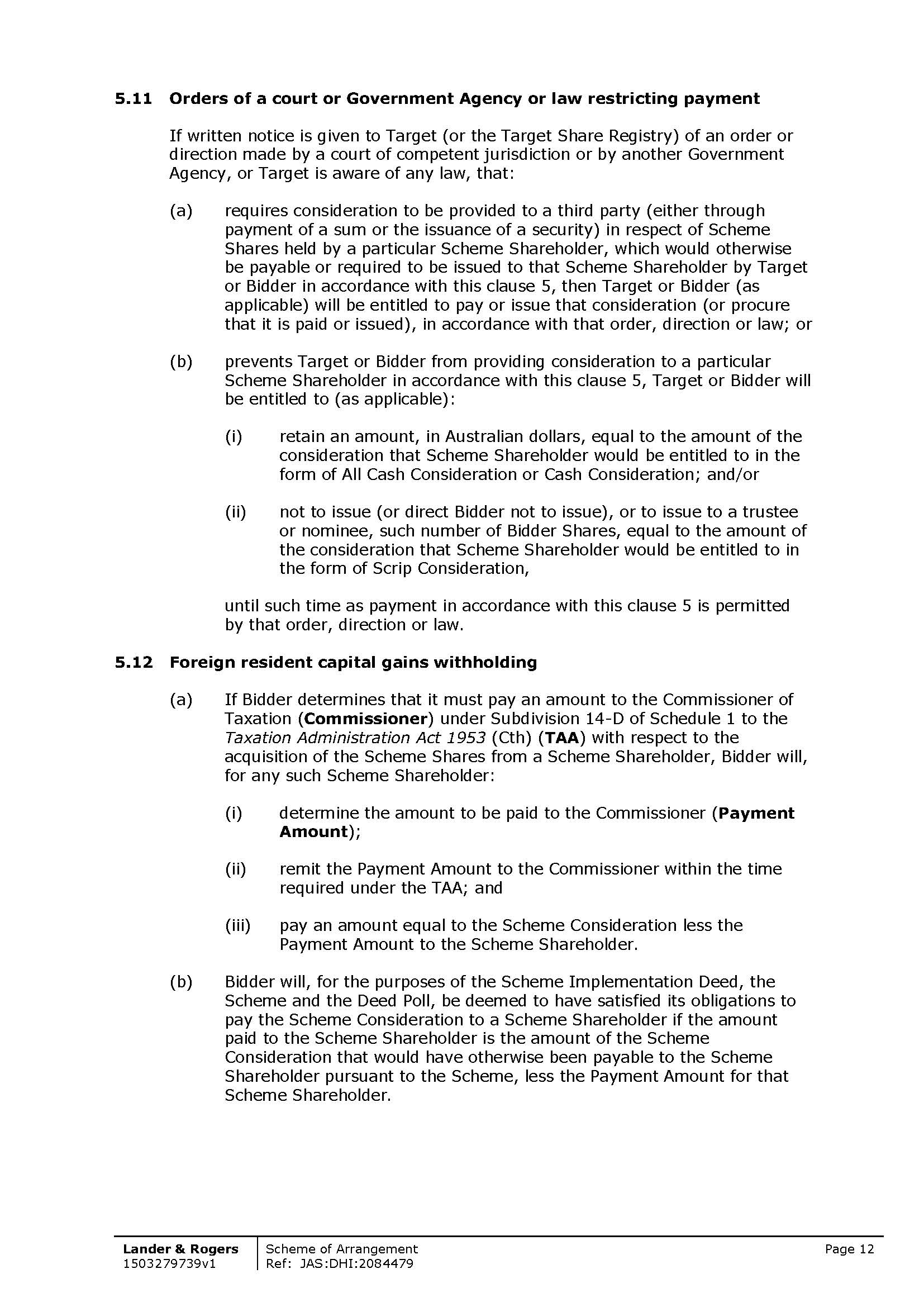
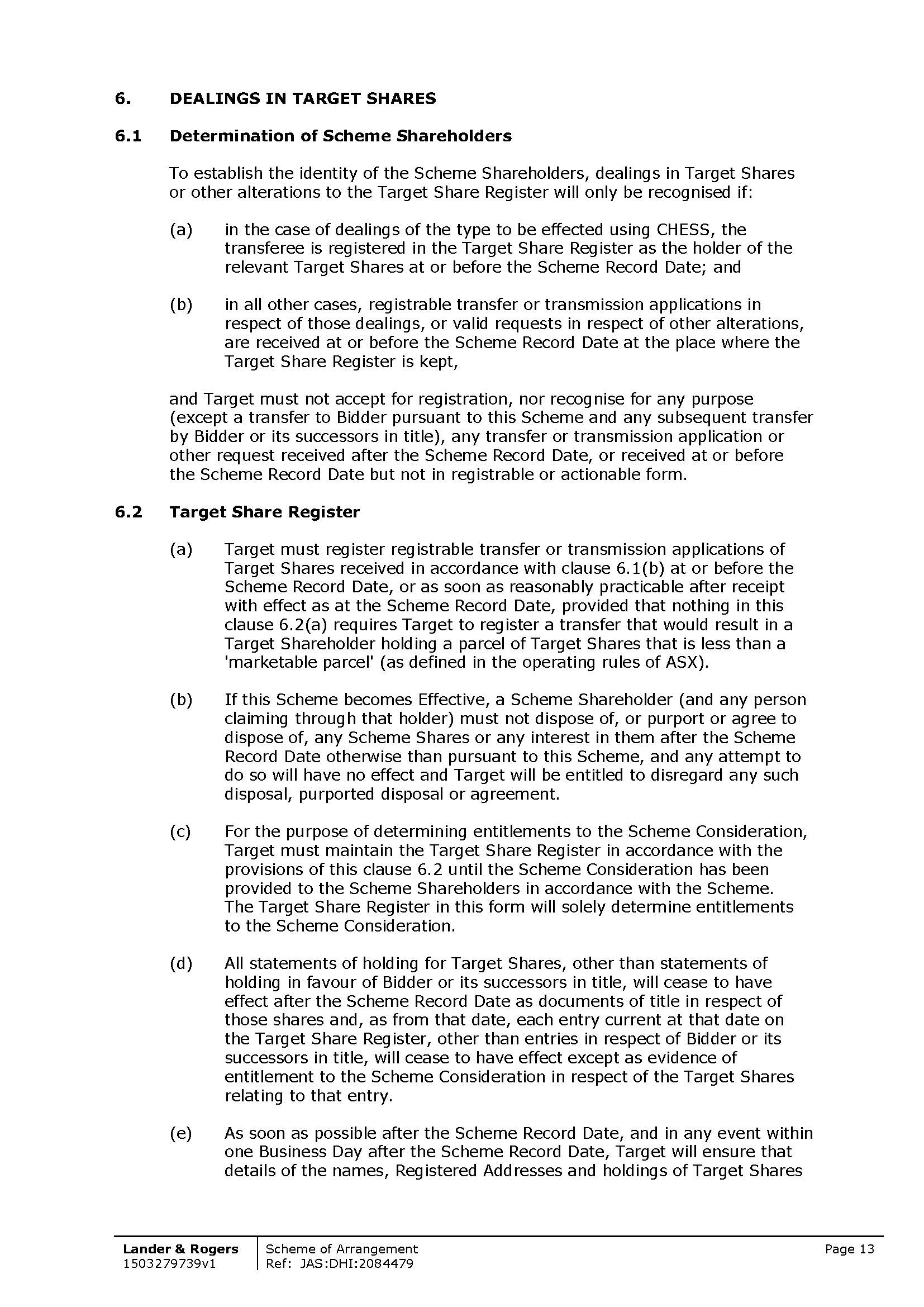
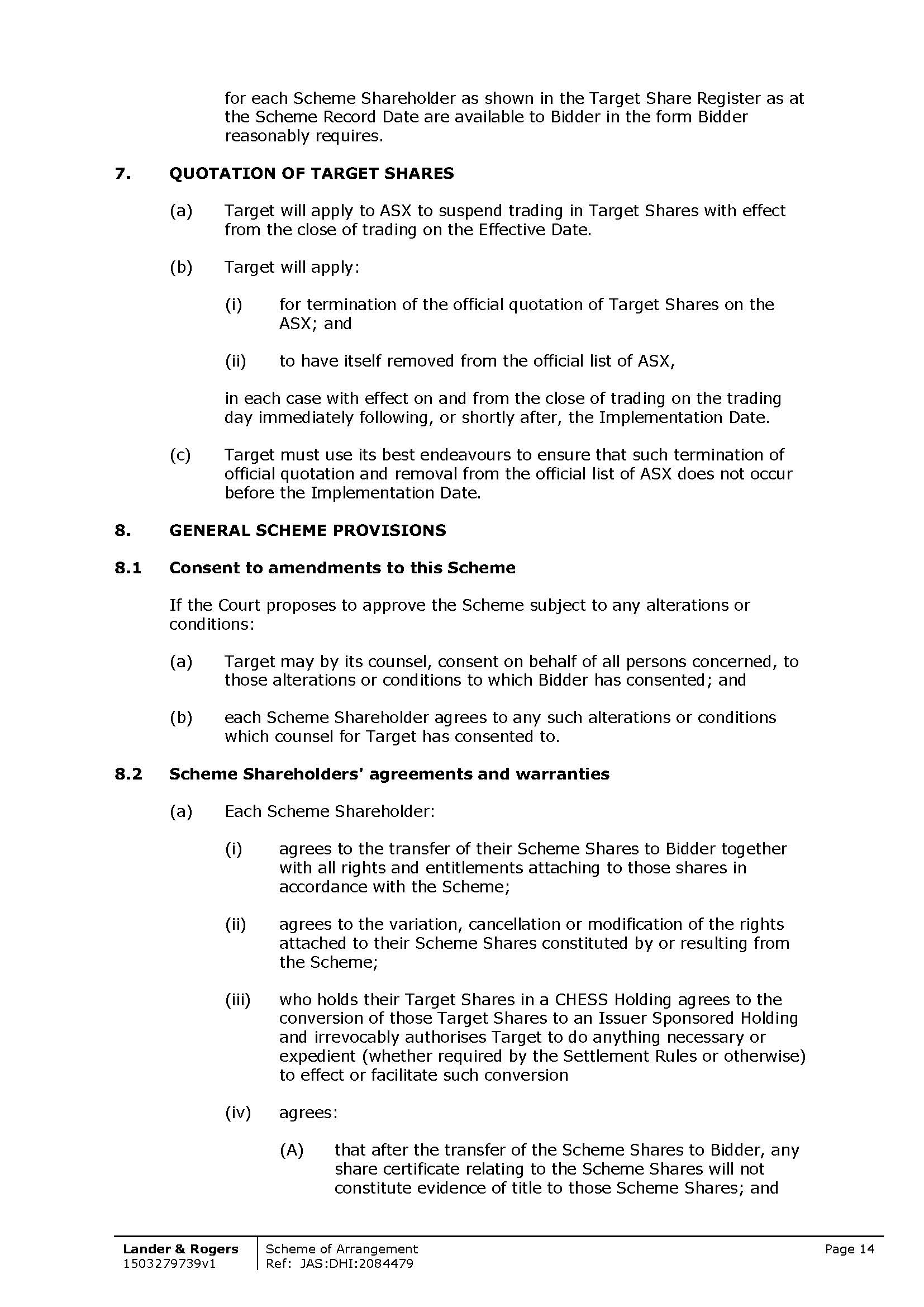
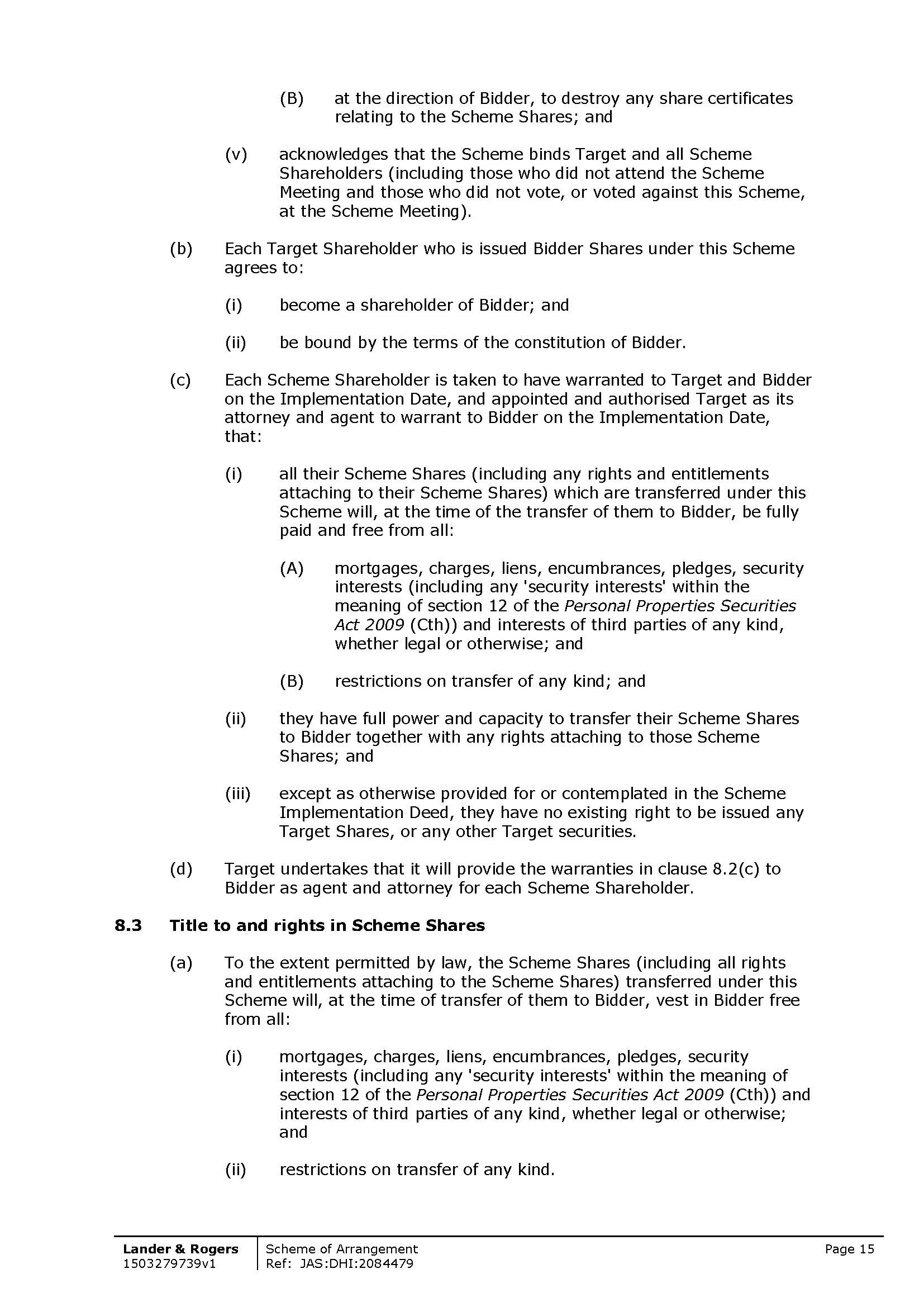
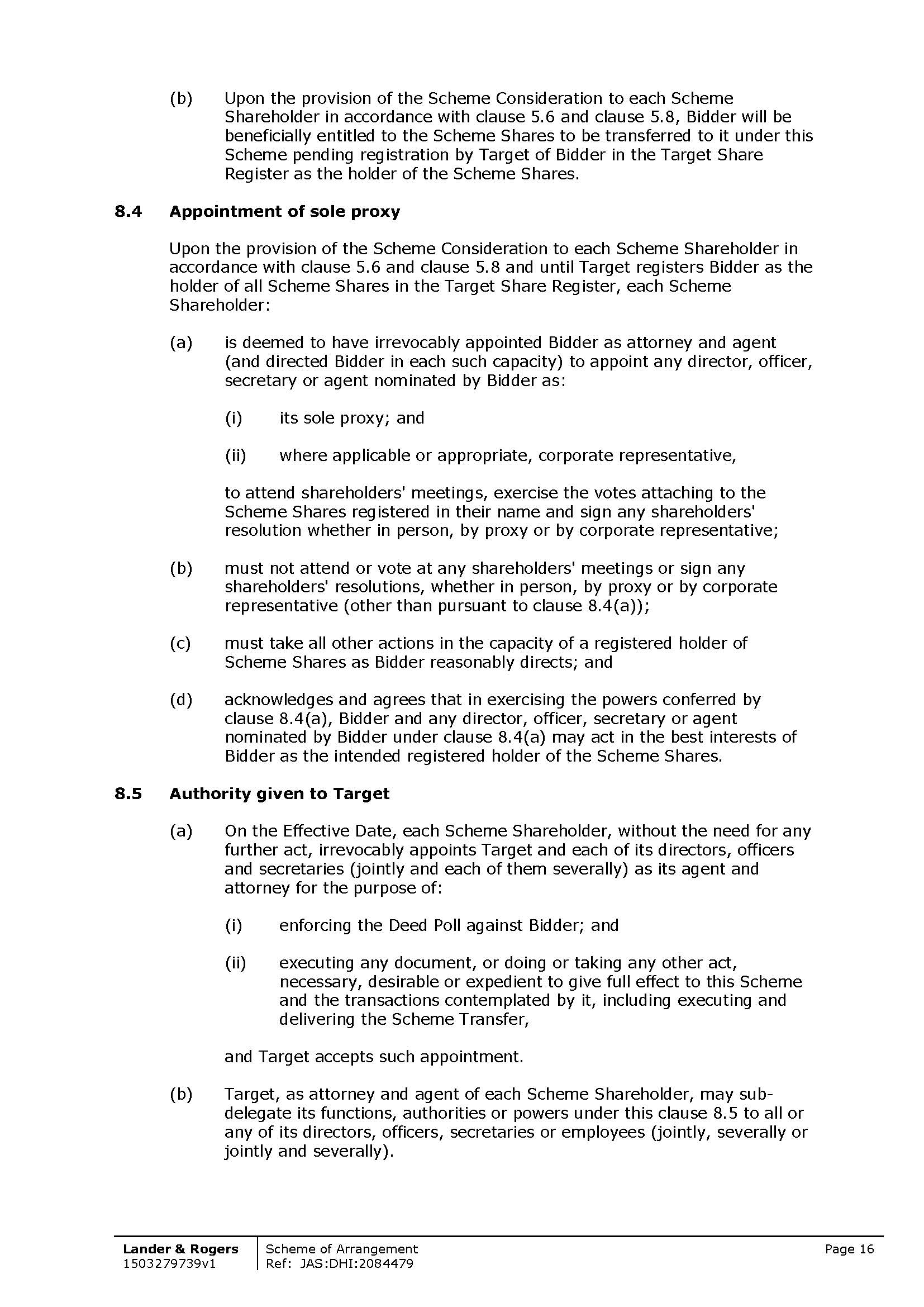
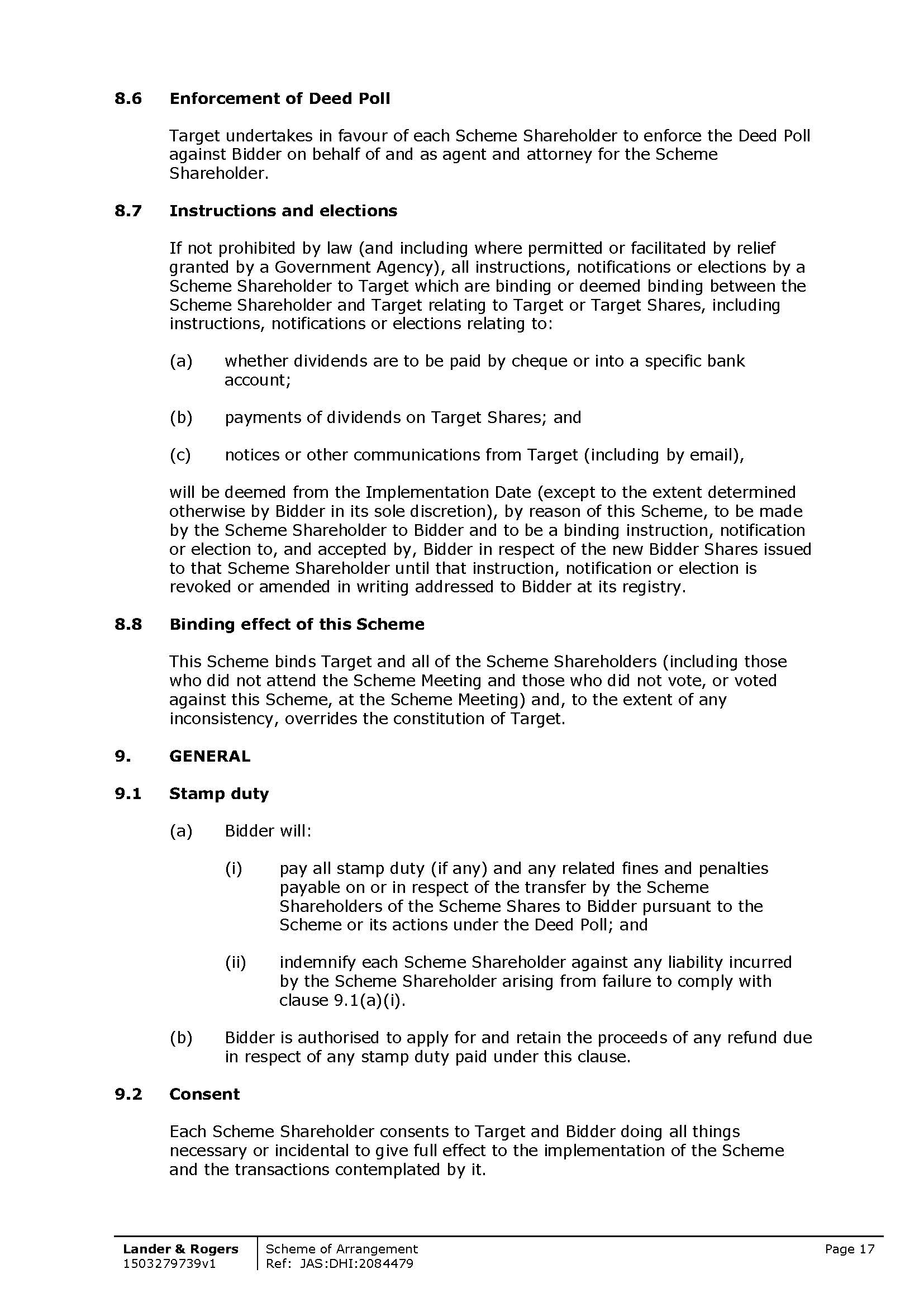
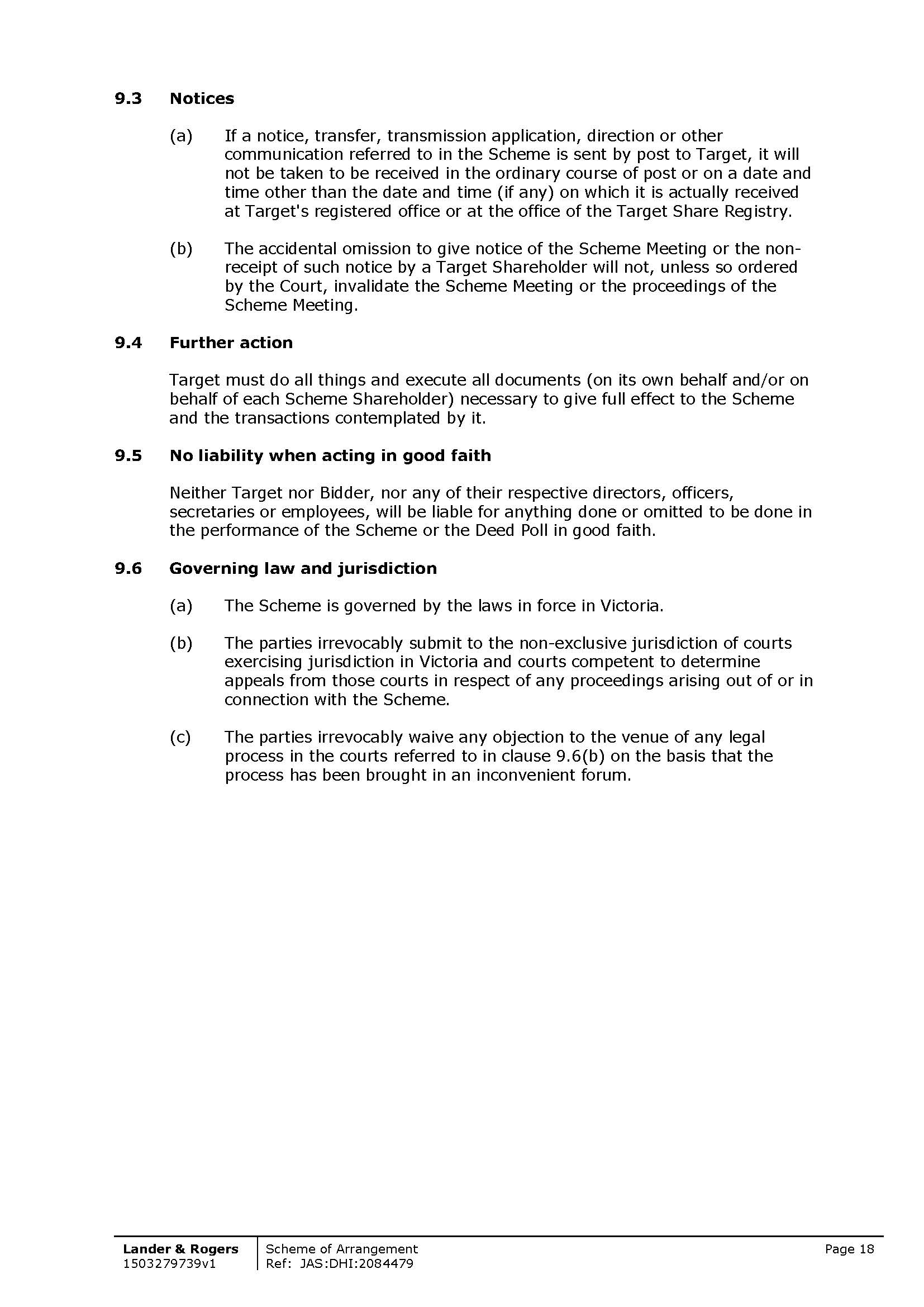
1. Pursuant to s 411(4)(b) of the Corporations Act 2001 (Cth) (the Act), the Scheme of Arrangement between the Plaintiff and its members, other than Uniti Group Limited ACN 158 957 889, agreed to by the said members at the meeting held on 6 November 2020 (the terms of which are as set out in Annexure A to these Reasons) (Scheme) be and is hereby approved.
2. Pursuant to s 411(12) of the Act, the Plaintiff be exempted from compliance with s 411(11) of the Act in relation to the Scheme.
Note: Entry of orders is dealt with in Rule 39.32 of the Federal Court Rules 2011.
ANDERSON J:
INTRODUCTION
1 On 22 October 2020, I made orders that the plaintiff, Opticomm Limited ACN 117 414 776 (OPC), reconvene the scheme meeting postponed by order made on 12 October 2020 for 11.00 a.m. (AEDT) on 6 November 2020 to be held as a virtual hearing.
2 OPC now seeks approval of the reconvened scheme of arrangement following the scheme meeting that was held on 6 November 2020.
3 The matter was called on before me on 12 November 2020. Mr Oakes SC appeared on behalf of OPC. Mr Greg Ahern of counsel appeared on behalf of Uniti Group Limited (ACN 158 957 889) (UWL). There were no appearances by any other party and it should be noted on the record that no person contacted the Court with a view to participating in the virtual hearing.
4 On 12 November 2020, I approved the scheme and made the orders sought by OPC. These are my reasons for doing so.
EVIDENCE FOR THE SECOND COURT HEARING
5 In addition to the affidavit evidence previously tendered (which is voluminous and available on the Court file), OPC read the following material:
(1) affidavit of Tim Sayer, partner of Talbot Sayer Lawyers (solicitors for OPC), filed on 11 November 2020 (Sayer Affidavit);
(2) affidavit of Allan Brackin, non-executive director and chair of OPC and chair of the Scheme Meeting, filed on 11 November 2020 (Brackin Affidavit);
(3) affidavit of Jim Kompogiorgas, client relationship manager of Link Market Services, filed on 11 November 2020 (Kompogiorgas Affidavit); and
(4) a “wrap-up” affidavit of Rachel Treasure sworn 12 November 2020 and filed following receipt of ASIC’s second court hearing letter (Treasure Affidavit).
6 Attached to OPC’s submissions was a draft of the orders OPC seeks at the Second Court Hearing.
7 The procedural matters to be addressed for approval of the Scheme and the evidence of those matters are as follows:
Matter to be proved | Evidence |
Proof of lodgement with ASIC of the first court hearing order of 7 August 2020 | Sayer Affidavit, [5] |
Proof of registration of scheme booklet with ASIC | Sayer Affidavit, [8] |
Proof of service of the scheme booklet and supplementary scheme booklets on members | Kompogiorgas Affidavit, [10]-[40] |
Identification of changes to the scheme booklet since the first court hearing | Sayer Affidavit, [7] |
Identification of changes to the first supplementary scheme booklet since the directions hearing on 25 September 2020 | Sayer Affidavit, [10] |
Identification of changes to the second supplementary scheme booklet since the directions hearing on 22 October 2020 | Sayer Affidavit, [11] |
Proof of receipt of proxy forms and collation of proxies | Kompogiorgas Affidavit, [42]-[47] |
Proof of holding of the scheme meeting and obtaining of necessary majorities | Brackin Affidavit, [5]-[11] Kompogiorgas Affidavit, [59] |
Proof of advertising of the scheme approval application | Sayer Affidavit, [12] |
Proof of no notice of intention to appear at the Second Court Hearing | Sayer Affidavit, [14] |
Proof of ASIC’s position in relation to the Second Court Hearing | Treasure Affidavit, [5] |
Proof of satisfaction or waiver of conditions precedent | Treasure Affidavit, [7] |
8 At the reconvened scheme meeting of OPC shareholders other than UWL held on 6 November 2020 (Scheme Meeting), the resolutions to amend the Scheme and approve the Scheme as amended were passed by 99.99% of votes cast and by 96.03% of Eligible Shareholders present and voting: Kompogiorgas Affidavit, [59].
THE SCHEME
9 The commercial purpose of the Scheme is to provide for the acquisition of all the shares of OPC by UWL, other than those shares already owned by UWL.
10 The Scheme provides for the transfer to UWL of all OPC shares other than those held by UWL, for a mixture of cash and scrip consideration (Scheme Consideration), except for those shares held by ineligible foreign shareholders, as follows:
(1) $5.10 cash per OPC share; and
(2) 1.07 new UWL shares per OPC share (which implies $1.4659 per OPC share calculated on the basis of the closing trading price of UWL shares on 14 October 2020, being $1.37).
See scheme of arrangement, Appendix C of the Second Supplementary Scheme Booklet (Scheme Document), cl 5.
11 Ineligible foreign shareholders will receive the all cash consideration of $6.57 per OPC share.
12 Additionally, OPC declared on 6 November 2020 that it will pay a fully franked special dividend of $0.10 per OPC share (Special Dividend), conditional upon the Scheme becoming effective, on 20 November 2020 (Special Dividend Payment Date): see Brackin Affidavit, [19].
13 Accordingly, if the Scheme is approved by the Court and becomes effective:
(1) OPC shareholders who are on the share register on the record date for the Special Dividend (being 17 November 2020) will be paid the Special Dividend;
(2) Eligible Shareholders who are on the share register on the record date for the Scheme (being 17 November 2020) will receive the Scheme Consideration; and
(3) all OPC shares other than those held by UWL will be transferred to UWL such that OPC will be wholly owned by UWL and it is intended that OPC be de-listed from the Australian Stock Exchange.
relevant principles
14 The role of the Court at the Second Court Hearing was recently summarised by Beach J in Re Amcor (No 2) [2019] FCA 842 (Re Amcor) at [7]-[11]:
Let me say something about my power under s 411(4)(b) to approve the Scheme. In essence, my role at the second court hearing is to assess the Scheme taking into account whether the Scheme is sufficiently fair and reasonable such that an intelligent and honest shareholder properly informed and acting alone might approve it. Of course, I can only approve a scheme of arrangement if the requisite majority of shareholders vote in favour of it, but I am not bound to approve the Scheme simply because I previously made orders for the convening of a Scheme meeting and subsequently the requisite majority agreed to it. But I accept that shareholders voting collectively at the Scheme meeting are better judges than I of what is to their commercial advantage and in their interests and accordingly, absent good reason, I should give effect to their intentions.
Now whilst there is no exhaustive statement of the matters as to which I must be satisfied before granting approval, it is not in doubt that in exercising my power under s 411(4)(b), I should be satisfied that:
(a) the Scheme complies with the law, including the relevant procedural requirements;
(b) the Scheme was approved by shareholders acting in good faith and for proper purposes;
(c) there has been an accurate and comprehensive disclosure of the details of the Scheme and its effect to those voting on it;
(d) there is no suggestion of oppression of any minority;
(e) there is no evidence that any third parties will be disproportionately adversely affected by the operation of the Scheme;
(f) the Scheme does not offend against any aspect of public policy; and
(g) all matters that could be considered relevant to the exercise of my discretion have been drawn to my attention.
I also need to be satisfied that the conditions precedent to the Scheme have been met, save for Court approval, and that ASIC has been given the opportunity to draw to my attention any relevant matter(s). I would say now that I am so satisfied concerning the conditions precedent, the last of which was satisfied on 31 May 2019. Moreover, ASIC has had an adequate opportunity to draw any necessary matters to my attention beyond what it drew to my attention for the purposes of the first court hearing. I will discuss any relevant Ch 6 question and s 411(17) later.
In considering whether the Scheme complies with the law, including the relevant procedural requirements, I need to satisfy myself that the procedural and other requirements in the Act, Corporations Regulations 2001 (Cth) and Federal Court (Corporations) Rules 2000 (Cth) have been complied with and that the requirements for a valid resolution of the shareholders have been satisfied. I am so satisfied, including being satisfied that the Scheme materials have been properly despatched in accordance with my orders and that the resolution agreeing to the Scheme has been passed by the statutory majorities required by s 411(4)(a).
Now as I have said, my task is to consider whether the Scheme is fair and reasonable with the test of fairness and reasonableness including a consideration of whether “an intelligent and honest [shareholder], properly informed, acting alone, might approve [the scheme]” (Fowler v Lindholm (2009) 178 FCR 563 at [79] per Emmett, Gordon and Jagot JJ). But the Scheme shareholders’ vote in favour of the Scheme is evidence of its inherent fairness. Put another way, if a majority of the Scheme shareholders have approved the Scheme, it is unlikely that the Scheme would be unreasonable. Further, I do not have to be satisfied that no better Scheme could have been devised.
15 Similarly, in a decision in the Supreme Court of Western Australia in Re Wesfarmers Ltd; Ex Parte Wesfarmers Ltd [No 2] [2018] WASC 357 (Wesfarmers), Vaughan J at [13] and [15] stated:
13. The role of the court in approving a scheme of arrangement is supervisory. The court has a discretion whether to approve a scheme and is not bound to approve merely because it previously made an order to convene the scheme meeting or because the statutory majorities have been achieved. However, the court will usually approach its task on the basis that the members are better judges of what is in their own commercial interests than the court.
…
15. The function of the court does not extend to usurping the views of the shareholders. However, the court is not a mere rubber stamp and will look at the arrangement to ensure that it is a reasonable one. In doing so the court is primarily concerned with whether the proposal is ‘fair and reasonable’ in the sense described in the second factor mentioned in the preceding paragraph. In that respect the court does not determine that the scheme is intrinsically in the members’ interest or otherwise. The court ought only require satisfaction that the arrangement is one which is capable of being accepted.
16 Adopting and applying the principles stated above in Re Amcor and Wesfarmers, the Court’s task at the Second Court Hearing is twofold. First, the Court should ensure that all statutory and procedural requirements in relation to s 411 of the Corporations Act 2001 (Cth) (Act) have been observed. Second, the Court must determine, in the exercise of its discretion, whether to approve the Scheme.
17 OPC submits that it has satisfied all relevant procedural and statutory requirements in respect of the Scheme, and that it is appropriate for the Court to exercise its discretion in favour of approving the Scheme.
STATUTORY AND PROCEDURAL REQUIREMENTS
18 The main statutory and procedural requirements in relation to s 411 of the Act are as follows:
(1) compliance with the orders convening the scheme meeting and with the Federal Court Rules 2011 (Cth);
(2) compliance with the disclosure obligations under s 412(1) of the Act;
(3) passing of the approval resolution by the requisite majorities required by s 411(4)(a)(ii) of the Act;
(4) satisfaction of conditions precedent; and
(5) satisfaction of s 411(17) of the Act.
19 As to these requirements:
(1) an originating process was filed on 17 June 2020;
(2) it has been shown that OPC is a Part 5.1 Body: Affidavit of Allan Brackin filed on 4 August 2020, [5];
(3) 96.03% of Eligible Shareholders present and voting voted in favour of the scheme resolutions and 99.99% of all votes cast were in favour: Kompogiorgas Affidavit, [59];
(4) the Scheme Booklet has been registered by ASIC (ASIC did not require registration of the Supplementary Scheme Booklet or Second Supplementary Scheme Booklet): Sayer Affidavit, [8] and [9];
(5) the typesetting and printing of the Scheme Booklet, Supplementary Scheme Booklet, and Second Supplementary Scheme Booklet (Scheme Booklets) have been duly executed: Kompogiorgas Affidavit, [10]-[40];
(6) the Scheme Booklets substantially in the form approved by the Court were dispatched to OPC shareholders: Kompogiorgas Affidavit, [10]-[40];
(7) the Scheme Meeting was held in accordance with the orders of the Court: Brackin Affidavit, [5]-[11];
(8) service of the notice of meeting and its adjourned dates was given: Kompogiorgas Affidavit, [10]-[40];
(9) an advertisement was placed advising of the Second Court Hearing (noting that it bears an incorrect reference to the Second Court Hearing being on a Tuesday rather than A Thursday, but the hearing date was otherwise correct): Sayer Affidavit, [12];
(10) no notification of intention to appear was received: Sayer Affidavit, [14];
(11) ASIC provided a letter dated 11 November 2020 indicating that it had no objection to the approval of the Scheme: Treasure Affidavit, [5] and exhibit “RT-6” to the Treasure Affidavit;
(12) the deed poll has been duly executed by UWL: Scheme Booklet, Annexure D. It was agreed between the parties that the initial deed poll would apply to the revised scheme in the further amended and restated scheme implementation deed, which appears at pages 62-167 of exhibit “AB-3” to the affidavit of Allan Brackin filed on 20 October 2020;
(13) the implementation of the Scheme was contingent on a number of conditions precedent being satisfied or waived as at 7:30am on 12 November 2020. At the hearing, OPC tendered a certificate under cl 3.3 of the Scheme Document stating that all of the relevant conditions precedent had been satisfied, other than the condition relating to Court approval of the Scheme: Treasure Affidavit, [7]. A copy of the certificate is contained within exhibit “RT-6” to the Treasure affidavit;
(14) the independent expert’s reports stated that the Scheme is fair and reasonable and in the best interests of OPC shareholders: Scheme Booklet, Appendix A; Supplementary Scheme Booklet, Appendix A; Second Supplementary Scheme Booklet, Appendix A.
SECTION 411(17): STATEMENT IN WRITING FROM ASIC
20 Section 411(17) of the Act provides:
The Court must not approve a compromise or arrangement under this section unless:
(a) it is satisfied that the compromise or arrangement has not been proposed for the purpose of enabling any person to avoid the operation of any of the provisions of Chapter 6; or
(b) there is produced to the Court a statement in writing by ASIC stating that ASIC has no objection to the compromise or arrangement;
but the Court need not approve a compromise or arrangement merely because a statement by ASIC stating that ASIC has no objection to the compromise or arrangement has been produced to the Court as mentioned in paragraph (b).
21 ASIC has provided a statement in writing under s 411(17)(b) of the Act (Statement) dated 11 November 2020: Treasure Affidavit, [5]. A copy of that document is contained within exhibit “RT-6” of the Treasure Affidavit.
22 In Re Advance Bank Australia Limited (No 2) (1997) 22 ACSR 513, Santow J stated (at 519) that an ASIC statement such as this “preclude[s] the court from withholding approval to the scheme where the ground for doing so is under section 411(17)(a) …”.
23 OPC submits that, by ASIC’s Statement, the Court should be satisfied that the Scheme has not been proposed for the purpose of enabling any person to avoid the operation of any of the provisions of Chapter 6 of the Act.
FINANCIAL ASSISTANCE
24 After the First Court Hearing, UWL purchased shares in OPC. UWL is entitled to receive the Special Dividend. This raises the issue of financial assistance to UWL for the purchase of shares in OPC under Part 2J.3 of the Act.
25 Section 260A of the Act provides that:
(1) A company may financially assist a person to acquire shares (or units of shares) in the company or a holding company of the company only if:
(a) giving the assistance does not materially prejudice:
(i) the interests of the company or its shareholders; or
(ii) the company’s ability to pay its creditors; or
(b) the assistance is approved by shareholders under section 260B (that section also requires advance notice to ASIC); or
(c) the assistance is exempted under section 260C.
26 The minutes of the meeting of OPC’s directors on 6 November 2020 noted that the giving of financial assistance was permitted as the payment of the Special Dividend will not materially prejudice the interests of OPC or its shareholders, or OPC’s ability to pay its creditors: Brackin Affidavit, [19].
VOTER TURNOUT
27 The concept of voter turnout has no statutory basis. However, as a matter of practice, such evidence has been proffered to the Court in support of the integrity of the process.
28 In Lion Nathan Limited, in the matter of Lion Nathan Limited (No. 2) [2009] FCA 1261 at [6] (Lion Nathan), Emmett J noted that “something in excess of 64 per cent of the eligible shares were represented and voted at the meeting”.
29 Since Lion Nathan, there can be interest in knowing the turnout percentage of eligible shares (both for and against), and the turnout of shareholders. A low turnout percentage might suggest a flaw in the procedure for convening the Scheme Meeting which warrants further consideration.
30 In order to calculate voter turnout percentages, added together are those participating members (whether for or against the Scheme) and participating votes (whether for or against the Scheme). Those summations are then expressed as a percentage of the total electorate in each case.
31 OPC submits that the voter turnout percentages for the Scheme Meeting were:
(1) shares participating: approximately 88.59%; and
(2) Eligible Shareholders participating: approximately 26.69%. In this respect:
(a) the total number of OPC shareholders is 986: Kompogiorgas Affidavit, [51];
(b) the total number of Eligible Shareholders attending the Scheme Meeting (by proxy or otherwise) was 253: Kompogiorgas Affidavit, [59];
(c) the total number of shares on issue is 104,074,986: affidavit of Allan Brackin filed on 4 August 2020, [12]; and
(d) the total number of shares voted at the Scheme Meeting was 86,696,928: Kompogiorgas Affidavit, [59].
32 The above turnout percentages are a combination of votes for and against, and abstentions, as a percentage of the total electorate in each class.
33 OPC submits that, given the evidence as to the dispatch of the Scheme Booklet and Supplementary Scheme Booklet and the voter turnout percentages, there is nothing to suggest a flaw in the procedure for convening the Scheme Meeting which should be of concern to the Court.
DISCRETION
34 The relevant factors which inform the exercise of the Court’s discretion to approve a scheme of arrangement are set out above.
35 Furthermore, courts have recognised that:
(1) their supervisory jurisdiction over schemes of arrangement is limited in the sense that members are better judges of what is in their commercial interests than the Court; and
(2) it is not the role of the Court, in considering whether to approve a scheme, to “usurp the decision of shareholders by imposing its own commercial judgement on the scheme, nor to satisfy itself that no better scheme could have been devised”: Re Seven Network Ltd (No 3) [2010] FCA 400; 267 ALR 583; 77 ACSR 701 at [33] (quoting from the Corporations and Markets Advisory Committee’s December 2009 Report).
36 This position is broadly reflected in a good deal of authority: see eg Re Bond Corp Holdings Ltd (1991) 5 ACSR 304, 316; Re NRMA (No 2) [2000] NSWSC 408; 34 ACSR 261 at [23]-[24]; Re Hudson Conway Ltd [2000] VSC 21; 33 ACSR 657 at [30], [51], [74]; Re Central Pacific Minerals NL [2002] FCA 239, [12]-[13]; Re Anaconda Nickel Holdings Pty Ltd [2003] WASC 19; 44 ACSR 229 at [47]; Re Coles Group Ltd (No 2) [2007] VSC 523; 65 ACSR 494 at [8].
37 In light of those matters, OPC submits that this is a clear case for the exercise of the Court’s discretion in favour of approving the Scheme, given:
(1) the overwhelming support of the shareholders as reflected in the voting results at the Scheme Meeting: Kompogiorgas Affidavit, [59];
(2) the opinion of the independent expert that the Scheme is fair and reasonable and in the best interests of OPC shareholders: Scheme Booklet, Appendix A; Supplementary Scheme Booklet, Appendix A; Second Supplementary Scheme Booklet, Appendix A;
(3) the recommendation from the directors that Eligible Shareholders vote in favour of the scheme resolutions: Scheme Booklet, s 5.6;
(4) the disclosure in the Scheme Booklets of the potential benefits and disadvantages of the Scheme: Scheme Booklet, s 4;
(5) that OPC has brought to the Court’s attention all matters that could be considered relevant to the exercise of the Court’s discretion;
(6) that there is nothing to suggest that the Scheme has been proposed other than in good faith, that the shareholders voted other than in good faith or that any shareholder was oppressed; and
(7) that the Scheme contains measures to protect shareholders against performance risk.
DISPOSITION
38 I have reviewed and considered each of the affidavits relied upon by OPC and the written submissions filed by OPC on 11 November 2020. I have had the benefit of the oral submissions of senior counsel for OPC, Mr Malcolm Oakes SC, and Mr Greg Ahern of counsel for UWL. Having regard to that material and, in particular, the matters set out above, I am satisfied that:
(1) each of the statutory and procedural requirements of s 411 of the Act have been complied with; and
(2) it is appropriate in the circumstances to exercise the Court’s discretion and to approve the Scheme and make the orders sought by OPC.
39 Accordingly, I will make the orders in the form annexed to OPC’s written submissions filed 11 November 2020.
I certify that the preceding thirty-nine (39) numbered paragraphs are a true copy of the Reasons for Judgment of the Honourable Justice Anderson. |
Associate:
Annexure A