

Federal Court of Australia
Makarov v Minister for Home Affairs (No 3) [2020] FCA 1655
ORDERS
Applicant | ||
AND: | First Respondent MINISTER FOR IMMIGRATION, CITIZENSHIP, MIGRANT SERVICES AND MULTICULTURAL AFFAIRS Second Respondent | |
DATE OF ORDER: |
THE COURT ORDERS THAT:
1. The application be dismissed.
2. The applicant pay the respondents’ costs.
Note: Entry of orders is dealt with in Rule 39.32 of the Federal Court Rules 2011.
KATZMANN J:
Introduction
1 The applicant, Victor Makarov, is aggrieved by a decision made in September 2007 by the then responsible Minister, the Hon Kevin Andrews MHR, to revoke his Australian citizenship.
2 Mr Makarov emigrated from the Ukraine to Australia in July 1998 having been granted a permanent Subclass 121 visa. On 8 February 2001 he was granted Australian citizenship. He was subsequently convicted of multiple child sex offences, all committed before the grant of citizenship, and sentenced to 12 years’ imprisonment. This was the factual foundation for the Minister’s decision.
3 It was not until 2019, however, that Mr Makarov took any legal action to challenge the Minister’s decision. On 11 November 2019 he filed an application in the Administrative Appeals Tribunal (AAT) seeking a review of the decision on its merits. On 15 November 2019 he filed an originating application in this Court seeking judicial review of the decision. In that application he sought an order quashing the Minister’s decision and an interlocutory order restraining the Minister for Home Affairs and the Minister for Immigration, Citizenship, Migrant Services and Multicultural Affairs from removing him from Australia until the proceedings in both the AAT and this Court were finally determined. The restraining order was made by the duty judge on 18 November 2019. On 2 December 2019 the AAT refused to grant Mr Makarov an extension of time to make his review application (Makarov and Minister for Home Affairs (Citizenship) [2019] AATA 5161) and an appeal from that decision was dismissed on 29 May 2020 (Makarov v Minister for Home Affairs [2020] FCA 734).
4 For the following reasons, the application should be dismissed.
The legislation
5 The Minister’s decision was purportedly made under s 34(2) of the Australian Citizenship Act 2007 (Cth), which commenced on 1 July 2007. At the time of the decision, s 34(2) relevantly provided as follows:
The Minister may, by writing, revoke a person’s Australian citizenship if:
(a) the person is an Australian citizen under Subdivision B of Division 2 (including because of the operation of section 32); and
(b) any of the following apply:
…
(ii) the person has, at any time after making the application to become an Australian citizen, been convicted of a serious offence within the meaning of subsection (5);
…; and
(c) the Minister is satisfied that it would be contrary to the public interest for the person to remain an Australian citizen.
6 By s 34(5), a person is relevantly taken to have been convicted of a serious offence if they have been convicted of an offence under Australian law for which they have been sentenced to a “serious prison sentence” and the offence was committed before they became an Australian citizen. A “serious prison sentence” is defined in s 3 to mean a sentence of imprisonment for a period of at least 12 months.
7 Section 34(4) provided that a person whose citizenship is revoked by the Minister ceases to be an Australian citizen at the time of revocation.
8 There is no dispute in the present case that the conditions in s 34(2) were satisfied at the time of the Minister’s decision. But s 34(3) imposed an important limitation on the exercise of the revocation power. It read:
However, the Minister must not decide under subsection (2) to revoke a person’s Australian citizenship if:
(a) the person has, at any time after making the application to become an Australian citizen, been convicted of a serious offence within the meaning of subsection (5); and
(b) the Minister is satisfied that the person would, if the Minister were to revoke the person’s Australian citizenship, become a person who is not a national or citizen of any country.
9 Section 47 dealt with notification of decisions under the Citizenship Act. It relevantly provided that:
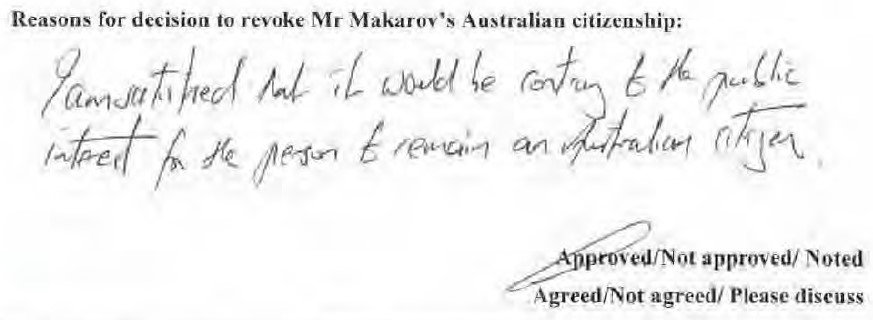
(1) If the Minister makes a decision under this Act in relation to a person, the Minister must give the person notice of the decision.
(2) …
Reasons for adverse decision
(3) If the decision is an adverse decision, the notice must include the reasons for the decision.
Form of notice
(4) The Minister must give the notice in the manner prescribed by the regulations (which includes electronic form).
Procedural defect does not affect validity of decision
(5) A failure to comply with subsection (3) or (4) does not affect the validity of the decision.
10 At the relevant time s 25D of the Acts Interpretation Act 1901 (Cth) provided that:
Where an Act requires a tribunal, body or person making a decision to give written reasons for the decision, whether the expression “reasons”, “grounds” or any other expression is used, the instrument giving the reasons shall also set out the findings on material questions of fact and refer to the evidence or other material on which those findings were based.
The evidence
11 The originating application was supported by an affidavit affirmed by Mr Makarov’s solicitor, Alison Mary Battisson, on 15 November 2019. The principal and immediate purpose of that affidavit was to support the interlocutory order by thwarting the Government’s attempt to remove Mr Makarov from Australia. But that affidavit was not read at the final hearing. Instead, Mr Makarov relied on another affidavit of Ms Battisson dated 14 September 2020 and two affidavits of his own dated 6 and 21 October 2020.
12 The respondents relied on two affidavits affirmed by Dale Watson, a senior lawyer with the Australian Government Solicitor, on 28 September 2020 and 27 October 2020. None of the deponents was required for cross-examination.
The relevant facts
13 Mr Makarov was born in the former USSR in 1953. When he was three years old his family moved to the Ukraine and he lived there until 1998 when he emigrated with his family in order to take up a position at the Australian Institute of Music.
14 It was common ground that, at the time Mr Makarov emigrated from the Ukraine to Australia he was a Ukrainian national, that he applied for Australian citizenship, and that he became an Australian citizen on 8 February 2001. The respondents did not suggest, and there is no evidence to indicate, that at the time the Minister revoked his Australian citizenship he might have been a citizen of any other country.
15 Mr Makarov was arrested and imprisoned in late 2004. The circumstances of his imprisonment are discussed below. He was tried on nine charges and convicted of eight: three charges of aggravated indecent assault; two charges of sexual intercourse with a person under authority aged between 10 and 16; and three charges of homosexual intercourse by a teacher of a pupil between the ages of 10 and 16. The following year he was convicted of multiple sexual offences of a similar nature following another two trials. He was sentenced to a total of 12 years imprisonment with a non-parole period of eight years.
16 Each of the three trials involved different complainants, all students: Application of Victor Makarov pursuant to s 78 of the Crimes (Appeal and Review) Act 2001 (NSW) [2013] NSWSC 1468.
17 Mr Makarov appealed to the Court of Criminal Appeal. The appeals from the convictions entered after the first and second trials were dismissed in consecutive decisions in 2008. The appeal from the convictions entered after the third trial were quashed and new, separate trials were ordered. Mr Makarov was acquitted in both those trials.
18 Before the appeals were heard, the Minister began investigating revocation of Mr Makarov’s Australian citizenship.
19 On 4 April 2007, apparently in response to an inquiry from the Department of Immigration and Citizenship to the Ukrainian Embassy, the Ukrainian Vice Consul, Natalia Lopatina, informed the Department that:
Ukrainian citizens who acquired foreign citizenship do not lose Ukrainian citizenship automatically. To lose Ukrainian citizenship, one has to apply accordingly.
20 The recipient of the email, Emma Knapp, acknowledged the response but queried whether the law had changed since 2001 when Article 19.1 of The Law of Ukraine On Citizenship of 18 January 2001 reportedly provided that:
The citizenship of Ukraine is lost if a citizen of Ukraine has voluntarily acquired the citizenship of another state after attaining his/her majority.
21 Ms Knapp explained that the reason for the query was that the Department had a case in which a Ukrainian citizen had obtained Australian citizenship in February 2001. Mr Makarov’s name was not mentioned in the email or in any of the later emails passing between her and the Vice Consul. But it is obvious that the case in question concerned him.
22 Ms Lopatina replied:
It is the same law. The only thing is that translation does not report the nuance saying that the person can be eligible for the loss of the citizenship but does not lose it automatically.
23 Ms Knapp then asked the Vice Consul whether, if she were to give her the name and details of an individual, Ms Lopatina would be able to ascertain whether the individual was still a Ukrainian citizen. Ms Lopatina said she would but that she would also need information regarding the person’s last known address in the Ukraine.
24 The email chain ends abruptly at this point. Before Mr Makarov’s citizenship was revoked, it appears that the Department did not supply any such information to the Ukrainian Embassy and Mr Makarov was not asked for the information. Nor was he asked for “evidence or document” to indicate whether or not he remained a citizen of the Ukraine or whether he had applied to renounce his citizenship. In neither of his affidavits, however, did Mr Makarov say that he was never asked to provide information about any of these matters.
25 On 28 May 2007 a letter was sent to Mr Makarov by the Director of the Citizenship Services Section of the Department which put him on notice of the possible deprivation of his Australian citizenship and asked him to provide reasons as to why that action should not be taken.
26 On 14 June 2007 Mr Makarov provided a two-page response. In the letter he proclaimed his innocence, his good reputation, and lofty status within the music community, both in Australia and overseas. He declared his intention to appeal against his convictions. He claimed he had ongoing support from family, friends, teachers, former students, and colleagues. He urged the Minister not to make a decision on the question at that stage since he had not exhausted all avenues of appeal or review. A little over two weeks later the letter was resubmitted, this time accompanied by over 80 letters of support.
27 The letter said nothing about the status of his Ukrainian citizenship. Mr Makarov made no submission to the effect that depriving him of his Australian citizenship would render him stateless.
28 On 22 August 2007 a lawyer acting for Mr Makarov wrote to the Department noting that Mr Makarov was currently “in the process of” appealing his convictions and obtaining legal advice from the Ukraine about “the current status of his Ukrainian nationality”. The lawyer, Katie Malyon, said she would advise the Department when further details were available.
29 On 28 August 2007, six days after Ms Malyon’s letter, the Department wrote to the Minister recommending that he revoke Mr Makarov’s Australian citizenship. The full Departmental submission was annexed to Ms Watson’s first affidavit. The Department advised the Minister of the relevant terms of the Citizenship Act and the facts concerning Mr Makarov’s conferral of Australian citizenship and his criminal convictions and sentence. It noted that the convictions brought Mr Makarov “within the scope of the revocation provisions”. It proceeded to state:
[2] On 10 April 2007, the Department was advised by the Ukrainian Consul, Canberra, that according to Article 19.1 of The Law of Ukraine on The Citizenship of Ukraine (2001), “Ukrainian citizens who acquire foreign citizenship do not lose Ukrainian citizenship; one has to apply accordingly.” Therefore, Mr Makarov would not have automatically lost his Ukrainian citizenship upon obtaining Australian citizenship.
[3] On 28 May 2007, the Department contacted Mr Makarov concerning his liability for deprivation of his Australian citizenship (as it was referred to under the previous Australian Citizenship Act 1948) and asked him to present reasons as to why he should not be deprived of his citizenship. The reply, dated 14 June 2007 and at Attachment B, refers to Mr Makarov’s proclamation of his innocence; his upstanding reputation and status within the music community (both in Australia and internationally); ongoing support from family, friends and former students; and his intentions to appeal against his convictions resulting to his third trial. On 2 July 2007, the Department received another copy of Mr Makarov’s earlier correspondence, accompanied by approximately 80 letters which had been presented to the court. The letters were from former students, colleagues, friends and parents of former students attesting his capabilities as an excellent musician and piano teacher. Also included was a video entitled, Young Piano Stars. Professor Victor Makarov.
[4] Applicants for Australian citizenship are required to be “of good character”. Policy states that the seriousness of any offences committed should be considered in the context of ordinary community standards. Crimes including those of sexual abuse, crimes against children, offences committed as part of an ongoing pattern of behaviour, and crimes that incurred a prison sentence totalling 12 months or more, are ordinarily considered to be serious and should be given due weight in an assessment. Had the Department been aware of Mr Makarov’s offences, his citizenship application would have been refused on the grounds that he was not of good character.
[5] To revoke Mr Makarov’s Australian citizenship, you would need to be satisfied that it would be contrary to the public interest for him to remain an Australian citizen. The term “public interest” (Paragraph 34(2)(c) above refers), is not defined in the Act or in policy and judicial interpretation in this context is limited. In Bijai Prasad v The Minister Assisting the Minister for Immigration, Local Government and Ethnic Affairs (1993) at the Administrative Appeals Tribunal (AAT), Deputy President I. R. Thompson referred to the Supreme Court of Victoria as aptly describing “the public interest” in the Director of Public Prosecutions v Smith (1991) as follows:
‘(It) is a term embracing matters, among others, of standards of human conduct and of the functioning of government and government instrumentalities tacitly accepted and acknowledged to be for the good order of society and for the well being of its members.’
(Original emphasis.)
30 The submissions went on to provide more detail about the offences and Mr Makarov’s protestations of innocence. They also referred to some of the remarks of the sentencing judges, including the absence of evidence of “possible rehabilitation” and the prospect of reoffending, and evidence given by one of the complainants.
31 At [8]–[11] the submissions stated:
[8] Revoking Mr Makarov’s Australian citizenship would send a strong message to the community that people who commit serious offences, prior to becoming Australian citizens will not be allowed to continue to enjoy the benefits that status entails.
[9] The advantages to the Australian community in revoking Mr Makarov’s Australian citizenship should be balanced against the disadvantages and hardship likely to be caused to Mr Makarov as a result of his revocation. Revocation would remove Australian citizenship status from Mr Makarov, who was convicted of serious offences, thus depriving him of the benefits citizenship bestows.
[10] If Mr Makarov’s Australian citizenship is revoked, he would automatically become the holder of an ex-citizen visa, a permanent visa which allows the holder to remain in Australia, but not re-enter. The principal disadvantage to Mr Makarov and his family is that revocation would cause him, and perhaps his wife and daughter, personal sadness and disappointment and possibly hardship.
[11] Having balanced the advantages to Australian society, against the disadvantages likely to be caused to Mr Makarov and his family, the Department is of the view that the advantages to Australian society outweigh any disadvantages to Mr Makarov and his family.
32 The submissions included the recommendations of the author that Mr Makarov’s citizenship be revoked by signing the attached notice of revocation and that reasons be provided. Underneath the recommendation the following appears:
33 Three documents were attached to the submissions: a list of convictions; Mr Makarov’s letter of 14 June 2007; and a notice of revocation. Evidently, neither the video nor the 80 odd testimonials to which the Department referred in its submissions were provided to the Minister. Nor did the Department provide the Minister with Ms Malyon’s letter or apprise him of its contents. In each case, the Department’s conduct is inexplicable.
34 On 24 September 2007 the Department wrote to Mr Makarov’s lawyer notifying him of the Minister’s decision, attaching a copy of the notice signed by the Minister and dated, presumably in his hand, 13 September 2007. The notice reads:
I, KEVIN ANDREWS, Minister for Immigration and Citizenship, having determined that Mr Victor MAKAROV, born on 13 September 1953, is a person to whom subparagraph 34(2)(b)(ii)(c) of the Australian Citizenship Act 2007 (the Act) applies, and being satisfied that it would be contrary to the public interest for Mr MAKAROV to continue to be an Australian citizen, have, by this order, exercised my discretion under subsection 34(2) of the Act and deprived Mr MAKAROV of Australian citizenship.
35 In the covering letter the Department advised Mr Makarov that, by s 35(3) of the Migration Act 1958 (Cth), he was taken to have been granted an ex-citizen visa and explained that that was a permanent visa which allows the holder to remain in, but not re-enter, Australia. At the same time, however, the Department also advised him that, in view of his convictions, the ex-citizen visa could be considered for cancellation on character grounds under s 501 of the Migration Act, that in that event he would not be eligible to reapply for a grant of Australian citizenship for 12 months, and that any new application would be considered against the then applicable criteria, including any character requirements. The letter concluded by informing Mr Makarov of his right to seek review of the decision in the AAT, providing him with the AAT’s address and phone number, and directing him to the AAT’s website for information on how to apply.
36 On 13 October 2007 the Department received a representation from a member of the public pleading that the Minister reconsider his decision. The Department replied on 26 October 2007 on behalf of the Minister pointing out that Mr Makarov had been advised of his eligibility to seek a review of the decision in the AAT. But no application for review was filed at this time.
37 On 26 October 2015 Mr Makarov received a notice informing him that a decision had been made on 12 October 2015 to cancel his ex-citizen visa under s 501CA of the Migration Act, inviting him to make representations to the responsible Minister to revoke the cancellation decision. He made representations but the Minister was unmoved. On 1 May 2018, Mr Makarov was informed that the Minister would not revoke the cancellation decision.
38 Mr Makarov served the full term of his prison sentence. He was released in late 2018 and immediately taken into immigration detention. He then began to search for pro bono legal assistance.
39 In May 2019 his present solicitors agreed to act for him and he instructed them to gather information and prepare a case to challenge the Minister’s decision to revoke his Australian citizenship.
40 On 8 August 2019 Ms Battinson wrote to the Department of Home Affairs requesting written reasons for the Minister’s decision. That request was rejected.
41 In about September and October 2019 Mr Makarov became aware of the opinions of two Ukrainian lawyers and, based on those opinions, formed the view that he had lost his Ukrainian citizenship when he acquired Australian citizenship.
42 On 11 November 2019, armed with the material gathered by his lawyers, Mr Makarov applied to the AAT for the Minister’s decision to be reviewed on its merits and shortly thereafter he filed the application in this Court. As I mentioned in my introductory remarks, the application for merits review was dismissed by the AAT and the appeal from the AAT’s decision was also dismissed.
The application for judicial review
43 By his Amended Originating Application, filed on 15 September 2020, Mr Makarov sought an order quashing the revocation decision on the ground that it was “not lawfully made”. The particulars indicate that the basis of the application was that, after the last email from the Ukrainian Embassy on 4 April 2007, neither the Minister nor the Department made any further inquiry of the Embassy about whether or not Mr Makarov was in fact a Ukrainian citizen before his Australian citizenship was revoked although that was an obvious inquiry about a critical fact, the existence of which was easily ascertained. For this reason, Mr Makarov alleged that the Minister’s decision to revoke his citizenship was “not reasonably reached”.
44 In his Further Amended Originating Application, filed pursuant to leave given at the hearing, two further particulars were added:
• Further, the Minister’s failure to provide reasons as required by [s 47(3)] of the Act, together with the matters above, mean that the Minister constructively failed to exercise jurisdiction by failing to engage in an active intellectual process towards the matters required by [s 34(2) and (3)] of the Act; and
• [t]he Minister also constructively failed to exercise jurisdiction by [failing] to consider the element of discretion inherent in the exercise of s 34(2) of the Act.
45 Notwithstanding the manner in which the application is couched, it is convenient to refer to these three particulars as the grounds of the application.
46 The application is made under s 39B of the Judiciary Act 1903 (Cth).
47 The statute imposes no time limit for bringing an application under s 39B. Nor is one imposed by any other legislation. But the relief sought is in the nature of a writ of certiorari. It is an order to quash the Minister’s decision. It is common ground that relief of this kind is discretionary: see, for example, Re McBain; Ex parte Australian Catholic Bishops (2002) 209 CLR 372 at [21] per Gleeson CJ; at [80] per Gaudron and Gummow JJ; at [95] per McHugh J; at [195] per Kirby J; at [260] per Hayne J.
The questions for determination
48 It follows that the application for judicial review raises the following questions for determination:
(1) Was the Minister’s failure to make further inquiries of the Ukrainian Embassy about Mr Makarov’s Ukrainian citizenship legally unreasonable (ground 1)?
(2) Did the Minister fail to apply an active intellectual process to the consideration of the matters he was required to take into account before making his decision (ground 2)?
(3) Did the Minister fail to consider that he had a discretion whether or not to exercise his power to revoke Mr Makarov’s Australian citizenship (ground 3)?
(4) In the event that the Minister fell into reviewable error, should relief be granted notwithstanding the lengthy delay?
49 Mr Makarov accepted that he needed to demonstrate that any error on the part of the Minister was a jurisdictional error. While it was arguable that the Minister’s failure to provide reasons for his decision was a non-jurisdictional error of law on the face of the record, the submission was only faintly put and no attempt was made to rebut the Minister’s submission to the contrary based on the terms of the Citizenship Act and the High Court’s judgment in Probuild Constructions (Aust) Pty Ltd v Shade Systems Pty Ltd (2018) 264 CLR 1.
Was the Minister’s decision legally unreasonable because he failed to make obvious inquiries of the Ukrainian Embassy?
50 Parliament is taken to intend that any statutory power will be exercised reasonably: see, for example, Minister for Immigration and Citizenship v Li (2013) 249 CLR 332 at [26] and [29] (French CJ), [63] (Hayne, Kiefel and Bell JJ) and [88] (Gageler J). Thus, a statutory requirement that a public officer must be satisfied of a particular fact or circumstance “imports a requirement” that the state of satisfaction is one that could be reached by a reasonable person: Minister for Immigration and Citizenship v SZMDS (2010) 240 CLR 611 at [122], citing R v Connell; Ex parte The Hetton Bellbird Collieries Ltd (1944) 69 CLR 407 at 432 per Latham CJ. As the High Court explained in Li and the Full Court in Minister for Immigration and Border Protection v Singh (2014) 231 FCR 437 at [44], legal unreasonableness can be a conclusion reached by a court exercising supervisory powers over a member of the executive or an administrative decision-maker after the identification of an underlying jurisdictional error in the decision-making process but it can also arise in what French CJ, in Li at [28], referred to as “an area of decisional freedom”. In this latter case, the error “has the character of a choice that is arbitrary, capricious” or lacks “common sense”: Singh at [44]
51 It will be recalled that the obvious inquiry Mr Makarov complained in the Further Amended Originating Application the Minister had not made was an inquiry of the Embassy about whether or not he was in fact a Ukrainian citizen before the Minister made his decision to revoke his Australian citizenship. He did not plead that the Minister’s decision was unreasonable because he failed to make such an inquiry of Mr Makarov, although a submission to that effect was made.
52 The factual foundation for the allegation in the pleading was the Department’s failure to respond to the last email from the Department on 4 April 2007. Mr Makarov’s submission was that the Minster’s decision to revoke citizenship on the basis of the information he had and without following up on the last email was a decision no reasonable decision-maker could have made. His argument, outlined in his written submissions, was as follows:
On reading Ukrainian Law Extracts and the April 2007 emails, it should have been immediately apparent to the Minister that:
a. The Vice Consul is not, on the face of the April 2007 emails, a Ukrainian lawyer and accordingly is not the appropriate source of information regarding the interpretation of Ukrainian citizenship law. Further, the information provided by the Embassy was of a general, as opposed to specific, nature.
b. Article 19.1 contains an express statement suggesting an automatic loss of citizenship in the event citizenship of another state is obtained. There is no reference of a requirement to apply to renounce Ukrainian citizenship. As the email from the Ukrainian embassy suggests, the English translation may well have removed the nuanced reference to the requirement of an application. The inconsistency is immediately apparent. The Minister did not make that inquiry. He could have easily asked the applicant to comment on the issue. He could have easily asked the Embassy to put him in contact with an appropriate lawyer.
c. Article 19.3 suggests an automatic loss of citizenship if the person has “used rights or fulfilled obligations provided or imposed on him/her by the foreign citizenship”. Even accepting the explanation of the Embassy that Article 19.1 requires an application by the person to lose citizenship, Article 19.3 was not said to contain the same limitation. The Minister knew that the applicant had had Australian citizenship for at least 6 years prior to making his decision. It would be almost impossible for a person to be a citizen of Australia for that period of time and not use rights afforded by that citizenship. It is apparent from the Department’s Submission and the April 2007 emails that the Minister he did not consider this issue, nor did he make further inquiries.
d. Critically, the Embassy’s email … obviously invited further inquiry by the Minister (or staff at his direction). The Department sought clarification from the Embassy as to whether the applicant was still a citizen. In response, the Embassy clearly asked the Department to provide further information regarding the applicant to enable it to perform that request. The evidence does not show a response by the Department. It can be inferred that the Department made no further inquiries.
53 It was no part of Mr Makarov’s case that it was legally unreasonable of the Minister to revoke his Australian citizenship as a result of the information contained in the letter from his then solicitor, Ms Malyon, which, as I observed, was not passed on to the Minister.
54 The legal foundation for the allegation derived from the observations of the plurality in the High Court in Minister for Immigration and Citizenship v SZIAI [2009] HCA 39; 259 ALR 429; 83 ALJR 1123; 111 ALD 15 at [20]:
The failure of an administrative decision-maker to make inquiry into factual matters which can readily be determined and are of critical significance to a decision made under statutory authority, has sometimes been said to support characterisation of the decision as an exercise of power so unreasonable that no reasonable person would have so exercised it.
55 The plurality went on to refer to some cases in this Court and the High Court in which this question was explored. One of those cases was Prasad v Minister for Immigration and Ethnic Affairs (1985) 6 FCR 155 on which Mr Makarov relied. In Prasad at 169–70 Wilcox J said:
The circumstances under which a decision will be invalid for failure to inquire are, I think, strictly limited. It is no part of the duty of the decision-maker to make the applicant's case for him. It is not enough that the court find that the sounder course would have been to make inquiries. But, in a case where it is obvious that material is readily available which is centrally relevant to the decision to be made, it seems to me that to proceed to a decision without making any attempt to obtain that information may properly be described as an exercise of the decision-making power in a manner so unreasonable that no reasonable person would have so exercised it. It would follow that the court, on judicial review, should receive evidence as to the existence and nature of that information.
56 Prasad scarcely assists Mr Makarov.
57 First, Mr Makarov assumed but did not prove that the information in question — his last known address in the Ukraine — was known to the Department. He sought to remedy this gap in the evidence by making a call upon the Minister during oral argument in reply to produce his original visa application, which was presumably made in 1997 at the latest. Unsurprisingly, the document was not produced. He then invited the Court to accept that his last address in the Ukraine would have been included in that document. Even if I were to make that assumption, the inclusion of the information in the visa application does not demonstrate that it was known to the Department 10 years later, when his citizenship was being considered for revocation. The evidence adduced from Ms Watson suggests that the Department was not in possession of the information in 2019. If it was not also known to the Department in 2007, the Minister might have been able to prove that then but the passage of time makes that impracticable, if not impossible, now.
58 Second, it is doubtful whether Mr Makarov’s address in the Ukraine was centrally relevant to the Minister’s decision. What was surely centrally relevant to determining the status of his Ukrainian nationality was his name and date of birth and no complaint was made that the failure to inform the Embassy of these details was legally unreasonable.
59 Third, Mr Makarov did not invite the Court to receive evidence as to the existence and nature of the information he alleged was readily available to the Minister. Neither did he attempt to explain what difference that information could have made to the Minister’s decision.
60 Fourth, as the plurality noted in SZIAI at [22], the observations of Wilcox J were both tentative and, in substance, obiter. Their Honours also observed that Wilcox J was dealing with the grounds of review in s 5 of the Administrative Decisions Judicial Review Act 1977 (Cth) (ADJR Act) concerning the manner of exercise of the relevant power. Furthermore, their Honours pointed out that “the proposition which may emerge from Prasad has not been the subject of full consideration in this court, whether in litigation under the ADJR Act, or any other statutory regime or under s 75(v) of the Constitution”.
61 In SZIAI, which was concerned with a decision under the Migration Act only susceptible to review for jurisdictional error, their Honours remarked at [25]:
Although decisions in the Federal Court concerned with a failure to make obvious inquiries have led to references to a “duty to inquire”, that term is apt to direct consideration away from the question whether the decision which is under review is vitiated by jurisdictional error. The duty imposed upon the tribunal by the Migration Act is a duty to review. It may be that a failure to make an obvious inquiry about a critical fact, the existence of which is easily ascertained, could, in some circumstances, supply a sufficient link to the outcome to constitute a failure to review. If so, such a failure could give rise to jurisdictional error by constructive failure to exercise jurisdiction. It may be that failure to make such an inquiry results in a decision being affected in some other way that manifests itself as jurisdictional error …
62 While the decision the subject of the present application was made under a different statutory regime and in the exercise of a different kind of power, the Minister did not suggest that these remarks did not apply equally to the making of a decision to revoke citizenship and I am prepared to assume that they do.
63 Nevertheless, “a general obligation” to make an inquiry, that is an obligation which is not imposed by statute, will arise only in “rare or exceptional circumstances”: Kaur v Minister for Immigration and Border Protection (2017) 256 FCR 235 at [33] (Dowsett, Pagone and Burley JJ), citing the observation by Kenny J in Minister for Immigration and Citizenship v Le (2007) 164 FCR 151 at [60]. Largely for the reasons advanced by the Minister, I am not persuaded that this was such a case.
64 First, the inquiry was unnecessary because the Vice Consul had already informed the Department that the Ukrainian law did not operate automatically to deprive a Ukrainian citizen of his nationality and there was — and is — no evidence that Mr Makarov made an application to “lose” (or renounce) his Ukrainian citizenship. The effect of Mr Makarov’s submission is that it was unreasonable for the Department to rely on the information provided by the Embassy concerning the operation of the laws of its own country. I do not accept that submission. In particular, I do not accept that merely because the Vice Consul did not indicate in her emails that she was a Ukrainian lawyer meant that she was either not legally qualified to provide the information or that she was an unsuitable or unreliable source of the information.
65 The submission about Article 19.3 appears to be misconceived. The English translation of Article 19.3 reads:
The citizenship of Ukraine is lost:
…
3. If a foreigner has acquired the citizenship of Ukraine and used rights or fulfilled obligations provided or imposed on him/her by the foreign citizenship.
There is no reason to believe that Mr Makarov was a foreigner when he acquired Ukrainian citizenship.
66 Second, Mr Makarov did not prove that the Department was aware of his address in the Ukraine at the relevant time. Neither, for the reasons given above at [56], can it be inferred that it was. Nor can it be said that the evidence was easily ascertainable unless Mr Makarov was willing to provide it. Such evidence as there is suggests that it was not.
67 Mr Makarov’s affidavits are noticeably silent on the question of whether he would have provided the information had he been asked in 2007. The evidence is that in January 2019, Mr Makarov would not reveal to the Department the location of his Ukrainian passport or birth certificate. An email from the Ukrainian Embassy to the Department dated 23 October 2019, annexed to Ms Watson’s second affidavit, opens with these words:
[T]oday after numerous requests I have finally the confirmation of identity of Mr Makarov and his last address in Ukraine …
68 Third, once the Embassy was able to confirm Mr Makarov’s identity and his last address in the Ukraine, it issued him with a travel document. The travel document recorded his country of nationality as “Ukraine”. As the Minister submitted, there is no reason to believe that, if the inquiry had been made in 2007, the outcome would have been any different. Consequently, as in SZIAI, Mr Makarov was unable to show a sufficient link between the failure to make the relevant inquiry and the outcome. See also Hinton v Minister for Immigration and Border Protection [2015] FCA 408; 146 ALD 184 at [72]–[73] (McKerracher J).
69 For these reasons the answer to the first question is “no”. I am not persuaded that the Minister’s omission to make the inquiries Mr Makarov alleged should have been made rendered the decision to revoke his Australian citizenship legally unreasonable.
Did the Minister fail to apply an active intellectual process to the consideration of the matters he was required to take into account before making his decision?
70 Mr Makarov submitted that the Minister’s task under s 34(2) of the Citizenship Act could not be lawfully undertaken without “actively and intellectually” considering “the materials” before him in making his decision and this he failed to do.
71 No clear articulation of what those materials were appeared in the written submissions. Nor were they clearly identified in oral argument. Nevertheless, it is apparent that the materials included the Departmental submission to the Minister, the April 2007 emails between the Department and the Embassy, an extract from the Ukrainian law on citizenship, Mr Makarov’s representations to the Minister made on 14 June 2007 and Ms Malyon’s letter of 20 August 2007.
72 I accept that the Minister was bound to engage in an “active intellectual process” in deciding whether to exercise his power under s 34(2) of the Citizenship Act. That expression derives from the judgment of Black CJ in Tickner v Chapman (1995) 57 FCR 451 at 462, albeit in a different statutory context, but it was applied in a similar statutory context in Carrascalao v Minister for Immigration and Border Protection (2017) 252 FCR 352 at [46]. The decision in question in Carrascalao was a decision under s 501(3) to cancel a visa if the Minister reasonably suspects that the visa holder does not pass the character test and is satisfied that the cancellation is in the national interest.
73 As the Full Court observed in Carrascalao at [48], however, “a finding by the Court that the Minister has not engaged in an active intellectual process will not lightly be made and must be supported by clear evidence, bearing in mind that the judicial review applicants carry the onus of proof”.
74 Mr Makarov’s contention that the Minister did not engage in such a process in the present case arises from the Minister’s failure to give reasons or “appropriate reasons”.
75 The respondents did not quarrel with Mr Makarov’s submission that the Minister failed to comply with his statutory obligation to give reasons. They did not suggest that what purported to be reasons answered the statutory description. Nor did they suggest that the Minister adopted the Department’s submissions as his reasons.
76 Rather, the respondents submitted that any failure by Mr Andrews to comply with the obligation to give reasons did not invalidate the decision, relying on s 47(5) of the Citizenship Act.
77 Mr Makarov accepted as much. He noted that in Re Minister for Immigration, Multicultural and Indigenous Affairs; ex parte Palme (2003) 216 CLR 212 the High Court by majority, Kirby J dissenting, held that a provision in similar terms to s 47(5) of the Citizenship Act (s 501G(4) of the Migration Act) operated as intended.
78 In Palme at [33] Gleeson CJ, Gummow and Heydon JJ observed that the obligation on the Minister to give reasons for cancelling a visa on character grounds, imposed by s 501(1) of the Migration Act, could be enforced by an order for mandamus. Their Honours held that s 501(4) did not operate as “an attempted privative clause to achieve the impossible by ousting the [court’s] jurisdiction” to grant mandamus under s 75(v) of the Constitution. But their Honours also held at [45]–[46] that the “stipulation” in s 501G(4) that “a failure in notification does not of itself affect the validity of the cancellation” means that failure in the required notification “does not impeach the cancellation decision for jurisdictional error”. In other words, as their Honours explained at [48], while the failure to provide reasons may be reviewed by the court and the court may order the Minister to comply with the statutory duty and while the reasons then provided may provide grounds for an order for prohibition, it is not open to a person aggrieved by the decision to “bypass” the use of mandamus and impeach the cancellation decision itself because the duty to provide reasons was not discharged. McHugh J was of the same opinion (see [54]–[59]).
79 As I mentioned earlier, Mr Makarov did not mount an argument that the failure to provide reasons constituted an error of law on the face of the record. Rather, he relied on the absence of reasons to support his allegation that the Minister had not considered the material before him in making his decision. He argued that a failure to give reasons may, and in this case did, give rise to an inference that certain matters were not considered. The matters in question were those to which he referred in [44] of his written submissions set out in [52] above. They also also included Mr Makarov’s request that the Minister not make a decision on his citizenship until he had exhausted his appeal rights and the information in Ms Malyon’s letter, neither of which was mentioned in the Departmental submission.
80 Of course, a failure to give reasons may give rise to an inference that there was no good reason for the decision: Public Service Board of New South Wales v Osmond (1986) 159 CLR 656 at 663-4 (Gibbs CJ). But that is by no means universally so. And Mr Makarov did not submit that there was no good reason in the present case.
81 Moreover, the mere fact that reasons were not given does not mean that the Minister did not consider the matters he was obliged to consider before he reached his decision. In the absence of reasons, all a supervising court can do is focus on the outcome of the exercise of the power in the relevant factual context and assess the question, for itself “bearing in mind that it is for the repository of the power, and not for the Court, to exercise the power but to do so according to law”: Singh at [45].
82 Here, the relevant factual context includes the fact that the Minister received the Departmental submission. What is to be made of that?
83 In Stambe v Minister for Health (2019) 270 FCR 173 at [74]-[75] Mortimer J said;
As a general principle, I consider it reliable and appropriate to infer, consistently with the purpose and practice of ministerial briefing notes, that a Minister reads a briefing note with which she or he is provided, where that briefing note is intended to provide the Minister with sufficient information to make a decision about whether or how to exercise a statutory power. Sometimes there may be evidence which assists the drawing of such an inference, such as handwriting, or marks such as circles or underlining, by the Minister on the contents of a briefing note itself. Such evidence is not necessary for the inference to be available and drawn, but it may be persuasive.
Of course, the drawing of such an inference may be actively contested by admissible evidence. If it is not, then it would tend to undermine the practice of executive decision-making at ministerial level if supervising Courts were to require direct evidence that the contents of each briefing note were read by a Minister. Whether an inference should be drawn in an individual case will remain a matter for each judge in the circumstances, but for my own part I consider this an appropriate general approach.
84 In the present case, there was evidence of the kind to which her Honour referred in Stambe at [74]. The Departmental submission contained handwriting and marks apparently made by the Minister. It is reasonable to infer that the Minister read the Departmental submission before making his decision. While that submission does not satisfy the Minister’s statutory obligation to provide reasons, once it is accepted, as I do, that the Minister read the submission, it is reasonable to infer that he took its contents into account and that his decision was based on it.
85 As I indicated earlier, there was no dispute that the conditions in s 34(2) of the Citizenship Act were satisfied in Mr Makarov’s case. Nor was there a dispute that, after he had applied to become an Australian citizen Mr Makarov was convicted of a serious offence within the meaning of subs (5). That leaves one matter: the question raised by s 34(3), namely whether the Minister was satisfied that revoking his Australian citizenship would render Mr Makarov stateless. As Mr Makarov submitted, that was a serious matter. Section 34(3) was a legislative enactment of Australia’s international obligation under Art 8(1) of the Convention on the Reduction of Statelessness, opened for signature 30 August 1961 and entered into force on 13 December 1975, not to “deprive a person of its nationality if such deprivation would render him stateless”.
86 Without reference to authority, the respondents submitted that on its proper construction s 34(3) did not create “a mandatory relevant consideration” because it was a limitation on, rather than a precondition for, the exercise of the power in s 34(2). They contrasted other restrictions on the exercise of power appearing in the Citizenship Act, citing in particular s 17(3), which provides that “the Minister must not approve the person becoming an Australian citizen unless the Minister is satisfied of the identity of the person”. Merely because s 34(3) is a limitation rather than a precondition does not mean that the Minister was not bound to consider whether his decision would render the citizen stateless. The failure of the Minister to take into account a relevant consideration, that is to say a consideration he was bound to take into account, is “one instance of an abuse of discretion entitling a party with sufficient standing to seek judicial review of ultra vires administrative action”: Minister for Aboriginal Affairs v Peko-Wallsend Ltd (1986) 162 CLR 24 at 39 (Mason J).
87 The corollary of the respondents’ submission is that the Minister’s decision would still be lawful even if he deliberately ignored unequivocal evidence that statelessness was the inevitable consequence of his decision. That is most unlikely to have been Parliament’s intention.
88 Under the former Act, the Australian Citizenship Act 1948 (Cth), the Minister’s power to deprive a person of Australian citizenship was contained in s 21(1). It was similar to the power conferred by s 34(2) of the 2007 Act. The 1948 Act also included a similar limitation on the Minister’s power to that included in s 34(3) of the 2007 Act. The analogue of s 34(3) in the 2007 Act was s 23D. Section 23D was inserted by the Australian Citizenship Act 1973 (Cth), the long title of which was “An Act to amend the Citizenship Act 1948-1969”. Section 23D was entitled “Special provisions to prevent persons being stateless”. According to the Explanatory Memorandum on the Bill that introduced it (in cl 12), the purpose of this provision was to conform to the requirements of the Convention.
89 Subsection 23D(3A) was inserted into the Citizenship Act by the Australian Citizenship Amendment Act 1984 (Cth). It was in the following terms:
Where, but for this sub-section, a person to whom sub-paragraph 21(1)(a)(ii) applies would, if the Minister were to make an order under sub-section 21(1) in relation to that person, become a person who is not a citizen of any country, sub-section 21(1) does not apply in relation to that person.
Subparagraph 21(1)(a)(ii) was the equivalent of s 34(5) of the 2007 Act. The differences are immaterial for present purposes.
90 The effect of s 23D(3A) was that the Minister had no power to revoke the Australian citizenship of a person in Mr Makarov’s position if doing so would render the person stateless. According to the Explanatory Memorandum to the Australian Citizenship Amendment Bill 1983, the subsection “operate[d] to prevent persons being rendered stateless as a result of the new provisions in section 21 relating to deprivation of citizenship”. Despite the difference in the words used in the 2007 Act, there is no reason to believe that Parliament’s intention in enacting s 34(3) was any different. Certainly there is nothing in either the Explanatory Memorandum (EM) or the Revised Explanatory Memorandum (Revised EM) to the 2005 Bill to suggest that Parliament intended to change the law in this respect.
91 Section 15AC of the Acts Interpretation Act provides that:
Where:
(a) an Act has expressed an idea in a particular form of words; and
(b) a later Act appears to have expressed the same idea in a different form of words for the purpose of using a clearer style;
the ideas shall not be taken to be different merely because different forms of words were used.
92 The EM and the Revised EM explained that the Act replaced the 1948 Act and in doing so makes law relating to citizenship in Australia “clearer, better structured and easier to understand”.
93 Insofar as they said anything relevant to s 34(3) of the 2007 Act, the EM and the Revised EM noted that the statelessness provisions had been “restructured so that they are located with the related provisions”. They also stated that subclauses 34(2) and 34(3), which became s 34(2) and s 34(3), respectively, were “consistent with section 21 of the old Act”. That appears to be correct with respect to cl 34(2) but not cl 34(3). Section 21 of the 1948 Act did not contain a limitation on the exercise of the Minister’s power in the event that its exercise would cause the person to become stateless. That limitation, as I mentioned earlier, appeared in s 23D(3A) of the former Act.
94 The Bills Digest, No. 72, 2005–06, prepared for debate, supports the notion that the change in terminology was of no consequence. It records that cl 34(3) “prohibits the Minister from revoking a person’s Australian citizenship because they have been convicted of a serious offence, if that revocation would result in the person becoming stateless”.
95 All that was said about s 34(3) in the Minister’s Second Reading Speech (Hansard, House of Representatives, 9 November 2005, p 12) was this:
Existing law provides for revocation when a dual citizen has been convicted, after applying for citizenship, of a serious criminal offence committed before their application was approved. The extension of this provision to include serious criminal offences committed between approval of an application and when the person actually becomes a citizen reflects the existing power to cancel the approval of an application if the person is no longer of good character.
(Emphasis added.)
96 It follows that, contrary to the respondents’ submission, the Minister was required to consider whether his decision would have that effect. And that requirement involved engaging in an “active intellectual process”.
97 In effect, Mr Makarov’s contention was that the Minister did not properly consider whether revoking his Australian citizenship would render him stateless because he did not look behind the advice provided to the Department by the Ukrainian Embassy. That does not equate to a failure to give “active intellectual” consideration to the question. Mr Makarov also pointed to some factual errors in the Departmental submissions, such as it was the Ukrainian Consul rather than the Vice Consul, who provided the advice. But these errors were trivial. The Departmental submission accurately summarised the content of the advice.
98 In oral submissions in reply, counsel for Mr Makarov, Mr Fuller, claimed that the Minister also erred by considering the question of potential statelessness by reference to the wrong version of the relevant Ukrainian law. He argued that Art 19.1 of The Law of Ukraine On Citizenship of Ukraine, which was referred to in the Departmental submission, only came into effect on 1 March 2001. This is about a month after Mr Makarov was granted Australian citizenship. He submitted that the previous law applied and under that law Mr Makarov would have automatically lost his Ukrainian citizenship on acquiring Australian citizenship.
99 This submission took everyone by surprise. As the respondents observed, the submission had never previously been made. It was not raised in any version of the originating application and no application to amend was made at the hearing. The Minister was in no position to meet it. The content of foreign law must be proved. It is a question of fact: Neilson v Overseas projects Corporation of Victoria Ltd (2005) 223 CLR 331 at [115] (Gummow and Hayne JJ). As their Honours said in that case:
The courts of Australia are not presumed to have any knowledge of foreign law. Decisions about the content of foreign law create no precedent. That is why foreign law is a question of fact to be proved by expert evidence. And it is why care must be exercised in using material produced by expert witnesses about foreign law. In particular, an English translation of the text of foreign written law is not necessarily to be construed as if it were an Australian statute. Not only is there the difficulty presented by translation of the original text, different rules of construction may be used in that jurisdiction.
100 That alone is enough to dispose of the submission.
101 In any event, there is no admissible evidence of when Art 19.1 came into force or whether it was capable of affecting events that occurred before it came into force, such as through transitional provisions. The submission rested on opinions expressed in the expert reports attached to Mr Makarov’s most recent affidavit. But the use to which that evidence could be put was limited by a ruling made under s 136 of the Evidence Act 1995 (Cth) which prevented reliance being placed on those opinions to prove the truth of them. And no application was made to revoke the ruling.
102 There was no evidence one way or the other that Mr Makarov had made an application which would have resulted in the loss of his Ukrainian citizenship. The advice to the Department, conveyed to the Minister, was in general terms. It did not deal with Mr Makarov’s personal circumstances. The Department provided no information to the Minister on the question. In those circumstances, it must be taken that the Minister’s consideration of the issue raised by s 34(3) of the Act was incomplete. Before he could decide whether his decision would render Mr Makarov stateless, the Minister needed to know whether Mr Makarov had lost his Australian citizenship. The advice from the Ukrainian Vice Consul did not answer that question. It was generic. All it told him was that a grant of Australian citizenship did not automatically result in revocation of Ukrainian citizenship. In order to determine whether Mr Makarov would be rendered stateless if his Australian citizenship were revoked, the Minister needed to know whether Mr Makarov had “applied accordingly”, to pick up on the words used by the Vice Consul in her email of 4 April 2007. He did not have that information. Ms Malyon told the Department before it briefed the Minister that Mr Makarov was obtaining legal advice from the Ukraine in relation to the status of his Ukrainian nationality. Despite the Department’s failure to provide them to the Minister, the respondents accepted that the Minister had constructive notice of Ms Malyon’s letter and the emails between the Department and the Embassy. But by the time the Minister received the Departmental submission he did not know what that advice was. Having regard to the paucity of information in the Departmental submission and the other documents of which he had constructive knowledge, I am satisfied that the Minister could not have applied his mind to the question of Mr Makarov’s prospective statelessness, that is to say, any consideration of this question did not involve an active intellectual process.
103 To this extent, I am persuaded that the Minister did not consider all the materials before him in making his decision. There was a material error in that, had he done so, it could have made a difference to his decision. He could have deferred making the decision until advice had been obtained from the Ukraine about the status of Mr Makarov’s nationality. It follows that ground 2 should be upheld.
Did the Minister fail to consider that he had a discretion?
104 It is common ground that s 34(2) gave the Minister a discretion not to revoke Mr Makarov’s citizenship even if he was satisfied that the grounds for revocation had been made out. That follows from the terms of s 33(2A) of the Acts Interpretation Act which relevantly provides that “[w]here an Act … provides that a person … may do a particular act or thing, and the word may is used, the act or thing may be done at the discretion of the person …”.
105 It was also common ground that, if the Minister failed to consider that he had a discretion, he would have fallen into jurisdictional error. As Mr Makarov submitted, there would have been a constructive failure to exercise the jurisdiction.
106 But I am not persuaded that the Minister failed to consider that he had a discretion.
107 First and foremost, the notice the Minister signed on 13 September 2007, which contained the revocation order, recorded that he had, “by this order, exercised [his] discretion under subsection 34(2) of the Act …”.
108 It is true that the Departmental submission does not mention the word “discretion”. It is clear, however, that the Department recognised that the decision was a discretionary one. Mr Makarov argued that the discussion in the Departmental submission of the advantages and disadvantages of revocation is “confined to the issue of public interest” and pointed out that the handwritten note from the Minister refers only to his satisfaction about the public interest component. I reject the argument. Paragraphs 9 to 11 of the Departmental submission set out above at [30] are directed to the exercise of the discretion. The matters raised in those paragraphs had no other apparent relevance. They pitted the public interest against Mr Makarov’s interests and invited the Minister to weigh them in the balance. In the result the Minister preferred the public interest.
109 I therefore reject ground 3.
Should relief be granted?
110 Notwithstanding error, relief may be refused if the applicant is guilty of “unwarrantable delay”: R v Commonwealth Court of Conciliation and Arbitration; Ex parte Ozone Theatres (Aust) Ltd (1949) 78 CLR 389 at 400.
111 In his affidavit of 21 October 2020 Mr Makarov provided the following explanation for the delay.
112 He was in a segregation unit at Long Bay Correction Centre at the time of the Minister’s decision without access to the internet and limited access to the telephone or visitors. He remained in the segregation unit until sometime in 2010. When he learned that the Minister had revoked his citizenship based on his criminal convictions his “immediate understanding and reaction” was to do everything he could to have the convictions overturned. All his time and energy was focused on that end: “going through documents and evidence and contacting lawyers and well-wishers who would be able to help”. He went through a series of appeals, retrials, an inquiry and a judicial review. It was “extremely onerous” to find lawyers, give instructions, locate documents and potential witnesses, arrange finances and funding to pay legal costs while enduring harsh prison conditions.
113 In late 2005, before the Minister’s decision, he had been assaulted by a fellow inmate. He sustained a broken cheek bone and one of his eyes was “seriously damaged”. He was hospitalised and underwent surgery. It was this assault that led to his incarceration in the segregation unit. In early 2006 and again in 2008, he was assaulted by prison officers. Each time he underwent treatment and “was traumatised for a long time”. He underwent surgery on two further occasions, most recently in 2015, as a result of complications with a hernia. The surgical procedures and “resulting recovery times” kept him “occupied for many months”.
114 He appealed against his convictions following the first trial. He also appealed against his convictions following the second trial. Both appeals were dismissed. He appealed against his convictions in the third trial, too. Those convictions were quashed and new, separate trials were ordered. In March 2010 he was retried in relation to the allegations of one of the complainants and acquitted on all counts. In April 2010 he was retried in relation to the allegations of the other complainant. That trial was aborted. A second trial in February 2011 was also aborted. In August 2011 he was acquitted on all counts.
115 In April 2012 he applied to the Supreme Court under s 78 of the Crimes (Appeal and Review) Act 2001 (NSW) for an inquiry into the convictions in the first two trials based on evidence given about the credibility of a Ukrainian witness whose evidence was “integral” to the convictions obtained in the first and second trials. On 4 October 2013 the application was dismissed. In August 2015 he applied to the Court of Appeal for judicial review of that decision, but on 8 March 2016 the Court dismissed the application.
116 The legal proceedings exhausted all his savings and “financial means” and those of his family.
117 On 26 October 2015 he received a notice of cancellation of his ex-citizen visa and was invited to make representations to the Minister, which he did on 16 November 2015. Nearly two and a half years later, the Minister informed him that he had decided not to revoke the cancellation decision.
118 He was released from custody in late 2018, having served the full term of his prison sentence, and immediately taken into immigration detention. Whilst in immigration detention he “desperately began to search for pro bono legal assistance as [he] had no money to fund any more legal proceedings”. It took him “a long time” but he finally managed to contact his present lawyers and requested them to assist him in relation to his “citizenship revocation matter”. In May 2019 they agreed to act for him and he instructed them to gather information via a freedom of information request, engage with Ukrainian legal experts on citizenship law, and prepare his case. After receiving opinions from two Ukrainian legal academics dated 9 September 2019 and 7 October 2019, copies of which were annexed to his affidavit, he concluded that he had lost his Ukrainian citizenship immediately on the grant of his Australian citizenship.
119 Apart from delay and consequential prejudice, Mr Makarov submitted that there were no factors which militated against the exercise of the discretion in his favour. Given his assertions regarding the actual state of Ukrainian law and the possibility and effect of being rendered stateless, Mr Makarov argued that it could not be said that his case is without a “real injustice”.
120 Mr Makarov submitted that the delay and prejudice must be considered “in light of [his] experience in prison” and “the jurisdictional defect”. He claimed that it would be unusual for relief to be denied in the presence of “manifest error” solely because of delay, even one as long as the delay in this case. He submitted that his ability to challenge the decision was “hampered to some degree” by the Minister’s failure to provide reasons despite the legislative requirement to do so.
121 Mr Makarov did not say in any of his affidavits that he did not seek to review the Minister’s decision within the prescribed time or, for that matter, within a reasonable time because he believed it to be futile, having regard to the basis for the decision. He did not say that he believed he would have no chance of persuading the Tribunal not to set aside the Minister’s decision unless the convictions were quashed. And his counsel eschewed any argument to this effect. Rather, the position put to the Court was that Mr Makarov was “preoccupied with his criminal reviews, retrials and inquiries” and that he was labouring under a misapprehension or misunderstanding that his ex-citizen visa meant that he could remain in Australia.
122 Doubtless Mr Makarov was focussed on the legal battles over his convictions for much of the period in question. His unchallenged evidence was that he devoted all his time and energy to appealing his convictions. But there is no evidence to support the submission that he was under any misconception that his ex-citizen visa entitled him to remain in Australia. He was informed that it was vulnerable to cancellation on character grounds.
123 I reject the submission that Mr Makarov’s ability to challenge the decision was hampered by the Minister’s failure to provide reasons. The submission was not developed and there is no basis for it.
124 There are a number of factors that point against the grant of relief.
125 The first, without doubt, is the length of the delay.
126 Twelve years is an extremely long time. Mr Fuller variously described the delay as “considerable” “very considerable”, “very extensive”, “extraordinary” and “tend[ing] to suggest against the exercise of [the] discretion”.
127 Then there is the prejudice to the Minister and the public interest.
128 Mr Fuller accepted that the Minister would be prejudiced by the delay (“some prejudice would flow to the Minister”), “particularly given the desirability of finality in administrative decisions”. While there might be a relationship between prejudice to the Minister and the desirability of finality in administrative decisions, the latter involves a different consideration: the public interest. On that subject, I note the observation made by McHugh J in Commonwealth of Australia; ex parte Marks [2000] HCA 67; 75 ALJR 470; 177 ALR 491 at [15] that constitutional or prerogative writs “are directed at the acts or decisions of public bodies or officials, and the public interest requires that there be an end to litigation about the efficacy of such acts or decisions”.
129 Third, while Mr Makarov provided an explanation for the delay, he did not explain all the delay.
130 There were some notable omissions from his evidence. The letter from Ms Malyon in August 2007, for example, said that they were then in the process of appealing the convictions and obtaining legal advice from the Ukraine in relation to the current status of his Ukrainian nationality. She informed the Department that they would advise the relevant office in the Department when they had further details in relation to those matters. While the evidence reveals what happened with the convictions, it is silent about what happened with the legal advice.
131 Mr Makarov could have pursued both the legal battles over his convictions and judicial review of the Minister’s decision. They were not mutually exclusive. It was Mr Makarov’s choice not to challenge the Minister’s decision.
132 Since he had lawyers acting for him in 2007 and there is no evidence to indicate that he was denied access to them at any time, there is no apparent reason why he could not have instructed them to challenge the decision at that time or at least at a much earlier point in time. Nor is there any apparent reason why he (directly or indirectly, whether through his lawyers or otherwise) could not have written to the Minister notifying him that he intended to challenge the decision when he was in a position to do so. At the very least he could have raised the matter with the Minister at the time he was invited to make representations as to why the decision to cancel his ex-citizen’s visa should be revoked. Even when he was informed of the decision not to revoke the cancellation of the visa, he took no action. The most plausible explanation for his inaction throughout this period is that he considered a challenge to be futile.
133 In Mr Makarov’s favour there is the evidence of the two Ukrainian legal experts.
134 If their construction of the Ukrainian law is correct and it applied to Mr Makarov, then he would be stateless. That could have dire consequences as it would expose him to the risk of indefinite detention. That would be a powerful factor against refusing relief. But the evidence proffered by the Minister in response is a powerful answer to it. That evidence demonstrates that, notwithstanding the views expressed by the Ukrainian legal experts, the Government of the Ukraine continues to recognise Mr Makarov as a citizen of the Ukraine. The travel document it issued in 2019 denotes that he is a Ukrainian national. This weighs against Mr Makarov in the exercise of the discretion.
135 In all the circumstances, having regard to the extraordinarily long delay, the prejudice to the Minister and the public interest, relief should be refused.
I certify that the preceding one hundred and thirty-five (135) numbered paragraphs are a true copy of the Reasons for Judgment of the Honourable Justice Katzmann. |


