

Federal Court of Australia
Martin v Norton Rose Fulbright Australia (No 11) [2020] FCA 1641
ORDERS
Applicant | ||
AND: | NORTON ROSE FULBRIGHT AUSTRALIA Respondent | |
DATE OF ORDER: | 16 november 2020 |
THE COURT ORDERS THAT:
1. There be judgment for the Applicant for the tort of deceit.
2. In respect of the tort of deceit, the Applicant be awarded $60.00 as damages.
3. In respect of the tort of deceit, the Applicant be awarded $10,000.00 as aggravated damages.
4. In respect of the tort of deceit, the Applicant be awarded $150,000.00 as exemplary damages.
5. The Applicant’s claim under the Competition and Consumer Act 2010 (Cth) Sch 2 Australian Consumer Law s 18 be dismissed.
6. There be judgment for the Applicant for the tort of abuse of process
7. In respect of the tort of abuse of process, the Applicant be awarded $470.00 as damages.
8. The Respondent have leave to file and serve any written submissions upon which it might seek to rely in relation to costs, limited to 4 pages in length, within 14 days of the publication of the Court’s reasons.
9. The Applicant have leave to file and serve any responsive submissions upon which he might wish to rely, limited to 4 pages in length, within 28 days of the publication of the Court’s reasons.
10. Subject to either party applying to advance oral submissions and the Court being persuaded of the necessity for such, the Court will determine the question of costs on the papers.
11. Pursuant to ss 37AF and 37AG(1)(a) of the Federal Court of Australia Act 1976 (Cth) and in order to prevent prejudice to the proper administration of justice, the constitution of Norton Rose Fulbright Australia as filed in these proceedings, subject to further order, be suppressed and kept confidential for ten years from the making of this order.
12. The Registrar be directed to refer the papers in this proceeding with my reasons to the Legal Services Commissioner of New South Wales for such consideration as the Commissioner sees fit.
Note: Entry of orders is dealt with in Rule 39.32 of the Federal Court Rules 2011.
ORDERS
NSD 1610 of 2016 | ||
BETWEEN: | NORTON ROSE FULBRIGHT AUSTRALIA Applicant | |
AND: | TOM MARTIN Respondent | |
order made by: | KERR J |
DATE OF ORDER: | 16 November 2020 |
THE COURT ORDERS THAT:
1. Subject to a reduction of $500.00 to adjust for damages awarded to the Respondent in SAD49/2017, the Applicant pay the Respondent’s costs in these proceedings on a solicitor client basis as agreed or in default of agreement as taxed.
2. Pursuant to ss 37AF and 37AG(1)(a) of the Federal Court of Australia Act 1976 (Cth) and in order to prevent prejudice to the proper administration of justice, the constitution of Norton Rose Fulbright Australia as filed in these proceedings, subject to further order, be suppressed and kept confidential for ten years from the making of this order.
3. The Registrar be directed to refer the papers in this proceeding with my reasons to the Legal Services Commissioner of New South Wales for such consideration as the Commissioner sees fit.
Note: Entry of orders is dealt with in Rule 39.32 of the Federal Court Rules 2011.
KERR J:
1 Proceedings SAD49/2017 and NSD1610/2016 both arise out of a dispute between a law firm and one of its former “Fixed Profit Share Partners”, Mr Martin. The dispute has been bitter, protracted, and undoubtedly costly for both sides. It has travelled far beyond the substance of the original complaint Mr Martin made against the firm under the Fair Work Act 2009 (Cth) (Fair Work Act). The circumstances of this litigation are particularly unfortunate given that in the result it may be thought that in seeking total victory, each party has inflicted damage on the other to a degree beyond the significance of the substantive issues as were initially in dispute between them.
2 The circumstances of this proceeding are also salutary as to the potential risks of even a large global law firm choosing to self-represent in respect of a dispute involving a breakdown of prior professional relationships, where caution might suggest that external representation would be better advised.
3 The critical issues in dispute in these proceedings largely concern events that occurred during a relatively confined period: Monday 19 September 2016 to Friday 23 September 2016 inclusive.
BACKGROUND
4 However, first it is appropriate to provide context and background to what is in dispute.
5 On 12 January 2013 Mr Martin, admitted to practice as a lawyer, commenced employment in the Perth Office of Norton Rose Fulbright Australia (NRFA). NRFA is an Australian law firm with a national presence and international connections.
6 On 12 March 2015, NRFA offered Mr Martin a position as a “Fixed Profit Share Partner”. It is uncontentious that on 1 May 2015, Mr Martin became a Fixed Profit Share Partner. Whether his change of status caused him thereupon to have ceased to be an employee of NRFA is discussed later in these reasons.
7 On 15 July 2016, following a deterioration of Mr Martin’s relationship with NRFA its managing partner Mr Wayne Spanner sent an email to Mr Martin terminating or purporting to terminate his position as a “Fixed Profit Share Partner” with immediate effect.
8 On 5 August 2016 Mr Martin, then represented by Harmers Workplace Lawyers (Harmers), filed a general protections application in the Fair Work Commission (FWC) against NRFA and against certain individuals within the firm (Wayne Spanner; Cameron Harvey; Dylan McKimmie and Chris McLeod).
9 On 8 August 2016, NRFA instructed Mr David Cross (an equity partner within that firm) to act for it in relation to Mr Martin’s FWC application.
10 On 9 August 2016, the FWC issued a Notice of Listing requiring the attendance of the parties at a telephone conciliation conference on 20 September 2016 at 2:15pm. On 12 August 2016, NRFA’s response to the FWC application fell due. NRFA did not file its response.
11 On 22 August 2016, NRFA notified Harmers that it intended to commence Federal Court proceedings seeking a writ of prohibition to prevent the FWC from further dealing with Mr Martin’s application on jurisdictional grounds.
12 Correspondence subsequently passed between the parties with a view to arranging a mediation of the dispute.
13 The disputed events then occurred. Within the period from 19 to 23 September 2016, NRFA commenced an action in the Federal Court of Australia (proceeding NSD1610/2016, described by Mr Martin as the Prohibition Proceeding). That action named the “President and Members of the FWC” as the First Respondents, and Mr Martin as the Second Respondent. The originating application identified the relief sought as follows:
On the grounds stated in the statement of claim, the Applicants apply for the following relief under section 39B of the Judiciary Act 1903.
1. Pursuant to section 21 of the Federal Court Act of Australia 1976 (the Act), a declaration that the Fair Work Commission does not have jurisdiction under Part 3-1 of the Fair Work Act 2009 (Cth) to deal with the ‘General Protections Application Involving Dismissal’ dated 5 August 2016 filed by the Second Respondent (FWC Application).
2. Pursuant to section 23 of the Act, an order in the nature of prohibition against the First Respondents restraining them from dealing with, or otherwise purporting to exercise jurisdiction over the Applicants in respect of, the FWC Application.
3. An order that the Second Respondent pay the Applicants’ costs of these proceedings on an indemnity basis.
14 The basis for NRFA’s jurisdictional objection was two-fold. In brief, it contended that Pt 3-1 of the Fair Work Act:
(a) had no application to NRFA in respect of its employees in Western Australia, that state not having referred the relevant powers to the Commonwealth; and
(b) had no application in the relevant circumstances because Mr Martin was not an employee of NRFA (being instead a partner), and therefore had not been “dismissed” for the purposes of ss 365 and 386(1) of the Fair Work Act.
15 NRFA alleged that against those circumstances the FWC lacked jurisdiction and yet threatened:
to act on the [Fair Work] Application, to purport to exercise jurisdiction over the Applicants and to compel the Applicants, inter alia, to attend a conference convened by the Fair Work Commission.
16 By reason of certain events that occurred on 19 September 2016, to which detailed attention will later be given, arrangements were made by consent to adjourn the telephone conciliation conference before the FWC listed for 20 September 2016. Arrangements were also made for the parties to attend a private mediation.
17 On 7 October 2016, the parties attended the private mediation. It was adjourned until 14 October 2016 to permit Mr Cross to obtain instructions on a potential offer of settlement. However, before that date the parties came to an agreement that there was no utility in pursing attempts to mediate the dispute.
18 On 17 October 2016, Mr Martin filed a notice of discontinuance in the FWC. Mr Harmer (of Harmers Workplace Lawyers) sent an email to Mr Cross giving service of the notice in the following terms:
… Notwithstanding, our client’s decision to discontinue the Fair Work Commission proceedings, our client maintains that he has a genuine claim for breach of the General Protection Provisions in the Fair Work Act 2009 (Cth) and that he was entitled to commence proceedings in that jurisdiction.
However, in light of the failed attempt to resolve the dispute through private mediation, and your insistence to engage in a costly and protracted pre litigation dispute in the Federal Court of Australia, our client has decided to pursue his claim in an alternative forum.
In these circumstances, our client does not foresee there to be any basis for you to seek costs against our client and as such, invites you to immediately discontinue the Federal Court proceedings with no order as to costs.
19 On the same day, Mr Cross responded by email as follows:
…In light of your letter, and the demand for discontinuance of the Federal Court proceedings contained within, it is best that the parties appear at the directions hearing tomorrow so that the court may be fully informed and appropriate arrangements made for the disposition of the proceedings.
20 Proceeding NSD1610/2016 therefore appeared to have collapsed to a single issue: whether Mr Martin was liable to pay NRFA’s costs.
21 On 18 October 2016, proceeding NSD1610/2016 came before Justice Wigney. NRFA sought its costs. It is convenient to reproduce the following extract from the transcript (see at RCB222-228), which identifies the nub of NRFA’s position when the proceeding came before the Court on that occasion:
Mr Muddle SC: Your Honour, these proceedings were commenced by my client for an order in the nature of prohibition, to prevent proceedings commenced by the second respondent in the Fair Work Commission which we contended was out of jurisdiction. The second respondent has, yesterday, withdrawn his application to the Fair Work Commission so that the proceedings are now otiose in that we have achieved what we sought to achieve.
…
Mr Muddle SC: In those circumstances we merely seek our costs to be paid by the second respondent and the proceedings be dismissed. I have an affidavit annexing the correspondence that passed between the parties, together with a short outline of submissions. I might hand it up. In short, your Honour, the applicant wrote twice to the second respondent, [to] point out why we contend the Fair Work Commission lack[ed] jurisdiction to hear the matter and a third occasion enclosing a draft of the application and statement of claim. On each occasion we received very firm rebuttals contending that there was jurisdiction and that they were pressing on, and it’s only yesterday that we received the notice of discontinuance.
22 The deponent of the affidavit to which Mr Muddle SC referred was Mr Cross. The affidavit had been sworn and filed on the day of the hearing. It is uncontentious that Mr Cross at that time continued to have carriage of proceeding NSD1610/2016 on behalf of NFRA. Mr Cross’s affidavit of 18 October 2016 is in evidence in these proceedings as part of exhibit A7.
23 Wigney J ordered that any further affidavits be filed on or before 25 October 2016, and set down NRFA’s costs application for hearing at 2.15pm on 7 November 2016. Submissions and affidavits were subsequently exchanged. Mr Martin, for his part, sought a costs order against NRFA.
24 On 6 December 2016, Wigney J listed the parties’ respective costs applications for hearing on 20 February 2017.
25 On 7 December 2016, Mr Martin served a notice to produce on NRFA seeking what, by a condensed description, can be described as all documents in the control of NRFA in relation to the circumstances surrounding its initiation of proceeding NSD1610/2016.
26 On 10 February 2017, NRFA appointed external lawyers to act for it in relation to proceeding NSD1610/2016.
27 On 17 February 2017, Mr Martin instituted proceeding SAD49/2017 in this Court against NRFA. In that proceeding Mr Martin alleges (in crude summary) that he is entitled to relief sounding in damages because he has relied to his detriment on misleading and deceptive statements made by Mr Cross on behalf of NRFA in connection with the institution of proceeding NSD1610/2016. He also alleges that NRFA has engaged in the tort of abuse of process. In his originating application, Mr Martin’s claims for damages are as follows:
1. Compensatory damages for:
a. loss of opportunity to pursue a chose in action;
b. loss of the cost and expense incurred with respect to the FWC Application, NSD1610/2016, and the private mediation (as those matters are defined and referred to in the statement of claim);
c. loss of reputation.
2. General damages for emotional hurt and distress;
3. Aggravated damages on the grounds stated in paragraphs 58 to 64 of the statement of claim;
4. Exemplary damages on the grounds stated in paragraphs 2, 3, 55 and 56 of the statement of claim;
5. The relief is sought at common law and on the basis of Part 5-2, s 236 of the Australian Consumer Law, Schedule 2 of the Competition and Consumer Act 2019 (Cth).
28 On 20 February 2017, Wigney J vacated the hearing of the costs applications in NSD1610/2016 listed for that date. His Honour later made orders providing for proceeding NSD1610/2016 and proceeding SAD49/2017 to be together set down for trial later that year, with evidence in one being evidence in the other. Those orders have since remained in force. However, the trial did not occur within the anticipated timeframe. That was due to protracted disputes regarding discovery: see Martin v Norton Rose Fulbright Australia (No 2) [2019] FCA 96; Martin v Norton Rose Fulbright Australia [2019] FCA 1101; and Martin v Norton Rose Fulbright Australia [2019] FCAFC 234.
29 As will be apparent, both matters were later re-docketed to me. On 11 April 2019 NRFA discontinued proceeding NSD1610/2016 as against the First Respondents, the FWC.
30 On 19 June 2019, I made orders setting down the trial in both matters for five days from 23-27 September 2019. My orders required the parties to confer and file a joint court book by 2 August 2019.
31 On 2 August 2019, NRFA filed a Respondent’s court book.
32 However, having regard to the then unresolved litigation regarding discovery the planned for September trial dates had to be vacated. The proceedings were relisted for hearing in March 2020: Martin v Norton Rose Fulbright Australia (No 4) [2019] FCA 1441.
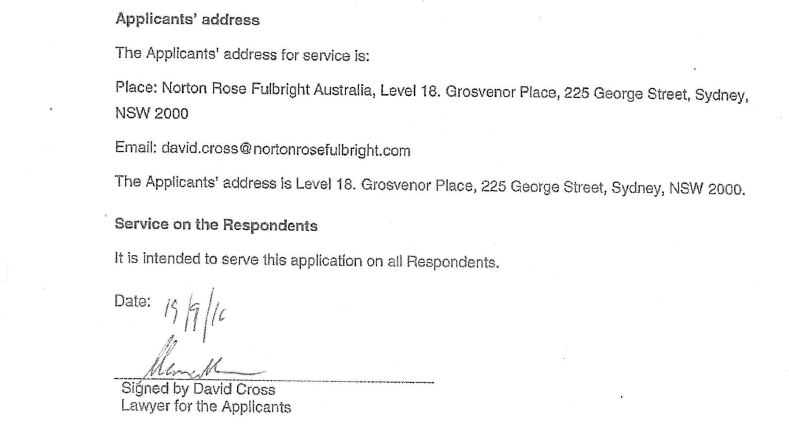
33 On 23 December 2019, I convened a case management hearing in both proceedings for the purpose of setting down procedural orders for the management of the trial. On 24 December 2019, I made certain orders. Among other things, my orders required Mr Martin to file and serve a supplementary court book and outline of submissions ahead of the trial. He did not take advantage of the opportunity to do so.
THE TRIAL
34 The trial of these proceedings took place in Adelaide. It commenced on Monday 2 March and continued to close of business on Friday 5 March 2020. Mr Martin, initially self-represented, advanced three interlocutory applications prior to opening his case. Each application, had it been accepted, would have required the trial to be adjourned. The Court dismissed all three applications: see Martin v Norton Rose Fulbright Australia (No 8) [2020] FCA 274; Martin v Norton Rose Fulbright Australia (No 9) [2020] FCA 275; and Martin v Norton Rose Fulbright Australia (No 10) [2020] FCA 281.
35 Mr Martin opened his case on Wednesday 3 March 2020.
36 On Thursday 4 March 2020, Mr Cameron, instructed by Angela Pierce and Associates, announced an appearance for Mr Martin. Mr Cameron frankly acknowledged that he was coming in to the proceeding with only the most basic understanding of the issues. Nonetheless, in what were very difficult circumstances Mr Cameron assisted Mr Martin to present his case. He called Mr Martin as a witness and ensured that documentary evidence in support of Mr Martin’s contentions was adduced. At the conclusion of the hearing, having regard to the constrained opportunity that Mr Cameron had had to present submissions with respect to Mr Martin’s case, I made orders for post-hearing written submissions in the following terms:
4. The Applicant file and serve any written submissions on which he would wish to rely, of no more than 20 pages, no later than 4:00pm Monday 23 March 2020.
5. The Respondent file and serve any further written submissions on which it would wish to rely, of no more than 20 pages, no later than 4:00pm Friday 3 April 2020.
6. The Applicant file and serve any written submissions on which he wish to rely in reply, of no more than 6 pages, no later than 4:00pm Friday 10 April 2020.
37 Those dates were extended by consent on various occasions. During the timeframe within which written submissions were to be filed, Mr Martin was represented by Angela Pierce and Associates, then by Bourne Lawyers, then, ultimately, self-represented once again.
38 Mr Martin filed his written submissions on 6 April 2020. NRFA filed its written submissions on 17 April 2020.
39 My orders of 27 May 2020 had given Mr Martin leave to file and serve reply submissions in the following terms:
4. Mr Martin have leave to file and serve written submissions in reply to those filed on behalf of Norton Rose Fulbright Australia, of no more than 6 pages, no later than 4:00pm on Friday 5 June 2020.
5. No further extension of time for the filing of written submissions shall be granted, and that any written submissions lodged by or on Mr Martin’s behalf after the time provided for in Order 4 not be accepted for filing.
40 Mr Martin, by that time again self-represented, lodged his purported reply submissions after the time provided for in Order 4. His late submissions were erroneously accepted for filing, but were later administratively removed from the court file. After correspondence had been exchanged between the Court and Mr Martin, my associate advised the parties as follows:
I confirm that, as previously advised, Mr Martin’s reply submissions have been removed the court file.
The parties should proceed on the basis that they will remain removed, unless Mr Martin advances a formal application. If any such application is made, it should be supported by a short affidavit. Each party will have leave to file any written submissions on which they would wish to rely, of no more than one page. His Honour would then list the application for a short oral hearing, by telephone.
41 Mr Martin filed no such application. Accordingly, I have had no regard to the reply submissions that he had earlier purported to file.
The evidence
42 In most instances, what was adduced or not adduced as evidence requires no further explication. Much of the evidence before the Court is in the form of emails, the provenance of which is not in dispute. However, there is some evidence that requires explanation with respect to its admission or where it appears in the Court file.
43 That is because late in the trial Mr Martin, having become represented by counsel and instructing solicitors, applied to tender three hard copy bundles of materials. The documents in those three bundles were, by consent, admitted into evidence on the understanding that they would later be electronically filed by Mr Martin’s then solicitors as exhibits A5, A6, and A8 respectively.
44 Unfortunately, Mr Martin’s then representatives subsequently electronically filed a single “tender bundle” titled “Index of Documents tendered by the Applicant”. That bundle included a considerable number of documents, primarily emails, sorted in chronological order. There was nothing to indicate which of those documents had been admitted as part of exhibits A5, A6 or A8 respectively. NRFA’s representatives - understandably - raised concern on its behalf that there might be discrepancies between the materials that had been tendered in Court without objection as exhibits A5, A6 and A8 and the single bundle of non-disaggregated materials later filed on Mr Martin’s behalf. Correspondence on this point ensued between the parties and with the Court.
45 On 27 May 2020, I convened a case management hearing to resolve the issue. The parties agreed to a way forward with respect to the exhibits. They agreed on the terms in which exhibits A5, A6 and A8 should have been, and would be, filed. They also agreed that Mr Martin should be granted leave to file a further bundle of documents as had been inadvertently omitted from what had been tendered as Ex A9.
46 Relevantly, I made the following orders:
1. Mr Martin have leave to file as evidence in his case in the trial of matters SAD49/2017 and NSD1610/2016 Exhibits A5, A6 and A8 in paginated electronic form, being respectively those documents the parties agree were tendered in Court in bundles but without their being included on the electronic court file, no later than 4:00pm on Friday 29 May 2020.
2. Pursuant to r 1.34 of the Federal Court Rules 2011 (Cth), the Court dispenses with any provision of the Rules as would prevent Mr Martin also filing as evidence in his case in the trial of matters SAD49/2017 and NSD1610/2016 Exhibit A9, being a paginated bundle of seven documents as identified by the parties during the case management hearing held on Wednesday 27 May 2020, and as they agreed should be received as evidence in those proceedings, no later than 4:00pm on Friday 29 May 2020.
47 The Court noted that:
1. Norton Rose Fulbright Australia’s legal representative appearing at the case management hearing undertook on that firm’s behalf that it will provide Mr Martin’s legal representatives with the agreed versions of Exhibits A5, A6, A8 and A9 in paginated electronic form in sufficient time to permit Mr Martin’s legal representatives to file those documents with the Court, as provided for by Orders 1 and 2.
2. The parties agree that the Court will disregard any documents other than Exhibits A5, A6, A8 and A9 as have been earlier filed in purported compliance with Mr Martin’s obligation to electronically file those documents tendered on his behalf in Court.
48 On 29 May 2020, the relevant exhibits were filed electronically in accordance with my orders. I have disregarded the materials earlier filed as referred to at [44] above.
Objections to evidence
49 On the first day of the trial I made rulings in respect of objections to evidence that NRFA had filed regarding certain affidavit evidence upon which Mr Martin had, in accordance with pre-trial directions, given notice that he intended to rely. My rulings, as provided to the parties at the time in tabular form, are those included as Annexure A to this judgment. Subject to those rulings the affidavit of Thomas Martin, sworn 19 October 2018, was admitted without further objection as Ex A4. The affidavits of Michael Harmer affirmed 25 October 2016 and 4 November were admitted without further objection as Ex A1 and Ex A2 respectively. The affidavit of Madeline Boyd (another Harmers lawyer) sworn 8 February 2017, which had not been the subject of objection, was admitted as Ex A3.
50 It proved unnecessary for the Court to make rulings with respect to the objections that Mr Martin had advanced in respect of five affidavits of Mr David Cross that NRFA had filed, and upon which it had earlier indicated that it would be relying. That was because on 20 February 2020, NRFA advised my associate and Mr Martin as follows:
NRFA will not be relying on the evidence/affidavits of Mr David Cross at the trial commencing on 2 March 2020.
51 The asserted unfairness of Mr Martin having been advised of that circumstance only in the teeth of the trial gave rise to one of Mr Martin’s three interlocutory applications. I rejected Mr Martin’s application for an adjournment on that premise for the reasons I gave in Martin v Norton Rose Fulbright Australia (No 10) [2020] FCA 281.
Tender of Mr Cross’s several affidavits as admissions
52 Mr Martin remained unrepresented for the first three days of the trial. However, on day three Mr Cameron of counsel indicated that he anticipated receiving instructions. Subsequently on days four and five he appeared as counsel for Mr Martin.
53 On the final day of the trial Mr Cameron applied to tender the affidavits of Mr Cross as evidence in Mr Martin’s case. His having done so, I drew Mr Cameron’s attention to the fact that Mr Martin when earlier self-represented had sought assurance from the Court that if he were to tender the affidavits of Mr Cross for the purposes of adducing evidence of what he submitted were admissions it would not be open to NRFA to place any reliance upon those materials. I had declined to provide him with that assurance. I had advised Mr Martin that (T123, lines 16-19):
[i]f there is evidence before the Court for good or ill, the Court takes such consideration of it as it sees fit. The parties can make such submissions as they think appropriate as to the weight, if any, to be given to particular evidence.
54 Mr Cameron indicated that he was aware of Mr Martin’s earlier expressed concerns but wished nonetheless to proceed with the tender. Out of caution, I gave Mr Cameron the opportunity of an adjournment to seek instructions on the matter from his client who was then giving evidence. Mr Martin however publicly indicated from the witness box, in order to “save some time”, that he felt “much more comfortable about that issue with [the] representation of Mr Cameron” (T219, lines 22-23).
55 Mr Cameron then re-applied to tender the five affidavits of Mr Cross. Two of those affidavits were as had been affirmed by him on 28 October 2016. The remaining three were as had been affirmed by him on 18 October 2016, 1 February 2017 and 14 December 2018 respectively.
56 NRFA’s senior counsel Mr Potts SC did not object to the tender of the five affidavits of Mr Cross as evidence in Mr Martin’s case. Mr Cameron did not seek any orders qualifying the use to which the evidence he was seeking to adduce might be put. Accordingly Mr Cross’s five affidavits, as had earlier been proposed to be adduced on behalf of NRFA prior to its late advised decision not to call him as a witness, were taken into evidence for all purposes as Ex A7.
INTRODUCTION TO SAD49/2017
Claims based on alleged false representations
57 In brief summary Mr Martin claims that during the disputed period (19-23 September 2016) NRFA, acting through its then lawyer and agent Mr Cross, on Monday 19 September 2016 falsely represented to him, via his then legal representatives, that it had “stopped” the filing of the Prohibition Proceeding in order to secure his consent to an adjournment of the FWC conciliation conference. To cover up its initial deception and to mollify Mr Martin in respect of the arrangements to which the parties had since come on Mr Martin’s earlier understanding, on Friday 23 September 2016 NRFA then falsely asserted that it had earlier been too late to “stop” the filing of the Prohibition Proceeding.
58 Mr Martin submits that by making those representations, upon which he had been induced to act, NRFA (a) committed the tort of deceit and (b) engaged in misleading and deceptive conduct contrary to s 18 of the Australian Consumer Law (ACL) (Competition and Consumer Act 2010 (Cth) Sch 2).
59 The elements of the tort of deceit are that there is a representation; made with knowledge that it is false or in circumstances where the maker is reckless as to its truth; with the intention that the applicant should act in reliance upon it; and the applicant does act in reliance upon it; and sustains damage as a result: Magill v Magill [2006] HCA 51; 226 CLR 551 (Magill) at [114] per Gummow, Kirby and Crennan JJ.
60 In its written submissions NRFA cites Gleeson CJ’s observation in Magill at [141] that “the tort of deceit does not set out to compensate people for wounded pride or dignity, or for the pain that results from broken illusions”. I accept that submission. I am satisfied that without proving that he has suffered actual loss in reliance on NRFA’s conduct, Mr Martin cannot make good his case based on the tort of deceit.
61 Damage is not strictly an element of misleading and deceptive conduct contrary to the ACL. The elements of misleading and deceptive conduct under statute are that a person engages in conduct; in trade or commerce; that is misleading or deceptive or likely to mislead or deceive. However, to obtain the remedies he seeks pursuant to s 236 of the ACL Mr Martin must prove that he has “suffer[ed] loss or damage” because of NRFA’s conduct. That requires him to establish that he would have been in a better position had he not been misled. As McHugh, Hayne and Callinan JJ observed in Marks v GIO Australia Holdings Ltd [1998] HCA 69; 196 CLR 494 at [48]:
48. A party that is misled suffers no prejudice or disadvantage unless it is shown that that party could have acted in some other way (or refrained from acting in some way) which would have been of greater benefit or less detriment to it than the course in fact adopted …
62 In oral submissions, Mr Potts conceded that “one could, in theory, have a declaration of a contravention of section 18” (T269, lines 26-27). However, he submitted as follows (T269, line 41-T270, line 17):
Mr Potts SC: But they don’t seek any other remedy under that Act, your Honour; that’s the point. So if one has the pleadings in SAD49 of 2017 which are in volume 2 of the court book, one has the originating application at tab 74. I think your Honour has volume 2 at tab 74, and there your Honour has at page 338 the originating application in that proceeding. And at page 340 your Honour has the relief sought, and your Honour sees prayers 1 to 4 are all monetary relief, and your Honour sees in 5 it’s made clear that it’s sought at common law and under section 236 of the Australian consumer law. So there is no non-compensatory or damages-style relief sought under the Australian consumer law. And so having sued us for damages under 236 they have to prove some loss. It’s not the gist of the action in the same way as a tort is …
His Honour: Yes.
Mr Potts SC: … that if there were some utility and if it were claimed, your Honour might be able to make a declaration that there had been misleading or deceptive conduct in contravention of the section. But I’m almost certain – there is certainly authority at the Full Court level or at a Court of Appeal level which says one shouldn’t make a declaration of, for example, a breach of duty of care as a signpost along the way to a finding about damages for negligence. Now, that may be a slightly inapt analogy, but there is no claim simply, for example, for a declaration that something that was done was misleading or deceptive.
63 I accept that submission. Whether Mr Martin has actually suffered any prejudice or disadvantage by reason of his reliance on NRFA’s conduct is thus potentially relevant in respect of not only the common law but also the statutory basis of this aspect of proceeding SAD49/2017.
Claim based on NRFA instituting and prosecuting proceeding NSD1610/2016
64 Mr Martin claims that in commencing proceeding NSD1610/2016 and prosecuting that proceeding in the manner in which it did, NRFA committed the tort of abuse of process. It is convenient first to identify the basic elements of that tort.
65 In PNJ v The Queen [2009] HCA 6; 252 ALR 612, French CJ, Gummow, Hayne, Crennan and Kiefel JJ observed at [3]:
It is not possible to describe exhaustively what will constitute an abuse of process. It may be accepted, however, that many cases of abuse of process will exhibit at least one of three characteristics:
(a) the invoking of a court’s processes for an illegitimate or collateral purpose;
(b) the use of the court’s procedures would be unjustifiably oppressive to a party; or
(c) the use of the court’s procedures would bring the administration of justice into disrepute.
(Emphasis added).
66 In respect of whether the Court’s processes have been invoked for an illegitimate or collateral purpose, I am satisfied that I am to be guided by what had earlier been said in Williams v Spautz [1992] HCA 34; 174 CLR 509 (Spautz). In that decision the plurality (Mason CJ, Dawson, Toohey and McHugh JJ) stated (at 523) that it is central to the tort of abuse of process that “the party who has instituted proceedings has done so for a purpose or to effect an object beyond that which the legal process offers”.
67 Their Honours held (at 529) that it is enough that the person alleging an abuse of process show that the “predominant purpose” (emphasis in original) of the other party in using the legal process has been one other than that for which the process has been designed.
68 Further, for the reasons stated by Brennan J in Spautz at 535 as applied in Lunt v Victoria International Container Terminal Limited [2020] FCAFC 40 (accepting that special leave has been given in respect of the latter decision, but in limited terms which I do not understand to challenge the correctness of Brennan J’s observation in that limited regard), I proceed on the basis that:
[t]here is no impropriety of purpose (whatever may be said of motive) when a plaintiff commences or maintains a proceeding desiring to obtain a result within the scope of the remedy, even though the plaintiff has an ulterior purpose – or motive – which will be fulfilled in consequence of obtaining the legal remedy which the proceeding is intended to produce. To amount to an abuse of process, the commencement or maintenance of the proceeding must be for a purpose which does not include – at least to any substantial extent – the obtaining of relief within the scope of the remedy.
69 Actual damage is an element of this tort (Bayne v Blake (No 1) [1909] HCA 55; 9 CLR 347 at 355 per Griffith CJ).
FACTUAL FINDINGS IN SAD49/2017
Chronology
70 As noted above, the disputed events that are the subject of SAD49/2017 occurred over the period from Monday 19 September 2016 to Friday 23 September 2016 inclusive. However, the parties are also in dispute as to the context in which those events are to be understood.
71 Mr Martin relevantly submits that:
77. The inter partes correspondence between Harmers and the Respondents speaks for itself on the topic of the proposed terms for any agreement to undergo private mediation. It could hardly have been made any clearer in the parties’ correspondence that a private mediation would require both parties to suspend progress of their foreshadowed litigation: the Applicant by consenting to an adjournment of the conciliation conference, and the Respondent by not commencing the ‘Prohibition Proceeding’ until such time as the private mediation had failed to achieve a compromise.
78. The contemporaneous email records corroborate that the Respondents clearly had the same understanding as the Applicant with respect to the terms of the deal being struck for private mediation, what it would entail for the anticipated litigation, and the status of the negotiations. Specifically, the Respondents well understood that participation in a private mediation would, in attention to resulting in the adjournment of the FWC conciliation conference, also preclude the commencement of the Respondents’ foreshadowed proceedings in the Federal Court.
(Footnotes omitted).
72 By contrast, NRFA disputes that the common understanding of the parties was that NRFA would suspend the institution of the Prohibition Proceeding while the mediation was on foot. In that regard, NRFA submits that:
The terms of the agreement to mediate were explicitly recorded in writing, save as for specific outstanding terms regarding location and costs which were initially disputed but subsequently agreed.
…
While the parties had agreed a term that the FWC would be notified of NRFA’s intention to litigate the jurisdictional issue if agreement at mediation was not reached, no term was negotiated and agreed to the effect that NRFA would abstain from filing the proceedings until such time.
(Footnotes omitted).
73 Against those submissions, it is helpful to identify a chronology based on objective documentary evidence (predominately in the form of emails) to which the parties have drawn the Court’s attention as relates to the relevant negotiations.
Mediation negotiations chronology
(a) On 22 August 2016, NRFA sent Harmers an email that included a letter and draft originating documents for proceeding NSD1610/2016 (RCB24). The letter includes the following passage:
The Fair Work Commission has no jurisdiction over Norton Rose Fulbright Australia, or any of its partners, nor any jurisdiction to entertain the FW application, for the reasons set out in the enclosed settled, but as yet unfiled, Application and Statement of Claim.
(b) On 26 August 2016, Harmers sent a letter to NRFA including the following passage (RCB43):
6. … we do not intend to engage in any further correspondence in relation to these issues as we do not consider this to be in the interests of resolving the dispute. To this end, we request your consent to seek an adjournment of the Fair Work Commission Conciliation Conference, on the basis that the parties meet for a private mediation to resolve the matter. Should the matter not resolve at such private mediation, both parties reserve their rights to pursue any action they consider appropriate …
(c) On 12 September 2016, Mr Cross sent a letter by email to Harmers which included the following passage (RCB55):
In relation to the second paragraph of your letter, the firm is prepared to mediate privately subject to all of the following conditions being agreed and adhered to:
(1) Within 24 hours of acceptance of this offer, the parties will jointly notify the FWC that:
(a) the Respondents contend that the jurisdiction of the FWC has not been validly invoked by the Applicant, and that the parties will endeavour to reach some agreement by private mediation, failing which the issue of litigation will be litigated in the Federal Court of Australia;
(b) the Respondents will serve any Federal Court proceedings on the FWC …
This offer is open until 5 pm 14 September 2016.
(d) On 13 September 2016, Harmers by email sent a letter to Mr Cross in the following terms (RCB58-59):
…
Our client is willing to agree to private mediation on the terms you have stipulated, save for the variations he would propose as outlined below by reference to the numbered paragraphs in your letter:
1. The joint communication with the Fair Work Commission should for the sake of clarity state that in the event that the parties do not reach agreement in the private mediation, the Respondent proposes to litigate the issue of jurisdiction in the Federal Court of Australia.
2. Our client is prepared to agree to your preferred mediator in Peter Jacobson QC.
3. As our client is willing to accede to your preferred mediator (among other terms you have stipulated) it is appropriate that Norton Rose Fulbright Australia meet the mediator’s costs (and associated costs) in full. By participating in the mediation, our client will effectively forego an immediate opportunity to pursue alternative dispute resolution via a Fair Work Commission conciliation conference that would not involve any substantial additional cost. Further, our client has already incurred unnecessary additional costs on account of the firm declining earlier proposals for mediation, the earliest of which was made over two months ago on 12 July 2016.
4. Our client is prepared to agree to your client’s required conditions for the exchange of position papers prior to the mediation. For the avoidance of doubt, we understand your proposal as to timing for provision of the position paper to be a reference to five (5) business days. We note for completeness that Mr Jacobson QC is likely to appreciate also being provided by each party with a sensibly confined bundle of relevant background documents (for example, the firm’s Constitution may well be considered relevant). We will be content to confer further with you in good faith in relation to this issue once we have been advised as to Mr Jacobson QC’s preference in this regard.
5. A one day mediation occurring within 21 days of the deadline for submission of the position paper is suitable to our client, subject to ascertaining the availability of Mr Jacobson QC. Given the short notice of mediation that you would seek to impose on our client, and the fact that Mr Jacobson’s chambers are located in Sydney, as is the firm’s head office, and our client has limited scope at present due to family responsibilities to travel from where he is residing in regional South Australia, our client considers Sydney to be the most feasible venue for the mediation.
6. As your participation will be entirely voluntary it does not seem strictly necessary that this condition be the subject of specific agreement. Our client does not intend to propose any additional terms for the conduct of the mediation that would restrict your ability to terminate the mediation in the manner you have described. If your client requires that this term be specifically agreed, however, in light of the costs to be thrown away and the potential discourtesy to Mr Jacobson QC in the unlikely event that this should occur, and the fact that the parties will have informed the Fair Work Commission that they will be endeavouring to reach some agreement, it would be appropriate that both parties give their undertaking that they will not enter the negotiations with an intention to terminate the mediation in this manner and would only exercise their right to do so in good faith.
On the basis of the matters set out above, our client is prepared to participate in the private mediation as proposed.
Please confirm by 5pm on 14 September 2016, that you find these proposed variations to the terms acceptable.
(e) On 13 September 2016 at 2:59pm, Mr Cross sent an email to certain of his colleagues within NRFA advising (Ex A9, p 2):
I have contacted the FWC … I told the person that we have not taken any step in the FWC proceeding because we contend that the first respondent (the firm) is not amendable to the tribunal’s jurisdiction because it is a partnership and the matter is not connected with a referring State. I advised that we were considering an application to the Federal Court for prohibition. I also advised that this issue had been raised with the applicant and that the parties were considering a private mediation. If that came about then the parties would jointly ask that the matter in the FWC stand adjourned for a period.
She told me that we had to file a response and there is no exception. I repeated that we did not want to take a step in the matter that might then preclude us from approaching the Federal Court. She said that there is a box on the response form where we can identify the existence of a dispute over jurisdiction. I said that the box is intended to capture an objection based on the applicant’s eligibility – eg. the applicant is not an employee or independent contractor. Whilst that is an issue here, there is also an issue about FWC’s power in relation to the first respondent. By completing the form we may be taken to have conceded that issue …
(f) On 14 September 2016, Mr Cross sent a letter to Mr Harmer which included the following passage (RCB61):
We refer to your letter of 13 September 2016.
…
We agree with what is proposed in numbered paragraphs 1 and 4 of your letter dated 13 September 2016.
We insist on the matters set out in numbered paragraphs 3, 5 and 6 of our letter dated 12 September 2016.
(g) On 15 September 2016 at 10:07am, NRFA’s managing partner Mr Spanner (who had effected Mr Martin’s termination) emailed his NRFA colleague Mr Harvey in the following terms (Ex A9, p 4):
Will you follow up with David [Cross] to lock down a mediation date and keep the FWC at bay. The later it is into October or into November does not bother me.
(h) On 15 September 2016, Harmers wrote a letter to NRFA which included the following passages (RCB76-77):
We refer to your letter of 14 September 2016.
It is unreasonable for you to insist upon conditions without any attempt to explain what that is the case.
…
Our client remains prepared to engage in the private mediation proposed, on the following basis.
1. Terms 1, 2 and 4 are as agreed.
2. The mediation is to be held in Sydney;
3. The firm will meet the cost of the mediator and all other associated costs in full;
4. If the parties achieve a financial settlement at or immediately following the mediation, our client will reimburse 50% of the mediator provided it is deductible from the settlement monies.
If those terms are not agreed by your client, we would seek as a matter of urgency that you confirm how you propose to address your ongoing non-compliance with the Rules of the Fair Work Commission in relation to the filing of a Response and attendance at the listed conciliation conference …
It appears uncontentious, albeit unexplained, that NRFA did not receive or come to know about Harmers’ letter of 15 September 2016 until informed of it on 19 September 2016 (RCB75).
(i) On 15 September 2016 at 9:49am, the FWC sent an email to NRFA advising that its response to Mr Martin’s general protections application was overdue. At 11:55am, Mr Cross emailed his colleagues within NRFA with respect to that correspondence advising (Ex A5, p 1):
… Leave it with me. Just waiting for Harmers to respond with final acceptance of mediation arrangements and then there will be a joint email to FWC asking to adjourn the telephone conference thing.
(j) On 15 September 2016 at 6:25pm, Mr Cross sent an email to a number of his colleagues within NRFA advising (Ex A5, p 1):
Nothing has come in from Harmers to confirm acceptance of the mediation arrangements.
The FWC teleconference is scheduled for Tuesday 20 September and in order not to show the FWC discourtesy we really need to tell them tomorrow which way it is going to go: either (1) we have commenced action for an order of prohibition and so the matter must be stood down or (2) there is joint agreement that the matter should be adjourned pending mediation.
Wayne Muddle believes we should file in the Federal Court tomorrow.
(Emphasis added).
(k) On 19 September 2016 at 10:27am, Harmers sent Mr Cross a letter by email that included the following passages (RCB63-64):
On 22 August 2016 you wrote to us to assert that the Fair Work Commission does not have jurisdiction to deal with the dispute and threatened to file injunctive proceedings in the Federal Court on that basis on 26 August 2016.
You have not filed or otherwise progressed the foreshadowed proceedings, including by filing a ‘Genuine Steps’ Statement, notwithstanding extensive discussion in correspondence on that issue. Nor have you filed a Response to the Application. We are unaware of whether you have provided any indication to the Fair Work Commission as to whether you intend to participate in the conciliation conference tomorrow. You have not informed us of your intentions, notwithstanding the fact that we urged you to confirm your position in our letters of 9 September 2015 and 15 September 2016.
Your continuing failure to comply with the tribunal’s procedures is unacceptable. Whether or not you still harbour intentions of filing proceedings in the Federal Court, the delay in clarifying your intention has been prejudicial to our client’s interests in terms of cost and delay, not to mention discourteous to the Commission.
Since 26 August 2016, our client has sought to arrange a private mediation in order to provide an alternative means of progressing the matter notwithstanding your lack of diligence in doing so via the procedures of the tribunal, and your explained delay in commencing alternative litigation first threatened on an urgent basis almost a month ago …
74 As the above chronology shows, a mediation agreement was not yet in force on the morning of Monday 19 September 2016. It is however clear that such an agreement was in the common contemplation of Harmers (on behalf of Mr Martin) and NRFA and that, on that common contemplation, certain terms had been settled. One matter upon which the parties had settled was Term 1 of what they intended to become their agreement. As agreed, it was expressed as follows:
1. The joint communication with the Fair Work Commission should for the sake of clarity state that in the event that the parties do not reach agreement in the private mediation, the Respondent proposes to litigate the issue of jurisdiction in the Federal Court of Australia.
75 NRFA’s submissions emphasise that neither party had suggested a term as would have expressly prohibited NRFA from initiating legal proceedings to contest the jurisdiction of the FWC while the private mediation was on foot. I am satisfied however that, as Mr Martin submits, it is a necessary inference to be drawn from agreed Term 1 (to which NRFA had assented) that while that party was foreshadowing that it would institute such proceedings if mediation were unsuccessful, it would not “litigate the issue of jurisdiction [of the FWC] in the Federal Court of Australia” until after the mediation had concluded.
76 Insofar as the subjective intentions of NRFA may be relevant (which I doubt), I am satisfied that in view of the email sent by Mr Cross on 13 September 2016 at 2:59pm to his colleagues I am entitled to accept that NRFA had no different understanding. It will be recalled that that email had included the following passage:
I have contacted the FWC … I told the person that we have not taken any step in the FWC proceeding because we contend that the first respondent (the firm) is not amendable to the tribunal’s jurisdiction because it is a partnership and the matter is not connected with a referring State. I advised that we were considering an application to the Federal Court for prohibition. I also advised that this issue had been raised with the applicant and that the parties were considering a private mediation. If that came about then the parties would jointly ask that the matter in the FWC stand adjourned for a period.
She told me that we had to file a response and there is no exception. I repeated that we did not want to take a step in the matter that might then preclude us from approaching the Federal Court …
77 I take it that in that email Mr Cross was representing to his colleagues in NRFA his understanding that if an agreement for private mediation could be reached with Mr Martin NRFA would seek an adjournment rather than pursue the foreshadowed application to the Federal Court.
78 Having regard to those observations and the relevant chronology, I accept Mr Martin’s submission that by 19 September 2016 the parties were proceeding on the basis that if they agreed to mediate then NRFA would hold off on instituting the Federal Court proceedings that it had foreshadowed: pending the outcome of the mediation. It is straightforward to infer that it must also have been understood that Mr Martin would consent to his adjourning the proceeding he had initiated in the FWC.
79 Later in these reasons, I also refer to the following email sent at 11:43am on Tuesday 20 September 2016 by Mr Cross to NRFA colleagues Dylan McKimmie and Chris McLeod (Ex A5, p 36):
Gentlemen,
The documents relating to the prohibition application were filed in the Federal Court yesterday morning. As that was happening we received a letter from Harmers which was chasing a reply to an earlier letter of theirs’, sent on 15 September, that we have never seen. I telephoned the Harmers office to obtain a copy of the 15 September letter and to make the point that (a) we never got it and (b) I had left several messages on Friday to discuss the arrangements mediation and received no call back.
Anyway, that led to me getting a call from Harmer himself – who was in Canberra. There followed some discussions which resulted in agreement on the arrangements for a mediation in terms satisfactory to Wayne. This was communicated to the FWC and the conciliation hearing has been vacated. The mediation will take place against the background of those proceedings, which is no bad thing.
(Emphasis added).
80 I infer that this was Mr Cross informing his colleagues that since 19 September 2016 there had been a relevant change of circumstances. That the mediation would take place against that new “background” was, his colleagues were advised, “no bad thing”. This supports my findings above.
81 Having established what I am satisfied was the context for the events which took place between 19 September and 23 September 2016, it is now necessary to focus more specifically on what transpired during that period. In my view, the evidence adduced in these proceedings entitles me to find the following sequence of events occurred:
Monday 19 September 2016
(a) At 10:01am, a NRFA lawyer (Ms Justine Krajewski) emails Mr Cross to advise him of the filing fee in the Federal Court and the payment method for the electronic lodgment of court documents (Ex A5, p 3).
(b) At 10:10am, Mr Cross directs Ms Krajewski to contact “Jen” (who I infer to have been Ms Jenny Smith) regarding payment methods (Ex A5, p 3).
(c) At 10:27am, Harmers sends NRFA an email attaching a letter dated 19 September 2016. The letter is in the following terms (RCB63-70):
There is a conciliation conference listed before the Fair Work Commission (FWC) at 2:15pm tomorrow 20 September 2016 in respect of our client’s Application, which we filed on behalf of our client on 5 August 2016. Under the FWC Rules, you were required to file a Response in or around 12 August 2016.
On 22 August 2016 you wrote to us to assert that the Fair Work Commission does not have jurisdiction to deal with the dispute and threatened to file injunctive proceedings in the Federal Court on that basis on 26 August 2016.
You have not filed or otherwise progressed the foreshadowed proceedings, including by filing a ‘Genuine Steps’ Statement, notwithstanding extensive discussion in correspondence on that issue. Nor have you filed a Response to the Application. We are unaware of whether you have provided any indication to the Fair Work Commission as to whether you intend to participate in the conciliation conference tomorrow. You have not informed us of your intentions, notwithstanding the fact that we urged you to confirm your position in our letters of 9 September 2016 and 15 September 2016.
Your continuing failure to comply with the tribunal’s procedures is unacceptable. Whether or not you still harbour intentions of filing proceedings in the Federal Court, the delay in clarifying your intentions has been prejudicial to our client’s interests in terms of cost and delay, not to mention discourteous to the Commission.
Since 26 August 2016, our client has sought to arrange a private mediation in order to provide an alternative means of progressing the matter notwithstanding your lack of diligence in doing so via the procedures of the tribunal, and your unexplained delay in commencing alternative litigation first threatened on an urgent basis almost a month ago now.
Enclosed with this letter is a draft Application for Directions which we propose to file in the Commission at 12 noon today (AEST) without further reference to you if you have not confirmed by that time that you will participate in a private mediation on the terms proposed in our letter of 15 September 2016. If you confirm your agreement to private mediation on that basis, we expect you will contact the Commission to request an adjournment of the conciliation conference as a matter of urgency.
Further, we propose to email the FWC Registrar at 11:00am (AEST), providing a copy of this letter to give reasonable notice of our intentions with regard to the Application in order to mitigate the now inevitable inconvenience to the Commission caused by your conduct of an attitude to this matter by dealing with the issue of your continuing non-compliance as soon as practicable. If you do not consent to this communication with the tribunal, please reply as a matter of urgency with your alternative proposal for resolving this unacceptable situation, noting that in the circumstances we may be left with no option but to correspond with the Commission as per the above without your consent.
(Emphasis added).
The draft proposed directions were as follows:
1. The conciliation conference listed for 2:15pm on 20 September 2016, be adjourned until 28 September 2016.
2. Respondents to file a Response to the Application by 5:00pm Wednesday 21 September 2016.
3. The Respondents be ordered to pay the Applicant’s costs.
(d) At 10:37am, Ms Jenny Smith emails Mr Cross to provide him with a Federal Court login for e-filing (Ex A9, p 7).
(e) At 10:45am, Mr Cross emails Ms Smith an originating application, a statement of claim, and a genuine steps statement (Ex A5, pp 4-17). None of those documents have been signed or dated.
(f) Mr Cross deposes that around 10:45am he made a telephone call “to the lawyer in my team that I had asked to arrange filing of these proceedings with the Court” (who I infer must be either Ms Smith or Ms Krajewski) intending to ask her to pause the filing. She had not answered. He had left a message with her secretary asking her to call him back. I address this aspect of Mr Cross’s evidence later in these reasons.
(g) At 10:51am, Mr Cross emails Mr Muddle SC and Ms Little (counsel then instructed for NRFA) as well as other lawyers in the firm (Mr Spanner and Mr Harvey). The email attaches the letter sent by Harmers at 10:27am. It reads as follows (Ex A5, p 18):
This has come in from Harmers.
They propose to file an application for directions in the FWC unless we either agree to mediation on the terms referred to in their letter of 15 September or being [sic] proceedings in the FC – by noon.
We did not receive a letter from them on 15 September and so I have gone back to them urgently on that and asked for a copy.
The FC documents have been filed electronically with the Court this morning and we are waiting for sealed versions to be sent back.
(Emphasis in original).
(h) At 10:52am, Ms Smith emails scanned copies of the originating documents to herself using a multi-function copying machine (Ex A5, pp 20-33). The statement of claim and genuine steps statement that she scans have been signed by Mr Cross. They are dated by hand 19 September 2016. The originating application is unsigned. There is a handwritten date of 19 September 2016 on the Schedule rather than next to the signature line (i.e. on a different page). The way the date is written on that page appears identical to that on the other two documents. I infer that Mr Cross also dated that document.
(i) At 10:59am, Ms Smith begins the process of faxing those documents to the Federal Court. An “ApeosPort-IV C5570 Transmission Report” with a timestamp of 11:03am reveals that 12 pages were faxed from NRFA to the Federal Court (RCB142). The report reveals that that process began at 10:59am and took 3:38 minutes. I am satisfied that it can be inferred that these were, and had been intended by Mr Cross to be, originating documents in what became proceeding NSD1610/2016.
(j) At 11:00am, Mr Cross emails Mr Harmer. The email is in the following terms (RCB72):
Colleagues,
Your letter today refers to a letter that was purportedly was [sic] sent to us on 15 September 2016.
We have not record [sic] receiving that latter.
We contacted Ms Boyd by telephone on Friday 16 September 2016 and left two messages for her to call us so that we could discuss the arrangements for mediation referred to in our letter sent on 14 September 2016. We did not commence the Federal Court proceedings on Friday because we anticipated that Ms Boyd would return our call – but that did not happen. In the absence of any response from your firm we commenced steps to file the Federal Court proceedings. In light of the fact that we have not seen a potentially important letter from you, we have stopped the process of filing the documents in the Federal Court.
Please send the 15 September letter to us as a matter of urgency.
(Emphasis added).
(k) At 11:07am, Mr Harmer emails Mr Cross a copy of the 15 September 2016 letter. He advises that he will be calling Mr Cross shortly to discuss that letter (RCB75-77).
(l) At 11:15am, there is a phone call between Mr Harmer and Mr Cross. The issue of what is said during that phone call is disputed. However, the nature of that dispute is largely inconsequential in respect of these proceedings. To the extent that I am wrong in that regard, I am satisfied that I am entitled to prefer Mr Harmer’s account. He was not required for cross-examination.
(m) At 11:16am, consistently with the nature of the conversation to which he deposes, Mr Harmer shortly afterwards emails his colleagues as follows (RCB103):
Dear all – I have conversed with David Cross – he seems amenable to a Sydney mediation and to covering our side of costs out of any settlement – he is however going to have to talk to the powers that be for instructions – he will revert shortly with the aim of us resolving the path forward and updating the FWC accordingly …
(n) At 11:23am, Ms Smith sends an email to Mr Cross. The subject line reads “TM [I am satisfied that that clearly refers to Mr Tom Martin] Documents filed by facsimile. Copies on your desk” (Ex A9, p 8).
(o) At 11:55am, there is another phone call between Mr Harmer and Mr Cross. The issue of what is said during that phone call is largely uncontentious. According to Mr Harmer (in his affidavit dated 25 October 2016), the phone call was to the following effect:
Cross: I have sought instructions and we will agree to the mediation taking place in Sydney so long as you do not count it against us on a jurisdictional basis. We will also agree to paying the cost of the mediation, however if a settlement is reached, we would require your client to pay 50% of the mediation cost, which can be deducted from the settlement monies.
Harmer: Yes – that’s fine – the conduct of the mediation in Sydney will not be used to compromise any later need for you to challenge jurisdiction should the matter not settle in mediation.
According to Mr Cross (in his affidavit dated 28 October 2016), the phone call was to the following effect:
Cross: I have sought instructions and we will agreed to the mediation taking place in Sydney so long as you do not count it against us on a jurisdictional basis. We will also agree to paying the cost of the mediation, however if a settlement is reached, we would require your client to pay 50% of the mediation cost, which can be deducted from the settlement monies.
Harmer: Yes – that’s fine I undertake that the conduct of the mediation in Sydney will not be used to compromise any later need for you to challenge jurisdiction should the matter not settle in mediation.
Cross: What happens now, will you send a note to the FWC so that they know not to expect a conciliation conference tomorrow?
Harmer: It’s a bit difficult being down here in Canberra. Could you do it?
Cross: I will prepare something and email it to you in draft.
Harmer: Thanks. I am tied up with a matter but as soon as I see your email I will leave the room to look at it and reply.
(p) At 12:02pm, Mr Harmer emails persons who I infer to have been his colleagues (copying in Mr Martin) stating that NRFA has agreed to a Sydney mediation as long as they do not count it against them on a jurisdictional basis and are okay with the proposed costs arrangement. Mr Cross will “run an adjournment note” past them (RCB105).
(q) At 12:20pm, Mr Cross sends Mr Harmer a draft email to the FWC advising that the parties intend to hold a private mediation and requesting that the conciliation conference accordingly be adjourned (RCB107).
(r) At 12:26pm, Mr Harmer responds and advises Mr Cross to send the email with their consent (RCB109).
(s) At 12:36pm, Mr Cross sends the adjournment request to the FWC (RCB11).
(t) At 12:40pm, Mr Harmer emails the FWC confirming Mr Martin’s consent to the adjournment (RCB113).
(u) At 12:45pm, the FWC issues a notice of listing relisting the conciliation conference to 19 October 2016 (RCB212).
(v) At 12:49pm, Ms Smith emails Mr Cross in the following terms (RCB320):
Hi DC,
The documents we filed in the Federal Court this morning will be electronically sealed and emailed back to you either today or tomorrow. The date of filing will be recorded as today, even if we don’t receive the documents until tomorrow.
In relation to the FWC, we serve the documents on The President of the Fair Work Commission at 60 William Street, Sydney NSW 2000. I will prepare the service letters to the FWC and Harmers.
Tuesday 20 September 2016
(a) At 9:48am, Mr Cross emails Ms Smith querying whether the originating documents will be returned from the Federal Court to NRFA by email (RCB321).
(b) At 9:52am, Ms Smith emails Mr Cross in the following terms (RCB321):
Yes, they said yesterday or today. Email to you. If we don’t have them in the next couple of hours let me know and I will call the FC again.
I will get the letters ready too soon so when we get them back we can send them straight out …
(c) At 9:53am, Mr Cross emails Ms Smith saying “Thanks.” (RCB321).
(d) At 11:43am, Mr Cross sends an email to his colleagues Dylan McKimmie and Chris McLeod (Ex A5, p 36):
Gentlemen,
The documents relating to the prohibition application were filed in the Federal Court yesterday morning. As that was happening we received a letter from Harmers which was chasing a reply to an earlier letter of theirs’, sent on 15 September, that we have never seen. I telephoned the Harmers office to obtain a copy of the 15 September letter and to make the point that (a) we never got it and (b) I had left several messages on Friday to discuss the arrangements mediation and received no call back.
Anyway, that led to me getting a call from Harmer himself – who was in Canberra. There followed some discussions which resulted in agreement on the arrangements for a mediation in terms satisfactory to Wayne. This was communicated to the FWC and the conciliation hearing has been vacated. The mediation will take place against the background of those proceedings, which is no bad thing.
(Emphasis added).
(e) At 6:38pm, Mr Cross emails Mr Harmer to arrange a phone call when he can speak to him “about locking in the mediation details, and also about the matter generally?” (RCB137).
Wednesday 21 September 2016
(a) At 10:08am, Ms Smith emails Mr Cross saying “Still nothing from the Fed Court.” (RCB322).
(b) At 10:22am, Mr Cross emails Ms Smith in the following terms (RCB323):
I just spoke to the Federal Court. Despite the assurance they gave on Monday that the sealed documents would be emailed to us by no later than yesterday, they are now saying that they haven’t sent our filed documents to the national registry to allocate the matter to the proper area because there is a massive backlog of other documents. The guy I spoke to said he would get to our documents at some point today but couldn’t guarantee when we would receive the sealed documents. When I asked whether we would get them this week he said “yeah probably”.
(c) At 4:09pm, a Federal Court employee emails Mr Cross to request that NRFA pay the filing fee for the proceeding with respect to which the originating documents were faxed to the Court (RCB274). The email also notes that the originating application was unsigned and requests that a signed version be provided by return email.
(d) At 4:16pm, Mr Cross forwards that email to Ms Smith with a “?” (RCB324).
(e) At 4:20pm, Ms Smith responds in the following terms (RCB325-326):
I will arrange for the payment.
It is correct that you didn’t sign the originating application by the looks of things. Are you likely to be in any time this afternoon to sign it? Then I can email the signed version. Otherwise we can do tomorrow morning.
(f) At 4:52pm, Mr Cross emails Ms Smith in the following terms (Ex A5, p 38):
Some developments have just happened which may mean that we don’t want to proceed with filing the FC docs right now. There may be a mediation. So I will reconnect with you about it tomorrow. Thanks for your help.
(g) At 4:53pm, Ms Smith responds as follows (Ex A5, p 38):
No trouble. I have just put the docs back on your desk. I may be in a little late tomorrow due to my 9:30 medical appointment, but I’ll be in all day after that.
Thursday 22 September 2016
(a) At 12:06pm, Ms Smith emails Mr Cross advising that the matter has been listed before Justice Wigney on 18 October 2016. She asks (RCB414):
The registry called to ask us if we needed an earlier court date given the FWC proceedings.
Is this date ok, or do you want an earlier one?
(b) At 12:31, Mr Cross emails Ms Smith advising “The date is good” (Ex A5, p 39).
(c) At 3:14pm, Ms Smith receives an email from the Federal Court confirming payment of the filing fee (Ex A8, p 42).
(d) Between 4:02pm and 4:04pm, a Federal Court employee emails Mr Cross sealed copies of all the originating documents. The date and time stamps appearing next to the seals on those documents read as follows: originating application, 22/09/2016 at 3:59:44 PM AEST; statement of claim, 22/09/2016 at 3:59:47 PM AEST; genuine steps statement, 22/09/2016 at 3:59:49 PM AEST (RCB144-162).
(e) At 4:10pm, Mr Cross forwards the sealed copy of the originating application to Ms Smith (Ex A5, pp 46-51). It is a sealed version of the copy sent to the Court by fax on 19 September: it is neither signed nor dated on the signature page (although it does bear a handwritten date of 19 September 2016 on the Schedule).
(f) At 4:18pm, Ms Smith emails Mr Cross in the following terms (RCB416):
Weird … this is the one that has not been signed and they’ve still accepted it for filing …?
(g) At 4:22pm, Ms Smith emails Mr Cross in the following terms (RCB436):
I will prepare the service docs to be sent out first thing tomorrow morning.
I am assuming we just sign the sealed originating application and email it back to the court and then serve the signed copy?
(h) At 4:27pm, Mr Cross replies to Ms Smith, saying “Thank you.” (RCB436).
Friday 23 September 2016
(a) At 9:57am, Ms Smith (again using a multi-function copy machine) scans 15 images and sends them to herself (Ex A8, p 14).
(b) At 10:04am, Ms Smith emails David Cross with what I infer is a draft email to the FWC serving the originating documents, attaching a PDF titled “The Fair Work Commission – Service” (Ex A5, p 63).
(c) At 10:09am, Ms Smith emails the Federal Court to confirm that the filing fee has been paid and attaching or purporting to attach “the signed Originating Application” (RCB280).
(d) At 2:03pm, Ms Smith emails Mr Cross stating: “These are the documents that are to be served on the FWC” and attaching a PDF titled “The Fair Work Commission – Service” (Ex A5, p 64).
(e) At 3:18pm, Mr Cross emails Ms Smith stating: “Can we send off the email to FWC serving the docs?” (Ex A5, p 65).
(f) At 3:31pm, Ms Smith emails Mr Cross stating (Ex A5, p 65):
Yep I can send that one out now, but I think you’d better send the one to Harmers (just to be on the safe side!)
(g) At 3:32pm, Mr Cross emails Mr Cross stating: “I will.” (Ex A5, p 65).
(h) At 3:33pm, Ms Smith emails Mr Cross stating: “Actually – I can log on as you and send both out from your email address if you’d like?” (Ex A5, p 66).
(i) At 3:37pm, Ms Cross emails Ms Smith stating: “Thanks. Just do the FWC one for now.” (Ex A5, p 66).
(j) At 3:47pm, Ms Smith sends an email to the FWC “on behalf of David Cross” attaching the PDF document titled “The Fair Work Commission – Service” and a covering letter of service (Ex A5, pp 67-82). The documents are the same as those later served on Mr Martin.
(k) At 3:52pm, Mr Cross emails Ms Smith with the terms of the email set out below (Ex A5, p 84).
(l) At 4:02pm, Ms Smith replies. She asks “did you mean to send this email to me or did you want to respond to Michael Harmer”? (Ex A8, p 53).
(m) At 4:27pm, Mr Cross emails Mr Harmer in the following terms (annexure MDH-10 to the affidavit of Michael Harmer affirmed 25 October 2016 as is part of Ex A7; omitted from RCB tab 29, p 115; separately electronically filed by NRFA as part of a tender bundle on 16 March 2020: letter only also subsequently filed as Ex A5, p 84):
Michael,
The process of filing the documents with the Federal Court had progressed too far on Monday to be reversed following receipt of your email and our subsequent agreement on mediation. The Court sent us sealed copies yesterday.
So it is best we go ahead with service as per the attached letter.
The date for directions (18 October 2016) falls well after the mediation. If mediation activities are still going on than we can sort out an adjournment.
Give me a call to discuss.
(Emphasis added)
82 The “attached letter” to which Mr Cross refers in that email is dated 23 September 2019. It is a letter from Mr Cross. It attaches three originating documents: an originating application; statement of claim; and genuine steps statement.
83 The originating application is prefaced as follows:
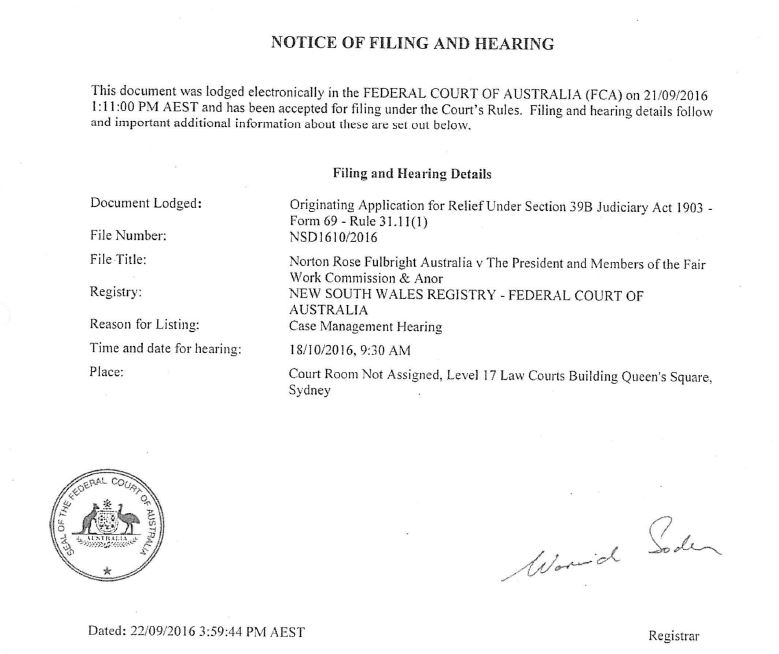
84 I infer that the date accompanying the seal indicates that the document was sealed by the Court at 22 September 2016 at 3:59pm AEST.
85 The statement of claim is similarly prefaced as follows:
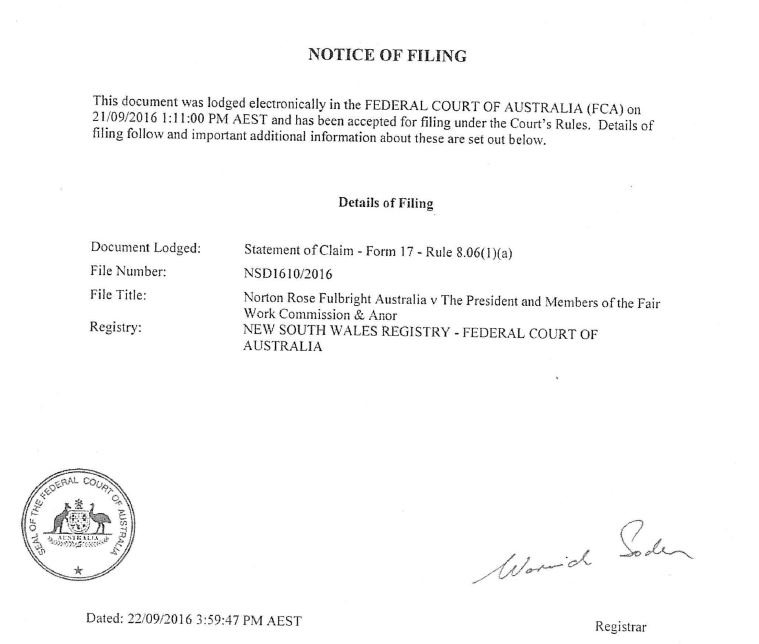
86 The genuine steps statement is prefaced as follows:
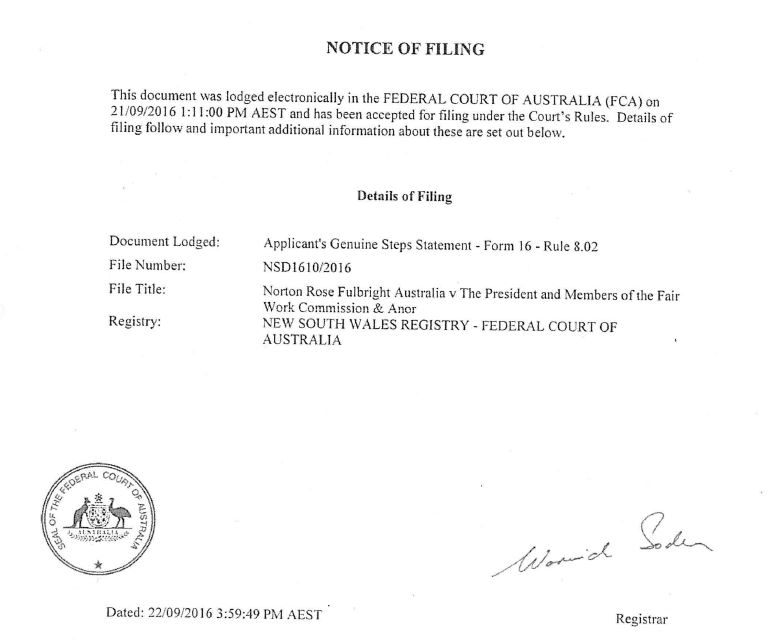
87 The originating application bears the handwritten date of “19 September 2016” on the Schedule, as appeared on the application as originally faxed to the Court:
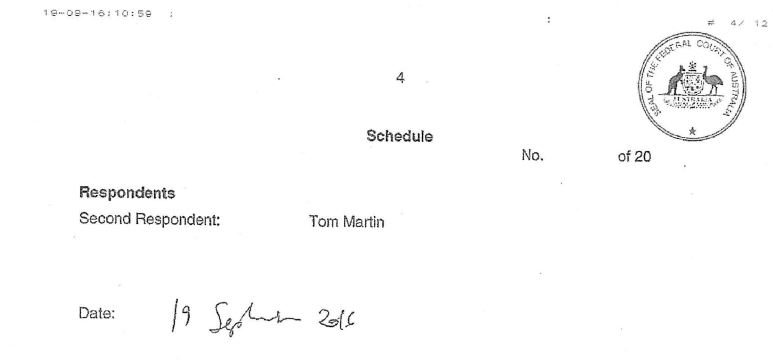
88 However, unlike the version faxed to the Court on 19 September 2016 it is signed. The signature is dated 19/9/16, as follows:
89 I should now summarise certain events relevant to these proceedings as occurred after Friday 23 September 2016.
Monday 26 September 2016
(a) At 12:56pm the Federal Court confirms receipt of Ms Smith’s email attaching or purporting to attach “the signed Originating Application” and confirming payment of the filing fee in the following terms (Ex A5, p 87):
Thanks, Jenny.
John.
Tuesday 27 September 2016
(a) At 12:14pm, the FWC issues a notice cancelling the listing of the adjourned telephone conciliation conference that was to take place on Wednesday 19 October 2016 (RCB214-215). It appears not to be in dispute that the FWC issued that notice after having been served with NRFA’s originating documents in NSD1610/2016, but of its own volition rather than in consequence of any interlocutory order. Mr Harmer deposes to the relevant circumstances in his affidavit dated 4 November 2016 as follows:
9. On 27 September 2016, following the commencement of the Federal Court Proceedings by NRFA on 22/23 September 2016, Harmers received an email from the FWC cancelling the conciliation which had been listed for 19 October 2016.
Monday 17 October 2016
(a) Mr Martin files a notice of discontinuance in the FWC. His representatives serve that notice on NRFA by a covering letter which relevantly states (RCB117-118, RCB176):
Please find enclosed by way of service the Notice of Discontinuance which was filed on behalf of our client, in the Fair Work Commission today.
Notwithstanding, our client’s decision to discontinue the Fair Work Commission proceedings, our client maintains that he has a genuine claim for breach of the General Protection Provisions in the Fair Work Act 2009 (Cth) and that he was entitled to commence proceedings in that jurisdiction.
However, in light of the failed attempt to resolve the dispute through private mediation, and your insistence to engage in a costly and protracted pre litigation dispute in the Federal Court of Australia, our client has decided to pursue his claim in an alternate forum.
In these circumstances, our client does not foresee there to be any basis for you to seek costs against our client and as such, invites you to immediately discontinue the Federal Court Proceedings with no order as to costs.
(b) Mr Cross responds as follows (RCB120):
Colleagues,
I wasn’t aware the proceedings in the FWC had been discontinued when we spoke this morning about the directions hearing tomorrow.
Before seeing your letter I had made telephone contact with Wigney J’s associate, but the footing on which I did so did not encompass the actual discontinuance of the FWC proceedings.
In light of your letter, and the demand for discontinuance of the Federal Court proceedings contained within, it is best that the parties appear at the direction hearing tomorrow so that the Court may be fully informed and appropriate arrangements made for the disposition of the proceedings.
Tuesday 18 October 2020
(a) Proceeding NSD1610/2016 first comes before the Court.
Mr Martin’s pleaded “stop representations”
90 The following email sent by Mr Cross to Harmers at 11:00am on Monday 19 September 2016, is central to this aspect of these proceedings:
Colleagues,
Your letter today refers to a letter that was purportedly sent to us on 15 September 2016.
We have no record of receiving that letter.
We contacted Ms Boyd by telephone on Friday 16 September 2016 and left two messages for her to call us so that we could discuss the arrangements for mediation referred to in our letter sent on 14 September 2016. We did not commence the Federal Court proceedings on Friday because we anticipated that Ms Boyd would return our call – but that did not happen. In the absence of any response from your firm we commenced steps to file the Federal Court Proceedings. In light of the fact that we have not seen a potentially important letter from you, we have stopped the process of filing the documents in the Federal Court.
Please send the 15 September letter to us as a matter of urgency.
(Emphasis added).
91 Mr Martin pleads that by what Mr Cross stated in his email as set out above, NRFA made certain direct and implied representations. At paragraph [41] of his further amended statement of claim (FASOC), he identifies those representations as follows:
(a) as at 11:04am on 19 September 2016 the Respondents:
(i) had stopped taking steps to file the Foreshadowed Proceedings or proceedings substantially in the form of the Foreshadowed proceedings;
(ii) [had] not filed the Foreshadowed Proceedings, or proceedings substantially in the form of the Foreshadowed Proceedings;
(collectively called the Direct Stop Representation).
(b) further or in the alternative, the Respondents would not take steps to file the Foreshadowed Proceedings, or proceedings substantially in the form of the Foreshadowed Proceedings, while discussions occurred with Harmers with a view to agreeing to undertake the proposed private mediation;
(called the Implied Stop Representation).
92 Mr Martin submits that both the Direct and Implied Stop Representations which he asserts NRFA made were false. He further submits NRFA made each of those representations (through Mr Cross) in circumstances where it either knew them to be false or was reckless as to whether or not they were false.
93 NRFA accepts that Mr Cross made the Direct Stop Representation, and that it was “potentially misleading”. On NRFA’s behalf, Mr Potts acknowledges:
the word “stopped” used in the 19 September email conveyed that the process of filing had already been halted when the email was sent. Whilst Mr Cross may have attempted to “stop” the process, the process had not in fact already been “stopped” at the time …
94 Mr Potts submits that the Court ought to conclude however that Mr Cross merely used “infelicitous language” when “seeking to convey that he had taken steps to attempt to cease the process of filing”. He submits that there is no evidence that before making the Direct Stop Representation at 11:00am on Monday 19 September 2016 Mr Cross knew that Ms Smith had begun faxing the originating documents to the Court. To the contrary, he submits, before that time:
Mr Cross attempted to call Ms Smith to stop the process, and left a message with a secretary when he was unable to reach her.
95 In that respect, Mr Potts relies on what was deposed to by Mr Cross in his affidavits as were put into evidence in Mr Martin’s case. That evidence was as follows:
David Cross affidavit of 18 October 2016 at [13]:
After reading the 19 September 2016 letter, I made a telephone call to the lawyer in my team to request that the filing of the documents be delayed. The person was not there. I left a message.
David Cross affidavit of 28 October 2016 at [4]-[5]:
On 19 September 2016, after reading the emailed letter of that day at about 10:45am before I emailed Harmers at about 11am … I made a telephone call to the lawyer in my team that I had asked to arrange filing of these proceedings with the Court. My intention was to request that the filing of the documents be delayed, because I wanted an opportunity to consider the content of the Harmers’ Unsent Letter in case it was potentially important to the filing of the Federal Court proceedings. The lawyers’ phone was answered by a secretary and I left a message for the lawyer to return my call.
96 In passing - although nothing would appear to turn on this - I note that while it may have been Ms Smith who was the claimed object of Mr Cross’s asserted failed call, in the absence of evidence from Mr Cross to affirm that circumstance I cannot discount on the documentary evidence to which I have earlier referred that he may have telephoned Ms Krajewski who had earlier emailed him to advise of the required filing fees.
97 Whatever that circumstance, Mr Potts submits that the Court should reject that Mr Cross made or conveyed the Implied Stop Representation.
Findings of fact regarding the Stop Representation
98 It is convenient at this stage to make factual findings as to what if anything NRFA represented to Mr Martin; whether any such representation was false or misleading; and if so whether any such deception was intentional or made in reckless disregard of the truth. My findings of fact in those regards will then inform further analysis with respect to whether or not Mr Martin can establish the causes of action he pleads.
99 In his closing written submissions, with respect to whether it would be open to the Court to conclude that the conduct of Mr Cross can be attributed to NFRA Mr Martin submits as follows:
17. It is respectfully submitted that there is no basis for the Respondents’ denial of the allegation, at paragraph 26 of the FASOC, that Mr Cross’ conduct and knowledge is to be attributed to the Respondents. The Respondents have admitted the allegation in paragraph 25 of the FASOC that Mr Cross “was acting as an agent, simpliciter, representing the Respondents as ‘solicitor-litigants-in-person’”. The Respondents have maintained, during interlocutory hearings over discovery issues and claims of legal professional privilege that Mr Cross was always acting in a professional capacity.
18. It is unclear, with respect, how the issue of attribution could plausibly be denied, particularly in the absence of any pleaded basis in fact or law for the denial. It is ultimately immaterial whether the attribution of Mr Cross’ conduct and knowledge to the Respondents occurs by reason of Mr Cross having acted for them as professional legal representative, or merely as the appointed agent of the partnership. Either situation would be sufficient for attribution.
19. In any event, the Respondents have also admitted paragraph 22 of the FASOC, which mirrors the criteria for attribution of legal liability amongst partners in a partnership under the Partnership Act 1892 (NSW).
(Footnotes omitted; emphasis in original).
100 I accept Mr Martin’s submissions. At trial and in closing written submissions, Mr Potts did not press that I should reach a contrary conclusion. The evidence to which I have referred above and the want of any submission to the contrary entitle me to find that at the relevant times Mr Cross was acting not only as solicitor on the record, but also as an agent of NRFA. I am satisfied that I am entitled to accept that the conduct of Mr Cross and the representations he made can properly be attributed to NRFA.
What representation or representations were made by Mr Cross/NRFA?
101 NRFA concedes that the email Mr Cross sent to Harmers at 11:00am on Monday 19 September 2016 conveyed the representation that Mr Martin pleads as the Direct Stop Representation, i.e. that NRFA had to that time not filed any proceeding seeking to prohibit the FWC from dealing with Mr Martin’s application and had stopped taking any steps that would be required of it to do so.
102 I therefore take it to be uncontentious that I should find that NRFA did convey that representation. I so find.
103 NRFA however rejects that I should conclude that the email also conveyed the Implied Stop Representation Mr Martin pleads, being that NRFA “would not take steps” to file such a proceeding “while discussions occurred … with a view to agreeing to undertake the proposed private mediation”.
104 I do not doubt that the email was capable of conveying the Implied Stop Representation Mr Martin pleads it did.
105 However, the question of whether it is reasonably open to a court to conclude that a representation has in fact been made has to be judged having regard to the context in which the words said to manifest that representation were communicated and received: see, eg, Australian Competition and Consumer Commission v TPG Internet Pty Ltd [2019] FCA 1677 at [42]-[43]. On the facts of the present case the Implied Stop Representation, if made, would have involved a significant concession on NRFA’s part. I am sceptical that in the context of what were hard negotiations Mr Harmer, as the recipient of that communication, could reasonably have understood that such a concession was implicit in what had been communicated to him by Mr Cross.
106 Contextual factors point against that being an inference reasonably open to be drawn. Mr Cross’s email states only that “in light of the fact that [NRFA] have not seen a potentially important letter from [Mr Martin]” the process of filing had been stopped. Read as an ordinary sentence, that is a conditional statement. It does not purport to exclude the possibility that once Mr Martin’s letter had been read and considered, NRFA’s position might be revisited and Mr Harmer advised accordingly. I reject that in that context, without more, it would have been reasonable for Mr Harmer in then representing Mr Martin to have believed that Mr Cross’s email conveyed the Implied Stop Representation. The position in that regard as at that point of time was quite distinct from the point at which after their later discussion they had agreed on behalf of their clients to pursue the private mediation, which I heave earlier found required that NRFA not file the foreshadowed Prohibition Proceeding.
107 I am satisfied that Mr Martin cannot establish on the balance of probabilities that Mr Cross’s email of 19 September 2016 conveyed the implied representation he pleads.
Was the Direct Stop Representation false?
108 NRFA accepts not only that the Direct Stop Representation was made, but also that it was “potentially misleading”. However, it does not concede that it was relevantly “false”.
109 NRFA’s written submissions on this point are somewhat unclear. It is submitted that for various reasons Mr Cross’s representation was not a “deliberate falsehood”. That however elides the prior question as to the falsity or otherwise of the representation with what may or may not have been in the mind of Mr Cross.
110 To the extent that Mr Potts submits that the Court should find that the representation was not false because Mr Cross should be understood as having conveyed that he had “taken steps to attempt to cease the process of filing” when he had attempted to telephone Ms Smith to that end, I reject that submission.
111 The word “stopped”, when employed in the context of the relevant email, cannot be understood as merely conveying that Mr Cross had “taken steps to cease the process of filing” proceeding NSD1610/2016.
112 Mr Cross stated: “we have stopped the process of filing” (emphasis added). The use of the pronoun “we” in that context must refer to a collective action taken by NRFA. There is no plausible reading of that email as would convey that he individually had “taken steps to attempt to cease the process of filing”.
113 I am satisfied that Mr Cross’s email conveyed exactly what it states to Mr Harmer. He was representing to Mr Harmer that the process of filing the proceeding that ultimately became NSD1610/2016 had been actually stopped by NRFA. That however, as he knew, was not the fact.
114 Given that finding, it is strictly unnecessary to determine whether or not Mr Cross “had taken steps to attempt to cease the process of filing”. However, lest I be in error in that regard it is convenient to say something briefly about that contingent proposition.
115 NRFA called none of Mr Cross, Ms Smith, Ms Krajewski or the secretary with whom Mr Cross asserted in his affidavit he had left a telephone message to give evidence. NRFA’s unexplained failure to call any of those witnesses engages the rule in Jones v Dunkel [1959] HCA 8; 101 CLR 298 (Jones v Dunkel). I am entitled to infer that had they been called, they would not have provided testimony as would have assisted NRFA’s case. I am thus unpersuaded that the evidence in this proceeding entitles me to make an affirmative finding as would support NRFA’s contention that such a telephone call was made: and certainly not in terms as would have made it otherwise than knowingly misleading for Mr Cross to have communicated to Mr Harmer that NRFA had taken steps to attempt to cease the process of filing. In the circumstances however, even if I were to be mistaken in that analysis I need not rely upon that rule of evidence.
116 All Mr Cross deposes to, taken at its highest, is that he had left a message for Ms Krajewski who had advised him regarding the filing fees required by the Court or Ms Smith to whom he had delegated the task of filing the relevant proceedings to call him back. Mr Cross does not depose that the message he left instructed them not to proceed with the filing of the relevant documents. That is a conspicuous omission. In the absence of any evidence, I decline to fill the gap. Nor does Mr Cross depose that he had later conveyed any such request or instruction to Ms Smith when he had earlier returned the (partially) completed documents he had asked her to file.
117 For those reasons, to the extent that I might be in error in my conclusion that in using the word “stopped” Mr Cross cannot be understood to have conveyed simply that he had “taken steps to cease the process of filing”, I am satisfied in that event that such a representation equally would have been knowingly false. I reiterate however that I do not regard that as an available construction of what was conveyed.
Was the Direct Stop Representation misleading or deceptive or likely to mislead or deceive for the purpose of s 18 of the Australian Consumer Law?
118 NRFA accepts that the Direct Stop Representation was “potentially misleading”. Having regard to my reasoning as set out above, I am satisfied that what Mr Cross represented to Mr Harmer and his client, Mr Martin, was actually misleading.
Did NRFA make the Direct Stop Representation intentionally: i.e. with knowledge that it was false, or in reckless disregard of the truth?
119 I turn then to the issue of whether I should find that NRFA, through Mr Cross, intentionally misled Mr Martin. Mr Potts submits that I should not:
Mr Cross’ use of the word “stopped” in the 19 September email may have been misleading, as the filing had not in fact been stopped at the time, however, that does not lead to a conclusion that it was a deliberate falsehood. The Court should not find that Mr Cross knew, or did not care whether his representation was “false”, with the intention that Mr Martin would rely upon it to his detriment. Such an intention would be against the weight of the evidence. Not every mistake is made dishonestly. It is far more likely that Mr Cross used infelicitous language in his email when seeking to convey that he had taken steps to attempt to cease the process of filing. It is difficult to attribute some other motive to him. This is particularly so in circumstances where: (a) Harmers had not made their proposal of mediation contingent upon any representation of the kind alleged; (b) the only message conveyed in Mr Cross’ email was an intention to forestall the process of filing until a communication that Mr Cross had not seen was received; (c) Mr Cross emailed Mr Harmer on 20 September 2016 asking to speak (see paragraph 13 above) and it should be inferred, was intending to tell him about the filing; (d) when sealed documents were received from the Court they were immediately served, so it was hardly as though the fact of the filing was concealed; and (e) Mr Cross had little to gain as there was nothing irrevocable done by Mr Martin on the strength of any such misleading representation. Mr Martin could have refused to mediate and sought to re-list the conciliation conference.
(Emphasis added).
120 I reject that submission. To the contrary, I am satisfied that - having regard to the history as revealed by the contemporaneous documents that are in evidence to which I have referred above, and notwithstanding the seriousness of that conclusion in view of the principles in Briginshaw v Briginshaw [1938] HCA 34; 50 CLR 336 (Briginshaw) - Mr Cross must have known that the representation he was communicating was false.
121 There is a short answer to the submission that Mr Potts advances on behalf of NRFA that the Court should hesitate to attribute any duplicitous intent to Mr Cross because, objectively, NRFA had “little to gain” from such a deception. That short answer is that the evidence entitles me to infer that Mr Cross - rightly or wrongly - was proceeding on Monday 19 September 2016 on the basis of a quite different understanding. The understanding on which I infer he was then proceeding was that it would be to the advantage of NRFA that Mr Martin agree to the adjournment of the pending proceeding he had commenced in the FWC before he came to know that proceeding NSD1610/2016 had been filed.
122 The Direct Stop Representation secured Mr Martin’s consent to the adjournment of the FWC conciliation conference listed for Tuesday 20 September 2016. By 12:40pm on 19 September 2016 both parties had thus confirmed their consent to the adjournment. I infer that Mr Cross thought that once that background was in place, participating in a mediation in circumstances where proceeding NSD1610/2016 had been not merely flagged as a possibility but had actually been filed might leave Mr Martin with reduced bargaining power with respect to a potential settlement. It is that which explains why Mr Cross advised his colleagues at 11:43am on Tuesday 20 September 2016 by email:
The documents relating to the prohibition application were filed in the Federal Court yesterday morning. As that was happening we received a letter from Harmers which was chasing a reply to an earlier letter of theirs’, sent on 15 September, that we have never seen. I telephoned the Harmers office to obtain a copy of the 15 September letter and to make the point that (a) we never got it and (b) I had left several messages on Friday to discuss the arrangements mediation and received no call back.
Anyway, that led to me getting a call from Harmer himself – who was in Canberra. There followed some discussions which resulted in agreement on the arrangements for a mediation in terms satisfactory to Wayne. This was communicated to the FWC and the conciliation hearing has been vacated. The mediation will take place against the background of those proceedings, which is no bad thing.
(Emphasis added).
123 Against that finding, let it be assumed that Mr Potts is correct to speculate that Mr Cross was conscious that it would have been open to Mr Martin when he later found out that proceeding NSD1610/2016 had been filed after all to immediately renege on the agreement to adjourn and mediate and seek to re-activate his proceeding in the FWC. On that premise Mr Cross can be assumed also to have anticipated that there would be a real risk that Mr Martin might actually do so if he came to learn that NRFA had duplicitously departed from the spirit of their agreement. The advantage he hoped to gain (being to have the mediation “take place against the background of” proceeding NSD1610/2016) would therefore not have been secured. I reject that it would not be open to me to infer that that was the explanation for why on Friday 23 September 2016 Mr Cross advised Mr Martin, again contrary to fact, that the process of filing had on Monday “gone too far to be reversed”.
124 For that reason I also reject entirely NRFA’s submission that I should not attribute deceptive intent to Mr Cross because “when sealed documents were served by the Court they were immediately served, so it is hardly as though the fact of the filing was concealed”. For the reasons I give below, I am satisfied that those documents were served under cover of a letter that concealed the truth as to the date and circumstances of their lodgment and filing.
125 I also reject NRFA’s submission that a factor that speaks against it not having intentionally deceived Mr Martin is that Mr Cross “emailed Mr Harmer on [Tuesday] 20 September 2016 asking to speak … and it should be inferred, was intending to tell him about the filing”. Mr Potts does not articulate the basis on which I should draw such an inference. The alleged circumstances of that email were deposed to by Mr Cross in his affidavit dated 28 October 2016 at paragraph [16]:
I wanted to make sure that the advent of the Federal Court proceedings was not perceived by Mr Martin in a way likely to impair the effectiveness of the mediation. To achieve this I proposed to speak to Mr Harmer and explain the circumstances in which the papers were filed so that he understood that it had not been contrived as some sort of provocative gesture ahead of the mediation. I sent Mr Harmer an email on 20 September 2016, a copy of which is annexed and marked “DC2-1”. Mr Harmer did not call me. I thereafter decided that when the sealed Court process was returned by the Court, I would serve it by email and address the issue in the covering email. This is the email referred to in paragraph [18] of Mr Harmer’s Affidavit, which attached the formal letter of service and Court process.
126 However, taking that evidence at its highest it remains entirely a matter of speculation what Mr Cross may have intended to say to Mr Harmer in “explaining the circumstances” of the filing. It is also entirely unexplained why, if Mr Cross had wanted to explain himself, then after Mr Harmer had not returned his call he had not then followed up or communicated the relevant circumstances in writing by email. Moreover, for the reasons I give below I am satisfied that the manner in which Mr Cross later “addressed the issue” in his covering email for the service of the originating documents on Mr Martin itself contained two false and deceptive representations. I therefore decline to draw the inference for which NRFA submits.
127 For the reasons I have given, I also reject NRFA’s broader submission that the absence of a credible motive should lead to my finding that Mr Cross did not know he was making a false statement. I am satisfied that NRFA made the Direct Stop Representation knowing it was false and in the expectation, or reckless as to the almost certain likelihood, that Mr Martin would rely upon it, in furtherance of what Mr Cross understood - rightly or wrongly - to be its interests.
128 I am accordingly satisfied that the evidence entitles me to find - notwithstanding the seriousness of that conclusion having regard to the principle established in Briginshaw - that the representation Mr Cross made in his email of 19 September 2016 that NRFA had “stopped the process of filing the documents in the Federal Court” was, as Mr Martin contends, knowingly false.
Mr Martin’s pleaded “service and process representations”
129 Mr Martin further pleads that Mr Cross made false and misleading representations in the email that he sent to Mr Harmer on 23 September 2019. It will be recalled that that email was in the following terms:
Michael,
The process of filing the documents with the Federal Court had progressed too far on Monday to be reversed following receipt of your email and our subsequent agreement on mediation. The Court sent us sealed copies yesterday.
So it is best we go ahead with service as per the attached letter.
(Emphasis added).
130 It is uncontentious that the final versions of the originating documents were attached to that email.
131 At paragraph [65] of his FASOC, Mr Martin claims that by this email and the service of those versions of the originating documents NRFA represented that:
a) the Sealed Documents served on the Applicant were identical copies of the “sealed copies” issued to the Respondents by the Registry of the Court on 22 September 2016;
b) the served sealed Originating Application was the True Originating Application;
c) Cross had signed the True Originating Application on 19 September 2016, before the document had been filed;
d) the True Originating Application issued by the Court was duly signed and dated accordingly;
e) the True Originating Application had been filed, and Action 1610 commenced, in substantial compliance with the Federal Court Rules 2011
(collectively called the Service Representation).
132 At paragraph [67], Mr Martin further claims that by this email NRFA represented that:
no further procedural step had been taken by, or was required of, the Respondents in order to commence Action 1610 prior to the Private Mediation
(Process Representation).
133 Mr Martin submits that both of those representations were deliberate falsehoods.
134 NRFA by contrast submits that the Process Representation was not made at all, but that if it was made it was true.
135 In respect of the Service Representation as articulated by Mr Martin NRFA submits that not all of the pleaded representations were made, and that those that were made were at most “potentially misleading”.
Findings of fact regarding the Process Representation
What representation did the email convey?
136 Mr Martin submits that by stating that “the process of filing the documents with the Federal Court had progressed too far on Monday to be reversed following receipt of your email and our subsequent agreement on mediation” NRFA represented that:
no further procedural step had been taken by, or was required of, the Respondents in order to commence Action 1610 prior to the Private Mediation
137 NRFA denies that the Process Representation was made.
138 I reject NRFA’s submission. Having regard to the terms of Mr Cross’s email I am satisfied that the Process Representation Mr Martin pleads was made. In context, I am satisfied that his statement that the process could not have been reversed after NFRA had lodged its documents at 12:02pm on Monday 19 September 2016 conveyed the representation that no further procedural steps, as from that time, had been required of NRFA in order to complete the process of filing.
Was that representation false?
139 NRFA submits that the representation, if made, was objectively true, as:
51. … There is no evidence that the proceedings could have been called back or undone after they were faxed to the registry on 19 September 2016. The non-payment of the filing fee goes nowhere. Under Reg 2.14(1) of the relevant regulations, a filing fee for a document must be paid before the document is filed (although a registrar or authorised officer has a power of deferral under Reg 2.15). That is subject to Reg 2.16(1)(b), which provides that if the person liable to pay the fee is represented by a lawyer who is an approved Court user, the Court may instead, invoice the person or the lawyer for the filing fee. Under Reg 2.22 fees not paid are a debt due to the Commonwealth. The combined effect of these regulations is that a debt due for the filing fee arises at the time for lodgement (because of Reg 2.14(1), although it can be invoiced for rather than paid where the party is represented by a lawyer who is an approved Court user. The absence of a signature did not in fact prevent filing (RCB at 2/160 p 242), nor was it required as a matter of law.
140 I reject that submission.
141 As the above chronology suggests, it may be accepted that Ms Smith on behalf of NRFA faxed the originating documents in proceeding NSD1610/2016 to the Federal Court at 10:59am on Monday 19 September 2016. I infer they were received in the Registry of the Court at or around that time. However, that does not compel the conclusion that the documents were filed at that point.
142 The Federal Court Rules 2011 (Cth) (the Rules) distinguish between a circumstance where a document has been “lodged” with the Court (rr 2.21-2.24 inclusive) and a circumstance where a document is “filed” (r 2.25). Rule 2.27 explicitly provides that a document “lodged” with the Court will not be accepted for filing if, inter-alia, it has not been signed.
143 It is not in dispute that NFRA’s originating application as faxed to the Court on 19 September 2016 had been unsigned. Mr Cross was later informed both that the fee required had not been paid (a matter that he subsequently ensured was remedied) and that the originating application as lodged was unsigned.
144 NRFA submits that if the Registry accepts a document for filing notwithstanding that it has not been properly signed then that document has, subject to any order of the Court, lawful effect as a filed document. In that regard Mr Potts submits that r 2.25 establishes that such a document, whatever its deficiencies, is filed once it is sealed and is then taken to have been filed when it was lodged. Rule 2.25 is in the following terms:
When a document is filed
(1) A document is filed if:
(a) it is lodged with the Court in accordance with rule 2.21(1); and
(b) either:
(i) for a document in an existing proceeding – it is accepted in the Proper Registry by being stamped as ‘filed’; or
(ii) in any other case – it is accepted in a Registry by being stamped as ‘filed’.
…
(3) If a document is faxed or sent by electronic communication to a Registry, the document is, if accepted by a Registry under subrule (1), taken to have been filed:
(a) if the whole document is received by 4.30pm on a business day for the Registry – on that day; or
(b) in any other case – on the next business day for the Registry.
145 Mr Potts submitted that (T259, lines 16-19; T265, lines 30-34):
Now, we say notwithstanding the irregularity, if that’s what it is, of an absence of a signature these proceedings were validly commenced by the filing of that application and they were validly commenced – they were taken to be filed on 19 September by deed of the operation of [r 2.25].
…
we say it is clear that the effect of lodging in that form and being accepted for filing, albeit not until after 19 [September], engages rule 2.25. And it is commenced and validly commenced even absent a signature. And it is taken to be filed on the 19th, because it was faxed on 4.30 pm. And so a question of – and we say that’s valid. It’s not a nullity.
146 In response to questions from the Bench, Mr Potts clarified that NRFA was not asserting that the documents had been filed (rather than simply lodged) on Monday 19 September, but rather was submitting that the irregularities that had then prevented their filing could subsequently be cured with retrospective effect (although it should be noted that, as the above chronology indicates, the documents were in fact sealed on Thursday 22 rather than Wednesday 21 September 2016, as the transcript suggests both the Bench and counsel had misunderstood) (T268):
His Honour: On 21 the registry seals the document in the form that had been lodged, that is, a document unsigned, and you say that whatever the technical difficulties – they are dealt with by the Rules, and then there is a relation back or a retrospective validity that created as of that date.
Mr Potts SC: Yes
His Honour: Up until that time, there was merely a lodged document, but nothing that was capable of having any legal effect, to be served on anybody – to have any legal effect whatsoever.
Mr Potts SC: And I accept this much, your Honour, until it is marked as filed by the registry, it has not been filed within the meaning of the Rules.
His Honour: Yes. And that is the date of the twenty
Mr Potts SC: First.
His Honour: 21st.
Mr Potts SC: Yes, according to the evidence before your Honour.
His Honour: And then you say it has retrospective operation
Mr Potts SC: Yes.
His Honour: … to the 19th, but the retrospective operation, such as it might have, cannot operate in respect of any event between the 19th and whatever time it was on the 21st.
Mr Potts SC: As a matter of fact, yes, I accept that, your Honour. Yes. There are other issues which I will come to. But, yes, insofar as your Honour is putting that proposition, yes, I accept it.
147 Mr Potts also drew the Court’s attention to s 51 of the Federal Court of Australia Act 1976 (Cth) (Federal Court Act) (which provides that proceedings in this Court are not invalidated by a formal defect or irregularity, unless the Court is of the opinion that that circumstance has caused substantial injustice that cannot be remedied by an order of the Court) and s 25C of the Acts Interpretation Act 1901 (Cth) (which provides that where an Act prescribes a form, substantial rather than strict compliance is sufficient) (T259-260).
148 However, I do not find NRFA’s submissions in that respect to be greatly helpful.
149 In Mineralogy v State of Western Australia [2020] FCA 1517, Greenwood ACJ set out - in terms I respectfully adopt - the principles governing the lodgment and filing of documents in this Court:
11 The originating application was “lodged” with the Court (Federal Court Rules 2011 (the “FCR”), r 2.21(1)) by being “sent by electronic communication” (r 2.21(1)(d)) to the Brisbane Registry of the Court in accordance with r 2.23(1) at 12:24:23pm on 12 August 2020. An originating application is a document that must be either signed or stamped with the Court seal (r 2.01(2)(a)), and it is a document required to be endorsed with a date for hearing (Form 15). If such a document “sent” to a Registry of the Court is “accepted at the Registry” (r 2.24(1)), a “notice of filing and hearing” (r 2.24(1)(a)) is inserted as the first page of the document and is taken to be part of the document (r. 2.24(2)). The “date for hearing” often endorsed on an originating application is either “A Date to be Advised” or “To be Advised” so as to enable the docket Judge to whom the matter is allocated to then nominate a first return date. A document is “filed” if it is “lodged” in accordance with r 2.21(1) and (in the case of an originating document such as an originating application), “accepted” in a Registry by being stamped as filed: r 2.25(1)(b)(ii). In this case, that occurred on 13 August 2020 at 2:29:56pm. Where such a document is sent by electronic communication to a Registry; and the whole document is received at the Registry before 4:30pm on the business day for the Registry; and the document is “accepted” at the Registry (in this case relevantly engaging r 2.25(1)(b)(ii)), the document is “taken” to have been “filed” on the day the whole document was received. In this case, that day was 12 August 2020. The originating application was accompanied by an electronic lodging of a Concise Statement at the same time as the originating application. I broadly accept those submissions. The originating documents in proceeding NSD1610/2016 accordingly, in retrospect, were entitled to be “taken to have been filed” on Monday 19 September once they had been stamped with Court’s seal at 3:59pm on Thursday 22 September 2016.
150 It is to be observed that Greenwood ACJ qualifies the retrospective operation of the Rules by noting that they require that the whole document in question must have been received on the day it was lodged as a precondition for the relation back provision to have effect. Whether a lodgment omitting the signature of the person submitting it is a document the whole of which has been received on the day of its lodgment would appear to be an open question.
151 The answer to that question however safely may be left for a case in which its determination is required. In the facts of this case, nothing turns on it.
152 That is because nothing advanced by Mr Potts in his submissions gainsays that it was false and misleading for NRFA to have represented to Mr Martin’s legal representatives (as at the time those representations were made) that no further procedural step had been taken by, or was required of, NRFA after the documents had been lodged with the Federal Court on 19 September 2016 in order to commence the proceeding which became NSD1610/2016.
153 It is uncontentious that at 4:08pm on Wednesday 21 September 2016, a staff member of the Federal Court sent an email to Mr Cross requesting that NRFA pay the filing fee for the proceeding. The same email also noted that the originating application was unsigned. It requested that a signed version be provided by return email.
154 I am prepared to infer that that communication was sent to Mr Cross by a responsible staff member within the Registry of the Court on the premise that both of those steps needed to be attended to by NRFA before the documents would be stamped. I infer it was simply a mistake in the processes within the Registry that resulted in the documents that NRFA had lodged later being stamped after the filing fee had been paid, but before a signed version was returned.
155 I am satisfied that at any point of time between their lodgment on Monday 19 September 2016 and the time at which the filing fee was paid as requested, it would have been open to NRFA to have contacted the Registry to indicate that circumstances had changed and that it did not want to proceed with filing the documents it had lodged.
156 Mr Potts submits that Mr Martin did not adduce any evidence as to the practice of the Registry of the Federal Court on that point. In oral submissions, Mr Potts speculated that it might not be open to a party to not proceed with filing a document they had lodged. In doing so he referred to the principle whereby a party may be obliged by an express or implicit undertaking to commence a proceeding (T284, lines 20-34). However, such a submission was not advanced in NRFA’s closing written submissions. I do not understand it to be pressed. In any event I am not satisfied that such a principle, if it exists, has any application in the facts of the present case.
157 I reject that evidence is required for me to be entitled to infer that the Registry or any officer of the Court would have acceded to a request, had one been made by NRFA, not to further process the filing of the proceeding that the firm had earlier lodged unsigned and without payment of a filing fee.
158 I am therefore satisfied that the Process Representation as pleaded was false.
Was the representation misleading or deceptive or likely to mislead or deceive for the purpose of s 18 of the Australian Consumer Law?
159 It is self-evident, on those findings, that I am also entitled to accept that the representation was both likely to mislead and deceptive.
Did NRFA make the representation intentionally: i.e. with knowledge that it was false, or in reckless disregard of the truth?
160 NRFA submits that even if the representation was objectively false:
51. .. there is no evidence that Mr Cross or Ms Smith knew of any ability to call back or undo the filing after the documents had been faxed to the registry (assuming such an ability existed).
161 Such a submission might have been plausible had Mr Cross made the representation Mr Martin pleads prior to his having been alerted by the Court at 4:08pm on Wednesday 21 September 2016 that the application NFRA had lodged on the Monday was unsigned and the necessary filing fee not paid.
162 But as at the time when he made the representation, at approximately 4:27pm on Friday 23 September 2016, Mr Cross knew that to have been so. The actual terms of his email were that the “process of filing the documents with the Federal Court had progressed too far on Monday to be reversed following receipt of your email and our subsequent agreement on mediation.” I am satisfied, the principles of Briginshaw acknowledged, that Mr Cross must have known that was a false statement. He knew the documents initiating proceeding NSD1610/2016 had been stamped only at 3:59pm on Thursday 22 September 2016, following his having received that email and his having subsequently arranged for NRFA to pay the appropriate filing fee.
163 Further, compellingly as to the inferences the Court is entitled to draw, in an email Mr Cross sent to Ms Smith on the afternoon of Wednesday 21 September 2016 he had advised her that:
[s]ome developments have just happened which may mean that we don’t want to proceed with filing the FC docs right now. There may be a mediation. So I will reconnect with you about it tomorrow. Thanks for your help.
164 With respect to that email, NRFA submits as follows:
Whilst Mr Cross referred late in the afternoon on 21 September 2016 to wishing to discuss (the following day) that they may not want to proceed with filing, Ms Smith was late to the office the following day on account of a medical appointment. In the meantime, the registry notified NRFA that the proceedings had already been listed before the Court. That undoubtedly conveyed that it was too late to withdraw the lodgement …
165 However, as noted, the representations Mr Cross conveyed by his email of Friday 23 September 2016 related to what the position had been as at Monday 19 September 2016. The import of those representations were that at the time NRFA had lodged its application, it had been too late for it to have done anything to stop the process of filing. Whatever the position may have been late in the afternoon of Wednesday 21 September 2016 or on Thursday 22 September 2016, that does not alter the misleading nature of the representations that Mr Cross made to Mr Martin as to that circumstance.
166 I am therefore satisfied that - notwithstanding the seriousness of the conclusion that follows -as at 4:27pm on Friday 23 September 2016 Mr Cross was well aware that the “process of filing” could have been reversed from Monday 19 September until some days later. He well knew that NRFA would have been able to stop the process of “filing the FC docs”, because he had had to take steps to secure that outcome. He had actively participated in ensuring that the process could be completed by arranging for the payment of the required filing fee. It is entirely implausible that I should conclude that Mr Cross could have believed anything else having regard to the terms of the email he sent to Ms Smith on the afternoon of Wednesday 21 September 2016, in which it is assumed on his part that as at that time it was still within NRFA’s power not “to proceed with filing the FC docs right now”.
167 Buttressing my conclusion with respect to what I am entitled to find was Mr Cross’s state of mind, I am satisfied that he had a motive to deceive Mr Martin with respect to the events that had occurred on Monday 19 September 2016.
168 I have earlier reasoned that to secure the benefit he thought likely to be afforded to NRFA by the making of the Stop Representation (that is, to ensure that the mediation occurred against a background where proceeding NSD1610/2016 had already been filed) Mr Cross would have known he needed to carefully manage the circumstances in which Mr Martin would become aware that those proceedings had been commenced. Otherwise, Mr Martin would identify that he had been deceived and potentially might withdraw from those private settlement negotiations.
169 I infer that this is why although it had been Ms Smith who had arranged for the service of the originating documents on the FWC, it was Mr Cross who wrote the covering email serving the same documents on Mr Martin. The chronology I have set out above for Friday 23 September 2016 makes plain that Mr Cross insisted that it be him rather than Ms Smith who would convey NRFA’s reasons for the filing to Mr Harmer. By his then making the (false) representation that the filing had earlier been irreversible, Mr Cross falsely conveyed the impression that NRFA had adhered to the spirit of the nascent mediation agreement into which it had been on the threshold of entering but had been unable to stop its filing of the Prohibition Proceeding by circumstances beyond its control.
170 It is irrelevant, on this analysis, that Mr Potts may be right that the advantage Mr Cross was seeking to secure may have been objectively illusory. If Mr Cross subjectively thought that it was or might be to NRFA’s advantage to deceive Mr Martin, then that is sufficient to establish that he did have a motive for making the various false representations that he did. I am satisfied, having regard to the terms in which Cross advised his colleagues at 11:43am on Tuesday 20 September 2016 of the circumstances that had arisen, that that was his subjective view.
Findings of fact regarding the Service Representation
Were the pleaded representations made?
171 Mr Martin claims that by serving the sealed originating documents under cover of Mr Cross’s email, NRFA represented to him (through his legal representatives) that:
a) the Sealed Documents served on the Applicant were identical copies of the “sealed copies” issued to the Respondents by the Registry of the Court on 22 September 2016;
b) the served sealed Originating Application was the True Originating Application;
c) Cross had signed the True Originating Application on 19 September 2016, before the document had been filed;
d) the True Originating Application issued by the Court was duly signed and dated accordingly;
e) the True Originating Application had been filed, and Action 1610 commenced, in substantial compliance with the Federal Court Rules 2011.
172 NRFA accepts that the representations identified in sub-paragraphs (a) and (c) were “arguably” conveyed to Mr Martin by the service of the documents in that manner, but submits those pleaded in (b), (d) and (e) were not.
173 It being uncontentious, I am satisfied I am entitled to find that the representations in (a) and (c) were thereby conveyed.
174 I reject Mr Martin’s submission that the representation in (e) was conveyed. To accept that submission would require acceptance of the proposition that service of sealed court documents is a warranty that an action has been commenced in substantial compliance with procedural rules. That cannot be correct. A recipient of such process will often be well advised to take steps to determine whether there have been procedural irregularities, such as routinely arise by innocent error (such as a failure to comply with time limits), as would potentially invalidate the relevant proceedings.
175 As to (b) and (d) however, I am satisfied that NRFA’s submissions are to be rejected. I proceed on the basis that the “True Originating Application” to which Mr Martin refers is the sealed originating application that the Court returned to NRFA on the afternoon of Thursday 22 September 2016 with a missing signature: not the subsequent version of that sealed application that was later altered by being signed and backdated. I am satisfied that having regard to my findings as to what had occurred to create that (very unfortunate) situation, Mr Cross by omission and commission represented that he had signed and dated the originating application on Monday 19 September 2016. I therefore accept that Mr Martin establishes (albeit that it may be inelegantly expressed) all of the representations that he pleads NRFA conveyed by the service of those documents on his then legal representatives on Friday 23 September 2016: save for that which he pleads at (e).
Were those representations false?
176 NRFA accepts that the representations were potentially misleading, as:
(b) Mr Cross did not sign the originating application document on 19 September 2016, which is the handwritten date that appears above his signature on page 3. Although that date was consistent with the filing date according to the rules, and the date recorded elsewhere on the document, it was not the date upon which the document was signed. It was capable of representing that the signature had been affixed on 19 September 2016; and
(c) the originating application that was in fact filed and sealed did not bear Mr Cross’ signature. It is clear from the contemporaneous email correspondence, there was confusion within NRFA, as the registry had requested that a signed originating application be provided to it, and had apparently accepted the signed version of the sealed document that was consequently lodged. The registry was plainly conscious of this.
(Footnotes omitted).
177 I am satisfied that those representations were not merely potentially misleading. They were actually misleading, and they were false. The sealed application (identified by Mr Martin as the “True Originating Application”) that the Court returned to NRFA on the afternoon of Thursday 22 September was unsigned. It had been subsequently altered by Mr Cross, by his adding his backdated (to 19 September 2016) signature.
Were those representations misleading or deceptive or likely to mislead or deceive for the purpose of s 18 of the Australian Consumer Law?
178 I am satisfied that the representations so conveyed were misleading and deceptive. They gave a false impression of when, and the circumstances in which, the proceedings had been commenced. They conveyed to Mr Martin and his representatives that the originating documents had been lodged with the Federal Court on 19 September 2016 in the form in which they were served (apart from the addition of the Court’s seal). Mr Martin and his then legal representatives were likely to be misled and deceived that that was the fact unless by some happenstance they otherwise became alerted to the fact that that was not the true picture.
Did NRFA make those representations intentionally: i.e. with knowledge that they were false, or was NRFA reckless as to whether or not they were true?
179 NRFA submits that Mr Cross did not make those representations with the intention of deceiving Mr Martin. It submits as follows:
51. … The correspondence between the registry, Ms Smith and Mr Cross does not demonstrate that NRFA was intentionally seeking to induce anyone to rely upon false representations. Rather, it indicates there was a genuine lack of clarity about what was happening with the filing. So much is indicated by the terms and context of the registry’s request (with the registry asking for a signed copy but provided a stamped unsigned version to NRFA before the request had been action), as well as Ms Smith’s internal correspondence commenting that it was “weird”, and sending a question mark in relation to it (following the question mark that had been sent in relation to the registry’s initial request by Mr Cross). Ms Smith’s internal email states that she assumed the correct approach would be to sign the sealed document. The registry raised no objection to this approach, and instead thanked Ms Smith for providing the signed stamped copy without any adverse comment.
52. What is apparent on the evidence is that in signing the version provided by the registry, and dated it 19/9/16 (which was the date it already bore in handwriting on the next page) and returning it to the registry, Mr Cross and Ms Smith understood that they were complying with the registry’s request. It is also apparent that Ms Smith considered that the appropriate version to be served was the most recent version provided to the registry. In adopting that approach, NRFA was not trying to mislead the registry or Mr Martin.
(Footnotes omitted).
180 It is uncontentious that NRFA’s originating application was faxed to the Court on 19 September 2016 without it having been signed and without the fee required having been paid. I take that to have been by reason of innocent oversight. However, by late Wednesday afternoon Ms Smith and Mr Cross had been made aware of those problems.
181 The relevant chronology as to what then occurred within NRFA is as follows:
At 4:18pm, Ms Smith emailed Mr Cross in the following terms:
Weird … this is the one that has not been signed and they’ve still accepted it for filing …?
At 4:22pm, Ms Smith emailed Mr Cross in the following terms:
I will prepare the service docs to be sent out first thing tomorrow morning.
I am assuming we just sign the sealed originating application and email it back to the court and then serve the signed copy?
At 4:27pm, Mr Cross replied to Ms Smith, saying “Thank you.”
182 It is uncontentious that Mr Cross later added his backdated signature to the sealed document. Mr Potts submits that the Court should find that Mr Cross was simply attempting to regularise what had occurred. He had intended to sign and date the document on the Monday, so he had seen no vice in amending the sealed version to reflect that intended outcome. Mr Potts submits that the document, after all, bore the date “19 September 2016” in Mr Cross’s handwriting: albeit not on the signature line but on its Schedule.
183 NRFA’s submissions in that regard thus reflect that to which Mr Cross deposed in his affidavit of 14 December 2018:
When I signed the Originating Application, it already carried the date of 19 September 2016; and the Federal Court seal and time stamp had already been applied. In signing the document returned to the Respondent by the Federal Court Registry and inserting the date ‘19/9/16’ above my signature, I did not intend to create a misleading impression regarding its date. Had it occurred to me that this might be misleading, I would have crossed out the date on the final page of the document, and inserted ‘23/09/16’ above my signature.
184 In different circumstances, that might be accepted as a wholly plausible explanation. However, I have found that Mr Cross deceived Mr Martin with respect to the filing of proceeding NSD1610/2016 having been stopped and subsequently with respect to it having been too late to stop that filing. It is entirely implausible that Mr Cross would not have recognised that his signing the application and dating it as at the true day on which it had been signed would have stood tellingly to the contrary. Backdating his signature and then serving the backdated document on Mr Martin avoided that inconsistency standing out. I infer, applying Jones v Dunkel, that anything that Mr Cross could have said by way of explanation would not have assisted NRFA. I am satisfied that I am entitled to find that his applying a backdated signature was not only intentionally misleading but also inconsistent with his duty of frankness to his opponent. I therefore reject NRFA’s submissions.
185 I am satisfied, again notwithstanding the seriousness of my finding, that I am entitled to conclude that the reason that Mr Cross had backdated his signature on the originating application was to avoid attention being drawn to NRFA not having taken steps to stop the filing of that application on Monday 19 September 2016. Doing so would keep Mr Martin’s legal advisors in the dark, and keep Mr Martin willing to proceed with the scheduled private mediation: notwithstanding the filing of proceeding NSD1610/2016. I am therefore satisfied that the representations made by the service of the backdated originating application were deliberate falsehoods made with the intention that Mr Martin should rely upon them.
186 Before concluding with respect to this issue, I should note that NRFA relies on an email from the Registry of the Federal Court which was sent at 12:56pm on Friday 23 September 2016 and which thanks Ms Smith for returning the documents - including the subsequently signed and backdated originating application - as support for its contention that there was nothing wrong with what Mr Cross had said and done. Mr Cross’s responsibility to not mislead his opponent is not to be displaced by reason of any want of objection to the receipt of those documents in that form by an administrative employee of the Court.
Findings as to representations pleaded by Mr Martin in SAD49/2017
187 For the reasons I have given above I am satisfied that Mr Martin proves, on the balance of probabilities, that NRFA, through Mr Cross, made three false and misleading representations to him and his legal representatives: the Direct Stop Representation, the Process Representation and the Service Representation. It now falls to consider whether in those circumstances the causes of action pleaded by Mr Martin in proceeding SAD49/2017 have been made out.
CONSIDERATION IN SAD49/2017
Mr Martin’s claim pursuant to the Australian Consumer Law
Whether NRFA’s misrepresentations made “in trade or commerce”
188 With respect to the claim that NRFA (through Mr Cross) engaged in misleading and deceptive conduct contrary to the ACL - in respect of which Mr Potts accepts that proof of actual damage is not an element of the statutory prohibition - a threshold issue arises as to whether its conduct in making the relevant representations was conduct “in trade or commerce”.
Mr Martin’s submissions
189 Mr Martin submits that the relevant representations were made in trade or commerce. He relies on the following passage from the judgment of McKerracher J in Zaghloul v Woodside Energy Limited (No 7) [2019] FCA 818 (Zaghloul) at [125]:
It may be accepted that there is no absolute bright line of exclusion or principle to the effect that litigious conduct cannot be conduct engage in trade or commerce. The appropriate characterisation depends on the context. It may be that in some circumstances companies … could seek to use litigation as a tool or an instrument to pursue commercial again.
190 Mr Martin also emphasises that the statutory definition of “trade or commerce” includes “any business or professional activity (whether or not carried on for a profit)” (ACL s 2).
191 He characterises the relevant emails from Mr Cross as:
… inter partes communications during, or in connection with, ‘without prejudice’ negotiations to resolve a commercial dispute, categorised by the Respondents as a partnership dispute.
192 Mr Martin claims that representations made in that context can constitute conduct in trade or commerce. In that regard, he identifies a series of interlocutory decisions concerning the admissibility of evidence of conduct in the course of without prejudice negotiations, in circumstances where that conduct was said to have been misleading or deceptive contrary to the ACL or the Trade Practices Act 1974 (Cth): Quad Consulting Pty Ltd v David R Bleakley and Associates Pty Ltd [1990] FCA 653; 27 FCR 86 (Quad Consulting); Rosebanner Pty Ltd v Energy Australia [2009] NSWSC 43; 223 FLR 406 (Rosebanner) and Pihiga Pty Ltd v Roche [2011] FCA 240. In all three cases, the admissibility of that evidence was accepted.
193 Mr Martin further cites the decision of Tracey J in Australian Competition and Consumer Commission v Sampson [2011] FCA 1165 (Sampson), in which his Honour made a declaration that a solicitor had engaged in misleading and deceptive conduct contrary to the ACL in sending notices to members of the public who were indebted to her clients.
194 Mr Martin also cites Williams v Commonwealth Bank of Australia [1999] NSWCA 345 and Legal Services Commission v Mullins 2006 LPTO12 for the proposition that “legal practitioners must act honestly and not attempt to further their client’s case by unfair or dishonest means”.
NRFA’s submissions
195 NRFA submits that the relevant representations were not made in trade or commerce. It contends that it is insufficient in that regard that the conduct in question be “in relation to” or “in connection with” trade and commerce (citing, among other authorities, Fletcher v Nextra Australia Pty Ltd [2015] FCAFC 52; 229 FCR 153).
196 NRFA accepts that conduct in litigation may be conduct in trade or commerce. However, it submits that the cases that Mr Martin cites in that regard are of “limited assistance” in the circumstances of the present case. In contrast to Mr Martin, NRFA characterises the relevant representations as having been made in emails concerning “steps taken within the course of litigation both in the FWC and this Court” and comprising “inter partes communications regarding the filing of documents, and the service of originating process”. NRFA submits that those representations fall squarely within the kind of conduct described by McKerracher J in Bride v Shire of Katanning [2016] FCA 65 (Bride) at [31]:
Moreover, carrying on litigation is certainly not conduct “in trade or commerce”, regardless of whether the asserted participant in trade and commerce is the protagonist or the recipient of the protagonist’s activities in litigation. Steps taken and conduct engaged in litigation, again, are governed by statutes and rules prescribing the nature of the conduct which may or must be engaged in, in the course of litigious activity. There are ample statutory and discretionary avenues by which the conduct of the parties in the litigation is addressed. None of these avenues operates on the premise that the conduct is commercial in nature.
(Emphasis added).
197 With respect to Mr Martin’s citation of Zaghloul, NRFA submits that he has extracted paragraph [125] selectively. It submits that the balance of the paragraph, read in context with other parts of the judgment, does not support his case. The full paragraph is as follows:
125. It may be accepted that there is no absolute bright line rule of exclusion or principle to the effect that litigious conduct cannot be conduct engaged in trade or commerce. The appropriate characterisation depends on the context. It may be that in some circumstances companies in the building and construction industry could seek to use litigation as a tool or an instrument to pursue commercial gain. While I would personally doubt, with respect, whether doing so falls into the Concrete Constructions category, an alternative view is open: see Probuild Constructions (Aust) Pty Ltd v Shade Systems Ltd [2018] NSWSC 540 per McDougall J (at [21]-[24]). This proceeding, however, is certainly not a case on any view in which it could be said that Woodside, in raising a defence designed to shorten litigation, was conducting it as a means of carrying on a commercial aim. It follows that the factually hopeless claim of elongating these proceedings, whether made under s 20 and s 21 of the ACL or the general law, must be summarily dismissed.
(Emphasis added).
198 NRFA also relies upon the following passage of Zaghloul, in which McKerracher J cites the judgment of Dowsett J in Hearn v O’Rourke [2003] FCAFC 78; 129 FCR 64 at [29]:
… [T]he focus must be upon the conduct in question and not upon the range of activities in which a relevant corporation may be engaged. In other words, one does not simply identify the conduct in question, note that the relevant corporation is engaged in commercial activity of some kind, then look for a connection between the two. Because corporations are usually formed to engage in commercial activities, it will rarely be difficult to find such a connection. The correct approach is to determine whether or not the relevant conduct can, according to ordinary usage, be described as having occurred in the course of dealings “which, of their nature, bear a trading or commercial character”. The commercial undertakings of the corporation in question may be relevant to the exercise. However, the more important question will be whether the conduct is of a kind which is usually of a commercial nature.
(Emphasis added).
199 NRFA submits that the relevant representations made by Mr Cross as its agent as between litigants in what it submits to have been a partnership dispute cannot satisfy that definition.
Consideration
200 In Zaghloul, McKerracher J gave attention to the phrase “trade or commerce” as it appears in the ACL. His Honour cited and applied the following passage of Concrete Constructions (NSW) Pty Ltd v Nelson [1990] HCA 17; 169 CLR 594 (Concrete Constructions):
The phrase “in trade or commerce” in s. 52 has a restrictive operation. It qualifies the prohibition against engaging in conduct of the specified kind. As a matter of language, a prohibition against engaging in conduct “in trade or commerce” can be construed as encompassing conduct in the course of the myriad of activities which are not, of their nature, of a trading or commercial character but which are undertaken in the course of, or as incidental to, the carrying on of an overall trading or commercial business. If the words “in trade or commerce” in s. 52 are construed in that sense, the provisions of the section would extend, for example, to a case where the misleading or deceptive conduct was a failure by a driver to give the correct handsignal when driving a truck in the course of a corporation’s haulage business. It would also extend to a case, such as the present, where the alleged misleading or deceptive conduct consisted of the giving of inaccurate information by one employee to another in the course of carrying on the building activities of a commercial builder. Alternatively, the reference to conduct “in trade or commerce” in s. 52 can be construed as referring only to conduct which is itself an aspect or element of activities or transactions which, of their nature, bear a trading or commercial character. So construed, to borrow and adapt words used by Dixon J. in a different context in Bank of N.S.W. v. The Commonwealth, the words “in trade or commerce” refer to “the central conception” of trade or commerce and not to the “immense field of activities” in which corporations may engage in the course of, or for the purposes of, carrying on some overall trading or commercial business.
(Emphasis added, and citations omitted, by McKerracher J).
201 In ALDI Foods Pty Ltd v Transport Workers’ Union of Australia [2020] FCA 269, Flick J (also by reference to Concrete Constructions) recently affirmed the proposition that the phrase has a restrictive operation:
19. The same approach to the construction of s 52 remains apposite to the construction of the like phrase in s 18 of the Australian Consumer Law: Murphy v Victoria [2014] VSCA 238 at [88]-[92], (2014) 289 FLR 337 at 366-368 per Nettle AP, Santamaria and Beach JJA. The conclusions expressed in Concrete Constructions as to the “restrictive operation” of s 52 have been endorsed by Judges of this Court in a variety of different legal contexts: e.g., Zaghloul v Woodside Energy Ltd (No 7) [2019] FCA 818 at [116] to [118] per McKerracher J.
202 I accept NRFA’s submission that Mr Martin’s citation of Zaghloul is selective. In Zaghloul, McKerracher J cited his Honour’s own earlier comment in Bride that carrying on litigation was “certainly not” conduct in trade or commerce, and further noted that there were “ample similar cases upon which support can be drawn for this conclusion”. At paragraph [124], his Honour cited a number of authorities in that regard.
203 His Honour accepted that that general position was subject to qualification, such that there can be no bright line. In some contexts, conduct in connection with litigation might be defined as conduct “in trade or commerce”. His Honour (while expressing considerable doubt as to whether such an exception existed) gave the example of the circumstance where a company in the building and construction industry sought “to use litigation as a tool or an instrument to pursue commercial gain” as had been held to constitute conduct in trade or commerce in Probuild Constructions (Aust) Pty Ltd v Shade Systems Ltd [2018] NSWSC 540 (Probuild).
204 Yet even if Probuild was correctly decided, NRFA must be accepted to be correct to submit that the decision does little to assist Mr Martin. Probuild concerned circumstances where a plaintiff contractor and defendant subcontractor had fallen into dispute, which was adjudicated under the Building and Construction Industry Security of Payment Act 1999 (NSW). That determination was challenged. The challenge was taken to the High Court. Contemporaneously, the plaintiff contractor brought proceedings claiming liquidated damages for delay. The defendant sought in effect to amend its pleadings to add a claim that the commencement and maintenance of the second set of proceedings was against those circumstances unconscionable within the meaning of the ACL. McDougall J granted the leave sought, accepting in principle that such an argument could succeed and observing that:
I say no more than that my years on this Court have demonstrated, as a truism beyond argument, the proposition that those in the building and construction industries routinely use litigation as a means of carrying on their commercial aims.
205 Mr Martin points to nothing in these proceedings as would suggest that in its communication with him from 19-23 September 2016 concerning proceeding NSD1610/2016, NRFA was analogously seeking to prosecute its commercial objectives in the legal industry.
206 The question, then, resolves simply to whether there is some aspect of the relevant representations as would justify the conclusion that - notwithstanding the issues raised by McKerracher J in Bride - the conduct of NRFA can properly be characterised as having been “in trade or commerce” because consistently with the reasoning in Concrete Constructions it must be “an aspect or element of activities or transactions which, of their nature, bear a trading or commercial character”.
207 Mr Martin identifies that factor as being that, in his submission, the representations involved:
… inter partes communications during, or in connection with, ‘without prejudice’ negotiations to resolve a commercial dispute, categorised by the Respondents as a partnership dispute.
208 The line of authority Mr Martin cites and relies on includes the reasoning of Hill J in Quad Consulting, in which his Honour stated:
It seems to me that if, in the course of “without prejudice” negotiations, a party to those negotiations engages in conduct which is misleading or deceptive or likely to mislead or deceive contrary to s 52 of the Trade Practices Act and as a result the other party to the negotiations relying, for example, upon the misleading and deceptive conduct suffers loss, proof of the negotiations should not be rendered impossible by the “without prejudice” rule.
209 However, that line of authority is readily distinguishable. The authorities Mr Martin cites all concerned negotiations or mediations conducted in a commercial setting between parties rather than as an aspect of legal proceedings. Thus in Rosebanner, Ward J reasoned as follows:
411 I do not consider that statements made in a without prejudice meeting (or without prejudice correspondence) entered into between the parties (not as part of any compulsory or court-ordered mediation process) for the purposes of trying to resolve a dispute arising out of or of critical relevance to the business functions of a corporation, are not made in the course of trade of commerce for the purposes of the Trade Practices/Fair Trading legislation.
412. It surely cannot be the case that in discussion with a view to resolving a dispute at the least possible cost to a corporation and with what must have been a view to the continued and efficient conduct of its business, a corporation would be free to engage in misleading and deceptive conduct without recourse by a party suffering loss in reliance thereon.
(Emphasis added).
210 It is significant that Ward J noted that the parties were there attempting to resolve their dispute “not as part of any compulsory or court-ordered mediation process”. Her Honour earlier had stated that:
409. The key factor in the cases where this has been considered in the context of a court-ordered or statutory mediation processes seems to be an aversion to finding that use of court processes could be of a trading or commercial character. In WJ Green, Parker J held that a promissory statement made in the course of a court ordered mediation was not in trade or commerce. His reasoning on this point was a follows:
It is necessary that the conduct alleged occurred "in trade or commerce". It is clear that the words "trade or commerce" are to be given a wide meaning: Re Ku-ring-gai Co-operative Building Society (No 12) Limited (1978) 22 ALR 621 at 648-649 per Deane J; Concrete Constructions (NSW) Pty Limited v Nelson (1990) 169 CLR 594. It is the case, however, that the conduct complained of must occur in trade or commerce. It has been decided that the phrase "in trade or commerce" means the conduct itself must be trading or commercial in character; Concrete Constructions (NSW) Pty Limited v Nelson. Conduct that is merely incidental to trade or commerce is not in trade or commerce. Here the evidence suggests that the defendant companies as well as the plaintiff companies, normally engage in trade or commerce in one form or another, however, I am unable to conclude that conduct which occurred in the course of this mediation conference is conduct in trade or commerce. This mediation was conducted pursuant to an Order and was part of the court process. The mediation was a step taken under the auspices of the Court in the resolution of the legal dispute between parties. In those circumstances the parties to the litigation should not properly be seen to be acting in trade or commerce in the course of the mediation for the purposes of the TPA.
(Emphasis added).
211 Ward J’s reasoning accords with the observations made by McKerracher J in Bride that:
[s]teps taken and conduct engaged in litigation, again, are governed by statutes and rules prescribing the nature of the conduct which may or must be engaged in, in the course of litigious activity. There are ample statutory and discretionary avenues by which the conduct of the parties in the litigation is addressed. None of these avenues operates on the premise that the conduct is commercial in nature.
(Emphasis added).
212 In the present case, the representations at issue were advanced with respect to the commencement of a proceeding that was intended to be brought in this Court. They were also advanced in relation to proceedings already on foot in the FWC, which operated as a gateway to a further proceeding being brought in this Court. It is appropriate to regard those representations as embedded within litigation. In those circumstances, insofar as there may be certain confined exceptions to the general principle that such conduct is not conduct “in trade or commerce” nothing on the facts would engage them. The representations were plainly not “an aspect or element of activities or transactions which, of their nature, bear a trading or commercial character.” For those reasons, I am satisfied that they cannot properly be characterised as having been made “in trade or commerce”.
213 The decision in Sampson does not assist Mr Martin. The proposition that the conduct of a lawyer may be conduct in trade or commerce, particularly given that the statutory definition of that phrase includes “any business or professional activity” (ACL s 2(1)), is uncontentious (see, eg, Kowalczuk v Accom Finance Pty Ltd [2008] NSWCA 343; 77 NSWLR 205). The issue here is whether conduct directly connected to litigation where a party is not pursuing any broader commercial objectives can properly fall within that definition. I am satisfied that the balance of authority is contrary to that conclusion.
214 The decision in Legal Services Commission v Mullins 2006 LPTO1 concerned disciplinary proceedings against a barrister, and is simply not relevant to this issue. Similarly, Williams v Commonwealth Bank of Australia [1999] NSWCA 345 was an appeal from a decision concerning a mediation between the appellants and the bank which had resulted in a settlement and consent judgment. The appellants sought to set aside the consent judgment and also sought damages on the basis, inter alia, of a breach of s 52 of the then Trade Practices Act 1974 (Cth) by the bank. While the appellants’ lawyer had been present at the mediation and his evidence was in issue, there was no allegation that he had also breached that provision.
215 In my view, NRFA therefore makes good its submission that the conduct that Mr Cross undertook on its behalf and the representations he made were not undertaken or made relevantly in trade or commerce. Mr Martin’s claim under the ACL therefore fails.
The tort of deceit
216 Having regard to my findings, I am satisfied that Mr Cross made each of the three pleaded representations I have held to be misleading either with knowledge that they were false or in circumstances in which he was reckless as to their truth and with the intention that Mr Martin and his advisors should act in reliance upon them. Mr Martin’s case in respect of the tort of deceit thus turns on whether he establishes that he relied upon one or more of the three misrepresentations, and suffered damage by reason of that reliance.
217 NRFA puts in issue both reliance and damage. It is convenient first to consider reliance.
Reliance
218 Mr Potts submits that there is “no evidence from Mr Harmer or Mr Martin that either ever read the 19 September email, let alone direct evidence that they relied upon it in any particular way”.
219 It may be accepted that at least in respect of the Direct Stop Representation, Mr Martin’s evidence does not in terms address that issue. However, reliance is pleaded and the Court is not precluded from drawing inferences properly open to be drawn from the evidence viewed as a whole. It is therefore necessary to identify the evidence that is before the Court as is relevant to the issue of whether Mr Martin relied upon the relevant misrepresentations.
The Direct Stop Representation
220 In his affidavit dated 19 October 2018 (Ex A4), Mr Martin gives the following evidence in respect of his reliance on the Direct Stop Representation:
16. By 19 September 2018 [sic], terms had still not been agreed for the private mediation. The Respondents had not commenced their jurisdiction challenge. On the morning of 19 September, I instructed Harmers to write to Cross, enclosing a draft Application for Directions in the Fair Work Application, in an attempt to have the Respondents file an Employer’s Response and participate in the conciliation conference. Michael Harmer subsequently contacted me to advise that he had spoken with Cross on the telephone and that an agreement was likely to be reached whereby the Respondents would agree to a private mediation on the most recent terms that we had proposed, and this this would involve joint correspondence to the Fair Work Commission seeking adjournment of the conciliation conference. I was content with that outcome. The correspondence with the Respondents about the private mediation had been predicated on the proposal whereby the private mediation would be pursued as an alternative to the Fair Work Commission conciliation conference ... The prospect that the Respondents would commence the foreshadowed proceedings despite reaching the agreement to mediate privately did not enter my mind.
221 The context in which Mr Cross had made the Direct Stop Representation was in response to a letter from Mr Harmer which he had received at 10.27am on Monday 19 September 2016. In that letter Mr Harmer had stated that in light of NRFA not having pursued its threatened Federal Court application or responded to his earlier correspondence, Mr Martin intended to continue in the FWC:
Enclosed with this letter is a draft Application for Directions which we propose to file in the Commission at 12 noon today (AEST) without further reference to you if you have not confirmed by that time that you will participate in a private mediation on the terms proposed in our letter of 15 September 2016. If you confirm your agreement to private mediation on that basis, we expect you will contact the Commission to request an adjournment of the conciliation conference as a matter of urgency.
222 In response, Mr Cross made the Direct Stop Representation at 11:00am. He followed that up at 11.55am with a telephone call to Mr Harmer. Mr Cross (in his affidavit dated 28 October 2016) deposes that the phone call was to the following effect:
Mr Cross: I have sought instructions and we will agreed to the mediation taking place in Sydney so long as you do not count it against us on a jurisdictional basis. We will also agree to paying the cost of the mediation, however if a settlement is reached, we would require your client to pay 50% of the mediation cost, which can be deducted from the settlement monies.
Mr Harmer: Yes – that’s fine I undertake that the conduct of the mediation in Sydney will not be used to compromise any later need for you to challenge jurisdiction should the matter not settle in mediation.
Mr Cross: What happens now, will you send a note to the FWC so that they know not to expect a conciliation conference tomorrow?
Mr Harmer: It’s a bit difficult being down here in Canberra. Could you do it?
Mr Cross: I will prepare something and email it to you in draft.
Mr Harmer: Thanks. I am tied up with a matter but as soon as I see your email I will leave the room to look at it and reply.
223 It is uncontentious that at 12:20pm Mr Cross had then sent Mr Harmer a draft of an email he proposed sending on by consent to the FWC, advising that the parties had agreed to hold a private mediation and requesting that the conciliation conference scheduled for the following day accordingly be adjourned. It is uncontentious that Mr Harmer agreed, and that at 12.45pm the FWC issued a notice which acknowledged that correspondence by relisting the parties’ scheduled conciliation conference to 19 October 2016.
224 I am satisfied that the Court is entitled to find that the above evidence establishes, albeit by inference, that Mr Harmer’s agreement that the proceedings in the FWC be adjourned was secured in reliance, inter-alia, upon Mr Cross having represented to him that NRFA had stopped “the process of filing the documents in the Federal Court”. Mr Cross having sought and obtained Mr Harmer’s agreement that NRFA’s willingness to participate in a private mediation would “not count against us on a jurisdictional basis” would make no sense unless he had induced Mr Harmer to proceed on that basis.
225 I am satisfied that I am also entitled to infer that Mr Harmer obtained Mr Martin’s instructions to consent to those arrangements on the basis of that representation. Further, Mr Martin gave evidence in cross-examination that had he been aware that the filing of proceeding NSD1610/2016 in fact had not been stopped he would have sought a certificate from the FWC and that “it is highly unlikely that [he] would have agreed to a mediation at that point in time” (T192, lines 39-43). He was not shaken in cross-examination, and I accept that evidence.
The Service and Process Representations
226 As to his asserted reliance on the Service and Process Representations, there is direct evidence from Mr Martin. In his affidavit he deposes as follows:
18. On Sunday 25 September 2016, Michael Harmer forwarded me correspondence from Cross giving service of the Respondents Federal Court proceedings in NSD1610/2016. I found this very confusing as it was contradictory to my understanding of the agreement that had been reached on 19 September 2016, and the subsequent joint correspondence with the Fair Work Commission. The explanation offered by Cross about the delay between the supposed filing of the proceedings on 19 September 2016 and the service on Friday 23 September 2016 did not sound credible to me. When I read over the court documents I noticed that the timing of the acceptance for filing of the proceeding as described on the notice affixed by the Federal Court to the originating application seemed odd. I was also concerned by the fact that the first mention was listed for 18 October 2016, which was two days before the relisted conciliation conference. There did not seem to be any utility in raising these concerns at the time, however, in light of the private mediation that to the best of my recollection had by then already been scheduled to occur on 7 October 2016.
…
21. Over the course of the following week I considered my options. I considered that defending the jurisdictional challenge would cost at least $100,000 and may take up to a year, during which time I would be unable to commence a claim of any kind. In order to avoid unwarranted cost and delay, I decided to pursue the statutory aspect of my claim in the human rights jurisdiction of the Federal Court, despite the likelihood that this would take a further 6-12 months to go through the Human Rights Commission. I was of the view that if I would be unlikely to recover the costs of contesting the jurisdictional issues, even if successful on all grounds, due to the Fair Work Act’s costs provisions, and this formed an important part of my decision.
22. Towards the end of the week commencing 10 October 2016, the mediation was terminated.
23. On 17 October 2016, Harmers discontinued the Fair Work Application and wrote to Cross advising of that fact and inviting the Respondents to discontinue with no order as to costs. I was anxious to ensure that this occurred before the first mention in the Federal Court. Later that day I was informed of discussions between Harmers and Cross, in which Cross had proposed that the parties appear before the Court the following day to explain the situation. I was also informed by Madeline Boyd of Harmers in the late afternoon that she had spoken to Cross on the phone and he had been non-committal about whether the Respondents intended to seek their costs.
24. Michael Harmer appeared on my behalf on 18 October 2016. When he reported back to me about the hearing, I was distressed to discover that the Respondents had turned up seeking to advance a costs application. This was compounded when I obtained the submissions and supporting affidavit that they had relied upon …
25. On 21 October 2016, an article appeared in the Workplace Express internet newsletter publication about my case. I had been a long-time subscriber to this service and it had been a standard news feed for the teams I worked in at both Minters and the Respondent … It did not report that I had notified a repudiation before the Respondents had terminated my position … I found the publication of this article … personally humiliating.
26. When submissions and affidavits were exchanged on the costs application, I discovered that the originating application had been accepted for filing by the Court without being signed by Cross. I did not understand [apparent formatting error corrected] how that could be the case when the copy he had served upon Harmers had a signature dated 19 September 2016. On 31 October 2016 and 2 November 2016 Harmers wrote to the Court seeking access to the Court correspondence file. This was not granted until the hearing of the costs application on 7 November 2016. When access was granted I realised that Cross had signed and backdated the sealed originating application before serving it on Harmers.
27. If I had known before then that the originating application had not been duly signed, I would have instructed Harmers to apply to the Court to have the originating application and service set aside, so that I could proceed with the conciliation conference, obtain the certificate and commence my claim in the Federal Court. I would not have discontinued the Fair Work Application. Having discontinued the Fair Work Application, there is no way to revive the claim that I had intended to pursue in the Federal Court.
(Emphasis added).
227 I am satisfied that Mr Martin proves that he relied on the Process and Service Representations. I accept his evidence that it was because he had been misled by those representations that he gave no consideration to whether or not to apply to the Court to have the originating application and service set aside.
228 I therefore turn to whether Mr Martin has proven that his acting in reliance on the three misrepresentations resulted in his suffering damage, as is the remaining element of the tort of deceit.
Damage
229 It is uncontentious that damage is the gist of this tort. Mr Martin’s case is that the loss that he suffered in reliance on NRFA’s several misrepresentations is the loss of the opportunity to bring his substantive claims under the Fair Work Act to this Court.
230 The relevant paragraphs of his pleadings with respect to the Direct Stop Representation are as follows:
49. If Harmer (and thereby the Applicant) had known the true state of affairs (as set out in paragraphs 37 - 39):
(a) the negotiations for a private mediation would have been abandoned and the Private Mediation Agreement and the Private Mediation would not have occurred;
(b) the Applicant would have proceeded instead to attend the Conciliation Conference on 20 September 2016; and
(c) the Applicant would have obtained a Certificate from the Commission and thereafter commenced a General Protections Court Application in the Fair Work Division of the [Federal] Court;
(d) and consequently:
(i) the Applicant would not have discontinued the Fair Work Application as pleaded at paragraph 90;
(ii) the Applicant would not have been exposed to the risk or expense of dealing with Action 1610 or Respondents' Costs Application Proceedings; and
(iii) the Applicant would not have suffered the adverse publicity and reputational harm caused to him by the Article as pleaded at paragraphs 93 to 95 (with further particulars at paragraph 104)99 …
…
51. By reason of the Respondents’ contravention of s 18 ACL as set out in paragraph 50, the Applicant has suffered loss and damage, namely:
(a) loss of opportunity to obtain a Certificate from the Commission and thereafter commence a General Protections Court Application in the Fair Work Division of the Court;
(b) expenses incurred in the preparation and conduct of the Fair Work Application as referred to in Part B;
(c) risk and expenses incurred in dealing with and responding to Action 1610 as referred to in Part C and D;
(d) expenses incurred in participating in the Private Mediation between 7 and 13 October 2016 referred to in Part F;
Particulars
The Applicant will provide particulars of the expenses after discovery.
(e) been exposed to the risk of the Respondents’ Costs Application in Action 1610 referred to in Part F and has incurred costs to defend the Respondents’ Costs Application; and
(f) loss of reputation from the Article as pleaded at paragraphs 93 to 99 (with particulars) in Part F.
Particulars
(1) The Applicant is unable to provide particulars of the expenses incurred as a result of the Respondents’ claim for costs, as those proceedings are still on foot.
(2) The Applicant will provide particulars of the expenses after discovery.
231 Later in his FASOC, Mr Martin pleads the loss which he asserts was occasioned by his reliance on the Service and Process representations:
69. The Applicant relied on the Service Representation and the Process Representation when considering the effect of Action 1610 on the Fair Work Application and the Private Mediation and in the decisions made by him after 23 September 2016, including at the Private Mediation and upon its conclusion.
Particulars
The decisions made after 23 September 2016 are:
(1) The decision to proceed with the Mediation and to execute the Mediation Agreement dated 7 October 2016.
(2) The decision to discontinue the Fair Work Application.
…
75. By reason of the Respondents’ contravention of s 18 ACL set out in paragraph 74, the Applicant has suffered loss and damage, namely he has:
(a) lost opportunity to seek review of the Registry’s decision to accept the Originating Documents for filing without a proper signature, under the Administrative Decisions (Judicial Review) Act 1977 (Cth);
(b) lost opportunity to apply for Action 1610 to be struck out, stayed or summarily dismissed on its first return date;
(c) incurred the expense of participating in the Private Mediation between 7 and 13 October 2016 referred to in Part f;
(d) suffered adverse publicity and reputational harm arising from the Article as pleaded at paragraphs 93 to 95 (with further particulars at paragraph 104) ...
(e) been exposed to the risk of the Respondents’ Costs Application in Action 1610 referred to in Part F and has incurred costs to defend the Respondents’ Costs Application …
(Particulars omitted).
232 In cross-examination, Mr Martin gave evidence that if the Direct Stop Representation had not been made (T192, line 45-T193, line 11):
I would probably have proceeded to the conciliation conference – a telephone conciliation conference – and at the end of that conference if it was successful I would have got a certificate and then I would be in a position to proceed in the Federal Court. Now, because the – David Cross had not paid the filing fee for NSD1610 it ended up not actually be formally filed and commenced until, I’m not sure, maybe the Wednesday or the Thursday. So essentially that would not – could have done nothing to prevent the conciliation conference happening on the Tuesday. I would have got my certificate, and once I had my certificate then there was nothing that could be achieved by a constitutional writ against the Fair Work Commission. It would be too late for that. I would have the certificate, I could commence in the Federal Court and then those issues of jurisdiction could be – could have been dealt with the Federal Court and that would be the appropriate place for them to be dealt with. I would have understood that. So that’s – that’s something that I – I didn’t know that materially affected how things played out. …
233 His evidence with respect to the Service and Process Representations was as follows (T187, lines 27-34):
… the misapprehension was that the – the proceeding … NSD1610 of 2016 was formerly in order and was a – a proper and correct proceeding and, essentially, that – that there was no basis for me to – to have it set aside such that I could proceed with a conciliation conference and – and, therefore, get a certificate from the conciliator and then proceed in the Federal Court. I mean, that’s – that’s one of the points at which – one of the points at which I proceeded on a misapprehension of the true state of affairs. There were – there were – there are others. They’re pleaded in the statement of claim.
Mr Martin’s submissions
234 With respect to the Direct Stop Representation, Mr Martin submits that he:
… suffered loss and damage caused by his reliance on the misrepresentation, in that he lost the opportunity of attending the telephone conciliation conference before the FWC, and on the basis that it would not have resolved matters, obtaining a certificate from the FWC to the effect that the conciliation conference had failed to achieve a settlement between the parties to the Fair Work Application that had been instituted by the Applicant. In consequence, the Applicant was unable to commence proceedings in the Federal Court: see FASOC at [49].
235 The premise of Mr Martin’s submissions is clear in respect of the Direct Stop Representation.
236 The position with respect to the Service and Process Representations is perhaps less straightforward. I take Mr Martin’s case to be that had those representations not been made, he would have discovered “the earlier deception”. His discovery of his having been deceived would have enabled him to have had proceeding NSD1610/2016 set aside in view of the irregularities in its filing. In those circumstances he would not have later withdrawn his proceedings in the FWC: those proceedings no longer being beset by NRFA’s jurisdictional challenge. His loss, if any, turns on such consequences being established as relevantly of value.
237 With respect to the Direct Stop Representation, Mr Potts submits that even if Mr Martin could establish that were it not for that representation he would not have consented to the adjournment of the FWC conciliation conference:
… there is no basis on which the Court could find that it was possible or probable that the FWC would, in those circumstances, have issued a certificate, particularly given that it would be inferred that NRFA would have opposed the FWC proceeding to deal with the matter. The assumption implicit in Mr Martin’s case that he missed a small window of opportunity in which he could have obtained that certificate from the FWC is wholly unproven, and indeed, the evidence weighs against it. As soon as the FWC learnt of the Prohibition Proceedings, it cancelled the [adjourned] conciliation conference of its own volition.
(Footnote omitted).
238 With respect to the Service and Process Representations, NRFA submits that an application to have proceeding NSD1610/2016 set aside, struck out or summarily dismissed as Mr Martin might have advanced if he had earlier become aware of the relevant irregularities would have failed. Mr Potts further submits that even if such an application had succeeded, NRFA would have immediately filed a regular application. It doing so would have prevented Mr Martin from obtaining the certificate he needed to bring his substantive claims to the Federal Court:
[t]he idea that Mr Martin would have somehow had a window between the time of striking out, and the completion of the filing of a further regular application, is without any foundation, and contrary to the realities of the situation. In any event, the FWC of its own volition, adjourned the conciliation conference when it learnt of the jurisdictional challenge … There is no reason to think that it would have behaved differently if it had been on notice of an intention by NRFA to bring further regularly commenced proceedings making the same challenge.
239 Mr Potts submits that NRFA was determined to pursue its jurisdictional challenge: even if that required that a fresh application be brought. He submits that as a result, even if no misrepresentations had been made Mr Martin would still have discontinued his FWC proceedings. As indicated in Mr Martin’s letter dated 17 October 2016 in which he served the notice of discontinuance (as I have extracted in the chronology above), he made that decision because he preferred to pursue his allegations in a different forum not beset by that jurisdictional challenge: the Australian Human Rights Commission.
240 NRFA advances a further submission with respect to this issue. It submits that even if (contrary to its primary submissions above) Mr Martin could establish that but for his reliance on the relevant misrepresentations he would not have withdrawn the FWC proceedings on 17 October 2016, that step was not irrevocable. Mr Martin could thereafter have sought to withdraw his notice of discontinuance, or have it set aside. Alternatively, he could have sought an extension of time to bring a fresh application in that forum. He therefore cannot establish that he was locked out of the Federal Court by reason of NRFA’s conduct.
241 NRFA advances a second further submission on this point. It submits that even if Mr Martin establishes that by reason of the conduct of NRFA he lost an opportunity to take his substantive claims to the Federal Court, that lost opportunity was “valueless”. That was because his claim was doomed to fail. He had been a partner rather than an employee of NRFA. His status as such, in NRFA’s submission, presents an “insurmountable difficulty” for Mr Martin. What NRFA had done had not prevented him from taking proceedings in a State Supreme Court for breach of contract or breach of fiduciary duty with respect to any asserted breach by NRFA of his partnership agreement.
242 NRFA summarised its position in that regard as follows:
45. … [i]n order for the claims to sound in damages, [Mr Martin] … needed to demonstrate that [his reliance on NRFA’s representations] “caused the loss of a commercial opportunity which had some value (not being a negligible value)”: Sellars v Adelaide Petroleum NL (1994) 179 CLR 332 at 355 at [39] per Mason CJ, Dawson, Toohey and Gaudron JJ. He would also have needed to have provided the Court with a legitimate basis upon which to allow “an assessment” to “be made of the value of that lost chance or opportunity”. In relation to such a task, Stevenson J recently observed in ET-china.com International Holdings Ltd v Cheung [2019] NSWSC 1874 at [601]:
“… But there must be a basis in the evidence for me to arrive at a figure for the lost opportunity. What I cannot do is take a stab in the dark; “[j]ustice does not dictate that, in such a case, a figure should be plucked out of the air”: Troulis v Vamvoukakis [1998] NSWCA 237 at 29 (Gleeson CJ).
46. In the present case, Mr Martin has led no evidence capable or [sic] proving or quantifying the value of any lost opportunity. To recover damages for the loss of an opportunity to pursue an application in this Court under the [Fair Work Act], Mr Martin would need to prove what that claim may have been worth had it been made, and what his prospects of success might have been. He has not attempted to lead evidence proving any such matters. The Court cannot take a stab in the dark. The Court has no idea what any such claim might have been worth, nor any basis to conclude it was anything other than hopeless, as he was a partner, not an employee.
Discussion
243 To understand the parties’ respective submissions, it is necessary to have regard to the provisions of ss 365, 366, 368 and 370 of the Fair Work Act:
365 Application for the FWC to deal with a dismissal dispute
If:
(a) a person has been dismissed; and
(b) the person, or an industrial association that is entitled to represent the industrial interests of the person, alleges that the person was dismissed in contravention of this Part;
the person, or the industrial association, may apply to the FWC for the FWC to deal with the dispute.
366 Time for application
(1) An application under section 365 must be made:
(a) within 21 days after the dismissal took effect; or
(b) within such further period as the FWC allows under subsection (2).
…
368 Dealing with a dismissal dispute (other than by arbitration)
(1) If an application is made under section 365, the FWC must deal with the dispute (other than by arbitration).
Note: The FWC may deal with a dispute by mediation or conciliation, or by making a recommendation or expressing an opinion (see subsection 595(2)). One of the recommendations that the FWC might make is that an application be made under Part 3‑2 (which deals with unfair dismissal) in relation to the dispute.
(2) Any conference conducted for the purposes of dealing with the dispute (other than by arbitration) must be conducted in private, despite subsection 592(3).
Note: For conferences, see section 592.
(3) If the FWC is satisfied that all reasonable attempts to resolve the dispute (other than by arbitration) have been, or are likely to be, unsuccessful, then:
(a) the FWC must issue a certificate to that effect; and
(b) if the FWC considers, taking into account all the materials before it, that arbitration under section 369, or a general protections court application, in relation to the dispute would not have a reasonable prospect of success, the FWC must advise the parties accordingly.
(4) A general protections court application is an application to a court under Division 2 of Part 4‑1 for orders in relation to a contravention of this Part.
…
370 Taking a dismissal dispute to court
A person who is entitled to apply under section 365 for the FWC to deal with a dispute must not make a general protections court application in relation to the dispute unless:
(a) both of the following apply:
(i) the FWC has issued a certificate under paragraph 368(3)(a) in relation to the dispute;
(ii) the general protections court application is made within 14 days after the day the certificate is issued, or within such period as the court allows on an application made during or after those 14 days; or
(b) the general protections court application includes an application for an interim injunction.
244 Viewed through that statutory lens I am satisfied that unless the parties to such a dispute jointly and voluntarily have conferred an entitlement on the FWC to arbitrate their cause, it has no capacity to dispositively determine the outcome of their dispute.
245 That conclusion is also required having regard to the fundamental underlying constitutional principle that no body other than a Ch III court can exercise any part of the judicial power of the Commonwealth.
246 On the facts of the present case, let it be assumed that proceeding NSD1610/2016 had not been commenced. In those circumstances if Mr Martin and NRFA had not agreed to the FWC arbitrating their dispute (as I am entitled to infer they would not have), once the FWC was satisfied that reasonable attempts to resolve the matter by consent would be unavailing then it would have had to issue Mr Martin with a certificate as provided for in s 368(3).
247 Notwithstanding the absence of any dispositive power in the FWC I take it to be uncontentious that Parliament, as a precondition to an intending applicant seeking to access the judicial power of the Commonwealth in a matter involving Commonwealth jurisdiction, can require such a person to undertake limited preliminary steps as would avoid Ch III justices having to adjudicate matters otherwise capable of quick consensual resolution.
248 In my opinion, that is all that ss 368 and 370 of the Fair Work Act require in respect of an intended general protections application. Those provisions, necessarily to be understood against the well settled constitutional background to which I have referred, require no more of the parties to a potential cause involving a general protections court application than that they submit to a formal process designed to test whether or not they might be willing to conciliate their dispute before proceeding to litigation.
249 If the conciliation conference in the FWC scheduled for Tuesday 20 September 2016 had proceeded, upon being satisfied that Mr Martin had brought his application within the time period provided for in s 366(1) following his dismissal (for an expanded analysis of the significance of those two factors, see below at [382]-[392]) the FWC would - whether on that day or at a later point of time - have had to issue Mr Martin with a certificate pursuant to s 368(3)(a) of the Fair Work Act if it had been satisfied that all reasonable steps to resolve the dispute by consent had been taken. In these proceedings, it is uncontentious that Mr Martin did file his application with the FWC within 21 days of the date of his termination: see exhibit DC1 to the affidavit of Mr Cross of 18 October 2016, which is part of Ex A7. The issue of a certificate would have followed, even had the FWC had come to the view that Mr Martin’s case (whether for the reasons NRFA advanced or for any other reason) was without reasonable prospects of success, but that he still intended to initiate a general protections application in this Court. In those circumstances the FWC had an express power conferred on it pursuant to s 368(3)(b) to advise the parties that in its opinion Mr Martin’s intended application to the Court had no reasonable prospects of success. However, even in the circumstance of that power’s exercise that would not have stood in the way of Mr Martin bringing his intended proceeding.
250 Having regard to the terms of s 370(a)(i) of the Fair Work Act however, without such a certificate Mr Martin could not make a general protections court application in relation to the dispute that he was seeking be determined by the judicial power of the Commonwealth.
251 A certificate issued pursuant to s 368(3) by the FWC accordingly was the procedural key that Mr Martin required to permit him to unlock his statutory entitlement to access the judicial power of the Commonwealth.
252 The focus of analysis must then be whether - having regard to those principles - Mr Martin can prove on the balance of probabilities that by reason of his reliance on the misleading representations that NRFA made to him in respect of its filing of proceeding NSD1610/2016 he was deprived of a valuable opportunity. The most obvious candidate for such a lost opportunity would be the opportunity to litigate his substantive claims in this Court. However, there are other bases which Mr Martin advances which will need consideration in due course.
253 Damages for loss of a chance are recoverable in respect of the tort of deceit: Neville’s Bus Service Pty Ltd v Pitcher Partners Consulting Pty Ltd [2018] FCA 2098 at [218]-[229]. Further, as O’Callaghan J observed in that decision - drawing on the reasoning of Gummow J in Palmer Bruyn & Parker Pty Ltd v Parsons [2001] HCA 69; 208 CLR 388 - because deceit is an intentional tort damages are not confined to those that are reasonably foreseeable:
197 The passages from Smith New Court Securities Ltd v Citibank NA [1997] AC 254 cited by Gummow J include this passage from the speech of Lord Browne-Wilkinson at 264-265:
Doyle v. Olby (Ironmongers) Ltd. establishes four points. First, that the measure of damages where a contract has been induced by fraudulent misrepresentation is reparation for all the actual damage directly flowing from (i.e. caused by) entering into the transaction. Second, that in assessing such damages it is not an inflexible rule that the plaintiff must bring into account the value as at the transaction date of the asset acquired: although the point is not adverted to in the judgments, the basis on which the damages were computed shows that there can be circumstances in which it is proper to require a defendant only to bring into account the actual proceeds of the asset provided that he has acted reasonably in retaining it. Third, damages for deceit are not limited to those which were reasonably foreseeable. Fourth, the damages recoverable can include consequential loss suffered by reason of having acquired the asset. In my judgment Doyle v. Olby (Ironmongers) Ltd. was rightly decided on all these points.
198 Lord Steyn also said at [1997] AC 254, 279-280:
That brings me to the question of policy whether there is a justification for differentiating between the extent of liability for civil wrongs depending on where in the sliding scale from strict liability to intentional wrongdoing the particular civil wrong fits in. It may be said that logical symmetry and a policy of not punishing intentional wrongdoers by civil remedies favour a uniform rule. On the other hand, it is a rational and defensible strategy to impose wider liability on an intentional wrongdoer. As Hart and Honoré, Causation in the Law, 2nd ed. (1985), p. 304 observed, an innocent plaintiff may, not without reason, call on a morally reprehensible defendant to pay the whole of the loss he caused. The exclusion of heads of loss in the law of negligence, which reflects considerations of legal policy, does not necessarily avail the intentional wrongdoer. Such a policy of imposing more stringent remedies on an intentional wrongdoer serves two purposes. First it serves a deterrent purpose in discouraging fraud. Counsel for Citibank argued that the sole purpose of the law of tort generally, and the tort of deceit in particular, should be to compensate the victims of civil wrongs. That is far too narrow a view. Professor Glanville Williams identified four possible purposes of an action for damages in tort: appeasement, justice, deterrence and compensation: see “The Aims of the Law of Tort” (1951) 4 C.L.P. 137. He concluded, at p. 172:
Where possible the law seems to like to ride two or three horses at once; but occasionally a situation occurs where one must be selected. The tendency is then to choose the deterrent purpose for tort of intention, the compensatory purpose for other torts.
And in the battle against fraud civil remedies can play a useful and beneficial role. Secondly, as between the fraudster and the innocent party, moral considerations militate in favour of requiring the fraudster to bear the risk of misfortunes directly caused by his fraud. I make no apology for referring to moral considerations. The law and morality are inextricably interwoven. To a large extent the law is simply formulated and declared morality. And, as Oliver Wendell Holmes, The Common Law (ed. M. De W. Howe), p. 106, observed, the very notion of deceit with its overtones of wickedness is drawn from the moral world.
254 It is uncontentious that loss of an opportunity to pursue a chose in action can sound in damages. However, the lost opportunity must be real and it is upon an applicant to establish that that lost opportunity was itself of some value. The relevant principles are as stated in Badenach v Calvert [2016] HCA 18; 257 CLR 440 (a case concerning alleged professional negligence), in which French CJ, Kiefel and Keane JJ reasoned:
39. It may be accepted that an opportunity which is lost may be compensable in tort. But that is because the opportunity is itself of some value. An opportunity will be of value where there is a substantial, and not a merely speculative, prospect that a benefit will be acquired or a detriment avoided.
40. It remains necessary to prove, to the usual standard, that there was a substantial prospect of a beneficial outcome. This requires evidence of what would have been done if the opportunity had been afforded.
(Footnotes omitted).
255 It is helpful to analyse this part of Mr Martin’s case by stepping through the initial counterfactuals identified in his pleadings, as follows:
But for the Stop Representation, would Mr Martin have had the opportunity to obtain a certificate from the Fair Work Commission?
256 I have earlier accepted that Mr Martin and his advisors relied on NRFA’s Direct Stop Representation when they consented to the adjournment of the FWC conference listed for 20 September 2016. In an analysis of what, if any, damage he thereby suffered it falls to consider what the parties and the FWC were likely to have done at that conference had that false representation not been made.
257 In that regard, the Court must consider what NRFA can be anticipated to have done had it not made the (false) Direct Stop Representation. The obvious counterfactual is that upon receiving Mr Harmer’s email of 19 September 2016 Mr Cross might have called him and - instead of misleading him - simply informed him that his not having received the letter of 15 September 2016 as was referred to in that correspondence and having been pressed by the FWC to indicate NRFA’s intentions with respect to the conciliation conference scheduled for the next day, in the absence of a settled agreement for a private mediation he had taken steps on NRFA’s behalf to lodge an application for prohibition with the Federal Court.
258 On that counterfactual, what are open to be inferred to have been the foreseeable consequences? Neither party has led any direct evidence as would illuminate the possibilities. In some circumstances that would not stand in the way of drawing a conclusion as to the likelihoods of possible subsequent events, as they would be obvious. In this instance however, a consideration of the possibilities leads to a series of alternatives: each with their own uncertainties.
259 The first question that arises is when Mr Cross might have informed Mr Harmer of what had occurred. I do not accept I am entitled to assume that would have happened at the time that it did in the actual circumstances of this case. Let me explain why.
260 In his affidavit of 28 October 2016 Mr Cross deposes that after his becoming aware of Mr Harmer’s email, at “about 10:45am” on Monday 19 September 2016 he made a telephone call to “the lawyer in my team that I had asked to arrange filing of these proceedings with the Court” with the intention of asking her to delay the filing. I have inferred that that lawyer was either Ms Smith or Ms Krajewski, but will for the purposes of this analysis proceed on the assumption that it was Ms Smith; the distinction is of no moment. While it is clear that Mr Cross did not then speak to Ms Smith, I am entitled to rely on that evidence (as adduced by Mr Martin) as an admission against NRFA’s interests that he at least then had in mind that possibility.
261 However, in tension with any inference that that was his then firmly settled intention is the fact that at 10.51am Mr Cross sent an email to, inter-alia, Mr Spanner in the following terms:
This has come in from Harmers.
They propose to file an application for directions in the FWC unless we either agree to mediation on the terms referred to in their letter of 15 September or being proceedings in the FC – by noon.
We did not receive a letter from them on 15 September and so I have gone back to them urgently on that and asked for a copy.
The FC documents have been filed electronically with the Court this morning and we are waiting for sealed versions to be sent back.
(Emphasis in original).
262 Mr Cross’s use of the past tense in the last sentence of that email is significant. At 10:45am, Mr Cross had sent the relevant documents in blank to Ms Smith. Notwithstanding his claim to have called her around that time hoping to speak with her to cause her to “pause the filing”, at some point in the seven minutes between 10:45 and 10:52am Mr Cross signed and dated the majority of those documents. He may, of course, have returned them to Ms Smith through the agency of a third party. However, it seems uncontentious that having signed and dated most of the documents he had made them available to Ms Smith within that seven minute period. Ms Smith scanned copies of those documents, in that form, and sent them to herself at 10.52am.
263 I therefore infer that it must have been premature and misleading for Mr Cross at 10:51am to have asserted to Mr Spanner and others that he had already filed the relevant documents electronically with the Federal Court. As at that time, NRFA’s application had not only not been filed. It had not even been lodged. It was at 10:59am that Ms Smith had begun the process of faxing those documents to the Court.
264 In the facts known to the Court as they actually eventuated, after having sent an email to Mr Harmer at 11:00am advising that NRFA had stopped the filing of its Prohibition Proceeding Mr Cross telephoned him at around 11:15am. What he then said I take to have been influenced by his earlier email. On the counterfactual premised, I must assume that the email was not sent such that he did not make the relevant misleading claim. On that assumption I am not satisfied that at either 11:00am or 11:15am Mr Cross would have risked making the premature assertion to Mr Harmer that the relevant documents had already been filed: notwithstanding that he had already made such a representation to Mr Spanner and his other colleagues. He simply had no basis to assume that to have been the fact. It was not until 11:23am that Ms Smith sent him an email to advise him that the documents had been “filed by facsimile”. Prior to that point of time Mr Cross could not have, without a high risk of discovery upon Mr Martin’s service with stamped filed originating documents, said anything to Mr Harmer to suggest that the process that became NSD1610/2016 had already been filed.
265 If he had made such a claim, it would have been highly likely that Mr Harmer would have responded by enquiring of Mr Cross whether it was too late for NRFA to stop that filing and/or by asking him to undertake not to serve such a process on the FWC: pending the outcome of the private mediation of which they had earlier agreed in principle to share the costs on the basis that they would jointly consent to an adjournment of the FWC conciliation hearing but reserved their respective rights. If Mr Cross had denied that request, Mr Harmer would have demanded to see the documents that Mr Cross would have asserted he had filed.
266 I see no reason to accept, in the facts as he then understood them to be, that Mr Cross would have taken it upon himself to run an unnecessary risk. At a senior level, NRFA had to that point been happy to proceed on the basis that the matter should go to private mediation. If Mr Harmer discovered that the documents had not been filed at the time Mr Cross was representing they had been, then the exposure of that circumstance might also have exposed the latter as having misled his own managing partner as to the actual circumstances.
267 In that regard I have earlier found that as at 13 September 2016 (see above at [73]), Mr Cross had represented to his colleagues within NRFA that it was his understanding that if an agreement for private mediation could be reached with Mr Martin then NRFA would seek an adjournment rather than pursue the foreshadowed application to the Federal Court.
268 It will also be recalled that on the morning of 15 September 2016 at 10:07am, NRFA’s managing partner had requested that a colleague follow up with Mr Cross to “lock down a mediation date and keep the FWC at bay”. Shortly afterwards, I infer in response, Mr Cross had emailed his colleagues within NRFA advising:
… Leave it with me. Just waiting for Harmers to respond with final acceptance of mediation arrangements and then there will be a joint email to FWC asking to adjourn the telephone conference thing.
269 In that context it is more likely in my view that, notwithstanding the pressure to respond in some manner to the FWC, Mr Cross would have chosen to defer calling Mr Harmer until he was in possession of the sealed process returned from the Court.
270 At that stage I infer Mr Cross would have understood that the lodgment with which he had directed Ms Smith to proceed had been regular. In that regard, Ms Smith had sent Mr Cross an email at 12.49pm informing him that the documents would be electronically sealed and emailed back to him “either today or tomorrow”. She indicated that she was drafting “service letters to the FWC and Harmers”.
271 I do not discount that Mr Cross might have sent a stalling email message to Mr Harmer. I do not however think it probable, on the counterfactual, that assuming he was conscious of the necessity to state the truth Mr Cross would have entertained communicating anything firm to Mr Harmer about NRFA’s position until those documents, as sealed and returned from the Court, were in his possession.
272 I do not discount as highly likely that in those circumstances Mr Cross would have made urgent enquiries about the fate of NRFA’s electronically lodged application at a much earlier point of time than the time at which he in fact made such enquiries. On the actual facts Mr Cross left it until 9:48am on Tuesday 20 September (the day the FWC had scheduled the conference to which the application related) to ask Ms Smith when NRFA could expect to receive the originating documents back from the Federal Court (although Ms Smith had earlier advised Mr Cross as to that circumstance by way of an email sent at 12:49pm on Monday 19 September 2016, I am not satisfied that it is open to me to infer that that was in response to any query on his part). I am prepared to infer that on the counterfactual Mr Cross may have proceeded with greater urgency and on the afternoon of Monday 19 September 2016 either himself called, or asked Ms Smith to call, the Federal Court to see when their return could be expected.
273 However, there are good reasons to doubt that Mr Cross would have hurried to make such an enquiry. That is because earlier, Ms Smith had told him that the Court would shortly be providing NRFA with sealed copies of the documents. I infer that he would have waited for at least some not insignificant period of time to have those documents in his hands before making such a call. When those documents failed to arrive, a subsequent enquiry of the Court would have identified that some delay was likely. When Mr Cross had in fact called the Federal Court (on the morning of Wednesday 21 September 2016) to ask when the sealed documents would be returned to him he had been advised by “the guy I spoke with” that they had not yet been filed because “there is a massive backlog of other documents”. It is uncontentious that notwithstanding Mr Cross’s intervention in that regard it was more than five hours before NRFA was informed that their filing could not be proceeded with because the filing fee had not been paid and the originating application was unsigned. Those delays might not reflect well on the Court’s administrative processes. However, they are intractable facts for the purposes of any counterfactual.
274 I therefore dismiss as realistic the counterfactual that Mr Cross would have called Mr Harmer without there being some significant delay. I also proceed on the basis that - irrespective of any enquiry Mr Cross might have made - at no time prior to the scheduled FWC conference would NRFA have had in its possession sealed documents to serve on the FWC and Mr Martin (by his solicitors).
275 What then might have transpired? There are a myriad of possibilities. I set out three of the most obvious below. It is however self-evident that many more hypothetical eventualities might have emerged.
276 One possibility is that in any call he may have made Mr Cross might simply have refrained from advising Mr Harmer that NRFA had lodged any relevant documents as later became the originating documents in proceeding NSD1610/2016 with the Federal Court. In that event however, Mr Martin would still have been aware of NRFA’s earlier threat to initiate the Prohibition Proceeding. His instructions would have been not to consent to an adjournment premised on the parties pursuing the private mediation. I am satisfied that in those circumstances events would have proceeded as he and his legal representatives had earlier indicated they intended. Mr Martin or his legal representatives would have appeared at the conciliation conference the following day and urged the FWC to conclude that there were no reasonable prospect of the dispute being resolved by consent and to issue him with a certificate pursuant to s 368(3)(a) of the Fair Work Act, albeit not on that day or before NRFA having filed a response (as their draft proposed directions had indicated: see above at [81]). I deal with the potential consequences of Mr Martin proceeding in that manner later in these reasons.
277 A second possibility is that Mr Cross might have reflected as to the circumstances which had unexpectedly arisen: that because of delay in the Federal Court, the originating documents would not be available to be served on Mr Martin and the FWC before the scheduled conference. It is far from implausible that in those circumstances Mr Cross might have reached the view - either on his own account or after consulting Mr Spanner - that NRFA should cut its losses, explain the position that had arisen to Mr Harmer, and offer an undertaking that NRFA would not serve its yet to be filed application upon the FWC if both parties were still prepared to agree to a private mediation and the adjournment of the conciliation conference while reserving their respective rights. He may have communicated such a proposal in any call he made.
278 What Mr Martin might have made of such a proposal is impossible to know. However, it is far from implausible that having been made aware of NRFA’s intentions he may have instructed Mr Harmer to reject that proposal and proceed with the conference. Given the depth of feelings involved, that appears to me to be the more likely possibility. I do not however discount that alternatively Mr Martin might have given instructions to Mr Harmer to accept such a proposal (if advanced) thereby deferring the question of his entitlement to apply for the issue of a s 368(3)(a) certificate to a later day. As in the instance above, I deal with the potential consequences of such a choice later in these reasons.
279 A third possibility is that in anticipation of resistance and faced with the awkwardness of his position, Mr Cross might have pulled stumps on NRFA’s proposed action as had been intended to prohibit Mr Martin from accessing the FWC. He may have accepted that in the circumstances permitting Mr Martin to seek a s 368(3)(a) certificate was the least worst option on the basis that his substantive claims as advanced could be adequately met and resisted by NRFA in any substantive proceedings he might later bring in the Federal Court.
280 In setting out those possibilities I have had no regard to any possible conduct by NRFA as would be in conflict with its duties under rr 6.1 and 22.1 of the Legal Profession Uniform Law Australian Solicitors’ Conduct Rules 2015 (NSW) (Australian Solicitors’ Conduct Rules).
281 On behalf of NRFA, Mr Potts submits that the single counterfactual on which the Court should proceed is that in circumstances where NRFA had not misrepresented the position with respect to proceeding NSD1610/2016 to Mr Martin by way of the Direct Stop Representation it would have sought an adjournment of the conference in the FWC on the basis that it had lodged in this Court an application for prohibition - which it would in due course serve - challenging its jurisdiction.
282 Mr Potts accepts that in the actual facts existing at the time of the conciliation conference, when such an application would on NRFA’s submission have been advanced, the FWC was yet to be served with the originating documents in proceeding NSD1610/2016. The FWC was not served until Friday 23 September 2016. I have concluded that on any available counterfactual, NRFA would not have had sealed originating documents to serve on the FWC prior to the conference it had scheduled. Nonetheless, Mr Potts submits that in such a circumstance the FWC would have been cautious not to act beyond its statutory jurisdiction and accordingly would not have issued a certificate pending the determination of NRFA’s foreshadowed proceedings. In support of that submission, Mr Potts also refers to the evidence before the Court that after the FWC had been served with proceeding NSD1610/2016 of its own volition it promptly issued a notice to the parties cancelling the adjourned conciliation conference.
283 Having regard however to the several possibilities that existed prior to the listed FWC telephone conciliation conference as I have discussed above, I reject that NRFA taking such a course is the only possibility that needs to be considered. There is also the possibility that Mr Cross might have proposed that the parties go back to their original plan of applying by consent for an adjournment of the FWC conciliation conference, putting aside their asserted rights until after the holding of a private mediation, and that Mr Martin might have accepted that course. There is a further possibility that having regard to the awkwardness of the position in which NRFA had found itself, Mr Cross might have simply accepted that it was too late to press an objection to jurisdiction and that in those circumstances permitting Mr Martin to seek a s 368(3)(a) certificate was the least worst option available to NRFA, on the basis that the substantive claims as were to be advanced in proceeding NSD1610/2016 could be adequately met and resisted by NRFA in any substantive proceedings that Mr Martin might later bring in the Federal Court.
284 NRFA has adduced no evidence at all as would entitle the Court to find that its counterfactual fall-back position would have been that for which Mr Potts submits. NRFA called no evidence on its own account. For the reasons I have given, the proposition that NRFA would have proceeded as Mr Potts submits is not self-evident.
285 Further, on the assumption that the counterfactual that Mr Potts identifies were to eventuate the outcome is not as clear as he asks the Court to assume. Contrary to the import of NRFA’s reliance on that decision in its Statement of Claim in proceeding NSD160/2016, the reasoning in Hewitt v Topero Nominees Pty Ltd [2013] FWCFB 6321; 238 IR 42 (Hewitt) appears to the Court to undermine rather than support the premise upon which NRFA then relied. That proceeding involved a matter in which Ms Hewitt claimed to be an employee. She had wished to advance a claim that she had been forced to resign from her employment because of her employer’s unlawful conduct. Ms Hewitt therefore filed an application in the FWC, as a precursor to her bringing her claim in this Court. In dealing with that application however a Commissioner concluded, contrary to Ms Hewitt’s contentions, that she had not been dismissed from her employment. On that premise the Commissioner refused to issue her with a certificate as would have permitted her to bring a general protections application in this Court. Ms Hewitt appealed that outcome to a Full Bench of the FWC. In considered and careful reasons, a Full Bench (Justice Ross P, Hatcher VP and Johns C) determined that the Commissioner had misunderstood the limited function conferred on the FWC in those circumstances. The following extracts are sufficient to identify its analysis and key conclusions as are relevant to these proceedings. At paragraph [34] the Full Bench observed:
34. A s.365 general protections court application founded upon an alleged dismissal of an employee which did not in fact involve such a dismissal (within the meaning of s.365) (as the respondent contends in this case) would have no reasonable prospect of success, but despite this s.370 provides that the Commission’s role is limited to the provision of advice - no determinative role is envisaged. The s.365 application itself cannot be dismissed for the reason that it has no reasonable prospect of success, because this is prohibited by s.587(2)(b). Subsection 587(2) makes it clear that the Commission must not dismiss a s.365 application on the ground that the application is frivolous or vexatious, or has no reasonable prospects of success. Once the Commission is satisfied that all reasonable attempts to resolve the dispute have been, or are likely to be, unsuccessful, then under s.369 the Commission is required to issue a certificate to that effect. That requirement applies even if the Commission has formed the view that there is no reasonable prospect of success and has provided advice to the parties to that effect under s.369.
286 In upholding Ms Hewitt’s appeal, the Full Bench then reasoned as follows:
45. In Dr Linda Munjoma v Salvation Army (NSW) Property Trustee for Social Work Vice President Hatcher canvassed the anomalous consequences which would flow from adopting a construction of the type advocated by the respondent in these proceedings.
46. Let us assume that the Commission must make a determination that the applicant has been ‘dismissed’ from their employment (within the meaning of s.365) before the Commission can conduct a conference. If we further assume that in a particular case the Commission determines that the applicant was not dismissed and accordingly does not conduct a conference or issue a certificate (as happened in this matter at first instance), what happens next? On the face of it there would be no bar to Ms Hewitt making a general protections application to the Federal Court or the Federal Circuit Court seeking remedial orders under Part 4-1 of the Act. Such an application could be made because the prohibition in s.371(1)(a) against making a court application without a s.369 certificate only applies to ‘a person who is entitled to apply under s.365’. This prohibition would not apply to Ms Hewitt because she was not entitled to apply under s.365 as she had not been ‘dismissed’ from her employment. But what might happen next?
47. If a relevant court hearing Ms Hewitt’s general protections court application determined, contrary to any prior opinion expressed by this Commission, that Ms Hewitt had been dismissed from her employment then her application would have to be dismissed regardless of its merits, because the court’s determination would carry with it the necessary corollary that Ms Hewitt was a person entitled to make an application under s.365, and the fact that no s.369 certificate had been issued would mean that the s.371(1) prohibition would render her court application incompetent.
48. It is highly unlikely that such a consequence would have been the result intended by the legislature. It would mean that the Commission’s opinion concerning Ms Hewitt’s rights (or lack thereof) under Part 3-1, and any consequent decision not to issue a s.369 certificate, could operate to defeat any general protections court application concerning her dismissal which Ms Hewitt might subsequently choose to make, even if a court, conferred with jurisdiction to conclusively determine questions of legal right under Part 3-1, took the opposite view of the matter. Indeed, bearing this potential consequence in mind, the interpretation of the statutory scheme advanced by the respondent, if correct, might well invite consideration of Chapter III of the Constitution.
49. Given the anomalous results which would flow from the adoption of the interpretation advanced by the respondent, an alternative interpretation of the relevant statutory provisions which avoids the Commission effectively determining legal rights under Part 3-1 as a consequence of its statutory functions under ss.368 and 369 is to be preferred, if reasonably available. In our view, such an alternative interpretation is available.
50. For the reasons given we do not accept that the Commission needs to be satisfied that the applicant has been ‘dismissed’ from their employment before holding a s.368 conference. It is sufficient that the Commission has before it an application that on its face alleges a dismissal in contravention of Part 3-1.
51. We uphold the appeal and quash the Commissioner’s decision. The appellant’s s.365 application will be remitted to Commissioner Johns for the purpose of conducting a conference pursuant to s.368.
(Footnotes omitted).
287 Thus, let it be assumed that NRFA did proceed as Mr Potts submits it would have and asked the FWC to adjourn its proceedings by reason of its intention to bring the Prohibition Proceeding. On that assumption, I infer that a Commissioner tasked in 2016 with undertaking a conciliation conference but pressed to grant an adjournment on the basis of a foreshadowed but as yet unserved application for prohibition is very likely to have commenced such a conference with an understanding that his or her legal duty was as the Full Bench in Hewitt had earlier determined it to be. I do not discount that in those circumstances a Commissioner charged with such an understanding of their duty may well have directed attention to the significant improbability that the reasoning of a Full Bench of the FWC so constituted was legally unsound. He or she might have questioned whether NRFA was on sound ground in seeking an adjournment pending the commencement of proceedings in which it would seek orders prohibiting the FWC from conducting a conference, as was a precondition to Mr Martin bringing a general protections application in this Court. If the seeming frailty of the propositions underlying NRFA’s intended application had been so exposed, then NRFA may well have elected to abandon its foreshadowed Prohibition Proceeding before incurring any further costs in pursuit of an action lacking reasonable prospect of success.
288 I have earlier acknowledged in that regard that paragraph [24] of NRFA’s proposed (as it at that time still was) Statement of Claim in what would later become proceeding NSD1610/2016 cites Hewitt as a particular of the FWC’s alleged threat to invalidly exercise jurisdiction. NRFA therefore apparently was aware of that decision. However, I take that to be of little account in my assessment of this counterfactual. Open revelation of the apparent weakness of its hand to both Mr Cross and Mr Martin before it had played the prohibition card might well have led NRFA to reconsider the wisdom of a course from which it could still have walked back. I refer later in these reasons (see below at [382]) to a subsequent decision of a Full Court of this Court which held that one aspect of Hewitt had been incorrectly stated. However, a later course of authority has no bearing upon what might or might not have happened at an earlier point of time.
289 I reject that the chance of NRFA reconsidering the wisdom of it proceeding with its intended application in the counterfactual discussed above would have been so slight as to be capable of being discounted: see Malec v JC Hutton Pty Ltd [1990] HCA 20; 169 CLR 638 at 643 per Deane, Gaudron and McHugh JJ. I am prepared to infer that at that time it was still open to NRFA to advise the Federal Court that it would not continue with its proposed filing. I reject that the Court would have insisted on the payment of a filing fee and the provision of a signed application, and would have forced NRFA to take the step it now declined to pursue. In those circumstances I am not satisfied that the counterfactual requires me to conclude that in the ultimate analysis there was no chance that the FWC would have issued a certificate. I do not suggest that that would have been because the Commissioner conducting a conference would have pressed on, notwithstanding some confirmation by NRFA that it was determined to take that course. It is simply that I think there is more than a merely speculative or derisory chance that such confirmation would not have been forthcoming. In my view the probability, whatever the reason for it occurring, of the FWC issuing a certificate must therefore be concluded to have been not so insubstantial as to be capable of being dismissed as merely speculative. I would estimate that chance to be at least 10%. I discuss later whether such a loss of a chance had any real commercial value.
290 I should shortly deal with the two other possibilities that I have indicated appear to the Court to be possible counterfactuals.
291 First, if Mr Cross and Mr Harmer had agreed to revert to their earlier agreement to reserve their rights pending the holding of a private mediation - and assuming that mediation did not settle their dispute - I am not satisfied that it would have been inevitable that NRFA would have later pressed its application for prohibition. The possibility that it might not have does not appear to me to go beyond the merely speculative. In any event I am not prepared to conclude that if NRFA had served its prohibition application at that time, Mr Martin would have lost the opportunity to obtain the certificate he pleads he would have obtained but for his reliance on Mr Cross’s misleading Direct Stop Representation. The position that would have existed as at such later time would have been quite different.
292 That however leaves the second possibility, namely that in the circumstances in which it had found itself NRFA may have simply have forgone its intention to restrain the FWC from conducting its scheduled conference. I accept that at first blush that might appear to be unlikely having regard to the events that had led to that point. However, I am entitled to proceed on the basis that the difficulties NRFA encountered with its lodgment of that process would have become known to Mr Cross at the earliest only on the afternoon of 19 September 2016 and in circumstances in which he would have known that a sealed copy was improbable of being available for service either on the FWC or Mr Martin at any time before the scheduled conference the next day.
293 In that regard, I am entitled to take into account that as at that time Mr Cross had misinformed NRFA’s managing partner Mr Spanner by telling him that the process had been filed. Mr Spanner therefore would not have known that there were any problems with the filing. The pattern of his enquiry and Mr Cross’s reporting to Mr Spanner suggests that when the true facts became known, Mr Cross may have regarded himself as being obliged to refer the issue as to how then to proceed to Mr Spanner prior to his telephoning Mr Harmer to respond to his email. Of course, in the immediate aftermath of their electronic lodgment Ms Smith had conveyed to Mr Cross that NRFA could expect the sealed documents to be returned shortly. However, I have already conveyed that he would have taken no steps until he had those documents in his hand. On that premise, when he would have later discovered that they had not been accepted for filing it would have been plain to Mr Cross that events had miscarried and he may have taken the view that he should disclose to Mr Spanner that the filing fee had not been paid, and the application lodged unsigned. Mr Spanner might well have taken the position that it would be embarrassing to have to acknowledge that NRFA had initiated such proceedings too late to have secured sealed originating documents for service prior to the listed FWC conciliation conference and instructed Mr Cross to simply accept that it was all too late.
294 Indeed, Mr Cross may have come to the same conclusion on his own assuming he might have been unwilling to explain those matters to Mr Spanner. I therefore reject that it is implausible to the degree that the possibility must be discounted that NRFA would have abandoned the course upon which it had earlier set. In the absence of any evidence from NRFA as would controvert such a possibility as one having been potentially within its contemplation, I would ascribe the chance of that eventuality occurring as 10%.
295 It does not appear to be contentious that if Mr Martin had not been denied the opportunity to advance his application in the FWC on Tuesday 20 September 2016 by reason of his reliance on the Direct Stop Representation he would have at some point in the near future been issued with a certificate pursuant to s 368(3)(a) of the Fair Work Act absent NRFA raising the issue of its foreshadowed Prohibition Proceeding. I do not doubt that the FWC would readily have been satisfied that all reasonable attempts to resolve the dispute (other than by arbitration) would have been likely to be unsuccessful; the whole approach of NRFA is consistent with it being unwilling to enter into negotiations to resolve its dispute with Mr Martin in that forum.
296 For those reasons, I am satisfied Mr Martin must succeed insofar as he asserts that he lost a potentially valuable (a matter to which I will return later in these reasons) opportunity, albeit one in respect of which the possibility is significantly modest, to litigate his general protections application under the Fair Work Act in this Court by reason of his reliance on the Direct Stop Representation in consenting to the adjournment of the FWC conciliation conference.
But for the Service and Process representations, would Mr Martin have had the opportunity to obtain a certificate from the Fair Work Commission?
297 The position in relation to the Service and Process Representations is different. Those representations were made on Friday 23 September 2016: after Mr Martin had consented to an adjournment of his earlier scheduled conference in the FWC, after Mr Cross had secured a sealed copy of NRFA’s application for prohibition, and contemporaneously with its service on Mr Martin. Although I have found as a fact that Mr Martin relied on those representations, in respect of his subsequent conduct I do not accept that he thereby suffered a loss of a chance.
298 If NRFA had not made the Service and Process Representations, then on Friday 23 September 2016 Mr Martin would have been served (without an accompanying letter identifying that the process of filing had on Monday “gone too far to be reversed”) with a sealed originating application in the “stopped” Prohibition Proceeding. That application would have borne three dates: 19 September, 22 September and 23 September. The date accompanying the signature would have been 23 September. The date of the seal would have been 22 September. There would have been a date of 19 September written on the Schedule.
299 It therefore falls on that counterfactual to consider what Mr Martin would have done next. NRFA submits that Mr Martin would not have taken the action that he pleads he would have, being to seek “review of the Registry’s decision to accept the Originating Documents for filing without a proper signature, under the Administrative Decisions (Judicial Review) Act 1977 (Cth)” or apply “for Action 1610 to be struck out, stayed or summarily dismissed on its first return date”.
300 I am satisfied on the balance of probabilities that in the circumstances the chronology reveals, Mr Martin and/or his representatives would on being served with the application in proceeding NSD1610/2016 may have identified the possibility that there had been some irregularity in its filing. However, I am not satisfied that such suspicions as seen through a glass darkly would have been sufficient for Mr Martin to have taken any of the actions he pleads and gives evidence that he would have taken.
301 NRFA points in that regard to the fact that having later discovered the relevant irregularities Mr Martin brought proceeding SAD49/2017 rather than advancing any application for strike-out or summary dismissal, as the following exchange during cross-examination highlights:
Mr Potts SC: And despite that, and despite the view you say you have, you have never at any time made an application to have proceedings numbered 1610 set aside or dismissed or struck out, have you?
Mr Martin: No. I – I had already discontinued the application to the Fair Work Commission by the time that I understood there to be any irregularity with the proceeding – with the – with NSD1610 of 2016. I certainly – I certainly wasn’t aware at the point at which I discontinued the Fair Work application that the originating application filed with the court was not signed.
302 I accept Mr Potts’s submission that I should be satisfied on the basis of that evidence that whatever Mr Martin’s (well founded) suspicions had been, it had not been until after 17 October 2016 (the date on which he discontinued his FWC proceedings) that he had become aware of additional factors confirming his suspicions to any degree appropriate to commence litigation. I have earlier accepted that Mr Martin relied on the relevant representations as the basis of his giving no consideration to whether or not to apply to the Court for the originating application and service to be set aside. In view of the passage of time however, I do not accept that Mr Martin establishes that had he so considered those matters the information available to him would have been sufficient for him to have properly brought those proceedings. He adduces no evidence that would suggest otherwise.
If Mr Martin lost an opportunity to obtain a certificate from the Fair Work Commission permitting him to bring his proceedings in this Court, would that opportunity have had any value?
303 I have concluded that by reason of his reliance on NRFA’s Direct Stop Representation, which led him to agree to adjourn his scheduled conference in the FWC, Mr Martin lost an opportunity to litigate his general protections application under the Fair Work Act in this Court.
304 It is therefore necessary to address the first step identified by Lee J at paragraph [39] of Lloyd v Belconnen Lakeview Pty Ltd [2019] FCA 2177 (see also Rares J in Brett Cattle Company Pty Ltd v Minister for Agriculture [2020] FCA 732 (Brett Cattle) at [401]), by determining:
first whether there was a commercial opportunity of some value (which is more than speculative or negligible)….?
305 NRFA submits that the opportunity to litigate Mr Martin’s substantive claims had no more than a speculative or negligible value. The intended litigation was doomed to fail for jurisdictional reasons because Mr Martin was not an employee. Mr Potts summarised NRFA’s submissions on this point in oral submissions as follows (T248, lines 38-47):
… the position we will take ultimately before your Honour is there is just no evidence on which your Honour can make findings that this was a real chance, that if it were a real chance, whether your Honour could ever be satisfied that there were sufficient probabilities of it succeeding. And, moreover, your Honour is simply left completely bereft of any means of ascertaining what that action might have been worth if it were in fact worth anything at all. And all of those evidentiary deficiencies will mean that the applicant will simply fail to establish any proven damage that your Honour could award by way of damages. I just wish to make that clear. We are going to take that point at the end of this case.
306 Mr Potts identified the gravamen of Mr Martin’s case with respect to how he might be an employee despite being formally designated as a “Fixed Profit Share Partner” by reference to the following aspects of Mr Martin’s general protections application (annexure DC1 to the affidavit of David Cross dated 18 October 2016; inadvertently omitted from RCB tab 5, page 22; separately electronically filed as part of a tender bundle on 16 March 2020):
1.10 Continued success led, on or about 17 March 2015, to the Applicant receiving a ‘letter of appointment’ offering him partnership with the firm as a ‘fixed profit share partner’ (FPS partner) … the Applicant accepted the offer to commence as a partner on 1 May 2015, on the understanding that he would cease to be an employee at that time …
1.11 The terms of the letter of appointment, however, arguably purported to grant Mr Spanner the authority to terminate the Applicant’s position on three months notice or payment in lieu, without necessarily following the specific procedure for expulsion set out in the Constitution. Other terms in the letter of appointment, such as the requirement on FPS partners to make their own superannuation contributions and remit PAG as required to the ATO, appeared to reflect ambivalence on the Respondent’s part about this subject. Ultimately the Applicant was treated no differently as a partner than he would have been as an employee, and ultimately the misbehaviour he was subject to including his unlawful dismissal is a stark illustration of the Respondents cynicism towards Fixed Profit Share Partners, who are not really treated like they are partners at all.
(Footnote omitted; emphasis added).
307 I do not understand Mr Martin to submit that that is not accurate as a broad overview of the issues he raised with respect to the nature of his relationship with NRFA.
308 NRFA submits that it is not possible for a person to be both a partner and an employee, citing the line of English authority discussed and followed in Christie v Federal Commissioner of Taxation [2004] AATA 1396; 58 ATR 1142 at [41]-[43]. Neither party referred me to an authoritative statement by an Australian court as to that question. However, Mr Martin does not submit that the position is otherwise. For present purposes I therefore accept that the law appears to be as NRFA submits. In the absence of that proposition being put in issue, I proceed on that basis.
309 This aspect of Mr Martin’s case therefore reduces to the question of whether he had any realistic prospect of proving that he was an employee rather than a partner. If he did, I accept that the loss of his chance to litigate that question was an opportunity of some value that was more than speculative or negligible.
310 NRFA submits that like equity partners, its Fixed Profit Share Partners are also partners in the “strict legal sense of the word” and cannot therefore be employees (T244). Analysis of that submission can be approached from either of two directions: whether Mr Martin was an employee, and whether he was a partner.
311 Mr Martin opened his case on the premise that although he had worked with NRFA ostensibly as a partner, he had in truth been merely a “Clayton’s partner”. By that I understood him to mean that while he had that title, in reality he had remained an employee of NRFA from the outset of his appointment as an employee to the termination of his holding any position with the firm. I accept his submission that the mere identification of him as a “partner” under the partnership agreement would not necessarily determine the issue (Hollis v Vabu [2001] HCA 44; 207 CLR 21; Jensen v Cultural Infusion (Int) Pty Ltd [2020] FCA 358 at [32]).
312 Determining whether or not a person may as a matter of law have remained an employee notwithstanding their acceptance of what was on the face of things an offer of a partnership of necessity involves a multi-factorial, evaluative test.
313 There is a complete paucity of evidence adduced on Mr Martin’s part in these proceedings as would permit that evaluative task to be essayed. The only evidence before the Court is NRFA’s constitution which was filed in these proceedings, subject to a suppression order (a matter addressed below). NRFA’s constitutive documents are governed by NSW Law (cl 41.1). Under the Partnership Act 1892 (NSW), Mr Martin’s receipt of a share of the profits of NRFA can be accepted to be “prima facie evidence” that he was a partner. However, it would not alone determine that issue (s 2(3)). The Court would need to consider a number of indicia, such as mutuality of rights and obligations, and again the circumstance that Mr Martin was identified as a partner would not be determinative (Duke Group Ltd (In Liq) v Pilmer [1999] SASC 97; 73 SASR 64 at [928], [952]). I note that there are a number of aspects of NRFA’s constitution, including in relation to definitions (cl 2.1(27)); remuneration (cl 15.1); expenses (cl 19); profit (cl 20); and decision-making (Rules Pt 8) that the Court might take into consideration in informing any evaluative analysis that such a contention would require.
314 Mr Martin had the burden of proving his damage. I can draw inferences favourable to him if I am satisfied that NRFA’s conduct itself made proof or quantification of his loss difficult (Brett Cattle at [397]; Berry v CCL Secure Pty Ltd [2020] HCA 27 (Berry) at [65]), and I am to permit him a degree of tolerance in quantifying his damage in such circumstances (Brett Cattle at [389], Berry at [36]). However, the Court cannot assume the existence of loss and is precluded from assessing an asserted loss on the basis of no evidence and speculation.
315 Mr Martin adduces no sufficient evidence (indeed, no evidence) as would entitle the Court to conclude that the opportunity that I accept he lost to prove that he was an employee and entitled to the benefit of the general protections regime under the Fair Work Act was of more than negligible or speculative value.
316 Mr Martin may have been an employee as he contends. However, the evidence to establish a foothold for that proposition beyond its assertion in his submissions, his application to the FWC, and his pleadings is entirely lacking.
317 The same applies with respect to the alternative basis for the claim that Mr Martin articulated in his FWC application. In that application Mr Martin advanced the proposition that “[i]n the alternative, the claim above is equally applicable to the Applicant in his capacity as an independent contractor for the purposes of Part 3-1” of the Fair Work Act. In these proceedings he advanced no evidence as would entitle the Court to find that he lost anything of value by reason of his having been denied an opportunity to press that claim.
318 I conclude similarly with respect to Mr Martin’s submission that if he been able to bring his general protections application under the Fair Work Act in this Court, then his application would have been alternatively premised to include a claim that if he was not an employee his dismissal was a breach of the partnership agreement (T160, lines 13-22). I do not doubt that it would have been open to Mr Martin to advance such an alternative claim. In these proceedings however, Mr Martin has advanced no evidence to establish a live possibility that such a claim should be assessed as being of more than speculative or negligible value.
319 In that regard I acknowledge that in Barfly’s Nominees Pty Ltd v Klinger Partners (a firm) [2019] VSCA 256 (Barfly’s) Tate, Kyrou and Emerton JJA upheld an appeal in a case in which the primary judge had concluded that it had not been possible sufficiently, safely or accurately to evaluate the plaintiff’s prospects of success in a proceeding that the plaintiff alleged they had lost the chance of pursuing. The Court of Appeal held that it was not necessary for the purposes of making a broad brush assessment for a trial judge to conduct what effectively amounted to a trial within a trial in that regard. However, Barfly’s is not this case and I reject that the principles articulated in it would require me to find for Mr Martin in respect of the damages for loss of opportunity he claims. In Barfly’s, there were written expert reports as to the quantum of loss before the trial judge. The experts, who had given evidence in conclave, had been cross-examined and questioned by the trial judge. The trial judge also had had before him other significant evidence as, in the opinion of the Court of Appeal, required his Honour to venture a broad brush assessment of the loss of opportunity that the plaintiff had suffered: see at [206]-[207]. I distinguish that case on the facts. In Mr Martin’s case, there is no evidence at all before me that his lost opportunity (as discussed above) had any value.
320 In concluding that Mr Martin has not proved damage by establishing a valuable loss in the above regards, I place no weight at all on the fact that in proceeding NSD1610/2016 NRFA initially also contended that the relevant provisions of the Fair Work Act did not apply to Mr Martin because he worked in the Perth office of NRFA. That contention was not pressed by Mr Potts at trial. It is not referred to in NRFA’s written submissions. I take reliance on it to have been abandoned, and accordingly have afforded it no consideration.
Does Mr Martin establish damage for other reasons?
321 I also reject that I am entitled to find that Mr Martin proves damage in respect of two other detriments that he pleads he suffered by reason of reliance on NRFA’s misrepresentation.
Loss of reputation
322 This claim arises out of the publication of an article published on 21 October 2016 on the internet in the “Workplace Express”. Mr Martin pleads that but for the conduct of NRFA he would not have been “exposed to” proceeding NSD1610/2016 and the article would not have been published. The article is in the following terms:
323 Mr Martin provides the following particulars with respect to his claim to have suffered damage by reason of publication of that article at paragraph [49] of his FASOC:
The Article scandalised the reputation of the Applicant, and subjected him to indignity, humiliation and embarrassment in that it:
a. appeared in a specialist publication catering to the Applicant’s area of legal expertise, to which many of his professional peers and colleagues subscribe or refer;
b. described the Respondents’ jurisdictional objection to a legal claim initiated by the Applicant over his dismissal by the Respondents;
c. omitted any reference to the grounds on which the Applicant alleged wrongful dismissal; and
d. implied contrary to the fact, that, when challenged, the Applicant had relinquished any legal claim against the Respondents; and
e. provided comment by or on behalf of the Respondent to the publisher of the Article which might be interpreted as denigrating the Applicant and the substance of his grievance with the Respondents.
324 Given my findings, it may be accepted that in consequence of his being misled Mr Martin suffered a loss of a chance to bring his general protections application under the Fair Work Act in this Court without being “exposed to” proceeding NSD1610/2016. I therefore accept that in the absence of Mr Martin’s reliance on NRFA’s misrepresentation, the article that he claims damaged his reputation may not have been published. On the basis of the evidence I admitted (noting my rulings as to objections set out at Annexure A as to the admissibility of paragraphs [25] and [29] of Mr Martin’s affidavit) I am prepared to find that on 21 October 2016, an article appeared in the Workplace Express internet newsletter publication about Mr Martin’s case. I accept his evidence that he had been a long-time subscriber to that service, and that it had been a standard news feed for the teams in which he had worked at both MinterEllison and NRFA. I therefore infer that publication did indeed have a “very [w]ide circulation amongst industrial relations lawyers and other professionals” (despite my having found Mr Martin’s express evidence in that regard to be inadmissible).
325 However, I reject that Mr Martin has provided any evidence as would satisfy the Court that that publication contained defamatory material as would entitle him to an award of damages. Facially, the article is neutral in tone. Mr Martin bears the onus of proving that the article conveyed the imputations asserted. Moreover, to the extent that the article refers to NRFA’s position with respect to Mr Martin’s termination the counterfactual must be that but for NRFA’s misrepresentations Mr Martin would have proceeded with his general protections application in this Court after having obtained from the FWC a certificate permitting him to do so. NRFA’s defence to those proceedings, which for these purposes can be assumed to have maintained that he was a partner and not an employee, would have then been aired in public and been available to be reported on. I infer that NRFA would have submitted (in terms capable and probable of being reported) that Mr Martin was implausibly contending to have been an employee rather than the partner he had become. While the terms of any such reporting would not have been directly analogous, I reject that in those circumstances Mr Martin has established that he suffered any damage to which he would not otherwise have been exposed in connection with the publication of that article by reason of his loss of an opportunity to litigate his substantive claims in this Court.
Emotional hurt and distress
326 The tort of deceit is “mainly associated with pecuniary loss” (Magill at [117] per Gummow, Kirby and Crennan JJ). In principle, proof of the element of damage might be satisfied by evidence of a psychiatric injury having been suffered by reason of reliance on an intentional misrepresentation (Magill at [41] per Gleeson CJ). I accept however that, as NRFA submits, in relation to the tort of deceit emotional distress per se - however profound - does not constitute “damage” for the purpose of establishing that necessary element of the tort.
327 The particulars of Mr Martin’s emotional distress that he pleads (albeit in relation to his claims under the ACL) at [104] of his FASOC are as follows:
The Applicant has suffered emotional distress in connection with the loss and damage described in this Further Amended Statement of Claim at paragraphs 50, 60, 75, 82-83 and 104, constituted by fear and apprehension, disappointment, frustration, shock and outrage, embarrassment, humiliation, indignity and dismay.
328 There is only limited evidence of the nature of his asserted distress. In cross-examination (T187, lines 2-8) Mr Martin stated:
Well, they’re actually principally consequences concerning my – my – my – my right – my right to – to pursue an action that was provided for by an act of Parliament. And the hurt and – and distress that it caused to have that right taken away from me through having been deceived; that’s a very upsetting thing to happen to someone, and compounded by a costs application on its heels that I – I saw no basis for and which, again, I – I viewed as fundamentally grounded in dishonesty …
329 I accept Mr Martin’s evidence. I am satisfied that Mr Martin suffered emotional distress in consequence of his discovery of NRFA’s misrepresentation. However, there is no evidence before the Court as would permit it to find that as a result he sustained a psychiatric injury. Mr Martin having been hurt, distressed and upset is insufficient to constitute proof of damage as a required element of the tort. Those consequences however may be relevant with respect whether or not the Court is entitled to award aggravated damages: assuming the loss of a valuable opportunity is otherwise established. I return to that question later in these reasons.
Costs incurred as a detriment
330 I am however satisfied the position is to the contrary with respect to what Mr Martin’s pleadings at sub-paragraphs [51(b)], [51(c)] and [51(d)] identify as the costs and expenses he incurred in dealing with the FWC proceeding, proceeding NSD1610/2016, and the private mediation.
331 Given the findings that I have made, I am satisfied on the evidence before me that Mr Martin establishes that he suffered a loss of opportunity causing him to incur a detriment capable of being valued in those regards. Damage is not confined to the loss of a valuable chance forgone. Damage can include a detriment suffered that, but for reliance on NRFA’s misrepresentation, Mr Martin would not have incurred.
332 I have earlier accepted that but for the Direct Stop Representation, Mr Martin would not have consented to the adjournment of the conciliation conference listed for Tuesday 20 September 2016 and that in that circumstance there is a real chance that NRFA would not have proceeded with proceeding NSD1610/2016. I have concluded that Mr Martin thereby lost an opportunity to pursue his general protections application in this Court, although I have found that his lost opportunity of pursuing that proceeding is of itself incapable of sounding in damages. I have also accepted that he would not have agreed to a private mediation had he been aware that the filing of proceeding NSD1610/2016 in fact had not been stopped.
333 On those premises, while I have accepted NRFA’s submission that Mr Martin has failed to establish that his opportunity to contend that he was an employee in this Court was of value I am satisfied that in consequence Mr Martin necessarily suffered a detriment by reason of his having incurred costs thrown away in preparing for the FWC conference and the private mediation and in defending proceeding NSD1610/2016.
334 In that regard, I acknowledge that Mr Martin has not provided evidence as to the quantum of his loss. I do not take it to be disputed however that he incurred the costs of legal representation in respect of costs thrown away in the FWC, in preparing for a private mediation and in defending proceeding NSD1610/2016. Such costs are plainly valuable. It is available to the Court to have those costs quantified as on a taxation. I am therefore satisfied that Mr Martin makes good the final element of his case in deceit (damage) in respect of that pleaded material detriment.
335 For completeness, I note that Mr Martin’s actual decision to participate in the mediation on 7-14 October was the subject of cross-examination as follows (T192, lines 10-30):
Mr Potts SC: What would you have done if you had known all that [being the truth regarding the initiation of proceeding NSD1610/2016] at the time?
Mr Martin: I’m not sure. I – I that’s the first time I’ve – I’ve thought about that question. It’s a hypothetical question. The – the complaint in – that I’m making is that I – I wasn’t aware of any of those things and I – I guess I could say I would have been pretty upset because my understanding was that an agreement had been made on the Monday to privately mediate, and I had – I had consented to the adjournment of the conciliation conference that was listed on that basis. In fact, David Cross emailed the Fair Work Commission to – to adjourn – to seek the adjournment by consent of that conciliation conference. And I had understood that as a corollary or the other side of that bargain that Norton Rose would not commence the – the action in the Federal Court.
Mr Potts SC: But you knew they had before you mediated and you mediated anyway, didn’t you?
Mr Martin: Well, I didn’t know – I didn’t know that their – I didn’t know that, although steps had been taken following the agreement to mediate at that point, and I didn’t know that the originating application had been altered – the sealed originating application had been altered to make it look like it had been signed back on the 19th when the agreement was made, I didn’t know any of those things. I was – I was presented with a set of proceedings that, although I considered them to be oppressive and – and inappropriate and – and not really – not fair given that they were trying to ward off a conciliation process, but they otherwise looked regular, and – and that was the way that my lawyers were – were treating them as well.
(Emphasis added).
336 I accept Mr Martin’s evidence in that regard. I reject Mr Potts’s submission that Mr Martin suffered no relevant detriment in consequence of the loss of his opportunity to pursue his action in the Federal Court in respect of the costs the private mediation by reason of the fact that he had later agreed to participate in that process after NRFA had filed and served him with the originating documents in proceeding NSD1610/2016.
337 In reaching that conclusion, I acknowledge that at paragraph [51] of its Defence NRFA denies and thereby puts in issue that Mr Martin suffered the detriments he pleads in respect of his costs. However, while Mr Martin did not give specific evidence with respect to the terms of his agreement with Harmers it is uncontentious that at all material times he had retained Harmers to represent him. I dismissed an objection to the admissibility of the final sentence of Mr Martin’s affidavit of 19 October 2018 at paragraph [25], in which Mr Martin deposed that NRFA’s conduct had “also caused me to incur, and I continue to incur, significant financial costs that I would otherwise be unable to recover”. In any case it is a matter of common knowledge generally held that a person who engages the services of a solicitor will, in the ordinary course, become liable to pay for the cost of the legal services so provided. Section 144 of the Evidence Act 1995 (Cth) (the Evidence Act) does not require proof of a matter of common knowledge. There is nothing in evidence before me to suggest, contrary to that premise, that the services with which Mr Martin was provided by Harmers were provided to him gratis. Mr Potts did not cross-examine Mr Martin to suggest that he had no liability to his former solicitors in respect of costs.
338 Further, if I am in error in respect of the application of s 144 of the Evidence Act I am also satisfied that the evidence given and adduced by Mr Martin gives rise at least to a prima facie inference of fact (albeit one readily capable of rebuttal) that Mr Martin was in fact liable, as he asserts, for costs. There is nothing before me as would rebut that inference. I am satisfied that I am entitled to proceed on the basis that Mr Martin incurred those expenses.
339 The detriments Mr Martin incurred by way of liability to his solicitors in terms of costs were plainly of value, and constitute damage as required for the gist of the tort.
340 It is then necessary to determine the probability that the Court ought to assign to the opportunity that his liability in those regards would not have arisen. Such an analysis is necessarily speculative, at least to some degree. I have earlier concluded that the likelihood that NRFA would have reconsidered its decision and decided not to commence what later became proceeding NSD1610/2016 had Mr Martin not acted in reliance on its Direct Stop Representation, in two of the three plausible counterfactual scenarios, to have been 10%. Having regard however to my conclusion that in one of the plausible counterfactuals the probability of that outcome is no more than merely speculative, I must assign a probability of less than 10% to the overall probability of that outcome. Without any pretence at mathematical precision, I assign a probability of only 6% to Mr Martin’s lost opportunity to avoid a detriment overall: it being in my view slightly more likely that the second of the prospects I have discussed above would occur than the first or the third.
Value of the loss of opportunity
341 Having concluded that Mr Martin has established that by reason of his reliance on NRFA’s Direct Stop Representation he lost an opportunity to avoid those cost detriments, and that his loss was relevantly of value, I am confronted by the difficulty of quantifying his loss. In that regard while I accept that it is self-evident that a number of hours of costed legal work must have been undertaken on his behalf, Mr Martin has provided no particulars as would provide the Court with any basis as would allow it to identify matters such as the number of such hours for which he was billed or the hourly rate he was charged for those services. All that is self-evidently apparent is that he was represented at material times by Harmers and that at least in some significant part Mr Harmer, the most senior lawyer in that firm, personally had carriage of the matter.
342 In such circumstances, notwithstanding the challenges presented the Court is not excused from its duty to do its best to assess the quantum of loss (as damages) to which Mr Martin is entitled. The Court’s duty is, as Flick J described it in Hacker v Weston [2015] FCA 363 at [140]-[146], to “ascribe some value having some rational basis upon the limited material available to the Court”.
343 In doing so however, the Court can only award an amount that it is satisfied has been proven. Doing the best I can in these less than ideal circumstances, I am satisfied that in aggregate Harmers must have provided Mr Martin with at least 5 hours of billable legal service in respect of the three matters in question: the costs of his proceeding in the FWC; the costs of the private mediation; and the costs of defending proceeding NSD1610/2016.
344 I may suspect that the number of hours Harmers may have devoted to his service would have been substantially more. However, there is no evidence to establish that circumstance. Thus unassisted by any evidence as to Mr Harmer’s billing or that of others within Harmers who might from time to time have assisted in the provision of such services to Mr Martin I proceed on the conservative assumption, based on my own considerable experience of legal charging, that Harmers’ average hourly charge (at the time those costs were incurred) for those 5 hours can confidently be assumed to have been in excess of $200.00 per hour. Again, I suspect it might well be more. However, I have nothing upon which to base such a conclusion. Accordingly, I am satisfied that Mr Martin’s proves a detriment (which he had a 6% chance of avoiding were it not for NRFA’s misrepresentation) of at least $1,000.00. His proven damage is accordingly $60.00.
345 I appreciate that such a modest award might be thought derisorily small. It can be defended only on the basis that an applicant who provides no particulars of a loss (Mr Martin’s pleadings assert they were to be provided prior to trial but none were) and who has adduced no evidence as would enable their loss to be quantified on a more generous basis, risks such an outcome if a court charged with assessing quantum has been left without any basis to award a higher amount. For completeness, lest it might be thought to have been overlooked, I proceed on the basis that NRFA took no pleading point that Mr Martin failed to comply with the obligation in r 16.44(1) of the Rules to identify the amounts he had paid or was liable to pay to Harmers. No such submission was made. On the assumption however that I have an independent duty to consider the matter I reject that NRFA was thereby prejudiced by not having been made aware of the case it had to meet at trial. As the case was actually conducted, NRFA met that case by contending that Mr Martin had incurred no liability at all in respect of any damages whether in respect of costs or more broadly, however asserted. Had such a submission been advanced, I would therefore have rejected that NRFA - not having sought to raise such a pleading point at any stage in the years preceding the trial or at trial - was entitled to resist the Court proceeding in the manner I have done above.
Aggravated and Exemplary Damages
346 All of the elements of the tort of deceit having been established and damages awarded, I turn to Mr Martin’s claim to be entitled also to an award of both aggravated and exemplary damages. There is no statutory bar to the award of either form of damages in respect of the tort of deceit.
Aggravated damages
347 The basis of an award of aggravated damages remains as was identified more half a century ago by Windeyer J in Uren v John Fairfax & Sons Pty Ltd [1966] HCA 40; 117 CLR 118 at 149, where his Honour said that:
[a]ggravated damages are given to compensate the plaintiff where the harm done to him by a wrongful act was aggravated by the manner in which the harm was done.
348 In MacDougal v Mitchell [2015] NSWCA 389 (MacDougal) the New South Wales Court of Appeal referred to the judgment of Hodgson JA (with whom Sheller JA and Nicholas J agreed) in New South Wales v Riley [2003] NSWCA 208; 57 NSWLR 496 as being the leading authority in the application of that principle. Having referred also to the joint judgment of the High Court in Lamb v Cotogno [1987] HCA 47; 164 CLR 1, in that case Hodgson JA observed that:
[a]ggravated damages, in contrast to exemplary damages, are compensatory in nature, being awarded for injury to the plaintiff’s feelings caused by insult, humiliation and the like.
349 Hodgson JA then reasoned:
127 That immediately raises the question, what is it that distinguishes aggravated damages from ordinary compensatory damages? Ordinary compensatory damages are supposed to be an amount adequate to compensate the plaintiff for all consequences of the defendant's wrongful conduct that are not too remote; so what room is there for additional damages, which although dependent on some aggravating feature of the defendant's wrongful conduct, are still supposed to do no more than compensate for consequences of that conduct?
128 In cases where the wrongful conduct is trespass to land, for which damages for psychological injuries are not generally awarded, one can say that aggravated damages are compensatory damages for injury to the plaintiff's feelings by the manner of the trespass, which would not otherwise have been awarded.
129 But aggravated damages are also awarded in cases where ordinary compensatory damages for injury to feelings are generally awarded, such as assault or defamation.
130 If, in addition to ordinary compensatory damages for injury to feelings, aggravated damages are to be awarded, then plainly it is important to avoid double counting; and the question arises, what can the additional aggravated damages be compensation for when injury to feelings have already been included in ordinary compensatory damages?
131 In my opinion, the only principled explanation must be along the following lines. It is extremely difficult to quantify damages for hurt feelings. In cases of hurt feelings caused by ordinary wrong-doing, of a kind consistent with ordinary human fallibility, the court must assess damages for hurt damages neutrally, and aim towards the centre of the wide range of damages that might conceivably be justified. However, in cases of hurt to feelings caused by wrong-doing that goes beyond ordinary human fallibility, serious misconduct by the defendant has given rise to a situation where it is difficult to quantify appropriate damages and thus where the court should be astute to avoid the risk of under-compensating the plaintiff, so the court is justified in aiming towards the upper limit of the wide range of damages which might conceivably be justified.
132 That approach is consistent with what Lord Reid said in Cassell & Co Ltd v Broome [1972] AC 1027 at 1085:
“Damages for any tort are or ought to be fixed at a sum which will compensate the plaintiff, so far as money can do it, for all the injury which he has suffered. Where the injury is material and has been ascertained it is generally possible to assess damages with some precision. But that is not so where he has been caused mental distress or when his reputation has been attacked — where, to use the traditional phrase, he has been held up to hatred, ridicule or contempt. Not only is it impossible to ascertain how far other people's minds have been affected, it is almost impossible to equate the damage to a sum of money. Any one person trying to fix a sum as compensation will probably find in his mind a wide bracket within which any sum could be regarded by him as not unreasonable — and different people will come to different conclusions. So in the end there will probably be a wide gap between the sum which on an objective view could be regarded as the least and the sum which could be regarded as the most to which the plaintiff is entitled as compensation.
It has long been recognised that in determining what sum within that bracket should be awarded, a jury, or other tribunal, is entitled to have regard to the conduct of the defendant. He may have behaved in a high-handed, malicious, insulting or oppressive manner in committing the tort or he or his counsel may at the trial have aggravated the injury by what they there said. That would justify going to the top of the bracket and awarding as damages the largest sum that could fairly be regarded as compensation.”
133. This means that, if a court has awarded damages for hurt feelings as part of ordinary compensatory damages, the award of aggravated damages must only be for the difference justified by this approach, that is, an award of so much as is necessary to bring the damages up to the upper end of the available range. The approach also means, I think, that aggravated damages can be a matter of degree: the worse the defendant's conduct, the further from the centre of the range and towards the upper limit of the range the court may be justified in going.
350 I take from his Honour’s reasoning that in a case where damages for injured feelings are not available to be compensated as an element of the tort, as I have accepted is the position in this instance in relation to the tort of deceit, aggravated damages are limited to those which might bring total compensation to the upper limit of that which might have been awarded had the position been otherwise. In such a case, no question of double counting arises. I am satisfied that there is no reason of principle as would prevent me awarding Mr Martin aggravated damages in an amount appropriate to compensate him for the harm done to him by reason of his injured feelings assuming I were to conclude that such harm as had been done to him by reason of NRFA’s tortious conduct was aggravated, so as to occasion him to suffer such an injury by the manner in which that conduct occurred.
351 I have earlier accepted Mr Martin’s evidence that having been misled by the Direct Stop Representation to his financial disadvantage (albeit that the value of the opportunity he proves he lost sounds only in a very modest amount) he suffered hurt and distress upon its discovery. I am satisfied that the injury to his feelings he suffered was aggravated in consequence of the manner in which NRFA’s tortious conduct was manifested. It will be recalled that in cross-examination (T187, lines 2-8) Mr Martin gave the following evidence:
Well, they’re actually principally consequences concerning my – my – my – my right – my right to – to pursue an action that was provided for by an act of Parliament. And the hurt and – and distress that it caused to have that right taken away from me through having been deceived; that’s a very upsetting thing to happen to someone, and compounded by a costs application on its heels that I – I saw no basis for and which, again, I – I viewed as fundamentally grounded in dishonesty …
352 I am satisfied that the distress Mr Martin manifested was genuine. I am satisfied his distress was aggravated by NRFA having relied on the truth of Mr Cross’s affidavits, contrary to the fact, in this and a number of associated proceedings including in its application for costs in NSD1610/2016. To the extent that my own impression of Mr Martin as a witness and in representing himself might be material in that regard, that impression was consistent with his distress not having abated.
353 Throughout these proceedings, NRFA has continued to deny its liability. It has put Mr Martin to proof. In that regard it has been something of a David and Goliath fight.
354 I hesitate to observe, but I suspect it may be the fact, that but for Mr Cameron’s late representation as a self-represented litigant Mr Martin may have not put the evidence required to establish his case before the Court. When self-represented his distress regarding what he was claiming as the injustice of what had occurred was evident, but often to his disadvantage in terms of addressing the forensic decisions required of him.
355 I am satisfied that an award of aggravated damages should be made to compensate Mr Martin for proven injury to his feelings caused by that insult and humiliation. I am satisfied that the harm done to him by a wrongful act was aggravated by the manner in which the harm was done.
356 As MacDougal illustrates, hurt and distress arising as a consequence of tortious conduct is not infrequently compensated as an aspect of general damages. Here, it cannot be. If it is to be compensated for at all it must be by an award of aggravated damages. There is no tariff for an award of general damages: Planet Fisheries Pty Ltd v La Rosa [1968] HCA 62; 119 CLR 118 (Planet Fisheries) per Barwick CJ, Kitto and Menzies JJ at 1250. I apprehend that the same principle applies in respect of aggravated damages. However, there can be no punitive component. An award of aggravated damages is purely compensatory. The matters to which I have referred above are relevant in this regard only as to the circumstances in which the hurt and distress were occasioned. An award of compensatory aggravated damages must not exceed what is appropriate in circumstances where there is nothing before me to suggest that Mr Martin’s emotional hurt and distress has resulted in a psychiatric injury. Taking account of those considerations, I would award Mr Martin $10,000.00 as aggravated damages to compensate him for the hurt and distress he has suffered arising from the manner in which the harm to him was done.
Exemplary damages
357 The following passages of the joint judgment of Gleeson CJ, McHugh, Gummow and Hayne JJ in Gray v Motor Accident Commission [1998] HCA 70; 196 CLR 1 (Gray) at [14]-[15] identify the relevant principles governing whether an award of exemplary damages should be made, in terms which I respectfully adopt:
14 Because the kinds of case in which exemplary damages might be awarded are so varied, it may be doubted whether a single formula adequately describes the boundaries of the field in which they may properly be awarded. Nevertheless, the phrase adopted by Knox CJ in Whitfeld v De Lauret & Co Ltd of ''conscious wrongdoing in contumelious disregard of another's rights" describes at least the greater part of the relevant field.
15 In considering whether to award exemplary damages, the first, if not the principal, focus of the inquiry is upon the wrongdoer, not upon the party who was wronged. (The reaction of the party who is wronged to high-handed or deliberate conduct may well be a reason for awarding aggravated damages in further compensation for the wrong done. But it is not ordinarily relevant to whether exemplary damages should be allowed.) The party wronged is entitled to whatever compensatory damages the law allows (including, if appropriate, aggravated damages). By hypothesis then, the party wronged will receive just compensation for the wrong that is suffered. If exemplary damages are awarded, they will be paid in addition to compensatory damages and, in that sense, will be a windfall in the hands of the party who was wronged. Nevertheless, they are awarded at the suit of that party and, although awarded to punish the wrongdoer and deter others from like conduct, they are not exacted by the State or paid to it.
(Citations omitted).
358 An award of exemplary damages may be made in action for deceit (Gray per Gleeson et al at [22]).
359 I am satisfied to the high degree of satisfaction required for such a finding that NRFA’s conduct has been proven to have involved “conscious wrongdoing in contumelious disregard” of Mr Martin’s rights. I am satisfied that Mr Martin has pleaded his entitlement to such damages, and that his pleadings identify the material facts upon which that asserted entitlement was claimed (see r 16.44(2)). NRFA’s conduct is conduct in respect of which the Court’s disapproval should be demonstrated. In my opinion, Mr Martin’s claim for an award of exemplary damages should be accepted. I need not repeat the circumstances of the facts that I have found misled Mr Martin and constituted the tort of deceit. No remorse has been expressed on NRFA’s part in respect of those matters: notwithstanding the documentary evidence upon which basis I have made those findings having been in its hands from the inception of these proceedings.
360 Mindful again of the admonition in Planet Fisheries that there can be no tariff for damages and that each case must turn on its own facts, I note that the range of awards for exemplary damages made in Australian courts has recently been the subject of statistical and analytical analysis in Maher, F “An Empirical Study of Exemplary Damages in Australia” (2020) 43(2) MULR 694.
361 I am conscious of Gibbs CJ’s observation in XL Petroleum (NSW) Pty Ltd v Caltex Oil (Australia) Pty Ltd [1985] HCA 12; 155 CLR 448 that Australian courts must exercise moderation in assessing exemplary damages (at 463). Nonetheless, authority establishes that the relative wealth and resources of a party whose conduct is disapproved of must be taken into account. Further, as Palmer J held in Digital Pulse Pty Ltd v Harris [2002] NSWSC 33; 166 FLR 421, 440 at [133], “[i]f exemplary damages are to fulfil their threefold purpose, they must not merely irritate, they must sting”. I take it to be uncontentious that NRFA is not without significant financial resources. Its constitution, as is in evidence, reflects its size and scale.
362 Moreover, it is not insignificant that NRFA is not merely a large global partnership. It is a partnership of lawyers. In respect of that distinction, its obligations as a litigant are not those as would apply to its clients generally. In regard to the position of a lawyer, Colvin J writing extra-judicially has recently observed in “Virtue, Honour and Ethics: Problems with a Deontological Perspective on Ethical Responsibilities of Lawyers” (Western Australian Bar Association Spring CPD, 2020):
… Unlike their clients, lawyers form part of an institution designed to maintain fairness and justice in the social order. They are themselves instruments by which the law operates. A legal system is seriously compromised if its lawyers are not guided by a keen insight into their role and responsibilities in the administration of justice.
Therefore, the way in which lawyers behave is fundamental to the way the law is administered. They give the law its quality in application and administration. Ethical obligations keep lawyers true to this task. It is not enough that they are honest and obey the law or even that they obey the conduct rules. That is because they embody how the law speaks and operates in the everyday life of all members of the community. The law has a different impact if it is administered by people without the requisite ethical character. The fact that lawyers act in the interests of their clients cannot distract them from these aspects of their ethical obligations …
363 I am satisfied that an award of anything less than a substantial sum would be insufficient to address the significance of the defaults identified in these reasons, and would merely irritate a large global and national law firm. In all of the circumstances applying, I am satisfied that an award of $150,000.00 would be modest in the facts applying but sufficient to sting. I award that sum as exemplary damages.
The tort of abuse of process
364 I now turn to Mr Martin’s claim that in commencing proceeding NSD1610/2016, NRFA engaged in the tort of abuse of process.
Mr Martin’s submissions
365 In his opening, Mr Martin identified the nature of the abuse of process case that he sought to advance. His explanation provides a useful overview of how he puts this aspect of his pleaded case (T147, lines 7-46):
… it was rather surprising when the first response that I received from Norton Rose after the deadline for actually filing a response with the Fair Work Commission had expired – was to foreshadow proceedings in the Federal Court under section 39B of the Judiciary Act seeking relief – prerogative relief in the form of a writ of prohibition to restrain the Fair Work Commission from conducting a telephone conciliation conference.
This seemed like an unreasonable position to have adopted, not least because what it effectively sought to do was to restrain the Commission from undertaking an alternative dispute resolution process which is otherwise not only encouraged by – in this jurisdiction, but required in this jurisdiction, before a proceeding can be commenced. To restrain the Fair Work Commission from conducting that – that procedure by bringing proceedings in the court when I – I needed to go through that conciliation process in order to get the certificate that I required to commence in the court. So this is an Alice in Wonderland Mad Hatter’s Tea Party version of what might be considered a jurisdictional challenge.
The consequence of that – those foreshadowed proceedings, if they were – if they were taken out, would be that my claim would be locked at the stage of the Fair Work Commission conciliation until such time as the application for prerogative relief was concluded. That could – on my estimation that would have been up to 12 months and probably $100,000 in circumstances where I couldn’t recover my costs. I couldn’t bring any sort of claim during the period that the action was locked up in that fashion …
Given that the Fair Work Commission is notoriously a no-costs jurisdiction where applicants, particularly applicants who are only going there for a compulsory conciliation conference, aren’t exposed to costs orders, this was an oppressive and unreasonable and abusive start to take that, in my – in my estimation, constituted an intentional frustration of the usual jurisdiction of the court in an attempt to delay and detain my – me and my attempt to gain some relief from this court and, meanwhile, oppress me with the – and intimidate me with the threat of a costs order – a significant costs order – in circumstances where it was apparent they had senior counsel and junior counsel acting in relation to this proposed prerogative relief which also claimed Constitutional grounds that would have required section 79B notices and, ultimately, would have ended up in the High Court.
366 Mr Martin does not dispute the correctness of the principles stated in Spautz. In his written submissions he accepts that he bears the onus of satisfying the Court that there has been an abuse of process, and acknowledges that that onus is a heavy one. He notes however that a proceeding raising a prima facie case may still be an abuse of process. The issue is whether the party instituting proceedings has done so for a purpose beyond that which the legal process offers. Mr Martin submits that NRFA’s purpose falls within that category.
367 Mr Martin submits that it would be open to the Court to conclude that from the timing and nature of proceeding NSD1610/2016 it may be inferred that NRFA brought that proceeding for an improper purpose. He submits that for NRFA to have brought proceeding NSD1610/2016 to restrain the FWC from conducting a telephone conciliation conference was so heavy handed as to indicate an improper purpose on its part. He submits that that improper purpose was to lock him out of ever reaching the Federal Court:
[o]stensibly, the Respondents’ jurisdictional challenge against the Fair Work Commission had the evident purpose of preventing the Fair Work Commission from exceeding what the Respondents contended to be the limits of its jurisdiction, merely by requiring the Respondents to participate in a telephone conciliation conference. The predominant purpose of the proceeding, however, was to obstruct the Applicant from gaining access to the jurisdiction of the Federal Court to pursue any claim against the Respondents, at least until such time as the jurisdictional challenge was disposed of.
(Emphasis added).
368 Mr Martin advances a further submission. He relies on the following observation of Mason CJ, Dawson, Toohey and McHugh JJ in Spautz at 527:
Neither the authorities in Australia nor those in England insist on the need for an improper act as an essential ingredient in the concept of abuse of process. However, the authorities do speak of the “use” of process for a purpose which stamps it as an abuse. That is not surprising because an improper act may, in appropriate circumstances, afford evidence of improper purpose and abuse of process …
(Emphasis added).
369 Mr Martin identifies such an “improper act” in the conduct of Mr Cross on behalf of NRFA in making false representations concerning the filing of proceeding NSD1610/2016. Put broadly, his submission is that those misrepresentations affect the legitimacy of the proceeding itself. He submits that:
there is an obvious and simple reason why NSD1610/2016 was commenced with an ulterior purpose, and that is that it was commenced by Mr Cross with the unlawful purpose of deceiving the Applicant. It can never be consonant with a lawful purpose to initiate proceedings in bad faith, premised by a fraudulent misrepresentation.
370 Finally, Mr Martin advances the following submission:
Mr Cross’ self-justifying remarks in his affidavit of 28 October 2016 at [16] refer to the concern that the Applicant might perceive “the advent of the Federal Court proceedings as having been contrived as some sort of provocative gesture ahead of the mediation. In the context of Mr Cross’ affidavit evidence, that statement may reasonably be construed as a direct admission of his improper purpose in commencing NSD1610/2016.
NRFA’s submissions
371 NRFA first sets out what it submits to be the relevant legal principles, as follows:
58. The elements of an action for collateral abuse of process were considered in Philip John Pollack v Retravision (NSW) Ltd [1997] FCA 1049. There, Sackville J identified the need to demonstrate that a process has been utilised for a purpose “beyond that which the legal process offers”. Earlier authority was cited for the proposition that “[t]he action will not lie where the claim is that a party has instituted proceedings, whether principal or ancillary, in order to effect an object within the scope of the proceedings… even if the proceedings have been irregularly or maliciously instituted”. “Damage” was also recognised as a “necessary element of the tort of abuse of process”. In relation to the need for an improper purpose to be demonstrated, “[t]he inquiry is directed to the outcome sought to be achieved by use of the process, not the state of mind with which the person prosecuting the action seeks that outcome”. In this regard, it has been recognised that there is an important distinction between motive and purpose: “A person with a discreditable motive for bringing proceedings may yet successfully resist an accusation of improper purpose, provided that the “object sought to be effected by the process” falls within its lawful scope”.
59. In relation to the loss or damage that must be demonstrated, “actual damage” is required. Damage said to have been incurred in the form of “great loss mental worry anxiety ill-health suspense and damage to fair fame and credit” is insufficient.
(Footnotes omitted).
372 NRFA submits that it commenced the Prohibition Proceeding for a proper purpose: to challenge the jurisdiction of the FWC. That purpose was communicated to Mr Martin prior to filing. It further submits that by the letter that Harmers had sent to NRFA by email at 10:27am on Monday 19 September 2016 Mr Martin had effectively invited it to either participate in the FWC’s processes or file its previously threatened Prohibition Proceeding. Thus NRFA submits:
60. In relation to commencement of the Prohibition Proceedings, all the evidence shows that the clear purpose was to challenge the jurisdiction of the FWC, in circumstances where NRFA (correctly) contended that Mr Martin was a partner, not an employee. The evidence clearly demonstrates that this was the purpose, and it was legitimate. Prior to filing, NRFA engaged in detailed correspondence with Harmers in relation to the issue of jurisdiction. A draft of the proposed proceedings was provided to Harmers on 22 August 2016. On 19 September 2016, Harmers drew NRFA’s attention to the fact that the proceedings had not yet been filed, and that in those circumstances “continuing failure to comply with the tribunal’s procedures [was] unacceptable.” In other words, Harmers was inviting NRFA to either participate in the FWC’s processes, or file the foreshadowed proceedings. Once Mr Cross had learned that the documents had been lodged, his desire to communicate this to Harmers diplomatically (referred to at [16] of his affidavit at RCB at 1/33 p 130, Ex A7) falls well short of evidencing any improper purpose.
(Footnotes omitted).
373 NRFA submits there are significant considerations pointing away from a finding that the proceeding was an abuse of process. It submits that:
the contentions advanced in proceeding NSD1610/2016 were not “fanciful, untenable, or entirely without merit”; and
although Mr Cross was acting for NRFA at the time of the institution of the proceeding, the originating documents had been prepared by independent counsel (Mr Muddle SC and Mr Little).
374 NRFA further submits that it could not have been an abuse of process for it to have then sought its costs following Mr Martin having discontinued his application in the FWC. That was because by taking that course he had altered his position such as to have effectively rendered the proceedings that NRFA had commenced futile: Re Minister for Immigration and Ethnic Affairs; Ex parte Lai Qin [1997] HCA 6; 186 CLR 622 at 624; OPENetworks Pty Ltd v Myport Pty Ltd [2019] FCA 1659 at [67]-[68].
375 NRFA finally submits that an element of the tort of abuse of process is “actual damage”. Mr Potts submits that damage in the form of “great loss mental worry anxiety ill-health suspense and damage to fair fame and credit” is insufficient: Bayne v Blake (No 1) [1909] HCA 55; 9 CLR 347 at 355 (Griffith CJ) and 358 (O’Connor J); Bhagat v Global Custodians Ltd and Ors [2000] NSWSC 321 at [45] (Young J). Thus NRFA submits that even if all other elements of the tort of abuse of process are proven, Mr Martin cannot establish this cause of action because:
… [he] has put on no evidence to establish or quantify his contended loss or damage, nor to demonstrate how such loss or damage is alleged to have been caused by NRFA.
Consideration
376 In Mariconte v Nobarani [2020] FCA 1485, Markovic J made the following observations with respect to the notion of an abuse of process:
59 The categories of conduct or circumstances which may constitute an abuse of process are not closed: see Batistatos v Roads and Traffic Authority of New South Wales (2006) 226 CLR 256 (Batistatos) at [9]. That is also the case in relation to the circumstances in which the Court may set aside a bankruptcy notice as an abuse of process. In Batistatos, in further considering when an abuse of the Court’s process may arise, Gleeson CJ, Gummow, Hayne and Crennan JJ referred to the following decisions (at [14]-[15]):
14 In Ridgeway v The Queen, Gaudron J explained:
“The powers to prevent an abuse of process have traditionally been seen as including a power to stay proceedings instituted for an improper purpose, as well as proceedings that are ‘frivolous, vexatious or oppressive’. This notwithstanding, there is no very precise notion of what is vexatious or oppressive or what otherwise constitutes an abuse of process. Indeed, the courts have resisted, and even warned against, laying down hard and fast definitions in that regard. That is necessarily so. Abuse of process cannot be restricted to ‘defined and closed categories’ because notions of justice and injustice, as well as other considerations that bear on public confidence in the administration of justice, must reflect contemporary values and, as well, take account of the circumstances of the case. That is not to say that the concept of ‘abuse of process’ is at large or, indeed, without meaning. As already indicated, it extends to proceedings that are instituted for an improper purpose and it is clear that it extends to proceedings that are ‘seriously and unfairly burdensome, prejudicial or damaging’ or ‘productive of serious and unjustified trouble and harassment’.”
15 Earlier, in Rogers v The Queen, McHugh J observed:
“Although the categories of abuse of procedure remain open, abuses of procedure usually fall into one of three categories: (1) the court’s procedures are invoked for an illegitimate purpose; (2) the use of the court’s procedures is unjustifiably oppressive to one of the parties; or (3) the use of the court’s procedures would bring the administration of justice into disrepute.
(Footnotes omitted).
377 I respectfully acknowledge that to be a convenient summary of the law.
378 The relief that NRFA sought in proceeding NSD1610/2016 was as follows:
1. Pursuant to section 21 of the Federal Court Act of Australia 1976 (the Act), a declaration that the Fair Work Commission does not have jurisdiction under Part 3-1 of the Fair Work Act 2009 (Cth) to deal with the ‘General Protections Application Involving Dismissal’ dated 5 August 2016 filed by the Second Respondent (FWC Application).
2. Pursuant to section 23 of the Act, an order in the nature of prohibition against the First Respondents restraining them from dealing with, or otherwise purporting to exercise jurisdiction over the Applicants in respect of, the FWC Application.
3. An order that the Second Respondent pay the Applicants’ costs of these proceedings on an indemnity basis.
379 The gravamen of Mr Martin’s case is that on the evidence before me I am entitled to find, notwithstanding NRFA’s stated objectives being as had been communicated to Mr Harmer, that NRFA’s actual (unacknowledged) purpose in bringing that proceeding was to prevent Mr Martin from ventilating his substantive general protections claim in a forum that had power to determine it: the Federal Court of Australia. NRFA’s actual purpose was thus in his submission beyond and outside of the scope of the remedy it was purportedly seeking in NSD1610/2016.
380 In determining this aspect of his case, I take Mr Martin to submit that I should infer that it was not and could not have been NRFA’s true purpose to restrain the FWC from “dealing with” his general protections application involving dismissal. Mr Martin submits that in the conduct of a conciliation conference as was a prerequisite to his entitlement to access the judicial power of the Commonwealth, no exercise of jurisdiction had been threatened or foreshadowed by the FWC. That being so, Mr Martin submits that it is open to the Court to infer that NRFA’s object had not been to prevent the FWC exercising any jurisdiction bestowed on it. Rather, it had been to deny him an entitlement to access the judicial power of the Commonwealth to resolve his dispute in this Court. Thus the “object sought to be effected by the process” was outside the lawful scope of the remedy sought.
381 Insofar as Mr Martin’s submissions depend upon this Court accepting not only that the FWC had not threatened to “deal with” his application in the sense of determining it as a matter of law (in the absence of consent of the parties to submit their dispute to arbitration) but also that NRFA’s application was premised on that basis, I am satisfied that such a finding is open to me and should be made. There is nothing to suggest that NRFA had any apprehension that the FWC threatened to determine Mr Martin’s application. Mr Potts does not submit otherwise. NRFA’s pleadings put in issue only the FWC’s “jurisdiction” to conduct a conference at which the prospect of a consensual outcome might have been established. NRFA does not plead in proceeding NSD1610/2016 that, absent its consent, the FWC had threatened to determine Mr Martin’s application as a matter of substance.
382 In Coles Supply Chain v Milford [2020] FCAFC 152 (Coles) Rares, Collier and Charlesworth JJ concluded that the Full Bench in Hewitt was in error insofar as it had reasoned that for the FWC to exercise its (non-adjudicative) powers pursuant to Div 8 of the Fair Work Act it was sufficient that an applicant merely allege that they had been dismissed from their employment. To the contrary, both the fact that an applicant had been dismissed and the fact that he or she had brought his or her application within 21 days after that dismissal or such further time as the FWC might allow in exceptional circumstances (see Fair Work Act s 366), were jurisdictional facts. Those facts were required to be established for the FWC even to mediate a claim in relation to a general protections application involving dismissal.
383 However, the outcome in Coles was that the matter was remitted back to the FWC to determine whether Mr Milford had been dismissed from his employment and, if so at what point of time. Those were questions that ss 365 and 366 of the Fair Work Act required the FWC to decide (see at [88]).
384 The outcome in Coles is thus entirely contrary to the submissions that NRFA has advanced in these proceedings: that the FWC lacked jurisdiction to “deal with” Mr Martin’s application. Instead, Coles stands for the unexceptional proposition that the FWC - as with every tribunal or body exercising administrative power - necessarily has (and in Coles had failed lawfully to exercise) jurisdiction to determine whether it has jurisdiction. The statutory scheme discussed in Coles has not materially altered.
385 In the present circumstances there would only have been jurisdictional error on the part of the FWC in relation to Mr Martin’s application if it had misconceived its role, misunderstood the nature of its jurisdiction, misconceived its duty, failed to apply itself to the relevant question, or misunderstood the nature of the opinion which it was to form. See, by way of example, Coal and Allied Operations Pty Ltd v Australian Industrial Relations Commission [2000] HCA 47; 203 CLR 194 at 208-209 [31] (Gleeson CJ, Gaudron and Hayne JJ). Against that circumstances a pre-emptive application for prohibition without there having been any actual or threatened erroneous exercise of power (unlike that which arose in the facts of Coles) would be entirely without prospect of success.
386 The facts in Coles were unusual, in that the applicant’s employer had put in contest both the actuality and timing of the applicant’s alleged dismissal. The FWC however had disregarded that circumstance as irrelevant. By contrast, a submission has not been advanced on NRFA’s behalf that either the fact or the date of Mr Martin’s “termination” (to put it neutrally) was contentious. He had plainly brought his proceedings within time.
387 It will be recalled that Mr Martin’s contention in these proceedings, and that which he had intended to advance in the FWC, was that although he had worked with NRFA ostensibly as a partner he had in truth been merely a “Clayton’s partner” such that in reality he had remained an employee of NRFA. I have earlier accepted the submission that the mere identification of Mr Martin as a “partner” under the firm’s partnership agreement would not necessarily determine that issue (Hollis v Vabu [2001] HCA 44; 207 CLR 21; Jensen v Cultural Infusion (Int) Pty Ltd [2020] FCA 358 at [32]). A determination as to whether or not a person is an employee - notwithstanding their having been identified by the person they work for as a partner (or, equally, an independent contractor) - involves the application of a multi-factorial, evaluative test which engages questions of mixed fact and law.
388 I am unpersuaded that the reasoning of the Full Court in Coles requires the conclusion that the jurisdictional facts that the FWC is required to establish to exercise its non-adjudicative powers go beyond the fact of and timing of a termination, so as to include a factual determination of whether an applicant is (as Mr Martin contends he was) an employee or an independent contractor or partner (as NRFA may have contended Mr Martin to have been).
389 In my view, such a wider reading would take the decision in Coles beyond its facts and reasoning. Nothing in their Honours’ reasoning is in terms or by necessary implication to that wider effect. Nothing therefore compels this Court to conclude that a full hearing on the merits informing factual findings as to an applicant’s employment status (beyond the fact and timing of their dismissal) is a jurisdictional fact that the FWC must determine in a dismissal dispute, and as such a precondition to the access of judicial power as would determinatively determine such a dispute.
390 Assuming NRFA might rely upon Coles, if it were necessary I would reject such a reading: subject only to the possibility that it might be open to the FWC to dismiss an application based on a merely colourable claim. There are good reasons to hesitate before concluding that complex questions of mixed fact and law regarding the legal status of an applicant’s claimed relationship with his or her putative employer are relevantly jurisdictional facts in this context. To regard those questions as such would burden a process selected by the Parliament to filter out matters capable of conciliated agreement with requirements that on their face are inconsistent with the statutory command in s 368(3) of the Fair Work Act. That section commands the FWC to issue a certificate that facilitates the advancement of a claim in this Court even if it has determined to advise the parties, taking into account all of the materials before it, that a general protections court application would not have a reasonable prospect of success: see s 368(3)(b).
391 I have earlier observed that notwithstanding the absence of any dispositive power in the FWC, Parliament can require an intending litigant in a matter involving Commonwealth jurisdiction to undertake limited preliminary steps as would avoid Ch III courts having to adjudicate matters otherwise capable of quick consensual resolution. I have stated my opinion that that is all that ss 368 and 370 of the Fair Work Act require in respect of an intended general protections application. Those provisions, necessarily to be understood against the well settled constitutional background to which I have referred, require no more of the parties to a potential cause involving a general protections court application than to submit to a formal process designed to test whether or not they might be willing to conciliate their dispute before proceeding to litigation.
392 I would therefore not readily accede to any argument that a complex full hearing on the merits in which an applicant must prevail is constitutionally available to shut out a right to access the judicial power of the Commonwealth conferred by the Parliament. If an adverse finding could stand in the way of the exercise of that right, that outcome would veer perilously close to the impermissible conferral of judicial power on the FWC to determine finally the entitlement of the losing party: subject only to judicial review. In that regard, the scope for judicial review is not at large: see the discussion in Construction, Forestry, Mining and Energy Union v Wagstaff Piling Pty Ltd [2012] FCAFC 87; 203 FCR 371 per Buchanan and Katzmann JJ at [29]-[44]. However, a definitive conclusion as to such considerations is properly to be reserved for a future occasion in which such issues require resolution.
393 Even if I am in error in those regards however Coles is plainly unambiguous authority for the proposition that, to the extent that any fact is a jurisdictional fact, the FWC has jurisdiction to evaluate (and must determine) its existence or otherwise. That is exactly what NRFA’s proceeding purported to deny it power to do.
394 In view of that conclusion I reject NRFA’s submission that the claim it advanced in NSD1610/2016 should not be concluded, as Mr Potts submits, to have been so weak as to have been “fanciful, untenable, or entirely without merit”. In my view, that is exactly how it must be characterised.
395 Mr Potts submits that the fact that the pleadings in proceeding NSD1610/22016 were settled by counsel is a factor requiring a different conclusion. I reject that submission, for the following reasons. I accept there is evidence that counsel were instructed. However, NRFA called no evidence as to what may or may not have been counsel’s instructions. That is simply an observation as to a fact. NRFA was entitled to take that position and any advice that counsel gave NRFA, if indeed such advice was given, would attract legal professional privilege unless that privilege were to be waived. However, in the absence of such waiver I should not place any weight upon the proposition that the involvement of counsel was material. Further, if it be speculated (as I decline to) that counsel did provide legal advice to NRFA to the effect that its then foreshadowed proceedings would not be an abuse of process and had a reasonable prospect of success then I am satisfied that that advice necessarily was fundamentally unsound. In any event, NRFA as a firm of lawyers well had the capacity to make its own informed decisions. NRFA advances no submission as would found a plausible basis for the entitlement that it asserts. It may be accepted that any advice with which it was provided by counsel would be subject to legal professional privilege, but that privilege was its to waive should it have wished to assert there was such a plausible basis. No basis at all has been advanced which would provide any foothold for a submission that the application that NRFA brought was not entirely without merit. I am satisfied that that is because no such basis exists.
396 I am satisfied that Mr Martin is correct to contend that NRFA’s decision to commence proceeding NSD1610/2016 was an abuse of process. In my opinion, doing so can be properly be characterised as bringing the administration of justice into disrepute.
397 In reaching that conclusion I am mindful that I am bound to respect the distinction between purpose and motive. Thus in Spautz at 535, Brennan J observed that:
There is no impropriety of purpose (whatever may be said of motive) when a plaintiff commences or maintains a proceeding desiring to obtain a result within the scope of the remedy, even though the plaintiff has an ulterior purpose – or motive – which will be fulfilled in consequence of obtaining the legal remedy which the proceeding is intended to produce. To amount to an abuse of process, the commencement or maintenance of the proceeding must be for a purpose which does not include – at least to any substantial extent – the obtaining of relief within the scope of the remedy.
398 However, for the reasons I have given I am satisfied that the commencement and maintenance of proceeding NSD1610/2016 by NRFA was for a purpose which did not include - at least to any substantial extent - the obtaining of relief within the scope of the remedy it ostensibly was seeking. Proceeding NSD1610/2016 was of no utility save as a vehicle to lock Mr Martin out of his right to pursue a general protections application in this Court.
399 In that regard I note that in his general protections application to the FWC, Mr Martin had reserved his right to allege alternative causes of action (annexure DC1 to the affidavit of David Cross dated 18 October 2016; inadvertently omitted from RCB tab 5, page 22; separately electronically filed as part of a tender bundle on 16 March 2020). He gave unchallenged evidence at trial that had he brought his substantive claims to this Court, his application would have been alternatively premised. He would have alleged breaches of both the Fair Work Act and the partnership agreement (T182, lines 16-39). This Court then would have had and retained jurisdiction to determine both those claims, however his claim under the Fair Work Act might have been resolved (see Moorgate Tobacco Co Ltd v Philip Morris Ltd [1980] HCA 32; 145 CLR 457 at 472, 476; Burgundy Royale Investments Pty Ltd v Westpac Banking Corporation Ltd (No 2) (1988) 18 FCR 212, 219).
400 With respect to that consideration, Mr Potts put to Mr Martin in cross-examination (T182, lines 45-46; T183, lines 8-10) that it had remained open to him to bring a claim for breach of his partnership agreement in a state court. Mr Martin did not deny that it had remained open to him to do so; his evidence was simply that he could not have done so for practical reasons related to his health and financial position (T183, line 22-T184, line 2).
401 I accept Mr Martin’s evidence. However, I also note that for Mr Martin to have brought such a stand-alone claim in a state court would have subjected him to a potential liability for costs from which liability - otherwise than by exception - he would have been immune had he brought it as an alternative to his general protection application in federal jurisdiction. Section 570 of the Fair Work Act precludes, save in limited instances, a court awarding costs in a matter litigated pursuant to that Act. The weight of authority is to the effect that that prohibition extends to an award of costs with respect to any associated claims, such as the claim that on Mr Martin’s evidence (which I accept) he was intending to bring in connection with his general protections application: Stanley v Service to Youth Council Inc (No 3) [2014] FCA 716; 225 FCR 357, Melbourne Stadiums Ltd v Sautner [2015] FCAFC 20; 229 FCR 221, Construction, Forestry, Mining and Energy Union v BHP Coal Pty Ltd [2016] FCA 987. That circumstance reinforces my satisfaction that NRFA’s motivation was to lock Mr Martin out of the Federal Court.
402 For the reasons I have given, I am satisfied that Mr Martin has established that NRFA’s conduct in commencing and maintaining proceeding NSD1610/2016 involved an abuse of process.
403 Having reached that conclusion, I accept Mr Potts’s submission that damage is the gist of an action for the tort of abuse of process. However, I am satisfied that Mr Martin proves damage. At paragraph [103] of his FASOC, Mr Martin pleads that the damage he suffered by reason of NRFA’s asserted abuse of court processes in relation to proceeding NSD1610/2016 is twofold. First, he pleads that he incurred legal costs in responding to that proceeding. Second, he claims to have suffered loss of reputation due to the publication of the article to which I have earlier referred. For the reasons I have given above at [322]-[325], I am satisfied that Mr Martin cannot establish he suffered damage with respect to that publication. However, I am satisfied Mr Martin suffered the first form of loss he pleads. He is entitled to an award of damages on that basis. That makes out the final element of the tort of abuse of process. The Court however has also accepted that the same loss was suffered by reason of his reliance on NRFA’s deceit. Accordingly, the final orders that the Court makes will need to avoid compensating Mr Martin twice in respect of the same loss.
Quantification of damages for abuse of process
404 The only damage that Mr Martin proves with respect to the tort of abuse of process is the liability he incurred to his then and subsequent legal representatives in responding, as I have concluded he ought not to have been required, to proceeding NSD1610/2016. On the same premises that I have earlier explained, I am not excused from the responsibility of quantifying his damages by the difficulty that the limited material before the Court poses. I am to ascribe some value having some rational basis upon the material available. Doing my best in the circumstances in which Mr Martin has not particularised his damages in any further detail, I am satisfied that Mr Martin must have incurred at least 2.5 hours liability to his then legal representatives and must have been billed at least $200.00 an hour for those services.
405 Some small part of Mr Martin’s liability for those costs has been partially compensated for by the award that I make in respect of the tort of deceit. I will proceed on the basis that Mr Martin has received $30.00 (50% of his award for a loss of opportunity to avoid a detriment occasioned by the conduct of NRFA as constituted the tort of deceit) in respect of the same liabilities. I therefore quantify his proven damage as $500.00 less $30.00: a total of $470.00.
406 As in the instance of my earlier quantification of Mr Martin’s damages in respect of the tort of deceit, I acknowledge that it is distinctly possible that Mr Martin’s actual legal costs in defending proceeding NSD1610/2016 would have been considerably greater. I further note (without concluding) Mr Martin may be awarded costs in that proceeding, as well as the damages I have so far awarded in proceeding SAD49/2017, those damages will have to be deducted from any costs as assessed to avoid double counting.
Aggravated and exemplary damages
407 I am satisfied that any distress and hurt feelings Mr Martin suffered in consequence of the aggravating conduct of NRFA in filing and maintaining proceeding NSD1610/2016, including it continuing to seek its costs in that proceeding until the threshold of this trial, is bound up inextricably with and is of the same dimension as the distress and hurt feelings for which I have compensated him in relation to the tort of deceit. I would therefore make no separate award.
408 In an abundance of caution however, I record that if subsequently I were to be held to have been in error in respect of my conclusions in respect of deceit but not in respect of the tort of abuse of process I would have made an award of $10,000.00 as aggravated damages in the latter regard.
409 I make no award of exemplary damages. My conclusion that the commencement and maintenance of proceeding NSD1610/2016 by NRFA was for a purpose which did not include - at least to any substantial extent - the obtaining of relief within the scope of the remedy it ostensibly was seeking does not require the further conclusion that that conduct involved “conscious wrongdoing in contumelious disregard” of Mr Martin’s rights. NRFA may simply have been wrong, albeit in my view grievously so, in forming the view that pursuing that course was properly open to it.
COSTS
Proceeding NSD1610/2016
410 As I have earlier noted, in the aftermath of Mr Martin having discontinued his FWC application proceeding NSD1610/2016 had collapsed to a dispute over costs. NRFA determinedly pressed for its costs, filing three sets of written submissions in support dated 17 and 28 October and 8 November 2016 respectively.
411 However, at the commencement of this trial Mr Potts advised that NRFA no longer sought costs in that proceeding.
412 I should say something as to the circumstances in which NRFA had thus altered its position. On the late afternoon of Friday 28 February 2020, NRFA sent an email to Mr Martin and my associate. The email attached a draft interlocutory application, seeking orders that NRFA have leave to discontinue proceeding NSD1610/2016 with no order as to costs “with the intent that each party shall bear their own costs”. The covering correspondence was in the following terms:
I refer to the trial scheduled to commence on 2 March 2020 in Adelaide.
In relation to the Prohibition Proceedings, at the trial we are instructed to seek leave to file and move on the attached Interlocutory application, whereby NRFA will seek leave to discontinue the Prohibition Proceedings against the Respondent on the basis that there be no order as to costs, with the intent that each party shall bear their own costs.
We note NRFA has previously attempted to resolve the Prohibition Proceedings pursuant to open correspondence and an offer of compromise (via its previous solicitors, Maddocks) dated 10 November 2016 - see at page 296 of Volume 2 of the Court Book; Tab 66, as repeated by email dated 14 February 2017, and to Mr Muddle SC’s submission to Justice Wigney at the hearing on 13 February 2017 (see the transcript dated 13 February at P-15.40 of the Transcript). None of those offers were accepted.
Please confirm by return email whether you will consent to a discontinuance on these terms. We note of course that the discontinuance of the Prohibition Proceedings will not affect the continuation of your separately commenced proceedings in matter number SAD 49/2017. If you are prepared to consent, we invite you to sign and return a copy of the attached Notice of Discontinuance, which we will then seek leave to file in Court on Monday.
To provide the Court with advanced notice of NRFA’s interlocutory application in advance of the trial, given paragraphs 44 to 50 of NRFA’s outline of opening submissions filed and served on 14 February 2020, a copy of this letter and NRFA’s Application has been copied by email to the Associate to Justice Kerr.
413 At the commencement of the trial I drew attention to NRFA’s interlocutory application. I indicated that it was my view that the Court ought not to determine that application as a preliminary issue. Costs had long formed the only the subject matter of proceeding NSD1610/2016. I expressed my preliminary opinion that it would not be appropriate to determine such an application before hearing evidence in the trial, which might be relevant to disputed facts regarding the reasonableness of the parties’ conduct as should properly inform the resolution of this proceeding (T2, line 16-T3, line 23).
414 Mr Potts then clarified NRFA’s position as follows (T4, lines 7-21):
I wasn’t seeking to curtail what was to happen before your Honour. I wasn’t suggesting it be dealt with in a preliminary way. What I was suggesting is at the end of this case and all the evidence your Honour will hear, with evidence in one being evidence in the other, that the form of relief for which we now press – and it may be the interlocutory application has taken us down this path, and I apologise if it has. But I just wish to make clear whereas hitherto we had been asking your Honour to make an order for costs in my client’s favour, my client would now press your Honour to simply make an order that there be no order as to costs. And it matters little whether the proceedings are dismissed and your Honour simply makes an order for costs or whether they’re discontinued and your Honour makes the same order for costs. So I don’t suggest there’s any difference of substance between either – the proceedings will go one way or the other. The only issue is costs. For our part, we would invite your Honour to make no order as to costs. I understand Mr Martin will press your Honour for an order for costs in his favour.
415 NRFA further addressed its position as follows in its post-hearing written submissions:
76. NRFA does not press its application for costs, but that is not because it concedes that it would not have been entitled to them. The jurisdictional objection was bund to succeed as a partner cannot in law also be an employee. Rather, NRFA does not continue to press for its costs. It is not unreasonable for it to have sought to do so previously.
416 Insofar as I still have NRFA’s interlocutory application before me, I would dismiss it.
417 The issue that remains before the Court in proceeding NSD1610/2016 is thus whether to make the orders NRFA now seeks (that there be no order as to costs) or to order that NRFA pay Mr Martin’s costs and, if so, on what terms.
418 Mr Martin’s post-hearing submissions seek his costs of proceeding NSD1610/2016 on an indemnity basis. In that regard I am satisfied that I should proceed having regard to the observations of Gilmour J in D.S. Clarke Nominees Pty Ltd v Adder Holdings Pty Ltd [2015] FCA 277 (Clarke Nominees) at [13]-[14] that indemnity costs are to be awarded only where:
the circumstances of the case warrant the Court departing from the usual course, including where the justice of the case might require or where some special or unusual feature in the case justifies the Court in departing from the ordinary practice. The categories in which the discretion may be exercises are not closed.
The applicability of s 570 of the Fair Work Act
419 A threshold issue however also arises as to the potential applicability of s 570 of the Fair Work Act, which provides:
(1) A party to proceedings (including an appeal) in a court (including a court of a State or Territory) in relation to a matter arising under this Act may be ordered by the court to pay costs incurred by another party to the proceedings only in accordance with subsection (2) or section 569 or 569A.
Note: The Commonwealth might be ordered to pay costs under section 569. A State or Territory might be ordered to pay costs under section 569A.
(2) The party may be ordered to pay the costs only if:
(a) the court is satisfied that the party instituted the proceedings vexatiously or without reasonable cause; or
(b) the court is satisfied that the party's unreasonable act or omission caused the other party to incur the costs; or
(c) the court is satisfied of both of the following:
(i) the party unreasonably refused to participate in a matter before the FWC;
(ii) the matter arose from the same facts as the proceedings.
420 The parties’ written submissions as were earlier filed in late 2016 when this matter was then before Wigney J had grappled with that issue. Defensively, Mr Martin had then contended that proceeding NSD1610/2016 engaged s 570 of the FWA such that he should not be obliged to pay NRFA’s costs upon its discontinuance. NRFA had then contended to the contrary, submitting that s 570 was not engaged. NRFA had submitted that s 570 applied only if the right or duty sought to be enforced owed its existence to the provisions of the Fair Work Act (citing Australasian Meat Industry Employees Union v Fair Work Australia (No 2) [2012] FCAFC 103; 203 FCR 430 at [16] and Construction, Forestry, Mining and Energy Union v Mammoet Australia Pty Ltd (No 2) [2012] FCA 1404; 209 FCR 123 at [32]-[34]). Proceeding NSD1610/2016 did not fall within that category. The proceedings were not brought under the Fair Work Act, and the Court’s jurisdiction was not enlivened by s 562 of that Act.
421 Ironically, the parties’ present positions have since become to a degree the inverse of those which they earlier took. Mr Martin now seeks costs and NRFA seeks merely to avoid their payment, although I note that its submissions in that regard are not premised on s 570 having any application.
422 A number of nice questions may well have required decision had the facts been different: see for example the discussion in Coghill v Indochine Resources Pty Ltd (No 3) [2015] FCA 1131; 237 FCR 282 per Katzmann J.
423 However, having regard to the Court’s reasoning and findings in SAD49/2017 (reasoning and findings which in an abundance of caution I now restate as relevant to NSD1610/2016) I am affirmatively satisfied that if s 570 does apply then the provisions of s 570(2)(a) necessarily apply by way of exception to the bar an award of costs. Having held that the filing of that application by NRFA was an abuse of process I am entitled to be satisfied that NRFA’s institution of those proceedings was, relevantly, without reasonable cause.
424 NRFA does not submit that Mr Martin is estopped from seeking costs (whether on a party-party or indemnity basis) by reason of his earlier having advanced differently premised submissions before Wigney J. In any event, I would not accept such a submission. Both parties have changed their positions and as Mr Potts accepted the Court must deal with the question as it presents itself after hearing evidence in the trial relevant to disputed facts with respect to the parties’ conduct.
425 For completeness, should it be thought I have ignored it, I reject NRFA’s submission that it was forced into instituting proceeding NSD1610/2016 by Mr Martin’s unreasonable failure to accept a Calderbank offer. On the understanding of the law that I have applied, his rejection of that offer was justified.
426 In my opinion Mr Martin should never have been compelled to incur any of the costs to which he became exposed in proceeding NSD1610/2016. He was compelled to do so by reason of an abuse of process. I am satisfied, applying Clarke Nominees, that the justice of the case requires an award of costs in NSD1610/2016 to be made in Mr Martin’s favour on an indemnity basis. I shall so order.
Proceeding SAD49/2017
427 Mr Martin likewise submits that if he succeeds in proceeding SAD49/2017 then he should be entitled to an order for costs in his favour on an indemnity basis.
428 NRFA submits it should be awarded costs of the first three days of the trial as were occupied by various unsuccessful interlocutory applications in respect of its costs thrown away. It otherwise reserves its position, as follows:
NRFA notes that the submissions address only the first 3 days of the hearing. NRFA would otherwise seek to be heard on costs following the outcome of the substantive proceedings.
429 Noting that circumstance, it occurs to the Court that it is not inconceivable that both questions might be thought to intersect. I will permit NRFA to file and serve any further written submissions upon which it might seek to rely in relation to the costs of proceeding SAD49/2017, limited to 4 pages, within 14 days of the publication of the Court’s reasons. I would ask NRFA to address in its submissions whether in the circumstances of my findings it still presses for its costs in relation to Mr Martin’s failed interlocutory applications. Assuming that those submissions remain pressed, NRFA need not repeat the submissions it has already filed. I would grant Mr Martin leave to file and serve any responsive submissions similarly limited in length, within 28 days of the publication of the Court’s reasons. Unless either party applies to advance oral submissions and the Court is persuaded of that necessity, the Court will determine the question of costs in proceeding SAD49/2017 on the papers.
SUPPRESSION OF NRFA’S CONSTITUTION
430 On the last day of the trial (6 March 2020), Mr Potts advanced an application for suppression of a document filed in proceeding SAD49/2017: the constitution of NRFA. I made an interim suppression order and related orders in the following terms:
1. Pursuant to s 37AI of the Federal Court of Australia Act 1976 (Cth) the constitution of Norton Rose Fulbright Australia as filed in these proceedings be suppressed until the Court determines the Respondent’s application for suppression of that document.
2. The Respondent have leave to file and serve an affidavit in support of its application for a suppression order, notwithstanding the close of its case.
3. Unless either party applies for a different order, the Respondent’s application for a suppression order be determined on the papers.
431 On 6 April 2020, NRFA filed an affidavit of Mr Toemoe in support of its application. That affidavit identified that a final suppression order was sought in the following terms:
Pursuant to ss 37AF and 37AG(1)(a) of the Federal Court of Australia Act 1976 (Cth), an in order to prevent prejudice to the proper administration of justice, the Constitution of Norton Rose Fulbright Australia as filed in these proceeding (and proceedings NSD1610 of 2016) be suppressed and kept confidential for ten years from the making of this order.
432 Mr Toemoe in that regard notes that s 37AJ of the Federal Court Act is relevant in the determination of the appropriate duration of a suppression order.
NRFA’s contentions
433 Mr Toemoe deposes that he is aware that commercial in confidence or commercially sensitive material may form a sufficient basis for the grant of a suppression order on the ground that such an order is “necessary” to prevent “prejudice to the proper administration of justice” (Federal Court Act s 37AG(1)(a)). He cites in that regard Clime Capital Limited v UGL Pty Limited (No 2) [2020] FCA 257 at [15]-[17] (Clime Capital).
434 Mr Toemoe then deposes as to the basis for seeking a suppression order, as follows:
8. NRFA's Constitution sets out the terms, conditions and rules in relation to which the partners of NRFA, a law firm, agree to carry on business. It contains sensitive and confidential information not intended to be disclosed into the public domain such as in relation to:
(a) arrangements in relation to becoming and ceasing to be an Equity Partner;
(b) entitlements, reviews, remuneration and profit share;
(c) indemnities and insurance;
(d) the responsibilities of the Partnership Council, Managing Partner and Group CEO·I
(e) the function and role of Practice Group Leaders;
(f) non-competition and protection of NRFA's intellectual property;
(g) dispute resolution;
(h) rules in relation to:
(i) Partner Admission;
(ii) Partner Appraisal and Remuneration;
(iii) Financial and Accounting Principles and reports;
(iv) Partner leave, sabbaticals and parental leave; and
(v) Meetings of the partners and provisions in relation to voting.
9. I am instructed that disclosure of NRFA's Constitution in the public domain, particularly the sensitive matters set out in paragraph 8 above, may:
(a) permit competitor firms to have detailed knowledge of NRFA's partnership structure and terms;
(b) provide competitor firms who may be seeking to "poach" NRFA partners with full knowledge of its partnership terms, including in relation to partner appraisal and remuneration rules and non-compete/competition provisions; and
(c) place NRFA at a competitive disadvantage in seeking to attract new partners, as competitor firms could tailor attractive or competing offers with knowledge of the terms on which a partner is offered partnership by NRFA and continues as a partner.
10. It is perhaps difficult to identify specific examples of how NRFA may be affected by disclosure of NRFA's Constitution. However, I am instructed that there is a general perception by my instructors at NRFA that disclosure of NRFA's Constitution may result in unquantifiable damage and disadvantage to the firm's commercial interests, intellectual property and/or trade secrets in the way it operates as the information contained in the constitution was never intended to be widely disclosed or available.
11. Given the sensitive nature of the above matters, I am instructed that NRFA wishes to keep NRFA's Constitution confidential and ensure it is not released into, or available in the public domain.
12. Further, paragraph 11.2 of NRFA's Constitution contains a specific provision in relation to maintaining confidentiality:
"A Partner must at all times whilst being a Partner and thereafter maintain complete confidentiality in respect of all confidential information in any way relating to the affairs of the Group or of any client of the Group':
Consideration
435 The onus is on NRFA to establish that the order sought is necessary to prevent prejudice to the proper administration of justice. The passages of the reasoning of Anastassiou J in Clime Capital to which NRFA has referred the Court are as follows:
15. The High Court in Hogan (at [30] and [31]) note that to be ‘necessary’ is different than being “convenient, reasonable or sensible”. It is well established, however, that commercial in confidence or commercially sensitive information may form a sufficient basis for the grant of a confidentiality order: Australian Competition and Consumer Commission v Air New Zealand Limited (No 3) [2012] FCA 1430 at [35]; Australian Competition and Consumer Commission v Cement Australia Pty Ltd (No. 2) [2010] FCA 1082; Cyclopet Pty Ltd v Australian Nuclear Science and Technology Organisation [2012] FCA 1326 at [7]; Sportsbet Pty Ltd v State of New South Wales (No 12) [2010] FCA 62; and Keyzer v La Trobe University [2019] FCA 646 at [30].
16. In Hogan the High Court cited with approval (at [38]) the statement of principle of Jessup J below in Hogan v Australian Crime Commission (2009) 177 FCR 205 at [42], with whom Moore J agreed. His Honour there said in relation to the predecessor of s 37AF of the Act, s 50, which is materially the same as the grounds in s 37AG(1)(a) as relied on here:
… It is true that, generally speaking, every person has a right to keep from the view of others, or of the world at large, documents and things which he or she regards as his or her private concern. But so to propose is no more, in my view, than to state a conclusion about the absence of a right in any other person to view such documents and things. There are, of course, all manner of situations in which a claim to keep a particular document confidential will be recognised by a court. For example, equity recognises that the information contained in certain documents is, of its nature and by reason of the circumstances of its communication, subject to a duty of confidence. So too will the law protect trade secrets in well-recognised situations. And it is commonly the case that the court will protect from the public eye personal or commercial information the value of which as an asset would be seriously compromised by disclosure. In this latter category, the source of the jurisdiction (in this court) to provide such protection is s 50 itself. That is to say, the question will always be: is an order necessary to prevent prejudice to the administration of justice? Absent an affirmative answer to this question it is, in my view, almost meaningless to propose that documents themselves are, or that the information in them is, inherently confidential to an extent justifying, or assisting in the justification of, the making of an order permanently protecting them from public view.
[emphasis added]
See also, Australian Competition and Consumer Commission v Valve Corporation (No 5) [2016] FCA 741 at [6] and Australian Competition and Consumer Commission v Singtel Optus Pty Ltd (No 4) [2011] FCA 761; 282 ALR 246 at [86] (appeal allowed on a different point).
17. The making of a non-publication order in such circumstances ensures the Court's processes should not result in the value of confidential information being destroyed or diminished. Otherwise, members of the public might lose confidence in the Court and the Court's processes "might open the way to abuse" by competitors or other persons: Australian Broadcasting Commission v Parish [1980] FCA 40; (1980) 29 ALR 228; (1980) at 230; 43 FLR 129 at 134; Australian Competition and Consumer Commission v Origin Energy Electricity Limited [2015] FCA 278 at [148] per Katzman J.
436 I note that Anastassiou J also stated:
20. … It is well accepted that the Court should not permit disclosure in a manner which allows the Court's processes to become "a vehicle for advantaging or prejudicing trade rivals": Australian Competition and Consumer Commission v Reckitt Benckiser (Australia) Pty Ltd (No 3) [2015] FCA 1406 at [10] (Edelman J), citing Origin Energy at [148] (Katzmann J); Cement Australia at [23] (Greenwood J); and Yara Australia Pty Ltd v Burrup Holdings Limited (No 2) [2010] FCA 1304 at [25] (Barker J).
437 Nonetheless, the onus on NRFA in proving that the order is “necessary” is a very heavy one in view of the fact that “the primary objective of the administration of justice is to safeguard the public interest in open justice” (Clark v National Australia Bank Limited (No 2) [2020] FCA 652 at [13] per Lee J). I note also the following comments of Gleeson J in Australian Competition and Consumer Commission v Oakmoore Pty Ltd (No 2) [2018] FCA 1170:
23. Commercial confidentiality alone is not enough to justify a non-publication order. There must also be a real risk of commercial harm flowing from disclosure: Betfair Pty Ltd v Racing New South Wales (No 5) [2009] FCA 1011 at [9]. In Motorola Solutions, Inc v Hytera Communications Corporation Ltd (No 2) [2018] FCA 17 at [8] and [9], Perram J said:
[8] It might be thought that the mere protection of commercial-in-confidence information … fits less comfortably within the statutory words ‘necessary to prevent prejudice to the proper administration of justice’. But this Court has held in a number of cases that commercial sensitivity can be an appropriate basis for making a suppression or non-publication order: see Australian Broadcasting Commission v Parish (1980) 29 ALR 228 at 235 per Bowen CJ; Australian Competition and Consumer Commission v Cement Australia Pty Ltd (No 2) [2010] FCA 1082 at [23] per Greenwood J; Cyclopet Pty Ltd v Australian Nuclear Science and Technology Organisation [2012] FCA 1326 at [7] per Jacobson J; Australian Competition and Consumer Commission v Air New Zealand Ltd (No 3) [2012] FCA 1430 (‘Air New Zealand (No 3)’) at [35]; Australian Competition and Consumer Commission v Origin Energy Electricity Ltd [2015] FCA 278 (‘Origin Energy’) at [148] per Katzmann J; ASE16 v Australian Securities and Investments Commission [2016] FCA 321 at [93] per Markovic J.
[9] There are cogent reasons for this which have variously been described in those cases, but they are generally associated with preserving the integrity of the litigious process, likely to be jeopardised if commercial competitors could benefit from court ordered production of trade secrets by parties to a suit. That said, it is important to recall that the order must be necessary to protect the administration of justice. It can readily be imagined that a carte blanche approach to applications for s 37AF orders for which commercial confidentiality is claimed as a basis, would jeopardise the interest the public has in being able to access court documents under the Federal Court Rules 2011 (Cth) or to engage meaningfully with reasons published by the Court… [T]he safeguarding of that interest as a primary objective of the administration of justice is a mandatory consideration for the Court…
438 However as I apprehend it, in the absence of Mr Martin having advanced any contrary submissions, the order sought is confined in scope and the justification provided compelling. I am satisfied that placing NRFA’s constitution on the public record would potentially permit the Court’s processes to be used as a vehicle for significantly disadvantaging NRFA’s commercial interests. I am therefore satisfied that NRFA has discharged its heavy onus of proving that the suppression order sought is necessary to protect the proper administration of justice.
439 The appropriate duration of the order however is also an important secondary issue. NRFA seeks a duration of 10 years. Under s 37AJ(2) of the Federal Court Act, the order should operate for “no longer than is reasonably necessary to achieve the purpose for which it is made”. I note that in Clime Capital, the suppression orders made by the Court were expressed to be of a duration only until further order. Anastassiou J explained the reason for this as follows:
… this practice in the class action context strikes the right balance between the protection of the legitimate interests that may be adversely affected by disclosure of the information, while not precluding any person who may be able to demonstrate a countervailing interest from applying to the Court for a variation to the orders.
440 For similar reasons, I am satisfied that suppressing NRFA’s constitution from publication for the duration sought but subject to further order is an appropriate means of balancing NRFA’s commercial interests and any particular countervailing interest that a third party may demonstrate in accessing that material. I will so order.
REFERRAL OF FINDINGS
441 Mr Martin opened his case on the basis that he would seek to establish that certain affidavits filed in these proceedings had contained falsehoods known to be false by both Mr Cross and NRFA.
442 Mr Martin’s closing written submissions contend that irrespective of the outcome, the Court should consider referring the papers in these proceedings to the Legal Services Commissioner or another appropriate body for investigation of alleged breaches of professional obligations:
[t]here are authorities which suggest that it is the duty of the court to refer the papers on where the court finds possible breaches of the law disclosed upon the trial of an action: see, for example, Kelly v Kelly 1988 48 SASR 115 per Lunn AJ at 129 and Giorginis v Kastrati 1988 49 SASR 371 per von Doussa J at 376.
443 It is uncontentious that in appropriate circumstances the Court may provide a copy of its reasons concerning the conduct of a legal practitioner to one or more of the bodies that regulate the legal profession. For a recent example, see Ross v Paea trading as Bombora Café [2020] FCA 766.
444 In the course of the trial I alerted Mr Potts on several occasions as to the possibility that the Court might consider it appropriate or necessary to take such action should it make the findings sought by Mr Martin. With regard to that indication, NRFA’s post-hearing written submissions were as follows:
71. Nothing in the evidence is capable of amounting to unsatisfactory professional conduct or professional misconduct by Mr Cross. There is therefore no occasion for any matter to be referred to any regulatory body. Furthermore, referral ought not to be contemplated in the absence of Mr Cross having been given (a) clear notice of the basis of any proposed referral by the Court; (b) the opportunity to seek independent representation; and (c) adequate opportunity in which to respond and be heard on the issue.
(Footnote omitted).
445 In light of my findings, I am satisfied that I am entitled to reject that the evidence I have before me is incapable of amounting to unsatisfactory professional conduct or professional misconduct as undertaken by Mr Cross on behalf of NRFA. NRFA is a partnership of legal practitioners in which Mr Cross is an equity partner. In that capacity, alike with his colleagues, he is a respondent to Mr Martin’s action in proceeding SAD49/2017. That is because the provisions of r 9.41 of the Rules permit actions to be brought against, and defended by, partners in the name of the firm or partnership. That however does not alter the underlying legal position. In short summary, the Court has made findings that through its agent Mr Cross NRFA:
(a) intentionally misled its opponent in respect of whether it had stopped the filing of proceedings in the Federal Court of Australia;
(b) subsequently misled its opponent in respect of whether it could have stopped the filing of those proceedings; and
(c) added a backdated signature to a sealed originating document filed in the Federal Court of Australia, in order to cover up the initial deception.
446 This Court’s findings in those regards provide a strong case for referring the conduct of NRFA to the appropriate regulator.
447 During the trial in these proceedings Mr Martin complained vociferously from the outset that NRFA had violated his interests in giving late notice that it would not be calling Mr Cross. NRFA took that late forensic decision (or at least advised of it at a very late stage) notwithstanding that the partnership had relied on Mr Cross’s affidavit evidence when proceeding NSD1610/2016 came before Wigney J on 18 October 2016. It had never repudiated that reliance. My reasoning that the trial should proceed notwithstanding that decision was the subject of my reasons in Martin v Norton Rose Fulbright Australia (No 10) [2020] FCA 281.
448 On the third day of the trial I rejected as too late an application made by Mr Cameron on Mr Martin’s behalf for the Court to exercise its power pursuant to s 46 of the Federal Court Act to require Mr Cross to attend to be examined. I gave short oral reasons in that regard. In resisting that course, Mr Potts had submitted on behalf of NRFA that for the Court to take that course would involve (T132, lines 33-36):
a monstrous proposition that Mr Martin should be able to accuse a man of perjury and fraud and then expect to prove that by having the Court order him to come to court and submit to cross-examination. If Mr Martin can’t prove his case that’s his difficulty.
449 I reject, in the particular circumstances of this case, that a referral of the papers in this proceeding should not be contemplated without Mr Cross having been provided with an opportunity to seek independent representation and the opportunity to respond. It is NRFA’s conduct as a partnership which I am contemplating referring.
450 In a footnote to its submissions, NRFA cites two authorities: Re Opal Producers Australia Ltd [2011] NSWSC 689 (Re Opal Producers) (Bergin CJ) and Commonwealth Bank of Australia v Rafidi [2016] NSWSC 1931 (Rafidi) at [11] (Ball J). I am unpersuaded that either governs this case.
451 Re Opal Producers concerned a question of whether the papers in that matter should be referred to the Australian Securities and Investment Commission insofar as they addressed the conduct of three company directors. The court heard submissions on the issue, and received affidavits from each of the three directors. It concluded as follows:
8. … In other cases in which the circumstances do not involve the prospect of criminal conduct matters may be referred to regulators to ensure that the regulator is aware of conduct about which the Court has deep concern.
9. However the affidavits of each of the directors and the additional oral evidence of the 6th defendant convinces me that I shoulder exercise my discretion not to refer the papers to ASIC on this occasion. I am satisfied that the salutary lessons to which the directors have referred are matters that they will take into account in their future lives, both in business and otherwise. Accordingly, I do not intend to take any further action.
452 Rafidi concerned an application to set aside a consent judgment, relevantly to give the defendant “an opportunity to clear his name in light of [an] application for the court to refer the papers to the appropriate authorities”. Ball J observed that:
11. … I considered that the application to set aside the judgment was misconceived in any event. The question whether the court should refer the papers to the appropriate authorities involved an independent administrative decision by the court. Subject to giving Mr Rafidi an opportunity to be heard on the question of referral, it was always open to the court to refer the papers at the conclusion of the hearing irrespective of the outcome. It may be inferred that Mr Rafidi consented to judgment against him because, having regard to developments in the case, it was apparent that his prospects of success were poor. In my opinion, it was not in the interests of justice to permit Mr Rafidi to resile from the position he took previously, presumably on legal advice, to achieve a collateral benefit that he thought would arise from pursuing the court proceedings.
453 What is required in a proceeding as a matter of procedural fairness before making a referral will always be context specific. In this matter it is material that - unlike the circumstances in Re Opal Producers - NRFA is not a company with separate legal personality. Rather, it is a legal partnership in which Mr Cross - the person who acted for it both as a solicitor and as its agent in its dealings with Mr Martin - was and remains an equity partner.
454 It is not as though NRFA was denied the opportunity to advance its case. On its behalf, Mr Cross had earlier affirmed no less than five affidavits in support of and in explanation of its position. In respect of those affidavits, as were ultimately tendered against NRFA’s interests by Mr Martin without any limitation having been imposed as would have restricted NRFA as to their use, I am satisfied that Mr Potts on the partnership’s behalf has said all that can be said in advancing a benign construction of the events in evidence and that to which Mr Cross had earlier committed himself in sworn evidence.
455 NRFA was on notice that adverse findings might be made. Its final submissions did not contain any application to reopen its case. Rather those submissions maintained, contrary to what I have concluded, that nothing done on NRFA’s behalf by its agent Mr Cross was capable of amounting to unsatisfactory professional conduct or professional misconduct. In my view, having regard to the evidence ultimately adduced and based largely on NRFA’s own contemporaneous documents, that was a hopeless submission to have maintained.
456 My findings in relation to the tort of deceit, whilst confined to the evidence before me, suggest that NRFA as a firm of solicitors has acted in breach of its professional duties to its opponent, Harmers: see Australian Solicitors’ Conduct Rules r 22. Such rules have been given regulatory force in every Australian state.
457 I have further found NRFA tortiously liable for abuse of process in commencing proceeding NSD1610/2016.
458 The Court’s findings, and its reasoning in reaching those findings, are not open to be revisited or altered after hearing from Mr Cross. Indeed, having regard to NRFA’s forensic decisions not to call Mr Cross as a witness and to resist his being called for examination by Mr Martin - in each of which instances I upheld its entitlement to those positions over the resistance of Mr Martin - it would be highly improper for the Court now to entertain such a possibility.
459 Mr Martin brings his action in SAD49/2017 against NRFA. He pleads nothing against, and seeks no relief against, Mr Cross: save insofar as Mr Cross is proceeded against in his common capacity as a partner of NRFA. It is NRFA’s conduct which is the subject of my findings. In those regards, all of the partners of NRFA had a shared joint prospective liability. In respect of the case Mr Martin advanced against them, all of those partners - Mr Cross included - have had every opportunity to be heard. NRFA’s late forensic decision not to call Mr Cross or to lead any evidence to controvert the case Mr Martin advanced was a matter entirely of its/their choosing.
460 Proceeding NSD1610/2016 is an action commenced by NRFA in the name of the partnership itself. The same reasoning thus applies to what it was open to NRFA to say regarding the costs that it sought after Mr Martin discontinued his application in the FWC.
461 It is a matter of public record that both Mr Spanner, NRFA’s managing partner, and Mr Cross are based in New South Wales, as is Mr Harmer. I am satisfied that having regard to the findings I have made with respect to NRFA’s conduct, it is open to me to refer the papers in this proceeding with my reasons to the Legal Services Commissioner of New South Wales. What, if any, action the Commissioner may or may not take in consequence will be entirely a matter for the Commissioner. I will direct the Registrar to do so.
I certify that the preceding four hundred and sixty-one (461) numbered paragraphs are a true copy of the Reasons for Judgment of the Honourable Justice Kerr. |
Associate:
Dated: 16 November 2020
Annexure A: Rulings on objections filed by Norton Rose Fulbright Australia (NRFA) to Mr Martin’s lay evidence, applying the Evidence Act 1995 (Cth)
Affidavit of Thomas Martin, Affirmed 19 October 2018
Evidence | Basis for Objection | Ruling |
The bolded part of the first sentence of paragraph [13]: I was surprised that it was David Cross who was writing to Harmers about my case on behalf of the Respondents, and named as the solicitor for the Respondents on the draft proceedings, because he had been directly involved in the events leading to my departure from the firm. | NRFA object to the admission of those lines on the basis of the bolded words on the basis that they contain an unsupported assertion/opinion which is not reasoned or explained in a manner which is required as a precondition to admissibility. | The objection is dismissed. The basis for the assertion/opinion is immediately explained by the following sentence, which NRFA accept is admissible in these proceedings. |
The final sentence of paragraph [13]:
My objection to him conducting the review on the grounds of his lack of independence had substantially escalated the dispute that lead [sic] to my termination. | NRFA object to the admission of this sentence on the basis that it is an unsupported assertion/opinion which is not reasoned or explained in a manner which is required as a precondition to admissibility. | The objection is dismissed on the basis that the evidence is admissible to establish state of mind of Mr Martin, rather than to prove the truth of the facts asserted (Evidence Act s 77). Mr Martin’s state of mind is relevant to proceeding NSD1610/2016, given that NRFA assert the unreasonableness of his conduct in taking and seeking to maintain his application before the Fair Work Commission. The evidence is admissible only in respect of proceeding NSD1610/2016. |
Paragraph [14] in its entirety: I regarded the foreshadowed Federal Court proceedings and the engagement of senior and junior counsel as a heavy-handed and cynical attempt to stymie the progress of my claim and avoid participating in the conciliation conference before the Fair Work Commission. I also considered the threat of indemnity costs to be unjustified and intimidatory, given that the Fair Work Commission is by and large a no-costs jurisdiction. | NRFA object to the admission of this paragraph on the basis that it is an unsupported assertion/opinion which is not reasoned or explained in a manner which is required as a precondition to admissibility. | The objection is dismissed on the basis that the evidence is admissible to establish state of mind of Mr Martin, rather than to prove the truth of the facts asserted (Evidence Act s 77). Mr Martin’s state of mind is relevant to proceeding NSD1610/2016, given that NRFA assert the unreasonableness of his conduct in taking and seeking to maintain his application before the Fair Work Commission. It is also relevant to the reasonableness of his conduct in resisting the payment of costs. The evidence is admissible only in respect of proceeding NSD1610/2016. |
The second last sentence of paragraph [16]: The Respondents postponing any commencement of the foreshadowed proceedings was the natural quid pro quo of that agreement. | NRFA object to the admission of this sentence on the basis that it is an unsupported assertion/opinion which is not reasoned or explained in a manner which is required as a precondition to admissibility. | The objection is dismissed. Read in context, this sentence goes to Mr Martin’s state of mind. That is relevant to proceeding NSD1610/2016, given that NRFA assert the unreasonableness of his conduct in taking and seeking to maintain his application before the Fair Work Commission. The evidence is admissible only in respect of proceeding NSD1610/2016. |
The fourth, fifth and sixth sentences of paragraph [20]: There was no joint session at the beginning of the mediation and so the parties were separated early and spent the rest of the mediation apart with Jacobson SC shutting in-between. At one stage he came into our room and advised that the Respondents wanted to put an offer to me in good faith, and sought to know what costs I had incurred. He was told it was about $70,000 to that stage and left to speak to the Respondents, before returning to convey an offer of $70,000 as a settlement sum. | NRFA object to the admission of the fourth sentence on the basis of an asserted want of relevance and in reliance on s 138 of the Evidence Act, on the basis of an asserted breach of the parties’ mediation agreement. NRFA object to the admission of the fifth and sixth sentences also in reliance on s 138. NRFA further object to the admission of those sentences in reliance on s 131(1) of the Evidence Act. | The fourth sentence of paragraph [20] simply establishes the context for what is asserted in the fifth and sixth sentences. The objection based on relevance is therefore dismissed. With respect to the fifth and sixth sentences, NRFA having relied upon a Calderbank offer made on 24 August 2016 in support of Mr Martin’s asserted unreasonableness in maintaining his application before the Fair Work Commission and in relation to costs in proceeding NSD1610/2016, s 131(2)(h) of the Evidence Act is now engaged such that this evidence is admissible in that proceeding. The Court notes however that the evidence is not admissible in proceeding SAD49/2017. To the extent that it is asserted that the evidence was obtained improperly by reason of a breach of the mediation agreement, the Court is satisfied that its probative value outweighs the disadvantages of permitting its admission. |
The seventh sentence of paragraph [20]: I knew from that point the matter would not settle … | NRFA object to the admission of this sentence on the basis that it is not relevant and/or constitutes unsupported opinion which is not reasoned or explained in a manner which is required as a precondition to admissibility. | The objection is dismissed on the basis that the evidence is admissible to establish state of mind of Mr Martin, rather than to prove the truth of the facts asserted (Evidence Act s 77). Mr Martin’s state of mind is relevant to proceeding NSD1610/2016, given that NRFA assert the unreasonableness of his conduct in taking and seeking to maintain his application before the Fair Work Commission. It is also relevant to the reasonableness of his conduct in resisting the payment of costs. The evidence is admissible only in respect of proceeding NSD1610/2016. |
The bolded part of the second sentence of paragraph [24]: This was compounded when I obtained the submissions and supporting affidavit that they had relied upon, which Michael Harmer and I believed to be misleading of the Court. | NRFA object to the admission of those lines on the basis that they are not relevant, or that it is unsupported assertion/opinion which is not reasoned or explained in manner which is required as a precondition to admissibility. | The objection is upheld. The Court will treat that sentence as submission. |
The third sentence of paragraph [24]: On the whole, I felt that the Respondents were trying to secure leverage by illegitimate means in the ongoing negotiations. | NRFA object to the admission of this paragraph on the basis that it is not relevant, or that it is unsupported opinion/conclusion which is not reasoned or explained in manner which is required as a precondition to admissibility. | The objection is upheld. The Court will treat that sentence as submission. |
Paragraph [25] in its entirety: On 21 October 2016, an article appeared in the Workplace Express internet newsletter publication about my case. I had been a long-time subscriber to this service and it had been a standard news feed for the teams I worked in at both Minters and the Respondents. It has a very [w]ide circulation amongst industrial relations lawyers and other professionals. The article did not present an accurate account of what had occurred, in that it gave the impression that I had commenced a claim only to abandon it when I encountered resistance. It did not report that I had notified a repudiation before the Respondents had terminated my position. I found the publication of this article to such a wide audience personally humiliating. | NRFA object to the admission of this paragraph on the basis that it is not relevant, or that it is unsupported assertion/opinion which is not reasoned or explained in manner which is required as a precondition to admissibility. NRFA further object to the admission of this paragraph on the basis that it is hearsay. | The sentence beginning “The article did not present an accurate account …” will be received as submission rather than evidence. The objection based on hearsay is upheld with respect to the sentence beginning “It has a very wide circulation …”, as the premises for the statement are not established. For the same reason, the words “to such a wide audience” in the sentence beginning “I found the publication of this article …” are inadmissible. The objections are dismissed with respect to the balance of the paragraph, which is relevant to matters pleaded in proceeding SAD49/2017. |
Paragraph [28] in its entirety: I have brought these proceedings in SAD49/2017 because I feel aggrieved at the oppressive and dishonest conduct of the Respondents in the court proceedings. Their conduct has caused me to lose the opportunity to pursue the claim that had commenced and intended to bring in the Federal Court. It has also caused me to incur, and I continue to incur, significant financial costs that I would otherwise be unable to recover. | NRFA object to the admission of this paragraph on the basis that it constitutes unsupported assertion/opinion which is not reasoned or explained in manner which is required as a precondition to admissibility. | The objection is upheld with respect to the first two sentences. Those sentences will be received as submission in SAD49/2017. The objection is however dismissed with respect to the final sentence, which goes to the loss that Mr Martin asserts to have suffered in proceeding SAD49/2017. |
Paragraph [29] in its entirety: As a matter of principle, I view the unscrupulous manipulation of court procedures by lawyers to delay and hinder the ability of their opponent to advance a legitimate claim as unethical. This is compounded when the claim is against a large global organisation. The clandestine alteration of court documents present an intolerable risk to the integrity of the justice system as a whole. The willingness of the Respondents to selfishly subvert due legal process in order to defeat my legal rights has caused me to feel disenchanted with the law and legal practice. It has been immensely disappointing to understand first hand why lawyers are held in such poor regard by the general community. For this to have occurred in full public view in the course of litigation against my former work colleagues has caused me great distress, embarrassment and humiliation. | NRFA object to the admission of these sentences on the basis that they are not relevant, and/or they contain unsupported assertion/opinion which is not reasoned or explained in manner which is required as a precondition to admissibility. | The objection is upheld with respect to all but the final sentence of paragraph 29, all of which will be received as submission in SAD49/2017. The final sentence is relevant as it goes to the loss Mr Martin asserts he has suffered by reason of NRFA’s conduct, and is therefore admissible in SAD49/2017. |
Affidavit of Michael Harmer Affirmed 25 October 2016
Evidence | Basis for Objection | Ruling |
The final sentence of paragraph [9]: In this correspondence Harmers, made repeated requests for a private mediation to resolve the dispute. | NRFA object to the admission of this sentence on the basis that it is an unsupported assertion which is not reasoned or explained in a manner which is required as a precondition to admissibility. NRFA further object to the admission of this sentence on the basis that it is hearsay. | Insofar as it is premised on this sentence being mere assertion, the objection is dismissed. The objection on the basis of hearsay is also dismissed. In the absence of NRFA requiring Mr Harmer for cross-examination, the Court infers that this statement is drawn from Mr Harmer’s own knowledge. |
The second sentence of paragraph [19]:
… to allow Mr Cross to get instructions on a potential offer of settlement in the amount of one year’s salary for Mr Martin (approximately $295,000). | NRFA object to the admission of this sentence in reliance on ss 131(1) and 138 of the Evidence Act. | The objection premised on s 131(1) is dismissed on the basis that NRFA having relied upon a Calderbank offer made on 24 August 2016 in support of Mr Martin’s asserted unreasonableness in maintaining his application before the Fair work Commission and in relation to costs in proceeding NSD1610/2016, s 131(2)(h) of the Evidence Act is now engaged such that this evidence is admissible in that proceeding. The Court notes however that the evidence is not admissible in proceeding SAD49/2017. To the extent that it is asserted that the evidence was obtained improperly by reason of a breach of the mediation agreement, the Court is once again satisfied that its probative value outweighs the disadvantages of permitting its admission. |
The last sentence of paragraph [19]: During this discussion I also foreshadowed that should the matter not settle, Mr Martin was likely to purse his claim in an alternate forum namely that Australian Human Rights Commission. | NRFA object to the admission of this sentence on the basis that it is an unsupported assertion which is not reasoned or explained in a manner which is required as a precondition to admissibility. NRFA further object to the admission of this sentence in reliance on ss 131 and/or 138 of the Evidence Act. | The objection is upheld on the basis that the Court is not satisfied that the evidence is relevant. |
Paragraph [20] in its entirety: On 11 October 2016, I am informed that Madeline Boyd of Harmers had a without prejudice conversation with Mr Cross where Mr Cross advised Ms Boyd that he did not have instructions to offer one year’s salary to settle the dispute. However, he stated that he had received instructions that the maximum he would be able to offer was $125,000.00. | NRFA object to the admission of this sentence in reliance on s 131(1) of the Evidence Act, which precludes the adducing of evidence of “a communication that is made between persons in dispute, or between on or more persons in dispute and a third part, in connection with an attempt to negotiate a settlement of the dispute”. NRFA further object to the admission of this sentence on the basis that it is hearsay, and that it is an unsupported assertion that is not reasoned or explained in a manner which is required as a precondition to admissibility. | The objection is upheld on the basis that the evidence is hearsay, and there is nothing presently before the Court as would suggest that any of the exceptions to the hearsay rule in the Evidence Act are relevantly engaged. |
Paragraph [21] in its entirety: On 13 October 2016, I am informed that Ms Boyd of Harmers, had another telephone discussions with Mr Cross where it was agreed that the parties did not require the mediator for 14 October 2016.
| NRFA object to the admission of this sentence on the basis that it is hearsay, and that it is an unsupported assertion that is not reasoned or explained in a manner which is required as a precondition to admissibility. | The objection is upheld on the same basis as the previous objection. |
Affidavit of Michael Harmer Affirmed 4 November 2016
Evidence | Basis for Objection | Ruling |
The bolded lines of [10], including the annexure: Prior to the mediation attended by the parties, Harmers on behalf of Mr Martin sent a mediation paper to NRFA which clearly set out Mr Martin’s position in relation to the question of jurisdiction objection. A copy of the first two pages of the mediation paper is annexed and marked “MDH-17”. The mediation proceeded substantially on the basis that the jurisdiction was not a determinative issue in the matter and the parties should direct their discussions of the substance of the dispute. | NRFA object to the admission of this paragraph in reliance on ss 131(1) and 138 of the Evidence Act. | The objection premised on s 131(1) is dismissed on the basis that NRFA having relied upon a Calderbank offer made on 24 August 2016 in support of Mr Martin’s asserted unreasonableness in maintaining his application before the Fair work Commission and in relation to costs in proceeding NSD1610/2016, s 131(2)(h) of the Evidence Act is now engaged such that this evidence is admissible in that proceeding. The Court notes however that the evidence is not admissible in proceeding SAD49/2017. To the extent that it is asserted that the evidence was obtained improperly by reason of a breach of the mediation agreement, the Court is once again satisfied that its probative value outweighs the disadvantages of permitting its admission. |
Paragraph [11] in its entirety: In paragraph 19 of my Earlier Affidavit, I refer to a discussion with Mr Cross at the private mediation. For completeness I note that this conversation took place towards the end of the mediation process on 7 October 2016, with Mr Cross and the mediator Mr Peter Jacobson. In an attempt to progress resolution of the matter, in this conversation I said words to the effect of: Mr Harmer: I want to make it perfectly clear as to what our course will be if the matter cannot resolve at mediation. We will withdraw the Fair Work Commission application and avoid any fight over the pending compulsory conciliation at the Fair Work Commission and the issue of employee vs partner. We will lodge the exact same issues with the Australian Human Rights Commission and will run the discrimination and victimisation, in the alternative, whether as employee or partner. We will support Tom throughout that process. You need to understand that this matter will not go away and will ultimately reach a hearing on the merits if it cannot be resolved amicably. | NRFA object to the admission of this paragraph in reliance on ss 131(1) and s 138 of the Evidence Act. | The objection is upheld on the basis that the evidence does not appear to be material to the Calderbank offer which NRFA submit that Mr Martin was unreasonable in rejecting, and otherwise appears not to be relevant to any matter pleaded in these proceedings. |


