

FEDERAL COURT OF AUSTRALIA
Reilly v Australia and New Zealand Banking Group Limited (No 3) [2020] FCA 1609
Table of Corrections | |
16 November 2020 | In the coversheet, the words “Counsel for the First Respondent” have been replaced with “Counsel for the First, Second and Third Respondents”. |
16 November 2020 | In the coversheet, the words “Solicitor for the First Respondent” have been replaced with “Solicitor for the First, Second and Third Respondents”. |
16 November 2020 | In the coversheet, the words “Solicitor for the Second and Third Respondents: King & Wood Mallesons” have been deleted. |
ORDERS
O’BRYAN J | |
DATE OF ORDER: |
THE COURT ORDERS THAT:
1. The parties shall comply with the electronic document exchange protocol in Annexure A for the purposes of exchanging documents used in the proceeding, including by way of discovery.
2. On or before 27 November 2020, the applicants are to give discovery to the other parties of the documents falling within the categories of documents set out in Annexure B, together with a list of documents verified in accordance with r 20.17 of the Federal Court Rules 2011 (Cth) (the Rules).
3. The first to third respondents are to give discovery of the categories of documents specified in Annexure C, together with a list of documents verified in accordance with r 20.17 of the Rules, in tranches on the following dates:
(a) 27 November 2020;
(b) 19 February 2021.
4. The fourth respondent is to give discovery of the categories of documents specified in Annexure D, together with a list of documents verified in accordance with r 20.17 of the Rules, in tranches on the following dates:
(a) 27 November 2020;
(b) 19 February 2021.
Opt Out
5. Pursuant to s 33J and s 33ZF of the Federal Court of Australia Act 1976 (Cth) (Act), 4.00 pm AEDT on 12 February 2021 be fixed as the date by which a Group Member may opt out of this proceeding (Opt Out Deadline).
6. Pursuant to ss 33X and 33Y of the Act, the terms of the opt out notice set out in Annexure E to these Orders (Notice) are approved.
7. Pursuant to s 33J of the Act, any group member who wishes to opt out of this proceeding must, before the Opt Out Deadline, deliver a Notice of Opting Out in the form of Schedule A to the Notice to the Victorian District Registry of the Court.
8. The Notice may be amended by the solicitors for the applicants before they are published in order to correct any typographical error, or the postal address, website, email address or telephone number of the solicitors for the applicants.
9. If, on or before the Opt Out Deadline, the solicitors for any party receive a notice purporting to be an opt out notice referable to this proceeding, the solicitors are to file such notice in the Victorian District Registry of the Court within 14 days of receipt with a notation specifying the date it was received and the notice shall be treated as an opt out notice received by the Court at the time when it was received by the solicitors.
10. The solicitors for the parties have leave to inspect the Court File and to copy any opt out notices filed by Group Members.
11. Pursuant to s 33Y and s33ZF of the Act:
(a) on or before 13 November 2020, the first respondent shall provide to a third party mailing house to be agreed between the parties the name, email address, postal address, name of policy and date policy purchased, and date of the cancellation of the policy (if applicable), of any persons known to it who:
(i) purchased an ANZ Credit Card Insurance or ANZ Loan Protection policy in the Relevant Period (ANZ CCI Policy); and
(ii) have paid a premium for that policy (Premiums Paid),
(Potential Group Members);
(b) on or before 4 December 2020, the applicants shall cause the third-party mailing house to provide the Notice to Potential Group Members:
(i) by email from ‘no-reply’ email address to be agreed between the parties, where an email address is available to the first respondent; or
(ii) where no email address is available to the first respondent, by prepaid ordinary post at the address recorded by the first respondent for that person; and
(iii) should the third-party mailing house receive notice of a delivery failure in relation to any email sent, by prepaid ordinary post to that person at the address recorded by the first respondent for that person, within two business days of receiving that delivery failure notice; and
(c) the applicants shall cause the Notice to be displayed on the website of the applicants’ solicitors until the Opt Out Deadline.
12. The cost of any third-party mailing house engaged to undertake the distribution of the Notice under Order 11(b) above is to be paid in the first instance by the applicants, on the basis that those costs will be costs in the proceeding.
Other
13. Costs be reserved.
14. The proceeding be listed for a further case management hearing at 10.15 am on 26 February 2021.
15. There is liberty to apply on 3 days’ notice.
Note: Entry of orders is dealt with in Rule 39.32 of the Federal Court Rules 2011.
ANNEXURE A
Protocol for Electronic Exchange of Discovered Documents
[The Order entered is available on the Commonwealth Courts Portal, which attaches the Protocol.] ANNEXURE B
Applicants’ discovery
Terms defined in the Statement of Claim have the same meaning when used in these categories.
ANNEXURE C
First to third respondents’ discovery
Terms defined in the Statement of Claim have the same meaning when used in these categories.
| No. | Category |
| 1 | Applicants’ customer files Any documents comprising the Applicants’ customer files in their capacity as holders of the Policies, including all records of communications to and from the applicants and any file notes, which were not provided in the initial tranche of discovery provided by the First to Third Respondents on 19 June 2020. |
| 2 | Policy and procedure documents Scripts, checklists, training materials, manuals and any other policy/procedure documents of one or more of the respondents or third parties involved in the sale and distribution of the Policies as in force from 1 January 2010 onwards relating to the:
|
| 3 | Committee, working group and team papers Meeting papers, minutes and records from the committees, working groups and teams identified in the affidavit of Ruth Overington dated 19 June 2020, the affidavits of Moira Saville dated 19 June 2020 and 25 June 2020, the Internal Audit report into the sale of Consumer Credit Insurance dated June 2018 (Internal Audit) and any equivalent groups, which relate to:
|
| 4 | Template customer correspondence All versions of template letters, emails and electronic messages to customers in relation to the Policies used during the Relevant Period by one or more of the respondents or any third parties involved in the sale and distribution of the Policies. |
| 5 | High level documents regarding value, suitability, sales practices and complaints Documents in the nature of investigations, audits, reports, memoranda, actuarial advice or summaries dated 1 July 2009 or later relating to:
|
| 6 | Documents provided to Internal Audit team Documents provided to Internal Audit and PricewaterhouseCoopers for the purposes of its internal audit which led to the Internal Audit – insofar as they relate to the Policies. |
| 7 | Contractual documents and communications a. Contracts and agreements in respect of the sale and distribution of the Policies between ANZ, OnePath Life, OnePath General and QBE on the one hand, and any third parties which were involved in the sale, design and/or distribution of the Policies on the other hand. b. Contracts and agreements in respect of the sale and distribution of the Policies between ANZ, OnePath Life, OnePath General and QBE. |
| 8 | Correspondence and meeting papers with government, regulatory and industry bodies Correspondence with and records of meetings (incl. minutes) since 1 January 2010 with ASIC, APRA, ACCC, Parliamentary Committees, Australian Banking Association, the Financial Ombudsman Service and the Australian Financial Complaints Authority in respect of:
|
| 9 | Consumer credit insurance premiums and claims paid A document or documents which records the total premiums collected and the total claims paid in relation to each type of Policy in each calendar year between 1 January 2010 and 31 December 2019. |
| 10 | Known relevant documents Documents which:
|
ANNEXURE D
Fourth respondent’s discovery
Terms defined in the Statement of Claim have the same meaning when used in these categories.
ANNEXURE E
Opt Out Notice
FEDERAL COURT OF AUSTRALIA NOTICE
ANZ CONSUMER CREDIT INSURANCE CLASS ACTION (VID133/2020)

WHAT IS THIS NOTICE?
The purpose of this notice is to inform you of a class action that has been commenced in the Federal Court of Australia against ANZ, OnePath Life, OnePath General Insurance and QBE Insurance (Australia) Limited (collectively referred to as the Respondents).
The action relates to the sale of two types of ‘consumer credit insurance’ policies, called ANZ Credit Card Insurance and ANZ Loan Protection (referred to as the Policies). The class action seeks compensation for persons who were sold the Policies, have paid premiums for the Policies and have suffered loss or damage by reason of the alleged conduct of the Respondents (referred to as Group Members).
This Notice has been sent in accordance with orders made by the Federal Court of Australia on [X].
WHY AM I GETTING THIS NOTICE?
The Respondents’ records show that you purchased and paid premiums for one or more Policies relevant to this class action, as follows:

Therefore you may be a Group Member in the ANZ CCI Class Action
If you are a Group Member, you have two options (set out in more detail in Section 4 below):
1. Remain a Group Member, in which case you do not need to do anything in relation to this Notice. If you qualify as a Group Member, you may be eligible to get any compensation or benefit, and will also be bound by the outcome in the class action.
You can also register your interest and receive regular updates on the progress of the class action by visiting [hyperlink]. If you register, you will also be directly notified of any settlement or judgment using the contact details you provide. You do not need to register at this time to remain a Group Member or be notified of any settlement or judgment.
2. Opt out of the class action before the deadline by 4.00pm AEDT on 12 February 2021 in which case you will remove yourself as a Group Member and will not be bound by the outcome in the class action You will no longer be eligible to get compensation or benefit through the class action (but will retain your right to pursue compensation on your own provided you bring court proceedings within the time limit applicable to your claim).
You should read this Notice carefully, including the further information regarding your options at Section 4 below.
INFORMATION ABOUT THE CLASS ACTION
1. WHAT IS A CLASS ACTION?
A class action is a type of legal proceeding in which the claims of a group of persons (referred to as Group Members) are brought in a single proceeding.
A class action is commenced by one or more persons (the Applicant/s) on behalf of the Group Members. Unless a Group Member opts out (as explained in section 4 below), they are automatically covered by the class action even if they did not take any active steps to join it before it was commenced.
2. WHAT IS THE ANZ CCI CLASS ACTION?
The ANZ CCI Class Action was commenced by the Applicants on 28 February 2020 against the Respondents and is being conducted by Slater and Gordon Lawyers.
The class action relates to the sale of two insurance products, being:
a. ANZ Credit Card Insurance (formerly ANZ CreditCover Plus); and
b. ANZ Personal Loan Protection.
Below is a summary of the allegations made by the Applicants against one or more of the Respondents, and the date from which these allegations are made in respect of each of the Policies:
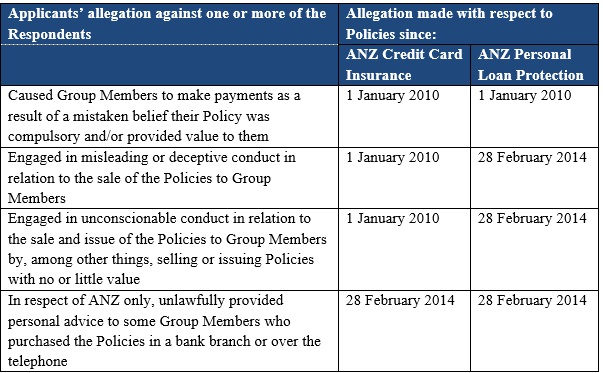
The Respondents deny the allegations and are defending the claims.
3. AM I A GROUP MEMBER?
You are a Group Member if:
a. you were issued with one or more of the Policies at any time between 1 January 2010 and 30 June 2019; and
b. you have suffered loss or damage because of the alleged contravening conduct of the Respondents
(for example, by paying more in premiums and interest than any amount you received in relation to a claim or remediation with respect to that policy).
If you are a Group Member and you acquired one or more of the Policies or first paid a premium before 28 February 2014, the Respondents’ position is that it is too late for you to bring your claims in this proceeding. The Applicants disagree with this position. If the court agrees with the Respondents’ position, any such claims will fail.
YOUR OPTIONS
4. WHAT ARE MY OPTIONS?
If you are a Group Member, you have two options, which are set out in detail below.
Option 1 – Remain a Group Member If you choose this option, you will remain a Group Member of the ANZ CCI Class Action and your claims will be collectively resolved through the ANZ CCI Class Action. You will remain entitled to participate in any court-ordered damages award in favour of Group Members or any settlement that might be agreed. If you remain a Group Member, you will be bound by the outcome of the ANZ CCI Class Action. If the action is successful, you may be entitled to share in the benefit of any order, judgment or settlement in favour of the Applicants and Group Members. If the ANZ CCI Class Action is unsuccessful or is not as successful as you might have wished, you will continue to be bound by the outcome of the ANZ CCI Class Action and will not be able to bring another action against ANZ for the same claim. Registration You may wish to register your interest in the class action on Slater and Gordon’s website. You will then receive regular, timely updates on the progress of the ANZ CCI Class Action from Slater and Gordon Lawyers, the lawyers for the Applicant. You will also be sent any court notices, such as this one, directly using the contact details you provide during registration and be directly notified in the event of a judgment or settlement. You can register for the class action at [hyperlink]. You do not need to register at this time to remain a Group Member or be notified of any settlement or judgment. |
Option 2 – Opt out If you qualify as a Group Member and choose this option, you will cease to be a Group Member of the ANZ CCI Class Action. You will not be entitled to participate in any order, judgment or settlement award in favour of the Applicants and Group Members. If you opt out, you will preserve the right to bring your own claims in relation to the allegations covered by the class action (summarised at section 2 above and set out in the statement of claim available for viewing at Slater and Gordon’s website). In the event you wish to bring your own claim against any of the Respondents, you should seek your own legal advice about your claim and any applicable time limits on your claims before choosing to opt out. Group Members (and potential Group Members) should seek independent legal advice before opting out. To opt out is to take a serious step – you should not do so unless you understand what it means. If you wish to opt out, you must complete the “Opt Out Notice” form annexed to this Notice at Schedule A and return it directly to the Victorian District Registry of the Federal Court before the Opt Out Deadline on 4:00pm AEDT on 12 February 2021. |
COSTS AND RELIEF SOUGHT
5. WILL I BE LIABLE TO PAY LEGAL COSTS IF I REMAIN A GROUP MEMBER?
Group Members in the ANZ CCI Class Action are not, and will not be, liable for any “out of pocket” legal costs by remaining in the class action. The costs of running the ANZ CCI Class Action are being covered by Slater and Gordon on a “No Win, No Fee” basis.
If the ANZ CCI Class Action is successful, the Court will be asked to approve the Applicants’ reasonable legal costs and those approved costs may be deducted on a pro rata basis from any monetary compensation you may be eligible for before any compensation is paid out.
If the ANZ CCI Class Action is unsuccessful, you will not be liable for any legal costs. No Group Member will ever be “out-of-pocket” simply by remaining a Group Member or registering for the class action |
The Applicants seek a number of types of relief on behalf of Group Members, including damages to compensate each Group Member and/or the return of the premiums they each paid under the Policies.
If the class action succeeds, the Court may be asked to make declarations that some Policies are void, in addition to monetary relief. Your consent will be requested before any declaration that your Policy is void is made.
IMPORTANT MATTERS TO NOTE
7. YOU SHOULD NOTE THAT:
Firstly, this is not a scam. You can check (and obtain copies of) any relevant documents by visiting Slater and Gordon’s website [hyperlink] or inspecting them at one of the offices of Slater and Gordon.
Secondly, if you wish to remain a Group Member, you do not need to do anything in relation to this Notice. Alternatively, you can actively register your interest in the ANZ CCI Class Action on Slater and Gordon’s website at [hyperlink].
Thirdly, if you wish to opt out, you must complete the ‘Opt Out Notice’ form annexed to this Notice at Schedule A and return it directly to the Victorian Registry of the Federal Court of Australia at the address on the form before the Opt Out Deadline, i.e. by no later than 4.00pm AEDT on 12 February 2021.
SCHEDULE A
Form 21 Rule 9.34
OPT OUT NOTICE
| IMPORTANT: You should only complete this form if you do NOT want to participate in the ANZ CCI Class Action |
VID 133 of 2020
Federal Court of Australia
District Registry: Victoria
Division: Commercial and Corporations NPA
Regulator and Consumer Protection Sub-area
Tracey Reilly and another named in the Schedule
Applicants
Australia and New Zealand Banking Group Limited ACN 005 357 522 and others named in the Schedule
Respondents
To: The Registrar
Federal Court of Australia
Victoria District Registry
Owen Dixon Commonwealth Law Courts Building
305 William Street
Melbourne VIC 3000
…………………..…………………….(print name of Group Member), a Group Member in this class action, gives notice under section 33J of the Federal Court of Australia Act 1976, that I am opting out of the class action.
Date: …………………………..
Signed by: …………………………………….
Group Member/Lawyer for the Group Member (circle as applicable)
Please complete the information on the following page
Group Member details
Telephone: ……………………………………………………………
Email: ……………………………………………………….
Address: ……………………………………………………….
If you are signing as the solicitor or representative of the Group Member:
Name: ……………………………………………………….
Capacity: ……………………………………………………….
Telephone: ……………………………………………………….
Email: ……………………………………………………….
Address: ……………………………………………………….
O’BRYAN J:
Introduction
1 The proceeding was commenced on 28 February 2020. I made timetabling orders for the completion of pleadings and initial discovery on 3 April 2020: Reilly v Australia and New Zealand Banking Group Limited [2020] FCA 436. Those orders also required the parties to confer and seek to agree orders in respect of further discovery and opt out.
2 The parties appeared before me on 7 August 2020 at a case management hearing which had been scheduled to consider the next steps to be taken in the proceeding, including orders for further discovery and opt out procedures. Prior to that hearing, the fourth respondent (QBE) filed an interlocutory application seeking orders striking out parts of the applicants’ claim. I made orders at that time to timetable the hearing of the interlocutory application and gave the parties further time to seek to agree orders in respect of further discovery and opt out.
3 On 25 September 2020, I made orders for further discovery and opt out in a similar proceeding that has been brought against Westpac Banking Corporation and which is being case managed in parallel to the present proceeding: Kemp v Westpac Banking Corporation (No 2) [2020] FCA 1392 (Kemp No 2).
4 On 2 October 2020, the parties filed proposed orders in respect of further discovery and opt out. The proposed orders were similar to the orders I made in Kemp No 2. There was only minor disagreement between the parties as to the orders to be made, which is commendable.
5 I delivered judgment on QBE’s interlocutory application on 19 October 2020, striking out parts of the applicants’ claim: Reilly v Australia and New Zealand Banking Group Limited (No 2) [2020] FCA 1502 (Reilly No 2). Anticipating that my judgment might affect the appropriate form of orders on opt out (particularly the contents of the opt out notice) and further discovery, I gave the parties a further 14 days to confer in relation to those orders, to take account of the judgment.
6 On 2 November 2020, the parties again filed proposed orders in respect of further discovery and opt out. Again, there was only minor disagreement between the parties as to the orders to be made. These reasons address the areas of disagreement, both of which relate to discovery to be given by QBE.
Discovery to be given by QBE
Known relevant documents
7 The applicants seek discovery from QBE of documents which adversely affect QBE’s case or support the applicants’ case and are either:
(a) identified by QBE’s solicitors with carriage of this proceeding or those employees of QBE who instruct those solicitors, in the course of carrying out reasonable searches for documents responsive to the categories in Annexure C [being the list of categories of documents to be discovered by QBE], but not falling within any of those categories; or
(b) known, without making any searches, to either QBE’s solicitors with carriage of this proceeding or those employees of QBE who instruct those solicitors.
8 The first to third applicants (ANZ and the OnePath entities) have agreed to give discovery of that category.
9 In Kemp No 2, I refused to make an order that the respondents give discovery of documents that meet at least one of the criteria specified in r 20.14(2) of the Federal Court Rules 2011 (Cth) (which sets out the tests for standard discovery) and of which the respondents are already aware, or become aware, without the need to undertake further searches. I concluded that it was not a necessary or reasonable order to make for two reasons: first, the order raised the practical problem of what does awareness mean in an organisation that has many thousands of employees; second, the applicant had not shown that the order was necessary to ensure the fair resolution of the real issues in dispute (Kemp No 2 at [41]).
10 In the present proceeding, the applicants have sought to address my reasons in Kemp No 2 by confining the proposed category to documents known to or identified by QBE’s solicitors with carriage of this proceeding or those employees of QBE who instruct those solicitors. The applicants submitted that no additional burden is imposed on QBE by this category, given it is limited to documents which have been identified (or will have been identified, by the time the task of discovery is undertaken) by the persons responsible for this proceeding.
11 QBE submitted that the proposed category imposes on QBE and its solicitors an ongoing obligation to assess whether any documents that come across their respective desks are discoverable other than by reference to the categories ordered. Discovery will require the review of a large body of documents which will be carried out in the first instance by relatively junior employees or solicitors. While those persons can readily, and efficiently, determine whether a document is responsive to a defined category, they may not be in a position to determine whether a document adversely affects QBE’s case or supports the applicants’ case. Requiring review against this criteria is therefore likely to be more costly and time-consuming and is not justifiable in circumstances where the categories to be ordered are appropriate to ensure that directly relevant documents will be searched for and produced on discovery.
12 Despite the more limited form of order sought by the applicants in this proceeding in comparison to the order sought in Kemp, I am not persuaded that the additional category is necessary to ensure the fair resolution of the real issues in dispute and I consider that the additional category will create inefficiencies.
13 As I explained in Kemp No 2, I made orders for discovery from the respondents by category rather than standard discovery having regard to the nature of the proceeding and the issues raised. I considered that discovery by category would identify relevant documents at the least cost and avoid ongoing disagreement between the parties about the nature and scope of searches undertaken by the respondents and whether certain types or categories of documents had been examined in the discovery exercise (at [40]). An order for standard discovery requires the party giving discovery to identify the issues in dispute on the pleadings and then translate those issues into identified categories of documents in order to conduct relevant searches. In a large proceeding involving many disputed issues, there is considerable potential for disagreement between the parties about the “translation” task and the resulting scope of the searches performed under such an order. In contrast, by ordering discovery by categories, any disagreement about the scope of the searches to be undertaken is resolved at the outset in the determination of appropriate categories. Either approach might be preferable in a given case. However, experience suggests that in large proceedings involving many issues in dispute, determining the categories for discovery at the outset helps minimise disputation about the discovery task.
14 In my view, the discovery categories determined in Kemp No 2, and which have been adopted by the parties in this proceeding, have been framed to identify documents relevant to the issues in dispute in the proceeding. They are framed reasonably broadly, and there is no reason to believe at this stage of the proceeding that they will fail to result in the production of all relevant documents.
15 In those circumstances, there is no benefit in adding a further category framed in terms of standard discovery (documents which adversely affect QBE’s case or support the applicants’ case). Strictly, the proposed further category is not a category at all but a modified form of standard discovery. While the additional discovery task is limited to documents known to or identified by QBE’s solicitors with carriage of this proceeding or those employees of QBE who instruct those solicitors, there is likely to be a large number of persons who will be involved in undertaking the discovery task. In order to give the further discovery task practical meaning for those persons, the category would require translation into types (categories) of documents that answer the description of “documents which adversely affect QBE’s case or support the applicants’ case”. For that reason, the additional task will add another layer of complexity, and will duplicate the existing categories and add confusion. In circumstances where broadly framed categories of discovery have been ordered, I do not consider that the additional category is justified.
16 As the other respondents (ANZ and the OnePath entities) have not objected to giving discovery in respect of that category, I will make orders that include that category in respect of their discovery.
The relevant period for discovery
17 In this proceeding, the applicants seek to recover premiums paid on two consumer credit insurance products issued to ANZ’s customers between 1 January 2010 and 30 June 2019 (relevant period). The two products are the ANZ Credit Card Insurance policy, which insured certain liabilities under credit cards issued by ANZ, and the ANZ Loan Protection policy, which insured certain liabilities under personal loans advanced by ANZ.
18 In Reilly No 2, I concluded that, in respect of the statutory misleading conduct and unconscionable conduct claims against QBE (and the second respondent, OnePath Life) relating to the ANZ Loan Protection policy, the applicants cannot at law recover loss or damage incurred earlier than 6 years prior to the commencement of the proceeding (that is, prior to 28 February 2014). As a result, I struck out those claims in so far as they sought recovery in the relevant period prior to 28 February 2014. However, I declined to strike out a claim that the ANZ Loan Protection policies issued to the applicants and certain group members during the relevant period are liable to be set aside in equity on the basis of unilateral mistake.
19 As the applicants’ pleadings relate to the issue of the consumer credit insurance products throughout the relevant period, the applicants seek discovery from the respondents, including QBE, in respect of documents in existence in that period or relevant to that period. QBE proposes that categories 2, 3, 5 and 7 should be confined to the period from 1 August 2013 to 30 June 2019 (i.e. the period 28 February 2014 to 30 June 2019, plus an additional six months prior to that six-year period). QBE accepted that category 8 should be for the entire relevant period, as this data may be relevant to the objective fact of unsuitability and the claims against ANZ.
20 QBE submitted that, in respect of the relevant period prior to 28 February 2014, the applicants’ claim against QBE is confined to unilateral mistake. The relevant allegations are pleaded at paragraphs 74 and 74A: paragraph 74 concerns the subjective belief of group members who acquired the loan and paragraph 74A concerns QBE’s alleged knowledge of that mistaken belief. The particulars to paragraph 74A of QBE’s knowledge is presently confined to the legal proposition that ANZ’s knowledge can be attributed to QBE because ANZ was allegedly acting as QBE’s agent. QBE argued that neither of those allegations justifies a discovery category framed to seek documents going to QBE’s conduct or actual (as opposed to derivative) knowledge of relevant matters prior to 28 February 2014 because those matters are irrelevant to the unilateral mistake claim as pleaded and particularised. QBE says that this additional discovery burden is not justified by the fact that the applicants have expressly reserved their right in paragraph 74A to provide further particulars after discovery. QBE argued that the applicants are required to specifically particularise their knowledge case against QBE (FCR, r 16.43) and the lack of any particulars of direct knowledge of the alleged mistaken belief is simply indicative of the fact that the applicants have no proper basis to make that allegation. QBE submitted that discovery is given to assist an applicant in proving a known case, not to make out a new or different case to the one they are now agitating (referring to Australian Building and Construction Commissioner v Construction, Forestry, Maritime, Mining and Energy Union (No 2) [2019] FCA 2087 at [11] in which Rares J set out the classic description of a “fishing expedition”).
21 I reject the premise of QBE’s argument. In Reilly No 2, I concluded that paragraph 74A of the applicants’ pleading should not be struck out. That paragraph alleges that, relevantly, QBE was aware that circumstances existed which indicated that the applicants and mistaken group members were acquiring their respective policies under the alleged mistaken beliefs and chose to leave the applicants and the mistaken group members under the mistaken beliefs in acquiring or agreeing to be issued with their respective policies. While the current particulars to that allegation are based on ANZ’s state of mind and the contention that ANZ’s knowledge can be attributed to QBE, the applicants have reserved the opportunity to provide further particulars after discovery. In Reilly No 2, I concluded that the applicants have provided sufficient particulars to sustain the allegation at this early stage of the proceeding and before discovery (at [147]). The allegation having been made, the applicants are entitled to seek discovery of documents relevant to the allegation. It is incorrect to describe such discovery as a fishing expedition.
22 Although I will make discovery orders against QBE as sought by the applicants, I reiterate the observations I made in Reilly No 2 that this proceeding has been brought by the applicants on behalf of different categories of group members (at [14]). The claims made on behalf of mistaken group members relating to the purchase of the ANZ Loan Protection policy in the relevant period prior to 28 February 2014 is one such category. It may ultimately turn out that claims made on behalf of certain categories of group members succeed while claims made on behalf of other categories of group members fail. In those circumstances, difficult questions may arise as to the manner in which the costs of the proceeding (including the costs of discovery, which can be large) are dealt with in connection with a judgment of the Court under s 33Z, or the approval of a settlement under s 33V, of the Federal Court of Australia Act 1976 (Cth), and particularly whether compensation awarded to successful group members may be indirectly diminished by the treatment of the costs of the overall proceeding. My reasons in Reilly No 2 explained some of the difficult questions of law that are raised by the applicants’ claim in equity based on unilateral mistake. Nevertheless, having concluded that the claim can be made, the applicants are entitled to seek discovery of documents relevant to that claim, with the costs consequences of pursuing the claim to be determined in the usual way.
Conclusion
23 In conclusion, I have resolved the two areas of disagreement concerning the discovery to be given by QBE as follows: I have rejected the “known relevant documents” category and I have allowed discovery in respect of documents in existence or relevant to the period of the claim which commences on 1 January 2010. As the parties have had an equal measure of success on these issues, I will make no order in respect of these interlocutory issues other than that costs be reserved.
I certify that the preceding twenty-three (23) numbered paragraphs are a true copy of the Reasons for Judgment herein of the Honourable Justice O'Bryan. |
Associate:


