

Federal Court of Australia
Lucas v Secretary, Department of Health [2020] FCA 1603
ORDERS
Applicant | ||
AND: | SECRETARY, DEPARTMENT OF HEALTH Respondent | |
RARES J | |
DATE OF ORDER: |
THE COURT ORDERS THAT:
1. The respondent’s decision made on 8 May 2020 to refuse the applicant’s application under s 90 of the National Health Act 1953 (Cth) be quashed, and the matter be remitted to the respondent to be determined according to law.
2. The respondent pay the applicant’s costs.
Note: Entry of orders is dealt with in Rule 39.32 of the Federal Court Rules 2011.
ORDERS
NSD 762 of 2020 | ||
| ||
BETWEEN: | WARREN LUCAS Applicant | |
AND: | BAYFIELD STREET PHARMACY PTY LTD ACN 629 209 981 First Respondent SECRETARY, DEPARTMENT OF HEALTH Second Respondent | |
order made by: | RARES J |
DATE OF ORDER: | 6 November 2020 |
THE COURT ORDERS THAT:
1. The second respondent’s decision made on 16 October 2019 to approve the first respondent’s application under s 90 of the National Health Act 1953 (Cth) be quashed, and the matter be remitted to the second respondent to be determined according to law.
2. The second respondent pay the applicant’s costs.
Note: Entry of orders is dealt with in Rule 39.32 of the Federal Court Rules 2011.
RARES J:
1 These are two applications by Warren Lucas, a pharmacist, to set aside decisions of the Secretary, Department of Health (the Department) under s 90 of the National Health Act 1953 (Cth) (the Act). In the first application (proceeding NSD682 of 2020), Mr Lucas seeks an order under s 16 of the Administrative Decisions (Judicial Review) Act 1977 (Cth), to review the Secretary’s decision made on 8 May 2020 not to approve his application under s 90 to supply pharmaceutical benefits at premises in Bligh Street, Rosny Park, Tasmania (the refusal decision).
2 In the second application (proceeding NSD762 of 2020), Mr Lucas seeks an order under s 39B(1) of the Judiciary Act 1903 (Cth) quashing the Secretary’s decision under s 90(1) of the Act made on 16 October 2019 to approve Bayfield Street Pharmacy Pty Ltd to supply pharmaceutical benefits at part of unit 2 at 10 Bayfield Street, Rosny Park (the Bayfield approval). The application for the Bayfield approval was made in the name of two individuals who were directors of Bayfield. Unit 1 at 10 Bayfield Street, at which Bayfield was operating a pharmacy under an existing approval, was separated from unit 2 by a corridor in the common property in a strata title building.
3 In the second application, Bayfield filed a submitting appearance, and the Secretary has been the active contradictor in both proceedings. The parties agree that if Mr Lucas succeeds in setting aside the Bayfield approval, the refusal decision must also be set aside and both matters remitted to the Secretary for determination in accordance with law.
The statutory scheme
4 Section 4(1) provides that, unless the contrary intention appears:
"pharmacist" means a person registered as a pharmacist or pharmaceutical chemist under a law of a State or Territory providing for the registration of pharmacists or pharmaceutical chemists, and includes a friendly society or other body of persons (whether corporate or unincorporate) carrying on business as a pharmacist.
"premises" includes a part of premises.
5 Next, s 4(3) provides:
A reference in this Act to the supply of pharmaceutical benefits at premises is a reference to the supply of pharmaceutical benefits to people who are at the premises when the supply is made.
(emphasis added)
6 An “approved pharmacist”, for the purposes of Pt VII (which contains s 90), meant a person for the time being approved under s 90 (s 84(1)), and s 90 relevantly provided:
(1) Subject to this section, the Secretary may, upon application by a pharmacist for approval to supply pharmaceutical benefits at particular premises, approve that pharmacist for the purpose of supplying pharmaceutical benefits at those premises.
Note: There is an application fee for the application: see subsection (9).
(2) Where a pharmacist desires to supply pharmaceutical benefits at more than 1 premises, a separate application under subsection (1) shall be made in respect of each of the premises and, where approval is granted in respect of 2 or more premises, a separate approval shall be granted in respect of each of the premises.
(3) Subject to this section, where an approved pharmacist desires to supply pharmaceutical benefits at premises other than premises in respect of which approval has been granted, the Secretary may on application by the approved pharmacist, grant approval in respect of those other premises.
Note: There is an application fee for the application: see subsection (9).
(3A) Subject to subsections (3AA), (3AE) and (13), an application under this section must be referred to the Authority.
(3AA) Subsection (3A) does not apply to an application for an approval arising out of a change in the ownership of a pharmacy situated at particular premises if the change results or resulted from:
(a) the sale of the pharmacy; or
(b) the acquisition, following the death of a person who was the owner or one of the owners of the pharmacy, of that person’s interest in the business of the pharmacy; or
(c) a change in the constitution of a partnership that owned the pharmacy;
if the pharmacy is to continue to operate at the same premises.
(3AB) In subsections (3AA) and (3AE):
pharmacy means a business in the course of the carrying on of which pharmaceutical benefits are supplied.
…
(3AE) Subsection (3A) does not apply to an application for an approval if:
(a) the application arises out of an expansion or contraction of particular premises (the original premises) at which a pharmacy is situated; and
(b) the expanded or contracted premises occupy any of the space occupied by the original premises.
(3AF) However, the Secretary may, at his or her discretion, refer to the Authority an application referred to in subsection (3AE).
(3B) An approval may be granted under this section in respect of an application that has been referred to the Authority under subsection (3A) or (3AF) only if the Authority has recommended the grant of the approval, but the Secretary may refuse to grant an approval even if the grant has been recommended by the Authority.
(3D) The Secretary must not grant approval under this section to a pharmacist in respect of particular premises if the Secretary is satisfied that on or after the day the approval would otherwise be granted:
(a) the pharmacist would be unable to supply pharmaceutical benefits at the premises; or
(b) the premises would not be accessible by members of the public for the purpose of receiving pharmaceutical benefits at times that, in the opinion of the Secretary, are reasonable.
(4) Nothing in this section authorizes the Secretary to grant approval to a pharmacist in respect of premises at which that pharmacist is not permitted, under the law of the State or Territory in which the premises are situated, to carry on business.
…
(8) Nothing in this section prevents the approval of more than one pharmacist for the purpose of supplying pharmaceutical benefits at particular premises.
(emphasis added)
7 The “Authority” referred to in s 90 was the Australian Community Pharmacy Authority (ACPA). It had functions under s 99K to make recommendations to the Secretary as to whether she should approve or refuse an application under s 90. In making any recommendation, ACPA had to comply with rules that the Minister made, by legislative instrument, under s 99L; relevantly, the National Health (Australian Community Pharmacy Authority Rules) Determination 2018 (Cth) (the Rules).
8 The Act gave limited rights to merits review in the Administrative Appeals Tribunal, being, relevantly for present purposes, the right to a review of, first, a decision by the Secretary under s 90 rejecting an application (s 105AB(7)) and, secondly, a recommendation by ACPA under s 99K(1)(b)(i) that an applicant under s 90 not be approved in respect of particular premises (s 105AD(2)(a)).
9 The National Health (Pharmaceutical Benefits) Regulations 2017 (Cth) gave the Secretary power, first, to refuse to consider an application for approval of a pharmacist under s 90 if the application was not in a form approved, in writing, by the Secretary (reg 14(1)(1)(a)) and, secondly, to allot a number to an approval of a pharmacist under s 92 (reg 16(1)(e)).
Background
10 On 9 September 2019, Kristina Fox and Helen Blake, both registered pharmacists, completed an application, under s 90, for approval to supply pharmaceutical benefits at particular premises, being a part of unit 2. The Secretary received the application form on 12 September 2019 (the unit 2 application). Ms Fox and Ms Blake indicated on the form that they were applying under item 121 for the expansion or contraction of approved pharmacy premises. They answered “no” to question 3, namely whether one or more of the applicants named in question 2 (in which they had inserted their own names and individual registration numbers) was a company. They gave Ms Fox as the contact person and, in response to question 6, headed “company name”, wrote the name of Bayfield. They said that the trading name of the pharmacy business was Terry White Chemmart Rosny Park. They gave the address of Bayfield’s premises and Bayfield’s existing PBS approval number in answer the questions 12, 13 and 14 under the heading “existing approved premises”. In responding to question 15 under the heading “current owner(s)”, they wrote their individual names and again gave Ms Fox’s name as the current owners contact nominee with her contact details. They declared that all of the material in the form was complete and correct.
11 In fact, Ms Fox and Ms Blake were directors of Bayfield and the PBS approval number that they gave in the application form was that of Bayfield. Ms Fox and Ms Blake also provided the Secretary with copies of the lease to Bayfield of unit 1 dated 18 January 2019 and an undated sublease to Bayfield for the part of unit 2 for which they had sought approval as an extension of unit 1. They also provided the plan below that illustrated the footprint of each of units 1 and 2 with the other strata lots at 10 Bayfield Street.
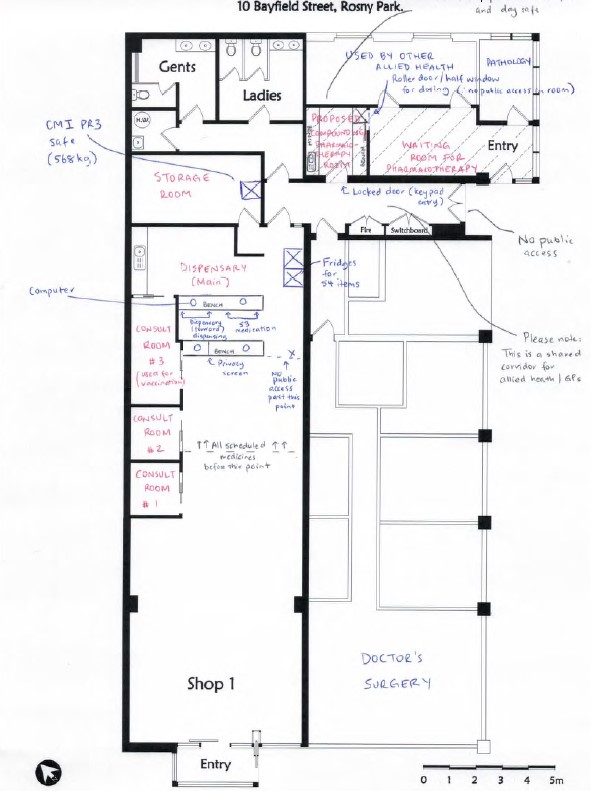
12 The plan showed that the public could only enter unit 1 at its southern entry point and that there was no public access beyond the point indicated next to the illustration of the public counter within the pharmacy. On the north east part of the building, the public could enter unit 2 by the south facing entry that opened to the footpath on the east, outside the building. As is evident from the plan, the other part of unit 2 was occupied by a different business. And, as noted on the plan, that entry gave access to a waiting room on the western wall of which there would be a roller door, behind which was a compounding room for the provision of pharmacotherapy drugs, such as methadone, to persons with a prescription.
13 A member of the public could not move between units 1 and 2 without going outside and around the building on the public footpath. The part of unit 2 that Bayfield had subleased was separated from unit 1 by a common property corridor, and the walls and doors on the outside of each of the two units. There was no common wall or other contiguity between any part of unit 1 and unit 2.
14 Earlier, on 4 September 2019, the Tasmanian Pharmacy Authority wrote to Ms Fox and Ms Blake informing them that, at its meeting on that day, it had approved in principle their “application for alterations of the above premises” and that once the alterations were complete, the Tasmanian Authority would arrange an inspection that, if satisfactory, would lead to its granting formal approval.
15 On 18 September 2019, the Secretary’s delegate emailed Ms Fox saying that she had agreed in principle to “your application for alterations to the above premises” but that final approval would not be granted until the Tasmanian Authority had approved the completion of the works. Thus, by now, the delegate had decided to treat the application that Ms Fox and Mr Blake had made as one that could be dealt with under s 90(3AE) without it being referred to ACPA.
16 On 1 October 2019, an officer of the Secretary emailed Ms Fox attaching a copy of the 4 September 2019 letter from Tasmanian Authority and asked her to send the delegate a copy of that Authority’s final approval.
17 On 3 October 2019, Ms Fox emailed a reply saying that the final inspection was scheduled for the middle of October 2019.
18 On 8 October 2019, Mr Lucas applied under s 90(1) for approval of the Bligh Street premises.
19 On 15 October 2019, the Tasmanian Authority wrote to the Department informing it of its approval of the alterations to the pharmacy business premises of Terry White Chemmart Rosny Park. Importantly, the letter stated that the Tasmanian Authority’s records showed that the pharmacy business was owned by Bayfield, with Ms Blake and Ms Fox as the pharmacists involved.
20 At some point or points during her deliberations the delegate recorded on an expansion/contraction checklist the following:
against “Change of Ownership attachments received with application” there was a notation of “issues” with Bayfield’s name underneath it;
the “owners” were named as Ms Blake and Ms Fox;
against “Lease” she wrote:
The expansion, has a shared corridor for Allied Health/GP’s to use the amenities, however it is evident, that the pharmacy has access leading to the expanded premises, and that customers of the pharmacy for compounding has access from another doorway.
As delegate, I am approving as access to the compounding of these medicines by the approved pharmacists is accessible by the public. The waiting room is for Pharmacotherapy and the drugs for these treatments eg methadone is issued through a roller door/half window. See plans provided
(emphasis added)
the names and individual registration numbers of each of Ms Blake and Ms Fox.
21 On 16 October 2019, the delegate wrote a letter to Bayfield, commencing “Dear Directors”. It stated that the Department had received “your application for approval to expand your pharmacy under [Bayfield’s] approval number” and that, as the delegate, she had approved “your application for alterations to the pharmacy business as per the drawings provided, to supply pharmaceutical benefits at” unit 1. The delegate wrote that the existing approval number would continue to operate for Bayfield to supply pharmaceutical benefits at unit 1. The letter made no mention of unit 2 at all, or that supply of pharmaceutical benefits from unit 2 was approved.
22 On 17 October 2019, the Department acknowledged Mr Lucas’s application and informed him that it had been sent to ACPA for consideration.
23 On 15 November 2019, ACPA sought further information from Mr Lucas about the distance between the Bligh Street premises and unit 1, being a reference to Bayfield’s premises. On 6 December 2019, Mr Lucas provided a survey that indicated compliance with the requirement in the Rules that the public entrance of two premises be over 300m apart.
24 On 13 December 2019, ACPA considered Mr Lucas’s application and recommended its approval to the Secretary. ACPA informed Mr Lucas of its recommendation on 17 December 2019.
25 On 19 March 2020, Ms Blake or Ms Fox (the name is redacted in the evidence for no good reason) wrote to the Secretary as “a pharmacy owner” saying that she had heard a rumour that a new Chemist Warehouse had been, or was to be, approved within 300m “of our approved public access door” and stated that she was unsure as to how that approval could be granted. That same person wrote to the delegate on 21 March 2020 referring to a surveyor’s report dated 8 August 2019 that she subsequently attached to an email on 23 March 2020. That report showed a distance of more than 300m between the public entrance to the Bligh street premises and the public entrance at the south of unit 1, but a distance of less than 300m to the public entrance to the part of unit 2 that Bayfield subleased.
26 On 23 March 2020 an officer of the Department communicated with Ms Blake or Ms Fox and suggested that she might like to send a copy of the survey to ACPA or the delegate for their consideration.
27 On 24 March 2020, the delegate wrote to Ms Blake or Ms Fox thanking her for the survey report and seeking clarification of its contents.
28 On 3 April 2020, the delegate wrote to Mr Lucas. She stated that the Bligh Street premises were in a large shopping centre and that, based on the information before it, ACPA had found they were at least 300m in a straight line from all approved premises not in a large shopping centre, and so complied with the requirements of item 124 of the Rules. She said that the nearest approved premises were Bayfield’s. The delegate said that ACPA’s decision was based on survey reports of the distance between the Bligh Street premises and unit 1, being the nearest approved premises. She said that it had been brought to her attention that there was more than one public entrance to the nearest approved pharmacy and that one of those entrances may be less than 300m by straight line from the Bligh Street premises. She invited Mr Lucas to provide further evidence, including a survey report of the straight line distance between his premises and Bayfield’s.
29 On 21 April 2020, Mr Lucas responded in an email with a statutory declaration. The statutory declaration:
pointed out that the compounding room in unit 2 did not give unfettered access to all members of the public to the actual approved premises at unit 1;
provided Mr Lucas’s argument in detail as to why the entrance to the part of unit 2 subleased by Bayfield did not provide access to any part of unit 1 which were the approved premises.
30 On 8 May 2020, the delegate wrote to Mr Lucas informing him of her decision not to approve his application. She wrote that item 124 of the Rules provided that if an existing premises were relocated out of a large shopping centre, the proposed premises must be at least 300m, in a straight line, from all approved premises. She considered that granting an approval in circumstances where the requirements of the Rules were not met would not be consistent with the objects and purposes of the Act and the Rules. She said that, in reaching her decision, she considered that the compounding room and adjacent waiting room “forms part of the approved premises at 1/10 Bayfield Street, Rosny Park” and that access to that area was via a public entry door, so that the straight line distance between the two premises was less than 300m.
Issues
31 There are 4 substantial issues that, among others, the parties addressed, namely:
(1) was the unit 2 application, if made by Mr Blake and Ms Fox, a valid application? (the valid application issue)
(2) did the unit 2 application fall within s 90(3AE) as an expansion of unit 1? (the expansion issue)
(3) did the delegate have power under s 90(3B) to exercise the Secretary’s discretion to refuse Mr Lucas’s application for failure to comply with item 124? (the discretion issue)
(4) did the delegate lack jurisdiction to make a finding that Mr Lucas’s application did not comply with item 124 because the entrance to unit 2 was not a public entrance to the approved premises within the meaning of that item? (the public entrance issue)
The valid application issue
32 The Secretary argued that Ms Fox and Ms Blake were plainly making the unit 2 application on behalf of Bayfield. She contended that a corporation could only act through natural persons and that the material before the delegate, when read in context and as a whole, pointed to that conclusion. She noted that Bayfield's name had been included in answer 6 and that the unit 2 application used the existing trading name of Bayfield, being Terry White Chemmart Rosny Park. She noted that the sublease, that Ms Fox and Ms Blake provided to the Secretary with the unit 2 application, named Bayfield as subtenant and identified Ms Blake and Ms Fox as Bayfield's directors who had executed it. She also said that the lease of unit 1, that they provided, named Bayfield as the tenant. The final approval of the Tasmanian Authority for the alterations to the premises noted that they were “owned by [Bayfield] with Helen Blake and Kristina Fox as the pharmacists involved”. The Secretary contended that this provided a justification for the delegate in treating the unit 2 application as having been made at all times by Bayfield.
33 I reject that argument. The unit 2 application, on its face, was made expressly by Ms Blake and Ms Fox and not by Bayfield. At no point in the process leading to its approval by the delegate did either of them ask for the approval to be made, or treated as being, in the name of Bayfield. Ms Blake and Ms Fox made a deliberate response in the unit 2 application to state that it was not being made on behalf of a company, but in their own names.
34 Accordingly, that application by Ms Blake and Ms Fox, made in their own right, could not have been granted to Bayfield. Bayfield was the approved pharmacist for the supply of pharmaceutical benefits at unit 1 for the purposes of s 90(1) of the Act. If it sought approval to supply pharmaceutical benefits at premises other than unit 1, it could have made an application under s 90(2) or (3) to do so. Ms Fox and Ms Blake were not the approved pharmacists for unit 1 and had no authority under the Act to make an application in their own names for the expansion of Bayfield’s approved premises.
35 There is no provision in the Act to which the Secretary referred that authorised her unilaterally to amend an application for the approval of a pharmacist to supply pharmaceutical benefits at particular premises under s 90. At no point did the Secretary seek clarification from Ms Fox or Ms Blake as to what they intended when submitting the unit 2 application in September 2019, and why they stated in it that no applicant was a company.
36 Moreover, Bayfield did not seek in these proceedings to uphold the grant to it of the approval to supply pharmaceutical benefits at unit 2. That meant that no-one has given evidence on behalf of Bayfield, Ms Blake or Ms Fox as to what the two individuals understood and intended when they lodged and proceeded with the unit 2 application, or whether that application, as completed by Ms Blake and Ms Fox, inaccurately reflected their intention.
37 The Act closely regulates the approval of pharmacists to supply pharmaceutical benefits at particular premises. It also closely regulates the number of pharmacists who may supply pharmaceutical benefits in any given area: Assarapin v Australian Community Pharmacy Authority (2016) 239 FCR 161 at 171–172 [45] per Bromberg, Rangiah and Perry JJ. Those in the industry are aware of the strict application of the Rules, and other regulatory provisions governing the approval of pharmacists, for this purpose. In the absence of any explanation by Ms Blake and Ms Fox as to what they intended when they submitted the unit 2 application, I am not satisfied that the delegate was entitled to infer that Bayfield, and not the named applicants, made that application.
38 It follows that the unit 2 application was invalid.
The expansion issue
39 The Secretary noted that s 4 of the Act defines “premises” to include “a part of premises” and s 90(3AB) defines “pharmacy” for the purpose of s 90(3AE) to mean “a business in the course of the carrying on of which pharmaceutical benefits are supplied”. She relied on the Explanatory Memorandum and second reading speech for the Health Legislation Amendment (Pharmacy Location Arrangements) Act 2006 (Cth), which explained that the amendments that added s 90(3A) and (3AE) had the purpose of simplifying the approval process for pharmacists who wished to expand or contract their premises. She submitted that an “expansion”, within the meaning of s 90(3AE), involved the same pharmacy, as defined, enlarging its physical footprint, and that this concept included an enlargement into different and separate physical premises, so long as it could still be said that the pharmacy as expanded was still one pharmacy and did not result in more than one premises.
40 The Secretary contended that Mr Lucas’ argument impermissibly invited the Court to determine for itself, as a jurisdictional fact, whether the Bayfield approval involved an “expansion” of the original premises. She submitted that the answer to the question of whether an application for approval “arises out of an expansion… of particular premises”, within the meaning of s 90(3AE)(a), was not a jurisdictional fact. She argued that the evaluation of whether the totality of the expanded premises sought were within the Secretary’s power to approve an expansion had to be determined in all of the circumstances of the case by the Secretary, and not by the Court on judicial review. The Secretary contended that such a construction of s 90 followed because an “expansion”, first, necessarily had to involve premises additional to the original ones and, secondly, was a word flexible enough to include premises that were physically separated one from another following the “expansion”.
41 She submitted that although s 90(3A) referred to “an expansion or contraction of particular premises” rather than of the pharmacy, the statutory language did not draw “an immutable distinction between the premises and the pharmacy” (emphasis in original). She submitted that so long as it was the same pharmacy that was being operated, but from larger premises that were physically separated, it would be artificial to isolate the two physical structures from one another so as to deny them the characterisation of an “expansion” of the original premises. She argued that the word “premises” was vague, and that its proper construction depended upon a consideration of the whole of the statute in which it is used (drawing on Turner v York Motors Pty Ltd (1951) 85 CLR 55 at 75 and 83).
42 I reject the Secretary’s argument.
43 In Turner 85 CLR at 75, Dixon J said of its use in protected tenancy legislation:
The word “premises” is no doubt a vague one but in legislation of this sort there are great advantages in a test of its application which is objective and consists in a readily ascertainable physical fact.
(emphasis added)
Williams J said (at 83) that the
true meaning [of “premises”] in any particular statute must be ascertained from the context in which it appears and from an examination of the scope and purpose of the statute as a whole.
(emphasis added)
44 The Oxford English Dictionary online defines “premises” as including a “house or building together with its grounds, outhouses, etc., esp. a building or part of a building that houses a business.” It defines “expansion” as “space to which anything is extended”, “[t]he action or process of causing something to occupy or contain a larger space, or of acquiring greater volume or capacity; dilatation”. The Macquarie Dictionary online defines “expansion” as “the act of expanding”, “an expanded, dilated, or enlarged portion or form of a thing”, “anything spread out; an expanse”.
45 Prima facie, an application for approval for the supply of pharmaceutical benefits at unit 2 would appear to be one falling within s 90(2). The definition of “pharmacy” in s 90(3AB) is of “a business in the course of the carrying on of which pharmaceutical benefits are supplied” (emphasis added). And, s 4(3) provides that a reference to the supply of such benefits at a premises is a reference to their supply “to people who are at the premises where the supply is made” (emphasis added). Thus, the Act contemplates the physical integration of the spaces of all of the premises at which pharmaceutical benefits are approved to be supplied to persons who are physically within that space at the time of supply. If an additional space is to form part of an expansion of an approval to supply pharmaceutical benefits at “particular premises” (within the meaning of s 90(1) and (3AE)), the expanded space must be physically integrated into the original premises.
46 Clearly enough, an expansion of particular premises must involve the incorporation of a space not previously occupied as part of those premises. The question for decision is whether unit 2 can properly be described as falling within the meaning of s 90(3AE)(b), of "expanded … premises [that] occupy any of the space occupied by the original premises". It is important to recognise that s 90(3AE) does not apply to an expansion of the pharmacy business, but of the particular premises at which pharmacy is operated. Expanded premises must occupy some of the space occupied by the original premises. If the original premises and the space in which the proposed expansion is to occur are not physically contiguous at a point on a common boundary the Act is silent as to whether that is capable of being an “expansion” and, if it is, the degree of proximity necessary for an application involving the expansion of the original premises to fall within s 90(3AE).
47 Unit 2 is physically separate and distinct from unit 1. That separation means that the two units are in physically separate locations that have no common space, and that a person must traverse the common property corridor to move between the two places. The old adage that “you cannot be in two places at once” is apposite here.
48 In the course of argument, the Secretary appeared to accept that if a pharmacist wished to use the building next door to the original premises at which he, she or it was conducting a pharmacy, an application to do so would not be capable of being considered under s 90(3AE). Similarly, in a large shopping centre with an existing pharmacy, a pharmacist at particular premises that have been approved for the supply pharmaceutical benefits under s 90(1) might want to use a shop, within the centre but some distance away, to conduct part of the business’ operations. How proximate do the original premises need to be to the proposed new premises to fall within the Secretary's posited construction of s 90(3AE)?
49 The Secretary's suggested answer, that this was a question of fact and degree to be adjudged by the statutory decision-maker under s 90(3A), is unsatisfactory. It leaves uncertain whether a particular application is one for the expansion of existing premises or for the approval of different premises. That uncertainty is contrary to the statutory need for clarity as to the nature of each application under s 90 for approval to supply pharmaceutical benefits at particular premises. The location of the premises of each new pharmacy can affect the rights of other persons to establish pharmacies within a specified distance of it. It is easy enough to determine whether an application relates to a contraction under s 90(3AE), for the original premises must be the subject of a reduction in size in such a case and will not involve the introduction of any other premises for consideration.
50 I am of opinion that the exception in s 90(3AE), to the requirement of s 90(3A) that an application for an approval must be referred to ACPA, applies to a physical expansion of the space of the existing premises directly into a contiguous neighbouring premises. For example, this can occur by opening a doorway or wall so as to permit immediate communication between the two spaces. A construction of s 90(3AE) that involves a requirement for such proximity would fall within the natural and ordinary meaning of “expansion… of particular premises (the original premises) at which a pharmacy is situated”. If the new part constituting the expansion of the premises is separated from unit 1 by other property (such as, here, the corridor forming the strata block’s common property), then the “expansion” into unit 2 would have to include the corridor in the common property so that there is access between the two. However, the common property did not form any part of the approved premises, nor did the applicant for approval seek its inclusion.
51 Any test as to what constitutes “an expansion… of particular premises… at which a pharmacy is situated” should be objective. It should consist in ascertaining objectively whether an observable and physical fact exists at the time of the application for expansion or contraction: Turner 85 CLR at 75 and cf Commissioner of Taxation v Reynolds Australia Alumina Ltd (1987) 18 FCR 29 at 42 per Beaumont J, 44 per Wilcox J and 49–50 per Burchett J.
52 This is so because, in ordinary parlance, “premises” can have a wide meaning, whereas s 90 is concerned with the approval of “particular premises” at which a pharmacist will be approved to supply pharmaceutical benefits to people present at those premises. The test is whether expanded or contracted premises would be integrated with the original premises, in the sense that the spaces they occupy are physically directly connected.
53 The statutory scheme is centred around establishing geographical limits in a defined area identified in the Rules within which there will be only one approved pharmacist located at “particular premises” who can supply pharmaceutical benefits. The effect of any expansion of approved premises that increases the geographical footprint of premises at which a pharmacy is conducted, may impact on the right or ability of other persons to seek approval to supply pharmaceutical benefits in neighbouring areas. Indeed, the present case vividly illustrates this. The effect of the Bayfield approval placed Mr Lucas’ proposed pharmacy within 300m of the combined geographical space occupied by unit 1 and the part of unit 2 subleased to Bayfield, whereas if the sub leased area were excluded Mr Lucas’ premises were beyond the 300m radius from the public entrance to unit 1.
54 Another indicium of why no part of unit 2 could be seen as falling within the natural and ordinary meaning of “an expansion… of particular premises” at which Bayfield’s pharmacy was located is its lack of physical integration with unit 1. Neither an employee of the pharmacy, nor a member of the public, could move within the “expanded premises” from one of those spaces to the other without exiting it completely and traversing the public footpaths, or the common property within the strata building, before entering the other space. Such a lack of physical integration is also suggestive that there were two, not one, “particular premises” involved in the unit 2 application.
55 The incongruity of the Secretary’s construction of s 90(3AE) can be seen in the Bayfield approval itself. The delegate’s letter stated:
I approve your application for alterations to the pharmacy business as per the drawings provided, to supply pharmaceutical benefits at Unit 1, 10 Bayfield Street, Rosny Park …with effect from 16 October 2019
(emphasis of address and date in original omitted, bold emphasis added)
However, the Bayfield approval said nothing about supplying pharmaceutical benefits at the subleased part of unit 2, being the physical location at which, and for which, the unit 2 application was made. The approval, in terms, referred only to an alteration of the “pharmacy business”, which s 90(3AB) defined as something distinct from the particular premises the subject of the application for approval.
56 For these reasons, the Bayfield approval was invalid because the unit 2 application was, first, not made by Bayfield and, secondly, did not arise out of an expansion of unit 1 within the meaning of s 90(3AE).
The discretion issue
57 The parties agreed that there are no cases on the way in which s 90(3B) operates. Mr Lucas argued that in Stambie v Minister for Health (2019) 270 FCR 173 at 183 [41], Mortimer J had said that the Rules “are intended to limit the exercise of power by the Authority in making its recommendations to the Secretary, and to limit the Secretary’s power to approve or refuse approval, to a pharmacy”. He contended that in Assarapin 239 FCR at 171–172 [45]–[46], the Full Court had expressed an obiter view on hypothetical facts without the benefit of argument. He submitted that while the Secretary retained a discretion not to grant an approval to an application that ACPA had recommended, her discretion did not extend to, in effect, being satisfied that ACPA had arrived at a correct recommendation.
58 Mr Lucas argued that the discretion was confined to matters that fell outside the ambit of the Rules, such as whether the applicant for an approval was still a pharmacist or was precluded from being granted approval by reason of the existence of any of the matters in s 90(3D) or (4). He contended that because s 99K of the Act entrusted to ACPA the function of considering applications under s 90 and making recommendations about whether they should be approved or not, there was no place for the Secretary to perform the same function except in the limited circumstances to which s 90(3AA) and (3AE) applied. He submitted that if the Secretary were permitted to consider matters provided for under the Rules in respect of applications that ACPA had already approved, there would be a duplication of the same function without any express statutory conferral of power on the Secretary to do so, citing Terry White Chemists Australia Fair v Secretary, Department of Health and Ageing (2009) 178 FCR 161 at 168–169 [19]. Mr Lucas submitted that it would be contrary to the scheme of the Act to permit the Secretary to have regard, when exercising the discretion under s 90(3B), to the requirements of the Rules after ACPA had recommended approval of a particular application. That was because, the argument ran, the competing pharmacist could act to defeat the effect of the approval recommendation by relocating, or even creating an additional public entrance that brought its existing pharmacy within 300m of the applicant’s proposed premises and so defeat its application.
59 He also argued that the process under s 90 required an applicant to make significant financial commitments prior to the grant of an approval, including fitting out and stocking the pharmacy business, employing staff, and entering into leasing or purchase agreements for premises. Mr Lucas contended that the scheme for granting approvals under s 90 of the Act would become unworkable if the Secretary were able to revisit the application of the Rules after ACPA had recommended an approval. He submitted that this was because an applicant for approval would be left in doubt as to whether, even though ACPA had recommended approval, the Secretary could overturn its application of the Rules at any time prior to exercising her power to grant the approval. He argued that a wide construction of the discretion in s 90(3B) would leave an applicant for approval in an invidious financial position of having to expend significant funds without any certainty that an ACPA approval recommendation, as to compliance with the Rules, was final. He also contended that because s 105AD of the Act gave an applicant a right to merits review in the Tribunal if ACPA made a recommendation against approval of an application under s 90, it would be inconsistent for the Secretary also to have the power of merits review of that recommendation.
60 As the parties acknowledged, it is not necessary to decide the question of the ambit of the Secretary’s discretion under s 90(3B) (because of my finding that the Bayfield approval was invalid). But, as the matter was fully argued, I should express my preliminary view that s 90(3B) appears to confer a wide and unfettered discretion on the Secretary to refuse to grant an approval notwithstanding a recommendation by ACPA: Assarapin 239 FCR at 172 [46].
61 There is considerable force in Mr Lucas’s arguments, which suggest that the Secretary would only be justified in exercising her discretion to revisit the subject-matter of an approval recommendation by ACPA in exceptional circumstances. However, if that occurred, an applicant would still be able to seek merits review of the Secretary’s decision in the Tribunal under s 105AB(7) of the Act, with the benefit of ACPA’s recommendation for approval. The Secretary would have to afford procedural fairness to an applicant, and take into account any steps that the applicant had taken to his, her or its detriment in reliance upon a recommendation of the ACPA. And, in any merits review of a decision by the Secretary to refuse approval based on non-compliance with the Rules despite a recommendation for approval by the Authority, the Tribunal could consider the whole question afresh.
The public entrance issue
62 The Secretary argued that “public entrance” meant an opening from which the public could obtain pharmaceutical benefits. She contended that the entry into unit 2 was a “public entrance” because members of the public could go into the waiting room there and receive medicines from a counter located in front of the roller door that, ordinarily, was closed and through which a pharmacist or employee of the pharmacy had to pass. In the ordinary course, the counter would be unmanned and a person wishing to receive any pharmaceutical benefits (usually pharmacotherapy drugs, such as methadone) needed to ring a bell to attract the attention of pharmacy employees or pharmacists in unit 1.
63 Again, it is not necessary for me to decide this point. However, I think that it is difficult to characterise the entry to unit 2 that members of the public can use to obtain pharmaceutical benefits as “a public entrance” to the “particular premises” comprising unit 1. As I have explained above, a member of the public cannot move between units 1 and 2 directly within the strata building. Rather, a member of the public must walk around the building if he or she wishes to enter one or other of units 1 or 2 after leaving the other. The public entrance into unit 1 gives no access to unit 2 and vice versa.
64 Rule 8(3) states that “[i]f either premises has more than 1 public entrance, a reference to the distance between the 2 premises is a reference to the shortest such measurement that can be made in relation to the 2 premises”. Again, this contemplates that the two competitors’ “premises” are each in a single physical space. The purpose and physical structure of unit 2, so far as it comprised a part of Bayfield’s business premises, was to keep separate from the general public utilising the pharmacy business within unit 1, the persons who might come to the waiting room in unit 2 to obtain pharmacotherapy drugs. The purpose of the two entrances was to keep a deliberate separation of the general public from a particular clientele to whom Bayfield wished to supply pharmacotherapy drugs. The entrances to units 1 and 2 do not allow a member of the public to enter one unit and exit from the other. I do not think that the entry into unit 2 could be described as a “public entrance” of the “premises” for unit 1.
Other matters
65 Mr Lucas also argued that the Secretary had exceeded her position of neutrality in opposing his claims in the second proceeding, in which Bayfield was the first respondent, relying on the principle in The Queen v Australian Broadcasting Tribunal; Ex parte Hardiman (1980) 144 CLR 13 at 35–36. The Secretary argued that she was entitled actively to oppose the grant of relief in the second proceeding because, in Bayfield’s absence, there was no active contradictor.
66 I reject the Secretary’s argument. The fact that Bayfield chose in Mr Lucas’ proceeding to submit to any order that the Court might make in the challenge to the legal validity of the Bayfield approval was a good reason for the Secretary to stay neutral in that fight. Moreover, the Secretary acted by the same delegate in making both of the decisions the subject of the present two proceedings. While was open to the Secretary to make submissions as to the proper construction of the legislation in question, in respect of the Bayfield approval (as Brennan J said in Fagan v Crimes Compensation Tribunal (1982) 150 CLR 666 at 681–682), I do not think it was appropriate for the Secretary, as the decision-maker, to take more active steps to oppose the grant of relief to Mr Lucas in his challenge to that approval: Hardiman 144 CLR at 36 per Gibbs, Stephen, Mason, Aickin and Wilson JJ, Glencore Coal Assets Australia Pty Ltd v Australian Competition Tribunal (2020) 382 ALR 331 at 396–397 [310]–[314] per Allsop CJ, Beach and Colvin JJ.
Conclusion
67 For these reasons, both the Bayfield approval and the refusal decision should be quashed and the matters remitted to the Secretary to be determined according to law. The Secretary must pay Mr Lucas’s costs of both proceedings.
I certify that the preceding sixty-seven (67) numbered paragraphs are a true copy of the Reasons for Judgment herein of the Honourable Justice Rares. |
Associate:


