

Federal Court of Australia
DWS Limited, in the matter of DWS Limited [2020] FCA 1590
ORDERS
Plaintiff | ||
DATE OF ORDER: |
OTHER MATTERS:
1. The Court notes that the Australian Securities and Investments Commission (ASIC) was provided with at least 14 days’ notice of the hearing of this application.
2. The Court is satisfied that ASIC has had a reasonable opportunity to:
(a) examine the terms of the proposed scheme of arrangement to which the application relates and a draft explanatory statement relating to that arrangement; and
(b) make submissions to the Court in relation to the proposed scheme of arrangement and the draft explanatory statement.
3. The Court notes the letter from ASIC to the Directors of DWS Limited dated 29 October 2020 at Annexure KAP-3 to the affidavit of Kelly Ann Powers dated 29 October 2020
THE COURT ORDERS THAT:
1. Pursuant to s 411(1) of the Corporations Act 2001 (Cth) (Act), the Plaintiff convene and hold a meeting of its shareholders (Scheme Meeting):
(a) for the purpose of considering, and, if thought fit, agreeing (with or without modification), to the scheme of arrangement (Scheme) proposed to be made between the Plaintiff and its shareholders (DWS Shareholders), the terms of which are set out in Annexure A to these orders; and
(b) to be held on Tuesday 3 December 2020 at 10.00 am (AEDT) and to be conducted electronically through an online platform (which is to be accessed in accordance with the instructions included in the Notice of Meeting to be sent to shareholders in accordance with order 2 below) in accordance with the provisions of Part 2 of the Corporations (Coronavirus Economic Response) Determination (No.3) 2020.
2. The Scheme Meeting be convened by sending on or before 4 November 2020:
(a) an email to each DWS Shareholder who has nominated an electronic address for the purposes of receiving notices of meeting and proxy forms from the Plaintiff (Email Shareholder) (or, in the case of joint holders, to the holder whose name appears first in the Plaintiff’s register), such email to be substantially in the form of Annexure SKW-4 to the affidavit of Stuart Keith Whipp sworn on 29 October 2020 (Whipp Affidavit) which contains links accessible by the Email Shareholder and which enables the Email Shareholder to:
(i) download an electronic copy of a document substantially in the form of the Scheme Booklet, a draft of which is at Annexure SKW-1 to the Whipp Affidavit (which contains among other things the proposed Scheme of Arrangement at Annexure B and Notice of Scheme Meeting at Annexure D) (Scheme Booklet); and
(ii) complete and lodge their proxy for the Scheme Meeting and voting instructions online.
(b) the following hard-copy documents to each DWS Shareholder who is not an Email Shareholder (or, in the case of joint holders, to the holder whose name appears first in the Plaintiff’s register):
(i) a document substantially in the form of the Scheme Booklet (which contains among other things the proposed Scheme of Arrangement at Annexure B and Notice of Scheme Meeting at Annexure D);
(ii) a personalised proxy/voting form for the Scheme Meeting (Proxy Form), substantially in the form of Annexure SKW-5 to the Whipp Affidavit and a reply-paid envelope for the return of completed Proxy Forms.
3. The documents referred to in order 2(b) be sent:
(a) in the case of DWS Shareholders whose registered address is within Australia, by prepaid ordinary post addressed to the relevant addresses recorded in the Plaintiff’s register; and
(b) in the case of DWS Shareholders whose registered address is outside Australia, by airmail or international courier service addressed to the relevant addresses recorded in the Plaintiff’s register.
4. Compliance with r 2.15 of the Federal Court (Corporations) Rules 2000 (Cth) (Rules) be dispensed with, except in so far as that rule applies r 75-15(2) of the Insolvency Practice Rules (Corporations) 2016 (Cth).
5. Voting on the resolution to approve the Scheme is to be conducted by way of a poll.
6. A proxy in respect of the Scheme Meeting will be valid and effective if, and only if, a Proxy Form is completed and delivered in accordance with its terms or a proxy is lodged online in accordance with the instructions by 10.00 am (AEDT, being Melbourne time) on 1 December 2020.
7. Mr Martin Ralston or failing him Mr Hayden Michael Kelly, be Chair of the Scheme Meeting.
8. The Chair of the Scheme Meeting shall have the power to adjourn the meeting to such time, date and place as he considers appropriate.
9. Compliance with r 3.4 and Form 6 of the Rules is dispensed with.
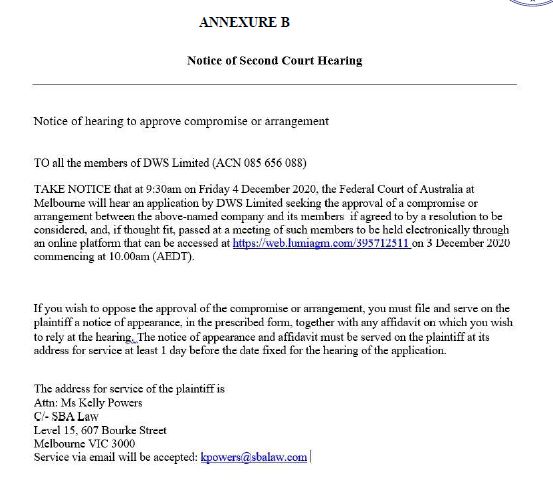
10. The Plaintiff publish a Notice of Hearing in The Australian newspaper, in substantially the form that appears at Annexure B hereto, not later than 5 days prior to the date fixed for the hearing of any application to approve the Scheme.
11. The further hearing of the Originating Process is adjourned to the Honourable Justice Beach at 9.30 am (AEDT, being Melbourne time) on Friday, 4 December 2020 or as soon thereafter as the business of the Court allows.
Note: Entry of orders is dealt with in Rule 39.32 of the Federal Court Rules 2011.
BEACH J:
1 DWS Limited has applied for an order under s 411(1) of the Corporations Act 2001 (Cth) for a meeting of DWS shareholders to be convened to consider a proposed scheme of arrangement (the Scheme).
2 DWS is an Australian public company limited by shares. It is admitted to the official list of the ASX, and its shares are quoted for trading. As at 18 September 2020, it had a market capitalisation of approximately $118.65 million. DWS is an Australian based IT, business and management consulting services company that provides inter-alia IT consulting services, managed application services and data and business analytics.
3 The purpose of the Scheme is to provide for the acquisition of all the shares in DWS by HCL Australia Services Pty Limited (HCL). HCL is a wholly-owned subsidiary of HCL Technologies Limited, which is a technology company that is listed on the National Stock Exchange of India.
4 If the Scheme is implemented, each holder of DWS shares as at the scheme record date will receive $1.20 cash for each DWS share held at that time. Scheme shareholders will be provided with the scheme consideration on the implementation date, anticipated to be 11 December 2020, and all of the scheme shares will then be transferred to HCL.
5 I would note by way of background that on 21 September 2020, DWS and HCL entered into a Scheme Implementation Agreement (the SI Agreement), whereby HCL agreed to acquire all of the issued ordinary shares of DWS by means of a scheme of arrangement. The SI Agreement provided that DWS was to propose the Scheme and that both DWS and HCL would implement the Scheme on the terms of the SI Agreement. Following the implementation of the Scheme, DWS will be a wholly-owned subsidiary of HCL, and will be delisted from the ASX.
6 Now DWS has prepared a Scheme Booklet, which includes the explanatory statement required by s 412 of the Act.
7 A draft of the Scheme Booklet was lodged with ASIC on 13 October 2020; amendments to that version of the draft Scheme Booklet were subsequently made and provided to ASIC. ASIC has provided a letter in the usual form stating that, based upon ASIC’s examination of the terms of the Scheme and the Scheme Booklet, ASIC did not propose to appear to make submissions or intervene to oppose the Scheme at the first hearing.
8 The Scheme Booklet sets out a detailed description of the Scheme and its advantages and disadvantages. It also annexes an independent expert report from BDO Corporate Finance (East Coast) Pty Ltd. In that report, the independent expert has concluded that the Scheme is fair and reasonable because the value of the scheme consideration of $1.20 per DWS share is equal to or greater than the value of the securities the subject of the offer, which the independent expert assessed to be in the range of $1.12 to $1.33 per DWS share; I do note though that $1.20 per DWS share is slightly under the expert’s stipulated mid-point of $1.23 per DWS share.
9 Now the directors of DWS have unanimously recommended that DWS shareholders vote in favour of the Scheme, in the absence of a superior proposal or the independent expert changing or qualifying its conclusion that the Scheme is in the best interest of DWS shareholders. Further, each director intends to vote in favour of the Scheme in respect of all of the DWS shares held or controlled by them.
10 The key steps in relation to the Scheme are as follows. If the Scheme is to proceed, all conditions precedent other than Court approval must be either satisfied or waived by 8.00 am on the date on which the application for approval comes before the Court. If the Scheme is agreed to by shareholders and approved by the Court, it will become effective on 7 December 2020. If the Scheme becomes effective on 7 December 2020, the scheme consideration will be issued to scheme shareholders on the implementation date (11 December 2020), and the scheme shares will subsequently be transferred to HCL on that date.
11 The essential mechanism for the issue of the scheme consideration to scheme shareholders and the transfer of the scheme shares to HCL is as follows. On the business day prior to the implementation date and prior to the transfer of any scheme shares to HCL, HCL must deposit in cleared funds an amount equal to the aggregate amount of the scheme consideration payable to all scheme shareholders into a trust account to be held by DWS on trust for the scheme shareholders. On the implementation date, subject to the deposit of funds by HCL, DWS must pay or procure the payment of the scheme consideration from the trust account to each scheme shareholder based on the number of scheme shares held by each scheme shareholder. On the implementation date and subject to the provision of the scheme consideration by HCL, the scheme shares held by scheme shareholders will be transferred to HCL. The transfer will occur without the need for any further act by any scheme shareholder, by DWS executing and delivering a valid transfer or transfers of the scheme shares to HCL under the Act.
12 Whilst the scheme consideration is to be issued by HCL, it is not a party to the Scheme, and cannot be directly bound by it. But HCL has entered into a Deed Poll which contains a covenant by it in favour of the scheme shareholders to perform its obligations in relation to the Scheme, including the obligation to provide or procure the provision of the scheme consideration to the scheme shareholders in accordance with the terms of the Scheme. Moreover, the rights created in scheme shareholders by the Deed Poll are in addition to the protections they will receive from the scheme mechanism itself, which requires the scheme consideration to be paid before the scheme shares are transferred.
13 Let me move to some more general matters.
14 Section 411(1) confers a discretion on the Court to make an order if certain requirements are satisfied, namely:
(a) an arrangement is proposed between a Pt 5.1 body and its members or any class of them;
(b) 14 days’ notice of the hearing of the application has been given to ASIC, or such lesser period as the Court or ASIC permits; and
(c) the Court is satisfied that ASIC has had a reasonable opportunity to:
(i) examine the terms of the proposed arrangement to which the application relates and a draft explanatory statement relating to the proposed arrangement; and
(ii) make submissions to the Court in relation to the proposed arrangement and the draft explanatory statement.
15 These requirements have been satisfied in the present case and accordingly my power has been enlivened. I am also satisfied that relevant provisions of the Corporations Regulations 2001 (Cth) and the Federal Court (Corporations) Rules 2000 (Cth) have been satisfied. Let me turn then to the exercise of discretion.
16 My function on an application to order the convening of a meeting is supervisory. At this stage I should generally confine myself to ensuring that certain procedural and substantive requirements have been met including dealing with adequate disclosure, but with limited consideration of issues of fairness. But having said that, it is appropriate to consider the merits or fairness of a proposed scheme at the convening hearing if the issue is such as would unquestionably lead to a refusal to approve a proposed scheme at the approval hearing, that is, the proposed scheme appears now to be on its face “so blatantly unfair or otherwise inappropriate that it should be stopped in its tracks before going any further” (Re Foundation Healthcare Ltd (2002) 42 ACSR 252 at [44] per French J). But in the present case, in my view there is no issue arising from the Scheme which would unquestionably lead to a refusal to approve the Scheme at the approval hearing. It cannot be said that the Scheme on its face is “so blatantly unfair or otherwise inappropriate that it should be stopped in its tracks before going any further”. Put another way, the Scheme is not of such a nature and cast in such terms that if it receives the support of the statutory majorities at the meeting, nevertheless I would not be likely to approve it at the second court hearing.
17 In my view the Scheme is fit for consideration by DWS shareholders at the proposed meeting, in the sense referred to. The question whether or not to accept particular consideration for shares is a commercial matter for the members of DWS to assess, and they ought not be prevented from having the opportunity to do so provided that I am satisfied that they are acting on sufficient information and with time to consider what they are voting on. I am so satisfied. Further, it is relevant in this respect that the Scheme Booklet contains a recommendation from all directors that shareholders vote in favour of the Scheme, a statement that all directors intend to vote their DWS shares in favour of the Scheme, and an independent expert report that the Scheme is fair and reasonable and in the best interests of DWS shareholders.
18 Let me now discuss the following particular features of the Scheme that have been drawn to my attention, being:
(a) performance risk;
(b) shareholder warranties;
(c) the break fee;
(d) the exclusivity arrangements;
(e) directors’ interests.
Performance risk
19 As I have said, although HCL is to provide the scheme consideration, it is not a party to the Scheme and is not directly bound by it. As such, its obligations do not depend upon s 411. But the Scheme effectively eliminates any performance risk. This is because DWS has adopted accepted safeguards to address the performance risk arising from the obligations of HCL to issue the scheme consideration. In particular:
(a) the terms of the Scheme prevent any transfer of the scheme shares to HCL unless and until the scheme consideration has been issued;
(b) further, HCL has executed a Deed Poll by which it is legally bound to perform the roles assigned to it under the Scheme with respect to the issue of the scheme consideration.
20 Accordingly, there is no material performance risk which would justify me not ordering the convening of the scheme meeting.
Shareholder warranties
21 The Scheme provides that each scheme shareholder is taken to have warranted to HCL that, as at the implementation date, all of their scheme shares that are transferred under the Scheme will, at the date of transfer, be fully paid and free from all security interests and interests of third parties of any kind, and that they have full power and capacity to sell and to transfer those shares together with any rights and entitlements attaching to such shares to HCL under the Scheme. The warranty is in the usual form. Further, the warranty is sufficiently disclosed in the explanatory statement to shareholders.
Break fee
22 If the Scheme does not become effective, a break fee of $1,581,600 may be payable by DWS to HCL. The DWS break fee becomes payable in circumstances where:
(a) a third party proposal is made or announced prior to the second court date and, within 12 months from the date of the proposal, the third party acquires, merges with or acquires voting power or an economic interest of 50% or more in DWS;
(b) HCL terminates the SI Agreement due to a prescribed occurrence or due to the breach by DWS of one or more of its material obligations under the SI Agreement;
(c) at any time before termination of the SI Agreement, DWS enters into a scheme implementation agreement or a scheme process agreement with a third party in respect of a third party proposal under which that third party and DWS agree to implement such third party proposal; or
(d) prior to 31 March 2021, any DWS director withdraws or adversely changes his or her recommendation or voting intention, or makes any public statement to the effect that the Scheme is no longer recommended, other than in certain specified circumstances.
23 But notwithstanding the occurrence of any event which would trigger a requirement to pay the DWS break fee, the DWS break fee is not payable if the Scheme becomes effective. Further, the DWS break fee is not payable merely because the Scheme does not proceed as a result of DWS shareholders not approving the Scheme.
24 Now the value of the DWS break fee is not disproportionate having regard to the value of the bid consideration at the time of the announcement of the transaction.
25 Further, the DWS break fee has been agreed to in circumstances where DWS shareholders and investors will derive significant benefits from the implementation of the Scheme, HCL has incurred significant costs in connection with the Scheme, HCL requested that provision be made for payment of the DWS break fee, and HCL would not have entered into the SI Agreement if that payment obligation had not been included.
26 In my view, the terms of the DWS break fee and the circumstances in which it was agreed do not represent a barrier to the convening of a meeting to consider the Scheme.
Exclusivity arrangements
27 The SI Agreement contains a number of exclusivity provisions, including the usual “no shop”, “no due diligence” and “no talk” provisions which are common features of merger implementation agreements. The exclusivity provisions apply during the period from 21 September 2020 until the earlier of the termination of the SI Agreement, the end date of 31 March 2021 or the effective date of the Scheme.
28 In my view, the “no shop”, “no due diligence” and “no talk” provisions are in standard form.
29 Further, the SI Agreement provides the DWS board with a fiduciary carve-out in relation to these “no talk” and “no due diligence” restrictions. I note that it is well recognised that a “no-shop” clause need not be subject to a fiduciary “carve-out”.
30 In my view, the fiduciary carve-outs are appropriate, the exclusivity period of five months is reasonable and the exclusivity provisions have been given adequate prominence in the Scheme Booklet. Accordingly, the exclusivity arrangements do not prevent me from making an order to convene a meeting of members to vote on the Scheme.
Director interests
31 The interests of the DWS directors in DWS shares have been disclosed in the Scheme Booklet.
32 In relation to interests in HCL, there is evidence that no securities of HCL or HCL Technologies Ltd are held by, or on behalf of, any DWS director and no DWS director acquired or disposed of a relevant interest in securities of HCL or HCL Technologies Ltd in the four month period ending on the date immediately prior to the date of the Scheme Booklet. Further, no DWS director has any interest in any contract entered into by or at the request of HCL, other than the consultancy agreement with Mr Danny Wallis, the managing director and chief executive officer of DWS, and his associated entity DBW Constructions Pty Ltd (DBW).
33 Further, except for the consultancy agreement with Mr Wallis and DBW, no payment or other benefit is otherwise proposed to be made or given to any director of DWS as a result of the Scheme, other than in respect of the scheme consideration in the director’s capacity as a DWS shareholder, and no director of DWS is a party to any agreement with another person in connection with or conditional upon the outcome of the Scheme.
34 Now the consultancy agreement with Mr Wallis and DBW is disclosed and described in the Scheme Booklet. In particular, DWS has, solely at the request of HCL, entered into a consultancy agreement with Mr Wallis and DBW. The terms of the consultancy agreement are as follows:
(a) DBW will provide integration and transitional consulting services to DWS subject to and from implementation of the Scheme for a period of six months;
(b) DWS may terminate the agreement at any time with 30 days prior written notice;
(c) DBW may terminate the agreement at any time within 60 days prior written notice; and
(d) consultancy fees of $30,000 per month plus GST will be payable during the term of the consultancy.
35 Apparently, the DWS board has formed the view that the consultancy agreement:
(a) has not induced Mr Wallis or his associates to accept an offer or dispose of securities in connection with the Scheme;
(b) is not a benefit, but rather an agreement to remunerate a person in relation to work to be performed in the future; and
(c) even if it is a benefit, is given to Mr Wallis not in his capacity as a shareholder of DWS, but rather in his capacity as an employee and an executive of DWS.
36 Now it is necessary to dispose of two points.
37 First, in my view this consultancy arrangement is not class creating. The question of classes and separate class meetings arises because of the reference in s 411(1) to an arrangement proposed between a company and its members “or any class of them”.
38 In Re Healthscope (2019) 139 ACSR 608; [2019] FCA 542 I engaged in a review of the relevant authorities on classes at [105] to [120]. At [106], I said:
The well-established test for identifying a class for the purposes of a scheme of arrangement is that expressed by Bowen LJ in Sovereign Life Assurance Co v Dodd [1892] 2 QB 573 at 583. Sovereign Life Assurance concerned a creditors’ scheme of arrangement, but the test enunciated by Bowen LJ has been adopted ever since in members’ schemes (Re Foster’s Group Limited [2011] VSC 93 at [15] per Ferguson J). Bowen LJ expressed the class test in the following terms:
…The word “class” is vague, and to find out what is meant by it we must look at the scope of the section, which is a section enabling the Court to order a meeting of a class of creditors to be called. It seems plain that we must give such a meaning to the term “class” as will prevent the section being so worked as to result in confiscation and injustice, and that it must be confined to those persons whose rights are not so dissimilar as to make it impossible for them to consult together with a view to their common interest…
39 I also expressed the relevant question as being whether the rights of the relevant shareholders there under consideration were (at [107]):
so dissimilar from the rights of the other Healthscope shareholders as to make it impossible for them to consult together with a view to their common interest. Or put another way, do the differences in rights between NWH AssetCo (or its affiliates) and the other Healthscope shareholders mean that any community of interest between them has been displaced for the purposes of them considering and voting upon the proposed Scheme.
40 In my view, the relevant rights created by this consultancy agreement do not make it impossible for Mr Wallis and other DWS shareholders to consult together with a view to their common interest. Further, the cases do not support any requirement for a separate scheme meeting in respect of a benefit of this type.
41 Second, there is an issue as to whether a director who is to receive an additional financial benefit if a Scheme is approved should make a recommendation to members about voting in favour of the Scheme. Mr Wallis has made a recommendation that DWS shareholders vote in favour of the Scheme.
42 As to whether a director, who is to receive an additional financial benefit if a Scheme is approved, should be disqualified, I agree with the approach taken by Robson J in Re SMS Management and Technology Limited [2017] VSC 257 at [26], O’Callaghan J in Re Kidman Resources Ltd [2019] FCA 1226 at [105] to [113] and Black J in Re Villa World Ltd (2019) 139 ACSR 550 at [38] to [40], where the latter said:
On balance, and for three reasons, I prefer the approach adopted in Re SMS above and Re Kidman above to the approach adopted in Re Gazal above and Re Navitas (No 2) above. First, it seems to me that reg 8301(a) of Sch 8 of the Corporations Regulations contemplates that a director should make a recommendation and give reasons for doing so, unless he or she does not feel justified in doing so; and, as I will note below, there would be real inconsistency in a director at once supporting a scheme as a member of the board and then taking the position in the scheme booklet that he or she was not justified in making a recommendation about it to shareholders.
Second, I am not persuaded that there is or should be any general rule or principle that it is preferable that a director should not make a recommendation to shareholders on the basis of an interest in the outcome of the scheme arising from incentive or performance rights or the like. It seems to me that in many, or most cases, shareholders will benefit from such a recommendation, with appropriate disclosure as to the nature of the interest to allow them to assess the weight to be given to it. The importance of such disclosure was, of course, recognised in each of the cases to which I have referred above and, in Re Ruralco Holdings above, Farrell J made orders convening a scheme meeting although a director had there recommended to shareholders that they vote in favour of the scheme, where the director would receive an immediate cash payment under an executive performance plan as a result of implementation of the scheme.
Third, there will be many cases where an executive director of a scheme company, who has an interest in the outcome of a scheme arising from incentive or performance rights or the like, would properly participate in the board’s decision whether to go forward with the proposed scheme, as distinct from any decision as to how his or her incentive or performance rights should be treated if the scheme is implemented. Possibly rarely, a director in that situation may be entitled to participate in board decisions concerning the proposed scheme because the benefit arising from any incentive or performance rights or the like that would arise from implementation of the scheme is not a material personal interest for the purposes of s 195 of the Corporations Act, and the company’s constitution permits his or her participation after he or she has disclosed his or her interest. Second, a director in that situation may be entitled to participate in such board decisions because that interest falls within an exception in s 195(1A), where it is not required to be disclosed under s 191 of the Act, and the company’s constitution permits his or her participation. Third, a director in that situation may be entitled to participate in such board decisions because other directors have authorised his or her participation in them in the manner contemplated by s 195(2) of the Corporations Act. It seems to me that, where a director was entitled to and did participate in a decision that a company should go forward with a scheme, there would be little utility and real inconsistency in then preventing that director from making a recommendation to shareholders consistent with the view that he or she took as a member of the board, subject to appropriate disclosure of his or her personal interest in the explanatory materials for the scheme.
43 Now O’Bryan J in Re Wellcome Group Limited [2019] FCA 1655 at [60] took issue with Black J’s analysis saying:
Contrary to the view recently expressed by Black J in Re Villa World, I respectfully do not understand there to be any inconsistency in a director supporting a scheme as a member of the board (if the director is permitted to do so notwithstanding the additional benefits to be received by the director) and then taking the position in the scheme booklet that he or she is not justified in making a voting recommendation to members. The decision to support a scheme as a director is no more and no less than a decision to put the scheme to members for their consideration. The approval of a scheme is a decision for the members, not a decision for the board. Board approval certainly carries with it an opinion that the approving directors consider that the scheme is worthy of consideration by members. A director may hold that opinion while also recognising that the director’s view on whether members should vote to approve the scheme may not be unbiased by reason of additional benefits to be received by the director.
44 But I prefer Black J’s observations, rather than making any distinction between a director “supporting a scheme as a member of the board”, but then “taking the position in the scheme booklet that he or she is not justified in making a voting recommendation to members”. Certainly, from the perspective of a member receiving a scheme booklet, they would not likely appreciate but be confused by such niceties. A member who was told that a director supported a scheme as a member of the board would realistically assume that the director was in some sense recommending the scheme to the member rather than receiving this as a desiccated proposition that “support” simply meant no more than “I support shareholders being given an opportunity to vote on the scheme, but I express no view on its merits”.
45 Further, in terms of the conduct of the director himself there is inconsistency. As O’Bryan J recognised, “Board approval certainly carries with it an opinion that the approving directors consider that the scheme is worthy of consideration by members”. But then O’Bryan J says that “A director may hold that opinion while also recognising that the director’s view on whether members should vote to approve the scheme may not be unbiased by reason of additional benefits to be received by the director”. But the bias justifying him in not making a recommendation is a bias that could contaminate his former view and preclude him from acting on it. And if it does not because the transparency of disclosure is the tonic, then consistently it is a tonic at both levels.
46 There is a further problem with O’Bryan J’s proposition that “[t]he decision to support a scheme is no more and no less than a decision to put the scheme to members for their consideration”. In its generality the proposition is suspect. The problem is with the boundary condition of “no more…than...”. Take the case where one is dealing with a members’ scheme of arrangement and not a creditors’ scheme of arrangement. Then take a particular type of members’ scheme of arrangement which is designed to implement a merger or takeover. Usually, and for obvious reasons, if this is to be done by a scheme it is usually a “friendly” merger or takeover. But in that context, the company (target) usually enters into a scheme implementation agreement with the proposed acquirer (bidder). Now that usually occurs by a unanimous resolution of the board of the target. Further and importantly, the standard terms and conditions of such a scheme implementation agreement, which usually include exclusivity provisions and break fees, usually require the board of the target to take reasonable steps to promote the scheme consistently with the directors’ statutory and fiduciary duties.
47 Clearly in such a context, a director’s decision to support a scheme in terms of participating in a unanimous resolution to enter into a scheme implementation agreement travels well beyond the desiccated description of being “no more than a decision to put the scheme to members for their consideration”; it involves an agreement to take more active promotional steps and to chill steps to encourage rival proposals or bidders. I am not in doubt that Black J’s inconsistency proposition is informed by his considerable experience of what I have just said; it may not have been so expressed, but it is to be implied.
48 In my view, with respect, O’Bryan J’s criticism of Black J’s point pays insufficient regard to the commercial context.
49 I do not need to engage in any further discussion of the authorities on this aspect. The benefits under consideration in this case are not of such a nature that ought to preclude Mr Wallis from making a voting recommendation to members. In any event, the arrangements are adequately disclosed in the Scheme Booklet. Further, ASIC is aware of these arrangements, and has not raised any concern. Transparency has been properly served. Preclusion from making a recommendation is unnecessary. And this is all the more so given that Mr Wallis holds 56,305,283 DWS shares or around 42.71% of the issued capital. To preclude him from stating the obvious would be a superfluous gesture.
Section 411(17)
50 My power to approve a scheme is restricted by s 411(17). At the approval stage, I must be satisfied that there is no proscribed purpose as described in s 411(17)(a) or there must be provided to me a statement in writing by ASIC that it has no objection to the arrangement (s 411(17)(b)). But if such a statement is provided by ASIC, it will not be provided until the second court hearing.
51 In my view, s 411(17) does not present a bar to a meeting now being ordered to be convened as it seems likely that ASIC will produce the relevant statement at the second court hearing. Given that ASIC does not oppose the application for convening the meeting, it is appropriate for me to proceed at this stage on the basis that an application for approval would be unopposed by ASIC, and that ASIC will in due course provide a statement in the form contemplated by s 411(17)(b). I have taken comfort from ASIC’s letter dated 29 October 2020 to the directors of DWS in this respect.
52 Accordingly, in circumstances where it is likely that ASIC will produce a statement under s 411(17)(b) and there are presently no matters supporting an inference that there is any proscribed purpose, the requirements of s 411(17) do not present a bar to me ordering that a meeting be now convened. Further, on the available evidence, it would seem that the standard of disclosure in the Scheme Booklet and the treatment of all members is equivalent to the standard that would be required by the disclosure requirements and the principles in s 602 of the Act relating to the target securities in a takeover bid.
Shareholders will be properly informed
53 Relevant to the exercise of my discretion is the adequacy of the information to be provided to shareholders by way of explanation of the Scheme. This involves considering the adequacy of the disclosure in the Scheme Booklet.
54 There are three aspects to the explanatory statement required by s 412(1)(a) of the Act.
55 First, the explanatory statement must explain the effect of the arrangement, and in particular state any material interest of the directors, and the effect on those interests of the arrangement so far as it is different from the effect on the like interests of other persons. These matters are addressed in the Scheme Booklet.
56 Second, the explanatory statement must set out the prescribed information. DWS has filed material which demonstrates compliance with these disclosure obligations. I am satisfied with this.
57 Third, the explanatory statement must set out any other information that is material to the making of a decision whether or not to agree with the arrangement, being information which is within the knowledge of the directors and has not previously been disclosed. It would seem that this has been done. The Scheme Booklet is clear and comprehensive. In addition, the independent expert report contains a detailed evaluation of the Scheme, presented in a way that enables a shareholder to form a view of the merits of the Scheme.
58 Further, the verification procedures implemented to ensure that the Scheme Booklet does not contain any misleading or deceptive statements and satisfies the applicable disclosure requirements in relation to the information set out in the Scheme Booklet are, in my view, adequate.
59 Let me deal with another aspect. As the Scheme is a members’ scheme only, it is necessary that the explanatory statement be registered by ASIC before the notice of meeting is sent to DWS shareholders. Before registering the statement, ASIC must conclude that it appears to comply with the requirements of the Act, and must form the opinion that the statement does not contain any matter that is false in a material particular or materially misleading in the form and context where it appears.
60 Now as I have said, DWS has provided the proposed Scheme Booklet to ASIC, together with all amendments. And there does not appear to be any unresolved matter of disagreement between ASIC and DWS such as to impede registration. I do not see any difficulty concerning registration.
61 Now s 411(1) provides that if I have made an order convening a meeting of members, I may approve the explanatory statement. But I do not propose to formally do so. In view of the requirement for registration by ASIC and the criteria that ASIC must apply, it is more appropriate that the explanatory statement for a members’ scheme be dealt with in that fashion. But I should note that not to so formally approve should not be seen as casting any doubt on the accuracy or adequacy of the Scheme Booklet which comprises the explanatory statement or that it is not suitable for registration by ASIC.
Scheme meeting
62 Subject to my making the convening order, the scheme meeting is to be held virtually at 10.00 am (Melbourne time) on 3 December 2020.
63 As a result of the health risks associated with the COVID-19 pandemic, it is proposed that the scheme meeting be held electronically through an online platform. This proposal is in accordance with the Federal and State government directions and restrictions with respect to non-essential gatherings of people and the Treasurer's determination regarding electronic shareholder meetings. In particular, Pt 2 of the Corporations (Coronavirus Economic Response) Determination (No.3) 2020 modifies the relevant provisions of the Act to permit shareholder meetings to be held electronically without persons being physically present in the same place.
64 Shareholders will be able to access the online platform by visiting a particular webpage address which is set out in the notice of meeting; the webpage will also be hyperlinked in the electronic copy of the notice of meeting. The online platform will enable participants to view the scheme meeting live, vote on the relevant resolution in real time and ask questions online.
Conclusion
65 I am satisfied that the Scheme is of such a nature and cast in such terms that, if it achieves the statutory majorities at the scheme meeting, I would be likely to approve it, and that it is therefore appropriate to make the orders sought by DWS.
66 In summary:
(a) the terms of the proposed Scheme are in a conventional form for an acquisition scheme;
(b) there is no reason why the Scheme, if considered and adopted by the members, is not of such a nature as would be likely to be approved by me at the second hearing;
(c) the DWS shareholders are to be presented with a detailed analysis of the proposed Scheme by an independent expert, including a detailed discussion of its advantages and disadvantages, and have the recommendation of the DWS directors;
(d) the Scheme Booklet appears to meet the statutory requirements, has been verified by DWS and HCL, and has been examined by ASIC; and
(e) it cannot be said that the Scheme appears on its face so blatantly unfair or otherwise inappropriate that it should be stopped in its tracks before going any further.
67 This is an appropriate case for the exercise of my discretion to make orders convening a meeting of DWS shareholders to enable the Scheme to be considered. I will so order.
I certify that the preceding sixty-seven (67) numbered paragraphs are a true copy of the Reasons for Judgment of the Honourable Justice Beach. |
Associate:


