

FEDERAL COURT OF AUSTRALIA
Dixon on behalf of the Narrwan and Badpa Estate Groups v Northern Territory of Australia [2020] FCA 1545
ORDERS
RAYMOND DIXON, JOHNNY DEVLIN AND JEREMY JACKSON ON BEHALF OF THE NARRWAN AND BADPA ESTATE GROUPS (Hidden Valley Pastoral Lease) Applicant | ||
AND: | NORTHERN TERRITORY OF AUSTRALIA Respondent | |
DATE OF ORDER: |
THE COURT NOTES THAT:
A. On 25 May 2015 the Applicant made a native title determination application over the land and waters within the bounds of the Hidden Valley Pastoral Lease (Pastoral Lease No. 936) (the “Application”).
B. The Applicant and the Respondent to this proceeding (the “Parties”) have reached agreement as to the terms of a proposed determination of native title in relation to the land and waters covered by the Application.
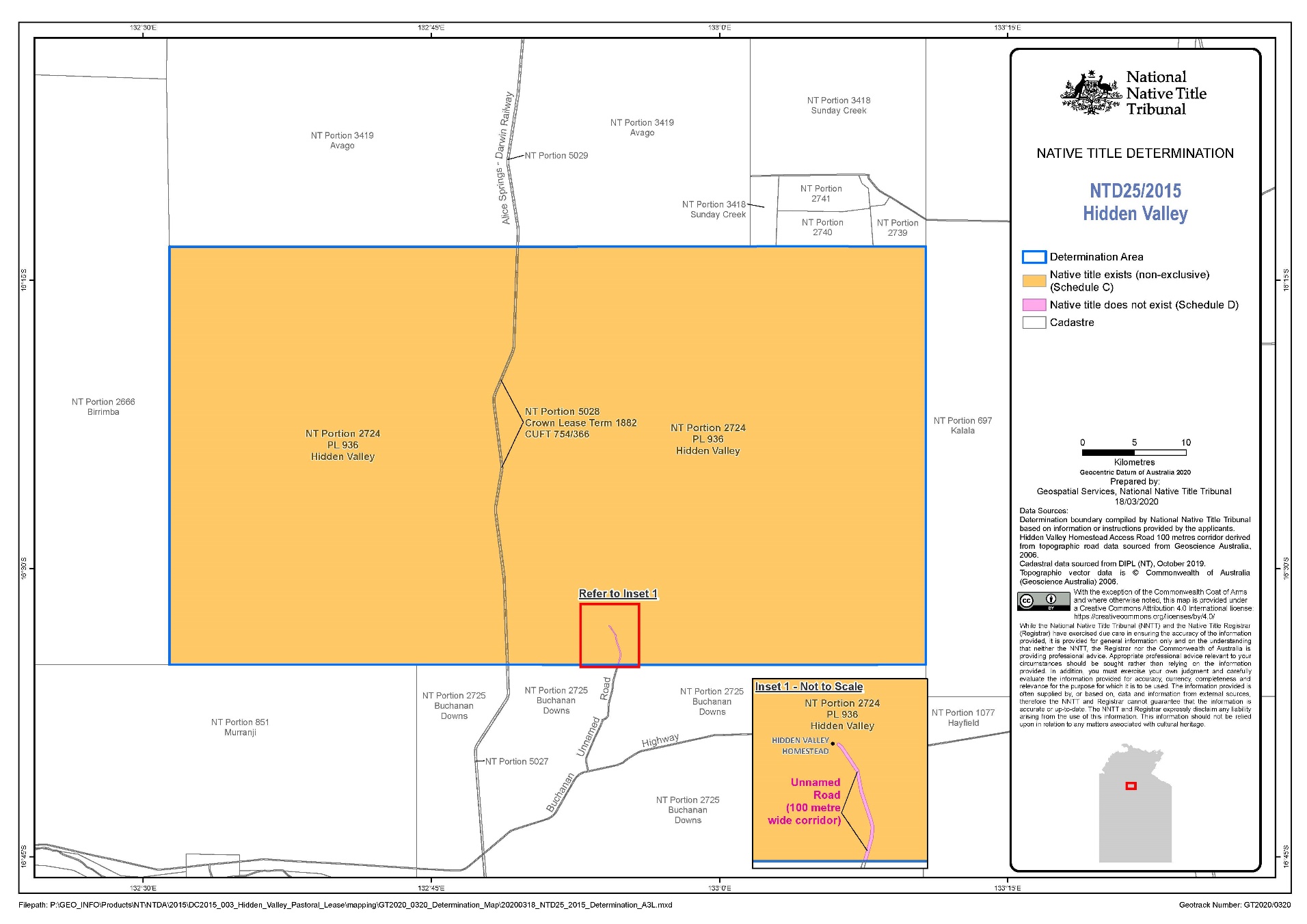
C. Pursuant to ss 87(1)(a)(i) and 87(1)(b) of the Native Title Act 1993 (Cth) (the “Act”) the Parties have filed with the Court their signed agreement in writing (the “Determination”). The external boundaries of the area subject to the Determination (the “Determination Area”) are described in Schedule A of the Determination and depicted on the map comprising Schedule B of the Determination.
D. Pursuant to ss 87 and 94A of the Act, the terms of the Parties’ agreement involve the making of consent orders for a determination that native title exists in relation to the Determination Area as provided by the Determination.
E. The Parties acknowledge that the effect of making the Determination is that the members of the native title claim group, in accordance with the traditional laws acknowledged and the traditional customs observed by them, be recognised as the native title holders for the Determination Area as provided by the Determination.
F. The Parties request that the Court hear and determine this proceeding in accordance with their agreement.
BEING SATISFIED that a determination of native title in the terms of the Determination in respect of the proceeding would be within the power of the Court and, it appearing to the Court appropriate to do so, pursuant to s 87 of the Act and by the consent of the Parties:
THE COURT ORDERS THAT:
1. There be a determination of native title in terms of the Determination set out below.
2. The native title is not to be held on trust.
3. The Top End (Default PBC/CLA) Aboriginal Corporation (ICN 7848) be appointed as the prescribed body corporate for the purposes of s 57(2) of the Act in respect of the Determination Area.
4. There be no order as to costs.
5. The Parties have liberty to apply to establish the precise location and boundaries of:
(a) any adjacent land or waters the use of which is necessary for, or incidental to, the use of any pastoral homestead or improvements; and
(b) public works and adjacent land and waters identified in relation to any part or parts of the Determination Area referred to in Schedule D of this Determination.
THE COURT DETERMINES THAT:
The Determination Area
1. The Determination Area is the land and waters described in Schedule A hereto and depicted on the map comprising Schedule B.
2. Native title exists in those parts of the Determination Area identified in Schedule C.
3. Native title does not exist in those parts of the Determination Area identified in Schedule D.
4. In the event of any inconsistency between a description of an area in a schedule and the depiction of that area on the map in Schedule B, the written description will prevail.
The native title holders
5. The land and waters of the Determination Area comprise the whole or part of two estates, which are held respectively by the members of the following estate groups:
(a) the Narrwan estate group; and
(b) the Badpa estate group;
These persons, together with the Aboriginal people referred to in clause 7, are collectively referred to as “the native title holders”.
6. Each of the estate groups referred to in clause 5 includes persons who are members of the group by reason of:
(a) patrilineal descent;
(b) his or her mother, father’s mother or mother’s mother being or having been a member of the group by reason of patrilineal descent; or
(c) having been adopted or incorporated into the descent relationships referred to in (a) or (b) above.
These persons are collectively referred to as “the estate group members”.
7. In accordance with the traditional laws acknowledged and the traditional customs observed by the estate group members, other Aboriginal people have native title rights and interests in respect of the Determination Area, subject to the native title rights and interests of the estate group members, such people being:
(a) members of estate groups from neighbouring estates; and
(b) spouses of the estate group members.
8. Each of the estate groups referred to in clause 7(a) includes persons who are members of the group by reason of:
(a) patrilineal descent;
(b) his or her mother, father’s mother or mother’s mother being or having been a member of the group by reason of patrilineal descent; or
(c) having been adopted or incorporated into the descent relationships referred to in (a) or (b) above.
The native title rights and interests
9. The native title rights and interests of the estate group members referred to in clause 5 in relation to those parts of the Determination Area identified in Schedule C, being areas where there has been partial extinguishment of native title, are the rights:
(a) to access, remain on and use the areas;
(b) to access and to take for any purpose the resources of areas; and
(c) to protect places, areas and things of traditional significance.
10. The native title rights and interests of the estate group members referred to in clause 7 above in relation to those parts of the Determination Area identified in Schedule C, being areas where there has been partial extinguishment of native title, are the rights:
(a) to access, remain on and use the areas; and
(b) to access the resources of the areas.
11. The native title rights and interests do not confer on the native title holders:
(a) possession, occupation, use and enjoyment of those parts of the Determination Area identified in Schedule C to the exclusion of all others;
(b) any right to control the access to and use of those parts of the land and waters of the areas or their resources;
(c) any right to access or take:
(i) water captured by the holders of Pastoral Lease No. 936; or
(ii) resources that are the private or personal property of another, including but not limited to:
A. infrastructure or fixtures;
B. chattels, equipment, machinery or supplies;
C. animals, including stock within the meaning of the Pastoral Land Act 1992 (NT) and the progeny of any such animal, that are the private or personal property of another; and
D. plants, crops and grasses that are the private or personal property of another.
12. The native title rights and interests are subject to and exercisable in accordance with:
(a) the traditional laws and customs of the native title holders; and
(b) the laws of the Northern Territory of Australia and the Commonwealth of Australia.
13. There are no native title rights and interests in:
(a) minerals (as defined in s 2 of the Minerals (Acquisition) Act 1953 (NT));
(b) petroleum (as defined in s 5 of the Petroleum Act 1984 (NT)); or
(c) prescribed substances (as defined in s 3 of the Atomic Energy (Control of Materials) Act 1946 (Cth) and/or s 5(1) of the Atomic Energy Act 1953 (Cth)),
in the Determination Area.
Non-exhaustive List of Activities
14. Without limiting the native title rights and interests described in clauses 9 and 10 in any way, and without purporting to exhaustively describe the activities which those rights authorise or permit, the rights and interests referred to in clause 9 enable the estate group members referred to in clause 5 to:
(a) travel over, move about and access those areas;
(b) hunt and fish on the land and waters of those areas;
(c) gather and to use the natural resources of those areas such as food, medicinal plants, wild tobacco, timber, stone and resin;
(d) take and to use the natural water on the areas, but this right does not include the right to take or use water captured by the holders of Pastoral Lease No. 936;
(e) live and camp on the areas, and to erect shelters and other structures on those areas;
(f) light fires for domestic purposes;
(g) conduct and participate in the following activities on those areas:
(i) cultural activities;
(ii) cultural practices relating to birth and death, including burial rites;
(iii) ceremonies;
(iv) meetings;
(v) teaching the physical and spiritual attributes of sites and places that are of traditional significance;
(h) maintain and protect sites and places on those areas that are of traditional significance;
(i) be accompanied onto the land and waters by persons who, though not native title holders, are:
(i) people required by traditional law and custom for the performance of ceremonies or cultural activities on those areas;
(ii) people who have rights in relation to the areas according to the traditional laws and customs acknowledged by the estate group members; and
(iii) people required by the estate group members to assist in, observe, or record traditional activities on those areas.
Other interests in the Determination Area
15. The nature and extent of other interests in relation to the Determination Area are the interests, created by the Crown or otherwise, as follows:
(a) in relation to NT Portion 2724, the rights and interests of the holder of Pastoral Lease No. 936;
(b) in relation to NT Portion 5028, the interest of AustralAsia Railway Corporation under Crown Lease Term 1882 CUFT 754/366;
(c) the rights and interests of Telstra Corporation Limited:
(i) as the owner or operator of telecommunications facilities within the Determination Area;
(ii) created pursuant to the Post and Telegraph Act 1901 (Cth), the Telecommunications Act 1975 (Cth), the Australian Telecommunications Corporation Act 1989 (Cth), the Telecommunications Act 1991 (Cth) and the Telecommunications Act 1997 (Cth), including rights:
A. to inspect land;
B. to install and operate telecommunications facilities; and
C. to alter, remove, replace, maintain, repair and ensure the proper functioning of its telecommunications facilities;
D. for its employees, agents or contractors to access its telecommunications facilities in, and in the vicinity of, the Determination Area, in the performance of their duties; and
E. under any licence, access agreement or easement relating to its telecommunications facilities in the Determination Area;
(d) in relation to NT Portion 2724 the rights of Aboriginal persons (whether or not native title holders) pursuant to the reservation in favour of Aboriginal peoples in Pastoral Lease No. 936 made by s 38 of the Pastoral Land Act 1992 (NT);
(e) the rights of Aboriginal persons (whether or not native title holders) pursuant to the Northern Territory Aboriginal Sacred Sites Act 1989 (NT);
(f) rights of access by an employee, servant, agent or instrumentality of the Northern Territory or Commonwealth, or other statutory authority as required in the performance of statutory duties;
(g) the rights to water lawfully captured by the holders of other interests;
(h) the rights and interests of persons to whom valid and validated rights and interests have been:
(i) granted by the Crown pursuant to statute or otherwise in the exercise of executive power; or
(ii) otherwise conferred by statute.
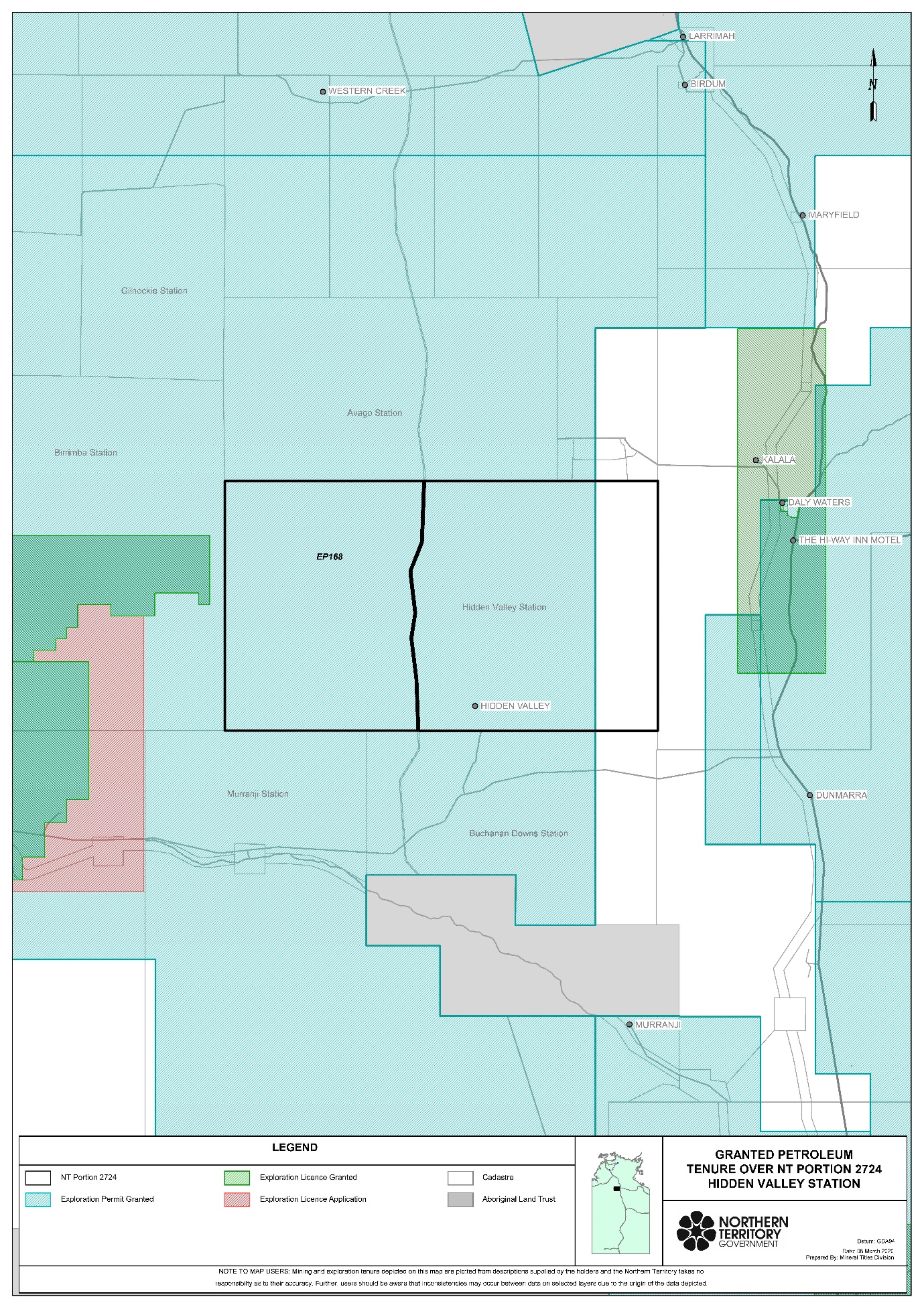
(i) the rights and interests of the holders of the following titles granted under the Petroleum Act 1984 (NT) and depicted in Schedule E:
(i) Exploration Permit Title No. 168 granted on 10 January 2013 and expiring on 9 January 2021.
Relationship between the native title and other interests
16. The other rights and interests referred to in clause 15, and the doing of an activity in giving effect to them or of an activity required or permitted by them, prevail over but do not extinguish the native title rights and interests referred to in clauses 9 and 10, and the existence and exercise of the native title rights and interests do not prevent the carrying on of any such activity.
17. In relation to NT Portion 5028 the relationship between the rights and interests referred to in clauses 9 and 10 and the interest of the AustralAsia Railway Corporation referred to in clause 15 is that the leases granted to the Corporation:
(a) are wholly inconsistent with the continued existence, enjoyment or exercise of the native title rights and interests;
(b) the native title continues to exist, but has no effect in relation to the grant;
(c) if the grants or their effect is wholly removed or otherwise cease to operate the native title rights and interests again have full effect; and
(d) if the grants or their effect is removed to an extent or otherwise cease to operate only to an extent the native title rights and interests again have effect to that extent.
Definitions
18. In this determination, unless the contrary intention appears:
‘land’ and ‘waters’ respectively have the same meanings as in the Act;
‘the Act’ means the Native Title Act 1993 (Cth);
‘resources’ for the purposes of clauses 9 and 10 of this Determination does not include minerals, petroleum and prescribed substances;
‘the Commonwealth’ means the Commonwealth of Australia;
‘the Northern Territory’ means the Northern Territory of Australia
Note: Entry of orders is dealt with in Rule 39.32 of the Federal Court Rules 2011.
SCHEDULE A
Description of Determination Area
The Determination Area comprises the following areas of land:
1. NT Portion 2724, being land the subject of Pastoral Lease No. 936; and
2. NT Portion 5028, being the land the subject of Crown Lease Term 1882 CUFT 754/366 in the name of AustralAsia Railway Corporation.
SCHEDULE B
Map of Determination Area
SCHEDULE C
Areas where native title exists
The areas of land and waters in respect of which the native title rights and interests in clauses 9 and 10 apply are:
1. NT Portion 2724, being land the subject of Pastoral Lease No. 936, except those parts thereof referred to in Schedule D; and
2. NT Portion 5028, being the land the subject of Crown Lease Term 1882 CUFT 754/366 in the name of AustralAsia Railway Corporation.
SCHEDULE D
Areas where native title does not exist
Native title rights and interests have been wholly extinguished in the following areas of land and waters:
1. The unnamed road connecting the Buchanan Highway to the Hidden Valley Homestead to the extent of a corridor of 50 metres to either side of the centre line, marked on the map at Schedule B.
2. Those parts of the Determination Area covered by public works as defined in s 253 of the Act (including adjacent land or waters as defined in s 251D of the Act) which were constructed, established or situated prior to 23 December 1996 or commenced to be constructed or established on or before that date, including but not limited to:
(a) public roads, whether rural roads, arterial roads or national highways;
(b) community and pastoral access roads which are not otherwise public roads;
(c) gravel pits adjacent to the roads referred to at paragraphs (a) and (b) hereof used to maintain those roads;
(d) access roads or tracks to the public works referred to in this clause;
(e) Government bores and associated infrastructure including bores used for the establishment, operation or maintenance of public and other roads;
(f) river and rain gauges;
(g) transmission and distribution water pipes and associated infrastructure;
(h) sewer pipes, sewer pump stations and associated infrastructure; and
(i) electricity transmission lines, towers, poles and associated infrastructure.
SCHEDULE E
Map of interests granted under the Petroleum Act (NT)
WHITE J:
1 On 25 May 2015, the applicant filed an application for a determination of native title under the Native Title Act 1993 (Cth) (the Act) over the land and waters within the bounds of the Hidden Valley Pastoral Lease, being Pastoral Lease No. 936, in the Northern Territory (the Hidden Valley application).
2 On the same day, an application for a determination of native title in respect of the land and waters within the bounds of the adjoining Buchanan Downs Pastoral Lease, being Perpetual Pastoral Lease No. 1082 in the Northern Territory (the Buchanan Downs application), had also been filed.
3 The Hidden Valley and Buchanan Downs applications have travelled together in the Court and have formed part of a group of applications.
4 The parties in both the Hidden Valley and Buchanan Downs applications have now reached agreement and have applied under s 87 of the Act for a determination of native title by consent. The hearings of the applications are occurring simultaneously, but the Court will provide separate (albeit similar) judgments in respect of each. This judgment concerns the Hidden Valley application.
5 The Hidden Valley application is brought by Raymond Dixon, Johnny Devlin and Jeremy Jackson on behalf of two estate groups, being the Badpa (Daly Waters) estate group and the Narrwan (Murranji) estate group.
6 The Hidden Valley Pastoral Lease is located in the Sturt Plateau Pastoral District of the Northern Territory and is southwest of Daly Waters. It comprises over 2,802 km2.
7 The reasons which follow explain why I am satisfied that it is appropriate to make the determination upon which the parties have agreed.
Statutory provisions and principles
8 The parties make their application under s 87(1) and (2) of the Act. Those provisions empower the Court to make a consent determination if five conditions are satisfied:
(a) the parties to an application for a determination of native title have reached agreement on the terms of the orders to be made by the Court (subs (1)(a));
(b) the terms of the agreement are in writing and have been signed by or on behalf of all parties (subs 1(b));
(c) the terms of the agreement has been filed with the Court (subs (1)(b));
(d) the Court is satisfied that an order in, or consistent with, the terms on which the parties have agreed is within the power of the Court (subs (1)(c)); and
(e) the Court is satisfied that it is appropriate in the exercise of the discretion vested in the Court to make the consent determination.
9 In Cronin on behalf of the Butchulla People (Land & Sea Claim #2) v State of Queensland [2019] FCA 2082, O’Bryan J summarised a number of matters bearing upon the exercise of the Court’s power under s 87 and its counterpart s 87A derived from the Court’s previous decisions, including the decisions of Mortimer J in Freddie v Northern Territory [2017] FCA 867 and Agius v South Australia (No 6) [2018] FCA 358. Those matters (without the citations provided by O’Bryan J to support them) include:
(a) the role of the Court in considering an application for a consent determination under s 87 is different from its role in determining a disputed application. The Court’s focus is on the parties’ agreement;
(b) the assessment of whether it is appropriate to make a consent determination takes into account the nature of the rights sought to be recognised in the determination, including the fact that they will operate against the whole world. Because of this the Court seeks to be satisfied that the proposed orders are clear in their terms and are the result of a process in which all parties have had procedural fairness. The Court also wishes to be satisfied that the parties’ agreement has been entered into on a free and informed basis;
(c) while the discretion as to appropriateness is wide, the Court focuses on the individual circumstances of each determination;
(d) the Court also keeps in mind ss 37M and 37N of the Federal Court of Australia Act 1976 (Cth) and, in particular, the objective contained in those provisions of achieving a just resolution of disputes according to law and as quickly, inexpensively and efficiently as possible;
(e) while there must be some probative material by which the Court may satisfy itself that the requirements of s 225 of the Act have been met and that there is a credible and rational basis for the determination, there is no requirement that the parties provide all the material on which the determination is based or which would be necessary if the Court was making the determination after a disputed hearing;
(f) the Court takes into account that the State or Territory in question has an important public responsibility when considering an application for the determination of native title and relies very much on that State or Territory to discharge that responsibility;
(g) the Court takes account of the public interest in a settled outcome; and
(h) the flexibility of a settled outcome allows the State or Territory to take into account a wide range of matters including, for instance, the history of dispossession.
The evidentiary materials
10 For the purpose of considering the appropriateness of the proposed consent determination in the Hidden Valley application, the Court has had regard to:
(a) the statement of Shannon Dixon Kurrunggankari Jimiya filed on 14 July 2020;
(b) the statement of Johnny Devlin Ngungkurunyungu Janama made on 2 August 2018;
(c) the anthropological report of Susan Donaldson dated 23 December 2019;
(d) an anthropological report of Dr Patrick McConvell dated 22 January 2020;
(e) the affidavit of Daniel Wells made on 13 July 2020; and
(f) the statement of joint agreed facts of the applicant and the respondent filed on 12 June 2020.
11 In addition, the Court has received the written joint submissions of the applicant and the respondent filed on 12 June 2020.
Consideration
12 There is no difficulty in the Court concluding that the first three matters to which s 87(1) refers are satisfied. The parties have reached agreement on the terms of a determination of native title; the agreement has been reduced to writing and signed by both parties; and it has been filed in the Court.
13 There is also no difficulty in concluding that, during the long period during which the proceedings have been on foot, the Territory has engaged in a careful assessment of the evidence provided by the applicant in support of the application; that both parties, having been legally represented throughout; that all parties have entered into the consent determination on a free and informed basis; that the decision of the Territory to consent to the determination is sound and rational; and there are no “negative” factors indicating that the determination may be inappropriate. On the contrary, the materials provided by the parties indicate the appropriateness of the consent determination.
14 In relation to the Territory’s assessment of the application, I note that it referred the applicant’s anthropological evidence to a consultant anthropologist for review. That led to the applicant providing further material to the respondent.
15 Section 94A of the Act requires that a determination of native title by the Court set out details of the matters mentioned in s 225 of the Act. Section 225 provides:
225 Determination of native title
A determination of native title is a determination whether or not native title exists in relation to a particular area (the determination area) of land or waters and, if it does exist, a determination of:
(a) who the persons, or each group of persons, holding the common or group rights comprising the native title are; and
(b) the nature and extent of the native title rights and interests in relation to the determination area; and
(c) the nature and extent of any other interests in relation to the determination area; and
(d) the relationship between the rights and interests in paragraphs (b) and (c) (taking into account the effect of this Act); and
(e) to the extent that the land or waters in the determination area are not covered by a non-exclusive agricultural lease or a non-exclusive pastoral lease—whether the native title rights and interests confer possession, occupation, use and enjoyment of that land or waters on the native title holders to the exclusion of all others.
Note: The determination may deal with the matters in paragraphs (c) and (d) by referring to a particular kind or particular kinds of non-native title interests.
16 The terms “native title” and “native title rights and interests” appearing in s 225 are defined in s 223 of the Act. It provides (relevantly):
Common law rights and interests
(1) The expression native title or native title rights and interests means the communal, group or individual rights and interests of Aboriginal peoples or Torres Strait Islanders in relation to land or waters, where:
(a) the rights and interests are possessed under the traditional laws acknowledged, and the traditional customs observed, by the Aboriginal peoples or Torres Strait Islanders; and
(b) the Aboriginal peoples or Torres Strait Islanders, by those laws and customs, have a connection with the land or waters; and
(c) the rights and interests are recognised by the common law of Australia.
Hunting, gathering and fishing covered
(2) Without limiting subsection (1), rights and interests in that subsection includes hunting, gathering, or fishing, rights and interests.
…
17 The meaning of the expression “native title rights and interests” used in s 225(b) was considered by the High Court in Members of the Yorta Yorta Aboriginal Community v State of Victoria [2002] HCA 58; (2002) 214 CLR 422. The native title rights and interests to be recognised in the proposed determination are of the kind to which s 223(1) refers and as discussed in Yorta Yorta.
18 Section 225(a) of the Act requires that the determination identify the persons, or groups of persons, holding the common or group rights comprising the native title. Clauses 5-8 of the determination satisfy that requirement by indicating that the native title rights and interests are held by the members of the Narrwan and Badpa Estate Groups. They also indicate the criteria by which membership of the estate groups is determined.
19 Section 225(b) requires that the determination state the nature and extent of the native title rights and interests in relation to the determination area. Clauses 9-13 satisfy that requirement by identifying the rights and interests to which the determination refers. Those rights and interests are of a kind which have been recognised in previous determinations of the Court. I noted that cl 14 of the determination contains a non-exhaustive list of the activities permitted by the native title rights and interests.
20 Section 225(c) requires that the determination state the nature and extent of any other interest in relation to the determination area. Section 225(d) requires that the determination state the relationship between the rights and interests of the native title holders and the other interests in the area. Clauses 16 and 17 in the determination address those topics by indicating that the other rights and interests in the area, and the activities giving effect to them, prevail over (but do not extinguish) the native title rights and interests.
21 Order 2 provides that the native title is not to be held on trust. Order 3 provides that the Top End (Default PBC/CLA) Aboriginal Corporation (ICN 7848) be appointed as the prescribed body corporate for the purposes of s 57(2) of the Act in respect of the determination area.
Conclusion
22 I refer again to the importance which the Court attaches to the role of the relevant State or Territory and of the importance which it attaches to the parties’ consent.
23 Having regard to the principles identified above and to these matters, I am satisfied that it is appropriate to give effect to the parties’ agreement.
24 I note that, in doing so, the Court does not grant native title. Instead, the Court’s order is a formal recognition that the native title rights and interests of the estate groups exist, and have always existed, at least since European settlement.
25 For these reasons, I make orders in the terms proposed by the parties.
I certify that the preceding twenty-five (25) numbered paragraphs are a true copy of the Reasons for Judgment of the Honourable Justice White. |
Associate:


