

Federal Court of Australia
Janbar Pty Ltd v Arborcrest Pty Ltd [2020] FCA 1519
ORDERS
DATE OF ORDER: |
THE COURT ORDERS THAT:
1. The parties are, by 28 October 2020, to confer with a view to reaching agreement on the issues of interest, costs and the appropriate form of orders.
2. In the event of agreement, the agreed minutes of orders are to be provided to the Associate of Justice White by 29 October 2020, and the orders will be made in Chambers.
3. In the absence of agreement, the Applicants are by 3 November 2020, to file and serve their proposed minutes and an outline of submissions in support and the Respondents are by 6 November 2020 to file and serve their proposed minutes and an outline of submissions in support.
4. The outlines of submissions are not to exceed five pages.
5. Unless the parties indicate in their outlines of submissions that they wish to be heard orally, the Court will determine the remaining issues on the papers.
Note: Entry of orders is dealt with in Rule 39.32 of the Federal Court Rules 2011.
WHITE J:
[1] | |
[10] | |
[44] | |
[45] | |
[46] | |
[48] | |
[49] | |
[50] | |
[52] | |
[73] | |
[83] | |
[86] | |
[88] | |
[104] | |
[116] | |
[118] | |
[134] | |
[135] | |
[136] | |
[140] | |
[145] | |
[154] | |
[174] | |
[198] | |
[200] | |
[211] | |
[223] | |
[231] | |
[239] | |
[242] | |
[251] | |
[257] | |
[261] | |
[268] | |
[270] | |
[274] | |
[278] | |
[283] | |
[287] | |
The jurisdiction of the Federal Court with respect to the warranties under the BWC Act | [288] |
[318] | |
[328] | |
The s 32(2)(c) warranty - compliance with statutory requirements | [342] |
The s 32(2)(a) warranty - performance to accepted trade standards | [372] |
[374] | |
[380] | |
[383] | |
[397] | |
The caulking of the junction between the sills and the tiles | [413] |
[428] | |
[441] | |
[470] | |
[472] | |
[480] | |
[481] | |
[491] | |
[492] | |
[520] | |
[524] | |
[532] | |
[532] | |
[535] | |
[541] | |
[542] | |
[569] | |
[578] | |
[585] | |
Conclusion on damages before reduction for contributory negligence | [587] |
[588] | |
[596] |
1 The applicants in these proceedings, Janbar Pty Ltd (Janbar) and Corey Ahlburg, are the owners of the property at 12 Maidencombe Drive Moana in South Australia (the Property). It is a beachfront property located on an escarpment with direct exposure to Gulf St Vincent.
2 In 2014 and 2015, the applicants constructed a three storey luxury home on the Property. They contracted with the first respondent, Arborcrest Pty Ltd (Arborcrest) to design, supply and install external windows and bi-fold glass doors (defined in the pleadings as the “Arborcrest Work”). The doors were 3 m in height so as to take advantage of the available views. Several of the windows were of the same height.
3 The second respondent, Mr Parisi, is (and was at material times) a director of Arborcrest and was personally engaged in its business.
4 Arborcrest installed the doors and windows in December 2015. The doors were ““Hafele” Variotec Frameless Bi-Fold doors” (the Hafele doors). The windows were an “Alspec Hunter Fixed Window System” (the Alspec windows). The applicants found that both the Hafele doors and the Alspec windows were not waterproof as rainwater penetrated the home. They also complained that the windows and doors were not adequate having regard to the wind strengths to which the property is subject.
5 During 2016, Arborcrest carried out remedial work. This included replacing (at its own expense) the Hafele doors with “Alspec Hawkesbury Framed Bi-Fold doors” (the Alspec doors). The applicants claim that these remedial works were unsuccessful.
6 In March 2017, the applicants engaged another supplier, Maximum Trading Pty Ltd trading as KR Installations (KRI), to replace the bi-fold glass doors with Schüco sliding glass doors (the Schüco doors). KRI also replaced some of the windows. The applicants are satisfied with the Schüco doors and the Schüco windows.
7 In these proceedings, the applicants seek to recover from the respondents:
(a) the sum of $191,711 paid to KRI in March 2017 in respect of the replacement and repair work which it carried out;
(b) the sum of $249,681.74 which the applicants claim may be necessary in respect of further remedial work;
(c) the sum of $15,149 paid to A & J Shutters Pty Ltd in February 2017;
(d) other costs totalling $22,286 in respect of the remedial work; and
(e) damages in respect of the lost opportunity to obtain income from the rental of the Property.
8 In [23] of the Amended Statement of Claim (ASC) the applicants seek an order that the respondents account for the money which they received for the disposal of the Hafele doors and windows, which they achieved by selling those items to a neighbour of the Property, and reimburse that sum to them. However, this claim was not pursued in the trial.
9 Arborcrest filed a cross-claim asserting a quantum meruit in respect of additional works it claimed to have performed in 2016 and early 2017. However, no party (but particularly the respondents) made any reference to the cross-claim at the trial or in the final submissions. The respondents did not lead evidence to support the claimed quantum meruit, although there was some evidence directed to some aspects of the work pleaded to support the claim. The respondents made no reference to the cross-claim in their opening submissions at trial or in their list of trial issues. Item 52 in the Respondents’ Statement of Issues filed on 15 May 2019 (one month in advance of the trial) was “Counterclaim”. However, the Respondents’ Written Outline of Opening Submissions filed on 14 June 2019, while referring to every other issues in the Statement of Issues filed on 15 May 2019, omitted any reference to the cross-claim or counterclaim. In all these circumstances, I have taken the cross-claim to have been implicitly abandoned.
10 In 2013, the applicants commenced the design of a three storey luxury home on the Property. The undercroft was to contain garages. The next two storeys were to contain the living area. The applicants intended that the home, being on a rise and overlooking the sea to the west and north, would take advantage of the views over Gulf St Vincent. They planned, accordingly, that the home would have floor to ceiling glass doors and fixed windows on its western and northern sides on both the ground and first floor levels. For this purpose they wished to have bi-fold doors, rather than fixed doors.
11 The applicants retained Red Building & Landscapes Pty Ltd trading as Saralee Aufderheide Architects to produce design and construction drawings. Saralee Aufderheide is the director of that firm. The terms of the retainer of Saralee Aufderheide Architects were not in evidence and it is not possible to be certain of the precise scope of works undertaken by Ms Aufderheide.
12 On 17 October 2013, the first applicant (Janbar) entered into a building contract with Felmeri Homes Pty Ltd (Felmeri Homes) for the construction of the home. It was not suggested that the fact that Mr Ahlburg was not a party to the building contract had any significance in the trial. The contract price was $1,545,000 inclusive of GST.
13 Ms Aufderheide did issue construction drawings and instructions to Felmeri Homes but Mr Ahlburg acknowledged that she had not been appointed as the administrator of the building contract with Felmeri Homes.
14 Construction of the home commenced on 10 January 2014.
15 On 29 June 2014, Ms Aufderheide issued a written instruction to Felmeri Homes directing it to “remove the supply of the windows and glazed doors from the contract”. Ms Aufderheide’s direction referred to Felmeri Homes giving Janbar a credit of $67,000 in respect of the items which it was no longer to supply, but it seems that negotiation concerning the amount of the credit continued for some time thereafter.
16 Thereafter, Mr Ahlburg attended personally to the procurement of the windows and doors.
17 On 2 October 2014, Mr Ahlburg obtained a quotation from ReliableGlass of $149,130 for the supply and installation of doors and windows to a maximum height of 3 m. The quotation was for the supply of top-hung bi-fold glass doors. The applicants did not proceed with that quotation.
18 On 10 October 2014, Arborcrest (via Mr Parisi) provided the applicants with a quotation of $158,609 inclusive of GST for framed multi-fold glass doors and fixed windows. The applicants did not accept that quotation either.
19 In evidence in chief, Mr Ahlburg said that he obtained quotations at that time by sending the architectural drawings and council design requirements to various glass companies via email with a request that they provide a quotation. In his cross-examination, Mr Ahlburg accepted that he had telephoned Mr Parisi in September or October 2014 with a request for a quotation. Nothing turns on that difference, but I am inclined to think that the latter account is more likely to be correct.
20 Although the quotations from both ReliableGlass and Arborcrest were for folding, rather than fixed doors, Mr Ahlburg said, and I accept, that at the time he sought the quotations in October 2014 he was still exploring his options with respect to the doors and windows, and had not made a final decision.
21 In February and March 2015, meetings involving at least Mr Ahlburg and Mr Parisi occurred at the showroom of Arborcrest at Payneham Road, Stepney. There was disagreement between the parties as to the number of meetings and the attendees at those meetings, and it will be necessary to return to make findings concerning them. It seemed, however, to be common ground that Mr Ahlburg’s father, Russell Ahlburg, had attended the first of the meetings. I am satisfied that Mr Nicholas Hodgson from Hafele South Australia (Hafele SA) was an attendee at one of the meetings. At an early stage Mr Parisi informed Mr Ahlburg that the maximum height of the glass doors which could be provided was 3 m. This was a disappointment to Mr Ahlburg as the then planned height from floor to ceiling was 3.2 m. After some discussion, the applicants resolved to have a horizontal steel beam inserted into the construction so as to reduce the door height to 3 m and to have fixed windows in the space between the beam and the ceiling.
22 The meetings resulted in Arborcrest (by Mr Parisi) providing the applicants on 26 February 2015 with a quotation of $93,880 for the supply and installation of Alspec brand windows.
23 On 16 March 2015, Ms Aufderheide issued an instruction to Felmeri Homes with respect to the installation of the horizontal steel beam, and at the same time provided revised drawings reflecting this change.
24 On 23 March 2015, Arborcrest (via Mr Parisi) provided the applicants with a quotation of $191,889 inclusive of GST for the supply and installation of six Hafele doors (the 23 March Quotation). Mr Hodgson described the Hafele Variotec system as “a semi-frameless sliding door system which can be adapted to just about any opening, [but] usually used for commercial and high end residential applications”. He said that a company known as HAWA was the manufacturer of the Variotec system and that Hafele was its international distributor.
25 Further negotiation occurred, during the course of which Mr Ahlburg requested Arborcrest to separate out the supply and installation costs. It seems that this was related to Mr Ahlburg’s negotiations with Felmeri Homes concerning the credit to be allowed on account of the supply and installation of the doors and windows having been removed from its scope of works.
26 Subsequently, on 31 March 2015, Arborcrest provided two quotations with respect to the Hafele doors: one relating to the supply ($118,209) and the other relating to the installation ($42,680). The latter was in the name of Felmeri Homes, even though it had not requested the quotation. By a separate email of 31 March 2015, Mr Parisi provided the following explanation of the breakdown of the two quotations:
Supply of the six Hafele doors | $118,209 |
Cost of installation | $42,680 |
Cash payment | $25,000 |
Discount | $6,000 |
Total (inclusive of GST) | $191,889 |
27 As is apparent, with the exception of the discount of $6,000, the two quotations of 31 March represented an apportionment of the quotation of 23 March into supply and installation costs. Mr Parisi said that he had done this at the request of Mr Ahlburg. I am satisfied that it was never intended that Felmeri Homes would contract with Arborcrest with respect to the installation of the Hafele doors and windows, and that it did not do so.
28 In his evidence, Mr Ahlburg explained that the discount of $6,000 was on account of him paying Arborcrest $25,000 of the total amount in cash.
29 The applicants accepted the quotations of 31 March 2015 and it was common ground that they had paid Arborcrest a total of $160,889 in addition to the $25,000 cash payment.
30 On 4 May 2015, Ms Aufderheide issued another instruction to Felmeri Homes directing it to refer to documents provided by PT Design (a structural engineering firm) in relation to the provision of additional structural steel to support the change in the selection of the Hafele doors.
31 In early June 2015, the applicants terminated their retainer of Ms Aufderheide. Mr Ahlburg said that he had discharged Ms Aufderheide because “she was overcharging and under-delivering in her role”. I make no finding as to whether that view was justified. Ms Ahlburg then retained another architect, Rolf Proske, the principal of Proske Architects, to provide architectural services in relation to the remaining construction work.
32 In approximately August 2015, the applicants also terminated the contract with Felmeri Homes. Again, Mr Ahlburg considered that that firm was “overcharging and under-delivering”, as well as making mistakes. I make no finding as to whether those views of Mr Ahlburg were justified. Having terminated the contract with Felmeri Homes, Mr Ahlburg then acted as his own building manager and dealt with the trade contractors. This included organising the sequence with which they came on site.
33 The precise scope of Mr Proske’s retainer was not entirely clear. Mr Proske said that he had not been engaged as a project manager and, in particular, had not been engaged in the programming of the works or the coordination of the various trades. Mr Ahlburg acknowledged that Mr Proske had not been engaged as contract administrator or site superintendent. After the termination of the Felmeri Homes contract, it had been Mr Ahlburg who had attended to those matters. Of particular relevance presently, Mr Proske was not responsible for the design of the doors or windows. He made it plain to Mr Ahlburg that Proske Architects were not preparing “a window and door schedule”. He said, and I accept, that Arborcrest had been advised that was so and were “okay with that”. As part of his work Mr Proske did check the work performed already against the “for construction” drawings and the specifications and provided new drawings when necessary. Mr Proske said, and I accept, he had become involved in suggesting sequencing of work in the construction, but not in “actioning” the sequencing.
34 After the engagement of Mr Proske, construction work was put on hold while Proske Architects familiarised themselves with the existing position, carried out checks, prepared further construction drawings and liaised with some suppliers.
35 Installation of the windows and doors commenced in November 2015 and was completed by Christmas. Arborcrest, by its contractors, installed six Hafele doors: three on the ground floor and three on the first floor. One of the first floor doors was a multi-fold window above a bench top. When Arborcrest completed the installation, some work remained to be performed. These included the fitting of seals. Further, because the floor tiles had not been placed at that time, some final adjustments and the like could not be completed. A consequence was that the door and window openings were not weather proof.
36 The applicants paid for the work carried out by Arborcrest in November and December 2015.
37 During 2016, Mr Ahlburg noted that, during even light storms, rainwater “literally just poured in” through the doors. He recorded this by taking videos and photographs. Mr Ahlburg regarded some of the workmanship as “terrible” because the doors were not exactly vertical and were unstable because of faults in the locking mechanisms. Mr Ahlburg said that he contacted Mr Parisi about these problems on numerous occasions. He also said that from time to time Mr Parisi sent workers to check the position but the work which they did was of a minor kind, such as fitting duct tape.
38 In December 2016 and January 2017, following agreement between Mr Ahlburg and Mr Parisi, Arborcrest replaced the Hafele doors with Alspec Hawkesbury doors. These are a form of bi-fold door. Arborcrest carried out this work at its own expense. While the period between the commencement and conclusion of the installation was five weeks, approximately two and a half weeks was attributable to the Christmas shutdown. Arborcrest completed some final adjustments and sealing in relation to that work on 2 February 2017.
39 Mr Ahlburg remained dissatisfied. In particular, he noticed that during stormy weather on 13 and 19 January 2017 water continued to come into the house. On 23 January 2017, Mr Ahlburg’s lawyers, Hackett Lawyers, gave notice of a claim to Arborcrest.
40 Mr Proske then referred Mr Ahlburg to KRI. Mr Burdett inspected the property on or about 27 February 2017 and, on 5 March 2017, provided a quotation for the replacement of five Alspec doors as well as three windows. The amount of the quotation was $181,138.10 inclusive of GST. The applicants accepted the KRI quotation with respect to the replacement of the Alspec doors and in June 2017, KRI replaced those doors with Schüco doors. As part of that work, KRI cut out a channel about 160 mm wide and 90 mm deep in the floor immediately under the doors on both the ground and first floors. Mr Burdett inserted drainpipes (about 40 mm in diameter) and waterproofing into the channel. On the first floor, these drainpipes drained water through the ceiling space into a stormwater pipe.
41 The Schüco doors have been effective in keeping out the wind and rain.
42 In December 2017, the applicants accepted the quotation of $15,014 plus GST by KRI for the replacement of the three highlight windows with Schüco windows. Mr Ahlburg said that he had replaced those windows because they were leaking.
43 The applicants would like to replace the remaining Alspec windows because they too are leaking. They have received a quotation from KRI for $249,681.74 for this work. Mr Ahlburg said that he has not yet accepted this quotation because he cannot afford it. It is this work which is the subject of the applicants’ claim with respect to future remedial work.
44 The applicants sue the respondents on four causes of action:
(a) breach of contract, in particular breach of six warranties implied into the contract with Arborcrest by s 32 of the Building Work Contractors Act 1995 (SA) (the BWC Act);
(b) misleading or deceptive conduct in contravention of s 18 of the Australian Consumer Law (ACL) in Sch 2 of the Competition and Consumer Act 2010 (Cth) (the CC Act);
(c) negligence in the design, supply and installation of the Arborcrest work;
(d) negligent misstatement in the making of the representations on which the applicants relied for the misleading or deceptive conduct claim.
45 This was the principal cause of action on which the applicants relied. Ultimately, it rested on the warranties implied by the BWC Act.
Misleading or deceptive conduct
46 The applicants allege that Mr Parisi had represented orally in February 2015 that he and Arborcrest were able to design, supply and install glass panels and frameless bi-fold glass doors at the Property which were waterproof, which had a wind rating adequate and suitable for the Property, and which would prevent any water ingress into the house.
47 The applicants allege that these representations were misleading or deceptive in contravention of s 18 of the ACL. By way of particulars of that allegation, the applicants rely on the same matters on which they rely for their allegations of breach of contract.
48 The applicants allege that the respondents were negligent in their design, supply and installation of the Arborcrest work.
49 The applicants allege that the respondents “made negligent misstatements” in making the representations on which the applicants rely for their misleading or deceptive conduct claim.
The scope of the applicants’ claim
50 Counsel for the respondents noted that the applicants’ claims are confined to a claim for the recovery of damages for “defective glass doors and windows designed, supplied and installed at the applicants’ house”. Counsel submitted that the claim being confined in this way meant that the respondents could not be liable for the cost of retrofitting a plumbed strip drain.
51 I agree that the applicants make their claims in contract, negligence and for misleading and deceptive conduct on the basis of the representations of the respondents, and Arborcrest’s contract to “design, supply and install glass panels and frameless bi-fold glass doors”. As will be seen, I am also satisfied that the installation of strip drains was not an incident of the work to be performed by Arborcrest; it was instead the responsibility of the applicants. The consequence is that it is the applicants who must bear responsibility for the absence of strip drains on the first floor balconies and for the positioning of the strip drains on the ground floor. This means that, even if otherwise successful, the applicants should not be able to recover from the respondents the cost of the work performed by KRI in installing the drains.
52 Mr Ahlburg gave evidence at the trial. He was the person who made the day to day decisions concerning the construction of the home and it is evident that it was very much his project. In addition, the applicants led evidence from Mr Burdett; from Mr Proske; from Mr Jim Jovanovic, the director of Jovanovic Architecture who gave evidence of an expert kind following his inspection of the Property; and from Mr Nicholas Roach, an engineer who gave expert opinion evidence concerning aspects of the construction of door and window systems at the Property.
53 Mr Parisi gave evidence. In addition, the respondents led evidence from Mr Hodgson, formerly of Hafele SA, and expert evidence from Mr Anthony Gramlick and Mr Bassam Deek. Both Mr Gramlick and Mr Deek are engineers.
54 Mr Ahlburg and Mr Parisi were the principal witnesses on each side. I did not regard the evidence of either as being reliable.
55 Mr Ahlburg was 46 years old when he gave evidence. He is a qualified locksmith and his work history includes periods as a restauranteur, financier and finance broker. Mr Ahlburg described himself as being “a very bad reader” and “almost dyslexic”. Much of his evidence was generalised and reconstructed. It revealed that, in many respects, Mr Ahlburg does not have good attention to detail, especially for detail contained in documents. There were many parts of Mr Ahlburg’s evidence, including on important matters, on which he said he had no memory. In many instances he could recall details only of matters which suited the applicants’ claims. I regarded parts of his evidence as unconvincing. I had the firm impression that Mr Ahlburg has a tendency to focus more on matters of appearance than he does on matters of detail and underlying substance. Accordingly, I have significant reservations about much of Mr Ahlburg’s evidence. That does not mean, however, that I am not willing to accept any of his evidence and there are some matters upon which I do accept his evidence.
56 It is appropriate to refer expressly to one particular submission of the respondents concerning Mr Ahlburg’s credibility. They contended that Mr Ahlburg had not told the Onkaparinga Council honestly of his intended use of the Property. Counsel made this submission by reference to correspondence which passed between Ms Hockey, the Development Officer (Planning) at the City of Onkaparinga, and Ms Aufderheide. By an email of 4 December 2013, Ms Hockey drew attention to the plans provided to the Council for development application approval and the subsequent builder’s certified plans. She said that differences between the two plans made her question the use of the dwelling and said that there was the potential for an alternate use “to trigger the requirement for a further development application”. In her response, Ms Aufderheide described the intended use of the Property as “a secondary residence for my client”. She continued by saying that Mr Ahlburg wished to be able to “entertain his guests in lavish style and [he] has appointed the bedrooms to provide a unique experience” and that “[e]ach bedroom has now been given its own en suite bathroom to allow privacy for his friends”. Counsel submitted that this response had been misleading because it did not say anything about Mr Ahlburg’s intended use of the Property for rental purposes.
57 Mr Ahlburg said that he had no memory of seeing Ms Aufderheide’s letter at the time it was sent. He also said that he had believed in any event that he had not been required “to tell the Council” of an intended use of the home for Airbnb and rental purposes.
58 I do not accept the respondents’ submission that Ms Aufderheide’s response to Ms Hockey of 4 December 2013 evidences dishonesty by Mr Ahlburg. He was not the author of the response. It was not a matter on which Ms Aufderheide would, self-evidently, have required Mr Ahlburg’s instruction before responding to the Council. Moreover, I note that only two hours and twenty one minutes elapsed between the time Ms Hockey sent her email (5.04 pm) and the time of Ms Aufderheide’s response (7.25 pm). It is entirely plausible in those circumstances that Ms Aufderheide made the response without reference to Mr Ahlburg so that his statement that he had no memory of seeing the document was correct.
59 I will refer later to Mr Ahlburg’s evidence concerning his intentions with respect to the use of the home.
60 Mr Burdett was an impressive witness. The respondents accepted, appropriately, that he has expertise as a glazier and could express opinions. I accept his evidence.
61 I also regarded the two experts called by the applicants, Mr Jovanovic and Mr Roach, as being impressive. Each understood the role of an expert witness and each gave his evidence with objectivity. Subject to one matter concerning the evidence of Mr Jovanovic, I regarded their evidence as providing a sound basis for my findings.
62 I considered that the evidence of Mr Proske was generally reliable and accept it.
63 Mr Parisi was 43 years old at the time he gave evidence. He and his wife are the shareholders of Arborcrest and he is its director. Arborcrest’s principal business is the supply of windows and doors to home owners and builders for high end residential projects and the supply of commercial windows and doors. Mr Parisi has conducted a business of this kind since 1986 but established Arborcrest in about 2007. He is very much involved in all of the day to day activities of Arborcrest. He has experience as a glazier and fabricator as well as in building and/or renovating properties for profit. I accept that he has considerable experience in aspects of the building industry, in particular, the fabrication and installation of glass doors and windows.
64 I had the strong impression that Mr Parisi had a good grasp of where his interests lay in the litigation and that there were occasions when Mr Parisi allowed that appreciation to influence the evidence which he gave. Quite apart from those matters, there were several aspects of Mr Parisi’s evidence which I consider were reconstruction. It follows that I do not accept all of his evidence.
65 Both Mr Gramlick and Mr Deek were seemingly impressive witnesses. However, there were aspects of their evidence which caused me to doubt their objectivity and detachment. In Mr Gramlick’s case, on several occasions he gave answers which were not responsive to the questions asked of him but which were justificatory of the respondents’ position in the litigation. His willingness to confirm that both the Hafele doors and Alspec doors had been designed and manufactured so as to comply with Australian Standard 2047 (AS 2047) when he had not even seen them was a matter of surprise. It was also a matter of concern when it emerged during Mr Gramlick’s cross-examination that, despite deposing to having disclosed in his report the documents provided to him (and inferentially those on which he had based his opinion), he had obtained further information which he had not disclosed. Mr Gramlick revealed for the first time in his cross-examination that “there might have been a subsequent check with Arborcrest to get the relevant information”. Later in re-examination, with reference to the question of whether Arborcrest had installed a sub-sill with the Hafele doors, he said:
I think at that stage [having reviewed Mr Roach’s report] I must have made contact with Arborcrest, sort of saying, you know, ‘What’s going on? I don’t – you know. ‘Is this correct?’, you know? I couldn’t believe that you would use that particular section without the sub-sill. You know it’s just not possible.
66 Mr Gramlick then said that Mr Parisi had provided him with an explanation and had provided a fabrication report concerning the components used by Arborcrest which supported the conclusion that Arborcrest had installed a sub-sill with the Alspec doors. Mr Gramlick’s report did contain an incidental reference to Arborcrest “cutting lists and fabrication reports” but he had not disclosed any of these matters previously. It caused me to doubt whether Mr Gramlick did understand fully the obligations of an expert witness, and, as indicated, to doubt his objectivity and detachment.
67 In Mr Deek’s case, I thought that there were several instances in which he revealed a wish to support the cause of the party calling him, and so was not entirely detached and objective. By way of example, Mr Deek’s statement that, according to the Guide issued by the Australian Windows Association, “it is the builder’s responsibility to ensure that windows and doors are installed in such a way that water does not penetrate from the outer skin to the inner skin of the building envelope” (emphasis in the original), was not responsive to the issue raised with him and, accordingly, a seemingly gratuitous statement in support of the respondents’ case. There were other instances of Mr Deek seemingly going out of his way to attribute responsibility to the “owner-builder”. He too obtained information directly from Mr Parisi in relation to the preparation of his report.
68 Mr Hodgson has been involved in the sale of building and hardware products for many years, both in hardware stores and in industrial hardware. His work experience includes working with a number of window suppliers and/or installers and he has held a number of managerial sales positions. Between 2013 and 2016, he was employed by Hafele SA.
69 It was evident that Mr Hodgson was on friendly terms with Mr Parisi.
70 I have reservations about accepting the whole of Mr Hodgson’s evidence. I consider that in some respects he gave exaggerated accounts of events and conversations in which he was involved.
71 Neither Russell Ahlburg nor Ms Aufderheide gave evidence. In the case of Russell Ahlburg, this was attributed to his state of health. Neither party sought to call Ms Aufderheide although each party had had access to her file by discovery. In their final submissions, the respondent submitted that a Jones v Dunkel [1959] HCA 8; (1959) 101 CLR 298 inference should be drawn against the applicants by reason of their omission to call Ms Aufderheide. Counsel submitted that she had been the applicants’ agent and was in their “camp”.
72 Although the applicants did not provide any specific explanation for not calling Ms Aufderheide, I decline to draw the adverse inference for which the respondents contended. By reason of the termination of her retainer, there is no reason to suppose that she and the applicants have a good relationship. The respondents had access to the same documents of Ms Aufderheide and were in the same position as the applicants to have called her. In any event, the respondents did not identify the particular issue or issues on which an inference adverse to the applicants should be drawn.
The wind rating for the Property
73 In designing a domestic building, engineers and architects apply a wind classification or wind rating calculated in accordance with an Australian Standard. It is a method of identifying the wind speeds to which the structure will be subject for which provision should be made in the design. The Australian Standard has six wind classifications for residential buildings in non-cyclonic areas, N1 to N6.
74 On 28 September 2011, a firm of consulting engineers (Ron Selth & Associates) supplied a wind classification for the Property of N3 (41 m/s). It was common ground that this rating was mistaken as the wind classification for the property, calculated in accordance with the Australian Standard, was the higher N4 classification (61 m/s). The mistake went unnoticed until after the present dispute arose.
75 The specification and drawings provided to the respondents for the purposes of providing the quotations in early 2015 contained the mistaken classification of N3. The respondents pleaded that they had designed and manufactured windows and doors to meet the N3 classification, and not the N4 classification. This plea received some support from Mr Deek who said:
[10] I agree … that the Hafele bi-fold doors which were designed and manufactured in accordance with the requirements of the ‘incorrect and underestimated’ Site Wind Classification N3, would have been unlikely to meet the weather proofing performance requirements of the [Building Code of Australia].
[11] … If the window system has not coped adequately with the exposed conditions to which it has been subjected, as alleged, in terms of coping with wind velocity and driving rain under storm conditions, it is because it (the window system) was designed and manufactured in accordance with the requirements for the ‘incorrect and underestimated’ Site Wind Classification N3 instead of the appropriate Site Wind Classification N4 (61 m/s).
76 However, as Mr Roach pointed out in his report of 29 March 2019, the difference between the N3 and N4 classification is, for relevant purposes, immaterial. That is because the water penetration and air filtration performance requirements outlined in AS 2047 are identical for both the N3 and N4 wind ratings for exposed locations and the issue in this case concerns the degree of water penetration and air filtration through the doors, not their structural sufficiency.
77 By the time the experts gave their evidence in the trial, all agreed with Mr Roach.
78 Mr Parisi’s response to the Notice of Claim from Hackett Lawyers on 28 February 2017 indicated an awareness on his part at that time that the correct wind classification for the Property was N4. The evidence did not indicate when Mr Parisi first became aware that that was the correct classification.
79 The respondents’ final submissions on this topic were mixed. At one point, they submitted that the applicants had contributed to the water leaks because they had designed the house to N3. At another point, they acknowledged that “the wind rating under design is not in the end influential in the claim, one way or the other”, although they added the rider that the Hafele doors are certified to N3 and not N4. I proceed on the basis that the mistaken wind classification is of no significance to the issues to be decided in the trial.
80 The opinion given by Mr Deek in relation to the mistaken wind classification was one of the matters which undermined my confidence in his opinions more generally. In his report he referred on several occasions to the “incorrect and underestimated” Site Wind Classification N3, giving that as the reason why the Hafele doors were unlikely to have met the weatherproofing performance requirements of the Building Code of Australia (BCA) and why the Alspec doors may have been inadequate. He did so without any reference to the fact that the water penetration and air filtration requirements for the N3 and N4 classifications were identical. That circumstance meant that his opinions lacked a proper basis. In his cross-examination, Mr Deek conceded that in the circumstances of this case, the distinction between the N3 and N4 classifications was a “red herring”.
81 Another matter which caused me concern about Mr Deek’s evidence was his readiness to opine that the Hafele system had been designed and manufactured in accordance with the requirements for a site with the wind classification N3 when he had never physically inspected the Hafele doors so as to be able to make an assessment of the quality of their manufacture.
82 Mr Deek’s readiness to proffer this opinion was even more surprising given his later acknowledgment that he does not have experience “working in the window and door manufacturing field”.
The Hafele/HAWA Variotec 150/GV bi-fold door system
83 The Hafele door system is a “frameless” glass folding door system produced by HAWA of Switzerland. It has no frames or seals on the vertical edges of the glazing.
84 In a promotional brochure, HAWA described Hafele doors as “predestined for a host of interior applications, for instance in shopping malls, hotels, railway stations, airports, banks, unheated conservatories or in industrial and administration buildings” (emphasis added). The evidence indicated that neither Mr Parisi nor Mr Hodgson had this brochure in February or March 2015 (Mr Hodgson said only that he had seen the picture of the Hafele door system appearing in the brochure in “the latest Hafele catalogue book”). Mr Roach said, and I accept, that the Hafele website did not contain any data concerning the weather resistance of the Hafele doors. He added that this was probably because the system is typically used for internal shop-front applications and not subjected to external weather. That evidence was not challenged, and I accept it. I record at this stage my satisfaction that neither Mr Parisi nor Mr Hodgson told Mr Ahlburg or Ms Aufderheide that Hafele doors were intended for internal locations, that is, not as external doors.
85 I have not overlooked that the drawings of a Hafele door which was tested by AZUMA Design on 11 August 2010 for compliance with AS 2047 did include a below floor level subsill, apparently associated with the drainage of water. Mr Hodgson thought that the below floor element was not part of the Hafele door system.
The Alspec Hawkesbury bi-fold door system
86 Unlike the Hafele door system, the Alspec Hawkesbury door system is a fully framed bi-fold door system.
87 The Alspec doors installed by Arborcrest at the Property had fixed to the floor at their base a sill system with the following profile:
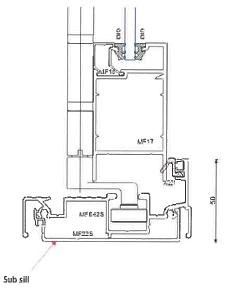
88 Before addressing the applicants’ causes of action, it is appropriate to make some general findings with respect to the formation of the contract between the applicants and Arborcrest and with respect to the issues arising out of the performance of Arborcrest’s work.
89 Mr Ahlburg’s first communication with Mr Parisi was in late September or early October 2014 when he requested a quotation for the supply and installation of windows. Arborcrest provided the quotation on 10 October 2014 for the supply of both Alspec doors and windows. The email by which Mr Parisi provided the quotation commenced:
Hi Corey, thanks for the opportunity to quote on your project. It’s a great home and I’m sure will look brilliant when finished.
90 Apart from one or two follow up emails, Mr Ahlburg did not have further contact with Mr Parisi until February 2015 when he arranged a meeting.
91 In his evidence in chief, Mr Ahlburg said that he had had two meetings with Mr Parisi at the Arborcrest showroom at Payneham before accepting the Arborcrest quotations. He said that the first occurred about one week before Mr Parisi provided the quotation dated 26 February 2015 and that the attendees at that meeting were, in addition to himself and Mr Parisi, Ms Aufderheide and his father. In cross-examination, he accepted that the first meeting had been on 18 February 2015. I will refer to this as “the First Meeting”.
92 Mr Ahlburg’s father attended some meetings with him because of his experience in building work. Mr Ahlburg said that at the First Meeting he had informed Mr Parisi of the location of the house, being seafront and on a cliff, with the consequence that it was exposed to a lot of wind and rain; that he had explained that the Property was to be an “architectural house” about which he was passionate; and that he wished the glass and doors to be “seamless”.
93 Mr Ahlburg said that he saw some frameless glass doors on display in the Arborcrest showroom and that he had told Mr Parisi that that was the “look” which he was seeking. He said that Mr Parisi had said, almost immediately, that bi-fold glass doors of 3.2 m in height would not be suitable because, at that height, “there would be some leakage issues and there would be some framework issues”, and that a maximum height of 3 m was recommended for the Hafele system. This was a disappointment to Mr Ahlburg as the applicants’ planned floor to ceiling height was 3.2 m.
94 Mr Ahlburg said that he had left Ms Aufderheide and his father at the meeting while he went to other business. Later that day, it had occurred to him that, if he inserted a horizontal structural beam so as to limit the height of the glass doors to 3 m, it may be feasible to install the Hafele system. With that in mind, he telephoned Mr Parisi and arranged a second meeting with him later on the same day. He and Mr Parisi were the only attendees at this second meeting. Mr Ahlburg said that their conversation was to the following effect:
Mr Ahlburg: I’ve been thinking about this. If I get Stevens Structural, the steel company, to put another beam in, a secondary beam to make this space smaller and make it to three metres, can we have this system?
Mr Parisi: That would be perfect.
95 Mr Ahlburg could not remember any other meeting at the Arborcrest showroom. Nor could he remember attending the Hafele SA showroom to look at the Hafele doors on display there.
96 Mr Parisi thought that he had had four meetings with Mr Ahlburg at Arborcrest’s Payneham premises. The first was in mid-February 2015 at which the participants were Mr Ahlburg, his father, and himself.
97 The second occurred two or three days later and followed a telephone conversation with Ms Aufderheide. The attendees at this meeting were Mr Ahlburg, Ms Aufderheide, Mr Hodgson and himself. Mr Parisi said that he had requested Mr Hodgson to come to that meeting. I will refer to this as “the Arborcrest-Hodgson Meeting”.
98 Mr Parisi did not agree that he had met Mr Ahlburg at the Arborcrest showroom later on the day of the First Meeting, but did agree that Mr Ahlburg had telephoned him later that day; that Mr Ahlburg had mentioned his “brainwave” of reducing the height of the doors to 3 m; that he had responded with words to the effect “that would be perfect”; and that he had said he would contact “Hafele”.
99 The third meeting occurred approximately one month later. The attendees were Mr Ahlburg and himself.
100 The fourth meeting occurred on 30 March 2015. The participants in the meeting were again Mr Ahlburg and himself.
101 Mr Parisi’s account of the Arborcrest-Hodgson Meeting was generally supported by the evidence of Mr Hodgson. In addition, Mr Hodgson said that, a few days after that meeting, Mr Ahlburg and Ms Aufderheide attended the Hafele showroom in Chesser Street, Adelaide. He then showed them the Hafele products on display.
102 I consider that the evidence of Mr Parisi about the number of meetings and their timing was much more reliable than that of Mr Ahlburg and accept it. The latter’s account was simplistic and implausible. Amongst other things, it would mean that he had sought the quotation from Arborcrest with respect to the windows after only two meetings with Mr Parisi, the second of which was quite short. Further, although Mr Ahlburg claimed that he had seen a display of the Hafele doors in the Arborcrest showroom, I accept the evidence of Mr Parisi and Mr Hodgson that there was no such display at that time. It was not until later that Hafele SA had supplied Arborcrest with an example of the Hafele door system for display purposes.
103 Apart from the differences between the witnesses as to the number of meetings and who it was who participated in them, there were differences between them on three principal matters:
(i) the suitability of the Hafele doors for the use proposed by Mr Ahlburg;
(ii) the potential for ingress of water; and
(iii) the installation of drains.
Discussions at the First Meeting
104 Until the time of the First Meeting, the drawings prepared by Ms Aufderheide provided for a different glass door system (the Lotus Glas-Stax system).
105 There was not a great deal of difference between the accounts of Mr Ahlburg and Mr Parisi of the First Meeting. Mr Ahlburg’s account was that the focus at the First Meeting was on whether he would be “happy to use Arborcrest” and whether Arborcrest could supply the doors and windows which he needed.
106 Mr Parisi described the discussions as not being overly detailed, as involving “a bit of a meet and greet”, and as directed to making sure that the extent of Mr Ahlburg’s requirements was understood. He said that it was Mr Ahlburg’s father who was more involved in the discussion, seemingly because he had relevant building industry experience.
107 Mr Ahlburg had said that he wanted a frameless glass door system. The doors in such systems do not have any attachments to the glass at the top, bottom or sides (other than a potential pivot), whereas semi-frameless doors have rails at the top and bottom while the vertical sides are frameless.
108 Mr Parisi acknowledged that he had some idea at the First Meeting of what Mr Ahlburg was seeking because he had spoken to him on the telephone before providing his quotation of 10 October 2014. In that telephone conversation, Mr Ahlburg had told Mr Parisi that he was building “a high-end property”, that he wanted full height glass doors and some louvres, and wanted a frameless door system so as to take advantage of the Property’s views.
109 Mr Parisi could not remember whether there had been any discussion at the First Meeting of the brand type which may be suitable as a frameless door system. Mr Ahlburg said that it was Mr Parisi who, on learning of Mr Ahlburg’s desire to have a “frameless, seamless look”, had mentioned the Hafele system. He said, however, that Mr Parisi had said that that system could not be used because of the height of 3.2 m. According to Mr Ahlburg, Mr Parisi had said that the maximum recommended height for the Hafele system was 3 m. Mr Parisi had also said that, at a height of 3.2 m, there would be “some leakage issues” and “some framework issues”. As already noted, Mr Ahlburg said that, when he had returned later that day and asked Mr Parisi if the problem could be solved by the insertion of a structural beam so as to limit the height to 3 m, Mr Parisi had responded with words to the effect “that would be perfect”.
110 It was put to Mr Ahlburg in cross-examination that, at the Arborcrest-Hodgson Meeting, he had said that he wanted “frameless bi-fold doors” but had requested a quote for the windows only as he intended to get the doors from somewhere else. Mr Ahlburg said that he had no recollection of the second meeting about which he was being questioned and, in particular, no recollection of making the statements suggested by counsel in cross-examination. Mr Parisi’s evidence was in accord with that put to Mr Ahlburg in cross-examination. I accept that evidence. It is consistent with Mr Parisi being asked in mid-February to provide a quotation for windows only.
111 It is, however, likely that there was some discussion at some stage about the planned use of the Lotus product because, as indicated, that was the product which Ms Aufderheide had shown on her drawings. That discussion is more likely to have occurred at the First Meeting.
112 I think it likely that Mr Parisi said at the First Meeting that Arborcrest did not use the Lotus range of products (that being the fact). I also think it likely (and so find) that it was in that context that Mr Parisi mentioned the Hafele system. Mr Parisi agreed that he had said “I can offer you a Hafele system but that system won’t work if the height to be covered is 3.2 metres … at that height I would be concerned that there would be leakage and framework issues and we wouldn’t recommend it”. I accept that it is also possible that Mr Parisi mentioned the Hafele system to Ms Aufderheide in a telephone conversation before the Arborcrest-Hodgson Meeting. In either event, I am satisfied that it was Mr Parisi who introduced the Hafele system into the discussions.
113 In his cross-examination, Mr Parisi agreed that, at the First Meeting, he had told Mr Ahlburg and his father that he could achieve “the seamless, see-through look”, that he had made this statement in a positive and encouraging way, and that he had had in mind at the time using the Hafele product.
114 It is difficult to reach a firm conclusion as to the way in which things were left at the end of the First Meeting. Mr Ahlburg said that he had left the meeting early in order to attend to other business. Mr Parisi could not recall whether that was so. My impression is that the First Meeting was introductory and explanatory, and think it likely that it was left on the basis that Mr Ahlburg and Ms Aufderheide would reflect on the information they had been given by Mr Parisi.
115 Nor is it possible to make a firm finding as to when Mr Ahlburg asked for the quotation for the Alspec windows which Arborcrest provided on 26 February 2015. I am satisfied, however, that the request for that quotation and its provision on 26 February 2015 supports the view that Mr Ahlburg had not made a decision concerning the use of the Hafele doors until after that date and, inferentially, not until after the Arborcrest-Hodgson Meeting. To the extent that Mr Ahlburg’s evidence is to the contrary, I reject it.
116 Mr Hodgson said that Mr Parisi had telephoned him in relation to the Moana project and had told him that the customer wanted the Variotec frameless product. He said that he recognised straightaway that this was the same project as that for which another glazier had asked him some months earlier for a quotation. Mr Hodgson said that he told Mr Parisi immediately that “I’ve already looked at this job, and it’s not going to work as drawn, and it’s on a hill”. He said that, despite this, Mr Parisi had suggested that they meet “because the client was very adamant that they wanted that product”. He had agreed to meet but had said “the design needs to change, and it needs to be clear that this product doesn’t seal”.
117 In the cross-examination, Mr Hodgson explained that by saying that “it” would not work and that the design would have to change, he was referring to the position of the structural columns and what would be required if the doors were to open inwards or outwards.
The Arborcrest-Hodgson Meeting
118 Mr Parisi said that he had had some telephone discussions with Ms Aufderheide before the Arborcrest-Hodgson Meeting. In those telephone discussions, Ms Aufderheide had been enquiring about the mechanical detail concerning the installation of bi-fold doors. As already indicated, it is possible that those discussions also included some reference to the Hafele system.
119 Mr Parisi said that he knew before the commencement of the Arborcrest-Hodgson Meeting that the brand of door to be discussed was Hafele and that it was for that reason that he had arranged for Mr Hodgson, as the representative for Hafele SA, to be present. Mr Parisi explained that he had done so because at that time he did not have a display of the Hafele doors at his showroom and that Mr Hodgson’s experience made it “good to get him involved”.
120 Mr Hodgson took some models of the Variotec system to the Arborcrest-Hodgson Meeting. He said that he asked Mr Ahlburg to describe where the house was located and, on being told that it was on a hill, an exchange to the following effect occurred:
Hodgson: This is going to leak like a sieve.
Ahlburg: That doesn’t matter. It’s all about the look and I’ve got floorboards, jarrah floorboards, running all the way through the floor, so I don’t care if it leaks.
Hodgson: Well, that’s dangerous with timber, with water ingress.
Ahlburg: It doesn’t matter. I [will] use towels or whatever to mop it up. I’m not fussed.
121 Mr Hodgson said that neither Mr Ahlburg nor Ms Aufderheide had shown interest in any product other than the Hafele Variotec system.
122 Mr Hodgson claimed that the plans he had seen did not make any allowance for a drainage system and that he had suggested that strip drains be installed to help minimise the water ingress. He went on to say that he had recommended use of a particular drainage system in front of the doors. Mr Hodgson said that by use of his models he had shown how the use of double brush and double rubber seals could help reduce water ingress.
123 Mr Ahlburg had no memory of the Arborcrest-Hodgson Meeting or of the matters put to him by counsel as having been discussed at that meeting:
(a) they had discussed weather seals between the door panels;
(b) all of them had looked through brochures which Mr Hodgson had brought with him, including of the Variotec semi-frameless system;
(c) Mr Hodgson had said that Hafele frameless bi-fold doors are not a fully sealed system and, accordingly, would leak water;
(d) Mr Parisi had said that the Hafele frameless bi-fold doors are not a fully sealed system because they did not have a bottom track;
(e) Mr Ahlburg had been told that, with the Hafele system, he could expect “considerable” water ingress;
(f) Mr Ahlburg had responded by saying that he was not “fussed” by doors leaking;
(g) they had discussed using tiles instead of jarrah flooring so as to make mopping up water easier;
(h) Mr Parisi had said that strip drains would be required under the doors;
(i) irrespective of the drainage to the balcony, water would still get inside the frameless bi-fold doors; and
(j) Mr Parisi had said that he would give a quote conditional upon there being adequate provision for drainage to the balcony.
124 Mr Ahlburg denied these suggestions and said that, if he had been told that there was going to be “huge water ingress” and the potential for his proposed jarrah floor to be ruined, he would not have ordered Hafele doors. He did accept that there had been some discussion about the installation of stainless steel strip drains and said that, at some time after the meeting, he had ordered such drains.
125 Counsel also put that various matters had been discussed concerning the windows, including the colour and type of glass, the use of louvre windows and a “specific jamb detail that [Ms] Aufderheide was adamant [that] Arborcrest achieve for the windows”.
126 Mr Parisi said that, at the Arborcrest-Hodgson Meeting, Ms Aufderheide explained that she wanted the jambs for the doors to be rebated into the columns “to give a nice, flush, clean look”. He said that he had explained at the meeting that as the top floor was designed at 3.2 m, Hafele doors could not be used “because it was just over the height for what had been tested” and that had led to a discussion about reducing the height of the doors. I consider that this was reconstruction by Mr Parisi as the 3 m height limit had been made plain at the First Meeting. There was no need for it to be repeated.
127 Mr Parisi said that he explained that, by reason of the doors being top-hung, there was a gap underneath the bottom of the doors, with the consequence that “the actual door system itself would likely experience water ingress at some point during its lifespan depending on weather conditions”. He said that, in that context, they had discussed the possibility of Mr Ahlburg changing the floors upstairs from jarrah to tiles.
128 Mr Parisi said that he and Mr Hodgson had explained that seals would be required between the door panels and on the top and bottom of the doors and that Mr Hodgson had initiated a discussion about the drainage system which would be available. He said that Mr Hodgson had referred to Stormtech strip drains and said that, despite everyone having “a good understanding of what a strip drain is”, Ms Aufderheide had enquired as to the kind of strip drain which would be used in the system. He had responded that they had used the Stormtech strip drain system on other projects and had described them as “just a sort of flush grated doorsill which would sit on the ground and not stick up past floor level”. He also said that Mr Hodgson had described the Stormtech strip drain system as “an integral part of the design system for when they’re quoting doors themselves or packages including the door”.
129 Mr Parisi said that they had also discussed windows at the Arborcrest-Hodgson Meeting.
130 Mr Parisi said that the Arborcrest-Hodgson Meeting had concluded with an arrangement for Mr Ahlburg and Ms Aufderheide to visit the Hafele SA showroom.
131 Mr Parisi’s evidence about what was discussed at the Arborcrest-Hodgson Meeting was given at a level of generality. I had the firm impression that much of it was reconstruction, rather than actual recollection.
132 I consider that much of Mr Hodgson’s evidence about what was said at the Arborcrest-Hodgson Meeting was also reconstruction, although he had greater actual recall than Mr Parisi.
133 Accordingly, although I am willing to accept at a level of generality that several of the identified topics were discussed, I do not accept the particularity claimed by Mr Parisi and Mr Hodgson.
134 Mr Parisi’s evidence about the third meeting was brief and again I had the strong impression that it comprised reconstruction. Mr Parisi said that the third meeting occurred after he had provided the quotation for the windows on 26 February 2015 and that the discussion had been more about the doors. He said that he and Mr Ahlburg had discussed again that the height of the doors was an issue because the maximum height for the Hafele doors was 3 m. It was difficult, on Mr Parisi’s evidence, to see the purpose of the third meeting. I doubt anything of significance for the purposes of the present litigation was discussed at that meeting.
135 Mr Parisi gave very little evidence about the Fourth Meeting which he seemed to fix by reference to his email of 31 March 2015 providing the amended quotations. In that email he had referred to a meeting on the previous day. I infer that it was at that meeting that Mr Ahlburg explained his wish to have the quotation of 23 March 2015 split into separate quotations for supply and installation and in which he and Mr Parisi negotiated that $25,000 would be paid in cash and a discount of $6,000 provided on that account.
The Hafele SA Showroom Meeting
136 In relation to this meeting, counsel for the respondents put to Mr Ahlburg that:
(a) Mr Hodgson had shown Ms Aufderheide and him a model of the system, the rubber seals and brushes and how the system worked;
(b) Mr Hodgson had pointed out that the system would leak but Mr Ahlburg had said that he was not “fussed” and was “prepared to deal with that problem in order to achieve the look [he] wanted”; and
(c) Mr Hodgson had mentioned that driving rain would come into the house “irrespective” and that Mr Hodgson had said in that respect “don’t ring me in the middle of July complaining about water coming into your home”.
137 Mr Ahlburg said that he had no memory of these matters being discussed, or of the meeting at all.
138 Mr Hodgson said that the meeting at the Hafele SA showroom in Chesser Street in the City had lasted for about 20-25 minutes. In the course of the meeting, he had shown the Variotec system on display to Mr Ahlburg and Ms Aufderheide and had demonstrated its use and how the doors stacked together. Mr Hodgson said that he had told Mr Ahlburg that use of the rubber seals together with a strip drain would mean less penetration of water through the gaps. He said that he had added that the rubber seals would give the best sealing application “but don’t ring me in July, in the middle of July, when it’s raining, and say “my doors are leaking””. He claimed that Mr Ahlburg had responded again by saying that he was not “fussed” about the leakage because “it’s all about the look”.
139 Mr Hodgson said that the meeting was left on the basis that Ms Aufderheide would look at the drainage system for which he had given her details.
140 Mr Hodgson also claimed that he had attended a site inspection within two or three weeks of the attendance of Mr Ahlburg and Ms Aufderheide at the Hafele SA showroom. He said that Mr Ahlburg and Mr Parisi were also present.
141 Mr Hodgson’s evidence about this site meeting came as a surprise as there had been no questioning of Mr Ahlburg about it. Nor had Mr Parisi given evidence of any such meeting. It seems, however, that the principal focus of the site meeting was the structural steel which had been installed and its location.
142 Mr Hodgson claimed that he had said again:
It’s going to leak like a sieve up here with the winds and location.
143 Mr Hodgson claimed that Mr Ahlburg had again responded by saying that he was not fussed about the leakage and that it was “all about the look”. He also claimed that Mr Parisi had been “in agreeance with what I was saying about water egress”.
144 While I accept that the site meeting did occur, I do not regard Mr Hodgson’s claim as to what he said as being reliable.
145 It is convenient to mention at this point one matter which, although occurring later in the chronology of events, caused me to have concerns about the credibility of both Mr Parisi and Mr Hodgson. This was the evidence of each about a communication from Mr Hodgson to Mr Parisi which purports to be a report by Mr Hodgson of an inspection which he carried out at the Property in December 2015 after the installation of the Hafele doors. The substance of the document is as follows:
Hello Paul,
In relation to the Moana Variotec project:
1. I carried out a site inspection in December 2015 as per your request.
2. All the Variotec systems were manufactured and installed as per Hafele and Hawa specification and recommendations, and fully functional.
3. I noted the flooring and drainage was not complete at the time.
Regards,
Nick Hodgson
146 The copy of the document in evidence does not contain an email header, that is, the header showing the sender, the recipient, the date and time that the email was sent and a subject line. Nevertheless, I am satisfied that the document is from an email. That is apparent from the company description following Mr Hodgson’s name which is in the form commonly used on emails, the appearance of the document, and because there is no indication that it was sent as a physical letter (for example, it does not include Mr Hodgson’s signature). I will accordingly refer to the document as “the Hodgson email”.
147 Mr Parisi attached a copy of the Hodgson email to his email of 28 February 2017 in which he responded to the notice of claim from Hackett Lawyers. He did so, saying:
After the doors were installed they were checked by the hardware manufacturer on site as part of our licensing requirement. They were passed as correct in manufacture and installation. (See attachment 2).
148 By these terms, Mr Parisi implied that the Hodgson email was a contemporaneous document, that is, provided shortly after an inspection by Mr Hodgson in December 2015.
149 Both Mr Parisi and Mr Hodgson were cross-examined as to the time and circumstances in which the Hodgson email was sent and received. The suggestion was that Mr Parisi had requested Mr Hodgson to provide it only after receiving the notice of claim from Hackett Lawyers of 23 January 2017 to which I referred earlier.
150 Mr Parisi testified that he had asked Mr Hodgson to send the email after he had looked at the doors, because that was the first project that he had done with the Hafele Variotec system. He could not say when he had received the email but said that he had requested it before receiving Mr Hackett’s letter. He added “I don’t think I received it, though, immediately. But, you know, I’ve had – yes, I’ve had that for a while”. He also said that he did not think that he had discussed Mr Ahlburg’s complaints about the Hafele door system with Mr Hodgson at the time of requesting the email.
151 Later, Mr Parisi said that he had made the request to Mr Hodgson to provide the letter “well after” the doors were installed but that he would be guessing as to when he had made the request.
152 Mr Hodgson claimed that he had sent the email in December 2015, but it was apparent that he relied for that purpose on the reference to that date in the body of the email. However, in cross-examination, he said in answer to the suggestion that he had sent the email long after the inspection in December 2015, that he was “not really sure”.
153 I have considerable disquiet about the reliability of the evidence of Mr Parisi and Mr Hodgson on this topic. In my view, the email is not expressed in the terms one would expect if it was written very shortly after the inspection to which it purported to refer. Its contents are more suggestive of a document written retrospectively. My reservations are heightened by the fact that the copy provided by Mr Parisi to Hackett Lawyers did not include the email header. It seems that someone, probably Mr Parisi, went to the trouble of omitting it. I infer that that was done in order to give the impression claimed by Mr Parisi in his letter to Hackett Lawyers of 28 February 2017 to the effect that the installation had been checked at the time of installation by the manufacturer. This is one of the matters which caused me to have reservations about the reliability generally of the evidence of both Mr Parisi and Mr Hodgson.
Findings concerning the pre-contractual meetings
154 Mr Ahlburg’s evidence provides only a limited basis on which to make findings concerning the pre-contractual meetings. This means that the principal evidence on which findings could be made comes from Mr Parisi and Mr Hodgson but there are a number of aspects of their evidence which I do not accept.
155 I commence by finding that an important part of the factual matrix is that both Mr Parisi and Mr Hodgson knew that the Property was intended to be a high end luxury home. Both knew that Mr Ahlburg intended that the glass window and door systems were to be supplied and installed in keeping with that objective.
156 I am satisfied that Mr Parisi did at an early stage of the First Meeting say that it was not possible to install bi-fold glass doors of any brand with a height of 3.2 m. In doing so, he was not referring only to Hafele doors. This was because of issues relating to the structural strength of doors of that height generally and because the bi-fold doors had been tested to a maximum height of 3 m.
157 I am also satisfied that it was Mr Parisi who introduced the possible use of Hafele doors into the discussions in the First Meeting. He did so because they were of the general kind being sought by Mr Ahlburg, because he did not supply the Lotus Glas-Stax model, and because he had the means, by reason of his existing contact with Mr Hodgson, of supplying Hafele doors. At the time, Mr Parisi had not previously installed any Hafele Variotec bi-fold doors and had no experience in using them. I consider it likely (and so find) that he was unaware of the inability of the Hafele Variotec door to provide a complete seal against the ingress of water. That explains why, when Mr Ahlburg asked whether Hafele doors could be installed if the height was reduced to 3 m, he had responded by saying that that would be “perfect”. He did so in a way which was positive and encouraging and without any qualification with respect to water leakage. I consider that Mr Parisi was not aware at the time that the Hafele Variotec system was really intended for interior, rather than exterior, use.
158 It was in that context that Mr Parisi said that he would arrange the meeting with Mr Hodgson in order for Mr Ahlburg and Ms Aufderheide to explore the possible use of Hafele doors further. I do not accept that Mr Ahlburg had made a definite decision at that time to use Hafele doors. It is improbable that he would have done so without seeing them or at least brochures of them. Mr Parisi could not have shown Mr Ahlburg any brochures as Mr Hodgson said that at that time he did not have any brochures. The suggestion to Mr Ahlburg in his cross-examination that the attendees at the Arborcrest-Hodgson Meeting had looked through brochures was not borne out by the later evidence, and was one of the matters suggestive of reconstruction by Mr Parisi.
159 If Mr Parisi did tell Mr Hodgson that Mr Ahlburg was adamant that he wished to use the Hafele door, then he did not convey accurately Mr Ahlburg’s then state of mind. It is improbable that Mr Ahlburg had formed such a firm view after only the First Meeting. What Mr Parisi told Mr Ahlburg then, as well as his representation that lowering the door height to 3 m would be “perfect”, may have made Mr Ahlburg keen on the Hafele doors but the purpose of the Arborcrest-Hodgson Meeting was to explore further the possible use of Hafele doors. Moreover, part of the purpose of Mr Ahlburg and Ms Aufderheide going to the Hafele SA showroom was to see models of the Hafele door system so as to inform their decision about their use. I note that Mr Parisi did not claim in his evidence that Mr Ahlburg had definitely decided on Hafele doors even before the Arborcrest-Hodgson Meeting. I think it likely that this part of Mr Hodgson’s evidence was reconstruction and reflective of hyperbole.
160 I accept that, on his becoming involved, Mr Hodgson did raise issues concerning water leakage. I have considered carefully whether to accept Mr Hodgson’s claim that he had told Mr Ahlburg and Ms Aufderheide that the Hafele door system would, at the Property, “leak like a sieve”. On one view, Mr Hodgson’s use of an expression of that kind would be in keeping with his tendency to hyperbole. However, the suggestion that he had done so was never put to Mr Ahlburg. By itself, this may not be significant. Mr Ahlburg’s general poor memory suggests that he would probably have said that he had no memory of this statement either. And there was no application under s 46 of the Evidence Act 1995 (Cth) for him to be recalled to give evidence on the topic.
161 However, more significantly, Mr Hodgson’s evidence that he had made this statement at the Arborcrest-Hodgson Meeting was not supported by Mr Parisi. Moreover, despite the respondents’ filed defence descending to considerable detail as to what Mr Ahlburg was told, there is no plea that he had been told that the system would “leak like a sieve” or “don’t ring me in the middle of July”.
162 I also note that, in his response of 28 February 2017 to the notice of claim from Hackett Lawyers, Mr Parisi made no claim that Mr Ahlburg had been warned that the system would leak “like a sieve”. Instead, Mr Parisi said only:
At our initial discussions with your client he was advised very clearly that because of the nature of frameless doors, he could expect that there would be some water entry under the doors as there is no bottom track.
(Emphasis added)
163 A statement that some water would enter is very different from a warning that the system would “leak like a sieve”.
164 In my view, had a statement in the graphic terms claimed by Mr Hodgson been made, it is likely to have stayed in Mr Parisi’s mind and, when the later issues arose, for him to have reminded Mr Ahlburg of it. He did not do so.
165 These matters suggest that Mr Hodgson’s evidence to the effect that he said that the system would “leak like sieve” is the result of reconstruction, perhaps occurring only shortly before he gave evidence. I am not satisfied that Mr Hodgson did say words to that effect to Mr Ahlburg or Ms Aufderheide at either the Arborcrest-Hodgson Meeting or at the Hafele SA showroom or at the site meeting and reject his evidence that he did.
166 For similar reasons, I do not accept Mr Parisi’s evidence that he had warned Mr Ahlburg at one of the meetings that a “considerable amount of water” would come inside. Mr Parisi’s claim that he had done so was plainly wishful reconstruction for the purposes of these proceedings, and did him no credit. The claim stands in contrast with the claim made by Mr Parisi in his letter of 28 January 2017 that he had warned Mr Ahlburg only that “some” water would come inside. This was one of the matters which led me to doubt the honesty of all of Mr Parisi’s evidence.
167 Further still, I am not willing to accept the evidence of Mr Parisi or of Mr Hodgson that Mr Ahlburg had said words to the effect that he was “not fussed” and that it was “the look” which was important. In saying that, I do have the strong impression that Mr Ahlburg sets great store on appearances and that the “look” was an important consideration for him. I do not accept, however, that he was as foolhardy or reckless as the evidence of Mr Parisi and Mr Hodgson suggests. I take into account in this respect that Mr Ahlburg was taking professional advice from Ms Aufderheide at the time and doubt that she would have been willing to proceed with Hafele doors irrespective of the amount of water ingress. I also take into account that there is no contemporary document supporting the claimed foolhardiness. In particular, I consider it very pertinent that Mr Parisi provided his quotations without providing any qualification as to the unsuitability of the Hafele system.
168 I consider it more likely that, at the Arborcrest-Hodgson Meeting, Mr Hodgson did say that the Hafele doors would not be completely weather proof and that the attendees engaged in a sensible discussion of ways by which the ingress of water could be addressed and minimised. They did so by discussing the modifications ultimately made by Mr Parisi, namely, the addition of an external jamb to the vertical sides of each door space to which the door panels would close up against; the addition of high compression seals between the vertical joints of the panels; the addition of rebated end caps sitting on either side of the top and bottom rails; and changing the brush seals to rubber wiping strips at both the top and bottom of the doors for better weather protection. I accept that Mr Hodgson said that, even with those modifications, there would still be some water ingress because of the difficulty in achieving a complete seal between the bottom of the glass doors (with the rubber seals attached) and the floor surface. The continuity of the proposed floor surface, that is, without there being any step down at the door threshold, increased the chances of there being some water ingress.
169 I also accept that there was some discussion about the desirability of installing strip drains adjacent to the doors to reduce the amount of water reaching the underside of the doors.
170 I have the firm impression, however, that both Mr Parisi and Mr Hodgson, as part of their reconstruction, exaggerated what was said on the topic of strip drains. This was evident, for example, in Mr Parisi’s evidence that he had included a recommendation for the installation of strip drains as one of the design modifications he had made to the Hafele doors when the strip drains do not form part of the doors at all. It was also evident in the respondents’ claim that the Arborcrest quotation for the doors had been conditional on Mr Ahlburg providing drainage to the balcony. Had there been such a condition, one would have expected to see it in the quotations themselves. In my view, the discussion did not go beyond a recommendation that strip drains be installed so as to reduce the amount of water reaching the doors and Mr Hodgson providing Ms Aufderheide with contact details for Stormtech, the supplier of strip drains.
171 I am also satisfied that the discussion proceeded on the basis that, because the Hafele doors did not have any system of drainage underneath them, it was understood that there would be some minimal ingress of water underneath the doors which could not be entirely prevented. Mr Ahlburg was willing to tolerate water ingress to that extent, in order to have the “look” which he sought.
172 In my view, the discussion concerning the use of strip drains is likely to have confirmed in Mr Ahlburg’s mind that the Hafele doors could be used appropriately at the Property.
173 I mention that counsel for the applicants made a substantial critique of Mr Parisi’s evidence that, at the Arborcrest-Hodgson Meeting, there had been discussion about locating drains at the bottom of the Hafele doors. As I understood it, counsel’s critique was based on the assumption that Mr Parisi was referring to some drainage under the doors themselves. However, in context, I consider that Mr Parisi was referring to the strip drains immediately adjacent to the external side of the doors.
174 It is convenient at this point to make further findings on the subject matter of strip drains.
175 The applicants (more accurately, the tiler retained by them) installed strip drains outside the doors at ground level but did not install any outside the Hafele doors on the first floor balcony. The strip drains were sometimes referred to as “tile drains” because they were not open-grated. Instead the drain was covered in part by a strip of tiles matching the surrounding tile surface. Two parallel gaps about 1 cm wide were left between the strip of tiles and the surrounding tiles through which water could enter the drain and from there flow to a stormwater drain.
176 Although the evidence did not indicate this specifically, it seems that water could drain from the upstairs balcony on which there was no strip drain by going to the edge of the balcony.
177 The strip drains at ground level were 75 mm distant from the doors. There was no strip drains on the ground floor on the northern side because this was adjacent to the pebble covered garden, which was lower than the inside tiled surface.
178 The absence of strip drains on the upstairs balcony and the location of the strip drains on the ground floor were the subject of considerable attention at the trial because they were a significant part of the respondents’ defence. Both Mr Parisi and Mr Hodgson sought to emphasise the importance they had given to strip drains in the pre-contractual discussions. Mr Deek and Mr Gramlick thought that the absence of a strip drain on the upstairs balcony and the location at ground level was a significant reason for the Hafele doors proving to be unsuitable.
179 By way of background, I make the following findings. On 11 August 2014, Ms Aufderheide issued an architect’s instruction to Felmeri Homes requiring it to note the revised locations and layout of the strip drains in an attached drawing. That drawing was identified as “A18 Hydraulic Plans – Revision G”. A copy of that drawing was not in evidence but a copy of a later revision, “Revision I”, was in evidence. Ms Aufderheide provided Revision I to Felmeri Homes on 16 March 2015, that is shortly after her attendance at the Arborcrest Showroom and at the Hafele SA showrooms. Revision I showed that the strip drains on both the ground floor and the first floor were to be located outside, but immediately adjacent to, the glass doors. That is to say, there was not to be any gap of 75 mm between the doors and the drains.
180 Mr Ahlburg was not able to say whether the architectural drawings provided to Arborcrest and on which it had quoted had included any of the versions of A18 – Hydraulic Plans showing the position of the strip drains. He acknowledged that it had been usual practice for Ms Aufderheide to provide him with copies of her instructions to Felmeri Homes but said that, normally, he did not look at them because he had regarded them as Ms Aufderheide’s responsibility. He also said that most of the time he had not been a participant in decisions about change of design.
181 Mr Ahlburg said that, when he became the owner builder, he had appreciated that strip drains were included in Ms Aufderheide’s drawings and said that he had in fact purchased strip drains for installation on both the first floor and ground floors. The strip drains which he purchased were identical. Email communications in November 2015 tend to confirm that, at least by this time, Mr Ahlburg was being provided with details concerning the strip drains.
182 Mr Proske said that he had been aware that Mr Sean MacGregor (an architect assisting him) had recommended to Mr Ahlburg that he put in a strip drain “especially on the upper level of the northern side”. He said that Mr MacGregor’s recommendation concerning the strip drain had been made to Mr Ahlburg at the time that a change was being made to the floor substrate on the first floor. Originally, that floor substrate was to be “STRUCTAflor” which is 22 mm thick compressed chip board. However, he and Mr MacGregor had recommended a change to Hebel PowerFloor panel, which is a 75 mm thick aerated concrete floor panel. The recommendation for the strip drain had been associated with that change in design. Mr Proske said that the recommendation had been for a proprietary system of the Stormtech brand, or something similar. He described this as “a stainless steel pre-fabricated proprietary system which is sunk into a recess within the external floor of the balcony, directly abutting the floor track of the sub-sill for the aluminium suite in question”. Mr Proske said that he had recommended this as “a safeguard for wind-driven rain” given that the internal floor level was the same as the external floor level.
183 Mr Proske said that, at one time while on site, he had pointed out to Mr Ahlburg that the strip drain recommended by Mr MacGregor for the first floor had not been installed. He described Mr Ahlburg’s reaction as being “dismissive”. Mr Proske also said that he and Mr MacGregor had explained to Mr Ahlburg that the function of the strip drain was to “stop wind-driven rain” and that an external drain abutting the sub-sill of the door was appropriate.
184 Mr Proske explained the purpose of having the strip drain abutting the floor track of the doors as follows:
We would typically have the external drain abutting that track externally to catch any wind-driven rain that was typically pushed along the ground to be caught there to avoid getting pushed under the doors and possibly damaging internal floor finishes.
185 I accept Mr Proske’s evidence about these matters.
186 Mr Proske noted however that there were some reasons why the strip drains may not be required being, first, the solid balustrade around the edge of the first floor balcony which provided shielding from the weather and, secondly, the fact that the internal floor was impervious.
187 In his report, Mr Jovanovic said:
Grated drains in [the] floor just in front of the threshold do not achieve anything other than take away the surface water from the balcony/patio tiled floors. The drains would have no effect in reducing the leaking of the doors.
188 Both Mr Deek and Mr Gramlick disagreed with this opinion. Mr Deek said that “a properly designed and installed grated drain, connected to a drained stormwater system, is the appropriate solution where the internal and external finished floor levels match, as in this case”
189 Mr Gramlick was a little more circumspect in his opinion:
Provided the grated drain is of the appropriate size for the catchment area and is positioned correctly it will provide significant resistance to water penetration. It should be recognised that the grated drain allows flat access to the inside of the property and as such improves wheelchair access and access for the elderly and this should be weighed up against the potentially improved water penetration resistance of a hob or step down.
(Emphasis added)
190 In his oral evidence, Mr Jovanovic explained that he had made his statement about the efficacy of the grated drains with reference to the Alspec doors which were in place at the time of his inspection of the Property. He had said that grated drains do not achieve anything with such doors because, in order for them to operate effectively, there need to be drains drilled from the threshold sill to the drain and that had not been done in the present case.
191 I am satisfied that it was desirable for the strip drains on the ground floor to have been installed in the position shown on Ms Aufderheide’s drawings. They would then have been almost directly underneath the Hafele doors, and later the Alspec doors, and would have been better able to direct water away from the bottom of the doors. Mr Proske’s evidence about this accords with common sense and is supported by the evidence of Mr Deek and Mr Gramlick referred to above. Apart from the doors adjacent to the pebble covered garden, there was no practical reason why the strip drains could not have been installed immediately adjacent to the doors.
192 Mr Ahlburg could not offer any explanation for strip drains not having been installed on the first floor balcony. He said only that the tiler had not installed them. Mr Ahlburg said that he had not noticed at the time of the tiler’s work that the strip drains had not been installed but had noticed it soon after. He went on to say that it was a matter about which he had not taken any notice and that he had not turned his mind to remedying the position by having the drains installed.
193 With respect to the location of the strip drains on the ground floor, Mr Ahlburg said that they were so located because “that’s where the tiler put them”.
194 At one stage, Mr Ahlburg sought to characterise the strip drains installed on the ground level as simply an “extra precaution”. This evidence seemed to be an unmeritorious attempt to minimise the significance of his omission to have strip drains installed on the first floor balcony and of them being installed in a less than optimum position on the ground floor. I do not accept Mr Ahlburg’s characterisation. Ms Aufderheide had provided for strip drains and I infer that this was in part because of the discussion about them at the Arborcrest-Hodgson Meeting. Plainly, the presence of the strip drains would have assisted in reducing the amount of water which could enter under the Hafele doors.
195 On my assessment, the evidence concerning the actual installation of the strip drains reflected Mr Ahlburg’s relative inattention to matters of detail (at least in so far as those details did not concern matters of appearance). It is remarkable that Mr Ahlburg did not instruct the tiler as to the required location of the strip drains and even more remarkable that he did not insist on the installation of strip drains on the first floor balcony. The lack of attention to detail may be a consequence of Mr Ahlburg’s difficulty in reading documents. Be that as it may, I am satisfied that the responsibility for the absence of strip drains on the first floor balcony and the less than optimum location of the strip drains on the ground floor, rests with the applicants.
196 It is appropriate on this topic to refer to one piece of evidence from Mr Parisi. He testified that tiled strip drains are not as effective as grated strip drains because of the reduced openings through which water can drain from the surface. He said that grated strip drains break up the surface tension of the water moving across a tiled surface and hence are more effective. I do not accept Mr Parisi’s evidence about the reduced effectiveness of tiled strip drains. It did not seem to be a matter on which Mr Parisi has expertise and, despite the considerable attention given in the trial to the topic of strip drains, was not supported by any of the experts. Mr Parisi’s evidence on this topic struck me as being of the self-serving gratuitous variety.
197 As will be seen shortly, I do not accept Mr Parisi’s evidence that the only reason he had thought that the Hafele doors were not going to work, and why he had agreed to replace them with Alspec doors, was the absence of a strip drain on the upstairs balcony.
The fall of the first floor balcony
198 It is also convenient at this point to deal briefly with another claim made by the respondents with respect to the drainage on the first floor balcony. They pleaded, and maintained in their final submissions, that the applicants had constructed the floor on the first floor balcony so that the fall was towards, rather than away from, the Hafele doors. However, the respondents adduced no evidence to support that contention. Moreover, Mr Jovanovic specifically tested the fall on the first floor balcony. He found it to slope away from the doors in a manner which complied with the requirements of the BCA. His evidence on that topic was not challenged and I accept it. In that circumstance, the respondents’ reliance on what was shown in a single pre-construction plan was pointless.
199 Accordingly, this defence of the respondents fails.
The problems with the Hafele doors
200 The evidence concerning the problems with the Hafele doors was given principally by Mr Ahlburg and by Mr Parisi. None of the witnesses who gave expert evidence in the trial had inspected the Hafele doors while they were in situ. Mr Proske did give some evidence about his observations, to which I will refer shortly.
201 The installation of the Hafele doors commenced in late November 2015 and was completed by 22 December 2015, when the house had reached the lockup stage. At the time that they were installed, the floor tiles were not in place with the consequence that there was necessarily a gap between the bottom of the doors and the floor surface on which the tiles were to be located. Once the tiles were installed, the underside of the Hafele doors was in contact with the tiles. The actual point of contact was between the rubber seals attached to the aluminium rails fixed to the bottom of the doors. There was no drainage system under the doors.
202 With the exception of the doors on the ground floor northern side (which opened out onto a pebble covered garden area), there was no difference in the height of the tiles either side of the doors. That is to say, there was no hob or step-down at the threshold.
203 Mr Ahlburg said that, when the Hafele doors were first installed, the seals on the vertical sides (where glass meets glass) had not been fixed. The consequence was that there were gaps through which water entered when it rained. Likewise, the brush seals on the underside of the door had not been fitted so that again there were gaps through which water could enter. Mr Proske’s evidence confirmed the presence of these gaps.
204 Mr Ahlburg also said that there were shortcomings in the alignment of the doors so that the pins by which the doors could be locked into the floor did not operate properly. He said that he noticed water coming in through the gaps between the doors and the adjacent gyprock walls. He said “my house was getting ruined”.
205 I did not understand the respondents to challenge Mr Ahlburg’s evidence about the actual ingress of water. Nor did I understand them to challenge Mr Ahlburg’s evidence that he had complained to Mr Parisi about the problem on multiple occasions. From time to time Mr Parisi sent employees or contractors to address the position. It seems that most of the remedial steps taken were of a temporary kind pending the completion of the surrounding works (including the placement of the tiles and trimmings at the door jambs). However, the problems continued even after these steps had been completed.
206 The respondents’ challenge was directed more to the cause of the ingress of water. The respondents’ submission was that, at the time the Hafele doors had been installed, the floor tiling had not been completed, and that the gaps between the sides of the doors and the adjacent walls had not been sealed. Mr Ahlburg’s evidence on this topic was vague. I am satisfied that he did not have an actual recollection about these matters. Mr Parisi’s account is supported by an email from Proske Architects of 3 November 2015. I prefer Mr Parisi’s evidence on this topic to that of Mr Ahlburg. However, the ingress of water continued even after Mr Ahlburg had performed the work to complete the weather proofing.
207 I will refer to Mr Proske’s evidence shortly.
208 I accept Mr Ahlburg’s evidence about the ingress of the water at floor level. His evidence was supported by a video which he took of the ingress of water on the ground floor during rain on 14 September 2016 and by still photos made from that video. The water was entering despite the presence of the strip drain approximately 75 mm from the external side of the ground floor doors.
209 I also find that the water ingress while the Hafele doors were in place was not confined to floor level. The photographic evidence supports the finding that there had also been an ingress of water at the top of the doors which damaged the gyprock on the walls and ceilings. There was also some evidence of water entering at the sides of the Hafele doors and evidence of damage to walls and skirtings.
210 As will be seen, I consider that Mr Parisi’s willingness to replace the Hafele doors with Alspec doors at his own expense was an implicit recognition of the shortcomings of the Hafele doors.
The replacement of the Hafele doors with Alspec doors
211 Mr Ahlburg’s evidence about the agreement for Arborcrest to replace the Hafele doors with Alspec doors was brief. He said that he had a discussion with Mr Parisi in which he told him that the Hafele doors were not fit for purpose; that Mr Parisi had admitted that they were not going to work; and that Mr Parisi had said that he would put in replacement bi-fold doors at his own expense. Subsequently, he received some drawings from Mr Parisi showing the way the doors would open (unlike the Hafele doors which opened inwards, the Alspec doors would open outwards). Mr Ahlburg claimed that there had not been any discussion about the particular brand of doors which Mr Parisi would use in the replacement.
212 Mr Proske did give Mr Ahlburg some advice at the time that replacement of the Hafele doors was being considered. He had not himself seen the ingress of water but Mr Ahlburg had shown him a video of its ingress during rain. Mr Proske said that he had felt that the water ingress as seen in the videos taken by Mr Ahlburg was unreasonable. He himself had observed a number of “largish” gaps, including some through which it was possible to see daylight. He described the doors as “clearly not weathertight” and said that he had told Mr Ahlburg that he would have to do something about it.
213 Mr Proske accepted that, until the tiles had been laid and other work around the doors had been completed, there was the potential for water ingress. He said however that once the tiles had been installed and there was a complete enclosure around the doors and windows “there should be no reason that [the installer of the doors could not] come back and adjust and trim the frame themselves and the seals, critically, to provide a more watertight solution”.
214 Mr Parisi’s evidence was more detailed than that of Mr Ahlburg. He said that, following a telephone call from Mr Ahlburg, he had met him on site; and that Mr Ahlburg had said words to the effect that:
These doors are letting water in. The drainage was never going to work anyway. I want them replaced at your cost.
215 Mr Parisi said that he had then raised the absence of the strip drain on the first floor to which Mr Ahlburg had responded by saying words to the effect of “it was never going to work anyway”. Mr Parisi said that there was then a discussion about installing external shutters for which Mr Ahlburg suggested Arborcrest should pay. He said that he could see “where things were heading”, that is, to litigation and so had agreed to replace the doors without charge. He explained that he had done so in the interests of maintaining Arborcrest’s good reputation. Later evidence from Mr Parisi suggested that he had contemplated the position “for a couple days” before agreeing that Arborcrest would replace the doors at its expense. He said that he also had taken into account the “time and effort and just mental anguish” of maintaining a dispute with Mr Ahlburg. He was confident in the Alspec system, having installed it on many occasions. He made the decision that it would be Alspec doors which would be installed but did show Mr Ahlburg the doors at a meeting in his showroom in October or November 2016.
216 Mr Parisi said that he had decided that the Hafele doors were never going to work because “there was no strip drain installed upstairs” and because “there was nowhere for the water to go”. He referred in this respect to there being a continuous flat tiled surface without any drainage point for the water. He noted that, on the ground floor, where there was a strip drain, the distance between the drain and the door meant that the rain hitting the doors could fall and be blown under the door seal. He also suggested that the tiled strip drains installed were less effective than an open grated drain.
217 The evidence did not indicate with any precision when Mr Parisi agreed to replace the Hafele doors. I infer that it was either late October or early November 2016. I note that on 16 November 2016 Mr Parisi provided Mr Ahlburg with the planned configuration of the new doors (noting that they would open outwards) and sought his confirmation so that Arborcrest could “get moving”.
218 Mr Parisi said that he commenced the replacement of the doors in December 2016 but had not completed the work by the Christmas shutdown. Initially, he said that an installer had returned to complete the work on 2 February 2017, but later said that he had also attended.
219 Generally, I prefer Mr Parisi’s evidence to that of Mr Ahlburg concerning the agreement for the replacement of the Hafele doors. I consider it implausible that the agreement on such a significant step was reached in the rather simplistic way suggested by Mr Ahlburg.
220 On the other hand, I considered that both the content of Mr Parisi’s explanation for his agreeing to replace the doors at his own expense and the manner in which he gave that explanation in evidence were unconvincing. I do not accept that evidence. If Mr Parisi had genuinely thought that the cause was an absence of strip drains, or some other suitable drainage system, then it is difficult to understand why he did not urge Mr Ahlburg to rectify the position by installing such drains and to have given an express written qualification to the bases on which he would replace the Hafele doors. He did not claim to have done so. In the outline of the factual setting at the beginning of these reasons, I referred to the channel which Mr Burdett cut into the upstairs balcony so as to provide space for a sub-sill as a means of drainage. I will refer to it again shortly. That shows that the installation of a drainage system was feasible and practical and, it is reasonable to infer, much cheaper than the $66,947 which Arborcrest had to outlay to replace the doors, as well as providing its own labour at no charge. With his experience in the building industry, Mr Parisi must have known that that was so.
221 I consider that Mr Parisi realised in October/November 2016 that there were other shortcomings with the Hafele doors in this particular location and that he accepted some responsibility for their selection in the first place. He had told Mr Ahlburg that the lowering of the door height to 3 m would be “perfect” and, until the Arborcrest-Hodgson Meeting, had not qualified his advice about the suitability of the Hafele system. It is noteworthy that Mr Parisi did not claim to have made any reference in his discussions with Mr Ahlburg to him having been warned that the doors would “leak like a sieve”, or to the prospect of the ingress of “considerable” water even if all the precautions were taken. In my view, it is inconceivable that Mr Parisi would have agreed to replace the doors at his own expense had there been any warning to Mr Ahlburg that the Hafele doors would “leak like sieve” or had he warned Mr Ahlburg that the ingress of water would be “considerable”. It was because nothing of that kind had been said that Mr Parisi accepted some responsibility for the situation which had developed.
222 I also consider that Mr Parisi’s evidence attributing the problems to the absence of the strip drains is surprising given that he did not insist on the installation of any strip drains contemporaneously with the replacement of the Hafele doors. I had the firm impression that Mr Parisi has seized on the absence of a strip drain only in the context of the present litigation.
Inappropriate use of Hafele doors
223 There is no difficulty in finding that the Hafele doors were not appropriate for the Property. The evidence of Mr Roach on this topic was persuasive. He said that it is “well understood by the industry that frameless door systems (including frameless bi-folding door systems) are incapable of resisting air infiltration or water penetration [and] are typically only used in sheltered areas, or areas where air infiltration and water penetration is of little consequence (eg shopfronts)”. Mr Roach went on to say that it was not possible for the Hafele doors to meet performance requirement P2.2.2 of the BCA because the vertical joints were not sealed and there was no provision for a threshold draining mechanism.
224 I will refer later to the evidence concerning the strip drains (or grated drains) which were relied upon by Mr Deek and Mr Gramlick as providing a form of “threshold draining mechanism”. The presence of such a system would have been of assistance in reducing the amount of water which could enter but, nevertheless, I accept Mr Roach’s opinion that “no one who is experienced in the industry would recommend that a bi-fold door system that’s frameless [be] used in an area … requiring high degrees of air and water infiltration performance”.
225 Mr Roach concluded:
The Hafele/HAWA frameless bi-fold system is not a suitable product selection for this application and is not capable of meeting the weatherproofing requirements of the BCA. The glazing supplier should have made the owner aware that the door was not suitable for this application.
226 I accept that opinion. It was supported, in effect, by Mr Deek who, commented on Mr Roach’s statement regarding the understanding of the industry set out above by saying:
[50] I do not have experience working in the window and door manufacturing field so can only accept the proposition you have put to me as an assumption regarding any “understandings” that may exist within industry circles. However, in my experience frameless bi-fold do not perform as a sealed system as they lack properly sealed vertical joints; however, on this score I am informed by Arborcrest that it (Arborcrest) did incorporate into the frameless bi-fold doors a stick-on compression vertical seal as a component part of its door system installation. In my opinion they do not and cannot meet NCC performance requirement P2.2.2 as they are not suited to the N4 wind conditions to which they were exposed at this site.
(Emphasis added)
227 As the air infiltration and water penetration requirements for N3 and N4 wind classifications are the same, Mr Deek was effectively acknowledging the inappropriateness of the use of the Hafele doors.
228 Mr Gramlick did purport to disagree with Mr Roach but, on my assessment, the manner in which he did so tended to support Mr Roach’s opinion. In saying that he disagreed with Mr Roach, Mr Gramlick said:
Frameless bi-folding doors can provide reasonable water penetration resistance and air infiltration [resistance] provided the other building elements are designed and constructed correctly. For instance, if the door is top hung the structure at the head needs to be stronger enough to take the weight of the glass panels (the glass is thicker than normally used in doors because it is 2-sided) with minimal deflection, the floor needs to be very level to ensure the brush sills are fully effective over the full width of the door and finally the sill drainage needs to be such that it is not over loaded. Where there is any doubt regarding the above window manufacturers will often suggest a more conventional product.
(Emphasis added)
229 On any reasonable view, there had to be “doubt” about the appropriateness of the use of Hafele doors on the Property, given the high weather exposure to which it was subject.
230 I conclude, accordingly, that the recommendation of Arborcrest that Mr Ahlburg use Hafele doors was inappropriate. They were unsuited for the site and it is understandable that, following their installation, Mr Parisi recognised that that was so and agreed to replace them at Arborcrest’s own expense.
The replacement of the Hafele doors and contract variation
231 In the final submissions, counsel for the respondents submitted that the agreement between Mr Ahlburg and Mr Parisi in November 2016 with respect to the replacement of the Hafele doors should be characterised as a variation of the contract made in March 2016. This was so, he submitted, because Arborcrest had agreed to supply and install Alspec doors in place of the Hafele doors, and the applicants had agreed to that varied method of performance. Counsel did not suggest that there had been an express variation. He submitted instead that it was to be inferred from the conduct of Mr Ahlburg in accepting Mr Parisi’s offer to replace the Hafele doors with Alspec doors, in the manner discussed in Integrated Computer Services Pty Ltd v Digital Equipment Corp (Aust) Pty Ltd (1988) 5 BPR 11,110 at 11,117.
232 The submission seemed to be that the variation was confined to the make of doors which were to be installed and not to any of the other terms of the contract.
233 The respondents did not plead that the “Replacement Agreement” constituted a variation of the original contract. Instead, they pleaded at [40] that, by entering into the “Replacement Agreement”, the applicants had “compromised” all claims which they may have against Arborcrest or Mr Parisi and that they were “estopped” from bringing their claim.
234 The applicants disputed that the agreement with respect to the Alspec doors constituted a variation but contended that, if it did, the terms and conditions, including the implied statutory warranties, continued to apply.
235 It is of course possible for the parties to a contract to agree upon a variation. They do so by making a further contract which may be express or implied from the course of dealing: Moriatic Pty Ltd v Gordon [2007] NSWSC 5, (2007) 13 BPR 24,713 at [21]-[22]; GB Energy Ltd v Protean Power Pty Ltd [2009] WASC 333 at [69]-[77]. Contractual variation requires a mutual intention to vary the existing contractual terms: ibid. However, subject to some exceptions which are not presently material, the agreement to vary the contract must be supported by a consideration: Chitty on Contracts, 23rd Edition, [22-035].
236 Counsel did not identify the consideration passing from the applicants to Arborcrest in the present case. On one view, all they had done was to accept that the Hafele doors could be replaced by Alspec doors at Arborcrest’s expense. However, the consideration may be seen in the benefit to the applicants in Arborcrest attending to the remedying of the problems at its expense, without the applicants having to take any action at that time to procure its agreement to do so – see Chitty on Contracts at [4-080(4)] and Carter on Contract, at [06-350].
237 It is the fact that, as at November 2016, the parties’ contract had long been performed. Arborcrest had completed the installation of the doors in June 2016. The applicants had completed payment for that installation. This tends to point against variation. It may be more natural to understand the applicants’ acceptance of the Alspec doors in substitution for the Hafele doors as action taken by them in an attempt to mitigate their loss. However, I am willing to accept the respondents’ contractual variation analysis. That is, that the parties agreed, belatedly, on a different method for the performance of the contract while maintaining its other terms and conditions.
238 It is not necessary to address the respondents’ pleaded claims of “compromise” and “estoppel”. These claims were not mentioned in the respondents’ pre-trial statement of trial issues, and were not even referred to in the respondents’ written and oral closing submissions. I have taken them to be abandoned.
The problems with the Alspec doors
239 Unlike the Hafele doors which had no sill drainage system, the Alspec doors did have such a system fixed to the floors underneath the base of the doors in their closed positions. Moreover, because the floor tiles were in position at the time of the installation of the Alspec doors, Arborcrest was able to position and adjust them by reference to the finished floor surface.
240 As noted, the installation of the Alspec doors was substantially completed by Christmas 2016, but some final adjustments remained to be performed. Arborcrest attended to these on 2 February 2017, which was after their Christmas shutdown.
241 Problems with the Alspec doors emerged over the Christmas period and continued thereafter.
242 A photograph taken by Mr Ahlburg on 11 December 2016 of the Alspec door on the first floor on the northern side shows an obvious gap between the vertical sides of two glass panels. Another photograph taken on 13 December 2016 also shows a small gap between two Alspec doors. Although the evident purpose of the tender of these photographs was to assist in proof of the shortcomings in the Alspec doors, the applicants’ submissions did not indicate the significance which should be attached to them. I am disinclined to draw any inferences from them as the photographs were taken during the period when the Alspec doors were being installed and do not necessarily show the final position of those doors.
243 However, the applicants provided other evidence indicating shortcomings in the Alspec doors. These included two video tapes showing graphically the ingress of water as well as a large number of photographs. I accept Mr Ahlburg’s evidence that on many, but not all, of the occasions when he took a video tape or photographs, he sent them to Mr Parisi. In chronological order, the videos and photographs were as follows.
244 Two photographs taken on 28 December 2016 by Mr Ahlburg at the first floor level show sealing strips partly installed on vertical edges of the Alspec doors but with long sections hanging down. The evidence did not indicate whether this was attributable to the work not having been completed before the Christmas shutdown.
245 Photographs taken on 13 January 2017 show water pooling inside the base of Alspec doors on the ground level. This included the doors on the northern side. I mention those doors because of the presence of the pebble covered garden area immediately outside the doors which was lower than the tiled area inside the doors. This meant that the source of the water coming into the house at those doors could not have been the pooling of water occurring outside those doors. I make that finding concerning the relative levels of the tiles and pebbled garden area despite Mr Parisi’s seeming reluctance to accept that that was so.
246 Photographs taken by Mr Ahlburg on 16 January 2017 show evidence of water damage at the top of the door and in some plasterboard or gyprocked areas. Mr Ahlburg’s evidence seemed to imply that this was a result of the ingress of water occurring that day. However, the evidence did not indicate whether the damage shown was a result of water ingress at that time or at some earlier time.
247 A video taken on 19 January 2017 during rain was particularly graphic as it shows water bubbling into the home at the base of the Alspec doors on the first floor.
248 Three photographs taken on 14 February 2017 show water bubbling up at the junction of the horizontal and vertical members of an Alspec door. The evidence did not indicate the location of the door shown in one of the photographs but, in two instances, it was a ground floor door. Mr Ahlburg said, and I accept, that each photo showed water entering at a different location.
249 Mr Ahlburg took a photo on 23 March 2017 in bedroom four on the first floor of the window facing north. He said that he had taken the photograph to show the ingress of water but, given the quality of the photograph, the water is not discernible. In any event, as just noted, the photograph is of an Alspec window and not of an Alspec door.
250 There was other evidence which was independent of Mr Ahlburg which supported his complaints.
251 Mr Jovanovic inspected the Property on 20 March 2017 at the request of Hackett Lawyers. He is an experienced architect and has had considerable experience in the design and installation of aluminium doors and windows. Mr Jovanovic made the inspection for the purpose of providing a report concerning the Alspec doors and windows. At this stage I will record Mr Jovanovic’s observations, and defer until later consideration of his evidence as to their cause. I note, however, that Mr Jovanovic regarded the home as having “maximum exposure to the marine environment, weather and winds”. He explained that he meant by that it had “extreme exposure to the weather, the winds, the rain, the sun, etcetera, and that becomes a more stringent requirement for design”.
252 It was not raining on 20 March 2017. Accordingly, Mr Jovanovic tested for water ingress by having Mr Ahlburg spray water from a garden hose onto the Alspec doors and windows. He said that the hose pressure was less than that of storm driven rain. I note in this respect that Mr Jovanovic’s evidence that the pressure of storm and wind driven rain may be 300 kPa and that of the hose 50kPa was not challenged by any other expert.
253 Mr Jovanovic made the following observations:
1. There are water leaks at threshold, on the side the jambs; at top of doors; between the door panels and at junctions of door frame members;
2. The doors are bent (not parallel with the wall jamb) in places;
3. Door rattle and the bolts are not long enough to keep the doors closed at high winds;
4. Rubber seals have neoprene material coating which does not provide a good seal between the doors and around; there are gaps (daylight can be seen) between the door panels;
5. Rubber seals between the glass and the door frames were detached and/or poorly installed;
6. There are no drains holes to bottom of threshold sill at multi-fold doors & window;
7. Some surface scratches visible to the frames.
254 Mr Jovanovic went on to say that because of the water ingress there was “water damage to the walls, ceiling[s] and pelmets”.
255 Mr Jovanovic also noted that the thresholds to the doors and windows did not have drain holes which would allow water from the top to drain out. By the “thresholds” Mr Jovanovic was referring to the bottom part of the door frame affixed to the tiles. Other witnesses referred to these as the sills.
256 During the course of his inspection, Mr Jovanovic took a number of photographs which were tendered. The ingress of water and its puddling were evident in many of these photographs.
257 Mr Burdett inspected the property in late February 2017. He saw that the sill at the base of the Alspec doors was placed directly onto the floor tile with no apparent drainage system. The sills were constructed from extruded aluminium and had two tracks. The guides supporting the bi-fold door moved along one of those tracks. The purpose of the other track was not identified in the evidence. The sills had cut out weep holes at the base of each track to permit water collecting in the tracks to move to the sills underneath. When properly constructed, water collecting in the sills could move out through weep holes in the side of the sill and then away from the sills through openings running along its outside edge. By that means, water could be discharged to the home’s exterior. The problem, Mr Burdett observed, was that the entire length of the external edge of the sill where it met the tiled floor had been sealed with sealant. The effect was that water collecting in the sill could not escape from it and so it moved into the house.
258 Mr Burdett also considered that there did not appear to be sub-sill under the sill, although other evidence indicated that that may be a matter of definition. Mr Burdett described the base as the sill tray or a sill pan but accepted that others may refer to it as a sub-sill.
259 Mr Burdett cut off some of the silicon on the outside of the sill so as to allow water to escape in the event that it did rain again. Mr Burdett said that sealant blocking the external side of the sill was evident on all the Alspec doors with one exception, that being a ground floor door adjacent to the pebble covered garden.
260 Mr Burdett said that the Alspec sub-sill system was designed for “low weather environments”. However, in a “high weather environment” more drainage is required than the Alspec sill can provide. That increased drainage is provided by increasing the height of the sill and putting a larger sub-sill underneath it or, by draining the sill directly into a drainage system. He considered that the Alspec sill system “wouldn’t be even considered in a high weather environment”. Mr Burdett described the Property as being “the most extreme environment” in which sliding doors or any kinds of sliding windows are likely to be used. A low weather environment is one in which the windows and doors will not be exposed to driving rain and wind.
261 Mr Parisi’s evidence provides some limited support concerning the claimed shortcomings in the Alspec doors. He said that Arborcrest had returned to the Property on 2 February 2017 to complete the work. In an email to Hackett Lawyers of 30 January 2017 in relation to that attendance, Mr Parisi said that the work he intended to perform to “finalize” the project comprised the following steps:
1: Install some flashings and seal around external jambs of doors.
2: Adjust Western and Northern facing doors down closer to weather seal.
3: Final adjustment and inspection.
262 In cross-examination, Mr Parisi agreed that he had accepted at that time that these were things which needed to be done by Arborcrest as part of its responsibility to finalise the work. After some initial prevarication, Mr Parisi accepted that the sealing around the external jambs of the doors required the placement of some sealant, and that is was not the flashings which would provide the seal.
263 At one stage, Mr Parisi claimed that his reference to “install some flashings” in his email of 30 January 2017 was a reference to the installation of “a flashing” over a piece of stonework for aesthetic purposes. I considered that evidence to be unconvincing and reflected an attempt by Mr Parisi to distance Arborcrest from work involving the placement of flashings.
264 Mr Parisi did attend with one of his installers to make adjustments to the doors. He replaced six “flash bolts” which had been broken but which he agreed did not have anything to do with “the competence” of the doors.
265 With the exception of the evidence concerning the use of silicon sealant described by Mr Burdett (which Mr Parisi said was not present), he did not dispute the presence of the other shortcomings described in the evidence of Mr Ahlburg, Mr Jovanovic and Mr Burdett.
266 In his letter of 28 February 2017 responding to the notice of claim by Hackett Lawyers, Mr Parisi said:
[W]e attended site on Thursday 2nd February to finalize our work and inspect … we … installed angle trims/flashings externally to complete the project …
Arborcrest replaced all the frameless doors with framed doors at the request of your client. The new doors were not completed leading up to the Xmas break and had to be finished off when we returned in the New Year. The small amount of water entry on one of the new doors was during a severe storm and caused by the fact the doors were not fully adjusted into position and as such some water blew in. These have now been adjusted.
(Emphasis in the original)
267 Based on the video tape of 19 January 2017, Mr Parisi’s description of the water ingress which occurred on 19 January 2017 as “small” was not accurate. Mr Parisi’s reference to the “angle trims/flashings” seemed to involve an admission that these works at least were part of his responsibility.
Conclusion regarding the Alspec doors
268 Despite my reservations about Mr Ahlburg’s evidence generally, the evidence contained in the photographs and in the video tapes and the evidence of Mr Jovanovic and of Mr Burdett concerning the Alspec doors persuade me that it should be accepted. The problems with the Alspec doors were much more extensive than Mr Parisi acknowledged in his letter of 28 February 2017. The evidence of Mr Burdett and Mr Jovanovic (which I accept) is particularly telling in this regard. That is because they made their observations and took their photographs after 2 February 2017 when Mr Parisi and his installer had attended to make the final adjustments. Mr Jovanovic’s evidence in particular means that the contention of the respondents in their closing submissions that none of the applicants’ experts had seen any of the Alspec doors leak cannot be accepted.
269 In short, I am satisfied that the Alspec doors were not weatherproof.
Breach of contract
270 As already noted, the applicants’ claim of breach of contract was the principal cause of action which they pursued at the trial.
271 The applicants’ claim was presented on the basis that they had a single contract with Arborcrest which was partly in writing and partly oral. They claimed that Arborcrest had breached express oral terms of the contract or, in the alternative, implied terms.
272 On one view, there were two separate contracts: one with respect to the Hafele doors and the other with respect to the Alspec windows. There are some pleas in the respondents’ filed defence which suggested this analysis, [14] and [16], but those pleas are inconsistent with the respondents’ pleading in [11] of a single contract which was wholly in writing and constituted by the quotation with respect to the windows of 26 February 2015 and the quotations for supply and installation of the doors of 31 March 2015. As the final submissions of both parties were made on the basis that there was a single contract, I will proceed on that basis.
273 The applicants’ claim of breach of contract gives rise to a number of issues which I will address under the headings which follow.
The source of the written contract terms
274 There was no written contract with respect to Arborcrest’s supply and installation of the doors or the windows, as the applicants had accepted orally Arborcrest’s quotations.
275 By the end of the trial, it was common ground that the written terms of the contract with respect to the supply and installation of the Hafele doors were contained in Arborcrest’s email and quotations to Mr Ahlburg of 31 March 2015, which incorporated by implication, Arborcrest’s standard terms and conditions forming part of its quotation dated 23 March 2015 of $191,889 for six Hafele doors, including the email from Arborcrest by which the quotation was provided.
276 It was also common that the written terms of the contract with respect to the supply and installation of the nine windows were contained in Arborcrest’s quotation of 3 November 2015 of $96,873 which included, by implication, Arborcrest’s standard terms and conditions. This quotation superseded the applicants’ acceptance of the quotation from Arborcrest on 26 February 2015 for $93,880 for eight windows.
277 The evidence did not indicate the particular drawings or specifications provided to Mr Parisi for the purpose of the quotations.
Identifying the terms of the contract
278 The applicants alleged that the contract contained express oral terms that the “Arborcrest Work” (namely, the design, supply and installation of the windows and frameless bi-fold glass doors) would be:
(a) designed, supplied and installed to a high standard commensurate with the high overall standard of the house;
(b) waterproof;
(c) weatherproof;
(d) of a wind rating adequate and suitable for the site and conditions; and
(e) effective to prevent water ingress into the interior of the Property.
279 The Amended Statement of Claim (the ASC) included a plea in the alternative that, if the terms just listed were not oral express terms, they were implied at common law by necessary implication and by reason of the conduct of the parties. However, in the final submissions counsel for the applicants said that this part of the claim was not pursued. Accordingly, the claim based on these alleged implied terms need not be considered further.
280 The ASC also included a claim that the contract contained an implied term that Arborcrest’s work would be completed within a reasonable time which was said to be no later than September 2015. This plea was not expressly abandoned, but no submission was made in support of it. Plainly, delays in the progress of the works for which Arborcrest was not responsible, including the termination of the retainer of Ms Aufderheide and the contract with Felmeri Homes, had made it impossible for Arborcrest to complete its work by September 2015.
281 The respondents deny that the contract contained the express oral terms pleaded.
282 I indicate now that the evidence does not support the applicants’ claim concerning any of the alleged express oral terms. Mr Ahlburg did not give evidence to that effect. Nor did Mr Parisi.
The statutory warranties claim
283 The applicants’ claim for damages for breach of contract rested ultimately on the warranties implied into their contract by s 32 of the BWC Act. The applicants’ counsel accepted that that was so.
284 Section 32 provides (relevantly):
32 Statutory warranties
…
(2) The following warranties on the part of the building work contractor are implied in every domestic building work contract:
(a) a warranty that the building work will be performed in a proper manner to accepted trade standards and in accordance with the plans and specifications agreed to by the parties;
(b) a warranty that all materials to be supplied by the contractor for use in the building work will be good and proper;
(c) a warranty that the building work will be performed in accordance with all statutory requirements;
(d) if the contract does not stipulate a period within which the building work must be completed—a warranty that the building work will be performed with reasonable diligence;
(e) if the building work consists of the construction of a house—a warranty that the house will be reasonably fit for human habitation;
(f) if the building owner has expressly made known to the contractor, or an employee or agent of the contractor, the particular purpose for which the building work is required, or the result that the building owner desires the building work to achieve, so as to show that the building owner relies on the contractor's skill and judgment—a warranty that the building work and any materials used in performing the building work will be reasonably fit for that purpose or of such a nature and quality that they might reasonably be expected to achieve that result.
…
285 The respondents admitted that Arborcrest’s contract with the applicants was a “domestic building work contract”, as that term is defined in the BWC Act, and admitted that each of the statutory warranties referred to in s 32(2) (other than that set out in subpara (f)) were implied into the contract. Implicit in that admission was the further admission that it was the “building work contractor” in relation to the domestic building work contract. The term “building work” appearing in s 32(2) is defined in s 3(1) of the BWC Act to include (relevantly), “the whole or part of the work of constructing [and] erecting … a building”. It was common ground that the work to be performed by Arborcrest under the contract with the applicants was “building work” as defined.
286 The final submissions of the applicants were made particularly by reference to the warranty concerning compliance with statutory requirements (s 32(2)(c)), the warranty concerning fitness for purpose (s 32(2)(f)) and the warranty concerning proper trade standards (s 32(2)(a)). These will be addressed below. The applicants made no submissions with reference to s 32(2)(b) and (e) and I took reliance on those warranties to be abandoned.
287 The applicants pleaded that the BWC Act warranties were breached because the Alspec windows and the Hafele doors installed by Arborcrest were:
(a) not waterproof;
(b) not wind rated as required or adequate for the site and conditions;
(c) unsuitable for the site and conditions of the Property;
(d) unable to prevent water ingress into the interior of the house;
(e) unfit for the purpose;
(f) had multiple design and installation defects and deficiencies;
(g) were of a design which was wholly inadequate for the Property and the site and conditions;
(h) failed to serve the intended purpose of keeping wind and rain from the interior of the house.
The jurisdiction of the Federal Court with respect to the warranties under the BWC Act
288 The respondents submitted that this Court does not have jurisdiction to determine the applicants’ claim for damages with respect to breach of the statutory warranties implied by s 32 of the BWC Act.
289 The respondents based their submission principally on s 37 of the BWC Act which provides:
37 – Powers of court in relation to domestic building work
(1) This section applies to—
(a) a domestic building work contract or subcontract for the performance of domestic building work (whether entered into before or after the commencement of this section); and
(b) domestic building work (whether commenced before or after the commencement of this section).
(2) A party to a domestic building work contract or a person entitled to the benefit of a statutory warranty may apply to the Magistrates Court for the determination of a dispute arising out of the contract or the performance of the building work to which the warranty relates.
(3) An application may not be made under subsection (2) in respect of a dispute arising out of a domestic building work contract unless the dispute involves some question of whether building work has been performed in accordance with the contract.
(4) If an application is made under subsection (2) in respect of a dispute arising out of a domestic building work contract, application may be made to the Magistrates Court for the determination of a dispute arising out of a subcontract for the performance of any of the building work, but only if it involves some question of whether building work has been performed in accordance with the subcontract.
(5) If the Magistrates Court joins proceedings on an application under subsection (4) with proceedings relating to the domestic building work contract, it must ensure that the hearing and determination of any question as to the performance of work under the domestic building work contract is not unduly delayed.
(6) If, on an application under this section, the Magistrates Court is satisfied that there has been any breach of, or failure to perform or fulfil, a contract or warranty to which the proceedings relate, the Court may, subject to this section, make one or more of the following orders:
(a) to the extent to which it is satisfied that it is practicable for the breach or failure to be remedied by the performance of building work—an order requiring the performance of remedial work;
(b) an order requiring the payment of an amount due under the contract or an order requiring the payment of an amount by way of compensation for the breach.
(7) An order made against a person under subsection (6)(a) may—
(a) require the person to perform remedial work specified in the order within the time specified; or
(b) if the Magistrates Court is of the opinion that the person is not likely to perform the remedial work properly—require the person to employ at the person's own expense a licensed building work contractor to perform remedial work specified in the order within the time specified.
(8) If the Magistrates Court orders a person to perform remedial work, or to cause remedial work to be performed, it may further order the person to provide to the Court, within a specified time after completion of the work, a certificate of a person holding qualifications specified in the order certifying that the remedial work has been performed properly in accordance with the order.
(9) If a person fails to perform remedial work, or to cause remedial work to be performed, in accordance with an order of the Magistrates Court (or an order of the Commercial Tribunal under Part 5 of the repealed Act)—
(a) the person is guilty of an offence and liable to a penalty not exceeding a fine of $10 000; and
(b) the Court may, on application, order the person to pay to the applicant such amount by way of compensation as the Court thinks just.
(10) In this section—
statutory warranty means—
(a) a warranty arising under this Act; or
(b) a warranty arising under Part 3C of the repealed Builders Licensing Act 1967.
(Emphasis added)
290 As is apparent, s 37(2) permits an application to be made to the Magistrates Court in South Australia for the determination of a dispute arising out of a domestic building contract or from the performance of the building work to which one of the statutory warranties relates. Subsection (3) qualifies the disputes which can be the subject of such an application by requiring that the dispute involve some question of whether building work has been performed in accordance with the contract.
291 Reference should also be made to s 40 of the BWC Act, which provides:
40 - Magistrates Court and substantial monetary claims
(1) If proceedings before the Magistrates Court involve—
(a) a monetary claim for an amount exceeding $100 000; or
(b) a claim for relief in the nature of an order to carry out work where the value of the work exceeds $100 000,
the Court must on the application of a party to the proceedings refer the proceedings into the Civil Division of the District Court.
(2) If proceedings are referred to the Civil Division of the District Court, this Part (including Division 7) applies in relation to the proceedings and parties to the proceedings as if a reference to the Magistrates Court were a reference to the Civil Division of the District Court.
292 I note that the general civil jurisdiction of the Magistrates Court is limited to claims not exceeding $100,000 (although it is possible for the parties to waive that limit) – see s 8 of the Magistrates Court Act 1991 (SA) (the MC Act).
293 The effect of s 10 of the MC Act is that the Magistrates Court has jurisdiction to hear and determine an application under Pt 5 of the BWC Act (which includes ss 32, 37 and 40) in its Civil (Consumer and Business) Division. By reason of ss 3(2)-(4) of the MC Act, claims in the Magistrates Court under the BWC Act will, in the absence of an election by one party to the contrary, be within the definition of a “minor civil action” and, accordingly, be subject to the less formal regime for determination for which s 38 of the Magistrates Court Act provides.
294 The respondents submitted that the effect of ss 37 and 40 of the BWC Act is that only the Magistrates Court and the District Court in South Australia can “address a warranty claim” under the BWC Act. They referred to the particular powers bestowed by s 37(6) authorising the Magistrates Court (and only the Magistrates Court unless a transfer is made to the District Court under s 40) to make orders for remedial work and the payment of compensation and for the enforcement of those orders. The submission was that s 37, in conjunction with the provisions in the MC Act concerning the jurisdiction with respect to claims under the BWC Act, makes the jurisdiction of the Magistrates Court exclusive, except in the circumstances in which s 40 of the BWC Act applies.
295 In support, the respondents referred to Cirocco Constructions Pty Ltd v Clarke [2015] SADC 98 in which Judge Tilmouth had adverted to the question of whether the jurisdiction bestowed on the Magistrates Court by s 37(2) was exclusive. That case involved a claim commenced in the District Court by a builder for the payment of two progress payments pursuant to certificates issued by an architect. The building owner sought summary judgment in the proceedings on the basis that the Magistrates Court was the “appropriate forum” to hear the claim. The nature of the builder’s claim meant that it was not necessary for Judge Tilmouth to resolve the question concerning the claimed exclusivity of the jurisdiction of the Magistrates Court with respect to disputes arising out of the performance of the building work to which the statutory warranties relate. In this respect his Honour noted that the effect of s 37(3) is to qualify significantly the ambit of s 37(2), at [17], and that the builder’s claim for payment of the progress payments was a dispute arising out of the contract within the meaning of s 37(2), but did not involve a question of whether building work had been performed in accordance with the contract within the meaning of s 37(3), at [16] and [17].
296 Judge Tilmouth said in respect of the submission concerning the exclusive jurisdiction of the Magistrates Court that:
(i) the Parliament had not said expressly that the jurisdiction conferred on the Magistrates Court by s 37 was exclusive, at [15]; and
(ii) on the contrary, the expression “may apply” in s 37(2) suggested a permissive or facultative construction in accordance with s 34 of the Acts Interpretation Act 1915 (SA), at [15].
297 Judge Tilmouth accepted that “Parliament intended questions of performance and statutory warranty enforcement ‘for relief in the nature of an order to carry out work’ to fall within the initial jurisdiction of the Magistrates Court when invoked, whereas questions of the pure construction of building contracts, or the enforcement of monetary claims thereunder unconnected to statutory relief claims, remain with the ordinary civil courts, according to their jurisdictional limits” (emphasis added). As already seen, his Honour then concluded that the claim before the Court did not involve a question of whether building work had been performed in accordance with the building contract and, hence, s 37(3) precluded the claim being made under s 37(2).
298 In Duthy Homes Pty Ltd v Tincknell & Tincknell [2017] SADC 133, Judge Tracey in the District Court seemed to regard Cirocco Constructions as authority for the proposition that “[t]he exclusive jurisdiction to commence proceedings in relation to the [BWC Act] is in the Magistrates Court” – see footnote 67.
299 I respectfully take a different view. If the Parliament of South Australia had intended that the jurisdiction of the Magistrates Court (other than in the circumstances to which s 40 refers) should be exclusive, it would have been easy for it to have said so. Instead, s 37(2) provides only that an application “may” be made to the Magistrates Court: not that it “must” be made to that Court.
300 The qualification imposed by s 37(3) that an application may not be made to the Magistrates Court under s 37(2) unless the dispute involves some question of whether building work has been performed in accordance with the contract cannot reasonably be understood as a legislative statement that, when the dispute does involve some question of whether building work has been performed in accordance with the contract, it can only be litigated in the Magistrates Court. Such a construction is to turn the provision on its head.
301 In my respectful opinion, s 37 contemplates that a party to a domestic building contract who wishes to have determined a dispute concerning the performance of the building work to which a statutory warranty relates may commence proceedings in the Magistrates Court. When that occurs, the Magistrates Court will then (in the absence of an election under s 3(4) of the MC Act) apply to the resolution of the dispute the quick, informal and efficacious means for the determination of disputes for which s 38 provides. It may also exercise the powers for which s 37(6) provides. That may be particularly advantageous at a time when work under the contract remains to be performed. I am, however, unable to see any indication that the jurisdiction of the District Court or, for that matter, of the Supreme Court of South Australia in an appropriate case, is excluded. On the contrary, it may be thought unlikely that the Parliament in South Australia intended such a consequence given that domestic building disputes are often multi-faceted and can involve, in addition to claims relating to the statutory warranties, disputes arising from other contractual provisions. It should also be taken that the Parliament understood that the disputes arising from domestic building work contracts may involve amounts in excess of $100,000. It should not readily be taken to have intended that, when that was so, the applicant still had to commence proceedings in the Magistrates Court but with the expectation that they would be transferred to the District Court under s 40.
302 Accordingly, I consider that the respondents’ present submission proceeds on an incorrect premise.
303 However, even if that be incorrect, an exclusive jurisdiction provision in the legislation of a State Parliament is not conclusive of this Court’s jurisdiction. It is not within the legislative competence of the Parliament of South Australia to confine the jurisdiction of this Court.
304 The jurisdiction of this Court derives from s 39B of the Judiciary Act 1903 (Cth) and from s 19 of the Federal Court of Australia Act 1976 (Cth). Section 39B(1A) provides (relevantly):
The original jurisdiction of the Federal Court of Australia also includes jurisdiction in any matter:
…
(c) arising under any laws made by the Parliament, other than a matter in respect of which a criminal prosecution is instituted or any other criminal matter.
305 A number of matters concerning the application and breadth of s 39B(1A)(c) are now well established. The jurisdiction exercised by the Federal Court is always federal jurisdiction: Re Wakim; Ex parte McNally [1999] HCA 27; (1999) 198 CLR 511. The jurisdiction derives from ss 75 and 76 of the Australian Constitution and is defined by laws made under s 77(i) of the Constitution.
306 The existence of a “matter” is central to the question of whether a proceeding is within federal jurisdiction and to the question of whether a proceeding is within the jurisdiction of this Court. In Re Wakim, Gummow and Hayne JJ described a “matter” and the process by which it is identified as follows:
[139] The central task is to identify the justiciable controversy. In civil proceedings that will ordinarily require close attention to the pleadings (if any) and to the factual basis of each claim.
[140] In Fencott it was said that "in the end, it is a matter of impression and of practical judgment whether a non-federal claim and a federal claim joined in a proceeding are within the scope of one controversy and thus within the ambit of a matter." The references to "impression" and "practical judgment" cannot be understood, however, as stating a test that is to be applied. Considerations of impression and practical judgment are relevant because the question of jurisdiction usually arises before evidence is adduced and often before the pleadings are complete. Necessarily, then, the question will have to be decided on limited information. But the question is not at large. What is a single controversy "depends on what the parties have done, the relationships between or among them and the laws which attach rights or liabilities to their conduct and relationships". There is but a single matter if different claims arise out of "common transactions and facts" or "a common substratum of facts", notwithstanding that the facts upon which the claims depend "do not wholly coincide". So, too, there is but one matter where different claims are so related that the determination of one is essential to the determination of the other, as, for example, in the case of third party proceedings or where there are alternative claims for the same damage and the determination of one will either render the other otiose or necessitate its determination. Conversely, claims which are "completely disparate", "completely separate and distinct" or "distinct and unrelated" are not part of the same matter.
(Emphasis added and citations omitted)
307 In Rana v Google Inc [2017] FCAFC 156; (2017) 254 FCR 1, the Full Court said, at [17], that the “matter” is “the justiciable controversy between the parties arising out of the substratum of facts and claims representing, or amounting to, the dispute or controversy between or amongst the parties. Where federal and non-federal claims comprise the same justiciable controversy, a court exercising federal jurisdiction will have jurisdiction to resolve the entire matter in the exercise of federal jurisdiction” (emphasis added).
308 The Full Court in Rana v Google also noted that a matter will “arise under” a law of the Parliament in a number of ways. In the present case, the applicants’ claim with respect to misleading or deceptive conduct arises under the ACL. Plainly, the applicants’ claim with respect to misleading or deceptive conduct and their claim for damages in respect of the breach of the warranties under the BWC Act arise out of the same substratum of facts. Counsel for the respondents did not contend to the contrary.
309 The respondents’ initial submissions with respect to the jurisdiction of the Court were made without any reference to s 39B(1A)(c). After his attention had been drawn to the provision and to the decision of the Full Court in Rana v Google, counsel referred to Fencott v Muller [1983] HCA 12; (1983) 152 CLR 570 in which the plurality (Mason, Murphy, Brennan and Deane JJ) said at 608:
The unique and essential function of the judicial power is the quelling of such controversies by ascertainment of the facts, by application of the law and by exercise, where appropriate, of judicial discretion. In identifying a s76(ii) matter, it would be erroneous to exclude a substantial part of what is in truth a single justiciable controversy and thereby to preclude the exercise of judicial power to determine the whole of that controversy. What is and what is not part of the one controversy depends on what the parties have done, the relationships between or among them and the laws which attach rights or liabilities to their conduct and relationships. The scope of a controversy which constitutes a matter is not ascertained merely by reference to the proceedings which a party may institute, but may be illuminated by the conduct of those proceedings and especially by the pleadings in which the issues in the controversy are defined and the claims for relief are set out. But in the end, it is a matter of impression and of practical judgment whether a non-federal claim and a federal claim joined in a proceeding are within the scope of one controversy and thus within the ambit of a matter.
310 Parts of this passage were cited by the plurality (French CJ, Kiefel, Bell and Keane JJ) in CGU Insurance Ltd v Blakeley [2016] HCA 2; (2016) 259 CLR 339 at [30] and by the Full Court in Rana v Google at [19].
311 Counsel referred to the emphasised words in the passage from Fencott v Muller. He submitted that in the present case it is the law of South Australia in the form of the BWC Act which attaches rights and liabilities to the parties to a domestic building contract and that a critical part of those rights and liabilities is the means for their enforcement afforded by the BWC Act. This had the effect, counsel submitted, that there was not one justiciable controversy. Counsel’s submission did not indicate why that was so, but in any event, the submission cannot be accepted.
312 The justiciable controversy in the present case concerns the creation of, and performance of work under (and in relation to), the contract between Arborcrest and the applicants. In the contractual part of their claim, the applicants pleaded contractual terms of three kinds. It would be artificial to distinguish between those contractual terms which are said to arise from the parties’ own agreement and those said to arise from statute. It would also be artificial to distinguish that part of the applicants’ claim arising under the misleading or deceptive conduct provisions in the ACL from those concerning the contract claims. In each case, the controversy involves what was said and done in the pre-contractual discussions.
313 It is to be remembered that s 32 implies warranties into every domestic building work contract. It may be taken that in enacting that provision, the Parliament of South Australia intended that, in addition to the powers bestowed by s 37(6)-(9), the usual range of remedies provided by the law for the enforcement of contracts, and for their breach, should be available. That is to say, the Parliament did not create new rights of a distinctive kind which were dependent for their enforcement solely on the provisions in the same statute. The rights which the Magistrates Court enforces on an application to it are not sui generis, or uniquely statutory in origin. They are the rights for which the common law provides with respect to contractual warranties, even though the warranties were implied into the parties’ contract by statute independently of the parties’ agreement.
314 When this is understood, the provisions in s 37 cannot be regarded as an intrinsic part of the rights created by s 32 with the consequence that those rights do not exist independently of s 37.
315 Moreover, acceptance of the respondents’ submissions would have the consequence that, if the applicants had commenced their proceedings in the District Court of South Australia, it would have been required to hold that it had no jurisdiction unless and until proceedings were commenced in the Magistrates Court and then transferred to it pursuant to s 40 of the BWC Act. Such a conclusion would be absurd.
316 These matters are sufficient by themselves to indicate that the rights and liabilities established by s 32 of the BWC Act may form part of the same matter for the purposes of s 39B(1A)(c) of the Judiciary Act.
317 The respondents’ challenge to this Court exercising jurisdiction with respect to the BWC Act warranties fails.
The submission concerning sale by sample
318 It is convenient to address at this point one particular submission made by the respondents. They contended that the “order for the Hafele Doors” was a contract for supply by sample. The respondents then submitted that they had complied with the contract terms because they had supplied doors corresponding with the sample of Hafele doors inspected by Mr Ahlburg at the Hafele SA showrooms. They did not indicate the consequence if the submission was accepted but the implication seemed to be that this was a complete answer to the applicants’ claims with respect to the Hafele doors.
319 There are a number of reasons why this submission cannot be accepted.
320 First, the submission assumed that there were separate contracts with respect to the supply and the installation of the Hafele doors. Although that is consistent with one part of the respondents’ pleadings concerning the contract, their final submission proceeded on the basis that there was a single contract with respect to the supply and installation of the doors.
321 Secondly, the respondents made the submission without reference to any authority or legislative provision concerning the meaning of “sale by sample” in the present context. In its ordinary connotation, the expression “sale by sample” encompasses a bulk sale of goods which have been identified by reference to a sample. So it is that the Sale of Goods Act 1895 (SA) implies a term that the bulk will correspond with the sample – see s 15(2). Moreover, as indicated in Sales and Consumer Law, Fourth Edition, Sutton at 323, in many cases in which samples are produced or shown, the sale is not a sale by sample but a sale by description from samples. That is to say, the samples shown before the order is given are simply for the assistance of the purchaser and to give a guide to the quality of the goods, their nature, their type and grade.
322 Section 15(1) of the Sale of Goods Act provides that “[a] contract of sale is a contract for sale by sample where there is a term in the contract, express or implied, to that effect”. The contract with respect to the Hafele doors contained no express term to that effect. To the contrary, the quotation of 23 March 2015 indicated that it was a contract for supply and installation. Not only did the quotations make no reference to the Hafele SA showrooms or to any Hafele doors inspected by Mr Ahlburg at those showrooms, they identified the Hafele doors by brand and description. The quotations of 31 March 2015 were to the same effect. The doors were identified as “Hafele Variotec Frameless Bi-fold doors”; the frame type was indicated as “McArthur 101.6mm Centre Pocket Frame”; doors of varying dimensions were listed, with only two having matching dimensions; two of the doors were identified as opening outward and four as opening inwards; and, in each case, the glazing was described as “17.52 SuperBlue EVantage IoE Custom Toughened Laminated glass”. These matters are sufficient by themselves to indicate that the doors to be supplied were not doors corresponding with a sample.
323 Mr Parisi’s own evidence demonstrated that the Hafele doors were not sold by sample. He described changes which he had made to the Hafele design in order to make the doors suitable for the Property. Mr Parisi said that he had made the changes with a view to minimising the amount of water ingress. The changes included the addition of an external jamb to the vertical sides of each door space against which the door panels would close; the addition of high compression seals between the vertical joints of the panels; the addition of rebated end caps sitting on either side of the top and bottom rails; and changing the brush seals to rubber wiping strips at both the top and bottom of the doors for better weather protection. These changes too indicated that the sale was not a sale by sample in any of the well understood senses of that expression. Mr Parisi’s evidence that the changes he had made to the doors made them “bespoke” for the project confirmed that that was so. He also described the drawing provided by Hafele Australia to Arborcrest for the doors at the Property as being “bespoke”.
324 Thirdly, contrary to counsel’s submission, there is no evidence that a sample of each of the Hafele doors with the specified dimensions and with the specified glazing was on display in Mr Hodgson’s showrooms. What Mr Ahlburg saw was an example of the Hafele Variotec system. That is, the evidence does not establish that there were present in Mr Hodgson’s showroom samples of the particular doors, with all their features, which Mr Ahlburg did select.
325 Fourthly, resort to s 57 in the ACL does not assist the respondents. It distinguishes between a sale of goods by reference to a sample and a sale by reference to a demonstration model. Even if it can be said that Mr Ahlburg inspected a model of a Hafele door at Mr Hodgson’s showroom, that tends to imply that the sale was not a sale by sample.
326 Fifthly, the claim that the contract was a contract for sale by sample was raised for the first time in the respondents’ closing submissions. There was no pleading to that effect. Had there been such a pleading, the matters to which I have just referred may have been the subject of closer attention at the trial.
327 Finally, and in any event, counsel’s submissions did not indicate how, even if the contract was one for supply by sample, this could have the effect, by itself, of defeating the applicants’ claims in contract. Section 15(2) of the Sale of Goods Act indicates that the use of a sample does not protect the vendor from liability in respect of certain defects – see Drummond v Van Ingen (1887) 12 App. Cas. 284 at 297. Pertinently in the circumstances of this litigation, the characterisation of the contract as one by way of sample would not have the effect that the statutory warranties contained in s 32 of the BWC Act were inapplicable and, as noted earlier, the respondents admitted formally that the warranties referred in ss 32(2)(a)-(e) of the BWC Act were implied into the contract. Moreover, the issues in this case centre more on the suitability of the Hafele doors for their intended purpose, and the manner of their installation, than on the products themselves.
The s 32(2)(f) warranty - fitness for purpose
328 Section 32(2)(f) implies a warranty into a domestic building work contract when the building owner has expressly made known to the contractor the particular purpose for which the building work is required, or the result that the building owner desires the building work to achieve, so as to show that the building owner relies on the contractor’s skill and judgment. The warranty in those circumstances is that the building work and any material used in performing the building work will be reasonably fit for that purpose or of such a nature and quality that they might reasonably be expected to achieve that result.
329 As already noted, the respondents denied that the fitness for purpose term was implied into the contract between Arborcrest and the applicants.
330 The term implied by s 32(2)(f) of the BWC Act is a statutory analogue of the warranty implied by the common law into contracts for the performance of work and the supply of materials that, in the absence of special circumstances, the work and materials will be reasonably fit for their intended purpose discussed by the High Court in Helicopter Sales (Australia) Pty Ltd v Rotor-Work Pty Ltd [1974] HCA 32; (1974) 132 CLR 1 at 8. Section 32(2)(f) is also a statutory analogue of s 74(2) of the former Trade Practices Act 1974 (Cth) and its counterparts in the Sale of Goods Acts.
331 Section 32 requires that the building owner make known expressly to the contractor the particular purpose for which the building work is required, or the result which the owner desires the building work to achieve, so as to show that the owner relies on the contractor’s skill and judgment. It is the making known of the purpose or desired result which must be express and that must be done in a way which brings to the mind of the contractor that reliance is being placed on its skill and judgment: Grant v Australian Knitting Mills Ltd [1936] AC 85 at 99. It is not necessary for builder owners to state expressly that they are relying on the contractor’s skill and judgment: it may arise by implication from the circumstances: Grant v Australian Knitting Mills at 99.
332 In the present case, and subject to the matters to be addressed below, there is little difficulty in finding that the warranty was implied. The findings made earlier indicate that Mr Ahlburg and Ms Aufderheide did inform Arborcrest’s principal, Mr Parisi, of the particular purpose for which the building work was required and did tell him of the result which Mr Ahlburg sought to achieve from the building work. Mr Parisi knew that both the windows and doors were required for a high end luxury home in a challenging weather environment. He was also informed that Mr Ahlburg wished to achieve a seamless look so as to take full advantage of the views available over Gulf St Vincent.
333 The reliance of Mr Ahlburg and Ms Aufderheide on Arborcrest’s skill and judgment is evident in their attendances at Arborcrest’s showroom, and in what they said at that time. Their statements indicated reliance on Arborcrest’s skill and judgment. Mr Parisi acknowledged that at the First Meeting, which was in the nature of a “meet and greet”, the discussions had been directed to making sure that he understood Mr Ahlburg’s requirements. It is apparent that Mr Ahlburg and Ms Aufderheide were seeking to be informed about the window and door systems which were available. Mr Parisi provided that information and conveyed that Hafele doors would be appropriate. It is evident that, in the circumstances, there was reliance on Arborcrest’s skill and judgment. This is not a case of the applicants having determined themselves on a product and attending at a supplier only for the purposes of negotiating a price.
334 The respondents raised several matters in resisting the applicability of the statutory warranty as to fitness for purpose in this case. First, they emphasised that Mr Parisi had told Mr Ahlbug that the Hafele doors were not sealed and that some water could enter underneath. For this purpose, he had recommended that the internal floor surface be tiled rather than jarrah timber, as Mr Ahlburg had planned. The respondents also emphasised the evidence that Mr Ahlburg and Ms Aufderheide had been told that the water ingress could be reduced by the provision of drainage to the outside. In my view, this is not really a matter which goes to the applicability of the implied term as to fitness for purpose, but rather for the question of whether it was breached and to matters of causation. The very fact that Mr Parisi gave these cautions tends to confirm that he understood the particular purpose for which the Hafele doors was required and understood that his recommendation would be relied upon.
335 Secondly, the respondents contended that the implied term as to fitness for purpose was not applicable because Arborcrest had made its willingness to provide a quotation for the Hafele doors conditional upon adequate provision for drainage outside the doors being provided. Again, my view is that this defence goes more to matters of breach and causation than it does to the applicability of the implied term. But in any event, I do not accept the respondents’ contention that Arborcrest’s agreement to provide a quotation had been made conditional upon the provision of adequate drainage. It is noteworthy that there was no mention of such a condition in the quotation for the Hafele doors or in any of the other written communications between Mr Parisi and Mr Ahlburg.
336 Thirdly, the respondents sought to confine the purpose made known to Mr Parisi:
The purpose for which the doors had to be fit was a semi-frameless bi-fold doors filling the aperture. The purpose is to be a door in the place nominated.
337 In my view, this is a specious contention and should be dismissed peremptorily. It is obvious that the applicants were seeking more than just a particular object to fill an aperture.
338 Next, the respondents sought to liken the circumstances of the present case to those considered in Peters v CW McFarlang Floor Servicing Ltd [1959] SASR 261. In that case, tiling work became valueless because underlying moisture not known to either party, and which could not be detected on reasonable examination, caused the tiles to lift. It was held that, in those circumstances, the owner had not brought to the tiler’s attention the particular purpose for which reliance on his skill and knowledge was being sought. The respondents also referred to other authorities indicating that a purchaser may not be able to recover for breach of the implied warranty as to fitness for purpose when the purchaser has not made known to the contractor a latent defect affecting the contractual performance: GH Myers & Co v Brent Cross Service Co [1934] 1 KB 46 at 55; Griffiths v Peter Conway Ltd [1939] 1 All ER 685; and Ingham v Emes [1955] 2 All ER 740. However, this is not a case of latent defects not known to Arborcrest nor a case in which the Property had some characteristics about which Arborcrest should have been warned but was not. The applicants had informed Mr Parisi that they were constructing a high end home in a challenging weather environment. He knew the conditions in which the Hafele doors were to be installed.
339 Finally, the respondents referred to authorities indicating that the implied warranty as to fitness for purpose will not arise when it is the customer who has expressly selected the materials to be used: Prior v McManus Childs Ltd [1967] 3 All ER 451; and Comyn Ching & Co Ltd v Oriental Tube Co Ltd (1981) 17 BLR 47. That principle is inapplicable in the present case because, while the contract provided for Hafele doors, that resulted from the applicants’ reliance on Arborcrest and, in any event, Arborcrest’s obligations extended not only to the supply of the doors but also their installation.
340 For these reasons, I am satisfied that the fitness for purpose warranty to which s 32(2)(f) of the BWC Act was implied into the applicants’ contract with Arborcrest.
341 Before addressing the question of whether this warranty was breached, I will state my reasons for concluding that the applicants have not shown that the warranties in s 32(2)(a) and (c) are applicable.
The s 32(2)(c) warranty - compliance with statutory requirements
342 In the final submissions, the applicants relied heavily on the warranty implied by s 32(2)(c), namely, the warranty that Arborcrest would perform its building work “in accordance with all statutory requirements”. They contended that this warranty obliged Arborcrest to comply with the Performance Requirements contained in the BCA and, in particular, Performance Requirement P2.2.2:
P2.2.2 Weather proofing
A roof and external wall (including openings around windows and doors) must prevent the penetration of water that could cause –
(a) unhealthy or dangerous conditions, or loss of amenity for occupants; and
(b) undue dampness or deterioration of building elements.
343 The submission proceeded as follows. Section 45(2) of the Development Act 1993 (SA) obliges persons performing any building work to comply with the “Building Rules … and any other requirements imposed” by or under Div 1 of Pt 4 of the Act, and makes it an offence to fail to do so. The term “the Building Rules” is defined in s 4(1) of the Development Act to mean:
[A]ny codes or regulations under this Act (or adopted under this Act) that regulate the performance, standard or form of building work and includes any standard or document adopted by or under those codes or regulations, or referred to in those codes or regulations.
Thus, the term “the Building Rules” is a generic term encompassing any codes or regulations made or adopted under the Development Act rather than being a specific set of rules.
344 By s 4(1) of the Development Act, the term “Building Code” is defined to mean:
[A]n edition of the Building Code of Australia published by the Australian Building Codes Board, as in force from time to time and as modified (from time to time) by the variations, additions or exclusions for South Australia contained in the code, but subject to the operation of subsection (7).
345 By reg 4(1) of the Development Regulations 2008 (SA) made pursuant to the Development Act, the “Building Code” is, subject to the regulations, adopted as part of the Building Rules. The effect, as was noted by Debelle J in Carter v Mid-Murray Council [2007] SASC 145; (2007) 97 SASR 462 at [17], is that “The Building Rules are effectively constituted by the Building Code of Australia …”.
346 The BCA is a uniform code adopted by the States and Territories each year. It was common ground that, for the purposes of these proceedings, there were no material differences in the terms of the BCA in force from time to time. Although counsel for the applicants acknowledged that there were some differences between the BCA as in force in 2015 and in 2016, he made his submissions by reference to the BCA as in force in 2015. Counsel for the respondents did not contend that that was inappropriate, or that the differences between the two versions were material.
347 Clause 1.0.3 in the BCA identifies the “Performance Requirements” as being requirements with which all “Building Solutions” must comply. Clause 1.1.1.2 defines a “Performance Requirement” to mean “a requirement which states the level of performance which a Performance Solution … must meet”.
348 A Building Solution is, in general, the means adopted to comply with the performance requirements. The expression is defined in cl 1.1.1.2 of the BCA to mean:
[A] solution which complies with the Performance Requirements and is –
(a) an Alternative Solution; or
(b) a solution which complies with the Deemed-to-Satisfy Provisions; or
(c) a combination of (a) and (b).
349 Rule 1.0.5 under the heading “Meeting the Performances Requirements” is also pertinent. It provides:
Compliance with the Performance Requirements can only be achieved by –
(a) complying with the Deemed-to-Satisfy Provisions; or
(b) formulating an Alternative Solution which –
(i) complies with the Performance Requirements; or
(ii) is shown to be at least equivalent to the Deemed-to-Satisfy Provisions; or
(c) a combination of (a) and (b).
350 The applicants’ submission in short was that the BCA required (relevantly) the external walls of the Property, including the openings around the windows and doors, to prevent the penetration of water of a kind which could have the effect specified in Performance Standard P2.2.2.
351 Mr Roach said, and I accept, that performance requirement P2.2.2 is satisfied if windows (including sliding and swinging glazed doors) are designed and constructed in accordance with Australian Standard 2047: Windows and External Glazed Doors in Buildings. One of the requirements of AS 2047-2014 concerns water penetration. Windows and glazed doors must satisfy the requirement of “no penetration of uncontrolled water” as defined in s 2.3.1.6 of AS 2047 when tested at 300 Pa pressure.
352 The applicants submitted that Arborcrest, having contracted to supply and install the windows and doors, had the responsibility of ensuring that this performance requirement was met. Counsel’s submission was that “it is so clear and obvious that the obligation undertaken by Arborcrest, as a statutory obligation, was to meet the performance requirement P2.2.2, [that] it almost goes without saying”.
353 It was not suggested that the BCA contained separate performance requirements with respect to windows and doors themselves.
354 The applicants’ submission tended to overlook that the BCA operates to set a performance requirement only. It does not purport to specify who, as between an owner, a principal contractor and a subcontractor, has the responsibility of achieving the standard. One may accept that ultimately it is the person undertaking the building work who has the responsibility, but the way in which that responsibility is discharged is likely to depend upon the allocation of contractual responsibilities for work between owner, building contractor and subcontractor or, in this case, between the owner-builder and the contractor. The s 32(2)(c) warranty and performance requirement P2.2.2 in the BCA are not to be considered as requiring a subcontractor to achieve the requisite performance requirement in respect of work which is outside the scope of that which the subcontractor has undertaken to perform.
355 Contrary to one submission of the applicants, it does not follow that, because they were owner builders and Arborcrest the contractor, it was the latter which had the responsibility of satisfying the performance requirement in the BCA. Mr Ahlburg’s decision in mid-2015 to terminate the contract with Felmeri Homes and to proceed as an owner builder meant that the applicants then stood in the position, and had the responsibilities, of the builder. That change did not have the effect by itself of enlarging the contractual responsibilities of Arborcrest. Those responsibilities were, subject to any later variation, fixed at the time that Arborcrest entered into the contract with Janbar.
356 The critical question therefore bearing on the s 32(2)(c) warranty is the extent of the obligations accepted by Janbar with respect to (relevantly) the installation of the doors and windows. If those obligations did not encompass all of the work necessary to comply with Performance Standard 2.2.2 with respect to weatherproofing, it was the applicants’ obligation, as owner builders, to satisfy that requirement. Accordingly, I reject the submission of counsel for the applicants (described by him as the first level submission) that the mere fact that Arborcrest had contracted to install doors and windows was sufficient, of itself, to establish that it was responsible for satisfying performance requirement P2.2.2.
357 The applicants’ next submission, made in the alternative, was that “it is accepted as a trade standard that a window installer in the position of Arborcrest undertakes the responsibility to meet the performance requirement” (emphasis added).
358 For this purpose, the applicants relied upon the evidence of Mr Jovanovic and Mr Roach. Before considering their evidence, it is convenient to refer to the evidence of Mr Deek and Mr Gramlick. Each referred to a publication of the Australian Window Association entitled “An Industry Guide to the Correct Installation of Windows and Doors” (the AWA Guide). They quoted that Guide as stating that:
[I]t is the builder’s responsibility to ensure that windows and doors are installed in such a way that water does not penetrate from the outer skin to the inner skin of the building envelope. The extent of the flashing required will depend on local weather conditions and what has proven locally to be sufficient on a performance basis. In some instances, only sill flashings may be required. In others, jamb and head flashings may be required.
(Emphasis added)
359 The implication in their evidence was that this evidenced the responsibility of the builder, and not that of a door or window installer such as Arborcrest, to ensure that performance requirement P2.2.2 is satisfied.
360 The AWA Guide was not proved in evidence. The Court received only limited evidence as to its provenance or status. Mr Roach described the AWA Guide as “not a standard, it’s more of a guideline document for the window industry”. Mr Gramlick referred to the document only as an “industry guide”. Mr Deek’s evidence was to similar effect.
361 The sense in which the AWA Guide states that the relevant responsibility is that of “the builder” is not altogether clear and, as it was not tendered, the Court cannot draw any inferences from context. On my understanding, the statement concerning the builder’s responsibility is a statement that it is the ultimate responsibility of the builder, rather than a statement of who it is, as between builder and door/window installer, who should undertake the physical work of ensuring that performance requirement P.2.2.2 is satisfied. To my mind, it is improbable that an installer of doors and windows would not have some responsibility with respect to the interface of the installed doors and windows with the rest of the building structure. That is to say, it seems improbable that a door or window installer’s responsibility ends with the fitting of the object to fill the aperture in question with no responsibility with respect to the interface of the installed object with the building envelope. The view that the AWA Guide refers to the issue of ultimate responsibility is supported by Mr Deek’s evidence that the AWA Guide stated that it was the “builder’s responsibility” because “it’s the builder who signs off on completion to get [the] certificate of compliance when the building is finished”.
362 Mr Gramlick accepted that the allocation of responsibility for achieving the required design may vary according to the circumstances of the particular case.
363 Accordingly, I do not regard the AWA Guide as stating a “trade standard” as to the allocation of responsibilities between a builder and a door/window installer.
364 Against that background, I turn to Mr Roach’s evidence, which was to the following effect:
(a) it is the responsibility of the window supplier/installer to understand how the window it is installing will be flashed to a building, even if the responsibility for the provision of those flashings is allocated to others;
(b) the window system designer/fabricator/installer is expected to notify its client if the site conditions are not appropriate to achieve the BCA requirements;
(c) based on his experience in the building industry, a window contractor installing windows should report to its client or the builder if the site conditions are not appropriate or suitable for installation of a window system;
(d) based on his experience, it is a requirement of the specialist subcontractor to notify the builder or owner that the site conditions do not satisfy the minimum requirements for the installation and interface of the window system it is installing;
(e) commonly, the interface issues are sorted out between the respective trades on site; and
(f) whether the flashings are included or excluded as part of the scope of work of the glazier, it is still the responsibility of the glazier to make sure that the interface between the doors and windows and the building envelope is closed.
365 In my opinion, much of this evidence of Mr Roach accords with common sense and I accept it. I understood Mr Roach to be referring to experience in the industry generally, and not only to his own individual experience.
366 However, given the content of the AWA Guide, I do not think that his evidence can be regarded as indicating that it is a “trade standard” that the door or window installer has the responsibility of performing the physical work to ensure compliance with performance requirement P2.2.2, and not the builder. Instead, Mr Roach’s evidence indicates that the door and window installer should be involved in the process by which compliance with the performance requirement is achieved. That is different from having the responsibility itself to achieve that compliance.
367 Counsel also relied on the following passage in the evidence of Mr Jovanovic:
Q: Can you clarify the evidence that you were given in the sense that when first asked the thrust of your evidence seemed to be the Building Code of Australia doesn’t tell you exactly how to do things, but then in another passage you seemed to agree that the Building Code of Australia has a requirement for a grated drain. Can you just explain to his Honour what you were getting at in those answers on that topic?
A: The Building Code itself is deemed to satisfy, in as far as building is concerned. So in other words, you do things sufficient enough to satisfy the requirements of the Building Code. It doesn’t tell you how to do it. It’s up to the designer or the manufacturer or whatever to deem to satisfy those conditions and requirements, and when you’re doing those things you have to work out exactly how you’re going to do that, whether it’s a strip drain on the balcony or .... where it’s positioned to do the best job. Same thing with doors and windows, you have to make sure that they’re manufactured properly and installed properly to satisfy – deem to satisfy the Building Code in as far as the weathering, the drainage, etcetera, and all that sort of stuff; however, when you’re doing that and when you are a builder, an installer, a manufacturer or whatever you have to make sure that whatever you do it’s put in the proper way, in the proper place to make sure that it works and functions properly. So in this case, just an example, if the drain is not in the right place, don’t install the window or the door, rather. You have to satisfy that it actually can drain, and if it is there then you look at the means of which way you can take your drain away from the door into that drain properly. If you don’t do that then you’re not complying with the Building Code.
368 In my opinion, Mr Jovanovic’s evidence in this passage was not directed to the question now under consideration. Mr Jovanovic was instead responding to a question in re-examination asking him to reconcile two pieces of evidence concerning the requirements of the BCA. His attention was not directed the question of who it is, as between an owner, a builder or a contractor who has the responsibility of achieving those requirements. He certainly was not giving evidence of a “trade standard”.
369 Accordingly, the evidence upon which the applicants relied for a “trade standard” that the responsibility for the performance of particular work to satisfy performance requirement P2.2.2 by Arborcrest did not establish that proposition.
370 For these reasons, I do not consider that s 32(2)(c) of the BWC Act avails the applicants presently. This conclusion makes it unnecessary to consider the respondents’ submission concerning the adequacy of the applicants’ pleading of their cause of action insofar as it rested on s 32(2)(c).
371 Before leaving this topic, it is appropriate to mention one further matter. That is that the Exclusions in the Arborcrest quotations for both the windows and the doors excluded the provision of “Aluminium angle trims or flashings”. I will return to this Exclusion shortly but, for the moment, record my view that the exclusion is seemingly inconsistent with Arborcrest having accepted responsibility for achieving the requirements of P2.2.2 in the BCA, given that the provision of flashings is a principal means by which that requirement may be satisfied.
The s 32(2)(a) warranty - performance to accepted trade standards
372 The only submission which the applicants made in support of this part of their claim was as follows:
Based on the evidence of Burdett, Jovanovic and Roach the Section 32(2)(a) warranty to perform the work in a proper manner “to accepted trade standards” was both applicable and breached because “the trade” accepts that the BCA weather proofing performance standard applies to installers of external doors and windows and Arborcrest failed to achieve this.
373 As is apparent, the evidence on which the applicants relied for this warranty were the same matters on which they relied for the contravention of the s 32(2)(c) warranty. It fails for the same reasons that their claim with respect to that warranty fails.
The Hafele doors were not fit for purpose
374 I refer to and repeat my earlier findings under the heading “Inappropriate use of Hafele doors”.
375 Those reasons warrant a finding that Arborcrest’s supply and manner of installation of the Hafele doors was not reasonably fit for the purpose for which those doors were supplied and installed, or of such a quality that they might reasonably be expected to achieve the desired result, as was required by s 32(2)(f) warranty. They allowed substantial amounts of water during rain to enter the house. The various remedial steps which Arborcrest took during 2016 did not solve the problems. They continued even after the applicants had installed the tiled floor and after Arborcrest had made the final adjustments and sills.
376 As I indicated in my earlier findings, I did not understand the respondents to challenge Mr Ahlburg’s evidence about the actual ingress of water or the fact that he had complained on multiple occasions. The video which Mr Ahlburg took on 14 September 2016 provides objective evidence of the extent of the problems.
377 As noted earlier, Mr Proske considered that the water ingress seen in the videos taken by Mr Ahlburg was unreasonable and he himself had observed a number of “largish” gaps in the doors, including some through which it was possible to seek daylight. He had advised Mr Ahlburg to “do something” about it.
378 I refer again to my rejection of Mr Parisi’s evidence to the effect that he had concluded in November 2016 that the Hafele doors were not going to work because of the absence of strip drains. On my assessment, Mr Parisi had concluded that the Hafele doors were not going to work irrespective of what he did to try to improve the situation. That was because they were just unsuitable for use at the Property. That is supported by the implicit admission in the respondents’ amended defence that one of the factors causing the water ingress was the “inherent nature” of frameless bi-fold doors (they are not a sealed system and do not have a “bottom track”).
379 Accordingly, I conclude that Arborcrest did breach the statutory warranty implied into the contract by s 32(2)(f) of the BWC Act.
The Alspec doors were not fit for purpose
380 I refer to my earlier findings under the heading “Problems with the Alspec doors”. I note again my acceptance of the evidence of Mr Burdett and Mr Jovanovic. That evidence indicates the shortcomings with the installation of the Alspec doors and indicates that they were not weather proof. Subject to the matter to be considered next, that is sufficient to indicate that this work of Arborcrest was not reasonably fit for the intended purpose and was not of such a quality as might reasonably be expected to achieve the desired result.
381 In addition to the matters already noted, I refer to Mr Roach’s evidence concerning the responsibilities and expectations of glass door and window suppliers/installers with respect to the ensuring of an appropriate interface between the doors and windows, on the one hand, and the building envelope, on the other. I will refer later to the absence of head and jamb flashings. Arborcrest was not contracted to supply and install those, but that did not mean that they were irrelevant to its performance of its work. Mr Parisi knew that they could not be installed after he had completed the installation of the Alspec doors but he did not engage in any coordination with Mr Ahlburg to ensure that they were installed at the same time that Arborcrest performed its work.
382 I also note the implicit admission in the plea in the respondents’ amended defence that they had not represented to the applicants that the replacement of the Hafele doors with the fully framed Alspec doors was a solution to the problem of water ingress, only a way of reducing its extent. I add that there was no evidence that the respondents had in fact made a representation to this effect.
383 The respondents submitted that the damages to which the applicants may otherwise be entitled should be reduced on two bases: the apportionment of liability provisions contained in s 72 of the Development Act and in s 8 of the Law Reform (Contributory Negligence and Apportionment of Liability) Act 2001 (SA) (the Law Reform Act) and on account of the applicants’ contributory negligence pursuant to the Law Reform Act. It is convenient to consider these separately.
384 The respondents’ reliance on s 72 of the Development Act and on s 8 of the Law Reform Act seemed to be advanced only faintly. They did not provide any developed submissions concerning the issue.
385 Section 72 of the Development Act provides:
72 Negation of joint and several liability in certain cases
(1) If—
(a) building work is defective; and
(b) the defect or defects arise from the wrongful acts or defaults of two or more persons; and
(c) those persons would, apart from this section, be jointly and severally liable for damage or loss resulting from the defective work; and
(d) an action is brought against any one or more of those persons to recover damages for that damage or loss,
the court may only give judgment against a defendant, or each defendant, for such amount as may be just and equitable having regard to the extent to which the act or default of that defendant contributed to the damage or loss.
(2) An act or default for which a person is vicariously liable will be taken to be an act or default of that person for the purposes of this section.
386 Section 8 of the Law Reform Act provides (relevantly):
8 – Limitation of defendant’s liability in cases of apportionable liability
(1) If a defendant's liability on a claim for damages is apportionable, the liability is limited under this section.
(2) If the limitation applies, the defendant's liability is limited to a percentage of the plaintiff's notional damages that is fair and equitable having regard to—
(a) the extent of the defendant's responsibility for the harm; and
(b) the extent of the responsibility of other wrongdoers (including wrongdoers who are not party to the proceedings) whose acts or omissions caused or contributed to the harm.
(3) For the purpose of subsection (2)—
(a) 2 or more wrongdoers who are members of the same group are to be treated as a single wrongdoer; and
(b) if the plaintiff was guilty of contributory negligence, that contributory negligence will be brought into account as wrongdoing and a percentage assigned to it; and
(c) if 2 or more wrongdoers are each entitled to the benefit of a limitation of liability under this section (for some reason other than that they are members of the same group), the aggregate percentage assigned to them cannot exceed—
(i) if there is no contributory negligence on the plaintiff's part—100%; or
(ii) if there is contributory negligence on the plaintiff's part—100% less a percentage representing the extent of the plaintiff's responsibility for his or her harm.
…
387 Although s 72 of the Development and s 8 of the Law Reform Act are not identical to ss 87CB and 87CD of the CC Act, they are to similar effect. In relation to the New South Wales counterpart to the South Australian Law Reform Act, French CJ, Hayne and Kiefel JJ said in Hunt & Hunt Lawyers v Mitchell Morgan Nominees Pty Ltd [2013] HCA 10; (2013) 247 CLR 613:
[16] The evident purpose of Pt 4 is to give effect to a legislative policy that, in respect of certain claims such as those for economic loss or property damage, a defendant should be liable only to the extent of his or her responsibility. The court has the task of apportioning that responsibility where the defendant can show that he or she is a "concurrent wrongdoer", which is to say that there are others whose acts or omissions can be said to have caused the damage the plaintiff claims, whether jointly with the defendant's acts or independently of them. If there are other wrongdoers they, together with the defendant, are all concurrent wrongdoers.
[17] The purpose of Pt 4 is achieved by the limitation on a defendant's liability, effected by s 35(1)(b), which requires that the court award a plaintiff only the sum which represents the defendant's proportionate liability as determined by the court. For that purpose, it is not necessary that orders are able to be made against the other wrongdoers in the proceedings. Section 34(4) provides that it does not matter, for the purposes of Pt 4, that a concurrent wrongdoer is insolvent, is being wound up, has ceased to exist or has died. Thus under Pt 4 the risk of a failure to recover the whole of the claim is shifted to the plaintiff.
(Citation omitted)
388 Sections 72 and 8 reflect a legislative policy that, in respect of claims for economic loss or property damage, respondents should be liable only to the extent of their own responsibility. However, both provisions operate only in respect of wrongdoers, namely, persons who are themselves liable to the applicant. See Hunt & Hunt at [91] in which Bell and Gageler JJ said:
To answer the description of "a person … whose acts or omissions (or act or omission) caused" that damage or loss or harm, C (in common with B) must be (or have been) legally liable to A for the damage or loss that is the subject of the claim. The reference in the definition to "acts or omissions (or act or omission)" is to one or more legally actionable acts or omissions. The reference in the definition to acts or omissions having "caused ... the damage or loss that is the subject of the claim" is not, as has correctly been held, merely to causation in fact. "Questions of causation are not answered in a legal vacuum" but "are answered in the legal framework in which they arise". The reference here is to causation that results, or would result, in legal liability.
(Emphasis in the original and citations omitted)
389 The respondents’ pleading of their apportionment claim was contained in [37.2] of their Amended Defence:
[37.2] In so far as Ahlburg and Janbar have suffered loss and damage resulting from defective work the alleged defects in respect of water ingress arose from the wrongful acts or defaults of Ahlburg’s Builder/Supervisor such that if Arborcrest and/or Parisi are found to be liable, it (sic) is only liable for such amount as may be just and equitable having regard to the extent to which their acts, or defaults contributed to any damage or loss suffered under s 72 of the Development Act.
390 The respondents did not particularise this plea. In particular, they did not identify “Ahlburg’s Builder/Supervisor” to whom the pleading refers.
391 Section 72 can have no application to Felmeri Homes, as the provision of doors and windows had been removed from its scope of work in June 2014 and the applicants had, in any event, terminated its contract in about August 2015, well before the Hafele doors had been installed.
392 The “Builder/Supervisor” could not be Mr Proske, as the applicants had not engaged him as project manager or site superintendent. The respondents did not even suggest that he had carried out the role of “Builder/Supervisor”.
393 That leaves the original architect, Ms Aufderheide, as a possibility. But the respondents made no submissions that she was culpable and it would have been difficult to do so given the evidence that she too had relied on the respondents for information about the Hafele doors and given that her contract as architect was terminated by the applicants in early June 2015, again well before the Hafele doors were ever installed.
394 The respondents made no attempt to identify a “wrongful act or default” of any person other than the applicants themselves. But it is not sensible to speak of Mr Ahlburg being “Ahlburg’s Builder/Supervisor”. Moreover it is doubtful that s 72 can apply to any wrongdoing of the applicants themselves. That attempt does not avail the respondents in relation to s 72 because the applicants cannot be persons who are jointly and severally liable with the respondents for damage and loss resulting from the defective work.
395 Accordingly, the respondents’ claim that their liability is apportionable under s 72 of the Development Act fails. To the extent that this line of reasoning may not be applicable under s 8 of the Law Reform Act, it does not need to be considered further as the applicants’ culpability can be considered in relation to the claim of contributory negligence.
396 The respondents did not raise any claim of apportionability under ss 87CB and 87CD of the CC Act in relation to the applicants’ claim of misleading or deceptive conduct in contravention of s 18 of the ACL, but even if they had, it would have failed for the same reasons.
397 The respondents made a more substantial submission that the applicants’ damages should be reduced on account of their contributory negligence. I understood the respondents to be invoking s 7 of the Law Reform Act. Contributory negligence is defined in s 3(1) of the Law Reform Act to mean “a failure by a person who suffers harm to take reasonable care for his or her own protection or the protection of his or her own interests”.
398 Section 7 of the Law Reform Act provides (relevantly):
7 – Apportionment of liability in cases where the person who suffers primary harm is at fault
(1) If contributory negligence contributes to (but is not the sole cause of) the harm for which a claimant seeks damages, the claim is not to be defeated on the ground of the contributory negligence.
(2) If a claimant's harm is caused partly by another's negligent wrongdoing and partly by contributory negligence, the court must proceed as follows:
(a) the court must determine (and record) the amount of the damages to which the claimant would have been entitled assuming there had been no contributory negligence; and
(b) the court must then reduce the amount so determined to the extent the court thinks just and equitable having regard to the extent the contributory negligence contributed to the harm.
…
399 The matters which the respondents pleaded in [37.1] of the Amended Defence as constituting contributory negligence were the conduct of the applicants in:
(a) failing to install the external drainage system;
(b) failing to direct the fall of the balcony away from the doors;
(c) failing to enclose the 25 mm gap under the doors for a period of six (6) months post installation;
(d) contracting Arborcrest to design and manufacture doors and windows to meet a N3 Wind Classification as opposed to an N4 Wind Classification;
(e) caulking over the sub-sill drain to the windows and doors thereby preventing water from escaping;
(f) failing to have the Builder and/or the Contractors install properly, or at all, the head and jamb flashings to the Moana Property; and
(g) failing to have the Architect design a hob or setdown for the Moana Property.
400 As is apparent, the respondents do not allege that the applicants were contributorily negligent by making the decision to proceed with Hafele doors despite the cautions said to have been given by Mr Parisi and Mr Hodgson in February 2015.
401 The respondents’ final submissions raised issues about the adequacy of the applicants’ Site management as part of the submissions concerning contributory negligence. These were:
(i) no contract administrator;
(ii) the architect was not involved in contract administration;
(iii) no construction programme;
(iv) no method to record the planned progress or actual progress;
(v) no written plan for the sequencing of the works.
402 However, these matters were not pleaded as matters of contributory negligence either. Just as the respondents sought to hold like the applicants to their pleading, so also should the respondents themselves be held to their pleading.
403 The findings already made indicate that the respondents cannot succeed on (b) and (d) of their pleaded particulars. There was an appropriate fall in the floor level away from the balcony doors and, although the N3 Wind Classification given was incorrect, it did not make a material difference to the requirements for the Site.
404 The allegation in (c) can also be dismissed shortly as there was no evidence indicating that a failure to enclose a 25 mm gap under the doors for a period of six months post installation had been a material cause of the loss or damage claimed by the applicants in the proceedings.
405 This means that the critical matters bearing on the alleged contributory negligence are the absence of a drainage system, the caulking over of the sub-sill drains, the failure to provide for a hob or set-down at the threshold, and the failure to have head and jamb flashings installed, that is, the matters pleaded in subparas (a), (e), (f) and (g) set out above.
406 A hob is, in effect, a raised element on the floor surface at the threshold which provides a barrier to the ingress of water, air and dust. As Mr Roach noted, the downside of having a hob is that it creates an undesirable step between the inside and the outside of the house. It can also inhibit wheelchair access.
407 With a set-down the floor level on the exterior side of the door is lower than the floor level on the inside.
408 Mr Ahlburg wished to have continuity of the floor surface level between the inside and the outside of the home, and so did not wish to have a hob or set-down.
409 Counsel for the applicants drew attention to passages in Hunt & Hunt which emphasised the importance of identifying the damage or loss in question (at [19], [24]-[25], [43] and [57]) and then focussing on the cause or causes of that damage or loss. Counsel submitted that in the present case, the damage or loss is the economic loss of the applicants resulting from the necessity for them to expend money to replace the defective door and window systems.
410 Counsel then submitted that none of the particulars of contributory negligence pleaded by the respondents had had any bearing on the necessity for the applicants to incur that expenditure. Counsel submitted, by way of example, that this is not a case in which the need to replace the Hafele doors would not have been necessary or would have been less had there been a strip drain on the upstairs balcony. The applicants’ loss resulted, he submitted, from the fact that the Hafele doors were unfit for purpose because they had allowed the ingress of water, not just at the bottom of the doors but at their vertical and side edges. It was that circumstance which caused the loss suffered by the applicants because they had spent approximately $190,000 on a door system which was not waterproof.
411 I agree with counsel that the Hafele doors were not fit for their intended purpose at the Property, with or without appropriately located strip drains and with or without a hob or set-down. I refer to my earlier findings about the adequacy of the Hafele doors. They were simply an inappropriate system for the Property. The absence of strip drains on the upper balcony floor and the inappropriate location of the strip drains on the lower floor simply exacerbated the situation and made the unsuitability of the Hafele doors even more manifest.
412 However, under the varied contract by which the Alspec doors were installed in place of the Hafele doors, the position is more complex and the pleaded particulars of contributory negligence need to be addressed. This is especially so given the multi-factorial nature of the causes of the applicants’ loss.
The caulking of the junction between the sills and the tiles
413 As noted earlier, on his first attendance at the Property at the end of February 2017, Mr Burdett saw that the entire length of the gap between the floor tiles and the sills underneath the Alspec doors had been sealed with sealant thereby preventing the water collecting in the sill from moving out from the bottom of the sills to the outside of the house. The consequence was that water welled up in the sills and spilled over inside the house. Mr Burdett noted that the sills under all the Alspec doors had been sealed in this way, with exception of the door adjacent to the pebbled covered garden.
414 Mr Burdett cut some of the sealant away so as to provide a means by which the water could escape.
415 A section of an Alspec sill removed by Mr Burdett when he replaced the Alspec doors with Schüco doors was Exhibit A82 in the trial. It still had attached to it some of the dark grey silicon sealant which had filled the gaps between the underside edges of the sill on both its internal and external sides and the floor tiles.
416 It was common ground that the sealing over of the gap on the external side was a cause of the water ingress experienced by Mr Ahlburg.
417 The evidence as to who it was who had inserted the sealant was limited. Mr Ahlburg did not give any evidence in chief on the topic. More pertinently, it was not put to him in cross-examination that he, or anyone else on his behalf, had inserted the sealant. Mr Proske did not give any evidence on the topic.
418 The respondents’ Amended Defence disclaimed responsibility for the sealing up of the sills. Mr Parisi noted that the sealant which Arborcrest had used for the seal beneath the base of the sill and the floor tiles was light grey whereas the sealant used along the edges and precluding the egress of water from the sill was a darker grey, the latter being a close match with the colour of the floor tiles. He said that Arborcrest had not used sealant of that colour in any of its work at the Property, only the lighter grey sealant.
419 Mr Parisi also said that he had seen the Alspec doors after their installation had been completed and that the “grouting” (I infer that he meant sealant) had not been present at that time. He also said that was not present when he had attended on 2 February 2017.
420 I have some reservations about accepting the evidence of Mr Parisi concerning Arborcrest’s use of the darker grey sealant. I thought that the manner in which it was given was unconvincing. I also had the strong impression that Mr Parisi’s evidence that Arborcrest did not use the darker colour at the Property was an answer of convenience.
421 There seem to be three principal possibilities: first the sealant had been inserted by Arborcrest’s contractor or employee at the time the sills were installed; secondly, an employee or contractor of Arborcrest had inserted the sealant some time after 13 or 19 January 2017 in a misguided attempt to address Mr Ahlburg’s complaints that the Alspec doors were leaking water (and Mr Parisi’s evidence about what he observed on 2 February 2017 is incorrect); or, thirdly, Mr Ahlburg, or someone on his behalf, had applied it, presumably between 2 February and 27 February 2017. On the first and second of these alternatives, Mr Parisi’s evidence about the sealant not being present on 2 February 2017 is not correct.
422 In assessing these possibilities, I take into account that, if the sealant had been present on 2 February 2017, Mr Parisi, as an experienced door and window installer, should have observed it. Mr Burdett noted its presence on his first attendance at the Property and Mr Deek thought that it would have been obvious to an experienced glazier.
423 Nevertheless, I consider that the first or second alternatives are more likely. First, the extent of the water entering the house on 13 and 19 January 2017 suggests that the egress of water from the sills was being prevented by those dates and, as I understand it, that was when the leakage problems with the Alspec doors first became manifest. As the inappropriately applied sealant was one of the causes of the ingress of water into the house, that suggests that the sealant was present at that time. That is consistent with Arborcrest having inserted the sealant. The respondents’ final submissions accepted that the “dramatic water bubbling” shown in the video taken on 19 January 2017 was attributable to the drain holes in the sub-sills having been “caulked over” with the consequence that the captured water had “nowhere to go”.
424 Secondly, it is to my mind pertinent that the dark grey sealant was on both sides of the sills. There was no functional reason for it not to have been applied to the gap between the floor tiles and the sill on the inside and it is understandable that for aesthetic reasons it was thought appropriate to do so. Mr Burdett said that sealing on the inside was appropriate (“it should only be sealed on the inside face”). An obvious time to have applied the sealant to the inside face would have been at the time of installation of the sills. That supports an inference that the insertion of the sealant was done at that time and that, by oversight or in ignorance of its effect, it was applied to both sides of the sills. That that had occurred must have been overlooked subsequently by Mr Parisi.
425 I also consider that it should have been relatively easy for Arborcrest to have called the employee or contractor who actually performed the installation of the Alspec doors and, in particular, the installation of the sills on the tiles. That person should have been able to say whether or not he or she had laid the dark grey sealant observed by Mr Burdett.
426 The evidence on which the Court is to determine the issue is not altogether satisfactory. There is no evidence from Mr Ahlburg one way or the other. The evidence from Mr Parisi is not persuasive. Drawing on the available inferences, I conclude that it is probable that it was an employee or subcontractor of Arborcrest who sealed up the gaps and thereby unwittingly precluded the egress of water.
427 Even if I am wrong in that conclusion, it does not assist the respondents. It would mean that, even before the sealing up of the gaps (which on this hypothesis occurred between 2 and 27 February), the Alspec doors had allowed considerable water to enter the house, as is evident from the photographs and video of 13 and 19 January 2017. That of itself suggests that there were other causes for the ingress of water and contra-indicates contributory negligence by the applicants for this reason.
The absence of a hob, set-down and drainage system
428 I refer again to Mr Burdett’s evidence (which I accept) that the Alspec sub-sill system was designed for “low weather environments” and was not suitable for the Property. He said that, in a “high weather environment” such as pertained at the Property, more drainage was required than the sub-sill installed by Arborcrest could provide. Considered by itself, this suggests that a conclusion that the Alspec doors were not suitable for reasons which were independent of the absence of a hob, set-down or drainage system may also be appropriate.
429 An additional matter supporting such a conclusion is Mr Roach’s evidence that the Alspec door system with the sub-sill member of the kind installed by Arborcrest had not been tested for water penetration above 250 Pa. This meant that it could not be said to satisfy the requirements of AS 2047. Mr Gramlick agreed with this evidence. Initially, Mr Deek seemed to support this view. However, in his cross-examination, Mr Deek said that Mr Roach’s assessment of the particular Alspec door and sill system installed by Arborcrest on the Property had not been tested at waterproofing pressures above 250 Pa was wrong. This was so, he said, because the system installed at the Property was different from that which Mr Roach had supposed. The way in which this evidence emerged makes it difficult to make a finding on the issue. I refer in particular to the fact that Mr Deek was the last witness to give evidence and there were a number of matters resulting from his inspection of the removed Alspec doors (which occurred only partway through the trial which were not put to Mr Roach, Mr Burdett or Mr Jovanovic).
430 Mr Roach opined:
To prevent water ingress at a door, a sub-sill, hob or set-down is required at the threshold. Another method is a fully drained sill (the method employed by KR Installations for their rectification). Most door systems are usually installed with both a set-down and sub-sill …
For both the Hafele/HAWA system and the Alspec system, there was no hob or set-down. There was also no sub-sill used.
In my professional opinion, it is not possible for a door system in an exposed weather location to meet the BCA performance requirement P2.2.2 WITHOUT at least ONE of the threshold drainage mechanisms described above being present.
(Emphasis in the original)
431 In his cross-examination, Mr Deek agreed with Mr Roach that, if there was no hob or set-down, it made it all the more critical to have a sub-sill. To my mind, that is a matter of common sense. It is also a matter of common sense that any sub-sill should be able to drain efficiently and to the maximum extent intended by its design.
432 The other expert evidence supported this opinion.
433 None of the experts said that a hob or set-down at the threshold should have been included in the design. Mr Roach said only that it was not possible for a door system in an exposed weather location to meet the BCA performance requirement P2.2.2 without a sub-sill, a hob or set-down or a fully drained sill. He noted that “[m]ost door systems are usually installed with both a set-down and sub-sill”. When Mr Roach expressed that opinion in his report, he had thought that the Alspec doors did not have a sub-sill.
434 Later, Mr Roach accepted that the Alspec doors did have “a small sub-frame”, which others referred to as a sub-sill. Mr Roach said, however, that:
[T]his sub-frame (or “pan” …) if indeed [it] was present would not have functioned as a typical sub-sill because:
1. the sill framing was not tall enough at the rear to prevent water rising due to differential air pressure between inside and outside (a pressure differential of 300Pa (the air performance required during a water test) is enough to raise water approx. 30 millimetres (the small sub-sill arrangement seems to be less than 20 millimetres).
2. The sill framing appears … to be sealed at the front – preventing water egress to outside (which is the normal requirement for any sub-sill system – it must free drain to the outside).
435 In his oral evidence, Mr Roach confirmed that the pan was not functioning like a sub-sill because (by reason of the incorrectly placed sealant) it did not have the ability to drain away incoming water.
436 Mr Roach’s impression that the Alspec doors did not have any sub-sill was supported to an extent by Mr Burdett’s evidence that it had seemed to him when he first attended at the Property that “it didn’t look like it had any sub-sill arrangement underneath [the doors and windows]”. However, Mr Burdett accepted that the Alspec doors did have a type of sub-sill. He also said, and I accept, that the particular sub-sill installed by Arborcrest was not suitable for a high weather environment such as experienced at the Property. Mr Burdett seemed to accept, however, that a drainage system such as properly located strip drains would assist in avoiding the problems.
437 In my opinion, it is very pertinent when considering whether the absence of strip drains (or on the ground floor, appropriately located strip drains) were a cause of the inadequacy of the Alspec doors, that one of the actions taken by Mr Burdett when he installed the Schüco doors was to insert a channel for drains on both the upstairs and ground floors from which the sill in the Schüco doors could drain to the stormwater system. It tends to confirm that this was necessary work even for a well-designed and well installed system and therefore work which the applicants should have performed as part of the original installation. I note again that Ms Aufderheide had provided for strip drains in her drawings; that Mr Parisi and Mr Hodgson had recommended them to Mr Ahlburg and Ms Aufderheide; that they had gone to the extent of recommending a particular proprietary product for the purpose; and that Mr Ahlburg had in fact purchased Stormtech strip drains. On the basis of my earlier findings, the only reason that they were not installed appropriately is the inadequate instruction to, or supervision of, the tiler who actually undertook the work. These shortcomings are matters for which the applicants were responsible.
438 As I have already indicated, it is a matter of common sense that, had the strip drains been installed in the position for which Ms Aufderheide had provided in her drawings, they would have assisted in moving water away from the Alspec doors.
439 The common sense of this position is confirmed by Mr Burdett’s evidence that “[o]n my first visit to the site, I said to [Mr Ahlburg] that we will need to drain these doors if they’re going to be successful, they need to be drained”. Later in his evidence in chief, Mr Burdett gave the following evidence:
XN: Now, can I ask you in functional terms, what’s the functional purpose of doing all that, the cutting of the channel and then the draining of it so that … any water in it drains away; what’s the functional point?
A: To make the building waterproof or to make the windows waterproof on the edge of the building, yes.
440 Accordingly, I am satisfied that, by failing to install strip drains on the first floor balcony and by failing to install them immediately adjacent to the door thresholds on the ground floor, in a context in which there was no hob or set-down, the applicants contributed to the drainage problem with the Alspec doors which led to their decision to replace them with the Schüco doors.
Absence of head and jamb flashings
441 At a very general level, flashings are the components which are inserted in or around a door or window frame and, depending on their nature, may serve a dual purpose. The first is functional in serving as a barrier to the ingress of water or air through the gap between the window or door frame and the building envelope. The second is aesthetic in giving a neat appearance to places where other components abut each other.
442 It is necessary first to refer to some matters of nomenclature. The evidence at trial referred to “angle trims”, “flashings”, “head and jamb flashings” and to other forms of window componentry without always making clear the particular item to which reference was being made.
443 Mr Roach described angle trims and flashings as “a connecting element … between the window frame or a door frame and the building – the adjacent building structure”. Mr Parisi said that “an angle trim or flashing [relates to] the junction between the blueboard and the window frame. That’s what angles and flashings relate to in our industry and that’s what we talk about”.
444 Mr Burdett gave the following description of angle trims:
XN: Now, what is an angle trim, where does it get situated, and what is its function?
A: Well, as you can see there’s a – an unsightly gap between the window frame and the cladding, and the trim is to make that look nice and neat and to [act] as an initial seal to keep the water out.
445 It is apparent that angle trims may be in different dimensions and with different profiles. My impression, however, is that generally an angle trim will be a piece of metal (often aluminium) with two faces at right angles to each other. Flashings too may be of different dimensions and profiles. They may be a flat piece of metal intended to cover a junction (such as between a window or door frame and the surrounding cladding), but also may have two or more faces in different planes.
446 It was Mr Roach who introduced the terms “jamb flashing” and “head flashing” in the proceeding. He noted that the AWA Guide and an installation guide issued by James Hardie concerning the installation of its manufactured panels recommend the use of “jamb and head flashings”. Mr Roach replicated a diagram from the latter which indicated a head or jamb flashing with a Z shaped profile, with each plane at 90° to its adjoining plane. In the diagram this was fitted in the junction of the window frame so as to form a barrier to the movement of water into the building envelope. Although the respondents’ submissions did not say so, I understand that the “head or jamb flashings” to which their plea of contributory negligence refers are the head or jamb flashings of the kind to which Mr Roach referred in his report.
447 Mr Burdett said that there are forms of componentry which can be fitted to the timber stud surrounding the window aperture which provide a complete perimeter seal around a window frame. Generally, Mr Burdett referred to these forms of componentry as sub-frames or sub-jambs, but occasionally he also referred to them as angle trims. Mr Burdett described the sub-jamb as an aluminium profile element which can be installed at the side of a window to seal both the sides and the sub-head.
448 Other evidence distinguished between angle trims and flashings, on the one hand, and sub-jambs on the other. For example, Mr Parisi described the U-shaped piece of metal in a model provided by Mr Burdett (Exhibit A92) as a “sub-jamb”. Mr Burdett’s model depicted a window frame encased within the U-shaped pieces attached to the head and sides of the window frames (the jambs). Mr Parisi said that he has not ever included sub-jambs of that kind in his installation of Alspec doors or windows.
449 I will use the term “sub-jamb” to refer to the componentry just described by Mr Burdett and Mr Parisi and the term “angle trim” to refer to the pieces of metal with two relatively narrow faces at right angles to each other.
450 Mr Roach noted that section 7.2.2 of AS 2047 states:
7.2.2 Flashings
Flashings shall be incorporated into the building envelope where it is necessary –
(a) to restrict water from entering into the interior of a building from the exterior;
(b) to restrict water passing across a cavity to the inner leaf; or
(c) to shed water through cladding to the outer face.
451 When Mr Burdett replaced the windows, he used what he described as a “closed-framed system”. This involved the insertion of a sub-framed angle trim into the aperture for the windows, sealing that sub-frame and then installing the windows. My understanding is that these were the sub-frames or sub-jambs to which Mr Burdett had first referred.
452 Mr Burdett agreed that there is no Australian Standard nor industry body standard which requires the installation of jambs or flashings at the sides of windows of the type described. He also said that sub-jambs and sub-heads (between the top of a door and the building envelope) are not part of the fabric of the door itself. They are instead part of the installation of doors.
453 When asked whether it was normally part of the work of an installer and supplier of a window system to supply and fit angle trims, Mr Burdett said that it depended upon the sequence of the building process. It may depend on whether the cladding has been installed at the time that the door or window is installed.
454 The respondents are correct in submitting that there were no head and jamb flashings installed around either the Hafele doors or the Alspec windows. One can make that finding confidently given the evidence of Mr Parisi to which I have just referred and given the evidence of Mr Burdett which, as previously indicated, I accept. Mr Burdett said that, when he replaced the highlight windows in November 2018 (a topic to which I will return), he had not only seen evidence of the ingress of considerable amounts of water, including black mould on the adjacent timber studs but also that no sub-frames or sub-jambs had been installed. He did, however, remove some angle trims. It was apparent to Mr Burdett that the cladding installer had abutted the cladding against the vertical edges of the windows and inserted caulk into the junction. This meant that, with the exception of pieces of flat flashing fixed to the outside of some windows, there was no physical barrier to water entering the building. It also meant that wind-blown water, or water under air pressure, could enter the space between the window frame and the sill and jambs. Mr Burdett also noted when he was dismantling the Alspec doors in July 2017 that there were no aluminium jambs between the house frame and the door frames on any of the edges.
455 Mr Ahlburg’s evidence revealed a relative lack of knowledge concerning the installation of flashings around windows and doors. He acknowledged that a drawing issued by Ms Aufderheide on 16 March 2015 for construction purposes showed that a flashing was contemplated for one of the windows adjacent to a Hafele door. However, he said that he did not know whether the installation of flashings was within the work of the window installer; who it was who would normally have responsibility for installing flashings; that he had not noticed the provision in Ms Aufderheide’s design for the installation of flashings; and that he had not himself arranged for flashings to be installed. Mr Ahlburg also acknowledged that he had not made any enquiries of Ms Aufderheide, Mr Proske or any tradepersons about the installation of flashings.
456 Mr Ahlburg acknowledged that the construction drawings prepared by Ms Aufderheide were those which he had taken over when he had terminated the contract with Felmeri Homes but said that the construction did not proceed in accordance with those drawings unless and until they had been checked over and any changes made by Mr Proske.
457 The matters of nomenclature to which I have referred assume some importance because each of the Arborcrest quotations for the supply of the Hafele doors and the Alspec windows excluded the supply and installation of “Aluminium angle trims or flashings”. The respondents relied on these exclusions.
458 Mr Ahlburg said that he had noted at the time of Arborcrest’s quotations that flashings were excluded.
459 Counsel for the applicants sought to avoid the apparent effect of the exclusions by a number of submissions.
460 First, counsel submitted that, however the quotations were expressed, they could not operate so as to exclude the obligations imposed by the BWC Act statutory warranties. One may accept that that is so as an abstract proposition. However, as previously noted, the applicants’ submission was directed to satisfaction of performance requirement P2.2.2 in the BCA. For the reasons already given, I do not understand BCA P2.2.2 as allocating, between builder and contractor, the responsibility for the achievement of the performance requirement. Instead, it specifies a standard to be achieved without indicating who is to perform the physical work to achieve that standard. It does not preclude a builder and contractor from agreeing, between themselves, who it is who is to have the responsibility of performing the work to satisfy the performance requirement.
461 Secondly, the applicants submitted that the expression “angle trims or flashings” does not include components described as a “sub-jamb”. Despite Mr Burdett having at times used these terms interchangeably, I am willing to accept that submission. I do so because Mr Parisi himself distinguished between sub-jambs and angle trims, saying that Arborcrest has not installed the former. However, that does not avail the applicants because the plea of contributory negligence is that they did not install head or jamb flashings, not that they did not install sub-jambs.
462 The applicants submitted that there is ambiguity in the term “flashings”. In particular, they submitted that the exclusion should be understood as referring only to externally located flashings. The applicants submitted that the ambiguity should be resolved in accordance with the accepted principles concerning the resolution of contractual ambiguities. Counsel referred in this respect to Electricity Generation Corporation v Woodside Energy Ltd [2014] HCA 7, (2014) 251 CLR 640 at [35] and to Mount Bruce Mining Pty Ltd v Wright Prospecting Pty Ltd [2015] HCA 37, (2015) 256 CLR 104 at [46]-[52]. The principles stated in those authorities are well known. It is sufficient to refer to the statement of the principles in Electricity Generation:
[35] … The meaning of the terms of a commercial contract is to be determined by what a reasonable businessperson would have understood those terms to mean. That approach is not unfamiliar. As reaffirmed, it will require consideration of the language used by the parties, the surrounding circumstances known to them and the commercial purpose or objects to be secured by the contract. Appreciation of the commercial purpose or objects is facilitated by an understanding "of the genesis of the transaction, the background, the context [and] the market in which the parties are operating". As Arden LJ observed in Re Golden Key Ltd, unless a contrary intention is indicated, a court is entitled to approach the task of giving a commercial contract a businesslike interpretation on the assumption "that the parties … intended to produce a commercial result". A commercial contract is to be construed so as to avoid it "making commercial nonsense or working commercial inconvenience".
(Citations omitted)
463 In my view, the application of this principle concerning the construction of commercial contracts does not assist the applicants presently. Arborcrest’s quotation used the term “flashings” without any qualifying adjective. Given that flashings may have different profiles and different dimensions, it is reasonable to suppose that a reasonable person in the applicants’ position would have understood it to be referring to flashings generally. Otherwise, one would have expected there to be some indication of the kind of flashings which would be installed and their dimensions. One would also have expected Mr Parisi to make further enquiry about the dimensions of the intended structural elements to which the flashings would be attached or against which they would be inserted.
464 I do accept that the expressions “jamb flashing” and “head flashing” do not encompass “sub-jambs” of the kind to which Mr Burdett and Mr Parisi referred. I understand the latter term to refer to a different inserted element, having a profile and purpose described by Mr Burdett. Moreover, I note that, in the example of a recommended detailing of a window head/jamb and sill provided by Mr Roach, the profile of the head/jamb flashing (being Z-shaped) is quite different from that of a sub-jamb.
465 The applicants also submitted that, because of Mr Parisi’s acknowledgment that his quotations used a template form, the term “flashings” should be construed contra proferentem. Counsel’s submissions did not make clear how this principle, even if otherwise applicable, could assist the applicants presently. There just does not seem to be a reasonable basis on which to conclude that the expression “angle trims or flashings” do not include head or jamb flashings.
466 In my opinion, there is no reason why the expression “flashings” and “angle trims” should not be given their ordinary meaning. That is consistent with the submission of the applicants’ counsel that “the exclusion means what it says”.
467 As to the significance of the absence of head and jamb flashings, it is sufficient to refer to Mr Roach’s evidence. It is obvious from that evidence and that of Mr Burdett that the installation of such flashings would have assisted in preventing the intrusion of water above the doors and at their sides. Their absence contributed to the circumstances which made it appropriate for KRI to have replaced the Alspec doors with the Schüco doors and to have installed the sub-jambs which it did.
468 The consequence is that I uphold this part of the respondents’ plea of contributory negligence.
469 A stark feature of the case is that Arborcrest removed and replaced the Hafele doors with Alspec doors without raising with Mr Ahlburg the insertion of head and jamb flashings while that work was being undertaken (even if performed by others). That was an obvious time for that work to be undertaken, especially as head and jamb flashings with the Z-shaped profile could not be installed after the installation of the doors. This is a matter which bears on the apportionment to which I will return shortly.
Summary on contributory negligence
470 The effect of the above findings is that I uphold the respondents’ pleas of contributory negligence constituted by the applicants’ failure to install strip drains (in the case of the ground floor, strip drains which were appropriately located) and by their failure to have head and jamb flashings installed.
471 Before giving effect to that conclusion, it is appropriate to address other aspects of the applicants’ claims and to assess the damages to which the applicants would otherwise be entitled.
The misleading and deceptive conduct claim
472 In [7] of the ASC, the applicants plead that, on or about 19 February 2015 at the Arborcrest Showroom, Mr Parisi, on his own behalf and on behalf of Arborcrest, represented that the respondents were “able to” design, supply and install “glass panels and frameless bi-fold glass doors” at the Property (defined by the applicants as “the Arborcrest Work”) which were waterproof, which had a wind rating adequate and suitable for the Property, and which would prevent any water ingress through the Arborcrest Work into the interior of the Property.
473 By way of particulars of this claim, the applicants plead that Mr Parisi, on learning that the doorway openings of the Property were planned to be 3.2 m high, had said that he was not aware of, and could not supply, a frameless bi-fold door system of that height which would be adequately wind rated, sealed or waterproof, but that later the same day, when asked what could be done if the door heights were reduced to 3 m, had said he could design, supply and install frameless bi-fold doors which were adequately wind rated, sealed and waterproof.
474 The applicants also plead that, when Mr Parisi had attended the Property in April 2015 to measure up, he had not varied or qualified these representations and had thereby repeated and affirmed them.
475 The applicants claim that each of the pleaded representations contravened s 18 of the ACL and seek relief pursuant to s 236 from both Arborcrest and Mr Parisi.
476 Section 18 provides (relevantly):
A person must not, in trade or commerce, engage in conduct that is misleading or deceptive or is likely to mislead or deceive.
477 Section 236 provides (relevantly):
(1) If:
(a) a person (the claimant) suffers loss or damage because of the conduct of another person; and
(b) the conduct contravened a provision of Chapter 2 or 3;
the claimant may recover the amount of the loss or damage by action against that other person, or against any person involved in the contravention.
478 The applicants did not plead that Mr Parisi is liable as an accessory, pursuant to s 236(1) of the ACL, because he was “involved” in the contravention of s 18. Their case is that he is liable as a primary contravenor.
479 The respondents denied that the pleaded representations had been made. They did not dispute that Arborcrest was engaged in trade or commerce at the time the alleged representations were made so that s 18 applied to it. Nor did they dispute that the conduct of Mr Parisi in making the claimed representations (if established) was conduct of Arborcrest. They did, however, dispute that Mr Parisi was, in his personal capacity, engaged in trade or commerce and contended therefore that he could not be a primary contravenor.
Misleading and Deceptive Conduct – general principles
480 The principles governing the application of s 18 are well established. See, for example Australian Competition and Consumer Commission v Dukemaster Pty Ltd (ACN 050 275 226) [2009] FCA 682 at [10] and the authorities cited therein; Australian Competition and Consumer Commission (ACCC) v Coles Supermarkets Australia Pty Ltd [2014] FCA 634, (2014) 317 ALR 73 at [38]-[46]. They include:
(a) the conduct must be misleading or deceptive or likely to mislead or deceive. Whether conduct has that character is a question of fact, to be determined on the basis of the evidence relating to the alleged conduct and the surrounding facts and circumstances: Butcher v Lachlan Elder Realty Pty Ltd [2004] HCA 60; 218 CLR 592 at [109];
(b) a representation is false if it is contrary to the relevant fact and misleading if it has a tendency to lead into error. The causing of confusion or questioning is insufficient; it is necessary to establish that the ordinary or reasonable consumer is likely to be led into error;
(c) the conduct must lead or be capable of leading the person into error, and the error must result from the conduct. That is, there must be a sufficient nexus between the impugned conduct and the misconception or deception;
(d) conduct is likely to mislead or deceive if there is a “real or not remote chance or possibility regardless of whether it is less or more than fifty percent”: Australian Competition and Consumer Commission v Metcash Trading Ltd [2011] FCAFC 151; (2011) 198 FCR 297 at [57];
(e) the application of the provision involves an objective test and is not confined to conduct that is intended to mislead or deceive: Parkdale Custom Built Furniture Proprietary Ltd v Puxu Proprietary Ltd [1982] HCA 44; 149 CLR 191 at 197; and
(f) the conduct must occur in trade or commerce.
Were the pleaded representations made?
481 Strictly speaking, the applicants’ pleaded claim of misleading or deceptive conduct is quite confined. It concerns only what Mr Parisi is alleged to have said at the First Meeting and in his later conversation with Mr Ahlburg on the same day. The allegation concerning Mr Parisi’s failure to correct the representation when he attended the Property in about 2015 to measure up is an allegation with respect to the same representations. Further, and in any event, the applicants’ pleading is of a representation by Mr Parisi of what Arborcrest was “able” to do. The applicants did not seek to make out a case that a representation to that effect was misleading.
482 It is evident that the applicants must have accepted Arborcrest’s quotations by the time Mr Parisi attended to do the measuring up, so that there could be real questions of reliance and causation in respect of that part of the pleaded conduct.
483 However, no point was taken at the trial about these matters. The parties’ submissions, and in particular those of the respondents, proceeded on the basis that the applicants could rely on the representations made at all the pre-contractual meetings about the work to be performed at the Property.
484 On the basis of my earlier findings, I am satisfied that:
(a) at the First Meeting in February 2015, Mr Parisi had told Mr Ahlburg and his father that Arborcrest could not supply and install bi-fold glass doors of 3.2 m in height because there would be “leakage” and “framework issues” but when Mr Ahlburg told him later the same day of his “brainwave” of reducing the height to 3 m, had said words to the effect that that would be “perfect”;
(b) it was Mr Parisi who had suggested use of Hafele doors at the First Meeting;
(c) Mr Parisi and Mr Hodgson did tell Mr Ahlburg and Ms Aufderheide at the Arborcrest-Hodgson Meeting that Hafele doors would not be completely weatherproof and that some water may enter;
(d) in that context, the participants discussed means by which the ingress of water of that kind could be minimised; and
(e) the discussions proceeded on the basis that there would be some minimal ingress of water, which Mr Ahlburg was willing to tolerate in order to have the “look” which he sought.
485 I am not satisfied that Mr Parisi made an express representation concerning the wind rating of the doors he could supply at any of the pre-contractual meetings. There is no evidence from Mr Ahlburg that he did. I accept, however, that the question of wind rating must have been raised at some stage because Arborcrest included the N3 wind rating in its quotations for both the Hafele doors and Alspec windows, and either Mr Ahlburg or Ms Aufderheide had provided Mr Parisi with the certificate of RJ Selth and Associates containing the wind rating. In that context, it can be accepted that Arborcrest’s quotations contained an implicit representation concerning wind rating. However, this is a matter of no consequence because it is not the representation pleaded by the applicants, because the applicants were responsible for providing Arbrocrest with the information concerning the applicable wind rating on which Arborcrest relied, and because the applicants did not, in any event, prove any loss attributable to the alleged representation concerning the wind rating.
486 If the representations had been left with Mr Parisi’s statement that it would be “perfect” if the door height was reduced to 3 m, there would have been a basis on which the applicants’ pleaded case of misleading or deceptive conduct could have been upheld. However, on my findings, that is not how the matter was left. Mr Ahlburg had been told that there would be some ingress of water with the Hafele doors. I note again that counsel for the applicants accepted that it was open to the Court to find that Mr Ahlburg was told that, by reason of the nature of Hafele doors, there may be some entry of water from time to time. That is the finding I have made. That being so, a finding that the respondents represented that the doors which Arborcrest would supply would be waterproof is not appropriate. Further, Mr Ahlburg was not told that “the Arborcrest Work” would prevent any ingress of water into the house.
487 This is sufficient to indicate by itself that the applicants’ claim based on s 18 of the ACL must fail. Whether the applicants may have succeeded with a claim that a less absolute representation was made (for example, that the Hafele doors would be mostly waterproof) does not need to be addressed.
488 This conclusion makes it unnecessary to consider other issues raised with respect to the applicants’ s 18 claim. I indicate, however, that, had it been upheld, I would have considered it appropriate, in accordance with s 137B of the CC Act, to have reduced the damages on account of the applicants’ failure to take reasonable care (relying on the same matters addressed earlier in relation to the plea of contributory negligence).
489 I would also have found, applying Houghton v Arms [2006] HCA 59; (2006) 225 CLR 553 at [34]-[35] and [40]-[47], that Mr Parisi’s representations were, for the purposes of s 18 of the ACL made in trade or commerce, whether or not he was himself engaged in trade or commerce at the time the representations were made. See also Taylor v Crossman (No 2) [2012] FCAFC 11, (2012) 199 FCR 363 at [41]-[44]; Badger v John Kagelaris Pty Ltd [2019] NSWSC 1792 at [110]-[111].
490 For the reasons given earlier, the applicants’ s 18 claim fails.
Negligence and negligent misstatement
491 Although the Statement of Issues filed by the applicants in advance of the trial indicated that they would pursue the pleaded causes of action in negligence and negligent misstatement, the applicants made no closing submissions about them. Accordingly, I took these causes of action to have been implicitly abandoned. They need not be addressed.
The claim for replacement of the Alspec windows
492 The applicants’ claim for damages for breach of contract in respect of the supply and installation of the Alspec windows can be dealt with more shortly.
493 KRI’s quotation of 11 March 2017 for the replacement of the six Alspec doors (one of which was the awning window over the bench on the upstairs floor) included some work in relation to the windows:
Remove glazing rubbers from internal face of remaining windows of house, temporary block sub-sill drain holes and inject epoxy into window rebates, reseal internal face with silicon.
Note: we have had success with this sealing method on previous jobs but cannot guarantee a result as we are unable to determine what exactly is causing the leakage.
494 Instead of working on the windows from the inside as this quotation contemplated, Mr Burdett had Mr Ahlburg provide a cherry picker so that an inspection could be made of the windows from the outside. That was because, while working on the replacement of the Alspec doors on 3 July 2017, Mr Burdett observed the effect of rain. He saw water running in at the base of one of the highlight windows (the fixed windows above the doors and windows) on the first floor. A video which Mr Burdett took of this inflow of water was tendered. Mr Burdett did not see water entering through any other window during the rain on 3 July 2017.
495 On investigating, Mr Burdett found that a number of the rubber seals between the glass and the window frames were short. That is, they did not extend for the full length of the edge which they were intended to seal. These gaps were evident in photos taken by Mr Burdett. Mr Burdett explained that gaps of this kind can occur because the rubber seals tend to stretch when installed and, if cut at their stretched lengths, their subsequent retraction produces gaps.
496 Mr Burdett then made some temporary repairs by inserting sealant into all the gaps on all the windows.
497 Subsequently, at Mr Ahlburg’s request, KRI provided a quotation of $249,681.74, inclusive of GST for the replacement of all the fixed windows, including the highlight windows. Mr Ahlburg has not proceeded with the full amount of the work in that quotation, saying that he was unable to afford it. He has, however, replaced the highlight windows.
498 Mr Ahlburg could not recall whether there had been any discussion with Mr Burdett about repair or modification of the Alspec windows instead of replacing them.
499 Mr Burdett gave the following explanation for providing a quote on the basis of complete replacement of the Alspec windows:
XN: What led up to you providing this quote?
A: So the – the quote was a – a way of us rectifying the windows and being able to guarantee the work. So we’ve made some attempts at doing some sealing and it wasn’t working, so we provided a quote for a way that we knew would solve the problem.
XN: Does the quote proceed on the basis of the removal of existing window systems and replacing with new?
A: That’s correct.
XN: It doesn’t proceed on the basis of attempting to reuse the … windows and frames taken out?
A: No. It doesn’t.
XN: Why not?
A: Well, we can’t guarantee our work unless we do the whole of the work from start to finish. So if we fabricate it and install it, then we can guarantee what we’ve done. Has to – been worked. If we only do half the job, then how can we provide a guarantee that it’s going to work?
500 The applicants seek to recover in these proceedings the costs of replacing the windows.
501 There are two adjustments which would have to be made to the quotation of $249,681.74. First, Mr Burdett said that, with the change in prices since the quotation was originally provided, KRI would now wish to reprice the work before proceeding with it. He expected that there may be a small increase in the quotation.
502 Secondly, on 13 December 2017, KRI provided a quotation of $15,014 in addition to GST for the replacement of the three highlight windows only. The applicants accepted that quotation and the work was carried out in November 2018. KRI has been paid for that work. The replacement of the highlight windows had been included in KRI’s quotation of $249,681.74.
503 Mr Ahlburg was unable to explain why it was not until December 2017 that he had requested the separate quotation from KRI with respect to the replacement of the highlight windows and why the applicants had waited a further 12 months before having the work carried out.
504 Arborcrest’s contract price with respect to the windows was originally $93,880 inclusive of GST but varied in November 2015 to $96,873 inclusive of GST.
505 The significant disparity between Arborcrest’s price for the supply and installation of the windows and the price in the KRI quotation for the replacement raises, by itself, real questions as to the reasonableness of this part of the applicants’ claim.
506 With respect to the claim for the cost of replacement of the highlight windows, the applicants relied principally on the following evidence:
(a) Mr Ahlburg’s evidence that “they were leaking”, despite Mr Burdett having sealed them as best he could;
(b) Mr Burdett’s evidence that his insertion of sealant into the gaps in the rubber seals “didn’t slow the leaking down”; and
(c) the evidence of Mr Burdett, supported by his photographs, that water was penetrating the framework of the building.
507 Mr Ahlburg said that the applicants had undertaken the replacement of the highlight windows “because they were leaking, and to investigate further how – whether or not we would have to replace all the glass in the house”. He also said that he had decided (I understood in discussion with Mr Burdett) to pull out and replace the highlight windows so as to be able to “see what is happening inside and then determine whether or not they all need to be pulled out”.
508 I did not understand the respondents to mount any real challenge to the claim that there had been continued leaking through the highlight windows. The leakage seems to have been attributable in part to Arborcrest’s failure to provide adequate rubber seals, in part to the absence of appropriate flashings and, in part to the fact that the manner in which the highlight windows had been installed did not produce a waterproof seal.
509 I am satisfied that Arborcrest’s manner of installation of the highlight windows had not been in compliance with the s 32(2)(f) warranty concerning fitness for purpose. The leaking through these windows would not have occurred had there been compliance with that warranty. The applicants are entitled to damages for breach of the s 32(2)(f) warranty in respect of the highlight windows.
510 With respect to the windows other than the highlight windows, the applicants relied principally on the following matters:
(a) Mr Ahlburg’s evidence that he had requested KRI’s quotation of 4 August 2017 because “over many, many times all the fixed glass in every room has leaked at some stage”;
(b) photographs taken during rainfall on 12 June 2019 showed moisture entering through several of the fixed windows on both the ground and first floors;
(c) Mr Burdett’s evidence of his observations when replacing the highlight windows which indicated moisture penetrating the framework of the building; and
(d) Mr Burdett’s explanation for providing a quotation for the complete removal and replacement of the Alspec windows set out earlier in these reasons.
511 I accept Mr Ahlburg’s evidence about the water leaks. It is confirmed by the photographic evidence. I am also willing to infer that the cause of the leaks in the Alspec windows is similar to the cause of the leaks in the highlight windows.
512 I conclude therefore, that Arborcrest was in breach of the s 32(2)(f) warranty with respect to the supply and installation of windows which were reasonably fit for their intended purpose.
513 However, I am troubled by the fact that the cost of the claimed remedial work is approximately 2.5 times that for the original supply and installation of the windows. As indicated earlier, this disparity puts acutely into question the reasonableness of the remedial work proposed. That is particularly so given that the principal justification for the expenditure seems to be Mr Burdett’s requirements for the provision of a guarantee. The measure of damages to which the applicants are entitled is not the amount necessary to obtain a contractor’s guarantee but that which is reasonably necessary to put them in the position they would be had Arborcrest complied with its warranty. That compliance had not included the provision of a guarantee. Mr Burdett’s evidence did not otherwise explain why it would not be possible to remove the Alspec windows (the frames and the glass), to insert flashings and/or epoxy into the window rebates and then to reinstall the Alspec windows with accompanying angle trims or flashings or other waterproofing techniques. Put slightly differently, Mr Burdett’s evidence did not indicate why the provision of waterproof windows in their spaces could not be achieved by work of this kind. Ordinary experience suggests that some alternative of this kind, at cheaper cost, should be available.
514 I note again that the Schüco product is a superior product and considerably more expensive that the Alspec windows. It was not suggested that the cheaper Alspec windows could not be installed so as to provide a waterproof seal. The applicants may now wish to have the superior Schüco product but, in my opinion, they have not proved that the installation of that product is reasonably necessary in order that they may have the outcome for which they contracted with Arborcrest.
515 It is for the applicants to prove their loss. They did not do so by proving the cost of a Rolls Royce form of remedial work or by proving the cost of obtaining a guarantee for which they did not contract with Arborcrest.
516 The Court was provided with very little alternative evidence on which to base an assessment of a reasonable cost of repair.
517 I acknowledge that the following method of assessment involves a degree of speculation and surmise. It proceeds on the basis that the existing Alspec windows can be reused and that the applicants are to be compensated for the cost of removal, remedial work and replacement. The breakdown of the Arborcrest quotation for the Hafele doors (not the windows) which it provided on 31 March 2015 suggested that approximately 25% of the overall quotation was attributable to installation as opposed to supply. If allowance is made for both the removal and replacement of the Alspec windows (as well as other remedial work as required) one can surmise that the installation component would be higher than 25%. Accordingly, if one applied a figure of about 50% (to allow for both removal and replacement) to a figure of approximately $90,000 (the amount of the Arborcrest quotation of 3 November 2015, adjusted downwards to exclude the highlight windows but upwards to allow for some increase in prices in the interim and for contingencies), one may conclude that the applicants have not proven an entitlement to more than $45,000 in respect of necessary remedial work for the windows. That is the amount which I will allow for the future remedial work.
518 In addition, the applicants are allowed the $15,014 plus GST (totalling $16,515.40) which they paid for the replacement of the highlight windows. I have not thought it appropriate to reduce that figure as I have in relation to the remainder of the Alspec windows.
519 The damages to which the applicants are entitled in respect of the windows, before reduction for contributory negligence, is therefore $61,515.40.
520 The applicants claim $15,149 for wasted expenditure on roller blinds.
521 During the period when the Hafele doors were in place, the applicants had installed external roller blinds for shade purposes. The installation of the Alspec doors, which opened outwards, meant that the roller blinds had to be removed. Arborcrest workers attended to that work.
522 In proof of the quantum of this claim, the applicants relied upon a quotation of 3 February 2017 from A&J Shutters ‘n’ Shades. There are some indications that this quotation was for the supply of replacement roller blinds, rather than evidencing the cost of the roller blinds which had to be removed.
523 However, the respondents did not challenge Mr Ahlburg’s evidence concerning this claim nor make any submissions concerning it. Accordingly, subject to the issue of contributory negligence, it will be allowed in full.
524 The applicants claim, as part of the cost of remedial work which they had paid, the following:
(a) 16 January 2017, $19,822 paid to Premier Plasterboard;
(b) 23 January 2017, $1,496 paid to Galaxy Painters; and
(c) 8 February 2017, $968 paid to Premier Plasterboard.
525 The evidence relating to each of these claims was short.
526 Mr Ahlburg did not say expressly that the payment of $19,822 to Premier Plasterboard on 16 January 2017 was in payment of its invoice of 21 December 2016 but that is a fair inference from his evidence. He said that he had engaged Premier Plasterboard to remove and replace multiple parts of the gyprock which had been damaged by the leakage of water through both the doors and windows. He was, however, unable to say to what work the Plasterboard invoice of 8 February 2017 related. Mr Ahlburg said that Galaxy Painters had been engaged to paint the replaced gyprock.
527 Mr Ahlburg’s evidence about the damage to the gyprock from the water penetration was supported by Mr Jovanovic.
528 The respondents did not challenge Mr Ahlburg’s evidence about these matters. Their closing submission on the topic consisted of one sentence:
We contend … that … the consequential damage or collateral damage, which is damage done by Gyprock and the like, was occasioned during the period when the area around the doors and windows was not made waterproof by the owner, as was the owner’s obligation.
529 However, this was bare assertion only as the respondents did not point to any evidence to support the contention. Mr Jovanovic’s evidence seemed to be inconsistent with the respondents’ submission.
530 The respondents did adduce some evidence from Mr Jovanovic to the effect that, with normal building practice, gyprock and plasterboard linings are not placed until the structure has been made weatherproof. They did not, however, point to any evidence indicating that the practice had not been followed in the present case in a way which had resulted in the damage which is the subject of the applicants’ claims.
531 Having regard to all these matters, I consider that, subject to contributory negligence, the applicants are entitled to recover in full items (a) and (b) of the other remedial works, being a total of $21,318.
532 By [31] of the ASC, the applicants claimed damages in respect of the loss of the chance to obtain rental income in the period between September 2015 and July 2017 and thereafter. The applicants claimed that the Property could have been rented at approximately $14,000 per week during periods of peak demand (presumably the warmer months) and at lower rates during periods of lower demand (presumably the colder months).
533 The plea of the applicants in [31] of the ASC is inconsistent with their pleading in [28] that the “failure of the Arborcrest Work” meant that the applicants had been unable “to use the Property for occupation and for rental from [September 2015] until approximately March 2017”. Neither the evidence nor the submissions sought to explain that inconsistency.
534 In the final submissions, the applicants confined the claim with respect to the lost opportunity to obtain rental income to the period from September 2016 to July 2017. The latter time was fixed because it had been on 31 July 2017 that the applicants first obtained rental income. That was shortly after KRI had replaced the Alspec doors with Schüco doors.
535 The applicants submitted that, in the period from 1 July 2017 to 30 June 2018, the Property had been rented for 46 nights and had produced gross income of $83,903 (which I note is an average of $1,613.52 per week and an average of 0.88 nights per week). In the period from 1 July 2018 to 12 April 2019, they submitted that the Property had been rented for 67 nights and had produced gross income of $132,500 (which I note is an average of $3,231.71 per week and an average occupancy of 1.63 nights per week).
536 The manner by which the gross income figures and the nights on which the Property was identified was not explained in the submissions. The applicants did provide a document in the nature of an aide memoire which purported to be a rental summary. However, several of the entries in the aide memoire are not supported by the documentary evidence provided by Mr Ahlburg. He acknowledged that that was so. Given my general reservations about Mr Ahlburg’s evidence, I also have concerns about relying on his evidence concerning the cash payments.
537 The respondents submitted that the evidence concerning the rental income contains inconsistencies.
538 If I was satisfied that the loss of rent claim was otherwise made out, it would be necessary to consider in detail the underlying evidence concerning the claimed rental income. However, as I am not satisfied that the basis for the claim has been established, it is not necessary to engage in that assessment.
539 The applicants claimed that, by not being able to rent the Property in the period from September 2016 to July 2017, they had lost the opportunity to obtain approximately $160,000 in rental income. Their submissions did not indicate the precise manner of calculation of the figure of $160,000, but I understood it to be derived from the average weekly income and the average weekly occupancy they had calculated for the period from 1 July 2018 to 12 April 2019.
540 In his evidence in chief, Mr Ahlburg said that his “idea” in building the Property had been to have a family holiday home and, in addition, to derive income from it as “a high end luxury guest stay”. He had designed and constructed the house with that in mind, including by incorporating a bathroom into each bedroom, having each room individually airconditioned and provided with underfloor heating, and by providing a television set in each room. Mr Ahlburg said that he had discussed his intentions with Mr Parisi and said that he told him in particular of his plan to obtain an income stream by letting the house out. He said that some of the rentors sought services in addition to the rental of the Property, including the provision of food and drink, the provision of chauffer services, catering and the hire of recreational equipment. He had provided these at an additional charge to the rentor, with the effect that this had been an additional source of income. Mr Ahlburg said that he had sought interest from rentors by advertising on a number of online booking platforms. During the course of the cross-examination, Mr Ahlburg said that he had also intended to use the house for “corporate” events, such as weddings or receptions.
The defence to the loss of rental claim
541 The respondents raised a number of defences to the loss of rent claim. These included:
(a) the applicants had not proven when the house had been completed to the stage at which it could have been rented were it not for the claimed defects in the doors and windows;
(b) the evidence did not establish that bookings for rental had not been made because of the claimed defects in the doors and windows;
(c) in so far as the loss of rental was claimed as damages for breach of contract, it was not within the “rules” stated in Hadley v Baxendale (1854) 9 Ex 341 at 354; (1854) 156 ER 145 at 151;
(d) clause 7 of Arborcrest’s Standard Terms and Conditions excluded specifically Arborcrest having any liability for late completion;
(e) given the terms on which the applicants had obtained development approval from the Onkaparinga Council, their use of the house for rental purposes was unlawful;
(f) as no certificate of occupancy has been issued by the City of Onkaparinga in respect of the Property, the applicants’ occupation of the Property constitutes an offence under s 67 of the Development Act; and
(g) the applicants’ proof was deficient as the evidence established only the gross receipts from rental and not the net income.
Consideration of the loss of rental claim
542 Despite my reservations about Mr Ahlburg’s evidence, I am willing to accept his evidence concerning his planned use of the Property. I also accept that he has derived some income from rental of the Property since July 2017, but for the reasons given earlier, there are difficulties in making findings about the actual extent.
543 However, a fundamental difficulty for this claim is that the applicants did not prove when the house would otherwise have been available for rental had it not been for the claimed defects in the doors and windows. Mr Ahlburg’s evidence in chief was directed to his intention with respect to rental and not to the time when the house would, apart from the claimed issues concerning the doors and windows, had been fit for rental. He gave the following evidence:
XN: Prior to [the first rental], had it been your intention to rent it earlier than in … July of 2017?
A: Yes.
XN: Can you explain to his Honour what had been your intention?
A: Well, prior – I mean, it’s – it’s hard to say, but I would say, your Honour, due to having to redo glass, pull out doors, redo them, we were literally about a year to a year and a half – more – well, more than a year and a half behind schedule on actually being able to lease it out. So there were so many – because of the leaks I couldn’t have guests there, number one, because for the bad media side of it. You know, they – they get on TripAdvisor these days or they get on the – well, the booking platform that they come from, complain and then next minute you don’t – you don’t have them return and/or that platform doesn’t give you the work or give you the customers. So we had to make sure that by this time it was – it was perfect.
544 As is apparent, Mr Ahlburg’s answer was not directly responsive to the question.
545 My impression at the time the evidence was given, which has been confirmed on reading and rereading the transcript, was that it comprised a significant amount of reconstruction. Mr Ahlburg had not kept a construction diary and did not point to any matter by which the delays in construction could be measured. The evidence did indicate that the Hafele doors and the window had been installed at the end of 2015 (18 months before July 2017) but did not indicate that the house was otherwise habitable at that time. Mr Ahlburg did not give evidence as to when the house would otherwise have become fit for rental. Nor did the applicants lead evidence from Mr Proske on this question even though he was, presumably, in a position to have provided evidence to that effect.
546 In the cross-examination, it was put to Mr Ahlburg that the house could not have been ready for rental at the beginning of 2016 (that is, 18 months before 31 July 2017) because it was not even finished at that time. Mr Ahlburg acknowledged that that was so but attributed the delay in the completion to the shortcomings in the Hafele doors. By way of example, he said that he had delayed the cabinet makers carrying out their work by reason of the issues with the Hafele doors.
547 Again, I had the firm impression that this was reconstruction. If Mr Ahlburg’s evidence be correct, there must have been a considerable amount of documentary evidence available to support the claim, for example, documents evidencing the contracts with the trade persons such as the cabinet makers, documents evidencing the communications with them concerning the time of installation and in particular, the applicants’ requests that they delay the installation, and documents concerning the actual time of installation. The applicants did not lead any evidence to this effect. I note again, that the applicants did not lead any evidence from Mr Proske as to when the house had been completed. The Court should not be left to speculate about these matters.
548 The absence of evidence on the topic is underlined by the fact that the video footage and photographs taken on 14 September 2016 which the applicants tendered to prove the ingress of water also show that the construction of the house had not been completed. For example, it is apparent that the laying of floor tiles had not been completed, although later photographs suggested that the tiling had been completed by 28 December 2016. The laying of the floor tiles was not a matter which was delayed by the Hafele doors. On the contrary, it had not been possible for Arborcrest to make the final adjustments to the Hafele doors until the tiles had been laid.
549 Mr Burdett’s evidence that it was a “finished house” when he attended to install the Schüco doors in June 2017 does not assist in establishing exactly when, before July 2017, it had achieved that state.
550 In the final submissions, counsel for the applicants sought to fill the gap in the evidence by reference to the Notice of Claim sent by Hackett Lawyers to Mr Parisi on 23 January 2017. In that letter, Mr Hackett gave notice of the claim for loss of rental income and said:
The property would have been finished in Sept 2016 but for the glass defects.
551 Counsel submitted that this statement provided a basis on which the Court could find that, but for the defects in the doors and windows, the Property would have been ready for rent in September 2016. Plainly, Mr Hackett’s Notice of Claim is inadequate for this purpose. He did not give evidence in the trial and it was not, in any event, suggested that he had the expertise with which to express an opinion about the time when, but for the claimed defects, the project would have been finished. The statement Mr Hackett made was at best a hearsay assertion, the unreliability of which is evidenced by its inconsistency with the two claims made by the applicants in their pleadings, which were prepared by Mr Hackett.
552 Another difficulty with the applicants’ claim for loss of rental is that they did not establish that they had in fact foregone the opportunity to rent the Property which had been available to them. Mr Ahlburg said that he had started promoting the Property for rental purposes “at least six months to a year” before July 2017. However, he did not give evidence of enquiries having been made by prospective rentors before July 2017 which he had had to decline.
553 A further difficulty is that the applicants provided evidence only of the gross receipts from rental after 31 July 2017. They produced no evidence at all of the expenses incurred in renting the Property. Whilst it may be reasonable to infer that, at the prices involved, the premises were being let profitably, the Court should not have to speculate as to the extent of the profit.
554 Having regard to these matters, I am not satisfied that the applicants have established a claim with respect to loss of rental income.
555 In case the matter goes further, I indicate that I would, had it been necessary to do so, have rejected the respondents’ Hadley v Baxendale submission, as Mr Parisi did not dispute, in his evidence, Mr Ahlburg’s evidence that he had been informed of the intention to rent the Property.
556 I add on this topic that I do not accept the applicants’ submission that the respondents had, by [4.4] of the Amended Defence, formally admitted that they knew of Mr Ahlburg’s intention to rent the premises. The submission is based on a misunderstanding of [4.4]. The respondents’ pleading that the applicants had misrepresented to the Onkaparinga Council their true intention with respect to use of the Property cannot reasonably be characterised as an admission by them that they knew of those circumstances and, in particular, the applicants’ true intentions at the time Arborcrest entered into the contract.
557 I would not have regarded cl 7 of the Arborcrest’s Terms and Conditions as precluding Arborcrest from being liable. Clause 7 provides:
The commencement and/or completion date for the works stated in this quotation (if any) are the estimate[d] dates only and the Company shall be under no liability for any loss or damage howsoever arising if the work is not commenced and/or completed on those dates. The Company will not be held responsible for loss of pay due to any rescheduling or delay for work completion.
(Emphasis in the original)
558 As is apparent, cl 7 speaks to delays in the completion of the work within the estimated periods, and not to liability arising from work which is defectively performed and to the consequences of such work.
559 In [4.4] and [31.7] of their Amended Defence, the respondents pleaded that the applicants had obtained development approval from the Onkaparinga Council for the Property unlawfully by misrepresenting its intended use. The respondents pleaded that the applicants had informed the Onkaparinga Council incorrectly that the Property would be used as a secondary residence when its real purpose was for short term rental accommodation. In the final submissions, the respondents submitted that the commercial use of the Property was accordingly unlawful and precluded the applicants’ loss of rent claim.
560 At a general level, the respondents seemed to be invoking the principle that the law will not, as a matter of policy, assist persons to obtain benefits from illegal activities.
561 However, the respondents did not support this submission by reference to any legislative or regulatory provision said to give rise to the unlawfulness they claimed. Nor did they refer to any authority indicating the appropriate application in the circumstances of this case of the general principle of illegality on which they relied. It may also be pertinent that, despite knowing of the applicants’ use of the Property, the Onkaparinga Council has not taken any enforcement action against them. Accordingly, I would not have regarded this contention of the respondents as providing a defence to the loss of rent claim.
562 The respondents raised a different plea of unlawfulness in [31.8] of their Amended Defence. This was that, contrary to s 67 of the Development Act, no certificate of occupancy has been issued by the Onkaparinga Council in respect of the Property. This meant, they submitted, that the use and or occupation of the Property by the applicants or others constituted an offence, with the consequence that the use of the Property for rental purposes was unlawful. This was said to preclude the applicants’ claim for loss of opportunity to rent the Property.
563 Mr Proske confirmed in cross-examination that no certificate of occupancy had been issued.
564 In the final submissions the respondents did no more than repeat in substance the plea in [31.8] of the Amended Defence. They did not develop a submission concerning it, let alone seek to support it by reference to legislative or regulatory provisions.
565 The respondents’ plea that the applicants were not entitled to occupy the Property because a certificate of occupancy had not been issued by the Onkaparinga Council is based on a false premise, namely, that such a certificate was necessary before the Property could be occupied. Section 67(1)(a) of the Development Act prohibits a person from occupying a building in respect of which building work has been performed unless a certificate of occupancy has been issued. However, it also provides that this prohibition does not apply if “the building is of a type excluded by the regulations from the requirements as to certificates of occupancy.”
566 Regulation 83 of the Development Regulations, as in force at relevant times, stated that “a certificate of occupancy is not required in respect of a Class 1a or 10 building” under the Building Code. A Class 1a building in the Building Code includes “a single dwelling being…a detached house”. That definition encompasses the house constructed on the Property. Accordingly, it was not necessary for the applicants to obtain a certificate of occupancy before occupying the house.
567 The exclusion of Class 1a buildings has since been repealed in the Planning, Development and Infrastructure (General) Regulations 2017 (SA). However, these regulations were not in force during the period between September 2015 and July 2017.
568 While I reject these particular defences of the respondents, for the reasons given earlier, the applicants’ evidence in support of the claimed loss of rental income was not sufficient to establish the claim, and it is dismissed.
569 The respondents’ Amended Defence raised two allegations of a failure by the applicants to mitigate loss. The first was that the applicants had failed to act immediately upon ascertaining the ingress of water to the Property and thereby to have avoided the loss and damage which they claim. The second is that the applicants had failed to mitigate their loss by providing Arborcrest with the opportunity “to assess and if required remedy the leaks to the [Alspec doors] and the Windows”.
570 The respondents have the onus of establishing the applicants’ failure to mitigate: Watts v Rake (1960) 108 CLR 158 at 159; Medlin v State Government Insurance Commission [1995] HCA 5, (1995) 182 CLR 1 at 22. In my opinion, the respondents have not discharged that onus.
571 In relation to the first matter, the respondents did not identify, let alone prove, a loss which could have been avoided had earlier remedial action been taken.
572 In relation to the second, counsel for the respondents raised the following matters:
(a) the applicants had not contacted Mr Parisi after his Site attendance on 2 February 2017 to do the final adjustments;
(b) Mr Parisi had given evidence that it was possible to install larger sills and sub-sills in the Alspec doors at relatively minor cost but these alternatives had not been explored; and
(c) the applicants had not sought advice from Mr Burdett about steps which could be taken to modify or adjust the Alspec doors: they had sought only a quotation for their replacement.
573 In my view, two matters indicate that the respondents have not discharged their onus with respect to this assertion. The first is the long period which elapsed after Arborcrest’s installation of the Hafele doors during which time they had been found to be unsatisfactory. I accept Mr Ahlburg’s evidence that he had been pressing Mr Parisi repeatedly to attend to the problems. That did not occur until December 2016 when the Hafele doors were replaced with the Alspec doors. Despite the optimism which the applicants may reasonably have had that this action of the respondents had remedied the position, the ingress of water continued. It was more than just that water was entering at the bottom of the doors as Mr Jovanovic’s tests on 20 March 2017 confirmed. The problems were made particularly manifest by the significant ingress of water during the rain on 13 and 19 January 2017. Mr Hackett notified Mr Parisi about this by his letter of 23 January 2017. Mr Parisi’s email of 26 February 2017 suggested that Arborcrest did not accept responsibility for the continuing problems about which the applicants were complaining. It was not unreasonable for the applicants to proceed on the basis that the respondents had had adequate opportunity to remedy the matter.
574 I note further that, while the respondents complain of Mr Ahlburg’s failure to contact them after 2 February 2017, they did not themselves initiate contact to check on the adequacy of their work.
575 The second matter is that the applicants did take expert advice. Mr Ahlburg discussed the situation with Mr Proske. Mr Proske suggested that the applicants take expert advice from Mr Burdett. They did so and thereafter proceeded in accordance with the recommendation of Mr Burdett. It was not unreasonable for the applicants to act in accordance with competent expert advice. Nor was it a failure on their part to mitigate their loss.
576 It may well have been the case that a larger sill or larger sub-sill at the base of the Alspec doors could have been installed, as Mr Parisi indicated in his evidence. However, Mr Parisi had not thought it appropriate to install a larger sill or larger sub-sill, even given his awareness of the extreme weather to which the Property was exposed, his awareness of the problems which had been experienced with the Hafele doors, and the notification given to him by Mr Hackett’s letter of 23 January 2017. It is even more remarkable given Mr Parisi’s knowledge that there were no strip drains (or appropriately located strip drains) and that the Property was intended as a high end luxury home. He had had a reasonable opportunity to suggest or try that alternative and he had not done so.
577 For these reasons, the respondents’ claim of a failure to mitigate by the applicants fails.
578 The respondents submitted that there should be an adjustment of the damages to which the applicants are entitled in respect of the replacement of the Alspec doors because they chose to have remedial works carried out to a higher standard than was strictly necessary to redress the consequences of their breach of contract. I understood the respondents to make the same submission with respect to the damages claimed by the applicants for the replacement of the Alspec windows.
579 The submissions which the Court received on this topic were relatively brief. The respondents submitted that the Court should apply the principles stated by Judge Lovell in Von Stanke v Northumberland Bay Pty Ltd [2008] SADC 61 at [130]:
1. The general rule of restitutio in integrum applies and a plaintiff should be compensated for its loss but not overcompensated.
2. This principle will vary according to the circumstances and each case depends on its own facts.
3. The plaintiff should credit the defendant for the fact that the plaintiff now receives new goods in place of old except where the plaintiff would never have replaced the chattel in question.
4. The measure of damages which gives best effect to the principle of compensation is the value of the replacement less a deduction for betterment plus an amount for the forced early investment of money.
(Citations omitted)
580 The applicants agreed that it was appropriate for the Court to apply these principles and emphasised the following statement in Richard Roberts Holdings Ltd v Douglas Smith Stimson Partnership (No 2) (1989) 46 BLR 50 at 69:
If the only practicable method of overcoming the consequences of a defendant’s breach of contract is to build to a high standard than the contract had required, the plaintiff may recover the cost of building to that higher standard. If, however, a plaintiff, needing to carry out works because of a defendant’s breach of contract, chooses to build to a higher standard than is strictly necessary, the courts will, unless the new works are so different as to break the chain of causation, award him the cost of the works less a credit to the defendant in respect of betterment.
581 It is accordingly unnecessary for the Court to address some of the issues concerning the application of the principles of betterment discussed in Hyder Consulting (Australia) Pty Ltd v Wilh Wilhelmsen Agency Pty Ltd [2001] NSWCA 313 and in Hoad v Scone Motors Pty Ltd [1977] 1 NSWLR 88. See also the discussion in “The Issue of Betterment in Claims for Reinstatement Costs” by Ava Sidhu, (2016) 16 Macquarie Law Journal 127.
582 The respondents submitted that the Schüco doors with which the applicants replaced the Alspec doors are superior and that the applicants had thereby achieved betterment for which they should not be held responsible. They referred to Mr Burdett’s evidence that Schüco products are a superior window and door product; that this is because of the design of the framing systems, the componentry used and the rigorous testing applied to it; that Schüco doors are “high end”, attract a high price and are more expensive than other brands including Alspec; and to Mr Burdett’s evidence that KRI is not competing in the same market as Arborcrest because “our value is probably double Arborcrest’s price, so we’re a completely different sales perspective”.
583 The difficulty in the way of acceptance of the respondents’ submissions is that they did not adduce any evidence by which the Court could make any assessment of the betterment for which they contend. There was no evidence of the cost of installing a door system which would be appropriate for the Property but which does not have the superior qualities of the Schüco doors. Moreover, as counsel for the applicants pointed out, the cost to the applicants of installing the Schüco doors is approximately the same as the amount they paid for the Hafele doors. The Schüco doors are better in the sense that they provide a waterproof seal but that does not mean that the applicants have obtained an advantage relative to the price which they paid for the Hafele doors.
584 Accordingly, I decline to make any reduction on the damages otherwise payable by the respondents on account of betterment.
Deduction for the cost of KRI installing drains
585 Earlier, I held that, even if the applicants were otherwise successful, they should not be able to recover from the respondents the cost of that part of the work carried out by KRI in mid-2017 which comprised the installation of drains. Neither party sought to adduce evidence as to the amount of KRI’s quotation of $191,711 which should be attributed to that part of its work. There is accordingly some surmise involved in my estimate of an amount of approximately $10,000 being allowed for that work. I have fixed on that figure taking into account the apparently extensive nature of the work involved.
586 The amount to be allowed for the replacement of the Alspec doors will accordingly be $181,711.
Conclusion on damages before reduction for contributory negligence
587 In summary, I assess the applicants’ damages, before reduction for contributory negligence, as follows:
(a) | Replacement of the Alspec doors | $181,711.00 |
(b) | Replacement of highlight windows | $16,515.40 |
(c) | Cost of future repair of Alspec windows | $45,000.00 |
(d) | Wasted expenditure on shutters | $15,149.00 |
(e) | Other remedial work | $21,318.00 |
Total | $279,693.40 |
The reduction for contributory negligence
588 On my assessment, the culpability of Arborcest commences with its initial suggestion and effective recommendation of the inappropriate Hafele doors. That set off the whole sorry saga. Arborcrest was also in error in proposing the Alspec doors as the replacement system given their inappropriateness for the severe weather conditions experienced at the Property. There were also shortcomings in the manner of the installation of the Alspec doors as indicated by the evidence of Mr Jovanovic and Mr Burdett. Mr Parisi knew when he recommended the replacement of the Hafele doors with Alspec doors that the applicants had not installed appropriate strip drains. Despite that, he proceeded with the installation and used a form of sill and sub-sill which was less than optimal. His own evidence acknowledged that deeper sills and sub-sills could have been installed.
589 I have accepted that Arborcrest was not itself obliged to supply and install head and jamb flashings. However, that does not mean that it had no part to play in ensuring that there was an appropriate interface between the doors and windows which it did install and the building envelope. I refer again to Mr Roach’s evidence, which I have accepted, that it is the responsibility of the window supplier/installer to understand how the windows it is installing will be flashed to a building, even if the responsibility for the provision of the flashings is allocated to others and to his evidence that the window system designer/fabricator/installer is expected to notify the client if the site conditions are not appropriate to achieve the BCA requirements. To my mind, his evidence that issues concerning the interface between windows and doors and the building envelope are matters sorted out between the respective trades on site is a matter of common sense. Arborcrest did not involve itself in that process. It is a matter of surprise that it did not liaise with the applicants or with Mr Proske about the installation of appropriate head and jamb flashings, and other flashings, when it carried out the initial installation of the Hafele doors and windows. It is a matter of even greater surprise that it did not raise the same issues at the time it installed the Alspec doors. It knew that none had been installed and that, if head and jamb flashings were to be installed, that had to occur at the time of the installation of the Alspec doors. It was not something which could be done later. Further it had known that Mr Proske was not advising the applicants with respect to the doors and windows.
590 On the other hand, the applicants were at fault in failing to provide the conditions in which the Alspec doors had the best prospect of success. The failure of the applicants to install appropriately located strip drains was a glaring error. I note Mr Proske’s evidence concerning Mr Ahlburg’s dismissive attitude when their omission was raised with him. Likewise, the omission of Mr Ahlburg to ensure that flashings were installed was serious mistake. It seems to have been attributable to Mr Ahlburg’s lack of attention to matters of detail.
591 I accept that Mr Ahlburg’s relative inexperience must have been obvious to Mr Parisi. It should have made it even more evident to him that he needed to involve himself in the obtaining of an appropriate interface between the windows and doors he installed and the building envelope, even if Arborcrest was not itself to supply the necessary flashings.
592 So there is responsibility to be apportioned on both sides. Any assessment of contributory negligence involves a broad assessment of the respective culpability of the wrongdoer against the responsibility of the applicant in failing to take reasonable steps in its own interest. See the definition of contributory negligence in s 3(1) of the Law Reform Act and Commissioner of Railways v Ruprecht (1979) 142 CLR 563 at 570-573.
593 Putting the cost of replacement of the highlight windows to one side, I consider that the respective degrees of responsibility of the applicants and the respondents for the loss and damage are approximately equal. I will accordingly reduce the damages to which the applicants are otherwise entitled for all items, other than the cost of replacing the highlight windows, by 50%.
594 The position of the highlight windows should be considered separately because the absence of the strip drains did not bear upon their inadequacy. In respect of that item, I consider that the appropriate reduction is 30%.
595 This means that the applicants are entitled to damages of $11,560.78 in respect of the cost of replacement of the highlight windows and $131,589 respect of the remaining items making up the damages. The total is $143,149.78.
596 In summary, I uphold the applicants’ claim of breach of contract based on Arborcrest’s failure to comply with the warranty as to fitness for purpose implied by s 32(2)(f) of the BWC Act.
597 I assess the applicants’ damages, after allowance for the applicants’ contributory negligence, at $143,149.78.
598 The applicants’ remaining claims, including their claim against Mr Parisi personally, are dismissed.
599 I will hear from the parties as to interest and costs and as to the orders which are appropriate to give effect to these reasons.
I certify that the preceding five hundred and ninety-nine (599) numbered paragraphs are a true copy of the Reasons for Judgment of the Honourable Justice White. |
Associate:


