

FEDERAL COURT OF AUSTRALIA
Drill on behalf of the Purnululu Native Title Claim Group v State of Western Australia [2020] FCA 1510
ORDERS
SHIRLEY DRILL, BERNARD STRETCH, CHERYLENE NOCKETTA, JEREMY MCGINTY, PAMELA ALBERTS, ROBERTA DAYLIGHT, LORRAINE DAYLIGHT, CHRISTINE FARRER, QUEENIE MALGIL Applicant | ||
AND: | Respondent | |
WAD 536 of 2018 | ||
| ||
BETWEEN: | SHIRLEY DRILL, BERNARD STRETCH, QUEENIE MALGIL, PAMELA ALBERTS, TIMOTHY MOSQUITO, JUDITH BUTTERS, SOPHIA MUNG, BENJAMIN CROSS, ROBERTA DAYLIGHT, LORRAINE DAYLIGHT, CHRISTINE FARRER, CHERYLENE NOCKETTA, DARREN GORE, CORAL GORE-BIRCH, JEREMY MCGINTY Applicant | |
AND: | STATE OF WESTERN AUSTRALIA, N E DAHL, YEEDA PASTORAL COMPANY PTY LTD, MONA PHILLIPS, BONNIE EDWARDS, LILY BANKS, TANBA BANKS, SHIRE OF HALLS CREEK, TELSTRA CORPORATION LIMITED Respondents | |
WAD 65 of 2019 | ||
| ||
BETWEEN: | BONNIE EDWARDS, TANBA BANKS, LILY BANKS, DOUGLAS LANNIGAN Applicant | |
AND: | STATE OF WESTERN AUSTRALIA, SHIRE OF HALLS CREEK Respondents | |
DATE OF ORDER: |
THE COURT ORDERS THAT:
1. The questions reserved for consideration be answered as follows:
Question 1
Did Fred Jalwarta and/or his siblings; and or Bulugul and/or her siblings, possess rights and interests under traditional law and custom in the Purnululu Disputed Area to the exclusion of all or any of the other apical ancestors identified in the applicant’s Further Amended Form 1 dated 7 August 2018?
Answer
Yes, in that:
a) Fred Jalwarta possessed rights and interests under traditional law and custom in the Purnululu Disputed Area;
b) Fred Jalwarta’s brother Nelson possessed rights and interests under traditional law and custom in the Purnululu Disputed Area;
c) Bulugul possessed rights and interests under traditional law and custom in the Purnululu Disputed Area;
d) Bulugul’s sisters Wulmarriya and Flora Mayilba possessed rights and interests under traditional law and custom in the Purnululu Disputed Area;
e) The apical ancestors referred to in a) – d) did not possess rights and interests under traditional law and custom in the Purnululu Disputed Area to the exclusion of the apical ancestors listed in f) below;
f) The Court has found the following apical ancestors possessed rights and interests under traditional law and custom in the Purnululu Disputed Area:
a. Jimmy Turrukpany;
b. Girnyan;
c. Kemintul;
d. Mungamungagatsdil;
e. Unnamed mother of Ruby Ngadayi and Jenny; and
f. Walambal.
Question 2
Did Fred Jalwarta and/or his siblings; and or Bulugul and/or her siblings; and/or the apical ancestor identified as Nelson in the Gajangana Jaru Application possess rights and interests under traditional law and custom in the Purnululu Disputed Area to the exclusion of all or any of the other apical ancestors identified in the Purnululu Applicant’s Further Amended Form 1 dated 7 August 2018?
Answer
Yes, but only to the extent set out in the answer to Question 1 above.
Question 3
Do:
a. Lily Banks and her descendants; and/or
b. Bonnie Edwards and her descendants,
possess rights and interests under traditional law and custom in the Purnululu Disputed Area through:
i. Paddy Jandiyarri Turner; or
ii. Fred Jalwarta?
Answer
a) As to Paddy Jandiyarri Turner, yes but only in respect of Bonnie Edwards and her descendants, and only on the basis of an adaptation of traditional law and custom to accommodate children with a non-Aboriginal father.
b) As to Fred Jalwarta, yes.
Note: Entry of orders is dealt with in Rule 39.32 of the Federal Court Rules 2011.
TABLE OF CONTENTS
MORTIMER J:
1 The Court has answered three separate questions, stated across three proceedings pursuant to r 30.01 of the Federal Court Rules 2011 (Cth), for the purpose of determining, in substance, who are the right people for country in the East Kimberley in Western Australia comprising the land and waters covered by the Purnululu National Park. I refer to this area as the “Purnululu Disputed Area”, or the “PDA”.
2 The dispute over who are the right people for the PDA has a long history, with disputes under the Native Title Act 1993 (Cth) extending back almost to its inception. Attempts at mediation, over many years, have failed. Therefore, and regrettably, it falls to the Court to make findings on evidence adduced before it, to resolve these disputes.
3 The separate questions have been through several iterations. Their form and content have developed as the parties’ positions were refined after the appointment of legal representation for the Gajangana Jaru applicant, the retention of Dr Brendan Corrigan as an expert for the Gajangana Jaru applicant, and in particular after the conduct of an experts’ conference by Judicial Registrar McGregor. The questions have continued to centre on who are the correct apical ancestors to be identified for the PDA and who has rights and interests under customary law.
4 On 29 March 2019, the Court ordered that the following question be decided separately in the Purnululu #1 and #2 claims:
Question 1: Did Fred Jalwarta and/or his siblings; and or Bulugul and/or her siblings, possess rights and interests under traditional law and custom in the Purnululu Disputed Area to the exclusion of all or any of the other apical ancestors identified in the applicant’s Further Amended Form 1 dated 7 August 2018?
5 By an order on the same day, the Court listed a similar separate question in the Gajangana Jaru claim:
Question 2: Did Fred Jalwarta and/or his siblings; and or Bulugul and/or her siblings; and/or the apical ancestor identified as Nelson in the Gajangana Jaru Application possess rights and interests under traditional law and custom in the Purnululu Disputed Area to the exclusion of all or any of the other apical ancestors identified in the Purnululu Applicant’s Further Amended Form 1 dated 7 August 2018?
6 Although both questions refer to the Purnululu applicant’s Form 1 being “dated” 7 August 2018, it was in fact lodged on that date, and subsequently amended and dated 27 August 2018. That discrepancy does not affect the resolution of the questions but should be noted. On 1 August 2019, the Court ordered that an additional separate question be determined in all three proceedings:
Question 3: Do:
a. Lily Banks and her descendants; and/or
b. Bonnie Edwards and her descendants,
possess rights and interests under traditional law and custom in the Purnululu Disputed Area through:
i. Paddy Jandiyarri Turner; or
ii. Fred Jalwarta?
7 In summary, I have accepted aspects of the cases presented by each native title applicant, but I have not accepted the whole of the case presented by either of them. It must be borne in mind that the findings I summarise below relate only to the PDA, and not to the entire geographical range of the Purnululu #1 and #2 applications.
8 I have accepted the Gajangana Jaru applicant’s case to the following extent:
(a) Fred Jalwarta was a person who had rights and interests in the PDA under traditional law and custom;
(b) Nelson was a brother of Jalwarta;
(c) The siblings of Bulugul were (at least) Gagai, Flora Mayilba and Wulmarriya. There is not enough evidence to make a finding about Bungul;
(d) Bulugul, Flora Mayilba and Wulmarriya had rights and interests in the PDA under traditional law and custom;
(e) Durrukman was the father of Bulugul, Flora Mayilba, Gagai, and Wulmarriya; whether the biological father for all of them, or the father under customary law for some of them, it is not possible to say. Again, the evidence does not permit a positive finding about Bungul;
(f) Some of the people I have described in these reasons as the “Purnululu PDA apicals” have been shown on the balance of probabilities not to have had rights and interests under traditional law and custom in the PDA, namely:
(i) Unnamed father of Bulugul and Mayilba (although I accept Durrukman as their father is likely to have had rights);
(ii) Davy Mardangin;
(iii) Mulkparriya; and
(iv) Unnamed father of Paddy Pirtawuny, Dickie Tooltany and Ngangamil;
(g) The late contention by the Purnululu applicant that all the other Purnululu apical ancestors should be found to have rights and interest in the PDA was not a contention compatible with how the separate question proceeding was conducted and will not be considered.
(h) Bonnie Edwards and her descendants acquired rights and interests in the PDA through her classificatory relationship with Paddy Jandiyarri Turner, because of an adaptation of customary law to accommodate children with non-Aboriginal fathers; and
(i) Lily Banks and Bonnie Edwards and their descendants acquired rights and interests in the PDA through their maternal grandfather, Fred Jalwarta.
9 I have accepted the Purnululu applicant’s case to the following extent:
(a) Jimmy Turrukpany and Durrukman were two different people rather than one person whose name was mistakenly recorded in these two ways at different times, but I have not found it has been proven that they were brothers;
(b) Jimmy Turrukpany and Kemintul were in a marriage relationship;
(c) Some of the people described in these reasons as the “Purnululu PDA apicals” have not been shown on the balance of probabilities to have been excluded from having had rights and interests under traditional law and custom in the PDA, namely:
(i) Jimmy Turrukpany (subject to the outstanding issue of who is descended from him);
(ii) Girnyan;
(iii) Kemintul;
(iv) Mungamungagatsdil;
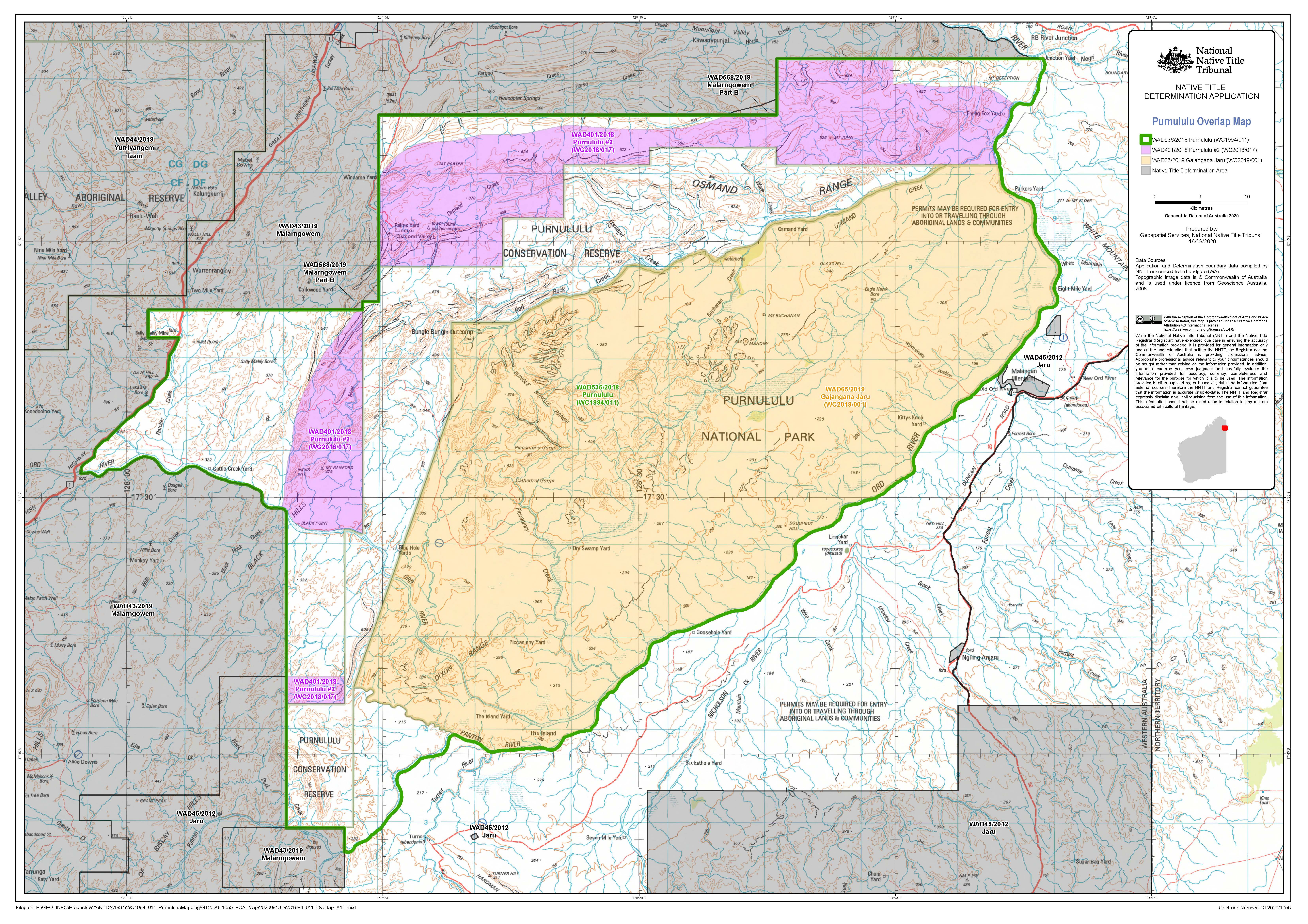
(v) Unnamed mother of Ruby Ngadayi and Jenny; and
(vi) Walambal;
(d) Mountain was a son of Kemintul and Jimmy Turrukpany, not Durrukman;
(e) Bulugul and Flora Mayilba had rights and interests under traditional law and custom in the PDA, but their “unnamed father” does not, because I have found them to be part of a sibling set with Gagai and Wulmarriya and have found that the father of all those sisters is Durrukman;
(f) Gagai did not have rights and interests under traditional law and custom in the PDA;
(g) The PDA is not exclusively identified as Jaru country, rather it is an area shared between people who now, and for some time in the past, have generally (but not exclusively) been described by reference to the language identities of Kija, Jaru and Malngin; and
(h) Lily Banks did not acquire rights and interests in the PDA through any classificatory relationship with Paddy Jandiyarri Turner.
10 There are a number of factual issues which remain to be resolved before the native title holding group for the PDA can be completely identified. One significant example is that it is now clear there have been multiple genealogies produced by Dr Redmond for the apical ancestors Jimmy Turrukpany and Durrukman, some versions of which are in evidence and some which are not.
11 Further, and critically, the method by which the Court’s findings can be implemented into a determination of native title will need to be addressed.
12 Determining the answers to the separate question has involved the parties, and now the Court, in a painstaking reconstruction of historical materials and historical accounts, all framed within a culture which operates on an oral tradition, and at a time when many knowledgeable elders have sadly passed away. It was no easy task for the parties, their experts and lay witnesses, nor for the Court. Although throughout these reasons I make findings accepting some evidence, and argument, and rejecting others, I accept that all concerned have done their best to assist the Court in this reconstruction, for which the Court is grateful.
13 As I explain below, the Court’s answers to the separate questions depend on reaching a view about what, on the evidence before it, are more likely than not to be the facts. That is what the civil standard “balance of probabilities” means. The Court does not decide what the “truth” is in any absolute sense. The Court is not in that sense the arbiter of history. The Court decides whether the party who must prove the necessary facts has shown the facts it contends for are more likely than not to have existed. In circumstances which involve the level of historical reconstruction that these separate questions do, that is not only all that is required; it is all that can reasonably be expected. This exercise is carried out on the basis of the evidence adduced, and inferences which can reasonably be drawn from that evidence. The Court must assess what, reasonably and rationally, can be made of the evidence before it. It does so from a more objective perspective than that brought by the parties, and for that reason, it may well see some evidence as persuasive although one party does not. Conversely, it may see other evidence as unpersuasive, although a party, its expert or the claim group members find that evidence persuasive. Even where the task is challenging, and the evidence pulls in different directions (as it does in many of the factual issues to be resolved in these separate questions), the Court’s function is to make a decision, and to decide if the party with the onus of proof has discharged it.
14 I emphasise that I have deliberately refrained from making any comprehensive findings about the areas within the PDA for which present descendants might be said to have primary responsibility. As these reasons will disclose, there are parts of the PDA which are associated with a high proportion of the apical ancestors identified by the parties, and there are large tracts of the PDA for which there is little or no evidence that any of the apical ancestors identified by the parties were connected to the land by traditional law and custom. These are matters beyond the separate questions, but may need to be resolved before any determination of native title can be made.
A note on spellings, words and descriptions used
15 In these reasons, I have adopted the practice of referring to all witnesses by their full name, although from time to time depending on context I will also refer to them by “Mr” and “Mrs” or “Miss” and their surnames, having checked with the parties about the witnesses’ preferences in this regard. For people who are referred to in the evidence but were not witnesses, especially people from previous generations, I have generally used the person’s first and second name on each occasion; for example, Minnie Lidia. With some of the ancestors, I have adopted a single name if that is how they have customarily been identified. For Fred Jalwarta, I have either used his full name or just “Jalwarta”. I have used the spelling “Jalwarta” as that is what appears in the separate question. There are other witnesses whose names I have shortened for ease of reference – for example, Topsy Dangai Banks I will often refer to as “Topsy Dangai”.
16 The evidence was naturally full of names of people, places, concepts, groups and words in language, to which a variety of spellings were given. In these reasons I have attempted to use the spelling used by a witness, or a source, if I am quoting or referring to that source. Otherwise, when referring to people, I have used the spellings used by the parties in their submissions if a common spelling is used, and if not I have tended to use the spelling used by Dr Redmond (eg Turrukpany and Durrukman), which is a reflection of my acceptance of his long and close involvement in a number of native title claims in the East Kimberley, and the content of his reports in terms of their focus, where appropriate, on how words should be spelled. Where there are differences even within Dr Redmond’s work, I have made a choice which I consider will make the reasons as accessible as possible, in terms of the reader understanding the person I am referring to. An example is Liddy/Edie Jalpart/Jarrabadjirl, to whom I refer as Liddy/Edie. I mean no disrespect at all to any person by the choices I have made.
17 Very sadly, there are two lay witnesses who passed away after making statements adduced in this proceeding. One of them also gave oral evidence. I have referred to them as Mrs D.M. and Mr B.D. Otherwise, the judgment retains the references to people as the evidence and argument of the parties referred to them, which did not involve any redaction or abbreviation. There were some communications from the Court in the weeks prior to judgment being delivered which, regretfully, may have encouraged the parties to suggest a tremendously wide level of redaction, or abbreviation, to the names of almost all Aboriginal people who featured in the evidence and who had passed away. The parties’ requests could not be accommodated because of the size of the judgment and the number of consequential changes, at a late stage, which would have been necessary. The scale of the request was unexpected and the Court apologises that it could not be accommodated. However, what appears in these reasons (with the exception of Mr B.D. and Mrs D.M.) is consistent with the parties’ own use of names in their evidence and argument, all of which was presented in open Court.
18 While I recognise that there are strong views amongst the Gajangana Jaru claimants that the PDA should not be called “Purnululu”, that is now the officially recognised name for the national park and therefore I have used it. When discussing evidence where witnesses or earlier sources use the term “Bungle Bungles”, I have used that term.
19 In terms of place names, where there are different spellings and a choice needed to be made, I have tended to use the spelling on the joint agreed site map, which was the principal map used in the proceedings.
20 Anthropologists and other experts are referred to by the title “Dr” where they are known to have been conferred with a PhD, regardless of whether it was conferred before or after creating the materials that are in evidence (eg Phyllis Kaberry’s PhD was conferred after the 1935 genealogies).
21 Phyllis Kaberry’s handwritten genealogies, five of which are in evidence, were relied on by Dr Redmond in his report and formed the basis for a number of his opinions. The parties also put her work to various uses in their final submissions. Her handwriting is extremely difficult to read and, at the request of the Court, the parties submitted an agreed typed version of these genealogies, which also note any disagreements between the parties about transcription. The agreed spellings of her genealogies did not always accord with Dr Redmond’s interpretation of her handwriting in his report; however, Dr Redmond was not challenged about this in cross-examination. Dr Redmond himself gave an explanation for some of the different spellings at p 15 of his report, referring to the earlier work of Dr Patrick McConvell:
While Dr McConvell’s recommended orthography has been followed as far as is practicable throughout this report, a wide variation in spellings has been employed since research commenced in this region in the late 1920s. The orthography used by previous authors have been retained in order to reserve the integrity of those original sources …
22 As I also noted in Dempsey on Behalf of the Bularnu, Waluwarra and Wangkayujuru People v Queensland (No 2) [2014] FCA 528; 317 ALR 432 at [16], lay witnesses (and indeed people whose accounts are recorded in earlier sources) frequently refer to areas by station names. The appropriate way to interpret how people used references to the pastoral station known as Turner Station features in this case, and I make some particular findings about that below. Otherwise, I recognise that for Aboriginal people who had to find ways to orient themselves in the post-settlement environment, including the role played by stations where Aboriginal people were forced to live and work, parts of the landscape (but not all of it) have become conceptualised by reference to station names. It is difficult to explore what is meant by such references and it appeared to be common ground that any such references were not to be understood as necessarily following the boundaries of station, but sometimes they may broadly have this meaning. Sometimes the references to a station may be a more general indicator of areas, and sometimes the reference may predominantly be to the area where a station homestead was located. When describing evidence, or accounts from historical sources, that refer to stations, I do so taking these matters in to account.
23 The transcript of the on-country evidence has been carefully prepared in terms of the use and spelling of the large number of group and language names used in this proceeding, and the Court is grateful to Transcripts Australia for the care taken in this exercise. The parties also agreed on any material corrections to the transcript, for which the Court is also grateful. Where there are occasional words that might appear to still be misspelled in the transcript, I have generally taken the correct spelling where it is obvious from other evidence. On rare occasions when this is not the case, I have retained the spelling as it appears in the transcript.
THE CLAIMS BEING CONSIDERED FOR THE PURPOSE OF THE SEPARATE QUESTIONS
24 In relation to claims of native title, the PDA has been the subject of contest since at least 1994.
25 It will be necessary to describe the history of claims in the PDA, but in terms of the current proceedings in which the separate questions have been stated, there are two applications for native title made on behalf of a group whose members predominately but not entirely identify as Kija people, Kija (sometimes spelt Gija) being a language identifier. All parties are agreed that language identification is not the appropriate basis for determining the right people for the county in the claim area(s), or in the PDA. Nevertheless, as these reasons will reveal, language identification has accompanied the rift over interests in the PDA, as it continues to do in other native title situations in the East Kimberley.
26 One of these two applications – the principal one – was lodged in 1994, the second more recently. The applicant in this claim calls itself the “Purnululu applicant”. The present lead member of the applicant is Shirley Drill. Mrs Drill was also a key witness.
27 On the other side of the debate is a group who identify themselves as Jaru speaking, and have called their application the Gajangana Jaru application. The lead applicant on this claim is Bonnie Edwards, who was a key witness for this claim, along with her elder sisters Lily Banks and Tanba Banks.
28 I have elected to maintain the descriptions the parties gave to each applicant – “the Purnululu applicant” and the “Gajangana Jaru applicant”. This is for consistency and does not reflect any view about the merits of the claims.
29 The Purnululu applicant lodged native title determination application WAD 536 of 2018 (formerly WAG 6007 of 1998) with the National Native Title Tribunal on 21 December 1994 and the claim was accepted for registration on 15 October 1999 (Purnululu #1 application). A small number of Aboriginal respondent parties were joined as part of the notification process between 3 April and 3 July 1995.
30 In the first formal indication of the dispute over the PDA, Tanba Banks lodged native title determination application WAG 6199 of 1998 with the NNTT on 16 September 1997 on behalf of “Banks and related families” (Jiddngarri claim). The Jiddngarri claim overlapped to a significant degree with the land the subject of the Purnululu #1 claim, but was not wholly coincident with it. It extended to areas further to the north, west and south of the PDA and included the area now determined to be held by the Jaru People: see the Court’s determination in Sturt on behalf of the Jaru Native Title Claim Group v State of Western Australia [2018] FCA 1923 (Jaru determination). The Jiddngarri claim form stated that the group represented by Tanba Banks claimed through her “father, grandfather and grandmother”. The parties accepted this was a reference to, respectively, Paddy Jandiyarri Turner, and his parents, Bulugul and Barmarlngana (or as Mrs Edwards’ evidence was, Gurunbu/Gurunbul). A point which has later relevance is that Mrs Edwards agreed in cross-examination that this was not a reference which identified Fred Jalwarta. As Gray J noted in Britten v State of Western Australia [2001] FCA 1256 at [7], the application was signed by a cross, rather than a signature, and his Honour inferred that Tanba Banks could not read or write.
31 On 16 June 1999, French J (as his Honour then was) ordered that the Purnululu application, together with the Jiddngarri application, be referred to the NNTT for mediation. Mediation was to initially address whether there was a reasonable prospect of resolution between the overlapping claimants.
32 On 15 September 1999, the Purnululu applicant filed an amended application in the Purnululu #1 claim. Amongst the amendments was a change to the claim group description to specifically exclude Tanba Banks from the Purnululu claim group. The application stated
If it is taken by this description of the claim group includes Tanba Banks, then by this paragraph it should be understood that she is excluded.
33 The reason for this change is not clear on the evidence, although there are some suggestions in the Purnululu applicant’s final submissions about the reasons. The timing of this amendment, with Tanba Banks as its target, a few years after the Jiddngarri claim was filed, suggests the amendment was a manifestation of the emerging divisions between the two groups and which have given rise to this proceeding. As I explain below, the divisions had manifested themselves clearly in 1992, although that is not to suggest there were no tensions before this time. The express exclusion of a person who was by that time an elder, and who it is now acknowledged was and always has been a person with rights and interests in the PDA under traditional law and custom, reflected the levels of antagonism which had developed by 1999.
34 In 2000, the Court’s records indicate there was a prospect of the Purnululu and Jiddngarri applications proceeding to trial, and draft programming orders were discussed. It appears little progress in the NNTT-convened mediation had been made, including due to uncertainty around the identity of the native title holders on whose behalf the Jiddngarri application had been brought.
35 In 2001, the Purnululu applicant sought to strike out the Jiddngarri claim by way of notice of motion filed on 2 February 2001. At this time, Jack Britten remained as the original lead member of applicant on the Purnululu #1 claim, and Shirley Drill was the second named member of the applicant. Mr Britten, a Kija man who spoke for Jarlarlu country, was the maternal grandson of Paddy Pirtawuny, whose unnamed father is one of the apical ancestors identified on the Purnululu claims. Mr Britten is related through his mother to several other claim group members who also gave evidence in proceeding, including Paul Butters, Sophia Mung, Mrs D.M., Eileen Bray and Johnathan Johnson Jnr.
36 In Britten, Gray J made a number of orders directed towards establishing the identity of persons claimed by Tanba Banks to hold native title rights and interests in the area relating to the Jiddngarri claim. His Honour noted that Mrs Banks appeared to have no legal assistance in preparing the Jiddngarri claim and the descriptions in the Jiddngarri claim made it difficult, if not impossible, to identify the persons who were claimed to be native title holders. It is also apparent from his Honour’s reasons (for example at [11]) that Bonnie Edwards was assisting Tanba Banks in this claim. At that stage, Mrs Edwards identified herself to the Court as communicating “on behalf of” the Mindi Mindi Aboriginal Corporation (MMAC). The role of that corporation in the PDA is a matter to which I return later in these reasons.
37 Dr Fiona Powell was appointed as a court expert for the purpose of the “identification, name or description of the persons claimed by Tanba Banks to be the holders of native title” in relation to the land covered by the Jiddngarri claim. His Honour found at [16] that it was
desirable to have separate identification of those who are claimed to be native title holders in respect of the overlapping area from those (if any) who are claimed to hold native title rights and interests in respect of the remainder of the land the subject of the Jiddngarri application.
38 The Court emphasised at [22]:
I do not intend that it should be any part of Dr Powell’s function to express a view as to the merits of the claim that any person holds native title rights and interests with respect to any land.
39 Dr Powell reported to the Court on 9 November 2001. Her report identified a little over 50 persons that comprised the group claimed by Tanba Banks to be native title holders in the Jiddngarri claim with respect to the land which overlapped the Purnululu #1 claim.
40 On 1 March 2002, Gray J ordered that those persons identified by Dr Powell become respondent parties to the Purnululu #1 claim, adjourned the Jiddngarri claim and dismissed the strike-out application: Britten v State of Western Australia (No 2) [2002] FCA 163. At [8]-[9], Gray J explained the purposes of the Court’s orders in this way:
The addition of those who are claimed to be native title holders of the overlapping area in the Jiddngarri application as parties to the Purnululu application cannot and will not pre-empt the determination of any issue. In particular, it will not amount to the expression of any opinion as to who are the native title holders, if any, in respect of the overlapping area. It will enable a proper determination to be made, because all competing interests will be represented in the one proceeding in relation to the overlapping area.
The purpose of adjourning the Jiddngarri application to a date to be fixed is simply to allow the issue of any determination of native title in the overlapping area to be dealt with in a single proceeding, in accordance with ss 67 and 68 of the Act. Because the Jiddngarri application also overlaps with another application for determination of native title, part of it will have to be dealt with in conjunction with that other application. It is therefore more convenient to adjourn the Jiddngarri application than it would be to adjourn the Purnululu application.
41 It is sobering to reflect that although his Honour identified the need in 2002 for a “single proceeding” to resolve the disputes between the groups, it was not until 16 years later that this occurred, through the separate question process.
42 As Gray J noted (at [13]), the Kimberley Land Council, acting for the Purnululu applicant, contended that the persons joined as respondents and identified by Dr Powell were also members of the Purnululu claim group. At [14], the Court recognised this as an issue but maintained this was the appropriate way to proceed in the short term.
43 It remains the case in the applications which are the subject of the separate questions that there is a degree of overlap in terms of membership of the respective claim groups. That fact reflects the family structures at work, the mixing and intermarriage of Jaru-identifying and Kija-identifying people in and around the area of the PDA, and the taking of rights through descent.
44 On 29 November 2002, Gray J made the following order in the Purnululu #1 claim:
If any of the persons added as respondents in the proceeding by the order made on 1 March 2002 does not file a notice of appearance in accordance with Order 9 rule 4 of the Federal Court Rules, or otherwise provide to the Court an address for service in accordance with Order 7 rule 6 of the Federal Court Rules, service of any document in the proceeding be effected on that respondent by sending a copy of the document by prepaid post addressed to the person:
care of Bonnie Edwards at Mindi Mindi Corporation, [address redacted]
45 No notices of appearance were filed in relation to the above order. As a result, Mrs Edwards’ address became the address for service for all of these respondents. On 26 June 2013, respondent party Mona Phillips filed a notice of change of address for service in the proceeding, so that her address for service was no longer through Mrs Edwards, and on 10 July 2013, 12 respondents – Sophia Stretch, Robert Stretch, Lorraine Stretch, Rasheed Malgil, Josie Farrer, Felicity Smith, Donna Malgil, Queenie Malgil, Rosie Stretch, Preston Malgil, Kay Malgil, and Evelyn Malgil – filed notices of change of address for service in the proceeding, so their addresses for service were no longer through Mrs Edwards.
46 As far as can be ascertained, there was then a period of some seven years where no significant steps were taken in either the Jiddngarri application or the Purnululu application. Between 2003 and 2009, the matters remained in mediation before the NNTT. Regional directions hearings were convened by French J, followed by Gilmour J, approximately twice a year with the NNTT requested to provide mediation updates ahead of each directions hearing.
47 Mediation reports during this period refer to ongoing conflict over traditional ownership of the Purnululu area, and the lack of anthropological work, for which resources remained unavailable. Further, resources were being devoted towards negotiations between the Purnululu Aboriginal Corporation and the State of Western Australia in relation to world heritage listing for the Purnululu National Park and the creation of a joint management arrangement. The absence of a comprehensive anthropological report was identified as detrimental to the prospect of mediation, as it was considered fundamental to resolving key matters of dispute between the two sets of claimants. However, the Court was informed that the funds necessary for such a report to be completed were not expected to become available for a number of years.
48 After a general call over of proceedings in the East Kimberley, and the Court having sought submissions from the parties, with none being filed, on 15 June 2009 the Court dismissed the Jiddngarri claim of its own motion under s 190F(6) of the Native Title Act: Banks v State of Western Australia [2009] FCA 703. At [13], Gilmour J noted that the applicant had not moved, or indicated any move, to amend the application following its failure twice to pass the registration test, and there did not appear to be any reason why the application should not be dismissed.
49 As a result of the joinder of all those covered by the Jiddngarri claim as respondents to the Purnululu #1 claim, however, the dispute remained before the Court in the form of a contest between the Purnululu applicant and the Aboriginal respondent parties.
50 The Purnululu #1 claim was first referred to a Registrar for case management on 14 December 2009 by Gilmour J; however, the matter then continued in mediation with the NNTT until 2012.
51 On 29 June 2012, Barker J ordered that a case management conference be convened for the purpose of ascertaining:
a. the issues remaining to be resolved;
b. the processes and timeframes for resolving those issues; and
c. what, if any, further orders in relation to mediation might be considered by the Court.
52 On 2 August 2012, Barker J ordered that mediation in the NNTT cease and the matter be referred to a Deputy District Registrar for a case management conference, with a further directions hearing to be held in November 2012. At a case management hearing before the Registrar on 11 October 2012, it was not clear whether any connection material had been completed or commenced.
53 On 16 November 2012, Barker J ordered that the matter continue in case management. There were then a number of case management conferences before different Registrars. Ongoing delays to take steps to progress the claim were explained at various points as due to ongoing “intra-indigenous issues” and funding shortages.
54 In 2017 the KLC indicated that there was a further delay to the provision of connection materials for the Purnululu #1 claim, as the draft connection material prepared by one consultant was considered insufficient and Dr Tony Redmond was engaged to do additional field work and prepare a more suitable report.
55 Between January and July 2018, the case managing Registrar undertook to locate the contact information for the Aboriginal respondent parties for whom the Court did not have accurate contact information and to obtain an understanding of which of those respondents wished to remain as parties to the claim and participate in the future conduct of the proceeding. As part of this process attempts were made to reach all of those respondent parties through various means including: through Mrs Edwards, through the KLC (including placing a public notice on the KLC website and Facebook page), through a range of East Kimberley community organisations, through a public notice aired on a local radio station, through the channels available to the Shire of Halls Creek, through the Northern Land Council, as well as direct attempts to contact each respondent based on any available information about their contact details or whereabouts.
56 The Registrar advised the Court, by way of a report filed on 30 July 2018, that a number of respondents were since deceased and that despite best efforts, many of the remaining respondents were unable to be contacted. Others provided an updated address for service and some advised via telephone that they no longer wished to remain as respondents; however, attempts at further communication with those respondents were unsuccessful. Mrs Edwards advised that she should remain as the contact person for some, including the Lannigan family, while others “should be listed on other claims”. The only other written correspondence received from these respondents was from Mona Phillips who stated, by way of a statutory declaration dated 20 July 2018 and received by the Court on 27 July 2018, that she gave her “full approval for Bonnie Edwards to represent, speak and/or negotiate on behalf of me and my descendants in any Native Title claim for our traditional lands”.
57 On 6 August 2018, the Court made an order that Bonnie Edwards, Lily Banks, Tanba Banks and Mona Phillips were to remain as respondents and an order removing those 17 respondents who were understood to be deceased. The Court also made orders requiring that the remaining Aboriginal respondents indicate to the Court an address for service, or provide written correspondence stating their intention to remain respondents, within four weeks of service of the orders, with a failure to comply causing their removal as a party to the proceeding. Once this process took effect, only Tanba Banks, Lily Banks, Bonnie Edwards and Mona Phillips remained as Aboriginal respondents to the Purnululu #1 application.
58 The Purnululu #1 application was amended again on 7 August 2018. The claim group description was amended to remove the express exclusion of Tanba Banks and to add “the unnamed father of Bulugul and Mayilba” as an additional apical ancestor.
59 Mona Phillips is a descendant of Raymond Turner, a son of Bulugul, and therefore is within the Purnululu #1 claim group description as a descendant of the unnamed father of Bulugul and Flora Mayilba. She remains an Aboriginal respondent party to the Purnululu #1 claim, having elected to do so through the case management process which saw the remainder of the Aboriginal respondents removed as respondents. The parties disagreed about what position could be attributed to Mrs Phillips in relation to the competing claims. While Mrs Phillips was present for part of the hearing of the separate questions, she was not called to give evidence by either applicant. There is no admissible evidence about Mrs Phillips’ reasons for wishing to remain a respondent to the Purnululu #1 application, nor any admissible evidence about who she “supports”. The appropriate course in these circumstances is for no findings to be made, one way or another, about Mrs Phillips’ support, or lack of support, for either the Purnululu or Gajangana Jaru claims. Having not participated in the proceeding, but remaining a respondent, she will be bound by the outcome of the separate question hearing.
60 Following a court referral for legal assistance, Marina Georgiou of counsel commenced acting on a pro bono basis for Mrs Edwards (as a respondent) from April to September 2018. The Court records its gratitude to Ms Georgiou for the considerable assistance she provided to the Court (and no doubt to Mrs Edwards and those who supported her) in this early period. Mrs Edwards subsequently received funding for legal representation from the KLC to appear as a respondent to the Purnululu #1 application, and later received further funding for the Gajangana Jaru native title application. The Court acknowledges the appropriate and constructive role taken by the KLC to the recent developments in the dispute over the PDA. The funding of legal representation for the remaining Purnululu respondents and then for the Gajangana Jaru applicant has advanced the interests of the administration of justice, and enabled a full assessment in this separate question proceeding, of the core matters in dispute.
61 On 6 August 2018, and while Bonnie Edwards, Lily Banks, Tanba Banks and Mona Phillips remained as respondents to the Purnululu #1 application, the State filed a first draft minute of consent determination of native title for the Purnululu #1 application. This draft determination provided for a determination of native title in favour of the Purnululu applicant in those parts of the Purnululu #1 claim area where native title is capable of being recognised.
62 The Purnululu applicant suggested various refinements to the draft determination. Mrs Edwards opposed the draft determination, primarily on the basis that the proposed native title holders “do not, as a group or community, hold rights and interests” in what she then described as the “Karjanama Jaru Purnululu Overlap Area”.
63 A second application, proceeding WAD 401 of 2018, was filed by the Purnululu applicant on 6 September 2018 (Purnululu #2 application). This application is over three areas of unallocated Crown land within the Purnululu #1 application area, and seeks the benefit of s 47B of the Native Title Act. The Purnululu #2 application was consolidated with the Purnululu #1 application by order of the Court on 9 November 2018. Initially, it appeared that Tanba Banks, Lily Banks and Bonnie Edwards may have sought to become respondents to the Purnululu #2 application on the basis that they would assert rights and interests in that claim area. However, it subsequently became clear that, insofar as the Gajangana Jaru application comprises, as the Court understands it, the whole of the claim made on behalf of the Gajangana Jaru applicant, the Purnululu #2 application area is not the subject of any dispute, or overlapping claim, formally or informally.
64 On 9 November 2018, following a case management hearing with the parties, the Court made the following orders in the Purnululu and Purnululu #2 proceedings:
4. Any overlapping native title determination application under s 61 of the Native Title Act 1993 (Cth) concerning the area claimed in applications WAD6007/1998 and WAD401/2018 is to be filed by 31 January 2019.
5. In the event that no application is filed in accordance with order 4, no application under s 61 of the Native Title Act 1993 (Cth) concerning the area claimed in applications WAD6007/1998 and WAD401/2018 will be accepted for filing until the hearing and determination of the Separate Question.
65 The Gajangana Jaru applicant filed a claim on 7 February 2019 (WAD 65/2019) (Gajangana Jaru application). This claim relates to the land and waters of the PDA only. The Gajangana Jaru applicant submits that the Jiddngarri claim group, the original Aboriginal respondent parties to the Purnululu #1 application, and the Gajangana Jaru claim group are substantially the same group of people.
66 In closing oral submissions, counsel for the Purnululu applicant submitted that the separate questions were “designed merely to resolve matters that were a roadblock to the making of a consent determination”. The Gajangana Jaru applicant submitted this characterisation should be rejected in light of the above history of the claims. In substance it contends the claims’ history in relation to the PDA demonstrates there has been a longstanding debate about who are the right people for the PDA. I accept that submission. As these reasons will explain, the evidence about connection to the PDA at effective sovereignty is of variable probative value. While it is correct that the State has accepted that native title is likely to exist (subject to extinguishment) over the PDA, and in that sense has been content to work towards a consent determination, it has also consistently and properly maintained it is concerned to ensure the right people for the PDA are identified. On the basis of the material provided to it, it had previously accepted the right people were the members of the Purnululu claim group, and it has maintained that position at the conclusion of the separate question trial process.
67 However, in my opinion, what this separate question hearing has demonstrated is that there is a real question about which apical ancestors can be established by evidence to have been more likely than not to hold rights and interests under traditional law and custom in the PDA at effective sovereignty.
68 The three central protagonists in the competing application – Bonnie Edwards, Lily Banks and Tanba Banks – did not have ongoing legal representation until 2018, and it is that assistance which has been responsible for enabling them to formulate their claim with the detail required by the Native Title Act. Their application is not a “roadblock”: it is a seriously advanced claim, which deserves proper consideration. The persuasiveness of the Purnululu applicant’s case is not assisted by such a characterisation.
The two Purnululu applications
69 In evidence are three versions of the Form 1 for the Purnululu #1 application lodged by the Purnululu applicant. The original Form 1 was filed on 21 December 1994. The members of the applicant were listed as Raymond Wallaby, Jack Britten, Queenie McKenzie and Hector Chunda. Each of these original members of the Purnululu applicant is now deceased.
70 An amended Form 1 was then filed on 23 September 1999. The members of the applicant were changed to Jack Britten, Shirley Drill, Phyllis Gallagher, Bernard Stretch and Hector Chunda.
71 A further amended Form 1 was filed on 7 August 2018, pursuant to leave granted by the Court in orders dated 6 August 2018. This is the form of the application which is to be treated as before the Court for the purposes of the resolution of the separate questions. The Court’s orders also upheld a s 66B application filed by the Purnululu applicant to replace the then applicant with the following individuals:
(a) Shirley Drill;
(b) Bernard Stretch;
(c) Timothy Mosquito;
(d) Judith Butters;
(e) Sophia Mung;
(f) Benjamin Cross;
(g) Roberta Daylight;
(h) Lorraine Daylight;
(i) Christine Farrer;
(j) Queenie Malgil;
(k) Cherylene Nocketta;
(l) Pamela Alberts;
(m) Darren Gore;
(n) Coral Gore-Birch; and
(o) Jeremy McGinty.
72 Paragraph 2 of Sch A of the further amended Form 1 lists the following apical ancestors for the Purnululu claim group:
(a) Girnyan;
(b) Jingkupal;
(c) Unnamed father of Paddy Pirtawuny, Dickie Tooltany and Ngangamil;
(d) Wulawalyan;
(e) Kemintal;
(f) Jimmy Turrukpany;
(g) Davey Mardangin;
(h) Nyitparriya;
(i) Dina Ngowaya;
(j) Unnamed father of Bulugal and Mayilba;
(k) Unnamed mother of Junbaynngulu;
(l) Jarnpayjirl;
(m) Bilal;
(n) Mungamungagatsdil;
(o) Mulkparriya; and
(p) Nyalwalapan.
73 As the Gajangana Jaru applicant submitted, there is some overlap between the apical ancestors identified in the Gajangana Jaru application and those in the Purnululu application.
74 The Purnululu applicant’s submissions focused on a subset of these apical ancestors contended to be “specifically connected to country” within the PDA. That subset is:
(a) Girnyan;
(b) Kemintul;
(c) Jimmy Turrukpany;
(d) Unnamed father of Bulugul and Mayilba;
(e) Mungamungagatsdil;
(f) Unnamed father of Paddy Pirtawuny, Dicky Tooltany and Nganggannil;
(g) Mulkparriya; and
(h) Davy Madarning/Mardangin.
75 Together I describe these people in these reasons as the “Purnululu PDA apicals”.
76 Further, the Purnululu applicant identified for the first time during the separate question hearing two additional apicals said to have rights and interests in the PDA, based on Dr Redmond’s opinion that he would add them after having heard and seen the evidence in the hearing of the separate question. Those ancestors are Walambal and the unnamed mother of Ruby Ngadayi and Jenny.
77 The native title claim group for the Purnululu #1 application is defined as those Aboriginal people who:
(a) are descended from one or more of the people listed in para 2 of Sch A (being the apical ancestors listed in [72] above); or
(b) are recognised by the descendants of the people listed in para 2 of Sch A as having rights and interests in the claim area under traditional law and custom.
78 The Purnululu #2 application was lodged on 6 September 2018. The named applicants in the Form 1 application are:
(a) Shirley Drill;
(b) Roberta Daylight;
(c) Bernard Stretch;
(d) Lorraine Daylight;
(e) Cherylene Nocketta;
(f) Christine Farrer;
(g) Jeremy McGinty;
(h) Queenie Malgil; and
(i) Pamela Alberts.
79 The apical ancestors of the claim group in the Purnululu #2 application are the same as those ancestors referred to in the Purnululu #1 application. The native title claim group in the Purnululu #2 application is defined by reference to the same two pathways as the members of the Purnululu claim group: being through descent from one or more of the named apical ancestors, or recognition by those descendants.
80 The second pathway identified in both Purnululu applications – “recognition” – assumes some significance in the resolution of the separate questions, as I explain below.
81 The Purnululu #2 application is not registered on the Register of Native Title Claims. On 28 September 2018, a delegate of the Native Title Registrar found that the application did not satisfy all of the conditions in s 190B and s 190C of the Native Title Act and therefore did not accept the claim for registration. Specifically, the delegate found that the application did not meet the requirements of ss 190B(5), (6), (7), and 190C(3).
The claim by the Gajangana Jaru applicant
82 The Gajangana Jaru application was lodged on 5 February 2019. The Form 1 application lists the following four applicants:
(a) Bonnie Edwards;
(b) Tanba Banks;
(c) Lily Banks; and
(d) Douglas Lannigan.
83 The claim group is described as those persons who are descended (including by way of adoption) from the following apical ancestors:
(a) Bulugul;
(b) Gagai;
(c) Mountain;
(d) Wulmarriya;
(e) Flora Mayilba;
(f) Bungul;
(g) Jalwarta; and
(h) Nelson.
84 The Gajangana Jaru applicant contends that these apicals comprise two sets of siblings: Bulugul and her siblings Gagai, Mountain, Wulmarriya, Mayilba and Bungul; and Jalwarta and his sibling Nelson.
85 The Gajangana Jaru application is not registered on the Register of Native Title Claims. On 8 April 2019, a delegate of the Native Title Registrar found that the Gajangana Jaru application did not meet the requirements of ss 190B(2), (5)(b) and (c), (6), (7), and 190C(3) of the Native Title Act and therefore did not accept the claim for registration.
The difference between the claim areas for each of the applicants
86 The Gajangana Jaru application covers approximately 2,438 km2 and wholly covers the land and waters of the PDA. Its boundaries are wholly encompassed within the boundaries of the Purnululu #1 application. The PDA’s boundaries are generally consistent with the boundaries of the Purnululu National Park
87 The Purnululu #1 application covers a larger area than the Gajangana Jaru claim, approximately 4,573 km2. It encompasses the whole of the PDA and areas further to the north, north-west, west and south-west. As I have noted, the Purnululu #2 application relates to three areas of unallocated Crown land outside the PDA.
88 The following map, produced by the National Native Title Tribunal, depicts the boundaries of the three claims and the extent of their overlap. The green line marks the boundary of the Purnululu #1 application, the pink shading marks the Purnululu #2 application and the Gajangana Jaru application is shaded yellow; the yellow shading also marks out the PDA.
89 The answers to the separate questions and these reasons only deal with the PDA.
Adjoining native title determination areas
90 Much of the region surrounding the PDA is covered by native title determinations, all by consent, associated with Jaru or Kija languages or a mix of Kija and other languages and dialects. There is also one area of land to the south-west of the PDA that has yet to be determined but is subject to the Koongie-Elvire application (WAD 45 of 2019), which was accepted for registration on 15 November 1999.
91 The Jaru native title application area initially ran along the eastern boundary of the PDA along the Ord River and east until the Northern Territory border. The area immediately adjoining the PDA south of the Ord River, which forms part of the Ord River Regeneration Reserve managed by the Western Australian government (identified as “Reserve 28538”), was ultimately excluded from the Jaru determination by agreement of the parties and with no further claim by the Jaru People to be made over this area: see Sturt on behalf of the Jaru Claim Group at [7]. This reserve, along with the Purnululu National Park, formed part of the land resumed by the government in 1967 as part of the regeneration plan for the Ord River Catchment Area, which, as I explain below, included the resumption of the Ord River and Turner pastoral stations.
92 In Sturt, native title was determined to be held by “the Jaru People”. The native title holders are described in Sch 6(1) as those Aboriginal people who:
(a) are related through filiation (meaning a series of parent-child relationships, including by adoption) to one of the Apical Ancestors who held rights and interests in one of the local estate countries comprising the Determination Area; or
(b) are affiliated to an Apical Ancestor and who have spirit conception and/or birth sites in one of the local estate countries in the Determination Area; or
(c) are recognised by the persons described above as:
(i) holding rights and responsibilities for certain songs and ceremonies which make reference to important sites in the Determination Area; or
(ii) holding rights and interests in one of the local estate countries in the Determination Area under traditional law and custom.
93 The apical ancestors are listed in Sch 6(2) and include names which are also the subject of evidence and argument in this proceeding:
Budubal (mother of Biddie Gilidngali)
Durukman
Buggy Djimululun / Dzimululun (father of Fred Jalwarta)
Jimmy Turrukpany
94 The Jaru applicant comprised representatives from “a number of clan groups making up the Jaru people”. These included members from Bilinyana Jaru, Yudu (Kadyanana Jaru), Warl Jaru and Nynin Jaru. Bonnie Edwards was named as within the Nynin Jaru clan group: Sturt at [10]. The Jaru applicant was represented by the KLC. Dr Redmond was the anthropologist who conducted most of the research on this claim, and whose research was presented to the State as the basis for its assessment of the connection of the Jaru People to the determination area. A substantial part of his Jaru report is in evidence in this proceeding, although some of the report’s appendices are not.
95 The Court’s reasons in Sturt indicate Tanba Banks provided an affidavit in support of the application which set out some substantive evidence about Jaru traditional law and custom.
96 Mrs D.M.’s sons, Timothy and John Mosquito, provided a joint affidavit, and Timothy Mosquito and Ivan Turner also provided affidavits to the State in relation to connection to the Jaru determination area. Timothy Mosquito was one of the claim group members whose rights and interests in the determination area come through the apical ancestor Jingargi, who was added to the list of apical ancestors after the original Form 1 was filed and whose inclusion caused significant controversy and some division in the Jaru claim group. Bonnie Edwards, along with Barbara Sturt and other named applicants of the claim group, objected to Jingargi and his descendants being included in the claim and had filed an interlocutory application to vacate the consent determination on that basis. The application was ultimately dismissed.
97 As I noted at [38] of Sturt on behalf of the Jaru Claim Group, as part of the process towards a consent determination
the relevant parties agreed that the Jaru claim could be managed separately from the Purnululu claim, the latter having some particular challenges with competing views by claim group members, and some non-claim group member respondents, about who are the right people for Purnululu country, and where the boundaries of that country are.
98 The “Purnululu claim” is a reference to the Purnululu #1 application.
99 The organisation of rights and interests under the body of traditional law said to exist at the time of sovereignty was summarised at [65]-[66] of Sturt on behalf of the Jaru Claim Group:
Jaru People derive their rights and interests in Jaru country through local estate areas, which are their ngurra. Under traditional descent laws, one person may have rights and interests in more than one ngurra through different descent lines.
People may derive or acquire responsibility for ngurra in other ways, such as being born on that ngurra, or because a particular ngurra was the location of a spirit conception site (jarriny) for that person. In this situation however, the enduring and authoritative rights will generally come where there are also descent-based links to ngurra.
100 The role of language in Jaru society was explained at [76]-[77], by reference to the parties’ jointly agreed submissions:
Most of the country in the Determination Area is identified with the Jaru language. However, due to the boundaries with neighbouring groups, along the edges of the Determination Area there are ngurra where people may identify themselves by different language groupings, such as Gooniyandi (in the north-west), Kija (in the north), Walmajarri, Wanyjirra and Ngardi (in the south), Warlpiri (in the south-east), and Mirriwung and Malngin (in the northeast).
These language differences are accommodated within Jaru traditional law and custom. Indeed, there is a category of Dreaming Story in which an ancestral being carries languages and social identities across the landscape, including across the Determination Area. During these travels the being shapes and names places within the landscape until they encounter an obstacle which renders them immobile and unable to travel any further.
(Emphasis added.)
The Malarngowem determinations
101 Immediately to the north and the west of the PDA are the Malarngowem Part A determination (John on behalf of the Malarngowem Native Title Claim Group v State of Western Australia [2019] FCA 697) and Malarngowem Part B determination (Gordon on behalf of the Malarngowem Native Title Claim Group Part B v State of Western Australia [2020] FCA 1149).
102 The Malarngowem determination areas are located “predominantly or wholly within country generally identified with the Kija language”. The native title holders are described in Sch 6(1) as those Aboriginal people who:
(a) are related through filiation (including by adoption) to one of the Malarngowem Apical Ancestors who held rights and interest in one of the local estate countries comprising the Determination Area; or
(b) are affiliated to a Malarngowem Apical Ancestor and who have spirit conception and/or birth sites in one of the local estate countries in the Determination Area; or
(c) are recognised by the persons described above as:
(i) holding rights and responsibilities for certain songs and ceremonies which make reference to important sites in the Determination Area; or
(ii) holding rights and interests in one of the local estate countries in the Determination Area under traditional law and custom.
103 The apical ancestors are listed in Sch 6(2) and included the following names which are also the subject of evidence and argument in this proceeding, in relation to the Purnululu PDA apicals:
Davy Madarning / Mardangin
Jimmy Turrukpany
Nyidanguiny (Father of Dickie Gudangnyi Gali Durrdayny (Jungurra skin) / Tooltany, Paddy Pirtawuny / Bedowyng (Jungurra skin) & Ruby Nganngannil)
104 The apical ancestors Bilal, Dinah Ngowaya, Nyawalapan and Wulawulyan are also listed on both the Malarngowem determinations and the Purnululu claims; however, they did not form part of Purnululu PDA apicals subset. The reasons for the Malarngowem Part A determination at [13] note that “Durukman” was removed from the list of apical ancestors as part of changes that were “unanimously agreed by the Malarngowem claimants”. The reasons give no explanation for this removal, and nor did the evidence led on behalf of the Purnululu applicant.
105 Relevantly to the issues raised by the separate questions, in John on behalf of the Malarngowem Claim Group at [26], Banks-Smith J summarised connection to country in the following way:
(a) The Malarngowem claimants derive rights and interests in the Determination Area under their system of traditional law and custom through descent to local estate area or taam countries.
(b) Dr Redmond identifies that filiation (parent-child) relationships and descent (extended lines of filiative relationships) provides the major modality through which claimants assert rights and interests in the country associated with their forebears.
(c) Dr Redmond notes that while the claim area is located predominantly or wholly within country generally identified with the Kija language, it also includes along the peripheries areas of land where members of neighbouring groupings may hold rights and interests but who may identify themselves principally as Bunuba and/or Gooniyandi, (in the west), Ngarinyin (in the north), Jaru (in the south), Mirriwung Gajerong (in the east) or as a mixture of those languages with Kija.
(d) The Malarngowem claimants’ laws and customs require them to maintain and protect significant sites within the Determination Area including places imbued with spiritual or cosmological significance. Such places include birth and burial places of claimants’ forebears as well as important Ngarranggarni story sites, and law grounds of various kinds. It is common for important Ngarranggarni places to be associated with age and gender prohibitions which highlight the importance accorded to transmission of cultural knowledge and ongoing respect for the traditions held by the senior generation.
(e) Shirley Drill in her affidavit demonstrates this by stating:
There are a lot of sacred sites and dreamings in the Area. You need to speak to Patrick Mung about them. We would tell the students where they can go and where they can’t go. If they go to the wrong area, bad things will happen to them. If you respect country, the country will respect you.
(Emphasis added.)
Other surrounding determinations
106 The following determinations are not immediately abutting the PDA but fall within the East Kimberley region. The country comprising the determination areas in each was said to be associated with the Kija language group, whether primarily or alongside other language or dialect groups. I have not set out the basis for inclusion of individuals in the claim group but I note that broadly in each determination the same three criteria are set out. I note also that only two of those criteria are present in the Purnululu applications, and in the Gajangana Jaru application – that is, there is no criterion equivalent to “affiliation” with an apical ancestor, and having a “spirit conception and/or birth sites in one of the local estate countries” in the determination areas.
The Yurriyangem Taam determination
107 Further west of the PDA is an area recognised in the Yurriyangem Taam determination: Purdie on behalf of the Yurriyangem Taam Native Title Claim Group v State of Western Australia [2019] FCA 696.
108 The apical ancestors, 87 in total, are listed in Sch 6(2). Relevantly, this list includes “Nydanguiny (Father of Dickie Tooltany, Paddy Pirtawuny and Ruby Nganngannil)”. There are also three other apicals that overlap with the Purnululu claims but are not those contended to be specifically connected to the PDA; namely, Wulawalyan, Nyawalapan (spelt Nyalwalapan on the Purnululu applications) and Bilal. As the Court’s reasons note at [14], the list described in Sch 6(2) does not precisely align with the Form 1 as:
Additional apical ancestors were included and some were removed following further genealogical/anthropological research undertaken by the KLC and in consultation with the Yurriyangem Taam claimants.
109 Dr Redmond supplied an anthropological report as part of the connection material and ethnographic evidence supplied to the Court and the State. In Purdie on behalf of the Yurriyangem Taam Claim Group at [27], Banks-Smith J also notes the other language identifying groups which surround the determination area:
The Yurriyangem Taam claimants derive rights and interests in the Determination Area under their system of traditional law and custom through descent to local estate areas or taam countries. …
While the claim area is located predominantly or wholly within country generally identified with the Kija language, it also includes along the peripheries areas of land where members of neighbouring groupings may hold rights and interests, but who may identify themselves principally as Bunuba and/or Gooniyandi (in the west), Jaru (in the south) or as a mixture of those languages with Kija (Redmond Report).
The traditional laws and customs of the Yurriyangem Taam claimants provide for language difference of this type, including through a category of Dreaming Story in which an ancestral being carries languages and social identities across the landscape. During these travels the being shapes and names places within the landscape until they encounter an obstacle which renders them immobile and unable to travel any further (Redmond Report). …
The Ngarrawanji determinations
110 The Ngarrawanji Part A determination (Farrer on behalf of the Ngarrawanji Native Title Claim Group v State of Western Australia [2019] FCA 655; 369 ALR 324) and the Ngarrawanji Part B determination (Farrer on behalf of the Ngarrawanji Native Title Claim Group v State of Western Australia [2020] FCA 929) sit to the south-west of the PDA.
The Miriuwung-Gajerrong determinations
111 The Miriuwung-Gajerrong determination (Attorney-General of the Northern Territory v Ward [2003] FCAFC 283; 134 FCR 16) and the Miriuwung-Gajerrong #4 determination (Ward v State of Western Australia [2006] FCA 1848) cover two larger areas of land to the north-west of the PDA. The Full Court noted at [5]:
Each of Miriuwung, Gajerrong, Doolboong, Wardenybeng and Gija is a group identified with a language or dialect. Membership of the groups is by descent from a person who is also identified with such language or dialect and country or by adoption by such a person, in accordance with traditional laws and customs.
112 The Goorring determination (Jessell on behalf of the Goorring Native Title Claimants v State of Western Australia [2018] FCA 2047) covers a small parcel of land to the north of the PDA. It was made in favour of:
The native title holders are those Aboriginal people of the Miriuwung, Kija and Wularr language or dialect and country the subject of the determination who hold in common the body of traditional law and customs governing the area the subject of the claim.
The relevance of surrounding determinations
113 The point of referring to these surrounding determinations is at least threefold. First, to demonstrate that although the separate questions, and the evidence adduced in order to answer them, might tend to suggest that geographical boundary lines can be drawn around rights and interests in the PDA, that is not the case, and individuals who are current descendants in either of the claim groups in these proceedings have connections, sometimes through the same apical ancestors, to surrounding country as well. Second, the surrounding determinations confirm the role played by language identity, for better or for worse. It cannot be ignored. Third, insofar as the same apical ancestors (such as Turrukpany, and Jalwarta, through his father) are identified in some of the surrounding determinations, this is a consideration to take into account, in my opinion, in resolving what are the appropriate answers to the separate questions, in terms of the location and breadth of likely areas of country for certain apical ancestors. As will become apparent later in these reasons, the Jaru determination has particular significance for some of the findings on the separate question.
SUMMARY OF THE PARTIES’ CONTENTIONS
114 The Gajangana Jaru applicant submits that Questions 1 and 2 should be answered in the affirmative. That is, it submits that (a) Jalwarta and his siblings, (b) Bulugul and her siblings and (c) Nelson each possessed rights and interests under traditional law and custom in the PDA to the exclusion of all or any of the other apical ancestors identified in the Purnululu applicant’s further amended Form 1 listed above.
115 Specifically, it submits that the evidence establishes that the following individuals had native title rights and interests in the PDA:
(a) Jalwarta;
(b) Jalwarta’s siblings:
(i) Nelson;
(ii) Dirmirra; and
(iii) Gadbawu-ngana;
(c) Bulugul;
(d) Bulugul’s siblings:
(i) Gagai;
(ii) Bungul;
(iii) Flora Mayilba (possible classificatory relationship);
(iv) Wulmarriya; and
(v) Mountain.
116 The Gajangana Jaru applicant submits that the evidence of its witnesses should be accepted to the effect that Jalwarta had rights and interests in all or part of the PDA associated with the Turner area through:
a. filiative links to Jadbiya or another unnamed Gajangana Jaru mother who had rights and interests that area;
b. filiative links to Dirril or another unnamed Malngin father connected to that area associated with the Malngin language (including the Mount Glass area);
c. having the language identity for that country including the particular language identity Gajangana Jaru;
d. dwelling in that locality over a long period;
e. carrying the law for that area; and/or
f. being associated with a dreaming/mythological presence in relation to that locality.
(Footnotes omitted.)
117 The Gajangana Jaru applicant contends that the facts relied on by the Purnululu applicant to contend that Jalwarta’s country is said by some to be in the Ringer Soak area (south-east of the PDA) are not inconsistent with the proposition that Jalwarta had traditional rights and interests in the PDA, because “[e]vidence that Jalwarta either worked, periodically lived at or visited Ringer Soak, proves only that he may have lived there at times”.
118 In relation to Bulugul and her siblings, the Gajangana Jaru applicant submits that they possessed rights and interests in the PDA through their father, Durrukman. It contends that Jimmy Turrukpany, a Purnululu apical ancestor, and Durrukman are the same person, and that the difference between the names is only a question of orthography.
119 The Gajangana Jaru applicant contends the PDA is Jaru and Malngin country and the Gajangana Jaru apical ancestors exercised their rights as Gajangana Jaru People and Malngin People. Specifically, it submits that the north-eastern part of the PDA and other areas generally east and north-east of the PDA is Malngin country, and that Bonnie Edwards and the descendants of Nelson and Yiliyarri have rights and interests in this area through Nelson and Jalwarta’s father Dirril, a Malngin man. The rest of the PDA, it submits, was and continues to be associated with the Jaru language and the Jaru People, and what it describes as the Gajangana Jaru People in particular.
120 The Gajangana Jaru apical ancestors are contended to have exercised their rights and interests in circumstances where no apical ancestors identified by the Purnululu applicant held rights and interests in the PDA. In particular, the Gajangana Jaru applicant contends:
i. the evidence does not establish that the Unnamed Father of Paddy Pirtawuny, Dicky Tooltany and Nganggannil, Mulkparriya; and Davy Madarning had rights and interests in the PDA because they were from Jarlarlu, which does not extend into the PDA;
ii. there is not sufficient evidence to establish that Girnyan, Kemintal and Mungamungagatsdil had rights in the PDA; and
iii. other apical ancestors named in the Purnululu Claim are not said by the Purnululu Applicant to possess rights and interests in the PDA.
121 In the alternative (and briefly), the Gajangana Jaru applicant submits that if that Court finds that Jaru and Malngin people did not have rights and interests in the whole of the PDA to the exclusion of the Purnululu apical ancestors, then it would still be open to the Court to conclude that Jaru and Malngin people were connected to the whole of the PDA and entitled to a determination of native title in their favour. It submits that such a finding would be consistent with the determination in respect of the entitlement of Miriuwung people to native title in Ward on behalf of the Miriuwung and Gajerrong People v Western Australia [1998] FCA 1478; 159 ALR 483 at 546-7. It acknowledges that the ultimate form of such a determination may depend on the form of any new or amended claim or claims following determination of the separate questions. The object of this contention appears to be to invite the Court, in the alternative, to find that there are two native titles held over the PDA: one held by those descended from the Jaru-identified apicals; and another, separate native title held by Kija-identified apicals. Such a contention is outside the scope of the separate questions.
122 The Purnululu applicant submits that questions 1 and 2 should be answered in the negative. It submits that the Court should make the following findings of fact and that the questions should be answered on the basis of those findings:
(a) Jalwarta did not possess rights and interests (hereinafter simply called rights) under traditional law and custom in the PDA;
(b) Jalwarta’s siblings were at least Albert Manyeri, Edie Numara and Wingu Numara, but they did not possess rights under traditional law and custom in the PDA;
(c) Bulugul possessed rights under traditional law and custom in the PDA in the Mindi Mindi area;
(d) Bulugul’s sibling or step-sibling was Flora Mayilba Turner (Mayilba), and she too possessed rights under traditional law and custom in the same part of the PDA;
(e) Nelson possessed rights under traditional law and custom in the PDA in the Mindi Mindi area.
123 The Purnululu applicant submits that Jalwarta’s country was in Gordon Downs/Ringer Soak area, south of the PDA.
124 Although the Purnululu applicant agrees that Nelson had rights and interests in the PDA, it submits Nelson was not a sibling of Jalwarta and that they had different country affiliations.
125 In relation to the Purnululu apical ancestors, and putting to one side its contention about the separate questions not giving rise to this issue at all, the Purnululu applicant’s primary submission is that it is not required to prove that its apical ancestors had rights and interests in the PDA because the Gajangana Jaru applicant bears the onus of establishing that they are excluded from the PDA. I address the debate between the parties about onus of proof later in these reasons. In the alternative, the Purnululu applicant contends that the evidence does establish that the Purnululu apical ancestors possessed rights and interests in the PDA.
126 The State took a modest but helpful role in the on-country hearings, generally supporting the Purnululu applicant’s case. In written closing and reply submissions it adopted the submissions of the Purnululu applicant, albeit it made some additional and helpful submissions about the issues. I refer to the State’s specific submissions where necessary in these reasons.
127 The State also contended in closing submissions that the draft minute of consent determination of native title, filed on 6 August 2018 in the Purnululu #1 claim proceedings, continues to accurately reflect the native title holding group of the PDA subject to
the inclusion of the additional apicals identified in evidence and proposed by Dr Redmond, namely Walambal (mother of Judy Turner), the unnamed mother of Ruby Ngadayi (grandmother of Yiliyarri and Molly Gore), and the further amendment suggested by Dr Redmond to change the apical ancestor for Bulugul and Mayilba to be the unnamed mother rather than unnamed father.
(Footnotes omitted.)
128 The Gajangana Jaru applicant submits that Bonnie Edwards and Lily Banks and their descendants possess rights and interests under traditional law and custom in the whole of the PDA through their maternal grandfather, Fred Jalwarta, and, or alternatively, through their classificatory relationship with Tanba Banks’ biological father, Paddy Jandiyarri Turner.
129 In relation to Fred Jalwarta, the Gajangana Jaru applicant submits that the evidence of the three women should be accepted over the evidence of the Purnululu applicant witnesses and Dr Redmond. The three women’s evidence is that they know Jalwarta to be their grandfather and that they know him to have had a traditional connection to the PDA. The Gajangana Jaru applicant says the contrary evidence relies on inaccurate historical records and on discounting the evidence of the Gajangana Jaru witnesses. It is fair to say that an important component of the contentions of the Gajangana Jaru applicant was that the Court should assess, and if appropriate rely upon, the evidence of Aboriginal witnesses, in preference to the evidence of anthropologists, ethnographers or historians, and in preference to documentary sources.
130 In relation to Paddy Jandiyarri Turner, the Gajangana Jaru applicant contends that under traditional law and custom, individuals can, and Bonnie Edwards and Lily Banks do, take rights and interests through a classificatory relationship with a mother’s husband. Further, it submits that even if this were not the case at sovereignty, “there has been a permissible adaptation of those laws to provide for a child with a European father to acquire rights by filiation through close kinship relationships with their mother’s former husband”. This adaptation would apply to Mrs Edwards. It submits that those rights and interests do not need to be recognised (or accepted) by the wider group or community in order to exist.
131 Further and in the alternative, the Gajangana Jaru applicant submits that if the Court finds that Gagai was Bulugul’s sister and possessed rights and interests in the PDA, then Lily Banks possesses rights and interests through Gagai, who is her father’s mother.
132 The Purnululu applicant denies the Gajangana Jaru applicant’s contentions. There is no dispute that Jalwarta is the maternal grandfather of Bonnie Edwards and Lily Banks: this was a matter of common ground and the experts also agreed on this matter during the experts’ conference. However, as I have explained, the Purnululu applicant contends Jalwarta’s country was to the south-east of the PDA.
133 In relation to Paddy Jandiyarri Turner, the Purnululu applicant accepts that Tanba Banks and her descendants have rights in the PDA through Paddy Jandiyarri Turner because of a genealogical relationship back to Bulugul, a nominated apical on all claims. However, it denies that a classificatory relationship is a pathway by which Bonnie Edwards and Lily Banks could have acquired rights in the PDA under traditional law and custom. That is because even if such a classificatory relationship could confer rights (about which the Purnululu applicant’s submissions were somewhat indecisive), there must be recognition by the Purnululu claim group of that fact, and there is not.
134 The Purnululu applicant submits recognition is a requirement under traditional law and custom for the inclusion of any persons who are outside the core pathways of group membership; namely, descent and customary adoption. It accepts that for people within those “core” pathways, recognition by the group is not a superadded or superimposed requirement. While it accepted that there may be circumstances where a close classificatory kinship relationship in combination with other facts may lead to recognition of person as a part of a group and therefore as acquiring the rights and interests in land held by the person with whom they have a classificatory relationship, it submits that these circumstances are exceptional and do not exist in the case of Mrs Edwards and Mrs Banks. It contends that the Gajangana Jaru claims, both formal and informal, “do not have, and since 1992 have not had, acknowledgement and acceptance amongst the relevant community or jural public”. The question of who is the relevant “community” is assumed in this submission, but as I explain later in these reasons, I do not agree with that assumption.
135 The only other pathway the Purnululu applicant accepts would be available is customary adoption, and it contends there is no evidence of that occurring between Paddy Jandiyarri Turner and Bonnie Edwards and Lily Banks, or either of them.
136 Aside from its general agreement with the case of the Purnululu applicant, the State submitted in relation to Paddy Jandiyarri Turner:
For Lily and Bonnie to establish that they have rights in the PDA through Paddy Turner, their mother’s first husband whom neither of them met, they must show that under the traditional law and custom of the PDA there is a rule or other process that allows for those rights to be accepted or recognised. …
It is clear from the authorities considered in the Purnululu Closing Submissions … that incorporation of people who are neither descended from an apical ancestor, nor adopted and grown up by a non-biological parent, requires community recognition and acceptance under traditional law and custom.
There is no current recognition by the Purnululu claimants that Lily Banks and Bonnie Edwards possess any rights and interests under traditional law and custom in the PDA through Paddy Jandiyarri Turner, and the Gajangana Jaru claimants’ denial since 1992 of Purnululu claimants’ rights and interests in the PDA has clearly halted the process of recognition that was underway at that time.
What would be needed, to reactivate the process for recognition is, in Dr Redmond’s view “sustained interaction of acknowledgement and participation with other groups holding rights and interests in country.”
(Footnotes omitted.)
137 In both the Purnululu claims, and the Gajangana Jaru claim, not all of those individuals who are listed as members of the applicant gave evidence. There was evidently considerable selection on who should give evidence, especially on the side of the Purnululu applicant, although there are no doubt a range of valid forensic and logistical reasons for the choices made. I draw no adverse inferences from that fact.
138 In this section I also set out the parties’ submissions, and make findings about, those lay witnesses whose evidence appeared particularly contentious. Where I do not refer to a witness’s reliability or credibility in this section, that is generally because I explain my assessment of their evidence in a later section about particular factual issues. As a general finding, I accept every single lay witness did her or his best to give a truthful account of her or his understanding of the matters they were asked about. During the on-country hearing, and during the expert evidence, I took contemporaneous notes of my impressions of the witnesses and of the evidence they gave, and I have relied on those notes, as well as a careful reflection about the parties’ submissions and the evidence to which those submissions refer, in making my findings.
The witnesses called by the Purnululu applicant
139 The Purnululu applicant relied on written and oral evidence from 14 lay witnesses, all of whom are claim group members. I have grouped them by reference to the apical ancestors through whom they claim, because that is of some significance in understanding the relationships between the Purnululu group and the Gajangana Jaru group.
140 Those who claim rights and interest in the PDA through Kemintul and Jimmy Turrukpany:
(a) Shirley Drill;
(b) Warren Drill;
(c) Ricky Drill;
(d) Josie Drill;
(e) Kitty Nocketta;
(f) Cherylene Nocketta; and
(g) Jeremy McGinty.
141 Those who claim through Davy Mardangin:
(a) Nancy Nodea.
142 Those who claim through the unnamed father of Bulugul and Flora Mayilba:
(a) Mrs D.M. (who primarily claimed through this ancestor on her father’s (David Turner’s) side, but also claimed through other apicals on her mother’s side); and
(b) Ivan Turner.
143 Those who claim through the unnamed father of Paddy Pirtawuny, Dicky Tooltany and Nganggannil:
(a) Mrs D.M. said she could also claim through this apical ancestor on her mother’s (Judy Turner’s) side, saying “I can go both ways”;
(b) Eileen Bray;
(c) Sophia Mung;
(d) Paul Butters; and
(e) Johnathan Johnson Jnr.
144 Mrs D.M. also claimed through her mother Judy Turner to the ancestor Walambal.
145 The following witnesses also claimed through Mungamungagatsdil:
(a) Sophia Mung;
(b) Paul Butters; and
(c) Johnathan Johnson Jnr.
146 The Purnululu applicant relied on written evidence from Mr B.D., who was not a claim group member. He was expected to give oral evidence at the on-country hearing, but was ultimately unable to do so due to ill-health, the circumstances of which are set out in the affidavit of Philip Ramsay affirmed on 26 August 2019, and which it is not necessary to set out in these reasons. There was no objection to his statement being tendered.
147 In addition, the Purnululu applicant adduced evidence of statements made by now deceased members of the Purnululu claim group; namely, the affidavit of Jack Britten and the video tape and partial transcript of Nancy Williams’ interview with Judy Turner.
A general finding about the Purnululu witnesses
148 The oral lay evidence was adduced on behalf of the Purnululu and Gajangana Jaru applicants in quite different ways. As I observed to counsel at several points during the on-country hearing, the Purnululu witnesses were being asked obviously leading questions in their evidence-in-chief. I accept it is appropriate to make allowances for the reticence of lay witnesses, challenges in listening to questions and answering questions in English, and for their reluctance in giving evidence at all in circumstances where there was a level of animosity between people who are related to one another. I have taken all such matters into account in assessing the reliability of the evidence given by all the lay witnesses.
149 However, there comes a point at which the extent of leading questions simply deprives the witnesses’ answers of much probative value at all. The evidence is in substance being given by the questioner. That is especially so when one takes account, as I consider it is appropriate to do, of the well-recognised feature of the evidence of many Aboriginal and Torres Strait Islander people that they may express “gratuitous concurrence” with what a questioner says: see my reasons in Wotton v State of Queensland (No 5) [2016] FCA 1457 at [931], and Dowsett J in Aplin on behalf of the Waanyi Peoples v State of Queensland [2010] FCA 625 at [86].
150 As Sackville J noted in Jango v Northern Territory of Australia [2006] FCA 318 at [297]-[298], the phenomenon of “gratuitous concurrence” should not and cannot be used as a way of avoiding the consequences of evidence unfavourable to one party. There is a balance to be struck between, on the one hand, appreciating the challenges faced by some (but not all) Aboriginal and Torres Strait Islander people in giving evidence, taking into account cultural norms or tendencies in some witnesses, and on the other, the need for the Court to assess the reliability of such witnesses, for the same purposes it must assess the reliability of all witnesses in any proceeding where evidence is contested.
151 The point I wish to emphasise here is that, whatever the explanation be, there was a material portion of the evidence of several of the Purnululu witnesses where they were doing no more than agreeing with the propositions put by the questioner and did not appear to me to be demonstrating any active and independent recollection or knowledge about the subject matter of the evidence.
152 One example is the following exchange in Shirley Drill’s evidence-in-chief:
MR KEELY: What was his name? So father for Yilliyarri?
SHIRLEY DRILL: Forget his name, that old man.
MR KEELY: Let me see if this one’s right. Nelson?
SHIRLEY DRILL: Yes.
153 Another is the following:
MR KEELY: Yes. [Mrs D.M.], just want to ask you, first of all, the lady in the video: what’s that?
[Mrs D.M.]: That’s my mum.
MR KEELY: Your mum
[Mrs D.M.]: Yes.
MR KEELY: That’s your mum. Do you remember who the people who are asking the questions were?
[Mrs D.M.]: Was that – it was Ann and Neil I think.
MR KEELY: You think Ann and Neil.
[Mrs D.M.]: Yes.
154 That was clearly not the answer counsel was expecting. The next question was this:
MR KEELY: Right. If you don’t agree with this you say so but, that American lady: was that Nancy Williams?
MS GEORGIOU: Well, she’s just given evidence - - -
HER HONOUR: Well - - -
[Mrs D.M.]: Yes.
MS GEORGIOU: - - - of who she remembered it was.
HER HONOUR: - - - Mr Keely you can’t lead like that. She’s given an answer.
MR KEELY: Okay, well, we’ll – we’ll ask somebody else about it, your Honour.
155 A further example is the evidence of Paul Butters:
MS SHEEHAN: In your law, can people come out here without permission?
PAUL BUTTERS: Yeah, well, like we’re saying, we all travel around right out through the country. All the Kija people travel together. Or we bring our people or friends out whenever we want to.
MS SHEEHAN: So you’ve got the right to bring people here.
PAUL BUTTERS: Yeah.
MS SHEEHAN: But people who don’t speak for this country, are they allowed to bring people?
PAUL BUTTERS: Yeah, yeah.
MR McINTYRE: A leading question.
HER HONOUR: It was rather leading, Ms Sheehan.
156 A final example is the following evidence of Jeremy McGinty:
MR KEELY: So this was in the context of your ranger work; is that right?
JEREMY McGINTY: Yes. That’s me coming from my break.
MR KEELY: So you had come off a break.
JEREMY McGINTY: Yeah.
MR KEELY: And this was something that was said, you know, when you go back - - -
HER HONOUR: Mr Keely, I haven’t interrupted you before during this proceeding, but at the moment I would really like you not to lead as much, please.
MR KEELY: Certainly, your Honour. You tell the story your own way, please.
157 The evidence of Shirley Drill was submitted to be affected by this feature, but she is not the only witness. The Purnululu applicant responded that either the matters on which leading questions were asked were common ground, or the Gajangana Jaru applicant’s counsel conducted examination in chief in the same way, or no objection was taken. I do not accept those submissions. Having now reviewed the transcript, including the evidence-in-chief of Shirley Drill, it is apparent a significant proportion of her evidence-in-chief was adduced through leading questions. I made contemporaneous notes of this feature of her evidence, as I did of other Purnululu witnesses. It is not necessary to give further examples in these reasons, but any perusal of the transcript will reveal the number of times Mrs Drill, and other Purnululu witnesses, were simply able to answer “yes” as their evidence, indicating the substance of the evidence was in the question, not the answer. Further, I do not consider the Gajangana Jaru applicant’s evidence was as obviously affected by leading questions; that is also clear from a review of the transcript. However, there are parts of Lily Banks’ evidence to which I refer later in these reasons where in my opinion she was tending simply to agree with the questioner, without demonstrating any independent engagement with what she was being asked.
158 It has been necessary for me to reflect carefully on the evidence-in-chief of the Purnululu witnesses, taking this matter into account, but also recalling the matters to which I have referred above. In some circumstances, it has led me to place less reliance on aspects of their evidence-in-chief. In others, it has contributed to my general assessment of the particular witness, in terms of the depth or strength of their recollection or knowledge. In yet others, some of the answers to leading questions were of little consequence. It is a feature which cannot however be simply passed over. Contrary to the submissions of the Purnululu applicant, the absence of an objection is not the end of the matter: as I noted above, the extent of leading questions can simply deprive the answer of any real probative value because the evidence is given by the questioner. Even though leading questions are considered permissible in cross-examination, the same proposition can apply.
159 Shirley Drill is a Kija elder and one of the key witnesses in the hearings. She is a descendant of the apical ancestors Jimmy Turrukpany and Kemintul through her mother, Mona Springvale (or Wallaby) (known as Galjangarri in the Kija language), although this descent pathway is disputed by the Gajangana Jaru applicant. Mrs Drill’s evidence is that Mona Springvale was a daughter of the person known as Liddy/Edie, said by the Purnululu applicant to be the granddaughter of Jimmy Turrukpany and Kemintul.
160 Mrs Drill was around 70 years old at the time of the on-country evidence. She was married to Marshall Drill, a Kija man, and together they had nine children, three of whom gave evidence in this proceeding; namely, Ricky Drill, Josie Drill and Warren Drill. She is related (using that term in a non-Aboriginal way) to several other witnesses: she is the grandmother of Jeremy McGinty (who is Josie Drill’s son) and she is a cousin of Cherylene Nocketta and Kitty Nocketta (who are granddaughters of Shirley Drill’s mother’s sister, Dolly Marrkparriya). She is also related through marriage to Eileen Bray, whose mother’s older sister, Bessie, was married to her uncle Raymond Wallaby.
161 In evidence, Shirley Drill described her connection to the PDA through her mother’s side. Her explanation of how she came to feel responsible for looking after the country in the PDA centres on her “grandfather”, Mountain, and her uncle, Raymond Wallaby. In evidence-in-chief at Kawarre she said:
SHIRLEY DRILL: From my grandfather, my grandfather stay here and raised this place up.
MR KEELY: What was his name?
SHIRLEY DRILL: Mountain.
MR KEELY: When you have a bush name that comes from a particular place, how does that make you feel about that place?
SHIRLEY DRILL: Good.
MR KEELY: Can you tell us anything more?
SHIRLEY DRILL: Yes, it make me proud of my place, this is my Kija from my uncle and my grandfather.
162 The “uncle” Mrs Drill refers to is Raymond Wallaby.
163 There was evidence that Mrs Drill also identified a connection to country west of the PDA through her father, either around Springvale or Bedford Downs and that her attachments to the PDA were somewhat more recent. Dr Levitus, an anthropologist who worked in the region and whose work I discuss later in these reasons, said in a report in 2007:
It is uniformly stated by a range of informants that Ms Drill’s primary attachments to country are to the west of the Park, either at Springvale or Bedford Downs. A number identify her place as a range of hills called Darrajayn, and some specify the location of Billy Mack Spring. This is said to have been the country of her father, Paddy Springvale, or Yangkarnji. Travelling south along the Great Northern Highway, at the northern boundaries of Alice Downs and Springvale stations, the recently-deceased senior Jaru man [David Turner] directed my attention to a long north-south range visible to the west of the road, and identified that range as Ms Drill’s country. Ms Drill also has a substantial life-history connection to that area, having been born, grown up and attended school at Springvale, before later moving with her family to Alice Downs and Turner River stations. Paddy Bedford, the senior traditional owner for Bedford Downs, says that Ms Drill has rights at Muntuwurrji, old Bedford, but ‘she go uncle side now’ instead, referring to her link to the Bungles through her mother’s brother Raymond Wallaby.
164 As the Purnululu applicant fairly recognised in its closing submissions, there were times at which Mrs Drill was “begrudging” about acknowledging the rights and interests in the PDA of Tanba Banks, no doubt because of her core involvement in the Gajangana Jaru claim, and before that the Jindigarri claim. As I have noted earlier, the acrimony was such that despite it being factually incorrect, Tanba Banks was singled out and named in the Purnululu applicant claim group description as excluded. I accept that an assessment Mrs Drill’s evidence, like an assessment of Mrs Edwards’ evidence, and indeed the evidence of Tanba Banks and some of the other Purnululu witnesses needs to take account of the effect this acrimony has on what people are willing to admit, at least in a public forum such as a court proceeding. These matters also affected some witnesses’ demeanour: in Bonnie Edwards’ case, as I have found below, it tended to make her exaggerate and become belligerent. In Mrs Drill’s case she became less forthcoming, sometimes begrudging. Just as I have found with Bonnie Edwards, whether or not these matters affect the reliability of any key aspects of their evidence needs to be assessed in making findings about the particular evidence in issue, rather than making any global findings for or against reliability.
165 Overall, and despite the matters to which I have referred, I found Mrs Drill to be a genuine, serious and considered witness. Her responses during cross-examination were firm, and although it was clear there were times she was angry and upset about the subject matter of the cross-examination, taking into account the acrimony which exists, that is understandable and indeed reinforces that she was being honest in the way she presented to the Court.
166 It was clear to me that Mrs Drill knew the country of the PDA very well; it seemed to me she carried visual images in her mind as she gave her evidence. She was not the only witness to do this, but that was a strong impression I have of her evidence.
167 Josie Drill is the third child of Shirley Drill and Marshall Drill, and therefore through her mother she is asserted to be a descendant of Turrukpany and Kemintul. Her first husband was a Kija man named Neil McGinty, with whom she had four children, including Jeremy McGinty, another witness.
168 Cherylene Nocketta is also a descendant of Turrukpany and Kemintul through her jaja (mother’s mother), Dolly Marrkparriya, who the Purnululu applicant contends is Turrukpany and Kemintul’s granddaughter.
169 Miss Nocketta is the second child of Nora Nocketta and Daylight. Her older sister Kitty Nocketta also gave evidence.
170 I note here that the second husband of Miss Nocketta’s jaja (Dolly) was Paddy Junnga. Paddy Junnga was the brother of Topsy Dangai Banks, the mother of Tanba Banks, Lily Banks and Bonnie Edwards. Paddy Junnga and Topsy Dangai Banks were Fred Jalwarta’s children.
171 Ricky Drill is the fourth child of Shirley Drill and Marshall Drill and therefore also claimed to be a descendant of Turrukpany and Kemintul through his mother.
172 In his written evidence, Mr Drill refers to Raymond Wallaby, his grandmother’s brother, as “grandfather”. He recounts that Raymond Wallaby arranged for him to go through the law at Warmun.
173 Mr Drill gave his evidence in a careful and measured way, and my firm impression was that he took the role he had in the trial, but also in the overall dispute about the PDA, seriously. The evidence he gave at Limestone Cave, the site of the “sacred objects” narrative, discussed, below, reflected the seriousness and respect he had for the place and for its significance. That area is not far from a men’s business area, and the way Mr Drill gave his evidence made it clear this was a serious matter for him. My impression is that he brought a strictness in his attitude to matters of law and custom, especially men’s business, which reflects his position within the Purnululu claim group members on these matters.
174 In cross-examination, the way he gave his evidence changed markedly. He looked away, looked down, and gave fairly non-responsive answers. I attribute that change to his hostility to the Gajangana Jaru claim. He refused in substance to give any positive evidence about Vincent Edwards, even on matters which should have been relatively non-controversial. I do not see that as affecting the reliability of any evidence he gave on key matters but rather as a reflection of the divisions that now exist.
175 Kitty Nocketta is the eldest child of Nora Nocketta and the older sister of Cherylene Nocketta. Her father was Willy Grant, also known as Daylight. Like her sister, she claimed to be a descendant of Turrukpany and Kemintul through her jaja Dolly Marrkparriya and she is related through marriage to Tanba Banks, Lily Banks and Bonnie Edwards through her jaja Dolly’s second husband, Paddy Junnga.
176 Sophia Mung is the daughter of Beryline Mung, and the granddaughter of George Mung Mung and Buttercup Mung. Through her grandparents she is a descendant of two apical ancestors: Mungamungagatsdil through her grandfather, and the unnamed father of Paddy Pirtawuny through her grandmother. Paddy Pirtawuny was the father of Buttercup Mung. Sophia Mung identified her country as Jarlarlu, and that is an identification to which I return later in these reasons.
177 Miss Mung is related to the Butters family through her grandmother, Buttercup Mung. Prior to marrying George Mung Mung, Buttercup had a son named Sam Butters, whose father, Sam Muggleton, was the white owner of the Frog Hollow Station. Members of the Butters and Mung families are members of the Purnululu claim group and both Paul Butters and Johnathan Johnson Jnr, who are, respectively, second and third generation descendants of Buttercup Mung, gave oral evidence.
178 Miss Mung teaches at the Purnululu School. Her evidence was given with confidence. There were a number of topics where she simply would not give answers in cross-examination, for example, the following cross-examination which was based on statements by Buttercup Mung (Miss Mung’s grandmother) to Dr Levitus in 2005:
MS GEORGIOU: And so if she said to you that Blue Hole was [Jaru] all around, would you listen to her?
SOPHIA MUNG: No.
MS GEORGIOU: You wouldn’t? Why [not]?
SOPHIA MUNG: Because she wouldn’t say that.
MS GEORGIOU: But if she did – just imagine if she said that to you, that she tells you that that was Jaru all around, would you listen to her?
SOPHIA MUNG: I don’t want to answer that one.
179 Again, the divisions between the groups can be seen in these kinds of answers. Miss Mung displayed determination not to assist the Gajangana Jaru applicant’s case in any way. Given the acrimony, I make no criticism of her for that: whether or not it means that aspects of her evidence should be rejected depends on how critical they are, and the context in which those particular aspects of her evidence arise.
180 Johnathan Johnson Jnr is the son of John Johnson and Sharon Butters. His maternal grandmother Jane Butters is the great granddaughter of Paddy Pirtawuny, whose unnamed father is an apical ancestor. His uncle, Paul Butters, also gave oral evidence in this proceeding. His aunt, Judy (Judith) Butters, is a member of the applicant in the Purnululu #1 claim. Mr Johnson Jnr also identified his country as Jarlarlu.
181 Nancy Nodea is the daughter of Julie Nudai and Willie Cann. Through her parents, she is a descendant of two apical ancestors. Her father’s Aboriginal father was Junbaynngulu, whose unnamed mother is another Purnululu apical ancestor, although this apical did not form part of Purnululu PDA apicals subset. Her mother was the daughter of the apical ancestor Davy Mardangin. Her written evidence was:
My main country is Ngarrkuruny, which is the Osmond Range between Texas Downs and Kawarre in the north of the Park I got that country on Texas from my mum and dad. That was their country too.”
182 Warren Drill is the eighth child of Shirley Drill and Marshall Drill. Like his siblings Josie and Ricky Drill, he said to be a descendant of Turrukpany and Kemintul. In his written and oral evidence, Mr Drill referred to Raymond Wallaby, his mother’s mother’s brother, as “grandfather”. In his written evidence he identifies the Bungle Bungles and Chinaman’s Garden (also known as “Yarrunga”) outside and to the south-west of the PDA and outside the larger Purnululu claim area altogether as the most important country for him and his siblings.
183 Paul Butters is the son of Sam Butters and Jane Butters, and has eight siblings (one of whom is deceased). His older sister Judy (Judith) Butters is a member of the Purnululu applicant, but did not give evidence, although she was mentioned by other witnesses, notably Sophia Mung. Through his paternal grandmother, Buttercup, he is also descendant of the unnamed father of Paddy Pirtawuny.
184 As I have noted above, Mr Butters’ father Sam was the child of Buttercup and Sam Muggleton, a white station owner. Buttercup subsequently married George Mung Mung. In his written evidence, Mr Butters refers to George and Buttercup’s children, the Mung family, as “[his] close family also”.
185 Mr Butters worked as a ranger in the Purnululu National Park for around five years, and he currently sits on the World Heritage Advisory Committee for the park.
186 Mrs D.M. was the daughter of David Turner, a Jaru man, and Judy Turner, a Kija woman. Through David Turner she was a descendant of the Purnululu apical ancestor identified as the “unnamed father of Bulugul and Mayilba”. David Turner was the son of Bulugul. Her father had two brothers: Paddy Jandiyarri Turner (Tanba Banks’s father) and Alec Turner. He also had another brother, Raymond Turner, who Mrs D.M. states in her written evidence had a kartiya (white) father. As I have noted earlier, Raymond Turner was the father of Mona Phillips.
187 Through her mother Judy Turner, Mrs D.M. was also a descendant of the Purnululu apical ancestor Dickie Tooltany, her mother’s father.
188 Mrs D.M. married Jock Mosquito in 1969 and together they had eight children. Their eldest child, Timothy Mosquito, is a member of the Purnululu applicant. While he did not give formal evidence, he did make some contributions during the site visits.
189 Mrs D.M. attended the hearing after having recently undergone cataract surgery and she was in visible pain and ill health while giving evidence. I accept this constrained both the content and the length of her evidence; however, the fact she attended to give evidence also demonstrated her commitment to contributing to the evidence for the Purnululu applicant. She passed away in May 2020.
190 My impression of Mrs D.M. was that she was a fairly traditional woman and quite reserved. However, her antagonism towards Mrs Edwards in particular was obvious, some of it stemming from Mrs Edwards’ mixed heritage. Mrs D.M. said this in re-examination:
MR KEELY: What do you say about Bonnie, does she have any rights through Bulugul or no?
[MRS D.M.]: She’s got no right but Old Tanba can be here he’s here because she’s from a white man’s father and she isn’t our grandmother. Bonnie, she’s using my grandmother, only Tanba.
(Transcription errors corrected as agreed between the parties.)
191 In examination in chief, the following passage also reflects her implacable position about Mrs Edwards:
MR KEELY: You know, [Mrs D.M.], do you that there’s a claim that Bonnie and her mob have put over the national park?
[MRS D.M.]: Yes.
MR KEELY: How does you and your family feel about that?
[MRS D.M.]: Feeling guilty about that.
MR KEELY: Why?
[MRS D.M.]: Using our crippled people and showing your country. He hardly have a stroke. My cousin brother didn’t hardly spoke.
MR KEELY: That’s Yilliyarri?
[MRS D.M.]: Yes.
MR KEELY: I can see you’re a bit steamed up about it. Is it just you, [Mrs D.M.]? What about the rest of your family?
[MRS D.M.]: Well, the rest of my families are really upset too.
MR KEELY: What do you say, [Mrs D.M.], about whether Bonnie comes in for the park or not? You’re shaking your head.
[MRS D.M.]: Yes.
MR KEELY: You need to say it, though, [Mrs D.M.], so that it gets recorded. Do you want me to - - -
[MRS D.M.]: Yes.
MR KEELY: Sorry?
[MRS D.M.]: It’s alright.
MR KEELY: What do you say – I’ll just ask that question again. What do you say about Bonnie having country inside the park?
[MRS D.M.]: That’s not right. It’s wrong.
192 The State submitted that Mrs D.M. was “a particularly compelling witness” in terms of reliability and credibility. It contends that she has “strong connections” to both the Gajangana Jaru witnesses and the Purnululu witnesses and is “a senior woman but ‘at the margins’ of the current dispute because her main country lies to the south” of the PDA. The features the State refers to can be accepted. However, her evidence was also obviously affected by animosity towards Mrs Edwards.
193 The question of Mrs D.M.’s evidence about what was on the video of Judy Turner is dealt with below in the section headed “The importance of the video interview of Judy Turner”.
194 Ivan Turner is the son of Allan Turner and Christine Wright. Through Allan Turner he is a descendant of the apical ancestor identified as the unnamed father of Flora Mayilba. Flora Mayilba was his paternal grandmother. It is an agreed fact that Flora Mayilba is a sister or half-sister of Bulugul.
195 In his written evidence, Mr Turner states that his grandmother Mayilba had another daughter, named Sheila Turner, who was the mother of James Churchill and his sisters. He also talks about his close relationship with David Turner, the son of his grandmother Mayilba’s sister, Bulugul. He says that Uncle David was his “main teacher” about country and culture. He refers to the children of David Turner and Sheila Turner as his “cousin brothers and sisters” and states he has “always been close” to the children of Sheila Turner and to David Turner’s daughter Mrs D.M.
196 Jeremy McGinty is the son of Josie Drill and Neil McGinty, and the grandson of Shirley Drill. He has three sisters.
197 Through his mother, Mr McGinty is said to be a descendant of Turrukpany and Kemintul through his maternal great grandmother, Mona Springvale.
198 In his written evidence, Mr McGinty states that he knows his grandmother Shirley Drill’s country around Kawarre “really well”, and that he often goes hunting on his grandmother’s country with younger men in his family, including Ricky Drill, Warren Drill and Johnathan Johnson Jnr. He did some ranger work in the Purnululu National Park for around a year.
199 Mr McGinty was not present when he was scheduled to give evidence, and had to be located and interposed later in the Purnululu applicant’s evidence. It was my impression he did not want to give evidence. I accept he feels an attachment to the PDA and considers it his country; however, he was somewhat hesitant and reserved, and he gave his evidence in a way that did not inspire confidence that he had a depth of knowledge about what he was describing.
200 Eileen Bray is the daughter of Dolly Bray, who shared her Aboriginal name with the apical ancestor Kemintul, and Kenny Bray, whose Aboriginal name was Puriyarriny. Her maternal grandmother, Christmas, was the sister of Buttercup Mung. Through her mother, Miss Bray is a descendant of the unnamed father of Paddy Pirtawuny, who was the father of Christmas and Buttercup.
201 Through Buttercup Mung, Miss Bray is related to the Mung and Butters families. She is also connected by marriage to the Wallaby family: her mother was the younger sister of Bessie, the wife of Raymond Wallaby. In her written evidence, Miss Bray refers to Raymond Wallaby as “Dad”.
202 As I have noted, the Purnululu applicant now only relies on written evidence from Mr B.D., who was not a member of either of the Purnululu and Purnululu #2 claim groups. Rather, he was a Wanjirra man whose country “is around Munpu and Jipilyuwuny”, which he described as “mainly on the Northern Territory side, east from Ord River Station and Linnekar Yard … near Kirkimbie Station”.
203 Mr B.D. knew David Turner (Mrs D.M.’s father), whom he identified in his written evidence as his “uncle”. His evidence was that the Bungle Bungle area country “belongs to Kija people” and that he had always heard from old people, like his father Duncan, that Bungle Bungle is Kija country. He states that he did not know Paddy Turner (which I infer is a reference to David Turner’s brother, Paddy Jandiyarri Turner).
204 As I have explained, Jack Britten was the original leading named applicant in the Purnululu #1 claim. His affidavit, affirmed on 17 September 1999, was initially provided for the purposes of the registration test. Dr Redmond also refers to this affidavit in his expert report. There was no objection to his affidavit being read and relied on by the Purnululu applicant in the separate question hearing.
205 Mr Britten identified as a Kija and Jarlarlu man. He was given his surname from a kartiya (European) named Ted Britten, who married his mother. His mother is Liddy Dirrijirl, who is the sister of Buttercup Mung and Christmas, and one of the daughters of Paddy Pirtawuny. The unnamed father of Paddy Pirtawuny is one of the Purnululu apical ancestors.
206 Paul Butters refers to Mr Britten in his written evidence as a leader and says that he “spoke for Jarlulu”. In his affidavit, Mr Britten states that his “country runs from north of Frog Hollow across to the Franklin [Frank River] and down to Blue Hole. From there, it follows the Ord River upstream to near Old Han Spring”. This latter location is recorded as being described by senior counsel for the Purnululu applicant in opening as “Old Hands Spring”. Mr Butters explained that “Hand Spring” is “behind” and to the west of Frog Hollow. On the site map it is shown as “Old Han Spring” and is shown to be on the boundary of Springvale Station, on the Ord River and well west of the Purnululu claim boundary. My understanding is that this area is just within the Yurriyangem Taam determination, although close to the border with Malarngowem Part B determination. Mr Britten’s affidavit states that he got this country from his maternal grandfather, Paddy Pirtawuny, and his maternal uncles (which I infer includes Nganggannil and Dickie Tooltany).
207 During the course of the trial, the Purnululu applicant sought to tender a video of Judy Turner being interviewed by the anthropologist Nancy Williams. Although the Gajangana Jaru applicant had little notice of the existence of the video, or the reliance on it, ultimately no objection was made to its tender.
208 Judy Turner is the mother of Mrs D.M. She was married to David Turner. In the interview, she said that she was born “La Salt Pan. Salt Pan this way la Purnululu”. Judy Turner claimed the PDA as her home country or primary country. She was unsure of what year she was born but the Purnululu applicant submits that Judy Turner would have been born in about 1927. Judy Turner’s mother was Caroline (Juwurrijirl) and her maternal grandmother is Walambal. The Purnululu applicant contends Walambal would have been born in about 1902. Walambal’s marriage partner was Irragon Mung, a Jarlarlu person. His mother was the Purnululu apical ancestor Mungamungagatsdil.
209 Mrs Turner identified her mother Juwurrijirl’s language as Kija. When asked on the video about the language for Walambal, she replied: “Kija and Jaru sometimes [she] talk back to the people you know. Kija.” She also identified her mother’s father as Mung and said that his language was also Kija.
210 When asked about her husband David Turner’s language, she said on the tape: “Jaru and his mother Kija really”, adding that David Turner’s mother is in the cemetery at Turkey Creek. Mrs Turner then identified her husband’s mother as Topsy Bulugul. The parties agreed that Bulugul was David Turner’s mother. The Gajangana Jaru applicant disputes that Bulugul was Kija, and contends that it is generally agreed that Bulugul identified as Jaru.
The witnesses called by the Gajangana Jaru applicant
211 The Gajangana Jaru applicant relied on written and oral evidence from the following lay witnesses, who are all members of the Gajangana Jaru applicant:
(a) Bonnie Edwards;
(b) Lily Banks;
(c) Vincent Edwards; and
(d) Tanba Banks (who gave preservation evidence taken on 5 December 2018 in Halls Creek).
212 Douglas Lannigan, a member of the Gajangana Jaru applicant, did not give evidence. He is related to Bonnie Edwards, Lily Banks and Tanba Banks through their mother, Topsy. He is the grandson of Topsy’s sister, Polly Raja. The Gajangana Jaru applicant claims, and both the Purnululu applicant and the State dispute, that Polly Raja was Jalwarta’s daughter.
213 Bonnie Edwards describes herself as a Gajangana Jaru elder. She is the younger sister of Tanba Banks and Lily Banks. The three women have the same mother, Topsy Dangai Banks, but different fathers. Mrs Edwards’ father, Les Banks, was a white station worker. He married Topsy Dangai Banks in 1954. There is no dispute, as I have noted, that Topsy Dangai Banks was the daughter of Fred Jalwarta.
214 At various points – both during the trial and in submissions – the Purnululu applicant trenchantly attacked Mrs Edwards’ credibility, rather than simply her reliability, which would have been a more neutral submission. It questioned her motivation for bringing the Gajangana Jaru application. In closing written submissions, the Purnululu applicant submitted:
Bonnie’s evidence was at times argumentative and at times it was not responsive to the questions asked. Her own objectives appear to be to dominate what occurs in the Purnululu National Park (or PDA) from an Indigenous point of view; so much is clear from the role that she has assumed over three or four decades of being her family’s chief spokesperson, from the claims that she has made about herself (for example, that she is the main Aboriginal traditional owner of the Bungle Bungle) and from the exclusive nature of the GJ claim. …
At various times, Bonnie Edwards has made statements that are untrue, idiosyncratic, exaggerated, inconsistent with other things that she has said, illogical (and perhaps irrational) or plainly wrong. She has demonstrated a tendency to say whatever she thinks will advance her own interests.
(Footnotes omitted.)
215 The Purnululu applicant provides several examples of what it says demonstrates these tendencies of Mrs Edwards. In particular, the Purnululu applicant highlights Mrs Edwards’ “disavowal of Mayilba as an ancestor who had rights in the PDA and her evidence about the extent of Malngin country” as examples of inconsistencies in her evidence. The Purnululu applicant also submits that Mrs Edwards’ evidence about the extent to which Thomas Yiliyarri was able to show her and other members of her family around the PDA and to impart knowledge to them is not credible. I deal with this submission separately below.
216 The State also took issue with Mrs Edwards’ evidence. It submitted that, in addition to those examples set out by the Purnululu applicant in written closing submissions, the evidence given by Mrs Edwards about the information she contended Thomas Yiliyarri handed down to her at the Nyitparriya painting site was “difficult to accept”.
217 The Gajangana Jaru applicant submits that Mrs Edwards “was a reliable witness who told the truth, despite some inconsistencies”. It contends she gave detailed evidence about dreamtime stories and traditional law and custom, and that much of her knowledge came from senior elders Thomas Yiliyarri and Tanba Banks. In reply submissions, the Gajangana Jaru applicant submitted that the Purnululu applicant’s case “seem to require an extremely close reading of her evidence, with a mind to finding inconsistencies, rather than reading her evidence as a whole and taking into account her demeanour during the hearing”.
218 In response, the Purnululu applicant reiterated that it “does not accept that Bonnie was a witness of truth”. It contended:
Further, it is not necessary for Bonnie’s reliability to be specifically undermined on all issues. As is apparent from its submissions, the Purnululu Applicant says that Bonnie’s credibility and/or reliability have been undermined on numerous important issues with the result that her credibility and/or reliability are in doubt generally. Bonnie’s evidence should not be accepted in relation to controversial matters unless it is corroborated by reliable evidence from other sources.
219 At this point it is sufficient to make some general findings about Mrs Edwards’ evidence. These general findings inform some of the more specific findings I make on the material factual issues later in these reasons. In explaining my general findings, it is appropriate to give a little more detail about Mrs Edwards’ background.
220 Bonnie Edwards was born on Turner River Station at 8 Mile Yard near the Turner Station homestead around 1952. Thomas Yiliyarri’s daughter, Biddie, was born in the same place about 12 hours prior. Les Banks married Mrs Edwards’ mother Topsy “legally” in 1954, and Mrs Edwards’ evidence was that this is why she was not taken away by the welfare. At [9]-[10] of her statement, Mrs Edwards gives some evidence which in my opinion is relevant to how she sees herself, and how she is viewed by at least some members of the Purnululu claim group:
Even though my blood mother was a full blood I was a half caste and not part of the tribe – said to be white. Full-bloods didn’t accept me. I said I wanted to learn so I could be accepted. He (Les) let me go out on country with my Aboriginal family.
I was walking in the bush then at that outstation now with the old people. I lived in the Bungles until I was 9 years old then I had to go to school.
221 There is some challenge to the precise chronology given by Mrs Edwards, and it would seem that during cross-examination she accepted she may have come out to the park when she was three or four, and then moved all around the park, and the areas outside it, with her parents as her father was building cattle yards.
222 My overall impression from the evidence is that there may be many reasons why members of the Purnululu claim group are so antagonistic towards Mrs Edwards, some of which she may well have brought on herself. However, I do consider it is plausible that one reason for some of the hostility towards her is that her father was a white man, and she has married a white man. Several Purnululu lay witnesses said as much, or are recorded in other evidence as saying as much.
223 The segregation Mrs Edwards has experienced started as a child, as she deposed in her witness statement, in relation to when she went to school with her sister Lily:
Then I went to the white hostel in Halls Creek (for kids with white fathers). My sister Lily went to the Aboriginal hostel.
224 Her early life was affected by the fact her father was a white man. She describes this at [12] and [13]:
The white people shifted to Nicholson Station then in 1965. They took the cattle off Turner River station for the Ord scheme. Most of my family moved to Nicholson too. Mum was there until 1969.
In school holidays from Halls Creek I went to Nicholson then Bungles and Osmand yard in Osmand Range with the Nicholson station mob fishing. Yiliyarri was there and Jock Mosquito, and Mum. Tanba was at Flora with Robert.
225 Like many individuals who gave evidence, Mrs Edwards had her schooling cut short in around 1965:
After I left school at 13 years old, I was working at Nicholson polishing spoons for $8 per month.
226 Her mother Topsy Banks died when Mrs Edwards was about 17, in 1969. As the Purnululu applicant appeared to concede in its submissions, since Mrs Edwards was so young when her mother died, she was not able to gather from her mother as much knowledge about country, or her ancestors, as might otherwise have been the case.
227 I accept the Purnululu applicant’s submissions that there are a number of significant discrepancies between Mrs Edwards’ oral evidence and other evidence. As I understand it, many of the criticisms focus on Mrs Edwards’ oral evidence during the on-country hearing, contending it is not credible or reliable compared to her witness statement, or earlier statements, or other evidence, the unstated premise being that those other sources are more credible and reliable.
228 I accept that may well be the case, in the kinds of instances highlighted by the Purnululu applicant. It was my firm impression that Mrs Edwards was often not in her clearest frame of mind when she was giving her oral evidence. She was tense, and she was often upset. I find it was a highly stressful time for her, given the levels of antagonism towards her, which were obvious during the on-country hearing. In my opinion one way she dealt with this was to exaggerate – defensively, and to give answers without thinking them through very well. In her drive to defend the Gajangana Jaru claim, she was too keen to pounce back on the cross-examiner, and that in my opinion led her at times to make statements which were wrong. Her drive to defend herself and the claim in which she has been the principal moving party also meant that at times the content of her evidence extended to matters that it is unlikely to have been appropriate for her to be discussing. Her evidence at the Nyitparriya painting site is one example.
229 Another example of her exaggeration and defensiveness is some of her evidence about the extent to which Thomas Yiliyarri was able to accompany her to sites around the PDA which, as the Purnululu applicant submitted and as I find below, suggested an unlikely level of agility for an older man who had suffered a serious accident and was significantly disabled.
230 I accept that some of the Purnululu applicant’s criticisms did focus on previous written statements by Mrs Edwards, such as a 1986 letter she sent to the Western Australian government in which she stated:
I am the main Aboriginal traditional owner of Bungle Bungle.
231 It is correct that this particular letter does use that phrase. The letter annexed immediately before (dated just over six months’ earlier) it is differently worded. There, Mrs Edwards states that:
I am an Aboriginal Traditional owner of Bungle Bungle …
232 In relation to that letter, Mrs Edwards gave evidence that they were her words, but her husband Malcom Edwards typed it. While no doubt a statement such as the one criticised by the Purnululu applicant (“I am the main Traditional Owner…”) might be offensive and hurtful to many people (not only those in the Purnululu claim group), it is one line in a letter typed by another person over thirty years ago. I do not attach the weight to it that the Purnululu applicant invites me to. I do not see it as destructive of Mrs Edwards as a witness. It was poorly worded, and is obviously exaggerated.
233 I do not accept I should reject Mrs Edwards’ evidence, in its entirety, or generally as to critical issues, simply because of her approach during the on-country evidence, nor because of her confrontational approach in times before the separate question hearing. In relation to particular material facts, where her evidence was clearly exaggerated, or argumentative (which I accept it sometimes was) or plainly out of kilter with other sources or a number of other witnesses, I have placed little or no weight on it. However, I am also satisfied she gave some evidence which was of real relevance to the separate questions, was reliable, and should be accepted.
234 The Purnululu applicant essentially sought to demonise Mrs Edwards throughout the trial, including in final oral submissions. While I accept there are strong feelings amongst individuals, it was not appropriate for the level of antagonism to come through in final submissions. Further, many of these criticisms were left in a state where the apparent challenge to Mrs Edwards was not in fact one that was made to her while she was giving evidence – is it said she was lying? Deliberately lying? Intending to mislead the Court? That is where many of the criticisms tended to go, but there was no cross-examination of Mrs Edwards to this effect. Generally the cross-examination went no further than suggesting a factual matter was not true, or that Mrs Edwards was mistaken. At some points later in these reasons, I accept Mrs Edwards was mistaken, or that a factual matter she put forward should not be accepted. However, the Purnululu applicant travelled beyond this kind of criticism in its final submissions, and in my opinion its level of criticism should not be accepted, first, because it is not justified, and second, because Mrs Edwards was not confronted with the implications which are now put to the Court. The factual disputes on which the latter consideration becomes material are few in number, but there are some and I address them later in the reasons.
235 Like Bonnie Edwards, Lily Banks is a granddaughter of Jalwarta through her mother Topsy Dangai Banks. She is also a descendent of the Gajangana Jaru apical ancestor Gagai through her biological father, Jack Johnson, who was Gagai’s son.
236 Lily Banks’ surname was changed to Banks after her mother married Bonnie Edwards’ father, Les Banks. Her evidence was that she called Les “uncle” or “dad”.
237 Of the three key witnesses for the Gajangana Jaru, it is Lily Banks’ evidence which I found the most persuasive and reliable at an overall level.
Findings
238 I accept Lily Banks appears by nature to be a quieter and less outgoing person than her two sisters. The way she gave her evidence reflected this. I accept the Gajangana Jaru submission that while in some cases her evidence was less detailed or differed somewhat to that of her sisters, “that shows that the evidence was her own”.
239 In closing oral submissions, senior counsel for the Gajangana Jaru applicant submitted:
Well, that’s right. She’s very definite about it. I mean, she has been a bit under the radar in a sense, Lily, because nobody seems to be aggressively attacking her and neither should they, and she’s quite clear. I mean, to succeed, my learned friends would need to show that all three of them are effectively misleading the Court about - - -
240 In her oral evidence, Lily Banks was obviously nervous but nevertheless her answers were clear, and I think straightforward. She was clear about what she knew, and what she did not. She thought about her answer before giving it. It was obvious she did not enjoy being in the spotlight; however, the more she gave evidence, especially at sites on country, the more relaxed and confident she became. I find she generally spoke truthfully, and from her own knowledge.
241 There were points during her cross exanimation where it was plain she was getting tired. Some of her “yes” answers in cross-examination to questions about (for example) Phyllis Thomas and Nora Nocketta being knowledgeable and having songs for the Bungle Bungles were instances where I consider she deferred to the questioner, and did not wish to be seen to contradict such statements in a public forum. I do not see her acquiescence as necessarily inconsistent with other aspects of her evidence. In re-examination, some of her “yes” answers to questions about her conversations with Dr Redmond appeared to me to be little more than gratuitous concurrence.
242 Thus, it is necessary to be careful about some of her oral evidence. I also accept in general terms the focus of her own connection to country is to areas south of the PDA, around Flora Valley, through her father. That fact, I find, affects how she speaks about the PDA, which she had not so strongly associated herself with. That is not to say she has no rights and interests there; rather, it is to recognise, in common with many other lay witnesses, there are differences between country a person strongly identifies with (perhaps because of a particular family relationship, or where they were brought up) and country in which they may nevertheless have rights and interests under customary law, even if that is a matter which has not to this point been prominent in their life. Like Mrs Edwards and Tanba Banks, Lily Banks spent a good portion of her childhood in the PDA.
243 There is a sense in which, as the Gajangana Jaru applicant contends, the Purnululu applicant’s submissions about Lily Banks divide her evidence into that which supports the Purnululu applicant (which is said to be reliable) and that which does not (which is said to be unreliable). I do not accept the submissions of the Purnululu applicant in the way they are put, which in my opinion does simply reflect a division of Lily Banks’ evidence into that which assists the Purnululu applicant and that which does not.
244 Vincent Edwards is the eldest child of Bonnie Edwards and her husband, Malcolm Edwards. He has three siblings. He claims through Jalwarta and Nelson in the same way his mother does.
245 In his written evidence he states that “[b]iologically we are associated with Tanba more than anyone else”. This appears to relate to the second argument of the Gajangana Jaru applicant; namely, that Bonnie Edwards and Lily Banks may claim rights and interests in the PDA through a classificatory kinship to Tanba Banks’ father, Paddy Jandiyarri Turner.
246 Mr Edwards was part of the Purnululu National Park ranger training program from 1987 to 1988. He has held a designated Gajangana Jaru ranger position at the park since 2011 and now holds a position on the World Heritage Committee. He lives in the PDA full time.
247 The Purnululu applicant sought to characterise Mr Edwards’ knowledge about the park as coming almost exclusively from his work as a ranger, rather than receipt of it in any traditional or customary way. It acknowledged he learnt some matters from Tanba Banks, but the thrust of its submissions was that he had acquired his knowledge about the park, and the stories attached to parts of it, from his work as a ranger. The Gajangana Jaru applicant responded that:
The suggestion that the Court should attempt to disentangle Vincent’s ranger duties from his knowledge acquired through traditional law and custom requires an artificial treatment of Vincent’s evidence of his role and responsibility both as a ranger and in the Gajangana Jaru group. He said it is his responsibility to make sure people don’t go into certain places or burial places and look after the PDA. He has children, grandchildren and great grandchildren living with him in the PDA and he takes them and visitors to visit different culturally important areas, including Blue Hole. He passes on knowledge to his children. He uses his position as a Ranger to take responsibility for protecting cultural sites, for example he asked for cameras to monitor non-Aboriginal people visiting various sites. He reports on ranger management activities to the World Heritage Committee as a Gajangana Jaru representative there. That is not a part of his official duties as a ranger.
(Footnotes omitted.)
Findings
248 I accept there is no easily made delineation between knowledge Mr Edwards may have acquired as a result of his work as a ranger and knowledge he may have acquired because it has been passed to him in a traditional way. In my opinion, it is inevitable his information sources are mixed, given his long-term association with the PDA, both with his extended family and as a ranger. He is not the only lay witness about whom that observation could be made. Mr Edwards recognised this feature himself in his evidence, when asked in cross-examination about who told him about particular boundaries:
I suppose various family members. It’s hard to say because you get told one day something and then three years later you get told by another person, and then four years later another person tells you, and then maybe six months later someone tells you. So, in my whole life I’ve been told this is Ganjangana Jaru country, and in the northern part we have a boundary right with Malngin people.
249 However, Mr Edwards also lives in the PDA, and does not just work in it. His detailed knowledge of and attachment to it was evident during the on-country hearing. I accept his evidence that his roles within the park go beyond that of an employed ranger, and include roles he performs because he considers the PDA to be his country, and that he also passes knowledge onto his family because he considers the PDA to be his country. In short, I reject the Purnululu applicant’s contentions that the Court should view Vincent Edwards’ evidence only through the prism that what he has learned comes from his position as a park ranger.
250 Further, it is not the case that Mr Edwards rejected “Ricky Drill’s current leadership of men’s law under traditional law and custom”, as the Purnululu applicant described it. This was the cross-examination (with my emphasis):
MS SHEEHAN: Alright, Vincent, I’ll ask you this way: do you acknowledge the leadership, so far as Aboriginal law and custom and men’s law, of Ricky Drill for the park?
VINCENT EDWARDS: No, I don’t acknowledge that.
251 Mr Edwards had also given this evidence in cross-examination:
MS SHEEHAN: Alright, well, perhaps we’ll go back to the family groups that you mentioned when we were at Blue Hole: the Drill family?
VINCENT EDWARDS: Yes, the Drill family there
MS SHEEHAN: Yes. Do you acknowledge their rights in the park?
VINCENT EDWARDS: No.
252 Those answers were hardly surprising, since that position is the position of the Gajangana Jaru applicant. There is no negative impact on the Court’s assessment of Mr Edwards’ evidence that he should give such answers. In the first answer, Mr Edwards was obviously not reflecting anything about Ricky Drill’s position within his own community, but as to his position in relation to the PDA.
253 There was also this exchange about George Mung:
MS SHEEHAN: George Mung was a senior Kija man at the time you were going through the ranger program – the ranger training?
VINCENT EDWARDS: Yes.
MS SHEEHAN: He’s a man that had enormous knowledge of this country, is that correct?
VINCENT EDWARDS: Oh, just probably in the north area of the park.
MS SHEEHAN: Did you ever come to this area of the park with George Mung?
VINCENT EDWARDS: No.
254 Contrary to the submissions of the Purnululu applicant, I do not consider these answers reflect poorly on Mr Edwards. He gave an honest answer about his view of George Mung’s knowledge. No source for the “enormous knowledge” characterisation was put to Mr Edwards. Especially in the circumstances of this case, it was always going to be a question unlikely to receive a positive answer. Mr Edwards did not say George Mung was not a respected Kija elder, for which there is ample evidence. He was asked about George Mung’s knowledge of the park, and he gave a reply which accorded, I am satisfied, with what he knew of Mr Mung, which may have arisen in a different context to the knowledge of others about Mr Mung. Given Mr Edwards worked with Mr Mung as a ranger, he had a basis for it. He was not questioned further on the matter.
255 Finally, the Purnululu applicant raised an aspect of Mr Edwards’ evidence about the wounding of an eagle within the PDA. It was used as an example of Mr Edwards “display[ing] contempt” for the beliefs of the Purnululu claimants, as were some of the answers above. It should be clear I do not accept that submission in relation to the matters I have dealt with above. In relation to the eagle incident, it is again necessary to set out the evidence, to provide the correct context.
256 In examination in chief at the waterhole at Blue Hole, Mr Edwards gave the following evidence:
VINCENT EDWARDS: Well, if you’re not Aboriginal and you come here - not from here - you should have respect, and if I came down here and people not doing the right thing, I don’t care who you are, I’ll tell you to go. If you making rubbish or doing the wrong thing here, yeah. I already had a discussion with some people about that.
MS GEORGIOU: Did you?
VINCENT EDWARDS: Mmm.
MS GEORGIOU: Okay People from - Aboriginal people from a different group?
VINCENT EDWARDS: Yeah.
MS GEORGIOU: Okay. What - - -
VINCENT EDWARDS: Come and make a big mess here.
MS GEORGIOU: What group is that?
VINCENT EDWARDS: They were from Frog Hollow.
MS GEORGIOU: All right.
VINCENT EDWARDS: And they shot an eagle here, a wedgetail eagle in the wing, and he was jumping around there, rubbish here, and stuff like that. I went back, I have an argument with Jeremy and Isaac because in Aboriginal way, Dreaming is like you mob national park. You’ve got to look after it and respect that place and don’t go in disturbing thing or making - doing wrong thing there. So yeah, like that.
MS GEORGIOU: And what about Lily and your mum Bonnie, if they came here?
VINCENT EDWARDS: Well, they’re my mothers.
MS GEORGIOU: Yes.
VINCENT EDWARDS: Tanba, boss so - and they don’t disrespect places.
257 Mr Edwards was not cross-examined at that site on this evidence, but he was cross-examined about it two days later:
MS SHEEHAN: You said when we were at Blue Hole, you referred to a Jeremy when you were discussing an incident in relation to an eagle – a hawk that had been killed?
VINCENT EDWARDS: It hadn’t been killed, it was jumping around at that – where the Dreaming site was and he had a bullet hole in the wing.
MS SHEEHAN: Which Jeremy are you referring to?
VINCENT EDWARDS: Jeremy McGinty, which is Shirley Drill’s grandson and is Josie Drill’s son.
MS SHEEHAN: Alright. He will deny ever doing any such thing.
VINCENT EDWARDS: I didn’t say he did that. I said that I spoke to him about that.
MS SHEEHAN: So, you say that you spoke to him about it, but you do not say that he was responsible for it? Is that correct?
VINCENT EDWARDS: Yes.
258 I fail to see what is “contemptuous” about this evidence. Mr Edwards related an incident, answered questions about who he was referring to, and corrected the cross-examiner in a way which was consistent with his earlier evidence. Mr McGinty later denied having any discussion with Mr Edwards, and denied shooting the eagle, which as Mr Edwards said, Mr Edwards had not accused him of doing.
259 Mr McGinty’s evidence was, however, another example of leading questions being asked of him:
MR KEELY: Sorry. I’m now going to interrupt you. So who told you that? Where did you find that out?
JEREMY McGINTY: I heard it from the supervisor at the time.
MR KEELY: And who was that?
JEREMY McGINTY: Nathan.
MR KEELY: Right.
JEREMY McGINTY: Yeah. And Vincent was there, yeah …
…
JEREMY McGINTY: Yeah. Well, like I said, we do have shift changes. I came back off my break, and every morning we have a talk, meeting, so all the rangers that works there being told about a wounded bird at Blue Hole, so that’s pretty much the story, and we all got in the vehicle and went down to have a look for the wounded bird. I pretty much searched the whole of Blue Hole, top to bottom, didn’t find any bird. So, yeah, that’s pretty much it I can remember, yeah.
MR KEELY: Did Vincent have any discussion with you about this?
JEREMY McGINTY: No.
MR KEELY: You’ve told us about you and you’re a hunter, you’re a provider in that sense. Have you ever shot an eagle?
JEREMY McGINTY: No, I would never shoot a bird.
MR KEELY: You would never shoot any bird?
JEREMY McGINTY: Yes. If I were to shoot something, I’m going to have to eat it, yeah.
260 I recall Mr Edwards’ evidence, in chief and two days later in cross-examination. In my opinion Mr Edwards was angry about what had happened to the eagle, and that is understandable. It was not suggested to him that he had invented the entire incident, and I am satisfied he did see a wounded eagle, and that he had an opinion about who had shot the eagle, at least in terms of which community the people involved came from. My impression is that he was genuinely of the view that the way the people involved had acted was disrespectful to country, and to a bird which is a totem on that country. Like the “sacred objects” episode, it appears there was more to this event than the Court was told about. However, on the evidence, there is nothing which affects the credibility or reliability of Mr Edwards arising from it.
261 There were examples of Mr Edwards being conscious of the need to stick to matters within his own knowledge. For example, this exchange:
MS SHEEHAN: That wouldn’t be because of this case would it?
VINCENT EDWARDS: I think it would be my own opinion if I say anything, it won’t be factual.
MS SHEEHAN: Well, yes, okay, I won’t take that any further.
262 Mr Edwards is a forceful personality, and could be rather combative during his evidence. He appeared to me to feel protective of his mother, Lily Banks and Tanba Banks, and this may have accounted for some of his combativeness. Having watched him over several site visits, during the on-country hearing generally and also as a support for Lily Banks while she was giving evidence, my impression is that he took the proceedings seriously. He clearly feels strongly about the PDA and about this dispute, and is prepared to be outspoken and forthright in defence of the position he considers to be correct, or perhaps past wrongs he considers need to be corrected. Overall, his evidence indicated to me he understood the framework for some aspects of customary law, but there were other aspects he did not agree with, and therefore did not know much about. Insofar as looking after country is concerned, I accept that is something he genuinely considers important.
263 However, I also accept there were gaps in his knowledge, and some of what he said about sites, and the stories attached to them, did appear to me to have been learned through his ranger work. As I noted earlier, it is not surprising that he will have mixed sources for his knowledge. That is no doubt the case for other witnesses who had also worked as rangers in the park. This is not a trial about continuity and so such issues are of less importance. On the matters dealt with by the separate question, Mr Edwards’ evidence is of less centrality than that of Tanba Banks, Lily Banks and Bonnie Edwards.
264 It is now an agreed fact that Tanba Banks possesses rights and interests under traditional law and custom in the PDA through her father Paddy Jandiyarri Turner. In other words, the agreed genealogical pathway for Tanba Banks to hold rights and interests in the PDA is through her father, who is a descendant of Bulugul. Tanba Banks’s preservation evidence was taken on 5 December 2018 in Halls Creek, in the Activity Room in the Halls Creek Recreation Centre. Her statement dated 20 November 2018, and a corrected version, were marked as exhibits.
265 The parties agreed on and provided a corrected version of the transcript of her evidence.
266 At the time she gave her preservation evidence in December 2018, the parties estimated Tanba Banks was between 80 and 90 years of age. Her own evidence was that she did not know how old she was. On the parties’ respective estimates, this means she was born between 1928 and 1938. My impression is that she might have been closer to 90 years of age than 80 years of age, especially in comparison to Bonnie Edwards and Shirley Drill, both of whom were aged around 70. I also note that it was Tanba Banks who took her father to the leprosarium in Derby, where he is recorded as being admitted in 1943. Derby is some considerable way from the East Kimberley. If Mrs Banks were only born around 1938, she would not have been old enough to take her father there. If she were born in 1928 on the other hand, she would have been 15. That is still young to make such a journey, but not completely implausible.
267 In his expert report Dr Redmond appeared also to accept Mrs Banks was closer to 90 than 80:
Tanba Banks, said by her family to be close to 90 years of age, was born between between 1928 - 1932 (on Tindale’s 1953 Flora Valley #485 she was estimated to be 20-21 years of age and on Birdsell’s 1954 Inverway genealogy she was described as not yet having children). I estimate from this that her mother, Topsy Banks, would have been born towards the end of the first decade of the twentieth century.
268 Tanba Banks has reached a great age in anyone’s terms. She was present, and engaged, during a considerable amount of the on-country hearing. The Gajangana Jaru applicant submits that Mrs Banks’ evidence should be given considerable weight as she is the most senior member of both claim groups and has lived in various parts of the PDA during her childhood and for some of her adult life. It also submits that she is the only witness who has met Jalwarta and who lived in the central part of the PDA.
269 It was plain to all that at times during the preservation of evidence hearing in December 2018, Mrs Banks appeared angry and frustrated. There were regular outbursts during her evidence, involving some swearing and some gestures; some of which were directed at Lily Banks in particular, as well as some of the Kija people in attendance. The Gajangana Jaru applicant submitted that such outbursts were a consequence of an unfamiliar court environment, and Mrs Banks’ anger and frustration at the dispute in general. It submitted there was no single target. It contended that her age and health affected her ability to concentrate, and the length of time she could give evidence. It submits that taking all those factors into account, her credibility or reliability as a witness should still be accepted.
270 The Purnululu applicant agreed that Mrs Banks is the only witness who knew Jalwarta, but does not accept that she lived in the central part of the PDA. It submitted that Mrs Banks’ oral evidence was “often non-responsive … at times polemical, aggressive and offensive” and that there was an “underlying contempt for Kija people evident throughout”. It agreed it is “possible” that Mrs Banks’ evidence was affected by her health issues but submitted “the Court should, with respect, be very cautious about accepting Tanba’s evidence in relation to matters that are contentious in the absence of corroboration from a reliable source”.
271 The Purnululu applicant further submitted in reply that “[i]t would plainly be dangerous to accept at face value Tanba’s formal evidence to the Court in circumstances where that evidence was given in an unfamiliar, adversarial and emotionally charged environment” and that “the circumstances that prevailed on the day of the preservation evidence were plainly not conducive to an appropriate testing of the contents of Tanba’s witness statement in cross-examination”. The Purnululu applicant challenges the way in which Mrs Banks’ witness statement was taken, without an interpreter. Instead, the Purnululu applicant submits that the Court should look at other statements given by Mrs Banks that are in evidence, and that those most likely to be correct are “those made in circumstances where she was relaxed and engaged and where she felt unpressured by the presence of Kija people or her sister Bonnie”.
Findings
272 It is unusual for a senior, living claim group member not to be accorded a level of deference and prominence in terms of the evidence she or he gives about traditional law and custom, and connection to country. Even allowing for the fact that Mrs Banks’ close association with Bonnie Edwards affects how Purnululu claim group members view her, the attitude of the Purnululu applicant in its submissions to the evidence of Mrs Banks is somewhat surprising. The same is true of the approach taken by Dr Redmond to Mrs Banks at points in his evidence, although as I explain below, key aspects of the opinions in his report accepted her seniority, knowledge and reliability. No evidence was adduced which sought to explain that there was another reason, or reasons, why Mrs Banks’ statements (whether in her evidence during this proceeding, or those tendered from past occasions) should not be accepted. While the Purnululu applicant often sought to explain some of the difficulties which might have been affecting its own witnesses in terms of giving evidence, it allowed Tanba Banks not an inch, despite her being at least 20 years older than any of its senior witnesses.
273 There is a level of irony in the Court being invited to substantially discount what Tanba Banks says about the key factual underpinnings to the separate question, especially about Fred Jalwarta. Mrs Banks was put forward by the KLC in the Jaru claim, where Dr Redmond was the applicant’s anthropologist, as a key informant and witness. It was an affidavit by her, together with other elders such as Mrs Barbara Sturt, which was relied upon for the consent determination application: see Sturt at [30] and [71]. All parties, including the State invited the Court in joint submissions to rely on what she said.
The weight to be given to Tanba Banks’ witness statement
274 I consider this is a good example of the selectiveness of the attack by the Purnululu applicant on lay witnesses. The text of Mrs Banks’ witness statement is no different, in its terminology, to the text of many of the Purnululu applicant’s witness statements. Plainly all lay witnesses were assisted by their legal representatives in preparing these statements. Hardly any lay witnesses gave oral evidence in the same way as their written statement. The Court does not criticise any witness, or any lawyer for this. All have sought to give the Court the best evidence. The departure between the two forms of evidence, in content and style, is a common occurrence. As the Court directed, none of the Purnululu witness statements were sworn to ahead of the hearing – they were filed as outlines and adopted by the witnesses during their evidence on country. Mrs Banks’ statement was different, as it was given for the purposes of preservation evidence.
275 Her statement is expressed in language that is reasonably faithful to her ability to speak in English. For example, at [21]-[29] of the statement:
Paddy Jandiyarri is my Daddy. He was born west of Nicholson station on Nicholson river somewhere. My daddy is Jaru.
I had three fathers, Paddy proper one father. David and Alec also my father, gardiya way they uncle. I don’t know if he had any sister. They all had one mother Bulugul. Daddy first one (born first), Alec and David all second.
Wulmarriya and Bulugul my Ngawuju (Grandmothers on fathers side).
Bulugul first one, Mountain second one, then Wulmarriya is the youngest of all the Ngawuju.
I never knew Bulugul’s mummy and daddy, she never tell me.
Mummy and Daddy and Wulmarriya been campin there at Piccanniny in the cave with me. Bulugul been campin there, she used to come and camp there visiting from Turner.
Wulmarriya been makin coolamon at Piccanninny and in a cave at Bungle Bungles and all around the place.
Bulugul and Wulmarriya Nambiyin skin.
Mountain lived at Turner Station. Mountain skin name is Jambiyin.
276 This language is typical of the language throughout the statement. In my opinion, having listened to Tanba Banks give oral evidence, it reflects her way of speaking English. No doubt, taking a statement like this was much more time consuming than the process of giving oral evidence; however, that again is something which is likely to have applied to the preparation of all lay witness statements: no lay witness in this proceeding is likely to have essentially dictated her or his statement. Rather, each statement is likely to be the product of time-consuming and careful question-and-answer sessions, drafting and re-drafting. In Mrs Banks’ case, the statement remains faithful to her idiom. That enhances its reliability rather than detracting from it.
277 Mrs Banks’ witness statement was accompanied by the affidavit of Kelsi Morgan Joan Forrest, one of the Gajangana Jaru applicant’s legal representatives, affirmed on 26 November 2018. Ms Forrest deposed that she attended Halls Creek accompanied by Ms Georgiou and Mr Wrigley from 18 to 21 November 2018 for the purposes of obtaining a witness statement from Mrs Banks. The affidavit explains that while Mr Wrigley, a linguist, attended in order to assist with knowledge of the Jaru language, Mrs Banks answered questions in a mix of English, Kriol and Jaru and it shortly “became clear that we needed assistance from a person fluent in Jaru, particularly in relation to kinship terminology”. Despite several attempts to arrange an interpreter through Lily Banks and through the Kimberley Language Resource Centre, they were unable to procure one and instead Lily Banks was asked to attend and act as an interpreter as needed. Ms Forrest deposed that while Lily Banks attended the interview, she “assisted with interpretation of some Jaru terminology, but she did not contribute substantively and sat listening for most of the interview”.
278 Tanba Banks signed her statement with an “X”, which suggests she has little or no English literacy skills. What that conveys is that her evidence has not been affected by any reading or perusal of other sources of information, although that does not deny the capacity (which I have taken into account) that her evidence has been affected by discussions she may have had, or been present at.
279 The witness statement has the following endorsement on it from Ms Forrest:
I am satisfied that this document has been read aloud to the witness and that the witness understood what was read aloud to her.
280 There is no basis in the evidence for the Court to infer that Ms Forrest did not conscientiously do what she has said she did. There was no challenge to Ms Forrest’s certification at the time the statement was admitted into evidence.
281 It is true that some of Mrs Banks’ earlier statements about Jalwarta in particular were taken in language, such as the conversation she had with Dr Redmond in 2017 and to which I refer in more detail later in these reasons. That previous statements were made in language, and in a non-court setting, are certainly factors which may well suggest a different degree of reliability; however, those factors need to be weighed against other aspects of the circumstances in which earlier statements were made. I return to this issue when considering Mrs Banks’ statements about Jalwarta later in these reasons.
Overall approach to Mrs Banks’ evidence
282 The approach I have taken to Tanba Banks’ evidence and previous statements is to closely examine the context in which the statements were made, to measure the statements against other evidence, and the context against other contexts, and to consider how direct or indirect her knowledge is about the matters of which she is speaking. I also take into account whether there are any particular matters that may affect the reliability of what she says at a given point. Her lived experience and her descriptions of it should not necessarily be discounted because from time to time she displayed anger, intemperateness or impatience. She may have good reason to have those emotions. The fact she has less inhibitions than other witnesses may be explained by her state of health and age; but again it says little about the reliability of what she says. Just because a witness speaks in measured tones does not, of itself, make a witness’s evidence more reliable.
283 Her direct knowledge of some of the key ancestors, and the extent of her lived experience in and around the PDA, including parts of it where no other lay witness has lived, in times well before the advent of land rights or native title, are matters to which I give considerable weight. However, that does not mean all of her statements are to be accepted at face value, as I have explained.
284 The Court heard the lay evidence of witnesses for the Purnululu applicant and the Gajangana Jaru applicant at various sites on country between 13 and 22 August 2019. It is appropriate to describe where the Court sat, and which witnesses gave evidence at the various sites.
285 The Court sat at the location referred to in the joint timetable as Kawarre (GPS location: 128.344, -17.34) from 13 to 16 August 2019.
286 Kawarre sits on the western edge of the PDA, north of the main road entrance to the Purnululu National Park. The northern side of Kawarre borders onto Red Rock Creek. Both Dr Redmond and Mr Wrigley describe Kawarre as referring to the tall cliffs of the western wall of the Bungle Bungle massif. The area is something of a natural amphitheatre, with large areas of grassland surrounded by hills and rocky outcrops. Many witnesses spoke of the community and school which was at Kawarre for a considerable period of time in the 1980s and 1990s, before both moved to Frog Hollow. This is the area also referred to in the evidence as “Bungle Bungle Outcamp”, and was for at least a considerable period of time an outstation of Turner Station. That fact may be important in understanding some of the early ethnographic sources about references to Turner Station, and also in understanding some of the witness evidence in this proceeding, especially that of Tanba Banks.
287 Some of the Purnululu witnesses, including Shirley Drill and Paul Butters, gave evidence about the Frog and Brolga Dreaming story in the waterhole on the other side of the hills to the north and north-west of Kawarre, which I refer to later in my reasons. Shirley Drill also gave evidence about the apical ancestor Kemintul being buried in a cave on a hill called Jalbun (or Jarlbun) close to Kawarre. The Court was shown the hill during site evidence at the waterhole close to Kawarre.
288 The Gajangana Jaru witnesses generally did not use the term “Kawarre” and it is apparent that the naming of this area of country as Kawarre was a contentious issue. Bonnie Edwards in particular displayed reluctance at several points about the use of Kawarre, for example:
That’s their place, Kawarre. Kawarre is – well, you know, you mob refer to it as Kawarre but it’s Bulmanyulu.
289 During this time, the Court also made the following site visits:
(a) Kawarre waterhole (128.340, -17.388);
(b) Kawarre limestone caves (128.340, -17.346);
(c) Nyitparriya (Nudayi) (128.361, -17.357);
(d) Nyitparriya painting sites (128.361, -17.3581);
(e) Girnyan rock art (128.356, -17.371);
(f) Echidna Chasm lookout (128.417, -17.322);
(g) Osmond Creek lookout (unspecified coordinates); and
(h) Fowl House (128.494, -17.265).
290 On 13 August 2019, the Purnululu applicant and the Gajangana Jaru applicant gave their opening submissions at Kawarre.
291 On 14 August 2019, the Court heard evidence from Shirley Drill, Josie Drill, Johnathan Johnson Jnr, and Paul Butters at the Kawarre waterhole and heard from Philomena Mosquito (Mrs D.M.’s daughter), Cherylene Nocketta and Ricky Drill at a site visit at the Kawarre limestone caves.
292 On 15 August 2019, back at the site referred to as Kawarre, the Court continued to hear the evidence of Cherylene Nocketta and Ricky Drill, before hearing the evidence of Kitty Nocketta, Bonnie Edwards and Lily Banks. The Court then made several site visits in the afternoon. First to the site Nyitparriya, where the Court heard Shirley Drill’s evidence, and then to the Nyitparriya painting site some 200m away, where Ricky Drill and Bonnie Edwards gave further evidence. Next was a site visit to the rock paintings at Girnyan, where Shirley Drill, Warren Drill, Bonnie Edwards and Vincent Edwards gave evidence.
293 On 16 August 2019, the Court heard the evidence of Sophia Mung, Johnathan Johnson Jnr, Nancy Nodea, Warren Drill and Paul Butters at Kawarre. Three further site visits were made. At the site visit to the Echidna Chasm Lookout, the Court heard from Shirley Drill, Lily Banks, Bonnie Edwards and Vincent Edwards. Ricky Drill and Vincent Edwards then gave evidence at Osmond Lookout, before the Court heard evidence from Shirley Drill, Paul Butters and Cherylene Nocketta at Fowl House.
Evidence at Blue Hole Camp and Piccaninny Creek
294 Blue Hole is an important area for both claim groups. It is a permanent waterhole on the Ord River that sits technically just outside, to the west, of the PDA boundary, but within the Purnululu #1 claim area. It also features as the commonly described eastern point for Jarlarlu country, although there is a dispute about whether those with rights in Jarlarlu country have rights further east beyond Blue Hole. Blue Hole was also said to be a part of Mindi Mindi country to the east of Jarlarlu. Generally, and as I find elsewhere in these reasons, Blue Hole was a meeting place and a place shared and used by people from different groups, including both Kija- and Jaru-identifying people. Many of the lay witnesses, both Kija- and Jaru-identifying, gave evidence about its cultural significance. For example, Sophia Mung gave evidence that her mother Berylene Mung’s jarriny place is a catfish for Blue Hole and Shirley Drill’s evidence was that the site was associated with a Fish Dreaming story about a rock cod that got away. Bonnie Edwards also talked about a Dreaming place around Blue Hole in her oral evidence:
The barlan is a turtle. The binjiwinji is a catfish. And they were sitting up on the hill up here. You could probably see it from here. When you look across you’ll see a gap over there in the – in the range. What happens is that those two were discussing where the water would be best to go to, and the Binjiwinji said to the Barlan, “(Aboriginal language spoken)”, which means “I’m going over here to get some water down at Yilliyarri.
And what he did was, the Binjiwinji jumped down here and he landed in the water. There’s a Dreaming place down on the Ord here for the Binijiwinji, which is a Catfish. And the Barlan went west and, as he got out, he went out towards where the caravan park is on the other side of the Fletcher. And he – and – and when he heard this – this Catfish jump through the gap, that – he turned round and – heard that big splash and he turned around and he turned into stone.
295 The area around Piccaninny Creek, to the east of Blue Hole, is also a significant area for both groups. As the Court observed it during the dry season, Piccaninny Creek was largely dry, but there is a lookout and a gorge which are also important sites. The creek runs from the Ord River on the southern boundary of the park, downstream through the PDA and into the Bungle Bungle Ranges.
296 The ancestor Mountain was named after a prominent hill near this location. It was often a site in the evidence used by the witnesses to describe their country. Bonnie Edwards also gave evidence about the Jinga Jinga story associated with Piccaninny Creek:
The place Jinga Jinga is Piccaninny Creek. And what happened, there was four – four people from the tribes, which is the Wanjirra, the Nyinin, the Gajangana and the Malngin. They were all arguing about who should be the boss in this place. And they said, “Look, let’s all grab some sand and sprinkle it and we’ll bring our families together. So they sprinkled that dirt and all their children rose out of the ground and those are the Jinga Jinga that stands in the Piccaninny creek area.
297 On 19 August 2019, the Court heard the evidence of Bonnie Edwards, Lily Banks and Vincent Edwards at Blue Hole Camp (128.258, -17.553). The Court then made a site visit to a waterhole and heard from Lily Banks and Vincent Edwards.
298 Evidence was given at the Piccaninny carpark (128.37503, -17.58950) towards the northern end of the Piccaninny Creek from 20 to 21 August 2019. On 20 August 2019, the Court heard further evidence from Shirley Drill, Cherylene Nocketta, Bonnie Edwards and Vincent Edwards. Bonnie Edwards finished her evidence.
299 The Court then made four site visits. At Piccaninny Creek lookout, the Court heard from Vincent Edwards and Bonnie Edwards. At Cathedral Gorge, evidence was given by Paul Butters, Warren Drill, Ricky Drill and Bonnie Edwards. Bonnie Edwards and Vincent Edwards then gave evidence at Bat Cave. Finally, the Court heard further evidence from Vincent Edwards, Shirley Drill and Ricky Drill at Elephant Rock.
300 On 21 August 2019, the Court resumed at Piccaninny car park and heard evidence from Lily Banks, Vincent Edwards, Mrs D.M. and Ivan Turner.
Evidence at Purnululu Independent School at Frog Hollow (Wurreranginy)
301 The Court conducted a short hearing at Purnululu Independent School (128.050, -17.276) at Frog Hollow on 22 August 2019, where Eileen Bray and Jeremy McGinty gave evidence. Outside the evidence in the proceeding but as part of the visit to the school, a performance was given by Frog Hollow students and the Court was taken on a tour of the school.
302 Each applicant led a variety of different types of documentary evidence, such as historical government records, anthropological and ethnographic materials, aide memoires, and video extracts.
Documents relied on by the Purnululu applicant
303 The Purnululu applicant relied on the following historical records:
(a) Turner River Station Census taken by W J Courtney dated 19 August 1961; and
(b) Extract from the Bungarun Leprosarium Attendance Book dated 1935-1986.
Anthropological or ethnographic material relating to the PDA:
304 The Purnululu applicant adduced the following reports, interviews and field notes prepared in connection to the PDA:
(a) Field notes of Professor Nancy Williams dated from 3 May to 17 May 1985;
(b) Extracts from reports by Professor Williams and Mr Ian Kirkby on land and land-owners in the Purnululu region from 1984 and 1986;
(c) Article by Professor Williams titled “‘She was the first one…’: Phyllis Kaberry in the East Kimberley” dated 1988;
(d) Mr Mathew Wrigley’s notes of interviews with Lily and “Danba” Banks dated 14 October 2018;
(e) Mr Wrigley’s genealogies of Topsy Dangai and Fred Jalwarta, Paddy Jandiyarri and Lulu Bulugul, Paddy Wayiyaman and Jack Lannigan, and Topsy Dangai’s siblings dated 14 October 2018;
(f) Dr Corrigan’s field notes dated between 8 and 10 April 2019, which were prepared as part of his work towards his expert report for the Gajangana Jaru applicant in this proceeding;
(g) Mr Kirkby and Professor Williams’s report dated 1998;
(h) Dr Janelle White’s Jaru Oral History Project report dated 2001;
(i) Ms Susan Donaldson’s Purnululu report dated 2008;
(j) Ms Catherine Wohlan’s field notes dated 2017;
(k) Transcript of Ms Nadia Ronay’s interview with Tanba Banks dated 14 August 2018;
(l) Transcript of Ms Ronay’s interview with Lily Banks dated 14 August 2018; and
(m) Transcript and video of Professor Williams’ interview with Judy Turner dated 2 May 1995.
305 The Purnululu applicant also tendered the following documents:
(a) Letter from Ms Sarah Carnley at the National Native Title Tribunal to Mr George Irving at the KLC dated 16 September 1997 enclosing the Jiddngarri originating application;
(b) Affidavit of Mrs Bonnie Edwards dated 15 October 2011 filed in the Jaru claim;
(c) Commonwealth of Australia’s Nomination of Purnululu National Park for Inscription on the World Heritage List in 2002;
(d) Video extracts from “Land, Law, Family” Purnululu School DVDs from 2017; and
(e) Frog and the Brolga animation videos from Purnululu School dated 2017 to present.
Documents relied on by the Gajangana Jaru applicant
306 The Gajangana Jaru applicant relied on the following records:
(a) Welfare records from the Native Welfare Department, Government of Western Australia dated between 1961 and 1967;
(b) Statistics of Turner Station taken by A Halton dated 28 April 1965;
(c) Purnululu Aboriginal Corporation (PAC) Statement of Behalf of Traditional Owners dated 11 June 1987;
(d) Letters:
(i) between PAC and the Commissioner for Aboriginal Planning, Aboriginal Affairs dated 6 August 1987;
(ii) from Department of Local Government to Department of Aboriginal Affairs dated 16 October 1987;
(iii) from PAC to Minister and Aboriginal Planning, Aboriginal Affairs dated 27 November 1987 and 10 February 1989;
(iv) from Mr Brian Slee to the Department of Conservation and Land dated 30 August 1989; and
(v) from Mrs Bonnie Edwards to government ministers and departments, including the Minister for Environment, Minister of Indigenous Affairs, Commissioner of Aboriginal Planning, Department of Conservation, Minister of Tourism and the Member for Kalgoorlie.
(e) Minutes of meetings:
(i) PAC, Department of Conservation and Land Management and other government bodies meeting dated 24 and 25 September 1987;
(ii) PAC meeting dated 11 October 1990; and
(iii) National park council meetings between 2004 and 2006; and
(f) Bungle Bungle site inspection report of 24 and 25 September 1987.
307 The Gajangana Jaru applicant relied on the following source materials:
(a) Extracts from Dr Janelle White’s Jaru Oral History Project Report dated 2001;
(b) Genealogies by Dr Phyllis Kaberry dated 1936;
(c) Genealogies by Dr Joseph Birdsell dated 1954;
(d) Skyring’s Jaru Kija corridor historical report dated 2014;
(e) Dr Anthony Redmond’s field notes dated August 2017, prepared as part of his retainer as an expert on the Purnululu claim;
(f) Extracts from Maggie Scott’s Reminiscence;
(g) Extracts from Dr Robert Levitus’ reports dated 2007 and 2008;
(h) Dr Redmond’s genealogies of Turrukpany and Jalwarta prepared by him for his 2017 Jaru and Koongie Elvire connection report;
(i) Dr Redmond’s genealogy of Durrukman from his May 2016 connection report for three adjacent native title claims in the central east Kimberley region: Ngarrawanji WAD 6017 of 1998 Malarngowem WAD 6182 of 1998 Yurriyangem Taam WAD 268 of 2010; and
(j) Dr Brendan Corrigan’s Draft Interim Report on Jaru Country dated 2010.
Other evidence
308 The Gajangana Jaru applicant also tendered aide memoires of genealogies, an orthography and three photographs of an area where Bonnie Edwards said she was born – one of a water tank and laundry on the new Turner Station homestead, and another of a water tank and mechanic’s building with the Hardman Ranges in the background.
Recordings and transcripts of Tanba Banks interviewed by Nadia Ronay
309 The Gajangana Jaru applicant sought to rely on a set of recordings and transcript of interviews of Tanba and Lily Banks on 14 August 2014 conducted by Nadia Ronay, then a senior staff anthropologist at KLC who interviewed these women as part of her ethnographic research provided to Dr Redmond to assist in the preparation of his expert report for the PDA tendered in these proceedings.
310 The parties subsequently agreed to the transcript and the audio recording being tendered subject to an order under the Evidence Act 1995 (Cth) which was made on 3 October 2019:
Pursuant to s 136 of the Evidence Act 1995 (Cth), the documents identified as items 7.53, 7.54, 7.55 and 7.56 of the Final Joint Court Book filed on 27 September 2019 are admitted into evidence for the limited purpose of understanding the cross-examination of Dr Redmond, on the basis that the transcripts at Court Book items 7.54 and 7.56 were provided to Dr Redmond during his oral evidence.
311 The documents at CB 7.53, 7.54, 7.55 and 7.56 consisted of audio recordings of Ms Ronay’s interviews with Lily Banks and with Tanba Banks, and transcripts of each recording.
312 However, at item CB 6.35 of the final version of the court book is a document entitled “Complete Nadia Ronay recording 140818_Lily Banks transcript”. This is the version on which the Gajangana Jaru applicant relies on in its final written submissions.
313 The court book contents were first settled around 27 September 2019, but final orders marking the court book as an exhibit were not made until 2 December 2019. It was on 3 October 2019 that the Court made an order pursuant to s 136 of the Evidence Act over one of the two versions of the Ronay transcript. No order was proposed over the document at CB 6.35, and it was admitted absolutely. While this is anomalous, the parties had months to check the court book contents before it was marked as an exhibit. The Court is entitled to rely on them having done so. The transcript which thus appears at CB 6.35 is tendered absolutely, while the version at CB 7.34 is the subject of the s 136 ruling. I accept there is some incongruity in this, yet the Court cannot assume it is a mistake in the circumstances outlined. There are some differences between the version at CB 6.35 and the version at CB 7.34, with the former being more complete. Later in these reasons I explain how I have used the transcript at CB 6.35, and why I consider in any event it would have been anomalous for it not to have been tendered absolutely.
Other documents admitted under rulings
314 Although the parties constructively resolved most of their differences about evidence, there remained objections to some documents. Rulings were made on 25 September 2019 and 13 November 2019 that the following documents be admitted:
(a) Dr Fiona Skyring’s Jaru Kija corridor historical report dated 2014;
(b) Dr Charmaine Robson Leprosarium Lecture;
(c) Dr Redmond’s 2017 Jaru and Koongie Elvire connection report volume one; and
(d) Dr Redmond’s 2017 Descent Chart of Jalwarta.
315 It is not necessary to say anything further here about the first two items: I refer to those where appropriate later in these reasons. It is necessary to say a little more about Dr Redmond’s 2017 Jaru and Koongie Elvire report (which for convenience I shall refer to as the Jaru report), and two genealogies from it which are of some importance to my resolution of the separate questions. One of the genealogies is listed at (d) above; the other genealogy relates to the apical ancestor Jimmy Turrukpany.
316 Once the relevance of at least parts of the Jaru report became apparent (including the fact that it contained a genealogy of Fred Jalwarta prepared by Dr Redmond), both parties initially submitted that only portions of the report be tendered. I did not consider that appropriate, and I made a ruling on that matter, dated 25 September 2019. That ruling relevantly stated:
Dr Redmond was called as an expert by the Purnululu applicant, and at the time he gave evidence the entirety of his report was available, and in the Court Book. He was asked expressly by the Court whether given what he had heard in this proceeding, there was anything he would change in this report. He replied there was not: see transcript page 1054. The Jaru claim area ran along the eastern boundary of the disputed area, and the immediately adjoining area (which was the subject of “Reserve 28538”) was ultimately excluded from the Jaru Determination by agreement of the parties.
At this juncture it is difficult to know precisely what parts of Dr Redmond’s Jaru report will be of most assistance to the Court in these proceedings. However, and contrary to the position put by both parties, one matter which can be firmly stated is that for a document like this, I do not consider it is appropriate to reproduce only certain pages.
There are two reasons for this. First, it may potentially be unfair to Dr Redmond for the Court to consider (and perhaps rely upon) parts of his Jaru report without having the entirety of the report before it, and without having all the context in which his opinions are expressed. Second, having had no more than a short examination of the proposed pages for inclusion, it is apparent there are cross-references within those pages to other parts of the report: see, for example, [129] on page 54 which cross-references back to a figure from Tsunoda’s diagrams on page 18 of the report – a page which is not proposed to be included. It is not possible to anticipate all the express and implied cross-references which may appear and be necessary in order to understand Dr Redmond’s opinions, and in my opinion it is more appropriate for the whole report to be before the Court, especially given Dr Redmond’s express adherence to the opinions he expresses in it.
…
In the case of Dr Redmond’s Jaru report, I have decided that the entirety of that report should be admitted, and not only the additional pages proposed by the Gajangana Jaru applicant.
317 The order made was in the following terms:
The following documents are to be admitted into evidence on the hearing of the separate questions:
…
CB 7.52 Redmond Anthropological report for Jaru and Koongie Elvire Native Title claims vol. 1 (2017)
318 On reading the evidence more thoroughly for the purpose of resolving the separate questions and preparing these reasons for judgment, it became apparent that there were 10 appendices to the Jaru report which were not included in the document filed with the Court and admitted into evidence. Based on a subsequent communication from the KLC to the Court, it is now apparent that the appendices are located in volumes 2 and 3 of the Jaru report. It was unclear whether it was an oversight that they were not included in the evidence along with volume 1, or whether it was deliberate.
319 Accordingly, while judgment was reserved, the Court inquired of the KLC in the following terms:
It has come to the Court’s attention that in accordance with the attached ruling made on 25 September 2019, the “CB 7.52 Redmond Anthropological report for Jaru and Koongie Elvire Native Title claims vol. 1 (2017)” was admitted into evidence however the appendices to the volume 1 report and referred to within were not attached to the version supplied by the parties.
It is assumed that this is an oversight and in accordance with the ruling, can the Purnululu applicant please supply a copy of the appendices for the Court’s record, to be incorporated into Court Book item 7.52.
320 The KLC responded in the following terms:
I confirm that “CB 7.52 Redmond Anthropological report for Jaru and Koongie Elvire Native Title claims vol. 1 (2017)” is included in the Final Joint Court Book in its entirety (340 pages). The appendices to that report are volumes 1 and 2.
321 The KLC later clarified by further email that the reference to volumes 1 and 2 should be corrected to volumes 2 and 3.
322 It remains unclear whether there has been a deliberate decision not to put this material before the Court, despite the Court’s reasons stating that the Court had decided “the entirety of that report” should be admitted. Obviously a report without its appendices is not an entire report.
323 This is not a theoretical issue. For example, one of the appendices is a map, which Dr Redmond describes in volume 1 of the Jaru report in the following terms (at [464]):
In Appendix A3 I draw upon the data from both primary and secondary sources to describe an area in which I understand that Jaru/Nyinin, Malngin and Kija countries abut. The method I employed to do this was to map and annotate named locales within the broader research zone by drawing upon information gleaned from my own fieldwork and previous reports on these areas.
324 This statement follows on from several sections in the report where Dr Redmond discusses, by reference to a variety of sources and a large number of Aboriginal informants, the “boundaries” of Kija, Jaru and Malngin country.
325 Having now looked more closely at the report, it seems to me some or all of the appendices may well have been both useful and relevant, and there are sections of the report itself which are so obviously relevant that it is completely mystifying why the Court was not taken to them in substantial detail. They do not support all of the underlying theses of the Purnululu applicant’s case. Nor, however, do they support some of the theses of the Gajangana Jaru case. However, they represent Dr Redmond’s unchanged opinion (having been asked during oral evidence whether he otherwise stood by what was in the Jaru report), and they also represent the material assessed and accepted by the State, on behalf of the broader community that it represents, as accurate material enabling it to give its consent to the Jaru determination
326 If any of the findings made in these reasons for judgment might have been affected by what was in those appendices, especially given what I say later in these reasons about my views about Dr Redmond’s change of position as between his Jaru report and his report on the PDA, that would be unfortunate, to say the least.
Documents relied on jointly by the parties
327 The parties jointly relied upon a number of maps, including maps of site locations produced by both applicants, a map with both sets of site locations which was the working map used on site visits, and, as a result of some questions from the Court about the location of various pastoral stations at various points in history (and with the assistance of the State), a topographic map of the PDA with claim boundaries and stations, and pastoral maps from 1924, 1945, 1951 and 1964. On the question of the boundaries and histories of the pastoral stations in the area, and again with the assistance of the State, the parties jointly relied on a 1989 paper by Dr Cathie Clement, as part of what was called “The East Kimberley Project”.
328 The parties also produced a number of aide memoirs for the Court, which were of considerable assistance:
(a) Some matters to assist in understanding aspects of Tanba Banks’ evidence, including a locations overview, a locations detail, Jaru orthography and pronunciation guide, genealogy and guide to non-English words;
(b) The location of Old Turner Station Homestead and “New Turner homestead” which the parties indicated was also known as “Kartang Rija”;
(c) A word list of non-English words and their meaning, provided by the Purnululu applicant, and two versions of a list prepared by Mr Wrigley concerning non-English words in the witness statements of Bonnie Edwards and Lily Banks and their origins;
(d) An aide memoire of genealogies tendered by the Gajangana Jaru applicant based on Bonnie Edwards’ written evidence;
(e) A version of the joint trial map marked up by Dr Redmond with estate group locations and other information to assist in understanding his opinions; and
(f) The genealogies as relied on by the Purnululu applicant, which were annexed to its closing written submissions.
329 Expert evidence was heard over three days on 26, 27 and 28 August 2019. Three experts were called to give evidence: anthropologists Dr Redmond and Dr Corrigan, and linguist Mr Wrigley.
330 Dr Redmond was retained by the Purnululu applicant and produced an expert report on the PDA dated 26 February 2019, and a supplementary report dated 21 June 2019. He had completed an earlier connection report for the Purnululu claim, which I understand to have been given to the State, and to which Dr Corrigan initially referred in his report, although those references were ultimately redacted. This connection report may well have had genealogies prepared by Dr Redmond attached to it. This connection report was – by the agreement of the parties – not tendered. One consequence of this forensic decision was that there were no genealogies for the Purnululu apical ancestors in evidence which had been prepared by Dr Redmond. Instead, as part of its submissions, the Purnululu applicant compiled a set of genealogies, based on the lay evidence and on aspects of Dr Redmond’s report. It may well be this circumstance which in part explains why the differences in some of the key genealogies were not as prominent a feature of Dr Redmond’s evidence.
331 Dr Corrigan was retained by the Gajangana Jaru applicant and produced an expert report on the PDA dated 4 June 2019, and genealogies dated 6 June 2019. As the dates of his material disclose, he was retained quite late in the trial preparation process. That observation is not made critically, but it is important to recognise that fact in evaluating the work done by Dr Corrigan, and in addressing the criticisms by the Purnululu applicant of his methods and his opinions. However, it is also clear from several other reports (including Dr Redmond’s Jaru report) that Dr Corrigan has considerable experience working the East Kimberley on native title claims, notably the Jaru claim.
332 Mr Wrigley was retained by the Gajangana Jaru applicant and produced a “Word Origins” list and a report that addressed two specific questions:
1. Describe the linguistic differences and similarities between Jaru, Malngin, Wanyjirra and Gija/Kija or Llungga; and
2. Describe what is known linguistically about Gajangana Jaru.
The experts’ conference and report
333 A conference of experts was convened by Judicial Registrar McGregor in Perth on 2, 3 and 4 July 2019 pursuant to orders made by the Court on 29 March 2019. Dr Redmond and Dr Corrigan attended the conference in person. Mr Wrigley was contacted by phone during the course of the conference to confirm if he had any further opinions to those included in his report filed in these proceedings, which he did not. The report of the joint expert conference was tendered and both Dr Redmond and Dr Corrigan were cross-examined about aspects of it.
Findings about the expert evidence
334 The Purnululu applicant submits that Dr Redmond’s report and evidence should be preferred over Dr Corrigan, for the reasons outlined below. In short, it submits that Dr Redmond has a more solid foundation for his opinions than Dr Corrigan, as he conducted more substantial fieldwork and research, spent a longer time with informants, and interviewed more people.
335 The Gajangana Jaru applicant submits that Dr Redmond’s report and evidence are affected by numerous inconsistencies and issues, outlined below, and the evidence of Dr Corrigan and the Gajangana Jaru witnesses should be preferred.
Dr Redmond’s report and evidence
336 The Gajangana Jaru applicant submitted that Dr Redmond consistently applied a more forensic (in the sense of more intense) approach to the evidence of the Gajangana Jaru witnesses than to the Purnululu witnesses, thereby unjustifiably discounting the Gajangana Jaru evidence and favouring conclusions which support the Purnululu applicant’s case. This was a matter which was directly raised with Dr Redmond, not only in cross-examination, but also by the Court.
337 In closing written submissions, the Gajangana Jaru applicant provided several examples where this is said to have occurred, including:
(a) Dr Redmond’s conclusion that Durrukman and Turrukpany were brothers assumes that Gajangana Jaru witnesses’ evidence that he was the father of Mountain must be wrong.
(b) Dr Redmond did not appear to accept that the fact that Jalwarta placed Tanba Banks in Bat Cave for safety could lead to an inference that Jalwarta had rights in that area, whereas he did draw a similar positive inference in respect of Paddy Pirtawuny. I return to this issue where I consider Tanba Banks’ evidence about Jalwarta.
(c) His approach to determining Jalwarta’s country “largely relies on a presumption that the Kaberry genealogies are more accurate than evidence given on oath by [Jalwarta’s] living grandchildren”. Dr Kaberry’s genealogies are considered in more detail in the next section below, and this issue is again returned to where I consider the evidence in relation to Jalwarta.
(d) Dr Redmond explains Shirley Drill’s evidence regarding being left Kawarre in Raymond Wallaby’s will as being best understood by reference to an underlying filial relationship, whereas he denied the same explanation for Thomas Yiliyarri taking Mrs Edwards to show her the country, and for Topsy Banks visiting Mr Yiliyarri when he was in hospital in Wyndham after his accident.
(e) Table 1, included in Dr Redmond’s supplementary report sets out those apical ancestors which Dr Redmond says his research indicates are specifically connected to country within the PDA. The Gajangana Jaru applicant contends that this table generally does not disclose the basis for his opinion in relation to each Purnululu apical ancestor save that it was compiled having regard to “east Kimberley genealogical data accumulated over the last 85 odd years”. Further:
The fact that [the] only lay evidence regarding Purnululu Apical Ancestor Davey Madarning was that he was from Texas [Downs], whereas Dr Redmond stated in Table 1 of his Supplementary Report that he was from Jarlarlu, casts considerable doubt on the accuracy of the Table as a whole.
(f) Dr Redmond’s consideration of Polly Raja, namely his disagreement with Bonnie Edwards’ evidence that Polly Raja was Jalwarta’s daughter and Johnny Lannigan’s mother on the basis of information received from the niece of Johnny Lannigan, and without having reviewed Polly Raja’s welfare file. I return to this issue below in my findings about Polly Raja.
(g) He only changed his view that Nelson was married to Ruby Ngadayi after Shirley Drill gave that evidence during the trial, despite the Gajangana Jaru witnesses having argued this “for some time”. The Gajangana Jaru applicant further explained:
a. Dr Redmond concluded that Nelson Yidiari married Raymond Wallaby’s “half-sister”, Ruby Ngadeyi. Ruby and Raymond were both children of Liddy/Liddy Jarrabadjirl. Nelson Yidiari’s son, Tommy Yiliyarri, had a direct descent connection to the Disputed Area through his mother’s mother, Liddy. In coming to this conclusion, he relied in part on Kaberry’s genealogical sheet Flora Valley #12476 and in particular his finding that Jaidbarir the person identified as the mother of Nelson’s wife on the genealogy was Liddy/Liddy Jarrabadjirl/Jalpart. To come to this conclusion, he discounted the statement of Phyllis Thomas to Donaldson that Ruby was in fact married to Nelson’s son Yiliyarri as intergenerational confusion.
b. This position was maintained at the experts conference. Following opening submissions in which counsel for Gajangana expressly raised this issue and the hearing on country in which Bonnie consistently maintained in cross-examination that Nudayi was Yiliyarri’s grandmother, Dr Redmond revised his view, agreeing that consistent with the lay evidence it was Yiliyarri and not Nelson who was married to Ruby, the daughter of Liddy.
(Footnotes omitted.)
338 The Purnululu applicant rejects “the allegation of a biased approach” to Dr Redmond’s research. It directly responds to some of the examples alleged by the Gajangana Jaru applicant in reply submissions:
(a) In reply to the example at [337(a)] above, the Purnululu applicant submitted that the Gajangana Jaru witnesses did not give identical evidence about Mountain and that on “this and every other issue, Dr Redmond took a careful considered approach dealing with each piece of information provided to him”.
(b) In reply to [337(b)], the Purnululu applicant submitted that Dr Redmond was not examining all of the evidence on this issue, but rather answering directly on the basis of what he had heard from Tanba Banks and as informed by his knowledge at the time. As to Paddy Pirtawuny, it submitted that “Dr Redmond was correct in his explanation of the difference between the two periods”, namely 1905 and 1940, as being different social historical contexts. Dr Redmond described the difference in expert evidence:
we’re talking in 1905, we’re talking about the killing times with high levels of frontier violence. In 1940 we’re talking about a Draconian pastoral regime where people were enslaved on pastoral leases, essentially.
(c) In reply to [337(c)], the Purnululu applicant contended:
Dr Redmond explained in great detail his approach to his research and that he does not discount the primary value of oral accounts in his answers to questions from the Court. He was not further cross-examined on that evidence. The assertion that there was any presumption that Kaberry (and of course Birdsell) was more accurate than “evidence given on oath by his living grandchildren” is flawed both with respect to Dr Redmond’s work but also with respect to the evidence before the Court from Tanba, Lily and Bonnie (which was not the same).
(Footnotes omitted.)
(d) In reply to [337(d)], the Purnululu applicant submitted that the suggestion that Dr Redmond should have conducted further enquiry into Raymond Wallaby is irrelevant to the issues in dispute.
(e) In reply to the example at [337(g)], the Purnululu applicant submitted:
In his examination-in-chief Dr Redmond explained the change he wished to make to his qualification to Proposition 29 from the experts’ conference and why he was of the opinion that Nelson was married to Ruby Ngadayi and their son Yiliyarri was married to Ruby Yarringnyali. Ruby Yarringnyali is the daughter of Liddy Jarrabadjirl. Dr Redmond was not cross-examined on that evidence.
(Footnotes omitted.)
339 The Gajangana Jaru applicant also submitted that Dr Redmond’s report is based on a general assumption that the evidence of Tanba Banks, Lily Banks and Bonnie Edwards is not reliable. It says that Dr Redmond gives preference to historical records and the “much more ambiguous evidence” of the Purnululu witnesses. The Gajangana Jaru applicant provides the following example in its closing submissions:
Dr Redmond purports to express his expert opinion by interpreting prior statements of Tanba and Lily, and an interview with Tanba, Lily and Valma Banks on 18 August 2017 and arriving at a conclusion that Jalwarta is associated with Gordon Downs Station or Ringer Soak only and not with the PDA. He apparently discounts as of no weight the statement of Tanba in the interview that Jalwarta “took me as a child and kept me in the cave” and came on holidays to visit all his family. Dr Redmond also discounts the witness statement that “Jalwarta would come up from Gordon Downs to Turner Station at holiday time, rain time. When the rain finish, Jalwarta go back Gordon Downs for work…Jalwarta got law for Piccaninny, Island Yard and Blue Hole” and the evidence of Tanba Banks that she did not tell him that Jalwarta was “from Gordon Downs, that was his country” and that “he bin just working there” and her affirmation that Jalwarta’s country was the Bungle Bungles.
(Footnotes omitted.)
340 The Gajangana Jaru applicant submits that if, contrary to Dr Redmond’s approach, the Court accepts the evidence of its witnesses, then key aspects of Dr Redmond’s evidence are either inadmissible or should be given little weight because the facts and assumptions on which they are based have not been proved. It cites the well-known passage from Makita (Australia) Pty Ltd v Sprowles [2001] NSWCA 305; 52 NSWLR 705 at [85] in support of this.
341 The Purnululu applicant rejects the submission that Dr Redmond’s report is based on any assumption that these witnesses are unreliable. It contends: “He made no such negative assumption and did not conduct either his fieldwork or his other research on that basis. The attacks upon his professionalism are unfounded.” It further submits that the point in Makita was not taken when Dr Redmond was giving evidence, and that rather counsel for the Gajangana Jaru applicant acknowledged the time and effort Dr Redmond put in to the report and his expertise.
Findings
342 Let me first correct the last mentioned submission of the Purnululu applicant. What senior counsel for the Gajangana Jaru applicant said was this:
[W]e have great respect for Dr Redmond’s work, and we recognise the amount of time and effort he’s put into it and the expertise which he brings to the topic. It doesn’t necessarily mean that we accept everything that—every conclusion that’s he arrived at.
343 Like some of the other factual and evidentiary disputes between the parties, there is no binary answer to the parties’ submission about Dr Redmond’s approach. Dr Redmond is a well-qualified and well-recognised native title anthropologist who has a long and deep history working with the people of the East Kimberley. There was no sustained attack on his expertise or his anthropological methods; rather, there were challenges to some aspects of his opinions. I accept that he has done a tremendous amount of work in this region, and his knowledge of its geography, his informants, and of other ethnographic and historical sources, is considerable. My overall impression of both his written report and his oral evidence is that he has a formidable command of his subject matter, and he strove to assist the Court in understanding what needs to be understood in order to answer the separate questions.
344 I do accept however that he appears at times to have discounted the evidence of Bonnie Edwards, Lily Banks and Tanba Banks, and there are occasions where he appears in particular to choose between statements made by Tanba Banks according to their consistency with his own opinions supporting the claim of the Purnululu applicant. Some of the examples given by the Gajangana Jaru applicant above do illustrate a qualitatively different approach to the evidence of Tanba Banks in particular, to the one taken by Dr Redmond to other senior claimants. In relation to his oral evidence about why Jalwarta would take Tanba Banks as a young child to camp in a cave on someone else’s country (being Dr Redmond’s hypothesis), I did not find his responses persuasive. I return to this below.
345 Dr Redmond has advanced justifications for the approach he has taken based on comparative analysis between what witnesses have said in evidence, and other sources. He emphasised the need to “triangulate” sources or information. Some of those justifications may well be quite rational. In other instances, there seems to simply be a premise about the lack of credibility or reliability of what these women say which is not fully articulated in his report, or in his oral evidence. That is especially so with Tanba Banks: Dr Redmond is prepared to accept at “face value” broad statements by other elderly claimants, but not for Tanba Banks. There is no satisfactory explanation for this on the evidence.
346 The Purnululu applicant relies heavily on Dr Redmond’s opinion to support its arguments on the separate questions. It relies heavily on his interpretation of the available source material. For that reason, Dr Redmond’s opinions will feature significantly in all parts of the evidence references and my reasoning as I develop them in these reasons. On several key issues, I have not accepted Dr Redmond’s interpretation of source material, or the opinions he derives from those interpretations. Generally, that is because I do not consider there is a sufficient probative basis for the interpretations, or the opinions Dr Redmond derives from them. At times the choices seemed little more than guesswork. My general impression is that there was a tendency for Dr Redmond to interpret materials to conform to the ultimate views he had reached in favour of the Purnululu applicant’s case. That may have been quite unconscious, and simply the product of him having been deeply enmeshed in the case of the Purnululu applicant for some time. I accept Dr Redmond strove to discharge his duty to the Court as an independent expert as best he could, and strove to assist the Court. Nevertheless, there were points, on crucial matters, where I find he was too readily drawn to a hypothesis which aligned with the case of the Purnululu applicant. The remainder of my reasoning about Dr Redmond’s opinions should be read in the light of these findings.
Dr Corrigan’s report and evidence
347 The Purnululu applicant submits that the cogency of the evidence of Dr Redmond far outweighs that of Dr Corrigan and that where they are in conflict, Dr Redmond’s evidence should be preferred for the following reasons:
(a) To the extent that Dr Corrigan conducted field research, it comprised a visit to Kununurra, Warmun and Halls Creek from 8 April to 12 April 2019. The first and last of these days did not involve any interviews with informants. Dr Redmond undertook “substantial periods of in situ field research” in 2013, 2014, 2015, 2016 and 2017. He estimates that he spent at least 80 days of fieldwork of various degrees of relevance to this case.
(b) Dr Corrigan did not visit the PDA in the course of his research. Dr Redmond visited the PDA and areas close to it: in July and/or August 2013; in August 2014; in the period from June to August 2016; and in August 2017. These visits involved a large number of senior informants. In August 2014, Dr Redmond visited the PDA with Tanba, Lily and Bonnie and other members of the extended Banks/Edwards family and also conducted research just to the south of the PDA i.e. Turner Station with Tanba and Lily.
(c) Dr Corrigan’s trip to Kununurra, Warmun and Halls Creek involved him obtaining ethnographic data from only seven informants: Bonnie Edwards, Lily Banks, Tanba Banks, Ivan Turner, Timothy Mosquito, [Mrs D.M.] and Marlene Turner. He did not speak to any members of various families who are part of the GJ Claim Group, for example, the Lannigans. A reasonable indication of the time spent with each of these informants and of the depth of the respective interviews can be gained from the length of Dr Corrigan’s fieldnotes devoted to each informant. The interview with Bonnie on her own occupied nearly half of the total fieldnotes. Bonnie was also present at the interview with Ivan Turner where, to use Ivan’s words, “she had a lot to say” and at the joint interview on 10 April 2019, along with Tanba and Lily. In short, Bonnie dominated the limited ethnographic data that was obtained directly by Dr Corrigan.
(d) Dr Corrigan did not interview any persons who were not members of the GJ Claim Group. In this regard, he may be contrasted with Dr Redmond who did interview persons who were not members of the Purnululu Claim Group including, but not limited to, the three primary GJ witnesses.
(Footnotes omitted.)
348 The Gajangana Jaru applicant submits that the Purnululu applicant “fails to include reference to Dr Corrigan’s extensive work in the East Kimberley, including his Jaru fieldwork in 2010 which predates Redmond’s work in the area by 4 years”. It also points out that much of Dr Redmond’s work was for the purpose of connection reports within the East Kimberley and was not focused on the PDA. It contends that Dr Corrigan’s evidence should be preferred over Dr Redmond for the following reasons:
Dr Corrigan was honest in giving his evidence, admitted the effect of the limitation that time and resources had on his task. He has had a long history of employment and engagement in and around the PDA. Although he spent less time in the PDA on this particular issue, his experience over a longer period of time mean that he is well-equipped to consider the issues raised as an expert with particular experience with Jaru people in the region.
Despite the shorter length of time to conduct investigations, his evidence was that, having viewed all of the evidence given during the trial, his opinions did not change.
If the Court finds that Tanba, Bonnie and Lily’s evidence regarding Jalwarta or Paddy Jandiyarri Turner were reliable, then Dr Corrigan’s opinion and the assumptions on which it is based, should be preferred over that of Dr Redmond’s.
349 In reply, the Purnululu applicant submitted that Dr Corrigan’s failure to change his opinion or make any concessions on the basis of the large volume of evidence that emerged after the filing of his report was not a virtue, but a limitation of his evidence:
The making of concessions is often the hallmark of an independent witness in whom the Court can be confident. Dr Corrigan’s filed report was substantially qualified. This is not surprising, given the minimal amount of fieldwork that he had undertaken and the fact that he did not go to the PDA in the course of that fieldwork. A danger with experts expressing opinions (even qualified opinions) on the basis of inadequate evidence is that there must be a tendency for the expert to say that he or she has no reason to change his or her mind.
Dr Redmond, on the other hand, was still wrestling with the Durrukman and Turrukpany issue during the hearing, despite the fact that he had a far deeper knowledge of the matter than his counterpart. Dr Redmond also considered that two further apical ancestors should be added on the basis of additional evidence and further consideration. Dr Redmond exhibited the characteristics someone who wanted to “get it right”.
(Footnotes omitted.)
350 The Purnululu applicant further submitted that there are aspects of Dr Corrigan’s methodology and evidence that “substantially reduce the evidentiary value that should be accorded to it”. The Purnululu applicant provided the following example in written closing submissions:
For example, in his report, Dr Corrigan makes very brief reference to assistance he received from Dr Stephen Bennetts. No evidence has been adduced directly from Dr Bennetts about what he did, how he did it and how much time he spent on the tasks that were given to him. Nor is his curriculum vitae in evidence. Dr Bennetts was a sub-contractor to Dr Corrigan and the arrangement was made because Dr Corrigan was pressed for time due to other professional commitments (a full-time job, as well as three separate consultancy commitments). Dr Bennetts was provided with some documents by Dr Corrigan and others by Roe Legal Services. In some limited cases, he was possibly asked to obtain documents himself. Although Dr Bennetts was asked to keep a list of all documents received by him, no copy of that list is in evidence. Dr Bennetts was provided with “by and large everything that was provided to me [Dr Corrigan] and everything I’ve referred to” with a few exceptions. Dr Bennetts provided to Dr Corrigan “summaries and analysis of those materials of which I would then consider and adopt or otherwise asked Dr Bennetts could he further look at material”. Dr Bennetts has thus done more than simply summarise the materials; he has provided analysis of them. This may be thought to cast doubt on Dr Corrigan’s statement that all opinions expressed in his report are entirely his own. Dr Corrigan considered the summaries and then undertook “what other reading and research that I myself personally thought I needed to do”. No summary prepared by Dr Bennetts is referred to in Dr Corrigan’s References section, nor is any particular summary cited elsewhere in his report.
351 The Purnululu applicant also took issue with Dr Corrigan’s statement: “This report, like any, necessarily has limits in the time and budget available for the purpose.” It submitted:
If Dr Corrigan is suggesting that the limitations that faced him are typical of native title matters, this suggestion should be rejected. Limitations such as not visiting the relevant area and interviewing only a very small proportion of the relevant informants are not typical of native title matters. Dr Corrigan gives little or no detail about the relevant limits in time and budget. To the extent that these limitations are illuminated by the evidence, they appear very likely to have been the result by of Dr Corrigan’s other professional commitments (see [157] above). This is confirmed by the fact that Dr Corrigan’s brief required him to “[c]onduct such further fieldwork as necessary (acknowledging that you have already commenced fieldwork)”. Despite this instruction, no further fieldwork was undertaken. Further, in relation to a number of matters in issue, Dr Corrigan has been unable to express an opinion (or “definite opinion” or “definitive opinion”) or has otherwise qualified his findings and opinions.
Dr Corrigan did not receive his “brief” until after he had undertaken his trip to Kununurra, Warmun and Halls Creek. He couldn’t recall whether or not he had seen a draft of the brief at the time of this trip, though there had been discussion of a brief and he had been provided with “an indication” of what he was to consider.
(Footnotes omitted.)
Findings
352 Like other submissions in this matter, the Purnululu applicant’s submissions about Dr Corrigan had a somewhat confrontational tone. It seemed determined to ignore the circumstances in which Dr Corrigan came to produce his report, which were well known to the Purnululu applicant. It also seemed determined to ignore the objective fact of Dr Corrigan’s previous work in the East Kimberley and to treat him as some kind of newcomer to the region.
353 I accept that Dr Corrigan did the best he could in the limited time he had, and with the limited resources he had. In contrast, Dr Redmond has been well resourced by the KLC and the Purnululu applicant to work in the East Kimberley over a long period of time. Responsibly, Dr Corrigan acknowledged the limitation of his work in his report: that is what the Court would expect of an expert. I also accept that Dr Corrigan has considerable past experience in the East Kimberley, having worked for four years on the Jaru claim, and that this experience is relevant to, and capable of informing, the opinions he expresses in his present report.
354 I see no difficulty with Dr Corrigan having retained an assistant on this work. There was no suggestion Dr Stephen Bennetts was not qualified to assist Dr Corrigan. Dr Corrigan made it clear that having an assistant was something he felt necessary given the time pressures he was working under. Dr Redmond described in his report the assistance he had over a long period of time (from mid-2013 to 2016) from Ms Ronay, then a senior staff anthropologist for the KLC; then Catherine Wohlan, also a staff anthropologist at the KLC; as well as Ms Diana McCarthy, a “trained anthropologist with extensive research experience in the Kimberley region and a co-director of Redmond McCarthy Consulting”. He also acknowledged the assistance of no less than 13 staff members from the KLC as well as others he did not name. One of the KLC staff members he named was a KLC staff anthropologist who the Court observed attended the on-country hearings and who assisted Dr Redmond throughout this time.
355 The Purnululu applicant’s submission criticising Dr Corrigan for having one person assisting him was misconceived. I reject any implication that Dr Bennetts’ assistance should affect the weight or reliability attributed to Dr Corrigan’s opinions.
356 In oral evidence I did sense that Dr Corrigan’s more compressed preparation and his more restricted ability to review and become familiar with the materials hampered the depth to which he could go in addressing what was asked of him. In cross-examination some of his answers did lack depth, and became somewhat generalised. He was clearly not as familiar with some of the detail of the material as Dr Redmond. Nevertheless, he did attend the on-country evidence and, having done so, he did not alter his opinions about his giving primary weight to what he was told, in particular by Tanba Banks. As an experienced anthropologist, that position is entitled to careful consideration by the Court, but at times his approach tended to become formulaic on this issue.
Use of early ethnographic, anthropological and other historical material
357 As I have described, in evidence are a range of early anthropological and historical materials relied on by the parties, and in some cases by the experts in reaching their opinions, on matters relevant to the separate questions. These records show that Aboriginal people in and around the PDA have been the subject of inquiry and study since the early 20th century. This history is not contested, although what can and should be drawn from the records is in dispute.
358 In particular, there are two principal and general reliability issues which arise about these sources. They affect most of the work of anthropologists, ethnographers and government officials who have written down information from Aboriginal people. The first is the language barrier itself. The extent to which any of the researchers spoke in language to the Aboriginal person she or he was dealing with is unclear, and it is also unclear whether any or some of them fluently understood what might have been said to them in language. All appeared more reliant on whatever English language ability their informants had, or on other Aboriginal people translating. There is some evidence (in an article by Professor Nancy Williams about Dr Phyllis Kaberry) that Dr Kaberry spoke some language – Kija and Jaru are identified expressly – but the extent to which she did so is a matter of conflicting accounts, at least as described by Professor Williams. I extract Dr Kaberry’s own description about language below. There is no evidence about other ethnographers, station workers or anthropologists speaking language.
359 Second, accurately capturing an oral tradition by the reduction of information to writing, and into records of various kinds will always be fraught with difficulty. In the evidence, one difficulty is demonstrated by the constant and often considerable discrepancies in the orthography employed to reflect the Jaru and Kija languages used by people, and in the spelling of people’s names. There are for example even discrepancies as between the Purnululu applicant’s written submissions compared with its further amended Form 1. The Form 1 lists “Kemintal” and “Ngangamil” but in closing submissions these names were spelt “Kemintul” and “Nganggannil”. Some discrepancies may be insignificant but others may end up being quite important: one example is the question of whether Jimmy Turrukpany and Durrukman are two different spellings of the same name, which is dealt with later in my reasons. The fact that what is occurring is the translation of an oral tradition to a written record means there may well be no “correct” orthography, and no “mistaken” one. It was all up to the ear, and the opinion of, the recorder, and at least in earlier times the views of the speakers themselves may have been given little prominence.
360 Having acknowledged those issues, I have taken the following summary from the submissions of the Purnululu applicant, and from Dr Redmond’s report, which I accept present helpful accounts of the non-Aboriginal people who have worked in regions of the East Kimberley in relation to the PDA.
361 The first trained anthropologist to undertake substantial fieldwork in the East Kimberley was Phyllis Kaberry between 1934 and 1936. She was a postgraduate student who conducted fieldwork with Kija-, Jaru- and Malngin-identifying people at various pastoral stations surrounding the PDA. I note here that “Malngin” is a language identifier, like Jaru and Kija, so that witnesses and informants speak of “Malngin people” and “Malngin country”. As part of this work she produced a number of genealogies of some Aboriginal families, gaining information from some of the Aboriginal people in those families. Five of these genealogies are in evidence. Given the significance of these to both Dr Redmond’s opinion and the parties’ submissions, I explain them in more detail below.
362 From 1953 to 1954, Norman Tindale and his colleague Joseph Birdsell conducted fieldwork in the general area comprising the PDA and surrounds. Two genealogies by Dr Birdsell are also in evidence, one taken at Inverway Station and one at Gordon Downs. The Inverway Station Genealogy is addressed in detail in the next section about Minnie Lidia below.
363 Another researcher whose work is referred to by Dr Redmond and Dr Corrigan is the linguist Dr Tasaku Tsunoda who conducted his PhD fieldwork in the Halls Creek region between 1975 and 1979.
364 From the early 1980s, Ian Kirkby and Professor Nancy Williams conducted substantial anthropological research in and around the PDA. They produced a number of reports and materials in relation to Aboriginal connection to the country within the PDA, parts of which are in evidence. This includes the video interview of Judy Turner which I have discussed above. Mr Kirkby holds an honours degree in anthropology and worked as a community coordinator at Frog Hollow Community and was at some time an employee of the KLC. He was also the coordinator of PAC for a period of around 10 years. Professor Williams has worked as a social anthropologist with Aboriginal groups across Australia and has worked in the region around the PDA since 1980. One of her projects involved research on Aboriginal land tenure around the Argyle Diamond Mine. In the extracts from their earliest report that is in evidence, Kirkby and Williams state (at p 2):
Williams’ research with the present applicants began in 1980 when she recorded the affiliation of local traditional owners to the area that included the Argyle diamond mine. Till 1984 she worked with Kirkby to prepare a report describing the interests of traditional owners in the Purnululu (Bungle Bungle) area for the Seaman Inquiry. Further work was done with Kirkby in conjunction with the East Kimberley Impact Assessment Project between 1985 and 1987 and included reports on topics such as tourist potential as well as basic demography. Shorter periods of field work have been undertaken, again with Kirkby, in relation to mining exploration applications and general ethnographic study, between 1987 and 1998.
365 It is also apparent from the extracts in this first report that Kirkby and Williams assisted the Purnululu applicant to lodge the Purnululu #1 claim:
Since November 1993, when the applicants formally decided to proceed with the present application, a limited number of further field trips within the area of the application have been undertaken, all in company with one or more senior applicants.
366 Dr Levitus, whom Dr Redmond quotes in his report, made the point that Mr Kirkby was primarily focused on achieving practical outcomes for the members of his local community:
In conversation with me, Ian Kirkby has emphasised that his role was not that of an ethnographer, but an administrative and political facilitator who treated research as a strategic instrument to be applied according to the policy conditions of the time. The appearance of much of the ethnographic material in the [Frog Hollow] archive can be traced against that history. This is so especially with respect to the preparation of a series of reports, mostly by Kirkby and the anthropologist Nancy Williams, that give a sequence of portraits, each more ethnographically filled-out than the last, of Aboriginal connections to country. (Levitus 2005:4)
367 It was suggested at times by the Gajangana Jaru witnesses that Mr Kirkby was assisting members of the Purnululu claim group at the expense of the Gajangana Jaru group. For example, Bonnie Edwards in her oral evidence said:
Ian Kirkby was the one that was looking after Raymond, and he was the one putting the submissions in, because he was the coordinator and he knows how to put submissions in, and he put the submissions in … we don’t know what’s written in the document, whereas they had Ian Kirkby helping them up there.
368 Nevertheless, Dr Redmond in his report rejects any suggestion of a “Kija-centric bias” in the research of Kirkby and Williams:
While some of the Jiddngarri claimants had been critical of what they perceived to be a Kija-centric approach to previous research in the Purnululu Disputed Area, Kirkby and Williams’ reports robustly disprove that characterisation. My own and Levitus’ reviews of Kirkby and Williams’ body of research indicate that it was conducted amongst Aboriginal people with a range of language identifications, including Kija, Jaru and Malngin. This is an important point to make as the perception of a Kija-centric bias has infiltrated the arguments about the reach of some of the Purnululu source data.
369 In oral evidence, Dr Redmond also explained how a person in Mr Kirkby’s position could be called on to assist communities in a wide range of matters:
So Ian Kirkby, who coordinated the work that he conducted with Professor Williams in the mid-1980s, had obtained an Honours degree, I believe, in Anthropology, from UWA, but I’ve never met Mr Kirkby but as far as I can gather from what Professor Williams has told me, he worked both as a community coordinator at Purnululu Aboriginal Corporation in Frog Hollow as well as conducting long-term fieldwork.
This was quite a common practice in the 1980s and in the – up until the mid- 1990s in the Kimberley, where someone with skills and expertise and a deep, professional interest in the Aboriginal cultures of the area would often be called upon to assist with all sorts of projects as Aboriginal Corporations were just beginning to get off the ground in the wake of the Seaman Land Inquiry, which had opened up the possibility of people applying for living blocks, excisions from pastoral leases, so that they could live away from the major communities.
370 While the Purnululu applicant, and Dr Redmond in his report, rely on work of Mr Kirkby and Professor Williams significantly more than the Gajangana Jaru applicant, it was not submitted by the Gajangana Jaru applicant that their work was affected by bias. Professor Williams is an experienced anthropologist, and Mr Kirkby plainly had a strong commitment to assisting the people of the East Kimberley. Together they also interviewed members of the Gajangana Jaru applicant, including Bonnie Edwards, as part of their research. I accept their work is important and it was appropriate for Dr Redmond to give it significant weight. Some extracts from their work were adduced in evidence and I have considered those extracts carefully.
371 Mr Kirkby and Professor Williams also worked closely with Dr Patrick McConvell, a linguist and anthropologist, from 1984 to 1986. Dr McConvell has also conducted work for the neighbouring Mistake Creek and Brumby Plains land claims to the east of the PDA, both pursued under the Aboriginal Land Rights (Northern Territory) Act 1976 (NT).
372 In 2001, Dr Janelle White, an anthropologist, compiled the oral histories and stories from Tanba Banks and her sisters, as well as detailed family genealogies, at the invitation of the MMAC. I discuss Dr White’s report, parts of which are in evidence and are referred to by the experts, further in my reasons below.
373 In 2005, anthropologist Dr Robert Levitus conducted fieldwork in the PDA under contract with the Western Australian Department of Environment and Conservation to report on Aboriginal understandings of country ownership in preparation for the proposed listing application for the Purnululu National Park World Heritage Area. He produced three reports, and the Court has extracts from two of those reports in evidence.
374 In 2008, anthropologist Ms Susan Donaldson conducted research with Kija and Jaru families in the PDA in 2008 as part of the same project. Parts of Ms Donaldson’s 2008 fieldwork report relating to the PDA are in evidence.
375 In 2014, historian Dr Fiona Skyring prepared a report for the KLC addressing the history of the Halls Creek area, including the impact of European settlement on the local Aboriginal population and the involvement the local Aboriginal population in the pastoral industry, entitled “Jaru Kija corridor project”. The full report was admitted into evidence by a Court ruling on 25 September 2019. I note Dr Skyring’s work was relied on by Sundberg J in Neowarra v Western Australia [2003] FCA 1402 at [50].
376 Dr Skyring’s report collates documentary sources including government department records, police records, Dr Kaberry’s field notes, and the oral histories of former station residents as published in Moola Bull; in the shadow of the mountain by the Kimberley Language Resource Centre and as told through evidence presented to the Aboriginal Land Inquiry in 1983.
377 At pp 6-7 of the report Dr Skyring sets out the context for her report:
Archival records reflect the values and interests of their creators. Until relatively recently, Aboriginal people themselves had limited opportunity to create the records that described their history and their country. This was an important issue during the Aboriginal Land Inquiry in 1983, when Aboriginal witnesses from Halls Creek and around the State gave evidence to the government appointed Inquiry. This event is addressed in detail in Chapter 13 of this report. As a general comment, Inquiry Commissioner Paul Seaman wrote that Aboriginal witnesses to the Inquiry rejected the then dominant version of Australian history as a benign and relatively peaceful ‘settlement’ of Aboriginal lands by Europeans. Aboriginal people told the Inquiry,
They think our version of history is a lie, and that when the true history is known our attitudes, of which they are painfully aware, will change.
Times have changed since 1983, and more accurate and truthful accounts of the shared history of Aboriginal and non-Aboriginal Australians are now widely known and taught. But in reconstructing the past from written records there are still limitations on what those records can tell us. Usually the records were written about Aboriginal Australians, not by them. This was the case for the historical records reviewed for this report. For Aboriginal people at Moola Bulla, the first time their voices were directly recorded was in 1934 when Phyllis Kaberry first visited. Kaberry recorded people’s language and cultural information in her field notes, and she quoted what people told her (see Chapter 5).
For the most part, though, Aboriginal voices in their own words were absent from the historical record. Aboriginal people were occasionally quoted in the voluminous archive of the Aborigines Department. But the control over the production of the record meant that even when an Aboriginal person was quoted or named, he or she was recorded through the filter of non-Aboriginal objectives and perceptions. For instance, in Chapter 7 of this report, I draw a lot of the information from a single archival file of the Native Welfare Department titled ‘Moola Bulla. Native Station. Disposal of’. This related to the Native Welfare Department’s sale of the station in 1955 and the subsequent eviction of over 230 Aboriginal workers and their families. The numerous pieces of correspondence and departmental reports on this archival file showed that the Aboriginal residents of Moola Bulla were never consulted about the move, and the decision to sell was made on purely economic grounds. Even when departmental officials were arranging for people from Moola Bulla to be transported to Fitzroy Crossing, nearly 300 kilometres away, the attitudes and responses of these people who had been evicted from their home were recorded only in a very general way. There was some reference to how ‘the Natives’, to use the official parlance of the time, coped with this trauma, but most of the records described the panic of Native Welfare officials in dealing with over 200 Aboriginal people suddenly homeless.
(Footnotes omitted.)
378 Other historical records relied on by the parties are archival records from the Native Welfare Department from the 1960s, which includes census data and statistics of Aboriginal people at Turner River Station, correspondence with other government departments about the resumption of Turner River Station and Flora Valley Station under the Ord River Regeneration Scheme in 1967, and the “welfare files” of Paddy Moorgarwin and Polly Raja, and Norah Cudoe (Julbal) and Nelson Yidiari.
379 Phyllis Kaberry’s handwritten genealogies, five of which are in evidence, were relied on by Dr Redmond in his report and formed the basis for a number of his key opinions. The parties also put her work to various uses in their final submissions and as I have noted the parties thankfully provided a typed version.
380 Phyllis Kaberry arrived at Moola Bulla Station in 1934 as a 23-year-old postgraduate student to conduct fieldwork for her thesis for which she was supervised by the head of anthropology at the University of Sydney at the time, Professor A P Elkin. Between 1934 and 1936, she conducted fieldwork with Kija, Jaru and Malngin peoples at various locations surrounding the PDA, including Violet Valley to the west, Ord River Station (which covered part of the PDA), Flora Valley to the south, and Gordon Downs to the south-east. Dr Kaberry was awarded her PhD after she completed the genealogies and her work in the East Kimberley in 1938. Her thesis, which was published as a book in 1939, was entitled “Aboriginal Woman: Sacred and Profane”. As its title suggests her focus was on the lives of the Aboriginal women she observed and lived with. However, in an extract also quoted by Dr Redmond it is clear that this focus did not prevent her from obtaining a much wider set of insights:
The women are the focus of attention throughout this book, but I have not achieved this at the expense of limiting myself to an account of specifically feminine pursuits. If my theme is women, it is one that has involved a contrast and comparison of their activities with those of the men with due recognition of the co-operation that exists between the sexes, the beliefs they share in common, and the laws to which they both conform. The women have been seen in relation to their environment and to tribal culture in all its aspect. (1939: xii-xiii)
381 As Dr Redmond explains in his primary report at [47], the Kaberry genealogies are sequentially numbered in Roman numerals and labelled according to the cattle station or government settlement at which they were collected. Dr Kaberry also recorded the name of her informant in the top left-hand corner of each genealogy sheet and often also included the predominant language identity of those appearing on the genealogy. She was working with people who were socially adult at, or born on the cusp of, effective sovereignty, agreed between the parties to be between mid-1880s and 1910. It is not clear how she chose her informants, and Dr Redmond considered it was “reasonable to infer that they were chosen by trial and error, on the basis of their availability, their willingness and capacity to talk with Dr Kaberry and their degree of knowledge of people and country”. It is unclear to me what has led Dr Redmond to draw this inference, but it may be no more than common sense, based on his own experiences as an anthropologist.
382 The genealogies in evidence are labelled Flora Valley #12, #14, and #15, and Gordon Downs #28 and #29. Flora Valley #12 is informed by “Jaidbarir” with the language identity “Djaru”, whom Dr Redmond identifies as Nelson’s wife’s mother. The informant for Flora Valley #14 is named “Derby” with the language identity “Dzaru”. Flora Valley #15 is informed by “Albert” and Gordon Downs #28 is informed by his sister “Wingu”. Both are ascribed the “Dzaru” language and are shown as the siblings of a “Fred Dzalwod”, which Dr Redmond takes to be a reference to Fred Jalwarta. Gordon Downs #29 is informed by “Annie”, with no language identity recorded by Dr Kaberry.
383 Dr Redmond praised Dr Kaberry’s work in his primary report as high quality anthropological research that has “substantially withstood the test of time”. He also refers to the positive appraisals of Dr Kaberry’s work by anthropologist Dr Catherine Berndt in 1992 and Dr Fiona Skyring, in 2014. Dr Corrigan agreed that Dr Kaberry was a highly regarded field worker who was diligent and thorough in her approach. Both Dr Redmond and Dr Corrigan acknowledged that while Dr Kaberry’s genealogies were helpful and well-constructed, they were not without discrepancies and potential error.
384 Dr Kaberry described her fieldwork methodology, including potential shortcomings, in the following way (extracted in Dr Redmond’s primary report):
As a result of my movements from one tribe to another, I had no time to master the languages. But the natives have been in contact with the whites for over forty years; they are remarkably fluent in a pidgin-English which differs from that current in New Guinea, and approximates much more closely to spoken English. I, of course, learnt phrases, acquired large vocabularies, and used native terms wherever possible. I was also able to keep some check on native conversations and the answers of informants. I did not pay the natives, though from time to time I made gifts of food, axes, knives, and other articles. When I witnessed ceremonies, I distributed flour, tea, and a few presents to the chief participants and headmen…As I did not visit all the stations within the tribal boundaries, I had no means of collecting complete demographic details. Despite the fact that I was a nomadic field worker, my material possesses a certain unity of content, because the tribes of the Kimberleys are similar in temperament and remarkably homogeneous in culture. (Kaberry 1939:41-2)
385 As Dr Redmond records, Dr Kaberry has elsewhere acknowledged that speaking to her informants in English “had its disadvantages”:
Kaberry records in her field notebooks (1935-36) some of the misunderstandings between herself and her informants which led to some contradictory and/or uncertain replies to her enquiries. She later pointed out that being compelled to communicate in English had its disadvantages despite the fact that many of her informants actually “spoke excellent English” (1937-8:269).
386 Dr Redmond acknowledged that one difficulty with using Dr Kaberry’s genealogies was that they were written in shorthand and occasionally use idiosyncratic forms of abbreviations, and her hand-written records require some time and effort to decipher. This is demonstrated by the list of abbreviations used by Dr Kaberry included in Dr Redmond’s report at p 38. Dr Redmond explains his reliance on Dr Kaberry’s genealogies as follows:
Kaberry’s notebooks and genealogies contain an immensely valuable body of data, and these have been used extensively throughout this report to inform my findings regarding traditional country affiliations of the ancestors of contemporary families asserting rights and interests in the Purnululu Disputed Area. Kaberry’s work has also been informative for my understanding of the at-sovereignty society of the current claimants and the changes and transformations being wrought upon Aboriginal life in the east Kimberley by the pastoral and mission regimes.
387 Dr Redmond further explained the value of Dr Kaberry’s work in shedding light on connection to country in expert evidence:
MR KEELY: You talked about countries ascribed and continuity in relation to them. Can you just flesh that out for us a little?
DR REDMOND: Yes. So in my reports, I discuss my interpretation of the locations that Kaberry was told by her informants that people were associated with. You know, following on from the previous question, the richness of the data that Kaberry was able to provide when compared to Tindale and Birdsell.
She gave a much richer account and clearly learnt a stock series of phrases to find out spirit countries, large countries, your conception country, your jarriny, your dreaming as well as your guning. So she was - provides a much more - a much fuller account of people’s particular types of connection to country.
388 Dr Corrigan, on the other hand, generally preferred the evidence of the Gajangana Jaru witnesses over the Kaberry genealogies, where there were material discrepancies. For example, he considered the “radical divergence” between the evidence of Jalwarta’s living granddaughters (Tanba Banks, Lily Banks and Bonnie Edwards) and the Kaberry Flora Valley #15 genealogy of “Fred Dzalwod” to be “confusing and problematic” and insisted that the granddaughters’ evidence “must be given considerable weight”.
389 The Gajangana Jaru applicant contended that Dr Kaberry’s genealogies are not a reliable basis for Dr Redmond’s opinion due to their inconsistencies with other evidence, including that given by the Gajangana Jaru witnesses. It submits that to the extent that the Kaberry genealogies are contrary to the oral evidence of Jalwarta’s descendants, the oral evidence should be preferred. The Purnululu applicant disputed, and Dr Redmond himself denied, that Dr Redmond applied any presumption of accuracy to Dr Kaberry’s genealogies.
390 In cross-examination, Mrs Edwards said that the language barrier may have caused errors, such as kinship relationships being recorded incorrectly, and generally rejected the use of documents such as the Kaberry genealogies. Her explanation was as follows:
MR KEELY: The evidence will be that Kaberry in 1935 referred to Jarlalu Blue Hole, and that she attributed that country to the mother of Charlie Mung Mung. So, back as far as 1935, the name was recorded by Kaberry, the anthropologist. If that’s right, does that make you rethink what you said about that?
BONNIE EDWARDS: I don’t have to rethink it because I’m sure that Kaberry didn’t understand the Aboriginal languages around here for her to be able to record a history like that. She didn’t know anything about it. She didn’t get it from an Aboriginal person talking in English, like we are here today. She got it from people that were probably saying things in Pidgeon English, which is Kriol, and didn’t talk in Kija. Kija wouldn’t be able to talk to a white person that cannot understand them, and a white person wouldn’t understand either what they were saying to her.
So, I wouldn’t base my evidence on Kaberry. She’s been wrong before because she said once in her statement that oh, Mr – Dr Redmond has said that what Kaberry said in 1935 and said, “Oh, there’s a – there’s a fella called Marrali, Albert Marrali. Is that Jalwarta’s brother?” And I said, “No, it’s not Jalwarta’s brother, only a skin brother”, which is a kinship rule, not his bloodline brother. And that’s where she misunderstood that blokes saying to her that, “Oh, Jalwarta was my brother.”
Now, how can he be her – his brother, so if – because he – just because he was Jagamarra skin. Now, he – I said he’s a Ngardi person. He’s not a Ganjangana, and he’s not a Nyinin. He’s a Ngardi person. So, he was a skin brother to Jalwarta. So, she misunderstood that misinterpreted that, so I wouldn’t base my whole life on what she said. Even back in 1935 the Aboriginal people wouldn’t have spoken any sort of English.
MR KEELY: I think is this what you’re saying, Bonnie, that it wouldn’t matter what Kaberry had recorded, you’ve got your own view about it and you just dismiss Kaberry?
BONNIE EDWARDS: Yes, I’ve got my own view about it because she misinterpreted that for me saying that my grandfather was related to somebody that came from Balgo.
MR KEELY: Have you had a look at what Kaberry has written about this area?
BONNIE EDWARDS: No, I don’t go and base myself on all those because everything that you give to – everything that you give to anthropologists that have taken your story down, you can – you have to read your – even your statement you have to read them because they’ve got that wrong. Because one part in my statement I realised that some of my legal team had made a – written stuff in there, and I looked at it and I had to go back on it because it – it had me down as Mountain’s mother. Now, I’m not Mountain’s mother. I was his wife in the kinship rule, I was Wambayia just like his wife. So, that I don’t believe in those sort of things because people misinterpret it. It’s like Ian Kirkby misinterpreted Purnululu: “It was Burlmanyulu. Oh, yes, that’s Purnululu. Let’s call this place Purnululu.”
391 I accept Dr Redmond’s evidence that the Kaberry genealogies may provide an important source of information on the separate question issue about Jalwarta and his siblings, and about some of the Purnululu PDA apicals. Dr Corrigan did not offer any particular criticism of Dr Kaberry or her methodologies, but rather compared what was in her genealogies with other sources (including Birdsell’s notes some 19 years later), and in his opinion the level of discrepancy cast some doubt on the reliability of what Dr Kaberry had recorded. His opinion can be in part be traced to his greater preparedness to rely on the oral information given to him by Mrs Edwards, Lily Banks and Tanba Banks. Mrs Edwards was herself critical of Dr Kaberry, and of the use of such sources. While Mrs Edwards’ perspective as an Aboriginal person is entirely understandable, and is not without force, I do not consider these sources can simply be dismissed as completely unreliable or inaccurate.
392 However, while they are an important source – especially given they were recorded contemporaneously with the experiences of people who were living in the region just after effective sovereignty – they do have to be approached with some caution. Dr Kaberry herself, in the extracts I have quoted above, qualified the accuracy of what she recorded, especially as to language.
393 Further, as Dr Redmond accepted during oral evidence, the genealogies are only evidence of what Dr Kaberry recorded: they cannot even be seen as evidence of everything she was told. In order to assess how accurate they might be, one needs to know – for example – something about the informants. There is also no evidence about how she came to record the information she did, and whether Dr Kaberry herself made some of the links on each page of the genealogies, or whether all of what is recorded is what was directly told to her by her informants.
394 As Dr Redmond conceded, little is known about Dr Kaberry’s informants. Dr Redmond drew some inferences about how Dr Kaberry may have come to use the particular people she identifies (by one name only), but even if those inferences are drawn, they are not probative one way or the other of whether Dr Kaberry’s informants were knowledgeable, or accurate, about what they were telling her. It can be accepted that Dr Kaberry was considered ahead of her time, and was a person who spent much time and energy in amassing as much detail as she could, being interested in the perspective of the Aboriginal people she spoke with. Even if all that is accepted, her information is only as good as its sources, about which we know little.
395 Dr Redmond made the general point, however, that Dr Kaberry attempted to “triangulate” her information, as did he. However, it was not clear to me how this was done (either by Dr Kaberry or by Dr Redmond) with the genealogies which are in real contention in terms of their relevance to Jalwarta. I accept there are cross-references on some of the Kaberry genealogies to other genealogies; but it is not clear to me how these cross-references assist on the factual debates before the Court, or how those essentially internal cross-references improve the objective probative value of the genealogies. As an aside, I do accept that Dr Redmond himself attempted to “triangulate” information he received or found in different sources, in order to try to get – as he described it in oral evidence – “an overall picture”. It is not apparent to me that Dr Kaberry did this, beyond her own internal cross-referencing.
396 Even the best anthropologists record information which is mistaken. There is an example from Dr Redmond’s own work for this proceeding. I use this example not to criticise Dr Redmond, who as I have found is highly experienced, and thorough. However, it is a telling example of why what is written down is not automatically reliable, no matter how qualified the author. The example relates to Raymond Wallaby, a key figure in the arguments in these proceedings, and a person who did not pass away until around 1998. In evidence was a genealogy of Turrukpany completed by Dr Redmond as part of his 2017 Jaru and Koongie Elvire connection report. In cross-examination, it was put to him that he did not have Raymond Wallaby as a descendant of Turrukpany on this genealogy, which instead showed Raymond Wallaby only as the spouse of a woman named “Paartji”. Dr Redmond confirmed that the genealogy he did for the 2017 Jaru report was different to his view now:
DR REDMOND: That’s certainly my understanding now that Turrukpany and Kemintul are the – are the parents of Raymond Wallaby’s mother, Liddy Jarrabadjirl.
MR McINTYRE: Well, you weren’t showing that in this genealogy, it would appear. All right. Is there any current explanation for that?
DR REDMOND: I can only say that subsequent research has made clearer the parentage of Raymond Wallaby. This was done before I did the Purnululu research.
397 Later, Dr Redmond returned to the issue and said:
I didn’t actually show the parents of Raymond Wallaby on that, I think. I only showed their parentage because at that point three and a half years ago, I hadn’t quite sorted out that issue. So I showed a genealogy for his wife. So that’s not actually a mistake; it’s just incomplete. … I think I was still struggling with the issue of what different people were saying about Raymond Wallaby’s parentage at that point.
398 In my opinion, as the Turrukpany genealogy from the Jaru report appears in the evidence, there is in fact a mistake about Raymond Wallaby. It shows his wife “Paartji” as a descendant of Turrukpany. Whereas, in his report for the proceeding, Dr Redmond’s opinion is that Raymond Wallaby was a biological descendant of Turrukpany. That is supported by the lay evidence and reflected in the Purnululu applicant’s genealogies in final submissions. The point of this example is simply to illustrate how complex and challenging the construction of genealogies can be. Those complications and challenges could only have been amplified in 1935 for Dr Kaberry.
399 In Narrier v State of Western Australia [2016] FCA 1519, I explained some of the difficulties in approaching ethnographic records as if they were inherently reliable at [479]-[483], [487] and [490], by reference to the approach I took to the records of Daisy Bates. I repeat the following statements I made at [490]:
(b) There are, as both experts acknowledge (as does Dr White in her work) many inconsistencies in names and spellings, which means that a complex reconstruction process must often be undertaken to try and match the people and places Ms Bates records with other information, whether contemporary or historical. Where such reconstruction has been undertaken by Dr Sackett or Dr Brunton (or both) then I will take that reconstruction into account in reaching my own findings on particular factual issues, where required.
(c) Ms Bates’ records should, in my opinion, be taken for what they are, but should not be seen as purporting to supply the universe of the relationship between Aboriginal people and areas of land in the early twentieth century in the areas she visited. In other words, I decline to view them as anything like a complete picture. There is no evidence about what proportion the people she spoke to formed of their overall group or community, whether they were representative or not, whether they were entitled or authorised to speak to Ms Bates on behalf of their group or community or not, whether they were in fact outliers from their group or community, who translated for Ms Bates and how expert they were, what questions she asked, what proportion of what she was told she wrote down, and what her methods were with the information she did choose to write down. Her short visits in and around the claim area cannot be seen as anything like a comprehensive “tour” through all parts of the region. Even if they were, the nature of Aboriginal and non-Aboriginal relationships in that time inevitably means there can be no confidence about how much she really saw in each area, let alone how much she understood what she was seeing. …
(e) … The overall population sizes of the groups where she spoke to some individual members are not known. As I have noted, the representativeness of the individuals in terms of their relationship to other group members is not known. The reliability of what Ms Bates was told is not known: that is, was the informant reliable? With current anthropological work with informants, the anthropologist may express an opinion about the reliability of a particular informant or, at least, is available to be questioned about such issues. Even if one accepts (as Dr Sackett, Dr Brunton and Dr White all seem to) that Bates attempted to be “meticulous” in what she wrote down from her informants, it is difficult to decide whether she was being meticulously wrong or meticulously right in what she was writing down.
400 I adhere to those views, and much of what I said there is applicable to the current debate. It will be necessary to trace through the entries in Dr Kaberry’s genealogies in a careful and detailed manner, where they are relied upon for particular factual propositions. I certainly do not accept what is written in Dr Kaberry’s genealogies at face value, or as determinative. Given the spelling inconsistencies and the uncertainty about who Dr Kaberry is referring to with various entries, it is in my opinion almost impossible for them to be taken at face value in any event. Considerable interpretation is required.
401 Where Dr Redmond bases his own opinions on what Dr Kaberry has written, then the approach I take is to evaluate how much of Dr Redmond’s reasoning seems to me to involve logical and rational steps, or whether it crosses the line to speculation or guesswork. If the latter, then I do not consider it probative of any facts which form part of the building blocks about the question of Jalwarta’s country, who his siblings were, or the connection of certain PDA apicals to the PDA. Included in this approach is taking due notice of what is said by lay witnesses. What they say must also be weighed in the balance, in particular since Tanba Banks is the only lay witness who directly knew Jalwarta. I also weigh any discrepancies between Dr Kaberry’s work and those of later anthropologists, such as Dr Birdsell, which Dr Corrigan has pointed out.
402 There are other issues about how this wide range of sources should be used. It was used extensively by both the expert witnesses and the parties. I have proceeded on the basis that the parties fully explored with the experts, to the extent they wished to, the content of these sources, and have addressed the Court in submissions to the extent they wish. So far as I can ascertain, no party submitted any of these sources was unreliable, although they certainly invited the Court to place more weight on some rather others.
403 One problem I raised with counsel during the hearing was what should be made of statements in these earlier sources from which were recorded as being, or attributed to, people who gave lay evidence in the proceeding. This harks back to a difficult issue about how fairly to confront Aboriginal witnesses with prior statements, where those witnesses’ English literacy levels and comprehension skills varied enormously, and where their health, hearing and concentration might also be compromised, without the questioning descending into a confusing, unhelpful and unfair mess. This was a particular issue with previous statements recorded as being from, or attributed to, Mrs Edwards and Tanba Banks. It also occurred in relation to Lily Banks. In circumstances where it was clear the Purnululu applicant proposed to make serious contentions about the unreliability of her evidence, it was my view during the hearing (which I expressed to counsel) that Mrs Edwards needed to be asked about prior statements, if they were going to be used as a basis to impugn her evidence to this Court. The same is true of Tanba Banks, although I accept her age and her health made this a formidable task. The Gajangana Jaru applicant did not as frequently use the prior statements of Purnululu lay witnesses in that way. In assessing individual parts of the evidence, I have taken into account whether the witness was given a chance to explain or deal with earlier statements said to be inconsistent with, or to detract from, the reliability of the witness’s current evidence. That is especially so where it is the earlier statement which is contended to contain accurate and reliable information, and where the witness’s written and oral evidence in the proceeding is said to be inaccurate and unreliable. Obviously these issues would usually be dealt with in accordance with the Evidence Act. No party suggested that was possible in a context of a disputed area where people have given accounts over more than 25 years to a variety of non-Aboriginal people as the interrogation of them about their, and others’, rights and interests under customary law went on, and on, and on. Especially since all the key witnesses are now somewhat older, and Tanba Banks is very old, all the parties approached the evidence on the basis that the earlier accounts of lay witnesses could be relied on, and assessed by the Court. Accepting that position, I nevertheless consider one factor to bear in mind is whether the witness was given a chance to explain why she or he gave a different account on an earlier occasion.
404 Aside from this situation, where statements are attributed to people in this variety of ethnographic and anthropological sources, I have examined each situation individually and come to a view about the reliability of the statements, in their context. I have also taken into account Dr Redmond’s and Dr Corrigan’s opinions about earlier statements, as well as any evidence from lay witnesses, where they were asked about them.
405 On 15 July 2019, the parties signed and filed a brief statement of agreed facts pursuant to orders made by the Court, pursuant to s 191 of the Evidence Act. The agreed facts are:
1. Prior to sovereignty, the Purnululu Disputed Area was possessed, occupied and used by Aboriginal people in accordance with their laws and customs. [Based on GJ SFIC and Purnululu Applicant Response]
2. Sovereignty in respect of the Purnululu Disputed Area occurred in 1829. [Based on - GJ SFIC and Purnululu Applicant Response]
3. At effective sovereignty (between mid – 1880’s and 1910) there was a normative system or systems of laws and customs in the Purnululu Disputed Area. (Based on Proposition 2 of the Experts’ Conference]
4. The laws and customs held by those with connection to the Purnululu Disputed Area are substantially the same laws and customs held by those at effective sovereignty. [Based on Proposition 4 of the Experts’ Conference]
5. The term “Gajangana Jaru” was first recorded in the anthropological and published linguistic literature in Tindale’s 1974 work which drew upon his 1953 West Australian Journal (at page 1083) and the genealogy sheet #492 - Flora Valley Station 1953 where it appears as a term for “true Jaru who live up Turner River way”. Gajangana is sometimes spelt “Kodjangana” or “Kadyanana”. [Based on Proposition 9 of the Experts’ Conference]
6. The Purnululu Disputed Area lying approximately to the east of Eaglehawk Bore and extending south to Kitty’s Knob Yard is widely acknowledged as being part of Malngin country (see Map A2 at Area A of the Report of the Conference of Experts). [Based on Proposition 13 of the Experts’ Conference]
7. Tanba Banks possesses rights and interests under traditional laws and customs in the Purnululu Disputed Area through genealogical connections to parts of the Purnululu Disputed Area, including through her father Paddy Jandiyarri Turner. [Based on Proposition 20 of the Experts’ Conference]
8. Jack Mardaguru Johnson was the son of Gagayi and the father of Lily Banks. [Based on Proposition 21 of the Experts’ Conference]
9. Jack Mardaguru Johnson possessed rights and interests under traditional laws and customs to the Flora Valley area. [Based on part of Proposition 22 of the Experts’ Conference]
10. Flora Mayilba Turner was a sibling or half/sibling of Bulugul who possessed rights and interests under traditional laws and customs in the Purnululu Disputed Area. [Based on Proposition 32 of the Experts Conference]
11. Mountain Wayangin Juwiwirriny possessed rights and interests under traditional laws and customs in the Purnululu Disputed Area. [Based on Proposition 35 of the Experts’ Conference]
12. Bulugul possessed and her descendants possess rights and interests under traditional laws and customs in the Purnululu Disputed Area. [Based on Proposition 37 of the Experts’ Conference]
406 The parties agreed some of these facts based on the outcome of the experts’ conference, and the shared opinions of Dr Redmond and Dr Corrigan.
Statement of issues agreed and issues in dispute
407 By order of 29 March 2019, the Court also required the parties to “file an agreed statement of issues (whether factual or legal) in dispute between them and relevant to the determination” of the separate questions. The parties were unable to agree on a document to be filed pursuant to these orders, and instead on 22 July 2019, the Purnululu applicant and the State signed and filed an agreed statement of issues (factual and legal), which was tendered as part of the proceedings. Each party then filed an outline of position in response to this on 29 July 2019. I have taken those documents into account in the way I have structured these reasons, but I have set out the issues to be resolved in a way which does not precisely reflect either document.
PRELIMINARY ISSUES AND FINDINGS
408 Before turning to set out and explain my findings on the answers to the separate questions themselves, it is appropriate to set out a series of what I have called “preliminary issues and findings” relating to a range of matters raised by the parties in their final submissions. My findings on these preliminary or discrete matters inform my findings on the answers to the separate questions.
409 In these proceedings, the historical context which has led to the overlapping claims is important. The past and present relationships between the members of the two competing groups, and their relationships with some parts of the PDA or areas close to it, are important. I address those matters in this section. I also set out my findings about a number of individuals, now passed away, who have featured in the evidence, where evidence about them might inform the answers to the separate question. There are also a number of more disparate issues that I considered it best to deal with by way of findings in this section.
410 These findings are made principally through a consideration of the competing positions and submissions of the Purnululu applicant and the Gajangana Jaru applicant. As I have noted, the State generally supported the position of the former, and generally did not support the position of the latter. Therefore, I have not dealt separately on each occasion with the State’s positon. Where the State made a separate and different submission on a particular issue, I have attempted to refer to it. I have taken the same approach later in these reasons where I explain my findings on the answers to each of the separate questions.
The consequence of the existence of the Purnululu National Park
411 The Purnululu National Park was gazetted on 6 March 1987 and was inscribed on the World Heritage List on 5 July 2003. The park was nominated for both natural and cultural values, but there was some evidence it was only listed for natural values, which if correct would in my respectful opinion be something of a travesty, based on the evidence in this case.
412 The nomination document by the Australian Government to the World Heritage Committee, published in 2002, was tendered by consent. Parts of the document describe the cultural values of the park, by reference to the “traditional owners”.
413 It is apparent from both the pictures in the nomination documents, and the text, that it was prepared on the basis that those in the Purnululu applicant claim group were the appropriate people to describe as the “traditional owners”. I note that the photograph on Shirley Drill’s witness statement is the photograph which appears on p 21 of the nomination document. On p 51 of the nomination document the following statement is made:
The Aboriginal people referred to as ‘traditional owners’ in this nomination are the registered Native Title claimants under the Commonwealth Native Title Act 1993 of an area that includes the area proposed for nomination.
414 Given that only the Purnululu #1 claim has been registered, the statement is accurate to that extent.
415 The nomination document describes the location of the park in the following terms:
Purnululu National Park is located in the East Kimberley Region of the State of Western Australia, in north-western Australia, approximately 300 kilometres by road south of the regional town of Kununurra. The geographic centre of the Park is approximately latitude 17°30’ south and longitude 128°30’ east (Figure 1).
416 The following photograph appears at the start of the document:
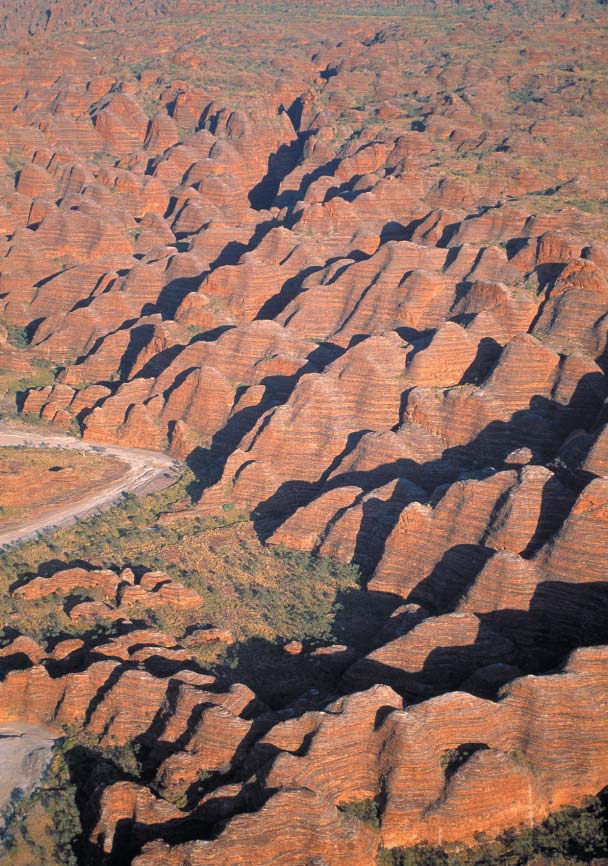
417 The “statement of significance” made by the Australian Government to the World Heritage Committee was as follows (on p 6):
Purnululu National Park has outstanding universal natural and cultural values.
The landscape has exceptional natural values. Twenty million years of weathering has produced the eroded sandstone towers and banded beehive structures of the Bungle Bungle Range. Dark bands, formed by cyanobacteria, winding horizontally around the domes, contrast with the lighter sandstone. The crusts, which help stabilise and protect the ancient and fragile sandstone towers, are present on a massive scale.
Purnululu sits between the hot dry deserts of Western Australia’s arid zone to the south and the better watered monsoonal areas to the north. This transitional zone possesses unique natural and cultural values. A rich mixture of species, some of them endemic, on the edge of their ranges are found here, as is a remarkably diverse range of spinifex species — the spiny grass genus (Triodia spp) that dominates Australia’s arid zone. The cyanobacterial (single cell photosynthetic organisms) bands crossing the rock surfaces of the Bungle Bungle Range, are adapted to the transitional nature of this area’s environment.
In addition to the geomorphic and biological importance of the Park’s natural features, the myriad sandstone towers of the Bungle Bungle Range are exceptionally beautiful and inspirational. The orange and grey horizontal banding of the cyanobacteria crust on the towers highlights their aesthetic features.
Aboriginal people have lived in the East Kimberley Region for at least the last 20 000 years. The Park provides exceptional testimony to this hunter-gatherer cultural tradition, particularly its riverine features. Aboriginal people have adapted to this resource rich environment moving between the uplands in the wet season and along the river in the dry, while using intermediate lands in all seasons. Fire has been, and continues to be, an important tool in Aboriginal management of this environment.
Ngarrangkarni is the continuing guiding principle in the living traditions and beliefs of Purnululu’s traditional owners. This outstanding example of the Indigenous Australian religious philosophy (popularly known as the ‘Dreaming’ or the ‘Law’) has been handed down through countless generations and is still in force today.
The cultural landscape is also significant because its people and traditions have survived to the present despite the impact of colonisation. The culture of the traditional owners of the Park is outstanding in revealing its resilience at a time when such cultures have everywhere become vulnerable under the impact of irreversible change.
The Purnululu National Park, when included on the World Heritage List, will enhance the representativeness of the List and also complement other World Heritage properties in Australia, especially Uluru–Kata Tjuta National Park and Kakadu National Park.
418 It would be trite to say that words cannot do justice to the extraordinary features of the park.
419 The word “Ngarrangkarni” in this extract is, as I understand it, the same concept Dr Redmond refers to in both his report in this proceeding, and in his Jaru report, as “Ngarranggarni”, and which he describes in English as the “Dreaming epoch”. Dr Corrigan also refers to the concept briefly in his report. I describe the evidence about Ngarranggarni (using Dr Redmond’s spelling) in more detail below.
420 At p 19, the nomination document describes the languages in the park area:
People’s connection to place is mediated by language. Four Indigenous languages are spoken in the Middle Ord Region: Kija, Miriwoong, Malngin and Jaru. Kija and Miriwoong are members of the Jarrakan language family associated with the western and northern areas of the Park. Malngin and Jaru languages are members of the Pama-Nyungan language family connected to the eastern and southern parts of the Park. Pama-Nyungan languages flank the southern and eastern margins of the Kimberley and are spoken by people throughout the adjacent desert regions including the Anangu of Uluru-Kata Tjuta.
The distribution of these two distinct language families mirrors the transition between arid desert and monsoonal savanna environments and reflects major social, religious and cultural differences between the two groups.
421 The uniqueness of the park, and its place in the national and international lexicon of places for which enduring and special protections are required, has no doubt intensified the debate over who are the right people for the park.
422 Thus, when the Native Title Act (or, at least, parts of it) commenced on 24 December 1993, the park – and more importantly its boundaries – had been in existence for some six years. Even prior to the existence of the park, artificial boundaries for people’s country were created by the form of the Ord River Regeneration Area. In his report, Dr Redmond stated that this area, from 1960, included “parts of the former Turner Station” and was part of a project
the largest in Australia’s rangelands, aimed to revegetate bare, severely degraded and eroded parts of the Ord River catchment in order to minimise siltation of Lake Argyle, which provides water to the Kununurra irrigation area. Decades of excessive uncontrolled grazing by cattle between the late 1880s and 1950s were responsible for the degradation. The project area, which is now called the Ord River Regeneration Reserve, is managed by the Department of Parks and Wildlife. It initially covered about 10 000 square kilometres of the total area of the catchment of Lake Argyle of 46 000 square kilometres. It extended about 215 kilometres from north to south and included parts of Mistake Creek Station in the north, all of Ord River and Turner stations and parts of Flora Valley and other stations in the south.
423 The fact that the PDA is a national park, with a hard boundary determined by matters other than traditional connections to country, is a fact which must be grappled with in understanding the evidence about who is said to have customary law connections with particular areas, both inside and outside the PDA. While some of the park’s boundaries align more or less with geographical features such as the Ord River, other parts of its boundary do not, especially to the west.
424 Thus, I consider it is important to bear in mind two factors in my fact-finding on these separate questions (including intermediate fact-finding leading to findings on those questions). First, the boundaries of the PDA are artificial, post-settlement ones, and are not drawn according to customary law. Second, as the location of other existing determinations suggests, and the evidence demonstrates, at least in post-settlement times people travelled into particular areas within the park from different directions. When its unique geographical and environmental features are taken into account, I am comfortably persuaded significant parts of the PDA were at effective sovereignty likely to have been something of a meeting place, and likely to have been possessed and used, in accordance with traditional law and custom, by a number of groups which, by descent, may well be traceable to people with native title held in areas surrounding the park. I am not satisfied possession and use of the park can be traced only to groups which, by descent, might now tend to be firmly Kija-identifying.
The consequences of the protracted history of the dispute
425 The Gajangana Jaru applicant made submissions about the effect of the protracted and particular history of this dispute and the claims. It contended that this history had “some unusual and undesirable consequences for the evidence”, including:
a. A significant number of formal and informal reports, interviews and recordings of various individuals both living and deceased have been recorded by different individuals in relation into this matter;
b. Potentially significant witnesses have passed away, including David Turner, Nora Nocketta and Phyllis Thomas, their evidence has not been recorded for these proceedings;
c. Almost an entire new generation of Aboriginal people has grown up during the protracted dispute with little or no knowledge of the state of affairs that existed before the dispute;
d. The deepening of the unresolved dispute between the parties and between individuals;
e. An entrenchment of position by individuals on both sides, and a tendency to overstate one’s case and diminish the claims of the other side;
f. It has been difficult for individuals, most of whom reside together in close knit communities of Warmun, to remain neutral and avoid taking sides in the dispute;
g. Fatigue, particularly from Tanba and Bonnie, of giving the same evidence and being asked similar questions of their heritage and history by many individuals who were instructed by other parties.
(Footnotes omitted.)
426 It further contended that its more recent access to legal representation, in contrast to the ongoing assistance and legal representation received by the Purnululu applicant from the KLC, has had several consequences for the lay witness evidence and its case. It submitted:
a. It is inevitable that individuals may make inconsistent statements over a period of 30 years. It would be more surprising if a person’s story stayed exactly the same after so many retellings to so many different individuals with different instructions, objectives and styles;
b. Disputes and inconsistencies will arise out of many details, not all of which will be relevant;
c. Individuals will not necessarily remember every conversation or interview they have had regarding the dispute;
d. It would be surprising if individuals in such a litigious matter did not make enquiries and have discussions about their history and develop their case as proceedings progressed, particularly once solicitors begin acting. What would be surprising is critical evidence coming to light on the eve of the trial after such a long period of time (eg paragraphs [122][219.a] below).
427 The last reference is to some of Dr Redmond’s evidence about the ancestor Walambal and Shirley Drill’s evidence about Walagul.
428 In reply, the Purnululu applicant took issue with any suggestion that the fatigue of giving evidence provides some explanation for any inconsistencies and difficulties with the Gajangana Jaru witnesses’ evidence. It submitted:
[I]t may readily be agreed that a person’s account of things will often not be a carbon-copy of other accounts given by the same person over a long period. If, however, the person is a truthful witness, deep and fundamental inconsistencies will not be present. Numerous inconsistencies of this kind are present in the GJ Applicant’s case. For example, Bonnie’s disavowal of Mayilba as an ancestor who had rights in the PDA and her evidence about the extent of Malngin country are deeply and fundamentally inconsistent with that case. The GJ Applicant has effectively disowned this evidence from its principal witness because it continues (correctly) to include the unnamed father of Mayilba (and Bulugul) as an apical ancestor for the PDA and they continue to state that part of the PDA is Malngin country. These are not matters of mere detail; nor are they matters that should be affected by the engagement of solicitors.
(Footnotes omitted.)
429 Although the parties’ contentions are presented in a binary way, there is no binary answer. I accept the general thrust of the Gajangana Jaru submissions, as – it appears – does the Purnululu applicant. In assessing all the lay evidence, considerable allowance must be made for the passage of time, and the frustration people feel with having to repeat their accounts again and again to different groups of non-Aboriginal people, including lawyers (and judges). That process is likely to produce accounts which may differ in their content and in their emphasis. A difference is not necessarily a reason to conclude a witness is unreliable, or that one account should not be accepted. A difference is a factor to be measured against other factors in assessing reliability. A difference, or the presence or absence of some facts, is not necessarily an “inconsistency”. In another context, the Full Court has said about the assessment of so called “inconsistencies” in AVQ15 v Minister for Immigration and Border Protection [2018] FCAFC 133; 266 FCR 83 at [25]-[28]:
One authority to which Hathaway and Foster refer is the decision of a Full Court of this Court in W375/01A v Minister for Immigration and Multicultural Affairs [2002] FCA 379 (W375/01A) where the Court (Lee, Carr and Finkelstein JJ) said at [15]:
As anyone with even a passing familiarity with litigation will know, to have to give a decision-maker three or more separate versions of the basis for a claim is an invidious position to find oneself in, even in the case of an honest witness. All the more so when the accounts have been provided by a person who speaks no English and who has required the assistance of an interpreter. It is inevitable that each version will be slightly different, and may even be very different once the impact of the interpreter is taken into account.
Consistently with its task on review, and bearing the reality to which the Full Court in W375/01A referred steadily in mind, appropriate attention has to be given by a decision-maker (here, the Tribunal) to all relevant material in making a finding of inconsistency which then underpins an adverse credibility assessment. As will shortly emerge, this did not occur here because the Tribunal overlooked what the appellant had earlier told a Departmental officer at the appellant’s interview and this material was highly relevant to the question whether the appellant had given inconsistent evidence in support of his case.
Secondly, the term “inconsistency” should be used with appropriate caution and an appreciation of the danger of using labels or formulae which mask the need for deeper analysis. As we have noted above, adverse credibility findings might be based on a variety of matters, including inconsistencies between, for example, evidence or claims made at different stages of the decision-making process or differences between oral evidence and contemporaneous documents. In some circumstances a visa applicant may raise a claim for the first time at an advanced stage of the decision-making process and the failure to raise the claim previously may well be relevant to credibility, but that is not to say that this is correctly described as an inconsistency.
Thirdly, even where it is reasonably open to find that a person has given inconsistent evidence, the decision-maker needs to assess the significance of that inconsistency and the weight to be given to it. This requires consideration of, for example, the significance of the inconsistency having regard to the person’s case as a whole and whether the inconsistency is on a matter which is central to the person’s case or is at its periphery and involves an objectively minor matter of fact. It also requires the decision maker to remain conscious of the particular challenges facing asylum seekers in giving accounts of why they fear persecution, including that they may have to give multiple accounts, using interpreters, and that they may reasonably expect an interview or a review process will provide an opportunity for them to elaborate on, or explain, the narratives they have previously given. Consideration should also be given to whether there is an acceptable explanation for the person having given inconsistent evidence such that the fact of the inconsistency should attract little, if any, weight. How all these matters are weighed and evaluated in a particular case is a matter for the decision-maker, but a failure by the decision-maker to appreciate the particular nature of the task, or to perform it reasonably and fairly, may be the subject of judicial review.
430 These observations are in my opinion apposite for the Court to bear in mind in assessing the parties’ respective contentions about “inconsistencies” in the evidence of various lay witnesses. As the Purnululu applicant submits, there will be some discrepancies which may well tell against the reliability of a lay witness’s evidence in a fundamental way, at least on a certain point. However, labelling the entirety of a person’s evidence as “not credible” or “unreliable” is quite a different matter. Such a finding may be appropriate where a witness is proven to be deliberately giving false evidence. There are no witnesses in this proceeding about whom I propose to make such a globally adverse finding. In the absence of a factor such as that, the better approach is to assess all of the evidence issue by issue, to determine which evidence is the most reliable, and why. There may be a need for a more holistic assessment in some places, but that will depend on the factual issue under consideration.
431 I also accept the Gajangana Jaru submission that the deep divisions between members of the claim group have entrenched their positions and that this was obvious in the evidence that was given. There is a high degree of personal animosity between some members of the groups, though not all of them. This fact – which the Court could clearly observe repeatedly during the on-country hearings – did tend to lead witnesses for both claim groups to be less willing to make concessions, to give more hostile responses, or indeed to be non-responsive, than might otherwise have been the case. The Court is not critical of any individual for this; it is a very human reaction to a difficult and long-lasting dispute. However, in terms of assessing the reliability of various witnesses’ evidence, it is a factor which the Court bears in mind. It is this factor which in my opinion has led to some of the differences in evidence, and to some of the differences between what a witness may have said in these proceedings and what she or he may have said on an earlier occasion.
432 It is one of the frustrating and disappointing aspects of the debate over traditional ownership of the PDA that so many years, decades, should have been spent requiring the people concerned to remain in dispute with each other over matters which are so fundamental to their lives, and their sense of who they are, and to tell and re-tell their narratives to a huge variety non-Aboriginal people, in different contexts, again and again. What has happened to the members of both claim groups here shows the native title system in its worst aspects. I have taken these features of this dispute into account in the way I assess the reliability of the evidence before the Court.
433 I also accept the submission that the framing of the Gajangana Jaru applicant’s case in a way which better conforms with the requirements of the Native Title Act is a relatively recent event. That is also not said critically of Bonnie Edwards, Tanba Banks or Lily Banks, or those who might have assisted them in the past. Its marshalling of evidence, including expert evidence, was done under considerable time pressure. I have borne these factors in mind, although in the end the Gajangana Jaru applicant had the benefit of an equally professional and capable presentation of its case as the Purnululu applicant.
The 1992 split between Jaru and Kija people over the PDA
434 There is evidence that prior to 1992, members of both claim groups were working in a reasonably cooperative way at least about the management and use of the Purnululu National Park. In 1992, however, there was a falling out between the two groups, occurring on or around the time of the removal or disappearance from the Kawarre Limestone Cave area of what were called in the evidence “sacred objects” or “objects”.
435 Prior to this, between 1985 and 1992, Bonnie Edwards was closely involved with what was then the Purnululu Aboriginal Corporation. PAC had been given a consultative role in matters affecting the management of the Purnululu National Park. In this capacity, Mrs Edwards attended meetings with Western Australian government officials, including with the Premier of Western Australia. During this period, the evidence establishes that PAC claimed to “represent all traditional owners of the Bungles area” in its negotiations and correspondence with government departments. In evidence are records of meetings and letters between PAC and government departments from 1987 to 1990, which show Mrs Edwards participating in meetings on behalf of PAC, alongside Raymond Wallaby and Sam Butters. For example, in 1987, PAC sought 99-year leases over four areas on behalf of four families represented by Raymond Wallaby for Kawarre, Bonnie Edwards for Piccaninny, Sam Butters for Date Palm, and Darkie Green for Frank River. The communication is stated to be made by Raymond Wallaby as the Chairman of PAC. It states
There are four families who intend to live permanently in the Bungle Bungle on both the National Park and Conservation Area currently vested under C Class reserve legislation.
Those families are represented by;
Raymond Wallaby – Karwarra
Bonney Edwards – Piccaninny
Sam Butters – Date Palm
Darkie Green – Frank River
Purnululu Aboriginal Corporation who represent all traditional owners of the Bungles area have request that further excision applications be considered in the fut[ure] if or as they arise.
The families stated above are requesting secure long term title to areas large enough to sustain their social and economic needs.
436 Other documents in evidence from this period follow a similar pattern. For example, in 1989 Ian Kirkby was acting as a “coordinator” for PAC. PAC expressly stated on its letterhead that it was “representing the traditional owners of Purnululu National Park (Bungle Bungle)”. Mr Kirkby wrote on 10 February 1989 to the Acting Commissioner for the “Aboriginal Affairs Planning Authority” about a proposed management plan for the park, and about “Aboriginal involvement” in the park. That letter was written expressing the concern of “traditional owners” which on its face expressly included Mrs Edwards.
437 There are minutes of a meeting from 11 October 1990 between PAC and the State land management agency, the Department of Conservation and Land Management (CALM), attended by Raymond and Bessie Wallaby, Mona Johnson, Sam Butters, George Mung, “Jimbo”, Richard Bradshaw, and Bonnie and Malcolm Edwards. It is not apparent who “Jimbo” and Richard Bradshaw were. The minutes reflect a generally united view being put to the CALM officials about what traditional owners wanted in terms of participation in management of the park, and the terms of the proposed 99-year leases to the four family groups I have described at [435] above.
438 In 1992, Bonnie Edwards and Tanba Banks split from PAC and created the new corporation, MMAC.
439 Bonnie Edwards gave evidence that she instigated this split after hearing from Jock Mosquito that some objects, which she identifies as “our title deeds”, had been removed from the “mens place in the Bungles”. In her statement she described the issue in the following way:
In about 1992 I became worried about [objects]. I had heard from Jock Mosquito that they had been taken from the mens place in the Bungles. I can’t talk about this men’s place. I am not allowed to go there. Yilliyarri told me [objects] don’t go there. Mountain told us too don’t go out and play there
If someone takes those [object] if someone who wasn’t meant to take them it is dangerous. I told Tanba and she said we don’t want to be involved. We’ll get sung. Tanba said let’s get away from PAC because in trouble – like accessory to murder. Other Jaru people from the desert might sing us because of moving those things.
I wrote letters resigning from PAC and we set up Mindi Mindi Aboriginal Corporation.
440 In her oral evidence Mrs Edwards said:
I would like to tell you why we called it the corporation Mindi Mindi, because we wanted to get away from the Purnululu Aboriginal Corporation because they’ve stolen our title deeds for our land and took them to Frog Hollow and burnt them. That’s the reason why we ended up having this fight with the Kija People, because they didn’t respect our land. Now, if people don’t respect you, you don’t – you don't hang around with them.
441 It was put to Mrs Edwards in cross-examination that she had not said in her witness statement that it was Kija People who had taken the objects. She answered: “Why would I want to put it in my statement. I wasn’t asked that question.”
442 Mrs Edwards also gave evidence that she was not present when the objects were found but that George Mung told her that the objects were Jaru title deeds:
I sat under the tree just down near the camp at Kawarre, with old Mungan, George Mung. And I asked him, “Why aren’t you going with Raymond Wallaby and the rest of the people to have a look at what they found?”. I sat there and he said, “No, that’s not our deeds; that belongs to Jaru People, and I feel terrible about finding them with the boys when I went looking”.
443 Shirley Drill gave evidence that “[her mob] used to go and look after” the object(s), and one day around or later than 1992 “kids went over there and looked for that thing but it’s not there. Someone took it.” She said she did not know who took it.
444 Ricky Drill’s evidence was that he found the object(s) while hunting a goanna and reported it to his grandfather, Raymond Wallaby, and his uncle, George Mung. The men left it there as “they didn’t want to lose it”. When Mr Drill returned to the site, the object was not there:
RICKY DRILL: Yes, I was out here hunting, chasing after a goanna, so I seen that goanna trekking up, walked up and I did find it – when we came back and I had a look at it, we didn’t get in.
MR KEELY: So that’s the thing that you were talking about that went missing?
RICKY DRILL: Yes.
MR KEELY: When you found it, was that before you’d been through the law or after?
RICKY DRILL: Before we went through the law, yes.
MR KEELY: What did you do, did you give that information to anyone?
RICKY DRILL: Yes, to my grandfather and George Mung, my uncle.
MR KEELY: Did they advise anything about what should happen with that thing?
RICKY DRILL: They left it there.
MR KEELY: They wanted to leave it there?
RICKY DRILL: Yes, they didn’t want to lose it . . .
MR KEELY: Do you know when it disappeared, are you able to say roughly at least when it wasn’t there any more?
RICKY DRILL: No. I didn’t know really, when I came back they didn’t really tell me. But when I went back and went to have a look at it, the thing wasn’t there.
445 Mr Drill was not cross-examined about this, but his evidence was disputed by Mrs Edwards when put to her in cross-examination:
MR KEELY: See, what Ricky said to the court is that he found something up there. He wasn’t even – hadn’t been through the law at that time. He stumbled on it as he was hunting a goanna.
BONNIE EDWARDS: No, that’s not right.
MR KEELY: Well, how – how could you possibly know that, Bonnie? You weren’t there.
BONNIE EDWARDS: Because Mungan said – I was there sitting with him, because I asked him, “Where are they going?”. There was Ross Johnson, Ian Kirkby, Raymond Wallaby. They went up to find that – find the place what – what was happening up there and – and it was Ross Johnson that was up there and he said, “Wow, what a major find”. And – and when I asked – when I – I asked Mungan, “Why aren’t you going?”, and he said to me, “I – I feel no good”, he said, “I feel terrible because that’s not our title deeds; it belong to the Jaru People”.
MR KEELY: Ricky’s evidence – I’ll tell you what he said, because you weren’t there. He said that he found it, he reported it to Raymond Wallaby, and Raymond said it should remain there, to leave it alone. And at some point later in time the thing was no longer there. He doesn’t know what happened to it.
BONNIE EDWARDS: Well, it didn’t happen that way, because I asked – Mungan, who is George Mung, and he’s the one that found them, because they were looking for stuff round here so that they were – make sure that they were going to put a – probably a fence around some sacred areas and he said, “Oh, I’m not going up there because that's not our – our thing to remove”, just to – even to have a look at it. But Raymond went there.
446 The Purnululu applicant submits that these events are beyond Mrs Edwards’ direct knowledge and her account “does not rise above bare assertion”. It submits that Mr Drill “gave a credible account based on his own direct knowledge of a sacred object that had gone missing” and spoke about these matters with “evident seriousness”, with other senior men standing with him and “as a man who had been through the law”. The other senior men are identified as Timothy Mosquito, Warren Drill and Mark Shaw.
447 The Purnululu applicant also rejects the “suggestion that something to do with sacred objects was the cause of the rift between the two groups” and submits this is at odds with the reasons given by Mrs Edwards for forming MMAC in her letter to the government at the time. This letter, which is in evidence, is dated 21 July 1992 and addressed to the Minister for CALM, signed by Mrs Edwards as chairperson of MMAC. It states:
I wish to advise you that the Mindi Mindi Aboriginal Corporation which represents the Jaru tribe of the area known as Bungle Bungle has resigned from the Purnululu Aboriginal Corporation on the grounds that this organization does not truly represent the Aboriginal Traditional owners of the Purnululu National Park.
The Bungles is Jaru land, and now with no representation on PAC any negotiations between CALM and PAC concerning any area within the National Park will be deemed null and void by the Mindi Mindi Aboriginal Corporation.
448 Mrs Edwards confirmed in cross-examination that although she instructed her husband to type this letter, the words in the letter were hers.
449 There is another contemporaneous letter from Mrs Edwards which is in evidence. It is a letter to the Commissioner of Aboriginal Planning, dated 11 September 1992. In that letter, Mrs Edwards described this split as occurring because PAC did “not represent the true traditional owners of the area known as Billingjul (Bungle Bungle)”.
450 In that letter, Mrs Edwards contended that Purnululu National Park “is entirely in Jaru land”. She also contended that, arising from a meeting on 24 August 1992 at Cattle Creek, to which she contended the Kija people were invited “but failed to turn up”, the Jaru people at the meeting decided (amongst other matters):
That the Kidja people who now occupy or intend to occupy land within the Park get out and go back to Kidja country. Two Kidja groups are Raymond Wallaby and Sam Butters.
451 Mrs Edwards also contended that the name of the park should be changed to “Billingjul”, which she claimed is a Jaru word meaning “sand falling away”.
452 Mrs Edwards also gave evidence during the hearing that she told Raymond Wallaby she disagreed with the granting of a lease to the Butters family near Date Palm, but had not included this in her witness statement because it was “for his ears, not for the court’s ears”. The Purnululu applicant submitted:
When it was put to Bonnie that she had never raised these matters with Raymond Wallaby, she said that she had told him: “You must not give away land that doesn’t belong to you”. This was a reference to the lease over the shelter for the Butters family near Date Palm. This is a different account to that given in Bonnie’s witness statement, where she said that she was present when Yiliyarri told Raymond he shouldn’t be giving land to Sam Butters and that he was not from there. The Purnululu Applicant has no way of knowing whether such a statement was ever made because both Raymond Wallaby and Yiliyarri are long deceased (see [14] to [130] above). Even if the statement was made, it is not a challenge to the fundamental basis on which the Purnululu Claim had been brought; it was a challenge to the rights of the Butters’ family (who are Jarlarlu) in that particular part of the PDA.
(Footnotes omitted.)
453 The Purnululu applicant invites the Court to draw the inference that, between 1985 and 1992, Mrs Edwards did not object to members of the Purnululu claim group claiming interests in the PDA. It submits:
From 1985 to 1992, Bonnie knew that the families in the Purnululu claim were claiming interests in the Park. It is at least implicit in her evidence that she did not object to this until “after they took our title deeds” i.e. in about 1992. Bonnie said in evidence that the Purnululu claimants were not the right people for country. When it was put to her that she had not said this in the period from 1985 to 1992, she gave the implausible answer: “Well, who would I want to say that to?”
…
The GJ Applicant’s case would have it that, for about seven years, the GJ Claim Group stood by while the Purnululu Claim was prosecuted on false bases. These false bases were fundamental to the claim and included that numerous Kija people have rights in the PDA and that there was no acknowledgment that the PDA was Gajangana Jaru country. The original applicants in the Purnululu claim were Raymond Wallaby, Jack Britten, Queenie McKenzie and Hector Chunda (Jandany). As we understand it, the Gajangana Jaru Applicant does not accept that any of these persons, each of whom is now deceased, possessed rights in the PDA.
(Footnote omitted.)
454 The Gajangana Jaru applicant makes a similar submission, but in reverse. It contends that PAC records show historical recognition of Mrs Edwards’ rights and interests in the PDA:
It is apparent from the evidence that until 1992 there was no lack of acceptance of the interests of Lily or Bonnie in the PDA. The lack of acceptance which has been expressed since that time and currently appears on the evidence to arise from a current dispute related to loss of culturally significant objects about that time and the future management of the Purnululu National Park.
(Footnotes omitted.)
455 The footnotes to this submission refer to the evidence of Bonnie Edwards and Shirley Drill, and several items in evidence including the minutes of a PAC meeting held on 11 October 1990 referred to above at [437], and the minutes of a Purnululu Park Council meeting held on 7 May 2004 in which Mrs Edwards is absent and is referred to as having a dispute with Shirley Drill.
456 The Purnululu applicant submitted the “suggestion put to witnesses that this is in effect a personality clash between Bonnie and Shirley lacks any foundation, either historically or currently”.
457 The Gajangana Jaru applicant does not make further submissions about the falling out and the dispute about objects, other than to say:
There is a dispute about some objects. It is not necessary for this Court to make findings about the objects and they are not relevant to the questions required to be determined by the Separate Questions. What can be said is that it is common ground that some objects went missing from the Limestone outcrop at Gawarri.
458 I accept it is not necessary for the Court to make any findings about what happened to the “sacred object” (or objects) which were located in a cave at Kawarre, but then went missing. Both parties and the witnesses agree that there were such objects, and that they went missing. Although none of the lay witnesses explained in their evidence what these objects were, there is an account in evidence from Dr Levitus which gives one description of what they were, who placed them there, and what is alleged to have happened to them. At the time of hearing the lay evidence I was uninformed about this account, but I have read it during the preparation of these reasons. It is not necessary to describe that account in any detail, since the lay witnesses chose not to.
459 The Purnululu witnesses offered no explanation for who took these objects, or why they went missing. Mrs Edwards suggested in her oral evidence that they were taken by Kija people, but her basis for that assertion is not disclosed on the evidence. This is an example, I find, of Mrs Edwards’ frustration and anger about the situation over ownership of the PDA getting the better of her. There is no evidentiary basis to accept Mrs Edwards’ assertion. The Court can, and needs, go no further than finding that the objects were there, in the cave at Kawarre, and at some time in 1992 were found to be missing.
460 The origin or cause of the split in 1992 is also difficult to identify on the evidence. I accept the split may have had something to do with the fact the object(s) went missing. The timing supports such an inference. Mrs Edwards’ evidence was clear that this event played on her mind a great deal, and she was one of the moving parties in establishing the break-away Mindi Mindi Aboriginal Corporation. No other trigger is identified by the Purnululu applicant in submissions for the apparently quite sudden split. The Purnululu applicant makes some general contentions about Mrs Edwards wishing to pursue her own tourist-related interests and relies on Dr Redmond’s view that there was some “refutation of kinship” by Mrs Edwards.
461 The contemporary correspondence does not explain why there was a change in 1992 from apparent cooperation, including proposed arrangements for Mrs Edwards to have a lease area as several other families were to have, to this more unilateral position. It may well be the case that lay witnesses were reluctant to share much detail with the Court about this period, or the reasons for the split. In the end, the Court can only assess the evidence it has.
462 It is important to observe that the Purnululu applicant led no direct evidence, and advanced no direct argument that the 1992 split had any basis in the traditional law and custom of the Purnululu claim group. That potential explanation can in my opinion be firmly discounted. Reliance on Dr Redmond’s opinion that there was a “refutation or denial of kinship” in the 1992 split is, in my respectful opinion, placing an unwarranted native title anthropological characterisation onto what appears to have been a falling out precipitated by or involving a particular event, but also exposing a clash between strong personalities within the former group of “traditional owners”, combined with the undoubted pressures of trying to navigate the consequences of the PDA becoming a national park and tourist attraction. I do not accept the split had any basis in traditional law and custom. That conclusion becomes relevant to my findings about the Purnululu applicant’s submissions on “recognition” as an aspect of claim group membership.
463 The reason for the split is less important to the resolution of the separate questions than the fact of it. What is more important to the resolution of the separate questions is the situation which had existed prior to the split. That situation – which reflected in my opinion a positon of shared acknowledgment of connection under traditional law and custom for the PDA – is a significant fact in assessing important aspects of the lay evidence about which apical ancestors had connections to the PDA.
464 Such an acknowledgment is apparent in the contemporaneous material to which I have referred. Much of this material predates the filing of the first Purnululu claim in 1994. Notably, of course, that claim was lodged after the 1992 split.
465 However, even after the claim was lodged there is clear evidence of senior people acknowledging at least some kind of connection of people such as Bonnie Edwards (including also, I infer, Lily Banks).
466 The minutes of the Purnululu National Park Council meeting of 7 April 2004 recorded David Turner making the following statement:
David Turner took the floor and spoke about connection to country. He explained he had been involved for many years in the discussions with CALM and Government about the Bungle Bungles. David explained that he had knowledge of places and agreements that Shirley and others did not and that they should listen carefully.
David spoke about the genealogy of people and said that Bungle Bungle was a place for Kidja, Jaru, and Malignin speaking people and that everybody should be welcomed onto country. …
David explained whom he was and that agreements had been made previously with old fellas who have passed away. He wants everybody to be welcome on country including Mindi Mindi.
(Original emphasis.)
467 From its terms, it is clear David Turner was well aware of the gravity of the matter he as raising. David Turner is the father of Mrs D.M. and the brother of Paddy Jandiyarri Turner. He was a Jaru man. Both Mrs D.M. and Shirley Drill (as well as others such as Bonnie Edwards and Ivan Turner, who refers to him as uncle), gave evidence that his primary country was around Gardayng Riyarr. The word Gardayng refers to black rock that is found all over that country, according to Mrs D.M., while according to Mrs Edwards Gardayng it refers to the limestone cliffs on the Nicholson River. The location of this country is south-east and east of the Ord River, around the Turner Station homestead, and extending narrowly within the southern edge of the PDA. However, David Turner’s mother is Bulugul, one of the apical ancestors on the Gajangana Jaru claim over the PDA, and one generation down from the apical ancestor named in the Purnululu claims. It is an agreed fact that Bulugul possessed, and her descendants possess, rights and interests under traditional law and custom in the PDA. Dr Redmond stated in his report that all the Turner brothers were accepted as having traditional rights and interests in the PDA. In other words, the view David Turner was expressing came from a person, at that time an elder, who had rights and interests in the PDA, although he had chosen to identify primarily with land and waters immediately to the south of the PDA. As those records show, and as Ivan Turner’s evidence demonstrated, David Turner’s views carried weight.
468 This kind of evidence also illustrates the ongoing effects of the split. In the same 2004 meeting, Shirley Drill is recorded twice in the same minutes as referring to Bonnie Edwards having “broken away” or left PAC. Immediately under the last entry I have extracted above, Shirley Drill is recorded as saying:
Shirley said she wants young people to have a good future on country. Bonnie left PAC years ago and formed Mindi Mindi and has been fighting with PAC ever since.
469 At a later meeting, on 29 July 2005, David Turner and Shirley Drill are recorded as saying the following:
David Turner spoke about his involvement and connection to the country. He is the brother of Raymond Wallaby and he was at meetings with people who have since gone on. He hopes that this will be a start for a bigger part for the Djaru. He spoke about Tanba, Bonnie, Lulu, Phyllis, Nora and others family connections and said that the Djaru and Kidja are not all one people and that you can separate them. But they’re all related to each other and have to get on together.
David asked Shirley why she would tell the Government she was a traditional owner. Shirley replied that she hadn’t. She was willed the responsibility for looking after the school and the future of the children by her uncle. She wasn’t doing this for money; she was doing this for family. She is a cousin of Bonnie but can’t talk to her. She can talk to Lilly and others.
Shirley said she wanted to look after the country that her Grandmother showed her. She would look after it as a full blood Aboriginal person. She would like Bonnie to explain what family she was related to.
David Turner made some other statements about the country and said that Paul Butters knew he should only be speaking about Date Palm.
470 The “uncle” to which this passage refers is Raymond Wallaby.
471 Minutes from a park council meeting on 7 October 2005 indicate that both David Turner and Shirley Drill still held out hopes of a cooperative solution to claims over the park:
David Turner addressed everyone and said that Jaru and Kidja people often married and that they had to be friends and work with CALM. A cool wind will bring them together, but a hot wind won’t. He said that although Bonnie said most of the park is Jaru country, because there are marriages between the two groups, he thinks it is time to put differences aside and go forward as Aboriginal people, together.
Further discussions took place about who had rightful connections to country, who were traditional owners and who were not.
Shirley Drill indicated that she was not from here but that she had an obligation to family to carry out the wishes of an old man and get a school community in the park so children can connect back to country and culture. She is tired of arguing and wants people to move ahead and live on country.
472 The “old man” to which Mrs Drill refers is, again, Raymond Wallaby. In cross-examination, Shirley Drill agreed that Raymond was happy for Bonnie Edwards to have a living area at Piccaninny, but denied knowledge about whether Mrs Edwards was a member of PAC or why she left. Her evidence was also that while she remembered attending the 29 July 2005 meeting, the minutes of which are extracted above, she did not remember the discussion with David Turner:
MR McINTYRE: When Raymond Wallaby and Bonnie Edwards were both involved in the Purnululu Aboriginal Corporation, Raymond was happy for Bonnie to have a living area at Piccaninny, wasn’t he?
SHIRLEY DRILL: Yes.
MR McINTYRE: Bonnie, she was a member of that Purnululu Aboriginal Corporation?
SHIRLEY DRILL: I don’t know, I don’t read no paper.
MR McINTYRE: Do you know why Bonnie and Tanba left the Purnululu Aboriginal Corporation?
SHIRLEY DRILL: I don’t know. I had another mob involved in that, this mob from Texas.
MR McINTYRE: Do you know that Tanba and Virginia are now members of the World Heritage Advisory Committee?
SHIRLEY DRILL: I don’t know, they cut us off that thing.
MR McINTYRE: You’re not involved with the World Heritage Advisory Committee.
SHIRLEY DRILL: No, they been cut me off.
MR McINTYRE: When the Purnurlulu Park Council started up, everyone was getting along, weren’t they?
SHIRLEY DRILL: Yes.
MR McINTYRE: So Raymond and Bonnie and the Butters family?
SHIRLEY DRILL: Yes.
MR McINTYRE: They were all happy to work together, weren’t they?
SHIRLEY DRILL: Yes.
MR McINTYRE: Do you remember telling the park council in 2005, at a meeting on 29 July, that you didn’t intend return to Kawarre but Ian Kirkby told you that Raymond Wallaby had given you rights before he died for you to return?
SHIRLEY DRILL: Yes.
MR McINTYRE: Do you remember at that same council meeting, that David Turner asked you why you would speak for the park when you weren’t a traditional owner?
SHIRLEY DRILL: Sorry, I can answer the one question – is that we belong to this place.
MR McINTYRE: Do you remember that discussion, that David Turner asked you that?
SHIRLEY DRILL: No.
MR McINTYRE: Do you remember agreeing with him that you weren’t a traditional owner for the area?
SHIRLEY DRILL: No. I didn’t hear all those things.
MR McINTYRE: Do you remember saying that you didn’t really want to come back, but Ian Kirkby told you you should come back?
SHIRLEY DRILL: No, he didn’t tell me – I came back with my own will because my uncle’s country and I had to come back and live here. This is my grandfather country.
473 Shirley Drill later gave evidence that the “grandfather” who has country in the PDA is Mountain, who she says is her mother’s uncle.
474 I have spent some time on these documents because they are more contemporaneous than the evidence given in 2019, in the context of a heated, litigated native title dispute. While by 2004 the Purnululu #1 application was on foot, it had not progressed very much at all. What these extracts indicate in my opinion is not a refusal to acknowledge those affiliated with what is now called the Gajangana Jaru group. Quite the contrary. They show an inclination to reach some kind of agreement: certainly by David Turner but also on the part of Shirley Drill, although the same cannot be said of Bonnie Edwards, as she is recorded as speaking during these meetings.
475 The events of 1992, and the way they played out afterwards in circumstances such as the management of the park may explain in a factual sense how these two rival claims came to be pressed. They explain, for example, why in 1999 the Purnululu claim was amended to say expressly, in the portion dealing with the claim group description:
If it is taken that this description of the claim group includes Tanba Banks, then by this paragraph it should be understood that she is excluded.
Although that position had changed again by trial, it reveals the depths of the split.
476 The evidence around these events explains some of the antagonism the Court observed during the on-country hearing. It says little or nothing about connection to the PDA under traditional law and custom. In particular, and as I explain later in these reasons, the maintenance of the split between the groups to this day says nothing about “recognition” under traditional law and custom.
477 In oral closing submissions, senior counsel for the Purnululu applicant suggested a range of other reasons for Bonnie Edwards’ involvement prior to 1992 and her apparent incorporation and recognition by members of the Purnululu claim group as a “traditional owner”. It was submitted:
HER HONOUR: Well, what’s your client’s submission about why the claim group, if Bonnie was not recognised as a member of it, was happy for her to go and do things like this?
MR KEELY: Because she’s got familiarity with the white fella world, your Honour, and Ross Johnson has gone off to do the same thing, and he’s a non-Aboriginal man, and Bonnie’s gone as having connections with the group, and she’s someone who worked in Brisbane in her younger days, and the evidence shows that she and her husband ran a supermarket in Halls Creek, and she had been on the council at Halls Creek for many years.
478 And also:
MR KEELY: She’s part of the family, your Honour, that – she’s part of a family that are traditional owners, or some members of which are traditional owners, but being part of the family, or proper family, doesn’t mean that she herself is.
479 And finally this:
HER HONOUR: Is there any evidence of contemporaneous evidence that anyone from the claim group of the Purnululu applicant said at this time Bonnie Edwards isn’t part of our group, and we don’t want her working at the corporation, and we don’t want her acting on behalf of – anything to do with the park. She doesn’t have any rights in the park. Is there any contemporaneous evidence about that?
MR KEELY: I’m not aware of any evidence where people have – of people saying to her:
You’re not a traditional owner.
HER HONOUR: Or to anyone else?
MR KEELY: At that time, no, your Honour, but your Honour will remember that Dr Redmond painted the picture of the Semen Inquiry and people like Bonnie being snapped up because of their ability to, if you like, walk in both worlds. So, she was being useful to the corporation, and she offered her services to the corporation, I believe is the evidence, and there are other 20 explanations for it other than the fact that she considered herself to be a traditional owner. And ultimately these matters are within Bonnie’s knowledge and, if they’re not matters that are dealt with in her statement, then the court shouldn’t be drawing inferences as to why she did those particular things.
(Emphasis added.)
480 As I explain later in these reasons, the Purnululu applicant criticised Mrs Edwards for “using” Thomas Yiliyarri to get information about the sites and stories of the PDA. Yet here it is being submitted it was perfectly appropriate for the Purnululu applicant claim group to “use” Mrs Edwards, to let her think they accepted her as a traditional owner, when in fact they did not, and she was simply “useful” to the corporation.
481 In my opinion, this explanation of the pre-1992 behaviour of the Purnululu claim group is a more recent invention. I find the evidence clearly establishes that prior to 1992 Bonnie Edwards and her family, and Lily Banks and her family, and for that matter Tanba Banks and her family, were all seen as properly within the concept of “traditional owner” for Purnululu National Park. They were seen as all united by one system of law and custom, and as all having rights under the law in the park. People may have had their differences, and there were strong personalities involved, but they were as one, a group of traditional owners, and that is how they presented to the non-Aboriginal world. While the basis in customary law for Bonnie Edwards and Lily Banks to be considered as traditional owners may never have been articulated, that would not, in my opinion, be especially unusual in the context of native title claim groups, or traditional owner groups.
482 Another example of the effects of the 1992 split is described by Dr Levitus in his third report about the PDA. At p 26, Dr Levitus explained:
It is, however, relevant to consider evidence regarding Wallaby’s own understanding of the language affiliation of the country he inherited. Kirkby and Williams note that from their first research with Wallaby until the occasion of the split in 1992, he had described himself as half Kija, half Jaru. Then from 1992 until his death, he strongly promoted the view that those areas in the region of which he claimed ownership were Kija.
Raymond Wallaby’s father was a Kija man from well to the west of the Park region (see second report at p.40). It seems to follow from this that Wallaby’s self-description as half Kija and half Jaru implies that he regarded his mother, Edie Jalpart, as Jaru, or at least of mixed language affiliation, and the country to which Wallaby claimed attachments through her and her brother Juwiwininy, as the same. Madigan Thomas recalls Wallaby saying that his mother and grandmother were Jaru, but not telling her their names. It is also relevant here to recall the statement quoted above from George Mung, attributing to Wallaby attachments to country directly downstream from his own on the Ord River. As discussed in section 3.7 dealing with the Mung and Butters families, George Mung’s wife, Buttercup Leringery, stated that Blue Hole, a downstream location named by Wallaby, was ‘Jaru all around’.
Wallaby’s insistence on calling the country Kija after 1992 no doubt derives from the antipathy resulting from the split of Mindi Mindi from PAC, but was probably strengthened by the commitment shown to his Bungle Bungle outcamp by his sister’s daughter, the Kija woman Shirley Drill, to whom he left occupation rights.
483 This led Dr Levitus to make the finding that:
Finding 5: Raymond Wallaby claimed traditional ownership of some areas in the Park and Reserve by descent through his maternal line. The evidence suggests that prior to the dispute he regarded those descent links and those areas as, at least in part, Jaru.
484 As I explain later in these reasons, Dr Redmond made similar observations in his Jaru report quoting Mr Kirkby and Professor Williams at footnote 179:
[F]rom 1981 when we first worked with him until 1992, Raymond Wallaby described himself as Jaru Kija mixed or half Jaru, half Kija, as his father was from the ranges west of Bedford, an area associated with the Kija language. Raymond Wallaby’s eldest living sister was recognised as a Jaru speaker (1998:16).
485 As the split became entrenched, and rival claims were lodged, it seems that language identification strengthened as a basis for the difference between the groups, although it had not always been the case, as Dr Levitus pointed out in his second report at pp 25-26:
As discussed in the 2005 report (pp.11-12, 19-20), during the early years of research by Kirkby and Williams, traditional ownership was represented in terms of a direct relationship between descent groups and country, a relationship that was not predicated upon any particular language affiliation. Some language identity was said to be associated with each of these relationships, but in many cases that identity was mixed, or subject to disagreement, and the validity of the relationship between the group and the country was not held to depend on the language attributed to it.
Such a model can readily be understood as a function of frequent intermarriage between members of different language groups, and the shift in the transmission of rights from a patrilineal mode of descent reckoning to a cognatic one. That is, if one’s progenitors come from both Jaru and Kija language groups, and rights can be transmitted through any available line of descent, then land-owning descent groups will soon be composed of memberships that are hybrid as to their language identities. Thus, during the Park Council meeting at Turkey Creek in May 2006, Judith Butters observed that the dispute over membership of the Council was not about language groups, because the Council consisted of people whose families were mixed Jaru and Kija, so there were already Jaru people on it. The dispute rather was about families. Ben Cross had suggested the previous day that a solution might lie in allocating representation to families rather than according to language.
486 As some of the extracts from the evidence throughout these reasons demonstrate, by 2019, language identity was a major theme of the way people described rights and interests in the PDA. As I have noted, language identity in the context of recent determinations of native title around the PDA may assist in understanding why connections to the PDA are now so often described in those terms. However, in the trenchant form in which it now exists as between the two groups, language identity appears more an occasion for division than anything else.
The significance of the description “Gajangana Jaru” for the Gajangana Jaru claim group
487 The Purnululu applicant dedicated several pages of its closing submissions to attacking the significance of the name “Gajangana Jaru”. It submitted, amongst other things, that the definition of Gajangana Jaru given by Bonnie Edwards (“open country that comes down to the river system”) was an “attempt to tailor the meaning of ‘Gajangana’ to particular features of the PDA” and submitted the explanation should be rejected. It summarised its contentions at [189] of its closing submissions:
(e) the gajangana label is jarring, inappropriate and confusing in its application to the PDA because:
(i) to the extent that it appears in the research of the past, it was used as a label for a residential grouping (see [160] above);
(ii) it has and has had very little currency and acceptance among Aboriginal people and researchers alike (see [164] - [167] above);
(iii) it does not describe the kind of the country that makes up the PDA (see [168] – [169] above);
(iv) it appears to have been adopted at some point since the Jiddngarri claim which makes no mention of it.
488 The Gajangana Jaru applicant disputes that the term “Gajangana” is of recent origin and submits the Court should reject the contention that Mrs Edwards has attempted to tailor its meaning according to the landscape of the PDA.
489 The experts agreed in the joint expert conference report that:
The term “Gajangana Jaru” was first recorded in the anthropological and published linguistic literature in Tindale’s 1974 work which drew upon his 1953 West Australian Journal (at page 1083) and the genealogy sheet #492 - Flora Valley Station 1953 where it appears as a term for “true Jaru who live up Turner River way”. Note: Gajangana is sometimes spelt “Kodjangana” or “Kadyanana”.
…
The term “Gajangana Jaru” has currency amongst some Jaru people as a broad-scale reference to the more northern parts of Jaru country. The term Gajangana Jaru is employed by some Jaru people to define themselves as a group with rights and interests in the Purnululu Disputed Area. While language identity labels identify broad swathes of country they do not readily define the groups of people with rights and interests in the Purnululu Disputed Area.
490 Dr Redmond in a footnote on p 8 of his 2017 Jaru Report also quoted the following passage from linguist and anthropologist Dr Patrick McConvell:
“Kadyanana/ Kajangarna] is a word formed from Jaru (and Gurindji, Mudburra etc.) kaja ‘bush, desert’ and the suffix –ngarna ‘dweller’ together meaning ‘bush dweller’ (KLRC Jaru dictionary 1992:22). It is not known to me or otherwise mentioned elsewhere as an ethnonym, except by Tindale (1974: 240)”. (McConvell 2013:53)
491 I accept the experts’ opinions as expressed above, and proceed on that basis. The Purnululu applicant’s contention that the term is a recent invention by Mrs Edwards should be rejected. In light of the joint expert opinion, and what was in Dr Redmond’s Jaru report, it is doubtful such a submission should have been made.
A contest between oral histories and expert evidence?
492 The Gajangana Jaru applicant sought to characterise the resolution of the separate questions as “a case which turns on the oral evidence of witnesses regarding their own apical ancestors”. The Gajangana Jaru applicant submitted that to the extent they are inconsistent, the oral evidence of its Aboriginal witnesses should be preferred over historical records.
493 The Gajangana Jaru applicant cited my reasons in Dempsey at [298]-[300], extracted here:
Care must always be taken when relying upon historical records in native title cases. In Anglo-Australian culture, greater value has traditionally been placed on written material than on oral accounts: Commonwealth v Yarmirr (2000) 101 FCR 171; 168 ALR 426; [1999] FCA 1668 at [348] (Yarmirr) per Merkel J. Certainly, oral accounts may fill the “silences” in the historical records (see Daniel v Western Australia [2003] FCA 666 at [149] (Daniel) per RD Nicholson J), but they may do more than that. It may be oral accounts which provide the only continuous narrative. Oral accounts may explain or give context to any historical records and, in some cases, may qualify or rebut them.
Courts must also consider whether “the historical record or account of observers at the time, whether trained or untrained, is not invalidated by a particular preconception, bias or prejudice of the author”: Yarmirr at [351]. For example, a former judge of this court, writing extra-judicially, has observed that certain types of genealogical records may be unreliable, such as those kept by missionaries whose observations are framed by their own individual morality. He goes on to warn that:
Courts must be wary of “text positivism”, the notion that, if a written record is constructed as accurately as possible, the author’s role dissolves into that of an honest broker, passing on the substance of things with only the most trivial of transaction costs.
(Gray, Peter R A, “Saying It Like It Is: Oral Traditions, Legal Systems and Records” (1998) 26 Archives and Manuscripts 248, p 259.)
Particular difficulties arise where historical documents are relied upon to counter oral histories. In Shaw v Wolf (1998) 83 FCR 113 at 130–1; 163 ALR 205 at 222, Merkel J noted that:
… the general historical record, particularly when relied upon to discount descent in a particular case, is not complete or reliable in all instances. Consequently, the Court is to exercise caution in acting on any general historical record or account as evidence disproving a version of history or ancestry of a particular respondent based on oral history, particularly if it has some contemporaneous corroboration.
494 The Gajangana Jaru applicant also cited my reasons in Narrier at [404]:
In my opinion, a matter which is critical to bear in mind … is that the Court must evaluate all the evidence before it in terms of its reliability, persuasiveness and probative value. No category of evidence starts with any presumptions of reliability, accuracy or superiority.
495 The Purnululu applicant rejects any such characterisation. After referring to the passages extracted above in Dempsey and Narrier, the Purnululu applicant submitted:
Thus, there is no more a presumption in favour of oral history than there is one in favour of written historical records or anthropological evidence. It is not the case that care must be taken with one kind of evidence, but not with other kinds of evidence; all kinds of evidence need to be evaluated carefully. That involves a consideration of the context in which the evidence has come into existence and its likely reliability.
In Mitchell v MNR [2001] 1 SCR 911, a decision of the Supreme Court of Canada, McLachlin CJ said (at [39], Gonthier, Iacobucci, Arbour and LeBel JJ agreeing):
Claims must still be established on the basis of persuasive evidence demonstrating their validity on the balance of probabilities. Placing “due weight” on the aboriginal perspective, or ensuring its supporting evidence an “equal footing” with more familiar forms of evidence, means precisely what these phrases suggest: equal and due treatment. While the evidence presented by aboriginal claimants should not be undervalued “simply because that evidence does not conform precisely with the evidentiary standards that would be applied in, for example, a private law torts case” (Van der Peet, supra, at para. 68), neither should it be artificially strained to carry more weight than it can reasonably support. If this is an obvious proposition, it must nonetheless be stated.
This passage was cited by Mortimer J with apparent approval in Narrier at [321]. It is submitted, with respect, that this passage is equally applicable to native title claims in Australia.
There have been judicial statements to the effect that what really matters in a native title case, or a statutory land rights case, is the evidence of the Aboriginal claimants. Such statements, however, do not in any way detract from the need for the Court to consider and assess the whole of the evidence, including the expert and documentary evidence. Statements such as these are likely to be difficult to apply in circumstances where, as here: there is conflicting Aboriginal evidence; particular Aboriginal witnesses have given, on different occasions, accounts that are in conflict with one another; and the accounts of the Aboriginal witnesses are given in the context of a bitter dispute that has continued since 1992. Further, as Barker J said in CG (deceased) v Western Australia:
There is no doubt that, in every native title case, what the Aboriginal witnesses believe to be a true account of traditional boundaries must be carefully regarded. That is not to say, however, as suggested above, that their opinions and beliefs are beyond critical examination, especially as to their foundations, and that earlier ethnographic work is not relevant to an assessment of the weight to be accorded to their evidence. Where earlier ethnographic work is apparently based on information provided by ancestor members of a claimant group, that data also needs properly to be evaluated and regarded in the final consideration of all the evidence on boundaries.
496 Later in its closing written submissions, the Purnululu applicant emphasised the importance of expert evidence in native title cases:
Evidence from expert anthropologists has been given in all native title cases of which we are aware. Such evidence has become a “mainstay” of such cases. The functions of expert anthropological evidence include observing and recording matters relevant to the social organisation of the claim group and as to the nature and content of the relevant traditional law and custom, as well as referring to other material including historical literature and anthropological material. There may also be circumstances in which an anthropological expert may give evidence about the meaning and significance of what Aboriginal witnesses say and do, so as to explain or render coherent matters which, on their face, may be incomplete or unclear.
In Rubibi Community v Western Australia (No 5) [2005] FCA 1025, Merkel J said at [252]:
The anthropological evidence was important in three respects. First, it provided a conceptual framework within which the indigenous evidence of traditional laws and customs was to be considered. Second, it discussed and analysed the research of the earlier anthropologists. Third, it provided expert opinions on a number of the issues to be determined, including whether the Yawuru claimant’s native title was a clan or communal title.
In relation to genealogies, in Ward v Western Australia (1998) 159 ALR 483 at 532, Lee J said that their preparation:
involved distilling information from a broad context of ethnographic material and it involved the application of skill and expertise of anthropologists. … The charts as received in evidence were not restricted to the expression of opinion by anthropologists but were also evidence as to the truth of the statements contained therein. Genealogies duly prepared by anthropologists employing their specialised skill and understanding of the structure and culture of a society represent not only an appropriate field of expert evidence but also a record of statements made to the anthropologists, the record of which is likely to be reliable, the statements made being appropriate to be admitted in a case of this nature.
It is submitted that the expert evidence adduced in the present case is important and should be of substantial assistance to the Court in answering the Separate Questions. In saying this, it is not intended to convey that the evidence of the two primary expert witnesses should be weighted equally.
(Footnotes omitted.)
497 I consider there is force in the Gajangana Jaru submissions, although I do not accept the choice is as binary as those submissions suggest, nor as binary as some of Dr Corrigan’s evidence might suggest. As I note below, it was a feature of the Purnululu applicant’s case that the Court was encouraged to discount the evidence of Tanba Banks, despite her age, knowledge and life experiences. On some occasions it appeared the Court was invited to do so only in respect of those parts of her evidence which did not favour the case of the Purnululu applicant.
498 I adhere to the statements I made in Dempsey, and I consider they have application to the resolution of the separate questions. Just because a factual assertion is written down, and written down by a non-Aboriginal person, does not necessarily give it any more credence, all the more so in some cases if it was written down a long time ago. I have referred earlier to the observations I made in Narrier about the work of Daisy Bates.
499 I also repeat, and adopt, what I said in Narrier at [493]:
A similar approach should be adopted to the work of other early anthropologists and ethnographers. Their work was undertaken in a society where Aboriginal people were treated wholly unequally: they were not entitled to vote or participate on an equal footing in Australian democracy at any level of government, they were susceptible to forcible removal from their places of residence, and they were required to hold “passes” to move about in certain regions. If they were part of the workforce at all, it was in subjugated positions working for non-Indigenous people and generally being paid little or no wages, and certainly not being paid equal wages for equal work with non-Aboriginal people. These matters are now well recognised. Acknowledging those matters does not involve attributing any lack of good intentions to those researchers, or diminishing their work to nothingness. However, nor should their work be elevated unduly because it is from an earlier time. The contemporaneity or historic nature of the material is not in and of itself an indicator of reliability, accuracy or completeness. In contrast, the way it might be used by experts who give evidence in the case, and assessed as reliable or accurate, may be a different matter.
500 The last sentence is of particular relevance in the present situation. I accept the submissions of the Purnululu applicant that expert anthropologists who give evidence in a proceeding such as this can assist the Court not only in terms of their own research and opinions, but in terms of analysing earlier ethnographic, historical and anthropological records. In this proceeding, I have been assisted by both experts in understanding some of the ethnographic, historical and earlier anthropological material in evidence. I have not always accepted their opinions, but I have always been greatly assisted by them.
501 That said, as I stated in Narrier at [404], and as both parties accept, the Court must carefully examine all forms of evidence before it, without giving any particular presumptive weight to any category of it. For completeness, I also agree respectfully with the passage from Mitchell v MNR [2001] 1 SCR 911 at [39], which I cited in Narrier.
502 Some of the challenges in determining weight and reliability in this kind of context were explained by Dowsett J in Aplin, in a passage with which I respectfully agree (at [227]-[228]):
People form and express views in varying circumstances. They may hold or express those views with varying degrees of conviction, and with varying degrees of justification. Where a witness gives evidence of his or her views, those views can be tested in cross-examination in the same way as evidence as to facts can be tested. Reported views cannot be so tested. For that reason one would normally be inclined to prefer the views expressed by witnesses over those of others which are merely reported by witnesses.
However, in the present case, the views of all witnesses as to relevant affiliations are almost certainly based upon the views of others. I infer that those views have been passed down to the witnesses, in some cases over many years and through numerous generations. Those “inherited” views cannot really be challenged in cross-examination. On the other hand, the reported views of non-witnesses may be of great value, notwithstanding the fact that their views cannot be tested in cross-examination. In this case, it is likely that earlier generations had a clearer knowledge of Minnie’s roots than do present generations. Where there is unchallenged evidence that a relevant opinion was expressed, it may still be necessary to consider its reliability, having regard to the particular person in question, the likelihood that he or she would have had a reasonable basis for the opinion, and whether it is likely that he or she was being truthful and was otherwise reliable. Much may depend upon the circumstances in which the opinion was expressed.
503 The particular ramifications of an application of these approaches to the resolution of the separate questions appears to me to be as follows:
(a) To give a proper place to the significance of an oral tradition and to the lived direct experience of people in relation to, first, the land and waters concerned, and second, who were the earlier generations of Aboriginal people connected to that land and waters, the evidence of living, senior Aboriginal people warrants serious consideration, subject to particular submissions which affect reliability of particular aspects of their evidence;
(b) Records of accounts given by now deceased, senior Aboriginal people should be treated in the same way, while recognising it is not able to be tested and this may affect the weight to be given to it;
(c) Early ethnographic, anthropological or historical records should be assessed for reliability taking into account the matters to which I have referred above, without their probative value being enhanced simply because they are written records, or because they were written by non-Aboriginal people or “experts”;
(d) Whenever the sources in (c) are to be used, they must be used in a way which is rational, and logical, and the probative basis for any inferences to be drawn is apparent. Speculation and guesswork from these sources is of no probative value; and
(e) Expert anthropological opinion about records in (c) may be of considerable assistance and may be given more weight because that expert opinion is available to be tested in this proceeding.
Differential treatment of Gajangana Jaru witnesses?
504 The Gajangana Jaru applicant put in issue whether the Purnululu applicant was holding the Gajangana Jaru lay witnesses to a higher standard in respect of their oral evidence, particularly in relation to proof of the connection of Jalwarta to the PDA, and proof of his relationship to other ancestors.
505 The Gajangana Jaru applicant submitted that the following are examples of the Purnululu applicant’s “less forensic treatments of its own case”:
a. the addition of two new apical ancestors (Walagul and Walambul) based only on new evidence of one source for each ancestor, being Shirley Drill’s evidence that Walagul was a sister of Mountain and a video of Judy Turner stating that Walambul was her maternal grandmother;
b. the passing on of knowledge of country by a limited number of individuals as evidence of rights and interests in country. For example, the Purnululu Applicant primarily relies on evidence that Raymond Wallaby and George Mung Mung passed on knowledge and law but rejects the Gajangana Applicant’s evidence that Thomas Yiliyarri, David Turner and Tanba passed on knowledge as a basis for establishing that the Gajangana Applicants have rights and interests in the PDA. Further, Purnululu Applicant witnesses provided vague responses about who told them about which groups belonged to which country or provided only one or two individuals, where Gajangana Jaru Applicants were repeatedly cross examined and gave evidence regarding who told them what and when, and that evidence is now challenged;
…
d. Dr Redmond’s enquiry into Raymond Wallaby as compared to his treatment of Jalwarta and his conclusions regarding the Durrukman question;
e. apparent attempts to disentangle Vincent‘s ranger duties with his exercise of native title rights and interests while at the same time, apparently relying on evidence of its own witnesses having spent time in the PDA as rangers;
f. giving evidence on the basis of information given by other witnesses. Sophia Mung gave evidence that she wanted to change her evidence that she got her country from her great grandmother rather than Charlie Mung Mung and her grandmother Buttercup Mung. She said she did that because the night before, Judy Butters (who did not give evidence) told her that her statement was wrong;
g. individual siblings being responsible for different tracts of country, for example Dr Redmond’s new Durrukman/Turrukpany brothers are said to have responsibility for different tracts of land whereas evidence that Bulugul and her sisters may have had similar division of responsibilities does not seem to be accepted;
h. the proposed addition of a further Apical Ancestor “unnamed mother of Ruby Ngadayi and Jenny” during the hearing of expert evidence;
506 The Purnululu applicant rejects these contentions. It submits these examples “appear to be collection of complaints … expressed in a simplistic way and divorced from the reality of the evidence when considered as a whole”. It submits:
The Court has invited submissions on whether Tanba, Bonnie and Lily are being held to a higher standard in respect of their oral evidence concerning Jalwarta as compared to the Purnululu witnesses in relation to their family histories. As Jalwarta is the focus of the dispute, it is unsurprising that the evidence in relation to him is being closely examined by all parties. Whilst the Purnululu witnesses faced some cross-examination in relation to their family histories, again unsurprisingly it was minimal as their family connections have been known and accepted for decades by the wider community. How and when Jalwarta became the focus of the dispute is discussed below. The wider community with respect to Jalwarta of course extends to those that the GJ Applicant contends are part of its claim group. The absence of support for their position by the people they claim as having rights and interests in PDA, or from Jaru people more generally, means that their evidence does not come with the authority of a jural public. It is not a higher standard that the evidence of Tanba, Lily and Bonnie is being held, following conventional principles the reliability of their evidence must be evaluated in the light of all of the evidence.
507 In response, the Gajangana Jaru applicant submitted that there is “no evidence” to support the contention that the family connections of the Purnululu apical ancestors “have been known and accepted for decades by the wider community”. It submits that, contrary to this contention, the primary purpose of Dr Levitus’ investigation between 2005 and 2008 was to inquire into the current state of beliefs and knowledge regarding rights to country which were then in dispute.
508 In oral closing submissions, senior counsel for the Purnululu applicant accepted that “all evidence ought to be tested in a rigorous way” and that there “ought to be a consistent approach to those who’ve given evidence”. However he submitted:
[T]here’s a background – peculiar background in this case, which is that the matter was on its way to a consent determination, which, as your Honour would be aware, is determined on a different kind of approach on the authorities, Lovett and the like, and what – any suggestion – and this was put to Dr Redmond, Dr Redmond left the room and we watched as your Honour put that to him. In our submission, he answered that very well and very appropriately.
509 I discuss below the Gajangana Jaru submission in relation to Dr Redmond’s evidence. However, as I understood it, the Purnululu applicant also submits that if there is a difference in the depth and quality of the evidence which it contends should be accepted as proving the connection of various of the Purnululu apical ancestors to the PDA, in contrast to the depth and quality of the evidence it contends is required for Jalwarta to be accepted as an apical ancestors, then there is a rational basis for that difference. Alternatively, it may rely on the onus of proof to explain any such difference.
510 In my opinion it was clear that a much more forensic approach was urged on the Court by the Purnululu applicant in relation to the evidence given by the Gajangana Jaru lay witnesses. I do not accept that was appropriate: all evidence should be subject to the same methodology for its scrutiny.
511 As I explain below, I consider Dr Redmond did tend to take a more intensive and forensic approach to his preparedness to accept the evidence of Tanba Banks, Lily Banks and Bonnie Edwards than he did to his other informants. In particular, as I explain, what concerned me was the approach he took to the evidence of Tanba and Lily Banks. That is because there was, I accept, some objective basis to see some of the narratives given by Bonnie Edwards over time as having material discrepancies which could, objectively, lead an expert in Dr Redmond’s positon to see some of what she said as less reliable. However, it does not explain his sometimes entire discounting of what Mrs Edwards said: the Durrukman/Turrukpany debate is one example which I discuss later in these reasons.
512 I do not accept the Purnululu applicant’s submissions that these discrepancies in how it is contended the Court should approach the lay evidence can be explained only by the focus in the separate question on certain apical ancestors. While that focus has consequences for the burden of proof, the separate questions also require the Court to make findings about whether any or all of the Purnululu apical ancestors are excluded from connection with the PDA. Further, while the Purnululu applicant may have engaged in consent determination negotiations with the State, the competing contentions about who are the right people for the PDA are of long standing and in such circumstances no group has any vested right to a consent determination. If issues about who are the right people for country are raised, then in the absence of any agreement, they must be determined by the Court in the usual way. If that point is reached, then no allowances are made for insufficient or unpersuasive evidence because at an earlier point in time it was thought such evidence would not be required. Whatever facts need to be proved must be assessed by the same standard.
The “very limited number” of Gajangana Jaru witnesses
513 The Purnululu applicant submitted, and the State agreed, that a “striking” feature of the Gajangana Jaru applicant’s evidence is the “very limited number of witnesses”. The Purnululu applicant submits that the Gajangana Jaru witnesses constitute a “small sub-section of the GJ Claim Group” and that while there were numerous other families who make up the claim group, none of them were called by the Gajangana Jaru applicant. Rather, members of those families were called by the Purnululu applicant. It submits:
There are obviously limits to the number of claimants or other supporting lay witnesses who can be called in a native title case. Those limits, however, cannot justify an applicant in adducing evidence from only a small sub-section of the claim group. An applicant who approaches the matter in that way does so at its own risk. In the circumstances of the present case, the Court should infer that the evidence of members of the families referred to above, if called, would not have assisted the GJ Applicant’s case. Further, the failure to adduce such evidence may (and in this case should) result in the more ready acceptance of the Purnululu Applicant’s evidence or the more ready drawing of inferences that are open on that evidence. The rule in Jones v Dunkel has been applied in a number of native title cases.
(Footnotes omitted.)
514 The Purnululu applicant submitted that the rule in Jones v Dunkel [1959] HCA 8; 191 CLR 298 also applies in another way:
In his outline of evidence, Vincent said: “George Mung taught me at Outcamp. He wanted to put me through marbarn law”. He confirmed in his oral evidence that he did not go through law and the only teaching he attributes to George is that he taught him to wet his head at one site. Vincent said that, during ranger training and in the presence of Ricky Drill, Gordon Carrington, Neil McGinty and Mervyn Banks, George Mung said it was “mummy mob for country”. Vincent interpreted this alleged statement by George Mung as saying that it wasn’t his country but was country for Bonnie. That statement was not put to Ricky Drill. Mervyn Banks, son of Lily Banks, was not called to give evidence and his absence was not explained. It is submitted the rule in Jones v Dunkel applies.
515 The Gajangana Jaru applicant submitted in reply that no adverse inference should be drawn because the most senior and knowledgeable people were called by the Gajangana Jaru applicant and, in any event, there is no inference open to be drawn from the direct evidence given by the Purnululu applicant. It submitted that Vincent Edwards’ evidence is “not material” such that a failure to lead evidence from Mervyn Banks should lead to an adverse inference, and that, due to the limitations in preparing for trial, the rule in Jones v Dunkel should be applied cautiously.
516 The Purnululu applicant and the State also took issue with the fact that Douglas Lannigan is a named applicant on the Gajangana Jaru claim but was not called to give evidence. The Purnululu applicant referred to the following statement in the Gajangana Jaru Outline of Position on Agreed Statement of Issues:
Further, Gajangana Jaru descendants Tanba Banks, Bonnie Edwards, Lilly Banks and Vincent Edwards assert that only Gajangana Jaru and Malngin people have rights and interests in the PDA.
517 The Purnululu applicant submitted that it can be inferred from the fact that Douglas Lannigan is not named in this statement that he does not support it. It submits: “This statement provides further reason to question how much support for the GJ claim exists among those who are at least notionally members of the GJ Claim Group.”
518 The Gajangana Jaru applicant did not respond to this and did not lead any direct evidence about why Douglas Lannigan was not named in this statement or called to give evidence. The way Douglas Lannigan is included in the Gajangana Jaru claim group is that he is said to be the grandson of Polly Raja, who in turn is said to be a daughter of Fred Jalwarta. This is what Mrs Edwards says in her witness statement about the Lannigans, and in particular about Douglas Lannigan:
Shirley Ebaye was Johnny Lannigan’s daughter with Munga Lannigan. Johnny was our cousin. Johnny’s mother was Jalwarda’s daughter Polly Raja. Johnny Lannigan is the father for Shirley Ebaye (dec) Douglas Lannigan, Cyril Lannigan, Tony Lannigan, Daniel Lannigan and Leslie Lannigan. They come in through father. Douglas is not well. He lives at Red Hill.
(Emphasis added.)
519 Thus, it is not correct to say there is no evidence at all of why Mr Lannigan was not a witness in this proceeding. There is some evidence from Mrs Edwards which, so far as I can tell, was not challenged.
520 The Purnululu applicant does not accept that Polly Raja is a daughter of Jalwarta, and even if she is, it contends her country is south of the PDA, around Ringer Soak. That is a factual issue I resolve later in these reasons.
521 It is appropriate to begin with some general observations made by the plurality in Australian Securities and Investments Commission v Hellicar [2012] HCA 17; 247 CLR 345 at [165]-[167]:
Disputed questions of fact must be decided by a court according to the evidence that the parties adduce, not according to some speculation about what other evidence might possibly have been led. Principles governing the onus and standard of proof must faithfully be applied. And there are cases where demonstration that other evidence could have been, but was not, called may properly be taken to account in determining whether a party has proved its case to the requisite standard. But both the circumstances in which that may be done and the way in which the absence of evidence may be taken to account are confined by known and accepted principles …
Lord Mansfield’s dictum in Blatch v Archer that ‘[i]t is certainly a maxim that all evidence is to be weighed according to the proof which it was in the power of one side to have produced, and in the power of the other to have contradicted’ is not to be understood as countenancing any departure from any of these rules. Indeed, in Blatch v Archer itself, Lord Mansfield concluded that the maxim was not engaged for ‘it would have been very improper to have called’ the person whose account of events was not available to the court.
This Court’s decision in Jones v Dunkel is a particular and vivid example of the principles that govern how the demonstration that other evidence could have been called, but was not, may be used. The essential facts of the case, though well known, should be restated. The personal representative of a driver who had died in a collision with another vehicle brought an action for damages on her own behalf and on behalf of the deceased driver’s dependants. The plaintiff’s case depended upon demonstration that the other driver’s negligence was a cause of the accident. The plaintiff sought to demonstrate negligence by having the tribunal of fact (in that case a jury) infer from facts concerning the road and the two vehicles involved that the collision had occurred when the defendant’s vehicle was on the wrong side of the road. One of the defendants, the surviving driver, did not give evidence at the trial. The Court divided about whether the inference which the plaintiff sought to have the jury draw about where the collision occurred was an inference that was open on the evidence. But the Court held ‘that any inference favourable to the plaintiff for which there was ground in the evidence might be more confidently drawn when a person presumably able to put the true complexion on the facts relied on as the ground for the inference has not been called as a witness by the defendant and the evidence provides no sufficient explanation of his absence’.
(Footnotes omitted.)
522 Subject to my observations at [530], I reject the submissions of the Purnululu applicant for two reasons.
523 First, the principle in Jones v Dunkel operates on a court’s fact-finding at a specific level. In this proceeding, a party contending for its application needs to identify:
(a) what is the evidence which it is said either gives rise to facts, or inferences from facts, which an absent witness might have been expected to elucidate and therefore which should not be the subject of any finding in favour of the party who failed to call the witness; or
(b) what is the unfavourable inference (of fact) which can be drawn against the Gajangana applicant because of a failure to call Douglas Lannigan (or any other person said to be in the same category).
524 In Sagacious Legal Pty Ltd v Wesfarmers General Insurance Ltd [2011] FCAFC 53 at [79], the Full Court explained the correct approach to Jones v Dunkel in the following way:
But the fact that one can infer that a party was afraid to call some particular witness or tender some particular document can take a trier of fact only so far. It is accepted that where a party fails, without explanation, to call a witness who that party might have been expected to call and whose evidence might have elucidated the matter in dispute, then the inference may be drawn that the evidence of the absent witness would not have assisted the party that failed to call that witness: Jones v Dunkel at 308, 312 and 320-321. By itself that inference is frequently somewhat barren, for knowing that the evidence of a witness would not have assisted tells one nothing about what the witness’s evidence affirmatively would have been. Often more directly useful is the allied principle that in such a case the trier of fact may more confidently draw any inference unfavourable to the party that failed to call that witness if that witness appears to be in a position to cast light on whether the inference should be drawn: Jones v Dunkel at 308 per Kitto J, 312 per Menzies J, and 320-321 per Windeyer J. Neither inference is mandatory and, generally speaking, these inferences only become material where the balance of the evidentiary record is equivocal.
(Emphasis added.)
The part in bold was also the point made by the plurality in Hellicar, on the facts before it: see [168]-[169].
525 Another way to express the correct approach is that a failure to call a witness cannot itself provide the basis for an adverse inference, because an inference must be founded in the evidence. The inference may be more easily drawn (one way, or the other) if a witness who could have been expected to address the evidence from which the inference is said to arise is not called: see Lek v Minister for Immigration, Local Government and Ethnic Affairs [1993] FCA 411; 43 FCR 100 at 124, cited with approval by Full Court in Commonwealth v Fernando [2012] FCAFC 18; 200 FCR 1 at [117].
526 The Purnululu applicant has not identified any specific facts, or inferences arising from facts to which the principle is said to apply. Its argument goes no further than to say the Court should not accept the Gajangana Jaru case because certain people were not called. That is not how the Jones v Dunkel principle operates.
527 Second, there was no cross-examination of any person (for example, Mrs Edwards) about why a person such as Douglas Lannigan was not a witness. There is no evidentiary base from which the Court could infer he was available. There is at least some evidentiary basis for an inference as to why he was not available: see Ms Edwards’ evidence extracted above. Lack of support for the Gajangana applicant’s case is not the only available inference even if the Court were to assume (without evidence) that, despite not being well, Mr Lannigan deliberately chose not to give evidence, or was deliberately not asked to give evidence. A lay person may, for example, simply not wish to be drawn into what is without doubt a tense and difficult situation between people who are related by descent or by marriage, or both. There was also no cross-examination of Lily Banks as to why her son Mervyn was not giving evidence to support the Gajangana Jaru claim, or even if he was well and available.
528 For example, there were members of the Purnululu applicant who were present but did not give evidence, such as Judith Butters. She was plainly talking to witnesses about their evidence: see pages 315-316 of the transcript, relating to what Sophia Mung said, after having spoken to Mrs Butters. Those facts alone would not cause the Court to draw an inference in favour of the Gajangana Jaru on matters on which she might have given evidence. More would have been required.
529 Insofar as the State supported these submissions, I reject the submissions put on behalf of the State as well. I did not understand the State to advance any different or independent reasons for its position to that of the Purnululu applicant.
530 I accept the submissions of the State and the Purnululu applicant that the lay witnesses for the Gajangana Jaru claim are drawn from only one subset of descendants. There are others such as the descendants of David Turner and, as I find below, the Lannigan family, who are within the claim group description. I take into account that the descendants of David Turner who gave evidence supported the case put by the Purnululu applicant, even though this was obviously difficult for them. While there is no evidence one way or the other as to why the Lannigans were not called, a matter the Court can take into account in weighing the lay evidence is that all the Gajangana Jaru witnesses came from one subsection of the Gajangana Jaru claim group. I do not consider that takes the Purnululu applicant or the State very far in their respective arguments, but I accept it is a factor.
Contended lack of knowledge of the Purnululu applicant witnesses
531 The Purnululu applicant submitted that the 15 lay witnesses called by it “gave their evidence in a straightforward manner and to the best of their respective abilities” and should generally be found to be credible and reliable. It contends that it was “clearly difficult” for some witnesses to give evidence against the Gajangana Jaru applicant, particularly those descended from Bulugul, such as Mrs D.M.
532 In closing submissions, the Gajangana Jaru applicant contended:
The Purnululu Applicant’s lay evidence was punctuated by bare denials and a vagueness about key issues raised by the separate question. Bare denials or statements that a person ‘never heard of’ individuals (ie Jalwarta) should not be preferred over the detailed evidence given by Gajangana Jaru witnesses.
As set out in the Chronology (Table 2), of the Purnululu Applicant witnesses, Shirley Drill says that she lived in the PDA before the park was established. Most of the other witnesses only lived or visited the PDA after the Park and the school were established in the 1980s. For that reason, their direct knowledge of which apical ancestors and their descendants possessed and exercised rights and interests in the PDA must be limited.
533 In reply, the Purnululu applicant submitted:
[T]he GJ Applicant appears to suggest, as a general proposition, that statements by some Purnululu witnesses to the effect that they had never heard of persons such as Jalwarta should be disbelieved or treated with scepticism. Inconsistently, at [104], the GJ Applicant says witnesses who didn’t live in the PDA before the 1980s must only have limited knowledge of the relevant apical ancestors and their descendants. This latter statement is both arbitrary and illogical as it takes no account of the circumstances in which people were living or otherwise present in the PDA, the duration of their stays or their ages at the relevant times. It is also based on the unwarranted assumption that only people who lived in a particular area will have reliable knowledge of the ancestors from that area.
534 It further submits that it is not surprising that some of the Purnululu witnesses did not know anything about Jalwarta or the other ancestors in issue because the accepted range of genealogical memory is limited to two or three generations back. It submits the evidence establishes that there were “numerous forebears of living [Purnululu] claimants who lived or otherwise spent time in and around the PDA over many years”. It contended:
With respect to the lay witnesses called on behalf of the Purnululu Applicant a common contention made in the GJ Closing Written Submissions is to the effect that they are of limited or no relevance to the proceedings. In making those contentions, little or no consideration has been given to the witness statements which described their individual life stories, family trees and bases of their connection to the PDA. The GJ case is that these witnesses have no rights in the PDA, with the exception of Cherylene and Kitty, yet there was little cross-examination of these witnesses on the factual bases for their beliefs or connection to the PDA.
535 I accept that the knowledge of the lay witnesses from both groups about genealogical histories and ancestors (and those of others) tended to be concentrated on their own family, and the families they spent a lot of time with, or individuals they spent a lot of time with. The tradition of passing on knowledge being an oral one, that is to be expected. Generally, in evaluating some of the complicated genealogical issues which arise along the way to determining the answers to the separate questions, I have given more weight to the evidence of those people with family connections to, or lived experience with, the ancestor or individual concerned.
536 I have placed little weight on the evidence of some witnesses who said, in answer to a specific question, that they had not heard of Jalwarta. As the Gajangana Jaru applicant submits, some of those witnesses had not heard of some of the Purnululu apical ancestors either. I also accept that genealogical knowledge tends to be shallow: I find Tanba Banks’ evidence that she did not know the names of the parents of Jalwarta was clearly genuine evidence. The fact she does not know that information, or at least has not been able to say she knows it during the last 10 years or so when she has been asked (recalling how elderly she is), does not render her other evidence about her lived experience with Jalwarta unreliable.
537 Whether or not particular witnesses were living in the PDA at various times may be relevant to the assessment of particular aspects of their evidence: for example, it may indicate they were more likely to have direct knowledge of an event, or a fact. However, no global approach can be taken to such matters. Similarly, the weight to be given to the evidence of lay witnesses about Jalwarta will depend on a range of factors.
The importance of the video interview of Judy Turner
538 During the course of the trial, the Purnululu applicant tendered a video interview of Judy Turner recorded by Professor Nancy Williams in 1995. It appears to be common ground that Judy Turner identified as Kija. Bonnie Edwards described her as a very knowledgeable Kija woman. Judy Turner is said by the Purnululu applicant to be the maternal granddaughter of Walambal, a woman who in Dr Redmond’s opinion should be added as an apical ancestor on the Purnululu claim for the PDA. Her father was Gudangnyi, his whitefella name being Dicky Tooltany. She is also the mother of Mrs D.M. and was married to David Turner, the man whom I have quoted earlier speaking up during Park meetings and a man acknowledged to have identified as Jaru. In terms of age, I find Judy Turner was around the same age as Tanba Banks and I accept the Purnululu applicant’s contention she was likely to “have been born in the PDA in or about the late 1920s and [to have grown] up at Purnululu through the 1930s”. It appeared to be common ground amongst all lay witnesses that her handprint was in Limestone Cave, near Kawarre, which the Court was shown on a site visit. The Purnululu applicant contends, and I accept, that Judy Turner lived in Limestone Cave for some time.
539 Dr Redmond’s evidence was that this video had come to his attention in the weeks prior to the filing of his primary report but he had not listened to the full interview at the time. He returned to it during the time he was on country for the hearing of this case and discovered the section of the interview that the Purnululu applicant seeks to rely on. Dr Redmond’s opinion about why the contents of the interview were relevant was:
What it adds is further information about the particular estate connections of some of the families that come under existing apicals. For example, that Mungamungagatsdil is – was identified in the early research as being associated with Mernte Mernte country in the south of the PDA. And her son, (Irragon) was a Jarlarlu person and Irragon is the marriage partner for Walambal.
So what it helps to do is gain a closer understanding of how estate groups are linked through marriage and how, in turn, that gives us a sense of why it is that families speak of being one country or one group or company group sometimes with a neighbouring estate, because they’re interrelated through marriage and thus their children have connections to both countries.
(Emphasis added.)
540 The Purnululu applicant submits that Judy Turner’s
statements were made in the course of a video-taped interview professionally conducted by a well-respected anthropologist. Judy’s demeanour can be judged from the video-tape, just as [Mrs D.M.’s] demeanour could be judged from her giving evidence. In each case, it is submitted that the demeanour was that of a knowledgeable and patently honest witness. There is no reason why all of the matters stated by Judy Turner on the video-tape should not be accepted as true.
541 The Gajangana Jaru applicant did not object to the tender of the video. However, it submits that its evidentiary purpose is not clear and that, in any event, it contains statements which are “inconsistent with all other evidence given in this matter”. It submits that, for that reason, and because there was no opportunity to cross-examine her, little weight should be given to the statements made in that video. In particular, it submits that Judy Turner’s statement that Bulugul was Kija should be given no weight as it is generally agreed that Bulugul identified as Jaru. The Gajangana Jaru applicant contends Judy Turner’s evidence about Walambal should also be treated with caution.
542 I accept the inability for what Mrs Turner said to be tested or weighed by having questions asked is a factor to consider in assessing the reliability of, and the weight to be given to, her statements. So too the mode of questioning must be assessed. It seems Mrs Turner was approximately 60 or 70 years old when the video was taken. The video occurred shortly after the Purnululu #1 application was lodged, and a few years after the “split” between Mrs Edwards, Tanba Banks and the Purnululu claim group. The videos were part of the “Frog Hollow archive” of audio-visual materials that were taken as part of Professor Williams’ anthropological research into Aboriginal connections to county in the East Kimberley region, and which have since been digitised by AIATSIS.
543 There is also the question of how to weigh the video interview with Mrs D.M.’s oral evidence, a matter raised in the parties’ submissions. Mrs D.M. was shown the video before she gave evidence. She was present when the interview was undertaken, but was then just over 40 years of age. It is fair to say that in her oral evidence Mrs D.M. could not recall much about the circumstances of that interview, which is understandable.
544 Neither in her written nor in her oral evidence did Mrs D.M. identify Walambal as her great grandmother, but again the shallow memory for genealogical information may well explain this. Mrs D.M.’s oral evidence was that Bulugul was both Kija and Jaru (rather than only Jaru). Both these matters are part of Judy Turner’s statements in the video interview. It seems to me the more reliable evidence is what Judy Turner herself said, as it seems Mrs D.M. either had her memory prompted by listening to her mother, or adopted what her mother said. Either way, the more direct evidence is what her mother said.
545 I have watched the interview with Judy Turner several times. She cannot identify when she was born, but in the video (taken in 1995) she is clearly an older woman and by this time Mrs D.M. already had eight children. Mrs D.M. says she was born in 1952 and by this time Judy Turner had already had two older children, a son, Jackie, and a daughter, Marlene. The Purnululu applicant contends she must have been born in the late 1920s and this would seem about right. In the interview, Judy Turner identifies as Kija, and identifies her mother as Kija and her mother’s father as Kija, identifying him as Mung.
546 It is clear she has some difficulties with memory, but I am satisfied from carefully reviewing the videotape that, when she is prompted, what she then confirms is from her actual recollection.
547 She talks at many points in the interview about living within Purnululu, or Bungle Bungles. She clearly states she was born there, when her father was working around there, and that she lived there as a little girl. She clearly says that her husband David Turner’s mother (“my mother in law”) is called Topsy, bush name Bulugul, and that she was Kija. She talks about when her mother was “ready to go” (which I infer means old enough to marry), her father picked her up from Purnululu and took her to the stations he worked on – Frog Hollow, Sally Down and Hann Springs. Frog Hollow Station was merged with Mabel Downs Station in 1914 and is located to the west/north-west of Turner Station.
548 Judy Turner talks about her country being
la my father’s side and grandpa and Purnululu all the grandmothers. Home you know.
To recall, her father is Dicky Tooltany.
549 There is then this exchange:
NW: Which one side, father side, mother side?
JT: No, Purnululu side.
NW: Purnululu side from?
JT: From all the great one. Old people for my granny side.
NW: For your granny side
550 I infer that “granny side” is a reference to Walambal.
551 On the balance of probabilities, I am prepared to accept the narrative given by Judy Turner in this video. She is being interviewed by people she seems at ease with. She herself seems at ease. She can be heard calling out to Mrs D.M. for confirmation of bush names of Mrs D.M.’s children at one stage. As I noted, although at times she is prompted, the way she reacts and confirms what is suggested to her seems to me to reflect an actual memory being recalled. This has particular significance to my findings in relation to Walambal below, the person whose name “emerged” out of this video and who in Dr Redmond’s opinion should be added as an apical ancestor on the Purnululu claim for the PDA.
The debate about Thomas Yiliyarri and how much he was able to show, and tell, Bonnie Edwards
552 Thomas Yiliyarri was the son of Nelson, one of the Gajangana Jaru nominated apical ancestors for the PDA. Nelson was a Jaru man; Tanba Banks’ evidence is clear about this and Dr Redmond appears to accept that in his report, including by reference (see [183]) to the country he contends Nelson was associated with in one of Dr Kaberry’s genealogies. It did not appear to be in dispute at the trial that, first, Thomas Yiliyarri was also identified as Jaru, and second, that it was well recognised he had rights and interests in the PDA. In my opinion this supports the overall impression and conclusion I have reached in this case on the evidence; namely, that the PDA is an area of country in which both Jaru-identifying and Kija-identifying people had rights and interests, and there was no binary distinction drawn – at least up until the 1990s – between these senior people who had traditional knowledge about the area.
553 Dr Redmond records Mrs Phyllis Thomas, an informant he generally regards as reliable and important in his report, as telling him that Yiliyarri’s country was in the Mindi Mindi area. At [196] Dr Redmond states:
In the mid-1980s, Tommy Yiliyarri had worked with Kirkby and Williams recording sites in the Purnululu Disputed Area, including the site named Nyitparriya discussed above. Below is a reproduction of one of the site documentation cards produced by Ian Kirkby for PAC in 1984. It can be seen that T.(homas) Yiliyarri (along with George Mung, Paddy Williams and Raymond Wallaby) is one of the senior informants for this area. The site Nyitparriya is listed as a narrakupany (the Kija term for “area of mythological importance”) within the Purnululu “Nawarram taam” (the Kija term for “local estate country”, see Sec. 7.2.1 below). Clearly, Yiliyarri possessed substantial traditional knowledge of that area.
554 I note here Dr Redmond confirms that the site (Nyitparriya) is given a name in the Kija language. There is no dispute at trial that was the case. This work by Mr Kirkby and Professor Williams was being done at a time before the 1992 split, and when (as I have found) Bonnie Edwards was recognised and accepted as a traditional owner, or at least her inclusion in the traditional owner group was accepted.
555 There is no doubt Mrs Edwards identifies Thomas Yiliyarri as the person who gave her most of her knowledge about the PDA. As the extracts from her witness statement above indicate, her evidence is that she was out in the PDA, at Kawarre, with Thomas Yiliyarri and other old people until she was about nine years old, and that thereafter she used to go out for holidays.
556 Although it was not put quite in these terms, it seems to me that the significance of Thomas Yiliyarri being the one who, on her evidence, handed stories to Mrs Edwards is because Mr Yiliyarri was Nelson’s son, and I have found Nelson was Jalwarta’s brother, Jalwarta being Mrs Edwards’ maternal grandfather. So that is why Mrs Edwards reasons that Thomas Yiliyarri saw her as someone to whom he could pass knowledge.
557 However, the extent to which Mr Yiliyarri was able to, and did, pass on knowledge about the PDA to Mrs Edwards, and Vincent Edwards, in his later years is a matter of dispute. Some lay witnesses (such as Mrs D.M.) gave evidence that they considered Mrs Edwards had taken advantage of Mr Yiliyarri, for her own purposes. Others doubted Mr Yiliyarri’s physical capacity to show Mrs Edwards as much about the park as she claimed. The latter was a matter of cross-examination of Mrs Edwards, the former was not.
558 Despite this, in final submissions, senior counsel for the Purnululu applicant did make a contention of this kind:
Secondly, we say it’s difficult to see how Thomas Yilliyarri teaching them a certain amount about the country at the request of Bonnie and in the context of future cultural tourism opportunities can constitute recognition of rights and interests in relation to land.
In our submission, it’s like that Tommy Yilliyarri was used – he would’ve been, in our submission, appalled that a person who was asking him to pass on knowledge was claiming in other contexts about the same time to be the main traditional owner of the park, which is exactly what Bonnie did. Further, as a senior and knowledgeable man, it wasn’t up to Yilliyarri alone, on any view of it, to recognise the existence of rights in persons who were not members of the land-owning group.
559 No similar submission – about Yiliyarri being “used” – was expressly repeated in written closing submissions; rather, the tone of the submissions was that Mrs Edwards was inventing information about the PDA, and representing it was given to her by Thomas Yiliyarri, when it was not. Similarly, the Purnululu applicant contends Mrs Edwards has exaggerated the nature and extent of her interactions with Mr Yiliyarri, in order (as I understand it) to bolster her claims, and to suggest at least inferentially that Mr Yiliyarri saw Mrs Edwards (and other Jaru) as forming part of the right people for the PDA.
The parties’ submissions and my findings
560 The Gajangana Jaru applicant generally makes submissions to the effect that Mrs Edwards should be considered to be a reliable and truthful witness, and that the Purnululu applicant’s claims that her evidence about what Yiliyarri showed her was exaggerated should be rejected. The Purnululu applicant submits that “important aspects of Bonnie’s evidence about Mr Yiliyarri are not credible” and that Mrs Edwards “had no orthodox claim” to the knowledge she says Mr Yiliyarri shared with her. Both applicants agree that Mrs Edwards and Mr Yiliyarri spent some time together in the PDA.
561 A central issue of Mrs Edwards’ credibility is how plausible it is that Mr Yiliyarri showed her so much of the PDA after an accident caused him difficulty walking and possibly also speaking. There is no dispute that this accident occurred in or about 1965. Evidence from Mrs Edwards, Vincent Edwards and Mrs D.M. is that after the accident Mr Yiliyarri was “crippled” and walked with a walking stick. The Purnululu applicant characterises Mrs D.M.’s evidence as being that, further, Mr Yiliyarri “had trouble speaking” and “couldn’t speak much”. However, I note, as Dr Redmond’s extract above confirms, that Mr Yiliyarri was one of Mr Kirkby and Professor Williams’ informants in the 1980s.
562 One explanation for the apparent disconformity in Mrs Edwards’ account of how much country Mr Yiliyarri was able to show her is said by the Gajangana Jaru applicant to be that Mr Yiliyarri showed Mrs Edwards many places, including Nicholson and Turner in the Bungle Bungles, prior to his accident. I could find little or no evidence of this. Shirley Drill’s evidence relates to after the accident. All Tanba Banks said was:
Me and Bonnie been take Tommy around before he passed, all around the Bungle Bungle, not too long he been lose.
563 The Gajangana Jaru applicant submits this proposition is also corroborated by Mrs D.M. and Vincent Edwards, but the evidence references do not bear this out. Vincent Edwards only talks about his own experiences with Thomas Yiliyarri, which are all after the accident, and Mrs D.M. gives no evidence either in writing or orally about Bonnie Edwards spending time with Thomas Yiliyarri before his accident. I reject the Gajangana Jaru contention that the evidence supports a finding that Thomas Yiliyarri passed on a significant amount of information to Mrs Edwards prior to his accident in 1965. Mrs Edwards was only about 13 years old when Mr Yiliyarri had his accident.
564 I accept Mrs Edwards’ evidence that when she was a young child, Thomas Yiliyarri was spending time in the PDA, just as Mrs Edwards’ family was. Outside the wet season, Kawarre was a living area for several extended families. I accept Mrs Edwards, from the earliest times of her life, felt close to Thomas Yiliyarri; her father worked with him and Mr Yiliyarri’s daughter was born within 12 hours of Bonnie Edwards, both at 8 Mile Yard on Turner River Station.
565 However, it is clear from some of Mrs Edwards’ evidence, and the evidence of the other lay witnesses to which I have referred, that Thomas Yiliyarri went to places in the PDA with Bonnie Edwards after his accident.
566 The Purnululu applicant nevertheless questions the credibility of Mrs Edwards’ evidence that Mr Yiliyarri took her to Cathedral Gorge and walked into the gorge at some time likely to be in the 1980s. Mrs Edwards’ evidence under cross-examination was:
MR KEELY: Bonnie, when did you come in here with Yilliyarri?
BONNIE EDWARDS: Probably, I wouldn’t know the time, but I did come in here with Uncle Yilliyarri because, even though he had the accident, he could still walk, because it’s like Lily with the walking stick. So what happened to him was, he was trying to teach himself to walk and speak and everything because he had a major hit on his spine, and he was doing that to recover from the accident, so he brought me into places and told me about his country which was passed down from his people to me.
MR KEELY: So, 1980s do you think, 1990s?
BONNIE EDWARDS: Yes, probably, but I don’t recall any dates.
MR KEELY: Was it a big walk for him?
BONNIE EDWARDS: No. It was okay over the years, he rode it down here, because Tanba came in here too, and she walked in here when we had the symphony orchestra from Sydney playing in here. Tanba was in here but what happened, she could not walk back because she got tired walking over those rocks and we had to put her in a wheelchair and wheel her back. Wheelbarrow sorry, I meant to say.
HER HONOUR: A wheelbarrow?
BONNIE EDWARDS: Wheelbarrow, yes, we went outside – some of our young people went and got a wheelbarrow.
MR KEELY: You say Yilliyarri had no problem coming here.
BONNIE EDWARDS: Yes, I’m saying that he had no problem.
567 The Purnululu applicant submits that the Court should reject this evidence and find that Mr Yiliyarri did not make this trip into Cathedral Gorge. Having walked into Cathedral Gorge as part of the on-country evidence during the trial, I accept that it is a considerable distance, over rough ground, which would be an effort for any person who had difficulty walking. I observed that many of the older lay witnesses did not accompany the Court on this site visit. I also accept that Mrs Edwards’ evidence certainly suggested Mr Yiliyarri had walked all the way into the gorge, to the site where her own evidence was being taken.
568 In my opinion it is unlikely that Thomas Yiliyarri was able to walk all the way into the end of Cathedral Gorge where Mrs Edwards’ evidence was taken. This was one of the occasions where I find Mrs Edwards may have exaggerated her evidence. However, I am unable to discount the possibility that Yiliyarri did accompany Mrs Edwards some way into the gorge, and further I see no reason to doubt her evidence that he told her about the place, and that he did so when they were in the vicinity of the gorge, at the very least.
569 The second incident that the Purnululu applicant and the State draw into question in Mrs Edwards’ evidence is the trip to the Nyitparriya painting site, which was also a site visited by the Court, and where Mrs Edwards gave what turned out to be highly contentious evidence. The State, and the Purnululu applicant in reply, note that Mrs Edwards’ evidence was that she had first come to the PDA with Mr Yiliyarri in her early 20s. As Mrs Edwards was born in 1952, the State submits that this means that the trip to Nyitparriya painting site with Mr Yiliyarri must have occurred in the mid-1970s: after Mr Yiliyarri’s accident in 1965. I accept that submission.
570 The State and the Purnululu applicant challenged the plausibility that Mr Yiliyarri would have shown Mrs Edwards this site, which was a law trail and initiation place for boys. They contend it is implausible Mr Yiliyarri would show the site to a woman. At the site Mrs Edwards gave evidence that Mr Yiliyarri had brought her to Nyitparriya when she was in her 20s and told her stories about the place. Some of the information she described was about the significance of the place to men’s business.
571 The State draws attention in its submission to the evidence of Ricky Drill on Nyitparriya and what Mrs Edwards had said about the place. His evidence was:
MR KEELY: You were present when evidence was given yesterday afternoon about the initiation place where the boys were kept?
RICKY DRILL: Yeah.
MR KEELY: And can I ask you what you say about that?
RICKY DRILL: Well, we don’t have any woman around, you know, if you’re doing anything, and the woman can’t walk up to this spot. You got to stay clear.
MR KEELY: Are women allowed to talk about those things?
RICKY DRILL: No, they don’t talk about it.
MR KEELY: So how did you and the other men who have been through the law feel about what was said yesterday?
RICKY DRILL: Feel hurt, you know. Feel pain. You know, just like - yeah, talking about our things, and we don’t even have our mother talk about it, you know, or even our sisters, our cousin sisters, they don’t even talk about it.
MR KEELY: So that those, your mother and your sisters have had roles in those kinds of ceremonies, but they don’t talk about it at all?
RICKY DRILL: No, they don’t talk about it.
572 The State submits that, in light of Mr Drill’s evidence, it “is difficult to believe” that Mr Yiliyarri, who knew the law and had participated in men’s business, would have handed down information about a men’s law trail and initiation sites to Mrs Edwards.
573 I accept that submission. I also accept the evidence of Mr Drill. I observed him at the site while Mrs Edwards was giving evidence, along with some of the other Purnululu claim group men. Their levels of discomfort were palpable. When Mr Drill gave the evidence I have extracted above, he was genuinely troubled. I accept that he found what Mrs Edwards had done, in talking about such matters, and doing so at that particular site, offensive and inconsistent with his understanding of traditional law and custom. I also accept what Mrs Edwards said, and the fact that she said it at that site, was likely to have been incompatible with both Jaru and Kija traditional law and custom. It was clear that as a Jaru woman, she should not have been talking about such matters, and certainly not doing so at a men’s business site, nor to an assorted group of people, many of whom were non-Aboriginal. I can accept that her intense determination to prove to the Court she had considerable knowledge may have driven her to say such things, but it was a powerful example of her evidence exceeding traditional boundaries in a way which made her evidence at that site wholly unreliable.
574 My rejection of aspects of Mrs Edwards’ evidence about the source of her knowledge being Thomas Yiliyarri, and her exaggeration about other aspects of her evidence, means that I am not prepared to accept that her predominant source of knowledge about sites in the PDA, and stories or narratives associated with them, was Mr Yiliyarri, rather than (for example) what she may have read and learned from other sources about the PDA.
575 There was no dispute between the lay witnesses that Mrs Edwards had spent a considerable amount of time with Thomas Yiliyarri in the PDA, and there was no dispute that this included trips to many significant sites throughout the PDA. I accept that occurred. I also accept that Mrs Edwards has derived some of her knowledge about the PDA from Thomas Yiliyarri, a person who is accepted by all sides as having native title rights and interests in the PDA.
576 I also accept that Tanba Banks may have gone on some of the trips, but not Lily Banks.
577 Lily Banks’ evidence was that she saw Mr Yiliyarri around Turner Station when she was a child and later, after his accident, as an adult, but she said she did not go around the park with him and Bonnie Edwards. Tanba Banks said she did go out with Mr Yiliyarri and Bonnie Edwards when she was asked about him during cross-examination:
MR KEELY: He had country on the Purnululu area, the Bungle Bungles area?
INTERPRETER: (Aboriginal language spoken)
TANBA BANKS: yeah now the place, Yilliyari. I bin take him around, got plain all around. We look around country.
INTERPRETER: (Aboriginal language spoken)
TANBA BANKS: On the plain.
INTERPRETER: Yes, they went on the plain together, going around, look right around the country.
TANBA BANKS: Take him around.
MR KEELY: And his children ---
TANBA BANKS: me and Bonnie bin take him. Me and Bonnie.
578 In his interview with Tanba Banks in 2018 Mr Wrigley recorded the following:
MW: Tanba, who were the main people that gave you all the story for that Burlmanylulu and Mindi Mindi and Picaninny area?
Tanba: My Daddy and Mum taught me all the story for that country. All the old people. I mainly got my story from Yiliyarri – he the boss for that station – for the outcamp. That place for law, for darrugu. Mindupala mi and Bonnie bin listenem that old man Yiliyarri. And Ai listen to all the woman too, when we bin do all the law.
(Emphasis added.)
579 As I have noted above, Mrs Edwards was not confronted in cross-examination with any allegations that she unduly influenced Mr Yiliyarri, or somehow took advantage of him in a way which meant she obtained information that she was not entitled to because she had no connection by customary law with the PDA. I make no finding that Mrs Edwards engaged in any such conduct.
580 Indeed there is at least some evidence that Mr Yiliyarri was prepared to share some knowledge with Mrs Edwards, Tanba Banks and Lily Banks, but not others. In other words, that he was somewhat selective. Perhaps it was the Jaru connection, it is hard to say from this distance. Mrs Drill’s evidence was:
SHIRLEY DRILL: What I mean about that, he took them around this place, looking around the country, showing them the country, what the name of the country, and then after that I asked him, I asked him one morning, and I told him “Can I come for a ride?” and he said “No”. He just jumped on the vehicle and he took off, he didn’t take me.
(Emphasis added.)
581 I also note the description by Mrs Drill of how Thomas Yiliyarri got into the vehicle did not suggest he was extremely incapacitated. The findings I have made lead to the conclusion that Thomas Yiliyarri was prepared to share some knowledge about the PDA with Mrs Edwards. He was, by all accounts, a traditional man. I find he would have been unlikely to share such information with people he considered strangers to his country. I find it is more likely than not that he knew all three sisters from times at Kawarre, and around Turner and the PDA, when they were young. I have described the connection between the birth of his own daughter and the birth of Mrs Edwards.
582 The fact that, when the sisters were grown women, Thomas Yilliyari was taken around various sites and, I find, shared at least some knowledge about sites in the PDA with Bonnie Edwards (and with Vincent Edwards) does suggest he considered it was appropriate to do so. It is not possible on the evidence to make any further finding than that. I am satisfied what Thomas Yilliari shared was not as extensive as Mrs Edwards’ evidence may have suggested, but I accept it was substantive. I do not consider that Bonnie Edwards and Vincent Edwards have simply made these accounts up. Perhaps Mr Yilliyari did so because he was in a kinship relationship with them. Perhaps because they were all Jaru-identifying. Perhaps additionally because they spent time with him and showed interest. It is not possible to be definitive. However, I am satisfied it is more likely than not that one explanation for him doing so, on the basis that he was a traditional man, is that he had seen them growing up in the PDA and accepted, through their family connections, that was their country too.
583 During the hearing, the Purnululu applicant raised a new category of evidence, about a woman called Minnie Lidia, and her asserted relationship to Fred Jalwarta. This arose during the evidence of Cherylene Nocketta. Evidence about Minnie Lidia was not in Miss Nocketta’s witness statement, and the Purnululu applicant only gave notice of it to the Gajangana Jaru applicant on the third day of the trial, on the same morning as Miss Nocketta was scheduled to give evidence. Dr Redmond described how he brought up the issue with Miss Nocketta during the time they were on country, outside court times, and before she gave her evidence:
DR REDMOND: Yes. Camping at Kawarre during the hearings, I had an incidental conversation with Cherylene who talked about her partner Brian Duncan, and that morning I had been looking through, refreshing my memory about the evidence about Jalwarta, and I asked Cherylene if her partner, who’s a grandson of what people sometimes call “old man Duncan”, was coming to the hearings.
And then I asked whether she had ever heard of someone called Minnie Lydia who had been identified on Birdsell’s Inverway genealogy as a daughter of Jalwarta by his first wife, his second wife being Biddy Guridgnali.
MR KEELY: Who was Birdsell’s informant about those matters?
DR REDMOND: From the sheet it appears that it’s Minnie Lydia herself giving that information. So she gave quite clear information to Birdsell, and so I asked Cherylene who was there with her - with Kitty and also Timothy Mosquito was there at the time, and I said, “So you’ve never heard this name ‘Minnie Lydia’?” And Cherylene said, “Yeah, yeah, I know her. I actually looked after her. She’s my partner’s grandfather’s - she was his - my partner’s step-grandmother, if you like.”
584 That is, Dr Redmond is saying Miss Nocketta described Minnie Lidia as Brian Duncan’s “step grandmother”.
585 The Purnululu applicant contends that Minnie Lidia is a daughter of Jalwarta. It submits that the fact that Miss Lidia and the other children of Jalwarta did not assert rights in the PDA, but rather spoke of an affinity to country in the Gordon Downs or Ringer Soak area, weighs in favour of a finding that Jalwarta did not possess rights and interests in the PDA. The State also makes this submission in closing written submissions:
If Jalwarta held possessory rights in the PDA, you would have expected his children to have asserted similar rights in the PDA, rather than solely in the Gordon Downs/Ringer Soak area.
586 Two main pieces of evidence are relied on for this asserted relationship between Minnie Lidia and Jalwarta. The first is the “Inverway Genealogy #543”, prepared by Dr Birdsell apparently at Inverway Station on 15 April 1954.
587 Dr Redmond states at [71] of his report:
Norman Tindale (1974) conducted a period of relatively brief fieldwork in the claim region in 1953-54 in conjunction with the physical/evolutionary anthropologist, Joseph Birdsell.
(Footnotes omitted.)
588 Senior counsel for the Purnululu applicant speculated when discussing the use of the name “Brad” that both gentlemen were Americans. There is no evidence about their nationality.
589 In evidence is a map of the Northern Territory pastoral stations from 1945, which shows Inverway Station was located across the border in the Northern Territory, broadly east of the southern part of the PDA. In the south-west of its borders, Inverway Station appears to have adjoined Gordon Downs Station which at least during some periods was a pastoral lease which extended across the Northern Territory border. To the east Inverway adjoined Wave Hill Station.
590 The Birdsell Inverway #543 Genealogy depicts “Minnie Lidia” below “Brad Tjalwada” and also records her as the wife of “Duncan”. Dr Redmond notes (in his report at [79]) that
Minnie Lidia and her husband, “Duncan”, were cross-referenced to Inverway sheet #538 where Duncan is identified as “Duncan Walman, Wanjirra, b. Gurdudi, 56-58 yrs”.
591 Dr Birdsell’s notes on #543 in relation to Minnie Lidia record her as born at Tjambart, east of “Gordon Downs Headstation”, and as estimated to have been 45 and 50 years of age in 1954, born between approximately 1904 and 1910.
592 The genealogy has notes below Brad Tjalwada:
b. ___
Wandjirra Tr.
dead
593 The same word “Wandjira” is written next to Minnie Lidia’s name. Dr Redmond identifies this (in his report at [75]-[76]) as a reference to the “tribe” the person was from. He also notes that the genealogy depicts “Tunba” as the daughter of an unnamed father and mother “Timbungali at Turner Station”. “Tunba” is depicted as the granddaughter of “Brad Tjalwada” and her husband is shown as “Bandiari”. The words “Flora Valley” are written under the name “Tunba”, with the annotation “no children”.
594 Dr Redmond’s opinion is that this genealogy shows Miss Lidia as the daughter of Fred Jalwarta, spelled by Birdsell as “Brad Tjalwada”, and identifying his first wife, Wandingjari. Dr Redmond’s view is that Miss Lidia describes herself and her father as “Wandjira tr[ibe]”, whose country Dr Redmond estimates to have commenced some 40 km to the east of the PDA, and associated with Inverway Station within the Northern Territory. His opinion is that “Tunba” is a reference to Tanba Banks and that Birdsell appears to have made an error in his depiction of Mrs Banks:
Unless they shared a very similar sounding name, Birdsell appears to have made an error when he recorded “Bandiari” as the name of Tanba’s husband rather than of her father, Paddy Jandiyarri Turner. That generational confusion may extend to the Timbungali/Tambangali names as well.
595 The Gajangana Jaru applicant also refers to this error, and pointed to the following “internal errors and inconsistencies” in this genealogy:
1. Unclear if Minnie Lidia is represented as daughter of Brad as other children have mother and are listed 1 to 3.
2. Tunba said to be married to Bandiari (possibly Jandiyarri her father).
3. Siblings of Timbungali (said to be Topsy Banks) - Mirapinari and un-named. Evidence was her siblings Paddy Jungga, Alec and Polly all had children.
596 In his report, Dr Corrigan notes the inconsistencies between Birdsell’s Inverway #543 Genealogy and Dr Kaberry’s earlier #15 genealogy of “Fred Dzalwade”, also said by Dr Redmond to depict Fred Jalwarta:
It is also notable that there is virtually no correlation between the Kaberry 1935 data for ‘Fred Dzalwade jabada’ and the Birdsell 1954 Inverway Station gene #543 from nineteen years later, recording details of ‘Brad Tjalwada’, who, concurring with Dr Redmond, certainly appears to be Tanba Banks’ grandfather:
• Kaberry records Fred Dzalwade jabada’s wife’s name as Mayjeri, while Birdsell records ‘Brad Tjalwada’’s first wife’s name as Wadingjari;
• Kaberry records ‘Fred Jabada Dzalwade’s children’s names as the daughter Malingi and the son Kulngeri, whereas Birdsell records ‘Brad Tjalwada’s only daughter by his deceased first wife Wadingjari as (his informant) Minnie Lidia; and his children by his second wife ‘Biddy Guruwa’ [ie Biddy Guridngarri] as: Timbungali [sic Topsy Dangayi], a deceased child of unspecified gender who had no children called Mirapinari and an unnamed son who has no children.
• Birdsell interviewed ‘Brad Tjalwada’s daughter Minnie Lidia by his first wife at Inverway Station on April 15, 1954 and then ten days later interviewed ‘Fred Dzalwade jabada’s sister Maudie Wingu on 22 April 1954 at Gordon Downs. It is noteworthy that no genealogical links were established in the data between Minnie Lidia, the daughter of ‘Brad Tjalwada’ and her supposed paternal aunt Maudie Wingu.
(Emphasis added.)
597 In cross-examination, Dr Corrigan accepted that Miss Lidia was Dr Birdsell’s informant and agreed that the person depicted as her father was Fred Jalwarta, but stated:
Look, broadly, I think Kaberry’s materials are very helpful and very well-constructed; however, that’s not to say that they’re without inconsistencies, and without potential error, and I have no idea why that lady said that, and I don’t have the capacity to assess whether it’s true or accurate, but I can say that it’s inconsistent with other things, and it’s inconsistent with how these people have put it.
598 In the context of the transcript, it is clear that Dr Corrigan misspoke when referencing “Kaberry’s materials” and that these comments are about Dr Birdsell’s work. Dr Corrigan then agreed that Minnie Lidia’s age in 1954, estimated to be between 45 and 50 years, is consistent with her being the daughter of Jalwarta, but he expressed the view that there is “unfortunately just a real morass of competing data in this instance”. In response to being asked whether there he could offer any explanation as to why Miss Lidia might identify her own father inaccurately, Dr Corrigan said:
MR KEELY: Can you think of any reason at all, can you advance any explanation at all as to why Minnie would identify her own father inaccurately?
DR CORRIGAN: I can think of a range of reasons.
MR KEELY: Well, perhaps you can tell us - - -
DR CORRIGAN: Some of them are fairly obvious. I don’t - possible reasons would include things like the person being a prestigious person, perhaps a classificatory father also would potentially be another explanation - potentially And a range of explanations of that sort. It might also be the case, as not immediately appearing likely, and this is just further inconsistencies that I would say plague this exercise, however - and there are a range of reasons why that person could name somebody else as their father, that’s right.
599 With respect, Dr Corrigan appeared to do little more here than speculate, perhaps that being what he was invited to do by the question. I do not accept what Dr Corrigan said as going any way towards explaining why, if he accepted the Birdsell #543 genealogy did depict Minnie Lidia, and did depict her as informing Dr Birdsell that her father was Fred Jalwarta, that should be viewed as unreliable.
600 The second source of evidentiary support is the oral evidence of Cherylene Nocketta. This was also new evidence given for the first time during the trial.
601 Miss Nocketta gave evidence that she was living with Miss Lidia and acting as her carer, and that Miss Lidia “came from Inverway Station”. She says that Miss Lidia is Ray Duncan’s stepmother and is related to “Paddy Junnga, Topsy, Mary O’Malley, Maggie Scott, George Thomson, and Mick Ranggiari”. Miss Nocketta then says Miss Lidia is the sister of Paddy Junnga and Topsy, whom she identifies as the mother of Lily Banks, Tanba Banks and Bonnie Edwards. It is agreed by the parties that Topsy and Paddy Junnga are Jalwarta’s children.
602 Miss Nocketta said “no” when asked whether she knew the “next generation up” and “Minnie’s or your grandfather – did you know who came before them? Did they talk about who came before them?” She gave evidence that she knew about these family connections through Paddy Junnga. Dr Redmond said that this “shows direct transmission across generations of knowledge of – directly from Paddy Junnga himself about who his siblings were”. His opinion is that Miss Nocketta was talking about a biological, not classificatory, relationship between Miss Lidia and Topsy and Paddy Junnga.
603 In cross-examination, Miss Nocketta said she did not know who Miss Lidia’s father and mother were and it was put to her that these people were Bogie and Kidiwa.
604 Bonnie Edwards disagreed that Miss Lidia was the daughter of Jalwarta and instead identified Bogie Rappngarri and Kidiwa as her father and mother. She said that Kidiwa was in the same skin group as Guridngali, who was Topsy, Paddy Junnga and Alex Turner’s mother. She agreed that Miss Nocketta cared for Miss Lidia and that both Miss Lidia and her father were Wandjira people. She said: “I can’t remember who told me but I know my – my family members.”
605 Mrs Edwards referred to Miss Lidia as her “kinship mother” but not her “proper mother” and not the “proper sister” of Paddy Junnga and Topsy because she “didn’t have the same mother and father”. Lily Banks gave evidence that she called Minnie Lidia “mum” and said that she did not know whether Miss Lidia was related to Jalwarta.
606 The Purnululu applicant relies on Dr Redmond’s opinion that Bogie was not Miss Lidia’s father but a later husband of Biddy Guridngali, and “that Biddy Guridgnali’s first husband was Jalwarta who already had a – his daughter Minnie with a previous wife. Biddy Guridgnali then had Paddy Junnga and Topsy Dangayi Banks with Jalwarta”. Dr Redmond says that other persons mentioned by Miss Nocketta as being related to Miss Lidia, namely Mary O’Malley, Maggie Scott and George Thomson (or Thomas), were Biddy’s children with another husband, non-Aboriginal man George Thompson.
607 Dr Redmond’s opinion is based on the oral evidence of Miss Nocketta and Birdsell’s Inverway #543 genealogy outlined above, together with the following entry extracted from Birindudu Station records compiled in 1954 (at footnote 36 of his report):
European Name Betty (Biddy)
Aboriginal Name Gilidngali
Year of Birth 1890
Place of Birth Gordon Downs
Sex F
Marital Status wife of Bogie
Occupation
Location Birindudu
Remarks aged and infirm.
608 Dr Redmond identified Birindudu as “situated to the south-east of the PDA in the Northern Territory, quite some distance to the south-east”.
609 The Gajangana Jaru applicant submits that any reliance on Miss Nocketta’s evidence to assert that Miss Lidia was Jalwarta’s daughter should be rejected for the following reasons:
(a) It is “somewhat surprising” that Miss Nocketta did not know who Miss Lidia’s parents were, given the amount of time she spent caring for her.
(b) Mrs Edwards’ evidence that Miss Lidia’s parents are Rappngarri and Kidiwa should be preferred.
(c) Lily Banks did not know whether Miss Lidia was related to Jalwarta.
(d) The evidence was “relied on in circumstances where it had never been raised with witnesses previously and had never been the subject of evidence”.
(e) Dr Redmond’s investigations did not reveal that Miss Nocketta knew about Miss Lidia, despite his evidence that he investigated as much detail as he could about Jalwarta.
(f) Mr B.D., a descendant of Miss Lidia, does not refer to her in his statement and expressly stated that he did not know anything about Jalwarta, which the Gajangana Jaru applicant submits is a “surprising lack of knowledge if, indeed, he is Jalwarta’s descendant”. Mr Duncan stated that he got his Wandjira country from his father’s father.
610 The Purnululu applicant submits:
Acceptance of Bonnie’s unsourced account about the father of Minnie would require the rejection of Minnie’s statement to Birdsell about the identity of her own father and the rejection of Cherylene’s evidence about the relevant relationships obtained from someone who was, it is agreed, a son of Jalwarta (i.e. Paddy Junnga). Minnie was a mature woman at the time that she spoke to Birdsell. Both Minnie and Cherylene were in a substantially better position to know these matters than Bonnie.
611 The Purnululu applicant also contended in reply that “no suggestion of prejudice or unfairness was raised in relation to the additional evidence lead by Cherylene Nocketta with respect to Minnie Lidia”. It contended:
[T]he criticism of Cherylene is unfounded. There can be no doubt about the close family connections to Minnie in relation to the living generation, as observed by Cherylene at the funeral. The fundamental issue, their connections as siblings, she knew from her grandfather Paddy Junnga.
612 Thus, the sequence of events on which the Purnululu applicant relies appears to be as follows:
(a) Jalwarta had a child with his first wife, Wandingjari, and this was Minnie Lidia. She was born at Tjammbart, east of Gordon Downs, between 1904 and 1910. I infer the Purnululu applicant thus contends this places Jalwarta in that region about that time. Based on other evidence he would have been between 24 and 30 years old.
(b) Jalwarta then became the husband of Biddy Guridngali, who was born around 1890, and they had three children: Alec, Paddy Junnga and Topsy Dangai Banks. Based on other evidence, Topsy was born on Inverway Station and lived on Turner Station until its closure and subsequently went to Nicholson Station, passing away at Wyndham in 1969. Paddy Junnga lived and worked at Turner Station before its closure in 1967, and subsequently went to live with his wife Dolly Marrkparriya at Ord River Station, Nicholson Station and then Warmun. Alec lived and passed away at Argyle Station, to the north of the PDA, after injuring himself falling off a horse.
(c) After this, Biddy Guridngali had three children with a non-Aboriginal man, George Thompson. They were Mary O’Malley, Maggie Scott and George Thompson (or Thomas).
(d) For completeness, in oral evidence (it appears for the first time) Dr Redmond also gave evidence that Biddy Guridngali had another son, but from a third father, and this person was Mick Ranggiari, who also appears in some of the Malngin genealogies from the Mistake Creek land claim.
(e) It is unclear whether Dr Redmond is saying this person is descended from Bogie Rapngarari, whom a station record identifies as Biddy’s husband in her later years: see [640] below.
613 There are a number of discrepancies and errors in the Birdsell Inverway #543 genealogy which need to be reconciled and dealt with.
614 First, Dr Redmond’s opinion that Minnie Lidia was Dr Birdsell’s informant for what appears on the Inverway #543 genealogy. In his first report at [78], Dr Redmond states that Birdsell “interviewed” Minnie Lidia. It is unclear how Dr Redmond came to that conclusion. In his oral evidence he said (as I have set out above): “From the sheet it appears that it’s Minnie Lydia herself giving that information.”
615 It is not clear to me how Dr Redmond reached that conclusion. Perhaps it was because there was more information about Minnie Lidia on the record than about anyone else. Perhaps it was because Birdsell recorded the words “talks Wandjina” under other information about her, which might suggest somebody told him that. However, I simply do not see how it is possible to infer on the balance of probabilities that this document was recorded by Birdsell from a conversation with Minnie Lidia. Dr Redmond does not make the same assumption, or draw the same inference, when he describes Birdsell’s Inverway #538 Genealogy in his report at [79]; that is the report about Minnie Lidia and her husband “Duncan”. That genealogy is not in evidence. I accept that in cross-examination Dr Corrigan agreed with Dr Redmond, although my impression of his answer is that it was given somewhat uncritically, bearing in mind that the whole Minnie Lidia theory was raised only during the on-country hearing.
616 Second, the error (accepted by Dr Redmond) about Dr Birdsell identifying “Tunba” (said to be Tanba Banks) as the wife of “Bindiari”, which Dr Redmond reads as a reference to Tanba’s father Jandiyarri, even though Tanba’s father is not recorded by name on #543. So, there are in that sense two errors or weaknesses bound up in this. First, Tanba Banks’ father is not identified at all. That is despite the fact that on Dr Redmond’s hypothesis of this document, the informant is Minnie Lidia, who is a generation up from Tanba Banks, and an elder half-sister to Tanba’s mother, and yet did not and therefore one assumes could not identify who Tanba’s father was: that is, the husband of her half-sister. The second error or weakness is, as Dr Redmond admitted, there is an apparent mistake in the identity of Tanba’s husband. Dr Redmond has assumed, it seems, that “Bindiari” should be “Jandiyarri”. Even if that further assumption is made, the reliability (again on Dr Redmond’s hypothesis) of the informant is thrown into question if there is a generational mix up of this kind, especially a transposition between husband and father. If the issue is not the reliability of the informant, then it might be the reliability of the recorder: that is, Dr Birdsell. Either way, these errors or weaknesses cannot be easily dismissed.
617 Third, Tanba’s mother, Topsy Dangai Banks is said to be the person recorded as “Timbungali”. Underneath her name “at Turner station” is written. While there is other information that Topsy Dangai Banks was at Turner Station for some periods, and Tanba Banks’ evidence is to this effect, I am unable to see how it is contended that Dr Birdsell came to record “Timbungali”. Again, the hypothesis on Dr Redmond’s account is that this is Minnie Lidia giving information about her half-sister, Topsy. Dr Redmond gives no explanation of this save to say in his report that this was “presumably an alternative name for Topsy Dangay Banks”. How “Timbungali” becomes “Topsy Dangai” is not explained, although the Court is asked to see this document as a reliable enough record for the proposition that “Brad Tjalwada” should be taken to be “Jalwarta”.
618 Fourth, Tanba’s mother Topsy is shown as descended from Jalwarta’s first wife Wandingjari, not from Biddy Guridngali. This discrepancy is material. Again, this is said to be information from the daughter Minnie, but it is incompatible with many other sources which place Topsy Dangayi as the daughter of Biddie Guridngali.
619 Fifth, apart from Minnie there are three children shown as born to Jalwarta and either Wandingjari or Biddy. They are numbered one to three, and only two named: Timbingali is one, and “Mirapinari” is the other. There is no evidence from Dr Redmond about who “Mirapinari” is. The record states Minipainari “died single” and so it seems unlikely to be Paddy Jungga, who had a wife Dolly Marrkparriya. The third child is recorded as a male, with a wife, but both are unnamed and said to have “no children”. In itself this record cannot possibly establish that the third child is Paddy Junnga.
620 Sixth, it is not apparent to me how Dr Redmond concluded that this chart shows Minnie Lidia as the daughter of Wandingjari. The placement of Wandingjari shows a direct line of at least one child, and possibly three – as they are numbered “1st”, “2nd” and “3rd” – but none of those children are Minnie Lidia. She is placed out to the far left of the genealogy, certainly showing her as the daughter of Jalwarta, but I find it difficult to follow how it is said what is entered here indicates her mother was Wandingjari.
621 Seventh, there is no explanation of why Dr Birdsell recorded Jalwarta’s first name as “Brad”, which seems an unusually anglicised name, and a somewhat unusual name for either the time of effective sovereignty, or even the mid-1950s. While anglicised names tend to recur in the evidence (whether Aboriginal people did or did not have a choice in what they were called), there is certainly no other occasion on which the name “Brad” is used in reference to an Aboriginal person from around effective sovereignty. I observed to Dr Redmond this seemed an unusual name. Dr Redmond also said in cross-examination:
I’m only aware of one man called Fred Jalwarta, and in terms of the pronunciation as “Brad”, we heard witness evidence talking about him pronouncing it as Brad, actually while we were out on country there to.
622 I did not hear the name pronounced during the on-country evidence in the way Dr Redmond contends it was, but I accept my ear is far less attuned than Dr Redmond’s. Nevertheless, he gave no details of which witness spoke in such a way, and I give little weight to this assertion. It was not an insignificant point, especially given the concerns I had expressly raised about the name “Brad”. Yet no effort was made to demonstrate how it was that some of the lay witnesses also spoke so that “Fred” sounded like “Brad”, and did so in a way that a person recording the name would be inclined to write “Brad”.
623 In closing submissions, the hypothesis put forward by senior counsel was:
MR KEELY: No, I can’t think of any, your Honour. So it’s an oddity. I don’t know offhand but it may be that Birdsell was an American. I tend to associate Brad as being an American kind of name. Tindale was a North American, and he was Tindale’s partner. I don’t know. I’m speculating about that. I’m told from behind that he is an American.
But the real point I wish to make is not directed to that; it’s directed to - and maybe this is not the path that your Honour was thinking of going down - but in my submission, it would be dangerous for your Honour to look at the difference between Brad and Fred and draw a conclusion from it in circumstances where Dr Redmond says it’s the same person, and we understand Dr Corrigan to say the same thing, they being people who are attuned to how names get recorded differently over many years of fieldwork.
624 I note that while Dr Corrigan may have agreed this entry was for Fred Jalwarta, Dr Corrigan generally conluded this document was unreliable.
625 Eighth, there were some discrepancies in Dr Redmond’s oral evidence on this issue which have been identified in the preparation of these reasons. During evidence-in-chief and while he was being asked about Cherylene Nocketta’s new evidence about Minnie Lidia, Dr Redmond described the three children of Biddy Guridngali from Thompson and then said:
And in my view, the evidence about those children of Guridgnali, including Minnie, provides quite important oral evidence supporting the description by Minnie Lydia of her father being Fred Jalwarta when she provided that information to Birdsell in 1954 at Inverway.
(Emphasis added.)
626 He then continued:
I’ll just continue scrolling through it. I just wanted to mention that while I was on page 161. So Cherylene wasn’t able to identify the name of Jalwarta as being the father of the three of those children.
627 Of course, as I have just outlined, the whole case of the Purnululu applicant was that Minnie Lidia was not the daughter of Biddy Guridngali, based on Birdsell’s Inverway #543 genealogy, but rather that she was the daughter of Wandingjari. And its case is also that these three later children of Biddy Guridngali were children of a white man, coming after Topsy and Paddy Junnga. Dr Redmond’s evidence itself is quite confused, which gives me no confidence that these genealogies are clear to decipher.
628 I also accept Dr Corrigan’s points which I have set out at [596] above.
629 As to the Gajangana Jaru submissions about Mr B.D., to the effect that he was a descendant of Miss Lidia, as far as I can tell the only evidence that this is the case is the evidence of Mrs Edwards, without any documentary basis. Mr B.D. himself does not say that. He does say he is from Inverway Station and he is a Wandjira man, and that he was born in 1943. That would suggest he may have been at Inverway in 1953 when Birdsell took the #543 genealogy. He states his mother was Nellie, from Mirriwung country. There is no reason to reject his own evidence about his parents. I do not accept the Gajangana Jaru submission about any connection between Minnie Lidia and Mr B.D.
630 One of the difficulties in assessing historical materials such as the Birdsell Inverway #543 genealogy is that, on the one hand, the Court is asked to assume that those recording the information were qualified, experienced and careful, and on the other, when a discrepancy or difficulty arises, it is then usually brushed off as insignificant. So in that sense, the author is objectively not being qualified, experienced and careful. What I find challenging to understand, in terms of the fact-finding the Purnululu applicant seeks the Court to make, is that those aspects of a document such as this which support its case are said to be reliable, properly and carefully recorded, and those aspects which do not are dismissed as insignificant errors which are not said to detract from the overall reliability of the record. It all seems rather opportunistic to me. Alternatively, it appears that documents such as this are being forced to fit a case theory, and in doing so, those recorded aspects which do not fit the case theory are simply put to one side.
631 One consistency is that if Dr Birdsell’s Inverway #543 genealogy was taken in 1954, other information suggests it is correct that Tanba Banks had no children at this point: her son Peter was born 1 May 1956 at Numbala Nunga (Derby) according to the List of Halls Creek School Children in Dr Skyring’s 2014 Jaru report.
632 In conclusion, the Birdsell Inverway #543 genealogy contains errors, discrepancies, unascertainable information and several mysteries. I am not satisfied Dr Redmond has been able to disentangle them all, and I am also not satisfied that his attempts in doing so have any objectively consistent or rational basis. I am inclined to place very little weight on this document.
633 Thus, the question becomes: is the evidence of Cherylene Nocketta sufficient to support the finding for which the Purnululu applicant contends? I put to one side where any such finding goes in terms of the parties’ respective cases about Jalwarta’s connection to the PDA (and the identity of his siblings), because that is determined later in these reasons.
634 I accept Miss Nocketta gave evidence that she was told by her grandfather, Paddy Junnga, about his siblings, and that they included Topsy (which is agreed), the four mentioned at [601] above and Minnie. Miss Nocketta did not know any other name for “Minnie”. I accept Dr Redmond’s opinion that it seemed clear Miss Nocketta was talking about a biological sibling relationship, not a classificatory one.
635 However, in cross-examination she was equally clear that she did not know who Paddy Junnga’s mother was. She did not know who Biddy Guridngali was, when that name was put to her. She did not know Jalwarta when that name was put to her. She did not know the name Bogie when that was put to her, nor whether he was the father of Minnie. She did not know who the mother of Minnie was. In re-examination she denied having any contact with people at Inverway Station, but agreed she visited there because her husband was working there, and he had grown up there.
636 Thus there is some basis in Miss Nocketta’s evidence to support the proposition that Minnie Lidia was biologically related to Topsy Dangai Banks and to Paddy Junnga. Whether that was through Minnie’s father or her mother is not a matter that Miss Nocketta’s evidence assists on.
637 Therefore I remain of the view that there is an insufficient basis for the Court to find on the balance of probabilities that Minnie Lidia was the biological daughter of Fred Jalwarta.
638 The competing contention about Minnie Lidia, from the evidence of Mrs Edwards, is that Minnie Lidia was a daughter of “Kidiwa”, who she said had the same skin group as Biddy Guridngali, and a person called “Bogie” as distinct from Jalwarta. The station records at [607] above and [640] below are relevant to this.
639 Dr Redmond rejected that hypothesis, on the basis of a station record he found from a research website tool created by Paul Mackett, to which he provides a hyperlink at fn 36 to his report. I have looked at that hyperlinked record. The record states that it sets out census records for “Part Aboriginal Children”, “Part Aboriginal Adults” and “Aged and Infirm Aboriginals”. The notes at the start of the record state that although the record is headed “Kimberleys c1956 or earlier”, the Schedules are “possibly before 1956” but also contains “Census results for Birrundudu (1967)” and two other stations from a later date. Thus, it is a document compiled from other documents, which were created at different dates. In the schedule headed “Aged and Infirm Aboriginals” is the entry on which Dr Redmond relies and which I have reproduced at [607] above.
640 Underneath it is an entry for “Bogie” which reads:
European Name Bogie
Aboriginal Name Rapngarari
Year of Birth 1890
Place of Birth Gordon Downs
Sex Male
Marital Status Husband of Betty (Biddy)
Occupation
Location Birrindudu
Remarks Aged and Infirm
641 Dr Redmond refers to this entry in his oral evidence. He confirmed in his oral evidence that he took the reference to Biddy here to be a reference to the same person, namely Biddy Guridngali. At this stage Dr Redmond’s evidence was that Jalwarta has passed away. It is unclear whether Dr Redmond is talking about 1957, or 1967, as the record refers to the census for Birrindudu being dated 1967. The Birdsell #543 genealogy suggests (on the Purnululu applicant’s case) that Jalwarta was dead by 1954.
642 Thus, both Dr Redmond and Mrs Edwards appear to be saying that Biddy had another husband after Jalwarta in her later years, and this is not shown on Dr Birdsell’s Inverway #543 genealogy, which is dated 1954. Tanba Banks’ evidence about Jalwarta only related to when she was a young child, and if she was born in 1928 or thereabouts (as I have found), then it seems more likely than not that Jalwarta had passed away well before 1954.
643 The problem is that the station record provides no information about this couple’s children (if any). I infer it is a record from 1967 (given the reference to Birrindudu), and therefore this is not inconsistent with this couple being the parents (albeit young parents) of Minnie Lidia who is recorded in Dr Birdsell’s Inverway #543 genealogy as being 45-50 years of age in 1954, and therefore born around 1909-1914. However, the difficulty is that the station record does not list the children of this couple; that link is missing.
644 I do not consider there is enough evidence to make any finding on the balance of probabilities about who were the parents of Minnie Lidia. There is also an insufficient basis to find she was the biological daughter of Biddy Guridngali and Bogie. It is possible, based on Cherylene Nocketta’s evidence, that she had some kind of sibling relationship with Topsy Dangai Banks and Paddy Junnga, but it is not possible to go beyond that speculating that was the case. No link to the next generation back can be established on the balance of probabilities.
645 A further connection to the PDA through Fred Jalwarta is contended by the Gajangana Jaru applicant to be a woman called Polly Raja. She is also contended to have been a daughter of Jalwarta. It would be through her that the Lannigan family could claim rights and interests in the PDA. Johnny Lannigan is the son of Polly Raja, and his son Douglas Lannigan is a member of the Gajangana Jaru applicant. I have explained earlier in these reasons that Douglas Lannigan did not give evidence in the separate question hearing.
646 Lily Banks did not include Polly Raja in her witness statement where she lists Jalwarta’s children:
Jalwarda’s kids been my mum, Jun-nga, and another brother Daughter Kakkay Dulcie and Evelyn, don’t know who for Queenie. Frank was cousin, Jalwarda was gilagi or nowaju.
647 The only reference by Lily Banks to “Polly” was her evidence that “Aunt Polly” attended Minnie Lidia’s funeral. There is an insufficient basis in the evidence to make any findings about who Lily Banks meant when she gave this evidence. No link to Jalwarta was made in the questions asked of her.
648 In her evidence in this proceeding, Tanba Banks did not identify a woman called Polly as a daughter of Jalwarta. She said in her witness statement that she could not remember if her mother Topsy Dangai had any sisters. That is despite the fact that she was one of the informants to Dr White, in the extracts below. I find that may well be explained simply by the passing of time, Tanba Banks’ age and health, and the likely effects on her memory, which would be perfectly understandable.
649 Dr White’s 2001 Jaru Oral History Report includes a genealogy entitled “Topsy’s Siblings”, which lists: “Topsy, Polly (Raja?), Maggie Scott (Dalyngarri/Dangayi), Mary O’Malley, George Thompson, Paddy Junnga”. Maggie Scott, Mary O’Malley and George Thompson are children of Biddy Guridngali with her second husband after Jalwarta, George Thomas. On this account, that leaves Topsy and Polly as daughters of Jalwarta with Biddy Guridngali. I consider Dr White’s 2001 Jaru Oral History Report, including Dr Redmond’s criticism of this report, in further detail later in these reasons below at [948] and [954]ff.
650 Dr Redmond disagreed that Polly Raja was Jalwarta’s child. He notes in his primary report that Tanba Banks told Dr Levitus that Jalwarta “had another daughter, Ruby or Polly Raja”, though Dr Levitus was not sure if Jalwarta was her natural father. However, Dr Redmond states that, in his research, Johnny Lannigan’s mother appears under the name “Munbiya”. The basis for this appears to be his interview with Ivy Lannigan, Johnny Lannigan’s niece, who told Dr Redmond that Munbiya is from “Yagayaga”, far south of the PDA in the Great Sandy Desert.
651 Dr Redmond also notes that his conclusion that Johnny Lannigan’s mother was Munbiya is supported by Dr Corrigan’s “Genealogy 8.19 Descendants of Midil Nyinin – Lannigan family” in his 2010 Jaru report.
652 In another example of shifting positions of the expert evidence in this proceeding, in his report for this proceeding, Dr Corrigan indicated that he has since changed his view on the basis of information he has subsequently considered, namely Dr White’s 2001 Jaru Oral History Report and information from Tanba and Lily Banks that Johnny Lannigan claimed country in the PDA through his mother’s father Jalwarta:
On the basis of information which I have considered subsequently, I have changed the view reflected in ‘Genealogy 8.19 Descendants of Midil Nyinin – Lannigan family’ in my earlier Jaru report (Corrigan 2010: 95) that Johnny Lannigan’s mother was Munbiya. White (2001, 7) interviewed Johnny Lannigan’s wife Manga Lannigan extensively in 2001 and affirmed that Johnny Lannigan’s mother was ‘Topsy [Dangayi]’s sister (Polly’s son)’. This is also consistent with information provided to me by informants in April 2019 and to linguist Matthew Wrigley in 2018, when Tanba Banks and Lily Banks reiterated the same view, stating that Johnny Lannigan claimed country in the PDA through his mother’s father Jalwarda:
MW: What about Manga Lannigan…where is her country?
Lily: Manga’s country is somewhere down Yuga Yuga country. But her husband, Jonnie, he is the same as us. Jalwarda is his mother’s father [jamiyi].
Tanba: Yes, her husband comes from Mindi Mindi; the Bulul (Blue Hole) or another name for there is Yirriyarri because that gum tree grows all around there.
MW: Manga sang a lot of songs for that country.
Lily: Manga learned the songs for the Bungle Bungles when she walked all through that area with her husband Jonnie. He learned those songs from his jamiyi [MF] – Jalwarda. Jamiyi bin learn them from father for Jalwarda – a Malngin man.
653 I note here that this is very clear information being given by Lily Banks, independently of what either of her sisters said.
654 In his supplementary report, Dr Redmond responded to Dr Corrigan’s view and provided further information for his own conclusion that even if Johnny Lannigan’s mother is Polly Raja, her country was located south of the PDA.
655 It was put to Dr Redmond in cross-examination that his conclusion that Johnny Lannigan’s mother was Munbiya is inconsistent with Polly Raja’s welfare file from the Department of Native Welfare dated 21 September 1967 and a letter from the Commissioner of Native Welfare to the Public Trustee dated 22 July 1969. The welfare file gives the name “Polly Rudja” and lists her father’s name as “Fred”. It also shows that she was a resident at Flora Valley, directly south of the PDA. The letter states that that “Paddy [Moorgarwin] and his wife Polly had two sons, Johnny and Jack Lannigan” and that “[t]his information was gathered from the widow, Polly RUDJA, and from Johnny Lannigan himself”. Dr Redmond agreed that this was “definitely discordant” with his report and said he would “have to analyse the source” in light of this discordance.
656 Dr Redmond did not return to the issue, and did not give any further evidence about his conclusions having been confronted with this kind of record.
657 The Purnululu applicant submits that it was not put to Dr Redmond in cross-examination that “Fred” was a reference to Jalwarta, and he was not cross-examined about the research that underpinned his supplementary report. It contends “Fred” is not a unique name on the historical documents, for example in the Kaberry Flora Valley #12 genealogy, Fred Dinmeri is recorded as the brother of Nelson. I note incidentally here (and return to this below) that the record of “Fred Dinmeri” is relied on by the Gajangana Jaru applicant as in fact being a record of Fred Jalwarta, so using this as an example of a different person called “Fred” might not be correct. The Purnululu applicant submitted that Polly Raja’s welfare file shows her residing at Flora Valley for most of her life, which does not support a finding that she was a child of Jalwarta, and in the alternative does not advance a finding that Jalwarta has traditional rights and interests within the PDA but supports an inference that he spent part of his life at Flora Valley where Polly Raja was born.
658 Confining myself at the moment to the question of whether there is sufficient evidence to be satisfied on the balance of probabilities that Polly Raja was a daughter of Fred Jalwarta, rather than to the wider issue of where Jalwarta’s country was, although as with many of these factual matters the evidence does not all tend in one direction, I am satisfied it is plausible that Polly Raja was a daughter of Jalwarta. I say that for several principal reasons.
659 First, the “native welfare” report, and the accompanying letter is plainly speaking about Johnny Lannigan’s mother, Polly Raja. That record lists her father as “Fred”. This appears to me to be a reliable corroborative source, as documentary records go, taking into account the matters to which I have referred earlier.
660 Next Dr White’s report. I consider this is an important source because in 2001 Dr White spoke directly to Johnny Lannigan’s wife, Munga Lannigan. It was during that work that Munga Lannigan confirmed Johnny Lannigan’s mother was “Topsy [Dangai]’s sister (Polly’s) son”. Munga Lannigan was, in European terms, speaking about her mother-in-law. Dr White’s report, and what Munga Lannigan told her, becomes important in my consideration of Fred Jalwarta, later in these reasons. The account given by Munga Lannigan to Dr White includes singing, and descriptions of songs for sites within and outside the PDA, and is one of the very few accounts in evidence before the Court in this proceeding that can be said to directly reflect knowledge of traditional matters. I accept this may be explained by the focus in this hearing on genealogies and connections of various individuals to particular country. However, the extracts from Dr White’s report, and Dr Corrigan’s endorsement of them, persuade me that Munga Lannigan had direct knowledge of the matters she was speaking about, and that she also had learned, in a traditional way, about stories and songs for the PDA and its surrounding areas. I address the criticisms of Dr White’s report further at [948] and [954]ff below.
661 In contrast, Dr Redmond’s sources seem more secondary and indirect. The fact that when he was cross-examined, the name “Jalwarta” was not added to the cross-examination about “Fred”, or that there was no direct question whether this could be Fred Jalwarta, seems to me to be a technical point. If Dr Redmond did not understand what was being put to him by this point in his cross-examination I am confident he would have said so. He was appropriately careful during his evidence in making sure he understood the questions asked of him. It was clear to me as I was listening that the cross-examiner was suggesting it could be Fred Jalwarta. Otherwise, the question had no relevance. The questions were not objected to on the grounds of relevance.
662 This issue is also a matter on which Tanba Banks’ and Lily Banks’ knowledge, at least as related to both Mr Wrigley and Dr Corrigan, should be given some weight: see the extract at [652] above. It appears that Dr Levitus also accepted their account on this issue:
Fred Jalwarda also had another daughter, Ruby or Polly Raja, though I am not sure if he was her natural father. She had a son, Johnny Lannigan, who had several children.
663 It does not appear there was any cross-examination of either Lily Banks or Tanba Banks about these accounts.
664 On this basis, and taking into account the nature and quality of the evidentiary sources on which the Court is asked to make other findings, or accept other facts, about apical ancestors, or people who lived two or three generations back, I consider there is sufficient evidence for a finding that it is more likely than not that Polly Raja was the daughter of Fred Jalwarta, and the mother of Johnny Lannigan. This is an example where I see no basis to apply a higher forensic standard to a factual contention of the Gajangana Jaru applicant than I apply to other factual contentions in this proceeding, nor any basis to apply a higher forensic standard to the accounts of Lily Banks and Tanba Banks (in that order).
665 Clancy Patrick’s name appears in the minutes of the meetings of the Purnululu National Park Council, where David Turner identifies Clancy Patrick as the only “traditional owner” for the park.
666 Clancy Patrick was first mentioned during the hearing by Shirley Drill while sitting at Kawarre. Mrs Drill identified Mr Patrick as a Kija man who was the “cousin of my uncle, Uncle Raymond”. She said they were living at Bungle Bungle Outcamp together at the same time when she was there as a kid.
667 Clancy Patrick is also referred to in the excerpts of Dr Levitus’ 2007 and 2008 reports in evidence. Dr Levitus interviewed Clancy Patrick for his 2007 report; however, Mr Patrick passed away prior to his 2008 report.
668 In his 2007 report, Dr Levitus describes Mr Patrick as the son of Peggy Patrick and Jack Nicholson, or Rakulwarrin, and the grandson of Girnyan. He records Mr Patrick as claiming the country of his father and grandfather “at Kawarra and Piccaninny in the Bungle Bungles”:
Clancy Patrick was born at Bow River in the country of his mother Peggy Patrick, but the claims the country of his father Jack Nicholson, or Rakulwarrin, and his father’s father Kirrnyan, at Kawarra and Piccaninny in the Bungle Bungles. Winnie Putparriya says Kirrnyan was two-way, Kija and Jaru. Clancy Patrick went to Turner River station as a small boy, where he was grown up by Nora Nocketta. He joined in her travels around the Bungles, footwalking with swags and billycans, as mentioned in the previous section. Jack Nicholson had three other children, Jeffrey, Rosemary and Rosina, by his next wife, Ivy Binday. Clancy Patrick, Ivy Binday and Peggy Patrick regard all three as owners of the Bungles as well, although I have no life history information for them. There seems to be widespread acknowledgement at Warmun of Mr Patrick’s affiliation with the Park.
669 The full extract in Dr Levitus’ 2008 report where he discusses the connection of Clancy Patrick and his ancestors to the PDA is worth quoting:
Clancy Patrick, his mother Peggy Patrick and Rakulwarrin’s second wife Ivy Binday, all said that Rakulwarrin’s country was the Bungles. Jock Mosquito, who mostly admits uncertainty on questions of traditional ownership, says Rakulwarrin belonged to the Bungles and was born there. Matilda Patrick said Rakulwarrin was from the Bungles, calling him ‘our youngest grandfather’. Shirley Drill says Rakulwarrin had another name from a location on the western face of the massif (Donaldson 2008: 14). The Kija man Norman Thomas also said Rakulwarrin came from the Bungle Bungle area. Marlene Turner said that Rakulwarrin and Raymond Wallaby were like ‘half and half for the Bungles. Beryline Mung considers the traditional owners of the Bungles to be the children of Rakulwarrin. Her elder brother Patrick Mung said that Rakulwarrin’s eldest son Clancy Patrick was one of the main people for the Bungles. Pearl Gordon also says that Clancy Patrick belonged to that country. Nora Nocketta said that his country was Piccaninny and the Bungles.
Various informants trace Rakulwarrin’s connection to the Bungles through either his father or mother. Ramil Peters said that Rakulwarrin’s father Kirrnyan belonged to the Bungles, and that Rakulwarrin lived opposite the Bungle Bungle outcamp. Polly Nijay says Rakulwarrin’s mother, Ngunyay, had country in the Piccaninny and Blue Hole area, and was Kija and Jam mixed. Peggy Patrick and Winnie Budbarriya also said Rakulwarrin’s country was Purnululu, from his mother Ngunyay.
Tanba Banks on one occasion said that she had been told by the old people at Turner station when she worked there that Rakulwarrin was owner for the Bungles, but on another occasion she said he had never been there and she associated Clancy Patrick with Kija country north of the Park at Bow River.
These statements amount to the most widespread acknowledgement of traditional ownership that I have encountered in this project.
Rakulwarrin had five children from two wives. From his first wife Peggy Patrick, he had two children, both deceased. They were Clancy and a daughter, Angeline.
Rakulwarrin had three other children, Jeffrey, Rosemary and Rosina, by his next wife, Ivy Binday. Ivy Binday, Peggy Patrick and Clancy Patrick said all three are owners of the Bungles as well. Rosina is deceased. Of these five children, Clancy, Angeline and Rosina had children. Clancy Patrick said his three daughters followed their mother's Miriwung identity and lived in Kunununa. Peggy Patrick, however, said they belong to the Bungles. Rosina had three children, Kevin, Serena and Julie-Anne, from three fathers. I have no information regarding their traditional connections, and no information about Angeline’s children. Jeffrey and Rosemary are now the senior members of this descent group.
The further significance of the wide recognition given to the progenitor of this group as a traditional owner of the Bungles lies in his language identity. Clancy Patrick described himself as Kija, and said his father and father’s father were Kija, and his father’s mother Jaru. Ivy Binday, Tanba Banks and Polly Nijay also say Rakulwanin was Kija. Jock Mosquito said Rakulwarrin was half-half Kija and Jaru. Ramil Peters and Winnie Putparriya both say Rakulwarrin’s father Kinnyan was two-way, Kija and Jaru. The bias in these comments towards a Kija identification suggests a Kija language group presence in the Park area. This may however depend on whether Rakulwarrin took his interest in country in the Park area primarily from his father or mother. I did not pursue this question, and it may be beyond productive inquiry.
Finding 10: Rakulwarrin, or Jack Nicholson, is widely acknowledged to have been a traditional owner of the Bungle Bungles, and his senior surviving descendants are Rosemary and Jeffrey Binday.
(Original emphasis.)
670 While it is correct that Dr Levitus was not called as a witness, I found his reports clear and informative. Both Dr Redmond and Dr Corrigan used them. Dr Levitus was able to interview a generation of people who were, sadly, no longer alive to tell their own stories in this separate questions proceeding. His analysis is, with respect, astute and persuasive. He did not seem to me to have adopted a position as between the protagonists he was discussing in his reports. I rely on his work in several places in these reasons and give it weight.
671 While there were aspects of his reports which expressed opinions that the Gajangana Jaru applicant contends could not be relied upon, the extracts from his reports were admitted without any qualifications. If there was a direct contradiction between what Dr Levitus’ opinion on a critical issue to the separate questions and that of the one or both of the experts who were called as witnesses, then of course that contradiction would have needed to be explored with the experts. However, that is not the situation on this issue about Clancy Patrick. And the fact is that in a number of respects both parties sought to use historical anthropological opinions when it suited them. I see no impediment to the Court assessing the material as it has the rest of the material before it.
672 I give significant weight to the extract above, and to the finding made by Dr Levitus. I accept the position put by the Purnululu applicant about Clancy Patrick.
673 As the Purnululu applicant submits, Clancy Patrick could trace his connection to the PDA through his father and father’s father: that is, a traditional patrilineal line. That may account for the strength of recognition given to his connection. I give some weight to the fact that David Turner said what he did in a public forum such as park council meetings, and was prepared to acknowledge in Clancy Patrick a seniority of connection he did not recognise in others present, such as Shirley Drill.
674 Clancy Patrick had no children, so these findings have no direct significance for the composition of any claim group. However these findings are of importance in considering the Gajangana Jaru applicant’s contention that its nominated apical ancestors had rights and interests in the PDA to the exclusion of all Purnululu apical ancestors. Insofar as Girnyan (the apical ancestor for Clancy Patrick) is concerned, that contention must be rejected.
675 There is a debate between the parties about the identity of Jalwarta’s parents, in particular his father.
676 A man identified as “Buggy” is listed as an apical ancestor in the Jaru determination as “Buggy Djimululun/Dzimululun (Buggy) (father of Fred Jalwarta)”. The Purnululu applicant contends this listing is correct, and that it is therefore correct to identify Jalwarta as part of the ancestral claim group for the Jaru determination but incorrect to identify him as an apical ancestor for the PDA. This is in contrast to Bonnie Edwards’ evidence that Jalwarta’s father was Dirril, a Malngin man from the northern part of the PDA, around the Glass Hill and Eagle Hawk Bore region.
677 There is limited evidence about how Buggy came to be included as an apical ancestor in the Jaru determination. Dr Redmond was the author of the anthropological report for the consent determination process. As I have explained earlier, the principal volume of that report was admitted into evidence, but only two genealogies from the appendices were admitted. However, these excerpts do not mention Buggy and do not refer to the identity of Jalwarta’s father or mother. A genealogy attached to that report titled “Chart 8 – Descendants of Fred Jalwarta” did not include Jalwarta’s parents’ generation.
678 The Jaru “Chart 8” genealogy is not entirely consistent with the evidence in this proceeding and Dr Redmond was not cross-examined on the differences. On this genealogy, Jalwarta’s country is identified as “Turner”. Tanba Banks’ country is also identified as Turner. So too is Paddy Jandiyarri Turner’s country and it is through him that the Purnululu applicant accepts Tanba Banks has rights and interests in the PDA. The Gajangana Jaru applicant’s case is that Jalwarta’s country included Turner, and came into the PDA. To recall, the following is an agreed fact in the proceedings:
Tanba Banks possesses rights and interests under traditional laws and customs in the Purnululu Disputed Area through genealogical connections to parts of the Purnululu Disputed Area, including through her father Paddy Jandiyarri Turner.
679 However, despite what is in the Jaru report, and despite it recently being part of the foundation of a consent determination, Dr Redmond appeared to suggest in this proceeding that his own entries in this genealogy were not accurate. Critically, he does not describe Jalwarta’s country as “Turner”, in this proceeding, but places him further away from the PDA. It should be recalled, as I explain below, that Turner Station ran north-south from south of the PDA up the western side of the PDA, and that Turner Outcamp at Kawarre was on the north-western side of the PDA, although both the old and new homesteads were to the south of the PDA, the old Turner homestead being a mere 10 km outside the park boundary.
680 The Gajangana Jaru applicant submits that, as Jalwarta was alive at effective sovereignty, the Court does not need to determine his parents’ identities. It contends:
Buggy was included in the Jaru Determination by consent. … It would be speculation to try to explain why Buggy was included as an apical and as a father of Jalwarta when it appears there was only evidence that Jalwarta was an apical for the Jaru Determination.
In making orders for a consent determination, the Court is required to satisfy itself, on the balance of probabilities, that is it appropriate for consent orders to be made. A flexible approach may be taken in circumstances where the State has consented to the orders.
681 I accept the way in which apical ancestors may be included, and agreed, for the purpose of a consent determination can involve a different method to the method which must be adopted in fully litigated proceedings, particularly where particular ancestors are vigorously challenged.
682 However, the Court must still be satisfied that the terms of a consent determination are appropriate: see s 87(1A) and s 87A(4) of the Native Title Act. Further, before giving its consent the State must be satisfied that there is a credible basis for the application: Widjabul Wia-Bal v Attorney General of New South Wales [2020] FCAFC 34; 376 ALR 204 at [51]. That includes being satisfied that there is a credible basis for the apical ancestors identified to be considered to be the people who, at the time of sovereignty or effective sovereignty, held rights and interests under traditional law and custom in the determination area. As the Court’s reasons in the Jaru determination disclose, Dr Redmond’s connection report was relied on by the State: Sturt at [34]. Indeed, in the face of a challenge to some of the apical ancestors, the Court was invited by the parties to rely upon, and did rely upon, the fact that Dr Redmond had carefully researched the apical ancestors, and his opinions had been put to and authorised by a claim group meeting: see Sturt at [22]-[26] where the Court said:
In the joint submissions, the parties pointed to another factor the Court could take into account: namely, that the description in Sch 6 was the result of extensive additional genealogical/anthropological research undertaken in relation to the Jaru application and in consultation with the Jaru claim group. It is necessary to say a little more about this matter, by reference to both an affidavit filed by the Jaru applicant’s legal representative, Ms Justine Toohey and by reference to a recent affidavit filed by Dr Anthony Redmond, the anthropologist who conducted most of the research on this claim and whose research was presented to the State as the basis for its assessment of the connection of the Jaru People to the Determination Area.
In her affidavit Ms Toohey describes the process undertaken by Dr Redmond in October 2016 and thereafter, including meetings with claim group members to present them with his research to that point about which people could be established to have connection to the claim area, and to discuss and receive feedback from claim group members. After this process, his connection report was provided to the State in April 2017. Ms Toohey, who deposes that she attended the meetings, emphasises the point of the meetings was to ensure the claim group agreed Dr Redmond’s research was correct. The meeting occurred at Ringer Soak (32 claim group members attended), and in Halls Creek (96 and 78 people, respectively, attended on the two days). Ms Toohey deposes (at [13]):
Dr Redmond’s presentation was iterative, involved significant exchanges between himself and meeting attendees, and was aided by a map of the claim area projected on a screen at the front of the meeting venue, with general information on the map about the area of country associated with the apical ancestors identified in Dr Redmond’s research and discussed during the course of the meeting
Dr Redmond also provided his own affidavit, affirmed on 30 November 2018.
…
Dr Redmond deposes that he began his work with the Jaru People in 2013, and it drew on earlier research he had conducted with Jaru people and their close neighbours, most particularly Kija and Gooniyandi people, since 2006. It involved considerable field work with claim group members, but also an examination of historical documents. Dr Redmond deposes (at [8]) that:
Over the course of my research project, I discussed the genealogical research extensively with a wide range of Jaru people who have vetted, commented, revised, and offered suggestions to clarify particular descent lines and country affiliations.
Dr Redmond also deposes to what occurred at the key authorisation meeting for this claim on 21 and 22 August 2018 at Halls Creek, and to the disputes at that meeting about the inclusion of the family of Ms Angeline Bedford (née Grant) as members of the claim group, with the related issue of the inclusion of the two apical ancestors Jingargi and Dungarri. He describes the steps taken to convey his research and conclusions to, particularly, those claim group members who were voicing concerns about the inclusion of these people. He describes (as did Ms Toohey in her affidavit) a 55 minute “break out” session, where Dr Redmond went through the issues with those Jaru people who attended the meeting, some of whom were raising concerns about the inclusion of these people.
683 The Court found in Sturt at [87]-[88]:
While it can be accepted that further changes to names of the apical ancestors were made in August 2018, the point of this evidence about October 2016 is to demonstrate there was a careful and thorough consultation process aimed at ensuring the correct apical ancestors were identified, and that people had plenty of chances to speak up and insist the wrong apicals were being included.
Ms Toohey’s evidence describes the process at the August 2018 meeting in detail: it involved power points, and a person-by-person discussion of each apical ancestor, on the evidence with time spent on ancestors whose inclusion or exclusion needed further discussion. I am satisfied it was a careful and thorough process.
684 The KLC, representing the Jaru applicant, and the State, both invited the Court in submissions to take this approach. The thoroughness of Dr Redmond’s work, its accuracy and its approval by the claimants, were highlighted.
685 As the Full Court stressed in Widjabul, in a consent determination context it would be improper, and not a negotiation in good faith, for the State to require proof to the standard required in a civil proceeding. Nevertheless, there must be a probative basis given to the State upon which it can form a view whether the core aspects of the claim are credible. Its role and responsibility in a consent determination is to act on behalf of the entire community (see Drury on behalf of the Nanda People v State of Western Australia [2018] FCA 1849 at [52]-[56]). Once made, a determination of native title operates in rem, and where the basis for membership of the native title holding group is through apical ancestors, the identification of the descent paths for those apical ancestors is critical in ascertaining the composition of the native title holding group, and therefore of ascertaining whether or not individuals do, or do not, share in the communal or group title that Australian law has recognised.
686 It would not promote consistency (being an aspect of the rule of law), and could tend to undermine existing determinations, if in subsequent proceedings the Court were simply to put to one side the material previously accepted as sufficiently probative both for the State’s consent and for the Court’s approval. In certain contexts, the terms of previous determinations of native title will preclude arguments being made in later litigation which are found to be inconsistent with those earlier determinations: see Starkey v South Australia [2018] FCAFC 36; 261 FCR 183 at [201]-[204]. That principle is not directly applicable here, but the circumstances and terms of the Jaru determination may inform the resolution of aspects of the separate questions; indeed, the parties tendered a copy of the Court’s orders and reasons. The terms of other determinations (especially Malarngowen) are also relevant, as I explain. The Court’s orders and reasons in that determination were also tendered.
687 Therefore, the expert opinion which was one of the principal underpinnings for the Jaru determination, where it deals with the very same individuals whose genealogies and connection to country are in issue in this proceeding, is also relevant. The same is true, to a lesser extent, of the expert opinion underpinning the Malarngowen determination as recorded in the Court’s reasons for the determination. Dr Redmond was the author of both expert reports.
688 The Purnululu applicant does not appear to press the relevance of the identity of Jalwarta’s father, as it denies that Dr Redmond’s opinion rests on the proposition that Jalwarta’s father is Buggy:
The GJ Closing Outline filed on 1/10/2019 in relation to the Kaberry/Birdsell/Tindale material inaccurately asserts that Dr Redmond’s opinion rests on the proposition that Fred Dzalwade’s father is Buggy Dzimlulun. Dr Redmond’s opinion on the higher generation is additional to his opinion with respect to Jalwarta’s country connections as recounted by Minnie Lidia discussed above, which is sufficient to dispose of the separate questions.
689 The State initially appeared to suggest that the fact that Buggy (who it contends is the father of Fred Jalwarta) is recorded as an apical ancestor in the Jaru determination is relevant to these proceedings: see [8a] of its outline of oral submissions filed on 2 October 2019. However, the State did not refer to this issue in closing oral or written submissions.
690 In this proceeding, Dr Redmond’s opinion that Fred Jalwarta’s father is Buggy is based in part on the Kaberry Flora Valley #15 genealogy, which has an entry for “Fred Dzalwade”, “Albert Manyeri”, “Edie Numara” and “Wingu Numara” as the children of “Buggy Dzimlulun”. Dr Redmond’s opinion is that “Dzalwade” is another spelling for “Jalwarta”. There is no evidence about how Dr Redmond reached the different conclusions he did in his Jaru report about Jalwarta’s genealogy, and there is nothing in the parts of the Jaru report which are in evidence which assist in identifying what the basis might have been. That is, in the entire text of the report (that is volume one, as opposed to the appendices) there are no references to Jalwarta, or to Buggy. The only references are in the genealogy itself, which is also in evidence in this proceeding.
691 Dr Corrigan on the other hand considered that Dr Redmond’s opinion that “Fred Dzalwade” was the same person as Jalwarta is inconsistent with both the Birdsell Inverway #543 genealogy of “Brad Tjalwada” and the oral evidence of Jalwarta’s living descendants, namely the Gajangana Jaru witnesses. I note, however, that Dr Corrigan also made substantial criticism of the Birdsell Inverway #543 genealogy, so it is unclear how he then can use it in this argument. Perhaps the real point is that the early ethnography is riddled with unexplained, or inexplicable, discrepancies.
692 I accept Dr Corrigan’s opinion about the material inconsistencies between the Kaberry Flora Valley #15 genealogy and the Birdsell Inverway #543 genealogy. I could add to the discrepancies that they would locate Jalwarta in very different parts of the region, and that not even Dr Redmond has suggested Jalwarta is from across at Inverway Station in the Northern Territory; rather, he locates Jalwarta at Gordon Downs or Ringer Soak, to the south of the PDA. Despite those inconsistencies, Dr Redmond purports to rely on both of them. This all also ignores Dr Redmond’s own opinion as expressed in the Jaru Chart 8 genealogy of Jalwarta, that Jalwarta’s country was Turner.
693 I am inclined to consider it is unnecessary, for the purposes of answering the separate question, to make a finding of fact about the identities of Jalwarta’s parents. Mrs Edwards’ evidence about who Jalwarta’s parents were (father Dirril and mother Judbia) was information she said in cross-examination she was told by several people. However, it is not information that Tanba Banks or Lily Banks appeared to hold, at least at trial. I did not find Mrs Edwards’ account of this information sufficiently persuasive to treat it as enough to make a finding on the balance of probabilities about who Jalwarta’s parents were.
694 Some of the sources relied on by Dr Redmond are certainly important to the resolution of the question about the location of Jalwarta’s country. However, even if there were sufficient material to make a factual finding about the identity of his parents (which I doubt), no party submitted that there was anything known about his parents which could assist in the determining where his country was.
695 Accordingly, I make no finding on this matter. However, I note this Court has determined native title, and the State has consented, on the basis that “Buggy Djimululun/Dzimululun (father of Fred Jalwarta)” is an apical ancestor for the Jaru determination area. That determination operates on those terms.
696 At various points during the hearing, the witnesses referred to “Turner” or “Turner Station”. The difficulty with these references first became apparent during the hearing of preservation evidence by Tanba Banks in December 2018. It was not always clear whether the witnesses (including Mrs Banks) were referring to a particular site or location, the area of land covered by the Turner Station pastoral lease, or a differently bounded area of land. It became apparent in particular as the lay evidence developed that there was some disagreement or debate about whether the area now identified as Kawarre by the Purnululu applicant witnesses, and called Bungle Bungles Outcamp by the Gajangana Jaru applicant witnesses and in much of the early material, is – or was – captured by some references to Turner or Turner Station.
697 It is also important because of the qualifications to Dr Redmond’s opinion about the rights of Bonnie Edwards and Lily Banks in the PDA, as expressed in his supplementary report at [144]:
I continue to hold the opinion that Bonnie Edwards and Lily Banks potentially hold rights and interest in the PDA through their kinship link to Bulugul, via the Turner brothers. However, my reservation about the statement above is that, given the Turners and Mosquitos have commonly identified their country as being the Turner/Nicholson River area rather than the PDA as such, the cited statement from Dr Corrigan’s field-notes is not recognising the Banks family’s rights and interests in the PDA.
698 There is, it will be noted, something of a discrepancy between this opinion and the agreed fact I have extracted above about the way Tanba Banks acquires her rights.
699 Tanba Banks referred to an “old” and “new” Turner Station in her evidence and witness statement, for example: “I grew up on Turner, at the old station and then we were shipped to the new station where it is now at Hardman range.” Following her evidence, the parties filed a map showing the location of “Old Turner Station (abandoned)” and “New Turner Station” (also known as Kartang Rija or Gardayng Riyarr on the agreed trial map) as discrete pinpoints. The Old Turner Station homestead is approximately 10 km south of the PDA, and the New Turner Station is approximately 10 km further south from there. However, as other evidence demonstrated, the location of the homesteads might say little about the extent of the station itself, or the way lay witnesses used references to “Turner”.
700 The Gajangana Jaru applicant submits that the “proper approach to considering references to Turner Station by witnesses is to consider what each witness said about what they understood ‘Turner’ to mean, and the context of the question and evidence given”. It provided a lengthy table of extracts of references to “Turner” in the evidence.
701 The Purnululu applicant submits that the witnesses, when referring to Turner Station, meant the “area around the homestead and south of the Turner River where the main activities at Turner were conducted during their time living there”. It submits that in all cases, witnesses used a term distinct from Turner – either Bungle Bungle Outcamp or Kawarre – to talk about the country in the northern half of the PDA.
702 The State agreed with the Purnululu applicant, and submitted that the understanding of the name Turner “appears most commonly to be to the [new] Turner homestead which is in the vicinity of David Turner’s living area in Gardang Riyarr”.
History of Turner Station and Bungle Bungle Outcamp
703 The general history of pastoral leases in the East Kimberley, prior to the development of the Ord River Project, is traced by the Full Court in Western Australia v Ward [2000] FCA 191; 99 FCR 316 at [6]-[9].
704 The stations in the East Kimberley, including the way the stations used this area, were described in a paper by Dr Cathie Clement, entitled Historical Notes Relevant to Impact Stories of the East Kimberley (East Kimberley Working Paper No 29, 1989). Also in evidence were a number of historical pastoral lease maps, which showed which pastoral stations extended into, or covered parts of, the PDA at various points after European occupation of the region.
705 In summary, from around 1907 some of the land of Bungle Bungle Outcamp was first taken for pastoral use by a Texas Downs stockman named Billy Madden, who named it Stonehenge and camped at a location on Red Rock Creek. From around 1929 until 1946, it was run in conjunction with Tickalara Station to the west until the lease was sold to Turner Grazing Company Pty Ltd, a company owned by the Vestey brothers and who owned Turner Station. This is consistent with the extracts from Mr Kirkby and Professor Williams’ first report, which stated:
In 1946 Skuthorp sold Bungle Bungle and Spring Creek to the Vestey's Turner Grazing Co (Clement, 1989:6) and for the next twenty years, the Bungle Bungle leases were run from Turner station with Bungle Bungle camp an outstation used during mustering.
706 Turner Station was first operated as an outstation of the larger Ord River Station (which substantially covered the centre and northern parts of PDA), but by this time it operated as a station in its own right. Dr Clement describes how, from 1946, Bungle Bungle Outcamp operated as a stock-camp run together with Turner Station until the resumption of both sites in 1967 by the Western Australian government as part the regeneration plan for the Ord River catchment area. Broadly, “Bungle Bungle outcamp” is in the same location as the place called “Kawarre” by the Purnululu applicant witnesses, and witnesses used both terms.
707 It is clear from this chronology that throughout the lives of most of the living lay witnesses (including most of the early and mid-adult life of Tanba Banks), Bungle Bungle Outcamp was part of Turner Station, rather than any other station.
708 The following historical pastoral maps of the East Kimberley rivers and stations are in evidence. A 1913-16 map of the principal sheep and cattle stations in the Kimberley District shows Ord River Station and a smaller station for Frog Hollow. A 1924 pastoral map shows the Turner Station covering a substantial section of the western part and Ord River Station covering a substantial part of the eastern part of the PDA, and with Red Rock and Hazleigh Stations covering small portions in the north-western part of the PDA. “Frog Hollow & Mabel Downs” is to the immediate west and Texas Downs is to the immediate north of the PDA. A 1945 pastoral map shows similar boundaries, with at least Turner and Ord River within the PDA. By 1951, Hazleigh and Red Rock Stations had absorbed into Turner Station such that now the entire PDA was covered by either Turner or Ord River Station. The 1964 map shows similar boundaries.
709 Dr Clement noted some shortcomings of these early pastoral maps:
Early maps seldom showed the Kimberley’s topography precisely, or in detail, and these therefore give outsiders little hope of locating such places.
It is also relevant that early maps were concerned with showing the distribution of leases and paid little attention to where the boundaries of so-called stations fell. Even when identification of stations became customary, many small Kimberley stations were not registered with the pastoral lease board. The areas covered by specific stations also changed over time, as did the locations of their homesteads. Use of station names in historical writing thus only ever gives a generalised, and at times misleading, idea of where events under discussion actually took place.
710 Thus, the historical pastoral maps in evidence should be approached with some care: the lines drawn on these historical maps should not be seen as precise by any means. However, taking that into account the historical maps and Dr Clement’s work give a general understanding, which I accept is of some significance in assessing the evidence of some of the lay witnesses when they speak about Turner.
711 One critical matter to understand is that, on all the historical maps, Turner Station ran in a rectangular shape substantially north-south, extending north of the PDA, through the PDA and then well south of it. Ord River Station is shown as adjacent to Turner Station, and occupying most if not all of the rest of the PDA. I do not understand that fact to be the subject of any contest. As other evidence makes tolerably clear, both the “old Turner” and the “new Turner” station homesteads were south of the PDA, and therefore towards the southern parts of Turner Station itself. Yet the general boundaries of Turner Station explain why, in another significant aspect of the evidence, since at least 1946 the area around Kawarre was referred to as Bungle Bungle Outcamp and as an outcamp of Turner Station, even though this was a considerable way to the north from the areas where the station homestead was: in other words, there was still a considerable amount of the station itself which was located around and even north of the PDA, and therefore around Kawarre.
Witness evidence about “Turner” and “Turner Station”
712 It is fair to say there is no consistent theme discernible in how the lay witnesses referred to “Turner”, partly because of the existence of two homesteads, in different places at different times. However, some of the lay evidence on which I have relied is set out below.
Lily Banks
713 Lily Banks gave evidence at Kawarre that “Turner” meant “at that station” and identified the Kawarre site as an “outcamp” for Turner:
MR McINTYRE: You said you spent time at Turner. The – at the time when you were living here, do you – do you know whether this area we’re sitting at now was part of the Turner Station?
LILY BANKS: Yes.
MR McINTYRE: Alright. And where was the Turner homestead?
LILY BANKS: Just down here.
MR McINTYRE: Out here? You were looking in a - - -
LILY BANKS: Yes.
MR McINTYRE: - - - sort of looking at a generally north-westerly direction, is that - - -
LILY BANKS: Yes.
MR McINTYRE: Yes. Alright. The – and when you said you went back to Turner, was that to the homestead or somewhere else?
LILY BANKS: At that station.
MR McINTYRE: At the station. Was there an outcamp for Turner?
LILY BANKS: Yes. Just – just here.
MR McINTYRE: It was here.
LILY BANKS: Yes.
When Mrs Banks said “just down here”, it is apparent she did not consider the homestead to be, relatively speaking, that far away from Kawarre.
714 At Piccaninny, Mrs Banks gave evidence that when she referred to “Turner” she meant the homestead of Turner Station, south of Piccaninny, and she said that “Turner’s at Bungle”. She agreed in cross-examination that the “top of Turner Station is the Ord River”:
MS GEORGIOU: When you say “Turner”, is that Turner - Turner, is that a big area? Where is it?
LILY BANKS: Station.
MS GEORGIOU: Station. And where’s that?
LILY BANKS: This way.
MS GEORGIOU: That way, which is south.
LILY BANKS: Yeah.
MS GEORGIOU: Did Turner come up here where we are at all or up into the Park, Bungles?
LILY BANKS: Yeah.
MS GEORGIOU: Where did it go to?
LILY BANKS: Turner’s at Bungle - yeah, the outstation for Turner.
MS GEORGIOU: So did you see him - which part of Turner did you see Paddy Junnga?
LILY BANKS: In Turner and here.
…
MS SHEEHAN: Okay, Lily. Let’s just talk about Turner Station for a minute. You know where Turner Station is?
LILY BANKS: Yes.
MS SHEEHAN: And on top of Turner Station is the Ord River; is that correct?
LILY BANKS: Yeah.
MS SHEEHAN: Yes. I’m just asking you, do you understand where I’m talking about?
LILY BANKS: Yes, Turner over there, and Waterloo back this way.
MS SHEEHAN: Yes. When you were a little girl you lived on Turner Station during the wet?
LILY BANKS: Yes.
MS SHEEHAN: All right. So if the area goes up as far as Turner Station, is part of that area Jalwarta’s country?
LILY BANKS: Yeah.
MS SHEEHAN: Which part of the area of Jaru?
LILY BANKS: Right through Turner and back here.
MS SHEEHAN: Turner and up here?
LILY BANKS: Yes.
Bonnie Edwards
715 Bonnie Edwards’ evidence was that David Turner and Paddy Jandiyarri Turner’s country on Turner Station is “on the Turner”, “in Turner”, and did not come into the park:
MR KEELY: Paddy Turner had country through his father at Riyarr, did he not, at Turner Station?
BONNIE EDWARDS: Paddy Turner had country at Turner at Riyarr, yes, he did.
…
MR KEELY: Well, doesn’t the Nicholson River flow through Turner Station?
BONNIE EDWARDS: No, it doesn’t. It’s away from Turner on the eastern side and flows into the Linniker and flows out into the Ord.
MR KEELY: The Nicholson River has a gorge on it called Gardang, is that right?
BONNIE EDWARDS: No, there’s no gorge there, it’s just a limestone cliff just near the end of the Hartman Range.
MR KEELY: And is that on the Nicholson River?
BONNIE EDWARDS: Yes.
MR KEELY: And is that place called Gardang?
BONNIE EDWARDS: Yes.
MR KEELY: People refer to Turner as Gardang Riyarr - - -
BONNIE EDWARDS: No.
MR KEELY: - - - as the country with a double barrel name because they’re two of the big places on the country.
BONNIE EDWARDS: Gardang is the limestone just at the edge of the Hartman Range to the east of – east of Turner at Hartman Range, which is Gardang Riyarr. And the reason why old David Turner call it Gardang Riyarr, his little community, because his father is from Gardang, and Riyarr is Turner. He tried to mix the two things up so that he could call the place where he was living at Turner Station.
MR KEELY: He calls that Gardang Riyarr does he?
BONNIE EDWARDS: Yes, his little community.
MR KEELY: Yes. Those two places are in the one country aren’t they?
BONNIE EDWARDS: Yes, they’re in the one country.
MR KEELY: And they’re two of the main places in that country?
BONNIE EDWARDS: If you see it that way. I don’t see it that way.
MR KEELY: That country doesn’t – does it come into the park or not?
BONNIE EDWARDS: What country are you talking about now?
MR KEELY: David Turner and Paddy Turner’s country on Turner Station?
BONNIE EDWARDS: No, it’s on the Turner. It’s in Turner. They don’t come this way. They have taken that Ganjangana country up there for Gardang, which is for Old Gurunbul, the father of David Turner and – and Paddy Turner. That’s their father, Old Gurunbul.
MR KEELY: Okay. So, Paddy Turner doesn’t – doesn’t have country in the park through his father?
BONNIE EDWARDS: No.
MR KEELY: Does he have country in the park in some other way?
BONNIE EDWARDS: I don’t know. I give up telling you. You don’t understand me. You just don’t understand me.
716 Later, she gave evidence that when she is talking about Turner she is talking about Turner Station, south from Piccaninny “cross the Ord and the Turner River and you’re in the park”. She said “Turner” is inside the Purnululu National Park at “Mindi Mindi”:
MR McINTYRE: You said that Paddy Jandiyarri Turner had rights in the park because he was a Turner. When you say he was a Turner, what country are you talking about?
BONNIE EDWARDS: Turner Station.
MR McINTYRE: And where – where does – does that come anywhere near this park?
BONNIE EDWARDS: Yes.
MR McINTYRE: And where does it – where does it come - - -
BONNIE EDWARDS: It’s down to the south of us. You just got to cross the Ord and the Turner River and you’re in the park.
MR McINTYRE: Alright. And are you – and are you still in – are you saying you’re still in Turner Station?
BONNIE EDWARDS: No, it’s – that’s Gajangana country this way, coming this way.
MR McINTYRE: I’m – I’m asking, when you were talking about Turner, are you – are you talking about country in the park or only outside the park?
BONNIE EDWARDS: Country inside the park.
MR McINTYRE: Alright. And where is that country inside the park?
BONNIE EDWARDS: At Mindi Mindi.
717 She identified Mernte Mernte, also referred to as Mindi Mindi, as being south of Piccaninny on the Ord River, including the location known as Island Yard. She identified Bulugul’s country as Turner and “not really” Mindi Mindi country:
MR KEELY: Where’s that Mernte Mernte country?
BONNIE EDWARDS: It’s to the south of us on the Ord River, and it runs between - the Panton runs into the Ord, and the Turner runs into the Ord, and Mernte and Mernte is the - on the Ord River.
MR KEELY: And does it include Island Yard?
BONNIE EDWARDS: Island Yard is Mernte Mernte.
MR KEELY: So Island Yard is at a waterhole called Mernte Mernte, is it?
BONNIE EDWARDS: Yes, yes.
MR KEELY: Does it mean, Bonnie, that Mernte Mernte country doesn’t come into the Park area very much? It’s on that southern boundary area, part of it?
BONNIE EDWARDS: Oh gee, I don’t know. I don’t know if it comes into the Park or not but it’s - it’s there, right there just at the bottom of the river.
MR KEELY: Around Island Yard?
BONNIE EDWARDS: Yeah.
…
MR KEELY: Where do you say Bulugul’s country was?
BONNIE EDWARDS: Bulugul country is Turner.
MR KEELY: You don’t think of her as coming in for Mindi Mindi country?
BONNIE EDWARDS: Well, not really. She’s from Turner.
MR KEELY: Who are the people in your view for Mindi Mindi country?
BONNIE EDWARDS: Tanba. Tanba belong to there.
Ricky Drill
718 Ricky Drill said David Turner was from Turner Station. He agreed in cross-examination that he was talking about the homestead and the “other side” of the Turner River. I note here that Turner River runs more or less in a north-south direction, and runs off the Panton River at the southern boundary of the PDA. As Mrs Edwards noted, there is a point at which, after the Turner River has run into it, the Panton River runs into the Ord River. Thereafter, the Ord River runs along the eastern most boundary of the PDA.
Nancy Nodea
719 Nancy Nodea gave evidence that people from Turner went “everywhere” and “used to meet together in business”:
MR McINTYRE: Yes, all right. You just talked a minute ago about Turner Way. That Turner country, that Turner comes up to the outcamp at Blue Hole, doesn’t it?
NANCY NODEA: I don’t know.
MR McINTYRE: That Turner Station had an outcamp at Blue Hole here?
NANCY NODEA: No. No.
MR McINTYRE: Okay, sorry. At this outcamp really, not - yes, at Kawarre?
At Kawarre, the outcamp at Kawarre, people from Turner came up to the outcamp at Kawarre, didn’t they?
NANCY NODEA: Yeah, they used to - - -
HER HONOUR: Mr McIntyre, without casting any aspersions, you might rephrase that question by reference to where we are, perhaps.
MR McINTYRE: Thank you, your Honour.
HER HONOUR: It will avoid the pronunciation problems.
MR McINTYRE: Thank you, your Honour.
People came from Turner up to where we are here now today?
NANCY NODEA: Everywhere.
HER HONOUR: Nancy, big voice please?
NANCY NODEA: Everywhere. They used to meet together in business.
Kitty Nocketta
720 At Kawarre, Kitty Nocketta identified David Turner’s country as “Turner” and said: “Turner is connected to the Bungles, see? That’s how the old people used to walk, wandering round Turner this way.”
Expert evidence
721 Dr Redmond’s view is that witnesses used “Turner” to refer to the general area within the boundaries of the Turner Station pastoral lease, with the new or old homestead site forming the “central reference point”. He said that while it is “not farfetched to think people might have been talking just over the boundary of the pastoral lease” given the historical shifts in the boundaries of the Turner Station lease, his opinion is that “when people are referring to Turner, almost invariably they’re talking about their Gardang and Riyarr country in the Turner Station area”. In his opinion the area of “Turner” does not include Bungle Bungle Outcamp and generally people referred to these areas separately. I will reproduce his explanation of these issues, together with the questions I asked him:
MR McINTYRE: And there’s a problem for all of us, isn’t there, with the use of the word “Turner” as to what that means isn’t there?
TONY REDMOND: I didn’t get that impression actually, and I haven’t over the years – the six years that I’ve been working with Kija and Jaru people, and when people are talking about Turner, they mean Turner Station. And they – they mean either the old homestead or the new homestead, yes.
MR McINTYRE: And – now, the old homestead is 10 kilometres from the southern boundary of the PDA. I mean it’s not really a – it’s not a stretch at all to guess that somebody who might have been based at the 10 kilometres from the PDA has country within the PDA is it?
TONY REDMOND: Given that the relationship that I depicted on the map that shows that tendency for adjacent estates to be talked about in similar terms, and sometimes it would be in the process of coalescence.
It’s not farfetched to think that people might have been talking just over the boundary of the pastoral lease, given those histories. But I do think when people are referring to Turner, almost invariably they’re talking about their Gardang and Riyarr country in the Turner Station area.
HER HONOUR: Dr Redmond, can I ask you, because this is obviously as you gathered from the things I already asked on country in trying to sort this issue out myself, and when you just said that you think they mean either the old homestead or the new one - - -
TONY REDMOND: Mm.
HER HONOUR: - - - how can people talking about somebody’s country by reference to a homestead, like the actual physical homestead which, I understand they might be saying that’s where those people have ended up, but how can they be talking about that as the location of their country?
TONY REDMOND: In - I think your Honour, in the same way that people draw - - -
HER HONOUR: I can understand the station - - -
TONY REDMOND: Yes.
HER HONOUR: - - - but you seem to be saying the homestead?
TONY REDMOND: Sorry, I’m – what I’m meaning to say is the homestead as the central – as the central reference point. So, they’re not just talking about the little housing – the fence around the house at the homestead, but they’re talking – they are talking about the station with a focus – in the same way that people would use a particular kind of notable feature in the landscape to describe an estate, Aboriginal people quickly used the centre of a pastoral lease to refer to it. So, they are talking about the general station area.
HER HONOUR: There’s talk about the station.
TONY REDMOND: Yes.
HER HONOUR: I mean I heard lots of people - - -
TONY REDMOND: Yes.
HER HONOUR: - - - on country do that about Mabel Downs, or a lot of the young stations.
TONY REDMOND: Yes.
HER HONOUR: And the way I had been understanding that is they’re talking, at least in general terms, about the boundaries of that station.
TONY REDMOND: Yes. Yes. I didn’t mean to imply they just went to the area around the homestead.
HER HONOUR: Right. So, that when someone was talking about Mabel Downs, that they’re talking about whatever is encompassed by the – more or less, by that – the boundaries of that lease?
TONY REDMOND: Yes. And people do tend to know fence lines because they build most of them.
HER HONOUR: Yes, I’m sure.
TONY REDMOND: Yes.
HER HONOUR: And were working out there.
TONY REDMOND: Yes.
HER HONOUR: So, is that how you’re also interpreting people talking about Turner, and they’re talking about the boundaries of the pastoral lease?
TONY REDMOND: Yes.
HER HONOUR: The boundaries of that station?
TONY REDMOND: Yes, your Honour.
HER HONOUR: Right, okay. I’ll forget the homestead bit then.
MR McINTYRE: And - - -
HER HONOUR: And we don’t know – oh, no, we do know. Alright, that might be irrelevant. Alright, I’ll take it at that, thank you.
MR McINTYRE: One of the issues, of course, is that those boundaries have changed over time haven’t they? And I think - - -
TONY REDMOND: Apparently, yes.
MR McINTYRE: Yes. And, I mean, people talk about the Turner Outcamp, which is effectively Kawarre, or thereabouts?
TONY REDMOND: But you – most people talk about it’s the Bungle Outcamp, and it is – in terms of proprietors, it is – it was an outcamp, both of Turner Station and, at various times, of Tickalara Station, Sam Muddleton’s station there. So, yes, the actual boundaries of the station would have changed over time.
HER HONOUR: And what does, again filling in my ignorant gaps about things, what do you understand by the use of that word “outcamp”?
TONY REDMOND: It’s a stock camp that’s away from the main station where the stockmen would make their camps while mustering and droving.
HER HONOUR: That’s still on the station, but not their main place, or what does it mean?
TONY REDMOND: I’m not sure what the – what the - - -
HER HONOUR: They wouldn’t be on the same - - -
TONY REDMOND: - - - lease arrangements were. I mean, the – because, as I say, some people talk about it as being an outcamp from Tickalara, and as well as an outcamp from Turner. But I think the main – if the question is whether the Bungle Outcamp is referred to as Turner, no.
HER HONOUR: No, it’s really – the question is – at the moment my question just is when somebody talks about an outcamp in relation to a station, any station, I think what you’ve said is that means it’s a stock camp - - -
TONY REDMOND: Yes.
HER HONOUR: - - - used while people are mustering or doing what else - - -
TONY REDMOND: Yes.
HER HONOUR: - - - for that station, whatever it might be?
TONY REDMOND: Yes, generally, yes.
HER HONOUR: So, if it’s a Mabel Downs Outcamp - - -
TONY REDMOND: Yes. Yes, that’s right.
HER HONOUR: - - - that will mean it’s a temporary secondary camp connected with Mabel Downs?
TONY REDMOND: Yes.
HER HONOUR: Is that how it’s used?
TONY REDMOND: Or run by – at least run by people from Mabel Downs or run by people from Turner.
HER HONOUR: Right. Right. Okay, thank you.
(Emphasis added.)
722 Dr Corrigan’s opinion is that estate areas are not sharply delineated, that they “bleed into each other” as they are “not geographically kind of insular and are accompanied by company relationships and other similar cooperations”:
DR CORRIGAN: Well, you know, just to go quickly to that concept of this Gardang and this Riyarr country, often referred to simply as Turner, and with regards to what’s been agreed between Dr Redmond and myself that such estate areas are not sharply delineated, that they - in one way of putting it, bleed into each other, you know, not geographically kind of insular and are accompanied by company relationships and other similar cooperations.
In that sense, there’s no, you know, Gardang Riyarr/Turner country immediately abuts the PDA as it’s generally understood.
MR KEELY: Would another oblique factor, if I can put it that way, be that it’s clear that David Turner regarded his country as Gardang Riyarr outside the PDA? Do you accept that?
DR CORRIGAN: He clearly regarded that area as his country. That’s no - no doubt at all.
MR KEELY: Which area, Gardang Riyarr?
DR CORRIGAN: As - as you’ve put it, that’s right. However, and further, it would appear, and he’s not able to answer at this time but you know, it would appear that he took a strong interest in his mother’s country as well, notwithstanding some people have said that he didn’t, but I don’t see how he wouldn’t have done, and there is evidence to that such as him accompanying Nancy Williams there for that purpose of explaining the country to her, and with others.
723 I note Mrs Edwards was clear in her cross-examination that she saw Gardayng and Riyarr as two separate places, and by including this evidence from Dr Corrigan I am not implying that I have rejected her evidence. It is not necessary to make any findings on that matter.
724 In my opinion, when witnesses spoke of “Turner” they generally intended to refer to the station as a whole, and when they intended to refer to Bungle Bungle Outcamp, they generally did that specifically. Nevertheless, as I understand the situation, Turner Station did from at least 1924 until its resumption in 1967 (that is through most of the period when the older lay witnesses and their parents’ and grandparents’ generations were alive) run right through (south to north), in a broadly rectangular shape, a large proportion of the area which is now the Purnululu National Park, in particular the southern parts of the PDA where most of the lay witness evidence was concentrated. Further, during the lives of many of the lay witnesses, Turner Station had an outcamp at Kawarre, referred to as Bungle Bungle Outcamp. As I have noted, the old Turner homestead was only 10 km to the south outside the PDA and the “new” Turner homestead only 20 km. But before the creation of the park, and in particular at the time that people like Tanba Banks were living in the area, Turner Station ran right through the area which is now the PDA and incorporated many of the important sites these witnesses refer to.
725 Once that is understood, in my opinion the lay evidence and earlier documentary sources which speak of Turner should not be understood as referring to some small and narrow area around the homesteads themselves. When directly confronted with this in oral evidence, Dr Redmond accepted, properly in my opinion, that this would not be an appropriate approach.
726 When witnesses such as Eileen Bray spoke of Mabel Downs or Alice Downs, and made statements such as “Alice Downs is my dad’s country”, she was not referring to some small acre blocks around a homestead. Broadly, she is referring to the area covered by that station. As Dr Redmond said, Aboriginal people built most of the fences on these stations and knew the station boundaries very well. Similarly when Mrs Bray says of her first husband Ramel Peters “He was a Kija man whose country was on Springvale station”, Mrs Bray is not, I find, suggesting that Ramel Peters’ country was confined to a few acres around the Springvale Downs homestead. She is, in her lived experience and from her personal knowledge, thinking of the station boundaries and broadly equating them with Ramel Peters’ country. That is not to say there is any exact correlation, but broadly I find it is the entire area of the station that lay witnesses mean when they refer to a station in this context.
727 In other contexts, the reference might be differently understood. For example, Cherylene Nocketta in her witness statement gave this evidence:
Dolly and Paddy Jungga spent a long time on Turner Station when Mum Nora and Mum Phyllis were young. They used to tell stories of those days. They knew all the country and told me how they travelled from Turner Station to Bungle Bungle outcamp and from the outcamp to other favourite camping places when they were not working.
(Emphasis added.)
728 In context, I find Miss Nocketta is here referring to the living areas on Turner in the part in bold. Other lay witnesses gave similar evidence of travelling from Turner to Kawarre, as I set out below. This journey would take people right across the southern part of the PDA, all of which was on Turner Station.
729 I see no reason to treat any other statements by the lay witnesses, or in the documentary sources, any differently. Where people are describing a person’s country by reference to a station, in my opinion they are more likely than not to be describing areas that broadly (but not precisely) equate to the station boundaries. Where, in contrast, they are talking about travelling from one place to another, they may well be describing travelling from living areas on a station to another place.
730 It may well be that, in particular cases, references to peoples’ country being on a particular station might be further qualified by descriptions of other geographical features. For example, the way Mrs D.M. described her father’s country:
Turner Station, including the place Gardayng Riyarr, was my father’s country. Dad always said that it didn’t cross over the Ord River. He got that country through his own father, Bamarlngana. There a lot of stories for that country, including the Catfish Dreaming story; the Catfish made the gap in the hills at Turner. Dad never claimed country on the other side of the Ord River.
731 As the joint trial site map shows, the Ord River runs in a southerly direction through the southern part of the PDA, entering the PDA around Blue Hole, running south down to Island Yard and then at the southern boundary of the PDA joining up with the Panton River and continuing to run down, but having turned back in a northerly direction, and skirting the boundary edge of the PDA. So with her evidence, Mrs D.M. is clearly not referring to the whole of the boundaries of Turner Station which may have run further north up past Blue Hole and up to and beyond Kawarre.
732 There is a considerable amount of evidence about how people used to walk from Turner into the PDA, to many of the sites which featured heavily in the evidence. There was no sense in any of this evidence that people considered they were crossing boundaries of anybody else’s country when they did so.
733 For example, there is this extract from Dr White’s report:
Tanba Banks (Jiddngarri) was born on Turner River Station (early 1940s?). Her father. Paddy Turner (Jandiyarri), was also born on Turner, while her mother, Topsy (Dangai) was born on Inverway Station. Tanba remembers being carried into the Bungle Bungles on her father’s shoulders when she was 5/6 years old. She remembers visiting the area during the holiday season (ie. the wet season, when taking holidays from pastoral work). They used to take in flour/sugar rations, along with Niki Niki tobacco. They’d visit the area around Piccanniny, Island Yard (which they called Mindi Mindi) down to Blue Hole, as well as the Bungle Bungle Outcamp. Tanba started working as a domestic servant on Turner Station – cooking, churning butter from goats milk. When going back into Bungles, food was carried on camels. The men had horses. She remembers big herds of cattle in the bungles.
734 And from Ms Donaldson, recounting what Tanba Banks said:
As a child she walked from Turner Station to Piccaninny Creek with her mother and father. …
As a young woman Tanba walked from Turner to the Bungle Bungle out camp on a number of occasions, taking nanny goats to family camped at there. The trip took four days.
735 Ms Donaldson also recounted Nora Nocketta:
As a teenage[r], Nora walked from Turner to the Bungle Bungle outcamp to deliver Nanny goats. She was travelling with her mother. The walk took four days, three nights. … the fourth day from Zebra hole to Bungle Bungle outcamp. On one occasion, she returned to Turner from Bungle Bungle Outcamp with her grandmother Eddie, on the back of a camel.
736 In her witness outline, Mrs D.M. said:
The country that he always used to talk about was Gardayng. The word gardayng is also a kind of black rock that is all over Turner Station. Another name from that country is Riyarr; that’s the name for the area around new Turner Station near Eight Mile Yard. …
Turner Station, including the place Gardayng Riyarr, was my father’s country. Dad always said that it didn’t cross over the Ord River. He got that country through his own father, Bamarlngana. There a lot of stories for that country, including the Catfish Dreaming store; the Catfish made the gap in the hills at Turner. Dad never claimed country on the other side of the Ord River.
737 Ivan Turner’s oral evidence was that:
MR KEELY: Yes. What about you, where’s your country, Ivan, on this – you’ve also got Nyul Nyul connections, which you talk about, but on this side where’s your country?
IVAN TURNER: Turner.
MR KEELY: And how – what do you mean by that? How far does that come up this way?
IVAN TURNER: As far as Cattle Creek, and all along the Ord River and come down – down below Blue Hole all the way down to the other side of Brim Gorge and Old Flora, Palm Spring, and then come back later again, whole circle.
738 There is also Dr Corrigan’s opinion that:
It is notable here that while Tsunoda does not seek to represent language boundaries with a surveyor’s accuracy, he does clearly show the distribution of the Jaru language area, as he understood it as the time, as extending north across the Ord River. I would draw the reader’s attention to the easterly direction of flow of the Ord River, extending from the ‘Gidja’ area in the central portion of the map and crossing into the ‘Djaru’ area north of Turner Station (in the approximate vicinity of the site ‘Blue Hole’), then northeast back into the ‘Gidja’ area and then onwards into the ‘Malngin’ area, then northwards away from the Purnululu Disputed Area.
739 There is also the following oral evidence from Cherylene Nocketta:
MS SHEEHAN: Perhaps if we go to the changes first. You say in paragraph 6 that your great grandmother, Edie, was buried in the same place as Kemintul. Is that correct?
Did you want to make a change to that?
CHERYLENE NOCKETTA: Yes.
MS SHEEHAN: And what is correct? Where was she buried?
CHERYLENE NOCKETTA: Somewhere near Old Turner River Station.
MS SHEEHAN: And how do you have that information? How do you know that?
CHERYLENE NOCKETTA: From Dolly, my grandmother.
740 There was no dispute between the parties that Kemintul was buried in the hills just above Kawarre, across Red Rock Creek. The Purnululu applicant relied on these facts as demonstrating burial on country; that is, within the PDA or very close to it. Miss Nocketta’s correction to the effect that her great grandmother Liddy/Edie was buried “somewhere near Old Turner River Station”, if that is a reference to the “old” homestead, places her burial place very close to the PDA but just outside it. Nevertheless, the Purnululu applicant’s case is that Liddy/Edie’s country included the PDA. To my mind, this illustrates the mixing of areas incorporated into Turner Station with areas within the park boundary. And as I have explained, Turner Station covered all of the southern portions of the park before its resumption in 1967.
741 In my opinion there is a reasonably consistent picture emerging from this kind of evidence, which is that although since at least the mid-20th century Turner Station was resumed and no longer operated as a pastoral station, its boundaries had consistently occupied most of the southern portions of the PDA, and run in a rectangular shape, which from 1946 encompassed the area starting from a considerable way north of Kawarre, down south past the edge of the park, with the homestead always being in the south. These witnesses, and other accounts in evidence, did not differentiate between at least the southern part of the PDA and Turner Station in terms of their country. Sometimes, such as with Mrs D.M., where they did differentiate, they did it by incorporating a reference to Turner, with a reference to another geographical feature such as the Ord River.
742 While for the purposes of this proceeding, and taking into account other determinations and the much more recent boundaries of the park, there is a hard boundary line on a map between the park and the homestead area, as I have sought to explain it would be a misunderstanding to confine general references to “Turner” as references to the homestead, just as it would be a misunderstanding to confine the descriptions given by the Purnululu witnesses to other stations as a reference to a small area around the homesteads on those stations.
743 This is of some significance in relation to Jalwarta in particular, where some of the earlier source material describe his country as “Turner”. On the evidence, that would incorporate all of the southern portion of the PDA, and right up to Kawarre. It is no different to records which state that other people were “from” “Mabel Downs” or “Alice Downs” or “Texas Downs”.
744 The Purnululu applicant led evidence about or relating to Purnululu Independent School in Frog Hollow. This included evidence about how the school began at Kawarre in the PDA, and then moved to its current location. The evidence varies about when this move occurred – Mr Butters said 1992, Sophia Mung said 1995 and Shirley Drill said 2002. Whether or not it is a coincidence that the school moved from Kawarre at about the same time as, or not long after, the “split” between the groups which I have recounted earlier in these reasons was not clarified by the evidence. Various Purnululu applicant witnesses, such as Josie Drill and Paul Butters, gave evidence about the history and operation of the school and there is a video made for the school’s 25th anniversary called “Land, Law, Family”, which was annexed to Paul Butters’ statement and tendered in evidence. Mr Butters’ evidence was that children from the school were also responsible for the production of an animated video of the Frog and Brolga Dreaming story, which was also tendered in evidence.
745 The Court sat at the school on 22 August 2019 and heard evidence from Eileen Bray and Jeremy McGinty. Eileen Bray also gave a welcome to country, and, as I have noted, the Court was given a tour of the school and shown a video about the school in one of the classrooms, although the tour of the school, and what was said and done during it, did not form part of the evidence. Thus, the only evidence is what is contained in the court book, such as the Frog and Brolga videos and the “Land, Law, Family” video, and evidence from people such as Paul Butters.
746 The Gajangana Jaru applicant submitted that this evidence is not relevant or material in these proceedings:
Significant time was dedicated to evidence regarding the history and operation of the Purnululu Independent School in Frog Hollow and at Gawarri. That evidence is not relevant to the Separate Questions. The school tour, welcome and videos shown at Frog Hollow are not relevant or admissible in these proceedings.
747 Thus, part of this submission is unnecessary as it was agreed by senior counsel for the Purnululu applicant that the school tour and the video shown during it were not to form part of the evidence. No “view” was undertaken, in contrast for example with the sites visits during the on-country hearing.
748 The Purnululu applicant submits:
[T]he establishment of Purnululu Independent School, firstly at Kawarre and subsequently at Frog Hollow with school camps to the PDA, is relevant to the position of the GJ Applicant that none of the PDA is country associated with the Kija language. It is a remarkable ongoing legacy to the community that developed, nurtured and sustained the two-way schooling model.
749 The Purnululu applicant also refers to the school in a couple of other places in its submissions, generally in support of the propositions to the effect that members of the Purnululu claim group (including elders who have passed away such as George Mung Mung) have worked hard to keep children connected to their culture, which is a Kija culture, and have also expressly incorporated teachings about the PDA into their education.
750 There is much to admire in the establishment and continuation of Purnululu Independent School. It was both moving and inspirational to see children being educated “three ways” – in Kija, Kriol and English, and to have their own culture enmeshed in their school environment and their curriculum. The dedication and contributions of all those associated with the school, past and present, can readily be acknowledged.
751 However, I do not see any of the evidence presented about the school, including its historical beginnings at Kawarre, as casting any real light on the matters which must be determined in order to resolve the separate questions.
The relevance of Ngarranggarni/Dreamings which link estates
752 The parties’ submissions did not focus on this topic, but there is considerable evidence before the Court about these matters, especially in Dr Redmond’s report, which draws on the work of Mr Kirkby and Professor Williams, as well as his own interviews.
753 In my opinion, this evidence is relevant because it illustrates some of the links between country acknowledged by the lay witnesses, and it does not sit well with any approach to the separate questions suggesting there is some bright line to be drawn around the boundaries of the PDA in favour of one group or another.
754 The Gajangana Jaru applicant provide a summarised list of Jaru Dreaming stories at [382] of closing submissions:
Waljarri and ngarrankarni narratives are consistent with a Jaru connection to the Bungles and the north of the PDA:
a. The Kija ngarrankarni about the Frog and the Brolga was largely a story which began (or ended) further north and ended at Ngaljawan on the north western side of the Osmand Ranges and outside the PDA.
b. There is a Jaru waljiri for the creation of the Bungle Bungles. It explains how they were formed. The tribes sprinkled sand down and children (Jinga Jinga) rose out of the ground, forming the Bungles (referred to as Bilinjal or sand falling down in Jaru).
c. The Rockcod narrative may be a Kija one associated with Mabel Downs Station.
d. The Binjiwinji narrative, the crocodile dreaming, the echidna narrative and the warlawurru and dog narrative were known only to Jaru witnesses.
755 I have used the word “Dreamings” to describe these kinds of narratives as that is the word that was most consistently used by the parties in their submissions, and indeed by lay witnesses in their evidence. I accept it is an imperfect English translation. As noted above, sometimes the word “ngarranggarni” or “ngarrankarni” was used to describe the Dreamtime epoch or Dreaming tracks; however, on the evidence before the Court it was not clear that this was the appropriate word to be used for both Jaru and Kija people.
756 Dr Redmond also spent some time in his report describing these narratives, and produced a map of “Dreaming tracks” (from p 178 of his report) which was separately tendered.
757 At [186] of CB 5.1, Dr Redmond states:
The Catfish Dreaming referred to by Kaberry (above) is a major mythic figure linking estate countries along the Ord River and extending south to the Elvire and Turner Rivers.
Catfish jumped through and landed on Gardayng. Every time he come up [to the surface] he made the hills. Hardmann camp is Catfish Dreaming by the Turner homestead. Dropped down at Gardayng Riyarr, Dreaming home. Catfish travelled SE from Juru to Gardayny, making gap in ranges.
Nyowa/nyila waljirri nyunga Dreaming
Bagayaru yani garra
Gardany-jow
‘That catfish dreaming went down to Gardang’.
Iriyarri: Blue Hole where catfish came to rest.
My Jarriny is catfish for Blue Hole (that’s still my country) - Hector Jandalu hooked me one time.
(Footnotes omitted.)
758 The footnotes which identify Dr Redmond’s informants for this list as Mrs D.M., Dean Mosquito, Tanba and Lily Banks, and Berylene Mung. From Dr Redmond’s map, this track starts in the centre of the PDA and runs south towards the Nicholson river.
759 Garkiny or “Karnkiny” was associated with a Moon Dreaming, which Dr Redmond describes in his report as “travelling through” the PDA and as extending “from the Purnululu Disputed Area south-west towards the neighbouring Darajayn taam”. Dr Redmond’s map shows the track as circling back up into what is accepted to be Kija country to the west of the PDA and the Great Northern Highway.
760 At [304] of his report, Dr Redmond described the Dreaming in more detail:
Previous researchers, including Phyllis Kaberry, Patrick Sullivanand Barbara Glowcaewski (with Winnie Budbarriya), and the late Dr Patricia Vinnicombe (with Queenie McKenzie), collated a number of mythic accounts relating to this Moon Dreaming which tells of the forbidden desires of the Moon for his mother-in-law, the Black-Headed Python. This story is normative mythic template for ordering social morality across the region (see also the accounts provided in Kurrumuluny section below).
The men were just as unrepentant, and would say, ‘me bin get wrong marriage from moon’; and then, if asked for a further explanation, would recount to me the myth of how the moon, djuru, had tried to marry his mother-in-law, nambin, and had been attacked by the infuriated woman and her mates. In revenge he had said, ‘I shall die now, but I shall come back in five days. But when you die, you will not come back.’ This, according to the natives, was the origin of death and wrong marriage (Kaberry 1937:456).
Moon and Black Head Snake Dreaming
Winnie Budbariya
The moon was a Juwurru (skin) man, brother for all that lot of Nyawurru [Alice Downs people]. He wanted his mother-in-law, wrong one! On Springvale station there is the Story of the moon who fell in love with the blackheaded snake of Springvale and Alice Downs stations. She was the moon’s cousin or mother-in-law according to the sub-section kinship system and the community shamed them, since this relationship is forbidden. That is why the blackheaded snake is very shy and rarely seen, and why the moon only comes out at night. In this way children learn cultural mores as well as the names and identifying features of places in their traditional areas. (Glowczewski and Sullivan 1998:23)
Karnkiny
This area near the Osmond River/Ord River junction is associated with the Moon Dreaming and a Story about avoidance relationships and the origins of death. There are flat white rocks all along the river where you can see the moon reflected in the water and hills that represent the women who might have been wives for the moon.
ARTIST: Gra-garag (Queenie McKenzie)
LANGUAGE: Gija
Skin: Nagarra
(Vinnicombe 1996:87-88)
761 Mrs D.M. gave some evidence about this Dreaming, and as the extract indicates, she was one of Dr Redmond’s informants. In her outline of evidence, she described how Garn.giny (Moon) Dreaming “is an important Dreaming in my grandfather’s country”. To recall, Mrs D.M.’s grandfather was Dicky Tooltany on her mother’s side.
762 Shirley Drill also gave evidence about a Moon Dreaming story associated with two hills, Kulawun and Nyitparriya, and a rock face referred to as Galawan, near Kawarre that she said was told to her by Mountain:
MR KEELY: Okay. Now, you were going to tell us something more about the two hills.
SHIRLEY DRILL: Yes. They – they were together because of that Moon. It was a promise man for Nyitparriya.
MR KEELY: Promise husband.
SHIRLEY DRILL: Yes, promise husband. And his brother didn’t want to – to get away from that – stay together, stick together because of that Nyitparriya – Nyitparriya old mother is (ngambin).
MR KEELY: Right. That’s a skin, is it?
SHIRLEY DRILL: Yes, that mother - - -
MR KEELY: Nyitparriya’s mother.
SHIRLEY DRILL: Yes. Ngambin is the mother for - - -
MR KEELY: Nyitparriya.
SHIRLEY DRILL: Yes.
MR KEELY: Did that Moon have a name?
SHIRLEY DRILL: (Garngi).
MR KEELY: Garngi.
SHIRLEY DRILL: Yes.
MR KEELY: That’s the Kija word for moon?
SHIRLEY DRILL: Yes.
MR KEELY: Keep going with the Story.
SHIRLEY DRILL: And they were here together because of that – they got away from – from down there, the Island Yard. But Garngi wanted – they gave him a promise but he didn’t want to marry this girl. He wanted to marry his – mother-in-law.
MR KEELY: Right.
SHIRLEY DRILL: His (Gambera).
MR KEELY: His Gambera. So that’s the Kija word for mother-in-law?
SHIRLEY DRILL: Yes.
MR KEELY: And did she have a – another name that you know?
SHIRLEY DRILL: No, only that’s all I know. They told me about the Story of these two.
MR KEELY: And is that okay, to marry your mother-in-law?
SHIRLEY DRILL: No. Wrong.
MR KEELY: Why is it wrong?
SHIRLEY DRILL: Because it’s different skin. He can’t marry her.
763 I describe this in more detail later in these reasons: see [1460].
Eaglehawk Dreaming near Glass Hill
764 The Eaglehawk track is shown by Dr Redmond on his map as starting the north of the PDA (agreed in the joint expert conference report to be Malngin country) and travelling south in the PDA and then turning east and crossing the Ord River. Dr Redmond described it at [347]:
Catherine Wohlan recorded a more detailed version of this Story with Shirley Drill in which the languages being differentiated are Kija and Mirriwung rather than Kija and Malngin.
Story of the Eaglehawk and the black bird with red legs. Glass Hill (Osmond 666898) is called Rowalili. Mt Buchanan is not remembered. Glass Hill was in the Dreaming, the Red Legs bird and Mt Buchanan is Eaglehawk. Eaglehawk wanted to kill Redlegs and pretended to be spearing a kangaroo, draggin his spear along the ground so Redlegs couldn’t see it. Don’t drag your spear along said Redlegs. Eaglehawk said I’m trying to spear a kangaroo. The Kangaroo took off. This Story made the country here Kija. But on the other side of the river its Jaru and Malnginy. Glass Hill Rowalili is the place here the Mirriwung came down and the Kija sent them back. (Wohlan Field Note Book [hereafter FNB] 2016: 62)
765 This was also the track which Shirley Drill and Phyllis Thomas referred to when they were in a helicopter with Dr Redmond over the north of the PDA and refused to land. Dr Redmond stated at [349]:
The site known as Eagle Hawk Bore was regarded by my informants as being country inside Malngin and my passengers on a helicopter visit in 2017, Phyllis Thomas, Shirley Drill and Cherylene Nocketta, refused to even countenance landing here, stating flatly “that not our country”. This wariness was intensified by the Dreaming here where the important male-centric Eagle-Hawk is said to have “made gumbu” (urinated) …
766 As Dr Redmond’s Dreaming tracks map graphically illustrates, the tracks taken by these beings run in and out of the PDA, in a variety of directions. While as I understand it the Purnululu applicant contends the majority of them originate or are sourced in Kija-identifying areas, that is certainly not the case for those in the north of the PDA. Further, this map does not incorporate some of the tracks and stories referred to by the Gajangana Jaru at [282] of their submissions.
767 In my opinion what can be said about this category of evidence is that it shows the artificiality looking at the boundaries created by the park. It also reveals that there are, at least, Malngin, Jaru and Kija narratives which cross into and out of the park at various points, strongly suggesting a shared area.
768 The standard of proof on the separate question is uncontentious. The standard of proof is on the balance of probabilities, taking into account the nature of the cause of action or defence, the nature of the subject-matter of the proceeding and the gravity of the matters alleged: s 140(1) and (2) of the Evidence Act.
769 Where the parties’ approaches differed was on the question of which party bore an onus of proof, and what that onus of proof consisted of. While each party appeared to accept the general position would be that the applicant in a claim for native title bears the onus of proving the matters necessary to make out recognition of the native title claimed, the parties contended for a more complicated position by reason of the separate question process. There is a general issue of onus, and then a more particular question in relation to Questions 1 and 2.
770 The Purnululu applicant referred the Court to Peterson on behalf of the Wunna Nyiyaparli People v State of Western Australia [2016] FCA 1528. That case involved the hearing of a separate question in three native title proceedings, two of them brought on behalf of the Nyiyaparli People and one of them brought on behalf of the Wunna Nyiyaparli People. The Wunna Nyiyaparli claim was filed following an amendment to the Nyiyaparli application that removed the “descendants of Bill Coffin” from the claim group description.
771 The Wunna Nyiyaparli claim described the native title claim group as “the descendants of Bill Coffin (born c. 1903), excluding those persons listed in paragraph [2]”. Paragraph [2] contained a list of persons said to be excluded “because they do not have an unbroken chain of filiation to Bill Coffin as Nyiyaparli People”. The Wunna Nyiyaparli applicant claimed descent from Bill Coffin and asserted that he “obtained his Nyiyaparli identity through his paternal grandmother … ‘Maggie’”. This “put Maggie’s status as a Nyiyaparli person at the heart of the Wunna Nyiyaparli Claim”: Peterson at [16]. A separate question was stated, designed to identify whether “Maggie” was a person descended from Nyiyaparli ancestors or possessing rights and interests under traditional law and custom in in the land and waters comprised in the area of the Wunna Nyiyaparli claim.
772 In Peterson at [59], White J held that the Wunna Nyiyaparli applicant had the onus of establishing, on the balance of probabilities, that Maggie was a Nyiyaparli person:
The question of whether Maggie was a Nyiyaparli person by one or other of these means is to be determined on the balance of probabilities. This is consistent with the approach adopted in Banjima People v Western Australia (No 2) [2013] FCA 868, (2013) 305 ALR 1 at [599] (Barker J); Wallace on behalf of the Boonthamurra People v State of Queensland [2014] FCA 901, (2014) 313 ALR 138 at [98] (Mansfield J); and Dempsey on behalf of the Bularnu, Waluwarra and Wangkayujuru People v State of Queensland (No 2) [2014] FCA 528, (2014) 317 ALR 432 at [790] (Mortimer J). The Wunna Nyiyaparli Applicant has the onus. This is reflected in the order of Barker J that the Wunna Nyiyaparli Claim be the lead proceeding on the hearing of the separate question.
773 White J found that the Wunna Nyiyaparli applicant did not discharge this onus. The Wunna Nyiyaparli applicant appealed and that appeal was dismissed: Peterson on behalf of the Wunna Nyiyaparli People v State of Western Australia [2017] FCA 1056.
774 The Purnululu applicant submits:
[H]is Honour’s decision in relation to onus was clearly correct because it was the Wunna Nyiyaparli Applicant that was asserting that the descendants of Bill Coffin were native title holders.
775 On this basis, it contends the primary onus on each of the separate questions falls on the Gajangana Jaru applicant.
776 The Purnululu applicant submits that no question of onus arises in relation to the following facts, because they are agreed facts or matters of common ground:
(a) Nelson possessed rights in the PDA;
(b) Bulugul possessed rights in the PDA;
(c) Mayilba was a sibling or half-sibling of Bulugul and possessed rights in the PDA; and
(d) Mountain possessed rights in the PDA (it is disputed that Mountain was a sibling of Bulugul).
Questions 1 and 2: onus regarding the Purnululu PDA apicals
777 The Gajangana Jaru applicant and the Purnululu applicant disagree about whether, on the proper construction of Questions 1 and 2, the Purnululu applicant bears the onus of establishing that the Purnululu apical ancestors possessed rights and interests in the PDA.
778 The Gajangana Jaru applicant submits that the preferable construction of Questions 1 and 2 is that it puts in issue whether both sets of disputed apical ancestors had rights and interests in the PDA. It submits that the questions were “at least intended to substantially resolve”:
a. whether the Gajangana Jaru Apicals and individuals disputed by the Purnululu Applicant had native title rights and interests; and
b. the Aboriginal respondent parties’ and the Gajangana Jaru Applicant’s contention that at least some members of the Purnululu claim group do not possess rights and interests in the PDA.
779 The Gajangana Jaru applicant submits that the Court can “inquire into whether apical ancestors are made out on the evidence where there is a dispute concerning group membership”. It contends that if the Court was not required to make a finding whether or not the Purnululu apicals possessed rights and interests in the PDA, and if Questions 1 and 2 were answered wholly or partially in favour of the Gajangana Jaru applicant, the dispute between the two groups would remain open and substantially unresolved, with potential for further litigation – an outcome that would be inconsistent with the purpose of r 30.01 of the Federal Court Rules.
780 In further support of its submission, the Gajangana Jaru applicant contended that the Purnululu applicant had “ample opportunity to prepare and present a case in support of the Purnululu Apical Ancestors”, that Dr Redmond had specifically been asked to address this question in both his original and supplementary report, and that the Purnululu applicant led on-country evidence from 15 lay witnesses about their connection to the PDA. It submitted that it “cannot be the case” that these questions placed the onus on the Gajangana Jaru applicant to disprove the connection of the Purnululu apical ancestors where it “cannot be expected to have any knowledge of those persons”.
781 The Purnululu applicant disputes that it bears the onus of establishing that its apical ancestors had rights and interests in the PDA:
In some instances … the GJ Applicant adopts a “you can’t prove it” or a “you haven’t proved it” approach to this issue. Such an approach is misconceived because it wrongly assumes that there is an onus on the Purnululu Applicant to establish that the Purnululu PDA Apical Ancestors (or for that matter any other group of Purnululu ancestors) possessed rights in the PDA. For obvious reasons, the Purnululu Applicant’s case about apical ancestors relates to the Purnululu Claim Area, not the PDA. As noted at [67] above, it is the GJ Applicant that asserts that none of the Purnululu Apical Ancestors possessed rights in the PDA, save only for the unnamed father of Bulugal. This assertion is part and parcel of the GJ case that the GJ Apical Ancestors (and nobody else) possessed rights in the PDA.
The Separate Questions were designed to test in an efficient manner whether there is merit in the claims made by Bonnie Edwards (as a respondent) and / or the GJ Applicant. These claims were the reason for, and the specific focus of, the Separate Questions. But for these claims, the Purnululu Applicant’s claim to the PDA would very likely have proceeded to a consent determination well before now. The Separate Questions were not designed to require an applicant that is a very long way down the path of achieving a negotiated outcome with the State, to assume the burden of substantially proving its native title case at trial.
(Footnotes omitted.)
782 In its submissions, the Gajangana Jaru applicant accepts it bears an onus of proof to establish:
a. Jalwarta and/or siblings and Bulugul and/or siblings and Nelson possessed rights and interests in the PDA; and
b. those rights were held “to the exclusion of all or any of the other apical ancestors identified in the Purnululu Applicant’s Further Amended Form 1 dated 7 August 2018”.
(Footnotes omitted.)
783 The difficulty with a submission at this level of generality is how it intersects with the matters I have outlined above, on which there is a dispute about onus.
784 To that extent, the contentions of the Purnululu applicant are of more assistance, because they divide the factual propositions inherent in the separate questions up into their component parts. The Purnululu applicant submits the onus is borne by the Gajangana Jaru applicant to establish the following propositions, which are disputed by the Purnululu applicant and form no part of its case:
(a) Jalwarta possessed rights in the PDA;
(b) Nelson was a sibling of Jalwarta;
(c) Gadbawu-ngana and Dirmirra were siblings of Jalwarta and they possessed rights in the PDA (although the Purnululu applicant primarily submits that the Gajangana Jaru applicant should not be permitted to make these particular contentions in the circumstances that “it is not only not raised by the GJ Applicant’s case, it is also one in respect of which little or no notice has been given”);
(d) Gagai, Wulmarriya and Bungul were siblings of Bulugul and they possessed rights in the PDA;
(e) Mountain was a sibling of Bulugul; and
(f) the Gajangana Jaru apical ancestors held these rights and interests to the exclusion of all or any of the other apical ancestors identified in the Purnululu applicant’s further amended Form 1 dated 7 August 2018.
785 In relation to Question 3, the Purnululu applicant submits:
It is the GJ Applicant who asserts all of the matters that are the subject of Separate Question 3. The Purnululu Applicant disputes each element of that question. The onus of establishing such matters is therefore borne by the GJ Applicant.
786 The Gajangana Jaru applicant did not specifically make submissions about Question 3 but appears to assume the onus of establishing those matters on the balance of probabilities.
787 In the native title context, the usual position is well settled. A native title applicant carries the onus (both evidential and ultimate) of proving that native title rights and interests currently exist and have not been extinguished: Ward at [116]-[117]; Harrington-Smith on behalf of Wongatha People v State of Western Australia (No 9) [2007] FCR 31; 238 ALR 1 at [339]-[340]; Akiba on behalf of the Torres Strait Islanders of the Regional Seas Claim Group v State of Queensland (No 2) [2010] FCA 643; 270 ALR 564; Murray on behalf of the Yilka Native Title Claimants v State of Western Australia (No 5) [2016] FCA 752 at [18].
788 The discharge of that onus must take account of the particular forensic environment in which claims to native title are made. In Narrier at [403] I said:
The applicant must prove their case on the balance of probabilities. They need not exclude or resolve all doubts, disconformities and possibilities. They must persuade the Court that the thesis for which they contend is more likely than not. To the extent that, at some points, the State’s submissions appeared to suggest a higher onus, they must be rejected.
789 In relation to separate questions which involve questions of fact (rather than construction questions, for example), it seems sensible to adopt the general position in terms of onus which was stated, in a different context, by the High Court in Plaintiff M47/2018 v Minister for Home Affairs [2019] HCA 17; 265 CLR 285 at [39] and [40]:
The plaintiff assumed, by his pleading, the burden of establishing those inferences as matters of fact. It is not only “an elementary rule of the law of evidence”, but “a rule of common sense” that the burden of proof is upon the party who asserts a fact, not on the party who denies it. …
In that regard, the present case brings to mind the considerations of common sense underlying the maxim stated by Lord Mansfield in Blatch v Archer [(1774) 1 Cowp 63 at 65; 98 ER 969 at 970] that “all evidence is to be weighed according to the proof which it was in the power of one side to have produced, and in the power of the other to have contradicted”.
(Footnotes omitted; emphasis added.)
790 I accept, consistently with the approach taken by White J in Petersen, that the separate questions arise because of the contentions made by the Gajangana Jaru applicant. It is likely to be the case that without those contentions, the claim as made in the Purnululu #1 and #2 applications would have been accepted by the State. Thus, it is the Gajangana Jaru applicant which is contending for answers to each of the separate questions that support the claim for native title it has advanced in its own proceeding.
791 The answers for which it contends have both positive and negative aspects. For example, that Jalwarta had rights under traditional law and custom in the PDA is a positive contention of fact. However, the proposition that the Gajangana Jaru apical ancestors held rights and interests to the exclusion of all or any of the other apical ancestors identified in the Purnululu Applicant’s further amended Form 1, or at least to the exclusion of those apical ancestors the Purnululu applicant identifies as connected to the PDA, could be seen as involving either positive or negative contentions of fact. That is:
(a) Those rights were to the exclusion of the Purnululu apicals (positively put); or
(b) The Purnululu apicals did not have any such rights and interest in the PDA (negatively put).
792 In my opinion it is of no real consequence which way the factual proposition is expressed, although the first way adheres to the language of the separate question.
793 The important point is that the burden falls on the Gajangana Jaru applicant, it being the party who is contending for these propositions.
794 The principle in Blatch v Archer should not be ignored in this forensic context. While the legal onus remains with the Gajangana Jaru applicant, in my opinion the Purnululu applicant was well on notice that the apical ancestors it asserted were connected to the PDA were, according to the Gajangana Jaru applicant, not connected. It had an opportunity to lead what evidence it saw fit on that matter: not in order to discharge any legal onus of proof, but because the capacity to do so was within its power, and not within the power of the Gajangana Jaru applicant.
795 This dispute over the PDA has become an adversarial contest: in those circumstances, the Purnululu applicant cannot continue any wishful thinking about how close it was to a consent determination and therefore any wishful thinking that there should be no scrutiny of its claims over the PDA. That is not the forensic context which has existed from the time the separate questions were stated. There is now scrutiny to be applied, in the context of the separate questions and the Gajangana Jaru applicant’s argument that all the Purnululu apical ancestors except Bulugul are excluded.
796 Accordingly the evidence adduced by the parties is the sum total of the material upon which the Court can decide the question of whether, if it is persuaded that any Gajangana Jaru apicals had rights and interests in the PDA, they held them to the exclusion of any Purnululu apical. In order to determine the answer to that question, the premise inherent in the question must also be the subject of findings; namely, that the Purnululu PDA apicals have rights and interests in the PDA. If there is a paucity of evidence about any Purnululu PDA apical and her or his connection to the PDA, that is the forensic consequence of choices made by the Purnululu applicant.
797 Questions 1 and 2 raise the same kind of issue about Fred Jalwarta, and Bulugul, as apical ancestors for the PDA. Question 2 adds the issue of the status of Nelson as an apical ancestor for the PDA. I deal with them together in this section.
Did Fred Jalwarta possess rights and interests in the PDA?
798 It is an agreed fact that Fred Jalwarta’s children included Topsy Dangai Banks (spelt Topsy Gangayi in the agreed facts although I have used the spelling most frequently used by the parties and Dr Redmond), Alec, and Paddy Junnga. Dr Redmond estimated Fred Jalwarta’s birth year to be 1880, and Dr Corrigan agreed that this is consistent with his data. However, Dr Redmond’s estimates were based on his assumption that Minnie Lidia was Jalwarta’s daughter. I have found there is insufficient evidence to be satisfied of that premise on the balance of probabilities.
799 However, I have found, and there was no real dispute, that Tanba Banks was born between 1928 and 1938, and as I have found, more likely closer to 1928 than 1938. Her mother, Topsy Dangai Banks, was Jalwarta’s child from his second relationship (with Biddy Guridngali). Taking what the experts say about men marrying later because of the need to complete ceremonial steps before doing so, and taking into account this was his second marriage, an estimated birth date of around the 1880s remains plausible in my opinion, even without reliance on the Minnie Lidia line of reasoning.
800 To recap my earlier findings, which may be relevant to Jalwarta’s country, I have found:
(a) It is more likely than not that Polly Raja was also a daughter of Jalwarta, Polly Raja being the mother of Johnny Lannigan (Munga Lannigan’s husband, on whose recorded narratives I have placed some reliance in my reasoning).
(b) I make no finding about who Jalwarta’s parents were, and I make no finding whether his father was Buggy Dzimlulun or Dirril. This is despite Buggy being named as Jalwarta’s father in the Jaru determination. There is scant evidence to support either of the contentions and, since a finding is not necessary, I consider it more appropriate not to make one.
801 The Gajangana Jaru applicant relies on the evidence of Tanba Banks, Lily Banks and Bonnie Edwards, which it submits establishes that Jalwarta had rights and interests in all or part of the PDA associated with “the Turner area” through:
a. filiative links to Jadbiya or another unnamed Gajangana Jaru mother who had rights and interests that area;
b. filiative links to Dirril or another unnamed Malngin father connected to that area associated with the Malngin language (including the Mount Glass area);
c. having the language identity for that country including the particular language identity Gajangana Jaru;
d. dwelling in that locality over a long period;
e. carrying the law for that area; and/or
f. being associated with a dreaming /mythological presence in relation to that locality.
(Footnotes omitted.)
802 The Gajangana Jaru applicant further submits that if it is found that Nelson is Jalwarta’s brother, then there is a stronger inference that Jalwarta had rights and interests in the PDA because the Purnululu applicant accepts Nelson had a customary connection to the PDA.
803 The Purnululu applicant contends that the evidence, particularly evidence about the country Jalwarta’s children identified with, shows that Jalwarta’s country is not in the PDA but further to the south in Ringer Soak/Gordon Downs area, within the Jaru determination area and possibly further south. This would appear to cover an area determined in favour of the Tjurabalan People: Ngalpil v Western Australia [2001] FCA 1140.
804 The State submits that the evidence weighs against a conclusion that Jalwarta’s country is in the PDA. It referred to two aspects of the expert and lay evidence that it found “persuasive”: the “absence of any assertion of rights in the PDA by Jalwarta’s first generation descendants” and the “close correlation” of the information recorded by Dr Birdsell in 1954 with the contemporary evidence”. The State contends:
If Jalwarta held possessory rights in the PDA, you would have expected his children to have asserted similar rights in the PDA, rather than solely in the Gordon Downs/Ringer Soak area.
805 The Purnululu applicant also submitted that the identification of Jalwarta as a person of potential significance to the PDA is a relatively recent occurrence, beginning with an oral history taken by Dr White in 2001 and coming to the fore when Dr Levitus began his research in 2005. Jalwarta was not listed as an apical ancestor in the Jiddngarri application, nor was he mentioned in the reports or field notes of Mr Kirkby and Professor Williams. In reply submissions, the Gajangana Jaru applicant pointed to the extensive procedural history of these proceedings. I do not see that provides a complete answer to the submissions against it, although it may be a factor to consider.
Tanba Banks’ evidence about Jalwarta
806 Tanba Banks is the only witness who gave evidence who had met Jalwarta. The Gajangana Jaru applicant submits that her evidence about Jalwarta should therefore be given considerable weight.
807 Mrs Banks’ evidence in these proceedings was that Jalwarta had law for Piccaninny, Island Yard and Blue Hole and that Jalwarta’s country was the Bungle Bungles. She said that Jalwarta would “come up from Gordon Downs to Turner Station at holiday time, rain time”. She said: “When the rain finish, Jalwarda go back Gordon Downs for work.” In cross-examination, she denied that Jalwarta was from Gordon Downs, saying: “No, he bin just working there.”
808 The Gajangana Jaru applicant submits that the fact that Mrs Banks’ evidence
speaks of him visiting her during holiday time is consistent with him being “away” for work during the majority of the year at Gordon Downs and coming “home” to his traditional country in the PDA when not required to be at work.
809 It was put to Mrs Banks in cross-examination that she had not identified the Bungle Bungles as his country in her witness statement, and that this was inconsistent with what she had told Dr Redmond and Dr Levitus in the past:
MR KEELY: So did you ever tell Tony Redmond that that old man, old Fred, was from Gordon Downs, that was his country?
INTERPRETER: (Aboriginal language spoken)
TANBA BANKS: No, he bin just working there.
INTERPRETER: He was just only working at Gordon Downs.
MR KEELY: Only working there. Do you remember an anthropologist called Levatus, Robert Levatus.
INTERPRETER: (Aboriginal language spoken). Is he an anthropologist?
TANBA BANKS: Gadia.
MR KEELY: He was an anthropologist, still is an anthropologist.
INTERPRETER: anthropologist now, gadia now. (Aboriginal language spoken)
TANBA BANKS: I don’t know.
INTERPRETER: She doesn’t remember.
MR KEELY: We have reports from him that date back in 2005, but in 2007 his report says that you, Tanba, considered the proper country of both your mum and your mother’s brother to be Gordon Downs. Is that right as a matter of ---
INTERPRETER: (Aboriginal language spoken)
TANBA BANKS: yes
INTERPRETER: (Aboriginal language spoken)
TANBA BANKS: Mum?
INTERPRETER: (Aboriginal language spoken)
TANBA BANKS: No, I not from Gordon Down. I’m from Turner and Bungle.
INTERPRETER: She’s from Turner and [indistinct]?
TANBA BANKS: I bin born there.
INTERPRETER: She was born there.
…
MR KEELY: That’s okay. Tanba, in your statement you don’t say that Fred was from Bungle Bungles but you tell us that now.
INTERPRETER: (Aboriginal language spoken). The name of the person, mate?
MR KEELY: Well, I’m just saying that in your statement that’s before the Court you don’t say that Fred was from Bungle Bungles.
INTERPRETER: (Aboriginal language spoken). Remember doing it with somebody and it’s written down there somewhere.
MR KEELY: And to be clear to you, I’m saying that what you’re saying just now is different from what you’ve told Tony Redmond and Robert Levatus in the past.
INTERPRETER: (Aboriginal language spoken). Redmond and?
MR KEELY: Levitus
INTERPRETER: (Aboriginal language spoken)
TANBA BANKS: yeah
MR KEELY: Do you agree that it’s different?
INTERPRETER: (Aboriginal Language spoken)
TANBA BANKS: nungari, [indistinct] you fulla never believe me.
INTERPRETER: She talk to them, the two of them fellas, and she’s saying they - they didn’t believe what she was saying.
MR KEELY: So that she is - just to be clear, is Tanba saying that Tony Redmond and Robert Levatus didn’t believe what she was saying?
INTERPRETER: they never believe you [indistinct] gadia [indistinct].
TANBA BANKS: Yeah.
INTERPRETER: She said yes, they never believe him.
MR KEELY: Even if that’s right, what you’re saying is quite different to what they say you told them.
INTERPRETER: (Aboriginal language spoken)
TANBA BANKS: They cant believe, I tell you. What we say, they don’t believe you.
INTERPRETER: What she says they don’t believe her.
810 Mrs Banks’ statements to Dr Redmond referred to in this extract are recorded by Dr Redmond in his primary report. The interview took place in August 2017 at Nicholson Block and was transcribed by Mr Wrigley. The transcript of this appears at [141] of Dr Redmond’s report, both in a mixture of Jaru and Kriol and with an English translation. While Dr Redmond notes that Mr Wrigley transcribed the interview and provided comments in footnotes about its translation, it is not entirely clear whether the translation was completed by Dr Redmond or by Mr Wrigley. In any event, the translation to English was not challenged. In this extract “DB” is Tanba Banks; “L” is Lily Banks and “V” is Valma Banks, who is Lily Banks’ daughter:
V: Well Fred Jalwarta, was that his country?
DB: My mother’s father.
V: Yes, your mother’s father. [To Lily] Is that right Mum?
L: [To Danba] Was he for the Bungle Bungle or maybe Ringer Soak way?
DB: Ringer Soak
V: He never lived at the Bungle Bungle? He just visited eh?
DB: No, he only came to visit and stay with me…
V: He didn’t live at that wulalja?
DB: … and kept me in that cave you know.
V: But where was his country? Do you know his?
DB: Ehh?
L: Where is his country?
V: Further to the north or here in the east?
DB: From the east.
V: He came from the east. But he never lived [at the Bungles]
DB: He only came on holidays
V: So he didn’t live in that country?
DB: He visited us, all his family on holidays.
V: You listen! That country, not your country. Who was that country for?
…
DB: Yes.
L: That country on the north side.
V: Yes, that country on the north side.
L: Bungle Bungle…
DB: My country is Turner. I was born there.
V: Yes, yes.
DB: That’s when I went and grandpa took me as a child and kept me in the cave.
V: Yes but when they are going about the country for them hunting, you can’t have that country. It is not your country. Your country is right back from gumburru country.
TR: Yes…
DB: I can’t go back. I have to stay at Turner, at my place.
TR: Yes, you have your country there, we recognise that.
DB: That is my country. I was born here. I look after that country very well. The Bungle Bungle and Turner.
V: Your mother’s father - he didn’t live that way? That was not his country further to the north?
DB: No…
V: And where did he live?
DB: He only came on holidays from Ringers Soak.
V: OK
…
V: Jalwarta lived at Gordon Downs a long time ago and he went hunting around the Bungle Bungle. But he did not live in that country.
DB: I told you, he always came in the holidays! To visit us, where we lived.
T: See that is different.
811 Dr Redmond provided the following summary of this interview with Tanba Banks:
In my most recent interview with Tanba and Lily Banks (assisted by Lily’s daughter, Valma Banks), Tanba again said that Fred Jalwarta’s traditional country was “Ringer Soak”, “to the east” [viz. “east of Halls Creek” where the interview was conducted). This is made very plain in the section of the interview in which Valma Banks asks Tanba (in a mixture of Jaru and Kriol language) to say where Fred Jalwarta’s core country was (country “from gumburru”, [ie from his ancestors] “ngurra yu goda go bek rait bek from gumburru kantri”) and distinguishes this from country where Jalwarta might have lived and hunted.
812 This is the key piece of evidence (both Tanba Banks’ statements and Dr Redmond’s opinion about them) which is relied on by the Purnululu applicant as probative of the proposition that Jalwarta’s country was south-east of the PDA. In other words, the Purnululu applicant relies on the same witnesses as the Gajangana Jaru applicant, just earlier statements by them, given in a different context. In that sense, it does not suggest Tanba Banks and Lily Banks are unreliable, it instead suggests their evidence in this proceeding is not reliable, but their earlier accounts are reliable. There were no submissions that the two women were concocting their evidence and deliberately telling untruths, and it was not put to either of them that they were lying, or not telling the truth in order to support Bonnie Edwards, or for any other reason. Such matters would have needed to be put to them if that was going to be the suggestion. The dynamics of the on-country evidence might have been difficult, but they do not relieve a party from putting matters it eventually wishes to rely on directly, or by inference.
813 Instead, it appeared to be suggested the two women were mistaken during the proceeding, but not mistaken in August 2017, when speaking to Dr Redmond; or that when Bonnie Edwards is not present, the women give a different (and apparently true) account. As far as I have been able to see, it was not suggested to either Mrs Edwards or to Lily Banks (nor Tanba Banks) that Mrs Edwards was influencing them to tell falsehoods to the Court. It would be a serious allegation.
814 Dr Corrigan did not see the 2017 interview as decisive. He had listened to the tape of the interview. I give some weight to that. The tape was not available to the Court. Dr Corrigan’s response was:
Having reviewed the relevant tape recording and given that Tanba Banks seems confused about what is being said at several points, I do not find this passage of transcript supports Redmond’s assumptions as conclusively as he states.
815 Dr Redmond also said generally of his interviews with Mrs Banks:
In interviews, Tanba Banks had consistently maintained that it was only her father, Paddy Jandiyarri Turner, who was traditionally affiliated with country in the Purnululu Disputed Area, centred on locations near Blue Hole and extending further south to Gardayny. Tanba specifically excluded her mother, Topsy Dangayi Banks, whom she said belonged to “Ringer Soak [AR: on Biddy’s mother’s side] and Inverway [AR: on Biddy’s father’s side]”.
816 The Gajangana Jaru applicant relies on a number of “prior consistent statements” to rebut the Purnululu applicant’s submissions that the evidence of the Tanba and Lily Banks in their written and oral evidence in this proceeding is not credible in relation to Jalwarta. Where necessary, I refer to these below. Properly in a proceeding such as this, there were no evidentiary objections to these statements.
Evidence about Tanba Banks and the cave
817 Mrs Banks has given evidence, and made statements, about how she “camped” at Piccaninny in a cave as a child. In her 2018 statement she said:
Mummy and Daddy and Wulmarriya been campin there at Piccaninny in the cave with me. Bulugul been campin there, she used to come and camp there visiting from Turner …
My Dad and Mum been keep me at the Bungle Bungles. That’s my camp. I been camp in a cave at Piccaninny. No tents.
818 She also gave evidence that her father Paddy Turner was born in the cave at Piccaninny. She gave evidence that her “jawaji and jaja”, Jalwarta and Biddy Guridngali, and Wulmarriya also camped at the cave at the Bungle Bungles:
TANBA BANKS: Camping la Bungle Bunles camp at La Cave. My jawaji and jaja.
MS GEORGIOU: Jo - - -
TANBA BANKS: Mm.
MS GEORGIOU: - - - joaji?
TANBA BANKS: And jaja.
MS GEORGIOU: Was she – your jaja was Biddie Giridngali?
TANBA BANKS: Yes.
…
TANBA BANKS: mm Wulmarriya
MR KEELY: How does she fit in?
INTERPRETER: (Aboriginal language spoken)
TANBA BANKS: yea he been camp la live with me la bungle bungle la piccaninny.
INTERPRETER: She came into Piccaninny.
TANBA BANKS: camp la cave
INTERPRETER: They camp la cave.
819 During the preservation evidence, Mrs Banks was asked on several occasions about her connection to some of the sites in the PDA. This is perhaps the clearest answer she gave which referred to Jalwarta, although not by name:
MR KEELY: So Blue Hole, Piccaninny and Island Yard ---
TANBA BANKS: That my camp. I camping there.
MR KEELY: Is that country part of your dad’s country?
N’IER PIU TER: (Aboriginal language spoken)
TANBA BANKS: Yeah.
INTERPRETER: Yes.
TANBA BANKS: We camping there, holiday, all around. I look after Bungle Bungle. We was having camp in la cave. My dad bin keeping me and my grandpa over there – la Piccaninny.
INTERPRETER: They used to stay in Piccaninny. She live in the cave.
820 The Gajangana Jaru applicant submits that Mrs Banks uses the word “camped” to mean “lived”, while the Purnululu applicant submitted in reply that in the absence of evidence about how long Mrs Banks spent in the cave, there is no warrant for interpreting the “camped” to mean “lived”. I note that the interpreter did use the word “live”. However, that is not the only way Mrs Banks described her time in the cave.
821 In the extract of her preservation evidence above, Tanba Banks says her father Paddy Turner “bin keeping me” in the cave. There is no dispute that Paddy Turner was living in and around the PDA until Tanba was at least in her late teens. Twice during her interview with Dr Redmond in 2017, she used language that seemed more like she was concealed there:
DB: … Kip mi la dat kaiv, yu nou.
822 Which Dr Redmond has translated as:
DB: … and kept me in that cave you know.
823 Then, a little later:
DB: Dats wat Ai bin go an … Granba bin teik me lidlwan an kip mi la kaiv.
824 Which Dr Redmond has translated as:
DB: That’s when I went and grandpa took me as a child and kept me in the cave.
825 Dr Redmond was cross-examined about this interview and in particular this statement. He did not agree that Mrs Banks’ evidence and the use of the word “kept” should be understood as her having been hidden in the cave, or placed there for her safety. Nor did he agree it would be unusual, in the 1940s for a man such as Jalwarta to camp with his granddaughter on a place that was not his country:
HER HONOUR: So what I’m asking - yeah. So your opinion is it’s not necessarily unusual or out of the ordinary in around 1940 for someone, for Fred Julwarta to take Tanba and have her in a cave on country that’s not his country?
DR REDMOND: No, that’s - it would be unusual in the - it’s in the thick of the pastoral era. He appears to have been visiting - coming to Turner during that time, and then taking - taking a granddaughter out on country from Turner wouldn’t be - wouldn’t be unusual, I don’t think, your Honour.
HER HONOUR: Out on someone else’s country.
DR REDMOND: But they - Tanba already has a connection to the general area through her father and so those - those relationships would come into play in - there is a - there is definitely a sense in which people were entitled to - to use country with - that belongs to fairly close kin, within a kin group. So it’s not as if - it’s not asserting a sense of ownership on country to be out there with a grandchild and camping out in that country when she already has a relationship to that country as well through her father.
826 Aside from Tanba Banks using this word “kept” in the context she did, it was the evidence of Bonnie Edwards which sought to cast a different light on Tanba Banks’ narrative about being in the cave with Jalwarta. She gave the following evidence at Bat Cave:
BONNIE EDWARDS: Yes, I came here before when we were doing tourism because she wanted to show where she lived to the tourists, where she grew up, because they wanted to know why she knew so much about this place and she’d take them here and show them where she was living, and also she said that when the pastoralists were coming here looking for them, they came up that creek bed with the horses and tried to take them for domestic staff on stations, and they ran up there. When they hear them galloping they ran up there and climbed up there and hid up there and they wondered where the Aboriginal people went to, but they went up there, they clamoured up into those rocks. They were really fit people like mountain goats, we’re not like mountain goats now, we need cars.
827 The Purnululu applicant submitted:
It would be wrong to interpret Bonnie’s hearsay evidence of what Tanba told the tourists, as evidence that running away and hiding from murderous attacks by pastoralists was occurring during Tanba’s lifetime was a reason to hide rather than camp in the cave. That is not an interpretation open from Tanba’s evidence, nor does it reflect the evidence of what was occurring at Turner during the 1930s and 1940s, as Dr Redmond noted “it’s in the thick of the pastoral era”. Many Aboriginal people were living permanently at Turner Station during that period. The history of pursuing Aboriginal people through the country in this area, occurred during the first two decades after contact. That is not to say that there was not ongoing mistreatment of Aboriginal people is in a myriad of ways and no doubt Aboriginal people hide when pursued. What Tanba is describing is not hiding but living on country during holiday time. Tanba’s evidence of using the cave as a camping place with her parents and grandparents is similar to and occurred in the same era as the evidence of Judy Turner and her sister Polly Nije camping at the limestone cave near Kawearre with their family during holiday time.
(Footnotes omitted.)
828 In response, the Gajangana Jaru applicant submitted that the historical evidence does not support the proposition that by the 1930s and 1940s there was “no reason to hide” from the colonial authorities. It contends that, in any event, evidence of Mrs Banks’ living in a cave “equally supports the Gajangana Jaru case”.
829 The Gajangana Jaru applicant submits that Dr Redmond’s unwillingness to “accept the fact that Tanba was placed in Bat Cave by Jalwarta for safety could lead to an inference that Jalwarta had rights in that area” is an example of his differential treatment of the evidence of the three Gajangana Jaru sisters, in circumstances where he was prepared to draw a similar inference in respect of Paddy Pirtawuny. This arose in the context of some evidence in Dr Redmond’s report about how Paddy Pirtawuny used to hide along the Frank River. In his report at [292], Dr Redmond reasoned:
Pirtawuny had retreated with members of his family into a stronghold on the Frank River following a violent encounter on the pastoral frontier and a subsequent pursuit by police. The fact that this group retreated to the Frank River suggests a some sense of security might be obtained in home country in this area.
830 I asked Dr Redmond a question about this:
HER HONOUR: All right. The second part of the question is, as I understand it, what you’re saying in that paragraph is that the fact that - I’m not sure how you say that gentleman’s name.
DR REDMOND: Paddy Pirtawuny.
HER HONOUR: That he went with members of his family into the stronghold, sort of retreated there. It might suggest that that was their country. That’s what you’re saying?
DR REDMOND: That’s what I’m saying. It does, the account suggests that some sense of security might be obtained in a home country in that particular area partly because of the geography no doubt as well, and the availability of water. It’s quite rugged - - -
831 The Purnululu applicant also points to Dr White’s 2001 Jaru Oral History Report, which refers to the “Bigilgi (Bat Cave)” as Tanba Banks’ grandmother’s country (rather than her grandfather’s). It points to the lack of statements made by Tanba Banks with respect to Jalwarta, in contrast to her statements about Bulugul.
832 Dr White was not called as a witness but parts of her report are in evidence and were relied on by the experts. Dr White recorded an oral history of Bat Cave at Appendix D of her report that (perhaps unfortunately) was not included in evidence, however references to it occur in the body of her report, which was in evidence. On the title page, there is a photograph of Tanba Banks with the description: “Jiddngarri (Tanba Banks) at Bigilgi (Bat Cave), her grandmother’s country”. On page 6, Dr White says:
The genealogy of Tanba Banks and her family shows a strong ancestral connection to Turner River pastoral station. The outlying yards are frequently mentioned in historical accounts and various relations and descendants identified as the “right people” for each area. Direct descendants of Tanba’s paternal grandmother, Buligal, are identified with the Piccaninny Creek area. This corresponds with the oral history of “Bigilgi” (Bat Cave as recorded during the field trip (refer to Appendix D).
833 Tanba Banks is also directly quoted at Blue Hole as asserting that it is Bulugul’s country:
This is the place of my grandmother. My grandmother been live here all the time … This is not Gidja country; this is my land! I am the real Traditional Owner of this area!
834 In her interview with Mr Wrigley in 2018, Mrs Banks is recorded as saying:
That place in Picaninny for mens law. That is to do with Warlawurru. Might be men dance there, but we don’t know. Old Jarlwarda bin carry that law now, but today we don’t know.
835 And later:
[Mr Wrigley]: Would any Kija people come to be part of that law?
Tanba: No! The got no law, they never come, they can fuck off – we never see them people. I don’t mind telling them. Those old people Junggara and Jalwarda bin boss for the law.
836 There is also the way that Ms Donaldson recorded in her 2008 Purnululu Fieldwork Report the account of Tanba Banks’ father Paddy Jandiyarri being kept in Bat Cave (at p 6):
Piccaninny Creek was used in the past as a camping ground. It was here that a number of Aboriginal people were shot by white men on horses. Tanba’s father and grandmother [father’s mother] were in the vicinity at the time of the shooting. Her father was a child at the time, his mother too[k] him in ‘Bat Cave’ to hide from the danger. The area has continued to be used by Tanba and her extended family, especially after the rain, whilst it is still hot.
(Original emphasis.)
837 Ms Donaldson also records another story by Tanba Banks about Piccaninny Creek, relating to fighting between mothers and fathers with the children hidden in the caves and domes for protection. However, the account does not appear related to Fred Jalwarta.
Findings
838 I accept that many aspects of Tanba Banks’ oral evidence were hard to follow. In fairness, even putting to one side her considerable age and frailty, Mrs Banks was struggling to understand the pronunciation (or mispronunciation) by various non-Aboriginal people of names and places. Some of the questions put to her were too complex, or assumed levels of literacy, concentration, or recall that may not always have been reasonable, as many of my remarks on the transcript indicate. To expect a woman of her age and frailty to concentrate for the entire day, even with breaks, in a situation where she clearly feels antagonistic towards people who were sitting not 15m from her, while she was being recorded and watched by a large number of people, some of whom she did not know well, was a considerable expectation. That was the reality of the preservation evidence, and the fact that she got through the day at all is quite remarkable. No other witness in this proceeding endured the same length of questioning in one day and not on country, and all other witnesses were more than 20 years her junior. In retrospect, the Court should perhaps have insisted on a different format.
839 I note Dr Redmond’s evidence that Tanba Banks was among the “living senior men and women … born within the first few decades of effective sovereignty becoming established in their country” who provided information for his reports. At [17] of his report, Dr Redmond stated that:
Those people’s detailed accounts of traditional Aboriginal law and custom can, in my opinion, be generally accorded a high degree of reliability for reasons explained below.
(Emphasis added.)
840 The reasons that Dr Redmond provided for this view were as follows:
Although we can estimate five to six biological generations between the 1880s and the present, in terms of the transmission of law and custom, it is more accurate to calibrate social eras in terms of age cohorts. There are only three significant age cohorts (at most four in some cases and in some cases only two) separating effective sovereignty from the present. Earlier researchers such as Kaberry (conducting fieldwork between 1934-37) were working with people who had been born either on the cusp of effective sovereignty (c. 1885-1904) or had already achieved full social maturity by the time effective sovereignty was established in the area.
The senior people from the middle cohort who had worked with researchers such as Patrick McConvell, Ian Kirkby, Nancy Williams, Barbara Glowczewski, Patrick Sullivan and others in the 1980s had themselves been instructed in law and custom by men and women who had come to social maturity before there was any profound European impact on the Aboriginal society of the claim region.
With respect, I am not convinced D Redmond consistently applied this approach in his opinions about what Tanba Banks said.
841 I accept parts of Mrs Banks’ oral evidence had an extremity about them, in terms of apparent antagonism to Kija-identifying people. I do not consider that renders all of her evidence unreliable. Most witnesses in this proceeding were affected, in their demeanour and in the way their evidence was expressed, by their allegiances in the dispute over the PDA. Mrs Banks might have been one of the less inhibited in that respect, but that is not a reason to dismiss her evidence entirely. Absolute statements in her evidence such as “No Kija at Turner and Bungle. We never see them people” (see [48] of her statement) are, I find, products of the present dispute. That is a finding I make about other aspects of other witnesses’ evidence as well. Each side wishes to be emphatic to demonstrate how right they are, and how wrong the other side is, now that both groups are firmly in their trenches.
842 There were a number of matters which in my opinion Mrs Banks was clear about – because she repeated them several times, because she maintained them under questioning, and because they are matters that as the only witness to have directly interacted with Fred Jalwarta, at a time well before the Native Title Act or land rights were a feature of peoples’ lives in this region, I am prepared to accept she is in a position to know directly. Her affirmations of those matters had, in my view, a level of conviction about them. These matters are part of her lived experience in and around the PDA, including her lived experience with Jalwarta. Relevantly for present purposes, those matters included:
(a) That Jalwarta was her maternal grandfather;
(b) That he was Jaru;
(c) That he “had law” for Piccaninny, Island Yard and Blue Hole;
(d) That he was only working on Gordon Downs, and came back to the PDA for his non-working times;
(e) That she camped with him in a cave at Piccaninny Gorge, which from other evidence is agreed to be Bijilji, or Bat Cave, and that she was also “kept” in that cave by him; and
(f) That Jalwarta camped there with other close family members, such as Tanba Banks’ mother, her father Paddy Jandiyarri Turner (this being before he was taken to Derby), Bulugul, Wulmarriya and Biddy Guridngali (Jalwarta’s wife).
843 Placing some weight on what Ms Donaldson records of Paddy Jandiyarri Turner being hidden in Bat Cave, together with the other account given to Ms Donaldson by Tanba Banks, I find it is plausible that the caves and rocks in parts of the park such as Piccaninny Creek may have functioned as some kind of hiding place. Together with Mrs Banks’ use, repeated more than once, of the term being “kept” by Jalwarta (and others) in the cave, I find it is more likely than not that there was at least at some stage a time where Tanba Banks was kept in the Bat Cave for her own safety, and likely to protect her from white people.
844 As Dr Skyring in her 2014 Jaru Kija Corridor Historical Report noted, Aboriginal people in Western Australia were subject to the Aborigines Act 1905 (WA) from 1906 to 1965. This Act established the position of the Chief Protector, who was “the legal guardian of every aboriginal and half-caste child until such child attains the age of sixteen years”. Dr Skyring stated:
Under the Aborigines Act 1905, the Chief Protector through his agents and department could take away people’s children, remove families and individuals to closed reserves and missions, prohibit Aboriginal people from being in certain areas, control where people lived and worked, and prohibit Aboriginal women from marrying partners of their choice if such men were not Aboriginal. The Chief Protector also had the power to ‘manage’ Aboriginal workers’ wages and income, and the evidence showed that this was never to the benefit of Aboriginal people themselves.
Under the Act, there were a range of behaviours that were made criminal offences simply because they were being done by Aboriginal people. These included drinking alcohol, ‘absconding’ from employment, being in ‘prohibited’ areas or Aboriginal women ‘cohabiting’ with non-Aboriginal men. Although many Aboriginal people avoided or resisted the impact of this regime of repression and surveillance, it remained the official system of governance directed at the Aboriginal population in Western Australia.
845 Dr Skyring describes the development of this Act and the governance of Aboriginal people becoming “increasingly draconian” and the forcible removal of “half-caste” children and “recalcitrant” adults to Moola Bulla station:
In the period between World Wars I and II, across Australia legislation in relation to the governance of Aboriginal and Torres Strait Islander populations became increasingly draconian. In 1929 the Aborigines Department instituted forced removals of so-called ‘half-caste’ children to Moola Bulla Native Cattle Station, as it was called in the official documents. As well, adults were forcibly removed to Moola Bulla if the Chief Protector decided they were ‘recalcitrants …so that they may be taught useful occupations under supervision’. People were brought under police guard from across the Kimberley to Moola Bulla, and a departmental report described the population on the station as comprising ‘multiple tribes’. In Western Australia the Aborigines Act was amended in 1936 as the Native Administration Act, and among the changes was that the Act extended the definition of who was subject to its provisions.
(Footnotes omitted.)
846 Further, Dr Skyring states:
While Halls Creek was and remains remote from the centre of government in Perth, the department had the power to monitor and control Aboriginal people in the district and the surviving archives reflect that. The local policemen and departmental inspectors who wrote the reports rarely displayed any interest in people’s country affiliations; their focus was on controlling where and how Aboriginal people worked under a system of bonded labour to local pastoral station owners and managers.
847 I do not rely on Dr Skyring’s report to make any specific findings about any specific incident to which Tanba Banks may have been exposed that meant she needed to be hidden. Rather, these accounts, together with the accounts given by Tanba Banks to Ms Donaldson, provide some probative basis to contextualise Tanba Banks’ accounts of being “kept” in a cave. They are consistent with Bonnie Edwards’ evidence about what Mrs Banks, as a much younger woman, told tourists when taking them through this area. As the Gajangana Jaru applicant submits, in order to accept Tanba Banks’ accounts of camping (or living) with Jalwarta at Bat Cave, and spending time with him in the PDA, it is not necessary to also accept that Jalwarta may have hidden her in Bat Cave. Nevertheless, when considered in the context I have described it is my opinion it is plausible that such a thing may have occurred.
848 I do not see the source of the account about Paddy Pirtawuny having any different level of probative value. The latter is recorded as an account by Mr Kirkby and Professor Williams, said to have been given by Dr Cathie Clement, and I infer Dr Clement sourced it from some more contemporaneous historical records. So the account is several times removed and names Paddy Pirtawuny as one of six people alleged to have been involved in the killing of a white man; it states he was arrested “in the Frank River area”. From this Dr Redmond deduces that the Frank River area was an area of some security for these people, and from that he deduces it can be said to be their country. While I accept that other information informed Dr Redmond’s conclusion about Paddy Pirtawuny’s country, I have set this out because once it is set out, its tenuousness becomes apparent. The Purnululu applicant invites the Court to discount Mrs Edwards’ evidence about what Tanba Banks told tourists because it is “hearsay”: in contrast Dr Redmond’s evidence is opinion evidence, drawing several inferences, from at least third- or fourth-hand hearsay.
849 It is a good example of the different forensic standards the Purnululu applicant invited the Court to apply to its own evidence, and to that of the Gajangana Jaru applicant.
850 My conclusion is that the matters I have set out at [842] above can all be accepted as reliable. That includes the proposition that Tanba Banks was “kept”, in the sense of hidden, in Bat Cave by Jalwarta at some stage. However, I consider even if this finding were to be seen as too speculative (which for the reasons I have explained, in comparison to evidence on which the Purnululu applicant relied, it is not), Tanba Banks has given reliable evidence that she lived or camped in Bat Cave with Fred Jalwarta, along with others.
Dr Redmond’s criticisms of Tanba Banks’ accounts
851 In his report at [149], Dr Redmond states:
While in her preservation evidence, Tanba Banks explicitly located Jalwarta’s traditional country in the Purnululu Disputed Area, she also stated that she didn’t know anything substantial about Jalwarta’s (her mother’s father’s) parents. Given that filiation is the most prominent route for transmission of rights and interests in country, this is rather problematic.
852 I give this little weight because I find that Dr Redmond is applying a higher standard of qualitative assessment to Mrs Banks’ evidence than he did to the Purnululu witnesses. He is critical of Mrs Banks (aged in or close to her nineties) for not being able to recall the names of her great grandparents. However, there were many other, younger, witnesses who did not have that level of recollection, and indeed it is Dr Redmond’s own opinion that genealogical memory is “shallow” amongst claimants.
853 In the context of the evidence in this proceeding, I do not accept Dr Redmond’s opinion that this makes the core aspects of Tanba Banks’ evidence “problematic”.
Lily Banks’ evidence about Jalwarta
854 Lily Banks’ evidence was that Wombayia (Mountain’s wife) and Mr Yiliyarri told her about Jalwarta and that he was for Piccaninny, Echidna [Chasm] and Mindi Mindi (or Mernte Mernte). She referred to a “Crocodile Dreaming”, or jagarras (a skin name), for Jalwarta in a place “up top” past Echidna Chasm.
855 Differently from the other Gajangana Jaru witnesses, she said that Jalwarta lived at the Bungle Bungles and that he went to Flora Valley, Nicholson and Gordon Downs in holiday time.
856 She denied that Jalwarta was for Ringer Soak and said that he went there to visit his wife. She said Jalwarta’s father is Malngin and his brother’s name was Nelson.
857 The Purnululu applicant submits that Lily Banks’ evidence is the “opposite” of Tanba Banks’ evidence that Jalwarta was working at Gordon Downs and came to Turner at holiday time. It also refers to Lily Banks’ interviews with Dr Levitus in 2007 and Dr Redmond in 2014 and 2017 and contends (as I have noted earlier) that “when Tanba and Lily are interviewed in the absence of Bonnie, information that is inconsistent with Bonnie’s account is provided”.
858 A record of the 2007 interview with Dr Levitus is extracted in Dr Redmond’s report:
The Jaru woman Lily Banks similarly depicts the relationship between two adjacent Jaru countries. She describes the country of her father Jack Johnson as old Flora Valley from where the Elvire River flows north towards the Ord River (via the Panton), where it joins onto the country of the recently deceased senior Jaru man [AR: David Turner] and ‘Tanba group’, the group around Lily’s half-sister Tanba Banks. That latter country she describes as the Ord River coming from Blue Hole. The apical ancestors for these two countries she identifies as her father’s mother, and Tanba’s father’s mother. (Levitus 2007:43)
859 The Purnululu applicant submits that, on the above record, there is
no suggestion by Lily that ‘Tanba group’ also had country in the vicinity of Mt Glass, that it had country through Tanba’s [mother’s father] or that the group’s country comprised the Bungle Bungle Range or the PDA more generally.
(Emphasis added.)
860 Dr Redmond summarised his 2014 interviews with Lily Banks in his report. He records Lily Banks as stating that Jalwarta was from “Ringer Soak side”:
In my interviews with Lily Banks she told me that her “jaja (mother’s mother, Biddy Guritngali) and jowinji (mother’s father, Fred Jalwarta) from Ringer Soak side” and that “my main country is Flora Valley from my father (Jack Johnson) side” (Redmond FNB 22/06/14). Lily Banks and [Mrs D.M.] referred to the site Bunorl (Boona Yard on the middle Elvire River) as “still in our country but start of [Mrs D.M.] country” (Redmond FNB 14/8/14). Lily referred to her mother’s subsequent partner, the Anglo-Australian station worker, Les Banks, as her stepfather (with no mention of Paddy Jandiyarri Turner, Tanba’s father, occupying that kin position). Furthermore, she told me that “Nyinin – us mob from Flora Valley to No.3 Bore” and that the Mindi Mindi area was for “Gajangana Jaru”.
(Footnote omitted.)
861 In relation to the 2017 Dr Redmond interviews, extracted above at [810], the Purnululu applicant submits that Lily Banks’s question to Tanba Banks “Was he [Jalwarta] for the Bungle Bungle or maybe Ringer Soak way?” suggests that she herself did not know the answer.
862 The Gajangana Jaru applicant submitted in response that the alleged inconsistent prior statements were not put to Lily Banks in cross-examination. It refers to prior statements by Lily Banks that are said to be consistent with her evidence in these proceeding, specifically a transcript of her interview with Ms Nadia Ronay, who assisted Dr Redmond with his field work for his report:
[Ms Nadia Ronay]: Like the country, your Jaja country. Oh it doesn’t have a big name does it? It is just the area from what you were saying. I forget down there it is a bit different eh. They don’t put those big names in the same way. Inverway and then father one?
[Lily Banks]: From this side
Anthony Redmond: What will we be doing now. Did anybody say?
NR: From where?
LB: Old man grandfather for us was from here.
NR: From Bungles?
LB: Yes. What that old man name? Fred Jalwarda. (2:05)
NR: Is that why your mum was coming back and camping here with you mob?
LB: mmm they been marry From this side to that side and long distance right skin. Nyawajarri and Jagarra
NR: Jagarra and Nyawajarri
LB: Hmm
NR: What was that?
LB: What?
Tanba Banks: Eh? What Bonnie been say?
LB: Oh I don’t know.
NR: old Fred Jalwater is his ngurra, his country this Blue Hole?
LB: mmm this place now, round Blue Hole.
NR: Piccaninny?
LB: Mmm, all around here
NR: But you don’t follow that you too much you stick with Flora Valley, innit? Or what?
LB: Yeah mmm we all family all up right up to there to Flora Valley all the family from this side from jawaji we mix up we can help em this side but I leave him these two fella here this side and I’m Flora Valley.
NR: What was nyawajarri’s name again, for your jaja?
LB: Guridngalli
NR: Guridgnali.
863 In his report, Dr Redmond said:
In some interviews with my colleague, Ms Nadia Ronay, Lily and Tanba Banks both appear to be stating that Fred Jalwarta (Tanba, Lily and Bonnie’s mother’s father) was traditionally affiliated with the Turner, Blue Hole and Piccaninny Creek area. There may have been some confusion between interviewees and interviewer about which relationship was being discussed there because Lily Banks stated in the same interview that her mother’s girlagi (i.e. mother’s father’s father, i.e. Jalwarta’s father) was “from Inverway side -not girlagi - might be girlagi”).
(Footnotes omitted; original emphasis.)
Findings
864 Dr Redmond was cross-examined about his conclusion, and about what Lily Banks is recorded as saying to Ms Ronay. It was suggested to him that it was quite clear what Lily Banks was saying. Dr Redmond answered:
TONY REDMOND: Yes, though it was prefaced at the beginning by saying that your mummy through her dad – through her dad and through her mum, so it’s – she came from Sturt Downs, so Gordon Downs, Inverway. So, I take it that Lily’s understanding that to be talking about through her mother’s mother there.
MR McINTYRE: But - - -
TONY REDMOND: Or it could be through her dad’s – her mother’s father’s mother she’s talking about in that bit, but certainly I agree the latter part of the quote is quite clear.
MR McINTYRE: Yes.
865 Then, having been taken to Tanba Banks’ interview with Ms Ronay, Dr Redmond returns in his answers about Tanba Banks’ statements during that interview to say this about Lily Banks:
And the reason why I discuss it in my report is because I’m saying it goes seem to be indicating that Jalwarta is from that – that in Lily’s instance, she clearly identifies Jalwarta as being from – from within – country within the PDA. And Tanba is talking about Turner, but not – and not quite clear whether both – she’s saying both grandfathers were at Turner or from Turner. I mean, you know, there’s a real problem with the word “from”, your Honour, because it can be taken in so many ways by Aboriginal people that that’s why I tend to try and use terms like “who can talk for this country”, because “from” can mean that you were living there, that you were working there. It’s got a whole – and this has been one of the criticisms of Tindale’s work, of course. He tends to write down “from” in many instances, and in some instances he’s much more specific, yes.
866 Thus, Dr Redmond spends, proportionally, a much greater amount of his answer deliberating about how to understand Tanba Banks’ answer. He describes Lily as “clearly identifying” Jalwarta’s country as within the PDA. The remainder of his answer is responsive to his views about Tanba Bank’s use of the word “from”. It also seems to me that, while Dr Redmond’s opinion about the uncertainties attached to the use of the word “from” can be accepted, he did not apply this level of discernment to some of the early sources on which he placed considerable reliance for some of his key opinions on contentious issues. Indeed, many of those early sources, neither Dr Redmond nor the Court has any idea whether people were asked where they were “from”, or whether they were asked who could speak for particular country. Or, indeed, what questions were asked to obtain the information that was recorded (assuming here it was recorded accurately). Yet Dr Redmond relies on them. Therefore this distinction seems to me, again, to be one made by Dr Redmond in order to distinguish or diminish evidence that was contrary to, or not consistent with, the thesis he was propounding.
867 In my opinion, Dr Redmond moves around the clarity of what Lily Banks was saying to Ms Ronay, his research assistant. He does not confront it in his oral evidence, and he does not confront it in his report. He glosses over it. Instead, he selects a different earlier interview, which does fit his thesis, and emphasises that as indicating discrepancies in Lily Banks’ account. Similarly, in the passage I have extracted above at [863], in my opinion Dr Redmond is searching for a reason to discount what is otherwise a clear and consistent account by Lily Banks. While as I have noted, there are other accounts given at other times which are different (eg because they do not mention Jalwarta, or mention him in connection with different country), this is not one of them.
868 The Purnululu applicant, like Dr Redmond, relies on the 2017 interview with Lily and Tanba Banks, which I have extracted at [810] above, where Dr Redmond describes the two women as being “assisted” by Valma Banks. To repeat, Dr Redmond and the Purnululu applicant highlight the following exchange:
V: Well Fred Jalwarta, was that his country?
DB: My mother’s father.
V: Yes, your mother’s father. [To Lily] Is that right Mum?
L: [To Danba] Was he for the Bungle Bungle or maybe Ringer Soak way?
DB: Ringer Soak
869 On its face, this exchange is not consistent with the evidence of Lily Banks and Tanba Banks given during this proceeding. However, taking the recorded words on their face may not give a complete picture. How can the reader be sure, for example, that Tanba Banks was not just repeating the words “Ringer Soak”, rather than answering the question positively? It is not disputed that Jalwarta’s wife was from Ringer Soak and that Jalwarta spent time there. This is why I place some weight on what Dr Corrigan says about this interview, since he has listened to the recording. There is no explanation on the evidence of why Lily Banks asked the question of Tanba that she did. I make no findings on these matters, as the questioning during the hearing was simply unable to, or did not, drill down to this kind of forensic level with either witness. That is not a criticism, rather a factual observation.
870 It is clear that Valma Banks engaged in some of the questioning. Why this occurred is not explained. What is also clear is that Valma Banks appears to have been somewhat confrontational with her mother, and to have a different view to her mother about Jalwarta. For instance:
(a) Valma Banks asks leading questions which appear to disclose her own view:
(i) “He never lived at the Bungle Bungle? He just visited, eh?”;
(ii) [having asked where Jalwarta’s country is] “Further to the north or here in the east?”; and
(iii) [again expressing her own view, apparently] “He came from the east. But he never lived [at the Bungles]”.
(b) After Tanba Banks insists Jalwarta “visited us, all his family on holiday”, Valma Banks is recorded as saying “You listen! That country, not your country. Who was that country for?” That rather extraordinary outburst is not explained in the evidence.
(c) Valma Banks continues to press her own view that Tanba and Lily Banks should not be making a claim over the PDA. After Tanba Banks described how “grandpa [Jalwarta] took me as a child and kept me in the cave”, Valma Banks says: “Yes but when they are going about the country for them hunting, you can’t have that country. It is not your country. Your country is right back from gumburru country.”
871 Much more obviously than any evidence which exists in this proceeding about Bonnie Edwards, this interview is a plain example of Valma Banks trying to exert influence over her mother. Yet curiously, Dr Redmond makes no observations about this at all. He expresses no critical view of Valma Banks, in the same way that I infer he has a critical view of the influence of Bonnie Edwards – in that he has interviewed Lily and Tanba Banks separately. The Purnululu applicant is not critical of Valma Banks for seeking to influence her mother. There is a double standard at work here.
872 It is difficult to assess the weight to be given to interviews such as this. There is no substantive difference between this and the Nadia Ronay transcript, although at least for the latter there is a video tape which the Court is able to watch. Here, Dr Redmond has extracted parts of the interview (apparent from the timing notations in the first column) and the Court has no sense other than from what can be gleaned from the written transcript about the circumstances of the interview. Again, that is why Dr Corrigan’s reluctance to place great weight on it, having listened to the recording, is not unimportant.
873 I have taken the differences in this interview content into account in assessing the evidence of both Lily Banks and Tanba Banks in relation to Fred Jalwarta. With the rather overbearing approach of Valma Banks remaining unexplained, and the Court not having the whole text or context of interview, I am not persuaded it is decisive, nor that it necessarily leads to a conclusion that Lily Banks’ evidence as given in the proceeding is unreliable on this issue. I cannot exclude the kinds of contextual matters to which I have referred at [869].
874 This was Lily Banks’ oral evidence about where Jalwarta “lived”, and which was criticised by the Purnululu applicant:
MS GEORGIOU: So who told you about him, that old Jalwarta?
LILY BANKS: Wombaya and Yilliyarri.
MS GEORGIOU: And where did he live?
LILY BANKS: Bungles.
MS GEORGIOU: Did he ever go anywhere else at Christmas time?
LILY BANKS: Yeah, he went Flora Valley, Nicholson, Gordon Down, holiday time. You know, old people don’t stay one place; they just move around.
875 This evidence was in answer to a leading question, about Christmas time, and I am not persuaded Lily Banks intended to draw a strict division between Jalwarta “living” in the Bungle Bungles and only visiting other places during the holidays. That would be contrary to the weight of the evidence, and I do not consider Lily Banks’ evidence should be understood that way.
876 Next, the submission from the Purnululu applicant that “when Tanba and Lily are interviewed in the absence of Bonnie, information that is inconsistent with Bonnie’s account is provided” is not one I accept.
877 Lily Banks provided a witness statement in this proceeding. In that statement (at [28]-[29]), the person whom Lily Banks identified with country around Ringer Soak (which she described as Nyininy Jaru country) was Biddy Guridngali:
I don’t know Guridngali’s dad, he been before us. That was long time before we was born.
Guridngali she from Ringer Soak, Guridngali our grandmother so we can claim that country down there as well.
878 She also said (at [39]-[41]):
Old Jalwater his father was Malngin and his mother was Gajangana. I don’t know them old people’s name. Jalwarda’s father might be Jungurra. Jalwarda is Jagarra skin.
Jalwarda country la Bungle Bungles. They might be blamin him for Ringers Soak but he only been visiting there. My grandmother from there.
Jalwarda was visiting la Ringer Soak and visiting all the Jaru people during holiday.
879 There was no suggestion by the Purnululu applicant that Lily Banks’ witness statement was prepared under the (undue) influence of Bonnie Edwards. Certainly nothing of the kind was put either to Mrs Edwards or to Lily Banks. Indeed, it was never suggested to Mrs Edwards that she had unduly influenced her sister to give evidence, or give an account, that she did not know herself, or that she knew was not true. As I have said, these would all be serious allegations. None were made. The indirect allegation in final submissions can be given little weight in the absence of the witnesses having been confronted with these matters.
880 Further, there was no cross-examination at all of Lily Banks to the effect that she had told Dr Redmond and Ms Ronay in the past a different story. No complicated puttage of prior inconsistent statements would have been necessary for this questioning to occur. It would have been a straightforward matter of saying to Lily Banks that when she spoke to Dr Redmond and Ms Ronay in the past, years ago, she did not mention Jalwarta at all, and/or did not mention that he was for the Bungle Bungles, and/or told Dr Redmond his country was somewhere else.
881 This is not a situation where one party is alleging that a (key) witness of another party is confused. There is nothing confused about Lily Banks’ witness statement, nor about her oral evidence. This is a situation where one party must be contending that a key witness has been unduly influenced to give evidence she knows is not from her own knowledge but is what another person has told or encouraged her to say. That cannot be put by a side wind, or not put at all and simply become the subject of a submission.
882 There was some cross-examination of Lily Banks about one of the interviews recounted by Dr Redmond, but it was not suggested to her that she told a different story then because her sister Bonnie Edwards was not there to influence her. And that is what is now being suggested.
883 Instead, in cross-examination, and after a correction the Court pointed out about the original extent of the Jaru claim as coming right up to the boundary of the PDA, Lily Banks was cross-examined about Jalwarta’s country:
MS SHEEHAN: All right. So if the area goes up as far as Turner Station, is part of that area Jalwarta’s country?
LILY BANKS: Yeah.
MS SHEEHAN: Which part of the area of Jaru?
LILY BANKS: Right through Turner and back here.
MS SHEEHAN: Turner and up here?
LILY BANKS: Yes.
884 “Right through Turner” should be understood in the context of the geographical location and extent of Turner Station, as I have explained earlier. The reference to “back here” is obviously in context a reference to the PDA, and Piccaninny Creek, being the location where Mrs Banks gave this evidence. My clear impression was that this was her own evidence, uninfluenced.
885 There were substantial parts of Lily Banks’ oral evidence where it did seem to me there was a fair degree of gratuitous concurrence in her answers, both in examination in chief, cross-examination and in re-examination. However there were other parts, including those I have extracted, which I find were her direct evidence from her own knowledge of her family history, and are sufficiently reliable to be accepted.
886 In relation to the contents of Dr Levitus’ report on which Dr Redmond relies (see [858] above), that part of the report is not before the Court. It is therefore difficult to ascertain the context. As should by now be apparent, I am not prepared to take Dr Redmond’s comparison between different accounts of the Gajangana Jaru witnesses’ accounts at face value, and I am not prepared uncritically to accept his characterisations of earlier accounts. However, it is apparent that, on its face, Dr Levitus records no account by Lily Banks that includes Fred Jalwarta, and the only apical ancestor she is recorded as identifying for “the Ord River coming from Blue Hole” is Bulugul. There is no express discrepancy, but rather an absence of key additional information which now forms part of Lily Banks’ account. That is a factor to weigh in assessing the reliability of her evidence in this proceeding, but I see it as a minor one.
887 The two more important issues are Dr Redmond’s account of his interviews in 2017 with Lily Banks, and connected to this, the probative value of the interviews with Lily Banks conducted by Ms Ronay.
888 At [3]-[5] of his report, Dr Redmond describes the conduct of his research in the East Kimberley between 2013 and 2018, for a number of native title claims there. At [4], he describes the periods of fieldwork in which he engaged, with whom he spoke and broadly for what purposes. Relevantly, he says:
In 2014, my fieldwork was conducted over May, June, August, and December. During the August field-trips I visited parts of the Purnululu Disputed Area with Tanba and Lily Banks, Bonnie Edwards and other members of the extended Banks/Edwards family. At that time, I also conducted research just to the south of the Purnululu Disputed Area with [Mrs D.M.], members of her family and Tanba and Lily Banks.
889 That is the only passage mentioning Dr Redmond’s own fieldwork with Lily Banks.
890 At [5], Dr Redmond describes the role and “invaluable” contributions of Ms Ronay, then a “senior staff anthropologist” at the KLC. He states:
While the body of the current report is entirely my own work, Ms Ronay collected data which has contributed to my understanding of genealogical connections between claimant families. She also gathered other types of connection materials in her own interviews and site visit data, including accounts of people’s use and occupation of different parts of the Purnululu Disputed Area and the laws and customs which govern those activities. Wherever Ms Ronay’s field data has been utilised in the writing of this report those citations are acknowledged in the text of the report. I cross-referenced much of Ms Ronay’s data in my own interviews with claimants.
891 The Gajangana Jaru applicant cross-examined Dr Redmond about the contents of Ms Ronay’s interview with Lily Banks. The audio recording of her interview was tendered, and a transcript had been prepared of the audio: it was this document that Dr Redmond was cross-examined on. At the time, senior counsel for the Purnululu applicant indicated that his client had not had a chance to check the accuracy of the transcript. It was marked for identification, and as I have explained earlier, four items were subsequently admitted by agreement pursuant to a ruling under s 136 of the Evidence Act. However, a further item, separately tendered and listed in the court book (at CB 6.35), was not subject to any such ruling and was admitted absolutely.
892 In terms of the probative value of Ms Ronay’s interview with Lily Banks, Ms Ronay’s work had, it seems to me, the same function and status as the work of Ms Catherine Wohlan, which has been relied on by both parties. Dr Redmond describes how Ms Wohlan, also as a previous staff anthropologist with the KLC, carried out “parallel research” to that of Dr Redmond, and how he used the information in her field notes. I also see no difference, in terms of probative value, between use of Ms Ronay’s interview content, and use of other interview content of lay witnesses. It would be unfair to exclude or limit the use of one, and not others. There is no dispute at all over authenticity, although initially the Purnululu applicant properly contended it had no opportunity to check the transcript of the audio interview for accuracy. That was certainly true at the time the expert evidence was given.
893 However, the part of the transcript on which I have relied was a part on which Dr Redmond was expressly cross-examined, and I have considered his answers. They included an answer that the last part of that transcript is “clear” in terms of what Lily Banks is saying. I see no reason that that part of Ms Ronay’s interview cannot be used in assessing the reliability of Lily Bank’s written and oral evidence in the proceeding itself and I do not consider such use is inconsistent with the s 136 ruling. Further, the fact that Lily Banks did say what she said to Ms Ronay demonstrates that the account in her written evidence is not a recent invention (if that is another way the Purnululu applicant seeks to characterise it).
894 As I have found earlier, overall I found Lily Banks to be the most reliable of the three sisters, in terms of most of her oral evidence, and the way she confirmed her written evidence. She was careful and serious, and she did not go beyond what she knew, and had no difficulty saying that she did not know something. Her evidence was not accompanied by exaggeration or intemperateness, and unlike many lay witnesses on both sides, she displayed no antagonism to anyone else. I accept her evidence about Jalwarta.
Bonnie Edwards’ evidence about Jalwarta
895 Bonnie Edwards gave evidence that Jalwarta was a Gajangana Jaru man and “law man” who lived in the Bungle Bungles. She said he was a “wild man, he had a bone through his nose” and that his totem was a crocodile. She said she was told by Thomas Yiliyarri that he never came to the stations.
896 It was put to her in cross-examination that Jalwarta was regularly employed on the Gordon Downs side over a long period of time and Mrs Edwards agreed and said that “he probably did because his wife was down there”.
897 The Purnululu applicant submits that Mrs Edwards’ evidence is inconsistent with Tanba Banks’ evidence and other evidence and her “explanation that she obtained this information from Yiliyarri is implausible and should be rejected”.
898 Mrs Edwards is also recorded by Dr Levitus in 2007, Ms Donaldson in 2008 and Ms Wohlan in 2017 as stating that Jalwarta’s country was the Bungle Bungles.
Findings
899 I agree that aspects of Mrs Edwards’ evidence about Jalwarta were not always consistent with that of Lily and Tanba Banks. There is also evidence about Jalwarta being at Gordon Downs, and it was indeed not disputed that his wife, Biddy Guridngali, was from Gordon Downs, Ringer Soak and perhaps further south to Balgo. However, Dr White also records Munga Lannigan as saying that Jalwarta was “working” in the Bungles. There were some aspects of Mrs Edwards’ account which seemed new and somewhat out of kilter with the rest of the evidence, such as the bone through Jalwarta’s nose, but it is also difficult to see why Mrs Edwards would simply make a matter like that up, which appeared to be the thrust of the Purnululu applicant’s submission. Certainly Tanba Banks, the only person who spent time with him, did not describe Jalwarta in this way, and it might be thought to be a memorable fact about a person.
900 I find it is possible that Mr Yiliyarri told Mrs Edwards something about Jalwarta, but it is not possible on the paucity of the evidence to make any findings about what that might have been. If Mrs Edwards’ evidence in relation to Jalwarta had been the only evidence on which the Gajangana Jaru applicant relied, I would have had some difficulty in accepting it, because parts of it did seem exaggerated, and unique to Mrs Edwards. But, as I have set out, it is not the only evidence.
Purnululu witness evidence about Jalwarta
901 Shirley Drill gave evidence in her witness statement at [107] and [112] that David Turner and Paddy Junnga told her that Fred Jalwarta was “from Ringer Soak way”. In oral evidence, she said she did not know or hear anything about him from her old people. In cross-examination, Mrs Drill again confirmed she did not know Jalwarta but agreed when it was put to her that she was told by David Turner and Paddy Junnga that Jalwarta was from Ringer Soak:
MR McINTYRE: You told Mr Keely that you’ve never heard of Jalwarda, is that right?
SHIRLEY DRILL: Yes, I don’t know him.
MR McINTYRE: You said in your witness statement some things about Jalwarda. You said that Paddy’s sister was Topsy and that their father was Fred Jalwarda, is that right?
SHIRLEY DRILL: Excuse me, I don’t know. I don’t know that family. They from other place. They from Ringer Soak.
MR McINTYRE: The statement that you signed also says that David Turner and Paddy Junnga told me that Fred Jalwarda was from Ringer Soak?
SHIRLEY DRILL: Yes.
MR McINTYRE: You were told that, were you?
SHIRLEY DRILL: Yes.
902 The Gajangana Jaru applicant submitted that the above evidence, given orally and under oath, means that the Court should not give any weight to Mrs Drill’s statements at paragraphs [107] and [112] of her statement about Jalwarta’s country. The Purnululu applicant submitted that, considering Mrs Drill’s age and the difficulty of the oral hearing for many witnesses, in this instance her written evidence on this matter “is more likely to reflect the truth, than her oral evidence”. It further submitted that her evidence should be accepted and that Paddy Junnga, as a senior law man and Jalwarta’s son, was in a “very good position” to know Jalwarta’s country.
903 On one view, Mrs Drill is disclaiming any knowledge of the “family”, which would include Paddy Junnga. Paddy Junnga was a Jaru man; Mrs Drill’s evidence was that he spoke Jaru but she did not, and that at Turner she only learned a “little”. How – or why – he could tell her about Jalwarta’s country in those circumstances is unclear. Further, Mrs Drill’s main point was that she did not know Jalwarta, or anything about him. Indeed she was so emphatic in chief about this, that she did need to be reminded in cross-examination that she had given some evidence in her witness statement about him, suggesting she knew something. On another view, identifying “that family” as associated with Ringer Soak is also consistent with Ringer Soak being the country for Paddy Junnga’s and Topsy Dangai Banks’ mother, Biddy Guridngali. There is clear evidence that both followed the country of their mother: see Tanba Banks as recorded by Dr Redmond at his report [145], Dr Levitus’ 2008 recording of Tanba Banks at p 7 and Bonnie Edwards’ witness statement at [44]. This was not in issue between the parties as I understood the position.
904 Ivan Turner’s evidence was that he “only knew Jalwarta because it was told to me that he was from Gordon Downs side”. He said David Turner did not mention Jalwarta in relation to the Bungle Bungles and “only once” mentioned him as “‘that fella from that side’, like father-in-law”. Ivan Turner agreed in cross-examination that Jalwarta could have just been in Gordon Downs visiting for law time or visiting when he was on a break. In re-examination, Ivan Turner said that David Turner told him the following about “lumberi”, meaning “father-in-law” or “son-in-law”:
He said that lumberi is from Gordon Downs side. I don’t know that, but he was telling me that.
905 The Gajangana Jaru applicant submitted that this evidence “directly contradicts” the statements Ivan Turner made to Dr Corrigan as recorded in Dr Corrigan’s notebook. Ivan Turner was cross-examined about his meeting with Dr Corrigan:
MS GEORGIOU: You talked today about Jalwarta. Do you remember talking to Brendan – and you’ve said that Brendan Corrigan said something in your – I think the last paragraph of your statement. You met with him on 9 April, 2019 didn’t you?
IVAN TURNER: Yes.
MS GEORGIOU: And didn’t you tell him then that you’d never heard of Jalwarta, or that he had any connection to – sorry, that you’d never heard that Jalwarta had any connection to Gordon Downs?
IVAN TURNER: No, no, that is – that is an error in whatever you’re thinking because I didn’t know Jalwarta. I said Jalwarta, I only knew him as from being from Gordon Downs.
HER HONOUR: Sorry, Ivan, can you say that again?
IVAN TURNER: Yes.
MS GEORGIOU: Sorry, I didn’t catch that, Ivan.
HER HONOUR: I didn’t follow.
IVAN TURNER: I told Brendan that I only knew Jalwarta because it was told to me that he was from Gordon Downs side, so that’s an error.
906 Dr Corrigan was asked about his recollection of his interview with Ivan Turner in oral evidence:
DR CORRIGAN: My recollection is that Ivan Turner speaking about a key figure in this matter being Jalwarta advised me that effectively it would be impossible for him to be from Gordon Downs and that he’d never heard such things. That he had only heard that gentleman was from the Bungle Bungle and specifically comments such as if that man had of gone to Gordon Downs it would be to see his wife or visit people or be involved in some sort of law ceremony or similar and Mr Turner advised me that he knew this because he’d been there with his uncle, David Turner, so Ivan Turner advising he’d been to Gordon Downs with David Turner where that information was made very clear to him.
Now I’m aware that he subsequently said that he did not say that to me and that that’s what he said in the Court hearing and when asked my recollection when asked how it is that Dr Corrigan had a different view, he said he was uncertain about how that error came to be. That’s my recollection.
MR McINTYRE: Did it change your recollection of what the conversation was between you and him?
DR CORRIGAN: No it doesn’t change my recollection of the conversation.
907 In cross-examination, Dr Corrigan was asked about the circumstances of the interview with Mr Turner, and he said that the interview with Mr Turner took place with two other Jaru people, Kenny Boomer and Stephen Woodhouse, and with Bonnie Edwards “present … but not a key focus of that meeting”. It was not put to him that he was mistaken in what he recorded, but rather it was put to him that “a much better way to do it” would have been to talk to Mr Turner separately without Bonnie Edwards, which he rejected.
908 The Gajangana Jaru applicant contends that there is “no basis” on which the Court could conclude that Dr Corrigan was mistaken in what he recorded. It submits that in these circumstances “little or no weight can be given to Ivan’s evidence about what was allegedly said to him a ‘long time ago’ by David Turner about Jalwarta”.
909 The Purnululu applicant submitted in reply that Ivan Turner was clear in cross-examination about what he had told Dr Corrigan and suggested that the two men may have been “at cross-purposes, each having a genuine, but different, view about what occurred”.
910 I did not find Ivan Turner’s evidence about “lumberi” persuasive of where Jalwarta’s country was. He agreed in cross-examination Jalwarta could have been at Gordon Downs for several reasons. In cross-examination he recounted that David Turner only spoke to him “once” about Jalwarta. There is no context at all for how David Turner came to mention this fact to Ivan Turner “once”. This may well have been Mr Turner playing down in oral evidence what he knew, given the cross-examination about what he had told Dr Corrigan.
911 I have found it difficult to decide about what Ivan Turner may have said, or not said, to Dr Corrigan. Dr Corrigan’s notes, which were in evidence, were unambiguous:
Jalwarta: Ivan never heard of any connections to Gordon Downs, Jalwarda heard a lot about him, I went Gordon Downs w/ Bingiarry (David Turner) & nobody mentioned any connections for Jalwarda down there, just Bungles. …
Ivan: I can’t make something up, I can only tell you what I heard & know. If Jalwarta was in Gordon Downs he’ll be only there for visit or law time or any visit.
912 I am inclined to reason it out this way: Dr Corrigan, as an independent expert, has no stake in this case and was given a job to do, albeit in something of a rush. He is an experienced anthropologist who understands the importance of taking notes of what his informants say. It was not suggested to Dr Corrigan there were other examples of him having transcribed information diametrically opposed to what an informant actually said to him. I find it is more likely than not that he transcribed accurately what Ivan Turner said to him.
913 Ivan Turner is one of the witnesses caught between the two sides of this acrimonious dispute, and one of the Purnululu lay witnesses whose family connections place him with both Jaru-identifying and Kija-identifying family. I find he was likely to be less guarded when he spoke to Dr Corrigan in an interview setting, especially since Dr Corrigan had done a lot of research for the Jaru claim. It was not suggested to Mr Turner, or to Bonnie Edwards, that Mrs Edwards somehow influenced what he said. Dr Corrigan described Bonnie Edwards as being on the periphery of this interview. I am confident if Dr Corrigan thought at the time that Bonnie Edwards was influencing what Ivan Turner was saying, so as to encourage him to say something he did not believe, Dr Corrigan would have noted that either in his notes or in his report.
914 To the contrary, Ivan Turner is recorded as saying what I have set out above to Dr Corrigan, about telling only what he knows.
915 My sense was that in his oral evidence on country, Mr Turner was somewhat more guarded, conscious of being in a way stuck in the middle between the two groups. He was being confronted, in front of all the Purnululu claim group, with having said something that supported their dire opponents. That was a difficult situation for him.
916 I find what Ivan Turner said to Dr Corrigan was, on the balance of probabilities, accurately recorded by Dr Corrigan. It supports the proposition that Jalwarta was from the Bungles. That is exactly what Mr Turner is recorded as saying.
917 Cherylene Nocketta, the daughter of Nora Nocketta and the granddaughter of Paddy Junnga, Jalwarta’s son, gave the following evidence in cross-examination:
MR McINTYRE: Did you know Jalwarta?
CHERYLENE NOCKETTA: No.
MR McINTYRE: Do you know anything about where he was from?
CHERYLENE NOCKETTA: Gajangana side.
(Transcript with corrections agreed to by the parties.)
918 In re-examination, Miss Nocketta said:
MS SHEEHAN: You were asked about Jalwarta. Did you hear the old people talking about him?
CHERYLENE NOCKETTA: I was young. I couldn’t remember that old man. I didn’t see him.
MS SHEEHAN: Did your grandfather, Paddy Junnga – did he ever say that his country were – was the Bungles?
CHERYLENE NOCKETTA: No.
MS SHEEHAN: Did he say where he was from, where his country was?
CHERYLENE NOCKETTA: Ganjangana Jaru.
919 The Gajangana Jaru, by way of further closing submissions, submitted that the effect of Miss Nocketta’s evidence is that she acknowledged the existence of a “Gajangana side” and that Jalwarta was Gajangana Jaru.
920 In response, the Purnululu applicant submits that this evidence is “anomalous” with the whole of Cherylene Nocketta’s evidence as “she had no basis to know where Jalwarta’s country was” and “she had no information passed onto her from the older generations in respect to Jalwarta”. Miss Nocketta spent time with Jalwarta’s son, Paddy Junnga, and his wife Dolly Marrkparriya throughout their lives, both at Turner Station before its closure and then at Nicholson and old Ord River Stations during school holidays, then in Warmun and Crocodile Hole. In her witness statement, she said she did not know Jalwarta and she “cannot remember the old people talking about him”. In her oral evidence, she said she “never heard of that old man” Jalwarta and that she was only taught stories about the Bungle Bungles by Dolly Marrkparriya, despite also spending time with Paddy Junnga.
921 I do not consider Miss Nocketta’s evidence to be probative one way or the other. The main thrust of her evidence, in writing and orally, was that she was told nothing about Jalwarta, and did not know anything about him. In re-examination, counsel attempted with a leading question to draw more out of her – indeed the question invited her to contradict her own evidence at [31] of her witness statement that “I cannot remember the old people talking about him [Jalwarta]”. I give no weight to her answers to the leading questions in re-examination.
Expert evidence about Jalwarta
922 Both experts agreed that Jalwarta did not possess rights and interests to the exclusion of all others within the PDA. Dr Redmond’s opinion is that Jalwarta did not have rights and interests in the PDA, although he agreed in the joint expert conference that it was “quite likely that he held some ceremonial rights and interests” that were not transmissible by descent and did not entail a proprietary right in land. No real evidentiary basis is given for this opinion, also referred to in his supplementary report at [89]-[90], and I do not understand how it sits with the rest of Dr Redmond’s opinions about Jalwarta. Nor do I understand how Dr Redmond is able to have enough source material to reach this view about “ceremonial rights”, given his primary position is that very little is known about Jalwarta. It may be that his opinion is nothing more than an acknowledgment of one way in which Dr Corrigan expressed his opinion about Jalwarta – see [940]ff below.
923 Dr Corrigan states:
[T]here is evidence that Jalwarta possessed full ownership rights in the Mt Glass area of parts of the Purnululu Disputed Area through the Malngin man Dirril who is asserted to be his father, although on the basis of that available evidence I am unable to form a definitive opinion on this matter.
924 In his report, Dr Redmond cites Dr Levitus’ statement that there “seems to be little remaining memory of Fred Jalwarda and I was unable to corroborate his status as an apical ancestor”. He referred to an “unpublished (but unfortunately incomplete) memoir provided to me by family members” of Maggie Scott, who the daughter of Biddy Guridngali by her second husband, George Thomas. Maggie Scott’s memoir remembers her mother’s first husband as a Kija man “from Turkey Creek way”. The man is unnamed but Dr Redmond says she is presumably referring to Jalwarta, although he notes that this is the only source which identifies Jalwarta as Kija. I might add it is also the only source which places Jalwarta as “from” Turkey Creek (now Warmun). It is unclear why Dr Redmond is not more robust in rejecting this source, given his own opinion about Jalwarta as a Jaru apical ancestor on the Jaru claim, and his opinion in this proceeding about where his country was.
925 Dr Redmond states:
My research indicates that Jalwarta was not affiliated to antecedents traditionally holding rights and interests to an estate within the Purnululu Disputed Area and therefore did not posess rights and interests there himself.
926 Dr Redmond then moves in his report to consider the following genealogies by Dr Kaberry and Dr Birdsell:
(a) The Kaberry Flora Valley #15 genealogy, which shows a “Fred Jabada Dzalwade” (or, in the parties’ agreed interpretations of Dr Kaberry’s work “ Fred Zabada Dzalwod” as the son of “Buggy Dzimlulun” (or “Zulama Buggy Dzimlulun” on the parties’ document) and the brother of “Albert Manyeri” (or “unclear Mayjeri” on the parties’ document), “Edie” and “Wingu”. Dr Redmond’s opinion is that “Dzalwade” is another spelling for “Jalwarta” and that this genealogy shows him associated with country “close to Tanami, Dzungura S.C. [spirit country]”. He explained:
“Jabada” is a Wanyjirra/Mudbara sub-section term and Kaberry added its Nyinin equivalent, “Jakera”, next to Dzawlade and his brother, Albert’s, name. Dzalwade’s father, “Buggy Dzimlulun,” is described as being associated with “Gordon Downs” and more particularly with a “spirit country” given as “Nganuwera close to Soakage Creek” (the original name for Gordon Downs Station). The same country is ascribed to another of Buggy’s sons (i.e. Fred Dzalwade’s brother), Albert Jabada Manyeri.
(Footnotes omitted.)
His view is that “Dzungura”, the location Kaberry gave for Jalwarta’s spirit country, is “likely to be” the site named “Junkara” as described in the Western Desert Land Claim report by Peterson, Dussart and Bornman in 1989 as located in the Jajiwuny Estate, south of Gordon Downs.
(b) The Birdsell Gordon Downs #557 genealogy, which shows “Mungjari” and “Wingu Maudie” as the children of “Biringali” and an unnamed father. Dr Redmond’s view is that this is a reference to Jalwarta’s siblings Albert Manyeri and Wingu. There is a notation underneath Biringali that reads: “Dead. Nyining talk. Of this country.” As this genealogy was taken at Gordon Downs, Dr Redmond says “of this country” is “clearly referring” to Biringali belonging to Gordon Downs. He notes that on the Kaberry Flora Valley #15 genealogy, “Dzalwade” and his four siblings’ mother was unnamed but her ascribed country was given as “Nicholson Bariwari Gordon Downs”. His opinion is that Dr Kaberry’s “Bariwarri” is a reference to the location Puruwi (near Alice Bore on Nicholson Station).
(c) The Kaberry Gordon Downs #28 genealogy, which shows “Maudie Wingu” and “Mudnari” as siblings. Dr Kaberry’s notation underneath “Maudie Wingu” is “Kili Jamba Jamba Stn. West of Lewis Creek. Kamiraban SC”. Maudie Wingu’s son is ascribed “Dzungu SC”. Dr Redmond, again referring to the 1989 Western Desert Land Claim report by Peterson, Dussart and Bornman, locates Kili Kili in the Lewis Range to the south of Gordon Downs. He says it is linked to Kamira by the Ngapa Dreaming track running from the south-east across Tanami Downs Station.
(d) The Birdsell Inverway #543 genealogy that shows “Brad Tjawada” with two wives, “Wadingjari” and “Biddy Gurawa”, and the father of Minnie Lidia and three others. Dr Redmond’s view is that “Brad Tjawada” is a reference to Jalwarta and that this genealogy shows Minnie Lidia ascribing him as a “Wandjira” speaker whose country commences some 40km to the east of the PDA.
927 I note my opinion earlier in these reasons I have found there is an insufficient basis to find that Minnie Lidia is the daughter of Fred Jalwarta, and I made a series of findings about the difficulties with the Birdsell Inverway #543 genealogy.
928 Dr Redmond concludes:
In the earlier data considered above, the named locations most consistently associated with Fred Jalwarta/Dzalwade, his siblings (Winggu Namanda, Albert Jabada Manyerri and Edie Numara), his father, Buggy Dzimlulung, and his father’s wife, Birringali, are all situated in the southern reaches of Gordon Downs Station and extending further to the south-east into the South Browns Range, in Wanyjirra country near Inverway Station, and further east into the Tanami Desert. Those places included Nganuwera, Kili Kili, Lirankarni, Kamira, Junkara, Jampat, and the Ngarlu Honey and Ngapa Dreaming tracks.
929 The Kaberry Flora Valley #15 genealogy appears to be Dr Redmond’s only source for the identification of Buggy Dzimlulun as Jalwarta’s father.
930 Dr Corrigan identified what he considered to be a number of errors in the genealogies referred to by Dr Redmond. He noted Dr Redmond’s definition of the term “Spirit Country” as used by Kaberry as: “the site at which a person’s spiritual conception occurred through their father becoming infused with a particular localised spirit substance”. Dr Corrigan’s view is:
This term is synonymous with ‘finding place’ and implies an event which may occur outside one’s own country, and thus is not necessarily a reliable indicator of which country a person might be said to have primary ownership rights to.
I disagree with Redmond on the above definition of a spiritual infusion occurring to a father. In my experience it is typical that this jarriny or wibilirri event refers to a mother becoming infused with such a spirit substance at the moment of pregnancy.
931 Dr Redmond responds to Dr Corrigan in his supplementary report, stating: “In my view, there is ample evidence to support my interpretation of this admittedly complex issue.”
932 Earlier in these reasons I have explained why I find it difficult to accept Dr Redmond’s reliance on these early genealogies. They are inaccurate in some ways, as I have explained. I have also referred to how easy it is for genealogies to contain incorrect information, by reference to Dr Redmond’s Turrukpany genealogy in the Jaru claim. I also note the Jalwarta genealogy itself as prepared by Dr Redmond for the Jaru claim is different to what Dr Redmond now says about Jalwarta’s genealogy.
933 The Gajangana Jaru applicant also points to two inconsistencies in the Birdsell Gordon Downs #557 genealogy:
(a) Maudie Wingu’s mother and mother-in-law appear to be described as the same person, Biringali; and
(b) “Munjari” is said to be a sibling of Wingu but does not appear on the Kaberry Flora Valley #15 genealogy.
934 To the list of discrepancies might be added that the Kaberry Flora Valley #15 genealogy – that is, the sole source for Dr Redmond’s opinion that Buggy Dzimlulun is the father of Jalwarta, and a principal source for his view that Jalwarta’s country is further to the south-east of the PDA – has Jalwarta and a woman called “Mayjeri” having two children: a female called “Nola Malingi” and a male called “Zuru Nulngeri”. The Purnululu applicant has attempted to reconcile this on the Jalwarta genealogy provided with its closing submissions by having “Mayjerri” as Jalwarta’s first wife before Biddy Guridngali, and “Nolu Malingi” as an alternative name for Minnie Lidia. However, the Court was not directed to any evidence about this being an alternative name for Minnie Lidia, nor to any evidence to support the proposition that the Fred Jalwarta had two children with these names, nor a wife called “Mayeri”. These discrepancies are material.
935 Dr Redmond also considered the more contemporary evidence of Jalwarta’s descendants in his primary report, including his and Ms Ronay’s interviews with Tanba and Lily Banks referred to above, and his interviews with Phyllis Thomas, the daughter of Paddy Junnga and Dolly Marrkparriya. He records Phyllis Thomas as telling him that Paddy Junnga, Jalwarta’s son, was associated with the Gordon Downs area, more specifically with country at “No. 3 Bore on Nicholson Rd to Gordon Downs”. At [135], he states:
Paddy Jungga’s daughter, Ms. P. Thomas, was widely acknowledged as possessing rights and interests in country at the confluence of the Elvire and Ord Rivers, just north of Turner Station. She inherited those rights and interest through her mother’s mother, Liddy/Edie Jarrabadjirl, rather than through her mother’s first husband, Juluman, but it seems likely that his connection to that country would have bolstered her standing in this regard.
(Footnotes omitted.)
936 I pause here to point out that this is yet another example of a senior woman for the PDA being recognised as gaining her rights other than through patrifiliation (instead, through her mother’s mother). Of course, Shirley Drill’s pathway to rights in the PDA is another example. Yet another, which Dr Redmond himself outlines at [154], is Paddy Turner:
Tanba Banks’ father, Paddy Jandayarri Turner’s, descent connections to the more central parts of the Purnululu Disputed Area were inherited through his mother, Lula Bulugul.
937 Indeed, key witnesses for the Purnululu applicant, such as Mrs D.M., who was Jaru on her father’s side and Kija on her mother’s side, said (at [21] of her written evidence):
In our culture, country can be handed down on the father’s side or on the mother’s side, so it’s okay to take country on your mother’s side. We don’t go by where we were born or by where we have lived. Country gets handed down from our ancestors. My main country is Gardayng Riyarr country through my father and grandfather, but Jarlarlu and Tickalara are still important on my mum’s side, I can go both ways.
938 At [144], Dr Redmond refers to and quotes Levitus’ research:
A decade or so earlier, Levitus had reported that while almost none of his informants recalled Jalwarta or had any knowledge of his traditional country affiliations, there was some support expressed for not just Tanba Banks, but also Bonnie Edwards, having a traditional connection to the Claim Area without specifying through which descent line this connection flowed. Some of those senior people no longer seemed to hold that opinion in 2018.
There seems to be little remaining memory of Fred Jalwarta and I was unable to corroborate his status as an apical ancestor. Relevant comments rather address the status of his current senior descendants. Nora Nocketta and Phyllis Thomas state that the Blue Hole and Piccaninny area are the country of Bonnie Edwards and Tanba Banks. They consider this country, and Turner station, to be mixed Kija and Jaru. They have also expressed themselves very pleased at the amount of time that Vincent Edwards spends in the Park (Donaldson pers comm.). Polly Nijay and Marlene Turner say the three sisters Lily, Bonnie and Tanba are the Jaru owners for Piccaninny, Blue Hole and Turner, although Ms Nijay says she does not know where Fred Jalwarta’s country was. (Levitus 2008: 44-5)
939 Dr Redmond concluded:
If Fred Jalwarta (or indeed his wife, Biddy Guritngali) had held traditional rights and interests within the Purnululu Disputed Area I would have expected at least some of their descendants to have asserted that Jalwarta’s daughter, Topsy Dangai Banks, had inherited rights and interests in that country. However, not a single one of my informants, nor the informants of previous researchers, have ever suggested that this was the case.
In my opinion, it is the Edwards family’s assertion of their descent connection to the Purnululu Disputed Area through their ancestor, Fred Jalwarta, which is most problematic for the majority of the other claimants. In my assessment of these data, Fred Jalwarta and his siblings were not connected by descent to country located within the Purnululu Disputed Area. Given that descent connections (including adoption) constitute the major pathway to acquiring rights and interests to country in the Purnululu Disputed Area, Fred Jalwarta and his siblings would not have held rights and interests in that area.
940 Dr Corrigan considered Dr Redmond’s report and stated that, by contrast, in his own consultations with Tanba and Lily Banks and Bonnie Edwards there was “clear and unanimous agreement” that Jalwarta’s country was the Bungle Bungles, and that he was a “senior Law man with ceremonial knowledge and responsibilities for areas of the PDA”. Dr Corrigan also noted that “knowledge of and right to perform ceremony for country does not necessarily equate to full ownership rights in country under Aboriginal Law”, and statements by the three sisters “seem to support the notion that (at the very least), Jalwarda had more limited rights and interests under Aboriginal Law in the PDA through ceremony”.
941 As I have found about Dr Redmond, I am at a loss to see what basis in any source material Dr Corrigan has for his finding that Jalwarta had ceremonial rights and responsibilities. If it is what Tanba Banks has said, her evidence illustrates in my opinion a more basic proposition – that Jalwarta was a law man for his own country, which included the PDA.
942 Dr Corrigan also said that Dr Redmond did not address statements by two senior Jaru people who are cited by Dr White in her 2001 Jaru Oral History Report. The first is a statement by Gracie Alec (or Ellick) Binayi, daughter of Gajangana Jaru apical ancestor Gagai, that
Danba gets this country from her grandfather and her grandmothers on both sides of her family.
943 This statement is recorded in Moola Bulla: In the Shadow of the Mountain (Kimberley Language Resource Centre, 1996 at p 208). According to Dr Corrigan, this statement was taken at Turner Station. Dr Corrigan’s view is that Gracie Ellick “could plausibly be expected to have useful insights into issues of traditional ownership regarding the PDA” and he interprets her statement to mean “that Tanba could claim country through her mother’s father Jalwarda, her father’s mother Bulugul, and her mother’s mother Biddy Guridngarri”.
944 The second is a statement by Munga Lannigan, whose husband Johnny Lannigan was the son of Polly Raja. Dr Corrigan quotes the following passage from Dr White’s report, of which Munga Lannigan was a key informant:
Munga Lannigan recorded the women’s Law relating to the making of country. In her singing of the country, she refers to “Old Saltwater”, whom it seems was an ancestral being but who was also embodied in Tanba’s maternal grandfather. The Law relates how “Old Saltwater” came down from Wyndham way, through Ivanhoe, Island Yard, Blue Hole, Piccaninny Creek, Old Flora Valley, to Elvira Gorge (Wungu), fishing at various spots along the way. There are songs for these specific Dreaming sites describing the formation of hills and water courses. Munga also related how 4 sisters belonged to the Elvira Gorge to Piccaninny Creek area, naming Gagai, Bangul, Woolmariya and Tanba’s grandmother Buligal. … Munga stresses the land ownership passing through both Tanba’s mother’s and father’s side. She says ‘Saltwater’ [Jalwarda] was working in the Bungles and was the one who taught the songs to Munga and Tanba. Munga remembers spending holidays in the Bungles at Blue Hole (White, 2001, 6, 7).
945 Dr Corrigan states:
Manga Lannigan’s and Gracie Alec Binayi’s view was thus that Tanba Banks could legitimately claim country in the PDA through both her mother’s father Jalwarda and her father’s mother Bulugul. Like Thomas Yiliyarri, Manga Lannigan and her husband Jack Lannigan appear to have been important conduits for the intergenerational transmission of cultural and genealogical information relating to the Bungle Bungles and Fred Jalwarda and his family to Bonnie Edwards, Lily and Tanba Banks. Yet Kirkby, Williams, and Levitus do not appear to have interviewed her, nor does Dr Redmond appear to have considered White’s report documenting her evidence.
946 He concludes that Jalwarta had rights and interests in the PDA at least through ceremony. He qualifies his opinion:
Although I have not to date been able to identify any further specific evidence supporting the notion that Jalwarda’s actual country was in the Bungle Bungles, there are however numerous authorities cited below (paras 125 ff.) who support Bonnie Edwards’ claim to possess rights and interests in the PDA, in a central irony which is highlighted in Levitus’ finding that:
There is substantial acceptance of the descendants of Fred Jalwarda as traditional owners of areas in the Park and Reserve, though there seems to be little memory of Jalwarda himself (Levitus, 2008, 45).
Kirkby and Williams stated that their research had uncovered no evidence that he had native title rights in the area of the Park and Reserve…There seems to be little remaining memory of Fred Jalwarda and I was unable to corroborate his status as an apical ancestor (Levitus, 2008, 44).
Despite the evidence I have cited, like Kirkby, Williams and Levitus before me, I am thus unable at this point to be certain of Jalwarda’s status as a holder of full native title ownership rights in the PDA.
947 In his supplementary report, Dr Redmond concurred with Dr Corrigan’s view that Tanba Banks inherits country from both sides of her family. However, he disputes Dr Corrigan’s interpretation of Gracie Binayi’s statement “Danba gets this country from her grandfather and her grandmothers on both sides of her family”. Dr Redmond’s view is that Gracie is referring to the Turner Station area, not the PDA, and that “grandfather” is a reference to Mrs Banks’ grandfather on her father’s side, Bamarrngala, the husband of Bulugul. He further stated:
In my opinion, the assertion that Tanba Banks is traditionally affiliated to the PDA through “her grandmothers on both sides of her family” is incorrect on several counts. Firstly, the country being discussed by Gracie Binayi (as cited by White above), is the Turner Station area not the PDA. Secondly, Tanba Banks’ maternal grandmother, Guritngali, was not traditionally affiliated to either the PDA or the Turner area but to the Gordon Downs region far to the south-east of the PDA. It is only through her father’s mother, Bulugul, that Ms Tanba Banks is affiliated to both the PDA and Turner areas.
Furthermore, I see no reason to conclude that Binayi was referring to Jalwarda (Tanba Banks’ mother’s father) as Dr Corrigan assumes, and she does not state that Tanba inherited country from both her grandfathers.
…
Even if Gracie Binayi were referring to Jalwarda as the relevant grandfather, she does not say that Tanba inherited country in the PDA from him but is referring to “this country” at Turner Station.
948 In relation to Munga Lannigan’s statements to Dr White, Dr Redmond raises a number of issues with Dr White’s report:
While White states that the senior Jaru woman, Munga Lannigan, “stresses the land ownership passing through both Tanba’s mother’s and father’s side” (2001:6), the citations provided refer almost entirely to Tanba’s family’s working and residential history and to travelling ceremonies …
When directly addressing genealogical issues, White focussed upon Tanba Banks’ connections to the Turner area. The only exception to this was the case of Bulugul, Tanba Banks’ father’s mother, whom all the evidence shows was traditionally affiliated to the PDA. …
Ms White’s report was produced for a very particular purpose, namely addressing alleged deficits or biases in previous researchers’ accounts of families traditionally affiliated to the PDA.
As is evident in the citations above, Ms White’s account was an advocacy report produced to support the land claims of members of the Banks/Edwards family rather than an anthropological analysis of the land tenure situation in the PDA. It certainly did not purport to be anything other than that and therefore it was, in my view, produced in good faith and without any pretence to be anything other than a gathering together of the views of one family’s interests.
…
Ms White did not triangulate the limited family oral history data she collected with the perspectives of a wider range of people with interests across the PDA as one would expect in any proper anthropological account of this kind of situation. In my view, these factors diminish the value of the data collected in the White report (2001) for this particular purpose.
949 In his report, Dr Corrigan also cites statements by Lily Banks and Bonnie Edwards to him and to Mr Wrigley in 2018 about a painting on the wall of a cave in the Bungle Bungles said to depict Jalwarta and his brother:
[Bonnie Edwards]: There is a cave painting [inside the PDA] with Jalwarda and Kadbongana [his brother] with their totem (freshwater crocodile) painted on the wall (Corrigan FN 9 April 2019)
Lily: Jarlwarda had a brother, Dirrmiyarri. There are two rocks in there, in the Bungle Bungles, two crocodiles. Well those two rocks are Dirrmiyarri and Jarlwarda. They are two Dirrmird [freshwater crocodiles] stopping there. … (Wrigley, 2018, 2)
950 He says that these passages, combined with Tanba Banks and Munga Lannigan’s reference above to the travels of “Old Saltwater” up the Ord River from Wyndham as “possible evidence for Jalwarda’s totemic association to the Bungle Bungles area through a freshwater crocodile dreaming”. According to Dr Corrigan, this Dreaming has been documented previously on or near the claim area.
951 Dr Redmond in his supplementary report refers to his own research in which he has recorded a Crocodile Dreaming story, albeit relating to areas surrounding but outside the PDA:
I have recorded mythic material relating to the Tirrimirt and Jarampayi (Crocodile and Goanna) dreaming which begins near Binu (Alice Downs) and runs through Marela Gorge on Nicholson River then south east to Gordon Downs Station near Rocky Waterhole.
On open plain created by bagara (fight) between Goanna and Crocodile. Goanna had teeth and croc had none so they fought and Croc got teeth and went into water at soak. Croc went to Maralla Gorge. Goanna went to Button Dam after their fight.
This is likely to be the same mythic route involving Dirrmird-yarri, discussed above by Lily, though my research doesn’t show it extending into the PDA itself. Dr Corrigan’s allusion to my recorded site Giminybany is located some 70 kilometres north of the PDA and relates to a different mythic complex, involving Crocodile and Binjirrminy (Bat).
(Footnotes omitted.)
Findings
952 The statement by Gracie Ellick quoted in Dr Corrigan’s and Dr White’s reports identifies only one grandfather. I accept that later in her report, Dr White records what she was told by Archie James Singpoo, a partner of Lily Banks, to the effect that Paddy Jandiyarri Turner’s father, Bamarlngana, was “from the Bungles”, but this is the only such reference anywhere to such a suggestion, and it is not one with which Lily Banks herself appears to agree: see the next point. There is only one reference that I have been able to find in Dr Redmond’s principal report to Bamarlngana (spelt in different ways) but the reference (said to be based on informants including Mrs D.M. and Lily and Tanba Banks) is that Bamarlngana’s country was “Gardayng / Turner country just to the south-west of Mernte Mernte”. There has otherwise been no suggestion that Bumulgana/Bamarlanga had rights and interests in the PDA – the ancestor Dr Redmond focused on was his wife Bulugul, and this is despite what counsel for the Purnululu applicant repeatedly submitted (which I have questioned) about patrilineal preference for taking rights and interests.
953 It is not fanciful that the reference in the Ellick book is a reference to Jalwarta. By itself it would certainly be insufficiently probative, especially since I accept the “grandfather” reference cannot be ruled out as being a reference to Bamarlngana. What is peculiar about that particular reasoning on behalf of the Purnululu applicant, however, is that this man otherwise features so little in what is said to have been a traditionally patrifilial system of passing rights in country. The Ellick reference should be treated as no more than a possible, small, piece of the puzzle. I find it more plausible that it is a reference to Tanba’s grandfather, Jalwarta.
954 I do not accept the criticism of Dr White’s work and see no basis on which it should generally or automatically be given less weight. The kind of “bias” or “advocacy” the Purnululu applicant contends affects her report is certainly not as objectively sustained as might be, for example, the proposition that Ian Kirkby, who worked as an adviser to and an advocate for the Purnululu claim group, might have had his opinions influenced by also working for and advocating for that group.
955 In his report (at [55], fn 4), Dr Corrigan describes Dr White in the following way:
Dr Janelle White is currently Manager of Anthropological Research, Aboriginal Areas Protection Authority, Alice Springs. At the time of researching her 2001 report, she had completed an MA in Applied Anthropology & Development Studies at Macquarie University.
956 Dr Corrigan explains at [55] that this was prepared “at the invitation of the Mindi Mindi Aboriginal Corporation”.
957 In this section of his report, Dr Corrigan also states:
White compiled oral histories and stories from Tanba Banks and her sisters as well as detailed family genealogies which are broadly consistent with my own genealogical findings and those of linguist Matthew Wrigley.
958 At fn 5, Dr Corrigan describes Mr Wrigley in the following way:
Matthew Wrigley has a BA Hons (Linguistics & Anthropology) from the University of Western Australia and worked as the linguist at Kimberley Language Resource Centre, Halls Creek (1988-1992) and Derby (1994-96). While at KLRC, he became fluent in Jaru and in 1992 produced the first published Jaru dictionary. Working with Jaru, Kija and Kriol translation teams, he transcribed many of the stories included in Moola Bulla - In the Shadow of the Mountain published by Magabala Books in 1996, and also assisted Jaru people to develop the first Jaru community orthography at community workshops in Halls Creek.
959 I have explained earlier in these reasons, in my findings about Polly Raja, why I consider there is sufficient evidence to find that Polly Raja is likely to have been a daughter of Jalwarta. In making those findings I was prepared to rely on what is recorded in Dr White’s report. For my own part, I find Dr Redmond’s description of the report as “an advocacy report produced to support the land claims of members of the Banks/Edwards family rather than an anthropological analysis of the land tenure situation in the PDA” to be somewhat pejorative.
960 While Dr Redmond appears to accept Dr White’s “good faith”, he apparently credits her with no critical or analytical skills at all, and implies that Dr White would record and publish anything she was told which advanced the thesis of the Mindi Mindi Aboriginal Corporation, without considering whether it was plausible or accurate. I do not accept that is likely to be the case.
961 The Court has not been given the entire report, and of course has not heard evidence from Dr White: those matters must be taken into account. In the absence of such matters, it is not possible to assess Dr Redmond’s criticisms such as the lack of “triangulation”. However, those factors do not mean the Court should accept uncritically the dismissal of the report by Dr Redmond.
962 Dr Redmond does not advance any particular, objective, basis on which the Court should discount or dismiss what Munga Lannigan is recorded as telling Dr White. It is common ground Mrs Lannigan herself did not identify the PDA as her country, but as her husband’s country. Tanba and Lily Banks say as much, consistently with other sources including those used by Dr Redmond – see the extract I have quoted earlier in my reasons from an interview with Mr Wrigley. No Purnululu lay witness, for example, gave evidence that Munga Lannigan had no right to sing the songs she had, or that the songs were wrong or invented, or that there was otherwise something false about what Dr White has recorded. Inconsistently, the Purnululu applicant itself puts forward historical material which it contends the Court should accept more or less at face value, or only with some reconstructive efforts to justify the contents. There is again a double standard at work, in my opinion.
963 Further, what Dr White recorded is broadly consistent with Mr Wrigley’s interviews in 2018, in terms of the circumstances of Munga Lannigan.
964 Mr Wrigley was called as a witness and was not cross-examined about these matters. It is certainly not suggested that he was on some “advocacy” exercise.
965 As to Dr Redmond’s response to Dr Corrigan’s opinion about the correlation between what Munga Lannigan recounted about “Old Saltwater” and a Crocodile Dreaming, I do not accept Dr Redmond’s responsive opinion. He was cross-examined about his contention that the site referred to by Dr Corrigan was either one that started around Alice Downs, to the south-west of the PDA, or one about 70 km north of the PDA. He was not able to locate either of them on a map or otherwise provide a substantive response to the question, saying he would need to “refresh his memory”. In re-examination he was asked about the matter again:
MR KEELY: I just want to ask you to focus on Dr Corrigan’s assessment of Old Saltwater as possible evidence of Julwarta’s totemic associations with the Bungles. What do you say about that evidence?
DR REDMOND: I think that is drawing a long bow. I’m not aware of a mythological route extending from Wyndham to the Bungles that’s associated with a Crocodile Dreaming and reference was made yesterday to the Freshwater Crocodile Dreaming that I reported in my Jaru report, and it doesn’t actually go through the PDA in my understanding of it.
It actually runs from Gordon Downs up towards - up towards Binu and Alice Downs.
HER HONOUR: Sorry, up towards what?
DR REDMOND: You will see in the far bottom left-hand corner of the map, your Honour, Binu, Alice Downs Station. So it runs from the south-east up towards that point. Sorry, it actually runs from Binu down towards - down towards Gordon Downs. That’s in the direction it went.
966 In this answer, Dr Redmond only referred to a mythological route he had previously mapped for the Jaru claim, which runs from Binu (Alice Downs Station) south-east towards Gordon Downs. He said only he was not aware of a Dreaming track coming down from Wyndam, which is almost directly north of the PDA. Thus, the site referred to as “Giminybany”, or site 51, was not identified for the Court.
967 Dr Redmond’s responses thus remained somewhat incomplete. Dr Corrigan’s opinion in his report is expressed at [132] in the following way:
I read these passages, combined with Tanba Banks and Manga Lannigan’s allusion above (para 129) to a mythological song narrative describing ‘Old Saltwater’’s travels up the Ord from Wyndham as possible evidence for Jalwarda’s totemic association to the Bungle Bungles area through a freshwater crocodile dreaming. This dreaming has been documented previously on or near the claim area; site 51 Giminbany is recorded in the Purnululu native title claim site register as being associated with a crocodile story, while Wohlan recorded a freshwater crocodile dreaming associated with the site Gayngarri within the Cattle Creek/Linnekar estate to the east of the PDA:
Ivy’s country, Ord River to Cattle Creek, big hill, Alligator Dreaming, Lungara. … Alligator is lar-nun-gar-ra. You can see him from the road, see his shadow, the dreaming is a fresh water crocodile, ngarringarni. This place [Cattle Creek outstation] was given to Jock Mosquito by Ivy Bindeye as a living area. (Catherine Wohlan field-notes from Cattle Creek, Monday 18th July 2016).
968 There is no Crocodile Dreaming shown on Dr Redmond’s map of Dreaming tracks in this proceeding, even though many of the tracks he does represent do not enter or cross the PDA itself. There is a Crocodile Dreaming site, marked as a site of the Purnululu applicant, on the joint trial map, to the south of the Cattle Creek site. This appears to be the one Dr Wohlan was referring to in the extract quoted by Dr Corrigan. It does not appear this is site 51, “Giminybany”, because in the extract above Dr Corrigan calls it “Gayngarri”. The location of site 51, “Giminybany”, remains a mystery.
969 However what is not a mystery is the consistent evidence of Tanba Banks and Bonnie Edwards about Jalwarta’s association with a Crocodile Dreaming, or totem, and the account of Munga Lannigan of Jalwarta being linked to the “Old Saltwater” Dreaming coming up the Ord from Wyndham. I do not accept that Dr Redmond’s responses dispose of or should cause the Court to entirely discount these other accounts.
970 Added to this is the account given by Bonnie Edwards and Lily Banks to Mr Wrigley, and reproduced at [131] of Dr Corrigan’s report:
[Bonnie Edwards]: There is a cave painting [inside the PDA] with Jalwarda and Kadbongana [his brother] with their totem (freshwater crocodile) painted on the wall (Corrigan FN 9 April 2019)
Lily: Jarlwarda had a brother, Dirrmiyarri. There are two rocks in there, in the Bungle Bungles, two crocodiles. Well those two rocks are Dirrmiyarri and Jarlwarda. They are two Dirrmird [freshwater crocodiles] stopping there.
[Note that Dirrmiyarri could be analysed as Dirrmird-yarri. Yarri is a common suffix to appended to nouns to create names. It has a similar meaning to – yaru, having] (Wrigley, 2018, 2)
971 Dr Redmond appears to have simply dismissed this narrative. Assuming he has a general inclination not to rely on what Bonnie Edwards says (which appears to be the case), he has not explained why he has discounted what Lily Banks has said.
972 I am not persuaded that Munga Lannigan’s account, as recorded by Dr White, and as supported by Dr Corrigan’s opinion as well as what Bonnie Edwards and Lily Banks are recorded as telling Mr Wrigley, should be given no or little weight. It is probative of a connection under traditional law and custom between Jalwarta and the PDA.
973 As I have stated several times in these reasons, the hard and artificial boundary of the PDA cannot be used arbitrarily as an indicator of connection or absence of connection to the PDA. The Purnululu applicant did not run its case like that in relation to areas to the west of the PDA and cannot impugn the Gajangana Jaru case on that basis either. Both parties sought to draw in connections and sites outside the artificial boundary of the PDA, and correctly so.
974 Further, insofar as the Purnululu applicant relies on the absence of contentions about Jalwarta in Mr Kirkby and Professor Williams’ material, I do not consider this is a matter of much weight. While the reports of Mr Kirkby and Professor Williams address connections to country in the PDA, it does not appear that their research was focused on or aimed at identifying apical ancestors – see Dr Redmond’s discussion in his report at [86]ff. The excerpts of their reports in evidence also do not refer to most of the Purnululu apical ancestors – only Kemintul and Turrukpany are mentioned. Finally, their work had an avowedly Kija-identifying focus, and a focus on Kija informants.
975 The Gajangana Jaru applicant submits that Jalwarta had rights and interests in the PDA through filiative links to his mother Jadbiya or another unnamed Gajangana Jaru mother who had rights and interests that area, or through links to his father Dirril or another unnamed Malngin father connected to that area associated with the Malngin language (including the Mt Glass area).
976 I have found earlier in these reasons that there is an insufficient basis in the evidence to be satisfied about the identity of Jalwarta’s parents. Accordingly, this aspect does not contribute to my reasoning about whether Jalwarta had rights and interests in the PDA.
Biddy Guridngali (Jalwarta’s wife)
977 The uncontested evidence is that the country of Biddy Guridngali was around Gordon Downs or Ringers Soak or both. The Gajangana Jaru applicant submits that according to the system of marriage described by Bonnie Edwards in which Jaru people must marry outside their sub-group, it may be considered unlikely that Jalwarta was also from the same area. Mrs Edwards’ evidence was that Jalwarta “had to marry Nyniny women because he was Gajangana Jaru”.
978 Dr Corrigan in his report recorded statements by Mrs Edwards, Tanba and Lily Banks consistent with Mrs Edwards’ evidence in the proceeding:
According to Bonnie Edwards, under Jaru exogamous marriage rules, Jalwarda, a Gajangana Jaru man, was required to marry outside his own area, and therefore could not have been from the same area as his wife (Corrigan FN 9 April 2019). This point is elsewhere also reiterated by Lily and Tanba Banks:
Lily: My country is Old Flora Valley. People used to marry from Malngin to Gajangana, so maybe Jalwarda mother is also Gajangana because his father was a Malngin.
Gajangana Jaru have to marry someone from different country, country long way. They can’t marry from their own country.
Tanba: Gajangana and Nyinin are close, close in family and close in language. Gajangana are better to marry a Wawarl, like I did. I married Robert Moses. Robert was a Wawarl man and then I came to live round Old Halls Creek. (Wrigley, 2018, 3)
979 Dr Corrigan also stated in his report at [119]:
Ivan Turner also confirmed to me that ‘Guridngalli is Jalwarda’s wife and is [also] wudu [promised wife] for Julaman, so could not be from the same country’ (Corrigan FN 9 April 2019). I understand this passage to mean that Jalwarda cannot be from Gordon Downs following the logic that he would not have married Gurdignalli (who was from there) if he was to follow correct exogamous marriage rules.
980 Neither the Purnululu applicant nor Dr Redmond appeared to have dealt directly with this aspect of the argument. While I do not discount entirely the evidence of Mrs Edwards and Mrs Banks about the likely marriage rules which may applied to Jalwarta, there is a level of speculation involved in this, including that Jalwarta did marry the right way. I would not give great weight to this factor.
Topsy Dangai Banks and Paddy Junnga
981 The question of which country Topsy Dangai Banks and Paddy Junnga identified as their country was addressed by the parties as relevant to the question of Jalwarta’s country because each is accepted as his child.
982 There is evidence from Tanba Banks and from the Purnululu witnesses that while Topsy Dangai Banks and Paddy Junnga both spent a considerable period of their adult lives on Turner Station until its closure in 1967, they followed their mother Biddy Guridngali and took rights and interests in the Gordon Downs and Ringer Soak area, outside the PDA. Tanba Banks is recorded by Dr Levitus in his 2007 report as stating:
Tanba Banks considers the proper country both of her mother Topsy Dangay and her mother’s brother Paddy Jun-nga to be their own mother’s country at Gordon Downs, well south of the Park.
983 Cherylene Nocketta, Paddy Junnga’s great granddaughter, gave evidence that while Paddy Junnga “spent a long time on Turner Station” with her grandmother Dolly Marrkparriya, she had “never heard anybody say that Paddy Junnga and his sister Topsy have rights in this country; their country is further south”. Kitty Nocketta similarly states:
I knew Paddy Jungga and I never heard him say that Purnululu was his country, he was from the south, desert way, he spoke Jaru. Living at Turner did not give him rights to Turner, and he never said that he had rights there. Topsy had kids on Turner but that did not give her rights there.
984 Mrs D.M.’s written evidence is that Topsy Dangai’s country is “Ringer Soak way” and that Bonnie Edwards and Lily Banks are “connected on their mother’s side, through Topsy Banks (Dangai) and her father”. Shirley Drill’s written evidence was:
Paddy Jungga was a Jaru man; he told me his country was around Nicholson way through to Ringer Soak.
985 On the other hand, Lily Banks and Bonnie Edwards gave evidence that his country was within the PDA. Lily Banks’ evidence at Piccaninny Carpark was that Paddy Junnga’s country was “Turner … all around here and down there”. Bonnie Edwards said in cross-examination that Paddy Junnga was “from here” and “could have” claimed country in the Bungle Bungles through his father Jalwarta if he “wanted to” but that he did not because he “went to live with his wife” on her country.
986 The Purnululu applicant and the State submit that Topsy Dangai Banks and Paddy Junnga never asserted rights and interests in the PDA, and that this makes it unlikely that Jalwarta, as their father, had rights and interests in the PDA. This accords with Dr Redmond’s opinion in his report:
If Fred Jalwarta (or indeed his wife, Biddy Guritngali) had held traditional rights and interests within the Purnululu Disputed Area I would have expected at least some of their descendants to have asserted that Jalwarta’s daughter, Topsy Dangai Banks, had inherited rights and interests in that country. However, not a single one of my informants, nor the informants of previous researchers, have ever suggested that this was the case.
987 Although the Gajangana Jaru applicant submitted that the “life stories” of Jalwarta’s children connect them to the PDA and not to Gordon Downs, and that this supports Jalwarta’s connection to the PDA, there is no objective evidence, or even a suggestion by any lay witness, that Biddy Guridngali asserted, had or was acknowledged as having rights in the PDA. In any event, the Gajangana Jaru applicant contends that it is not necessary for those children to have claimed the PDA as their primary country because
it is a traditional law and custom of each of the groups involved in these proceedings that a person may possess and exercise rights inherited through parents or grandparents and may do so for multiple claim areas.
988 The Gajangana Jaru applicant submits that this is established by the evidence, much of which has the “common feature” that individuals may claim country in land from their mother, father, grandmother and/or grandfather. It provides the example of Paddy Junnga’s daughter Phyllis Thomas, who the Purnululu applicant contends acquired her rights in the PDA through her mother’s mother, being the woman referred to as Liddy/Edie Jalpart/Jarrabadjirl.
989 The Gajangana Jaru applicant relies on the field notes of Dr Redmond of his interview with Phyllis Thomas on 9 August 2017, which it submits records Mrs Thomas saying she told him that she got her country in the PDA from her father and her father’s father. The notes may not quite say this, in my opinion. However, Dr Redmond’s note does record Mrs Thomas telling him “FF country – Turner”: with “FF” being agreed as a reference to Jalwarta. “Turner” is also what Dr Redmond’s note from Mrs Thomas says for Paddy Junnga – “My F is Turner River/Elvire R junction. He belongs Juru.” That is, as recorded, Mrs Thomas does not nominate Gordon Downs as Paddy Junnga’s country, but rather “Turner”, a description which as I have found describes a station which ran north–south right through the PDA. It is therefore significant that Mrs Thomas, as an important informant for Dr Redmond and one he relies on, nominates “Turner” as Paddy Junnga’s country.
990 In contrast, Dr Redmond preferred a different and later account from Mrs Thomas. In his report, he refers to a phone conversation with Mrs Thomas on 15 August 2017 in support of his statement that she inherited her rights in the PDA through her mother’s mother. Dr Redmond also quotes Mrs Thomas from the 15 August 2017 phone call as saying that her father Paddy Junnga was associated with the Gordon Downs area, and more specifically country at “No. 3 Bore on Nicholson Rd to Gordon Downs”. Dr Redmond’s field notes of an interview with Mrs Thomas by phone on 14 February 2018 also record her saying “no Turner country For my F, only my M”.
991 Dr Redmond was cross-examined about these conversations, and how he came to follow up Mrs Thomas after the conversation on 9 August 2017. He was asked by senior counsel for the Gajangana Jaru applicant why he rang Mrs Thomas on 15 August 2017 to obtain information that was “the opposite” of the 9 August 2017 conversation. Dr Redmond said:
DR REDMOND: Because I had conflicting accounts of how she is connected to that Jaru country. So I followed it up to clarify that matter because she had also told me that when she - in that Jaru country she’s connected to that through her mother’s mother. And then when I’m going back through my fieldnotes, it seemed to be saying that her father’s country is at Turner River, Elvire River junction.
So I went back to - to Phyllis when I was writing the report and say what - what is - how come I’ve got - I’ve written down that your father, you’re connected to your father’s country to this area, and I wanted to clarify how that discrepancy came about.
MR McINTYRE: And how - - -
DR REDMOND: So that’s normal anthropological practice, that when you have conflicting data to - to seek clarification from people about their - their understandings of their particular ancestral connections to country.
MR McINTYRE: And you’ve come up with what could be regarded as an opposite result.
DR REDMOND: A?
MR McINTYRE: An opposite result, a totally - - -
DR REDMOND: I still don’t understand quite what Ms Thomas was saying about the father - the father link. And I was wondering if I had misunderstood her. So that’s why I followed it up.
MR McINTYRE: And you’ve chosen to accept her later version rather than her earlier version?
DR REDMOND: And it’s not just the earlier version. There’s other references to that country being through her mother’s mother as well. So the weight of the evidence suggested that it’s the mother’s mother link that was the foremost one for Phyllis.
992 Dr Redmond also makes references to other interviews and information collected from Mrs Thomas throughout his report. This research was not contested by the Gajangana Jaru applicant, and did appear to demonstrate that Mrs Thomas’ country was generally said by her (and others) to be around the confluence of the Elvire and Ord rivers, on Turner Station and in the southern part of the PDA, and that she got that country through her grandmother Liddy/Edie. Mrs Thomas is recorded on the 1961 census document at Turner, as is her mother Dolly Marrkparriya.
993 The Gajangana Jaru applicant also submits “it is curious” that the Purnululu Applicant relies on evidence that none of Jalwarta’s children claimed rights in the PDA as proof that he did not have rights there when one of its key witnesses, Shirley Drill, had a mother who did not claim rights in the PDA.
994 Mrs Drill’s mother was Mona Springvale, formerly Mona Wallaby. The Purnululu applicant submitted in response that there is no evidence directly from Mona Springvale about where she claimed country, but that there is “ample” evidence that her siblings, Raymond Wallaby and Dolly Marrkparriya, did assert rights and interests in the PDA and were actively involved as traditional owners in their lifetime. Mrs Drill, in her witness statement, stated that her mother’s Kija name was Galjangarri, which is “the name of a hill by itself on the west side of the Ord River, not far from Island Yard”. She said this was “part of my mother’s country”. Cherylene Nocketta’s oral evidence was that Shirley Drill got her country in the Bungle Bungles from her mother Mona.
Findings
995 I do not see any necessary conclusion flowing from the fact there is no record of Topsy Dangai Banks claiming rights in the PDA. As the paragraph above indicates, there is no evidence about where Mona Springvale claimed country either, although her siblings claimed the PDA as at least part of their country. Even her own daughter, Mrs Drill, did not say where her mother claimed. Such gaps may have all sorts of explanations. The evidence in this proceeding indicates a variety of choices made about which line people wish to follow in terms of rights and interests, and a variety of factors which influence that choice.
996 There is nothing more than snippets of evidence that Topsy may have been seen as associated with the PDA. For example, at [263] in its closing submissions the Gajangana Jaru applicant contends:
Winnie Putparriya (dec) described Topsy’s country as “where they been walkin around”: Old Flora, Turner and Purnululu.
997 The reference to this is a footnote in Dr Redmond’s report which in turn provides a reference to Dr Levitus’ 2007 report at p 42. That is not an extract from Dr Levitus which is before the Court, although there are similar statements in another part of Dr Levitus’ reports which is in evidence.
998 There is very little reliable evidence about Topsy Dangai Banks’ choices, and why she made them. The weight of the evidence is that Topsy was associated with Ringer Soak and Gordon Downs. There is no evidence of an account from Topsy herself saying this, but a number of other witnesses have said so, including Tanba Banks and Lily Banks. I accept several of the Purnululu lay witnesses were clear that she had no rights, and never asserted any rights, in the PDA.
999 The evidence about Paddy Junnga is also complex. There is some evidence certainly Paddy Junnga had rights and interests in the PDA: that is evidence from Lily Banks and Bonnie Edwards, as well as the 9 August 2017 statement from Phyllis Thomas. There is other evidence, again from the Purnululu lay witnesses and Tanba Banks, that Paddy Junnga’s country was further south, like his sister Topsy Dangai Banks, around Gordon Downs and Ringer Soak. There was no doubt that Paddy Junnga and his wife Dolly Marrkparriya spent a lot of time at Turner and also in the Bungles, and that he “grew up” Nora Nocketta as well as his own daughter Phyllis Thomas and Dolly Marrkparriya’s other children, all of whom are recognised as having rights and interests in the PDA.
1000 I do not consider there is a clear enough probative basis to make any finding about the country in which he claimed rights and interests, or in which he was seen as having such rights.
1001 I consider the evidence remains equivocal about which parent or grandparent Mrs Thomas identified as claiming rights through. I was not persuaded by Dr Redmond’s explanation of why he chose one account given by Mrs Thomas over another, which objectively do not seem to be qualitatively different. Especially so when again the one he discounted was one which did not favour Purnululu applicant’s hypothesis.
1002 I accept there is no clear articulation in either the historical or contemporary material of either Topsy Dangai Banks or Paddy Junnga positively and clearly asserting a connection to the PDA in terms of “claiming” it as their country. Obviously both spent a lot of time in and around the PDA, and each was married to people acknowledged to have rights in the area. I do not consider the evidence admits of any real explanation for why there is no such articulation.
1003 Overall, I see this as a factor which to some extent tends against the Gajangana Jaru applicant’s case on Jalwarta.
1004 Since I have also found earlier that Polly Raja was more likely than not to be a daughter of Jalwarta, any evidence about which country she identified with could also be relevant. There is very little such evidence. What there is suggests she lived in and around Flora Valley. There is nothing probative which can contribute to my findings about Jalwarta’s country.
1005 I have found the fact-finding about Jalwarta to be very difficult. One of the problems is that the claims about him have been subject to a much closer and intense forensic examination than is the case for other apical ancestors. This inevitably throws up more questions than it solves, the historical record being full of small pieces of information, often discordant with each other, and all being assessed devoid of much real context. The issue is plainly affected by the animosity between the groups and the now trenchant position of the Purnululu claim group members that they do not wish to acknowledge Bonnie Edwards and Lily Banks and their descendants as native title holders in the PDA.
1006 I do not consider there is sufficient evidence to make findings about who Jalwarta’s parents were. That is not necessary, as there are many apical ancestors, including ones in the Purnululu claim, who are unnamed. I do not consider there is enough evidence to establish whether Jalwarta had Malngin connections. While each of Tanba Banks, Lily Banks and especially Bonnie Edwards have described him in various interviews as either Jaru or as a Malngin man, the latter is only ever explained by reference to his father being a man called Dirril, said to be a Malngin man from the Mt Glass region. Dr Corrigan does little more than repeat these accounts, and does not suggest that there is any other evidence outside the accounts of the three women which supports this description of Jalwarta’s father. While the other aspects of Tanba Banks’ evidence in particular about Jalwarta formed part of a narrative of her lived experience and therefore had some contextual grounding, the Malngin connection appears less certain. Particularly taking into account at least the outcome of Dr Redmond’s Jaru report, in my view the appropriate finding is that he is described as a Jaru man, since that report (in the genealogy) identified him as from “Turner”. On the view I take, that still supports his description as a person with connections under traditional law and custom to the PDA. I do not exclude the possibility he was Malngin, or had Malngin connections, but there is very little objective evidence one way or the other.
1007 I accept the fact that none of Jalwarta’s children appear clearly to have asserted, or been described as, having rights in the PDA, and that this is a factor to be weighed in the balance. However, there is really very little known about Topsy Dangai Banks’ own identification of country, as I have explained, and the evidence about Paddy Junnga is that he did indeed spend a lot of time in the PDA, with Dolly Marrkparriya and his family. If he did not have rights in it, he was certainly sufficiently close to those who did to be welcomed and accepted. I note that at least Lily Banks did associate him with the PDA in her written evidence:
Paddy Jun-nga was uncle, he was my mother’s brother. I knew him Turner met him in Bungle outstation in Turner. He was in Flora Valley Gordon Downs. Working Tuner Nicholson Ord River Kirkimbie. Talking Nyininy.
His country was la Turner and Bungle Bungle.
1008 There is evidence in any event that other people have not followed their parents, and have followed their grandparents. To take one example, Mrs D.M. is said by the Purnululu applicant to have rights in the PDA through Jarlarlu and Tickalara from her mother (Judy Turner) and through her mother’s father (Dicky Tooltany) and her mother’s mother (Walambal). Ivan Turner claims though his father’s mother, Mayilba. Jack Britten claimed though his maternal grandfather:
My country runs from north of Frog Hollow across to the Franklin [Frank River] and down to Blue Hole. From there, it follows the Ord River upstream to near Old Han Spring. I got this country from my grandfather [mother’s father] and uncles [mother’s brothers].
1009 Again, there seems to be one standard for Purnululu claimants and another for Bonnie Edwards and Lily Banks.
1010 Dr Levitus expresses a possible explanation for some of the generational differences in terms of which people identify with which country:
Tanba Banks considers the proper country both of her mother Topsy Dangay and her mother’s brother Paddy Jun-nga to be their own mother’s country at Gordon Downs, well south of the Park. This attachment is the source of accusations by the opponents of Mindi Mindi that the Edwards family does not belong to the Park area and should go back to that other place, sometimes called ‘Sweet Water country’. Indeed, another of Gridngali’s daughters living in Halls Creek, who too considers her proper country to be Gordon Downs, has expressed her inability to understand why Bonnie Edwards does not also take her main affiliation from there. It may indicate, however, a feature of the way a cognatic descent system multiplies and disperses potential territorial attachments. Given that each generation will be able to look back for descent-based connections to at least two antecedent generations, a leap-frog effect can be created whereby a child may form a primary connection to a different country to that to which one or other of their parents had their own primary connection. So here, Tanba Banks and Bonnie Edwards take their primary connection from their mother’s father (and in Tanba’s case also from her father’s mother – see below), while the intermediate generation members claim a primary connection from their own mother, that is, Tanba and Bonnie’s mother’s mother. In Tanba and Bonnie’s cases this descent link is supplemented by the life history experiences discussed earlier. I am not aware of the other factors that substantiate the link between the three members of the parental generation and Gordon Downs, except that, according to Lily Banks, her mother Topsy Dangay was born there.
1011 Marlene Turner made a similar observation:
We don’t run by mother’s country we run by grandparents on both sides.
FF + MM, that what we go by.
1012 I consider the best and most reliable evidence on which to make findings about Jalwarta’s country comes from those generations below him, who knew him (in the case of Tanba Banks and in the case of some deceased people, whose views have been recorded), rather than those who have only been told about him (which is all of the lay witnesses except Tanba Banks).
1013 The evidence about the time spent by Jalwarta and his family in the PDA is relevant. Since it is common ground that his wife’s country was further to the south, there is no objective, rational explanation provided about why Jalwarta would apparently regularly return to the PDA when he was able to, in “holiday time”. It is not – to take a different example – like Munga Lannigan, who went to the PDA because it was her husband’s country. Or, indeed, at least on the Purnululu applicant’s case (on the assumption that Dolly Marrkparriya had rights in the PDA), why Paddy Junnga would go and camp there with Dolly Marrkparriya.
1014 There is certainly no other objective, rational explanation why Jalwarta would “keep” Tanba Banks in Bat Cave/Bijijil, well inside the PDA and obviously a site of some significance. If the correct view of the evidence is that Mrs Banks was hidden or made to stay there, to avoid white people, then this would in my opinion be strong evidence that the area was Jalwarta’s country, just as with the example of Paddy Pirtuwuny. Dr Redmond offered no plausible explanation of why any distinction should be drawn between the two examples. However, even if the correct view of the evidence was simply that she “camped” there with her grandfather and other family members – it would appear for periods of time – I find there is no objective and rational explanation why Jalwarta would be permitted to camp with his family in an area that was not his country, and not his wife’s country. This is especially so given Jalwarta, on these accounts, was one of the oldest and most senior men in the family group at this time, and that Bat Cave is certainly acknowledged to be a site of significance. It is to be recalled that this was occurring in the late 1930s or early 1940s – when Tanba Banks was a young child – when (I infer) people’s understanding of their country and the country of others was likely to be more intense and complete than it is now.
1015 I find it is probable he worked at Gordon Downs, and visited Ringer Soak, the country of his wife.
1016 The Gajangana Jaru applicant submitted:
The three sisters give evidence that Jalwarta had rights and interests in the PDA through:
…
(c) having the language identity for that country including the particular language identity Gajangana Jaru;
(d) dwelling in that locality over a long period;
(e) carrying the law for that area; and/or
(f) being associated with a dreaming /mythological presence in relation to that locality.
(Footnotes omitted.)
1017 I do not accept this submission as put. The evidence is strongly in favour of traditional law for both Jaru- and Kija-identifying groups providing for the acquisition of rights in country through descent, and adaptations of descent, such as customary adoption. That is, I find, the likely pathway. An adaptation has been, as I have found, that rights may be conveyed and acquired outside strict patrilineal descent, even if at one time this might have been the normative rule. It may, as Marlene Turner described it and Dr Levitus recognised, be through grandparents rather than parents. As the evidence discloses, a further adaptation is that many claimants take rights through their mother rather than their father. The other factors relied on by the Gajangana Jaru applicant do not establish a pathway to rights and interests. What at least some of them do establish, in my opinion, is an evidentiary basis to infer Jalwarta had rights in the PDA. In particular, the evidence about him “having law” for Piccaninny, the evidence about him taking his family to camp and reside for periods of time in the PDA, the evidence of regular returning to the PDA when he was not working, and the evidence (although somewhat weaker) about an association with a Crocodile Dreaming that comes into, or near, the PDA (recalling the artificial boundaries involved in the PDA).
1018 I consider the evidence of Tanba Banks should be given considerable weight. On the key factors I have outlined above at [842], I consider her evidence was reliable, and did not change. It is also consistent with the accounts she has given over a long period of time, including to Dr White more than 20 years ago, and to Dr Levitus.
1019 I also consider the evidence of Lily Banks should be given weight. I do not consider her evidence is affected by the kind of perceived agenda, or exaggeration, which it might be said should affect the weight to be given to at least some of the evidence of Bonnie Edwards. However, on the core features about Jalwarta, I also consider Mrs Edwards’ evidence has remained consistent and should be given some weight.
1020 I have also placed some weight on my finding that Nelson was a brother to Jalwarta. It is accepted Nelson had rights in the PDA, so it is consistent to infer that Jalwarta also did. However, I would have made the same finding about Jalwarta even if I had found them not to be brothers.
1021 The fact that some Kija people knew little about Jalwarta is hardly surprising and does not alter my conclusions. Some of the Jaru witnesses knew little about some of the Kija ancestors; for example, Bonnie Edwards had not heard of Dickie Tooltany or Walambal. Further, the attitude of the Kija-identifying witnesses was affected by the underlying dispute between the groups, and intensified their reluctance to be forthcoming in oral evidence.
1022 There is no information at all in the parts of Dr Redmond’s Jaru Report that are in evidence about how or why Jalwarta is included as an apical ancestor on that claim. The fact that he is does not tend necessarily against the proposition that he had rights in the PDA, since the Jaru claim, before the Ord River regeneration scheme area was excised from the consent determination, ran right up to the boundary of the PDA. The close links between Malngin and Jaru also suggest the artificial PDA boundary is not a hard boundary under traditional law and custom. The fact that in the Jaru Chart 8 genealogy Jalwarta is identified as from “Turner” at the very least indicates Dr Redmond’s opinion at the time of the Jaru report, and as I have explained earlier in these reasons, the Court was informed by both the KLC and directly by Dr Redmond about how carefully the apical ancestors for the Jaru claim were identified. There is other evidence, to which I have referred earlier (eg what David Turner said in the council meetings) that the area of the PDA is seen as one belonging to Jaru-, Malngin- and Kija-identifying peoples.
1023 Further, there are other apical ancestors who are identified on more than one claim in this region, as I have explained earlier in these reasons. In particular, and a matter to which I give some weight, Turrukpany is identified on the Jaru determination, the Purnululu claim and the Malarngowen determination. That gives Turrukpany as an individual an enormous range of country, which is somewhat contrary to the general thrust of Dr Redmond’s evidence that at sovereignty people held country in small estate groups.
1024 I do not consider the Purnululu applicant’s submissions about Jalwarta not being “mentioned” until about 2001 to be sufficiently probative to outweigh all the matters to which I have referred. It is not clear to me that Nelson’s links to the PDA are articulated in any of the early material either. The reliance by the Purnululu applicant on the absence of Jalwarta as an apical from the Jiddingarri application is misconceived. There were no apical ancestors listed at all in application, with the original Form 1 simply stating:
Indigenous names and lists of registered sites will be supplied at a later date.
1025 Further, during the hearing the Purnululu applicant sought to link to the PDA the two further apical ancestors (Walambal and the unnamed mother of Ruby Ngadayi and Jenny) whose names had only emerged during Dr Redmond’s further research during the course of the separate question hearing. These matters evolve and develop. The proposition about Jalwarta has been articulated for more than 20 years: that is a lot longer than some of the apical ancestors now included on the Purnululu applicant’s claims.
1026 I am satisfied it is more likely than not that Fred Jalwarta had rights and interests under traditional law and custom in the PDA.
1027 The Gajangana Jaru applicant’s position on Jalwarta’s other siblings has changed in the course of these proceedings. In its outline of position on agreed statement of issues, the Gajangana Jaru applicant stated that “[o]nly Nelson Yidiari and Kadbongana were siblings of Fred Jalwarta according to the living memory of their descendants, Tanba Banks, Bonnie Edwards and Lilly Banks”. Kadbongana is sometimes spelling Gadbawungana or Gadbawu-ngana. In closing submissions, the Gajangana Jaru applicant contended that Nelson, Gadbawungana and Dirmirra are the siblings of Jalwarta and that they had rights and interests in the PDA.
1028 The only evidence referred to in support of this contention is the evidence of Lily Banks and Bonnie Edwards. Lily Banks’ evidence was that Jalwarta’s brothers were Dirmirra, Gadbawungana and Nelson, while Bonnie Edwards only identified Jalwarta’s brothers as Gadbawungana and Nelson in her evidence.
1029 In oral evidence, Lily Banks said that Wombayia, Mountain’s wife, and Thomas Yiliyarri told her about Jalwarta, and that Wombayia told her about the Crocodile Dreaming story about Jalwarta and Dirmirra. In her witness statement she said she has seen Nelson, who had “been working Turner, working up and down Turner la Bungles” She added: “He work Nicholson too.” She also said she had seen Dirmirra: “Seen him at Flora Valley but very old.” Bonnie Edwards’ evidence in her witness statement is that she heard about Jalwarta and Nelson from Thomas Yiliyarri, although her witness statement does not mention Gadbawungana. She was cross-examined about Gadbawungana:
MR KEELY: Okay. Then I just wanted to be clear about something you said in relation to Jalwarta’s brother: you’ve put him as coming from the place on the map called Gudbo down near the junction of the Panton River - - -
BONNIE EDWARDS: Yes.
MR KEELY: - - - and the Elvire River?
BONNIE EDWARDS: Yes.
MR KEELY: So, that’s his area down there, right?
BONNIE EDWARDS: Yes.
MR KEELY: He was a brother of Jalwarta so, again, the same thing arises: he’s not part of your claim, as I understand it?
BONNIE EDWARDS: Well, his – his mother is Ganjangana and his brother is Malngin.
MR KEELY: So, the connection with the place, Gudbo, is through his mother is it?
BONNIE EDWARDS: Yes.
MR KEELY: But in any event, is the reason he’s not in the claim because his country is not thought to come into the park? His country is outside the park?
BONNIE EDWARDS: Is that – excuse me, but is that your interpretation?
MR KEELY: Well, I’m asking you why he’s not – he’s not part of your claim, as we understand it. I’m asking you then is the reason for that that his country is outside the park?
BONNIE EDWARDS: Well, his country is Ganjangana.
MR KEELY: I see. So, he’s part of that big Ganjangana grouping - - -
BONNIE EDWARDS: Yes.
MR KEELY: - - - that you talk about?
BONNIE EDWARDS: Yes.
MR KEELY: But he’s not still part of your claim is he?
BONNIE EDWARDS: Well, he fits in with Jalwarta. He has to be Ganjangana to be in this Ganjangana land. Like, when I first told youse before I went on the break that all these little Jaru tribes are suburbs of the big Jaru clan, and that’s how it fits in with Gudpononana. It’s along the river at Gudbo.
MR KEELY: Okay. So, if – if this is a claim that should be made by all Ganjangana people, he should be part of that?
BONNIE EDWARDS: Yes.
MR KEELY: Is that – but otherwise, his particular area is outside the park?
BONNIE EDWARDS: No.
MR KEELY: Where’s his particular area then?
BONNIE EDWARDS: Just his – that Gudbo is his place where he was born there.
MR KEELY: Oh, I see. It’s his place because he was born there?
BONNIE EDWARDS: The place of birth. His place of birth.
MR KEELY: Does that man have any descendants?
BONNIE EDWARDS: Not that I remember.
1030 The Purnululu applicant submits that the Gajangana Jaru applicant should not be permitted to contend that Gadbawungana and Dirmirra were siblings of Jalwarta or that they possessed rights in the PDA, in circumstances where neither is listed as an apical ancestor and little or no notice of the contention was given. It submits (at [272]):
Kadbongana is sometimes spelt as Gadbawu-ngana. He is not an apical ancestor in the GJ Claim Group. The GJ case is that there is a place called “Gudbo” south of the PDA at the junction of the Elvire and Panton Rivers. The spelling of this place was revised in Bonnie Edwards witness statement to “Gadbawu”. The evidence does not warrant a finding that Kadbongana was one of Jalwarta’s siblings.
(Footnotes omitted.)
1031 I accept this submission in substance. Although the Purnululu applicant also sought to have, through Dr Redmond, additional apical ancestors considered to be part of its claim, the difference here is that there was little if any objective supporting evidence for the proposition of the Gajangana Jaru applicant. Dr Corrigan stated in his report: “I also have no further evidence on Kadbongana, who is asserted by Lily, Bonnie and Tanba to have been a full brother of Jalwarda.”
1032 I accept that Mrs Edwards and Lily Banks did give evidence to the effect contended. However, there is no objective correlation for their accounts and while I am not to be taken as suggesting that is always required, in a case where there are a lot of earlier investigations, and a considerable amount of previous ethnography and anthropological work, for there not even to be any earlier narratives along these lines makes the evidence less probative. Unlike Jalwarta and Nelson, these were not people these witnesses claimed to have met or spent time with. Unlike Nelson, there have been no longstanding claims of these individuals as siblings of Jalwarta.
1033 In contrast to the Gajangana Jaru applicant’s position, the Purnululu applicant submits that, in line with Dr Redmond’s opinion, Jalwarta had at least three siblings – Albert Manyeri, Edie Numara and Wingu Numara, that Nelson Yidiari was not one of them, and that none of them possessed rights and interests in the PDA. It submits that this is consistent with early ethnographic sources as outlined in Dr Redmond’s report, the “most compelling” of which is the Kaberry Flora Valley #15 genealogy. Dr Redmond described this genealogy in his report as showing “Fred Dzalwade” and the siblings mentioned as being the children of “Buggy Dzimlulun” who is described by Dr Kaberry as being associated with Gordon Downs and more specifically with a spirit country called Nganuwera close to Soakage Creek, the original name of Gordon Downs Station. In his report, Dr Redmond refers to two other genealogies, the Kaberry Gordon Downs #28 genealogy and the Birdsell Gordon Downs #557 genealogy, that are said by him to also depict Wingu.
1034 Bonnie Edwards gave evidence that she had never heard the names Edie Numara and Albert Manyeri before.
1035 Dr Corrigan considered Dr Redmond’s reasoning in his report and disagreed that Albert Manyeri, Edie Numara and Wingu Numara are Jalwarta’s siblings. Dr Corrigan referred to a number of errors in the genealogies referred to by Dr Redmond (which I have outlined earlier), and his conclusion is that, of the information available to him, “Tanbar, Lily and Bonnie’s informed understandings … are likely the most accurate”.
1036 I have explained why I do not accept Dr Redmond’s heavy reliance on these genealogies. I do not consider they provide a particularly reliable source for what then becomes in substance speculation – about the handwriting, about the meaning, about the spellings, and about the relationships. It is all too speculative to become a primary source of any reasoning. Therefore, I do not accept the Purnululu applicant’s submission about who are the siblings of Jalwarta. Instead, as I explain, I consider there is a sufficient basis to find it is more likely than not that Nelson was a sibling of Jalwarta. Whether or not Nelson was the only sibling is not a matter the Court needs to decide.
Was Nelson a sibling of Jalwarta?
1037 The Purnululu applicant agrees that Nelson Yidiari was the father of Thomas Yiliyarri and that he possessed rights and interests in the PDA. However, it traces a different genealogy for him.
1038 The Gajangana Jaru applicant relies on the evidence of Lily Banks and Bonnie Edwards, who both gave evidence that Nelson was Jalwarta’s brother. Mrs Edwards also gave evidence that Nelson was Gajangana from Turner and Malngin, that his father was Dirril. This was consistent with her evidence about Dirril being the father of Jalwarta.
1039 Tanba Banks said in her witness statement that she did not know if Nelson had brothers or who his parents were. Her evidence was that Nelson was Jaru, that he was “grandpa for us”, that he lived in Turner and worked on Nicholson station. She said his “place was Burlmanylulu” and that he “been in that law too at Piccaninny Creek”. The last expression is the same kind of expression she used when describing Jalwarta.
1040 The Purnululu applicant pointed to other evidence about Nelson where he is not associated with Jalwarta. In addition to Tanba Banks’ evidence, Shirley Drill, Mrs D.M. and Ivan Turner all gave evidence that they knew of Nelson but none associated him with Jalwarta.
1041 The experts agreed that Nelson possessed rights in the PDA, but disagreed as to the location and extent of his country within the PDA and disagreed about whether Nelson was a sibling of Jalwarta.
1042 Dr Corrigan’s view is that that Nelson Yidiari was a brother or half-brother of Jalwarta, on the basis of the oral accounts of the Gajangana Jaru witnesses and in the context of the available material. Dr Corrigan stated:
Nelson in my opinion had rights and interests in the PDA and was part of the relevant landowning group for Mindi Mindi on the Ord River from Blue Hole to Piccaninny Creek. In my opinion, there is also evidence to support the view that he also possessed full ownership rights in the Mt Glass area of parts of the PDA through the Malngin man Dirril who is asserted to be his father, although on the basis of available evidence I am unable to form a definitive opinion on this matter.
1043 Dr Corrigan also reported that since giving her preservation evidence, Tanba Banks “confirmed … during a joint consultation with Bonnie Edwards and Lily Banks that she agrees with her sister Bonnie Edwards’ view that he was a half-brother of Jalwarda by their father Dirril’s other wife Bilajil”.
1044 Dr Redmond’s conclusions in regards to Nelson are:
viii. Nelson Yidiari was not a brother of Fred Jalwarta. Nelson Yidiari held rights and interests to country within, and beyond, the south-eastern peripheries of the Purnululu Disputed Area.
ix. Nelson Yidiari’s son, Tommy Yiliyarri, had a direct descent connection to the Disputed Area through his mother’s mother, Edie/Liddy Jarrabadjirl (see Sec. 5).
1045 Dr Redmond summarised the basis for his position in the following way:
None of my own informants nor those of previous researchers were able to recall the names of Jalwarta’s parents, nor were Nelson Yidiari’s parents named in the earlier ethnographic sources. Those sources also indicate different country affiliations for Yidiari and Jalwarta. I would have expected brothers to have the same estate country affiliations.
1046 The last two sentences of course are premised on Dr Redmond’s views about Jalwarta’s country. His last sentence (and expectation) would be accurate on the findings I have made about Jalwarta.
1047 The Kaberry and Birdsell genealogies are again a principal basis for Dr Redmond’s opinion. Dr Redmond makes specific reference to Nelson’s absence from the Kaberry Flora Valley #15 genealogy of “Fred Dzalwade” and the siblings mentioned as being the children of “Buggy Dzimlulun” and the depiction of a person called “Nelson Jidizeri” on the Kaberry Flora Valley #12 genealogy. Dr Redmond explains his interpretation of these genealogies as far as they relate to his opinion about Nelson in the following way:
In my analysis, it is probable that Nelson Yidiari is the same person who appears on Phyllis Kaberry’s 1935 Flora Valley genealogies on Sheet #12 as “Nelson Jidizeri, Jagera [skin], Birindudu B[irth] C[ountry], Bamboo Creek, Worangarri bird [dreaming]”. Nelson is listed there as having one brother, “Fred Dinmeri, Birindudu, Jagera [skin], Worangarri bird [dreaming]”. There is a waterway named Bamboo Creek which forms a tributary of the Nicholson River, the junction being some thirty kilometres south of the Purnululu Disputed Area. There is also a place named Bamboo Springs in Ngarrkuruny country on the northern periphery of the Purnululu Disputed Area, but it is not clear which of those locations (if either) Kaberry may have been referring to as being part of Nelson Yidiari’s country.
Nelson Yidiari and Fred Dinmeri’s parents’ names were not provided on Kaberry’s FV #12 genealogy so it is not possible to conclude whether or not they were siblings of Fred Jalwarta (or if Fred Dinmeri was possibly another name by which Fred Jalwarta was known). However, given that Jalwarta’s parents and siblings were listed by Kaberry on FV#15 (where the informant was Jalwarta’s brother, Albert) and that her informant for Nelson Yidiari’s family on Kaberry’s FV #12 was Nelson’s wife’s mother, Jaidbarir, it is likely that Kaberry would have made the cross- reference to that sibling set as she does in many other cases. The only connection I can trace through Kaberry’s genealogies between Nelson Yidiari, his brother, Fred Dinmeri, and Fred Jalwarta is that they were all of the Jagara skin/subsection.
(Emphasis added.)
1048 The parts I have highlighted in bold suggest at least two matters. First, Dr Redmond allows for the possibility that “Fred Dinmeri” could have been an entry for Fred Jalwarta. No “birth country” is recorded for this man. Second, the “birth country” Dr Redmond speculates Dr Kaberry might be referring to (Bamboo Creek) is given two possible locations, one as I understand on the boundary of or in the PDA (“periphery”) and the other only 30 km outside it. Dr Redmond accepts Nelson had rights in the PDA, yet in this passage he locates his connection (via Dr Kaberry’s information) as near the southern and eastern boundary of the park, or outside it. Dr Redmond’s opinions here are supportive of both the proposition that Nelson and Jalwarta are brothers, and (read with his “expectation” about brothers) that they had rights within the PDA. I accept that is not how Dr Redmond himself used this information: my point in highlighting this is to show, again, how this kind of evidence could go either way.
1049 Dr Corrigan concurred with Dr Redmond’s identification of Nelson Yidiari as the Nelson Yidizeri in the Kaberry Flora Valley #12 genealogy. He raised the hypothesis that “Fred Dinmeri” on this genealogy could be an alternative name for Jalwarta, rather than the “Fred Dzalwade” depicted on the Kaberry Flora Valley #15 genealogy. I accept that is a plausible hypothesis, but as I have made clear, I do not find Dr Kaberry’s genealogies to be an especially reliable and probative foundation for my fact-finding. Too much guesswork and speculation is needed. Dr Corrigan also noted in his report that there is “virtually no correlation” between these genealogies and the Birdsell Inverway #543 genealogy of “Brad Tjalwarta”, who Dr Redmond identified as another iteration of Fred Jalwarta: see above at [596] and [613]ff.
1050 In cross-examination, it was put to Dr Redmond that “Fred Dinmeri” on the Kaberry Flora Valley Genealogy #12 could be a reference to Fred Jalwarta. As he had in his report, Dr Redmond accepted that it was a “possibility”:
MR McINTYRE: All right. Can I take you, then, to your paragraph 168 which references the Flora Valley genealogy number 12, and have a look at that genealogy, which is document 7.28.
DR REDMOND: Seven point two?
MR McINTYRE: Eight.
DR REDMOND: Eight.
MR McINTYRE: Now, do you see a Fred (Dirmarri) there?
DR REDMOND: Yes.
MR McINTYRE: All right. Now, Dirmarri is the word “crocodile”, isn’t it?
DR REDMOND: Dirmarri?
MR McINTYRE: Yes.
DR REDMOND: Dirrimitt. Dirrimitt.
MR McINTYRE: Do you accept the possibility that that might be a reference to Fred Julwarta whose totem was the crocodile?
DR REDMOND: It’s a possibility. I’d have to weigh up the factors that go in favour of that against the others
Findings
1051 I find Dr Corrigan’s hypothesis in his report somewhat persuasive:
Another hypothesis considered in para 102 below is that Fred Jalwarda is in fact the same person as Fred Dinmeri, identified by Kaberry as Nelson Yidiari’s brother in her Flora Valley genealogy #12. This would certainly be more consistent with Bonnie, Lily and Tanba’s evidence that Nelson was a half-brother of Jalwarda
1052 Dr Redmond conceded this was possible. He conceded the connection with the Crocodile Dreaming. If any weight is to be placed on the Kaberry genealogies then in my opinion this is a sensible use of them. It is not using the genealogies as the principal source from which to reason outwards; it is looking at them as providing support and possible rationalisation of a hypothesis. However, as I have attempted to make clear, I am not inclined to rely on the Kaberry genealogies as the principal source for any fact-finding.
1053 Tanba Banks has been consistent about Nelson:
Tommy Yiliyarri’s daddy was Nelson. He was Jawaji (or Jamiyi) grandpa for us. Jawaji is Malngin and Jamiyi is Gajangana, Old man Nelson was Jaru. I don’t know if Nelson had brothers or who is parents were.
Nelson lived there in Turner. His place was Burlmanylulu and he worked on Nicholson station. He been in that law too at Piccaninny Creek.
1054 And in her oral evidence:
MR KEELY: Well, the man I’m talking about. his father was a Jaru man called Nelson?
TANBA BANKS: .nelson now
INTERPRETER:…he’s a Jaru man
TANBA BANKS: Yeah, Jaru. Jam
INTERPRETER: Jaru.
MR KEELY: Do you know him?
TANBA BANKS: Jaru
1055 And then of Nelson’s son, Mr Yiliyarri:
MR KEELY: He had country on the Pumululu area, the Bungle Bungles area?
TANBA BANKS: yeah now the place, Yilliyari. I bin take him around, got plain all around. We look around country.
1056 Then there is the interview of Mr Wrigley:
MW: Who else belonged to Burlmanylulu and Mindi Mindi? Can you tell me all the old people that belonged to that country.
Tanba and Lily: Big mob belong to that country:
• Mountain and his wife, Wambaya. Both these two were both Gajangana, they knew that country.
• Jarlwarta
• Bulugul (Tanba ngauwuju, my ngawuju Bulugul)
• Dirrmiyarri
• Old man Nelson
• Some old people there langa Turner … Bonnie Nijayi, she know
• One old one called Baliniirril. I don’t know her gardiya name. She used to stop with my Jaja. My Jaja come from Ringer’s Soak, but that other olgaman this way. She was Gajangarna. She did not have any kid. Her husband was Nimbi…he came from Ringer’s Soak, my Jaja.
• Baliniirril used to be there Bungle Bungle, cutting sugar bag from Tree and Sugar bag. Balinjirril used to milkem Nanny Goat.
1057 A factor which weighs against the conclusion that Nelson and Jalwarta were brothers is that Tanba Banks does not say so. As I have found, she is the sole witness who had any direct lived experiences with Jalwarta. She also had direct lived experiences with Nelson. She did not describe them as brothers, which one might well have expected her to do. In contrast, when talking about Bulugul, she did describe her siblings. Instead, her evidence (extracted above) is that she did not know if Nelson had brothers.
1058 Lily Banks in her written evidence said:
Gadbawu-ngana was brother for Nelson and Jalwarda
Jalwater had a brother, old Nelson.
Nelson been working Turner, working up and down Turner la Bungles. He work Nicholson too.
1059 Bonnie Edwards in her written evidence said:
Yiliyarri (Juwurru skin) was there when I was a kid in Bungles. He told me that he was Jalwarda’s nephew. His father was Nelson (Jagamara/Jagarra skin) who was a brother to Jalwarda. My mother called Nelson like father (Dad). Yiliyarri was from the same bloodline but he is Juwurru from the Jagamarra/Jagarra father.
1060 And in oral evidence:
MR McINTYRE: Now, in your statement you talk about Yilliyarri. Can you tell us who Yilliyarri was?
BONNIE EDWARDS: Yilliyarri was the son of Nelson, who is the brother of Jalwarta.
1061 In particular I am prepared to accept this evidence because Mrs Edwards’ close connection with Thomas Yiliyarri is supported by the evidence. While the reason for that close connection might have been impugned, for Mrs Edwards to relate that Thomas Yiliyarri is the source of the information about the identity of his father and his uncle (in European terms) is rational, and in my opinion probative because of the closeness of that family relationship. Absent any persuasive evidence to the contrary, Thomas Yiliyarri could be assumed to know about his father and his father’s brother.
1062 Dr Levitus’ reports in evidence, where they discuss Thomas Yiliyarri, by reference to the accounts of Tanba Banks, all focus on Nelson as Yiliyarri’s father: they do not focus on any relationship between Nelson and any siblings. There is no evidence on behalf of the Purnululu applicant about Nelson’s parents or grandparents. Shirley Drill’s written evidence was:
Tommy Yiliyarri was a lot older than me, but I knew him well when he was living with mum Ruby Yarringnyali. He, my two eldest mothers (Dolly and Ruby) and my family used to live together at Turner. We shared our food. Ruby was married to Tommy. Later on, when he was living in Halls Creek, Tommy used to visit his brother-in-law, Uncle Raymond, at Warmun. Nelson Yidiari was Kija and Jaru mixed. I knew old Nelson at Turner. I was about 17 or 18 when he passed away. I never knew Tommy's mother, the wife of Nelson; she passed away before I was born. I called Tommy “father”. Through his father Nelson, Yiliyarri was connected to Mernte Mernte country around Island Yard and Piccaninny. Tommy had one sister who was the mother of Molly Gore.
(Emphasis added.)
1063 The difficulty in reaching a conclusion on this has been the absence of support for the proposition from Tanba Banks’ evidence and accounts, a witness whose evidence I have otherwise given considerable weight in these matters. However, on this matter I have given weight to the evidence of Bonnie Edwards, because of her close connection to Thomas Yiliyarri. Lily Banks’ evidence also supports the conclusion the two men were at least half-brothers. With some hesitation, I am prepared to find it is more likely than not that Nelson was a brother of Jalwarta – whether half or full, I consider is not material, and is not possible to find.
Did Bulugul and her siblings possess rights and interests in the PDA?
1064 It is an agreed fact that Bulugul and her sister (or half-sister) Flora Mayilba possessed rights and interests in the PDA. Bulugul and Mayilba are apical ancestors on the Gajangana Jaru application, while the Purnululu applicant includes the “unnamed father” of Bulugul and Mayilba as an apical ancestor on both the Purnululu claims – that is, one further generation back. There is a debate between the parties about who is the father of Bulugul and Mayilba: as I have noted, the Purnululu applicant contends the father’s identity cannot be ascertained, while the Gajangana Jaru applicant contends Durrukman is the father of Bulugul and Flora Mayilba, and the putative siblings I address below.
1065 The Gajangana Jaru applicant submits that Bulugul’s other siblings include Gagai, Bungul, Wulmarriya and Mountain, and that they each possessed rights and interests in the PDA through their father, Durrukman, who it contends is the same person as Turrukpany. This is by far the most genealogically complicated factual issue which needs to be resolved; it was also the one I found the most complicated on the evidence.
1066 The Purnululu applicant disputes that Gagai, Bungul and Wulmarriya were siblings of Bulugul and therefore also disputes that they possessed rights and interests in the PDA. The Purnululu applicant agrees that Mountain had rights and interests in the PDA but disagrees that he is the sibling of Bulugul. It contends that Mountain is Shirley Drill’s “grandfather”, ie the brother of her grandmother Liddy/Edie, and is the son of the Purnululu apical ancestors Kemintul and Jimmy Turrukpany.
1067 Dr Redmond’s opinion is that Mayilba is the only known sibling of Bulugul, that their father’s name is unknown, and that they each possessed rights and interests within the PDA. Dr Corrigan disagrees and is of the view that Gagai, Mountain, Wulmarriya, Flora Mayilba and Bungul are all siblings of Bulugul, and that their father is the man known as Durrukman, or Turrukpany (being the same person). He agrees with Dr Redmond that Mountain, Bulugul and Mayilba possessed rights and interests within the PDA. My understanding is that Dr Corrigan agrees with Dr Redmond that, despite (on Dr Corrigan’s view) their shared paternal line, Wulmarriya, Gagai and Bungul had no rights and interests in the PDA, but only in areas outside it, a proposition which seems somewhat discordant with the evidence about how rights and interests are passed down and acquired.
1068 I consider first the debate about whether Jimmy Turrukpany and Durrukman are the same person, before turning to each of the contended siblings in turn.
Jimmy Turrukpany and Durrukman
1069 The debate about whether the individual(s) with these names identified in the historical material are one and the same person is relevant to the composition of any native title holding group for the PDA. It was another matter on which Dr Redmond changed his opinion during the course of the trial. It is a difficult issue, and the evidence is complex.
1070 The Gajangana Jaru applicant submits that the Court can be satisfied on the evidence that Jimmy Turrukpany is the same person as Durrukman and a Jaru person.
1071 The Purnululu applicant submits that the Court should prefer the opinion of Dr Redmond that Turrukpany and Durrukman are not the same person. The Purnululu applicant’s further amended Form 1 lists “Jimmy Turrukpany” and the “[u]named father of Bulugal and Mayilba” as two separate Purnululu apical ancestors. It does not list Durrukman at all, although the Purnululu applicant appears to accept there was such an apical ancestor as he is listed as an apical ancestor on the Jaru determination (spelt “Durukman”). It appears now to be contended Jimmy Turrukpany was a Kija man. Turrukpany and Durrukman are said by the Purnululu applicant to be brothers, with adjoining country.
1072 “Durrukman” and “Turrukpany” have evident similarities in spelling and sound and the two names appear to have been confused repeatedly in the historical and anthropological material. There are numerous examples in the evidence of peoples’ names being given different spellings, often radically different. From this distance and without more contextual evidence it is not possible to be definitive about whether the more radical differences are still only related to issues of spelling or pronunciation, or to other factors. For example, as I have described above in relation to the Birdsell Inverway #543 genealogy, that “Timbungali” is said by Dr Redmond to be Topsy Dangai Banks. Another obvious and important example is Dr Redmond’s opinion that where “Fred Dzalwade” appears in the Kaberry Flora Valley #15 genealogy, this is in fact a reference to Fred Jalwarta; and Dr Corrigan’s opinion that “Fred Dimmeri” might be “Fred Jalwarta” on the Kaberry Flora Valley #12 genealogy.
1073 In the case of Turrukpany and Durrukman, there are a number of possible hypotheses:
(a) That they are the same person, with different recorders over the years attributing different spellings, depending on how they heard the name pronounced. This is the Gajangana Jaru applicant’s hypothesis. I might add to the explanations for different spellings possibilities such as the recorders simply being rushed or careless, or making a mistake.
(b) That they are two different people, who were brothers. This is the Purnululu applicant’s hypothesis, although Dr Redmond admitted that the way different sources mix up their names could be because
the names between the two brothers may have been swapped back and forth and confused about who people were talking about.
(c) They are two different people, who are not brothers. Neither party put this contention.
(d) The evidence is so confused that it does not provide a satisfactory basis for any finding on the balance of probabilities. Neither party put this contention.
1074 There is evidence that identifies the country of Turrukpany/Durrukman as being in a similar region in the south-west of the PDA, around Mindi Mindi (or Mernte Mernte) country. This complicates the exercise of deciding if they are the same person, as Dr Redmond acknowledged.
1075 Another factor which complicates the exercise is the identification of “Durukman” and “Jimmy Turrukpany” as apical ancestors on the Jaru determination, with the Durrukman genealogy produced by Dr Redmond for his Jaru report not being available to the Court in this proceeding. The only Durrukman genealogy which is in evidence comes from Dr Redmond’s May 2016 Kija report. Turrukpany is also an apical ancestor on the Malarngowem determination; however, the genealogy for Turrukpany produced by Dr Redmond for the connection report in the Malarngowem determination is also not before the Court in this proceeding. The two genealogies of Turrukpany that are in evidence come from:
(a) the Purnululu applicant’s closing submissions, based on Dr Redmond’s report and other evidence in this proceeding; and
(b) Dr Redmond’s Jaru report.
1076 There are a number of evidentiary sources which need to be evaluated.
Report of the experts’ conference
1077 At the experts’ conference, both Dr Redmond and Dr Corrigan agreed that “[o]n review of the available evidence it is quite likely Dhurrukman (Durukman) and Turrukpany are one and the same person”. Both experts expressed the qualification: “[f]urther consideration of available materials would be required”. I note the expression used was “quite likely”.
1078 Dr Corrigan’s genealogy in this proceeding, consistent with his opinion in this proceeding, has Durrukman and Milingarri as the parents of Bulugul, Wulmarriya, Bungul, Mountain and Flora Mayilba, and Gagai as the child of Milingarri and a different unknown father.
1079 In his evidence, Dr Corrigan confirmed his view that the two named individuals in the source material are likely to be the same person, but in relation to the qualification in the joint expert conference report, he said:
I would note though the qualification also was put in the conference of experts that further work would be required. I know that there is further information now, which doesn’t on the surface of it necessarily change my opinion however, given the timeframe I just wonder if I’m directed to consider that further - - -
1080 Later, in cross-examination, in answer to a question about whether Minnie Lidia was the daughter of Jalwarta, Dr Corrigan said:
Look, what I would - how I would respond to that, Mr Keely, is as follows. In the case where you might have a person called Turrukpany and Durukman who might equally be brothers who have different country and different descendants, it doesn’t seem that unlikely to me that you might have some uncertainty about people’s identity, status, whether they shared names, whether they were prestige fathers, or classificatory fathers, or other sorts of - all sorts of declared, declarative statements about fatherhood by people.
It seems that there’s, you know, unfortunately just a real morass of competing data in this instance. So what I was saying - yes.
1081 I confess to not entirely understanding whether this was a concession, or an admission that no reliable answer can be drawn from the source material. It certainly suggests that Dr Corrigan, as an experienced expert who regularly looks at this kind of material, was having difficulties, and the answer was not straightforward.
1082 One further matter to note in terms of Dr Corrigan’s opinion, which is material to the separate question resolution and which I therefore discuss in more detail below, is the work Dr Corrigan did on the Jaru claim, and in particular a four-day genealogical workshop in Halls Creek in 2010. Dr Corrigan described this workshop at [45] and [46] of his expert report:
Another relevant element of my 2010 report was the accompanying genealogical data. My initial understanding of this data was established in part by my work as a KLC staff anthropologist and later augmented by data collected during my PhD research. But ultimately, the genealogies I prepared for the 2010 report were a product of cumulative enquiries which were cross-checked and updated with all the persons I interviewed as part of my research for the 2010 report.
Of particular relevance was the four-day genealogical workshop I facilitated at the Kimberley Language Resource Centre in Halls Creek from 3-7 July 2010 as part of my research for the Jaru native title claim connection report (Corrigan, 2010). On that occasion, I presented the results of my genealogical research for public scrutiny and discussion by relevant Jaru family members at the Centre over four days. Genealogical data on the families’ apical ancestors was presented on a white board and participants were invited to comment on any matters which required amendment, in order to settle on a version of genealogies which was satisfactory to all those present. Attendance over four days fluctuated between as many as forty people down to perhaps ten or so, but it was always the case that key family members for each genealogy under consideration were present when it was the focus of attention. Under the process described, all genealogies were the subject of public discussion, and an opportunity was provided for witnesses and other advisors to be brought in to assist, or for phone calls to be made to people not present, and so forth. I also documented photographically the genealogical details presented on the whiteboard during this workshop and in many cases, made notes on the whiteboard to highlight deceased people who had been well-known to senior people present at the workshop.
1083 Dr Corrigan’s view is that, given the process undertaken, he considers “it is reasonable to infer that they represent a comprehensive view of genealogical knowledge then available within the Jaru community”. He states further in his report:
It is also significant that the audience at the time appeared to accept that Fred Jalwarda was from the Turner area, that Durukman was a Jaru man from the Bungle Bungles, and that he was the father of (as a minimum) Karkai (Gagayi), Barngul, Wilmarriya and Bulugul.
(Emphasis added.)
1084 One of the products of that workshop was a genealogy handwritten on a whiteboard about the “upper generations” of the Turner family. The relevant part of the genealogy discussed and approved at the workshop is reproduced in Dr Corrigan’s report in this proceeding at p 18. It shows Jalwarta on one side (and his descendants) as connected to Turner, which is relevant to my analysis elsewhere in these reasons, and consistent with Dr Redmond’s attribution of country for Jalwarta in the Jaru report. It also shows (at perhaps a generation above Jalwarta) “Durukman” and his descendants, with the notation next to “Durukman”:
(Bungle Bungles/Jaru) more info.
1085 This genealogy also shows the children of Durrukman as “Karkai” (Gagai), “Bangul” (Bungul), “Wilmariya” (Wulmarriya) and Bulugul. The “settled” version of Dr Corrigan’s 2010 genealogy that was provided to the KLC as part of his Jaru report, reproduced at pp 19-20, includes the addition of “Marlba/Flora” (Flora Mayilba). It is not clear from his report or his evidence why Flora Mayilba was added, despite Dr Corrigan’s statement:
The above whiteboard genealogy is also relied upon in the settled versions of genealogies I provided to the KLC as part of my 2010 report.
1086 While the Purnululu applicant no doubt would contend that this workshop (and Dr Corrigan) relied on the three women who it says in this proceeding are not reliable, the additional factors capable of affecting reliability in my opinion are:
(a) This inquiry was conducted in the context of the Jaru claim in 2010 and not in the context of this proceeding;
(b) A wider cross section of families was present, none of whom on Dr Corrigan’s evidence dissented or disputed what was represented in this genealogy; and
(c) There is no suggestion of a brother to Durrukman.
1087 I note, however, puzzlingly, that this information is not consistent with the accounts of Tanba Banks, Lily Banks and Bonnie Edwards about the siblings of Bulugul, who they identify as including Mountain: see Dr Corrigan’s report at [136] and in the accompanying genealogy in this proceeding.
1088 At least in relation to Durrukman at this older generation, the settled version of the genealogy constructed by Dr Corrigan during the Jaru workshop is the same genealogy which Dr Redmond adopted in his May 2016 Kija report, albeit, according to the parties and as I explain below, it is said by the Purnululu applicant not to be identical to the genealogy settled on for the purposes of the Jaru determination. In the Jaru determination, two individuals – one called “Durukman” and one called “Jimmy Turrukpany” – ended up being identified by Dr Redmond, accepted by the State, and formed part of the Jaru determination of native title by the Court. As I explain, the Jaru “Turrukpany” genealogy bears hardly any resemblance to the Turrukpany genealogy now produced by the Purnululu applicant on the basis of Dr Redmond’s current opinions, although there has been no suggestion or submission at all that Dr Redmond was describing a different “Turrukpany” in the Jaru report.
1089 Dr Redmond changed his opinion from his initial view that Durrukman and Jimmy Turrukpany are different people to the opinion in the experts’ conference that they may be the same person, then back to them being different people in oral evidence. His opinion in oral evidence was that Durrukman and Turrukpany are most likely to be brothers sharing the same mother but different fathers, with adjoining tracts of land. Dr Redmond now says that Turrukpany is the husband of Kemintul, and their children are Liddy/Edie, Mountain and Walagul. He now says that Durrukman is the husband of Milingarra, and their children are said to be Wulmarriya, Gagai, Bangul, and “sometimes Edie, sometimes not”. The “sometimes” appears to be a reference to the confusion he sees in the sources, as he explained in his report at [167]:
Bonnie Edwards’ account, as given to Levitus above, mentions a sister, Edie, as being a daughter of Durukman. In light of my discussion above concerning the possible conflation of the names and/or persons, Durukman with Turrukpany, it is possible that this is being mistakenly replicated in the conflation of the names and/or persons, Edie with Yidi/Edie Jarbarjirl/Jalpart, the daughter of Turrukpany and mother of Raymond Wallaby (Kirkby and Williams 1984:1).
1090 Dr Redmond gave the same explanation in oral evidence. However, it was never clear to me whether this meant he was excluding a fourth daughter from Durrukman and Milingarra or including one.
1091 Dr Redmond does not believe that Bulugul and Mayilba are the daughters of Durrukman.
1092 Dr Redmond said what initially led him to believe Durrukman and Turrukpany may be referring to the same person was Dr Levitus’ account of “Durrugman”, from an interview with Tanba Banks, positing him as the father of Mountain. Dr Levitus noted:
Contrary to Kirkby and Williams above, Tanba Banks said that [Mountain] Juwiwirriny’s mother was Milingarra, and his father Durrugman. Separated as current informants are now by three generations from the people in question, this is no longer a productive area of inquiry, although archival research for a native title claim might reveal something.
1093 While this extract from Dr Levitus’ report is in evidence, because of the parties’ selections of only parts of Dr Levitus’ report, other parts are not, so the material on which this conclusion was based (which was in his earlier reports) is not in evidence.
1094 Dr Redmond in his report then explained how they might be the same person, with the name heard or interpreted differently:
My interpretation of this inconsistency is that Dr Levitus and/or Tanba Banks were mistaking the name Durukman with the similar sounding name, Turrukpany, the father of Raymond Wallaby’s mother [Liddy Jarrabadjirl] and her brother, Mountain (see Sec. 4.1 below), according to my own and Kirkby and Williams’ (1984) research.
1095 It seems an odd proposition, with respect, that a senior woman would “mistake” one name of an ancestor for another.
1096 In the last change of position, in oral evidence Dr Redmond explained that his final opinion was that Durrukman and Turrukpany must be different people “because the families and the families of them are so divergent”:
DR REDMOND: Yeah, so all of those factors led me to think about whether they - people were referring to the same person, but in the final analysis, I don’t see how they could be given in the minds of the people who were referring to them, they’ve got a very different family connection, and my current understanding was that it was Tanba Banks’s identification of Durrukman as being the father of Mountain that may have been one of the early sources of misunderstanding about who those people were, because the important thing is we identify who those people and their families were and what their country connections are.
And they’re quite divergent inasmuch as Durrukman’s children are all said to belong to the country along the Elvire River, even though it’s - it is the case that Bonnie Edwards in her oral evidence clarified that in her view they were the birth places or conception sites of those children of Durrukman.
HER HONOUR: With a “D” not with a “T”? With a “D”?
DR REDMOND: So, you know, it was - it was - it’s a difficult issue, and as you can see I’ve kind of lent one way and lent the other way, but my current opinion is that they must be different people that are being referred to there because the families and the families of them are so divergent.
(Emphasis added.)
1097 And later:
I couldn’t reconcile the completely different sets of siblings that weren’t recognised by either side. And if they were – one would expect that one – that both groups would know something of the other children.
1098 I interpolate here that what this must mean is the families as Dr Redmond has identified them. In other words, there is a circularity in this reasoning: he had identified family and sibling groups in one way therefore he identifies the Durrukman/Turrukpany as brothers and fathers of those families. If the family and sibling groups were identified as differently constituted, the conundrum might not exist. The Gajangana Jaru applicant makes a similar criticism in its submissions, although its premise is one I have not agreed with; namely, the family to which Mountain belonged.
1099 Another difficulty I have with this explanation is that since the ultimate conclusion of Dr Redmond is that the men were brothers, one might expect the descendants from these families to know that fact. However not a single lay witness gave this evidence, despite there being lay evidence about Kemintul, said to be the wife of one of these brothers, and lay evidence about Turrukpany.
1100 Dr Redmond’s method was to treat them as separate persons in his report:
The method I employed to deal with this conundrum was to treat them as separate persons until such time as they could be shown to be the same person because of their different family sets, and I was proposing in the expert conference that further information might be able to show that they were the same person, but I concluded at this stage that I don’t think they can be.
Professor Williams’ field notes
1101 Dr Redmond relies significantly on the field notes of Professor Nancy Williams as the basis for his final opinion about Turrukpany and Durrukman. He said that Professor Williams, in her notebook which is in evidence, recorded information about Durrukman but in the first few pages she heard it as “Turrukman”. Dr Redmond explained:
MR KEELY: So it had a “D” rather than a “T”?
DR REDMOND: Well, “D” and “T” are not familiar in East Kimberley language; in other words whether you pronounce it with a “D” or “T” doesn’t indicate a difference in meaning in the same way that “G” and “K” are not. It’s a convention for spelling, basically, which has shifted over the years, and I tend to rely on Dr McConvell’s orthography, and Dr McConvell was there with Nancy Williams on that 1985 field trip.
So it becomes clear that Dr McConvell’s advice about correct spelling and putting the “nurr” sound on the end was a more correct rendering of the word - of the name that was being called.
HER HONOUR: The “nurr” sound you refer to is the “ny”?
DR REDMOND: Yes, it’s like Durrukman, it’s not a flat “n” but neither do you pronounce the “y” at the end.
MR KEELY: So is that the significant difference between the two - - -
DR REDMOND: That’s the significant difference - - -
MR KEELY: - - - renderings of the name?
DR REDMOND: Yes.
1102 In re-examination, Dr Redmond further clarified:
MR KEELY: You were taken to some of Professor Williams’ field notes including in relation to Durukman with a “D”. Would you just make clear for us which person is being referred to in Professor Williams’ field notes in your view when she uses the Durukman with a “D”?
DR REDMOND: She’s - I think the evidence shows that she’s referring to Turrukpany and that’s the kind of later rendering, and that’s also the - once the material was written up, your Honour, from the field notes, that’s definitely the - the usage that is employed in the published works, and even within the fieldwork period working with Dr McConvell, it’s the Turrukpany spelling, if you like, and that seems to be adopted as the standard.
MR KEELY: So that she’s changed her rendering of it over time?
DR REDMOND: And then settled on the - after returning from the field, they’ve settled on the Turrukpany name.
1103 Dr Redmond states that Professor Williams recorded Raymond Wallaby saying he has two grandfathers: “one grandfather that river from Elvire to Piccaninny” with Dolly Marrkparriya adding “halfway from Jurranjanja—Macintosh”, and the other grandfather as “Durrukman, Jimmy Durrukman equals Ord to Piccaninny”. I understand from the evidence that “Macintosh” was a former name for the Panton River.
1104 In oral evidence, Dr Redmond explained this could be attributed to Raymond Wallaby because of the “RW” notation just above it. The “DT” notation just below it shows that David Turner interjected immediately after the “grandfather” account to say “we talking law now”.
{ one gf that river} Elvra to Pic–[illegible] Dolly–½way from Djadja-Macintosh
2Bs } right down to that [illegible]
{ “ “ that river } Durrukman/[illegible] – Ord to Pic
1106 I note also Dr Redmond, and the Purnululu applicant adopting his opinion, say the last illegible word is “Jimmy”. I do not agree the word is legible enough to say that. It certainly starts with a “J”.
1107 Dr Redmond suggests that the most reasonable inference to draw from this is that it refers to two brothers who have adjoining tracts of country and are related through their mother but with different fathers, given the “presumptive patrilineal rule” means that brothers from the same father would have the same tract of country. One brother is unnamed and has country running from the Piccaninny Creek junction with the Ord and the Panton rivers, south-west along the Panton River until the junction of the Elvire River, then following that river south. The other brother is named as Durrukman and has country also at the junction of the Panton and Ord rivers, but then to the north-west being the Ord River catchment. Dr Redmond said: “Piccaninny Junction represents not just the junction of three rivers, or two major rivers, but it’s the junction, the conjuncture of two estates.”
1108 He suggests that this inference “helps to explain … the countries attributed to Durrukman’s children along waterholes along the Elvire River”.
1109 There are two more references in Professor Williams’ field notes to which the Court’s attention was drawn. The first, which appears on the next page after the notes at [1105] above, is an entry which states:
Dhurrukman = Raymond’s gf
1110 The spelling might here again suggest Professor Williams is still working out the correct orthography.
1111 The next is a page for which Dr Redmond stated it appears Dolly Marrkparriya was the informant (because the word “EGO” appears next to her name), although Raymond Wallaby, Thomas Yiliyarri and Tanba Banks also appear to have been present. That page shows a genealogy of “Jimmy Dhurrukpan” and “Kemindil” as (at least) the grandparents of Dolly Marrkparriya and “Raymond”, with a woman identified as “Yiddie” (and as “1/2 Mirriwung”) as the mother of Dolly and “Raymond”. I note also shown as a husband to another daughter called “Yaringali” is a man called “Yilliyari”. Dr Redmond identified “Yaringali” as “Ruby”. I return to this issue below. As I understand it this field note is Dr Redmond’s primary historical source for his opinion that Turrukpany and Kemintul were spouses. I note Shirley Drill also gave evidence to this effect.
Turner River Station Census Data
1112 Dr Redmond was also taken to a document in cross-examination entitled “Turner River Station. Census taken by a W. J. Courtney 19.8.61”. W J Courtney is described in other evidence (namely The Jaru Kija Corridor Project Historical Report by Dr Fiona Skyring) as the “Native Welfare Officer in Halls Creek”. In that report, although the Turner census is not described, another census conducted around the same time in the region is described:
In 1961 the workforce at Lamboo had increased, and a detailed census was taken of the station by the Native Welfare Officer in Halls Creek, W. Courtney, listing peoples’ names, ages and family relationships as well as the names of their parents, which was not usual practice in the departmental records.
1113 Dr Redmond confirmed in oral evidence that it was likely to have been a Commonwealth census rather than a simple station list of workers, because the latter usually did not list a person’s parents, only the person themselves. He also agreed he had not seen this document prior to the experts’ conference, and it had not formed part of his research.
1114 The Gajangana Jaru applicant contended that this document identifies Durrukman/Turrukpany and Fred Jalwarta as “related to” Turner Station, each being shown as the father of an individual said to be resident there when the census was taken – namely Polly Wulmarriya and Paddy Junnga respectively.
1115 “Polly Wimari” is listed as present at Turner and is described as “indigent”. Her age is listed as 70 years. Her father is named “Joooorook” and her mother “Jabigil”. It was put to Dr Redmond in cross-examination that this referred to the Gajangana Jaru apical Wulmarriya, and that “Joooorook” was a misspelling of “Durrukman” or “Turrukpany”. Dr Redmond did not agree with this and said that “Joooorook” was not a spelling of a name he had come across before in his research.
1116 Of course, there are other spellings in this document which also seem unique to this list, or incongruent with other contemporaneous documents – such as “Fred Chelwara” and “Girit” – see below. That may be no more than the poor ear of the census taker, or lack of familiarity with the people whose names he is taking down. Dr Redmond did not give evidence that he had come across all the other spellings in this document before in his research, and therefore I am not inclined to give his answer particular weight. He did not appear to me to wish to engage with this document. He gave no other reason for rejecting the proposition put to him.
1117 “Mountain Chuadiyi” is also listed on the Turner River Station census. His parents are named as “Jimmy Jungun” and “Goodberi”. Dr Redmond accepted this was a reference to Mountain Juwiwirriny. Mountain’s father is listed as “Jimmy Jungun”. Dr Redmond expressed the opinion that “it seemed more likely” that “Jimmy Jungun” was a reference to “Jimmy Turrukpany”. However, he conceded that he did not recognise the name “Goodberi”, or anything like it, such as “Gudbiriya”. He conceded this weighs against any conclusion that “Jimmy Jungun” is Turrukpany, or Durrukman. When invited by the Court to explain how it was that he considered “Jungun” could be understood as Turrukpany or Durrukman, but “Joooorook”, which when said aloud seems closer to either of those names, could not, Dr Redmond offered no explanation other than the one he had already given. As I have noted, he did not go further and give any evidence that he had seen Turrukpany or Durrukman expressed before in any other contemporaneous document as “Jungun”. Again, he seemed to me to be unwilling to engage with what could objectively be drawn from this document. The choices he made in his opinions appeared to me to really be based on the conclusions he had already reached in his report.
1118 That is notwithstanding that Dr Redmond did accept aspects of the census document were consistent with conclusions he had reached during his research. For example, he referred to the entry at item 4, which is for “Ruby Balachil”, showing Ruby’s father as “unknown” but her mother as “Edie Chelbat”. Ruby is also shown as the wife of “Tommy Iliari”, which appears to be Thomas Yiliyarri, although they are shown as 29 and 37 years of age respectively. Dr Redmond said:
at item 4, we have a Edie Jalpart [in fact, written as “Chelbat”] there which strikes me as a much closer match with Edie, Liddy Jalpart, and they’re shown as the - she’s shown as the mother of the Ruby who is the wife of Tommy Yilliyarri, which is consistent with my research.
1119 The census document also records “Paddy Choonga”, which Dr Redmond accepted was a reference to Paddy Junnga being present at Turner Station in 1961, apparently as a stockman. It shows his age as 42. It shows his father as “Fred Chelwara”, which Dr Redmond accepted was a reference to Fred Jalwarta, and his mother as “Girit” which Dr Redmond accepted was a reference to Biddy Guridngali. On this document, that would mean Paddy Junnga was born around 1919, and would place Jalwarta’s birth at just before the turn of the century, which is tolerably consistent with other evidence. The list also shows Paddy Junnga’s wife as “Dolly Malparia”, and Dolly’s mother as “Chelbert”, which is tolerably consistent with Dolly Marrkparriya and Liddy/Edie Jalpart respectively.
Dr Redmond’s genealogies from previous reports
1120 In May 2016, Dr Redmond produced a connection report for three adjacent native title claims in the central east Kimberley region: Ngarrawanji (WAD 6017 of 1998), Malarngowem (WAD 6182 of 1998), and Yurriyangem Taam (WAD 268 of 2010). This was referred to by the parties as the “Kija report”. As part of this report, he prepared a genealogy entitled “Chart 4 – Descent Chart for Durukman”, which is in evidence, the informants for which include Bonnie Edwards, Vincent Edwards, Tanba Banks, Lily Banks and Mrs D.M.
1121 In 2017, Dr Redmond produced a connection report for the Jaru native title claim, and for an adjoining claim known as Koongie Elvire. As I have explained, the Jaru claim was determined by consent in December 2018. The Koongie Elvire claim has not been resolved. As part of this report he prepared a genealogy entitled “Chart 51 Descendants of Turrukpany”.
1122 Durrukman (spelt “Durukman”) was apical ancestor number 12 listed on the Jaru determination. However, the parties did not tender the genealogy of Durrukman from Dr Redmond’s 2017 Jaru report, only the one from his 2016 Kija report. On 5 October 2020, the Court wrote to the parties asking the following question:
Do the parties agree that the “Chart 4 – Descendant Chart for Durukman” (CB item #7.39) is the same genealogy of Durrukman as produced in Dr Redmond’s 2017 Jaru and Koongie Elvire connection report, and therefore the same chart that forms the basis for Durrukman as an apical ancestor on the Jaru Determination?
1123 The parties responded via email on 7 October 2020 with the following response:
The parties have conferred and agree that “Chart 4 – Descendant Chart for Durukman” (CB item #7.39) is not identical to, and therefore not the same as, the genealogy of Durrukman as produced in Dr Redmond’s 2017 Jaru and Koongie Elvire connection report.
(Original emphasis.)
1124 Representatives for the Purnululu applicant further provided the following response:
The Purnululu Applicant notes for the Court that “Chart 4 - Descendant Chart for Durukman” (CB item #7.39) is chart that forms the basis for Durrukman as an apical ancestor on the Jaru Determination. However:
(a) because the ‘Kija Report’ was completed on 30 May 2016; and
(b) Dr Redmond did further field work before he completed the ‘Jaru Report’ on 25 April 2017; and
(c) further, because the process by which apical ancestors were approved at the Jaru authorisation meeting in August 2018 is discursive with claim group members providing further information and views to Dr Redmond and more significantly to other claim group members throughout the meeting,
the information about the descendants of Durukman which was known and agreed to be correct at the time of the Jaru authorisation meeting (August 2018) and hence the basis for the inclusion of Duruckman in the Jaru determination, may not be identical in all respects to CB item #7.39.
1125 No party sought leave to adduce any further evidence to clarify these matters. The evidentiary record is therefore somewhat incomplete, and unsatisfactory.
1126 In any event, it would appear that at this point in 2016 and 2017, Dr Redmond was operating on the basis that “Turrukpany” and “Durukman” were two different people, hence the two genealogies.
1127 It was put to Dr Redmond in cross-examination that the Turrukpany (Jaru Chart 51) genealogy did not list Raymond Wallaby as a descendant of Turrukpany, but rather as the spouse of Paartji. That, it was contended, was inconsistent with Dr Redmond’s views as expressed in this proceeding, which was that Raymond Wallaby is himself descended from Turrukpany. To recap, Dr Redmond’s evidence in this proceeding is that Raymond Wallaby’s mother is Liddy/Edie, and that she, Walagul, and Mountain are the children of Turrukpany and Kemintul. The cross-examination was as follows:
MR McINTYRE: The main point I’m wanting you to consider is you don’t appear to have him as a descendant, Turrukpany.
DR REDMOND: Of Turrukpany. That’s certainly my understanding now that Turrukpany and Kemintul are the - are the parents of Raymond Wallaby’s mother, Liddy Jarrabadjirl.
MR McINTYRE: Well, you weren’t showing that in this genealogy, it would appear. All right. Is there any current explanation for that?
DR REDMOND: I can only say that subsequent research has made clearer the parentage of Raymond Wallaby. This was done before I did the Purnululu research.
1128 There is no evidence as to what Dr Redmond meant by this last statement.
1129 Dr Redmond went on to explain that, in any event, he did not consider this genealogy contained a mistake, but as I have explained earlier in these reasons, it clearly did.
1130 The Gajangana Jaru applicant raises several issues with the Jaru Chart 51, including:
(a) Ernest Nyirrmilany and Wayangin are shown as sons of Turrukpany, which is not part of the Purnululu applicant’s case;
(b) Liddy/Edie is show as the daughter-in-law of Turrukpany (as the partner of Ernest), rather than as the daughter as now argued by the Purnululu applicant; and
(c) Dolly Marrkparriya, daughter of Edie and the mother of Phyllis Thomas and Nora Nocketta, is shown as married to Paddy Pirtawuny, whereas the evidence was that Paddy Junnga was the husband of Dolly.
1131 Each of these difficulties is in my opinion correctly identified, although I note that it is possible “Wayangin” is a reference to Mountain. Dr Redmond’s report in this case refers to Mountain by the full name “Mountain Wayangin Juwiwirriny”, which is how Mountain appears in this genealogy. However, there is a difficulty with the way Mountain’s country is described. On Jaru Chart 51, Dr Redmond locates Wayangin’s (Mountain’s) country as “Ngayrarum Billy, Goat Yard – Cassidy Bore”. These areas are not on the joint trial map and the Court was not directed to any evidence about where these locations were. Nor did Dr Redmond give any evidence (primary or in cross-examination) about how he reconciled the name “Wayangin” with Mountain, and why he only used “Wayangin” on Jaru Chart 51. It is also possible, as the Gajangana Jaru applicant submitted, that the “Wayangin” on Jaru Chart 51 is not a reference to Mountain at all but to a different person. On Jaru Chart 51, “Wayangin” is shown as the father of Dolly Bray and the grandfather of Eileen Bray, and Eileen Bray identifies “Sandy Wayangin” as her maternal grandfather in her written evidence in this proceeding. However, she does not say, and nor does the Purnululu applicant submit, that Sandy Wayangin was a child of Turrukpany.
1132 Some further difficulties or discrepancies with this genealogy are:
(a) Kemintul appears only as “unnamed wife”, whereas the Purnululu applicant’s case is, and several lay witnesses attested, that Kemintul and Turrukpany were married.
(b) The result of the differences in Turrukpany and Kemintul’s offspring noted above are that this generation of the family is entirely different as between Jaru Chart 51 and the case currently advanced by the Purnululu applicant. To recap, Jaru Chart 51 lists Turrukpany as having only two children: Earnest Nyirrmilany and Wayagin. On the Purnululu applicant’s case, Turrukpany (and Kemintul) are listed as having four children: Walagul, Mountain, Cracker and Liddy/Edie. Even if Wayagin and Mountain are the same person, this is a large discrepancy.
(c) To show Dolly Bray, and therefore her descendants (including Eileen Bray), as descended from Turrukpany is inconsistent with the Purnululu applicant’s case that the Bray family is not descended from Turrukpany.
(d) Paddy Pirtawuny is shown as Dolly Marrkparriya’s spouse and the father of Phyllis Thomas, Sandy Turner and Nora Nocketta. Stella Albert is shown as being Dolly’s daughter by another “unnamed” partner. On the Purnululu applicant’s case, Paddy Junnga is Phyllis Thomas’ father and Paddy Padoon is Nora Nocketta’s father, making them half rather than full siblings. Stella Wambirringali (presumably the same person as Stella Albert) and Sandy (who is not given a last name in the Purnululu applicant’s case) are listed as Dolly’s children without a specified father.
(e) Liddy/Edie’s first husband (Digaliny) and their children are not listed on Chart 51, but form part of the Purnululu applicant’s case. This may, however, be explained by the fact that Digaliny is said to be a Kija man, and so would not have been relevant to the Jaru determination.
1133 While I generally found Dr Redmond to be a frank and helpful expert witness, and obviously extremely knowledgeable, he was not asked by the Purnululu applicant to assist the Court in reconciling his genealogies. In submissions, and in its subsequent communications with the Court, the Purnululu applicant has not sought to clarify these discrepancies. The points made by the Gajangana Jaru applicant in [1130] are correct. There are a number of real discrepancies. And since this purports to be a genealogy of Turrukpany as an apical ancestor on the Jaru determination, the fact that it shows Raymond Wallaby’s wife, rather than him, as a descendant is quite different from the case now put by the Purnululu applicant, based on Dr Redmond’s more recent opinions. I do accept, however, that in his Jaru report Dr Redmond quite correctly does not use language identifiers in the genealogies.
1134 Quite how this Turrukpany genealogy (Jaru Chart 51) is to be read and reconciled with the genealogy of Durrukman (May 2016 Kija report Chart 4) is unclear. The May 2016 Kija report Chart 4, on its face, refers to a different person to Turrukpany. Yet on the Jaru determination, Durrukman is also identified as an apical ancestor. Durrukman is shown on the May 2016 Kija report Chart 4 as having five children: Bulugul, Bangul, “Wilmariya”, “Karkai” and “MarlbaFlora”. As I have noted, the informants for this Chart include the Gajangana Jaru claimants and Mrs D.M.; however, the footnote to these particular names refers to the following source citation:
Barbara Sturt and Maggie Long, Brendan Corrigan interview with Barbara Sturt and Maggie Long at Halls Creek Language Centre July 7th 2010, Interviewer: Brendan Corrigan, Informant Address: Kimberley Language and Resource Centre (July 7 2010)
1135 I note that Barbara Strut was the lead member of the applicant in the Jaru determination. It is unclear how she became an informant for the May 2016 Kija report.
1136 As with Jaru Chart 51 and the Purnululu applicant’s case as to Turrukpany, there are further significant discrepancies between the May 2016 Kija report Chart 4 and the genealogy of Durrukman as put on the Purnululu applicant’s case. These have generally been noted elsewhere in my reasons, but in summary are:
(a) The May 2016 Kija report Chart 4 shows Milingara as Durrukman’s wife and Bulugul as their daughter, whereas on the Purnululu applicant’s case it is claimed that Bulugul’s parentage is not known; Bulugul is said to be descended from the “unnamed mother of Bulugul and Mayilba”.
(b) The May 2016 Kija report Chart 4 lists several others as siblings of Bulugul and children of Durrukman; namely, “Rosie Bangul”, “Wilmariya”, “Karkai” (Gagai) and “MayilbaFlora”. The Purnululu applicant’s case is that only Bulugul and Flora Mayilba were siblings.
(c) A consequence of showing Karkai as Durrukman’s daughter is that her son, Jack Johnson, and his daughter, Lily Banks, are also shown as being descended from Durrukman. That is, the May 2016 Kija report Chart 4 shows Lily Banks as being Durrukman’s great granddaughter.
(d) A consequence of naming Durrukman as Bulugul’s father is that Paddy Jandiyarri Turner is listed as Durrukman’s grandson.
1137 Dr Redmond’s view now is that Bulugul and Mayilba are siblings and that their father cannot be identified. The “unnamed father of Bulugul and Mayilba” is nominated as a Purnululu apical ancestor. In his primary report in this proceeding, Dr Redmond explained:
During my field research, neither of Bulugul’s parents’ names were recalled by interviewees. This is hardly surprising given that Paddy Turner’s own birth date was circa 1897, making his mother, Bulugul’s, likely birthdate circa 1877, a few years before Europeans arrived in this part of the Kimberley. It is also significant that Bulugul’s half-sister, Flora Mayilba Turner, listed as another daughter of Durukman in Corrigan’s data (2010:95), was recognised as having rights and interests in the Purnululu Disputed Area whereas her purported father, Durukman, was not.
Taken together, these data suggest to me that it was the unnamed father of Bulugul and Mayilba Flora Turner who held rights and interests in the Purnululu Disputed Area, rather than Durukman.
1138 The interviewees Dr Redmond cited as being unable to recall the names of Bulugul’s parents are:
John and [Mrs D.M.] on 25/7/13 at Warmun, [Mrs D.M.] at Gardany on 21/7/16, Ivan Turner at Halls Creek on 15/8/14, Marlene Turner on 26/7/13 at Kununurra.
1139 Yet Mrs D.M. is noted (see [1134] above) as an informant for the May 2016 Kija report Chart 4 showing Bulugul’s father as Durrukman.
1140 In cross-examination, Dr Redmond explained that the Durrukman (May 2016 Kija report Chart 4) genealogy was derived from Dr Corrigan’s 2010 Jaru research but he changed his view because he was unable to “confirm” the genealogical link between Bulugul as a daughter of Durrukman in his own research for his primary report:
MR McINTYRE: Now, this was based on accumulation of information from people who you interviewed for the purpose of that report, or somebody did. Did you do the interviewing or somebody else?
DR REDMOND: Yes, I did. Yep.
MR McINTYRE: Now, in that case, Bulugul’s parents are recalled for the purpose of your recording on that genealogy.
DR REDMOND: Yes, that was my understanding at the time, and the Durukman and Milingarra names weren’t recalled by my interviews. They were derived from a secondary source as the parents of Bulugul.
MR McINTYRE: All right. I’ll move on, then, to paragraph - back to paragraph 135 of your supplementary report.
HER HONOUR: Well, just before you do, so I understand this. So what does - a bit hard to follow them but everyone’s on the spot - so that generation we see at page 3 and 4, have I got that right?
DR REDMOND: At page 3 - - -
HER HONOUR: Durukman and Milingarra.
DR REDMOND: Milingarra, yep.
HER HONOUR: And there’s a “1” next to them which suggests the source was an interview with Barbara Sturt and Maggie Long.
DR REDMOND: Yes, derived from Dr Corrigan’s Jaru research that he conducted, yeah.
HER HONOUR: So - - -
DR REDMOND: I wasn’t able to confirm - - -
HER HONOUR: So not your interview?
DR REDMOND: No.
HER HONOUR: But an interview?
DR REDMOND: Yes. Not my interview, no.
HER HONOUR: Yeah, but an interview?
DR REDMOND: Yes.
HER HONOUR: Is that fair?
DR REDMOND: Yes.
1141 Tanba Banks in her witness statement said:
Wulmarriya and Bulugul my ngawuju (Grandmother’s on father’s side).
Bulugul first one, Mountain second one, then Wulmarriya is the youngest of all the ngawuju.
I never knew Bulugul’s mummy and daddy, she never tell me.
1142 So far as I can see, this evidence is not impugned by the Purnululu applicant. What is challenged is the reliability of Mrs Banks’ evidence during the oral hearing in Halls Creek in December 2018. The Purnululu applicant submits:
In her preservation evidence, Tanba’s evidence was confusing, and there was at times misunderstanding of the question and its interpretation. She said “Durrukman for Illiyari”, then agrees with the interpreter “…from mountain (Aboriginal language spoken) Turukupan father (Aboriginal language spoken) mountain”. When asked “That old fellow, Turrukpany, was a Kija man: is that right?” replies “Yeah Kija man been talking Kija” and agrees that his country was Bungle Bungles. Tanba then describes Bulugul and Mountain as sister and brother, then later describes Shirley calling him jaja. It was not possible to explore these inconsistencies, both because of the difficulties of interpretation but also the difficulties of memory of a person said to be 2 generations before Tanba. On Dr Corrigan’s genealogy, Turrukpany is described as Tanba’s, great grandfather, with on the approximate birth years of her father Paddy (born 1897), and grandmother Bulugul (born 1870s). This is not a situation where a witness is describing someone within their close family knowledge.
1143 I do not necessarily accept this submission. It is not fair to Mrs Banks, or the interpreter, to ascribe responsibility for the confusion just to them. The preservation evidence was also marked by the struggle that non-Aboriginal lawyers had in pronouncing names. It was clear to me that Mrs Banks frequently did not understand what was being asked of her because of the pronunciation of names. There were also some interpreting difficulties, although I accept the interpreter was doing his best.
1144 On the current question about what Mrs Banks said in oral evidence about Durrukman, I have watched the video of Mrs Banks’ preservation evidence and I consider senior counsel and Mrs Banks may have been at cross purposes. The questions were asked of Mrs Banks by naming “Durrukman”. Of course on the Gajangana Jaru case, Durrukman is an apical ancestor, the father of Bulugul, Mayilba, Gagai, Wulmarriya, Bungul and Mountain. It is not possible to determine who Tanba Banks thought she was being asked about. She appeared to understand the questions as about Durrukman, who is her ancestor. That is her family and the prism she understandably appeared to answer through. When asked about relationships between Shirley Drill and “Durrukman” she made it clear she would not talk about Kija people, though she acknowledged Shirley Drill was her “cousin sister”. I do not consider she understood the question, nor why she was being asked about Shirley Drill in this context. She would not necessarily be expected to know about Shirley Drill’s ancestors, hence her answers. I do not mean to be critical of senior counsel for the Purnululu applicant, but the following part of the transcript illustrates the problem:
MR KEELY: And do you know the name – I’m not sure whether I’ll say this correctly or not - Turrukpany, T-u-r-r-u-k-p-a-n-y.
INTERRETER: Turukpanny (Aboriginal language spoken)
TANBA BANKS: Who?
HER HONOUR: Maybe if we’ve got that written down.
INTERPRETER: Yes, can you - - -
HER HONOUR: Not casting any aspersions on your pronunciations.
MR KEELY: No, no, Dr Redmond’s just done that for you, your Honour. It should be Turrukpany.
INTERPRETER: (Aboriginal language spoken) Turukpany
TANBA BANKS: I don’t know.
MR KEELY: Maybe pronounce it as Turrukpan.
INTERPRETER: Turukpan (Aboriginal language spoken).
TANBA BANKS: I don’t know.
INTERPRETER: No.
MR KEELY: What Tony Redmond has looked at, his view is that old Turrukany was the father of Mountain. I take it you can’t really add to that one way or the other. I can see you’re puzzled, Mr Interpreter. I’ll try again.
INTERPRETER: Yes.
MR KEELY: Tony Redmond’s genealogies tell us that Turrukpany is the father of Mountain.
TANBA BANKS: Yeah, yeah, yeah. (Aboriginal language spoken) Durukman yeah jaja.
INTERPRETER: Turukpan is father of?
TANBA BANKS: Durrukman for Illiyari.
MR KEELY: That’s what the family trees say.
INTERPRETER: from mountain (Aboriginal language spoken). Turukpan father (Aboriginal language spoken) mountain.
TANBA BANKS: Yeah.
MR KEELY: ls that right?
INTERPRETER: (Aboriginal language spoken)
TANBA BANKS: Yeah. Yeah, that him.
MR KEELY: That old fellow, Turrukpan, was a Kija man; is that right?
INTERPRETER: (Aboriginal language spoken)
TANBA BANKS: Yeah, Kija man ben talking Kija.
MR KEELY: He was Kija?
INTERPRETER: (Aboriginal language spoken)
TANBA BANKS: Mmm.
INTERPRETER: Yes.
MR KEELY: And his country was the Bungle Bungle area?
TANBA BANKS: Yeah, country for him.
INTERPRETER: Yes. She said yes.
TANBA BANKS: we for country, whole lot.
INTERPRETER: We all for that country, all that.
TANBA BANKS: whole lot.
The most likely conclusion from this exchange is that Mrs Banks was speaking mostly about Durrukman, not Turrukpany. Having watched the video carefully, I do not consider Mrs Banks really understood what she was being asked, when she responded that “Turrukpan” was Kija. I do not give any weight to that part of her evidence as I consider she and the questioner and the interpreter were all at cross purposes.
1145 Ivan Turner, a descendant of Mayilba, gave evidence that Mayilba had a sister Bulugul and that Mayilba’s parents were Durrukman and Miliyarri, which he also said in an interview with Dr Corrigan. He said Durrukman was Jaru and Kija.
1146 Bonnie Edwards’ evidence is that Durrukman was the father of Bulugul and Mountain. Mrs D.M., in cross-examination, said that Bulugul’s father is Durrukman. This evidence is considered later in these reasons when I make findings about Bulugul, and who her siblings were.
1147 Lily Banks was less certain about Durrukman. In oral evidence she initially said she did not know if she had heard that name. Vincent Edwards, who was sitting with her, re-pronounced it for her. Counsel then asked if he was Gagai’s father (Gagai being Lily Banks’ paternal grandmother though her father Jack Johnson), and a Jaru ancestor, to which she agreed. This evidence is Lily Banks talking about her own direct ancestors. I am satisfied from my observations that her initial answer was because of the mispronunciation from counsel, and when Vincent Edwards pronounced it correctly for her, she understood.
1148 As I have noted, based on Dr Redmond’s Jaru report, in the neighbouring Jaru determination Jimmy Turrukpany and Durrukman are listed as separate apical ancestors.
1149 In the Malarngowem determination, only Jimmy Turrukpany is listed. However the Turrukpany genealogy produced by Dr Redmond for that determination is not in evidence. The Purnululu applicant submits:
the inclusion and exclusion of one or both as Apicals is consistent with the understanding of those native title holders that they held different country and had different descendants … it would be wrong to make findings that disturb the genealogical knowledge accepted by the societies holding native title in neighbouring areas without a full testing of that evidence.
1150 The Malarngowem Part A determination reasons at [13] also note that “Durukman” was removed from the list of apical ancestors as part of changes that were “unanimously agreed by the Malarngowem claimants”, and the genealogy of Durrukman from Dr Redmond’s anthropological report which supported that determination is in evidence. This is what I have called the May 2016 Kija report Chart 4. Neither Dr Redmond nor the Purnululu applicant (represented by the KLC, who also represented the Malarngowem applicant) volunteered any explanation for the removal of Durrukman, despite it being the very apical ancestor in issue in this proceeding. Nor was there any lay witness evidence about it despite some of the lay witnesses likely being members of, I find, the Malarngowem native title holding group through Turrukpany. These gaps in the evidence, likely capable of being filled by the Purnululu applicant (or by Dr Redmond) are of some concern to the Court.
1151 The gaps in the evidence and absence of explanations mean that the Court is left in an invidious position. The Jaru Chart 51 (Turrukpany) and the May 2016 Kija report Chart 4 (Durrukman) are apparently not accepted as accurate by the Purnululu applicant, nor by Dr Redmond. The extent of the inaccuracies is unknown. The explanation for any discrepancies is unknown. Why neither genealogy shows the men as brothers is unknown. The current state of those genealogies in terms of their contents at the time of both consent determinations is unknown. Yet these are the same two apical ancestors whose genealogies, and connections to the PDA, are in issue in this proceeding.
1152 The Turrukpany/Durrukman issue is a factually difficult one to resolve. In all likelihood the most reliable accounts (as Dr Levitus pointed out almost a decade ago now) are lost, because they resided in the memories of those who have passed away. It shows the terrible consequences of native title cases taking so long to come to fruition. It is unfortunate the Court was not given more clarity by the Purnululu applicant, whether through Dr Redmond or otherwise. These matters will need to be sorted out before there can be any determination of native title.
1153 I accept there is a sufficient basis to find there are two separate individuals, one called Jimmy Turrukpany and one called Durrukman (however each of these names is to be spelled), each with a different set of descendants. That finding is also consistent with the Jaru determination, and the Marlangowen determination. I give weight to this issue because, first, native title has been determined in both on the basis of there being two people, and second, evidence was given to the Court by Dr Redmond and Ms Toohey in Sturt, extracted earlier, about how carefully those genealogies were prepared, and how they were discussed with claim group members. That was also Dr Corrigan’s evidence about his 2010 workshop.
1154 The difficulty lies in the working out of the descendants of each ancestor, as between Dr Redmond’s opinions as expressed in his prior genealogies and those he expresses in this case, Dr Corrigan’s opinions (different again), the source documents, and the lay evidence (also different as between witnesses).
1155 There is also the Turner River Station census document which I consider a tolerably reliable document in terms of supporting other evidence. In my opinion it tends to support the suggestion that the father of Wulmarriya was identified as “Joooorook”, which approximates better to Durrukman than “Jungun”, who is identified as the father of Mountain in this document. In other words, I consider this document identifies Wulmarriya as the daughter of Durrukman and Mountain as the son of a different person. That is, the same recorder (I infer) – using whatever spellings chosen by that recorder – puts two different people down as the father of Wulmarriya and Mountain. I accept it is possible, consistently with my other findings, that this other person could be Turrukpany. Other aspects of this document are accepted by Dr Redmond to be accurate. For example, it identifies Nelson Yidiyari as the father of Thomas Yiliyarri, and Fred Jalwarta as the father of Paddy Junnga (spelt “Choonga”). There is some consistency in the spellings in this document, at least the use of “Ch” for “J”, in many names which are referred to elsewhere in the evidence. This document supports the Gajangana Jaru contentions about Wulmarriya and to a limited extent the Purnululu contentions about Mountain, at least as far as the contention he belongs to a different sibling set.
1156 I do not consider there is enough evidence to find Durrukman and Turrukpany were brothers.
1157 I consider Dr Redmond is drawing too long a bow from Professor Williams’ field notes to identify Durrukman and Turrukpany as brothers, especially since one of them is unnamed in her notes. Other parts of her field notes, as I have set out above, talk of a single individual and tend to spell that individual name in a way which is closer to “Durrukman”. The Gajangana Jaru applicant submitted:
The difference between Turrukpany and Durrukman is largely a question of orthography; the spelling Turrukpany having eventually been adopted by Nancy Williams in her field notes as opposed to her earlier recording of the name as Durrukman. The pronunciation of both words is similar if not identical. In these circumstances it would be very difficult for the Court to be satisfied on the evidence that they were separate persons.
1158 Professor Williams’ notes, including Dr Redmond’s evidence about how she changed her orthography (which I have set out earlier) does not indicate Professor Williams is intending to describe two different people. It indicates the opposite: that she is intending to resolve the spellings for one person. One of the passages in a report of Mr Kirkby and Professor Williams, dealing with a description given by Raymond Wallaby of his grandfather’s country, illustrates this:
In the former instance, people will often refer to significant local features, generally drainage features such as permanent waterholes or river junctions, or sites of mythological significance. When asked to describe the extent of the country for Turrukpany, his mother’s father and one of the ancestors named in the application, Raymond Wallaby referred to three named, local features - Blue Hole, the junction of the Ord River and Piccaninny Creek and a prominent hill at the north-western end of the Hardiman Range near Old Turner Station. When asked if this country includes Jaja, Juru and Mernte-mernte, he agreed (Fieldnotes, lK: 199x:xx).
(Emphasis added.)
1159 There is no mention at all of Durrukman. This could be because this is one of the notes after Professor Williams resolved her orthography to the spelling Turrukpany. But on any view, it plainly suggests Raymond Wallaby was identifying Turrukpany as his mother’s father, and did not identify any brother to his father with a similar sounding name.
1160 No other source was given by Dr Redmond for the brother hypothesis. The Jaru Chart 51 and the May 2016 Kija report Chart 4 do not have them as brothers. I am not satisfied it is plausible, and I find on the balance of probabilities that Durrukman and Turrukpany were not brothers.
The genealogies of Turrukpany and Durrukman
1161 The Purnululu applicant contends:
(a) Turrukpany was the husband of Kemintul and the father of a sibling set comprising of Mountain, Walagul and Liddy/Edie. This is the genealogy from which Raymond Wallaby, Mona Springvale and the Drill family, and Dolly Marrkparriya and the Nocketta family are said to descend.
(b) There is a second man, Durrukman, who is the father of the sisters Gagai, Wulmarriya and Bungul, with no rights in the PDA. The Purnululu applicant does not include Bulugul in this sibling set.
(c) Bulugul and Mayilba have the same father, but that is yet a third man, whose name is not known. But descendants of this man are accepted to have rights in the PDA.
1162 The Gajangana Jaru applicant submits Durrukman is the father of Bulugul, Gagai, Mountain, Wulmarriya, Flora Mayilba, and Bungul.
1163 I have found below that Mountain is likely to have been a biological brother of Liddy/Edie. That means I accept the Purnululu applicant’s case about where Mountain fits into the ancestors for the PDA.
1164 I have also found below there is insufficient evidence to make any finding about Bungul.
1165 It is an agreed fact that Flora Mayilba is a sister or half-sister of Bulugul. I find that they are both descended from Durrukman. That is consistent with Dr Redmond’s May 2016 Kija report Chart 4, and with Dr Corrigan’s 2010 genealogy work.
1166 I have found it is likely that Gagai and Wulmarriya were biological siblings of Bulugul, and Wulmarriya is likely to have had some form of rights and interests in part of the PDA. Beyond those findings, the unsatisfactory state of the evidence does not permit the Court to complete the task of identifying what the correct genealogies for each are likely to be.
1167 The Gajangana Jaru applicant submits, and the Purnululu applicant disputes, that Gagai was a full sister to Bulugul and descendant of Durrukman.
1168 It is an agreed fact that Gagai was the mother of Jack Johnson, who was Lily Banks’ father. The experts also agreed in the experts’ conference that Gagai did not possess rights and interests in the PDA, with the following qualification:
There are indications in the earlier research that Gagai possessed rights and interests in the area of Dirrgin (Elvire Gorge), which is not in the Purnululu Disputed Area, nor the Purnululu application area.
1169 The area described by the experts, “Dirrgin (Elvire Gorge)”, is not in the PDA but rather quite some way south. The Gajangana Jaru applicant agreed that Gagai exercised primary rights and interests outside the PDA, but contended:
[T]he evidence demonstrates that she was in a countryman relationship with her other siblings including Bulugul along the river system which extends into the PDA. She also had rights in the PDA through Durrukman.
1170 There were a number of other genealogies in evidence relating to Bulugul and her siblings referred to in the evidence. To summarise:
(a) Dr Redmond’s May 2016 Kija report Chart 4 of Durrukman, described above, which has as siblings Bulugul, Gagai, Bungul, Wulmarriya and Flora Mayilba.
(b) Dr Corrigan’s two versions of his 2010 genealogies, also described above and reproduced in his report at pp 18-20. The whiteboard photo has Bulugul, Gagai, Bungul and Wulmarriya as siblings, while the “settled” version has the addition of Flora Mayilba. Dr Corrigan’s settled version is consistent with Dr Redmond’s May 2016 Kija report Chart 4.
(c) Dr Corrigan’s genealogy completed for this proceeding is inconsistent with his 2010 genealogies as it has the addition of Mountain as a sibling and has Gagai as a half-sibling to Bulugul and the others, with a different father.
(d) Dr White’s genealogy of “Buligal’s siblings” compiled with Tanba Banks for Dr White’s 2001 Jaru Oral History Report. This genealogy has Bulugul, Gagai, Bungul and Wulmarriya as siblings.
(e) Mr Wrigley’s “Paddy Jandayarri and Lulu Bulugul” genealogy compiled with Tanba and Lily Banks in October 2018. This genealogy is particularly anomalous. It shows Bulugul and Wulmarriya as full sisters and Gagai as a half-sister by their (unnamed) mother, while Bungul is identified as a “cousin” for Bulugul.
I return to consider each of these in detail below.
1171 Lily Banks and Bonnie Edwards were the only lay witnesses to give evidence about Gagai in this case. Lily Banks’s written evidence was:
We all connect like Gajangana Jaru to Nyininy Jaru to my other father down in Nyininy and they like all the brothers from all the four mothers Bulugul, Wulmarriya, Gagai and Bungal. Bungal and Gagai at the bottom and Wulmarriya at the bottom and Bulugul up here.
1172 In her oral evidence, Mrs Banks said that “the bottom” referred to the “Nyininy side”, around the Flora Valley area, and that Bulugul was from the PDA (“up here”).
1173 Bonnie Edwards’ evidence was that Bulugul, Gagai, Bungul and Wulmarriya were four sisters that were “up the river” and that they had “given instruction by their mother to take care of these little areas because that was their responsibility”. Mrs Edwards also gave evidence that Milingarra was the mother and Durrukman was the father of the four sisters, and that Durrukman’s country was Gajangana Jaru country, which included the Bungle Bungles and the area known as Mindi Mindi. This has some consistency with Dr Redmond’s May 2016 Kija report Chart 4, save that Chart 4 also includes “MalbFlora” (Flora Mayilba) as a fifth daughter. Bulugul is shown as a daughter of Durrukman.
1174 However, Dr Redmond’s opinion in these proceedings is quite different. His opinion now is that Flora Mayilba is the only known sibling of Bulugul, but these two sisters were not the daughters of Durrukman. His opinion is that Gagai, Wulmarriya and Bungul were a separate set of siblings and were the daughters of Durrukman, who each held rights and interests in areas outside the PDA.
1175 Underpinning Dr Redmond’s new opinion are his conclusions that the man named Durrukman is not affiliated with the PDA but rather with a region south of the PDA, and that Wulmarriya, Gagai and Bungul held rights and interests south of the PDA in a similar region. He reasons that this supports the conclusion that Wulmarriya, Gagai and Bungul were Durrukman’s daughters. In the same way, he now reasons that because Bulugul and Mayilba were recognised as having rights and interests within the PDA, they must have had a different father. He cannot identify who that person might be. The only person some of the lay witnesses identified was Durrukman, which Dr Redmond rejects.
1176 In support of his conclusion that Durrukman’s country was not in the PDA, Dr Redmond states in his report: “Durukman was said by two of my senior informants to have been associated only with its very southern peripheries at Gurlbaga near the junction of the Panton and Ord Rivers.” The two senior informants he cites are Shirley Drill and Phyllis Thomas. Given where Dr Redmond identifies Turrukpany’s country to be (including areas well outside the PDA), I do not understand why this would be sufficient.
1177 The basis for Dr Redmond’s conclusion that the three sisters Wulmarriya, Gagai and Bungul held rights and interests south of the PDA is cited in his report as the statements of Bonnie Edwards as recorded by Dr Levitus in 2007 in the following excerpt:
Bonnie and Vincent Edwards give a more detailed account of the same riverine country. They list five sisters who were bosses for successive stages of the river: Gagay for Elvire Gorge (Dirrgin), Barn-gul for Bream Gorge (Gumbururr), Wilmarriya and Edie for the junction of the Elvire and Panton Rivers (Gardbo), and Bulugul for the Ord from Blue Hole to Piccaninny (Mindi Mindi). As Gagay was Lily Banks’ father’s mother, and Bulugul was Tanba Banks’ father’s mother (discussed earlier), the first and last stages of this arrangement are consistent with Lily’s account.
(Emphasis added.)
1178 Aside from “Edie”, this is consistent with May 2016 Kija report Chart 4. In Chart 4 Dr Redmond nominates “MalbFlora” rather than “Edie” as the fifth sister. As I have explained, in cross-examination, Dr Redmond said that while this was his understanding of the relationships at the time of completing the Chart 4 genealogy, the names Durrukman and Milingarra were not recalled by his interviewees at the time, nor in the preparation for his report in this case, but rather were derived from interviews with (then) Jaru claimants Barbara Sturt and Maggie Long, undertaken by Dr Corrigan as part of his 2010 research for the Jaru claim. How they came to be accepted as informants for the May 2016 Kija report is unexplained.
1179 I would have been inclined to attach considerable weight to the fact that Dr Corrigan was the researcher who worked with Barbara Sturt and Maggie Long, and that they provided him with the information for his 2010 Jaru genealogies. However, Dr Corrigan has also since altered his view. Now he identifies Mountain as an additional sibling of Bulugul. I return to the issue of the addition of Mountain in my consideration of him as a possible sibling of Bulugul below.
1180 To recap, Dr Corrigan’s view in this proceeding is that Bulugul’s siblings include Gagai, Mountain, Wulmarriya, Flora Mayilba, and Bungul, although he considered it “likely” that Gagai was “at least a half-sister, perhaps by a different father, to Bulugul”. In his report he cites statements by Tanba Banks, Lily Banks and Bonnie Edwards and “additional sources”:
Tanba, Lily and Bonnie have made consistent statements that Tanba Banks’ father’s mother Bulugul had at least three other siblings (Gagayi, Barngul and Wilmarriya) and I do not consider there is any basis for rejecting their evidence to this effect. There are also some additional sources not considered by Dr Redmond which are relevant to the question of determining Bulugul’s siblings.
1181 The additional sources to which Dr Corrigan refers include the “Buligal’s siblings” genealogy compiled by Dr White with Tanba Banks in 2001 for her Jaru Oral History Report. This genealogy does not identify Bulugul’s parents but does identify her siblings as Gagai, Bangul and “Woolmariya” and labels each of them as the traditional owner of a different area; namely, Gagai for 18 Mile Elvira Gorge, Bangul for “Further up the River Bream Gorge”, and Woolmariya for Gardbo (Island Yard). Bulugul is labelled by Dr White as the “Traditional Owner of Piccaninny Creek Area”. Flora Mayilba is omitted and Mountain only appears in a note below the genealogy as “Buligal’s ‘brothers’ (ie cousins?/brothers –in law?)” along with “Kuruga”, “Sloba” and “Wiba”. Mountain is recorded as “living in the Outcamp in 1972”, which I infer is a reference to the Bungle Bungles Outcamp that Dr White was described in her report a few pages earlier.
1182 Relevantly, Dr White also records the following in her report:
Munga [Lannigan] also related how 4 sisters belonged to the Elvira Gorge to Piccaninny Creek area, naming Gagai, Bangul, Woolmariya and Tanba’s grandmother Buligal. This information would seem to correspond with the conviction that Tanba Banks gets her country “from both her grandfather and grandmothers on both sides of her family”. As expressed by Gagai’s daughter, Gracie Ellick (Binayi), in Moola Bulla: In the Shadow of the Mountain (1996;208).
1183 As I have noted, the book about Moola Bulla, and the section by Gracie Ellick, was not in evidence. However, as I have explained earlier I have no difficulty in relying on Dr White’s work and I have rejected Dr Redmond’s criticism of it.
1184 Another source referred to by Dr Corrigan is the “Paddy Jandayarri and Lulu Bulugul” genealogy compiled by Mr Wrigley with Tanba and Lily Banks in October 2018. Bulugul and Wulmarriya are also shown as full sisters of an unnamed mother and father, Gagai is identified as a half-sister by their mother and another unnamed father (labelled as a “possible brother” of Bulugul’s father), while Bangul is identified as “Nagarra skin. Cousin for Bulugul”, with a dotted line leading to the upper generation and labelled “cousin connection unknown”. This is explained in Mr Wrigley’s 2018 field notes that record Lily Banks stating that Gagai, Wulmarriya and Bulugul may have had two fathers, who might have been brothers:
Lily: Another one is Wilmarriya (Female) – that is my Ngawuju from Mundabarri country, sister one for Gagayi and Barn.gul (Females)
MW: Did Wilmarriya ever have kids?
Tanba: Wilmarriya never had any kids. Nothing.
Lily: Gagayi is sister for Bulugul. Gagayi’s husband was Spider. Jack Johnson is son for Gagayi, sister for Bulugul, but from different fathers. Bulugul, Wilmarriya, Gagai, maybe two fathers there. A long time ago. The two fathers might have been brothers. And the other one was cousin for them, Parn.gul. They might have been cousins. Barn.gul was Nagarra skin. Bulugul was nambiyin, as was Wilmarriya was nambiyin and my ngawuju Gagayi was Nambiyin too. So Barn.gul was cousin sister to them, nagarra and nambiyin they call each other cousins.
That family might have been connect before our generation. But we are not sure.
1185 The Gajangana Jaru applicant submits that this is the only contrary evidence to the sworn evidence of Lily Banks and Bonnie Edwards that Gagai was a full sister to Bulugul, and should therefore not be preferred.
1186 I do not consider this evidence is truly “contrary”. Lily Banks is very clearly saying Gagai is a sister for Bulugul, perhaps with a different father.
1187 I note that Mountain and Flora Mayilba are again omitted from Lily Banks’ account.
1188 In contrast to Mr Wrigley’s October 2018 genealogy, the aide memoire genealogy compiled a month later based on Tanba Banks’ witness statement, dated 20 November 2018, only identifies Mountain and Wulmarriya as siblings of Bulugul. This document is inconsistent with the weight of the other evidence and I do not rely on it.
1189 Dr Corrigan concurred with Dr Redmond that Gagai had rights and interests outside the PDA:
I concur with Dr Redmond that the country ascribed here to Gagayi, Elvire Gorge (Dirrgin), is situated outside and to the south of the PDA. This is consistent with White’s identification of Gagayi on her ‘Buligal’s siblings’ genealogy (2001, 18) as ‘traditional owner of 18 Mile Elvira Gorge' and with the 2010 whiteboard photo reproduced above (para 49) in which she is ascribed to ‘Balnana [ie Flora Valley]/Elvire Gorge’. This is also consistent with the fact that the country of her son Jack Johnson Madagurru (Lily Banks’ father) is usually identified as being the Flora Valley area to the south of the PDA. Jack Johnson’s father ‘Spider’ was identified to me in 2010 as ‘Afghan’ and in April 2019 as ‘maybe Afghan’. The difference in territorial focus between Bulugul and Gagayi could be readily explained by Lily Banks’ suggestion (cited above at para 146) that they had different fathers, but shared the same Nyinin mother, whose country was Flora Valley and Turner. In my opinion, the evidence as it currently stands points to Gagayi having rights and interests in country outside the PDA, although, as with other opinions I express in this report, this is tempered by an awareness that the descendants of these people may well have a better understanding of their ancestors’ connections to the PDA than is currently evident from the available data.
1190 One interesting matter about this is that there is little or no information about the mother who is said to be the mother of all of the siblings, and there is no information (at least on Dr Corrigan’s workshop whiteboard) about different fathers. However, I accept Lily Banks suggested that Gagai could have had a different father, and this was her paternal grandmother that she was speaking about.
1191 For its “countryman” argument, the Gajangana Jaru applicant relies on another part of Dr Corrigan’s report where he considers the question of whether Lily Banks had rights and interests in the PDA through Paddy Jandiyarri Turner, and refers to Dr Redmond’s comments about a possible countryman relationship between Paddy Jandiyarri Turner and his siblings:
Given that Lily Banks has often identified her country as Old Flora Valley, the country of her father Jack Johnson, it is perhaps more difficult to make out a case for her possessing rights and interests in country from Blue Hole to Piccaninny Creek and the area known as Mindi Mindi through her classificatory fathers, Paddy Jandiyarri Turner, her mother’s first husband, and his siblings. However, there are several factors which in my opinion explain how she could be considered to have rights and interests in Paddy Turner’s country:
…
• her biological father Jack Johnson’s Old Flora Valley country was situated immediately adjacent to Paddy Jandiyarri’s country, and the two countries could there therefore be conceived of as being in a ‘company’ or ‘countryman’ relationship, for as Levitus noted:
The Jaru woman Lily Banks similarly depicts the relationship between two adjacent Jaru countries. She describes the country of her father Jack Johnson as old Flora Valley from where the Elvire River flows north towards the Ord River (via the Panton), where it joins onto the country of the recently deceased senior Jaru man and ‘Tanba group’, the group around Lily’s half-sister Tanba Banks. That latter country she describes as the Ord River coming from Blue Hole. The apical ancestors for these two countries she identifies as her father’s mother, and Tanba’s father’s mother (2007: 43).
Redmond illustrates the notion of ‘countryman’ relationships common in the area with reference to the Turner brothers’ countries as follows:
159. Paddy Jandayerri Turner and his siblings were also associated with the Riyarr/Gardayng, Turner River, Nicholson River area through their father, Bamarlngala’s, country affiliation, which extended further east to Munpu estate through their father’s father. These estate areas are adjacent to each other and are often conflated in many people’s understandings of the kind of “company” or “countryman” relationships commonly articulated as a basis of proprietorial rights and interests in land (see Sec. 7.5 below for a discussion of “countryman” groupings).
160. In this region, jurisdiction over a set of “company” countries tends to become a matter of shared responsibilities for the countries related in this way. Levitus specifically noted that this was the case with the countries belonging to Paddy, Alan and David Turner’s father and mother.
These three brothers are interesting because, according to the recently-deceased senior man [David Turner], they claimed their primary country from both their mother and father. This possibility seemed to have been open to them because the two territories are adjacent to one another and therefore within their usual range of work and residence, their father being affiliated primarily with country called Gardaynrija (spelt Kartang Rija on topographical maps), the name taken from a gorge on the Nicholson River on Turner Station. Also according to this man, Tanba Banks also has country there, being her father’s father’s country. This explains statements noted from a senior woman at Warmun also locating Ms Banks’ country on the Nicholson River. (Levitus 2007: 16)
(Footnotes omitted.)
1192 In cross-examination, Dr Redmond was asked if he disagreed with Dr Corrigan’s opinion that there was a countryman or “company” relationship between the four sisters Bulugul, Gagai, Bungul and Wulmarriya, and they have a connection along the Elvire River system, to which he responded (without addressing their asserted interests in the PDA):
No, I do think it’s very likely to have been a company relationship between Flora Valley and Paddy Jandiyarri’s Gardang Riyarr country. Yeah, I think it’s really quite likely.
1193 The Purnululu applicant appears to accept Dr Redmond’s evidence in cross-examination but submits that the “specific reference” to Paddy Jandiyarri’s Gardayng Riyarr country by Dr Redmond in this instance “borders but does not extend into the PDA”. I note this is again contrary to the agreed fact in the separate questions proceedings that Paddy Jandiyarri Turner had rights and interests in the PDA. Elsewhere in its submissions, the Purnululu applicant contends:
[Mrs D.M.] says she can go both ways; her main country is Gardayng Riyarr (which country extends to the Ord River and therefore extends into the PDA) …
(Emphasis added.)
1194 Dr Redmond also stated in his report that he considers it likely that a “company” group comprised of Gardayng Riyarr, “its two northern estate neighbours” Mindi Mindi and Purnululu, and “its southern neighbour, Wanggu/Balngana”.
1195 There is a real contrast in the way the Purnululu applicant (and Dr Redmond) approach the possible extension of those with rights and interests in Gardayng Riyarr country (to the south of the PDA) with those with rights and interests in Jarlarlu country (some way to the west of the PDA). For the former, the Purnululu applicant denies any overlap, or “company relationship”; for the latter, it asserts one. The former draws in Kija people; the latter draws in Jaru people.
Findings
1196 In my opinion there is a sufficient basis to find it is more likely than not that Gagai was a sister of Bulugul: whether a “half” or “full” in a European sense need not be determined. I base that finding on:
(a) Lily Banks’ evidence in this proceeding that Gagai was a sister to Bulugul: see [1171] above. Bonnie Edwards gave evidence to the same effect, and also described this relationship to Dr Levitus, well before Dr Corrigan’s Jaru research and well before Dr Redmond relied on that research for his Jaru report. She has been consistent on this issue.
(b) Lily Banks’ account to Mr Wrigley, reflected in his genealogy and as recorded in his field notes: see [1184] above. I generally found Lily Banks to be serious and reliable; I found she tended not stray beyond her own knowledge. Here she is speaking about her own (paternal) grandmother, and is one of the people best placed to describe her grandmother’s family relationships.
(c) Lily Banks had described in 2007 to Dr Levitus how her father’s country was where the Elvire River flows north towards the Ord River (via the Panton), and then joins “onto the country of the recently deceased senior Jaru man [David Turner] and ‘Tanba group’”, being country Lily Banks told Dr Levitus was “the Ord River coming from Blue Hole” (that is, within the PDA); and she said the apical ancestors for these two countries were “her father’s mother” (that is, Gagai) and Tanba’s father’s mother (that is, Bulugul): quoted in Dr Corrigan’s report above at [1191].
(d) Dr White’s oral history project genealogies and recorded information, from 2001: see [1181] and [1182] above. Dr White identifies Bulugul’s siblings as Gagai, Bangul and “Woolmariya” and describes Gagai as the traditional owner for 18 Mile Elvira Gorge. As I understand it, that gorge is south near Flora Valley. Dr White’s informants were Tanba Banks and Munga Lannigan. At this stage, Tanba Banks was 20 years younger than she is now. There is no suggestion in Dr White’s report that Dr White had any concerns in relying on what she was told by Tanba Banks at that stage.
(e) I have made findings earlier in these reasons about the likely reliability of accounts given by Munga Lannigan, in particular because all those who have recorded her accounts appear to have recognised the depth and breadth of her traditional knowledge. It is Munga Lannigan who told Dr White about how four sisters belonged to the Elvira Gorge to Piccaninny Creek area, naming Gagai, Bangul, Woolmariya and Tanba Banks’ grandmother Bulugul.
(f) Dr White’s report also identifies the account given by Gagai’s daughter, Gracie Ellick (Binayi), in Moola Bulla: In the Shadow of the Mountain as supporting this information. No doubts have been cast in the evidence on that aspect of Dr White’s report.
(g) There is a reasonable consistency between these accounts and the account given by Bonnie Edwards and Vincent Edwards to Dr Levitus: see [1177] above, and Dr Levitus himself was prepared to recognise a level of consistency with what Lily Banks had said, although Mrs Edwards and Vincent Edwards nominated five sisters, not four.
(h) There is no direct or indirect evidence from any of the Purnululu lay witnesses, nor any accounts in the earlier material from other individuals, which directly contradicts these account.
(i) Dr Redmond’s May 2016 Kija report Chart 4 is consistent with Gagai being a daughter of Durrukman and a sister of Bulugul.
(j) Ivan Turner also gave evidence at [4] and [34] of his witness statement to the effect that Bulugul and Mayilba had another sister whom he identifies as Jack Johnson’s mother, ie Lily Banks’ grandmother, although he could not recall Gagai’s name.
1197 This “company” association or relationship between neighbouring rights holders, acknowledged in oral evidence by Dr Redmond as likely to exist to some extent at least between the sisters, is discussed by Dr Redmond at Section 7.5 of his principal report.
1198 Dr Redmond appears to accept that this kind of attachment or relationship may spring from where a person is born or grew up. At [422] he says:
Glowczewski and Sullivan (1998:21) had also found it to be the case that,
… the group attached to a named area is not necessarily headed up by a single head of family, it may comprise a number of family groups, individual members may marry across family groups with attachment to the same area, and each have other forms of attachment to other areas. The Mung family for example also have very strong attachments to the Texas Downs country based on birth and having grown up there.
1199 At [423] Dr Redmond quotes Mr Kirkby and Professor Williams about how this concept operates in the East Kimberley:
Kirkby and Williams observed that these countryman groupings were highly valued even in situations where no close genealogical connections could be traced.
These people identify each other as ‘close relation’ and as ‘countrymen”, even where we could not determine any direct genealogical connection within living memory. Such close relationships appear to be worked out and legitimised by a number of mechanisms in addition to classificatory kinship based on the subsection system. When we asked Raymond Wallaby and George Mung-mung (two of the people whose knowledge of and interest in the area all others appear to defer to) the basis for their claim to be ‘really close’ in the absence of any direct genealogical connection, George responded
M- ‘Ngirripany yimparra-mang yarra, taam jirauwum yarra.
R- Kintuwa, yulu, taam yimparra-mangpe yarra.
(Close place they got us, one country us. Upstream-downstream, country they got us). (1984:3)
1200 By reference to research by Doohan and Bornan, Dr Redmond emphasised that “on the ground” these relationships were often realised along a river system, such as the Turner:
[T]he entire river system, even including Turner River Station, remains a powerful inclusive form of expression of belonging to country and belonging to one family - ie the family of Tarajany.
1201 Those researchers identify the Turner river system with the family of Tarajany, although it is not clear to me who “Tarajany” is said to be. That is not a name which has featured largely in the evidence about the Turner River. This may be yet another example of non-Aboriginal people mixing up names. However, the point made by Dr Redmond, which I accept, is that geographical features which pass through the country of estate groups, or even language groups, may lead to larger tracts of country being seen as shared; as George Mung said, “one country us”. It would seem to me that is even more likely to be the case amongst siblings.
1202 It seems to me there is sufficient material, taking into account the expert evidence about the “countryman” relationship, the evidence about the asserted four sisters having rights in adjoining areas along the river system up to Piccaninny, and Lily Banks’ and Tanba Banks’ accounts that I have set out above, to find that at least the sister with country along the river system closest to the PDA was likely to have held rights which flowed into the PDA. That is Wulmarriya. Gagai is the sister with country furthest away down the river system. I find that even with this “countryman” kind of concept it has not been established on the balance of probabilities that she had rights and interests in country flowing into the PDA.
1203 As I explain later in these reasons, much of the evidence in relation to all apical ancestors is specific to parts of the PDA rather than the whole of it, and before any determination of native title can be made over the PDA it will be necessary to reconcile all these different interests, and how it is said they extend sufficiently broadly to ascertain whether a single determination of native title could be made over the whole national park. Those matters are not directly the subject of the separate questions, and although I make findings in these reasons which touch on those issues, the parties will need to work these matters out, with the Court’s assistance, including mediation assistance, if requested or required.
1204 I have found that it is more likely than not that Gagai was a sister of Bulugul and that she did not possess rights and interests in the PDA, Elvire Gorge being considerably south along the river system and around Flora Valley. I therefore find that it has not been established on the balance of probabilities that Lily Banks possessed rights and interests in the PDA through her grandmother, Gagai.
1205 The Gajangana Jaru applicant submits, and the Purnululu applicant and the State dispute, that Bungul was a sibling of Bulugul and descendant of Durrukman, and that Bungul possessed rights and interests in the PDA. The Gajangana Jaru applicant accepts that Bungul’s primary country was in Brim Gorge, outside the PDA, but submit that, just like Gagai, Bungul was in a countryman relationship with her other siblings including Bulugul along the river system which extends into the PDA.
1206 Much of the evidence in support of the Gajangana Jaru applicant’s submission is the same as that relied on for Gagai, which has been dealt with above. In addition to this, Bonnie Edwards gave evidence that Bungul was a full sister of Bulugul and that both were Nambiyin skin. She said that Bungul’s mother was Milingarra and her father was Durrukman, and that her descendants include Thomas, Ronnie and Manick Manley and their children and grandchildren. She further said that Bungul was in charge of the Brim Gorge area, outside the PDA, that she had been given responsibility for looking after this area by her mother, but that Bungul was a part of the PDA through her father, Durrukman.
1207 Dr Redmond’s view is that Bungul is not a sibling of Bulugul and that she possessed rights and interests outside the PDA. The basis for his opinion is the same as for his opinions about Gagai and Wulmarriya. I reject Dr Redmond’s opinion on this point, as I make clear elsewhere in these reasons.
1208 While in the report of the experts’ conference Dr Corrigan agreed that Bungul was a sibling of Bulugul, he stated in his report that it is “likely” that “Barngul [his spelling], who was of a different nagarra subsection to Bulugul, was more distantly related, perhaps as a cousin”. On the genealogy produced for this proceeding, he has “Barngul” as a sibling of Bulugul with the comment that she “may potentially” be a distant cousin. This contradicts his 2010 Jaru genealogy.
1209 Dr Corrigan notes that Mr Wrigley’s 2018 field notes, extracted above at [1184], record a suggestion by Lily Banks that Bungul was a cousin of Bulugul. Part of this account by Lily Banks has already been extracted above. It is worthwhile extracting Dr Wrigley’s notes of what Lily and Tanba Banks said. Mr Wrigley asked Lily and Tanba:
MW: Who else belonged to Burlmanylulu and Mindi Mindi? Can you tell me all the old people that belonged to that country.
Tanba and Lily: Big mob belong to that country.
1210 The ladies then go on to list the following people:
• Mountain and his wife, Wambaya. Both these two were both Gajangana, they knew that country.
• Jarlwarta
• Bulugul (Tanba ngauwuju, my ngawuju Bulugul)
• Dirrmiyarri
• Old man Nelson
• Some old people there langa Turner…Bonnie Nijayi, she know
• One old one called Baliniirril. I don’t know her gardiya name. She used to stop with my Jaja. My Jaja come from Ringer’s Soak, but that other olgaman this way. She was Gajangarna. She did not have any kid. Her husband was Nimbi…he came from Ringer’s Soak, my Jaja.
• Baliniirril used to be there Bungle Bungle, cutting sugar bag from Tree and Sugar bag. Balinjirril used to milkem Nanny Goat.
1211 There are then some further questions and answers recorded in the notes which are not presently relevant, but then Lily Banks volunteers Wulmarriya as another sister. This is what Dr Wrigley has recorded:
Lily: Another one is Wilmarriya (Female) – that is my Ngawuju from Mundabarri country, sister one for Gagayi and Barn.gul (Females)
MW: Did Wilmarriya ever have kids?
Tanba: Wilmarriya never had any kids. Nothing.
MW: And whereabouts is Gardbawu?
Lily: Gardbawu is a river coming in to the Flora valley river above [upstream] from where the little Panton river comes in. This area is for old Man Yiliyarri. Paddy Junga too, he was Nora Nocketta’s father. Tupala one family, they used to share that country.
MW: Do you know the mother for Paddy Junga?
Lily: Mother for Paddy Junga is old Gridngali. She is mother and Jawiji for us, Jalwarda. Paddy is brother for Topsy.
Tanba: Ai bin lusim nother mami Maggie now. Maggie Scott is natha wan sister for Topsy.
Lily: Gagayi is sister for Bulugul. Gagayi’s husband was Spider. Jack Johnson is son for Gagayi, sister for Bulugul, but from different fathers. Bulugul, Wilmarriya, Gagai, maybe two fathers there. A long time ago. The two fathers might have been brothers. And the other one was cousin for them, Parn.gul.
They might have been cousins. Barn.gul was Nagarra skin. Bulugul was nambiyin, as was Wilmarriya was nambiyin and my ngawuju Gagayi was Nambiyin too. So Barn.gul was cousin sister to them, nagarra and nambiyin they call each other cousins.
That family might have been connect before our generation. But we are not sure.
(Emphasis added.)
1212 It would appear that, read in context, when Lily Banks is first recorded as saying “sister one for Gagayi and Barn.gul (Females)”, this is either a reference by her to Bungul as a sister of Bulugul, or Mr Wrigley may have misunderstood her to say Barngul when she said Bulugul. Alternatively, and more probably in my opinion, given how she expresses herself when she returns to the topic, Lily Banks may just have been sorting out her own thoughts as she was speaking to Mr Wrigley. I observe that based on what Lily Banks is later recorded as saying in this extract. It appears Dr Corrigan also takes the last part as the likely state of knowledge; namely, that Bungul/Barngul is a cousin, or further removed relative, of Bulugul.
1213 In relation to the Bungul’s country, Dr Corrigan agreed with Dr Redmond that Bungul’s country is outside and to the south of the PDA:
I also concur with Dr Redmond that the country ascribed to Barngul, Bream Gorge (Gumburrur), is situated outside of and to the south of the PDA. This is also consistent with White’s identification of Barngul on her ‘Buligal’s siblings’ genealogy (2001, 18) as ‘traditional owner of further up the River Bream Gorge’. The difference in territorial affiliation between Bulugul and Barngul is readily explained by the fact that according to Lily Banks (see para 146) they were not full sisters, but rather cousin sisters of different subsections (respectively nambiyin and nagarra). In my opinion, the evidence thus points towards Barngul having rights and interests in country outside the PDA. I note also Lily Banks’ comment to Wrigley (2018: 5) that Barngul’s son Mannick Manley ‘is from Sophie Downs, his [Warl Warl Jaru] father from there’. As immediately above, this opinion is tempered by an awareness that the descendants of these people may well have a better understanding of their ancestor’s connections to the PDA than is currently revealed by the available data.
Findings
1214 Again, these are difficult choices. Lily Banks is not as directly related to Bungul as she is to Gagai. However, she gave a cogent and relatively assured account to Mr Wrigley of Bungul as a cousin.
1215 Based on Lily Banks’ previously recorded statements in particular, I might be inclined to the finding Bungul was not a sister of Bulugul but could have been a cousin. Her country is agreed to be outside the PDA, and if she is not in a sibling relationship, then the coherence of any “company relationship” concept may be less persuasive. Further, her country (Bream or Brim Gorge) is some way south-west of the PDA, around (as Dr Corrigan indicates) Sophie Downs, and the Elvire River. Even if she were a sister, it is unclear if the “company relationship” concept would result in a conclusion she had rights in the PDA. I doubt it.
1216 Yet Lily Banks’ oral evidence in this proceeding was that Bungul was a sister to Bulugul, and there is also the evidence above, particular from Dr White’s Jaru Oral History project, and what she was told by Munga Lannigan, which does place Bungul as a sister. Lily Banks is talking about a close family member, but not as close as Gagai.
1217 Bungul is included in the May 2016 Kija report Chart 4 by Dr Redmond, and in the 2010 Jaru genealogy by Dr Corrigan. It is unclear whether that family relationship was authorised as part of the Jaru consent determination because the Jaru Durrukman genealogy is not in evidence.
1218 Bonnie Edwards maintains Bungul is a sibling, but Tanba Banks does not say anything about her.
1219 I am not persuaded one way or the other on the balance of probabilities about where Bungul fits in the genealogical history. I do not propose to make a finding at all.
1220 The Gajangana Jaru applicant submits, and the Purnululu applicant disputes, that Wulmarriya was a sibling of Bulugul and descendant of Durrukman, and that Wulmarriya possessed rights and interests in the PDA. However, the Gajangana Jaru applicant submits it is not necessary for the Court to resolve this dispute as she had no known descendants.
1221 The Purnululu applicant relies on the opinion of Dr Redmond that Wulmarriya was not a sibling of Bulugul, and of both Dr Redmond and Dr Corrigan that Wulmarriya did not possess rights and interests in the PDA.
1222 Tanba Banks gave evidence that she camped with Wulmarriya in a cave at Piccaninny. She said in her witness statement that “Wulmarriya and Bulugul my ngawuju (Grandmothers on father’s side)” and that “Bulugul first one, Mountain second one, then Wulmarriya is the youngest of all the ngawuju”. I note here that she does not mention Gagai or Bungul, but I have preferred the evidence of Lily Banks on the matter of Gagai. Tanba Banks said in cross-examination that she did not know Wulmarriya’s country and Wulmarriya never told her. This was her initial evidence about Wulmarriya:
MR KEELY: Can I move on and ask you about somebody called Wulmarriya.
TANBA BANKS: look after me.
INTERPRETER: you know wulmarriya
TANBA BANKS: Yeah, ngawuju
1223 According to an aide memoire of non-English words used in Tanba Banks’ statement and tendered during Mrs Banks’ preservation evidence, when Mrs Banks uses “ngawuju” she means “father’s mother and her siblings”.
1224 Mrs Banks also repeated at the end of this part of her evidence that there was a relationship between Wulmarriya and her father, Paddy Jandiyarri Turner, although some of what she said was not able to be transcribed.
1225 Bonnie Edwards gave evidence that Wulmarriya claimed rights and interests through her mother in Nyininy country outside the park, on Turner River across the Elvire River, and that Wulmarriya had rights and interests in Gajangana country from her father, Durrukman.
1226 As with Gagai and Bungul, Lily Banks’ evidence was that Wulmarriya was Bulugul’s sister and was from around Flora Valley. I have extracted above what she is recorded as telling Dr Wrigley, which is consistent with her evidence.
1227 Dr Corrigan commented on Lily Banks’ statements to Mr Wrigley in his report, and noted the possibility of Wulmarriya having inherited rights and interests from her father, Durrukman. Ultimately, however, he agreed with Dr Redmond that Wulmarriya had rights and interests outside the PDA:
Elsewhere, Lily Banks described Wilmarriya’s country to Wrigley (2018: 7) as ‘Mundabarri country’, i.e. 8 Mile Yard on Turner Station, also south of the PDA. According to information provided by Lily Banks to Wrigley (above para 146), Wilmarriya was a full sister to Bulugul and had the same nambiyin subsection. If this is correct, she could potentially have inherited the same rights and interests from her father Durukman as her sisters Bulugul and Flora Mayilba Turner in the area of the PDA on ‘the Ord River from Blue Hole area to Piccaninny Creek, the area known as Mindi Mindi’ (Levitus, 2007: 16). Or like her half-sister Gagayi, she could potentially have inherited from her Nyinin mother Milingarri rights and interests in Balnana (Flora Valley) outside the PDA. On the basis of the information discussed, in my opinion Wilmarriya had rights and interests outside the PDA.
1228 Dr Redmond places Wulmarriya’s country at “Gardbo, junction of Elvire and Panton Rivers”. This appears to be largely based on Bonnie Edwards’ account recorded by Dr Levitus in 2007 that listed “Wilmarriya and Edie for the junction of the Elvire and Panton Rivers (Gardbo)”. However, as I explain below, Dr White also identified this place as associated with Wulmarriya.
1229 Dr Corrigan notes that Wulmarriya is identified on White’s 2001 “Buligal’s siblings” genealogy as a “Traditional Owner of Gardbo (Island Yard)”; however, he states, and Dr Redmond agreed, that “White appears here to have mistakenly located Gardbo inside the PDA at Island Yard, rather than to the south, at the junction of the Elvire and Panton Rivers”. Dr Corrigan places Gardbo only approximately 2 km outside of the PDA, while Dr Redmond locates it “some twenty kilometres south of the southern boundary of the PDA”. Dr Redmond notes that this location is supported by the 1985 field notes of Professor Williams, which depict a map drawn Tanba Banks which places the site “Gadpawu” further south along the Elvire River from the Ord River.
Findings
1230 While I accept that it may appear Dr White has noted two apparently geographically different places as where Wulmarriya was identified as “traditional owner” – Gardbo and Island Yard – I am not persuaded that is necessarily a mistake on her part. Although, frustratingly, the Court has only been provided with excerpts of Dr White’s report, so it is impossible at times to check the sources of the assertions made by the experts and the parties, it is at least apparent from the excepts provided from Dr White’s report that she understood where Island Yard was. When describing what Munga Lannigan had told her about “Old Saltwater” (an ancestral being who was also embodied in Tanba’s maternal grandfather”), Dr White records that Mrs Lannigan told her he “came down from Wyndham way, through Ivanhoe, Island Yard, Blue Hole, Piccaninny Creek, Old Flora Valley to Elvire Gorge (Wungu) fishing at various spots along the way”. Dr White then records, as I have set out above, how Mrs Lannigan told her the four sisters “belonged to Elvira Gorge to Piccaninny Creek area”.
1231 In my opinion, Dr White understood Island Yard was a separate location from Gardbo, having recorded it (even in the few pages which are excerpted in the evidence) as part of a track for an ancestral being, and she understood it was in the vicinity of Blue Hole and Piccaninny. That is also apparent from her genealogy of Bulugul’s siblings, where she records “Suliman” as a child of Wulmarriya and as being born “on Gardbo/MacIntosh Fault”. The latter is a place Dr White talks about in her report, as Tanba Banks has an account where she and another young person “were caught walking to Old Halls Creek, supposedly escaping station life, but they were caught at MacIntosh Fault and taken back on horseback”. So in my opinion Dr White well understands that Gardbo is near MacIntosh Fault. Her report demonstrates she understands Island Yard and Gardbo are different geographical locations, and are some distance from each other. Therefore, when she identifies Wulmarriya as the traditional owner for “Gardbo” with “(Island Yard)” after that, I am not persuaded this is a mistake. But what it does mean, and what the brackets mean, is difficult to say. Perhaps it means Dr White thought she was being told Wulmarriya also had some rights up to Island Yard. That would not be inconsistent with the “company” concept I have discussed earlier. However, it is not possible to make a finding one way or the other about this entry. Suffice to say I do not accept it was a mistake.
1232 I do not accept that the Court’s conclusions about Dr White’s records are necessarily affected by what the experts say about the relevance of one of these places being “inside” the PDA and one being “outside” the PDA. As I explained earlier in these reasons, the “PDA” is a construct of this separate question proceeding, and a consequence of the overlapping claims made. Its boundaries have been determined by the boundaries of the Purnululu National Park. While the park existed in 2001 when Dr White was doing her work, the construct of the “PDA” did not. There is no necessary reason why the people who had rights and interests in country around Gardbo could not also have rights and interests in the country around Island Yard. At effective sovereignty, there was no national park, and no “PDA”.
1233 In my opinion, there are sufficient consistent accounts of Wulmarriya as a sibling of Bulugul to accept it is more likely than not that she was such. These accounts go at least back to those given to Dr White in 2001, including by Munga Lannigan, who, as I have said, I regard as giving accounts that should be viewed as reliable. Tab 5 in the Gajangana Jaru applicant’s Excel table attached to its final submissions tallies up all the consistent sources. This is also consistent with the Turner River Station Census Data document, which I have found identifies Wulmarriya as the daughter of Durrukman, whom I have found to be Bulugul’s father.
1234 It is only Dr Redmond who does not agree with this, at least in this proceeding, although his May 2016 Kija report Chart 4 is consistent with the Gajangana Jaru arguments. The report of the experts’ conference notes his disagreement. However, in his report there are only two references to Wulmarriya. In neither does he explain why he does not consider her to be a sibling of Bulugul, other than his reasoning that Bulugul and Mayilba had a different “unnamed” father to Wulmarriya, Bungul and Gagai, which I do not accept has been proven. He does explain where he considers her country was, and that is south of the PDA (but, as I understand it, within the Purnululu #1 claim area). I note here he relies on sources he otherwise prefers not to rely upon – namely, Bonnie Edwards and Tanba Banks – but does so in a matter which tends against the Gajangana Jaru case. He does not address this issue in his supplementary report.
1235 I find it is more likely than not that Wulmarriya was a sister of Bulugul, and a daughter of Durrukman.
1236 As I have explained above, while there is considerable consistency in the evidence which would place her country around Gardbo, how far north from that she had rights and interests is not revealed, other than a hint in Dr White’s material from the reference to Island Yard. She is consistently mentioned as one of the four sisters who held country along the river system, and the one furthest north along the river system aside from Bulugul. I therefore am satisfied it is more likely than not she held rights and interests in country around Gardbo, and is likely to have held rights and interests further north than that towards and into at least parts of the PDA, whether by reason of the “company” concept with her sisters, or some other pathway which led Dr White to record “Island Yard” in brackets next to her traditional ownership. This approach is also consistent with the general description of country ascribed by Dr Redmond to Turrukpany – that is coming up from the south around Gardbo and into the PDA. On Tanba Banks’ account, which I have generally been inclined to accept where what she described was part of her lived experience, and where she has been relatively consistent in her account, Wulmarriya was one of her family who spent a lot of time around Piccaninny, including in Bat Cave with her. No more specific finding than that can be made, nor need it be since it is agreed there are no descendants.
1237 The parties and the experts agree that Mountain possessed rights in the PDA. The only matter in dispute is where he fits in terms of family relationships. The Gajangana Jaru applicant submits, and the Purnululu applicant and the State dispute, that Mountain was a sibling of Bulugul. The Purnululu applicant contends that Mountain was a sibling of Liddy/Edie who was the daughter of Turrukpany and Kemintul, and also Shirley Drill’s grandmother. It is also common ground that Mountain had no children, so there is no question of any descendants of his who may have rights and interests in the PDA.
1238 Despite the absence of descendants, the contention forms part of the separate question, so it must be dealt with. However, since all parties agree that Bulugul and Mountain had rights and interests in the PDA, the question of which family Mountain belonged to on one view is of marginal significance. Yet each applicant claims Mountain as either a Jaru man, or a Kija man. The dispute over Mountain is something of a metaphor for the dispute over the PDA.
1239 Further, findings about who Mountain’s family was may affect, or influence, other more contentious fact-finding about particular family membership. They are also capable of affecting the underlying narrative of their dispute between the parties, who wish to assign to the whole of the PDA either the language identity of Jaru, or the language identity of Kija.
1240 Lily Banks, Bonnie Edwards and Shirley Drill all gave evidence that they spent time with Mountain as children at Bungle Bungle Outcamp. Tanba Banks said she remembered seeing him “all the time” on Turner Station, and “all around”. Tanba Banks’s evidence was that Mountain was Bulugul’s brother.
1241 Lily Banks gave evidence that she spent time with Mountain and his wife Wombayia when she lived at Bungle Bungle Outcamp aged around six or seven, and that they took her hunting. She said that Wombayia sang songs, gave her a Jaru name, and taught her dances for the Warlawurru, which is a Dreaming of the Wedge-tailed Eagle which crosses the PDA. Lily Banks said in her witness statement that Mountain had law for the Bungle Bungles.
1242 Bonnie Edwards gave evidence that Mountain was the son of Durrukman and was a brother to Bulugul, Gagai, Bungul and Wulmarriya. She said she spent time with Mountain, his wife Wombayia and Lily Banks at Bungle Bungle Outcamp.
1243 Shirley Drill gave evidence that Mountain was the son of Turrukpany and Kemintul, who were Kija people, and that he had two sisters, Liddy and Walagul, and a brother named Cracker. She said that he was her grandfather, ie the brother of her mother’s mother Liddy, and that he was cousins with Bulugul and Mayilba. Like Tanba and Lily Banks, and Bonnie Edwards, Mrs Drill said she spent time with Mountain and Liddy as a girl when she was living at Turner Station and that Mountain was at Bungle Bungle Outcamp, where she would visit. In her witness statement, she said: “Mountain was the ceremony boss for Turner; that’s what the old people said. His country was at Bungle Bungle – same as Liddy.”
1244 I interpolate here that this evidence is another example of the overlap in the way witnesses spoke about country between Turner and at least parts of the PDA.
1245 Mrs Drill said Mountain was a Kija man and that his bush name Juwurdidi is the name of “an area on the south side of the Bungle Bungle range, just on the north side of the road to Cathedral Gorge”. She says she got the names of these elders from her mother Mona Springvale, Raymond Wallaby and Dolly Marrkparriya. At [110] of her written evidence, she said:
Mountain is from Bungle Bungle. He is the brother for my grandmother; same mother and father. He is my gangai. Mountain had 2 sisters, Liddy Jarrabardjirl, my grandmother. The second sister was Walagul, I knew that old lady. She had a son Peter Frazer. He also had a brother named Cracker. They are the only children from Turrukpany and Kemintul that I know about.
1246 Warren Drill gave evidence that Cathedral Gorge was for Mountain and that it is Kija country.
1247 Dr Redmond’s opinion is that Mountain was a brother of Liddy, the mother of Raymond Wallaby and Mona Springvale. He considers this is consistent with his interviews with Eileen Bray, Rusty Peters and Gordon Barney conducted in 2017, and with Shirley Drill, Bessie Daylight and Judy Butters conducted in 2018. Dr Redmond notes that his finding is “consistent with the combined findings of Kirkby and Williams (1984), Levitus (2005, 2007, 2008), and Donaldson (2008)”. He quotes the following passages by these authors in his report:
Raymond Wallaby’s primary claim in the Bungle Bungle area derives from his maternal grandmother, Kemintul, passing to him through his mother’s brother, [Mountain] Juwiwirriny, and mother, [Edie] Jalpart. His claim is given further substance because his maternal grandfather is buried at Osmond Valley Station, and his jirle vinginge, glossed as ‘bush-name’ or ‘country name’, Tilmarriny, is an area of mythological importance narrakupany (see pg.21-22), located near the Bungle Bungle outstation. (Kirkby and Williams 1984:1)
One individual who has emerged as significant in this respect is a man named Mountain, who is claimed to have been Kija and Jaru by representatives of the respective groups. He appears to have been important as the person from whom Raymond Wallaby inherited rights to country in the Kija view, the relevant genealogy showing him to have been Wallaby’s mother’s brother. Mindi Mindi, however, claim him as a Jaru man, and state that he was responsible for placing [I have redacted the information about the sacred objects] … in a cleft in a limestone outcrop in the north of the Park, which were removed in the early 1990s and, they suspect, destroyed. These [objects] are described by members of Mindi Mindi as the Jaru ‘title deeds’ to the country. (Levitus 2005:20-21)
Shirley’s grandfather [mother’s mother’s brother] was known as ‘Mountain’ after a prominent hill near Piccaninny Creek at 52 0430945 / 8060268. Mountain was buried in the Wyndham town cemetery. (Donaldson 2008:11)
1248 Dr Redmond relies on how Dr Levitus explored the issue in detail, and ultimately rejected the assertion that Mountain was not Raymond Wallaby’s mother’s brother.
1249 It is worthwhile extracting how Dr Levitus describes the significance of Raymond Wallaby’s role in the PDA:
Within the Pumululu Aboriginal Corporation, Raymond Wallaby asserted his position as senior traditional owner for the Park area. Wallaby died in the late 1990s and had no children. He nevertheless remains an important figure with respect to the recognition of indigenous interests in the Park. Kirkby and Williams regarded him as the senior traditional owner of the area and consequently acknowledged him as the most prominent political figure within Purnululu Aboriginal Corporation and in the context of their efforts to establish a formal Aboriginal stake in Park management. The outcamp at Bungle Bungle was conceived as his living area, and the allocation of Park living areas to other families was apparently subject to his judgment. Sam Butters, Don Green and the Edwards family were the intended recipients, and when he died, he left occupation rights at Bungle Bungle to his sister’s daughter Shirley Drill.
1250 It will be recalled that this is consistent with how Shirley Drill explained, at park council meetings, how she came to feel a responsibility to speak for the park.
1251 In his 2008 report, Dr Levitus records Bonnie Edwards as one of the people who was disagreeing with Raymond Wallaby’s family history as told:
Bonnie Edwards has challenged Wallaby’s claim to traditional ownership of the Park on the grounds that his mother was not the Edie Jalpart (or Jalpartjil) identified in Kirkby and Williams’ research, but rather Nyitparriya, from whom Wallaby was unable to claim any such attachments. Ms Edwards has argued that Jalpait was only a classificatory ‘mother’ for Wallaby, not his natural mother.
1252 There is more than a little irony in how Mrs Edwards’ objections are described, given one of the two planks of her own claims for rights and interests in the PDA.
1253 Dr Levitus’ 2008 report is further quoted by Dr Redmond:
The identity of Wallaby’s mother has therefore been a focus of inquiry during this project. On separate occasions, Phyllis Thomas, Nora Nocketta, Ivy Binday, Shirley Drill, Jack Johnson and Tanba Banks (twice, talking to me and to Susan Donaldson) have stated that [Edie/Liddy] Jalpart was Wallaby’s natural mother, Matilda Patrick said the same, but insisted her correct name was Liddy Jalpartjil, not Edie. In addition, Wallaby himself named Edie Jalpart as his mother to Nancy Williams. No other person questioned on the matter has identified Nyitparriya as Wallaby’s mother. I therefore accept the weight of evidence on this point. It follows from this that another significant figure, Mountain Juwiwirriny, Jalpart’s brother, was Wallaby’s mother’s brother. (Levitus 2008:24).
1254 Nyitparriya is a Purnululu apical ancestor, but not a PDA apical ancestor. Dr Levitus records this name in his 2008 report as the mother of Lola Putparriya and the grandmother of Winnie Putparriya, the Kija artist Hector Junda, Martin Juguji, and Betty Carrington, who was Patrick Mung’s wife. Mr Kirkby and Professor Williams refer to this name as “Narraky [namesake] for Darkie Green’s MM and Delrose Carrington”. Nyitparriya was also the name given by the Purnululu witnesses for a sharp hill on the northern side of the Bungle Bungle range, at a site the Court visited during the on-country hearing and about which Shirley Drill gave evidence of a Moon Dreaming story.
1255 Dr Corrigan’s opinion as expressed in the joint expert conference report is that Mountain is a sibling of Bulugul. He stated in his report that, while it was difficult to reach a definite conclusion in relation to Mountain, his view is that Mountain was at least a classificatory brother. Dr Corrigan expressed the following equivocal view at [149] of his report:
I find Redmond’s evidence that Mountain Juwirwirriny was the brother of Liddy/Edie Jalpart/Jarrabadji, rather than the brother of Bulugul to be persuasive, and tend to agree that this evidence is, as he argues, consistent with the combined findings of Kirkby and Williams (1984), Levitus (2005, 2007, 2008), and Donaldson (2008). However, as with other findings I have made in this report, I have allocated considerable weight to Tanbar, Bonnie and lily’s advice that Mountain, a man known to them and a man they spent time with, was a sibling of Bulagul and accordingly conclude that this is the likely case (albeit potentially tempered by additional biological and classificatory elements than a simple same mother same father scenarios).
1256 Thus, the basis given for this opinion is largely his preference for the accounts given by Tanba Banks, Lily Banks and Bonnie Edwards. He also relies on a notation by Dr White on her 2001 “Buligal’s siblings” genealogy referred to above at [1181] that shows Mountain in a note below the genealogy under the heading “Buligal’s ‘brothers’ (ie cousins?/brothers –in law?)” along with “Kuruga”, “Sloba” and “Wiba”. Mountain is also recorded by Dr White as “living in the Outcamp in 1972”.
1257 Dr Corrigan further qualified his opinion in the following way at [156] of his report:
[T]he evidence is contradictory and epistemologically compromised by the fixed positions into which rival factions in the Bungle Bungles dispute have entrenched themselves over a long period of time. Like Dr Redmond, it is difficult for me to ‘reach a definitive conclusion on this particular issue’ (2019: 79). Mountain, a jambiyin subsection man, was clearly at least a classificatory brother to Bulugul. Although White’s footnote on Mountain cited above (para 143), together with Redmond’s evidence cited above (paras 153 ff.), tends to suggest that he may not have been a biological brother of Bulugul, I am unable to confirm this with any certainty.
1258 This is inconsistent with the genealogy Dr Corrigan produced as part of his 2010 Jaru research, which did not include Mountain as a sibling of Bulugul.
Findings
1259 The question which pre-occupied many of the lay witnesses – what language identity should be assigned to Mountain – is again, it seems to me, a product of the present acrimony. Dr Levitus’ report again is useful for describing how the perspective used to be more mixed. At p 24 of his second report, Dr Levitus states:
One person who figures prominently here is a man named Mountain, mentioned earlier. He is named by some as a traditional owner of the Park, and is relevant to the question of the standing of Raymond Wallaby, a matter discussed below. Mindi Mindi says Mountain was Jaru, and attributes to him the placing of the incised … in the Park, an act it regards as a marking of Jaru territory. Among senior Kija people consulted at Warmun on this point, one said Mountain was Kija, one ‘Kija two-way’, one mixed Kija and Jaru, and one Jaru. Tanba Banks considers him to have been mixed, from a Kija mother and Jaru father, but does not know where his country was.
1260 In other words, amongst Dr Levitus’ (several) Kija informants on this matter, there was a considerable mix of views about Mountain’s language identity, and some Kija informants considered he had a Jaru language identity. That may say little about why he had rights in the PDA, but it does tend to support the overall view I have taken based on the evidence that there are no bright lines between Jaru-identifying and Kija-identifying descendant groups in terms of rights and interests in the PDA. For better or for worse, the reality is much more complex than that.
1261 Dr Levitus does, however, provide a consistent line of information to the effect that Mountain and Liddy/Edie were biological siblings.
1262 As I have noted, Mountain is not shown as a sibling of Bulugul on Dr Corrigan’s 2010 Jaru research genealogies, reproduced in his report for this proceeding at pp 18-20. Mountain is also omitted from the genealogy compiled with Mr Wrigley in 2018 with Tanba and Lily Banks.
1263 Dr Corrigan’s comments on Mountain, extracted above, are typical of some of the hesitancy and lack of clarity in Dr Corrigan’s opinions when he was confronted with a clear dichotomy between what his three female informants instructed him in the context of the separate questions proceeding, and other material and opinions which were objectively probative. It is also unhelpful that, having emphasised the care taken, and the claim group endorsement around, the 2010 Jaru genealogy workshop, he now purports to adopt a position that is inconsistent with it. Although I accept he was attempting to be faithful to his views that primacy should be given to senior living informants, this is one occasion (and perhaps there were others during this trial as well) where I find he maintained this in-principle position in the face of more objective, persuasive and probative material. I find Dr Corrigan’s reasoning about Mountain being a classificatory brother to Bulugul was likely a way to do his best to reconcile what his key informants insisted was the case, and his independent assessment of the objective evidence, and a slippage away from his objective independence.
1264 I am inclined to prefer Dr Redmond’s opinions, and have also relied on the sources he and Dr Corrigan have identified, and find that Mountain was more likely than not to have been a biological brother of Liddy/Edie, rather than Bulugul. This conclusion is consistent with the Turner Station records referred to earlier which show Mountain as having a different father to Wulmarriya, in a document which overall I found tolerably consistent.
1265 I also find it is likely that Mountain was, at the time he lived, identified as both Jaru and Kija, including when he was being acknowledged as a traditional owner for the Bungles.
1266 The one major difficulty I have with this inclination is that it is inconsistent with Dr Redmond’s Jaru Chart 51 of Turrukpany. I have considered Chart 51 above at [1120]ff. To recap, that chart shows Turrukpany, but not Kemintul. It shows an “unnamed person” as the spouse of Turrukpany. That is very difficult to understand, given the wealth of information about Kemintul. More critically, it shows “Edie” as a spouse of Turrukpany’s son “Ernest Nyirrmilany”, and not as a descendant of Turrukpany, and it does not show the same sibling set at that generation level. It does not show Mona Springvale, or Dolly Marrkparriya, although it shows one “Dolly Bray”. It shows Raymond Wallaby but as the spouse of “Paartji”, who is shown as the granddaughter of Turrukpany. As I have noted, it shows another son “Wayangin”, and Dr Redmond in his report for this case refers to Mountain by the full name “Mountain Wayangin Juwiwirriny”; however, there was no information in this report, nor in his Jaru report, about how Dr Redmond came to this full name. Dr Redmond was not cross-examined about these inconsistencies save for Raymond Wallaby’s placement as the spouse of Paartji, rather than the grandson of Turrukpany; he explained that, at the time of completing Chart 51, he was “struggling with the issue of what different people were saying about Raymond Wallaby’s parentage” but that “subsequent research has made clearer” this issue.
1267 I return to the difficult question of the Turrukpany genealogy, below.
1268 It is necessary to make my conclusions about Flora Mayilba clear. There is agreement about her rights and interests in the PDA and that she was a sibling or half-sibling of Bulugul. However, Dr Redmond now places her as a sister only to Bulugul, and places both of them in a different family from the other sibling sets I have discussed. This is wholly inconsistent with his opinion in the May 2016 Kija report Chart 4, where he placed Bulugul and Flora Mayilba as sisters to Gagai, Wulmariyya and Bungul, and all as daughters of Durrukman.
1269 I do not accept Dr Redmond’s recent “unnamed father” thesis, which places Bulugul and Mayilba in a different family.
1270 My findings are that Bulugul and Flora Mayilba are more likely than not the daughters of Durrukman, as the May 2016 Kija report Chart 4 provides, along with their sisters Gagai and Wulmarriya. I have made no finding about Bungul. It is an agreed fact that both Bulugul and Mayilba had rights and interests in the PDA. I also take into account that Dr Redmond could not identify the “new” father for the two sisters Bulugul and Mayilba and I consider that to be a flaw in his reasoning process, given the knowledge amongst the lay witnesses about these generations, and these individuals. Finally I do not consider he has substantively explained why he no longer adheres to his own genealogy prepared for the May 2016 Kija report, and why he does not accept the account of the Gajangana Jaru witnesses on this, since it is their family.
1271 I acknowledge that this finding is not completely consistent with the evidence of Lily Banks, who does not mention Flora Mayilba as one of her grandmother Gagai’s sisters, and who consistently spoke of four sisters and not five (because she included Bungul in some accounts, although not others). I have generally found Lily Banks’ evidence reliable, and here she is speaking about the sisters of her grandmother so that is a sufficiently close relationship that I would generally pay careful attention to what she said.
1272 On the other hand, Ivan Turner, a direct descendant of Mayilba and a person who directly knew her, had no doubt Bulugul and Mayilba and the mother of Jack Johnson, who he does not name but is clearly Gagai, were sisters. Mayilba was the mother of his father, Alan Turner. He spent a lot of time with Mayilba and said he got to know her well. He relates how Mayilba showed the boy she “grew up”, James Churchill, around Turner Station. Ivan Turner was also close to David Turner, Bulugul’s son.
1273 I give significant weight to Ivan Turner’s evidence. It means Dr Redmond’s hypothesis about two (different) groups of sisters is not correct. As I have observed, Ivan Turner was somewhat “caught” between the two groups, and less affected by the antagonism that exists within the Purnululu applicant group towards Bonnie Edwards and Lily Banks.
1274 I find that Flora Mayilba is, a sister or half-sister of (at least) Bulugul, Wulmarriya and Gagai. I make no positive finding about Bungul.
Were those rights and interests held to the exclusion of all or any of the other apical ancestors identified in the Purnululu applicant’s further amended Form 1 dated 7 August 2018?
1275 There are 16 apical ancestors identified in the Purnululu applicant’s further amended Form 1, which are listed above at [72].
1276 To repeat, the Purnululu applicant submits that eight of its apical ancestors had rights and interests in the PDA, which I have called the Purnululu PDA apicals. Those ancestors are:
(a) Girnyan;
(b) Unnamed father of Paddy Pirtawuny, Dickie Tooltany and Ngangamil;
(c) Kemintul;
(d) Jimmy Turrukpany;
(e) Davey Mardangin;
(f) Unnamed father of Bulugal and Mayilba;
(g) Mungamungagatsdil;
(h) Mulkparriya.
1277 During the trial, Dr Redmond identified two other apical ancestors as having possessed rights and interests in the PDA: Walambal and the unnamed mother of Ruby Ngadayi. These apical ancestors are not listed on the Purnululu applicant’s further amended Form 1; however, the Purnululu applicant contends that the evidence about them is relevant to the exclusion issue in Questions 1 and 2. The Court assumes that at some appropriate time, and subject to the Court’s findings, the Purnululu applicant would seek to amend its application under s 61 of the Native Title Act to include these ancestors.
1278 The Gajangana Jaru applicant agrees that the father of Bulugul and Mayilba had rights and interests in the PDA. However, as I have just explained, it identifies that person as Durrukman, and as the father of two, or three, other daughters. I have found this is more likely than not to be correct as to two other daughters, at least.
1279 The Gajangana Jaru applicant also agrees that Jimmy Turrukpany had rights and interests in the PDA, but only if he is the same person as Durrukman: that is, the reasoning for the Gajangana Jaru applicant acknowledges only the descent line through Bulugul, Flora Mayilba and their other siblings. I have not accepted this contention, and have found there is more likely than not a separate apical ancestor and descent line through Jimmy Turrukpany. The Gajangana Jaru applicant disputes that any of the other identified Purnululu apical ancestors had rights and interests in the PDA.
1280 The State agreed with the Purnululu applicant’s submissions, including the further amendments suggested by the Purnululu applicant:
Having heard and considered the lay and expert evidence, in the State’s submission the draft MCDNT accurately reflects the native title holding group, subject to the inclusion of the additional apicals identified in evidence and proposed by Dr Redmond, namely Walambal (mother of Judy Turner), the unnamed mother of Ruby Ngadayi (grandmother of Yiliyarri and Molly Gore), and the further amendment suggested by Dr Redmond to change the apical ancestor for Bulugul and Mayilba to be the unnamed mother rather than unnamed father.
(Footnotes omitted).
1281 As the State has picked up, Dr Redmond in his oral evidence referred to the unnamed mother of Bulugul and Mayilba, rather than the unnamed father, which is what appears in his primary and supplementary reports, and in the Purnululu applicant’s Form 1s. As I explain below, I consider that Dr Redmond simply mistakenly said the word “mother” instead of “father” in his oral evidence.
1282 The Purnululu PDA apicals are the ancestors identified by Dr Redmond in his report as having “a traditional association with estates located wholly or partially” within the PDA. The basis for Dr Redmond’s conclusions is not disclosed in his primary report. As the Gajangana Jaru applicant submitted, it was somewhat curious that the Purnululu applicant chose not to tender the genealogies prepared in support of the Purnululu connection report or indeed the report itself as evidence in this proceedings. Dr Corrigan had been given them, but there was then an objection to him relying on those documents, and his report was redacted by consent. The Court, which must make the factual findings to determine the matters, is none the wiser about the contents of those genealogies, or Dr Redmond’s reasoning.
1283 The table prepared and attached as “Appendix 1 Table” to Dr Redmond’s report also does not disclose the basis for his opinion. Dr Redmond explained his methodology of compiling this table in the following way:
To explore the more specific bases of those persons’ local country associations, I have cross-referenced Kirkby and Williams’ (1984 :2) list against the east Kimberley genealogical data accumulated over the last 85 odd years (i.e. since Kaberry’s initial work) in my “Appendix 1 Table 1: Further information re. people claimed to be associated with the Purnululu Claim Area 1984”. I performed this task by tabulating the known, and postulated, traditional countries of any grandparents and parents of people on that list asserting connections to country in and around the Purnululu Disputed Area in 1984. I have then interpolated the location data on those people’s ancestors to ascertain their most probable estate areas (which are provided in square brackets in the table).
I am not proposing here (any more than Kirkby and Williams were) that Appendix 1 Table represents a complete list of persons associated with the Purnululu Disputed Area. What is apparent, though, is that nearly every person on their list can be shown to have at least one descent connection to country in and around the Purnululu Disputed Area according to my research data. Given that the research data combined in this table was gathered over a period of some eighty-five years, this adds a considerable degree of reliability to Kirkby and Williams’ initial identification of families associated with the Purnululu Disputed Area (and/or immediately neighbouring country).
(Footnotes omitted; emphasis added.)
1284 Thus, Dr Redmond expresses his conclusory opinions, without the detailed reasoning behind them. The appendix also reflects, as Dr Redmond states, people with a descent connection to country “in and around” the PDA with the reader being left to work out whether the connection is to country inside the PDA, or not.
1285 Dr Corrigan stated in his report that “certainly” “at the very least” some of the Purnululu apical ancestors did possess rights and interests in the PDA; however, due to “the fact [he] was only able to undertake five days’ fieldwork for this report … [he was] not in a position to provide a detailed analysis of this question”. I accept Dr Corrigan was in a difficult position because of time pressure, and I accept this was an aspect of the separate question proceedings to which was challenging for him to make a reasoned contribution.
1286 In his supplementary report, Dr Redmond provides another table, “Table 1”, which shows the locations of the Purnululu apical ancestors’ ascribed local country.
1287 A modified version of Table 1, referred to as Table A4, was attached to the joint expert conference report and includes apical ancestors Jalwarta, Kemintul, and the “unnamed father of Bulugul and Mayilba”, amongst others. At the experts’ conference, Dr Redmond and Dr Corrigan agreed that “None of the descendants of the proposed apical ancestors identified in Table A4 hold rights and interests in the Purnululu Disputed Area to the exclusion of all or any of the descendants of the apical ancestors identified in that table”.
Unnamed father of Bulugul and Mayilba
1288 It is an agreed fact, based on the experts’ conference, that both Bulugul and Mayilba had rights and interests in the PDA. It is also agreed that Mayilba was a sibling or half-sibling of Bulugul. I have found their father to be Durrukman.
1289 As I have explained, none of Dr Redmond’s informants (identified as Mrs D.M., John Mosquito, Ivan Turner and Marlene Turner) could recall Bulugul’s parents’ names during his field research. As Dr Redmond points out, he was not surprised by this, since, based on Bulugul’s estimated birth date around 1877, people were being asked to recall the names of persons who would have been born a generation before this.
1290 In its closing submissions, and almost by a sidewind, at [55], the Purnululu applicant submitted:
Dr Redmond also considered that the apical ancestor for Bulugul and Mayilba should be the unnamed mother not unnamed father.
1291 The reference given for this contention is “T949.28-30”. That is the following passage, during Dr Redmond’s cross-examination:
MR McINTYRE: Yes. Now, Dhurrukman is an ancestor of that – of them, is he not?
TONY REDMOND: An ancestor of?
MR McINTYRE: An ancestor of Djinggul, or Flora Mayilba with – or both?
TONY REDMOND: No, I think Flora – Flora Mayilba, I’ve got an unnamed mother for Flora Mayilba and Bulugul.
MR McINTYRE: Alright. But – so, he’s the father though, Dhurrukman?
TONY REDMOND: Dhurrukman?
MR McINTYRE: Yes.
TONY REDMOND: I don’t believe Dhurrukman is the father of Bulugul or Flora Mayilba.
MR McINTYRE: Alright.
TONY REDMOND: Yes.
MR McINTYRE: Okay.
TONY REDMOND: That’s my understanding.
Findings
1292 The only explanation given by Dr Redmond is therefore that none of his informants could name Bulugul’s father, or, for that matter, her mother. That is, of course, aside from Lily Banks and Bonnie Edwards, whose evidence he has apparently discounted.
1293 Dr Redmond was very clear in his report, from [163]-[165], that the correct apical ancestor was the unnamed father of Bulugul and Mayilba. That is precisely what is on the Purnululu applicant’s Form 1. That is how the case was conducted throughout the trial.
1294 Dr Redmond adhered to this identification in his supplementary report (see eg at [24]), when discussing how his views did or did not differ from those of Dr Corrigan, and when working through each of the putative apical ancestors. There is no reference to any change of positon.
1295 Both Dr Redmond and Dr Corrigan maintained their positions that the correct apical to examine was the father of Bulugul throughout the experts’ conference. I infer that reflects the patrilineal preference upon which some of the experts’ assumptions were based.
1296 There is no reference to this issue in either of the Gajangana Jaru applicant’s principal or reply submissions or the Purnululu applicant’s reply submissions.
1297 Thus, the only basis for the closing submission by the Purnululu applicant, which has been picked up by the State, is the passage during cross-examination which I have extracted above.
1298 I consider Dr Redmond simply mistakenly said the word “mother” instead of “father”. The cross-examination on genealogies was something of a mammoth exercise, and (without being critical) counsel were sometimes also struggling to keep all the agreed and competing genealogical contentions in their heads during questioning. It was difficult for all. I disregard this slip, and I consider the reliable basis to proceed upon is the agreed position all along; namely, that the correct apical for the purpose of the Court’s decision is the father of Bulugul and Mayilba.
1299 I have accepted the Gajangana Jaru applicant’s case that Bulugul was part of a sibling set identified as including Wulmarriya, Gagai and Flora Mayilba. The sibling set may also have included Bungul, but I have found the evidence is more inconsistent on Bungul and so I have made no finding. All are the daughters of Durrukman. That means Bulugul’s father is not “unnamed”. It is agreed that Flora Mayilba was a sibling or half-sibling of Bulugul who possessed rights and interests in the PDA. Ivan Turner, Mayilba’s grandson, gave evidence that they were full sisters. Bonnie Edwards departed from her witness statement and from the agreed facts in her oral evidence, denying that Mayilba was a part of country within the PDA and stating that “Flora had another parent to Bulugul”. I do not see any probative basis for Mrs Edwards’ assertions on this issue.
1300 Therefore, I reject the Purnululu applicant’s contention that there should be an apical ancestor for the PDA described as “unnamed father of Bulugul and Mayilba”. I consider it is more likely than not that Bulugul and Mayilba were daughters of Durrukman, along with Gagai and Wulmarriya. Whether Bungul was a fifth daughter of Durrukman is not a matter I have been able to make a finding about on the balance of probabilities, one way or the other.
1301 The logical consequence of this finding is that Durrukman could also be nominated as an apical ancestor. However the Gajangana Jaru’s Form 1 does not do so, and the separate questions do not include a question about Durrukman.
1302 Jimmy Turrukpany is listed as an apical ancestor on the Purnululu applicant’s Form 1 in both proceedings. Dr Redmond has ascribed the following local country to Jimmy Turrukpany:
Elvire River bottom, Blue Hole, the junction of the Ord River and Piccaninny Creek and a prominent hill at the north-western end of the Hardiman Range near Old Turner Station. [Jaja, Juru and Mernte-Mernte].
Findings
1303 One of the matters immediately to observe about Dr Redmond’s description of Turrukpany’s country is that it extends from “Elvire River bottom” north to Blue Hole, then south-east to the junction of the Ord River and Piccaninny Creek, and south to a hill near old Turner Station.
1304 This is highly significant, in my opinion. This is a description of country largely, if not completely, once covered by Turner Station. It is also a description which takes in areas to the south of the PDA; I infer “the bottom” of the Elvire River refers to where it joins the Panton River. That is around the site “Gudbo” on the joint trial map. It is adjacent to an area determined as part of the Malarngowen determination. If “bottom” means further south, that is even further away from the PDA.
1305 In other words, for one of the principal Purnululu PDA apicals, Dr Redmond’s conclusion ascribes country that is consistent with the accounts of the Gajangana Jaru witnesses that the areas to the south of the PDA – “Turner” – were not seen as belonging to different people as those within the southern parts of the PDA, at least up to the Piccaninny Creek, Mindi Mindi and Blue Hole areas.
1306 I have found earlier in these reasons that there is a sufficient basis to be satisfied it is more likely than not that Durrukman and Turrukpany were two different men. I consider there is an insufficient basis to find they were brothers.
1307 On Dr Redmond’s account Turrukpany is the maternal grandfather of Raymond Wallaby and Mona Springvale, and his wife was Kemintul. The partnership between Turrukpany and Kemintul is drawn principally (as I understand it) from one page of Professor Williams’ field notes, and from Shirley Drill, Cherylene and Kitty Nocketta’s evidence. Turrukpany is said to be Shirley Drill’s maternal great grandfather. She states in her written evidence:
I got those names from old people like my mother, Dolly and Uncle Raymond. I started to learn about our family history from the time I was young.
1308 She also said (at [40]):
Our main country is Bungle Bungle. We get that country from my great-grandmother, Kemintul and my great-grandfather, Turrukpany. That was also the main country for Uncle Raymond; he got that country from his mother, Liddy (Jarrabadjirl), and his mother’s mother, Kemintul, and mother’s father, Turrukpany.
1309 It is fair to say Mrs Drill’s evidence emphasised her great grandmother Kemintul’s connection with the PDA more than Turrukpany, but nevertheless I accept her evidence that he also had rights and interests in the PDA, but as described by Dr Redmond, in reality because his country was partly to the south of the PDA, and partly inside it. As I have with other lay witnesses (such as Lily Banks), I consider that unless there is an objective reason to doubt them, or there are discrepancies which require a different conclusion, lay witnesses who gave evidence about their own family histories are likely to be giving reliable evidence.
1310 There is other evidence, on which I have relied, which places Turrukpany as a maternal grandfather to Raymond Wallaby, consistently with Mrs Drill’s evidence: see [1158] above.
1311 Cherylene and Kitty Nocketta gave evidence in their written outlines that their grandmother Dolly Marrkparriya’s grandparents were Kemintul and Jimmy Turrukpany. They said they got this information from “the old people”, including their mother, Nora Nocketta, Phyllis Thomas and Dolly Marrkparriya.
1312 I consider it is tolerably clear that Turrukpany is properly identified as an apical ancestor for the PDA and for areas south of the PDA, that he was the husband of Kemintul and the father of Liddy/Edie, the maternal grandfather of (relevantly) Raymond Wallaby and Mona Springvale.
1313 As I have noted earlier, the one outstanding discrepancy is Dr Redmond’s Jaru Chart 51 of Turrukpany. This genealogy is significantly inconsistent with the Turrukpany genealogy now proffered by the Purnululu applicant in its final submissions, on the basis of Dr Redmond’s opinion and the lay evidence. The significant differences between the genealogies are listed above at [1132].
1314 The discrepancies in the Turrukpany genealogies are of great concern. Whether yet further discrepancies exist in relation to the Turrukpany genealogy on the Malarngowem determination is not the subject of any evidence.
1315 These are matters I would have expected the Purnululu applicant to have been much more forthright about. Instead, the Purnululu applicant resisted at all turns having the Jaru report tendered, and refrained from having Dr Redmond assist the Court by explaining how all these genealogies did, or did not, fit together. That was apparently a forensic decision. It placed Dr Redmond, as an independent expert, in a difficult position. In particular, it invited comparison with his evidence given on oath in the Jaru proceeding, defending the accuracy of all the genealogies, and emphasising their endorsement by the Jaru claim group, but without allowing him to explain the position, and the changes, in this proceeding.
1316 In this proceeding there is clear and reliable evidence from the lay witnesses about Turrukpany being the partner of Kemintul, and there is some evidence about his rights in the PDA, although, as I have said, the evidence is stronger about Kemintul, and the focus of the lay evidence seemed to be on her. No-one has explained to the Court how it is that one man can have customary rights across three large claim areas, when for many other apical ancestors the Purnululu applicant, relying on Dr Redmond’s opinions, sought to make very fine distinctions about where their country began and ended, and to emphasise estate-based rights and interests.
1317 I find the situation the Court has been placed in highly unsatisfactory. Although there are some consistencies, it is not possible to find the Jaru Chart 51 Turrukpany genealogy is accurate: see [1132]. However, given this genealogy, it is difficult to ignore it entirely and find the Turrukpany genealogy advanced in the current proceeding is accurate, when it is only constructed by way of submission by the Purnululu applicant, and not by way of evidence from Dr Redmond.
1318 It is sufficient, although unsatisfactory, to leave this issue as one the parties will need to sort out. For the purposes of the separate question, there is sufficient evidence to find on the balance of probabilities that Turrukpany had rights and interests in the PDA (and outside it to the south), and so Jalwarta did not hold rights to the exclusion of Turrukpany and his descendants, whoever they might be. I can add that I am amply satisfied on the lay evidence about Kemintul having rights and interests in the PDA, and about people such as Shirley Drill taking rights through her. Whether or not Kemintul and Turrukpany were indeed partners is one of the matters which is thrown into confusion by the two different genealogies.
1319 Dr Redmond ascribed the following country to Girnyan: “Bungle Bungle, Kawarre and Piccaninny in the Bungle Bungles”. Dr Corrigan stated he was “not in a position to provide a detailed analysis of this question”.
1320 The Purnululu applicant submitted that Shirley Drill’s evidence clearly establishes Girnyan as the name of an ancestor, the name of a place, and the name of a Dreaming figure. It summarised Mrs Drill’s evidence in the following way:
(a) Shirley Drill gave evidence that Girnyan was a “stone” that’s been there for a long time and “[i]ts got a name for old people”, that is, Shirley is saying that there was an old person who had the name Girnyan, named after that particular stone. She said theat the old person with that name was “Jack”.
(b) According to the transcript, Shirley Drill gave site evidence at a place called Giryan. In Shirley’s relatively short evidence at this site, the transcript uses two other spellings for what is the one word, namely “Ginyan” (or “ginyan”) and “Girnyan”. Shirley identified the name of the place as Girnyan and identified Jack Nicholson as someone who had the same name. She also named Rosemary, Jeffrey and Rosina Bindeye as children of Jack Nicholson and identified Rosemary as one of the people for the country, saying “His [ie her] grandfather country this place, and his [ie her] uncle – father”. Shirley identified a rock at or near the top of the place where the evidence was being given as “Giryan”, adding “the name of that old man up there”.
(c) In her outline of evidence, Shirley said that, in the area of the northern side of the Bungle Bungle range, there was a Dreamtime bird called Girnyan. She said: “It’s a small bird that can walk on water” and added that “Girnyan was the Kija name of Rosemary Bindeye’s (Bindai’s) father, Jack Nicholson”. In her site evidence, when Shirley was asked about the meaning of the word Girnyan, she said: “They got a Dreamtime Story for the Bird”.
(Footnotes omitted.)
1321 The Gajangana Jaru applicant submitted that there is “scant evidence to establish that Girnyan had rights and interests in the PDA and his direct descendants were not called to give evidence”. It refers to Bonnie Edwards’ contrary evidence to the effect that Jack Nicholson, Girnyan’s son, came from the Halls Creek area.
Findings
1322 I have made findings earlier in these reasons about Clancy Patrick’s connections to the PDA. I have found, on the basis of Dr Levitus’ reports, that Girnyan was the paternal grandfather of Clancy Patrick. Clancy Patrick’s father was Jack Nicholson (his bush name being Rakulwarrin).
1323 Girnyan is also a place within the PDA, one of the Purnululu applicant’s sites listed on the joint trial map. The Court took evidence from Mrs Drill at this place.
1324 Mrs Drill’s evidence about “Girnyan” is another example where evidence-in-chief was adduced through a series of obviously leading questions:
SHIRLEY DRILL: It’s Giryan. This place is called Giryan.
MR KEELY: And that name Ginyan: can you tell us was there an old person, like an old ancestor that you know of who had that same name?
SHIRLEY DRILL: Yes. Old Jack Nicholson.
MR KEELY: So was Ginyan was the father for Jack Nicholson?
SHIRLEY DRILL: Yes.
MR KEELY: And who was Jack Nicholson the father of?
SHIRLEY DRILL: That old man now.
MR KEELY: And who were – who were some of Jack’s children?
SHIRLEY DRILL: Got Rosemary - - -
MR KEELY: Bindeye?
SHIRLEY DRILL: Yes.
MR KEELY: And Jeffrey Bindeye?
SHIRLEY DRILL: Yes. And Rosina.
MR KEELY: And Rosina.
SHIRLEY DRILL: Yes.
(Transcript extract with corrections as agreed by the parties.)
1325 Thus, both in her written and oral evidence, Mrs Drill associated the name “Girnyan” with Jack Nicholson rather than a generation above him. At [79] in her statement she says:
Also in this area is Girnyan, a Dreamtime bird – it’s a small bird that can walk on water. Girnyan was the Kija name of Rosemary Bindeye’s (Bindai’s) father, Jack Nicholson.
1326 Then, in the extract above, she gives the same evidence orally, until a leading question drew her to an answer inconsistent with the one she had just given.
1327 Dr Levitus describes Girnyan’s language identity as possibly mixed but noted a “bias” in the comments towards a Kija identification. He says (at p 32 of his 2008 report):
Clancy Patrick described himself as Kija, and said his father and father’s father were Kija, and his father’s mother Jaru. Ivy Binday, Tanba Banks and Polly Nijay also say Rakulwarrin was Kija. Jock Mosquito said Rakulwarrin was half-half Kija and Jaru. Ramil Peters and Winnie Putparriya both say Kirrnyan was two-way, Kija and Jaru.
1328 I am not satisfied at all that Mrs Drill knew of an ancestor, Clancy Patrick’s grandfather, called Girnyan. Her evidence is that she knew Jack Nicholson, Clancy Patrick’s father, by that name. Her evidence also demonstrates, I accept, that she knew of two places in the PDA associated with that name.
1329 Dr Redmond’s report expresses no opinion at all about Girnyan, simply listing him as an apical ancestor.
1330 The Gajangana Jaru applicant is correct that the evidence is scant. The comparison with the forensic undertaking in relation to Jalwarta is revealing: if the same lens had been applied to Girnyan as the Purnululu applicant sought to apply to Jalwarta, then it is unlikely a case could have been made for Girnyan. It is also correct that none of Girnyan’s descendants were called as lay witnesses.
1331 However, the task here is to determine whether the Gajangana Jaru applicant has proven that Jalwarta held rights to the exclusion of all the Purnululu PDA apicals. The Purnululu applicant has at least an evidentiary onus to adduce material which is probative of the individual being a person who had rights and interests in the PDA at sovereignty, since that information lies within its knowledge. I am satisfied it has adduced some evidence. The evidence from Shirley Drill is not probative of the necessary proposition, but it does at least establish a connection with the same family, and establishes connections to sites in the PDA.
1332 Were it not for the material in Dr Levitus’ report, which I have generally considered a reliable source, I would have been inclined to find the Gajangana Jaru applicant had discharged its burden. The link through Dr Levitus’ report with Clancy Patrick and Jack Nicholson is, nevertheless, persuasive.
1333 Despite some discrepancies, I am satisfied that a man known as Girnyan, who was Clancy Patrick’s paternal grandfather, was recognised as having rights and interests in some part of the PDA. The Gajangana Jaru applicant has not discharged its burden of proving Jalwarta (and the other Gajangana Jaru apicals, such as Durrukman) held rights and interests in the PDA to the exclusion of Girnyan.
1334 Kemintul is a key apical ancestor for the Purnululu claim group. Of all the Purnululu apical ancestors, my impression was that it was her name which was most frequently mentioned in the lay evidence and the on-country site visits. My impression of the Purnululu lay witnesses is that their memories were most vivid about her, perhaps because she is buried near Kawarre. She is, as I have found, the grandmother of Raymond Wallaby, Dolly Marrkparriya and Mona Springvale, and the great grandmother of Shirley Drill, Nora Nocketta and Phyllis Thomas, amongst others. Dr Redmond has ascribed the following local country to Kemintul: “Blue Hole, the junction of the Ord River and Piccaninny Creek and a prominent hill at the north-western end of the Park [Mernte Mernte and Purnululu].” It is unclear whether this “prominent hill” is the same as the one Dr Redmond identifies for Turrukpany, which is south of the PDA on the Hardman Range.
1335 The Purnululu applicant summarised Shirley Drill’s evidence about Kemintul in the following way:
Shirley Drill is now 70 years old. She identified her maternal grandmother, whom she knew when she was young, as Liddy (Jarrabadjirl)…Shirley identified her grandmother Liddy’s father as Turrukpany and her mother as Kemintul. She got those names from old people like her mother, her mother’s sister (Dolly (Marrkparriya)) and her mother’s brother (Raymond Wallaby). These three people were actual children of Shirley’s grandmother, Liddy. Kemintul was buried in a cave on a hill called Jalbun (or Jarlbun) close to Kawarre; the Court was shown the hill during site evidence at the waterhole close to Kawarre. Shirley was told this by Liddy’s brother, Mountain, who was a son of Kemintul. Shirley identified her main country as Bungle Bungle and said that this was also the main country for her uncle, Raymond Wallaby. They each got the country from Kemintul and Turrukpany.
1336 Cherylene Nocketta identified her grandmother as Dolly Marrkparriya and said that she was the granddaughter of Kemintul and Turrukpany. She also identified Kemintul as the mother of her great grandmother, Liddy/Edie. Cherylene said that Kemintul was buried “somewhere near Old Turner River Station”. She also said that her grandmother Dolly’s country was Mernte Mernte, Jaja, Juru and Purnululu and that she “got that country through her mum Edie and the old people before her”; that is, Kemintul and Turrukpany.
1337 Kitty Nocketta gave evidence that Dolly’s mum was Liddy Jarrabadjirl and that she was the daughter of Kemintul and Jimmy Turrukpany, whose country was Mernte Mernte, Jaja, Juru and Purnululu.
1338 Mr Kirkby and Professor Williams also described Raymond Wallaby and George Mung Mung as “two of the people whose knowledge of and interest in the area all others appear to defer [to]”. They said the following about Mr Wallaby:
Raymond Wallaby’s primary claim in the Bungle Bungle area derives from his maternal grandmother, Kemintul, passing to him through his mother’s brother, [Mountain] Juwiwirriny, and his mother, Jalpart. … Aboriginal people at Turkey Creek acknowledge Raymond Wallaby and his family as possessing primary rights of ownership for an area of country whose present-day focus is the old Bungle Bungle Station.
1339 The Gajangana Jaru applicant submits that there is “not enough” evidence to establish that Kemintul had rights and interests in the PDA. It contends:
Kemintal does not appear in either the station records for Turner or in the Kaberry or Tindale genealogies. She was first recorded as the grandmother of Raymond Wallaby by Kirkby and Williams in 1984. She was said in evidence to have been buried in the hills to the north of Gawarri, outside of or on in the periphery of the PDA.
(Footnotes omitted.)
Findings
1340 I am comfortably satisfied that it is more likely than not that Kemintul had rights and interests in at least the area of the PDA around Kawarre going south to the Piccaninny Creek junction and perhaps further south outside the PDA. This is consistent with Mr Kirkby and Professor Williams’ statement that
Aboriginal people at Turkey Creek acknowledge Raymond Wallaby and his family as possessing primary rights of ownership for an area of country whose present-day focus is the old Bungle Bungle Station.
1341 There is a consistency in the earlier anthropological and ethnographic records, albeit, as the Gajangana Jaru applicant submits, not in the very early material. The absence of Kemintul from the early ethnographic and historical sources did not appear to cause Dr Redmond any concern. In particular, objectively it might have been expected that the absence of Kemintul from Dr Kaberry’s records would have caused him concern, but it did not. This appears to me to be another example of the different forensic approach taken by Dr Redmond, and more importantly by the Purnululu applicant, as between the Purnululu applicant’s case and the Gajangana Jaru applicant’s case.
1342 Some of the sources which I have relied on in my reasoning to this point, such as Dr Levitus, recognise Kemintul’s interests. I accept Mountain’s parents in the Turner Station record are named as “Jimmy Jungun” and “Goodberi”, and that is a fair way removed from “Turrukpany and Kemintul”, in what I have otherwise found to be a reliable corroborating source. This might add to the doubts around whether the two were partners, but it does not affect my satisfaction about Kemintul as a person with rights and interests in the PDA at sovereignty. In this case the early historical records are not being used a primary source: the primary source here is, in my opinion, the consistent and substantial evidence of the lay witnesses, and that is to be accorded weight.
1343 While the hill where Kemintul is buried, in the start foothills of the Osmand Range above Kawarre, is right on the edge of the PDA, or perhaps even outside it, as with other “boundary” issues, it is important to recall that the boundary of the PDA is an artificial, European boundary, and not a traditional one. Dr Redmond’s own description of both her country, and Turrukpany’s country, makes that clear.
1344 Dr Redmond ascribed to Davy Mardangin the country “Budarnganin Ord River, upstream [Jarlarlu]” in Table A4 to the joint expert conference report.
1345 The Gajangana Jaru applicant challenged this. It relies on the evidence of Nancy Nodea, the granddaughter of Davy Mardangin on her mother’s side. Her evidence is that Davy Mardangin passed away before she was born but that her maternal grandmother, Biddy Dirrngorl, told her about him. Her maternal grandmother brought her up on Texas Downs Station, which is in Kija-identified country to the west of the PDA. Nancy Nodea said in her written evidence:
My main country is Ngarrkuruny, which is the Osmond Range between Texas Downs and Kawarre in the north of the Park I got that country on Texas from my mum and dad. That was their country too.
1346 In cross-examination, she said she does not claim Jarlarlu country and that her country was Ngarrkuruny, which she identified as “Texas”. The Gajangana Jaru applicant contends that her country is outside to the north of the PDA on the area broadly covered by Texas Downs Station.
Findings
1347 Neither in his primary report, nor in his supplementary report, did Dr Redmond provide any justification, or source material, for ascribing country to Davy Mardangin within the PDA. At [234] of his report Dr Redmond asserts that Davy Mardangin, along with all the other apical ancestors he lists there, is “associated with estates located specifically within the Disputed area”, but no source material or justification is provided.
1348 Indeed, as I have explained, the lay evidence contradicts Dr Redmond’s opinion.
1349 The country identified as Ngarrkuruny on the joint trial map is north and north-west of the PDA, as Miss Nodea’s evidence explained. Ngarrkuruny is country partly (but only partly) within the Purnululu #1 claim, part of Texas Downs Station. Otherwise, the country covered by Texas Downs is within the Malarngowem determination area. Miss Nodea also gave evidence in her outline of evidence at [16] that “Kawarre is neighbouring country to [her] country” (my emphasis).
1350 Miss Nodea’s clear evidence is that she had rights and interests in areas outside the PDA to the north and west, around Texas Downs station, and that she took her rights through Davy Mardangin, as well as through her mother and father. Davy Mardangin is an apical ancestor on the Malarngowem determination.
1351 Therefore, I find there is an insufficient basis in the evidence to find that Davy Mardangin had any rights and interests in the PDA at sovereignty. I am satisfied on the basis of Miss Nodea’s evidence that he had rights and interests within those parts of the Purnululu #1 claim which lie outside the PDA and areas within the Malarngowem determination area, which are identified on the joint trial map as Ngarrkuruny. The Gajangana Jaru applicant has discharged its burden of proof that the apical ancestors for the PDA held rights to the exclusion of Davy Mardangin.
Mulkparriya and the unnamed father of Paddy Pirtawuny, Dicky Tooltany and Ngangamil
1352 It appears to be accepted that these two apical ancestors are Kija people whose primary country is what was called in the evidence “Jarlarlu”, or the “Jarlarlu estate” (the latter being Dr Redmond’s term). Some lay witnesses gave evidence that “Jarlarlu” was the name for the Ord River. Dr Redmond ascribes to the unnamed father of Paddy Pirtawuny, Dicky Tooltany and Ngangamil (as three siblings) the country “Kija, Spring Creek to Koondoloo [Jarlarlu] Hill at Bungle” and defined Mulkparriya’s country as “Mabel Downs, Frank River, [Jarlarlu]”. I do not understand what the word “Kija” is intended to convey in this context, since it is a language identifier and I had thought Dr Redmond steered relatively clear of using that as a way to link people with particular country.
1353 The Purnululu applicant submits that the Jarlarlu estate extends into the PDA in the region around Blue Hole. It contends that, given the location of Blue Hole on the edge of the PDA, it can be reasonably inferred from evidence that if a person or group has rights under traditional law and custom in Blue Hole, such rights also extend into the PDA.
1354 The Gajangana Jaru applicant submits that the Jarlarlu estate does not extend in to the PDA. It contends that the evidence is that Blue Hole was either the boundary that marked the end of the Jarlarlu estate, or that the boundary was further north, wholly outside the PDA.
1355 As I have noted, the Court sat at Blue Hole during the on-country hearing. Blue Hole is a permanent waterhole on the Ord River that sits very close to but just outside of the PDA, albeit within the Purnululu #1 claim area.
The Jarlarlu estate and its range
1356 The Purnululu witnesses Paul Butters, Sophia Mung, Jonathan Johnson Jnr, Eileen Bray and Mrs D.M. all gave evidence that their country is Jarlarlu and that they are descendants of the unnamed father of Paddy Pirtawuny, Dicky Tooltany and Ngangamil.
1357 Paul Butters’ evidence was that Jarlarlu country includes Tickalara Stock Camp, Blue Hole and the site “Woman Looking North”, but that it does not extend south of the Ord River, or to Elephant Rock or Piccaninny Creek, which are sites to the east of Blue Hole but still on the western side of the PDA. In cross-examination, he maintained that the Bungle Bungles Outcamp was within Jarlarlu country, and went up to Fowl House on the Osmand Creek (the Butters family having a block of land on the road up there, near a place called Geyduwarriny or Date Palm), then goes back west from there, across to Frog Hollow. Later, he described Bungle Bungles Outcamp as “sharing”, and “sharing country between families”.
1358 However, he also said his country extended to Blue Hole:
MR McINTYRE: Isn’t your real connection more important on the other side of the hill – that’s your real country on the other side of this hill, isn’t it?
PAUL BUTTERS: No. All around here because after – when they gave us our block down there, at Geyduwarriny, it’s always – the connection is everywhere, still. Everywhere. Blue Hole. Right around from Blue Hole right around there, around to Geyduwarriny, everywhere.
1359 Sophia Mung’s evidence is that Jarlarlu country runs down the Ord River down to Blue Hole, where it stops. Miss Mung was asked a number of questions in cross-examination about the extent of Jarlarlu country, by reference to some sites within the PDA such as the Kanangkalanayi Lookout. She said she “couldn’t answer that one”, and subsequently confirmed that she did not want to. I infer that is because she felt it was not her place to give that evidence, or it was outside the area she felt she was able to speak about. Her refusal is not without significance, since the Kanangkalanayi Lookout is located on the western edge of the PDA, between Blue Hole and Kawarre. She gave the same kind of answer about several other sites in the same general area, including “Pirngyaru”, a site also north of Blue Hole (but before Kanangkalanayi Lookout) and also on the edge of the PDA. I do not accept Miss Mung was simply being recalcitrant or uncooperative without reason. She impressed me as a serious witness. I consider her answers indicate these areas are likely to be outside what she thinks of as her own country, or at least sufficiently in doubt that she would not commit to them, in contrast to how she gave her evidence about the area around Blue Hole. In my opinion, she was not prepared to be seen as “speaking” in public about that country.
1360 Eileen Bray’s evidence should be understood in the context that, as she said herself, she “never grow up with Jaru”, and in her evidence she appeared to know very little about Jaru people. She identifies her country as Jarlarlu, but denied ever having been to Tickalara (now located out on the Great Western Highway, some distance to the west of the PDA), saying only her parents were there, and that her mother was born there. She was not certain that Blue Hole was in Jarlarlu country:
No. I don’t know. Old people never telling me. I don’t know.
1361 While Miss Bray was re-examined, in rather a leading way, about this answer, she eventually volunteered, in a very genuine response, I find:
That’s the old Ord River runs down but it doesn’t run down at all these other place now that you mob talking about. That’s all I know.
1362 In other words, what Miss Bray was certain about was that Jarlarlu country followed the Ord River west. She had confirmed this in an earlier answer:
Yeah, this Jarlarlu. That’s the Ord River, you know, that bridge.
1363 I infer this is a reference to the Ord River Bridge, on the Great Western Highway crossing the Ord River. That is how I understood the evidence of all witnesses and informants who spoke about a “bridge” in the context of describing Jarlarlu country, except Sophia Mung. Paul Butters says that the Jarlarlu Bridge is the “highway bridge across the Ord River … the Great Northern Highway”. Mrs D.M. also refers to Jarlarlu as “Blue Hole up to the bridge on the highway”. Berylene Mung in Dr Redmond’s report refers to “Jarlarlu at Ord River Bridge”, and Bernard Stretch in Dr Redmond’s report says “Jarlarlu is Ord River near the new bridge”. Sophia Mung’s evidence was about the Tickalara Bridge, which I understand to be a different bridge.
1364 Dr Levitus states in his 2007 report:
The senior surviving generation of the Mung family are affiliated to the Jarlarlu and Tickalara areas, in the vicinity of the Great Northern Highway between the Ord River and Tickalara Creek bridges. … Their recently-deceased mother was born on country at Jarlarlu, near the Ord River bridge. … Winnie Putparriya states that Jarlarlu is the Aboriginal name for Tickalara, though the name seems often to be used more specifically to indicate the area of the Ord River bridge.
1365 Mrs D.M. was asked in examination in chief about the country her mother, Judy Turner, talked about in the interview video which is in evidence:
MR KEELY: Now, wanted to ask you about some things on the video. First of all, there was talk about, I think, Jarlarlu. You talked about – talk – or your mum talked about – about country round Tickalara.
[MRS D.M.]: Yes.
MR KEELY: Whose country’s that country?
[MRS D.M.]: That’s my grandfather and grandmother’s country.
MR KEELY: Right. Who – who were your grandmother and your grandfather?
[MRS D.M.]: Old Churchill and old Mung.
MR KEELY: Old Mung. And that’s – is that Churchill Kann, is it?
[MRS D.M.]: No.
MR KEELY: Did you say Churchill?
[MRS D.M.]: No.
MR KEELY: Sorry. You tell - - -
[MRS D.M.]: Mung.
MR KEELY: Mung.
[MRS D.M.]: Mung and old Churchill. They brother and sister.
MR KEELY: Right. Okay. And that – that country, Jarlarlu: where is that country?
[MRS D.M.]: Just up this way from Blue Hole. It’s – it’s run up to the bridge.
MR KEELY: Blue Hole up to the bridge on the highway.
[MRS D.M.]: Yes, Jarlarlu.
MR KEELY: Is that – that’s – we’ve heard about the Jarlarlu Bridge. Is that what you’re talking about?
[MRS D.M.]: Yes.
1366 As I have explained, I understand the reference to “Jarlarlu bridge” is a reference to the Ord River Bridge, on the Great Western Highway.
1367 In his witness statement, Johnathan Johnson Jnr’s evidence was “I believe I’m alright as long as I stay on the north side and west side of the Ord River”. However, in cross-examination, his evidence changed, and he appeared to claim that all of the PDA is a part of Jarlarlu:
MR McINTYRE: Well, if you were crossing east from here, is that what you’re saying? You’re showing the line which - - -
JONATHON JOHNSON: That’s out to Ord.
MR McINTYRE: So the witness, initially when we were talking about the Osmond Range you pointed up near Fowl House and you said - does it go north to Fowl House?
JONATHON JOHNSON: No.
MR McINTYRE: No. And then when you’re saying, when it crosses over the Ord River you - your hand up - what’s effectively the south-eastern boundary which is defined by the Ord River?
JONATHON JOHNSON: Yeah.
MR McINTYRE: So does it go as far as Eaglehawk Bore?
JONATHON JOHNSON: The Ord River, Osmond River.
MR McINTYRE: And can you show us where that is on the map?
JONATHON JOHNSON: Osmond River, Ord River.
MR McINTYRE: So you effectively claim the whole of the PDA area as part of that Jaralu estate?
JONATHON JOHNSON: All my apical ancestors were telling me, they painted all this country to put their stories down.
MR McINTYRE: You don’t claim only part of it; you claim the whole of that area?
JONATHON JOHNSON: Well, what does it look like?
MR McINTYRE: That’s all to do with the map, your Honour. Just to go back to Mernte Mernte, that’s not the same country as Jaralu country is it?
JONATHON JOHNSON: Well, my grandfather - great grandfather named that place Mernte Mernte.
MR McINTYRE: But does that mean that it’s her country?
JONATHON JOHNSON: Well, it’s on the Ord.
MR McINTYRE: But it’s not Jaralu country, is it?
JONATHON JOHNSON: It could be a sharing place for all the other mob, other side as well.
MR McINTYRE: Sharing with who?
JONATHON JOHNSON: Malngin.
MR McINTYRE: And Jaru? Is a sharing place with Jaru?
JONATHON JOHNSON: I don’t know. I don’t think so.
MR McINTYRE: You don’t think so. And do you say that Jaralu goes all the way up where the Ord and the Osmond connect. That includes Glass Hill?
JONATHON JOHNSON: Yeah.
MR McINTYRE: And you say that that’s all Jaralu or is that a sharing place as well?
JONATHON JOHNSON: It’s on Kija country this side. On the west side of the Ord is all Kija.
1368 When Mr Johnson Jnr speaks of the “west side of the Ord”, I infer he is referring to that part of the Ord which flows downstream along the eastern boundary of the PDA, and he is thus including as Jarlarlu (and Kija country) the whole of the PDA. That is why I understood him to have included “Glass Hill” or Mt Glass as it is named on the joint trial map. He was the only witness who identified as Jarlarlu who talked this expansively about Jarlarlu country.
1369 This is in contrast to witnesses such as Eileen Bray, who were much more circumspect about the areas they identified with Jarlarlu. Indeed, when specifically asked about areas further east into the PDA this was Miss Bray’s evidence:
MR McINTYRE: And do you know where Echidna Chasm is? Do you know Echidna Chasm?
EILEEN BRAY: Yeah.
MR McINTYRE: That’s not in Jarlarlu country?
EILEEN BRAY: No.
MR McINTYRE: And Mernte Mernte over this way, you know Mernte Mernte?
EILEEN BRAY: Yeah.
MR McINTYRE: That’s not in Jarlarlu country?
EILEEN BRAY: No, he not Jarlarlu country.
1370 Shirley Drill was asked in cross-examination:
MR McINTYRE: Jarlarlu country starts out at the Springvale Station and Bow River Station, doesn’t it?
SHIRLEY DRILL: No. It’s wrong.
MR McINTYRE: Where does it start?
SHIRLEY DRILL: Start from the Ord River top side, from the Ord River right down to Blue Hole, that’s where the Jarlarlu are.
1371 She explained this in re-examination and also how her uncle Raymond Wallaby “married into” the Jarlarlu mob:
MR KEELY: Let’s ask you about your country. Does your country go that far or not?
SHIRLEY DRILL: No. Just round halfway through the Blue Hole because they got Jarlarlu mob there.
MR KEELY: So the Jarlarlu mob are in there?
SHIRLEY DRILL: Yes.
MR KEELY: If you want to go to Blue Hole, do you need to ask anyone or you just go?
SHIRLEY DRILL: I just go, that’s my country for Jarlarlu mob.
MR KEELY: It’s your country for Jarlarlu mob.
SHIRLEY DRILL: Yes.
MR KEELY: Did you say it’s your country with Jarlarlu mob or your country for Jarlarlu mob.
SHIRLEY DRILL: For Jarlarlu mob and us mob. We got connection into them.
…
MR KEELY: Your mob and the Jarlarlu mob, how do you describe the relationship between you?
SHIRLEY DRILL: My Uncle Raymond married into the Jarlarlu girl.
MR KEELY: The people who regularly camp out here, at Kawarre, are there Jarlarlu mob who are part of that?
SHIRLEY DRILL: Yes.
MR KEELY: Who are you thinking about, who comes to mind?
SHIRLEY DRILL: We got Judy mob painting over there, that’s why they involved with this place.
1372 I infer “that Jarlalu girl” is a reference to Bessie Paartji Mulkparriya, Raymond Wallaby’s wife. I infer this last reference to “Judy mob” is to Judy Turner, who is descended from Dicky Tooltany, and who was married to David Turner. There are indeed many kinship and marriage relationships between various ancestors revealed by the evidence, but as the Purnululu applicant was at pains to point out, those relationships do not necessarily give rise to rights and interests in country under traditional law and custom.
1373 Warren Drill gave evidence that George Mung, a Jarlarlu man descended from Mungamungagatsdil, took the lead in making a track through the bush from Kawarre to Blue Hole.
1374 There was also evidence about Berylene Mung, who identified as Jarlarlu, having a strong connection to Blue Hole because it is her jarriny place. Her daughter, Sophia Mung, described the concept of jarriny as being like “reincarnation”, although other witnesses, namely Josie Drill and Dr Redmond, described it as a reference to a place of conception. In his report, Dr Redmond defined the term as “conception dream” and noted that the Purnululu claimants “place a strong emphasis upon the co-occurrence of jarriny and ancestral countries as a source of proprietorial interests in country” (original emphasis).
1375 In his report, Dr Redmond recorded Berylene Mung in 2013 as saying:
Jarlarlu at Ord River Bridge, up the Ord 13 waterholes, come back to Hann Spring… Not Blue Hole, Koondooloo Yard… I was around there when I was little. I was in stock camp there when I was a kid. Spring Creek, Tickalara, Frog Hollow is the end of it …
My Jarriny is catfish for Blue Hole (that’s still my country) Hector Jandalu hooked me one time …
1376 The Jarlarlu estate was described by Dr Redmond in his report in the following way:
The bulk of the country comprising the local estate known as Jarlarlu is located on Mabel Downs PL, extending east into the National Park, with a core area in the vicinity of where the Great Northern Highway crosses the Ord River. It then extends west to Hann Spring and Koondaloo Yard, south to Melon Patch Well and Monkey Yard, north-east to Corkwood Yard and east to the Frank River.
1377 Hann Spring and Koondaloo Yard are shown on the joint trial map as well west of the Great Northern Highway, and inside the Malarngowem determination area.
1378 According to Dr Redmond, the first reporting of the estate name “Jarlarlu” is in the Kaberry 1935 Violet Valley #29 genealogy, recorded as “Dzalulu Blue Hole” and attributed to the estate of the unnamed mother of Charlie Luridji (otherwise known as Charlie Mung Mung), who was said to be her informant. Charlie Mung Mung is the father of George Mung, and the son of Mungamungagatsdil, another Purnululu PDA apical ancestor. Dr Redmond interprets this genealogy as Blue Hole being included by Charlie Luridji as “Jarlarlu country proper”.
1379 In contrast, Dr Levitus recorded Buttercup Mung, the daughter of Paddy Pirtawuny, as saying that Blue Hole was “Jaru all around” and that Jarlarlu was located further upstream, around the “old bridge” on the Ord River:
During the first phase of research in 2005, a very old Kija woman who died in 2006, the mother of Patrick Mung, stated that Blue Hole was “Jaru all around”, its Aboriginal name Nyirriyiny. She described that part of Jaru country as “low down”, a reference to its location downstream from her own country around Tickalara and Jarlarlu, further upstream around the “old bridge” on the Ord River (see later in this report).
1380 Dr Redmond regarded this as a discrepancy, rather than a reliable piece of evidence or information. He described it as an early instance of “contextual flexibility … in defining estate boundaries across this region”. With respect, it is unclear why that would be so. This is another example in my opinion of Dr Redmond diminishing the significance of pieces of information which do not fit with his hypothesis, even though the source of the information is the kind of older person he might usually rely upon. In fact, this description is reasonably compatible with the weight of the evidence in this proceeding, and with Blue Hole as a place which Jaru-identifying people (such as Tanba Banks) also had rights and interests.
1381 In his report, Dr Levitus also records Buttercup Mung as describing her own country, Jarlarlu country, in the following way:
Their recently-deceased mother was born on her country at Jarlarlu, near the Ord River bridge. She stated that Jarlarlu is a Kija place, right up to Fish Hole, and that her own place is Palngin. These two locations are not yet known to me. Winnie Putparriya states that Jarlarlu is the Aboriginal name for Tickalara, though the name seems often to be used more specifically to indicate the area of the Ord River bridge.
1382 That description is consistent rather than inconsistent with how she described Blue Hole to Dr Levitus. The only reference I could find in the evidence to “Fish Hole” was in the evidence of Nancy Nodea, who is a witness whose evidence I accept. Her written evidence was that she
was born in the bush at Buffalo Hole or Fish Hole on Texas Station during holiday time in 1949 …
1383 In oral evidence she said: “They call that place Buffalo Hole and others call him Fish Hole.”
1384 The reference to Texas Station indicates how far north-west this area is likely to be.
1385 On the other hand, I accept that Dr Redmond has recorded the descriptions of the Jarlarlu estate from other members of the Mung family which extend that estate to Blue Hole. At [296] he records Patrick Mung, a descendant of Dicky Tooltany, as stating:
Jarlarlu run to Blue Hole, Mosquito family, Butters mob, Darajayn country… Jarlarlu ran to Cattle Creek Yard, Tickalara Bore, Dougal Well, right down to Cattle Creek Yard then go back Sally Downs then to McKenzie Bore then Darajayn country. Including Koondooloo Yard, Left Hand George was there, moved.
1386 Judy Butters is recorded in 2013 by Dr Redmond as stating:
Blue Hole next to Osmond River waterhole.
Our old people tell me it’s a waterhole everyone came to, including Jaru from Turner Station and Rosewood: Pearl Gordon, Phyllis Gallagher…
Grandmother told me 13 waterholes down the Ord is Jarlarlu
Bluehole is watering place
Buttercup country is Jarlarlu: Alice Downs (Jaru on other side). Blue Hole next to Osmond River waterhole. grandmother told me there’s 13 waterholes down the Ord… is Jarlarlu, Springvale Bedford Rd plus two waterholes.
1387 Judy Butters told Catherine Wohlan in 2016 that Blue Hole “is the number one water hole. It is a place for everyone, a meeting place and should not be claimed by one family only”. She also told Ms Wohlan that Blue Hole was “next to Mernte Mernte”.
1388 Patrick Mung is also recorded by Ms Wohlan in 2016:
Dougal Well (Dougal Bore on DOLA maps), Cattle Creek Yard, extending to Blue Hole were his country. The area around Blue Hole is half Jarlalu and half Mernte Mernte country.
1389 Blue Hole was also described by Dr Levitus, quoted in Dr Redmond’s report, in the following way:
One place that is a focus of contention is Blue Hole, a permanent waterhole on the Ord River in the southwest of the Park. Jaru people consider it to be an important place for a number of reasons: for camping, as a Dreaming site (see below), and as the location of a massacre. There seems to be some disagreement among Kija people as to its affiliation, one woman declaring it to be part of Kija country, and another very old woman stating it is Jaru. Mindi Mindi calls it Irriyarri, and Scarlett (1985: 9) gives Yirriyarrinj as the Kija name for a Terminalia species that is abundant there. The very old Kija woman mentioned before calls it Nyirriyinj, which Kirkby and Williams (1986) give as the name of an unspecified camping place on the Ord River. Senior members of PAC consider Blue Hole to have been a general meeting place, and access has been disputed between the contending groups. Mindi Mindi want a living area to be provided there for Tanba Banks …
1390 Other lay witnesses also explained that those who are associated with Mernte Mernte have interests in Blue Hole. Mrs D.M., for example, said that her paternal grandmother, Bulugul, had country for Blue Hole. Mrs D.M. was held up by the Purnululu applicant and the State as a particularly important and reliable witnesses on such matters, and I have accepted that to be the case, although I have found that aspects of her evidence were affected by the antagonism which has existed over the decades between the groups.
1391 There is also this extract from Catherine Wohlan’s work, apparently endorsed by Dr Redmond in his report at [359]:
Judy’s [Butter’s] father born at Mernte Mernte. She said her father said Jarlalu country is the Osmond to Ord, thirteen waterholes up the Ord River represent Jarlulu country. Judy said needed to speak to Phyllis Gallagher, she was born at Darlu Darlu in the 1930s, spoke Kija and represented Kija connection to the area. …
The water holes up the Ord River for Jarlulu country, Blue Hole is the number one water hole. It is a place for everyone, a meeting place and should not be claimed by one family only.
Blue hole next to Mernte Mernte, paper bark is the meaning of Mernte Mernte, father was born in 1932, old enough to know about these things.
First water hole west from Jarlulu is Mernte Mernte, where the Frank river comes into the Ord River, Judy’s father was born at Mernte Mernte. The fifth water hole is the bridge, where it crosses the highway at Jarlulu bridge. (Wohlan interview with Judy Butters Saturday 16th July 2016)
1392 The “first water hole west”, at the junction of the Frank and Ord Rivers, is outside the PDA, to the west of Blue Hole. This account again confirms Blue Hole as the eastern edge of Jarlarlu country.
1393 Finally, weight should be given to the affidavit Jack Britten, a senior Kija man, and a person accepted as Jarlarlu, and the original lead member of the Purnululu applicant. Mr Britten described his country in the following way:
Since 1985 I’ve been stopping one place, Frog Hollow, here on my country, and I’ve been painting; I’ve been selling paintings of my country for more than 5 years.
My country runs from north of Frog Hollow across to the Franklin [Frank River] and down to Blue Hole. From there, it follows the Ord River upstream to near Old Han Spring. I got this country from my grandfather [mother’s father] and uncles [mother’s brothers].
When I was a young boy [10-11 year old] we was travelling, big mob, from Tickalara to Turner through Blue Hole, Mernte-Mernte, Kapala back to [Turner] station. We would join up with the old people [including] Nyitparriya and Kulawuny [who] used to work at Cartridge Spring [Mable Downs] and go back to Turner holiday time.
The boss bloke [for country] would send a stick, like you send a letter. Tell us to meet up at Blue Hole. He would mark the number of days till meeting day on that stick; one day, two day, three day. Then we would meet up, hot weather time, at that waterhole and poison [branches of River Gum, Eucalyptus camaldulensis are beaten up and thrown in small waterholes to stun fish, which then float to the surface] the fish. Everyone would have a good time.
Findings
1394 It is common ground that these apical ancestors – Mulkparriya and the unnamed father of Paddy Pirtawuny, Dickie Tooltany and Ngangamil – are properly described as Jarlarlu, or as Dr Redmond describes them, part of the Jarlarlu estate. The question then really is the extent of that estate. Dr Redmond’s opinion, as I have outlined, is that the core of Jarlarlu country is on the Mabel Downs pastoral lease, well to the west of the PDA, and in the vicinity of where the Great Northern Highway crosses the Ord River, also well outside the PDA. That appears consistent with the lay evidence, the evidence of senior people such as Mr Britten, and the earlier anthropological records. The real debate is how far east that country goes.
1395 There was considerable variation in the certainty of those witnesses who identified as Jarlarlu about the eastern extent of their country. Those who were more confident (such as Paul Butters) were also some of those who appeared to me to be most closely involved in the struggle between Jaru- and Kija-identifying people over the PDA. However, even he traced Jarlarlu country only north from Blue Hole along the boundary of the PDA to Fowl House and Date Palm, areas where his family had historical associations.
1396 While not doubting the genuineness of Mr Butters at all, it is my impression some of his certainty has been affected by his convictions about who is right and who is wrong in this dispute: see the transcript extracted at [1358] above.
1397 Johnathan Johnson Jnr’s evidence was affected in the same way, perhaps more obviously. His expansiveness under cross-examination about the range of Jarlarlu country was, I find, influenced by the present dispute.
1398 Some of the other witnesses, who in my opinion were less obviously at the centre of the recent manifestations of the dispute, were more reticent about identifying places within the PDA as Jarlarlu country. Miss Bray is a good example.
1399 Overall, there is a considerable body of lay and expert evidence, and previously recorded information, which would support the proposition that Jarlarlu people “come in” to Blue Hole, and that Blue Hole is the eastern most extent of their country. That was clearly what Mr Britten said. It was also what Patrick Mung told Dr Redmond, and what is recorded in Ms Wohlan’s notes, cited by Dr Redmond. That is supported by the statements I have quoted about Blue Hole being a meeting place, and a place shared, and used by people from several different groups, both Jaru-identifying and Kija-identifying. That is the finding I make: Blue Hole represents the eastern edge of Jarlarlu country, and is likely to also represent the western edge of Mernte Mernte country, and it was a meeting place between groups, a shared area. As Judy Butters is recorded as saying, Blue Hole “is a place for everyone, a meeting place, and should not be claimed by one family only”.
1400 I accept that Bonnie Edwards has a different view about the entire question of the Jarlarlu estate, and people identifying as “Jarlarlu”. Her contention is that there is no such group in any traditional sense, and therefore no country associated with any such group. In her oral evidence, she explained her view this way:
MR KEELY: All right. And I’ll put to you - you may not agree with this based on what you’ve said - but I put to you that his country was Jarlarlu.
BONNIE EDWARDS: No.
MR KEELY: So if [Mrs D.M.] says that, she’s wrong about that?
BONNIE EDWARDS: Yes, she’s wrong about that because Jarlarlu didn’t exist until they built the bridge.
MR KEELY: On your understanding, who gave the name then?
BONNIE EDWARDS: It was Rammel Peters and Rusty Peters.
MR KEELY: So they’re senior Kija men, are they?
BONNIE EDWARDS: Yeah, they senior Kija men but what happened was they learnt off old Roy and Yirryarri and they were talking about the tree that it’s so soft that you can carve anything out of, and that grows around the Ord, and when they opened the Ord River Bridge, they asked the people there who was present, “What shall we call this place one” before they cut the ribbon, and they said, “Jarlarlu”. It should have been Jaralu. They said Jarlarlu which means the bad tree, smelly tree. In Jaralu it’s called Jarlarlu and they try to remember the name, Rammel Peters and Rusty Peters and they forgot it, so they said Jarlarlu, and then from then on that’s when the name Jarlarlu estate happened.
MR KEELY: What’s your source of information about this, Bonnie?
BONNIE EDWARDS: I heard it from Roy Yirryarri. (Aboriginal language spoken) That mean they copied my name for the tree.
1401 Unfortunately, there is no evidence about when “the bridge” (which I take to be the same Ord River Bridge I have discussed earlier) was built. However, given the evidence below, I do not consider the chronology supports Mrs Edwards’ suggestion about when or how the name “Jarlarlu” came about.
1402 Relevantly, Dr Redmond says:
The first reporting of the estate name “Jarlarlu” occurs in Kaberry’s 1935 Violet Valley Genealogy #29 where she rendered the location as “Dzalalu Blue Hole” and attributed this estate (noera.m da:m) to the mother of a man named Charlie Luridji (aka Charlie Mung Mung who was the paternal grandfather of claimants, Patrick, Rina and Berylene Mung.
1403 Mr Kirkby and Professor Williams also refer to Jarlarlu in their 1998 report, explaining (as some of the lay witnesses did, and as Dr Redmond also does) that the name comes from the stinkwood or cooliman tree, jarlaluny. In their report, they describe Jack Britten’s use of the term.
1404 I do not accept Mrs Edwards’ evidence on this matter.
A countryman relationship between Jarlarlu and Purnululu groups?
1405 The Purnululu applicant advanced a thesis, drawing on Dr Redmond’s opinions, that a “company” or “countryman” grouping exists between members of the group who have rights and interests in the Jarlarlu estate and those who have rights and interests in the Kawarre estate, such that each possess some rights in the country of the other group. In my opinion, this thesis was advanced for the purpose of bringing those who identify as Jarlarlu into the claim group for the PDA. The Purnululu applicant contends (at [402] of its submissions):
In his primary report, Dr Redmond addressed the existence of “company” or “countryman” groupings in this region (see further [414] below). There is substantial evidence that such a grouping exists at least between the members of the Jarlarlu group and those of Shirley Drill’s group (and perhaps one or more other groups). The effect of such a relationship is that the members of each group possess some rights in the country of the other group.
(Emphasis added.)
1406 And at [405]:
There are subtleties and perhaps different perspectives within the community about exactly how the permission system operates among persons from neighbouring and closely related countries. It is submitted, however, that the evidence comfortably establishes that Jarlarlu people generally possess rights or interests in Purnululu country and vice versa. In this regard, attention is drawn to the broad definition of “interest” in s 253 of the NTA; it includes a “power or privilege over, or in connection with … the land and waters”.
1407 I pause to note here, as I have elsewhere, that despite being prepared to recognise this concept or phenomenon in order to justify the Purnululu claim group description for the PDA, the Purnululu applicant seemed far less willing to countenance the same kind of concept or phenomenon for any of the Jaru estates, in particular for areas identified as “Turner”, or along the Panton, Elvire and Turner rivers, although Dr Redmond did appear in oral evidence to accept such a company relationship might exist between Flora Valley and Paddy Jandiyarri Turner’s Gardayng Riyarr country.
1408 I have referred to this “countryman” concept of Dr Redmond’s earlier in these reasons where I dealt with Bulugul’s siblings and their country, and I extracted the relevant parts of his report.
1409 As the Gajangana Jaru applicant pointed out in its reply submissions, a countryman relationship between Jarlarlu and the PDA was not a matter Dr Redmond had expressed any opinion on in his report, despite the general descriptions I have just extracted. Rather, it is an argument the Purnululu applicant has advanced in closing submissions, piecing together Dr Redmond’s use of the concept with the evidence about Jarlarlu. That may have occurred, I infer, as part of a realisation about how emphatically the lay evidence had ended up nominating Blue Hole as the eastern edge of Jarlarlu country.
1410 A further difficulty in applying the concept to extend the Jarlarlu estate is the one identified by the Gajangana Jaru applicant in reply submissions (at [89]):
The alternative submission put in opening by the Purnululu Applicant is that due to the close relationship and intermarriage between members of the Kawarre and Jarlarlu estates they stood in a countryman relationship, which appears to be a form of “group” as opposed to communal or individual rights and interests. This submission is at odds with the insistence elsewhere in the submission concerning Paddy Turner that the core principles for group membership are descent and customary adoption.
1411 I accept that submission.
1412 At [403] of its closing submissions, the Purnululu applicant pointed to various examples in the evidence about members of the Jarlarlu estate mixing and sharing country with other Kija people in the Kawarre estate. The examples from the evidence were accounts by senior people of “really close” relationships; the fact of birth on country tying groups together; recent events such as the granting of living rights, taking people on country, telling stories (and being told stories) about places within the PDA by Jarlarlu elders such as Buttercup Mung; expression of being connected and sharing country; and the painting of the Bungle Bungles by Jarlarlu men (Jack Britten and Jonathan Johnson).
1413 Some of the evidence was again adduced in a leading fashion. For example, Warren Drill’s oral evidence, on which the Purnululu applicant relies at [403], was adduced in the following way:
MR KEELY: And do you need anyone’s permission to stop there and camp there or - - -
WARREN DRILL: No. They just sort of like sharing country, you know, just passing through.
MR KEELY: Sort of like sharing country, passing through. And that Jaralu mob, so the Mungs and the Butters and others, I think the Mosquitos have got connections into Jaralu as well, if they are up in this area, can they go out hunting, camping and so on?
WARREN DRILL: Yeah, they can come out camping. Just let the other family know they’re coming because they don’t know what will happen to them if they don’t return in a couple of days, you know.
MR KEELY: So you would let someone know for safety reasons.
WARREN DRILL: Yeah.
MR KEELY: In case they didn’t - - -
WARREN DRILL: Return.
MR KEELY: - - - come back, yes. But would you ever dream of stopping them using this country right through here?
WARREN DRILL: No.
1414 While, ultimately, the witness gave an answer which could, out of context, support the proposition for which the Purnululu applicant contends, in context it offers less support. Mr Drill, I find, was really talking about letting people know where you were going for, as senior counsel said “safety reasons”. To then ask a witness, a young and fairly junior member of the claim group, with all of the Jarlarlu people watching on, whether he would not “dream of stopping them” is only likely to evoke the answer it did. I do not see that evidence as having much weight.
1415 In fact, Mr Drill’s evidence included the “David Turner mob” in this “working as one” or being “together” concept. David Turner of course was a Jaru man (married to a Kija woman), whom the Purnululu applicant suggests had, or claimed, country to be south and south-east of the PDA. Yet this was Mr Drill’s evidence:
MR KEELY: Can I ask you about the relationship between your mob, your family for this country and Jaralu people.
WARREN DRILL: Well, growing up, like we had all the old people around here, like Jaralu, Kawarre people, Texas, and they was working as one.
MR KEELY: So they were working as one. They were together.
WARREN DRILL: Yeah.
MR KEELY: I think you mentioned Texas?
WARREN DRILL: Yeah, Texas mob and Jaralu and Kawarre peoples all here.
MR KEELY: Working as one. So just explain a bit about that, if you would. How does that work?
WARREN DRILL: Well, they used to support each other with stuff, like talk about country and how far they can go, you know, and sort of take us around and old David Turner mob, like they used to come up too.
MR KEELY: They used to come up too?
WARREN DRILL: Yeah.
MR KEELY: And what was he doing in those days?
WARREN DRILL: Like talking about that sort of area. They used to go down and drive through there when he had cars.
MR KEELY: Drive through where?
WARREN DRILL: To the Blue Hole and Geyduwarriny straight down.
MR KEELY: What about where his country is, that old David Turner?
WARREN DRILL: Like they didn’t talk about where, about their country; they just talk about the area they been staying and grew up and all that. They didn’t say country back then.
1416 This evidence was given genuinely and honestly by Mr Drill. It could illustrate several competing matters. It could illustrate that there were no clear distinctions in terms of rights and interests inside and outside the PDA in times past. It could indicate that the “countryman” relationship, for which the Purnululu applicant contends, operated as between Kija and Jaru, as well as between Kija and Kija. Or – and this is perhaps the characterisation I favour – it could illustrate that these kinds of “close” relationships do not arise from traditional law and custom about rights in country, but rather arise from post-settlement social interaction, social and classificatory relationships, and life experiences.
Findings
1417 While I accept Dr Redmond’s opinion, which I have set out in section on Bulugul’s siblings above, that there may be some notions of shared country arising through a “countryman” kind of relationship, I do not consider it has the kind of effect for which the Purnululu applicant contends in relation to the Jarlarlu estate. There is no basis in the evidence to see such “countryman” concept as a pathway to the extension of what on the lay evidence were the very clearly expressed traditional understandings of Blue Hole as the eastern edge of Jarlarlu country.
1418 It may well be that the concept George Mung sought to convey with his “close place they got us, one country us” explanation to Mr Kirkby and Professor Williams can have work to do where there are two (or more) groups who have rights and interests under traditional law in adjoining or neighbouring areas; their boundaries may well bleed into each other, and there may well be areas that they usually regard as “shared” between them. Or, as I have described in relation to Bulugul and her siblings, siblings with adjoining responsibilities for country along a river system. It seems to me this may be more of an explanation for how rights already acquired might be exercised and negotiated in boundary or bordering areas, or areas of high value used by several groups. Blue Hole, for example, and Kawarre, both appear in my opinion to have been such areas. It is not necessary to reach any firm conclusions on this because the lay evidence in my opinion was emphatically clear about Blue Hole being a site on the eastern boundary of Jarlarlu country, and several key Purnululu applicant witnesses were not prepared to express views about their country going any further east.
1419 Rather, what evidence was given about the Jarlarlu country going further was in my opinion either a product of the current dispute, or evidence of post-settlement life experiences, and relationships built up through those life experiences, including in particular the increasing identification through language which has developed over the last several decades.
1420 The inclusion of Jarlarlu people on the Purnululu claim is, of course readily explained by the differences in the boundaries between the Purnululu #1 claim and the PDA. The former plainly and unquestionably includes Jarlarlu country. However, this separate question proceeding is not about that area.
1421 Therefore, I find the Purnululu applicant has not adduced evidence tending to prove that Mulkparriya and the unnamed father of Paddy Pirtawuny, Dickie Tooltany and Ngangamil had rights and interests in the PDA. Rather, I am satisfied the Gajangana Jaru applicant has established on the balance of probabilities that Mulkparriya and the unnamed father of Paddy Pirtawuny, Dickie Tooltany and Ngangamil as apical ancestors agreed to be associated with the Jarlarlu estate, did not hold rights and interests under traditional law and custom in the PDA.
1422 According to Dr Redmond, Mungamungagatsdil’s ascribed local country is the area “Mernte Mernte west of Ord”. I take this to be a reference to that part of the Ord River which flows downstream through the PDA around the eastern edge of the PDA, rather than the upstream part of it which flows west to east across Jarlarlu country, through Springvale Station and Mabel Downs. He refers to a recording by the Kaberry 1935 Violet Valley #29 genealogy in his report at [351]:
[W]here Charlie Luridji’s (aka Mung Mung) father’s mother, “Mungamungagatsdil” (the text is unclear but the family name Mung Mung is very probably derived from this woman), was ascribed to the “noera:m da:m Menda Menda, W(est) of Ord” (Kaberry 1935:Violet Valley #29).
1423 Dr Redmond and Dr Corrigan agreed that the “southern part of the Purnululu Disputed Area extending south from approximately Piccaninny Yard and running east across to Doughboy Knob is widely acknowledged as being part of the Mindi Mindi estate”. It is worthwhile saying a little more about the evidence relating to the Mernte Mernte/Mindi Mindi estate and its range.
1424 The terms “Mindi Mindi” and “Mernte Mernte” were used in fairly even proportions by various witnesses, and in various sources in the evidence. Dr Redmond and Dr Corrigan agreed that the “southern part of the Purnululu Disputed Area extending south from approximately Piccaninny Yard and running east across to Doughboy Knob is widely acknowledged as being part of the Mindi Mindi estate”. The experts also agreed on an indicative map of the extent of Mindi Mindi (Mernte Mernte) country. The extent of this country differs somewhat from the extent of Mernte Mernte country shown on the joint trial map, but a fair general description is certainly the south-east corner of the PDA.
1425 As I have explained above, there was evidence about Blue Hole as being “half Jarlalu and half Mernte Mernte country” or as a point where the two estates met.
1426 In Dr Redmond’s Jaru report at [463] he described the extent of what he called in that report the “Mindi Mindi” estate:
There is a general concurrence amongst senior people in the research region, that families and individuals primarily identifying as Jaru/Nyinin are the owners of a tract of country situated between Blue Hole, Mindi Mindi, the sector of the Ord River where it adjoins Piccaninny Creek, eastwards to The Island and then following the Ord River north-east to include some of the western flood plains of the Ord River as far as Ilinyjirri (Old Ord River Station) where the most north-easterly sectors of Jaru/Nyin country meet Malngin country.
1427 In his report for this proceeding, Dr Redmond quotes Dr Levitus’ findings at [369] that Mindi Mindi is Jaru country associated particularly with the Gajangana Jaru group:
According to Mindi Mindi, Jaru country is divided into four regions. Mindi Mindi itself represents northern Jaru, known as Kajangarna (see also Tindale 1974a: 240), whose country includes the Bungle Bungles, Turner and Nicholson Stations, and crosses to Birindudu in the Northern Territory. This northern group mixes with Malngin people. The southern Jaru are known as Ngardi and are located around Balgo where they meet with Kukatja people. Central Jaru are Ngilingen [AR: Nyininy], on Gordon Downs and Sturt Creek Stations and at Halls Creek. Western Jaru are Walwal, and their country covers Ruby Plains Station and Margaret River, and skirts along Christmas Creek and back to Bililuna, where they mix with Walmajeri. Further research is required to establish the distribution of ownership rights within regional groupings, at perhaps a clan or similar level, and the extent to which the membership of Mindi Mindi is co-extensive with the Kajangarna Jaru population. (2005:13)
1428 Although he did not put it in quite the same way in his report of this proceeding, I am satisfied on the evidence in this proceeding that Dr Redmond’s description at [1426] above, from his Jaru report, accurately reflects the extent of the Mernte Mernte estate, which clearly incorporates the south-eastern part of the PDA and into areas excised from the Jaru determination because of the Ord River regeneration area.
1429 The Purnululu applicant also submitted that Mungamungagatsdil’s son, Irragon, was a Jarlarlu person and the marriage partner of Walambal, Judy Turner’s mother’s mother.
1430 The Gajangana Jaru applicant submitted:
There is not enough evidence to establish that Mungamungagatsidil had rights and in the PDA. This person is said to be the grandmother of the grandfather of Purnululu claimants (ie great great grandmother). They are said to be the father’s mother of Luridji, the paternal grandfather of Patrick Mung, well beyond the accepted range of genealogical memory. There is no evidence as to their language identity, however, given their association with Mindi Mindi is it possible they were Jaru. None of the Purnululu witnesses asserted rights in Mindi Mindi by reason of descent from this ancestor and the descendants of Luridji who gave evidence (for example, Sophia Mung) only asserted rights in Jarlarlu.
(Footnotes omitted.)
Findings
1431 There is force in the Gajangana Jaru applicant’s submissions. In other evidentiary aspects of this proceeding, the unreliability of evidence which goes back too many generations has been urged upon the Court. For example, the Purnululu applicant submitted that Tanba Banks’ evidence about the parents of Bulugul was not fully able to be explored because of the “difficulties of memory of a person said to be 2 generations before Tanba … [t]his is not a situation where a witness is describing someone within their close family knowledge”. There is also Dr Redmond’s acceptance that genealogical memories tend to be “shallow”.
1432 While there is considerably more evidence about the extent of Mernte Mernte country, as far as I am able to tell, the only evidence about Mungamungagatsdil is from Dr Redmond’s interpretation of the Kaberry 1935 Violet Valley #29 genealogy. Dr Redmond’s identification of Mungamungagatsdil’s country as “Mernte Mernte west of Ord” was not challenged. Dr Redmond also cites a 1998 report to the KLC by Professors Barbara Glowczewski and Patrick Sullivan entitled “Mediation Report for a Claim in the Native Title Tribunal for Registration of Kitja Native Title on Six Pastoral Stations in the East Kimberley Comprising the E.G. Green Group of Properties. Alice Downs, Springvale, Mabel Downs, Texas Downs, Lissadell and Spring Creek”. It is not in evidence. At [288] of his report, Dr Redmond states:
The first reporting of the estate name “Jarlarlu” occurs in Kaberry’s 1935 Violet Valley Genealogy #29 where she rendered the location as “Dzalalu Blue Hole” and attributed this estate (noera.m da:m) to the mother of a man named Charlie Luridji (aka Charlie Mung Mung who was the paternal grandfather of claimants, Patrick, Rina and Berylene Mung. On the same genealogy, Luridji himself was said to belong to “Ord River Tickalara Waluni [this latter being quite probably a rendering of ‘Wararuny’]” which is consistent with the ascription of his mother to Jarlarlu. Luridji’s father’s mother, “Mungamungagatsdil” (text unclear but surname Mung is likely to be derived from this moniker), was ascribed to the “noera:m da:m Menda Menda, W(est) of Ord” (Kaberry 1935: Violet Valley #29). Kaberry also noted that Charlie’s father’s country was the “same as son”, Dzalalu. Glowczewski and Sullivan cited senior informants to the effect that “An old man, Manga Manga, it’s his father’s country (father for Charlie), Irargony” (Ida, Madigan and Sandy Thomas, cited in Glowczewski and Sullivan 1998:25).
(Emphasis added.)
1433 And at [509]:
When they rolled the spinifex to trap the fish on the river. Rock Cod ran away and Turtle too. It formed the gap Ngakunabany, the white one. Rock Cod starts from water in Bungle Bungle country. An old man, Manga Manga, it’s his father’s country (father for Charlie), Irargony. Dandal, the turtle came from here. (Ida, Madihgan and Sandy Thomas in Glowczewski and Sullivan 1998:25)
1434 As I understand it, the reference to “Manga Manga” is said by Dr Redmond to be a reference to Mungamungagatsdil. As I have explained earlier, I do not accept Dr Kaberry’s genealogies are a sufficiently reliable primary source for information. This particular genealogy (Violet Valley #29) was not in evidence. However, here, I accept it seems a relatively clear reference, and can be used as corroboration for the other source (being Glowczewski and Sullivan), which relies on Aboriginal informants.
1435 This apical ancestor is the ancestor through whom the Butters and Mung families claim. There is considerable evidence about the paintings of country within the PDA done by members of this family group, including the iconic Bungle Bungles themselves. Johnathan Johnson Jnr, a member of the Butters family, said he learned painting from the original lead applicant Jack Britten and annexed to his statement are paintings by him and Mr Britten of the Eaglehawk Dreaming associated with the Mt Glass region. I accept it is a strong tradition that people should only paint their own country: Dr Redmond describes painting “Stories” (capitalised to refer to accounts of mythic beings) from one’s country as “a marker of ownership”, noting the “proprietary nature of artists’ rights and interests in Stories … associated with their country”.
1436 While this is relatively contemporary evidence, it has customary origins and I take it as corroborative of and consistent with the other sources.
1437 While some of these sources also refer to the Jarlarlu, they do so only in relation to Blue Hole, which is consistent with the evidence and my findings that Mernte Mernte (or Mindi Mindi) country starts around Blue Hole and moves south and east. In the applicable sources, the association of Mernte Mernte country with Mungamungagatsdil is the primary association, and the one to which I give weight. I accept it is more likely than not that Mungamungagatsdil had rights and interests in at least parts of the PDA. The Gajangana Jaru applicant has not discharged its burden of proof to exclude this apical ancestor.
Unnamed mother of Ruby Ngadayi and Jenny
1438 The identity and genealogy of the woman called in the evidence “Ruby Ngadayi” is material because of her connection to Nelson Yidiari (a Gajangana Jaru apical ancestor) and to Thomas Yiliyarri, the person Bonnie Edwards identifies as the senior man who taught her much about the PDA. It may also be relevant to my finding that it is more likely than not that Nelson was either a half or full brother of Jalwarta.
1439 It is agreed that Nelson was the father of Thomas Yiliyarri and that Nelson’s country included the PDA.
1440 In his report, Dr Redmond identified Nelson as appearing on the Kaberry Flora Valley #12 genealogy and relied on this document for his opinions about the genealogy of Nelson and Thomas Yiliyarri. It was from Flora Valley #12 that Dr Redmond identified Nelson’s wife as “Rody Ngadayi, Ngadjeri [skin], Ord River, Dzibilyuin B[irth] C[ountry], Ngara wa S[pirit] C[ountry], Kandi Bottle Spear [Dreaming]”. He identifies this woman as having a sister, “Molly Murngali”, and as the sisters’ mother being Liddy/Edie, whose country Dr Redmond says
was located in the Purnululu Disputed Area and who was the mother of Ruby Ngadayi, Molly Malkparriya, Mona Springvale and Raymond Wallaby.
1441 Elsewhere in his report, at [188] and [189], Dr Redmond states:
Ms [Phyllis] Thomas had told Ms Donaldson that,
Ruby’s husband was Tommy Ilyardi, his country was Mindy Mindy from his grandmother, his mother’s mother. (2008:16).
There appears to be some element of generational confusion in the above as my research indicates it was actually Yiliyarri’s father, Nelson Yidiari, who was married to Ruby Ngadayi.
1442 In other words, Dr Redmond only identified one “Ruby” in his report, Ruby Ngadayi, as the Ruby who was both (a) married to Nelson; and (b) the daughter of Liddy/Edie Jalpart/Jarrabadjirl, and the sister of (amongst others) Shirley Drill’s mother, Mona Springvale.
1443 Then, in oral evidence, Dr Redmond was asked about proposition 29 of the experts’ conference, which reflected the opinion he had expressed in his report and stated:
Nelson Yidiari’s son, Tommy Yiliari had a direct descent connection to the Purnululu Disputed Area through his mother Ruby Ngaday …
(Emphasis added.)
1444 Dr Redmond and Dr Corrigan had agreed with this proposition. Dr Redmond had qualified his agreement by stating:
Ruby Ngaday’s mother is Liddy/Eddi/Jarrabadjil/Jaidbrar who also possessed rights and interests in the Purnululu Disputed Area.
1445 Dr Redmond was then asked about this proposition, and whether he wished to make a change. He said:
Subsequent research after the experts’ conference has cleared up the confusion between two women named Ruby, your Honour. I was under the understanding that the – that the research pointed towards Ruby (Ngadayi’s) mother being Liddy Jarrabadjirl. Now, it’s much clearer to me now that Ruby Ngadayi, who was the wife of Nelson Yilliyarri and the mother of Tommy Yilliyarri, about whom we heard much in the evidence on country, it’s become clear to me that Liddy Jarrabadjirl is actually the daughter – is actually the mother of Ruby Yarringnyali.
So I’ll try and make that a little bit clearer. Tommy Yilliyarri’s wife was actually Ruby Yarringnyali, and it’s Ruby Yarringnyali who was a daughter of Liddy Jarrabadjirl.
(Emphasis added.)
1446 Dr Redmond therefore changed his earlier opinion, and now his view is that there are two women named “Ruby”:
(a) Ruby Ngadayi, who was married to Nelson; and
(b) Ruby Yarringnali, who was married Thomas Yiliyarri and is the daughter of Liddy/Edie, and the sister of (amongst others) Shirley Drill’s mother, Mona Springvale.
1447 No party asked Dr Redmond what his “subsequent research” had been, or why he now did not consider Dr Kaberry’s genealogy gave the whole picture. The reference to the on-country evidence appears to be, as the Gajangana Jaru applicant contends, a reference to Shirley Drill’s evidence, where she identified Ruby Yarringnyali as Mr Yiliarri’s wife, not Nelson Yidiari’s wife, and Bonnie Edwards’ evidence that Ruby Ngadayi was Nelson Yidiari’s wife and Mr Yiliyarri’s mother. Whether or not Dr Redmond spoke more to Mrs Drill or others about this during the on-country hearing (as he disclosed to the Court he had to other witnesses) is not revealed by the evidence.
1448 Dr Redmond’s conclusion seems to pick up on Bonnie Edwards’ suggestion in cross-examination that they must have “the wrong Ruby” and her identification of a sister called “Jinae”, who was taken away to Forest River Mission. Mrs Edwards also gave evidence that Molly Gore was the daughter of “Jinny”; however, somewhat inconsistently with Dr Redmond’s conclusion, she identifies this “Jinny” as the child (rather than sister) of Ruby Ngadayi, making Molly Gore Mr Yiliyarri’s “niece”. Shirley Drill’s evidence is that she thinks of Molly Gore and Mr Yiliyarri as “brothers and sisters”, but it is not clear whether Mrs Drill is using those terms in a kinship sense, or a biological one. Either way, it does place them at the same generational level, although, on Dr Redmond’s thesis, Molly Gore and Thomas Yiliyarri would be cousins.
1449 This meant Ruby Ngadayi was not related to Liddy/Eddie. It also meant that Ruby Ngadayi’s sister, identified only as “Jenny” or “Jinny” and her descendants (the Gore family) may not be included in the claim group description. That is because they had been previously (and now, according to Dr Redmond, wrongly) identified as descendants of Edie/Liddy because of the confusion over the two Rubys.
1450 It was for this reason that Dr Redmond proposed that the unnamed mother of Ruby Ngadayi and her sister Jenny are added as Purnululu apical ancestors, to make clear that the descendants of Molly Gore are part of the native title claim group. However, the existence of any descent connection to the PDA through Ruby Ngadayi was not revealed in Dr Redmond’s evidence after he changed his mind. Although Dr Redmond does not specifically identify the basis for his change in opinion it appears to be based on, at least in part, Bonnie Edwards’ oral evidence about Ruby Ngadayi’s sister “Jinae”, although Mrs Edwards later identifies Molly Gore as the child of Mr Yiliyarri’s sister “Jinny” (that is, another “Jinny”) who she said was a child of Ruby Ngadayi, rather than her sister. The genealogy attached to the Purnululu applicant’s final submissions (#4) simply has an “unnamed woman” as the mother of Ruby Ngadayi and “Jenny”. The footnotes to this genealogy refer to Bonnie Edwards’ and Shirley Drill’s oral evidence described above, and to Dr Redmond’s conclusion, but Dr Redmond does not identify any source material. Rather, the proposal of this new apical appeared to be a somewhat utilitarian suggestion to ensure the Gore family was included.
Findings
1451 In its closing submissions, the Purnululu applicant relied on an amended genealogy (at Genealogy #4 to its submissions) which reflected Dr Redmond’s new position. It would appear then that the Purnululu applicant now accepts Thomas Yiliyarri acquired rights in the PDA through both his father Nelson and his mother, Ruby Ngadayi, as the Gore family would continue to do through their mother “Jenny”, who was (on this thesis) Ruby Ngadayi’s sister. On Dr Redmond’s revised views, Thomas Yiliyarri also married a woman, Ruby Yarringnyali, who had rights in the PDA through her mother Liddy/Edie. There are no descendants traced through the partnership of Thomas Yiliyarri and Ruby Yarringnyali, only descendants traced through a relationship between Thomas Yiliyarri and an “unnamed Balgo woman”: this is the Coachilli family.
1452 It is important to note that this more recent position of Dr Redmond and the Purnululu applicant is the position for which the Gajangana Jaru applicant has contended all along; namely, that Ruby Ngadayi (or Nadayi in its written submissions) was married to Nelson, and that she was a different person to the person who married Thomas Yiliyarri. This was the evidence of Bonnie Edwards:
MR KEELY: You’ve got a different name for this place, have you?
BONNIE EDWARDS: This one here is – like, it’s Nudayi. We call it Nudayu, which is Yilliyarri’s mother. She was born in this area and – and I – when I asked Uncle Yilliyarri who’s – who’s this little hill for, “Oh, that’s my mother, Nudayi”, and, “Why you call it this for Nudayi?”, “Because she was born here”. We call it Nudayu, means belonging to Nudayi.
MR KEELY: And that’s Ruby, is it?
BONNIE EDWARDS: I don’t know what her white name was. I just know her as Aboriginal name because we interacted with our people on land from they bush names. We didn’t worry about who was Tom, Dick and Harry or Jill or anything. We just spoke to people that had the bush name.
MR KEELY: Are you talking, though, just so I’m clear – you’re talking about Yilliyarri’s wife?
BONNIE EDWARDS: No. Yilliyarri’s wife is – no, that’s Yilliyarri’s mother.
MR KEELY: Ruby Nudai was Yilliyarri’s mother.
BONNIE EDWARDS: Yes. Nelson’s for wife.
1453 Then, senior counsel introduces a confusing question (I do not say that critically):
MR KEELY: Can – we can – without spending a lot of time on it, Bonnie, can I suggest that Ruby’s a full sister of Shirley’s mum.
BONNIE EDWARDS: No, can’t be.
MR KEELY: Do you not know or have heard about a woman called Ruby Nudai who was a full sister of Shirley’s mum?
BONNIE EDWARDS: No.
MR KEELY: And Raymond and Dolly Marrkparriya.
BONNIE EDWARDS: You must have the wrong Ruby then, because this Ruby, Nudayi, is Nelson’s mum – Nelson’s wife and Yilliyarri’s mother and she had a sister – only sister she had was Jinae, and she was taken away, half caste woman taken away to – Forest River Mission
(Emphasis added.)
1454 Thus, the witness the Purnululu applicant challenged the most, and whom it urged the Court to find as essentially wholly unreliable, turned out to explain this aspect of Thomas Yiliyarri’s family in the correct way, in contrast to Dr Redmond’s initial opinion. This is a good example of why it is neither possible nor appropriate to make sweeping findings of unreliability against a person such as Mrs Edwards. It is simply not the case.
1455 The real difficulty is that the Purnululu applicant, while now accepting this position, made no active submissions about what the Court should do as a result. In a sense, as the Gajangana Jaru applicant contends, the question of whether there should be an additional apical ancestor identified for the PDA forms no part of the separate question. However, it does now appear to be the case that even though no source material has been identified, both parties accept the unnamed mother of Ruby Ngadayi and Jenny had rights and interests in the PDA; that Ruby Ngadayi was Thomas Yiliyarri’s mother, and the wife of Nelson. There seems to be no debate that “Jenny” was the sister of Ruby Ngadayi.
1456 It is appropriate for the Court to confirm that it accepts that on the balance of probabilities, and makes a finding that the unnamed mother of Ruby Ngadayi and Jenny had rights and interests in the PDA. I note this is another example of a non-patrilineal pathway.
1457 Walambal was identified as the grandmother of Judy Turner, whose 1995 video interview by Professor Nancy Williams is in evidence. As I have found, I am prepared to accept the narrative given by Judy Turner in this video.
1458 When asked what language for Walambal, Judy Turner replied: “Kija and Jaru sometimes he talk back to the people you know. Kija.” The Purnululu applicant submitted that she was saying that her grandmother’s language was Kija, although sometimes she talked back to people in Jaru.
1459 Professor Williams then asked Miss Turner about her country:
NW: And what country for you?
JT: Me? Country la my father’s side and grandpa and Purnululu all the grandmothers. Home you know.
NW: What name for those country?
JT: Bungle Bungle. Purnululu.
NW: Another one?
JT: Another one we say. Ngaljuwun. That spring you know. We been show you.
NW: Yeah, I been see that.
JT: Gimbi low down. Gundaringarin. All that I been give you before. We used to tell it.
NW: That country from, who give you that country?
JT: All the old people.
NW: Which one side, father side, mother side?
JT: No, Purnululu side.
NW: Purnululu side from?
JT: From all the great one. Old people for my granny side.
NW: For your granny side.
1460 Shirley Drill gave evidence that Ngaljawan was a place to the north-west of Kawarre associated with the Frog and Brolga Dreaming story. This site appears on the joint trial map and was pointed out during evidence. The story, as recounted by Mrs Drill, is that Brolga committed a grave wrong by tricking the other animals and taking all the water from the earth away in a coolamon. Frog threw a boomerang and knocked the coolaman down, causing a great rain and filling up the water hole. As Mrs Drill told it in her evidence:
SHIRLEY DRILL: So in the early days, there were man and woman and they were there a long time, dreamtime story, they told me about the dreamtime story. The dreamtime story is there. Like brolga and all them animals, they went out hunting and then they came back, so brolga went with them hunting couple of times, and couple of times, sometimes – one day he said I got a prickle in my foot, I stay home, look after the –.
MR KEELY: Sorry, he’s got something in his foot?
SHIRLEY DRILL: Yes.
MR KEELY: What was it?
SHIRLEY DRILL: He had a prickle in his foot. But he was telling lies. So he stayed home. This other mob, they went hunting and so he came back and they came back. They thought no water in there. He took over the water on top, so frogs –
MR KEELY: So he flew away?
SHIRLEY DRILL: He flew away with the water.
MR KEELY: With all the water?
SHIRLEY DRILL: In the coolamon.
MR KEELY: In the coolamon, yes.
SHIRLEY DRILL: Bat try at first, then they couldn’t knock the water down, so the second time the frog threw a boomerang and hit the water and they felt the water, the living water is out there. They got no fish, or nothing in the top water, you got everything there, really clear, you can have a swim on it, really nice water but the fish down the bottom.
MR KEELY: Keep your voice up please?
SHIRLEY DRILL: The fish down the bottom. That’s where we used to go and hunt for our fish. We used to there for swim. Yes. Nice, that water up there. That’s the sacred ground.
MR KEELY: So that story comes from that place Ngaljawan?
SHIRLEY DRILL: Yes.
1461 Paul Butters also recounted the story in his evidence:
PAUL BUTTERS: The story, the story is about when animals start changing back into humans. There’s a frog, there’s a brolga, there’s a bat, a little bat and a hornet – they call them redleg – these guys are protecting the waterhole. One day they went kangaroo hunting, so they went looking for kangaroo, old (kitgun) and they went travelling around looking for kitgun there. The old brolga stayed back, she must have planned it for a while, this little trick that she was going to do. So they all went hunting one day and the hornet stayed back because he was a bit of a lazy bloke and he went to sleep. The brolga came back and – yes, he went back to watch the brolga, that’s right. The brolga came back to the waterhole, he came back and he went to sleep and the brolga came down and then scooped up the water in the coolamon and then they were flying off and everybody had a turn at the boomerang, all the animals. The frog was the last one, he chucked it with the left hand and he hit the coolamon, tipped the coolamon up and all the water came back down again and filled up the water hole.
MR KEELY: So where does that story come from?
PAUL BUTTERS: It come from here, from the dreaming, Ngaranggarni time. Old time. Yes. Dreaming. Creations. Whatever you want to call it. We call it Ngaranggarni in Kija.
(Transcript extract with agreed corrections by the parties.)
1462 Judy Turner also said in her interview with Professor Williams that her parents told her about Purnululu country. Her mother grew up there and was raised by Walambal. Her father was “living this side; he was start up la frog hollow working”. When her mother was “ready to go la man now well my father been pick mum up there”. Her father brought her mother from the Bungle Bungles to Frog Hollow, Sally Down and Hann Spring, where a number of her siblings were born. She said she was born in the Bungle Bungles at a time when her father was working there.
1463 Sophia Mung shares the bush name Walambal.
Findings
1464 The Gajangana Jaru applicant submitted that the separate question “does not require the Court to make any finding in relation to Walambal as that person is not a Purnululu Apical Ancestor”.
1465 As Dr Redmond explained in oral evidence, in his opinion Walambal is the marriage partner of Irragon Mung, who in turn was the son of Mungamungagatsdil, so their descendants (the Mung family) come in through Irragon and his marriage partner Walambal. Judy Turner could also have come in through Dicky Tooltany and his unnamed father, but I have found that those apicals do not have rights and interests in the PDA, rather only as far as Blue Hole. This may make Walambal a more important apical for the PDA for some families.
1466 The history of this dispute requires finality now be applied as much as it can. Where the matter was squarely raised in the evidence, I consider it is appropriate to determine the issue about Walambal. Therefore, I find that Walambal is the grandmother of Judy Turner. On the basis of the video evidence from Judy Turner, Miss Turner saw Walambal as one of the ancestors through whom Miss Turner acquired rights in the PDA. I accept it is more likely than not that Judy Turner did acquire rights in this way and it is appropriate for Walambal to be identified as an apical ancestor for the PDA.
The remaining Purnululu apical ancestors
1467 In closing submissions (from [413]-[416]), the Purnululu applicant contended that it is “very likely” that some or all of the remaining eight Purnululu apical ancestors listed on the further amended Form 1 also possessed rights in the PDA. Those remaining ancestors are:
(a) Jingkupal;
(b) Wulawalyan;
(c) Nyitparriya;
(d) Dina Ngowaya;
(e) Unnamed mother of Junbaynngulu;
(f) Jarnpayjirl;
(g) Bilal;
(h) Nyalwalapan.
1468 The reasons given by the Purnululu applicant are as follows:
First, in this region “company” or “countryman” groupings, particularly between neighbouring groups, have been noted to exist since Kaberry’s time. They may be based on close genealogical connections but may also exist where no such connections can be traced for example as a result of: birth on, or historical connections with, another country, classificatory kinship based on the sub-section system; or a sustained tradition of intermarriage. Jurisdiction for a combined set of “company” countries tends to become a matter of shared responsibilities for each of the countries so related. The anthropologist Dr Kim Doohan and geologist Joh Bornman, who have worked in the region since the 1980s, reported in 2002 that there was a high degree of intracommunity marriage among Aboriginal people who defined themselves as Kija and Malngin and to a lesser degree with those who have been identified as or identify as Miriuwung and Jaru. Company relationships are discussed further at [402] – [405] above, in the context of addressing the relationships between the Jarlarlu and Purnululu groups.
Secondly, as Dr Redmond has noted: “the geographical extent of Jaru, Kija and Malngin country is constituted of partially overlapping local estates which are delineated not by an outer perimeter enclosing a tract of country but rather by sets of named locations (including waterholes, springs, soaks and other features of the landscape)”. Dr Redmond has also opined: “Discussion of clear boundaries between these local country areas tends to remain muted unless a particular issue arises which galvanises local opinion” and endorsed the following statement of Kirkby and Williams:
The way Aboriginal people in this region define estates means that boundaries are finely delineated in terms of particular issues and only during the time an issue is current; that is, boundaries are made precise when people have some particular interest in so defining them. Consultation, negotiation, and at times dispute, typically occur prior to agreement. Decision-making in relation to land is thus quite often a lengthy and involved process.
Thirdly, to the extent that it is necessary to do so, the Purnululu Applicant relies on the fundamental principle that, ordinarily, native title is communal.
(Footnotes omitted.)
1469 The Gajangana Jaru applicant submits in response:
If the submission of the Purnululu Applicants is that the Purnululu claim is a claim for communal title, then it is fundamentally at odds with the manner in which their case has been pleaded and presented to the Court and they should not be permitted to make that contention in closing.
Findings
1470 I accept the submissions of the Gajangana Jaru applicant. This is a belatedly raised contention by the Purnululu applicant which does indeed depart from its pleaded case in the amended Form 1, and from the way the separate questions hearing was opened on its behalf.
1471 The amended Form 1 defines the claim group by reference to descent from the specified apical ancestors, or recognition by the descendants from those apical ancestors. The recognition is “expressed to be as having rights and interests in the Claim Area under the laws and customs”. This is what is repeated in the Purnululu applicant’s statement of facts and contentions. Both of these documents predated the stating of the separate questions. In the agreed statement of issues in dispute, the Purnululu applicant agreed to the following statement of issue, which identified only what I have called in these reasons “the Purnululu PDA apicals”:
3. If yes to the issue set out at [2] above, did he [Fred Jalwarta] thus possess rights and interests:
(a) to the exclusion of all or any of the following apical ancestors identified in the Purnululu Applicant’s Further Amended Form 1 dated 7 August 2018: Girnyan; Kemintul; Jimmy Turrukpany; unnamed father of Bulugul and Mayilba; Mungamungagatsdil; unnamed father of Paddy Pirtawuny, Dicky Tooltany and Nganggannil; Mulkparriya; and Davy Madarning / Mardangin;
(b) in the Malgnin / Mount Glass area by descent from his father (said by the Gajangana Jaru Applicant to be Dirril);
(c) in the Turner area by descent from his mother (said by the Gajangana Jaru Applicant to be Jadbiya)?
1472 The separate questions were framed accordingly, and the experts’ conference and joint report was produced on that basis. No leave was sought to raise with either Dr Redmond or Dr Corrigan the additional matter of whether the remaining Purnululu apicals had rights and interests in the PDA under traditional law and custom.
1473 As the Gajangana Jaru applicant contends, the body of law and custom which is contended to unite the Purnululu claim group, and from which their rights and interests in the PDA derive, is a body of law and custom common to a much wider society of people than any nominated language grouping: see Dr Redmond’s report at pp 10-11. This was also a matter on which the experts agreed in their joint expert conference report:
The persons holding rights and interests in the Purnululu Disputed Area can be accurately described as members of a single society.
1474 At p 11, Dr Redmond emphasises:
In the Purnululu Disputed Area, the laws and customs governing ownership of country stipulate that membership of local country-owning groups is established through one or two-step filiation (including adoption) to a parent or grandparent’s landed association with one or more of the local countries (Kija taam and Jaru/Malngin ngurra) which constitute the geographical extent of the Purnululu Disputed Area. These estates are the primary focus of rights and interests in country under the laws and customs of the regional society.
1475 He acknowledges the post-colonial adaptation away from patrifilial preferences, but still focuses on acquisition of rights through descent:
Local groups focused on particular localities are nowadays realised on-the-ground as “families of polity” recruited through a principle of perpetual bilateral filiation.
1476 How all this sits with the evidence of Turrukpany as an apical ancestor across three geographically large claims is unclear to me. While Dr Redmond does in this part of his report then refer (at pp 11-12) to his opinions about “company” relationships between neighbouring estate groups and the “shared responsibilities” for certain parts of country which may arise, as I have noted elsewhere, Dr Redmond is not identifying these “company” relationships as the source of rights and interests in land and waters. Rather, he is identifying how people behave towards each other, on the basis of the rights and interests they already have, and how that might manifest itself in particular (perhaps shared) areas. He has not, and the Purnululu applicant has not, as the Gajangana Jaru applicant points out, suggested that the title across all of the claim area is a communal one, with all members of the group having rights and interests in all areas.
1477 The resolution of the separate questions will not be expanded to address the submissions on this matter made by the Purnululu applicant. It is therefore not necessary to make any findings.
Conclusion about Purnululu apical ancestors
1478 The Gajangana Jaru applicant has failed to prove on the balance of probabilities that all of the apical ancestors identified by the Purnululu applicant as “PDA apicals” did not hold any rights and interests in the PDA under traditional law and custom, and in that sense that any rights held by the asserted Gajangana Jaru apicals were “exclusive” of those Purnululu apical ancestors.
1479 However, for the Jarlarlu apicals for example, I am satisfied on the balance of probabilities that their rights and interests only ever extended as far as Blue Hole, which is just outside on the western boundary of the PDA. Blue Hole was a meeting place for those with country coming in from the west (Jarlarlu) and from the east (Mernte Mernte, Jaja and perhaps others). To that limited extent there is a basis for finding that the Jarlarlu apicals, and their descendants, do not have rights and interests in land and water further into the PDA. I have found there is insufficient evidence that the following apical ancestors, as identified by the Purnululu applicant, had rights and interests in the PDA:
(a) Unnamed father of Bulugul and Mayilba;
(b) Davey Mardangin;
(c) Mulkparriya; and
(d) Unnamed father of Paddy Pirtawuny, Dickie Tooltany and Ngangamil.
1480 I have ruled that the Purnululu applicant is not permitted to expand its case in final submissions to try and include the remainder of the Purnululu apical ancestors, being Jingkupal, Wulawalyan, Nyitparriya, Dina Ngowaya, unnamed mother of Junbaynngulu, Jarnpayjirl, Bilal and Nyalwalapan. Those ancestors remain as apical ancestors on that part of the Purnululu #1 and #2 applications that do not concern the PDA.
1481 I have found there is sufficient evidence that the following apical ancestors did have rights and interests in the PDA:
(a) Jimmy Turrukpany (subject to the outstanding issue of who is descended from him);
(b) Girnyan;
(c) Kemintul;
(d) Mungamungagatsdil;
(e) Unnamed mother of Ruby Ngadayi and Jenny; and
(f) Walambal.
Is the PDA exclusively Jaru and Malngin country?
1482 In a sense, this is the reverse of the propositions I have just been dealing with, about whether any of the Purnululu apicals had rights and interests in the PDA. The Gajangana Jaru applicant also advanced its claim on the basis that the PDA is exclusively Jaru and Malngin country. It submits that the whole of the PDA is Jaru country except for the north-eastern part of the PDA around Mt Glass which it contends is Malngin country. It submits that Jalwarta and Nelson and their descendants had rights and interests to Malngin country through Dirril, and acknowledges that other (unspecified) Malngin People may have rights and interests in this area.
1483 The Purnululu applicant acknowledged the existence of Jaru interests in the PDA and noted that a significant number of Purnululu claimants have both Jaru and Kija heritage. It submitted that there is substantial evidence of Kija people in and around the PDA and of their interactions with Jaru people in the PDA. However, in light of the ongoing rejection of the rights of Bonnie Edwards and Lily Banks and their families, the statement cannot be taken at face value.
1484 As with some of the other issues in the resolution of the separate questions, the difficulty in making findings on this matter is heightened because of the artificial boundary created by the park.
1485 While the Gajangana Jaru applicant conceded that there was some evidence of Kija people in and around the PDA, it submitted the evidence relates only to the northern part of the PDA and that the interaction between Kija and Jaru people occurred mainly in the 1920s and 1930s, when Bungle Bungle Outcamp was a part of Tickalara Station. By “northern” I take the Gajangana Jaru applicant to be referring to the area around Kawarre, or Bungle Bungle Outcamp, not the area around Mt Glass. It characterises the evidence as showing “interaction” but not the existence of rights and interests under traditional law and custom in the PDA. It contends:
[I]t is conceded that there is evidence of:
a. Kija people, including Judy Turner, living in and around the Bungle outstation in the 1920’s and 1930’s when the outstation formed part of Tickalara station;
b. Sam Butters being born within the PDA at or around this time;
c. marriages between Jaru men and Kija women; and
d. Kija people travelling through the norther parts of the PDA and Turner for ceremonies and vice versa.
1486 There is no separate question posed which goes directly to this issue. This issue is more contextual, in the sense of providing an evidentiary basis for determining what the correct answers to the separate questions are. For example, the extent of Jaru and Malngin country within the PDA is likely to have a bearing on the Court’s fact-finding about whether Fred Jalwarta had rights and interests in the PDA.
1487 Malngin, like Jaru and Kija, is a language identifier.
1488 The Purnululu applicant has agreed that part of the PDA is Malngin country, in its response to the Gajangana Jaru applicant’s statement of issues, facts and contentions (at [8]):
In response to the matters set out in the GJ SFIC at [6], the Purnululu Applicant admits that at sovereignty there were Aboriginal people who spoke the Malngin language and were in possession under traditional laws and customs of the north-eastern portion of the PDA and other areas generally east and south-east of the PDA. Further, the Purnululu Applicant says that at sovereignty Malgnin people:
(a) had close kinship and filiation ties with various other Malngin people;
(b) occupied local estate areas legitimated by reference to named locations and mythic narratives;
(c) held knowledge and custody of Ngarranggarni (Waljirri) beliefs about Ancestral Beings responsible for creation;
(d) had close links through ceremonial practice, patterns of travel and social interaction and kinship to other Malngin people and with Jaru people and says further that such links included interaction for trade, marriage and resource-sharing purposes and extended to other peoples, particularly those from neighbouring local estate groups, including Kija people.
1489 It was also an agreed fact, and a matter on which the experts agreed, that the PDA “lying approximately to the east of Eaglehawk Bore and extending south to Kitty’s Knob Yard is widely acknowledged as being part of Malngin country”. That is approximately one sixth of the PDA. It is difficult to ascertain if there is any agreement about any family groups who may have rights in the area, as Malngin-identifying people. I have found it has not been established on the balance of probabilities that Jalwarta was a Malngin man. Queenie McKenzie, an original named applicant on the Purnululu application, is one possible person. Queenie McKenzie was generally associated with country to the north of the PDA. Mrs D.M. (said to be a highly reliable lay witness and informant) denied that she was a Malngin person. Dr Redmond’s evidence is that she had a mix of Kija and Malngin connections and he identified her country as coming in to the north-east corner of the PDA, near Mt Glass. In closing oral submissions counsel for the Purnululu applicant continued to contend that Queenie McKenzie had Malngin connections.
1490 Norman Tindale’s 1974 “language territories” map, reproduced by Dr Levitus in his 2008 report, shows more than half the PDA as associated with the Malngin language, and none of it associated with Kija. Dr Levitus notes that Mr Tindale’s research was carried out in 1953. The southern part of the Purnululu National Park is shown as associated with Jaru, and indeed a very large section associated with Jaru continues some considerable way south of the PDA. Tsunoda, the linguist who worked with the Jaru language, mapped the language areas differently, placing Jaru further south, and mapping the Kija language as coming into the PDA. Nevertheless, he also still mapped small parts of the PDA as both Jaru and Malngin.
1491 However, Dr Redmond notes the shortcomings of Mr Tindale’s mapping of “language territories” at [476] of his report:
Tindale’s model of territorial organisation has been subsequently shown to give an erroneous impression of strongly bounded language territories associated with discrete social groups. Vachon, Golson and Doohan (1998:n.p) noted the relative lack of persuasive data in relation to the Kija/Jaru boundary in Tindale’s depiction of it which (as can be seen in Map 16 below) shows most of the Purnululu Disputed Area as being inside Jaru and Malngin country.
For his part, Tindale went further in attempting to define what he considered to be Aboriginal tribal territories. On his tribal map (1974), he fully encloses Kitja and Jaru territories with solid lines, and locates the boundary between the two as passing through Halls Creek (see Map D). It appears to be the present location of the town, although Tindale’s informants in 1953 would have been referring to its original location as Halls Creek as it is today did not exist then. As with Kaberry, Tindale did not conduct an exhaustive survey of Aboriginal views on these boundaries; indeed, judging from his notes and the crayon drawings he collected, he only spoke to a few Kitja and Jaru people during the few weeks he spent in the area (1998a:n.p.)
1492 Mr Wrigley’s report confirmed (without challenge from the Purnululu applicant or Dr Redmond or with Dr Corrigan expressly agreeing):
Broadly the linguistic literature proposes that most of the Australian continent was, in 1788, occupied by speakers of languages in a related group known as the Pama-nyungan family (Bouckaert et al, 2018, p.741). These languages were thought to have spread rapidly from a single ancestor spoken in the plains south of the Gulf of Carpentaria around 5000 years ago (Bouckaert et al, 2018, p.742). Jaru, Malngin and Wanyjirra have been classified as members of this family (McGregor, 1988, p143).
Gija is not a member of the Pama-Nyungan family. Linguists have placed it in a small distinct group known as the Jarrakan family of languages. This family contains perhaps six languages and includes Miriwoong and Doolboong. Gija and other members of the Jarrakan family have numerous significant grammatical and lexical differences from Jaru and other Pama-nyungan languages (McGregor, 1988, p.31).
1493 While Mr Wrigley explained, including by reference to Tsunoda’s work, that there was some level of shared vocabulary between the Pama-Nyungan languages and Kija, he clarified it in lay terms in the following way:
By way of simple analogy Gija and Jaru, Malngin or Wanyjirra differ in the same degree as English differs from Bengali or Arabic.
1494 Mr Wrigley also clarified in oral evidence that any shared vocabulary which presently existed between Kija and Jaru was likely to be from “borrowing between in more recent times”.
1495 Although both Dr Redmond and Dr Corrigan, and the parties, accepted that language identity does not necessarily correlate with rights to country, it was also accepted that language identifiers when people talk about their country are prevalent. All the lay witnesses spoke in terms of language identity, some to a greater extent than others, some almost exclusively describing their rights to country by reference to a language identity. Names for sites within and around the PDA were identified with particular language, or sometimes with two languages. Since, as Dr Levitus observed, the distinction between the current Kija-identifying generation and the current Jaru-identifying generation has hardened in the last few decades, the present rigidity may not reflect anything about how traditionally people acquired and recognised rights in country. However, language markers simply cannot be ignored in a situation such as this. While language mapping – even more historical language mapping – is unlikely to be determinative of rights and interests in land, it is also not irrelevant.
1496 It is also correct, as the Gajangana Jaru applicant submitted, that none of the Purnululu witnesses identified as Malngin, or claimed rights and interests in any area of the PDA identified as Malngin country. However, there are references to Malngin people in the evidence, which may have some significance.
1497 In her witness statement, Tanba Banks refers to Malngin words for family relationships, and recalls Malngin people’s involvement in the PDA. While the passages below have some other, contentious aspects, the purpose of setting them out here is to demonstrate that Mrs Banks, as easily the oldest witness to give evidence, had recollections of Malngin people, and the use of Malngin language both in relation to the PDA in much earlier times, and also in relation to Jaru people who feature in this proceeding, such as Nelson. I accept Tanba Banks’ evidence on these matters; in my opinion she is speaking here from much earlier recollections, well prior to this dispute, and there is no reason to doubt this evidence. It was never suggested to her that she had been schooled or coached to make these things up. She is a very senior Jaru woman, and unless there are matters which objectively make particular aspects of her evidence about her early recollection unreliable, I am satisfied it should be accepted.
1498 When talking about Nelson (at [43]):
Tommy Yiliyarri’s daddy was Nelson. He was Jawaji (or Jamiyi) grandpa for us. Jawaji is Malngin and Jamiyi is Gajangana, Old man Nelson was Jaru. I don’t know if Nelson had brothers or who is parents were.
1499 At [45]:
Gajangana Jaru country goes from 8 Mile right down to Turner, over Bungle Bungle and right over to Picanninny, all the way right up to Mistake Creek and to the Ord River, Ord River and Mistake Creek are both Malgnin.
1500 At [59]-[60]:
Piccanninny for men’s law. That Warlawurru been stop at Piccanniny Gorge and that the same place for law.
All the Malngin been come every year. Main law boss in Bungle Bungle was Junggarra. He was Gajangana Jaru.
1501 I do not understand any other evidence to have explained who “Jungarra” was in Mrs Banks’ evidence. In his Jaru report at [159], Dr Redmond quotes McConvell about how Malngin people acquire and transmit rights in land:
McConvell (2013: 14) has noted that Malngin people asserted that neighbouring Kija people were different from them in respect of their attempt to lay claims to land on the basis of their conception sites. This was something Malngin people themselves regarded as illegitimate. McConvell’s informants from Malngin country were very explicit about the low ranking they afforded to birth-place in the acquisition of rights and interests in that country.
Work is nothing. Born is nothing. That grandfather is roots just like grass - split up and go all over the place. If they claim the wrong place, they can kill them. (N. Waterloo, 1992).
In this quotation a respected lawman, living at Bulla, articulates a very common view among Aboriginal people in the Victoria River District, Northern Territory, about rights to land. Where you have worked or lived is irrelevant to these rights, he says. Where you were born is irrelevant. What is important is the inheritance of rights in land from the grandfather—a term which covers both father’s father (kaku in Gurindji/Malngin/Ngarinyman) and mother’s father (jawiji in Gurindji/Malngin/Ngarinyman). He uses a plant metaphor for this relationship, which in various forms is also very common currently in discussions of relationships between people and land in the Victoria River District (‘VRD’)… (McConvell 1998:180).
1502 At [201] of this report, Dr Redmond identified the close relationship between Jaru and Malngin:
The most north-eastern sector of the current Claim Area is commonly identified as being part of the country of Malngin people who speak a language very closely related to Jaru, and with whom a considerable number of the claimants are very closely related.
1503 Significantly, at [463] of the Jaru report, a passage I have quoted earlier but which should be reproduced, this is what Dr Redmond says about Jaru and Malngin and Kija people and the PDA:
There is a general concurrence amongst senior people in the research region, that families and individuals primarily identifying as Jaru/Nyinin are the owners of a tract of country situated between Blue Hole, Mindi Mindi, the sector of the Ord River where it adjoins Piccaninny Creek, eastwards to The Island and then following the Ord River north-east to include some of the western flood plains of the Ord River as far as Ilinyjirri (Old Ord River Station) where the most north-easterly sectors of Jaru/Nyin country meet Malngin country.
(Emphasis added.)
1504 And then at [464], Dr Redmond states:
In Appendix A3 I draw upon the data from both primary and secondary sources to describe an area in which I understand that Jaru/Nyinin, Malngin and Kija countries abut. The method I employed to do this was to map and annotate named locales within the broader research zone by drawing upon information gleaned from my own fieldwork and previous reports on these areas.
1505 As I noted earlier in these reasons, this appendix was not provided with Dr Redmond’s Jaru report, although it should have been.
1506 In contrast, this is the entry in his report for this case (at [465] of his report):
There is some broad agreement amongst many senior Kija and Jaru people that there are rights and interests held by some families who primarily identify as Jaru (and the associated Malngin/Nyinin dialects) in the southern and eastern sectors of the [PDA]. The general consensus amongst these senior people was that families and individuals primarily identifying as Jaru, Nyinin Jaru or Malngin were associated with a tract of country situated between Blue Hole, Mindi Mindi, the sector of the Ord River in the most south-western corner of the Park where it adjoins Piccaninny Creek, then eastwards to The Island and then following the Ord River north-east to include the western flood plains of the Ord River possibly as far as Mt Deception.
(Emphasis added.)
1507 It is clear how Dr Redmond has watered down his opinion from “are the owners of” to “were associated with”. It is unfortunate that this difference was not highlighted during the trial. Nevertheless, as I have noted earlier, Dr Redmond affirmed on oath during this proceeding that he stood by what was in Jaru report, save for the corrections he made to one of the genealogies.
1508 He was not asked to explain these changes in his report on this proceeding, nor in his oral evidence. The opinion as expressed in the Jaru report is clearly highly supportive of the Gajangana Jaru case. I give weight to it. The language should not have been changed, and been watered down; that is not the conduct of an independent expert.
1509 It is true as the Gajangana Jaru applicant contends (at [368]) that
none of the [lay] witnesses posited the existence of a half/half or shared country between Kija, Malngin and/or Jaru.
1510 However, as these reasons have demonstrated, earlier researchers who spoke to Aboriginal people working in the region in the past did use this kind of language, and the language of “shared” country. The fact the current lay witnesses did not use these descriptions is evidence of the divisions between them, of more recent making, and no more than that.
1511 In the alternative, the Gajangana Jaru applicant submits that if that Court finds that Jaru and Malngin people did not have rights and interests in the whole of the PDA to the exclusion of the Purnululu apical ancestors, then it would still be open to the Court to conclude that Jaru and Malngin people were connected to the whole of the PDA and entitled to a determination of native title in their favour. It submits that such a finding would be consistent with the determination in respect of the entitlement of Miriuwung People to native title in Ward. It acknowledges that the ultimate form of such a determination may depend on the form of any new or amended claim or claims following determination of the separate questions.
1512 As I explain elsewhere in these reasons, my findings of fact lead me to the conclusion that, on the balance of probabilities, at sovereignty there was no one group, or estate, with interests in the PDA, and there were likely to have been several groups who held native title in the PDA, which would now be associated with different language identifiers: some Jaru, some Malngin, some Kija. There are no bright lines to be drawn, as the case for each of the applicants seeks to do and as the State appears to support. The Gajangana Jaru applicant’s contentions about exclusivity must be rejected, just as the Purnululu applicant’s contentions must also be.
1513 It would not be appropriate to fail to mention other parts of Dr Redmond’s Jaru report which on any view should have been seen to bear on this issue and other issues arising on the separate questions. These are aside from the significant passages to which I have already referred. It was unsatisfactory that these matters were not addressed in more detail at trial. During the trial I made it clear to the parties that I considered the Jaru determination and the evidence supporting it to be relevant.
1514 In his Jaru report, Dr Redmond acknowledged the mixed rights and interests in the PDA at [459], but this passage also emphasises the Jaru interests in the PDA, something conspicuously absent from Dr Redmond’s report prepared for the Purnululu claim group:
During my fieldwork for this Claim Area a number of senior Jaru, Malngin and Kija people told me that parts of the middle Ord River basin formed the focal boundary marker between Kija, Nyinin Jaru and Malngin country and that this extended as far to the north-east as its junction with the Bow River.
Malngin, Kija part of it and Mirriwung. Shirley [Drill] might talk on top of the land but not underneath … Ord River is boundary with Bungle Bungle. At Bow River junction we all mates there.
When I was at Ord River they would say that was the boundary between Kija and Jaru. Kija run right through to Bungle, up to Blue Hole (Ivan Bridge). Kija right down to Margaret River, all the Kija and all my family, coming back this way to Alice Downs, this way to Warmun. Purnululu Jaru but some Kija. Doon Doon is Wurla, Mabel Down and Bow River is Kija.
Rawulirr [Glass Hill]: Kija and Malngin men dragging spears, didn’t understand each other’s language. [Malngin country was pointed out on the scrubby flood plain lying along the western banks of the Ord River].
Little Panton come down from Springvale
Little Panton back to Texas
Osmand Valley inside Jaru.
Stretch mob for Tickalara and Magumbarra,
Kimberley…and Malgil family
Peter Malgil Winming said he Magumbarra man…
Yiliyerri boss for Purnululu,
Mrs. Edwards’s uncle
Eileen Bray
Shirley Drill
Jaru country back (south) to half way Bungle Bungle on Island, and Flora Valley…Jawanja Hill, Buluru
(Footnotes omitted.)
1515 And see [654], which puts in my opinion a more nuanced context into his agreement with proposition 5 of the joint expert conference report in this proceeding:
While acknowledging the distinctiveness of their language-named territories and the semi-distinctiveness (subject to high rates of intermarriage and ceremonial interactions) of their respective estate groups, it would be grossly overstating the case to construe Jaru people and their near neighbours as constituting separate societies.
1516 Also [662]-[663]:
Importantly, the Jaru, Kija, Gooniyandi, Malngin and Walmajarri people whose countries lie along the boundary zone of their respective language identified territories, participate in a society which is centred in their particular swathes of country. These groupings only become more highly differentiated the further one moves away from the areas where those territories adjoin each other. The relevant society in this respect is best described as a series of concentric circles in which the claimants’ society becomes more distinctive at its respective north-western and south-eastern peripheries where they interact more closely with the various neighbours on those outer peripheries.
The laws and customs of the society which is the source the claimants’ rights and interests in land can be shown to be held at a level broader than the language group or other more local-level divisions (clan estates or other types of locality-based kin grouping).
1517 These opinions, and those I have quoted earlier, sit comfortably with this passage from Dr Levitus’ report:
Nora Nocketta and Phyllis Thomas state that the Blue Hole and Piccaninny area are the country of Bonnie Edwards and Tanba Banks. They consider this country, and Turner station, to be mixed Kija and Jaru. They have also expressed themselves very pleased at the amount of time that Vincent Edwards spends in the Park (Donaldson pers comm.). Polly Nijay and Marlene Turner say the three sisters Lily, Bonnie and Tanba are the Jaru owners for Piccaninny, Blue Hole and Turner, although Ms Nijay says she does not know where Fred Jalwarda’s country was. Harold Boomer of Bililuna learned from David Turner that the boundary between Jaru and Kija goes through the Bungles, and he believes that Raymond Wallaby and Bonnie Edwards should be the principal owners. Bluja Duwarrgarra of Bililuna thinks of the Bungles as Mindi Mindi and speaks of the three Banks sisters and of Badngarri and Balngani (Nora Nocketta and Phyllis Thomas) as the Jaru owners.
1518 Until this proceeding, no lay witness had really been called on to articulate how it was that Lily Banks and Bonnie Edwards were accepted as having rights and interests in the PDA. Whatever the basis, as I have said I am comfortably satisfied they were accepted in this way, until the early 1990s, when relationships broke down. What the above excerpts from the Jaru report also show is that Dr Redmond has previously expressly accepted their interests, and the important place of Jaru and Malngin interests, in the PDA.
1519 Despite Dr Redmond being encouraged by the Purnululu applicant as part of its case to place the names of apical ancestors on a map of the PDA (which I ruled was inadmissible but which was accepted as an aide memoir), and despite this being the way Queenie McKenzie was said to have rights in the Malngin-identified north-eastern areas of the PDA, I am not persuaded the present evidence supports any such finding.
1520 First, there is the clear denial by Mrs D.M. that Queenie McKenzie had any Malngin connection. Second, there is Dr Redmond’s own evidence in his report at [323] about Queenie McKenzie’s paintings of her country all centring on areas to the west of the PDA:
The late Queenie McKenzie depicted this country in a number of her paintings, a widely acknowledged form of displaying one’s connection to a tract of country.
This painting shows country to the east of Turkey Creek. At the top of the picture is the long range named Balankerr by the Gija people. It can be seen to the south when following the road between Turkey Creek and Texas Downs Station. It is a very long steep unbroken hill. If seen from the air it could be described as 'like a fence' as the artist does. In the middle is country called Lajibany where there are lots of springs and creeks flowing down to Texas Downs. At the bottom is a hill called Manyjooroo, literally ‘knees’ – (Vinnicombe 1996:94, figure 29)
Kangamill a woman from the Dreamtime (Ngarrangkarni) created a long mountain range called Palangkerr. In some places it is quite flat along the top and was used as a highway by Kangamill. She walked along this mountain far as Wirdam (Red Butte) making fresh water springs as she went. (Vinnicombe 1996:148, figure 49)
1521 Third, Mr Kirkby and Professor Williams said at p 32 of the extract of their report in evidence:
For example, in 1995 Queenie McKenzie indicated that she was going to ask Raymond Wallaby if she could visit a particular location within his country to obtain a high quality red ochre, mawuntu, that occurs there for her paintings (lK FNB 1995). At the time, Queenie clearly acknowledged the request would not necessarily be automatically granted, although she felt reasonable confident of a positive response, and that permission would be subject to winan, i.e. an obligation to reciprocate in an agreed form.
1522 Mr Kirkby and Professor Williams’ work was a source said by the Purnululu applicant and Dr Redmond to be highly reliable, a characterisation which I have generally accepted to be the case, while taking account of the advocacy work done by Mr Kirkby for Kija identifying people.
1523 Combined, these three matters do not tend to provide a probative basis to find that Queenie McKenzie had rights and interests under traditional law and custom in the Malngin-identified area of the PDA, if that is what was being suggested on behalf of the Purnululu applicant.
1524 On the evidence the only other person identified as having any Malngin connections was a woman called Stella Tremlett or Stella Stacey, so identified by Bonnie Edwards and Vincent Edwards in their evidence, and by Dr Levitus in his report. There were no submissions made about this lady. What, if anything, needs to be done about asserted Malngin interests in the PDA will be another matter for the parties to work through prior to any determination of native title.
1525 This question concerns the consequences for Lily Banks and Bonnie Edwards of the Court’s earlier findings on Jalwarta, and a different pathway for Lily Banks and Bonnie Edwards to possession of rights and interests in the PDA. The alternative route is through their classificatory relationship with Tanba Banks’ biological father, Paddy Jandiyarri Turner.
Do Lily Banks and Bonnie Edwards and their descendants possess rights and interests through Jalwarta in the PDA?
1526 I have found it is more likely than not that Jalwarta did have rights and interests in the PDA, and since it is agreed that Lily Banks and Bonnie Edwards are his granddaughters through their mother Topsy Dangai Banks, then I find they and their descendants do have rights and interests in the PDA.
Do Lily Banks and Bonnie Edwards and their descendants possess rights and interests through Paddy Jandiyarri Turner?
1527 As the Purnululu applicant contended in its submissions, it is agreed between Dr Corrigan and Dr Redmond that “the landowning groups holding rights in the PDA ‘can best be identified using the criteria of filiation to apical ancestors with traditional connections to specific parts of the Purnululu claim area’”.
1528 Therefore, there is no dispute in the separate question proceeding that because Paddy Jandiyarri Turner was the biological father of Tanba Banks she and her descendants possess rights in the PDA through Paddy Jandiyarri Turner and Bulugul. The Purnululu applicant contends that “these rights were and are in Mernte Mernte country”.
1529 At [400] and [401] of its submissions and in the footnotes, the Purnululu applicant attempts to define what is, and what is not, “Mernte Mernte” country. It seems to me this is in an attempt to confine the interests of Tanba Banks to a particular area. It is not clear the Purnululu applicant has undertaken the same kind of confining exercise in relation to its claim group members, although rationally, any basis for confinement must be the same. In particular, there appears in the submissions to be some effort to exclude Blue Hole from the areas in which Tanba Banks has rights and interests. This appears in part to be driven by the desire to ensure that Jarlarlu-identifying people are brought well into the area of the PDA. I have found to the contrary at [1399] above. I have also made findings about the Mernte Mernte area above. However, as I said at the start of these reasons, it is no part of the Court’s task in answering the separate questions to allocate country within the PDA to different families or groups. The parties, and the members of the claim groups, will be bound by the findings the Court has made, but the question of intramural allocation will, along with some other significant issues, have to be resolved through a further process.
The meaning of classificatory kinship
1530 The experts agreed (at proposition 24 of the joint expert conference report):
Classificatory kinship is an anthropological term used which denotes the practice of referring to people in the same structural kinship position by the same kindship term. This would include for example, referring to all of one’s mother’s classificatory husbands as ‘father’, all of one’s mother’s sisters as ‘mother’ and all one’s father’s brothers as ‘father’ regardless of their actual biological status. While classificatory kinship is infinitely extendable to all persons in the social world, distinctions are also drawn between ‘close’ and ‘distant’ mothers, fathers and siblings within those kin categories.
1531 The distinction drawn between “close” and “distant” mothers, fathers and siblings within those kin categories is not unimportant in understanding how the Gajangana Jaru applicant’s argument is put.
1532 The Gajangana Jaru applicant contends there was a “close kinship” relationship between Mrs Edwards and Mrs Banks and their classificatory father Paddy Jandiyarri Turner, since he was the former partner of their mother, and the biological father of Tanba Banks. There was evidence that members of the Purnululu claim group considered Bonnie Edwards and Lily Banks as part of their same kinship group. Cherylene and Kitty Nocketta gave evidence that they call Bonnie Edwards “aunty”, and Lily and Tanba Banks “mum”. Ivan Turner’s evidence is that he called them “sister”. Mrs D.M.’s evidence was that she called the three sisters “cousin sister” because their mother Topsy Dangai Banks was married to her uncle Paddy Jandiyarri Turner.
1533 The Purnululu applicant accepts there is a “close” kinship relationship, but rejects that this gives rise to rights and interests in land and waters without wider societal recognition that it does so. It submits that these witnesses accept Lily Banks and Bonnie Edwards as being a part of their kinship group but not as having rights in the PDA, as they see rights in country under traditional law and custom as being by descent. I have noted earlier the inconsistency between this position and the Purnululu applicant’s position on the Jarlarlu estate. The Purnululu applicant’s position is encapsulated in [277] of the its submissions:
The Purnululu Applicant does not, however, accept that either Lily Banks or Bonnie Edwards has such rights through Paddy Turner and Bulugul because neither of them has any genealogical relationship to them, nor were they adopted by them under traditional law and custom, nor has any other mechanism under traditional law and custom been engaged or satisfied in the circumstances.
1534 One of the arguments advanced by the Purnululu applicant is that because each person in a (Aboriginal) society stands in a classificatory relationship with every other member of the (Aboriginal) society, the transmission of rights through classificatory kinship alone, without recognition, creates a chaotic and possibly indeterminate class of native title holders. It was put in the following way in closing written submissions:
Their claim is also one that is based on a classificatory relationship. Each person in the relevant society has a classificatory relationship with every other member of the society … A certain proportion of the society will stand in relationship to a particular person as his or her “mother” or “father”, but it does not and cannot follow that the person will have rights in the country of each of those classificatory fathers and mothers. If it were otherwise, people would have interests in a large number of countries and the customary system would be chaotic.
(Footnotes omitted.)
1535 The Gajangana Jaru applicant submitted that the Purnululu applicant’s submission “deliberately obfuscates” the distinction between kinship and the skin or sub-section system. It contends that this ignores that these proceedings relate to the application of kinship relationships within a single patriclan, which are “close kinship” relationships created through marriage, and not solely an application of the skin or sub-section system.
1536 The Gajangana Jaru applicant contends that at sovereignty the transmission of rights and interests in land through patrilines was ensured through a system of kinship “intertwined with descent” that was “sufficiently robust” to accommodate situations in which biological descent was unknown or disputed, and did not depend on the existence of a paternal adoption or “rearing up” process. It contends that this was so to ensure continuity of connection between people and country and, in particular, the ongoing conferral of responsibilities to look after country under traditional law and custom. It submits “[t]his traditional law, in theory at least, provides for a person whose mother had earlier traditional marriages to have rights and interests through multiple fathers”. However, it noted two additional features of this law:
a. whether or not the rights are exercised will depend on actuation and choice. Bonnie Edwards acknowledged that she may have rights through her step-father, Jack Johnson, but said she did not assert them; and
b. under the marriage rules, the second husband was likely to be a brother of the former husband (ie also a dad or ngawiyi to the child) and therefore the marriage would not necessarily create any rights and interests in land that did not otherwise arise through child’s relationship to the grandparents (ngawuju and gilagi) (see Table 7).
(Footnotes omitted)
1537 It contends genealogical descent is a “social construct”, and Mrs Edwards and Mrs Banks “would ordinarily be regarded as descendants of Paddy Turner”, with the “only unusual circumstance” being that there was no direct contact between them due to Paddy Jandiyarri Turner living at a leprosarium when they were born, where he stayed until his death.
1538 Contrary to the submissions of the Purnululu applicant, the Gajangana Jaru applicant submits that recognition by the “jural public” (an expression used by Dr Redmond in his evidence and picked up by the Purnululu applicant) is irrelevant to the existence of those rights. Relying on Dr Redmond’s opinion that Mrs Banks and Mrs Edwards have “inchoate rights”, the Gajangana Jaru applicant submits that inchoate rights are rights that exist and that merely require “activation” by the rights holder in order to be realised. It contends that recognition by the “jural public” of an inchoate right may be relevant to the capacity of an individual to exercise the right, but does not determine the existence of the right.
1539 Using this pathway for Bonnie Edwards also involves, the Gajangana Jaru applicant contends, a permissible adaptation of traditional laws and custom “to provide for a child with a European father to acquire rights by filiation through close kinship relationships with their mother’s former husband”, irrespective of whether that husband “grew up” the child.
1540 Finally, the Gajangana Jaru applicant submits that, in any event, there is and has been traditional recognition of the rights of Mrs Edwards and Mrs Banks in the PDA through their classificatory relationship with Paddy Jandiyarri Turner. It contends that the present refusal of recognition of their claim by some members of the Purnululu applicant is not based in traditional law and custom.
1541 The Purnululu applicant does accept that
there may be circumstances where close classificatory kinship in combination with certain other factors might lead to community acceptance or recognition that a person or persons not genealogically descended from any of the apical ancestors or customarily adopted by any group member have become members of the group.
1542 The claims of Bonnie Edwards and Lily Banks to rights in the PDA through Paddy Jandiyarri Turner do not fall into such a situation; rather, it contends, they are “exceptional”, with neither Dr Corrigan nor Dr Redmond ever encountering a similar situation. It describes the Gajangana Jaru claim as “a claim by a small family to an area where there is an embedded and functioning group of native title holders”.
1543 The State agreed with and adopted the Purnululu applicant’s submissions. In closing written submissions, the State emphasised the lack of acceptance and recognition of the Gajangana Jaru claim by the Purnululu claimants, which it contends is required in order for Mrs Edwards and Mrs Banks to have rights through Paddy Jandiyarri Turner under traditional law and custom.
1544 The parties’ submissions employed a range of conceptual descriptions in advancing their respective positions on this aspect of the separate question hearing. I have attempted to address those concepts or descriptions in the terms they were advanced, although they are to some extent intertwined. With respect, the whole topic has been somewhat over intellectualised and complicated.
1545 For completeness, I also reject the Purnululu applicant’s complaint that there has been some change of position by the Gajangana Jaru applicant on the question of recognition (from accepting it was required to contending it was irrelevant) which “presumably reflects the difficulties that the requirement of recognition poses for it”. I see the way the Gajangana Jaru submissions developed as nothing more than a more thorough development of its position – including, as I explain below, pointing out some real difficulties with the Purnululu applicant’s reliance on the concept of “recognition”. The Purnululu applicant did not complain that it was unable to answer or deal with any arguments made by the Gajangana Jaru applicant and this complaint therefore need not be considered any further.
Expert evidence about classificatory rights
1546 The Gajangana Jaru applicant submits that the notion of rights and interests in land being transmitted through patrilines through a mixed system of kinship and descent is supported by Dr Redmond’s discussion of how rights and interests in local countries in the PDA can be established through filiation, including adoption, via parents or grandparents associated with an estate. Dr Redmond cites Dr Kaberry’s findings in relation to the solidarity of members of the estate or patriclan group:
Kaberry wrote that the Kija practice of addressing all the members of one’s own patriclan as either “father” or “father’s sister” (according to their gender) served to reinforce a sense of collectively belonging to a single patri-country. In these expressions, a shared country identity was afforded more importance than actual genealogical relationship.
Members of the mother’s horde are regarded as mothers, or mother’s brothers and those belonging to the father’s horde are fathers or father’s sisters. (1939: 124)
1547 Dr Redmond also recognised that “the potential for close classificatory kinship connections [to give rise to rights and interests] to a patrifiliate’s estate” is an application of traditional law and custom identified by Dr Kaberry in her account of estate group solidarities and that David Turner had suggested such a relationship to Dr Levitus regarding Bonnie Edwards’ claim.
1548 The Gajangana Jaru applicant also refers to Dr Redmond’s discussion of the central role of kinship in traditional law and custom in his 2017 Jaru and Koongie Elvire connection report:
The interrelationship between genealogical kinship and a range of jural social categories (clans, sections and moieties) is at the heart of the claimants’ social traditions, as a range of commentators have noted.
A kinship term has a classificatory (as well as ‘actual’) meaning. Thus, one will refer, by the term Jawljl, not only to the actual father (and FB, both of Jungura subsection) but also to all men who are Jungura - The latter are ‘classificatory’ (rather than ‘actual’) relatives. In this way, all the members of the tribe (and of the surrounding tribes) are related to one another, at least, as classificatory relatives. For instance, as soon as the writer was assigned to Jawali subsection, every Djaru person became automatically related to him as a certain classificatory relative.
Kinship system determines certain behaviours, for instance, avoidance behaviour and language (see 1.5.1.) and Joking relationship. (Tsunoda 1981:14)
Maintaining kinship obligations is strong among Jaru in Halls Creek. The Brockman country families regularly refer to each other by kinship terms rather than personal names. As this form of address is a constant and immediate reminder of the family network and the obligations that need to be met in order to sustain this network. The daily use of kinship terms in preference to sub-section (or skin) terms is distinct from that of the Desert culture (immediately to the south and east). However, Jaru use of kinship terms is also premised on the sub-section system. The Jaru operate with an eight-subsection system with a distinct Jaru orthography which can nevertheless be transposed with neighbouring systems, most commonly Warlpiri. (Holcombe 1994:8)
…
More recent anthropological studies have confirmed that across the whole of Aboriginal Australia rights and interests in land, far from being the exclusive possession of jural, corporate groupings constituted through descent, also rely upon ego-centrically reckoned kinship networks because the laws and customs governing kinship set the parameters for the transmission of those rights and interests and allow for the distribution of landed resources through a number of pathways. Filiation (parent-child relationships) certainly provides the major pathway through which a person is able to assert rights and interests in country associated with their forebears but if, over time, this looks like a descent structure in the making, it cannot be assumed that this is an invariably accurate account of actual descent relationships (Meyer Fortes 1953).
In this Claim Area, lineage-styled genealogies constitute a more or less agreed (if sometimes vigorously debated) rendering by members of the Claim Group of how ownership of land, and connection to country via filiation and descent, can be traced back to ancestors who owned the land at effective sovereignty (c. 1885). Writing of the Jaru’s eastern neighbours, the Warlpiri, Ian Keen similarly described how,
People did not always agree about descent relations, and it was especially notable among Warlpiri claimants that the genealogies were shallow, and even where people did agree about who were the relevant fathers and father’s fathers in relation to a given country, they were uncertain about or disputed which fathers and father’s sisters were the offspring of which father’s fathers. (Keen 1997:87)
(Footnotes omitted.)
1549 The Purnululu applicant submits in reply that these extracts support Dr Redmond’s opinion expressed in his oral evidence, which distinguishes between classificatory kinship as “the equivalence of siblings” and a descent group for country that is defined by the recognition afforded by other people holding rights and interests in surrounding country. It cites the following:
DR REDMOND: In my view, Bonnie Edwards has a classificatory relationship to her mother’s first husband. Now, that relationship is a lot more direct for her sister Tanba, whose father was Paddy Jandiyarri too, who was the son of Bulugul and Bamaringana.
MR KEELY: Do all classificatory relationships lead to rights and interests in relation to land?
DR REDMOND: No.
MR KEELY: Why do you say that?
DR REDMOND: Because there is a difference between a kindred group which is defined by - as anthropologists say, as Professor Sutton describes the difference in his 2003 text book on Ethnography in Native Title, the difference between a kindred group is that the kin group as defined radiating outwards from the self.
So it’s egocentrically defined. I have relations going in multiple directions. I have mothers and fathers and grandparents, and so I see myself situated within a network of kinship relations, and the difference between a kin group in that respect and a descent group for country is that a descent group is recognised by others around that descent group.
So it‘s a distinction between - I must call everybody in my social world by a particular relationship term regardless of the - regardless of whether they’re actually my blood relation or whether - what we call a classificatory relation. So it’s a matter of each person is brought up into a social world where to show proper respect for everybody in your social world, you’re taught how to call everyone by a particular relationship term.
This is overlayed by the institution of classificatory kinship which is where we call - well, where each person calls a set of siblings basically by the same term. So I’ll call my mother and my mother’s sisters, or I’ll call them all mother, and that’s why it’s called a classificatory kinship system.
Equally, I’ll call my father and my father’s brothers “father”. So in a nutshell that’s what classificatory kinship is. It’s the equivalence of siblings. So I’m situated - each person is situated within this infinitely radiating out network of kin but those who are recognised as the descent group for country are recognised not by individuals defining themselves but those descent groups are defined by the recognition afforded to them by other people holding rights and interests in surrounding country.
I hope that makes it reasonably clear what these sometimes obtuse anthropological terms actually mean, refer to.
1550 In his 2010 Jaru report, Dr Corrigan stated (at pp 15-16):
xv) The bases of persons rights to tracts of Jaru country are, a) descent from, filiation to, or adoption by, predecessors who are themselves connected to the area by descent, filiation or adoption, b) spirit conception in the area or descent from/filiation to an ancestor with a spirit conception in the area, c) holding traditional stories/songs or ritual knowledge about the area.
xvi) These three major bases for connection to Jaru country may exist in different combinations but if a person is to be recognised by other members of the claimant group as a holder of primary of rights and interests in broad tracts of Jaru country he or she should qualify on the first basis - descent from, or filiation to, or adoption by a predecessor connected to the claim area.
xvii) Having a spirit conception site or a birth site in the claim area, and/or holding traditional knowledge about that country, may establish a basis for a person to develop a connection to individual sites within the claim area but these bases are not generally considered to be sufficient in themselves to afford primary rights and interests to broader tracts of Jaru country.
xviii) Contemporary Jaru local groupings are recruited through bilateral affiliation and are realised on the ground as extended family groupings associated with loosely bounded tracts of country.
xix) Jaru adults speak of ‘owning’, ‘belonging to’ or ‘talking for’ particular tracts of country within the claim area based on principles of filiation, in combination with birth site locations and knowledge of a traditional nature concerning that country.
1551 Dr Corrigan adopted and referred to this in his report in this proceeding at [211]. However, the Gajangana Jaru applicant does not advance any such expansive set of pathways in its Form 1.
1552 In the joint expert conference report, Dr Redmond and Dr Corrigan agreed to the following propositions (retaining their original numbering), without qualification:
(a) The persons holding rights and interests in the PDA can be accurately described as members of a single society.
(b) The landowning groups holding native title rights and interests in the PDA can best be identified using the criteria of filiation to apical ancestors with traditional connections to specific parts of the Purnululu claim area. People’s identification with a particular language identity (such as Jaru, Kija, Malngin, or Mirrawung) forms a broad background to those more fine grained connections to country. These more fine grained tracts of country are what anthropologists refer to as “local estates”.
1553 Somewhat in contrast to the matters I have canvassed so far in this section, Dr Redmond and Dr Corrigan also agreed that Mrs Edwards has rights and interests in the PDA through “her classificatory kinship to her mother’s first husband, Paddy Jandiyarri Turner and his brothers David Turner and Raymond Turner”. Dr Redmond then suggested two qualifications to that opinion:
(a) that the rights are “inchoate” and “unrealised-on-the-ground” (see [231] of his report); and
(b) a question whether the Turner brothers regarded their “primary country” as extending into the PDA.
1554 In expert evidence, neither Dr Redmond nor Dr Corrigan could recall encountering a similar situation in their professional experience in which a person gained rights in country through their mother’s previous husband whom they had not met, but both considered that examples could be found.
1555 There was discussion in oral closing submissions about the status of Dr Redmond’s opinions as expressed the joint expert conference report. I suggested to senior counsel for the Purnululu applicant that it may be important whether it contends that Dr Redmond’s qualification to the proposition essentially negated his agreement with it. It was apparent this was a matter to be further developed in closing written submissions. In those written submissions, the Purnululu applicant contended:
[E]ach expert’s evidence must be looked at in totality, that is the expert’s filed report(s), other reports from the expert that are in evidence, the agreements and qualifications of the expert to the propositions considered at the experts’ conference and the expert’s oral evidence. Put another way, what is said in the conference of experts’ report does not have any pre-eminent or privileged status.
1556 It contends that this approach was supported by the following statement in Harrington-Smith at [407]:
If a participant departed from the joint report in oral testimony, the inconsistency is to be taken into account like any other inconsistency between an expert witness’s sworn testimony and an out-of-court statement. It makes no difference that the conference was held, and the report prepared, pursuant to a court direction. The reports are not pleadings.
1557 Relying on this approach, the Purnululu applicant submitted that Dr Redmond’s evidence taken as a whole should be taken as stating that:
(a) there are vulnerabilities and tenuous aspects to claims based on classificatory kinship (at least where there was no substantial and meaningful relationship between the parties to the relevant relationship);
(b) Bonnie and Lily could possess rights in the PDA if the requisite community recognition or acceptance were forthcoming;
(c) the assertion of a right of this kind is an ‘ongoing project’ involving relationships that have to be built and sustained;
(d) the breaking away of MMAC (or Gajangana Jaru) from PAC in 1992, involved a refutation or denial of kinship between Bonnie’s (no doubt small) group and all the Purnululu claimants other than those who are members of Bonnie’s group; and
(e) Bonnie’s claim did not flower into full acknowledgment by other people and the wider claimant group are not prepared to acknowledge that Bonnie’s rights extend into that area.
1558 The Gajangana Jaru applicant submitted in reply:
That submission skews what Dr Redmond was saying in his evidence. It injects a requirement of ‘substance and meaning’ to the relationship between Paddy Turner and Lily and Bonnie, when there is no evidence, or opinion expressed by Dr Redmond, that traditional law dictates such a requirement or would deny rights based on the quirk of fate that Paddy Turner’s health and colonial laws and policies isolated him from Lily and Bonnie.
1559 Dr Redmond explained in oral evidence that “inchoate rights” is “an anthropological term that has been developed to deal with the complexity of traditional laws and customs governing allocation of rights and interests in land”. He said:
The term “inchoate rights” is a term from the Discipline in Anthropology. That just - it’s a way of explaining a set of rights which need subsequent action by a person in order for them to be accepted and recognised by a wider jural group. So it’s a right that exists in potentia or in a - it’s in an abstract form based on a particular kinship link but the main point there, your Honour, is that I can only possess this pen if other people recognise my rights to possess it.
For me to assert that I - that I possess it is not really adequate in itself unless I’m framed by law and custom that compels other people to recognise my rights and interests in this particular pen. And in that sense, all rights and interests are mediated through the recognition afforded to those rights and interests by other people similarly holding rights and interests in an area.
So inchoate rights refer to rights that can be asserted but need subsequent substantiation through communal recognition and activation. These can be distinguished from what anthropologists call presumptive rights where it’s generally expected, for example in the Kimberley where there’s been strong bias towards patrifiliation to estates, that someone will inherit rights and interests in their father’s country.
Even though it’s what we call a land tenure system of complementary affiliation where one does have rights in one’s mother’s country is a strong expectation that you will take the country of your father in the traditional laws and customs of the area.
(Emphasis added.)
1560 In relation to Mrs Edwards’ inchoate rights, Dr Redmond explained:
I would say that her presumptive rights would be not in the PDA but she’s in a position to assert rights and interests through Bulugul. So in that sense, an inchoate right is the right to assert a right and interest in an area, but that requires wider communal recognition in order to become established, and that’s an ongoing project where those relationships have to be built and sustained, and part of that is the mutual acknowledgement of others rights and interests within that area.
1561 The Gajangana Jaru applicant submits that, in the above passage, Dr Redmond is “identifying the difference between the existence of rights capable of being claimed and the capacity of the claimant to enforce them, that capacity being what requires public recognition of the claim”.
1562 Later, in cross-examination, Dr Redmond agreed that an inchoate right is a right “to assert rights and interests in country” that exists “before it’s realised”, but “that’s only the first step of actually enacting and substantiating those rights”.
1563 The following part of Dr Redmond’s cross-examination should be set out in full:
DR REDMOND: I think both Sutton and Kirkby and Williams importantly make a distinction between potential rights which may or may not be recognised and inchoate rights which in turn are differentiated from presumptive rights, so it’s the tripartite schemata for applying to the actual situation at hand.
MR McINTYRE: So if a person with inchoate rights may have some indicia that their rights out [typographical error in transcript] to be afforded to.
DR REDMOND: Yes, so the general understanding in the discipline of inchoate rights are those which are - where people can make an assertion of their right to be recognised within a particular tract of country.
MR McINTYRE: And that assertion would be based upon a traditional law which would ordinarily allow them to assert that right.
DR REDMOND: Yes, so there would be a general evaluation in the jural public of rights holders about the basis upon which that inchoate right is being asserted. Quite often in - in a classical context, it would be - it has been a distinction between mother’s country and - rather than following your core father’s country, so it creates - there is gradated levels, all rights and interests through different pathways are not viewed equally as being a - as being unweighted pathways to solidifying rights and interests in country.
MR McINTYRE: Nobody in modern - in this area would deny a person to claim his mother’s right?
DR REDMOND: No. No, and they didn’t in the classical sense either. What I’m saying is that there is some weighting of rights under traditional laws and customs.
1564 Dr Redmond’s concession about no native title holder denying another person rights asserted through a matrilineal line is important. First, it demonstrates one post-settlement adaptation of traditional law and custom to prevailing circumstances. Second, it is of course necessary to accommodate people such as Shirley Drill, Sophia Mung and Eileen Bray in the Purnululu claim group, as well as those who come in through the new apicals: the unnamed mother of Ruby Ngadayi and Jenny, and Walambal. Third, it illustrates – and I accept – that different pathways may be “weighted” differently in terms of acceptance or recognition within a native title holding group which is not necessarily the same as between putative native title holding groups, which is closer to the situation in this proceeding.
1565 By way of contrast with the classificatory pathway contended for by the Gajangana Jaru applicant, the Purnululu applicant made submissions about customary adoption under traditional law and custom to highlight a situation in which rights can be transmitted to non-biological children. It contends that the “essence” of customary adoption is the element of a child being “grown up” (or sometimes “reared up”) by the Aboriginal step-parent.
1566 The two most prominent instances of adoption referred to in the evidence are those of Alberta Jessel and Nora Nocketta. The evidence from the Purnululu witnesses about Alberta was that she was adopted and “grown up” by Raymond Wallaby and his wife, Bessie. Shirley Drill in her witness statement said:
Uncle Raymond had one adopted child - Alberta Jessel. He grew her up as his own daughter from when she was a little one. Alberta follows that old man for country. That means her country is Bungle Bungle too. That is the right way under our traditional law; when someone gets grown up from little kid, they follow the person who grows them up. That’s where they get their country from.
1567 Warren Drill in his witness statement explained:
Sometimes, Kija children get grown up by parents who are not their real mother and father. For example, I have been told that Raymond grew up Alberta Jessell from when she was a small baby. She’s his adopted daughter and she now lives in Kununurra. Alberta is not a real daughter for Raymond, but we respect her as a mother because Raymond was our grandfather. I see two of Alberta’s sons Nick and Lindsay, now and again. We all get on good together. Alberta can come in for Kawarre through her father Raymond Wallaby, and her children can follow her for the same country.
1568 Nora Nocketta was the biological daughter of Paddy Padoon and Dolly Marrkparriya. Her daughter Cherylene Nocketta gave evidence that Nora was “grown up” by Dolly’s second husband, Paddy Junnga, who became a father to her:
My jabiji (mum’s dad) was Paddy Padoon. I did not meet him and Dolly only spoke of him a little bit. I was told he was from country near Sturt Creek. … Dolly had my mum Nora first, then Sandy, then Paddy Padoon left her with the two babies. … Dolly then got together with Paddy Junnga and they had a daughter Phyllis, and they remained together as a couple from then on. Paddy Jungga had grown-up Mum Nora and was a grandfather to me. He spoke Jaru. Mum Nora always treated Paddy Jungga as her father and he treated her like a daughter.
1569 She also said in her witness statement:
You get rights in country from your mum or dad or your grandmother or grandfather. Mum Nora and Mum Phyllis told me that, and that is what I saw in everyday life. When other Aboriginal people ask you where your country is, you call out the names of your parents and grandparents. You can get rights in country if someone has grown you up like a son or daughter. Just being born on country or spending time walking around country is not enough to give you rights.
1570 The Purnululu applicant submitted:
In the cases of Alberta Jessel and Nora Nocketta, it can be seen that there was a substantial and meaningful relationship between the adoptive father and the adopted daughter; they were relationships that were closely akin to those generally found between parents and their natural children. It is reasonable to infer that relationships of this kind are required under traditional law and custom for there to be an acquisition of rights in country.
1571 Dr Redmond also considered the concepts of adoption and “growing up” in detail in his 2017 Jaru Report, where he noted that the adoption of children has long been part of Jaru traditional law and custom and the adoptee will generally enjoy full recognition by the wider jural public as being a legitimate heir. Dr Redmond also noted that the age and at which a child was adopted or taken into a family group plays a partly determining role in whether the child is fully incorporated as a member of the adopting family or not and that the status of adoptees is vulnerable to contestation in certain circumstances. While acknowledging there were some circumstances in which “growing up” or “rearing up” may not result in the passing of rights and interests in country of the adoptive parent, Dr Redmond concluded (at [327]):
This understanding of social parenthood … allow[s] adoption to hold the same normative status for Jaru people as biological parenthood.
1572 The Gajangana Jaru applicant accepted that the acquisition of rights in country occurs in this way, but contended that the evidence suggests a more widespread acceptance of the rights of non-biological children than that contended for by the Purnululu applicant. As well as Dr Redmond’s and Dr Levitus’ reports cited below about the adaptation of traditional law and custom to accommodate children of non-Aboriginal fathers, the Gajangana Jaru applicant referred to what it says is Mrs Edwards’ acknowledgement of the rights of all of Dolly Marrkparriya’s children through Paddy Junnga. This includes Stella Albert, who the Gajangana Jaru applicant contends is “unlikely” to have been adopted in the sense of being “grown up” by him because she had a white father and was forcibly removed from Dolly before Dolly’s relationship with Paddy Junnga.
1573 I accept the circumstances in which children may be accepted as able to acquire rights and interest in country from non-biological parents, as if there were a filiative link, are wide. However, as I have noted above, two matters will generally determine if such acquisition should be found to have occurred in any given situation: first, the particular content of the law and custom in question; and second, the evidentiary foundation for the contention that those law and custom apply to the particular circumstances between the non-biological parent and child.
The Western Desert Land Claim report
1574 This is a document on which the Gajangana Jaru relied in their final submissions on Question 3. It was not adduced in evidence. Nor was it supplied as an authority to the Court. It was also a document that was referred to by Dr Redmond and relied on throughout his primary report; however, he was not cross-examined about it in his evidence. There is a question whether it needed to be admitted as evidence for the Court to consider it, depending on the use to which the Gajangana Jaru applicant sought to put it. No party appears to have addressed this issue. From the written closing submissions, it appears the Gajangana Jaru applicant wishes to rely on the contents of the report (such as the findings by Olney J at 4.5.3 (“Group rights to land”) about how children of a woman who remarries, and children whose father is not an Aboriginal person, may be “adopted” into the (new) father’s patrilineal descent group and “thus become core members of his estate group”). It seeks to do so on the basis that this land claim involved an area of land not far to the east of the PDA, and involved (at least in part) Nynin Jaru-identifying people.
1575 Without the evidentiary issues having been addressed by the parties, I do not consider it is appropriate for the Court to rely on this material, and take it into account. The document is a report to the relevant Minister under the Aboriginal Land Rights (Northern Territory) Act 1976 (NT); it is in that sense an administrative or executive decision, despite the identity of the decision-maker. It does not constitute the reasons for the exercise of judicial power. It seems to me there is a real question whether the Court could rely on it, without it being admitted into evidence. Accordingly, I have not taken its contents into account in the way I was invited to.
1576 The Purnululu applicant and the State submit that this aspect of the Gajangana Jaru applicant’s claim is defeated by a lack of recognition by the “jural public”, while the Gajangana Jaru applicant submits that such recognition is irrelevant to the existence of the rights of Bonnie Edwards and Lily Banks in the PDA. It also submits that, in any event, there is no lack of recognition as that concept should be properly understood.
1577 In his report at [216]-[217], Dr Redmond noted a lack of contemporary community acceptance for the Gajangana Jaru claim through Paddy Jandiyarri Turner:
There appears to be little in the way of contemporary community acceptance for the assertion that Paddy Jandayarri Turner’s traditional rights and interests in the Purnululu Disputed Area were inherited by Topsy Banks’ subsequent children with her later husbands (who were not affiliated to the Purnululu Disputed Area). The fact that Lily Banks herself has often identified her primary country as being located in her father, Jack Johnson’s, traditional country at Flora Valley further supports this interpretation.
If Ms Bonnie Edwards is making a retrospective assertion that she holds traditional rights and interests in her mother, Topsy Banks’, previous partner’s country, this assertion has not received a sympathetic hearing amongst the wider claimant group in the context of the now intergenerational dispute about different families’ particular country connections.
1578 Later, Dr Redmond states:
By publicly appealing to shared, and sometimes contested, social knowledge about a person, or a family’s ancestor’s, the transmission of both knowledge and identities is perpetuated and adjusted according to the wider knowledge pool within the community. Often, these appeals are directed towards those older people seen to possess a high knowledge status within the community. The imprimatur of those people is generally required to support claims to membership of an enduring social entity such as a taam or ngurra grouping or a language grouping at the wider scale. An important facet of the authority vested in knowledgeable persons is their having personally known and/or been related to the person in question, that that person ‘grew me up,’ or at the very least, that one has personally known one of their contemporaries and immediate kin.
1579 Dr Redmond revisited these issues in his supplementary report:
It seems to me that wider claimant community recognition would be a necessary component of any incorporation of Ms Edwards’ and Ms Lily Banks into the land holding group for the PDA on the basis of their classificatory relationship to the Turner family. This would entail acknowledging two distinct but related elements:
a. the Turner brothers’ rights and interests in the PDA though their mother, Bulugul and
b. their right to incorporate Ms Edwards and Ms Banks’ into that land-holding group based on their classificatory relationship.
In my opinion, the necessary combination of both of those elements of the incorporation process are currently not widely recognised.
1580 In cross-examination, Dr Redmond noted there was a process in the early to mid-1980s “of enacting and gaining due recognition from other people with rights and interests” in the park that was “stopped in its tracks once other people’s rights and interests were perceived to be infringed upon by a quite exclusivist claim to the entire park”. In evidence-in-chief, Dr Redmond said:
So in my view, there’s been a very exclusionary basis to both the - to the Ganjangana claim that refutes kinship to a range of people who have rights and interests within the PDA and makes quite an exclusionary form of claim.
And my experience within Aboriginal society that denial of kinship to and the rights and interests of others within a particular area immediately elicits a reaction of attempting to contain and restrict what’s seen as erratic anomalous behaviour.
1581 Dr Redmond also discussed the process of “actualisation” in light of these events in his evidence:
It appears that the situation became formally disjunctive by 1992 when the Mindi Mindi Aboriginal Corporation was established, and over the subsequent years the Jiddngarri claim was launched which was, again, a precursor to the Ganjangana Jaru claim in making quite exclusivist assertions that only a small group of people held rights and interests in the PDA.
And the evidence suggests that other people holding rights and interests in that area cease to acknowledge that inchoate rights that Bonnie Edwards has, was ceased on its pathway of full maturation into acknowledgement of rights and interests for that family group.
It even seems to have caused some ambivalence about - people seem to quite readily accept that, okay, Tanba’s father’s mother’s from this country. We have to accept Tanba in. But there’s definitely some - a much more grudging kind of acceptance of that once the break off the Mindi Mindi Corporation and the Jiddngarri claim which sought to exclude others was in full process.
1582 Dr Redmond was also asked about the situation today:
It’s reached its - it’s reached its crisis point with this - this point in history where we have - are faced with two overlapping claims. In that sense, as I say, it’s an empirical question. It’s clear that the wider claimant group of people with rights and interests in the PDA are not prepared to acknowledge that the - that Bonnie Edwards’ rights and interests extend into that area.
And because the kinship link is slightly oblique, it’s not as direct as Tanba’s is, there are vulnerabilities in that kinship link which people can point to under law and custom and say, “Well, you’re not even really, you know, proper granddaughter of Bulugul and you’re making your rights and interests assertion on the basis of another person, your maternal grandfather who we don’t recognise as having rights and interests in the area.”
So in that sense, the tenuous aspects of that classificatory kinship link haven’t been able to flower into full acknowledgement by other people in the PDA.
1583 The Gajangana Jaru applicant submitted in relation to the passage above that:
Dr Redmond, in that evidence, is not describing the rights which Bonnie and Lily are entitled to assert. He is describing the ways in which, in the current state of disputation between the Purnululu claimant group and the Gajangana Jaru claimant group, the claim of the Gajangana Jaru group might seek to be devalued by the Purnululu Applicant group and difficulties she might have in enforcing her rights in the eyes of Purnululu Applicant group. He is limiting his commentary to acknowledgement of Bonnie’s interests by “other people in the PDA”, which is a reference to current members of the Purnululu claim group.
(Original emphasis.)
1584 The Purnululu applicant also cites the following evidence from Dr Redmond:
I don’t think it’s sufficient for a person’s own immediate family to accept that person as a member of their group in order for them to be able to exercise rights and interests. In my view, the relationship always involves a dynamic between individual autonomy and group relatedness. …
I would still make the distinction between egocentrically reckoned kinship relationships and recognising of a group rights and interests in land. It builds its structure from those genealogical relationships, but merely being a member of a cognatic group of people doesn’t automatically entail recognition of all the people in that cognatic group as being part of a landed entity.
1585 Dr Redmond also gave evidence that, based on his experience, “challenging and refuting kinship and connection to country amounts to a major breach of law and custom”.
1586 In his report, while not rejecting recognition as a necessary element, Dr Corrigan disagreed with Dr Redmond’s conclusion that Mrs Edwards’s rights have not “been widely acknowledged by others” on the basis that there are “in fact numerous past and present senior authorities who are on record as supporting Bonnie Edwards’ claim to be a traditional owner”.
1587 However, in cross-examination, Dr Corrigan agreed that Mrs Banks and Mrs Edwards’ rights must be accepted by the “relevant members of the group”. This is the relevant part of Dr Corrigan’s cross-examination:
MR KEELY: Do you accept, therefore, that people in the position of Bonnie and Lily, there needs to be a process before they can be regarded as having rights in Paddy Turner’s country? It’s certainly not automatic?
DR CORRIGAN: I think what’s happened there is that David Turner has sort of filled that role, has he not?
MR KEELY: Well, you tell me.
DR CORRIGAN: Well, that’s my understanding that, in fact - sorry, perhaps I’m condensing and conflating information. If I could come back to your original question. Could you please remind me of what it is?
MR KEELY: What I’m putting to you is that if someone is to follow a classificatory father for country, it doesn’t happen automatically; there’s got to be a process by which it occurs?
DR CORRIGAN: I think I can agree with that, Mr Keely, yeah.
MR KEELY: I think before you talked about inchoate rights and the activation of them; is that right? I think at the very beginning of your evidence you talked about that.
DR CORRIGAN: Today?
MR KEELY: Yes.
DR CORRIGAN: I see. Very good.
MR KEELY: All right. It’s not a matter for Bonnie or Lily to just say, “Yep, we’ll go down that path,” is it?
DR CORRIGAN: I see your point. It’s an interaction, of course, certainly and various bits of information come into play, that’s right.
MR KEELY: Well, it’s got to be something that’s accepted by the group, does it not?
DR CORRIGAN: Relevant members of the group, I would say yes, absolutely yes.
1588 The kinds of answers given by Dr Corrigan in this part of his evidence are also a good example of why I did not find his evidence as persuasive in parts. He tended to be uncertain and vague in his answers, and he did not appear to have a confident a grasp of his material. That was no doubt attributable in large part to the compressed preparation and research time he had.
Lay evidence about recognition
1589 Tanba Banks recognised her sisters as having rights in the PDA. In her witness statement, she said:
Bonnie knows the law. All of us sisters learned the law. I taught Bonnie the law and also the old women from Ord River taught her the law. Bonnie knows all the dances and she dances all the time. She also learned the law herself.
Lily knows the law for Gajangana but she doesn’t dance. Lily is for Flora Valley. We are all for Turner River.
1590 Bonnie Edwards’ evidence is that her mother and Munga Lannigan told her songs and stories. The Purnululu applicant accepts that these women spent time in the PDA but contends that “clearly they had no rights in land in that country”. It says that the Gajangana Jaru applicant submission ignores women who knew songs and stories for country and who held spiritual responsibilities and rights in the PDA and passed on traditional law and culture, including Nora Nocketta, Bessie Paartji, Phyllis Thomas, Buttercup Mung, Queenie McKenzie and Dolly Marrkparriya. The Purnululu applicant submits:
Bonnie gave no evidence of learning dancing from anyone or performing dances. Learning the law “herself” implicitly refers to sources other than being taught by a more senior person pursuant to traditional law and culture. It is not disputed that during Bonnie’s lifetime she has learnt aspects of traditional law and culture, clearly she camped at Blue Hole with Tanba and others, what is in dispute is the relevance of that to recognition by the jural public to her rights in the PDA. No evidence was led to support a proposition that pursuant to traditional law and custom, merely knowing or participating in cultural activities create rights in country.
1591 The Gajangana Jaru applicant contends that Thomas Yiliyarri recognised both sisters’ rights and interests in the PDA by teaching them, in particular Mrs Edwards, about country. It also points to evidence of what it contends is historical recognition, including statements from David Turner, Buttercup Mung, George Mung Mung and others. Vincent Edwards gave evidence that George Mung Mung offered to put him through Mabarn Law, although he did not end up going through the law. The Purnululu applicant disputes the reliability of Mr Edwards’ evidence with respect to George Mung Mung.
1592 Ivan Turner’s written evidence was that David Turner told him that Tanba Banks is part of Gardayng Riyarr country through her grandmother Bulugul and that Lily Banks is part of the same country through her father, Jack Johnson, and his mother. He said that Mrs Edwards, on the other hand, was not part of Gardayng Riyarr country “because she is not related to Bulugul. Her father was not an Aboriginal man”. In oral evidence, however, he was less absolute:
MR KEELY: You were asked about – by Ms Georgiou about whether or not Bonnie can get rights through a different father, not her own father but a different father, you follow?
IVAN TURNER: If that is something they agree to.
MR KEELY: Right. And who would it be who has to do the agreeing?
IVAN TURNER: All the fathers do.
MR KEELY: Do people in this area agree to Bonnie having rights or not?
IVAN TURNER: Well, there seems to be a conflict here now.
MR KEELY: It seems to be a conflict?
IVAN TURNER: Yes, well, people around here are saying, “No.”
MR KEELY: Yes. Thank you.
IVAN TURNER: See, I’m not saying no, it’s the other people, you see, so - - -
(Emphasis added.)
1593 Many of the Purnululu applicant witnesses gave evidence that they do not accept that Lily Banks and Bonnie Edwards have rights and interests in the PDA through Paddy Jandiyarri Turner. The Purnululu applicant also points to the “deep offence” taken at her claim by the descendants of Bulugul, for example, Mrs D.M., who said that Mrs Banks and Mrs Edwards’ claim through Paddy Jandiyarri Turner is “wrong”:
Lily and Bonnie can’t claim for Gardayng Riyarr country because their fathers didn’t belong to that country. And they can’t claim for Mernte Mernte country because their ngowiji (father’s mother) didn’t come from there. It’s wrong to claim country that belongs to other people. Bungle Bungle does not belong to Bonnie; she shouldn't be claiming it. Bonnie makes me sorry doing this.
1594 There is also written evidence from Mr B.D., a Wanjirra man who did not claim rights and interests in the PDA but who referred to David Turner as his “uncle”. Mr B.D. said that the Bungle Bungle area “belongs to Kija people” and at [11]-[12] of his evidence said:
I’ve never been to Bungle Bungle, but I’ve always heard that it’s Kija country. I learned this from old people, like my father; he told me that one. He said don’t jump over to other people’s tribe.
I know who Tanba Banks is. I saw her at a station a long time ago; I think it was Flora Valley. I know who Lily Banks is; I’ve seen her around Halls Creek. It’s the same for Bonnie Edwards. I don’t know these ladies well, but sometimes I have talked to them. I don’t know where their country is; that never came up.
1595 I note that Mr B.D.’s evidence here could be read as denying Tanba Banks’ rights and interests in the PDA, which are agreed. It is also not consistent with the weight of the evidence about the PDA being country for people who identify with Jaru, Malngin and Kija languages. That is why some care must be taken with evidence from those further removed from direct relationships and lived experiences of connections to country.
Classificatory rights as a pathway
1596 I accept that the Gajangana Jaru applicant’s case does not extend to any sweeping contention that all people in any classificatory relationship with those who have rights and interests in particular land and waters thereby also acquire rights and interests in that land and waters. The case was put much more specifically than that, with a basis in a close kinship relationship between biological children of the same mother and the biological father of the eldest of those children. In oral submissions senior counsel for the Gajangana Jaru applicant said:
[W]e say that there is a degree of connection with all those whom a child calls father and mother in that classificatory way, which may be an indication of connection to country, but it doesn’t go beyond that.
1597 The concept of classificatory relationships, or classificatory kinship, has often been discussed in native title determinations in the context of answering the question of whether the claim group in question has continued to practice traditional law and custom. Whether or not members of the claim group continue to be aware of and to observe the complex relationships posited by the traditional systems of kinship can be one indicia going toward continuous observation of traditional law and custom. See for example: Croft on behalf of the Barngarla Native Title Claim Group v State of South Australia [2015] FCA 9; 325 ALR 213 at [332]-[355]; Wyman on behalf of the Bidjara People v State of Queensland (No 2) [2013] FCA 1229 at [571]-[574]; Dodd v State of South Australia [2012] FCA 519 at [35]-[41]; Risk v Northern Territory of Australia [2006] FCA 404 at [533]-[542].
1598 It is not uncommon for the putative native title holding group to be described in a way which includes classificatory relationships. In Griffiths v Northern Territory [2006] FCA 903; 164 FCR 300 at [19], Weinberg J summarised the claim group description in the following way:
Invoking s 223(1) of the NT Act, the claimants say that, according to the traditional laws acknowledged, and the traditional customs observed, the Ngaliwurru and Nungali Peoples have, by those laws and customs, a connection with the claim area that gives rise to native title rights and interests recognised by the common law of Australia. They say that the connection of the claimants with the claim area arises through spiritual, religious, physical and historical associations, through biological, classificatory or adoptive descent through the four grandparental lines, and through processes of succession. They say that the claimants have communal rather than individual rights and interests in relation to the claim area.
(Emphasis added.)
1599 In the native title determination in Griffiths v Northern Territory (No 2) [2006] FCA 1155, classificatory relationships were included as a pathway. After listing several “estate groups”, the determination states:
Each of the estate groups referred to in clause 3 hereof includes Ngaliwurru and Nungali persons who are members of the relevant estate group by reason of:
(a) descent through his or her:
(i) father’s father;
(ii) mother’s father;
(iii) father’s mother;
(iv) mother’s mother; or
(b) having been adopted or incorporated into the descent relationships referred to in (a) hereof.
(Emphasis added.)
1600 Akiba (No 2) illustrates the proposition critical to the resolution of the separate question about Paddy Jandiyarri Turner; that is, whether the evidence establishes there is a normative rule or custom, as part of the traditional law and custom of the relevant native title claim group, that allows for the acquisition of rights to land and waters through a classificatory relationship, and if so, what is its content.
1601 Finn J described his conclusion at [71]:
To anticipate matters, I am satisfied that there have been, and are, laws and customs which regulate rights and obligations between persons in certain ‘reciprocal relationships’. I also am satisfied such relationships have created, and do create, a network of inter-island relationships. However, I am not satisfied that the laws and customs regulating such relationships are generative of rights and interests in land and waters, save in relation to a wife in marriage.
1602 His Honour described those classificatory relationships at [212]-[213]:
The Applicant goes on to notice that the kinship system across the Strait is more than just a system of terms of address. It involves the identification of reciprocal duties and privileges so marking out the confluences of laws and customs acknowledged by the native title claim group and their ancestors. I would add that there was considerable body of evidence from the Islander witnesses which did illustrate responsibilities in particular kin relationships, that most commonly referred to being the responsibility of a mother’s brother for teaching a boy how to hunt, to assist him to kill his first dugong or turtle and for instructing him at his first shave.
It is notable that each of Professors Scott and Beckett, Dr Sackett and Mr Murphy agreed with the following proposition:
The system of kinship which existed in the Eastern Islands, like that among the Western and Central Islands, was of the classificatory kind, and its main features bore a close resemblance to the system of the Western and Central Islands, though with some differences.
1603 Ultimately, Finn J found (at [508]-[509]) relationships of this kind did not, under the Torres Strait customary law, give rise to rights in relation to lands and waters:
In short, the parties to such status-based relationships have what properly are to be described as rights and obligations that are recognised and are expected to be honoured or discharged under Islander laws and customs. They are not privileges, interests, etc. So to describe them confuses the benefit or burden imposed with the possible forms or manner in which the rights may in a given circumstance be satisfied or the obligations discharged. I agree with Professor Scott, save only that the rights in question are not rights in relation to land or waters. They are rights in relation to persons. The corresponding obligations are likewise social and personal and can be quite intense in character. This emerges clearly in the Islander evidence, the predominant emphases being on helping, sharing, being hospitable. To suggest that because, in a tebud relationship, the rights provide a “passport” to the host, partner’s island and, with permission, will allow fishing in the community waters of the host, simply diverts attention from the personal nature and the relationship-sustaining purpose of the rights themselves. I would add that merely because rights are to be satisfied in the host’s island’s areas does not mean that the rights themselves are ones in relation to those areas. I do not accept “a relation to” land or waters conceptualisation of reciprocity based rights as such. Neither does it resonate in the Islanders’ evidence.
Accordingly, as the “real relationship, or connection” is between the right and a person (Ward HC at [577]), I find that reciprocity based rights as such are not native title rights for the purposes of s 223(1) of the NT Act. This conclusion does not deny such rights their character as rights under the Islanders’ traditional laws and customs.
(Emphasis added.)
1604 It may well be the case that, as Sundberg J described it in Neowarra at [396], quoting an expert witness in that case, “kinship is … the glue that holds these types of societies together”.
1605 However, it does not follow, as Akiba (No 2) shows, that kinship – and therefore classificatory relationships – can be an aspect of customary law which confers or permits the acquisition of rights and interests in land and waters. That must be established by the evidence. It is the evidence of the particular system of law and custom that will either establish this to be the case, or not. It is also the evidence that will establish the content of any such customary law.
1606 It is well established that particular systems of traditional law and custom where descent is the primary pathway to the acquisition of rights and interests in land and waters may incorporate normative practices whereby such rights can be acquired without biological descent, where there has been a relationship which those particular law and custom consider is sufficiently close to a biological descent relationship to justify the acquisition of rights in country. Both contested and consent native title determinations where this issue has been acknowledged are set out in the Purnululu applicant’s closing submissions at [323]-[328], and include Yarmirr v Northern Territory [1998] FCA 771; 82 FCR 533; O’Connor v Western Australia [2019] FCA 330; Lovett v Victoria (No 5) [2011] FCA 932; Rubibi Community v Western Australia (No 7) [2006] FCA 459; and Peterson v Western Australia [2013] FCA 518.
1607 In Neowarra at [46]-[47], Sundberg J accepted this as a feature of the Kimberly society in issue in that proceeding by reference to what was said by two members of the Full Court in Ward:
In view of this evidence, and the reference in the report to “socially recognised biological connections between people, and connections by adoption and socially recognised putative genealogical links”, I should refer to what Beaumont and von Doussa JJ said in the Full Court in Western Australia v Ward (2000) 99 FCR 316 at [232]:
“When these two passages [from the judgment of Brennan J in Mabo (No 2)] are read together we think it plain that his Honour was not intending to lay down as an invariable requirement that there be strict ‘biological descent’. Rather, we understand Brennan J to be expressing a requirement that there be an identifiable community with an entitlement to the present enjoyment of native title rights in relation to land arising from the adherence to traditionally based laws and customs. A substantial degree of ancestral connection between the original native title holders and the present community would be necessary to enable a group to be identified as one acknowledging and observing the traditional laws and customs under which the native title rights were possessed at sovereignty.”
Their Honours went on to refer to the evidence in that case about the adoption or “growing up” of children by members of the Miriuwung and Gajerrong community, and expressed the view that Brennan J’s reference to “biological descent” was not intended to exclude such people from membership of the community. Nor, said their Honours at [234]-[235], did biological descent mean that descent must be patrilineal:
“The identity of those presently entitled to enjoy native title rights, is to be ascertained by reference to the traditional laws and customs as currently acknowledged and observed. The evidence in this case is to the effect that under the traditional laws and customs, a whole range of relationships may lead to membership of the community, including ‘father’s country’, ‘father’s mother’s country’, ‘mother’s country’, ‘mother’s mother’s country’, ‘regent’s country’, ‘the country of a spouse’, and spiritual conception or birth within the area.
…
On the evidence, the traditional laws and customs acknowledged and observed by the communities in the determination area at sovereignty, and as currently acknowledged and observed by those recognised amongst themselves as present members of the Miriuwung and Gajerrong community, did not impose a requirement of strict biological descent, let alone patrilineal descent as a prerequisite to membership.
The trial judge was plainly correct to observe that the genealogies admitted into evidence showed ‘a broad spread of links with ancestors’ among the representative claimants and other witnesses who had given evidence in support of the claim. … That broad spread of links is in our opinion sufficient proof of ‘biological’ connection between the present community and the community in occupation at the time of sovereignty.”
1608 Those observations are apposite to this proceeding.
1609 The Gajangana Jaru applicant relied on a passage from my reasons in Dempsey at [782]:
The State pointed out that recognition by other members of the claim group was not pleaded to be a requirement under traditional law and custom. The consequence is, the State submitted, that the court’s findings and decision about whether Bunny was a person who traditionally held rights and interests in the claim area will be the operative decision, contrasting this to the situation face in Aplin on behalf of the Waanyi Peoples v Queensland [2010] FCA 625, where recognition and acceptance by the broader group was said to be an essential element of possession of rights and interests under traditional law and custom.
1610 Although the Purnululu applicant disputed the relevance of Dempsey, and this passage, in my opinion it highlights the very matter in issue in relation to Paddy Jandiyarri Turner. Precisely what is the customary law said to apply? What is its content? Does it govern whether this kind of classificatory relationship can give rise to rights and interests in land and waters, or not?
1611 Here, there is no dispute about the genealogical facts. The identities of the relevant family members – Topsy Dangai Banks and Paddy Jandiyarri Turner, and their three daughters are all accepted. The absence of a biological descent connection between Paddy Jandiyarri Turner, and Lily Banks and Bonnie Edwards, is accepted. The identities of the biological fathers of those two women is accepted. The connection of Paddy Jandiyarri Turner to the PDA (through both his parents, but more prominently through his grandmother Bulugul) is accepted.
1612 As I have explained, the parties spent a considerable amount of time in evidence and submissions arguing about “inchoate” and “potential” rights, although in reality the experts had a relatively agreed position. Dr Redmond explained in his primary report:
A number of rights of ownership and use of land exist concurrently in the traditional Aboriginal system of and tenure. Those not realised are inchoate; they are not simply potential, but they exist, requiring only specific conditions and acts in order to be activated and realised. (Williams and Palmer 1980:21)
1613 Dr Redmond’s description, read with his opinions and those of Dr Corrigan I have described above, including the joint expert conference report, confirm that the classificatory relationship between Paddy Jandiyarri Turner (and through him, to Bulugul) and Lily Banks and Bonnie Edwards was not, at least in the interpretation of the traditional law and customs of both the Kija-identifying and the Jaru-identifying groups in relation to land, to be set at nought. It was an example of inchoate rights in land. There were circumstances in which a “descent-like” pathway to the acquisition of rights and interests could be made out. It would have easily and readily been made out if Paddy Jandiyarri Turner had been around to “grow up” the two girls. The difference between the parties was why, in respect of the PDA, his absence and lack of “growing up” meant it was not sufficient, or was capable of being rejected by the group.
1614 The Gajangana Jaru applicant draws a distinction between “inchoate” rights and “potential” rights, which it contends apply to a person who is possibly connected to an apical ancestor but requires public recognition of that filial connection before their rights can be said to exist. Recognition, in that instance, is of the fact of descent and does not require group acceptance of that person. It is not a discretionary or arbitrary decision, but rather a factual conclusion that is reached after considering and weighing the evidence. This appears to be what the Gajangana Jaru applicant contends is the effect of Aplin, and I agree.
1615 While the parties refer to Aplin as an authority on the concept of “inchoate rights”, Dowsett J does not use the term in his decision. Rather, his Honour considers a situation that could be understood as an example of a person holding inchoate rights and the question of whether those rights ought to be realised by the Court recognising, or finding, the person as a member of the claim group.
1616 Aplin was a determination of native title that involved a dispute between the applicant and a respondent over the correct understanding of Waanyi traditional law and custom concerning who are Waanyi people (at [5]):
Mr Phillips claims that his ancestor, “Minnie” was a Waanyi woman, and that he and her other descendants should be recognized as members of the claim group. The applicant and the claim group, as presently constituted, reject this claim.
1617 There was no dispute that the respondent family had been absent from Waanyi country for several generations, and were also ethnically part Chinese. The debate revolved around a proposed apical ancestor known as Minnie (Mayabuganji). The issues were whether (a) she was Waanyi and (b) whether her living descendants were to be described as Waanyi, according to Waanyi traditional law and custom.
1618 It was accepted that Minnie was an Aboriginal woman who married a Chinese man who had immigrated to Australia, with whom she had several children, and that after his death she lived with another Chinese or part-Chinese man with whom she also had children. The evidence was that these children had generally identified more closely with their Chinese affiliation. There was some dispute over which people Minnie’s parents were and how Minnie identified, but ultimately Dowsett J found at [250] that Minnie was, and was identified as, a Waanyi person. It was Minnie’s descendants, who had been largely geographically separated from Waanyi people and Waanyi country, who claimed that they should be recognised as Waanyi people because of this descent.
1619 From [64]-[74], Dowsett J considers the anthropological evidence of Professor Trigger on this topic. Professor Trigger at [64] expresses the view that descent is the “core criterion” for acceptance as a Waanyi person. Dowsett J accepted this evidence, and at [263] found that “acceptance of a claim to Waanyi identity depends upon recognition by other Waanyi people that the relevant candidate is descended from a recognised Waanyi person”. This is at least a necessary criterion, although Dowsett J does make a finding as to whether, in this case, self-identification or assertion of Waanyi identity are “part of the qualifying test for such identity” (at [265]).
1620 Thus, Aplin does support the Gajangana Jaru applicant’s submissions that (at least) one aspect of “recognition” involves recognition of (or a Court “recognising”) the fact of descent. It also supports the Gajangana Jaru applicant’s contention that if “recognition” is a requirement of customary law, it must be recognition of the group otherwise accepted to hold native title in the area concerned. In Aplin there was no debate that was the Waanyi people. However, it is difficult otherwise to see the decision as on all fours with the present situation. In Aplin, the descent (as a matter of fact) of the ancestor Minnie was in dispute, as was the question of whether she identified as Waanyi herself. Dowsett J answered both these issues in the affirmative. The third question was whether her descendants would be recognised as Waanyi. His Honour did not decide that matter (at [267]):
This question is more difficult to answer. As a matter of fact I have held that Minnie identified as a Waanyi person (believing that she was descended from at least one Waanyi parent) and was accepted by Waanyi people at Burketown and at Lawn Hill as being Waanyi. However the case really addresses the entitlement of Minnie’s descendants to Waanyi identity. That question depends upon group acceptance of each of them as being of Waanyi descent which question, in turn, depends primarily upon whether the present Waanyi people accept that Minnie was a Waanyi person. As the applicant asserts, the claim group must determine that question. To date they have refused so to recognize her. I cannot take that decision for them. Nor can I find that during her lifetime, the Waanyi people, as a whole, accepted her as being Waanyi. My findings as to such acceptance are limited to the position as it was at Lawn Hill and at Burketown. It is for the claim group to determine whether that is a sufficient basis for accepting that she was a Waanyi woman, descent from whom is a basis for Waanyi identity.
1621 In other words, Dowsett J left this issue as an intramural one. In this proceeding, the separate question renders it an issue for the Court.
1622 Here, the issue is not whether Lily Banks and Bonnie Edwards should be accepted as members of the Purnululu claim group. There is no single, accepted, native title holding group as there was in Aplin. This appears to have been a flawed premise in the approach of the Purnululu applicant to the whole question of recognition. The circumstances here are quite different from Aplin. They are more like Murray.
Recognition and the Yilka decision
1623 Yilka concerned the system of traditional law and custom of what is sometimes called the “Western Desert Cultural Bloc”. Relevantly for present purposes (and in very general terms), under that system, the pathways to acquire and transmit rights and interests are characterised as being wider than a descent pathway. In Yilka at [12], McKerracher J made the following observations about the circumstances of that proceeding:
The other major dispute is between the Yilka applicant and the Sullivan applicant. Whereas, on the one hand, the Sullivan applicant simply says that the Sullivan claimants should have been included in the Yilka claim and has not objected to the Yilka claimants being included in its claim, the Yilka applicant strenuously maintains its position that the Sullivan claimants are not entitled to be within the Yilka claim. I have rejected that contention. The Yilka claim has been on foot for longer than the Sullivan claim and its presentation has been more detailed but, in substance, I have concluded that there is no reason why the Yilka claim should ever have excluded the Sullivan claimants. This is a conclusion which substantially accords with the views reached by the expert anthropologists in the case. While the Yilka applicant’s written submissions catalogue endless criticisms of and weaknesses in the Sullivan applicant’s evidence, to my mind, had such a microscopic analysis been taken to the Yilka case, similar problems would have arisen.
1624 While not entirely on all fours with the circumstances of this proceeding, there are sufficient similarities for some weight to be given to what McKerracher J sets out later in his Honour’s reasons about “recognition”. Further, there is more than a ring of similarity between what McKerracher J says at [12] about the Yilka applicant’s attitude, and some of the observations I have made about the Purnululu applicant in these reasons.
1625 At [80]-[81], McKerracher J explained how the Yilka applicant put the ‘recognition’ aspect of its case:
In respect of the Yilka and Sullivan claims, the criteria established by the laws and customs for possession of rights and interests is said to include ‘recognition’ of particular factual claims (that is, the existence of a birth on or long association with country, and the holding of senior ritual authority). Whether or not such recognition exists, the Yilka applicant contends, is expressly a matter for those charged under traditional laws and customs with the giving or withholding of recognition, but itself may be an issue for resolution by the Court about whether that recognition has been achieved where there is uncertainty or contest about that fact.
A recurring and significant theme in the Yilka applicant’s case is that the recognition condition is fluid in the sense that if a person has not been recognised at a given time, it is not necessarily the case that there will be no recognition for all time. In certain situations, there is the possibility of such a person achieving such recognition over a period of time, thus the door to ‘membership’ of the ‘group’ is left open for further persons who might at some point achieve recognition. This, it is said, is simply an aspect of the system of law and custom.
1626 His Honour also explained at [376(2)], describing the State’s arguments, that:
A claim to hold rights must be ‘recognised’. This reiterates a rider to the possession of rights and the proper inclusion in the Yilka and Sullivan claim groups, as was asserted by the Cosmo claimant. However, this was not accepted by Justice Lindgren in Wongatha as being traditional, is not required by s 223(1)(a) NTA and has not been a feature of any other native title claim. The recognition rider is a focus of considerable contention in this case.
1627 At Section 6.1.4 of the reasons (commencing at [407]), McKerracher J commences his consideration of the “recognition” issue. As McKerracher J recorded the Sullivan applicant’s position at [410], “recognition” must be “linked to an informed application of the connection pathways and not be capricious or based on irrelevant factors”. His Honour himself expressed the view at [424] that:
the adjudication of recognition must nevertheless be done on some basis for there to be any recognition at all.
1628 Then, at [427]:
The problem is not so much in precisely who adjudicates and why, but whether or not it is the case that the manner for exclusion or rejection is not traditional but rather based on external influences which colour personal preferences, in turn leading to gatekeeping. There is not, I find, a general problem in the characterisation of the recognition requirement. The only evidence of such difficulties is with the rejection of the Sullivans. I am not satisfied this rejection is bona fide or genuinely based on traditional grounds.
1629 Finally, at [1153], McKerracher J explained how each of the Yilka and Sullivan applicants had articulated the basis for the proposition that recognition was an integral part of WDCB law:
As discussed at many instances above, the possession of rights and interests in the Sullivan (and Yilka) claim area pursuant to a pathway to connection is contingent on recognition of that claim under WDCB rights and interests – this is the formulation in both the Yilka and Sullivan POCs at [24]. The footnote about recognition states that discretion to recognise a claim is limited to whether a criterion for holding rights has been met in relation to the person claiming possession of rights and interests; and that recognition is not necessarily a matter of discretion for living persons, but may be determined by reference to the remembered views and actions of ‘old people’. Other footnotes to Sullivan POC [24] address the ways in which contestation may occur, in relation to the birth and long association pathways.
1630 I have spent some time on the Yilka decision because it is a good illustration of how “recognition” can be articulated as part of a system of traditional law and custom, and then how it might be applied on the evidence. In contrast to the present proceeding, there was a considerable body of lay and expert evidence about the question in Yilka. Yilka also has some parallels, in my respectful opinion, with the present circumstances because in that proceeding there was also a level of antagonism between two groups.
Is recognition a requirement and can the refusal of the present Purnululu claim group to “recognise” Mrs Edwards and Mrs Banks defeat the classificatory pathway?
1631 In its closing written submissions, the Purnululu applicant contends that the “Gajangana Jaru claims, both formal and informal, do not have, and since 1992 have not had, acknowledgement and acceptance amongst the relevant community or jural public”, and in reply it contends:
[I]t is not apparent from the evidence that until 1992 ‘there was no lack of acceptance of the interests of Lily or Bonnie in the PDA’.
1632 The State submitted that “the Gajangana Jaru claimants’ denial since 1992 of Purnululu claimants’ rights and interests in the PDA has clearly halted the process of recognition that was underway at that time”. It refers to Dr Redmond’s evidence that there was a process in motion from the early to mid-1980s of Mrs Edwards’ claim “gaining due recognition from other people with rights and interests there” that was “stopped in its tracks once other people’s rights and interests were perceived to be infringed upon by a quite exclusivist claim to the entire park”. It submits:
What would be needed, to reactivate the process for recognition is, in Dr Redmond’s view ‘sustained interaction of acknowledgement and participation with other groups holding rights and interests in country’.
1633 Thus, both the State and the Purnululu applicant rely on contemporary conduct, and contemporary attitudes of those who constitute the Purnululu applicant claim group, as the basis for their contentions about recognition.
1634 In reply, the Gajangana Jaru applicant made some points which I consider have force:
(a) The suggested requirement for “community recognition” “begs the question of how to identify or define the community which is to be the source of that recognition”. It disputes that the Purnululu claim group is the source of that community recognition.
(b) The concept of “group membership” assumes the existence of a single group in the PDA, which is “more complex” than the Purnululu applicant appears to suggest because:
If it is a language-based group then it is not the same group as the group to which the Purnululu group belong. In general terms, the Purnululu group belong to the Kija language group and Bonnie and Lily belong to a Jaru language group or a Gajangana Jaru sub-language group. If it is local descent group, ‘clan’ group or ‘family group’, then Bonnie and Lily belong to a different group from any group or groups to which the Purnululu claim group belong.
(Footnotes omitted.)
(c) If “contemporary facts” are relevant, such as personal characteristics, life history and practical experience, then it contends these are satisfied by Bonnie Edwards and Lily Banks.
(d) If “exceptional circumstances” are required in order to be recognised, then:
Bonnie’s circumstances are exceptional and Lily and Vincent have the advantage of riding on Bonnie’s coat-tails. Bonnie, from early childhood, pursued knowledge of her heritage and culture from her elders because a feeling of exclusion arising from the fact that she had a white father. She had an exceptionally detailed knowledge of dreamtime stories, stories about the PDA and traditional laws and customs.
(Footnotes omitted.)
1635 The Gajangana Jaru applicant further submitted that whether Mrs Edwards has rights and interests in the PDA is not to be determined by “by the current members of the Purnululu claim group, ‘other people’ or ‘the wider community’ on the basis of circumstances since 1992, including MMAC (or Gajangana Jaru) breaking away from PAC or denial of kinship links”. As I explain below, I accept this submission.
Who comprises the “group” for the purposes of recognition?
1636 The term “jural public” is used by Dr Levitus in his report to refer to “informants who had no direct stake in the dispute but were knowledgeable of local attachments and the underlying principles governing traditional ownership” who could “articulat[e] a detached position against which the claims of the interested parties might be measured”.
1637 Problematically, the premise of the Purnululu applicant’s arguments about recognition is, first, that the Purnululu applicant group is the “jural public”, and second, that this group must, at the time of the trial, agree to “recognise” any rights and interests in the PDA said to be held by Bonnie Edwards and Lily Banks through a classificatory relationship with Paddy Jandiyarri Turner. Both propositions are, in my opinion, incorrect.
1638 The “jural public” is, as Dr Levitus explained, a community broader than simply the native title holding group itself. In the present case, it would include people such as Mr B.D.: that is, native title holders from surrounding areas. Their opinions on who should be accepted as holding native title in a neighbouring area may be relevant, but are not determinative.
1639 Second, the Purnululu applicant’s case on “recognition” is substantively premised on the Purnululu claim group being the appropriate group, under traditional law and custom, to engage in the recognition process. The flaw in this is that it is no part of the Gajangana Jaru case that they are part of the Purnululu group – cf Dempsey. There are two competing claims in relation to native title holding groups for the PDA: one predominantly Jaru-identifying, one predominantly Kija-identifying, although, as the evidence I have described in these reasons reveals, no such binary division is capable of being drawn because there are many family groups that “go both ways”.
1640 In substance, as I explain elsewhere in these reasons, my view of the evidence is that it shows the PDA was an area shared by three different groups which are now described by language identifiers. Whether or not they would now be described as having different native titles (see Drury at [35]-[37]) does not need to be explored in these reasons, but seems unlikely on the present state of the evidence. These matters will need to be explored, and the Court hopes, agreed, before any determination of native title can be made. If recognition is a component of traditional law and custom for the Jaru people (and the Gajangana Jaru Form 1, Dr Redmond’s Jaru report and the experts’ opinions in this case suggest it is, outside descent at least), then in terms of the classificatory relationship with Paddy Jandiyarri Turner, what may matter is whether Bonnie Edwards and Lily Banks have been recognised by Jaru-identifying people with rights in (or perhaps around) the PDA as acquiring rights and interests through that classificatory relationship. It is not in the gift of what is in substance an opposing or rival group to demand that their contemporary agreement and recognition be secured.
1641 Dr Levitus’ 2008 report certainly seems to show some recognition of Lily Banks and Bonnie Edwards:
Nora Nocketta and Phyllis Thomas state that the Blue Hole and Piccaninny area are the country of Bonnie Edwards and Tanba Banks. They consider this country, and Turner station, to be mixed Kija and Jaru. They have also expressed themselves very pleased at the amount of time that Vincent Edwards spends in the Park (Donaldson pers comm.). Polly Nijay and Marlene Turner say the three sisters Lily, Bonnie and Tanba are the Jaru owners for Piccaninny, Blue Hole and Turner, although Ms Nijay says she does not know where Fred Jalwarda’s country was. Harold Boomer of Bililuna learned from David Turner that the boundary between Jaru and Kija goes through the Bungles, and he believes that Raymond Wallaby and Bonnie Edwards should be the principal owners. Bluja Duwarrgarra of Bililuna thinks of the Bungles as Mindi Mindi and speaks of the three Banks sisters and of Badngarri and Balngani (Nora Nocketta and Phyllis Thomas) as the Jaru owners.
1642 Another example is Dr Corrigan’s record of Stan Brumby at [176] of his report:
Senior Jaru Law man the late Majaju Stan Brumby told me in 2009 that Bonnie Edwards’ country began at a hill in the north of the claim area in the Osmond Range called Balangirr (Kirkby & Williams’ Palangkerr):
‘Jaru and Malngin are all mixed together’ [in the Bungle Bungles]…John Green’s place is Kija country – where the Ranger lives, that river, all the buildings is Kija, with that Kija hill, that Bonnie Bank – [comes in for] that hill to the south, is Jaru, Balangirr, that Jaru country’ (Corrigan FN 2009: 2)
1643 Stan Brumby is also noted by Dr Redmond in his 2017 Jaru report as one of the senior people born within a decade or two of effective sovereignty and whose accounts of traditional law and custom “can be afforded a very high degree of reliability on this account”. Dr Redmond continued:
In the east Kimberley, the accounts of Aboriginal society provided by people of high stature in matters of law and custom such as the late Stan Brumby, Jack Ryder, Jack Jugari and Scotty Birrell, can equally be regarded as having a high degree of reliability in terms of their firsthand experiences of Aboriginal social life in the decades immediately following effective sovereignty having been established in the Claim Area under the new pastoral regime.
1644 In my opinion this evidence, together with the view of those quoted by Dr Redmond in his Jaru report and the evidence from the records of the meetings about the national park, at which people like David Turner spoke, all provide an adequate probative basis to find as a fact that Lily Banks and Bonnie Edwards have been recognised by others with rights in the PDA as part of the rights holding group for the PDA. What has never needed to be explored prior to this proceeding is what the basis for that recognition might be. Indeed, and recalling the approach taken in Ward and Neowarra to which I have referred, in the earlier times, before these matters became entrenched and litigated, the basis may never have needed to be articulated, because the women were simply accepted as part of a family group which, by descent, had rights under traditional law and custom in the PDA.
1645 Now, however, because the basis has become the matter of argument and contest, it must not only be articulated, but proved.
The lack of acceptance by the Purnululu claim group is not founded in traditional law and custom
1646 Even if I am wrong, I do not consider the evidence discloses that any present refusal of “recognition” by the Purnululu claimants is based on traditional law and custom, which would need to be established for such a refusal to be considered by the Court as an effective answer to a claim by a person or persons to hold native title as part of a group.
1647 One of the difficulties in the present situation, occasioned by the delay in this claim being brought to a final hearing and determination for more than 20 years, is that the generation of elders who might otherwise have been expected to inform many aspects of the dispute have passed away. The Court has been deprived of their insight and knowledge, other than through secondary sources, which are poor substitutes, valuable as some of them nevertheless may be. This means that evidence from the “those older people seen to possess a high knowledge status within the community” whose “social knowledge” may be the source of the “recognition”, as described by Dr Redmond in his primary report at [505], on which the Purnululu applicant’s submissions focus, is missing. Instead, and aside from Tanba Banks, the key protagonists – Shirley Drill and Bonnie Edwards – are more or less of the same generation. Their evidence, and those of the lay witnesses, on the issue of the effects of the classificatory relationship between Paddy Jandiyarri Turner and Mrs Edwards and Lily Banks, is compromised and affected by their ongoing disputation, and the antagonism brought with it, which in turn affect the content of their evidence.
1648 The Gajangana Jaru applicant submits that those Purnululu witnesses who denied the rights and interests of Bonnie Edwards and Lily Banks in general “did not express reasons for that non-acceptance which were founded in traditional law or custom”. I agree. Very little was said by the lay witnesses about “recognition” as a part of traditional law.
1649 In her witness statement, Shirley Drill said:
Bonnie Edwards takes tourists to Cathedral Gorge and maybe to other places as well. She is not the right person to be doing this because she is not a traditional owner of the Park. It should be our mob doing that. Under our traditional law, nobody should be taking tourists into the Park without asking us if it is okay to do that.
1650 Somewhat revealingly, in oral evidence Mrs Drill said:
MR KEELY: What do you think about the idea that she’s the main traditional owner for this area?
SHIRLEY DRILL: How can she be the owner when she’s white woman?
MR KEELY: Where’s her country?
SHIRLEY DRILL: His country back there – what his name – Flora Valley somewhere around there. We don’t know where he come from.
1651 However, this evidence of Mrs Drill’s cannot be taken at face value. That is because she would not acknowledge Tanba Banks’ rights either:
MR McINTYRE: You agree that her older sister, Tanba knows about the Bungle Bungles?
SHIRLEY DRILL: I don’t know, I can’t answer your question.
1652 It is clear that Mrs Drill does, in fact, know that Tanba Banks has rights and interests in the PDA, and “knows” about the Bungle Bungles, just as Mrs Drill does. That is because Mrs Drill is the lead applicant for the Purnululu claim, and, presumably, one of the people whose instructions were given to its lawyers to make that concession all of the way through the trial. The women grew up in and around the PDA and I find Mrs Drill in fact does understand that Tanba Banks “knows” the Bungle Bungles; she just did not wish to admit it publicly, because of the present dispute. What this evidence illustrates is the depth of the divisions, at least since 1992, and the effect those divisions have on current preparedness to acknowledge native title rights and interests.
1653 Mrs D.M. gave the following oral evidence:
MR KEELY: What do you say – I’ll just ask that question again. What do you say about Bonnie having country inside the park?
[Mrs D.M.]: That’s not right. It’s wrong.
1654 In terms, this is not evidence about refusing Bonnie Edwards “recognition” of any classificatory relationship with Paddy Jandiyarri Turner. It could just as easily relate to the Jalwarta claim. Or both. Or neither. Or it could relate to the acrimony and the sense of betrayal that it seems to me Mrs D.M. felt in respect of Mrs Edwards. It is certainly an express denial of Bonnie Edwards being entitled to native title rights and interests in the PDA, and at that basic level supports the proposition that members of the current Purnululu claim group, including senior members such as Mrs D.M., do not “recognise” Bonnie Edwards as having such an entitlement. But that does no more than explain why the warring groups now need the Court to decide this for them.
1655 Many of the examples given by the Gajangana Jaru applicant relate to denials of the entitlements of Tanba Banks, which are not in issue. For example, Kitty Nocketta:
MR McINTYRE: So what area is – is the right area for Tanba?
KITTY NOCKETTA: I don’t know.
MR McINTYRE: Well, is Mindi Mindi her country?
KITTY NOCKETTA: No.
MR McINTYRE: You say it’s not her country or you don’t know?
KITTY NOCKETTA: No.
MR McINTYRE: Alright. Does Tanba have rights for Blue Hole?
KITTY NOCKETTA: No.
MR McINTYRE: Did you know that Tanba camped at Blue Hole?
KITTY NOCKETTA: Yes, because my mum stayed there with her. That’s why.
MR McINTYRE: Does Tanba have any rights for Piccaninny?
KITTY NOCKETTA: No.
MR McINTYRE: Did she camp there, do you know?
KITTY NOCKETTA: No.
MR McINTYRE: Do you say you know she didn’t camp there?
KITTY NOCKETTA: I don’t know if she camped there.
1656 This evidence cannot be accepted on its face. It is illustrative of the antipathy towards Tanba Banks for her support of her two sisters, and her (sometimes incendiary) antagonism towards Kija people who claim native title in the PDA. It is not, I find, because Kitty Nocketta does not know Tanba Banks’ genealogical connections, and her entitlement by descent to rights in the PDA. It is not evidence of any lack of “recognition”, because where the fact of descent is accepted, the parties’ position is that no further “recognition” is required under customary law. That is why the two pathways in the Purnululu applicant’s Form 1 are expressed in the alternative.
1657 While I accept, as the Purnululu applicant submits, there were several examples in the evidence of the Purnululu witnesses referring to their spiritual connection to their country and their knowledge and respect for the resources of their country, there was no evidence from the lay witnesses about any additional rules or norms which prevented the acquisition of rights to country, where there was no biological descent link and outside the usual circumstances of customary adoption. On one view, the whole Jarlarlu thesis put forward by the Purnululu applicant was an example of another pathway to rights in the PDA, outside biological descent. I have rejected that for different reasons, but the point to be made here is that the lay evidence did not suggest people outside a strict biological line of descent were prevented by traditional law from acquiring rights. Rather, it suggested accommodation would be made for incorporating children into families who, as a group, held the requisite biological connection. That is what I have found was the factual situation for Lily Banks and Bonnie Edwards until well into their adulthood, and until around the early 1990’s. Thereafter, the lay evidence was grounded in much more contemporary objections.
1658 Therefore, even if all these matters were to be found in favour of the contentions of the Purnululu applicant, on the evidence in my opinion recognition is being withheld from this classificatory pathway not for any reason grounded in traditional law and custom, but because of the antagonism between the two groups. In that sense, this finding is similar to the one made by McKerracher J in Yilka. The tone and content of the evidence given by the Purnululu lay witnesses make this antagonism abundantly clear. That is not to be critical of those witnesses, or to pass any judgment on the genuineness of their attitudes, nor on whether they have good reason in an interpersonal sense to feel as they do. It is simply to recognise the fact that this antagonism drives their currently expressed attitudes to Bonnie Edwards’ claims, and by her relationship to her sister, to Lily Banks as well.
Contended broader kinship connections through Paddy Jandiyarri Turner to Bulugul
1659 The acquisition of rights through Paddy Jandiyarri Turner was also put on a broader basis. Mrs Edwards in her witness statement said:
All close family related to us in bloodline or marriage. We grew up together and wanted to live together as one big family on country which was belonging to our ancestors.
In Jaru, walalja is right person for place. We walalja for our ngawuju and jawaji. We are the grandchildren. We can go there to the Bungles. We don’t have to ask.
1660 “Walalja” means the “right person for that land”. Mrs Edwards also said in that statement: “You get your country from your grandparents jawaji and ngawuju and jaja and gilagi.”
1661 Mrs Edwards further explained the role of kinship in cross-examination:
You have to know every old people in the camp. You can’t just go in and come to them. They’d say, “Who are you? Where you come from?” You have to know so that you can address them. “This is the Major General, this is this is Private”, and you have to know all the people in your place too, and address them. Like now I can say to you, Mr Keely, alright? I’m talking to you, and if I talk to Dr Redmond, I call him Dr Redmond. That’s respecting the whole community, so if you don’t know those people, how can you address them?
1662 She described kinship rules in the following way:
No, it was through Tanba’s father and Tanba’s grandmother and grandfather because – because in the kinship rules, old Bulugul was her nana and we call her Ngawuju, and old Gurunbu was our Girlagi, and Girlagi means pop in white man’s terms. And because we were the children – the sisters of Tanba, we come under that kinship rule as well.
1663 The Gajangana Jaru applicant submitted that Mrs Edwards “also gave evidence as to descent in the skin system and how it relates to rights and responsibilities to look after country, including particular animals and parts of the living environment like waterways”. It cites for example: the Jinga Jinga story of “four hands which belonged to the Wanjirra, the Nyinin and the Gajangana and Malngin” at transcript p 625; Mrs Edwards’ evidence that Jalwarta’s totem was a crocodile at transcript p 243; and her evidence about the “four sisters” (Bulugul, Bungul, Gagai and Wulmarriya) looking after different parts of the river at transcript p 648. The Purnululu applicant contends in reply submissions at [145](a) that:
None of Bonnie’s evidence cited relates to “descent in the skin system and how it relates to rights and responsibilities to look after country”. The first citation is a creation story and its relationship to language groups. The second citation is the crocodile story: Bonnie says she was told by Yiliyarri that Jalwarta’s totem was the crocodile and it was painted in the “recovery room”. In the third citation, Bonnie says that Barngul was the boss for Brim Gorge area and that she and had 3 other sisters who were given instruction by their mothers to take care of these little areas.
1664 The Gajangana Jaru applicant submitted that under the marriage rules in traditional law and custom, whether or not rights are exercised through a mother’s earlier husband “will depend on actuation and choice”. It provided a citation to the Mrs Edwards’ evidence about Jack Johnson:
MR KEELY: Let’s think about Lily’s actual father was Jack Johnson, I think wasn’t it? Have I - - -
BONNIE EDWARDS: Yes, that’s – that’s Lily’s father is Jack Johnson.
MR KEELY: And did you end up – was he a – he was a kind of father to you in the sense that he was there when you were growing up?
BONNIE EDWARDS: He was – he was Gagai’s son, which we – every Nambiyin skin that was a Ngawuju for us, which we call Ngawuju and address as nanas, their sons are automatically our dads. It doesn’t matter what you are, it’s – it’s your – your dads. You call them dad, because Jack Johnson was supposed to be my second husband for my mother, second mother for my mother after Jandany. He was next in line to mary my mother.
MR KEELY: Does that mean that Jack Johnson is, in a sense, the same – in the same position, or in a similar position to Paddy Turner? He was – he was another husband for your mum?
BONNIE EDWARDS: Yes.
MR KEELY: But not your father?
BONNIE EDWARDS: No, they weren’t my father because I came from a white father, but in the Aboriginal cultural way you – your kinship rules, you still call – it’s like they – because they’re living with your mother and your – they’re your dads. You call them Dad because they look after you because they were living with your dad.
MR KEELY: Yes, I follow that. Where was Jack Johnson’s country?
BONNIE EDWARDS: At Elvire Gorge, Flora Valley, Ninyin Jaru.
MR KEELY: And that’s essentially the country that Lily claims isn’t it?
BONNIE EDWARDS: Yes, if she wants to. That’s up to her.
MR KEELY: And do you claim that country too?
BONNIE EDWARDS: No.
MR KEELY: So, he’s a – he’s what the anthropologists would call a classificatory father, but you don’t claim that country, but you do claim Paddy Turner’s country?
BONNIE EDWARDS: Yes, because it’s on Ganjangana country, and Ganjangana people and Nyinin people they all bordered onto one another, and Jandiyarri was my mother’s chosen husband.
(Transcript corrections agreed by the parties.)
1665 Mrs Edwards denied such rights require group recognition:
MR KEELY: Bonnie, if you’re going to recognise and bring into the group someone who has a relationship like your relationship to Paddy Turner, so – I’m – I’ll try and be more specific and clear. You’re saying, as I understand it, that you’re entitled to have rights in Paddy Turner’s country because he was your – he was an earlier husband of your mum. Is that right? Do you say that?
BONNIE EDWARDS: I probably say he’s my dad. That’s all I call him: Dad.
MR KEELY: But normally you follow your father or your mother for country. If you’re going to follow someone who’s not actually your father but who’s kind of a - - -
BONNIE EDWARDS: Well, because of Bulugul, I am connected to that family.
MR KEELY: Right.
BONNIE EDWARDS: That’s my Ngawuju. In the kinship rules, we are connected. I’ve told you before. In the kinship rules, we’re connected to Turner, we’re connected to Mindi Mindi, we’re connected through – to all the river system from our Ngawuju or Ngawujus. I just told you that. Our nanna’s and our – our Gilagi or gilagis. We’re connected through there.
MR KEELY: Well - - -
BONNIE EDWARDS: You cannot – you cannot take away that connection.
MR KEELY: It’s – it’s – there’s a difference, though, isn’t there, between being part of the family and part of the group that owns the land?
BONNIE EDWARDS: I don’t know what you mean by that.
MR KEELY: Let me try again. I’m suggesting to you that, if someone whose actual mum or dad is not part of the group – if that person they want to bring that person into the group, it requires the group and perhaps even a wider group of people to agree to it. It can’t just happen – it doesn’t happen automatically that you follow David Turner – sorry, Paddy Turner, for – for country. That doesn’t happen automatically, does it?
BONNIE EDWARDS: It does in our culture.
MR KEELY: Well, that would mean, wouldn’t it, that you – you’re automatically part of Jack Johnson’s group, as well?
BONNIE EDWARDS: Yes, I am part of Jack Johnson group, because they – Gagai was my nanna too.
MR KEELY: Well, I just suggest to you, Bonnie, that – that it doesn’t happen automatically and it requires people to agree about it.
BONNIE EDWARDS: No, they don’t have to agree. It’s already automatically done because that’s how you connect with your kinship rules
(Transcript corrections agreed to by the parties.)
1666 The Gajangana Jaru applicant also submitted that under the marriage rules, the second husband was likely to be a brother of the former husband (ie also a dad or ngawiyi to the child) and marriage would therefore not necessarily create any rights and interests in land that did not otherwise arise through child’s relationship to the grandparents (referred to as ngawuju and gilagi). The Purnululu applicant submitted that this situation does not apply to Paddy Jandiyarri Turner and Jack Johnson because “[t]hey had rights in different countries, as their parents were not the same (if it is accepted their mothers were sisters, they claimed separate countries) and had rights in different countries”.
1667 The Gajangana Jaru applicant also relies on Lily Banks’ evidence from her witness statement at [20]-[21]:
I never seen Paddy Turner but been call him Dad because he was living with my mother. I never see him but all the old people been tell us for Jidngarri father, Tanba father so that’s our dad too.
If one father and different mother can’t split them up, same if one mother, different father. If kid mother married with two kids from different fathers can’t split them up. They still sisters or brothers and who they married to is still dad.
1668 The Purnululu applicant submitted that Lily Banks provided evidence of her rights through her father, but herself did not extend those rights to her two sisters. That would appear to be correct, although whether it was because Bonnie Edwards and Tanba Banks did not seek to make any claims over Flora Valley, or because they were not able to under traditional law, is not disclosed on the evidence.
1669 The Gajangana Jaru applicant further submits that it is clear from the evidence that Tanba Banks considers that Bonnie Edwards and Lily Banks have the same country. In cross-examination, Mrs Banks denied that Bonnie’s white father meant she could not get rights in Turner:
INTERPRETER: Bonnie now he got another father but XX language
TANBA BANKS: (Aboriginal language spoken)
INTERPRETER: No. She said no, Bonny’s not… we are both for - - -
TANBA BANKS: Les Bank bin working la Turner, father was.
INTERPRETER: Turner. Turner, yes, Turner. No, we are both for Turner.
1670 It seems to me that this line of evidence and reasoning is captured by the Gajangana Jaru submissions at [310]-[311], including a reference to Yorta Yorta at [44]:
Even if, which is denied, at sovereignty the system for transmission of rights and responsibilities depended on patrilineal descent or adoption there has been a permissible adaption of those laws to provide for a child with a European father to acquire rights by filiation through close kinship relationships with their mother’s former husband. The term permissible is used in the sense of laws and customs that have altered and developed post sovereignty but are nevertheless are traditional such that the rights and interests they confer are possessed under traditional laws acknowledged and traditional customs observed.
Rules around filiation and kinship have been applied to accommodate children born to non-Aboriginal parents within the land tenure system through their mother’s Aboriginal husband, irrespective of whether that husband “grew up” the child in question. Dr Redmond, in his Jaru Report, cites a record of a similar practice in the Northern Territory.
Findings
1671 I accept the submissions of the Purnululu applicant which I have extracted above. The contentions from Mrs Edwards in evidence simply equated kinship relationships which were created through marriage with acquisition of rights and interests in country, without any further explanation. Her reliance on Dreaming stories and the like was not persuasive because they still did not provide, directly or indirectly, any connection by customary law between those stories, the “kinship” relationship between Mrs Edwards and Lily Banks and Paddy Jandiyarri Turner, and acquisition of the rights and interests in the PDA through Paddy Jandiyarri Turner. In substance, it is no different to the Jarlarlu arguments, which I have also rejected. As I have sought to explain, now that the dispute is in a litigious context, the Gajangana Jaru must prove the normative rule, or adaptation of a normative rule, that provides the pathway for Lily Banks and Bonnie Edwards to right under traditional law in the PDA.
1672 As to the remainder of the Gajangana Jaru applicant’s broader argument, I have found that it is more likely than not that Gagai was a sibling of Bulugul, and I have found they may have had a “company” relationship in terms of their country, but the evidence suggests they had rights and interests in different but adjoining country along the Elvire and Panton Rivers, then into the Ord River and up into the PDA, with Bulugul’s country being the main area which came into the PDA, but Wulmarriya’s also. Thus, it is correct to say that there is some kind of relationship between Paddy Jandiyarri Turner and Jack Johnson and their respective rights in country through their respective mothers (Bulugul and Gagai), who were sisters. However, the missing link is again any evidence that traditional law and custom would permit any child of a woman to whom these two men were at some time married (or in a marriage like relationship with), but who was neither their biological descendant, nor had been grown up or traditionally adopted by them, to claim country through their mother’s marriage relationship with those men.
1673 While I accept Mrs Edwards has asserted just this, her assertion is not sufficiently probative, in the absence of any evidentiary support either from other Aboriginal people without a personal interest in the outcome (which excludes Tanba and Lily Banks), or from historical or earlier anthropological sources, or from current anthropological opinion. The reason I make that finding is that the content of traditional law and custom involves normative rules: that is, they are rules which can be objectively identified and apply across a society: see eg Yorta Yorta at [37]-[40]. If that is the case, and subject to any exceptional circumstances explaining why not, there should be evidence for them from more than one source.
1674 Insofar as it is contended that Lily Banks and Tanba Banks support the contentions made by Mrs Edwards, I find that, first, they do not do so in terms which suggest reliance on any traditional law or custom (whether expressed as Jaru traditional law and custom, or more widely), and second, it is more likely they are simply being generally supportive of their sister’s claim to have rights and interests in the PDA, without making any real distinction between the various pathways through which Mrs Edwards contends those rights have been acquired.
1675 These findings deal also with the Gajangana Jaru submissions I have extracted at [1670] above, subject to the need to deal with what is said by Dr Redmond in his Jaru report. It is of course obvious that the Jaru report is a justifiable, and important, source of evidence about Jaru traditional law and custom. If there is support in Dr Redmond’s opinions in this report for any of the positions for which the Gajangana Jaru contend, that would be a matter entitled to some real weight.
1676 The footnoted reference by the Gajangana Jaru applicant is to [209] of the Jaru report, which is in a section of the report dealing with Jaru local estates. At [201], Dr Redmond introduces this section by recognising how closely related Jaru and Malngin people are:
The claimants differentiate the current Claim Area at a number of different levels. At a very broad-brush level, socio-centric labels are employed to refer to four main sectors of their country: Warl (or Wawarl) Jaru in the north-west, Kadyanana Jaru in the north, Bilinyana Jaru in the south and Nyinin (or Nyinin Jaru) in the south-east (see also Corrigan 2010:35). The most north-eastern sector of the current Claim Area is commonly identified as being part of the country of Malngin people who speak a language very closely related to Jaru, and with whom a considerable number of the claimants are very closely related.
(Footnotes omitted)
1677 Dr Redmond describes the Jaru traditional understanding of rights to country at [203]:
For reasons which I discuss below, Jaru people’s understanding of their local estate interests does not fit neatly into a model of local-level landed groups subsumed under a higher-level Jaru language-owning entity. Rather, Jaru country is constituted of unnamed, partially overlapping local estates which are delineated not by an outer perimeter enclosing a tract of country but rather by the particular characteristics of a series of named locations or sites (including waterholes, springs, soaks and other features of the landscape). These named places and unnamed local estates are seen to have become imbued with a particular kind of identity through the travels of ancestral beings which imparted their bodily essences to the land during the ngarranggarni or Dreaming epoch (see sec. 5.1.1). (emphasis added)
1678 At [204], Dr Redmond identifies filiation as the principal pathway for the transmission of rights and interests in country:
Membership in the local country groups which hold enduring identities with, and ritual and economic responsibilities for, these tracts of country is established primarily (but not exclusively) through filiation (including adoption) via a parent or grandparent’s ownership of one or more of these unnamed estates. Traditionally there has been a strong patrilifilial element in this mode of connection to country.
1679 At [206], Dr Redmond describes the distinction Professor Peter Sutton, and later Dr Redmond and Professor Alan Rumsey, have made between “core and contingent rights”, or to use Dr Redmond and Professor Rumsey’s preferred term “core and contingent rights holders”:
The effect of such a distinction is that some people hold transmissible rights to make decisions about, or ‘talk for country’ (in the claimants’ contemporary idiom) while others might hold non-transmissible rights to use and share in the bounty of the same tract of country (sometimes through the granting of ‘standing permissions’ by the holders of proprietary rights).
1680 Consistently with the passage I have extracted above, Dr Redmond then refers with apparent endorsement to the opinions of Dr Daniel Vachon about Jaru traditional understanding of rights and interests in country following a “string” of related sites, rather than being boundary driven. At [208], he states:
Vachon reported that amongst Jaru people living at Lamboo in the mid-1990s, the recognition of strings of related sites (rather than an area enclosed by a perimeter line) better captured local indigenous understandings of their local estates.
On one level, the locations of named sites and the Dreaming tracks which sequentially order many of them are quite stable—at least, this is the claimants’ belief. But, as Sullivan suggests, when they are talked about as the ‘country’ of a certain man or woman, named places form different combinations and orientations. For instance, it is sometimes said that Gurrmala (Cummins Range) ‘starts’ from Ganina or the Bulka Hills (about 45 kms to the west). Consistent with this view of the landscape, the country of certain forebears, like Jurnug (GEN 5), is given as Guramala, Ganina and Yaninuwa (somewhere south of Lamboo). Similarly, the country of Jarndari (see GEN 5) is Ganina, Gurrmala, Gurrwarn (the name of the Christmas Creek on Lamboo). But the landscape is not regarded from a single perspective. Viewed from a northerly direction towards the southern portion of Lamboo PL, Wayidbiya’s country (see GEN 1) is said to ‘run’ from Fish Hole, Yartal [south of Fish Hole] and then south to Gurrmala. Coming from the south towards Gurrmala, Kumpayiyi’s country (GEN 7), like his brother’s, Kimirti, is Paruku (Lake Gregory) and Stretch Lagoon or Wanku (near Billiluna), then as far north as Bilu (in southern Lamboo) and Gurrmala. And from still another direction, the eldest claimant, Paddy Pidoon (GEN 4) claims his country is Ruby Plains to Lamboo to 6 Mile (north of Ruby Plains HS) to Tomkin’s Bore 89 (unlocated) to Gurrmala… The evidence for Walmajarri and Jaru ‘countries’ clearly shows that sites combine in a number of over-lapping ways. Thus, the area which may be drawn around any particular site, designated as a reference point, can vary from informant to informant, and from situation to situation. (1999:18-19).
1681 At [209], Dr Redmond distinguishes the traditional Jaru approach to country from that of their Kija and Western Desert neighbours:
In this regard, the Claimants’ traditional laws and customs governing land tenure can be seen to be interstitially situated between those of their north-western Kija neighbours (who have a strongly articulated system of named and relatively well bounded local patri-countries known in Kija as nawaram taam) and those of their southern neighbours, the Walmajarri, Kukatja, Ngardi and Warlpiri whose countries lie on the peripheries of the Western and Great Sandy Deserts.
1682 There then follows an extract cited by Dr Redmond which is the part to which the Gajangana Jaru submissions refer:
People also have rights that they inherit from their parents. Foremost among these are the rights over the land that belonged to their father and the Dreamings associated with it. People with these kinds of rights in land are called kirda in Warlpiri. The Gurindji dialects, however, do not have a commonly used equivalent term although they do have patrilineal descent groups and give the same importance to patrilineally inherited rights as the Warlpiri. It is people with these patrilineal ties to an estate that form the core of the estate group: the exact links between all core members of the estate group may not be known or they may be descended from a common ancestor who is not necessarily human. Children of a woman who remarries when they are still young will nearly always be adopted into the father’s patrilineal descent group and thus become core members of his estate group. Those children whose father is not an Aboriginal person but whose mother is, are usually adopted into the mother’s Aboriginal husband’s patrilineal descent group. All of these core members have an unquestioned right to the use of the everyday resources of the estate and a right to participate in as well as an obligation to learn about the group’s religious patrimony, as is appropriate to their age and sex. (Peterson, Dussart and Bornman 1989: 25)
(Footnotes omitted; emphasis added.)
1683 It is contestable whether, even if this were part of Jaru traditional law, the circumstances of Lily Banks and Bonnie Edwards would fit within this description because Dr Redmond is describing the incorporation of previous children into the country of a later marriage partner – the opposite of the situation in question here. However, as the larger context which I have quoted makes clear, Dr Redmond was here not describing Jaru traditional law and custom at all, but contrasting Jaru law and custom with that of Western Desert People.
1684 Therefore, the references to these aspects of Dr Redmond’s opinion do not advance the Gajangana Jaru case on this issue.
1685 However, the references in these passages to a “string” of sites/estates, rather than boundaries, is of some significance in understanding the descriptions of country to which I have referred about Bulugul and her siblings.
1686 The Gajangana Jaru applicant’s reliance on broader kinship in and of itself as giving rise under traditional law to rights and interests in the PDA through Paddy Jandiyarri Turner must be rejected.
The evidence about connections between Bonnie Edwards and Lily Banks, and Paddy Jandiyarri Turner
1687 Dr Redmond estimates that Paddy Jandiyarri was likely to have been born around 1897. That would place him as not far off, perhaps one generation away, from Fred Jalwarta.
1688 Paddy Jandiyarri Turner had two full brothers, David Turner and Alec Turner, and a half-brother Raymond Turner from a different father. Dr Redmond noted in his report that David Turner was “decades younger” than Paddy, possibly around 35 years younger.
1689 As with Fred Jalwarta, Tanba Banks is the only witness who knew Paddy Jandiyarri Turner. She gave evidence that he was a Jaru man and that she camped in a cave at Piccaninny with Paddy Jandiyarri Turner, Topsy Dangai Banks, Wulmarriya, Bulugul and Jalwarta. Mrs Banks told Mr Wrigley that she put her father in Bungarun, the leprosarium in Derby, and that he died there at some point after her son Peter was born. Mrs Banks gave the following account to Mr Wrigley:
Tanba: My daddy bin lose la Bangaran (Derby Leprosarium). And my mother died in Wyndham. They are buried there. I bin put Paddy in Bangaran myself, nobody bin help me. I was in Turner and I had to put him in there.
Peter was born in Derby, Numbala Nangga in 1960. I was there in Derby to have him at the hospital, but he came too soon in Numbala Nangga (accommodation for the hospital). My Daddy use to visit us when Peter was born. He used to walk from Bangaran (about 20km) to visit us.
He passed away soon after I went back to Turner with Peter.
(Emphasis added.)
1690 Attendance records from the leprosarium indicate that Paddy Jandiyarri Turner arrived on 2 November 1943 and departed, or died, on 5 May 1957.
1691 Lily Banks and Bonnie Edwards, who were born in 1950 and 1952 respectively, therefore never met Paddy Jandiyarri Turner, although their lives briefly overlapped. Both gave evidence that they referred to him as “Dad” and the Gajangana Jaru applicant submits that Paddy Jandiyarri Turner, by inference, knew of them. This inference appears to be based only on the chronological fact that both Lily Banks and Bonnie Edwards were born, and were young children at least, prior to Paddy Jandiyarri Turner’s death (it has been inferred) in 1957.
1692 Lily Banks’ biological father was Jack Johnson Jnr, the son of Gagai and a relative of Paddy Jandiyarri Turner. I have found Gagai was a sister of Bulugul. Mrs Edwards gave evidence that Jack Johnson was “next in line” to marry Topsy Dangai Banks after Paddy Jandiyarri Turner was taken to Bungarun. Lily Banks told Mr Wrigley that after a brief relationship with her mother, her father left for another woman in Wyndham and her mother then met and married Mrs Edwards’ biological father, Les Banks, a white station worker living on Turner Station.
1693 Lily Banks gave evidence that she has rights and interests in Flora Valley through her father, Jack Johnson, and that she has rights and interests in the PDA because she “comes with Bonnie and Tanba”. Bonnie Edwards said in evidence that she claims rights in the PDA through “the kinship rules from Tanba because Tanba is [her] sister and Paddy Turner was [her] mother’s first husband, who had Tanba”. She gave evidence that Paddy Jandiyarri Turner had rights in the PDA through Bulugul’s father, Durrukman. I have accepted that is the likely genealogy. She said she did not know if Paddy claimed that country, but said “he’s got every right to” because of his descent from Durrukman. I have noted it is an agreed fact that Tanba Banks had rights in the PDA through her father Paddy Jandiyarri Turner. Her evidence was also that Paddy Jandiyarri Turner’s father’s country was on the Nicholson River, on the eastern side of Turner Station, flowing into the Linneker River and out into the Ord River.
1694 Mrs D.M. was the daughter of David Turner and knew the three sisters and their mother Topsy Dangai Banks for most of her life. In earlier times, she told Dr Corrigan that she regarded the three sisters as “proper family”. Her evidence was that both she and Tanba Banks got Gardayng Riyarr country through their fathers, which she located as the country on Turner Station up to, but not crossing over, the Ord River. Mrs D.M. said “Tanba also jumps over to Mernte Mernte through her grandmother, her ngowiji (father’s mother), Bulugul”. However, Mrs D.M. denied that the other two sisters could claim rights in the PDA.
1695 Ivan Turner gave evidence that he referred to Bonnie Edwards and Lily Banks as sisters because of their connection (to Bulugul) through Paddy Jandiyarri Turner. Ivan Turner’s grandmother was Flora Mayilba, and it is an agreed fact that Mayilba and Bulugul were siblings or half-siblings. Ivan Turner said he spent time with and had a “very close” relationship with Paddy Jandiyarri Turner’s brother David Turner, but that he had not heard of Paddy Jandiyarri until “very recently” and that “Uncle David didn’t mention him and nobody else mentioned him”.
1696 The Purnululu applicant submits that this lack of knowledge about Paddy Jandiyarri Turner is “revealing” and that the “likely explanation” is that Bonnie Edwards’ and Lily Banks’ claim through him is a recent occurrence, only made after David Turner died in 2007. The Gajangana Jaru applicant in reply refers to Ivan Turner’s evidence that, apart from a six-month period in the late 1960s at Nicholson Station, Ivan Turner was not present in the vicinity of the PDA until 2005 or early 2006, when he came to live with David Turner, who died a year later in January 2007. Ivan Turner agreed in evidence that when he arrived in the area at that time, David Turner was focused on his block in Gardayng Riyarr, and that he would not know about the times before that, in the 1990s when David Turner was spending time in the PDA with Raymond Wallaby. Ivan Turner’s evidence about the country that David Turner identified with is another example of the choices available to people, and the choices in fact made:
MS GEORGIOU: And when David Turner, your uncle, claimed his country in that Gardang Riyarr, he could also claim Bulugul’s other country, couldn’t he, and not just the Gardang Riyarr - - -
IVAN TURNER: Yes, yes.
MS GEORGIOU: - - - but other country that Bulugul belonged to?
IVAN TURNER: He chose his father’s country.
1697 There is no real basis to find that the lack of knowledge about Paddy Jandiyarri Turner amongst other lay witnesses implies any lack of recognition of his rights and interests in the PDA, or his connection to the PDA. Those who were close to him in terms of family connections (like Mrs D.M.) gave sufficiently detailed evidence about him. Indeed, it is an agreed fact that Tanba Banks’ rights come through him, because of his interests in the PDA.
1698 It appears to be a relatively obvious inference to draw that the fact Paddy Jandiyarri was moved away to the leprosarium at Derby, combined with the fact that he was known to have leprosy, may well have led to him not being discussed much at all amongst the community. It would certainly have led, I infer, to a loss of contact between him and his community. His wife, Topsy Dangai Banks, subsequently had other relationships. The evidence before the Court is that the only person who visited him in Derby was his daughter, Tanba Banks, who was also the person who had to take him to Derby in the first place. Nancy Nodea’s written evidence was that while she spent time in Bungarun, she “used to stay separate from the men so I didn’t really see Paddy Turner there”.
1699 I find that, aside from the obvious connection, both biological and kinship based, between Paddy Jandiyarri Turner and Tanba Banks, there was no real evidence of any connection between him and Bonnie Edwards or Lily Banks. Lily Banks has stated that she was only two years old when he went away, although that cannot be correct since Paddy Turner was admitted to Bungarun in 1943, seven years before Lily Banks was born.
1700 The following exchange during final submissions throws up some of the difficulties for the Gajangana Jaru applicant in its contention:
MR McINTYRE: After that he would have had a normal father/daughter relationship, we say, with Bonnie and Billy. They – he lived for 11 years, I think, after Lily was born, and 10 years after Bonnie was born in that leprosarium. So – and we don’t have any evidence about how much he knew about them, but we say that that was a continuing partnership, albeit at a distance.
HER HONOUR: The partnership between their mum and Paddy Turner?
MR McINTYRE: That’s right.
HER HONOUR: Is there evidence about that?
MR McINTYRE: Well, other than – well, I don’t think it’s disputed that he was – there was a – like, well, he was the father of Tanba, so - - -
HER HONOUR: I know, but the evidence also is that their mum had two subsequent relationships.
MR McINTYRE: Yes.
HER HONOUR: So, that’s what I’m trying to figure out, what is the evidence that the relationship between their mum and Paddy Turner continued?
MR McINTYRE: I don’t think there’s any specific evidence about that, and we would say that that’s not an issue. But, look, the continuity of it is not a – not a matter which needs to be determined. And we say it continued because it existed in the first place, and it – yes. Yes, we say it was a partnership which came out of a – out of traditional law and custom in the sense that they were the right skin groups and they were the right people to marry. And they did marry, and it’s not unusual for a person to have more than one partner in that society.
HER HONOUR: And what about the point that Mr Keely made that this – could this apply equally to who might be able to claim through Jack Johnson to his country? Who of the sisters?
MR McINTYRE: Yes, it would, but that – that rule would have to apply equally.
HER HONOUR: It would have to be. I mean, in that sense you’re not submitting there’s anything unusual or particular about this situation? You’re saying there’s some general rule of traditional law and custom that if there is a partnership, non-biological children in that partnership can claim through the father?
MR McINTYRE: Yes, that’s right.
HER HONOUR: So, Bonnie could have equally claimed the country with Jack Johnson?
MR McINTYRE: Yes, she could. I mean, it would be a matter of choice, and we – you know, I don’t think it’s contested that it’s – it becomes – perhaps in that sense, the inchoate concept has some significance because it becomes a question of which rights, which are opened to be claimed, will actually be asserted? So, if – so, her interests – you know, Lily or Bonnie, we would say, would also have inchoate interests in country, which belong to Jack Johnson because Jack Johnson’s mother, we say, was a descendant of Durrukman, and so they would – it would be a claim in to the same country. So, he – Durrukman, so, they’re – Jack Johnson’s mother is a sibling, we assert, of Bulugul, so it doesn’t take them outside the same group, but it would be another avenue for the claim.
1701 With respect, counsel’s submissions in these passages involve nothing more than speculation. There was no evidence of letter writing, or phone calls, of visits and the like between Paddy Jandiyarri Turner and Bonnie and Lily. The fact that Paddy Jandiyarri Turner remained alive for seven years after Lily Banks was born, and five years after Bonnie Edwards was born cannot provide a basis for any inference about the passing of knowledge, or interests, let alone rights, in Paddy Jandiyarri Turner’s country. In those seven years, Topsy Dangai had two more relationships.
1702 There is no equivalence between this kind of situation and the traditional adoption situation or the “growing up” of a child by a father who is not the biological father. Those circumstances all involve, in one way or another, the incorporation of a child into the community of the non-biological parent, through and because of the non-biological parent (not necessarily to the exclusion of others, but in terms of a measurable parental role). It is the existence of some kind of tangible parental role, and incorporation into a community because of it, which provides the foundation for passage of rights and interests in communities or groups where interests pass by filiation.
1703 The evidence does not disclose that Paddy Jandiyarri Turner played any such role for Lily Banks and Bonnie Edwards. As the Gajangana Jaru applicant submits, the explanation for this lies in the awful circumstances of the introduction of the disease leprosy to the Aboriginal communities, and the consequent removal and incarceration policies of State governments. Those are matters over which Paddy Jandiyarri Turner and his family had no control. However awful they are, that they occurred compels Mrs Edwards and Lily Banks’ arguments to revolve around the fact of a “close” classificatory relationship, and the acceptance of this, which they contend was evident at least until the early 1990s. I am not persuaded that is enough to justify a finding in their favour. As I have explained, although I agree there was acceptance of the two women as part of a family group which had rights by descent in the PDA, the basis for this acceptance remained unarticulated, and now – in the face of a challenge - must not only be articulated, but proven.
Adaptation of traditional law and custom to accommodate children of a non-Aboriginal parent: Mrs Edwards
1704 While it denies that the system of transmission of rights and responsibilities depended only on patrilineal descent or adoption, the Gajangana Jaru applicant contends in the alternative that there has been a “permissible adaption of those laws to provide for a child with a European father to acquire rights by filiation through close kinship relationships with their mother’s former husband”. It contends that such rules around filiation and kinship have been applied to accommodate children born to non-Aboriginal parents within the land tenure system through their mother’s Aboriginal husband, irrespective of whether that husband “grew up” the child.
1705 This contention can only be relevant in relation to Bonnie Edwards. Mrs Edwards explained the situation in this way to Dr Corrigan:
My father was a white man so I have to follow my mother’s husband for father, Lily can tell you. I don’t know if Jandiyarri recognised me, but I called his brother [David Turner] dad. … [H]e [Paddy Turner] was my mother’s straight husband. He [David Turner] used to call me ngapi [a reciprocal term in Jaru for Dad - or interchangeably, a child who one has a father relationship with] … He [Paddy Turner] was my Dad skin way and family way (Corrigan FN 8 April 2019)
1706 I have inferred in square brackets who Mrs Edwards was referring to in this evidence.
1707 That account is substantively similar to the account Mrs Edwards gave to Dr Donaldson in 2008:
Rosie Buligal Numbijin and Gurunbul Jurnanri had Paddy Turner, Tanba Bank Jiddngarri's father. Rosie was J aru from the Bungle Bungles. Gurunbul was Malngin and Gajingarna Jaru mixed from the Osmand Ranges. Bonney classifies Gurnunbul as her grandfather, and Rosie as her grandmother, through her classificatory father's line, ie through Paddy Turner. Bonney also called Paddy's brothers David, Raymond 'dad'. After Paddy died, Topsy married Jack Johnson, Paddy's first cousin.
1708 Dr Donaldson records Nora Nocketta as saying:
Tanba and Bonney can talk for Piccaninny Creek, they grew up there.
1709 The Gajangana Jaru applicant refers to a similar practice in the Northern Territory, cited by Dr Redmond in his Jaru Report, which I have extracted at [1670].
1710 The passage of Peterson, Dussart and Bornman, cited by Dr Redmond, was adopted by the Aboriginal Land Commissioner in the Western Desert Land Claim. The Gajangana Jaru applicant submits that this claim is closely connected to the current claim, as it concerned land on the Western Australian border, the claimants were closely connected with Birindudu, Gordon Downs and Flora Valley, and they spoke languages Malngin, Wanjirra and Gurindji, which are closely associated with Jaru. On the basis that Dr Redmond has referred to and apparently accepted this practice, I am prepared to accept such a practice existed. I otherwise have decided not to consider the contents of the Western Desert Land Claim report.
1711 The Gajangana Jaru applicant also cited Levitus’ 2008 report:
David Turner also offered an alternative interpretation of Bonnie Edwards’ attachments that place her within the descent group of Bulugul. Given that she is the sister of Tanba Banks from the same mother, she can be treated the same as Ms Banks, and therefore attributed the same relations to land as Ms Banks takes through her father. This approach displays a characteristically Aboriginal attempt to integrate a person with one non-Aboriginal parent by treating them as equivalent to their same sex sibling – ‘we can’t separate them’ - and attributing status as if they were also the child of their mother’s previous or subsequent Aboriginal husband. David Turner’s daughter [Mrs D.M] agreed with this method of integrating Bonnie Edwards. It is consistent with Mindi Mindi’s own attitude to the descendants of Gridngali by George Thompson, discussed above. In this case, it was motivated by David Turner’s memory of how white people often treated mixed descent people as if they were Aborigines, and by admiration for Ms Edwards’ bilingual skills.
However, while the Purnululu Aboriginal Corporation accepted the descendants of Bulugul, including Tanba Banks, as native title claimants for the Purnululu claim area, it appears that this would not extend to include Bonnie Edwards or her descendants. Adoption was recognised within the PAC claim in the following terms:
If a woman marries a descendant of a named apical ancestor, any of the woman’s children are adopted as the children of the new husband.
This was intended to cover the circumstances of children of white fathers, where the mother subsequently re-marries to an Aboriginal husband. This does not cover the circumstances of Ms Edwards because her white father was the last husband of her mother, so the proposed ‘adoption’ into Bulugul’s descent line would have to be retrospective, through her mother’s previous Aboriginal husband. Such a device is of course not traditional in the strict sense, because it is intended to assimilate into Aboriginal social life a set of circumstances arising from European contact. As indicated above, however, such a device finds acceptance, indeed it was suggested, among related individuals. It is also consistent with my experience in western Arnhem Land, where the device of adoption is not restricted to the mother’s subsequent Aboriginal husband.
There is also, however, the question of Ms Edwards thereby being a member of two land-owning descent groups. As the two areas of land as claimed are contiguous with one another, and Ms Edwards has had substantial life-history connection with both, this may not be a problem.
Finding 20: The adoption of Bonnie Edwards into the descent group of Tanba Banks’ father’s mother Bulugul is consistent with Aboriginal principles for dealing with the social discontinuities introduced by European contact.
(Original emphasis.)
1712 The Purnululu applicant agrees that traditional law and custom accommodates Aboriginal children with non-Aboriginal natural fathers gaining rights through their Aboriginal step-fathers, but contends that an element of that Aboriginal step-father “growing up” the child is required in order for that child to form part of the Aboriginal descent group. This would mean that this accommodation or adaptation cannot apply to Bonnie Edwards, who never met Paddy Jandiyarri Turner and was not grown up by him. In substance, the Purnululu applicant narrows or restricts this pathway to circumstances where a parental role was played by the man concerned.
1713 By way of comparison to Mrs Edwards’ situation, the Purnululu applicant cites two examples in evidence of children of non-Aboriginal biological fathers. The first is Nancy Nodea’s evidence that her father had an Afghan biological father but that an Aboriginal man, Junbaynngulu, grew him up and was recognised as his father. She identified her main country as Ngarrkuruny in the “Osmond Range between Texas Downs and Kawarre” as coming from both her mother and father. The Purnululu applicant submitted her father “acquired rights from his Aboriginal father who grew him up, this being the subject of wider community acceptance”.
1714 The second example is Paul Butters’ evidence that his father Sam Butters had a white father (the pastoralist Sam Muggleton) and that Sam Butters got his country from his mother Buttercup’s father Paddy Pirtawuny. Buttercup subsequently married George Mung Mung. The Purnululu applicant submitted that Sam Butters was not “grown up” by George Mung Mung and therefore did not claim country through him. It contends that “Sam Butters acquired rights directly and automatically from his mother and her father, so there was no need for any wider community acceptance”.
1715 The Purnululu applicant further submits that it is notable that no examples are provided by the Gajangana Jaru applicant of any situations that factually align to the present case, where a child claims the country of their mother’s former husband, with whom there has been no contact.
Findings
1716 I accept there is evidence supporting the proposition that, in some circumstances, a child with a non-Aboriginal father may be incorporated into a native title holding group, where rights are usually transmitted by descent. As Olney J’s decision in Yarmirr demonstrates, it is possible for a child to be “grown up” in a completely different community to that into which she or he is born and to be accepted as a member of that traditional owner group. I accept that this practice has been specifically adapted post-sovereignty to extend to children who have a non-Aboriginal father, especially in societies where there is a “presumptive” pathway to rights and interests based on patrilineal descent.
1717 Another example from the evidence is Stella Albert. Stella Albert was Dolly Marrkparriya’s daughter and was forcibly removed from Dolly at a young age as she had a white father, named by Bonnie Edwards as Jack Egan. It is unclear on the evidence when Stella Albert was removed and returned to her family, but Mrs Edwards’ evidence is:
We accepted Stella because Jun-nga grew her up like a step dad even though she was a half-caste.
1718 I infer that “Jun-nga” is a reference to Paddy Junnga, who became a partner to Dolly Marrkparriya after Stella Albert was born and with whom Dolly had Phyllis Thomas. Cherylene Nocketta also gave evidence that Dolly, her grandmother, “had a daughter Stella Albert with a kartiya and she was taken away, part of the stolen generation”. In her oral evidence, there was this exchange about Stella’s acceptance in the family:
MR McINTYRE: And do you remember what they – what Tanba and Lily and Bonnie called Nora and Sandy?
CHERYLENE NOCKETTA: Calls them brother and sister.
MR McINTYRE: And what would they call Stella?
CHERYLENE NOCKETTA: Sister.
1719 Kitty Nocketta gave evidence that she referred to Stella as her “mum”, and Shirley Drill in her evidence listed Stella as one of Dolly’s daughters and ascribed her the name “Wambirrngali – this name comes from the Turner area”. It is clear that, despite her white father, and despite being removed from her mother for some of her childhood, Stella was and continues to be considered to be as much part of that family as her siblings Nora and Sandy. There was no suggestion in the evidence that Stella Albert would not be seen as having acquired rights and interests in the PDA. I accept that, in her case, it was the child who was removed, and in Paddy Jandiyarri Turner’s case, it was the father who was (in effect) removed. I also accept that Dolly Marrkparriya had rights and interests in the PDA herself, so Stella Albert could take rights through her. Nevertheless, this example provides some support, not exact I accept, for the existence of a normative approach to children with a white father which sees them incorporated and accepted into a group which takes country presumptively by patrilineal descent. The exigencies caused by white settlement are thus ameliorated.
1720 Therefore, I find on the balance of probabilities that the contended adaptation of traditional law and custom for children with a non-Aboriginal father exists, and exists in both Kija-identifying and Jaru-identifying native title holding groups. It is a further extension of the practices of customary adoption of children. That customary practice is recognised by Dr Redmond in his report in this proceeding (at [152]) and he devotes a section to it in his Jaru report (at [320]-[327]). In my opinion, through a combination of the examples from the witnesses and what is said about law and custom, the evidence indicates no difficulty was seen in extending this customary practice to children accepted as Aboriginal, and grown up as Aboriginal, where one parent was white, and in particular (given the patrifilial presumption) where the father was white. Such children could be accepted in a law and landholding system based around descent through fathers who were not their biological fathers.
1721 Had such an adaptation been applied to Bonnie Edwards, given the unusual circumstances of Paddy Jandiyarri Turner being moved away because he had leprosy? Dr Levitus clearly concluded it had. He relied to some considerable extent on the views of David Turner, a Jaru elder. Certainly, when Mrs Edwards was growing up at Turner and in the PDA, the evidence suggests in terms of her lived experience on country in the PDA no real distinctions were made between her and her siblings, or other family members. I accept her evidence about the close kinship relationships between her and the Turner brothers. I have referred to some of her own evidence about the racism she encountered. In those circumstances (such as her being sent to a school for “half-castes”) it was the invading European system making the distinction based on race. Mrs Edwards could not follow her biological father to take rights, but she was being raised in and around the PDA; not country which her mother apparently identified with (even if she was, I have found, able to), but amongst an extended family group who had acquired rights by descent in and around the PDA.
1722 This appears, on Dr Levitus’ accounts, to have been the way David Turner saw the position. The evidence of how Mrs Edwards was treated prior to 1992 suggests that others saw this as the position prior to 1992. As I have explained, there are parallels with the situation of Stella Albert, who was taken away by reason of conduct foreign to a traditional way of life. The same could be said of Paddy Jandiyarri Turner. Paddy Jandiyarri’s physical absence due to him having contracted leprosy did not appear, prior to 1992, to have featured as a disqualifying factor for Mrs Edwards.
1723 The treatment of this unusual situation as a variation on customary adoption, but not antithetical to customary practice, also explains the willingness of Thomas Yiliyarri to take Mrs Edwards and Vincent Edwards around the PDA and share information about sites, and about the country, with them. Mrs Edwards had been born within a day of Mr Yiliyarri’s own biological daughter, in the same place, but to a white father. Taking the evidence as a whole, in my opinion Thomas Yiliyarri is more likely than not to have implicitly accepted that an adaptation of the usual descent pathway should be made for Bonnie Edwards, and indeed he encouraged her, and her family, to see the PDA as their country. In my opinion, as I have explained, prior to the acrimony developing after 1992 (when Mrs Edwards was well into adulthood), the broader group accepted this situation as well.
1724 The Gajangana Jaru applicant’s submission is supported by Dr Redmond’s view that while patrifiliation may at one stage have been the primary way of taking country,
even at the threshold of European settlement there were a range of socially valorised alternate and parallel routes for figuring connections to a local country and that these operated as part of a set of multiple, cross-cutting relationships to country (Rumsey 1996). Some of these other routes to ownership of local countries, while having a social value in their own right, become most apparent in circumstances where the patrifilial principle was not activated for one reason or another.
1725 Of course, the inclusionary approach to Mrs Edwards prior to 1992 could also have been explained by her connection through Jalwarta, which I have accepted. Since I have upheld that aspect of the Gajangana Jaru case, it is not strictly necessary for me to make a finding about the adaptation of traditional law enabling a child of a non-Aboriginal father to take rights through a classificatory relationship, even without active involvement from that father. To ensure finality, I consider I should make a finding on this issue as well. I find Mrs Edwards had been accepted throughout her life and into her adulthood as able to take rights in the PDA. I find it was likely to have been tacitly understood that, through no fault of her own, and through no fault of his, Paddy Jandiyarri Turner could not “grow her up”, because he had been removed to the leprosarium – itself the result of contracting a white man’s disease.
1726 The loss of acceptance from the early 1990s onwards was no doubt contributed to by Mrs Edwards’ own behaviour, but it does not obliterate, or render nugatory, the adaptation of a traditional pathway, and its acceptance, which had previously existed.
1727 This is not a pathway applicable to Lily Banks. She is not mentioned by Dr Levitus, nor by David Turner. I find that is likely because it was known and accepted she followed her Aboriginal father Jack Johnson, and took rights and interests in Flora Valley. In other words, she was not without country through the presumptive patrifilial pathway.
1728 In this separate question proceeding, the Court has been required to make findings about people’s families, about their family relationships and histories, and about matters central to their lived experience and their sense of who they are: that is, their connection to country. Some might see this as the negative side of the native title system. It is certainly an invidious task for a Court.
1729 Due to the passage of more than 25 years since the Native Title Act’s processes were first engaged about the PDA, parties and their legal representatives have had to prepare their cases without the presence of many senior people who had the most complete and direct knowledge of these matters. The evidentiary record is therefore less complete than it should have been. There can be nothing but regret it has taken this long. Despite the difficulties, the claimants, their witnesses and their legal representatives, the officers of the State and its legal representatives, and the KLC, have invested a tremendous amount of effort, resources and dedication into this separate question proceeding. The Court is grateful for all the assistance it has received.
I certify that the preceding one thousand seven hundred and twenty-nine (1729) numbered paragraphs are a true copy of the Reasons for Judgment of the Honourable Justice Mortimer. |
Associate:


