

FEDERAL COURT OF AUSTRALIA
Deerubbin Local Aboriginal Land Council v Attorney General of New South Wales [2020] FCA 1506
ORDERS
DEERUBBIN LOCAL ABORIGINAL LAND COUNCIL Applicant | ||
AND: | ATTORNEY GENERAL OF NEW SOUTH WALES First Respondent NTSCORP LIMITED Second Respondent | |
DATE OF ORDER: | 20 october 2020 |
THE COURT ORDERS THAT:
1. Pursuant to s 86G of the Native Title Act 1993 (Cth), native title does not exist in relation to the area of land and waters comprised in and known as Lot 2 in Deposited Plan 1254412.
2. No order as to costs.
Note: Entry of orders is dealt with in Rule 39.32 of the Federal Court Rules 2011.
GRIFFITHS J:
Introduction
1 This proceeding is a non-claimant application for determination of native title under s 61(1) of the Native Title Act 1993 (Cth) filed on 11 December 2019 by Deerubbin Local Aboriginal Land Council (Deerubbin) (as incorporated under s 50 of the Aboriginal Land Rights Act 1983 (NSW) (ALRA)). The application relates to a single parcel of land within The Hills Shire Council local government area, being Lot 2 in Deposited Plan 1254412 (Determination Area). The Determination Area is approximately 0.178 square kilometres.
2 Deerubbin seeks a determination under s 86G of the Native Title Act that native title does not exist in relation to the area of land and waters comprising the Determination Area. Deerubbin seeks the determination because its current and future ability to deal with the parcel comprising the Determination Area is restricted as a result of ss 36(9) and 42 of the ALRA.
3 The first respondent, the Attorney General of New South Wales and the second respondent, NTSCORP Limited, do not oppose orders in, or consistent with, the terms sought by Deerubbin.
Documents filed by the parties
4 On 1 June 2020, Deerubbin filed written submissions and the following two affidavits in support of its application:
(a) the affidavit of Stephen John Wright, Chief Operating Officer of Deerubbin, affirmed on 20 February 2020 (Wright affidavit); and
(b) the affidavit of Christopher Malcolm Turner, solicitor, affirmed on 27 May 2020 (Turner affidavit).
5 On 15 July 2020, the Attorney General filed written submissions in response and:
(a) a notice under s 86G of the Native Title Act that for the reasons set out in his written submissions, he does not oppose the Court making an order in, or consistent with, the terms sought by Deerubbin; and
(b) the affidavit of Harriet Gabrielle Radford affirmed on 15 July 2020, which annexed a copy of page 7675 of New South Wales Government Gazette No 791, dated 26 November 1895.
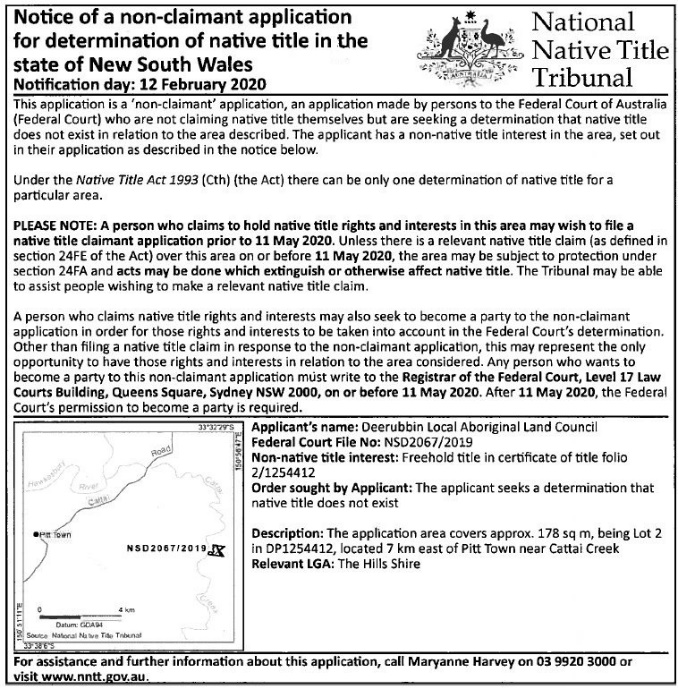
6 In his submissions, the Attorney General pointed out that the public notices published by the National Native Title Tribunal (NNTT) identified the land the subject of the application by reference to Lot and DP number, and supplemented that with a map and a written description of the general geographical location of the land. However, the public notices also incorrectly stated that the area of the land was 178 square metres, which is approximately 1,000 times smaller than the area shown on the Deposited Plan. The Attorney General submitted, nevertheless, that the Court should find that the public notices met the requirements of s 66(3)(d) of the Native Title Act and cl 6(5) of the Native Title (Notices) Determination 2011 (No. 1) (Cth) (Notices Determination). More particularly, the Attorney General submitted that, having regard to the definition of “clear description” in cl 6(5) of the Notices Determination and the particulars which were provided in the public notices (including the map and identification of land by Lot and DP number), it was open to find that the relevant requirements were met, despite the misdescription of the total area of the land.
7 On 15 July 2020, NTSCORP filed written submissions and a notice under s 86G of the Native Title Act that it neither consents nor opposes orders in, or consistent with, the terms sought by Deerubbin.
8 On 29 July 2020, the Court invited the parties to file and serve written submissions in relation to the misdescription of the total area of the land the subject of the application in the relevant public notices. That misdescription is addressed further below. Deerubbin, the Attorney General and NTSCORP filed supplementary submissions in response to that invitation.
9 To avoid adding unnecessarily length to these reasons for judgment, and noting that the respondents do not oppose the orders sought, I will not separately summarise the parties’ respective submissions (which understandably overlap to a large degree). Those submissions, where relevant, will be addressed below.
Relevant legislation and case law
10 It is appropriate to summarise the key legislation relevant to this application.
11 Section 42(1) of the ALRA provides that:
(1) An Aboriginal Land Council must not deal with land vested in it subject to native title rights and interests under section 36(9) or (9A) unless the land is the subject of an approved determination of native title (within the meaning of the Commonwealth Native Title Act).
12 Deerubbin seeks the determination in this case to enable it to “deal with land”. The term “deal with land” is defined in s 40 of the ALRA to include, inter alia, the sale, exchange, lease mortgage, disposal of, or other creation of or passing of a legal or equitable interest in land, the grant or release of an easement or covenant benefiting land, the making of a development application or any other action (including executing an instrument) relating to land that is prescribed by the relevant regulations. Section 36(9) of the ALRA relevantly provides that “any transfer of lands to an Aboriginal Land Council under this section shall be for an estate in fee simple but shall be subject to any native title rights and interests existing in relation to the lands immediately before the transfer”.
13 Section 86G of the Native Title Act provides that:
Unopposed applications
Federal Court may make order
(1) If, at any stage of a proceeding in relation to an application under section 61, but after the end of the period specified in the notice given under section 66:
(a) the application is unopposed; and
(b) the Federal Court is satisfied that an order in, or consistent with, the terms sought by the applicant is within the power of the Court;
the Court may, if it appears appropriate to do so, make such an order without holding a hearing or, if a hearing has started, without completing the hearing.
Note: If the application involves making a determination of native title, the Court's order would need to comply with section 94A (which deals with the requirements of native title determination orders).
Meaning of unopposed
(2) For the purpose of this section, an application is unopposed if the only party is the applicant or if each other party notifies the Federal Court in writing that he or she does not oppose an order in, or consistent with, the terms sought by the applicant.
14 The principles applicable to the determination of non-claimant applications under s 61 of the Native Title Act were recently considered by the Full Court of this Court in Mace v State of Queensland [2019] FCAFC 233; 375 ALR 717 per Jagot, Griffiths and Mortimer JJ. The relevant principles can be summarised as follows:
(a) The Court’s approach to whether the applicant has discharged its burden of proof in a non-claimant application that no native title exists is the same as that taken in relation to any other applicant ([12]).
(b) The question for the Court remains the same whether the application is unopposed, or contested: has the applicant discharged its burden of proof that no native title exists in the claim area? ([44]).
(c) The usual standard of proof in civil litigation applies, being proof on the balance of probabilities ([54]).
(d) Where there is no direct, or even indirect evidence of claims of connection arising from traditional law and custom to the land in question, then there may be little which could “cast doubt” on the case brought by the applicant in the non-claimant application that no native title exists. Just as on a claimant application, the Court cannot be asked to decide a non-claimant application by a process of speculation as to what native title rights and interests might or might not exist in the land in question. The Court must act on evidence, direct or indirect, which can be weighed against the case brought by the non-claimant applicant ([51]-[52]).
(e) The Court’s task is to consider each application on its merits and decide if the non-claimant applicant has discharged its burden of proof. In doing so, the subject-matter of the non-claimant application, and the consequences of a negative determination, inform the requisite level of persuasion for a negative determination ([82]).
(f) The overriding proposition is that each case must be assessed on its own facts: on the nature of the land and the tenure involved, on the presence or absence of any present or previous native title claims and the nature and content of those claims, and on any particular evidence adduced on behalf of an applicant, and on behalf of any respondents ([47-48]).
(g) It is not necessary to employ evidentiary or adversarial presumptions which may have been developed by the common law in quite a different context. The better approach is to focus on what the evidence before the Court does establish – whether for or against the determination sought by the non-claimant applicant – and to give appropriate weight to aspects of the statutory scheme which are designed to have people bring forward all claims to native title over an area ([56]-[57]).
(h) In a non-claimant application, it is inappropriate to impose an inevitable or specific evidential burden on respondents, or potential respondents, so that a non-claimant applicant need only to make out a “prima facie” position. That would be a gloss on the application of the usual burden and standard of proof, which applies as much to a non-claimant application as it does to a claimant application ([63]).
(i) What is or is not put before the Court by the relevant representative body for the area may have a significant effect on the Court’s conclusion whether a non-claimant applicant has discharged its burden of proof ([86]).
(j) The principal evidence likely to impede the grant of a negative determination is evidence of an assertion of native title in the land and waters the subject of the non-claimant application which is objectively arguable, not evidence of the potential for the assertion of native title ([97]).
15 As detailed further below, the obligation to give notice of a s 61 application requires particularly close consideration in the circumstances of this case. These requirements are found in s 66 of the Native Title Act. As stated by the Full Court of this Court in CG (Deceased) on behalf of the Badimia People of State of Western Australia [2016] FCAFC 67; 240 FCR 466 at [61]:
Section 66… must be understood as a procedure to facilitate the making of a “once and for all” determination in relation to the one area of land, if appropriate to be made in the circumstances of the case. The section does so by giving all interested persons notice of an application and a right (s 84(3)) or capacity (s 84(5)) to be joined as party to the proceeding in which the application will be determined. Section 67, which requires all extant applications relating to the same area to be resolved “in the same proceeding”, also facilitates such an outcome.
16 Section 66(1) requires the Registrar of the NNTT to undertake a notification process once in receipt of an application.
17 Section 66(3)(d) provides that:
Notice to be given
(3) Subject to this section, the Registrar must:
…
(d) notify the public in the determined way of the application.
18 Clause 6(5) of the Notices Determination provides that a notice under s 66(3) must include:
(a) details of the application; and
(b) a clear description of the area to which the application relates; and
(c) a statement of how further information about the application can be obtained.
19 Clause 4 of the Notices Determination provides that:
clear description, for an area, means a description of the area that contains enough information, whether by map drawn to scale or description by other means, to work out:
(a) the general location of the area; and
(b) the approximate boundaries of the area.
20 Further legislative background underlying the making and determination of a non-claimant application is summarised at [33]-[40] of Mace.
Consideration and determination
21 In order for the Court to determine whether it is within power and appropriate for the orders sought to be made, Deerubbin must establish that it has met certain formal requirements and that no native title exists in the Determination Area.
(a) Notification under s 66 of the Native Title Act
22 The notification period for this non-claimant application under s 66 of the Native Title Act was from 12 February 2020 to 11 May 2020. The Turner affidavit annexed correspondence from an Applications Officer of the NNTT to Deerubbin’s solicitors dated 22 January 2020 advising of this notification period and attaching a copy of the public notice for reference, as follows (the Notice).
23 The NNTT advised that the application would be publicly notified in the Hills Shire Times and Koori Mail on 28 and 29 January 2020 respectively. Based on the extracts from those publications annexed to the Turner affidavit, it appears to have transpired that the Notice was published in both publications on 29 January 2020. The Notice appeared in the form above and occupied approximately a quarter of a page in each publication.
24 Mr Turner states that, during the notification period, no person filed a native title claim over the application area and that no native title application has since been filed over the application area. Nor has any interlocutory application been filed by any person seeking to be joined to the proceeding.
25 As mentioned, the Attorney General drew the Court’s attention to the fact that the Notice incorrectly stated that the total area the subject of the application is 178 square metres, which is approximately 1,000 times smaller than the area shown in the Deposited Plan. The misdescription in the Notice is undisputed.
26 The Attorney General submits that it is open to the Court to find that the Notice met the requirements of s 66(3)(d) of the Native Title Act and cl 6(5) of the Notices Determination, notwithstanding the misdescription. In support of this submission, the Attorney General highlights the definition of “clear description” in cl 4 of the Notices Determination (extracted above) and the particulars in the Notice, including the map and identification for the land by the Lot and Despotised Plan number.
27 In support of the Attorney General’s position, Deerubbin submitted that the Notice provides the necessary “clear description” (as defined in cl 4 of the Notices Determination), emphasising that the Notice:
(a) makes multiple references to the application area in terms which amount to a clear description within the relevant definition, as reflected in such references as “Freehold title in certificate of title folio 2/1254412” and “Lot 2 in DP1254412, located 7 km east of Pitt Town near Cattai Creek”; and
(b) includes a map of the application area which, is drawn to scale, contains coordinates, identifies significant geographical features and shows the boundaries of the different portions of the application area. Deerubbin submitted that this information, read together with the written descriptions and the information in the Notice, enabled the public readily to ascertain the general location of the application area and its approximate boundaries.
28 In those circumstances, Deerubbin described the incorrect reference to “approx. 178 sq m” as inconsequential. It emphasised that area (in terms of metres or kilometres squared or some other measure), is not one of the items of information which is required to be included in the Notice. Moreover, all of the required information which was provided was correct.
29 NTSCORP agreed with the submissions made by Deerubbin and the Attorney General on this issue.
30 I accept the position advanced by all the parties that the misdescription of the area is not fatal and does not prevent the application being granted. In coming to that view, I should indicate that I accept the submissions of both the Attorney General and Deerubbin, as summarised above, on this matter. Significantly, the misdescription did not relate to any particular mandatory item specified in s 66(3)(d) of the Native Title Act or cl 6(5) of the Notices Determination. In that sense, the misdescription was unfortunate, but gratuitous.
(b) Other formal requirements
31 Having regard to the relevant information provided in the Turner affidavit, the Court considers that the determination sought is within the Court’s power for the following reasons (subject to Deerubbin discharging its burden of proof that native title does not exist in the Determination Area):
(a) Section 13(1)(a) of the Native Title Act provides that an application may be made to the Court for a determination of native title in relation to an area for which there is no approved determination of native title.
(b) An application for determination of native title may be made by inter alia, a person who holds a non-native title interest in relation to the “whole of the area” for the purposes of s 61(1) of the Native Title Act. Deerubbin is the registered proprietor of the Determination Area and therefore has the required non-native title interest to make a non-claimant application.
(c) The application was made in the prescribed form under s 61(5) of the Native Title Act.
(d) The relevant State Minister and representative body have received notice of the application.
(e) As discussed above, public notice was given under s 66 of the Native Title Act.
(f) The notification period specified under s 66 of the Native Title Act must have ended before the Court may make an order under s 86G, and that period ended on 11 May 2020.
(g) There is no overlap between the Determination Area and any previous approved determination of native title for the purposes of ss 13(1) and 68 of the Native Title Act.
(h) Section 225 provides that a determination of native title is a determination of whether or not native title exists in relation of a particular area of land or waters. As the application seeks a determination that native title does not exist, the Court is not required to determine the matters at paragraphs (a) to (e) of s 225 of the Native Title Act.
(i) The Court has jurisdiction to hear and determine the application under s 81 of the Native Title Act.
32 With regard to overlapping claims, it should be noted that Deerubbin referred to three historical claims being the Boongary Clan claim (NSD6097/1998), the Darug #1 claim (NSD6087/1998) and the Darug Tribal Aboriginal Corporation claim (NSD6061/1998).
(c) Extinguishment
33 As noted above, Deerubbin bears the onus of proof to establish, on the balance of probabilities, that no native title exists in relation the Determination Area.
34 Deerubbin submitted that the Court must be satisfied on the balance of probabilities that native title does not exist in relation to the Determination Area because either:
(a) native title is not claimed by, or cannot be proved by, a native title claimant; or
(b) native title has been extinguished by one or more prior acts of the Crown.
35 The former basis was the subject of detailed consideration in Mace and the latter is supported by authorities such as Mace at [49]; Worimi Local Aboriginal Land Council v Attorney-General of New South Wales [2018] FCA 1329 at [97]-[98] and Gandagara Local Aboriginal Land Council v Attorney-General of New South Wales [2013] FCA 646 at [64]-[70]).
36 With respect to point (b), Deerubbin made submissions with respect to both:
(a) Special Lease 1929-1 Windsor for Agriculture notified on 24 January 1930 under the Crown Lands Consolidation Act 1913 (NSW) (CLCA) for the term 1 January 1930 to 31 December 1943 (1930 Special Lease); and
(b) Special Lease 1959-26 Windsor for Grazing and Agriculture notified on 6 May 1960 under the CLCA for the term 20 April 1960 to 31 December 1973 (1960 Special Lease).
37 The Attorney General submitted that there is clear evidence that native title was extinguished by the grant of the 1930 Special Lease and therefore it is unnecessary for the Court to consider the alternative bases put by Deerubbin. NTSCORP similarly submitted that, on the basis of the evidence annexed to the non-claimant application and the Wright affidavit, native title would have been wholly extinguished by the earlier grant of the 1930 Special Lease and therefore the 1960 Special Lease would have had no additional extinguishing effect. NTSCORP also made submissions that the judgment of Reeves J in Badimia is correct, such that there is no logical reason to determine a non-claimant application once land is subject to s 24FA protection under the ALRA. However, NTSCORP did not deny the necessity, nor the power, of the Court to determine non-claimant applications for the purpose of State legislation. NTSCORP also noted that the Court had previously placed a high importance on evidence from local Aboriginal people with traditional knowledge in relation to the area the subject of non-claimant applications and there was no such evidence in this proceeding.
38 For the reasons that follow, the Court accepts that:
(a) the 1930 Special Lease was a special lease for the purpose of ‘agriculture’ granted under s 75 of the CLCA;
(b) the 1930 Special Lease is a “Scheduled interest” for the purposes of s 23B(2)(c)(ii) of the Native Title Act pursuant to Item 3(8) of Pt 1 of Schedule 1;
(c) the lease affected the whole of the Determination Area; and
(d) therefore, the lease would have wholly extinguished any native title existing in the Determination Area at the time of the grant.
39 Extinguishment of native title is dealt with in Divs 2, 2A and 2B of Pt 2 of the Native Title Act. The scope and operation of that Scheme was helpfully summarised by Bennett J in Brown v State of Western Australia (No 2) [2010] FCA 498; 268 ALR 149 at [58]-[60] (subsequently cited on appeal in Brown v State of Western Australia [2012] FCAFC 154; 208 FCR 505 at [24] per Mansfield J and in State of Western Australia v Brown [2014] HCA 8; 253 CLR 507 at [31]):
Part 2 Division 2 of the Native Title Act 1993 (Cth) (the NTA) is concerned with the validation of past acts which, were it not for the NTA, would be invalid. Section 228 defines a “past act” as an act that took place before 1 January 1994 (or 1 July 1993 in the case of legislation) which is invalid, but would have been valid but for native title. Invalidity would have arisen by reason of the Racial Discrimination Act 1975 (Cth) (the RDA). Where an act took place before the commencement of the RDA on 31 October 1975, the act would not have been rendered invalid by reason of the RDA. Hence, it is not a “past act” under s 228 for which it is necessary to have regard to Pt 2 Div 2.
Pt 2 Div 2 of the NTA provides not only for the validation of past acts but also for the extinguishing effect of those acts. Some past acts extinguish native title (see also ss 229 to 232). Relevantly, Pt 2 Div 2B confirms the extinguishing effect of “previous exclusive possession acts” and “previous non-exclusive possession acts”, which are not confined to “past acts”. If Pt 2 Div 2B of the NTA applies to a particular act, the extinguishment regime of Pt 2 Div 2 is put aside and any overlap between the two extinguishment regimes is resolved in favour of Pt 2 Div 2B and its corresponding State and Territory provisions (State of Western Australia v Ward (2002) 213 CLR 1 at [10]). Accordingly, Pt 2 Div 2B provides the analytical starting point. If an act extinguishes native title under Pt 2 Div 2B, it is unnecessary for the Court otherwise to examine extinguishment under the NTA (ss 23C(3), 23G(3)).
Nonetheless, acts that do not fall within either category of “previous exclusive possession acts” and “previous non-exclusive possession acts” may still extinguish native title apart from the provisions of Pt 2 Div 2B. The NTA does not constitute a comprehensive code of extinguishment (see, for example s 23B(9C)(a)) and an act to which Pt 2 Divs 2, 2A or 2B of the NTA do not apply may still have been effective to extinguish native title under the common law.
40 The relevant Division for the purposes of this application is Div 2B of the Native Title Act, which confirms the past extinguishment of native title by valid or validated acts, which are defined as “previous exclusive possession acts” (PEPAs) or “previous non-exclusive possession acts”. A PEPA attributable to the Commonwealth extinguishes native title rights and interests (s 23C) and the law of a State or Territory may make provision to the same effect as s 23C in respect of all or any PEPAs attributable to that State or Territory (s 23E). Section 20 of the Native Title (New South Wales) Act 1994 (NSW) is such a provision which, when read together with ss 23C and 23E of the Native Title Act, has the effect that a PEPA attributable to the State of New South Wales (other than for public work) wholly extinguishes native title rights and interests and that extinguishment is taken to have happened when the act was done.
41 Section 23B(2) relevantly provides that an act is a PEPA if it is valid, it took place before 23 December 1996 and it consists of the granting or vesting of, inter alia, a “Scheduled interest”.
42 Clause 3(8) of Part 1 of Sch 1 lists the following as a “Scheduled interest”:
A special lease under… section 75 or 75B of the Crown Lands Consolidation Act 1913 that permits the lessee to use the land or waters covered by the lease solely or primarily for any for the following:
…agriculture…
43 The documents annexed to the Wright affidavit establish that the 1930 Special Lease was granted for the purpose of agriculture for a term commencing on 1 January 1930 (as recorded in New South Wales Government Gazette No. 8, published on 24 January 1930 at p 387).
44 The power to grant such a lease arose from s 75 of the CLCA, which conferred on the Minister a power to grant leases for any one of the purposes set out in s 75 “or for any purpose declared by the Minister by notification in the Gazette to be a purpose within this section”.
45 As stated by Ms Radford in her affidavit, page 7675 of New South Wales Government Gazette No 791 shows that on 20 November 1895 “Agriculture” was declared to be a “Purpose” within the meaning of s 90 of the Crown Lands Act of 1844 (NSW). Section 3(f) of the CLCA provided for the continued force of certain proclamations or notifications including “any other proclamations or notifications of the like public nature and purport made under statutory powers which were in existence immediately before the passing of the [CLCA]”.
46 In light of the above, the Court is satisfied that the 1930 Special Lease was a PEPA for the purposes of s 23B(2).
47 In these circumstances, any native title was extinguished by the grant of the 1930 Special Lease and it is unnecessary to determine the other matters raised by Deerubbin’s application. In so far as it is necessary to NTSCORP’s submissions that the separate judgment of Reeves J in Badimia is correct, it goes without saying that “the position as stated by the majority in Badimia is the law to be applied” (see Mace at [69]).
Conclusion
48 For all these reasons, the Court is satisfied that it is appropriate to make the orders sought by Deerubbin.
I certify that the preceding forty-eight (48) numbered paragraphs are a true copy of the Reasons for Judgment of the Honourable Justice Griffiths. |
Associate:


