Federal Court of Australia
Hall v Arnold Bloch Leibler (a firm) [2020] FCA 1495
ORDERS
Applicant | ||
AND: | Respondent | |
DATE OF ORDER: |
THE COURT ORDERS THAT:
1. The application to inspect the disputed documents claimed to be subject to legal profession privilege be dismissed.
2. The parties file and serve an agreed position on costs, or in default of agreement, a short written submission on or before 4.00pm on 27 November 2020, which dispute will the determined on the papers.
Note: Entry of orders is dealt with in Rule 39.32 of the Federal Court Rules 2011.
MIDDLETON J:
INTRODUCTION
1 The Court has before it an application in relation to discovery, which was heard concurrently with the proceeding Arnold Bloch Leibler (A Firm) v Slater & Gordon Limited [2020] FCA 1496 (the ‘ABL v Slater & Gordon Proceedings’).
2 In the ABL v Slater & Gordon Proceedings I have dismissed the application for the declaration sought, other than making a declaration on 8 May 2020 (which was varied on 16 October 2020) in the following terms:
No breach of any obligation of confidence owed by the Applicant (ABL) to the Respondent (Slater & Gordon) would arise from or, alternatively, Slater & Gordon would not be entitled to restrain the disclosure and/or use by ABL (including its partners, employees, agents and legal representatives) of all documents in the Due Diligence Committee due diligence files which, under section 11 of the Due Diligence Planning Memorandum, were required to be collated and retained for at least 7 years, for the purpose of ABL defending the Applicant’s claim against ABL in Proceeding No VID 1010 of 2019.
3 The reasons in this proceeding are to be read in conjunction with the reasons in the ABL v Slater & Gordon Proceedings, and with the definitions contained therein.
4 The issue primarily addressed in the application in this proceeding and in the ABL v Slater & Gordon Proceedings was waiver, although Mr Hall in this proceeding has also raised the issue of existence of legal professional privilege over some of the documents in dispute.
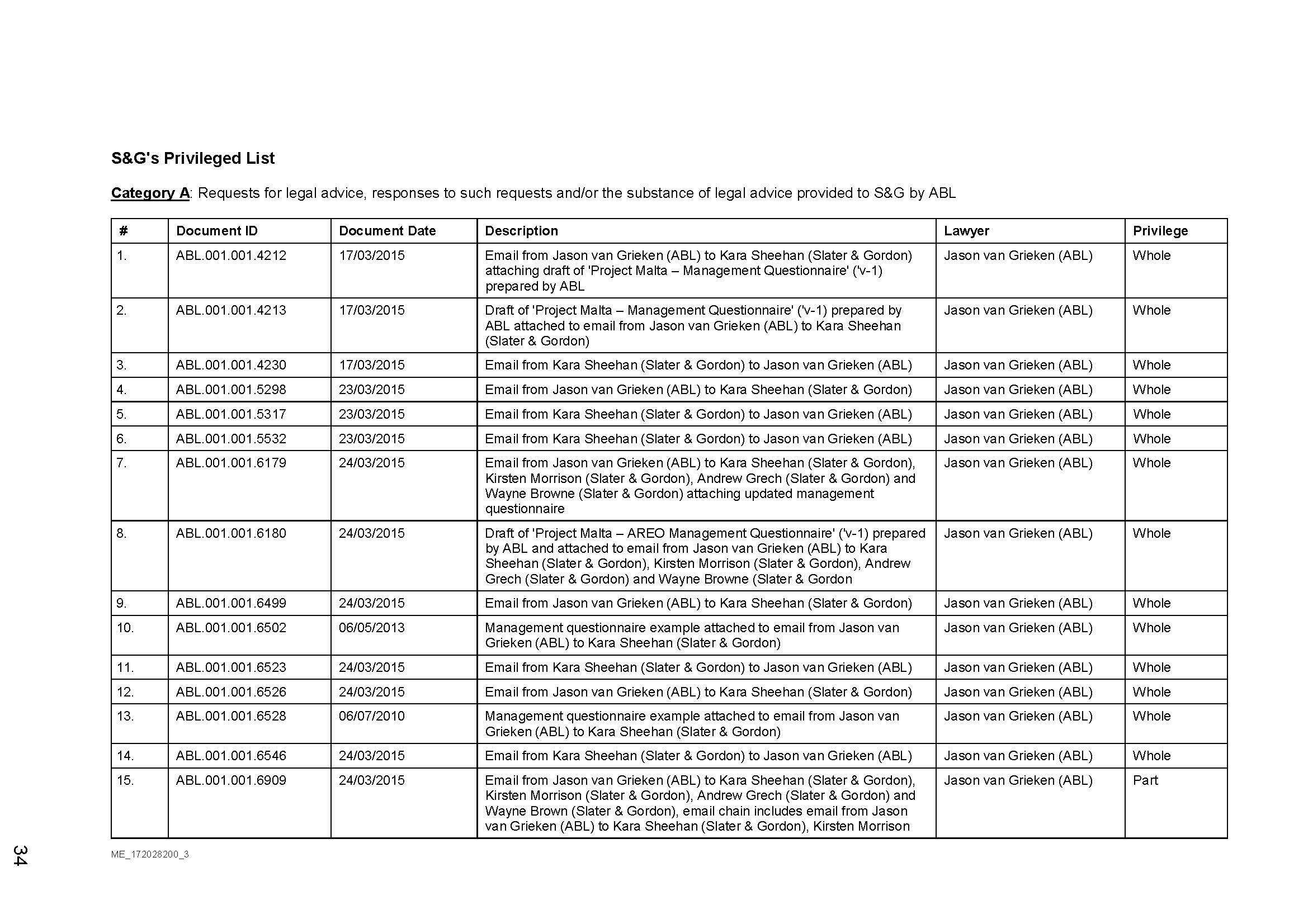
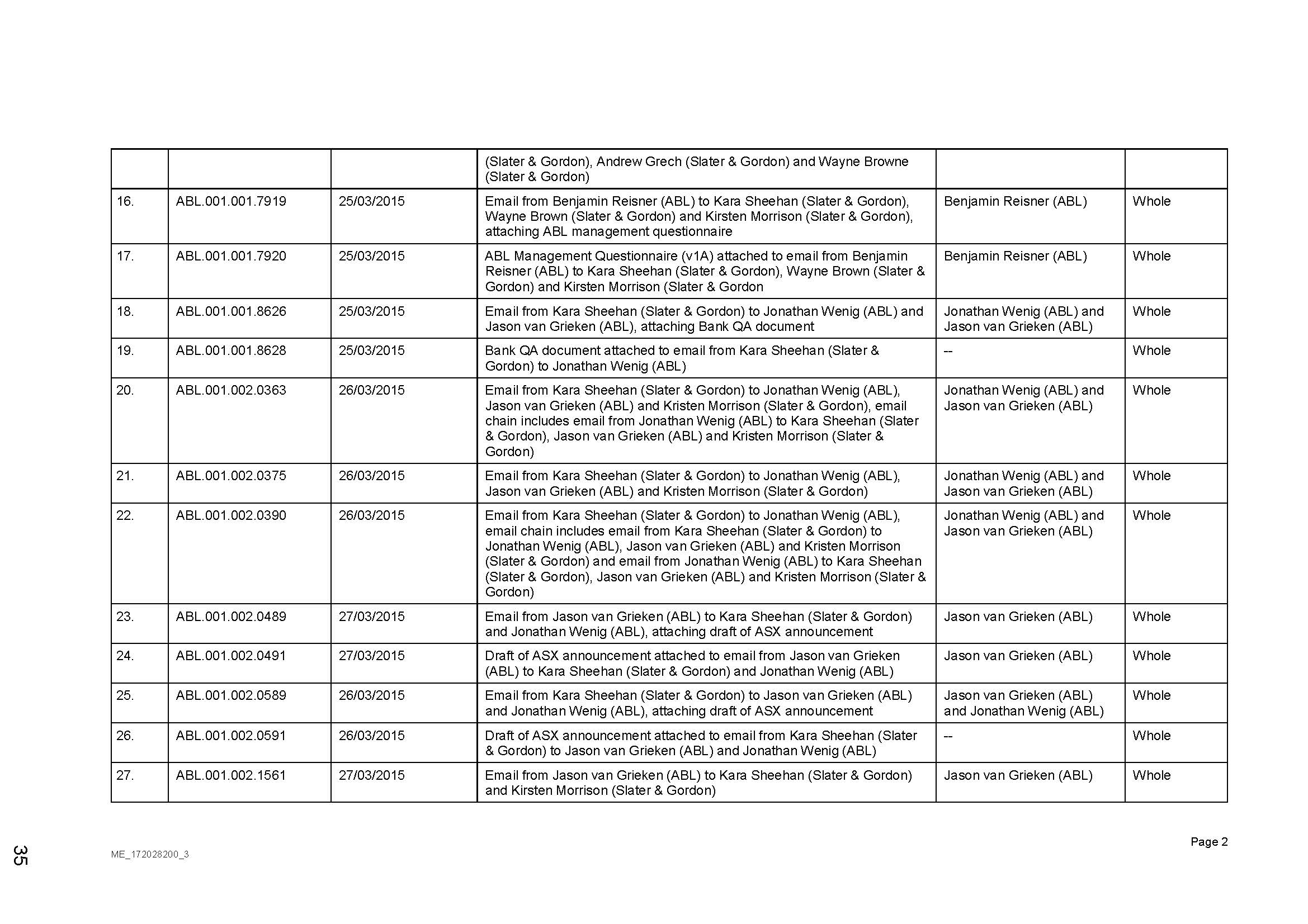
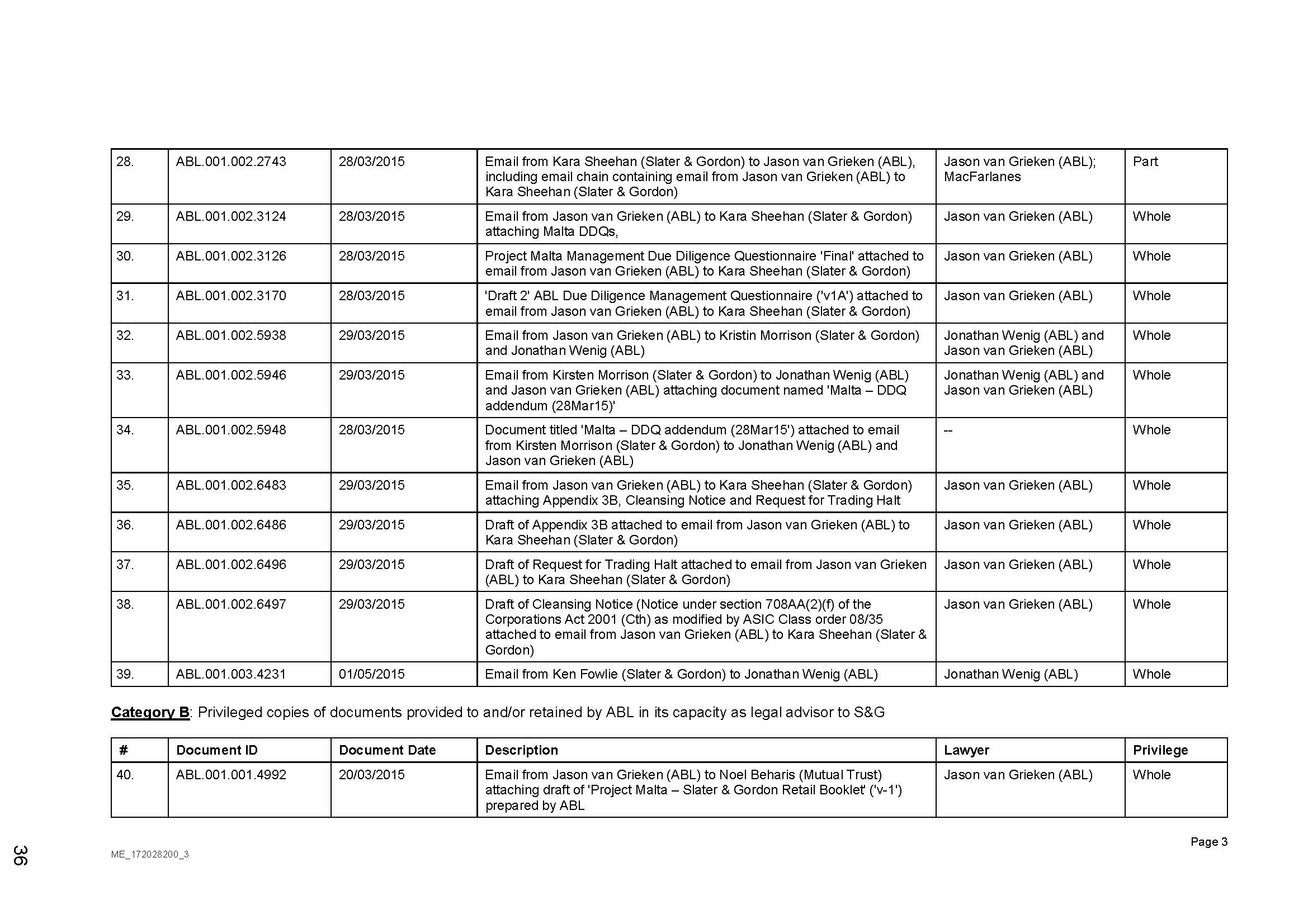
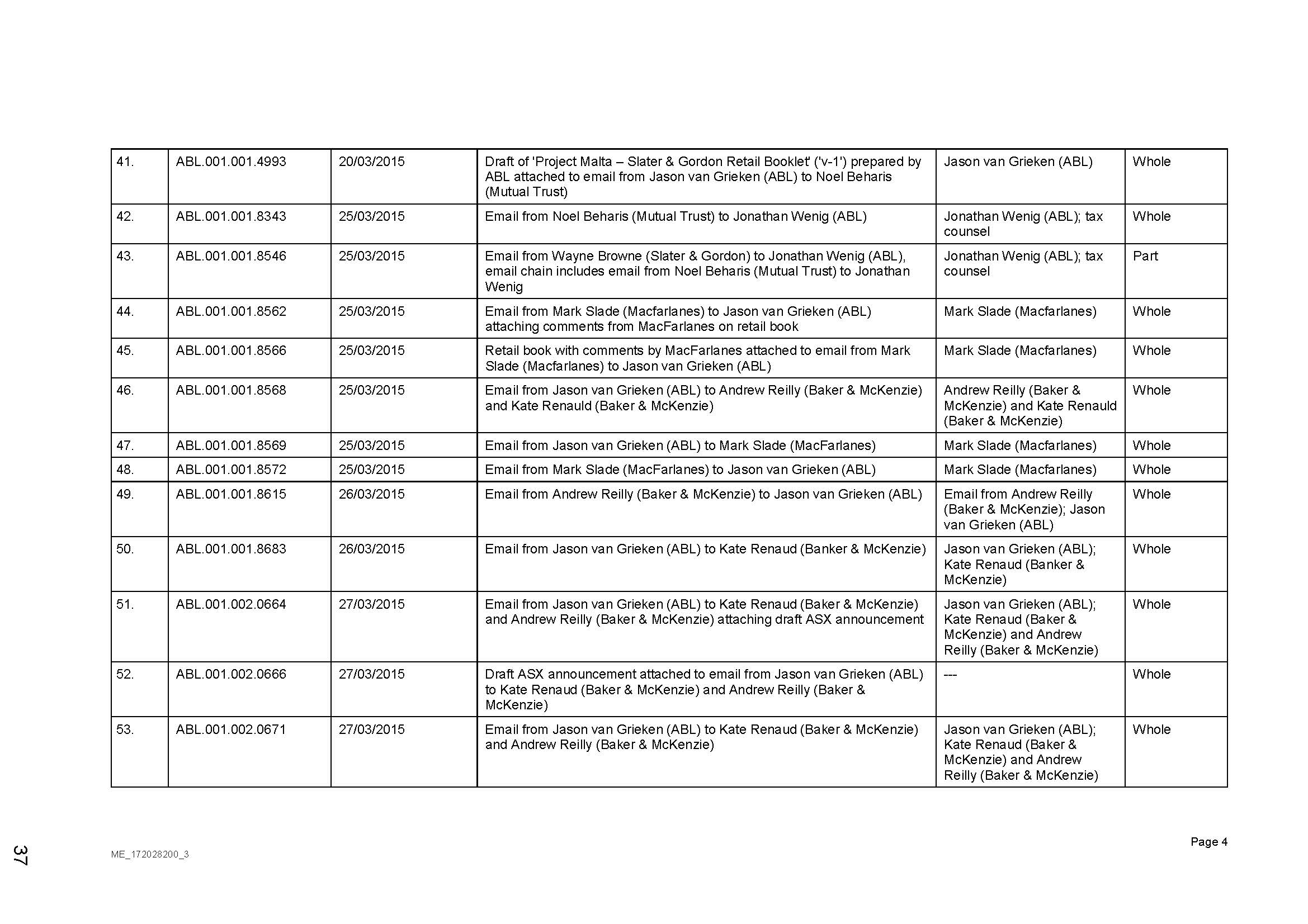
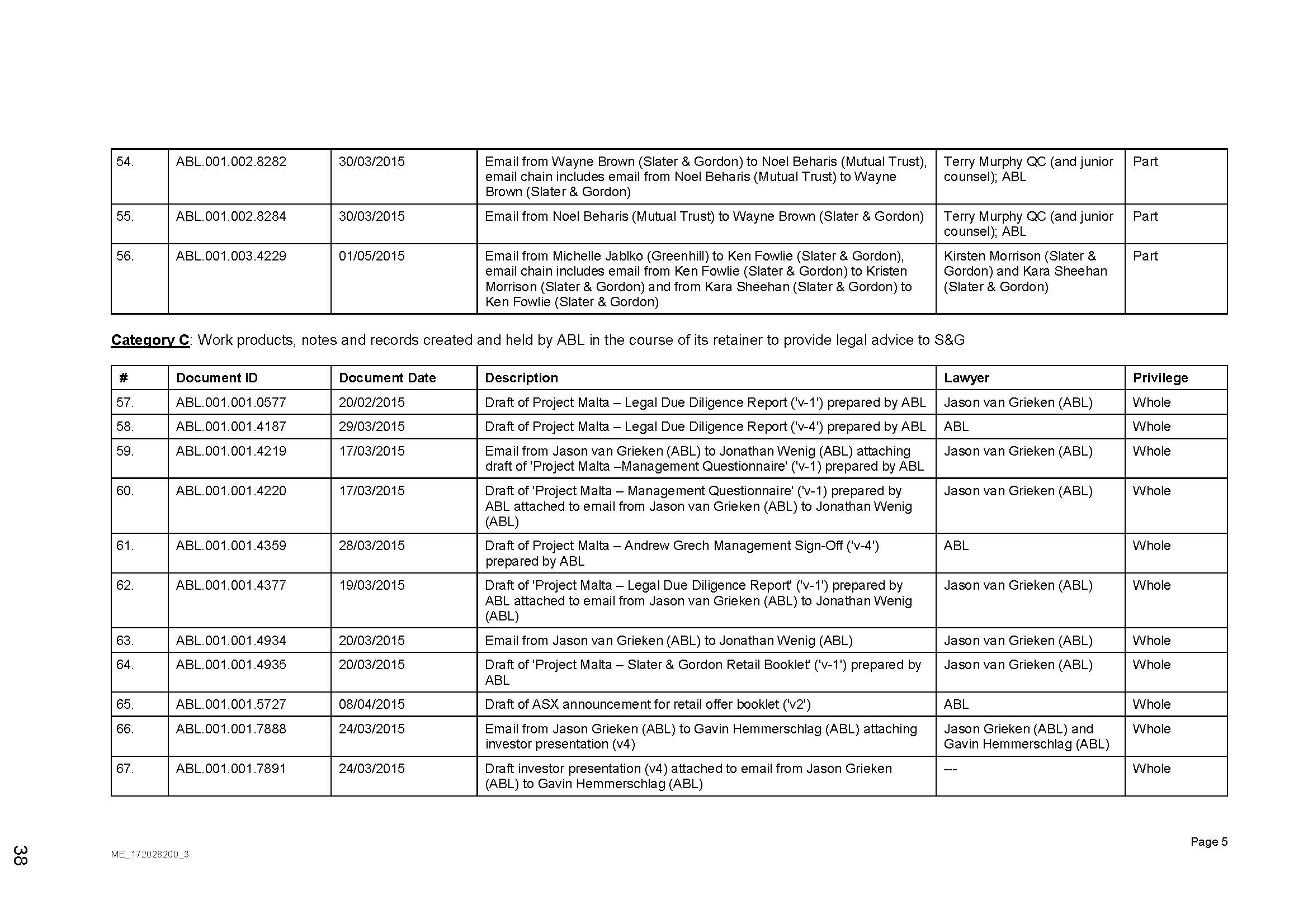
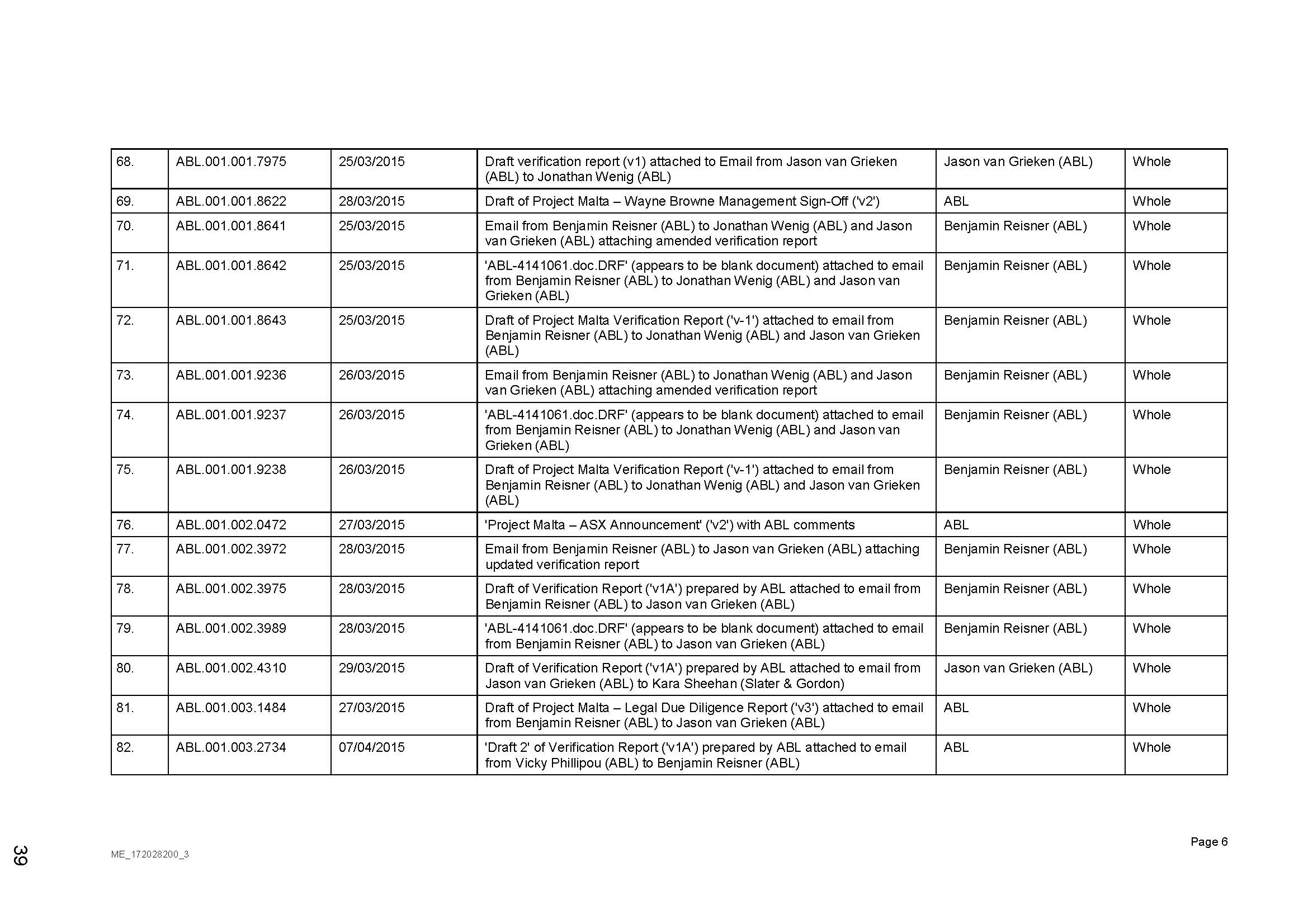
5 Slater & Gordon has asserted claims for legal professional privilege over certain of the documents in ABL’s initial list of discovered documents in this proceeding. The documents in respect of which Slater & Gordon claims privilege are identified in annexure RDM-3 to the affidavit of Richard Murphy sworn 26 May 2020 (Murphy Affidavit) (the ‘Documents’). The Documents in dispute (82 in number) are part of the privileged list referred to in the Murphy Affidavit.
6 Attached to these reasons is Annexure RDM-3 to the Murphy Affidavit which is the list of the Documents.
7 Eight of the Documents are also ones where it is contended that other parties may also have a claim for legal professional privilege (the ‘8 Document Subset’).
8 Mr Hall contends that he should be permitted to inspect the Documents, subject only to staying that order in respect of the 8 Document Subset for a short period to allow the other parties to assert any claim for privilege they may wish to seek to agitate. In view of the position taken by the Court that Mr Hall not be permitted to inspect the Documents, no stay is required.
9 Mr Hall’s primary position is that Slater & Gordon has expressly waived confidentiality over the Documents, and in the alternative, has impliedly waived confidentiality, such that legal professional privilege cannot attach to the Documents.
LEGAL PRINCIPLES
10 The principles of law relating to the existence of legal professional privilege and waiver are well established, although their application is not always straightforward.
11 Legal professional privilege attaches to confidential communications brought into existence for the dominant purpose of obtaining or providing legal advice or use in reasonably anticipated legal proceedings: see eg Esso Australia Resources Ltd v Federal Cmr of Taxation (1999) 201 CLR 49 and Daniels Corporation International Pty Ltd v Australian Competition and Consumer Commission (2002) 213 CLR 543 at 552.
12 Legal professional privilege will cover a copy of a document provided to or retained by a lawyer where the copy was brought into existence for the dominant purpose of obtaining legal advice or use in legal proceedings: see Lane v Admedus Regen Pty Limited [2016] FCA 864 (‘Lane’) at [21], citing Commissioner of Australian Federal Police v Propend Finance Pty Ltd (1997) 188 CLR 501 (‘Propend’) per Gaudron J (at 543-544) and Gummow J (at 571-572) and Barnes v Commissioner of Taxation [2007] FCAFC 88 per Tamberlin, Stone and Siopis JJ (at [5]). Privilege in a “host” document will extend to documents attached to the host document: see Lane at [22].
13 In Kamasaee v Commonwealth of Australia (No 2) (LPP Ruling) [2016] VSC 404, Macaulay J stated:
[44] Whilst the [earlier emails in the chain], may not have attracted legal advice privilege in their own right, if they were ‘copied’ and then attached to a request sent to a lawyer for legal advice, those ‘copies’ could qualify for privilege because of the purpose for which they were brought into existence.
[45] Using the particular processes of email communication, instead of making additional ‘copies’ of emails that precede a proposed new email to another person, it is possible (and commonplace) to ‘attach’ the earlier emails by simply ‘forwarding’ them prefaced by the new email...
[46] … [T]hat on-forwarding of the email chain was tantamount to making ‘copies’ of the original email communications for the purpose of seeking the advice…
[47] … On the authority of Propend those versions of the [earlier emails] are protected by legal advice privilege.
14 The dominant purpose for which a particular communication was made is a question which must be answered objectively: see Commissioner of Taxation v Pratt Holdings (2005) 225 ALR 266 at [30] (‘Pratt Holdings’); AWB Ltd v Cole (No 5) (2006) 155 FCR 30 (‘AWB v Cole (No 5)’) at [44]; Carter Holt Harvey Wood Products Australia Pty Ltd v Auspine Ltd [2008] VSCA 59 at [2]-[3]; and “having regard to the evidence, the nature of the document and the parties’ submissions”: see Pratt Holdings at [30].
15 In many cases it will be impractical to expect that the author or originator of every document should swear an affidavit in support of a privilege claim: see Hoy Mobile Pty Ltd v Allphones Retail Pty Ltd [2007] FCA 933 (‘Hoy Mobile’) at [16].
16 As Jessup J held in Asahi Holdings (Australia) Pty Ltd v Pacific Equity Partners Pty Ltd [2013] FCA 998 (‘Asahi Holdings’) at [38]:
The say-so of the maker of the communication will not be conclusive and, in the usual run of cases, will not even be necessary. Purpose is to be determined from the content of the document understood in its full context. The question relates to the purpose of the communication rather than to the immediate thinking of the maker of the communication at the relevant time.
17 Evidence based on information and belief can be given by a party’s solicitor as to purpose of a document’s creation, notwithstanding that the solicitor did not create the document, provided that he or she specifies the source of that information and belief: see Hoy Mobile at [16].
18 In Asahi Holdings, Jessup J held at [39] that evidence by a party’s solicitor that a document was made for the dominant purpose of giving or receiving legal advice is evidence of:
an objective professional conclusion based on his or her reading of the document and understanding of the context from instructions given by the client, and from his or her familiarity with the case generally (a conclusion which may, in a case in which the documents are voluminous, necessarily involve also the conclusions of other practitioners sharing the relevant workload).
19 As to waiver, I have set out the relevant legal principles in the reasons in the ABL v Slater & Gordon Proceedings.
20 In addition to the cases referred to in the ABL v Slater & Gordon Proceedings, Mr Hall contends that under well-established principles, any waiver extends to all associated material relevant to the same issues or subject matter as held in Australian Wheat Board Ltd (AWB) v Cole (No 5) (2006) 155 FCR 30 at [164]-[165]:
[164] …it is well established that a voluntary disclosure of privileged documents can result in a waiver of privilege over those documents and associated material. The test applied to determine the scope of any waiver of associated material is whether the material that the party has chosen to release from privilege represents the whole of the material relevant to the same issue or subject matter: Maurice at CLR 482 and 484; ALR 35 and 36 per Gibbs CJ, CLR 488; ALR 39 per Mason and Brennan JJ, and CLR 489 9; ALR 47 per Dawson J.
[165] In Maurice, Gibbs CJ said (at CLR 482; ALR 35):
Similarly, where a party disclosed a document which contained part only of a memorandum which dealt with a single subject-matter, and then read the document to the judge in the course of opening the case, it was held that privilege was waived as to the whole memorandum: Great Atlantic Insurance Co v Home Insurance Co [1981] 1 WLR 529 at 538–9; [1981] 2 All ER 485 at 492. In that case Templeman LJ said:
… the rule that privilege relating to a document which deals with one subject matter cannot be waived as to part and asserted as to the remainder is based on the possibility that any use of part of a document may be unfair or misleading, that the party who possesses the document is clearly not the person who can decide whether a partial disclosure is misleading or not, nor can the judge decide without hearing argument, nor can he hear argument unless the document is disclosed as a whole to the other side. Once disclosure has taken place by introducing part of the document into evidence or using it in court it cannot be erased.
The same test must be applied in deciding whether the use in legal proceedings of one document impliedly waives privilege in associated material. In Nea Karteria Maritime Co Ltd v Atlantic & Great Lakes Steamship Corp [No 2] Mustill J dealt with this question and suggested the following test:
… where a party is deploying in court material which would otherwise be privileged, the opposite party and the court must have an opportunity of satisfying themselves that what the party has chosen to release from privilege represents the whole of the material relevant to the issue in question. To allow an individual item to be plucked out of context would be to risk injustice through its real weight or meaning being misunderstood.
[167] AWB relied upon the way in which the principle was formulated by the Court of Appeal in British American Tobacco Australia Services Ltd v Cowell (2002) 7 VR 524 at 564 [121]:
‘A reference in one letter of advice to an earlier letter of advice does not expose the latter to scrutiny by the other party to litigation merely because legal professional privilege is waived in relation to the former: implied waiver is not so generous a doctrine. As we apprehend it, where legal professional privilege is waived in relation to one piece (or part) of advice, the privilege is impliedly waived in relation to another if - and only if - that other is necessary to a proper understanding of the first. As established by the High Court (at least since Mann v. Carnell) the test in such cases is whether it would be “inconsistent” for a party to rely upon, and so to waive legal professional privilege in respect of, the one without also being taken to have waived privilege in respect of the other.’
It is no doubt correct that a mere reference to the existence of legal advice in a disclosed document will not be regarded as a waiver of its contents, albeit a different conclusion would follow if the gist, substance or conclusion of the legal advice is voluntarily disclosed. But, with great respect to their Honours, the proposition concerning waiver of associated material is expressed too narrowly and in a way that is not consistent with the test propounded by the High Court in Maurice. The principle propounded by the Court of Appeal may work adequately enough in some circumstances, particularly where privilege is sought to be maintained over one part of a single piece of legal advice, but in other circumstances it will not give effect to the principles explained in Maurice.
21 Then helpfully O’Callaghan J in Zantran Pty Limited v Crown Resorts Limited (No 2) [2020] FCA 1024 reminded us that “associated material waiver” is part of the overall enquiry as to inconsistency established in Mann v Carnell (1999) 201 CLR 1. His Honour said at [41] to [43]:
[41] It may be that the difference between the submissions advanced by the parties that I have set out above with respect to so-called “associated material waiver” is more apparent than real. Zantran’s submission that the test to be applied is “whether the material that the party has chosen to release from privilege represents the whole of the material relevant to the same issue or subject-matter” may be said, on one view, not to invite a different question to the inconsistency test in Mann v Carnell. In either case, the critical anterior question is to identify the relevant issue or subject matter.
[42] When waiver is express, as it is here, and an issue arises about whether and to what extent privilege has also been waived with respect to “related” non-disclosed documents, the documents in the latter category may, consistently with Mann v Carnell, be described as “associated material”. However, I do not read anything that Young J said in AWB Ltd v Cole as suggesting, as Zantran contends, that there is some species of waiver involving so-called “associated material” that involves an expansion of the principles in Mann v Carnell. It is clear from his Honour’s reasoning, especially at [177]ff under the heading “Waiver has been established”, that his Honour held that the AWB had waived privilege in that case because:
(1) by disclosing the results of its legal reviews and legal advice it had obtained to the Australian Government and others, the AWB had deployed the gist or substance of that advice;
(2) it had made a conscious and voluntary decision so to deploy the advice because it considered that it was in its commercial interests to do so;
(3) those actions were inconsistent with the maintenance of confidentiality in the advice; and
(4) having regard to the nature, purpose, terms and extent of its disclosures, the AWB had acted inconsistently with the maintenance of confidentiality over the associated material which underpinned the advice.
[43] And the detailed explanation for those conclusions that follows is, with respect, also entirely consistent with what the plurality of the High Court said in Mann v Carnell, including under the heading “Waiver of privilege at common law”, as follows (at 13 [28]ff (Gleeson CJ, Gaudron, Gummow and Callinan JJ)):
28. At common law, a person who would otherwise be entitled to the benefit of legal professional privilege may waive the privilege. It has been observed that ‘waiver’ is a vague term, used in many senses, and that it often requires further definition according to the context. Legal professional privilege exists to protect the confidentiality of communications between lawyer and client. It is the client who is entitled to the benefit of such confidentiality, and who may relinquish that entitlement. It is inconsistency between the conduct of the client and maintenance of the confidentiality which effects a waiver of the privilege …
29. Waiver may be express or implied. Disputes as to implied waiver usually arise from the need to decide whether particular conduct is inconsistent with the maintenance of the confidentiality which the privilege is intended to protect. When an affirmative answer is given to such a question, it is sometimes said that waiver is ‘imputed by operation of law’. This means that the law recognises the inconsistency and determines its consequences, even though such consequences may not reflect the subjective intention of the party who has lost the privilege … What brings about the waiver is the inconsistency, which the courts, where necessary informed by considerations of fairness, perceive, between the conduct of the client and maintenance of the confidentiality; not some overriding principle of fairness operating at large.
30. In Goldberg v Ng [(1995) 185 CLR 83] this Court considered a case in which there was disclosure of a privileged communication to a third party, for a limited and specific purpose, and upon terms that the third party would treat the information disclosed as confidential. The Court was divided upon whether, in the circumstances of the case, privilege was waived. However, the reasoning of all members of the Court was inconsistent with the proposition that any voluntary disclosure to a third party necessarily waives privilege. No application was made on the present appeal to re-open Goldberg or any of the earlier authorities on the subject. In Goldberg, reference was made to the statement of Jordan CJ in Thomason v The Council of The Municipality of Campbelltown [(1939) 39 SR (NSW) 347 at 355]:
The mere fact that a person on some one occasion chooses to impart to another or others advice which he has received from his solicitor indicates no intention on his part to waive his right to refuse on other occasions to disclose in evidence what that advice was, and supplies no sufficient reason for depriving him of a form of protection which the law has deemed it specially necessary to throw around communications between solicitor and client.
(Citations omitted).
See also DSE (Holdings) Pty Ltd v Intertan Inc (2003) 127 FCR 499 at 519 [58], 529 [115] (Allsop J, as the Chief Justice then was) (the test to apply at common law is whether the privilege holder has made an assertion (express or implied) as part of its case that lays open the privileged communication to scrutiny, with the consequence that inconsistency arises between the making of the assertion and the maintenance of the confidentiality of the communication), cited with approval in Commissioner of Taxation v Rio Tinto Ltd (2006) 151 FCR 341 at 359 [61], 360 [65] (Kenny, Stone and Edmonds JJ) and Macquarie Bank Ltd v Arup Pty Ltd [2016] FCAFC 117 at [30] (Middleton, Robertson and Gleeson JJ).
CONSIDERATION
22 I accept the evidence in the Murphy Affidavit that the Documents comprise part of ABL’s legal file, being documents communicated to or retained by ABL for the purpose of its provision of legal advice to Slater & Gordon in the course of its retainer.
23 I accept the evidence is sufficient to substantiate the claim for legal professional privilege over the Documents by Slater & Gordon.
24 In the Murphy Affidavit, Mr Murphy said in relation to the Discovered Documents (defined in his affidavit as comprising the discoverable documents identified in ABL’s initial list of documents) and the Project Malta Legal Files Documents (defined in his affidavit as comprising ABL’s ‘01-1838870: Project Malta’ and ‘01-1848618: Project Malta financing’ legal files):
22. The Project Malta Legal Files Documents include communications, documents, work products and records in respect of the equity raising and debt financing, including:
(a) internal communications between lawyers at ABL;
(b) communications between ABL and S&G (including communications which contain the substance of legal advice provided to S&G);
(c) communications between ABL and S&G’s commercial advisors (including communications which contain the substance of legal advice provided to S&G);
(d) communications between ABL and other third parties relevant to or connected with the equity raising or the debt financing; and
(e) work products, notes, drafts and records created and held by ABL in the course of its retainer to provide legal advice to S&G.
23. The Project Malta Legal Files Documents also include communications, documents, work products and records in connection with ABL’s role in the DDC in connection with the due diligence process for the equity raising.
24. From the review undertaken of the Discovered Documents together with their family documents in the context of the Project Malta Legal File Documents and based on the information Ms Yick has provided to me from that review, I formed the view that the documents listed in the Privileged List were made for the dominant purpose of S&G obtaining, and ABL providing, legal advice in the course of ABL’s retainer (and were not prepared, created or held by ABL as a member of or in its role for the DDC) and that in particular:
(a) the documents listed in and identified as ‘Category A’ in the Privileged List record requests for legal advice, responses to such requests and/or the substance of legal advice provided to S&G by ABL;
(b) the documents listed in and identified as ‘Category B’ in the Privileged List are privileged copies of documents provided to and/or retained by ABL in its capacity as legal advisor to S&G; and
(c) the documents listed in and identified as ‘Category C’ in the Privileged List comprise work product, notes and records created and held by ABL in the course of its retainer to provide legal advice to S&G.
Section 11 of the DDPM
25 The first submission of Mr Hall related to s 11 of the DDPM. Mr Hall submits that Slater & Gordon’s solicitors, ABL, were obliged by the first two paragraphs of s 11 of the DDPM to collate and retain the due diligence files. The first two paragraphs read as follows:
The due diligence process is to be documented to provide evidence of the enquiries which have been made (and by whom), the basis on which opinions have been formed and to provide reasonable grounds for belief in the completeness and accuracy of all statements in the Offer Documents.
Reports, comments on those reports and revisions made to them, sign-offs and opinion letters, copies of the verification notes and supporting material and minutes of all Due Diligence Committee meetings, documents tabled at those meetings, all documents generated by Slater & Gordon as part of the due diligence process and any other documents which are material to the due diligence process will be collated in files by the secretary of the Due Diligence Committee and retained by ABL for at least 7 years or until the time limit for a possible cause of action has expired (or, if a proceeding has commenced but not been finally judicially determined by that time, until such time as that has occurred).
26 Section 5.2 of the DDPM provided that a representative of ABL was to act as secretary to the DDC.
27 It was contended by Mr Hall that the fact that the Documents fall within the s 11 definition can be verified by an analysis of the documents. As deposed in Mr Murphy’s affidavit, they comprise:
(1) Category A – documents recording a request for legal advice, responses to such request and/or the substance of legal advice provided to Slater & Gordon by ABL – the individual descriptions of the documents within this category, indicate that the legal advice requested and provided concerns the due diligence management questionnaire, a ‘Q&A’ document, and ASX announcements and notices associated with the Entitlement Offer.
(2) Category B – copies of documents provided to and/or retained by ABL in its capacity as legal advisor to Slater & Gordon – the descriptions of the individual documents within this category reveal that this category comprises emails concerning enclosing the retail offer booklet for the Entitlement Offer, documents provided to ABL for the purpose of it providing legal advice in relation to the retail offer booklet, documents provided to ABL for the purpose of it providing legal advice in relation to ASX documents and investor presentations, and
(3) Category C – work products, notes and records created and held by ABL in the course of its retainer to provide legal advice to Slater & Gordon – the descriptions of the individual documents within this category reveal that these documents comprise drafts of the due diligence reports, due diligence management questionnaire, management sign-off, entitlement offer booklet, ASX announcements, draft investor presentation, and verification report.
28 Undoubtedly the Documents are described in the way contended by Mr Hall, but that does not mean that the Documents fall within the terms of s 11 of the DDPM. In particular, it does not mean that:
(a) the Documents were prepared, created or held by ABL as a member of or in its role for the DDC (as distinct from in some other capacity, including in relation to other legal work performed by ABL for Slater & Gordon); or
(b) the Documents were within “the files” collated by the secretary of the DDC (being a representative of ABL) and retained by ABL for the relevant purpose for which access could be available.
29 The Documents themselves were prepared on the evidence of Mr Murphy for the dominant purpose of Slater & Gordon obtaining, and ABL providing, legal advice in the course of the retainer (Murphy Affidavit at [24]). Slater & Gordon has claimed privilege only over the communications comprising documents in ABL’s legal file, which were prepared in the course of ABL’s retainer for the dominant purpose of providing advice to Slater & Gordon.
30 There is no evidence that the Documents were in fact prepared for or provided to the DDC, or that they otherwise form part of the DDC’s files or records.
31 The final two paragraphs of s 11 of the DDPM relied upon by Mr Hall do not provide ABL and other parties involved in the Entitlement Offer (such as the Underwriters and Greenhill) with a right of access to all of the due diligence documents for the specified purpose. The final two paragraphs of s 11 of the DDPM read as follows (emphasis added):
Slater & Gordon and all those involved in preparing the Offer Documents, as well as the Underwriters and Greenhill, will, at their request, have reasonable access to those files at any time up to completion of the issue of New Shares under the Entitlement Offer.
After that time, members (and their representatives) and members of the Board will have access to the files for the purpose of defending any actual or potential claim against them arising out of or in connection with the Offer Documents or the Entitlement Offer.
32 Section 11 conferred a right on ABL (and the Underwriters and Greenhill) to access “the files” should they be faced with a potential or actual claim arising out of or in connection with the Offer Documents or the Entitlement Offer, such as the present proceeding.
33 The important thing to observe is that the access regime under s 11 of the DDPM is directed to actual “files”, not a general description of documents relating to various topics. It is these “files” that have been collated and retained that are the subject of the declaration made by the Court on 8 May 2020 in the ABL v Slater & Gordon Proceedings, and the access given under s 11 of the DDPM. So to make it quite clear, “other documents which are material to the due diligence process” (as referred to in s 11) which have not been collated in file by the secretary of the DDC (if any), are not entitled to be accessed pursuant to s 11 of the DDPM. The purpose of s 11 was to have put in one repository documents in order to allow certain persons to have reasonable access to files during the due diligence process and thereafter access to this repository for the purpose of defending certain claims.
34 If the Documents are not part of “the files”, not having been collated in the manner contemplated by s 11 then the Documents are not subject to the regime set out in s 11 of the DDPM.
Section 6.7 of the DDPM
35 Mr Hall also relied upon s 6.7 of the DDPM. Section 6.7 is relevantly in the following terms:
Confidentiality
Confidentiality and security of sensitive non-public information must be emphasised to all due diligence team members.
All reports and materials produced for circulation and consideration by the Due Diligence Committee are not to be reproduced or used for purposes other than:
(a) that a member or observer to the Due Diligence Committee or their respective representatives may provide them to its legal advisers on a confidential basis;
…
(c) as are required to be produced by law or regulation, a court, the ASX Listing Rules or the requirements of any regulatory or self-regulatory authority;
(e) as needed by a member or observer to the Due Diligence Committee or their respective representatives in relation to the Entitlement Offer and any actual or potential claim or proceedings against, by or involving the member or observer in relation to the issue of the Offer Documents or the due diligence process or in relation to any regulatory or selfregulatory investigation, inquiry or hearing;
…
The obligations under this section 6.7 apply until, and terminate upon, the earlier of the date the relevant information is no longer confidential (in accordance with each of the points listed above) and the date which is 2 years from the date of adoption of this Memorandum.
36 It was submitted by Mr Hall that to the extent any of the Documents were produced for circulation and consideration by the DDC, s 6.7 of the DDPM operates to remove the application of confidentiality to those documents in three ways.
(1) First, it operates to allow such documents to be reproduced as required by a court (which would encompass production pursuant to orders for discovery).
(2) Second, it operates to allow such documents to be reproduced by any member or observer to the DDC or their representatives in relation to any actual or potential proceeding against them in relation to the Offer Documents or due diligence proceeding, such as this proceeding (this is clearly the circumstances in which ABL, a member of the DDC, finds itself in this proceeding).
(3) Third, the confidentiality obligation imposed by s 6.7 of the DDPM terminated two years from the date of the DDPM on 29 March 2017 and is of no effect now.
37 The simple answer to this contention is that s 6.7 of the DDPM does not apply: the Documents do not form part of “the files” and are not otherwise records of the DDC in the sense that they were produced for circulation and consideration by the DDC. In other words, the Documents are not part of the due diligence process, and are not communications, documents, work products and records in connection with ABL’s role in connection with the due diligence process. The scope of 6.7 is not directed to confidentiality in the role of ABL advising directly Slater & Gordon, but is concerned with information and documents generated as part of the due diligence process.
38 However, as I mentioned in the ABL v Slater & Gordon Proceedings, I again wonder whether there is any real dispute in relation to legal professional privilege (as distinct from mere confidentiality) over the documents that were part of the due diligence process, putting aside the operation of the various sections of the DDPM relied upon by Mr Hall.
Implied waiver
39 I now address Mr Hall’s arguments on implied waiver.
40 Mr Hall submits that if Slater & Gordon has engaged in conduct which results in the loss of confidentiality with respect to the Documents (or associated documents), it cannot adopt a stance which maintains that ABL cannot use them. It is contended that Slater & Gordon has engaged in conduct of that kind which is inconsistent with it maintaining any claim that the documents are, or remain, confidential. This conduct is contended to be both destructive of Slater & Gordon’s resistance to ABL’s claim to be able to use the documents, and destructive of its ability to claim privilege as against Mr Hall.
41 Mr Hall submits in the alternative to his arguments relating to operation of the DDPM, Slater & Gordon’s waiver of confidentiality can be implied as a result of Slater & Gordon’s conduct in three discrete (but relevantly also cumulative) senses.
(1) First, the provision by Slater & Gordon of a confidentiality release to ABL in s 11 of DDPM.
(2) Second, the provision by Slater & Gordon of three applicable confidentiality releases to ABL in s 6.7 of the DDPM.
(3) Third, Slater & Gordon opening for investigation the professional relationship between Slater & Gordon and ABL, in the express contemplation of a proceeding such as this one, by consenting to Mr Hall’s use of discovered documents without any claim of confidentiality or privilege and freed of Harman obligations– such consent being given by Slater & Gordon in order to secure a benefit for itself, namely Mr Hall’s agreement to settle the previous litigation against Slater & Gordon (Hall v Slater & Gordon Proceedings).
I should say at the outset that there can be no “cumulative” effect if, as I find, none of Slater & Gordon’s conduct is inconsistent with the maintenance of confidentiality.
42 There is considerable overlap between grounds (1) and (3) and the arguments raised by ABL in the ABL v Slater & Gordon Proceedings.
43 Mr Hall submits it is the inconsistency of Slater & Gordon’s conduct now, in this proceeding — being the attempted denial of ABL’s use of the documents within its files (and its assertion of privilege over documents within those files that were discovered to Mr Hall in the Hall v Slater & Gordon Proceedings) — that manifests an unfairness to Mr Hall. Mr Hall has incurred significant cost on behalf of himself and group members in having commenced this proceeding. Mr Hall has done so on the basis of Slater & Gordon’s previous position with respect to the discovery of documents within ABL’s files in the Hall v Slater & Gordon Proceedings, and its agreement to release Mr Hall from any Harman obligation which might otherwise have prevented him from using those discovered documents to commence and prosecute these proceedings against ABL.
44 Mr Hall submits that this proceeding should not be conducted in a discovery and evidence vacuum with the Court determining the issues on the basis of only a portion of the documents readily available (or being limited only to those documents which Slater & Gordon and ABL mutually find convenient not to withhold from production).
45 In view of my conclusions above, and my conclusions in the ABL v Slater & Gordon Proceedings, there has been no waiver arising from Slater & Gordon’s conduct as contended for by Mr Hall (and ABL in the ABL v Slater & Gordon proceeding). There will be no order allowing Mr Hall to inspect the Documents on that basis.
Associated material waiver by production of the Opinion Letter
46 As a separate argument, it was contended by Mr Hall that the production of the Opinion Letter, which certifies ABL’s work in the due diligence process, necessarily carries with it a waiver of all material associated with that work including the documents referred to therein. Mr Hall submitted that access to the Documents was necessary for Mr Hall to properly understand the weight and meaning of ABL’s representations within the Opinion Letter, which is the issue at the very centre of Mr Hall’s claims in this proceeding as set out in the Statement of Claim filed 17 September 2019.
47 To explain the relevant issue that arises in the pleading, I need to refer to paragraphs 66 to 77 of the Statement of Claim in this proceeding:
F.1 Materials to which ABL had access and reviewed
66. After the DDC Establishment Date, Wenig (together with other ABL Lawyers) attended, or participated by telephone in, a number of meetings of the DDC, at which information was presented for consideration by the DDC.
Particulars
i) To the best of the Applicant’s knowledge, the DDC met on:
A) 24 March 2015 (agenda: SGH.001.030.2883);
B) 26 March 2015 (two meetings) (minutes: SGH.001.001.6736);
C) 27 March 2015 (minutes: SGH.001.001.6674);
D) 29 March 2015 (minutes: SGH.002.009.3475);
ii) The other ABL Lawyers present were Jason van Grieken and Benjamin Reisner;
iii) Further particulars will be provided following discovery and inspection.
67. At all material times after the DDC Establishment Date, ABL and/or Wenig had access to and was provided with:
(a) all advices, reports and other materials provided by each of ABL, executives and management of Slater & Gordon, Baker & McKenzie, Macfarlanes and Mutual Trust (as “Reporting Persons” for the purposes of the DDPM); and (b) all materials provided to and produced by the DDC (including all minutes of meetings, expert reports, verification questions and answers)
Particulars
i) DDPM, Section 5.4 (SGH.029.001.0331_2 at 0788).
ii) DDPM, Section 5.5(h) (SGH.029.001.0331_2 at 0789).
68. On a date unknown to the Applicant after the ABL Retainer Date and prior to 11:30AM on 29 March 2015, ABL and/or Wenig accessed and reviewed the following documents:
(a) drafts and final forms of questionnaires and certificates by management of Slater & Gordon and other reports and sign-offs;
(b) all documents released to ASX by Slater & Gordon from 5 February 2015;
(c) Slater & Gordon’s continuous disclosure policy;
(d) all minutes of Slater & Gordon’s board meetings from 5 February 2015;
(e) all correspondence between Slater & Gordon and ASIC and ASX in relation to continuous disclosure matters from 5 February 2015; and
(f) successive drafts of the Offer Documents.
Particulars
i) ABL’s Letter to the Board of Directors of SGH (copied to other members of the DDC, Citigroup Global Markets Australia Pty Ltd, Macquarie Capital (Australia) Ltd and Greenhill & Co Australia Pty Ltd dated 23 March 2015 and unsigned (ABL Unsigned Legal Opinion Letter), and 29 March 2015 and signed by Wenig (ABL Signed Legal Opinion Letter), Section 1(i)-(k) (SGH.001.001.6750 at 6751-2). A draft of this letter was provided to the Board of Directors of SGH on 23 March 2015 (SGH.029.001.0331_2 at 0871).
ii) Further particulars of the documents reviewed by ABL will be provided following discovery and inspection.
69. The documents to which ABL had access and reviewed, by reason of the matters pleaded in paragraphs 66 to 68, included:
(a) the Instinctif Report;
(b) the EY Report;
(c) the FRP Report;
(d) the Underwriters’ Questionnaire; and
(e) the 20 March Board Report.
Particulars
i) The Instinctif Report is SGH.029.002.0624, and its annexures included a ComRes survey entitled Personal Injury Claims Policy: MP Survey for Instinctif dated 6 March 2015. The Instinctif Report is one of the “expert reports” referred to in paragraph 67(b) above, and is identified as Report 4, and described as “Final Report provided” in Appendix 1 to Annexure C to ABL’s Legal Due Diligence Report (which is undated, but was provided to SGH prior to 27 March 2015 (ABL’s DD Report) (SGH.029.001.0331_2, 0801 at 0858);
ii) The EY Report is SGH.029.002.0001 and is one of the “expert reports” referred to in paragraph 67(b) above, and is identified as Report 1, and described as “Draft Report provided” in Appendix 1 to Annexure C to ABL’s DD Report (SGH.029.001.0331_2 at 0858);
iii) The FRP Report is SGH.029.002.0690-0702, and is one of the “expert reports” referred to in paragraph 67(b) above and is identified as Report 6.2, and described as “Draft Report provided” in ABL’s DD Report (SGH.029.001.0331_2 at 0858);
iv) the Underwriters’ Questionnaire is one of the “verification questions and answers” referred to in paragraph 68(a) above, and is Annexure C to ABL’s DD Report (SGH.029.001.0331_2 at 0827);
iv) the 20 March Board Report is SGH.029.001.0018, and is a document referred to in the MDDQ, Appendix 6 (Additional Question 2) (SGH.029.001.0331_2 at 0867).
F.2. Work done by ABL
70. On a date unknown to the Applicant prior to 30 March 2015, ABL assisted SGH in preparing and/or settling the 30 March Announcement and the 30 March Presentation, including by amending the section of the 30 March Presentation entitled “Key Risks”.
Particulars
Minutes of DDC meeting on 26 March 2015, Item 5.1 (SGH.002.009.6736 at 6738).
71. On a date unknown to the Applicant prior to 30 March 2015, ABL reviewed and/or finalised the 30 March Cleansing Notice (including the Section 708AA Notice Statement).
Particulars
Minutes of DDC meeting on 29 March 2015, Item 1.4 (SGH.002.009.3475 at 3479)
72. On a date unknown to the Applicant prior to 30 March 2015, ABL undertook work to review and consider whether:
(a) the Section 708AA Statement, considered in the context in which it appeared in the Offer Documents, was misleading or deceptive;
(b) there were no matters relevant to the subject to which the Section 708AA Statement related which were omitted from the Offer Documents; and
(c) the Section 708AA Statement could be cross referred to independent source materials to establish the truth and accuracy or the statement or, where that was not feasible, the truth and accuracy of the statement was based on direct personal knowledge and expertise and/or an analysis demonstrating that the relevant statement had been made on reasonable grounds,
Particulars
i) The Applicant does not with its present state of knowledge know the extent of the work done, save that the work resulted in preparation of the ABL Signed Legal Opinion Letter and ABL’s DD Report;
i) Further particulars will be provided following discovery.
F.3. ABL’s Legal Opinions
73. On a date unknown to the Applicant prior to 27 March 2015, ABL issued:
(a) ABL’s DD Report to the Directors of SGH and the members of the DDC; and
(b) the Unsigned ABL Legal Opinion Letter to the Directors of SGH;
Particulars
i) ABL’s DD Report is undated, but was provided to SGH prior to 27 March 2015, as it was included in the board pack made available to directors of SGH to be held that date and is stamped “Board – 27 Mar 2015 (Transaction Pack) (Video Conference) – Equity Raising” (SGH.029.001.0331_2 at 0801);
ii) The Unsigned ABL Legal Opinion Letter is dated 23 March 2015 and was provided to SGH prior to 27 March 2015, as it was included in the board pack made available to directors of SGH to be held that date and is stamped “Board – 27 Mar 2015 (Transaction Pack) (Video Conference) – Equity Raising” (SGH.029.001.0331_2 at 0871).
74. On 29 March 2015, ABL (through Wenig) issued the ABL Signed Legal Opinion Letter, to the Board of Directors of SGH (copied to other members of the DDC), which was in substantially the same terms as the ABL Unsigned Legal Opinion Letter.
Particulars
i) The only differences between the ABL Signed Legal Opinion Letter and the ABL Unsigned Legal Opinion Letter were that the ABL Unsigned Legal Opinion Letter:
A) used the word “institutional tradeable retail” instead of the word “renounceable”, on p.1, paragraph 1;
B) did not refer to Macquarie Capital (Australia) Ltd (ACN 123 199 548) as an underwriter, on p.2, paragraph 2, and generally used the term “Underwriter” instead of “Underwriters”);
C) contained an extraneous word (“the”) on p.2, paragraph 1(c), line 2;
D) did not contain the date of the DDPM (“on 29 March 2015”) on p.2, paragraph 1(d)
E) did not contain the date of the Underwriting Agreement (“on or about 30 March”) on p.6, paragraph 12(a);
F) contained sub-paragraph 12(a)(ii)(C) in terms which permitted disclosure if “filed with a government or other agency or quoted or referred to in a public document”; and
G) did not contain the words “(including the Underwriters)” after the word “observer” on p.6, paragraph 12(a)(ii)(E), which became 12(a)(ii)(D) in the ABL Signed Legal Opinion Letter.
75. The Unsigned ABL Legal Opinion Letter and the ABL Legal Opinion Letter stated the following:
(a) that:
(i) we believe that SGH and the Entitlement Offer satisfied the conditions in section 708AA(2) of the Corporations Act;
(ii) there is no matter known to us that would cause us to believe, and we do not believe that the 30 March Cleansing Notice does not comply with section 708AA(7) of the Corporations Act or was defective within the meaning of section 708AA(11) of the Corporations Act
(iii) nothing had come to our attention that causes us to believe, and we do not believe, that the Offer Documents contain any statement that is false, misleading, or deceptive, or likely to mislead or deceive (including by way of statements included in or omissions from the Offer Documents), having regard to the content requirements of section 708AA(7) of the Corporations Act,
(together, Offer Documents Legal Opinion);
(b) nothing has come to our attention which causes us to believe, and we do not believe, that the Due Diligence Process, and the scope of the due diligence inquiries as described in the DDPM,
(i) has not been implemented, completed, and conducted, as the case may be, in accordance with the terms of the DDPM in all material respects (or that there were any material deviations from it not approved by the DDC);
(ii) would not be appropriate to ensure that the Offer Documents met the disclosure requirements of section 708AA(7) of the Corporations Act;
(iii) should constitute the taking of reasonable steps for the purposes of sections 1308(4), 1308(5) and 1309(2) of the Corporations Act, and to ensure that the Offer Documents are true and not misleading or deceptive and that there are no omissions from the Offer Documents that were required to be included by the Corporations Act,
(together, Due Diligence Legal Opinion),
(together, ABL Legal Opinions).
76. By the ABL Legal Opinions, ABL and Wenig represented to the Board of Directors of SGH (and other members of the DDC) that the ABL Legal Opinions were based upon reasonable grounds and were the product of an exercise of reasonable skill and care (ABL Legal Opinions Basis Representation).
Particulars
The ABL Legal Opinions Basis Representation was implied from the conduct of ABL and/or Wenig in giving the ABL Legal Opinions, coupled with the absence of any or any adequate reservation or qualification to that opinion.
77. ABL and Wenig engaged in the conduct pleaded in paragraphs 70 to 76 for the purpose of carrying out the ABL Retainer, ABL DDC Member Responsibilities, ABL DDC Chair Responsibilities, ABL DDC Verification Responsibilities, and/or ABL Legal Opinion Responsibilities.
48 Of particular importance to this application are the allegations in paragraph 75(a)(ii) and (iii), which primarily give rise to the quest for the documentation in dispute in the application for inspection of the Documents before me now.
49 Basically, in this proceeding, Mr Hall wants to have access to documentation which will show what was known by or brought to the attention of ABL, and ABL want to have access to the communications between ABL and Slater & Gordon (as sought in the ABL v Slater & Gordon Proceedings). This is because a principal issue in dispute in this proceeding will be the extent to which ABL had a reasonable basis for legal opinions it expressed to Slater & Gordon. These opinions form the basis for Mr Hall’s claim. Mr Hall has alleged that ABL is responsible for the entirety of Mr Hall’s loss. It also follows that ABL needs to consider the extent to which it has a valid apportionment defence or cross claim that may be advanced against Slater & Gordon, its directors or officers or its other professional advisors.
50 Mr Hall’s contention is directed to the pleading and in particular to the Opinion Letter, a document produced to Mr Hall by Slater & Gordon and used by Mr Hall in this proceeding. The question is whether by Slater & Gordon producing the Opinion Letter there has been any associated waiver. Mr Hall contends that it would be inconsistent for Slater & Gordon to give Mr Hall the Opinion Letter but not also the very documents referred to as the basis of the Opinion Letter. This assumes the Opinion Letter was privileged initially.
51 As mentioned in the ABL v Slater & Gordon Proceedings, I do not regard the Opinion Letter (which was from ABL to the Board of Slater & Gordon, copying the Underwriters, their representatives, Greenhill and the members of the DDC) as having been initially confidential and privileged. There is no claim for common interest privilege, nor could I see one being maintained in view of the dissemination of the Opinion Letter in March 2015.
52 Even if the Opinion Letter were privileged, I am not satisfied that disclosure of the Opinion Letter to Mr Hall was inconsistent with a claim for privilege in respect of the Documents. The Documents (82 in number) are not DDC documents. On the evidence of Mr Murphy, the Documents are privileged legal advice and work product documents of ABL in its capacity of solicitor to Slater & Gordon. Whilst the Opinion Letter contains a reference to work performed by ABL for Slater & Gordon in relation to the Entitlement Offer, I am not persuaded that this work is the basis of the Opinion Letter. Rather, I consider the basis of the Opinion Letter to be the work performed by ABL in its capacity as member of and legal advisor to the DDC. This is the material that can properly be said to be associated with the Opinion Letter. If there has been any waiver, it would lie in respect of those documents and not the Documents which are the subject of the present application.
53 I emphasise what I said in the ABL v Slater & Gordon Proceedings. There should be proportionate discovery and information contained in the Documents is more than likely to be contained in the material produced in relation to ABL’s work as member of and legal advisor to the DDC. There is no impediment to ABL or Mr Hall using that information in this proceeding.
I certify that the preceding fifty-three (53) numbered paragraphs are a true copy of the Reasons for Judgment of the Honourable Justice Middleton. |
ANNEXURE ‘RDM-3’