

Federal Court of Australia
Prygodicz v Commonwealth of Australia [2020] FCA 1454
ORDERS
First Applicant ELYANE PORTER Second Applicant STEVEN FRITZE (and others named in the Schedule) Third Applicant | ||
AND: | Respondent | |
DATE OF ORDER: |
THE COURT ORDERS THAT:
1. The proceeding is listed for a case management hearing on 21 September 2020 at 9.30 am.
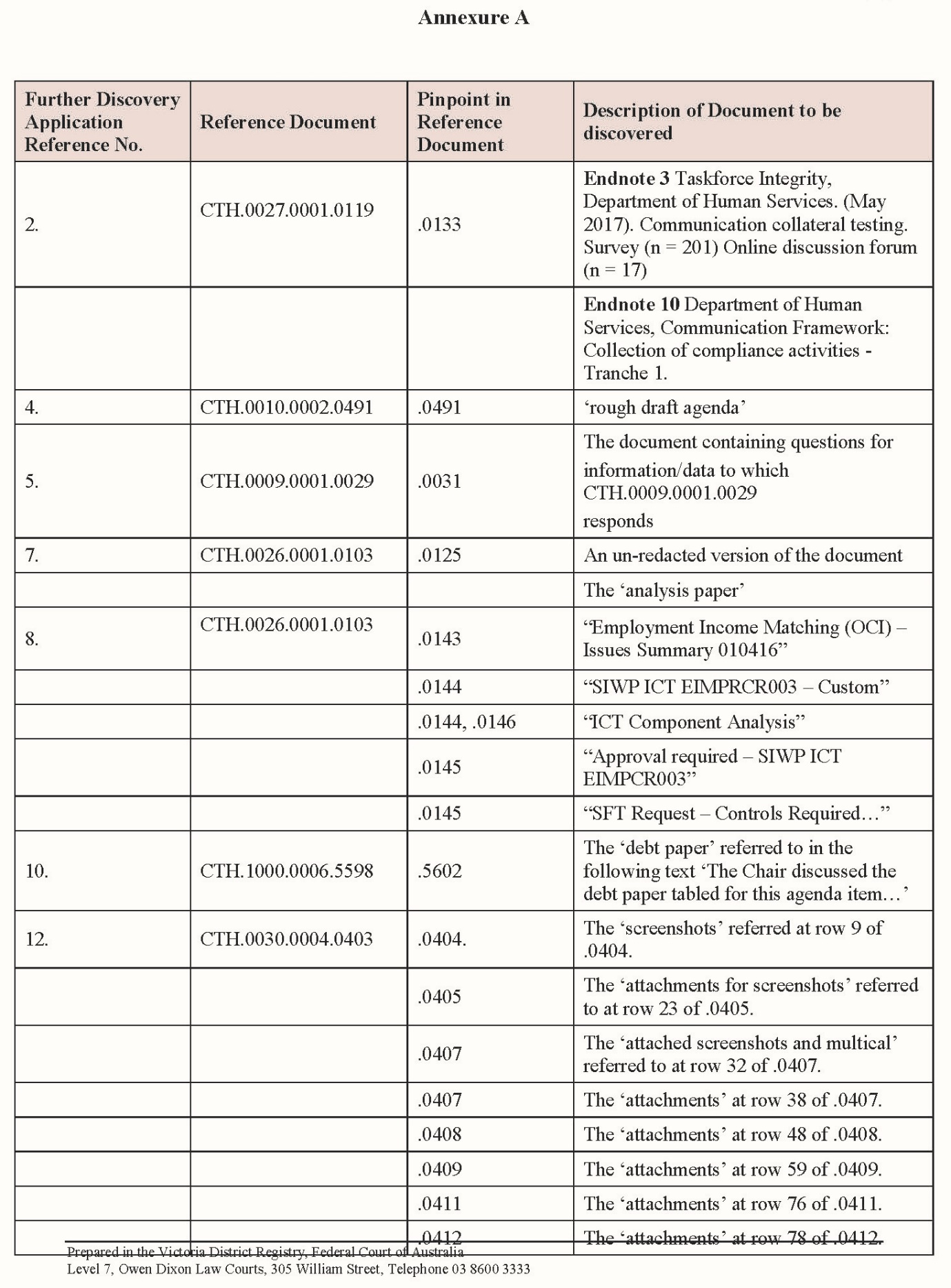
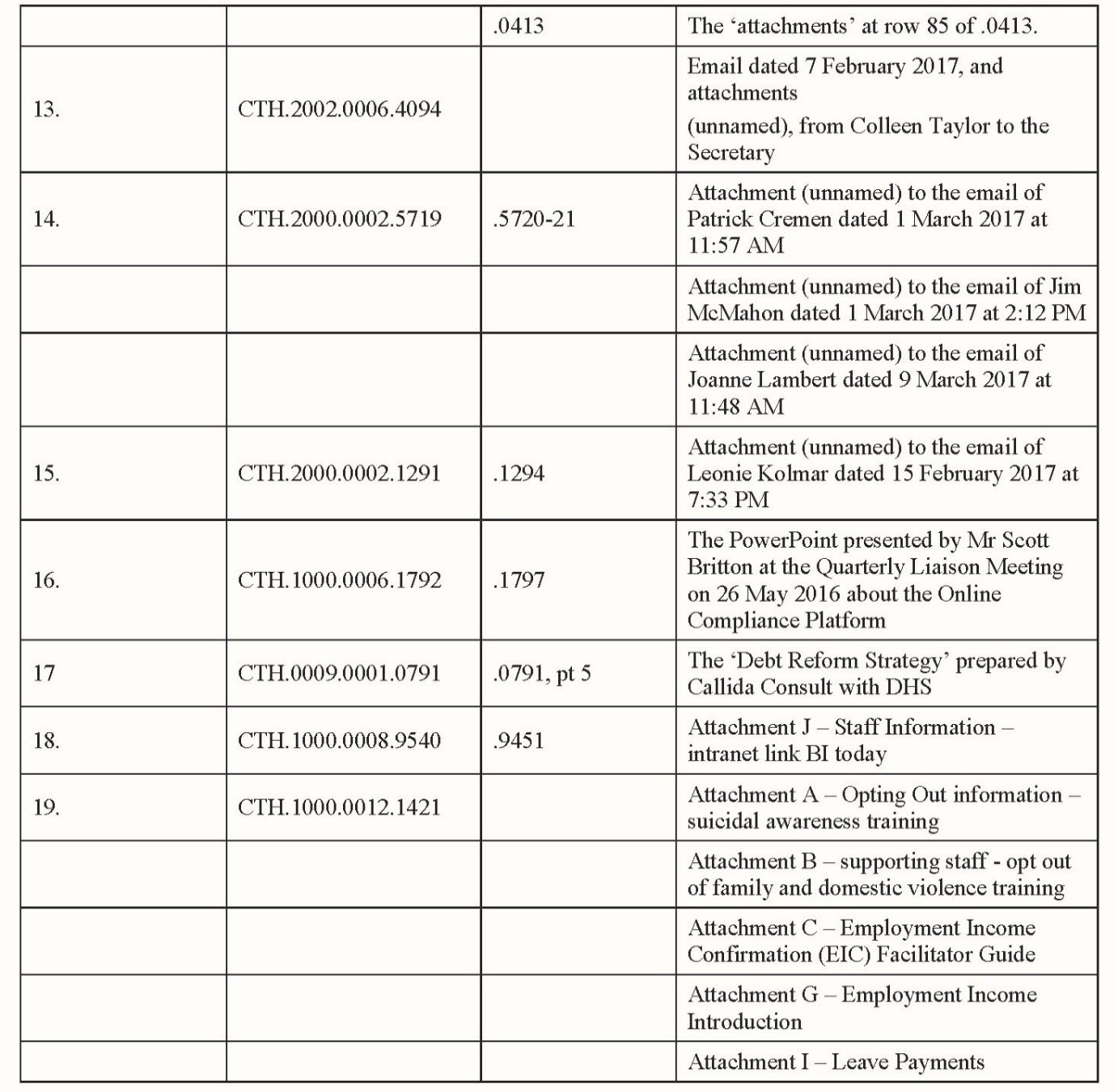
2. By 4.00 pm on 21 September 2020, the Respondent is to provide discovery of those documents identified in Annexure A to these orders.
3. The Applicants have leave to file and serve their second further amended statement of claim dated 14 September 2020 (2FASOC).
4. Costs reserved.
5. Liberty to apply.
Note: Entry of orders is dealt with in Rule 39.32 of the Federal Court Rules 2011.
MURPHY J:
1 In this representative proceeding the applicants, Katherine Prygodicz and others, sought leave to file a proposed Second Further Amended Statement of Claim (2FASOC). The proceeding alleges unjust enrichment, money had and received, and negligence against the Commonwealth. The claims are all grounded in the Commonwealth’s use of an automated system, colloquially known as ‘Robodebt’, to identify asserted overpayments of social security benefits made to social security recipients based on the recipient’s notional as distinct from actual fortnightly income, derived by income averaging from Australian Taxation Office (ATO) “Pay as You Go” (PAYG) income data, which was then relied upon to raise and seek to recover the asserted overpayment as a debt owed to the Commonwealth. The proposed 2FASOC amends the existing pleading by seeking additional relief in the form of aggravated and exemplary damages in relation to the negligence claim and exemplary damages also in relation to the claims of unjust enrichment and money had and received, primarily based in allegations that the Commonwealth had knowledge that the Robodebt system was unlawful.
2 When the application for leave to amend was heard the proceeding was listed for trial within a week, but the application for leave to amend had been flagged three months earlier, an earlier version of the pleading had been provided a month earlier, and the trial date was already in doubt because of other matters. I granted leave to file and serve the amended pleading and adjourned the trial so as to allow the Commonwealth sufficient time to prepare any further evidence that it wished to adduce in response to the new claims, which involved allegations of knowledge of unlawfulness. Since allowing the amendment the case has again been fixed for hearing this year.
The proceeding
3 The class action is brought by the applicants on their own behalf and on behalf of persons who:
(a) at any time after 1 July 2010 received any one of 12 identified Commonwealth social security benefits (Social Security Payments); and
(b) in respect of whom the Commonwealth at any time after 1 July 2015:
(i) generated correspondence or other notification which referred to a difference between the income information obtained by Centrelink from the ATO and that used by Centrelink in assessing entitlement to Social Security Payments, and requesting or reminding the recipient to check, confirm or update the employment income information provided to Centrelink (defined by the applicants as a Robodebt notification and by the Commonwealth as an Initial Letter);
(ii) by or following the Robodebt notification (or Initial Letter), asserted that there had been an overpayment of one or more Social Security Payments paid to the person, which was recoverable by the Commonwealth as a debt (an Asserted Overpayment Debt);
(iii) requested or demanded repayment of any Asserted Overpayment Debt or part thereof; and
(c) received payment from any applicant or group member, whether directly, on their behalf, or recovered from them, any Asserted Overpayment Debt or part thereof; and/or have not been informed by the Commonwealth that no recovery action would be pursued in respect of their Asserted Overpayment Debt.
4 It appears to be uncontentious that from late April 2015 the Commonwealth, through Services Australia, introduced an automated system for identifying overpayments made to social security recipients by identifying discrepancies between the income data reported to Centrelink and the income data held by the ATO, based on income averaging from ATO income data, and raising, asserting and recovering Asserted Overpayment Debts. Broadly, the automated system involved:
(a) the Commonwealth identifying persons who had received Social Security Payments in a particular financial year in the past (Review Period);
(b) for each identified person obtaining ATO PAYG income data for the Review Period, being data provided to the ATO by employers as to the amount paid to a person in the relevant financial year or part thereof;
(c) determining a ‘notional fortnightly income’ for the person, calculated by apportioning the total income earned by the person in the Review Period (as recorded in the ATO PAYG income data) evenly per fortnight in the period worked;
(d) identifying potential overpayments of Social Security Payments by comparison between the person’s notional fortnightly income with the fortnightly income reported to the Department of Services Australia (formerly the Department of Human Services) (Department) by the person at or about the time of receiving the relevant Social Security Payments;
(e) where the comparison indicated a potential overpayment of Social Security Payments because the notional fortnightly income was higher than the reported fortnightly income the Department sent the person an Initial Letter that gave notice of the fact of receipt of the ATO PAYG information, asserted that the information showed that the amount reported to the ATO was different to that which the recipient told that Department, and informed the person that they needed to confirm their employment income online by a specified date, in the absence of which the Department would rely on the ATO data;
(f) if the recipient of the Social Security Payments provided information to the Department about their earnings in response to the Initial Letter, or if the Department already held such information, that information was used to determine the person’s earnings during the Review Period whether or not they had received an overpayment of Social Security Payments;
(g) if the recipient did not respond to the Initial Letter (or provided an insufficient response including by failing to provide payslips, bank statements or other probative information to verify their earnings during the Review Period) the Department assumed that the person had earned the amounts indicated in the ATO PAYG income data in equal fortnightly amounts during the relevant period of employment (Assumed Fortnightly Income). The person’s entitlement to Social Security Payments in the Review Period was then calculated on the basis that the person had received the Assumed Fortnightly Income; and
(h) if, based on the Assumed Fortnightly Income, the person had in fact received a higher amount of Social Security Payments than he or she was entitled to (the Social Security Payment differential) the person was sent a notice pursuant to s 1229 of the Social Security Act 1991 (Cth) (the SS Act) which informed him or her that they owed a debt to the Commonwealth and were required to repay the debt by the date specified in the notice.
5 At the heart of the applicants’ case is the contention that there was no proper legal basis for the Commonwealth to identify an overpayment to recipients of Social Security Payments, and assert and recover a debt, calculated on the basis of the recipient’s notional fortnightly income or Assumed Fortnightly Income derived from income averaging from ATO income data.
6 The applicants’ allege that the notional fortnightly income or Assumed Fortnightly Income of a person will not necessarily reflect the person’s actual fortnightly income. On their case, fundamentally, that is inherent in concept of averaging. But also, where a person does not earn a consistent fortnightly wage or does not earn income in every fortnight, their notional fortnightly income or Assumed Fortnightly Income will not be the same as their actual fortnightly income. Relatedly, where the person worked for intermittent periods for an employer throughout a year, such that the employer reports to the ATO on the basis that the income was paid over a year rather than by specifying the exact periods, the notional fortnightly income will not reflect the actual fortnightly income because the periods in which income was earned were less than a year.
7 As the applicants contend, it is stating the obvious to note that many people who receive social security benefits do not have a stable income, and the work they obtain may be casual, part-time, sessional, seasonal, or intermittent, and not necessarily continuous throughout the year.
8 It is not in contest in the proceeding that a person’s notional fortnightly income or Assumed Fortnightly Income, based wholly or partly on income averaging from ATO PAYG data, did not provide a proper legal basis for the Commonwealth to assert that the person owed a debt to the Commonwealth. In paragraph 46.3 of its Defence to the Further Amended Statement of Claim (Defence) the Commonwealth admits that the existence of a debt in a particular amount could not be validly established for the purpose of s 1223(1) of the SS Act where the decision that the person owed a debt in that amount depended, wholly or in part, on:
(a) ATO PAYG income information and the Assumed Fortnightly Income; or
(b) notional fortnightly income and the fortnightly income assumption,
without other information capable of supporting a conclusion that the social security recipient received a consistent fortnightly income over the relevant period.
9 In paragraph 46.4 of the Defence the Commonwealth admits that in respect of each of the applicants their notional fortnightly income was not the same as their actual fortnightly income, and in respect of each class member that their notional fortnightly income was not necessarily the same as their actual fortnightly income, and for the applicants and group members their notional fortnightly was not necessarily referable to or indicative of their actual income in any fortnight. Paragraph 46.5 admits that where the notional fortnightly income was not the same as the actual fortnightly income and was not referable to or indicative of actual income in any fortnight, that the fortnightly income assumption was false.
10 The Commonwealth has embarked on a program of refunding some Asserted Overpayment Debts repaid by or recovered from social security recipients. As an example, paragraphs 18 and 36 of the Defence concern debts relating to the second and sixth applicants respectively which the Commonwealth admits were raised using income averaging from ATO income data. The Defence states that those debts are subject to measures announced by the Commonwealth on 29 May 2020 and 1 July 2020, being:
(a) on 29 May 2020 the Minister for Government Services, the Hon Stuart Robert MP, publicly announced that from July 2020 it would refund all repayments made on debts raised wholly or partially using income averaging of ATO data and any interest charges and/or recovery fees paid on related debts. The announcement identified 470,000 debts raised wholly or partially using income averaging of ATO data, and estimated the total value of refunds including fees and charges at $721 million; and
(b) on 1 July 2020 the Commonwealth publicly announced that from 13 July 2020 it would write to people who were eligible for a refund in respect of a debt raised using averaging of ATO income information and would start making refunds in respect of such debts from 27 July 2020. Debts raised using averaging of ATO income information in respect of which no amount had been paid to the Commonwealth would be reduced to zero.
11 The publicly announced refund program is not, however, quite as straightforward as that. It appears that the Commonwealth is not presently refunding all debts raised wholly or partially using income averaging of ATO data, and the Defence raises a “juristic reason” for the Commonwealth’s retention of some amounts repaid or recovered. For example, in relation to the group members the Defence states (at paragraph 53.6.2.2) that, where it recovered an amount from a group member in relation to a debt that was identified wholly or partially using income averaging of ATO data, and a debt in fact arose pursuant to s 1223(1) of the SS Act prior to the date of recovery from the group member which has not been wholly discharged, it denies that it has been unjustly enriched to the extent of the amount in fact owed by the group member at the time of recovery because there is a juristic reason for the Commonwealth to retain the amount in fact owed. The “juristic reason” has also been explained to the Court on the basis that the Commonwealth has made a new decision that the person has been overpaid Social Security Payments and therefore owes the Commonwealth some other amount pursuant to s 1223(1) of the SS Act. The applicants contend that such juristic reasons are not a proper basis for the Commonwealth refusing to refund amounts which it has unlawfully received or recovered from the applicants or group members. They argue that the Commonwealth may take appropriate steps in relation to a debt that it subsequently lawfully raises but it must immediately refund the amounts it unjustly obtained.
12 The relief sought in the proceeding also extends beyond claims for restitution or cancellation of debts which were calculated by using income averaging of ATO data to claims where, in fact, the debts were not calculated by reference to income averaging from ATO income data. The two relevant categories of group members in this regard (as described in paragraph 41A of the 2FASOC) are:
(a) Category 3 - being persons whose debt was initially partly or wholly determined using income averaging of ATO data but which was later recalculated by the Commonwealth based on information provided by or on behalf of a class member in a review under s 126 of the Social Security (Administration) Act 1999 (Cth) (the SS Administration Act). In relation to category 3 group members the applicants contend that, while the ultimate debt may have been lawfully raised, it was raised on the basis of information procured by unlawful means; it being ‘tainted’ by the initial calculation and assertion of a debt which would have been unlawful if imposed. The applicants contend that the threat of imposition of an unlawful debt could never constitute a legitimate means of procuring income information from a group member who would not otherwise have been required to provide it; and
(b) Category 4 - being persons whose debt was wholly determined by the Commonwealth based upon income information provided by or on behalf of the class member (such as payslips and/or bank statements) in response to an Initial Letter, and not based on ATO income data. Again, the applicants contend that, while the ultimate debt was lawfully raised, it was raised on the basis of information procured by unlawful means because the process of debt raising was ‘tainted’ by the initial calculation based on ATO income averaging sent in the Initial Letter, which threatened the imposition of an unlawful debt to procure the provision of actual income information.
13 The relief sought in the Amended Originating Application includes declarations that the Commonwealth:
(a) does not have and has not had any statutory power to use any income information provided by or on behalf of an applicant or group member in response to an Initial Letter to determine or assert an Asserted Overpayment Debt;
(c) acted unlawfully in using calculations or other outputs of the automated system to procure or compel the provision by an applicant or group member to the Commonwealth of income information, and/or to generate or send to any applicant or group member an Initial Letter;
(d) acted unlawfully in determining and asserting against any applicant or class member any Asserted Overpayment Debt or recalculation of the debt; in requesting or demanding repayment of any Asserted Overpayment Debt or recalculation of it; and in recovering from any applicant or class member any asserted repayment debt or recalculation of it;
(e) was unjustly enriched by receipt of each Asserted Overpayment Debt which it recovered and is liable to make restitution to the applicants and group members;
(f) the Asserted Overpayment Debts which the Commonwealth recovered are monies had and received by the Commonwealth to the use of the applicants and group members, which the applicants and group members are entitled to have returned; and
(g) owed and owes a duty of care to the applicants and group members as alleged in the statement of claim; which duty of care the Commonwealth breached in the manner alleged.
14 The Originating Application also seeks by way of relief:
(a) restitution of all or the aggregate of the amounts of Asserted Overpayment Debts which the Commonwealth has received or recovered and retained, plus interest earned by the Commonwealth thereon;
(b) restitution of all or the aggregate of the amounts of Asserted Overpayment Debts which the Commonwealth has received, as money had and received by the Commonwealth to the use of the applicants and group members;
(c) compensatory damages in negligence for distress and inconvenience having regard to the stress, anxiety and stigma associated with the Commonwealth’s request or demand for, and threatened or actual recovery of the asserted debts; and
(d) Interest pursuant to statute.
15 Pursuant to the 2FASOC the relief will include the additional claims for aggravated damages in negligence and for exemplary damages in respect of the claims for unjust enrichment, money had and received and negligence, each primarily founded in allegations that the Commonwealth had knowledge of the vulnerabilities of some of the applicants or group members; knowledge that the automated system for identifying overpayments and raising, asserting and recovering Asserted Overpayment Debts based on income averaging from ATO income data led to the assertion of debts against the applicants and group members for amounts which may not have been, and in many cases were not, actually owed; knowledge that it had no statutory or other power to seek to recover such debts, and knowledge that it was acting unlawfully in asserting such debts.
The procedural history
16 The proceeding was commenced by way of an Originating Application and Statement of Claim on 19 November 2019. Notwithstanding that the case is large, complex and strenuously contested, the parties have readied the case for trial with commendable speed and efficiency. The Commonwealth filed its Defence on 14 February 2020 and on 6 March 2020 I made orders for some initial discovery and for the parties to confer in the presence of a National Judicial Registrar to endeavour to agree on the further tranches of discovery; for opt out notices to be sent to group members; for the parties to file and serve any lay evidence upon which they intended to rely by May 2020; and for a mediation to be conducted by 19 June 2020.
17 If the matter did not settle at mediation the parties were directed to endeavour to agree a joint list of factual and legal issues; to agree on a template for written submissions encompassing the factual and legal issues by 6 July 2020; and to file and serve the written submissions in July 2020. The orders tentatively listed the personal claims of the applicants and all common issues for trial on 20 July 2020, but that hearing would only proceed if another matter in my docket which was listed for hearing at that time had settled. If the hearing could not commence on 20 July the matter was listed for hearing on 21 September 2020.
18 At a case management hearing on 16 June 2020, I made orders for the applicants to file and serve any Further Amended Statement of Claim (FASOC) by 30 June 2020, which the applicants subsequently did without objection by the Commonwealth. I also made orders for a substantial program of discovery, the program having been developed through conferral before National Judicial Registrar Gitsham which was largely by consent by the time the issue was before me. While there were some areas of disagreement between the parties the dispute was at the edges.
19 At that case management hearing the applicants sought orders for a split trial which was to commence on 20 July 2020 and in which the claims for declarations in relation to the unlawfulness of the automated system and the claims of unjust enrichment and money had and received were to be heard and determined separately from the negligence claim. The negligence claim was proposed to be heard and determined at a subsequent hearing, and was not ready for hearing on 20 July.
20 In the course of arguing for a split trial, senior counsel for the applicants said that, based upon the discovery they had received to date, the applicants intended to expand the negligence claim to include a claim for exemplary damages. He also said that there was some indication in the discovery that a case of misfeasance in public office may be made in the 2FASOC. He said that the applicants could, at that point, plead a claim for exemplary damages at a basic level, but they preferred to wait until discovery was complete and to then plead any such claims in detail. He said that it was likely that by the middle of August the applicants would be ready to file a proposed 2FASOC.
21 Senior counsel for the Commonwealth opposed splitting the trial but did not express any concern about the proposed amendment to include a claim for exemplary damages. He said that the Commonwealth was not “overly concerned” about an expansion of the case to include a claim for exemplary damages although he would need to see what effect it would have on the applicants’ evidence and on what evidence might be required in response. He said that the position would be different if there was a claim for misfeasance in public office as that would presumably involve allegations against particular individuals and they may need separate representation or to receive separate legal advice.
22 I refused the application to split the trial, and directed the parties to confer as to a timetable for the further interlocutory steps including for any second further amended pleading. The proceeding remained listed for trial on 21 September 2020.
23 In July and August 2020 Justice Lee dealt with the contested claims of legal professional privilege and public interest immunity in relation to a large number of discoverable documents, and dismissed the applicants’ application. His Honour also varied one aspect of the previous discovery orders so as to reduce the burden of the discovery.
24 On 12 August 2020 the applicants served a proposed second further amended statement of claim (the first proposed 2FASOC) which made claims for aggravated and exemplary damages. At the case management hearing on 13 August senior counsel for the Commonwealth submitted that the pleading was defective including because the allegations regarding the Commonwealth’s knowledge of unlawfulness which underpinned the new claims for relief were not properly pleaded or particularised. I made directions requiring the Commonwealth to advise the applicants as to the basis upon which it opposed leave being granted, and for the applicants to provide any response to the matters raised by the Commonwealth and/or any further version of the 2FASOC, and listed the application for leave to amend for 31 August 2020. In the case management hearing the applicants also said that they had “grave concerns” about the case being ready for trial on 21 September, because of difficulties in relation to discovery and logistical difficulties in case preparation having regard to the Sars-CoV-2 related Stage 4 restrictions in Victoria. They did not apply to adjourn the hearing, but I held similar concerns about the viability of the trial date.
25 On 26 August 2020, the applicants provided further particulars to the new allegations in the first proposed 2FASOC. On 31 August 2020, following detailed submissions by the parties, I declined to grant leave to the applicants to file and serve the first proposed 2FASOC.
26 In large part I declined to grant leave because the first proposed 2FASOC did not adequately plead or particularise the allegations that the Commonwealth had actual knowledge that:
(a) no debt or associated penalty of any applicant or group member raised through the automated system for identifying overpayments based on income averaging from ATO income data was a debt due to the Commonwealth within the meaning of s 1222A of the SS Act; and
(b) that the Commonwealth had and has no statutory or other power to raise and recover or seek to recover any Asserted Overpayment Debt, or impose any penalty thereon, in respect of any Applicant or Group Member.
The allegation that the Commonwealth had knowledge that it was acting unlawfully in identifying overpayments and raising and recovering debts based wholly or partially in averaging from ATO income data was and is a serious one, and the first proposed 2FASOC did not inform the Commonwealth of the identity of any senior officer of the Commonwealth who had such knowledge or when or how they obtained it.
27 There was no good reason, in my view, for locking the applicants out from making another attempt to properly plead the case they wished to bring and I allowed the applicants’ time to put on a revised 2FASOC. On 14 September 2020 the applicants filed the present proposed 2FASOC.
28 On 15 September 2020 the applicants filed and served the Applicants’ Outline of Opening Submissions for the trial (Applicants’ Opening Submissions) in accordance with the pre-trial timetable.
29 On 16 September 2020 the Commonwealth filed written submissions in which it identified various asserted deficiencies with the 2FASOC, and I heard the application for leave to file the 2FASOC that day. The Commonwealth’s arguments were similar to those which it had advanced in detail a few weeks earlier in relation to the first proposed 2FASOC, and it contended that the 2FASOC did not sufficiently address the deficiencies it had earlier identified. For the reasons I explain, I did not accept the Commonwealth’s contentions and concluded that leave to amend should be granted and made orders accordingly.
30 Upon being informed that leave to amend would be granted, senior counsel for the Commonwealth sought time to consider its position and obtain instructions including in relation to whether it would call witnesses to rebut the serious allegations that it had knowledge, through senior officers, that it was acting unlawfully in the manner alleged. At senior counsel’s request a case management hearing was scheduled for 21 September 2020, giving the Commonwealth five days to consider its position. I made it clear that if the Commonwealth decided to put on further evidence it would be given sufficient time to do so, and indicated that there was a possibility of some hearing dates becoming available in November or December 2020.
31 There is one further aspect of the hearing on 16 September 2020 which should be explained. The Commonwealth, in part, sought to support its contentions regarding the deficiencies in the 2FASOC by pointing to ways in which it argued that the Applicants’ Opening Submissions went further than the pleaded case. To my mind any disconformity between the proposed 2FASOC and the Applicants’ Opening Submissions was a different issue. I dealt with that concern in the case management hearing on 21 September 2020 and made orders requiring:
(a) the Commonwealth to provide to the applicants a document setting out any material way in which the Commonwealth contended that the Applicants’ Opening Submissions purported to raise matters for trial which fell outside the allegations of fact and law pleaded in the 2FASOC; and
(b) the applicants to respond in writing to the Commonwealth advising whether they: (i) contended that any of the matters raised by the Respondent were within the pleadings; (ii) withdraw any of the matters raised by the Commonwealth; or (iii) intend to file an application seeking leave to amend the 2FASOC in relation to any matter raised by the Commonwealth.
32 The parties filed submissions and a table in which the Commonwealth set out how it contended the Applicants’ Opening Submissions went further than the pleaded case, and the applicants’ set out their response as to why, in the main, they did not. At the case management hearing on 1 October neither party sought that the Court rule on whether the opening submissions went further than the pleadings. I listed the trial for hearing on 16 November 2020 on an estimate of two weeks.
the relevant principles
33 In Barclay Mowlem Construction Ltd v Dampier Port Authority and Another [2006] WASC 281 at [4]-[7] Martin CJ said, and I respectfully agree:
The purposes of pleadings are, I think, well known and include the definition of the issues to be determined in the case and enabling assessment of whether they give rise to an arguable cause of action or defence as the case may be, and apprising the other parties to the proceedings of the case that they have to meet.
In my view, the contemporary role of pleadings has to be viewed in the context of contemporary case management techniques and pre-trial directions. In this Court, those pre-trial directions will almost invariably include; firstly, a direction for the preparation of a trial bundle identifying the documents that are to be adduced in evidence in the course of the trial; secondly, the exchange well prior to trial of non-expert witness statements so that non-expert witnesses will customarily give their evidence-in-chief only by the adoption of that written statement; thirdly, the exchange of expert reports well in advance of trial and a direction that those experts confer prior to trial; fourthly, the exchange of chronologies; and fifthly the exchange of written submissions.
Those processes leave very little opportunity for surprise or ambush at trial and, it is my view, that pleadings today can be approached in that context and therefore in a rather more robust manner, than was historically the case; confident in the knowledge that other systems of pre-trial case management will exist and be implemented to aid in defining the issues and apprising the parties to the proceedings of the case that has to be met.
In my view, it follows that provided a pleading fulfils its basic functions of identifying the issues, disclosing an arguable cause of action or defence, as the case may be, and apprising the parties of the case that has to be met, the Court ought properly be reluctant to allow the time and resources of the parties and the limited resources of the Court to be spent extensively debating the application of technical pleadings rules that evolved in and derive from a very different case management environment.
34 To similar effect, the Full Court in Thomson v STX Pan Ocean Co Ltd [2012] FCAFC 15 at [13] explained as follows:
It is well-established that the main purposes of pleadings are to give notice to the other party of the case it has to meet, to avoid surprise to that party, to define the issues at trial, to thereby allow only relevant evidence to be admitted at trial and for the trial to be conducted efficiently within permissible bounds: see, eg Dare v Pulham (1982) 148 CLR 658 (at 664–665). However, it is also well-established that pleadings are not an end in themselves, instead they are a means to the ultimate attainment of justice between the parties to litigation: see Banque Commerciale S.A. (in liq) v Akhil Holdings Ltd (1990) 169 CLR 279 (at 293) per Dawson J who cites Isaacs and Rich JJ in Gould and Birbeck and Bacon v Mount Oxide Mines Ltd (in liq) (1916) 22 CLR 490 (at 517). For these reasons, the courts do not, at least in the current era, take an unduly technical or restrictive approach to pleadings such that, among other things, a party is strictly bound to the literal meaning of the case it has pleaded. The introduction of case management has, in part, been responsible for this change in approach: see the observations of Martin CJ in Barclay Mowlem Construction Limited v Dampier Port Authority (2006) 33 WAR 82 (at [4]–[8]). Even before the widespread use of case management, the High Court reflected this approach in decisions such as Leotta v Public Transport Commission (NSW) (1976) 50 ALJR 666 (at 668–669) per Stephen, Mason and Jacobs JJ and Water Board v Maustakas (1988) 180 CLR 491 (at 497) per Mason CJ and Wilson, Brennan and Dawson JJ.
Consideration
35 The new claims for relief are primarily based in allegations that from 1 July 2015 the Commonwealth had knowledge including that:
(a) the notional fortnightly income (or Assumed Fortnightly Income) was not the actual fortnightly income of any applicant or group member and was not referable to or indicative of actual income in any fortnight (paragraph 70A(e));
(b) the fortnightly income assumption (or Assumed Fortnightly Income) was therefore false (paragraph 70A(f));
(c) the entitlement to Social Security Payments was based upon actual fortnightly income and, because the fortnightly income assumption was false, it could not establish the entitlement (or disentitlement) of any applicant or group member to Social Security Payments in any fortnight (paragraph 70A(g));
(d) the Social Security Payment differential was therefore not an overpayment of Social Security Payments or a debt owed to the Commonwealth (paragraph 70A(h));
(e) no asserted Overpayment Debt or associated penalty in respect of any applicant or group member was or is a debt due to the Commonwealth within the meaning of s 1222A of the SS Act (paragraph 70A(i));
(f) the Commonwealth had and has no statutory or other power to raise and recover or seek to recover any Asserted Overpayment Debt, or impose any penalty thereon in respect of any applicant or group member (paragraph 70A(j)); and
(g) the Commonwealth acted unlawfully in determining and asserting against any applicant or group member any Asserted Overpayment Debt, or recalculation of it; requesting or demanding repayment by any applicant or group member of any Asserted Overpayment Debt or recalculation of it; and/or recovering from any applicant or group member and retaining any Asserted Overpayment Debt or recalculation of it (paragraph 70A(k)).
36 The Commonwealth’s objections to the 2FASOC focussed on sub-paragraphs 70A(h)-(k) which contain the critical allegations of knowledge of unlawfulness, doing so on the presumption that there was no case for aggravated or exemplary damages without them.
37 Sub-paragraphs 70A(h)-(k) and the particulars provide as follows:
70A Further to paragraph 70, from 1 July 2015 the following matters were known to the Commonwealth:
(a)...
…
(h) the Social Security Payment differential was therefore not an overpayment of Social Security Payments or a debt owed to the Commonwealth;
PARTICULARS TO (g) and (h)
i. The Commonwealth knew that entitlement to Social Security Payments was based upon actual fortnightly income because it was responsible for administering, and did administer, the social security law, which set the entitlement to a Social Security Payment based upon the amount of income actually earned in the relevant fortnight, pursuant to Chapter 3 of the SSA [Commonwealth’s Amended Defence par 46.6].
ii. The Commonwealth knew that the Social Security Payment differential was therefore not an overpayment of Social Security Payments or a debt owed to the Commonwealth because the following officers of the Commonwealth knew the matters set out below, and their knowledge pleaded below is the knowledge of the Commonwealth by reason of the positions held by those persons:
a. by 8 January 2017, Malisa Golightly, Deputy Secretary, Integrity Group, referred in an email to the ‘fortnightly eligibility test requirement in the SS Act’ but also that Robodebt-raised debts were ‘automatically calculated’ based on information from the Australian Taxation Office that was not referrable to a fortnight [CTH.2000.0001.8109 at .8110];
b. by 8 January 2017, Craig Storen, General Manager, Strategic Information, Compliance and Information Group, had been asked how many, and therefore knew that, Robodebt- raised debts had been raised ‘automatically’ on the basis of the fortnightly income assumption [CTH.2000.0001.8109 at .8109];
c. by 23 January 2017, Malisa Golightly was in receipt of a Commonwealth document which listed debts of recipients described as ‘alleged’ and which also described different amounts for those same recipients as ‘legitimate’ (Debts Spreadsheet) [CTH.0009.0001.0311 at .0315];
d. by 24 January 2017, Annette Musolino was in receipt of a version of the Debts Spreadsheet [CTH.2001.0006.3278];
e. by 25 January 2017, Craig Storen, General Manager, Strategic Information, Compliance and Information Group, and Ms Golightly, were in possession of Commonwealth data that showed 4,884 of 5,629 Robodebt-raised debts had ‘subsequently been reassessed’, resulting in a decrease to the debt [CTH.0009.0001.0323 at .0326];
f. on or around 1 March 2017, Minister Tudge had received a brief cleared by Ms Golightly which stated that 33% of Robodebt-raised debts ‘were changed to $0 on review/reassessment’ [CTH.0009.0001.0535 at .0541];
g. on 15 March 2017, Ms Golightly and Ms Musolino became aware of a draft recommendation by the Ombudsman in relation to the Online Compliance Intervention system that the Commonwealth ‘should … give further consideration as to how to mitigate the risk of possible over-recovery of debts’ and never sought to dispute or qualify that recommendation [CTH.2001.0005.3244, CTH.2001.0005.3245 at .3275];
h. by 7 April 2017, Ms Golightly and Ms Musolino either themselves agreed or were aware that the Commonwealth agreed to the Ombudsman’s recommendation set out above [CTH.0009.0001.1801];
i. by around 24 April 2017, Minister Tudge became aware of the same recommendation and never sought to dispute or qualify it [CTH.0009.0001.1801];
j. by 22 April 2018, Ms Musolino had become aware of criticism by Professor Terry Carney of the legality of Robodebt-raised debts [CTH.2001.0009.7055];
k. by 18 September 2018, the Minister for Human Services and Digital Transformation, the Hon Paul Fletcher MP, was told that the Social Security Payment differential was not an overpayment because ‘the basis of the ATO data collection is the Income Tax legislation and is therefore required for the financial year, not for lesser periods’ [CTH.0009.0001.1104].
The Applicants otherwise refer to and repeat the particulars subjoined to subparagraphs (e) and (f).
(i) no Asserted Overpayment Debt or associated penalty in respect of any Applicant or Group Member was or is a debt due to the Commonwealth within the meaning of section 1222A of the SSA;
(j) the Commonwealth had and has no statutory or other power to raise and recover or seek to recover any Asserted Overpayment Debt, or impose any penalty thereon, in respect of any Applicant or Group Member;
PARTICULARS TO (i) and (j)
i. The Commonwealth knew that an Asserted Overpayment Debt or associated penalty was not a debt due to it within the meaning of section 1222A of the SSA because:
a. it was responsible for administering, and did administer, the social security law, which by section 1223 of the SSA provided that a debt is owed by a person who obtains the benefit of a Social Security Payment but ‘was not entitled for any reason to obtain that benefit’;
b. however, an Asserted Overpayment Debt was not capable of being a payment to which the Applicant or Group Member ‘was not entitled’, by reason of the matters subjoined to subparagraphs (e) to (h).
ii. The Commonwealth knew that it had no statutory or other power because it was responsible for administering, and did administer, the social security law, which did not contain any provision empowering it to raise and recover or seek to recover any Asserted Overpayment Debt, or impose any penalty thereon.
(k) the Commonwealth acted unlawfully in:
(i) determining and asserting against any Applicant or Group Member any Asserted Overpayment Debt, or recalculation of it;
(ii) requesting or demanding repayment by any Applicant or Group Member of any Asserted Overpayment Debt, or recalculation of it; and/or
(iii) recovering from any Applicant or Group Member and retaining any Asserted Overpayment Debt, or recalculation of it.
PARTICULARS
i. The Commonwealth knew of these matters (including their unlawfulness) because:
a. it was party to Administrative Appeals Tribunal reviews in which Asserted Overpayment Debts had been set aside on the basis that the fortnightly income assumption could not lawfully support the existence of a debt, and which it elected not to appeal or have reviewed (AAT Unlawful Debt Decisions), including the 76 decisions of:
i. [Here followed a list of 76 decisions of the AAT constituted by various different members from 17 February 2017 until 3 December 2019]
…
b. section 8(f) of the SSA provided that in administering the social security law, the Secretary was to have regard to the need to apply government policy in accordance with the law and with due regard to relevant decisions of the Tribunal, which included the AAT Unlawful Debt Decisions;
c. it had conducted analysis of these decisions described by Mr Storen on 5 June 2018 [CTH.2000.0008.1516];
d. on or around 27 November 2019 it consented to orders and declarations, and agreed to a statement of facts upon which these orders and declarations were made, in the Federal Court of Australia (Davies J) in Amato v Commonwealth of Australia VID611 of 2019;
ii. The Commonwealth also knew of these matters (including their unlawfulness) because the following officers of the Commonwealth knew the matters set out below, knowledge of such persons being knowledge of the Commonwealth by reason of the positions held by those persons:
a. by 4 April 2018, Mr Storen had become aware of criticism by Professor Terry Carney questioning the legality of Robodebt-raised debts [CTH.2000.0007.5561];
b. by 13 April 2018, Deputy Secretaries and Ms Musolino had become aware of criticism by Professor Carney questioning the legality of Robodebt-raised debts [CTH.2001.0009.6833];
c. by 22 April 2018, Ms Musolino and Mr McNamara had become aware of further criticism by Professor Carney questioning the legality of Robodebt-raised debts [CTH.2001.0009.7055];
d. on 15 May 2018, Ms Musolino chaired a meeting with the Ombudsman in which the ‘issues raised in the article by Professor Carney’ were discussed' [CTH.2001.0009.8585];
e. on 19 December 2018, Mr McNamara, Mr Storen and Ms Musolino had become aware of an article by Professor Carney in which the Robodebt system was described as ‘unlawful’ [CTH.2001.0012.1134, CTH.2001.0012
38 I reached the conclusion that it was appropriate to grant leave to amend in the form of the revised 2FASOC for the following reasons.
39 First, I do not accept that the application for amendment was made too late, or contrary to the overarching obligation in s 37M of the Federal Court of Australia Act 1976 (Cth) or the principles in Aon Risk Services Australia Ltd v Australian National University [2009] HCA 27; (2009) 239 CLR 175. The applicants did not press any such argument in relation to the 2FASOC but when the application for leave to file and serve the first proposed 2FASOC was before the Court on 31 August 2020 the Commonwealth opposed leave on the basis that the pleading raised new and significant legal and factual issues only weeks before trial, without any explanation as to why the substantial additional claims and allegations were proposed to be included in the proceeding.
40 I have no difficulty in accepting that the 2FASOC raises new and significant factual and legal issues. The allegations that the Commonwealth had knowledge that its automated system for identifying overpayments and raising, asserting and recovering Asserted Overpayment Debts based on income averaging from ATO income data was unlawful are serious matters. There was, however, little merit in the contention that the application was brought very late and without explanation given the matters set out below.
41 This is a large and complex proceeding, only commenced in November 2019, which was brought on for final hearing with expedition, with the agreement of both parties. The proceeding involved a substantial and expedited discovery process, including disputed claims for legal professional privilege and public interest immunity, and discovery was still proceeding as the hearing date approached. The preparations for trial were also affected by the Sars-CoV-2 related restrictions in Victoria (being Stage 3 restrictions from March to 1 July 2020- and Stage 4 restrictions from 2 August 2020), and there was a question as to whether the Chief Justice would determine the case to be urgent or priority such that it could proceed while Stage 4 restrictions remained in place. That meant that there was a risk that the 21 September trial date would not be viable, through no fault of either party. Indeed, in the circumstances as they existed it is a credit to the parties that the proceeding is in the state of readiness that it is. This is not a case like Aon where there was a lack of reasonable diligence on the part of the moving party such as to justify refusal to grant the amendment.
42 Senior counsel for the applicants said at the 16 June 2020 case management hearing that the applicants intended to file an amended pleading by mid-August 2020 in which they would advance a claim for exemplary damages. Senior counsel said, responsibly in my view, that the applicants preferred to wait for discovery to be complete before finalising their pleading. Senior counsel for the Commonwealth said he was not “overly concerned” about an expansion of the case to include a claim for exemplary damages, although he would have concerns if the case was expanded to include a claim of misfeasance in public office. In the circumstances the Commonwealth could not have been surprised by addition of the claim for exemplary damages in the 2FASOC and it should not have submitted that the application was brought too late and without explanation.
43 Second, it is appropriate to consider the Commonwealth’s complaints regarding the 2FASOC in the context of the other measures adopted to ensure that the parties understand the opposing case, and are not ambushed at trial. The pre-trial timetable provides for the parties to put on witness statements well in advance of trial, to prepare a Court Book identifying the documents that are to be adduced in evidence, the agreement of a joint list of factual and legal issues to be filed with the Court, and for opening and closing written submissions based on an agreed template which follows the joint list of factual and legal issues. As observed in Barclay Mowlem (at [5]), such processes leave very little opportunity for surprise or ambush at trial and it is appropriate to approach the pleadings in that context and therefore in a robust manner. Having regard to that, I consider the 2FASOC sufficiently defines the issues for trial, puts the Commonwealth on notice as to the case it must meet, and advances claims which cannot properly be described as unarguable. There was no real suggestion by the Commonwealth that it did not understand the case being put.
44 Third, the Commonwealth contended that sub-paragraphs 70A(h)-(k) have what it described as a ‘temporal problem’ in that the various matters alleged to have been known to the Commonwealth are alleged to have been known from 1 July 2015 (chapeaux to 70A), yet the only meaningful particulars provide that such knowledge arose at the earliest in 2017. It argued that it is no answer to say that the applicants’ case is one of knowledge accumulating over time as that is not what is pleaded and it would be irrelevant in any event.
45 Initially this argument held some attraction but in the finish I concluded that the Commonwealth overstated the position. The main purposes of pleadings are to put the other side on notice of the case it is required to meet so as to avoid surprise to that party, to define the issues at trial, and to enable an assessment as to whether they give rise to an arguable cause of action or defence. In my view the allegations of knowledge of unlawfulness in the 2FASOC meet those purposes.
46 The period over which the 2FASOC alleges that the Commonwealth had knowledge of the relevant matters is clearly expressed and there could be no suggestion of ambiguity or uncertainty as to the time period. The Commonwealth did not really press an argument that it was untenable to allege that the Commonwealth knew of the various matters from 1 July 2015. Rather, its submissions boiled down to the proposition that for the period from 1 July 2015 until early 2017, the applicants failed to properly support or particularise the claim of knowledge of unlawfulness. The Commonwealth relied upon the fact that subparagraphs 70A(h)–(k) and their particulars, being the primary allegations in regard to knowledge of unlawfulness, referred only to matters from January 2017 onwards.
47 But the allegations of knowledge of unlawfulness are not restricted to the matters only in sub-paragraphs 70A(h)–(k). For example sub-paragraph 70A(f)(i) alleges that the Commonwealth knew that the fortnightly income assumption was false because it was arithmetically inherent that averaging from a longer period to a shorter period would not yield the actual income for the shorter period actually worked. Sub-paragraph 70A(h)(i) alleges that the Commonwealth knew that the Social Security Payment differential was not an overpayment of Social Security Payments or a debt owed to the Commonwealth because the Commonwealth knew that entitlement to Social Security payment is based upon actual fortnightly income, rather than upon notional fortnightly income or Assumed Fortnightly Income. This is a claim that it should be inferred from the (asserted) obviousness of the fact that notional fortnightly income is not actual fortnightly income that the Commonwealth knew that its automated system for raising, asserting and recovering Asserted Overpayment Debts based on income averaging from ATO income data was unlawful.
48 Essentially, the applicants contend that it was obvious to anybody that a social security recipient’s notional fortnightly income was not the same as their actual fortnightly income; and an earlier version of the pleading alleged it was so obvious that it was self-evident that the Commonwealth knew it was unlawful. That might be criticised as a weak basis for asserting knowledge of unlawfulness on the part of the Commonwealth in the period from 1 July 2015 until the particularised dates that senior Commonwealth officers are alleged to have had such knowledge, but it is maintainable. The 2FASOC makes sufficiently clear the case the Commonwealth must meet.
49 Nor is January 2017 the earliest of the particulars which identify named Commonwealth officers as having knowledge of unlawfulness. Sub-paragraph 70A(f)(ii) alleges that the Commonwealth knew that the notional fortnightly income was not the actual fortnightly income through several identified senior officers of the Commonwealth, commencing with the allegation that on 26 May 2016 Annette Musolino, Chief Counsel, Legal Services Division, along with other senior officers of the Commonwealth, was present at a meeting with the Commonwealth Ombudsman where the Ombudsman raised “the common practice of employers default reporting for the period June to July when the employee has been employed for a shorter period”. That does not expressly plead knowledge of unlawfulness but knowledge that notional fortnightly income is not actual fortnightly income because employers commonly reported to the ATO that income had been earned over a full year notwithstanding that the employee worked for a shorter period or periods, coupled with the asserted obviousness that notional fortnightly income could not be understood to be equivalent to actual fortnightly income, might be capable of supporting an inference that Ms Musolino had knowledge that a debt asserted on the basis of notional income had no proper legal foundation. Whether it is appropriate to draw such an inference is a matter for determination on the evidence and at final hearing.
50 Fourth, the Commonwealth argued that sub-paragraphs 70A(h) and 70A(k) have the deficiency that the particulars name certain Commonwealth officers whose knowledge the applicants contend was the knowledge of the Commonwealth, but the limits of what the applicants particularised those people as having known is information that was set out in documents sent or received by those people. It contended that information does not give rise to the broader allegation of knowledge of unlawfulness that the sub-paragraphs allege the Commonwealth had through these people.
51 As an example the Commonwealth points to sub-paragraph 70A(h)(ii) (as set out above) which alleges that the identified senior officers “knew of the matters set out below” and because of this the Commonwealth “knew that the Social Security Payment differential was therefore not an overpayment of Social Security Payments or a debt owed to the Commonwealth.” It argued that this ultimate conclusion is a conclusion of law as to whether a debt is owed yet the knowledge identified of the relevant people does not rise anywhere near this level. For example, Craig Storen, General Manager, Strategic Information, Compliance and Information Group is alleged to have been asked how many Robodebt-raise debts had been raised ‘automatically’ on the basis of the fortnightly income assumption and therefore knew that (70A(h)(ii)(b)) and to have been “in possession of Commonwealth data that showed 4,884 of 5,629 Robodebt-raised debts had ‘subsequently been reassessed’ resulting in a decrease to the debt (70A(h)(ii)(e)).
52 The Commonwealth contended that it is ‘impossible’ that this constituted knowledge by Mr Storen that “the Social Security Payment differential was therefore not…a debt owed to the Commonwealth”, and that none of the other examples rise to that level either. It contended that if the applicants were intending to assert a case of aggregated knowledge that was not explicable from the pleading.
53 Again, the main purpose of pleadings is to put the other side on notice of the case it is required to meet so as to avoid surprise to that party, to define the issues at trial, and to enable an assessment as to whether they give rise to an arguable cause of action or defence. In my view these parts of the 2FASOC meet those purposes. The applicants’ case is against the Commonwealth, and not against the five senior officers of the Commonwealth who are pleaded to have had the knowledge from which the knowledge of matters imputed to the Commonwealth may be inferred. The applicants submitted, and I accept, that the pleading invites the Court to make findings in respect of allegations that:
(a) the Commonwealth, through Ms Musolino, Minister Tudge and Malisa Golightly, the Deputy Secretary of the Integrity Group, had knowledge that the notional fortnightly income was not actual fortnightly income (because of the particulars to sub-paragraphs 70A(e) and (f));
(b) the Commonwealth, through Ms Golightly, Mr Storen, Ms Musolino, Minister Tudge and Minister Fletcher, had knowledge that the alleged overpayments were not debts owed to the Commonwealth (because of the particulars to sub-paragraphs 70A(g) and (h));
(c) the Commonwealth, through Ms Musolino, Mr Storen and Jason McNamara, Deputy Secretary of the Integrity Group, had knowledge that the Commonwealth acted unlawfully (because of the particulars to sub-paragraphs 70A(k)); and
(d) the Commonwealth, through Ms Golightly, Ms Musolino, Mr Storen, and Minister Tudge had knowledge that levying and enforcement of Asserted Overpayment Debts would cause significant concern, stress, anxiety and stigma and significant financial hardship for the applicants and group members (because of the particulars to sub-paragraphs 70A(l) and (m)).
54 For example, sub-paragraphs 70A(g)-(h) allege that the Commonwealth knew that entitlement to Social Security Payments was based upon actual rather than notional fortnightly income as it was administering the Social Security system. It alleges that the Commonwealth knew that the Social Security Payment differential was not an overpayment of Social Security Payments or a debt owed to the Commonwealth by reference to the knowledge of senior officers of the Commonwealth. In relation to Ms Golightly, for example, it is alleged that:
(a) on 8 January 2017 she sent an email stating that Robodebt-raised debts were ‘automatically calculated’ based on information from the ATO that was not referable to a fortnight;
(b) on 23 January 2017 she received a Commonwealth document which listed the debts of some Social Security recipients as “alleged” and others as “legitimate”;
(c) on 15 March 2017 she became aware of a draft recommendation by the Commonwealth Ombudsman recommending that the Commonwealth “should…give further consideration as to how to mitigate the risk of possible over recovery of debts” and did not seek to dispute or qualify that recommendation; and
(d) on 7 April 2017 she either agreed or was aware that the Commonwealth agreed to the Ombudsman’s recommendation.
55 That can be criticised as a weak basis for asserting knowledge of unlawfulness on the part of Ms Golightly, and through her the Commonwealth, but it is not ‘impossible’ or ‘hopeless’ to argue that it should be inferred that by drafting and reading the relevant documents Ms Golightly must have become conscious of the (as asserted) obvious implication that, without more, the differential between a person’s notional fortnightly income and the level of social security payments the person received could not constitute an overpayment of Social Security benefits and a debt to the Commonwealth. Now is not the appropriate time to determine the inferences that might or should be drawn as to Ms Golightly’s knowledge of unlawfulness from the relevant documents, particularly when the Court has not seen any of the documents, heard evidence from Ms Golightly or heard other evidence which might throw light on the proper inferences to be drawn, if any.
56 Nor is it ‘impossible’ or ‘hopeless’ to argue that it should be inferred that the Commonwealth must have known that it was acting unlawfully in its automated system for identifying overpayments and raising, asserting and recovering Asserted Overpayment Debts based on income averaging from ATO income data, because it was a respondent to 76 AAT decisions from February 2017 to December 2019 in which the Asserted Overpayment Debts were set aside by various different members of the AAT on the basis that the fortnightly income assumption could not lawfully support the existence of a debt, and which the Commonwealth elected not to appeal or have reviewed (sub-paragraph 70A(k)(i)). That allegation is coupled with the allegation that Mr Storen analysed those decisions on 5 June 2018. I am not persuaded that it is hopeless or unarguable to contend that it is appropriate to infer from the AAT decisions and from Mr Storen’s analysis of the decisions that he was conscious of the unlawfulness alleged. The same goes for the other pleadings and particulars in relation to the other identified senior officers, and it is unnecessary to go through them seriatim.
57 Fifth, the Commonwealth contended that the 2FASOC has “an attribution and purpose problem”. It argued that the particulars at their highest assert that “certain people knew certain things and then assert that therefore this means the Respondent knew something more significant.” It submitted that the logic of that is not apparent and, moreover, it is not identified how the knowledge of different people in different roles at different times is said to be aggregated, or why these other relevant people for the purpose of attributing knowledge. The Commonwealth argued that while the particulars identified the positions of the five senior officers it did not identify the role that those people are said to have played in relation to the administration of the automated system at the relevant point in time or what decision or task they undertook that is said to have been done with knowledge.
58 In my view this contention can be put aside. The 2FASOC does not allege that by reason of each identified senior officers’ knowledge, taken together and aggregated, the Commonwealth had knowledge. It alleges that the Commonwealth, through the five senior officers, had the knowledge alleged in the relevant sub-paragraphs. That is, that each of those officers knew the matters alleged in relation to that officer, and that through them the Commonwealth knew.
59 The Applicants’ Opening Submissions appear to confirm this, as they do not advance an argument based upon aggregation of knowledge. For example in relation to Ms Golightly the Applicants’ Opening Submissions state (at [115]) that she knew that income averaging led to assertions of debt that were incorrect and before me the applicants submitted that allegation arises directly from the terms of sub-paragraph 70A(e)-(h).
60 Sixth, the Commonwealth contended that there is a difficulty with the claim for aggravated damages as it appears to make a claim for the same damages that are claimed for the stress, anxiety and stigma alleged to have been suffered by the applicants and group members as a consequence of the Commonwealth’s negligence. It argued that there is no explanation in the pleading as to what the difference is, how aggravated damages function together with ‘ordinary’ damages for negligence, when if at all the claim for aggravated damages has any work to do, or, in this respect, what the Court is being asked to determine.
61 I do not accept that the 2FASOC is defective or objectionable because it does not include an explanation of the nature of the claim for aggravated damages in negligence, or how it meshes with the claim for general damages. The classic description of aggravated damages is that of Windeyer J in Uren v John Fairfax & Sons Pty Limited [1966] HCA 40; (1966) 117 CLR 118 at 149, where his Honour said:
...[a]ggravated damages are given to compensate the plaintiff when the harm done to him by a wrongful act was aggravated by the manner in which the act was done: exemplary damages, on the other hand, are intended to punish the defendant and presumably to serve one or more of the objects of punishment – moral retribution or deterrence.
Aggravated damages are said to compensate for intangible injuries being awarded for ‘injury to the plaintiff’s feelings caused by insult, humiliation and the like’: Lamb v Cotogno (1987) 164 CLR 1 at 8 (Mason CJ, Brennan, Deane, Dawson and Gaudron JJ). They are compensatory in nature, and the methodology employed by courts ordinarily involves consideration of whether compensatory damages should be enlarged to include an additional component for the aggravated circumstances associated with the relevant wrongful conduct: see Gray v Motor Accident Commission (1998) 196 CLR 1 at [101] (Kirby J). As noted in Gray the conduct or affront said to justify an award of aggravated damages or an award of exemplary damages may coincide and overlap, but with aggravated damages any award is for “an additional element in the plaintiff’s compensatory damages” for the affront.
62 The 2FASOC makes it clear that the applicants rely upon the same conduct in their claim for aggravated damages as they do for exemplary damages. Thus the claim is founded in allegations that the Commonwealth had knowledge of the vulnerabilities of some of the applicants or group members; knowledge that the automated system for identifying overpayments and raising, asserting and recovering Asserted Overpayment Debts based on income averaging from ATO income data led to the assertion of debts against the applicants and class members for amounts which may not and in many cases were not actually owed; knowledge that it had no statutory or other power to seek to recover such debts; and knowledge that it was acting unlawfully in asserting such debts.
63 The test for whether the claim for aggravated damages can be pleaded are settled; and such a claim is maintainable unless it has no reasonable prospect of success. Some doubts have been expressed as to whether aggravated damages are available under Australian law in a negligence action: see Hunter Area Health Service v Marchlewski (2000) 51 NSWLR 268 at [110] (Mason P with whom Stein and Heydon JJA agreed); Crump v Equine Nutrition Systems Pty Ltd [2006] NSWSC 512 at [308] (Hoeben J). But the issue is a matter for full argument which I did not have the benefit of. Further, notwithstanding that the claim may be difficult or problematic, it is appropriate to be cautious before exercising the discretion to refuse to allow the claim to be pleaded when the Court will be required to hear and determine the same factual matters in relation to the claim for exemplary damages. It will be more efficient and just to determine the availability of a claim for aggravated damages in negligence at trial: see Johnson Tiles Pty Ltd v Esso Australia Ltd [1999] FCA 1645; (2000) ATPR 41-743 at [61] (Merkel J): Wickstead v Browne (1992) 30 NSWLR 1 at 5 (Kirby J) and on appeal to the High Court (1993) 10 Leg.Rep page SL 2.
Conclusion
64 For these reasons I granted leave to the applicants to file and serve the proposed 2FASOC.
I certify that the preceding sixty-four (64) numbered paragraphs are a true copy of the Reasons for Judgment of the Honourable Justice Murphy. |
Associate:
SCHEDULE OF PARTIES
VID 1252 of 2019 | |
FELICITY BUTTON | |
Fifth Applicant: | SHANNON THIEL |
Sixth Applicant: | DEVON COLLINS |


