

Federal Court of Australia
Booth v Granata (No 2) [2020] FCA 1425
ORDERS
Applicant | ||
AND: | Respondent | |
DATE OF ORDER: |
THE COURT NOTES THAT:
1. The confirmed control order relates to the Respondent, Antonino Alfio Granata.
2. The Court is satisfied on the balance of probabilities that:
(a) For the purpose of s 104.4(1)(c)(iv) of the Criminal Code (Cth), the Respondent has been convicted in Australia of an offence relating to terrorism, namely engaging in conduct in preparation for incursions into foreign countries for the purpose of engaging in hostile activities contrary to s 119.4(1) of the Criminal Code (Cth) by virtue of s 11.2A of the Criminal Code (Cth);
(b) Each of the obligations, prohibitions and restrictions to be imposed on the Respondent by the confirmed control order is reasonably necessary, and reasonably appropriate and adapted, for the purposes of s 104.4(1)(d)(i), (ii) and (iii) of the Criminal Code (Cth).
THE COURT ORDERS THAT:
1. Pursuant to s 104.14(7)(b) of the Criminal Code (Cth), the obligations, prohibitions and restrictions imposed on the Respondent by this confirmed control order are those set out in Annexure A to these Orders.
2. The confirmed control order is in force until and including 2 June 2021.
3. The Respondent’s lawyer may attend the AFP Melbourne office at 383 La Trobe Street, Melbourne, between 9 am to 4 pm, Monday to Friday in order to obtain a copy of these Orders.
Note: Entry of orders is dealt with in Rule 39.32 of the Federal Court Rules 2011.
ANNEXURE A
1. Control 1
1.1. You are required to remain at 258 Station Road, Cairnlea in the State of Victoria or such other premises approved in writing by an AFP Superintendent (the specified premises) between the hours of 12:00 am and 6:00 am local time each day (the curfew period) from the date of this Order until the day that it ceases to be in force.
1.2. You must present and identify yourself at the specified premises during the curfew period upon request by a police officer.
2.1. During such a time as non-essential movement outdoors is restricted as a consequence of the COVID-19 pandemic, you are required to report to a police officer by Skype each week on Monday between 7.00 am and 7.00 pm local time.
2.2. When Victoria Police policy ceases to restrict in-person reporting at police stations due to COVID-19, you are required to report to a police officer each week on Monday between 7.00 am and 7.00 pm local time at Sunshine Police Station, 497 Ballarat Road, Sunshine, Victoria.
2.3. The AFP is to provide you with no less than 3 days written notice of the first occasion when Control 2.2 will take effect, after which time you are required to report in accordance with that control, unless notified in writing by the AFP that Control 2.1 has been reinstituted if COVID-19 restrictions on movement are reintroduced.
3. Control 3
3.1. You are prohibited from being at any of the following areas:
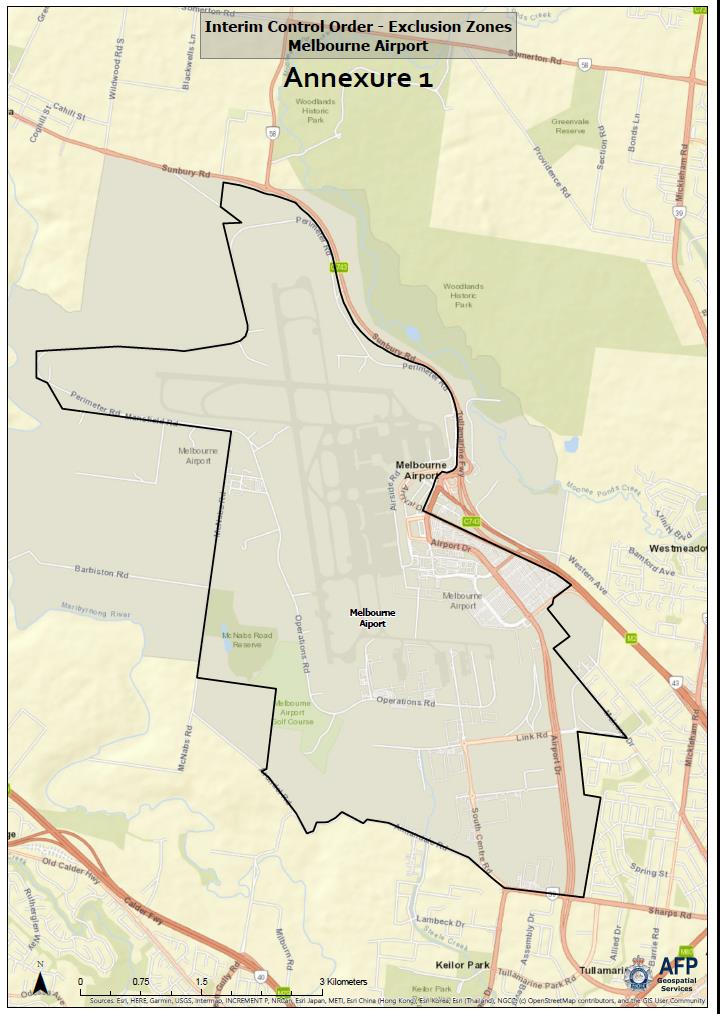
a. within the exclusion zone set out in Annexure 1 at Melbourne International Airport (Tullamarine);
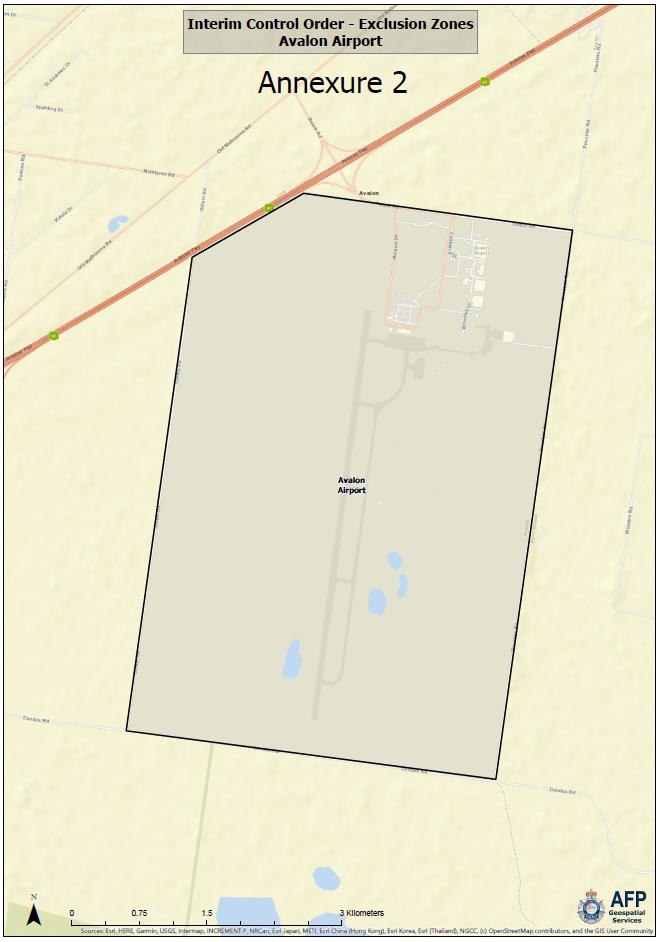
b. within the exclusion zone set out in Annexure 2 at Avalon Airport;
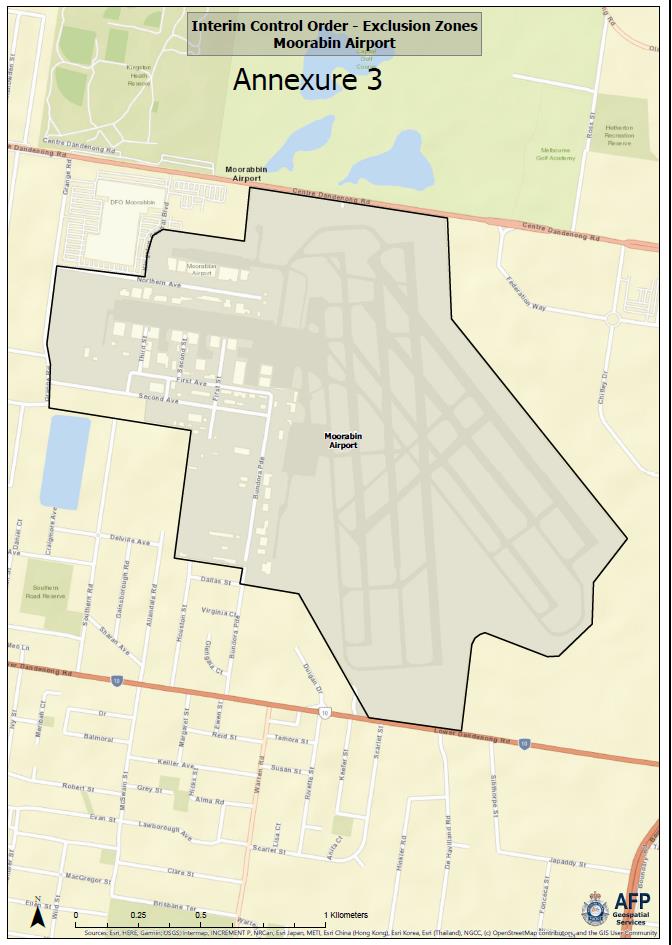
c. within the exclusion zone set out in Annexure 3 at Moorabbin Airport;
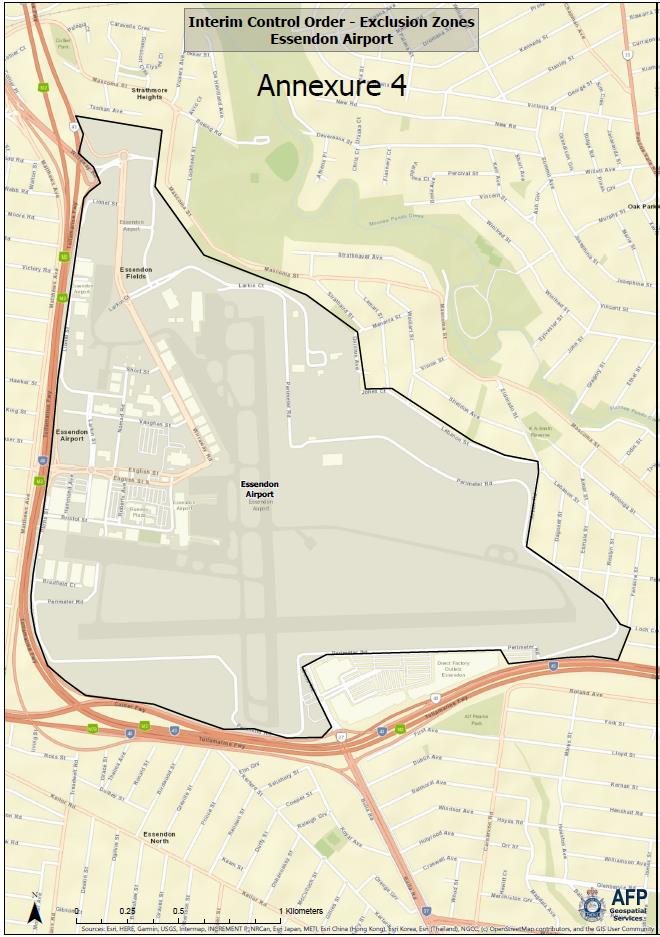
d. within the exclusion zone set out in Annexure 4 at Essendon Fields Airport;
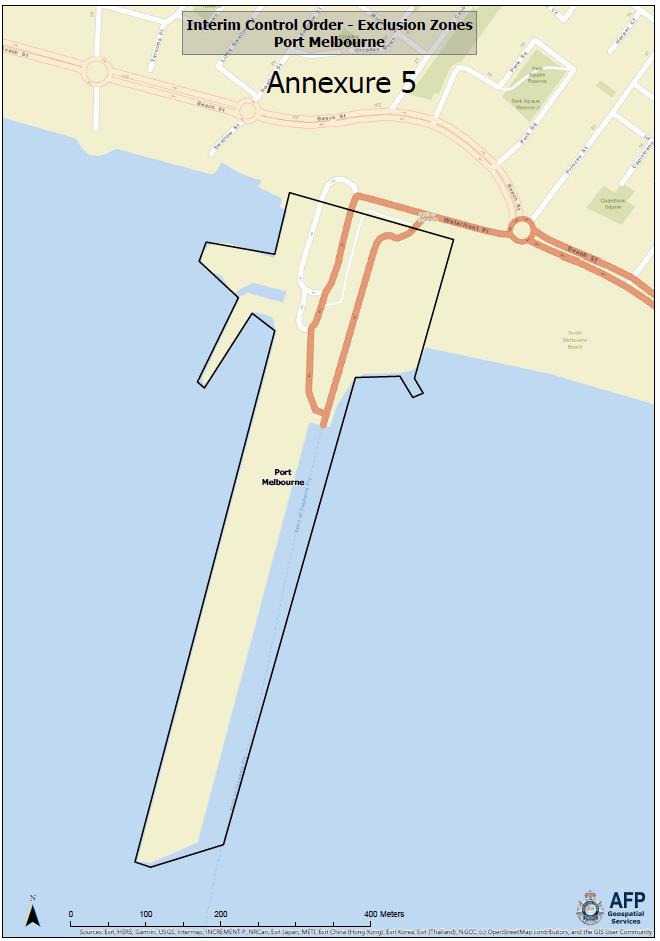
e. within the exclusion zone set out in Annexure 5 at Port Melbourne;
f. within 1 km of any Australian airport (besides Melbourne Tullamarine Airport, Avalon Airport, Moorabbin Airport, and Essendon Fields Airport which are addressed in Controls 3.1.a, 3.1.b, 3.1.c and 3.1.d) which has an international point of departure, or from which a person can board or charter a flight for an international destination;
g. within 1 km of any Australian port (besides Port Melbourne, which is addressed in Control 3.1.e that has an international point of departure, or from which a person can board or charter a marine vessel for an international destination;
h. inside, or in the grounds of, any prison or correctional facility unless you are incarcerated there;
i. at the residence of any person with whom, by reason of Control 11, you are prohibited from communicating or voluntarily associating;
j. any place in Australia outside the state of Victoria, unless:
i. you contact an AFP Superintendent in writing requesting approval to travel in Australia, outside of the state of Victoria, for a specific period of time; and
ii. an AFP Superintendent consents to the proposed travel in writing.
4. Control 4
4.1. You are prohibited from leaving Australia.
5. Control 5
You are prohibited from carrying out the following specified activities (including in respect of your work or occupation), namely: accessing, acquiring, possessing, producing, storing or distributing documents (including documents in electronic form) or electronic media, or attempting to access, acquire, possess, produce, store or distribute documents (including documents in electronic form) or electronic media, which relate to any of the following:
a. explosives, explosive devices, initiation systems or firing devices;
b. firearms, ammunition or knives;
c. anti-surveillance or counter surveillance.
unless that material is:
d. published by a ‘constituent body’ of the Australian Press Council;
e. broadcast on Australian free to air television;
f. broadcast on Australian pay television;
g. shown in a commercial movie cinema;
h. broadcast on one of the following streaming services: Netflix; STAN; ABC iView; or SBS on demand; or
i. served on you or your legal representatives by or on behalf of a senior AFP member in the Federal Court proceeding relating to this Control Order, including any appeal from such proceeding, and is accessed, possessed, and stored solely for the purposes of proceedings in the Federal Court relating to this Control Order, including any appeal from such proceeding.
6. Control 6
6.1. You are prohibited from carrying out the following specified activities (including in respect of your work or occupation), namely: accessing, acquiring, possessing or storing documents (including documents in electronic form) or electronic media, or attempting to access, acquire, possess or store documents (including documents in electronic form) or electronic media, depicting or describing any:
a. execution;
b. beheading;
c. suicide attack;
d. bombing;
e. terrorist attack;
f. propaganda and promotional material for a terrorist organisation within the meaning of s 102.1(1) of the Criminal Code (Cth); or
g. activities of, or associated with, a terrorist organisation within the meaning of s 102.1(1) of the Criminal Code (Cth),
unless that material is:
h. published by a ‘constituent body’ of the Australian Press Council; or
i. broadcast on Australian free to air television;
j. on Australian pay television;
k. shown in a commercial movie cinema;
l. on one of the following streaming services: Netflix; STAN; ABC iView; or SBS on demand; or
m. served on you or your legal representatives by or on behalf of a senior AFP member in the Federal Court proceeding relating to this Control Order, including any appeal from such proceeding, and is accessed, possessed, and stored solely for the purposes of proceedings in the Federal Court relating to this Control Order, including any appeal from such proceeding.
7. Control 7
7.1. You are prohibited from the following specified activities (including in respect of your work occupation), namely: producing or distributing documents (including documents in electronic form) or electronic media relating to:
a. explosives, explosive devices, initiation systems or firing devices;
b. firearms, ammunition or knives;
c. anti-surveillance or counter surveillance;
d. execution;
e. beheading;
f. suicide attack;
g. bombing;
h. terrorist attack;
i. Islamic State;
j. propaganda and promotional material for a ‘terrorist organisation’ within the meaning of s 102.1(1) of the Criminal Code (Cth);
k. activities of, or associated with, a ‘terrorist organisation’ within the meaning of s 102.1(1) of the Criminal Code (Cth).
8. Control 8
8.1. You are prohibited from carrying out the following specified activities (including in respect of your work or occupation), namely: purchasing, renting or driving any vehicle which exceeds a gross vehicle mass of 4.5 tonne.
9. Control 9
9.1. You must respond in writing to any request made by the AFP Superintendent pursuant to Control 9.2 by sending an email from the permitted email account (defined in Control 18.1) within 48 hours after the request is sent.
9.2. The request of the AFP Superintendent to which Control 9.1 refers is a request in writing that you provide, in respect of all paid work undertaken by you within the period of 14 days preceding the date of the request, the name of the employer, contractor or principal for whom you were performing the work, the place or places of work, and the nature of the work undertaken.
9.3. A request made under Control 9.2 may be made by written notice to the permitted email account.
10. Control 10
10.1. You are prohibited from possessing or using, or causing any person to act on your behalf to possess or use, any of these specified articles or substances, namely:
a. firearms or cartridge ammunition within the meaning of s 3(1) of the Firearms Act 1996 (Vic);
b. a ‘prohibited weapon’ within the meaning of s 3(1) of the Control of Weapons Act 1990 (Vic);
c. any quantity of petrol exceeding 4 litres that is not contained in the petrol tank of a vehicle that you have purchased, rented or driven in compliance with Control 8.1;
d. any quantity of any chemical which is not consistent with reasonable domestic use;
e. an article or device, not being a firearm, capable of discharging by any means:
i. any irritant matter in liquid, powder, gas, chemical form or any dense smoke; or
ii. any substance capable of causing bodily harm;
except for reasonable domestic use;
f. a detonator;
g. a fuse capable of use with an explosive or a detonator;
h. a knife, in a public place, without reasonable excuse;
i. anything intended, by the person having custody of the thing, to be used to injure or menace a person or damage property.
11. Control 11
11.1. You are prohibited from communicating or voluntarily associating with:
a. any other person, other than your father Alfio GRANATA, incarcerated in any correctional facility, unless you yourself are incarcerated in that correctional facility;
b. any person located in Turkey, Iraq, Syria or the Philippines;
c. any of the following specified individuals:
i. Paul James DACRE (Date of birth: 06 July 1985);
ii. Robert CERANTONIO (Date of birth: 28 January 1985);
iii. Kadir KAYA (Date of birth: 13 July 1994);
iv. Murat KAYA (Date of birth: 14 February 1991);
v. Shayden THORNE (Date of birth: 03 February 1988);
vi. Hassan El-SABSABI (Date of birth: 26 April 1991);
vii. Denis JUSUFOVSKI (Date of birth: 23 October 1992);
viii. Elmas BEKIROVSKI (Date of birth: 13 July 1993);
ix. Farhad RASOOLI (Date of birth: 5 December 1986);
x. Matthew SMITH aka Abdul MATEEN (Date of birth: 20 June 1985); and
xi. Naseem Abdul R VAN HERWAARDE (Date of birth: 13 August 1979).
12. Control 12
12.1. You are prohibited from accessing or using, any mobile telephone device and SIM card other than a single mobile telephone device (permitted mobile phone) at any one time, and your use of such a permitted mobile phone is subject to the following conditions:
a. before using a permitted mobile phone for the first time, you must present it to an AFP Superintendent (or a police officer specified in writing by an AFP Superintendent) for inspection;
b. before using a permitted mobile phone for the first time, you must advise an AFP Superintendent, in writing, of the following information: the International Mobile Equipment Identity number for the permitted mobile phone, the Integrated Circuit Card Identifier for the SIM card you will use with the permitted mobile phone, the telecommunication service provider which you will use with the permitted mobile phone, the password for the permitted mobile phone and the phone number to which the permitted mobile phone will be connected;
c. once you have advised an AFP Superintendent of the information required by paragraph 12.2(b) above, you must not change, remove, modify or disconnect or cause any other person to change, remove, modify or disconnect on your behalf (including any employee or person acting on behalf of a telecommunications service provider) the SIM card, telecommunication service provider or phone number connected to the permitted mobile phone;
d. if you change the password for a permitted mobile phone, you must provide the new password to an AFP Superintendent, or a police officer acting under an AFP Superintendent’s direction, if you are requested to do so by an AFP Superintendent or that police officer;
e. if at any time an AFP Superintendent (or a police officer specified in writing by an AFP Superintendent) requests, you must present a permitted mobile phone for inspection.
12.2. You are prohibited from causing or permitting another person to use or access a permitted mobile phone.
12.3. You are prohibited from causing or permitting another person to use or access any mobile telephone device on your behalf.
13. Control 13
13.1. You are prohibited from accessing or using, or causing any person to access or use on your behalf, any fixed or landline telephone service other than a single service that has been approved in writing by an AFP Superintendent for you to access or use at any one time.
13.2. To seek approval, you must:
a. submit a written request to an AFP Superintendent which nominates a fixed or landline telephone service; and
b. provide an AFP Superintendent with sufficient detail and any information requested by an AFP Superintendent for the purpose of identifying a fixed or landline telephone service that you will be accessing or using.
14. Control 14
14.1. You are prohibited from accessing or using, or causing any person to access or use on your behalf, any public telephone except in the case of an emergency, provided that you contact an AFP Superintendent as soon as possible after accessing or using such a public telephone and:
a. provide sufficient detail to an AFP Superintendent to identify the public telephone that you accessed or used, and the date, time and phone number called; and
b. you explain the nature of the emergency which required you to access or use that public telephone.
15. Control 15
15.1. You are prohibited from accessing or using, or causing any person to access or use on your behalf, any satellite telephone service.
16. Control 16
16.1. You are prohibited from accessing or using, or causing any person to access or use on your behalf any of the following websites, applications or computer programs (collectively, platforms), as the case may be:
a. WhatsApp
b. Viber
c. Telegram
d. FaceTime
e. Facebook Messenger (including Facebook chat) (subject to Control 16.15)
f. Snapchat
g. KIK
h. iCall
i. WeTalk
j. Lync2013
k. Nimbuzz Messenger
l. Whistle Phone
m. Talkatone
n. Discord
o. Google Duo
p. MagicApp
q. Signal Private Messenger
r. Zoiper IAX SIP VOIP Softphone
s. Beejive
t. Fring
u. JaJah
v. Line2
w. Talkatone
x. Truphone
y. Twitter
z. Yahoo
aa. ICQ
ab. Google Talk
ac. MSN Messenger
ad. AIM
ae. Yahoo Messenger
af. Packet8
ag. Google Hangouts
ah. TikTok
ai. Wickr; and
aj. Zoom.
16.2. In addition to the platforms listed in Control 16.1, you are prohibited from accessing or using, or causing any person to access or use on your behalf, any gaming applications or software that connects to other users or servers, via the internet or Local Area Network (LAN).
16.3. In addition to the platforms listed in Control 16.1, you are prohibited from accessing or using, or causing any person to access or use on your behalf, Skype, except for the following purposes, and subject to the requirements in Controls 16.4, 16.5, 16.6, 16.13 and 16.14:
a. for the purpose of contacting your legal representatives to obtain legal advice, and/or contacting other professionals who may be required to do an online assessment of you for legal purposes;
b. for the purpose of contacting a police officer for the purpose of reporting in accordance with Control 2;
c. for the purpose of contacting any other person approved in writing by an AFP Superintendent.
16.4. At least 24 hours prior to accessing or using Skype for the purposes of contacting your legal representative or other person in accordance with Control 16.3, you must provide to an AFP Superintendent:
a. the username and password for the Skype account you will be using to make that contact, unless you have previously provided the username and password you will be using to make that contact to an AFP Superintendent in compliance with this Control 16.3 and that username and password have not changed.
b. the Skype username of the person you will be contacting, unless you have previously provided the Skype username of the person you will be contacting to an AFP Superintendent in compliance with Control 16.3 and that username has not changed.
16.5. In addition to the platforms listed in Control 16.1, you are prohibited from accessing or using, or causing any person to access or use on your behalf, any internet based messaging service, including any software, mobile application or hardware.
16.6. In addition to the platforms listed in Control 16.1, you are prohibited from accessing or using, or causing any person to access or use on your behalf, any Voice Over Internet Protocol (VOIP) service, including any software, mobile application or hardware, except for the purpose of contacting your father, Alfio Granata, while he is held in a correctional facility by using the VOIP service nominated by that correctional facility.
16.7. Controls 16.1 to 16.6 do not prohibit access to or use of a website which includes an ‘instant chat’ function that allows a visitor to the website to send messages to, and receive messages from, the website host solely for the purpose of obtaining or providing customer service.
16.8. In addition to the platforms listed in Control 16.1, you are prohibited from accessing or using, or causing any person to access or use on your behalf, any Facebook or Instagram account other than:
a. a single Facebook account that has been approved in writing by an AFP Superintended for you to use and access (the permitted Facebook account);
b. a single Instagram account that has been approved in writing by an AFP Superintendent for you to use and access (the permitted Instagram account).
16.9. You are prohibited from deleting the permitted Facebook account or deleting any material posted to the permitted Facebook account without approval of the AFP Superintendent in writing.
16.10. You are prohibited from deleting the permitted Instagram account or deleting any material posted to the permitted Instagram account without approval of the AFP Superintendent in writing.
16.11. To seek approval of an AFP Superintendent to use and access a single Facebook and/or single Instagram account you must submit a written request and:
a. nominate the Facebook and/or Instagram account; and
b. provide any other information requested by, or on behalf of, the AFP Superintendent in relation to, or for the purpose of identifying, the nominated account which you will be accessing or using.
16.12. To seek approval of an AFP Superintendent to delete a permitted Facebook account or permitted Instagram account or delete any material posted to either of these accounts you must submit a written request and:
a. nominate the permitted Facebook and/or permitted Instagram account to be deleted; or
b. nominate the permitted Facebook and/or permitted Instagram account and identify the material posted to either of these accounts that you wish to delete and the reason why you wish to delete the material.
16.13. You are prohibited from accessing or using Skype, the permitted Facebook account or the permitted Instagram account on any device other than a permitted device approved for your access or use under Controls 12.1, 19.1 or 19.3.
16.14. You are prohibited from accessing or using Skype, the permitted Facebook account or the permitted Instagram account using any internet service other than a permitted internet service approved for your access or use under Control 17.1.
16.15. Subject to Control 16.6, Control 16.1 and Control 16.5 do not prevent you from using or accessing Facebook Messenger (including Facebook chat) for the sole purpose of buying or selling items or services on Facebook Marketplace, provided your use and access occurs:
a. On the permitted computer approved for your access and use under Control 19.1; and
b. By logging in via the permitted Facebook account approved for your access and use under Control 16.11.
17. Control 17
17.1. You are prohibited from accessing or using, or causing any person to access or use on your behalf, any internet service other than:
a. a service that has been approved in writing by an AFP Superintendent for you to access or use at any one time (permitted internet service); and
b. a television connected to an internet service at the specified premises, subject to all of the existing Controls.
17.2. You are prohibited from allowing any other person to access or use a permitted internet service.
17.3. You are prohibited from causing any other person to access or use on your behalf any other internet service.
17.4. You are prohibited from:
a. using a virtual private network (VPN) service;
b. using the TOR network; and
c. accessing any Darknet services (denoted by “onion” top level domain suffix).
17.5. Control 17.2 does not prevent your daughter from using the permitted tablet device to access or use a permitted internet service for the sole purpose of completing her schoolwork in accordance with Control 19.6.
18. Control 18
18.1. You are prohibited from accessing or using, or causing any person to access or use on your behalf, any electronic mail (email) account other than a single account that has been approved in writing by an AFP Superintendent for you to access or use at any one time (the permitted email account).
18.2. To seek approval of an AFP Superintendent you must submit a written request and:
a. nominate the email account; and
b. provide any other information requested by, or on behalf of, the AFP Superintendent in relation to, or for the purpose of identifying, the nominated account which you will be accessing or using.
18.3. You are prohibited from causing or permitting another person to use or access a permitted email account.
19. Control 9
19.1. You are prohibited from accessing or using, or causing any person to access or use on your behalf, any computer other than a computer that has been supplied by the AFP or approved in writing by an AFP Superintendent for you to access or use (permitted computer) and your use of the permitted computer is subject to the following conditions:
a. before using the permitted computer, you must provide the password for the permitted computer to the AFP Superintendent; and
b. if you change the password for the permitted computer, you must provide the new password to the AFP Superintendent, or a police officer acting under the AFP Superintendent’s direction, if you are requested to do so by the AFP Superintendent or the police officer.
19.2. You are prohibited from allowing any other person to access or use the permitted computer.
19.3. You are prohibited from accessing or using, or causing any person to access or use on your behalf, any tablet device other than a single tablet device that has been supplied by the AFP or approved in writing by an AFP Superintendent for you to access or use at any one time (permitted tablet device) and your use of a permitted tablet device is subject to the following conditions:
a. before using a permitted tablet device, you must provide the password for a permitted tablet device to the AFP Superintendent; and
b. if you change the password for a permitted tablet device, you must provide the new password to the AFP Superintendent, or a police officer acting under the AFP Superintendent’s direction, if you are requested to do so by the AFP Superintendent or the police officer.
19.4. To request approval under Control 19.2 you must:
a. submit a written request to the AFP Superintendent which nominates a tablet device; and
b. provide any information requested by or on behalf of the AFP Superintendent in relation to, or for the purpose of identifying and accessing, a nominated tablet device.
19.5. Subject to Control 19.6, you are prohibited from allowing any other person to access or use the permitted table device.
19.6. Controls 17.2, 19.3 and 19.5 do not prevent your daughter from using the permitted tablet device to access or use a permitted internet service, with or without your assistance, for the sole purpose of completing her schoolwork.
20. Exemption requested by you
20.1. You may request the AFP Superintendent approve an exemption to the requirements or prohibitions (as the case may be) specified in Controls 1.1, 2, 3.1 and 16.
20.2. To request an exemption, you must:
a. submit a written request to the AFP Superintendent which:
i. identifies the Control in respect of which you seek an exemption;
ii. explains the extent to which you seek to be exempted from the Control; and
iii. explains your reason(s) for seeking the exemption; and
b. provide any other information requested by, or on behalf of, the AFP Superintendent for the purposes of determining whether to approve the exemption.
20.3. The AFP Superintendent may grant an exemption subject to conditions specified in writing.
20.4. You must comply with all of the conditions specified in writing by the AFP Superintendent. If you do not comply with a condition to an exemption, the exemption is (and will be taken to have been for all purposes) of no effect.
20.5. A request for an exemption in respect of Controls 1.1 or 2 must be made three business days before the material time and date;
20.6. A request for an exemption in respect of Controls 3.1 or 16 must be made seven business days before the material time and date.
20.7. If the AFP Superintendent has not approved an exemption by the material time and date, the request is deemed to have been refused.
21. Exemption granted by the AFP without a request from you
21.1. An AFP Superintendent may grant an exemption, initiated by the AFP, to the requirements or prohibitions specified in the Controls with your consent.
21.2. The AFP Superintendent may grant an exemption subject to reasonable conditions specified in writing provided on reasonable notice to you and to which you consent in writing.
21.3. You must comply with all of the conditions specified in writing by the AFP Superintendent. If you do not comply with a condition to an exemption, the exemption is (and will be taken to have been for all purposes) of no effect.
22. Interpretation
22.1. In this Control Order:
a. AFP Superintendent means a member of the Australian Federal Police performing the duties of a Superintendent within the Counter- Terrorism portfolio.
b. Material time and date means:
i. in relation to a request for an exemption to the requirement in Control 1.1 – the commencement of the curfew period that is the subject of the request (and, if more than one curfew period is the subject of the request, the first of those curfew periods);
ii. in relation to a request for an exemption to the requirement in Control 2 – before the conclusion of the reporting period that is the subject of the request (and, if more than one reporting period is the subject of the request, the first of those reporting periods); and
iii. in relation to a request for an exemption to the requirement in Control 3.1 – the time and date at which you wish to be in the prohibited area and/or the time and date at which you wish to depart Victoria; and
iv. in relation to a request for an exemption to the requirements and prohibitions in Control 16 – the time and date at which you indicate the exemption is required.
c. Password includes but is not limited to any passcode, swipe pattern or any information or function necessary to facilitate access to the applicable device.
d. Permitted device means a permitted mobile phone as defined by Control 12.1, a permitted computer as defined by Control 19.1, or a permitted tablet device as defined by Control 19.3.
e. Police officer means a ‘member’ or ‘special member’ of the Australian Federal Police, as defined by the Australian Federal Police Act 1979 (Cth), or a ‘police officer’ within the meaning of the Victoria Police Act 2013 (Vic).
EX TEMPORE REASONS FOR JUDGMENT
WHITE J:
1 On 2 June 2020, acting under s 104.4 of the Criminal Code contained in the Schedule to the Criminal Code Act 1995 (Cth), the Court made an Interim Control Order (ICO) in relation to the respondent (Mr Granata): Booth v Granata [2020] FCA 768. The ICO was varied by consent on 24 August 2020.
2 On 2 September 2020, the applicant (Ms Booth) elected, under s 104.12A of the Criminal Code, to confirm the order. The Court fixed today, 25 September 2020, as the date for the confirmation hearing. However, the parties reached agreement that the ICO should be confirmed, albeit with some minor variations. For the reasons which follow, I am satisfied that it is appropriate to confirm the ICO and to give effect to the parties’ agreement.
3 Ms Booth relied upon the affidavit she had made on 5 May 2020 and 10 August 2020. In addition, Ms Booth relied, in proof of formal matters, upon the affidavits of Mr Stevens of 9 June 2020 and 24 September 2020. The parties also provided a substantial Statement of Agreed Facts which I received pursuant to s 191 of the Evidence Act 1995 (Cth).
4 Given the parties are agreed that the ICO should be confirmed, it is not necessary to record in the usual detail the factual background. Instead, for part of that background, I will repeat verbatim the summary which I gave in the reasons for the making of the ICO.
5 Between 22 October 2015 and 10 May 2016, Mr Granata, with five others, committed the offence of engaging in conduct in preparation for incursions into a foreign country for the purpose of engaging in hostile activities, contrary to ss 11.2A and 119.4(1) of the Criminal Code. The prosecution case, in brief, was that Mr Granata and his co-offenders had, between 22 October 2015 and 10 May 2016, agreed with each other to engage and had engaged in conduct with a view to entering the Philippines with the intention that one of their number would engage in conduct aimed at overthrowing the government of the southern Philippines by force or violence. The motivation of the group was to bring about a circumstance by which the Southern Philippines would be governed by Islamic law, otherwise known as Sharia law. Mr Granata and his co-offenders were arrested in Far North Queensland on 10 May 2016, having travelled there from Victoria towing a seven-metre boat. Their plan had been to depart Australia on the boat and travel to the Philippines. Unknown to the group, they had been under police surveillance for some time before May 2016. The description of the group’s plan by Croucher J in the Victorian Supreme Court when sentencing the offenders suggests that the plan had a hapless quality about it.
6 Mr Granata and all but two of his co-offenders were sentenced for their offences on 22 February 2019. After a reduction for his plea of guilty, Mr Granata was sentenced to a term of imprisonment for four years with a non-parole period of three years. As Mr Granata had been in custody since his arrest on 10 May 2016, the sentence has now been completed, and he was released from prison on 8 May 2020.
7 Ms Booth has been a member of the Australian Federal Police (AFP) for 20 years. She now holds the rank of Commander. During her time with the AFP, Ms Booth has acquired significant knowledge and experience in the investigation of crime generally but with specific reference to counter-terrorism policing.
8 Ms Booth has concluded that Mr Granata poses a risk to the community of committing, supporting or facilitating a terrorist attack in Australia or overseas, or supporting or facilitating the engagement in hostile activity in a foreign country. Ms Booth bases this opinion on her experience and upon a number of matters, including:
(a) the knowledge of Islamic State and of Islamist militant groups;
(b) her knowledge of threats of domestic terrorism;
(c) the prospect, based on previous experience, of recidivism by some of those who have been convicted of terrorism offences;
(d) the behaviour of Mr Granata commencing in 2014 and continuing during 2015 which culminated in his arrest on 10 May 2016 and conviction on 22 February 2019; and
(e) the continuing influences to which Mr Granata may be subject, including from members of his family and his associates.
Statutory provisions
9 Section 104.14 of the Criminal Code provides the alternatives available to a Court on a confirmation hearing. It is section 104.14(7), which is relevant presently. It provides:
(7) Otherwise, the court may:
(a) revoke the order if, at the time of confirming the order, the court is not satisfied as mentioned in paragraph 104.4(1)(c); or
(b) confirm and vary the order by removing one or more obligations, prohibitions or restrictions if, at the time of confirming the order, the court is satisfied as mentioned in paragraph 104.4(1)(c) but is not satisfied as mentioned in paragraph 104.4(1)(d); or
(c) confirm the order without variation if, at the time of confirming the order, the court is satisfied as mentioned in paragraphs 104.4(1)(c) and (d).
Note: If the court confirms the interim control order, the court must make a new order under section 104.16.
10 Section 104.4(1) requires that the Court be satisfied of four matters before making an ICO. It provides:
(1) The issuing court may make an order under this section in relation to the person, but only if:
(a) the senior AFP member has requested it in accordance with section 104.3; and
(b) the court has received and considered such further information (if any) as the court requires; and
(c) the court is satisfied on the balance of probabilities:
(i) that making the order would substantially assist in preventing a terrorist act; or
(ii) that the person has provided training to, received training from or participated in training with a listed terrorist organisation; or
(iii) that the person has engaged in a hostile activity in a foreign country; or
(iv) that the person has been convicted in Australia of an offence relating to terrorism, a terrorist organisation (within the meaning of subsection 102.1(1)) or a terrorist act (within the meaning of section 100.1); or
(v) that the person has been convicted in a foreign country of an offence that is constituted by conduct that, if engaged in in Australia, would constitute a terrorism offence (within the meaning of subsection 3(1) of the Crimes Act 1914); or
(vi) that making the order would substantially assist in preventing the provision of support for or the facilitation of a terrorist act; or
(vii) that the person has provided support for or otherwise facilitated the engagement in a hostile activity in a foreign country; and
(d) the court is satisfied on the balance of probabilities that each of the obligations, prohibitions and restrictions to be imposed on the person by the order is reasonably necessary, and reasonably appropriate and adapted, for the purpose of:
(i) protecting the public from a terrorist act; or
(ii) preventing the provision of support for or the facilitation of a terrorist act; or
(iii) preventing the provision of support for or the facilitation of the engagement in a hostile activity in a foreign country.
11 Section 104.4(1)(c) and (d) are pertinent presently. Subsection (1)(c) contains seven internal alternatives. It was common ground that subs (1)(c)(iv) is satisfied presently because Mr Granata has been convicted in Australia of an offence relating to terrorism or a terrorist act. Section 104.4(1)(d) requires that the Court be satisfied, on the balance of probabilities, that each of the obligations, prohibitions and restrictions to be imposed on the person by the control order is reasonably necessary, reasonably appropriate and adapted for the purpose of achieving at least one of the stated objects.
Consideration
12 The effect of s 104.14(1A)(c) of the Criminal Code is that the Court must be satisfied of certain matters commonly referred to as the “formalities”, namely, that:
(a) the ICO was served on Mr Granata personally by an AFP member;
(b) the AFP member informed Mr Granata of the matters specified in s 104.12(1)(b);
(c) the AFP member ensured that Mr Granata understood the information provided to him;
(d) an AFP member has served Mr Granata personally with a copy of Ms Booth’s election to confirm the ICO; and
(e) a copy of the documents provided to the Minister under s 104.2(3)(aa) and to the Court under s 104.3(d) has been provided to Mr Granata.
13 The affidavits of Mr Stevens indicate compliance with the first four of these formalities. The first affidavit of Ms Booth indicates compliance with the fifth of the formalities.
14 As the Court was previously satisfied that an ICO was appropriate, and was satisfied that each of the obligations, prohibitions and restrictions contained in the then proposed ICO were reasonably necessary and reasonably appropriate and adapted for a s 104.4(1)(d) purpose, and given that the parties have agreed that the ICO should be confirmed (subject to some minor variations), and given that each party has been represented by counsel, I do not consider it necessary to state in detail the reason why I am satisfied about the s 104.4(1)(c) and (d) elements. For the same reasons, it is not necessary to discuss each of the controls and limitations in detail.
15 The Court was not provided with evidence of Mr Granata’s behaviour in the period between his release from prison on 8 May 2020 and the making of the ICO on 2 June 2020, let alone about matters which may give rise to concerns about his conduct. Nor has the Court been provided with evidence of Mr Granata’s behaviour in the period of over three months since the making of the ICO. Nevertheless, Ms Booth’s affidavits and the statement of agreed facts satisfies me that each of the obligations, prohibitions and restrictions sought to be confirmed in the ICO is reasonably necessary and reasonably appropriate and adapted for the purposes specified in s 104.4(1)(d)(i), (ii) and (iii) of the Criminal Code. I will, however, revise control so that it is consistent with the contemporaneous circumstances and make some formatting and grammatical changes. I will vary Controls 12.1(a) and (b) so as to make it plain that the obligations imposed on Mr Granata, by those controls, relate to his first use of the permitted mobile phone.
16 Control 16 will be varied so as to remove the prohibitions on Mr Granata accessing Facebook and Instagram. Otherwise, I am satisfied that the controls in the ICO remain appropriate, although I will make some modifications of a formatting or grammatical kind in the expression of those controls.
17 In summary, I am satisfied that it is appropriate to confirm the ICO with the variations upon which the parties have agreed and with the further minor variations which I consider appropriate.
18 The confirmed control order is to remain in force until and including 2 June 2021.
I certify that the preceding eighteen (18) numbered paragraphs are a true copy of the Reasons for Judgment of the Honourable Justice White. |
Associate:


