

Federal Court of Australia
OneVue Holdings Limited, in the matter of OneVue Holdings Limited [2020] FCA 1321
ORDERS
ONEVUE HOLDINGS LIMITED ACN 108 221 870 Plaintiff | ||
DATE OF ORDER: |
THE COURT ORDERS THAT:
Scheme Meeting
1. Pursuant to s 411(1) and s 1319 of the Corporations Act 2001 (Cth) (Act):
(a) the plaintiff convene and hold a meeting (Scheme Meeting) of holders of fully paid ordinary shares in the plaintiff (Scheme Shareholders) for the purpose of considering and, if thought fit, approving (with or without modification) a scheme of arrangement (Scheme) proposed between the plaintiff and the Scheme Shareholders, being the scheme of arrangement set forth in Annexure C of the explanatory statement in relation to the Scheme (Scheme Booklet), which is Exhibit 1 in this proceeding;
(b) the Scheme Meeting shall be held as a virtual meeting on Friday, 9 October 2020 commencing at 10.30 am AEDT, in accordance with s 5 of the Corporations (Coronavirus Economic Response) Determination (No 1) 2020 (Determination) and to the extent that it is not displaced by the Determination or these Orders, in accordance with r 3.3(2) of the Federal Court (Corporations) Rules 2000 (Cth) (Rules), such meeting to be accessed through the online platform specified in Annexure E to the Scheme Booklet;
(c) the Scheme Meeting be convened by sending on or before Tuesday, 8 September 2020:
(i) in the case of Scheme Shareholders for whom the plaintiff holds an email address and who have elected to receive shareholder communications electronically by way of email (Email Shareholders), an email substantially in the form of the document marked ‘CBM-7’ and exhibited to the affidavit of Connie Bernice Mckeage dated 1 September 2020 (Mckeage Affidavit) and which contains links to:
A. an electronic copy of a document substantially in the form of the Scheme Booklet, which contains, among other things, the Notice of Scheme Meeting at Annexure E to the Scheme Booklet; and
B. an online portal or website that is accessible by the Email Shareholder and which enables the Email Shareholder to lodge their proxy for the Scheme Meeting and voting instructions online; and
(ii) in the case of Scheme Shareholders who are not Email Shareholders (Postal Shareholders) and whose registered address is in Australia, by pre-paid post addressed to the relevant addresses recorded in the plaintiff’s register a document substantially in the form of the document marked ‘CBM-8’ and exhibited to the Mckeage Affidavit, which includes a personalised proxy form for the Scheme Meeting and which contains links to:
A. an electronic copy of a document substantially in the form of the Scheme Booklet, which contains, among other things, the Notice of Scheme Meeting at Annexure E to the Scheme Booklet; and
B. an online portal or website that is accessible by the Email Shareholder and which enables the Email Shareholder to lodge their proxy for the Scheme Meeting and voting instructions online; and
(iii) in the case of Postal Shareholders and whose registered address is outside Australia, by airmail addressed to the relevant addresses recorded in the plaintiff’s register a document substantially in the form of the document marked ‘CBM-8’ and exhibited to the Mckeage Affidavit, which includes a personalised proxy form for the Scheme Meeting and which contains links to:
A. an electronic copy of a document substantially in the form of the Scheme Booklet, which contains, among other things, the Notice of Scheme Meeting at Annexure E to the Scheme Booklet; and
B. an online portal or website that is accessible by the Email Shareholder and which enables the Email Shareholder to lodge their proxy for the Scheme Meeting and voting instructions online;
(d) a proxy in respect of the Scheme Meeting will be valid and effective if, and only if, it is completed and delivered (in the case of paper proxy forms) or lodged (in the case of online proxy appointments) in accordance with its terms by 10.30 am AEDT on Wednesday, 7 October 2020;
(e) Garry Wayling or, in his absence, Ronald Dewhurst, act as Chairperson of the Scheme Meeting;
(f) the Chairperson of the Scheme Meeting shall have the power to adjourn the meeting to such time, date and place as he or she considers appropriate;
(g) the plaintiff may provide access to the Scheme Meeting for such other persons as it thinks fit; and
(h) rule 2.15 of the Rules shall not apply to the scheme meeting.
2. Pursuant to s 411(1) of the Act, a document substantially in the form of the Scheme Booklet be approved for distribution to the Scheme Shareholders of the plaintiff.
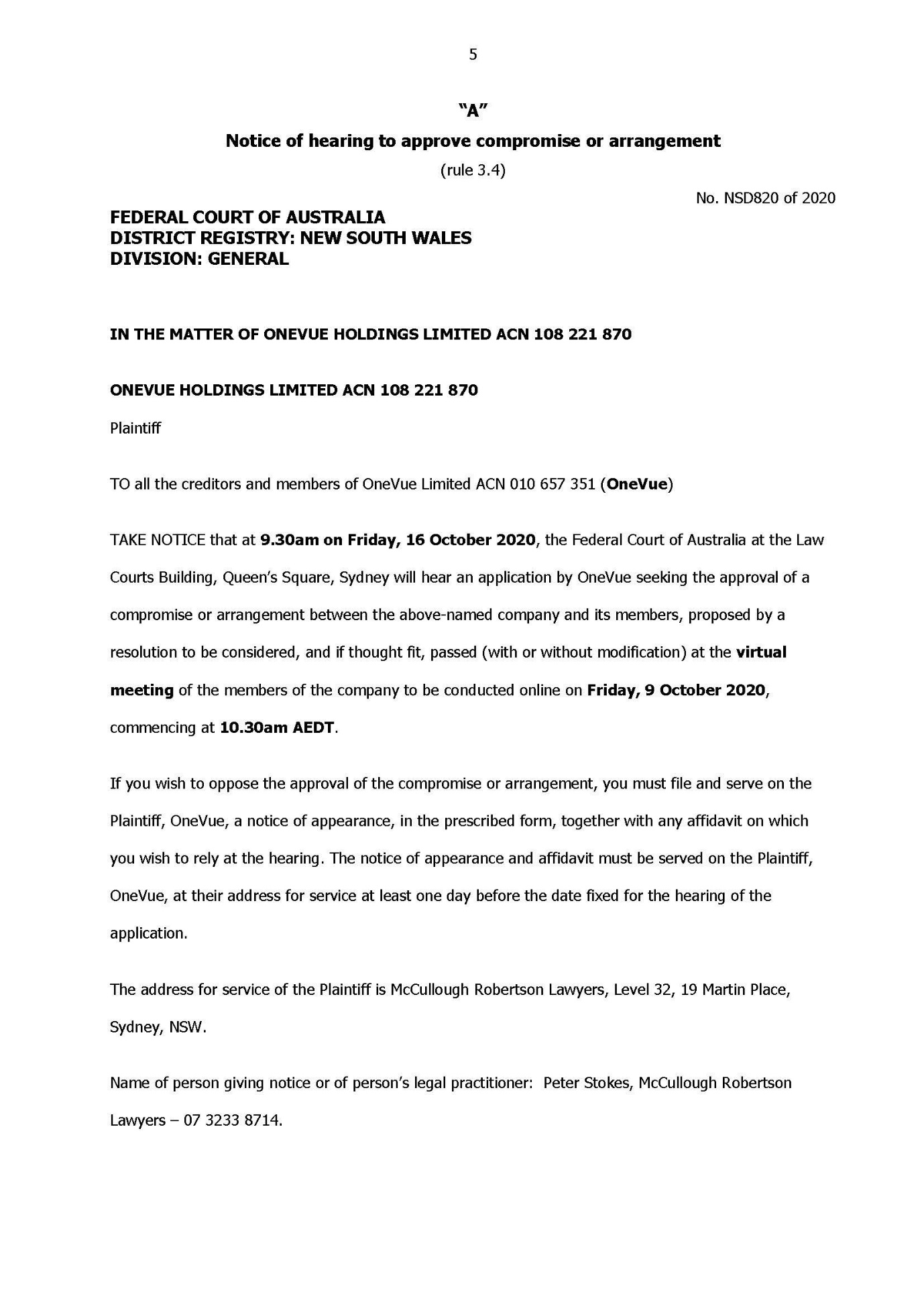
3. The plaintiff publish a notice of hearing of any application to approve the Scheme on or before Thursday, 8 October 2020, in The Australian newspaper by an advertisement substantially in the form of Annexure A to these Orders, and the plaintiff shall otherwise be exempted from compliance with r 3.4(3)(b) of the Rules.
4. The proceeding be stood over to 9.30 am on Friday, 16 October 2020 before Markovic J for the hearing of any application to approve the scheme of arrangement.
5. Liberty to apply.
Note: Entry of orders is dealt with in Rule 39.32 of the Federal Court Rules 2011.
MARKOVIC J
1 On 4 September 2020 I made orders pursuant to s 411(1) and s 1319 of the Corporations Act 2001 (Cth) (Act) for the convening and conduct of a meeting (Scheme Meeting) of the holders of fully paid ordinary shares (Scheme Shareholders) in OneVue Holdings Limited (OneVue) to consider and vote on a proposed scheme of arrangement (Scheme) between OneVue and its members and approving the despatch of the explanatory statement in relation to the Scheme (Scheme Booklet). These are my reasons for making those orders.
Background
2 OneVue is a company listed on the Australian Securities Exchange (ASX). It is focused on superannuation and investment solutions provided through customised wealth management platforms.
3 Iress Limited (Iress), also listed on the ASX, is a technology company which provides software to the financial services industry. It was founded in 1993 and its software is used by more than 9,000 businesses and 500,000 users globally.
The Scheme
4 OneVue and Iress entered into a scheme implementation agreement (SIA) under which they agreed to implement the Scheme. Under the Scheme the proposal is that Iress will acquire all the shares on issue in OneVue on the Record Date (as defined in the SIA). The consideration for each share transferred is AUD 0.40 to be paid in cash.
5 Payment of the Scheme consideration is secured by way of a deed poll executed by Iress on 27 August 2020 in favour of each registered holder of fully paid ordinary shares in OneVue as at the Record Date (OneVue Shareholder) and which relevantly provides that Iress will fulfil its obligations under the SIA and do all things necessary or desirable on its part to give full effect to the Scheme.
6 If the Scheme is implemented, all of the shares in OneVue held on the Record Date will be transferred to Iress.
7 The directors of OneVue unanimously recommend that OneVue Shareholders vote in favour of the Scheme, in the absence of a superior proposal and subject to the independent expert report (see [8] below) continuing to conclude that the Scheme is in their best interests.
Independent expert’s report
8 The directors of OneVue appointed Grant Thornton Corporate Finance Pty Ltd (Grant Thornton) to prepare an independent expert’s report providing an opinion as to whether the Scheme is fair and reasonable and in the best interests of OneVue Shareholders. Grant Thornton has concluded that the Scheme is fair and reasonable and is in the best interests of OneVue Shareholders, in the absence of a superior proposal. A copy of their report is included with the Scheme Booklet.
Legal principles
9 The applicable principles on an application for the convening of a meeting and the approval of the despatch of an explanatory statement under s 411(1) of the Act are settled and were conveniently summarised by senior counsel for OneVue.
10 In Central Pacific Minerals NL [2002] FCA 239 at [6] Emmett J observed that there are three stages involved in the promulgation and giving effect to a scheme of arrangement so as to make the scheme binding on the parties to it. His Honour described those stages as: the application to the Court to convene a meeting, referred to as the first court hearing; the holding of the meeting to approve the scheme; and the application to the Court for its approval of the scheme, referred to as the second court hearing.
11 At the first court hearing, “the court will not ordinarily summon a meeting unless the scheme is of such a nature and cast in such terms that, if it receives the statutory majority at the ... meeting the court would be likely to approve it on the hearing of a petition which is unopposed”: F T Eastment & Sons Pty Ltd v Metal Roof Decking Supplies Pty Ltd (1977) 3 ACLR 69 at 72.
12 At the first court hearing, the Court exercises its “supervisory jurisdiction” to review the scheme and the explanatory statement and to raise any queries with the plaintiff: see Re City of Melbourne Bank Ltd (1897) 3 ALR 220 at 227-228; Re Archaean Gold NL (1997) 23 ACSR 143 at 146. In Re Crusader Ltd [1996] 1 Qd R 117 at 125, Thomas J said that “the courts are concerned with the notion of a fair picture being presented”. In summary, the adequacy of the information is to be assessed in a practical, realistic way, having regard to the complexity of the proposal.
13 The second court hearing is where the Court makes its final determination and is the most important hearing if the matter becomes contested, but in practice the first court hearing is where the Court intervenes if it has any concerns. At both court hearings there is a duty of disclosure which falls on the plaintiff to bring to the Court’s attention “all matters that could be considered relevant to the exercise of its discretion”: see Re Permanent Trustee Company Limited [2002] NSWSC 1177; (2002) 43 ACSR 601 at [7].
14 In Capilano Honey Limited, in the matter of Capilano Honey Limited [2018] FCA 1568; (2018) 131 ACSR 9 at [32] Farrell J noted that the Court will order that a scheme meeting be convened and will approve a draft explanatory statement to be sent to shareholders if it is satisfied that:
(1) The plaintiff is a Pt 5.1 body;
(2) The proposed scheme is a compromise or (relevantly) an “arrangement” within the meaning of s 411 …;
(3) The scheme booklet will provide proper disclosure to shareholders;
(4) The scheme is bona fide and properly proposed;
(5) ASIC has had a reasonable opportunity to examine the terms of the scheme and the scheme booklet and make submissions and it has had at least 14 days’ notice of the proposed hearing date;
(6) The procedural requirements of the Federal Court (Corporations) Rules 2000 (Cth) have been met; and
(7) The scheme is of such a nature and cast in such terms that, if it receives a statutory majority at the meeting, the Court will be likely to approve it on the hearing of a petition which is unopposed.
Consideration
Matters for the Court’s satisfaction
15 Based on the evidence relied on by OneVue I was satisfied that:
(1) OneVue is a Pt 5.1 body as defined in s 9 of the Act;
(2) the Scheme is a compromise or “arrangement” within the meaning of s 411(1) of the Act;
(3) the Australian Securities and Investments Commission (ASIC) had been given at least 14 days’ notice of the first court hearing and has had a reasonable opportunity to examine the terms of the Scheme and the Scheme Booklet and to make submissions. By letter dated 3 September 2020 ASIC informed OneVue that it did not currently propose to appear at the first court hearing to make submissions or intervene to oppose the Scheme;
(4) the Scheme Booklet provides adequate disclosure to OneVue Shareholders;
(5) the Scheme is bona fide and has been properly proposed; and
(6) the procedural requirements set out in Div 3 of the Federal Court (Corporations) Rules 2000 (Cth) (Corporations Rules) had been met.
Others matters
16 OneVue brought the following matters to the Court’s attention.
Classes for voting purposes
17 Members are required to be divided into different classes for voting purposes where their rights are so dissimilar as to make it impossible for them to consult together with a view to their common interest: see Sovereign Life Assurance Company v Dodd [1892] 2 QB 573 at 583; Re Nine Entertainment Group Ltd (No 1) (2012) 211 FCR 439 at [53].
18 In proposing that there should be one class of shareholders for voting purposes, OneVue considered the following matters relating to Connie Mckeage, OneVue’s managing director and an executive director:
(1) Ms Mckeage proposes to enter into a consultancy agreement with Iress and will continue to be involved with Iress to assist it during a transition period after implementation of the Scheme. While the consultancy agreement is not yet formalised, it is proposed to run for an initial term of 12 months from implementation of the Scheme, with Ms Mckeage receiving the proposed monthly consultancy fee set out in section 9.1.5 of the Scheme Booklet;
(2) Ms Mckeage holds 2,940,938 OneVue shares, representing 1.097% of the voting power in OneVue; and
(3) Ms Mckeage has a relevant interest in 34,125,023 ordinary shares, representing 13% of the voting power in OneVue, held by a related party and its related entities, which are not controlled by Ms Mckeage but by a related party.
19 I accepted OneVue’s submission that those matters are not class creating for scheme voting purposes by OneVue. That is, those facts do not make Ms Mckeage and her related party’s rights so dissimilar to the rights of other shareholders that it is not possible for OneVue Shareholders to consult together with a view to their common interest. In addition, I was informed by senior counsel appearing for OneVue that, at the second court hearing, evidence would be provided as to how the shares owned by or associated with Ms Mckeage were voted.
Deal protection clauses
20 Pursuant to cl 11 and cl 13 of the SIA respectively, OneVue has agreed to certain exclusivity arrangements and to pay a break fee if the Scheme does not proceed in the circumstances set out therein.
21 The amount of the break fee is:
(1) $1,071,745 which represents 1.00002% of the total equity value of OneVue based on the offer under the Scheme and which is payable if:
(a) on or before the End Date, 31 December 2020, a Competing Transaction (as defined in the SIA) is publicly announced and, within 12 months thereafter, the third party proponent of the Competing Transaction completes the transaction or acquires Control (as defined in the SIA) of more than 50% of OneVue’s shares;
(b) one or more of OneVue’s directors fails to recommend the Scheme or withdraws, adversely changes, revises or qualifies their recommendation or otherwise makes any public statement indicating that he or she no longer supports the Scheme (except in a case where that recommendation is made after the independent expert concludes that the Scheme is not in the best interests of OneVue Shareholders); or
(c) Iress validly terminates the SIA in accordance with cl 16.1(b)(ii) thereof, except in the circumstances set out in subpara (2) below; or
(2) $535,873 if Iress validly terminates the SIA in accordance with cl 16.1(b)(ii) thereof where those circumstances have arisen as a result of a breach of cll 5.3, 5.4, 8.1 or 12 of the SIA where that breach is not a wilful breach.
22 The break fee is not payable if OneVue Shareholders vote down the Scheme.
23 The deal protection and break fee clauses are disclosed in section 8.5 of the Scheme Booklet and Ms McKeage has given evidence in relation to those clauses of the nature described by Lindgren J in APN News & Media Limited, in the matter of APN News & Media Limited [2007] FCA 770; (2007) 62 ACSR 400 (Re APN) at [55].
24 In relation to the exclusivity arrangements, Ms Mckeage notes that the Exclusivity Period (as defined in the SIA) is the period commencing on 1 June 2020 and ending on the earlier of: termination of the SIA in accordance with its terms; the Effective Date (as defined in the SIA), which is the date on which the Scheme becomes Effective (as defined in the SIA); and the End Date, 31 December 2020. Ms Mckeage believes that cl 11 of the SIA is reasonable and appropriate because there is a fiduciary and statutory duty carve-out to the operation of the “no talk” and “notice of approaches” clauses, as well as certain aspects of OneVue’s obligation to provide details to Iress of Competing Transactions to the effect that, if OneVue receives an unsolicited approach, it is not prevented from responding if failure to do so would, in the reasonable opinion of the board having regard to specific legal and any other appropriate advice, be likely to involve a breach of the duties of OneVue’s directors.
25 In relation to the break fee, Ms McKeage explains that it is to compensate Iress for its reasonable external and internal costs and opportunity costs in relation to the Scheme.
26 Mr Mckeage also explains that the exclusivity and break fee clauses were agreed between OneVue and Iress following arm’s length negotiations during which each party was represented by their lawyers and that in negotiating the SIA, including the exclusivity and break fee clauses, OneVue had regard to the terms of the Takeovers Panel Guidance Note 7. She also notes that Iress required clauses of that nature to be included in the SIA and that, in each case, OneVue was satisfied that the final form of the clauses was acceptable to it.
27 I was satisfied that the exclusivity and break fee clauses were reasonable in the circumstances.
28 The exclusivity clauses run for a reasonable period capable of precise ascertainment, are subject to a fiduciary carve-out and are given adequate prominence in the Scheme Booklet: see Re APN at [29].
29 Insofar as the break fee is concerned:
(1) it represents 1.00002% of the total equity value of OneVue which the Takeovers Panel Guidance Note 7 notes is a value which is generally not unacceptable;
(2) it was agreed after negotiation between the parties;
(3) neither party would have entered into the SIA without the break fee, making it commercially sensible for OneVue to agree to it to secure the proposal for OneVue Shareholders; and
(4) there is an acknowledgement in the SIA that the break fee represents an amount which is appropriate to compensate Iress for its reasonable external and internal costs and its reasonable opportunity costs in connection with the Scheme.
Despatch of the Scheme Booklet and notice of the Scheme Meeting
30 OneVue proposes to despatch a copy of the Scheme Booklet to each OneVue Shareholder appearing on the registry at the date of despatch by, for each OneVue Shareholder:
(1) who has authorised notices to be given by electronic mail – electronic mail;
(2) whose address for notices is within Australia – letter sent by ordinary prepaid post containing a website link to a copy of the Scheme Booklet; and
(3) whose address for notices is outside Australia – letter sent by airmail containing a website link to a copy of the Scheme Booklet.
31 As at 1 September 2020 there were 3,143 OneVue Shareholders of which 1,721 had elected to receive electronic notifications of meetings.
32 Section 249J(3)(c) and (ca) of the Act contemplates sending notices of meetings to members electronically.
33 Rule 3.3(2) of the Corporations Rules provides that, unless the Court otherwise orders, a meeting of members ordered under s 411 of the Act must be convened, held and conducted in accordance with the provisions of Pt 2G.2 of the Act, which includes s 249J, and the provisions of, in this case, OneVue’s constitution that apply in relation to meetings of members insofar as they are not inconsistent with Pt 2G.2 of the Act. A copy of OneVue’s constitution was in evidence before me. Rule 34.1(c) of OneVue’s constitution is consistent with s 249J(3)(c) and (ca) of the Act.
34 The proposal to provide the Scheme Booklet and notice of the Scheme Meeting to shareholders electronically is not novel and has been adopted in connection with other proposed schemes: see for example Marengo Mining Ltd, in the matter of Marengo Mining Ltd (No 2) [2012] FCA 1498 at [7]; David Jones Limited, in the matter of David Jones Limited [2014] FCA 530 at [34]-[37].
35 The Corporations (Coronavirus Economic Reponses) Determination (No 1) 2020 (Cth) (Determination) was made on 5 May 2020 under s 1362A of the Act. Section 5(1) provides that the operation of the provisions in subs (2) is modified in relation to each class of persons in relation to whom the provisions apply in the ways set out, which include that notice of a meeting may be given, and any other information to be provided with the notice of a meeting may be provided, using one or more technologies to communicate to those entitled to receive notice of the meeting the contents of the notice and other information or details of an online location where those items can be viewed or from where they can be downloaded.
36 Subsection (2) provides:
The provisions specified are each provision of the Act, the regulations, the Insolvency Practice rules, and the Passport Rules for this jurisdiction, that:
(a) requires or permits a meeting to be held, or regulates giving notice of a meeting or the conduct of a meeting; or
(b) gives effect to, or provides a means of enforcing, a provision in the constitution of a company or registered scheme, or in any other arrangement, that requires or permits a meeting to be held, or regulates giving notice of a meeting or the conduct of a meeting.
37 The proposed means of provision of the Scheme Booklet and notification of the Scheme Meeting via email or letter containing a website link to the Scheme Booklet is in accordance with the provisions of s 5(1) of the Determination.
38 Given the ongoing novel coronavirus (COVID-19) pandemic, the Scheme Meeting will not be held physically but by use of remote technology. Insofar as meetings to be held under the Act are concerned, s 5(1)(a) of the Determination provides that:
a meeting may be held using one or more technologies that give all persons entitled to attend a reasonable opportunity to participate without being physically present in the same place, and paragraphs (b) to (e) of this subsection apply if the meeting is held in that way;
Subsections (b) to (e) then set out how the meeting is to be conducted.
39 I was satisfied that the orders sought by OneVue in relation to notification of OneVue Shareholders about the Scheme and the proposal to hold the Scheme Meeting virtually were appropriate.
Conclusion
40 For those reasons, I was satisfied that the Scheme is of such a nature and cast in such terms that, if it receives the statutory majorities at the Scheme Meeting, the Court would be likely to approve it on the hearing of an unopposed application and I made the orders sought by OneVue.
I certify that the preceding forty (40) numbered paragraphs are a true copy of the Reasons for Judgment of the Honourable Justice Markovic. |
Associate:


