

FEDERAL COURT OF AUSTRALIA
Dodd (Vincent) on behalf of the members of Jamangku, Japuwuny, Parlakuna-Palkinykarni and Yilyilyimawu landholding groups v Northern Territory of Australia [2020] FCA 1279
ORDERS
DATE OF ORDER: |
THE COURT NOTES THAT:
A. The Applicant in this proceeding NTD62/2016 has made an application for the determination of native title (“the Application”) over an area of land and waters.
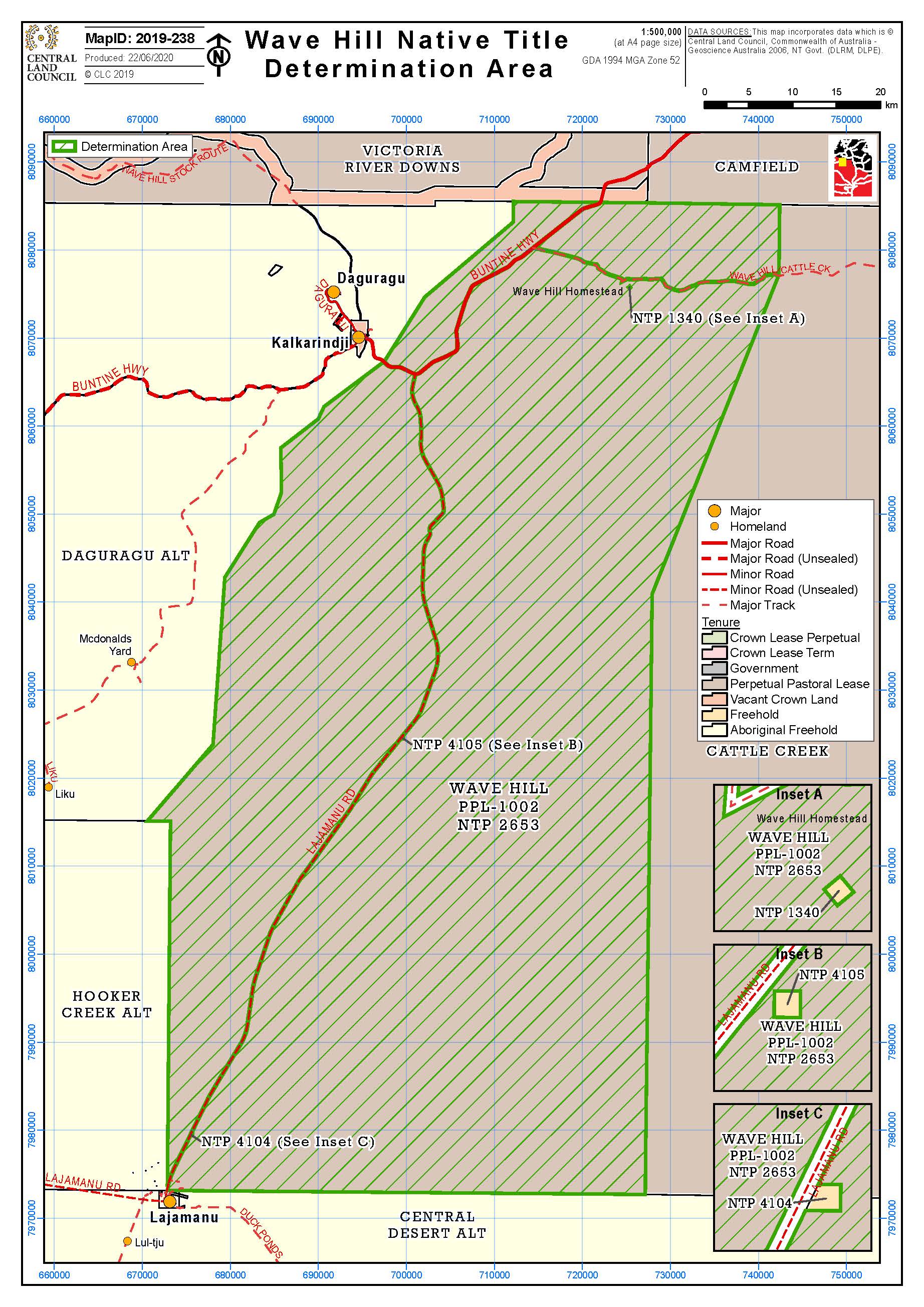
B. The Applicant, the Northern Territory of Australia and the Second and Third Respondents (“the parties”) have reached agreement within the meaning of s 87(1)(a) of the Native Title Act 1993 (Cth) (“the Act”) as to the terms of the determination (“the Determination”) which is to be made in relation to the land and waters covered by the Application (“the Determination Area”). The external boundaries of the Determination Area are described in Schedule A and depicted on the map at Schedule B of the Determination.
C. The parties have, in accordance with s 87(1)(b) of the Act, filed with the Court their signed written agreement.
D. Pursuant to s 87 and s 94A of the Act the terms of the parties’ agreement involve the making of consent orders for a determination that native title exists in relation to the Determination Area as provided by the Determination.
E. The parties acknowledge that the effect of the making of the Determination is that the members of the native title claim group, in accordance with the traditional laws acknowledged and the traditional customs observed by them, should be recognised as the native title holders for the Determination Area as provided by the Determination.
F. The parties have requested that the Court hear and determine this proceeding in accordance with their agreement.
BEING SATISFIED that a determination of native title in the terms set out in the Determination in respect of this proceeding would be within the power of the Court and, it appearing to the Court appropriate to do so, pursuant to section 87 of the Act and by the consent of the parties:
THE COURT ORDERS THAT:
1. There be a determination of native title in terms of the determination set out below.
2. The native title is not to be held on trust.
3. Jinparrak Aboriginal Corporation (ICN: 8455) is:
(a) to be the prescribed body corporate for the purposes of s 57(2) of the Act;
(b) to perform the functions outlined in s 57(3) of the Act after becoming a registered native title body corporate.
4. The parties have liberty to apply to establish the precise location and boundaries of any public works and adjacent land and waters identified or otherwise referred to in Schedule C of the Determination; and
5. There be no order as to costs.
THE COURT DETERMINES THAT:
The Determination Area
1. The Determination Area comprises NT Portion 2653, being the land and waters more particularly described in Schedule A and depicted on the map comprising Schedule B.
2. Native title exists in the Determination Area.
3. Native title does not exist in those parts of the Determination Area described in Schedule C.
The native title holders
4. The Determination Area comprises four estate areas associated with the Jamangku, Japuwuny, Parlakuna-Palkinykarni and Yilyilyimawu landholding groups.
5. The persons who hold the common or group rights comprising the native title are the Aboriginal persons who are:
(a) members of one or more of the landholding groups referred to in paragraph 4 by virtue of descent (including adoption) through father’s father, mother’s father, father’s mother and mother’s mother; or
(b) accepted as members of one or more of the landholding groups referred to in paragraph 4 by senior members of a landholding group, referred to in subparagraph 5(a), by virtue of the following non-descent connections to an estate:
(i) birth in an estate;
(ii) long-term residence in an estate;
(iii) possession of secular and traditional spiritual knowledge, authority, status and responsibility for an estate or surrounding country, in particular, knowledge of sites and their mythology; and
(iv) seniority in traditional matters concerning the claim group and/or the estate including as ngurramarla on the basis of same patri-moiety affiliation as the estate’s descent-based ngurramarla; and kurdungurlu on the basis of opposite patri-moiety affiliation.
Native title rights and interests
6. The native title rights and interests in relation to the Determination Area comprise:
(a) the right to access and travel over any part of the land and waters;
(b) the right to live on the land, and for that purpose, to camp, erect shelters and other structures;
(c) the right to hunt, gather and fish on the land and waters;
(d) the right to take and use the natural resources of the land and waters;
(e) the right to access, take and use natural water on or in the land, except water captured by the holder of Perpetual Pastoral Lease No. 1002;
(f) the right to light fires for domestic purposes, but not for the clearance of vegetation;
(g) the right to share or exchange natural resources obtained on or from the land and waters, including traditional items made from the natural resources;
(h) the right to access and to maintain and protect sites and places on or in the land and waters that are important under traditional laws and customs;
(i) the right to conduct and participate in the following activities on the land and waters:
(i) cultural activities;
(ii) ceremonies;
(iii) meetings;
(iv) cultural practices relating to birth and death including burial rites;
(v) teaching the physical and spiritual attributes of sites and places on the land and waters that are important under traditional laws and customs,
(j) the right to make decisions about the use and enjoyment of the land and waters by Aboriginal people who recognise themselves to be governed by the traditional laws and customs acknowledged by the native title holders provided that the right does not extend to making any decision that purports to control the access of such persons to the Determination Area;
(k) the right to be accompanied on the land and waters by persons who, though not native title holders, are:
(i) people required by traditional law and custom for the performance of ceremonies or cultural activities on the land and waters;
(ii) people who have rights in relation to the land and waters according to the traditional laws and customs acknowledged by the native title holders;
(iii) people required by the native title holders to assist in, observe, or record traditional activities on the areas.
7. The native title rights and interests do not confer:
(a) possession, occupation, use and enjoyment of the land and waters on the native title holders to the exclusion of all others;
(b) any right to control access to, or the use of, the Determination Area or its resources.
8. The native title rights and interests are subject to and exercisable in accordance with:
(a) the valid laws of the Northern Territory of Australia and the Commonwealth of Australia;
(b) the traditional laws and customs of the native title holders for personal or communal needs which are of a domestic or subsistence nature and not for any commercial or business purpose.
Other rights and interests
9. The nature and extent of the other interests in the Determination Area are:
(a) NT Portion 2653 – Gambamora Industries Pty Ltd (ACN 009 941 173) under Perpetual Pastoral Lease No. 1002, subject to the Gurindji Wave Hill Walk Off Route being a heritage place declared, as at the date of this Determination, for the purposes of the Environment Protection and Biodiversity Conservation Act 1999 (Cth) and the Heritage Act 2011 (NT), and located on NT Portion 6643(A);
(b) the rights and interests of the holders of the following mining titles granted under the Mineral Titles Act 2010 (NT) (or its predecessor):
No. | Expiry date | Holder |
ML 25205 | 03/03/2033 | Linna Huang |
ML 29302 | 15/04/2040 | Australian Mineral Mines Pty Ltd (ACN 095 728 831) |
(c) the rights and interests of the holders of the following petroleum titles granted pursuant to the Petroleum Act 1984 (NT) (or its predecessor):
No. | Expiry date | Holder |
EP 205 | 15/02/2021 | Wiso Oil Pty Ltd (ACN 147 564 529) |
EP 207 | 15/02/2021 | Wiso Oil Pty Ltd (ACN 147 564 529) |
(d) the rights and interests of Telstra Corporation Limited (ACN 051 775 556):
(i) as the owner or operator of telecommunications facilities within the Determination Area;
(ii) created pursuant to the Post and Telegraph Act 1901 (Cth), the Telecommunications Act 1975 (Cth), the Australian Telecommunications Corporation Acts 1989 (Cth), the Telecommunications Act 1991 (Cth) and under Schedule 3 to the Telecommunications Act 1997 (Cth), including rights:
A. to inspect land;
B. to install and operate telecommunication facilities; and
C. to alter, remove, replace, maintain, repair and ensure the proper functioning of its telecommunication facilities; and
(iii) for its employees, agents or contractors to access its telecommunications facilities in and in the vicinity of the Determination Area in the performance of their duties;
(iv) under any lease, licence, access agreement or easement relating to its telecommunications facilities in the Determination Area.
(e) the rights of Aboriginal persons (whether or not native title holders) pursuant to the reservation in favour of Aboriginal people contained in pastoral leases set out in sections 38(2) to (6) of the Pastoral Land Act 1992 (NT);
(f) the rights of Aboriginal persons (whether or not native title holders) by virtue of the Northern Territory Aboriginal Sacred Sites Act 1989 (NT);
(g) rights of access by an employee, servant, agent or instrumentality of the Northern Territory, Commonwealth or other statutory authority as required in the performance of his or her statutory duties;
(h) the interests of persons to whom valid or validated rights and interests have been:
(i) granted by the Crown pursuant to statute or otherwise in the exercise of its executive power; or
(ii) conferred by statute.
Relationship between rights and interests
10. To the extent that the continued existence, enjoyment or exercise of the native title rights and interests referred to in paragraph 6 is inconsistent with the existence, enjoyment or exercise of the other rights and interests referred to in paragraph 9, the other rights and interests and the doing of any activity required or permitted to be done by or under the other interests prevail over, but do not extinguish, the native title rights and interests.
Other matters
11. There are no native title rights and interests in:
(a) minerals (as defined in s 2 of the Minerals Acquisition Act 1953 (NT));
(b) petroleum (as defined in s 5 of the Petroleum Act 1984 (NT));
(c) prescribed substances (as defined in s 5 of the Atomic Energy Act 1953 (Cth) and s 3 of the Atomic Energy (Control of Materials) Act 1946 (Cth)).
12. In this determination the term:
(a) ‘natural resources’ means:
(i) animals ferae naturae, birds, fish and plants, including timber, wax, resin and gum; and
(ii) surface soils, clays, stone, rocks and ochre,
but does not include minerals, petroleum and prescribed substances;
(b) ‘natural waters’ includes springs and rockholes.
13. Unless the contrary intention appears, a word or expression used in the Act has the same meaning in this determination as it has in the Act.
Note: Entry of orders is dealt with in Rule 39.32 of the Federal Court Rules 2011.
SCHEDULE A
1. The Determination Area comprises NT Portion 2653 being the area of 5,492 square kilometres which is the subject of Perpetual Pastoral Lease No 1002.
2. The following areas which are within the external boundaries of the Determination Area are not included in the Determination Area:
(a) NT Portion 1340 comprising an area of 2 hectares 8000 square metres held for an estate in fee simple by Gambamora Industries Pty Ltd (ACN 009 941 173).
(b) NT Portion 4104 comprising an area of 2 hectares 4500 square metres held for an estate in fee simple by Telstra Corporation Limited (ACN 051 775 556).
(c) NT Portion 4105 comprising an area of 2 hectares 2500 square metres held for an estate in fee simple by Telstra Corporation Limited (ACN 051 775 556).
(d) The Buntine Highway which traverses NT Portion 2653 from the boundary with NT Portion 2199 (Wave Hill Stock Route) to the boundary with NT Portion 2395 (Dagaragu Aboriginal Land Trust).
(e) A road 100 metres wide (Lajamanu Road) which traverses NT Portion 2653 from the junction with the Buntine Highway to the boundary with NT Portion 1740 (Central Desert Aboriginal Land Trust).
(f) A road 100 metres wide (Wave Hill/Cattle Creek Road) which traverses NT Portion 2653 from the boundary with NT Portion 2654 (Cattle Creek) to the junction with the Buntine Highway.
SCHEDULE B - DETERMINATION AREA MAP
SCHEDULE C
Areas where native title does not exist
Native title rights and interests have been wholly extinguished in the following areas of land and waters.
Public works
1. Those parts of the Determination Area covered by public works as defined in section 253 of the Act that were constructed or established before 23 December 1996 or commenced to be constructed or established on or before that date (including land and waters within the meaning of section 251D of the Act), including:
(a) public roads, namely, rural public roads (50m either side of the centre line), rural arterial roads and national highways and associated road infrastructure;
(b) community, pastoral access and other roads (including access roads and tracks to public works referred to in this clause) which are not otherwise public roads;
(c) gravel and fill pits established to maintain the roads referred to in (a) and (b) above;
(d) government bores and associated works;
(e) river and rain gauges;
(f) transmission water pipes (adjacent area 5 metres either side of the centre line);
(g) distribution water pipes measuring 150mm diameter or less (adjacent area of 1.5m either side of the centre line) and greater than 150mm diameter (adjacent area 5 metres either side of the centre line);
(h) sewer pipes measuring 150mm diameter or less (adjacent area 1.5m either side of the centre line) and greater than 150mm (adjacent area 5 metres either side of the centre line); and
(i) bores, sewer pump stations, and overhead power lines.
2. In addition to the areas referred to in paragraph 1 above, native title has been wholly extinguished over that part of NT Portion 2653 that is contained within the fence and on which Bureau of Meteorology Station Number 014840 is situated (inclusive of the land and waters within the meaning of section 251D of the Act).
WHITE J:
1 This judgment concerns a request by the parties that the Court exercise its power under s 87 of the Native Title Act 1993 (Cth) (the Act) to make a determination of native title by consent.
2 The underlying application for native title was filed in the Court on 25 November 2016. It sought a determination of native title over the area in NT Portion 2653 held under Perpetual Pastoral Lease No. 1002 and known as the Wave Hill Pastoral Lease. The area involved, being some 5,492 km2, is in the Gurindji locality of the central region of the Northern Territory.
3 In the following reasons, I explain why I consider it appropriate to make the determination sought by the parties.
The statutory provisions
4 Section 87 of the Act provides (relevantly):
87 Power of Federal Court if parties reach agreement
Application
(1) This section applies if, at any stage of proceedings after the end of the period specified in the notice given under section 66:
(a) agreement is reached between the parties on the terms of an order of the Federal Court in relation to:
(i) the proceedings; or
(ii) a part of the proceedings; or
(iii) a matter arising out of the proceedings; and
(b) the terms of the agreement, in writing signed by or on behalf of the parties, are filed with the Court; and
(c) the Court is satisfied that an order in, or consistent with, those terms would be within the power of the Court.
Power of Court
(1A) The Court may, if it appears to the Court to be appropriate to do so, act in accordance with:
(a) whichever of subsection (2) or (3) is relevant in the particular case; and
(b) if subsection (5) applies in the particular case—that subsection.
Agreement as to order
(2) If the agreement is on the terms of an order of the Court in relation to the proceedings, the Court may make an order in, or consistent with, those terms without holding a hearing or, if a hearing has started, without completing the hearing.
Note: If the application involves making a determination of native title, the Court’s order would need to comply with section 94A (which deals with the requirements of native title determination orders).
…
5 As is apparent, s 87 enables the Court to make a determination of native title if, after the end of the period specified in the notice pursuant to s 66, the parties reach agreement and file the signed agreement with the Court, provided that the Court is satisfied that an order in, or consistent with the agreed terms, is within its power. The first three of these requirements are satisfied in the present case. I will return to the question of the Court’s power shortly.
6 Section 94A of the Act requires that an order of this Court by which a determination of native title is made must set out details of the matters mentioned in s 225. Section 225 provides:
225 Determination of native title
A determination of native title is a determination whether or not native title exists in relation to a particular area (the determination area) of land or waters and, if it does exist, a determination of:
(a) who the persons, or each group of persons, holding the common or group rights comprising the native title are; and
(b) the nature and extent of the native title rights and interests in relation to the determination area; and
(c) the nature and extent of any other interests in relation to the determination area; and
(d) the relationship between the rights and interests in paragraphs (b) and (c) (taking into account the effect of this Act); and
(e) to the extent that the land or waters in the determination area are not covered by a non-exclusive agricultural lease or a non-exclusive pastoral lease—whether the native title rights and interests confer possession, occupation, use and enjoyment of that land or waters on the native title holders to the exclusion of all others.
Note: The determination may deal with the matters in paragraphs (c) and (d) by referring to a particular kind or particular kinds of non-native title interests.
7 The expression “native title rights and interests” appearing in s 225(b) is defined in s 223(1) as follows:
Common law rights and interests
(1) The expression native title or native title rights and interests means the communal, group or individual rights and interests of Aboriginal peoples or Torres Strait Islanders in relation to land or waters, where:
(a) the rights and interests are possessed under the traditional laws acknowledged, and the traditional customs observed, by the Aboriginal peoples or Torres Strait Islanders; and
(b) the Aboriginal peoples or Torres Strait Islanders, by those laws and customs, have a connection with the land or waters; and
(c) the rights and interests are recognised by the common law of Australia.
Hunting, gathering and fishing covered
(2) Without limiting subsection (1), rights and interests in that subsection includes hunting, gathering, or fishing, rights and interests.
The Court’s power
8 The Court’s power to make a determination of native title derives from Pt 4 of the Act, which includes s 87. A number of matters bear on the exercise of that power. In addition to s 94A to which reference has already been made, the Court must have a valid application before it; there must not have been any previous determination made in respect of the proposed determination area (s 68); and the determination must not overlap the area of another application (s 67(1)). There is no doubt in the present case that these conditions are satisfied and that the Court does have the power to make the determination sought by the parties.
The Court’s approach
9 Section 87(1A) requires that the Court be satisfied that it is appropriate to make the proposed determination.
10 In former times, the Court’s assessment of the appropriateness of the making of the determination required it to consider evidence bearing on that question. However, it is now accepted that the Court may proceed more flexibly as s 87(2) permits the Court to make the order by consent without conducting a hearing or receiving evidence. In this way, and by the exercise of s 87 or s 87A, the Court gives effect to the policy evident in the Act, and well recognised in decisions of this Court, of encouraging parties to applications for the determination of native title to reach agreement with respect to the claim and thereby to avoid the necessity for determinations following formal Court hearings.
11 The approach adopted by the Court has now been stated in a number of authorities, including King on behalf of the Eringa Native Title Claim Group v State of South Australia [2011] FCA 1386; (2011) 285 ALR 454 in which Keane CJ at [19] said:
More recently, the Court has been prepared to rely upon the processes of the relevant State or Territory about the requirements of s 223 being met to be satisfied that the making of the agreed orders is appropriate. That is because each State and Territory has developed a protocol or procedure by which it determines whether native title (as defined in s 223) has been established. It acts in the public interest and as the public guardian in doing so. It has access to anthropological, and where appropriate, archaeological, historical and linguistic expertise. It has a legal team to manage and supervise the testing as to the existence of native title in the claimant group. Although the Court must, of course, preserve to itself the question whether it is satisfied that the proposed orders are appropriate in the circumstances of each particular application, generally the Court reaches the required satisfaction by reliance upon those processes. They are commonly explained in the joint submissions of the parties in support of the orders agreed …
12 Consequently, on applications of the present kind, the Court does not routinely embark on its own inquiry into the merits of the claim in order to be satisfied that the orders sought are supportable and in accordance with the law. Instead, as the reasons of Keane CJ indicate, the Court places particular reliance on the agreement of the parties and on the State or Territory concerned discharging appropriately its responsibility in the public interest of undertaking a proper assessment of the application.
13 Nevertheless, when considering an application for the making a consent determination in the manner discussed in King v State of SA, the Court does have regard to a number of matters. Foremost among those is that the determination made by the Court will bind the community generally and not just the parties to the proceeding: Munn for and on behalf of the Gunggari People v State of Queensland [2001] FCA 1229, (2001) 115 FCR 109 at [22]; Cox on behalf of the Yungngora People v State of Western Australia [2007] FCA 588 at [3]. Further, as was noted by Mortimer J in Freddie v Northern Territory [2017] FCA 867, the proprietary nature of the rights declared indicates that the Court should be satisfied that the determination is stated with appropriate clarity and, in particular, that the claim area, the nature of the native title rights and interests and the manner in which other proprietary interests may be affected, are appropriately defined. The Court is also concerned to know that the consent to the proposed determination is both free and informed and that there is a credible and rational basis for the consent of the respondents to the application.
Consideration
14 For the purpose of assisting the Court to conclude that the making of the determination is appropriate, the parties have provided the following material:
(a) a Statement of Agreed Facts dated 30 July 2020 received under s 191 of the Evidence Act 1995 (Cth);
(b) a copy of the anthropological report provided by Dr James Weiner on 10 February 2016;
(c) a copy of a supplementary anthropological report provided by Mr Craig Elliott on 25 September 2018;
(d) a copy of a further supplementary anthropological report provided by Mr Elliott on 11 January 2019; and
(e) joint submissions of the applicant and the first respondent dated 30 July 2020.
15 Although these documents have been provided by the applicant and by the Northern Territory, the other respondent parties have agreed to the determination and have signed the agreement provided to the Court.
16 The Statement of Agreed Facts and the supporting material indicate that the Northern Territory has engaged in an appropriate assessment of the application for the determination of native title and that there is a rational basis for its agreement to the application.
17 Turning then to the matters which s 94A requires be included in the determination and about which, inferentially, the Court must be satisfied, I note first that the expression “native title rights and interests” used in s 225(b), and defined in s 223, was considered by the High Court in Members of the Yorta Yorta Aboriginal Community v State of Victoria [2002] HCA 58; (2002) 214 CLR 422. It is not necessary for present purposes to outline those matters. It is sufficient to record my satisfaction that the rights and interests for which the proposed determination provides satisfy the description of “native title rights and interests” in s 225(b) of the Act.
18 Clause 4 of the determination indicates that four estate groups have native title over the determination area. These are the Jamangku, Japuwuny, Parlakuna-Palkinykarni and Yilyilyimawu landholding groups. They are part of a larger society having communal rights and interests. The interests of these landholding groups are in different parts of the determination area. Mr Elliott’s report of 25 September 2018 indicates that the native title holders are descendants of those who possessed and occupied the determination area at effective sovereignty. They have retained their ties to the lands and waters.
19 Clause 5 of the proposed determination contains details of the methods by which membership of one or more of the landholding groups is identified.
20 The native title rights and interests with respect to the determination area are contained in cl 6.
21 The determination area is defined in cll 1 and 2 and indicates that native title does not exist within some areas within the outer bounds of the determination area. The underlying application for native title lodged on 25 November 2016 did not include a claim with respect to those areas.
22 The “other interests” to which s 225(c) refers are identified in cl 9 of the proposed determination. Clause 10 provides for the relationship between the other rights and interests and the determined native title rights and interests, as required by s 225(d).
General
23 There are no identified circumstances which would indicate that the making of the determination in the terms proposed by the parties is inappropriate.
24 It is apparent that all parties have had the opportunity to obtain independent legal advice. There is no reason for the Court to suppose that a lack of legal representation has caused disadvantage to any party.
25 Proposed Order 2 will state that the native title is not to be held on trust. Proposed Order 3 appoints Jinparrak Aboriginal Corporation (ICN: 8455) as the prescribed body corporate for the purposes of s 57(2) of the Act and to perform the functions outlined in s 57(3).
26 The matters which I have reviewed above indicate that it is appropriate to give effect to the parties’ agreement and thereby to the policy evident in the Act to which I referred earlier.
27 I note, however, that the order of this Court does not amount to a grant of native title to the estate holders. The order is instead a public and formal recognition that the native title rights and interests of the estate holders exist, and have always existed, at least since European settlement.
28 For these reasons, I make orders in the terms proposed by the parties.
I certify that the preceding twenty-eight (28) numbered paragraphs are a true copy of the Reasons for Judgment of the Honourable Justice White. |
Associate:


