

FEDERAL COURT OF AUSTRALIA
Australian Branch of Great Lakes Insurance SE (trading as Great Lakes Australia), in the matter of the Australian Branch of Great Lakes Insurance SE (trading as Great Lakes Australia) (No 2) [2020] FCA 1266
ORDERS
DATE OF ORDER: | 29 June 2020 |
THE COURT ORDERS THAT:
1. The applicant be granted leave to reopen the hearing and rely upon the affidavit of Ms Louise De Beus affirmed on 27 June 2020, which is taken as read.
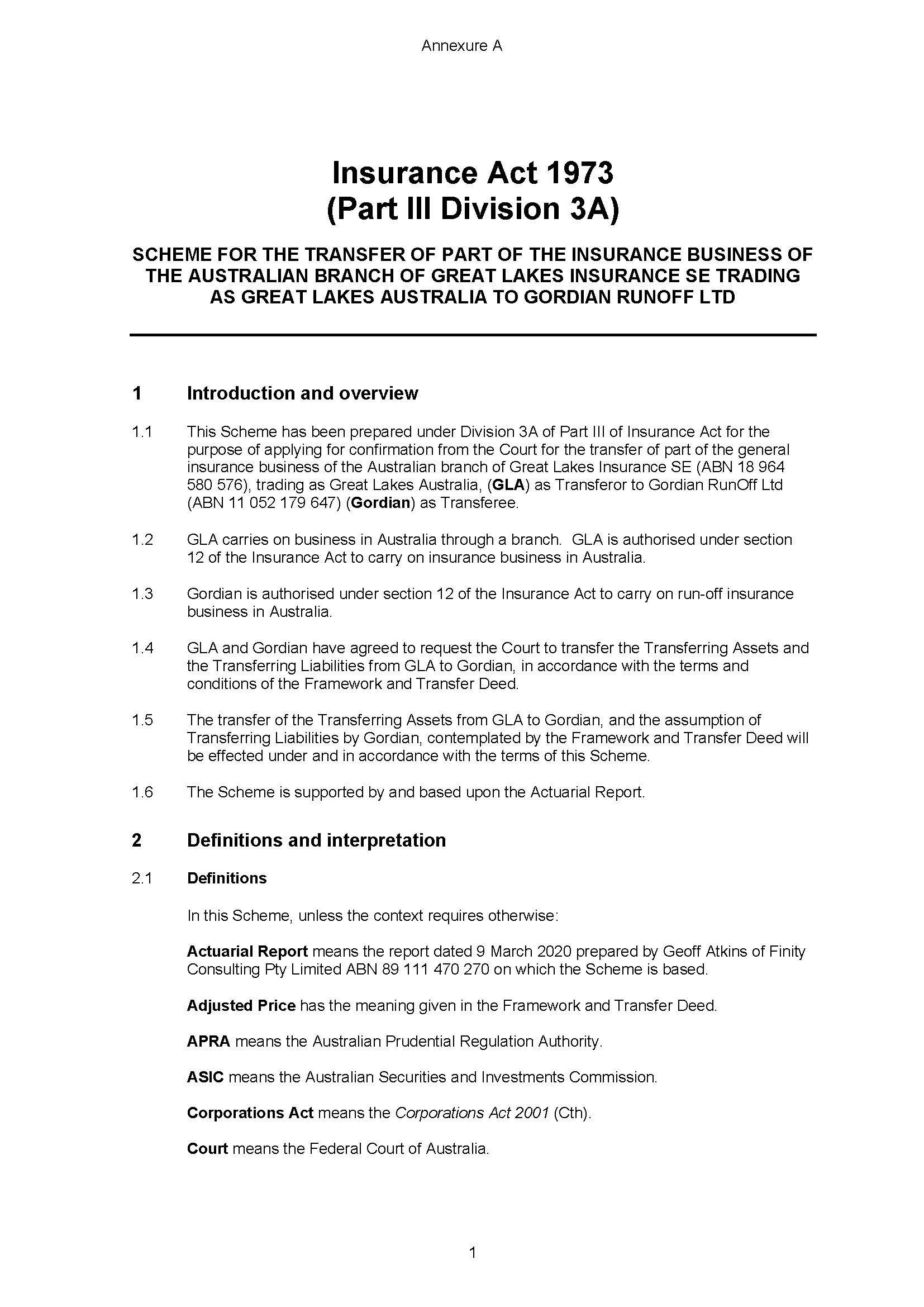
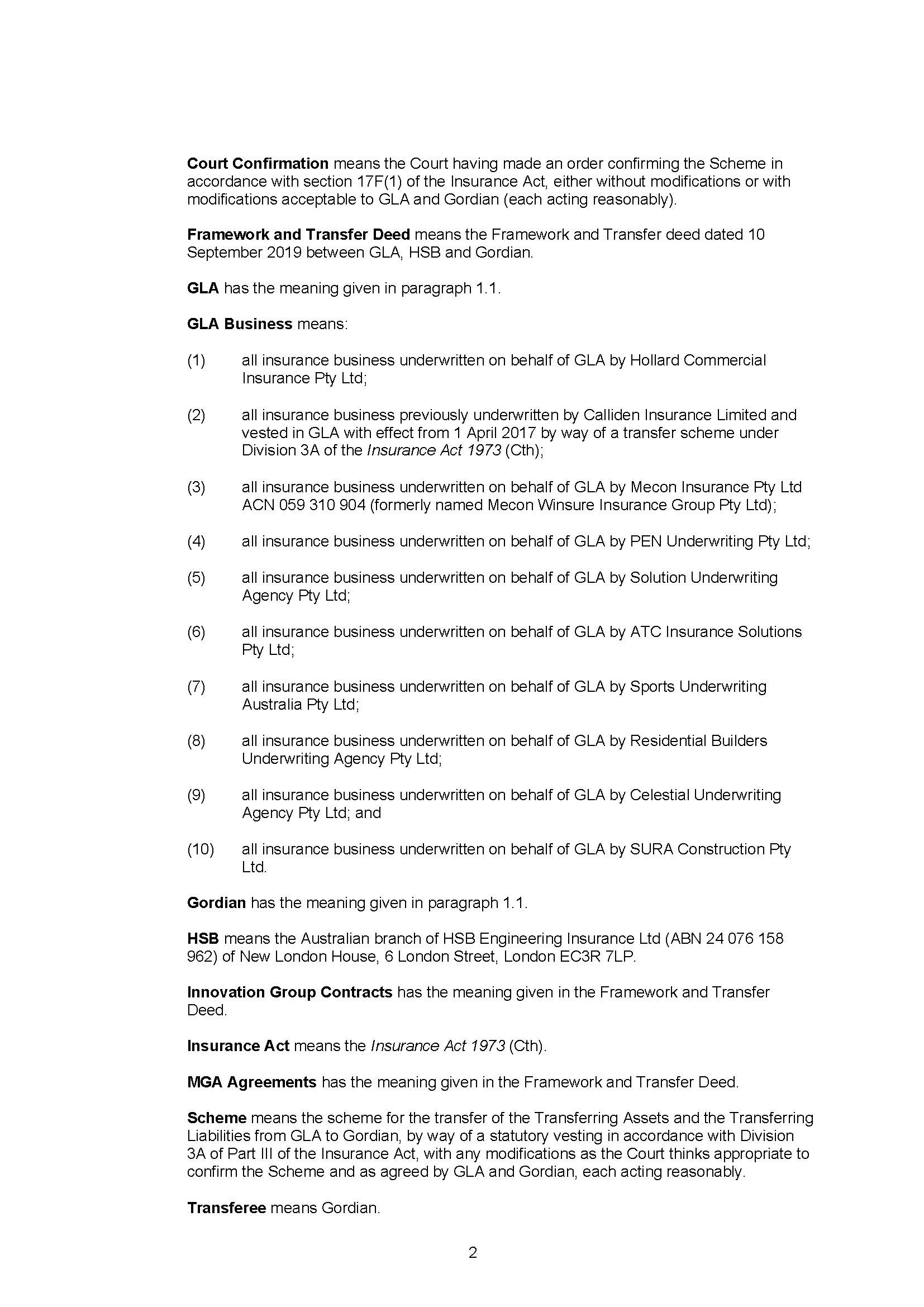
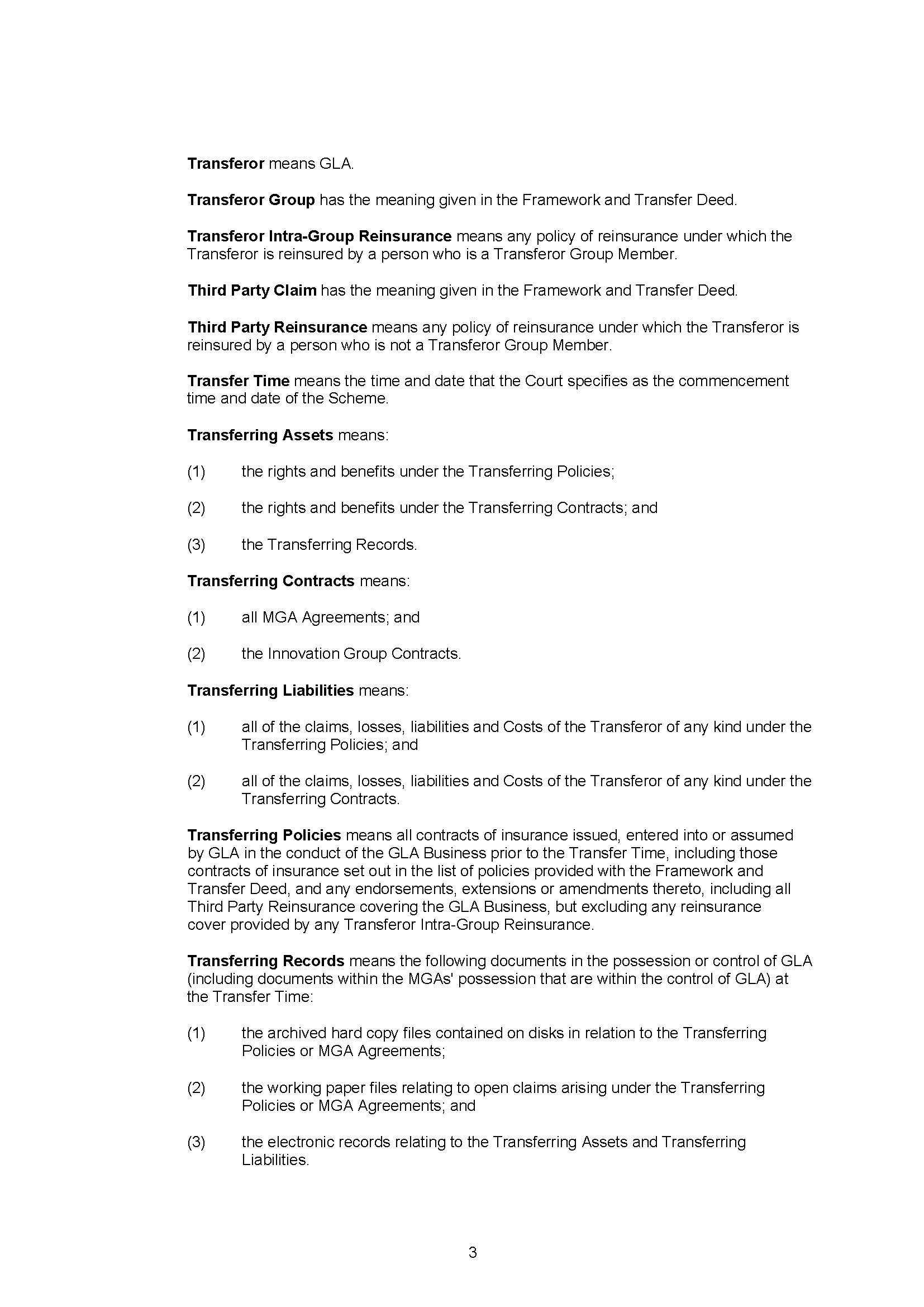
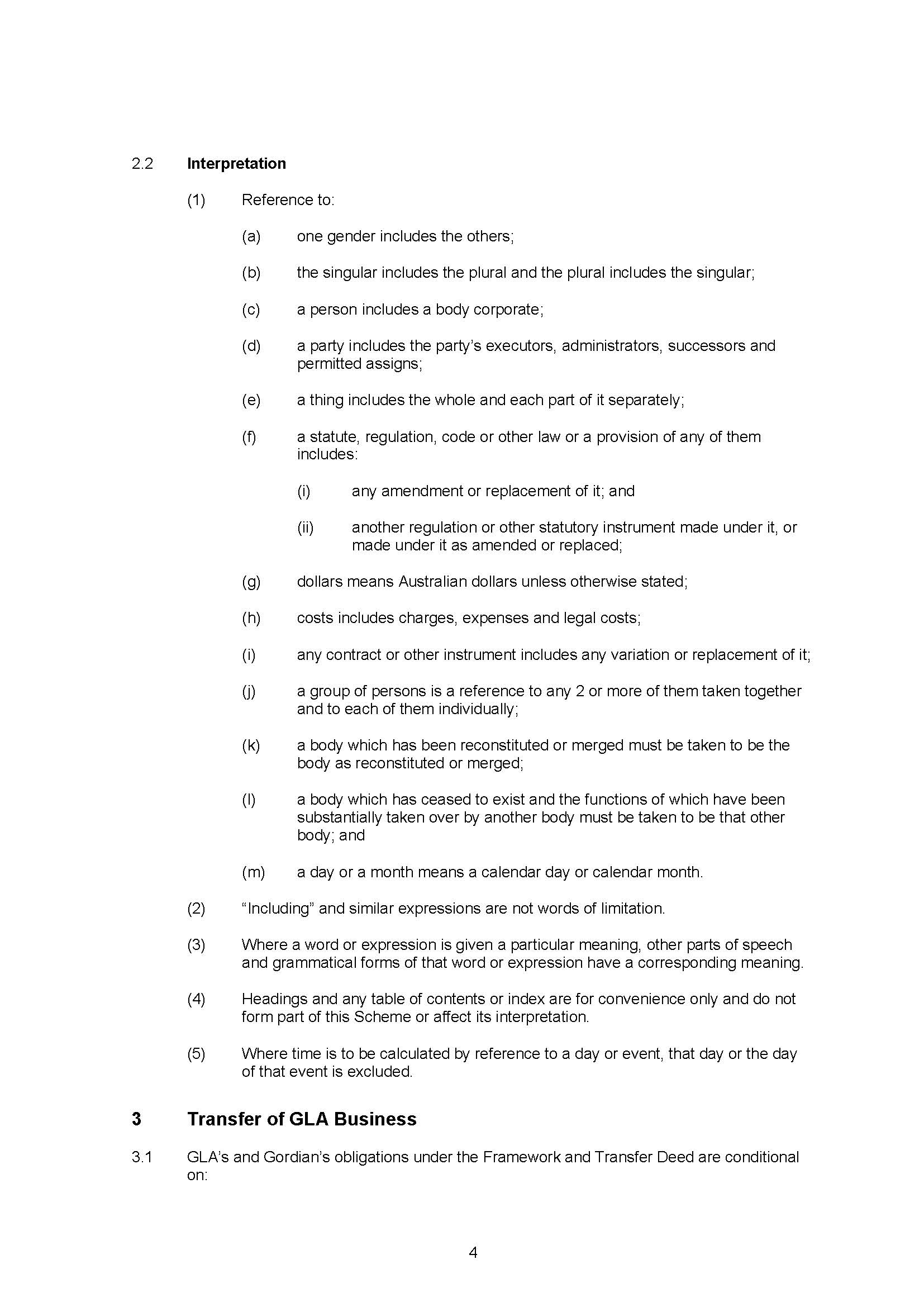
2. Pursuant to s 17F of the Insurance Act 1973 (Cth) (the Act), the scheme for the transfer of part of the insurance business of the Australian Branch of Great Lakes Insurance SE, (trading as Great Lakes Australia) (GLA), to Gordian RunOff Ltd (ABN 11 052 179 647) (Gordian) (the Scheme) be confirmed in the form of Annexure "A" attached to this order.
3. The Transfer Time for the purposes of commencement of the Scheme shall be 12:01am Australian Eastern Standard Time on 1 July 2020.
4. Pursuant to section 17F(2) of the Act, all of GLA’s reinsurance that responds to any policy transferred pursuant to the Scheme (other than any reinsurance cover provided by the Transferor Intra-Group Reinsurance, as defined in the Scheme), be transferred to Gordian.
5. The Applicant pay the costs of the proceedings of the Australian Prudential Regulation Authority as agreed or assessed.
Note: Entry of orders is dealt with in Rule 39.32 of the Federal Court Rules 2011.
ORDERS
NSD 423 of 2020 | ||
IN THE MATTER OF THE AUSTRALIAN BRANCH OF HSB ENGINEERING INSURANCE LTD ABN 24 076 158 962 | ||
THE AUSTRALIAN BRANCH OF HSB ENGINEERING INSURANCE LTD ABN 24 076 158 962 Applicant | ||
JUDGE: | ALLSOP CJ |
DATE OF ORDER: | 29 June 2020 |
THE COURT ORDERS THAT:
The applicant be granted leave to reopen the hearing and rely upon the affidavit of Ms Louise De Beus affirmed on 27 June 2020, which is taken as read.
Pursuant to s 17F of the Insurance Act 1973 (Cth) (the Act), the scheme for the transfer of the entire Australia general insurance business of the Australian branch of HSB Engineering Insurance Limited (ABN 24 076 158 962) (HSB), to Gordian RunOff Ltd (ABN 11 052 179 647) (Gordian) (the Scheme) be confirmed in the form of Annexure "A" attached to this order.
The Transfer Time for the purposes of commencement of the Scheme shall be 12:01am Australian Eastern Standard Time on 1 July 2020.
Pursuant to section 17F(2) of the Act, HSB's reinsurance that is included in the list of policies provided within the Framework and Transfer Deed, including any endorsements, amendments, and extensions thereto, be transferred to Gordian.
The Applicant pay the costs of the proceedings of the Australian Prudential Regulation Authority as agreed or assessed.
Note: Entry of orders is dealt with in Rule 39.32 of the Federal Court Rules 2011.
ALLSOP CJ:
1 On 29 June 2020 the Court made orders in matters NSD 422 of 2020 and NSD 423 of 2020 pursuant to Division 3A of Part III of the Insurance Act 1973 (Cth) (the Act) for the confirmation of two schemes for the transfer of certain insurance business by the applicants, being the Australian branch of Great Lakes Insurance SE, trading as Great Lakes Australia (ABN 18 964 580 576) (GLA) and the Australian branch of HSB Engineering Insurance Limited (ABN 24 076 158 962) (HSBEIL and HSB, the latter denoting the Australian branch). These are the reasons for making those orders.
2 I deal with both applications for confirmation under s 17B(1) in these reasons. The applications, made pursuant to Division 3A of Part III of the Act, are for confirmation of proposed schemes for the transfer of certain Australian run-off business of GLA and HSB to Gordian RunOff Ltd (ABN 11 052 179 647) (Gordian). Each scheme is separate but the schemes are being prepared and brought forward concurrently.
3 Each of GLA and HSB is a general insurer licensed to carry on insurance business in Australia and is owned ultimately by the well-known and large German insurer and reinsurer Münchener Rückversicherungs-Gesellschaft Aktiengesellschaft (Munich Re).
4 Gordian is also a general insurer licensed to carry on insurance business in Australia and is a subsidiary of Enstar Group Ltd (Enstar), a company registered in Bermuda and publicly traded on the NASDAQ index. Gordian specialises in the managing of run-off insurance business – that is, managing claims, insurance and reinsurance recoveries and subrogated claim recoveries when new insurance is not being written.
5 The schemes are governed by a Framework and Transfer Deed to which Gordian, GLA and HSB are parties (Framework Deed). The schemes are in the form annexed to the orders made in each respective matter on 29 June 2020, as set out in the pages preceding these reasons.
6 On 12 May 2020, the Court made orders dispensing with the need for the applicants to comply with s 17C(2)(c) of the Act provided that the applicants undertook certain other procedural steps directed to the notification of policyholders before the confirmation hearing: see Australian Branch of Great Lakes Insurance SE (trading as Great Lakes Australia), in the matter of the Australian Branch of Great Lakes Insurance SE (trading as Great Lakes Australia) [2020] FCA 629. The extent of the applicants’ compliance with those orders is a matter to which I will return.
Legislative Framework
7 The transfer and amalgamation of insurance business occurs pursuant to Division 3A of Part III of the Act.
8 Section 17B(1) provides that no part of the insurance business of a general insurer may be transferred to another general insurer, or amalgamated with the business of another general insurer except under a scheme confirmed by this Court.
9 Section 17E, which deals with an application to this Court for confirmation, is in the following terms:
(1) Any of the bodies corporate affected by a scheme may apply to the Federal Court for confirmation of the scheme.
(2) An application for confirmation must be made in accordance with the prudential standards.
(3) APRA is entitled to be heard on an application.
10 The prudential standards referred to in s 17E(2) can be found in Prudential Standard GPS 410 Transfer and Amalgamation of Insurance Business for General Insurers (GPS 410). Because of the restrictions on movement imposed by the COVID-19 pandemic APRA took the view that the public inspection requirements of GPS 410 should be modified. Thus, it released determination A1 of 2020, altering GPS 410 in an “Individual Prudential Standard” which affects these two schemes, and one other unrelated scheme (Individual Prudential Standard). The Individual Prudential Standard provides for a telephone inspection period during which affected policyholders can request a physical copy of the scheme documents.
11 APRA appeared at the confirmation hearing. Counsel for APRA, Mr Claxton, indicated that APRA had a high degree of confidence that the orders sought by the applicants were appropriate, for reasons that I will discuss below.
12 Section 17F, which concerns the Court’s discretion to confirm a scheme, relevantly provides as follows:
(1) The Federal Court may:
(a) confirm a scheme without modification; or
(b) confirm the scheme subject to such modifications as it thinks appropriate; or
(c) refuse to confirm the scheme.
(1A) In deciding whether to confirm a scheme (with or without modifications), the Federal Court must have regard to:
(a) the interests of the policyholders of a body corporate affected by the scheme; and
(b) if a report relevant to all or part of the scheme has been filed with the Court under section 62ZI—that report; and
(c) any other matter the Court considers relevant.
13 It is well-accepted that the Court is to look to the interests of the relevant policyholders of both the transferor and transferee insurers and consider whether implementation of the scheme will detrimentally affect them in a material way: see, for example, Re Insurance Australia Ltd [2004] FCA 524; 139 FCR 450 at [76] per Lindgren J; Re MDU Australian Insurance Co Pty Ltd [2008] FCA 490 at [7] per Emmett J; Re Westport Insurance Corporation (No 2) [2009] FCA 1598; 181 FCR 530 at 535 [32] per Lindgren J. A prime consideration is the nature of the actual and potential claims to which the transferor insurer is subject and the financial viability of the transferee insurer: In the matter of Reward Insurance Ltd [2004] FCA 151 at [3] per Heerey J.
14 As I noted in Swiss Reinsurance Company Ltd, in the matter of the application by Swiss Reinsurance Company Ltd (No 2) [2019] FCA 2042, which similarly involved a scheme transfer between two Australian branches, it provides contextual assistance to understanding the impact of such a transfer on Australian policyholders to have regard to wider financial information pertaining to the financial position and risk profiles of any relevant foreign insurer beyond simply their branch operations in Australia: see also Atradius Credit Insurance N.V., in the matter of Atradius Credit Insurance N.V. (No 2) [2016] FCA 1495 at [17]; W.R. Berkley Insurance (Europe) Limited, in the matter of Division 3A of Part III of the Insurance Act (1973) (No 3) [2016] FCA 1497 at [15]; and AXIS Speciality Europe SE (Australia Branch), in the matter of AXIS Speciality Europe SE (Australia Branch) (No 2) [2017] FCA 276 at [13].
The GLA application
15 Munich Re has decided to transfer certain run-off business in GLA, being that written by nine managing general agents and the business underwritten by Calliden Insurance Limited (CIL) that was vested in GLA in 2017 by way of a scheme under the Act. All the business is in run-off; that is, no new risks are being written and the only operations are claims handling, reinsurance recoveries and subrogated recovery claims.
16 The insurance business to be transferred consists of the following lines of insurance: home builders warranty insurance (vested to GLA under the CIL scheme), personal lines (vested to GLA under the CIL scheme), motor lease guarantee (vested to GLA under the CIL Scheme), construction insurance, commercial business insurance and professional indemnity.
17 The Scheme Summary provided to affected policyholders summarises the details of the GLA scheme in the following manner:
From the time of transfer:
(1) Gordian will be substituted for GLA in Transferring Policies (and Transferring Contracts as defined in the Framework and Transfer Deed) as if Gordian was, and at times had been, a party in place of GLA under the Transferring Policies (and Transferring Contracts as defined in the Framework and Transfer Deed).
…
By way of summary, on confirmation of the Scheme by the Court:
(1) The rights, benefits and liabilities of policyholders under the Transferring Policies will be assumed by Gordian in the place of GLA, and will remain the same in all respects as they would have been if the Transferring Policies had been issued or entered into by Gordian instead of GLA. In effect, the Scheme will result in the replacement of the insurer, but not the terms of any Transferring Policy.
(2) GLA will be released and discharged from all liabilities and obligations under the Transferring Policies and all premiums and other amounts payable to or recoverable by GLA under the Transferring Policies will be payable to and recoverable by Gordian.
(3) Apart from Gordian becoming the insurer in place of GLA under the Transferring Policies, the Transferring Policies will be transferred to Gordian with the same terms and conditions as applied prior to the Scheme taking effect. Any policyholder under the Transferring Policies who has a claim on or obligation to GLA pursuant to the Transferring Policies will have the same claim on or obligation to Gordian in substitution for his or her claim on or obligation to GLA.
18 The Scheme Summary also explains the reinsurance arrangements put in place by Gordian under the GLA scheme as follows:
Gordian and Cavello Bay Reinsurance Limited (a related party of Gordian) (Cavello Bay) will enter into a quota share reinsurance agreement which will reinsure 100% of the claims risk in relation to the business transferring from GLA under the Scheme (net of any external reinsurance that continues to apply) from the effective date of the Scheme.
Cavello Bay had total assets of US$4.1 billion, total liabilities of US$2.4 billion, giving net assets of $US1.6 billion as at 31 December 2018.
In connection with the reinsurance agreements, assets will be held in an Australian Trust Fund (ATF) held by a local trustee (being a major Australian bank) and available only to meet claims by transferring policyholders. This arrangement with the ATF is in accordance with APRA’s requirements. There is no likelihood of this financial security being diminished by other claims against the receiving insurer (being Gordian).
19 I will return to the significance of these reinsurance arrangements later.
Evidence
20 GLA relied upon the following affidavits, which were tendered and read into evidence as unsworn affidavits at the dispensation hearing and re-read (affirmed) at the confirmation hearing:
(a) Geoff Atkins dated 9 April 2020 (affirmed on 20 May 2020) (First Atkins GLA affidavit);
(b) Kaise Stephan dated 9 April 2020 (affirmed on 19 June 2020) (First Stephan GLA affidavit);
(c) Louise De Beus dated 7 May 2020 (affirmed on 25 May 2020) (First De Beus GLA Affidavit).
21 The following additional affidavits were read in support of the application at the confirmation hearing:
(a) Geoff Atkins affirmed on 19 June 2020 (Second Atkins GLA affidavit);
(b) Kaise Stephan affirmed on 23 June 2020 (Second Stephan GLA affidavit);
(c) Louise De Beus affirmed on 23 June 2020 (Second De Beus GLA affidavit);
(d) Sandra O’Sullivan sworn on 23 June 2020 (O’Sullivan GLA affidavit);
(e) Susan Ley affirmed on 23 June 2020 (Ley GLA affidavit);
(f) Rehana Box affirmed on 25 June 2020 (Box GLA affidavit);
(g) Louise De Beus affirmed on 25 June 2020 (Third De Beus GLA affidavit);
(h) Louise De Beus affirmed on 26 June 2020 (Fourth De Beus GLA affidavit).
22 On 29 June 2020, orders were made, the reasons for which will become apparent below, granting leave to GLA to reopen the hearing and file an additional affidavit of Ms De Beus, affirmed on 27 June 2020, which addressed GLA’s compliance with the dispensation orders made by the Court on 12 May 2020 (Fifth De Beus GLA affidavit).
23 Ms De Beus is a project manager employed by Munich Holdings of Australasia and is responsible for the internal project management of the GLA scheme. Ms De Beus primarily gives evidence about GLA’s compliance with the procedural requirements under the Act and with the dispensation orders made by the Court on 12 May 2020. Mr Atkins is an Actuary and Principal of Finity Consulting Pty Limited. Mr Atkins prepared two actuarial reports in support of both schemes. Mr Atkins’ reports were independently analysed in two reports written by Mr Stephan, who is a Partner of Deloitte Touche Tohmatsu and a Fellow of the Actuaries Institute of Australia. Ms Box is a Partner at Ashurst and the solicitor on record for GLA. Ms O’Sullivan is the Chief Financial and Executive Officer of Enstar Australia Limited and Gordian. Ms O’Sullivan gives evidence about the nature of Gordian’s business, its financial position and its reinsurance and security arrangements. Ms Ley is the Appointed Actuary of GLA. Ms Ley prepared an expert opinion on the nature of the portfolios being transferred, the risk of late claims emerging after the policy periods have ended for the policies being transferred and the general rate of “claims drop off” after the policy period or policy expiry.
Procedural requirements
24 Section 17C(2) of the Act contains the procedural requirements that must be satisfied before an application for confirmation is made. These requirements are supplemented by the prudential standards contained in GPS 410 and partly modified by the Individual Prudential Standard and the dispensation orders made by the Court in relation to this scheme on 12 May 2020 (GLA Dispensation Orders), which were relevantly in the following terms:
1. In relation to the Scheme, the need for the applicant to comply with s 17C(2)(c) of the Insurance Act 1973 (Cth) (the Act), pursuant to s 17C(5) of the Act, be dispensed with provided that the applicant complies with Orders 2 to 5 below at least one day prior to the first date of the ‘telephone’ inspection period required by APRA’s Insurance (Prudential Standard) determination No. A1 of 2020 (the Individual Prudential Standard), which modifies the public inspection requirements as set out in APRA’s Prudential Standard GPS 410 (GPS 410).
2. The applicant send a summary approved by APRA in respect of the Scheme (the Scheme Summary), and in the letter enclosing the Scheme Summary (the Formal Notification Letter) inform the recipient of the availability of the Scheme Summary on the websites referred to in Order 5 below, by either pre-paid post to the postal address, or by email to the email address, held on the files of the applicant:
a. to every policyholder named in policies of insurance issued by the applicant in respect of all insurance business previously underwritten by Calliden Insurance Limited (CIL) and vested in the applicant with effect from 1 April 2017 by way of a transfer scheme under Division 3A of the Act, except as set out in section 2(c) below. Where relevant, the Formal Notification Letter will also be provided to the policyholder of CIL policies care of the placing broker, except as set out in section 2(c) below.
b. care of the placing broker, to every policyholder named in policies of insurance issued by the applicant in respect of:
i. all insurance business underwritten on behalf of the applicant by SURA Construction Pty Ltd;
ii. all insurance business underwritten on behalf of the applicant by Mecon Insurance Pty Ltd ACN 059 310 904 (formerly named Mecon Winsure Insurance Group Pty Ltd);
iii. all insurance business underwritten on behalf of the applicant by PEN Underwriting Pty Ltd;
iv. all insurance business underwritten on behalf of the applicant by Solution Underwriting Agency Pty Ltd;
v. all insurance business underwritten on behalf of the applicant by Hollard Commercial Insurance Pty Ltd; and
vi. all insurance business underwritten on behalf of the applicant by Sports Underwriting Australia Pty Ltd;
c. in respect of CIL home builder’s warranty policies:
i. issued by Residential Builders Underwriting Agency Pty Ltd for the Department of Commerce Western Australia (DOCWA) will have the Formal Notification Letter and Scheme Summary sent to the builder (i.e. the policy-owner) and the home-owner (i.e. the policy-beneficiary), noting that:
(A) 132 of 133 builders (i.e. the policy-owners) have been located, and
(B) the residental addresses of all 4,759 home-owners (i.e. the policy-beneficiaries) have been identified.
ii. issued by Residential Builders Underwriting Agency Pty Ltd for the South Australian Government Financing Authority (SAFA) will have the Formal Notification Letter and Scheme Summary sent to the builder (i.e. the policy-owner) and the home-owner (i.e. the policy-beneficiary), noting that
(A) 70 of 71 builders (i.e. the policy-owners) have been located; and
(B) the residential addresses of all 897 home-owners (i.e. the policy-beneficiaries) have been identified.
iii. issued by the Australia Owners Builders Insurance Services Pty Ltd will have the Formal Notification Letter and Scheme Summary sent to the owner-builder, noting that the residential addresses of all three home-owner-builders (i.e. the policy-owners and the policy-beneficiaries) have been identified;
iv. issued by CIL will have the Formal Notification Letter and Scheme Summary sent to the owner-builder, noting that the residential addresses of all 279 home-owner builders (i.e. the policy-owners and the policy-beneficiaries) have been identified,
where, as at 1 May 2020, the period of insurance has not ended, or where claims have been made on the policies that remain unresolved.
3. In respect of policyholders named in policies of insurance issued by ATC Insurance Solutions Pty Ltd, no Formal Notification Letter or Scheme Summary be sent provided no such policies will have a current risk period, and all claims under those policies will be resolved, by the Transfer Time;
4. The applicant, prior to the date on which the Scheme documents are made available by way of ‘telephone’ inspection, cause the publication of a notice of intention in a form approved by APRA (the Notice of Intention) providing notification of the Scheme to be placed in the following publication and newspapers in circulation in each of the relevant States and Territories of Australia:
a. The Government Gazette;
b. ACT – The Canberra Times;
c. National – The Australian;
d. New South Wales – The Sydney Morning Herald;
e. Northern Territory – The Northern Territory News;
f. Queensland – The Courier-Mail;
g. South Australia – The Advertiser;
h. Tasmania – The Mercury;
i. Victoria – The Age; and
j. Western Australia – The West Australian.
5. The applicant, prior to the date on which the Scheme documents are to be made available by way of ‘telephone’ inspection, cause a copy of the
a. Notice of Intention;
b. Scheme;
c. Scheme Summary;
d. Scheme actuarial report of Mr Atkins of Finity Consulting Pty Limited; and
e. Independent peer review of the Scheme actuarial report by Mr Stephan of Deloitte Touche Tohmatsu,
(together, the Scheme Documents) to be made publically available on the applicant’s websites, in accordance with paragraph 16(a) of the Individual Prudential Standard (which modifies paragraph 16 of GPS 410).
6. In accordance with paragraph 16(b) of the Individual Prudential Standard (which modifies paragraph 16 of GPS 410), the applicant have a dedicated phone number specified in its Notice of Intention, which can be called to request a copy of the Scheme Documents, for a period of at least 15 days (from 9:00am to 7:00pm AEST each day) excluding weekends and public holidays.
7. The applicant provide, upon request, a copy of the Scheme Documents free of charge to any policyholders and to any registered property owners identified in Order 2(a) above that identify themselves as such.
25 Before I turn to consider these matters and the GLA Dispensation Orders, it is appropriate to raise one other procedural matter. Clause 4.1 of the Framework Deed contains a condition precedent which provides that the agreement will have no effect unless and until the Treasurer of the Commonwealth of Australia, or a permitted delegate, approves or otherwise confirms that they have no objection to the acquisition by Gordian of the GLA Business under the Insurance Acquisitions and Takeovers Act 1991 (Cth) (IATA). At [17] of the O’Sullivan GLA affidavit, Ms O’Sullivan deposes that Gordian, on 17 January 2020, provided to APRA the notices required to be given under s 38 of the IATA and formally requested a go-ahead decision under s 41(1) of the IATA in respect of the trigger proposals under ss 36(d) and 36(e) of the IATA. Ms O’Sullivan indicates that Gordian was notified on 19 June 2020 that the Treasurer had made the decision not to object to the acquisition under the IATA.
26 GLA has put on evidence to demonstrate its compliance with s 17C(2), GPS 410, the Individual Prudential Standard and Orders 2 to 7 of the GLA Dispensation Orders. The evidence led at the confirmation hearing was contained in the Second, Third and Fourth De Beus GLA affidavits.
27 During the confirmation hearing I asked Counsel for the applicants whether there were any aspects of compliance with the GLA Dispensation Orders of which the Court should be aware. Counsel referred to the Second De Beus GLA affidavit.
28 After the confirmation hearing, I raised a number of questions with the applicants concerning their compliance with the GLA Dispensation Orders. These questions sought to clarify inconsistencies between the filed affidavits, the written submissions filed in the dispensation hearing and the GLA Dispensation Orders. The Fifth De Beus GLA affidavit was filed on Saturday 27 June 2020 to address those questions.
Section 17C(2)(a): Provision of scheme to APRA in accordance with GPS 410
29 Section 17C(2)(a) requires a copy of the scheme for which confirmation is sought and any actuarial report on which the scheme is based to have been given to APRA in accordance with the prudential standards. Paragraphs 5 and 6 of GPS 410 make clear that these documents must be provided to APRA before the relevant notice of intention to apply to the Court for confirmation of the scheme is published, and before any approved summary of the scheme is given to each affected policyholder.
30 Ms De Beus deposes at [5] of the Second De Beus GLA affidavit that GLA provided a copy of the GLA scheme and the actuarial reports of Mr Atkins and Mr Stephan to APRA on 10 March 2020. On 19 March 2020, Mr Boik of APRA wrote to GLA acknowledging receipt and stating that APRA had no objection to GLA’s and HSB’s applications to this Court under s 17C(5) for dispensation from the need to comply with s 17C(2)(c).
Section 17C(2)(b): Publication of notice of intention to make application in accordance with GPS 410
31 Section 17C(2)(b) requires a notice of intention to make the confirmation application to have been published by the applicant in accordance with the prudential standards. Paragraphs 9–11 of GPS 410 provide as follows:
9. The insurer must publish the notice of intention in a form approved by APRA:
(a) in the Government Gazette; and
(b) in one or more newspapers, approved by APRA, circulating in each State and Territory in which an affected policyholder resides.
10. The notice must, at a minimum:
(a) state the places, dates and times that an affected policyholder may obtain a copy of the scheme and any associated documentation; and
(b) give the address of each place at which a copy of the scheme and any associated documentation may be obtained.
11. The notice must be published before the scheme is released for public inspection under paragraph 16.
32 The requirement in 10(b) was altered by the Individual Prudential Standard, which instead requires the notice of intention to state the website address(es), phone number(s) and email address(es) through which an affected policyholder may gain access to the scheme documents. GLA’s notice of intention, annexed to the First De Beus GLA affidavit, contains this information.
33 GLA Dispensation Order 4, set out above, lists several other publications in which the notice of intention was required to be published. Ms De Beus states at [23] of the Second De Beus GLA affidavit that a copy of the approved notice of intention was published in each of the publications listed in GLA Dispensation Order 4 on 25 May 2020. Annexed to Ms De Beus’ affidavit are tear sheets and copies of the relevant page of each publication, except for the Canberra Times and the West Australian. Annexed to the affidavit were receipts for the publication of the notice in both of these newspapers.
Section 17C(2)(c): Provision of scheme to affected policyholders
34 Section 17C(2)(c) requires an approved summary of the scheme to have been given to every affected policyholder. As explained above at [24], the GLA Dispensation Orders waived this requirement on the condition that the other steps referred to in those orders were taken.
Public inspection of the Scheme Documents
35 Paragraph 16 of GPS 410 is in the following terms:
A copy of the scheme must be open for public inspection from 9.00 a.m. until 5.00 p.m. every day (except weekends and public holidays), for a period of at least 15 days, at:
• an office of the insurer; or
• another location approved by APRA in writing,
in each state and Territory in which an affected policyholder resides.
36 This requirement was replaced by [9] of the Individual Prudential Standard, which states:
A copy of the scheme documents must be made available for inspection:
(a) at a website address specified by the applicant(s) in the notice of intention from the time the notice is published until a decision on the scheme is made by the Court or the application is withdrawn; and
(b) through a dedicated phone number (which can be called to request a copy of the scheme documents) specified by the applicant(s) in the notice of intention for a period of at least 15 days (from 9:00am to 5:00pm each day), excluding weekends and public holidays.
37 Ms De Beus deposes at [24]–[27] of the Second De Beus GLA affidavit that the Scheme Documents (as that term is defined in GLA Dispensation Order 5) were published on the Munich Re website (www.munichre.com/gla/en/default/index.html) on 21 May 2020. According to Ms De Beus, between 28 May 2020 and 22 June 2020, that website was viewed by members of the public 102 times and the documents were downloaded twice.
38 At [20] of the Second De Beus GLA affidavit, Ms De Beus states that the phone number set out in GLA’s notice of intention was manned between 9:00am and 7:00pm AEST during the 15 day telephone inspection period, being from 28 May 2020 to 18 June 2020 inclusive. During this time, GLA received 50 telephone enquiries. GLA received an additional 21 calls outside of the 15 day telephone inspection period, between 25 May 2020 and 27 May 2020. Ms De Beus states that the enquiries were general in nature and that none of the callers raised an objection to the scheme or requested copies of the Scheme Documents.
39 Ms De Beus states at [14] of the Second De Beus GLA affidavit that GLA received 16 written enquiries by email between 27 May 2020 and 22 June 2020. According to Ms De Beus, these enquiries were also of a general nature and did not raise any objection to the scheme. There were no written requests for copies of the Scheme Documents.
40 At [26] of the O’Sullivan GLA affidavit, Ms O’Sullivan states that on 11 June 2020 Gordian received a telephone call from an affected policyholder. According to Ms O’Sullivan, Gordian provided the policyholder with the relevant contact details for GLA. She was advised by GLA that it followed up the enquiry.
Provision of copy of scheme free of charge upon request
41 Pursuant to s 17C(4) of the Act, an affected policyholder is entitled, upon request, to be provided with one copy of the scheme free of charge.
42 Further, GLA Dispensation Order 7 required the applicant to provide a copy of the scheme, the approved summary of the scheme, the approved notice of intention and the actuarial report prepared in relation to the scheme on request to any affected policyholder free of charge.
43 Ms De Beus deposes at [28] of the Second De Beus GLA affidavit that, as at 23 June 2020, GLA had not received any requests for copies of the Scheme Documents.
Provision of Scheme Summary to affected policyholders
44 GLA Dispensation Order 2 required GLA to provide the Scheme Summary and a Formal Notification Letter (as defined in Dispensation Order 2) to particular policyholders affected by the scheme where GLA had the postal or email address of the policyholder.
45 At [6] of the Second De Beus GLA affidavit, Ms De Beus states that on 13 May 2020 she arranged for a third party service provider to mail 6,680 letters, enclosing the Formal Notification Letter and the Scheme Summary, addressed to persons identified in subparas (a), (b) and (c) of GLA Dispensation Order 2. The mail-out occurred on 21 May 2020.
46 Ms De Beus sets out in the Second De Beus GLA affidavit the particular number of letters mailed out for each category of insured listed in GLA Dispensation Order 2. Most of these numbers correspond to the number of policyholders that GLA had identified prior to the dispensation hearing, as recorded in GLA Dispensation Order 2(c). There were, however, two inconsistencies between the number of letters mailed out according to the Second De Beus GLA affidavit and the number of policyholders for which GLA had contact information as set out in GLA Dispensation Order 2(c). At [6(c)] of the Second De Beus affidavit, Ms De Beus states that there were zero letters mailed out in respect of policies issued by Australia Owners Builders Insurance Services Pty Ltd, while GLA Dispensation Order 2(c)(iii) noted that GLA had identified the residential addresses of all three home-owner-builders. Further, Ms De Beus states at [6(d)] of the Second De Beus GLA affidavit that there were 235 letters mailed to home owners in respect of policies issued by CIL, while GLA Dispensation Order 2(c)(iv) noted that GLA had identified the addresses of 279 home-owner builders (i.e. policy-owners and policy-beneficiaries) in relation to these policies.
47 Ms De Beus clarifies these inconsistencies in the Fifth De Beus GLA affidavit. Ms De Beus states that the reference to zero letters at [6(c)] of the Second De Beus GLA affidavit is an error and ought to be three letters. Ms De Beus confirms that the three policyholders’ addresses were recorded in the mail-out log annexed to the Second De Beus GLA affidavit. Ms De Beus also states that GLA Dispensation Order 2(c)(iii) recorded the incorrect number of policyholders; the correct number of policies issued by CIL for which GLA has contact information is 235, not 279.
48 At [23] of the applicants’ written submissions for the dispensation hearing and [30] of the First De Beus GLA affidavit, the number of policyholders with current risk periods and current claims is described as 5,953 and 530 respectively. GLA states in the written submissions that it has a contact address for all but two of the affected policyholders. In contrast, at [6] of the Second De Beus GLA affidavit, Ms De Beus states that there are 6,154 current policies and 526 current claims. Ms De Beus clarifies this inconsistency in the Fifth De Beus GLA affidavit, stating that the number of current policies recorded in the written submissions is incorrect. The error appears to be due to the accidental exclusion of the figures of the Western Australian home-owner warranty builders and South Australian home-owner warranty builders. Ms De Beus states that the number of current claims listed in the written submissions is also incorrect; the correct number of current GLA claims is 526.
49 While these inconsistencies do not demonstrate substantial non-compliance with the GLA Dispensation Orders or other procedural requirements, they should have been brought to my attention and explained during the confirmation hearing.
50 At [11] of the Second De Beus GLA affidavit, Ms De Beus states that GLA received 635 returned letters. According to Ms De Beus, GLA undertook google searches on the returned letters and identified alternate postal addresses for 43 recipients. GLA then sent the Formal Notification Letter and Scheme Summary by post to those addresses.
51 At [8] of the Fifth De Beus GLA affidavit, Ms De Beus explains that GLA was only able to find alternate addresses for 43 recipients because the vast majority (581) of the returned letters pertained to the builders warranty books. These letters were addressed to ‘The Home Owner’ and no further searches could be conducted because GLA did not have on record the name of the policy beneficiary, unless they were also the policy-owner (i.e. they were an owner-builder). Of the 54 returned letters that were addressed to an individual who was specifically named, GLA was unable to retrieve alternate addresses for 14 policyholders. Ms De Beus explains that GLA only held on record an email address for one of the 14 policyholders, and an email was not sent to that policyholder due to an administrative oversight. Ms De Beus states that title searches were not conducted to ascertain alternate addresses for the 14 named policyholders because 11 of these letters were addressed to construction companies, builders and owner-builders, and GLA deemed that a title search would not have assisted in locating further postal addresses.
52 At the dispensation hearing I requested that GLA send a letter to brokers requesting that the broker assist GLA in notifying affected policyholders. The broker letter enclosed the approved summary of the scheme and a Frequently Asked Questions document. At [9] of the Second De Beus GLA affidavit, Ms De Beus confirms that the broker letter was provided to all relevant brokers on or around 20 May 2020. Ms De Beus states at [10] that she was contacted by six brokers between 25 May 2020 and 9 June 2020, who all asked general queries about the correspondence and the scheme.
53 I am satisfied that GLA has substantially complied with the procedural requirements in the Act, GPS 410, the Individual Prudential Standard and the GLA Dispensation Orders made on 12 May 2020.
Actuarial evidence
54 The primary actuarial evidence in support of the GLA application is contained in two actuarial reports prepared by Mr Atkins. The first was dated 9 March 2020 (First Atkins Report) and annexed to the First Atkins GLA affidavit; the second was dated 19 June 2020 (Second Atkins Report) and annexed to the Second Atkins GLA affidavit. Mr Atkins has been a general insurance consulting actuary since 1984 and is currently a principal of Finity Consulting Pty Limited.
55 Mr Atkin’s actuarial reports were analysed in two reports prepared by Mr Stephan. The first was dated 9 March 2020 (First Stephan Report) and annexed to the First Stephan GLA affidavit; the second was dated 23 June 2020 (Second Stephan Report) and annexed to the Second Stephan GLA affidavit. Mr Stephan has worked in the Australian insurance industry since 1997 and is currently a partner of Deloitte Touche Tohmatsu and a fellow of the Actuaries Institute of Australia.
Financial security and solvency
56 As submitted in writing by Mr Oakes, it is important to understand the post-scheme solvency position of Gordian because, after the proposed scheme is effected, policyholders will no longer be able to look to GLA for satisfaction of their claims, and must instead look solely to Gordian.
57 The financial security of transferring policyholders is discussed in section 4.3 of the First Atkins Report at pp 20–21. Mr Atkins notes that the first line of financial security is the assets held in an Australian Trust Fund that are available only to meet claims of transferring policyholders and that there are other available sources of financial security should that first line fail. The Australian Trust Fund is initially set at 105% of estimated liabilities, with any increase in liabilities to be accompanied by a corresponding top-up from Cavello Bay to maintain the 105% proportion. Where Cavello Bay is either unwilling or unable to top-up the Australian Trust Fund, Gordian has a legally enforceable right against Cavello Bay.
58 If the reinsurance fails entirely, Mr Atkins states that Gordian’s assets are available to meet claims, with those assets being ring-fenced in Australia, and that:
These assets, including available capital of about $75m, are available to support the business currently insured by Gordian, including the CTP business (if the CTP Trust Fund for that business also fails).
59 Noting that it is in accordance with APRA’s requirements for recognising acceptable collateral for reinsurance recoveries from overseas insurers, Mr Atkins states that this arrangement is sound, and that there is no likelihood of this financial security being diminished by other claims against Gordian. Moreover, Mr Atkins addresses the possibility of the Enstar Group supporting Cavello Bay and/or Gordian, notwithstanding the absence of any contractual agreements to that effect, because of the reputational damage that would accrue if a significant subsidiary was allowed to become insolvent.
60 On the basis of the above considerations, Mr Atkins assesses the chance of all of the available sources of financial security failing as very remote and that there is no material detriment to the financial security of transferring policyholders.
61 Pro-forma calculations of Gordian’s balance sheet and capital adequacy under APRA standards are set out in section 4.4 of the First Atkins Report at pp 21–23.
62 Table 4.2 at p 22 of the First Atkins Report shows the pre-transfer balance sheets of GLA and Gordian at 31 December 2018, together with the estimated post-transfer balance sheet of Gordian on the assumption that the transfer had occurred on that date. As at 31 December 2018:
(a) GLA had total assets of $542.0 million, total liabilities of $464.7 million and net assets of $77.3 million.
(b) Gordian had total assets of $767.8 million, total liabilities of $296.9 million and net assets of $471.0 million.
(c) Post-transfer, Gordian was estimated to have total assets of $996.0 million, total liabilities of $525.1 million and net assets of $471.0 million.
63 Mr Atkins provides the following contextual information for the Gordian figures:
(a) Gordian’s net assets include a non-interest bearing loan to the parent company of $401 million, which loan was the method by which past profits were repatriated to the parent company. That amount is not immediately available to meet claims and does not count for APRA capital adequacy.
(b) The pro-forma balance sheet of Gordian after the transfer is very similar to that before the transfer, with the only change being the addition of a large amount of outstanding claims offset by an equal increase in the reinsurance asset. As the ‘cash’ Gordian receives from the portfolio transfer will be paid to Cavello Bay, and held in the new Australian Trust Fund, there is no change to Gordian’s ‘cash’ balance post-transfer.
64 Table 4.3 at p 23 of the First Atkins Report shows the estimated impact of the transfer on the capital adequacy position of Gordian at 31 December 2018, assuming that the transfer had occurred on that date, and a preliminary estimate of the position at 31 March 2020. I note that the following figures were calculated on the assumption that both the business of GLA and of HSB is transferred to Gordian.
65 Gordian’s Prescribed Capital Amount (PCA) pre-transfer was $31.9 million. Its post-transfer PCA was estimated to increase to $44.6 million and then reduce to $31.0 million as at 31 March 2020.
66 Gordian’s pre-transfer Capital Adequacy Multiple (CAM) was estimated to reduce from 2.20 to 1.57 following the transfer. However, Mr Atkins observes that substantial claims are projected to be paid out from both Gordian Compulsory Third Party (CTP) and GLA by March 2020, which would reduce the asset risk charge and result in a CAM of 2.27, which is above Gordian’s board-approved level. On that basis, Mr Atkins does not assess any capital or solvency issues arising from the transfer.
67 Pages 5–7 of the Second Atkins Report contain updated financial information relating to Gordian’s balance sheet and capital adequacy position.
68 Table A.3 on p 6 summarises the reported assets and liabilities of Gordian at 31 December 2018, 31 December 2019 and 31 March 2020, as follows:
(a) Gordian had total assets of $767.8 million as at 31 December 2018, $685.2 million as at 31 December 2019 and $686.3 million as at 31 March 2020.
(b) Gordian had total liabilities of $296.9 million as at 31 December 2018, $207.3 million as at 31 December 2019 and $204.5 million as at 31 March 2020.
(c) Gordian had net assets of $471.0 million as at 31 December 2018, $477.9 million as at 31 December 2019 and $481.8 million as at 31 March 2020.
Therefore, as at 31 March 2020, Gordian’s net assets increased by $10.8 million from December 2018. Mr Atkins also notes that Gordian’s claims liabilities and reinsurance assets have each reduced as the NSW CTP business (100% reinsured) has run off.
69 Table A.4 on p 6 shows details of Gordian’s PCA, which was $31.9 million as at 31 December 2018, $25.8 million as at 31 December 2019 and $25.8 million as at 31 March 2020. Mr Atkins observes that Gordian’s PCA had reduced from 31 December 2018 due to the reduction in reinsurance assets.
70 Table A.5 on p 7 contains Gordian’s APRA Capital Base figures, calculated by reference to the net asset figures stated above at [68], which was compared with the PCA figures in [69] above to determine the applicable CAM figures, as follows:
(a) Gordian’s APRA Capital base was $70.2 million as at 31 December 2018, $79.6 million as at 31 December 2019 and $84.6 million as at 31 March 2020.
(b) Gordian’s CAM was 2.20 as at 31 December 2018, 3.08 as at 31 December 2019 and 3.29 as at 31 March 2020.
Mr Atkins states that the CAM increased from 31 December 2018 due to the reduction in PCA, which improvement was expected because of the run off of the NSW CTP business.
71 Pages 9–10 of the Second Atkins Report contain updated financial information relating to GLA’s balance sheet and capital adequacy position.
72 Table A.10 on p 9 summarises the reported assets and liabilities of GLA at 31 December 2018, 31 December 2019 and 31 March 2020, as follows:
(a) GLA had total assets of $542.0 million as at 31 December 2018, $485.2 million as at 31 December 2019 and $477.5 million as at 31 March 2020.
(b) GLA had total liabilities of $464.7 million as at 31 December 2018, $430.9 million as at 31 December 2019 and $423.0 million as at 31 March 2020.
(c) GLA had net assets of $77.3 million as at 31 December 2018, $54.3 million as at 31 December 2019 and $54.5 million as at 31 March 2020.
73 Table A.11 on p 10 shows details of GLA’s PCA, which was $18.0 million as at 31 December 2018, $10.5 million as at 31 December 2019 and $10.5 million as at 31 March 2020.
74 Table A.12 on p 10 contains GLA’s APRA Capital Base figures, calculated by reference to the net asset figures stated above at [72], which was compared with the PCA figures in [73] above to determine the applicable CAM figures, as follows:
(a) GLA’s APRA Capital base was $75.2 million as at 31 December 2018, $52.1 million as at 31 December 2019 and $52.3 million as at 31 March 2020.
(b) GLA’s CAM was 4.19 as at 31 December 2018, 4.94 as at 31 December 2019 and 4.97 as at 31 March 2020.
75 Pages 13–15 of the Second Atkins Report contain updated estimates of the post-transfer balance sheets and capital adequacy figures of Gordian and GLA at 30 June 2020.
76 Table A.18 on p 13 includes figures as to Gordian’s estimated post-transfer balance sheet as at 31 March 2020 and its forecasted post-transfer balance sheet at 30 June 2020, as follows:
(a) As at 31 March 2020, post-transfer, Gordian was estimated to have $839.5 million in total assets, $357.7 million in total liabilities and $481.8 million in net assets.
(b) At 30 June 2020, post-transfer, Gordian was forecast to have $814.6 million in total assets, $332.9 million in total liabilities and $481.8 million in net assets.
77 Table A.19 on p 14 includes figures as to Gordian’s estimated post-transfer capital adequacy position as at 31 March 2020 and its forecasted post-transfer capital adequacy position at 30 June 2020, as follows:
(a) As at 31 March 2020, post-transfer, Gordian was estimated to have a PCA of $35.7 million, an APRA Capital Base of $84.6 million and a corresponding CAM of 2.37.
(b) At 30 June 2020, post-transfer, Gordian was forecast to have a PCA of $34.1 million, an APRA Capital Base of $84.6 million and a corresponding CAM of 2.48.
Mr Atkins notes that the forecast CAM for Gordian of 2.48 is comfortably above the board-approved level.
78 Table A.20 on p 14 includes figures extracted from Gordian’s 2020–2022 Run-Off Plan projections and shows the forecasted CAM over the next three years, albeit without factoring the impact of any future capital transfers that may be proposed, as follows:
(a) In December 2020, Gordian is forecast to have a PCA of $27.3 million, an APRA Capital Base of $81.6 million and a corresponding CAM of 2.98.
(b) In December 2021, Gordian is forecast to have a PCA of $22.3 million, an APRA Capital Base of $83.3 million and a corresponding CAM of 3.74.
(c) In December 2022, Gordian is forecast to have a PCA of $18.6 million, an APRA Capital Base of $85.4 million and a corresponding CAM of 4.58.
79 Table A.21 on p 15 includes figures as to GLA’s estimated post-transfer balance sheet as at 31 March 2020. As at 31 March 2020, post-transfer, GLA was estimated to have $284.5 million in total assets, $230.0 million in total liabilities and $54.5 million in net assets.
80 Table A.22 on p 15 includes figures as to GLA’s estimated post-transfer capital adequacy position as at 31 March 2020. As at 31 March 2020, post-transfer, GLA was estimated to have a PCA of $6.7 million, an APRA Capital Base of $52.3 million and a corresponding CAM of 7.86.
81 On the basis of this financial information, Mr Atkins makes and affirms the following conclusions in section 5.4 of the First Atkins Report at p 25:
The policyholders transferring to Gordian will be protected by the reinsurance agreement with Cavello Bay and the Australian Trust Fund …
Policyholders remaining with GLA will have no material change arising from the Schemes.
…
While the existing policyholders of Gordian are not technically ‘affected policyholders’ it is customary to the interests of this group:
• The CTP policyholders that transferred to Gordian in 2018 are not impacted since they are supported by a separate reinsurance agreement with Cavello Bay and a separate trust fund.
• Other existing policyholders of Gordian should not be impacted by the Schemes as the transferring liabilities are fully covered by the reinsurance with Cavello Bay and the Australian Trust Fund. No claim payments for transferring business will be made from Gordian funds except in the most extreme circumstances where both the Australian Trust Fund and Cavello Bay have failed.
The longevity of the Enstar group’s Australian business will be improved as Gordian continues to acquire more run-off business.
82 The findings with respect to GLA and Gordian contained in both the First Atkins Report and the Second Atkins Report are consistent with the independently prepared analysis contained in the First Stephan Report and the Second Stephan Report.
83 The conclusion on these matters in the First Stephan Report is found in section 2.1 at p 12. There, Mr Stephan states his opinion that the financial security provided to transferring policyholders will not be materially reduced after the proposed transfer, and that no adverse deterioration in the capital position or solvency of Gordian arising from the proposed transfer is expected.
84 Those views are substantiated in section 2.2 of the First Stephan Report at pp 12–16. GLA is described as having a strong pre-transfer CAM of 4.19, although its ongoing financial stability is characterised as being somewhat dependent on its relationship with the Munich Re group. The description of the projected financial security provided to transferring policyholders after the proposed transfer at pp 13–15 of the First Stephan Report is consistent with the corresponding findings in the First Atkins Report. In particular, the following is stated at p 15:
In terms of capital domiciled in Australia and regulated by APRA, the policyholders are supported by the Trust Fund surplus and the APRA Capital Base of Gordian, giving a CAM of 2.35…
In the absence of any contrary indications, I have assumed that Cavello Bay will continue to provide capital support equivalent to the shareholder equity as at 31 December 2018. In the past Enstar has injected capital in order to support a scheme of transfer, which is evidence to support the assertion that it will provide capital support in the future, even though it has no legal requirement to do so.
Gordian’s Board-approved CAM is a minimum of 2.2, and based on Gordian’s projected balance sheet for 2018 to 2020 (projected from Gordian’s financial position at September 2018), this will not require any additional capital injections. While I have not examined any projections of Cavello Bay’s and the Enstar Group’s solvency over three years, in my view it is likely that the significant shareholder equity provides substantial capital support on an ongoing basis.
Consequently, I have concluded that over a three-year horizon, the transferring policyholders will continue to be supported by significant capital resources post Transfer.
85 Table 2.3 on p 15 of the First Stephan Report indicates that Gordian’s pre-transfer and post-transfer CAM was 2.20 and 2.27 respectively. In view of Gordian’s stated aim of managing its CAM to 2.20 or higher, Mr Stephan states the proposed transfer is not projected to impact Gordian’s projected solvency adversely.
86 At p 3 of the Second Stephan Report, Mr Stephan states that his opinion remains unchanged from the First Stephan Report and that, upon reviewing the available updated information, his view is that the financial security provided to transferring policyholders will not be materially reduced and that no adverse deterioration in the capital position or solvency of Gordian arising from the proposed transfer is expected.
87 Those opinions are supported by the updated financial information regarding Gordian’s and GLA’s APRA solvency coverage.
88 In Table 1 on p 3 of the Second Stephan Report, Gordian’s pre-transfer CAM as at 31 March 2020 and post-transfer CAM as at 30 June 2020 is set out as 3.29 and 2.48 respectively. On these updated figures, Mr Stephan states that the proposed transfer is not projected to impact Gordian’s projected solvency adversely, again in view of Gordian’s stated aim of managing its CAM to a minimum of 2.20. Further, at pp 3–4 of the Second Stephan Report, the following is expressed in relation to Gordian’s forecast CAM of 2.48 as at 30 June 2020:
The forecast CAM of 2.48 as at 30 June 2020, derived by Gordian’s Appointed Actuary, is consistent with Gordian’s stated aim of having a CAM of 2.20 or higher. The key assumptions behind the projected CAM of 2.48 are that:
• there is no change in Gordian’s net adjusted assets
• the asset mix backing the transferring portfolio is the same as in Gordian’s existing CTP Trust Fund
The assumption of no change in net adjusted assets is due to the transferring portfolio being 100% reinsured by Cavello Bay and Gordian’s intent to book the transfer price as the carrying value of the transferring portfolios gross of reinsurance in Gordian accounts post-transfer. An actuarial valuation of the transferring liabilities will be conducted post-transfer, at which stage there might be a change to the gross carrying value in Gordian’s accounts, however the 100% reinsurance means that the impact on the security available to Gordian policyholders will be immaterial (being a 4% asset risk charge on the change in reinsurance recoverable assets). Therefore, I believe the forecast CAM of 2.48 to be a reasonable estimate.
89 In Table 2 on p 4 of the Second Stephan Report, GLA’s pre-transfer CAM as at 31 March 2020 and post-transfer CAM as at 31 March 2020 is set out as 4.97 and 7.86 respectively. At p 5 of the Second Stephan Report, Mr Stephan notes that favourable claim settlements since 31 March 2020 may result in a CAM at 30 June 2020 for GLA that is even higher than the 7.86 forecast in Table 2.
Policy terms
90 In sections 4.1 and 5.2 of the First Atkins Report at p 20 and p 25 respectively, Mr Atkins states that there will be no changes to the terms and conditions of the insurance policies issued by GLA (or CIL prior to that) as a result of the scheme, apart from Gordian being substituted as the insurer.
91 Mr Stephan confirms at section 2.3 of the First Stephan report at p 16 that the terms and conditions of the insurance policies purchased by policyholders of GLA will remain unchanged by the proposed transfer.
Claims management
92 In section 4.2 of the First Atkins Report at p 20, Mr Atkins notes that it is Gordian’s intention to retain claims management practices after the scheme. In particular, it is said that Gordian intends to retain arrangements with the managing agents whose business is transferring and who have claims management authority and that Gordian has arranged access to a claims management system from the transfer date which will have all details of open claims. Mr Atkins also refers to Gordian’s management of claims for diverse run-off businesses in Australia for more than twenty years and that, to his knowledge, there have been no significant complaints about Gordian’s management of claims, which occurs in a manner consistent with local industry standards. For those reasons, Mr Atkins concludes in section 5.3 of the First Atkins Report at p 25 that the proposed claims handling arrangements do not present any threat to the interests of policyholders.
93 Similarly, at section 2.4 of the First Stephan Report at p 16, Mr Stephan states that Gordian has indicated that it intends to maintain GLA’s claims management practices after the proposed transfer, and that it is Gordian’s understanding that the existing managing agents will wish to maintain the current arrangements. Mr Stephan also notes that all except three of the transferring managing agents, which represents most of the claims in the transferring portfolio, currently use the same claims management system and that Gordian intends to utilise this claims management system for all of the transferring managing agents. The remaining claims that are not managed on this system will be uploaded at the time of transfer to Gordian’s existing claims system. On that basis, Mr Stephan’s opinion is that the service provided to the transferring policyholders will continue to be appropriate after the proposed transfer.
Capital management
94 In section 4.5 of the First Atkins Report at p 24, Mr Atkins states that no changes are expected to Gordian’s Internal Capital Adequacy Assessment Process as a result of the proposed transfer, noting that the Enstar Group, during the time of its ownership of Gordian, has withdrawn capital with APRA’s approval as profits have resulted in capital surplus to needs and injected capital when required, which, for example, occurred in 2018 for the NSW CTP acquisition. Mr Atkins also states that he is not aware of any significant capital plans for Gordian, with projections showing that the available capital in Gordian may be adequate to support the acquired business at a level in excess of Gordian’s target capital adequacy.
95 Mr Stephan makes similar findings in section 2.3.5 of the First Stephan Report at pp 8–9. In particular, Mr Stephan states as follows at p 9:
Gordian is relatively active in managing its capital. Over the years it has returned capital to its parent as the business has run-off, always subject to APRA approval. With the CTP transaction in 2018 Gordian needed extra capital to meet its Board-determined target and this was provided by the parent prior to approval of the scheme.
Reinsurance arrangements
96 Mr Atkins discusses the applicable reinsurance arrangements in section 4.6 of the First Atkins Report at p 24. GLA’s business in Australia is protected by a small number of external third-party reinsurance arrangements, with the remainder 100% reinsured to Munich Re Australia, which reinsurance makes up the majority of the recoveries. The external third party reinsurance arrangements will transfer to Gordian at the time of the proposed transfer and continue to protect the relevant claims, whereas all of the intra-group reinsurance with Munich Re entities will not transfer, with liabilities then protected by the Cavello Bay and Australian Trust Fund reinsurance arrangement. Mr Atkins summarises the ultimate impact on policyholders as mainly to substitute Enstar, Cavello Bay and the Australian Trust Fund as the ultimate source of reinsurance protection rather than Munich Re and its subsidiary companies.
97 Section 2.6 of the First Stephan Report at pp 16–17 also contains the following with respect to the reinsurance arrangements:
As the transfer of liabilities is covered by the reinsurance agreement with Cavello Bay and the Australian Trust Fund, then existing policyholders of Gordian should not be impacted. Unless these fail, claim payments will not be made from Gordian funds. There are no changes anticipated to the contractual rights, or to the type and level of service provided to existing Gordian policyholders as a result of the transfer.
98 At the confirmation hearing, I raised two matters regarding these arrangements with Mr Claxton. First, I asked Mr Claxton whether APRA had any reporting requirements for compliance with the arrangement with Cavello Bay and the Australian Trust Fund, noting that Cavello Bay is not authorised as an insurer in Australia. Mr Claxton indicated that while there is reporting required, there is not any form of continuous review or monitoring. Secondly, I asked whether APRA’s understanding of the reinsurance arrangements was, as has been described above, that the reinsurer was changing from Munich Re to Cavello Bay and the Enstar Group. Mr Claxton confirmed that this was so.
99 The Third and Fourth De Beus GLA affidavits address the reinsurance arrangements that GLA had in place with respect to the transferring policies. Ms De Beus explains that GLA had entered reinsurance arrangements with 7 APRA regulated reinsurers (including Munich Re Australia) and 9 non-APRA regulated reinsurers (i.e. foreign reinsurers). Ms De Beus deposes that, on or around 24 January 2020, she wrote to the APRA regulated reinsurers to advise them of the proposed scheme and provide them with the opportunity to contact GLA should they have any enquiries. GLA did not receive any enquiries or objections to the scheme.
100 Ms De Beus explains that GLA agreed with APRA on or around 8 January 2020 that it would novate GLA’s reinsurance arrangements with non-APRA regulated insurers that are relevant to the transferred policies. According to Ms De Beus, deeds of novation have been executed by GLA, Gordian and each relevant reinsurer.
Policyholders remaining with GLA
101 Mr Atkins addresses the position of the policyholders remaining with GLA in section 4.7 of the First Atkins Report at p 24. As described above at [96], GLA’s business is reinsured 100% with Munich Re Australia, together with a small amount of external reinsurance. Mr Atkins states that, as GLA will remain as a branch authorised by APRA in Australia and the reinsurance will continue to protect those policyholders remaining with GLA, there is no material impact on policyholders remaining with GLA.
102 Mr Stephan also expresses the view in section 2.5 of the First Stephan Report at p 16 that, after the proposed transfer, GLA’s remaining claims will remain 100% reinsured by the Australian branch of Munich Re and that any financial impact of the proposed transfer on GLA would therefore be insignificant. Mr Stephan continues to state as follows:
We have seen the target capital range in which GLA’s business is managed and, having discussed with GLA’s appointed actuary, we are satisfied that for non-transferring GLA policyholders:
• the pre-transfer GLA capital position was comfortably above the target capital range, and
• the draft projected post-transfer GLA capital position is comfortably above the target capital range.
Impact of COVID-19
103 Mr Atkins considers the potential impact of the COVID-19 pandemic at p 3 of the Second Atkins Report. Mr Atkins states that the GLA business transferring is all in run-off and has no known or likely exposure to claims arising from COVID-19 and, similarly, that the Gordian business is also in run-off and has no known or likely exposure to claims arising from COVID-19. Mr Atkins notes that, since COVID-19, there has been a reduction in certain asset values, particularly in equity markets, but that neither GLA nor Gordian has significant investments in equities or other investments with significant loss of value. Further, Mr Atkins notes that neither GLA nor Gordian has experienced any significant problems arising from COVID-19 that could result in financial losses, with a smooth transition to their employees working from home as a result of the activation of their business continuity plans. Mr Atkins then states the following with respect to Munich Re and Enstar Group:
The relevant parent groups (Munich Re and Enstar Group) have both claims and investment exposure. Quarterly reports to the investor markets at 31 March 2020 indicate that there will likely be a material reduction in profit in 2020 but there is no indication of financial security being challenged. International rating agencies have not published any rating actions since 1 January 2020.
104 Having reviewed Mr Atkins’ opinion on the impact of COVID-19, as described above, and made his own enquiries, Mr Stephan’s independent conclusion expressed at p 5 of the Second Stephan Report is that COVID-19 has no material impact on the affected policyholders of GLA and Gordian. Mr Stephan also considers that the GLA and Gordian businesses have no material known or likely exposure to claims arising from COVID-19, and that the relevant claims management teams have successfully transitioned to operating in a virtual environment with minimal disruption to the serving of claims. Mr Stephan then notes that, while COVID-19 has impacted the current financial year profits of the parent companies Munich Re and the Enstar Group, the solvency of both parent companies has not been materially impacted, with neither parent company experiencing a downgrade to its credit rating. Mr Stephan’s concluding view is that the solvency positions of both parent companies would need to deteriorate a long way before the protection offered to GLA and Gordian policyholders was materially affected.
Conclusion
105 Mr Atkins expresses two overarching conclusions in section 5.5 of the First Atkins Report at pp 25–26: first, that the interests of the affected policyholders, being the transferring policyholders of GLA, will not be adversely affected in a material way as a consequence of the proposed transfer; and secondly, the proposed transfer will have no material adverse impact on the existing policyholders of Gordian or those remaining with GLA.
106 Similarly, Mr Stephan’s overall conclusion, as expressed in section 2.1 of the First Stephan Report at p 12, is that the interests of the transferring GLA policyholders, remaining post-transfer policyholders of GLA and existing pre-transfer policyholders of Gordian are not materially adversely affected by the proposed transfer.
Affected policyholders’ views
107 No one appeared at the confirmation hearing to oppose the application, whether by Microsoft Teams or in person in the courtroom allocated to the matter in Sydney. There had not been any indication that anyone had intended to appear: see [2] of the Box GLA affidavit.
APRA’s views
108 Mr Claxton indicated at the confirmation hearing that, because of the post-transfer capital position that will apply to Gordian, the reinsurance management which will be in place and the collateral arrangement which is in place, APRA has a high degree of confidence that the orders sought by GLA are appropriate.
Disposition
109 On the basis of the evidence before the Court, and in particular the actuarial evidence presented to the Court and the evidence of GLA’s substantial compliance with the procedural requirements in the Act, GPS 410, the Individual Prudential Standard and the GLA Dispensation Orders made on 12 May 2020, I am satisfied that the GLA scheme should be confirmed without modification pursuant to s 17F(1)(a) of the Act.
The HSB application
110 The HSB scheme involves the transfer of HSBEIL’s entire Australian branch insurance business to Gordian, allowing it to exit the general insurance market in Australia. The business written in Australia by HSB comprised Construction, Plant, Erections All Risk, Machinery Breakdown and a Construction portfolio issued on behalf of HSB by an underwriting agency Ensurance. HSB ceased writing new business in Australia in 2017.
111 Ms O’Reilly, a Finance Director employed by HSBEIL, identified the relevant affected policyholders as claimants with open claims under policies written by HSB, of which there were two, and policyholders of insurance that was unexpired as at March 2020, which were two policies: one a multi-year construction contract due to expire on 30 March (but able to be renewed after that date) and the other a construction project contract where the policy has expired but it remains in a one year maintenance period expiring in April 2020. Ms O’Reilly confirms in her affidavit dated 7 May 2020 that HSBEIL has the contact postal addresses for all four of these policyholders.
Evidence
112 HSB relied upon the following affidavits, which were tendered and read into evidence as unsworn affidavits at the dispensation hearing and re-read (affirmed) at the confirmation hearing:
(a) Geoff Atkins dated 9 April 2020 (affirmed on 20 May 2020) (First Atkins HSB affidavit);
(b) Kaise Stephan dated 9 April 2020 (affirmed on 19 June 2020) (First Stephan HSB affidavit).
(c) Anya O’Reilly dated 7 May 2020 (affirmed on 21 May 2020) (First O’Reilly HSB affidavit);
113 The following additional affidavits were read in support of the application at the confirmation hearing:
(a) Geoff Atkins affirmed on 19 June 2020 (Second Atkins HSB affidavit);
(b) Kaise Stephan affirmed on 23 June 2020 (Second Stephan HSB affidavit);
(c) Anya O’Reilly affirmed on 22 June 2020 (Second O’Reilly HSB affidavit);
(d) Gae Robinson affirmed on 19 June 2020 (Robinson HSB affidavit);
(e) Sandra O’Sullivan sworn on 23 June 2020 (O’Sullivan HSB affidavit);
(f) Louise De Beus affirmed on 23 June 2020 (First De Beus HSB affidavit);
(g) Rehana Box affirmed on 25 June 2020 (Box HSB affidavit).
114 On 29 June 2020, orders were made granting leave to HSB to reopen the hearing and file an additional affidavit of Ms Louise De Beus, affirmed on 27 June 2020, which addressed HSB’s compliance with the dispensation orders made by the Court on 12 May 2020 (Second De Beus HSB affidavit).
115 Ms O’Reilly is a Finance Director employed by HSBEIL and is responsible for the internal project management of the proposed scheme for the transfer of the HSB business to Gordian. Ms O’Reilly primarily gives evidence about HSB’s compliance with the procedural requirements under the Act and the dispensation orders made by the Court on 12 May 2020. Ms Robinson is the Appointed Actuary for HSB. Ms Robinson prepared an expert opinion on the nature of the portfolios being transferred, the risk of late claims emerging after the policy periods have ended for the policies being transferred and the general rate of “claims drop off” after the policy period or policy expiry.
Procedural requirements
116 The dispensation orders made in relation to this scheme by the Court on 12 May 2020 (HSB Dispensation Orders) were relevantly in the following terms:
1. In relation to the Scheme, the need for the applicant to comply with s 17C(2)(c) of the Insurance Act 1973 (Cth) (the Act), pursuant to s 17C(5) of the Act, be dispensed with provided that the applicant complies with Orders 2 to 4 below at least one day prior to the first date of the ‘telephone’ inspection period required by APRA’s Insurance (Prudential Standard) determination No. A1 of 2020 (the Individual Prudential Standard), which modifies the public inspection requirements as set out in APRA’s Prudential Standard GPS 410 (GPS 410).
2. The applicant send a summary approved by APRA in respect of the Scheme (the Scheme Summary), and in the letter enclosing the Scheme Summary (the Formal Notification Letter) inform the recipient of the availability of the Scheme Summary on the websites referred to in Order 4 below, by either pre-paid post to the postal address, or by email to the email address, held on the files of the applicant to every policyholder named in policies of insurance issued by the applicant in respect of all insurance business (as that term is defined in the Act) underwritten by or on behalf of HSB (including by an agent) comprising liabilities undertaken by HSB under insurance policies having been treated for the purpose of APRA prudential requirements as liabilities of its Australian branch or which are otherwise deemed to constitute liabilities of its Australian branch under the Act, where, as at 12 March 2020, the period of insurance has not ended, or where claims have been made on the policies that remain unresolved or where, in the period 13 March 2020 to 31 May 2020, a claim has been made on the policy.
3. The applicant, prior to the date on which the Scheme documents are made available by way of ‘telephone’ inspection, cause the publication of a notice of intention in a form approved by APRA (the Notice of Intention) providing notification of the Scheme to be placed in the following publication and newspapers in circulation in each of the relevant States of Australia:
a. The Government Gazette;
b. National – The Australian;
c. New South Wales – The Sydney Morning Herald;
d. Queensland – The Courier-Mail;
e. South Australia – The Advertiser;
f. Tasmania – The Mercury;
g. Victoria – The Age; and
h. Western Australia – The West Australian.
4. The applicant, prior to the date on which the Scheme documents are to be made available by way of ‘telephone’ inspection, cause a copy of the:
a. Notice of Intention;
b. Scheme;
c. Scheme Summary;
d. Scheme actuarial report of Mr Atkins of Finity Consulting Pty Limited; and
e. Independent peer review of the Scheme actuarial report of Mr Stephan of Deloitte Touche Tohmatsu,
(together, the Scheme Documents), to be made publically available on the applicant’s website, in accordance with paragraph 16(a) of the Individual Prudential Standard (which modifies paragraph 16 of GPS 410).
5. In accordance with paragraph 16(b) of the Individual Prudential Standard (which modifies paragraph 16 of GPS 410), the applicant have a dedicated phone number specified in its Notice of Intention, which can be called to request a copy of the Scheme Documents, for a period of at least 15 days (from 9:00am to 7:00pm AEST each day) excluding weekends and public holidays.
6. The applicant provide, upon request, a copy of the Scheme Documents free of charge to any policyholders identified in Order 2 above that identify themselves as such.
117 On a preliminary note, the condition precedent contained in clause 4.1 of the Framework Deed also applies to the HSB scheme. At [17] of the O’Sullivan HSB affidavit, Ms O’Sullivan deposes that Gordian, on 17 January 2020, provided to APRA the notices required to be given under s 38 of the IATA and formally requested a go-ahead decision under s 41(1) of the IATA in respect of the trigger proposals under ss 36(d) and 36(e) of the IATA. Ms O’Sullivan indicates that Gordian was notified on 19 June 2020 that the Treasurer had made the decision not to object to the acquisition under the IATA.
118 HSB has put on evidence to demonstrate its compliance with s 17C(2), GPS 410, the Individual Prudential Standard and Orders 2 to 6 of the HSB Dispensation Orders. The evidence led at the confirmation hearing was contained in the First De Beus HSB affidavit, the Second O’Reilly HSB affidavit and the Box HSB affidavit.
119 During the confirmation hearing I asked Counsel for the applicants whether there were any aspects of compliance with the HSB Dispensation Orders of which the Court should be aware. Counsel did not bring to my attention any non-compliance in respect of HSB.
120 After the confirmation hearing I also raised a number of questions with the applicants concerning their compliance with the HSB Dispensation Orders. The Second De Beus HSB affidavit was filed on Saturday 27 June 2020 to address those questions.
Section 17C(2)(a): Provision of scheme to APRA in accordance with GPS 410
121 Ms De Beus deposes at [5] of the First De Beus HSB affidavit that HSB provided a copy of the scheme and the actuarial reports of Mr Atkins and Mr Stephan to APRA on 10 March 2020. As stated at [30] above, APRA provided a letter of “no objection” to the applicants on 19 March 2020.
Section 17C(2)(b): Publication of notice of intention to make application in accordance with GPS 410
122 Ms De Beus states at [10] of the First De Beus HSB affidavit that a copy of the approved notice of intention was published in each of the publications listed in HSB Dispensation Order 3 on 25 May 2020. Annexed to Ms De Beus’ affidavit are tear sheets and copies of the relevant pages of each publication, except for the Canberra Times and The West Australian. Annexed to the First De Beus HSB affidavit was a receipt for the publication of the notice in The West Australian. A confirmation email from the Canberra Times confirming publication of “both notices” is annexed to the Second De Beus GLA affidavit, but not the corresponding affidavit filed by Ms De Beus in relation to HSB.
123 Page 20 of the Second De Beus HSB affidavit shows a page of The Mercury from 25 May 2020 which only contains the GLA notice of intention, but not the HSB notice of intention. Ms De Beus deposes at [8] of the Second De Beus HSB affidavit that the HSB notice was published in The Mercury on the same date. Annexed to that affidavit is a quote with the relevant publication date recorded as 15 May 2020. The receipt annexed to that affidavit, invoiced to Munich Re, refers to two Public Notices, one dated 15 May 2020 and one dated 25 May 2020. Ms De Beus states at [8] of the Second De Beus HSB affidavit that a google search of ‘Mercury Tasmania HSB public notice’ shows that a notice of intention in respect of the HSB scheme was published by the newspaper on 25 May 2020. Ms De Beus does not provide any further evidence of that google search, such as a screenshot. When I undertook that google search myself on 8 July 2020, the search did not return any relevant results. Nevertheless, given that Munich Re were charged for two public notices, I am satisfied that the HSB notice was published in The Mercury, albeit it may have been published on 15 May 2020 instead of 25 May 2020.
Section 17C(2)(c): Provision of scheme to affected policyholders
124 Section 17C(2)(c) requires an approved summary of the scheme to have been given to every affected policyholder. As set out above at [111], the HSB Dispensation Orders waived this requirement on the condition that the other steps referred to in those orders were taken.
Publication of links to Scheme Documents on the HSB website
125 Ms O’Reilly deposes at [10]–[11] of the Second O’Reilly HSB affidavit that the HSB Scheme Documents (as defined in HSB Dispensation Order 4) were published on the website of HSB (www.munichre.com/hsbeil) on 15 May 2020. Ms O’Reilly states that, between 15 May 2020 and 22 June 2020, the webpage for the Australian transfer was viewed by external parties six times and the documents were downloaded once. Of the six views, four parties were based in the UK, one in Canada and one in Australia.
Public inspection of the Scheme Documents
126 The HSB notice of intention contained the same telephone number as that identified in the GLA notice of intention. The telephone number was thus manned between 9:00am and 7:00pm AEST during the 15 day telephone inspection period, being from 28 May 2020 to 18 June 2020 inclusive. At [8] of the First De Beus HSB affidavit, Ms De Beus confirms that during this time, GLA did not receive any telephone calls in relation to the HSB scheme.
127 Ms De Beus at [9] of the First De Beus HSB affidavit states that GLA did not receive any written enquiries in relation to the HSB scheme.
128 Ms O’Reilly confirms in the Second O’Reilly HSB affidavit that HSB did not receive any telephone calls or written enquiries in relation to the HSB scheme between 15 May 2020 and 22 June 2020.
Provision of copy of scheme free of charge upon request
129 Ms De Beus deposes at [14] of the First De Beus HSB affidavit that, as at 22 June 2020, GLA had not received any requests for copies of the HSB Scheme Documents via the telephone number dedicated to both schemes.
Provision of Scheme Summary to affected policyholders
130 HSB Dispensation Order 2 required HSB to provide the Scheme Summary and a Formal Notification Letter (as those terms are defined in the order) to all policyholders affected by the HSB scheme. As explained at [111] above, there are four affected policyholders.
131 At [6] of the First De Beus HSB affidavit, Ms De Beus states that on 13 May 2020 she arranged for a third party service provider to mail three letters, enclosing the Formal Notification Letter and the Scheme Summary, addressed to the policyholders identified in HSB Dispensation Order 2. The mail-out occurred on 21 May 2020.
132 There is thus an inconsistency between the number of letters mailed out according to the First De Beus HSB affidavit and the number of policyholders for which HSB had contact information as set out in HSB Dispensation Order 2.
133 Ms De Beus clarifies this inconsistency in the Second De Beus HSB affidavit, affirmed on 27 June 2020. Ms De Beus states that the reference to three letters at [6] of the First De Beus HSB affidavit was an error and ought to have been four letters. Annexed to the Second De Beus HSB affidavit is the mail-out log for HSB, which contains all four policyholders’ addresses.
134 Further, at [6] of the Second O’Reilly affidavit, Ms O’Reilly states that HSB sent three letters to brokers based in London in respect of the in-force policies and current claims. Ms De Beus explains in the Second De Beus HSB affidavit that the contact postal address for one of the open claims is the broker’s postal address in London. The letter was sent in the name of the policyholder care of the broker. This address was requested by the policyholder to be used as their contact address and it is currently being used by HSB for policyholder communications, including in relation to the ongoing live claim that the policyholder has with HSB. As HSB is in active communication with the policyholder via the London postal addresses, HSB is satisfied that this is the correct postal address for them.
135 Ms De Beus confirms in the Second De Beus HSB affidavit that GLA (who conducted the mail-out on behalf of HSB) did not receive any postal returns in response to the mail-out for the HSB scheme.
136 I am satisfied that HSB has substantially complied with the procedural requirements in the Act, GPS 410, the Individual Prudential Standard and the HSB Dispensation Orders made on 12 May 2020.
Actuarial evidence
137 The actuarial evidence in support of the HSB application is also contained in the two reports prepared by Mr Atkins and the two reports prepared by Mr Stephan. All of the analysis set out above concerning Gordian’s position in the context of the GLA application is applicable here with respect to the HSB application and I draw the same conclusions for the reasons expressed above. Accordingly, I now turn to consider only the additional actuarial evidence that relates to HSB.
Financial security and solvency
138 Table 4.2 at p 22 of the First Atkins Report shows the pre-transfer balance sheet of HSB at 31 December 2018. As at 31 December 2018, HSB had total assets of $21.8 million, total liabilities of $4.1 million and net assets of $17.7 million.
139 Pages 11–12 of the Second Atkins Report contain updated financial information relating to HSB’s balance sheet and capital adequacy position.
140 Table A.15 on p 12 summarises the reported assets and liabilities of HSB at December 2018, December 2019 and March 2020, as follows:
(a) HSB had total assets of $21.8 million as at December 2018, $21.8 million as at December 2019 and $21.9 million as at March 2020.
(b) HSB had total liabilities of $4.1 million as at December 2018, $1.8 million as at December 2019 and $1.3 million as at March 2020.
(c) HSB had net assets of $17.7 million as at December 2018, $20.1 million as at December 2019 and $20.5 million as at March 2020.
141 Table A.16 on p 12 shows details of HSB’s PCA, which remained at APRA’s minimum of $5.0 million as at December 2018, December 2019 and March 2020.
142 Table A.17 on p 12 contains HSB’s APRA Capital Base figures, calculated by reference to the net asset figures stated above at [140], which was compared with the PCA figures in [141] above to determine the applicable CAM figures, as follows:
(a) HSB’s APRA Capital base was $17.7 million as at December 2018, $20.1 million as at December 2019 and $20.6 million as at March 2020.
(b) HSB’s CAM was 3.53 as at December 2018, 4.01 as at December 2019 and 4.11 as at March 2020.
143 On the basis of this additional financial information, Mr Atkins concludes in section 5.4.1 of the First Atkins Report at p 25 that the HSB policyholders transferring to Gordian will be protected by the reinsurance agreement with Cavello Bay and the Australian Trust Fund.
144 The findings with respect to HSB contained in both the First Atkins Report and the Second Atkins Report are also consistent with the independently prepared analysis contained in the First Stephan Report and the Second Stephan Report.
145 In section 2.1 of the First Stephan Report at p 12, Mr Stephan expresses the opinion that the financial security provided to transferring policyholders will not be materially reduced. Supporting details are provided in section 2.2 of the First Stephan Report at pp 12–16. HSB’s pre-transfer CAM of 3.53 is described as strong, although, like GLA, HSB’s ongoing financial stability is also characterised as being somewhat dependent on its relationship with the Munich Re group.
146 As set out above at [86], Mr Stephan affirms the opinions expressed in the First Stephan Report at p 3 of the Second Stephan Report, with his view remaining that the financial security provided to transferring HSB policyholders will not be materially reduced. That conclusion is supported by the updated financial information regarding Gordian’s APRA solvency coverage, discussed above at [88].
Policy terms
147 In sections 4.1 and 5.2 of the First Atkins Report at p 20 and p 25 respectively, Mr Atkins states that there will be no changes to the terms and conditions of the insurance policies issued by HSB as a result of the scheme, apart from Gordian being substituted as the insurer.
148 Mr Stephan confirms at section 2.3 of the First Stephan report at p 16 that the terms and conditions of the insurance policies purchased by policyholders of HSB will remain unchanged by the proposed transfer.
Claims management
149 In addition to the discussion concerning Gordian’s intention to retain claims management practices after the scheme set out at [92], Mr Atkins notes in section 4.2 of the First Atkins Report at p 20 that the few remaining HSB claims will be managed either under a delegated arrangement with a third party claims management firm or by HSBEIL’s claims department using Australian agents and experts as needed. Having done so, Mr Atkins concludes in section 5.3 of the First Atkins Report at p 25 that the proposed claims handling arrangements do not present any threat to the interests of policyholders.
150 Mr Stephan states in section 2.4 of the First Stephan Report at p 16 that Gordian has indicated that it intends to maintain HSB’s claims management practices after the proposed transfer. Gordian’s position is set out in greater detail above at [93]. For the same reasons, Mr Stephan is of the opinion that the service provided to the transferring policyholders will continue to be appropriate after the proposed transfer.
Reinsurance arrangements
151 In section 4.6 of the First Atkins Report at p 24, Mr Atkins notes that HSB’s business in Australia is protected by a number of excess of loss reinsurance treaties that protect the overall global business of HSBEIL against very large claims and catastrophes affecting multiple policies, and that there is only one active reinsurance arrangement specifically relevant to Australia. The reinsurance arrangements are otherwise as set out at [96]–[98].
Impact of COVID-19
152 At p 3 of the Second Atkins Report, Mr Atkins notes that the HSB business is in run-off and has no known or likely exposure to claims arising from COVID-19, and that HSB does not have significant investments in equities or other investments with significant loss of value.
153 Mr Stephan makes the same observation at p 5 of the Second Stephan Report and states that COVID-19 has had no material impact on the affected policyholders of HSB. For the reasons discussed at [104], Mr Stephan concludes that the solvency position of Enstar Group would need to deteriorate a long way before the protection offered to HSB policyholders was materially affected.
Conclusion
154 In section 5.5 of the First Atkins Report at p 25, Mr Atkins concludes that the interests of the affected policyholders, being the transferring policyholders of HSB, will not be adversely affected in a material way as a consequence of the proposed transfer.
155 Similarly, Mr Stephan’s conclusion in section 2.1 of the First Stephan Report at p 12 is that the interests of the transferring HSB policyholders are not materially adversely affected by the proposed transfer.
Affected policyholders’ views
156 No one appeared at the confirmation hearing to oppose the application, whether by Microsoft Teams or in person in the courtroom allocated to the matter in Sydney. There had not been any indication that anyone had intended to appear at the confirmation hearing: see [5] of the Box HSB affidavit.
APRA’s views
157 Mr Claxton indicated at the confirmation hearing that, because of the post-transfer capital position that will apply to Gordian, the reinsurance management which will be in place and the collateral arrangement which is in place, APRA has a high degree of confidence that the orders sought by HSB are appropriate.
Disposition
158 On the basis of the evidence before the Court and in particular the actuarial evidence presented to the Court, and the evidence of HSB’s substantial compliance with the procedural requirements in the Act, GPS 410, the Individual Prudential Standard and the HSB Dispensation Orders made on 12 May 2020, I am satisfied that the HSB scheme should be confirmed without modification pursuant to s 17F(1)(a) of the Act.
Dispensation hearing and confirmation hearing
159 As I described, there were inadequacies in the evidence that dealt with the compliance with the conditions set at the dispensation hearing. Those inadequacies (though promptly remedied) were discovered by a detailed and time-consuming checking by me after the hearing. Those preparing the hearing should have ensured that there was precise and clear evidence as to all dispensation conditions or if some conditions, however minor, have not been complied with disclosure should be made to the Court at or before the confirmation hearing.
160 Neither the dispensation conditions nor their compliance is a matter of form. This is especially important commercially when often (as here) the confirmation hearing is so close to the date intended for the scheme to take effect.
I certify that the preceding one hundred and sixty (160) numbered paragraphs are a true copy of the Reasons for Judgment herein of the Honourable Chief Justice Allsop. |
Associate:
Dated: 4 September 2020


