

Federal Court of Australia
Davaria Pty Limited v 7-Eleven Stores Pty Ltd [2020] FCA 1234
File numbers: | VID 180 of 2018 VID 182 of 2018 |
Judgment of: | MOSHINSKY J |
Date of judgment: | |
Catchwords: | PRACTICE AND PROCEDURE – representative proceedings – approval of discontinuance of claims against one of the respondents – whether proposed discontinuance was fair and reasonable – discontinuance approved – whether certain group members have opted out of the proceedings |
Legislation: | Australian Securities and Investments Commission Act 2001 (Cth), s 12CB Federal Court of Australia Act 1976 (Cth), ss 33J, 33V, 33ZF, 37M |
Cases cited: | Mercedes Holdings Pty Ltd v Waters (No 1) (2010) 77 ACSR 265 Wotton v State of Queensland (2009) 109 ALD 534 |
Division: | General Division |
Registry: | Victoria |
National Practice Area: | Commercial and Corporations |
Sub-area: | Commercial Contracts, Banking, Finance and Insurance |
Number of paragraphs: | |
Solicitor for the Applicants: | Levitt Robinson |
Counsel for the 7-Eleven Respondents: | Mr RG Craig SC with Ms FL Shand |
Solicitor for the 7-Eleven Respondents: | Norton Rose Fulbright Australia |
Counsel for the ANZ Respondents: | Mr JH Kirkwood |
Solicitor for the ANZ Respondents: | Herbert Smith Freehills |
ORDERS
DATE OF ORDER: |
THE COURT ORDERS THAT:
Discontinuance
1. The evidence in proceeding number VID180/2018 be evidence in proceeding number VID182/2018, and vice versa, for the purposes of the interlocutory applications heard on 7 August 2020.
2. Pursuant to s 33V of the Federal Court of Australia Act 1976 (Cth) (Act), the discontinuance of the claims against the third respondent (ANZ) pursuant to the Deed of Settlement between the first applicant (Davaria) and ANZ dated 9 May 2019 (Deed of Settlement) exhibited to the Affidavit of Brett Richard Imlay made 21 July 2020, as varied by the Deed of Variation of Deed of Settlement dated 5 August 2020 (Deed of Variation) exhibited to the affidavit of Jermir Schan Jehangir Punthakey made on 6 August 2020, be approved.
3. Pursuant to s 33ZF of the Act, Davaria is authorised nunc pro tunc to enter into and give effect to the Deed of Settlement and the Deed of Variation, for and on behalf of the “Settling Group Members” (as defined in the Deed of Settlement).
4. Pursuant to s 33ZB of the Act, the persons affected and bound by these orders are the applicants, the Settling Group Members, and ANZ.
5. On the expiry of the period in s 33ZC(6) of the Act, the applicants have leave pursuant to s 33V of the Act and r 26.12 of the Federal Court Rules 2011 (Cth) (Rules) to file a notice of discontinuance in relation to the claims against ANZ, such a notice stating that the parties bear their own costs in relation to the discontinuance.
6. After a notice of discontinuance is filed by the applicants in accordance with paragraph 5:
(a) the security for ANZ’s costs and any interest thereon held in the Federal Court trust account, be paid to the applicants;
(b) any outstanding costs orders as between Davaria and ANZ are vacated; and
(c) there be no other order as to costs as between Davaria and ANZ.
Confidentiality
7. Pursuant to ss 37AF(1)(b) and 37AG(1)(a) of the Act, on the ground that the order is necessary to prevent prejudice to the proper administration of justice, the confidential affidavit of Brett Richard Imlay sworn 28 July 2020 and Exhibit BRI-20 to that affidavit are not to be published or disclosed without the prior leave of the Court to any person or entity other than the applicants, the applicants’ legal advisers, any judge dealing with the approval application from time to time, or any officers of the Court to whom it is necessary to disclose the material.
Opt out
8. Pursuant to s 33J(3) of the Act, the date and time for the filing of an opt out notice in the proceeding by each of the persons below be extended to the date and time at which such notices were received by the Court, being:
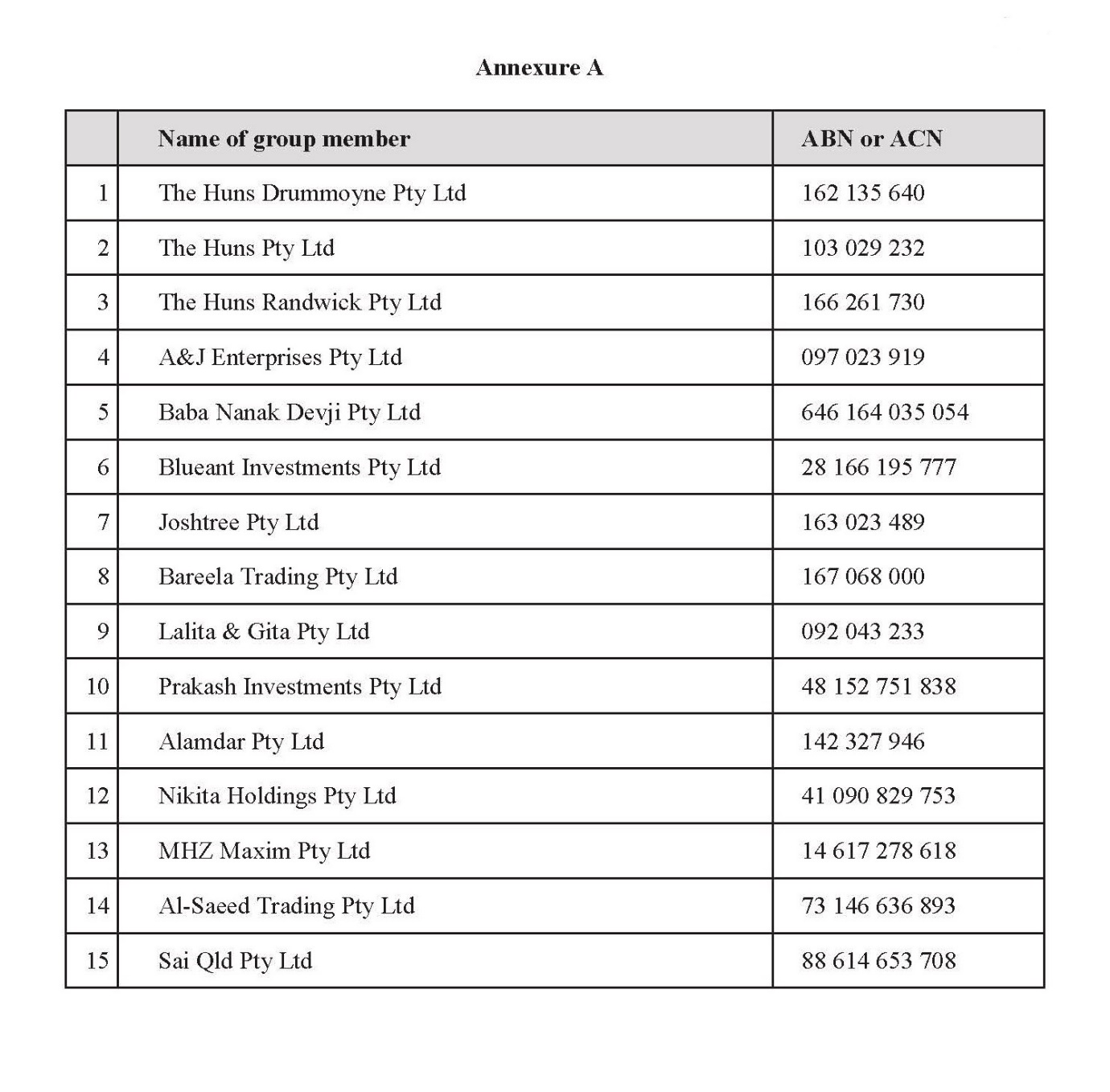
(a) in respect of the notice lodged by Al-Saeed Trading Pty Ltd (ACN 146 636 893), to 28 July 2020 at 5.06 pm;
(b) in respect of the notice lodged by Nikita Holdings Pty Ltd (ACN 090 829 753), to 22 March 2020 at 9.28 am, or alternatively to 30 July 2020 at 3.26 pm;
(c) in respect of the notice lodged by MHZ Maxim Pty Ltd (ACN 617 278 618), to 30 July 2020 at 8.27 pm;
(d) in respect of the notice lodged by Sai Qld Pty Ltd (ACN 614 653 708), on 28 July 2020 at 10.25 am; and
(e) in respect of the notice lodged by Alamdar Pty Ltd (ACN 142 327 946), on 30 March 2020, or alternatively on 29 July 2020 at 10.44 am.
9. Pursuant to s 33ZF of the Act, the group members who have opted out of the proceeding under s 33J of the Act and in accordance with paragraphs 5 and 7 of the orders of Justice Middleton made on 13 June 2019 concerning opt out and settlement notices, as subsequently amended, include those persons in Annexure A to these orders.
10. Pursuant to s 33ZF of the Act, JND Group Pty Ltd be reinstated as a group member in these proceedings.
11. Pursuant to r 1.34 of the Rules, the time required for service of the further amended interlocutory application filed by the first respondent on 5 August 2020 (Further Amended Application) be abridged to the time and date on which this document was served on the parties.
12. The costs of, and incidental to, the Further Amended Application and the hearing of that application, be costs in the proceeding.
13. There be liberty to apply.
Note: Entry of orders is dealt with in Rule 39.32 of the Federal Court Rules 2011.
ORDERS
VID 182 of 2018 | ||
BETWEEN: | PARESHKUMAR DAVARIA First Applicant KHUSHBU DAVARIA Second Applicant JATINDER PAL SINGH Third Applicant SUMAN MEET KAUR Fourth Applicant | |
AND: | 7-ELEVEN STORES PTY LIMITED First Respondent ANZ BANKING GROUP LIMITED Second Respondent | |
order made by: | MOSHINSKY J |
DATE OF ORDER: | 7 AUGUST 2020 |
THE COURT ORDERS THAT:
Discontinuance
1. The evidence in proceeding number VID182/2018 be evidence in proceeding number VID180/2018, and vice versa, for the purposes of the interlocutory applications heard on 7 August 2020.
2. Pursuant to s 33V of the Federal Court of Australia Act 1976 (Cth) (Act), the discontinuance of the claims against the second respondent (ANZ) pursuant to the Deed of Settlement between the first and second applicants (the Davarias) and ANZ dated 9 May 2019 (Deed of Settlement) exhibited to the Affidavit of Brett Richard Imlay made 21 July 2020, as varied by the Deed of Variation of Deed of Settlement dated 5 August 2020 (Deed of Variation) exhibited to the affidavit of Jermir Schan Jehangir Punthakey made 6 August 2020, be approved.
3. Pursuant to s 33ZF of the Act, the Davarias are authorised nunc pro tunc to enter into and give effect to the Deed of Settlement and the Deed of Variation, for and on behalf of the “Settling Group Members” (as defined in the Deed of Settlement).
4. Pursuant to s 33ZB of the Act, the persons affected and bound by these orders are the applicants, the Settling Group Members, and ANZ.
5. On the expiry of the period in s 33ZC(6) of the Act, the applicants have leave pursuant to s 33V of the Act and r 26.12 of the Federal Court Rules 2011 (Cth) (Rules) to file a notice of discontinuance in relation to the claims against ANZ, such a notice stating that the parties bear their own costs in relation to the discontinuance.
6. After a notice of discontinuance is filed by the applicants in accordance with paragraph 5:
(a) the security for ANZ’s costs and any interest thereon held in the Federal Court trust account, be paid to the applicants;
(b) any outstanding costs orders as between the Davarias and ANZ are vacated; and
(c) there be no other order as to costs as between the Davarias and ANZ.
Confidentiality
7. Pursuant to ss 37AF(1)(b) and 37AG(1)(a) of the Act, on the ground that the order is necessary to prevent prejudice to the proper administration of justice, the confidential affidavit of Brett Richard Imlay sworn 28 July 2020 and Exhibit BRI-20 to that affidavit are not to be published or disclosed without the prior leave of the Court to any person or entity other than the applicants, the applicant’s legal advisers, any judge dealing with the approval application from time to time, or any officers of the Court to whom it is necessary to disclose the material.
Opt out
8. Pursuant to s 33J(3) of the Act, the date and time for the filing of an opt out notice in the proceeding by each of the persons below be extended to the date and time at which such notices were received by the Court, being:
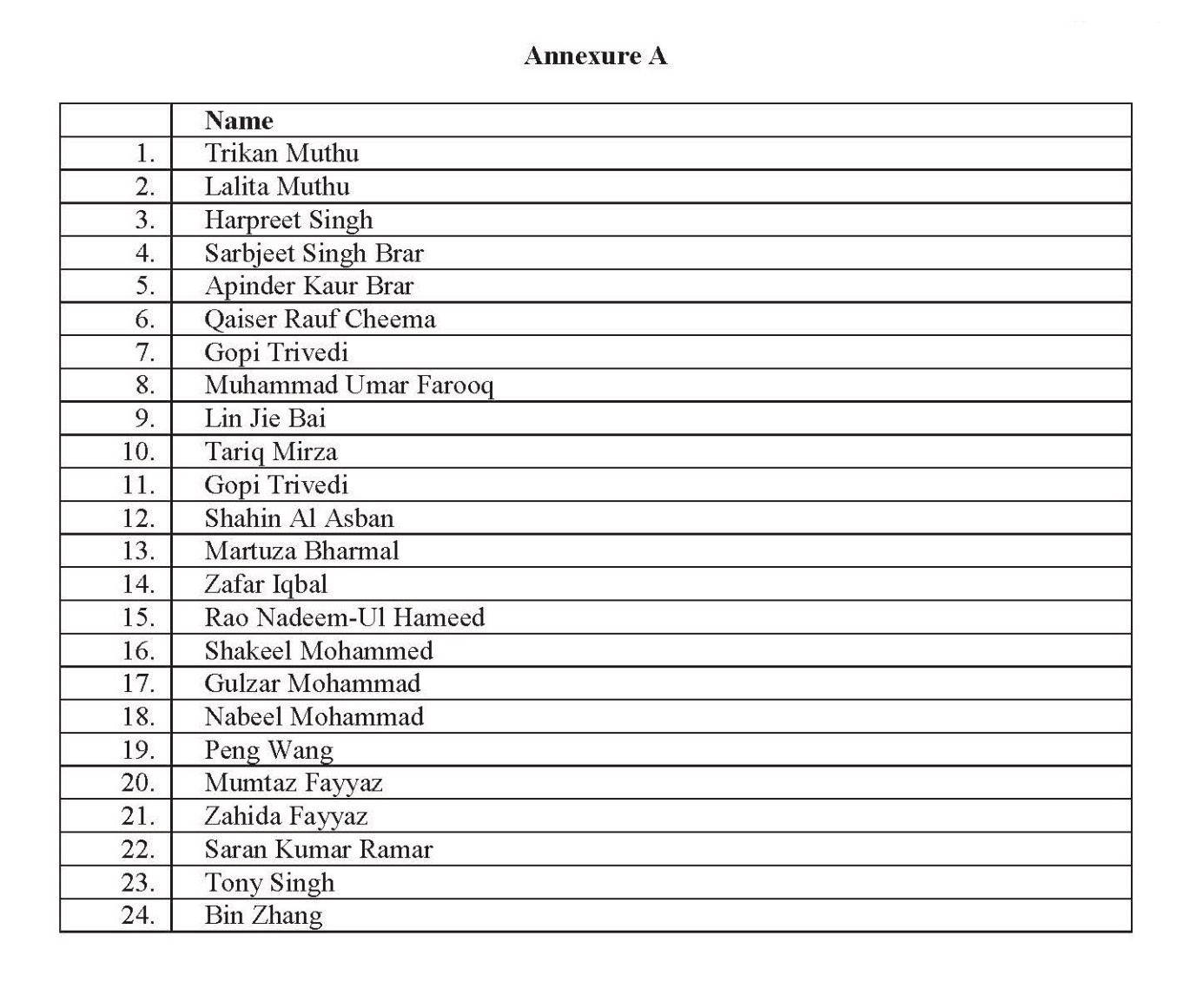
(a) in respect of the notice lodged by Rao Nadeem-Ul Hameed on 26 March 2020;
(b) in respect of the notice lodged by Murtuza Bharmal, on 30 March 2020 at 9.33 am;
(c) in respect of the notice lodged by Zafar Iqbal, on 31 March 2020;
(d) in respect of the notices lodged by Shakeel Mohammed, Gulzar Mohammad and Nabeel Mohammad, on 28 July 2020 at 5.06 pm;
(e) in respect of the notice lodged by Peng Wang, on 29 July 2020 at 8.54 pm;
(f) in respect of the notice lodged by Mumtaz Fayyaz and Zahida Fayyaz, on 30 July 2020 at 1.59 pm;
(g) in respect of the notice lodged by Tony Singh, on 22 March 2020 at 9.28 am, or alternatively, on 30 July 2020 at 3.26 pm;
(h) in respect of the notice lodged by Saran Kumar Ramar, on 28 July 2020 at 10.25 am; and
(i) in respect of the notice lodged by Bin Zhang, on 31 July 2020 at 10.26 pm.
9. Pursuant to s 33ZF of the Act, the group members who have opted out of the proceeding under s 33J of the Act and in accordance with paragraphs 5 and 7 of the orders of Justice Middleton of 13 June 2019 concerning opt out and settlement notices, as subsequently amended, include those persons in Annexure A to these orders.
10. Pursuant to s 33ZF of the Act, Ashraf Abdelmalik and Helana Abdelmalik be reinstated as group members in these proceedings.
11. Pursuant to r 1.34 of the Rules, the time required for service of the further amended interlocutory application lodged by the first respondent on 5 August 2020 (Further Amended Application) be abridged to the time and date on which this document was served on the parties.
12. The costs of, and incidental to, the Further Amended Application and the hearing of that application, be costs in the proceeding.
13. There be liberty to apply.
Note: Entry of orders is dealt with in Rule 39.32 of the Federal Court Rules 2011.
MOSHINSKY J:
Introduction
1 There are two representative proceedings on foot in which claims have been made against both 7-Eleven Stores Pty Limited (7-Eleven) and ANZ Banking Group Limited (ANZ). In each proceeding, an application is now made for approval of the discontinuance of the claims against ANZ, pursuant to s 33V of the Federal Court of Australia Act 1976 (Cth).
2 In proceeding VID 180 of 2018 (the 180 Proceeding), Davaria Pty Limited (Davaria) has brought claims against 7-Eleven and ANZ on behalf of persons who were or commenced to be franchisee parties to a standard-form franchise agreement with 7-Eleven between 20 February 2012 and 19 February 2018 (the relevant period). The second applicant to the 180 Proceeding is Kaizenworld Pty Ltd, but it was added as an applicant after the commencement of the proceeding and does not made any additional claims against ANZ. The second respondent is 7-Eleven Inc, a Texas Corporation, but it has not been served and has not played an active role in the proceeding. Kaizenworld Pty Ltd and 7-Eleven Inc can be put to one side for present purposes.
3 In proceeding VID 182 of 2018 (the 182 Proceeding), Pareshkumar Davaria and Khushbu Davaria (the Davarias) have brought claims against 7-Eleven and ANZ on behalf of the nominated directors and guarantors who were party to 7-Eleven franchise agreements during the relevant period. It will be convenient to refer to Davaria and the Davarias together as the Davaria applicants. The applicants to the 182 Proceeding include Jatinder Singh and Suman Kaur, but they were added as applicants after the commencement of the proceeding and do not make any additional claims against ANZ; they can therefore be put to one side for present purposes.
4 By interlocutory applications filed on 22 June 2020, Davaria (in the 180 Proceeding) and the Davarias (in the 182 Proceeding) seek approval of the discontinuance of the claims against ANZ.
5 The central thrust of the claims against 7-Eleven is that during the relevant period 7-Eleven’s franchise model did not permit franchisees to make a profit if they paid their employees the wages required under the applicable awards. The applicants allege that 7-Eleven misrepresented the profitability of the stores to incoming franchisees prior to their entry into franchise agreements, and that the true position was not revealed to the franchisees until after they had entered into franchise agreements with 7-Eleven, together in many cases with loan contracts with ANZ to finance those agreements. The applicants allege that this constituted both misleading or deceptive conduct and unconscionable conduct by 7-Eleven, in breach of the Australian Consumer Law.
6 The group definition in the 180 Proceeding is not expressly linked to the group definition in the 182 Proceeding, nor vice versa. However, given that the franchise agreements were in standard form and required a “Nominated Director”, every group member in the 180 Proceeding that is a company will have at least one corresponding group member in the 182 Proceeding who is a principal of that company. The “Guarantor” group members, being the second limb of the group definition in the 182 Proceeding, comprise those who agreed to guarantees in relation to the franchise agreements and those who guaranteed a loan from ANZ. As alleged at [122] of the second further amended statement of claim in the 180 Proceeding, there are group members in the 180 Proceeding who did not enter into loan contracts with ANZ to finance their purchase of a franchise.
7 The Davaria applicants’ claims against ANZ arise out of an alleged relationship between ANZ and 7-Eleven. The Davaria applicants say that ANZ was the largest lender to 7-Eleven franchisees and has had a close relationship with 7-Eleven as the franchisor since at least about 2007. The Davaria applicants say that ANZ acquired knowledge of the problems with 7-Eleven’s system and the misrepresentations that 7-Eleven made about profitability through this relationship, but did not disclose this to the franchisees to whom it lent funds for the purchase of 7-Eleven franchises.
8 The Davaria applicants say that the making of the ANZ loans in such circumstances breached the Australian Banking Association’s Banking Code of Practice, which was incorporated by reference into the loan contracts. They also allege unconscionable conduct, in breach of s 12CB of the Australian Securities and Investments Commission Act 2001 (Cth). Thus, the thrust of the claims made by the Davaria applicants and those they represent is that ANZ, knowing that they could not achieve the level of profitability promised by 7-Eleven, should not have loaned them the funds to enter into the franchise agreements.
9 On 9 May 2019, agreements were entered into between Davaria and ANZ (in respects of the 180 Proceeding) and between the Davarias and ANZ (in respect of the 182 Proceeding) pursuant to which the claims against ANZ in each proceeding are to be discontinued. The agreements were recorded in two deeds of settlement (one in respect of each proceeding) both dated 9 May 2019. The deeds of settlement were subsequently varied by deeds of variation dated 5 August 2020. Although the documents are described as “deeds of settlement”, they do not purport to resolve the disputes between the Davaria applicants, or the group members they represent, and ANZ. Rather, it is proposed that the claims against ANZ be discontinued with no order as to costs, with the Davaria applicants and group members reserving the right to assert the same claims in a future proceeding.
10 In addition to the interlocutory applications filed by the Davaria applicants, 7-Eleven has filed a further amended interlocutory application in each proceeding, seeking orders to clarify whether certain group members have, or have not, opted out of the proceeding.
11 For these reasons that follow, I consider it appropriate to approve the discontinuance in respect of the claims made against ANZ in each proceeding, and to make ancillary orders in connection with that discontinuance. I also consider it appropriate to make orders in each proceeding to clarify the status of certain group members, that is, to clarify whether or not they have opted out of the proceeding.
The hearing
12 The hearing today took place using video conferencing software (Microsoft Teams) with the parties appearing remotely. An order was made that evidence in one proceeding be evidence in the other proceeding for the purposes of the interlocutory applications before the Court.
13 At the hearing of this application, the Davaria applicants relied on the following affidavits:
(a) two affidavits of Brett Richard Imlay, special counsel in the employ of the applicants’ solicitors, dated 21 July 2020, one filed in each proceeding;
(b) a confidential affidavit of Mr Imlay dated 28 July 2020;
(c) affidavits of Jermir Schan Jehangir Punthakey, a solicitor employed by the applicants’ solicitors, dated 24 July 2020 and 6 August 2020;
(d) an affidavit of Ashraf Abdelmalik, a group member, dated 4 August 2020;
(e) an affidavit of Helana Abdelmalik, a group member, dated 4 August 2020; and
(f) an affidavit of Durgadevi Murjani, a director of JND Group Pty Ltd, a group member, dated 5 August 2020.
14 ANZ relied on an affidavit of Merryn Jill Quayle, a partner of ANZ’s solicitors, dated 21 July 2020.
15 7-Eleven relied on the following affidavits:
(a) four affidavits of Nicole Marie Tyson, a solicitor employed by 7-Eleven’s solicitors, dated 16 July, 20 July, 4 August and 6 August 2020; and
(b) an affidavit of Nigel David Jones, a partner of 7-Eleven’s solcitors, dated 22 July 2020.
16 In some cases, consistently with the Court’s practice guidelines, the affidavits were provided in unsworn form and were adopted by the relevant deponent during the hearing today.
17 The parties filed detailed outlines of submissions in advance of the hearing.
The procedural background to the applications
18 Both proceedings were commenced on 20 February 2018. Several large interlocutory disputes followed. They predominantly concerned:
(a) the form of the applicants’ pleadings;
(b) the quantum of security for costs that the applicants were required to provide;
(c) the scope of discovery;
(d) allegations by 7-Eleven that the applicants’ solicitors had made misleading public statements; and
(e) 7-Eleven’s communications with the group members (in particular, allegations by the applicants that 7-Eleven had been pressuring group members to opt out and to release their claims in the class action).
19 On 21 May 2018, the Davaria applicants filed an amended statement of claim in the 180 Proceeding and a statement of claim in the 182 Proceeding (which had been commenced by concise statement), to which ANZ filed defences on 27 July 2018.
20 A without prejudice settlement conference was held between the legal representatives for the Davaria applicants and for ANZ on 13 November 2018.
21 The Davaria applicants filed further amended pleadings on 7 December 2018, to which ANZ filed defences on 20 December 2018 and 7-Eleven filed defences on 21 December 2018.
22 On 13 March 2019, the Davaria applicants and ANZ agreed in principle to the discontinuance of the claims against ANZ. At that time the following interlocutory applications had been filed:
(a) applications filed by the applicants on 8 March 2019 seeking discovery from ANZ;
(b) applications filed by ANZ on 8 March 2019 seeking discovery from the applicants; and
(c) applications filed by ANZ on 27 February 2019 seeking further security for costs.
23 At the time that the discontinuance agreement was reached, no party had yet filed any evidence in relation to the substantive claims in the proceedings, and discovery had not yet been provided. This remains the case in relation to ANZ.
24 On 3 March 2020, the applicants filed the following pleadings:
(a) in the 180 Proceeding, a second further amended originating application and a second further amended statement of claim; and
(b) in the 182 Proceeding, a second further amended originating application and a further amended statement of claim.
25 Those pleadings had the effect of joining Kaizenworld Pty Ltd to the 180 Proceeding and Jatinder Singh and Suman Kaur to the 182 Proceeding, as referred to above. They are the current pleadings. The Davaria applicants’ claims against ANZ were not amended after 7 December 2018.
26 On 8 May 2020, the proceedings were set down for trial to commence on 9 August 2021, with an estimate of six weeks.
The proposed discontinuance
27 The deeds of settlement relating to the two proceedings are substantially the same, save for the necessary adjustments to reflect the differences between the proceedings.
28 In cl 6.3 of each deed, the applicants agree to apply for “Approval Orders” pursuant to s 33V of the Federal Court of Australia Act, and to take all steps reasonably necessary to obtain the Court’s authorisation pursuant to s 33ZF to enter into the relevant deed and settle the claims against ANZ on behalf of the “Settling Group Members” (being group members with claims against ANZ who have not released their claims against ANZ and 7-Eleven and who have not opted out). This is necessary because the group members may not otherwise be bound by the terms set out in the deeds, notwithstanding that the Court approves the discontinuance of the claims against ANZ.
29 The critical orders that the applicants have agreed to seek in each proceeding are for leave to file a notice of discontinuance with no order as to costs.
30 In clause 4 of each deed, the parties agree that each will bear its own costs of the proceedings.
31 Clause 8 of each deed of settlement (as varied by the relevant deed of variation) includes a covenant by ANZ that any limitation period applicable to the “ANZ Claims” (being the applicants’ and group members’ causes of action against ANZ) will not be relied on during the time period referred to in that clause. The clause provides that:
(a) ANZ covenants that it will not rely on a limitation defence to an ANZ Claim, or another claim referred to in cl 5, if such a claim is brought before the expiry of the “Covenant Period” applicable to the relevant cause of action; and
(b) for the avoidance of doubt, cl 8(a) should not be interpreted as abridging any limitation period applicable to the applicants’ and/or Settling Group Members’ claims against ANZ which has not already expired.
32 The expression “Covenant Period” is defined as meaning the period, in relation to a cause of action held by an applicant or a Settling Group Member, which:
(a) commences on the first day after the expiry of the ordinary limitation period applicable to the cause of action; and
(b) is equal in length to the Suspension Period relating to the applicant or that Settling Group Member (as appropriate).
33 In the deed of settlement relating to the 180 Proceeding, the expression “Suspension Period” is defined as meaning:
The period, in relation to the Applicant and each Settling Group Member, commencing on the date that the Applicant files a notice of discontinuance in relation to the ANZ Claims and ending on the earlier of:
(1) the date which is six weeks after the Court delivers its reasons for decision following the trial of common issues in the Proceeding;
(2) the date which is 6 months after a Suspension Termination notice is issued in relation to the Applicant or that particular Settling Group Member; or
(3) the date that ANZ commences an Enforcement Proceeding against the Applicant or that particular Settling Group Member.
34 This definition is relevantly the same as the definition of “Suspension Period” in the deed of settlement relating to the 182 Proceeding.
35 The effect of cl 8, as explained in oral submissions on behalf of the applicants and ANZ, is that the running of the limitation period is effectively put on hold during the Suspension Period; the clock starts running again at the end of the Suspension Period.
36 There are two other relevant effects of the suspension in cl 8.
37 First, pursuant to cl 5, while the suspension is operative, any person bound by the deed may plead the deed in bar to any claims brought by another person bound by the deed which arise out of or are related to the ANZ Claims.
38 Secondly, pursuant to cl 9(a), the applicants and the Settling Group Members are not permitted to commence a new representative proceeding in respect of any claim arising out of or related to the ANZ Claims until the suspension comes to an end. A new representative proceeding of that type is defined as a “NewCA”.
39 Clause 9(b) provides that:
(a) within 14 days of the commencement of a NewCA, the applicants’ costs incurred in the proceedings up to and including 12 March 2019 (insofar as they concern ANZ), and ANZ’s costs of the proceedings up to and including that date, will be costs in the cause of the NewCA;
(b) the applicant or applicants in the NewCA will provide security for ANZ’s costs in the same sum as has been provided in the proceedings to date, and without prejudice to ANZ’s right to seek further security; and
(c) the NewCA is stayed until such security is provided.
40 In broad terms, the combined effect of these clauses is to preserve the position in the present proceedings insofar as it concerns claims against ANZ until six weeks after the common questions in the claims against 7-Eleven are determined (although the suspension may come to an end earlier if a party gives notice, or ANZ commences an enforcement proceeding against the applicant or the particular Settling Group Member).
41 Another important clause in each deed is cl 2(c), which provides in effect that if ANZ seeks to enforce its rights under the loan agreements then the applicants and group members can file a cross-claim against ANZ raising the matters the subject of these proceedings.
42 I also note ANZ’s agreement in cl 2(f) to participate in any Court-ordered mediation of the continuing proceedings against 7-Eleven. ANZ’s involvement in any such process may be of some benefit to the applicants and those group members who have loans with ANZ.
43 The final substantive non-boilerplate clause is cl 3 of each deed, which provides that the deed will be terminated if Approval Orders are not made, and that ANZ has a right to terminate the deed in accordance with cl 6.2. The latter clause provides that ANZ can terminate if seven or more group members with claims against ANZ opt out of the proceedings. That did occur, but ANZ elected not to exercise its right to terminate.
Consideration of the proposed discontinuance
44 Section 33V of the Federal Court of Australia Act provides:
33V Settlement and discontinuance—representative proceeding
(1) A representative proceeding may not be settled or discontinued without the approval of the Court.
(2) If the Court gives such an approval, it may make such orders as are just with respect to the distribution of any money paid under a settlement or paid into the Court.
45 The principles applicable to a discontinuance, as distinct from a settlement, of a representative proceeding were discussed Rares J in Wotton v State of Queensland (2009) 109 ALD 534 at [37]-[40]:
[37] Under s 33V(1), a representative proceeding cannot be settled or discontinued without the approval of the court. The decided cases on s 33V(1) all appear to have been concerned with settlements, rather than discontinuances. The considerations affecting a settlement are not always the same as a discontinuance. It is important that any order that is made has regard to the interests not only of the present parties but of group members who may be affected by the terms of any grant of leave to discontinue.
[38] … it is important to ensure that any order by which these proceedings are brought to an end (by discontinuance or dismissal) not have a substantive impact on group members or affect their rights. The court must be careful to guard against any injustice that could be done to persons who are not represented in these proceedings and whose rights may be adversely affected by their outcome. This responsibility is reflected in the scheme of Pt IVA itself, especially in ss 33V(1) and 33ZF(1).
…
[40] The court has an important responsibility of safeguarding the interest of group members as a whole under s 33V(1). There is a danger that when a settlement is reached or a discontinuance is agreed, the interests of the actual parties to the proceedings may receive their paramount consideration while the impact on group members may not be fully or properly addressed. That is why in exercising the power under s 33V(1) to approve a settlement or discontinuance the court must scrutinise with great care the way in which any order is formulated. In the decided cases the courts have approached settlements with a keen eye to ensuring that the interests of group members are vouched safe: …
46 In Mercedes Holdings Pty Ltd v Waters (No 1) (2010) 77 ACSR 265 (Mercedes Holdings), Perram J stated at [9]-[10]:
[9] … Ordinarily, the question of leave arises in the context of determining whether leave should be granted to settle rather than discontinue a proceeding. Usually settlement of class actions will extinguish forever one set of rights in the class — put simply, their choses in action — and replace them with another, namely, rights under the proposed settlement arrangement. This is, of course, a significant step to take. The parties before the court are the representative parties and their advisors. Human experience teaches that those individuals — leaving aside issues such as minority and capacity — can be expected to reach views on any proposed settlement which the court need not second guess. However, as has often enough been pointed out, the opt-out nature of class actions in this court gives rise to the possibility not only of class members who are disengaged from the litigation but perhaps ignorant of it altogether. More importantly, since the representative parties and their lawyers are at the coalface of the suit where time, stress and money are being consumed in the furnace of litigation, it is natural that their inclination towards settlement may be affected by a just appreciation of their own positions. Those positions, and the allied interests accompanying them, may not wholly coincide with those of the members of the class. It is to superintend that inherent tension that s 33V erects a requirement for court approval of settlements and discontinuances.
[10] The course of authority confirms that the task of the approving court is to assess whether the compromise or discontinuance “is a fair and reasonable” one (Lopez v Star World Enterprises Pty Ltd (1999) ATPR 41-678 at 42,670; [1999] FCA 104 per Finkelstein J) which requires one to be satisfied that the settlement or discontinuance “has been undertaken in the interests of the group members as a whole, and not just in the interests of the applicant and the respondent”: Australian Competition and Consumer Commission v Chats House Investments Pty Ltd (1996) 71 FCR 250 at 258; 142 ALR 177 at 184–5; 22 ACSR 539 at 546–7 per Branson J. Consequently, common sense suggests, and authority confirms, that the applicant for leave bears the onus of showing that the settlement or discontinuance is in the interests of all class members. …
47 In the particular circumstances of Mercedes Holdings, Perram J refused leave to discontinue. However, the circumstances of that case were quite different from those of the present case, as the relevant time period arguably was an element of the cause of action rather than merely (as in the present case) a procedural bar. In the present case, there is no reason to think that the covenant not to rely on the limitation period if an ANZ claim is brought before the expiry of the Covenant Period applicable to the relevant cause of action would not be effective.
48 In support of the applications for approval of the discontinuance of the claims against ANZ, the applicants rely on a confidential opinion prepared by counsel for the applicants, Dr KP Hanscombe QC and Mr D Meyerowitz-Katz, dated 28 July 2020. After a considered analysis of all relevant considerations, counsel express the opinion that the proposed discontinuance is fair and reasonable, and in the interests of the group members.
49 Having regard to the matters set out in the applicants’ outline of submissions, and the matters set out in the confidential opinion, I am satisfied that the proposed discontinuance is fair and reasonable and in the interests of the group members. I note the following matters.
50 First, the terms of the discontinuance have been crafted in order to preserve the group members’ rights. The parties have provided for the limitation period to continue to be suspended while the proceedings against 7-Eleven continue, notwithstanding that the proceedings against ANZ will have ended.
51 Secondly, these are very complex proceedings. ANZ and 7-Eleven are large and well-resourced respondents, and the litigation to date has been hard-fought. The evidence before Middleton J in a recent security for costs application was that 7-Eleven had incurred $10,327,917.40 in actual fees to 31 March 2020, and anticipated that it would incur another $4,343,417.50 before the commencement of the trial: Davaria Pty Limited v 7-Eleven Stores Pty Ltd (No 5) [2020] FCA 953 at [20]-[23].
52 The initial trial of the applicants’ claims against 7-Eleven and the questions common to those claims and the claims of the group members is presently listed for a hearing of six weeks commencing on 9 August 2021. If ANZ remains a respondent then it is likely that even more hearing time would be required, assuming that the parties are able to prepare for the ANZ claims to be heard within the same timeframe.
53 One of the main benefits to the applicants and class members of discontinuing the claims against ANZ is that it permits the applicants to devote all of their resources to the claim against 7-Eleven. The discontinuance will also have some more limited cost-saving benefit to 7-Eleven, which otherwise would inevitably incur some costs by reason of ANZ’s presence as a co-respondent.
54 In those circumstances, the complexity and likely duration of the proceedings weighs in favour of the discontinuance being granted.
55 Thirdly, the class has been notified of the nature of the proceedings and also of the proposal to discontinue against ANZ. There has been one objection to the discontinuance, which has been lodged by Jasesh Bhatt, Bindu Bhatt, and Akshardeep Pty Ltd (deregistered). These objectors did not appear at the hearing today. It appears from the material before the Court that Mr and Mrs Bhatt do not have claims against ANZ in the class actions, because their ANZ loan was made outside the relevant period.
56 Mr Bhatt has told the applicants’ solicitors that the objection is because he has suffered as a result of his ANZ loan and he does not want ANZ to be released from the proceedings. This does not provide a substantive basis not to approve the proposed discontinuance. In any event, to the extent that he has a claim against ANZ in the class action and proposes to bring a claim against ANZ he will be able to do so if the class actions are discontinued, as his rights are preserved and so is the suspension of the limitation period. Accordingly, notwithstanding his objection, Mr Bhatt is not prejudiced by the proposed discontinuance.
57 Fourthly, the agreement to discontinue the claims against ANZ was reached just after the close of pleadings. Despite the period of time which has elapsed since then, the discontinuance is proposed at a relatively early procedural stage of the proceeding insofar as it concerns ANZ.
58 Fifthly, the claims against 7-Eleven have continued to run since the agreement to discontinue the ANZ claims, and are now fairly advanced, with a significant amount of discovery having been provided and an initial trial having been set down. If the discontinuance against ANZ is not approved then the hearing date for the 7-Eleven claims may be in jeopardy.
59 In addition to the above, I have had regard to the matters discussed in the confidential opinion.
60 For these reasons, I consider it appropriate to approve the discontinuance of the claims against ANZ in each proceeding. I will make orders substantially in the terms proposed by the applicants, subject to some adjustments discussed during the course of the hearing. In the 180 Proceeding, I will make orders to the following effect:
(a) Pursuant to s 33V of the Federal Court of Australia Act, the discontinuance of the claims against ANZ pursuant to the deed of settlement between Davaria and ANZ dated 9 May 2019, as varied by the deed of variation of deed of settlement dated 5 August 2020, be approved.
(b) Pursuant to s 33ZF, Davaria is authorised nunc pro tunc to enter into and give effect to the deed of settlement and the deed of variation, for and on behalf of the “Settling Group Members” (as defined in the deed of settlement).
(c) On the expiry of the period in s 33ZC(6), the applicants have leave pursuant to s 33V and r 26.12 of the Federal Court Rules 2011 to file a notice of discontinuance in relation to the claims against ANZ, such a notice stating that the parties bear their own costs in relation to the discontinuance.
(d) After a notice of discontinuance is filed by the applicants in accordance with (c) above:
(i) the security for ANZ’s costs and any interest thereon held in the Federal Court trust account, be paid to the applicants;
(ii) any outstanding costs orders as between Davaria and ANZ are vacated; and
(iii) there be no other order as to costs as between Davaria and ANZ.
61 I will make comparable orders in the 182 Proceeding.
62 I also consider it appropriate in the circumstances to make the confidentiality order sought by the applicants. This relates largely to the confidential opinion of counsel.
Issues concerning opt out notices and group members
63 By its further amended interlocutory applications filed on 5 August 2020, 7-Eleven seeks orders to clarify whether certain group members have, or have not, opted out of the proceedings. Also, the applicants seek orders that three group members who opted out of the proceeding be reinstated. These matters were the subject of detailed discussion during the course of the hearing. In light of that discussion, I will set out my reasons relatively briefly.
64 One of the issues concerns certain group members who provided an opt out notice too late. In respect of these group members (with two exceptions) it is common ground (as between the applicants and 7-Eleven) that the time for opting out should be extended so that these group members be treated as having opted out. The only difference between the parties concerned the preferable form to give effect to this position. 7-Eleven sought an order pursuant to s 33J(3), while the applicants preferred that the Court note the parties’ agreement that those group members have opted out. I prefer to make an order pursuant to s 33J(3) as proposed by 7-Eleven.
65 The two exceptions concern the notices lodged on 20 March 2020 by MD Abdus Sattar Khaja and Jharna Akther Khaja. 7-Eleven submitted that it was clear that they intended to opt out, even though the notice was late. However, in circumstances where a notice seeking clarification of their position was sent to them (the notice indicating that if they did not respond they may be treated as group members) and they did not respond to that notice, I consider it prudent to treat them as not having opted out, at least at this stage.
66 The next issue concerned group members that provided an irregular opt out notice. In most cases, the group member has now confirmed that the group member does wish to opt out. In respect of such cases, the agreed position is that the group member should be treated as having opted out. In respect of these group members, the only issue between the parties was as to the preferable form to give effect to the agreed position. Again, I prefer to make an order that these group members be treated as having opted out, rather than merely noting an agreement to this effect.
67 There was another category of case where the group member filed an irregular opt out notice and did not respond to the notice seeking clarification of whether or not the group member wanted to opt out. 7-Eleven submitted that these group members should be treated as having opted out as there was sufficient objective evidence that that was their intention. However, in circumstances where the recent notice sent to these group members indicated that their opt out notice was irregular and that they may be treated as group members, and the group member did not respond to that notice, I consider it prudent to proceed on the basis that they may not wish to opt out. Accordingly, I will not make an order that these group members be treated as having opted out.
68 Lastly, there is the applicants’ application that three persons who had opted out be reinstated as group members. The persons are Ashraf Abdelmalik, Helana Abdelmalik and JND Group Pty Ltd. I am satisfied on the basis of the material before the Court that these persons do not wish to opt out of the proceedings. In the circumstances, I consider it appropriate to make an order that they be reinstated as group members in the relevant proceeding.
69 I will make orders to give effect to the above, in the form discussed with counsel during the hearing.
I certify that the preceding sixty-nine (69) numbered paragraphs are a true copy of the Reasons for Judgment of the Honourable Justice Moshinsky. |
Associate:


