

Federal Court of Australia
Binqld Finances Pty Ltd (In Liq) v Israel Discount Bank Limited; In the Matter of Binqld Finances Pty Ltd (In Liq) (No 2) [2020] FCA 1208
ORDERS
DATE OF ORDER: |
THE COURT ORDERS THAT:
1. The Interlocutory Application filed by the defendant, Israel Discount Bank Limited (IDB) (formerly the thirteenth defendant) on 10 February 2017 be dismissed.
2. IDB pay the plaintiffs’ costs of and incidental to that Interlocutory Application.
3. The Interlocutory Application filed by the plaintiffs on 28 October 2019 be dismissed.
4. There be no orders as to the costs of that Interlocutory Application.
5. The fourth plaintiff, BCI Finances Pty Limited (ACN 055 988 531) (In Liquidation) (BCI) be removed as a party to this proceeding.
6. The joinder of John Sheahan, Ian Russell Lock and the Commissioner of Taxation (Cth) as additional plaintiffs in this proceeding effected by Order 5 made by Foster J in this proceeding on 12 November 2019 be confirmed.
7. The leave granted to the plaintiffs to amend their Second Further Amended Originating Application by Order 6 made by Foster J on 12 November 2019 be confirmed.
8. The leave granted to the plaintiffs to amend their Third Further Amended Statement of Claim by Order 7 made by Foster J on 12 November 2019 be confirmed.
9. By 28 August 2020, the plaintiffs file clean copies of their Third Further Amended Originating Application and Fourth Further Amended Statement of Claim with the following alterations to the parties:
(a) The removal of BCI as the fourth plaintiff herein; and
(b) The consequential alteration in the identification of Messrs Sheahan and Lock and the Commissioner of Taxation (Cth) from being the fifth, sixth and seventh plaintiffs respectively to being the fourth, fifth and sixth plaintiffs respectively.
10. The costs of and incidental to the Interlocutory Application filed by the plaintiffs on 2 October 2019 concerning the joinder of Messrs Sheahan and Lock and the Commissioner of Taxation (Cth) as additional plaintiffs and the consequential amendments to the pleadings herein be costs in the proceeding.
11. The proceeding be fixed for case management before the Docket Judge on a date and at a time to be fixed by the Docket Judge.
12. The parties have liberty to apply on seven (7) days’ notice.
Note: Entry of orders is dealt with in Rule 39.32 of the Federal Court Rules 2011.
FOSTER J:
1 The principal application presently before the Court with which this judgment is concerned involves the question of whether the service in Israel of Originating Process upon the sole defendant remaining in this proceeding, Israel Discount Bank Limited (IDB) (a foreign corporation incorporated in Israel which apparently has no presence in Australia), should stand and, in the alternative, whether the whole of this proceeding should be permanently stayed. IDB contends that service upon it should be discharged or set aside and, in the alternative, that the whole of this proceeding should be permanently stayed. IDB was originally the thirteenth defendant in this proceeding. It is now the only defendant.
Background
2 Binqld Finances Pty Ltd (In Liquidation) (Binqld), Ligon 268 Pty Ltd (In Liquidation) (Ligon 268) and E.G.L. Development (Canberra) Pty Limited (In Liquidation) (EGL) are the first three plaintiffs in this proceeding. Each of those corporations is in liquidation. The appointed liquidators are John Sheahan and Ian Russell Lock, the fifth and sixth plaintiffs respectively. In these Reasons for Judgment, I shall refer to Messrs Sheahan and Lock together as “the liquidators”. The seventh plaintiff is the Commonwealth Commissioner of Taxation (Commissioner). The liquidators and the Commissioner were added as plaintiffs only recently (on 12 November 2019). Their joinder was permitted conditionally and is subject to challenge by IDB.
3 The fourthnamed plaintiff in this proceeding is B.C.I. Finances Pty Limited (In Liquidation) (BCI). BCI makes no current claims in this proceeding. By Notice of Discontinuance filed on 30 September 2016 pursuant to leave granted by me on the same day, BCI discontinued all claims which it had previously made in this proceeding. In those circumstances, it is appropriate that I now order that BCI’s name be removed as a plaintiff.
4 In the period from the respective dates of incorporation of Binqld, Ligon 268 and EGL (the corporate plaintiffs) to the dates upon which each of those corporations was wound up, the affairs of those corporations were controlled by one or more of Emil Binetter, Erwin Binetter, Andrew Binetter and Michael Binetter. Erwin Binetter was the brother of Emil Binetter and the father of Andrew Binetter and Michael Binetter.
5 In this proceeding, it is alleged by the corporate plaintiffs that, from time to time in the period from the mid to late 1980s, the controllers of the corporate plaintiffs caused those companies to enter into a number of transactions, some of which involved IDB, the purpose of all of which was to fraudulently enable the corporate plaintiffs and other corporations controlled by the Binetter family to avoid their taxation obligations in Australia and thereby to benefit members of the Binetter family.
6 Commencing in December 2009, the Commissioner issued a number of amended taxation assessments, shortfall interest assessments and penalty assessments against the corporate plaintiffs. Those assessments constituted the liabilities upon which each of those corporations was later wound up.
7 When this proceeding was commenced, there were four plaintiffs and thirteen defendants. The four plaintiffs were Binqld, Ligon 268, EGL and BCI. The first ten defendants were corporations controlled by members of the Binetter family, the eleventh defendant was Bank Hapoalim B.M. and the twelfth defendant was Bank Hapoalim (Switzerland) Limited. As I have already said, IDB was named as the thirteenth defendant.
8 The version of the plaintiffs’ Originating Application and Statement of Claim which was current in September and December 2016 contained claims and causes of action made variously on behalf of the corporate plaintiffs and BCI against one or more of the defendants. The claims against the defendants were all ancillary claims. The primary contraventions were alleged to be breaches by the directors of the plaintiffs of the fiduciary obligations and statutory duties owed by them to the plaintiffs by, in some cases, knowingly receiving moneys transferred in breach of such obligations, and, in all cases, by knowingly assisting in breaches of such fiduciary obligations and by being involved in breaches of the relevant statutory duties (as to which, see s 181(1) and s 182(1) of the Corporations Act 2001 (Cth) (Corps Act). At the heart of the plaintiffs’ claims were the transactions to which I have referred at [5] above.
9 In late September 2016, BCI settled its claims against Bank Hapoalim B.M. and Bank Hapoalim (Switzerland) Limited. As those claims were the only claims made by it in this proceeding, it has, since that time, taken no further part in this proceeding.
10 On 30 September 2016, on the same occasion as I granted leave to BCI to discontinue all the claims made by it in this proceeding, I granted leave to the corporate plaintiffs and BCI to serve IDB outside Australia in Israel with the Originating Application, Genuine Steps Statement and Amended Statement of Claim which had, by then, been filed in this proceeding. The plaintiffs’ application for that leave was made ex parte. Pursuant to that leave, service of those documents was effected on IDB on 4 December 2016 in Israel in accordance with the Hague Convention as to the service of process.
11 By Interlocutory Application filed on 10 February 2017 (IDB’s Discharge Application), IDB applied for the following relief:
1. The Thirteenth Defendant seeks an order under r 13.01(1)(d) of the Rules to discharge the orders of Foster J made on 30 September 2016 giving leave to the First, Second and Third Plaintiffs to serve the Originating Application dated and filed 3 December 2015 in this proceeding (NSD 1600 of 2015) on Israel Discount Bank Limited, in Israel in accordance with the Hague Convention.
2. Further or alternatively, the Thirteenth Defendant seeks an order under r 13.01(1)(b) of the Rules to set aside service of the Originating Application dated and filed 3 December 2015 in this proceeding (NSD 1600 of 2015) on Israel Discount Bank Limited, in Israel in accordance with the Hague Convention.
3. Further or alternatively, the Thirteenth Defendant seeks an order for a permanent stay of the proceedings against it.
12 On the same day, IDB filed a Notice of Address for Service in which the following statement appeared:
For the avoidance of doubt, the Thirteenth Defendant intends this document to be treated as entering a conditional “appearance in the proceeding”, within the meaning of r 10.70 of the Federal Court Rules (2011) (Cth).
13 Rule 13.01 of the Federal Court Rules 2011 (FCR) provides:
13.01 Setting aside originating application etc
(1) A respondent may apply to the Court for an order:
(a) setting aside an originating application; or
(b) setting aside the service of an originating application on the respondent; or
(c) declaring that an originating application has not been duly served on the respondent; or
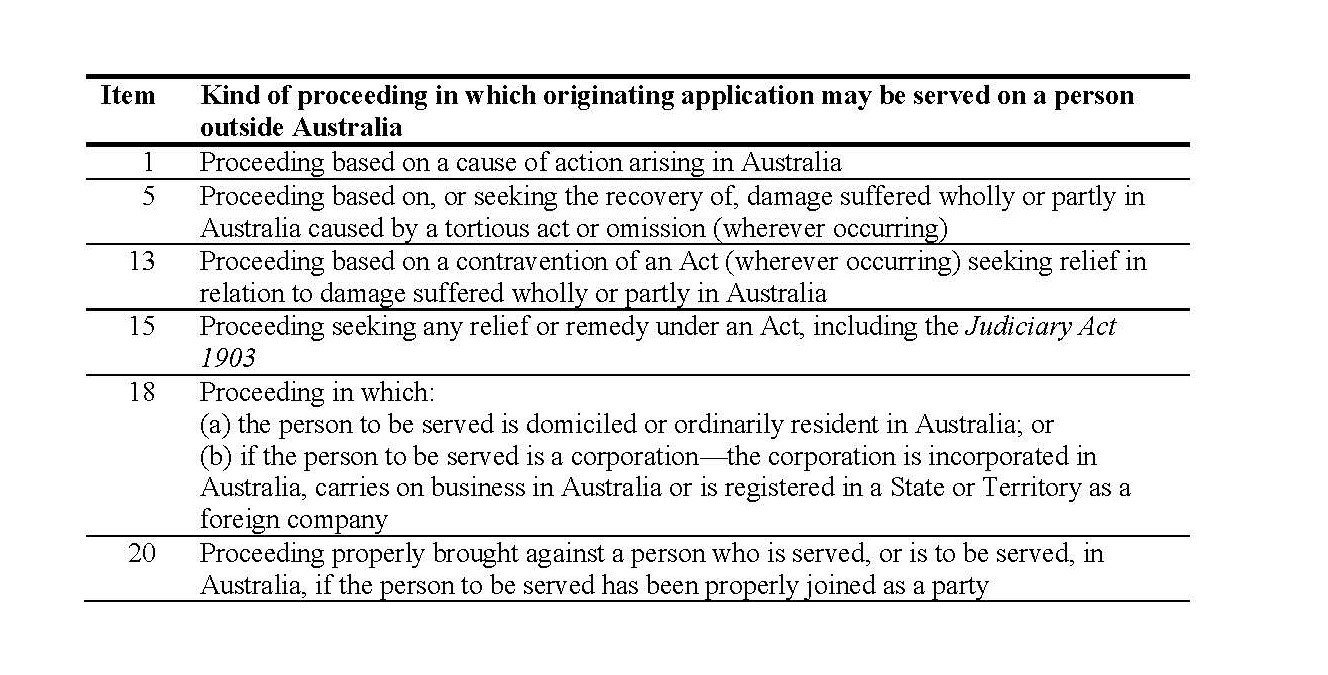
(d) discharging any order giving leave to serve an originating application outside Australia or confirming service of an originating application outside Australia.
Note: Rule 10.43 deals with the procedures for serving originating applications outside of Australia.
(2) If an order under paragraph (1)(b) or (c) is sought, the application must be accompanied by an affidavit stating:
(a) the date on which the originating application was served on the respondent; and
(b) details of the service.
(3) A respondent applying for an order under subrule (1) must file the interlocutory application and affidavit at the same time that the respondent files a notice of address for service.
14 IDB relies upon r 13.01(1)(b) and (d) FCR in its Discharge Application.
15 On 29 September 2017, I heard the claims for relief made by IDB in pars 1 and 2 of its Discharge Application. At that time, the parties had agreed to defer the hearing of IDB’s claim for a permanent stay of this proceeding to a later date.
16 After I reserved my decision in respect of those matters, in late 2018, the corporate plaintiffs settled all of the claims made by them in this proceeding except those against IDB. That settlement also dealt with certain other claims made by the corporate plaintiffs against persons and entities who were not parties to this proceeding, as well as other matters. In these Reasons, I shall refer to this overall settlement as “the settlement”.
17 Although, pursuant to the settlement, on 11 October 2018, the plaintiffs discontinued their claims in this proceeding against the Binetter companies (the first to tenth defendants), in their extant pleadings against IDB, they nonetheless continue to rely upon many of the allegations against those companies which they had formerly made in those pleadings. Those allegations are said to be an integral part of the case which the corporate plaintiffs seek to press against IDB.
18 The case currently pleaded and maintained by the corporate plaintiffs against IDB based upon the principles in Barnes v Addy (1874) LR 9 Ch App 244 (Barnes v Addy) and ss 79, 181 and 182 of the Corps Act is, therefore, essentially the same case as was pleaded against IDB in the original Statement of Claim filed in this proceeding on 3 December 2015. In addition, in early 2019, pursuant to leave granted by me, the corporate plaintiffs added a new case against IDB which is based upon s 37A of the Conveyancing Act 1919 (NSW) (s 37A). IDB did not oppose the addition of the s 37A case at that time.
19 In late 2018, in light of the settlement, IDB applied to reopen its case in support of the claims for relief made by it in its Discharge Application. It made that application upon the ground (inter alia) that it was entitled to have access to the settlement documentation in order to investigate whether or not the terms of the settlement had any impact upon the case which it had sought to advance in support of the claims for relief made by it in its Discharge Application and, if so, the nature and extent of that impact. In particular, IDB wished to investigate whether the corporate plaintiffs’ claims for compensation in this proceeding had been fatally damaged by the circumstance that the corporate plaintiffs had recovered substantial compensation under the settlement. Had IDB been able to prove that contention, it is likely that it would have wished to argue that the plaintiffs have not established the requisite prima facie case for the purposes of the FCR dealing with service out of the jurisdiction (as to which, see r 10.43(4)(c) FCR).
20 On 1 November 2018, I granted leave to IDB to reopen its case in support of its Discharge Application. On the same day, I also made orders requiring the plaintiffs to produce to IDB the settlement documentation. Those orders spawned satellite litigation involving the Commissioner which has not yet been resolved (see Binqld Finances Pty Ltd (In Liq) v Israel Discount Bank Limited; In the Matter of Binqld Finances Pty Ltd (In Liq) [2019] FCA 1186 and Commissioner of Taxation v Israel Discount Bank Limited [2020] FCAFC 71). To date, the settlement documentation has not yet been produced to the Court or to IDB.
21 At the same time, I required the plaintiffs to amend their Originating Application and Amended Statement of Claim so as to remove therefrom all matter that was not relevant to their sole remaining case, that is to say, their case against IDB.
22 On 12 November 2019, I conducted a further hearing of IDB’s Discharge Application. That hearing was a full rehearing of that Application although the evidence and submissions relied upon at the earlier hearing on 29 September 2017 were also relied upon at the hearing on 12 November 2019.
The Plaintiffs’ Pleaded Cases
23 The current pleadings filed by the plaintiffs are the Third Further Amended Originating Application filed on 14 November 2019 (3FAOA) and the Fourth Further Amended Statement of Claim (4FASOC) filed on the same day. Those pleadings were filed pursuant to leave granted by me to the plaintiffs on 12 November 2019. At the hearing which took place on that day, IDB objected to leave being granted to the plaintiffs to join the liquidators and the Commissioner as additional plaintiffs and to make consequential amendments to the versions of those pleadings current as at 12 November 2019. Because the plaintiffs raised concerns that any delay in the grant of leave to join those parties and amend those pleadings might give rise to limitation problems, upon the basis that the leave was subject to my consideration of IDB’s contentions and arguments in support of its Discharge Application and without prejudice to those contentions and arguments, I indicated to the parties at the hearing on 12 November 2019 that I would grant the leave sought pro tem and revisit in this judgment the questions of whether the liquidators and the Commissioner should be joined as additional plaintiffs and whether the consequential amendments sought by the plaintiffs should be allowed.
24 In the current iteration of their pleadings, the corporate plaintiffs claim equitable compensation and an order for relief under s 37A. In the alternative, they claim an account of profits. They also claim interest and costs. In addition, Binqld claims compensation pursuant to s 1317H of the Corps Act in respect of alleged involvement on the part of IDB in the breaches of s 181(1) and s 182(1) of that Act alleged against Binqld’s directors. That claim for compensation is based upon ss 79, 181(2) and 182(2) of the Corps Act.
25 The liquidators and the Commissioner claim s 37A relief in the alternative to claims for such relief made by the corporate plaintiffs. The joinder of the liquidators and the Commissioner as additional plaintiffs was sought by the corporate plaintiffs on 12 November 2019 in order to meet a submission made by IDB to the effect that the corporate plaintiffs have no standing to invoke s 37A.
26 In the 3FAOA and 4FASOC, each of Binqld, Ligon 268 and EGL relies upon causes of action against IDB which are, in each case, possessed by each individual corporation. The claims which each of the corporate plaintiffs makes are not joint claims. All of the claims have been joined in the one proceeding pursuant to r 9.02 FCR. It has never been suggested by IDB (or any other defendant) that the individual claims made by each of the three corporate plaintiffs had been improperly or inappropriately included in this one proceeding.
27 Central to the claims made by each of the corporate plaintiffs against IDB are the matters pleaded in pars 23 to 27 of the 4FASOC in which the corporate plaintiffs describe “the IDB Banking Service”. Those paragraphs are in the following terms:
(1) The IDB Banking Service
23. IDB offered a banking service to persons in Australia and elsewhere (the IDB Banking Service) which had some or all of the following elements:
(a) There was a primary customer, a deposit customer and a borrowing customer, of which the primary customer and the deposit customer could be the same person or entity.
(b) IDB created a deposit account and a borrowing account (or accounts) and could also create a balancing account to record the difference between the credit balance of the deposit account and the sum of the debit balance(s) of the borrowing account (or accounts).
(c) The primary customer caused the deposit customer to deposit funds in the deposit account.
(d) IDB permitted the primary customer and/or the deposit customer to nominate and authorise other persons, who became borrowing customers, to be entitled to draw advances from the borrowing account(s).
(e) IDB permitted drawing of advances from the borrowing account(s) provided the total amount of outstanding advances drawn from the borrowing account(s) did not come to exceed the total amount in the deposit account (that is, the deposit account was “back to back” with the borrowing account(s)).
(f) IDB would not permit the debit balance of the borrowing account(s) to exceed the credit balance of the deposit account (which difference may have been recorded in a balancing account).
(g) When IDB advanced funds to the borrowing customers who had been nominated by the primary customer, the advance of funds would be styled as a loan.
(h) From time to time, funds were transferred to the borrowing account(s) with IDB as and when determined by the primary, deposit or borrowing customers and styled as repayments of loans made by IDB at interest rates nominated by the primary, deposit or borrowing customers, not by IDB.
(i) IDB would pay interest on the positive difference between the debit balance of the borrowing account(s) and the credit balance of the deposit account (which difference may have been recorded in a balancing account).
(j) IDB received a benefit from the provision of the IDB Banking Service through charging a margin on any funds received into the borrowing accounts.
(k) IDB may have received other commercial benefits not known to the applicants.
Particulars of the period IDB Banking Service offered
(i) The period during which the IDB Banking Service was offered is not known to the applicants but from a letter from EGL to IDB dated December 1988 appears to have been offered from at least that time and, in any event, was offered in the period from 1992 to 2009.
Particulars of the existence and terms of the IDB Banking Service
(i) The proforma documents issued to Civic and/or Advance, two companies related to the Binetter family, on or around 19 March 2004.
(ii) The proforma documents issued to EGL on or around 12 April 2000.
(iii) A set of bank statements issued by IDB to Ligon 268 on or around 23 July 2012.
(iv) The existence of and terms of the IDB Banking Service are to be inferred from the existence of and terms of a similar banking service provided by BH Israel and BH Switzerland and supplied to BCI and the Binetter family in the circumstances described in Schedule F. [Schedule F repeats the pleadings previously included in the Statement of Claim which articulate BCI’s case against Bank Hapoalim B.M. and Bank Hapoalim (Switzerland) Limited]
24. The IDB Banking Service provided the following benefits to the primary customer and/or the deposit customer:
(a) it created the appearance of a loan between IDB and the persons nominated (ie the borrowing customers), when in fact the source of the funds was controlled by the primary customer and/or the deposit customer; and/or
(b) it allowed the primary customer to deploy funds under its control by deposit of those funds with IDB and the subsequent advance of those funds (or funds in equal amount) by IDB to borrowing customers as if, and with the appearance, that money was debt funded by IDB from IDB’s capital, with the taxation benefits that that would justify; and/or
(c) it made payments made by borrowing customers to IDB appear to be repayments to IDB of principal and interest on loans advanced by IDB, and thereby concealed the offshore income ultimately received by the primary customer by reason of the use of the IDB Banking Service; and/or
(d) by this means, the primary customer was able to use money on deposit with IDB to earn offshore income in a way which:
(i) concealed the existence of the funds held in the deposit account and the true nature of the IDB Banking Service;
(ii) concealed the existence of the offshore income earned in the deposit account and/or through the use of the IDB Banking Service;
(iii) allowed the primary customer to avoid declaring, and therefore paying tax on, the offshore income in the primary customer’s home jurisdiction.
25. At all relevant times, IDB knew that:
(a) the IDB Banking Service provided the benefits to the primary customers who obtained the service set out in paragraph 23;
(b) primary customers obtained the IDB Banking Service to obtain the benefits set out in paragraph 24;
(c) the primary customers and/or borrowing customers who utilised the IDB Banking Service would, or were likely to, claim in their tax returns submitted in their home jurisdictions that:
(i) the advances of funds from the borrowing account to the borrowing customers were the proceeds of loans advanced by IDB;
(ii) the transfer of funds back to the borrowing account was to repay principal and interest on loans advanced by IDB;
(d) the primary customers and/or borrowing customers would not disclose the existence of the deposit account or the true nature of the IDB Banking Service to the revenue authorities in their home jurisdiction;
(e) the income earned on the deposit account would not be declared by the primary customer or the deposit customer as income in tax returns submitted in their home jurisdiction;
(f) the IDB Banking Service was, and could be, utilised by primary customers to seek to avoid or evade tax in the home jurisdiction of the primary or borrowing customers;
(g) IDB had devised and provided the IDB Banking Service as a means of facilitating the ability of primary customers who sought to avoid or evade tax in the home jurisdiction of the primary or borrowing customer.
Particulars
(i) IDB’s knowledge is to be inferred from the fact that:
A. there would be no commercial rationale for a bank to offer a banking service like the IDB Banking Service, in particular, one which involved two separate but back-to-back accounts and the facilitation of transfers to persons styled as loans but where the primary or deposit customer nominates the interest rate and payment frequency to apply, other than to create a mechanism to obtain the custom of customers seeking to obtain benefits of the type set out in paragraph 24;
B. there would be no commercial rationale for a primary customer to acquire the IDB Banking Service and structure their affairs in the manner contemplated by its use unless the primary customer was seeking to obtain benefits of the type set out in paragraph 24.
26. In the alternative, at all relevant times, IDB ought reasonably have known the matters alleged in paragraph 25.
Particulars
(i) By reason of the matters alleged in paragraph 24 and IDB’s awareness of the commercial circumstances and taxation arrangements in the customer’s home jurisdiction.
27. Further in the alternative, at all relevant times IDB knew circumstances which would have disclosed the matters alleged in paragraph 25 to an honest and reasonable person.
Particulars
(i) By reason of the matters alleged in paragraph 24 and IDB’s awareness of the commercial circumstances and taxation arrangements in the customer’s home jurisdiction.
28 In these Reasons for Judgment, I shall also adopt the expression “the IDB Banking Service” to describe the service which is described in pars 23 to 27 of the 4FASOC.
29 Paragraphs 23 to 27 of the 4FASOC were relied upon against the Binetter corporate defendants in earlier iterations of the plaintiffs’ Statement of Claim. Those paragraphs are also repeated and relied upon by each of the corporate plaintiffs as part of the causes of action now relied upon against IDB in the 4FASOC (as to which, see par 105 (Binqld), par 137 (Ligon 268) and par 172 (EGL)).
30 I shall now address the claims made by the corporate plaintiffs against IDB based upon its alleged knowing assistance in the breaches of the general law fiduciary obligations owed by the directors of Binqld to it and its alleged involvement in the breaches by the directors of Binqld of their statutory duties owed to it. I will then look at the Binqld s 37A claims.
31 Binqld’s claims against IDB are pleaded in pars 105 to 136 of the 4FASOC.
32 Those claims may be summarised as follows:
(a) At all relevant times, Andrew Binetter and Michael Binetter controlled the affairs of Binqld (pars 108, 108A, 109 and 110);
(b) Those two men devised a scheme involving Binqld to assist them, or persons and entities comprising the Binetter family and its associates, in evading Australian tax (par 107);
(c) The Binqld scheme described in par 107 was implemented from April 2006 onwards as follows:
(i) The IDB Banking Service was acquired;
(ii) Funds under the control of the Binetter family were placed on deposit with IDB in a deposit account pursuant to the IDB Banking Service;
(iii) In accordance with the IDB Banking Service, instructions were sent to IDB to make advances to bank accounts in Australia held by Binqld;
(iv) On receipt of funds from IDB, Binqld transferred those funds to other entities related to the Binetter family; and
(v) Binqld lodged tax returns for FY2007 and FY2008 which treated the advances from IDB as loans and claimed as deductible expenses an amount equivalent to the amount paid or payable by Binqld to IDB characterised as interest under the transactions with IDB, thereby reducing income tax which would otherwise have been payable by Binqld under provisions of Australian income tax legislation
(par 111);
(d) Pursuant to the Binqld scheme, Binqld advanced various amounts from tranches of funds received from IDB by Binqld to entities in the Nudie Juices group and other Binetter companies (pars 111A, 111B, 111C and 111D); and
(e) Subsequently, in respect of FY2007 and FY2008, Binqld claimed significant sums as deductible expenses for overseas interest in circumstances where, to the knowledge of Andrew Binetter and Michael Binetter, Binqld was not entitled to claim such deductible expenses (pars 114–124B).
33 In pars 117A to 123, Binqld pleads that, as the directors and controllers of Binqld, each of Andrew Binetter and Michael Binetter owed general law fiduciary obligations to Binqld:
(a) To refrain from any act that involved a conflict of interest between the performance of his function as a director of Binqld and his performance of any other function or his personal affairs;
(b) Not to use his position improperly to gain an advantage for himself or someone else or to cause detriment to Binqld;
(c) To exercise the powers that he possessed and the duties that he had as a director of Binqld for a proper purpose;
(d) To exercise the powers that he possessed and the duties that he had as a director of Binqld in good faith, in the interests of Binqld; and
(e) To exercise reasonable care and skill in the exercise of his duties as a director, so as not to expose Binqld to a risk of loss.
34 At par 121, Binqld pleads the statutory duties owed by Andrew Binetter and Michael Binetter to Binqld pursuant to s 181(1) and s 182(1) of the Corps Act.
35 At pars 122 and 123 of the 4FASOC, Binqld pleads:
122 The involvement and continuing involvement of Binqld in the Binqld scheme was a course of conduct engaged in from the time of Binqld’s incorporation until at least on or around 2 March 2015 when it entered external administration that:
(a) was engaged in in order to assist persons or entities comprising the Binetter family to evade Australian tax;
(b) was pursued for reasons extraneous to the interests of Binqld and in order to further the interests of the Binetter family in evading Australian tax;
(c) was not in the best interests of Binqld because it exposed Binqld to:
(i) a risk that the Commissioner would commence a tax audit of the affairs of Binqld;
(ii) a risk that the Commissioner, acting rationally, would issue Binqld an assessment or amended assessment which disallowed any interest expenses claimed as deductible expenses including pursuant to ss 167 or 170 of the ITAA;
(iii) a risk that the Commissioner, acting rationally, would issue Binqld an assessment or amended assessment which treated the amounts it had received from IDB as income including pursuant to ss 167 or 170 of the ITAA;
(iv) the likelihood that if any of the risks in (i) to (iii) arose, that the Binqld directors would act in their own self-interest or in the interests of the Binetter family, and not the interests of Binqld, by:
A. continuing to conceal the existence of the deposit account from the Commissioner;
B. continuing to conceal the offshore income earned on and in the deposit account from the Commissioner; and
C. failing to provide the necessary documents or disclosures to avoid or minimise the risks manifesting to Binqld;
(d) was pursued by the Binqld directors to benefit themselves or persons or entities comprising the Binetter family by evading the Australian tax payable by those persons or entities through the concealment pleaded in paragraph 119 above;
(e) gave rise to a conflict of interest between the interests of Binqld and the interests of the Binqld directors in that:
(i) the Binqld scheme was entered into and continued in order to assist persons other than Binqld to evade Australian tax (being Andrew and/or Michael and/or other persons or entities comprising the Binetter family); and
(ii) the Binqld scheme was to the detriment of Binqld because it exposed it to the risks identified in subparagraph (c) and did not provide it any benefit at all;
(f) alternatively, negligently exposed Binqld to the risk of loss.
123. In the premises, each of Andrew and Michael breached the fiduciary obligations they owed to Binqld set out in paragraph 120 above and/or the statutory duties they owed to Binqld set out in paragraph 121 above:
(a) by being in a position of conflict of interest with Binqld as long as:
(i) Binqld was involved in the Binqld scheme; and
(ii) he continued to be a director of Binqld; and/or
(b) by involving Binqld in the Binqld scheme; and/or
(c) by continuing to involve Binqld in the Binqld scheme through each of the acts of:
(i) directing IDB to advance funds to Binqld; and/or
(ii) advancing the amounts received to the Nudie companies, Ligon 237, Winmar, Dunba and/or Dunmaf; and/or
(iii) submitting the tax returns set out in paragraphs 112 to 117 above which claimed as deductible expenses, an amount equivalent to the amount paid or payable by Binqld to IDB under the transactions with IDB, thereby reducing income tax which would otherwise have been payable by Binqld under provisions of Australian income tax legislation; and/or
(iv) continuing to conceal the existence of:
A. the Binqld scheme;
B. the deposit account;
C. the offshore income earned on and in the deposit account;
from the Commissioner at all times; and/or
(v) failing to provide the necessary documents or disclosures to explain the Binqld scheme and the existence of the deposit account and offshore income to the Commissioner at any time before the issuing of the assessments, shortfall interest assessments and penalty assessments set out in paragraph 131 below.
(d) alternatively, by negligently exposing Binqld to the risk of loss.
36 At pars 124 to 127, Binqld pleads the facts and matters relied upon as founding its ultimate contention that IDB is liable to it pursuant to the principles explained by Lord Selborne LC in Barnes v Addy and pursuant to s 181 and s 182 of the Corps Act. Those paragraphs of the 4FASOC are in the following terms:
(4) Knowing assistance and involvement by IDB
124. At all relevant times, IDB knew that:
(a) a purpose of the Binetters in acquiring the IDB Banking Service and using it with respect to Binqld by advancing funds to it which were styled as loans was:
(i) to conceal the deposit account from the Commissioner;
(ii) to conceal the offshore income from the Commissioner; and
(iii) to assist persons or entities comprising the Binetter family to evade Australian tax, including on the offshore income earned on the deposit account;
(b) this purpose was not for the benefit or in the best interests of the borrowing customer (being Binqld); and
(c) the use of the borrowing customer was for the benefit of those who controlled it including the primary customer (being a person or entity related to the Binetter family).
Particulars
(i) Paragraphs 25 to 27 above are repeated.
(ii) IDB’s knowledge is to be inferred from the fact that there was no commercial rationale for a bank to offer a banking service like the IDB Banking Service which:
A. allowed the primary customer to advance its funds to borrowing customers of its choosing;
B. allowed the primary customer to choose the interest rate and payment terms that would apply to the transfers to borrowing customers which were styled as loans; and
C. allowed the primary customer to conceal the deposit account through a structure which used multiple accounts,
other than to obtain the custom of customers seeking to obtain benefits of the type set out in paragraph 24 above in circumstances where the IDB Banking Service, included the benefit of evading tax in the primary customer’s home jurisdiction.
(iii) IDB’s knowledge is to be inferred from the fact that:
A. the borrowing customer (being Binqld) made no regular payments purporting to be interest to IDB;
B. the borrowing customer (being Binqld) made no regular payments purporting to be loan repayments or partial loan repayments;
C. IDB made no formal demands to the borrowing customer (being Binqld) for regular payments of the type referred to above; and
D. IDB took no steps to ensure repayment of any amounts purporting to be loans; and
E. in lieu of the above, IDB was content to process payments to it as and when they were made and allocate the payments as “principal” and “interest” as directed by Andrew and/or Michael.
(iv) IDB’s knowledge is to be inferred from its conduct in willingly assisting the concealment of the scheme by providing the letter dated 2 March 2009 which omitted to disclose the true nature of the arrangements between EGL and IDB, including the existence of and [sic] amount contained in the deposit account.
(v) IDB’s knowledge is to be inferred also from the facts in relation to Ligon 268 set out in particular (iii) to paragraph 161 below and in relation to EGL set out in particular (iii) to paragraph 204 below.
124A. In the alternative, at all relevant times, IDB ought reasonably have known the matters alleged in paragraph 124.
Particulars
(i) The particulars to paragraph 124 are repeated.
124B. Further in the alternative, at all relevant times, IDB knew circumstances which would have disclosed the matters alleged in paragraph 124 to an honest and reasonable person.
Particulars
(i) The particulars to paragraph 124 are repeated.
125. IDB benefited from the Binqld scheme because it received the benefit of:
(a) holding the positive difference between the debit balance of the borrowing account and the credit balance of the deposit account from [sic] to time pursuant to the terms of the IDB Banking Service;
(b) receiving a margin on the payments made into the borrowing account or accounts from time to time or otherwise receiving fees and commissions for supplying the IDB Banking Service; and
(c) an increased customer base.
126. The use of the IDB Banking Service was an important element of the Binqld scheme because:
(a) it allowed the transfer to and from IDB of substantial sums of money to be styled as loans from IDB and loan repayments and interest repayments to IDB when the true position was that the funds came from and were under the control at all times of the person or entity related to the Binetter family who was the primary customer pursuant to the IDB Banking Service;
(b) it provided Binqld and the Binqld directors with a means to attempt to justify aspects of the Binqld scheme if questioned by the Commissioner;
(c) it provided Binqld and the Binqld directors with a means to give aspects of the Binqld Scheme seeming legitimacy; and
(d) it allowed persons or entities comprising the Binetter family to access a larger amount of funds than would have been the case if the Binqld scheme had not existed and Australian tax had been paid on the funds.
127. With the general knowledge set out in paragraphs 25 to 27 and the specific knowledge set out in paragraphs 124 to 124B and through its conduct in:
(a) making available and providing the IDB Banking Service to Binqld and/or persons or entities comprising the Binetter family; and/or
(b) advancing funds to Binqld from the borrowing account provided through the IDB Banking Service; and/or
(c) receiving funds into the borrowing account from Binqld and/or persons or entities comprising the Binetter family;
IDB:
(d) knowingly assisted the breaches of the fiduciary obligations owed to Binqld by the Binqld directors set out in paragraph 123;
(e) was involved within the meaning of ss 181(2) and 182(2) of the Corporations Act in the breaches of the statutory obligations owed to Binqld by the Binqld directors set out in paragraph 123 by assisting in, and benefiting from, the implementation of the Binqld scheme in the manner set out in paragraph 125 above;
(f) thereby contravened ss 181(2) and 182(2) of the Corporations Act and remained in contravention each day until Binqld’s involvement in the Binqld scheme was terminated by the appointment of the liquidators on 2 March 2015.
37 Binqld claims compensation for the losses it contends it suffered by reason of the breaches of directors’ duties alleged against Andrew Binetter and Michael Binetter. The amount claimed is $29,075,504.19 being the amount of the unpaid assessments for income tax, penalties and interest incurred by Binqld as a result of those breaches.
38 The claims made by Ligon 268 against IDB are structured in the same way as the claims made by Binqld against IDB. The persons who are alleged to have breached their fiduciary duties owed to Ligon 268 are Erwin Binetter, Andrew Binetter and Michael Binetter. No allegation is made against those persons that they also contravened the Corps Act. As a consequence, no claim is made against IDB in respect of Ligon 268 based upon the Corps Act. The total amount claimed by Ligon 268 is $32,458,486.64.
39 The claims made by EGL against IDB are also similarly structured as the claims made by Binqld. As was the case with Ligon 268, EGL does not make any claim against IDB based upon involvement in breaches of any statutory duties owed to EGL by Erwin Binetter, Andrew Binetter or Michael Binetter. The total amount claimed by EGL is $40,767,456.58.
40 At pars 351 to 374 of the 4FASOC, the plaintiffs plead their cases based upon s 37A. In those paragraphs, the corporate plaintiffs allege that approximately $59 million was transferred by Binqld, Ligon 268 and EGL, at the instigation of Andrew Binetter and Michael Binetter, in circumstances where each of those companies was, or was about to become, insolvent. It is then alleged that the transfers were made with the intent to defraud the creditors of each of those companies and are voidable upon application by each of those companies, upon application by the liquidators and upon application by the Commissioner.
The Relevant Rules of Court
The Text of the Rules
41 Part 10, Div 10.4—Service outside Australia FCR prescribes the circumstances in which a party is permitted to serve Court documents in places outside Australia.
42 Rule 10.41 FCR provides as follows:
10.41 Definitions for Division 10.4
In this Division:
convention, for a foreign country, means a convention (other than the Hague Convention), agreement, arrangement or treaty about service abroad of judicial documents to which the Crown in right of the Commonwealth or, if appropriate, in right of a State, and a foreign country are parties.
foreign country means a country other than Australia.
Hague Convention means the Convention on the Service Abroad of Judicial and Extrajudicial Documents in Civil or Commercial Matters done at the Hague on 15 November 1965.
Note 1: Originating application is defined in the Dictionary.
Note 2 to r 10.41 FCR is not presently relevant.
43 The chapeau to r 10.42 FCR is in the following terms:
10.42 When originating application may be served outside Australia
Subject to rule 10.43, an originating application, or an application under Part 7 of these Rules, may be served on a person in a foreign country in a proceeding that consists of, or includes, any one or more of the kinds of proceeding mentioned in the following table.
44 In the present case, the plaintiffs rely upon Items 1, 5, 13, 15, 18 and 20 in the table referred to in r 10.42 FCR. Those Items in that table are in the following terms:
45 Rule 10.43 FCR provides as follows:
10.43 Application for leave to serve originating application outside Australia
(1) Service of an originating application on a person in a foreign country is effective for the purpose of a proceeding only if:
(a) the Court has given leave under subrule (2) before the application is served; or
(b) the Court confirms the service under subrule (6); or
(c) the person served waives any objection to the service by filing a notice of address for service without also making an application under rule 13.01.
Note: A respondent may apply to set aside an originating application or service of that application—see rule 13.01.
(2) A party may apply to the Court for leave to serve an originating application on a person in a foreign country in accordance with a convention, the Hague Convention or the law of the foreign country.
(3) The application under subrule (2) must be accompanied by an affidavit stating:
(a) the name of the foreign country where the person to be served is or is likely to be; and
(b) the proposed method of service; and
(c) that the proposed method of service is permitted by:
(i) if a convention applies—the convention; or
(ii) if the Hague Convention applies—the Hague Convention; or
(iii) in any other case—the law of the foreign country.
(4) For subrule (2), the party must satisfy the Court that:
(a) the Court has jurisdiction in the proceeding; and
(b) the proceeding is of a kind mentioned in rule 10.42; and
(c) the party has a prima facie case for all or any of the relief claimed in the proceeding.
Note 1: The law of a foreign country may permit service through the diplomatic channel or service by a private agent—see Division 10.5.
Note 2: Rules 10.63 to 10.68 deal with service of local judicial documents in a country, other than Australia, that is a party to the Hague Convention.
Note 3: The Court may give permission under subrule (4) on conditions—see rule 1.33.
(5) A party may apply to the Court for leave to give notice, in a foreign country, of a proceeding in the Court, if giving the notice takes the place of serving the originating application.
(6) If an originating application was served on a person in a foreign country without the leave of the Court, a party may apply to the Court for an order confirming the service.
(7) For subrule (6), the party must satisfy the Court that:
(a) paragraphs (4)(a) to (c) apply to the proceeding; and
(b) the service was permitted by:
(i) if a convention applies—the convention; or
(ii) if the Hague Convention applies—the Hague Convention; or
(iii) in any other case—the law of the foreign country; and
(c) there is a sufficient explanation for the failure to apply for leave.
46 In the present case, service upon IDB in Israel was effective for the purpose of this proceeding because I granted leave under r 10.43(2) FCR before the relevant documents were served (r 10.43(1)(a)). At the time I granted that leave (30 September 2016), I was satisfied that the Court had jurisdiction in this proceeding, that the proceeding was of a kind mentioned in r 10.42 FCR and that the corporate plaintiffs and BCI had a prima facie case for at least some of the relief then claimed in the proceeding.
47 This Court has jurisdiction in respect of the causes of action under the Corps Act relied upon by Binqld as against IDB. In addition, given the common substratum of facts between those causes of action and the causes of action brought by Binqld based upon the principles in Barnes v Addy, the Court also has jurisdiction in respect of those causes of action. For similar reasons, in the circumstances of this case, the Court also has jurisdiction in respect of s 37A cases brought by Binqld. Given that the claims brought by Ligon 268 and EGL have been appropriately included in this proceeding, the Court also has jurisdiction in respect of those claims. IDB conceded that, as at the date of service of the pleadings upon it in Israel and as at 29 September 2017, the date of the first hearing, the Court had jurisdiction in this proceeding within the meaning of r 10.43(4)(a) (see Transcript, 29/09/2017 at p 32 ll 24–37).
48 The plaintiffs rely upon the Items which I have specified at [44] above as the bases upon which they have met the requirement set out in r 10.43(4)(b) FCR.
The Prima Face Case Requirement (Rule 10.43(4)(c) FCR)
49 In ACN 078 272 867 Pty Ltd (In Liq) (formerly Advance Finances Pty Ltd) v Binetter; In the Matter of ACN 078 272 867 Pty Ltd (In Liq) (formerly Advances Finances Pty Ltd) [2018] FCA 952 (Advance Finances) at first instance, at [8]–[12], Lee J summarised the relevant principles in the following terms:
The principles are well established and have been very recently summarised by Rares J in Morris v McConaghy Australia Pty Ltd [2018] FCA 435 at [29]-[30] as follows:
In Ho v Akai Pty Ltd (In Liq) (2006) 247 FCR 205 at 208 [10], Finn, Weinberg and Rares JJ said:
As has been observed on many occasions, the prima facie case requirement has to be met at the outset, usually on an ex parte basis, and without the advantage of discovery and other procedural aids to the making out of a case: see eg Merpro Montassa Ltd v Conoco Specialty Products Inc (1991) 28 FCR 387 at 390. It “should not call for a substantial inquiry”: WSGAL Pty Ltd v Trade Practices Commission (1992) 39 FCR 472 at 476; see also Sydbank Soenderjylland A/S v Bannerton Holdings Pty Ltd (1996) 68 FCR 539 at 549. For present purposes it is sufficient to say that a prima facie case for relief is made out if, on the material before the court, inferences are open which, if translated into findings of fact, would support the relief claimed: Western Australia v Vetter Trittler Pty Ltd (in liq) (1991) 30 FCR 102 at 110. Or, to put the matter more prosaically as Lee J did in Century Insurance Ltd (in prov liq) v New Zealand Guardian Trust Ltd [1996] FCA 376:
What the Court must determine is whether the case made out on the material presented shows that a controversy exists between the parties that warrants the use of the Court’s processes to resolve it and whether causing a proposed respondent to be involved in litigation in the Court in Australia is justified.
The requirement of r 10.43(4)(c), that there be a prima facie case for all or any of the relief sought, will be satisfied if the applicant makes out a prima facie case, to the standard referred to above, in respect of any one of the causes of action for which relief is sought: Ho 247 FCR at 215 to 216 [45] applying Bray v F Hoffman-La Roche Ltd (2003) 130 FCR 317 in respect of an analogue of r 10.43(4)(c).
The requirement has been described as “not particularly onerous”: see Australian Competition and Consumer Commission v Yellow Page Marketing BV [2010] FCA 1218 at [25] per Gordon J. It was observed of a predecessor provision by Bennett J in Australian Competition and Consumer Commission v April International Marketing Services Australia Pty Ltd (No 6) [2010] FCA 704; (2010) 270 ALR 504 at 507 [8]:
Establishing a prima facie case for the relief claimed…should not call for a substantial inquiry. A prima facie case is made out where, upon a broad examination rather than an intense scrutiny of the material before the court, inferences are shown to be open which, if translated into findings of fact, would support the relief claimed: Western Australia v Vetter Trittler Pty Ltd (in liq) (rec and mgr apptd) (1991) 30 FCR 102 at 110; 4 ACSR 795 at 802–3 per French J; Sydbank Soenderjylland (A/S) v Bannerton Holdings Pty Ltd (1996) 68 FCR 539 at 549; 149 ALR 134 at 142–3; the Full Court in F Hoffman-La Roche at [17] and [96]–[97] per Carr J.
Like the former rule (O 9, r 7), it was common ground that FCR 13.01 requires the conduct of a rehearing of the original decision to grant leave, taking into account any additional material put to the Court on the later application: Tycoon Holdings Ltd v Trencor Jetco Inc (1992) 34 FCR 31 at 33; Bray v F Hoffman-La Roche Ltd [2003] FCAFC 153; (2003) 130 FCR 317 at 332 [53]; Australian Competition and Consumer Commission v Prysmian Cavi E Sistemi Energia SRL (formerly Pirelli Cavi E Sistemi Energia SPA) (No 4) [2012] FCA 1323; (2012) 298 ALR 251 at 258 [40]. In this regard, it was uncontroversial that it was open to the plaintiffs, on the hearing of the Bank’s inter partes application to set aside service, to adduce additional evidence to that put before Foster J on the ex parte application: WSGAL Pty Limited v Trade Practices Commission (1992) 39 FCR 472; Costa Vraca Pty Ltd v Bell Regal Pty Ltd [2003] FCAFC 305.
Further, in the context of applications under FCR 13.01, where a prima facie case for relief is established, it was accepted that the Court would not set aside service merely because the case for relief did not conform precisely to the words of the statement of claim. This makes sense, because in this way, applications such as the present do not provide a mechanism for some form of collateral attack on the pleadings: Cell Tech Communications Pty Ltd v Nokia Mobile Phones (UK) Ltd (1995) 58 FCR 365 at 373-374.
It follows in the present circumstances that a sufficient prima facie case will be established if such a case is made out in relation to either the Conveyancing Act Claim or the Corporations Act Claim: see Bell Group Ltd (in liq) v Westpac Banking Corporation (1996) 20 ACSR 760; Cell Tech at 373.
50 In its judgment dismissing IDB’s Application for Leave to Appeal from the judgment of Lee J (Israel Discount Bank Ltd v ACN 078 272 867 Pty Ltd (In Liq) (formerly Advance Finances Pty Ltd) (2019) 367 ALR 71 (Advance Finances, FC)), at 77 [22], the Full Court (Yates, Beach and Moshinsky JJ) said:
The primary judge set out the applicable principles regarding the prima facie case requirement in r 10.43(4)(c) of the Federal Court Rules at [8]–[12] of the Reasons, referring to cases including Morris v McConaghy Australia Pty Ltd [2018] FCA 435 (Morris) at [29]–[30] per Rares J; Australian Competition and Consumer Commission v Yellow Page Marketing BV [2010] FCA 1218 at [25] per Gordon J; and Australian Competition and Consumer Commission v April International Marketing Services Australia Pty Ltd (No 6) (2010) 270 ALR 504; [2010] FCA 704 at [8] per Bennett J. In Morris, Rares J quoted from the judgment of the Full Court of this Court in Ho v Akai Pty Ltd (in liq) (2006) 247 FCR 205; [2006] FCAFC 159 (Ho v Akai) at [10], where the Full Court said that “a prima facie case for relief is made out if, on the material before the court, inferences are open which, if translated into findings of fact, would support the relief claimed”. It was sufficient for the plaintiffs to establish a prima facie case in relation to either the Conveyancing Act claim or the Corporations Act claim: Reasons at [12], citing Bell Group Ltd (in liq) v Westpac Banking Corporation (1996) 20 ACSR 760; Cell Tech Communications Pty Ltd v Nokia Mobile Phones (UK) Ltd (1995) 58 FCR 365 at 373; 136 ALR 733 at 741 (Cell Tech).
51 I propose to apply these principles when considering the question of whether the corporate plaintiffs have established a prima facie case for some or all of the relief claimed by them in their pleadings, as required by r 10.43(4)(c) FCR.
52 The onus of establishing that they have a prima facie case to the requisite standard rests upon the plaintiffs as the claimants for final relief. What may be required in any particular case to discharge that onus will depend upon (inter alia) the nature of the claims for final relief made by the applicant and the requirements of the substantive law underpinning the causes of action relied upon in support of those claims for relief.
53 If an applicant ultimately fails to establish that it has a prima facie case for some or all of the relief claimed by it in the proceeding, then leave to serve the Originating Process outside Australia must be refused, or, if leave has already been granted but is subsequently being challenged by the party served, the order granting leave to serve the relevant process outside Australia should be discharged and/or service of that process on that party should be set aside. This would be so whether or not the method of service chosen by the plaintiff was permitted by and in accordance with the law of the foreign country where service is to be effected. That is, if an applicant fails to establish that it has a prima facie case to the requisite standard, the challenged service will not be valid.
54 The content of the law of a foreign country for the purposes of proceedings in this Court is a question of fact. Commonly, parties adduce evidence before the Court from a suitably qualified expert as to the content of the relevant foreign law. This was the approach taken in the present case, although the weight to be accorded to the expert testimony of the witnesses called by the parties here will be influenced by the circumstance that neither party cross-examined the other party’s expert witnesses.
Setting Aside Service or Discharge of the Order for Service
The Requirements of r 10.42 FCR and r 10.43(4)(b) FCR
55 I shall address the requirements of r 10.42 FCR by reference to the Items in the r 10.42 table relied upon by the plaintiffs (ie Items 1, 5, 13, 15, 18 and 20).
Item 1
56 The corporate plaintiffs are all companies incorporated in Australia and carrying on business in Australia. The fiduciary and statutory duties alleged by those plaintiffs as owed to them by their directors were obligations and duties owed in Australia. At all relevant times, each of the defaulting directors was generally domiciled in Australia. Much of the conduct of the delinquent directors took place in Australia. It is tolerably clear that the causes of action constituting the alleged contraventions by the directors of the corporate plaintiffs were all causes of action which arose in Australia. The corporate plaintiffs submitted that IDB provided the IDB Banking Service in Australia. They submitted that IDB received funds from Australian residents into the deposit account and then allowed drawdowns to each of the corporate plaintiffs in Australia from the borrowing accounts. The corporate plaintiffs also submitted that IDB provided clean documents for use in Australia. Those clean documents provided assistance to the directors in effecting the frauds which they are alleged to have committed.
57 IDB, on the other hand, submitted that the conduct alleged to constitute the relevant knowing assistance and involvement in the contraventions on the part of the directors of the corporate plaintiffs took place entirely outside Australia and in Israel. For this reason, IDB submitted that the corporate plaintiffs could not rely upon Item 1.
58 The corporate plaintiffs’ causes of action against IDB for knowing assistance based upon the principles enunciated in Barnes v Addy and Binqld’s cause of action for knowing involvement in the Corps Act contraventions alleged against the directors of Binqld were not complete, it seems to me, until the directors put into effect their fraudulent scheme. The effectuation of that scheme took place in Australia. For this reason, I think that the better view is that the causes of action relied upon by the corporate plaintiffs against IDB arose in Australia.
59 In the 4FASOC, there are three separate claims brought against IDB based upon s 37A. First, there are the claims made by the corporate plaintiffs. Second, there are the claims made by the liquidators. Third, there are the claims made by the Commissioner. The s 37A claims made by the corporate plaintiffs were included in the pleadings in this proceeding in February 2019. The s 37A claims made by the liquidators and the Commissioner were conditionally included in the pleadings on 12 November 2019.
60 In its Written Submissions dated 20 September 2019 (at pars 36 to 42), IDB argued that none of the s 37A claims arose in Australia. Its submissions may be summarised as follows:
(a) An action will arise in Australia if the substance of the action arose here. The usual approach is to ask where the place of “the act on the part of the defendant which gives the plaintiff his cause to complain” took place.
(b) Here, the complaint made against IDB is that it received, in Israel, payment of money from the corporate plaintiffs in circumstances which rendered that payment of money subject to refund.
(c) A necessary element of the s 37A claims is the requirement for the plaintiffs to establish that IDB lacked good faith in receiving the funds in Israel. Because that requirement focuses on IDB’s state of mind at the time it received the payments, as ascertained from relevant officers and employees located in Israel, that element did not involve conduct in Australia but rather involved conduct in Israel.
(d) Taking the above matters together, in the result, none of the claims based upon s 37A fall within Item 1 because all of those claims arose in Israel.
61 The plaintiffs took issue with this analysis. At pars 104 to 113 of their Written Submissions dated 31 October 2019, the plaintiffs made detailed submissions as to why IDB’s contentions in this respect are incorrect.
62 The plaintiffs made the following submissions:
(a) The s 37A claims focus on alienations of property and the intent with which those alienations were made. In this case, the s 37A claims attack the conduct of the persons who previously controlled and administered the plaintiffs (Erwin, Andrew and Michael Binetter);
(b) The prejudice at which the s 37A claims are aimed is prejudice that occurred in Australia viz loss of control of the funds the subject of the transfers under attack;
(c) It does not matter where the funds ended up; and
(d) The prejudice suffered by the corporate plaintiffs and the Commissioner occurred in Australia.
63 I think that the better view is that the s 37A causes of action also arose in Australia for the reasons submitted by the plaintiffs. It follows that all of the causes of action relied upon by the plaintiffs arose in Australia and that Item 1 was and is satisfied in the present case.
Item 5
64 The corporate plaintiffs maintained their reliance upon Item 5 and referred to two cases in support of their submissions (OJSC Oil Company Yugraneft (In Liq) v Abramovich [2008] EWHC 2613 (Comm) (OJSC) and Commonwealth Bank of Australia v White [1999] 2 VR 681 at 698–699 [63]–[64] per Byrne J). The corporate plaintiffs also referred me to a decision which was to the contrary effect (Nicholls v Michael Wilson & Partners Ltd (2010) 243 FLR 177 at 240 [339] per Lindgren AJA).
65 I do not think that any of the claims made by the plaintiffs in the present case are torts within the meaning of Item 5.
66 In OJSC, Clarke J (at [223]) regarded the claims for dishonest assistance made in the case before him as being “so closely analogous to a claim in tort (as characterised for purely domestic purposes) that it should, I would have thought, be so characterised for private international law purposes”.
67 With respect to his Lordship, I do not find that reasoning persuasive. The concept of “tort” in Australian domestic law is well understood and does not, in my view, encompass such a claim. I see no reason to interpret the concept differently for Private International Law purposes.
68 Nor do I think that the Corps Act claims against IDB or the s 37A claims against IDB can be characterised as torts.
69 Accordingly, I reject the plaintiffs’ proposition that Item 5 is engaged at all in the present case.
Items 13 and 15
70 Items 13 and 15 relate to proceedings based upon the contravention of an “Act” or seeking relief or remedy under an “Act”.
71 In the Dictionary forming part of the FCR (Schedule 1), “Act” is defined to mean the “Federal Court of Australia Act 1976”. No other definition of “Act” is to be found in the FCR.
72 IDB submitted that the word “Act” in Items 13 and 15 should be interpreted as meaning “Commonwealth Statutes”. In support of that proposition, it relied upon Perdaman Chemicals & Fertilisers v Griffin Coal Mining Company Pty Ltd [2011] FCA 1425 at [11] per Siopis J and Fletcher v Capstone Aluminium SDN BHD; In the Matter of McLay Industries Pty Ltd (In Liq) [2016] FCA 1459 at [11] per Greenwood J. However, neither of those cases directly decides the point nor is either of those cases of any real assistance in resolving the point. In the paragraphs cited, Siopis J and Greenwood J merely observe that, in the case before each of them, the relevant claim was based upon a Commonwealth Act. Neither of their Honours said that “Act” in Items 13 and 15 means “Commonwealth Act”.
73 IDB also relied upon s 38 of the Acts Interpretation Act 1901 (Cth). However, that section merely speaks to the permissive identification of statutes and does not mandate any particular or specific descriptor. It certainly does not go so far as to suggest that a reference to the word “Act” in rules of court (and, in particular, in the FCR) should be taken to be a reference to statutes passed by the Commonwealth Parliament in contradistinction to statutes passed by State and Territory Parliaments.
74 IDB also relied upon s 21(b) of the Acts Interpretation Act. However, I do not regard that section as being relevant.
75 The only authority cited by the parties which is directly in point is Bray v F Hoffman-La Roche Ltd (2003) 130 FCR 317 at 350 [152] per Branson J. There, her Honour said (in passing, it has to be said) that an “Act” within the meaning of the Rules is an Act passed by the Parliament of the Commonwealth. Justice Branson referred to s 38(1) of the Acts Interpretation Act to support that statement. The other members of the Full Court did not adopt her Honour’s views on this point.
76 At pars 119 to 121 of their Written Submissions dated 31 October 2019, the plaintiffs made the following submissions in relation to Items 13 and 15:
The purpose of the items in r 10.42 is to ensure that the proceeding in question has a sufficient connection with “the country asserting jurisdiction”, ie, Australia: cf Tiger Yacht at [50]. Rule 10.42 “describes a number of different kinds of proceedings which have a sufficient connection with Australia to justify the invocation of Australian jurisdiction in relation to the dispute”: International Maritime Services Pty Ltd v Marina Towage Pte Ltd [2014] FCA 416 at [8].
It is significant that r 10.42 focusses on the proceeding’s connection with Australia. Where the connecting factor between a proceeding and Australia is that the proceeding seeks “any relief or remedy under an Act” (r 10.42, item 15), the strength of that connection does not depend upon whether the Act in question is a State Act or a Commonwealth Act. The same may be said in respect of the use of “Act” in items 12, 13, 14 and 16.
Considering the purpose of the rule, there is no reason why the drafters of r 10.42 would have intended to distinguish between the two types of Act. That purpose would be undermined if the narrow reading of “Act” applied, as the result would be that cases with a stronger connection to Australia than many cases within r 10.42 might nevertheless fall outside the rule. This suggests that the drafters did not intend the narrow meaning of “Act” to apply. A “contrary intention” for the purposes of s 2(2) of the Acts Interpretation Act exists. The word “Act” should be read as any Australian statute.
77 I think that these submissions are correct and I accept them. Therefore, I am of the opinion that the plaintiffs’ s 37A claims fall within Items 13 and 15.
78 Clearly enough, the plaintiffs’ claims based upon the Corps Act fall within Items 13 and 15.
79 IDB submitted that the causes of action relied upon by Binqld based upon the Corps Act were not sufficient to satisfy Items 13 and 15, as contended by the corporate plaintiffs, because Binqld has not established that the Corps Act applies to the alleged conduct of IDB. This submission was not developed. Nonetheless, as I understand this submission, IDB contends that the relevant provisions of the Corps Act founding the allegation of knowing involvement on its part do not have any extraterritorial effect.
80 However, the Corps Act contraventions alleged by Binqld against IDB are contraventions in respect of which relief is sought in relation to damage suffered in Australia. In that event, it does not matter where the relevant contravention occurred. Accordingly, even if IDB’s submission that the relevant conduct with which IDB stands charged occurred in Israel, and not in Australia, that is not sufficient to take the present proceeding outside Item 13.
81 Item 15 applies because Binqld seeks relief and a remedy under the Corps Act against IDB.
82 For all of the above reasons, I think that the requirements of Items 13 and 15 are satisfied in the present case.
Item 18
83 The corporate plaintiffs submitted that IDB carried on business in Australia at all relevant times because:
(a) It supplied banking services to Australian residents;
(b) It transferred funds into Australia from time to time and received funds from Australia from time to time; and
(c) It was involved in a scheme or schemes which had as its purpose the evasion of Australian tax. IDB was involved in that scheme for the purpose of profit on a continuous and repetitive basis.
84 These circumstances justify the conclusion that IDB was undertaking activities in Australia as a commercial enterprise in the nature of a going concern, that is, activities engaged in for the purpose of profit on a continuous and repetitive basis.
85 IDB submitted that the evidence did not support a conclusion that it was relevantly carrying on business in Australia. The mere fact that its customers happened to be Australian was not sufficient. IDB also submitted that the services which it provided to the corporate plaintiffs and their directors were provided in Israel, not in Australia.
86 It seems to me that IDB did provide some of its banking services in Australia because it received funds from time to time remitted from Australia and repatriated funds to Australia all at the behest of the corporate plaintiffs who were based in Australia. I do not consider that the mere fact that IDB did not have an office in Australia and generally did not have employees based in Australia necessarily leads to the conclusion that it was not relevantly carrying on business in Australia. For these reasons, I am of the opinion that Item 18 was and is also satisfied.
Item 20
87 Item 20 allows an applicant to serve any person who is outside the jurisdiction if that person is a necessary or proper party to an action that is brought against another party who has already been served in Australia. The correct approach to determining whether the proceeding is of a kind referred to in Item 20 is to ask whether a local respondent has been properly joined and then to determine whether the proposed foreign party would have been a proper party to the proceeding if it had been within the jurisdiction (see Costa Vraca Pty Ltd v Bell Regal Pty Ltd [2003] FCAFC 305 (Costa Vraca) at [17] per Ryan, Kiefel and Gyles JJ). A person may be considered to be a proper or necessary party where the claims against that person arise from a common substratum of facts (Costa Vraca at [25]).
88 When this proceeding was commenced and also at the time when service was effected upon IDB, there were twelve other defendants joined as parties to the proceeding. The first ten of those defendants were Binetter-controlled corporations, all of which were incorporated in Australia. They had been served with the Originating Process long before service was effected on IDB. The eleventh and twelfth defendants were the Bank Hapoalim parties.
89 The joinder of all of those defendants at the suit of the corporate plaintiffs and BCI at each of those times was legitimate because all of those defendants were appropriately joined as defendants pursuant to r 9.02 FCR.
90 IDB submitted that it was not a necessary or proper party within the meaning of Item 20. IDB submitted that the case against the Binetter corporations could have been determined by the Court without reference to the matter against IDB. It submitted that it would not have impeded the Court’s ability to determine the corporate plaintiffs’ claims against those defendants if IDB had not been a party to the proceeding. These submissions made on behalf of IDB ignore the fact that Item 20 is not confined to the joinder of foreign parties who are necessary parties but also encompasses foreign entities which are considered to have been “properly joined as a party”.
91 IDB also submitted that, given that the settlement was effected in late 2018, before the resumed hearing of its Discharge Application on 12 November 2019, Item 20 no longer applies because, by then, there were no longer any local defendants in the proceeding. I do not think that this submission is correct. The matter must be judged as at the date service was effected (4 December 2016). The Binetter-related defendants were still parties to this proceeding with the consequence that Item 20 was satisfied then.
92 For the above reasons, I consider that Item 20 was and is clearly satisfied in the present case. This proceeding was properly brought against the twelve defendants with whom the plaintiffs have now settled. IDB was properly joined as a party to this proceeding.
Conclusions (Rule 10.42 FCR)
93 For all of the above reasons, I consider that r 10.42 FCR is satisfied in respect of all of the claims currently made in the 3FAOA and the 4FASOC because this proceeding “… includes … one or more of the kinds of proceeding” mentioned in the Table forming part of r 10.42 FCR. It necessarily follows from this conclusion that the requirement specified in r 10.43(4)(b) has also been satisfied in the present case.
The Plaintiffs’ Prima Facie Case
94 When the plaintiffs’ ex parte application for leave to serve the Originating Process on IDB in Israel was before me, the plaintiffs relied (inter alia) upon the affidavit of John Sheahan affirmed on 24 May 2016. There were voluminous exhibits to that affidavit. Those exhibits included most of the Tender Bundle documents tendered by the plaintiffs at the trial before Gleeson J of proceeding SAD5 of 2015 (SAD5). That trial took place in August and September 2015. Justice Gleeson delivered judgment in that matter (BCI Finances Pty Ltd (In Liq) v Binetter (No 4) (2016) 348 ALR 227 (BCI Finances (No 4))) on 18 November 2016.
95 Instead of formally tendering all of that material, the plaintiffs relied upon a “mini bundle” of documents or “supplementary tender bundle” (STB).
96 This approach was adopted in order to avoid unnecessarily burdening the Court with documentary tenders.
97 At the hearing before me, on 29 September 2017, the plaintiffs adopted the same approach. IDB did not object to this course.
98 The STB was tendered in evidence before me on 29 September 2017. It became Exhibit A.
99 Exhibit A was largely, if not entirely, directed to the role played by IDB in this saga. It was not intended to address the position of the delinquent directors (Erwin, Andrew and Michael Binetter) to any degree. It is fair to say that, on 29 September 2017, and indeed at the second hearing on 12 November 2019, the parties proceeded upon the basis that the plaintiffs had at least a prima facie case against those directors and their associated corporate entities who were the first to tenth defendants in this proceeding. The hearings before me were conducted upon the basis that, for present purposes, the plaintiffs did not need to prove that case. In particular, at Transcript 29/09/17, p 7 ll 15–28, the following exchange took place:
HIS HONOUR: Do you accept that there’s enough evidence here to a requisite prima facie level to establish the liability of the principal actors in the so-called fraudulent and dishonest design?
MR CLELLAND: Can we put it slightly differently and say that we don’t want to be heard to argue that there isn’t.
HIS HONOUR: All right. So you’re concentrating very much on the position of your own client - - -
MR CLELLAND: Yes.
HIS HONOUR: - - - and on the absence of enough evidence to justify the case put against your client.
See also the observations which I made at Transcript 29/09/17, p 27 ll 5–10.
100 The prima facie case requirement does not call for a substantial enquiry. It is sufficiently satisfied if, on the material before the Court, inferences are open which, if translated into findings of fact, would support the relief claimed (Ho v Akai Pty Ltd (In Liq) (2006) 247 FCR 205 (Ho) at 208 [10] per Finn, Weinberg and Rares JJ).
101 To recap, before they were wound up, the corporate plaintiffs were under the control of their directors, Erwin, Andrew and Michael Binetter. The plaintiffs allege that the directors of each of the corporate plaintiffs breached the duties owed to them by involving and continuing to involve the plaintiffs in a scheme or schemes implemented to assist persons within, and entities connected with, the Binetter family in evading Australian tax. Involving the plaintiffs in that scheme or schemes provided no benefit to the plaintiffs, while exposing them to the risk of unfavourable tax assessments.
102 The scheme or schemes involved using the IDB Banking Service in order to bring substantial funds into Australia styled as loans to the plaintiffs, while at the same time concealing from the Commissioner the existence of offshore funds held in accounts with IDB for the purposes of evading Australian tax.
103 SAD5 was a proceeding brought by the corporate plaintiffs and BCI against members of the Binetter family and a number of their associated corporate entities. That is to say the plaintiffs in SAD5 were the same corporations as comprise the first three plaintiffs in this proceeding together with BCI. The subject matter of that proceeding was essentially the same subject matter as this proceeding. The scheme described in the pleadings in this proceeding is the same scheme as the scheme relied upon in SAD5. The tax assessments resulting from the fraudulent conduct of the Binetters referred to in this proceeding are the same tax assessments as were in play in SAD5. In truth, the only difference between the two sets of proceedings is the identity of the defendants. For this reason, observations made by Gleeson J in Binetter (No 4) are relevant to the present application. Although that judgment was the subject of an appeal, the settlement was agreed before the Full Court had delivered judgment in that appeal. The settlement resolved all matters under consideration in the appeal with the exception of the appeal concerning the position of Gary Binetter. For that reason, it was necessary for the Full Court to deliver a judgment dealing with that part of the appeal concerning Gary Binetter (BCI Finances Pty Ltd (In Liq) v Binetter (2018) 362 ALR 597 (BCI Finances v Binetter, FC). That Full Court judgment did not interfere with the findings and orders made by Gleeson J in Binetter (No 4). The appeal involving Gary Binetter was dismissed and the orders made by Gleeson J against the other parties in SAD5 remained in full force and effect after the settlement was agreed.
104 At 236–237 [1]–[8] and at 254–256 [146]–[153] in Binetter (No 4), Gleeson J described the relevant scheme or schemes which were undertaken by the delinquent directors of the corporate plaintiffs and BCI and expressed her conclusions about that scheme or schemes. At 254–256 [146]–[153], her Honour said:
Summary of conclusions about the alleged scheme
On the evidence set out below, I find that Erwin and Emil Binetter agreed to participate in a scheme involving EGL and IDB and, subsequently, BCI and Bank Hapoalim, broadly to the effect of the alleged scheme, although it will be necessary to be precise about the elements of the scheme that are supported by the evidence.
In particular, the scheme, as initially implemented, involved:
(1) “back-to-back” arrangements by which funds, in the control of Erwin and Emil Binetter, deposited outside of Australia (“offshore deposits”) were used as security for advances of funds by the Israeli banks to the various applicants;
(2) providing funds obtained pursuant to the “back-to-back” arrangements to various of the corporate respondents to assist in their business activities in Australia;
(3) documenting the arrangements between the applicants and the Israeli banks so as to permit the applicants, if required, dishonestly to produce documents purportedly evidencing the arrangements but which did not disclose the offshore deposits;
(4) lodging income tax returns on behalf of EGL and BCI which would declare no, or no significant, taxable income, because any income disclosed would be offset by substantially equivalent amounts claimed to be deductible expenses and generally (but not always) referable to payments to the Israeli banks, described in contemporaneous records as payments of interest to the Israeli banks.
I also find that Milgerd, Erma, Ligon 159 and Ligon 158 were parties to the scheme from its inception. I do not find that Margaret Binetter agreed to participate in or facilitate a scheme of the kind alleged, or in any scheme to avoid or evade income tax. I find that each of Andrew and Michael Binetter agreed to participate in or took steps to facilitate the scheme at various times.
Ligon 268 and Binqld subsequently entered into transactions with IDB that involved the key elements of the scheme set out above. Ligon 268’s income tax returns were affected by its role as trustee of the Bankstown Eye Trust, but it did not disclose any significant taxable income from its activities as a lender of funds obtained from IDB.
Following from the conclusion that the scheme involved documenting the transaction in a manner which would not reveal the existence of the offshore deposits, I find that those who arranged the documentation intended to conceal the existence of the offshore deposits and any income earned from the deposits, principally by seeking to ensure that the applicants’ records would create the false impression that the terms of the transactions were not affected by the deposits.
Based on the elements of the scheme, I find that its purposes, and the purposes of those respondents who participated in it, included the following:
(1) to allow various of the respondents to have the benefit in Australia of the funds comprising the offshore deposits, without transferring those funds to Australia;
(2) to interpose the applicants between various of the respondents and the Israeli banks;
(3) to arrange a situation whereby each of the applicants treated transfers of funds from the Israeli banks as loan funds and the applicants and various of the respondents claimed, as deductible interest expenses, amounts said to be liabilities to the Israeli banks, on the basis of documentation which, if produced by an applicant to the ATO, would enable the applicant to conceal dishonestly important aspects of the transactions with the Israeli banks (particularly, the existence of the offshore deposits and the recipient or recipients of interest paid on the offshore funds, but also the true quantum of payments made to the banks in consideration of their respective participations in the arrangements); and
(4) to thereby evade liability to pay income tax to the Commissioner or to assist others to evade their tax liabilities.
As for the results of the scheme, I find that they included the following:
(1) the applicants claimed deductions for overseas interest expenses in each of their income tax returns for the income years in respect of which the Commissioner ultimately issued the revised assessments;
(2) each of the applicants was exposed to a risk that, in the event of a tax audit, the Commissioner would issue them with revised assessments which disallowed the interest expenses claimed as deductible expenses (and which treated as assessable income certain amounts received by the applicants from the Israeli banks), because the applicants would not produce documents and provide information to explain the totality of the relevant transactions and, therefore, would not substantiate the claimed deductions;
(3) each of the applicants was exposed to a risk of that, in the event of a tax audit, the Commissioner would impose penalties and issue assessments requiring payment of interest on primary tax liabilities (including general interest charge and shortfall interest charge), because the documents and information supplied to support the interest expenses would not explain the totality of the relevant transactions and would cause ATO officers to strongly suspect, as was the case, that the advances from the Israeli bank were the subject of a security by way of a back-to-back deposit which may affect the correct tax treatment of both the advances and the claimed interest expenses; and
(4) various of the respondents, in implementing the scheme, acted so as to benefit various of the respondents to the detriment of the applicants.
Thus, the scheme (and the individual transactions undertaken in pursuance of the scheme) operated to the benefit of various of the respondents but, if revealed, would operate to the detriment of the applicant companies. Such detriments would include liabilities to pay income tax for which the relevant applicant company would not otherwise have been liable, liabilities to pay penalties on assessments issued by the Commissioner and liabilities to pay interest including shortfall interest charges and general interest charges.
See also BCI Finances v Binetter, FC at 603–605 [12]–[21].
105 In the detailed respects which I have discussed at [24]–[40] above, the plaintiffs allege that IDB knowingly assisted the delinquent directors in the breaches of the fiduciary obligations owed by those directors to each of the plaintiffs more particularly described in the pleadings and was knowingly involved in the breaches of s 181(1) and s 182(1) of the Corps Act relied upon by Binqld against its directors more particularly described in the pleadings.
106 The plaintiffs’ claims in proceeding SAD 5 of 2015 are substantially the same as the claims made by them in this proceeding. The main difference between the two sets of claims is that the defendants in proceeding SAD 5 of 2015 are different entities from the defendants in this proceeding.
107 In an earlier judgment delivered by me in this proceeding on 31 July 2019 (Binqld Finances Pty Ltd (In Liq) v Israel Discount Bank Limited; In the Matter of Binqld Finances Pty Ltd (In Liq) [2019] FCA 1186), at [39]–[42], I said:
At the hearing before me on 11 February 2019, the following exchange took place between Counsel for the plaintiffs and me at Transcript p 4 l 1–p 5 l 28:
HIS HONOUR: How do you put your damages claim?
MR ARNOTT: The damages claim is put by reference to the tax liabilities that each of the plaintiffs have suffered. Now, in relation to our primary case accessorial liability claim, it’s on the basis that none of those losses will have been suffered, and then for the 37A claim, your Honour will see - - -
HIS HONOUR: Yes. But what’s the quantum? Is it the entirety of what was claimed when I granted you ex parte leave to serve out or is it something else?
MR ARNOTT: It’s all of the losses which haven’t yet been recovered. So since your Honour - - -
HIS HONOUR: Well, I know that.
MR ARNOTT: Yes.
HIS HONOUR: All right. I will ask you this question then. Is it what you had as a claim before less what you got on the settlement?
MR ARNOTT: Yes, your Honour.
HIS HONOUR: All right. Well, that’s an entirely different case, isn’t it?
MR ARNOTT: It’s not, your Honour. No. It’s not. It’s for a lower amount of damages but it’s still for a significant sum of money.
HIS HONOUR: Do you accept that you bear the onus of proving what that damages quantum is?
MR ARNOTT: Yes.
HIS HONOUR: So you have to tender the settlement deed, do you?
MR ARNOTT: Yes. Or prove it through other means. So we might be – the other way of doing it, your Honour, which I discussed with Dr Bell last year, was that we would give him enough - - -
HIS HONOUR: You can’t discuss it with him now, can you?
MR ARNOTT: Well, I can except he would probably shut the door in my face.
HIS HONOUR: I’m surprised he didn’t do it then.
MR ARNOTT: Your Honour, what I had said to Dr Bell we could do – and this continues to be the position – is that obviously, at some point, the liquidators are going to have to put on an affidavit which explains precisely what recoveries have been made. Now, that includes from Bank Hapoalim and that includes the money which has come from the Binetters, and then to show her that has all flown through, and part of the settlement deed involves us taking control of particular pieces of real property and then disposing of those, so we’re going to have to explain how that process has occurred – what was realised from all of that. So that will, absolutely, your Honour, have to be part of our evidence, and so that’s why I can’t tell your Honour to the dollar yet – because, at the moment, we’re still realising the benefits of the - - -
HIS HONOUR: I’m not asking you to tell me to the dollar.
MR ARNOTT: No.
HIS HONOUR: I’m really just probing the issue of onus of proof - - -
MR ARNOTT: Sure.
HIS HONOUR: - - - and you seem, from what you’ve just said to me, to accept that you bear the onus of proving the quantum - - -
MR ARNOTT: Yes.
HIS HONOUR: - - - which, in this particular case, requires you to prove what other recoveries you have made.
MR ARNOTT: Absolutely.
HIS HONOUR: All right.
While Counsel accepted that the damages or compensation (called hereafter “damages”) claimed by the plaintiffs in SAD 5 of 2015 in respect of the losses suffered by them as a result of the breaches of duty alleged against their directors in that proceeding are substantially the same damages as are claimed by the plaintiffs in this proceeding in respect of the same losses, he demurred from the proposition that the damages claimed by different corporations in proceeding NSD 2171 of 2016, which is a further but separate set of proceedings involving members of the Binetter family and corporations associated with them, and the present liquidators, were the same damages as are claimed by the plaintiffs in this proceeding. Proceeding NSD 2171 of 2016 is still on foot and is presently in the docket of Lee J. For present purposes, I intend to proceed upon the basis that no account need be taken in the calculation of damages in this proceeding of any recoveries that might ultimately be made in proceeding NSD 2171 of 2016.
Three important concessions were made by Counsel for the plaintiffs in the exchange which I have extracted at [39] above. First, Counsel accepted that the plaintiffs bear the ultimate onus of proving their damages claim. Second, he accepted that the damages claimed in this proceeding are the same damages as were claimed in proceeding SAD 5 of 2015 in respect of the same losses alleged in that proceeding. That is, the losses underpinning both damages claims are the same. The only point of difference is that the entities against whom those claims were made in SAD 5 of 2015 differ from the defendants in this proceeding. Third, Counsel conceded that, when due regard is had to the above propositions, it is clear that, in order to prove their damages claim in this proceeding, the plaintiffs must prove not only the quantum of compensation to which they are prima facie entitled for the losses which they contend they have suffered at the hands of IDB but they must also prove the value of the settlement to them which must then be deducted from the amount of their prima facie entitlement. In order to discharge that onus, the plaintiffs will be obliged to tender the Settlement Deed and all relevant settlement documentation in respect of the settlement or prove the terms of the settlement in some other acceptable way. They will also be required to explain and prove by admissible evidence the way in which the settlement will have been worked through and ultimately consummated. I note that Counsel also accepted that the plaintiffs had to bring to account in the calculation of their damages in this proceeding any amounts recovered from Bank Hapoalim B.M. and Bank Hapoalim (Switzerland) Limited.
In my judgment, the above concessions were appropriately made and reflected a correct understanding of the relationship between the damages claim being made by the plaintiffs in this proceeding and the damages claim made in proceeding SAD 5 of 2015 and the impact of the settlement on those claims.
108 The matters of which IDB is alleged to have knowledge are set out in par 124 of the 4FASOC and the equivalent paragraphs later appearing in that pleading in respect of Ligon 268 and EGL.
109 In the pleading, the plaintiffs also rely upon constructive knowledge and imputed knowledge (as to which, see pars 124A and 124B of the 4FASOC).
110 In its Written Submissions dated 8 September 2017, after referring to Ho, IDB made detailed submissions in support of the proposition that all of the alleged assistance relied upon by the plaintiffs took place in, and from, Israel. It then submitted that the “knowing assistance” claims are governed by the law of Israel as the lex loci delicti. Next, IDB submitted that the law of Israel required that the person charged with knowingly assisting the breaches of duty relied upon must be shown to have had actual knowledge of the dishonest and fraudulent design. In this case, what must be shown is that IDB had knowledge of the scheme and the purposes for which it was created.
111 IDB went on to submit that the plaintiffs had failed to demonstrate a prima facie case under Australian law (if Australian law applied to the knowing assistance claims) essentially because the pleading then before the Court did not satisfy the relevant pleading rules. Of course, as I have said, IDB’s primary contention was that the law of Israel governed the knowing assistance claims.
112 Those submissions were made before Exhibit A was available and before it was tendered in evidence.
113 In support of its contention that the law of Israel required actual knowledge of the relevant matters, IDB gave notice that it proposed to read and rely upon the expert report of Professor Israel Gilead who was, at the time, a Law Professor at the Academic Center of Law and Sciences in Israel.
114 On 26 September 2017, my Associate received an email from IDB’s former solicitors, King & Wood Mallesons, in which the following was said:
1. The Plaintiffs concede, only for the purposes of the interlocutory application being heard this Friday, that they have no prima facie case under Israeli law unless they could prove that [the defendant] had actual knowledge that its conduct assisted the directors of the Plaintiffs in breaching the directors’ duties owed to the Plaintiffs.
2. For an abundance of clarity, the parties agree that the above concession will not bind the Plaintiffs for any other purpose, including any future application or hearing. The Plaintiffs reserve their rights with respect to any arguments they may advance on any future application or at any future hearing in these proceedings.
115 In light of the agreement apparently reached between the parties to the effect that the law of Israel required actual knowledge of the dishonest and fraudulent design, at the hearing before me on 29 September 2017, IDB did not read or rely upon the expert report of Professor Gilead. Notwithstanding that agreement, the parties remained at issue as to whether the law of Australia (the lex fori) or the law of Israel (the lex loci delicti) governed the knowing assistance claims against IDB.
116 It is fair to say that the preponderance of authority tends to favour the lex fori as the governing law. There are many good reasons for this. However, careful consideration of the relevant authorities demonstrated that there may be some force in the proposition that, if the source of the relevant fiduciary obligation is a foreign contract, the law which should govern the fiduciary obligation and thus any ancillary claims based upon knowing assistance of a breach of that obligation, should be governed by the law which governs that contract.
117 For the reasons which follow, I do not think that I need to resolve this interesting academic question. The primary case sought to be made by the plaintiffs against IDB is one of actual knowledge. Indeed, the Binqld Corps Act claim against IDB requires proof of actual knowledge. In my view, the material in Exhibit A is sufficient to found the necessary inferences of actual knowledge in the circumstances of the present case.
118 I now turn to briefly address the contents of Exhibit A.
119 Tab 1 of Exhibit A contains a number of IDB forms setting out general conditions under which banking might be undertaken with IDB. Those documents are all dated 1998. The document which appears at Folio 5/2260 is an application to effect banking operations as per telephone instructions. This document concerns Ligon 268. The next folio in Tab 1 is Folio 5/2261 which is an application by Ligon 268 to open a foreign currency account with IDB. The next folio is Folio 5/2262 which is an application for banking business to be conducted on facsimile instructions.
120 Tab 2 in Exhibit A comprises an application by EGL for a foreign currency loan.
121 These documents were all described by Counsel for the plaintiffs as “clean” documents by which I understood him to mean that there was nothing in those documents that revealed the existence of the deposit accounts.
122 The document in Tab 3 is a Framework Instrument document for the creation of an approved deposit for the grant of loans in foreign currency. The borrower was a Binetter company called Civic. The document is dated 19 March 2004. Included within Tab 3 is a pro forma letter prepared by one of the individual Binetters which was then to be retyped on IDB letterhead and sent to Civic. The text of the letter makes clear that it would be Civic which would determine the interest rate on the so-called loans rather than IDB.
123 The borrowing company would also nominate the amount of the loan.
124 As submitted by Counsel on behalf of the plaintiffs, cl 2.4 in the Framework Agreement in Tab 3 allows the Binetters to place a sum of money nominated by them into a bank account with IDB. That is the account referred to in the literature as “the deposit account”. Then, a Binetter representative would send the pro forma letter setting out the details of a loan to be made to one of the Binetter companies by IDB. Those letters contained the amount of the loan, the term of the loan and the interest rate. All of these matters were determined by the Binetters, not by IDB. As submitted by Counsel for the plaintiffs, the documents dealing with the loans made no reference to the back to back deposit accounts. Counsel for the plaintiffs submitted that the Court should infer that, by its conduct in agreeing to deal with the Binetters in this fashion, IDB, through its officers and employees, was well aware that these arrangements were being used to manufacture unjustified interest deductions for tax purposes back in Australia.
125 The bank statements in Tab 4 support the proposition that IDB had a regular business in providing banking services to foreign residents, including in Australia.
126 Tab 5 contains a letter from the Australian Taxation Office to Andrew Binetter dated 18 December 2007 challenging the legitimacy of the loan arrangements entered into by the Binetter companies with IDB. Tab 6 contains a note of a meeting held on 19 December 2007 involving Andrew Binetter, Michael Binetter and a lawyer representing the Binetters. The note makes clear that the subject matter of that meeting was the letter received from the Australian Taxation Office the day before.
127 Tab 7 in Exhibit A contains a draft letter prepared by the Binetters’ lawyer apparently intended to be sent to IDB for it to engross and return to that lawyer. That letter was in the following terms:
[## ON THE LETTERHEAD OF ISRAEL DISCOUNT BANK LIMITED##]
20 December 2007
Mr Mark Douglass Australian Taxation Office
MDA Lawyers
Level 12
111 Elizabeth Street
Sydney NSW 2000
By facsimile: 0011 612 9222 1220
Dear Mr Douglass
RE: ADVANCE FINANCE PTY LIMITED, CIVIC FINANCE PTY LIMITED AND EGL DEVELOPMENTS (CANBERRA) PTY LIMITED
Israel Discount Bank Limited provides this letter upon customers’ request in connection with the above companies affairs.
Israel Discount Bank Limited (“the Bank”) has held a long standing banking relationship with each of the companies named above. The Banks relationship was established through the personal relationship developed with the Binetter Family and, in particular, Mr Erwin Binetter and Mr Emil Binetter. The Banking relationship commenced in approximately [## to be insert ##].
The Bank has been involved in financing the various business operations of the two brothers for many years through formal loans with various companies through which they conduct business in Australia.
The loan funds have been advanced at various times on the Bank’s prevailing commercial terms and either with or without security. However, all have been based upon personal guarantees secured by the Bank with Mr Erwin Binetter or Mr Emil Binetter.
The Bank confirms the amounts remitted to it in the attached Table A constitute interest amounts incurred by the borrower company and paid to the bank by the company named and in the years as set out in the attached schedule.
Yours faithfully,
There were handwritten notations on that letter.
128 It is quite clear that the letter was drafted so as to suggest that the only security for the loans made by IDB referred to in the letter were personal guarantees provided by one or more of the individual Binetters. This was clearly an endeavour to conceal from the Australian Taxation Office the existence of the deposit account and its back to back relationship with the loan accounts. The expectation on the part of Andrew and Michael Binetter was that IDB would provide to them a letter in these terms. I infer that IDB was prepared to do so notwithstanding that the letter makes no mention of the deposit accounts.
129 Tab 8 contains a letter dated 20 December 2007 from Andrew Binetter’s lawyers to him containing a number of draft letters and other documents. The draft letters are letters which Mr Binetter’s lawyer had drafted for various financial institutions in Israel (including IDB) with which the Binetters had dealings to send to the relevant corporate entities within the Binetter group. The covering letter contained the following statements:
Please note that the above draft letters should be considered to be a “first-cut” working draft of our suggested inclusions for your consideration and by no means is settled.
We note that we are very concerned that if identical letters are sent to the ATO from the respective banks that this will serve to heighten rather than allay the suspicions of the ATO. It may therefore be prudent to amend the letters so that they are structurally and linguistically different to ensure that suspicions of this nature do not arise.
130 The draft letters prepared by Mr Binetter’s lawyer and forwarded to him in late December 2007 went through a number of drafting changes during January 2008.
131 The material in Exhibit A does not include any copy letters sent by any of the Israeli banks in early 2008 to the relevant corporations along the lines of the draft letters prepared by Mr Binetter’s lawyer in late 2007 and early 2008. However, at Tab 10 in Exhibit A there is a letter dated 2 March 2009 from IDB to EGL which is substantially in the form of the latest draft prepared the year before by Mr Binetter’s lawyer. In the letter, IDB made the following statements:
IDB had provided loans to [EGL] in various amounts, over time (the “loans”). IDB had been informed that the loans from IDB to [EGL] had been used by [EGL] for granting loans for various business activities of entities associated, directly or indirectly, with one or both of Mr Erwin Binetter and Mr Emil Binetter.
The loans had been granted by IDB, upon commercial terms, according to IDB’s decision at the relevant time. All loans had been supported by the personal guarantees obtained by IDB from Mr Erwin Binetter, Mr Emil Binetter and by the guarantees from Erma Nominees Pty Limited and Milgerd Nominees Pty Limited.
132 The letter went on to emphasise that it was the personal guarantees of the two older Binetter gentlemen that the bank regarded as the valuable security taken by it.
133 The letter is utterly misleading. It conspicuously fails to mention the deposit accounts. In my view, it is a very strong indication that IDB was well aware of the integers of the scheme being implemented by the Binetters and was well aware that its purpose and rationale was to avoid tax in Australia. In my view, this letter is a particularly sound basis for inferring that IDB knew that the delinquent directors were conducting the affairs of the corporate plaintiffs in a fashion which was designed to avoid Australian tax and that, in so doing, those directors were breaching their duties as directors of those plaintiffs.
134 At the conclusion of his oral submissions on the question of prima facie case made on 29 September 2017, at Transcript 29/09/17 p 50 l 31–p 51 l 7, Counsel made the following submissions:
MR ARNOTT: Now, the material that we put in this small tender bundle, your Honour, we say, supports findings that we have a prima facie case that IDB created a banking service and supplied it to foreign residents. IDB had structured the service so that it could be operated from other places, in this case, from Australia, by either telephone or by fax. The amounts the subject of the accounts, although held in Israel, were in Australian dollars and, relevantly to how the structure was designed, in foreign currency.
IDB created pro forma documentation which could be filled in by the customer of the service that gave the appearance that funds coming, in this case, into Australia were secured only by guarantees given by the persons the subject of the loan, in this case, the Binetters. In fact, the banking service that was in place had the deposit account/lending account structure, which is evidenced by the documents behind tab 3. The benefit that IDB derived from providing the service was the margin between the deposit and the loan accounts, as I’ve shown to your Honour.
What those amounts were, in terms of quantum, were directed by the customer, and it appears from the evidence that IDB provided a service to this effect from around 1987 up to 2012. During that time, it received instructions from the Binetters, who were all based in Australia at that time. During that time, it transferred various sums of money to Australia from time to time, as evidenced in the transactions behind tab 17, and received money back from Australia, again, in that period of time, denominated always in Australian dollars.
135 Those submissions constitute a fair summary of the essence of the scheme.
136 At the hearing before me on 12 November 2019, in circumstances which I do not need to detail presently but which are revealed at Transcript 12/11/19 p 9 l 43–p 17 l 31, IDB read and relied upon two affidavits affirmed by Professor David Hahn who was Professor of Law in the Faculty of Law at the Bar-Llan University in Israel. Those affidavits had been prepared on behalf of the plaintiffs in order to meet the evidence of Professor Gilead which IDB had informed the plaintiffs it intended to read and rely upon at the hearing before me on 12 November 2019. Having read and relied upon the evidence of Professor Hahn (that is, the evidence prepared and filed by the plaintiffs, not IDB), IDB then sought to read and rely upon the evidence of Professor Gilead.
137 In light of these rather strange events, I determined that the plaintiffs should be released from the concession which they had notified to the Court on 26 September 2017 (as to which, see [114] above) because it would be unfair to hold them to that concession. That leave was exercised and that concession was withdrawn. For reasons which are apparent from a reading of the transcript, I then rejected IDB’s late application to read the affidavit of Professor Gilead.
138 The upshot of these manoeuvres was that the evidence of Professor Hahn was tendered before the Court. Professor Hahn was not cross-examined. No evidence contradicting his evidence was tendered.
139 Professor Hahn explained in his reports that there are several causes of action under Israeli law that may be regarded as the Israeli analogues to the Australian “knowing assistance” in a fraudulent and dishonest design cause of action, and that, at a minimum, the relevant knowledge for these causes of action can be established by showing that the defendant “shut its eyes” to the relevant matter. Even constructive knowledge suffices if the plaintiff sues on the tort of causing or inducing a breach of contract. Accordingly, it was submitted on behalf of the plaintiffs that, if I should decide that it is necessary for me to determine the content of Israeli law relevant to the knowing assistance causes of action, then I should find that the relevant knowledge required under the Israeli analogue to the knowing assistance claims does not require actual knowledge in the sense of the first category set out in Farah Constructions Pty Limited v Say-Dee Pty Limited (2007) 230 CLR 89 (Farah) at 163 [174] per Gleeson CJ, Gummow, Callinan, Heydon and Crennan JJ. Rather, as submitted by the plaintiffs, the first three, and possibly any, of the Farah categories will suffice. Professor Hahn also explained that there was a relatively low threshold under Israeli law for concluding that a person has shut his or her eyes to the relevant matter. This is why I took the view that it was not necessary to decide whether the lex fori (Australian law) or the lex loci delicti (Israeli law) applied to the knowing assistance claims. To all intents and purposes, the substantive law of Australia and the analogous substantive law of Israel are the same.
140 For all of the above reasons, I am satisfied that the plaintiffs have established a sufficient prima facie case in respect of their knowing assistance claims and in respect of Binqld’s Corps Act claims.
141 Rule 10.43(4)(c) requires that the party have a prima facie case for some of the relief claimed in the proceeding. For this reason, in light of my conclusions in respect of the knowing assistance claims, I do not think it is necessary for any of the plaintiffs to establish a prima facie case in respect of their s 37A claims.
142 IDB made detailed submissions in support of the proposition that r 10.43 FCR requires that each plaintiff establish that its claim is of a kind mentioned in r 10.42 and that each plaintiff establish that it has a prima facie case to at least some of the relief claimed in the proceeding. The submissions to this effect were developed in some detail in IDB’s Written Submission dated 20 September 2019 at pars 23 to 33.
143 The first step in IDB’s argument was that the claims by each of the individual corporate plaintiffs should be regarded as a separate proceeding for the purpose of r 10.43 FCR. I do not think that this is correct. The “proceeding” referred to in r 10.43(4) is the proceeding commenced by the Originating Application service of which is being sought under r 10.43 FCR. In this case, the “proceeding” is this entire proceeding as originally constructed. That proceeding includes the separate claims maintained by each of the corporate plaintiffs.
144 As I have observed earlier in these Reasons, this proceeding was regularly commenced by invoking r 9.02 FCR and, in the absence of some application challenging the propriety of that course, should be regarded as the one proceeding.
145 That being so, IDB’s argument fails at the outset. I reject that argument.
Permanent Stay
146 IDB’s case for a permanent stay is founded upon two broad strands of argument, namely that:
(a) This proceeding has been instituted in breach of the exclusive jurisdiction clauses in the relevant contracts between the corporate plaintiffs and IDB. These clauses provide that the courts of Israel shall have exclusive jurisdiction in respect of disputes between the corporate plaintiffs and IDB; and
(b) Australia is a clearly inappropriate forum for the litigation of the disputes raised by the plaintiffs in the current pleadings.
147 IDB relied upon extensive Written Submissions in support of its ultimate contention that this proceeding should be permanently stayed. Those Written Submissions are found at pars 8 to 20 in its Written Submissions-in-Chief dated and filed on 20 September 2019 and pars 8 to 65 in its Written Submissions in Reply dated and filed on 11 November 2019. IDB also made extensive submissions orally at the hearing held on 12 November 2019.
148 At pars 8 to 16 of its Written Submissions-in-Chief, IDB said:
These proceedings should be stayed because they have been instituted in breach of the exclusive jurisdiction clause agreed between the parties in favour of Israeli courts, and because Australia is a clearly inappropriate forum.
First, the contracts governing the relationship between the Plaintiffs and IDB, and in particular the loans that are the central focus of this proceeding, contain jurisdiction clauses in favour of Israeli courts: JM-1 to JM-10. Properly construed as a matter of Israeli law, those jurisdiction clauses:
(a) are exclusive in nature (see Klement Report at [20]-[33]);
(b) apply to the claims made in these proceedings by the Plaintiffs, and have thus been breached by the proceedings being instituted in Australia by the Plaintiffs (see Klement Report at [34]-[45]).
Secondly, where a party has commenced Australian proceedings in breach of an exclusive jurisdiction clause, Australian courts will approach an application to stay the proceedings with a “strong bias in favour of maintaining the special bargain” of the exclusive jurisdiction clause (Huddart Parker Limited v The Ship “Mill Hill” (1950) 81 CLR 502 at 509 (Dixon J)), with a “firm disposition in favour of maintaining [the] bargain unless strong reasons be adduced against a stay” (Akai Pty Ltd v People’s Insurance Co Limited (1966) 188 CLR 418 at 445 (Toohey, Gaudron and Gummow JJ)), and where “the starting point is the fact that the parties have agreed to litigate elsewhere, and should, absent some strong countervailing circumstances be held to their bargain” (Incitec Limited v Alkimos Shipping Corp [2004] FCA 698; (2004) 138 FCR 496 at [43] (Allsop J)).
Thirdly, that bias, disposition or starting point is even stronger in favour of staying the proceedings where, as here, the exclusive jurisdiction clause concerns an international arrangement which potentially involves multiple different jurisdictions: Akai at 445 (Toohey, Gaudron and Gummow JJ); Global Partners Fund Limited v Babcock & Brown Limited (in liq) [2010] NSWCA 196; (2010) 79 ACSR 383 at [88] (Spigelman CJ; Giles and Tobias JJA agreeing); Incitec at [43] (Allsop J).
Fourthly, it is only where there are “strong countervailing circumstances” or “strong reasons” which justify the continuance of the proceedings brought in breach of the exclusive jurisdiction clause that the court will refuse to grant a stay: Global Partners at [88]-[89]. The burden of proving such a strong cause is on the Plaintiffs, who have brought the proceeding in breach of the exclusive jurisdiction clause: Akai at 427-9 (Dawson and McHugh JJ), 445 (Toohey, Gaudron and Gummow JJ); Incitec at [42] (Allsop J). Any attempt by the Plaintiffs to prove such a strong cause will be addressed by IDB in reply.
Fifthly, where proceedings have been brought in breach of an exclusive jurisdiction clause, many of the factors which might ordinarily be relied upon by the plaintiff to resist an application to stay proceedings on grounds of forum non conveniens will not be relevant. As was explained in Incitec at [49] (Allsop J):
To the extent that the operation of the exclusive jurisdiction clause causes financial or forensic inconvenience to the party which bound itself to the clause, that, of itself, is to be seen as only the direct consequence of the bargain entered and, generally, can be set to one side. What really are of importance in weighing against the operation of the exclusive jurisdiction clause are: (a) the inconvenience, if any, whether financial or other, caused to third parties; (b) the effect, if any, upon the due administration of justice; and (c) any other appropriate public policy consideration that can be discerned in all the circumstances.
Here, the factors identified in IDB’s Primary Submissions at [75] provide additional reasons why the Court would stay this proceeding. In particular, in brief:
(a) The law governing the knowing assistance claims will be Israeli law (see Primary Submissions at [11]-[15]), which is a “very significant factor” in favour of a stay “partly because the court of the forum whose law is to be applied is prima facie the best qualified to apply it, and party because if foreign law is to be applied in a local forum there is immediate prejudice and additional cost in having to prove that foreign law”(McGregor v Potts (2005) 68 NSWLR 109 at [54]).
(b) The place of the alleged assistance is in Israel.
(c) The banking practices and professional standards that IDB is subject to are Israeli: Mitchell Affidavit at [18].
(d) All relevant officers and employees are located in Israel and relevant documents are likely to be in Hebrew, thus requiring translation: Mitchell Affidavit at [20].
(e) IDB having to litigate in Australia, rather than in Israel, plainly will cause great expense and inconvenience to it.
(f) There has been significant delay between the occurrence of the alleged wrongdoing and the institution of the proceeding.
Sixthly, the submissions IDB makes below concerning the limited connections this proceeding have with Australia (Part C) and the questionable prospects of the claims succeeding (Part D) are fundamental factors which support the grant of a stay: see McGregor v Potts (2005) 68 NSWLR 109 at [47]; Suzlon Energy Ltd v Bangad (No 3) [2012] FCA 123 at [54].
Seventhly, another factor supporting a stay is that the case the Plaintiffs seek to advance is partially an attempt to relitigate matters adversely decided against them by this Court in a parallel matter, BCI Finances v Binetter (No 4) (2016) 348 ALR 227. Each of the Plaintiffs was an applicant in BCI Finances.
(Emphasis in original)
149 IDB developed its abuse of process argument referred to at par 16 of its Written Submission by submitting that:
(a) In BCI Finances (No 4), Gleeson J held that Ligon 268’s increased assessable income was not caused by breaches of directors’ duties (including fiduciary duties) but that the liability probably arose from income earned from other sources. In this proceeding, Ligon 268 claims that IDB is liable as an accessory to those breaches of directors’ duties in respect of losses which include increased tax assessments arising from the disallowance of overseas interest deductions (see 4FASOC at [167]–[168]). That claim is inconsistent with Gleeson J’s finding on causation.
(b) In BCI Finances (No 4), it was held at 378 [979] (and affirmed on appeal in BCI Finances v Binetter, FC at 601–603) that Gary Binetter did not breach his director’s duties to EGL in relation to the banking scheme. However, in this proceeding (4FASOC at par 203) that breach is relied upon as against IDB (4FASOC at par 207).
150 In support of its application for a permanent stay, IDB read and relied upon two affidavits sworn by Alon Klement on 18 September 2019 and on 10 November 2019 respectively. Mr Klement is a Professor of Law at the Buchmann Faculty of Law, Tel Aviv University in Israel. He is also a Director of Cegla Center for Interdisciplinary Research of the Law at Tel Aviv University. Counsel for the corporate plaintiffs objected to a number of paragraphs in Professor Klement’s affidavits. I admitted those paragraphs to which objection was taken subject to relevance.
151 IDB chose to endeavour to prove that the exclusive jurisdiction clauses upon which it relied in support of its argument for a permanent stay formed part of the contractual arrangements with one or more of the corporate plaintiffs through evidence given by its solicitor, John Mitchell. Mr Mitchell affirmed three affidavits which were read and relied upon by IDB. These were his affidavits affirmed on 19 September 2019, 11 November 2019 and 11 November 2019. Exhibits to those affidavits were also tendered in evidence.
152 Counsel for the corporate plaintiffs objected to Mr Mitchell’s first affidavit upon the basis that it was bad as to form. I admitted all of Mr Mitchell’s evidence and indicated to the parties that I considered the arguments advanced by them in relation to the admissibility of that evidence as matters going to the weight of that evidence.
153 The parties seemed to be in agreement that many of the exclusive jurisdiction clauses relied upon by IDB were either identical or substantially the same. They can be grouped into two broad classes:
(a) In respect of Binqld:
(i) Clause 15.B of the “Terms and Conditions of Resident/Non-Resident Foreign Currency Account and Non-Resident Israeli Currency Account” dated 2 May 2006 (JM-1). A similar clause is found in cl 16.b. of the “Application to Receive a Foreign Currency Loan” which was also signed by Binqld in April 2006 (JM-7). These types of clauses are referred to as the First Kind.
(ii) Clause 48 of the “Fundamental Principles” incorporated pursuant to an application made by Binqld dated 22 July 2009 (JM-2 and JM-3). This clause is the only clause which is not of the First Kind, and is referred to as the Second Kind.
(b) In respect of Ligon 268:
(i) Clause 20.B. of the “General Conditions for Management of Foreign Currency Debitory Accounts” dated 9 April 1998 (JM-4), which is the First Kind of clause. Again, a similar clause is found in cl 16.b. of the “Application to Receive a Foreign Currency Loan” which was also signed by Ligon 268 around the same time (JM-9)
(ii) Clause 15.A of the “Terms and Conditions of Resident/Non-Resident Foreign Currency Account and Non-Resident Israeli Currency Account” dated 1 September 2005 (JM-5). Again, this clause is of the First Kind, and again a similar clause is found in the corresponding application made by Ligon 268 at the same time (JM-9, clause 16.b.).
(c) In respect of EGL, clause 20.B of the “General Conditions for Management of Foreign Currency Debitory Accounts” dated 28 March 2000 is of the First Kind (JM-6).
154 Mr Mitchell testified, upon information furnished to him by Amit Tabac, IDB’s current Head of International Banking, that the document which is annexed to his affidavit affirmed on 19 September 2019 and marked as Annexure JM-1 formed part of IDB’s general contractual arrangements with Binqld as did the document annexed to that affidavit and marked JM-2. He made similar statements in respect of the other documents referred to at [153] above.
155 Annexure JM-1 is dated 2 May 2006 and Annexure JM-2 is dated 22 July 2009.
156 Clauses 14 and 15 in Annexure JM-1 appear under a heading “Legal Proceedings in connection with the Customers’ Account with the Bank” on page 14 of Mr Mitchell’s 19 September 2019 affidavit.
157 Annexure JM-4 is a general conditions document in respect of the banking business of Ligon 268. That document is dated 9 April 1998.
158 Annexure JM-5 is a Terms and Conditions document in respect of Ligon 268 dated 1 September 2005. Clause 15 of that document is substantially the same as cl 15 in Annexure JM-1.
159 Clause 15 in the document which is Annexure JM-1 to Mr Mitchell’s affidavit affirmed on 19 September 2019 is in the following terms:
A (1) The exclusive place of territorial jurisdiction is hereby agreed upon between the parties to be fixed solely in accordance with the provisions set out below as selected by the plaintiff:
a. Actions which, according to their nature and substance must be dealt with in a District Court – as selected by the Plaintiff from amongst the following alternatives:
(1) That District Court in whose area of jurisdiction the branch in which the account (of the customer) to which such claim relates is maintained,
- or -
(2) The Tel Aviv District Court.
b. Actions which according to their nature and substance must be dealt with by a Magistrates Court – as selected by the Plaintiff from amongst the following alternatives:
(1) The Magistrates Court situate in the District Court area in whose jurisdiction the branch in which the account (of the customer) to which such action relates, is situated or the closest Magistrates Court to the branch.
- or –
(2) The Tel Aviv Magistrates Court.
c. Where a number of accounts are maintained for the customer in a number of branches and which constitute the subject matter of the same action, as selected by the plaintiff from, those possibilities set out in sub-clause a. and b. above (including all the alternatives thereof).
B) The aforementioned shall not derogate from the right of the winning party to conduct execution proceedings in any place in accordance with the directives Execution Law.
C) 1) If any claim, proceeding or demand whatsoever is submitted by a third party against the Bank in Israel or Abroad in connection with any account whatsoever of the customers at the Bank, or the Bank will become involved in a claim or demand or proceeding in a matter that wholly constitutes a dispute between the customers and a third party, or a dispute among the customers themselves, and in any proceedings regarding attachments and other temporary measures, then the customers will indemnify and compensate the Bank for any loss, damage or expense (and included herein legal fees of the Bank’s lawyer at the rate that will be agreed between the Bank and its lawyer) that will be caused to the Bank from any such claim, demand or proceeding.
2) In any case when there will be submitted or there will be taken against the Bank any proceedings whatsoever or claims or demands as stated in sub-paragraph C)1), the Bank will be entitled (but not required) to take any of the measures that it will deem fit, and included herein to prevent the customers from taking any action with respect to the money in this account or any other account whatsoever of the customers at the Bank or in some of them, and the customers will indemnify and compensate the Bank for any loss, damage or expense (and included herein legal fees of the Bank’s lawyer at the rate that will be agreed between the Bank and its lawyer) that will be caused to the Bank as a result of taking measures as aforesaid.
In addition to the aforesaid, the Bank will be entitled to debit any account of the customers maintained with it for any amount that will be owed to it by the customers as a result of any claim or demand or proceeding as set forth above.
(D) Notwithstanding the provisions of sub-clause (c), all the expenses in connection with legal proceedings as mentioned above will be charged in accordance with and subject to the Directives published by the Bank of Israel regarding such matters.
160 Clause 48 of Annexure JM-3 is in the following terms:
Jurisdiction –
48.1 The Bank and the Customers hereby agree that the sole venue of jurisdiction for all purposes of the conditions for maintaining the Account will be the courts in the city nearest to the branch in which the Account is maintained, from amongst the following cities: Jerusalem, Tel Aviv, Haifa, Beersheva, Nazareth or Eilat, or at the election of the plaintiffs, the court nearest to the branch at which the Account is maintained.
48.2 lf any claim, proceeding, demand, application or petition (hereinafter – “Claim”) is instituted by any third party (hereinafter – “Third Party”) against the Bank, in Israel or in any country outside of Israel, in connection with the Account, any operation, service or matter and thing pertaining to the Customers, or if the Bank becomes involved in a claim, demand or proceeding in a matter which wholly constitutes a dispute, controversy or any matter between the Customers and a Third Party, or a dispute or controversy or any matter between the Customers amongst themselves, or in any attachment proceedings and other interlocutory steps or remedies – then and in that event the Customers hereby declare, agree and undertake irrevocably to indemnify and compensate the Bank and to hold it harmless in respect of any loss, damage or expense (including the fees of the Bank’s attorney) that may be incurred by the Bank as a consequence of any claim, demand or proceeding as aforesaid, and to pay the Bank any amount the Bank may demand from the Customers in this connection, upon the Bank’s first demand, on a basis that any amount of such demand will be deemed, for all intents and purposes, to be a debt by the Customers to the Bank.
48.3 ln every case in which any proceedings or Claims or demands as referred to in the preceding clause are filed or instituted against the Bank in the State of Israel or in any other country, the Bank will be entitled (but not obliged) to take all such steps as it deems fit, including preventing the Customers from performing any operation with respect to moneys in the Account or securities or any assets in the Account or any other account in the Customers at the Bank, or in portion thereof, and the Customers hereby irrevocably declare, agree and undertake to indemnify and compensate the Bank and to hold it harmless in respect of any loss, damage or expense (including the fees of the Bank’s attorney), that may be incurred by the Bank as a consequence of such steps being taken, and to pay the Bank any amount the Bank may demand from the Customers in this connection, upon the Bank’s first demand, on a basis that any amount of such demand shall be deemed, for purposes, to be a debt by the Customers to the Bank.
48.4 Notwithstanding the foregoing, all the expenses connected with legal proceedings as aforesaid shall be collected in accordance with and subject to directives published by the Bank of Israel in such connection.
161 At pars 12 to 14 of his first report, Professor Klement said:
III. The Distinction Between Exclusive and Non-Exclusive Jurisdiction Clauses
12. Parties to a contract may agree to submit any dispute between them to a designated court. Such an agreement is referred to as a jurisdiction clause. There are three types of jurisdiction: Subject matter jurisdiction, Local jurisdiction and International jurisdiction. Parties can neither confer subject matter jurisdiction on a court nor deny its subject matter jurisdiction through contract. As for local and international jurisdiction – the parties may contract over them, but the court had discretion whether to enforce their agreement.
13. A jurisdiction clause may be classified as either exclusive or non-exclusive. If a jurisdiction clause is exclusive, then it not only confers jurisdiction on the specified court, but also precludes the parties from filing a lawsuit in any other court. If a jurisdiction clause is non-exclusive, then it confers jurisdiction upon the specified court, but does not prevent the parties from litigating their disputes elsewhere.
14. Most cases discussing international jurisdiction clauses involve a foreign jurisdiction clause, referring to a foreign court. In these cases, the plaintiff has filed a lawsuit in an Israeli court and the defendant has requested to stay the proceedings and enforce the exclusive jurisdiction clause. Only few cases involve an Israeli jurisdiction clause. Nevertheless, the law established with respect to foreign jurisdiction clauses, described below, similarly applies to Israeli jurisdiction clauses [See Permission to Civil Appeal 30/82 Multilock v. Rav-Bariach, PD 36(3) 272; Permission to Civil Appeal 517/85 Lloyd’s Underwriters v. Ksirrer Diamonds, PD 39(4) 167; CC(Haifa) 13977/04 Bilham v. Globes (Nevo, 15.5.2005) (Haifa Magistrate Court)].
162 The opinions of Professor Klement which I have extracted at [161] above were accepted as correct by Professor Fassberg, the expert on Israeli law called by the corporate plaintiffs. Professor Fassberg is a Professor of Law in the Faculty of Law at the Hebrew University of Jerusalem in Israel.
163 Professor Fassberg also agreed with Professor Klement that the classification of a particular jurisdiction as exclusive or non-exclusive is a matter of interpretation of that clause.
164 At par 15 of his first report, Professor Klement said:
The classification of a jurisdiction clause is a matter of interpretation. Explicit reference to ‘exlusive’ [sic] jurisdiction is sufficient to establish the exclusivity of the clause [See for example Permission to Civil Appeal 6574/12 Summit Fund v. Ben Yaacov (Nevo, 7.3.13); Permission to Civil Appeal 6574/12 Dipochem (1989) v. Wacker Chemic ag (Nevo, 29.10.2015)] . However, even if the language is less explicit, courts use purposive interpretation, which examines the intention of the parties as to choice of forum, to classify a clause as exclusive. The Supreme Court has named the following indications as suppporting [sic] classification of a jurisdiction clause as exlusive [sic]:
(1) The clause is phrased as an ‘action’, such as ‘lawsuits will be filed in X forum’, rather than uses a ‘passive’ voice, like ‘X forum will have jurisdiction’ [CA 65/88 Aderet Shomron v. Hollingsworth, PD 44(3) 600, 613; ACA 6574/12 Dipochem (1989) v. Wacker Chemic ag (Nevo, 29.10.2015) par. 8].
(2) The interest of a business which holds worldwide operations and is engaged in international transactions, to litigate all its disputes in a single local forum, has been held to support interpretation of the jurisdiction clause as exclusive [CA 422/64 “Zion” Insurance v. Koninklijke Nederlandsehe, PD 19 303, 306; CA 65/88 Aderet Shomron v. Hollingsworth, PD 44(3) 600, 613; CA 5666/94 Sankry v. Julius Blum G.M.B.H. PD 50(4) 73, 77].
(3) A choice of law clause, referring to the law of the chosen forum, has been held to provide additional weight to the classification of a jurisdiction clause as exclusive, although it may not establish exclusivity on its own, absent other significant supporting indications [CA 65/88 Aderet Shomron v. Hollingsworth, PD 44(3) 600, 614].
(4) A jurisdiction clause which refers to a court that would have had jurisdiction even absent that clause, supports a classification of the clause as exclusive [CA 4601/02 Rada Industries v. Bodstray, OD 58(2) 465, 475].
165 Professor Fassberg substantially agreed with the views expressed by Professor Klement at par 15 of his first report. She expressed herself slightly differently when she said (at par 12 of her report):
… In interpreting jurisdiction clauses, the Court will first examine the language used, and where there is doubt, will refer to the purpose of the clause on the basis of the intentions of the parties. …
166 At par 16 of his first report, Professor Klement said that the Supreme Court of Israel has addressed the question whether a jurisdiction clause applies to extra-contractual causes of action. He said that that that Court has taken an expansive view on that question. At par 13(b) of her report, Professor Fassberg agreed with that conclusion.
167 Professor Klement went on to express the view that the clauses in question in the present case were exclusive jurisdiction clauses. He went on to express the opinion that all of the claims now being sought to be advanced by the plaintiffs in this proceeding will all be caught by the relevant clauses. At par 14 of her report, Professor Fassberg said:
The general principles of interpretation with respect to the material scope of the jurisdiction agreement will not usually apply when the contract in which the jurisdiction clause appears is a standard form contract prepared by one of the parties. The contra proferentem rule will apply, and interpretation will also be based on the Standard Form Contract Law 1982.
168 Professor Klement disagreed with Professor Fassberg (see Professor Klement’s report in reply which is annexed to his affidavit sworn on 10 November 2019).
169 Both academics were of the opinion that the question of whether or not an appropriate Israeli Court would entertain a cause of action based upon s 37A is uncertain. Professor Fassberg was of the opinion that any cause of action based upon s 37A would not be entertained by an Israeli Court. Professor Klement expressed the view that it was likely to be entertained only if the parties agreed.
170 I wish to address some preliminary matters.
171 First, I have already mentioned that the content of the law of a foreign country for the purposes of proceedings in this Court is a question of fact.
172 Second, the proper construction of a clause in a contract is a question of law. In the absence of evidence to the contrary, I am entitled to assume that Israeli law is to the same effect as Australian law on this point.
173 Third, because the ultimate issue rule as to the admissibility of (in particular) expert evidence has been abolished by s 80 of the Evidence Act 1995 (Cth), the fact that an expert in foreign law expresses an opinion as to the construction of a particular clause in a particular contract which is relevant to the case at hand does not render that evidence inadmissible.
174 Fourth, I have considerable disquiet about the quality of IDB’s proof of the relevant asserted facts that the exclusion clauses relied upon by it formed part of the contracts between IDB and the corporate plaintiffs in this case. IDB chose to lead this important evidence through Mr Mitchell and not through a bank officer with knowledge of the relevant facts. In addition, the evidence is expressed in very general terms based upon information provided by a bank officer who has no personal knowledge of the relevant facts and merely speaks to the contents of some of IDB’s records. There is no evidence as to the circumstances in which the documents relied upon were executed. The plaintiffs submitted that I should not accept that the corporate plaintiffs were bound by any of the contractual documents tendered through Mr Mitchell.
175 Notwithstanding my reservations about the quality of IDB’s proof that the corporate plaintiffs were bound by so-called exclusive jurisdiction clauses of one or other of the relevant kinds, I am prepared to proceed for the moment upon the basis that those plaintiffs were so bound.
176 As to the First Kind of clause, Professor Klement said:
(a) The clause is an exclusive international jurisdiction clause; and
(d) Since, according to Israeli law, the parties cannot agree on subject matter jurisdiction, this clause refers to the two alternative courts that have general subject matter jurisdiction in Israel.
177 The substantial issue of construction posed by the First Kind of clause is whether it applies at all to foreign claims. At pars 24 and 25 of his First Report, Professor Klement explained his reasons for expressing the opinion that the clause applies to foreign claims. At par 24, he said:
The language of Clause 20.B refers to the selection among local courts in Israel. Yet, it is my understanding that this section’s choice of exclusive place of territorial jurisdiction refers not only to local but also to international jurisdiction. My understanding is based on the following considerations:
(1) Clause 20.B.2. specifies that the jurisdiction clause “shall not derogate from the rights of any party winning the case to take executive action anyweher [sic] in accordance with the provisions of the Execution of Court Decisions Law.” The Execution of Court Decisions Law applies only to Israeli judgments. A foreign judgment cannot be executed in Israel unless it is declared and registered as valid for enforcement, following a specific procedure set by the Foreign Judgments Enforcement Law, 1958, 244 S.H. 68 (20.2.1958) (hereinafter the ‘FJEL’). This implies that the parties intended all disputes between them to be litigated in Israel, and allowed their execution anywhere in Israel, irrespective of the specific court designated by Clause 20.B..
(2) Clause 20.C., which refers to actions filed by third parties against the Bank or to any other proceeding between the Customers and a third party, involving the Bank, explicity [sic] refers to the possibility of such actions being filed in Israel or abroad. Thus, the agreement contemplates foreign proceedings only if third parties are involved, whereas any proceedings between the Bank and the Customers must be filed in Israel, in accordance with Clause 20.B..
(3) IDB provides banking services in Israel to domestic and international customers, including Australian customers. Yet, it has no presence in Australia (Assumptions 2 and 3, Annexure 3 of the letter of instructions). Therefore, IDB has a manifest interest in litigating all disputes with these customers in a single, Israeli, forum. There is no business rationale in limiting local jurisdiction, and at the same time leaving open the possibility of litigation outside Israel between the Bank and its customers.
(4) The agreements includes a choice of law clause, referring to the laws of the state of Israel (section 16). Furthermore, since IDB is incorporated under the laws of the state of Israel (Assumption 1, Annexure 3 of the letter of instructions), lawsuits against it may be filed in Israel irrespective of the jurisdiction clause. As explained above, these characteristics support interpretation of Clause 20.B. as an exclusive international jurisdiction clause.
(Emphasis in original)
178 I do not think that the points raised by Professor Klement lead to the conclusion that the First Kind of clause was intended to cover foreign claims.
179 In my view, the clause is intended to prescribe the place, that is, the physical location, where any particular proceeding within the jurisdiction of the District Court and the Magistrates Court must be brought. In cl 15, for example, matters which, according to their nature and substance, must be brought in the District Court must be brought at the particular District Court identified by reference to the prescriptions laid down in cl 15A(1)(a). A similar approach is required to matters which must be brought in the Magistrates Court.
180 I do not think that the First Kind of clause is an exclusive jurisdiction clause at all and certainly not one that regulates foreign claims. Nor, in particular, does it provide that the claims brought by the plaintiffs in the present case must be brought in the Courts of Israel.
181 As far as cl 48 (the Second Kind of clause) is concerned, I do not think that the claims made in this proceeding are properly characterised as claims relating to “the conditions for maintaining” the plaintiffs’ accounts even if one construes the clause “expansively”. Professor Klement testified that cl 48 was an exclusive international jurisdiction clause for the same reasons as the First Kind of clause was such a clause.
182 The claims made by the corporate plaintiffs against IDB are claims founded upon IDB’s participation or assistance in the dishonest and fraudulent design of the delinquent directors in giving effect to the scheme so succinctly described by Gleeson J in Binetter (No 4). Binqld’s Corps Act claim is of the same character. The s 37A claims are also based upon fraudulent conduct.
183 Binqld’s Corps Act claims cannot be litigated in Israel and there is considerable uncertainty surrounding the prospect of litigating the s 37A claims in Israel.
184 All of the claims made by the plaintiffs in this proceeding involve fraud. They are not disputes properly characterised as ordinary run-of-the-mill disputes between banker and customer about the conduct of the customer’s account.
185 For the above reasons, I am of the opinion that the first fundamental plank in IDB’s stay application, namely, that the corporate plaintiffs are bound by exclusive jurisdiction clauses to litigate their claims in Israel, has not been made good.
186 I now turn to the second basis upon which IDB seeks a stay, namely, that Australia is a clearly inappropriate forum.
187 At pars 14 to 16 of its 20 September 2019 Submissions, IDB set out its contentions as to why Australia is a clearly inappropriate forum.
188 As to the matters raised in par 14 of those Submissions, the following may be said:
(a) Even if the governing law in respect of the plaintiffs’ knowing assistance claims is Israeli law, the evidence from Professor Hahn makes clear that the law of Israel in the relevant respects is substantially the same as the law of Australia. For this reason, no particular difficulty will be encountered if this Court is called upon to apply the law of Israel. In any event, the preponderance of authority favours the proposition that the law to be applied is the lex fori, not the lex loci delicti.
(b) I do not think that the conduct of IDB or indeed the conduct of the delinquent directors was wholly undertaken in Israel. On the material presently before the Court, the conduct took place in Israel and in Australia;
(c) Banking practices and professional standards will have very little to do with this case;
(d) There will be some inconvenience to officers and employees of IDB in having to testify in this proceeding in Australia and in having to undertake translations of documents. However, these matters frequently occur in the modern litigious context and are not of sufficient significance to warrant a stay of this proceeding;
(e) The inconvenience and expense that will be caused to IDB again is not of sufficient weight to justify a stay; and
(f) The fact that there has been significant delay between the occurrence of the alleged wrongdoing and the institution of this proceeding will have an impact on the conduct of the proceeding whether it is heard in Israel or in Australia.
189 The matters raised by IDB as constituting an abuse of process (as to which, see [149] above) do not warrant a stay of the entire proceeding. If there is truly some basis for regarding certain aspects of the claims as having already been decided by Gleeson J, there are other mechanisms available to IDB to have those aspects removed from the case.
190 IDB also drew attention to the fact that the liquidators have commenced certain proceedings in Israel. It would appear from the evidence that those proceedings are in the nature of recognition proceedings of their status as liquidators of the plaintiffs having been appointed by reason of the circumstance that the plaintiffs have become insolvent. Whether the proceedings extend beyond that is presently unclear. However, it is reasonably clear that the proceedings in Israel are not duplicative of this proceeding. This is not a case of the liquidators seeking to litigate the same case in Israel as the plaintiffs are litigating in this Court. I do not consider the fact that certain proceedings have been commenced by the liquidators in Israel to be of any present relevance and certainly not to be capable of supporting the stay now being sought by IDB.
Other Matters
191 The plaintiffs have before the Court two other Interlocutory Applications:
192 The first of these is their Interlocutory Application filed on 2 October 2019 seeking the joinder of the liquidators and leave to make a number of consequential amendments. I have already given effect to the claims made in that Interlocutory Application on a conditional basis. Given that IDB has failed to secure any of the relief claimed by it in its Discharge Application, there is no reason why the conditional orders which I have made should not be confirmed as no longer conditional. I intend to make an order to that effect.
193 The second Interlocutory Application is the Interlocutory Application filed on 28 October 2019 by which the plaintiffs seek various orders in relation to a related proceeding (proceeding NSD 2171 of 2016). That proceeding has now settled. Accordingly, there is no need to pursue the relief sought in that Interlocutory Application. I will make an order dismissing it.
194 IDB also submitted that the Court has a residual discretion to discharge or set aside service overseas on a foreign defendant even though it is not prepared to make any order under r 13.01 FCR or grant a stay. This may be true although I doubt that such a discretion remains available in the circumstances of this case. Even if that submission is correct, I am not persuaded that I should exercise that discretion in the circumstances of this case. Service was effected in accordance with the requirements of the FCR and I have concluded that no stay is warranted. There is no reason to exercise any residual discretion and I decline to do so.
Conclusions
195 For all of the above reasons, IDB’s Discharge Application must be dismissed with costs and there will be orders accordingly.
196 At the same time, I will make the other orders which I have foreshadowed at [192] and [193] above.
I certify that the preceding one hundred and ninety-six (196) numbered paragraphs are a true copy of the Reasons for Judgment of the Honourable Justice Foster. |
Associate:
NSD 1600 of 2015 | |
B.C.I. FINANCES PTY LIMITED (ACN 055 988 531) (IN LIQUIDATION) | |
Fifth Plaintiff: | JOHN SHEAHAN IN HIS CAPACITY AS THE JOINT AND SEVERAL LIQUIDATOR OF BINQLD FINANCES PTY LTD (ACN 119 243 220) (IN LIQUIDATION), LIGON 268 PTY LTD (ACN 051 824 081) (IN LIQUIDATION) AND E.G.L. DEVELOPMENT (CANBERRA) PTY LIMITED (ACN 008 517 646) (IN LIQUIDATION) |
Sixth Plaintiff: | IAN RUSSELL LOCK IN HIS CAPACITY AS THE JONT AND SEVERAL LIQUIDATOR OF BINQLD FINANCES PTY LTD (ACN 119 243 220) (IN LIQUIDATION), LIGON 268 PTY LTD (ACN 051 824 081) (IN LIQUIDATION) AND E.G.L. DEVELOPMENT (CANBERRA) PTY LIMITED (ACN 008 517 646) (IN LIQUIDATION) |
Seventh Plaintiff: | COMMISSIONER OF TAXATION OF THE COMMONWEALTH OF AUSTRALIA |


