

FEDERAL COURT OF AUSTRALIA
PDP Capital Pty Ltd v Grasshopper Ventures Pty Ltd [2020] FCA 1078
ORDERS
PDP CAPITAL PTY LTD ACN 164 349 008 First Applicant PDP FINE FOODS PTY LTD ACN 121 302 850 Second Applicant | ||
AND: | GRASSHOPPER VENTURES PTY LTD ACN 142 896 286 Respondent | |
DATE OF ORDER: |
THE COURT ORDERS THAT:
1. Subject to Order 2 below, pursuant to s 37AF and s 37AG(1)(a) of the Federal Court of Australia Act 1976 (Cth), until 30 July 2023, in order to prevent prejudice to the proper administration of justice, Confidential Exhibit PDP-2 to the affidavit of Paul Dean Polly sworn on 29 March 2019 (Confidential Exhibit PDP-2) be treated as confidential and not be published or made available, and not be disclosed to any person or entity other than:
(a) the Court for the purposes of this proceeding;
(b) the respondent’s external legal advisors as follows:
(i) partners, employed solicitors, paralegals and secretaries of the respondent’s external solicitors retained in this proceeding; and
(ii) barristers briefed in this proceeding and their assistants; and
(c) any other persons designated by agreement by the applicants or by order of the Court, provided that those persons have first signed a confidentiality undertaking in the form of Annexure A to these orders.
2. Order 1 above does not apply to pages 36-54, 58, 61-62, 64-71, 74, 76 of Confidential Exhibit PDP-2.
3. Subject to Orders 4 and 5 below, on or before 13 August 2020 the parties are to endeavour to agree on the appropriate form of orders to be made giving effect to these reasons and to provide a copy of those draft orders to the Associate to Markovic J.
4. If no agreement is reached, on or before 13 August 2020 the parties are each to notify the Associate to Markovic J of the orders for which they contend and to provide submissions, not exceeding three pages in length, explaining why those orders should be made.
5. If agreement cannot be reached pursuant to Order 3 above, the proceeding will be listed before Markovic J on 21 August 2020 at 9.30 am.
6. On or before 20 August 2020 the parties are to file and serve submissions, not exceeding three pages in length, on the question of costs of the proceeding.
Note: Entry of orders is dealt with in Rule 39.32 of the Federal Court Rules 2011.
Annexure A
MARKOVIC J:
1 PDP Capital Pty Ltd and PDP Fine Foods Pty Ltd (individually PDP Capital and PDP Fine Foods and collectively PDP), the applicants, manufacture and sell a range of chilled dairy desserts and snacks in Australia under the brand WICKED SISTER.
2 Grasshopper Ventures Pty Ltd (Grasshopper), the respondent, is a holding company of intellectual property assets used in a business involving the sale of dipping sauces and other shelf stable products under the brand WICKED (Wicked Business).
3 PDP alleges that Grasshopper has infringed its trade marks (described below at [8]-[10]) pursuant to s 120 of the Trade Marks Act 1995 (Cth) (TM Act) by using its trade mark  (New Wicked Mark) which PDP says is substantially identical with or deceptively similar to its marks, contravened s 18 and s 29 of the Australian Consumer Law being Sch 2 to the Competition and Consumer Act 2010 (Cth) (ACL) by engaging in conduct that is false or misleading or likely to mislead or deceive, and passed off its goods as those of PDP.
4 PDP also seeks rectification of the Register of Trade Marks (Register) by cancellation or amendment of the registration of Grasshopper’s trade mark  (Wicked Tail Mark) pursuant to s 88(2)(a), relying on the grounds under s 58 and s 59 of the TM Act, and removal of the Wicked Tail Mark from the Register of Trade Marks (Register) pursuant to s 92(4)(a) and (b) and s 101 of the Act.
5 Grasshopper says that it has not infringed PDP’s trade marks or engaged in any conduct that would amount to passing off by its use of the New Wicked Mark and denies that its conduct amounts to a breach of s 18 and/or s 29 of the ACL or that there are any grounds for cancellation or removal of the Wicked Tail Mark from the Register or for amendment of the Register in relation that mark.
6 Grasshopper has also filed a notice of cross-claim in which it contends that PDP’s trade marks are liable to be cancelled or amended pursuant to s 88(1)(a) and (2)(a) of the TM Act, relying on the grounds under ss 44, 58, 60 of the TM Act, or pursuant to s 88(2)(c) of the TM Act, and/or removed from the Register pursuant to s 92(4)(a) and (b) and s 101 of the TM Act.
7 On 7 December 2018 I made an order pursuant to r 30.01 of the Federal Court Rules 2011 (Cth) (Federal Court Rules) that issues of liability be heard and determined separately and before issues relating to pecuniary relief. These reasons thus address questions of liability only.
8 PDP Fine Foods is the owner of registered trade mark no 1240821 with a priority date of 29 May 2008 for  (First WS Device Mark) in respect of the goods specified below in classes 29 and 30 (Registered First WS Goods):
class 29: cheese; olives, preserved; prepared olives; processed olives; peppers (prepared); pickled peppers; dairy desserts; food preparations with a vegetable base; food spreads consisting principally of vegetables for sandwiches; desserts made from yoghurt; fruit flavoured yoghurts; low fat yoghurts; yoghurt desserts; yoghurts containing pulped fruits; and
class 30: creamed rice; rice puddings; rice tapioca; sauces for rice; food preparations for use as sandwich spreads; cheesecakes.
9 PDP Capital in its capacity as trustee of the PDP Capital Unit Trust is the owner of registered trade mark no 1751267 with a priority date of 9 February 2016 for  (Second WS Device Mark) in respect of the goods specified below in classes 29 and 30 (Later Registered WS Goods):
class 29: desserts made from yoghurt; fruit flavoured yoghurts; low fat yoghurts; yoghurt desserts; dairy products and dairy based foods; yoghurt; dairy based desserts including desserts made from yoghurt (excluding frozen yoghurt); fruit flavoured yoghurts; low fat yoghurts; yoghurts containing pulped fruits; yoghurt preparations; desserts made wholly or principally of dairy products; panna cottas; crème caramels; custards; chilled desserts; and
class 30: creamed rice; rice puddings; rice tapioca; dessert sauces; dipping sauces; cheesecakes; bakery products; cakes; confectionery; frozen yoghurt; ice cream; frozen confections including ice cream desserts; all other desserts in this class including prepared desserts; chilled desserts; mousse and mousse style desserts; tiramisu; puddings, desserts.
10 PDP Capital in its capacity as trustee of the PDP Capital Unit Trust is also the owner of registered trade mark no 1751266 with a priority date of 9 February 2016 for the word mark WICKED SISTER (WS Word Mark) in respect of the same goods as those covered by the Second WS Device Mark i.e. the Later Registered WS Goods.
11 In these reasons I will refer to the First WS Device Mark and the Second WS Device Mark collectively as the WS Device Marks and to the WS Device Marks and the WS Word Mark collectively as the Wicked Sister Marks.
12 Grasshopper is the owner of the Wicked Tail Mark, , being registered trade mark no 1042646 with a priority date of 18 February 2005 in respect of the following goods in class 30 (Registered Wicked Tail Mark Goods):
dips, including chocolate dips and savoury dips; desert [sic] toppings and sauces, including chocolate toppings and sauces, and fruit flavoured toppings and sauces; confectionery, including chocolates and sweets, but excluding frozen confections.
13 On 28 June 2011 Grasshopper applied to register WICKED (Wicked Word Mark). Various divisional applications have been filed since that time, each with a priority date of 28 June 2011, including application no 1740090 which was lodged on 9 December 2015 and lapsed on 4 May 2017 and application no 1835886 which was accepted for registration but has been opposed by PDP Capital. That opposition is presently before IP Australia.
14 On 19 March 2015 Grasshopper applied for registration of the New Wicked Mark, , in respect of the following goods in class 30:
flour and preparations made from cereals, bread, pastry and confectionery including chocolates and sweets and frozen confections, ices; dips including chocolate, vanilla, caramel and white chocolate dips and savoury dips; dessert foods in this class including chilled and frozen sweet mousses, chocolate mousses and white mousses, dessert toppings and sauces including chocolate toppings and sauces and fruit flavoured toppings and sauces; sauces (condiments).
15 Since that time Grasshopper has filed various divisional applications for the New Wicked Mark, each with a priority date of 19 March 2015, including application no 1681885 which was lodged on 19 March 2015 and lapsed on 11 May 2017 and application no 1959818 which was lodged on 4 October 2018, which is under examination by IP Australia.
16 PDP led evidence from the following witnesses:
(1) Paul Dean Polly, the sole director of PDP Capital and PDP Fine Foods and the chief executive officer and founder of each company. Mr Polly gives evidence about the establishment and development of the Wicked Sister business, advertising and promotion of Wicked Sister products, future marketing plans for Wicked Sister products, how and where Wicked Sister products are sold, his opinion about whether the Wicked products are desserts and his concerns about the New Wicked Mark and instances of confusion;
(2) Brett Chapman Doyle, a solicitor in the employ of PDP’s solicitors. Mr Doyle gives evidence about searches undertaken by him of the records of IP Australia in relation to the Wicked Tail Mark, of the “www.wickeddips.com.au” website and of the records of the Australian Securities and Investments Commission (ASIC) in relation to Grasshopper and other companies associated with Grasshopper;
(3) Alexandra Victoria Grace Finch, a solicitor in the employ of PDP’s solicitors. Ms Finch gives evidence about her visits to various Coles supermarkets and a Romeo’s IGA store and puts into evidence photographs that she took on those visits as well as photographs taken by other employees of PDP’s solicitors on visiting various Coles supermarkets, screenshots of the online catalogues of Woolworths, Coles and a number of independent retailers showing Wicked Sister products for sale, screenshots from the “www.wickedsister.com.au” website and the Wicked Sister Instagram and Facebook pages, screenshots from the “http://wickeddips.com.au/” website and the Wicked Instagram and Twitter pages, and copies of online dessert menus from the Domino’s Pizza and Oporto websites;
(4) Dean Gerakiteys, a solicitor in the employ of PDP’s solicitors. Mr Gerakiteys gives evidence about the nature of material the subject of an application for confidentiality (see [589] ff below) and why, based on his instructions from Mr Polly, that material is confidential;
(5) Davide Brebbia, head of sales at Emmi Dessert Italia S.p.A (Emmi), an Italian food manufacturer specialising in a range of traditional Italian and international desserts. Mr Brebbia is based in Vergiate, Varese in Italy. Since 2017 Emmi has produced at its facilities in Pero, Milan and Gattico, Novara some chilled dairy dessert products on behalf of PDP which are then exported for sale under the Wicked Sister brand in Australia and New Zealand including Wicked Sister Classic Tiramisu, Chocolate Mousse and Chocolate Profiteroles;
(6) Paul Anthony Masluk, also known as Paul Musk, managing director of InterPlay Management Pty Ltd, a sport and entertainment management agency based in Sydney, who met Mr Polly in 2017 through friends; and
(7) Lauren Medley, a category manager for the value added category at Coles Group (Coles), who was the category manager for chilled desserts at Coles between June 2015 and July 2017 during which time PDP Fine Foods supplied Coles with Wicked Sister branded products.
17 Each of Messrs Brebbia and Masluk and Ms Medley give evidence about instances when they came across Wicked products and thought they were produced by Wicked Sister. That is, they give what is referred to as “confusion evidence”. Grasshopper objects to the totality of this evidence or, in the alternative, submits that the Court would give it no or little weight. That objection is addressed at [191]-[200] below.
18 Grasshopper led evidence from the following witnesses:
(1) Ralph Christopher Valentine who has been responsible for, and in control of, each of Grasshopper, Wicked Products Pty Ltd (Wicked Products), Brisbane Market Brokers Pty Ltd (BMB) and Brisbane Fine Foods Pty Ltd (Brisbane Fine Foods) (each a Valentine Company and collectively the Valentine Companies) since their respective dates of incorporation and has made the major decisions in relation to each of the Valentine Companies since that time. Mr Valentine gives evidence about the establishment and growth of the Wicked Business and its trade marks, the rebranding of Wicked products, the Wicked product range, the sales and promotion of Wicked products and his awareness of Wicked Sister;
(2) David Ralph Valentine, Mr Valentine’s son, who has worked in the Wicked Business for eight years in various roles and currently holds the position of warehouse supervisor. Without meaning any disrespect and to avoid confusion I will refer to Mr David Valentine as David. David gives evidence about the process undertaken to design and select the New Wicked Mark;
(3) David William Heseltine who is a chartered accountant with PT Partners responsible for looking after BMB’s accounting work. Mr Heseltine gives evidence about the amount of sales of the Wicked dipping sauces to retailers in the financial years ended 30 June 2014 to 30 June 2018 (inclusive);
(4) Hubert Michael Glencross Finney who is a solicitor in the employ of Grasshopper’s solicitors. Mr Finney gives evidence about inquiries he made of Scott Balson of Interactive Presentations Pty Ltd and Craig Low of ASC Print & Promotional Brokers as to their willingness to give evidence in this proceeding; and
(5) Rodney Glen Ahchay, a salesman in the employ of MurrayBros Pty Ltd (MurrayBros) at the Brisbane Markets Rocklea, Queensland. Mr Ahchay worked on weekends during the period 2002 to early 2003 at the Cannon Hill flea markets selling fruit near where Mr Valentine sold his products and gives evidence about his observations of the manner in which Mr Valentine sold his products at that time.
19 As noted above, each of Messrs Polly and Valentine, as the persons principally responsible for the development of the Wicked Sister brand and the Wicked brand, gives evidence about the establishment and growth of their respective businesses. I set out their evidence below as well as the evidence of other witnesses called by PDP and Grasshopper, as relevant.
2.2.1 The structure and development of the Wicked Business, the Wicked brand and its trade marks
20 In 2002 Mr Valentine started a business involving the sale of dipping sauces and other products under the trade mark Wicked as described more fully below. From 2002 to 2003 Mr Valentine operated the Wicked Business in his own name. Since 2003 the Wicked Business has been operated by the following Valentine Companies:
(1) from about 30 July 2003 to 15 November 2009 – Wicked Products;
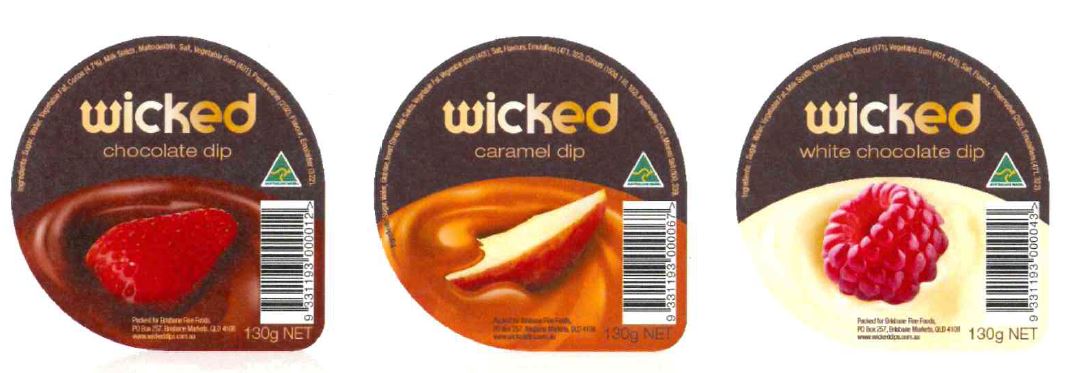
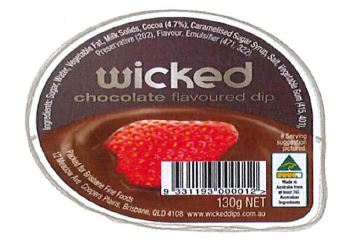
(2) from about 15 November 2009 to about 30 June 2010 – Brisbane Fine Foods; and
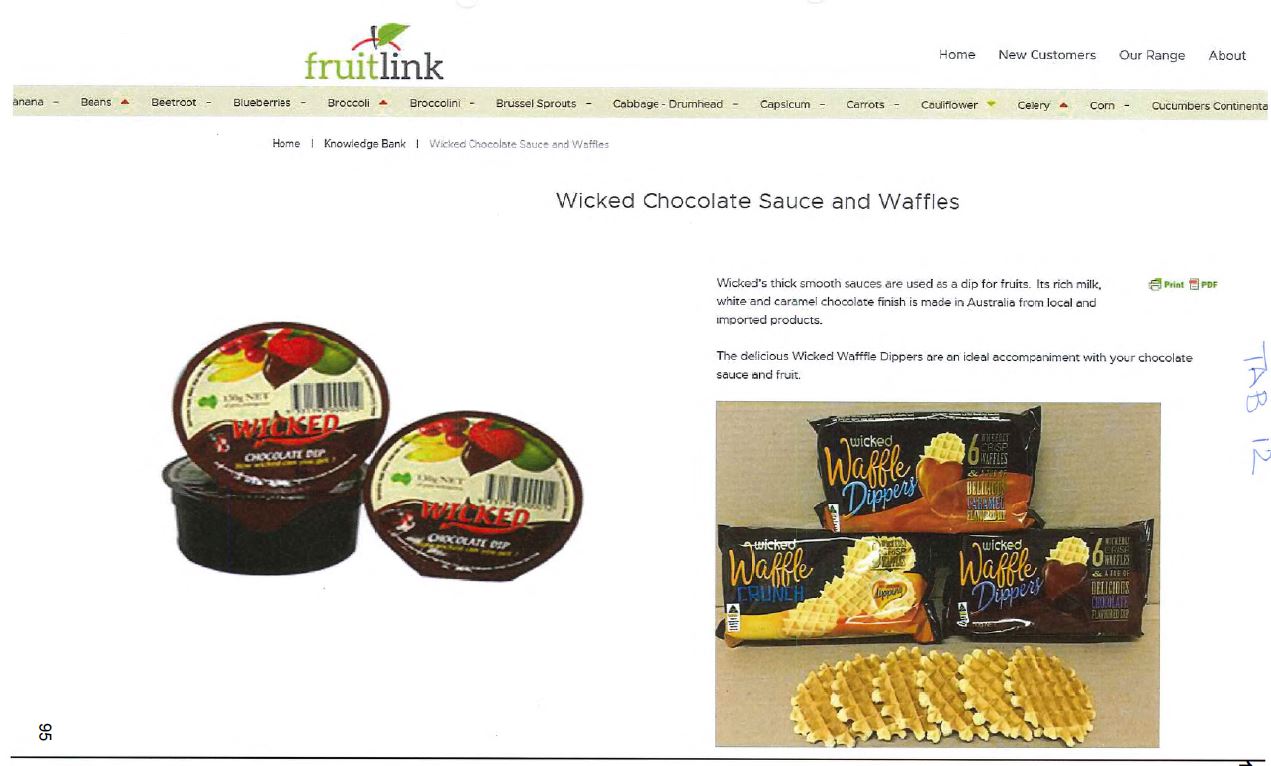
(3) from about 1 July 2010 to date – BMB and Brisbane Fine Foods. Mr Valentine explained that sales of products under the Wicked brand is split as to about 90% by BMB and about 10% by Brisbane Fine Foods which also sells Wicked branded products to BMB.
21 Mr Valentine has held or holds the following roles in relation to each of the Valentine Companies:
(1) since its incorporation on 30 July 2003 until 15 April 2009 he was Wicked Products’ sole director and secretary;
(2) since 12 March 2013 he has been the sole director and secretary of Brisbane Fine Foods;
(3) from 17 January 1995 to 8 December 1995 and from 17 January 1995 to 15 April 2009 respectively, he was the chief executive officer and a director of BMB. Since 30 May 2012 and 17 May 2013 respectively, he has been its sole director and secretary; and
(4) since 10 October 2012 he has been the sole director of Grasshopper.
22 Mr Valentine has been responsible for the day to day operations of the Wicked Business, whether it was operated in his name or, as was the case from about July 2003, by one of the Valentine Companies.
23 Mr Valentine has been involved in selling fruit and other farm produce for over 45 years. In the early 1990s he commenced selling strawberries and other fresh produce at flea markets in and around Brisbane. In doing so Mr Valentine handwrote a description of what he was selling with a crayon on a piece of cardboard which he then mounted on one of the display tables alongside the particular product. He used a new piece of cardboard on each day of trade at the flea markets and threw out the sign at the end of the day.
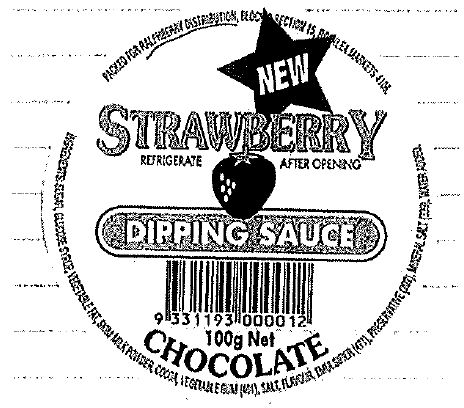
24 In the late 1990s Mr Valentine decided that he wanted to add value to the strawberries he was selling by offering them for sale with something else. From about 2000 he came up with the idea of, and started to sell, a chocolate dipping sauce with the strawberries at flea markets. Initially the chocolate dipping sauce was packaged in a tub with the following label:
25 In about mid-2002 Mr Valentine decided that he should market his range of dipping sauces, which by then included chocolate, caramel, white chocolate and vanilla varieties, under a different brand to make it stand out from other products. He came up with the name “Wicked” with an extended tail on the letter “D” as depicted below (Wicked Sign):
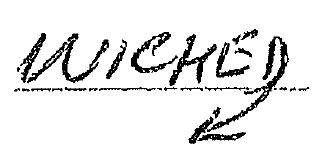
Mr Valentine liked the word “wicked” as he thought it was a play on the idea that having chocolate with strawberries is “naughty but nice”.
26 From about mid-2002 to early 2003, when selling the dipping sauces at the flea markets, Mr Valentine:
(1) wrote the Wicked Sign on a piece of cardboard and displayed it in the way described at [23] above;
(2) had a tub of the Wicked dipping sauce open so that people could dip a strawberry in the tub to try it; and
(3) sold the Wicked dipping sauce in a plastic tub without any label but wrote the Wicked Sign with the added word “dips” on the lid of the tub in texta.
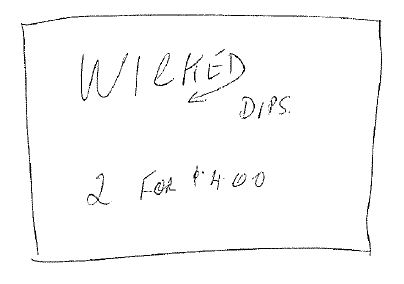
27 According to Mr Valentine the cardboard signs he used looked like this:
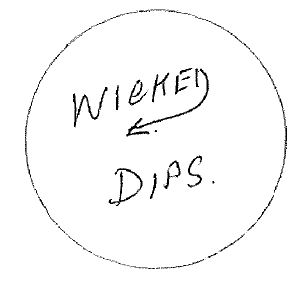
The lids of the dipping sauce tubs looked like this:
28 Since 1994 Mr Ahchay has been a salesman for MurrayBros at the Brisbane Markets in Rocklea, Queensland. In 2002, separate to his employment with MurrayBros, Mr Ahchay began working on weekends selling fruit at the Cannon Hill flea markets. From 2002 to early 2003 Mr Ahchay often set up his stand close to the stand from which Mr Valentine sold his fruit and dipping sauces. Mr Ahchay observed that he and Mr Valentine were in competition insofar as they both sold fruit but that Mr Valentine was also selling his chocolate and other dipping sauces.
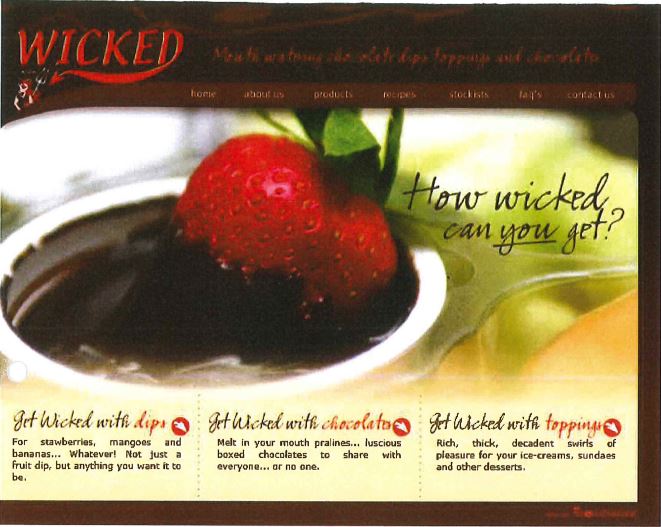
29 At that time Mr Ahchay observed that Mr Valentine would offer his dipping sauces for sale on a table on which he also placed a cardboard sign with 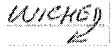 handwritten on it and that the plastic tubs of dipping sauces offered for sale had
 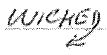 handwritten on the tops of the containers.
30 From about mid-2002 Mr Valentine started work on having a label printed featuring a form of the Wicked Sign. He contacted ASC Print & Promotional Brokers to assist in its development. The label was finalised in about early 2003 and was as follows (Wicked Label):
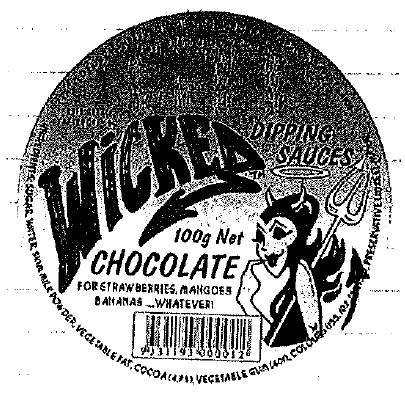
31 Mr Valentine explained that: both the Wicked Label and the handwritten label depicted at [27] above included the statement “Packed for Ralphberry Distribution, Block D, Section 15, Rocklea Markets 4106”; “Ralphberry” is a combination of the words “Ralph” and “strawberry”; and “Ralphberry Distribution” is a short form of “Ralphberry Distribution Centre”, a business name used by Mr Valentine and of which he was the registered holder in the period 1 March 2000 to 27 May 2003. In that period the principal place of business for Ralphberry Distribution Centre was Block D, Brisbane Markets, Rocklea, Queensland.
32 Once the Wicked Label was finalised Mr Valentine continued to sell the dipping sauces at flea markets in the same manner as described at [26] above save that he affixed the Wicked Label to the lids instead of handwriting on the lids in texta. The flea markets at which he sold his dipping sauces in this way were Carrara, a privately owned market situated in the Gold Coast, which was open on Saturdays and Sundays from about 6.00 am to midday or 1.00 pm; and Cannon Hill in Brisbane which was open only on Sundays from around 6.00 am to midday or 1.00 pm. On Sundays Mr Valentine would start to set up the first stall at around 4.00 am so that he could then set up the next stall in time for both to be ready for market opening at 6.00 am. He hired casual staff to work at each market so he could go between the two of them while the flea markets were open.
33 Although most of his sales were at the flea markets, from mid-2002 to early 2003 Mr Valentine also sold Wicked dipping sauces to small shops in Brisbane. All of the sales, whether at the flea markets or to shops, were in cash and accordingly Mr Valentine has no record of them. Mr Valentine stopped selling his dipping sauces at flea markets about 10 years ago, once supermarkets started seven-day trading.
34 By early 2003, based on his experience of selling the dipping sauces at the flea markets, Mr Valentine could see that the combination of dipping sauces and strawberries was popular so he decided to take steps to commercialise the Wicked Business as follows:
(1) on 24 March 2003 Mr Valentine applied to register the business name “Wicked Products” in his name;
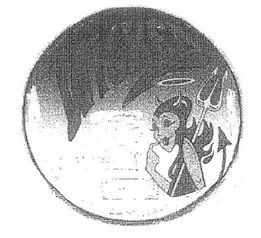
(2) on 9 April 2003 Mr Valentine filed trade mark application no 949862 in his own name for the following trade mark (Wicked Devil Mark):
(3) in 2003 he hired Sales Net Marketing to discuss stocking his Wicked branded products in one of the large supermarket chains. A “discussion report” prepared by Sales Net Marketing dated 20 June 2003 includes the Wicked Tail Mark;
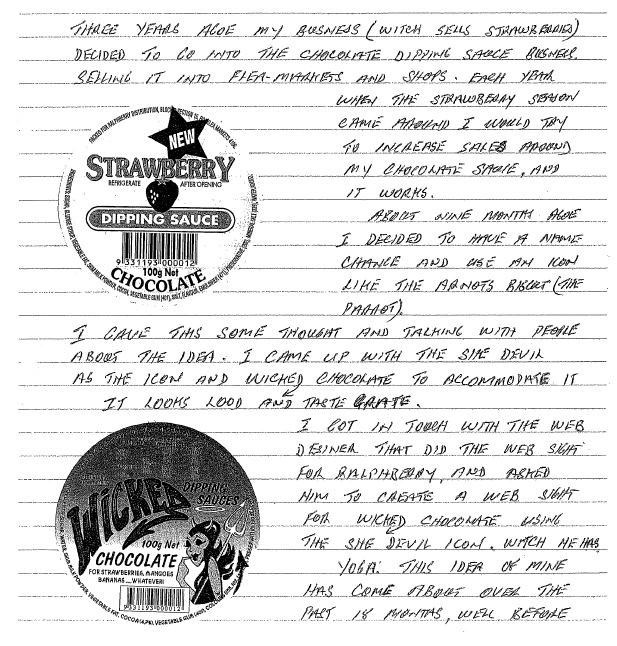
(4) in May 2003 Mr Valentine wrote a letter to IP Australia in support of his application to register the Wicked Devil Mark as described at [34(2)] above. He pointed out that “about nine months ago”, that is nine months prior to May 2003, he “decided to have a name change and use an icon” as follows:

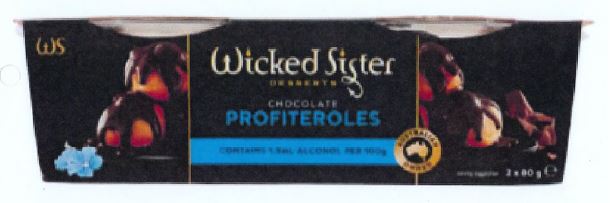
(5) on 20 May 2003 and 22 May 2003 respectively, Mr Balson of Interactive Presentations Pty Ltd and Mr Low of ASC Print & Promotional Brokers each provided statutory declarations to the Trade Marks Office as part of Mr Valentine’s registration process for the Wicked Devil Mark. Mr Balson, who at the time had worked with Mr Valentine for two years, confirmed that Mr Valentine had used the word “Wicked” in relation to his chocolate dipping sauces prior to January 2003. Mr Low, who at the time had known Mr Valentine for two years, said that Mr Valentine had “always been coming up with new ways to market his chocolate ‘Dipping Sauce’”, that it was no surprise when Mr Valentine came up with the “word & picture of wicked” and that over the past 6 to 12 months Mr Valentine had improved the label to its then current form.
35 On 30 July 2003, having decided that he wished to approach supermarkets to stock Wicked dipping sauces, Mr Valentine established Wicked Products. He did so because he understood that supermarkets preferred to deal with companies rather than individuals running businesses in their own name.
36 In 2003 Mr Valentine also decided that Wicked branded products should be sold in packaging which continued to include a form of the Wicked Sign but without the devil image. He decided on the following form of the Wicked Sign:

That is, the Wicked Tail Mark.
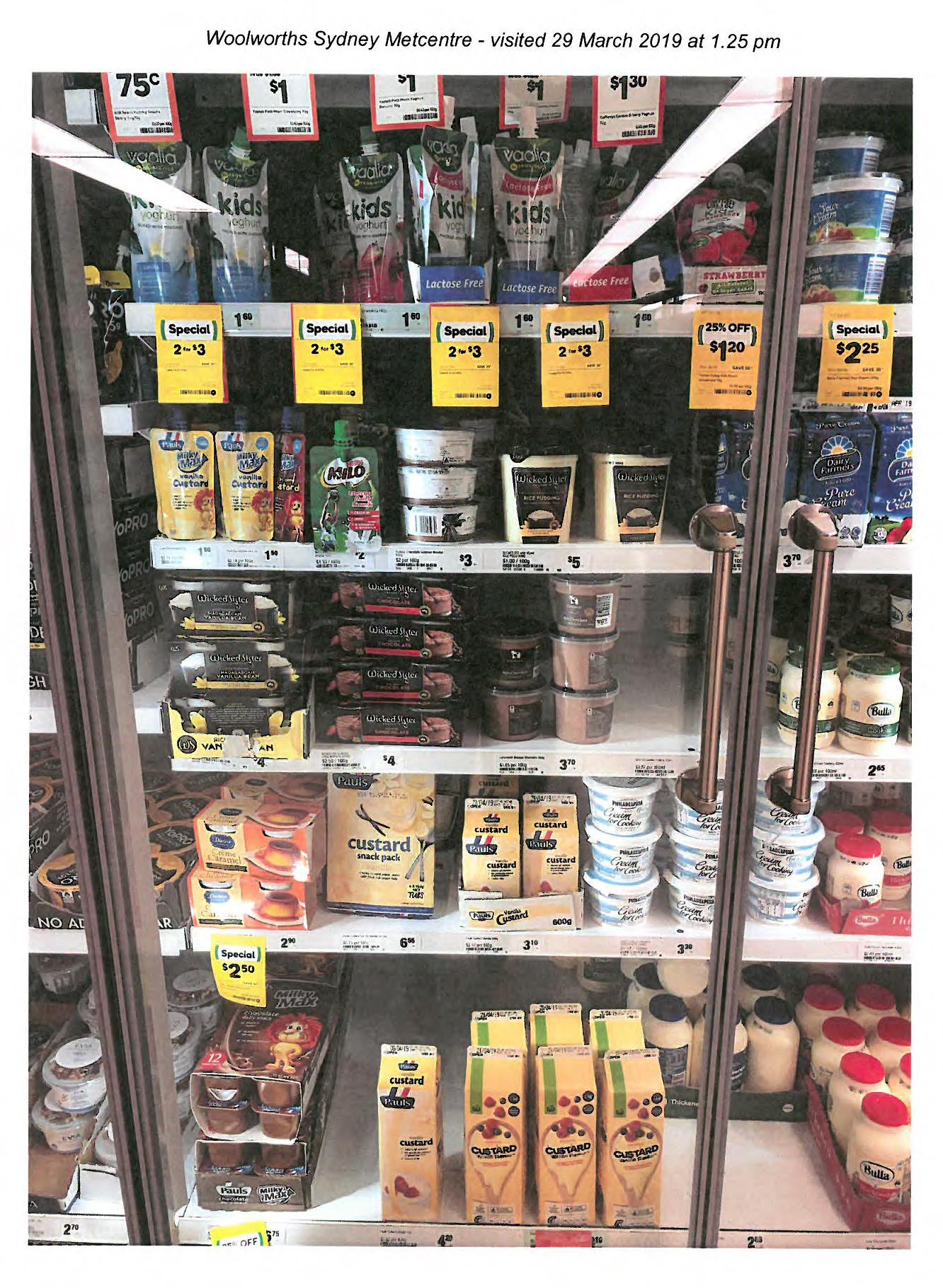
37 From that time on, the form of packaging for Wicked branded products had the Wicked Tail Mark on it. An example is as follows (Original Packaging):
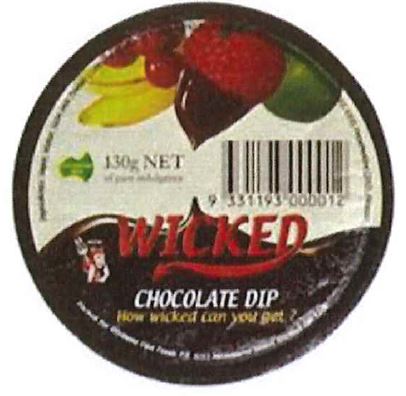
38 In about late 2003, the Wicked Business started selling dipping sauces in the Original Packaging to Coles. Since that time, the Wicked Business has sold Wicked branded products to Australian retailers, with Coles being the largest purchaser. In addition, since the mid to late 2000s many other Australian retailers have bought Wicked branded products from the Wicked Business including IGA, Metcash, Bi-Lo (later rebranded as Coles), Fruitlink, Foodworks, Drakes Food Markets, Fresh Selections and other independent retailers.
39 On 18 February 2005 Mr Valentine applied for registration of the Wicked Tail Mark. At the time of making that application he intended that Wicked Products would use the Wicked Tail Mark for each of the designated goods (i.e. the Registered Wicked Tail Mark Goods) and that he would permit it to do so. He also thought that the Wicked product range would expand from dipping sauces into fruit flavoured toppings or sauces and confectionery.
40 Mr Valentine explained that one central focus of the Wicked Business was and has always been for the Wicked product range to be made up only of non-refrigerated products. This is because his roots are in the fresh fruit industry and he feels most comfortable dealing with value added shelf products which generally have a longer shelf life and are cheaper to store and transport than refrigerated products.
41 The current website for the Wicked Business at “www.wickeddips.com.au” (Current Wicked Website) included as at March 2019 a page titled “About Us”. It tells a slightly different story about the development of the Wicked Business to that recounted by Mr Valentine as follows:
Originally established in 2004 as Wicked Products Pty Ltd, the Brand Wicked was then purchased by Mr Ralph Valentine on behalf of the Valentine Family as a subsidiary business of the Ralphberry Group, which established as its own identity in 2014 as Brisbane Fine Foods (QLD) Pty Ltd.
Brisbane Fine Foods (QLD) Pty Ltd is foremost a Family business striving to maintain the integrity and their values of supplying outstanding Australian Products to the retail sectors.
The Wicked Dip product is a value add item, originating from a concept in the fresh fruit market where the humble beginning saw the dips created the night before they were sold in flea markets alongside fresh strawberries. The idea expanded to the manufacture and distribution of the “Wicked” [range] of dips.
“Wicked” was a successful brand in its own right and having achieved success on the domestic markets with its inclusion in the retail chain Coles group, IGA & Independent Retailers as a value add item, it had also penetrated the USA markets with great success.
In 2007-08 the Global Financial Crisis caused a dramatic change for the Wicked Dips business then owned under the brand “Wicked Products” seeing the sale of major retail chain in Australia resulted in a major drawback from the domestic and international markets.
Mr Valentine purchased the distribution rights of the “Wicked” brand continuing to believe that the [products’] original success could be replicated.
Under the direction of Ralph Valentine, whom has over 50 years of fresh fruit experience Wicked Dips has been increasing its market share in the Australian Retail sector.
Working alongside him are his son David Valentine and daughter, Sandra Valentine, both integral members of the “Wicked” name.
2014 saw the Wicked Dips re-brand their packaging, including the verification of the Australian Made status, the start of its next exciting development stage.
2018 Wicked launched a new line – Wicked Waffle Dippers! Available nationwide at major retailers and independently owned chain stores
2019 Wicked will release another range – keep checking back for more!
42 In cross-examination Mr Valentine accepted that there was nothing included in the “About Us” section of the Current Wicked Website which suggested that the Wicked Business was established prior to 2004. However, Mr Valentine explained that the Current Wicked Website was designed and written by a web design company, Fireworks, and not by him. While Mr Valentine accepted that Fireworks would have had to obtain the history of the Wicked Business from somebody, they did not do so from him. Mr Valentine thought that the information included in the “About Us” page was sourced by Fireworks from one of his office staff who did not, at the time, ask him about the history of the business.
43 Mr Valentine cannot recall whether he saw the “About Us” page prior to it being shown to him for the purpose of this proceeding but, if he did, he did not undertake a close review of the text. Having undertaken a close review of it for the purposes of giving evidence Mr Valentine says that the “About Us” page is a “simplified”, i.e. condensed, version of the history of the Wicked Business in that it does not refer to a number of the matters that he describes in his evidence. Mr Valentine has now caused the “About Us” page on the Current Wicked Website to be updated.
44 In a statutory declaration made by Mr Valentine on 17 August 2016 and filed with the Registrar of Trade Marks (Registrar) in support of Grasshopper’s application for registration of the New Wicked Mark Mr Valentine said, among other things, that:
(1) “[m]y company has continuously offered” dipping sauces for sale under the Wicked Tail Mark or the New Wicked Mark;
(2) “[s]ince 2004 the goods have been offered continuously throughout Australia under the [Wicked Tail Mark] initially, for ten years from 2004 and until 2014 then, from 2014 to date, under the [New Wicked Mark] which is the subject of this application”; and
(3) “[t]he only one which has an earlier lodgement date than, when my company commenced use of the older version of the [Wicked Tail Mark] back in 2004, is cited Registration No. 849007 for the trade mark WICKED FIZZ in respect of [confectionery] only”.
45 In cross-examination Mr Valentine accepted that the first reference to “[m]y company” (see [44(1)] above) included everything he does and included Wicked Products and that the second reference to “my company” (see [44(3)] above) was not a reference to Grasshopper, the applicant for registration of the New Wicked Mark, but an earlier company and is very likely to have been Wicked Products.
2.2.2 Rebranding of Wicked products
46 As at 2014 the Wicked Business had continuously been selling dipping sauces using the Original Packaging. At that time Mr Valentine’s son, David, suggested that the Original Packaging and the Wicked Tail Mark should be modernised.
47 Mr Valentine told David to go ahead with his proposal to modernise the Wicked Tail Mark. However, it was critical to Mr Valentine in any rebranding for the Wicked brand to continue to operate as “Wicked”, given it had been known as that since 2002.
48 David was not experienced in creating logos or branding material but was aware of a web-based business known as “99 Designs” which he understood operated in the following way:
(1) the person seeking a design, the customer, places a “brief” on the 99 Designs website;
(2) individual designers then “bid” for the projects by providing a design;
(3) the customer then selects a design/designer; and
(4) payment is only made to or for the selected design/designer and not the other bidders for the work.
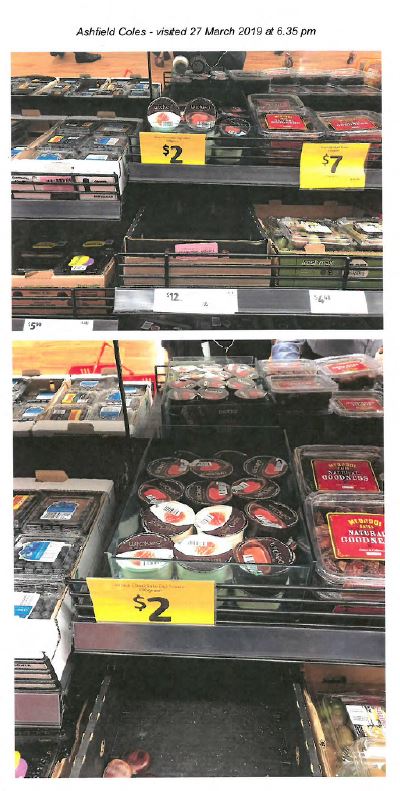
49 In early to mid-2014 David placed a “brief” on the 99 Designs website (Design Brief) using the email address “accounts@ralphberry.com.au”. That brief included the following (as written):
What is your organisation?
Brisbane Fine Foods
…
Describe what your organization or product does and its target audience
We are a family business, and we want to take it to the next level. Seems we have been stick in the twilight zone for a little while, we have now discovered Facebook!
Dads in his element selling the dips, but really we think we are taking as backwards direction on visual attractions of the label.
The product we are selling is and indulgent dip that accompanies fruit, ice cream/Deserts and other snacks. It is a value Add, item, which means people want to buy it, we just want to make more people want to buy it!
Target mid 20’s to 40’s - and all the oldies that want an aphrodisiac
It is in the fresh Fruit Industry and we nationally supply to a major chainstore, But we want to get noticed by more people.
Describe what you want designed
A heat seal foil label for a dip (three flavors) Chocolate, Caramel, White Chocolate. Size 77x77mm
We want a label and logo combo that is new, fresh and exciting – we want to stand out on the shelf.
References
Is there anything else you would like to communicate to the designers?
…
We have attached copies of the old labels:
Really what we don’t like about this label is:
There is no barcode on the label (13 digit barcode)
It’s old and dull - just like dad.
Not aimed at the market we want (Market is Mid 20’s to late 40’s looking for an indulgent addition to Fruit, Ice-cream and other snacks and deserts.) – You know those fun folk that want to have a party.
Our web address is wrong: www.wickeddips.com.au
Ingredients is not clear - people want to know what they are eating! I know I do.
We hate the logo - Have you seen it? Really what has a devil’s tail got to do with dip! Seriously!
We think Logo might be too big and the product is lost to the logo. (IE White Chocolate dip)
What am I buying? Dip or a devil’s tail?
The main buyer likes the fruit, we are not keen with how it looks and is presented (Plonked on the label) looks like Grandma put it together. Or maybe it was dad!
What we like about the label:
It’s the right size
What other brands we like:
Charlie’s Fruit Juice (NZ)
Collective Yogurt (NZ)
Ben & Jerrys
Flying Fox Ice Blox’s (AUS)
We love quirky, Funky and Fresh. As we can’t choose where the product is placed, we need impact.
Links to files which contained copies of the Wicked Tail Mark as it appeared on the Original Packaging were attached to the Design Brief.
50 David received a number of responses to the Design Brief. In relation to those responses David discarded 20 of the designs and sorted the remaining 14 designs into categories by rating them. In that regard he:
(1) did not rate eight of the designs;
(2) allocated 1-2 stars to one of the designs; and
(3) allocated 3-5 stars to five of the designs.
51 A printout of the 99 Designs website showing eight of the “active” designs including those to which stars were allocated as set out in the preceding paragraph shows:
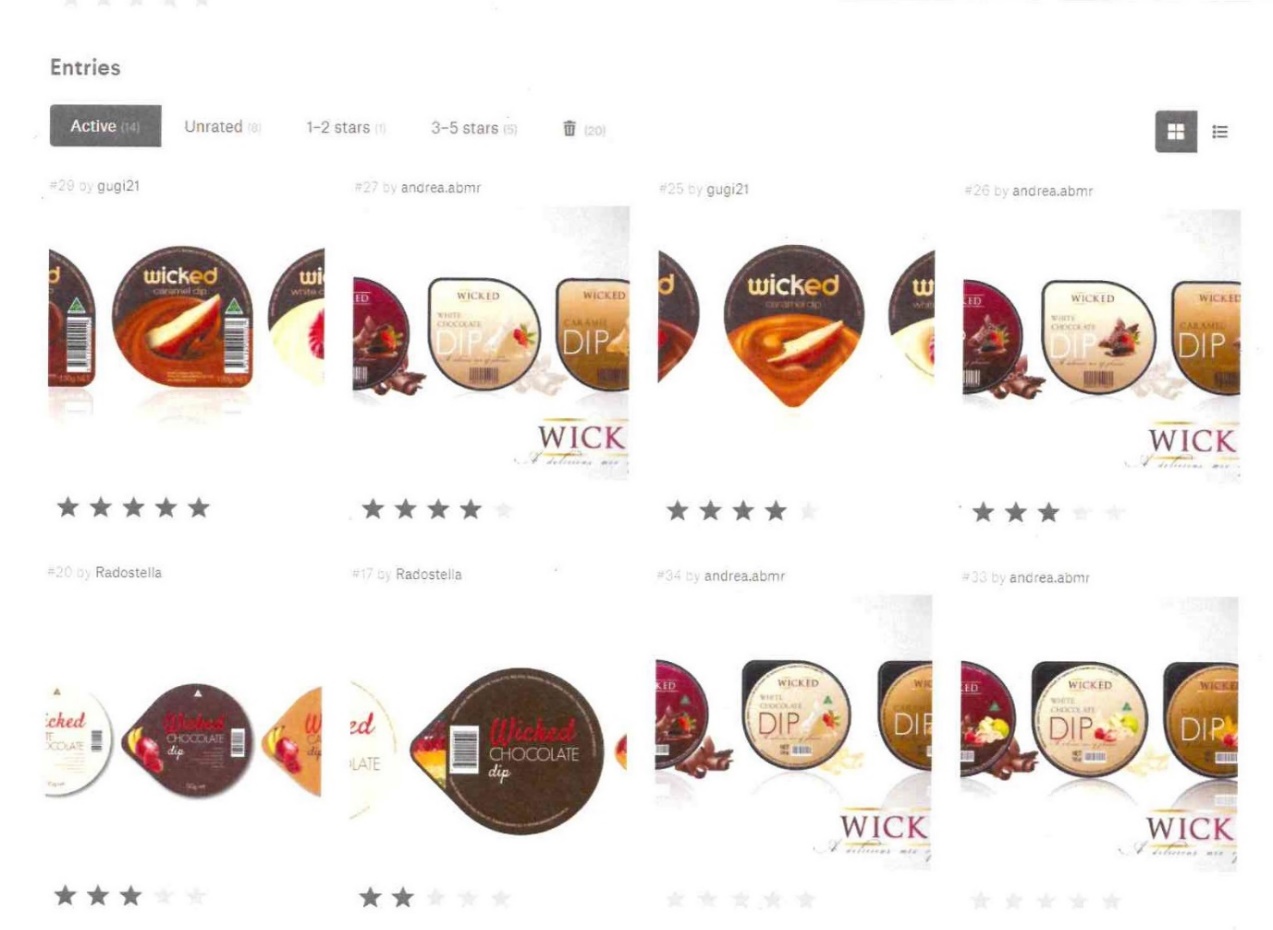
David recalls that he showed all of these designs to Mr Valentine and discussed them with him. Mr Valentine recalls that David showed him a number of designs, but could no longer recall the exact designs he was shown.
52 David eventually selected and engaged Phil Smithson to provide the new Wicked logo. Mr Smithson, who was located in the United Kingdom, had the username “gugi21”. Mr Smithson designed the following logo:

David liked the design and decided to adopt it. When shown the design by David, Mr Valentine approved it.
53 David believed that the original design submitted by Mr Smithson which led to the final design was:
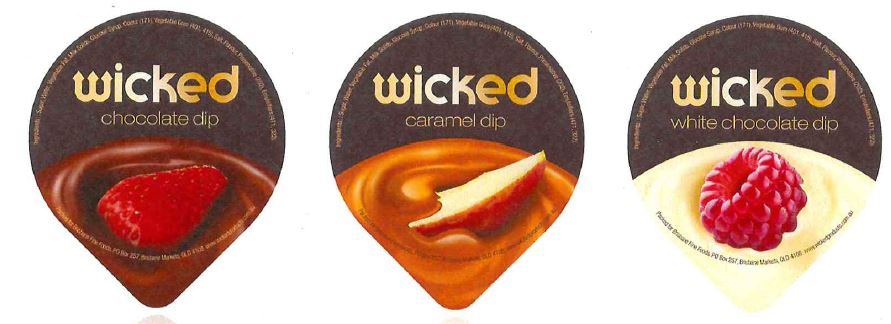
David explained that this design was in his and Mr Valentine’s top three designs. The other two designs in that category had been submitted by “Radostella” and “andrea.abmr”.
54 David agreed that, of the designs submitted, Mr Smithson’s design depicted in the preceding paragraph was:
(1) the only one which had a “spiky or pointy motif” on the “w” and that in doing so it reflected the Original Packaging which included a devil holding a pitchfork. That is, it was similar to the Original Packaging because the “w” represented all the things on the Original Packaging – the trident, the devil’s tail and the arrow; and
(2) the only design that presented the word “wicked” entirely in lower case letters.
55 A subsequent design submitted by Mr Smithson was as follows:
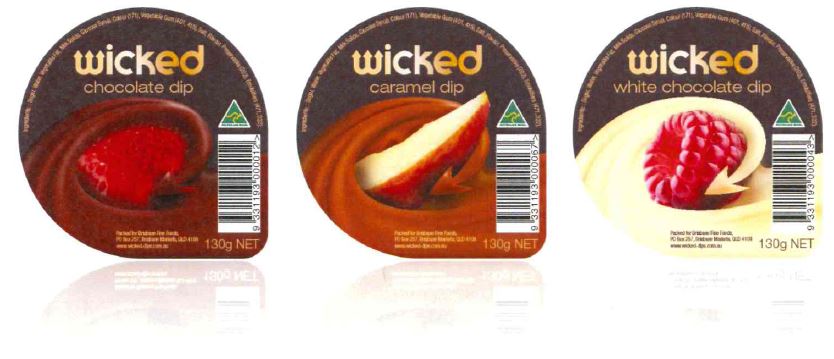
However, David did not like, and rejected, the devil’s tail included in this design.
56 David recalls that Mr Smithson was paid $495 for his design and that, while he has had no further dealings with Mr Smithson since that time, Mr Smithson has been engaged on other design projects for the Wicked Business, including the design for the Wicked Waffle Dippers, and most recently, in about mid-2019, in a project for health food bars.
57 David was aware of Wicked Sister in 2014 and first encountered its products in a Woolworths supermarket. He did not purchase any products but recalls trying the Wicked Sister rice pudding product while living at his parents’ home at some time prior to 2014. David only visited the Wicked Sister website and Facebook page when it objected to registration of the New Wicked Mark and not prior to that time.
58 David said that the Design Brief for the new Wicked logo did not refer to the Wicked Sister brand and he did not think of Wicked Sister in deciding to modernise the Wicked logo or when he saw Mr Smithson’s design.
59 When cross-examined about similarities between the Second WS Device Mark and Mr Smithson’s design, David agreed that:
(1) the presentation of the letters “icked” in lower case letters was “similar” in both and that Mr Smithson’s design was the only design submitted that had that similarity;
(2) both Mr Smithson’s design and the Second WS Device Mark had a curved lower branch on the letter “k”, although David said that in the Second WS Device Mark the “k” only had a small curve, and that Mr Smithson’s design was the only design submitted with that feature; and
(3) both Mr Smithson’s design and the Second WS Device Mark had no tail at the end of the letter “d” and, again, that Mr Smithson’s design was the only design submitted with that feature.
However, David did not agree that of the designs submitted through 99 Designs he picked the one that was closest to the way that Wicked Sister presents the word “wicked”.
60 Mr Valentine was also cross-examined about the process undertaken to select a new Wicked logo. Among other things, he was taken to and asked a series of questions about the following design which he recalls being shown in 2014:
According to Mr Valentine, the pitchfork device, which he described as a “halo”, was suggestive of the tail device used in the Wicked Tail Mark. Relevantly, the exchange between senior counsel for PDP and Mr Valentine included the following:
Mr Valentine: Yes. The artwork follows our – our old trademark with the halo on the – on the – on the tail of the Wicked.
Mr Hall: I beg your pardon, Mr Valentine. Looking at the document in front of you there, are you saying that you can see a halo on the tail of the Wicked?
Mr Valentine: It looks like a halo on the W. It’s the same that’s on our old trademark.
…
Mr Hall: Okay. I think we might be confusing one another, Mr Valentine. I’m going to ask you to call it a trident, or a pitchfork, if you wouldn’t mind, because that’s what you’re referring to?
Mr Valentine: Or a pitchfork, whatever you want to call it.
2.2.3 Wicked adopts the New Wicked Mark
61 After the new Wicked logo (which became, and which I will refer to as, the New Wicked Mark) was selected, new packaging was developed for Wicked dipping sauces, for example, as follows (New Packaging):
62 From about late 2014 the Wicked Business gradually phased in the New Packaging. Initially the product range in the New Packaging was sold in Coles and other chain stores while the Wicked range with the Original Packaging continued to be sold in independent stores. The Wicked Business phased out the Wicked Tail Mark in about early 2016, once all the pre-printed labels for the Original Packaging had been used. Despite this some sellers of the Wicked product range, such as Fruitlink (a wholesaler in Brisbane), have continued to use images of the Original Packaging to sell Wicked products. A screenshot from the Fruitlink website dated 27 May 2019 which was in evidence before me showed:
63 In cross-examination Mr Valentine accepted that, despite what is included on Fruitlink’s website, any Wicked products supplied by Fruitlink to customers both presently and for some years prior would have been and are in the New Packaging. Mr Valentine also said that invoices issued at the time of sale of Wicked dips did not differentiate between supply of products in the Original Packaging or the New Packaging and that since 2002 invoices had always been drafted in the same way, simply referring to “wicked dips”.
2.2.4 Ownership and use of the Wicked Tail Mark and the New Wicked Mark
64 The Wicked Tail Mark has had the following ownership:
(1) from 18 February 2005, the date of its registration, until 28 August 2008 Mr Valentine was its registered owner;
(2) on 28 August 2008 Mr Valentine assigned the Wicked Tail Mark to BMB. That change in ownership was recorded by IP Australia on 19 September 2008. BMB was its registered owner until 1 July 2010; and
(3) on 1 July 2010 BMB assigned the Wicked Tail Mark to Grasshopper. That change in ownership was recorded by IP Australia on 19 August 2010.
65 Wicked Products used the Wicked Tail Mark during the period in which Mr Valentine was its registered owner. Mr Valentine explains that while Wicked Products was using the Wicked Tail Mark he oversaw all of Wicked Products’ daily operations and undertook regular checks of the quality of the products it sold under the Wicked Tail Mark to ensure they were fit for sale. This involved checking the label and tasting the products to test their consistency and texture.
66 Wicked Products also used the Wicked Tail Mark in the period during which BMB was its registered owner until 15 November 2009 when Wicked Products was deregistered. BMB and Brisbane Fine Foods used the Wicked Tail Mark from 15 November 2009 to 1 July 2010. During the period that BMB was the registered owner of the Wicked Tail Mark:
(1) Mr Valentine was a director of BMB from 28 August 2008 to 15 April 2009; and
(2) regardless of whether he held the position of director, Mr Valentine was responsible for the day to day running and control of BMB and, in that capacity, oversaw all of Wicked Products’ and then Brisbane Fine Foods’ daily operations relating to the Wicked Business and undertook regular checks in the same way as described in the preceding paragraph.
67 As set out at [64] above, since 1 July 2010 Grasshopper has been the registered owner of the Wicked Tail Mark. Mr Valentine explains that Grasshopper is a holding company of various of the Wicked Business’ intellectual property assets. Mr Valentine says that:
(1) since 10 October 2012, he has been the sole director of Grasshopper. He was not a director prior to that date i.e. from the date of Grasshopper’s incorporation until 10 October 2012; and
(2) regardless of whether he held the position of director of Grasshopper, Mr Valentine has overseen all of BMB’s and Brisbane Fine Foods’ daily operations relating to the Wicked Business and has been responsible for signing off on the quality of the products sold under the Wicked Tail Mark, and later the New Wicked Mark, to ensure they were fit for sale as described at [65] above.
68 Since late 2003 the main products sold by the Wicked Business have been the flavoured dipping sauces in 130 gram tubs. About five or six years ago the Wicked Business also started selling flavoured dipping sauces in 65 gram tubs. The dipping sauces have been sold as follows:
(1) since about late 2003 the 130 gram tubs have been sold to retailers in cartons of 12, at that time, for about $14.40 per carton or $1.20 per tub. A carton of 12 is currently sold to retailers for about $15.60 per carton or $1.30 per tub. Over the period 2003 to date the 130 gram tubs have been sold by retailers for approximately $1.90 to $2.50 per tub; and
(2) the 65 gram tubs have been sold to retailers in cartons of 18 for about $15 per carton and each 65 gram tub has retailed for approximately $0.99 to $1.99. The sale of 65 gram tubs has made up about 5% to 10% of the Wicked Business’ overall sales of dipping sauces.
69 Before about 2015 the Wicked Business also sold other products featuring the Wicked Tail Mark including:
(1) from about 2005 to 2012 it sold chocolate but this was not a successful product and made up less than 2% of the sales made by the Wicked Business during that period;
(2) from about 2005 to 2012 it sold rocky road but again this was not successful and made up less than 2% of the sales made by the Wicked Business during that period; and
(3) from about 2010 to 2015 it sold honey using the trade mark “Wicked Sting” but it was also not successful and made up less than 0.5% of the sales made by the Wicked Business during that period.
70 According to Mr Valentine, the Wicked Business was not successful in launching the products described in the preceding paragraph because of a lack of time and money spent on marketing. However, Mr Valentine intends to relaunch these products in the future and to release a range of fruit flavoured topping sauces such as blueberry, raspberry, fig, strawberry and mango. In 2010 Mr Valentine had artwork done for labels for some of these products, but the products were never launched.
71 The current product range featuring the New Wicked Mark comprises:
(1) Wicked Chocolate, White Chocolate and Caramel Flavoured Dips 65 gram tubs;
(2) Wicked Chocolate, White Chocolate and Caramel Flavoured Dips 130 gram tubs;
(3) Wicked Chocolate, White Chocolate and Caramel Waffle Dippers; and
(4) Wicked Waffle Crunch.
A copy of the webpage at “www.wickeddips.com.au/shop” as at 27 May 2019 containing images of those products was in evidence before me. Those images show that the three flavoured dips have similar ingredients. By way of example, the Wicked Chocolate Flavoured Dip comprises sugar, water, vegetable fat, milk solids, cocoa (4.7%), caramelised sugar syrup, salt, vegetable gum (415, 401), preservative (202), flavour, emulsifier (471, 322). The ingredients for the waffle biscuits included in the Wicked Waffle Dippers are flour (wheat flour, vitamin thiamin), sugar, vegetable shortening, egg (6% minimum), leaving (503), soy lecithin (382), salt and flavour (vanilla).
2.2.6 Sales of Wicked branded products
72 From July 2003, the time of incorporation of Wicked Products, for a period of about three years, about 80% of the Wicked Business’ sales were of Wicked dipping sauces sold in the Original Packaging. The balance of the sales were complementary sales of strawberries. BMB sold strawberries. The Wicked Business did not itself sell strawberries.
73 Mr Valentine has been able to locate financial statements for Wicked Products from its incorporation up to and including the financial year ended 30 June 2006. For the Wicked Business:
(1) in the financial year ended 30 June 2004 there was $606,803.89 in sales. Applying an average of $1.20 per tub to 80% of the sales, around 400,000 dipping sauces featuring the Wicked Tail Mark were sold;
(2) in the financial year ended 30 June 2005 there was $974,940.66 in sales. Applying an average of $1.20 per tub to 80% of the sales, around 650,000 dipping sauces featuring the Wicked Tail Mark were sold; and
(3) in the financial year ended 30 June 2006 there was $1,221,401 in sales. Applying an average of $1.20 per tub to 80% of the sales, around 800,000 dipping sauces featuring the Wicked Tail Mark were sold.
Mr Valentine has been unable to locate Wicked Products’ financial statements for the remaining financial years until it was deregistered or BMB’s or Brisbane Fine Foods’ financial statement for the financial year ended 30 June 2010.
74 Mr Valentine recalls that, once the Wicked Business’ sales reached over $1.2 million in the financial year ended 30 June 2006, with the exception of the financial year ended 30 June 2008, the sales level remained at about that level, i.e. $1.2 million for the next six or so financial years. According to Mr Valentine, in the financial year ended 30 June 2008 there was a drop in the Wicked Business’ sales because, after Wesfarmers took over Coles, value added lines were removed from Coles’ fresh produce sections. However, the Wicked Business continued to sell to other retailers. The Wicked branded dips were reinstated in Coles about a year later.
75 Mr Valentine estimates that about 90% of the sales referred to in the preceding paragraph were of Wicked dipping sauces with the Original Packaging and that the sales of complementary products, i.e. strawberries, with the dipping sauces decreased to about 5% because most stores started buying strawberries from major suppliers. The Wicked Business also made some sales, estimated at less than 5% of total sales, of Wicked branded confectionery such as chocolate (see [69] above).
76 In the financial year ended 30 June 2011 the Wicked Business’ sales of dipping sauces was at least $1,207,676.12. Applying an average of $1.20 per tub, over 1 million dipping sauces featuring the Wicked Tail Mark were sold. At that time the Wicked Business was run by BMB. Based on BMB’s financial statement for the financial year ended 30 June 2011, sales of the Wicked dipping sauces made up 25% to 30% of BMB’s overall sales of $4,244,504.10 in that period.
77 BMB’s financial statements for the financial years ended 30 June 2012 up to and including 30 June 2018 were in evidence before me. They showed that:
(1) in the financial year ended 30 June 2012 BMB’s overall sales (which included Wicked dipping sauces sold with the Original Packaging featuring the Wicked Tail Mark and other non-Wicked products) were $4,524,617;
(2) in the financial year ended 30 June 2013 BMB’s overall sales (which included Wicked dipping sauces sold with the Original Packaging featuring the Wicked Tail Mark and other non-Wicked products) were $5,686,038. In the period July to December 2012, BMB’s profit and loss statement showed that BMB’s sales of “Dips” was $832,032.99 and sales of “Wicked Chocolate” was $488.37. Each “Dip” sale was of Wicked dipping sauces sold with the Original Packaging featuring the Wicked Tail Mark. Applying an average of $1.25 per tub, over 650,000 dipping sauces featuring the Wicked Tail Mark were sold in that period;
(3) in the financial year ended 30 June 2014 BMB’s overall sales were $5,939,258;
(4) in the financial year ended 30 June 2015 BMB’s overall sales were $5,035,418;
(5) in the financial year ended 30 June 2016 BMB’s overall sales were $5,927,393;
(6) in the financial year ended 30 June 2017 BMB’s overall sales were $6,105,798; and
(7) in the financial year ended 30 June 2018 BMB’s overall sales were $6,478,330.
Other than BMB’s profit and loss statement for the period July to December 2012, BMB’s financial statements did not separately record sales of Wicked dipping sauces. According to Mr Valentine, since the financial year ended 30 June 2011 sales of the Wicked dipping sauces have made up approximately 25% to 30% of BMB’s overall sales.
2.2.7 Promotion of Wicked branded products
78 In about 2004 the Wicked Business started a national radio advertising campaign for Wicked dipping sauces which involved five different radio advertisements and the radio stations referring to “Wicked” during traffic updates. The Wicked Business’ advertising spend for the radio campaigns was as follows:
(1) in the financial year ended 30 June 2004 – $2,319.52;
(2) in the financial year ended 30 June 2005 – $63,015.38; and
(3) in the financial year ended 30 June 2006 – $158,990.12.
79 Mr Valentine stopped the national radio advertising campaign in about 2007 because he considered that the Wicked brand was already well-known and that the money spent on advertising could be better used to keep the price of Wicked products low for retailers and, in turn, their customers. In addition, by about 2007 the Wicked Business was getting free media exposure through articles in magazines.
80 From about 2006 to 2016 the Wicked Business operated a website at “www.wickedproducts.com.au” (First Wicked Website) which featured the Wicked Tail Mark and the word “Wicked”. The homepage for the First Wicked Website for that period was as follows:
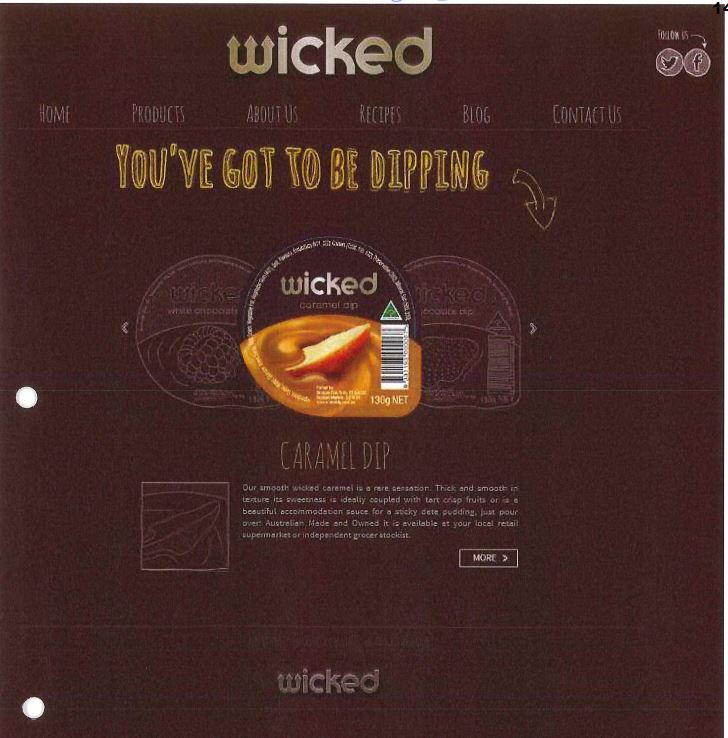
81 Since about 2016 the Wicked Business has operated the Current Wicked Website which features the New Wicked Mark and the word “Wicked”. The homepage for that site:
(1) in 2016 to 2019 was as follows:
(2) in 2019 was as follows:
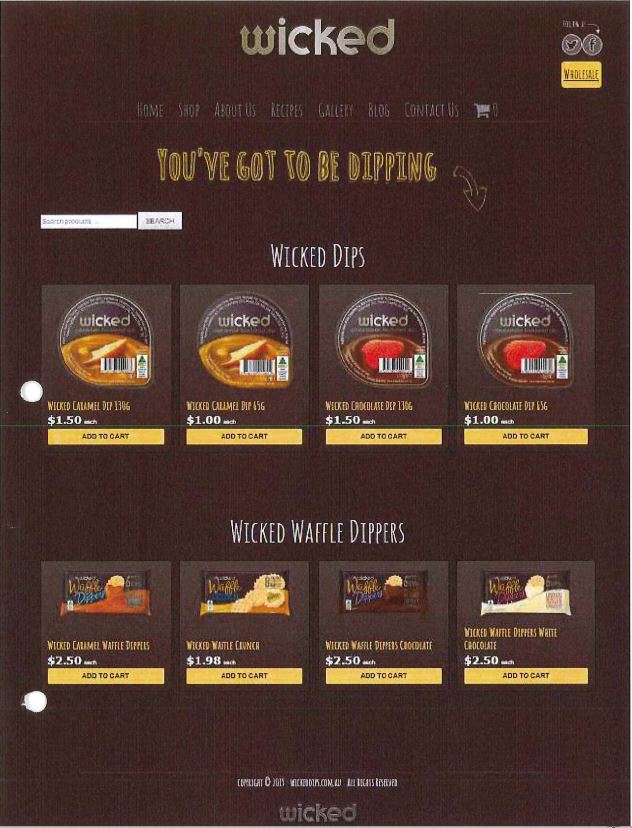
Mr Valentine explained that the difference between these versions of the homepage on the Current Wicked Website is that the current version allows customers to buy the products online at just above their wholesale prices.
2.2.8 Mr Valentine’s awareness of Wicked Sister
82 When Mr Valentine came up with the Wicked Sign and its later form, the Wicked Tail Mark, he was not aware of the Wicked Sister brand. Mr Valentine first became aware of the Wicked Sister brand about 8 to 10 years ago when he saw it in a supermarket and he has seen the products on subsequent occasions. As the Wicked Sister products are in a different category, Mr Valentine did not pay much attention to them but at some point he purchased some of the products to sample.
83 Mr Valentine never considered that anyone could be confused between the Wicked Sister brand and the Wicked brand or wonder whether they came from the same source because the names of, and the fonts used for, each brand are different. Mr Valentine is not aware of anybody having been confused between the two brands. Mr Valentine also observes that the product ranges of the two brands are different and that the Wicked branded products do not require refrigeration while the Wicked Sister branded products do. In fact the Wicked dipping sauces have always been provided to retailers in boxes marked “NO REFRIGERATION NEEDED”, although the tubs themselves are marked “REFRIGERATE AFTER OPENING”. Mr Valentine is aware that retailers often choose to stock Wicked dipping sauces in the refrigerated section of their stores but observes that it is ultimately a matter for the retailer where they choose to stock the Wicked dipping sauces.
84 For the reasons set out in the preceding paragraph, when the Wicked Tail Mark was modernised in about 2014, and became the New Wicked Mark, neither the Wicked Sister brand nor any of its trade marks crossed Mr Valentine’s mind.
85 Mr Valentine explained that the Wicked brand has been used to sell dipping sauces and other products for nearly 17 years and, given the customer recognition of the brand, it would not be viable to rebrand away from the use of the word “Wicked”. In Mr Valentine’s view such a rebrand would put the Wicked product range out of business.
2.3 The Wicked Sister business
86 Mr Polly, as the sole director and chief executive officer of each of PDP Capital and PDP Fine Foods, is responsible for managing each company’s affairs and making decisions affecting each company.
2.3.1 The ownership of the Wicked Sister Marks
87 PDP Capital is the trustee of the PDP Capital Unit Trust. It was established for the purpose of holding all of the PDP group’s intellectual property as part of an asset protection strategy to protect it from commercial trading risks and to provide a vehicle whereby the intellectual property could be licensed to third parties. It is for those reasons that the Second WS Device Mark and the WS Word Mark are registered in the name of PDP Capital.
88 On 13 June 2017 Mr Polly signed a letter of consent addressed to the Registrar, on behalf of PDP Fine Foods as owner of the First WS Device Mark, consenting to the “use and restriction” by its related entity, PDP Capital as trustee for the PDP Capital Unit Trust, of the Second WS Device Mark and the WS Word Mark (Letter of Consent).
89 Mr Polly explained that the First WS Device Mark remains registered in the name of PDP Fine Foods, the company that applied for registration of that mark, and has not been assigned to PDP Capital because of “potential capital gains tax implications”.
90 PDP Fine Foods is the entity responsible for recipes, production, promotion and distribution of all of the products sold under the Wicked Sister brand and trade mark. On 11 February 2016 Mr Polly executed an intellectual property licence agreement on behalf of PDP Capital as trustee for the PDP Capital Unit Trust and PDP Fine Foods pursuant to which PDP Capital licensed the use of the Second WS Device Mark and the WS Word Mark to PDP Fine Foods (PDP Licence Agreement).
91 The range of products manufactured, promoted and distributed by PDP under the Wicked Sister Marks as at March 2019 was as follows:
(1) Wicked Sister Classic Tiramisu 2 x 85 gram twin pack;
(2) Wicked Sister Crème Caramel Madagascan Vanilla Bean 2 x 150 gram twin pack;
(3) Wicked Sister Madagascan Vanilla Bean Custard 500 gram;
(4) Wicked Sister Mousse Chocolate 2 x 80 gram twin pack;
(5) Wicked Sister Panna Cotta Raspberry Coulis 2 x 150 gram twin pack;
(6) Wicked Sister Panna Cotta Mango and Passionfruit 2 x 150 gram twin pack;
(7) Wicked Sister Vanilla Crème Brûlée 2 x 100 gram twin pack;
(8) Wicked Sister Matcha Green Tea Crème Brûlée 2 x 100 gram twin pack;
(9) Wicker Sister Rice Pudding Apple and Cinnamon 2 x 150 gram twin pack;
(10) Wicked Sister Rice Pudding Creamy Coconut 2 x 170 gram twin pack;
(11) Wicked Sister Rice Pudding Madagascan Vanilla Bean 2 x 150 gram twin pack;
(12) Wicked Sister Rice Pudding Madagascan Vanilla Bean 500 gram; and
(13) Wicked Sister Chocolate Profiteroles 2 x 80 gram twin pack,
(collectively, Wicked Sister Products).
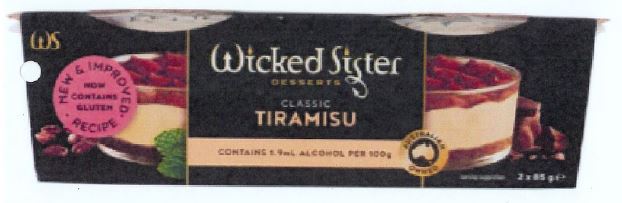
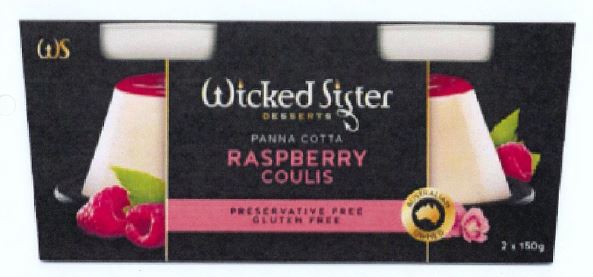
92 Examples of the packaging for some of the Wicked Sister Products which feature in these reasons are set out below:
93 According to Mr Polly in excess of 20 million units of Wicked Sister Products are sold each year across Australia and New Zealand. Those products:
(1) regularly retail between $2.00 and $5.00; and
(2) are also sold in non-retail packaging, for example, to airlines and caterers.
94 All Wicked Sister Products sold in Australia are manufactured in Australia at the PDP facility located at Ingleburn, New South Wales, other than Wicked Sister Classic Tiramisu, Chocolate Profiteroles and Mousse Chocolate which are manufactured overseas and imported. All Wicked Sister Products manufactured in Australia are made from premium quality predominantly fresh ingredients including milk, cream and rice from Australia and New Zealand and non-artificial flavourings. Prior to this all Wicked Sister Products were manufactured in the former PDP facility located in Bankstown, New South Wales.
95 As all Wicked Sister Products are made predominantly from fresh ingredients they require refrigeration and are sold from the supermarket dairy aisle as depicted below:
2.3.3 Establishment of PDP and the development of the Wicked Sister brand
96 From 2000 to 2006 Mr Polly worked in a family business, Olympus Grove Pty Ltd (Olympus Grove), which manufactured and distributed a range of antipasto and which was owned by Mr Polly’s father. Mr Polly was Olympus Grove’s general manager. Olympus Grove supplied private label antipasto to Coles and its own branded antipasto to independent distributors throughout Australia.
97 In about August 2006 Mr Polly registered Zillia Fine Foods Pty Ltd (Zillia) and in March 2008 he changed Zillia’s name to PDP Fine Foods. The letters “PDP” are Mr Polly’s initials.
98 In about late 2006 or early 2007 Mr Polly left Olympus Grove and took off about a year to decide what he wanted to do next. He wanted to develop his own business, the success of which was not seasonally dependent, as was the antipasto business as antipasto is, according to Mr Polly, generally consumed through the summer months. Mr Polly was looking for a gap and opportunity in the grocery marketplace to establish a new product. He first looked at the yoghurt category and then the ice cream category but chose not to pursue either of these categories as he felt they were already too crowded.
99 Mr Polly said that he had his “lightbulb moment” in about mid-2007 when he was in a café in Marrickville, New South Wales. While there he walked over to the self-serve refrigerator to buy a drink and saw what appeared to be homemade rice puddings topped with cinnamon for sale in round takeaway containers. Mr Polly purchased one of the rice puddings, ate it and was instantly reminded of his grandmother’s recipe which took him back to his childhood.
100 This experience led Mr Polly to search in groceries for a product of the same or similar quality. In doing so he observed that the only similar products available were located in the chilled section of supermarkets, near the yoghurts. Mr Polly recalls that there were only a limited number of dessert-type products and brands available at the time. Apart from the “Yoplait Le Rice” product, there did not appear to be any other chilled rice pudding products and there was no pudding of the same thick and creamy quality as Mr Polly had sampled at the Marrickville café. Mr Polly also thought that the chilled dairy dessert section seemed very small such that there was an opportunity to develop a business selling a high quality rice pudding to enter this category and potentially to develop other high quality chilled dairy dessert products, for example, crème caramel, chocolate mousse or tiramisu.
101 At this time Mr Polly was still living at home with his mother. Before he began developing any product or trading he discussed his new business idea with his mother and asked for a rice pudding recipe. Mr Polly’s mother did not have a recipe which he wanted to use so be began to experiment in her kitchen, trying to develop a rice pudding recipe that tasted as good as the one he had purchased at the Marrickville café and which could be produced in commercial quantities. During this time Mr Polly engaged a quality assurance consultant who he knew from his time at Olympus Grove to help him start developing a food safety manual.
102 The process described in the preceding paragraph continued from late 2007 until early 2008. During this period Mr Polly also started looking for suitable premises from which he would be able to manufacture rice pudding in commercial quantities. He eventually located premises in Bankstown, New South Wales and in late 2007 signed a lease for those premises on behalf of Zillia. Over the next months Mr Polly commenced construction on a food grade kitchen and cool room at the Bankstown premises.
103 In about late 2007, whilst still living at his mother’s home and experimenting with rice pudding recipes, Mr Polly was thinking about a suitable brand for the rice pudding and dessert products and had been discussing this with his brother. Mr Polly recalls that one evening his brother came out of his room or the shower and said to him “what about wicked sister?” and that he responded “I love it!”. Mr Polly explained that the reason why he liked the brand was that it was so different to anything in the market at the time and it was not attached to heritage or any one product which meant it would be suitable for use across a range of chilled dessert products.
104 In late 2007 or early 2008 Mr Polly engaged William McGuire of WAG Design to develop a logo featuring the brand Wicked Sister and incorporating the words “Fine Foods” which would be suitable for use on both the olives and antipasto he was selling as well as the chilled rice pudding products and other desserts which he was in the process of developing. I pause here to note that, insofar as Mr Polly refers to the sale of olives and antipasto, it is not clear how those sales were being made. The only evidence of sales of those types of goods was that in mid-2008, that is, it seems, after Mr Polly had engaged WAG Design and while still developing the recipes for the rice pudding product, in order to pay the rent on the Bankstown premises Mr Polly started repacking olives and antipasto into small tubs and on-selling those to a distributor in Parramatta, New South Wales. However, the olives and antipasto were sold under the distributor’s branding. Putting that to one side, WAG Design created a logo which Mr Polly liked and on 29 May 2008 he applied to register that logo, which became the First WS Device Mark, in the name of PDP Fine Foods.
105 In Mr Polly’s opinion the most distinctive aspects of the First WS Device Mark were and are:
(1) the devil’s pitchfork in the first letter “W”; and
(2) the curved and forked tail in the “s” in the word “Sister”.
Because it incorporates the pitchfork, Mr Polly considered the “W” to be the most important and memorable part of the WS Device Marks. Mr Polly considered the “W” as used in the WS Device Marks to be so iconic and memorable that in 2017 he had his designers develop a short form of the WS Device Marks incorporating the first letters of each of the words “Wicked” and “Sister” as follows (WS Logo):

106 PDP Capital applied for registration of  as a trade mark on 18 December 2017 and since 2017 PDP has used the WS Logo on the packaging of its Wicked Sister Products. It was also used on a limited edition range of “WS Creations” desserts.
107 The Wicked Sister branding also appealed immediately to Mr Polly because it was different from the trade marks and branding collateral used by other companies in the market which included what Mr Polly considered to be “old fashioned” stylisation and graphics, such as references to Greece, Italy and Spain.
108 At no time during the development and registration of the First WS Device Mark was Mr Polly aware of Grasshopper or any of its grocery products featuring the word “Wicked”.
2.3.4 Production of Wicked Sister rice pudding
109 By the second half of 2008 Mr Polly had developed a vanilla rice pudding recipe which he believed was a good representation of his grandmother’s recipe and one that he could say brought him back to his childhood and had obtained a licence to produce dairy products from the New South Wales Food Authority. Mr Polly started producing rice pudding from his Bankstown premises for sale and found a distributor, Victoria Foods, to distribute the rice pudding products. Mr Polly recalls that Victoria Foods mainly distributed the Wicked Sister rice pudding products through independent supermarkets and food shops as well as fruit shops in Victoria and New South Wales.
110 By early 2009 Mr Polly had developed Wicked Sister chocolate, banana and strawberry rice pudding recipes in addition to the original vanilla rice pudding with cinnamon. At that time Mr Polly was manufacturing the rice pudding products from the Bankstown premises in a 60 litre pot. Its manufacture was a manual process: the heating and stirring was done manually; the cups were filled with a jug; and the sealing of the tubs and packing of them into cartons was done by hand.
111 As the rice pudding products gained popularity Mr Polly realised that he needed new equipment to automate the manufacturing process in order to be able to produce higher volumes. He wanted to purchase a new 150 litre automated kettle which would reduce the level of labour and improve the quality and consistency of the desserts at a cost of approximately $120,000. However to fund this acquisition PDP Fine Foods needed to borrow money which meant Mr Polly needed to secure a larger distribution agreement before it would be able to get a loan.
2.3.5 Distribution of Wicked Sister Products
112 In about July 2009 Mr Polly approached Woolworths about supply of two of the Wicked Sister rice pudding products, vanilla rice pudding with cinnamon and chocolate rice pudding. In October 2009 PDP was given the opportunity to launch these two products into approximately 150 Woolworths stores.
113 According to Mr Polly the Wicked Sister single serve 200 gram vanilla rice pudding with cinnamon and single serve 200 gram chocolate rice pudding products were a success and, within two years, Wicked Sister products were rolled out to all Woolworths stores across the east coast of Australia and, by the end of 2012, to all Woolworths stores nationally. Since its launch in Woolworths in 2009 the Wicked Sister product range has continued to expand and now includes nine different products which are typically displayed together to create a “wall” of Wicked Sister Products.
114 In addition:
(1) Wicked Sister Products were released in Coles stores nationally in about mid-July 2015 and, as at March 2019, were available in all Coles stores nationally as well as being available for purchase online from Coles;
(2) in the second half of 2008 Costco began selling Wicked Sister Crème Caramel Madagascan Vanilla Bean and Wicked Sister Rice Pudding Madagascan Vanilla Bean;
(3) Wicked Sister Products are available at over 1,100 independent grocery stores across Australia including, for example, IGA, Romeo’s, Drakes, Ritchies and FoodWorks. They are distributed to these stores via PDP’s national distribution partner, Manassen Foods;
(4) Wicked Sister Products are available at over 345 stores in New Zealand including New World, Countdown and PAK’nSAVE;
(5) Wicked Sister Products are exported to Hong Kong, Thailand, Singapore and Malaysia; and
(6) Wicked Sister Products are also sold in 24 unit cartons for individual distribution on airlines and for other catering purposes. PDP supplies Wicked Sister Products to Qantas international flights and Qantas domestic and international lounges located in Australia as well as to Gate Gourmet, an airline catering firm headquartered in Zurich Airport, Switzerland, which supplies Wicked Sister Products to Virgin Atlantic, Hainan Airlines and Tianjin Airlines.
115 According to Mr Polly when Wicked Sister was launched in Woolworths in 2009 the chilled dairy desserts category was small and just an extension of the yoghurt category. Mr Polly says that it is now a major supermarket category and that Wicked Sister effectively pioneered the chilled desserts category in Woolworths in Australia and then in Coles and independent supermarkets. Mr Polly believes that Wicked Sister’s market leading position in the chilled desserts category and its distinctive trade marks and other branding and indicia are important factors in its continuing success.
116 The Australian sales figures for the Wicked Sister Products for the financial years ended 30 June 2009 to 30 June 2018 together with figures for the financial year ended 30 June 2019 to the end of March 2019, obtained from PDP’s accounting records, were in evidence before me. While they are subject to a confidentiality order (see [589] ff below), such that I do not propose to set out their content in any detail, I note that they show an increase in sales revenue over that period.
2.3.6 Advertising and promotion of Wicker Sister Products
117 Mr Polly explained that Wicked Sister Products are most often advertised by retailers via their catalogues and through discounting and bundling for example, sales at half price or 2 for $5.00 or $6.00.
118 PDP also advertises and promotes the Wicked Sister Products in a number of ways including by trade promotions, online/social media, sponsorships, trade fairs and free samples made available to the public at various venues. Since 2011 PDP has also promoted the Wicked Sister Products on its own website at “https://www.wickedsister.com.au/” and on social media platforms including Instagram and Facebook.
119 The Wicked Sister Products have also been featured in a number of trade publications and mastheads including the Daily Telegraph as part of a promotional offer and Food & Drink Business including an article titled “No rest for the Wicked”.
120 From November 2016 until October 2018 PDP sponsored the Canterbury Bulldogs NRL team. During that time the Wicked Sister Marks appeared on the front and back of the players’ shorts. In addition, the sponsorship included:
(1) a Bulldogs press release dated 18 November 2016 announcing the sponsorship;
(2) match day sponsorships;
(3) use of the Wicked Sister branding on NRL tickets;
(4) promotion of the brand on Bulldogs digital channels;
(5) announcements around the grounds at various NRL matches;
(6) ground advertisements during televised matches;
(7) samples and giveaways of Wicked Sister Products; and
(8) charitable giveaways of Wicked Sister Products.
121 Mr Polly explained that over the past 11 years PDP has expanded its range of Wicked Sister Products and that it plans to continue to expand its range to include additional products and the channels through which those products are sold. In October 2018 a three year strategic plan covering the period 2020 to 2022 titled “Wicked Sister Desserts 3 yr Strategic Plan 2020-2022” (Wicked Sister Strategic Plan) was prepared.
2.3.7 Third party market research
122 Mr Polly also relies on third party market research data to inform PDP’s advertising, marketing and brand expansion strategies. In about mid-2015 PDP retained the Quantium Group (Quantium) to provide it with data about the performance of the Wicked Sister Products and an analysis of their customers. Copies of reports provided by Quantium (Quantium Reports) in September 2015, August 2016, August 2017, May 2018 and September 2018 were in evidence before me.
123 Mr Polly relies on results from reports such as those provided by Quantium for the purpose of making decisions about the expansion of PDP’s business and the continued growth and success of the Wicked Sister brand. Mr Polly says that one of the most useful insights provided by Quantium’s data which he has used for brand expansion purposes and performance monitoring are the “Basket Affinities” results set out in Quantium’s September 2015 report. As a result of the Quantium research and the “Basket Affinities”, which according to Mr Polly’s understanding, among other things, showed that customers who bought Wicked Sister Panna Cotta were 3.7 times more likely to buy berries at the same time as purchasing that product, PDP developed a new product, Wicked Sister Panna Cotta Raspberry Coulis.
2.3.8 Private label dessert sauces supplied to Coles
124 In about August 2013 PDP began producing private label dessert sauces for the Coles’ private label brand, Coles Finest. Mr Polly explained that by using the term “private label” he means that the Wicked Sister brand did not appear on the packaging, only the Coles Finest brand appeared. The Coles Finest dessert sauce range produced by PDP comprised four different flavours sold in 300 millilitre servings as follows:
(1) Coles Finest Chocolate Ganache;
(2) Coles Finest Passionfruit Lemon Curd;
(3) Coles Finest Vanilla Anglaise; and
(4) Coles Finest Murray River Salted Caramel.
125 In or about late 2015 or early 2016 PDP decided not to continue to produce the Coles Finest product range because of the limited profit margin afforded by the products. This was in part because the new PDP production facility located at Ingleburn was able to produce such significant volumes of product that it was not economical to produce the relatively small volumes of product required for the Coles Finest range. This was due to the different manufacturing processes required to produce those sauces which resulted in less product being produced per hour than might have been the case if the plant and equipment was used for production of Wicked Sister Products. In addition, the speed of the conveyor belt at the Ingleburn facility made the 300 millilitre containers tip over. PDP thus decided to use its manufacturing plant and equipment to produce higher volumes of its Wicked Sister product range.
2.3.9 Mr Polly’s understanding of the Wicked products
126 Mr Polly is aware that Wicked products are sold in Coles and are available for sale on the Wicked website. He also understands that, in contrast to the Wicked Sister Products which are predominantly made with fresh ingredients and therefore require refrigeration, Wicked products are not made from fresh ingredients and as a result do not require refrigeration and are shelf stable at ambient temperatures. Notwithstanding that, Mr Polly has observed Wicked products, namely the dipping sauces, being sold in Coles supermarkets in the refrigerated section located directly adjacent to berries such as strawberries, raspberries, blackberries and blueberries and that the Wicked dipping sauces have pictures of fruits, including strawberries and raspberries, on them as depicted below:
127 Mr Polly’s concern that consumers will be misled into thinking that Wicked products are related in some way to Wicked Sister Products is increased by the fact that Wicked products are commonly sold in the refrigerated section and adjacent to berries. Mr Polly also observes that the size and shape of the packaging of the Wicked dipping sauces is similar to that of many of the Wicked Sister Products. That is, the Wicked dipping sauces are sold in small plastic tubs with peel-back foil lids designed for single use consumption. This combination of factors together with the similarity between the New Wicked Mark and the WS Device Marks is another reason why Mr Polly is concerned that consumers are likely to be misled into thinking that Wicked products are in some way related to Wicked Sister Products.
128 Mr Polly gave some evidence about dessert products. This evidence was based on Mr Polly’s experience working in the food industry since 2000 including visiting and speaking with retailers about the desserts category, reading trade press, attending trade shows, monitoring the performance of key competitors, reviewing market research commissioned on behalf of PDP, attending focus groups and other consumer research.
129 According to Mr Polly the way in which Wicked products are marketed by Grasshopper appears to indicate that the products are intended to be consumed as a dessert and that they are not marketed in a way which would suggest they would be consumed on their own. Rather, they are marketed as an accompaniment to other foodstuffs such as fruit or churros, or used for dessert recipes. According to Mr Polly when consumed in this way Wicked products appear to him to be no different to other types of dessert products and thus are the same as or similar to the Wicked Sister Products or are likely to be seen as such by consumers.
130 Mr Polly also considers that the flavours of the Wicked dipping sauces, namely chocolate, white chocolate, caramel and vanilla, are commonly associated with desserts and that, as sweet, dessert flavoured sauces they are likely to be used for or in making desserts. Mr Polly observed that this is confirmed to him by the dessert recipes which appear on the Wicked website. Mr Polly also considers that a product such as a waffle served with a dessert flavoured sauce is a type of dessert and that consumers would consider the Wicked dipping sauces and Wicked Waffle Dippers to be types of dessert products.
131 Mr Polly is concerned that Grasshopper has expanded its range of Wicked products to include Wicked Waffle Dippers and Wicked Waffle Crunch. In Mr Polly’s opinion these range increases into the desserts category will cause additional confusion and brand damage to the Wicked Sister brand. Mr Polly considers the Wicked products, namely the dipping sauces, the Wicked Waffle Dippers and Wicked Waffle Crunch, to be dessert products and snacks. Apart from being advertised and promoted as such by Grasshopper, in his experience, including the insights from the Quantium Reports and the way in which dessert products are marketed and sold, a dessert product is one which customers traditionally enjoy at the end of a meal or even as a sweet snack in between meals. Desserts therefore include not only confections such as rice pudding, tiramisu or panna cotta but associated sweet accompaniments used in desserts such as sauces and dips, for example a chocolate fondue where fruits are dipped into a chocolate dipping sauce. According to Mr Polly it is the “occasion” which is the same and which is satisfied by enjoying a sweet conclusion to a meal or a sweet treat between meals.
132 As observed at [17] above PDP relies on the evidence of Ms Medley and Messrs Brebbia and Masluk, and Mr Polly’s evidence of consumer complaints received by PDP as examples of where members of the public were confused by the New Wicked Mark. Grasshopper objects to their evidence. Before addressing Grasshopper’s objection I set out below a summary of that evidence.
133 Ms Medley explains that as a category manager for Coles she is responsible for managing category sales by developing and executing strategy in certain product categories which requires her to maintain an in-depth understanding of different categories and account for the execution of the category’s pricing, promotion, range selection and product development. As part of that role, Ms Medley liaises with and develops relationships with suppliers and chooses products for potential ranging. The chilled desserts category, of which she was category manager from June 2015 to July 2017, included yoghurts, cream and custards and desserts such as rice puddings, crème caramel, panna cotta and dessert sauces.
134 During her time as category manager of chilled desserts at Coles, PDP Fine Foods supplied it with Wicked Sister Products. Ms Medley mainly dealt with Mr Polly and Sam Dickson, general manager, at PDP Fine Foods. Ms Medley recalls seeing Wicked branded dipping sauces on a shelf, either at a Coles or Woolworths supermarket. She believed that this product was being manufactured on behalf of PDP Fine Foods because of the similarity in branding between the Wicked dipping sauces and the Wicked Sister Products.
135 Mr Polly also gives evidence of his interaction with Ms Medley in relation to this issue and the subsequent steps he took. According to him, at some time in 2016 he had a telephone conversation with Ms Medley, who was his direct contact with Coles, to the following effect:
Ms Medley: PDP must be making a dessert sauce because I have seen your dipping sauces in the Coles fresh produce area.
Mr Polly: What dipping sauces? We don’t make dipping sauces.
Ms Medley: Well you clearly do because I have seen your wicked dipping sauces in the Coles fresh produce area.
136 Following his call with Ms Medley, Mr Polly instructed Mr Dickson and Rishi Lamichhane, operations manager, to try to locate the Wicked product to which Ms Medley referred. It was at this time that Mr Polly first learnt about the products marketed by Grasshopper under the New Wicked Mark in Coles supermarkets. Mr Polly was immediately concerned when he saw the New Wicked Mark being used by a competitor on a type of dessert product for the reasons described at [129]-[131] above.
137 Mr Polly contacted his then lawyers, HWL Ebsworth. At that time the Second WS Device Mark and the WS Word Mark applications were still before IP Australia. In consultation with his lawyers Mr Polly decided to wait until after those marks were registered as trade marks before taking any legal action for trade mark infringement. Mr Polly did not know how long the application process would take. The application for the First WS Device Mark was filed on 29 May 2008 and registered less than 10 months later on 16 March 2009. However, the applications for the Second WS Device Mark and the WS Word Mark, which were filed on 9 February 2016, were not registered until 18 September 2017, over 19 months later.
138 In November 2017 representatives from Emmi, including Mr Brebbia, visited Australia. According to Mr Polly, Mr Brebbia was Emmi’s managing director at that time although I note that as at August 2019 Mr Brebbia described his position as head of sales.
139 Mr Brebbia frequently visits supermarkets on his business trips to inspect and gather information about the dessert items on display. In about November 2017 he visited a Coles supermarket in Melbourne, although he cannot recall which particular store. During his visit Mr Brebbia noticed a product labelled “Wicked caramel dip” on one of the shelves which he recalls was located in the refrigerated section of the store.
140 Mr Brebbia believed that this product was part of the Wicked Sister range of products because:
(1) the word “Wicked” was stylised in the same way as it appeared in the Wicked Sister brand, in particular both products used a pitchfork shape “W” as part of their branding and the remainder of the lettering followed the same style to the lettering in the Wicked Sister brand;
(2) the products were located on a refrigerated shelf. Mr Brebbia said that he usually finds the Wicked Sister Products in the dairy or chilled dairy dessert section of the supermarket. While the products were not located next to each other in the dairy section, he recalls that the Wicked products were located on a shelf close to the Wicked Sister Products; and
(3) the Wicked products, like the Wicked Sister Products, were dessert products.
141 Mr Brebbia picked up the Wicked caramel dip product and took a photo of it which he intended to send to Mr Polly to let him know that he had found what he believed to be a new product in the Wicked Sister range. When Mr Brebbia took the photo he was holding the Wicked caramel dip in one hand and standing directly in front of some of the Wicked Sister range of products. At about 11.35 am on 15 November 2017 Mr Brebbia sent to Mr Polly the following email:
Ciao Paul,
A new product from you?
I found at Coles yesterday.
Ciao!
Davide
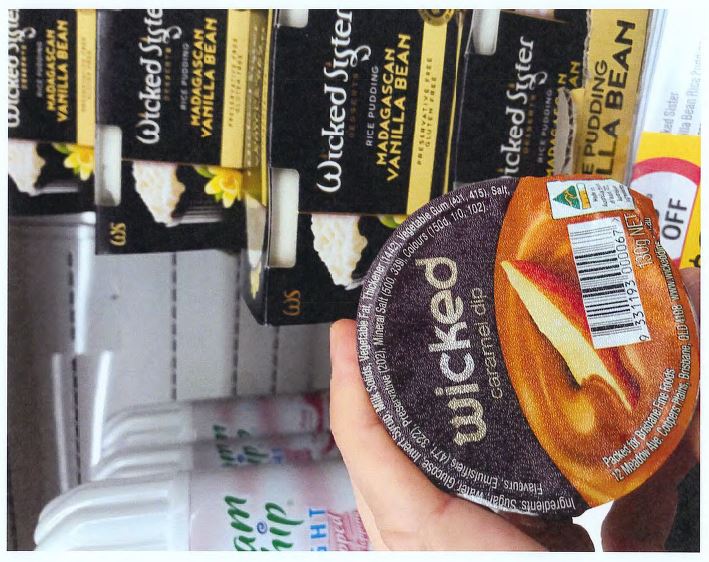
Mr Brebbia did not receive a reply to his email from Mr Polly.
142 Between 15 and 17 November 2017 Mr Brebbia had several meetings with Mr Polly and his team and they spoke briefly about Mr Brebbia’s email. Mr Brebbia recalls that Mr Polly indicated that he was aware of the Wicked product before he received Mr Brebbia’s email and that Mr Polly said words to him to the following effect:
Davide, unfortunately it’s not one of our products. Someone is using our image to sell their desserts.
143 Mr Polly knows Mr Masluk, also known as Mr Musk, through his sports marketing contacts. According to Mr Masluk, he has been aware of Mr Polly’s Wicked Sister brand of products since 2017.
144 On about 12 April 2018 Mr Masluk visited a Coles supermarket in Manly, New South Wales. Mr Masluk recalls going to the cold section of the store and while there found a product labelled “wicked chocolate dip”. Mr Masluk believed that the “wicked chocolate dip” product was part of the Wicked Sister range of products because:
(1) the brand “Wicked” was in large writing on the label and the style and the lettering of the word “wicked” was similar to what he had seen in the Wicked Sister Products;
(2) the product was a chocolate dip, which in Mr Masluk’s opinion was a type of dessert that was similar to Mr Polly’s Wicked Sister Products; and
(3) the product was located in the cold section and Mr Masluk knew that the Wicked Sister products were always refrigerated.
145 On 13 April 2018 at 1.32 pm Mr Masluk sent a text message to Mr Polly with a photo of the label of a “wicked chocolate dip” as follows:
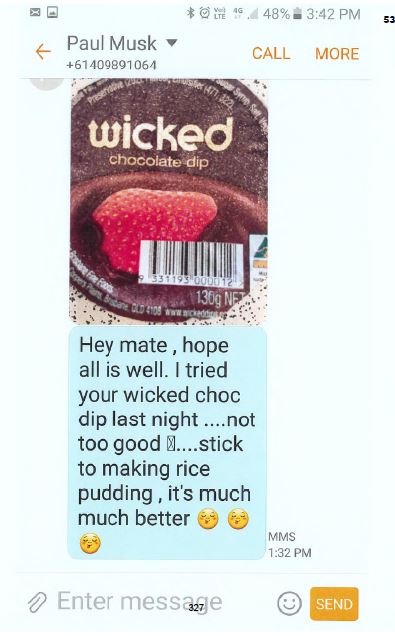
At the time Mr Masluk sent that message to Mr Polly, he believed that the “Wicked chocolate dip” was one of Mr Polly’s products and was not aware that the Wicked products were not part of the Wicked Sister product range.
146 Mr Polly is aware that there have been, over the last three to four years, a number of instances where PDP received inquiries or complaints about dipping sauces. However, there are no records of these communications because records of complaints are only formally logged and included in reports for Wicked Sister Products. They are not logged for products that are mistaken for Wicked Sister Products and the telephone records that would give particulars of these callers are no longer available because of a software change.
147 Mr Polly said that these complaints began before he became aware of the existence of Wicked products which is why he did not make the association at the time. He thought that the calls related to the private label Coles Finest dipping sauces but was confused as to how consumers were aware that PDP was manufacturing the Coles Finest range of sauces and calling the Wicked Sister customer complaint telephone number to complain or to make inquiries.
148 While the calls were not logged, because PDP did not log calls for products that were not sold under the Wicked Sister brand, Mr Polly considers that these calls were in relation to products sold under the New Wicked Mark and that consumers thought they were made by the manufacturer of the Wicker Sister Products. Mr Polly explains that if these complaints or inquiries had been in relation to Coles Finest sauces PDP would have documented them as such and passed them on to Coles.
2.3.12 Mr Polly’s concerns about the New Wicked Mark and confusion
149 Mr Polly says that when he first saw the New Wicked Mark on the Wicked products he was immediately concerned at its visual similarities with the WS Device Marks. Because of the visual similarity between the WS Device Marks and the New Wicked Mark, Mr Polly is concerned that consumers will be caused to believe that Wicked products are made by or with the approval of the maker of the Wicker Sister Products. According to Mr Polly his concern is heightened because Wicked Sister is, in his opinion, the market leader in the chilled dairy dessert and snack category and Wicked products are a type of dessert product.
150 Mr Polly describes the Wicked Sister Products as high quality dessert products made with premium and predominantly fresh ingredients while Wicked products are not made with fresh ingredients, although the dipping sauces are frequently sold in the refrigerated section of a supermarket next to the berries. Mr Polly is concerned that Grasshopper’s use of the New Wicked Mark in relation to products that do not contain the same high quality and fresh ingredients will diminish the reputation and standing of the Wicked Sister brand, if consumers are misled into thinking that the Wicked products are made by or with the approval of the maker of the Wicked Sister Products.
151 Mr Polly is also concerned that, as a result of what he describes as the confusion created by Grasshopper having adopted the New Wicked Mark, if a customer has a bad experience with any of Grasshopper’s products branded with the New Wicked Mark or there is a recall of those products that too will diminish, by default, the reputation and standing of the Wicked Sister brand. Further, because Wicked products and the Wicked Sister Products are sold at the same price point, Mr Polly’s concerns about likely confusion are increased.
152 Mr Polly says that the Wicked Sister Marks have been used in relation to various chilled desserts including rice pudding and that PDP plans to expand its range to include additional products. Mr Polly is concerned that if the Wicked Sister brand is able to be used by other traders in respect of the designated goods for which the Wicked Sister Marks are registered, or goods similar to those goods, customers may be confused into thinking that the goods were made by or with the approval of the maker of the Wicked Sister Products.
3. THE ISSUES IN THE PROCEEDING
153 PDP and Grasshopper were unable to agree on a single list of issues, with each providing their own list. While there was a degree of commonality between some of the issues in their respective lists, the parties’ inability to resolve their somewhat different approaches, including as to the order in which the issues should be addressed and resolved, added to the complexity of the proceeding.
154 As noted, the parties’ lack of agreement seemingly extended to the order in which the numerous issues should be considered. However, it is apparent that two matters bear on the logical order in which I should and will address the issues.
155 First, given the commonality between a number of the issues arising in Grasshopper’s cross-claim and PDP’s trade mark infringement claim and Grasshopper’s contention that if those common issues are determined in its favour much of its cross-claim which is, for the most part, defensive falls away, those common issues should be determined at the outset. Secondly, as Grasshopper’s cross-claim seeks rectification and removal, it should be addressed before PDP’s claims. This is because the analysis with respect to trade mark infringement necessarily takes place based on the Wicked Sister Marks insofar as they remain on the Register following the determination of Grasshopper’s claims for rectification and removal: see Dunlop Aircraft Tyres Limited v Goodyear Tire and Rubber Company (2018) 262 FCR 76 (Dunlop) at [214]-[215].
156 Therefore these reasons will proceed as follows:
(1) the common issues:
(a) whether the marks in question are substantially identical or deceptively similar; and
(b) whether the relevant goods are the same or of the same description;
(2) Grasshopper’s cross-claim for rectification and removal; and
(3) PDP’s trade mark infringement claim, ACL claim, passing off claim and its claims for rectification and removal.
4.1 Substantial identity and deceptive similarity
157 The first common issue that arises both in the context of Grasshopper’s cross-claim and PDP’s trade mark infringement claim is whether the New Wicked Mark is substantially identical with or deceptively similar to the Wicked Sister Marks.
158 PDP submits that in determining this issue consistently with the usual judicial approach, “it would be more appropriate” for me first to consider whether the New Wicked Mark is deceptively similar to the Wicked Sister Marks because, if I am so satisfied, PDP gains no advantage by an additional finding of substantial identity. Indeed, PDP says that “it is hard to see how two marks could be substantially identical but not also be deceptively similar”. I will thus proceed on the basis urged by PDP by first considering whether the New Wicked Mark is deceptively similar to the Wicked Sister Marks.
159 In Shell Company of Australia Limited v Esso Standard Oil (Australia) Limited (1963) 109 CLR 407 (Shell) at 414-415 Windeyer J set out what is often described as the classic statement of the tests for substantial identity and deceptive similarity. His Honour said:
In considering whether marks are substantially identical they should, I think, be compared side by side, their similarities and differences noted and the importance of these assessed having regard to the essential features of the registered mark and the total impression of resemblance or dissimilarity that emerges from the comparison. “The identification of an essential feature depends”, it has been said, “partly on the Court’s own judgment and partly on the burden of the evidence that is placed before it”: de Cordova v. Vick Chemical Co. Whether there is substantial identity is a question of fact …
…
On the question of deceptive similarity a different comparison must be made from that which is necessary when substantial identity is in question. The marks are not now to be looked at side by side. The issue is not abstract similarity, but deceptive similarity. Therefore the comparison is the familiar one of trade mark law. It is between, on the one hand, the impression based on recollection of the plaintiff’s mark that persons of ordinary intelligence and memory would have; and, on the other hand, the impressions that such persons would get from the defendant’s television exhibitions. … And in Australian Woollen Mills Ltd v. F. S. Walton &- Co. Ltd. Dixon and McTiernan JJ. said: “In deciding this question, the marks ought not, of course, to be compared side by side. An attempt should be made to estimate the effect or impression produced on the mind of potential customers by the mark or device for which the protection of an injunction is sought. The impression or recollection which is carried away and retained is necessarily the basis of any mistaken belief that the challenged mark or device is the same”.
(Footnotes omitted.)
160 Although the appeal against the judgment in Shell was allowed, no doubt was cast on Windeyer J’s statement of the tests for substantial identity and deceptive similarity.
161 In Registrar of Trade Marks v Woolworths Ltd (1999) 93 FCR 365 at [50] French J (as his Honour then was) set out a number of propositions which apply to consideration of whether a mark is deceptively similar to another as follows:
In Southern Cross Refrigerating Co v Toowoomba Foundry Pty Ltd, which concerned the 1905 Act, Kitto J set out a number of propositions which have frequently been quoted and applied to the 1955 Act. The essential elements of those propositions continue to apply to the issue of deceptive similarity under the 1995 Act. Applied also to service marks and absent the imposition of an onus upon the applicant they may be restated as follows:
(i) To show that a trade mark is deceptively similar to another it is necessary to show a real tangible danger of deception or confusion occurring. A mere possibility is not sufficient.
(ii) A trade mark is likely to cause confusion if the result of its use will be that a number of persons are caused to wonder whether it might not be the case that the two products or closely related products and services come from the same source. It is enough if the ordinary person entertains a reasonable doubt.
It may be interpolated that this is another way of expressing the proposition that the trade mark is likely to cause confusion if there is a real likelihood that some people will wonder or be left in doubt about whether the two sets of products or the products and services in question come from the same source.
(iii) In considering whether there is a likelihood of deception or confusion all surrounding circumstances have to be taken into consideration. These include the circumstances in which the marks will be used, the circumstances in which the goods or services will be bought and sold and the character of the probable acquirers of the goods and services.
(iv) The rights of the parties are to be determined as at the date of the application.
(v) The question of deceptive similarity must be considered in respect of all goods or services coming within the specification in the application and in respect of which registration is desired, not only in respect of those goods or services on which it is proposed to immediately use the mark. The question is not limited to whether a particular use will give rise to deception or confusion. It must be based upon what the applicant can do if registration is obtained.
In respect of the last proposition, Mason J observed in Berlei Hestia Industries Ltd v Bali Co Inc (1973) 129 CLR 353 at 362:
“the question whether there is a likelihood of confusion is to be answered, not by reference to the manner in which the respondent has used its mark in the past, but by reference to the use to which it can properly put the mark. The issue is whether that use would give rise to a real danger of confusion.”
162 In Optical 88 Limited v Optical 88 Pty Limited (No 2) [2010] FCA 1380; (2010) 275 ALR 526 (Optical 88) Yates J relevantly said (at [94] and [100]):
94 It is to be borne in mind that the essential task is one of trade mark comparison. So much is made clear by s 10 of the Trade Marks Act itself: it is the resemblance between the two marks that must be the cause of the likely deception or confusion. The inquiry for trade mark infringement purposes is thus a relatively limited one. However, in cases of alleged “deceptive similarity”, the context of surrounding circumstances is not to be ignored. As Australian Woollen Mills makes clear, the comparison takes place in a particular context in accordance with a particular standard: “the course of business and the way in which the particular class of goods are sold” gives the setting and “the habits and observation of men considered in the mass” affords the standard in determining whether the impugned mark is, properly judged, “deceptively similar”. In Shell Windeyer J observed (at 416) that, although deceptiveness must result from similarity, the likelihood of deception must be judged not by the degree of similarity alone but by the effect of that similarity in all the circumstances.
…
100 When considering the question of deceptive similarity, each mark must be compared as a whole. This is of particular significance in relation to composite marks and device marks which may consist of a number of elements: Angelides v James Stedman Hendersons Sweets Ltd (1927) 40 CLR 43 at 68. It is necessary to look at all these elements in their context. This will include the size, prominence and stylisation of words and device elements used in the mark and their relationship to each other: Crazy Ron’s Communications Pty Ltd v Mobileworld Communications Pty Ltd (2004) 209 ALR 1; [2004] FCAFC 196 at [91]-[103]; Bavaria NV v Bayerischer Brauerbund eV (2009) 177 FCR 300 at [21]-[22] and [32]. The impression created by the mark, considered as a whole, can only be determined by doing this. However, in this connection, it is recognised that deceptive similarity may be established when an impugned mark uses an “essential” or “distinguishing” feature of the mark as registered. This proposition may be illustrated by reference to the following leading cases.
4.1.2 Is the New Wicked Mark deceptively similar to the Wicked Sister Marks?
163 PDP submits that the New Wicked Mark is deceptively similar to the Wicked Sister Marks for the following reasons:
(1) there is no limitation on the nature of the confusion or deception. It can be “visual or phonetic confusion of the marks themselves”, “contextual confusion” or “confusion or deception as to the trade provenance of the goods”, citing In the matter of John Fitton & Company Limited’s Application (1949) 66 RPC 110 at 113;
(2) where trade marks look or sound alike, the “idea” suggested by a trade mark may be more likely to be recalled than the precise details of the mark. The prominence of the pitchfork device on the “w” in the WS Device Marks is a feature by which those marks “come to be remembered by some feature in it which strikes the eye and fixes itself in the recollection”, citing Saville Perfumery Ld v June Perfect Ld and FW Woolworth & Co Ld (1941) 58 RPC 147 (Saville Perfumery) at 162. To that end PDP observes that the New Wicked Mark uses a pitchfork for exactly the same letter, the first “w”, and exactly the same word, “wicked”. This, PDP submits, is a factor which weighs heavily in its favour;
(3) Mr Valentine gives direct evidence of the “impression carried away” from the WS Device Marks. PDP contends that Mr Valentine was “strongly interested” in the question and keen to give his account of the differences in the marks, no matter what question he was asked. PDP relies on the following exchange between Mr Valentine and senior counsel for PDP:
Mr Hall: You were familiar with the Wicked Sister products in 2014, weren’t you?
Mr Valentine: Yes. I knew they existed.
Mr Hall: You tell us in your affidavit that you’ve known they existed - I think you say you couldn’t be precise, but since about 2010 or 2011. Is that roughly in accordance with your memory now?
Mr Valentine: It could have been.
Mr Hall: You had seen them in the shops, had you?
Mr Valentine: Mate, the Wicked Sister brand is entirely different to our fonts and our trademark. Our trademark is a single word “Wicked” and Wicked Sister is a two-word sentence.
Mr Hall: You had seen them in the shops, had you?
Mr Valentine: Right. They’re entirely in two different categories in the supermarket. One is in the desserts chilled area and our product is in the fresh produce area, so why would I pay attention to the Wicked Sister trademark.
While PDP accepts that Mr Valentine’s answers would only carry weight where they are in the nature of an admission, it contends that Mr Valentine’s evidence was of that nature when he said “the Wicked Sister brand is entirely different to our fonts and our trademark. Our trademark is a single word ‘Wicked’ and Wicked Sister is a two-word sentence.” PDP submits that the Court would have, in any event, accepted on ordinary principles that the words “Wicked Sister” would stick in the memory and the words “Fine Foods” would not. It contends that in his evidence Mr Valentine confirms that to be so;
(4) PDP relies on direct evidence given by consumers and members of the trade that they are accustomed to seeing the Wicked Sister Marks on refrigerated goods which is also where they encounter Wicked dips with the pitchfork device. PDP says that this context forms part of the relevant comparison, noting that part of the fair notional use of a mark registered for dairy desserts is that they will be in the fridge;
(5) PDP contends that the task of assessing deceptive similarity begins with a comparison of “Wicked Sister” to “wicked”, although it is not confined to that task. PDP points out the following similarities between the Wicked Sister Marks and the New Wicked Mark:
(a) the consumer finds the same word, “wicked”;
(b) the letter “w” as a pitchfork, which is a striking feature of the WS Device Marks that stays in the memory;
(c) the lettering is not identical in the forms of the word “wicked” but it has many more features in common than not:
(d) the close similarity of the remaining letters including the curvy “k”, the foreshortened “e” and tail-less “d”, all of which are described as unusual stylisations shared by the marks;
(e) the Wicked Sister Marks use lower case letters as does the New Wicked Mark; and
(f) PDP contends that the absence of the word “sister” in the New Wicked Mark cannot outweigh the similarities between the marks and that the first part of a mark is traditionally given priority in the comparison;
(6) PDP submits that the goods are fast moving consumer goods with a low price point, sold in busy stores to consumers doing the weekly shop, rather than to people who have gone to a specific store to seek out a specific product. PDP says the attention they will pay to the product is thus so much the less and the risk of confusion so much the more; and
(7) PDP submits that the Court will be fortified in drawing the inference that the authorised use of the New Wicked Mark by Grasshopper is likely to deceive or cause confusion by the distinct likelihood that the designer of the mark was directly influenced by the Wicked Sister Marks, that Mr Valentine and David were at least unconsciously influenced in their selection of the New Wicked Mark by their familiarity with the Wicked Sister brand and by Mr Valentine’s recklessness in adopting the New Wicked Mark without undertaking any trade mark checks or searches.
164 Grasshopper submits that the New Wicked Mark is not deceptively similar to the Wicked Sister Marks for the following reasons:
(1) the marks do not visually or aurally resemble each other and there is no evidence that the Wicked Sister Marks have ever been shortened to “wicked”. While accepting that each case turns on its facts, Grasshopper submits that a conclusion that the marks are not deceptively similar is consistent with other decisions of this Court, citing a number of cases by way of example;
(2) the word “wicked” is an abstract concept that could refer to anything being wicked whereas, in the Wicked Sister Marks, the word “wicked” is used as an adjective for a definite noun, a sister;
(3) the essential feature of the New Wicked Mark is the word “wicked”. In contrast, in the Wicked Sister Marks neither the word “Wicked” nor the word “Sister” is more prominent such that the WS Device Marks have no essential feature or, in the alternative, have two essential features. Grasshopper submits that the essential feature of the WS Device Marks is not the rendering of the letter “w”. Rather, the marks must be compared as a whole, which is significant for marks with a number of elements such as the WS Device Marks. Grasshopper says that the letter “w” is merely one of multiple features of that mark. Grasshopper further contends that “the ascertainment of an essential feature is not to be by ocular test alone” but must also involve assessing the sound or significance of the words, citing Optical 88 at [104] quoting de Cordova v Vick Chemical Company (1951) 68 RPC 103 at 105. PDP’s suggestion that the “idea” of the New Wicked Mark as a “pitchfork shaped ‘w’” confuses the “idea” of a mark with a constituent element of a mark which, in the case of the “w” in the New Wicked Mark, it describes as “minor”;
(4) the only commonality between the marks is the word “wicked” which is an ordinary English word. The Court “should be careful not to shut out inappropriately other traders from the fair use of the language in ways that will not in reality deceive or confuse”, citing Conde Nast Publications Pty Ltd v Taylor (1998) 41 IPR 505 at 511-512;
(5) Grasshopper notes that PDP’s focus is on the alleged similarity in the “w” in the New Wicked Mark and the WS Device Marks. However, Grasshopper says that the “w” in each is different:
(a) in the New Wicked Mark, the “w” is in lowercase, like the whole word and is no greater in size or prominence than the rest of the word. In contrast, in the WS Device Marks it is in uppercase while the rest of the word is in lowercase; and
(b) in the New Wicked Mark, the “w” has all three vertical lines rendered in the same way, with upward pointing arrows, whereas in the WS Device Marks it has two outer vertical lines curving inward without an arrow and a shorter middle vertical arrow;
(6) Grasshopper submits that even if, contrary to the above, the Court considers that the “w” in the marks is similar it would be an error to focus on the “w” to the exclusion of the marks’ other elements, noting that they each have different stylisation and fonts:
(a) the New Wicked Mark is all in lowercase letters whereas the WS Device Marks have the uppercase letters “W” and “S”;
(b) the New Wicked Mark has a conventional rendering of the letter “i” whereas the WS Device Marks has a flame in place of a dot, reminiscent of a candle, and a tail coming out of the letter “s” which draws attention to the word “sister”; and
(c) unlike the New Wicked Mark, the WS Device Marks have a distinctive curved extension to the bottom of the letter “s” running below the other letters;
(7) to the extent that PDP relies on a “greater” risk of confusion where goods are commonly bought by people in a hurry, Grasshopper says that the goods are likely to be purchased in a supermarket setting in which consumers are able to view the marks and the products and are unlikely to be careless and, even if they were, that would not matter given the differences between the marks; and
(8) PDP’s position is internally inconsistent. PDP alleges that the New Wicked Mark is deceptively similar to the WS Word Mark, which has no stylisation, but denies, for the purposes of Grasshopper’s cross-claim, that the WS Word Mark is deceptively similar to the Wicked Tail Mark. Grasshopper contends that these positions cannot logically be reconciled; and
(9) PDP’s evidence of alleged actual confusion ought to be given no weight.
165 The question for the Court is whether there is a real, tangible danger of deception or confusion by reason of the use of the New Wicked Mark, having regard to the imperfect recollection of the notional consumer. That is not to be judged by a side by side comparison of, on the one hand, the New Wicked Mark, and on the other, the Wicked Sister Marks. Rather, in considering the issue I am required to take all of the surrounding circumstances into consideration, including those in which the New Wicked Mark and the Wicked Sister Marks are used and the circumstances in which the goods are and will be sold.
166 In my opinion, having regard to those matters the New Wicked Mark is not deceptively similar to the Wicked Sister Marks. My reasons for reaching that conclusion follow.
167 The New Wicked Mark and the Wicked Sister Marks are not visually or aurally similar.
168 In terms of their visual appearance, the Wicked Sister Marks are made up, in the case of the WS Device Marks, of four words and, in the case of the WS Word Mark, of two words. In the WS Device Marks both the words “wicked” and “sister” are stylised:
(1) the word “wicked” appears with:
(a) a capital “W” with a pitchfork device on the middle arm or stem only;
(b) the balance of the word in lowercase; and
(c) a flame to dot the “i”; and
(2) the word “sister”, which is unique to the Wicked Sister Marks, appears with:
(a) a capital “S”;
(b) the balance of the word in lowercase;
(c) a flame to dot the “i”; and
(d) and a swirling devil’s tail on the second “s”.
169 In contrast, the New Wicked Mark comprises one word in lower case, and the “w”, about which PDP makes much complaint, includes a pitchfork device on all three of its arms, in contrast to the single use of the pitchfork device on the middle arm or stem of the “W” in the WS Device Marks, while the outer arms curve inwards and do not include the pitchfork device. That both the WS Device Marks and the New Wicked Mark use in the word “wicked” a shortened arm on the “e” and a sans serif “d” is not sufficient to make the marks visually similar.
170 Likewise, the New Wicked Mark is not visually similar to the WS Word Mark. The New Wicked Mark comprises a single word with the features described in the preceding paragraph while the WS Word Mark is not stylised and is made up of two words.
171 Nor are the marks aurally similar. As I have already observed, the Wicked Sister Marks and the New Wicked Mark both include the word “wicked” but that is where the aural similarity starts and ends. The WS Device Marks are, as noted at [168] above, made up of four words, “Wicked Sister Fine Foods”, although I accept PDP’s submission that the words “Wicked Sister” would stick in the memory and the words “Fine Foods” would not, and the WS Word Mark is made up of two words, “Wicked Sister”. The New Wicked Mark is made up of the single word “wicked”.
172 The word “wicked” is an adjective. When used on its own, as it is in the New Wicked Mark, it is, as Grasshopper submits, an abstract concept which could describe anything being wicked. In contrast, in the Wicked Sister Marks the word “wicked” is used in conjunction with the noun “sister”. That being so, in my opinion, the word “wicked” is not a strongly distinguishing feature of the Wicked Sister Marks.
173 A similar view was expressed by a Full Court of this Court (Besanko, Jagot and Edelman JJ) in Telstra Corporation Limited v Phone Directories Company Australia Pty Ltd (2015) 237 FCR 388. The Full Court considered two appeals, one of which concerned an appeal from a decision to refuse the registration of the word mark YELLOW because, among other things, the primary judge had found that the ground of opposition under s 44 of the TM Act was made out in that the YELLOW word mark was deceptively similar to three other marks, each of which included the word “yellow”. In considering that aspect of the appeal, the Full Court relevantly said (at [180]-[181]):
180 We note that the delegate in the opposition by Mr Khoury considered that the YELLOW trade mark was not deceptively similar to THE YELLOW ENVELOPE and the YELLOW DUCK. The delegate said that the latter were conceptually, phonetically and visually quite distinct from the former trade mark and that the word yellow in them tended “to fade as a strongly distinguishing feature of the potentially conflicting trade marks in the presence of an arbitrary noun which actually distinguishes the services” (at [65]). By contrast, the YELLOW trade mark consisting of the word “yellow” alone is a sole abstract concept, “apparently a noun which is the name of ‘a bright colour like that of butter or lemons’”. The delegate in the opposition by PDCA adopted this reasoning. He considered that the same position applied in the case of YELLOW ZONE mark which he said did not convey the same idea as the YELLOW trade mark and nor was it aurally similar (at [52]).
181 In our opinion, the reasoning of the delegates was correct and applies equally to the YELLOW DOOR mark. There are clear phonetic and visual differences between the marks. Furthermore, each of the cited marks conveys a different idea to the YELLOW trade mark. We consider the significance of the idea of a mark to the issue of deceptive similarity in the context of the appeal by Yellowbook (at [210]-[219]). Even when considered in light of the limited overlap with the relevant Telstra service, the use of YELLOW as a noun gives rise to different ideas from its use as an adjective in the context of an ENVELOPE, DUCK ZONE or DOOR. We are not disposed to see this as a borderline case, but even if we are wrong about that, we would be entitled to place weight on the opinions of the respective delegates (Yorkshire Copper Works Ltd v Registrar of Trade Marks [1954] 1 WLR 554 at 557-558 per Lord Simonds).
174 PDP submits that the word “wicked” has more prominence because it is the first word in the Wicked Sister Marks. PDP relies on the decision in In the matter of London Lubricants (1920) Limited’s Application (1925) 42 RPC 264 at 279 where Sargant LJ said:
… But the tendency of persons using the English language to slur the termination of words also has the effect necessarily that the beginning of words is accentuated in comparison, and, in my judgment, the first syllable of a word is, as a rule, far the most important for the purpose of distinction. …
I do not understand Sargant LJ to be doing more than expressing an opinion that the first part or syllable of a word is the most important for the purpose of distinction. His Lordship does not seem to be saying that where there are two words the first word takes on a greater import.
175 The issue of the prominence or otherwise of the word “wicked” in the Wicked Sister Marks is one of identification of the essential feature of those marks. In Saville Perfumery at 162 Lord Greene MR said:
In the present case, for example, the evidence makes it clear that traders who have to deal with a very large number of marks used in the trade in which they are interested, do not, in practice and indeed cannot be expected to, carry in their heads the details of any particular mark, while the class of customer among the public which buys the goods does not interest itself in such details. In such cases the mark comes to be remembered by some feature in it which strikes the eye and fixes itself in the recollection. Such a feature is referred to sometimes as the distinguishing feature, sometimes as the essential feature, of the mark.
176 In Coca-Cola Company v PepsiCo Inc (No 2) [2014] FCA 1287; (2014) 322 ALR 505 at [228] Besanko J commented that:
The main or general idea of a mark seems to be a similar concept to that of the essential feature of the mark (see Jafferjee v Scarlett (1937) 57 CLR 115, at 121-122 per Latham CJ).
177 In my opinion neither the word “wicked” nor the word “sister” take prominence in the Wicked Sister Marks. The word “wicked” is not an essential feature of those marks, it no more strikes the eye and fixes itself in the recollection than the word “sister”. Both words are ordinary English words and neither can be characterised as an essential feature.
178 PDP submits that its pitchfork shaped “w” is, however, an essential feature of the WS Device Marks. As I have already observed, the “w” in the word “Wicked” as depicted in those marks includes a pitchfork device in the middle arm or stem of the “w”. But that feature no more strikes the eye and fixes in the recollection than the devil’s tail used in the second “s” in the word “sister” or the flames which dot the “i” in both the words “wicked” and “sister”. In other words, I do not think any single feature has prominence over the others.
179 People of ordinary intelligence and memory who see the Wicked Sister Marks are likely to recall that they are made up of (at least) two words and that the appearance, in the case of the WS Device Marks, of the words “wicked’ and “sister” is stylised. People of ordinary intelligence and memory who see the New Wicked Mark are likely to recall that it is made up of one word stylised in some way. But it is not the case that the marks are so similar that a person recollecting them would be left to wonder whether the goods sold under the New Wicked Mark came from the same source as the Wicked Sister Products.
180 I accept that the goods in question are fast moving consumer goods sold at a low price point. In those circumstances, PDP submits that a consumer is likely to pay less attention to the product they are purchasing, thus increasing the risk of confusion as between the New Wicked Mark and the Wicked Sister Marks. In Australian Woollen Mills Limited v FS Walton and Company Limited (1937) 58 CLR 641 (Australian Woollen Mills) at 658, Dixon and McTiernan JJ said:
The usual manner in which ordinary people behave must be the test of what confusion or deception may be expected. Potential buyers of goods are not to be credited with any high perception or habitual caution. On the other hand, exceptional carelessness or stupidity may be disregarded.
181 The evidence establishes that the goods are likely to be purchased in a supermarket or online from a supermarket or equivalent retailer. The goods are displayed in considerable quantities together. That is, the Wicked Sister Products are displayed together in the refrigerated section and the Wicked dips can either be displayed together at room temperature or placed in the refrigerated section with the berries. As Mr Valentine explains, the choice of where the Wicked dips are displayed is one for the retailer (see [83] above). Based on my observations of the evidence, while both products can be, and in the case of the Wicked Sister Products are, displayed in refrigerated sections, they are found in different parts of the stores. That is, the Wicked Sister Products are displayed in the refrigerated section in the dairy aisle while the Wicked dips, when refrigerated, are in the refrigerated section of the fresh produce area. In any event, consumers are able to view the products and their associated trade marks. While a consumer is not to be credited with any high perception, given the way they are displayed and the ability to view the brand and the product, I do not accept that simply because the goods are fast moving consumables consumers are more likely to be confused.
182 PDP invites me to draw certain inferences about the way in which the New Wicked Mark was designed and selected and says I would be fortified in inferring that the authorised use of the New Wicked Mark by Grasshopper is likely to deceive or cause confusion by the likelihood that Mr Smithson, the designer of the mark, was directly influenced by the Wicked Sister Marks and that Mr Valentine and David were at least unconsciously influenced in their selection of the New Wicked Mark by their familiarity with the Wicked Sister brand.
183 The evidence given by Mr Valentine and David in relation to that matter is set out at [46]-[60] above. Nowhere in their evidence do they say that they were influenced by the Wicked Sister brand nor is Wicked Sister referred to in David’s design brief or in any of the communications between David and Mr Smithson or between David and the other shortlisted designers, “Radostella” and “andrea.abmr”, which were in evidence before me.
184 Further, while David intended for the designers to undertake their own research and accepted such research would be undertaken electronically, there is nothing in the evidence before me from which I would infer that any of the designers and, in particular Mr Smithson, were influenced by the Wicked Sister brand. David did not ask Mr Smithson what inquiries he made.
185 Neither Mr Valentine nor David gave evidence that they wanted the new design of the Wicked brand to be like the Wicked Sister brand. Rather, they considered Mr Smithson’s design to be a reworking of the Wicked Tail Mark. Mr Valentine’s evidence was that the pitchfork device, which he described as a “halo”, was redolent of the tail device used in the Wicked Tail Mark (see [60] above).
186 PDP submits that Mr Smithson still undertakes projects for Grasshopper and that a short affidavit from him might have excluded copying or familiarity with Wicked Sister in 2014. In those circumstances PDP contends that the rule in Jones v Dunkel (1959) 101 CLR 298 (Jones v Dunkel) at 320-321 should operate such that the unexplained failure to call Mr Smithson to give evidence about a matter within his knowledge supports an inference that his evidence would not have assisted Grasshopper’s case. PDP says that the Court should infer that Grasshopper knew that nothing Mr Smithson could have said on the topic would have assisted its case. I decline to draw the inference urged on me by PDP.
187 The rule in Jones v Dunkel is that an unexplained failure by a party to give evidence, call a witness, tender documents or other evidence that the party would reasonably have been expected to call may (not must) in appropriate circumstances lead to an inference that the uncalled evidence or missing material would not have assisted that party’s case: Jones v Dunkel at 320-322; Australian Competition and Consumer Commission v Colgate-Palmolive Pty Ltd (No 4) [2017] FCA 1590; (2017) 353 ALR 460 (ACCC v Colgate-Palmolive) at [576].
188 The rule in Jones v Dunkel permits an inference that the untendered evidence would not have helped the party who failed to tender it and entitles the Court to take that into account in deciding whether to accept any particular evidence which relates to a matter on which the absent witness could have given evidence. Relevantly, the rule only applies where a party is “required to explain or contradict” something: Jones v Dunkel at 321; ACCC v Colgate-Palmolive at [580]. What a party is required to explain or contradict will depend on the issues in the case as identified in the pleadings and by the course of evidence. No inference can be drawn unless evidence is given of facts “requiring an answer”: see Heydon JD, Cross on Evidence (12th ed, 2017) at [1215]; ACCC v Colgate-Palmolive at [580]. In addition, a Jones v Dunkel inference cannot be employed to make up any deficiency in the evidence or to convert conjecture or suspicion into inference: see ACCC v Colgate-Palmolive at [585].
189 As I have already observed, the evidence given by Mr Valentine and, more particularly, David about the development of the design brief for the modernisation of the Wicked brand was clear. Neither Mr Valentine nor David had Wicked Sister in mind when they selected Mr Smithson’s design. David did not refer to Wicked Sister in the design brief or in any of his communications with Mr Smithson. Similarly, Mr Smithson did not refer to Wicked Sister or any other brand in his communications. Considered as a whole, Grasshopper was not required to explain that evidence or contradict any evidence by calling Mr Smithson.
190 By inviting me to draw an inference that nothing Mr Smithson could have said about whether the Wicked Sister brand influenced his design of the New Wicked Mark would have assisted Grasshopper’s case, PDP impermissibly invites me to speculate about the evidence that Mr Smithson would have given or to infer that Mr Smithson’s evidence would have been damaging to Grasshopper’s case.
191 The final issue to address is the effect of the evidence given by Ms Medley and Messrs Brebbia and Masluk which PDP submits demonstrates actual confusion among both consumers and the trade. Grasshopper submits that this evidence should be rejected as not relevant or alternatively should be given no weight.
192 In determining deceptive similarity “[e]vidence of actual cases of deception, if forthcoming, is of great weight”: see Australian Woollen Mills at 658. In Australian Woollen Mills the evidence of confusion was rejected because it was given by witnesses long after “the occurrence of what must have been a casual and unimportant mental experience” of seeing the respondent’s newspaper advertisement and mistaking it for that of the appellant: at 658.
193 In Vivo International Corporation Pty Ltd v TiVo Inc [2012] FCAFC 159; (2012) 294 ALR 661 (Vivo v TiVo) at [137] Nicholas J (with whom Dowsett J agreed) observed that:
It is well established that evidence of actual confusion may be highly persuasive. But as with other evidence, in assessing what weight should be given to it, the Court must evaluate the quality of the evidence by reference to its internal features, the other evidence and the Court’s own knowledge of human affairs.
194 Having considered the evidence of Ms Medley and Messrs Brebbia and Masluk and having evaluated it “by reference to its internal features, the other evidence and the Court’s own knowledge of human affairs”, I would not reject it as irrelevant as Grasshopper contends I should. However, for the reasons that follow, I would give it little weight.
195 First, and most critically, each of Ms Medley and Messrs Brebbia and Masluk have an affiliation with Mr Polly. Mr Brebbia is the head of sales at Emmi which produces some of the Wicked Sister Products. In other words, PDP is one of Emmi’s clients. Mr Masluk and Mr Polly met each other through friends. In those circumstances, contrary to PDP’s submission, Mr Masluk is not as close to being the hypothetical shopper as a witness could be. Ms Medley was a category manager of chilled desserts at Coles during which time one of her two principal contacts at PDP was Mr Polly. It is difficult to see how, given those circumstances, evidence of Ms Medley and Messrs Brebbia and Masluk can be given much weight. Theirs is not the evidence of an “ordinary person” but of people who have a personal or trade affiliation with Mr Polly and/or PDP and who, in the case of Ms Medley and Mr Brebbia, are involved in the production or sale of the Wicked Sister Products. A further factor that affects Mr Brebbia is that he is based in Italy, rather than Australia. He is not, in those circumstances, a relevant consumer for the purposes of the TM Act.
196 Secondly, it is not apparent that Ms Medley and Messrs Brebbia and Masluk compared the New Wicked Mark with the WS Device Marks: Mr Brebbia appears to have compared the New Wicked Mark with the WS Device Marks without the words “Fine Foods”; it is not clear what comparison Mr Masluk made; and Ms Medley does not indicate what she compared and when and in what circumstances her confusion arose.
197 In a similar vein, none of Ms Medley or Messrs Brebbia or Masluk gave evidence of how they reconciled the differences between the New Wicked Mark, on the one hand, and the WS Device Marks, on the other, with their conclusions that the products emanate from the same source. In Vivo v TiVo at [143] Nicholas J remarked:
I have difficulty understanding why a sales person who was familiar with the products he or she was selling would think that the TiVo products and the Vivo products were the same or that they came from the same source unless he or she mistook one mark for the other. It seems to me extremely unlikely that sales staff who were mindful of the differences (both visually and aurally) between the two marks would believe that goods marked with one mark came from the same source as goods marked with the other. Nor do I think that sales staff would be caused to wonder whether or not the goods came from the same source in such circumstances.
198 The evidence of Ms Medley and Messrs Brebbia and Masluk focuses on similarities between the New Wicked Mark and the WS Device Marks only. There was no evidence to the effect that, “mindful of the differences” between those marks, they nonetheless thought that they came from the same source.
199 That then leaves the evidence of Mr Polly in relation to consumer complaints which he believes were complaints which concerned Wicked dipping sauces, and not the Wicked Sister Products (see [146]-[148] above). Again, I am not able to give that evidence much, if any, weight. Mr Polly was unable to give any evidence of the actual complaints that were made; the calls were not logged or recorded in any way. As Grasshopper submits, Mr Polly’s evidence that the complaints related to Wicked products is no more than speculation on his part.
200 Even affording the evidence of Ms Medley and Messrs Brebbia and Masluk some weight, that evidence is still not sufficient to displace the conclusion I have reached that the New Wicked Mark is not deceptively similar to any of the Wicked Sister Marks.
201 Having regard to the above matters, in my opinion, there is no real, tangible danger of confusion in the minds of potential customers of ordinary intelligence and memory in relation to the goods provided under the New Wicked Mark, even allowing for imperfect recollection. I do not think that there would be cause to wonder whether products offered under the New Wicked Mark were closely related to or emanate from the same source as products offered under the Wicked Sister Marks.
4.1.3 Is the New Wicked Mark substantially identical with the Wicked Sister Marks?
202 As I observed at [158] above, PDP’s position is that if I find that the New Wicked Mark is not deceptively similar to the Wicked Sister Marks, as I have, it would be difficult for me to find that those marks are substantially identical. On that basis there is little utility in considering whether the marks are substantially identical. However, against the possibility that I have misunderstood PDP’s position I will consider, albeit briefly and for completeness, whether that is so.
203 The test for substantial identity was articulated by Windeyer J in Shell (see [159] above). In effect, it requires a side by side comparison so as to identify the similarities and differences in the two marks in question. Whether there is substantial identity is a question of fact.
204 A side by side comparison of the New Wicked Mark and the Wicked Sister Marks is as follows:

205 In my opinion, having regard to the comparison in the preceding paragraph, the New Wicked Mark is not substantially identical with the Wicked Sister Marks.
206 First, the marks are neither aurally nor phonetically alike. As I have already observed at [171] above, the New Wicked Mark is made up of one word while the WS Device Marks are made up of four words and the WS Word Mark is made up of two words.
207 Secondly, the marks are visually different. The stylisation and the fonts used in each of the New Wicked Mark and the Wicked Sister Marks differ in the ways set out in detail at [168]-[170] above.
4.2 Goods are the same or of the same description
208 The question of whether the New Wicked Mark is used in relation to goods that are the same or of the same description in respect of which the Wicked Sister Marks are registered needs to be separately considered in relation to, on the one hand, the First WS Device Mark and, on the other, the Second WS Device Mark and the WS Word Mark (together, the Later Registered WS Marks), given the different categories of goods for which those marks are registered. In each case, for the purposes of the New Wicked Mark, the relevant goods are the Infringing Products, being:
(1) Wicked dipping sauces which have been sold under the New Wicked Mark since 2014; and
(2) Wicked Waffle Dippers which have been sold under the New Wicked Mark since 2018.
Examples of the packaging for the Infringing Products is depicted below:
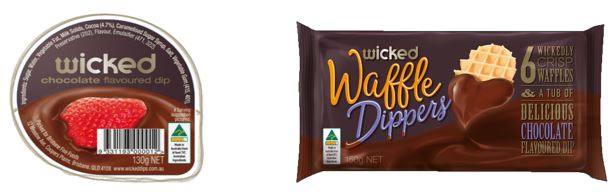
209 In New South Wales Dairy Corporation v Murray Goulbourn Co-operative Co Ltd (1989) 86 ALR 549 the applicant commenced selling flavoured milk under the name “Moove” in 1979. In 1987 the first respondent launched a packaged cheese product under the name “Moo” and in mid-1988 commenced sale of a “Moo” milk product. The applicant sued the first respondent for infringement of its Moove trade mark and sought to have the Moo trade mark removed from the Register for non-use under s 23 of the Trade Marks Act 1955 (Cth) (1955 Act). The first respondent sued the applicant for infringement of its Moo trade mark.
210 In the context of the non-use application, Gummow J considered the expression “goods of the same description” and, relevantly, whether cheese was “of the same description” as milk and concluded (at 565) that it had not been shown that the first respondent’s Moo packaged cheese and Moo flavoured milk were goods of the same description for the purposes of s 23(2) of the 1955 Act. At 565-566 his Honour said:
In so deciding, I have borne in mind that one of the first respondent’s witnesses, a consultant nutritionist, emphasised the importance of calcium in the diet of small children, and that dairy products in general provided the means for sufficiently high calcium intake; but it was not suggested that cheese and flavoured milk are commonly used as substitutes or alternatives. And I bear in mind also the reaction of Mr de Vos, the executive director of the marketing division of the applicant, to the effect that he did not regard the introduction by the first respondent of the Moo packaged cheese as the entry by a competitor into the market for flavoured milk, even though he conceded that if the first applicant had marketed not only Moove flavoured milk but also Moove cheese, members of the public would perceive those two lines as perhaps produced by the same manufacturer.
There was insufficient evidence as to the nature of the goods, the uses to which they were put and the trade channels through they were bought and sold, to enable me to conclude that the flavoured milk and packaged cheese products were goods of the same description.
211 The question of when goods are “of the same description” was considered by Kenny J in McCormick & Company Inc v McCormick [2000] FCA 1335; (2000) 51 IPR 102 (McCormick) in the context of s 44(1) of the TM Act. At [18]-[19] her Honour said:
18 The authorities establish that there are three principal factors to be considered in this regard. They are: (1) the nature of the goods, including their origin and characteristics; (2) the uses made of them, including their purpose; and (3) the trade channels through which the goods are bought and sold. As to the last-mentioned matter, it may be relevant to consider whether the goods being compared are produced by the same manufacturer or distributed through the same channels; whether they are sold in the same shops; whether they are sold to the same sort of customers; and whether those engaged in the manufacture and distribution of the goods are considered as belonging to the same trade: see In Re Jellinek’s Application (1946) 63 RPC 59 at 70-72; In Re John Crowther & Sons (Milnsbridge) Ltd’s Application (1948) 65 RPC 369 (“Crowther’s Application”) at 372; In Re Frank George Whiting’s Application (1952) 69 RPC 219 at 221; and Reckitt & Colman (Australia) Ltd v Boden (1945) 70 CLR 84 at 94. As the High Court stated in Southern Cross Refrigerating Co v Toowoomba Foundry Pty Ltd (1954) 91 CLR 592 (“Southern Cross”) at 606-607:
The fact that examination of the nature of the applicant’s goods may, by itself, induce an observer to conclude that they are different in character from those of an opponent, and designed to serve different purposes, is by no means conclusive. Nor is the fact that the applicant’s goods are not specified by the regulations as being within the same class of goods: see In re The Australian Wine Importers Ltd (1889) 41 Ch D 278, at p 291 and Reckitt & Colman (Australia) Ltd v Boden (1945) 70 CLR 84, at p 90 per Latham CJ. There may be many matters to be considered apart from the inherent character of the goods in respect of which the application is made and some indication of what matters are relevant to this inquiry was given by Romer J in In re Jellinek’s Application (1946) 63 RPC 59. Romer J thought it necessary to look beyond the nature of the goods in question and to compare not only their respective uses but also to examine the trade channels through which the commodities in question were bought and sold. Shortly after the decision in Jellinek’s Case … the Assistant-Comptroller elaborated on the observations of Romer J in the following manner: ‘In arriving at a decision upon this issue the reported cases show that I have to take account of a number of factors, including in particular the nature and characteristics of the goods, their origin, their purpose, whether they are usually produced by one and the same manufacturer or distributed by the same wholesale houses, whether they are sold in the same shops over the same counters during the same seasons and to the same class or classes of customers, and whether by those engaged in their manufacture and distribution they are regarded as belonging to the same trade. In the case of Jellinek’s Application …, Romer J classified these various factors under three heads, viz., the nature of the goods, the uses thereof, and the trade channels through which they are bought and sold. No single consideration is conclusive in itself, and it has further been emphasized that the classifications contained in the schedules to the Trade Marks Rules are not a decisive criterion as to whether or not two sets of goods are “of the same description”‘: In re an Application by John Crowther & Sons (Milnsbridge) Ltd (1948) 65 RPC 369, at p 372. Much the same considerations are evident in the observation of Dixon J (as he then was) in Reckitt & Colman (Australia) Ltd v Boden (1945) 70 CLR 84 when he said: ‘What forms the same description of goods must be discovered from a consideration of the course of trade or business. One factor is the use to which the two sets of goods are put. Another is whether they are commonly dealt with in the same course of trade or business. In the present case, the goods are quite different, their uses are widely separated and they are not commonly sold in the same kinds of shops or departments’ (1945) 70 CLR, at p 94.
19 On the one hand, goods are not necessarily of the same description simply because they are sold for human consumption and in common trade channels: see, for example, In Re J & J Colman Ltd’s Application (1929) 46 RPC 126, where mustard and semolina were held not to be goods of the same description. See also G Wood, Son & Co Ltd v McVitty & Co Pty Ltd (1964) 34 AOJP 2601 and In Re Chan Li Chai Medical Factory (HK) Ltd’s Application (1990) 19 IPR 140 at 144. On the other hand, the expression “goods of the same description” is not construed restrictively and regard is paid to the commercial context in which the goods in question are bought and sold: see Rowntree plc v Rollbits Pty Ltd (1988) 10 IPR 539 at 546 and Dinning v New Balance Athletic Shoe Inc (1992) AIPC 38,719 at 38,725.
212 The concept of substitutability is also relevant. While it may not be “the whole story when it comes to considering whether two goods are of the same description”, it is a “useful guide in many cases”: see SMA Solar Technology AG v Beyond Building Systems Pty Ltd (No 5) [2012] FCA 1483 at [75].
4.2.2 The First WS Device Mark
213 PDP submits that it seems unlikely that the question of whether the Wicked dipping sauces fall within the specification of the First WS Device Mark registration, or alternatively, are “goods of the same description” to goods included in that registration can seriously be in dispute. It contends that the specification relevantly includes desserts made from yoghurt, yoghurt desserts, creamed rice, rice puddings, sauces for rice, and cheesecakes. PDP submits that the evidence squarely places Grasshopper’s sweet dipping sauces, authorised for sale under the New Wicked Mark, in the desserts category, and that one kind of dessert is a good of the same description as another. PDP relies on evidence given by Mr Valentine and David where, it contends, they accepted that the dipping sauces are a dessert or are to be used with a dessert and on the Current Wicked Website and Wicked Facebook page which it says support that contention.
214 In relation to the Wicked Waffle Dippers, PDP observes that Grasshopper expressly admits at para 12(a) of its second further amended defence that they are a dessert product.
215 Grasshopper submits that none of the Infringing Products are the same as the Registered First WS Goods, which do not cover dipping sauces. Grasshopper notes that by letter dated 30 August 2019 from its solicitors (PDP Letter) PDP contends that the Infringing Products are “dairy desserts” or “food preparations with a vegetable base”. Grasshopper submits that plainly they are not as they are not made up of dairy and that the fact that Wicked dips contain, among other ingredients, milk solids does not make them a “dairy dessert”. Similarly, Grasshopper submits that the fact that the dipping sauces include as an ingredient “vegetable gum” or “vegetable fat” does not make them a “food preparation with a vegetable base”.
216 Grasshopper notes that in the PDP Letter, PDP contends that the Infringing Products are “of the same description” as desserts made from yoghurt, fruit flavoured yoghurts, yoghurt desserts, yoghurts containing pulped fruits, creamed rice, rice puddings, and cheesecakes. I pause to note that the categories relied on by PDP in its submissions (see [213] above) appear to be a subset of those referred to in the PDP Letter. Given the later date of its submissions, I assume that PDP relies on the refined subset of goods, being desserts made from yoghurt, yoghurt desserts, creamed rice, rice puddings, sauces for rice, and cheesecakes (which I will refer to as the First Alleged Same Description Goods) rather than those set out in the PDP Letter and I will proceed on that basis.
217 In any event, Grasshopper submits that the Court should conclude that the Infringing Products are not of the same description as any of those in the PDP Letter for the following reasons:
(1) the Infringing Products are not treated as substitutes for any of those goods, a matter which is apparent from the Wicked Sister Strategic Plan;
(2) while the Infringing Products and some of the goods in the PDP Letter relate to desserts, goods are not of the same description simply because they can be described by a genus in respect of which both sets are members or because they are from the same trade mark class, relying on Solahart Industries Pty Ltd v Solar Shop Pty Ltd [2011] FCA 700; (2011) 281 ALR 544 at [31] and McCormick at [18];
(3) while Grasshopper accepts that Wicked Waffle Dippers may be consumed as a dessert, Wicked dipping sauces are sold as a complementary product to be used as an accompaniment to other foods or to be used as an ingredient in desserts. They are not a dessert in and of themselves;
(4) in contrast to the goods in the PDP Letter, the Infringing Products are not made from fresh ingredients, are shelf stable at ambient temperatures and are not dairy based or rice based;
(5) when Wicked dipping sauces are refrigerated in the supermarket, they are positioned alongside fruit. In contrast, the goods in the PDP Letter are positioned in the dairy aisle. Wicked Waffle Dippers are not refrigerated;
(6) there is no likelihood of confusing the Infringing Products and the goods in the PDP Letter; and
(7) PDP bears the burden of establishing that the goods are of the same description. If the Court considers that there is insufficient evidence to enable that conclusion to be drawn, it ought to find that the “same description” requirement has not been met.
218 I accept that the Infringing Products are not the same as the Registered First WS Goods. The Registered First WS Goods do not include dipping sauces. PDP’s contention that the Infringing Products are “dairy desserts” or “food preparations with a vegetable base” cannot be sustained. The Infringing Products are not dairy based and are not a food preparation with a vegetable base.
219 I turn then to consider whether the Infringing Products are of the same description as the Registered First WS Goods or, more particularly, the First Alleged Same Description Goods. On balance, in my opinion based on the evidence before me, they are not.
220 The goods are sold through similar trade channels. That is, in supermarkets and online through food retailers to consumers. The more vexed question is whether they are put to the same use. In that regard PDP relies on evidence given by Mr Valentine and David that the Infringing Products are desserts. That evidence is set out in annexure A to PDP’s submission. By way of example, PDP relies on the evidence set out below.
221 First, Mr Valentine’s cross-examination in relation to the following extract from the Brisbane Fine Foods Facebook page:
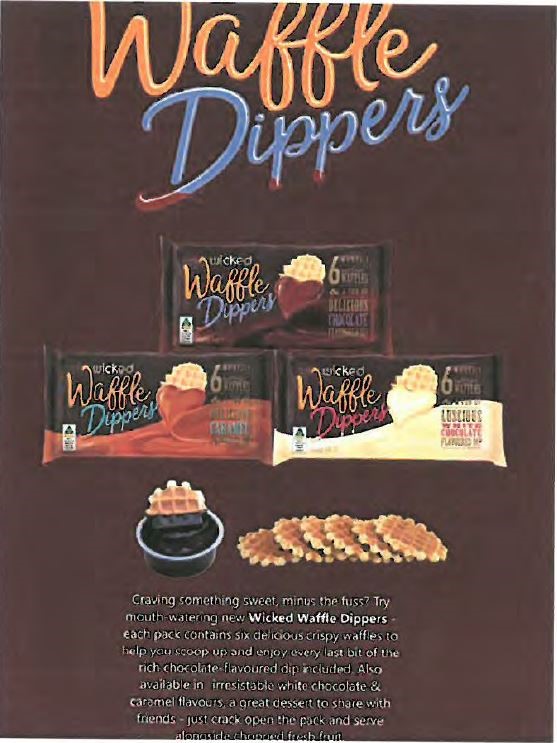
The following exchange took place between senior counsel for PDP and Mr Valentine:
Mr Hall: Yes. It’s always been either the old version or the new version, hasn’t it?
Mr Valentine: In actual sales?
Mr Hall: Yes?
Mr Valentine: That is the only - yes.
Mr Hall: And in advertising and promotion that went out to the public as well, always either the old one or the new one?
Mr Valentine: That’s right.
Mr Hall: You present yourself and your company as being in the business of supplying desserts, don’t you?
Mr Valentine: No.
Mr Hall: Don’t you?
Mr Valentine: We’re not in the dessert business.
Mr Hall: One of your companies maintains a Facebook page, doesn’t it?
Mr Valentine: I wouldn’t know. I don’t look at Facebook.
Mr Hall: You post things to Facebook yourself from time to time, don’t you?
Mr Valentine: Sorry?
222 Secondly, Mr Valentine’s cross-examination about a recipe for “creamy banana pie” which appears on the Current Wicked Website. PDP relies on the following exchange which took place between its senior counsel and Mr Valentine:
Mr Hall: And if we could move forward a little bit to page 472, you find some information about a creamy banana pie; do we have the same page?
Mr Valentine: Yes, it looks like it.
Mr Hall: And, again, it might be difficult to read but I will ask you to agree with me that to the right of the photograph under the word “Description” we find the words:
A quick easy dessert that will get any banana lover in a tizz with the full flavour and sweet textures of this fabulous dessert.
Mr Valentine: All right. Is the - is the word “dessert” referring to the pie or the - or the dip?
Mr Hall: Well, all I was getting you to agree with at the moment was that somebody who writes content for your website has chosen to use the word “dessert” twice in that sentence, haven’t they?
Mr Valentine: Correct.
Mr Hall: Because they’re presenting that pie as being something that will be consumed as a dessert?
…
Mr Hall: And in the instructions on page 474, if there was any doubt we’re told that you use the Wicked caramel dip to make the banana pie?
Mr Valentine: Correct.
Mr Hall: And the whole point, isn’t it, of this being on your Wicked Dip website is to encourage people to buy the Wicked dip caramel and to use it in this particular to make themselves a dessert?
Mr Valentine: Yes.
Mr Hall: You’re telling them that Wicked Dip caramel is a useful and essential ingredient of this particular dessert product?
Mr Valentine: It’s telling them - it’s telling the consumer how they can use the Wicked Dip product.
Mr Hall: And, really, all of the bits - remember, I showed you that page with all the photographs of it, the cheese platter and the pie and everything else?
Mr Valentine: Sorry?
Mr Hall: I took you a few moments ago to a page that had a whole series of photographs of it?
Mr Valentine: Yes.
Mr Hall: Of which the pie was one. They were all suggestions, weren’t they, of ways that people might buy and use your dips products?
Mr Valentine: I would say that’s what she has done
223 Finally PDP relies on the cross-examination of Mr Valentine in relation to the recipe for “white chocolate custard with pudding and berries” which includes, as an ingredient, the Wicked white chocolate dipping sauce. The following exchanges took place between senior counsel for PDP and Mr Valentine:
Mr Hall: And you agree with me - we can take you to the pages if you want to - that what’s being described here is a custard sauce or a - a sauce to go on the top of a pudding made by the use of a white chocolate dipping sauce?
Mr Valentine: Yes.
Mr Hall: And a pudding in this context, of course, means a dessert, doesn’t it? It means something you eat at the end of your meal, a sweet conclusion?
Mr Valentine: No. Sauce may not mean a dessert.
Mr Hall: “Pudding” in this context though, it’s not meaning a savoury pudding, is it? It’s meaning a sweet pudding?
Mr Valentine: Sorry. The?
Mr Hall: The word “pudding” when it’s used here?
Mr Valentine: Yes.
Mr Hall Means a sweet pudding, a dessert at the conclusion to a meal?
Mr Valentine: Yes. The - the pudding is not what’s in the question.
Mr Hall: No. Look, thank you, sir. What you’re saying, isn’t it, is you can make a sauce using our Wicked white chocolate dip - those words are on 485 - and pour that sauce over your choice of pudding?
Mr Valentine: It says you can use the dip on the product, yes.
224 Ultimately, Mr Valentine agreed that the dipping sauces could be used as an ingredient in various desserts or that they could be poured over the top of a dessert.
225 Insofar as David is concerned, PDP relies on his evidence that, as at 2014, the Wicked dipping sauces were used to accompany fruit, ice cream, desserts and other snacks.
226 In my opinion the evidence relied on by PDP rises no higher than a description of how the Wicked dipping sauces might be used: as a dipping sauce to accompany fruit or other sweet items or as an ingredient in a cake or sweet sauce. The dipping sauces may be part of a dessert but of themselves they are not a dessert. On the other hand, the First Alleged Same Description Goods are mostly consumed on their own.
227 The Wicked Waffle Dippers are in a different category and Grasshopper accepts that they may be consumed as a dessert.
228 The characteristics of the Infringing Products and the First Alleged Same Description Goods are also different. Mr Polly says that the Wicked Sister Products are made with premium and predominantly fresh ingredients while the Infringing Products are not made with fresh ingredients (see [126] above). They are shelf stable at ambient temperatures and, unlike the First Alleged Same Description Goods, are not dairy based, cheesecakes or sauces for rice and do not contain rice.
229 Finally, there is no evidence that the dipping sauces are substitutes for any of the First Alleged Same Description Goods. Mr Polly does not give evidence to that effect. He gives evidence about the nature of the Wicked dipping sauces and when and how they may be consumed (see [126]-[131] above) but he does not say that they are substitutable for any of the Wicked Sister Products. Nor do any of PDP’s internal documents in evidence before me nominate the Wicked dipping sauces as substitutable products. For example, Grasshopper drew my attention to the Wicked Sister Strategic Plan. It is clear from that plan that the chilled desserts category does not include dipping sauces and that neither the Infringing Products or the Wicked Business are referred to as substitutes or competitors in respect of the chilled desserts category or the identified “adjacent categories” to chilled desserts. The Quantium Reports tell a similar story. That is, they do not specify any of the Infringing Products as substitutable for any of the Wicked Sister Products.
4.2.3 The Later Registered WS Marks
230 PDP submits that each of the Later Registered WS Marks expressly includes “dipping sauces” as one of the registered goods as well as “bakery goods” and that, accordingly, there can be no doubt that the goods in question are not merely goods of the same description but that they are the same goods.
231 Grasshopper accepts that the Infringing Products fall within the “dipping sauces” category. However, it contends that the Infringing Products are not bakery goods or products because they are not made or sold in a bakery and that there is no evidence that waffles are baked.
232 In my opinion, the Infringing Products are the same goods as those in relation to which the Later Registered WS Marks are registered. First, as Grasshopper concedes, the Infringing Products fall within the “dipping sauces” category. Secondly, contrary to Grasshopper’s submission, in my opinion the Wicked Waffle Dippers fall within the category of “bakery products” given that they are a combination of waffles and dipping sauces. By way of illustration I note the following photograph taken at a Coles supermarket on 27 March 2019 and a tweet by “Wicked Dips @WickedDips” on Twitter dated 2 May 2018 which were in evidence before me:
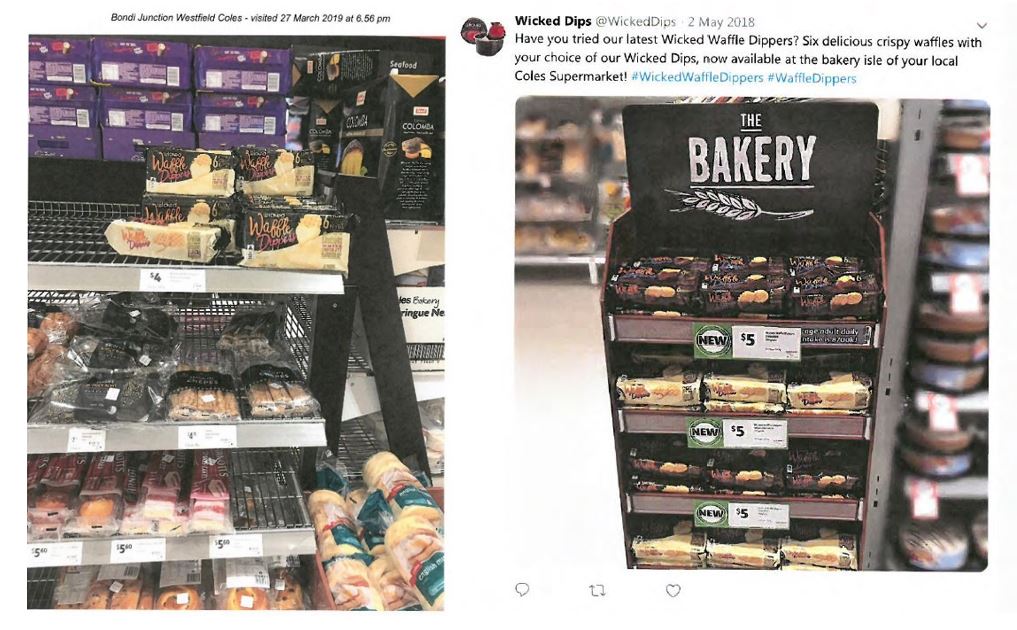
233 In light of that finding, it is not necessary for me to consider whether the Infringing Products are goods of the same description as those in relation to which the Later Registered WS Marks are registered. It is not open to the Court to find that the same goods to which the mark was applied are also goods of the same description: see Dunlop at [303].
4.3 Conclusion on common issues
234 In light of the above, in my opinion:
(1) the New Wicked Mark is not substantially identical with or deceptively similar to the Wicked Sister Marks;
(2) the Infringing Products are not the same or of the same description as the Registered First WS Goods or, more particularly, the First Alleged Same Description Goods; and
(3) the Infringing Products are the same goods as those in relation to which the Later Registered WS Marks are registered.
235 In its cross-claim, Grasshopper seeks rectification of the Register by cancellation or amendment of the registration of the Wicked Sister Marks, and their removal from the Register. At the commencement of the hearing, Grasshopper notified the Court that it did not press certain parts of its amended statement of cross-claim. I set out below a summary of the nature of the claims which are pressed by Grasshopper, noting that some of those claims no longer arise for determination given my findings in relation to substantial identity and deceptive similarity and as to whether the Infringing Products are the same or of the same description as the goods covered by the various Wicked Sister Marks.
236 Grasshopper relies on s 88(1) of the TM Act which relevantly provides that the Court may, on the application of an aggrieved person, order that the Register be rectified by, among other things, cancelling the registration of a trade mark or removing an entry wrongly made or remaining on the Register. The exercise of the power in s 88(1) is subject to s 88(2) and s 89 of the TM Act. There was no issue between the parties that Grasshopper is an aggrieved person.
237 Section 88(2) of the TM Act sets out the grounds on which an application can be made under s 88(1). Grasshopper relies on the grounds in paras (a) and (c) which respectively provide that: an application can be made on any of the grounds on which registration of the trade mark could have been opposed under the TM Act; or, because of the circumstances applying at the time when the application for rectification is filed, the use of the trade mark is likely to deceive or cause confusion. Relevantly, Grasshopper lodged its notice of cross-claim with the Court on 21 September 2018.
238 For the purposes of s 88(2)(a) of the TM Act, the grounds on which Grasshopper says it could have relied to oppose the registration of:
(1) the First WS Device Mark are those in s 44 and s 60 of the TM Act; and
(2) the Later Registered WS Marks are those in ss 44, 58 and 60 of the TM Act.
239 Sections 44(1), 58 and 60 of the TM Act provide (in all cases notes omitted):
44 Identical etc. trade marks
(1) Subject to subsections (3) and (4), an application for the registration of a trade mark (applicant’s trade mark) in respect of goods (applicant’s goods) must be rejected if:
(a) the applicant’s trade mark is substantially identical with, or deceptively similar to:
(i) a trade mark registered by another person in respect of similar goods or closely related services; or
(ii) a trade mark whose registration in respect of similar goods or closely related services is being sought by another person; and
(b) the priority date for the registration of the applicant’s trade mark in respect of the applicant’s goods is not earlier than the priority date for the registration of the other trade mark in respect of the similar goods or closely related services.
…
58 Applicant not owner of trade mark
The registration of a trade mark may be opposed on the ground that the applicant is not the owner of the trade mark.
…
60 Trade mark similar to trade mark that has acquired a reputation in Australia
The registration of a trade mark in respect of particular goods or services may be opposed on the ground that:
(a) another trade mark had, before the priority date for the registration of the first‑mentioned trade mark in respect of those goods or services, acquired a reputation in Australia; and
(b) because of the reputation of that other trade mark, the use of the first‑mentioned trade mark would be likely to deceive or cause confusion.
240 In the context of an application under s 88(1), the question of whether any of those grounds would have been available to Grasshopper to oppose the Wicked Sister Marks is to be determined as at the date of registration of each of the marks, namely 29 May 2008 for the First WS Device Mark and 9 February 2016 for the Later Registered WS Marks, which are also the priority dates: see Unilever Australia Ltd v Karounos (2001) 113 FCR 322 at [13].
241 Section 89 of the TM Act relevantly provides that:
(1) The court may decide not to grant an application for rectification made:
…
(b) on the ground that the trade mark is liable to deceive or confuse (a ground on which its registration could have been opposed, see paragraph 88(2)(a)); or
(c) on the ground referred to in paragraph 88(2)(c);
if the registered owner of the trade mark satisfies the court that the ground relied on by the applicant has not arisen through any act or fault of the registered owner.
(2) In making a decision under subsection (1), the court:
(a) must also take into account any matter that is prescribed; and
(b) may take into account any other matter that the court considers relevant.
(Note omitted.)
242 Grasshopper also relies on s 92 of the TM Act to allege that the First WS Device Mark and the Later Registered WS Marks should be removed from the Register for non-use insofar as they are registered in relation to certain goods. Section 92 relevantly provides:
(1) Subject to subsection (3), a person may apply to the Registrar to have a trade mark that is or may be registered removed from the Register.
(2) The application:
(a) must be in accordance with the regulations; and
(b) may be made in respect of any or all of the goods and/or services in respect of which the trade mark may be, or is, registered.
(3) An application may not be made to the Registrar under subsection (1) if an action concerning the trade mark is pending in a prescribed court, but the person may apply to the court for an order directing the Registrar to remove the trade mark from the Register.
(4) An application under subsection (1) or (3) (non use application) may be made on either or both of the following grounds, and on no other grounds:
(a) that, on the day on which the application for the registration of the trade mark was filed, the applicant for registration had no intention in good faith:
(i) to use the trade mark in Australia; or
(ii) to authorise the use of the trade mark in Australia; or
(iii) to assign the trade mark to a body corporate for use by the body corporate in Australia;
in relation to the goods and/or services to which the non use application relates and that the registered owner:
(iv) has not used the trade mark in Australia; or
(v) has not used the trade mark in good faith in Australia;
in relation to those goods and/or services at any time before the period of one month ending on the day on which the non use application is filed;
(b) that the trade mark has remained registered for a continuous period of 3 years ending one month before the day on which the non use application is filed, and, at no time during that period, the person who was then the registered owner:
(i) used the trade mark in Australia; or
(ii) used the trade mark in good faith in Australia;
in relation to the goods and/or services to which the application relates.
(Notes omitted.)
243 Section 100 of the TM Act concerns the burden of proof in a non-use application, shifting it to the opponent. Section 100(1) provides:
In any proceedings relating to an opposed application, it is for the opponent to rebut:
(a) any allegation made under paragraph 92(4)(a) that, on the day on which the application for the registration of the trade mark was filed, the applicant for registration had no intention in good faith:
(i) to use the trade mark in Australia; or
(ii) to authorise the use of the trade mark in Australia; or
(iii) to assign the trade mark to a body corporate for use by the body corporate in Australia;
in relation to the goods and/or services to which the opposed application relates (relevant goods and/or services); or
(b) any allegation made under paragraph 92(4)(a) that the trade mark has not, at any time before the period of one month ending on the day on which the opposed application was filed, been used, or been used in good faith, by its registered owner in relation to the relevant goods and/or services; or
(c) any allegation made under paragraph 92(4)(b) that the trade mark has not, at any time during the period of 3 years ending one month before the day on which the opposed application was filed, been used, or been used in good faith, by its registered owner in relation to the relevant goods and/or services.
Note 1: If the registered owner of the trade mark has authorised another person to use it, any authorised use of the trade mark by that person is taken to be a use of the trade mark by the registered owner (see subsection 7(3)).
Note 2: For file, month and registered owner see section 6.
244 Section 100(3) of the TM Act sets out when an allegation made under s 92(4)(b) that the trade mark has not, at any time in the relevant period, been used, or been used in good faith, by its registered owner in relation to the relevant goods and/or services is taken to be rebutted and provides as follows:
For the purposes of paragraph 1(c), the opponent is taken to have rebutted the allegation that the trade mark has not, at any time during the period referred to in that paragraph, been used, or been used in good faith, by its registered owner in relation to the relevant goods and/or services if:
(a) the opponent has established that the trade mark, or the trade mark with additions or alterations not substantially affecting its identity, was used in good faith by its registered owner in relation to those goods or services during that period; or
(b) in a case where the trade mark has been assigned but a record of the assignment has not been entered in the Register:
(i) the opponent has established that the trade mark, or the trade mark with additions or alterations not substantially affecting its identity, was used in good faith by the assignee of the trade mark in relation to those goods or services during that period and that that use was in accordance with the terms of the assignment; and
(ii) the Registrar or the court is of the opinion that it is reasonable, having regard to all the circumstances of the case, to treat the use of the trade mark by the assignee during that period as having been a use of the trade mark in relation to those goods or services by the registered owner; or
(c) the opponent has established that the trade mark was not used by its registered owner in relation to those goods and/or services during that period because of circumstances (whether affecting traders generally or only the registered owner of the trade mark) that were an obstacle to the use of the trade mark during that period.
Note 1: If the registered owner of the trade mark has authorised another person to use it, any authorised use of the trade mark by that person is taken to be a use of the trade mark by the registered owner (see subsection 7(3)).
Note 2: For registered owner see section 6.
245 Section 101 of the TM Act concerns the way in which the Registrar or the Court is to deal with an opposed application for rectification of the Register. It relevantly provides:
…
(2) Subject to subsection (3) and to section 102, if, at the end of the proceedings relating to an opposed application, the court is satisfied that the grounds on which the application was made have been established, the court may order the Registrar to remove the trade mark from the Register in respect of any or all of the goods and/or services to which the application relates.
(3) If satisfied that it is reasonable to do so, the Registrar or the court may decide that the trade mark should not be removed from the Register even if the grounds on which the application was made have been established.
(4) Without limiting the matters the Registrar may take into account in deciding under subsection (3) not to remove a trade mark from the Register, the Registrar may take into account whether the trade mark has been used by its registered owner in respect of:
(a) similar goods or closely related services; or
(b) similar services or closely related goods;
to those to which the application relates.
Note 1: If the registered owner of the trade mark has authorised another person to use it, any authorised use of the trade mark by that person is taken to be a use of the trade mark by the registered owner (see subsection 7(3)).
Note 2: For registered owner see section 6.
246 As set out above, Grasshopper alleges that the First WS Device Mark is liable to be cancelled under s 88(2)(a) of the TM Act because its registration could have been opposed under s 44 and/or s 60 of the TM Act, cancelled under s 88(2)(c) of the TM Act, and removed for non-use under s 92(4)(b) and s 101 of the TM Act.
5.2.1 Sections 44, 60 and 88(2)(c) of the TM Act
247 Grasshopper’s reliance on s 44 and s 60 as grounds on which it could have opposed the registration of the First WS Device Mark for the purposes of s 88(2)(a) and its reliance on s 88(2)(c) of the TM Act in each case as a basis upon which it seeks rectification of the Register can be disposed of shortly. That is because Grasshopper’s position is that these grounds only arise for determination if, contrary to its position, there are findings that the New Wicked Mark is substantially identical with or deceptively similar to the First WS Device Mark and that the Infringing Products are the same or of the same description as any of the Registered First WS Goods, or more particularly, the First Alleged Same Description Goods. Given my findings about these issues, summarised at [234(1)-(2)] above, it is not necessary to consider these grounds.
5.2.2 Sections 92(4)(b) and 101 of the TM Act
248 Grasshopper alleges that from 21 August 2015 to 21 August 2018 (First Non-Use Period), the three year period ending one month before the lodgement of its cross-claim with the Court, PDP Fine Foods did not use the First WS Device Mark in relation to at least the following Registered First WS Goods (First Non-Use Goods):
class 29: cheese, olives, preserved; prepared olives; processed olives; peppers (prepared); pickled peppers; food preparations with a vegetable base; food spreads consisting principally of vegetables for sandwiches; and
class 30: sauces for rice; food preparations for use as sandwich spreads.
249 In its written opening submissions, PDP accepted that there was no evidence of use of the First WS Device Mark on the First Non-Use Goods during the First Non-Use Period and that it had not rebutted the presumption in s 100(1)(c) of the TM Act. PDP went on to note that if the First Non-Use Goods were to be removed from the registration of the First WS Device Mark that would not affect the outcome of the proceeding.
250 In its oral submissions PDP changed its position to exclude “sauces for rice” from its concession. It thus contends that it has used the First WS Device Mark on “sauces for rice” in the First Non-Use Period. PDP says that there is extensive evidence of use of sauces on many differently flavoured rice puddings which, between them, demonstrate use on at least Madagascan vanilla, creamy coconut, chocolate, and apple and cinnamon flavours or variants of rice pudding. PDP relies on Trident Seafoods Corporation v Trident Foods Pty Ltd [2019] FCAFC 100 (Trident Seafoods), where, it submits, a Full Court of this Court concluded that use of the relevant trade mark on prawn flavoured noodles was a use in relation to seafood. PDP submits that, consistent with the decision in Trident Seafoods, use of the First WS Device Mark on, for example, apple and cinnamon flavoured rice puddings is a use in relation to both rice pudding and the addition that has been made, the sauce i.e. the apple and cinnamon flavouring.
251 Grasshopper submits that rice puddings do not constitute “sauces for rice” and that PDP’s initial admission in respect of “sauces for rice” reflects the common sense construction of that category.
252 PDP relies on the following evidence to establish use by it of the First WS Device Mark in relation to “sauces for rice”:
(1) the following pages from the websites for IGA Marketplace Cleveland and Romeo’s online catalogue which include Wicked Sister Creamy Coconut Rice Pudding, Wicked Sister Vanilla Bean Rice Pudding and Wicked Sister Madagascan Vanilla Rice Pudding:
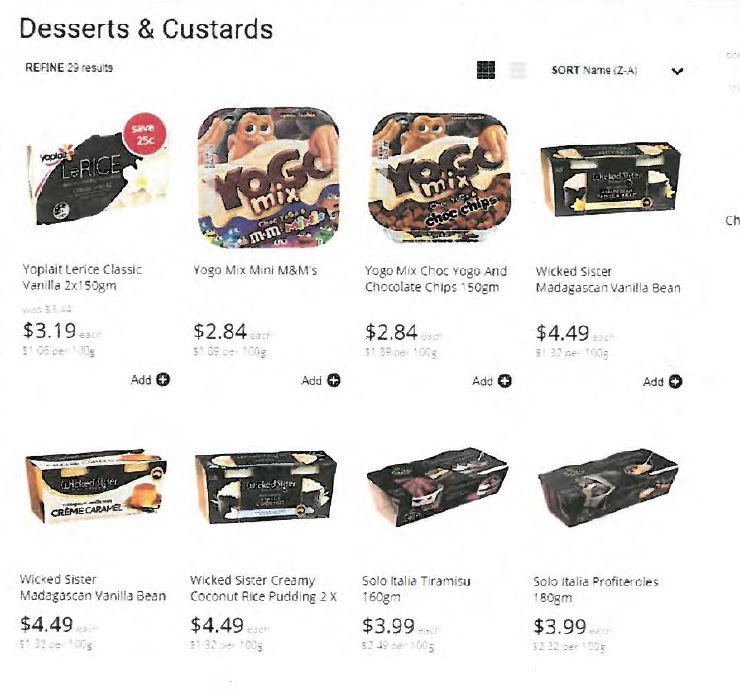
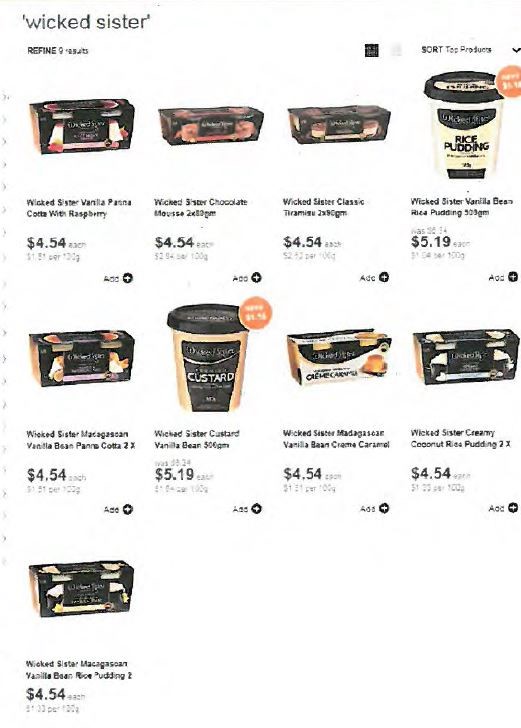
(2) the following pages from the Wicked Sister website which include Wicked Sister Rice Pudding Apple and Cinnamon and Wicked Sister Rice Pudding Creamy Coconut:
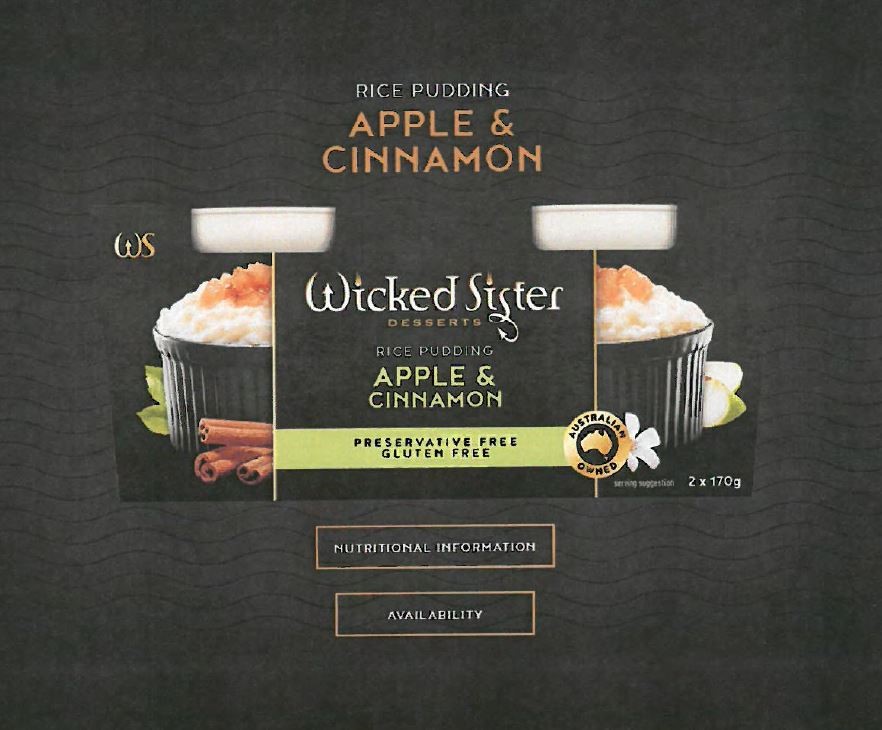
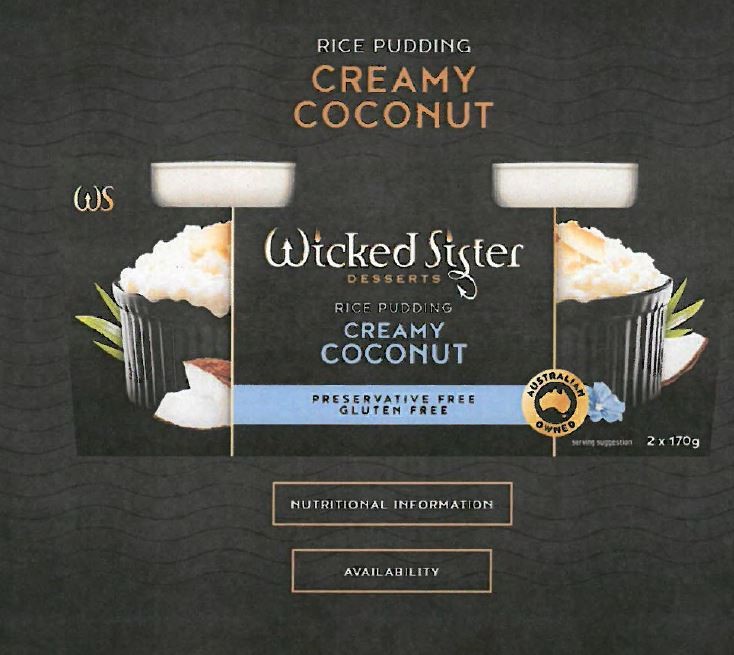
253 That evidence does no more than to show the different flavoured rice puddings offered for sale under the First WS Device Mark. There is no reference in the description of the product to a sauce and I would not infer or find that, because a dessert is made of rice and is of a particular flavour, the added flavour constitutes a “sauce for rice”. To adopt the oral submission made by PDP, it “sells rice pudding with flavourings”. A rice pudding, whether flavoured or not, is not a “sauce for rice”.
254 Contrary to PDP’s submission, no analogy can be drawn with the decision in Trident Seafoods. Before explaining why that is so, it is convenient to set out a summary of the facts of that case.
255 Trident Foods Pty Ltd, the respondent, was the owner of two trade marks: the first mark for the word “TRIDENT” which was registered on 15 March 1973 for specified goods in class 29 being fish and fish products; and the second mark, also for the word “TRIDENT”, which was registered on 8 December 1983 for specified goods in class 29 being meat, fish, poultry and game, including sardines, mackerel, pilchards, crab, oysters, mussels, and prawns, meat extracts, preserved, dried and cooked fruits and vegetables, jellies, jams, eggs, preservatives and pickles. Since about 2000 all sales of foods under the two marks had been by Manassen Foods Australia Pty Ltd of which Trident Foods was a wholly owned subsidiary.
256 On 7 February 2014 Trident Seafoods Corporation, the appellant, applied under s 92(4)(b) of the TM Act to have Trident Foods’ marks removed from the Register for non-use. That application was prompted by its own application for registration of the Trident Seafoods logo for specified goods in class 29 being seafood, processed seafood, edible oils, edible fish oils, nutritional oils for food purposes, edible oils and edible fish oils for use as ingredients in foods and beverages. Registration of Trident Seafoods’ application was blocked by Trident Foods’ marks and another mark owned by Trident Foods for the word “TRIDENT” for specified goods in class 31 being grains not included in other classes, living animals, fresh fruits and vegetables, seeds, live plants and flowers, and malt.
257 Trident Seafoods failed before the delegate of the Registrar who, although satisfied that Trident Foods’ marks had not been used in the relevant period, concluded that it was appropriate to exercise the discretion under s 101(3) of the TM Act not to remove them from the Register. The primary judge also found that Trident Foods had not used the marks in Australia in the relevant period and was not satisfied that the evidence established that Manassen’s use of the marks was under the control of Trident Foods. However, the primary judge then considered s 101(3) of the TM Act and exercised her discretion in favour of Trident Foods, determining that the two marks should not be removed from the Register.
258 On appeal, one of the issues to be determined was whether the primary judge’s exercise of the discretion in s 101(3) of the TM Act had miscarried. A Full Court of this Court (Reeves, Jagot and Rangiah JJ) found that it had not. While it was then not necessary to do so, the Full Court proceeded to consider Trident Foods’ notice of contention which challenged the primary judge’s finding that Trident Foods had not used the relevant mark in the non-use period. In doing so, one of the issues the Full Court considered, albeit briefly, was whether the product, Tom Yum Goong Flavour Thai Noodle Soup, involved the use of the relevant mark within the relevant period.
259 At [13] the Full Court noted that the primary judge had rejected a submission that application of the marks to a good containing an ingredient within the scope of the registrations is or might be use of the marks in relation to the ingredient saying that “the application of a trade mark to a particular food product is a use of the trade mark in relation to those goods only, and generally not to the ingredients from which the goods are made”. On that basis the primary judge rejected Trident Foods’ contention that Tom Yum Goong Flavour Thai Noodle Soup fell within the meaning of fish product for the relevant mark, despite its label stating that the product contains crustacean and fish and the oil sachet stating that it contains fish sauce and dried shrimp. In addressing that issue the Full Court relevantly said (at [55]):
As “fish” includes crustaceans such as prawns and the Thai word for “prawn” appears on the name of the product, we agree that the requirements for use during the relevant period have been satisfied. The same conclusion must apply to the product Fish Stir Fry Sauce as there was evidence of use of that product within the relevant period.
260 Here it cannot be said that one of the ingredients in the Wicked Sister rice puddings is a “sauce for rice”. PDP does not point to any particular ingredient which would meet that description. PDP relies only on a bald assertion that the fact that the rice puddings are flavoured means that they must include, I infer as an ingredient, a “sauce for rice”. PDP can draw no comfort from the decision in Trident Seafoods.
261 It follows that PDP has failed to establish use of the First WS Device Mark in respect of “sauces for rice”.
5.2.2.2 Should the First WS Device Mark be removed from the Register in respect of the First Non-Use Goods?
262 Despite the establishment of the grounds for removal of the First WS Device Mark from the Register insofar as it is registered for the First Non-Use Goods, the Court retains a discretion under s 101(3) of the TM Act not to make an order for removal if it is “satisfied that it is reasonable to do so”.
263 In Austin Nichols & Company Inc v Lodestar Anstalt (No 1) (2012) 202 FCR 490 (Austin Nichols) at [28] a Full Court of this Court (Jacobson, Yates and Katzmann JJ) relevantly said the following about the test to be applied in determining whether it is reasonable not to remove a trade mark:
The question to be asked is whether it was reasonable not to remove the trade mark from the Register, although the trade mark had not been used during the statutory period. As the High Court said in a different context, “no paraphrase of the expression can be adopted as a sufficient explanation of its operation, let alone definition of its content”: Spencer v Commonwealth (2010) 241 CLR 118 at [58]. In the present context Lander J emphasised the danger of adopting statements of principle made about the exercise of a discretion in a section of an Act which is not in the same form as the section under consideration: Kowa Company Ltd v NV Organon (2005) 223 ALR 27 (Kowa) at [97]. On a fair reading of his Honour’s reasons, we are satisfied that he was well aware of the statutory test. Despite his opening remark, his Honour later (at [154]) correctly noted that the discretion is to be exercised “when it is reasonable to do so”.
264 At [35] their Honours noted that the discretion to be exercised under s 101(3) of the TM Act is a broad one, limited only by the subject matter, scope and purpose of the legislation and, in particular, by the subject matter, scope and purpose of Pt 9 of the TM Act. In that regard their Honours said (at [38]):
The purpose of Part 9 is to provide for the removal of unused trade marks from the Register. In that regard it is plainly designed to protect the integrity of the Register, and in this way, the interests of the consumer. At the same time, however, it seeks to accommodate, where reasonable, the interests of the registered trade mark owners. Otherwise, there would be no need for the discretion. …
265 It has been recognised that there is a public interest in the integrity of the Register as an accurate record of trade marks which perform their statutory function, namely to indicate the trade origins of the goods to which it is intended that they be applied: see Health World Ltd v Shin-Sun Australia Pty Ltd (2010) 240 CLR 590 (Health World) at [22].
266 In Austin Nichols, the Full Court also observed (at [31]) that the question of whether removal of the mark would lead to deception or confusion is a relevant consideration in the exercise of the discretion and (at [41]) that use of the trade mark after the end of the non-use period is a relevant consideration provided that the use is in good faith and not colourable.
267 PDP submits that the Court should exercise its discretion for reasons including those set out in s 101(4) of the TM Act, namely that it has used the First WS Device Mark in respect of similar goods to the First Non-Use Goods. It also submits that, despite not having made any use of the First Non-Use Goods, on its case, other than “sauces for rice”, in the past three years, it intends to use the First WS Device Mark on those goods in the future.
268 The former submission was not developed and there was no evidence before me which would lead me to conclude that PDP uses the First WS Device Mark on goods that are similar to the First Non-Use Goods. The First Non-Use Goods are largely savoury in nature or vegetable based. It is difficult to see how the Wicked Sister Products can be said to be similar.
269 In support of the latter submission PDP relies generally on the Wicked Sister Strategic Plan but did not take me to any particular part of that plan. On my own review of the Wicked Sister Strategic Plan, I could see nothing to support the contention that there is an intention to expand into, and thus use, the First WS Device Mark on any of the First Non-Use Goods.
270 In my opinion, there is nothing before me that establishes, or indeed even suggests, that it would be reasonable not to remove the First WS Device Mark from the Register insofar as it is registered for the First Non-Use Goods. Wicked Sister has not used the First WS Device Mark in relation to those or similar goods in the relevant three year period and there is, on the evidence before me, no intention to use the First WS Device Mark in relation to such goods. On the other hand, the integrity of the Register should be maintained.
271 In the circumstances I am satisfied that an order should be made removing the First WS Device Mark from the Register in relation to the First Non-Use Goods.
5.3 The Later Registered WS Marks
272 The Later Registered WS Marks can, for the most part, be addressed together, given their common priority date of 9 February 2016.
273 Grasshopper alleges that each of the Later Registered WS Marks is liable to be cancelled under s 88(2)(a) of the TM Act because their registrations could have been opposed under ss 44, 58 or 60 of the TM Act, cancelled under s 88(2)(c) of the TM Act, and removed for non-use under s 92(4)(a) and s 101 of the TM Act. I consider each of those claims in turn below.
5.3.1 Section 44 of the TM Act
274 Grasshopper puts its argument based on s 44 of the TM Act in two ways.
275 The first can be put to one side because it only arises if there is a finding that the New Wicked Mark is substantially identical with or deceptively similar to either the Second WS Device Mark or the WS Word Mark. Given my findings that that is not so (see [165]-[207] above), Grasshopper’s reliance on s 44 of the TM Act on that basis does not arise for consideration.
276 The second argument put by Grasshopper relying on s 44 of the TM Act as a ground on which it could have opposed registration of the Later Registered WS Marks is not dependent on any anterior finding and does arise for consideration. Grasshopper relies on the First WS Device Mark as a “trade mark registered by another person”, namely PDP Fine Foods, with an earlier priority date. Grasshopper contends that:
(1) it is not in dispute that the Later Registered WS Marks are substantially identical with or deceptively similar to the First WS Device Mark;
(2) it follows that the Later Registered WS Marks could have been opposed under s 44 of the TM Act for those of the Later Registered WS Goods that are similar to the Registered First WS Goods; and
(3) according to PDP, the Later Registered WS Goods that are similar to the Registered First WS Goods are:
(a) based on PDP’s admission, all of the Later Registered WS Goods other than dipping sauces; and
(b) if, contrary to Grasshopper’s position, the Court concludes that the Wicked dipping sauces are similar to any of the Registered First WS Goods then the dipping sauces would necessarily be similar to those of the Later Registered WS Goods. I pause to note that I have found that the Wicked dipping sauces are not similar to any of the Registered First WS Goods (see [218]-[229] above).
277 In response to Grasshopper’s claim that the registration of the Later Registered WS Marks could have been opposed under s 44 of the TM Act on this basis, PDP relies on s 44(3)(b) of the TM Act. PDP submits that, in the circumstances, it is not clear why Grasshopper raises the allegation that s 44 is an available ground under s 88(2) of the TM Act or how Grasshopper hopes to persuade the Court not to exercise the discretion in s 88(1) of the TM Act and to proceed to cancel the registration of either of the Later Registered WS Marks relying on s 44 of the TM Act.
278 Insofar as PDP relies on s 44(3)(b) of the TM Act, Grasshopper notes that the Wicked Sister Marks were registered in the names of different entities in order to avoid PDP Fine Foods having to pay any capital gains tax which might arise by reason of the assignment of the First WS Device Mark to PDP Capital. Grasshopper submits that those circumstances do not make it “proper” for the Registrar to have accepted the registration of the Later Registered WS Marks, which fall foul of s 44(1) of the TM Act.
279 Grasshopper contends that PDP cannot rely on s 44(3)(b) of the TM Act as a result of the Letter of Consent (see [88] above) and says that neither the Court nor the Registrar would likely give their respective imprimatur to an asset strategy designed to minimise tax, especially where that strategy interferes with the public interest in the “integrity” and “purity” of the Register. Grasshopper submits that having dual registrations in different names is contrary to the “information function” of the Register and that registration of the same mark in respect of the same categories by common entities is inconsistent with the exclusive right conferred on the registered owner of a trade mark by s 20(1)(a) of the TM Act.
280 Before proceeding further it is convenient to summarise the facts as set out at [8]-[10] and [87]-[90] above in relation to the ownership and use of the Wicked Sister Marks. Relevantly:
(1) the First WS Device Mark has been registered in PDP Fine Foods’ name since 29 May 2008. At all material times the packaging bearing, among others, the words “Wicked Sister” has referred only to PDP Fine Foods;
(2) the Later Registered WS Marks have a priority date of 9 February 2016. They were registered in the name of PDP Capital as part of an asset protection strategy to protect the intellectual property from commercial trading risks and to provide a vehicle whereby that intellectual property could be licensed to third parties;
(3) by the Letter of Consent, which is dated 13 June 2017, PDP Fine Foods consented to the “use and restriction” of the Later Registered WS Marks by PDP Capital in relation to the Later Registered WS Goods;
(4) the First WS Device Mark was not assigned to PDP Capital because of “potential capital gains tax implications”; and
(5) PDP Capital has licensed the use of the Later Registered WS Marks to PDP Fine Foods.
281 As set out at [239] above, s 44(1) of the TM Act relevantly provides that subject to subs (3) and (4), an application for the registration of a trade mark in respect of goods must be rejected if the mark is substantially identical with or deceptively similar to a trade mark registered by another person in respect of similar goods and the priority date for the applicant’s trade mark in respect of the applicant’s goods is not earlier than the priority date for the registration of the other trade mark in respect of the similar goods.
282 Section 44(3)(b) of the TM Act provides:
(3) If the Registrar in either case is satisfied:
…
(b) that, because of other circumstances, it is proper to do so;
the Registrar may accept the application for the registration of the applicant’s trade mark subject to any conditions or limitations that the Registrar thinks fit to impose. If the applicant’s trade mark has been used only in a particular area, the limitations may include that the use of the trade mark is to be restricted to that particular area.
283 PDP Capital’s trade marks, that is the Later Registered WS Marks, are substantially identical with or deceptively similar to a trade mark registered by another person, the First WS Device Mark registered by PDP Fine Foods, in relation to similar goods.
284 In relation to the Second WS Device Mark, PDP:
(1) admits that it is substantially identical with or deceptively similar to the First WS Device Mark; and
(2) denies that, with the exception of dipping sauces, the goods for which the Second WS Device Mark is registered are similar goods to those for which the First WS Device Mark is registered.
285 In relation to the WS Word Mark, PDP:
(1) admits that it is deceptively similar to the First WS Device Mark; and
(2) admits that the goods for which the WS Word Mark is registered are similar goods to those for which the First WS Device Mark is registered and says that dipping sauces are also similar goods to those for which the First WS Device Mark is registered.
286 That all of the Later Registered WS Goods other than dipping sauces are similar to the Registered First WS Goods cannot be disputed given: first, the two sets of goods are identical, save for the addition of dipping sauces in the Later Registered WS Goods; and secondly, the definition of “similar goods” in the TM Act. As to that, s 14(1) of the TM Act provides:
(1) For the purposes of this Act, goods are similar to other goods:
(a) if they are the same as the other goods; or
(b) if they are of the same description as that of the other goods.
287 It follows from the matters set out above that PDP Capital’s applications for registration of the Later Registered WS Marks would prima facie be rejected under s 44(1) of the TM Act.
288 However, the certificates of registration for the Second WS Device Mark and the WS Word Mark each include the following endorsement:
Provisions of paragraph 44(3)(b) and/or Reg 4.15A(3)(b) applied.
PDP relies on the Letter of Consent which was provided to the Registrar by PDP Fine Foods in support of PDP Capital’s application for registration of the Later Registered WS Marks and s 44(3)(b) of the TM Act.
289 In McCormick at [30] Kenny J said the following about s 44(3), albeit in the context of considering a submission that, despite the fact that s 44(1) was satisfied, the respondent was nonetheless entitled to registration of her marks because of s 44(3)(a) of the TM Act and thus her “honest concurrent use” of those marks:
Section 44(3) gives the Registrar a discretion to accept an application that would otherwise be rejected under s 44(1) in the case of honest concurrent use or other circumstances making it proper to do so. The authorities establish that the principal criteria for determining whether registration should be permitted pursuant to s 44(3) include:
(1) the honesty of the concurrent use;
(2) the extent of the use in terms of time, geographic area and volume of sales;
(3) the degree of confusion likely to ensue between the marks in question;
(4) whether any instances of confusion have been proved; and
(5) the relevant inconvenience that would ensue to the parties if registration were to be permitted.
See In Re Alex Pirie & Sons Ltd’s Application (1932) 49 RPC 195; (1933) 50 RPC 147 at 159-160; In Re John Fitton & Co Ltd’s Application (1949) 66 RPC 110 at 112; and Stingray Surf Co Pty Ltd v Lister (1997) 37 IPR 306 at 310-311. These factors are not necessarily exhaustive of the matters to be considered, but they are a useful guide: see In Re Electrix Ltd’s Application [1957] RPC 369 at 379.
290 As observed by Grasshopper there have only been a handful of cases which have considered the application of s 44(3)(b) of the TM Act and none which has considered the same, or an analogous, fact situation to that which arises in this case. Indeed, I was not taken to any case which had considered the application of s 44(3)(b) of the TM Act in this or any other context by either party. Two cases in which this Court has considered the application of s 44(3)(b) of the TM Act are set out below.
291 In Trident Seafoods there was also an application for an extension of time and leave to appeal before the Full Court against the orders of the primary judge, among other things, allowing Trident Seafoods’ appeal from the decision of the delegate of the Registrar in relation to Trident Foods’ application made on 18 July 2014 for the word “TRIDENT” for certain goods within classes 29 and 30 (Trident Foods’ 2014 Application).
292 At [66] the Full Court noted that the primary judge had already decided that the first and second marks owned by Trident Foods should not be removed from the Register. Thus those marks would remain and would block the registration of the Trident Seafoods mark. As a result their Honours observed that, while s 44(1)(a)(ii) of the TM Act was engaged by Trident Foods’ 2014 Application, Trident Seafoods’ application could not proceed to registration because of the earlier registered TRIDENT marks owned by Trident Foods.
293 At [67] the Full Court noted that one of the relevant issues identified by the primary judge was whether the Registrar should accept Trident Foods’ 2014 Application for registration on the basis of “other circumstances”, by reason of which it is “proper” to accept the application for registration pursuant to s 44(3)(b) of the TM Act. The primary judge had declined to do so. At [72] the Full Court set out what the primary judge had said in relation to that issue as follows:
216 Following the approach of Lander J in Hills Industries [Hills Industries Ltd v Bitek Pty Ltd [2011] FCA 94; (2011) 214 FCR 396], and considering the position as at the priority date (18 July 2014), in my view, the first matter raised by Trident Foods is a relevant circumstance that makes it proper that the discretion in s 44(3) should be exercised. That is, the Trident Seafoods TM application was only at application stage, and was prevented from proceeding to registration by the presence of Trident Foods’ trade marks (being the marks the subject of the first appeal). I accept that it is a relevant other circumstance, that existed as at the priority date, that the Trident Foods TM application should not be prevented from proceeding to registration by a mark that might never achieve registration and which had not been used in Australia.
217 However, that circumstance must be considered in the context of the fact that, in the absence of a licence agreement, Trident Foods was not using the “TRIDENT” trade mark as at the priority date and had not authorised any such use. Rather, the mark was being used by Manassen, albeit with the acquiescence of Trident Foods. The use or intended use of the trade mark, or the authorisation or intended authorisation of such use is a precondition to the right to apply for registration by s 27 of the Act. In my view, it would not be appropriate to exercise the discretion under s 44(3)(b) whether [sic] that precondition had not been satisfied.
294 In considering the proposed ground of appeal in relation to the primary judge’s findings about the application of s 44(3)(b) of the TM Act, the Full Court noted (at [75]) that the primary judge had proceeded on the basis that the discretion was to be exercised having regard to the fact that Trident Foods was not using the first and second marks, but that the use was by Manassen other than as an authorised user, and thereby, Trident Foods did not intend to use the mark the subject of Trident Foods’ 2014 Application. Their Honours disagreed with the primary judge’s conclusion that Manassen was not an authorised user of the first and second marks. For that reason it followed that the primary judge’s exercise of the discretion under s 44(3)(b) of the TM Act miscarried.
295 The Full Court then turned to consider the exercise of the discretion in s 44(3)(b) of the TM Act noting (at [82]) that there were, in the Court’s view, “compelling reasons why it should be concluded that because of other circumstances, it is proper that the mark the subject of [Trident Foods’ 2014 Application] should proceed to registration”. Their Honours continued as follows (at [82]-[83]):
82 … As we have said, the barrier to registration is Trident Seafoods’ application for a mark which cannot proceed to registration. In and of itself, that fact is a circumstance which makes it proper for the Trident Foods’ application to proceed to registration of the TRIDENT mark on the goods specified in the application.
83 Apart from this, we agree with Trident Foods’ submission that, contrary to the approach of the primary judge, the better view is that s 44(3)(b) involves an exercise of discretion in the circumstances as they exist at the time the discretion is exercised rather than as at the priority date of the application. While a different view was expressed in Hills Industries Limited v Bitek Pty Ltd [2011] FCA 94; (2011) 214 FCR 396 at [177] to [178], no relevant distinction can or should be drawn between the discretions in s 44(3)(b) and s 101(3) in this regard. In Austin Nichols at [41] the Full Court said that the discretion in s 101(3) should be exercised having regard to the circumstances which apply at the time the discretion is exercised. Section 44(3)(b) calls for the same approach.
296 In reaching that view the Full Court (at [85]) also accepted Trident Foods’ submissions made to the primary judge in support of its trade mark proceeding to registration.
297 In Singtel Optus Pty Limited v Optum Inc [2018] FCA 575 one of the issues raised for determination was whether there were other circumstances which made it proper to permit registration of either of the respondent’s, Optum’s, two marks pursuant to s 44(3)(b) of the TM Act. While, because of the circumstances of that case the Court was not required to determine that issue, Davies J said, had it been necessary to do so, she would have been satisfied that there were other circumstances which made it proper to accept Optum’s application for registration in respect of its designated services. Her Honour’s reasons for reaching that view were as follows (at [192]-[194]):
(1) the marks in question use the company’s name and all of Optum’s business activities in Australia are under the Optum name and trade mark;
(2) whilst Optum had not started to use the marks in Australia in 2011, the evidence showed that the OPTUM mark was first registered as a trade mark in the United States of America in 1993 and by 2011 the Optum brand name had been used extensively overseas in relation to services in the healthcare industry. Her Honour observed that it could reasonably be concluded that it would cause substantial prejudice to Optum if it was unable to use its marks in Australia; and
(3) given that Optum had not started to use the marks in Australia in 2011 and only commenced in 2014, if only the circumstances as at 2011 were considered, it could not be said one way or the other that the co-existence of the marks would cause actual confusion or prejudice to the applicant, Singtel. Her Honour said that that consideration weighed in favour of Optum in view of its previous and well-known use of the Optum brand name. Her Honour said that, whilst it had been held that post priority date matters are not relevant, she was nonetheless “fortified in [her] view that it would be appropriate to exercise the power under s 44(3) in Optum’s favour by the fact that in the present case, there is no evidence that the co-existence of the marks has caused actual confusion or caused Singtel any prejudice or harm since Optum started using the OPTUM marks in Australia”.
298 I turn then to consider the facts before me.
299 The evidence establishes that the reason why PDP Capital applied for registration of the Later Registered WS Marks in its name was because of unexplained capital gains tax consequences which PDP considered would arise on an assignment of the First WS Device Mark. I pause here to note that that rationale could only apply vis a vis the First WS Device Mark and the Second WS Device Mark. No issue would arise in relation to assignment of the WS Word Mark as the first application for its registration was made by PDP Capital on 9 February 2016.
300 Notwithstanding that reason, in my opinion, for the following reasons it is appropriate to exercise the power under s 44(3) of the TM Act in relation to PDP Capital’s applications for registration of the Later Registered WS Marks:
(1) PDP Fine Foods has been the owner of the First WS Device Mark since 2008 and has used it since that time in relation to its business;
(2) Mr Polly is the sole director of PDP Fine Foods and PDP Capital, Mr Polly holds half of the issued shares in PDP Fine Foods, and PDP Property Holdings Pty Ltd holds all of the issued shares in PDP Capital. There is a commonality of management between PDP Fine Foods and PDP Capital and it seems, despite the different shareholders, that they are part of the same group or family of companies;
(3) since 11 February 2016, PDP Capital has granted PDP Fine Foods a non-exclusive licence to use the Later Registered WS Marks. As held by the Court in Trident Seafoods, s 44(3)(b) of the TM Act permits regard to be had to use after the priority date. It is apparent that, in accordance with the licence granted by PDP Capital, the Later Registered WS Marks have been used on at least some of the Later Registered WS Goods after the priority date;
(4) by the Letter of Consent PDP Fine Foods, the owner of the First WS Device Mark, which is deceptively similar to the Later Registered WS Marks, consents to the “use and restriction” by PDP Capital of the Later Registered WS Marks; and
(5) while, as Grasshopper contends, the scheme of the TM Act “reveals a concern with the condition of the Register” that it have “integrity” and that it be “pure”, permitting the applications for the Later Registered WS Marks to be accepted does not offend against that integrity or purity. The ownership of the similar marks is in the same family of companies and all of the marks are used in the same business operated by PDP Fine Foods. The “integrity” of the Register referred to in Health World at [22] is as to the maintenance of its integrity “against any apparent condonation of misleading or deceptive practices which may arise from the use of registered marks”: see Campomar Sociedad, Limitada v Nike International Limited (2000) 202 CLR 45 (Campomar) at [40]. That PDP Capital was the applicant for the registration of the Later Registered WS Marks as a means to minimise capital gains tax implications, although not something that should be condoned, of itself does not, in the sense envisaged by the policy behind the legislation, affect the integrity of the Register.
301 A final and seemingly independent matter raised by Grasshopper as a reason why the discretion under s 44(3)(b) of the TM Act would not be exercised in favour of PDP Capital is that dual registrations in different names are contrary to the information function of the Register, citing Lodestar Anstalt v Campari America LLC (2016) 244 FCR 557 (Lodestar v Campari) at [71].
302 Section 20 of the TM Act provides that:
(1) If a trade mark is registered, the registered owner of the trade mark has, subject to this Part, the exclusive rights:
(a) to use the trade mark; and
(b) to authorise other persons to use the trade mark;
in relation to the goods and/or services in respect of which the trade mark is registered.
(Notes omitted.)
303 Grasshopper relies, in particular, on s 20(1)(a) of the TM Act to submit that dual registrations are inconsistent with the bundle of rights that registration provides and that the exclusive right to use the trade mark conferred by s 20(1)(a) is a negative right to exclude others from using it, citing JT International SA v Commonwealth of Australia; British American Tobacco Australasia Limited v Commonwealth of Australia (2012) 250 CLR 1 at [248].
304 This submission was not the subject of response by PDP and was not developed by Grasshopper in oral submissions. As I understand it Grasshopper says that, because both PDP Fine Foods and PDP Capital are the registered owners of marks that are similar, if a member of the public inspected the Register to identify the owner of the WS Device Marks they would not be able to identify the true owner because the First WS Device Mark and the Second WS Device Mark, which are the same, have different owners.
305 In Lodestar v Campari at [71] Besanko J quoted from the decision in McGregor Trade Mark [1979] RPC 36 at 52-53 where Whitford J considered the question of control in the context of registered user provisions in the Trade Marks Act 1938 (UK). That is not the issue raised here. Grasshopper refers to the following part of the extract from McGregor Trade Mark at 52-53 (emphasis added to identify parts on which Grasshopper particularly relies):
Registered trade marks, as is the case with trade marks at common law, serve to protect what may be a very valuable goodwill built up by some commercial enterprise. They also, however, serve as an indication to the public of the origin of the goods. If one buys a dressing gown bearing the trade mark “McGregor”, one may never know and may not even be concerned to enquire who in fact made the dressing gown in question; but if one buys a dressing gown and finds it satisfactory one would feel, if one were buying another dressing gown bearing the same brand name at a later stage, that one could reasonably expect it to be of a similar quality to the first dressing gown. In the same way, it is customary for people to make recommendations to their friends by reference to brand names for goods; and, upon a recommendation being made, the purchase is carried out in the confidence that the article purchased will be of a similar quality to that sold to the friend making the original recommendation.
It is for this reason that a bare licence under a trade mark has never been countenanced. A registered usership is accepted because in one way or another, by reason of financial control or express provisions in an agreement, a registered user is going to be subject to the control of the registered proprietor so far as the quality of the article made by the registered user is concerned. In this way, even if two persons are using a mark-the registered proprietor and the registered user-there is only one source controlling the question of quality; and if a member of the public were interested to find out who bore the ultimate responsibility for the quality of the goods, he or she would be able to do so by inspecting the relevant entries on the register.
306 In this case an inspection of the Register by a member of the public would result in identification of PDP Fine Foods and PDP Capital as the owners of the First WS Device Mark and the Second WS Device Mark respectively. But it does not necessarily follow that a member of the public would not be able to discern who bore the ultimate responsibility for the quality of the goods. A simple inquiry of two companies with similar names would provide an answer, particularly given that PDP Fine Foods has a licence to use the Second WS Device Mark. In any event, in my opinion, neither this nor the fact that s 20(1) gives an exclusive right to use or authorise use of the trade marks once registered would be a reason to refuse to exercise the discretion in s 44(3)(b) of the TM Act.
5.3.2 Section 58 of the TM Act
307 As set out at [239] above, s 58 of the TM Act provides that registration of a trade mark may be opposed on the ground that the applicant is not the owner of the mark. The term “applicant” is defined in s 6 of the TM Act to mean, in relation to an application, “the person in whose name the application is for the time being proceeding”.
308 Section 27(1) of the TM Act sets out who may make an application for registration of a trade mark and provides:
(1) A person may apply for the registration of a trade mark in respect of goods and/or services if:
(a) the person claims to be the owner of the trade mark; and
(b) one of the following applies:
(i) the person is using or intends to use the trade mark in relation to the goods and/or services;
(ii) the person has authorised or intends to authorise another person to use the trade mark in relation to the goods and/or services;
(iii) the person intends to assign the trade mark to a body corporate that is about to be constituted with a view to the use by the body corporate of the trade mark in relation to the goods and/or services.
(Note omitted.)
309 In Pham Global Pty Ltd v Insight Clinical Imaging Pty Ltd (2017) 251 FCR 379 (Pham Global) at [50] a Full Court of this Court (Greenwood, Jagot and Beach JJ) said the following about the principles applicable to s 58 of the TM Act:
50 It is not in dispute that the primary judge correctly identified the applicable principles, noting the following:
13 It was common ground that to succeed on the ground of opposition under s 58 of the Trade Marks Act, Insight Clinical Imaging must establish that:
(a) the IR composite mark is identical or substantially identical to the ICI composite mark: Carnival Cruise Lines Inc v Sitmar Cruises Limited (1994) 120 ALR 495;
(b) the ICI composite mark has been used in respect of goods or services as “the same kind of thing” as the IR composite mark: Re Hicks’ Trade Mark (1897) 22 VLR 636 at 640; and
(c) it had the earlier claim to ownership based on its use of the ICI composite mark before the filing of the IR composite mark application or any use of the IR composite mark by Insight Radiology: Settef SpA v Riv-Oland Marble Co (Vic) Pty Ltd 10 IPR 402 at 413.
…
310 Grasshopper addresses each of the Later Registered WS Marks separately in relation to s 58 of the TM Act. I will do the same.
5.3.2.1 The Second WS Device Mark
311 It is not in dispute that when filing the application for registration of the First WS Device Mark PDP Fine Foods claimed to be the owner of that mark pursuant to s 27(1)(a) of the TM Act, that the First WS Device Mark is the same or substantially identical with the Second WS Device Mark or that by the Letter of Consent PDP Fine Foods consented to the “use and restriction” of the Second WS Device Mark by PDP Capital in respect of the Later Registered WS Goods.
312 Grasshopper contends that as at the priority date PDP Fine Foods, as the owner of the First WS Device Mark, was the owner of  (which Grasshopper refers to as the WSFF Device Mark and which is the form of the WS Device Marks, putting to one side the red colour of the First WS Device Mark) for the Registered First WS Goods, including for the Common Categories, being those goods which are common to the Registered First WS Goods and the Later Registered WS Goods. The Common Categories are:
in class 29, desserts made from yoghurt, fruit flavoured yoghurts, low fat yoghurts, yoghurt desserts, and yoghurts containing pulped fruits; and
in class 30, creamed rice, rice puddings and rice tapioca.
313 Grasshopper says that it follows that the registration of the Second WS Device Mark ought not to have been permitted in respect of the Common Categories because PDP Fine Foods, not PDP Capital, was the owner in relation to those Common Categories.
314 In its written opening submissions in response on the cross-claim, PDP submits that there is no suggestion that there is not the requisite nexus of control between PDP Capital and PDP Fine Foods. It contends that there is, in fact, express control in the form of the PDP Licence Agreement and that there is also the type of “actual control” and “unity of purpose” between entities with a common director and controlling mind, which was recognised in Trident Seafoods.
315 Grasshopper submits that whether or not there is “actual control” or “unity of purpose” between PDP Capital and PDP Fine Foods is beside the point under s 58 and that there is no “control” or “authorised use” exception to the application of s 58 of the TM Act. Contrary to PDP’s submissions, Grasshopper contends that the outcome in this case does not involve “expanding” s 58 of the TM Act but that it is a conventional application of its operation. It says that PDP’s submission, in which it distinguishes the facts in Pham Global, is a straw man argument and that the outcome in this case does not turn on the facts in Pham Global.
316 PDP also submits, again in its written opening submissions in response on the cross-claim, that if Pham Global was expanded in the manner suggested by Grasshopper it would produce, in every instance, a commercially absurd scenario where a group of closely related corporate entities with unity of controlling minds and purpose that determine to utilise a common intellectual property holding entity or to register additional marks in relation to new or additional goods and services that are “the same kind of thing” would always be faced with a “catch 22” in which the only options are:
(1) not to renew existing registrations and wait for them to be removed from the Register;
(2) cancel any existing registration; or
(3) assign any existing registrations to the relevant entity and suffer any capital gains tax consequences,
before applying for any future registrations.
317 PDP submits that, by adopting Grasshopper’s interpretation, the situation in the case of the scenarios at [316(1)-(2)] above could never be fully cured because the original registrant (or user) would always have been the first to use the earlier mark and therefore could never cease to be the “owner of the mark” within the meaning of s 58 of the TM Act, thus defeating its own related entities in perpetuity. It submits that Pham Global does not exist in a vacuum but sits with the legislative scheme and purpose of the TM Act and must be interpreted consistently with other appellate judicial decisions.
318 PDP also submits that in order to succeed on this ground, Grasshopper must first shift the onus of proof to it which it has not done.
319 Insofar as PDP complains that s 58 of the TM Act may function to prevent a corporate group from, in effect, registering the same mark across different entities, Grasshopper submits that such a policy based argument goes nowhere for the following reasons:
(1) it is not “commercially absurd” for a trade mark owner to “assign any existing registrations to the relevant entity and suffer any capital gains tax consequences”. Grasshopper says that assignment of registered trade marks to an intellectual property holding company is commonplace, noting that that is how it came to own the Wicked Tail Mark;
(2) in “construing a statute it is not for a court to construct its own idea of a desirable policy”, citing Australian Education Union v Department of Education and Children’s Services (2012) 248 CLR 1 at [28]. Grasshopper says that applies all the more so where the policy involves tax minimisation;
(3) in any event, a key objective of the TM Act is to ensure the purity and integrity of the Register, an objective which ought not yield to the financial desires of private entities; and
(4) there is no evidence to the effect that an assignment would trigger capital gains tax consequences. Grasshopper contends that a registered trade mark’s value lies in its goodwill and the registration can be assigned without assigning the goodwill in the mark, referring to s 106(3) of the TM Act.
320 Grasshopper’s ground of opposition under s 58 of the TM Act appears to rely, at least in part, on the decision in Pham Global. Before proceeding further it is useful to set out the reasoning of the Full Court insofar as it may have a bearing on the arguments now put by Grasshopper.
321 In Pham Global, at first instance, the primary judge had refused Insight Radiology Pty Ltd’s (IR) appeal against the Registrar’s refusal of its application for registration of its mark, referred to as the IR composite mark. In doing so the primary judge upheld Insight Clinical Imaging Pty Ltd’s (ICI) grounds of opposition under s 42(b) and s 60 of the TM Act but rejected ICI’s grounds of opposition concerning ownership under s 27(1)(a) and s 58 of the TM Act. The Full Court dismissed IR’s appeal against the primary judge’s decision concerning the grounds of opposition under s 42(b) and s 60 of the TM Act. Notwithstanding that, it considered and upheld ICI’s notice of contention which challenged the primary judge’s decision in relation to various ownership questions. It is that aspect of the decision in Pham Global on which Grasshopper relies.
322 The facts relevant to the ownership issues before the Full Court in Pham Global were as follows:
(1) on 7 December 2011 Mr Pham, the sole director of IR, which at the time was called AKP Radiology Consultants Pty Ltd (AKP), filed an application for registration of the IR composite mark;
(2) the IR composite mark was first used to distinguish IR’s relevant services, being radiology services, in March 2012;
(3) on 17 June 2013 Mr Pham caused AKP’s name to be changed to IR, which was further changed to Pham Global Pty Ltd following the decision of the primary judge; and
(4) on 1 July 2013, while his application for registration was still on foot, Mr Pham purportedly assigned the IR composite mark to IR.
323 The Full Court noted that on 7 December 2011, when Mr Pham applied for registration of the IR composite mark, he claimed, pursuant to s 27(1)(a) of the TM Act, to be the owner of the mark and, pursuant to s 27(1)(b)(ii) of the TM Act, to be a person who, relevantly, intended to authorise IR to use the mark in relation to its radiology services. However, the primary judge had found that Mr Pham was not the owner of the IR composite mark and never intended to authorise IR to use the mark in relation to its radiology services. The primary judge had found that IR was the owner of the mark at all times, at least by reason of authorship, and that IR was to use its own mark rather than to do so with Mr Pham’s authority. Notwithstanding that, and contrary to ICI’s contention based on s 58 of the TM Act, the primary judge had concluded that as Mr Pham had assigned the mark to IR on 1 July 2013, IR was the owner during the currency of the application, with the result that ICI’s ground of opposition based on s 58 of the TM Act must fail.
324 Before the Full Court, ICI contended that the primary judge ought to have accepted its argument that the requirement of ownership must be satisfied when the application is made and cannot be satisfied thereafter. The Full Court agreed (at [14]) that was so.
325 After referring to the decision in Food Chanel Network Pty Ltd v Television Food Network GP (2010) 185 FCR 9 (Food Channel) the Full Court observed (at [19]) that whether it be ownership by authorship and prior use or ownership by the combination of authorship, the filing of the application and an intention to use, the scheme of the legislation under the TM Act and its predecessors provide for “registration of ownership not ownership by registration”.
326 At [23] the Full Court referred to the definition of “applicant” introduced into the TM Act, describing it as “expressly ambulatory in its operation” and noted that at the same time the TM Act introduced, by s 106, an ability for assignment of a trade mark whose registration was being sought. As to s 106(1) of the TM Act, the Full Court said (at [25]) that it is apparent from the terms of that section that it is the trade mark, not the application for the trade mark, which is being assigned. After summarising the requirements of ss 107 to 111 of the TM Act, which concern the steps to be taken where a trade mark whose registration is being sought is assigned or a registered trade mark is assigned, the Full Court said the following (at [29]-[32]):
29 First, and as noted, the scheme of the 1995 Act (in common with the 1905 Act and the 1955 Act) is that the person claiming to be the owner is permitted to file an application under s 27(1). Such a person may claim to be the owner as at the application date either by reason of authorship and prior use or by reason of authorship, filing the application and an intention to use. The mark the subject of an application may be assigned but, consistent with this scheme, ss 106 to 109 assume that the applicant, who is able to file an application only by reason of a claim to be the owner when the application is made, is in fact the owner of the mark and thus able to assign the mark. In that event, ss 106, 107, 108 and 111 ensure that the new owner, the assignee, becomes the applicant for registration and that the Register reflects this position.
30 Second, it is apparent that this scheme requires a definition of “applicant” which is ambulatory in its operation. The capacity to assign trade marks the subject of a pending application for registration explains the introduction of the definition of “applicant” as the person in whose name for the time being the application is proceeding. The definition is necessary to enable ss 106 to 111 to operate in respect of the assignment of trade marks the subject of a pending application.
31 In the context of this scheme, where the capacity to file an application depends on a claim of ownership (s 27(1)(a)) and use or an intention to use the mark (s 27(1)(b)), the ground of opposition in s 58 should be construed as applying at the time the application is made. If it were otherwise, the provisions regulating the capacity to file an application, s 27(1)(a) and s 27(1)(b), need not require the applicant to be a person claiming to be the owner of the mark who is using or intends to use the mark as at the application date. Similarly, as held in Food Channel with respect to s 59 (which provides that registration may be opposed on the ground that the applicant “does not” intend to use or authorise the use of the mark or to assign the mark to a body corporate for use), if the requisite intention need not exist as at the filing of the application then there would be no purpose in s 27(1)(b) imposing such a requirement.
32 Once it is understood that the legislative scheme operates in the context of established principle that the alternative sources of ownership of a trade mark are authorship and use before filing an application for registration or the combination of authorship, filing of an application for registration and an intention to use or authorise use, the relationship between s 27 and ss 58 and 59 of the 1995 Act becomes apparent. The grounds of opposition in ss 58 and 59 reflect the requirements of s 27. Only a person claiming to be an owner may apply for registration. That claim may be justified at the time the application is made based on either alternative source of ownership. But if the claim is not justified at that time, ss 58 and/or 59 are available grounds of opposition. Moreover, if the applicant is not the owner of the mark at the time of the filing of the application, the assignment provisions in ss 106 to 111 do not assist because they authorise the assignment of the mark and thus pre-suppose, consistent with established principle, that the applicant owns the mark.
327 At [40] the Full Court observed that the point made by ICI is that the “legislative scheme assumes that the applicant for registration will be the owner of the mark and thus capable of assigning it, either before or after registration” and noted that once registered there will be a registered owner who may change over time by reason of assignment of the mark, with the assignee becoming the registered owner. Their Honours continued (at [40]-[41]):
40 … The registered owner’s rights include those under s 126(1)(b) to claim relief for infringement by way of an account of profit or damages. While there may be only one or joint registered owners at any one time, infringements may and usually will occur over time. The plaintiff entitled to relief within the meaning of s 126(1)(b) by way of an account of profits or damages necessarily will be the registered owner of the mark at the time of the infringement. Within such a scheme, where the rights of the registered owner extend back to the filing date of the application, it is essential that the initial applicant on the filing date be the owner of the mark. Otherwise, the applicant cannot transfer ownership of the mark by an assignment in accordance with the legislative provisions on and from the filing date and can claim on becoming the registered owner an account of profits or damages for infringement when not in fact the owner of the mark.
41 The importance of ownership at the application date is also reinforced by the multiple stages at which the requirement operates. First, only an applicant claiming to be an owner may file an application (s 27(1)(a)). Second, registration may be opposed on the ground that the applicant is not the owner of the mark under s 58 which, as we have said, must be understood as the owner of the mark at the time of the filing of the application. Third, under s 88 an aggrieved person may apply to have a trade mark revoked on any ground on which the registration of the trade mark could have been opposed.
328 The Full Court noted that two things flowed from its reasons. First, it considered that the obiter dicta in Crazy Ron’s Communications Pty Limited v Mobileworld Communications Pty Limited [2004] FCAFC 196; (2004) 209 ALR 1 at [128] is wrong and that the reasoning in Mobileworld Communications Pty Ltd v Q & Q Global Enterprise [2003] FCA 1404; (2003) 61 IPR 98 at [83] and Global Brand Marketing Inc v YD Pty Ltd [2008] FCA 605; (2008) 76 IPR 161 at [131]-[134] is also wrong. Secondly, it found that a further ground on which IR’s appeal against the Registrar’s refusal to register the IR composite mark had to be dismissed was that the applicant for registration, Mr Pham, was not the owner of the IR composite mark at the time of his application. This was because Mr Pham was not then the author of the mark, as IR was the author, and Mr Pham did not intend to use or authorise IR to use the mark. He intended only that IR use the mark. Accordingly, ICI’s ground of opposition under s 58 of the TM Act was established.
329 The question of ownership of the mark in issue must be determined as at the date of the application. That is, for the purposes of the Second WS Device Mark, as at 9 February 2016. At that time PDP Fine Foods was the registered owner of the First WS Device Mark. It is not in dispute that the First WS Device Mark and the Second WS Device Mark are the same or substantially identical.
330 Section 27 of the TM Act permits a person claiming to be the owner of a mark to file an application for its registration. Ownership is determined either by reason of authorship and prior use or by reason of authorship, the filing of the application and an intention to use or to authorise use: see Pham Global at [29]. Authorship refers to an applicant’s adoption of a mark with the intention of using it in Australia in relation to the goods or services with respect to which the applicant seeks to register the mark: see Anchorage Capital Partners Pty Ltd v ACPA Pty Ltd (2018) 259 FCR 514 (Anchorage Capital) at [48].
331 As at 9 February 2016, PDP Capital filed an application for and, as evidenced by the PDP Licence Agreement, intended to authorise the use of the Second WS Device Mark by PDP Fine Foods, including in relation to the Common Categories. But it could not be said that PDP Capital was the author of that mark. Clearly PDP Fine Foods was its author. As at 29 May 2008, the date on which it applied for registration of the First WS Device Mark, PDP Fine Foods claimed to be the owner of that mark and used or intended to use the mark in relation to the Registered First WS Goods, including the Common Categories.
332 PDP relies on the nexus of control between PDP Fine Foods and PDP Capital in answer to Grasshopper’s opposition under s 58 of the TM Act. In Trident Seafoods Trident Foods relied on a notice of contention in which it contended that the primary judge had erred by not finding that use of the relevant marks by Manassen was authorised by Trident Foods such that use by Manassen was use by Trident Foods. That issue was considered by the primary judge in the context of Trident Seafoods’ application for removal of the Trident Foods marks from the Register for non-use pursuant to s 92(4)(b) of the TM Act. Given the Full Court’s conclusion that Trident Seafoods had not identified any error of the requisite kind in the primary judge’s exercise of discretion under s 101(3) of the TM Act (see [258] above), it was not necessary for it to consider Trident Foods’ notice of contention. However, it did so nonetheless because, in part, it was relevant to Trident Foods’ application for leave to appeal.
333 In considering that issue the Full Court identified the question for consideration to be whether Trident Foods, even though a wholly owned subsidiary of Manassen, had control over Manassen’s use of the relevant trade marks. Relevantly, at [45] the Full Court said:
45 … In that sense it is significant that at all relevant times the two companies had the same directors. It must be inferred from the evidence that the two companies operated with a unity of purpose. Trident Foods held the trade marks. Manassen sold the products under the TRIDENT brand and thereby used the trade marks. In the primary judge’s view these arrangements showed nothing more than that Trident Foods acquiesced in Manassen’s use of the marks: PJ [179(4)] and [217]. In the present case, where there were common directors, the concept of mere acquiescence by the one company to the use by the other company (albeit that Manassen is the parent company) appears alien. As directors of Trident Foods, the directors had obligations to ensure the maintenance of the value in the marks. To that end Trident Foods necessarily controlled Manassen’s use of the marks by reason of the simple fact that it owned the marks and its directors, who were also Manassen’s directors, must have had one common purpose, being to maximise sales and to enhance the value of the brand. This is not a case like Lodestar in which there was no relationship between the owner and user of the marks beyond a licence. This case is at the other end of the spectrum. As Trident Foods submitted, it is commercially unrealistic in the circumstances of the present case not to infer that the owner of the marks controlled the use of the marks because the common directors necessarily wished to ensure the maintenance and enhancement of the value of the brand. The fact that this must also have been Manassen’s purpose simply confirms the unity of purpose between the corporate entities. But unity of purpose is not inconsistent with the existence of control in a case such as the present.
334 A similar “unity of purpose” as between PDP Fine Foods and PDP Capital can be inferred here. That is, PDP Fine Foods sells the product under the Wicked Sister brand and is expressly licensed to use, relevantly, the Second WS Device Mark; there is a common director between PDP Fine Foods and PDP Capital in Mr Polly and as a director of PDP Capital, Mr Polly has an obligation to maintain value in, relevantly, the Second WS Device Mark. It follows that both PDP Fine Foods and PDP Capital have one common goal, namely to maximise sales of the Wicked Sister Products and thus maximise the value of the Wicked Sister brand. However, as Grasshopper submits, that nexus or “unity of purpose” is not an answer to identification of the owner of a mark at the time an application for registration is made and does not answer a ground of opposition under s 58 of the TM Act.
335 PDP also seeks to distinguish Pham Global on the facts. I accept that the facts of this case are different to those before the Full Court in Pham Global. In Pham Global Mr Pham, who was found not to be the owner of the mark because relevantly he had not used the mark, had no right to use it and did not intend to use it, nonetheless applied for its registration. Here, a new corporate entity, PDP Capital applied for registration of the Second WS Device Mark in circumstances where PDP Fine Foods was the registered owner of and had been using the same or a substantially identical mark. Despite PDP Fine Foods giving its consent to the “use and restriction” by PDP Capital of the Second WS Device Mark and PDP Capital’s intention to authorise the use of that mark by PDP Fine Foods, it is difficult to see how PDP Capital could ever be taken to be the author of the Second WS Device Mark. The principles which govern the question of ownership apply equally here. Grasshopper does not suggest any expansion of those principles, only their application to the facts.
336 For the reasons submitted by Grasshopper (see [319] above) I do not agree that the application of the principles in Pham Global leads to a commercially absurd result. In particular, the legislative scheme in the TM Act recognises that ownership of a trade mark may change over time and includes a comprehensive regime for the assignment of marks from one owner to another. The TM Act also sets out who may apply for registration of a trade mark, namely its owner at the relevant time. That this may result in the incurring of a capital gains tax liability by a company or group of companies rearranging their affairs is not a reason why the legislation would be interpreted any other way. Nor is the determination of ownership in accordance with Pham Global inconsistent with the purpose of the Act or other (unspecified) appellate decisions.
337 For those reasons, in my opinion, Grasshopper has made out its ground of opposition under s 58 of the TM Act in relation to the Second WS Device Mark for the Common Categories.
338 Grasshopper submits that in order to make out the ground of opposition under s 58 of the TM Act in relation to the WS Word Mark, it must establish that an entity other than PDP Capital has made prior use of a substantially identical mark in relation to the “same kind of thing”, referring for example to Pham Global at [50].
339 Grasshopper submits that each of these requirements is made out on the pleadings. It says that PDP concedes that:
(1) PDP Fine Foods used the WS Word Mark before 9 February 2016 “on or in relation to one or more of” the Later Registered WS Goods; and
(2) those goods are the “same kind of thing” as the other of the goods for which the WS Word Mark is registered, namely the Later Registered WS Goods.
Grasshopper notes that PDP’s concession is made notwithstanding Grasshopper’s position that “dipping sauces” are not goods of the same description as the Later Registered WS Goods.
340 Grasshopper says that the only basis upon which PDP contends that the ground of opposition under s 58 is not made out is because of the Letter of Consent (see PDP’s further amended defence to cross-claim at [101]). Grasshopper submits that the Letter of Consent cannot prevent s 58 having been established because there is no exception, let alone a consent based exception, to the application of that section. Grasshopper otherwise repeats its submissions for this ground of opposition set out at above in relation to the Second WS Device Mark.
341 Grasshopper submits that it follows that the ground of opposition under s 58 of the TM Act has been established for the WS Word Mark in respect of all of the Later Registered WS Goods.
342 PDP Capital makes no submissions, additional to those already set out above in relation to the Second WS Device Mark, in answer to Grasshopper’s ground of opposition under s 58 in relation to the WS Word Mark.
343 In Pham Global commencing at [49] the Full Court considered a contention made by ICI that the primary judge ought to have found, but did not, that the IR composite mark was substantially identical with its mark, referred to as the ICI composite mark, with the consequence that ICI, not IR, owned the IR composite mark at the date the application was filed. ICI said this provided another basis on which the ground of opposition under s 58 of the TM Act was established. The Full Court expressed its disagreement with the primary judge’s conclusion and then set out the principles applicable to s 58 of the TM Act as identified by the primary judge (see [309] above).
344 In its further amended defence to cross-claim, PDP admits that PDP Fine Foods used the WS Word Mark before the priority date, 9 February 2016, on or in relation to one or more goods for which the WS Word Mark is registered and that those goods are the “same kind of thing” as the other goods for which the WS Word Mark is registered, but denies that it is not the owner of the WS Word Mark, relying on the Letter of Consent. PDP admits that the WS Word Mark is deceptively similar to the First WS Device Mark, but denies that it is substantially identical with that mark.
345 The question of whether this ground of opposition is made out rests on the same principles as those set out in relation to the Second WS Device Mark and the same result must follow. That is, for the same reasons set out above, the ground of opposition under s 58 of the TM Act is made out in relation to the WS Word Mark for the Common Categories.
5.3.3 Section 60 of the TM Act
346 Section 60 of the TM Act is summarised at [239] above.
347 Grasshopper relies on s 60 of the TM Act as a ground on which it could have opposed the registration of the Later Registered WS Marks insofar as the Court finds that the New Wicked Mark is substantially identical with or deceptively similar to either of the Later Registered WS Marks. Given my findings in relation to that issue (see [165]-[207] above), this ground does not arise for consideration.
5.3.4 Section 88(2)(c) of the TM Act
348 Section 88(2)(c) of the TM Act provides that an application for rectification of the Register can be made because of the circumstances applying at the time when the application for rectification is filed, the use of the trade mark is likely to deceive or cause confusion.
349 This ground only arises for determination if, contrary to Grasshopper’s position, there is a finding that the New Wicked Mark is substantially identical with or deceptively similar to either of the Later Registered WS Marks, which I have found not to be the case (see [165]-[207] above). Accordingly, it is not necessary to consider this ground.
5.3.5 Section 88(1) of the TM Act
350 As set out at [236] above, the power to order that the Register be rectified by, among other things, cancelling the registration of a trade mark or removing an entry wrongly made is discretionary. The exercise of the power is subject to s 88(2), which sets out the grounds on which an application for amendment of the Register or cancellation of the registration of a trade mark can be made, and s 89 which sets out when rectification may not be granted (see [241] above).
351 I have found that the ground of opposition under s 58 of the TM Act has been established by Grasshopper in relation to the Later Registered WS Marks. In those circumstances, s 89 does not apply to the exercise of the discretion in s 88(1) because s 58 is not a ground referred to in s 89(1) of the TM Act.
352 Insofar as the exercise of the discretion in s 88(1) of the TM Act is concerned, in Anchorage Capital a Full Court of this Court (Nicholas, Yates and Beach JJ) said (at [146]-[149] and [158]):
146 All of this indicates to us that the broad discretion conferred by the use of the word “may” in s 88(1) was not intended to be confined unless the power to cancel depends on the application of s 24 or s 25 (s 88(1)(a)) or on a finding that the trade mark is liable to deceive or confuse (s 88(1)(b) and (c)). In our view, unless s 89 is engaged, the discretion under s 88(1) is at large, constrained only by the general scope and objects of the Act.
147 In Ritz Hotel Ltd v Charles of the Ritz Ltd (1988) 15 NSWLR 158 (Charles of the Ritz) McLelland J (as his Honour then was), referring to both the discretion under s 22(1) of the 1955 Act to order rectification and the discretion under s 23(1) of the 1955 Act to order removal, said at 221:
The court’s powers to order rectification of the Register under s 22(1) and to order the removal of a trade mark under s 23(1) are in each case of a discretionary nature. This is the natural and ordinary meaning of the words used and promotes the underlying policy of the Act by giving the court a sufficient degree of flexibility to give effect to public interest considerations. The existence of a discretion to withhold relief even if a ground for rectification or removal has been made out is also well established by authority: see, as to rectification, Hannaford & Burton Ltd v Polaroid Corporation [1976] 2 NZLR 14 at 17-18 (Privy Council); General Electric Co (of USA) v General Electric Co Ltd at 751; 526-529; Berlei Hestia Industries Ltd v Bali Co Inc (at 363); Imperial Group Ltd v Philip Morris & Co Ltd (1982) 8 FSR 72 at 87-88 and as to removal, Re Carl Zeiss Pty Ltd’s Application (1969) 122 CLR 1 at 5-6 and the earlier cases there referred to, and “Astronaut” Trade Mark [1972] RPC 655 at 672.
The proper approach under both s 22(1) and s 23(1) is that if the condition of exercise of the court’s power has been established, the entry of the mark should be expunged, or the mark should be removed, as the case may be, “unless sufficient reason appears for leaving it there”: cf Carl Zeiss (at 11); “Astronaut” (at 672).
148 In our view, what his Honour said in these passages is also true of s 88(1) of the Act except insofar as the discretion is qualified by the operation of s 89 in the particular circumstances to which it refers.
149 We respectfully disagree with Branson J’s statements in EOS insofar as they suggest that s 88(1) of the Act does not confer any discretion not to cancel a mark in circumstances where the power to cancel is enlivened.
…
158 Leaving aside situations in which s 89(1) of the Act applies, when deciding whether to exercise the discretion under s 88(1), the correct approach is to ask, as McLelland J did in Charles of the Ritz, whether sufficient reason appears not to order the cancellation of a registered mark once the statutory discretion to make such an order has been enlivened. If the evidence does not disclose sufficient reason not to cancel the mark then it should be cancelled. In the ordinary course of events, it will be for the party that resists the cancellation of the registered mark to persuade the court that there is a sufficient reason not to order its cancellation.
353 PDP makes a single submission in relation to the exercise of the discretion under s 88(1) of the TM Act in the event that Grasshopper establishes its ground of opposition under s 58 of the TM Act. It submits that the particular factual scenario in the present case would justify the Court’s exercise of its discretion to allow both the Second WS Device Mark and the WS Word Mark to remain on the Register in light of the alternative consequences including not only the loss of the existing registrations but because the only way for PDP Capital to become the registered owner of the marks would be by way of assignment of the First WS Device Mark from PDP Fine Foods and payment of any associated capital gains tax. PDP submits that there is no risk of confusion to consumers in maintaining the status quo for the same reasons articulated by the Full Court in Trident Seafoods, namely the goods emanate from the same source and the trade marks are under the same control.
354 As observed by the Full Court in Anchorage Capital, in the circumstances before me where s 89 is not engaged, the Court’s discretion in s 88(1) of the TM Act is at large, constrained only by the scope and objects of the TM Act. As the Full Court also pointed out (at [158]), the correct approach to the exercise of the discretion is to ask “whether sufficient reason appears not to order the cancellation of a registered mark once the statutory discretion to make such an order has been enlivened”. It is for PDP Capital to persuade me that there is sufficient reason not to order the cancellation of the Second WS Device Mark and the WS Word Mark.
355 The evidence before me is that PDP Capital was established for the purpose of holding the PDP group’s intellectual property as part of an asset protection strategy and to provide a vehicle whereby that intellectual property could be licensed to third parties. PDP Capital applied for registration of the Later Registered WS Marks. PDP Fine Foods provided the Letter of Consent after the applications for registration were made. Those applications and in particular the application for registration of the Second WS Device Mark was made by PDP Capital, in lieu of an assignment by PDP Fine Foods of the First WS Device Mark, to avoid the payment of any capital gains tax that might arise from an assignment. PDP Fine Foods and PDP Capital have a common director in Mr Polly who is also the chief executive officer of each of those companies and is responsible for managing each company’s affairs and making decisions affecting each company.
356 At the time of applying for the registration of the Later Registered WS Marks, PDP Capital made a conscious choice to seek registration of those marks in order to avoid capital gains tax implications which could arise as a result of an assignment of the First WS Device Mark to it. In my opinion the desire to avoid the imposition of an impost is not a matter within the general scope and objects of the TM Act and is not a basis upon which I would not exercise the discretion in s 88(1) of the TM Act to cancel the registration of the Later Registered WS Marks.
357 The other and more compelling matter raised by PDP is the lack of risk of confusion to consumers in maintaining the status quo. To adopt the language used by the Full Court in Trident Seafoods, there is a “unity of purpose” between PDP Fine Foods and PDP Capital. While PDP Fine Foods owns one of the marks and PDP Capital owns two of the marks, PDP Fine Foods sells all of the Wicked Sister Products under the Wicked Sister brand and uses all of the trade marks. PDP Capital controls the use of the Later Registered WS Marks through the PDP Licence Agreement. It will necessarily wish to ensure the maintenance and enhancement of the value in those trade marks by PDP Fine Foods. Similarly, PDP Fine Foods, the owner of the First WS Device Mark, will wish to enhance the value of the brand. Given this “unity of purpose”, under the control of a single director and chief executive officer, I accept that there is no risk of confusion to consumers. For that reason I would not exercise the discretion in s 88(1) of the TM Act to cancel the registration of the Later Registered WS Marks.
5.3.6 Sections 92(4)(a) and 101 of the TM Act
358 Grasshopper makes its application for removal from the Register of the Later Registered WS Marks for non-use pursuant to s 92(4)(a) of the TM Act. It alleges that from the date of the filing of the applications for registration of the Later Registered WS Marks, 9 February 2016, to 21 August 2018 (Second Non-Use Period), PDP Capital did not use the Later Registered WS Marks in relation the following goods (Second Non-Use Goods):
in class 29, desserts made from yoghurt, fruit flavoured yoghurts, low fat yoghurts, yoghurt desserts, yoghurt, fruit flavoured yoghurts, yoghurts containing pulped fruit, and yoghurt preparations; and
in class 30, dessert sauces, dipping sauces, bakery products, cakes, confectionery, ice cream confections including ice cream desserts, all other desserts in this class including prepared desserts, and puddings.
359 Section 92(4)(a) of the TM Act (see [242] above) has two limbs which, as Grasshopper accepts, must both be established. In the context of this claim, Grasshopper must establish that:
(1) on 9 February 2016 PDP Capital had no intention to use or authorise the use of the Later Registered WS Marks in relation to the Second Non-Use Goods; and
(2) PDP Capital has not used the Later Registered WS Marks, or used them in good faith, in relation to any of the Second Non-Use Goods during the Second Non-Use Period.
360 PDP submits that Grasshopper has not established either of the requirements of s 92(4)(a).
361 In relation to the first requirement, PDP submits that Grasshopper must shift the onus of proof to PDP, which it has not done, relying on Food Channel at [67].
362 As to the second requirement, that is use of the Later Registered WS Marks in relation to the Second Non-Use Goods during the Second Non-Use Period, PDP submits that PDP Capital has used the marks on Wicked Sister Products, at least in relation to some of the Second Non-Use Goods, through its authorised user, PDP Fine Foods. More particularly, PDP relies on the evidence set out in a schedule provided to the Court (referred to as Annexure B) which it contends demonstrates extensive use in relation to all of the Second Non-Use Goods, with the exception of “yoghurts” (see [377]-[402] below).
363 Grasshopper observes that, in PDP making its submission that Grasshopper must shift the onus of proof to PDP but has not done so, PDP merely relies upon the fact of it having applied for registration of the Later Registered WS Marks in respect of the Second Non-Use Goods as sufficient to shift the burden of proof to Grasshopper. Grasshopper contends that PDP’s submission should be rejected for two reasons: first, PDP’s reliance on Food Channel is misplaced as it was a case concerned with s 58 and s 59 and not s 92 and s 100(1) of the TM Act; and secondly, the mere fact of the application for registration is by itself insufficient to discharge the burden that is placed on the opponent pursuant to s 100(1) of the TM Act. Grasshopper says that is so because in all cases in which s 100(1) of the TM Act applies the trade mark owner will have applied for the registration of a mark in relation to goods that are the subject of the non-use application.
364 Grasshopper submits that, critically, Mr Polly does not give any evidence to the effect that, as at 9 February 2016, PDP intended to use the Later Registered WS Marks in respect of any of the Second Non-Use Goods or assert the existence of an intention to do so, let alone produce plans in support of such an intention. Grasshopper notes that Mr Polly gives evidence that PDP “plans to continue to expand its range to include additional WICKED SISTER Products” relying on the Wicked Sister Strategic Plan and submits that that plan does not evince any future intention to expand into any of the Second Non-Use Goods. Rather, according to Grasshopper, the Wicked Sister Strategic Plan constitutes an admission on PDP’s part that, as at October 2018, it did not intend to use the Later Registered WS Marks in respect of the Second Non-Use Goods. Grasshopper contends that, in the absence of any evidence to the contrary, the inference ought to be drawn that, likewise, as at 9 February 2016 PDP did not intend to use the Later Registered WS Marks in respect of the Second Non-Use Goods.
365 As to actual use, Grasshopper has provided a response to Annexure B (addressed at [377]-[402] below). It generally submits that, insofar as PDP contends that it has used the Later Registered WS Marks in relation to some of the Second Non-Use Goods by use on the Wicked Sister Products, none of the Wicked Sister Products falls within any of the categories of the Second Non-Use Goods and/or there was no evidence of use on the Wicked Sister Products in relation to the Second Non-Use Goods during the Second Non-Use Period.
366 Section 92(4)(a) of the TM Act (see [242] above) requires that Grasshopper establish that on the day on which the relevant applications for registration of the trade marks were filed, namely 9 February 2016, the applicant for registration, PDP Capital, had no intention in good faith to use or to authorise the use of the Later Registered WS Marks in Australia and has not used, or used in good faith, the Later Registered WS Marks in Australia in relation to the Second Non-Use Goods during the Second Non-Use Period.
367 Section 100(1) of the TM Act is set out at [243] above. It shifts the burden of rebutting an allegation made under s 92(4)(a) to the opponent to the non-use application. That is, it is for the trade mark owner, PDP Capital, to rebut any allegation made under s 92(4)(a) of the TM Act.
368 The act of applying for a trade mark is prima facie evidence of an intention to use it: see Aston v Harlee Manufacturing Company (1960) 103 CLR 391 (Aston) at 401. In Food Channel, in the context of considering a ground of opposition under s 58 of the TM Act, a Full Court of this Court (Keane CJ, Stone and Jagot JJ) said (at [67]):
Section 27(1)(b) of the Act requires that the applicant use or intend to use, or authorise use or intend to authorise use of, the trade mark. The time at which this intention must exist is the date of application (in this case 28 August 2003). Only a very low threshold has been set with regard to intention to use in that the very act of making the application is, without more, sufficient to establish the requisite intention. In Aston v Harlee Manufacturing Company (1960) 103 CLR 391 Fullagar J said (at 401):
There is another element mentioned by Dixon J in the Shell Co.’s Case, which is stated as essential to the proprietorship of an unused trade mark. That element is the intention of the applicant for registration to use it upon or in connexion with goods. As to this I need only say that I do not regard his Honour as meaning that an applicant is required, in order to obtain registration, to establish affirmatively that he intends to use it. There is nothing in the Act or the Regulations which requires him to state such an intention at the time of application, and the making of the application itself is, I think, to be regarded as prima facie evidence of intention to use. I cannot think that the Registrar is called upon to institute an inquiry as to the intention of any applicant, and I think that, on an opposition or on a motion to expunge, the burden must rest on the opponent or the person aggrieved, of proving the absence of intention.
369 The following factors may also be relevant to a consideration of whether an intention to use a trade mark has been established:
(1) findings as to use, or non-use, after the date of an application may be relevant in drawing inferences about the issue of intention as the date of the application: see Food Channel at [74] where the Full Court was considering s 59 of the TM Act; and
(2) establishing a “relevant lack of intention” on the part of an applicant at the filing date of an application for registration of a trade mark “may involve the consideration of the intention of the applicant having regard to any of his or her statements of intent, prior uses consistent or otherwise with that intention, and uses shortly after the filing date”: see Bauer Consumer Media Ltd v Evergreen Television Pty Ltd [2019] FCAFC 71; (2019) 367 ALR 393 (Bauer) at [247] per Burley J. His Honour also noted that the scope of the inquiry may be broad but that it starts from the prima facie position set out in Aston at 401.
370 In Optical 88 Yates J considered whether the applicant had rebutted an allegation that on the day on which the application for the registration of the relevant mark, the ‘966 mark, was filed, it had no intention to use or to authorise the use of that mark or to assign it to a body corporate for use by it in Australia, in relation to the goods for which it is registered or in relation to wholesale services for the goods identified in the relevant registration. His Honour was not satisfied that the allegation had been rebutted. At [270] Yates J found that the applicant’s evidence of an intention to use the ‘966 mark as at the date of the application for registration was “singularly lacking in any persuasive force”. On appeal, in Optical 88 Limited v Optical 88 Pty Limited (2011) 197 FCR 67 (Optical 88 Appeal) a Full Court of this Court (Cowdroy, Middleton and Jagot JJ) said (at [88]):
Contrary to the appellant’s submissions, the primary judge’s reasons do not disclose any error of principle or fact. It may be accepted that the making of the application is itself prima facie evidence of an intention to use the mark (Aston v Harlee Manufacturing Company (1960) 103 CLR 391 (Aston v Harlee) at 401. Nor is it necessary that the applicant’s intention be to use the mark “immediately or within any limited time” (Aston v Harlee at 401). Nothing in Aston v Harlee suggests, however, that “general intention” to use the mark “at some future but unascertained time” might suffice. Mr Wong’s own evidence was inconsistent with the existence of any intention to use the ‘966 mark in Australia at the time of the application for registration. For this reason, the primary judge’s finding that the ‘966 mark should be removed from the Register in relation to services pursuant to ss 92(4)(a) and 101(2) must stand.
371 In Swole Gym Wear Group Pty Ltd v Swole O’Clock Ltd [2019] FCA 685 Steward J said in the context of an application for an extension of time to appeal from a decision of a delegate of the Registrar under s 92(4)(a) of the TM Act removing a trade mark from the Register for non-use (at [31], [33]-[34]):
31 In order to rebut an allegation made under s 92(4) of the Act, what is required is a demonstration of genuine intent to use the mark for commercial purposes: Liquideng Farm Supplies Pty Ltd v Liquid Engineering 2003 Pty Ltd (2009) 175 FCR 26 at [56]. In that respect, counsel for the respondent agreed that the onus of demonstrating an intention to use is not high; the very act of applying for a trade mark is prima facie evidence of an intention to use it: Aston v Harlee Manufacturing Co (1960) 103 CLR 391. Nonetheless, in the circumstances here, the applicant had failed to show that in June 2015 it genuinely intended to use the trade mark “SWOLE” in relation to watches it would sell.
…
33 The evidence before me of intended use was also “sparse”. But the applicant’s SGP (dated 17 July 2017) contained a statement of its plans: it said that in August 2014 watches were “possible products for sale”. In my view, given the evidence before me, until perhaps the end of 2017 or early 2018, the applicant has failed to demonstrate that its intention went beyond that possibility. No evidence was produced of any contemporaneous plans or expectations of watches being products that would be sold using the disputed trade mark. …
34 In my view, the fresh evidence of the purchase of watches in 2018 makes no difference. Whilst, I must accept that evidence of subsequent use can be probative of the holding of a prior intention, in the particular circumstances here, it was not evidence of any intention held in June 2015. It was too remotely connected to that period of time. There was simply no evidence from 2015 to the end of 2017 that supported the intended use contended for by the applicant. Moreover, given its production after the commencement of the non-use application, it would not be prudent to give it probative weight.
372 On the state of the evidence, PDP has not rebutted the allegation that on 9 February 2016, the day on which the applications for the registration of the Later Registered WS Marks were filed, it had no intention to use or to authorise the use of those marks in Australia in relation to the Second Non-Use Goods during the Second Non-Use Period. My reasons for reaching that conclusion follow. Before setting them out, I pause to note that, given this conclusion, the issue of whether Grasshopper has shifted the onus of proof to PDP does not arise.
373 First, the only evidence of intention to use the Later Registered WS Marks on which PDP relies at least implicitly, if not expressly, is the applications for registration of those marks.
374 Secondly, it follows that there is no evidence given by Mr Polly or anyone else on behalf of PDP Capital that, as at the date of the filing of the applications for registration of the Later Registered WS Marks, there was an intention to use or to authorise the use of those marks in relation to the Second Non-Use Goods during the Second Non-Use Period.
375 Thirdly, there is no evidence of use of the Later Registered WS Marks in relation to the Second Non-Use Goods after the date of the applications for registration that would assist in drawing inferences about the issue of intention as at the date of the applications. The only evidence is that given by Mr Polly in 2019 to the effect that PDP plans “to expand its range to include additional Wicked Sister Products”. The Wicked Sister Strategic Plan on which Mr Polly relies in giving that evidence was prepared in October 2018 and speaks in general terms about a future intention to expand into “adjacent categories”. It is difficult to see how this evidence and the Wicked Sister Strategic Plan can be evidence of use of the Later Registered WS Marks in relation to any of the Second Non-Use Goods such that an inference could be drawn that there was an intention to use or to authorise the use of those marks as at 9 February 2016. Mr Polly’s evidence and the Wicked Sister Strategic Plan are expressed in the most general of terms. Even if it could be said to relate to the Second Non-Use Goods insofar as they include the “adjacent categories” referred to in the Wicked Sister Strategic Plan, it rises no higher than a “speculative possibility” of an intention to expand into those product areas at some future, but not yet ascertained, time: see Optical 88 Appeal at [87]; Optical 88 at [266].
376 As set out at [358] above, it is also alleged that PDP Capital did not use the Later Registered WS Marks in relation to any of the Second Non-Use Goods during the Second Non-Use Period. PDP relies on the evidence set out in Annexure B to rebut that allegation in relation to most but not all of the Second Non-Use Goods. I address the evidence included in Annexure B for each category included therein in turn below.
377 PDP relies on custard as the Wicked Sister Product which is a “dessert sauce”. There is abundant evidence of use of the Later Registered WS Marks in relation to custard during the Second Non-Use Period. Grasshopper accepts that there was use of those marks in relation to custard.
378 The issue that arises is whether custard is a “dessert sauce”. PDP did not adduce any evidence to establish that it was. Grasshopper contends it is not and relies on Mr Polly’s evidence in relation to the Coles Finest dessert sauce range which PDP produced for Coles from August 2013 to about late 2015 or early 2016 in four different flavours: chocolate ganache; passionfruit lemon curd; vanilla anglaise; and Murray River salted caramel. According to Grasshopper these flavours do not include custard. However, Mr Polly’s evidence about PDP’s production of dessert sauces for the Coles Finest range and the fact that it ceased that production is not relevant to the question of whether use of the marks on custard is use in relation to “dessert sauces”.
379 In my opinion, no further evidence is required to establish that custard falls within the broader category of “dessert sauces” and thus the established use of the Later Registered WS Marks in relation to custard involves use in relation to “dessert sauces”.
380 Grasshopper submits that in the event that the Court accepts that use of the Later Registered WS Marks in relation to custard is use in relation to “dessert sauces” then it should redraft the category of “dessert sauces” included in the registrations to be limited to “custard”. I address that issue at [423]-[427] below.
381 PDP relies on use of the Later Registered WS Marks in relation to chocolate profiteroles during the Second Non-Use Period as use in relation to “bakery products”. However, the evidence does not establish that there was use of either of those marks in relation to chocolate profiteroles in the Second Non-Use Period or, in any event, that use of the Later Registered WS Marks in relation to chocolate profiteroles is use in relation to “bakery products”.
382 The evidence before me only suggests that the Wicked Sister Chocolate Profiteroles are chilled desserts. One of the examples of use in this category is an article titled “No rest for the Wicked” published in May 2017 in Food & Drink Business (May 2017 Article) which includes photographs of “Wicked Sister’s new WS Creations Range”, described as “a premium single serve chilled dessert”. One of the products in the photographed range is the “choc profiterole”. Further, the photograph of the “choc profiterole” included in the May 2017 Article does not depict use of the Second WS Device Mark or the WS Word Mark. Rather, the packaging depicted in the photograph shows use of the WS Logo. Similarly, a second piece of evidence relied on by PDP categorises profiteroles in the “UK chilled dessert product mix”.
383 Save for the May 2017 Article, the evidence relied on by PDP to establish use of the Later Registered WS Marks on “bakery products” does not bear a date. Putting the May 2017 Article to one side, PDP relies on the following instances of use:
(1) a photograph of the “Wicked Sister Chocolate Profiteroles 2 x 80 gram twin pack” product – Mr Polly refers to this image in his evidence as a copy of a photograph of the “current packaging” for that product;
(2) a screenshot of the “Wicked Sister Chocolate Profiteroles 2 x 80 gram twin pack” product – Mr Polly refers to this image as part of a series of screenshots evidencing the promotion of Wicked Sister Products on its website at “https://www.wickedsister.com.au/”, copies of which were “taken from the current website”;
(3) a series of images including an image of the “WS Choc Profiteroles” product with the WS Logo – Mr Polly describes this image as part of a series of screenshots of Wicked Sister’s social media pages on Instagram and Facebook but does not identify a date on which the screenshots were taken;
(4) a screenshot of the “Wicked Sister Chocolate Profiteroles 2 x 80 gram twin pack” product – Ms Finch identifies this as a screenshot captured by her from the website “https://www.wickedsister.com.au/” on 29 March 2019; and
(5) the same series of images referred to by Mr Polly (see [383(3)] above) including the “WS Choc Profiteroles” product – Ms Finch’s evidence is that these images were obtained on 28 March 2019 by Julie Wong, a paralegal in the employ of PDP’s solicitors, who was instructed by Ms Finch on that date to capture screenshots from the Wicked Sister Instagram and Facebook pages.
384 It follows that PDP cannot rely on the evidence summarised in the preceding paragraph to conclude that the marks were used in relation to “bakery products” during the Second Non-Use Period.
385 PDP has failed to discharge its onus to rebut the allegation that the Later Registered WS Marks had not at any time during the Second Non-Use Period been used in relation to “bakery products”.
386 PDP relies on the Wicked Sister Classic Tiramisu to demonstrate its use of the Later Registered WS Marks in relation to “cakes” during the Second Non-Use Period. Grasshopper accepts, on the basis of the evidence relied on by PDP, that there was use by PDP in relation to “cakes”.
387 PDP relies on use of the Later Registered WS Marks on crème brulée, mousse, panna cotta, lamington and coco mango in the Second Non-Use Period as use in relation to “confectionery”.
388 Grasshopper submits that crème brulée, mousse, panna cotta, lamington and coco mango are not “confectionery” and notes that PDP did not adduce any evidence to the contrary.
389 It is difficult to see how the Wicked Sister Products relied on, namely crème brulée, mousse, panna cotta, lamington and coco mango, could be classified as “confectionery”. In the absence of evidence as to what constitutes “confectionery”, I do not accept that the products relied on by PDP demonstrate use of the Later Registered WS Marks in relation to “confectionery”.
390 PDP has failed to discharge its onus to rebut the allegation that the Later Registered WS Marks had not at any time during the Second Non-Use Period been used in relation to “confectionery”.
5.3.6.2.5 Ice cream confections
391 PDP relies on parts of the Wicked Sister Strategic Plan to demonstrate use in relation to “ice cream confections”. That evidence does not show actual use of the Later Registered WS Marks in relation to “ice cream confections” during the Second Non-Use Period. At its highest it shows that PDP has identified, as part of its strategic plan, an opportunity to expand into identified “adjacent categories”.
392 PDP has failed to discharge its onus to rebut the allegation that the Later Registered WS Marks had not at any time during the Second Non-Use Period been used in relation to “ice cream confections”.
393 PDP relies on use of the Later Registered WS Marks in relation to rice pudding as use in relation to “puddings” during the Second Non-Use Period. Grasshopper accepts that there was use in relation to “puddings” during the Second Non-Use Period as is clearly demonstrated by the evidence relied on by PDP.
5.3.6.2.7 All other desserts in this class including prepared desserts
394 PDP relies on use of the Later Registered WS Marks in relation to mousse, panna cotta, lamington and coco mango as use in relation to “all other desserts in this class including prepared desserts” during the Second Non-Use Period. I will deal with each of these products in turn.
395 In relation to mousse, I accept Grasshopper’s submission that PDP cannot rely on use in relation to mousse for this category because “mousse” and “mousse style desserts” are already categories in class 30 in relation to which the Later Registered WS Marks are registered. It follows that mousse cannot fall within the description of “all other desserts in this class including prepared desserts”.
396 In relation to panna cotta, Grasshopper accepts, based on the evidence relied on by PDP, that there was use of the Later Registered WS Marks in relation to panna cotta in the Second Non-Use Period.
397 The final two products, lamington and coco mango, can be dealt with together. The evidence relied on by PDP to demonstrate use of the Later Registered WS Marks in relation to lamington and coco mango do not show use of those marks. Rather, all of the images relied on show use of the WS Logo in relation to those products. Accordingly, PDP has failed to demonstrate that there was use of the Later Registered WS Marks in relation to lamington or coco mango in the Second Non-Use Period.
398 Accordingly, PDP has only demonstrated use of the Later Registered WS Marks for “all other desserts in this class including prepared desserts” in the Second Non-Use Period for panna cotta and, insofar as it has done so, has rebutted the allegation that those marks had not at any time during the Second Non-Use Period been used in relation to that category.
399 On the basis that the evidence of use in relation to “all other desserts in this class including prepared desserts” is limited to use in relation to “panna cotta”, Grasshopper submits that the Court should redraft the category so that it is restricted to “panna cotta”. That issue is addressed at [423]-[427] below.
400 Despite PDP’s submission that Annexure B includes evidence which demonstrates use in relation to all of the Second Non-Use Goods with the exception of “yoghurts”, there is no evidence relied on by PDP to demonstrate use in relation to “dipping sauces” and PDP makes no other submissions about “dipping sauces”. It follows that PDP has failed to discharge its onus to rebut the allegation that the Later Registered WS Marks had not at any time during the Second Non-Use Period been used in relation to “dipping sauces”.
401 PDP does not rely on any evidence of use of the Later Registered WS Marks in the Second Non-Use Period in relation to the following Second Non-Use Goods: desserts made from yoghurt; fruit flavoured yoghurts; low fat yoghurts; yogurt desserts; yoghurt; fruit flavoured yoghurts; yoghurts containing pulped fruit; and yoghurt preparations (collectively, Yoghurt Products). It follows that PDP has failed to discharge its onus to rebut the allegation that the Later Registered WS Marks had not at any time during the Second Non-Use Period been used in relation to the Yoghurt Products.
402 Grasshopper has established grounds for removal under s 92(4)(a) of the TM Act of the following Second Non-Use Goods: bakery products, confectionery, ice cream confections, dipping sauces and the Yoghurt Products (collectively, Remaining Second Non-Use Goods).
5.3.6.3 Should the Later Registered WS Marks be removed from the Register in respect of the Remaining Second Non-Use Goods and/or should the registrations of the Later Registered WS Marks be amended?
403 Given my findings set out in [372]-[402] above, and notwithstanding the parties’ reference in their submissions, summarised below, to the Second Non-Use Goods, the question that arises is whether I should exercise my discretion to remove the Later Registered WS Marks from the Register in relation to the Remaining Second Non-Use Goods (rather than the Second Non-Use Goods). Two issues arise which I will address in turn.
404 First, the Court retains a discretion, pursuant to s 101(3) of the TM Act, not to make an order for removal of the Later Registered WS Marks from the Register in respect of the Remaining Second Non-Use Goods if it is “satisfied that it is reasonable to do so”. PDP contends that the discretion should be exercised in its favour.
405 PDP submits that even if it had not used the Later Registered WS Marks in relation to the Second Non-Use Goods in the Second Non-Use Period, it is evident that it is using them on goods that are similar to those goods, for example “prepared desserts” or “puddings”. By way of example PDP observes that Mr Polly identified three types of rice pudding in the Wicked Sister Products but Grasshopper included “puddings” in the Second Non-Use Goods. I pause here to note that Grasshopper now concedes use in relation to “puddings” on the basis of PDP’s use in relation to rice puddings. PDP further submits that the Wicked Sister Products are made from predominantly fresh ingredients, require refrigeration and are sold from the dairy aisle in the supermarket, as are most of the Second Non-Use Goods.
406 In relation to the Yoghurt Products, PDP relies on the definition of “yoghurt” included in the Macquarie Dictionary (7th ed, 2017) which it contends indicates that yoghurts are a type of dairy dessert. It submits that there are obvious similarities in flavours, for example between “fruit flavoured yoghurts” and the fruit flavoured desserts manufactured by it such as the Wicked Sister Panna Cotta Raspberry Coulis, Panna Cotta Mango Passionfruit and Rice Pudding Apple and Cinnamon and that, similarly, bakery products and cake are used in the preparation of products such as the Wicked Sister Chocolate Profiteroles and Classic Tiramisu. PDP submits that the Wicked Sister Products are sold in close physical proximity to yoghurts and other dairy desserts. PDP also submits that the Infringing Products, that is the Wicked dips and the Wicked Waffle Dippers, are “similar goods” within the meaning of the TM Act when one considers the nature of the goods, the use of the goods and the trade channels through which they are bought and sold and that the same reasoning applies here, relying on its submissions at [213]-[214] above.
407 Finally, PDP submits that it is relevant to the Court’s discretion that it would be misleading or deceptive or likely to mislead or deceive, constitute passing off and result in trade mark infringement if another trader was permitted to use the Wicked Sister Marks on any of the Second Non-Use Goods.
408 Grasshopper observes that, in relation to the discretion in s 101(3) of the TM Act not to remove the Later Registered WS Marks, PDP says in its further amended defence to cross-claim that the Court ought to exercise its discretion in its favour because: the Later Registered WS Marks are extensively used in respect of similar goods, namely a product range of Wicked Sister branded dairy desserts, creamed rice and rice puddings; PDP Capital may wish to expand its product range; and the Later Registered WS Marks are part of a family of similar trade mark registrations.
409 In response to those pleaded matters, Grasshopper submits that PDP’s alleged extensive use on Wicked Sister branded dairy desserts, creamed rice and rice puddings is not a matter to be given significant weight; PDP’s assertion that it may wish to expand its Wicked Sister product range is not referable to or supported by evidence in relation to any of the Second Non-Use Goods; and it is not clear how the fact that the Later Registered WS Marks are part of a family of similar trade mark registrations is relevant to the exercise of the discretion.
410 As to the further matters raised by PDP, Grasshopper makes the following submissions:
(1) that PDP is always looking to extend its product range goes nowhere because, other than perhaps for “bakery products”, PDP is not looking to expand into any of the Second Non-Use Goods;
(2) as to PDP’s contention in reliance on s 101(4) of the TM Act that it has used the Later Registered WS Marks in relation to goods “similar” to the Second Non-Use Goods, Grasshopper submits that s 101(4) was inserted into the TM Act “without any attempt to limit or qualify the discretion in s 101(3)”, relying on Pioneer Computers Australia Pty Ltd v Pioneer KK (2009) 176 FCR 300 (Pioneer) at [173], and that s 101(4) provides that the Court may take into account whether the trade mark has been used by its registered owner in respect of similar goods in deciding not to remove a trade mark from the Register under s 101(3), relying on Sensis Pty Ltd v Senses Direct Mail and Fulfillment Pty Ltd [2019] FCA 719; (2019) 141 IPR 463 (Sensis) at [139]. Grasshopper says that s 101(4) of the TM Act clarifies that this is a factor that may be taken into account but does not elevate the factor above any other;
(3) in any event, Grasshopper does not accept that PDP Capital has used the Later Registered WS Marks in relation to goods “similar” to the Second Non-Use Goods but says that, even if it had, this is of little weight given its past and future intentions; and
(4) the effect of the Second Non-Use Goods remaining on the Register is far broader than whether to remove them would lead to the potential for conduct that is misleading or deceptive or trade mark infringement in respect of the Second Non-Use Goods, which Grasshopper does not accept would be so. Grasshopper says that it would stymie other traders from using or registering trade marks similar to either of the Later Registered WS Marks in respect of either the Second Non-Use Goods or goods of the same description to them under s 44 and s 120 of the TM Act.
411 The principles relevant to the exercise of the discretion under s 101(3) of the TM Act are set out at [263]-[266] above. The question to be addressed is whether it is reasonable not to remove the Later Registered WS Marks from the Register insofar as they are registered for the Remaining Second Non-Use Goods despite those marks having not been used in relation to the Remaining Second Non-Use Goods in the Second Non-Use Period.
412 The discretion conferred by s 101(3) of the TM Act is broad, limited only by the subject matter, scope and purpose of the TM Act and, in particular, Pt 9 thereof. At [38] of Austin Nichols the Full Court said:
The purpose of Part 9 is to provide for the removal of unused trade marks from the Register. In that regard it is plainly designed to protect the integrity of the Register, and in this way, the interests of the consumer. At the same time, however, it seeks to accommodate, where reasonable, the interests of the registered trade mark owners. Otherwise, there would be no need for the discretion.
413 For the following reasons I am not satisfied that it is reasonable in the circumstances of this case to exercise the discretion conferred by s 101(3) of the TM Act not to remove the Later Registered WS Marks from the Register in respect of the Remaining Second Non-Use Goods.
414 PDP relies on its use of the Later Registered WS Marks in relation to similar goods. Section 101(4) of the TM Act (see [245] above) provides that, without limiting the matters that can be taken into account in exercising the discretion under s 101(3), the Registrar may take into account whether the trade mark has been used by its registered owner in respect of, relevantly, similar goods to those to which the application relates.
415 In Pioneer at [171]-[173] Bennett J said the following about the interaction between s 101(3) and (4) of the TM Act:
171 By amendment in 2006, s 101(4) was added to provide that without limiting the matters that the Registrar may take into account in deciding under s 101(3) not to remove a trade mark from the Register, the Registrar may take into account whether the trade mark has been used by the registered proprietor in respect of (a) similar goods or closely related services; or (b) similar services or closely related goods. The parties disagree as to whether or not the matters now raised in s 101(4) are able to be taken into account for the purposes of the unamended section; that is, whether it was necessary to insert s 101(4) to add discretionary factors not previously available, or to clarify that they were always available to be taken into account.
172 There is no limitation within s 101(3) on the discretion, nor any indication of the factors to be taken into account. In the Explanatory Memorandum to the Trade Marks Amendment Bill 2006 (Cth) by which s 101(4) was introduced, it is stated that “[c]urrently, it is not clear that the Registrar is able to take use on closely related goods or services into account, when deciding whether to exercise his or her discretion not to remove a trade mark from the Register” and that the amendment was for the purposes of clarifying the Registrar’s discretion. Interestingly, the example that is given in the Bill is a registration for computer software goods where the business has specialised in the provision of a custom development of software systems service with the view that they are seen as closely related services and goods.
173 The Explanatory Memorandum does not really assist. Section 101(4) makes it clear that it has been inserted without any attempt to limit or qualify the discretion provided for in s 101(3). The Explanatory Memorandum itself speaks of “clarification”. This can either recognise that s 101(4) expands the discretion or that it simply makes it clear which factors could already be taken into account under s 101(3). In my view, use of a trade mark on closely related goods or services could already be taken into account in exercising the discretion under s 101(3) in the unamended section. As I read s 101(3), the discretion to be exercised is not limited. For the purposes of s 101(3), account may be taken of use of the trade mark on closely related goods or services, even in cases commencing prior to the introduction of s 101(4). …
416 Section 14 of the TM Act provides that, for the purposes of the Act, goods are similar to other goods if they are the same as the other goods or if they are of the same description as that of the other goods. Clearly, the Remaining Second Non-Use Goods are not the same as any of the Wicked Sister Products. Indeed, PDP does not contend that is so. Rather, the contention appears to be that they are similar to the Wicked Sister Products in that they are of the same description. The principles concerning when goods will be “of the same description” are set out at [209]-[212] above. In summary, regard is to be had to: the nature of the goods, including their origin and characteristics; their uses, including their purpose; and the trade channels through which the goods are bought and sold.
417 PDP notes that the Wicked Sister Products are made from predominantly fresh ingredients and sold in the dairy aisle like most of the Remaining Second Non-Use Goods. It also relies on the following definition of “yoghurt” included in the Macquarie Dictionary (7th ed, 2017) to support its contention that the Yoghurt Products are similar to the Wicked Sister Products:
yoghurt n. a prepared food of custard-like consistency, sometimes sweetened or flavoured, made from milk that has been curdled by the action of enzymes or other cultures.
418 Taking those factors into account, in my opinion, on balance, the Remaining Second Non-Use Goods are not similar to any of the Wicked Sister Products. The Remaining Second Non-Use Goods comprise bakery products, confectionery, ice cream confections, dipping sauces and the Yoghurt Products. In relation to those categories of goods:
(1) bakery products, confectionery and ice cream confections are unlikely to be sold in the dairy aisle of a supermarket and, in my opinion, are not of the same description as any of the Wicked Sister Products. That some of these products may be made of predominantly fresh ingredients and/or that two of the Wicked Sister Products, Chocolate Profiteroles and Classic Tiramisu, may include elements which are baked is not sufficient for me to determine otherwise. In fact the evidence before me establishes that the Chocolate Profiteroles (see [382] above) and Classic Tiramisu are chilled desserts;
(2) dipping sauces may be sold in the dairy aisle of a supermarket or elsewhere as the evidence in this case demonstrates. There is no evidence before me that would lead me to conclude that dipping sauces are made of predominantly fresh ingredients. In fact, the Wicked dipping sauces are not and, as accepted by both parties, are shelf stable; and
(3) the Yoghurt Products are likely to be sold in the dairy aisle of a supermarket and to be made of predominantly fresh ingredients. Notwithstanding that, yoghurt, whether plain or fruit flavoured, and panna cotta, again with or without added fruit flavouring, are not, in my opinion, of the same description. According to the definition relied on by PDP, yoghurt is made from milk that has been curdled by the action of enzymes or other cultures. That is not the case for panna cotta. The packaging for the Wicked Sister Panna Cotta Raspberry Coulis 2 x 150 gram twin pack, which was in evidence before me, includes on the bottom of the cardboard package enclosing the tubs:
INGREDIENTS:
Cream Custard (80%): Water, Cream (29%), Dextrose, Sugar, Full Cream Milk Powder, Stabilisers (1422, 466), Gelatine, Emulsifier (471), Natural Flavour, Vanilla Bean Seeds
Raspberry Coulis (20%): Water, Sugar, Raspberry Pulp (25%), Reconstituted Raspberry Juice (5%), Stabilisers (1442, 407, 412), Natural Flavours, Acidity Regulators (331, 330), Cultured Whey, Colour (120)
Allergens: Contains Milk and Milk Products (Cow’s Milk, Cream)
(Original emphasis.)
419 There is only very limited evidence included in the Wicked Sister Strategic Plan about PDP’s plans to expand its range of products. That evidence is general in nature and refers to two “adjacent categories” as areas in which to expand over a three year period. There is no evidence of any preparatory or subsequent steps taken, the types of products that may be involved or a more precise timeline in relation to any such expansion.
420 I accept Grasshopper’s submission that the fact that the Later Registered WS Marks are part of a family of trade marks does not take the matter any further and does not, in my view, have any impact on the question of whether it is reasonable not to remove the marks from the Register in respect of the Remaining Second Non-Use Goods.
421 Of more relevance to the exercise of the discretion is whether the removal of the registrations of the Later Registered WS Marks in respect of the Remaining Second Non-Use Goods could lead to deception or confusion as contended by PDP. PDP says that it would because it would leave open the possibility that other traders may be permitted to use the Wicked Sister Marks on any of those categories of goods. That is, removal of the Remaining Second Non-Use Goods could lead to fragmented ownership in relation to the same or a very similar mark in respect of very similar goods: see Sensis at [130]. PDP did not explain how that might occur in its case. While that may well be the result, it is necessary to balance against that prospect, the maintenance of the integrity of the Register. An unused trade mark should not remain on it.
422 Here, there has been no use of the Later Registered WS Marks in the Second Non-Use Period in relation to the Remaining Second Non-Use Goods. Nor has there been any demonstrated use or intention to use those marks in the period after the Second Non-Use Period. In the circumstances, the need to maintain the integrity of the Register outweighs any risk of deception or confusion that might arise by reason of the removal of Later Registered WS Marks insofar as they are registered for the Remaining Second Non-Use Goods.
423 Secondly, insofar as PDP has demonstrated use of the Later Registered WS Marks in the categories “dessert sauces” and “all other desserts in this class including prepared desserts”, Grasshopper contends that the Court should redraft those categories to limit the “dessert sauces” category to “custard” and the “all other desserts in this class including prepared desserts” category to “panna cotta”.
424 Pursuant to s 101(2) of the TM Act, where the Court is satisfied that the grounds on which an opposed application was made have been established, it has a discretion to order the Registrar to remove the trade mark from the Register in respect of, relevantly, any or all of the goods to which the application relates.
425 In Hills Industries Ltd v Bitek Pty Ltd (2011) 214 FCR 396 the question for the Court was whether, because of the provisions of s 101(2) of the TM Act, it could remove certain goods from a registration notwithstanding that the application sought removal of “all of the goods”. At [296] Lander J accepted the respondent’s argument that the Court may exercise its discretion under s 101(2) of the TM Act to narrow the scope of the registration of a trade mark where an applicant establishes that a ground exists in relation to only some of the goods to which the application relates. At [297] his Honour said:
The scope may be narrowed by excising goods from the specification: Murray Goulburn Co-operative Company Ltd v New South Wales Dairy Corporation (1990) 17 IPR 269 (“dairy products” amended to “flavoured milk and cheese”); Mentholatum Company v Innoxa Marks Pty Ltd (2008) 78 IPR 407(“sun block and sun screen preparations” expunged from the registration) or by the Court redrafting the registration to ensure that it accords with the scope of established use: George Weston Foods Ltd v Manildra Flour Mills Pty Ltd (“flour, semolina, wheaten meal, and other products of cereals” altered to “noodle flour”); Nuplex Industries (Aust) Ltd v Sanyo Chemical Industries Ltd [2005] ATMO 2 (“all goods in Class 1, including polyether polyols and derivatives thereof, defoamers” limited to “surfactants”); Razor USA LLC v Insfin Insurance and Finance Group Pty Ltd (2009) 83 IPR 645 (“Computer equipment and accessories, computer software, and electronic equipment” rewritten as “computer software being insurance comparator software”); Elan Polo Australia Pty Ltd v Blush Lingerie Inc [2009] ATMO 29 (“clothing, footwear, headgear and accessories” rewritten as “raincoats for infants and children; gumboots for infants and children; casual shoes for women, children and infants”).
(Emphasis added.)
426 The only evidence of use by PDP for the two categories in question is for “dessert sauces” in relation to custard and for “all other desserts in this class including prepared desserts” in relation to panna cotta. It follows from this that, prima facie, the specification of the goods for which the Later Registered WS Marks are registered should be amended so that they reflect the actual uses, that is, in relation to custard and panna cotta respectively. However, once again regard must be had to the discretion conferred by s 101(3) of the TM Act.
427 PDP did not make any submissions, additional to those set out at [405]-[407] above, as to why it would be reasonable not to limit the specification of the goods included in the Register for the Later Registered WS Marks in the way contended for by Grasshopper so that they reflect established use. Having regard to those submissions, in my opinion:
(1) the category “desserts sauces” should be limited in the way contended for by Grasshopper so that the specification for the Later Registered WS Marks is for “custard” in lieu of “dessert sauces”. The matters set out at [418]-[422] above apply equally here; and
(2) the category “all other desserts in this class including prepared desserts” should not be redrafted so as to limit it to “panna cotta”. I am satisfied in relation to this category that it is reasonable not to redraft the registration in this way. This is because relevantly:
(a) the Wicked Sister Products are similar products to “all other desserts in this class including prepared desserts”, which is a factor that may be taken into account. They are likely to be of the same nature, that is, prepared desserts; have similar characteristics, that is, be made from predominantly fresh ingredients; have the same purpose, that is sold as a dessert to be consumed at the end of the meal or otherwise as a sweet; and be sold through the same or similar trade channels, that is, in a supermarket in the same area, likely the dairy aisle; and
(b) the likelihood for deception or confusion if the specification is limited in the way contended for is greater and is a factor to which greater weight should be given.
5.4 Conclusion on Grasshopper’s cross-claim
428 Grasshopper has been successful in establishing that:
(1) pursuant to s 92(4)(b) and s 101 of the TM Act, the First WS Device Mark should be removed from the Register insofar as it is registered for the First Non-Use Goods; and
(2) pursuant to s 92(4)(a) and s 101 of the TM Act, the Later Registered WS Marks should be removed from the Register insofar as they are registered for the Remaining Second Non-Use Goods and their registrations for goods in class 30 should be amended to remove “desserts sauces” and to replace it with “custard”.
6.1 Trade mark infringement claim
429 PDP alleges that Grasshopper has infringed the Wicked Sister Marks by using the New Wicked Mark on the packaging of the Infringing Products and by advertising and otherwise promoting the Infringing Products by reference to the New Wicked Mark within the meaning of s 120(1) or alternatively s 120(2) of the TM Act.
430 Section 120 of the TM Act relevantly provides:
(1) A person infringes a registered trade mark if the person uses as a trade mark a sign that is substantially identical with, or deceptively similar to, the trade mark in relation to goods or services in respect of which the trade mark is registered.
(2) A person infringes a registered trade mark if the person uses as a trade mark a sign that is substantially identical with, or deceptively similar to, the trade mark in relation to:
(a) goods of the same description as that of goods (registered goods) in respect of which the trade mark is registered; or
(b) services that are closely related to registered goods; or
(c) services of the same description as that of services (registered services) in respect of which the trade mark is registered; or
(d) goods that are closely related to registered services.
However, the person is not taken to have infringed the trade mark if the person establishes that using the sign as the person did is not likely to deceive or cause confusion.
Note 1: For registered trade mark see section 6.
Note 2: For deceptively similar see section 10.
Note 3: In addition, the regulations may provide for the effect of a protected international trade mark: see Part 17A.
431 The terms “registered trade mark” and “trade mark” are defined in s 6 and s 17 of the TM Act respectively. A “registered trade mark” is a trade mark whose particulars are entered in the Register under the TM Act. A “trade mark” is, relevantly, a sign used or intended to be used to distinguish goods dealt with or provided in the course of trade by a person from goods so dealt with or provided by any other person.
432 The term “deceptively similar” is defined in s 10 of the TM Act as follows:
For the purposes of this Act, a trade mark is taken to be deceptively similar to another trade mark if it so nearly resembles that other trade mark that it is likely to deceive or cause confusion.
433 The concepts of “use” of a trade mark and “authorised use” are addressed in s 7 and s 8 of the TM Act which relevantly provide:
7 Use of trade mark
(1) If the Registrar or a prescribed court, having regard to the circumstances of a particular case, thinks fit, the Registrar or the court may decide that a person has used a trade mark if it is established that the person has used the trade mark with additions or alterations that do not substantially affect the identity of the trade mark.
(2) To avoid any doubt, it is stated that, if a trade mark consists of the following, or any combination of the following, namely, any letter, word, name or numeral, any aural representation of the trade mark is, for the purposes of this Act, a use of the trade mark.
(3) An authorised use of a trade mark by a person (see section 8) is taken, for the purposes of this Act, to be a use of the trade mark by the owner of the trade mark.
…
8 Definitions of authorised user and authorised use
(1) A person is an authorised user of a trade mark if the person uses the trade mark in relation to goods or services under the control of the owner of the trade mark.
(2) The use of a trade mark by an authorised user of the trade mark is an authorised use of the trade mark to the extent only that the user uses the trade mark under the control of the owner of the trade mark.
(3) If the owner of a trade mark exercises quality control over goods or services:
(a) dealt with or provided in the course of trade by another person; and
(b) in relation to which the trade mark is used;
the other person is taken, for the purposes of subsection (1), to use the trade mark in relation to the goods or services under the control of the owner.
(4) If:
(a) a person deals with or provides, in the course of trade, goods or services in relation to which a trade mark is used; and
(b) the owner of the trade mark exercises financial control over the other person’s relevant trading activities;
the other person is taken, for the purposes of subsection (1), to use the trade mark in relation to the goods or services under the control of the owner.
(5) Subsections (3) and (4) do not limit the meaning of the expression under the control of in subsections (1) and (2).
(Note omitted.)
434 Grasshopper also relies on defences to trade mark infringement under ss 122(1)(e), 122(1)(fa) and 124 of the TM Act.
435 It was not in dispute that Grasshopper authorised use of the New Wicked Mark within the meaning of s 7 and s 8 of the TM Act. However, Grasshopper raises as a threshold issue whether its authorised use of the New Wicked Mark is capable of constituting trade mark infringement. Subject to that matter, which I address at [439]-[488] below, it denies that its use of the New Wicked Mark involves any trade mark infringement.
436 Subject to the defences raised by Grasshopper, two issues arise in resolving PDP’s trade mark infringement claim: first, PDP must establish that the New Wicked Mark is substantially identical with or deceptively similar to the Wicked Sister Marks; and secondly, PDP must establish that the goods, or more particularly the Infringing Products, in respect of which Grasshopper uses the New Wicked Mark, are the same or of the same description as those in respect of which the Wicked Sister Marks are registered.
437 Those two issues have been addressed at [157]-[207] (in relation to the issue of substantial identity and deceptive similarity) and at [208]-[233] above (in relation to the issue of whether the relevant goods are the same or of the same description). Insofar as the first issue is concerned, I have concluded that the New Wicked Mark is neither substantially identical with nor deceptively similar to the Wicked Sister Marks. That being so, PDP’s trade mark infringement claim fails at the first hurdle.
438 As noted, Grasshopper has raised a number of defences to PDP’s trade mark infringement claim; it relies on the proviso under s 120(2) and the defences in ss 122(1)(e), 122(1)(fa) and 124 of the TM Act. However, given the conclusion I have reached in relation to PDP’s trade mark infringement claim, it is not necessary for me to consider those defences.
439 Given my conclusion in relation to PDP’s claim for trade mark infringement under s 120 of TM Act, it is not strictly necessary for me to consider what I have termed the threshold issue. However, I do so for completeness and against the possibility that I am found to be wrong in my conclusions in relation to PDP’s trade mark infringement claim.
440 The issue raised by Grasshopper is whether use of the New Wicked Mark by a trading entity authorised to do so by it constitutes use of the New Wicked Mark as a trade mark by Grasshopper for the purposes of s 120 of the TM Act. Grasshopper submits that the authorised use by other entities of the New Wicked Mark is not capable of constituting trade mark infringement by it within the meaning of s 120 of the TM Act. It contends that is so for the following reasons.
441 First, it submits that authorisation of infringement is a separate statutory tort and that no provision in the TM Act extends civil liability to secondary tortfeasors. Grasshopper says that this position is to be contrasted with that found in other intellectual property legislation in which there are express provisions which provide that authorisation constitutes infringement, referring, by way of example, to s 36(1)-(1A) and s 101(1)-(1A) of the Copyright Act 1968 (Cth) (Copyright Act).
442 Secondly, Grasshopper relies on the decision in Aristocrat Technologies Australia Pty Ltd v Vidtech Gaming Services Pty Ltd [2006] FCA 275; (2006) 68 IPR 229 (Aristocrat Technologies) at [133]-[135] where Wilcox J accepted a submission that one cannot infringe a registered trade mark merely by authorising another to do so and thus rejected the applicant’s trade mark infringement case. Grasshopper submits that this Court should follow that decision unless satisfied it is plainly wrong.
443 Thirdly, Grasshopper refers to s 7(3) of the TM Act (see [433] above) and contends that, in contrast, under s 120 of the TM Act a person infringes a registered trade mark if the person “uses as a trade mark a sign” that meets the requirements of any of the subsections of s 120. Grasshopper says that this does not engage the authorised use provision in s 7(3) of the TM Act but, rather, that s 120 fastens upon the use of a “sign” as a trade mark, not “use of a trade mark” or use by the “owner”.
444 Fourthly, Grasshopper submits that PDP’s approach means that the question of whether an entity which authorises another’s use of a mark would itself infringe would turn on whether the first mentioned entity was the “owner” of the mark. This, it says, would make no sense.
445 Fifthly, Grasshopper submits that the authorised use provisions operate in the context of requirements in the TM Act concerning “use of a trade mark” by the owner. It refers, by way of example, to s 100(1)-(3) of the TM Act each of which include as note 1:
If the registered owner of the trade mark has authorised another person to use it, any authorised use of the trade mark by that person is taken to be a use of the trade mark by the registered owner (see subsection 7(3)).
Grasshopper observes that there is no such note to s 120 of the TM Act and that s 15AB of the Acts Interpretation Act 1901 (Cth) permits the use of notes to determine the meaning of an “ambiguous or obscure” provision.
446 Finally, Grasshopper submits that this position makes sense from a policy point of view. It says that the purpose of the authorised use provisions is for there to be a mechanism by which the trade mark owner can maintain registration of its trade mark while allowing others to use it. Its purpose is not to widen the scope of what may constitute infringement or to create a separate statutory tort.
447 PDP relies on s 7 and s 8 of the TM Act. It submits that there is nothing in the statutory language of ss 7, 8 or 120 of the TM Act limiting the regime to registered marks or which indicates that the authorisation regime is the equivalent of a “one way street”, whereby the owner of the mark only benefits from use occurring via an authorised user, but it is somehow immune from a finding of direct infringement via the same use. PDP submits that the authorities demonstrate that where an authorised user has engaged in infringing conduct pursuant to the authorisation, the owner of that mark (whether the infringing mark is registered or unregistered) is also liable for direct infringement.
448 In support of its position, PDP relies on Scandinavian Tobacco Group Eersel BV v Trojan Trading Company Pty Ltd (2016) 243 FCR 152 (Scandinavian Tobacco) at [54], Southcorp Brands Pty Ltd v Australia Rush Rich Winery Pty Ltd [2019] FCA 720; (2019) 369 ALR 299 (Southcorp) and Playgro Pty Ltd v Playgo Art & Craft Manufactory Limited [2016] FCA 280; (2016) 335 ALR 144 (Playgro). PDP submits that the authorities cited by Grasshopper can be distinguished on the facts and that the authorities on which it relies are the correct and current state of the law.
449 The issue for resolution is whether, where an authorised user is alleged to have engaged in infringing conduct under s 120 of the TM Act pursuant to its authorisation, the owner of the infringing mark (whether registered or unregistered) can also be liable for direct infringement under s 120 of the TM Act.
450 Section 7(3) of the TM Act provides that “[a]n authorised use of a trade mark by a person … is taken, for the purposes of this Act, to be use of a trade mark by the owner of the trade mark” (emphasis added). Section 8, in turn, defines “authorised user” and “authorised use” (see [433] above). Section 120 of the TM Act (see [430] above) focuses on the use by a person of a sign as a trade mark that is substantially identical with or deceptively similar to a registered trade mark in relation to, among other things, goods or goods of the same description in respect of which the trade mark is registered.
451 Two things can be observed from the language of these sections. First, the effect of s 7(3) is that use of a trade mark, in this case the New Wicked Mark, by a person, in this case one of the Valentine Companies other than Grasshopper, under the control of the owner of the mark, Grasshopper, is taken to be use of the trade mark by the owner of that mark, that is, Grasshopper. Section 7(3) provides that the section operates for the purposes of the TM Act. Secondly, as PDP submits, there is nothing in the language of ss 7, 8 or 120 of the TM Act which limits the concept of authorised use to registered marks.
452 Section 120 of the TM Act focuses on use of a sign by a person. That is, infringement will be made out where, for example, a person uses as a trade mark a sign that is substantially identical with or deceptively similar to a registered trade mark in relation to goods that are the same or of the same description as goods in respect of which the trade mark is registered. The notes to each of s 120(1), (2) and (3) of the TM Act relevantly refer the reader to s 6 (for the definition of registered owner) and s 10 (definition of deceptive similarity) but do not refer to s 7(3). As Grasshopper points out, this is in contrast to other sections of the TM Act. For example, note 1 to s 101(4) which is in Pt 9 “Removal of trade mark from Register for non-use” (see [245] above) refers to s 7(3) of the TM Act and includes “[i]f the registered owner of a trade mark has authorised another person to use it, any authorised use of the trade mark by that person is taken to be a use of the trade mark by the registered owner”.
453 Save in one limited respect I was not taken by the parties to any case that had considered the issue now raised by Grasshopper, namely whether by the authorised use of the New Wicked Mark by the other Valentine Companies, Grasshopper can be found to have directly infringed any of the Wicked Sister Marks under s 120 of the TM Act.
454 As noted at [442] above, Grasshopper relies on the decision in Aristocrat Technologies. In that case two associated companies, Aristocrat Technologies Australia Pty Ltd and Aristocrat International Pty Ltd, brought proceedings against Vidtech Gaming Services Pty Ltd and its two directors alleging infringement of the first applicant’s trade marks and copyright and contraventions of s 52 of the Trade Practices Act 1974 (Cth) (TPA). Relevantly the first applicant, Aristocrat, was the owner of various registered trade marks that it applied to electronic gaming machines manufactured by it and the second applicant was an authorised user of those marks. The first respondent, Vidtech, carried on the business of purchasing and reconditioning used electronic gaming machines and reselling them, apparently always outside Australia. The second and third respondents participated in the conduct of that business. In the period 2001 to 2004 from time to time one or other of the second and third respondents commissioned VR Farrow & Co Pty Ltd trading as Capre Classic Graphics to produce artwork that included substantial parts of the Aristocrat artwork for a particular model electronic gaming machine. That artwork was displayed on perspex panels that were able to be installed in the electronic gaming machines.
455 As Wilcox J observed much of the case, and thus his Honour’s reasons, was focused on the alleged copyright infringement claim. At [133]-[135] Wilcox J addressed the trade mark infringement claim as follows:
133 Counsel for the applicants argued that the respondents infringed their client’s trade marks in two ways by:
‘(a) reconditioning EGMs with counterfeit artwork that incorporated Aristocrat’s registered trade marks for various games; and
(b) using the trade mark “ARISTOCRAT” in relation to the sale of EGMs in circumstances where, by reason of their reconditioning, the EGMs are not the same goods to which the applicants applied their mark.’
134 Counsel for the respondents submitted as follows:
‘The perspex panels which were provided did not, according to Mr Farrow’s evidence (and the artwork which is seen in the Macau machine) include reference to either the word “Aristocrat” or the word “Queen of the Nile”.
Accordingly, the only trade mark infringement that can be argued by Aristocrat would be the application by Capre Classics of the registered marks “Dolphin Treasure”, “Penguin Pays” and “Chicken” to perspex panels. The application of those registered trade marks was not carried out by Vidtech itself. It was done by Capre Graphics. The Trade Marks Act does not have a comparable doctrine to the law of authorisation such as operates under copyright law. Vidtech did not sell the panels in Australia. It sold them to overseas purchasers and a sale to overseas purchasers is not a use of the trade mark in Australia, within the reach of the Act. In short, no trade mark infringement has been demonstrated by Aristocrat in these proceedings.’
135 I accept these submissions. The applicants’ trade mark claim is not made out.
456 I understand the reference at [134] of Aristocrat Technologies to the “comparable doctrine to the law of authorisation such as operates under copyright law” to be a reference to, for example, s 36 of the Copyright Act which relevantly provides:
(1) Subject to this Act, the copyright in a literary, dramatic, musical or artistic work is infringed by a person who, not being the owner of the copyright, and without the licence of the owner of the copyright, does in Australia, or authorizes the doing in Australia of, any act comprised in the copyright.
(1A) In determining, for the purposes of subsection (1), whether or not a person has authorised the doing in Australia of any act comprised in the copyright in a work, without the licence of the owner of the copyright, the matters that must be taken into account include the following:
(a) the extent (if any) of the person’s power to prevent the doing of the act concerned;
(b) the nature of any relationship existing between the person and the person who did the act concerned;
(c) whether the person took any reasonable steps to prevent or avoid the doing of the act, including whether the person complied with any relevant industry codes of practice.
457 In Aristocrat Technologies Wilcox J found that the trade mark infringement claim was not made out. One reason for doing so was because, as his Honour accepted, another company, Capre, and not the first respondent, Vidtech, applied the trade marks to the perspex panels, any infringement of the applicant’s trade marks could not have been by Vidtech. This was because under the TM Act there is no “law of authorisation” of the same fashion as found in the Copyright Act. I pause here to note that the facts in Aristocrat Technologies were different to those before me in that the alleged infringing conduct was carried out by an independent third party and was at the request of, or as authorised by, Vidtech.
458 Grasshopper also relies on the decision in Louis Vuitton Malletier SA v Toea Pty Ltd (2006) 156 FCR 158 (Louis Vuitton). In that case the respondent, Toea, was the landlord and operator of a market at which there were some 400 stalls occupied by different traders pursuant to agreements entered into with Toea. The applicant, Louis Vuitton, alleged that various stallholders breached one or more of its trade marks but rather than seek relief against the stallholders it sought relief against Toea and the manager of the market, Mr Rosenlund. At [2] Dowsett J set out the allegations made against Toea and Mr Rosenlund, noting that Louis Vuitton alleged that they:
• were aware that stallholders were infringing the Louis Vuitton trade marks;
• permitted them to continue trading at the Market;
• failed to take adequate steps to prevent them from further infringing the trade marks; and
• derived financial advantage from such continued trading.
It is said that such conduct constituted infringement of the relevant trade marks.
459 At [3] Dowsett J observed that the allegations concerning infringement by individual stallholders were not “seriously disputed” by the respondents and that the issue that arose for determination was whether in the circumstances the respondents, or either of them, had infringed Louis Vuitton’s trade marks. Grasshopper relies, in particular, on his Honour’s reasons at [143]. For context and in order to understand the case put by Louis Vuitton and his Honour’s observations, it is convenient to set out [140]-[143] where, after outlining the facts in detail, under the heading “The Law”, his Honour said:
140 In paras 1 and 2 of its outline the applicant puts its case as follows:
1. This proceeding raises for determination by the Court the extent of the obligations of a owner of market premises, where it is drawn to the owner’s attention that, over a period of years, some of the stallholder licensees are engaging in the unlawful conduct of selling counterfeit goods and thereby infringing a number of registered trade marks.
2. It is contended that where, as here, the landowner takes no effective steps to stop the conduct but by acts or omissions tacitly accepts it, the landowner in fact joins in the tort and becomes independently liable as a joint tortfeasor.
141 In the course of the trial, the applicant sought to base its case on three different propositions, namely:
• that a person in control of premises who benefits from another’s activities on those premises is liable for torts committed by that other person in conducting those activities;
• that a licensor who, having knowledge of past torts committed by a licensee on the relevant premises, permits the licensee to continue using the premises is liable for any further torts (of the same kind) committed by the licensee; and
• that a licensor is liable for torts committed by a licensee in carrying out their joint enterprise.
142 In the course of oral submissions counsel put the case in this way (at TS 200 II 25-30):
Our starting point is very simple, your Honour. When one goes to The Koursk ([1924] P 140) which has been adopted as the foundation of the principle of joint tortfeasorship by the High Court in Thompson’s case, [Thompson v Australian Capital Television Pty Ltd (1996) 186 CLR 574] and we’ve set it out in paragraph 18 of our outline, Scrutton LJ spoke of two persons who agree on a common action in the course of, and to further which one of them commits a tort.
And that’s the foundation of what are joint tortfeasors. In this case, in our respectful submission, the evidence is clear that Toea, as landlord or land owner, and the stallholders, who are two or more persons, agree on a common action, the common action being the promotion of their joint businesses at the market.
143 Given that the relevant cause of action is created by the Trade Marks Act 1995 (Cth) (the “Trade Marks Act”), one might reasonably have expected the applicant’s case to commence with an examination of the relevant statutory provisions, with a view to identifying the extent to which either of the respondents could be said to have infringed in the sense defined in s 120. Pursuant to ss 125 and 126, proceedings may be brought for such an infringement, seeking injunctive relief, damages or an account of profits. Criminal liability is imposed by Pt 14. Section 150 provides that a person who aids, abets, counsels, procures or is knowingly concerned in the doing of an act outside of Australia which, if done in Australia, would be an offence, is taken to have committed the offence. That section is said to be without prejudice to the operation of s 5 of the Crimes Act 1914 (Cth) (now s 11.2 of the Criminal Code Act 1995 (Cth)) which deals with aiding, abetting, counselling and procuring an offence committed by another person within Australia. However no provision extends civil liability to “secondary” tortfeasors. Thus the applicant seeks to rely on principles as to liability in tort drawn from the general law.
(Emphasis added.)
460 As Grasshopper points out, and as is made clear in the decisions on which it relies, the TM Act does not include a scheme extending liability to secondary tortfeasors as is the case, for example, in the Copyright Act.
461 PDP relies on three cases, only one of which touches directly upon the issue which has been raised by Grasshopper. The remaining two cases consider whether, given the relevant facts before the Court in each case, there was “use as a trade mark” by the alleged infringer.
462 In Scandinavian Tobacco the relevant facts were that the respondent, Trojan Trading Company Pty Ltd, imported cigars which it repackaged and sold in Australia. These included cigars made by or under the control of the first appellant, STG, and which were supplied in packaging which did not comply with the plain packaging laws. Those cigars were repackaged by Trojan in compliant plain packaging. It was not in dispute that the repackaged cigars were genuine goods made by or under the control of STG or that Trojan applied STG’s trade marks, or caused them to be applied, to the goods in the course of their repackaging without the consent of STG. The primary judge found that Trojan did not infringe STG’s trade marks. On appeal STG challenged that finding.
463 Two issues arose on appeal: first, whether Trojan used STG’s trade marks “as a trade mark” as required by s 120 of the TM Act, a matter raised by Trojan by way of notice of contention; and secondly, whether s 123 of the TM Act applied to any such use. In relation to the first issue, Trojan contended that it did not use STG’s trade marks as trade marks because it did not use any of them to do anything more than to indicate a connection in the course of trade between its repackaged goods and the owner of the STG trade marks. In considering that issue, a Full Court of this Court (Besanko, Nicholas and Yates JJ) reviewed the authorities which considered the concept of “use as a trade mark”, in particular, in circumstances where a trade mark is affixed to goods by its registered proprietor and those goods are then imported into and sold in Australia by another person. Their Honours observed (at [50]) that by the time the TM Act was drafted the question of whether in those circumstances there was use of the registered mark by the person who imports and sells the relevant goods in Australia was “by no means settled”.
464 At [51]-[54] the Full Court said:
51 As we have explained, at a conceptual level, it is difficult to see why a reseller who supplies genuine goods does not use a trade mark which the registered owner previously applied to those goods but does use a trade mark when he or she supplies goods to which a trade mark has been applied by a third party without the consent of the owner. However, there are two policy arguments often advanced to justify this distinction which we will now mention.
52 The first argument focuses on concerns that trade in genuine goods imported from overseas (ie parallel imports) may be impeded by trade mark ownership and licensing structures and arrangements that may make it difficult to establish that the registered owner of a mark has consented to the application of the mark to genuine goods. But in most cases the argument is likely to be answered by giving full effect to the wide language of s 123 of the 1995 Act. Similarly, to the extent that the 1995 Act may have placed the burden of proof of the matters referred to in s 123 upon the respondent, it is also important to recognise that, in a particular case, the evidential burden may quickly shift to the registered owner since it will usually be best placed to know whether a registered trade mark has been applied with or without consent: Sporte Leisure Pty Ltd v Paul’s International Pty Ltd (No 3) (2010) ALR 258 at [101].
53 The second argument emphasises the difficulty that may be faced by resellers who may have no sure way of knowing whether a mark applied to goods which they purchase was applied by or with the consent of the trade mark owner. This is, however, a difficulty that resellers have always faced when acquiring goods from anyone other than the registered owner of the mark. In the context of the 1995 Act, the reseller will either have the benefit of s 123 or will be left to rely upon any contractual or other remedies it may have against the person from whom it acquired the goods in the event these are found to be infringing.
54 Turning to other provisions of the 1995 Act, s 7(3) provides that an “authorised use” of a trade mark is taken to be use of the mark by the owner. Section 8(3) contemplates that a person who merely deals with, or provides, in the course of trade, goods in relation to which a mark is used, may be an authorised user of the mark. In such a case there may be use of the mark by both the authorised user and the registered owner. This accords with the view of Aickin J in Pioneer that a person who imports and sells goods to which a mark has been applied by the registered owner will have used the mark. Indeed, it seems to us that his Honour’s analysis of the law in Pioneer (including at 688) had a considerable influence upon the drafting of the authorised use provisions.
465 At [56] the Full Court concluded that under the TM Act a person who, in the course of trade, imports and sells goods to which a registered mark was applied by its owner at the time of the manufacture of those goods will have used the mark as a trade mark.
466 The facts in this case and the argument put by Grasshopper are not the same as those before the Full Court in Scandinavian Tobacco. In Scandinavian Tobacco, Trojan, the purchaser of products from the registered proprietor of the mark, affixed the registered proprietor’s marks to the repackaged goods and contended, in doing so, it was not using those marks as trade marks. Here, Grasshopper says that it authorised use of the New Wicked Mark by the other Valentine Companies at different points in time, that any alleged infringing conduct for the purposes of s 120 of the TM Act can only have been by those companies and that use of the New Wicked Mark as a trade mark by the other Valentine Companies is not use by it for the purposes of s 120 of the TM Act. PDP contends that by analogy the Full Court’s observations at [54] of Scandinavian Tobacco apply equally here. However, I am unable to draw any analogy that might assist PDP from those observations.
467 It is convenient next to consider Playgro. In that case Moshinsky J considered, in the context of an infringement application, whether the respondents used their trade mark (referred to as the Playgo Device Mark) as a trade mark in relation to goods in respect of which the applicant’s trade marks were registered, namely playthings, in Australia.
468 Relevantly the respondents, Playgo Art & Craft Manufactory Limited and Playgo Toys Enterprises Limited, were companies incorporated in Hong Kong and members of the Playgo group of companies which designed, manufactured, distributed and wholesaled children’s toys. The former, Playgo Craft, was the holding company for the intellectual property of the group while the latter, Playgo Enterprises, was responsible for the distribution and wholesaling of the group’s products. On 17 and 19 September 2012 respectively Playgo Craft filed applications to register the Playgo Device Mark as a trade mark in Hong Kong and China in relation to various goods in class 28. Registration was granted on 16 October 2013 (Hong Kong) and 7 April 2014 (China). On 22 April 2013 Playgo Craft applied to register the Playgo Device Mark as a trade mark in Australia for various goods in class 28 but subsequently withdrew its application.
469 In 2013 and 2014 Playgo Enterprises sold and delivered in China toys bearing the Playgo Device Mark to Australian retailers who then offered for sale and sold them to customers in Australia. The products were manufactured in China by another company in the Playgo group of companies, Tai Way, at a factory located in Dongguan city in the Guangdong province and were packaged and labelled by Tai Way at the factory under the authorisation of Playgo Enterprises. The Playgo Device Mark was then applied to the products by Tai Way at the factory under the authorisation of Playgo Craft and at the direction of Playgo Enterprises.
470 The applicant, Playgro Pty Ltd, contended that Playgo Craft and Playgo Enterprises infringed its trade marks contrary to s 120(1) of the TM Act by using the Playgo Device Mark in relation to playthings or, in the alternative, that Playgo Enterprises had a common design with one of the retailers, Myer, to supply Playgo branded toys for sale in Australia such that Playgo Enterprises was a joint tortfeasor in infringing sales of those goods by Myer. This was said to be because Playgo Enterprises sold and delivered the toys bearing the Playgo Device Mark to Australian retailers in China for sale to customers in Australia and those retailers then offered for sale and sold the toys to customers in Australia.
471 One of the issues for resolution was whether Playgo Craft and Playgo Enterprises used as a trade mark the Playgo Device Mark in relation to goods in respect of which the relevant Playgro trade marks were registered, namely playthings, in Australia. His Honour found (at [125]) that they did and set out his reasons for reaching that conclusion.
472 Justice Moshinsky noted that the starting point for considering that issue was the text of s 120(1) of the TM Act and the concepts it embodies and, putting to one side substantial identity and deceptive similarity which his Honour had already considered, the central concepts were “use” and “use as a trade mark”. That being so, his Honour turned to consider the decisions in Estex Clothing Manufacturers Pty Ltd v Ellis & Goldstein Ltd (1967) 116 CLR 254 and E & J Gallo Winery v Lion Nathan Australia Pty Ltd (2010) 241 CLR 144 (E & J Gallo) in which consideration was given to the concept of “use” of a trade mark. After doing so, at [139] his Honour said:
Although Estex and Gallo were concerned with applications for the removal of registered trade marks for non-use, the consideration of ‘use’ of a trade mark in the passages referred to in paragraphs [127]-[138] above does not appear to be limited to that context, and seems equally applicable to an infringement context. This is consistent with the principle of statutory construction that words used consistently should be construed consistently, unless there is good reason to do otherwise: Queensland v Forst (2008) 168 FCR 532 at [41] per Black CJ, citing Craig, Williamson Pty Ltd v Barrowcliff [1915] VLR 450 at 452 per Hodges J; Registrar of Titles (WA) v Franzon (1975) 132 CLR 611 at 618 per Mason J (with whom Barwick CJ and Jacobs J agreed).
473 Justice Moshinsky then turned to consider the concept of “use as a trade mark”, referring to the decision of a Full Court of this Court (Black CJ, Sundberg and Finkelstein JJ) in Coca-Cola Company v All-Fect Distributors Ltd (1999) 96 FCR 107 at [19] which held that “use as a trade mark” was “use of the mark as a ‘badge of origin’ in the sense that it indicates a connection in the course of trade between goods and the person who applies the mark to the goods”. At [142]-[143] his Honour said:
142 In the present case, the Playgo Device Mark was applied to children’s toys by Tai Way at the Dongguan factory under the authorisation of Playgo Craft and at the direction of Playgo Enterprises. The toys, with the Playgo Device Mark, were sold by Playgo Enterprises to Myer and WSL in China, for sale to customers in Australia. It is to be inferred that when Playgo Enterprises sold its products to Myer and WSL, it knew that the goods were to be offered for sale and sold to customers in Australia. Applying the concepts of ‘use’ and ‘use as a trade mark’ discussed above, the respondents used as a trade mark the Playgo Device Mark in Australia in that it was used as a ‘badge of origin’ to indicate a connection in the course of trade between the goods and the respondents. The respondents did not cease to use the Playgo Device Mark upon sale and delivery of the goods to Myer and WSL in China; rather, the mark was being used by the respondents so long as the goods were in the course of trade and it was indicative that they were the respondents’ products. The goods remained in the course of trade until their ultimate sale to customers in Australia.
143 The facts of this case are materially the same as those in Estex. In each case, a foreign company affixed a trade mark overseas, sold and delivered the goods with that mark to an Australian retailer overseas, and the goods were (to the knowledge of the overseas company) to be sold to customers in Australia. Although it is true that in Estex, the foreign company was the registered proprietor of the trade mark in Australia, that fact does not appear to have played a part, or at least a significant part, in the reasoning of Windeyer J or the Full Court of the High Court in support of the conclusion that the foreign company used the trade mark in Australia.
474 At [147] Moshinsky J concluded that Playgo Craft and Playgo Enterprises used as a trade mark the Playgo Device Mark in relation to playthings in Australia and, given his Honour’s findings in relation to substantial identity and deceptive similarity, it followed that they infringed Playgro’s trade marks contrary to s 120(1) of the Act.
475 The facts in Playgro are, on one view, similar to those now before me in that one company, Playgo Craft, owned the alleged infringing mark, the Playgo Device Mark, and another company in the same group, Tai Way, manufactured and applied the mark to the relevant products at the direction of the company that then sold them, Playgo Enterprises. However, the issue raised before me was not raised before Moshinsky J and there was no contention that the owner of the mark did not use it. The argument focused on whether there was use of the Playgo Device Mark as a trade mark in Australia. His Honour relevantly found that the Playgo Device Mark was applied to the toys by Tai Way at the Dongguan factory under the authorisation of the owner of the mark, Playgo Craft, and at the direction of Playgo Enterprises.
476 As in Playgro, here Grasshopper owns the relevant trade mark but the Infringing Products are manufactured by other Valentine Companies who, I infer, also apply the New Wicked Mark to those products and supply them for retail sale. There can be no dispute that the New Wicked Mark is applied to the Infringing Products with Grasshopper’s authorisation. Mr Valentine’s evidence is that both before and since he has been a director of Grasshopper, he has overseen all of BMB’s and Brisbane Fine Foods’ daily operations relating to the Wicked Business (see [66] above). But that is not an answer to the issue now before me.
477 The final case relied on by PDP is Southcorp in which, it seems, Beach J considered a similar argument to that now before me. There the applicant, Southcorp, applied for default judgment and summary judgment against the respondents including dismissal of the cross-claim filed by the first and second respondents. Beach J acceded to Southcorp’s application. In doing so, after setting out the procedural history, his Honour concluded (at [20]) that each of the respondents was in default within the meaning of r 5.22(a), (b) and (d) of the Federal Court Rules and thus the Court’s power to enter default judgment was enlivened. However, despite that being so, his Honour decided to deal with Southcorp’s claims by way of summary judgment noting that, had he not granted summary judgment, he would have entered default judgment given “the numerous identified acts of default”. That said, his Honour dismissed the cross-claim on the basis of the respondents’ defaults.
478 Insofar as Southcorp’s claim was concerned, his Honour:
(1) noted that Southcorp, which was the owner of three registered trade marks in class 33 in relation to wine, alleged that the respondents infringed its trade marks by using certain marks (referred to as the Impugned TMs) in relation to wine within the meaning of s 120(1) and s 228 of the TM Act and that it raised the following four primary issues on the pleadings (at [29]):
(a) whether any of the Impugned TMs have been used “as a trade mark”;
(b) whether any of the Impugned TMs are substantially identical with, or deceptively similar to, the Southcorp TMs;
(c) the liability of the third and fourth respondents; and
(d) the quantum of pecuniary relief to which Southcorp is entitled.
(2) was satisfied that Southcorp had established its claim under s 120(1) and s 228 of the TM Act and that it was entitled to an account of profits and interest thereon and to relevant declarations and injunctions against the respondents; and
(3) set out the relevant evidence and reasons for reaching that conclusion addressing, among other things, whether the Impugned TMs had been used as a trade mark, whether the Impugned TMs were substantially identical with or deceptively similar to Southcorp’s trade marks, whether the respondents intended to deceive or cause confusion and whether the use of the Impugned TMs was likely to deceive or cause confusion, finding in favour of Southcorp in relation to each element.
479 Commencing at [69] Beach J addressed the “[l]iability of the respondents”. His Honour observed that the first and second respondents had admitted that they had labelled the bottles of wine in question with the Impugned TMs and that the necessary infringement had been established. His Honour turned to consider the liability of the third and fourth respondents whose involvement in any conduct had been denied but who did not appear at the interlocutory hearing. Notwithstanding that denial, Beach J was satisfied that those respondents were also directly liable for infringing Southcorp’s trade marks. In that regard his Honour said (at [70]-[72]):
70 First, so much is made apparent by the bottles of wine themselves. Those bottles explicitly identify the first and third respondents and bear a variety of trade marks sought to be registered in Australia by the second, third and fourth respondents.
71 Second, the first to third respondents have positively averred that the fourth respondent licensed the third respondent, and the third respondent licensed the first and second respondents, to use a number of the Impugned TMs on bottles of wine, being the trade marks which the fourth respondent has also applied to register in Australia. It follows that there has been use of the Impugned TMs by the first and second respondents which has been authorised by the fourth respondent, and accordingly pursuant to s 7(3) of the TMA “is taken…to be a use of the trade mark by” the fourth respondent.
72 Third, the direct involvement of the third respondent in the use made of the Impugned TMs is confirmed by the business cards used by the “R&R GROUP” in Australia, which identify the third respondent as part of that group, and is also confirmed by the website located at www.rrwinery.com.au, which has featured the use of a variety of trade marks sought to be registered in Australia by at least the second and third respondents.
480 At [73] Beach J found that the fourth respondent was also liable as a joint tortfeasor and set out the reasons for so finding.
481 Based on his Honour’s findings, it appears that the relevant relationship between the respondent companies was that the fourth respondent licensed the third respondent, and the third respondent in turn licensed the first and second respondents, to use a number of the Impugned TMs on bottles of wine and the first and second respondents then applied the labels bearing the Impugned TMs to the bottles of wine. Beach J found that the fourth respondent was liable on two bases: first, because of the operation of s 7(3) of the TM Act based on the use by the first and second respondents; and secondly, as a joint tortfeasor, a claim which is not made in this proceeding.
482 Grasshopper contends that: the decision in Southcorp is interlocutory and concerned a summary judgment and default judgment application; the third and fourth respondents did not appear; the reasoning at [71] is in error; Beach J was not taken to the decisions in Aristocrat Technologies or Louis Vuitton; and the argument that there is no statutory tort of authorisation in the context of the TM Act was not put to his Honour.
483 Given the summary nature of the application before Beach J, it is difficult to discern what arguments were made to support the findings at [71], in particular where his Honour found that the fourth respondent was directly liable for infringement given the licence granted by it to use the Impugned TMs and the operation of s 7(3) of the TM Act, although it seems that, as Grasshopper observes, his Honour was not taken to the decisions upon which Grasshopper now relies.
484 Before further considering the effect of Southcorp on the issue raised by Grasshopper, it is convenient to refer to one other decision which addresses, albeit again in the context of an interlocutory application, the issue of whether use by an authorised user in contravention of s 120 of the TM Act would also render the owner of the trade mark liable for contravention of that section. The relevant decision, to which neither party drew my attention, is Unilever Australia Limited v PB Foods Ltd [2000] FCA 798 (Unilever v PB) which concerned an application made by Cadbury Limited, a UK corporation, challenging ex parte orders permitting service of the originating process on it by Unilever Australia Limited. Unilever alleged that the first respondent, PB Foods Limited, had contravened s 120 of the TM Act. Prior to Unilever seeking to join Cadbury to the proceeding and obtaining orders for service on it, Moore J had refused to strike out certain paragraphs of PB Foods’ defence. In those paragraphs PB Foods contended that the use complained of by Unilever was authorised use in that it was authorised by Cadbury who would be able to obtain registration of certain of the infringing marks in its name if it were to apply for registration under the TM Act. This was said to raise a defence under s 122(1)(f) of the TM Act.
485 Cadbury submitted that when the order permitting service on it was made, there was insufficient material before the Court to establish a prima facie case as required by O 8 r 2 of the Court’s Rules at the time, including that there was no evidence that any use of the trade marks by PB Foods was use authorised by Cadbury. However, Moore J was satisfied that there was sufficient material to establish authorised use on a prima facie basis. In coming to that view, his Honour referred to:
(1) PB Foods’ defence and its submissions in opposition to the application to strike out a part of that defence that its use of the infringing trade marks had been authorised by Cadbury;
(2) a licence agreement between Cadbury Schweppes Pty Limited (referred to as CSPL) and Peters (WA) Limited (later known as PB Foods) based upon which, for the purposes of the application before him, Moore J inferred that commercial agreements existed between Cadbury, CSPL and PB Foods whereby PB Foods used trade marks owned by Cadbury in the sale of products; and
(3) other evidence, which his Honour said “goes some further way in resolving whether Cadbury has authorised use of any of the infringing trade marks”, referring to an application by Cadbury to register two of the infringing marks.
486 At [6] Moore J concluded that there was “sufficient evidence of authorisation to sustain a conclusion of a prima facie case against Cadbury if the legal foundation for that case can otherwise be demonstrated”. In relation to that, at [7] his Honour said:
The claim against Cadbury as initially framed involved a bare allegation of contravention of s 120 of the 1995 Act. Cadbury submitted that use by PB Foods did not constitute use by it for the purposes of s 120 even if it had authorised the use. Senior counsel for Unilever disavowed, at the hearing on 21 March 2000, any reliance on s 7 of the 1995 Act, notwithstanding that I had earlier accepted a submission of PB Foods (then contested by Unilever but unsuccessfully) that PB Foods’ defence based on s 122(1)(f) was not unarguable because Cadbury, though not PB Foods, might secure registration of the alleged infringing marks. Rather, PB Foods submitted that the authorisation of the use of infringing marks was itself an infringement. Reference was made to s 20 though that plainly concerns authorisation by a registered proprietor which Cadbury is not at least for the purposes of the 1995 Act. I was not referred to any material that would suggest use, in fact, by Cadbury nor any provision of the 1995 Act (apart from s 7) or authority that would support the proposition that infringing use by an authorised user rendered the owner liable for contravention of s 120. Accordingly, I am not satisfied that the case against Cadbury as originally propounded, raised a prima facie case against Cadbury.
487 The decisions in Southcorp and Unilever v PB are difficult, if not impossible, to reconcile. It is apparent that in Unilever v PB Moore J had the benefit of more developed argument in relation to the issue, while in Southcorp there was no contradictor who appeared to contest the issue of whether the owner and licensor of the marks could be found to be directly liable for trade mark infringement under s 120 of the TM Act. Further, the decision in Unilever v PB in relation to the issue is consistent with that taken in the later decisions in Aristocrat Technologies and Louis Vuitton, to which it seems the Court was not taken in Southcorp, to the effect that the TM Act does not include any statutory tort of authorisation. Having regard to those matters, I prefer the decision in Unilever v PB to that in Southcorp. It is difficult to see how the inclusion of s 7(3) of the TM Act introduces the ability to achieve what it seems the legislature has excluded from the TM Act. That is, an action against a trade mark owner for direct liability for infringement where the owner has authorised the use of the allegedly infringing mark by another.
488 It follows that I would determine the threshold issue in favour of Grasshopper. Based on the matters set out above, its authorisation of the use of the New Wicked Mark is not capable of constituting trade mark infringement. That is, in its role as the owner of the New Wicked Mark who licensed it to other Valentine Companies to use, it cannot be the subject of the present action for direct liability pursuant to s 120 of the TM Act. That is not to say that no cause of action would lie against Grasshopper or a party in its position. As was the case in Southcorp and other cases, an action may lie against such a party as a joint tortfeasor. But that is not the basis on which PDP seeks to impugn Grasshopper’s conduct.
489 PDP alleges that Grasshopper has contravened s 18 and s 29 of the ACL.
490 In its second further amended statement of claim PDP alleges that:
(1) at all material times it had an extensive and valuable goodwill and reputation in Australia and elsewhere in the Wicked Sister Marks;
(2) Grasshopper’s conduct in selling, offering for sale, promoting, advertising for sale and distributing food products under or by reference to the New Wicked Mark constitutes the making of representations in Australia to consumers to the effect that:
(a) the Infringing Products are the same as the Wicked Sister Products sold under the trade mark WICKED SISTER;
(b) the Infringing Products have the same place of origin as the Wicked Sister Products;
(c) the Infringing Products are manufactured, marketed, promoted, advertised, distributed, offered for sale and/or sold by PDP Capital and PDP Fine Foods or on their behalf, or with their authority, approval, endorsement or sponsorship; and/or
(d) Grasshopper is sponsored, approved by or affiliated with PDP Capital and PDP Fine Foods,
(collectively, Representations);
(3) each of the Representations is false or misleading or likely to mislead or deceive in that the Infringing Products are not the same as and do not have the same place of origin as the Wicked Sister Products, are not manufactured, marketed, promoted, advertised, distributed, offered for sale and/or sold by PDP Capital or PDP Fine Foods or on their behalf or with their authority, approval, endorsement or sponsorship and Grasshopper is not sponsored, approved by or affiliated with PDP Capital or PDP Fine Foods; and
(4) the Representations were made in trade or commerce.
491 PDP contends that the issue to be resolved is whether Grasshopper’s conduct, namely use of the New Wicked Mark on the Infringing Products, including their getup, is likely to mislead or deceive persons familiar with the Wicked Sister Marks and/or Wicked Sister Products to believe that Grasshopper or the Infringing Products are associated with or approved by them, when there is no such association or approval.
492 Section 18 of the ACL relevantly provides that a person must not, in trade or commerce, engage in conduct that is misleading or deceptive or is likely to mislead or deceive.
493 Section 29(1) of the ACL relevantly provides that:
(1) A person must not, in trade or commerce, in connection with the supply or possible supply of goods or services or in connection with the promotion by any means of the supply or use of goods or services:
…
(g) make a false or misleading representation that goods or services have sponsorship, approval, performance characteristics, accessories, uses or benefits; or
(h) make a false or misleading representation that the person making the representation has a sponsorship, approval or affiliation; or
…
494 The term “trade or commerce” is defined in s 2 of the ACL to mean, relevantly, trade or commerce within Australia and “includes any business or professional activity (whether or not carried on for profit)”.
495 Section 120 of the TM Act and s 18 and s 29 of the ACL involve the application of different tests. In Bing! Software v Bing Technologies (2009) 180 FCR 191 Greenwood J relevantly said (at [123]) in relation to s 52 of the TPA (the predecessor of s 18 of the ACL):
… The question of whether a person has engaged in conduct properly characterised as use, as a trade mark, of a sign that is deceptively similar to a registered trade mark in relation to goods or services in respect of which the trade mark is registered, is an entirely separate and distinct question from whether that conduct, understood contextually, is elevated to conduct that satisfies the statutory description of conduct within s 52 of the Trade Practices Act.
See too at [44] per Kenny J.
496 To be misleading or deceptive contrary to s 18 of the ACL, the alleged conduct must have the tendency to lead into error and mere confusion or wonderment will not suffice: see Campomar at [106].
497 In Bohemia Crystal Pty Ltd v Host Corporation Pty Ltd [2018] FCA 235; (2018) 354 ALR 353 (Bohemia Crystal) at [309]-[313] and [315]-[316] Burley J summarised the principles in relation s 18 of the ACL as follows:
309 The relevant date for assessing the reputation of the applicant for the purpose of s 18 of the ACL is the date that the impugned conduct commenced; Thai World Import & Export Co Ltd v Shuey Shing Pty Ltd [1989] FCA 735; (1989) 17 IPR 289 at 302 (per Gummow J); Taco Co of Australia Inc v Taco Bell Pty Ltd [1982] FCA 170; (1982) 42 ALR 177 at 188 (Franki J), 196 (Deane and Fitzgerald JJ); Optical 88 Ltd v Optical 88 Pty Ltd (No 2) [2010] FCA 1380; (2010) 89 IPR 457 at [334] (Yates J).
310 In many cases it will be necessary to consider the class of persons to whom the representation was directed; S & I Publishing Pty Ltd v Australian Surf Life Saver Pty Ltd [1998] FCA 1463; (1988) 88 FCR 354 at 362. Where the persons in question are members of a class to which the conduct in question was directed in a general sense, it is necessary to isolate by some criterion a representative member of that class. The inquiry is thus to be made with respect to this hypothetical individual why the misconception complained of has arisen or is likely to arise if no injunctive relief is granted. Where the effect contemplated is on a class of consumers (as in the present case), the effect of the conduct on reasonable members of the class is to be considered; Campomar Sociedad, Limitada v Nike International Limited [2000] HCA 12; (2000) 202 CLR 45 at [103] (Campomar) (Gleeson CJ, Gaudron, McHugh, Gummow, Kirby, Hayne and Callinan JJ).
311 The focus of the inquiry is on whether a not insignificant number within the class have been misled or deceived or are likely to have been misled or deceived by the respondent’s conduct. If, applying the Campomar test, reasonable members of the class would be likely to be misled, then such a finding carries with it that a significant proportion of the class would be likely to be misled; National Exchange Pty Ltd v Australian Securities and Investments Commission [2004] FCAFC 90; (2004) 61 IPR 420 at [70] and [71] per Jacobson and Bennett JJ. The question may be put slightly differently as whether a “not insignificant number” of “reasonable” or “ordinary” members of that class of the public would, or are likely to, be misled or deceived: Peter Bodum A/S v DKSH Australia Pty Ltd [2011] FCAFC 98; (2011) 280 ALR 639 at [204]-[210] (Peter Bodum). In either case, the analysis in the present case remains the same, as does the conclusion.
312 When, in a case concerning s 18 of the ACL, the focus is upon the misleading of others, it becomes of particular importance to identify the respect in which there is said to be any misleading or deception. For instance, where the name of the claimant consists of descriptive words, the fact that confusion arises may not be attributed to misleading or deceptive conduct, but because of the descriptiveness of the name. For that reason it is necessary to inquire why any misconception has arisen in the minds of consumers; Hornsby at 228, 229 (Stephen J, Barwick CJ, Jacobs and Aickin JJ agreeing). In the case of a descriptive or generic word, for an applicant to make good an allegation of affiliation it may need to demonstrate that the word has acquired a secondary meaning and become distinctive of the applicant’s business. Whether a secondary meaning exists is a question of fact to be determined having regard to all the relevant contextual circumstances. It may be difficult to establish that a descriptive name (or, in the present case, an apt geographical name), as opposed to a concocted or invented name, has become distinctive of the applicant’s business; Hornsby at 229, 230.
313 However, there is no requirement under the ACL to show an exclusive reputation (Cadbury Schweppes Pty Ltd v Darrell Lea Chocolate Shops Pty Ltd [2007] FCAFC 70; (2007) 72 IPR 261 at [99] per Black CJ, Emmett and Middleton JJ).
…
315 In assessing the character of the conduct in question, against the background of all of the contextual circumstances, conduct which misleads a consumer such that she or he opens negotiations or invites approaches under some mistaken impression of a trader’s connection or affiliation with another, may constitute misleading or deceptive conduct, even if the true position emerges before the transaction is concluded; Peter Bodum at [210] (Greenwood J, Tracey J agreeing). Whether an impression of a trader’s connection or affiliation, which does not linger until point of sale, is sufficient to amount to misleading or deceptive conduct depends on the circumstances of each case. Actionable misleading or deceptive conduct is not limited to conduct which induces or is likely to induce entry into a transaction. Conduct which misleads a consumer so that, under some mistaken impression of a trader’s connection or affiliation, he or she opens negotiations or invites approaches may be misleading or deceptive even if the true position emerges before the transaction is concluded: Australian Competition and Consumer Commission v TPG Internet Pty Ltd [2013] HCA 54; (2013) 250 CLR 640 at [50] (French CJ, Crennan, Bell and Keane JJ); see also SAP Australia Pty Ltd v Sapient Australia Pty Ltd [1999] FCA 1821; (1999) 48 IPR 593 at [51]; Verrocchi v Direct Chemist Outlet Pty Ltd [2016] FCAFC 104; (2016) 247 FCR 570 at [68].
316 It is not necessary for consumers to assume that the services are from the same source. It is sufficient if consumers believe that there is some connection or association between the services, or the persons who provide them; Verrocchi v Direct Chemist Outlet Pty Ltd [2015] FCA 234; (2015) 228 FCR 189 (Verrocchi) at [78] (Middleton J).
498 PDP submits that there can be no doubt as to its extensive reputation in the Wicked Sister Marks and in the package and getup by which the Wicked Sister Products are known. It relies on the following matters:
(1) in excess of 20 million units of Wicked Sister Products are sold each year across Australia and New Zealand. In particular, Wicked Sister Products:
(a) were rolled out nationally in all Woolworths stores by the end of 2012;
(b) ranged in all 800+ Coles stores nationally;
(c) are available in over 1,100 independent grocery stores across Australia; and
(d) are ranged in non-grocery channels, by distribution on airlines and for catering purposes;
(2) there is extensive advertising of the Wicked Sister Products by retailers and promotions through discounting and bundling;
(3) it sponsored the Canterbury Bulldogs NRL team from 2016 until October 2018 during which time the WS Device Marks appeared on player uniforms, at games, on broadcasts and associated activities;
(4) it has an online presence with a Wicked Sister website, an extensive social media presence and 13,667 Facebook followers as at 29 March 2019 and Wicked Sister Products have been featured in a number of general and trade publication mastheads; and
(5) the sales revenue of Wicked Sister Products in 2017, 2018 and for the 2019 financial year up to March 2019 and expenditure on advertising and promotion in 2017 and 2018. Those figures are subject to a confidentiality order (see [589] ff below) but it is fair to say that they are significant.
499 Based on this evidence PDP submits that there are a substantial number of persons who are aware of the Wicked Sister Marks and the Wicked Sister Products and for whom these have acquired a distinctive or secondary reputation.
500 PDP contends that the relevant conduct is to the public at large and more specifically to purchasers or potential purchasers of desserts or dessert snack related products. It says that there is a clear commonality in its and Grasshopper’s target consumers, as was made clear by the abundant evidence that Grasshopper’s dipping sauces are a type of dessert, are intended to be consumed as a dessert or sweet treat and are promoted as such.
501 PDP also submits that in this case there is evidence of actual confusion, both from consumers and from the trade, and that its submissions in relation to deceptive similarity and confusion apply equally here (see [163] above). It says that the Court would readily infer that the conduct is misleading or deceptive and likely to mislead or deceive in that it induced or is capable of inducing error.
502 PDP contends that Grasshopper’s conduct in selling, offering for sale, promoting, advertising for sale and otherwise distributing for sale products under or by reference to the New Wicked Mark constitutes the making of representations to consumers in Australia.
503 To the extent that Grasshopper seeks to hide behind the authorised use arrangement with Brisbane Fine Foods, claiming that Grasshopper itself does not engage in trade or commerce, PDP relies on the definition of “trade or commerce” in s 2 of the ACL and submits that there is nothing in that section to suggest that the authorised use of a trade mark by an owner is anything but conduct in trade or commerce. PDP notes that s 42(b) of the TM Act recognises that a trade mark itself is capable of inducing such error, in that it provides for a ground of opposition where the “use” of a trade mark would be “contrary to law”. PDP submits that this is precisely the case here with the authorised use of the New Wicked Mark. PDP contends that the (authorised) use of the New Wicked Mark has caused both consumers and members of the trade to be induced into error and that Grasshopper has taken an active role in the “projection by it of the goods into the course of trade accompanied by representations as to their history, standard and sponsorship” and quality, quoting Barton v Croner Trading Pty Ltd (1984) 3 FCR 95 (Barton) at 107.
504 Grasshopper submits that PDP’s ACL claim fails at the threshold because it is based on Grasshopper itself conducting various sales and promotional activities. Grasshopper contends that it does nothing of the sort as it is an intellectual property holding company and, it follows, that it cannot have made any of the pleaded representations to the public. For this reason alone, Grasshopper submits that the Court can dismiss PDP’s ACL claim (and its passing off claim, addressed at [522]-[528] below).
505 Grasshopper submits that, in any event, the ACL claim should be dismissed for the following reasons:
(1) the Wicked Sister Marks and the New Wicked Mark are too dissimilar for a “not insignificant” number of consumers to be misled or deceived;
(2) there is no common field of activity between the Wicked Business and the Wicked Sister business which is a relevant, albeit not determinative, factor;
(3) the products are sold in different parts of the supermarket;
(4) the packing and labelling of the Infringing Products and the Wicked Sister Products are different. Grasshopper notes that:
(a) the labels on the Infringing Products state “Packed for Brisbane Fine Foods” and “wickeddips.com.au” whereas the labels on the Wicked Sister Products state “PDP Fine Foods Pty Ltd” and “wickedsister.com.au”;
(b) Wicked dipping sauces are sold in “no frills” tubs with a purplish brown lid and Wicked Waffle Dippers are sold in a similar fashion, albeit with silver foil wrapping around the product, while the Wicked Sister Products are generally sold in “luxurious looking” black or white cardboard packages with the tubs inside the cardboard; and
(c) unlike the Wicked labels, the Wicked Sister labels explicitly refer to the product as a dessert;
(5) the New Wicked Mark had a strong reputation at the relevant date, 2014, by reason of the Wicked Business’ reputation in the Wicked Word Mark, which is relevant in assessing the (absence of) confusion or deception. In contrast, the evidence does not establish that there was a reputation, or even sufficient familiarity, in respect of Wicked Sister at 2014; and
(6) as to actual confusion, Grasshopper repeats its earlier submission that the evidence of Ms Medley and Messrs Brebbia and Masluk should be rejected as not relevant or alternatively should be given no weight. It says that none of them are “ordinary or reasonable members of the class” of consumers and that “evidence from individual consumers that they have been misled by the impugned conduct is of limited utility. It has no statistical significance and the Court cannot draw inferences from it that any section or fraction of the population will have similar reactions”, quoting Bohemia Crystal at [317].
506 The first issue to consider is Grasshopper’s contention that, as it is no more than an intellectual property holding company and did not conduct any sales and promotional activities, it cannot have made any of the pleaded representations to the public and thus PDP’s ACL claim (and its passing off claim, addressed at [522]-[528] below) fails at the threshold.
507 Barton was a proceeding commenced by informations in which the defendant, Croner, was charged with offences constituted by s 79 of the TPA arising out of alleged contraventions of s 53(a) and (c) of the TPA. The contraventions of the TPA were said to arise out of alleged false representations by Croner as to the history, sponsorship and standard of toy koalas and toy kangaroos in connection with the supply or possible supply of those products. Croner was an importer and distributor of toys as well as a toy manufacturer. It entered into discussions with, and ultimately supplied, plush toys including koalas and kangaroos to one of its major customers, Woolworths.
508 The proceeding came before a Full Court of this Court (Bowen CJ, Beaumont and Wilcox JJ) as a special case stated pursuant to s 25(6) of the Federal Court of Australia Act 1976 (Cth) (Federal Court Act). Two of the three questions before the Full Court required a consideration of when Croner committed the offences charged. If the relevant acts occurred more than 12 months prior to the dates on which the informations were laid, they would be statue barred. The Full Court identified (at 100-101) the question that arose to be whether, as Croner contended, it only made one relevant representation to Woolworths as to the standard, history and sponsorship of the toys no later than the time of the sale and delivery of those goods, which was well outside the one year time limit, or whether the relevant representation occurred at a much later point in time, being no earlier than the date at which the goods were displayed and offered for sale to the public by Woolworths or, alternatively, the date upon which those goods were inspected at Woolworths’ premises by an officer of the then Trade Practices Commission or a member of the public.
509 In considering that issue the Full Court found that the relationship between Croner and Woolworths was not one of agency but one of wholesale distributor and retailer of the goods in question. Their Honours said (at 106) that even if the absence of a relationship of principal and agent meant that Croner could not be vicariously responsible for Woolworths’ actions, it did “not necessarily follow that the display of the goods by Woolworths was not part of a matrix of facts which, when taken together, constitute a representation on the part of [Croner] of the kind now charged against it”. Their Honours found that when Croner’s conduct was viewed as a whole, and all the surrounding circumstances taken into account, the statements made in the labels affixed by Croner to the goods that were then displayed for sale to the public by Woolworths could properly be treated as representations made by Croner at that point in time. At 107 the Full Court said:
In this sense also, the position of Woolworths may be seen, not as the agent of [Croner] in any strict sense, but rather as a convenient medium through which [Croner] chose to pass its message - as a channel for communication between [Croner] and consumers, the class of persons primarily intended to be protected by s 53.
510 In Downey v Carlson Hotels Asia Pacific Pty Ltd [2005] QCA 199 one of the issues before the Queensland Court of Appeal was whether the appellant itself engaged in the relevant conduct within the meaning of s 52 of the TPA (the predecessor of s 18 of the ACL). Relevantly, the primary judge had opined that “[a]rming another with capacity to make a particular representation to a third party, knowing that there is an intention to make that representation, [could] … amount to conduct for the purposes of s 52 of the [TPA]”. The appellant contended that in coming to that view the primary judge’s approach was in conflict with the decision of a Full Court of this Court in Cassidy v Saatchi & Saatchi Australia Pty Ltd (2004) 134 FCR 585 (Cassidy). Keane JA (as his Honour then was, with whom Williams JA and Atkinson J agreed) considered whether that was so.
511 His Honour referred to the facts in Cassidy, relevantly noting that in that case Saatchi & Saatchi had been engaged by the NRMA to develop a series of advertisements to be approved and published by the NRMA. Those advertisements contained material which both the NRMA and Saatchi & Saatchi later admitted was misleading for the purposes of s 12DA(1) of the Australian Securities and Investments Commission Act 2001 (Cth), which his Honour noted is materially identical to s 52(1) of the TPA. While the NRMA consented to declarations that it had breached the relevant section, Saatchi & Saatchi disputed liability on the basis that it had not actually made the misleading representations and submitted that it should not be taken to have done so purely as a result of its involvement in the preparation of the advertisements.
512 As Keane JA observed, in Cassidy the Full Court held that Saatchi & Saatchi did not make representations to the public by preparing advertisements and providing them to the NRMA, expecting that the NRMA would publish them or knowing that the natural and probable consequence of their preparation was that they would published. However, as his Honour noted, more relevant to the disposition of the appeal was the consideration in Cassidy as to whether the representations made in the advertisements could be said to have been made directly by Saatchi & Saatchi. Keane JA further noted (at [40]) that it was apparent that in Cassidy both the primary judge and the Full Court regarded the question of who engaged in the making of the representations contained in the advertisements as a question of fact to be decided by considering the form and content of the advertisement to ascertain whether, in all the circumstances, the advertisement could convey to the relevant section of the public that representations were being made by Saatchi & Saatchi. The conclusion reached was that there was nothing to suggest Saatchi & Saatchi had adopted the representations made or that anyone other than the NRMA could be thought to have made the misleading representations contained in the advertisements. At [41]-[42] Keane JA continued as follows:
[41] In this case, the appellant adopted the representations which were made in the advertising material for the purpose of dissemination. It is true that, taken in abstract, the proposition applied by the learned trial judge in this case does not sit easily with the result in Saatchi where the advertising agency that knowingly prepared material to allow its client to make certain representations was found not to be liable for contravening s 52. In context, however, it should be noted that the passage in the learned trial judge’s reasons cited in [37] above was preceded by the statement that:
“… the conduct alleged to be in breach of s 52 by way of a representation does not necessarily have to be a representation directly by the defendant to the plaintiff.”
Taking that statement together with the reasons which followed, it is clear that what his Honour was suggesting was that the conduct in which the appellant engaged was providing SCI with the capacity to convey information to third parties about the appellant’s own opinions and expectations.
[42] That view of the facts is not in any way inconsistent with the reasoning in Saatchi. There the advertisements prepared for the NRMA could not be seen to convey any representations on behalf of the advertising agency. Unlike Saatchi, the learned primary judge here was dealing with a situation where, as his Honour found, the advertising material in question did convey representations about the appellant’s own views of the project and its prospects as the appellant agreed it would. Those findings of fact, which, in my respectful opinion, were correct, support the conclusion that representations were made by the appellant.
(Original emphasis.)
513 At [44] Keane JA noted that in the case before him the primary judge had found that the appellant had a role in the publication because it had capacity to control what information was to be published on its behalf and exercised that capacity, an approach which, his Honour observed at [46], was directly supported by the approach taken by the Full Court in Barton.
514 In my opinion Grasshopper’s contention cannot be sustained. This is not a case where an unrelated third party has, for example, provided a label or an advertisement which is then published by another party and which label or advertisement is then alleged to contain representations which are misleading or deceptive or likely to mislead or deceive, contrary to s 18 of the ACL. In such a case an issue as to whether the representations were made by the third party to the relevant members of the public could well be answered in the negative.
515 In contrast, in this case, commencing in 2002, the Wicked Business has been operated either in Mr Valentine’s own name or by one of the Valentine Companies. But, in each case, Mr Valentine was and continues to be responsible for its day to day operations. Mr Valentine is also a director of Grasshopper. Whilst Grasshopper’s raison d’être is as an intellectual property holding company, it provides the relevant Valentine Companies, most recently BMB and Brisbane Fine Foods, with the capacity to make particular representations and convey information about the Wicked products. In that regard, Grasshopper admits for the purpose of the ACL and passing off claims in its second further amended defence that, since at least 2014, it has authorised the use of the New Wicked Mark in relation to the Infringing Products. In circumstances where Grasshopper authorises the use of the New Wicked Mark, it arms the relevant Valentine Company or Companies to make representations through that use and branding and is aware that will occur. Accordingly, Grasshopper’s conduct may amount to conduct for the purposes of s 18 and s 29 of the ACL. This conclusion applies equally to PDP’s claim for passing off.
516 Turning then to the claim itself, as senior counsel for PDP concedes, the threshold to establish that conduct is misleading or deceptive for the purposes of the ACL is higher than that for deceptive similarity under the TM Act. As set out at [496] above, in order to be misleading or deceptive, the conduct must have a tendency to lead into error. The inquiry is whether a not insignificant number within the relevant class of consumers have been misled or deceived or are likely to have been misled or deceived by Grasshopper’s conduct.
517 The evidence before me establishes that both the Infringing Products and the Wicked Sister Products are sold in supermarkets or online by food retailers and that the price at which the respective products are sold are similar. Thus there is likely to be an overlap between the consumers of the Infringing Products and the Wicked Sister Products. However, I am not otherwise satisfied that PDP has made out its claim under s 18 or s 29(1)(g) or (h) of the ACL. My reasons follow.
518 First, here the conduct is directed to the public at large. That is, the consumer, or likely consumer, of the Infringing Products and the Wicked Sister Products. Those products are sold in a supermarket for about the same price. That being so, the question of whether Grasshopper has engaged in misleading or deceptive conduct needs to be assessed by reference to the likely effect of that conduct on the relevant reasonable class of consumers to whom the alleged conduct is directed. Put another way, the inquiry can be focused on whether a not insignificant number of persons within the cohort of ordinary or reasonable members of the relevant class would be misled or deceived or are likely to be misled or deceived by the alleged conduct.
519 In my opinion that could not occur here. That is so because:
(1) the Wicked Sister Marks and the New Wicked Mark are not sufficiently similar or are too dissimilar for a not insignificant number of consumers to be misled or deceived. I have recorded those differences at [168]-[171] above;
(2) added to that is the different nature of the products. As set out at [71] and [126] above, the Infringing Products are shelf stable and not dairy based while the Wicked Sister Products are refrigerated dairy desserts made from premium ingredients;
(3) each product is sold in different areas of the supermarket. As the Infringing Products are shelf stable at ambient temperatures, they do not need refrigeration and thus do not need to be sold in the refrigerated section of a supermarket. However, the Wicked dipping sauces are sometimes offered for sale in the refrigerated fresh produce area of a supermarket with the fresh berries. On the other hand, the Wicked Sister Products require refrigeration and are sold in the dairy aisle of the supermarket; and
(4) the packaging of the products is different. The Wicked dipping sauces are sold in single tubs with a brown lid bearing the New Wicked Mark and an image and the Wicked Waffle Dippers are sold in a foil pack bearing the New Wicked Mark (see [208] above) while the Wicked Sister Products are, for the most part, sold in twin packs wrapped in a cardboard package (see for example [92] above).
520 Secondly, PDP frames its case by reference to its reputation in Australia and elsewhere in the Wicked Sister Marks. The relevant date for assessing PDP’s reputation for the purposes of s 18 of the ACL is the date that the impugned conduct commenced: see Bohemia Crystal at [309]. The evidence establishes that Grasshopper commenced using the New Wicked Mark in 2014. That is thus the relevant date for assessing PDP’s reputation. The evidence before me does not establish that Wicked Sister had an “extensive and valuable goodwill and reputation in Australia and elsewhere” in each of the Wicked Sister Marks as at that date. The evidence it relies on in support of that reputation (see [498] above) is largely focused on the period commencing in 2016 and thereafter. When the cumulative sales figures for the Wicked Business and PDP are compared for the period up to 2013, it is apparent that the sales revenue generated by the Wicked Business outstrips that of PDP. By that time the Wicked Business had been trading for approximately 11 years while the PDP business had only been trading for four years. PDP has not established that it had the relevant reputation as at 2014; indeed, it appears, based on the evidence as at 2014, that it was the Wicked Business which had the stronger reputation.
521 Thirdly, as to the evidence of Ms Medley and Messrs Brebbia and Masluk relied on by PDP to the effect that they were misled by the alleged conduct, such evidence is of limited utility as observed by Burley J in Bohemia Crystal at [317]. Evidence of that kind has no statistical significance and it is not possible to draw inferences from it that any section of the population will have similar reactions. As Burley J observes, if the inference is open, independently of such evidence, that the conduct is misleading or deceptive or likely to mislead or deceive, then in those circumstances it may be that the evidence of consumers that have been misled can strengthen that inference. However, this is not such a case. I would not otherwise draw the inference that the alleged conduct is misleading or deceptive or likely to mislead or deceive.
522 PDP alleges that Grasshopper is passing off its goods as those of PDP. In support of that contention PDP relies on the same matters that it relies on in support of its ACL claim (see [490]-[491] above).
523 In Cadbury Schweppes Pty Ltd v Darrell Lea Chocolate Shops Pty Ltd (2007) 159 FCR 397 at [98]-[99] a Full Court of this Court (Black CJ, Emmett and Middleton JJ) said in relation to the tort of passing off as compared to a claim for misleading or deceptive conduct under s 52 of the TPA (the predecessor of s 18 of the ACL):
98 There is an overlap between causes of action arising under Pt V of the Trade Practices Act and the common law tort of passing off. However, the causes of action have distinct origins and the purposes and interests that both bodies of law primarily protect are contrasting. Passing off protects a right of property in business or goodwill whereas Pt V is concerned with consumer protection. Part V is not restricted by common law principles relating to passing off and provides wider protection than passing off.
99 Whether or not there is a requirement for some exclusive reputation as an element in the common law tort of passing off, there is no such requirement in relation to Pt V of the Trade Practices Act. The question is not whether an applicant has shown a sufficient reputation in a particular get-up or name. The question is whether the use of the particular get-up or name by an alleged wrongdoer in relation to his product is likely to mislead or deceive persons familiar with the claimant’s product to believe that the two products are associated, having regard to the state of the knowledge of consumers in Australia of the claimant’s product.
(Emphasis added.)
524 In Shape Shopfitters Pty Ltd v Shape Australia Pty Ltd (No 3) [2017] FCA 865; (2017) 124 IPR 435 at [230]-[231] Mortimer J said the following in relation to the tort of passing off:
230 In .au Domain Administration, Finkelstein J explained the proprietary nature of the interests protected by the tort (at [23]):
Franki J was correct in stating that in a passing off action it is necessary for the plaintiff to show that a large number of consumers are liable to be deceived by the defendant’s use of a particular name or get up: Saville Perfumery Ltd v June Perfect Ld (1941) 58 RPC 147 at 175-6; (1939) 1B IPR 440. This is hardly surprising. The basis for a passing off action is a proprietary right in goodwill established through the use of a name or get up in connection with the plaintiff’s goods: A G Spalding & Bros v A W Gamage Ltd (1915) 32 RPC 273 at 284 ; Erven Warnink Besloten Vennootschap v J Townend & Sons (Hull) Ltd [1979] AC 731 at 741-2, 754; (1979) 1A IPR 666 at 670-1, 681-2; [1979] 2 All ER 927 at 931-3, 942-3. The action is for damage done or threatened to be done to that property by the defendant. That is the reason the plaintiff must show that a significant number of people are likely to be misled. Unless many people are misled it is unlikely that the plaintiff’s goodwill will be damaged.
231 As I noted earlier in these reasons at [35], the elements of the tort of passing off were clearly set out in Gummow J’s reasons in ConAgra at 355-356, being (1) reputation, (2) misrepresentation and (3) damage.
525 The parties’ submissions in relation to this aspect of PDP’s claim were scant.
526 PDP relies on the same submissions as it makes in support of its ACL claim (see [498]-[503] above). It makes no additional or independent submissions.
527 Grasshopper submits that the evidence does not establish that PDP had a reputation in respect of Wicked Sister at the date the impugned conduct commenced, 2014, and otherwise relies on its submissions in response to PDP’s ACL claim (see [504]-[505] above), submitting that for those reasons PDP’s passing off claim should be dismissed.
528 For the reasons set out at [518]-[521] above, I would also dismiss PDP’s passing off claim: PDP has not established a relevant reputation as at 2014, the date of the alleged impugned conduct; and I am not satisfied that there was any relevant misrepresentation. That is, I am not satisfied that PDP has established that a large number of consumers are liable to be deceived by Grasshopper’s use of the New Wicked Mark.
6.4 Claims in relation to the Wicked Tail Mark
529 PDP seeks to:
cancel the registration of the Wicked Tail Mark under s 88(1)(a) and s 88(2)(a) of the TM Act, relying on the grounds in s 58 and s 59 of the TM Act or, alternatively, to amend the registration of the Wicked Tail Mark under s 88(1)(b) and s 88(2)(a) of the TM Act by removing or amending the Registered Wicked Tail Mark Goods to “chocolate, white chocolate, caramel and vanilla flavoured dipping sauces” only with effect from its priority date; and/or
remove the Wicked Tail Mark from the Register for non-use pursuant to s 101 and s 92(4)(a) and/or (b) of the TM Act.
I deal with each of these claims in turn below.
530 Before doing so I note that PDP makes a general submission about this category of relief. It submits that there is a nexus between the legislative scheme in ss 27, 58, 59 and 92(4)(a) of the TM Act which is evident from the statutory language. It notes that the decision in Bauer was handed down after its non-use application was referred to the Court and notes, in particular, Bauer at [247] where Burley J said:
The requirement under s 27(1)(b) that the applicant for a trade mark is using or intends to use the trade mark in relation to the goods and/or services (or authorise another or assign to a body corporate to do so) is matched by the ground of opposition under s 59 and ground for rectification under s 92(4)(a). …
531 PDP submits that when that statement is combined with the facts of and decision in Pham Global at [31]-[32], the relationship between ss 27, 58, 59 and 92(4)(a) of the TM Act is clarified.
6.4.1 The Wicked Tail Mark rectification claim
532 As set out at [236] above, s 88(1) of the TM Act empowers the Court, on an application by an aggrieved person, to order the Register to be rectified by, among other things, cancelling the registration of a trade mark or removing or amending an entry wrongly made or remaining on the Register. An application under s 88(1) of the TM Act can only be made on one of the grounds in s 88(2) which relevantly include any of the grounds on which the registration of the trade mark could have been opposed under the TM Act: s 88(2)(a).
533 There is no dispute that each of PDP Capital and PDP Fine Foods is an aggrieved person for the purposes of s 88(1) of the TM Act. PDP makes its application for cancellation of the Wicked Tail Mark or amendment of the Register pursuant to s 88(2)(a), relying on the grounds under s 58 and s 59 of the TM Act.
6.4.1.1 Section 58 of the TM Act
534 As set out at [239] above, s 58 of the TM Act provides that the registration of a trade mark may be opposed on the ground that the applicant is not the owner of the trade mark. Section 6 of the TM Act defines “applicant”, in relation to an application, as “the person in whose name the application is for the time being proceeding”.
535 PDP alleges that Wicked Products, not Mr Valentine, was the owner of the Wicked Tail Mark at its priority date, 18 February 2005, on the basis that from at least 2004 Wicked Products used the Wicked Tail Mark on goods, including chocolate dipping sauces.
6.4.1.1.1 Parties’ submissions
536 PDP’s submissions were scant on this aspect of its claim. In oral opening submissions PDP said that the claim was, in effect, brought in response to the similar claim brought by Grasshopper in its cross-claim being “in the nature of … mutually assured destruction”. That is, PDP contends that should the Court be persuaded by Grasshopper that “[Pham Global] extends in the way that [Grasshopper] says it does to invalidate [PDP’s] 2016 applications … it must mutatis mutandis, apply also to attack the [Wicked Tail Mark]”.
537 PDP submits that Grasshopper’s own evidence and documents authored or approved by it establish that the owner of the Wicked Tail Mark, as at its date of application for registration, was Wicked Products but the application was made in the name of Mr Valentine, Wicked Products’ director. PDP contends that the situation is the same as that in Pham Global, the defect is fatal and it cannot be cured by subsequent assignment to the proper applicant/owner. PDP says that the Wicked Tail Mark was never validly registered.
538 PDP says that Mr Valentine’s evidence is that he set up Wicked Products because he “knew that supermarkets wanted to deal with companies, not people running businesses in their own name”. It submits that Mr Valentine’s oral evidence and the differing accounts provided in his written dealings with the Trade Marks Office mean that his evidence must be considered as being unreliable, observing that it was expressly put to Mr Valentine, in cross-examination, that “the judge cannot rely on any account you give of the history of the adoption and use of the Wicked brand by your companies because your account varies every time you tell it and varies to suit the case that you think you have to make on that occasion”, which Mr Valentine did not deny. Mr Valentine responded “I just say that’s your opinion of the scenario”.
539 Grasshopper submits that PDP’s allegation as to ownership of the Wicked Tail Mark in respect of dipping sauces must fail. It says that is so because Mr Valentine’s use of the Wicked Tail Mark, and previous forms of it, occurred before Wicked Products’ subsequent use of that mark. Grasshopper relies on evidence given by Mr Valentine and others in support of that contention. Grasshopper submits that, in any event, as the Wicked Sign is a form of the Wicked Tail Mark, or otherwise substantially identical with it, use of that form of the Wicked Tail Mark would be sufficient for a finding that Mr Valentine was the first user of the Wicked Tail Mark for the purposes of s 58 of the TM Act.
540 Grasshopper submits that in the face of the evidence any reliance by PDP on the previous form of the “About Us” page on the Current Wicked Website goes nowhere and that Mr Valentine’s evidence given in cross-examination about his statutory declaration dated 17 February 2016 filed with the Registrar does not assist PDP given that in his evidence Mr Valentine was referring to the first use of the mark by a company rather than his own use.
541 Grasshopper notes that there was no use of the Wicked Tail Mark before 18 February 2005 in relation to the Registered Wicked Tail Mark Goods other than dipping sauces and that PDP does not allege otherwise.
542 PDP relies on Pham Global in support of its contention that Mr Valentine was not the owner of the Wicked Tail Mark as at the date of application for its registration. The relevant facts and findings of the Full Court in Pham Global are set out in detail at [321]-[328] above. In summary the following principles can be distilled:
(1) the requirement of ownership of a mark must be satisfied at the time when an application is made;
(2) only a person claiming to be an owner can apply for registration of a trade mark;
(3) a claim of ownership can be justified at the time of making an application based on authorship and use before the filing of the application for registration or a combination of authorship, the filing of the application for registration and any intention to use or authorise use;
(4) if the claim is not justified at the time the application is made, s 58 and/or s 59 are available grounds of opposition; and
(5) if the applicant for the mark is not its owner at the time of the filing of the application, the assignment provisions in s 106 to s 111 of the TM Act do not assist because they authorise assignment of the mark and thus presuppose, consistent with established principle, that the applicant owns the mark.
543 The question to be determined here is whether Mr Valentine was the owner of the Wicked Tail Mark at the time of making the application for registration of that mark, 18 February 2005. Ownership can be established based on authorship and use before the filing of an application for registration or the combination of authorship, the filing of an application for registration and any intention to use or authorise use: Pham Global at [29]. Authorship refers to an applicant’s adoption of a mark with the intention of using it in Australia in relation to the goods or services with respect to which the applicant seeks to register the mark: see Anchorage Capital at [48].
544 Having regard to the principles and the evidence before me, for the following reasons it is clear that Mr Valentine was the owner of the Wicked Tail Mark as at the date of the filing of the application for its registration, 18 February 2005:
(1) in 2002 Mr Valentine started the Wicked Business;
(2) from 2002 to 2003 Mr Valentine operated the Wicked Business in his own name, selling his range of dipping sauces under the Wicked Sign;
(3) Mr Ahchay gives evidence of having observed Mr Valentine selling dipping sauces alongside a cardboard sign and containers depicting the Wicked Sign from 2002 to early 2003;
(4) in early 2003 the Wicked Label was finalised, following which Mr Valentine continued to sell the dipping sauces by affixing the Wicked Labels to the lids of tubs, rather than handwriting the Wicked Sign with the added word “dips” in texta on the labels;
(5) the Wicked Label included the statement “Packed for Ralphberry Distribution, Block D, Section 15, Rocklea Markets 4106”. “Ralphberry Distribution” is a short form of “Ralphberry Distribution Centre”, a business name used by Mr Valentine and of which he was the registered holder from 1 March 2000 to 27 May 2003;
(6) in 2003 Mr Valentine hired Sales Net Marking to discuss stocking his Wicked branded products in one of the large supermarket chains. A “discussion report” prepared by Sales Net Marketing dated 20 June 2003 includes the Wicked Tail Mark;
(7) in May 2003 Mr Valentine wrote a letter to IP Australia in relation to his use of Wicked in which he pointed out that “about nine months ago”, that is nine months prior to May 2003, he decided to have a name change and use the Wicked Devil Mark as depicted in that letter;
(8) on 20 and 22 May 2003 respectively Mr Balson and Mr Low provided statutory declarations to the Trade Marks Office as part of Mr Valentine’s registration process for the Wicked Devil Mark. Mr Balson, who at the time had worked with Mr Valentine for two years, confirmed that Mr Valentine had used the word “Wicked” in relation to his chocolate dipping sauces prior to January 2003. Mr Low, who at the time had also known Mr Valentine for two years, said that Mr Valentine had “always been coming up with new ways to market his chocolate ‘Dipping Sauce’”, that it was no surprise when Mr Valentine came up with the “word & picture of wicked” and that over the past 6 to 12 months Mr Valentine had improved the label to its then current form;
(9) in 2003 Mr Valentine decided that Wicked branded products should be sold in packaging which included a version of the Wicked Sign but without the image of the devil which was included on the Wicked Label; and
(10) Wicked Products was established on 30 July 2003, following which it operated the Wicked Business subject to the control of Mr Valentine who continued to be responsible for its day to day operations and to make the major decisions in relation to it.
545 Having regard to those matters I am satisfied that Mr Valentine was the author of the Wicked Tail Mark. He clearly adopted the mark with the intention of using it and did use it and thereafter authorised its use by Wicked Products. At the time of the application for registration of the Wicked Tail Mark, Mr Valentine was its author, filed the application and intended to authorise its use. In any event, even if that were not so, as Grasshopper submits, as the Wicked Sign is a form of or substantially identical with the Wicked Tail Mark, use of that form of the Wicked Tail Mark is sufficient to find that Mr Valentine was the first user of the Wicked Tail Mark for the purposes of s 58 of the TM Act: see Food Channel at [55]. There can be no dispute that Mr Valentine was the author of, and used, the Wicked Sign commencing in 2002.
546 PDP submits that Grasshopper’s evidence and own documents establish that the owner of the Wicked Tail Mark at its date of application for registration was Wicked Products. But the documents relied on by PDP do not, in my opinion, controvert the evidence set out above. In particular:
(1) insofar as the “About Us” page on the Current Wicked Website as at March 2019 did not include any material suggesting that the Wicked Business was established prior to 2004, I accept Mr Valentine’s evidence that he was not involved in the design of the Current Wicked Website or the content of that page, as it then appeared and, which I understand, has now been amended. The “About Us” page in the form it appeared as at March 2019 was authored by a web design company, Fireworks, without reference to Mr Valentine; and
(2) in relation to Mr Valentine’s statutory declaration dated 17 August 2016 filed with the Registrar in support of Grasshopper’s application for registration of the New Wicked Mark in which he refers to his “company” beginning to use “the older version of the [Wicked Tail Mark]” in 2004 and Mr Valentine’s cross-examination about his statement included therein, I am satisfied that Mr Valentine’s evidence was given in the context of identifying to which particular company he was referring in his statutory declaration. Mr Valentine maintained that use of the Wicked Tail Mark commenced earlier than 2004.
547 For those reasons, PDP has not established that it could have relied on s 58 as a ground on which the registration of the Wicked Tail Mark could have been opposed for the purposes of s 88(2)(a) of the TM Act.
6.4.1.2 Section 59 of the TM Act
548 Section 59 of the TM Act relevantly provides that registration of a trade mark may be opposed on the ground that the applicant does not intend to use or authorise the use of the trade mark in Australia or to assign the trade mark to a body corporate for use by the body corporate in Australia in relation to the goods specified in the application.
549 PDP alleges that Mr Valentine, the applicant for registration of the Wicked Tail Mark, as at 18 February 2005 did not use, intend to use, authorise or intend to authorise another person to use the Wicked Tail Mark or intend to assign it. It made no additional submissions in relation to the availability of the ground of opposition under s 59 other than the general submission recorded at [531] above concerning the interaction between ss 27, 58, 59 and 92(4)(a) of the TM Act.
550 Grasshopper submits that the allegation that Mr Valentine did not intend to use, authorise the use of or assign the Wicked Tail Mark at the priority date is not borne out by the evidence. It contends that as at that date, 18 February 2005, Mr Valentine had an intention to authorise the use of the Wicked Tail Mark by Wicked Products, an intention which is also borne out by Mr Valentine’s subsequent conduct. I accept that is so.
551 Mr Valentine gives express evidence that at the time he made the application to register the Wicked Tail Mark he intended that Wicked Products would use the Wicked Tail Mark for each of the goods the subject of the application, namely the Registered Wicked Tail Mark Goods. Those goods are: dips, including chocolate dips and savoury dips; dessert toppings and sauces, including chocolate toppings and sauces, and fruit flavoured toppings and sauces; confectionery, including chocolates and sweets, but excluding frozen confections. Mr Valentine’s evidence is that at that time he thought the Wicked product range would expand from dipping sauces into fruit flavoured toppings or sauces and confectionery.
552 Mr Valentine’s intention to use the Wicked Tail Mark is also borne out by his subsequent conduct. While intention to use is to be assessed at the priority date, later use permits the drawing of inferences as to intention as at that date: see Food Channel at [74]. Relevantly, from 18 February 2005 to 28 August 2008, the period during which Mr Valentine owned the Wicked Tail Mark, Wicked Products was authorised to use and used that mark under Mr Valentine’s control (see [65] above). That is, there was authorised use, pursuant to s 8 of the TM Act, of the Wicked Tail Mark by Wicked Products during that period.
553 I also accept that Mr Valentine’s intention to use, or authorise use of, the Wicked Tail Mark extended to all of the Registered Wicked Tail Mark Goods:
(1) at the time of making the application to register the Wicked Tail Mark, Mr Valentine intended that Wicked Products would use that mark for all of the Registered Wicked Tail Mark Goods;
(2) in addition, at that time Mr Valentine thought that the Wicked product range would expand from dipping sauces into fruit flavoured toppings or sauces and confectionery;
(3) as it transpired, the Wicked product range expanded into confectionery, selling chocolate and rocky road from about 2005 to 2012; and
(4) in 2010 Mr Valentine had artwork done for labels for blueberry, raspberry, fig, strawberry and mango fruit flavoured topping sauces but the products were never launched; and
(5) Mr Valentine intends for the Wicked Business to relaunch or launch chocolate, rocky road and fruit flavoured topping sauces in the future.
554 For those reasons, PDP has not established that it could have relied on s 59 as a ground on which the registration of the Wicked Tail Mark could have been opposed for the purposes of s 88(2)(a) of the TM Act.
6.4.1.3 Conclusion on the Wicked Tail Mark rectification claim
555 As PDP has not made out either of the grounds on which it relies for the purposes of s 88(2)(a) of the TM Act, it has not made out its grounds for cancellation of the Wicked Tail Mark or for amendment of the Register in relation to the Registered Wicked Tail Mark Goods.
6.4.2 The Wicked Tail Mark removal claim
556 PDP seeks to have the Register amended pursuant to s 92 of the TM Act (see [242] above) by the removal of the registration for the Wicked Tail Mark in respect of any and all of the Registered Wicked Tail Mark Goods from the priority date on the grounds set out in s 92(4)(a) and (b) of the TM Act.
557 Sections 100 and 101 of the TM Act, which are also relevant to an application for non-use made under s 92, are set out at [243]-[245] above.
558 Section 92(4) sets out the grounds on which an application for non-use can be made under subs (1) or (3). In summary those grounds are that:
(1) on the day on which the application for registration of the relevant trade mark was filed, the applicant had no intention in good faith to use or authorise the use of the trade mark in Australia or to assign the trade mark to a body corporate for use by it in Australia in relation to the goods to which the non-use application relates and the registered owner has not used the trade mark, or used it in good faith, in Australia in relation to those goods at any time up to one month before the non-use application was made (s 92(4)(a)); or
(2) the trade mark has been registered for a continuous period of three years ending one month before the day on which the non-use application is filed and, at no time during that period, did the then registered owner use the trade mark, or use it in good faith, in Australia in relation to the goods to which the application relates (s 92(4)(b)).
559 Despite making a claim in reliance on s 92(4)(a) of the TM Act, PDP makes no submissions in support of that claim. Grasshopper contends that the claim relying on s 92(4)(a) of the TM Act is superfluous in the circumstances of this case as it contains an additional limb, that is the lack of intent to use the trade mark as at the date of its application for registration. For that reason, Grasshopper has addressed s 92(4)(b). I will do the same but before doing so I note that, in any event, I have already found that Mr Valentine did have an intention to use or to authorise the use of the Wicked Tail Mark as at 18 February 2005 in the context of PDP’s claim relying on s 59 as a ground on which it could have opposed the registration of the Wicked Tail Mark for the purposes of s 88(2)(a) of the TM Act (see [551]-[553] above). That being so, PDP cannot make out its claim based on s 92(4)(a) of the TM Act.
560 I turn then to consider PDP’s claim for removal of the Wicked Tail Mark from the Register for non-use based on s 92(4)(b) of the TM Act.
561 As noted above, to succeed on this ground, PDP must establish that Grasshopper did not use the Wicked Tail Mark in relation to the Registered Wicked Tail Mark Goods in the three year period ending one month before it brought its non-use claim, being the period from 18 September 2015 to 18 September 2018 (Third Non-Use Period).
562 PDP submits that pursuant to s 100 of the TM Act Grasshopper bears the onus of proving use in good faith of the Wicked Tail Mark, as a trade mark, in the Third Non-Use Period. PDP contends that there is no evidence of use of the Wicked Tail Mark during that period beyond Mr Valentine’s vague assertion that the “Wicked Business phased out the Wicked Tail Mark around early 2016” and there is no evidence of any sales referable to the Wicked Tail Mark by Grasshopper or by any third party retailers selling stock in the Original Packaging bearing the Wicked Tail Mark.
563 Insofar as Grasshopper relies on the extract from Fruitlink’s website which continues to use images of the Original Packaging to sell Wicked products (see [62] above) PDP submits that the screenshot in evidence was taken on 27 May 2019 and is prima facie not itself evidence of use of the Wicked Tail Mark as a trade mark during the Third Non-Use Period. PDP says that while Mr Valentine asserts that “Fruitlink has used this form of webpage since the period before the Wicked Business began using the New Packaging”, in circumstances where there is no evidence of the actual appearance of the webpage during the Third Non-Use Period, Mr Valentine’s assertion is not itself evidence of use of the Wicked Tail Mark as a trade mark in good faith during the Third Non-Use Period for the purposes of the TM Act.
564 PDP submits that it is not clear from the screenshot of the Fruitlink website whether the chocolate dip product on which the Wicked Tail Mark appears was available for purchase from Fruitlink during the Third Non-Use Period and, even if it was available, there is nothing to prove that a potential customer would have received packaging bearing the Wicked Tail Mark during the Third Non-Use Period in circumstances where the New Packaging had been launched in late 2014. PDP also submits that it is not use by the registered owner who was firmly directing its customers not to use the Wicked Tail Mark but to use the New Wicked Mark.
565 PDP submits that even if Mr Valentine’s evidence about the Fruitlink webpage is accepted, where a registered owner purports to rely upon a single use, the quality of that evidence must amount to “overwhelming convincing proof”, if not “conclusive proof”, of the bona fide use of the trade mark during the relevant non-use period and the screenshot from the Fruitlink website is nothing more than an outdated webpage. PDP notes that there are no invoices showing sales in the Third Non-Use Period and that Mr Valentine accepted that any invoices would simply record “wicked dips” and would not permit a person to determine whether the dips were in the Original Packaging or the New Packaging.
566 PDP contends that even if the single use relied on by Grasshopper, i.e. use by way of the image on the Fruitlink website, is sufficient for the purposes of the TM Act, it would only be the case that the Wicked Tail Mark was used on the Fruitlink webpage in respect of chocolate dips. It says that there is no evidence that Grasshopper used the Wicked Tail Mark on the balance of the goods in relation to which it was registered during the Third Non-Use Period, namely savoury dips, fruit flavoured toppings and sauces, and confectionery, including chocolates and sweets, but excluding frozen confections.
567 Grasshopper submits that the Wicked Business continued to manufacture dips with the Old Packaging featuring the Wicked Tail Mark even after adopting the New Wicked Mark in 2014 and that it continued to use the Original Packaging until early 2016, which involved use during the Third Non-Use Period.
568 Grasshopper notes that it is not in dispute that any uses of the Wicked Tail Mark, or the New Wicked Mark, during the Third Non-Use Period were authorised by Grasshopper.
569 Grasshopper submits that Fruitlink continued to use images of packaging with the Wicked Tail Mark to sell Wicked products for the whole of the Third Non-Use Period which constitutes a relevant use of the Wicked Tail Mark during the Third Non-Use Period.
570 Grasshopper contends that, pursuant to s 7(1) and s 100(3)(a) of the TM Act, it is taken to have used the Wicked Tail Mark during the Third Non-Use Period if it establishes use of the mark with additions or alterations not substantially affecting its identity. Grasshopper says that use of the New Wicked Mark constitutes use of the Wicked Tail Mark with alterations not substantially affecting its identity and that it is not in dispute that the New Wicked Mark was used during the Third Non-Use Period.
571 Based on those submissions Grasshopper says that it has used the Wicked Tail Mark during the Third Non-Use Period in respect of “dips” but accepts that it has not made any use of the Wicked Tail Mark in respect of dessert toppings and sauces, including chocolate toppings and sauces, and fruit flavoured toppings and sauces.
572 Grasshopper accepts that it has not used the Wicked Tail Mark in relation to the following Registered Wicked Tail Mark Goods: dessert toppings and sauces, including chocolate topping and sauces, and fruit flavoured toppings and sauces. I understand Grasshopper’s position to be that it has not used the Wicked Tail Mark in relation to those categories of goods at all and thus it follows that it has not used that mark in relation to those categories in the Third Non-Use Period.
573 The issue that remains for resolution is whether Grasshopper has used the Wicked Tail Mark in the Third Non-Use Period in relation to the Remaining Registered Wicked Tail Mark Goods which are: dips, including chocolate dips and savoury dips; confectionery, including chocolates and sweets, but excluding frozen confections. Grasshopper bears the onus of rebutting the allegation that the Wicked Tail Mark has not been used at any time during the Third Non-Use Period, or been used in good faith, in relation to the Remaining Registered Wicked Tail Mark Goods: s 100(1)(c) of the TM Act. Grasshopper will be taken to have rebutted the allegation if it establishes that the Wicked Tail Mark, or the Wicked Tail Mark with additions or alterations not substantially affecting its identity, was used in good faith by it in relation to the Remaining Registered Wicked Tail Mark Goods in the Third Non-Use Period.
574 The following facts are relevant to a determination of whether Grasshopper used the Wicked Tail Mark during the Third Non-Use Period in relation to the Remaining Registered Wicked Tail Mark Goods:
(1) from about late 2014 the Wicked Business gradually phased in the New Packaging, which featured the New Wicked Mark. According to Mr Valentine, initially the New Packaging was sold in Coles and other chain stores while products in the Original Packaging continued to be sold in independent stores;
(2) the Wicked Business phased out the Wicked Tail Mark in about early 2016, once all the pre-printed labels for the Original Packaging had been used;
(3) Fruitlink features an image of the Original Packaging on its website in relation to chocolate dip. The screenshot of the Fruitlink webpage is dated 27 May 2019;
(4) despite what is included on Fruitlink’s website any Wicked Products supplied by Fruitlink to customers currently and for some years prior were and are in the New Packaging; and
(5) invoices issued at the time of sale of Wicked dips do not differentiate between supply of products in the Original Packaging or New Packaging.
575 As set out at [69] above, Mr Valentine’s evidence is that the Wicked product range expanded into confectionery, selling chocolate and rocky road from about 2005 to 2012. However, there is no evidence of any sale or indeed use of the Wicked Tail Mark in relation to those or similar products during the Third Non-Use Period. Thus there is no evidence of use in relation to “confectionery, including chocolates and sweets, but excluding frozen confections”. Grasshopper has not rebutted the allegation that the Wicked Tail Mark has not been used or been used in good faith at any time during the Third Non-Use Period in relation to “confectionery, including chocolates and sweets, but excluding frozen confections”.
576 Grasshopper bears the onus of rebutting the allegation that the Wicked Tail Mark has not been used or been used in good faith at any time during the Third Non-Use Period in relation to its Wicked dips. Insofar as use in relation to “dips, including chocolate dips” is concerned, in summary the evidence is that:
(1) the Original Packaging using the Wicked Tail Mark was phased out by early 2016, which covers the beginning of the Third Non-Use Period, once all of the pre-printed labels for the Original Packaging had been used. Beyond Mr Valentine’s general assertion, the evidence does not disclose in what quantities or to which independent grocers or retailers Wicked dips continued to be sold in the Original Packaging in the period up to early 2016; and
(2) as at 27 May 2019 the Fruitlink website featured a photograph of the Wicked chocolate dip in the Original Packaging which includes the Wicked Tail Mark.
577 The parties both rely on E & J Gallo in relation to the question of whether there was use in the Third Non-Use Period. In E & J Gallo the High Court considered the concept of use of a trade mark in the context of ss 92(4)(b), 100(1)(c) and 100(3)(a) of the TM Act. In that case the owner of the trade mark, E & J Gallo Winery, a company incorporated in California in the United States of America, distributed its alcoholic beverages around the world. The trade mark was transferred to E & J Gallo Winery as part of a sale transaction by which it acquired Grape Links Inc, trading as Barefoot Cellars, which was finalised in January 2005. Prior to January 2005, Barefoot Cellars had international distribution arrangements, including with a German company, to which it shipped some cases of wine bearing the registered trade mark in 2001. Some bottles of wine from that consignment were sold in 2002 to a Victorian liquor wholesaler, Beach Avenue Wholesalers Pty Ltd. Beach Avenue commenced selling the bottles of wine bearing the registered trade mark in 2003. The principal issue identified for consideration on the appeal by French CJ, Gummow, Crennan and Bell JJ was whether there was use by E & J Gallo Winery or its predecessor in title of the registered trade mark in respect of wines in good faith during the statutory period. Their Honours said (at [28]) that there was.
578 In setting out their reasons for why that was so, French CJ, Gummow, Crennan and Bell JJ said (at [51]-[52]):
51 The capacity of a trade mark to distinguish a registered owner’s goods from those of others, as required by s 17, does not depend on whether the owner knowingly projects the goods into the Australian market. It depends on the goods being in the course of trade in Australia. Each occasion of trade in Australia, whilst goods sold under the trade mark remain in the course of trade, is a use for the purposes of the Trade Marks Act. A registered owner who has registered a trade mark under the provisions of the Trade Marks Act can be taken, in general terms, to have an intention to use that trade mark on goods in Australia. It is a commonplace of contemporary international trade that prior to consumption goods may be in the course of trade across national boundaries.
52 An overseas manufacturer who has registered a trade mark in Australia and who himself (or through an authorised user) places the trade mark on goods which are then sold to a trader overseas can be said to be a user of the trade mark when those same goods, to which the trade mark is affixed, are in the course of trade, that is, are offered for sale and sold in Australia. This is because the trade mark remains the trade mark of the registered owner (through an authorised user if there is one) whilst the goods are in the course of trade before they are bought for consumption. As affirmed by Gummow J in Wingate Marketing Pty Ltd v Levi Strauss & Co, “whilst a trade mark remains on goods, it functions as an indicator of the person who attached or authorised the initial use of the mark”. During the trading period, the trade mark functions as an indicator of the origin of the goods, irrespective of the location of the first sale.
(Footnotes omitted.)
579 There was also a notice of contention before the High Court which raised, among other things, whether the relevant use was “use in good faith” as required by s 92(4)(b)(ii) of the TM Act. In relation to that issue, the respondent contended that the requirement that there be “use in good faith” involved consideration of the volume of use, which should be substantial, and of the state of mind of the registered owner in respect of the use. The respondent said that in that case the use of the registered trade mark was neither substantial nor genuine, describing the volumes of sales in Australia as “miniscule” and noting that a registered owner of a mark should not be taken to have used the mark in good faith when the owner was unaware that such use was occurring.
580 In considering that issue at [64] French CJ, Gummow, Crennan and Bell JJ said:
Whilst a single act of sale may not be sufficient to prevent removal, in the case of genuine use, a relatively small amount of use may be sufficient to constitute “ordinary and genuine” use judged by commercial standards. It has been recognised by the Court of Justice of the European Communities, dealing with the expression “genuine use” as used in Arts 10 and 12 of Directive 89/104 of the Council of the European Communities, that use of a mark “need not … always be quantitatively significant for it to be deemed genuine”. On the facts here, it is not necessary to decide whether a single use of the registered trade mark in good faith would have been sufficient to resist removal.
(Footnotes omitted.)
581 Here there has been use in the Third Non-Use Period as summarised at [576] above. Contrary to PDP’s submission, the use is not limited to the publication of Fruitlink’s webpage but includes the use on the Original Packaging in the period in which that packaging was phased out. While there is no evidence of the volume sold in the Original Packaging in that period, I am satisfied that even if it was a relatively small amount of use by comparison to total sales, it is sufficient to constitute use. There is no suggestion that the use during this period was not genuine. As Mr Valentine said, Grasshopper used its diminishing stock of Original Packaging featuring the Wicked Tail Mark for its dips sold to independent grocers.
6.4.2.3 Should the Wicked Tail Mark be removed from the Register in respect of the Registered Wicked Tail Mark Goods other than dips including chocolate dips?
582 I am satisfied that Grasshopper has not used the Wicked Tail Mark in relation to the following goods for which it is registered: savoury dips; dessert toppings and sauces, including chocolate topping and sauces, and fruit flavoured toppings and sauces; confectionery, including chocolates and sweets, but excluding frozen confections. Use has been established for “dips, including chocolate dips”.
583 As I have already observed, the Court retains a discretion under s 101(3) of the TM Act not to make an order for removal if it is “satisfied that it is reasonable to do so” in relation to the registration of the Wicked Tail Mark insofar as PDP has established that Grasshopper has not used the Wicked Tail Mark in relation to the goods set out in the preceding paragraph. The principles applicable to the exercise of the discretion are set out at [263]-[266] above.
584 PDP submits that the evidence does not disclose any reason why the Court should exercise its discretion pursuant to s 101(3) of the TM Act to leave the Wicked Tail Mark on the Register. It contends that it is clearly not being used by Grasshopper.
585 Grasshopper submits that the Court should exercise its discretion pursuant to s 101(3) of the TM Act in its favour. Grasshopper relies on three matters: first it says that the public interest will be adversely affected if, relevantly, the registration is removed for any of the Registered Wicked Tail Mark Goods; secondly, it says that no member of the public is likely to have been deceived or confused by the circumstances said to justify removal; and thirdly, to the extent that it did not use the Wicked Tail Mark in relation to any of the Registered Wicked Tail Mark Goods, it intends to do so in the future, including by way of the Wicked Word Mark and the New Wicked Mark, “as to which see s 7(1) of the TM Act”.
586 In my opinion the Wicked Tail Mark should be removed only in respect of the category of “savoury dips”. There is no evidence of use or intention of use of the Wicked Tail Mark in relation to that category. Grasshopper does not explain how it is that the public interest would be affected by removal of that category from the Register and I am not satisfied that would be so. Rather, the maintenance of the integrity of the Register is a factor to be taken into account and an unused trade mark or, in this case a lack of use or intention to use in relation to a category of goods for which a mark is registered, should not remain on it.
587 The balance of the Registered Wicked Tail Mark Goods should remain. Given my findings about use at [581] above, there is no issue about “dips, including chocolate dips”. As to the balance of the categories, dessert toppings and sauces, including chocolate topping and sauces, and fruit flavoured toppings and sauces, and confectionery, including chocolates and sweets, but excluding frozen confections, the evidence before me, which I have accepted, is that Mr Valentine intends to use or authorise use of the Wicked Tail Mark in the future in relation to chocolate, rocky road and fruit flavoured topping sauces. Accordingly, I would not exercise my discretion in favour of removing the Wicked Tail Mark from the Register in respect of those categories of goods.
6.5 Conclusion on PDP’s claims
588 PDP has been successful in one aspect of its claims. That is that the Wicked Tail Mark should be removed from the Register in respect of “savoury dips”. It has otherwise failed to establish any of its claims.
589 At the hearing I made an order pursuant to s 37AI of the Federal Court Act that confidential exhibit PDP-2 to Mr Polly’s affidavit sworn on 29 March 2019 (Confidential Exhibit PDP-2) be treated as confidential and not be published or made available, and not be disclosed to any person or entity other than the Court for the purposes of this proceeding, Grasshopper’s external legal advisors and any other persons designated by agreement by the applicants or by order of the Court (provided that those persons have first signed a confidentiality undertaking in the form provided), pending the making of an application pursuant to s 37AF and s 37AG of the Federal Court Act.
590 An issue that arose at the hearing was that that Confidential Exhibit PDP-2 appeared to include documents which could not be classified as confidential. That was remedied and those pages of Confidential Exhibit PDP-2 which are of that nature have been identified. PDP seeks an order pursuant to s 37AF and s 37AG of the Federal Court Act in relation to the remainder of Confidential Exhibit PDP-2.
591 Mr Polly gives evidence that he believes that Confidential Exhibit PDP-2 contains information which is not publicly available and is commercially sensitive and which, if published or disclosed to Grasshopper as a competitor or to other third party competitors, could seriously and adversely affect PDP’s commercial position. More detailed evidence about the nature of the material included in Confidential Exhibit PDP-2 is given by Dean Gerakiteys, a solicitor in the employ of PDP’s solicitors. Mr Gerakiteys describes the categories of material included in Confidential Exhibit PDP-2 and why, based on his instructions from Mr Polly, each category is confidential. The categories of material so described include information about royalty and fee arrangements, sales figures, information about marketing and promotional activities and strategy, business plans and brand expansion strategies. In summary Mr Gerakiteys’ evidence is that disclosure of the material could prejudice PDP’s business and provide a competitive advantage to its competitors.
592 Section 37AF(1)(b) of the Federal Court Act empowers the Court to make a suppression order or non-publication order prohibiting or restricting the publication or other disclosure of information that relates to a proceeding before the Court and is, relevantly, information that comprises evidence or information about evidence. It is clear that Confidential Exhibit PDP-2 is of that nature.
593 Section 37AG of the Federal Court Act sets out the grounds upon which such an order can be made including that the order is necessary to prevent prejudice to the proper administration of justice: see s 37AG(1)(a). The suppression order or non-publication order must specify the ground or grounds on which the order is made: see s 37AG(2).
594 Section 37AE of the Federal Court Act provides that, in deciding whether to make a suppression order or non-publication order, the Court must take into account that a primary objective of the administration of justice is to safeguard the public interest in open justice.
595 Section 37AJ provides that a suppression order or non-publication order operates for the period decided by the Court and specified in the order and that, in deciding the period for which an order is to operate, the Court is to ensure that it operates for no longer than is reasonably necessary to achieve the purpose for which it is made.
596 In Zivanovic v Australian Securities and Investments Commission [2017] FCA 1633 Gleeson J set out the legal principles which guide the Court in making an order pursuant to s 37AF of the Federal Court Act including at [27]-[28] that:
27 In LHRC v Deputy Commissioner of Taxation (No 4) [2015] FCA 70; (2015) 326 ALR 150, Perry J stated at [10] and [11]:
10. Section 37AE provides that, in deciding whether to make a suppression or non-publication order, the Court must take into account that a primary objective of the administration of justice is to safeguard the public interest in open justice. As, for example, Hill J observed in SRD v Australian Securities Commission (1994) 52 FCR 187 at 189:
It will ordinarily be essential in order to maintain confidence in the integrity and independence of the Court that its proceedings be open to scrutiny by the general public and it will only be in exceptional cases where the interest of justice would override the ordinary requirement of open justice.
11. Consistently with this primary objective, s 37AG provides that the Court may make a suppression or non-publication order on the grounds that the order is “necessary” relevantly to prevent prejudice to the proper administration of justice. As such, the section imposes a high threshold for the making of such an order consistently with the principle that open justice is a fundamental tenet of the rule of the law. As the High Court said in Hogan v Australian Crime Commission (2010) 240 CLR 651; [2010] HCA 21 at [30], “‘necessary’ is a strong word.” However, as the Court also said in Hogan at [33], once the court has reached that state of satisfaction, it would be a misreading of s 50 of the Federal Court Act (and, by analogy, its successor provisions, ss 37AF and 37AG) to then refuse to make the order. Furthermore, under s 37AJ, in deciding the period for which an order is to operate, the Court is to ensure that the order operates for no longer than is reasonably necessary to achieve the purpose for which it is made.
28 Contrary to the submission made by senior counsel for the applicant, Mr Coleman SC, that the applicant’s application requires a balancing exercise between the interests of open justice on the one hand and, on the other, preventing prejudice to the proper administration of justice by preserving the subject matter of the dispute, s 37AF is relevantly enlivened because it is necessary to avoid prejudice to the administration of justice. As Perram J observed in Australian Competition and Consumer Commission v Air New Zealand Ltd (No 4) [2012] FCA 1439 at [4], in relation to former s 50, “Once the necessity appears, there is no balancing exercise to be engaged in; the order is simply to be made. This is because the word “may” in former s 50 does not disclose the presence of a discretion”, citing Hogan v Australian Crime Commission [201] HCA 21; (2010) 240 CLR 651 at [31]–[32].
597 In Australian Competition and Consumer Commission v Air New Zealand Ltd (No 4) [2012] FCA 1439 at [5] Perram J observed that the “orderly conduct of commerce can justify the conclusion that the interests of the administration of justice require the suppression of evidence”.
598 Subject to the matter referred to below, I am satisfied that it is in the interests of the administration of justice to make the order sought by PDP in the form it seeks given the commercial sensitivity of the material included in Confidential Exhibit PDP-2 after its review referred to at [590] above. The evidence before me establishes that the material is commercially sensitive in that it directly relates to and comments on PDP’s business including its plans and future strategies and that if it was made available to a competitor it would affect its business.
599 PDP has sought the order pursuant to s 37AF and s 37AG of the Federal Court Act “until further order” without explaining why. In my opinion it is not reasonably necessary to achieve the purpose for which the order is to be made for it to continue to operate for what, in effect, may be an indefinite period or at least until such time as a party takes a positive step in relation it. Given the nature of the material included in Confidential Exhibit PDP-2 and its period of currency I am satisfied that the order should operate for a period of three years from the date it is made. To do so achieves the purpose for which the order is to be made.
600 I will make orders requiring the parties to attempt to agree on the appropriate form of orders to be made reflecting my reasons and the conclusions I have reached and, if they can agree, to submit the draft orders to my Associate within 14 days of the date of delivery of these reasons. If the parties cannot agree on the form of orders then, within that time frame, each party is to provide its proposed draft orders to give effect to these reasons together with submissions, not exceeding three pages in length, explaining why those orders should be made. In the event that the parties cannot agree on a form of orders the proceeding will be listed before me on 21 August 2020 at 9.30 am.
601 The parties asked that I reserve on the question of costs of the proceeding. Accordingly, I will also make orders requiring the parties to provide submissions in relation to the costs of the proceeding, not exceeding three pages in length, within 21 days of the date of delivery of these reasons. Unless any party requests an oral hearing, the question of costs will be dealt with on the papers.
602 Finally, I will make orders in the form sought by PDP pursuant to s 37AF and s 37AG of the Federal Court Act for a period of three years from the date of delivery of these reasons.
I certify that the preceding six hundred and two (602) numbered paragraphs are a true copy of the Reasons for Judgment herein of the Honourable Justice Markovic. |
Associate:


