

[2020] FCA 1057FEDERAL COURT OF AUSTRALIA
Webster (Trustee) v Murray Goulburn Co-Operative Co. Limited (No 4) [2020] FCA 1053
ORDERS
THE COURT NOTES THAT:
Pursuant to orders made on 2 April 2020 the hearing of the application is to be conducted by video link, and pursuant to s 47B of the Federal Court of Australia Act 1976 (Cth) (the Act) Counsel are permitted to make their appearances and submissions by video link.
THE COURT ORDERS THAT:
Video link hearing
1. Pursuant to s 47E of the Act, a person who is to give testimony by video link be permitted to swear an oath or make an affirmation by video link, with the oath or affirmation being administered by video link by a Court officer. If in the course of examination or cross examination it is necessary to put a document to that witness, a copy of the physical document be earlier provided to that person and to the Court, or alternatively be transmitted during the hearing to that person and to the Court.
Confidentiality
2. Subject to further order, pursuant to ss 37AF and 37AG(1)(a) of the Act, in order to prevent prejudice to the proper administration of justice, the confidential annexure “MEE-3” to the affidavit of Mark Edward Elliott dated 19 December 2019 be treated as confidential, not be published or made available and not be disclosed to any person or entity except to the docket Judge, his or her personal staff, any officer of the Court authorised by the docket Judge, the Plaintiff, and the Plaintiff’s legal representatives, and such disclosures to be upon terms that none of those parties or persons disclose that material or any part thereof to any person or entity.
Approval of Settlement
3. Pursuant to ss 33V and 33ZF of the Act, the settlement of the proceeding be approved upon the terms set out in:
(a) the Settlement Agreement executed by the Plaintiff, the Defendants, Elliott Legal Pty Ltd and William Crothers (the Funder) dated 1 November 2019 (Settlement Agreement) (being annexure “MEE-1” to the affidavit of Mark Edward Elliott dated 7 November 2019); and
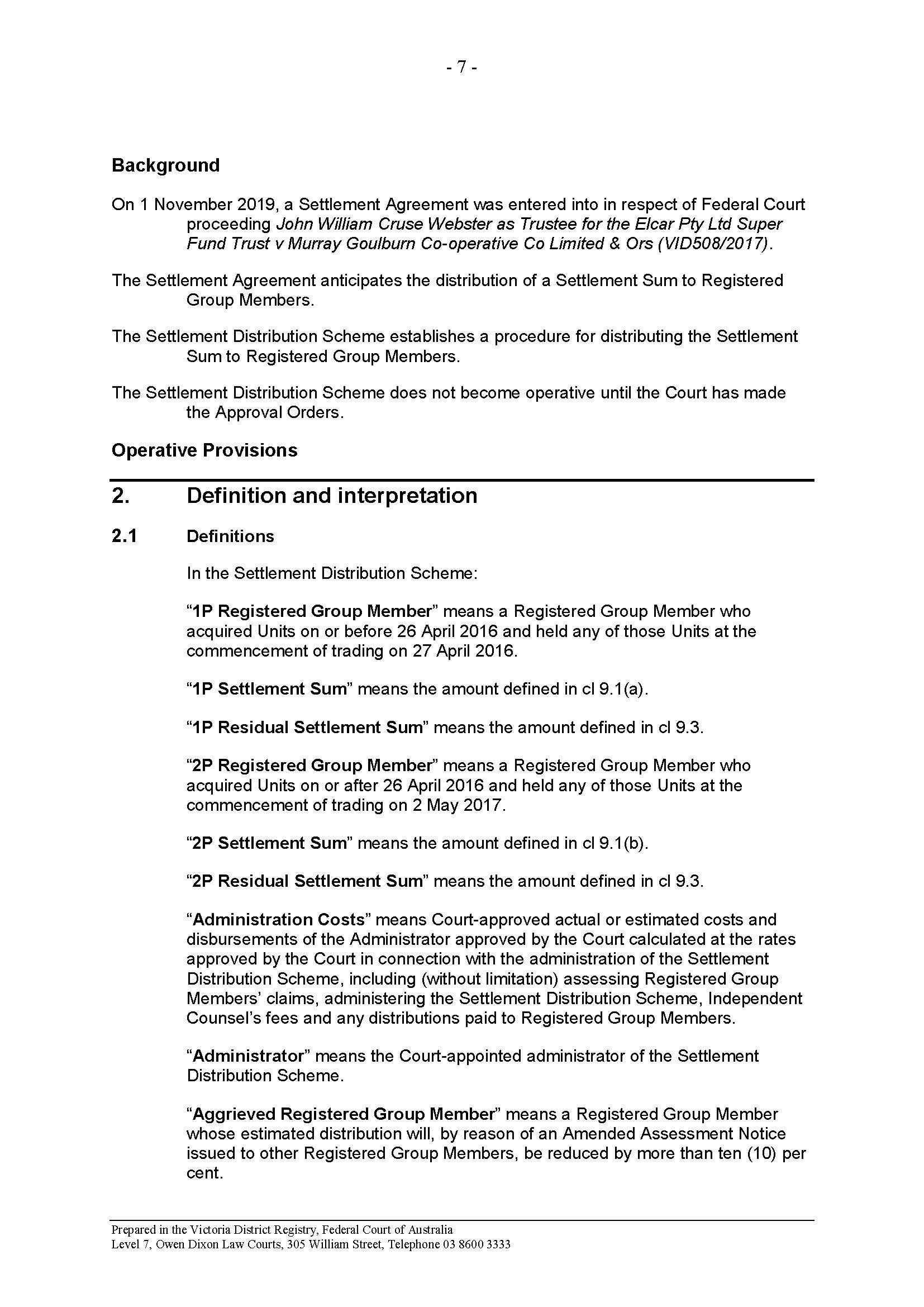
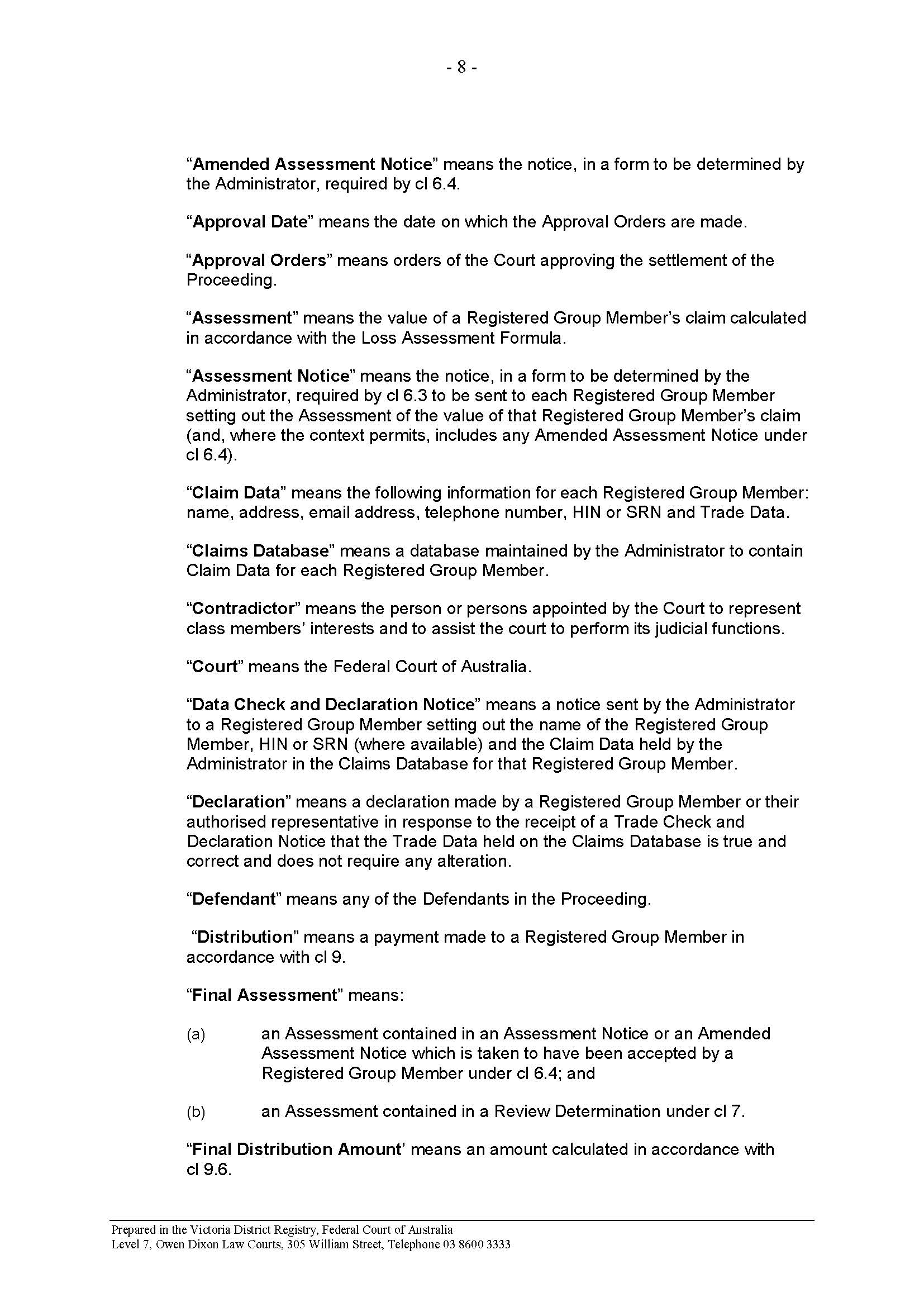
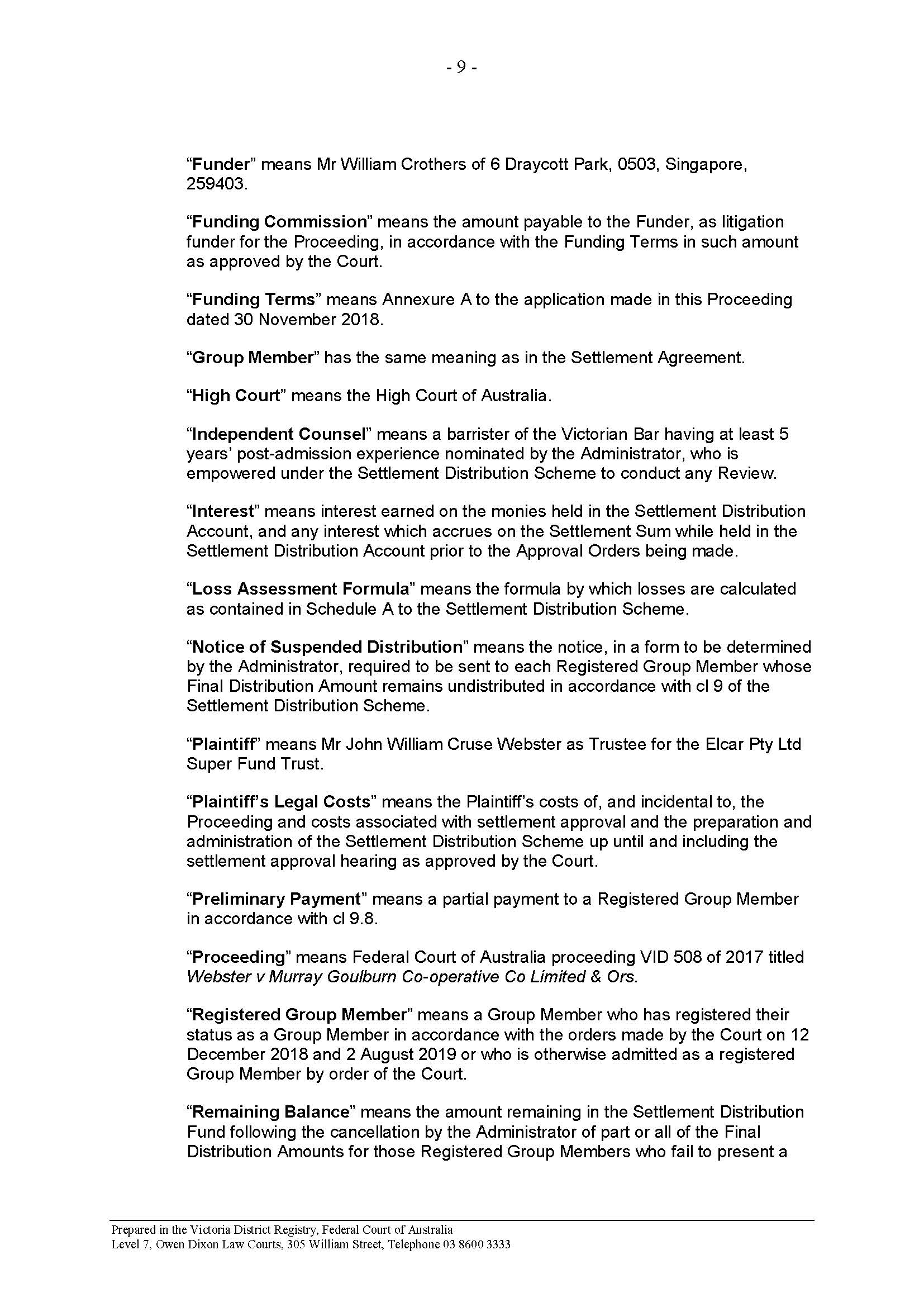
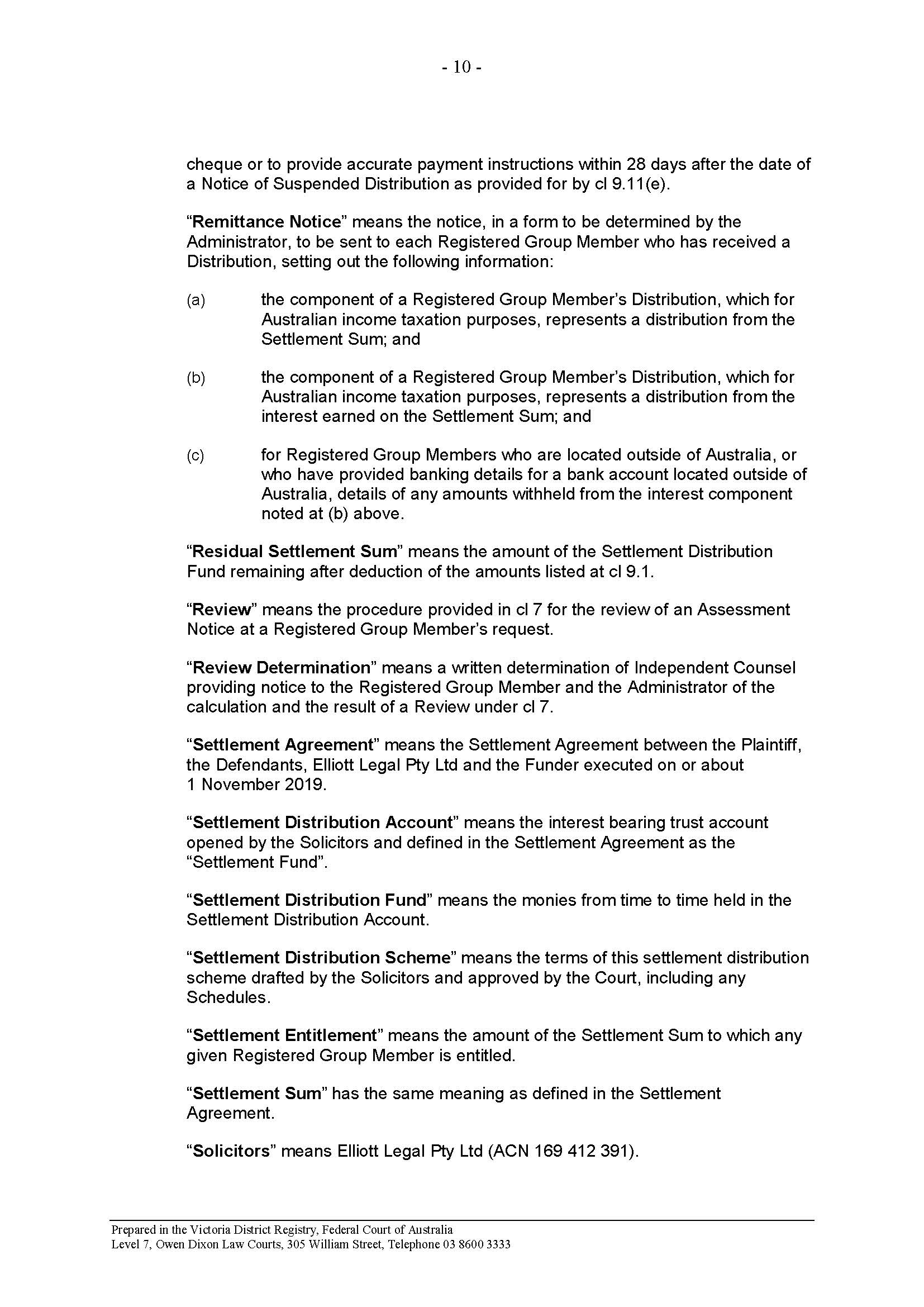
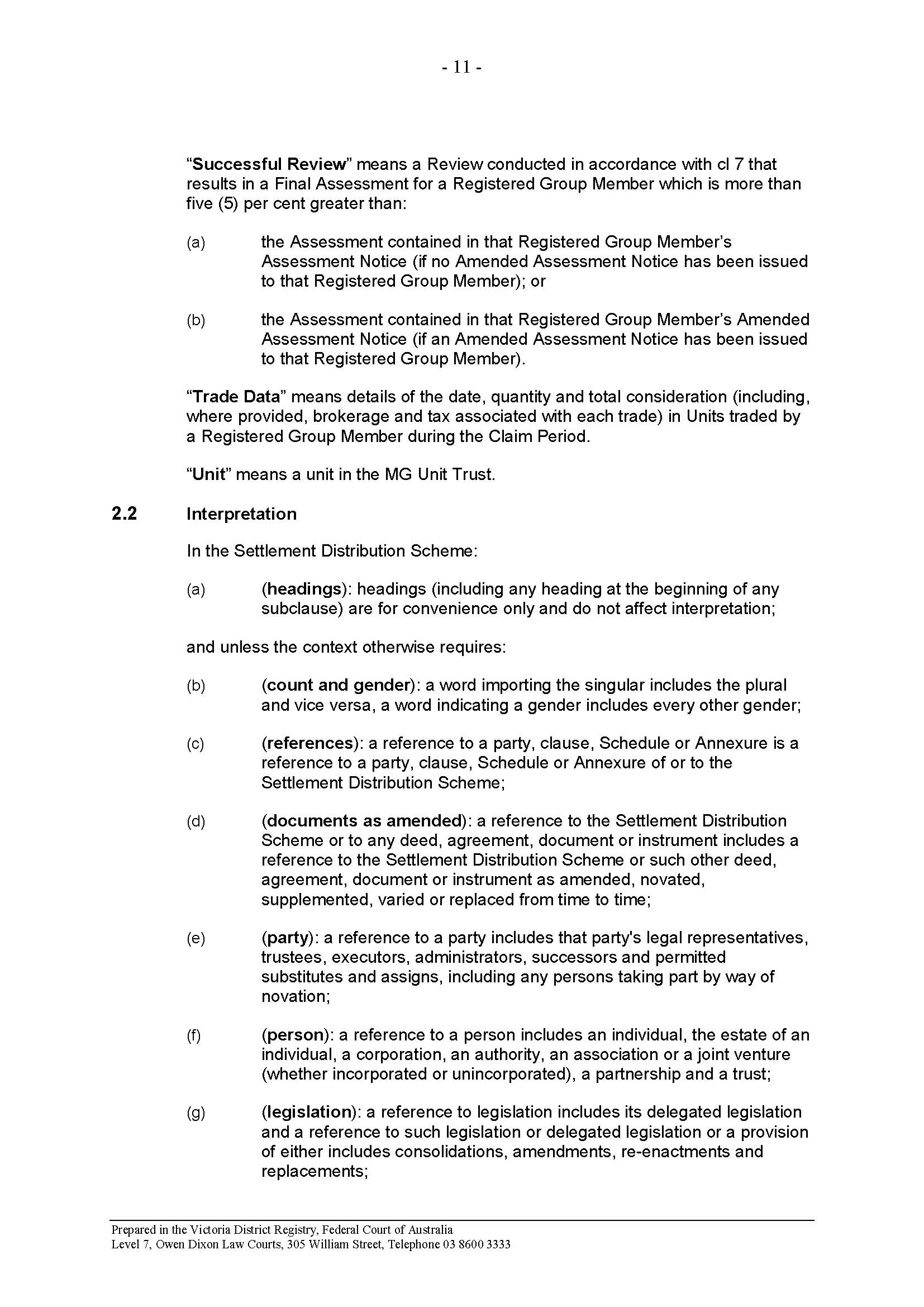
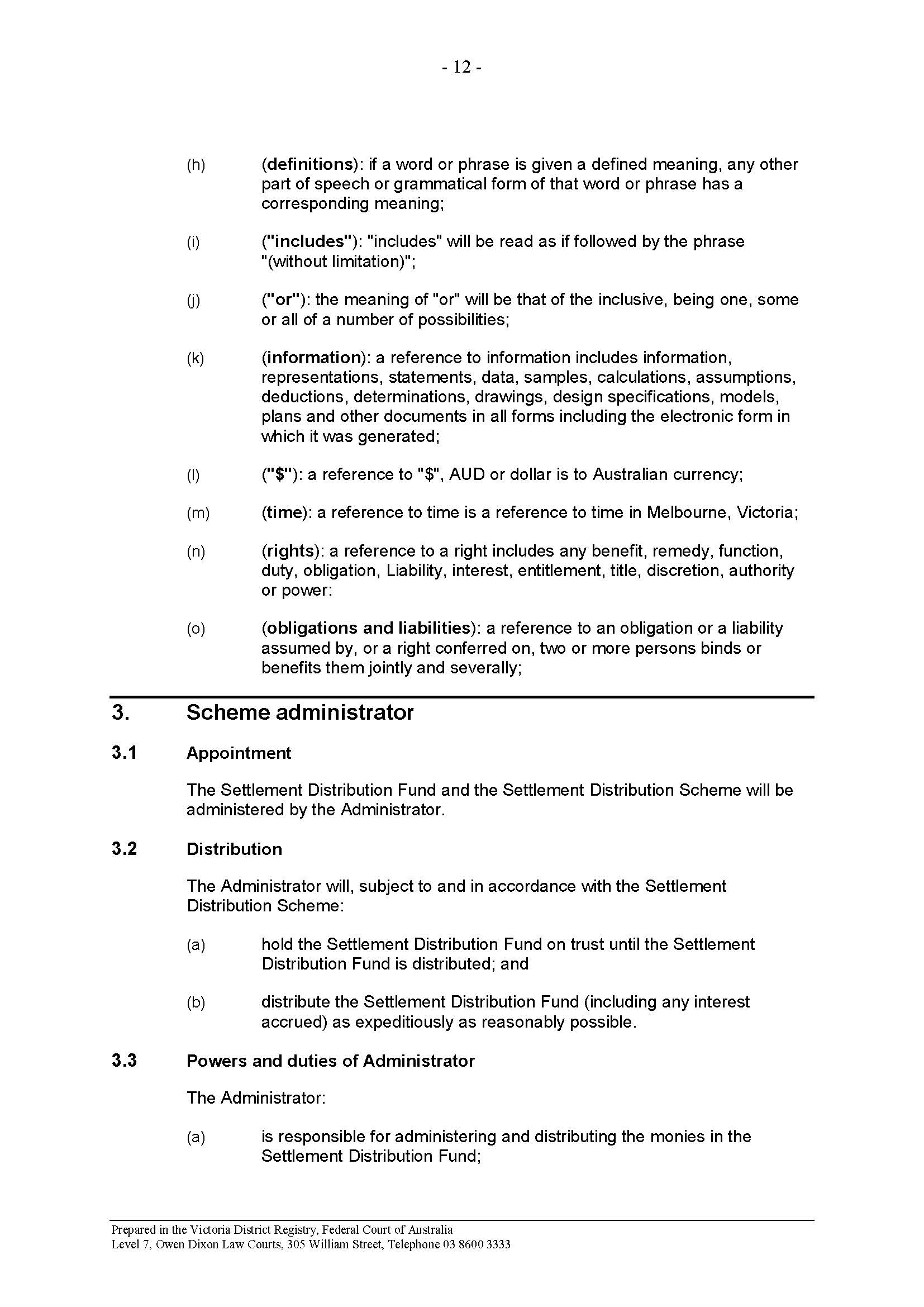
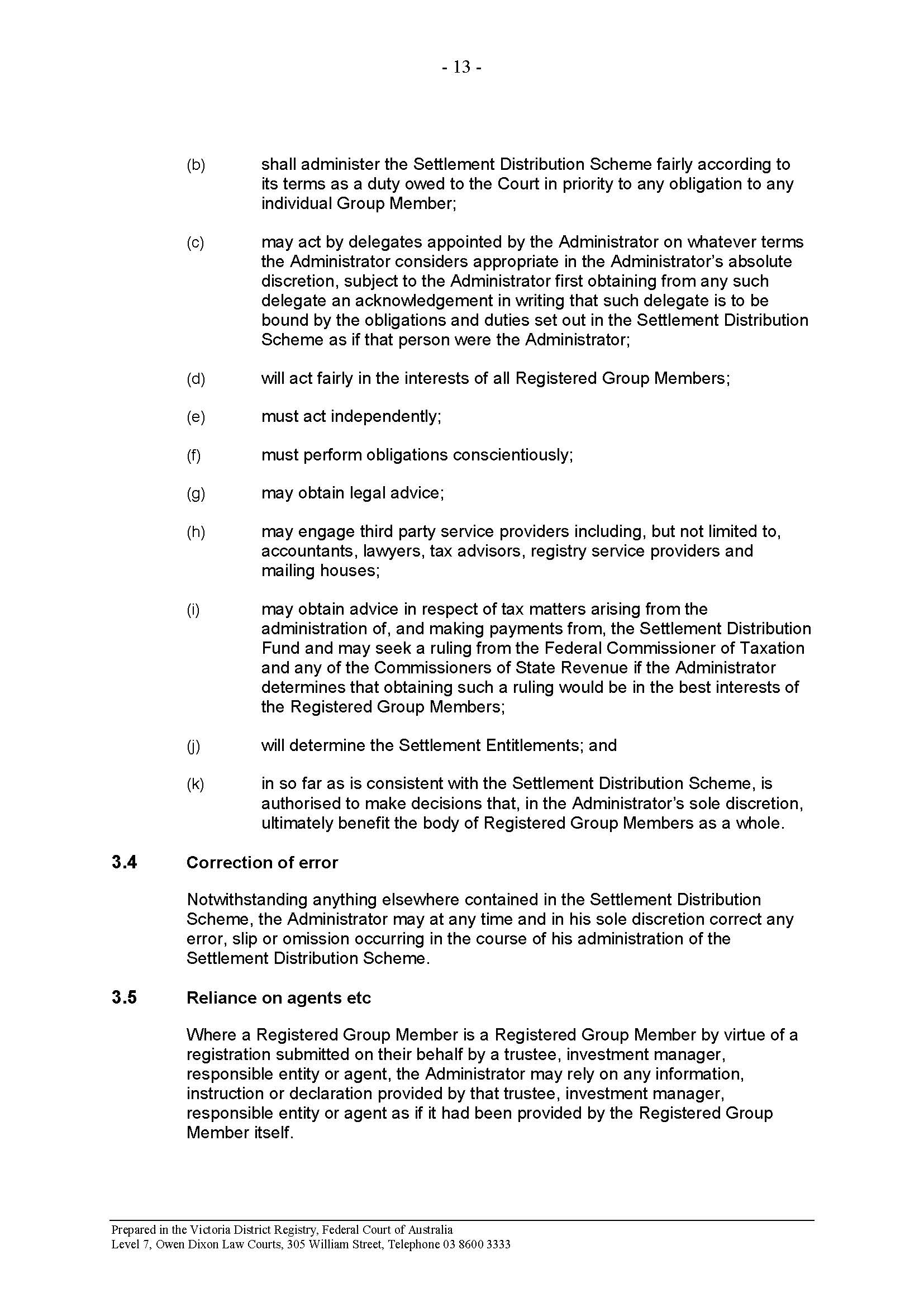
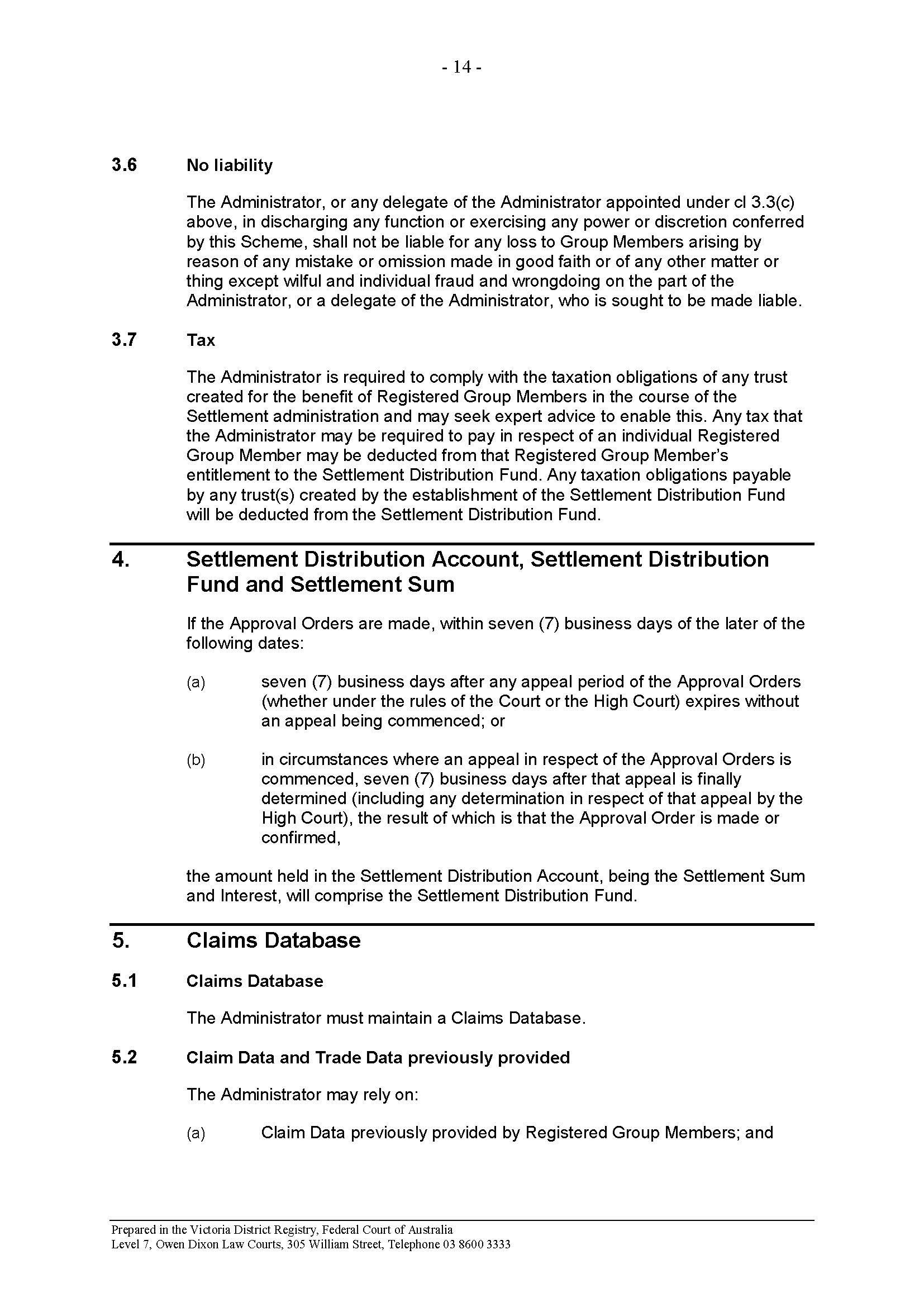
(b) the Settlement Distribution Scheme (SDS) in the form of Annexure A to these orders.
4. Pursuant to s 33ZF of the Act the Court authorises the Plaintiff nunc pro tunc to enter into and give effect to the Settlement Agreement (and all transactions contemplated by it) for and on behalf of those persons who meet the definition of “Group Member” in paragraph 2 of the Second Further Amended Statement of Claim and who have not opted out of the proceeding (collectively, Group Members).
5. Pursuant to ss 33ZB and 33ZF of the Act, the persons affected and bound by the settlement of the proceedings be the Plaintiff, the Defendants, Elliott Legal Pty Ltd, the Funder and Group Members.
6. Pursuant to s 33ZF of the Act, Mr Richard Earl be appointed Administrator of the SDS, and he is directed to undertake his duties as Administrator in accordance with the SDS.
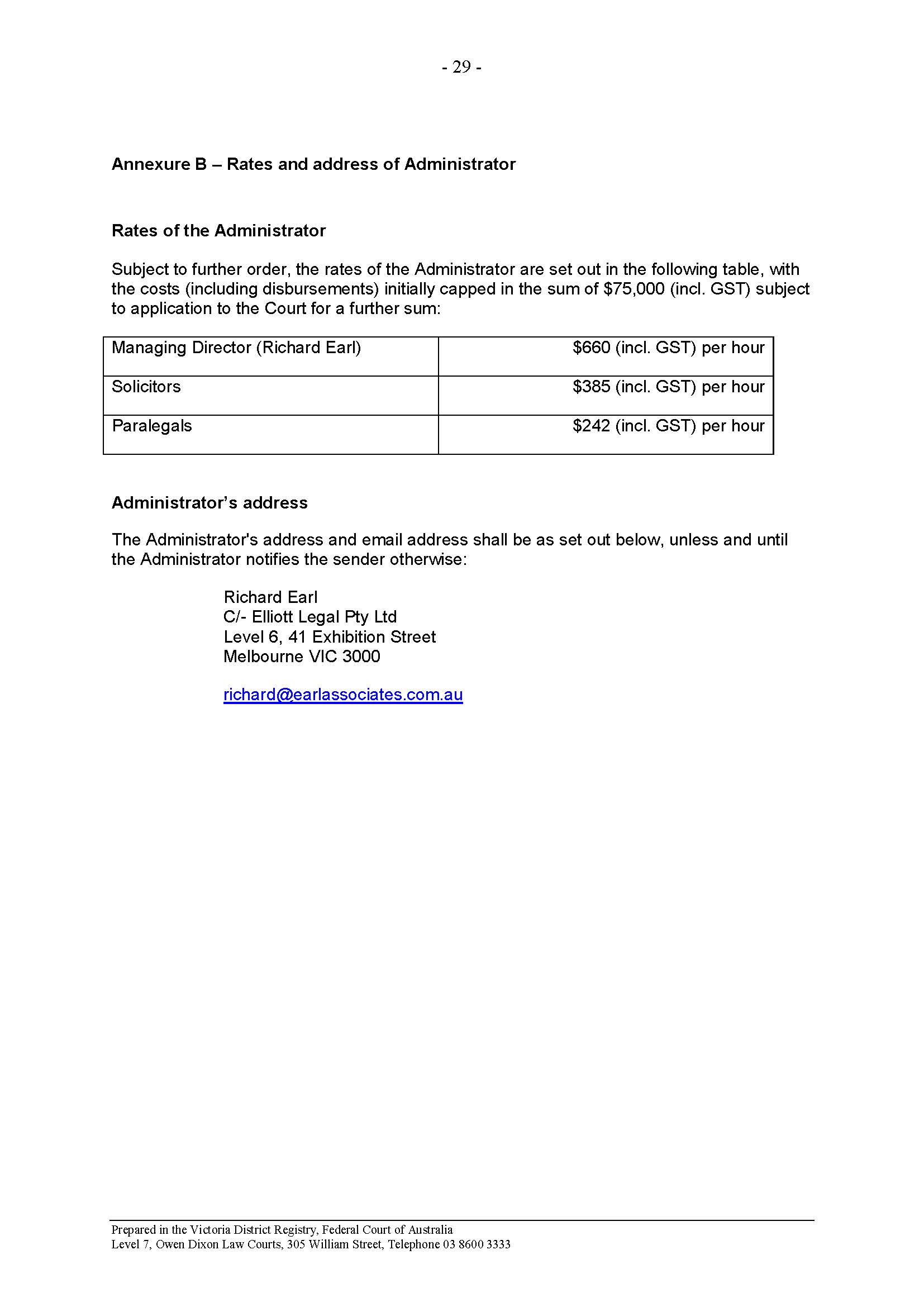
7. Subject to further order, the rates of the Administrator for the calculation of the Administration Costs (as defined in the SDS), and the address of the Administrator are as set out in Annexure B to these orders.
8. For the purposes of the SDS, Mr Peter Kenneth Derbyshire shall be deemed to be a ‘Registered Group Member’.
Plaintiff’s Costs and Expenses
9. The report of Mr John White (Costs Referee) dated 24 March 2020 be adopted.
10. Pursuant to ss 33ZF and 33V of the Act:
(a) the Plaintiff’s legal costs and disbursements on a solicitor and own client basis incurred in connection with the proceeding on his own behalf and on behalf of the Group Members be approved in the amount of $5,207,675.00, and be paid to the Funder pursuant to the SDS;
(b) the Plaintiff’s claim for compensation for the time, expense and inconvenience incurred in the interests of prosecuting the proceeding on behalf of Group Members as a whole be approved in the amount of $15,000, and be paid to the Plaintiff pursuant to the SDS; and
(c) the costs of the Contradictor be approved in the amount of $118,475, and be paid to the Funder pursuant to the SDS.
11. All orders requiring the Plaintiff to provide security for costs are vacated and the security paid on the Plaintiff’s behalf shall be returned to the Funder.
Litigation funding charges
12. Further to order 1, and having been satisfied it is just to make a further order with respect to the distribution of money paid under the settlement, an order pursuant to s 33V(2) of the Act that the amount of $8,625,000 (incl. of any applicable GST), representing 23% of the Settlement Sum of $37,500,000, be paid to the Funder.
Other
13. The Funder bear his own costs of and incidental to the application.
14. The costs of the Costs Referee in the sum of $44,000 be paid by Elliott Legal Pty Ltd.
15. The Administrator has liberty to apply to the Court in relation to any matter arising under the SDS.
16. The Plaintiff has liberty to apply to re-list the proceeding as soon as practicable after completion of the distribution of the Settlement Sum (and must in any event do so no later than thirty days after such completion) so that final orders can be made, including orders that:
(a) the proceeding be dismissed on the basis that the dismissal is a defence and absolute bar to any claim (either directly or indirectly) or proceeding by the Plaintiff or any Group Member in respect of, or relating to, the subject matter of the proceeding, without prejudice to:
(i) the right of any party to the Settlement Agreement to make an application to enforce the Settlement Agreement in a new proceeding; or
(ii) the right of any Registered Group Member to make application to the Court in accordance with the terms of the SDS; or
(iii) the right of the Administrator of the SDS to refer any issues relating to the SDS or the Administrator’s duties under the SDS to the Court for direction or determination.
(b) there be no order as to costs as between the Plaintiff and the Defendants; and
(c) all costs orders previously made in the proceeding are vacated.
17. Upon finalisation of the distribution of compensation under the SDS the Administrator shall within 14 days file a short affidavit providing a report as to all material matters regarding the performance of the SDS, including the number of Group Members who received a benefit, the time taken for the distribution of compensation, whether the Administrator complied with the time limits in the SDS and the reason for any non-compliance, the Administration Costs incurred and, if they exceed the estimates provided to the Court, the explanation for that.
Note: Entry of orders is dealt with in Rule 39.32 of the Federal Court Rules 2011.
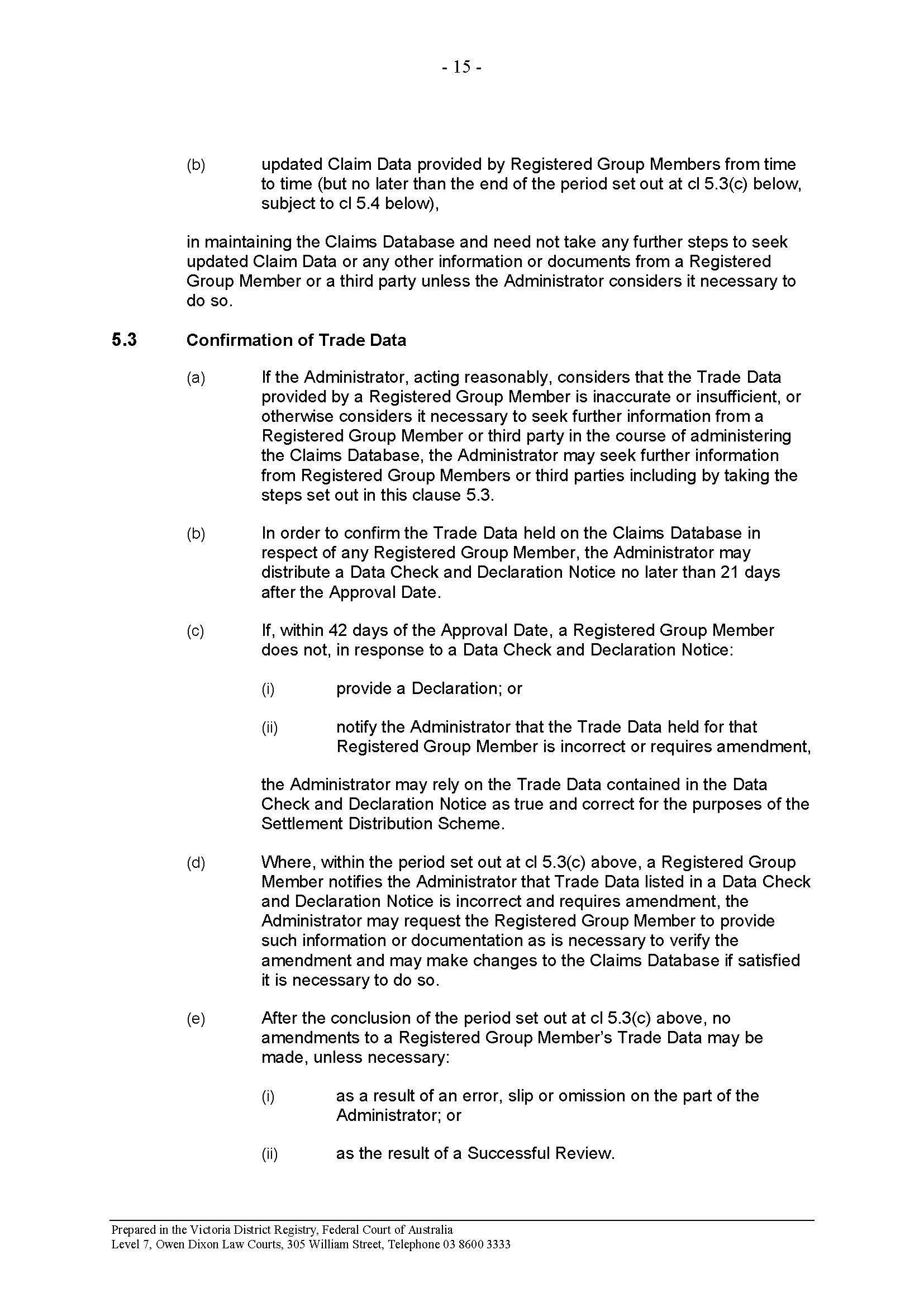
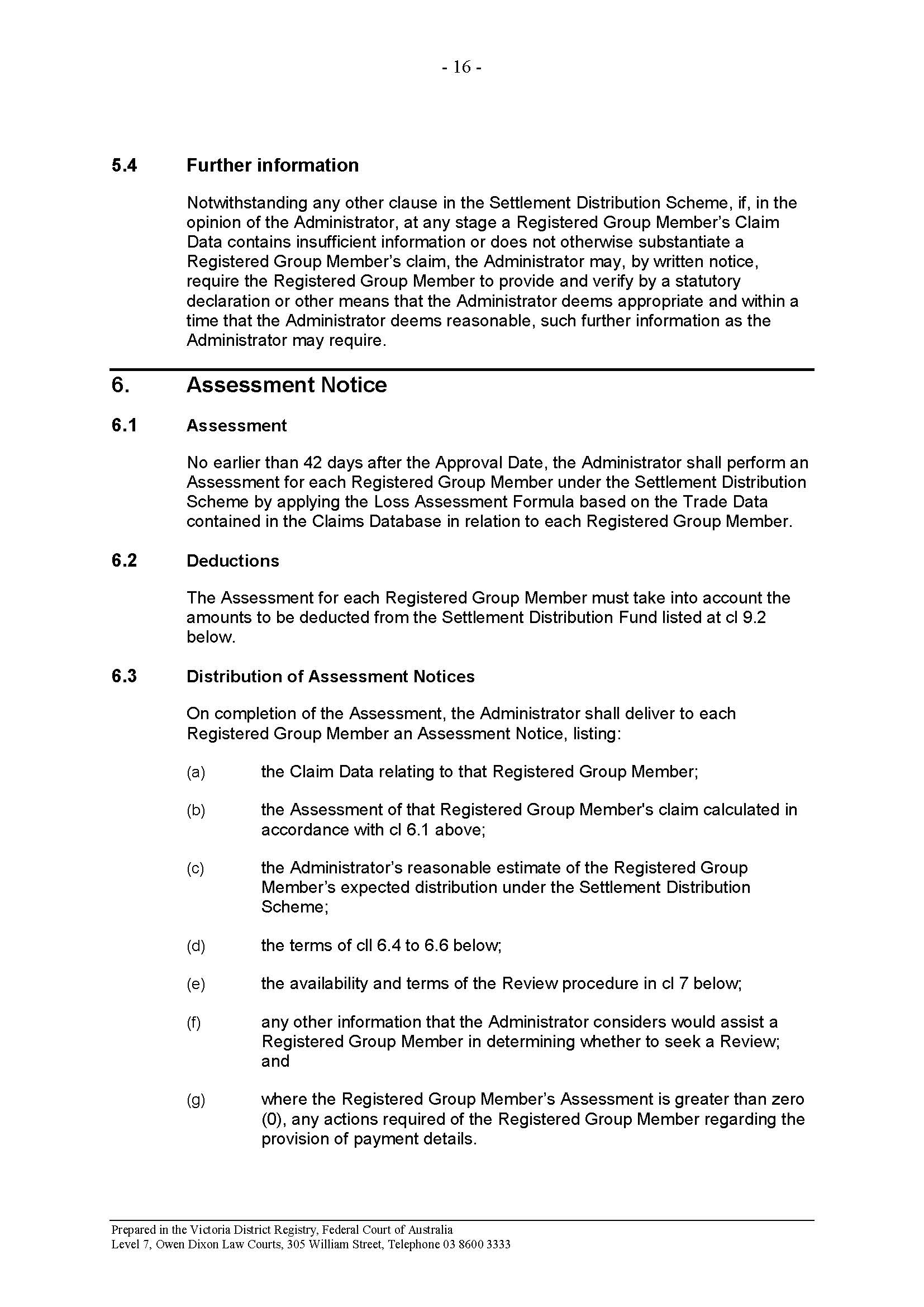
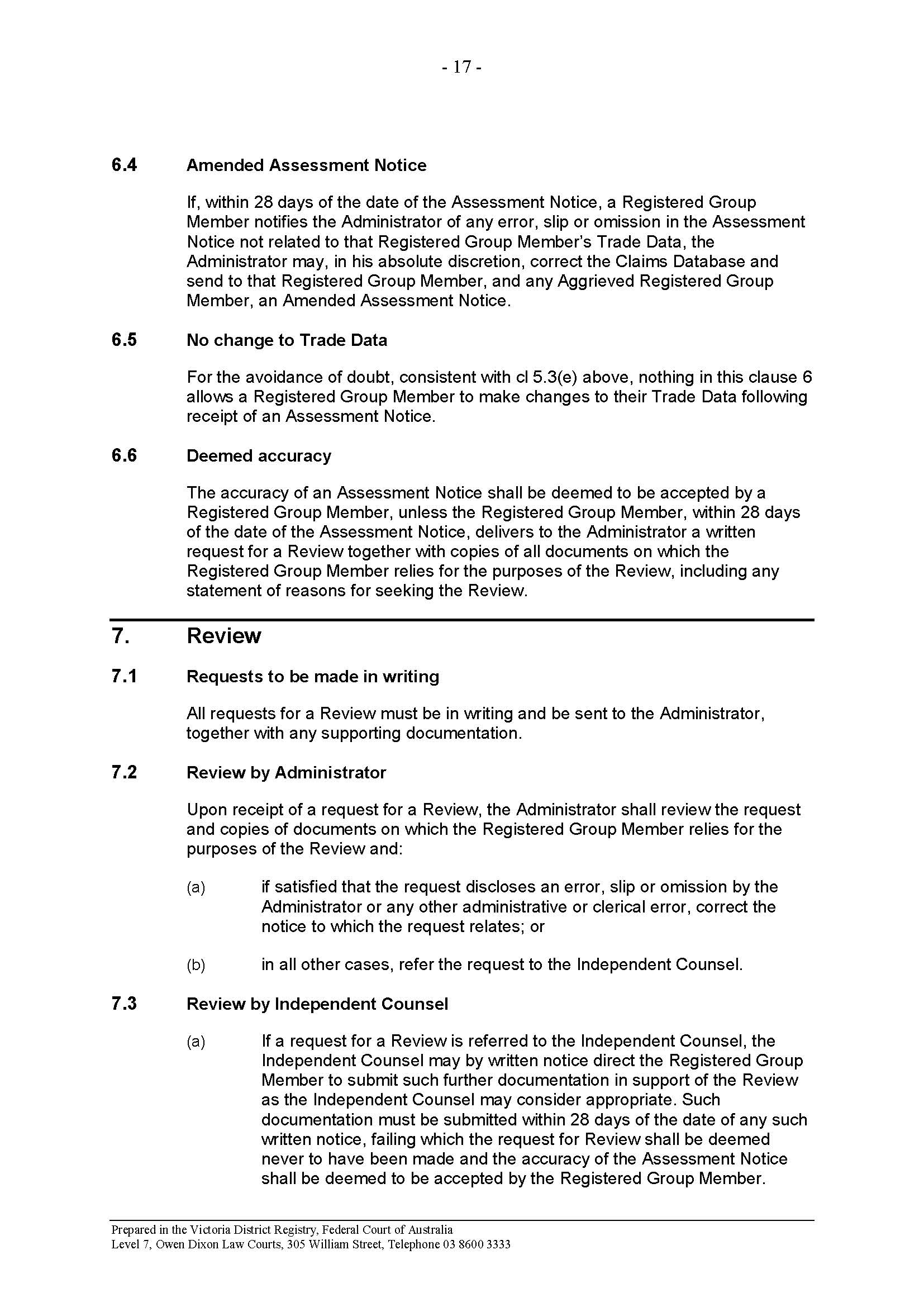
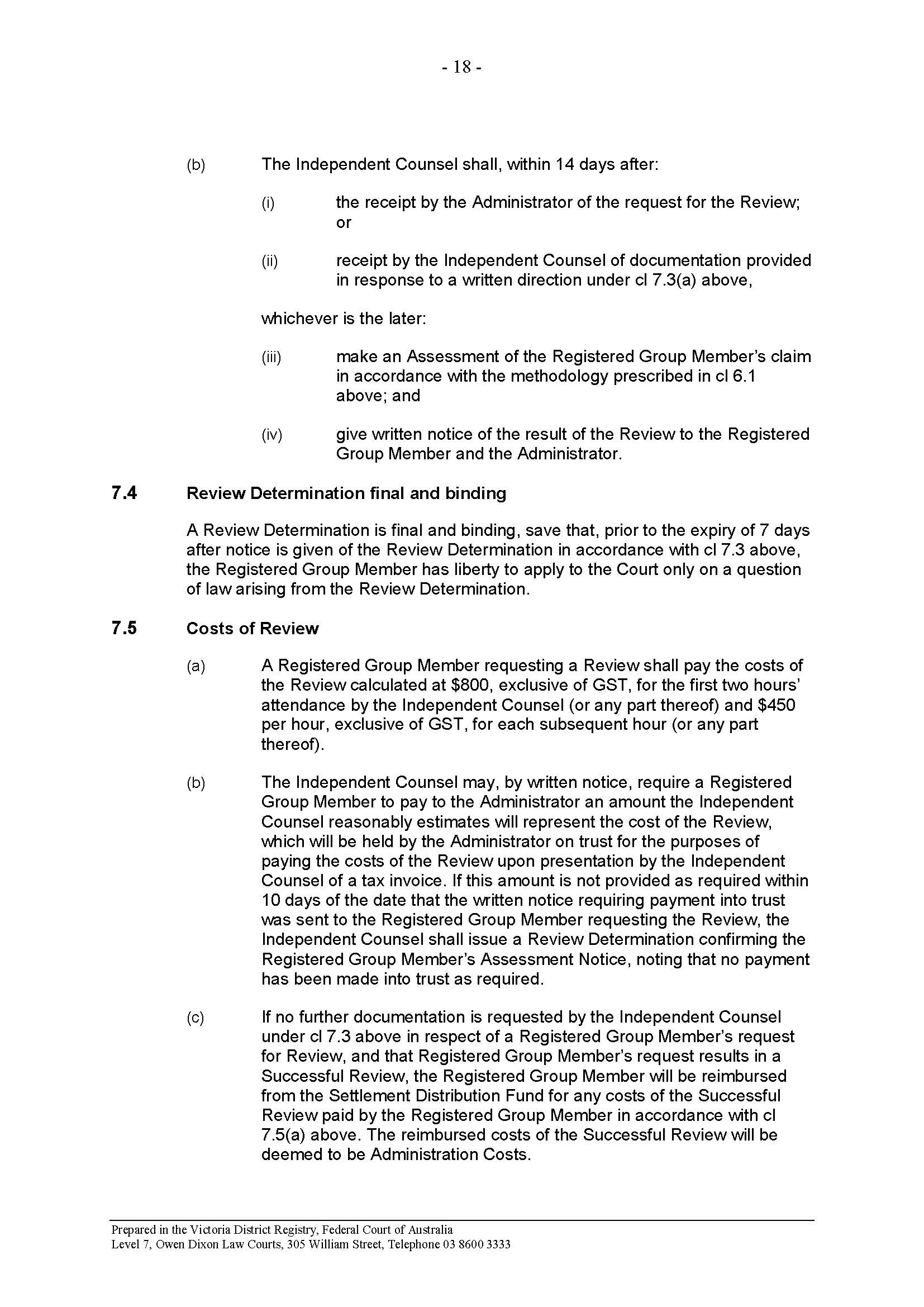
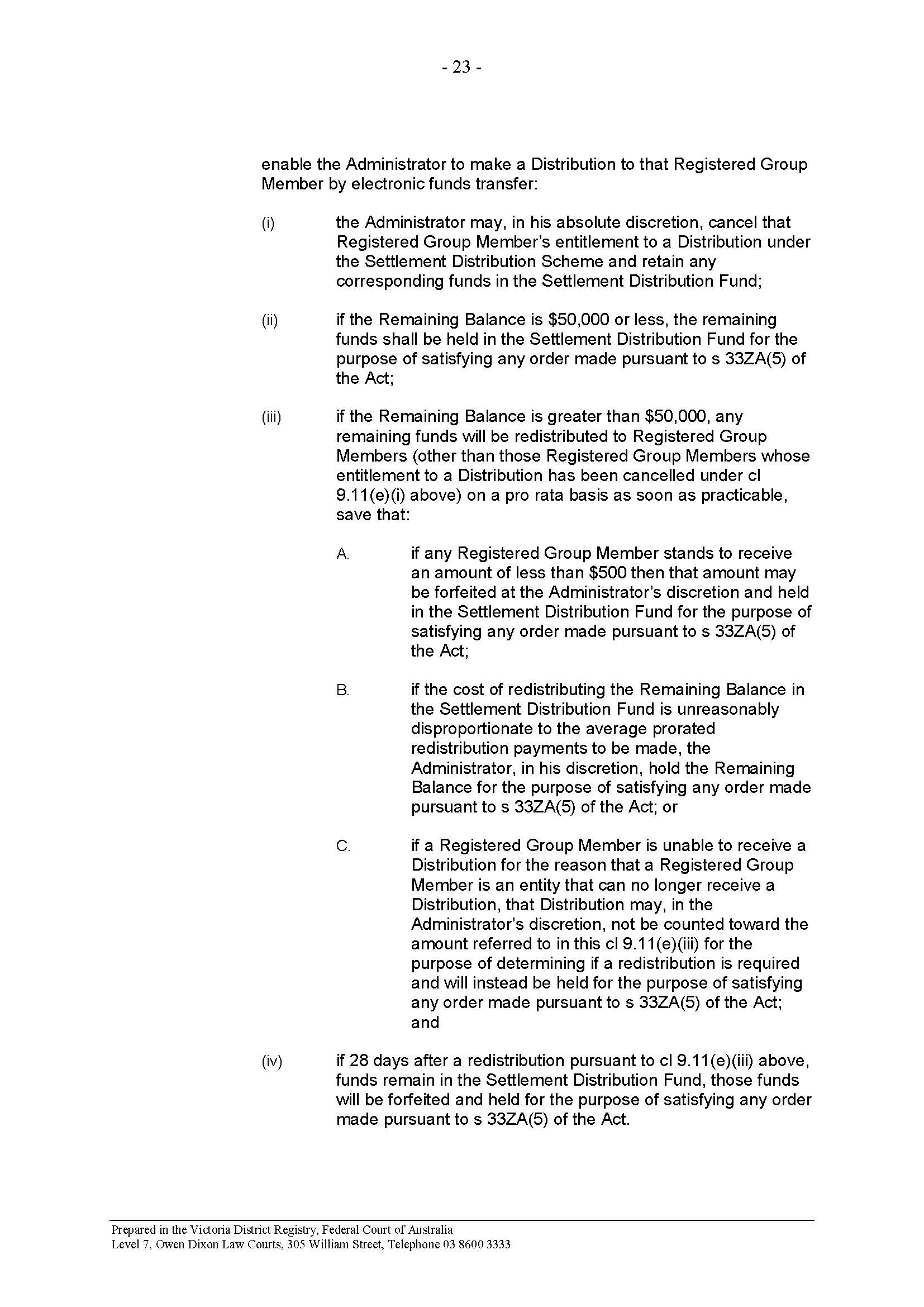
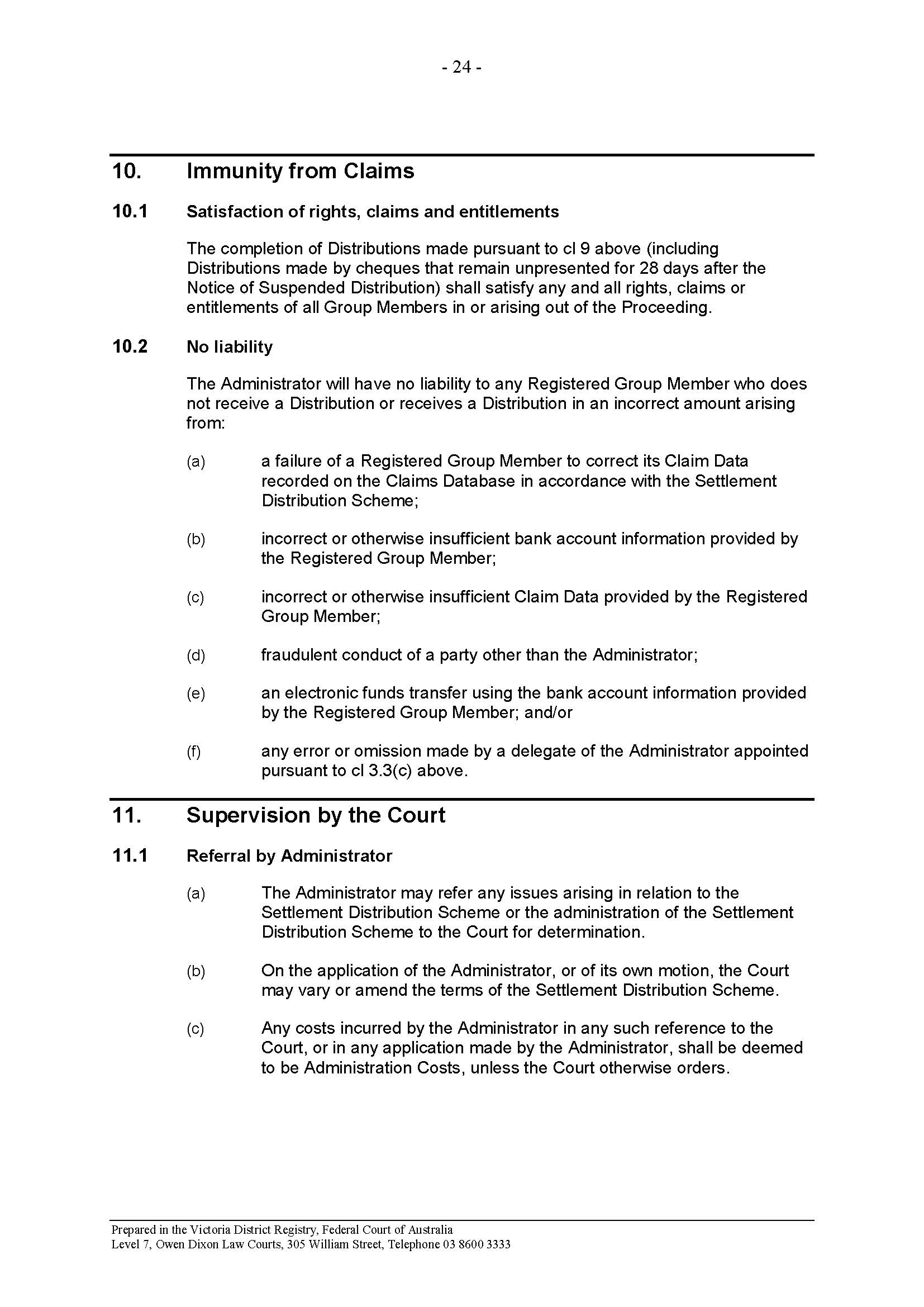
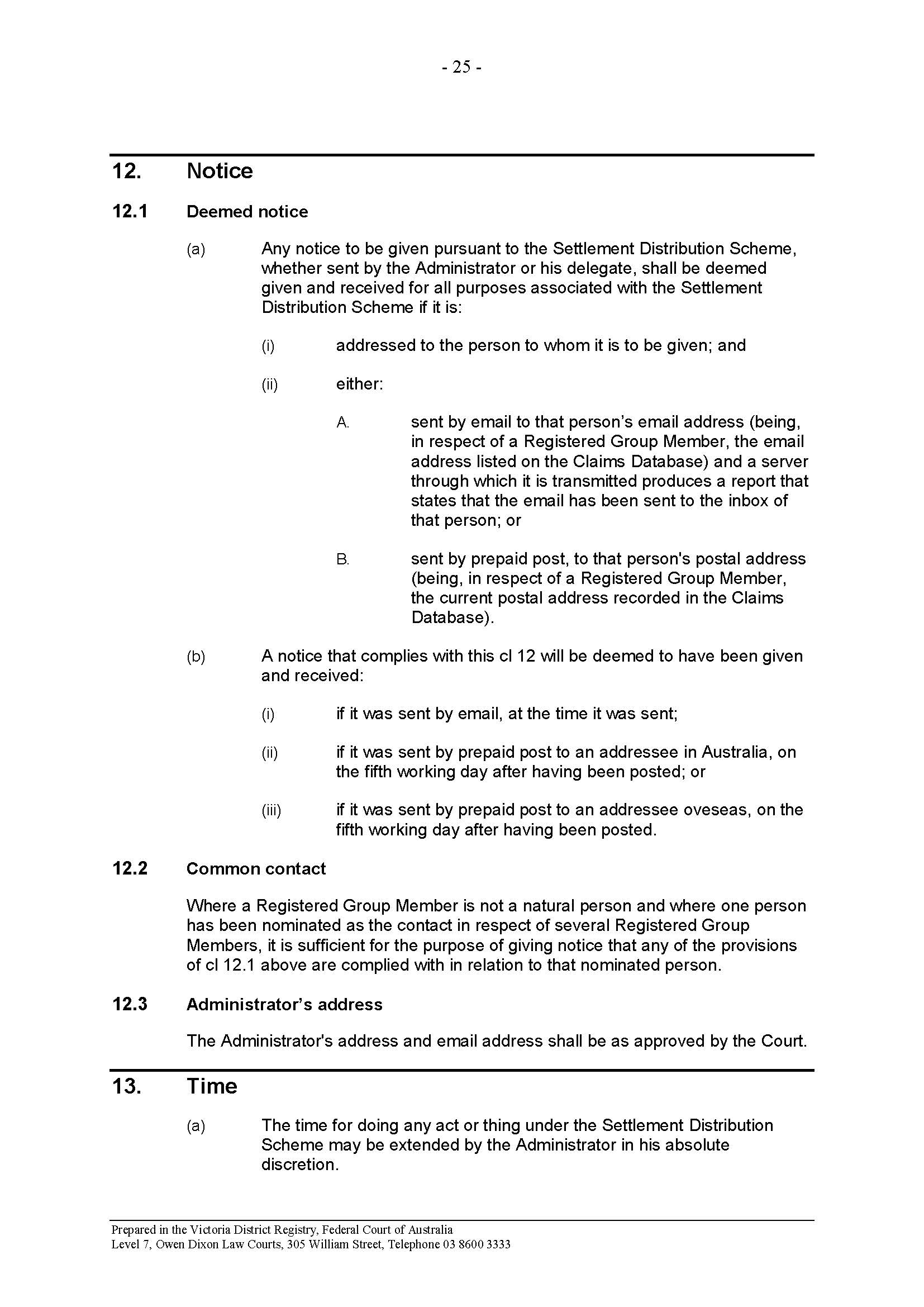
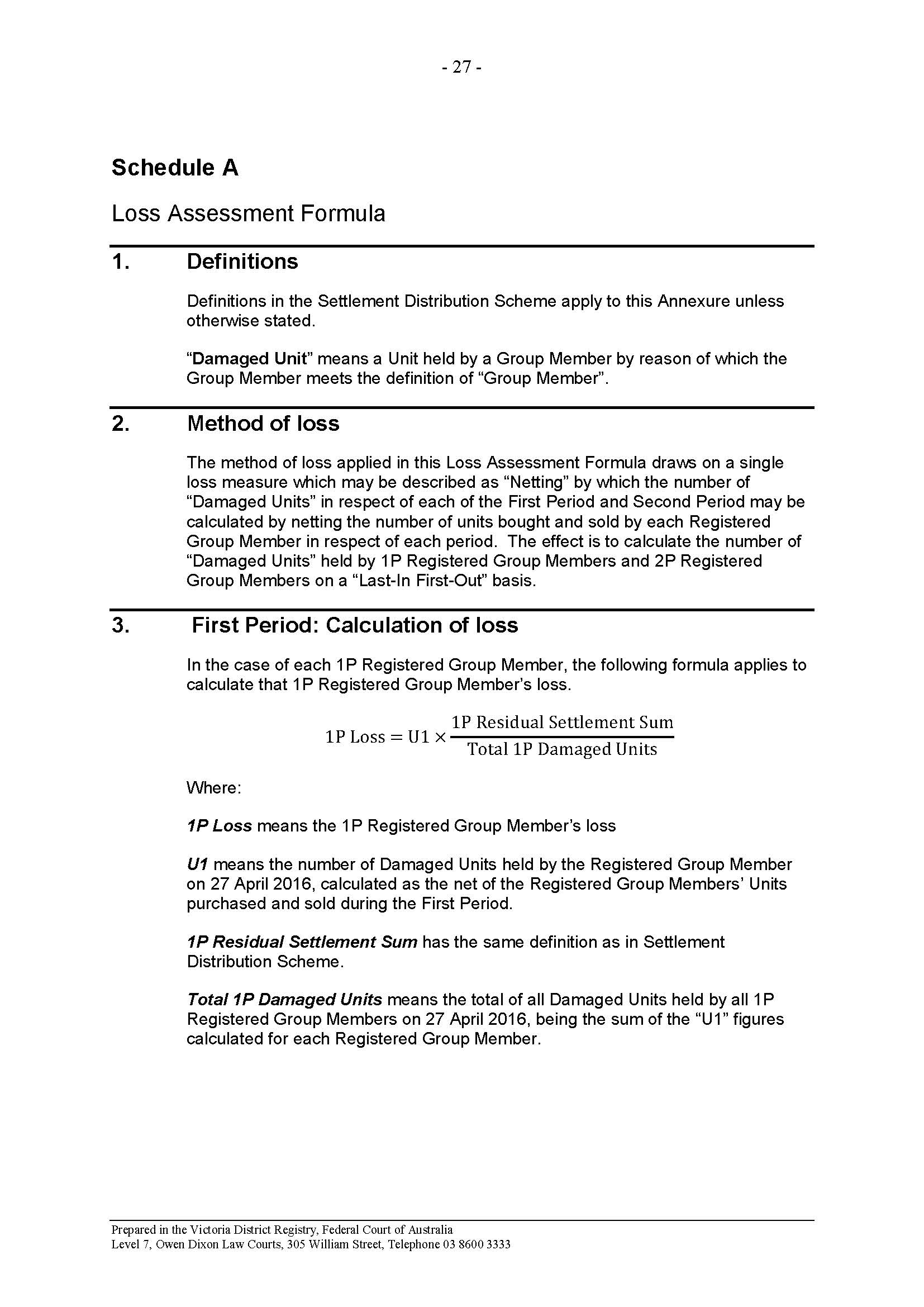
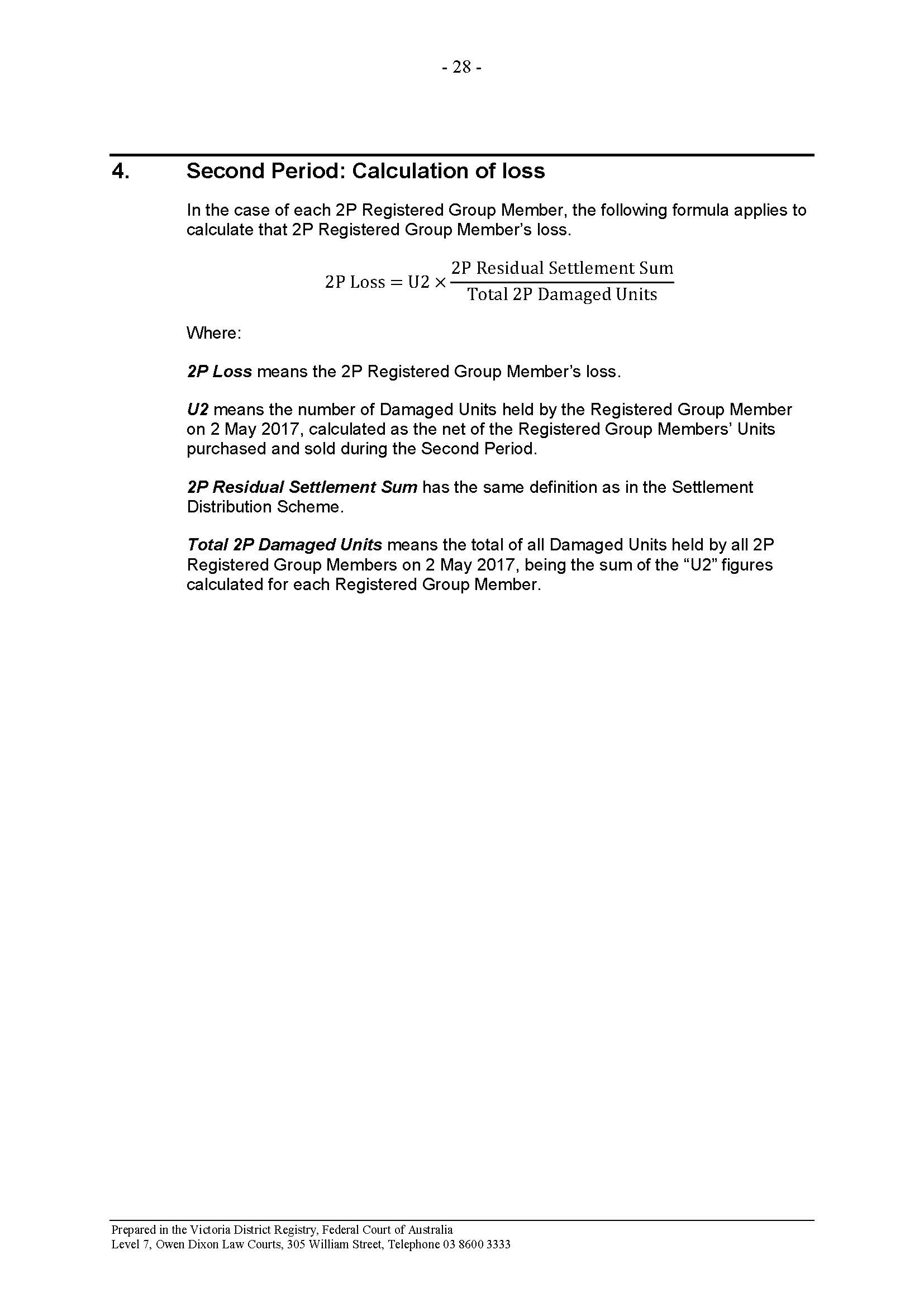
Annexure A – Settlement Distribution Scheme
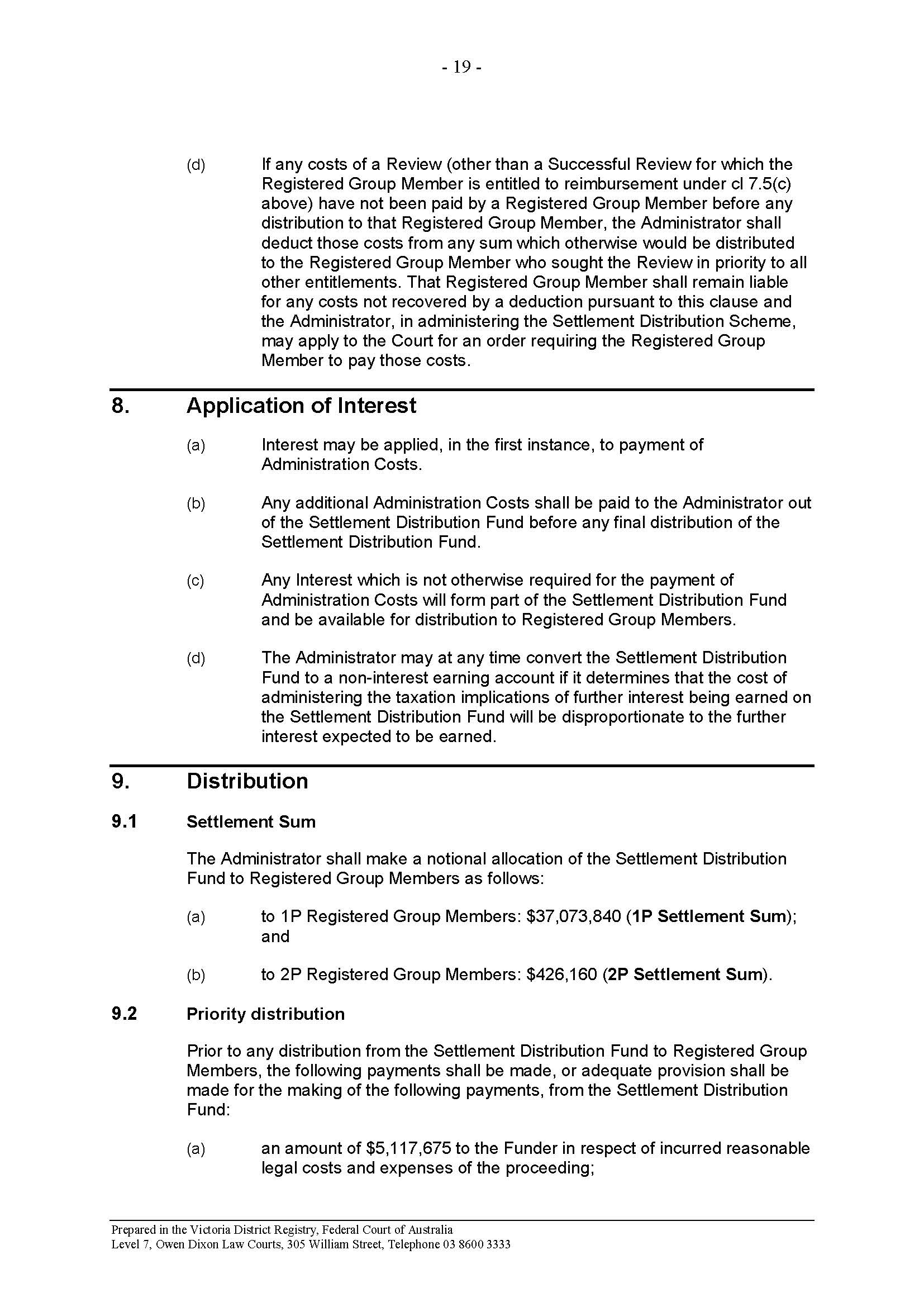
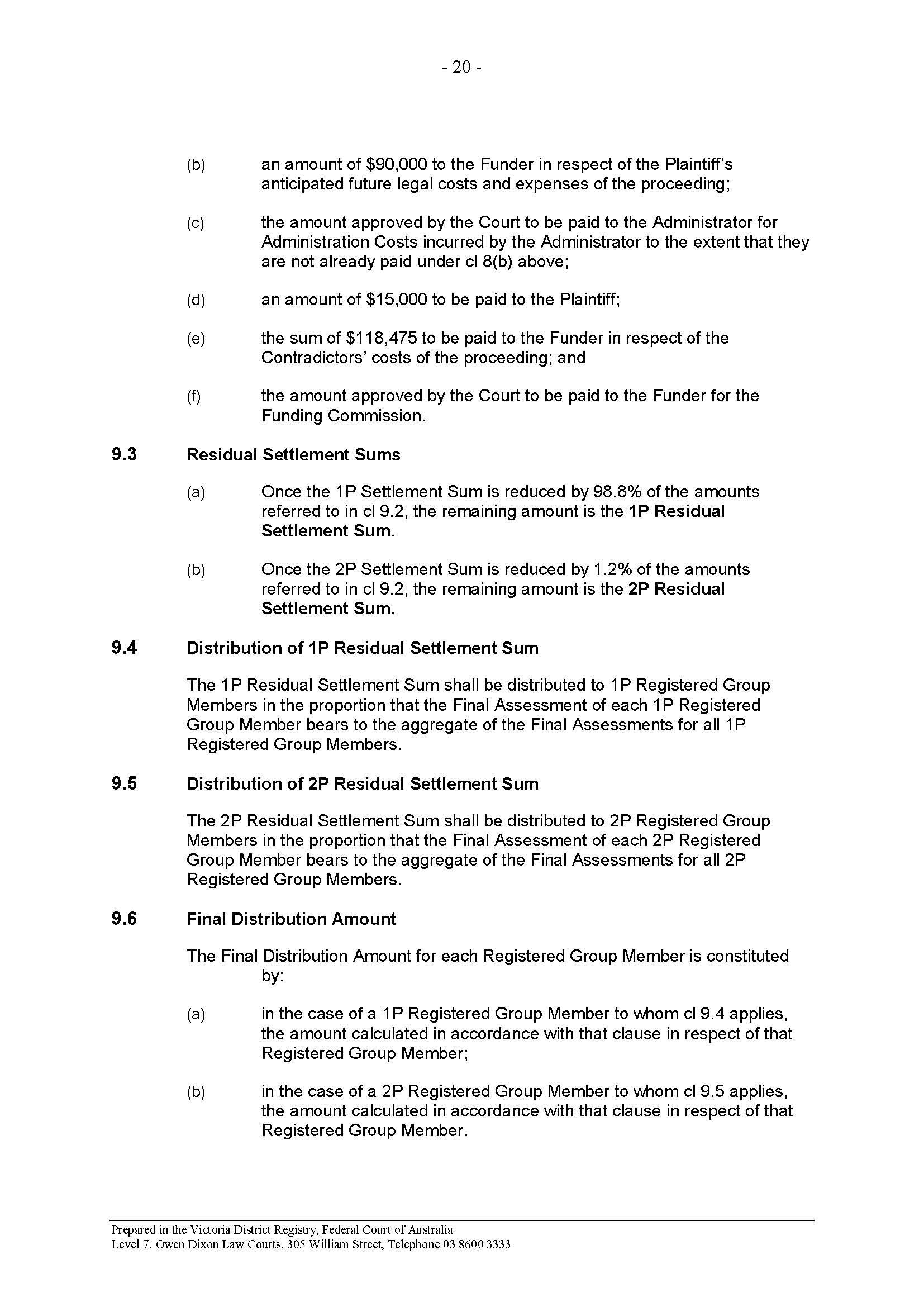
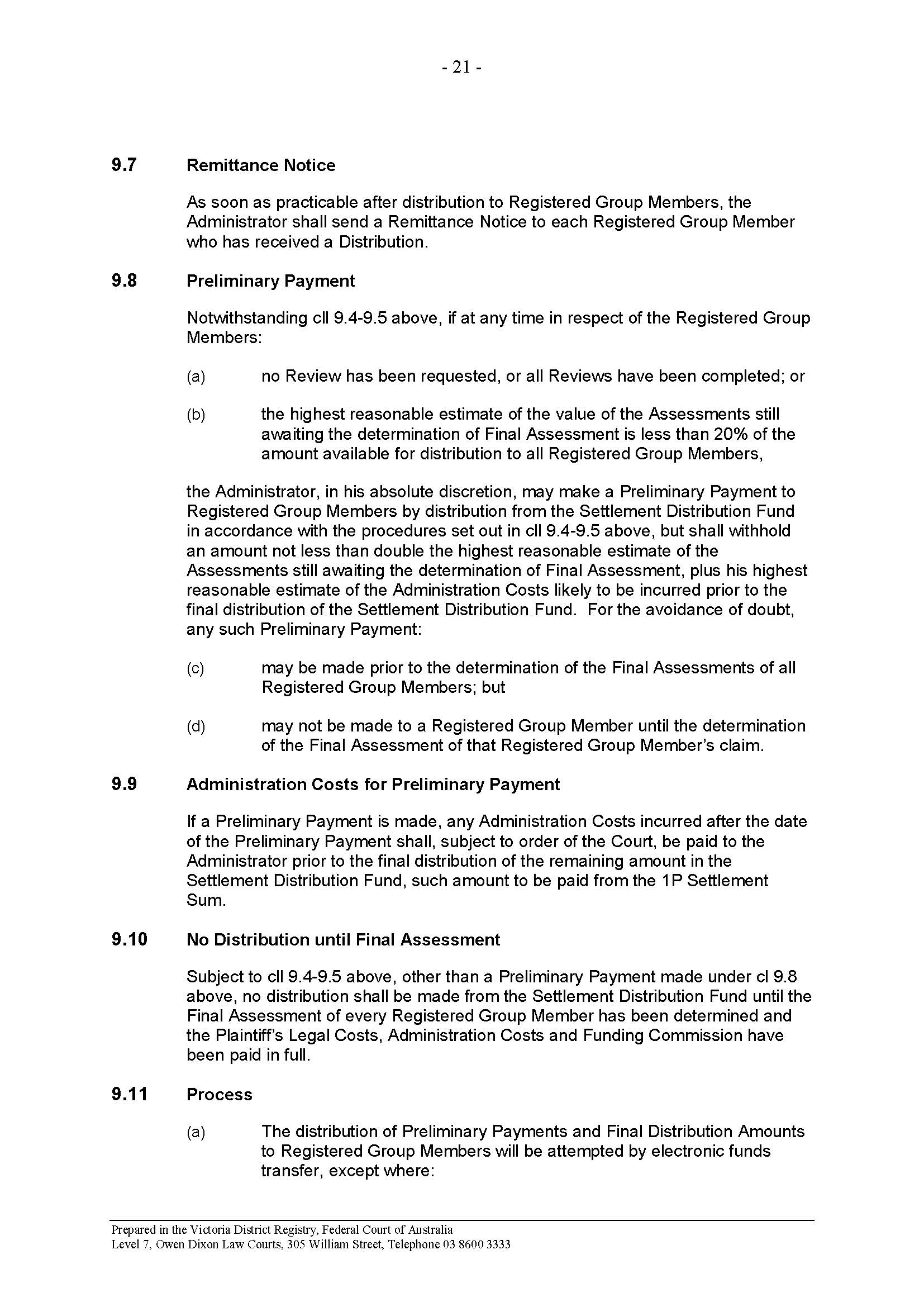
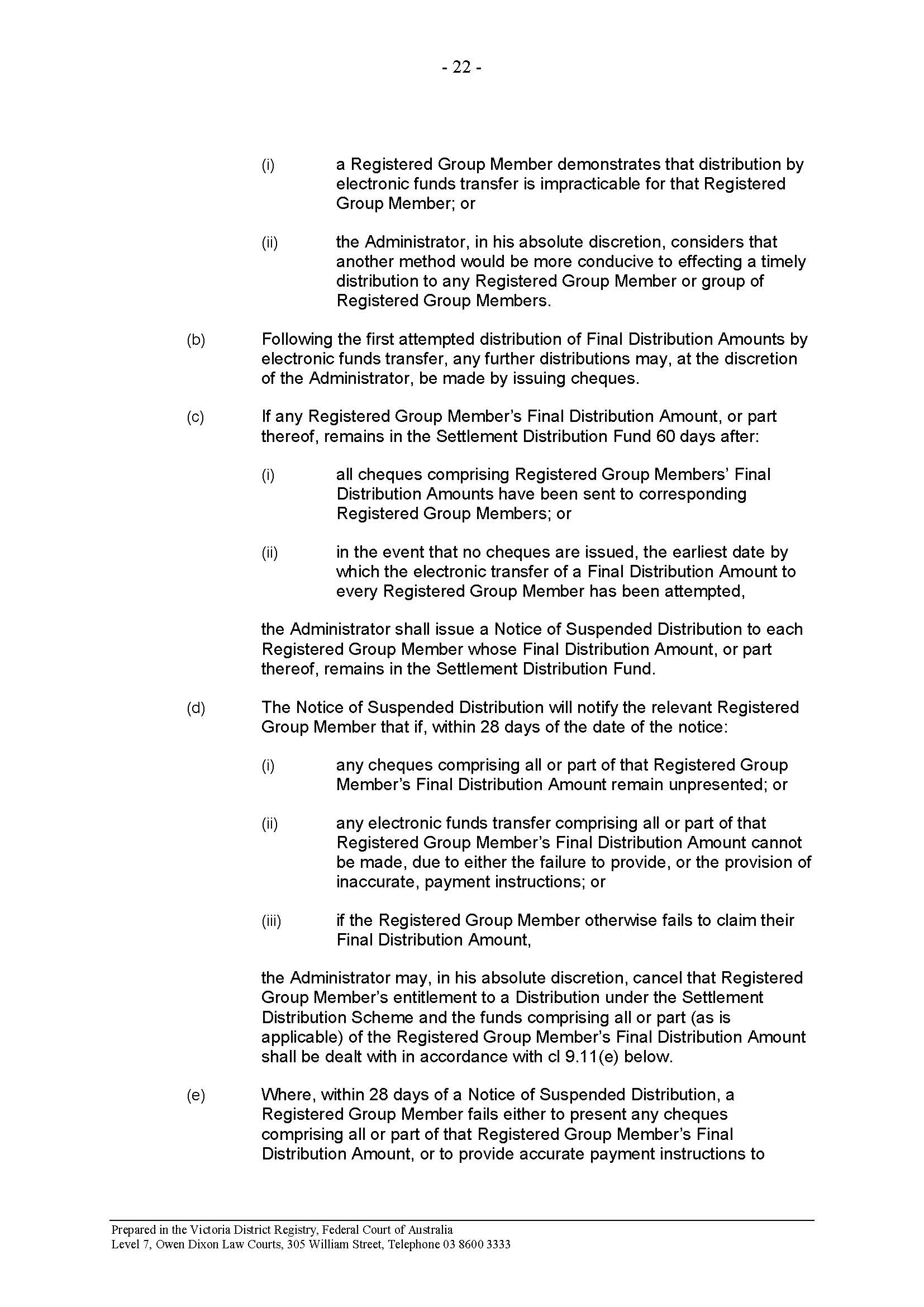

MURPHY J:
Introduction
1 This is an application for Court approval of the settlement of an ‘open’ securities class action pursuant to s 33V of the Federal Court of Australia Act 1976 (Cth) (the Act). The plaintiff, John William Cruse Webster as trustee for the Elcar Pty Ltd Super Fund Trust brought the class action against the respondents Murray Goulburn Co-operative Co. Limited (MG), MG Responsible Entity Limited (MGRE) as a responsible entity of the Murray Goulburn Unit Trust (MGUT) and 11 persons who were officers of MG or MGRE (collectively, the MG Parties). Mr Webster brought the proceeding on his own behalf and on behalf of all persons who purchased units in the MGUT:
(a) pursuant to the product disclosure statement (PDS) issued by MGRE on 29 May 2015; and/or
(b) on or after 3 July 2015 and prior to 2 May 2017;
but excluding persons who have entered into a litigation funding agreement with IMF Bentham Limited (IMF) in relation to another securities class action against the MG entities brought by Endeavour River Pty Ltd (the Endeavour River proceeding) and who are therefore class members in that proceeding. The action was funded by a litigation funder, William Crothers (the Funder).
2 The parties to the proceeding reached an in-principle settlement of the proceeding, subject to Court approval, pursuant to which the MG Parties agreed to pay the plaintiff and class members the sum of $37.5 million inclusive of costs in full and final settlement of their claims. I heard the settlement approval application on 7 April 2019 and made orders on that day to approve the settlement, the settlement distribution scheme, and various deductions to be made from the settlement amount prior to distribution to class members, being Court-approved amounts for the plaintiff’s legal costs, litigation funding charges incurred in the proceeding, a reimbursement payment to the plaintiff and the costs of the Court-appointed Contradictor. I now provide reasons for the orders made.
3 I had no difficulty in concluding that the quantum of the settlement and the terms of settlement were fair and reasonable in the interests of class members, but there were some questions in relation to:
(a) the reasonableness of the legal fees and disbursements (legal costs) charged and proposed to be charged by the solicitors for the plaintiff, Elliott Legal Pty Ltd (Elliott Legal) and counsel engaged in the proceeding;
(b) whether the Court has power under s 33V(2) of the Act to order that the Funder be paid a percentage of the gross settlement as a funding commission in return for the costs and risks he took on by funding the proceeding to a successful conclusion; and
(c) if the Court has such power, what is a reasonable funding commission in the circumstances of the case.
The reasonableness of the claimed legal costs
4 The total amount of the legal costs which the plaintiff (or more accurately Elliott Legal) sought be approved by the Court was something of a moving feast. The Notice of Proposed Settlement sent to class members by order made 26 November 2019 informed them that upon settlement approval the Funder would be liable for the plaintiff’s legal costs in the sum of approximately $7.5 million, but that the plaintiff would seek reimbursement of costs capped at $7 million. Subsequently, Mark Elliott, then managing director of Elliott Legal, deposed that the plaintiff’s legal costs up to and including settlement approval were approximately $6.4 million.
5 Having regard to this, and also to the fact that in another securities class action allegations of impropriety in relation to legal costs and litigation funding charges had been made against Australian Funding Partners Limited (AFPL), of which Mark Elliott was managing director, and against Norman O’Bryan AM SC and Michael Symons, the same counsel as in the present case (see: Bolitho v Banksia Securities Ltd (No 6) [2019] VSC 653 (Bolitho) at [124]-[147] (Dixon J)), I considered it appropriate to:
(a) appoint an independent legal costs expert as a referee under s 54A of the Act to conduct an inquiry as to the reasonableness of the costs charged or proposed to be charged for the proceeding and settlement administration, and to report to the Court. I appointed John White, an experienced and reputable costs consultant to that role (the Costs Referee); and
(b) appoint a contradictor to represent class members’ interests and to assist the Court to discharge its function under s 33V in relation to the reasonableness of the legal costs proposed to be charged (the Contradictor). I appointed Jeremy Slattery SC and Edward Gisonda of counsel to that role.
6 The Costs Referee conducted an inquiry to which Elliott Legal and the Contradictor provided materials and made submissions and then provided a report. He criticised the conduct of Elliott Legal, Mr O’Bryan and Mr Symons in relation to matters including non-compliant or non-existent costs disclosure statements, poor time recording, excessive hourly rates and overworking the matter. He concluded that legal costs should be allowed in a total of approximately $5.21 million, almost $1.2 million less than the approximately $6.4 million which Elliott Legal had last claimed, including reductions of approximately 32% and 15% in relation to Mr O’Bryan’s and Mr Symons’ fees. The plaintiff (or more accurately Elliott Legal) accepted the Costs Referee’s findings and submitted that the Court should adopt the report, as did the Contradictor.
7 It was appropriate to give weight to the Contradictor’s submissions and I approved the plaintiff’s costs in the reduced amount recommended.
The reasonableness of the claimed litigation funding charges
8 The plaintiff and the Funder sought an order pursuant to s 33V(2) that the Funder be paid 28% of the gross settlement, being $10.5 million, in return for the costs and risks he had taken on in funding the proceeding. Having regard to the allegations of impropriety made against AFPL (of which Mr Elliott was the managing director) in the Bolitho proceeding I considered it appropriate that the Contradictor also represent class members’ interests in relation to the proposed litigation funding charges.
9 Both the Funder and the Contradictor submitted that the Court has power under s 33V(2) to order that the Funder be paid a Court-approved percentage of the gross settlement in return for the costs and risks he took on, but they disagreed as to the reasonableness of the proposed 28% funding rate. One issue regarding the reasonableness of the proposed funding commission concerned the basis upon which Elliott Legal and counsel acted in the proceeding; that is, whether Elliott Legal and counsel acted on a “no win no fee” basis or on the basis that the Funder was obliged to pay disbursements including counsel’s fees when they were invoiced. It was uncontroversial that, insofar as Elliott Legal’s professional fees were concerned, the case was conducted on a no win no fee basis. If, in relation to disbursements including counsel’s fees Elliot Legal had acted on a no win no fee basis, and/or if counsel had acted on a no win no fee basis, then the costs and risks assumed by the Funder were lower, and it would be likely to receive a lower funding commission. Unfortunately the evidence regarding this was unclear.
10 I concluded that it was ‘just’ pursuant to s 33V to make an order for the Funder to be paid a percentage funding commission so that all class members who will benefit from the settlement will pay the same pro rata share of the litigation funding expense incurred to achieve the settlement (an expense sharing order). I did not consider a funding rate of 28%, which would equate to a funding commission of $10.5 million was fair and reasonable. I accepted the Contradictor’s submission that it was ‘just’ to approve payment to the Funder of 23% of the gross settlement, being a funding commission of $8.625 million, a reduction of approximately 18% ($1.875 million) from the funding commission claimed by the Funder.
The relevant principles
11 The principles to be applied in a settlement approval application under s 33V are well established. I set out the relevant principles in Kelly v Willmott Forests Ltd (in liquidation) (No 4) [2016] FCA 323; (2016) 335 ALR 439 (Kelly) at [62]-[77], and summarised them in Caason Investments Pty Ltd v Cao (No 2) [2018] FCA 527 (Caason) at [12]-[13]; see also Blairgowrie Trading Ltd v Allco Finance Group Ltd (Recs & Mgrs Apptd) (In Liq) (No 3) [2017] FCA 330; (2017) 343 ALR 476 (Blairgowrie) at [81]-[85] (Beach J); and Camilleri v Trust Company (Nominees) Ltd [2015] FCA 1468 at [5], [32], [43]-[44], and [53]-[54] (Moshinsky J). The task for the Court is to decide whether the settlement is fair and reasonable having regard to the interests of the class members who will be bound by it, including as between class members. The Court assumes a role akin to that when approving an infant’s compromise.
12 I will largely address the reasonableness of the settlement by reference to the factors set out in Class Actions Practice Note (GPN-CA) which reflect the considerations set out by Goldberg J in Williams v FAI Home Security Pty Ltd (No 4) [2000] FCA 1925; (2000) 180 ALR 459 at [19]. Those factors are not exhaustive, but they are a useful guide.
The evidence
13 By orders made on 26 November 2019:
(a) the Contradictor was authorised to adduce evidence, make submissions and seek information and documents in respect of the settlement approval application and matters which may arise for the consideration of the Court in relation to whether the proposed settlement is fair and reasonable having regard to the interests of class members who will be bound by the settlement, and in particular in relation to litigation funding charges and legal costs proposed to be charged; and
(b) the Funder was given leave to intervene, adduce evidence and make submissions in the settlement approval application for the limited purpose of his application for a common fund order and the funding commission to be allowed under the proposed settlement, including by adducing evidence and making submissions.
14 The plaintiff relied upon the following material:
(a) two affidavits of Mr Elliott sworn 7 November and 19 December 2019, the latter of which contains a confidential annexure, the “Joint Confidential Opinion on Reasonableness of Proposed Settlement” dated 19 December 2019, prepared by Mr O’Bryan, Mr Symons and Christopher Hibbard (Counsel’s Opinion);
(b) an affidavit of Richard Earl of Elliott Legal sworn 6 April 2020; and
(c) an affidavit of Mr Webster sworn 6 April 2020.
15 The Funder relied on three affidavits of Mr Crothers affirmed 9 January, 30 March and 6 April 2020.
16 All parties to the settlement approval application, by which I mean the plaintiff, the Funder and the Contradictor, accepted the Costs Referee’s report dated 24 March 2020.
17 The Contradictor did not file affidavit material, but relied upon the affidavits filed by the other parties and upon the Costs Referee’s report.
The key terms of the proposed settlement
18 Following a mediation the parties entered into a settlement agreement dated 1 November 2019 (Settlement Agreement) which provided for the settlement of the proceeding, subject to Court approval. The key terms of the Settlement Agreement are as follows:
(a) the MG Parties agreed to pay $37.5 million (Settlement Sum) inclusive of costs in full and final settlement of the proceeding, with no admission of liability. The fourth defendant, Gary Helou, the former chief executive officer of Murray Goulburn, did not make a financial contribution to the settlement;
(b) upon the later of:
(i) payment of the Settlement Sum into the joint Settlement Fund, being an interest-bearing bank account opened by the plaintiff’s solicitors to hold monies on trust in accordance with the Settlement Agreement; or
(ii) Final Settlement Approval orders being made (meaning either the expiry of the appeal period in respect of settlement approval orders without any appeal or application for leave to appeal being filed, or the disposition of any appeals from the settlement approval orders, whichever is the earlier);
the plaintiff on his own behalf and on behalf of class members releases and discharges the defendant jointly and severally from the Claims (as defined) and covenants that the plaintiff and class members will not claim, sue or take any action against any person in relation to the Claims;
(c) the Settlement Sum be divided between two categories of registered class members, with the vast bulk of the settlement being distributed to registered class members who purchased shares in the “First Period”, as defined; and
(d) the Settlement Sum be distributed in accordance with a proposed Settlement Distribution Scheme (SDS) to be approved by the Court, after various Court-approved deductions for legal costs, litigation funding charges and other payments.
The scope of the release
19 The release and covenant not to sue in the Settlement Agreement is confined either to “the subject matter of the proceeding” or the “Claims” which are defined, at their broadest, to include “any claims…which relate to the matters and issues the subject of the Proceeding” or which were “at any time the subject of the Proceeding.” Thus the release and covenant not to sue are confined to the common claims for which Mr Webster has authority as the representative plaintiff under Part IVA of the Act. They do not impermissibly extend into claims for which he is not a privy in interest with class members: see Timbercorp Finance Pty Ltd (in liq) v Collins [2016] HCA 44; (2016) 259 CLR 212 (Timbercorp) at [53]-[54] (French CJ, Kiefel, Keane and Nettle JJ), [122] and [141]-[142] (Gordon J); Santa Trade Concerns Pty Limited v Robinson (No 2) [2018] FCA 1491 at [18]-[23] (Lee J).
20 Otherwise the terms and conditions in the Settlement Agreement are of the kind commonly included in settlement agreements in litigation of this type and they are fair and reasonable in the circumstances.
The preclusion of unregistered class members
21 Justice Beach made orders for class member registration and class closure pursuant to s 33ZF of the Act on 12 December 2018 and 2 August 2019. The orders provide that any class member that neither opted out nor registered (unregistered class member) before the deadline set:
(a) would remain a class member for the purposes of any judgment or settlement; but
(b) subject to further order, in the event a settlement is reached and approved by the Court, shall be bound by the terms of the settlement agreement and barred from making any claim against the defendants in respect of or relating to the subject matter of the proceeding, including by participating in any form of compensation or otherwise benefiting from the settlement.
These orders, coupled with the release and covenant not to sue, mean that class members who neither opted out nor registered by the deadlines set continue to be class members and are therefore bound by the release provided under the settlement, but precluded from sharing in the compensation achieved through the settlement.
22 After the settlement approval orders were made on 9 April 2020, the NSW Supreme Court of Appeal decided in Haselhurst v Toyota Motor Corporation Australia Ltd t/as Toyota Australia [2020] NSWCA 66 (Haselhurst) that the class closure order made in that case was beyond the power of s 183 of the Civil Procedure Act 2005 (NSW), which is analogous to s 33ZF of the FCA. The Court of Appeal concluded (at [99]), that the construction of Part 10 of the Civil Procedure Act (and by implication Part IVA of the Act) preferred by the majority in BMW Australia Ltd v Brewster [2019] HCA 45; (2019) 374 ALR 627 (Brewster) was inconsistent with acceptance of dicta in Melbourne City Investments Pty Ltd v Treasury Wine Estates Limited [2017] FCAFC 98; (2017) 252 FCR 1 at [70]-[80] (Jagot, Yates and Murphy JJ) that the Court had power under s 33ZF to make certain types of class closure orders.
23 I considered the settlement to be fair and reasonable notwithstanding that the decision in Haselhurst stands for the proposition that the class member registration and class closure orders were made outside power. I say this, first, because the class member registration and class closure orders made in this case were not challenged and, as orders of a superior court, they are valid until and unless set aside: State of New South Wales v Kable [2013] HCA 26; (2013) 252 CLR 118 (Kable) at [32].
24 Second, the decision in Haselhurst can be distinguished from the present case. It concerned a class closure order made at an early stage in the proceeding, and different considerations apply at the settlement approval stage: see Fisher (as trustee for the Tramik Super Fund Trust) v Vocus Group Ltd (No 2) [2020] FCA 579 (Vocus) at [61] (Moshinsky J); Uren v RMBL Investments Ltd (No 2) [2020] FCA 647 (Uren) at [27]. As Moshinsky J noted in Vocus, the Court of Appeal in Haselhurst referred with apparent approval to the decision of Beach J in Newstart 123 Pty Ltd v Billabong International Ltd [2016] FCA 1194; (2016) 343 ALR 662 (Newstart) which approved a settlement in circumstances where unregistered group members did not receive a distribution but were nevertheless bound by the settlement: Haselhurst at [97] per Payne JA (although distinguishing Newstart as a case in which class closure orders were made by consent) and at [7] per Bell P.
25 The preclusion of unregistered class members is likely to have been an important factor in the parties reaching the settlement as it provided the MG parties with greater certainty as to the aggregate quantum of class members’ claims, and it would have enabled the plaintiff to perform some approximate assessment of the compensation per share that registered class members were likely to receive which was relevant to the reasonableness of any offer that was made. Had it been necessary to do so, it would in my view have been appropriate to order pursuant to s 33V(2) that the compensation under the settlement be distributed only to registered class members.
26 Third, I am not persuaded that the class member registration and class closure orders, nor the preclusion of unregistered class members through the release, mean that the proposed settlement is unfair or unreasonable. The legitimacy of such orders depends on the adequacy of the notice given to class members (Matthews v SPI Electricity Pty Ltd (Ruling No 13) [2013] VSC 17; (2013) 39 VR 255 at [79(c)] (J Forrest J), as is true of most notices to class members: Kelly at [153]-[160]. In the present case I am satisfied on the evidence that class members were informed: (a) through a Court-ordered Opt Out and Registration Notice sent to them on or before 11 January 2019; and (b) through a Class Member Registration Notice sent to them on or before 9 August 2019, that should they neither register nor opt out before the deadline, they would be bound by the proposed settlement and thereby lose their rights to claim damages, but precluded from sharing in the compensation under the settlement. In the present case class members were given two separate opportunities to register, and I am satisfied that they were given adequate notice of that requirement. As the Contradictor submitted, the preclusion of unregistered class members from sharing in the settlement does not mean that the settlement is not fair and reasonable.
27 Unregistered class members were also informed in the Notice of Proposed Settlement that they could object to any aspect of the settlement and no class members objected to this aspect. Unregistered class members could also seek inclusion in the settlement as part of the settlement approval process, and a number of them did so. In my view the preclusion of unregistered class members is fair and reasonable.
The apportionment of the Settlement Sum between class members
28 The class description in the second further amended statement of claim defines a class member as someone who purchased units in the MGUT:
(a) pursuant to the product disclosure statement (PDS) issued by MGRE and dated 29 May 2015; and/or
(b) on or after 3 July 2015 and prior to 2 May 2017;
where:
(c) if they acquired units on or before 26 April 2016, they held any of those units at the commencement of trading on 27 April 2016 (the First Period); and
(d) if they acquired units on or after 27 April 2016, they held any of those units at the commencement of trading on 2 May 2017 (the Second Period);
but excluding class members in the Endeavour River Proceeding.
29 The registered class members are divided between the First Period and the Second Period and both the Settlement Agreement and the SDS apportions the Settlement Sum between them on the following basis:
(a) registered class members in the First Period: $37,073,840; and
(b) registered class members in the Second Period: $426,160.
For the reasons I later explain, this apportionment reflects the plaintiff’s case theory and I am satisfied it is fair and reasonable.
The reasonableness of the proposed settlement
Counsel’s Opinion
30 The Court has had the benefit of a detailed opinion by Mr O’Bryan, Mr Symons and Mr Hibbard of counsel, at least the first two of which were closely involved in the case from the outset. Counsel’s Opinion was provided on a confidential basis to assist the Court in determining whether the proposed settlement is fair, reasonable and in the interest of group members. In providing the opinion counsel were required to act as officers of the Court rather than as advocates for the class and to candidly canvass the matters relevant to settlement approval, including their view as to the strengths and weaknesses of the case on liability and quantum.
31 Counsel’s Opinion dealt with the factors relevant to whether the Court should approve the proposed settlement, and recommended that, having regard to the main risks on liability and quantum and the prospects on causation and loss, the Settlement Sum and the other terms of settlement are fair and reasonable in the interests of registered class members. It is appropriate to give significant weight to their opinion.
The Contradictor’s position
32 Mr Slattery and Mr Gisonda were appointed to represent class members’ interests and to assist the Court to discharge its judicial function under s 33V: see Bolitho at [123]. They took an active role in the application, including by making representations to the Costs Referee, filing detailed written submissions and appearing at the hearing of the application. It is plain that they took seriously the obligation to represent class members’ interests. They recommended that the Settlement Sum should be accepted by the Court as being fair and reasonable, and it is appropriate to give their recommendation significant weight.
The risks of establishing liability and in relation to loss and damage
33 The proceeding makes the following allegations.
34 At all relevant times the first defendant, MG, operated a dairy business. The second defendant MGRE, was established as the responsible entity of the MGUT. The third to thirteenth defendants were at the relevant times directors of MG and MGRE. The proceeding alleges that the MGUT was established as a means by which MG could raise funds, largely to pay down significant debts which were owed to MG’s bankers. On 29 May 2015 MGRE issued a PDS which sought to raise a sum of $500 million through the issue of units in the MGUT pursuant to the PDS and the issue of shares in MG to MG’s suppliers under a prospectus dated 1 May 2015. Depending upon the issue price determined by the book-building, MG indicated that between 141.4 million shares and units (at an indicative price of $3.20 per share or unit) and 215.5 million shares and units (at an indicative price of $2.10 per share or unit) would be issued. In its “Pre-quotation Disclosure” given to the ASX on 3 July 2015, MG said that 209,199,533 units were issued under the PDS at a price of $2.10 per unit. Trading of units in the MGUT commenced on the ASX on 7 July 2015.
35 The PDS contained financial forecast information for the financial years ending 30 June 2015 and 30 June 2016.
36 Mr Webster bought 18,000 units under the offer made pursuant to the PDS at a price of $2.10 per unit, which were issued to him on 7 July 2015, and on 25 October 2016 he bought a further 10,000 units on market at a price of $1.11 for each unit. On 24 August 2017 Mr Webster sold all 28,000 of his units at a price of $0.64 per unit.
37 In broad terms, the plaintiff and class members alleged that:
(a) the defendants did not comply with their obligations under the Corporations Act 2001 (Cth) (the Corporations Act) in relation to the financial information disclosed in the PDS of 29 May 2015, and in particular as concerned the financial forecast for the FY2016 financial year;
(b) MGRE did not comply with the continuous disclosure obligations which applied to the MGUT after listing on 3 July 2015; and
(c) MGRE breached its fiduciary duties arising as trustee of the MGUT which it owed to class members and contravened duties to class members, to which it was subject as a responsible entity pursuant to the Corporations Act.
38 The allegations concerning the disclosure in the PDS and contravention of the continuous disclosure obligations relate to corrective disclosures made on three separate occasions.
The 29 February 2016 announcement
39 On 29 February 2016 MGRE issued a news release and results presentation to the ASX in relation to the MG half year results which said that:
(a) whole milk powder and skim milk powder prices were near 10 year lows;
(b) near term milk commodity prices were expected to be steady or slightly lower for the remainder of FY2016; and
(c) the MG Actual Weighted Average Southern Milk Region Farmgate Milk Price (FMP) for FY2016 was expected to be $5.56 per kilogram.
40 Following this announcement there was an immediate and substantial drop in the MGUT unit price, from a closing price on 26 February 2016 (the previous trading day) of $2.10 per unit to a closing price on 29 February 2016 of $1.88 per unit.
The 27 April 2016 announcement
41 On 27 April 2016 MGRE issued another release to the ASX, which said that:
(a) the FMP for FY2016 would likely be in a range from $4.71 to $4.96 per kilogram;
(b) Net Profit After Tax (NPAT) attributable to shareholders and unitholders would likely be between $39 million to $42 million; and
(c) MG would likely incur a ‘milk revaluation expense’, that is, an accounting provision, of approximately $40 million to $54 million due to the lower forecast FMP for FY2016.
Following this announcement there was another and more substantial drop in the MGUT unit price, from a closing price on 21 April 2016 (the previous trading day) of $2.14 per unit to a closing price of $1.24 per unit.
The 2 May 2017 announcement
42 In making the April 2016 announcement MGRE said to the ASX that MG would introduce a “Milk Supply Support Package” (MSSP), under which:
(a) suppliers would be given payments equivalent to an FMP of $5.47 per kilogram for FY2016; and
(b) MG would provide funding for the MSSP by borrowing between $95 million and $165 million.
It is alleged that the MGUT represented that MG would recover, what it described as, the MSSP receivable asset (together with the interest incurred by MG on its borrowings to fund it) from suppliers over the next three financial years by reducing payments for milk supplied by them to MG.
43 On 27 October 2016 MGRE made an announcement to the ASX in which it said that the recoupment of the MSSP in FY2017 would be suspended from 1 October 2016 and that the period over which it would be recouped had been extended from three years to six years.
The 2 May 2017 announcement
44 On 2 May 2017 MG and MGRE announced to the ASX that:
(a) MG would forgive the MSSP;
(b) MG would not require suppliers to make any future repayments in respect of the MSSP;
(c) MG would pay the amounts that have been withheld for “MSSP contributions” between July and September 2016 to continuing and retired suppliers;
(d) MG would write down the MSSP asset by $148 million, with an expected post-tax impact on MG of $104 million; and
(e) the payment of dividends would be suspended.
Following this announcement there was another substantial drop in the unit price, from a closing price on 1 May 2017 of $1.03 per unit to a closing price on 2 May 2017 of $0.89 per unit.
The PDS claims
45 The crux of the PDS claims is that the financial forecast information conveyed representations which were misleading or deceptive or likely to mislead or deceive. The MG Parties contended that there were, in fact, no relevant representations. They put that there is an inherent uncertainty associated with the future financial performance of a company and the risks of being affected by unforeseen circumstances beyond the company’s control. They relied upon an extensive number of disclaimers and qualifications in the PDS which they contended meant that no misleading representation was actually conveyed.
46 If, as the plaintiff alleged, the relevant representations were conveyed, the question then arose as to whether they were misleading or deceptive. The plaintiff alleged that there were no reasonable grounds for making the representations and accordingly they were misleading. The MG Parties contended that the representations were just statements of MG’s opinion at the date of the PDS and did not amount to a representation regarding future matters.
47 Two questions were likely to be central in this part of the case:
(a) whether there were “reasonable grounds” for making the representations under s 769C of the Corporations Act; and
(b) whether, if a breach of s 1022B of the Corporations Act is made out, the defendants can rely on having taken “reasonable steps” to ensure that the PDS was not defective: s 1022B(7) of the Corporations Act.
48 The plaintiff’s contention as to there being no reasonable grounds for the representations contained in the PDS rely on a detailed examination of the evidence. In response, the defendants largely relied on the Due Diligence Committee (DDC) established by the MGRE board which undertook forecasting and developed a financial model that analysed eight years of commodity price data since January 2007. That commodity price process was further reviewed by MG’s Investigating Accountant, PricewaterhouseCoopers Securities Ltd and the DDC throughout April 2015. The board then approved the PDS, relying on the information and advice provided throughout the due diligence process.
49 At the time of settlement the plaintiff and class members faced risks that if the case proceeded to trial the Court would conclude that:
(a) the representations in the PDS were merely opinions, including the risk that this would require the representations to be assessed only at the time they were made;
(b) the board had taken all reasonable steps to evaluate the information including by the appointment of the DDC and the Investigating Accountant, and that the board acted reasonably in the processes adopted in preparing the PDS. That is, that there were reasonable grounds for the representations and reasonable steps were taken to ensure that the PDS was not defective; and
(c) the disclaimers in the PDS meant that the representations did not amount to misleading or deceptive conduct.
The continuous disclosure claims
50 The thrust of the continuous disclosure claims is that MGRE repeated incorrect and outdated representations contained in the PDS by giving it to the ASX on 2 July 2015, which had the effect that the representations in the PDS were continuing until corrected or amended, and that MG was otherwise required to disclose other information and updates regarding its financial position which it failed to disclose and instead published other misleading statements as to its financial outlook.
51 Against that, the MG Parties defence was that: (a) the PDS only stood for the representations as at that date, but in any event if the representations are interpreted as continuing there were reasonable grounds for them; (b) MG was not obliged to disclose the information and updates which the plaintiff alleges it was required to disclose; and (c) MG did not publish any misleading information in its financial outlook statements.
52 At the time of settlement the plaintiff and class members faced risks that if the case proceeded to trial the plaintiff would be unable to establish the allegations of continuous disclosure breaches. Making out those allegations would likely turn on an individual assessment of each alleged breach, having regard to the expert evidence. It would also turn on the conclusion reached as to whether the exception under ASX listing rule 3.1A is engaged, in particular whether the information comprises matter of supposition or is insufficiently definite to warrant disclosure, or alternatively is generated only for internal management purposes, and a reasonable person would not expect the information to be disclosed.
Accounting for the MSSP
53 The proceeding alleged that MG and MGRE made misleading representations in relation to the MSSP in the 27 April 2016 announcement. This claim related only to the plaintiff and registered class members in respect of the Second Period. The plaintiff contended that the announcement conveyed the representation that the MSSP would be funded by debt and accordingly could be accounted for as an asset. Subsequently, an announcement indicated that the MSSP would be forgiven, having been treated as a prepayment. The proper accounting characterisation of the MSSP affected the value of the units and if the MSSP was correctly accounted for as a debt to be repaid to MG or as a prepayment, the effect would have been to increase the enterprise value of MG and thus the asset backing of the units issued.
54 The MG Parties alleged that the MSSP was always treated as a prepayment, on the basis of advice from PricewaterhouseCoopers. The plaintiff contended that the characterisation of the MSSP took months to confirm after it was first announced, and in any event, once MG had contracted with suppliers at certain prices and had in accordance with that arrangement paid the suppliers a particular FMP, it was not possible for MG to then re-characterise those payments as an asset of MG.
55 Although expert evidence as to the treatment of the MSSP may have favoured the plaintiff’s characterisation, this claim is of little significance in the proposed settlement. The proposed settlement assumes a relatively modest loss in respect of affected units, and that loss would likely have been at the upper range of any amount that realistically would be awarded at trial.
Loss
56 In relation to loss, the plaintiff and class members claimed damages by reference to the difference between the price at which they purchased units and the price that would have prevailed but for the various breaches alleged. The plaintiff relied upon several experts reports:
(a) the reports of Stephen Spencer, a dairy industry analyst dated 9 July 2019 and 1 August 2019;
(b) the report of Michael Potter, a forensic accountant dated 11 July 2019; and
(c) the report of Greg Houston, an economic analyst and event study expert, dated 26 July 2019.
As at the date of settlement the defendants had not yet filed any expert evidence.
57 There were several main risks in relation to loss. First, Mr Houston’s analysis of the price difference at different points of time is necessarily based on the premises set out by Mr Spencer and Mr Potter. Whether the Court would be satisfied as to those premises would depend upon the conclusions reached after hearing and analysing the competing expert evidence filed by the defendants. Second, the defendants had not yet filed their event study evidence but it would be unsurprising if that report reached a quite different conclusion as to the extent of any loss. Such is the way of things in relation to loss evidence in securities class actions. Third, the plaintiff and class members faced ongoing legal uncertainty in relation to the market-based theory of causation and loss upon which they relied. Although there are a growing number of single judge decisions that support the use of market-based causation in securities class actions, the correctness of this approach has not yet been determined by an intermediate appellate court or the High Court.
58 It is clear from the materials that the case faced real risks on liability and quantum, and in light of those risks the Counsel’s Opinion recommends that the settlement be approved. The Contradictor submitted that a settlement of $37.5 million represented a “middle of the range successful trial outcome.” Reasonableness encompasses a range of potential outcomes, and the question is whether the proposed settlement falls within that range, not whether it is the best outcome which might have been won by better bargaining: Blairgowrie at [82]; Caason at [12]. It is not the Court’s role to second-guess the applicant’s lawyers as to whether the settlement should be accepted or proceed as if it knows more about the actual risks of the litigation than those lawyers. The Court takes the applicant’s lawyers as it finds them, recognising that different applicants and different lawyers will have different appetites for risk: Darwalla Milling Co Pty Ltd & Ors v F Hoffman-La Roche Ltd & Ors (No 2) [2006] FCA 1388; (2006) 236 ALR 322 at [50]; Kelly at [74].
59 I am satisfied that having regard to the risks on liability and quantum the settlement falls within the range of fair and reasonable outcomes in the proceeding.
The stage reached in the proceeding
60 The plaintiff commenced the proceeding in the Supreme Court of Victoria on 16 May 2016, and it was transferred to this Court on 9 May 2017 so that it could be heard with another related proceeding, VID 430 of 2017, a civil penalty case by the Australian Competition and Consumer Commission against MG (the ACCC proceeding).
61 The parties executed the Settlement Agreement on 1 November 2019 and the trial was listed to commence on 5 February 2020. By that time preparations for trial were substantially advanced. Discovery had taken place and the plaintiff had filed his lay and expert evidence including the four reports mentioned above (at [56]). The defendant had not yet filed any expert evidence.
62 There had also been other proceedings before the Court:
(a) a proceeding by ASIC against MG for contravention of the continuous disclosure regime. On 15 December 2017 Davies J declared that MG had contravened s 674(2) of the Corporations Act and ordered it to pay a pecuniary penalty of $650,000: Australian Securities & Investments Commission, in the matter of MG Responsible Entity Limited v MG Responsible Entity Limited [2017] FCA 1531;
(b) an ACCC proceeding in which Beach J declared on 6 December 2018 that Murray Goulburn had engaged in conduct that was misleading or deceptive in contravention of the Australian Consumer Law and ordered pecuniary penalties totalling $450,000: Australian Competition and Consumer Commission v Murray Goulburn Co-Operative Co Limited [2018] FCA 1964; and
(c) ASIC commenced a civil penalty proceeding on 20 June 2019 against Gary Helou and Bradley Hingle, respectively the former managing director and chief financial officer of Murray Goulburn at the relevant time (the ASIC proceeding). That proceeding had been listed for hearing at the same time as the class action.
63 The settlement was reached following a mediation, at a stage when the plaintiff, and more importantly his lawyers, were in a position to make an informed assessment of the strengths and weaknesses of their case and of the MG Parties’ defences, the costs likely to be involved should the proceeding continue to trial, and the further costs and delay that could result if the proceeding went to trial and then on appeal. This points towards settlement approval.
The complexity and likely duration of the litigation
64 I earlier summarised the plaintiff’s claims and the MG Parties’ defences when discussing the risks the plaintiff and class members faced in regards to liability and quantum. In doing so I summarised some of the main factual and legal complexities, which meant that the plaintiff could not have been certain of succeeding at trial. The case was large, complex and strenuously defended, and the outcome was inherently uncertain.
65 Assuming that the trial judge was likely to accept the availability of a market-based theory of causation in a sharemarket context (see TPT Patrol Pty Ltd as trustee for Amies Superannuation Fund v Myer Holdings Limited [2019] FCA 1747; (2019) 140 ACSR 38), another risk for the plaintiff was that the defendants could appeal to the Full Court regarding whether causation and loss can be established by that method, and ultimately to the High Court. The case had been on foot for two and a half years at the time of settlement and if such appeals were instituted it was likely to be a further two and a half years before the case would be finally resolved.
66 On any view there was still considerable time and expense to be incurred in bringing the matter to trial. The defendants had not yet filed their expert reports and the plaintiff would have needed to respond to that material. The trial was listed to commence on 5 February 2020 on an estimate of three weeks, but the plaintiff considered it likely that the trial would exceed that estimate, particularly when it was listed to be heard alongside the ASIC proceeding against Mr Helou and Mr Hingle. If the trial did run over three weeks there would have been further costs and delay; the settlement saved the plaintiff from those burdens.
67 These matters too point in favour of settlement approval.
The ability of the respondents to withstand a greater judgment
68 MG would likely have the capacity to withstand a greater judgment. The materials show that it publicly announced that it was putting aside a sum of $195 million to meet its potential liability arising from litigation relating to the subject matter of the proceeding. This consideration is not material to the reasonableness of the settlement. There is nothing to indicate that the settlement was discounted because of any concern as to MG’s capacity to withstand a greater judgment.
The response of class members to the proposed settlement
69 There were 12 objections to settlement approval filed by class members in the proceeding, being: Stephen Anthony Werner; David Chin Bee Lim and Virginia Clair Lim; Peter Kenneth Derbyshire; Anthony Colin Horsington; Daryl John Firth and Christine Marie Firth; Xuedong Peng; David Forbes Nixon; Donna Bucknell; Michael John Roche and Katherine Mary Roche; Shengming Zheng; Yi Yang; and Sanny Leung.
70 The notices of objection filed by each of Mr Nixon, Ms Bucknell, Mr and Mrs Roche, Mr Zheng, Mr Leung and Mr Yang did not specify the grounds for their respective objections to settlement approval, and none of them appeared at the settlement approval hearing. There was no basis for me to consider that any of these objections provide reasons to refuse to approve the settlement.
71 The notices of objection filed by each of Mr Werner, Mr and Mrs Lim, Mr Derbyshire, Mr Horsington, Mr and Mrs Firth, and Mr Peng said that they had failed to register before the deadline, and they sought an order that they be deemed to be registered class members. That is, they did not object to the settlement per se; rather they sought to be included in it. Putting Mr Derbyshire to one side, each asserted that they did not receive or did not respond in time to the two notices sent to class members to inform them of the requirement to register if they wished to share in the settlement.
72 As I said in Money Max Int Pty Ltd v QBE Insurance Group Ltd [2018] FCA 1030; (2018) 358 ALR 384 (Money Max Settlement Approval) at [44]:
Deadlines set in class closure orders should be taken seriously. Taking such orders seriously means that a class member who does not register before the class deadline should not be permitted to share in a settlement unless the Court is affirmatively satisfied that it would be unjust to exclude that class member: King at [37]; Dorajay at [13]-[14].
73 The two notices which informed class members of the requirement to register if they wished to share in any settlement were sent using the register of unitholders, and the same method was used to send the Notice of Proposed Settlement informing class members that they could object to the proposed settlement. In brief summary:
(a) Mr Werner claimed to have acquired 3,300 units in MGRE in the First Period. He said that he received the Notice of Proposed Settlement by email, but that he was not made aware of the class member registration and class closure orders. He gave no explanation as to why he received the Notice of Proposed Settlement but not the earlier notices which were sent by the same method;
(b) Mr and Mrs Lim claimed to have acquired 952 units in MGRE in the First Period and a further 952 units in the Second Period. They must have received the Notice of Proposed Settlement but they said that they did not receive instructions telling them “specifically” to register to become a registered group member. It is not clear what they meant by “specifically” and they did not state that they did not receive the class member registration notices;
(c) Mr Horsington claimed to have acquired 1,400 units in MGRE in the First Period and a further 2,900 units in the Second Period. He said that he was unaware of the proceeding due to a host of personal disruptions and an overseas holiday. He provided no details of those matters and gave no explanation as to why they prevented him from registering. He did not state that he did not receive the relevant notices;
(d) Mr and Mrs Firth claimed to have acquired 3,047 units in MGRE in the First Period and a further 3,201 units in the Second Period. They said that they are in their 70’s and did not register due to extenuating circumstances at the time of the deadline. They however gave no details of these extenuating circumstances and no explanation as to why the extenuating circumstances prevented them from registering within time. They did not state that they did not receive the relevant notices; and
(e) Mr Peng claimed to have acquired 39,761 units in MGRE in the First Period and 102,159 units in the Second Period. It is plain from his objection that he received the class member registration and class closure notices. He said only that class members should be given further opportunities to register, noting that the last registration deadline was 9 September 2019 and the case had been on foot for some years. He did not state that he did not receive the relevant notices and he gave no reasons as to why the registration period was inadequate.
I am not affirmatively satisfied that it would be unjust to exclude any of these class members from sharing in the settlement sum.
74 In relation to the objection by Mr Derbyshire, he claimed to have acquired 676 units in MGRE in the Second Period. He swore an affidavit in which he deposed to having posted his completed registration form on about 19 August 2019 and that he subsequently followed up with Elliott Legal but was advised that it had not received his correspondence. I accept his evidence that he posted the registration form and in the circumstances it is appropriate that he be deemed to be a registered class member.
The reasonableness of the Settlement Distribution Scheme
75 For the proposed SDS to be fair and reasonable it must achieve a fair division of the proceeds of the settlement as between class members, have an appropriately experienced Administrator whom the Court is satisfied will act with competence, integrity and efficiency, provide appropriate review procedures for assessments made by the Scheme Administrator, and be undertaken at a reasonable and proportionate cost.
The Scheme
76 The proposed SDS sets out a process by which each class member’s claim is verified, calculated by reference to a loss assessment formula and an assessment notified to that class member, as well as mechanisms for review of the assessment. It provides that:
(a) the Settlement Sum plus any accrued interest be paid into the Settlement Distribution Fund;
(b) the Administrator shall maintain a Claims Database and rely upon Claim Data previously provided by registered class members or seek updated Claim Data from registered class members in response to a Data Check and Declaration Notice;
(c) no earlier than 42 days after settlement approval, the Administrator shall perform an Assessment of each registered class member’s claim by applying the loss assessment formula to the Trade Data in the Claims Database in relation to each registered class member. The loss assessment formula is based in the plaintiff’s expert evidence regarding the losses suffered per unit. It effectively apportions a particular value to each “damaged unit”, allocates the total Settlement Sum between all “damaged units”, and provides for distribution of compensation to class members on that basis. This mechanism is blunt but I am satisfied that it reflects the plaintiff’s case theory and the basis upon which the settlement was reached. In my view the formula is fair and reasonable as between class members;
(d) on completion of the Assessment, the Administrator shall deliver an Assessment Notice to each registered class member;
(e) within 28 days of the Assessment Notice being sent, a registered class member may notify the Administrator of any error, slip or omission in that Notice not related to trade data, and the Administrator may in his absolute discretion correct the Claims Database and send an Amended Assessment Notice;
(f) a registered class member may seek review of any matter in an Assessment Notice including trade date by making a written request seeking Review of the Assessment Notice. The Administrator shall review the request and the documents upon which the registered class member relies. If satisfied that the Review discloses an error, slip or omission in the Assessment Notice, the Administrator will correct the Notice. In all other cases the Administrator will refer the request to the Independent Counsel;
(g) if a request for a Review is referred to the Independent Counsel, counsel may by written notice direct the registered class member to submit such further documentation as the Independent Counsel considers appropriate, and within a specified period make an Assessment of the registered class member’s claim and provide written notice of the result to the registered class member. The Independent Counsel shall assess the Review and provide notice to the Administrator within 14 days of the Review being made or receipt of any documentation requested. The Review determination is final and binding subject to any application by a class member to the Court on a question of law;
(h) interest earned on the Settlement Distribution Fund forms part of that fund and may be applied at first instance to payment of settlement administration costs, and any interest in excess of such costs will be available for distribution to registered class members;
(i) the Settlement Distribution Fund will be allocated between First Period claims and Second Period claims, with $37,073,840 being allocated to the First Period and $426,160 being allocated to the Second Period claims. Counsel’s Opinion explains the rationale for the apportionment which reflects the number of affected units acquired by registered class members in each period and the risks on liability and quantum in those periods, and concludes that the apportionment is fair and reasonable. I accept the Contradictor’s submission that the apportionment is fair and reasonable as between class members;
(j) prior to any distribution to class members, the Administrator shall make various Court-approved deductions from the Settlement Distribution Fund for the plaintiff’s legal costs, settlement administration costs, a reimbursement payment to the plaintiff, the Contradictor’s costs and the litigation funding commission (the priority distributions). 98.8% of the Court-approved deductions are to be made from the amount set aside for claims in the First Period, and the remaining 1.2% of the priority distributions are to be made from the amount set aside for claims in the Second Period. That is fair and reasonable because it corresponds to the proportion of the Settlement Sum that the claims in each period represent, such that all class members pay the same pro rata share of those deductions;
(k) upon making the priority distributions, the Administrator shall distribute:
(i) the balance of the amount allocated to First Period claims in the proportion that the final assessment of each registered class member’s claim bears to the aggregate final assessments for all First Period claims; and
(ii) the balance of the amount allocated to Second Period claims in the proportion that the final assessment of each class member’s claim bears to the aggregate final assessments for all Second Period claims; and
(l) other than a Preliminary Payment in specified circumstances, no distribution shall be made from the Settlement Distribution Fund until the Final Assessment of every registered group member has been determined and the priority distributions have been made in full.
77 The SDS is an orthodox scheme for a proceeding of this nature and I considered it to be fair and reasonable in the interests of class members and as between class members.
The appointment of the Administrator
78 The SDS provides for the appointment of an Administrator to be responsible for administering the SDS according to its terms, as a duty owed to the Court in priority to any obligation to an individual class member, to act fairly in the interest of registered class members, and to act conscientiously and independently.
79 Following the death of Mr Elliott, the plaintiff sought the appointment of Mr Earl as Administrator. He is admitted to practice as a solicitor in Australia, Hong Kong, England and Wales and was first admitted to practice in 1970. For most of that time he was head of the Finance Practice Group in the Melbourne office of Minter Ellison, and for a number of years was the Managing Partner of the firm’s Hong Kong office. Since retirement from the partnership of Minter Ellison in 2009 he has practised as a solicitor at his own firm, Earl & Associates, in partnership with his son. In addition to his professional activities he has been a director of many companies including a director and chairman of an ASX-listed public company. He was appointed a director of Elliott Legal following the sudden death of Mr Elliott on 13 February 2020. I am satisfied on the materials that Mr Earl has sufficient competence and experience to act as the Administrator, and trust that he will act with competence and integrity.
The reasonableness of the proposed settlement administration costs
80 The Contradictor submitted that it was appropriate for the administration of the SDS to be put to a competitive tender, not because it contended that Mr Earl was unsuitable, but because the SDS would therefore be conducted on the best economic terms possible for class members. A competitive tender process for the appointment of an Administrator of an SDS will sometimes be appropriate, but I was not persuaded that it was necessary in the circumstances of the present case.
81 First, this is a relatively straightforward settlement administration and any savings to be achieved by a tender process will be modest. Second, the employees of Elliott Legal have experience in administering an SDS, and they have already had substantial interactions with over 2,000 class members in conducting two Court-ordered registration processes, for which the firm set up and staffed a small call centre. There are likely to be some efficiencies in the same staff processing claims through the SDS. Third, Elliott Legal approached PwC Australia to provide services to assist with administering the SDS and was given a cost estimate of $250,000, which was higher than the $150,000 which Elliott Legal sought. By no means was that a thorough tender process, but in the circumstances I considered the better way to ensure that settlement administration costs are reasonable was to refer the issue to the Costs Referee.
82 The plaintiff initially sought approval for settlement administration costs capped at approximately $165,000 (incl. GST), which included hourly rates for Elliott Legal staff of $825 per hour for Mr Elliott, $470 per hour for solicitors and $335 per hour for paralegals (all incl. GST). The Costs Referee considered those rates too high for the nature of work which the Administrator was required to undertake, citing Matthews v AusNet Electricity Services Pty Ltd [2014] VSC 663 at [400] where Osborn JA described the role of a Scheme Administrator as being “almost entirely administrative and supervisory”. The Costs Referee considered it appropriate to reduce the hourly rates, and impose an initial cap of $75,000 (incl. GST) plus reasonable disbursements. He said that if it subsequently appeared to the Administrator that the initial cap is likely to be exceeded, then the Administrator could come back to the Court for a further capped amount, at which point the Administrator should be well placed to accurately estimate the likely future costs.
83 I adopted the Costs Referee’s report, and set an initial cap on the settlement administration costs of $75,000. In the event that the Administrator considers that cap will be exceeded he has liberty to seek an increase. Any such application must be supported by probative material.
The reasonableness of the plaintiff’s legal costs of the proceeding
84 Reflecting the funding agreement between the Funder and Mr Webster, the SDS provides that the plaintiff’s legal costs, as approved by the Court, be deducted from the settlement prior to any distribution to class members. A question therefore arises as to whether it is appropriate for class members, who did not retain solicitors, to notionally pay a pro rata share of the legal costs incurred in the proceeding.
85 There is no good reason why Mr Webster should carry the burden of the legal costs incurred alone, or why registered class members should receive a windfall through their participation in the class action without sharing in the costs incurred. Orders requiring that class members make a pro rata contribution to legal costs have been made in numerous class actions: see Thomas v Powercor Australia Ltd [2011] VSC 614 at [30] (Beach J); Modtech Engineering Pty Ltd v GPT Management Holdings Ltd [2013] FCA 626 at [24] (Gordon J); Kelly at [325]-[326]; Newstart at [40]. In my view it is “appropriate or necessary to ensure that justice is done in the proceeding” pursuant to s 33ZF and “just” pursuant to s 33V to make an order to require class members who will enjoy the benefit of a settlement to pay a proportionate share of the legal costs incurred to obtain the settlement.
86 There is though a question as to the reasonableness and proportionality of the legal costs proposed to be deducted from the settlement. As I said in Earglow Pty Ltd v Newcrest Mining Ltd [2016] FCA 1433 at [91]:
…The Court has a supervisory role in relation to costs paid by class members and should scrutinise costs in the settlement approval process: Kelly at [11], [333] and [346]. The Court should satisfy itself that the arrangements in relation to legal costs meet any relevant legal requirements, contain reasonable and proportionate terms relative to the commercial context in which they were entered, and that the costs and disbursements are in accordance with the terms of the relevant agreements and are otherwise “reasonable”: Courtney v Medtel Pty Limited (No 5) (2004) 212 ALR 311; [2004] FCA 1406 at [61] (Sackville J); Modtech at [32]; Newstart at [14].
87 Because the total legal costs sought to be approved by the plaintiff (or more accurately Elliott Legal) had shifted around, and because of the allegations of impropriety in relation to legal costs made in Bolitho against Mr Elliott and counsel engaged in the present case, I considered it appropriate to:
(a) appoint the Costs Referee to inquire and report to the Court as to the reasonableness of the plaintiff’s legal costs for work completed up to the date of the hearing of the settlement approval application, including costs anticipated but not yet incurred as at the date of the report; and
(b) appoint the Contradictor to represent class members’ interests in relation to the reasonableness of the claimed legal costs.
88 The Notice of Proposed Settlement which was sent to class members in late 2019 informed them that upon settlement approval the Funder “will be liable for the Plaintiff’s legal costs and disbursements in the sum of approximately $7,500,000” but that the plaintiff only intended to seek reimbursement of reasonable legal costs capped at $7 million.
89 Subsequently, in his second affidavit, Mark Elliott deposed that the plaintiff claimed $6,399,531 in legal fees and disbursements made up as follows:
(a) for the period 1 May 2016 to 31 October 2019, counsel’s fees of $1,867,531 (incl. GST) comprising;
(i) the fees of Mr O’Bryan totalling $1,369,375;
(ii) the fees of Mr Symons totalling $498,156;
(b) counsel’s estimated costs in connection with the settlement approval process during the period from 1 November 2019 to 12 March 2020 of approximately $132,000 (incl. GST); and
(c) Elliott Legal’s fees for conducting the proceeding and obtaining settlement approval (inclusive of an agreed 25% uplift fee) of approximately $4,400,000 (incl. GST).
Mr Elliott did not provide any explanation for the discrepancy between the legal costs of $7.5 million that he initially said had been incurred or the $7 million “cap” he had proposed, and the $6.4 million costs he subsequently sought be approved.
90 By a report dated 24 March 2020 the Costs Referee set out his conclusions of fact and proposed a substantial reduction in the legal costs to be approved. The Costs Referee concluded that only $5,207,679 of the claimed costs of $6.4 million should be approved by the Court, which included a reduction of approximately 32% and 15% in relation to the fees of Mr O’Bryan and Mr Symons, respectively. That was a reduction of approximately 19% (just under $1.2 million) from the quantum of the costs most recently claimed by Elliott Legal.
91 The Costs Referee made a number of findings critical of the conduct of Elliott Legal and counsel.
92 The evidence shows that Elliott Legal provided three cost disclosure statements to Mr Webster which related to three Conditional Costs Agreements which Mr Webster entered into with the firm during the course of the proceeding. The Conditional Costs Agreements are dated 9 May 2016 (the first costs agreement), 30 May 2019 (the second costs agreement) and 22 October 2019 (the third costs agreement).
93 Each Conditional Costs Agreement provided for the class action to be conducted on a ‘conditional’ or no win no fee basis, but the first on a different basis to the latter two:
(a) the first costs agreement provided that Elliott Legal’s professional fees and disbursements it incurred in the proceeding were only payable upon a successful outcome in the proceeding, as defined;
(b) the second costs agreement provided that Elliott Legal’s professional fees were only payable upon a successful outcome, but that the plaintiff was required to pay any disbursements incurred regardless of the result; and
(c) the third costs agreement, like the second cost agreement, provided that Elliott Legal’s professional fees were only payable upon a successful outcome, but that the plaintiff was required to pay any disbursements incurred regardless of the result. This agreement provided for increased hourly rates.
By operation of the litigation funding agreement Mr Webster had entered into with the Funder, any liability he had to meet disbursements incurred in the proceeding, including counsel’s fee, fell to the Funder. Any liability he had to pay Elliott Legal’s professional fees could only arise on a successful outcome in the proceeding, but if or when it arose that obligation also fell to the Funder. In return for the ‘conditional’ nature of the costs agreements, each of the costs agreements permitted Elliott Legal to charge an uplift fee of 25% of its professional fees.
94 The Costs Referee concluded that each of the cost disclosure statements was non-compliant with one or other of the disclosure requirements in ss 174, 175 and 176 of Schedule 1 to the Legal Profession Uniform Law Application Act 2014 (Vic) (the Uniform Law), and that by operation of s 178(1) of the Uniform Law, those agreements were therefore void. The Costs Referee also concluded that the first costs agreement failed to comply with ss 181 and 182 of Uniform Law, the effect of which is also that the agreement is void under s 185. As a result the Costs Referee concluded that the professional fees recoverable by Elliott Legal from Mr Webster were subject to the “fair and reasonable” tests detailed in s 172 of the Uniform Law, and that Elliott Legal was not entitled to charge an uplift fee.
95 In relation to the costs disclosure by counsel engaged in the proceeding, the Costs Referee found that:
(a) until Mr O’Bryan caused to be emailed a document entitled “Costs Agreement” to Elliott Legal on 22 March 2019, he had not provided Elliott Legal the costs disclosure required under s 175 of the Uniform Law. The material showed that Mr O’Bryan was first instructed in the proceeding on 28 April 2016. The Costs Referee concluded that Mr O’Bryan failed to properly comply with this disclosure requirements under s 175(2) and s 180(3)of the Uniform Law; and
(b) Mr Symons was first instructed in the proceeding on 1 May 2016 and he had never provided Elliott Legal the costs disclosure required under s 175 of the Uniform Law.
As a result the professional fees recoverable from Elliott Legal by Mr O’Bryan and Mr Symons were also subject to the “fair and reasonable” test in s 172 of the Uniform Law.
96 In assessing whether Elliott Legal’s proposed charges were fair and reasonable the Costs Referee found, amongst other things, that:
(a) notwithstanding that its website said that the firm was actively involved in the conduct of complex class action litigation it had not developed any protocols for the maintenance of electronic files which recorded time expended or billing on the matter, and therefore there was a lack of adequate, contemporaneous time recording. The report said:
Given the manner in which the timesheets of most of the file operators have been maintained and in particular the fact that there are virtually no diary notes or other documents in either hard or soft copy which support the many hours claimed for work…it is virtually impossible to arrive at an appropriate amount for the professional charges of Elliott Legal by way of assessment of the work done by applying on an item by item basis the statutory scale allowances in the Supreme Court scale or the Federal Court scale as part of the review and sampling process..
(b) there were no contemporaneous time records by Mr Elliott for the period 28 April 2016 to 30 November 2018, nor contemporaneous time records or diary notes by Alex Elliott, a junior lawyer of Elliott Legal, for the period 3 February 2006 to 31 December 2018. The practice of not making contemporaneous time records was a feature of the management of the file;
(c) various reductions were appropriate to the time claimed by Mr Elliott and his sons who worked on the case, Alex Elliott, Maximilian Elliott and Edward Elliott;
(d) the hourly rates in the costs agreements were largely unsatisfactory including because:
(i) an increase of 20% to $990 per hour (incl. GST) for Mr Elliott from 30 May 2019, as contained in the second costs agreement, was unreasonable although the earlier rate of $825 per hour was probably appropriate;
(ii) an hourly rate of $470 (incl. GST) for Alex Elliott was excessive for a solicitor with less than three years of experience at the time. An appropriate rate was $425 per hour;
(iii) an hourly rate of $470 (incl. GST) for Maximilian Elliott was excessive for a solicitor with under two years of experience at the time. An appropriate rate was $385 per hour;
(iv) an hourly rate of $335 (incl. GST) for Edward Elliott was excessive for a paralegal, and more akin to the usual hourly rate for a solicitor of less than three years of experience. An appropriate rate was $264 per hour; and
(v) hourly rates of $335 (incl. GST) were also excessive for a number of other paralegals. An appropriate rate was $242 per hour;
(e) various reductions in the hours of work claimed by other staff employed by Elliott Legal were appropriate; and
(f) the proposed settlement administration costs of $150,000 were excessive, and the Court should allow an initial cap of $75,000 (incl. GST) plus reasonable disbursements, with the Administrator being able to apply for a reasonable increase to that cap if it appeared that it would be exceeded.
97 In deciding whether counsel’s fees were fair and reasonable, the Costs Referee found that:
(a) a reasonable hourly and daily rate, on a solicitor and own client basis, for Senior Counsel in a case such as this was $1,000 per hour and $10,000 per day (both incl. GST). Mr O’Bryan’s tax invoices over the relevant period showed an hourly rate of $1,250 per hour and a daily rate of $12,500 (both incl. GST);
(b) Mr O’Bryan’s tax invoices for the relevant period could not be verified by reference to contemporaneous records. Mr O’Bryan had no diary notes of the many conferences he claimed to have held with Elliott Legal and Mr Elliott had no diary notes of many of those conferences either. On the basis of his substantial experience the Costs Referee said:
…if the tax invoices are an accurate reflection of the work done then the quantum of the claims is not proportionate to the work which should have reasonably been done and I am left with (i) a sense that the matter has been overworked and (ii) a general unease in respect of the manner in which Senior Counsel has recorded and marked fees for work done from 28 April 2016 to 29 October 2019.
On that basis, on top of the reduced hourly rate, the Costs Referee reduced Mr O’Bryan’s fees by a further 15%, representing a total reduction from $1,369,375 to $931,175; and
(c) Mr Symons hourly and daily rates over the period were reasonable, but his tax invoices for the relevant period could not be verified by reference to contemporaneous records. For the same reason as with Mr O’Bryan, the Costs Referee considered that Mr Symons fees for the period 7 March 2017 to 30 October 2019 should be reduced by 15% and fees during other certain periods should be reduced by 10%, representing a total reduction from $488,655 to $418,500.
98 I doubt that a daily rate of $12,500 and an hourly rate $1,250 per hour (both incl. GST) for senior counsel of Mr O’Bryan’s experience in a large and complex class action like the present case is unreasonable. The stakes in such cases are high, and experienced commercial silks engaged in such cases commonly charge higher daily and hourly rates. But that issue did not arise because the plaintiff accepted the Costs Referee’s report.
99 The Costs Referee concluded that the claimed legal costs of $6.4 million were not fair and reasonable and that a total of $5,207,673.99 should instead be approved. That represented a reduction of approximately 30% of the $7.5 million of legal costs which Elliott Legal initially said it had incurred, a reduction of approximately 26% on the $7 million “cap” it informed class members it would set, and a reduction of approximately 19% on the $6.4 million of legal costs which the firm had sought be approved.
100 The failures by Elliott Legal and counsel to comply with the Uniform Law, and Elliott Legal’s attempt to have the Court approve costs in an amount substantially higher than what is fair and reasonable must be deprecated. If not for the involvement of the Contradictor, and the detailed inquiry the Costs Referee undertook, I doubt that the relevant matters would have come to light. But, unlike Bolitho, this is not a case where it was contended that by claiming fees and disbursements in excess of what was subsequently found to be fair and reasonable Elliott Legal or counsel had breached their fiduciary or professional duties, or their overarching obligation to act honestly. It was not contended that the conduct constituted “disentitling conduct” such that the Funder was not entitled to be reimbursed the legal costs it had paid or was obligated to pay: see Bolitho at [124]-[146].
101 The plaintiff, or more accurately Elliott Legal, accepted the Costs Referee’s conclusions and that it was appropriate to adopt the Costs Referee’s report. The Funder only sought recovery of the costs the Costs Referee identified as fair and reasonable, rather than the costs he actually incurred.
102 The Court has a discretion as to whether to accept, reject, or not adopt a referee’s report or part thereof, or to make such other order as it thinks fit in respect to the question referred to a referee: see s 54A of the Act. In relation to the Costs Referee’s report the Contradictor submitted that:
(a) the report shows a thorough, analytical and scientific approach to the assessment of the reasonableness of the plaintiff’s legal costs;
(b) the Costs Referee used a reasonable methodology, and
(c) the report does not reveal some error of principle, patent misapprehension of the evidence or manifest unreasonableness in fact-finding; and
(d) the conclusion reached by the Costs Referee cannot be regarded as arbitrary, influenced by improper considerations, or affected by one of the matters in the preceding subparagraph.
: see Chocolate Factory Apartments v Westpoint Finance [2005] NSWSC 784 at [7] (McDougall J). I accepted those submissions. For those reasons, and because neither the plaintiff nor the Funder made any objection or complaint about the report, the Contradictor submitted that it was appropriate to adopt the Costs Referee’s report.
103 While I had concerns about the failures of Elliott Legal and counsel to comply with the Uniform Law, the lack of contemporaneous time records, and the manner in which counsel sent the vast majority of their invoices late in the case rather than periodically, the total costs recommended by the Costs Referee fall at the low end of the range of costs commonly allowed in complex, strenuously defended class actions, like the present case. Having regard to the Costs Referee’s detailed report and the Contradictor’s submissions I concluded it was appropriate to adopt the report.
104 I am therefore satisfied that plaintiff’s legal costs in a total of $5,207,675 are fair and reasonable. That amount is substantially more than the costs of $2,562,393 I approved in Endeavour River Pty Ltd v MG Responsible Entity Limited (No 2) [2020] FCA 968 (Endeavour River No 2) which was a class action in relation to the same events and of similar size and complexity. But the fact that the costs in the other case are lower does not show that the costs in the present case are unreasonable. The Costs Referee took into account the fact that the costs incurred in the Endeavour River proceeding were lower, and that the two cases are not the same. The present case was commenced much earlier, it had a more tortuous path to trial, and it had progressed further.
105 I am also satisfied that costs in this amount are proportionate. As the Contradictor submitted, legal costs of $5,117,675 equate to about 13.6% of the total settlement which is a lower proportion of class members’ recoveries than the costs allowed in many other commercial class actions. Although I gave these comparisons little weight, because the issue of proportionality is necessarily case specific, it is relevant that in:
(a) Clarke v Sandhurst Trustees Limited (No 2) [2018] FCA 511 – Lee J approved a settlement of $16.85m with $5,169,024 (31%) going to legal costs;
(b) Petersen Superannuation Fund Pty Ltd v Bank of Queensland (No 3) [2018] FCA 1842; (2018) 32 ACSR 258 (Petersen) – I approved a settlement of $12m with $4,688,322 (39%) going to legal costs;
(c) Caason – I approved a settlement of $19.25m with $7,564,026 (39%) going to legal costs;
(d) Kuterba v Sirtex Medical Limited (No 3) [2019] FCA 1374 (Kuterba) – Beach J approved a settlement of $40m with $9,282,363 (23%) going to legal costs; and
(e) Rushleigh Services Pty Ltd v Forge Group Limited (in liquidation) (Receivers and Managers appointed) [2019] FCA 2113 (Rushleigh) – I approved a settlement of $16.5m with $4.2m (25%) going to legal costs.
106 I approved $5,207,675 for the plaintiff’s legal costs and for that amount to be paid to the Funder as a priority distribution pursuant to the SDS.
The reasonableness of the proposed litigation funding charges
107 Initially, the plaintiff sought an order pursuant to ss 23 and 33ZF of the Act that the plaintiff and class members pay 28% (plus any applicable GST) of the Settlement Sum, or such lower percentage as the Court considers reasonable, to the Funder. Subsequently the High Court handed down judgment in Brewster, in which the majority held that s 33ZF of the Act does not empower the Court to make a common fund order (at [3] per Kiefel CJ, Bell and Keane JJ; at [125] per Nettle J; and at [135] per Gordon J).
108 By interlocutory application filed on 24 January 2020, the Funder sought the same order, but relying on s 33V(2) of the Act rather than s 33ZF as the source of power. The Funder sought an order pursuant to s 33V(2) for class members to pay a funding commission to the Funder at the rate of 28% of the gross settlement, or such other amount as the Court deemed reasonable.
109 Three questions arise for consideration:
(a) is the Court empowered under s 33V(2) of the Act to order that a percentage-based litigation funding commission be paid to the Funder by distribution from the settlement?;
(b) if the Court is so empowered, is it fair and reasonable to allow a funding rate of 28% of the gross settlement?; and
(c) if it is not, what is a fair and reasonable funding commission in the circumstances of the case?
Power
110 As I said in Uren at [47]-[73], and notwithstanding the view expressed by Foster J in Cantor v Audi Australia Pty Ltd (No 5) [2020] FCA 637 at [405]-[421], in my view neither the ratio of Brewster nor the considered dicta of the majority stand for the proposition that the Court has no power to make an order under s 33V(2) for payment of a percentage of a settlement to a litigation funder, so that those class members who will benefit from the settlement share in the litigation funding expense incurred to achieve the settlement (expense sharing order). The judgment of the plurality in Brewster makes it clear (at [3]) that the question of whether an order of the type sought here could be made pursuant to s 33V(2) upon settlement did not arise for decision.
111 The Funder and the Contradictor each submitted that the Court has power to make an expense sharing order. It is appropriate to give weight to the Contradictor’s submissions, charged as it is with the obligation to protect class members’ interests. In my view the Court has power to make such an order where it is satisfied on appropriate grounds that it is ‘just’ to do so. Other decisions of the Court support that conclusion: see Lenthall v Westpac Banking Corporation (No 2) [2020] FCA 423 (Lenthall) at [12]; Vocus at [72]; McKay Super Solutions Pty Ltd (Trustee) v Bellamy’s Australia Ltd (No 3) [2020] FCA 461 at [31] (Beach J).
112 As I said in Uren (at [51]-[54]):
[51] It should be kept in mind that:
(a) section 33V(2) is not a “gap filling” power. It is a broad discretionary power granted to the Court specifically in relation to the distribution of any money paid under a settlement or paid into Court. It contains no express limit on the identity of the recipient of money so distributed, and any implied limit arises only from and is bounded by the purpose for which the s 33V(2) power was conferred: see Kuterba v Sirtex Medical Limited (No 3) [2019] FCA 1374 (Kuterba) at [6] (Beach J);
(b) the words of s 33V(2) are not qualified in any way that can be regarded as analogous to the words of limitation in s 33ZF – that the order is “appropriate or necessary to ensure that justice is done in the proceeding” (emphasis added) – which the plurality in Brewster emphasised (including at [19], [21], [46] and [50]). The only precondition to the exercise of power under s 33V(2) is that the Court considers the relevant order to be “just” with respect to the distribution of money paid under a settlement or paid into Court;
(c) the power under s 33V(2) is only available to be exercised following approval of a settlement under s 33V(1). By that stage of a proceeding any litigation funding has already been provided and the relevant class action has been run to its conclusion. Thus an Expense Sharing Order under s 33V(2) has little or nothing to do with assuring a potential funder of the litigation of a sufficient level of return upon its investment, which was one of the main concerns of the plurality in Brewster (at [3]); and
(d) relatedly, the power under s 33V(2) can only be exercised at a point when the expenses associated with bringing the proceeding to a successful conclusion for the applicant and class members have actually been incurred, rather than merely being estimated and prospective. As the plurality in Brewster recognised (at [68]):
The provisions of Pt IVA of the FCA and Pt 10 of the CPA expressly provide for the making of orders distributing any proceeds of a representative proceeding. As will be seen, the occasion for the making of such an order is the conclusion of the proceeding. At that stage, if the group members happen to be indebted to a litigation funder for its support of their claims, the value of the litigation funder's support to the group members will be capable of assessment and due recognition. That stage is the appropriate occasion for orders for meeting and sharing the cost burden of the litigation because the value of the litigation and the extent of the burden will have been rendered certain.
The plurality thus contrasted the powers available to make a common fund order at an early stage of a proceeding with those available at the conclusion of a proceeding. Section 33V is one of the specific provisions “apt to accommodate” the task of “the fixing of the rate of the funder’s remuneration” at the conclusion of a proceeding: Brewster at [59].
[52] In the absence of express words of limitation, s 33V must be construed according to the language that is used, free of any presumptions imported across from other provisions like s 33ZF. The majority in Brewster corrected what they found to be an overly expansive construction of s 33ZF, but the decision did not displace the established principle that the words of s 33V(2) should not be read down by making implications or imposing limitations which are not found in their express words, construed according to their natural meaning and in their proper context: Owners of “Shin Kobe Maru” v Empire Shipping Co Inc [1994] HCA 54; (1994) 181 CLR 404 at 421; Wong v Silkfield [1999] HCA 48; (1999) 199 CLR 255 at [11].
[53] The proper scope of the decision in Brewster was recognised in the Practice Note, which was updated following that decision. Paragraph [15.4] of the Practice Note provides:
Particularly in an open class action, the parties, class members, litigation funders and lawyers may expect that unless a judge indicates to the contrary the Court will, if application is made and if in all the circumstances it is fair, just, equitable and in accordance with principle, make an appropriately framed order to prevent unjust enrichment and equitably and fairly to distribute the burden of reasonable legal costs, fees and other expenses, including reasonable litigation funding charges or commission, amongst all persons who have benefited from the action. The notices provided to class members should bring this to their attention as early in the proceeding as practicable.
The Practice Note contemplates orders to the effect of a common fund order, howsoever such an order may be titled, at the conclusion of a proceeding.
[54] I consider the considerations relevant to the assessment of what is “just” under s 33V(2), or what is fair and equitable in the exercise of the Court’s equitable jurisdiction, are not confined to the circumstances that might be regarded as “appropriate or necessary to ensure justice is done in the proceeding”, and there is scope for consideration of any wider circumstances of “justness” with respect to the distribution of monies paid under the settlement.
113 In my view the considerations relevant to the assessment of what is ‘just’ under s 33V are not confined to circumstances that might be regarded as those “appropriate or necessary to ensure justice is done in the proceeding”, as under s 33ZF. Section 33V allows a broader consideration of what may be ‘just’.
114 In the circumstances of the present case I am satisfied that it is ‘just’ to make an expense sharing order, first, because such an order is fair and equitable when the Funder took on the costs and risks of the case in return for a percentage funding commission expressed in the funding agreement between the Funder and the plaintiff. The evidence shows that Mr Webster would not have brought the class action without litigation funding, which funding has meant that registered class members will share in a settlement of $37.5 million.
115 By the date of the settlement approval application the Funder had paid $2,593,764 for the plaintiff’s legal costs and advanced $4,836,000 for security for costs. If the case continued to trial the Funder would have been obliged to pay further legal costs and put on further security for costs. If the case was unsuccessful at trial the Funder would have lost the security for costs he had advanced, and was also likely to be liable for an adverse costs order over and above the security provided. As Middleton J said in Mitic v Oz Minerals Limited (No 2) [2017] FCA 409 at [29]:
Of course, s 33V(2) refers to orders that are “just” – this includes taking into account the fact that litigation funders assume the substantial costs and risks of a representative proceeding and should be allowed a commercially realistic return.
To similar effect, Beach J said in Newstart at [51]:
An entitlement on the part of a litigation funder to receive a reasonable funding commission in exchange for funding is unremarkable. In the present case the proceedings would not have been commenced in the absence of the involvement of the funder. The funder has financed the group’s participation in the proceeding through the ongoing payment of Newstart’s legal cost and disbursements, the funder has undertaken the risk of any adverse cost orders by indemnifying Newstart against such orders and the funder has posted security for Billabong’s costs in the amount of $2.75 million.
116 Second, a percentage-based expense sharing order is a just, fair and transparent method of ensuring that those class members who will benefit from the settlement pay the same pro rata share of the litigation funding expenses incurred to achieve the settlement.
117 Third, as Moshinsky J noted in Vocus at [72], it may be accepted that the observations of the majority in Brewster favour the making of a funding equalisation order over a common fund order. But whether an expense sharing order or a funding equalisation order is ‘just’ is necessarily a case specific enquiry. In the circumstances of the present case, in which only the plaintiff entered into a funding agreement and no class members did so, a funding equalisation order would not be just or fair.
118 In Brewster at [134] Gordon J described the operation of a funding equalisation order, citing the decision in Money Max Int Pty Limited (Trustee) v QBE Insurance Group Limited [2016] FCAFC 148; (2016) 245 FCR 191 (Money Max) (at [5]) as follows:
A funding equalisation order provides for deductions from the "amounts payable to unfunded [group] members [from their entitlement on settlement or judgment] of amounts equivalent to the funding commission that would otherwise have been payable by them had they entered into a funding agreement" with the funder. Such amounts are then "distributed pro rata across all [group] members, so that both funded and unfunded [group] members ... receive the same proportion of their settlement or judgment". Unfunded group members pay no commission to the funder, but such an order achieves equality of treatment between group members because unfunded group members do not receive any more than funded group members. A funding equalisation order is limited to redistributing actual costs incurred.
119 In the present case, in which only Mr Webster entered into a funding agreement and no class member has done so, if a funding equalisation order is made:
(a) the deduction from the amounts payable to unfunded class members (being all class members) of an amount equivalent to the percentage funding commission paid by Mr Webster, and the redistribution of those deductions pro rata across all class members, would mean that unfunded class members have their recoveries reduced by a de minimis amount; and
(b) the Funder would recover a de minimis funding commission from Mr Webster’s recovery alone, which would go nowhere near compensating him for the costs and risks that he took on.
It would be unjust for class members to receive close to a free ride in the litigation and enjoy windfall gains, and unjust for the Funder to receive a return which would go nowhere near providing a commercially realistic return for the costs he paid and the risks he took in on funding the litigation.
120 There was nothing inappropriate about structuring the funding arrangements in the present case so that only the plaintiff executed a funding agreement with the Funder. The Court has repeatedly exhorted plaintiff law firms and funders not to engage in the wasted expense of book-building; that is, entering into funding agreements with a large number of class members: Perera v GetSwift Limited [2018] FCAFC 202; (2018) 263 FCR 92 at [295] (Middleton, Murphy and Beach JJ); Klemweb Nominees Pty Ltd (as trustee for the Klemweb Superannuation Fund) v BHP Group Limited [2019] FCAFC 107; (2019) 369 ALR 583 at [69](2) (Lee J with whom Middleton and Beach JJ agreed).
121 Fourth, the Funder funded the litigation during a period when numerous single judges of this Court, in addition to intermediate courts of appeal, had affirmed the availability of common fund orders. The decision of Brewster was handed down after settlement had been reached and the plaintiff had filed an application under s 33V. Until the decision in Brewster there was a reasonable basis for the Funder to apprehend that an order akin to a common fund order would be made.
122 Fifth, the Notice of Proposed Settlement advised class members as follows:
…the Plaintiff intends to seek a common fund order which provides for all Registered Group Members to pay a pro rata share of a funding commission to the Funder of approximately $10.5 million, representing approximately 28% of the gross settlement. After receiving any evidence from the Plaintiff, the Funder and the Contradictor and hearing submissions the Court will decide whether to make a common fund order and, if so, the amount of the funding commission which is fair and reasonable and therefore allowed to be deducted;
No class member objected to the making of a common fund order.
What is a reasonable funding commission in the circumstances of the case?
123 Pursuant to the funding agreement the Funder and Mr Webster executed on 10 October 2016 the Funder is entitled to be paid “up to a maximum of 40%” of any settlement or judgment. The Funder sought Court approval of a funding rate of 28% of the $37.5 million gross settlement, thereby allowing a $10.5 million funding commission.
124 Amongst other things, the Funder submitted that:
(a) the proceeding could not have been undertaken without the funding he provided. He notes that at the time he agreed to fund the case, Murray Goulburn had not been prosecuted by or reached a settlement with ASIC, had not stated publicly that it was putting aside $195 million to deal with potential costs from class action litigation, and that the present case was the first proceeding brought against the MG Parties in respect of the relevant events;
(b) a funding commission of $10.5 million, together with Court-approved legal costs of $5.2 million along with the other priority distributions, would mean that registered class members will share in a settlement of just over $20 million;
(c) the proposed funding commission was proportionate to the amount sought and recovered in the proceeding and the risks he assumed (see Money Max at [80(g)]; Petersen at [232]), and that it represented only a modest premium on the amount he stood to lose if an adverse costs order was made and he lost the security for costs he had advanced;
(d) the return per class member in the present case was better than that achieved in the Endeavour River proceeding, and that the present case was commenced more than two years before that proceeding and in circumstances where the risks taken on were substantially greater. He argued that it would be anomalous if he did not receive a funding commission at a meaningfully higher rate than the 25% funding rate approved by the Court in Endeavour River No 2;
(e) the quantum of the adverse costs exposure the Funder assumed is an important consideration: Money Max at [80(e)]; Petersen at [245]. Mr Crothers deposed that when he entered into the funding agreement he understood that security for costs would be approximately $6 million, and that he would lose that security if the case was unsuccessful;
(f) the quantum of legal costs expended and to be expended in the litigation and the security for costs paid are important considerations: Money Max at [80(f)]; Petersen at [250]; Blairgowrie at [149]. At the time settlement was reached the Funder had spent $7,429,764.20 in legal costs and security for costs, to which must be added; (a) the additional professional charges of $2,691,190 allowed by the Costs Referee in respect of Elliott Legal which are yet to be invoiced and paid; and (b) the balance of the security for costs which had been ordered to be paid within 21 days of the mediation, being $1,209,000;
(g) it is relevant to compare the funding commission sought with those allowed in other Part IVA proceedings and what is available or common in the market: Money Max at [80(c)]; Petersen at [255]. The Funder contended that a funding rate of 28% is within the broad parameters of the funding commission rates available in the Australian market, and that funding commission rates offered within that market should not become a race to the bottom: Kuterba at [12]; Rushleigh at [50]. He argued that a funding rate above the median funding rate of 26% was appropriate given the risk involved in funding the proceeding;
(h) class members had been informed through the Opt Out and Registration Notices sent to them on or about 11 January 2019 and the Class Member Registration Notice sent to them on or about 9 August 2019 that the Funder intended to apply for a common fund order at a funding rate of no more than 28%. Class members had ample and fair opportunity to opt out of the proceeding or notify their concerns in relation to the funding arrangements. Those persons that chose to become registered class members did so in that knowledge; and
(i) class members were informed through the Notice of Proposed Settlement that a common fund order at the rate of 28% would be sought, and no class member objected to that funding rate.
125 There was no dispute between the parties as to the relevant considerations for the Court in assessing the reasonableness of a proposed funding commission, and each relied on the factors set out by the Full Court in Money Max at [80]. Where the parties differed was in the application of those factors to the facts of the present case. For the reasons I now explain I concluded that a funding rate of 28% of the gross settlement to would be excessive, and a funding rate of 23%, being $8,625,000, was just and fair; that is, $1,875,000 or 18% less than the funding commission the Funder sought.
126 First, contrary to the thrust of the Funder’s submissions, I considered the quantum of the legal costs the Funder expended, and was liable to expend, fell at the low end of the spectrum. Further, much of the expenditure on and liability for legal costs occurred after the settlement was known or at least imminent. As I have said:
(a) the first costs agreement between Elliott Legal and the plaintiff dated 9 May 2016, provided that its professional fees and disbursements were only payable upon a successful outcome in the proceeding, as defined. Under that cost agreement which was in force until 30 May 2019, that is, until about five months before the settlement was reached, there was nothing for the Funder to pay in relation to legal costs as they were all to be carried by Elliott Legal;
(b) the second costs agreement between Elliott Legal and the plaintiff dated 30 May 2019 provided that its professional fees were only payable upon a successful outcome, but that the plaintiff was required to pay any disbursements incurred regardless of the outcome of the case. It was only after 30 May 2019 that the Funder had any legal obligation to pay invoices rendered by Elliott Legal to the plaintiff and such liability was limited to disbursements. While a substantial amount of counsel’s fees were incurred prior to 30 May 2019 they were not invoiced then; and
(c) the third costs agreement dated 22 October 2019 was relevantly the same as the second agreement, but with higher hourly rates.
127 Mr Crothers gave evidence in the settlement approval application and he was cross-examined by the Contradictor. In his first affidavit he deposed that while he was discussing with Mr Elliott the costs and risks associated with bringing a class action against Murray Goulburn:
… I received verbal advice from Mr Elliott that his costs in conducting the class action could be between $3 million and $5 million but that I would only have to pay those costs if the case was successful, as he was agreeable to a “no win, no fee” arrangement which included a 25% uplift. Further, Mr Elliott advised me that in the event that the plaintiffs were unsuccessful, I could be exposed as funder to substantial liabilities on account of Murray Goulburn’s legal costs as well as unrecoverable plaintiff disbursements (including the fees charged by the Plaintiff’s counsel). Mr Elliott also advised me that I should expect to be required to pay into court up to $6 million by way of security for Murray Goulburn’s costs and that security would be enforced in favour of Murray Goulburn if the litigation was unsuccessful. During 2019, Mr Elliott advised me that the estimate of my potential exposure to adverse costs had increased to between $5 million and $6 million in addition to the risk of being unable to recover disbursements of approximately $1 million.
128 In his third affidavit Mr Crothers said that it was his understanding throughout the proceeding that he was liable for counsel’s fees regardless of the outcome of the proceeding. He said that he was not aware of and was not provided with a copy of the first costs agreement. To reinforce his evidence that he understood that he was liable for disbursements during the period of the first costs agreement he pointed to a payment schedule he adduced which showed that he had paid disbursements totalling $364,438.08 prior to the second costs agreement coming into force on 30 May 2019, including $62,743.75 of Mr Symons fees.
129 Against that, the evidence shows that prior to 29 October 2019, only a few days before the settlement agreement was executed, the Funder had been invoiced and paid only a small proportion of the counsel’s fees that had been incurred. Mr O’Bryan invoiced the entirety of his fees for the case ($1,369,375) on 29 October 2019, and Mr Symons invoiced the majority of his fees for the case ($425,911.75 out of a total of $498,156) on 31 October 2019. The settlement agreement was executed on 1 November 2019 and such agreements are commonly more than a week in the drafting and execution. I infer that as at 29 October 2019 Mr O’Bryan and Mr Symons knew that the case had settled or believed that it would settle imminently.
130 On 14 March 2017 Mark Elliott sent an email to the Funder and Mr O’Bryan stating as follows:
Hi Will
Can I please get a transfer from you to Elliott Legal P/L…of say AUD $50,000 on account of costs and disbursements already incurred in this matter?
I have an invoice to pay our junior barrister Michael Symons of approx..$40,000
In addition, I have outstanding Court fees and transcript costs to pay
Of course, I confirm that Norman and I are on a no win/no fee arrangement and therefore remain hungry!
Talk soon
cheers
(Emphasis added.)
131 Mr Elliott said that he and Mr O’Bryan were on no win no fee arrangements, as the first costs agreement provided. But, somewhat inconsistently with the first costs agreement, the email tends to show that: Mr Symons was not engaged on a no win no fee basis as Mr Elliott was asking the Funder to put him in funds so as to pay Mr Symons’ invoices as well as for Court fees and transcript.
132 Mr Crothers denied that the case was run on a no win no fee basis so far as the disbursements Elliott Legal incurred on the plaintiff’s behalf were concerned. He deposed that from the date Mr Webster executed the litigation funding agreement on 10 October 2016:
…my understanding was that I was and would be liable for counsel’s fees. I am not aware of whether or not what is said in Mr Elliott’s email of 17 March 2017 (as to the capacity in which Mr O’Bryan SC was acting) is in fact true.
He was cross-examined and was not shaken in his testimony. I found his evidence credible.
133 Mr O’Bryan was not a witness and he appeared for the plaintiff in the settlement approval application. When the Contradictor sought leave to cross-examine Mr Crothers in relation to the 14 March 2017 email, Robert Craig SC, senior counsel for the Funder said the following:
MR CRAIG: Your Honour, the only observation I would make is this, in the context of paragraph 14 [of Mr Crothers affidavit]: Mr O’Bryan is in the court. He’s an officer of the court. And paragraph 14 deposes as to Mr Crothers not understanding or not being aware as to whether or not Mr O’Bryan was acting on a no-win, no-fee basis. In my respectful submission, before Mr Crothers is cross-examined, Mr O’Bryan ought to identify for your Honour the basis on which he was retained.
(Emphasis added.)
134 Mr O’Bryan responded as follows:
MR O’BRYAN: I’m happy to do so, your Honour. I was retained on the basis that my fees would be paid and not on a no-win, no-fee basis.
HIS HONOUR: And so how does that sit with the fact – or I presume it’s a fact – that you don’t render any bills until October 2019, when the case starts in 2016 or 2017?
MR O’BRYAN: Your Honour - - -
HIS HONOUR: I’m not trying to cross-examine you, Mr O’Bryan.
MR O’BRYAN: I didn’t render bills on the - - -
HIS HONOUR: I’m trying to understand.
MR O’BRYAN: No, no, no, no. I appreciate that, your Honour. I didn’t render bills in those years, because I didn’t desire to be paid in those years. But had I desired to be paid, I could have and would have rendered bills in those years. And I did not agree with anybody that I would not do so. Had I been on a no-win, no-fee basis, your Honour, like Elliot Legal, I would have formally recorded and sought an uplift in respect of it, which I did not do.
135 Later Mr O’Bryan said further:
MR O’BRYAN: Well, this case had other unusual features about it, your Honour, which your Honour would not be familiar with, having come to it at approval time. But we did, for some time, in the early years, face a number of vigorous applications including, from memory, a summary judgment application in 2017. And so survival, in the sense of the case as a whole, was the highest priority in that time. And if it was, as it were, my fault that we started something that had no prospects such that it couldn’t survive a summary judgment application, then, of course, whatever fees I may have rendered would have been very different.
HIS HONOUR: Yes. Okay.
MR O’BRYAN: But it was not a no-win, no-fee case, your Honour. It just would have been a very different looking bill if our learned friends from Murray Goulburn had succeeded and knocked us out in the early days.
136 Mr O’Bryan did not give sworn evidence but I considered it appropriate to give some weight to an explanation provided to the Court by senior counsel. In my view his explanation was credible. If Mr O’Bryan was motivated to delay invoicing his fees because of, for example, tax reasons, he would not be the first barrister to have taken that course. Further, the evidence shows that he knew the Funder well and had recommended the class action to him. His explanation that he was therefore motivated to see whether the case survived the early stages before invoicing his fees was readily understandable, although it does not explain why he did not invoice them until 29 October 2019.
137 There are difficulties in reconciling, on the one hand:
(a) Mr Elliott’s 14 March 2017 email to the Funder and Mr O’Bryan stating that he and Mr O’Bryan were on no win no fee arrangements and “remain hungry”;
(b) the first costs agreement which provided that the case was to be conducted on no win no fee basis in relation to Elliott Legal’s fees and disbursements; and
(c) the fact that Mr O’Bryan did not invoice any of his fees until 29 October 2019, and Mr Symons invoiced the great bulk of his fees on 31 October 2019 when, as I infer, they knew that the case had settled or believed that it would settle imminently;
and on the other hand:
(a) the Funder’s sworn evidence that his understanding throughout the proceeding was that he was liable for disbursements including counsel’s fees, and that he paid $364,438.08 in disbursements prior to 30 May 2019, including $62,743.75 of Mr Symons fees; and
(b) Mr O’Bryan’s explanation to the Court that he was not acting on a no win no fee basis.
138 It is open to infer that Mr O’Bryan was engaged on a no win no fee basis, but the Contradictor did not seek such a finding and I need not decide that issue. The Contradictor did not contend that the Court should not accept Mr O’Bryan’s explanation nor that the Court should find that the Funder was not telling the truth. Instead the Contradictor relied upon the evidence to show that the costs and risks that the Funder actually took on in funding the case were substantially lower than the Funder contended. I accept that submission.
139 Contrary to the Funder’s submissions, his erroneous understanding that he was obligated under the funding agreement to pay disbursements, including counsel’s fees, incurred by Elliott Legal on the plaintiff’s behalf during the term of the first costs agreement, is not central to the Court’s task in assessing the reasonableness of the claimed funding commission. The more central considerations include that:
(a) upon Mr Webster and Elliott Legal entering into the first costs agreement on 9 May 2016 until 30 May 2019 (when it was superseded by the second costs agreement) the plaintiff had no legal obligation to pay any disbursements incurred in the proceeding by Elliott Legal, nor any of the firm’s professional fees. Thus the Funder had no legal obligation under the funding agreement to pay such amounts. In that period, comprising the great majority of the time the class action was on foot, Elliott Legal had agreed that it was acting for the plaintiff on a no win no fee basis and that it would not charge either professional fees or disbursements unless there was a successful outcome;
(b) until only a few days prior to execution of the settlement agreement the Funder had paid only a small proportion of the counsel’s fees that had been incurred. The great bulk of counsel’s fees ($1,795,286) were not invoiced until, as I infer, counsel knew that the case had settled or believed it would settle imminently. The plaintiff had no legal obligation to pay those counsel’s fees until they were invoiced. Thus the Funder had no legal obligation to pay those disbursements until the case no longer carried any risk;
(c) putting to one side the security for costs the Funder advanced, prior to the delivery of a raft of invoices by counsel in late October 2019 the Funder had only paid approximately $971,398.79 in fees and disbursements; and
(d) the plaintiff had no legal obligation to pay Elliott Legal’s professional fees unless the case had a successful outcome. Thus the Funder had no legal obligation to pay those professional fees until the case no longer carried any risk.
140 In summary, the legal costs the Funder was legally obliged to pay and in fact paid were lower than his submissions sought to portray, as were the risks he assumed. He had no legal obligation to pay professional fees until after the case was successful. His legal obligation to pay disbursements did not commence until 30 May 2019, and counsel did not invoice most of their fees until 29 and 31 October 2019, after they knew the case had settled or believed it would settle imminently. Until 29 October 2019 the Funder had only paid approximately $971,398.79 in legal costs.
141 Second, another relevant consideration is the quantum of the security for costs expended by a funder. Here, the Funder paid $4,836,000 in security and was obliged to pay a further $1,209,000 within 21 days of the mediation. That is a substantial amount, but monies advanced as security for costs do not have the same risk profile as monies paid for legal fees and disbursements. Experience shows that very few securities class actions proceed to judgment, and it is very rare for a funder to lose the security for costs it has advanced. It was always much more likely than not that those monies would be returned to the Funder at the conclusion of the case. That was recognised by Elliott Legal in the first costs agreement which said:
…it is possible, although highly unlikely, that an order for you to pay the Defendant’s costs of all or part of this proceeding could be made by the Court. I confirm that [the Funder] has agreed to indemnify you in respect of any liability you may incur as a result of such a costs order being made against you.
(Emphasis added in italics.)
142 Third, I do not accept the Funder’s submission that a funding commission of 28% of the gross settlement represents “only a modest premium” on the amount the Funder stood to lose. Of course, if the plaintiff lost the case at trial the Funder could have been required to pay, say, $8-$9 million in adverse costs, plus the disbursements which had been expended; although it would not be liable for the professional fees of Elliott Legal. That was the investment risk the Funder took. However, the Funder had only paid approximately $971,398 in legal costs up to the point of settlement, or just prior to it, on top of the security it advanced of $4,836,000, being a total of $5,807,398. It was always likely that the case would settle, particularly once the Endeavour River proceeding had settled. Upon settlement approval, at a funding rate of 28% the Funder would receive the return of the security advanced and the costs he had paid, plus a funding commission of $10.5 million. I would not describe that as a modest return.
143 Fourth, I do not accept the Funder’s contention that it would be anomalous if he did not receive a funding commission at a meaningfully higher rate than the 25% funding rate approved by the Court in Endeavour River No 2. I accept that the present case was commenced at an earlier point in time and that at the time it was commenced it faced a higher level of risk than that faced by the Endeavour River proceeding. But that is not to say that a funding rate of 28% would be fair and reasonable. There are a number of indicators that Elliott Legal and the Funder saw the case as involving only a moderate risk, therefore justifying a lower funding rate, including that:
(a) in the first costs agreement Elliott Legal agreed to undertake the case on a no win no fee basis such that the firm would not be paid professional fees or disbursements unless the case had a successful outcome. I infer that it would not have done so unless it was reasonably confident of a successful outcome. Section 182 of the Uniform Law states that a costs agreement must not provide for an uplift fee unless the law practice “has a reasonable belief that a successful outcome of the matter is reasonably likely”. The same can be said of the second and third costs agreements, when the firm agreed that it would not be paid professional fees unless the case had a successful outcome; and
(b) the Funder deposed that in April and May 2016 he received preliminary opinions from Mr O’Bryan, as well as a preliminary expert opinion, that the class action enjoyed reasonable prospects of success.
144 Further, unlike the class members in the present case, class members in the Endeavour River proceeding had positively agreed to a much higher funding commission of 30% or 35% depending upon the number of units in the MGUT they had acquired. That was a material consideration in allowing a funding rate of 25% in the Endeavour River proceeding.
145 The salient considerations in the two cases are somewhat different, including the no win no fee arrangement in the present case, and the headline funding rates cannot be so simplistically compared.
146 Fifth, a funding rate of 23% of the gross settlement falls within the range of funding commission rates approved for cases commenced during roughly the same time period, and in that way broadly accords with the relevant market of litigation funding. In Re Banksia Securities Ltd (Rec & Mgr Apptd) (in liq) (No 2) [2018] VSC 47 at [90] Croft J tabulated the gross and net funding rates approved in six relevantly similar class actions in 2016 and 2017, which ranged from 17% to 27% of the gross settlement (excluding one idiosyncratic case which can be excluded for the purposes of comparison: see Blairgowrie at [156]). Keeping in mind that it is appropriate to be cautious in comparing headline funding rates, I nevertheless note that:
(a) in Money Max Settlement Approval I approved a funding commission of 23.3% of the gross settlement and noted that it was within the broad parameters of the funding rates available in the market and lower than the funding rate in many funding agreements available in 2015/16;
(b) in Hall v Slater & Gordon [2018] FCA 2071 Middleton J approved a funding rate of 21.92% of the gross settlement;
(c) in Rushleigh I approved a funding rate of 23.9% of the gross settlement; and
(d) in Clime Capital Limited v UGL Pty Limited [2020] FCA 66 (Clime Capital), Anastassiou J approved a funding rate of 22.5% of the gross settlement.
147 Finally, according to Professor Morabito’s research, the median funding rate in funded class actions settled in the federal jurisdiction in the period January 2013 to December 2018 was 26% of the gross settlement, and for all Australian class actions (not just in the federal jurisdiction) settled during that period the median funding rate was 25.5% of the gross settlement: Prof. Morabito V, An Evidence-Based Approach to Class Action Reform in Australia: Common Fund Orders, Funding Fees and Reimbursement Payments, Monash University, January 2019.
148 The Funder contended that the present case was one where a commission above the median of 26% was warranted. I can see little basis for that contention. It was a relatively standard securities class action.
149 Sixth, I give little weight to the submission that no class member objected to the proposed 28% funding rate. Both the Opt Out and Registration Notice sent to class members on or before 11 January 2019 and the Class Member Registration Notice sent to them on or before 9 August 2019 advised that “the Court will set the amount of the commission at a level that it considers to be reasonable and the amount sought may vary depending on the circumstances surrounding any settlement or award of damages.” The Notice of Proposed Settlement informed class members that “the Court will decide whether to make a common fund order and, if so, the amount of the funding commission which is fair and reasonable and therefore allowed to be deducted.” Class members were entitled to understand that the Court would protect their interests by considering the reasonableness of the proposed litigation funding charges.
150 Seventh, I do not accept the Funder's contention that the funding commission should be “plus GST”. Adding GST to the funding commission would increase the impost on group members by 10% in circumstances where the settlement sum was GST inclusive. To the extent that the Funder is liable to remit any GST in respect of the funding commission, it should bear that cost.
151 Taking the above features of the case into account, I concluded that it was ‘just’ pursuant to s 33V(2) to order that the Funder be paid $8,625,000 (incl. of any applicable GST) from the settlement, representing a funding rate of 23% of the gross settlement.
The Funder’s costs of and incidental to his interlocutory application
152 The Funder sought an order that its costs of and incidental to his interlocutory application be paid from the Settlement Sum. Several matters militate against such an order:
(a) the funding agreement with the plaintiff did not contain an agreed funding commission, but rather stated that a commission would be paid “up to a maximum of 40%” of any settlement or judgment. Thus, the Funder was always required to bring an application to justify the funding rate that he sought, and in my view the cost of such an application should be to treated as a business cost of the Funder; and
(b) the Funder sought a funding commission at a funding rate of 28% and I found a 23% funding rate to be fair and reasonable; that is, the Funder was unsuccessful in his application.
153 I concluded that it was appropriate for the Funder to bear his own costs of and incidental to his interlocutory application.
The reimbursement payment to the Plaintiff
154 The plaintiff sought a reimbursement payment of $40,000. That claim was supported by affidavits by Mr Elliott and Mr Webster. Mr Elliott estimated that Mr Webster completed approximately 90 to 100 hours of work. Mr Webster deposed that he attended eleven Court hearings or mediations, that he had twenty meetings or discussions with Mark Elliott, and that he exchanged “numerous” emails with Elliott Legal from prior to the commencement of the proceeding to its conclusion. Mr Webster did not however quantify how much time was spent in respect of each activity or task and his evidence does not provide a sufficient basis for Mr Elliott’s estimate. The plaintiff submitted that a reimbursement payment of $40,000 was appropriate having regard to:
(a) his active involvement with the matter, which he claims included approximately 90 to 100 hours of work, at a rate of $400 per hour;
(b) the risk he bore in relation to an adverse costs order being made against him if the Funder failed to provide sufficient funds to meet any adverse costs order;
(c) equivalent recent compensation awards in the case of plaintiffs who took an active role in proceedings, including:
(i) Lenehan v Powercor Australia Ltd [2020] VSC 82 (Lenehan), where the gross settlement sum was $17,500,000 and Anastassiou J approved a reimbursement payment of $30,000; and
(ii) Clime Capital, where the gross settlement sum was $18,000,000 and Nichols J approved a reimbursement payment of $82,281; and
(d) the fact that class members were informed of the proposed reimbursement payment and no class member objected to it.
155 I did not accept that those submissions warranted a reimbursement payment in the amount claimed. While a payment of $40,000 is within the range of reimbursement claims approved in other class actions (see: Prof. Morabito V, “An Empirical and Comparative Study of Reimbursement Payments to Australia’s Class Representatives and Active Class Members” (2014) 33 Civil Justice Quarterly 175 at 186), the plaintiff did not produce sufficient evidence as to how his claim was calculated or contemporaneous evidence as to how the time spent and work done was recorded. Further, there was no evidence that the plaintiff would have otherwise spent the time in paid employment, such as to justify an hourly rate of $400. Nor was there evidence in support of the proposition that the Funder might have failed to provide sufficient funds in the event that an adverse costs order was made. I also gave little weight to the absence of any objection by class members to the proposed reimbursement payment given the insignificance of the proposed reimbursement payment in relation to the other proposed reductions.
156 The decisions in Clime Capital and Lenehan provide little support for the plaintiff’s application, as both of those decisions were based in the circumstances of those cases and the evidence adduced. For example, in Lenehan (at [92]-[98]) Nichols J explained that the plaintiff’s solicitor estimated the number of hours spent in attendances by the plaintiff, and explained “in evidence in some detail” why time spent by the plaintiff was undertaken for the benefit of the class as a whole, including correspondence which the plaintiff had with other class members.
157 I accepted that the plaintiff gave time in the prosecution of the case for the benefit of the class, and that it is appropriate that he be reimbursed for the time, expense and inconvenience incurred in prosecuting the proceeding on behalf of class members. I did not however accept that a payment of $40,000 was appropriate and I approved a reimbursement payment of $15,000 as being fair and reasonable in the circumstances.
The Costs Referee’s charges
158 The orders appointing the Costs Referee provided that his costs for preparing the report were not to exceed $20,000 unless the Court so ordered.
159 The Costs Referee’s charges ultimately totalled $49,925.00 (plus GST) for around 100 hours of work at $500 per hour, but he sought payment of $40,000 (plus GST) only. The Referee explained why his costs exceeded $20,000 as follows:
In conducting the Reference and preparing the Report I have encountered a number of unusual and substantial issues which arose largely as a result of inadequate disclosure compliance and the manner in which the relevant files were maintained by the solicitors on record and by Senior and Junior Counsel briefed in this matter. I believe these issues are evident from my Report itself and are also evident from the copy correspondence I forwarded to the Court pursuant to His Honour’s request of 5 March 2020.
The matters referred to above substantially increased the work required to conduct the Reference and prepare my Report and in this connection I attach a PDF copy of my tax invoice directed to Elliott Legal.
…
160 The involvement of the Costs Referee was of substantial benefit to class members, leading as it did to a reduction of $1.2 million in the costs to be deducted from the settlement. The difficulties to which the Costs Referee referred provide a reasonable basis to allow his charges in the increased amount of $40,000 (plus GST).
161 A question however arises as to whether the Costs Referee’s charges should be met by deduction from the settlement and thus by the class members, or met by Elliott Legal. The plaintiff (or more accurately Elliott Legal) contended that $20,000 of the Costs Referee’s charges should be met by the class members, and that the balance should be paid by Elliott Legal. He argued that the usual course in relation to costs incurred in a settlement approval application, including establishing the reasonableness of the plaintiff’s costs, is for such costs to be paid by deduction from the settlement fund in an amount approved by the Court as reasonable.
162 I accept that is the usual course, but there is no hard and fast rule. In the circumstance of the present case I concluded that all of the Costs Referee’s charges should be met by Elliott Legal. The firm initially informed class members that it had run up $7.5 million in costs but it would cap its claim at $7 million, then it sought approval for costs of $6.4 million. Following a detailed report by the Costs Referee which included some serious criticisms of the firm’s conduct, the firm accepted the Costs Referee’s findings and accepted that costs of $5.2 million were fair and reasonable. In such circumstances Elliott Legal should pay the Costs Referee’s charges.
The Contradictor’s charges
163 The order appointing the Contradictor provided that its charges would be met at first instance by the Funder, and the Contradictor charged total fees of $118,475. Having regard to the detailed submissions made by the Contradictor, there can be no question that the Contradictor’s involvement benefited the interests of registered class members. There was no suggestion that the Contradictor’s charges were unreasonable.
164 The Funder argued that in such circumstances the Contradictor’s charges should be borne by deduction from the settlement and thus met by the class members. The usual course is for a contradictor’s charges to be paid from the settlement sum, and thus by class members, because they are incurred to protect class members’ interests. But there are no definitive rules as to where the burden of costs incurred by a contradictor in a settlement approval application should fall, and whether it is ‘just’ under s 33V(2) to deduct those costs from the settlement and thus impose the burden on class members requires consideration of the particular facts of the case.
165 For example, in the Endeavour River proceeding, the appointment of a Contradictor was only necessary because the Funder pressed for a funding commission which in my preliminary view was not fair and reasonable. Then, prior to the hearing as to the reasonableness of the proposed funding commission, and after the Contradictor had completed significant work, the Funder altered its position and accepted the lower funding rate which the Court had earlier flagged as reasonable: Endeavour River (at [25]-[36]); Endeavour River (No 2) at [26], [50]-[51]. In those circumstances I considered it appropriate to order the Funder to pay the contradictor’s costs.
166 In the present case the Contradictor was appointed both in relation to the reasonableness of the claimed legal costs and the reasonableness of the proposed litigation funding commission, and in part because of allegations of impropriety made against Elliott Legal and counsel in another proceeding. The allegations made in the Bolitho proceeding do not however relate to the Funder of this proceeding; they relate to Mr Elliott and counsel. Further, the Funder had no responsibility for the quantum of costs claimed by Elliott Legal and there was no basis for him to be stuck with the costs of the Contradictor’s appointment insofar as they related to that question. The reasonableness of the plaintiff’s costs took up a significant proportion of the Contradictor’s time.
167 In relation to the reasonableness of the proposed litigation funding commission, although I approved a funding commission lower than that sought by the Funder; (a) there was a reasonable basis for the Funder's position, including that the Funder gave credible evidence that throughout the proceeding he understood that he was liable for disbursements, including counsel’s fees; (b) some of the difficulties in his application can be traced back to the failure of Elliott Legal to ensure that the litigation was conducted pursuant to the terms of the first costs agreement; (c) the Funder gave unchallenged evidence that he was never provided a copy of the first costs agreement; and (d) the funding agreement between the Funder and Mr Webster provided for the Funder to be reimbursed all of his out-of-pocket costs and expenses paid or incurred in relation to the case which would include the Contradictor’s charges. That is, the Funder could seek reimbursement of the Contradictor’s charges from the plaintiff personally.
168 In the finish, I was not persuaded that there was anything in the conduct of the Funder to justify an order that he pay the Contradictor’s charges. Having regard to the fact that the Contradictor was appointed to protect class members’ interests, and did so, I considered it to be ‘just’ under s 33V(2) for the costs of the Contradictor to be met by a deduction from the settlement and thus be shared on a pro rata basis by those registered class members who benefit from the settlement.
Conclusion
169 For these reasons, I approved the proposed settlement and made the attached orders.
I certify that the preceding one hundred and sixty-nine (169) numbered paragraphs are a true copy of the Reasons for Judgment herein of the Honourable Justice Murphy. |
Associate:
VID 508 of 2017 | |
Defendants | |
Fourth Defendant | GARY HELOU |
Fifth Defendant | KENNETH W JONES |
Sixth Defendant | NATALIE AKERS |
Seventh Defendant | WILLIAM T BODMAN |
Eighth Defendant | PETER J O HAWKINS |
Ninth Defendant | MICHAEL F IHLEIN |
Tenth Defendant | EDWIN DUNCAN MORRIS |
Eleventh Defendant | GRAHAM N MUNZEL |
Twelfth Defendant | JOHN P PYE |
Thirteenth Defendant | MARTIN J VAN DE WOUW |


