

FEDERAL COURT OF AUSTRALIA
Chandrasekaran v Royal Australian and New Zealand College of Psychiatrists (No 2) [2020] FCA 1028
ORDERS
Applicant | ||
AND: | ROYAL AUSTRALIAN AND NEW ZEALAND COLLEGE OF PSYCHIATRISTS Respondent | |
DATE OF ORDER: |
THE COURT ORDERS THAT:
1. The Interlocutory Application filed on 2 March 2020 is dismissed.
2. The Interlocutory Application filed on 4 June 2020 is dismissed.
3. The Applicant is to pay the costs of the Respondent.
Note: Entry of orders is dealt with in Rule 39.32 of the Federal Court Rules 2011.
FLICK J:
1 On 21 August 2018, the Applicant, Dr Sujatha Chandrasekaran, filed an Originating Application in this Court. In October 2018, the Respondent, the Royal Australian and New Zealand College of Psychiatrists, filed an Interlocutory Application seeking (inter alia) an order that summary judgment be entered in its favour. The matter proceeded to hearing in May 2019. Reasons for decision were published and orders made in October 2019: Chandrasekaran v Royal Australian and New Zealand College of Psychiatrists [2019] FCA 1687.
2 The orders then made included the following:
1. On or before 28 February 2020, the Applicant is to pay the Respondent’s costs of the proceeding to date, either as agreed or assessed.
2. Upon the payment of those costs the subject of Order 1, the Applicant may within 28 days thereafter file an Interlocutory Application seeking leave to file a Statement of Claim certified by Counsel.
3. In the event that no Interlocutory Application is filed in accordance with Order 2 or in the event that leave is not granted, judgment is entered in favour of the Respondent pursuant to s 31A of the Federal Court of Australia Act 1976 (Cth) and r 26.01 of the Federal Court Rules 2011 (Cth).
An Application for leave to appeal from the October 2019 decision was refused in February 2020: Chandrasekaran v Royal Australian and New Zealand College of Psychiatrists [2020] FCA 214.
3 Notwithstanding a period of time in excess of four months in which to do so, Dr Chandrasekaran did not pay the costs as required by Order 1. Nor did she file any Interlocutory Application as permitted by Order 2. Order 3 was self-executing.
4 Even though there had been no compliance with Orders 1 and 2, on 2 March 2020 Dr Chandrasekaran filed an Interlocutory Application seeking, in effect, a variation of the orders made in October 2019 and for re-instatement of her proceeding.
5 Dr Chandrasekaran’s application first came before the Court on 5 March 2020. The application was then adjourned until 28 April 2020. On both occasions she maintained that she had been unsuccessful in obtaining the assistance of the Law Society of New South Wales in securing pro bono advice. The Society did, however, provide her with a list of three names of private solicitors who could be willing to assist her if she were willing to discuss costs. But Dr Chandrasekaran maintained that she was impecunious. On 28 April 2020, she sought to refer to a Further Proposed Statement of Claim which she had drafted and which she said clearly set forth the claims made. A copy of that Further Proposed Statement of Claim had only been emailed to the Court and the Respondent on the morning of the hearing on that day.
6 It should be noted that throughout the proceeding, Dr Chandrasekaran has repeatedly and inappropriately forwarded communications directly to Chambers rather than seeking to file through the Registry the materials upon which she wished to rely. Such a course created difficulties for both the Respondent and the Court, not the least being the receipt of materials at the very last minute and with limited opportunity to master the detail of that material prior to a hearing. A copy of her Further Proposed Statement of Claim, however, was printed out whilst the hearing proceeded on 28 April 2020. Even a preliminary reading of the document was sufficient to form the view that it did not satisfy the requirements of a properly drafted – let alone certified – statement of claim. At the very outset of the Further Proposed Statement of Claim there was, for example, the following purported pleading:
13. The Applicant’s identity has been defrauded to that of a terrorist sympathiser and offender over many years. Over at least the last eight years members of the College have reported that the harm done to the Applicant has been co-ordinated by Dr. Bruce Boman, the Applicant’s former Director of Training agent and servant of the College. Dr. Boman is also an official of the Department of Defence (Defence).
14. The Applicant’s personal communications and activities have been available to Commonwealth agencies such as the Australian Signals Directorate in the flagging for collection of her internet traffic by Google, Amazon, and AC3 (The Australian Centre for Advanced Computing and Communications Pty Ltd), as well as other cloud providers, for collection and use for national security purposes, despite the absence of any legitimate or legal reason to do so. This is in addition to utilising the services of cybercriminals to hack the Applicant’s online accounts, including those which Defence cannot otherwise access through terrorist surveillance programs, such as her ING Bank account. These acts constitute a trespass the Applicant’s electronic, digital and online chattels and breach of bailment by these entities to effect the conversion by the College’s servants and agents.
A more thorough reading of the document after the hearing concluded only reinforced the preliminary view expressed during the hearing itself.
7 On 28 April 2020, Dr Chandrasekaran was informed that the Court was not then minded to vary any of the orders previously made. The judgment which had been delivered in October 2019 and the Orders then made reflected what was then perceived to be both the manifest deficiencies as to the manner in which she sought to proceed and the orders most appropriate to be made to further progress the hearing, if it was to proceed. The College, it was considered, had extended to Dr Chandrasekaran from at least February 2019 through to the hearing in May 2019 a more than adequate opportunity to properly plead or present her case for hearing before moving on its own Interlocutory Application seeking (inter alia) to have judgment entered in its favour. Even with the assistance of Counsel at the May 2019 hearing, she was unable to clearly articulate her claims.
8 As at April 2020, Dr Chandrasekaran had had such benefit as may have been provided by the reasons for decision delivered in October 2019. Those reasons exposed why summary judgment had not been entered in favour of the College; the reasons why she should pay the costs to-date; and why any further pleading was to be certified. Her impecuniosity and the continued deficiencies of her recently prepared Further Proposed Statement of Claim did not provide any satisfactory basis to vary any of the orders previously made. Even had it been open to entertain an application for leave to file the Further Proposed Statement of Claim, leave would have been refused.
9 On 28 April 2020, Dr Chandrasekaran, however, was given a choice – she could either have her Interlocutory Application dismissed and for her to seek leave to appeal or to possibly appeal if she so wished, or she could have her Interlocutory Application adjourned. Assuming there was power to vary the orders made in October 2019, the purpose of the adjournment was to permit her yet a further opportunity to provide a basis upon which the Court should do so. A possible basis may have been found in a properly drafted pleading which had been certified by either a solicitor or Counsel. A further possible basis may have been the payment of the Respondent’s costs or, at least, an arrangement with the Respondent for the future payment of its costs.
10 Not surprisingly, Dr Chandrasekaran opted for the adjournment. She suggested a period of two or three weeks would be sufficient. She was given a period of about four weeks. The matter came back before the Court on 27 May 2020.
11 On the morning of 27 May 2020, another email was again received directly in Chambers. The email attached a Statement of Claim signed by Counsel. But on this occasion it was Counsel for the Respondent who sought an adjournment so that he could consider the recently received Statement of Claim and obtain instructions. Although Dr Chandrasekaran sought further time, the matter was adjourned to 4 June 2020.
12 The issues then identified as those to be addressed at the interlocutory hearing on 4 June 2020 were:
the source of the power to vary the orders previously made, Counsel for the Respondent then identifying that source as being r 39.05(c) of the Federal Court Rules 2011 (Cth) (the “Federal Court Rules”);
the adequacy of the Statement of Claim as signed by Counsel and whether that of itself warranted any variation of the orders previously made; and
the consequences of the failure of Dr Chandrasekaran to comply with the costs order previously made, either on or before the date ordered or since.
To these three issues, Dr Chandrasekaran added a fourth, namely:
whether the application to seek a variation of the orders previously made should be re-allocated to a different Judge of this Court by reason of a reasonable apprehension of bias in respect to the Court as presently constituted.
Access was sought by Dr Chandrasekaran – and the Court granted access – to the transcript of the case management hearing on 28 April 2020. Access was ultimately granted to that transcript on the basis that it could potentially be of relevance to the application for disqualification. Access to the transcript of the hearing itself in May 2019 was considered to be of no immediate relevance to the present application for disqualification, but could potentially assume relevance to any appeal that Dr Chandrasekaran may wish to file should her Interlocutory Application be unsuccessful. Had there been any concern as to the impartiality brought to bear upon the May 2019 hearing and the October 2019 decision, any such concern could well have formed a basis for seeking leave to appeal. But no such submission, it is understood, was advanced when seeking leave to appeal in February 2020. Of most immediate relevance was the manner in which Dr Chandrasekaran’s present Interlocutory Application was being resolved. Given the very fact that tentative views had been expressed on 28 April 2020 as to the potential fate of her Interlocutory Application and given her continuing failure to comply with the order as to costs, the prospects of her Interlocutory Application ultimately being dismissed could not be discounted.
13 The very reason why time was taken on 27 May 2020, however, to identify the issues to be resolved on 4 June 2020, was to focus the attention of the parties, and in particular the attention of Dr Chandrasekaran, upon those matters in respect to which the Court would be most assisted. A “line in the sand” in respect to the present litigation, it was then considered, had to be drawn at some point of time and at that time a final reconsideration of all issues to be then undertaken. If the Statement of Claim forwarded on 27 May 2020 was to be the reason for varying the orders previously made and/or whether there should be any variation of the previous order notwithstanding the failure to pay costs, it was of importance to both Dr Chandrasekaran and the College for that to be finally resolved on 4 June 2020.
14 Since the conclusion of the hearing on 4 June 2020 both Counsel for the Respondent and Dr Chandrasekaran availed themselves of the opportunity to file further submissions.
The power to vary the October 2019 orders
15 As a general rule, there was no common law power to review or vary a judgment after it had been passed and entered: International Finance Trust Co Ltd v New South Wales Crime Commission [2009] HCA 49 at [129] to [130], (2009) 240 CLR 319 at 376 per Hayne, Crennan and Kiefel JJ.
16 But express power to vary an order made in an interlocutory hearing is now well-recognised. In this Court, as Counsel for the Respondent correctly submitted, such an express power is conferred by r 39.05(c) of the Federal Court Rules. That rule provides as follows:
Varying or setting aside judgment or order after it has been entered
The Court may vary or set aside a judgment or order after it has been entered if:
…
(c) it is interlocutory; or
…
17 The rule self-evidently confers a discretionary power. In summarising the principles to be applied when exercising the discretion, McLelland J in Brimaud v Honeysett Instant Print Pty Ltd (1988) 217 ALR 44 at 46, observed in respect to a like provision:
The private injustice and public undesirability of permitting the relitigation of matters already litigated once is recognised in a number of principles of law, notably the rules relating to res judicata and issue estoppel, the more flexible rules under the rubric of vexation and abuse of process illustrated in such cases as Stephenson v Garrett [1891] 1 QB 677 and Hunter v Chief Constable, West Midlands Police [1982] AC 529; [1981] 3 All ER 727, and the restrictive provisions governing the adducing of further evidence on the hearing of an appeal even by way of rehearing: see, for example s 75A(8) of the Supreme Court Act 1970 (NSW).
Interlocutory orders, of their very nature, create no res judicata or estoppel, and the Court retains jurisdiction to set aside, vary or discharge an interlocutory order up to the time of the final disposition of the proceedings. However the general rationale of the principles last referred to applies even in the case of interlocutory orders. It would be conducive to great injustice and enormous waste of judicial time and resources if there were no limit on the power of a party to have any interlocutory application or order relitigated at will.
The overriding principle governing the approach of the court to interlocutory applications is that the court should do whatever the interests of justice require in the particular circumstances of the case. In giving effect to that general principle, and in recognition of the public and private interests earlier referred to, rules of practice have been developed in accordance with which the discretionary power of the court to set aside, vary or discharge interlocutory orders will ordinarily be exercised. Not all kinds of interlocutory orders attract the same considerations. For present purposes one may put to one side orders of a merely procedural nature … and injunctions (or undertakings) made or given by agreement and without contest “until further order” …
(citations omitted)
18 In exercising the discretion conferred by r 39.05(c), it may – at least for present purposes – be assumed that the Statement of Claim forwarded to Chambers on 27 May 2020 adequately informs both the Respondent and the Court of the legal and factual issues in need of resolution. Albeit manifestly not filed within the time ordered in October 2019, Dr Chandrasekaran’s Interlocutory Application may at least initially be resolved not by reference to the adequacy of her most current draft of the Statement of Claim but by reference to her failure to pay outstanding costs prior to seeking leave to file the draft.
The failure to pay costs
19 That which tells in favour of not varying the orders previously made is the continuing failure on the part of Dr Chandrasekaran to pay the costs of the earlier hearing.
20 Impecuniosity is not a licence for a litigant to continue to further pursue an opponent who has been successful after a contested hearing in having a proceeding dismissed.
21 The present case is not one in which the Court should disregard the past history of the proceeding and make such order as to costs as may be appropriate, as if the proceeding had just commenced. Had the proceeding just been commenced and had there not been the May 2019 hearing leading to the October 2019 judgment, it may or may not have been appropriate to make an order for security for costs, if an application for such an order had been made by the Respondent. Unlike such a scenario, however, the present proceeding is one which has been characterised by:
about six case management or interlocutory hearings having occurred prior to the substantive hearing in May 2019 – those case management or interlocutory hearings substantially being directed to affording Dr Chandrasekaran an opportunity to clearly articulate the issues she sought to have resolved by the Court;
a substantive hearing in May 2019 during which Counsel then appearing for Dr Chandrasekaran had every opportunity to rely upon any of the evidence previously filed with a view to identifying the causes of action to be relied upon, and to do so without any constraint that may have been imposed by any of the various iterations of the pleading that had previously been filed; and
a substantive hearing during which Dr Chandrasekaran by her Counsel even then resisted an opportunity to reformulate by way of a pleading the issues sought to be resolved – opting instead for reliance upon the Originating Application and submissions filed in May 2019: [2019] FCA 1687 at [61].
22 Considerable costs were incurred by the Respondent in abiding by a course whereby Dr Chandrasekaran was given repeated opportunities to properly formulate her case.
23 Considerable costs have also been incurred by the Respondent in resisting Dr Chandrasekaran’s present application to vary the orders made in October 2019. And those costs have been exacerbated by Dr Chandrasekaran’s reliance upon:
a Further Proposed Statement of Claim emailed to the Respondent and the Court shortly before the hearing on 28 April 2020, being the pleadings redrafted by Dr Chandrasekaran herself; and
a Statement of Claim signed by Counsel but, again, a pleading emailed to the Respondent and the Court about an hour prior to the start of the hearing on 27 May 2020.
24 In such circumstances, it is respectfully concluded that there is no reason to depart from the conclusions previously expressed ([2019] FCA 1687 at [64]), that it was appropriate for Dr Chandrasekaran to pay the Respondent’s costs and to do so prior to her seeking leave to file a certified Statement of Claim. Any “hesitation” then expressed in October 2019, with respect, has been reinforced by the manner in which she has pursued her present Interlocutory Application seeking a variation of the orders previously made. The certified Statement of Claim, which should have been forthcoming in accordance with the October 2019 orders, was even thereafter not provided either upon (for example) the filing of Dr Chandrasekaran’s Interlocutory Application in March 2020 or at the case management hearing on 28 April 2020. It was only upon the morning of the 27 May 2020 interlocutory hearing that Dr Chandrasekaran chose to ultimately provide a copy of a Statement of Claim which had not been certified by counsel, but at least “settled” by counsel. The failure to provide even that Statement of Claim at a far earlier point of time only reinforces the conclusion that the Respondent has been exposed to incurring further legal costs unnecessarily, and the view that the Respondent’s outstanding costs should be paid before any further hearing should be permitted to take place.
25 To permit Dr Chandrasekaran to seek leave to file a Statement of Claim without paying the costs would be to occasion a grave injustice to the Respondent. She should not be at liberty to re-litigate the issues, which should have been properly presented for resolution during the May 2019 hearing, without first paying the costs of the Respondent.
The Statement of Claim – a justifiable assumption?
26 Even if it be assumed that the Statement of Claim, as signed by Counsel and emailed to the Court on 27 May 2020, adequately disclosed the legal and factual basis upon which relief was being sought, it has been concluded that Dr Chandrasekaran’s failure to pay the costs of the Respondent – or even to enter into an arrangement satisfactory to the Respondent for the payment of such costs – dictates a decision not to vary the orders made in October 2019.
27 But that assumption, with great respect to Counsel who “settled” and signed the pleading, is open to question.
28 Presently left to one side is the fact that the form of statement provided at the end of the Statement of Claim dated 27 May 2020 falls well short of certifying that the “factual and legal material available to the lawyer provides a proper basis for … each allegation in the pleading”, as required by r 16.01 of the Federal Court Rules. The Statement of Claim as provided simply stated that “[t]his pleading was prepared by the Applicant and settled by” Counsel. Such a statement signed by Counsel is not in compliance with Order 2 as made in October 2019. Nor, with respect to Counsel, does it purport to be. The significance of the distinction, it may readily be inferred, had not escaped Dr Chandrasekaran’s attention. The form of the Statement of Claim thus concluded as follows:
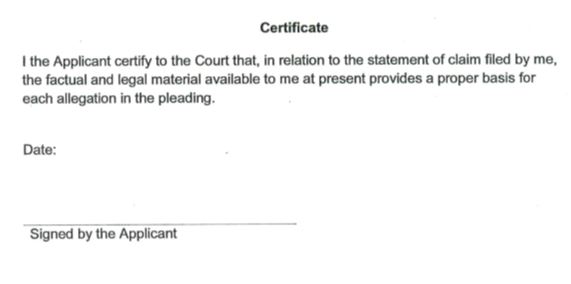
The certificate, it will be noted, provided only for the signature of “the Applicant”, but was not signed in any event.
29 Order 2 permitted an application for leave to file a Statement of Claim that had been certified. That was not done within the time permitted and still has not been done. It is not the failure to provide certification, however, which would have led to the refusal of leave. It is the form in which the pleading is expressed which would have dictated that result, even if Dr Chandrasekaran had paid the costs of the Respondent.
30 The form of the Statement of Claim as signed by Counsel identified four causes of action, namely:
misleading and deceptive conduct, relying upon s 18 of the Australian Consumer Law (contained in Sch 2 of the Competition and Consumer Act 2010 (Cth)) (the “Australian Consumer Law”) (at paras [13] to [14], being pages 3 to 10);
breach of contract (at para [15], being pages 10 to 11); and
injurious falsehood (at para [16] and [18], being pages 12 to 14); and
breach of confidence (at para [21], being pages 14 to 19).
These pleadings, with respect to Counsel who “settled” them, fail to comply with r 16.02(1) and contravene r 16.02(2) of the Federal Court Rules.
31 In very summary form, it is sufficient to conclude that the “pleadings”:
are certainly not “as brief as the nature of the case permits” (r 16.02(1)(b)); and
fail to “state the material facts on which the party relies” (r 16.02(1)(d)).
Even if these conclusions are open to argument, it is sufficient to further conclude that the Statement of Claim as “settled” (at the very least) remains:
“ambiguous”, contrary to r 16.02(2)(c); and
“likely to cause prejudice, embarrassment or delay in the proceeding”, contrary to r 16.02(2)(d).
32 It is sufficient to extract as follows part of the Statement of Claim dated 27 May 2020 directed to misleading and deceptive conduct (without alteration):
MISLEADING AND DECEPTIVE CONDUCT
13.1 The RANZCP by its servants and agents who were the members of the Education Committee from time to time from 2013 to date have made and continue to make the following representations of or about the Applicant which were and are misleading and deceptive in trade and commerce, as described herein, in contravention of s18 of the Australian Consumer Law, contained in Schedule 2 of the Australian Competition and Consumer Act 2010 (Cth).
Particulars
13.1.1 The representations were and are that the Applicant is paranoid, an erotomaniac, has caused conflict amongst her colleagues and in the workplaces where she was appointed from time to time, is a difficult person, has an eating disorder, is homosexual, is a sexual deviate, and is a terrorist sympathiser and offender.
13.1.2 Each representation was at the time it was made and remains erroneous and false in that at no material time has the Applicant been paranoid, an erotomaniac, caused conflict, been difficult, had an eating disorder, been a homosexual, a sexual deviate, or a terrorist sympathiser and offender.
13.1.3 The persons involved in making the representations are RANZCP officeholders and honorary position holders including the NSW State Director of Training, Dr. Warren Kealy-Bateman, and the Directors of Training namely Dr. Bruce Boman, Dr. Stephen Jurd, Dr. Andrew Pethebridge, Dr. Andrew Ellis, Dr. Saretta Lee, Dr Stephane Auchincloss, Dr Milford MacArthur, and Dr David Lang, RANZCP appointed Supervisors such as Dr. Bill Lyndon, Dr. Peter Klug, Dr. Jeffrey Striemer, Dr Hugh Morgan, A/Prof. Elizabeth Scott, Dr. Elizabeth Spencer, Dr Raj Maheshwari, Dr Peter Sharp and other psychiatrists (this is not exhaustive, and will be supplemented after standard discovery), in respect of the representations and made to other members of RANZCP, Local Health Districts and other health organisations and facilities within NSW, and outside NSW within Australia, complained of herein, in all of which facilities and organisations the Applicant was entitled to train and practice as a psychiatrist.
13.1.4 Further to 13.1.2 the said agents and servants of RANZCP coined pejorative labels about the Applicant to her colleagues and to locum placement agencies and the facilities around Australia for whom she has worked and have referred to her for example as being the ‘cra(z)y google car lady’. These false representations were also spread to persons who could facilitate the Applicant earning an income (such as, Mr Daniel Harvey of Charterhouse Medical and Ms Dianne O’Shea of Medicins Legale) and medico-legal organisations. This material was then used to convince other members of the medical profession that the Applicant was unsuitable to be a doctor and suffers herself from a psychiatric illness.
13.1.5 These further representations have aimed to portray the Applicant as having a psychiatric illness and therefore were and are intended for her to be denied employment and appointments within Australia as VMO, staff specialist and private psychiatrist and to be discredited in advance of any claim she could make against RANZCP thereby victimising the Applicant to ensure she should be perceived and considered an impaired medical practitioner.
13.1.6 The misleading and deceptive conduct occurred in the course of and in the execution of their duties as agents and servants of the Committee for Training, Committee for Examinations, and Committee for CPD, on behalf of and/or at the direction of the Education Committee and thence of RANZCP’s Board, and occurred in trade and commerce as a trainee of RANZCP since 2008, and as a Fellow of RANZCP since 3 May 2015.
33 The remaining paragraphs of the Statement of Claim assume a like format.
34 It is sufficient for present purposes to make the following observations in respect to these “pleadings” as to the cause of action of misleading and deceptive conduct:
the “representations” referred to in para 13.1.1 were presumably separate “representations” made on a number of occasions and presumably by one or more different persons – but there is no separation or specification as to when a particular representation was made or who is alleged to have made each representation;
the identification of the “persons involved in making the representations” in para 13.1.3 does not set forth what that actual “involvement” was or when it is said to have taken place, the facts which are said to found the “involvement” and the identification of specific persons by name is preceded by the term “including” – hence leaving open to speculation who are the other unidentified persons to whom reference is being made – and, to the extent that specific persons are named, there is a failure to identify whether one or other of those persons is alleged to have actually made a representation or simply has been “involved” in the making of a representation by some other unspecified persons, and which of the many representations set forth in para 13.1.1 is the one in which a person is said to have been “involved”;
the reference to “the said agents and servants of RANZCP” in para 13.1.4 is devoid of precise content when those “said agents” have been identified by reference, presumably, to those named persons in para 13.1.3 and other unnamed persons (i.e., “including”), further devoid of content as to the “pejorative labels” sought to be identified and further stripped of content by reason of the phrase “for example”;
there is an absence of specification in para 13.1.5 of those persons – be they either the named persons or the other unnamed persons embraced by the term “including” in para 13.1.3 – who “intended for her to be denied employment and appointments”; and
even if there can be some identification of the “agents and servants” referred to in para 13.1.6, there is a complete absence of any specification or identification in that paragraph of “the direction of the Education Committee”, as to when that “direction” was given and by whom.
Such criticisms of the Statement of Claim are not, with respect, mere pedantry; in the absence of specification, neither the Respondent nor the Court would be in a position to form any view as to the factual issues to be addressed or resolved. If objection were to be taken to evidence, there would be no identifiable touchstone by reference to which relevance could be determined. The further submissions filed by Dr Chandrasekaran after the hearing, those including both submissions dated 15 June 2020 and her reply submissions dated 24 June 2020, do not rectify any of the fundamental deficiencies in her May 2020 Statement of Claim.
35 The remaining paragraphs of this Statement of Claim attract further like criticisms.
36 The conclusion that leave would not have been granted to file the Statement of Claim as “settled” by Counsel only provides further reason to not set aside or vary the orders made in October 2019. Those orders contemplated:
the payment by Dr Chandrasekaran of the costs of the Respondent; and
the filing of a properly certified Statement of Claim which complied with the Rules of this Court.
There has been neither the payment of those costs nor the filing of a Statement of Claim which has been properly certified, nor (and more importantly) a Statement of Claim which comes close to complying with the Rules of this Court.
37 One submission made after the hearing and dated 15 June 2020 should be specifically referred to. It expresses a “concern of note”. The submission asserts that the Statement of Claim “has been certified by Counsel” and goes on to express the “concern” as follows:
One concern of note is that the statement of claim is being judged on its adequacy outside the operation of the Federal Court Rules with the intention to make decisions about it without any opportunity to file (and amend) the claim according to the FCR, and for the Respondent to reply accordingly, deliberately.
The submission that the Statement of Claim has been “certified” has been rejected. Also to be rejected is that yet further opportunities should be extended to Dr Chandrasekaran to “amend”. The October 2019 order provided for an opportunity to seek leave to file a certified Statement of Claim. Leaving to one side the fact that the proposed Statement of Claim has not been certified, the form in which it is expressed has been held to be so fundamentally deficient that leave would not have been granted to file it. Those deficiencies are such as to be insusceptible of amendment. A complete re-draft was called for.
38 Even had the non-payment of costs not been in itself a sufficient reason for not relieving Dr Chandrasekaran of her need for compliance with the October 2019 orders, the non-payment of costs together with the deficiencies in her Statement of Claim would have led to a like conclusion.
The application for disqualification
39 At the interlocutory hearing on 27 May 2020 it was understood that an application was then being made for the immediate reconstitution of the Court. Dr Chandrasekaran also filed in Court on 4 June 2020 an Interlocutory Application to that effect.
40 It was understood that an application for disqualification of the Court as presently constituted was founded upon there being a reasonable apprehension of bias as against Dr Chandrasekaran and in favour of the Respondent. Such an application was not unexpected. Dr Chandrasekaran had previously, for example on 28 April 2020, expressed a concern as to what she perceived to be too great a willingness to accept submissions as made by Counsel for the Respondent. If there was a willingness to accept Counsel’s submissions, that was because the submissions were sound. And any acceptance of any submission was not done without affording Dr Chandrasekaran repeated opportunities to advance her own submissions.
41 On 4 June 2020, Dr Chandrasekaran articulated the bases upon which disqualification was sought as being founded upon:
the October 2019 judgment making no reference to vicarious liability, which was said to constitute the bulk of the submissions put forward by Counsel for Dr Chandrasekaran;
the October 2019 judgment not referring to Maiocchi v Royal Australian & New Zealand College of Psychiatrists (No 4) [2016] FCA 33, which was included in the submissions of the Respondent; and
the submissions drafted by Dr Chandrasekaran being publicised in part in the October 2019 judgment, which goes to the broader point that the privacy of the Respondent was prioritised over that of Dr Chandrasekaran.
These bases have been considerably supplemented by the further submissions filed by Dr Chandrasekaran subsequent to the conclusion of the hearing. These further bases are set forth in 16 numbered paragraphs and include:
the manner in which applications for subpoenas were resolved;
the manner in which the Applicant has been variously identified as Dr Chandrasekaran and, on other occasions, Ms Chandrasekaran;
and concluding with a submission which reads (without alteration):
“[k]eeping the Applicant exposed to psychological and physical violence as part of the campaign of harassment through delay to proceedings”.
The factual accuracy of many of the submissions made, with respect to even an unrepresented Applicant, is seriously open to question. The “delay” which has occurred was largely due to extending Dr Chandrasekaran repeated opportunities to attempt to articulate her case. But Dr Chandrasekaran is unrepresented. There is no questioning the genuineness of her belief as to the manner in which she advances her submissions.
42 Any application for disqualification, it is now well recognised, must be “firmly established”: Re JRL, Ex parte CJL (1986) 161 CLR 342. Mason J there observed at 352:
It seems that the acceptance by this Court of the test of reasonable apprehension of bias in such cases as Watson [(1976) 136 CLR 248] and Livesey [(1983) 151 CLR 288] has led to an increase in the frequency of applications by litigants that judicial officers should disqualify themselves from sitting in particular cases on account of their participation in other proceedings involving one of the litigants or on account of conduct during the litigation. It needs to be said loudly and clearly that the ground of disqualification is a reasonable apprehension that the judicial officer will not decide the case impartially or without prejudice, rather than that he will decide the case adversely to one party. There may be many situations in which previous decisions of a judicial officer on issues of fact and law may generate an expectation that he is likely to decide issues in a particular case adversely to one of the parties. But this does not mean either that he will approach the issues in that case otherwise than with an impartial and unprejudiced mind in the sense in which that expression is used in the authorities or that his previous decisions provide an acceptable basis for inferring that there is a reasonable apprehension that he will approach the issues in this way. In cases of this kind, disqualification is only made out by showing that there is a reasonable apprehension of bias by reason of prejudgment and this must be “firmly established” (…) . Although it is important that justice must be seen to be done, it is equally important that judicial officers discharge their duty to sit and do not, by acceding too readily to suggestions of appearance of bias, encourage parties to believe that by seeking the disqualification of a judge, they will have their case tried by someone thought to be more likely to decide the case in their favour.
(some citations omitted)
43 It is equally well-recognised that, as a “general rule” a judge “should not accede to an unfounded disqualification application”: Clenae Pty Ltd v Australia and New Zealand Banking Group Ltd [1999] VSCA 35 at [89], (1999) 2 VR 573 at 603 per Callaway JA. A judge “should not be quick to disqualify himself or herself from hearing a case for a reasonable apprehension of bias” (Patel v Minister for Immigration and Citizenship (No 4) [2012] FCA 1170 at [80], (2012) 208 FCR 128 at 149 per Collier J) and “should not recuse himself or herself from hearing a particular case without there being a proper and substantial reason for doing so” (Rana v Commonwealth of Australia [2013] FCA 189 at [36] per Mansfield J).
44 The application for disqualification was refused on 27 May 2020 and, upon reconsideration and after hearing further oral submissions from Dr Chandrasekaran on 4 June 2020 and subsequent written submissions, the conclusion previously expressed is adhered to. A reasonably informed by-stander, it is respectfully considered, would form the view that she has been given every opportunity to formulate and reformulate her case in a balanced and impartial manner. If anything, with respect, the informed by-stander would be more inclined to believe that it is the Respondent that has been treated in a less than fair manner.
CONCLUSIONS
45 The reasons for making the orders as expressed in the judgment in October 2019 are adhered to.
46 Had Dr Chandrasekaran paid the costs of the Respondent, it may have been the case that r 39.05(c) of the Federal Court Rules would have been invoked to now permit her to file a properly drafted Statement of Claim well beyond the time previously ordered.
47 But she has not paid those costs nor entered into any arrangement with the Respondent for the payment of those costs. To now permit her to continue to pursue the Respondent without payment would occasion a grave injustice. Given the repeated opportunities extended to Dr Chandrasekaran, both prior to and throughout the hearing itself, to properly formulate her claims – and her failure to do so – she is not exposed to any real injustice which does not lie at her own feet. A very belated attempt to file a Statement of Claim “settled” but not “certified” by Counsel provides no real reason to vary the orders previously made. That proposed Statement of Claim is replete with much the same ambiguities and uncertainties as previously characterised her case. If reference is made to that proposed Statement of Claim, there is only further reason for refusing her Interlocutory Application. Had it been necessary to consider her application for leave to file that Statement of Claim, leave would have been refused.
48 The application for disqualification is and remains, with respect, without substance.
49 The Interlocutory Applications filed by Dr Chandrasekaran are dismissed with costs. Judgment remains entered in favour of the Respondent as provided for in Order 3 as made in October 2019.
THE ORDERS OF THE COURT ARE:
1. The Interlocutory Application filed on 2 March 2020 is dismissed.
2. The Interlocutory Application filed on 4 June 2020 is dismissed.
3. The Applicant is to pay the costs of the Respondent.
I certify that the preceding forty-nine (49) numbered paragraphs are a true copy of the Reasons for Judgment herein of the Honourable Justice Flick. |
Associate:


