

FEDERAL COURT OF AUSTRALIA
Commonwealth of Australia (Department of Education, Skills and Employment) v Phoenix Institute of Australia Pty Ltd (in liq) [2020] FCA 937
ORDERS
DATE OF ORDER: |
THE COURT ORDERS THAT:
1. Pursuant to s 37AF(1)(b)(i), on the ground in s 37AG(1)(a), of the Federal Court of Australia Act 1976 (Cth) until further order:
(a) disclosure of Confidential Exhibit CA-2 to the affidavit of Christopher Alach affirmed on 22 May 2020 (Alach Affidavit) be prohibited except by order of the Court made on application of which the plaintiff has been given at least three business days’ notice; and
(b) disclosure of Confidential Exhibit SL-1 to the affidavit of Scott Langdon sworn on 26 May 2020 (Langdon Affidavit) be prohibited except by order of the Court made on application of which the plaintiff has been given at least three business days’ notice.
2. Pursuant to s 500(2) of the Corporations Act 2001 (Cth) (Act), leave is granted to the plaintiff to commence and proceed with this proceeding against the first defendant.
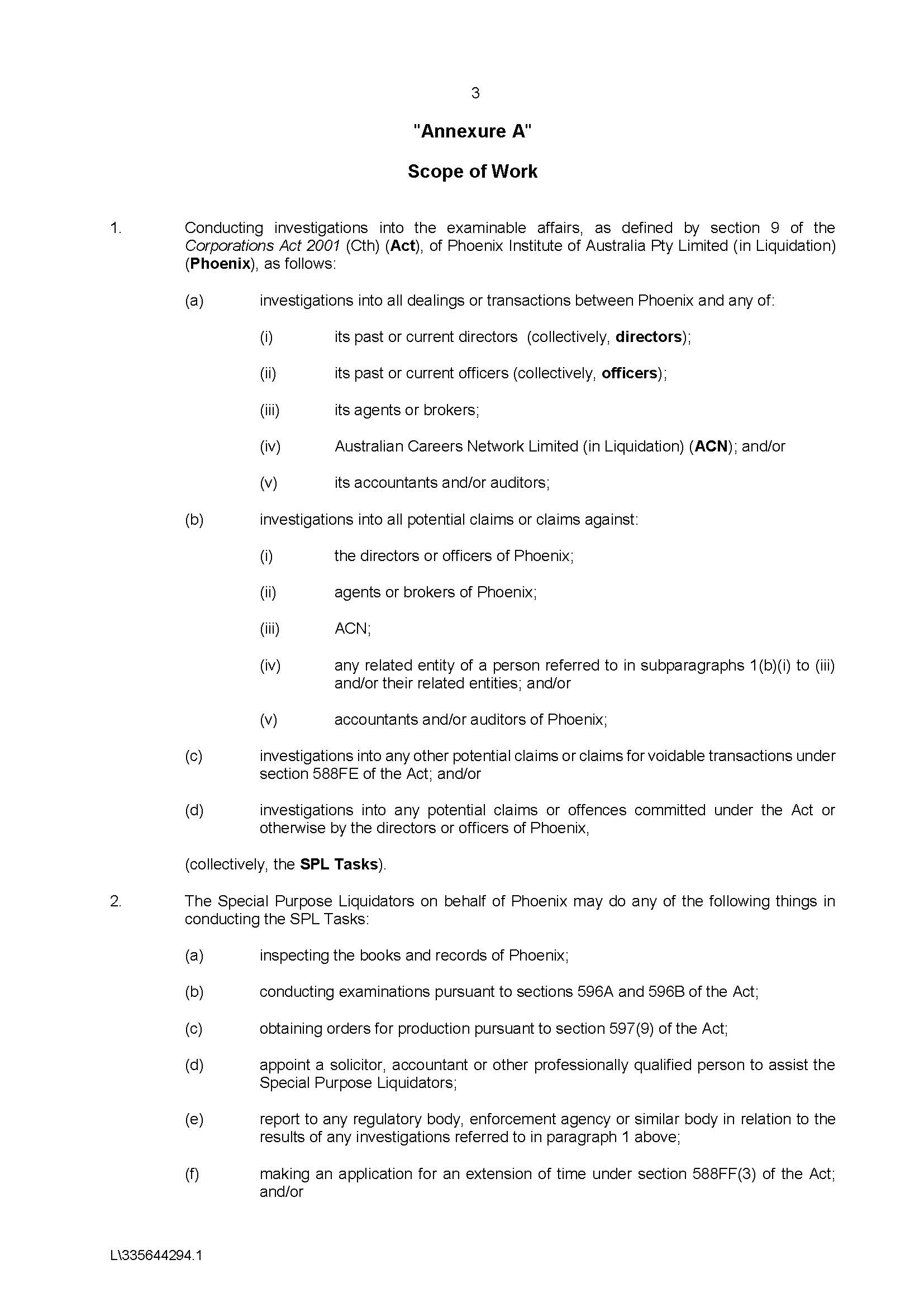
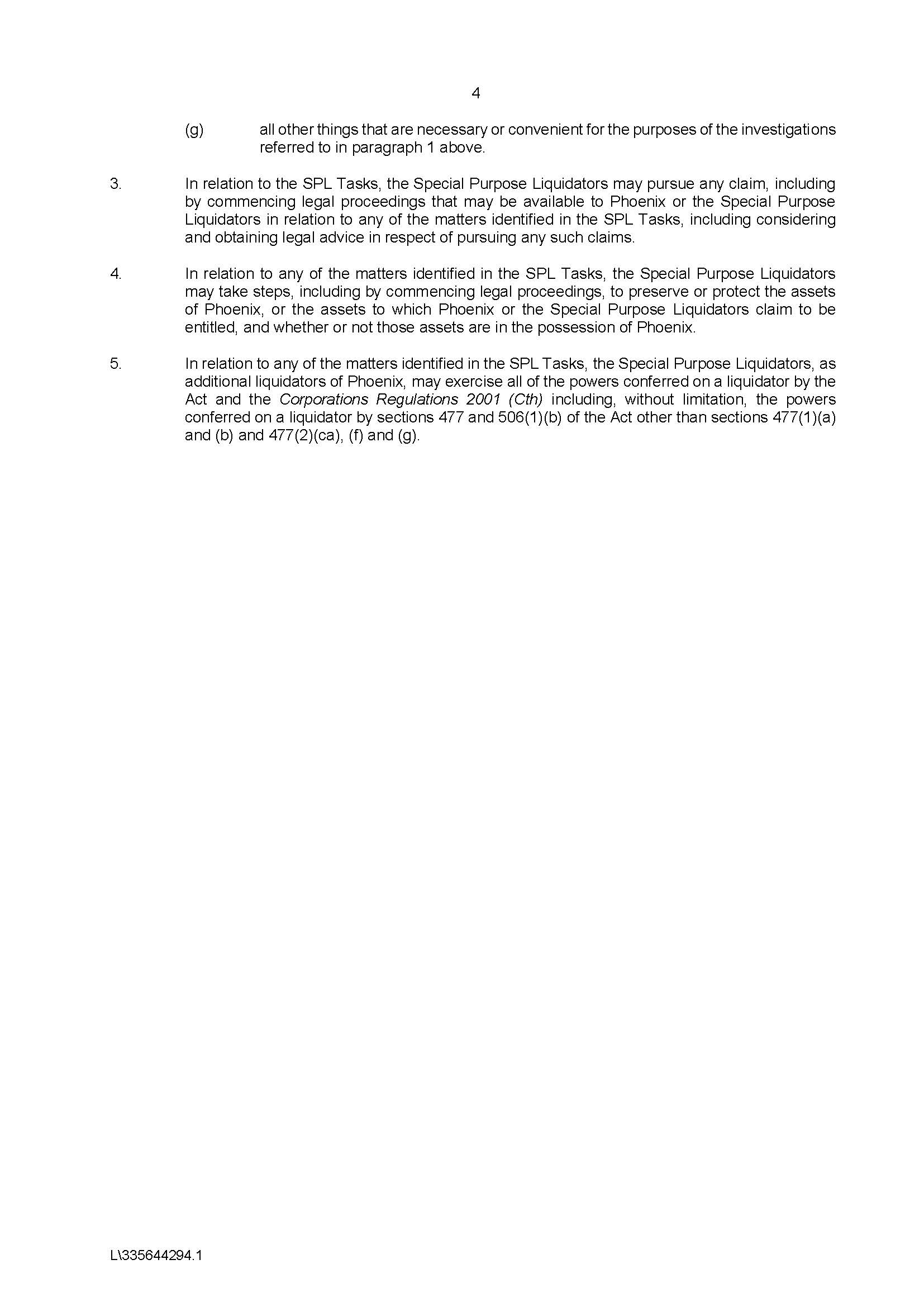
3. Pursuant to s 90-15(1) of the Insolvency Practice Schedule (Corporations) (IPSC), being Sch 2 to the Act, Scott Langdon and Jennifer Nettleton be appointed as additional liquidators (Special Purpose Liquidators) to the first defendant with their appointment to be limited, in the terms of the work to be undertaken by them, to the matters set out in the document entitled "Scope of Work" annexed to these Orders and marked "Annexure A" (Scope of Work).
4. The second and third defendants (Liquidators):
(a) refrain from exercising any of the powers given to the Special Purpose Liquidators in Order 3 above, except with the prior written consent of the Special Purpose Liquidators (such consent not to be unreasonably withheld) or by leave of the Court; and
(b) use reasonable endeavours to assist the Special Purpose Liquidators to exercise the powers given to them in Order 3 above, including by providing any documents or information previously prepared or obtained by or for the Liquidators (including in their prior capacity as voluntary administrators and deed administrators) in investigating or pursuing any claim in relation to any of the matters set out in Order 3 above.
5. Leave is granted to the plaintiff and the Special Purpose Liquidators to apply to the Court in this proceeding to extend the purposes for which the Special Purpose Liquidators are appointed or the powers that the Special Purpose Liquidators are entitled to exercise, and otherwise generally.
6. Pursuant to s 477(2B) of the Act and s 90-15 of the IPSC, the Special Purpose Liquidators be granted approval to enter into a funding agreement with the plaintiff and first defendant in, or substantially in, the form reproduced at Confidential Exhibit CA-2 to the Alach Affidavit and Confidential Exhibit SL-1 to the Langdon Affidavit (Funding Agreement).
7. Pursuant to s 60-10(1)(c) of the IPSC, subject to further order, the Special Purpose Liquidators’ remuneration be:
(a) determined on a time-cost basis in accordance with the schedule of rates set out in the Special Purpose Liquidators' consents to act; and
(b) approved up to the amount set out in Item 1 of Schedule 2 to the Funding Agreement.
Note: Entry of orders is dealt with in Rule 39.32 of the Federal Court Rules 2011.
MARKOVIC J:
1 On 4 June 2020 on the application of the plaintiff, the Commonwealth of Australia (Department of Education, Skills and Employment) (Department), I made orders including:
(1) an order pursuant to s 90-15(1) of the Insolvency Practice Schedule (Corporations) (IPSC), being Sch 2 to the Corporations Act 2001 (Cth) (Corporations Act), that Scott Langdon and Jennifer Nettleton, both partners of the firm known as KordaMentha, be appointed as additional liquidators (Special Purpose Liquidators) to Phoenix Institute of Australia Pty Ltd (in liquidation) (Phoenix), the first defendant. George Georges and John Lindholm, who were first appointed as voluntary administrators, then deed administrators and subsequently as liquidators of Phoenix (referred to as Administrators, Deed Administrators or Liquidators), are respectively the second and third defendants to the proceeding; and
(2) consequent on the appointment of the Special Purpose Liquidators, an order that they be granted approval to enter into a funding agreement with the Department and Phoenix.
2 These are my reasons for making those orders.
APPOINTMENT OF THE SPECIAL PURPOSE LIQUIDATORS
Background facts
3 The facts on which the Department relies are principally set out in an affidavit affirmed by Christopher Alach, Assistant Secretary of the Skills Programs Compliance Branch in the Skills and Training Group of the Department. I set out below a summary of Mr Alach’s evidence.
Phoenix
4 Phoenix was a vocational education and training provider (VET provider). It was incorporated in 1998 and from 2015 was a wholly owned subsidiary of Australian Careers Network Ltd (in liquidation) (ACN). Relevantly:
(1) Ivan Robert Brown and Stephen Ray Williams were both appointed as directors of Phoenix on 12 January 2015 and Mr Brown was its secretary between 21 August 2015 and 26 October 2015; and
(2) Messrs Brown and Williams were appointed as directors of ACN on 17 March 2014 and 27 August 2014 respectively while Mr Brown was its secretary from 17 March 2014 to 30 September 2014 and from 31 August 2015 to 26 October 2015.
The VET FEE-HELP scheme
5 The VET FEE-HELP scheme was introduced by amendment of the Higher Education Support Act 2003 (Cth) (HES Act) by the Higher Education Support Amendment (VET FEE-HELP Assistance) Act 2008 (Cth) (HES Amendment Act). The VET FEE-HELP scheme ceased on 31 December 2016 for new students.
6 For the duration of the VET FEE-HELP scheme any entity approved as a “registered training organisation” (RTO) by the national vocational education and training regulator, the Australian Skills Quality Authority (ASQA), could apply to become a VET provider. Students enrolled in courses approved by ASQA could access VET FEE-HELP.
7 A student was entitled to VET FEE-HELP if he or she satisfied the criteria set out in cl 43 of Sch 1A to the HES Act (Sch 1A). For example, cl 43(1)(f) of Sch 1A required a student to be enrolled in the unit on or before the census date for the unit and to remain so enrolled at the end of the census date and cl 43(1)(h) provided that the student must complete, sign and give an appropriate officer of the VET provider a request for Commonwealth assistance on or before the census date.
8 At the relevant time cl 55 of Sch 1A obliged the Commonwealth to pay to a VET provider the amount of VET FEE-HELP assistance to which an enrolled student was entitled. It follows that the amount of VET FEE-HELP for which any organisation qualified was directly proportionate to the number of student enrolments in qualifying courses reported to the Department by that organisation.
9 Once a body was approved as a VET provider and activated its approved courses within the Department’s online information technology system (referred to as HITS), the VET provider could submit an estimate for VET FEE-HELP payments into HITS which would include the estimated number of eligible students who were to pay their course fees by way of VET FEE-HELP assistance and the estimated total amount of the VET FEE-HELP loans for the calendar year.
10 The Secretary of the Department (or his or her delegate) was able to make a determination pursuant to cl 61 of Sch 1A that an advance be paid to a VET provider based on the estimate submitted by it.
11 The Commonwealth advanced VET FEE-HELP loans to eligible students by paying the students’ tuition fees directly to the VET provider in discharge of each student’s liability to pay tuition fees. Each student became liable to repay the amount of VET FEE-HELP paid to the VET provider for courses undertaken by him or her once that student’s income reached the requisite threshold. Those repayments were facilitated through the Australian taxation system.
12 Revenue that was overpaid to a VET provider was liable to be repaid as a debt due to the Commonwealth by a mechanism set out in cl 61 of Sch 1A.
13 VET providers reported data about their enrolled students and their courses and the actual amount of VET FEE-HELP assistance accessed by their students to the Department quarterly through the Higher Education Information Management System (HEIMS). Twice annually VET providers were required to confirm that the reported data was complete and correct. The Department then reconciled that data against the advance payments made to each VET provider.
Phoenix as an RTO and VET provider
14 Phoenix became a RTO in 2005 and a VET provider in 2009. In 2015 Phoenix’s primary business was the provision of diploma courses in business, leadership and management, early childhood education and care, and community services.
15 In the 2015 calendar year to 18 August 2015 Phoenix received total VET FEE-HELP advance payments of $106,667,172.48. In July 2015 the sum of $68,663 was recovered from Phoenix as an overpayment following a reconciliation of advance payments against data recorded in HEIMS for the 2012-2014 calendar years via an offset against the advance payment made on 16 July 2015, reducing the total payments made to Phoenix in the 2015 calendar year to $106,598,509.48.
16 After August 2015 the Commonwealth ceased making VET FEE-HELP payments to Phoenix.
17 On or about 11 September 2015 ASQA issued an audit report in relation to Phoenix’s compliance with the Standards for Registered Training Organisations 2015 (Standards) which concluded that Phoenix was non-compliant with a number of the Standards audited.
18 On 12 October 2015:
(1) ASQA issued a notice of intention to make a decision to cancel Phoenix’s RTO registration pursuant to s 36(2)(f) and s 39 of the National Vocational Education and Training Regulator Act 2011 (Cth) and its registration under s 83(3)(c) of the Education Services for Overseas Students Act 2000 (Cth) (ESOS Act) for all courses for all locations based on critical non-compliance with the relevant Standards and the ESOS Act; and
(2) the Department issued a notice of intention to suspend Phoenix’s approval as a VET provider under s 36(1) of Sch 1A on a number of bases including issues about the accuracy of the data submitted by Phoenix to the Department, failure to comply with tuition assurance requirements set out in the VET Guidelines 2015 and complaints the Department had received that Phoenix was encouraging prospective students to select Phoenix based on prohibited inducements.
19 On 30 October 2015 the Department issued a further letter to Phoenix in respect of its notice of intention to suspend its approval as a VET provider in which it informed Phoenix that, unless it was able to provide certain tuition assurance information by 13 November 2015, it intended to suspend its approval.
20 On 23 November 2015 ASQA cancelled Phoenix’s RTO registration and its registration under the ESOS Act with effect from 6 January 2016.
21 On 29 January 2016 a delegate of the Minister for Vocational Education and Skills (Minister) issued a notice of intention to revoke Phoenix’s approval as a VET provider under cl 33(1) of Sch 1A and suspended Phoenix’s approval as a VET provider under cl 36(1) of Sch 1A (which took effect from 6 February 2016) on the basis that Phoenix had breached a number of the VET quality and accountability requirements.
22 On 23 March 2016 a delegate of the Minister revoked Phoenix’s approval as a VET provider under cl 33(1) of Sch 1A with effect from 31 March 2016. The “notice to revoke approval as a VET provider under subclause 33(1) of schedule 1A to the Higher Education Support Act 2003 and determination made under subclause 35(1)” included:
3.25 Due to its concerns regarding the validity of Phoenix's student enrolments, the department engaged Ernst and Young (EY) to conduct a survey of a statistically valid sample of individuals whom Phoenix claimed were students of Phoenix, and for whom Phoenix claimed VET FEE-HELP assistance payments. The survey was to focus on students who were purportedly enrolled in courses with Phoenix between 1 July 2015 to 12 November 2015.
3.26 On 24 December 2015, EY furnished the department a copy of a report (EY Report), that includes the following information:
(a) of the 4,841 individuals EY attempted to interview, 500 individuals completed the survey (no reply or answer was received from 2,493 individuals); and
(b) of the 500 individuals interviewed:
(i) 127 individuals (or 25.5%) stated that they were not currently enrolled with Phoenix, nor had they ever been enrolled with Phoenix; and
(ii) 168 individuals (or 36.6%) stated that they were either currently enrolled with Phoenix or had been enrolled with Phoenix in the past and that:
A. in the case of 108 individuals, either did not sign the VET FEE-HELP assistance form or do not recall doing so; and/or
B. in the case of 43 individuals, do recall signing the VET FEE-HELP assistance form, but did not understand that by signing the form they were receiving a loan from the Government; and/or
C. in the case of 25 individuals, do recall signing the VET FEE-HELP assistance form, but did not understand that by signing the form they would be required to pay the loan back; and/or
D. in the case of 100 individuals, were not notified of the course fees and charges.
ACCC proceeding
23 In November 2015 the Australian Competition and Consumer Commission (ACCC) and the Commonwealth commenced a proceeding against Phoenix and another member of the ACN group of companies (ACN Group) in this Court (ACCC Proceeding).
24 In summary, in that proceeding it is alleged that, in relation to the enrolment of students in training courses provided by it, Phoenix engaged in unconscionable conduct, misleading or deceptive conduct and made false or misleading representations in contravention of the Australian Consumer Law (ACL), being Sch 2 to the Competition and Consumer Act 2010 (Cth).
25 On 21 October 2016, after Phoenix entered into voluntary administration, leave was granted by this Court for the ACCC and the Commonwealth to continue the ACCC Proceeding on the condition that the Commonwealth would not seek to enforce any pecuniary penalty or injunctive relief relating to refund of monies without further leave of the Court: see Australian Competition and Consumer Commission v Phoenix Institute of Australia Pty Ltd (Subject to Deed of Company Arrangement) [2016] FCA 1246. Leave to appeal from those orders was granted but the appeal was dismissed: see Phoenix Institute of Australia Pty Ltd v Australian Competition and Consumer Commission [2017] FCAFC 155.
26 On 1 May 2019 Phoenix filed a defence in the ACCC Proceeding and on 9 August 2019 it filed a submitting notice.
27 The hearing in relation to questions of liability in the ACCC Proceeding was conducted in November 2019 and judgment is reserved.
The voluntary administration of Phoenix
28 On 21 March 2016 Phoenix and other entities in the ACN Group were placed into voluntary administration and the Administrators were appointed.
29 In their report dated 26 April 2016 issued pursuant to s 439A of the Corporations Act for ACN and its associated entities (administrators appointed), the Administrators recorded, among other things, the following:
(1) under the heading “Summary of investigations” that:
• The [ACN] Group was reliant upon receipt of VET FEE-HELP payments by Phoenix from the Commonwealth to ensure it continued to remain solvent. Phoenix was the largest subsidiary in the [ACN] Group and contributed most significantly to revenue (circa 95% of consolidated revenue in YTD FY16).
• Phoenix initiated legal proceedings against the Commonwealth to obtain payment of unpaid advances payable under the VET FEE-HELP scheme in the amount of circa $40 million. However on 21 March 2016, following the judgment of Moshinsky J (which was adverse to Phoenix) and the subsequent uncertainty surrounding the payment and timing of future and deferred VET FEE-HELP payments from the Commonwealth, the Directors made the decision that the [ACN] Group was likely to become insolvent in the future on the basis that it may exhaust its remaining cash reserves before any payment under the VET FEEHELP scheme was received.
• The Administrators have not identified any voidable transactions in the period leading up to the appointment of Administrators. However, a liquidator (if appointed) would conduct further investigations in this regard.
• While the Administrators’ preliminary investigations do not reveal any evidence of false or misleading statements or giving of false information, they understand that the [Department] is currently undertaking investigations into the suspected provision of false or misleading information and the falsification of documents by Mr Ivan Brown, the CEO of the [ACN] Group. Please refer to section 3.2 of this report for further details in this regard.
(2) under the heading “Phoenix operations” that:
As noted in the previous section of this Report, Phoenix conducted the largest business within the Group and accounted for 95% of [ACN] Group revenue. It provided four main courses to students being:
• Diploma of Business;
• Diploma of Leadership and Management;
• Diploma of Early Childhood Education and Care; and
• Diploma of Community Services Work,
all through its online platform Mytimelearning. Phoenix and its associated entities had entered into agreements with arm’s length brokers to conduct their business development operations in referring potential students to Phoenix.
Phoenix experienced rapid growth throughout calendar year 2015 in terms of student enrolment and tuition fees generated and, as a result, had an extensive workforce that peaked at in excess of 250 staff (plus trainers employed on a business to business basis) in September 2015. The total workforce across the [ACN] Group was 405 (plus trainers employed on a business to business basis) in September 2015. These staff predominantly worked in roles such as client relationship managers, data and quality staff for enrolments, administration staff and call centre staff (a number of them were employed through CTI).
…
Our preliminary analysis of the Phoenix databases indicates that in the calendar 2015 Phoenix had:
• 11,299 students; and
• 21,290 course enrolments for which funding was being sought by students under the VET FEE-HELP Scheme.
…
Phoenix received the following VET-FEE HELP advances from the Commonwealth during calendar 2015 based on the agreed estimates provided in October 2014 (as varied):
Date $’000
….
Total 106,667
The Directors’ Statement provided to the Administrators on 1 April 2016 indicated that it is their view that Phoenix is owed circa $162 million in respect of work in progress. The Administrators understand that this relates to further payments to be made to Phoenix by the Commonwealth for VET FEE-HELP loans accessed by eligible students.
While noting this, the Administrators’ review of the Commonwealth’s HEIMS indicates that the amount claimable by Phoenix under the VET FEE-HELP Scheme is circa $253 million, as set out below:
…
(3) under the heading “Historical financial position” that:
Key comments
• The Administrators are of the opinion that the [ACN] Group’s books and records appear to have been maintained in accordance with Section 286 of Act.
• The Group reported a consolidated YTD FY16 net profit of $79.6 million.
• Phoenix predominantly derived its income from tuition fees. In the vast majority of cases, students elected to apply for VET FEE-HELP assistance. In this regard, the Group’s accounts include $162 million of accrued income relating to unpaid VET FEE-HELP advance payments to Phoenix (the Administrators have noted in section 3.2 of this Report that a review of the Commonwealth’s HEIMS indicates that Phoenix’s claim under the VET FEE-HELP Scheme is circa $253 million).
• In the event that tuition fees funded via the VET FEE-HELP Scheme (accrued income) are not received, the [ACN] Group will report an adjusted net loss of circa $21.8 million.
• The [ACN] Group accounts show that there were sufficient assets to meet all liabilities, reporting a consolidated net asset position of $135 million as at 21 March 2016.
• The Administrators note that the net asset position is highly contingent upon receipt by Phoenix of payments from students enrolled in the various courses or (as applicable) VET FEE-HELP payments from the Commonwealth. It is also contingent upon the outcome of the ACCC proceeding and various contingent creditor claims.
(4) in relation to the statement by directors, under the heading “Contingent liabilities” the directors disclosed a number of contingent liabilities including a contingent liability of $24,623,000 owing to “Phoenix brokers” for which some of the brokers may have been paid in advance of funds being received by Phoenix from the Commonwealth. The Administrators noted that they were currently undertaking a review to determine Phoenix’s right to repayment;
(5) under the heading “Preliminary conclusion as to solvency” the Administrators expressed their preliminary conclusion, based on their preliminary analysis as summarised in the report, to be that it was likely that the ACN Group would have become insolvent by 30 May 2016;
(6) under the heading “Potential liquidator recoveries – insolvent trading” insofar as the directors were concerned, the Administrators expressed the view that based on their preliminary investigations, the ACN Group was not insolvent and therefore there is no claim to pursue the directors for insolvent trading;
(7) under the heading “Proposal for Deed of Company Arrangement (DOCA)” the Administrators were of the opinion that:
… it is in the interest of creditors of the Cross Guarantee entities to enter into a DOCA in substantially the form proposed by the Administrators. As mentioned above, a DOCA is proposed for all entities other than Smallprint (DOCA Group).
The Administrators are of the opinion that the proposed DOCA should be accepted by creditors. The objective of the proposed DOCA is to replicate the position of creditors under the Cross Guarantee in a liquidation scenario (where assets and liabilities of the entities would effectively be pooled), while avoiding the disadvantages that would otherwise arise from a liquidation. …
(8) among other things, the Administrators noted that the deed administrators would have “wide powers under the DOCA to conduct, investigate and administer the affairs of entities in the DOCA Group and to administer the fund”; and
(9) under the heading “Return to creditors” in relation to a liquidation scenario that:
As detailed throughout this Report, the [ACN] Group’s financial statements detail $162 million of accrued revenue in relation to tuition fees for enrolments for Phoenix courses. The Administrators have previously noted that following their review of the Commonwealth’s HEIMS that Phoenix may have a claim for funding under the VET FEE-HELP Scheme of circa $253 million
Since the Administrators’ appointment, we have been conducting detailed investigations with our legal advisors in relation to enrolments undertaken by Phoenix, the processes undertaken by Phoenix in operating the courses, its conduct in dealing with students and in reconciling the amount of funding payable under the VET FEE-HELP Scheme. Those investigations are continuing. The low case scenario assumes that the Administrators do not proceed with any claim in respect of unpaid tuition fees from students or the Commonwealth under the VET FEE-HELP Scheme. In this scenario, the Administrators’ preliminary investigations indicate that Phoenix will have a claim against the brokers of circa $25 million for amounts paid in advance of the obligation under the relevant contracts, which has not been included in the above table. Should the Administrators successfully recover this amount, it will result in an adjusted estimated return to creditors of 25 cents in the dollar.
…
30 In their s 439A report, the Administrators noted that the audited financial statements for each company in the ACN Group were prepared up to 30 June 2015 and audited by Grant Thornton. A copy of the special purpose financial report for Phoenix for the year ended 30 June 2015 was in evidence before me. That report records:
(1) that Phoenix paid:
(a) a dividend to its shareholder, ACN, of $11 million;
(b) management fees of $14,992,614 to a related entity; and
(c) premiums to insure each of its directors against liabilities for costs and expenses incurred by them in defending any legal proceedings arising out of their conduct while acting in their capacity as directors of Phoenix, other than conduct involving a wilful breach of duty in relation to Phoenix;
(2) that subsequent to the end of the financial year Phoenix received $66,249,775 in progress payments for VET FEE-HELP of which $25,735,104 related to accrued revenue as at 30 June 2015;
(3) in the notes to the financial statements:
(a) under the heading “Revenue” that:
Revenue arises from the rendering of services … is measured by reference to the fair value of consideration received or receivable, excluding sales taxes and discounts.
Training, tuition and service revenue
Revenue is recognised by reference to the stage of completion with respect to the provision of education and training services. This is applied by recognising revenue on a straight line basis over the period the courses are expected to be delivered and allowing for the attrition of students over the course duration.
(b) that the management fees and the dividends payable were paid in full in July 2015 from cash proceeds of $66,249,775 received in July 2015 which were the progress payments received from the Commonwealth for VET FEE-HELP (see [30(2)] above).
31 On 3 May 2016 the Department lodged a proof of debt in the administration of Phoenix for $835,101.36 which the Department contends is a fraction of the total amount owing to it (see [46] below).
32 On 24 May 2016 the creditors of the ACN Group approved a deed of company administration for all entities within it save one (DOCA Group) and the Administrators became the Deed Administrators.
Subsequent correspondence with the Administrators
33 Following the Administrators’ appointment as Deed Administrators, the Department engaged in correspondence with them about various matters. That correspondence, which I do not propose to set out in full, canvasses a number of issues that arose between the parties including, as noted below, in relation to the amount owing for VET FEE-HELP payments. Some of those issues continue to be the subject of disagreement. It is sufficient to observe that the correspondence demonstrates that there is a degree of discord between the Department and the Administrators (and subsequently the Liquidators).
34 Illustrative of the nature of the correspondence is a letter dated 4 June 2018 from the Department to the Administrators in their capacity as Deed Administrators in which, among other things, the Department:
(1) noted that:
The Deed Administrators have received or become aware of material, from which, an inference can be drawn, or which should at least give rise to concerns, that directors and officers of Phoenix may have committed offences or been engaged in misconduct and other breaches of duties. That material includes:
(a) pleadings and evidence filed in the Federal Court proceedings commenced by the Australian Competition and Consumer Commission: Australian Competition and Consumer Commission & Anor v Phoenix Institute of Australia Pty Ltd ACN 084 806 575 & Anor (Proceeding No.NSD1471/2015) (ACCC Proceedings); and
(b) evidence and transcripts from the Supreme Court of Victoria proceedings Atkinson Prakash Charan v Nationwide News Pty Ltd (Proceeding No. SCI 2015/06476) (Charan Proceedings). That material, to the extent it is relevant to Phoenix and its directors (in particular, Ivan Brown), was summarised in the Department’s letters to you dated 27 October 2017 and 26 February 2018 following the judgment in the Charan Proceedings.
(2) made the following request for information to be provided within 10 business days of the date of its letter:
Pursuant to section 70-45 in Schedule 2 to the Corporations Act, the Department requests the following information and documents from you and Mr Lindholm as deed administrators of Phoenix:
(a) details of any further investigations undertaken by the Deed Administrators into the solvency position of Phoenix in the period leading up to the Administrators’ appointment on 21 March 2016;
(b) details of any further investigations undertaken by the Deed Administrators into potential claims for voidable transactions in respect of Phoenix and the outcome of any investigations in respect to those transactions (for example, dates and amounts of substantive dividend payments).
(c) details of further investigations undertaken by the Deed Administrators into the matters referred to in paragraph 1.1(d) above (and the outcome of those investigations);
(d) details of any further investigations undertaken by the Deed Administrators into any other claims, potential recoveries and/or offences committed by Phoenix’s directors and officers (and the outcome of those investigations);
(e) if no investigations have been undertaken by the Deed Administrators since their appointment as such, an explanation as to why no investigations have been undertaken in circumstances where:
(i) the 439A Report expressly stated that the investigations undertaken by the Administrators were only preliminary and had been limited;
(ii) the Deed Administrators are empowered by the DOCA to continue their investigations into the affairs of Phoenix; and
(iii) the Deed Administrators are aware of matters and circumstances which give rise to serious concerns of potential offences and breaches of duties committed by the directors of Phoenix (as noted in section 8.6.2 of the 439A Report and are apparent from the material received in the context of the ACCC Proceedings and the Charan Proceedings);
(f) an explanation of the payments totalling $1,060,000 in respect of intercompany loans that were paid out of Phoenix’s assets (as noted in the June Report); and
(g) a summary of other payments in respect of intercompany loans, which have been paid from Phoenix’s assets since the date of the June Report.
(h) details of material transactions completed by the Company in the twelve months prior to 21 March 2016, including date of payment, amount of payment and payer/payee (such transactions to include dividends paid by the Company to shareholders).
(i) In relation to the transactions identified at (g), details of investigations performed into those transactions; and
(j) In relation to the transactions identified at (g), the Deed Administrators’ opinions as to whether any of those transactions warrant further investigation to determine whether Phoenix or its Directors may have committed any offences.
35 On 13 June 2018 the Administrators responded to the Department’s letter dated 4 June 2018 noting, among other things, that:
(1) since executing the DOCA no further investigations had been undertaken into Phoenix’s solvency up to the date of the appointment of the Administrators;
(2) should Phoenix be placed into liquidation following termination of the DOCA, a liquidator will be required to report to the Australian Securities and Investments Commission (ASIC) about any insolvent trading apparent to him or her in the report to be prepared pursuant to s 533 of the Corporations Act;
(3) no investigations had been undertaken into potential claims for voidable transactions since the execution of the DOCA and that voidable transaction claims can only be pursued by a liquidator;
(4) at that stage no further investigations had been undertaken in relation to any offences the directors may have committed under the provisions of the Corporations Act, any evidence of falsification of books, any false or misleading statements made or authorised by a director of Phoenix and any offences that require reporting to ASIC pursuant to s 438D of the Corporations Act. The Administrators continued:
As you know, given the limited resources at our disposal as Deed Administrators, to date our primary focus has been on realising for the benefit of creditors the largest asset in the deed administration, being the VET FEE-HELP assistance payments payable by the Commonwealth to Phoenix in respect of students enrolled in Phoenix’s courses in 2015 and 2016. I note in this regard that the Commonwealth continues to resist payment of Phoenix’s entitlements, in my view unjustifiably, and in the knowledge that continued resistance is depleting the available resources in the administration of the DOCA.
(5) to the extent there was a request for further information in relation to transactions which occurred prior to the appointment of the Administrators, that information was not relevant to the administration of the DOCA and the Administrators declined to provide it pursuant to s 70-45(2)(a) of the IPSC.
The Department’s investigations and attempts to reconcile the VET FEE-HELP payments
36 The Department has attempted to reconcile Phoenix’s VET FEE-HELP entitlement. The steps taken include:
(1) on 10 October 2016 the Department issued a “notice of proposed reconciliation of payments to a provider (Phoenix)” (Notice of Proposed Reconciliation) for the 2015 and 2016 calendar years. The Notice of Proposed Reconciliation:
(a) stated that the Department had undertaken a preliminary reconciliation of amounts owing to Phoenix under Sch 1A and that it considered that Phoenix was not entitled to any further VET FEE-HELP and may have been substantially overpaid. The Department considered that Phoenix’s entitlement to VET FEE-HELP for the 2015 and 2016 calendar years was $9,219,140, against the amount of approximately $106 million which Phoenix had in fact received for that period;
(b) attached an audit report dated 16 September 2016 prepared by McGrathNicol which recorded that Phoenix claimed a VET FEE-HELP debt of approximately $360 million in its 2015 and 2016 HEIMS data; and
(c) invited Phoenix to supply further information and submissions before a final reconciliation was made;
(2) correspondence then passed between the Deed Administrators and the Department. On 21 December 2016 the Deed Administrators, noting that the Department and Phoenix had different views about Phoenix’s entitlement to VET FEE-HELP payments and the reconciliation process being undertaken by the Department, requested the Department to proceed to make a final reconciliation;
(3) given the nature of the task and the significant analysis and number of documents to be reviewed, the Department informed the Deed Administrators that the reconciliation would take some time. On 18 August 2017 the Department wrote to the Deed Administrators, setting out an analysis of the documents it had reviewed as at that date and concluding that:
The outcomes of the department’s analysis raised serious concerns about the veracity of student enrolments. The analysis confirms the concerns the department has previously expressed about the integrity and accuracy of Phoenix’s representations about the entitlement of students to VET FEE-HELP assistance, and in some instances, demonstrates that the unscrupulous conduct is more widespread than previously realised.
Without further evidence from Phoenix to support and substantiate its claim for VET FEE-HELP assistance, the department does not intend to pay any further amounts to Phoenix.
(4) on 18 September 2017 the Deed Administrators requested the Department to provide its analysis and preliminary findings on a student by student basis identifying the particular circumstances of each student, as they could not otherwise meaningfully respond to the Department’s findings; and
(5) in October and November 2017 the Department and the Deed Administrators exchanged correspondence about the evidence before the Supreme Court of Victoria in a defamation proceeding between Atkinson Prakash Charan and Nationwide News Pty Ltd. Upon the Supreme Court of Victoria delivering judgment in that proceeding (Charan v Nationwide News Pty Ltd [2018] VSC 3), the Department wrote to the Deed Administrators on 26 February 2018 informing them that the findings in that case provided an additional reason why the Commonwealth could not be satisfied of Phoenix’s entitlement to VET FEE-HELP payments. In their response dated 28 March 2018 the Deed Administrators indicated that their own sampling analysis suggested that Phoenix’s entitlement to VET FEE-HELP payments was $250.425 million.
37 Mr Alach points out that while there was further correspondence between the Department and the Deed Administrators and settlement negotiations were attempted, agreement could not be reached on the operation of the HES Act, the reconciliation process and Phoenix’s entitlement to VET FEE-HELP payments. He says that if the ACCC and Department are successful in the ACCC Proceeding then compensation orders sought by the Department will likely obviate the need to resolve the dispute about the reconciliation process (see [47] below).
Phoenix and other companies in the ACN Group go into liquidation
38 On 26 February 2020 the Administrators wrote to creditors (Letter to Creditors) calling a meeting of creditors on 13 March 2020 to consider termination of the DOCA with a view to placing all of the DOCA Group companies into liquidation. Mr Alach identifies a number of matters in the Letter to Creditors which he classifies as “omissions or inaccuracies”. It is not necessary to set out those matters here. However, relevantly, the Letter to Creditors included the following:
If the Group entities go into liquidation, the Deed Administrators propose to do the following in their capacity as Liquidators:
• Wait for the judgment in the ACCC proceeding;
• If the ACCC is partly or wholly unsuccessful in the ACCC proceeding, seek to engage litigation funders to assist in pursuing Phoenix’s claim for VET FEE-HELP;
• If the ACCC is successful in the ACCC proceeding, proceed to finalise the liquidation and have the Group entities deregistered;
• Continue to treat claims of creditors of the Group entities on a pooled basis by reason of the Deed of Cross Guarantee.
39 As a result of an error in the despatch of the Letter to Creditors, it became apparent to the Administrators that creditors of Phoenix may not have received it. Accordingly, on 6 March 2020 the Administrators arranged for the Letter to Creditors to “be sent out to all creditors who missed out on the [Letter to Creditors] via Express Post”. Two copies of the Letter to Creditors were sent to the Department and, according to inquiries made by the Administrators, were received by the Department on 11 March 2020 i.e. two days before the scheduled meeting of creditors. In his letter dated 27 March 2020 Mr Georges informed the Department that as “the letters were sent via express post on 6 March 2020, [he] formed a view that creditors would still receive the letter prior to the meeting and be able to attend either in person or by proxy”.
40 The Department was not represented at the meeting of creditors held on 13 March 2020. At that meeting it was resolved that the DOCA be amended to allow the Deed Administrators to terminate it and to put the DOCA Group companies into liquidation.
41 As a consequence, on 18 March 2020 Phoenix was placed into liquidation and the Liquidators were appointed to it.
Correspondence with the Liquidators
42 By letter dated 17 April 2020, among other things, the Department set out a number of matters with which it took issue in the Letter to Creditors, summarised its view of the effect of the evidence in the ACCC Proceeding and addressed the Liquidators’ intention to finalise the liquidation if the ACCC and the Commonwealth are successful in the ACCC Proceeding. As to the latter the Department’s letter records:
50. Furthermore, it is a decision apparently taken in the absence of any consideration of the compelling material tendered in the ACCC Proceedings.
51. This is of considerable concern to the Department. If, as is expected, the ACCC Proceedings are successful, and the Liquidators proceed to finalise the liquidation and have the Group entities (including Phoenix) deregistered, this will mean that there will be no investigations into the affairs of Phoenix and therefore no possibility of proceedings being instituted for the benefit of creditors.
52. This is highly unsatisfactory given that approximately 4 years have passed since Phoenix entered external administration and despite us raising in correspondence (and in the ACCC Proceedings) manifest indicators of wrongful or potentially wrongful conduct by directors and related entities, no substantive investigations have been conducted by the Administrators/Deed Administrators and it appears that none will be conducted by the Liquidators.
53. If it is not self-evident from the summary above, we set out below some of the matters which, in the Department’s view, require investigation. This should not be taken as a comprehensive statement of such matters.
54. First, if the student enrolment figures Phoenix entered into HEIMS were falsified or overstated, or if students on behalf of whom Phoenix made claims did not in fact have an entitlement to VET FEE HELP, then it follows that the Commonwealth’s assessment of the amount payable to Phoenix under the VET FEE-HELP scheme was infected by the falsification. In that case, Phoenix’s accounts should not have included some or all of the VET FEE-HELP accrued revenue.
55. By way of example, we note that if the VET FEE-HELP accrued revenue of $25.735 million is removed from the Special Purpose Financial Report in respect of Phoenix for the financial year ended 30 June 2015 prepared by Grant Thornton (Special Purpose Financial Report), Phoenix had a significant deficiency of assets over liabilities, of approximately $25 million. This deficiency suggests that Phoenix, and possibly also other companies within the [ACN] Group, may have been insolvent by no later than 30 June 2015.
56. Second, in September 2015, ACN paid a fully franked distribution to its shareholders of $0.13 per ordinary share, equating to a total distribution of $10.89 million. Ivan Brown (a director of ACN and Phoenix) is a 27.8% shareholder of ACN. That dividend appears to have been funded by a dividend of $11.428 million paid by Phoenix to ACN, funded by “cash proceeds received in July 2015 [from the Department] amounting to $66.249 million”.
57. Third, by December 2015, a number of loans (totalling $6.85 million) made to the [ACN] Group by Mr Brown and Harry Kochhar (otherwise known as Harpreet Singh and who was, at various times, the chief operating officer of ACN and Phoenix) were repaid. It can be inferred that the funds used to repay these loans were sourced from the VET FEE-HELP funds paid by the Commonwealth to Phoenix.
58. Fourth, on 12 April 2016, the Australian Federal Police executed a search warrant on the [ACN] Group which noted that there were reasonable grounds for suspecting that the documents described in the search warrant evidenced the commission of indictable offences against Commonwealth laws, namely, that:
(a) between 1 June 2015 and 1 August 2015, Mr Brown provided or caused to be provided false or misleading information to the Department contrary to section 137.1 of the Criminal Code Act 1995 (CCA); and
(b) between 1 June 2015 and 11 April 2016, Mr Brown made or caused to be made false documents with the intention to influence the Commonwealth to accept online students as genuinely enrolled and participating in training contrary to section 144.1 of the CCA.
59. Fifth, the Special Purpose Financial Report records that Phoenix paid management fees of $18.326 million to a related entity. Again, these payments to related entities were sourced from Commonwealth funds.
60. Sixth, the 439A Report records that in July, August and September 2015, Phoenix paid a total of $38.83 million for broker fees. These payments were also sourced from Commonwealth funds.
Questions to be addressed
61. In light of the matters addressed above, it is with respect impossible to understand why the Liquidators have formed the view in the Report to Creditors that, if the ACCC (and Commonwealth) are successful in the ACCC Proceedings, the liquidation should be finalised and Group entities deregistered. That is, without the Liquidators undertaking investigations to identify potential claims against wrongdoers which could be pursued for the benefit of creditors of Phoenix.
…
63. Without limitation to further questions which may be formulated in the future, the following essential questions arise:
(a) have the Liquidators lodged with ASIC any report on possible breaches by wrongdoers pursuant to section 533 of the Corporations Act 2001 (Cth). If not, please explain why;
(b) what investigations, if any, were undertaken by the Administrators/Deed Administrators after the 439A Report to ascertain the personal financial position and assets of directors/officers of Phoenix and any other identified wrongdoer or potential wrongdoer;
(c) it appears from the Special Purpose Financial Report that a Directors and Officers insurance policy was in place for the benefit of the directors and officers of Phoenix at the time the Administrators were appointed. Have any claims or circumstances which might give rise to claims been notified to the insurers and, if so, which and when;
(d) was an insurance policy taken out for the benefit of the directors and officers of Phoenix and/or ACN subsequent to the financial year ended 30 June 2015, and if so, have any claims or circumstances which might give rise to claims been notified to insurers, and, if so, which and when;
(e) are you in possession of policies of insurance taken out by Phoenix's agents and brokers and, have any claims or circumstances which might give rise to claims been notified to the insurers of such agents and brokers, and, if so, which and when?
(Footnotes omitted.)
43 On 29 April 2020 the Liquidators responded to the Department’s questions as follows:
In relation to the specific questions that you have raised in paragraphs 61 to 64 of your letter, I answer them below with the same numbering used.
61.
As stated in the Report to Creditors, the administration of the DOCA Group is currently unfunded. That remains the case now that the entities are in liquidation. Unless the Department or other creditors are prepared to fund the Liquidators to carry out further investigations, the Liquidators have no option other than to finalise the liquidation and deregister the DOCA Group entities.
As liquidators, in addition to the tasks detailed in the Report to Creditors, we of course have statutory obligations to comply with in relation to investigations, which includes:
• Preparation of a statutory report to creditors within 3 months of the start of the liquidation under section 70-40 of the IPR. This report is currently being prepared and will be issued to all creditors and lodged with ASIC within the requisite timeframe.
• Preparation of a confidential investigation report to ASIC under s533 of the Corporations Act. The statutory timeline for completion of this is 6 months from the appointment of the liquidator.
Once these investigations are completed and a result is known in relation to the ACCC Proceedings, the liquidators will at that time consider appropriate next steps having regard to any further issues identified in the investigations and funds available to pursue any identified action. As stated above, if the Department or any other creditor wanted me to pursue any matters identified during the course of my investigations, funding will be required in order to take the required next steps to pursue any litigation.
…
63.
a. As noted above, the Liquidators’ s533 report will be lodged with ASIC within 6 months of the appointment of the liquidators.
b. During the DOCA, no investigations were undertaken in relation to the personal financial position of the directors or officers of Phoenix or any other potential wrongdoer. This was not the role of the Deed Administrators as we did not have the statutory power to pursue any insolvent trading or voidable transaction claims against the directors or their related parties.
c. Without voiding the policies held by the DOCA Group by disclosing their specifics, I advise that a suite of policies were held by the [ACN] Group on 30 June 2015 and into the FY2016 year. I advise that a notification on at least one of the policies was made in November 2015 in respect of the ACCC Proceedings. During the course of the Voluntary Administration we explored the policies and were advised by the insurer that while they did not formally deny indemnity (as we did not press this), it indicated its position as follows:
• as the ACCC claim does not involve a claim for compensation, the policy does not respond;
• further, because the ACCC was seeking penalties, the exclusions in the policy apply.
d. As noted above, various policies were held post 30 June 2015.
e. I am not aware of any insurance policies which may have been taken out by the brokers. I note that our investigations indicate that a significant number of the brokers have now entered some form of external administration themselves.
44 By letter dated 18 May 2020 the solicitors for the Department informed the Liquidators of the Department’s intention to approach the Court for orders including an order for the appointment of special purpose liquidators to Phoenix.
45 By letter dated 25 May 2020 the Liquidators responded to the letter referred to in the preceding paragraph, noting some matters of substance in relation to matters included in Mr Alach’s then draft affidavit, which I do not propose to set out here, and relevantly that they consent to the orders sought by the Department and that they did not intend to appear before the Court on the application.
The quantum of the Department’s claim as a creditor of Phoenix
46 Despite submitting a proof of debt to the Administrators in the sum of $835,101.36, the Department asserts that Phoenix owes it approximately $98.3 million made up of the following amounts:
(1) amounts owed by Phoenix based on the reported data in HEIMS and the reconciliations conducted by the Department for FEE-HELP payments, as distinct from VET FEE-HELP payments, of $547,590;
(2) its costs resulting from costs orders made in its favour in:
(a) Phoenix Institute of Australia Pty Ltd v Commonwealth of Australia [2016] FCA 190 which Mr Alach estimates would likely exceed $200,000; and
(b) Phoenix Institute of Australia Pty Ltd v Australian Competition and Consumer Commission [2017] FCAFC 155 which are yet to be quantified; and
(3) the amount owed by Phoenix for the estimated overpayment of VET FEE-HELP assistance for 2015 which has been assessed at approximately $97.4 million.
47 Mr Alach also notes that if the Commonwealth is successful in the ACCC Proceeding, it will seek a compensation order under s 237 of the ACL in the sum of at least $101,802, 959.11. As I understand the Commonwealth’s position, the amount referred to at [46(3)] above and the amount it provides as an estimate of possible compensation it would seek if successful in the ACCC Proceeding are not cumulative. That is, the Commonwealth contends that it would only be entitled to one amount representing the alleged overpayment of VET FEE-HELP assistance to Phoenix.
Department’s interest in conducting investigations into Phoenix
48 Mr Alach gives the following evidence as to why the Department is prepared to fund investigations into the examinable affairs of Phoenix.
49 First, Mr Alach notes that the Department’s position is that Phoenix is indebted to it for at least $98.3 million and, as a matter of public policy, it considers that it is important to ascertain to which entities the substantial funds provided to Phoenix by the Commonwealth have been disbursed and to ensure any wrongdoers, if identified, are made accountable.
50 Secondly, Mr Alach says that the Department considers that investigations ought to be conducted having regard to the following matters:
(1) the investigations conducted by the Administrators were preliminary and, according to Mr Alach, appear to have been influenced by their belief that Phoenix was entitled to recover further VET FEE-HELP payments from the Commonwealth in the sum of approximately $253 million;
(2) while the DOCA conferred powers of investigation on the Deed Administrators, they did not undertake any substantive investigations into the affairs of Phoenix as their primary focus was on realising, for the benefit of creditors, the VET FEE-HELP payments purportedly payable by the Commonwealth for courses in 2015 and 2016 which was the largest asset in the deed administration;
(3) neither the Administrators nor the Deed Administrators have investigated any possible breaches of duty by Phoenix’s directors and officers;
(4) neither the Administrators nor the Deed Administrators have investigated potential claims for breaches of directors’ duties or fiduciary duties, insolvent trading and voidable transactions;
(5) given the statement in the Letter to Creditors that if the ACCC and the Commonwealth are successful in the ACCC Proceeding, the Liquidators will proceed to finalise the liquidation and have the ACN Group entities deregistered, it appears that, in that scenario, the Liquidators are not contemplating carrying out any investigations, other than those required by the Corporations Act;
(6) given the statement in the Letter to Creditors that if the ACCC and the Commonwealth are partially or wholly unsuccessful in the ACCC Proceeding the Liquidators will pursue Phoenix’s claims for VET FEE-HELP payments, it appears unlikely that the Liquidators will undertake any investigations and, even if they propose to do so, they will need to secure third party funding. In that scenario the investigations are likely to be many months or years away; and
(7) the identified potentially wrongful conduct appears to have taken place in the period from January 2015 to March 2016 and any further significant delay in the undertaking of investigations may give rise to limitation period issues which may prevent the commencement of proceedings for certain causes of action, other than voidable transactions.
51 The evidence before me established that the Department is willing to fund investigations into the affairs of Phoenix but only if Mr Langdon and Ms Nettleton are appointed to take carriage of the matters the subject of the proposed scope of work (Scope of Work). The Department’s preference for funding Mr Langdon and Ms Nettleton, rather than the Liquidators, is because of:
(1) its concerns about the failure of the Administrators, Deed Administrators and Liquidators to investigate or properly investigate the affairs of Phoenix and the conduct of its directors and officers, despite Phoenix having been in external administration for more than four years; and
(2) the disputes in relation to significant matters in the external administration of Phoenix which may give rise to a difficult working relationship between the Department and the Liquidators.
Legislative framework and applicable legal principles
52 Section 90-15 of the IPSC provides that the Court may make such orders as it thinks fit in relation to the external administration of a company, either on its own initiative or on an application under s 90-20 of the IPSC.
53 Section 90-20(1) of the IPSC sets out who may apply for an order under s 90-15 and, relevantly, includes a person with a financial interest in the external administration of the company. Pursuant to s 5-15 of the IPSC, a company is taken to be under “external administration” if, among other things, a liquidator had been appointed in relation to the company.
54 In GDK Projects Pty Ltd, in the matter Umberto Pty Ltd (in liq) v Umberto Pty Ltd (in liq) [2018] FCA 541 at [32]-[33] Farrell J said the following about the power to appoint an additional liquidator:
32 Section 90-15(1) of Sch 2 of the Corporations Act confers power on the Court to “make such orders as it thinks fit in relation to the external administration of a company”. A company is taken to be under “external administration” if a liquidator has been appointed: s 5-15(c) of Sch 2. This provision largely tracks s 511 of the Corporations Act as enacted immediately before its repeal took effect on 1 March 2017. As noted by Gleeson JA in Commercial Indemnity at [17], the Court’s powers conferred by s 511 include the power to appoint an additional liquidator.
33 The power to make orders conferred by s 90-15(1) contains no equivalent of s 511(2) which permitted the Court to accede to an application “if satisfied that … the exercise of power will be just and beneficial”. The power is, in its terms, unconstrained. Section 90-15(4) lists some matters the Court is entitled to take into account but that list is expressed to be “[w]ithout limiting the matters which the Court may take into account when making orders”. In Walley, in the matter of Poles & Underground Pty Ltd (Administrators Appointed) [2017] FCA 486, Gleeson J observed at [41] that the question of whether to exercise the power under s 90-15 of Sch 2 can be answered by reference to principles that applied to the exercise of the discretion under the provisions previously contained in ss 479(3) and 511. I agree that those cases can be a useful guide. Despite the breadth of the power conferred by s 90-15(1), it is difficult to envisage circumstances where the power would be exercised if the Court could not be satisfied that it would be just and unless the applicant had demonstrated sufficient utility to the external administration.
55 In Deputy Commissioner of Taxation, in the matter of Italian Prestige Jewellery Pty Limited (in liq) v Italian Prestige Jewellery Pty Limited [2018] FCA 983; 129 ACSR 115 (Italian Prestige) at [32]-[34] I set out a summary of the principles relating to the appointment of an additional liquidator:
32 In Deputy Commissioner of Taxation, in the matter of ACN 154 520 199 Pty Ltd (in liq) v ACN 154 520 199 Pty Ltd (in liq) [2017] FCA 444 (ACN 154 520 199 Pty Ltd) at [64]-[85] Gleeson J summarised the principles relating to the appointment of special purpose liquidators to pursue certain investigations, claims and recovery actions. In the case before her Honour the application for the appointment of special purpose liquidators was made pursuant to ss 511(1), 472(1) and 473(8) of the Act. Her Honour noted at [64] that former s 511(1)(b) of the Act empowered the Court to appoint a special purpose liquidator in a creditor’s voluntary winding up or a winding up following a voluntary administration if it would be “just and beneficial” to do so.
33 At [82]-[83] Gleeson J referred to the decision in Victoria v Goulburn Administration Services (in liq) [2016] VSC 654 where Sifris J considered an application by the Victorian Government to appoint special purpose liquidators to two insolvent vocational training providers. The Government had funded those companies in the period prior to their winding up and was a creditor. Her Honour noted that:
82. … The Government undertook to fund the special purpose liquidators in full and was not willing to fund the existing liquidators, given they were appointed by the directors on the recommendation of the solicitor for the insolvent companies.
83. At [29], Sifris J considered that it would be beneficial to the administration of the winding up and the interests of the general body of creditors for the work envisaged for the special purpose liquidators to be undertaken. Any recoveries would benefit creditors as a whole. The two administrations, by the existing liquidators and the special purpose liquidators, were financially independent of one another.
34 The Commissioner submitted, and I accept, that relevantly the authorities referred to by Gleeson J in ACN 154 520 199 Pty Ltd and more generally establish that it is appropriate to appoint a special purpose liquidator if:
(1) there are matters that require investigation by a liquidator with a view to possible recovery for creditors;
(2) the current liquidators have insufficient funds and insufficient prospects of obtaining funding to pursue an investigation;
(3) a creditor is prepared to fund investigations and recovery actions but only on the condition that another liquidator be appointed; and
(4) such an appointment would be beneficial to the winding up and the creditors as a whole.
Consideration
56 For the following reasons I was satisfied that the orders sought by the Department to appoint the Special Purpose Liquidators to Phoenix should be made.
57 First, the Department, as a creditor, is a person with a financial interest in the liquidation of Phoenix and as such has standing to make the application.
58 Secondly, the evidence establishes that there are matters that require investigation by a liquidator with a view to possible recovery for creditors. The Administrators and Deed Administrators did not undertake investigations but were focussed on recovery from the Commonwealth of amounts they alleged were owing for VET FEE-HELP payments to Phoenix. That observation is not intended to carry any criticism with it. Indeed, the Administrators were operating within the time constraints imposed on them by the Corporations Act and, as they pointed out, were not in a position to pursue some of the alleged claims.
59 However, based on the evidence before me, there is, at the very least, a concern that issues arise in relation to the student enrolments reported by Phoenix to the Department which, in turn, may:
(1) affect the amount of VET FEE-HELP payments Phoenix was entitled to receive;
(2) raise issues about the conduct of Phoenix’s directors; and
(3) if it was not entitled to a proportion of the payments it received, raise an issue as to whether Phoenix was trading whilst it was insolvent.
While that is not an exhaustive list of the issues that may arise and the matters which the Department contends should be investigated, it is illustrative of the concerns.
60 Thirdly, it is apparent that the Liquidators do not have funding to carry out any investigations and, without funding, will not pursue any investigations. In any event, it appears, at least from the Letter to Creditors, that their present intention is only to pursue funding if the ACCC and the Commonwealth are partially or wholly unsuccessful in the ACCC Proceeding.
61 Relevantly, the Department is not prepared to fund the Liquidators but will fund the Special Purpose Liquidators. The Department’s preference is for the appointment of the Special Purpose Liquidators because of the disharmony that exists between it and the Liquidators which may give rise to a difficult working relationship. It is clear that the Department and the Liquidators take different views on some of the key issues. Mr Langdon and Ms Nettleton are each experienced insolvency practitioners with the necessary expertise to undertake the proposed investigations and have each signed a consent to act as a Special Purpose Liquidator of Phoenix.
62 It is in the interests of all creditors not only that the investigations be pursued but that they be pursued by liquidators who are independent and seen to be independent. Once again, that is not to level any criticism at the Liquidators but only to highlight that in the interests of the investigations proceeding efficiently, it is appropriate that the Special Purpose Liquidators be appointed.
63 Fourthly, as I have already observed, the Department is prepared to fund investigations but only on the condition that another liquidator be appointed. A copy of the funding agreement which the Department proposes to enter into with the Special Purpose Liquidators was in evidence before me (see [65] below).
64 Finally, there is no doubt that the appointment of the Special Purpose Liquidators would be beneficial to the winding up and the creditors as a whole. As submitted by the Department, if monies are recovered as a result of the investigations undertaken by the Special Purpose Liquidators, those monies will be available to creditors generally. However, if those investigations do not result in any proceedings or recovery, the Department will simply bear the burden of the cost of those investigations, having been undertaken on their funding.
THE FUNDING AGREEMENT
65 By way of interlocutory process, additional orders were sought including orders that the interlocutory process be made returnable at the same time as the originating process and that, pursuant to s 477(2B) of the Corporations Act and s 90-15 of the IPSC, in the event that the Court was satisfied that the Special Purpose Liquidators should be appointed to Phoenix, they be granted approval to enter into a funding agreement with the Commonwealth and Phoenix in substantially the form that was before me in evidence (Funding Agreement).
66 Mr Langdon gave evidence in support of the interlocutory process including that:
(1) he and Ms Nettleton are prepared to undertake the Scope of Work but that they are presently without sufficient funding to commence it;
(2) the Department is prepared to fund the Special Purpose Liquidators to undertake the first phase of the Scope of Work, referred to in the Funding Agreement as the Agreed Work;
(3) he is of the opinion, based on his understanding that there would otherwise be limited, if any, prospects of a return to unsecured creditors, Phoenix has no other assets from which to fund the Scope of Work, no other creditor has come forward to fund the Scope of Work and the Liquidators are not otherwise inclined to undertake the Agreed Work, that it would be in the interests of Phoenix’s creditors for the Special Purpose Liquidators to enter into the Funding Agreement with the Commonwealth and Phoenix;
(4) based on his understanding of the work that is likely to be required, the Department and Special Purpose Liquidators have agreed a maximum amount of funding to undertake the Agreed Work which is included in the Funding Agreement and which Mr Langdon believes will be sufficient to cover the remuneration and expenses of the Special Purpose Liquidators in undertaking that work; and
(5) the Special Purpose Liquidators do not intend to seek remuneration or to pay any expenses other than in accordance with the Funding Agreement.
Approval of entry into of the Funding Agreement
67 Section 477(2B) of the Corporations Act provides:
Except with the approval of the Court, of the committee of inspection or of a resolution of the creditors, a liquidator of a company must not enter into an agreement on the company’s behalf (for example, but without limitation, a lease or an agreement under which a security interest arises or is created) if:
(a) without limiting paragraph (b), the term of the agreement may end; or
(b) obligations of a party to the agreement may, according to the terms of the agreement, be discharged by performance;
more than 3 months after the agreement is entered into, even if the term may end, or the obligations may be discharged, within those 3 months.
68 In Italian Prestige I considered a similar application. That is, upon making an order for the appointment of additional liquidators the moving party for that order also sought an order for the approval of entry into a funding deed by those liquidators. At [45]-[47] of Italian Prestige I said the following in relation to the application of s 477(2B) of the Corporations Act generally and whether the Court could entertain an application for approval pursuant to s 477(2B) in the same proceeding and at the same time as, or consequent upon, the making of an order to appoint additional liquidators:
45 In Deputy Commissioner of Taxation, in the matter of ACN 154 520 199 Pty Ltd (in liq) v ACN 154 520 199 Pty Ltd (in liq) (No 2) [2017] FCA 755 (ACN 154 520 199 Pty Ltd (No 2)) at [22] Gleeson J observed that the Court’s role in considering an application under s 477(2B) is to determine whether it is a proper or bona fide exercise of the liquidator’s powers. At [24]-[25] her Honour said:
24 The standard imposed under s 477(2B) concerns an assessment by the Court as to whether entry into the agreement is a proper exercise of power and not ill-advised or improper on the part of the liquidator, rather than involving the exercise of commercial judgment: Re Gerard Cassegrain & Co Pty Ltd (in liq) [2013] NSWSC 257 at [11] per Black J citing McGrath re HIH Insurance Ltd [2010] NSWSC 404; (2010) 266 ALR 642.
25 In Pascoe; re Matrix Group Ltd (in liq) [2011] FCA 1117 at [7], Jacobson J cited with approval the following statement by Austin J of the relevant test in Leigh re King Bros [2006] NSWSC 315 at [23]:
Although the court has the statutory task [under s 477(2B)] of giving “approval” to a liquidator’s agreement that may end more than three months after it is entered into, the case law shows that the court undertakes something less than a complete “merits review”. As Giles J said in Re Spedley Securities Ltd (in liq) (1992) 9 ACSR 83 at 85-6:
... the court is necessarily confined in attempting to second guess the liquidator in the exercise of his powers, and generally will not interfere unless there can be seen to be some lack of good faith, some error of law or principle, or real and substantial grounds for doubting the prudence of the liquidator’s conduct.
46 In In the matter of 77738930144 Pty Limited (in liq) (formerly Commercial Indemnity Pty Ltd) [2017] NSWSC 452 (Commercial Indemnity) Gleeson JA dealt with a similar application to that made by the Commissioner before me. That is, an application was made, in that case by a contributory of the relevant company, for the appointment of special purpose liquidators and for the approval of a funding deed and costs agreement in circumstances where the proposed special purpose liquidator had not yet been appointed nor had he been joined as a party to the proceeding. Ultimately his Honour did not need to resolve the question of whether the contributory had standing and the correctness of what his Honour called “the ‘single application’ procedure … relying upon the authority of In the matter of Ambient Advertising Pty Ltd (in liquidation) [2015] NSWSC 1079” because the proposed special purpose liquidator filed his own interlocutory process seeking approval for entry into the funding agreement and costs agreement returnable instanter at the adjourned hearing and contingent upon his appointment as an additional liquidator: see [21].
47 However, at [26]-[28] Gleeson JA said the following about the “single application” procedure:
26. Ordinarily, the additional liquidator once appointed would make any relevant application for s 477(2B) approvals. That can be achieved in the present case in a single proceeding by the procedure adopted here; a separate application by the proposed special purpose liquidator returnable instanter in the proceedings in which he is appointed.
27. Black J expressed the view in AT Air Group that he did not see any reason, in principle or practice, why an application under s 477(2B) could not have been made by the other parties to the agreement (in that case, the funder) after the additional liquidator had been appointed and in circumstances where the additional liquidator had reached a decision to enter into the indemnity agreement and indicated that he or she sought approval from the Court to do so, such as by filing an affidavit in support of the application before the Court. His Honour emphasised that s 477(2B) does not specify who has standing to make an application for the approval contemplated by the section. It is, instead, a prohibition on the liquidator taking a particular step unless that approval has been obtained. His Honour continued at [23]:
In my view, the limitation on the circumstances in which an application may be brought under that section depends less on the identity of the applicant than on the fact that the Court's approval can only be obtained for an agreement that a Liquidator in fact proposes to enter into, if the relevant approval is given. It would not, for example, be open to a creditor or party to an agreement to bring an application under that section for approval of anagreement (sic) that it contends that a Liquidator should enter into, where the Liquidator does not wish to enter into that agreement.
28. So much can be accepted, however, as the present case demonstrates difficulty can still arise if the Court is asked by the applicant for s 477(2B) approval to accept undertakings which are merely foreshadowed in an affidavit made by the proposed additional liquidator but he or she is not present or represented before the Court to give such undertakings to the Court. That was the position in this case when the matter was first before the Court on 20 March 2017.
Consideration
69 I was satisfied that, in the circumstances of this case, it was appropriate to make an order granting approval for the Special Purpose Liquidators to enter into the Funding Agreement with the Commonwealth and Phoenix.
70 The application for approval of entry into the Funding Agreement was sought by way of interlocutory process and made after I was satisfied that the orders appointing the Special Purpose Liquidators should be made. That application was made by the Department but, as has been observed, there is no reason, in principle or practice, why an application under s 477(2B) of the Corporations Act cannot be made by other parties to the agreement after the additional liquidators have been appointed and, where, as is the case here, the additional liquidators have determined to enter into the Funding Agreement and have filed an affidavit in support of the application for approval.
71 The evidence before me established that it is in the interests of Phoenix’s creditors for the Special Purpose Liquidators to enter into the funding agreement with the Commonwealth and Phoenix and, I infer, given Mr Langdon’s evidence, that, subject to an order being made for their appointment, they intend to enter into that agreement. The Special Purpose Liquidators have also undertaken to the Court that they will not recover their fees and expenses other than in accordance with the terms of the Funding Agreement.
72 Having regard to Mr Langdon’s evidence and the terms of the Funding Agreement, I was satisfied that entry into the Funding Agreement is a proper exercise of power. The Funding Agreement is required in order for the Special Purpose Liquidators to receive the funding necessary for them to carry out the Agreed Work and Mr Langdon’s evidence is that it was the subject of confidential negotiations with the Department and that, in the circumstances, entry into it is in the best interest of Phoenix’s creditors. In short, the entry into of the Funding Agreement by the Special Purpose Liquidators will enable them to carry out the proposed investigations with the funds to be provided by the Department. If that does not occur the evidence suggests that it is unlikely that the proposed investigations will proceed.
Confidentiality order
73 The Department also sought an order pursuant to s 37AF of the Federal Court of Australia Act 1976 (Cth) (Federal Court Act) that the Funding Agreement be kept confidential.
74 Section 37AF(1)(b)(i) of the Federal Court Act empowers the Court to make a suppression order or non-publication order prohibiting or restricting the publication or other disclosure of information that relates to a proceeding before the Court and that comprises evidence or information about evidence. The Funding Agreement is of that nature.
75 Section 37AG(1)(a) of the Federal Court Act empowers the Court to make a suppression order or non-publication order on the ground that the order is necessary to prevent prejudice to the proper administration of justice. The suppression order or non-publication order must specify the ground or grounds on which the order is made: see s 37AG(2) of the Federal Court Act.
76 A copy of the Funding Agreement is exhibited to the affidavits of each of Messrs Langdon and Alach.
77 Mr Langdon gives evidence that the Funding Agreement contains a clause requiring its terms to be kept confidential and that the Funding Agreement is a commercially sensitive document that was, as noted at [72] above, the product of confidential negotiations between his firm, KordaMentha, and the Department. In Mr Langdon’s opinion the terms of the Funding Agreement are commercially sensitive and confidential because its disclosure would reveal the amount of resources available to the Special Purpose Liquidators, would make known the investigations proposed to be undertaken by them as well as provisions for the mechanism for settlement and may prejudice the proper administration of justice.
78 Mr Alach similarly gives evidence that the terms of the Funding Agreement are commercially sensitive and confidential because its disclosure would reveal the amount of resources available to the Special Purpose Liquidators, would make known the investigations proposed to be undertaken by them as well as the mechanism for settlement, and may prejudice the proper administration of justice.
79 There is a public interest in the due and beneficial administration of the estate of a company, in this case Phoenix, for the benefit of its creditors: see Italian Prestige at [60]-[61]. In the circumstances I was satisfied that an order pursuant to s 37AF(1)(b)(i) of the Federal Court Act should be made to protect the Funding Agreement from disclosure given the nature of that agreement and the effect its disclosure might have on the ongoing administration of Phoenix.
CONCLUSION
80 For those reasons I made the orders sought by the Department on 4 June 2020.
I certify that the preceding eighty (80) numbered paragraphs are a true copy of the Reasons for Judgment herein of the Honourable Justice Markovic. |
Associate:


