

FEDERAL COURT OF AUSTRALIA
Farrer on behalf of the Ngarrawanji Native Title Claim Group v State of Western Australia [2020] FCA 929
ORDERS
JOSEPHINE FARRER, GREGORY DONALD TAIT, MATT DAWSON, PHYLLIS WALLABY, MARTY STEVENS AND MARK BIN BAKAR Applicant | ||
AND: | Respondent | |
DATE OF ORDER: | 8 July 2020 |
A. Pursuant to section 87(1) of the Native Title Act 1993 (Cth) the parties have filed with the Court the attached Minute of Consent Determination of Native Title which reflects the terms of an agreement reached by the parties in relation to these proceedings.
B. The terms of the agreement involve the making of consent orders for a determination of native title in relation to the land and waters the subject of this proceeding pursuant to sections 87(2) and 94A of the Native Title Act 1993 (Cth).
In these circumstances and with the consent of the parties, THE COURT DETERMINES, DECLARES AND ORDERS THAT:
1. It is satisfied that an order in the terms proposed in the attached Minute of Consent Determination of Native Title is within the power of the Court and is appropriate to be made pursuant to section 87 of the Native Title Act 1993 (Cth).
2. There be a determination of native title in the terms of the Minute of Consent Determination of Native Title attached. The determination is to take effect immediately upon the making of a determination under section 56(1) or 57(2) of the Native Title Act 1993 (Cth), as the case may be.
3. On or before 7 December 2020, a representative of the common law holders of the native title rights and interests shall indicate whether they intend to have the native title rights and interests held in trust and, if so, by whom. They are to do so by:
(i) nominating in writing to the Federal Court a prescribed body corporate to be trustee of the native title rights and interests; and
(ii) including with the nomination the written consent of the body corporate.
4. If a prescribed body corporate is nominated in accordance with order 3, it will hold the native title rights and interests described in order 1 in trust for the common law holders of the native title rights and interests.
5. In the event that there is no nomination within the time specified in order 3, or such later time as the Court may order, the matter is listed for further directions.
6. There be no order as to costs.
Note: Entry of orders is dealt with in Rule 39.32 of the Federal Court Rules 2011.
DETERMINATION
THE COURT ORDERS, DECLARES AND DETERMINES THAT:
Existence of native title (s225)
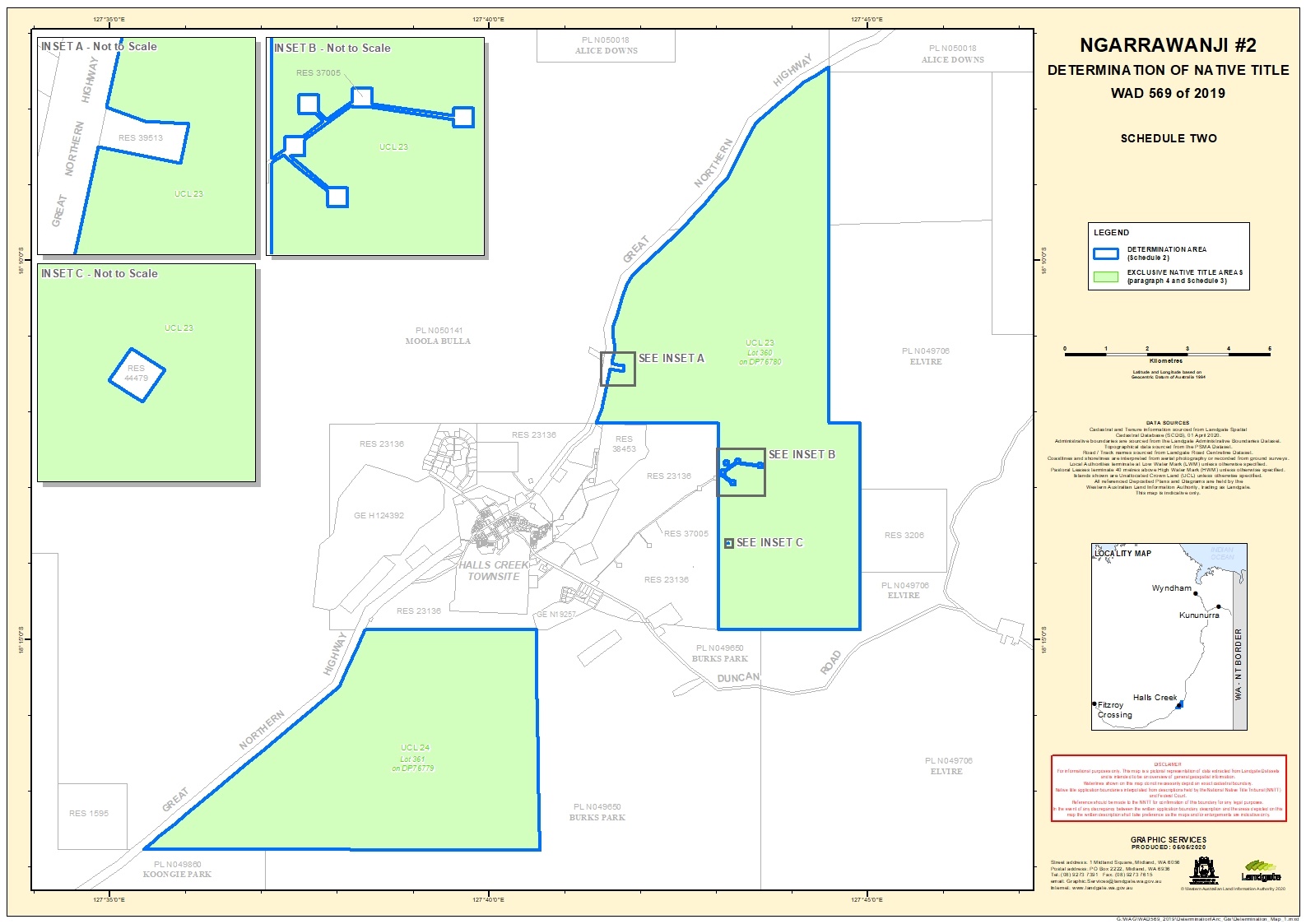
1. The Determination Area is the land and waters described in Schedule 1 and depicted on the maps comprising Schedule 2.
2. Native title exists in those parts of the Determination Area identified in Schedule 3 (Native Title Area).
Native title holders (s225(a))
3. The native title in the Determination Area is held by the native title holders. The native title holders are the people referred to in Schedule 4.
The nature and extent of native title rights and interests (s225(b)) and exclusiveness of native title (s225(e))
Exclusive native title rights and interests
4. Subject to paragraphs 5, 6 and 7 the nature and extent of the native title rights and interests in relation to each part of the Determination Area referred to in Schedule 3 (being areas where any extinguishment must be disregarded) is the right to possession, occupation, use and enjoyment of that part of the Determination Area as against the whole world.
5. Notwithstanding anything in this Determination there are no native title rights and interests in the Determination Area in or in relation to:
(a) minerals as defined in the Mining Act 1904 (WA) (repealed) and the Mining Act 1978 (WA);
(b) petroleum as defined in the Petroleum Act 1936 (WA) (repealed) and the Petroleum and Geothermal Energy Resources Act 1967 (WA);
(c) geothermal energy resources and geothermal energy as defined in the Petroleum and Geothermal Energy Resources Act 1967 (WA); or
(d) water lawfully captured by the holders of Other Interests,
except the right to take and use ochre to the extent that ochre is not a mineral pursuant to the Mining Act 1904 (WA).
6. Native title rights and interests are subject to and exercisable in accordance with:
(a) the laws of the State and the Commonwealth, including the common law; and
(b) the traditional laws and customs of the Native Title Holders.
7. For the avoidance of doubt, the nature and extent of native title rights and interests in relation to water in any watercourse, wetland or underground water source as defined in the Rights in Water and Irrigation Act 1914 (WA) as at the date of this determination is the non-exclusive right to take, use and enjoy that water.
Areas to which s47B of the Native Title Act applies
8. Section 47B of the Native Title Act applies to disregard any prior extinguishment in relation to the areas described in Schedule 5.
The nature and extent of any other interests
9. The nature and extent of other rights and interests in relation to the Determination Area are those set out in Schedule 6.
Relationship between native title rights and other interests
10. The relationship between the native title rights and interests and the other interests is as follows:
(a) the determination does not affect the validity of those other interests;
(b) to the extent of any inconsistency between the other interests and the native title rights and interests, the native title rights and interests continue to exist in their entirety, but the native title rights and interests have no effect in relation to the other interests to the extent of the inconsistency during the currency of the other interests; and
(c) otherwise the other interests co-exist with the native title rights and interests. To avoid doubt, existence and exercise of native title rights and interests do not prevent the doing of any activity required or permitted to be done by or under the other rights and interests, and the doing of an activity required or permitted under those other interests prevails over the native title rights and interests and their exercise, but does not extinguish them.
Definitions and interpretation
11. In this Determination, unless the contrary intention appears:
“Determination Area” means the land and waters described in Schedule 1 and depicted on the maps at Schedule 2;
“land” and “waters” respectively have the same meanings as in the Native Title Act;
“Native Title Act” means the Native Title Act 1993 (Cth);
In the event of any inconsistency between the written description of an area in Schedule 1 or Schedules 3 to 5 and the area as depicted on the maps at Schedule 2, the written description prevails.
SCHEDULE 1
DETERMINATION AREA
The Determination Area, generally shown as bordered in blue on the maps at Schedule 2, comprises all that land and waters bounded by the following description:
Two unallocated Crown land parcels, being Lot 360 on Deposited Plan 76780 (Certificate of Title LR 3164/221) and Lot 361 on Deposited Plan 76779 (Certificate of Title LR 3164/222).
SCHEDULE 2
MAP OF THE DETERMINATION AREA
SCHEDULE 3
EXCLUSIVE NATIVE TITLE AREAS
Areas where native title comprises the rights set out in paragraph 4
The following land and waters (generally shown as green on the maps at Schedule 2):
UCL 23 | Lot 360 on Deposited Plan 76780 (Certificate of Title LR 3164/221) |
UCL 24 | Lot 361 on Deposited Plan 76779 (Certificate of Title LR 3164/222) |
SCHEDULE 4
DESCRIPTION OF THE NATIVE TITLE HOLDERS
1. The native title holders are those Aboriginal people who:
(a) are related through filiation (including by adoption) to one of the Apical Ancestors who held rights and interest in one of the local estate countries comprising the Determination Area; or
(b) are affiliated to an Ngarrawanji Apical Ancestor and who have spirit conception and/or birth sites in one of the local estate countries in the Determination Area; or
(c) are recognised by the persons described above as:
(i) holding rights and responsibilities for certain songs and ceremonies which make reference to important sites in the Determination Area; or
(ii) holding rights and interests in one of the local estate countries in the Determination Area under traditional law and custom.
2. The Ngarrawanji Apical Ancestors are:
| 1. | Djulbir / Dzulbir |
| 2. | Jurrgi |
| 3. | Linmarji |
| 4. | Madangal (wife of Wolameri) |
| 5. | Ngiliyayiny / Nyiliyang |
| 6. | Ngowanderin |
| 7. | Nigan and Kalkburreny |
| 8. | Nirbrarir / Nirbarr |
| 9. | Rosie Bulmaril |
| 10. | Topsy Nanzili |
| 11. | Unnamed Father of Ngularraji and Polly Gulungal |
SCHEDULE 5
AREAS TO WHICH SECTION 47B OF THE NATIVE TITLE ACT APPLIES
UCL 23 | Lot 360 on Deposited Plan 76780 (Certificate of Title LR 3164/221) |
UCL 24 | Lot 361 on Deposited Plan 76779 (Certificate of Title LR 3164/222) |
SCHEDULE 6
OTHER INTERESTS
1. Water Bores
The right of employees and contractors of the Water Corporation, established under the Water Corporations Act 1995 (WA), to continue to access and maintain water bores on the Determination Area existing as at the date of the determination.
2. Existing Interests under the Mining Act 1978 (WA)
Tenement ID | Tenement Type | Date of grant |
E 80/4795 | Exploration Licence | 10 December 2014 |
E 80/4858 | Exploration Licence | 6 May 2016 |
E80/5127 | Exploration Licence | 27 November 2018 |
3. Other Rights and Interests
(a) Rights and interests, including licences and permits, granted by the Crown in right of the Commonwealth or the State pursuant to statute or otherwise in the exercise of its executive power and under any regulations made pursuant to such legislation.
(b) Rights or interests held by reason of the force and operation of the laws of the State or of the Commonwealth including the force and operation of the Rights in Water and Irrigation Act 1914 (WA).
(c) The right to access land by an employee or agent or instrumentality of:
(a) the State;
(b) the Commonwealth; or
(c) any local Government authority;
as required in the performance of his or her statutory or common law duties where such access would be permitted to private land.
REASONS FOR JUDGMENT
MORTIMER J:
1 The land and waters covered by this application were carved out from the land and waters which were the subject of a determination in WAD 41 of 2019 (Ngarrawanji Part A application): see Farrer on behalf of the Ngarrawanji Native Title Claim Group v State of Western Australia [2019] FCA 655 (Ngarrawanji Part A Determination). As I noted in the Ngarrawanji Part A Determination, the application shares its name with a site of importance to the native title holders. Ngarrawanji (also known as Mount Barrett) is a large tabletop hill located behind the Moola Bulla station homestead. It is notorious that the treatment of Aboriginal people at Moola Bulla station is a shameful aspect of post sovereignty history in the East Kimberley, but for many native title holders the country covered by that pastoral lease is significant country under traditional law and custom. Ngarrawanji is associated with the Eagle Hawk Dreaming. Ngarrawanji is visible from the town of Halls Creek.
2 The Ngarrawanji Part A Determination took more than 20 years to come to fruition, and many elders of the Ngarrawanji claim group did not live to see it occur. This second consent determination is also a tribute to their role in keeping traditional law and custom alive, and in passing on knowledge about that law and custom, and about country, to younger generations of native title holders.
3 The present application, WAD 569 of 2019 (Ngarrawanji Part B application), is made pursuant to s 87 of the Native Title Act 1993 (Cth) and relates to two areas of unallocated Crown land (UCL) which comprise approximately 80 square kilometres, in the vicinity of the town of Halls Creek in the south-eastern Kimberley region of Western Australia. As well as the determination of native title, ancillary orders are sought in relation to the remainder of the Ngarrawanji Part A application.
4 For the reasons set out below, the Court is satisfied it is appropriate to make the orders sought, and that it is within the power of the Court to do so.
Background matters
5 The Ngarrawanji Part A application, lodged on 25 June 1996, was a large claim covering an area of approximately 4,065 square kilometres of land and waters in the central eastern and south-eastern Kimberley region of Western Australia. The Ngarrawanji Part A Determination was made on 21 May 2019 pursuant to s 87A of the Native Title Act over all of the application area other than the two areas of UCL now covered by this application.
6 Those two areas are:
(a) Lot 360 on DP 76780 (CLT 3164/221), identified on the State’s Maplnfo program as UCL 23; and
(b) Lot 361 on DP 76779 (CLT 3164/222), identified on the State’s Maplnfo program as UCL 24.
7 At the time of the Ngarrawanji Part A Determination, the parties agreed, and the Court accepted it was appropriate, for UCL 23 and 24 to be excluded because of the likely application of s 47B of the Native Title Act to those areas. These areas were excised from the Moola Bulla pastoral lease in 2013, well after the Part A application had been made. Both areas are subject to petroleum and exploration tenements.
8 The Ngarrawanji Part B application failed the registration test pursuant to s 190A(6) of the Native Title Act in part because it overlaps with the remainder of the Ngarrawanji Part A application, which remains registered. This outcome is a feature of the cumbersome, costly and inconvenient practical operation of s 47B and the current manner in which that provision is viewed as required to operate. In my opinion, there may be less costly and resource intensive ways in which the application and operation of s 47B to parts of a larger claim area might be approached, but those are matters for another day. The failure of the Ngarrawanji Part B application to meet the registration is of no consequence in these circumstances, as the composition of the native title holding group is identical in both Part A and Part B.
9 Another feature of the cumbersome process is that the parties have, on this application, had to seek orders in the Ngarrawanji Part A application proceedings to dismiss the remainder of the Part A application.
10 The parties have submitted that the Court can rely on s 67 of the Native Title Act to make those ancillary orders, and I accept the provision on its face authorises the orders. The purpose is to ensure that the objective in s 68 can be met: namely, that there is only one approved determination of native title in relation to an area. As I have noted there may have been other ways the outcome could have been achieved, but subject to my observations at [40]-[43] below, I consider there is no impediment to the making of the ancillary orders sought.
11 However, there are some complexities, which should be identified. One of the two matters s 68 prohibits this Court doing is to “conduct any proceeding relating to an application for another determination of native title” where there is an approved determination of native title in relation to the same area. The object and purpose of s 68 is to achieve finality in the recognition of native title, by means of one determination per area of land and waters, subject only to any revision consequent upon an exercise of power under s 13(1) of the Act, or any review or appeal. To further that purpose, s 67 requires the Court to make such orders as appropriate to ensure that any overlapping applications “are dealt with in the same proceeding”. In practice, there is some flexibility around how the objectives in s 67 and s 68 might be achieved. For example, two overlapping applications might be the subject of a separate question process, although each retains their own proceeding number. That is one way in which the Court can, in a practical way, “deal with” the overlap, albeit it not strictly in “the same” proceeding. Alternatively, two proceedings may be subject to an order that they be heard and determined together. Again, strictly, the two proceedings are not being “dealt with” in the same proceeding, but they are being “dealt with” together, and the objective in s 67 and s 68 is still apt to be achieved.
12 In the present situation, and typically of circumstances where there is a Part B occasioned by reliance on s 47B, combined with delay in the nomination of a prescribed body corporate for a Part A proceeding, the divide between practical solutions and the strict requirements of the Act may widen, depending on the approach taken to the construction of s 68 and the statutory concept of an “approved determination”, which is used in s 68, but defined in s 13(3). Taking the present example, if “approved determination” is construed as meaning only the Ngarrawanji Part A Determination made on 21 May 2019, which is seen as effective since that date (the PBC nomination process not being seen as part of the determination of native title but rather subsequent to or consequent upon it), then what the Court has been asked to do since 29 October 2019 (when the Ngarrawanji Part B application was filed) is not inconsistent with s 68. That is because there is no “approved determination” over UCL 23 and 24. Since 29 October 2019, there have however been two proceedings before this Court relating to native title determination applications that cover the same area: namely, UCL 23 and 24. To date, the Court has not “dealt with” those applications in the same proceeding. It may be that the orders made today in WAD 569 of 2019 can be seen as doing just that because a determination of native title has been made over UCL 23 and 24 only in one of the two proceedings and the other proceeding is scheduled to be dismissed. I accept that is one possible interpretation of what is permissible under s 67. Another option, which with hindsight might have been explored, might have been for orders to have been made on or around 29 October 2019, combining this proceeding (WAD 569 of 2019) with what was left of the Ngarrawanji Part A application (WAD 41 of 2019), pursuant to s 67. It seems to me there would still have been an application “made” on 29 October 2019 so as to trigger the operation of s 47B.
The material before the Court
13 The application for consent determination was supported by a set of submissions, jointly filed by the Kimberley Land Council on behalf of the applicant and the State Solicitor for Western Australia on behalf of the respondent. The State Solicitor prepared the Minute of Consent Orders and the Minute of Consent Determination. The Court is grateful for the State’s continuing support in terms of making its resources available for this purpose.
14 The application was also supported by three affidavits filed by KLC on behalf of the applicant:
a) an affidavit of Sarah Maree Mack, a Project Officer employed by KLC, affirmed on 13 May 2020, which describes the process undertaken by KLC to notify the claim group members of the Ngarrawanji authorisation meeting on 26 November 2018 (including copies of the meeting notices) and the travel assistance arrangements made by KLC for 18 of the claim group members;
b) an affidavit of Callista Rose Dundas Barritt, an anthropologist employed by KLC, affirmed on 13 May 2020, which describes work undertaken to prepare for the November 2018 authorisation meeting, and in particular the preparation of a registration list and the registration process for claim group members in attendance; and
c) an affidavit of Douglas Lawrie D’Antoine, Senior Legal Officer employed by KLC, affirmed on 13 May 2020, which describes the attendance and conduct of the November 2018 authorisation meeting, and refers to an oversight in the Ngarrawanji Part B application as initially filed.
15 These documents, together with the original application, constitute the material on which the Court has relied in making the orders for a determination of native title. The parties did not file any agreed statement of facts. Although I refer below to lay witness evidence and the anthropological report of Dr Anthony Redmond, they were not filed with the Court, or made available to the Court for the purpose of this application, so the Court is limited to the extracts which appear in the joint submissions.
16 As I noted in the Ngarrawanji Part A Determination at [8], in these circumstances, the Court relies very much on the joint submissions made by the parties, which is a well-accepted approach. The basis for the Court’s orders under s 87 is the agreement of the parties, and the Court does not need to make its own inquiries as to the merits of the claim for native title: see Lander v State of South Australia [2012] FCA 427 at [11]-[12] (Mansfield J), quoting North J in Lovett on behalf of the Gunditjmara People v State of Victoria [2007] FCA 474 at [36]-[37]. Recognition of this approach as permissible confers significant flexibility on parties to agreements for a consent determination. They may elect to agree on matters – not only of fact, but also of law – which, in a contested hearing, would favour one party or another because of the state of the law or the evidence. However, in a negotiated outcome, the very nature of negotiation involves compromise, and parties may elect to compromise on facts and on their legal rights and interests, as long as the factual and legal preconditions exist for the Court to consider that a determination satisfies the requirements of the Native Title Act, so that the determination is within power and is appropriate to make.
The application and the process towards consent determination
17 The Ngarrawanji Part B application was filed with the Court on 29 October 2019 and notified by the Native Title Registrar pursuant to s 66 of the Native Title Act. The s 66 notification period ended on 28 April 2020. The only parties to this application are the applicant and the State of Western Australia.
18 The November 2018 authorisation meeting held in Halls Creek dealt with authorisations for both the Ngarrawanji Part A application and the Part B application. Mr D’Antoine deposes that the following individuals were authorised to constitute the applicant and to deal with all matters arising in relation to this claim: Josie (Josephine) Farrer, Matt Dawson, Phyllis Wallaby, Marty Stevens, Mark Bin Barker and Greg Tait. The affidavits of each of these members filed in relation to this claim deposed to their authorisation as a member of the applicant and their willingness to act in that capacity.
19 Mr D’Antoine’s affidavit deposed at [17] to his understanding that the intention of the Ngarrawanji claim group in passing the relevant resolutions at the November 2018 meeting was that the Ngarrawanji Part B application would be made on behalf of the same people who were to be identified as the native title holders in the proposed Ngarrawanji Part A determination.
20 The State’s agreement to the determination was based on its consideration of the materials in the Ngarrawanji Part A Determination, which included the expert report provided by Dr Redmond (Anthropologist’s Connection Report for Three Adjacent Native Title Claims in the Central East Kimberley Region), as well as an affidavit from Greg Tait, a claim group member and a member of the applicant, affirmed on 5 October 2018, which dealt expressly with evidence of occupation for the purposes of s 47B.
The native title holders
21 The joint submissions indicate that rights and interests according to the traditional law and custom of the Ngarrawanji claim group are acquired through several pathways:
a) filiation (including by adoption) to one of the named apical ancestors who held rights and interests in one of the local estate countries in the determination area; or
b) affiliation to a Ngarrawanji apical ancestor and who have spirit conception and/or birth sites in one of the local estate countries in the determination area; or
c) recognition by the persons described in a) or b) above as a person who:
(i) holds rights and responsibilities for certain songs and ceremonies referable to important sites in the determination area; or
(ii) holds rights and interests in one of the local estate countries in the determination area under traditional law and custom.
22 The apical ancestors who are named in Schedule 4(2) of the Determination are those who were confirmed by the claim group members who attended the authorisation meeting at Halls Creek in November 2018, and by Dr Redmond. They are:
1. Djulbir / Dzulbir
2. Jurrgi
3. Linmarji
4. Madangal (wife of Wolameri)
5. Ngiliyayiny / Nyiliyang
6. Ngowanderin
7. Nigan and Kalkburreny
8. Nirbrarir / Nirbarr
9. Rosie Bulmaril
10. Topsy Nanzili
11. Unnamed Father of Ngularraji and Polly Gulungal
23 The joint submissions properly drew the Court’s attention to the fact that the description of the native title holders in Schedule 4 does not precisely align with the description of those claiming native title in Schedule A of the Native Title Determination Application – Claimant Application (Form 1) as filed on 29 October 2019. The Form 1 only identified the first six of the above apical ancestors, and omits the following apicals: Nigan and Kalkburreny; Nirbrarir/Nirbarr; Rosie Bulmaril; Topsy Nanzili; and Unnamed Father of Ngularraji and Polly Gulungal.
24 The parties submit, and the Court accepts, that the Court may make a determination in the terms proposed notwithstanding this non-alignment. That is because there is clear evidence that the eleven apical ancestors listed in the Schedule 4 description were unanimously agreed to by the Ngarrawanji claimants at the November 2018 authorisation meeting, although five were unintentionally omitted from the Form 1. As to the appropriateness of the Court accepting variations in such circumstances, see generally Billy Patch on behalf of the Birriliburu People v State of Western Australia [2008] FCA 944 at [17]-[18] (French J, as his Honour then was) and Watson on behalf of the Nyikina Mangala People v State of Western Australia (No 6) [2014] FCA 545 at [33] (Gilmour J).
A brief description of the connection of the Ngarrawanji native title holders to the determination area, through their traditional law and custom
25 The connection of the Ngarrawanji claim group to their country generally (and the Part A Determination area specifically) is set out at [30]-[33] of the Ngarrawanji Part A Determination. That description applies equally to the Ngarrawanji Part B Determination area. The joint submissions also referred to Mr Tait’s evidence of occupation of the two UCL areas, for the purposes of engaging s 47B of the Native Title Act. This evidence is summarised in the joint submissions:
Mr Tait is a member of the Ngarrawanji #2 claim group through his grandmother and grandfather. He is a traditional owner for the country including these UCL areas, and he goes there often. He goes to these areas to hunt and to get bush tucker and firewood.
Mr Tait teaches his kids hunting skills and where to find black plum, which grow on UCL 23, as well as how to be responsible for country, and survival skills.
There are bush medicines growing on the UCL areas, and rock holes for fishing. Mr Tait gives examples of natural resources that can be used for survival skills, which his grandfather taught him and that he passes down to his kids.
(Footnotes omitted.)
26 The parties have agreed that the connection materials reveal that the Ngarrawanji claim group possess rights and interests under traditional laws and customs that may be recognised as the right to possession, occupation, use and enjoyment to the exclusion of all others in relation to the Part B Determination area. The parties have agreed that the additional requirements of s 47B of the Native Title Act are satisfied in relation to the Ngarrawanji Part B Determination area, with the result that the right to possession, occupation, use and enjoyment to the exclusion of all others can be recognised.
The applicable requirements of s 87
27 I am satisfied, and the parties agree:
(a) the s 66 notice period has expired (s 87(1));
(b) agreement has been reached by the parties on the terms of an order in relation to the proceedings (s 87(1)(a));
(c) the relevant parties have filed and signed the terms of their written agreement, by providing a proposed Minute of Consent Determination (s 87(1)(b)).
28 I am satisfied the orders sought are consistent with the terms of the parties’ agreement as reflected in the Minute of Consent Determination, and are within the Court’s power to pronounce (s 87(1)(c)).
Whether it is appropriate to make the orders sought (s 87(1A))
29 I have set out my approach to the question of “appropriateness” and the Court’s function in exercising the powers conferred under s 87 and s 87A in previous consent determinations: see Drury on behalf of the Nanda People v State of Western Australia [2018] FCA 1849 at [52]-[56]; Taylor on behalf of the Yamatji Nation Claim v State of Western Australia [2020] FCA 42 at [62]-[65]; the Ngarrawanji Part A Determination at [37]-[46]; and the authorities there referred to. I adopt those observations here.
30 In previous decisions, I have also described the important role of the State in agreeing to a consent determination under s 87 or s 87A of the Native Title Act. The State’s public responsibility is to ensure any agreement made under s 87 or s 87A is one which is in the interests of the community it represents. That community includes Aboriginal peoples and Torres Strait Islanders, and their particular interest in seeing the objects and purposes of the Native Title Act are achieved, so that the following intentions set out in the preamble to the Act can be acted upon:
The people of Australia intend:
(a) to rectify the consequences of past injustices by the special measures contained in this Act, announced at the time of introduction of this Act into the Parliament, or agreed on by the Parliament from time to time, for securing the adequate advancement and protection of Aboriginal peoples and Torres Strait Islanders; and
(b) to ensure that Aboriginal peoples and Torres Strait Islanders receive the full recognition and status within the Australian nation to which history, their prior rights and interests, and their rich and diverse culture, fully entitle them to aspire.
31 The community which the State represents is, of course, a broad one including those who may have their own proprietary rights and interests in the determination area. There are also what might be described as governmental and infrastructure interests of a proprietary nature which must be considered and may need to be accommodated, as the complex scheme of the Native Title Act contemplates. The State must weigh all these factors in reaching a position on an agreement for the purposes of s 87 or s 87A, and in doing so it must negotiate in good faith: see the observations of the Full Court in Widjabul Wia-Bal v Attorney General of New South Wales [2020] FCAFC 34 at [36]-[38]. It is clear the State of Western Australia has engaged in good faith with the Ngarrawanji claim group.
32 The materially different standards which might apply in a negotiation towards a consent determination were highlighted by the Full Court in Widjabul at [51]:
Before considering the facts of the present case it is necessary to say something about the Court’s power to make a determination of native title in accordance with an agreement. The Court must be satisfied that it is appropriate to make the orders specified in the agreement and that there is power to do so: ss 87(1)(c) and 87A(4) of the NT Act. It has been stated that it is sufficient for a party in the position of the State to satisfy itself that there is a credible basis for the application: Lovett on behalf of the Gunditjmara People v State of Victoria [2007] FCA 474 at [37] (Lovett) citing Munn v Queensland [2001] FCA 1229; (2001) 115 FCR 109; see also Watson v Western Australia (No 6) [2014] FCA 545 at [29]. Further, in Lovett it was made clear that “[t]he Act does not intend to substitute a trial, in effect, conducted by State parties for a trial before the Court”. To fulfil its function under the NT Act, in the context of a mediation with a view to entering an agreement under ss 87 or 87A, the State is not required to obtain proof from an applicant which would demonstrate to the civil standard of proof, on the balance of probabilities, that the native title rights claimed by the applicant exist. Indeed, for the State to seek more from an applicant than such material as establishes a credible basis for the existence of the native title rights sought in the determination would be inconsistent with the obligation in s 94E(5) to act in good faith in the conduct of the mediation. It cannot be an act in good faith in the conduct of a mediation to require an applicant to provide the State with more than that which is legally necessary for the State to be in a position to inform the Court that, from the State’s perspective, it is appropriate for the Court to make the determination of native title in orders giving effect to the terms of an agreement as provided for in s 87 or 87A of the NT Act. To place such an unwarranted burden on an applicant would be fundamentally inconsistent with the scheme of the NT Act and in particular the provisions identified above which constitute the “special procedure”, which the Preamble to the statute recognises is required for the “just and proper ascertainment of native title rights and interests”. Such an act would readily be characterised as an act not in good faith in the conduct of a mediation.
33 Again, it is clear the State of Western Australia has taken this kind of approach on the present application.
34 The joint submissions note the satisfaction of the State about the connection material:
The connection material is, in the view of the State, sufficient to demonstrate that the Ngarrawanji #2 Application has a credible basis and that the claimants and their ancestors have maintained a presence in the Ngarrawanji #2 Application Area since the acquisition of British sovereignty. In addition, evidence of the claimants’ and their ancestors' continuing physical or spiritual involvement in the Ngarrawanji #2 Application Area was sufficient to enable the State to conclude that this connection had not been severed. Taken together, the State was satisfied that the material considered was sufficient to evidence the maintenance of connection according to traditional laws and customs in the Ngarrawanji #2 Application Area. The State was also satisfied that the connection material was sufficient to establish that the claimants occupied the Ngarrawanji #2 Application area to which section 47B is agreed to apply.
35 The joint submissions also state that the State has conducted “searches of land tenure, mining and petroleum registries to determine the nature and extent of ‘other interests’ within the proposed determination area” and that those interests are included in Schedule 6 of the Minute.
36 It is appropriate to make the orders sought under s 87 of the Native Title Act.
Nomination of a prescribed body corporate
37 The joint submissions propose that the prescribed body corporate will be the same PBC nominated in WAD 41 of 2019 in accordance with Order 3 of the orders made in that proceeding on 21 May 2019, as amended on 3 April 2020. The amendment on 3 April 2020 extended the nomination date for the PBC to 7 December 2020. The amended nomination date reflects some delays in preparation for the creation of a PBC, said to be due to the Covid-19 pandemic, although I note the applicant had already been given a year to organise the PBC nomination from the date of the determination of native title.
38 Given the native title is the same cross both determinations, it is likely that the Native Title Act intends that it be held by the same body corporate: see Drury on behalf of the Nanda People v State of Western Australia [2020] FCAFC 69 at [74]-[75] (Mortimer and Colvin JJ).
39 It is a matter of some concern that there is still no PBC established to hold the native title recognised in the Ngarrawanji native title holders. The consequence is that, despite celebrations which occurred in 2019, the Ngarrawanji native title holders still do not have the entity required by the Act to hold their native title, and deal with it. The delays mean the same situation will apply to this Part B Determination. Accordingly, the Court’s orders will provide that the determination of native title will take effect immediately upon the Court making a determination under s 56(1) or s 57(2) of the Native Title Act, on the basis of the necessary material being filed by the Ngarrawanji applicant, such material to be filed on or before 7 December 2020.
The proposed ancillary orders
40 In my respectful opinion, there were some difficulties with the form of the ancillary orders proposed by the parties. Although as I have stated, the parties have considerable freedom in the agreements they strike under s 87 and s 87A, the Court must nevertheless always be satisfied the orders which the parties propose be made are appropriate orders, that being an exercise of judicial power.
41 The changes the Court has made are for purposes of clarity and expression, and substantively to ensure that the timing of the dismissal of the remainder of proceeding WAD 41 of 2019 – that is, the principal Ngarrawanji native title determination application – aligns with the point in time at which there is a determination by the Court of who is to hold the native title determined today on behalf of the native title holders.
42 The parties sought a dismissal order which come into effect “immediately upon the making of a determination under section 56(1) or 57(2) of the Native Title Act 1993 (Cth), as the case may be, in proceedings WAD 41 of 2019 and WAD 569 of 2019” (emphasis added). In other words, at the same time as the completion of the PBC nomination process for both determinations.
43 It would appear the reason for this is so that the future act provisions of the Native Title Act can continue to operate in favour of the Ngarrawanji Part A native title applicant, given that the Ngarrawanji Part B application is not registered. I accept that objective, assuming it to be the objective, would be a legitimate one, given the protective purposes of the Act in relation to future acts. I have made a minor change to the form proposed, to ensure that WAD 41 of 2019 is dismissed immediately before the determination under s 56(1) or s 57(2), so that there is no other proceeding in this Court in respect of the Ngarrawanji Part B application area at the time the Court makes its determination under either s 56(1) or s 57(2) as to who is to hold the native title determined in WAD 569 of 2019. As I noted earlier in these reasons, delaying the nomination of a PBC introduces complexities into the administration and operation of the Act which may have been avoided, or reduced, if the applicant were to ensure it was in a position to provide a PBC nomination to the Court at the same time as the making of the determination of native title.
Conclusion
44 The legal representatives of the Ngarrawanji native title holders, and their representative body, the KLC, should be acknowledged for the support and assistance they have provided. So too the responsible and important role played by the State in this outcome.
45 Despite the efforts of all, the observations I made in the Ngarrawanji Part A Determination at [49] remain apposite:
The Ngarrawanji claim group members deserve respect and admiration for their patience, determination and tolerance of the slow progress of the native title system in respect of their claim. It should not have taken this long. That is not to say the fault for the long period of time lies in any one place. Rather, it is to recognise the tragic effects the passage of time has had, and the number of elders who did not survive to see the recognition by Australian law of their connection to their country, their right to be on their country, and to practise their traditional law and custom as their people always have. The tolerance and persistence of the Ngarrawanji claim group members in this respect comes on top of, or in addition to, the many other obstacles which have faced Aboriginal people and their communities since non-Indigenous people came to this land.
I certify that the preceding forty-five (45) numbered paragraphs are a true copy of the Reasons for Judgment herein of the Honourable Justice Mortimer. |
Associate:


