

FEDERAL COURT OF AUSTRALIA
Brecher v Barrack Investments Pty Limited (No 2) [2020] FCA 911
ORDERS
DATE OF ORDER: |
THE COURT ORDERS THAT:
1. The application be dismissed.
2. The cross-claim be dismissed.
3. Unless any party applies within 7 days for a different order as to costs:
a. the applicants pay the respondents’ costs of the application, and
b. the cross-claimants pay the cross-respondents’ costs of the cross-claim.
Note: Entry of orders is dealt with in Rule 39.32 of the Federal Court Rules 2011.
THAWLEY J:
1 On 15 October 2015, Dr Brecher and Dr Rashid executed four documents at the offices of Acorn Lawyers (SCMI transaction documents, giving effect to the SCMI transaction). These four documents marked the commencement of an unsuccessful venture through the vehicle South Coast Medical Imaging Pty Ltd (in liquidation) (ACN 608 363 140) as trustee for the South Coast Medical Imaging Unit Trust (SCMI). The venture involved the merger of Dr Brecher’s existing radiology practice at Dapto (SCXR Dapto) with a new radiology practice (Barrack Heights practice) to be opened at Centre Health Complex Barrack Heights (Barrack Heights or CHC Barrack Heights) in a building which was owned by a company associated with Dr Rashid, Barrack Investments Pty Ltd.
2 SCMI’s new radiology practice at Barrack Heights commenced providing full services on or about 6 April 2016, having been handed over to SCMI on 15 February 2016. It was located in an area of CHC Barrack Heights which, after 15 October 2015, was fitted-out for the purpose by Delbest Pty Ltd, another company associated with Dr Rashid.
3 Funding for SCMI was sourced mainly from the Australia and New Zealand Banking Group Limited (ANZ) which advanced approximately $1.6 million. Dr Rashid and Dr Brecher executed guarantees and indemnities in favour of ANZ (ANZ Guarantee).
4 SCMI did not generate sufficient revenue. On 3 July 2017, an administrator was appointed. On 9 April 2018, it went into liquidation.
5 The witnesses’ accounts of what occurred at the meeting on 15 October 2015 were starkly at odds with each other.
6 On Dr Brecher’s case, Mr Ashutosh Agarwal of Acorn Lawyers, whom Dr Brecher had never met before, told him that: Acorn Lawyers acted for him and his company; the new business to be conducted by SCMI would generate $5,000,000 in the first year, $7,500,000 in the second year and $10,000,000 in the third year; Dr Rashid was a very important businessman in the region; and Dr Brecher should immediately execute the transaction documents, drafts of which had only just been completed, before Dr Rashid left overseas the next day.
7 Dr Rashid’s case was that Acorn Lawyers acted for SCMI only and that Mr Agarwal never represented otherwise. His case was that Mr Agarwal recommended that the SCMI transaction documents not be executed on the day and that Dr Brecher obtain independent legal advice. Dr Rashid denied that Mr Agarwal made any projections regarding SCMI’s revenue as asserted by Dr Brecher. Dr Rashid’s account was supported by the account given by Mr Agarwal.
8 The parties proceeded on the basis that someone was being untruthful about what was said at the meeting; the differing accounts were unlikely to be explained by faulty recollections.
9 By the SCMI transaction documents executed on 15 October 2015, SCXR Dapto was “rolled into” SCMI. Dr Brecher had purchased SCXR Dapto on 31 March 2014 for $2.5 million. Dr Brecher contended that he gave up his interest in SCXR Dapto for no or inadequate consideration. Dr Brecher also contended that he was unaware that the new radiology practice at Barrack Heights would be renting its premises from a company associated with Dr Rashid, Barrack Investments. He also contended that, when entering into the SCMI transaction, he did not know that the fit-out for the new premises was to be conducted by a second company associated with Dr Rashid, Delbest.
10 The events of 15 October 2015 must be examined in light of what occurred before that day. Dr Brecher and Dr Rashid had a number of discussions leading to them entering into the SCMI transaction. Dr Brecher contended that Dr Rashid made a number of misrepresentations in these discussions. He contended that he entered into the SCMI transaction in reliance on these misrepresentations.
11 By a cross-claim, Dr Rashid reciprocated by alleging that Dr Brecher had made a number of misrepresentations during discussions which occurred before 15 October 2015. The various alleged misrepresentations are addressed in more detail later in these reasons. Dr Rashid’s cross-claim also alleged that Dr Brecher had engaged in misleading or deceptive conduct in causing to be provided to Dr Rashid an inaccurate profit and loss statement and balance sheet concerning SCXR Dapto. Dr Rashid contended that he would not have entered into the SCMI transaction had he known the true financial position of SCXR Dapto. Amongst other losses claimed, Dr Rashid claimed that Barrack Investments would have leased an area at CHC Barrack Heights (Radiology Area) to a third party for the purpose of opening a radiology practice.
12 Dr Rashid also contended that, after the SCMI transaction had been entered into on 15 October 2015, Dr Brecher engaged in business and earned fees in breach of one of the SCMI transaction documents.
13 Dr Brecher had also made a series of claims against Acorn Lawyers. These claims were settled between the relevant parties during the hearing.
14 For the reasons which follow, each of the claims brought by Dr Brecher (and his interests) and each of the cross-claims brought by Dr Rashid (and his interests) are not made out and must be dismissed.
B.1 Dr Brecher and associated entities
15 The first applicant is Dr Eric Brecher (Dr Brecher). The second applicant is Eric Brecher Pty Ltd (EBPL). Dr Brecher is the sole director of, and shareholder in, EBPL. EBPL is the trustee of the South Coast X-Ray Unit Trust (SCXR Unit Trust) and the Eric Brecher Discretionary Trust.
16 EBPL, as trustee of the SCXR Unit Trust, owned and operated SCXR Dapto, a radiology practice conducted from leased premises at Dapto, trading as “South Coast X-Ray”. It purchased this business on 31 March 2014 for $2.5 million. In order to acquire and conduct this business, EBPL entered into certain leases and obtained finance on security. It borrowed money from Dr Brecher, Medfin Australia Pty Ltd (Medfin) and the Bank of Queensland (BOQ). The Medfin Facilities and BOQ Loans were secured, including by a guarantee given by Dr Brecher. EBPL also entered into leases with GE Commercial Pty Limited (later, Alleasing) for the lease of equipment and granted security over the leased equipment (Alleasing Securities).
17 Dr Brecher is a radiologist from the United States of America, specialising in the reading of images taken through medical imaging practices, including ultrasound, X-ray, CT (Computed Tomography) scan, MRI (Magnetic Resonance Imaging) scan, OPG (Orthopantomogram) scan and mammography machines. He has for some years worked in radiology in Australia and elsewhere. He described himself as a “prolific reader of radiology cases”. He explained what he meant by this, namely that, whereas a busy radiologist can read up to one hundred and fifty reports in a day, Dr Brecher can read three to four hundred in a day.
18 Dr Brecher was neither a reliable nor credible witness. He was cross-examined at length by counsel for Dr Rashid’s interests and counsel for Acorn Lawyers. I have taken the length and vigour of the cross-examination into account in making findings on credibility and reliability. The length of cross-examination was significantly contributed to by Dr Brecher’s often extensive responses to simple questions. These extensive answers were often argumentative, sometimes unresponsive, and occasionally perforated by statements that he was a “victim” and a credible witness.
19 Dr Brecher often provided answers to what he considered was being implied by questions rather than attempting a direct answer. He would accuse the cross-examiner of having no basis for asking questions and of speculating or even lying. Dr Brecher was also prone to asserting misconduct on the part of others with little or no established justification. Blame for events which he did not like, and allegations of misconduct, came easily to Dr Brecher, both as a witness and as revealed by the events which occurred. He was prone to angry outbursts. Examples are set out in the factual background below. Dr Brecher was quick to find fault in others and resilient to accepting responsibility. These characteristics, and those mentioned above, affected the manner in which Dr Brecher gave evidence as well as, importantly, the content and reliability of it.
20 More significantly, his oral evidence often sat uncomfortably at best with the contemporaneous documents and, at worst, in obvious conflict with them. His account as to the relevant events, usually put with great conviction, would change as documents were put to him and as he struggled to explain away the inconsistencies in his earlier evidence.
21 Dr Brecher did not give an accurate, frank or objective account of the relevant events. He was prepared to mislead whenever he perceived it would suit his interests.
22 Evidence was also given by Ms Renee Hyratt. She was Dr Brecher’s domestic partner and was the practice manager of SCXR Dapto. Ms Hyratt gave evidence which in some respects corroborated Dr Brecher’s evidence. In terms of demeanour, Ms Hyratt presented as generally credible. However, there were important aspects of her evidence which cannot be accepted as accurate. That may be a result of the ordinary process of reconstruction after the events, affected as it inevitably would be by the passage of time, the subconscious effect of interest in the result of the litigation, the effect of supporting Dr Brecher with his justifications and accounts of what occurred and the emotional strain that litigation brings.
B.2 Dr Rashid and associated entities
23 The first respondent is Barrack Investments. It has two issued shares one of which is registered in the name of Dr Mohamad Rashid (Dr Rashid), the third respondent. Barrack Investments is the registered proprietor of the land where the medical centre referred to as CHC Barrack Heights is located.
24 The second respondent is Delbest. It has two issued shares one of which is registered in the name of Dr Rashid.
25 Since around 2006, Barrack Investments and Delbest have conducted an integrated medical health business known as “Centre Health Barrack Heights” or “Centre Health Complex Barrack Heights”. Barrack Investments rents parts of the premises to third party health care providers. In addition, self-employed medical practitioners provide health care services to patients from CHC Barrack Heights and pay Delbest a fee for providing them with facilities and support services.
26 Dr Rashid is a medical doctor. Dr Rashid was a very softly spoken man. He was careful about giving his evidence. I found his evidence to be mostly reliable. His evidence generally sat comfortably with the contemporaneous documents. His recollection of all of the events and conversations was not perfect as is to be expected.
27 Dr Rashid is also a director and shareholder of Romore Pty Limited (Romore). Romore is the trustee of the Rashid Family Trust.
28 The fourth respondent was Mr Ashutosh Agarwal (sometimes referred to in evidence as Ash), who is a lawyer and director of the fifth respondent, Acorn Lawyers Pty Ltd (Acorn Lawyers). As mentioned, the proceedings against the fourth and fifth respondents settled during the hearing.
29 The employees of Acorn Lawyers included a solicitor, Mr Rocco Musumeci, who was present at parts of the meeting on 15 October 2015.
30 I found Mr Agarwal and Mr Musumeci to be generally credible witnesses. They were called to give evidence by Dr Rashid and his interests.
C SUMMARY OF THE APPLICANTS’ AND CROSS-CLAIMANTS’ CASES
C.1 Application to amend the amended statement of claim
31 On 5 December 2019, after the conclusion of the hearing, the applicants filed an interlocutory application seeking leave to amend further the amended statement of claim.
32 The amendments sought to engage the Australian Consumer Law, as adopted in New South Wales by s 28 of the Fair Trading Act 1987 (NSW) (ACL (NSW)), as an alternative to its claims relying upon the Australian Consumer Law in Sch 2 of the Competition and Consumer Act 2010 (Cth) (ACL (Cth)). The perceived advantage of this was apparently to facilitate an argument that the defence of contributory negligence pleaded by Dr Rashid and his interests was not available in respect of a claim under s 18 of the ACL (NSW). The argument was that s 137B of the Competition and Consumer Act 2010 (Cth) does not apply to the ACL (NSW) on the basis that it is not incorporated as a law of New South Wales by s 28 of the Fair Trading Act 1987 (NSW). The applicants referred in this respect to the decision of Campbell JA in Rennie Golledge Pty Ltd v Ballard (2012) 82 NSWLR 231 at [141]. Dr Rashid and his interests opposed the amendments on the basis that they were futile.
33 I allow the amendments. There is no prejudice to the respondents in allowing the amendments. It is not necessary to decide whether the amendments are futile because, for the reasons given below, the issue of contributory negligence does not arise on the conclusions ultimately reached. Nevertheless, the amendments should be allowed, as they may be relied upon in the event that a party decides to appeal.
34 At the conclusion of the hearing, the applicants and the remaining respondents, Dr Rashid and his interests, identified 40 issues to be determined in light of the way in which the case had been conducted. These are each dealt with below. There is benefit in also summarising some of the main allegations made by the applicants and the cross-claimants, as pleaded in the further amended statement of claim (FASOC) and the cross-claim.
C.2 The further amended statement of claim
35 A substantial number of the issues turned on whether Dr Rashid engaged in misleading or deceptive conduct, principally by making representations or adopting representations alleged to have been made by Mr Agarwal.
36 First, the applicants relied upon conduct said to have occurred before 15 October 2015: FASOC [14] to [18], [68]. It was asserted that:
(1) in late June or early July 2015, Dr Rashid represented to Dr Brecher that there would be a lot of work for a radiologist at CHC Barracks Height: FASOC [14];
(2) Dr Rashid represented that a previous tenant (PRP Diagnostic Imaging Pty Ltd) which had conducted a radiology practice at CHC Barrack Heights had left because of a dispute it had with Wollongong Nuclear Medicine, another tenant in CHC Barrack Heights: FASOC [15];
(3) in the first half of July 2015, Dr Rashid represented that:
(a) he had 20 full-time General Practitioners (GPs) working at CHC Barrack Heights and was expanding to 40;
(b) he was bringing in multiple specialists, including five obstetricians and gynaecologists;
(c) an additional floor was to be added to the medical centre; and
(d) as such, Dr Brecher did not have to be concerned about the profitability of the practice to be conducted at CHC Barrack Heights: FASOC [16];
(4) in about mid-July 2015, Dr Rashid:
(a) showed Dr Brecher plans for CHC Barrack Heights indicating where, inter alia, the 20 new GPs and the new specialists would practice;
(b) represented to Dr Brecher that the expansion would be completed by the end of 2019;
(c) undertook to find a neutral lawyer to represent both men and the business to be conducted by them from CHC Barracks Heights; and
(d) represented that the Barrack Heights practice would have enough work to justify the applicants’ involvement: FASOC [17]; and
(5) at various times, including in about September 2015, Dr Rashid undertook to Dr Brecher to find a lawyer to work for the two men and to draft the legal documents for the proposed Barrack Heights practice: FASOC [18].
37 Secondly, the applicants alleged that representations were made on 15 October 2015, when Dr Brecher and Dr Rashid executed the four agreements which implemented the SCMI transaction at Acorn Lawyers’ office. It was alleged that Mr Agarwal represented to Dr Brecher that:
(1) he and Acorn represented Dr Brecher, Dr Rashid and SCMI and would be performing work for Dr Brecher;
(2) the turnover of revenue of the Barrack Heights practice was expected to be $5 million for the first year, $7.5 million in the second year and $10 million in the third year;
(3) Dr Rashid would take out a loan in the sum of $2.5 million, of which up to $1.5 million would be used for the fit-out of the Barrack Heights practice and the balance would be spent on equipment;
(4) Dr Rashid would be negotiating the new lease for the Barrack Heights practice, and the rent would be about $25,000 per month;
(5) the Barrack Heights practice would be up and running by 15 January 2016;
(6) Dr Rashid would recruit new doctors and build up the number of doctors working at CHC Barrack Heights; and
(7) anything in EBPL’s bank account, as at the date of execution of the SCMI transaction documents, was Dr Brecher’s and Dr Brecher could take that money out at any time. This statement was allegedly made in response to a statement by Dr Brecher that he had put between $500,000 and $600,000 into SCXR Dapto and that he needed to get that loan back: FASOC [37].
38 It was alleged that Dr Rashid did not contradict or qualify what Mr Agarwal had said and that Mr Agarwal’s representations were adopted by Dr Rashid’s conduct, including by remaining silent: FASOC [38].
39 It was alleged that Mr Agarwal gave Dr Brecher a brief summary of the documents he and EBPL were to sign and did not advise Dr Brecher that the effect of the documents was to advantage the commercial interests of others over those of EBPL and Dr Brecher: FASOC [40].
40 It was alleged that Dr Rashid did not inform Dr Brecher that Dr Rashid had an interest in Barrack Investments or Delbest, the latter of which would or might undertake the fit-out works for the Barrack Heights practice: FASOC [41].
41 It was alleged that Dr Brecher and EBPL executed the documents in reliance, amongst other things, on the representations detailed in [37] above and on the basis of conduct engaged in by Dr Rashid: FASOC [42].
42 It was alleged that Dr Rashid and his interests engaged in unconscionable conduct within the meaning of s 21 of the ACL (Cth) and ACL (NSW): FASOC [83], [84].
43 It was alleged that Dr Brecher and EBPL suffered loss and damage, resulting from the alleged breaches of ss 18, 20 and 21 of the ACL (Cth) and ACL (NSW), as follows:
(1) In the case of EBPL:
(a) lost profits;
(b) its capital;
(c) the value of its business; and
(d) the lost opportunity to repay in whole the monies due under the Medfin Facilities, the BOQ Loans, and the Alleasing Securities, or to repay more than anything SCMI caused to pay over 2016 and 2017.
(2) In the case of Dr Brecher:
(a) as:
(i) EBPL ceased trading; and
(ii) SCMI did not pay out the Medfin Facilities and the BOQ Loans and the Alleasing Securities or cause them to be repaid as quickly as would have been the case had EBPL continued to trade,
he is under a greater financial liability under the guarantees given in support of those facilities;
(b) such liability as Dr Brecher has under the ANZ Guarantee; and
(c) Dr Brecher has lost income and the opportunity to recover his loans from EBPL.
44 It was alleged that Dr Rashid breached a fiduciary duty owed to Dr Brecher and EBPL: FASOC [89] to [93]. These breaches were said to given rise to the same loss and damage as identified above as having arisen from the breaches of the ACL (Cth) and ACL (NSW). There was no claim specifically made in the section of the pleading alleging breach of fiduciary duty on the part of Dr Rashid for disgorgement of profits made by Delbest in relation to the fit-out carried out for the new radiology practice to be opened at Barrack Heights. However, it was pleaded in [52] of the FASOC, which set out material facts after 15 October 2015, that the fit-out could have been carried out faster and at a lower cost.
45 It was alleged that the Deed of Acknowledgement executed on 15 October 2015 was void for uncertainty: FASOC [66]. However, this was not identified as an issue which needed to be determined at the conclusion of the hearing and was not the subject of any submission.
46 Dr Rashid, Barrack Investments and Delbest cross-claimed against Dr Brecher and EBPL. Their case, in summary, was that:
(1) Dr Brecher and EBPL agreed to purchase SCXR Dapto in the name of the SCXR Unit Trust for $2.5 million, which was substantially more than its value. The purchase was funded, amongst other things, through facilities provided by Medfin. EBPL, in some cases as trustee for the SCXR Unit Trust, also entered into operating lease agreements with GE Commercial and loan agreements with the BOQ.
(2) By 30 August 2015, Dr Brecher knew that Dr Rashid was considering:
(a) leasing a part of Barrack Heights to Primary Healthcare Limited, through its subsidiary Healthcare Imaging Services Pty Ltd, for the purpose of opening a radiology practice; or
(b) establishing a radiology practice at Barrack Heights himself or through associated entities.
(3) A new radiology practice at Barrack Heights would be a competitor of SCXR Dapto.
(4) By 30 August 2015, Dr Brecher knew or ought to have known that:
(a) SCXR Dapto could not repay its liabilities from operating cash flows;
(b) Dr Brecher had a contingent personal liability to repay those liabilities; and
(c) SCXR Dapto’s liabilities exceeded its assets and its debts exceeded its enterprise value and the business was making operating losses and was not able to pay its debts as and when they fell due.
(5) Dr Brecher made a series of representations to Dr Rashid on 30 August 2015 about his ability as a radiologist and the financial position of SCXR Dapto. The alleged representations, referred to as the “Restaurant Representations”, were:
(a) SCXR Dapto had been operating for 20 years or more;
(b) Dr Brecher could provide better radiology services to CHC Barrack Heights’s clients than Healthcare Imaging;
(c) SCXR Dapto was a substantial business having a gross income of $2.8 million per year and net profit of $350,000 per year;
(d) The SCXR Unit Trust was the owner and operator of SCXR Dapto;
(e) SCXR Dapto’s only debts were $2.2 million which it owed Medfin;
(f) SCXR Dapto had no liabilities other than the Medfin Facilities of $2.2 million;
(g) Dr Brecher worked six days a week, he did not take holidays and he did not have commitments to distract him from work;
(h) Dr Brecher could read and analyse 400 radiology reports a day;
(i) Dr Brecher could manage five or six other radiology practices without needing to hire another radiologist as Dr Brecher had the capabilities, skill and experience to manage the practices remotely;
(j) Dr Brecher owned real estate assets and a collection of expensive paintings in the United States; and
(k) Dr Brecher could not get finance in Australia because Australian banks did not lend against assets in the United States.
(6) Dr Brecher suggested, on 30 August 2015, that he and Dr Rashid set up a new company, involving a merger of SCXR Dapto with a new radiology practice at Barrack Heights.
(7) The representations were misleading or deceptive and made with the intention, amongst other things, of encouraging Barrack Investments, Delbest, Dr Rashid and Romore to go into business with Dr Brecher rather than leasing the radiology area at the Barack Heights Centre to Healthcare Imaging.
(8) On 31 August 2015, Dr Brecher caused a profit and loss statement of the SCXR Unit Trust’s income and expenses for the 2014-2015 financial year to be sent to Dr Rashid. This was given to Dr Rashid with the intention that it be relied upon in establishing the financial performance of SCXR Dapto and supporting its value and encouraging Dr Rashid to go into business with Dr Brecher. It conveyed representations or contained information which was misleading and deceptive.
(9) On 7 October 2015, Dr Brecher caused a balance sheet that purported to show the SCXR Unit Trust’s assets and liabilities as at 30 June 2015 to be given to Dr Rashid. This was given to Dr Rashid with the intention that it be relied upon in establishing the financial performance of SCXR Dapto and supporting its value and encouraging Dr Rashid to go into business with Dr Brecher. It conveyed representations or contained information which was misleading and deceptive.
(10) Dr Rashid relied on the Restaurant Representations, the profit and loss statement and the balance sheet in agreeing to Dr Brecher’s proposal and not entering into a lease with Healthcare Imaging.
47 Although the cross-claim pleaded that Dr Brecher made further representations on 2 September 2015, these were not identified as an issue at the conclusion of the hearing and were not the subject of any submission.
48 The cross-claimants also alleged that Dr Brecher earned fees performing work in breach of cl 6.1 of the Share Holders and Unit Holders Deed executed on 15 October 2015.
49 It is not practical to mention every piece of evidence adduced or event traversed in the course of the trial. I have considered all of the evidence as well as the lengthy written submissions advanced in respect of the evidence. The findings of fact set out below are based on the whole of the evidence, including close observation of witnesses when giving oral evidence about contested matters, particularly conversations, and the consistency of that evidence with the surrounding circumstances and contemporaneous documents.
D.1 Early 2014 to 31 March 2014: Purchase of SCXR Dapto
50 In early 2014, Dr Brecher commenced looking for a radiology practice to purchase. He found SCXR Dapto, a practice which was trading as “South Coast X-Ray”. He described it as a “small rundown practice in Dapto”. In the financial year ended 30 June 2013, SCXR Dapto generated revenue of $1,894,449. The profit was $191,370. Through EBPL, Dr Brecher purchased SCXR Dapto for $2.5 million. It was Dr Brecher’s case that he did not pay more than market value.
51 Dr Brecher engaged accountants from Crowe Horwath to provide advice in relation to the purchase. Dr Brecher had provided Mr Fintan Connolly of Crowe Horwath with “numbers provided by Dr Stanton”. Dr Arthur Stanton’s company had been the owner of SCXR Dapto. On 31 January 2014, Mr Connolly wrote an email to Dr Brecher which included:
While there is plenty of room for improvement for the South Coast XRay business my concern is that you should not overpay for a business with crap numbers and old equipment. Capacity to service borrowings will be critical.
52 In cross-examination, Dr Brecher said that Mr Connolly supported his purchase. Dr Brecher, when shown this email, gave the following evidence:
Yes. So already he’s cautioning you about overpaying for the business; do you agree with that?---Yes. But I had phone conversations with him where I discussed with him some of the other reasons why I was interested in purchasing South Coast X-Ray. And when I explained it to him he was quite in favour of why I was going ahead doing this.
And is it your evidence that he was supportive of you paying $2.5 million?---Yes. When I – when I went and explained to him my other reasons for wanting to purchase the business – remember, it was an independent valuation between two and to say it’s – I overpaid – so people could say that, you know, it was at the top of the range, you know, that I paid within the range. But when I explained to him other reasons why I was interested in purchasing the business, he became much more supportive.
53 Dr Brecher wrote an email to Mr Connolly on 3 February 2014 which included:
Maybe we should use an independent appraiser to value the equipment as the value is key if the practice fails. I would like to incentivise all the key people at the company to make sure they are working to their full capacity to build up this business. I’m a little concerned about the financial backing although Andrew Fraser from Medfin has told me he sees no problem with me getting the full loan.
There are important upgrades that need to be made to the practice. I believe that the entire office needs to be refurbished. Also it’s critical that they upgrade their PACS [Picture Archiving and Communication System] and RIS [Radiology Information System]. These costs can be in the 100-200K range.
54 Mr Connolly and Dr Brecher exchanged emails on 4 February 2014. Mr Connolly wrote to Dr Brecher stating:
I got a call from Michael [Mr Michael Gray was an employee of the Dapto practice] this morning, I presume further to your call with him last night. He is following up on getting information through.
I also received the profit and loss account for the last six months from Dr. Stanton. On the basis that the company made a net profit of $180k for six months, which seems less strong than you might have hoped for, I will continue to follow up on information and continue the review work as planned.
55 Dr Brecher responded on 4 February 2014:
I really would like to buy this practice so can you please try to negotiate another fair price for the practice if need be. I’m willing to overpay for it but not to an extent where I would lose more than 500K. Can you please make sure to give them the best offer possible for the practice but not one that I’m too exposed to financial ruin.
56 Mr Connolly replied to Mr Brecher later that day:
In terms of the price, I am doing homework around pricing and I am happy to deal with Dr. Stanton in structuring a deal. I will not be putting forward any offer/negotiation without your approval first. With a purchase of a $2.5m business the extent of your risk, if the bank lends you $2.5m is the full amount, you will need to get comfortable that the business will produce enough cash to service the debt and justify the price. While we can help in pulling information together, you ultimately will need to form a view as a practicing radiologist on the value and prospects of the business.
I have emailed Arthur Stanton, lets see what he comes back with.
57 Dr Brecher wrote an email to Dr Stanton on 4 February 2014, saying:
I hope you’re doing great. I really want to wrap this thing up in the next two weeks if possible. Could we please meet with the Accountant and Michael one of the next two upcoming Friday evenings? I’m pushing the accountant to go as fast as possible. I want him to be careful with his due diligence but at the same time I’m hoping to start working at the company in the next 3-4 weeks at [the] latest.
58 On 5 February 2014, Mr Gray and Dr Brecher exchanged emails. Dr Brecher wrote to Mr Gray at 2.39 pm, saying:
I hope you’re well. If it turns out that the practice is not worth 2.5 million, do you think Arthur would be willing to come down so that the bank will finance it completely?
59 Mr Gray responded at 2.51 pm as follows:
Not sure you would have to ask him but he was pretty set on that price. I just spoke to Medfin and they will call u. I will call after work
60 Dr Brecher replied at 3.10 pm:
Unfortunately, it’s not looking good. Looks like the business may be overpriced beyond my ability to get the financing.
61 Dr Brecher was unable to explain in cross-examination why he considered he would not be able to get the financing. His evidence was:
Does that suggest to you [that] you had information from Medfin that they were not going to be financing the full amount of the $2.5 million purchase price?---No. I don’t know what that means.
All right. Can you explain to the court why you said that:
It looks like the business may be overpriced beyond my ability to get the financing.
?---I don’t know why I said that.
62 Dr Brecher emailed Mr Connolly at 1.33 pm on 6 February 2014 as follows:
It looks like Stanton is unwilling to allow anyone to see the financials of the practice for the past two years. I feel duped by this guy and have no[w] expended money on an audit that he knew was going to go nowhere. I may take him to court to recover my expenses because he acted in bad faith.
63 On 11 February 2014, Mr Connolly and Dr Brecher exchanged further emails. Dr Brecher emailed Mr Connolly at 8.18 am stating:
Thanks so much Fintan! I really appreciate this. Depending on Andrew’s assessment of the practice (if he gives the thumbs up to a loan) would you please think about conducting a very extensive audit. I’m very concerned about losing a ton of money if the practice fails.
64 The reference to “Andrew’s assessment of the practice” was a reference to an assessment by Andrew Fraser of Medfin. Mr Connolly sent an email reply that day which included:
You are right to be concerned, the practice seems expensive and does not seem to make enough money to justify the price. I am happy to arrange for a review, get some expert input to conduct a review of the practice etc, but we need to get solid basic information.
Depending on what Andrew comes back with, it might make sense for me to go and see Dr. Stanton and try and get him to be more supportive with information. However, my guess is that he is not sharing numbers with you because they are terrible; but lets see.
65 On 13 February 2014 at 6.29 pm Mr Connolly sent an email to Dr Brecher which included:
[Andrew Fraser] has spoken to Michael and they are willing to provide two years of income and expense statements. Andrew is also arranging for an independent practice valuation which will take about a week to do. I have asked him to provide you and I with the accounts and valuation when he gets them. Lets see what they come back with.
In the meantime, I have been speaking with Ben Willis from the immigration law firm and he was to send you an email with some thoughts on the way to proceed. Has he been in touch with you?
66 Dr Brecher replied to Mr Connolly the next day at 9.39 am, stating:
It went great. Can you please get involved to make sure that the evaluation is proper and I’m not overpaying too much for the company? Can you also get into contact with Alan Pham the owner of the company I’m working for [Insight Radiology]. I’m hoping to work out a favorable deal with him in which he would get a piece of the company and I would hopefully get a portion of his company. He also knows the business extremely well and can tell you about what exactly to look at when buying a radiology practice. His email is: [email address].
67 In cross-examination, Dr Brecher explained that Mr Alan Pham had a few practices in 2014 which generated a turnover of many millions. He explained:
So this deal that you were considering pursuing, was that a partnership with Mr Pham?---No, I’m not sure. I mean, my feeling was – because I felt like a fish out of water and Alan Pham had a lot of experience in radiology – he had been running practices – and was looking for his advice in terms of making sure that I do everything properly in terms of what to look for when purchasing the business and setting it up. And I was interested in having him be sort of like a business manager for me where I would give him a percentage of my business and he would potentially give me a percentage of his business, as well as possibly even run my business.
When you say percentage of business, do you mean percentage of the company?---The company, yes.
Yes. And you’re saying here, “I’m hoping to work out a favourable deal with him”, does that suggest that you were initiating these discussions regarding a possible partnership?---Yes, it would probably be me – what I was looking for really was the – trying to get work from him and to give him some of – an interest in Dapto. Once again, I was trying to hedge so that if the company at Dapto didn’t do well, I would have money from my telereporting to help finance the Dapto practice.
But you were already doing telereporting for Dr Pham. You wouldn’t need to be working out a deal with him whereby he would get a piece of your company and he would hopefully – you would hopefully get a portion of his?---I think I – you know, to get more telereporting from him. So to get additional teleradiology as well as to get a interest in his company so that I was not only reporting from him but making a profit from his company that he was making, as well as for him to get profit from my company and to – so it was just a way doing what I was going to do later, and that is to try and increase the footprint so that I wasn’t exposed to just one site.
68 The fact that Dr Brecher had raised with Dr Pham the possibility of each of them owning a portion of each other’s companies lends some support to the fact that it was Dr Brecher who later raised a similar idea with Dr Rashid, rather than Dr Rashid raising the idea with Dr Brecher.
69 Dr Brecher and Mr Connolly exchanged a number of further emails between 18 and 24 February 2014. On 18 February 2014 at 12.06 pm Dr Brecher sent the following email to Mr Connolly:
I’ve resigned my position here at Insight Radiology and therefore have to purchase the Dapto practice. I have no alternative. I’ll have to sell my assets and purchase it if the bank doesn’t loan me the money.
Would you please help me structure a great contract for Luke Whitley who would be in charge of growing the practice. His email is: [email address]. I’m going to start working in Dapto in two weeks and would like him on board if at all possible. His role would be to go out and get as much business as possible and make me as productive as possible. I’d like to make his contract very incentive laden.
70 Dr Brecher sent a further email to Mr Connolly at 10.12 am on 24 February 2014, stating:
I hope you’re well. The evaluation came back at between 1.5-2 million due in part to Arthur Stanton not releasing all his financial information. I’m going to go ahead with the purchase since I have no choice. I have to give away around 500K in kickback money at this juncture so can inject all this money back into the company. I’d hope to get the price down to 2.25 million though because it needs 300K in upgrades asap.
71 When shown this email, Dr Brecher gave the following evidence:
So do you agree, first of all, that Medfin had done its own assessment of the value of the Dapto practice and that that assessment had indicated the practice was only worth between 1.5 to $2 million?---I don’t know if they did that. I don’t know who – who did that.
Well, Dr Brecher, I took you to the earlier emails where it indicated that Medfin was going to be doing its own evaluation of the practice based upon the financials it had. Do you recall that, or do you need me to take you to those emails?---No, because I know that they did it. There was another valuation for 2 to 2.5 million, so I’m not sure exactly who did this valuation, whether or not that was Medfin or someone else.
In the context of this email exchange between you and Mr Connolly, where Mr Connolly is following up Andrew Fraser of Medfin and asking if you’ve heard back, and your response being, “The evaluation came back at between 1.5 to 2 million”, does that suggest to you now, Dr Brecher, that Medfin had conducted an evaluation and it had come back at between 1.5 to 2 million dollars – of the business?---No, I’m not sure who did that evaluation. I assume, like you - - -
Who else did that evaluation, Dr Brecher?---I don’t know. I don’t know who did that.
If you go up the page - - -?---Because I don’t say, you know, Medfin did the evaluation.
Was anyone else interested in the value of the Dapto practice at this stage other than you and Medfin?---I’m not sure who did the valuation.
72 Dr Brecher was also asked about what he was referring to by the phrase “kickback money”:
What are you referring to when you talk about 500k in kickback money?---Yes. This is – I would like to explain this to his Honour. Could I please do that?
Sure?---Okay. So to me, because I was mentioning, you know, what other aspects that were interesting me about buying a company was the fact that I felt like, as a radiologist who had come from overseas as a physician, that people would take advantage of me through my visa – through my – you know, not letting me do work for other sites without permission, giving me – making me accept very low rates, and I believe by not only owning this company, South Coast X-ray, by getting a permanent visa I would be able to negotiate for myself very – higher teleradiology rates and – much higher than I was getting at that time, because I didn’t have this leverage. And I could also get as much work as I wanted to, because sometimes your employees would limit you and say, “Well, you can’t do as much unless, you know, you take some wage reduction”. So I just felt it was very unfair, the way the system was set up, and I felt that by going and purchasing my own company, it meant an extra – at least an extra $500,000 in my wallet from being able to negotiate better teleradiology deals.
So is that your best explanation of what you meant by “500k in kickback money”?---Yes, that’s exactly what I meant.
73 On 24 February 2014 Mr Connolly sent the following reply to Dr Brecher’s email:
Why don’t you have other choices? It sounds like a big gap in value?
Do you want me to do anything further?
If so give me a call to discuss.
74 Dr Brecher replied to Mr Connolly on 24 February 2014, stating:
Because I’m leaving work here and don’t have a sponsor. I would have to give up the lucrative deal i have with teleradiology which alone will earn me 60-70K a month (i had to give the radiologist I’m working with here about 30K a month in kickbacks to allow me to do teleradiology). My own company can sponsor me so i can continue to do teleradiology work.
75 In cross-examination by counsel for Acorn Lawyers, Dr Brecher explained:
First of all, what was the – where was the practice where you had to give 30k a month in kickbacks to allow you to do teleradiology?---
…
---Okay. Insight Radiology. And my sponsoring – the sponsoring doctor is named [person named], and he was saying – because for me to get – like, when I was sponsored, for example, at Insight Radiology, I would have to have a doctor sponsor me as well, a radiologist, and essentially, for me to get additional work, I would have to have his permission, and he was asking for about $30,000 a month to allow me to do work for this teleradiology company. So you could see that if I was able to earn $1 million a year – like, $100,000 a year, I would have to pay back to him about $30,000 a year, and that was just completely unacceptable to me. So that’s why I had this impetus to leave Insight Radiology. I loved working at Insight Radiology, but I felt the need to get away from it. Even though I didn’t have a sponsor and I may have to go back to the United States, the thought of having to pay kickbacks to me was just something I couldn’t bear.
76 Dr Brecher had earlier been asked questions by Dr Rashid’s counsel in relation to certain dealings with Dr Rashid and given evidence that he would not sign a “Promotional & Co-Management Services Agreement” in August 2015 (discussed below) because he thought it was illegal. He had given the following evidence in relation to that agreement:
I mean, I never once went to any medical practice when any doctor has ever asked for money that their doctors – that their doctors would send. The only time I’ve ever experienced this, in all my years of radiology, is with Dr Rashid. Every other medical practice you go to where you go and market to those places no one has ever asked for money to be repaid to them for patients that they send. To me, it sounded like he was asking for a bribe – a kickback.
77 Dr Brecher was taken by counsel for Acorn Lawyers to what he had said when cross-examined by counsel for Dr Rashid and then gave the following evidence:
Do you see that?---Yes, exactly, and I meant – I mean it, and what I was – meant by this was GPs. I never talked about radiologists, and this happened to me by a radiologist, not a GP, and I wasn’t - - -
So - - -?---And my – I didn’t take the – I didn’t want – I didn’t give the kickbacks and I stopped and I left Insight Radiology over it. So I would not go into anything where someone would take advantage of me – try to get me to get kickbacks or bribes. I don’t do that.
Dr Brecher, your evidence is “every other medical practice”; do you see that?---Yes, “medical practice”, not “radiology practice”. “Medical” means GPs.
And sitting there in that witness box you gave an oath or an undertaking to the court to tell the truth, the whole truth, and nothing but the truth, and do you agree that you have not done that in this case?---No, I definitely did that in this case, and what this says is that I never went to a GP – medical practice where anybody has ever asked me for a kickback or bribe. Okay. That has nothing to do with radiology practice. Radiology is different than GP practices and I was clearly referring to GP practices there.
Dr Brecher, do you agree that you gave that evidence to paint yourself as someone who was conscientious and moral and would not engage in something as nefarious as kickbacks?---I didn’t. I left Insight Radiology because of it, and then I didn’t have anything to do with this other contract. No matter what recital D [of the “Promotional & Co-Management Services Agreement”] has in it, I did not ask for this contract. I didn’t want anything to do with it, and I had it checked by my accountant [Ms Adams] to make sure that it wasn’t a kickback, and she didn’t think it was a kickback or a bribe, and so I signed it based upon her knowledge of cross-promotional agreements. But I left Insight Radiology because of the fact that I did not want to be subject to anything like a kickback or a bribe, and I felt like that was happening there and I left. I also told Medicare about it, so I informed Medicare of what happened. Okay.
Dr Brecher, you were earning between 60 and 70 thousand dollars a month in return for the work that you were doing for Insight?---And I – yes, and I – and I did – not at Insight. That was Global Radiology.
Global?---And I was going to give it up – give up all that money, because I would not be the subject of any crimes, any bribes or any kickbacks, so I gave it up. So when you say that I am moral, I am moral; believe me.
But in saying to this court and to his Honour that, every other medical practice that you go to, no one has ever asked for money to be paid for them – for patients that they send:
It sounded like he was asking for a bribe – a kickback.
?---Well, that - - -
You - - -?---I’m sorry.
- - - misled this court as to your experience with kickbacks, didn’t you?---No, I did not. I said medical practices that send radiology. There’s a difference. Okay. You’re wrong, and if – and if you – you know, I have my lawyers here. You are completely wrong. I said I had never been to a medical practice that sent their doctors to radiology that has asked for kickbacks. I never said anything here about radiologists doing it. This is completely different. This is going – and I’m talking about GPs, medical doctors, going and marketing and saying ..... “If I send you patients, you give me this money back.” What was happening at the radiology practice is completely different, because what was happening there was I was working as a radiologist and, because I wanted additional work, that happened. But this is a completely different situation to me – separate. This is going as a radiologist, marketing to GPs, and a GP, a general practitioner, asking for a kickback. This never happened to me before.
…
In the context of providing evidence in relation to the promotional and co-management services agreement, do you agree that it was misleading for you to suggest that you didn’t want to enter that agreement because you did not want to be involved in something like kickbacks?---No, it was not misleading at all.
78 Dr Brecher was then taken to some other evidence he had given in response to questions from Dr Rashid’s counsel. Dr Brecher had said in the context of that questioning:
Like I said, no other – no other medical practice has ever said that to me or any of our marketers. I never heard of anything like that. So I would have gone to the police had he come to me with this before we had made an agreement to go into business together.
79 The sentence “I never heard of anything like that” was drawn to his attention and Dr Brecher gave the following evidence:
Do you agree that a kickback from a radiology practice is similar to a kickback from – to a medical practice?---No. I said I had never seen anything – heard anything like that from medical practices, not, you know, referring work to a GP – I mean, I’m sorry, referring work to radiology groups. So the GP – I’ve never heard of a GP saying that, you know, “If we send you work we will get” – you know, “You give us a percentage of the money that we’re sending.” That’s what I was referring to. As far as the radiology, that was a different issue. That’s a visa issue, to me. That’s a flaw in the system, I believe, here, and I brought it up with Medicare. It has been reported to Medicare. You could look it up. You could go and ask them if I – you know, investigate that, but I did bring it up with Medicare.
80 Mr Connolly responded to Dr Brecher’s email at [74] above as follows:
I understand, but do you have to buy South Coast Radiology?
Did the immigration lawyer come up with alternative options?
As you have a valuation in hand for South Coast (which has the business being between $500k to $1m below the asking price) would it not make sense to try and get Dr. Stanton to improve his deal, or indeed offer to pay him on an earn out basis (i.e. borrow $1.5m from the bank then pay him the balance of consideration in a years time should the practice continue to do well?).
81 Dr Brecher replied and stated:
Yes, i’m going to try to [do] both but I’m sure I know what the answer will be. Fintan, I can promise you I can turn that practice into a cash cow. Do you know anyone who could negotiate on my behalf with Arthur?
82 Dr Brecher agreed that one of his responses to Mr Connolly’s email at [74] above was to say that “it will be a $5 million practice in a year or two”.
83 Mr Connolly sent an email at 2.09 pm which stated:
You are not buying what you can make of the practice, you are buying what’s there!
I would be happy to try and negotiate. Alternatively, happy to suggest a lawyer. I believe that any negotiation should be done face to face with Dr. Stanton.
84 Dr Brecher replied:
From what I understand Stanton is not willing to budge at all.
85 Mr Connolly replied:
You (or someone working on your behalf) needs to engage directly with Dr. Stanton. If he is unwilling to budge on price, then payment terms might be open to discussion. Also, if it’s a business and assets purchase, the allocation of purchase price needs to be considered.
Some ground for compromise needs to be found in order to try and do a deal.
86 I infer that, at least as at 24 February 2014, Dr Brecher had not retained a lawyer on the purchase of SCXR Dapto. Dr Brecher considered that Dr Stanton would not accept less than $2.5 million for the practice. The contemporaneous material indicates that Dr Brecher had not received the three years of financial material which he and Mr Connolly had sought. Medfin, to Dr Brecher’s knowledge, had valued the business at between $1.5 and $2 million. Dr Brecher’s accountants had not valued the business.
87 When he had earlier been cross-examined by Dr Rashid’s counsel, Dr Brecher had said:
You thought 2.5 million was too much to pay for the business?---Well, it was within the – the estimate. I had an estimate of – of an expert saying that it was between two million at its low end and $2.5 million at its high end …
88 Dr Brecher was taken to this by counsel for Acorn Lawyers and he confirmed that the estimate to which he was referring was not one provided by Crowe Howarth or Mr Connolly. He also agreed it was not provided by Medfin.
89 Dr Brecher was then shown an affidavit sworn in proceedings which had been in the Supreme Court of NSW concerning the administration of SCMI. Dr Rashid was also a party to those proceedings. In that affidavit Dr Brecher had described himself as a “medical practitioner, specialising in radiology”. This sits uneasily with his evidence that “‘medical’ means GPs” – see [77] above. Dr Brecher was taken to [16] of that affidavit where he stated:
I instructed my accountants to prepare a valuation for SCXR. At the time, my accountants were Crowe Howarth. At this time, SCXR was generating a revenue of approximately $1,200,000.00 per year. Of this, the profit was approximately $400,000.00 per year. My accountants valued the practice at between $2,000,000.00 and $2,500,000.00. At Tab 5 of the Exhibit is a true copy of the business valuation from Accounting Professionals (NSW) Pty Ltd, dated 16 April 2014.
90 Dr Brecher gave the following evidence:
And you were saying in your evidence on oath that Crowe Horwath had valued the practice at between 2 million and 2.5 million dollars, weren’t you?---Yes. If I’m incorrect about something, I don’t know if that constitutes perjury. I was just incorrect, but the fact is that there was a valuation of it for 2 to 2.5 million dollars. I was erroneous. I apologise for the mistake.
Well, it’s just plain wrong, isn’t it, Dr Brecher?---No, because I don’t see any reason – I wouldn’t lie about it, you know. I mean, there’s no benefit for me to lie about how [who] valuated it. I don’t care if Crowe Horwath evaluated it or anyone else evaluated it. Like I said, it has to be established evidence that, you know, the purchase price was based upon a valuation of 2 to 2.5 million dollars, and when I wrote this – or I swore this, I made an honest mistake, and honest mistakes I don’t believe are anything like perjury. But it’s up to his Honour to make that determination. I apologise.
Do you agree that you were careless as to the truth of the statements that you were making under oath?---No, I’m not careless at all. I try my best to make very accurate statements, and in this case, I agree with you that there’s an error. It was an honest error.
And do you agree that the statement that you made, whether honest or deliberate, was misleading?---It could be constituted as misleading, yes.
And it does matter, doesn’t it, Dr Brecher, who you say performed valuations when you’re trying to give credence to the valuation you’re putting forth for a practice that you’re suing in relation to, doesn’t it?---I don’t think so. I think that, you know, the – what I was saying was that it – there was an independent valuation, which I think is the best type of valuation, not one that’s done by – you know, has anyone who has conflicts of interest; someone who’s independent. And that was the valuation of 2 to 2.5 million dollars. I just made a mistake that it was done by my accountants. It wasn’t done by my accountants. And that’s all there is, I believe, to it, because it was just an honest mistake. It doesn’t favour me. It doesn’t – I don’t know why I would write this if I didn’t believe that it was true.
And do you say that that valuation of 2 to 2.5 million dollars was independent of you?---Yes. I didn’t have anything to do with the valuation.
Nothing to do with that valuation?---I don’t believe so. I asked for an independent, honest valuation of the company, and this is the valuation, I believe, that was given. I didn’t have any – I don’t ever lie or do any of that, you know, stuff. I want – when I bought that business, I wanted someone to give me an independent, thorough evaluation, and that’s all I asked for.
91 The independent valuation to which Dr Brecher referred in his evidence was one prepared by Garry Pinch of Accounting Professionals (NSW) Pty Ltd, which Mr Pinch sent to Mr Fraser of Medfin on 26 February 2014. It was prepared at the request of Dr Brecher. It will be recalled that Medfin was previously only satisfied that the value of SCXR Dapto was between $1.5 and $2 million. Mr Pinch’s valuation was a “calculation engagement” not a “valuation engagement” – cf: APES 225 Valuation Services, issued by the Accounting Professional & Ethical Standards Board. A “calculation engagement” is more confined than a “valuation engagement”. The valuation report included:
1. Scope and Purpose of the Valuation.
You have requested that we determine the indicative Fair Market Value of the business of South Coast X-Ray, as at the 26th February 2014. In accordance with the terms of our engagement letter and the requirements of the professional standard APES 225 “Valuation Services”, we have undertaken our work as a Calculation Engagement.
A Calculation Engagement means “an Engagement or Assignment to perform a Valuation and provide a Valuation Report where the Member and the Client or Employer agree on the Valuation Approaches, Valuation Methods and Valuation Procedures the Member will employ. A Calculation Engagement generally does not include all of the Valuation Procedures required for a Valuation Engagement or a Limited Scope Valuation Engagement”.
92 Under a “valuation engagement” the valuer is free to employ the valuation approaches, valuation methods, and valuation procedures that a reasonable and informed third party would perform taking into consideration all the specific facts and circumstances of the engagement or assignment available to the valuer at the time.
93 The valuation report stated that the valuation had been requested by Dr Brecher “to assist him in purchasing the [SCXR Dapto] business and to provide an independent opinion on the value of the business”.
94 The valuation contained extensive disclaimers. One reflected that it should not be relied upon for the purposes of obtaining funding for the business:
Specifically, this valuation must not be used to attract or induce other parties to purchase, invest in or lend funds to the business.
95 The valuation noted that it relied on unaudited information provided by the vendor and that the valuer did “not warrant that our enquiries have revealed all matters relevant to the valuation”. It stated:
The preparation of this report relies on a level of financial forecasting. Such forecasting requires an estimate of future financial performance and position. In doing so we do not in any way warrant the accuracy of this forecast or that actual results achieved by South Coast X-Ray will meet this forecast. By their very nature future forecasts can be impacted by a wide range of events, which cannot be identified in advance of their occurrence. Such financial forecasts are not capable of independent substantiation or verification. As such it is not possible to warrant the accuracy of the conclusions arrived at in the valuation opinion.
96 The valuation included a discounted cash flow analysis for the years 2014 to 2018 inclusive. It contained a number of assumptions. Dr Brecher stated that he assumed that the information for the assumptions came from him. I conclude it is more likely than not that the information did come from Dr Brecher, including information which was used to forecast future turnover. The assumptions included:
1. The business is to be valued on a going concern basis.
2. Assets are recorded at their fair market value.
3. The financial statements of the business and as provided to us reflect a full and complete disclosure of the financial operation and position of the business. No material events have occurred since the issue of the accounts to the 30th June 2013 that could impact business performance or considerations relevant in assessing business value and the books and records as maintained by the business up to 28th February 2014 reflect a full and complete disclosure of the financial operation and position of the business in the absence of the issue of formal accounts.
4. The business has made significant investment in establishment costs and the development of brand and market presence. The nature of this investment will be returned over future years and be reflected in the value of goodwill.
…
11. The business will not require any significant investment in replacement or new assets to achieve the required income forecasts, except for a new Ultrasound machine and replacement of the magnets for the MRI machine. These have been included at values of $120,000 and $200,000 respectively.
…
14. Revenue will increase on average by 5.2% per annum and overheads will increase on average by 2.9% throughout the forward forecast period. Operational expenditure and capital expenditure are not anticipated to increase above these percentage increases, except for the allowed capital acquisitions listed at assumption 11.
15. The business will continue to operate from the existing premises during the next five years without the need for any significant capital improvements to the premises.
…
19. If a Valuation Engagement had been performed under APES 225 rather than a Calculation Engagement, the results of this valuation calculation may have been different.
97 The nineteenth assumption is, of course, a statement of the obvious as opposed to an assumption. It necessarily follows that a valuer who is free to use such methods and make such inquiries as he or she considers appropriate might reach a different conclusion to a valuer retained under a “calculation engagement” of the kind Dr Brecher chose.
98 By 26 February 2014, Dr Brecher still had not obtained legal representation in relation to the potential purchase of SCXR Dapto. On 26 February 2014, he requested the contact details of a lawyer from Ms Maslanka, who was then the SCXR Dapto practice manager for Dr Stanton:
Can I please have the number of the lawyer Michael recommends? Also can you please send me the options I have in terms of the contract you discussed earlier on the phone with me?
99 Ms Maslanka responded at 9.14 pm on 26 February 2014, stating:
The company Michael recommends is Hanson Lawyers in Wollongong they are a well established local firm. The contact there who Michael has worked with previously is Anne Woods her contact number is [telephone number].
It would be good for you to get some advice on your options regarding the purchase as you need to chose [sic] the option that is best for you.
The option that would provide the smoothest transition would be for your company to buy 100% of the Southcoast Xray shares, taking over control of Southcoast Xray. Southcoast Xray would then just continue to operate as is now. That is what I have been led to believe.
The other option would be that you buy the company name? Then commence operation under that name?
As far as I am aware we don’t have any liabilities or problems that I can see arising that you would be liable for, though I’m not a lawyer so I don’t know how this all works.
Arthur is keen to move forward with a heads of agreement, confirming your intention to purchase Southcoast Xray, however he wants you to seek advise [sic] on what is best for you, he doesn’t want to influence your decision one way or the other on which option you would like to chose [sic]. Because in the long run the correct adjustments will be made for billings that are outstanding, staff entitlements etc.
Let me know your thoughts.
100 Dr Brecher forwarded this email to Mr Connolly on 26 February 2014, and requested his advice on the available options:
Can I please get your advice on which way you think I should go? I can’t definitively remember what advice you gave me in the past. So sorry.
101 On 27 February 2014 Mr Connolly wrote to Dr Brecher (emphasis in original):
While it is a question ultimately for your lawyer (and you need to ensure that you get a lawyer who is independent of the seller and has experience in acting for purchasers of businesses – happy to recommend one if you don’t have one), the general rule is that where you buy shares in a company, you take over all the assets as well as liabilities of that entity.
For a company such as South Coast XRay that has been around for many years, it could have significant/historic liabilities, tax problems, employee claims, patient claims etc.
However, it is difficult to form a clear view in terms of what risks might be there, as we never saw reliable financial information on this company. So in principal my personal view is that a “business and asset purchase” where you set up a new entity and acquire the business and assets of South Coast XRay would be preferred from a risk perspective. The issues with a “business and asset purchase” as against a share purchase are that the employees, registrations, immigration registrations, company name, bank account etc will all need to be transferred to set up again. I believe that the bank can work with either option, but should be consulted.
102 On 4 March 2014, Dr Brecher wrote an email to Mr Fraser stating:
I hope you’re well. I’ve been working at Dapto now for two days and have to say it’s the most inefficient practice I’ve ever worked at. It will take I believe a significant investment above the 2.5 million to get it running efficiently. I’m reconsidering purchasing the practice.
103 Dr Brecher indicated that “a significant investment” meant more than the additional expenditure that had been assumed on the basis of information provided by Dr Brecher in Mr Pinch’s valuation report.
104 Dr Brecher’s evidence as to his reliance on Mr Pinch’s valuation report was overstated:
And I suggest to you, Dr Brecher, that, in fact, you obtained that valuation purely for the purposes of obtaining a Medfin loan in the full amount of the purchase price?---No. That’s not true. I mean, I always – like – like I’ve said in my affidavit and my testimony, I always took a very pessimistic view, as well, of life, and that’s why I was rushing to open up a second radiology practice, but I was going in dumb. I looked at the worst case scenarios and that’s what I focused on. So this was a very important report for me. This is what I really based things on, an expert. I’m not an expert. I’ve never run my own radiology practice before. I had my – you know, I believed, you know, there were some things that I could do with it. I believed that I could get the revenue up, but I wasn’t certain of that. I had to rely on this report.
105 I make the following findings and draw the following inferences concerning the valuation and Dr Brecher’s evidence referred to above:
(1) I conclude that the predominant purpose of Dr Brecher obtaining Mr Pinch’s valuation was to secure finance for the purchase of SCXR Dapto from Medfin.
(2) Dr Brecher was involved in the valuation process to a greater extent than he was initially prepared to accept in cross-examination. Dr Brecher engaged the valuer under a “calculation engagement”. Under such an engagement, the valuer employed a methodology that was agreed upon by himself and Dr Brecher. Dr Brecher provided information which was the basis of many of the assumptions made in the valuation. It is more likely than not that Dr Brecher provided information to the valuer with respect to turnover, commencing with $2.55 million in 2014. SCXR Dapto’s actual turnover at the time was around $1.9 million.
(3) At the time of the report, Dr Brecher considered that one ultrasound machine required replacement and that it was desirable that the CT scanner be replaced. Dr Brecher wanted the practice to be refurbished. This involved more expenditure than was disclosed in the assumptions in the valuation.
(4) Dr Brecher engaged the valuer because Medfin was only satisfied that the business had a value of between $1.5 and $2 million and Dr Brecher wanted to convince Medfin otherwise in order to obtain a greater level of finance. I do not accept that Dr Brecher ever genuinely believed that the true value of SCXR Dapto as at the date of purchase was between $2 and $2.5 million. Although Dr Brecher denied that he did not rely on the valuation as indicating the true value, I do not accept that denial. Dr Brecher thought he could turn the practice into something of value; but that is very different to genuinely considering that the market value of the practice was in fact between $2 and $2.5 million.
(5) Dr Brecher knew he was paying too much for SCXR Dapto, but he did not care because he considered he would be able to turn the business into something better.
106 By 13 March 2014, Dr Brecher had retained Mr Roger Downs of Kells to act for him in relation to the purchase of SCXR Dapto. A draft of the contract for sale had already been prepared by this time and provided to Medfin.
107 On 24 March 2014 EBPL, as trustee of the SCXR Unit Trust, signed the contract for purchase of SCXR Dapto for $2.5 million, with a completion date of 31 March 2014. The contract was, however, not exchanged. Dr Brecher’s solicitor, Mr Roger Downs, advised Dr Brecher that formal lease transfers should be obtained before settlement of the contract. However, Dr Brecher spoke to Dr Stanton and agreed that he would accept letters from the relevant lessors about appropriate lease variations, with the formalities to be completed by the vendor’s solicitors, Access Law Group, or Mr Downs of Kells.
108 On 25 March 2014, Mr Fraser from Medfin wrote an email to Dr Brecher telling him that he had already started the process for extending the finance approval and to “take your time and get this done correctly”.
109 Mr Fraser and Dr Brecher met on 27 March 2014 and Dr Brecher executed the Medfin loan documentation. This included executing the Goodwill Loan for EBPL as trustee for the SCXR Unit Trust. Dr Brecher also executed the agreement as guarantor. Mr Fraser witnessed Dr Brecher’s execution of the document. Immediately above where he executed as guarantor, the agreement stated a number of matters under the heading “IMPORTANT”, including:
The guarantor should obtain independent legal and financial advice.
110 Dr Brecher was asked about providing this guarantee by Dr Rashid’s counsel and he stated that he had legal advice at the time. His evidence was:
You didn’t get legal advice, did you?---No, I did get legal advice.
About the guarantee?---Yes.
Who did you get the advice from?--- From Kells Lawyers.
You got no such advice, Doctor?---Why – why would you say that in - - -
I want to suggest to you, you got no such advice?---I had – Roger Downs was my lawyer when I was getting the Medfin loan, so I had legal representation, and he was helping me through the entire process, because, you know, this is the first purchase of a business that I’ve ever had, so I was unfamiliar with the entire process.
And he was, you say – I withdraw that. He was your lawyer?---Yes, Roger Downs from Kells Lawyers.
And that was important to you?---It was very important to me to have a lawyer.
You needed a lawyer to secure your interests?---Yes.
111 Dr Brecher’s evidence that he had advice from Kells Lawyers about the guarantee was not correct. He signed the relevant documents with Mr Fraser. There is no contemporaneous document which suggests he received any advice from Mr Downs in relation to the Goodwill Loan and associated guarantee.
112 Dr Brecher was referred to the evidence set out above by counsel for Acorn Lawyers. Dr Brecher then gave the following evidence:
And then there’s a reference to the guarantee. And then, at line 14, Mr George [counsel for Dr Rashid] said:
I want to suggest to you: you got no such advice?
And you responded:
I had – Roger Downs was my lawyer when I was getting the Medfin loan. So I had legal representation and he was helping me through the entire process because, you know, this was the first purchase of a business I’ve ever had.
Do you see that?---Yes.
Continuing:
And I was unfamiliar with the entire process.
?---Yes.
Now, that was wrong, that statement, wasn’t it?---No. Why is it wrong?
It was wrong in two respects: the first one being Mr Downs was not your lawyer advising you on the Medfin loan, was he?---I don’t know. I mean, I said to you I don’t recall whether or not he was.
And he was not helping you through the entire process, was he?---He helped me through the entire legal process.
Dr Brecher, he wasn’t even your lawyer when you signed the contract?---I meant legal process when I was talking about this – when I said that. When - - -
You don’t regard signing a contract as a legal process?---A contract is a legal process, yes.
And is it your evidence that you don’t regard signing a contract as a legal process?---A loan. I said that, you know, loans, I don’t regard as legal, but this I regarded as legal, and he did advise me during the entire – the legal process.
And I put to you that Mr Downs was not your lawyer helping you throughout the entire process because he wasn’t even your lawyer at the time that you signed the contract for sale, was he?---I can’t recall.
113 In the evening of 27 March 2014, Dr Brecher sent an email to Mr Fraser saying he was having a crisis. In cross-examination, Dr Brecher stated that he could not recall what the crisis was. I do not accept that he could not recall. The events, described below, are such that it is unlikely that they would not be recalled.
114 On 28 March 2014, Access Law Group (which acted for Dr Stanton) wrote an email directly to Dr Brecher noting that Dr Brecher was coming to see Mr Tom Ellicott, a lawyer who worked at the Wollongong office of Access Law Group, at 3.30 pm that day and attaching a copy of the contract. The email stated that Access Law Group was providing a copy of the contract from their file “as Kells have your signed copy”. The email then stated:
Tom Ellicott will go through the contract with you this afternoon to sign and exchange and go through the procedure for settlement.
115 Dr Brecher was asked, in cross-examination, whether this email was written because he no longer had a solicitor who was acting for him, namely Mr Downs of Kells. He stated that he could not recall. I do not accept that was truthful. He gave the following evidence:
Can you recall, Dr Brecher, why it was that you were not able to get the signed contract from Kells Lawyers?---No. I made – I’m not sure if I insulted Roger Downs or – I’m not sure. Maybe I was delinquent in my payments. I’m not sure why I wasn’t able to get it.
…
Do you see that?---Yes. It – yes, it seems like, you know, the contract I signed with Roger Downs will be re-signed with Tom Ellicott.
That’s correct?---Yes.
And why is it that Tom Ellicott would be going through the procedure for settlement and signing and exchanging the contract with you and not Roger Downs?---I don’t know.
Can I suggest a reason to you for why that might be the case?---Yes.
Dr Brecher, you sacked Roger Downs as your lawyer, didn’t you?---No.
…
Turning back to A70, Dr Brecher, can I put it to you that at 10.40 pm, when you called up or when you emailed Mr Fraser of Medfin saying that you have a crisis and thereafter had a conversation with him, which I assume from the email, you said to Andrew Fraser, “I want to proceed with exchange and completion of the sale as soon as possible, but my lawyer is holding me up”?---I can’t recall what I said to him. I have no recollection.
And you discussed with Mr Fraser at that time how it is that you could proceed without the interference of your lawyer, in terms of the two-week settlement period?---No. I can’t recall. That’s speculation.
And, having had that discussion with Mr Fraser from Medfin, you called up Access Lawyers and you informed them that Mr Downs was no longer your lawyer, didn’t you?---I can’t recall and it’s just speculation.
And further to that telephone call Ms Gabriella Virtu … sent you this email on 28 March with arrangements for you to come directly to their offices, didn’t she?---I can’t recall. I really haven’t reviewed these documents and on purpose. I don’t want to – I don’t even want to address these issues. I mean, I feel as if you’re – you’re blaming me for something, a victim, and everything here was done properly.
116 I do not accept Dr Brecher’s evidence that had forgotten why Mr Ellicott from Access Law Group and not Mr Downs would be going through the procedure for settlement and signing and exchanging the contract with Dr Brecher. Dr Brecher’s professed lack of recollection about this topic stood in stark contrast to his often adamantly expressed clear recollection of other events around this time.
117 Earlier in his cross-examination, Dr Brecher insisted that Mr Downs resigned because he had a pre-existing dispute with Dr Stanton. This evidence was misleading in light of the true facts. Dr Brecher was taken to the contract and it was pointed out that it did not identify a solicitor acting for him. Dr Brecher stated:
and there is nothing listed?---Yes, because what – what happened – and I can explain this to the judge – that Roger Downs had a long-standing dispute with the person who assigned their business to me, Arthur Stanton – and everything was complete. But because of this personal animus that the two had, Roger Downs didn’t want to deal with the – with Dr Stanton. They were having, you know, a tiff between them, so he resigned. And it was already done; the contract had been completed. So I just went to Access Law Group to sign what I had done with Dr – with Roger Downs. But Roger Downs did 100 per cent of the contract for me, and all that was missing was just the signature at the – at the bottom.
Let me unpack that, Dr Brecher. Is it your evidence that as at the completion date, 31 March 2014, Roger Downs was not your solicitor?---No, he – he had, you know, stopped right after the contract. The contract was – was completed, and then he didn’t want to deal with Arthur Stanton anymore, and the two of them were having, like – in a dispute that had nothing to do with my contract, and Dr – I mean, Roger Downs was very upset about it, I believe, and he just resigned and left me with just the final contract, and what I was did was just go over to Access Law Group just to finish it – just to complete it. It was done.
Dr Brecher, are you saying that your lawyer resigned from acting on the purchase of a business because he couldn’t deal with the purchaser, notwithstanding that the purchaser had his own solicitor – the vendor had his own solicitors?---Yes, it was a personal issue between Roger Downs and Arthur Stanton, and I think you could ask Arthur Stanton about it. I’m happy for you to, you know, go to him, and he will tell you that he did have this issue with Roger Downs. There may be emails between Arthur Stanton and myself about his, you know – this personal animus that the two people had, but it seemed to me as if – I mean, the contract was already done – it was done – and he – he did that at the last second.
118 Dr Brecher also gave this evidence:
Dr Brecher, is it your evidence now that Mr Downs was your lawyer as at 31 March 2014?---Like I said, it’s – I don’t know if he was or not, because the fact is: is that he went and – what I had – the document was all created ..... Mr Downs. It was 100 per cent finalised, it was done, and it just needed to be signed and because – I believe he had a – it felt like he had a conflict of interest with Arthur Stanton, he didn’t want to be across the room from him to sign it, that he withdrew and I took the – I paid the – I paid for the services, thanked him, took the completed document over to Access Law Group and signed it. But it was a finalised document so I’m not sure whether or not, you know, he was still my lawyer at that time. I mean, he withdrew, but, at the same time, I had a final document and it was just waiting to be signed.
Your evidence yesterday was that Mr Downs resigned because of a tiff that he had with Dr Stanton; do you recall giving that evidence?---Yes, exactly right. He and Dr Stanton didn’t get along and then, as this – the whole thing was progressing, I mean, in terms of going back between the lawyers for several months, that, I think, the animus built up and built up and built up to a point where he was – he felt conflicted out and he gave me a final draft and said, “Okay, you go and sign it. I don’t want to be, you know, party to it.” But it was finalised. It was a final document. It wasn’t – you know, I mean, to suggest that this document wasn’t completed would be erroneous. It was a complete fully realised document – contract.
So you’ve indicated that he told you that he had a conflict of interest; is that correct?---Yes, that was my understanding. That he had a conflict of interest with Arthur Stanton and he withdrew. I don’t have an issue with that. I mean, I was given a completed finalised document. It was all created by Arthur Downs – I mean, Arthur – I’m sorry, Roger Downs. There was no issues with it. It was just ready to be signed. So it just needed a signature on it.
…
So does that mean that he had withdrawn, by the latest, 27 March 2014?---I can’t recall exactly when he did it. But I – what I remember is just – you know, is that knowing that, you know, the contract was ready to be signed, we were waiting – you know, we were – we had a date for it to be signed and at the very last second he withdrew. And it was my understanding that he withdrew because of the fact that he had a conflict of interest with Arthur Stanton. And that was it. It was a finalised contract. So it was worked on for three months and everything was done properly with the contract and I took a finalised contract that he drew up to be signed on the date that we were supposed to sign it.
119 Early in his cross-examination Dr Brecher stated:
Yes?---But I just recall Roger Downs doing so much work on this – in this – in this matter – very excellent work.
…
Yes?---Dr – Mr Downs didn’t muck around. He was a very intelligent lawyer. I mean, he was very, very thorough and I liked that. He was very thorough.
…
And it appears that as at this date, 21 March 2014, just over a week after you’ve engaged him, he has identified a number of issues that need resolving; do you agree with that?---Yes. He was superb. Yes.
120 None of these comments as to the impressiveness of Mr Downs were responsive to the questions being put in cross-examination. Dr Brecher’s enthusiasm in cross-examination for Mr Downs’ ability and work stood in stark contrast to three emails Dr Brecher wrote to Mr Downs on 28 March 2014 in response to Mr Downs stating that he could no longer act for Dr Brecher. Mr Downs’ email stated:
I refer to my position as foreshadowed in my telephone conversation and emails last night.
In the circumstances I do not consider myself to be properly instructed and that you as a client are not accepting my advice. Sadly I must terminate the retainer.
I am disappointed that it needs to end this way, but my professional obligations are quite clear.
I can make the file and other documents available to you today to enable you to instruct another lawyer or take such action as you wish.
In the circumstances I will need to exercise a lien over the file in respect of my costs. I will not be able to arrange a formal review of costs and tax invoice today, but to assist you in a quick transition I am prepared to release the file on payment into my trust account of $15,000 in cleared funds on the basis that it will be retained in trust until I am able to provide you with a proper tax invoice.
121 In an email sent on 28 March 2014, Dr Brecher responded:
There will be no payment to you and I will sue you over your unethical behaviour.
122 In a second email sent on 28 March 2014, Dr Brecher responded:
You have single handedly ruined this transaction and I will immediately sue you and Kells for your dishonest and disgenuine behaviour. You are a truly unethical and greedy person.
123 Dr Brecher wrote a third email on 28 March 2014 accusing Mr Downs of acting unethically and trying to “sabotage the deal”.
124 Towards the end of his cross-examination by counsel for Acorn Lawyers, Dr Brecher was taken to his earlier description of Mr Downs’ work as “superb” and “excellent” and a statement made by Dr Brecher that “as a client, I was happy, and he [Mr Downs] did a great job with it”. The following exchange then took place:
They were all lies, weren’t they, Dr Brecher?---No, they weren’t lies. That’s not a lie, and that’s perjury and his Honour could put me in jail for that. They were not lies. He did a great job and at the very end, because of his personal animus against Arthur Stanton, for some reason related to two variances of leases that Arthur Stanton did – already gave indemnity to – and Tom Ellicott – you could call him as a witness, and maybe will call him as a witness, and he would confirm what I’m saying. He withdrew for no reason, okay? It doesn’t mean that he didn’t do a great job in the case. He did. He did a wonderful job. I was so happy with him. He did an amazing job for me in this place.
…
You called Mr Downs unethical, dishonest, disingenuous, greedy – are they the terms you usually apply to someone you genuinely think is a superb lawyer?---Yes, because they’re not mutually exclusive. Your Honour, he was a great lawyer – excellent, but, at the time same, I was – felt very, you know, like, left in the lurch by him at the very last second. That’s what I’m describing there as being dishonest, you know, and I was lashing out at him, because I have never been dropped by a lawyer, and I felt like he shouldn’t have dropped me as a client, because the fact that – over something like this – this trivial issue.
Can I ask that you turn to - - -?---And I thought it was unethical for him to just leave me at the last second when one contract was already – the contract was already signed be [by] me. It was already signed under his eyes – own eyes. The contract was fully realised. It was signed, and he just dropped me as a client because he was upset with Arthur Stanton. I thought that was unethical to abandon me at the last minute like that. But it doesn’t meant that he wasn’t a superb lawyer. You could be a great lawyer and do something, you know, that upsets me.
And, as you say, he dropped you at the last minute?---Yes, and yesterday you told me under – you said this to me, and I looked his Honour in the eyes, and you said, “You dropped him as a client, because you wanted to sign the contract”. No, Dr Stanton wanted to sign right away. I didn’t. Just like Mr Mohamad Rashid wanted that contract signed the night of October 15, not me. So you accused me yesterday of wanting to sign this contract when, in fact, it was Dr Stanton who was pressuring me to sign the contract. I was happy to wait two weeks, okay? And I told his Honour – looked him right in the eye and I said, “I did not drop him as a client – as a lawyer. I did not fire him”, and that was true. He abandoned me at the last minute when the contract was already signed. There was nothing to be done with the contract. Arthur Stanton already agreed to what Roger Downs wanted, so why drop me as a client? I don’t get it.
But he kept that contract that you had signed, and you had to sign another one, didn’t you?---Yes, because I – the same as that contract that I signed, he gave me the $15,000. He gave me the contract, and I walked it across the street and I signed the exact contract that I already signed. Nothing was done unethical here. I listened to everything that he ever said to me. There was no advice that ever rejected by him. All that happened at the end was that, for some reason, he just abandoned his client at the last minute, and that led me to lash out at him, and when I lash out at people, I say terrible things something that I don’t even mean, and then I regret them, but I was upset, and those were emotional words, but would I ever use Roger Downs as a lawyer again? Of course I would. He was a great lawyer. He was great and superb. He did a wonderful job for me, and I listened to him, and, once again, like I said, I was the one who was being pressured at this time, not, you know – Arthur Stanton wanted the contract signed. I didn’t want the contract signed. I was willing to wait another two weeks – same as with Dr Rashid. I could have waited.
125 In closing written submissions, it was submitted by counsel for Dr Brecher that Dr Brecher’s evidence as a whole was “incorrect in some regards”. It was accepted, by way of example, that he “was appropriately tested on his dealings with Mr Downs”. It was submitted that the cross-examination of Dr Brecher on this issue was “peripheral to the critical issues in dispute”. Whilst it is true that the cross-examination on this topic was not on the central issues in dispute, I do not regard the cross-examination of Dr Brecher about his purchase of SCXR Dapto as “peripheral”. It is relevant in a number of ways:
(1) First, Dr Brecher’s purchase of SCXR Dapto for the amount paid and its subsequent performance informs why Dr Brecher was desperate to enter into the critical transactions with Dr Rashid and associated entities.
(2) Secondly, his desperation to enter into the purchase of SCXR Dapto, in the context of the advice being given to him and the circumstances, and to do so without an independent lawyer representing his interests, is consistent with his actions in entering into the critical transactions in the way he did.
(3) Thirdly, Dr Brecher’s evidence in respect of the purchase of SCXR Dapto demonstrated that he was prepared to mislead where he considered that it suited his interests.
(4) Fourthly, the parties were in dispute as to who suggested a merger of interests between Dr Brecher and Dr Rashid – that is, who first suggested that each of them would have an interest in both SCXR Dapto and the new radiology practice at Barrack Heights. Dr Brecher’s case was that the first he heard of such a proposal was when it was suggested by Dr Rashid when Dr Rashid gave him a “mud map” in September 2015. Dr Rashid said the idea came from Dr Brecher at an earlier meeting. It came out in Dr Brecher’s cross-examination in relation to the purchase of SCXR Dapto that a similar idea was something Dr Brecher had previously considered in relation to, and evidently discussed with, Dr Pham – see [66] to [68] above. When asked questions about the possibility that each of Dr Pham and Dr Brecher might “get a portion of” each other’s companies, Dr Brecher said that he had always planned to increase his footprint. The fact that Dr Brecher had previously considered the possibility of the arrangement with Dr Pham makes it more likely that Dr Brecher introduced the idea of a merger, than if he had never previously considered the possibility. I conclude below, independently of this consideration, that it was Dr Brecher who raised the idea of a merger with Dr Rashid.
126 The contract for the purchase of SCXR Dapto was exchanged on 28 March 2014. It was completed on 31 March 2014. The purchase price was apportioned in the contract as follows:
(1) Goodwill: $860,000;
(2) Equipment (Schedule 1): $1,245,000;
(3) Equipment (Schedule 2): $395,000.
127 The purchase was financed in the following way:
(1) A “Goodwill Loan” from Medfin to EBPL as trustee for the SCXR Unit Trust of $860,000. This was to be repaid by 120 monthly instalments of $10,964.05. Dr Brecher guaranteed the loan.
(2) A “Lease Agreement” from Medfin to EBPL as trustee for the SCXR Unit Trust. Dr Brecher provided a guarantee, with a limit of $1,678,568.16 reflecting the total repayments due under the Lease Agreement, as follows:
$10,000 per month for 12 months (payments 1 to 12), a total of $120,000;
$27,282.67 per month for 47 months (payments 13 to 59), a total of $1,282,285.49;
$276,282.67 for one month (payment 60).
(3) Dr Brecher paid an amount of $200,000 towards the purchase price. EBPL paid an amount of $195,000.
128 In addition to the purchase price, SCXR Dapto had other expenses and liabilities:
(1) On 27 June 2014, EBPL entered into an operating lease with GE Commercial in relation to a GE Optima CT660 P2.5. This required 60 monthly payments of $9,020.02.
(2) On 27 June 2014, EBPL entered into an operating lease with GE Commercial in relation to a piece of radiological equipment. This required 39 monthly payments of $2,220.90 and one instalment of $2,220.94.
(3) A loan of $200,000 from Dr Brecher to EBPL as trustee of the SCXR Unit Trust.
(4) A loan of $195,000 from EBPL.
(5) EBPL entered into two “Chattel Mortgage – Fixed Rate Loans” with BOQ, expressed to be for the purpose of assisting “the purchase of medical equipment” and “the purchase of new ultrasound and renovations” respectively:
(a) a loan entered into on 12 January 2015 for $98,121.10 (60 repayments of $1,944.14 per month);
(b) a loan entered into on 2 June 2015 for $273,870.49 (60 repayments of $5,313.67 per month).
(6) EBPL entered into leases of the premises. In the 2014-2015 financial year, rent totalled $138,128.51.
129 After the purchase of SCXR Dapto, Dr Brecher continued to report cases for Insight Radiology Pty Ltd and Global Radiology doing tele-reporting. The revenue he generated from this tele-reporting was deposited into an account of EBPL. Dr Brecher earned $978,083.25 from tele-reporting for Insight Radiology and Global Radiology and locum activities in the period from 22 February 2014 to 30 June 2015.
130 From the time of Dr Brecher’s purchase of SCXR Dapto until around Christmas 2014, SCXR Dapto employed Mr Le Roux as the radiologist. Dr Brecher continued to undertake locum work and teleradiography work for other radiology practices. Dr Brecher began working at SCXR in around January 2015. He ceased reporting for Global Radiology in around April 2015. In his first affidavit, Dr Brecher stated that he ceased reporting for Insight Radiology in around June 2015. He also stated that he continued working as a locum past June 2015, although his “principal focus” from this time was providing radiological services to SCXR Dapto. In an affidavit sworn on 26 August 2019, shortly before the hearing commenced, Dr Brecher referred to invoices which revealed that he continued tele-reporting for Insight Radiology in July 2015 and throughout the relevant events including after entering into the SCMI transaction.
D.2 March 2015: Dr Rashid and the radiology area at Barrack Heights
131 Up until this point in time there had been no dealings between Dr Brecher and Dr Rashid.
132 Dr Rashid had, through Barrack Investments, leased a part of CHC Barrack Heights to PRP Diagnostic Imaging Pty Ltd, as a radiology practice. PRP had been a tenant for a number of years. There had also been a radiology practice at Barrack Heights before PRP. PRP vacated the premises it leased around December 2014 and made good the premises by January 2015.
133 Dr Rashid was contemplating that Barrack Investments lease a part of CHC Barrack Heights to Primary, through its subsidiary Healthcare Imaging, for the purposes of Healthcare Imaging opening a radiology practice. The area to be leased included the area which had been leased to PRP. At the time, Primary was leasing an area immediately next to the Radiology Area where it carried on a business of providing nuclear medicine and pathology services. Dr Rashid understood that Primary operated a large number of radiology and diagnostic practices around Australia. Dr Rashid had a high opinion of Primary. He considered that Primary had been a good tenant.
134 On 31 March 2015, Healthcare Imaging offered to lease the Radiology Area for an annual rent of $275,000 for a 5 year term with three 5 year options. Healthcare Imaging was to be responsible for the fit-out. Mr Matt Ayers, the National Business Development Manager of Healthcare Imaging, sent an email to Dr Rashid on 31 March 2015 which included:
Hi Dr Rashid, thanks again for meeting with me regarding the proposed Radiology practice at Barrack Heights. Healthcare Imaging Services remain interested in the proposed Imaging space as defined by you in the document labelled “Preliminary Concept” drawing number B-2.1.
Our best and final offer for rent on this approx. space of 420sqm is $275,000 per annum. We would be happy with a 5 year lease, with 3x5 year options.
If you can let me know if you agree to these terms, we can put together a heads of agreement so both parties can progress.
135 Dr Rashid gave evidence that Healthcare Imaging pursued its offer over the next few weeks but that he did not accept the offer because he was considering whether or not he would himself start a radiology practice in the Radiology Area.
D.3 May 2015: Ms Hyratt sees an opportunity for SCXR Dapto at Barrack Heights
136 One aspect of Ms Hyratt’s employment at SCXR Dapto was to market SCXR Dapto to general practitioners and medical centres which might be a source of work. She did this by visiting medical centres in the area.
137 On 7 May 2015, Ms Hyratt visited CHC Barrack Heights. After her visit she sent a Facebook message to Dr Brecher which stated:
Renee Traish Thursday, May 7, 2015 at 4:27pm UTC+10
Jun and I visited barrack heights medical centre. They have 600 patients a day! This is where PRP moved from. There could be an opportunity there to open a new radiology practice. I’ve been give. The owners number.
138 Ms Hyratt also stated to Dr Brecher that she would contact the owner the next day.
139 Ms Hyratt’s Facebook message is consistent with Dr Rashid’s recollection of a conversation with a receptionist at Barrack Heights who had told Dr Rashid that Ms Hyratt had attended CHC Barrack Heights, and that the receptionist informed Ms Hyratt that Dr Rashid was the owner of CHC Barrack Heights.
140 Ms Hyratt spoke to Dr Rashid on 9 May 2015. Dr Rashid’s recollection of the conversation was that Ms Hyratt said she worked at SCXR Dapto and that Dr Brecher was the owner. She said Dr Brecher was a radiologist from the USA and that they wanted to promote SCXR Dapto at Barrack Heights. Dr Rashid recalled that Ms Hyratt asked Dr Rashid to visit SCXR Dapto. Dr Rashid said that SCXR Dapto was on his way home and that he would visit.
141 Ms Hyratt gave the following account of the conversation:
So I said words to the effect – to Dr Rashid – that I had attended the medical centre at Barrack Heights about a week prior and I had met his practice manager, Kylie Bradley. Kylie had said to me that Dr Rashid was looking to open up a radiology centre at Barrack Heights and that the reason that I had come to see him was to discuss if that was an option that we could look at together. Dr Rashid said words to the effect that he hadn’t yet decided whether he wanted to put a radiology centre there, himself, or if it was something that he wanted to do with somebody else. I said words to the effect that if that was the case that Dr Brecher would be happy to offer reporting services to him. And Dr Rashid said words to the effect if I could please forward Eric’s CV to his email and he gave me his business card.
142 By 18 May 2015, Dr Rashid had not visited SCXR Dapto. Ms Hyratt sent Dr Rashid an email on 18 May 2015 which included:
I hope you’re well. I just wanted to touch base with you and see how things are going.
We are keen to work together with you in the future. Whether that be arranging some kind of partnership to open up at Barrack Heights or just providing reporting for you.
I have attached Dr Brecher’s CV for you to take a look at. He would be interested in doing any teleradiology work you might have available.
143 Having presumably not received a response to her email, Ms Hyratt telephoned Dr Rashid at 9:46 on the morning of 20 May 2015. She reported to Dr Brecher that Dr Rashid wanted to talk with them later that week or early the next week.
144 On 29 May 2020, Ms Hyratt sent a message to Dr Brecher stating that a meeting had been arranged with Dr Rashid on Tuesday morning, namely 2 June 2015.
D.4 2 June 2015: Dr Rashid’s first meeting with Dr Brecher
145 Dr Rashid visited SCXR Dapto on 2 June 2015. Dr Rashid recalled meeting with Dr Brecher and Ms Hyratt. His evidence was that Dr Brecher stated that he did not like corporate radiologists and that they did not provide a good service. Dr Brecher said he was from the US and that he had worked for NightHawk Radiology. Dr Brecher stated that he and Ms Hyratt wanted to promote SCXR Dapto at Barrack Heights. Dr Brecher said he was able to read up to 400 reports in a day and that his productivity was equivalent to three or four radiologists.
146 Ms Hyratt’s evidence was:
So Eric said words to the effect that I had told him that Dr Rashid was looking to put a radiology centre in at Barrack Heights and that Eric would be open to doing that as South Coast X-Ray or that if it was something that they wanted to do together he was open to that. Dr Rashid again said words to the effect to Eric that he was still undecided about how he wanted to do that. Eric said words to the effect that he would be happy to just offer reporting services to him. Eric told – said words to the effect to Dr Rashid that he had bought the practice here at Dapto from Arthur Stanton about a year earlier and that he had worked hard to improve the services here, that he had a particular ability to read large volumes of reports and that he could make good profit from – from doing that, and so whatever Dr Rashid decided in the future that he would be happy to work with him. At that meeting I said words to the effect that one of the first things that we would need to do was to check if it was a DWS area, a District of Workplace Shortage. I said this because Eric is a foreign trained doctor and he can only work in those areas. I don’t recall at the moment whether Dr Rashid said that it was or wasn’t a District of Workplace Shortage, but we made inquiries afterwards to find that it was.
D.5 Early June 2015: Dr Rashid and Healthcare Imaging
147 On 2 June 2015, Mr Ayers of Healthcare Imaging sent Dr Rashid a follow up email to his email of 31 March 2015 offering to lease the Radiology Area.
148 On 4 June 2015, Dr Rashid wrote an email to Mr Ayers attaching a floor plan of what had been PRP’s radiology practice, the terms of the previous lease and other floor plans. He stated:
If you are happy with the same terms and conditions as our previous tenant P.R.P, I will ask my solicitor to draw 5 years * 5 years lease starting from 15th July 2015.
149 The attached “reference schedule” indicated that PRP’s lease stipulated rent of $276,042.88 per year, payable in advance by equal calendar monthly instalments of $23,003.57.
150 Mr Ayers responded by email on 9 June 2015 stating:
Thank you for your email, I am pleased we are able to continue our discussion for the new Radiology facility at Barrack Heights. We welcome this exciting opportunity, however with regards the lease we would be only willing to commence payment terms upon completion of our fit out of a prepared site.
I think the next stage is for us to meet again with our property representative/s and formalise a heads of agreement?
D.6 Mid-June 2015: Meeting between Dr Brecher and Dr Rashid
151 Dr Rashid gave evidence, which I accept, that Ms Hyratt asked him to visit Dr Brecher again at SCXR Dapto. Dr Rashid visited in the middle of June 2015. Dr Rashid stated that, when walking him to Dr Brecher’s room, Ms Hyratt stated Dr Brecher was a very good radiologist and “we want to promote our South Coast X-Ray in Barrack Heights”. He said they went downstairs to the room where Dr Brecher did his reports. Dr Rashid said Dr Brecher again stated that he did not think corporate radiologists were very good. Dr Brecher then said that Primary, which was very near to Dr Brecher’s office, no longer gave him work because they now have their own radiologist. Dr Brecher stated that he would like to promote his services to Barrack Heights and that he would be prepared to pay a fee. Dr Rashid stated that he would talk to his accountant and get back to Dr Brecher. I accept this occurred.
D.7 July 2015: Meeting between Dr Brecher and Dr Rashid and DWS
152 Dr Rashid spoke to his accountant after the meeting with Dr Brecher in mid-June 2015. He had a third meeting with Dr Brecher in July 2015. Dr Rashid said to Dr Brecher that he had spoken to his accountant, who had said that a promotion and management agreement could be put in place, in the same way as Delbest (Dr Rashid’s service company) had done. Dr Rashid stated:
Dr Brecher said: “Well, that’s very good, so when we can have agreement”. And then at that time I told Dr Brecher: “Look, my solicitor is Acorn Lawyer. Ash Agarwal is my solicitor so would you like me to arrange [the] agreement or you will do – you want to ask your solicitor to do it” and Dr Brecher said: “No, go ahead and do, you know, with Acorn Lawyers”.
153 I accept the substance of Dr Rashid’s evidence.
154 After this meeting, Ms Hyratt asked Dr Rashid whether Barrack Heights was within a District of Workforce Shortage (DWS) for radiologists. Dr Rashid stated that it was previously not in a DWS, but that he would check.
155 Dr Rashid checked whether Barrack Heights was within a DWS on 26 July 2015 and found that it was for diagnostic radiologists. He then informed Ms Hyratt that it was. Dr Rashid stated that Ms Hyratt then said that Dr Brecher would like to have a provider number. Dr Rashid said: “Look, I’m talking to Primary at the moment and most probably I’m going to give the … premises to them”. Ms Hyratt responded: “Dr Brecher does not like corporate radiology and he want[s] a provider number”. Dr Rashid said he stated: “Look, you better see Kylie. She is the one who arranges all the DWS thing”.
156 Contrary to Dr Rashid’s evidence, the probabilities favour that, by the end of July 2015, Dr Rashid was planning to open a radiology practice at Barrack Heights, to be operated by Delbest, and that he had in mind that Dr Brecher would provide services for a fee of around 20% of the total charged. I reach that conclusion on the basis of the following events:
(1) Dr Brecher signed an “Application for an additional location Medicare provider number for a medical practitioner”. This was dated 27 July 2015 but was not sent until 30 July 2015, when it was faxed by Kylie Bradley of “Centre Health Radiology Practice”. Ms Bradley worked for CHC Barrack Heights. The application form identified the practice as “Centre Health Radiology Practice” at Barrack Heights.
(2) The business name “Centre Health Radiology Practice” was registered by Delbest on 29 July 2015.
(3) The bank account into which Medicare payments were to be made, in relation to Dr Brecher’s additional location Medicare provider number, was an account which Delbest opened by 30 July 2015.
(4) As discussed at [164] below, Mr Agarwal had received instructions by 7 August 2015 to prepare an agreement, additional to the Promotional Agreement, under which “Dr Brecher will also provide services to Delbest at a fee that is equal to 20% of the Reports fee + interventional service”.
(5) As discussed at [165] below, Ms Hyratt’s Facebook messages to Dr Brecher sent on 11 August 2015.
D.8 July and August 2015: Dr Brecher’s and Ms Hyratt’s account of events
157 Dr Brecher gave evidence about a number of meetings with Dr Rashid commencing in early June 2015. His evidence concerning a sixth meeting at his office at SCXR Dapto, probably in July 2015, included:
And can you tell his Honour, please, the substance of what was said on that particular occasion?--- … I then said to Dr Rashid the following: that I think that we – he and I should just go into business together, “We should just open up a radiology site together.” And he said, looking down at notes because he – every time I saw Dr Rashid he was always – he would always carry a clipboard and he would have notes inside the clipboard. And he pulled the note out and it was – well, it was yellow, and it had lines on it and written points, and he said, “What I think we should do is open up a radiology site together, fifty-fifty – that we should obtain a loan for the site, fifty-fifty.” And, at that point, I interrupted Dr Rashid and said words to the effect that, “I don’t know if you remember, Dr Rashid, but I can’t obtain another loan from Medfin until March 2016.” And he said to me words to the effect that, “You don’t have to worry about that because we could get a loan from a – from another bank.” And he said, “What bank do you use, currently?” and I responded words to the effect “ANZ”, and he responded words to the effect, “Then, we will use ANZ to get the loan.” He said – he then said words to the effect that we will – he would manage the business – the – the radiology business – the radiology practice over at the Barrack Heights Medical Centre, and that I would be the radiologist, and that he – I would be paid 15 per cent of the total revenue that the practice earned. He also said that we should – I’m sorry – I’m just ..... something that’s – sorry about this – said that we – we should – we will split – split the – I’m sorry – that he will pay me 15 per cent of the total revenue, and that we would split the profits right down the line, fifty-fifty, so that 50 per cent of the profits would go to Dr Rashid and 50 per cent of the profits would go to me. He then mentioned that we should – that he would find what he described as an independent mutual lawyer to represent us at – for the business, and then asked me words to the effect, “What lawyers have you used when” – “What law firm have you used when buying the Dapto practice from Dr Stanton?” And I responded words to the effect that, “I used Kells Lawyers and I also have used Access Law Group for an unrelated legal matter.” And he said, “Fine. I will go and find a lawyer right away to draw up a contract for us.” I’m just trying to think if there was anything else in this meeting of real consequence. Yes. I also said to Dr Rashid that I should – that I could use the – when he gets the loan, the South Coast X-Ray practice as a collateral and that I would divide my time equally between the Dapto site, my South Coast X-Ray site and this new site that we would own fifty-fifty at Barrack Heights, the radiology practice there.
158 Dr Brecher gave evidence of a seventh meeting which occurred in late July or very early August 2015. Dr Brecher’s evidence of this meeting included:
In late July/very early August 2015, Dr Rashid came over to my office at – in – at the South Coast X-Ray practice in Dapto and sat down with me and said to me words to the effect that, “We’re essentially going into business together. We’re opening up the site. We’re just now waiting for the lawyer to write up a contract for us and that I usually never allow any radiologist or radiology practice managers and so forth, to market directly to my GPs over at the Barrack Heights medical centre, but I will allow you to do that. And I think it’s a good idea because of the fact that you will get to know my GPs and they will get to know you and your reporting, and we could see how the relationship develops” – “the rapport that you develop between yourself and the” – “my referring GPs.” And he said that any work that they may send to the Dapto practice during the period of time between, for example, today and the opening of the Barrack Heights medical centre radiology practice, he would like to get 15 per cent of the total revenue of the work that they referred to the Dapto practice. And I said words to the effect, “That seems logical, Dr Rashid. Could you please, you know, write up a proposal and please give it to Renee Hyratt when you get an opportunity, please, for me to review?” And he said “fine”, that he would go out and do that.
159 I do not accept that the two conversations occurred between Dr Brecher and Dr Rashid in the way suggested by Dr Brecher. Specifically, I do not accept that there was any in principle agreement reached that Dr Brecher and Dr Rashid would become equal owners of a radiology practice at Barrack Heights. The contemporaneous documents suggest it was contemplated that Dr Brecher would be able to promote his services for a fee and that Dr Rashid was contemplating that Delbest would operate a radiology practice at Barrack Heights and that Dr Brecher might provide services to it for a 20% fee.
160 I do accept that Dr Brecher and Dr Rashid had discussed in a general way what business relationship they might have and that their discussions were continually evolving. I do not accept there was an in principle agreement that Dr Brecher and Dr Rashid would jointly own the new radiology practice at Barrack Heights.
161 Ms Hyratt’s evidence about meetings between Dr Rashid and Dr Brecher before the meeting at Relish Restaurant on 30 August 2015 was:
To the extent you can recall what was said between the two men tell – at these impromptu meetings, tell his Honour your best recollection of what was said between the two men using the substance of the words the two men uttered to each other?---Eric said words to the effect that he had a concern about the number of doctors that would refer to a radiology centre that was within a medical centre from outside. Dr – sorry. Eric said words to the effect that it was common knowledge within radiology that if you put a medical centre – sorry – a radiology centre into a medical centre that those doctors outside are concerned about losing their patients to the doctors at the medical centre, and so you needed to be certain that the amount of work that you were getting from within that medical centre sustained the radiology practice. Dr Rashid said words to the effect that he knew the number of patients that were sent from the doctors within the medical centre and that that wasn’t something that Eric had to worry about. Dr Rashid said that he owned a number of medical centres throughout the Illawarra, that he owned some land in Wollongong that he wanted to develop into a medical centre. Eric said words to the effect that he knew that there was opportunity in Kiama for radiology. They – sorry. Eric said words to the effect that whatever Dr Rashid wanted to – to do at Barrack Heights that he was open to working with him on either reporting or opening something together. Some of these things were repeated at numerous meetings.
162 Ms Hyratt did not suggest that there was any in principle agreement reached before 30 August 2015 that Dr Brecher and Dr Rashid would become equal owners of a new radiology practice at Barrack Heights. I conclude that there was no such in principle agreement.
D.9 August 2015: The Promotional & Co-Management Services Agreement
163 Dr Rashid gave evidence that Ms Hyratt contacted him in the first week of August 2015 asking about the promotional agreement, which had been discussed by Dr Brecher and Dr Rashid at the third meeting in July 2015 – see: [152] above. She said that Dr Brecher wanted it urgently. Dr Rashid said he would talk to Acorn Lawyers about it and let her know. Dr Rashid then met with Mr Agarwal, explained the situation, and asked him to draft an agreement. I accept these events occurred.
164 On Friday, 7 August 2015, Mr Agarwal emailed to Dr Rashid a draft “Promotional & Co-Management Services Agreement” (Promotional Agreement) between Delbest and Dr Brecher. Mr Agarwal noted that instructions had been given less than 24 hours earlier. Mr Agarwal indicated that a second agreement was still being drafted, this agreement relating to Dr Brecher providing services to Delbest at a fee equal to 20% of the reporting fee and interventional service:
As discussed, please see attached draft agreement for Promotional and Patient Co-Management Services to Dr Brecher. As you will notes [sic], the manner in which this agreement is set out, Dr Brecher (or his company which will have to be included, if need be) will pay a fixed monthly fee for the promotional services whereas a separate fee is payable for the Patient Co-Management Services which will have to be calculated on the actual services provided each month.
This agreement has been prepared on priority basis practically leaving aside all other work. Given that its been less than 24hrs since you instructed us, we are still working on the second agreement where Dr Brecher will also provide services to Delbest at a fee that is equal to 20% of the Reports fee + interventional service. We will forward this document to you early next week.
Please let us have your comments in relation to the attached document at your earliest convenience so that it may be finalised. If you prefer to meet with us, Simone Goodwin will be available to meet with you and take instructions.
165 On 8 August 2015, Dr Brecher left to the US. He returned on 15 August 2015. Ms Hyratt sent Dr Brecher Facebook messages on 11 August 2015 indicating that Dr Rashid had taken her through CHC Barrack Heights and stating that he had “drawn up a contract for you to go over”. This was a reference to the draft Promotional Agreement. Ms Hyratt saw the area which might be able to be used for a radiology practice. Her message stated: “He showed me through his building”. In her evidence she said it was a big centre and it was exciting. The following Facebook messages were exchanged:
Renee Traish Tuesday, August 11, 2015 at 10:35pm UTC+10
He showed me through his building
Renee Traish Tuesday, August 11, 2015 at 10:36pm UTC+10
Has decided not to put in an MRI but instead to send them direct to us
Renee Traish Tuesday, August 11, 2015 at 10:36pm UTC+10
He [has] drawn up a contract for you to go over
…
Renee Traish Tuesday, August 11, 2015 at 10:37pm UTC+10
He is planning a lot of expansion and it’s good he wants is [sic] involved
166 These messages do not suggest that Dr Rashid and Dr Brecher had, at this point in time, agreed to any 50 / 50 venture at Barrack Heights. Rather, they suggest that Dr Rashid was planning to open a radiology practice, which would not include an MRI. Patients who needed an MRI (a substantial revenue source) might be referred to SCXR Dapto. The contract referred to by Ms Hyratt was the Promotional Agreement. The messages are consistent with Ms Hyratt and Dr Brecher being aware that Dr Rashid was the owner of the Barrack Heights building.
167 In cross-examination, Dr Brecher denied that he had wanted the Promotional Agreement. I do not accept that evidence. It was Dr Brecher who had sought a promotional agreement and Ms Hyratt had pursued Dr Rashid for it, conveying instructions which had been given to her by Dr Brecher that Dr Brecher wanted the agreement urgently. The executed Promotional Agreement was dated 17 August 2015. It was signed by Dr Brecher and witnessed by Ms Hyratt. It was in the same form as the draft which had been sent to Dr Rashid by Mr Agarwal on 7 August 2015. Dr Brecher agreed that he signed the Promotional Agreement, but stated he did not recall signing it. He said he discussed it with his accountant, Ms Nicola Adams. Ms Adams owned Adams Associated Pty Ltd, an accounting practice. Ms Adams denied ever seeing the agreement, but acknowledged that she made an entry on her timesheet recording that she discussed the Promotional Agreement with Dr Brecher and Ms Hyratt on 20 August 2015. I accept Dr Brecher’s evidence that he discussed the Promotional Agreement with Ms Adams.
168 Before further addressing the Promotional Agreement, something should be said about Dr Brecher’s evidence that he showed and discussed the agreement with Ms Adams. Dr Brecher was asked whether he read or discussed the SCMI transaction documents with Ms Adams. Those documents had been emailed to Ms Adams at the meeting on 15 October 2015 at the request of Ms Hyratt and at least implicit request of Dr Brecher. Dr Brecher gave the following evidence:
Did you give them [the SCMI transaction documents] to Nicola, Ms Adams?---No, she’s not a lawyer. I would never give legal documents to an accountant. I’m from the United States. We have – in the United States we have lawyers on speed dial. If I wanted a lawyer – legal documents read, I would send them – I would send it to a lawyer and not someone who’s – to an accountant.
169 This evidence sits uneasily with Dr Brecher discussing the Promotional Agreement with Ms Adams.
170 When asked whether he read the SCMI transaction documents executed on 15 October 2015, Dr Brecher’s evidence included:
I am not a lawyer, and I cannot read legal documents.
171 This evidence was demonstrably untrue because Dr Brecher was taken to legal documents during cross-examination which he had no difficulty reading or understanding, including the Promotional Agreement. It was also inconsistent with other aspects of his evidence.
172 By way of example, on 3 August 2016, Dr Brecher executed a guarantee certificate in relation to a loan to SCMI from ANZ which was witnessed by Ms Hyratt. This document included:
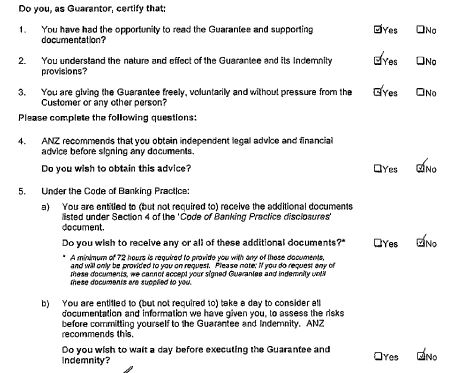
173 Dr Brecher stated that he read the Code of Banking Practice disclosures attached to the guarantee certificate. This included:
1. Information you should know before you sign a Guarantee
Before you agree to enter into or sign a Guarantee, it is important that you know the following:
• Before you sign the Guarantee, you should seek independent legal and financial advice on the effect of the Guarantee;
• You can refuse to enter into the Guarantee;
• There are financial risks involved in acting as a Guarantor;
• You have the right to limit your liability in accordance with the Code of Banking
• Practice and as allowed by law; and
• You can request information about the transaction of facility to be guaranteed (including any facility with us to be refinanced by that facility).
174 He did not display any inability to read or understand these documents or the loan documentation to which they related, to which Dr Brecher was also taken in cross-examination.
175 Dr Brecher was taken in cross-examination to the Promotional Agreement. The recitals were:
Since:
A. The Company is a company duly incorporated in New South Wales.
B. The Company owns and operates integrated multidisciplinary primary health care facilities also known as medical centres, in the state of New South Wales, Australia.
C. Eric is a radiologist and provides radiology services to patients.
D. Eric has requested and the Company has agreed to provide the Promotional Services and the Patient co-Management Services to Eric on the terms and conditions set out in this Agreement.
176 Recital D, to which Dr Brecher was taken in cross-examination, is consistent with the conclusion I reach in any event that it was Dr Brecher who wanted to provide services at Barrack Heights and that it was he who had approached Dr Rashid with a view to promoting his services at CHC Barrack Heights.
177 Dr Brecher stated in cross-examination:
Did Dr Rashid come and force you to sign this agreement on 17 or 20 August - - -?---I wasn’t physically - - -
2015?---I wasn’t physically forced, but Dr Rashid, 100 per cent, was the purpose [sic – person] who came and wanted this contract signed. He’s the one who came to me and said that, because we’re going to be into business together and we’re essentially waiting for the contract to be signed, that he would like 50 per cent of the total revenue that his doctors ..... I never wanted that. I never wanted this agreement. I didn’t ask for my lawyer to write it up. His lawyer wrote it up, okay. And for you to say that, you know, that’s a very – I mean, I didn’t see that statement in the contract. It doesn’t mean I didn’t read the contract or review it, but I didn’t see that statement. And if I saw it, I wouldn’t have signed it. So what I’m saying is that I made a – there’s a mistake in that I didn’t see that statement. But I never wanted this document.
178 I do not accept that there was an agreement for Dr Rashid and Dr Brecher jointly to operate a radiology practice at Barrack Heights at this point in time. What had happened to this point was that Ms Hyratt had identified an opportunity at Barrack Heights and Dr Brecher had pursued the opportunity. Dr Brecher wanted to promote his services to Barrack Heights and had told Dr Rashid that he would be prepared to pay a fee. Dr Rashid had agreed and had asked whether Dr Brecher’s solicitor would draft an agreement or whether his solicitor should. Dr Brecher said that Dr Rashid’s solicitor could draft the agreement. Dr Brecher then instructed Ms Hyratt to pursue the Promotional Agreement in early August 2015. Ms Hyratt did pursue it, which prompted Dr Rashid to instruct his lawyers to prepare it urgently and it was received by Ms Hyratt shortly before Dr Brecher returned from the US. I accept that Dr Brecher may also have understood, at this time, that Dr Rashid was considering opening a radiology practice to which Dr Brecher might provide services for a 20% fee.
179 Dr Brecher’s evidence continued (emphasis added):
That’s convenient for you, isn’t it, Doctor?---No, it’s just the truth. I mean, I don’t have any – there’s no evidence that I ever wanted this [the Promotional Agreement], so why would you say that it would be convenient for me. I mean, do you have any evidence that this is something that I wanted? I mean, this is something I wouldn’t want. I mean, why would I want to give, for example, 50 per cent of the total revenue to Dr Rashid when I didn’t have to. I mean, I never once went to any medical practice when any doctor has ever asked for money that their doctors – that their doctors would send. The only time that I’ve ever experienced this, in all my years of radiology, is with Dr Rashid. Every other medical practice you go to where you go and market to those places, no one ever asked for money to be repaid to them for patients that they send. To me, it sounded like he was asking for a bribe, a kickback. And I did discuss this with my accountant, Nicola Adams, because I was concerned about this fact. If I had – if I was the one, like you say, who went and wanted this, then why did I go and show it to Nicola? You could ask her when she’s on the stand. I did have her look at it. I expressed the same concerns to Renee about it. And there’s no evidence that I was the one – any – had any involvement in the drawing up of this contract.
180 Dr Brecher asserted that, by this time, he already had an agreement with Dr Rashid for a joint venture. He said (emphasis added):
Because this agreement doesn’t set out any of the terms for the joint venture, does it?---This – this agreement was just for Dr Rashid to get what I believe now are kickbacks, that’s all. And this has nothing to do with the agreement we had. What I was told by Dr Rashid was this. That because we’re going into business fifty-fifty and we’re going – you know, we’re just waiting for the contract to be signed, that he would – he wanted 50 per cent of the total revenue that his doctors sent to the practice. And I agreed to it because of the fact that – well, I was reluctant to – to agree to, like I said. I went to, you know – he wrote up something where – it was a cross-promotional agreement that I had never heard of before and he went and – you know, she ..... thought that it wasn’t – it was a legal document and – and that’s how that happened. I mean, by the time – otherwise, what you’re saying is that Dr Rashid, you know, asked me and had a lawyer write up a kickback scheme without any, you know, fact that him and I were going to go into business together. It’s just not true. I wouldn’t have done it. I wouldn’t have signed this and I would have, like I said, gone to the police if he – this happened to me.
181 As noted earlier, Dr Brecher had in fact been aware of and involved in arrangements which involved what he described as “kickbacks”. His position that his evidence was not misleading because of an asserted distinction between radiology practices and medical practices is disingenuous – see: [70] to [79] above, particularly at [77].
182 Dr Rashid’s evidence was that he received the Promotional Agreement, signed by Dr Brecher and witnessed by Ms Hyratt, on his desk at Barrack Heights. He said he telephoned Ms Hyratt and said:
You can come and you have access to all the rooms of doctors. You can use – and all the computers and put on your program, and if you need any help, you can help with Dr Sangi and Kylie will help you or another staff will help you.
183 I accept this evidence. Dr Rashid thought that this occurred on 17 August 2015. Dr Brecher considered it may have been on 20 August 2015.
184 Dr Brecher asserted that the contract to which Ms Hyratt was referring in her Facebook message at [165] above was a joint venture agreement. There was no such agreement at this time. Dr Brecher’s case was that, in mid-August 2015, he was waiting for a draft agreement setting out the terms on which he and Dr Rashid would jointly own a radiology practice at Barrack Heights. I do not accept that Dr Brecher had any such expectation. There was no such agreement, in principle or otherwise, at this point in time.
185 On 20 August 2015, Dr Brecher and Ms Hyratt went on a tour of Barrack Heights, which included seeing the area that Dr Rashid considered would be used for radiology. This was the Radiology Area in respect of which Primary had shown interest. Dr Brecher had not previously been into the Radiology Area, although he had previously seen a diagram or plan of the area. After the tour, Dr Brecher said to Dr Rashid that he considered the premises to be “very impressive”. During the tour they agreed to meet the next day.
186 Dr Rashid gave the following account of his next conversation with Dr Brecher, the day after the tour of Barrack Heights:
And what did Dr Brecher say and what did you say?---Dr Brecher say, “I’m very impressed”, you know, “by your centre and I like the big area of your radiology area, but this corporate radiologies, they are not good – they are not – do not provide you very good service. I’m against this corporate radiology. I want to open number of the radiology centre against this corporate radiology.” Then Dr Brecher said, “I can report 400 reports a day. I can look after five to six radiologies myself”, and then Dr Brecher showed me – he took out ..... album, you know. He said, “Here is my album. This – I – this my hobby. I collect expensive artwork.” So in this album was the photographs of different – I don’t know much about the art, but underneath was written the prices of each painting: every one hundreds of thousand dollars that one. And Dr Brecher said, “I have a lot of real estate in USA, but my problem is that I can’t get a loan in Australia. The bank do not recognise the assets in USA.” And then he said, “Dr Rashid, if you and I go business together, we will make – we will merge Dapto practice and will we – we will form a new company; we will have a 50/50 partnership. You – I will look after mostly the – on the reporting and you will look after new practices, finance, promotion and all this, and we will do very well and we will have a number of the practices.” And as far as – “You will get almost a million dollar.”
187 Dr Rashid stated that this was the first time that Dr Brecher had expressed a desire to enter into a jointly owned business venture with Dr Rashid. I accept this conversation occurred.
188 Ms Adams gave evidence that she had a discussion with Dr Brecher which “would have been” on 21 or 22 August 2015 in which Dr Brecher was “excited at the prospect of going into a partnership” with Dr Rashid. Ms Adams stated that she said to Dr Brecher that she did not like partnerships and that she would try and come back with some additional structures that Dr Brecher could go into.
189 On 27 August 2015, Ms Hyratt sent an email to Dr Rashid indicating that the InteleConnect program was operational. This program would provide access to digital images and reports prepared by SCXR Dapto to the doctors at Barrack Heights within hours. This would, presumably, increase the chances of doctors at Barrack Heights referring their patients to SCXR Dapto in connection with the Promotional Agreement.
190 Dr Rashid stated that he had a meeting with Dr Brecher and Ms Hyratt around 28 August 2015 at which he gave Dr Brecher a floor plan of the Barrack Heights radiology premises, which he had asked for earlier. Dr Brecher asked if he could see Dr Rashid’s other practices and Dr Rashid drove them to Wollongong and Unanderra. During the trip Dr Brecher complained about not getting many referrals from Barrack Heights and asked whether referrals were going to other practices. Dr Rashid said it would not be easy to work out, because the information was written manually.
191 After this meeting, Dr Rashid directed Dr Sangi, an administrative assistant at Barrack Heights, to prepare a list of all the GPs at Barrack Heights, the number of imaging referrals which had been made and the medical imaging provider to whom the referral had been made. Dr Rashid’s evidence, which I accept, included:
[152] At CHC Barrack Heights, there is no central database that records the referrals each of the GPs write.
[153] … This list took a lot of work on the part of my staff to prepare given such a list was not readily available and had to be compiled from a variety of sources and individual inquiries of various people.
D.10 30 August 2015: Relish Restaurant meeting
192 On 30 August 2015, Dr Rashid attended a brunch meeting with Dr Brecher and Ms Hyratt at Relish Restaurant. Ms Hyratt had invited Dr Rashid to attend this meeting with herself and Dr Brecher. The meeting lasted about two hours. Dr Rashid’s evidence was that Dr Brecher told Dr Rashid that he had bought SCXR Dapto in 2014 and that its income for the 2015 year was around $3 million. He stated that its net profit was about $350,000 and that there was a loan or loans of about $2.2 million from Medfin. Dr Brecher stated that he could complete 400 reports a day and could look after five to six practices. Mr Hyratt generally agreed that these things were said, although she could not recall a discussion about SCXR Dapto’s loans. I accept Dr Rashid’s evidence that these matters were discussed.
193 Dr Rashid gave evidence that he stated that he purchased his medical centre in 1998 and that it had previously been a shopping complex. He had applied to the “Shellharbour Council for Shellharbour Health Care City” and stated that the “[Barrack Heights] centre health complex [was] the first stage of Shellharbour Health Care City”. Barrack Heights officially opened in 2006, but a radiology practice, and nuclear medicine and pathology services were operating at the site almost two years earlier in 2004. Ms Hyratt denied that Dr Rashid referred to this history. I accept that Dr Rashid referred to this history.
194 Dr Rashid gave the following evidence:
Yes. And did Dr Brecher say anything to you?---Dr Brecher said, “Look, Dr Rashid, what we had discussed before, I’m very excited about that, that we combine the both, you know, Barrack Heights – Dapto and Barrack Heights together.” We have got almost 2.2 loan in – in Dapto practice and 2.2 loan in – will get – will get it to for the Barrack Heights, and – and then we can work number off the other practices and other practices can be paid off by profit of the – this – of this one – practices.”
Did Ms Hyratt say anything?---Ms Hyratt said, “Dr Rashid, I have put the software program in most of the GPs. Where do you get the GP?” I said, “It’s very difficult to find GPs. Most of the GPs comes from UK, and it takes about one and a half years to two years time, and when they arrive, some time it happens that they work for a little while, they find their own practice or they go somewhere else, or sometimes happen they will go back to UK. So it’s a long process. We started this medical centre with four GPs only, and – but it is always continuous process.” Then Dr Brecher said that he’s also looking at sourcing another radiologist from USA - - -
195 Dr Rashid said that Dr Brecher stated that he would send the financials of SCXR Dapto for 2015 and asked Dr Rashid to provide him with Primary / Healthcare Imaging’s offer emails as well as PRP’s lease.
196 Ms Hyratt’s account of the meeting in evidence in chief was:
So the meeting at Relish was the first meeting that we had had outside of the workplace. And it was a little bit more of an introductory meeting between us all. Dr Rashid said words to the effect that he and his wife had been in the Illawarra for 40 years. That they were both GPs and that they began their practice in Unanderra. That over that period of time he had expanded the medical centres and he now owned a medical centre at Campbelltown, one at Woonona, the one in Unanderra and one at Barrack Heights. Dr Rashid said words to the effect that both his son and his nephew were radiologists. And Dr Rashid said words to the effect that he had been considering putting radiology practices into those medical centres for a period of time. Eric said words to the effect that he had come to Australia originally to work for an American company, NightHawk, and he lived in Sydney. I believe that that was in early 2000s. And that, after going back to America – that he had liked Australia and wanted to return. Eric said words to the effect that he had decided that he wanted to own his own business and that was why he bought Dapto – so that he could make the profit himself rather than other people. He said words to the effect that when he worked for NightHawk that he was their most productive radiologist. That he could report up to 400 cases a day. And that that was the equivalent of three or four radiologists. Eric said words to the effect that since opening Dapto he had done a lot of work to upgrade that centre. That he had done work aesthetically to the centre and upgraded the software systems to make the work more efficient. And that he had improved the profitability substantially. That – at that time Dapto had revenue of around $3 million. I said words to the effect that I was very new to all of this business. I had spent all of my life working in disability services, both with children and adults. And that this was a very new area of career for me. That – I said words to the effect that we had just put in a new PACS system and that a RIS and a PACS were new terms to me. I said words to the effect that we had had a bad experience with GE recently when a tube blew in our CT machine and that if they opened a practice at Barrack Heights that they should be careful of GE. Again, at this meeting, Eric said words to the effect that if they were to open up a radiology centre in Barrack Heights – that you needed to be sure that you had enough work to sustain that practice. Dr Rashid said words to the effect that it wasn’t something that he had to worry about because he knew the amount of work that came from the doctors within the medical centre – the types of studies that they were sending. Dr Rashid said words to the effect that there had been other radiology centres practising from that same location for a number of years and that they had been happy there. That PRP had only left that location because they had had an ongoing dispute with the nuclear medicine site next door because they had the same machine. And so there was an ongoing dispute between them. And PRP decided to just purchase their own place and move from the location. Dr Rashid said words to the effect that there was other services that had been operating within that centre for a long time, such as Laverty Pathology and the nuclear medicine. Dr Rashid also said words to the effect that he had a relationship with a number of GPs in the area who didn’t work at the medical centre because he had been involved in bringing them to Australia and that he felt confident that he could have conversations with them either in social or professional meetings and to encourage them to just use the South Coast X-Ray service at Barrack Heights. Excuse me a moment. Eric said words to the effect that if Dr Rashid wanted to see any of the financial records – he wanted to show Dr Rashid proof that he had done well at Barrack Heights and he instructed me to show him anything that he wanted to see. That’s all that I can think of at the moment from that meeting.
197 As noted at [186] above, on 21 August 2015, Dr Brecher had proposed to Dr Rashid that the two of them go into business together, by merging SCXR Dapto with a new company and opening new radiology practices. I conclude that, at the meeting at Relish Restaurant, Dr Rashid and Dr Brecher agreed that they would look into conducting two radiology practices together, SCXR Dapto and a new practice at Barrack Heights, through a new corporate vehicle and with a view to opening or acquiring further radiology practices later. On balance, I conclude that Dr Brecher suggested getting a $2.2 million loan to fit-out and equip the new Barrack Heights practice on the basis that this replicated the debt that Dr Brecher stated was owed by SCXR Dapto. On balance, I conclude that Dr Brecher suggested that the debt of the merged entities could be repaid from the profits of the merged practices.
198 Dr Rashid’s evidence is consistent with the surrounding circumstances, including Ms Hyratt providing financial information in the days after this meeting. The subsequent events are consistent with Dr Rashid being provided with financial and other information with a view to him making an informed decision about whether or not it was appropriate to become, through some mechanism, a joint owner of SCXR Dapto.
199 As noted earlier, Dr Brecher’s evidence was to the effect that the meeting at Relish Restaurant was in the nature of a social meeting and that a preliminary agreement had been reached by late July/very early August 2015 for him and Dr Rashid to become joint owners of a new radiology practice at Barrack Heights. I do not accept that was the case. Ms Hyratt’s evidence was that the Relish Restaurant meeting was the longest that they had and “was a fairly significant meeting in the progress of our relationship with Dr Rashid”. Her evidence included:
Prior to that meeting, there had been discussions of various ways in which a business relationship might look between them. And from the meeting at Relish, it began to progress.
200 Dr Brecher’s evidence was that the first time he heard of the possibility of merging SCXR Dapto with a new practice at Barrack Heights was in September 2015, after he had been given a “mud map” which contained a structure diagram contemplating such a merging – see: [214] below. The mud map had been provided by Dr Rashid to Ms Hyratt, who then showed it to Dr Brecher. I do not accept that there had been no earlier discussion about the possibility of merging SCXR Dapto with a new practice at Barrack Heights. It is unlikely that Dr Rashid would have sent a mud map containing such a proposal without having ever discussed the possibility with Dr Brecher. Dr Brecher did not give evidence that he had any discussion with Dr Rashid after receiving the mud map, and before executing the SCMI transaction documents on 15 October 2015, as to whether he was willing to give up half of his interest in SCXR Dapto. Dr Brecher’s account is not supported by any other witness and is implausible.
201 The probabilities favour, and I conclude, that the mud map broadly reflected what Dr Rashid and Dr Brecher had earlier discussed and agreed and that it was prepared as a direct consequence of the discussion which had occurred at Relish Restaurant on 30 August 2015. As noted earlier, it was Dr Brecher who proposed merging SCXR Dapto into a new corporate vehicle.
D.11 31 August 2015: Meeting with Dr Rashid and provision of financial information
202 Ms Hyratt sent an email to Dr Rashid at 10:36 am on 31 August 2015 attaching statements in relation to the Goodwill Loan and Lease Agreement with Medfin in respect of the 2014–2015 financial year. These indicated that the following amounts remained outstanding as at 30 June 2015:
(1) in relation to the Lease Agreement an amount of $1,476,720.15;
(2) in relation to the Goodwill Loan an amount of $787,544.03.
203 Dr Rashid reviewed the material provided by Ms Hyratt, and concluded that the balance of the Medfin Facilities was $2,264,264.18.
204 Ms Hyratt sent an email to Dr Rashid at 10:38 am on 31 August 2015 attaching a “Maintenance Service Agreement” between GE Healthcare Australia Pty Limited and EBPL as trustee for SCXR Unit Trust relating to the CT and MRI machines located at SCXR Dapto. These provided for an annual service charge of $210,000, plus GST, for two years (17 August 2015 until 16 August 2017) payable in monthly instalments of $19,250 including GST.
205 Later that morning, Ms Hyratt met with Dr Rashid. Dr Rashid stated that she gave him a profit and loss statement of the SCXR Unit Trust for the financial year ended 30 June 2015. Dr Rashid read the profit and loss statement and saw that the total income was $2,872,251.12 and net profit was $334,747.15. Dr Rashid stated that he relied on this material in deciding to enter into the SCMI transaction on 15 October 2015. Dr Rashid’s accountant, Mr Ali Khan, was visiting Dr Rashid when the profit and loss statement was received. Dr Rashid asked Mr Khan to comment on any matters of concern in the profit and loss statement. Mr Khan identified two issues on the profit and loss statement about which he stated Dr Rashid should ask Ms Hyratt for an explanation. The issues related to a late fee and a break-down of wages and payroll tax.
206 As noted at [189] above, Ms Hyratt had set up all of the doctors at Barrack Heights with InteleConnect accounts. Ms Hyratt sent a Facebook message to Dr Brecher at 12.18 pm on 31 August 2015 confirming that the doctors at Barrack Heights would be referring work to SCXR Dapto from the following day. She stated: “They will give out all our referrals to the doctors and change their referral default to us”.
207 Ms Hyratt sent an email to Dr Rashid at 3:36 pm on 31 August 2015 which attached the profit and loss statement for the financial year ended 30 June 2015. In her email, Ms Hyratt said that this copy contained handwritten notes from her accountant. The late fee was identified as a “code error” and the payroll tax was “to be determined and lodged”.
208 At 10.22 pm on 31 August 2015, Ms Hyratt emailed the receptionist at Barrack Heights a list of all of the doctors and allied health professionals at Barrack Heights, together with their usernames for the new InteleConnect accounts. There were 29 names on the list. Eighteen of those were the GPs listed on “Daily Diagnostic Counts” prepared in September 2015. I conclude that Ms Hyratt knew that there were 18 GPs working at Barrack Heights as at 31 August 2015 and I infer that she discussed this with Dr Brecher. I do not accept as true Dr Brecher’s evidence to the effect that he believed that there were 20 full-time GPs conducting their practices at Barrack Heights as at August and October 2015.
D.12 September 2015: Dr Brecher becomes increasingly anxious to secure a deal; Dr Rashid provides a “mud map” structure diagram
209 Dr Brecher and Dr Rashid met on 2 September 2015. Dr Rashid gave Dr Brecher copies of three emails from Mr Ayers of Healthcare Imaging and a letter from a solicitor about a potential lease of an area at Barrack Heights to PRP in 2012. Dr Brecher was anxious that Dr Rashid not lease the area to Healthcare Imaging and considered that Dr Rashid was “pitting” him against Healthcare Imaging, but he did not think that there was anything wrong with “some gamesmanship”.
210 Dr Brecher was also concerned that, without expanding, SCXR Dapto would be seriously tested financially or fail. A number of Facebook messages between Dr Brecher and Mr Hyratt indicate a real sense of urgency on the part of Dr Brecher to enter into the venture with Dr Rashid. For example, the following messages were sent on 14 September 2015:
Eric Brecher Jerins Monday, September 14, 2015 at 11:08am UTC+10
please push it all forward. if we can’t complete this deal we’ll fail here sweetie
Eric Brecher Jerins Monday, September 14, 2015 at 11:08am UTC+10
it’s keeping us alive
Renee Traish Monday, September 14, 2015 at 11:31am UTC+10
Yes hunny I think everyone is keen to push forward
211 The Facebook messages on 14 September 2015 between Dr Brecher and Ms Hyratt also included:
Eric Brecher Jerins Monday, September 14, 2015 at 10:54am UTC+10
pleaes [sic] make sure that you don’t tell chris that rashid is a silent partner
Eric Brecher Jerins Monday, September 14, 2015 at 10:54am UTC+10
we have to tell everyone that we are stand alone and have no affilitation [sic] with any other practice
Eric Brecher Jerins Monday, September 14, 2015 at 10:54am UTC+10
otherwise we’ll be destroyed
Eric Brecher Jerins Monday, September 14, 2015 at 10:54am UTC+10
can you please talk to nicola about that
Eric Brecher Jerins Monday, September 14, 2015 at 10:55am UTC+10
how do we set it up
Eric Brecher Jerins Monday, September 14, 2015 at 10:55am UTC+10
my only concern is that we will lose business if others find out we are in a partnership with dr. rashid
Renee Traish Monday, September 14, 2015 at 10:56am UTC+10
Yes I am not letting anything on but I’m not sure how to go about it all
Renee Traish Monday, September 14, 2015 at 10:56am UTC+10
I will talk to Nicola
Eric Brecher Jerins Monday, September 14, 2015 at 11:00am UTC+10
pleaese [sic] ask her how we should handle things
Eric Brecher Jerins Monday, September 14, 2015 at 11:00am UTC+10
we NEED chris
Eric Brecher Jerins Monday, September 14, 2015 at 11:01am UTC+10
we also have to be able to promote to others that we are completely independently operated
Eric Brecher Jerins Monday, September 14, 2015 at 11:01am UTC+10
so we need to do this all leagally [sic]
Eric Brecher Jerins Monday, September 14, 2015 at 11:01am UTC+l0
Legally
Renee Traish Monday, September 14, 2015 at 11:05am UTC+10
Absolutely I agree with all that 
Eric Brecher Jerins Monday, September 14, 2015 at 11:06am UTC+l0
we have to make sure that dr. rashid knows that otherwise we’ll fail. dr. rashid will make a fortune this way
212 On 14 September 2015, Ms Hyratt sent an application to Medicare for an additional provider number for Dr Brecher. This related to “Southcoast XRay” at the “Centrehealth Complex”. Dr Brecher signed the form. The covering letter indicated that SCXR Dapto was expanding and provided an additional business address at Barrack Heights. This is more consistent with Dr Brecher believing that there was to be a merger of SCXR Dapto and a new radiology practice at Barrack Heights than with a belief that the agreement was simply to open a new radiology practice at Barrack Heights to be jointly owned by Dr Rashid and Dr Brecher.
213 On 15 and 16 September 2015, Dr Brecher sent Ms Hyratt Facebook messages which included:
Eric Brecher Jerins Tuesday, September 15, 2015 at 10:53am UTC+10
sweetie can you please start moving ahead with the contract with Dr. Rashid?
Eric Brecher Jerins Tuesday, September 15, 2015 at 10:53am UTC+10
we need to have something signed asap
…
Eric Brecher Jerins Wednesday, September 16, 2015 at 1:53pm UTC+10
can you get things going with rashid
214 Dr Rashid visited SCXR Dapto between 14 and 20 September 2015 and gave to Ms Hyratt what was referred to at the hearing as a “mud map”. This was a document which Dr Rashid had prepared, in consultation with his accountant, Mr Khan, which summarised in a diagram a possible structure for the merging of Dr Brecher’s and Dr Rashid’s interests. Dr Rashid asked Ms Hyratt whether she was happy with the proposed structure and Ms Hyratt said she would show the mud map to Dr Brecher. The mud map was in the following form:
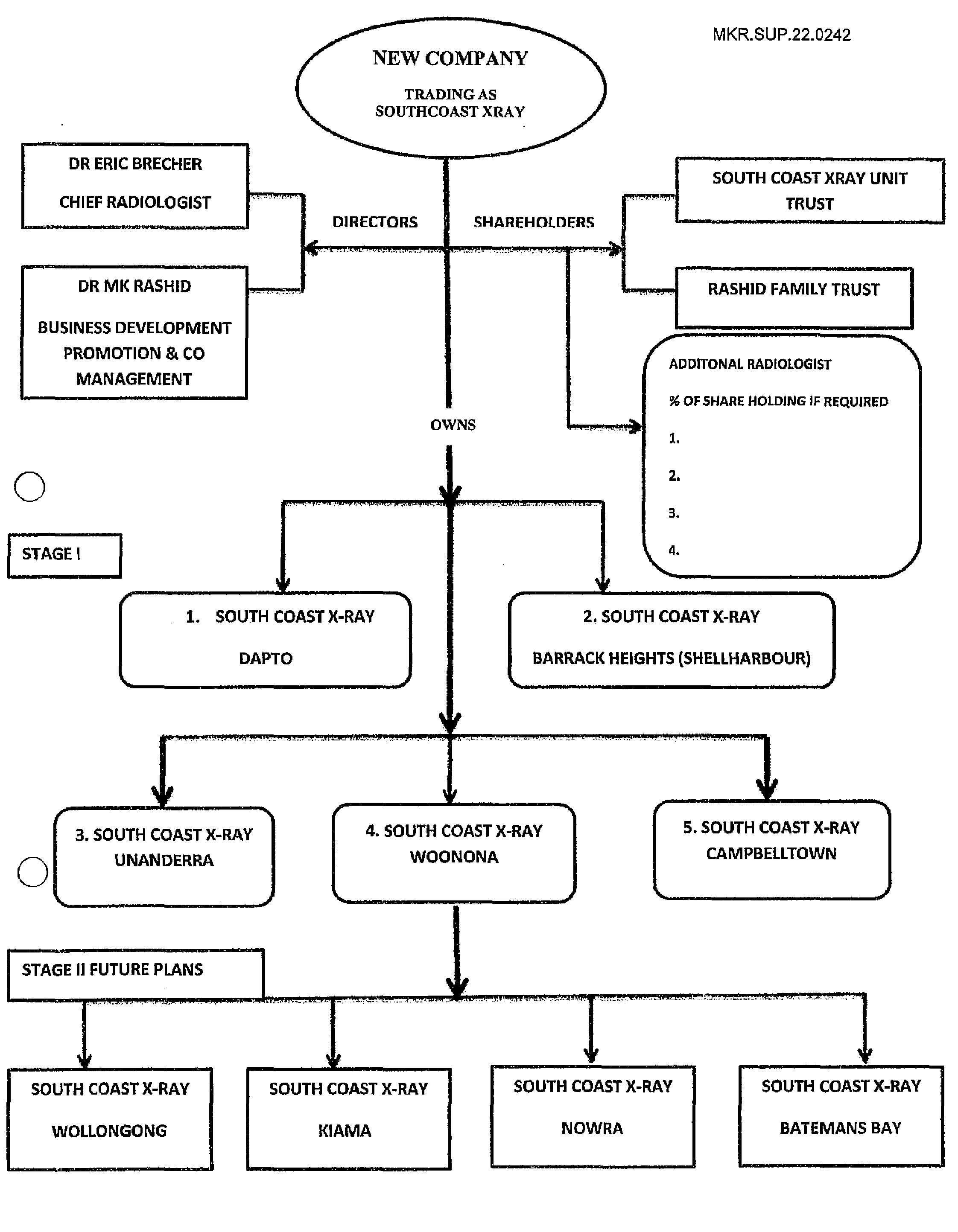
215 As noted earlier, it is likely that this mud map broadly reflected Dr Brecher’s and Dr Rashid’s earlier discussions. In his evidence, Dr Brecher insisted that this was the first he had heard of him potentially giving up a half interest in SCXR Dapto. I do not accept his evidence. It was Dr Brecher who first raised the idea of him and Dr Rashid conducting two radiology practices together, SCXR Dapto and a new practice at Barrack Heights, through a new corporate vehicle, with a view to opening or acquiring further radiology practices later.
216 In written closing submissions, heavy reliance was placed by Dr Brecher on his Facebook messages to Ms Hyratt, in particular the following message sent on 18 September 2015:
Eric Brecher Jerins Friday, September 18, 2015 at 5:12pm UTC+10
after sale eric makes 1.5 million
217 It was submitted that Dr Brecher understood that he would be receiving a substantial sum of money for a half interest in SCXR Dapto. Dr Brecher did not explain this message or surrounding context. Even if Dr Brecher considered, at this particular point in time, that he might receive an amount for selling a half interest in SCXR Dapto, the Facebook message does not suggest that the idea of disposing of a half interest in SCXR Dapto was new. The surrounding events reveal that it was not new. Dr Brecher had proposed the idea on 21 August 2015 and pursued it on 30 August 2015 and thereafter.
218 On 21 September 2015, Dr Brecher sent the following Facebook messages to Ms Hyratt:
Eric Brecher Jerins Monday, September 21, 2015 at 10:36am UTC+10
can you please make sure that nicola looks over the new documents. and i would like money released to me before the merger takes place if possible
…
Eric Brecher Jerins Monday, September 21, 2015 at 1:14pm UTC+10
we’re almost at the finish line and you’re burnt out and can’t work
Eric Brecher Jerins Monday, September 21, 2015 at 1:15pm UTC+10
we have to pull very good numbers until we merge with rashid
Eric Brecher Jerins Monday, September 21, 2015 at 1:15pm UTC+10
can’t you please just pull yourself together until that happens?
219 The “new documents” referred to in the first Facebook message on 21 September 2015 extracted above was likely a reference to the “mud map”. Although Dr Brecher suggested that the “new documents” might not have been the mud map in cross-examination by Dr Rashid’s counsel, he later conceded in cross-examination by counsel for Acorn Lawyers that the “new documents” were “probably” a reference to the mud map. Ms Hyratt readily conceded that the documents that they were getting Ms Adams to look over were the mud map and documents relevant to the incorporation of SCMI. Ms Hyratt acknowledged that Dr Brecher was talking about a merger. Her understanding was that Dr Brecher wanted the money he had invested in SCXR Dapto, which she considered to be about $400,000, released to him before the merger took place.
220 Dr Rashid said that he spoke to Ms Hyratt on about 21 September 2015. His evidence included:
So that’s the 14 September, Doctor?---Yes.
Can you recall when you spoke with Ms Hyratt again?---I think around 21 – yes. Around 21 September she – Ms Hyratt rang me that - - -
Okay. And thank you again. And what did Ms Hyratt - - -?---Yes. She told me that- - -
- - - say to you and what did you say to Ms Hyratt?---Ms Hyratt told me that Dr – Dr Brecher had a look on that, and we had – we are happy with this – everything, and we asked, “Could you go and ask to form a new company”. So she asked my accountant to form a new company. I said, “All right. I will do that”. So I rang Mr Khan to form a new company and he formed a new company on 22nd – and she said, “I want to do it really urgently,” so he formed a company on the 22nd and he sent me those notes – and which I forwarded to Ms Hyratt.
221 Dr Rashid said that he spoke to Ms Hyratt on about 22 September 2015. His evidence included:
Do you have a conversation, as best you can recall, with Ms Hyratt on 22 September 2015?---Yes, she rang me again and said, “Look, everything” – that everything is all right, but their accountant has suggested one thing and that they want a trust formation. And then I received an email from Ms Hyratt on the 22nd – if I recall correctly, it was 22 September. And to this email was attached my diagram, which I have given to her. And on that diagram, in the middle, there was this query made in handwriting.
I will stop you there. So that’s 22 September?---Yes.
222 On 22 September 2015, Ms Hyratt sent an email to Dr Rashid stating:
Hi Dr Rashid,
I have just been chatting with our accountant, he is happy with the set up you have but has a few ideas he’d like to discuss with your accountant.
Could you have them give Darren [Mumford] a call on [telephone number]
Look forward to seeing you tomorrow.
223 Attached to this email was a copy of the mud map with handwritten comments. I conclude that Dr Brecher received advice about the proposed merger from his accountants, just as he had in relation to the Promotional & Co-Management Services Agreement. This included advice from Mr Darren Mumford, an accountant who was, at the time, contracted by Adams Associated. He was later employed by Adams Associated. It was Mr Mumford who suggested that the structure incorporate a unit trust and Mr Mumford handwrote that on the mud map. I infer from the email set out above and the surrounding events that Dr Brecher’s and Dr Rashid’s accountants had further discussions about the structure. It is likely that the accountants discussed that SCXR Dapto should be rolled into the new structure so as to minimise stamp duty.
224 As noted earlier, Dr Brecher’s case was that he had reached an agreement with Dr Rashid, at the end of July or early August 2015, that the two of them would own the radiology practice at Barrack Heights in equal proportions and would be equally responsible for the necessary loans. Dr Brecher stated that, at that time, Dr Rashid did not suggest that he would be taking a 50% interest in SCXR Dapto. Dr Brecher’s case was that this was first suggested in mid-September 2015. His evidence was that he was taken by surprise at the meeting of 15 October 2015 when he was met with agreements which reflected SCXR Dapto being rolled into the new entity. I do not accept Dr Brecher’s evidence as truthful.
225 Dr Brecher’s evidence to questions asked by Dr Rashid’s counsel included:
- - - to put into place a joint venture?---No. No. Because, like I said, I was – you know, initially – this is what happened. Like, for example, if you – your Honour looks like you will see in August 2015, Dr Rashid wants to open up the practice himself. Then, a couple of weeks later, he wants to go into business with me fifty-fifty. And then, in mid-September, he – it seems like he wants to buy half of Dapto or all of Dapto. I don’t – I didn’t know what he wanted to do. Okay, so things kept changing and when I went in to the meeting on 15 October 2015, because he kept changing his mind all the time, I didn’t know what to expect. The only thing that I really knew – the only thing I ever discussed with him and agreed to him – with him about was the fifty-fifty deal at the end of July, early August.
…
But you had made the agreement. You knew what the terms of the agreement were. They had to mean something to you?---We agreed – Dr Rashid and I agreed on an end of July, early August, what I said in my affidavit, that we would own the Barrack Heights practice fifty-fifty and we would take out a loan for it fifty-fifty. That’s the only thing him and I discussed in person. Nothing else was ever discussed. And there’s no proof that anything else was ever discussed. I mean, for example – no. I’m sorry. I’m advocating for – so sorry about that.
226 Dr Brecher’s evidence to questions asked by Acorn Lawyer’s counsel included:
Okay. And it’s the case, isn’t it that Ms Hyratt had responded on your behalf to Dr Rashid regarding the mud map and the structure?---Yes.
Yes. And she had referred to the accountants – your accountants, being Adams Associated – contacting Dr Rashid’s accountants to further the mud map proposal?---Yes.
Yes. And shortly thereafter you received and signed the unit holders’ agreements and other documents incorporating SCMI, didn’t you?---Yes.
Yes. Now, by contrast, you give evidence of what you call a fifty-fifty deal, arising out of a discussion in late July 2015?---Yes, that’s true.
Yes. And from that discussion that you had, you had heard nothing further from Dr Rashid, had you?---No. I don’t think so, no.
You had received no documents in relation to the fifty-fifty deal?---True.
You had sought no advice from your accountants in relation to that deal?---No.
And it’s the case, isn’t it, that you were proceeding on the basis of the mud map that Dr Rashid had provided to you at that time?---No.
And it’s wrong to the extent you’ve given evidence at this hearing that you attributed no weight to the mud map by the time of the 15 October meeting?---That’s completely incorrect. I said that – and I’m very accurate about this and have been consistent about this, in that I went to the meeting, only having spoken to Dr Rashid about the fifty-fifty deal. I knew that there was a possibility that he may want to purchase part of the Dapto Practice, but we had not discussed it in person. We never got an independent valuation of it by a mutual – by an accountant, and I thought because of those facts that it was probable that his interest in purchasing the company had dissolved. And that’s by 15 October. So when I went into the meeting, I believed in the fifty-fifty deal.
And that’s just improbable, isn’t it, Dr Brecher?---No. It’s actually probable, and it’s true. And I - - -
227 I do not accept Dr Brecher’s evidence. I conclude that Dr Brecher well knew what the proposed arrangements were, in particular that he would not own SCXR Dapto once he entered into the SCMI transaction. By way of example, the following Facebook messages were exchanged between Dr Brecher and Ms Hyratt on 23 September 2015 (emphasis added):
Eric Brecher Jerins Wednesday, September 23, 2015 at 9:50pm UTC+10
sweetie i really hope that we can build more than one site with dr. rashid
Eric Brecher Jerins Wednesday, September 23, 2015 at 9:51pm UTC+10
i would need the barrack height site to do better than the one in dapto to be happy
Eric Brecher Jerins Wednesday, September 23, 2015 at 9:51pm UTC+10
and then open up a third site
Renee Traish Wednesday, September 23, 2015 at 9:51pm UTC+10
I think he plans to build about 6 or so
Eric Brecher Jerins Wednesday, September 23, 2015 at 9:53pm UTC+10
we’re not going to own dapto anymore after we sign it sweetie
Eric Brecher Jerins Wednesday, September 23, 2015 at 9:53pm UTC+10
have no choice though i think with all the other sites opening up around us
Renee Traish Wednesday, September 23, 2015 at 9:56pm UTC+10
I think it will work out but we need to find out how the finances will work yet
228 SCMI was incorporated on 22 September 2015. The relevant documents were prepared by Dr Rashid’s accountant. The documents were forwarded by email from Dr Rashid to Ms Hyratt on 22 September 2015. On 23 September 2015, Ms Hyratt forwarded Dr Rashid’s email and the attached documents to Ms Adams and Mr Mumford of Adams Associated and asked them to look over the documents. Dr Brecher denied that he asked Ms Hyratt to do so. It is likely that he did.
229 As mentioned, it was Dr Brecher’s accountants, Adams Associated, who suggested that SCMI be the trustee of a unit trust. Dr Rashid discussed this with Ms Hyratt at the SCXR Dapto practice on 23 September 2015. Consistently with the Facebook messages, Dr Rashid recalled that Ms Hyratt said that Dr Brecher wanted the relevant transactions to be done urgently.
230 Dr Rashid’s recollection was that he also met with Mr Mumford on 23 September 2015. Mr Mumford did not believe he had met with Dr Rashid at this time. It is not important whose recollection is faulty. I formed the view that both witnesses were genuine in reporting their differing recollections.
231 After Ms Hyratt raised the use of a unit trust, Dr Rashid met with Mr Agarwal and gave instructions on 23 September 2015 for him to prepare a Unit Trust Deed. The file note of this meeting prepared by Acorn Lawyers refers to “20% of reporting” and “15% of revenue”. A draft Unit Trust Deed for the SCMI Unit Trust was created on around 25 September 2015. The initial unit holders were Dr Rashid’s company, Romore, and Dr Brecher’s company, EBPL.
232 Dr Rashid and Dr Brecher both signed SCMI’s constitution and consents to act as directors. Dr Brecher signed these documents without legal advice. Whilst Dr Brecher was adamant in his evidence that he always sought legal advice in relation to any legal document, he explained that he considered these documents were “accounting” or “financial” matters, like the Medfin loan documents which included the provision of personal guarantees. He stated:
Yes, and you didn’t seek any legal advice on this, did you?---I didn’t know I had to seek any legal advice on this.
But you did seek accounting advice, didn’t you?---When it came to accounting matters like – like, for example, these documents, the Medfin documents and so forth – those things I thought were financial. If I knew that I needed to seek a lawyer for those things, I would have. So I would have done it if I needed to. No one advised me that I needed to seek a lawyer. I didn’t know – I didn’t know that I needed to.
But your evidence previously, Dr Brecher, has been that you don’t need to be told when you need a lawyer, because you know from your experience in the US that you can get lawyers whenever you need to?---Yes, with legal issues, when I know something is a legal issue, like, for example, you know, with the employment with Kim Maslanka, the practice manager. I knew that that was a legal issue. When I know something is a legal issue I will do it. Always, 100 per cent of the time, I will get a lawyer.
233 In his evidence, Dr Brecher classified documents as “legal”, “financial” or “accounting” according to what he considered suited his interests at the time.
234 On 28 September 2015, Dr Brecher and Ms Hyratt exchanged Facebook messages which included:
Eric Brecher Jerins Monday, September 28, 2015 at 10:30am UTC+10
any word on rashid sweetie?
Eric Brecher Jerins Monday, September 28, 2015 at 10:30am UTC+10
i’m so nervous
Eric Brecher Jerins Monday, September 28, 2015 at 10:30am UTC+10
terible [sic]
Renee Traish Monday, September 28, 2015 at 10:31am UTC+10
coming down in a few mins
Renee Traish Monday, September 28, 2015 at 10:31am UTC+10
I just spoke with him
Renee Traish Monday, September 28, 2015 at 10:31am UTC+10
he is getting more documents prepared atm
Renee Traish Monday, September 28, 2015 at 10:31am UTC+10
so he will come in the next day or two to sit down together and go through it at once
Eric Brecher Jerins Monday, September 28, 2015 at 10:32am UTC+10
great sweetie
Eric Brecher Jerins Monday, September 28, 2015 at 10:32am UTC+10
it will save the company!
Eric Brecher Jerins Monday, September 28, 2015 at 10:32am UTC+10
let’s wrap this up asap
Eric Brecher Jerins Monday, September 28, 2015 at 10:32am UTC+10
we really need to have this done
235 Dr Brecher and Dr Rashid executed the “South Coast Medical Imaging Unit Trust Deed” and associated documents. These were dated 25 September 2015. It is unlikely they were executed on that day because, on 28 September 2015, these documents were sent to Dr Rashid with an instruction that they be executed. I conclude that they were executed on 28 September 2015 or shortly thereafter.
236 On 29 September 2015, Ms Hyratt sent to Dr Rashid the transfer of lease documents for the various leases relating to SCXR Dapto. These documents were only relevant to Dr Rashid if the agreement was for a merger of interests rather than simply the opening of a new radiology practice at Barrack Heights to be jointly owned by Dr Rashid and Dr Brecher.
237 On 30 September 2015, Dr Brecher and Ms Hyratt exchanged Facebook messages which included:
Eric Brecher Jerins Wednesday, September 30, 2015 at 10:50am UTC+10
we really have to get going with rashid!
…
Renee Traish Wednesday, September 30, 2015 at 10:51am UTC+10
He’s going as fast as a little old business guru can go
…
Eric Brecher Jerins Wednesday, September 30, 2015 at 1:02pm UTC+10
any word from rashid today?
Eric Brecher Jerins Wednesday, September 30, 2015 at 1:02pm UTC+10
so worried my little pumpkin breath
…
Renee Traish Wednesday, September 30, 2015 at 1:02pm UTC+10
It will be ok he calls me regularly and is working hard on it all
Renee Traish Wednesday, September 30, 2015 at 1:03pm UTC+10
Perhaps we can spend some time catching up with him on the long weekend?
Eric Brecher Jerins Wednesday, September 30, 2015 at 1:03pm UTC+10
is he close to done?
238 On 30 September 2015, Sandra (a receptionist at Barrack Heights) emailed two documents entitled “Daily Diagnostic Count” to Dr Sangi. These recorded the daily referrals made by doctors at Barrack Heights for diagnostic imaging from Monday 14 September 2015 to Sunday 20 September 2015 and for the following week. It identified the various radiology practices to which referrals were made, including SCXR Dapto. This information was gathered, I infer, because of the request which had been made by Dr Brecher to Dr Rashid on around 28 August 2015 – see: [190] above.
239 On 1 October 2015, Dr Brecher and Ms Hyratt exchanged Facebook messages which included:
Eric Brecher Jerins Thursday, October 1, 2015 at 2:41pm UTC+10
now send me a picture of dr. rashid with the contract
…
Eric Brecher Jerins Thursday, October 1, 2015 at 2:57pm UTC+10
any word from dr. rashid; getting nervous
240 A “Costs Disclosure and Costs Agreement” from Acorn Lawyers to SCMI, dated 1 October 2015, was executed by Dr Rashid and Dr Brecher. This related to work for preparation of a “Deed of Acknowledgment” and meeting with Dr Rashid and others in relation to the “proposed structure”.
241 Dr Rashid said that he printed out the costs agreement and the “Daily Diagnostic Counts” and took them to the SCXR Dapto practice on 1 October 2015 where he gave them to Dr Brecher. He said that Dr Brecher executed the costs agreement. Dr Rashid said that he told Dr Brecher that he would be going to London on 16 October 2015 for his nephew’s wedding. Dr Rashid said that he took the signed costs agreement back to the offices of Acorn Lawyers.
242 Dr Brecher denied that he executed the costs agreement on 1 October 2015, asserting that it was executed at the meeting on 15 October 2015, together with a costs agreement dated 6 October 2015, referred to below. Dr Brecher’s evidence was that he executed them while “Mr Agarwal was standing right over me”. Dr Brecher’s evidence included:
It wasn’t – it’s – they both – both cost agreements were signed October 15 2015. They’ve gone missing since, but the – I’ve seen one colour copy of it and all three signatures are all in blue. I rarely, at that time, I believe, signed contracts in blue. I usually signed them in black. So if they were signed in my office, where they would have been signed, it would have been in black, so I do not believe that there’s – there’s no way that those contracts were not signed – I mean, those costs agreements weren’t signed on October 15 2015.
243 When tested in cross-examination, Dr Rashid stated:
You say that in early October 2015, you provided Dr Brecher with some costs agreements issued by Acorn Lawyers. Correct?---Yes.
Can I suggest to you that did not occur?---No. It did occur because I took it myself, and he signed in front of me.
244 I accept Dr Rashid’s evidence. Ms Hyratt did not give any clear evidence that the costs agreements were signed on 15 October 2015 and nor did any other witness apart from Dr Brecher.
245 Dr Brecher also denied being given the “Daily Diagnostic Counts” and stated that, if he had been shown them, he never would have gone into business with Dr Rashid. Dr Brecher was adamant that he had not seen the documents. I conclude that Dr Brecher was given those documents. However, I formed the view that Dr Brecher genuinely believed he had not received the documents. I formed the view that Dr Rashid genuinely considered he had provided the documents, although his recollection did not appear as certain as it was with respect to other events. For the reasons explained below, the applicants’ claims fail whether or not Dr Rashid gave the “Daily Diagnostic Counts” to Dr Brecher.
246 On 2 October 2015, Dr Brecher sent Ms Hyratt the following Facebook message:
Eric Brecher Jerins Friday, October 2, 2015 at 9:32am UTC+10
tell me when you hear from dr. rashid; we have to really start on building things up
247 Dr Rashid met with Acorn Lawyers on 2 October 2015. A second costs agreement from Acorn Lawyers to SCMI, dated 6 October 2015, was executed by Dr Rashid and Dr Brecher. This related to drafting a “Shareholders and Unit Holders Deed” and two “Services Agreements”, one between SCMI and Dr Brecher, the other between SCMI and Delbest.
248 Dr Rashid stated that he took the second costs agreement to SCXR Dapto and that Dr Brecher executed it and Dr Rashid took it back to Acorn Lawyers. I accept that evidence.
249 On 6 October 2015, Dr Brecher and Ms Hyratt exchanged Facebook messages which included:
Eric Brecher Jerins Tuesday, October 6, 2015 at 2:38pm UTC+11
ok have you heard from dr. r?
Eric Brecher Jerins Tuesday, October 6, 2015 at 2:38pm UTC+11
we really need to sign with him
Eric Brecher Jerins Tuesday, October 6, 2015 at 2:38pm UTC+11
nerve racking here
Eric Brecher Jerins Tuesday, October 6, 2015 at 2:39pm UTC+11
no work today
Eric Brecher Jerins Tuesday, October 6, 2015 at 2:39pm UTC+11
will lose money today
Renee Traish Tuesday, October 6, 2015 at 2:43pm UTC+11
Yes I’ve spoken to him a couple of times today
…
Eric Brecher Jerins Tuesday, October 6, 2015 at 4:51pm UTC+11
please let’s get it done this week
250 On 6 October 2015, Ms Hyratt emailed Dr Rashid attaching a balance sheet for SCXR Dapto as at June 2014, created on 6 October 2015. On 7 October 2015, Ms Hyratt wrote an email to Dr Rashid attaching a summary “Payroll Activity” for the period 1 July 2015 to 7 October 2015 and a further balance sheet for the SCXR Dapto practice as at June 2015, created on 7 October 2015. The email stated:
Hi Dr Rashid,
We have just had our payroll tax registered an [sic] haven’t got the bill yet. It’s estimated to be $2500 per month.
The back payment is anticipated to be around $24k
I have banked over $25k to cover this amount.
251 The provision of this information and the content of the email is more consistent with an understanding that Dr Brecher and Dr Rashid were proposing to merge interests. This information was unlikely to have been given to Dr Rashid if all that was proposed was to open jointly a new radiology practice at Barrack Heights.
252 On 7 October 2015, Dr Brecher and Ms Hyratt exchanged Facebook messages which included:
Renee Traish Wednesday, October 7, 2015 at 11:02am UTC+11
Dr Rashid is going to see the accountant this arvo and will see us tomoz
Eric Brecher Jerins Wednesday, October 7, 2015 at 11:19am UTC+11
sounds great
Eric Brecher Jerins Wednesday, October 7, 2015 at 11:19am UTC+11
can you talk to nicola and see if she can tell you what she thinks the value of the company is worth now?
Eric Brecher Jerins Wednesday, October 7, 2015 at 11:19am UTC+11
maybe we should have her call the other accountant and tell them that I’m really going to build the company up big
Renee Traish Wednesday, October 7, 2015 at 11:20am UTC+11
I’ve already spoken to her
Renee Traish Wednesday, October 7, 2015 at 11:20am UTC+11
And suggested they talk to each other
Eric Brecher Jerins Wednesday, October 7, 2015 at 11:22am UTC+11
can you please find out how much she thinks the company is worth now
Eric Brecher Jerins Wednesday, October 7, 2015 at 11:22am UTC+11
i bet between 1 and 1.5 million :(
…
Renee Traish Wednesday, October 7, 2015 at 11:47am UTC+11
She say on paper between 1.5-2 in actual value over 3 million now
…
Eric Brecher Jerins Wednesday, October 7, 2015 at 3:54pm UTC+11
also where’s my contract with dr. rashid
Renee Traish Wednesday, October 7, 2015 at 3:54pm UTC+11
Can u do Alan’s work from here?
Eric Brecher Jerins Wednesday, October 7, 2015 at 3:55pm UTC+11
i want to make an announcement today that we’re definitely opening up in barak heights […]
253 These messages, read in the context of the earlier messages and the surrounding circumstances, are more consistent with Dr Brecher believing that there was to be a merger of SCXR Dapto and a new radiology practice at Barrack Heights than with Dr Brecher’s professed belief that he went to the meeting of 15 October 2015 believing that the agreement was simply to open a new radiology practice at Barrack Heights to be jointly owned by Dr Rashid and Dr Brecher.
254 On 9 October 2015, Dr Rashid met with Mr Agarwal. The file note made by Acorn Lawyers included the note: “Who’s EBPL lawyer?”. I accept that Mr Agarwal did not believe he was acting for EBPL and, for the reasons given below and contrary to Dr Brecher’s evidence, I accept that Mr Agarwal did not say he was acting for EBPL at the meeting of 15 October 2015.
255 On 12 October 2015, Ms Hyratt emailed to Dr Rashid statements in relation to the Lease Agreement and the Goodwill Loan with Medfin for the 2014–2015 financial year. The provision of this information suggests that Ms Hyratt understood that the agreement involved a merger of interests rather than simply the opening of a new radiology practice at Barrack Heights to be jointly owned by Dr Rashid and Dr Brecher.
256 On 12 October 2015, Dr Brecher and Ms Hyratt exchanged Facebook messages which included:
Eric Brecher Jerins Monday, October 12, 2015 at 11:41am UTC+11
do you think we’ll have a contract? :(
Renee Traish Monday, October 12, 2015 at 11:41am UTC+11
He’s hoping to get it done this week before he goes away
257 The last Facebook message confirms that Ms Hyratt and Dr Brecher knew that Dr Rashid would be going overseas. As mentioned at [241] above, Dr Rashid had told Dr Brecher that he would be going overseas on 16 October 2015.
258 On 13 October 2015, Ms Hyratt sent an email to Dr Rashid attaching an equipment inventory. Again, the provision of this information suggests that Ms Hyratt understood that the agreement involved a merger of interests rather than simply the opening of a new radiology practice at Barrack Heights to be jointly owned by Dr Rashid and Dr Brecher. It is likely that Dr Brecher held the same understanding.
259 On 14 October 2015, Dr Brecher sent Ms Hyratt a number of Facebook messages which included:
Eric Brecher Jerins Wednesday, October 14, 2015 at 6:34pm UTC+11
call alan and give my notice of departure
Eric Brecher Jerins Wednesday, October 14, 2015 at 6:34pm UTC+11
i can read for him for a couple of more months until barrack heights is opened
Eric Brecher Jerins Wednesday, October 14, 2015 at 6:34pm UTC+11
but will have to charge him full rates since his work is garbage and dumped on me
260 The reference to Alan was a reference to the owner of Insight Radiology, Mr Alan Pham. As noted at [67] and [68] above, Dr Brecher had previously considered giving Mr Pham an interest in SCXR Dapto and taking an interest in Mr Pham’s radiology practice, Insight Radiology.
261 Dr Rashid met with Mr Agarwal on 14 October 2015. Mr Agarwal took three pages of handwritten notes during the meeting. It was suggested that these were altered by Mr Agarwal after the relevant events. I am not satisfied that they were altered by Mr Agarwal in the nefarious way suggested. There are many possible explanations for why there was a version of the notes which contained more information than another, including that a copy was taken when the meeting ended and the meeting then resumed or that a further matter was added to the notes shortly after the meeting ended and after a copy of the notes had been provided to Dr Rashid.
262 Dr Rashid’s evidence included that, on 14 October 2015, he collected drafts of the documents which were to be entered into to effect the SCMI transaction from Acorn Lawyers and delivered a copy of the documents to SCXR Dapto. Dr Brecher and Ms Hyratt denied this occurred or, at least, denied receiving the documents.
263 I accept that, whether or not the documents were delivered by Dr Rashid to SCXR Dapto, Dr Brecher and Ms Hyratt did not see the documents before the meeting on 15 October 2015. This conclusion is consistent with the Facebook messages exchanged on 15 October 2015, which suggest that Dr Brecher and Ms Hyratt had not seen a contract. On balance, I conclude that Dr Rashid is mistaken in his recollection that he delivered the documents to SCXR Dapto on 14 October 2015.
264 On 15 October 2015, Dr Brecher and Ms Hyratt exchanged Facebook messages which included:
Eric Brecher Jerins Thursday, October 15, 2015 at 1:45pm UTC+11
sweetie can you please find out if dr. rashid is bringing the contract today?
Eric Brecher Jerins Thursday, October 15, 2015 at 1:45pm UTC+11
if not can you ask him if we can sign something so that we can have something in writing that we are definitely going to proceed together
Renee Traish Thursday, October 15, 2015 at 1:47pm UTC+11
I believe it is the contract that he will have but I will check with him
Eric Brecher Jerins Thursday, October 15, 2015 at 1:49pm UTC+11
is he definitely bringing the contract today?
Renee Traish Thursday, October 15, 2015 at 1:50pm UTC+11
He said he has all the paperwork ready to sign but it won’t be finished until 4-5pm
Renee Traish Thursday, October 15, 2015 at 1:50pm UTC+11
So I assume it’s the contract he has been working on
Renee Traish Thursday, October 15, 2015 at 1:51pm UTC+11
But I will call him and double check
…
Renee Traish Thursday, October 15, 2015 at 4:58pm UTC+11
He has it ready
Renee Traish Thursday, October 15, 2015 at 4:58pm UTC+11
He asked if we can go to wollongong
…
Eric Brecher Jerins Thursday, October 15, 2015 at 4:58pm UTC+11
let’s go
265 Before going to the meeting on 15 October 2015, Ms Hyratt spoke to Ms Adams who advised her not to sign anything until she, Ms Adams, had had a chance to look over the documents. Dr Brecher agreed it was possible that Ms Hyratt had said this.
D.14 The meeting on 15 October 2015
266 The SCMI transaction documents which the parties executed at the meeting held at Acorn Lawyers’ offices on 15 October 2015 were:
(1) a “Deed of Acknowledgement” under which: EBPL rolled over its business assets to SCMI; EBPL agreed to “assign” loans to SCMI and SCMI agreed to accept the “assignment” of those loans; and EBPL agreed to procure the assignment of real property leases to SCMI and SCMI agreed to accept the assignment of those leases;
(2) a “Share Holders and Unit Holders Deed” regulating the rights and obligations of the various parties in relation to the business owned by the SCMI Unit Trust and managed by SCMI;
(3) a “Services Agreement” between SCMI and Dr Brecher pursuant to which Dr Brecher was to pay SCMI 80% of his gross receipts in return for SCMI providing him with services;
(4) a “Consultancy Agreement” between SCMI, Delbest and Dr Rashid under which Delbest was engaged by SCMI to provide consultancy services in return for 15% of SCMI’s gross receipts.
267 The accounts as to what occurred at the meeting on 15 October 2015 were very different.
268 Dr Brecher’s case was that he attended the 15 October 2015 meeting thinking that the transaction documents would only give effect to the asserted in principle agreement he says was reached on about 1 August 2015 that he and Dr Rashid would open a new radiology practice at Barrack Heights on a 50 / 50 basis. He stated:
I knew that there was a possibility that he may want to purchase part of the Dapto Practice, but we had not discussed it in person. We never got an independent valuation of it by a mutual – by an accountant, and I thought because of those facts that it was probable that his interest in purchasing the company had dissolved. And that’s by 15 October. So when I went into the meeting, I believed in the fifty-fifty deal.
269 Dr Brecher’s case as it was put in opening and several times in his evidence and in closing was that he attended the 15 October 2015 meeting thinking that a purchase or merger of SCXR Dapto was not on the table. This is not plausible given the events described above.
270 The meeting would have been remarkable one indeed if that was what Dr Brecher in fact thought. Rather than simply agreeing to set up, on a 50 / 50 basis, a new practice at Barrack Heights, he would also be giving up half of his interest in SCXR Dapto, which he had purchased the year before for $2.5 million. This would have prompted an average person to raise an issue. Dr Brecher’s evidence, however, was that – rather than raising any issue about the completely different transaction now being proposed – he told Mr Agarwal that he thought “the contracts looked really good”.
271 Dr Brecher’s case also involved the proposition that he attended the 15 October 2015 meeting perfectly happy not to execute the SCMI transaction documents and that it was Acorn Lawyers – acting for him, EBPL Dr Rashid and SCMI – who recommended that he sign the documents that night. Again, this is unlikely in the context of the events described above.
272 Dr Brecher’s evidence was as follows. Dr Brecher and Ms Hyratt arrived at the offices of Acorn Lawyers and were greeted by the receptionist, who told them that Dr Rashid had not yet arrived and that the contracts had been completed. They were asked to wait in the waiting room until someone came to get them. After a while, Mr Musumeci came to get them, greeted them and said, according to Dr Brecher:
Please follow – follow me to the conference room. Your – your lawyer Ash will be in fairly soon to see you.
273 Dr Brecher and Ms Hyratt went to the conference room. Mr Musumeci left and Mr Agarwal arrived. Dr Rashid had still not arrived. Dr Brecher gave the following account of what then happened:
And tell his Honour, please, what was said between you and Mr Agarwal at this point in time before Dr Rashid turned up? Yes. We just greeted and shook hands. He shook hands with myself and Renee, and then he said words to the effect that he was representing myself, Dr Rashid and the company, that we would work together in the best interests of the company. He then said that Dr Rashid was running late and would be in in a few minutes and that Dr Rashid was going away overseas for a prolonged period of time and that Dr Rashid – Dr Rashid requested that the contracts be signed that night before he left. He then said words to the effect that, typically, normally, he would never recommend clients sign – sign contracts without thoroughly reviewing them for several hours, but in this case, because the contracts were simple, everyday contracts that he drew up at his law firm, that he felt that we could get through the contracts in time and have them signed as per Dr Rashid’s request. He then asked me words to the effect, “How do you know Dr Rashid?” And Renee answered Dr – Mr Agarwal – that’s Mr Agarwal – stating words to the effect that she – “I met Dr Rashid while out marketing for the South Coast X-Ray practice.” And Mr Agarwal then responded by saying words to the effect that, “You do know that Dr Rashid is a very important businessman in this region?” And that’s how the conversation ended. Ash – I will just call him Ash – then walked out of the room.
274 I do not accept this account. Mr Musumeci had no recollection of showing Dr Brecher and Ms Hyratt into the conference room. It is unlikely that Mr Agarwal told Dr Brecher that he was acting for him when he knew he was not; it is unlikely that Mr Agarwal would have described the contracts as simple everyday contracts. Dr Brecher’s account is inconsistent with the accounts of Mr Agarwal, Mr Musumeci and Dr Rashid. I conclude that Dr Brecher’s evidence that Mr Agarwal said that Dr Rashid wanted the contracts entered into that night was false. One reason for that is that Dr Brecher’s Facebook messages to Ms Hyratt leading up to this meeting indicated a degree of desperation on Dr Brecher’s part to execute the contracts.
275 According to Dr Brecher, Mr Agarwal left the room and a few minutes later Dr Rashid walked in and they greeted each other. Mr Musumeci then returned and placed four documents in front of Dr Brecher and in front of Dr Rashid and across the table from them. These were drafts of the documents which Dr Brecher signed later that evening. Dr Brecher then gave the following evidence:
And after those documents were put down, what was said, please? Nothing was said by Rocco, but then Ash came in and stood right across from us, next to Rocco, and said words to the effect that, “Would you like the contracts to go to anyone?” And Renee responded with words to the effect that, yes, she would like the contracts to be sent to our accountants, at which point, Ash responded by saying words to the effect, “Do you have their email address or contact details?”
276 Ms Hyratt then retrieved an email address from her mobile phone. It was common ground that the SCMI transaction documents were emailed to Adams Associated that night.
277 Dr Brecher then gave the following account of what occurred:
And what did he say then?---Then Ash said words to the effect that – words to the effect that, “What’s being proposed here is the union of the Dapto practice with SCMI. The Dapto practice will be rolled into the – into SCMI. The rollover will prevent – the rollover – by doing the rollover, no stamp duty tax will need to be paid. He then said words to the effect that the Barrack Heights practice will make $5 million the first year, $7.5 million the second year and $10 million the third year. He said that Dr Rashid would own half of the company, SCMI, and I would own half of the company. That Dr Rashid repaid [would be paid] 15 per cent of the total revenue of the company and I would be paid 20 per cent of the revenue of the company. He said that Dr Rashid will be – because of his business experience, will be responsible for running – managing the business as well as hiring GPs and sourcing X-ray equipment that he would have to then pass through me before purchasing. He said that I would – he said words to the effect that, “You, Dr Brecher, will be responsible for interpreting radiology studies and for performing the duties of a radiologist.” He said that Dr Rashid will be responsible for the fitout – procuring the fitout of the practice and that the fitout would cost about $1 million. He then looked at his papers and kind of stumbled a little bit and Dr Rashid then interjected words to the effect that the practice will be 400 square metres and consist of five ultrasound rooms, two X-ray rooms, a mammogram room, a CAT scan room and space for an MRI. Ash then continued and said words to the effect that Dr Rashid will be responsible for the negotiating the rent with the landlord, which was enabled [he was able] to get down to $25,000 per square metre. And he then asked me words to the effect, “Dr Brecher, do you think that that’s an expensive high rate to pay for renting out, you know, the rooms?” And I said – I responded by saying words to the effect that it – it seemed very expensive, but considering the fact that the Dapto practice is making approximately about three to five million dollars a year now in revenue and paying $16,000 a month in rent that the rent for the Barrack Heights practice was comparatively relatively cheaper, so it seemed to me to be a fair rent. Ash then stated words to the effect that the practice would be up and running in January – in mid-January 2016 and Dr Rashid then interjected with words to the effect that, “It could potentially be even – could be even before Christmas.”
278 Dr Brecher stated that Dr Rashid was nodding during this conversation.
279 Dr Brecher then said:
Can you tell his Honour, please, what occurred – what you recall being said in that 40 minute period?---Well, Ash said that we wouldn’t be able to go through all the contracts, you know, completely and that he wanted to focus us on parts of the contracts that were seminal or very important to us. And would then state, for example, “Could you please look at the deed of acknowledgement, page number 6, paragraph 4.” And once we opened up to that page, he made sure that we were on the page. He would then read the paragraph and discuss it with the person that it potentially – you know, whether or not it was Dr Rashid or me affected. If it affected us both, he would speak to both of us about it. And he did that and went through several of the contracts. But I recall from him going through it was that at one point he said that Dr Rashid and I were both 50 per cent responsible for the payment of the legal work that he had done – his firm had – he and his firm had done.
Do you recall what else he said in this 40 minute period about the transactions he was advising about?---Yes. I don’t have a firm recollection of every – you know, the points that he was making. He just would take us to, like I said, a paragraph and we would review it and then review another paragraph and so forth. Then after 40 minutes he said to me words to the – he said words to the effect that do we have any questions or concerns about the – the contracts that he just went over with us.
And what did you say in response?---I said, in response, words to the effect that the contracts looked really good, but I had put a lot – I had loaned a lot of my – a lot of money to the practice – to the Dapto practice, and I was concerned that – what would happen to that money. Would I get that money back? I mean, how would that work? And I told him that, you know, initially I had – I had put in about $800,000 of my own money, and that I was owed about 4 to 500 thousand dollars, and that we still had about $400,000 in the bank account at the Dapto practice. And he then responded to me and said words to the effect, “What are we talking about here? The – we’re signing this contract today, October 15th. So anything before that is your money, so you can take that money.” And I said, “Well, that sounds, you know, really wonderful.” He then said words to the effect that, “Look, I can’t tell you to sign the contracts, but I would recommend it.”
Did he say why?---No, he never said why he would recommend it.
…
THE WITNESS: I just had some things that I just remembered. I just wanted to see if I could add to this – about the – the meeting.
MR CONDON: Well, tell his Honour what you recall – what was said, Dr Brecher?---Well, after he said that he recommended I sign the contracts, I recall that he said words to the effect that, “There’s going to be a lot of documents that you will have to sign tonight,” and then we signed the documents. And after signing the documents, he – I recall him saying words to the effect that, “There’s more for you to sign. You have to sign these documents for me – for me to get paid for the work I did for you.” And then he stood next to me, and I looked over the documents that I needed to sign to – for him to get paid, and I signed them. And then right after I signed them – I think, using the same pen – Mr Agarwal signed them. And I don’t recall Dr Rashid signing them, but he may have, as well.
All right?---After I signed those documents, the – then, as I was leaving, I recall Ash saying words to the effect that, “You’re in real good hands with Dr Rashid. I’ve done a lot of business deals with Dr Rashid, and he has never let me down before.”
280 Dr Brecher was later questioned by counsel for Acorn Lawyers. His evidence included:
… I didn’t know anything about the lawyer until I got – 15 October 2015. That’s the first time I’ve heard of Ash Agarwal and Acorn Law Group …
281 Dr Brecher’s evidence included that he had earlier agreed with Dr Rashid that a lawyer would be retained to prepare relevant contracts for the SCMI transaction. I have earlier concluded that Dr Brecher executed the costs agreements issued by Acorn Lawyers in October 2015. Dr Brecher had previously executed the “Promotional & Co-Management Services Agreement”, the front page of which indicated that it had been prepared by Acorn Lawyers. The footer of each page of that agreement purported to claim copyright for “Acorn Lawyers Pty Ltd”. Dr Brecher had earlier agreed with Dr Rashid that Dr Rashid’s lawyers should draft the Promotional Agreement. I conclude that Dr Brecher knew that Dr Rashid had retained Acorn Lawyers to draft that agreement. Dr Brecher knew that Acorn Lawyers were acting for Delbest in drafting that agreement. Dr Brecher would have been unsurprised that Acorn Lawyers were involved in the SCMI transaction. I do not accept the evidence given by Dr Brecher that the first time he had heard of Acorn Lawyers was on 15 October 2015.
282 Dr Brecher also gave the following evidence when cross-examined by counsel for Acorn Lawyers:
Dr Brecher, I suggest to you that it’s improbable that you thought Acorn Lawyers was your personal lawyer on 15 October?---No, it’s probable because he said that he was my lawyer and he continued to act for me and EBPL after the – signing – when they contacted Medfin to do the rollover, they were acting for me and EBPL.
I suggest to you that in this case, you understood the lawyer Dr Rashid had engaged was engaged on behalf of SCMI?---No, I didn’t know what SCMI was. At that point, I was not aware that – that a company was separate from the directors of the company. I had no knowledge of that. In fact, I find it very reprehensible for that fact not to have been brought up. That’s something that should have been discussed with me and said in very clear layman’s terms, “Look, SCMI is separate from you and Dr Rashid”. That was never said. What was said to me was he’s representing myself, Dr Rashid and the company.
The company being SCMI?---Yes, I assume.
The company of which you had been a director for approximately three weeks at that stage?---Three weeks.
283 Dr Brecher’s evidence that he did not know that SCMI was separate from its directors is implausible. Dr Brecher had his own companies in respect of which he had signed documents in his capacity as a director. Dr Brecher’s feigned outrage that he was not informed that a company was different from its directors, and that it was “very reprehensible for that fact not to have been brought up”, reflects poorly on his credibility.
284 By way of summary, Dr Brecher’s evidence contained the following central elements. First, he asserted that Acorn Lawyers represented that they acted for him and EBPL. He asserted that had never heard of them before the meeting. Secondly, he asserted that he did not go into the meeting wanting to execute the documents that day, but rather the reason he executed the documents at the meeting was because Mr Agarwal recommended he do so, and because he was told that Dr Rashid wanted to sign the documents that day. Thirdly, he asserted that Mr Agarwal made a series of representations as to what turnover would be generated. I do not accept Dr Brecher’s account of what occurred. I conclude that his evidence was untruthful.
285 Ms Hyratt’s evidence about the meeting was as follows:
Can you tell his Honour, please, your recollection of the substance of that meeting beginning at the beginning and going through to the end?---So Eric and I arrived at Acorn Lawyers at around 5.30 in the afternoon on 15 October 2015. It was my son’s birthday that day and I called him to let him know that I had been called in to a meeting. We met Rocco in the foyer area and he took us through to a meeting room. He said words to the effect that they had been very busy getting the documents ready for Eric and Dr Rashid. Ash soon came in and introduced himself, and he apologised for all of the flurry that was going on because they had been working really hard to get these documents ready before Dr Rashid went away. He said that he was excited for us and the venture that was being proposed, that Dr Rashid was a very prominent businessman in the area and that he felt that we would do well with him, and that we were expecting Dr Rashid to arrive shortly. Once Dr Rashid arrived, I think that Rocco was bringing all of the contracts in at that time, and Ash said words to the effect that he would first like to give an overview of what was being proposed, that – that they had been working hard to get these contracts ready for Eric and Dr Rashid, and that he was acting on behalf of both Eric, Dr Rashid and the company. And so he began to explain an overview of – of what was being proposed to us, was that Dapto had loans of about two and a half million dollars and that Dr Rashid would arrange loans for the same amount, that the new company would – well, the men would own 50 per cent each of both the Dapto practice and the new company, that they would have equal amount of loans and that they would share an equal amount of the personal guarantee, I think, of $2.2 million against those loans. Ash said words to the effect that the new company at Barrack Heights would begin with a revenue of $5 million and that over the next few years that that would go up to $10 million. Ash said words to the effect that Ali Khan, Dr Rashid’s accountant, had suggested that they do the transaction as a rollover to prevent them having to pay stamp duty. I had said words to the effect that that would be good if we didn’t have to pay stamp duty because Eric had paid $120,000 when he bought the Dapto practice. He also explained that Eric would be in charged of the radiology work and that he would get paid 20 per cent for his work, and that Dr Rashid would take care management of the company and promotional work. It was discussed – sorry, I’m not sure if it was discussed at this meeting or previously that we – both Dr Rashid and Eric didn’t want the general – not public but other doctors to know that Dr Rashid owned the new business at Barrack Heights. When Ash had finished giving this overview he asked if both of the men were happy with that and they both indicated that they were happy. Ash said words to the effect that he does this kind of contracts or agreements regularly, that he had worked a number of times with radiology services, and that if they were happy for him to just take them to the important areas of the contract that that would sort of save on time because we were all conscious that Dr Rashid had to fly out the next morning. At that point in time I said to Ash that I had run into our accountant on – on leaving my office and that Nicola had asked if we could send her a copy of those contracts and I – I gave them Nicola’s or the – the information email account for our accountants. So then we began to go through the different contracts and Ash took us to certain areas within those contracts. He talked about the – the fit-out at Barrack Heights, that Dr Rashid would manage that, and that he could spend up to $1.5 million on a fit-out and that the other $1 million would be for equipment. He asked me about the schedule that I had given him of the equipment at Dapto, if it was up to date, which I believe that it was. He talked – I – I said words to the effect that – could we make sure that our staff entitlements were rolled over into the new company so that our staff could keep their entitlements as they were. I didn’t want them to be paid out at the time of the transaction. Ash said that that wasn’t a problem. I think that that’s the only point that I raised in the contracts and I’m not sure if that was something that needed to be changed or not. At that point Eric said words to the effect that when he had bought Dapto he had put a significant amount of his own money into purchasing the practice and that he would like to get at least some of that money back, and Ash said words to the effect that once we transferred out the staff entitlements whatever was left in the accounts that Eric could keep – was his. Sorry, just going back to that overview, Ash also said words to the effect that there was not going to be any money transfer for that 50 per cent of the Dapto business. Ash pointed out the fact that if the business relationship ever deteriorated between the men and – Eric would be restricted in the area that he could work. Dr Rashid said words to the effect that he had previously had GPs that he had employed and they no longer wanted to – if, you know, they no longer wanted to work with him that he had never enforced that clause. He said words to the effect that there was no point in forcing somebody if they didn’t want to work with you any more. So at the end of the meeting I had – I had received a text message from some – Alan Pham, who Eric was doing remote reporting for, asking if Eric was going to be working, and I sent a message saying that I apologise, we had been called into a meeting, and that we were almost finished, so that we would be home soon and Eric would work. As we were leaving the meeting I walked out of the meeting with Ash and – sorry. Before the meeting ended Ash said to Eric that he didn’t have to worry about doing anything, that both Ash and Dr Rashid wanted Eric to focus on the radiology, that they would take care of everything else. And, as we were walking out, Ash said to me again how excited he was for us and this new business venture, and he said, you know, “It’s a great place to start at $5 million and I believe that you will very quickly get up to that $10 million mark.”
What happened in relation to the execution or the signing of the documents on that occasion?---So after – sorry. After we had been through the documents, Ash – well, for each of them as we went through any relevant points he would ask if they were happy to sign them and both of the men, Dr Rashid and Eric, agreed to sign them.
286 In cross-examination, Ms Hyratt denied that Dr Brecher pushed for the documents to be executed on the day. I do not accept Ms Hyratt’s evidence in this respect. It is unlikely in the context of the events leading up to the meeting, including Dr Brecher’s demonstrated impatience at wanting to execute agreements with Dr Rashid. It is inconsistent with the evidence of Mr Agarwal and Dr Rashid, whose evidence on this issue I accept. I cannot accept that Ms Hyratt had genuinely forgotten Dr Brecher’s insistence at having the documents executed and this causes me to doubt her evidence more broadly. Nor do I accept Ms Hyratt’s evidence, set out above, that Mr Agarwal stated that he acted for Dr Brecher, Dr Rashid and SCMI. Apart from being inherently unlikely, it is inconsistent with the file note of the meeting and the evidence of Mr Agarwal and Dr Rashid. In an affidavit, Ms Hyratt gave evidence that the first she had heard of Acorn Lawyers was at the meeting on 15 October 2015. I think that unlikely given Ms Hyratt had been given the Promotional Agreement in August 2015, which she read, stating: “I don’t recall if I read all of it”. The name “Acorn Lawyers” features prominently on the first page and in the footer of each page of the Promotional Agreement. I do not accept Ms Hyatt’s evidence that Mr Agarwal made representations concerning the expected turnover of the Barrack Heights practice.
287 Ms Hyratt agreed that she asked for the documents to be sent to Ms Adams. She agreed that neither she nor Dr Brecher called Ms Adams during the meeting.
288 Dr Rashid gave evidence that he arrived at the offices of Acorn Lawyers at 5 pm on 15 October 2015. He gave the following account of what happened when he arrived:
Yes?--- - - - I was sitting in a waiting room which is on the side. Then I saw Dr Brecher and Renee just going straight to reception and then they went inside, no? And then after that, I was called and there, Dr Brecher and Renee and Ash was already there in that room. When I went there, Ash – Ash put those four documents on the table and – in front of me and Dr Brecher and he was saying that he still needs some more information, it’s not complete. He needs some more information about Medfin. So Renee said, “It’s all right,” that we will provide, you know, that information. And then Ash said, “Look, these documents are draft documents and I think you should – you probably should take it home and should come back another day, then we will discuss, you know, those ones.” So Dr Brecher said, “No, he wanted to sign the documents on that day,” and to – and Acorn Lawyers said, “No, you’ve got to take it home.” And Ash said, “Look, you send these documents to Adams associate, no”. They are - - -
Doctor, did Mr Agarwal say that or either of Mr – or Dr Brecher or Ms Hyratt?---Dr Brecher.
Dr Brecher. Thank you?---Dr Brecher said - - -
Sorry. Dr Brecher - - -?---Dr Brecher said, you know, we should send it to - - -
289 Dr Rashid gave evidence that Mr Agarwal left the conference room, and that he left the room shortly after Mr Agarwal:
MR GEORGE: Why did you leave the conference room?---Okay. So when Ash left the office, Dr Brecher and Renee started arguing about the signing. Then he was saying that we should take it home and Dr Brecher was saying – wanted to sign it just then and there, so I did not want to stay in that argument, so I left and I sent – I went outside and stayed in the waiting room out there.
290 Dr Rashid stayed in the waiting room for approximately 50 minutes to 1 hour, until Mr Agarwal came to the waiting room to speak to him:
Yes. And then what happened?---And then, after that, Ash walked in and he said, “Dr Brecher” – still insisting to sign the document.
So you were – Ash said this to you in the waiting room?---In the waiting room.
Yes?---“Are you able to come inside?” so I went inside and Dr Brecher was still insisting on which - - -
No. No. I will stop you, Doctor, please?---Sorry.
Sorry. Dr Brecher is going to say something. As best you can recall, what did Dr Brecher say?---Dr Brecher said, “Look, I have spoken to my consultant, Adams, and they have agreed everything is all right and I want to sign this document now.”
And did Mr Agarwal say anything?---Mr Agarwal said that – that you should take it home but, if you insist on that, then, of course, you can sign it.
And did you say something?---I said, “Look, I did not come with the intention of signing it today,” so – but I – yes. “I can’t do anything.” That’s what I said.
And can you recall – did Ms Hyratt say something?---Ms Hyratt said that we should take that one home but Dr Brecher – he wanted to sign it.
And the documents were signed?---The document was signed. Yes.
291 In cross-examination, Dr Rashid stated that he signed the SCMI transaction documents on the evening of 15 October 2015 at the insistence of Dr Brecher:
And you signed the documents later that night, is that right?---I did not go with the intention of signing it, but I - I’ve said that - I had to sign it because Dr Brecher was not going to move from there.
…
You don’t sign contracts without understanding them, do you?---I signed the document on that day, and Dr Brecher wanted so badly to sign on that day, and I said - that he has agreed to most of the things what he told me that he will do everything what Primary is paying and the ..... he will - he can look after the ..... thing, and, so, I - in good faith I signed that one.
292 I accept Dr Rashid’s evidence that it was Dr Brecher who wanted to sign the documents on the day and that Dr Brecher insisted on executing them. I accept Dr Rashid’s evidence that Ms Hyratt made efforts to talk Dr Brecher out of signing the documents but that her efforts were unsuccessful. I accept that a representation was made that Dr Brecher had spoken to Adams Associated during the meeting.
293 Mr Agarwal thought that Dr Rashid arrived at Acorn Lawyers’ offices about 5 pm. He was not expecting Dr Brecher and Ms Hyratt, who arrived at 5.30 pm. He said:
How did you come to know that Dr Brecher and Ms Hyratt were at your offices?---When Dr Rashid arrived at about 5, I went out to greet him as I usually do when I’m supposed to meeting people. That’s the time when Dr Rashid said that Dr Brecher and Renee Hyratt would be arriving as well. I was a little surprised, but I asked him to then wait in the waiting area and went back to my office. That’s the time when I knew about them coming as well.
294 Mr Agarwal introduced himself to Dr Brecher and Ms Hyratt, whom he had not met before.
295 As to the events in the conference room, Mr Agarwal stated:
So after you sat down did you say anything? And if you can recall how the meeting proceeded and tell his Honour what was said by you, what was said by Dr Brecher, Ms Hyratt and Dr Rashid as best you can recall, and how the meeting progressed?---Okay. So after we sat down Dr Brecher introduced himself as Dr Eric Brecher. He told me that he was a radiologist, and he introduced Renee as his practice manager. At that time I didn’t get her surname, but he said Renee, and I got Renee. I then said words the effect that we have been working on some draft documents on behalf of SCMI and that Dr Rashid was giving us instructions on those documents. Dr Brecher didn’t say much. He nodded, and I wasn’t really sure how to progress that meeting because it came out of the blue for me. So I then mentioned that we would go through the documents because they were near final draft, and then I took them to the schedules of the acknowledgement deed.
Yes. So you had the deed of acknowledge, you had the share - - -?---Yes. I had four – so I had four documents with me which I had taken. They had a stamp “draft” printed on them because those were the drafts. That’s the – that’s what the documents were at the time; near final drafts as well call them because they were close to being released to the parties’ lawyers at that point in time.
And those documents were a deed of acknowledgment, a shareholders and unitholders deed and a consultancy deed, and - - -?---Agreement. Yes.
Yes. And another agreement?---Services agreement as well. Yes.
For Dr Brecher?---Four documents. Yes.
Yes?---Well, not for Dr Brecher, but they were the documents which were prepared on behalf of SCMI.
Yes?---Yes.
Thank you. But related to Dr Brecher’s services?---And Dr Rashid. Yes.
Thank you. So you were in the meeting. Did you have the four documents with you or the drafts when you went to the meeting?---When I went to the conference room then, yes, I did have those four documents with me.
After you said that, can you recall what was said by Dr Brecher, Renee or Dr Rashid?---So I started with looking at the schedules attached to the – that were to be attached, actually, to the deed of acknowledgement, so I hadn’t attached them. I had the schedules separate with – with the documents. I also had the file of the matter with me by the way. And then I drew their attention to the equipment list which to my mind was about six months old. Normally in transactions like that you want to actually have something which is right up to the date, but that wasn’t a big concern. But I did draw their attention that the list was six months old. The other document that we talked about was Medfin leases and loan documents. They were also old. And then there was a – sort of a plan for the premises that was to be attached with the acknowledgment deed as well. Now, there was a slight issue with that because it wasn’t clear actually which area would be the radiology area. So Dr Brecher asked me a question, and he said words to the effect that where would the radiology practice go. And I couldn’t answer that because I didn’t know that. So I directed him to Dr Rashid and said, “Well why don’t you discuss with Dr Rashid because I can’t really contact him,” So he then asked some questions. Dr Rashid then indicated where the radiology area would be. I shaded that area on that schedule and wrote across, I think, “radiology” or something like that.
And your view at that time was that the documents were – your view at that time was that each of the documents was a draft document?---Absolutely.
And an incomplete document?---Sorry, can you please - - -
And incomplete?---Incomplete. Yes.
So after you had gone through and looked at the attachments to the deed of acknowledgement and considered the plan of the premises, can you recall who said what, or if Dr Brecher, Ms Hyratt or Dr Rashid said anything to you after you had gone through the documents or the attachments?---Well, we essentially looked at the schedules only - - -
Yes?--- - - - of the acknowledgment deed. We didn’t go through the documents, as such.
Yes?---When I was doing that, then, Dr Brecher said words to the effect that, “Renee can go through the documents,” and I said, “No. You actually need a lawyer to go through all these documents and the body of the documents to make sure that these documents are drafted correctly and they reflect exactly what you’ve agreed between the two of you.” When I finished looking at the schedules, at that point, the discussion was more towards Dr Brecher indicating that he was happy with the documents. So he said words to the effect that, “Yes, we – we are good with the documents,” and he would like to sign. At that point, I said, “No, you can’t. What you should do is that you should seek some legal advice and then go through the documents, give us the complete schedules, and then we can – we can, you know, come back to the execution.” At that point, he made a comment and said words to the effect that the lawyers are too expensive. I was - - -
At that stage – I’m sorry to interrupt – had you asked if EBPL had a lawyer?
…
THE WITNESS: I did. Yes, I did.
MR GEORGE: And what did you say?---Sorry. I said, “Does EBPL have a lawyer?” actually towards the start of the conversation, but Dr Brecher didn’t reply to that.
I’m sorry. I cut you off. You had said or given some evidence about Dr Brecher saying that lawyers were too expensive - - -?---Sorry. Yes. So when I mentioned, the second time or maybe third time – the second time, that, “You need a lawyer to look at that,” then Dr Brecher made a comment that lawyers are too expensive. And I couldn’t help myself, and I said, “As if radiologists are cheap,” because, from my experience, I know that radiologists – and I’m sorry I’m saying this – make about 10 to 15 thousand dollars a day.
…
So that’s about 10 to 6/6 o’clock?---Yes, roughly around there.
Not that – well, I’m asking you?---Or maybe – maybe about just after 5.45 or so.
Thank you. So at about that time what happened?---Dr Brecher indicated that he wanted to sign the documents. He said words to the effect that, “I want to sign the documents tonight,” and I said words to the effect that, “It’s not advisable, at all. Dr Rashid needs to get his own legal advice as well, and he doesn’t want to rush.” And Brecher was really insistent on signing the documents. I – I couldn’t work out what to do at that point in time, so – “Look, you need to get some advice.” Dr Brecher said that he has got the advisors, they have already looked at it, they are familiar with the transaction, so – “Why don’t you send the documents to them?” So I can’t remember who gave me an email address of his advisors, but one of them, either Dr Brecher or Renee, gave me that address. When they gave me that email address then I left the office, and I said, “Okay. Well, I’m going to send the emails and then you guys can continue.” So I left the office – sorry – the – the conference room after that, and I left Dr Rashid, Dr Brecher and Renee in the conference room to do the emails.
What did you expect to achieve by sending the documents to Dr Brecher’s advisors or lawyers?---Well, to my mind, there were quite a few documents, and even if they did actually have a look at the documents the previous day, because that was my understanding – that Dr Rashid had taken a draft of those documents, and they would have known, like – the advisors would have known the gist of those documents – it would still not be possible for them to finish it. So I thought that they would actually then ring Dr Rashid and say or let him know that, look, it’s just not possible for them to do it that night, and then they would make him go away, because clearly I couldn’t do that.
Had Dr Rashid told you some – told you what he was planning to do the next day?---Sorry. Yes. Yes. Dr Brecher actually did. Dr Brecher said that Dr Rashid is leaving the following morning, and he wanted to sign the documents before Dr Rashid left. Dr Rashid didn’t tell me that he was leaving that day. Yes.
So at this point, you knew that there was possibility the documents were to be signed that night?---Well, I couldn’t foresee it because we were not ready for the execution of the documents. And then as far as the parties are concerned, Dr Rashid’s wife, who’s a director of one of the companies, wasn’t present that night. So it – it – it would have been a problem. I mean, I couldn’t work out how that would be possible. If he was leaving the following morning and his wife wasn’t there, how would they even complete the execution? If the execution wasn’t completed, there was no point. So I – I didn’t think that it would be done that night.
296 Mr Agarwal went back to his office to email the draft documents to Adams Associated. Sometime later Ms Hyratt told him that Dr Brecher had spoken to their advisers, and that they were “okay to sign”. He said:
Yes. And, again, I interrupted you. Ms Hyratt - - -?---So she came to my office door, and she waved at me – she didn’t enter my office. She waved at me. I looked at her, then I came out, and then she said that – I can’t remember whether she said – she said “we” or “Dr Brecher” had spoken to the advisors and “they’re okay to sign”. After that, I walked to the – to the conference room, and Dr Brecher said words to the effect that he has spoken to his advisors, and then he wanted to sign the documents.
When you went or returned to the conference room, who was in the conference room?---Dr Brecher was in the conference room, and Renee was walking back with me.
And where was Dr Rashid?---Dr Rashid was sitting in the reception area.
And when you were told that – by Dr Brecher or Ms Hyratt – that the documents were to be signed, what did you do?---I then – after I spoke to Dr Brecher, I went to the reception area, and I told Dr Rashid that Dr Brecher wanted to sign the documents that night.
Can you recall what, if anything, Dr Rashid said to you?---Dr Rashid was very surprised, and then he said that, well, he’s not ready to sign the documents because he wanted to get some advice of his own, as well. And I kind of, like, shrugged my shoulders and said, “Well, look, you – you can go and talk to him, if you like.”
You can? I’m sorry?---“You – you can go and talk to him, if you like.”
And what happened then, as best you can recall?---Then Dr Rashid and I walked back into the conference room. I can’t remember what they did discuss between the two of them, but Dr Brecher then asked me to print the final documents. So I went back to my office, and I started printing the execution documents. I might have asked Rocco, who was – sorry – after that, I went back to my office. I started printing one document, and then I started looking for someone in the office, and I found Rocco in his office, and I asked him if he could assist me with the execution. I told him that, “They are signing tonight,” and Rocco was a bit surprised, as well, because we was not planning on execution. I might have asked him to print some documents, as well.
…
Did you go through the documents clause by clause?---We didn’t go through the documents at all, at any point, other than the schedules.
And can you recall how long it took – I withdraw that. How long did it take to sign the documents?---15 minutes perhaps.
And can you recall at approximately what time the conference ended?---I don’t exactly recall the time, but it would be just after 7.
Thank you?---Maybe quarter past 7.
297 Mr Agarwal made a contemporaneous file note as to what occurred at the meeting. His file note was consistent with his evidence. A typed version of it (the accuracy of the typed version to the handwritten version was not disputed) included the following:

…
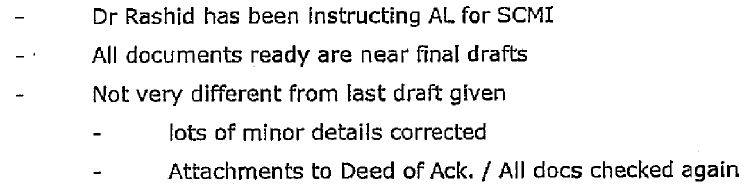
…

…

…
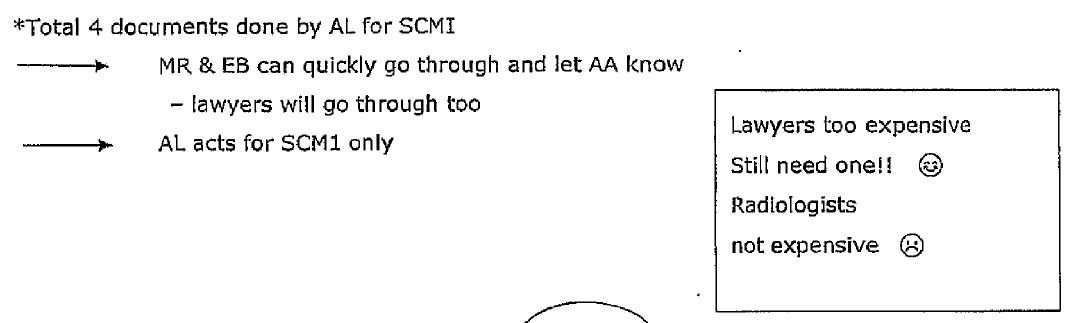
…
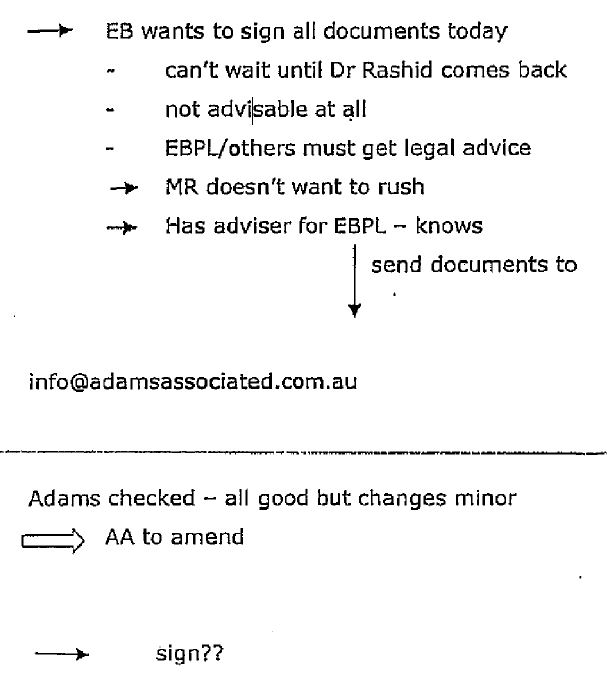
298 I accept Mr Agarwal’s evidence as generally reliable. In particular, I accept that it was Dr Brecher who wanted to sign the documents on the day despite Mr Agarwal telling Dr Brecher that he should obtain legal advice. I accept that a representation was made that Dr Brecher had spoken to Adams Associated in relation to the SCMI transaction documents in circumstances which were such as to imply that Adams Associated had provided advice. This was untruthful because no person had spoken to Adams Associated.
299 Mr Musumeci was a junior solicitor at Acorn Lawyers at the time of the relevant events. He had some involvement in drafting the SCMI transaction documents. His affidavit included:
[14] I do not recall showing either Dr Rashid, Dr Brecher or Renee Hyratt into the boardroom or otherwise meeting them in the reception area on 15 October 2015. Ordinarily, the receptionist would show people into meeting rooms. I recall that the general practice was if the receptionist was not available, a paralegal would greet people at reception and show them into meeting rooms.
[15] At some point during the course of the evening of 15 October Mr Agarwal came over to me while I was sitting at my desk. I knew that Mr Agarwal had been in the boardroom with Dr Rashid, Dr Brecher and Renee Hyratt before he spoke to me, but I do not recall how I knew that.
…
[18] Mr Agarwal said words to the effect ‘looks like we’re signing tonight’. I knew he was referring to the SCMI matter as I had been working on the SCMI documents during the afternoon and while they were in the meeting. Mr Agarwal also asked me to assist with the signing that evening.
[19] This was the first time that I had been made aware that the parties would be signing that evening. I recall observing that Mr Agarwal seemed surprised the parties were signing that night. Mr Agarwal asked me to assist with the execution of the documents.
[20] At some point after this, but I do not recall exactly when, I went into the boardroom.
[21] I do not recall if I took any documents with me into the boardroom or if I put them down on the table.
[22] To the best of my recollection, I first met Dr Brecher and Ms Hyratt when I went into the boardroom. I may have met Dr Rashid in passing prior to this meeting, but to the best of my recollection this was my first substantive interaction with Dr Rashid.
[23] While in the meeting room, I recall that Mr Agarwal was sitting at the head of the table, and on one side there was a spare chair and next to the spare chair sat Dr Rashid. I sat between Dr Rashid and Mr Agarwal. On the opposite side of the table, there was a spare chair, and then Ms Hyratt and Dr Brecher were seated side by side.
[24] I recall that Mr Agarwal said words to the effect ‘those are the documents if you want to sign them’ referring to a pile of papers stacked up on the table in front of him.
[25] I hand wrote onto the documents the names of some of the people signing the documents. I recall seeing the documents were signed by those present. I also recall checking that all of the documents had been signed.
[26] I recall Dr Rashid took the consultancy agreement with him as his wife had to sign this document.
[27] I left the meeting room after the signing of the documents was completed, and had no further contact with any of the parties that evening.
[28] I do not recall anything that was specifically said while I was in the boardroom, but I recall that there was some small talk.
300 I accept Mr Musumeci’s evidence as generally reliable.
301 Dr Brecher was desperate to execute the SCMI transaction documents on 15 October 2015. He was told by Mr Agarwal that he should not execute the documents on that day and that he should obtain independent legal advice, but Dr Brecher insisted on executing the documents after pretending, together with Ms Hyratt, to have discussed the documents with Adams Associated.
302 Dr Brecher’s evidence that Mr Musumeci and Mr Agarwal stated or implied that Acorn Lawyers were acting for him or EBPL was false. Dr Brecher knew that Mr Agarwal was not acting for him or EBPL.
303 Dr Brecher was told by Ms Hyratt before attending the meeting that Ms Adams’ advice was not to execute the SCMI transaction documents until she had had the opportunity to review them. Dr Brecher knew that Ms Adams had not reviewed the documents. Dr Brecher’s representation that he had spoken to his advisers was false. It was made in circumstances which implied that he had received advice about the SCMI transaction documents from Adams Associated.
304 I do not accept that Mr Agarwal made representations concerning the future turnover of the Barrack Heights practice. The representations it is alleged were made by Mr Agarwal are dealt with further below in considering each of the pleaded representations.
D.15 Events immediately after 15 October 2015
305 On 16 October 2015, Acorn Lawyers wrote to SCMI, to the attention of Dr Rashid and Dr Brecher, recording that the documents had been executed. The letter included:
Rollover of Business
Pursuant to the Deed of Acknowledgement (Deed), the business previously conducted by the EBPL has been rolled over into SCMI with effect from 15 October 2015.
The possession and risk of the business assets passed to SCMI on 15 October 2015. Accordingly, any business should now be conducted under the new business name for SCMI.
Please note that all income generated and expenses incurred from 15 October 2015 belong to SCMI. We understand that Susan of Centre Health Complex Barrack Heights is currently in the process of opening a new bank account in the name of SCMI. In the meantime, any income retained in the bank accounts held by the EBPL is to be held on trust for SCMI and to be paid to SCMI once the new bank account is established.
306 On 23 October 2015, Mr Hyratt sent an email to Mr Agarwal, copied to Mr Fraser and Mr Saba of Medfin, which included:
Our contacts at Medfin are Andrew Fraser and Paul Saba. I have spoken to Andrew about our new partnership and company arrangements. He is looking forward to hearing from you.
307 On 27 October 2015, Mr Musumeci sent an email to Mr Fraser and Mr Saba of Medfin seeking to assign the Lease and the Goodwill Loan to SCMI. The email was copied to Ms Hyratt, Mr Agarwal and Dr Rashid. The email began:
Further to our discussion with Paul this morning, we advise that we act for South Coast Medical Imaging Pty Ltd in its capacity as trustee of the South Coast Medical Imaging Unit Trust (SCMI). This is a new entity that has been established to take over the business, by way of rollover, of Dr Brecher Pty Ltd as trustee for South Coast X-Ray Unit Trust (EBPL) as part of the corporate restructure of EPBL [sic] business.
308 Mr Fraser responded, copying Ms Hyratt, Mr Agarwal and Dr Rashid, asking for a number of documents.
309 On 2 November 2015, Dr Brecher and Ms Hyratt exchanged Facebook messages which included:
Eric Brecher Jerins Monday, November 2, 2015 at 1:40pm UTC+11
do you think ’ll be able to get paid 20 percent of revenue?
Eric Brecher Jerins Monday, November 2, 2015 at 1:41pm UTC+11
i’m concerned it’s too much
Renee Traish Monday, November 2, 2015 at 1:42pm UTC+11
It may need to be reduced slightly until the loan is paid off
Renee Traish Monday, November 2, 2015 at 1:43pm UTC+11
But we will go over all of the figures together when Rashid returns
310 On 4 November 2015, Mr Musumeci emailed Dr Rashid stating:
Dear Dr Rashid
We have contacted Medfin Finance to commence the process of assigning the lease loan and the goodwill loan from Dr Eric Brecher Pty Ltd as trustee for South Coast X-Ray Unit Trust to the new entity, South Coast Medical Imaging Pty Ltd as trustee for South Coast Medical Imaging Unit Trust.
Please see our email correspondence with Medfin Finance copied below. Medfin Finance require the following information:
• The new corporate structure/family tree;
• Financials for all entities including individual tax returns for Dr Rashid and Dr Brecher;
• Executed copy of the South Coast Medical Imaging Unit Trust Deed;
• Full name, date of birth, address and contact details for Dr Rashid; and
• Signed privacy consent form (see attached) to be signed by Dr Rashid and Dr Brecher.
Please contact either Andrew Fraser or Paul Saba at Medfin Finance directly. Their contact details are as follows:
[contact details]
Alternatively, please advise if you would like us to assist you. We will though require the above information from you.
If you have any queries or need any assistance, please do not hesitate to contact us.
311 At this time, Dr Rashid was in charge of the administrative aspects of SCMI. There was no further contact with Acorn Lawyers after this email in connection with the Medfin loans.
312 In November 2015, Dr Brecher asked Dr Rashid whether he knew Dr Nabeel Chaudhry. Dr Chaudhry was a sonographer who owned and operated a business providing diagnostic imaging services at locations in Engadine, Warilla and Woonona. Dr Rashid responded that he did. Dr Brecher stated that he was interested in SCMI purchasing Dr Chaudhry’s practices. Dr Rashid spoke with Dr Chaudhry who indicated that Capitol Health Limited had recently made him an offer to purchase his practices.
313 On 19 November 2015, Dr Chaudhry emailed to Dr Rashid a copy of Capitol Health’s offer dated 2 November 2015.
314 On 16 December 2015, Mr Musumeci emailed to Dr Rashid and Ms Hyratt a “Costs Disclosure and Costs Agreement” between SCMI and Acorn Lawyers relating to the purchase of Dr Chaudhry’s practices. The idea of purchasing these practices was placed on hold for a period shortly after at the request of Dr Brecher.
315 The Medfin loans were never refinanced. Dr Brecher’s case was that it was the responsibility of Acorn Lawyers to deal with these loans. In fact, Ms Hyratt took over responsibility for resolving the issues concerning the Medfin loans and Dr Brecher decided not to pursue a refinancing of the debt such that it would be taken on by SCMI.
316 On 16 March 2016, Ms Hyratt sent an email to Dr Rashid which contained a “to do list”. Item 4 in the list was:
Hi Dr Rashid,
As per discussion:
…
4. Medfin – Renee to follow up
…
317 In cross-examination, Dr Brecher stated in relation to this:
Yes, and do you understand that to be a direction that Renee is to follow up the Medfin loans with respect to the business of SCMI?---Probably with Acorn Law Group, who was supposed to do the rollover. On 15 October 2015 Acorn Law Group told me – Ash told me that they would be doing the rollover. Then I and Renee had nothing to do with it. Whether or not they pushed this work onto Renee is one thing. I don’t know, but they were the ones who were supposed to do the rollover, not Renee.
318 On 23 March 2016, Ms Hyratt sent an email to Dr Rashid which was copied to Crest Financial Pty Ltd and All States Medical Supplies Pty Ltd and stated:
I have forwarded the statements from Medfin. Andrew who is our account manager has been away but I spoke with him yesterday. His advise [sic] is that we’re better off staying with the existing loan due to the type of loan we have and the cost of exiting it.
However he will be preparing a formal quotation of what would be involved.
319 Dr Brecher was taken to this document in cross-examination. He gave the following evidence:
MS SHEPARD: And do you see here an email from – sorry, do you have that page?---Yes.
Yes, and do you see here an email from Ms Hyratt to Dr Rashid, and it’s copied to someone at Crest Financial? Do you see that?---Yes.
And also someone at All States Medical Supplies; do you see that?---Yes.
And no one at Acorn Lawyers is copied into this correspondence, are they?---No.
No?---But they were – were the ones who said that they were responsible for doing the rollover. That’s why it occurred in – right after we signed the contract they got involved. They didn’t get involved out of the blue. They got involved because they said that they were going to do the rollover.
Now, directly below that email is – it appears to be an email from Medfin - - -?---Mmm.
- - - on 23 March 2016 and it’s Renee only; do you see that?---Yes.
So it appears that Ms Hyratt was dealing directly with Medfin regarding the loan that EBPL had with Medfin; is that correct?---No. That’s absolutely incorrect.
There’s a reference to “Medfin statements attached”, and you agree that the statements would indicate what balance was owing with respect to the loans to Medfin?---Yes.
Yes, and in the email above that bit of correspondence, at 10.44 am, Renee Hyratt has forwarded details to Dr Rashid and others, and it’s in relation to the Medfin statements; do you see that?---Yes.
Yes, and in that email Ms Hyratt says:
I forwarded the statements from Medfin. Andrew, who is our account manager, has been away, but I spoke with him yesterday. His advice is that we’re better off staying with the existing loan due to the type of loan we have and the cost of exiting it.
Do you see that?---Yes.
Yes. So it appears from this correspondence that, first of all, Ms Hyratt has been dealing with the Medfin loans; do you agree with that?---No.
And, secondly, that she is liaising with Dr Rashid regarding what she has been told by Medfin regarding how it might be paid out or not?---No.
Now, do you recall about - - -?---I mean, if I – if I knew, by the way – if – that Renee was doing this work – I would have been infuriated, because we were told at the meeting that this was going to be done by Acorn Law Group. Dr Rashid and, you know, Ash have begun to push this work – suck her into this work – is very unfair if that’s what happened. I’m very upset to see this, because that’s what we were told at the meeting. She should, you know – I don’t know exactly how she got involved with this.
320 The final answer, by way of interruption to the cross-examiner’s next question, occurred after a significant pause as the cross-examiner was evidently moving to a different topic.
321 I do not accept Dr Brecher’s evidence. I conclude that Dr Brecher knew that Ms Hyratt was dealing with Medfin in connection with the assignment of the Medfin loans. She continued to deal with Medfin in relation to a possible refinancing of those loans by ANZ. The parties proceeded on the basis, as at 23 March 2016, that they should not “assign” the Medfin loans to SCMI because of the associated costs. That was the position put forward by Ms Hyratt. I infer that she was acting with the consent and agreement of Dr Brecher in this regard.
322 For example, on 5 May 2016, Mr Tony Monteiro of Finsmart Finance Group Pty Ltd wrote an email to Ms Hyratt, which was not copied to Acorn Lawyers, which included:
… Thanks for sending those invoices to Scott. He now has all the information and should have reports out to us asap.
Spoke to Simon from ANZ regarding Medfin Loan, and he can look at refinancing it from Medfin over a longer period, which will reduce the current monthly payment. He asked if you could contact Medfin and obtain a payout figure as he is concerned there may be some penalty costs. Once we have the payout, then it is easier to make the decision to refinance.
I have also requested Ali to forward the projections as you requested yesterday.
323 On 25 July 2016, Mr Monteiro sent an email to Ms Hyratt in relation to refinancing the Medfin loans and a proposed home loan, stating:
Reminding you to please request an update payout from Medfin as ANZ are prepared to refinance this facility over a longer period and at a lower rate to preserve cashflow. When you get the payout letter, could you please send the original paperwork eg invoice or Medfin contract to have all the details when ANZ prepare documents.
Also Simon has had a look at servicing and based on 2015, tax returns of Eric, they can consider funding of upto [sic] $800k. For example: if you purchased a property valued at $800,000 – ANZ will lend you 90% of the property value being $720,000 and you will have to fund 10% being $80,000-00. In addition you will require funds to pay transfer stamp duty appx $31,490.00. In total say appx $115,000-00 as your contribution.
324 On 26 July 2016, Mr Monteiro sent a further email to Ms Hyratt chasing the documents mentioned above:
Hope you are well. Thanks for sending the payout letter, I’ll liaise with Simon and come back with a quote for you to discuss with Dr Brecher and Dr Rashid.
Also don’t forget to send me your Home Loan application and other documents.
325 I conclude that Dr Brecher decided not to pursue the assignment for a number of reasons but principally because of the cost associated with exiting those loans and because he considered it more important to leave the Medfin loans in place to facilitate obtaining finance from ANZ. The finance being sought from ANZ included a substantial sum for the MRI machine located at SCXR Dapto and might have included refinancing of the Medfin loans. Dr Brecher also wanted to obtain finance for the purposes of acquiring Dr Chaudhry’s practices.
326 On 15 October 2016, Dr Rashid wrote to Dr Brecher and Ms Hyratt stating:
As Eric wants to purchase Nabil’s [Dr Chaudhry’s] 3 Radiology practices, please consider the following:
• ANZ Bank has got the mortgage on SCMI (present Dapto and Barrack Heights Radiology Practices)
• Before committing to purchase Nabil’s 3 Radiology practices (Engadine, Warilla & Woonona), we should get ANZ Bank loan approved for purchase of these practices (approximate cost of valuation of Nabil’s 3 practices 12-15,000 dollars)
• ANZ Bank will require structure of 3 new SCMI companies to purchase Nabil’s 3 practices. My suggestion of structure for 3 new SCMI companies is attached. Please let me know by email if you have any other suggestions.
• Everything should be done with consultation in a proper and legal way.
327 Dr Brecher agreed that he was determined to acquire Dr Chaudhry’s practices. Dr Brecher also made it clear that, as at October 2016, he was “hoping that the Barrack Heights Centre would become profitable”. Of course, by that time Dr Brecher knew what turnover was being achieved. At SCXR Dapto, before entering into the SCMI transaction, he had regularly sought from Ms Hyratt updates, often daily, as to the practice’s takings.
D.17 The Barrack Heights practice
328 In January 2016, as the Radiology Area had not yet been completed, SCMI occupied alternative consulting rooms at Barrack Heights for no fee. The Radiology Area was handed over to SCMI on 15 February 2016 and Ms Hyratt was provided with a set of keys by Dr Rashid. From that time Dr Brecher and Ms Hyratt assumed and ran the day to day operations of both SCXR Dapto and the Barrack Heights practice. As described in more detail below, by February 2017, it had become clear that SCMI was a failure.
329 In March 2016, Dr Rashid was dissatisfied with what he perceived to be a lack of transparency in how expenses were being incurred and allocated and with the financial position of SCMI. He attended the offices of Adams Associated and met with Mr Mumford and Ms Hyratt. Tensions continued from this time.
330 On 1 June 2016, Dr Rashid wrote an email to Dr Brecher and Ms Hyratt which included:
Dear Dr Brecher and Renee;
I would like to discuss the following;
Dr Rashid joined SCMI on request of South Coast X-Ray (Dr Eric Brecher).
Reason of joining;
• South coast X-Ray was well established profitable radiology practice.
• Dr Brecher is a hardworking, fair, honest and trustworthy person.
• Dr Brecher told Dr Rashid that he wants to grow South Coast Radiology, he does not want public company capital radiology come to Illawarra.
• The whole concept of extension of south coast x-ray to Barrack Heights is based on Dr Brecher’s vision.
• The agreement was reached on the base of equal obligation and liabilities of Dapto and barrack heights 2.2 million each. (Medfin finance 2.2 million for Dapto and new finance 2.2 million for Barrack Heights)
• Dr Brecher informed Medfin will not give him any more finance.
• Dr Rashid to arrange finance of 2.2 million for Barrack Heights (1 million for fit out of Barrack Heights Practice and 1.2 million for equipment)
• The agreement and contract were based on that Dr Brecher and Dr MK Rashid to be equal partners and directors of SCMI. Dr Brecher will receive 20% fee of gross billing and Dr Rashid will receive 15% fee of gross billing. The net profit of the company will be divided half and half.
• Well established Dapto practice and new barrack heights practice, both are part of SCMI- two separate accounts will be kept for clearly of obligation, liability and income and expense.
• Dr Rashid has got approval of finance of 2.5 million dollar for Barrack Heights SCMI which included $300,000 as working capital and meanwhile also arranged short term interest only bridging finance of $400,000 for barrack heights which will be paid off from the bank finance of 2.5 milllion.
• SCMI is a long term relationship between Dr Brecher and Dr Rashid.
• SCMI directors meeting should be held once a month to purchase and hire equipment and new staff. All important decision should be approved in this meeting. Otherwise day to day communication between Dr Brecher and Dr Rashid should be by personal email.
• For all payments has to be authorised.
• If Dr Brecher finds outside reporting and he wants to do outside reporting. He should be able to do so and receive reporting fee as long as it does not affect SCMI work.
• As the business is not able to pay 20% to Dr Brecher and 15% to Dr Rashid, it is fair that part payment to be made proportionally accordingly to percentage to both directors and the balance to be paid in the future when the profitability is increased. It is envisaged that once the equipment and other finance is paid/reduced and business grown profitability will substantially improve.
• I have asked the bank to arrange Dapto finance for MRI and bank is positively considering it. Once barrack finance is settled, the bank will let us know about it.
Dr Rashid concern;
1. Repayment of finance- finance is not problem for Barrack Heights. The bank has approved 2.5 million finance. We have to keep in mind repayment of finance that is why Dr Rashid is trying his best to get finance in such way. So that SCMI has to pay minimum possible payment at present in the start of the new business. ·
2. Dr Brecher– future plan
3. Dr Rashid no payment yet, not even single cents.
4. Dr Prasanna– work/payment
Regards
Dr MK Rashid
331 Neither Dr Brecher nor Ms Hyratt responded to this email. As noted further below, although Delbest (Dr Rashid) had not been paid any fees under the Consultancy Agreement, EBPL (Dr Brecher) was being paid very substantial fees.
332 Dr Rashid and Dr Brecher met on 4 June 2016 at SCXR Dapto. Dr Brecher assured Dr Rashid that SCMI was doing well. He said, however, that he had decided to drop his services fee to 10% and Dr Rashid’s consultancy fee to 7%. Dr Rashid stated that he was concerned about the situation and that he had a lot of unpaid fees. They agreed that the balance of these fees would be paid in the future when profitability increased.
333 SCMI received a letter of offer from ANZ on 14 June 2016. SCMI ultimately entered into a loan with ANZ with a limit of $1.4 million. This was drawn down. Dr Rashid and Dr Brecher guaranteed the loan.
334 Between 16 October 2015 and 30 June 2016, no fees were paid by SCMI to Delbest under the Consultancy Agreement under which Delbest was to be paid 15% of gross receipts. During the same period, Dr Brecher retained an amount of $339,709.07 in relation to the Services Agreement under which Dr Brecher was entitled to 20% of the gross receipts. I infer that it was, at least in part, this imbalance favouring Dr Brecher which led to Dr Rashid’s concerns in March 2016, referred to at [329] above, and prompted his email of 1 June 2016, referred to at [330] above. Dr Brecher and Ms Hyratt were in control of SCMI’s finances, assisted by Adams Associated.
335 From 1 July 2016 to 30 September 2016, SCMI paid an amount of $94,422.99 on account of services provided by Delbest. As noted above, no amounts were paid to Delbest before this time. No amounts were paid to Delbest after this time. From 1 July 2016 to 30 June 2017, Dr Brecher retained $560,417.03, presumably reflecting 20% of the gross receipts.
336 On 3 August 2016, SCMI entered into a second facility with ANZ with a limit of $1.1 million. Dr Rashid and Dr Brecher guaranteed this loan. The purpose of the loan was to fund equipment at the Barrack Heights practice and upgrade equipment at SCXR Dapto. Ms Hyratt gave to Dr Rashid a schedule indicating the equipment purchased by SCMI and installed at Barrack Heights and SCXR Dapto after 15 October 2015. This showed equipment of $452,914.92 installed at Barrack Heights and $826,686.12 installed at Dapto (including upgrades).
337 A substantial part of the funds paid in respect of SCXR Dapto was for an MRI upgrade which Ms Hyratt insisted to Dr Rashid was required. On 31 May 2016, Ms Hyratt had written an email to Dr Rashid recording the importance of the MRI upgrade and explaining that there were “many things in radiology that must stick to a strict time frame otherwise the losses are significant”:
Hi Dr Rashid,
I am sorry if you feel pressured about the finances for both Barrack Heights and Dapto. 1 think we are all feeling the pressure at the moment. However I think its important that we all remain focused on what we have control over and work around things we don’t. There are many things in radiology that must stick to a strict time frame otherwise the losses are significant.
My concern in regards to the MRI upgrade I will outline for you.
• Our revenue from our MRI is approximately $900,000 per year at the rate we are currently working and have been consistently for the last 8 months or so
• Our MRI numbers are strong and consistant
• Our capital sensitivity runs out in October
• The only technicians available to do the work on our cage are fully booked up until August
• We cannot book the technician until we sign off on the MRI upgrade with GE
• We need to have assurance of finances to sign off with GE
• We need to have the work completed before our capital sensitivity runs out to get the papers sorted
• If we dont get the work done in this time frame we risk losing our license which gives us the upper edge in the region
• The cost of the upgrade is less than $700,000 in comparison to a new machine costing $1.2-$1.8 million
• The out time of the MRI upgrade is 3 weeks (we lose about $50K revenue)
• The out time of a new MRI install would be another week or so on top..
It is imperative that this is signed off on this week and we can give GE our loan details. We have been reviewing this together for the last few months.
We can meet tomorrow and discuss how we are going to proceed.
338 On 10 September 2016, Ms Hyratt sent an email to Dr Rashid, copied to Dr Brecher, stating:
Hi Dr Rashid,
Eric and I have just left Dapto after a long day sorting out the networking issues. ·
Eric is not going to continue to work at Barrack Heights for the procedural work. We will have to get the patients to come to Dapto.
339 Dr Brecher responded in an email which included:
We spent 11 hours at work today because of networking issues which is grossly unfair. Additionally, having to work weekends and after hours for free is something that has become unbearable to me. I will not work at Barrack Heights any longer due to the fact that the internet is unreliable there, the internet is extremely slow and I can’t fit my legs under the table in the radiologist room. After two long years of salary sacrifice I’ve unfortunately incurred debt that I will need to pay off. I plan on working locums jobs once Prasanna no longer requires supervision. It will be up to Dr. Rashid and yourself to staff the sites. If Prasanna cannot keep up with the work you will need to send the extra work to a teleradiology company to have it read.
In the mean time [sic], I will seek to sell my shares in the practice. I’ve worked extremely hard in the practice building up the good will, referral base and revenue and because I won’t be able to enjoy the fruits of my incredibly hard labor over the next twenty years will want to be compensated very well for my efforts and sacrifice. I’ll find a lawyer to act on my behalf to sell my shares in the practice. I’ll make sure to have the lawyer correspond with Dr. Rashid’s lawyer to make the transition as smooth as comfortable.
340 As is explained in more detail in Section D.18 below, unbeknownst to Dr Rashid, Dr Brecher had been performing teleradiology work for Insight Radiology at least until August 2016. He had done so since October 2015. He had also been working for Dr Chaudhry’s practices for the period February 2016 to March 2017.
341 Dr Brecher was asked in cross-examination what he was meant in his email when he referred to “two long years of salary sacrifice”. He stated:
The first proposition is that you have salary sacrificed. What did you mean when you referred to the term or used the term “salary sacrifice”?---What I meant by that was the fact that I had given up a lucrative job at Global Radiology to take on the much lesser paying job at Dapto with the vision that I would grow the Dapto practice very profitably, that I would then be able to have opportunities to purchase other radiology sites that could also be very profitable.
342 Dr Brecher was also asked what the debt was that he had to pay off. He gave the following evidence:
And you say too you had “incurred debt that I will need to pay off”?---Yes. That debt was incurred because of Dr Rashid’s misrepresentations about the amount of money that I would be earning at – while working at Barrack Heights.
343 Dr Brecher gave evidence that he borrowed $380,000 to $400,000 to purchase artwork. He said he did that based on the representations made by Mr Agarwal as to the amount that would be earned from a radiology practice at Barrack Heights. He said:
[B]ased upon these misrepresentations, I actually went in to purchase things that I wouldn’t have purchased had I believed or known what the true revenue figures were.
344 Dr Brecher was asked when he took out the loan to purchase artwork and gave the following evidence:
When did you take out that loan?---It was – I can’t recall the exact date, but it was a loan that I and Renee took out from the ANZ Bank based upon her mortgage on her house. And it’s because of your client’s misrepresentations that I took that out, and I’m the victim here. Believe me.
345 Dr Brecher’s evidence that he borrowed money and made purchases that he would not have as a result of believing representations from Mr Agarwal as to future earnings is implausible at every level. First, leaving aside the fact that I am not satisfied that these representations were made, it is unlikely that any person would rely on a solicitor’s representation about future profitability of a business which was yet to come into existence in a field of commerce in respect of which the solicitor had no demonstrated experience. Secondly, a rational person would rely on actual financial performance not a representation made months earlier in the circumstances just described. Thirdly, from the very beginning of the SCMI venture, Dr Brecher had queried whether SCMI could really afford to pay EBPL 20% – see: [309] above. There was nothing in the evidence to suggest that it ever could. Fourthly, Dr Brecher at all times knew precisely the levels of earnings being generated by SCMI given that it was Ms Hyratt and he who had control over that information.
346 Dr Brecher asked Dr Rashid to progress the negotiations to purchase Dr Chaudhry’s practices in October 2016. Efforts continued at least through to December 2016. Dr Rashid approached ANZ in order to seek to fund the purchase.
347 By early January 2017, Dr Brecher considered it was time to separate his business activities from Dr Rashid. However, on 23 January 2017, Ms Hyratt wrote an email to Dr Rashid, stating:
Hi Dr Rashid,
Eric asked me to message you to say that he wants to continue our working relationship and to assure you that he wants to work together.
Can you give me a call tomorrow morning?
348 Dr Brecher’s evidence in relation to this email included that he considered, at the time, that Dr Rashid was “delusional or incompetent” and that all he (Dr Brecher) wanted at that point was “an amicable split” whereby Dr Brecher would take back the SCXR Dapto site and Dr Brecher would read for Dr Rashid at Barrack Heights for 10 to 15% of total revenue.
349 Dr Brecher had procured the incorporation of a company of which he was the sole director on 13 January 2017 called South Coast Medical Imaging (Warilla) Pty Ltd. The company changed its name on 24 August 2017 to Imaging for You Pty Ltd. Dr Chaudhry became a director on 1 July 2017.
350 Also incorporated on 13 January 2017 were South Coast Medical Imaging (Woonona) Pty Ltd and South Coast Medical Imaging (Engadine) Pty Ltd. Dr Brecher was the sole director of those companies.
351 On 31 January 2017, Dr Rashid wrote an email to Ms Hyratt which included:
With reference to our meeting yesterday, the 30th January 2017 regarding Warrawong S.C.M.I radiology practice, S.C.M.I structure and purchase of Nabils 3 radiology practices:
…
C. Purchase of Nabils 3 radiology practices
Normally I do all my business projects myself without partnership. I have done this S.C.M.I Holding company partenership in goodfaith and on Dr Brucher request. I have great respect for Dr Brucher. I will honour my commitment to S.C.M.I and I will do every thing properly according to our signed agreements and contracts, but before buying Nabils 3 practices, I will need full financial till December 2016 of S.C.M.I Holding company and Nabils 3 practices.
352 The situation between Dr Brecher and Dr Rashid continued to deteriorate to the point that Dr Brecher wrote an email to Dr Rashid on 3 February 2017, informing him that he had been told SCMI was insolvent, and holding him personally responsible, together with Ms Hyratt and Adams Associated. He wrote:
Dr. Rashid,
I was just informed for the first time by the practice manager Renee Hyratt that the combined entity of Barrack Heights and Dapto is insolvent. I spoke to the accountants at Adams and associates who claim that there are “cash flow” issues with the practice which in my view is tantamount to insolvency. I’m going to have to lay off staff immediately to resolve the cash flow issues. Renee Hyratt will be let go. I will let go of any other nonessential staff as well. I hold you, Renee and Adams and associates personally responsible for not informing me of the accounting information much, much earlier when problems could have been rectified.
I’m having an independent accounting firm review the state of the business to determine if it needs to be put into liquidation.
I’ve ordered Roz and Renee not to have any personal contact with you or discussions with you about anything. Any communication between yourself and me will have to be done through Ash or another designated party.
I hold you personally responsible for possibly bankrupting a profitable business (Dapto). I’ve read an email in which you claim that I initially approached you to work with you. That is categorically untrue. You approached me on a number of occasions. I’ve learnt about your attempts to disrupt the profitability of the practices by asking us to pay 55K to use an ultrasound machine that you purchased on your own and initially offered for free without any solicitation. I’ve learnt of your attempt to disrupt the merger of the business with Nabeel’s practices which would have increased profitability. These issues were discussed with Ash this morning.
Very sincerely,
Eric Brecher
353 In cross-examination, Dr Brecher gave the following evidence:
You can read the rest of it to yourself, but you don’t say anything in this email to Dr Rashid that Dr Rashid misled you or Mr Agarwal misled you on 15 October 2015?
..
THE WITNESS: Yes. There were numerous reasons why and I gave a few of them, and – when I read – wrote this, what was most on my – what was top on my mind was the fact that Dr Rashid had offered us an ultrasound machine previously, a few weeks before, for free and then tried to charge us $55,000 for it. Dr Rashid never denied any – denied that in any follow-up emails to me. Also, I felt that Dr Rashid pulled out of the purchase deal to purchase Dr Nabeel’s sites. But now I’m learning that Dr Rashid wasn’t able to obtain a loan for that. But I only gave a couple of reasons of many, many reasons why this occurred. And, like I said, I was not trying to point – really point fingers at this time. I was trying to sever the relationship as amicably as possible.
MR GEORGE: No, you weren’t. I beg your Honour’s pardon.
A fair reading of this email indicates nothing of the sort, Doctor?---I didn’t give all the reasons, but that doesn’t mean that the reasons didn’t exist. And I – as I said to you, previously I was upset about the opening up in – of the Barrack Heights site in January; that was obviously something I would mention all the time in my correspondences. I was very upset about the fact that he had misled me about the – the – I’m sorry – doing the – being the landlord and I was – you know, I had a lot of rants about, you know, the fact that we were – you know, all the money was going to his – lining his pockets from his rent. So there were many, many reasons why, you know, I was upset, and I – and I just gave two examples.
…
I guess, like – I’m sorry. I guess, the suggestion is that because I didn’t mention the fact that I was – had things misrepresented to me in July and at the meeting at Acorn Lawyers – that that should have been something as part of this document, and because I didn’t put it in there, that that never occurred. But what I’m saying, your Honour, is it definitely did occur, and I just didn’t put that in this one. But it was something that Renee and I spoke about, and I spoke about it with Nicola Adams and so forth, all the time.
354 The failure to mention the misrepresentations allegedly made by Mr Agarwal on 15 October 2015 in the email of 3 February 2017 has some significance. Ms Hyratt was the practice manager. She had access to the accounting files and the bank accounts and knew what the turnover was. Dr Brecher had kept himself very much appraised of such matters in relation to SCXR Dapto. If, as he asserted in cross-examination, Dr Brecher had spoken to Ms Hyratt about Mr Agarwal’s alleged misrepresentations “all the time” then one would expect them to have been mentioned in the email. There is no documentary record between 15 October 2015 and 2 February 2017 of any complaint made by Dr Brecher with respect to the representations which Dr Brecher alleged were made by Dr Rashid and Mr Agarwal in these proceedings.
355 Dr Brecher asserted that he had written to his mother and detailed exactly what had happened in terms of the behaviour of Dr Rashid and Mr Agarwal and why the venture failed. He said the email could be produced. It was not introduced in reply. However an email was tendered in reply from Dr Brecher to Ms Hyratt sent on 4 February 2017. This stated:
Hi Renee,
I think we can clearly prove we were conned into opening up at Barrack Heights based upon phony revenue projections from Rashid and his accountant and that we can show that Ash did not act as a neutral agent for the practice considering that he is Dr. Rashid’s personal lawyer!! He had an obligation to inform of us this conflict of interest. Additionally, there was a conflict of interest from the very get go with regard to the fit out for the Barrack Heights site which was purposefully build way too large because of Rashid’s desire to charge us more rent.
I’d much rather not get any lawyers involved at this stage. We know that Barrack Heights can be very profitable if Rashid had the proper number of medical doctors at Barrack Heights. Hopefully Primary Health will buy Rashid out and take over the Barrack Heights medical centre and that we will work with them in the near future. If that doesn’t happen then I would like to try to sell my shares to Primary but they would have to be willing to purchase them at a price that I feel is fair which is in the multiple millions of dollars. If that doesn’t occur then I think we need to get a lawyer to try to get him to fulfill the contract and to hire medical doctors.
In the meantime, nobody should have any interaction with him under any circumstance. We have to make sure that money is quickly taken out of the Barrack Heights account so he can’t take it for himself or for rent. Rent is to be paid after all bills are paid by Barrack Heights. If there is not enough money for rent then rent won’t be paid. Barrack Heights needs to put away at least 20K a month from now on.
How does all this sound?
Cheers,
Eric
356 This email does not suggest that Mr Agarwal made the turnover representations asserted by Dr Brecher. Indeed, it focusses on turnover representations allegedly made by Dr Rashid and his accountant. This is likely a reference to the revenue projections prepared by Dr Rashid in April 2016 and provided to ANZ after the SCMI transaction was entered into. These were provided through accountants for the purposes of raising finance. They were not shown to have been made at or before the meeting of 15 October 2015. The projections were not made then. It is also to be observed that, at this point in time, Dr Brecher was not concerned that the fit-out was carried out by Delbest. The email does not suggest that he did not always know it would be carried out by Delbest. Rather, the complaint was that fit-out was purposefully built too large. Nor does the email suggest that Dr Brecher was unaware at the time of entering into the transaction that Barrack Investments was the landlord.
357 On 24 February 2017, Access Law Group wrote to Dr Rashid stating:
This is the first of two letters which are being sent to you of today’s date. The second letter which is being sent to you is on a strictly without prejudice basis.
We first wrote to you under cover of letter dated 14 February 2017 and, to date have not received a response to that letter. This letter serves as notice that Mr Brett Goodyer, director of SV Partners has been engaged by our client and, his related parties to conduct a forensic audit of the financial affairs of the SCMI Unit Trust. The core focus of the audit at this stage will be to consider the financial transactions which took place upon the establishment of SCMI as an operating entity into which Dr Brecher tipped in his South Coast X-Ray Practice.
It is common ground, having regard to various emails that have been exchanged between the parties and their respective accounting advisors that strong concerns exist as to the circumstances in which SCMI for fitout works to establish the Barrack Heights Practice and, other transactions which relating to that process including and not limited to:
1. The design, planning and execution of works;
2. The precise costs associated with the fitout works which were conducted at Barrack Heights;
3. The financial transactions undertaken for the purposes of acquiring plant and equipment, office furnishings and other fitout costs to establish Barrack Heights; and
4. The source documents which support the tax invoices and charges which were levied against SCMI by your entity Delbest Pty Ltd ABN 14 003 236 502.
Of concern is that Delbest may assert that funds remain outstanding with respect to the fitout of Barrack Heights while the tax invoices issued by Delbest on 11 March 2016 assert that there is no balance due and payable by SCMI to Delbest.
Mr Goodyer will wish to examine the precise circumstances in which Delbest engaged contractors and, will look to obtain access to the source documentation which was relied upon by Delbest to produce the tax invoice in March last year together with requests from time to time.
In the ordinary course our client’s accounts have requested that very information but to date it has not been provided and, for the purposes of demonstrating transparency that you will not plead or hinder the request which might be made by Mr Goodyer, and that, you will provide him with adequate assistance as may be required from time to time.
We have provided a copy of this letter to Mr Goodyer and we ask that you have your lawyers contact the writer as a matter of urgency to discuss or facilitate the commencement of the audit. If we do not receive a satisfactory response from you within seven (7) days then, we hold instructions to bring an application before the equity division of the Supreme Court of NSW seeking an order against your related parties and, Delbest that provide reasonable assistance and, comply with the request for production for information.
We otherwise expressly reserve our client’s rights at law and in equity and look forward to your prompt reply.
358 This letter did not suggest that Dr Brecher was unaware that the fit-out was to be conducted by Delbest. Rather, as Dr Brecher stated in his evidence, his concern was with whether Dr Rashid had “embezzled” money.
359 SCMI went into administration in July 2017. SCMI was placed in liquidation on 9 April 2018.
D.18 Radiology services performed by Dr Brecher for other practices
360 On 26 August 2019, shortly before the hearing, Dr Brecher filed an affidavit in which he disclosed that EBPL had issued invoices to Insight Radiology for tele-reporting services provided by Dr Brecher. The invoices and bank records showed that a total of $129,735.40 was paid to EBPL for services provided by Dr Brecher to Insight Radiology after 26 October 2015, with the last payment being made on 30 August 2016. In addition, an invoice for $10,202.50 was issued for services provided from 12 October 2015 to 24 October 2015. It was not in dispute that the provision of these services by EBPL was not known to Dr Rashid.
361 In addition, between February 2016 and March 2017, Dr Brecher performed radiology services at Dr Chaudhry’s practices. It was not in dispute that the Warilla practice was in competition with the radiology practice at Barrack Heights. It was not in dispute that the fees which Dr Brecher received over this time from Dr Chaudhry’s practices totalled $194,435.49.
362 The parties were in dispute about whether the performance of work for Insight Radiology and Dr Chaudhry, or the taking of the opportunities without offering them to SCMI, constituted a breach of cl 6.1 of the “Share Holders and Unit Holders Deed”. This is dealt with in Section E below, Issues 35 to 39.
363 In cross-examination, Dr Brecher denied that he knew about the clauses in the Share Holders and Unit Holders Deed which prevented him from working for other entities. Dr Brecher also stated that the only time he ever looked at the SCMI transaction documents was with Mr Agarwal when he went through the main points of the contract with him on 15 October 2015.
364 On 19 October 2015, the following Facebook messages were exchanged:
Renee Traish Monday, October 19, 2015 at 4:19pm UTC+11
She has been reading through the contract and will need to talk with you
…
Eric Brecher Jerins Monday, October 19, 2015 at 7:57pm UTC+11
can you please call chris [Howitt] and find out when I can start
Renee Traish Monday, October 19, 2015 at 8:00pm UTC+11
It’s just a matter of getting everything set up which is all ready to so. I’ve got IT&T looking into the various VPN set ups. I’ve spoken to Intelerad, they’re good to go. Occam are also ready, I just need to sign off the work to start.
Renee Traish Monday, October 19, 2015 at 8:01pm UTC+11
We just are waiting on Darren and Nicola to double check that you are allowed to do it with this new contract.
Renee Traish Monday, October 19, 2015 at 8:02pm UTC+11
They will confirm tomorrow if it’s ok if you need to run it by Rashid first
Eric Brecher Jerins Monday, October 19, 2015 at 8:17pm UTC+11
ok
365 It will be recalled that Ms Adams had been emailed the SCMI transaction contracts on the evening of 15 October 2015. Mr Chris Howitt was a friend of Dr Brecher with whom Dr Brecher had previously discussed business proposals. I conclude that Dr Brecher sought advice from Ms Adams or Mr Mumford, either directly or through Ms Hyratt, about whether he could provide services to radiology businesses in light of the SCMI transaction documents he had executed on 15 October 2015. I conclude that Dr Brecher knew, at least in general terms, about the clauses in the Share Holders and Unit Holders Deed which prevented him from working for other entities or required competing business to be first offered to SCMI.
366 As mentioned earlier, by the conclusion of the hearing, the parties had identified forty issues requiring resolution.
367 It is convenient to deal with Issues 1 to 3 and 9 together. The first issue was whether Dr Rashid made the representations pleaded in paragraphs 14 to 19, 28, 37, 38 and 41 of the FASOC.
368 Issue 2 was:
If the conduct alleged by the Applicants occurred:
(a) was it, to use a contract term, mere “puffery”?
(b) was it the real inducement to Dr Brecher to enter the agreements made on 15 October 2015?
369 As to Issue 2(b), the applicants submitted that, in terms of assessing liability for loss under the ACL, it is not relevant to consider whether conduct was “the real inducement”. It was submitted that the real issue was whether “Dr Rashid’s representations were causative of the applicants’ loss”.
370 The reference to “puffery” in Issue 2(a) was a reference to what was said in General Newspapers Pty Limited v Telstra Corporation (1993) 45 FCR 164 at 177-178, in relation to s 52 of the Trade Practices Act 1974 (Cth):
Section 52 provides an objective test: Parkdale Custom Built Furniture Pty Ltd v Puxu Pty Ltd (1982) 149 CLR 191 at 199, 204, 255. The common understanding of commercial people must therefore be taken into account in determining what is misleading or deceptive or likely to be so. In Hornsby Building Information Centre Pty Ltd v Sydney Building Information Centre Ltd (1978) 140 CLR 216 at 227, Stephen J remarked on the assistance to be gained from the long experience of courts in analogous fields. That is why, in Rhone-Poulenc Agrochimie SA v UIM Chemical Services Pty Ltd (1986) 12 FCR 477, Bowen CJ referred to principles of law in other fields which throw light upon the circumstances in which full or open disclosure is required or expected.
More recently, in Demagogue Pty Ltd v Ramensky (1992) 39 FCR 31, Black CJ, Gummow and Cooper JJ emphasised that s 52 provides its own test, meaning that if conduct is not misleading and deceptive or likely to mislead or deceive in the circumstances in which it occurs, it will not breach s 52. That section does not require arm’s length negotiations to be completely open or require full disclosure at all times. The particular facts of the case must be considered in the light of the ordinary incidents and character of commercial behaviour.
Thus, in the ordinary course of commercial dealings, a certain degree of “puffing” or exaggeration is to be expected. Indeed, puffery is part of the ordinary stuff of commerce. So also is a certain degree of “put-off”, evasion or obfuscation by commercial people seeking to resist disclosing information which is confidential. Discussions in commerce are so understood.
371 Issue 3 was whether the representations pleaded in paragraphs 14-16, 18 and 37(b)-(f) of the FASOC were with respect to future matters, so as to engage s 4 of the ACL.
372 In Samsung Electronics Australia Pty Ltd v LG Electronics Australia Pty Ltd (2015) 113 IPR 11 at [84], Nicholas J said:
The expression “future matter” is not defined by the ACL. The same expression as used in s 51A of the TPA, was also not defined. However, when read in context, the expression is not hard to understand. A “representation with respect to any future matter” for the purposes of s 4 of the ACL and, before it, s 51A of the TPA, is a representation which expressly or by implication makes a prediction, forecast or projection, or otherwise conveys something about what may (or may not) happen in the future.
373 In Australian Competition and Consumer Commission v Woolworths Limited [2019] FCA 1039 at [86]-[87], Mortimer J adopted a submission by the respondent that a future matter is concerned with:
… representations, such as predictions, promises, forecasts and opinions as to future events where the factual matter represented is not capable of being true or false at the time the representation is made (because it lies in the future).
374 A representation as to potential or future profitability is a representation as to a future matter, albeit such a representation generally also implies a representation as to the maker’s present opinion or assessment: Ting v Blanche (1993) 118 ALR 543 at 553; Digi-Tech (Australia) Ltd v Brand (2004) 62 IPR 184 at [113]; All Options Pty Ltd v Flightdeck Geelong Pty Ltd [2019] FCA 588 at [38].
375 Issue 9 was whether the representations and conduct referred to in Issue 1, if they were made or if the conduct occurred, were misleading and deceptive. I have addressed Issues 2, 3 and 9 to the extent relevant on the submissions made by the parties as applicable to those representations which I have concluded were made.
376 FASOC [14] pleaded:
That in about late June/early July 2015, Rashid represented to Brecher that there would be a lot of work for a radiologist at the Barrack Heights Centre
377 FASOC [17d] pleaded:
In about mid-July 2015, Rashid … [represented that] the Barrack Heights Practice would have enough work to justify the Applicants’ involvement.
378 Dr Brecher gave the following account of what he referred to as a “fourth” meeting with Dr Rashid, which occurred between the end of June to the end of July 2015:
I said to Dr Rashid that – words to the effect, “Dr Rashid, you must understand something about radiology and, that is, that if you put a radiology centre in the Barrack Heights Medical Practice, make sure that you have enough work that’s being sent by your GPs to sustain that practice and make that practice profitable.” And the reason is that in radiology it’s common knowledge or it’s an accepted established fact that you won’t be able to get general practitioners or other referrers sending in work into the medical centre. And the reason is that they are concerned that by sending their patients to a radiology site that’s in a medical centre that those patients may choose then to get their medical or GP care from that centre. And Dr Rashid responded to me by saying words to the effect that, “There’s nothing to worry about there. There’s plenty of work at Barrack – at the Barrack Heights centre.
379 Ms Hyratt gave the following evidence regarding what was said during meetings between Dr Rashid and Dr Brecher before 30 August 2015:
Eric said words to the effect that he had a concern about the number of doctors that would refer to a radiology centre that was within a medical centre from outside. Dr – sorry. Eric said words to the effect that it was common knowledge within radiology that if you put a medical centre – sorry – a radiology centre into a medical centre that those doctors outside are concerned about losing their patients to the doctors at the medical centre, and so you needed to be certain that the amount of work that you were getting from within that medical centre sustained the radiology practice. Dr Rashid said words to the effect that he knew the number of patients that were sent from the doctors within the medical centre and that that wasn’t something that Eric had to worry about.
380 Ms Hyratt also gave the following evidence in relation to the meeting at the Relish Restaurant on 30 August 2015:
Again, at this meeting, Eric said words to the effect that if they were to open up a radiology centre in Barrack Heights – that you needed to be sure that you had enough work to sustain that practice. Dr Rashid said words to the effect that it wasn’t something that he had to worry about because he knew the amount of work that came from the doctors within the medical centre – the types of studies that they were sending. Dr Rashid said words to the effect that there had been other radiology centres practising from that same location for a number of years and that they had been happy there.
381 Dr Rashid gave evidence that he had no experience at the time operating a radiology practice. It was not in issue that Dr Rashid had no experience operating a radiology practice and that Dr Brecher did have such experience.
382 It is likely that Dr Rashid and Dr Brecher both discussed in a general way whether they should embark upon the venture. Both of them considered the venture to be viable or they would not have embarked on it. Both of them may have stated as much to each other. Both of them would have assumed that there would be sufficient work available. Such an assumption would have been consistent with the fact that a radiology practice had been operating at Barrack Heights for many years.
383 I do not have an actual persuasion that Dr Rashid represented to Dr Brecher, in a way which would have been misleading in the context in which any such words were spoken, that there would be a lot of work for a radiologist at Barrack Heights: FASOC [14]. Nor do I have an actual persuasion that Dr Rashid represented, in a misleading way, that the “Barrack Heights Practice would have enough work to justify the Applicants’ involvement”: FASOC [17d].
384 In Watson v Foxman (1995) 49 NSWLR 315 at 318-9, McLelland CJ in Eq observed:
Where, in civil proceedings, a party alleges that the conduct of another was misleading or deceptive, or likely to mislead or deceive (which I will compendiously described as “misleading”) … it is ordinarily necessary for that party to prove to the reasonable satisfaction of the court: (1) what the alleged conduct was; and (2) circumstances which rendered the conduct misleading. Where the conduct is the speaking of words in the course of a conversation, it is necessary that the words spoken be proved with a degree of precision sufficient to enable the court to be reasonably satisfied that they were in fact misleading in the proved circumstances. In many cases (but not all) the question whether spoken words were misleading may depend upon what, if examined at the time, may have been seen to be relatively subtle nuances flowing from the use of one word, phrase or grammatical construction rather than another, or the presence or absence of some qualifying word or phrase, or condition. Furthermore, human memory of what was said in a conversation is fallible for a variety of reasons, and ordinarily the degree of fallibility increases with the passage of time, particularly where disputes or litigation intervene, and the processes of memory are overlaid, often subconsciously, by perceptions or self-interest as well as conscious consideration of what should have been said or could have been said. All too often what is actually remembered is little more than an impression from which plausible details are then, again often subconsciously, constructed. All this is a matter of ordinary human experience.
Each element of the cause of action must be proved to the reasonable satisfaction of the court, which means that the court “must feel an actual persuasion of its occurrence or existence”. Such satisfaction is “not attained or established independently of the nature and consequence of the fact or facts to be proved” including the “seriousness of an allegation made, the inherent unlikelihood of an occurrence of a given description, or the gravity of the consequences flowing from a particular finding”: Helton v Allen (1940) 63 CLR 691 at 712.
385 Even, if I had been satisfied that the pleaded representations were made, the representations would have been understood by a reasonable person in the context which then existed as a statement of what Dr Rashid genuinely expected or hoped to be the case. The representations would not have been understood as having been based on any serious analysis or calculation.
386 I do not accept that Dr Brecher’s views about the amount of work which would be available arose because of representations made by Dr Rashid that there would be “a lot of work” or “enough work”. The probabilities favour that Dr Brecher made his own assessment about these matters.
387 Further, even if the representations were made, I do not accept that they had any influence or relevant causative effect on Dr Brecher embarking on the venture. Dr Brecher did not enter into any relevant transaction or suffer any loss “because” of them (s 236 of the ACL), assessed either alone or together with other conduct. It was Ms Hyratt who first came up with the idea of providing services to Barrack Heights. Dr Brecher then pursued the idea and asked Dr Rashid to have his lawyers prepare what was to become the “Promotional & Co-Management Services Agreement” between Dr Brecher and Delbest. Dr Brecher took the view that he would be able to obtain significant work from Barrack Heights. Dr Brecher had experience in operating a radiology practice. He had confidence in his abilities. He did not rely on any experience on the part of Dr Rashid in operating radiology practices. Dr Rashid had no such experience. It is unlikely that Dr Brecher, an experienced radiologist, would rely upon a general statement of the kind pleaded in making a decision to embark on the SCMI venture.
388 The foregoing is sufficient to conclude that the representations pleaded in FASOC [14] and [17d] were not made and were not relied upon or causative of any loss on the part of EBPL or Dr Brecher. However, in addition to the foregoing, the probabilities favour that, before entering into the transactions on 15 October 2015, Dr Brecher had been given the “Daily Diagnostic Counts” which identified the number of referrals which had been made by the Barrack Heights medical centre to various radiology practices in the last two weeks of September 2015. Further, he must have known the number of referrals which had been made to SCXR Dapto under the Promotional Agreement. This information indicated to Dr Brecher the precise number of referrals being made in those weeks. Dr Brecher considered he could build a profitable practice at Barrack Heights whatever view he took of existing referrals.
389 FASOC [15] pleaded:
Rashid represented to Brecher on a number of occasions that the only reason why PRP Imaging (the previous radiology tenant at the Barrack Heights Centre,) left the Barrack Heights Centre was because it had had a dispute with Wollongong Nuclear Medicine, another tenant in the Barrack Heights Centre.
390 Dr Brecher gave evidence of the following conversation, which he asserted occurred at the “fourth meeting” in June to July 2015:
In fact, PRP left the centre only because of a dispute that they were having with the next-door neighbour, Wollongong Nuclear Medicine, over a sign - - -
Sorry, who was that, Dr Brecher?---Wollongong Nuclear Medicine.
Nuclear medicine. Thank you?---And he said over a sign and that they wanted to actually stay there and they had done very well there at the Barrack Heights Medical Centre. He also then mentioned to me that the – words to the effect that the landlord had been receiving offers from radiology practices to move into the Barrack Heights Medical Centre.
…
And he responded to me words to the effect that, “You don’t have anything to worry about, you know, there. PRP, you know, used their name at the Barrack Heights Medical Centre and never lost any work and they were extremely happy.”
391 In closing written submissions, the applicants submitted that the applicants’ “real complaint about this representation is that Dr Rashid did not inform Dr Brecher that PRP Imaging had complained in July 2012 that its rent was too high and that it was receiving an insufficient return on the rent it was paying”.
392 The applicants’ submission was based on an email sent on 20 July 2012, about three years before the alleged conversation between Dr Brecher and Dr Rashid at the “fourth meeting”. That email refers to a conversation that the Chief Operating Officer of PRP had with Dr Rashid and refers to an “offer to purchase” the strata which had been made. Dr Rashid gave evidence that, whilst PRP ultimately moved to new premises, it took a new lease with an increased rental, probably in December 2012. The applicants submitted that PRP only remained because it was fitting out new premises. The evidence did not establish that fact. It is not an inference I would draw from the limited evidence adduced. PRP remained a tenant at Barrack Heights for a further two years, until about December 2014. Two years might be thought to be a long time to complete a fit-out.
393 It was submitted for the applicants that “Dr Rashid did not disclose this information to Dr Brecher for fear of prejudicing the proposed joint venture or to avoid an informed negotiation of the rent that would be payable by SCMI at CHC Barrack Heights”. I reject that submission. Dr Rashid was not afraid of prejudicing the proposed joint venture. At that time, it was Dr Brecher who was vigorously pursuing the joint venture, not Dr Rashid. Dr Rashid had well advanced negotiations with Healthcare Imaging for that organisation to set up a new radiology facility at Barrack Heights with a lease for the same rent as had been paid by PRP (approximately $276,000 per year). This was slightly more than the rent ultimately agreed with SCMI. Dr Brecher knew that Dr Rashid was considering this alternative proposal but was encouraging Dr Rashid to pursue a venture with him and EBPL instead. Dr Brecher did not want Dr Rashid to give the lease to Healthcare Imaging. One of Dr Brecher’s great concerns at the time was the increase in competition which he regarded as posing a real threat to the medium to long term viability of SCXR Dapto. Irrespective of whether, with the benefit of later analysis, SCXR Dapto was under as much threat as Dr Brecher then thought or was more profitable than he thought, the fact is that Dr Brecher considered that SCXR Dapto was under threat and might fail unless he embarked on a venture with Dr Rashid and his interests.
394 Reliance was also placed by the applicants on a handwritten file note dated 8 April 2016 prepared by Dr Rashid. The file note contains certain calculations made by Dr Rashid on the basis of information which had been given to him and which he provided to his accountant, Mr Khan, for the purposes of seeking to secure finance from ANZ. It does not shed light on whether the pleaded representation was made or whether Dr Rashid deliberately withheld information about a complaint which had been made three years earlier in the context of a commercial negotiation.
395 I do not accept that Dr Rashid represented that “the only reason why PRP Imaging … left the Barrack Heights Centre was because it had had a dispute with Wollongong Nuclear Medicine, another tenant in the Barrack Heights Centre”. Dr Rashid referred to the dispute and did not refer to a statement about rent made by PRP three years earlier in the context of a commercial negotiation. The pleaded representation was not made and the circumstances were not such as to place Dr Rashid under any obligation to disclose PRP’s statement concerning the level of rent. In particular, in light of the context in which PRP made its statement, and the fact that it remained a tenant for a further two and a half years, I do not accept that PRP’s statement in fact reflected the true position, namely that PRP was obtaining an insufficient return by reason of the rent being paid. In any event, it would be difficult to know what to make of the statement even if taken at face value.
396 Dr Rashid’s conduct was not misleading or deceptive.
397 FASOC [16a] pleaded:
In the first half of July 2015, and thereafter, Rashid represented to Brecher that … he had 20 full time GPs working at the Barrack Heights Centre and was expanding to 40
398 FASOC [16b] pleaded:
In the first half of July 2015, and thereafter, Rashid represented to Brecher that … he was bringing in multiple specialists, including 5 obstetricians and gynaecologists
399 FASOC [16c] pleaded:
In the first half of July 2015, and thereafter, Rashid represented to Brecher that … an additional floor was to be added to the medical centre
400 Dr Brecher gave the following evidence:
And what was said at that fifth meeting, please?---Well, the fifth meeting was somewhat repetitious with the – the fourth meeting, and, once again, I said to Dr Rashid when he came in that, “Dr Rashid, just please make sure you’re opening this medical centre” – “radiology centre”, I’m sorry, “that you know that you have enough work in – referred from your GPs to radiology in order to sustain a profitable radiology practice.” And he said, “I have 20 full-time GPs working here, and we’re actually expanding this – this – I’m actually expanding my medical centre to include 35 to 40 GPs as well as five specialists in ob-gyn, so five ob-gyn specialists.”
And just for those who don’t practice in your area of work, what is ob-gn, please?---Okay. So ob-gyn means obstetricians, gynaecologist.
…
Was anything else said at this meeting?---Yes. He said at the meeting that not only, you know, was he hiring additional – an additional 15 to 20 GPs but that the medical centre itself was increasing itself – increasing its size to – to include a second floor for the GPs that he was hiring.
401 The applicants’ case was that there were, in truth, only 10 to 12 GPs working at Barrack Heights at the relevant time. The applicants relied principally on the evidence of Ms Roslyn Rhoden. She gave evidence that she had worked with Laverty Pathology at the Barrack Heights medical centre from approximately 2012 to 2016 and visited the doctors at Barrack Heights at least once a fortnight. She estimated that, as at February 2015, there were 10 to 12 GPs working there and the she never saw 18 to 20 GPs working at Barrack Heights at any one time. She considered that not all of the 10 to 12 GPs working at Barrack Heights were working full-time, mentioning two whom she knew not to work full-time.
402 Ms Rhoden commenced employment with SCMI in May 2016. She estimated that there were then between eight and ten GPs working at the centre.
403 Dr Rashid estimated that there were 18 GPs who were employed at Barrack Heights in September 2015 of which three were employed on a part-time basis.
404 It is to be recalled that Ms Hyratt visited Barrack Heights in May 2015 and reported back to Dr Brecher that the medical centre had 600 patients a day. She told Dr Brecher that Barrack Heights was the place from where PRP had moved and that she considered there was a possibility of setting up a new radiology practice. Dr Brecher visited the Barrack Heights site “a few times” with Ms Hyratt before 15 October 2015 and said that he looked at “the number of doctors on the board and so forth” and that he “was doing due diligence on it”.
405 In August 2015, after certain discussions with Dr Rashid which Dr Brecher and Ms Hyratt pursued, Dr Brecher and Ms Hyratt met with Dr Rashid at Barrack Heights. Dr Brecher said he was “looking at the centre and making sure that there were the correct number of doctors and that it was a busy site”.
406 After the Promotional Agreement was executed by Dr Brecher, Ms Hyratt set up appropriate software systems that required her to allocate user names to each of the referring doctors – see: [189], [206] to [208] above. Ms Hyratt knew the exact number of doctors working at Barrack Heights and each of their names. Ms Hyratt sent an email on 31 August 2015 setting out the usernames of each of the 18 GPs then working from Barrack Heights. I conclude that Dr Brecher also knew the number of doctors working at Barrack Heights through his own observations and discussions with Ms Hyratt.
407 More importantly, in any event, Dr Brecher undertook his own investigations and knew how many doctors were identified on the board at Barrack Heights.
408 Whilst I accept Ms Rhoden would have accurately set out in her affidavit what her recollection was, I do not accept her estimation as accurate. Her recollection is demonstrably inaccurate. The contemporaneous documentary evidence establishes that there were 17 GPs as at April 2015 and 18 GPs as at August and September 2015.
409 It is not unlikely that Dr Rashid did mention to Dr Brecher the number of doctors working at Barrack Heights. It is unlikely that he falsely represented the number of doctors working there, particularly in circumstances where Ms Hyratt and Dr Brecher had either visited or were likely to visit Barrack Heights. It is not unlikely that Dr Rashid identified the number of GPs accurately and precisely or as about 20, consistent with the truth. I do not accept that Dr Rashid stated that the doctors working at Barrack Heights were each working full-time.
410 It is not unlikely that Dr Rashid stated that it was his objective to expand the number of doctors. It is not unlikely that he stated that his plan was that five of the expanded number of doctors might hopefully be obstetricians or gynaecologists. It is not unlikely Dr Rashid stated that he planned to add an additional floor to the centre. Whilst those matters are not unlikely, I do not have an actual persuasion that a representation was made which, in the surrounding context, has been shown to be misleading or deceptive. I refer to the extract from Foxman set out at [384] above.
411 If Dr Rashid did make such representations concerning his hopes and plans they were, and would have been understood as, representations of Dr Rashid’s genuine desire. It would have been reasonable to make those representations, having regard to his genuine intention, in the circumstances which then prevailed.
412 FASOC [16d] pleaded:
In the first half of July 2015, and thereafter, Rashid represented to Brecher that … Brecher did not have to be concerned about the profitability of the practice to be conducted at the Barrack Heights Centre
413 Dr Brecher gave the following evidence:
What else did he say?---He then said, “Well, not only do I have – I know that there’s a lot of GPs being added here, but I actually know what the revenue that my – my doctors send to radiology because I have a program, a computer program, that monitors the exact number and types of imaging modalities that my GPs refer to radiology,” at which point I looked a little – I must have looked a little bit surprised. He said, “Yes,” words to the effect, “I’m required by law to have these – this – to have access to this – this information because Medicare gets – will get very upset if they – if my GPs order too much of – too much – too many imaging studies as well as pathology studies. So these – these numbers have to actually be tracked.”
414 I do not accept that Dr Rashid said this. There was no such program or software. It is implausible that Dr Rashid would have lied about having such a system being in place because he would not have been able to provide the resulting reports if Dr Brecher asked to see the reports. It is implausible that Dr Brecher, if he truly held the concerns he stated, would not have asked to see the reports if Dr Rashid had stated there was a program monitoring the exact number and types of radiology referrals. This is particularly so given the views that Dr Brecher stated he had after the Promotional Agreement was entered into that some of the doctors at Barrack Heights were not referring work to him. Dr Rashid had “Daily Diagnostic Counts” prepared manually towards the end of September 2015 because Dr Brecher had asked for that information. The circumstances in which those counts were made and the form of them indicates that there was no computer system tracking information of the kind described in Dr Brecher’s evidence.
415 Further, it was not established that Dr Rashid had expertise sufficient to know what numbers of referrals would have been necessary to support a radiology practice.
416 Ms Hyratt said that, at the meeting at the Relish Restaurant, the following conversation occurred:
Again, at this meeting, Eric said words to the effect that if they were to open up a radiology centre in Barrack Heights – that you needed to be sure that you had enough work to sustain that practice. Dr Rashid said words to the effect that it wasn’t something that he had to worry about because he knew the amount of work that came from the doctors within the medical centre – the types of studies that they were sending. Dr Rashid said words to the effect that there had been other radiology centres practising from that same location for a number of years and that they had been happy there.
417 In cross-examination, Dr Rashid accepted that he did not think there would be a problem about there being sufficient revenue. He was comfortable that there would be sufficient revenue because he was aware that radiology practices had been operating at Barrack Heights from 2004. These were Shellharbour Radiology from 2004 until 2011 and PRP from 2011 until 2015. Dr Rashid’s evidence included:
At some time before October 2015 Dr Brecher came to you and expressed his concern that for the practice to be successful - - -?---It never happened.
No. And you say not once did Dr Brecher come to you and say at any meeting before October 2015 that he was concerned about the success of any radiology practice at Barrack Heights?---Never.
Not once?---Not once.
And he never came to you on your case and said to you that it was important for the success of the business that there be enough work generated by the practice - - -?---Nothing - - -
- - - to sustain the practice?---No, sir. He was always – not to give it to Primary, and, you know, that was his main concern.
And your view, nonetheless, at that time was that the practice would be profitable, because, inter alia, of a track over the last 11 years, correct?---Yes, because the practice was running for 11 years.
…
You did not – do you say you thought anything – I will withdraw the question. Did you ever tell Dr Brecher that you felt comfortable about the profitability of the proposed radiology practice because of what had gone on in the preceding 11 years?---No, I did not tell him.
418 I am not satisfied that Dr Rashid made the representation pleaded. I accept that Dr Rashid was comfortable that there would be sufficient revenue. He had good reason to be comfortable about that given two successful radiology practices had operated at continuously at Barrack Heights from 2004 until December 2014. However, I do not accept that Dr Rashid gave Dr Brecher any assurance that there would be sufficient revenue.
419 FASOC [17a] pleaded:
In about mid-July 2015, Rashid … showed Brecher plans for the Barrack Heights Centre indicating where, inter alia, the 20 new GPs and the new specialists would practice
420 Dr Brecher stated that Dr Rashid either drew a diagram or showed him architectural plans for the proposed radiology area. Dr Rashid accepted that he showed Dr Brecher floor plans of the proposed new radiology site. It was not clearly established what floor plans Dr Rashid showed Dr Brecher, nor that they indicated where new GPs and specialists would practice. An architectural floor plan dated 4 March 2016 is consistent with a proposal for there to be 37 GPs.
421 I am not satisfied that whatever was shown to Dr Brecher was, in context, misleading or deceptive. Further, I do not accept that showing the floor plan of a proposed new radiology practice, assessed alone or together with the other pleaded conduct, played any material role in Dr Brecher deciding to enter into the SCMI transaction.
422 FASOC [17c] pleaded:
In about mid-July 2015, Rashid … undertook to find a neutral lawyer to represent both men and the business to be conducted by them from the Barrack Heights Centre
423 Dr Brecher gave the following evidence:
He then mentioned that we should – that he would find what he described as an independent mutual lawyer to represent us at – for the business, and then asked me words to the effect, “What lawyers have you used when” – “What law firm have you used when buying the Dapto practice from Dr Stanton?” And I responded words to the effect that, “I used Kells Lawyers and I also have used Access Law Group for an unrelated legal matter.” And he said, “Fine. I will go and find a lawyer right away to draw up a contract for us.”
424 It was submitted for the applicants:
Dr Brecher’s conduct supports the contention. He himself did not retain a solicitor. The transaction would have demanded that he at least consider retaining a lawyer. He expressed no reluctance to retain solicitors. He remarked that in the United States “we have lawyers on speed dial”.
425 I do not accept that Dr Rashid made the representation pleaded in FASOC [17c]. Dr Rashid undertook to obtain a lawyer to draft agreements which would be required to effect the SCMI transaction, but did not represent that the lawyer would act for both Dr Brecher and Dr Rashid. I am not satisfied that Dr Rashid stated that he would locate a “neutral lawyer”.
426 I conclude that Dr Brecher knew that Acorn Lawyers had acted for Delbest in the past, in drafting the Promotional Agreement, and knew that Acorn Lawyers had been retained to act for SCMI at the direction of Dr Rashid. Further, it would have been clear to Dr Brecher from the conversations on 15 October 2015 at the offices of Acorn Lawyers that Acorn Lawyers had acted for interests associated with Dr Rashid in the past.
427 The submission that it should be inferred that the representation was made because Dr Brecher did not retain a lawyer is rejected. Dr Brecher was content not to be represented by a lawyer in the SCMI transaction. Dr Brecher’s evidence that, in the United States, “we have lawyers on speed dial” needs to be understood in the context of the whole of his evidence, which shifted according to what Dr Brecher perceived suited his interests. The only time Dr Brecher was shown to have obtained any significant legal advice was towards the very end of the purchase of SCXR Dapto. He only then obtained legal advice at the insistence or encouragement of the accountant assisting him in the transaction and, possibly, the financier, Medfin. Dr Brecher chose to obtain advice from accountants, as he had done in the past.
428 In any event, Dr Brecher was advised by Mr Agarwal on 15 October 2015 that he should get independent legal advice. This was a suggestion Dr Brecher chose to reject because he was desperate to enter into the SCMI transaction on the day. Mr Agarwal, Dr Rashid, Ms Adams and Ms Hyratt each also recommended that he not execute the documents on that day. He rejected their recommendations too.
429 FASOC [18] pleaded:
At various times, including in about September 2015, Rashid further undertook to Brecher to find a lawyer to work for the two men and to draft the legal documents for the proposed Barrack Heights Practice.
430 It is implicit in the way this representation is pleaded that, when this representation was allegedly made, it was proposed only to open a new radiology practice at Barrack Heights and that a merger with SCXR Dapto was not then proposed. I have rejected that proposition earlier. From at least the time he saw the “mud map”, Dr Brecher well understood that the SCMI transaction involved establishing a radiology practice at Barrack Heights and merging that practice with SCXR Dapto. That was the substance of the agreement which Dr Brecher had proposed at Relish Restaurant. Dr Brecher knew that it was contemplated that SCMI would acquire or create further radiology practices. That had been Dr Brecher’s objective since he acquired SCXR Dapto.
431 In my view, Dr Rashid is likely to have told Dr Brecher that he would have lawyers that he had previously retained to prepare documents which would be required to effect the SCMI transaction. This was not misleading or deceptive. I do not accept that Dr Rashid stated that he would obtain a lawyer to act for Dr Brecher or EBPL, if that is intended to be implied by the pleaded representation. In any event, Dr Brecher was told at the meeting on 15 October 2015 that Acorn Lawyers acted for SCMI and did not act for EBPL or Dr Brecher. Further, Dr Brecher knew that Acorn Lawyers had acted for Delbest in drafting the Promotional Agreement and he must have known from the circumstances of the meeting that Acorn Lawyers had acted for Dr Rashid in the past.
432 FASOC [19] pleaded:
19. By late September 2015, Rashid and Brecher had agreed that, inter alia:
a. they would own the Barrack Heights Practice 50/50;
b. the Barrack Heights Practice would operate under the name “South Coast XRay”;
c. the new company would take out a loan to fund the establishment of the Barrack Heights Practice, and each of Rashid and Brecher would guarantee the loan if necessary;
d. they would jointly make decisions for the Barrack Heights Practice;
e. any profits would be split 50/50; and
f. they would engage the same lawyer to draft up the contracts.
433 Contrary to the assumption in Issue 1, this pleading cannot fairly be construed as alleging that Dr Rashid made representations. The pleading merely contains contended facts which the applicants assert to be material to the case.
434 If the pleading is intended to convey that Dr Rashid represented that the deal between Dr Brecher and Dr Rashid would be a 50 / 50 deal concerning a new practice at Barrack Heights, as opposed to a merging of interests concerning both the new Barrack Heights practice and SCXR Dapto, no such representation was made for the reasons set out earlier.
435 FASOC [28] pleaded:
At the time that Rashid and SCMI retained Acorn Lawyers, and up to and including 15 October 2015, Rashid did not disclose to Brecher, and Brecher did not know, that Rashid, through at least Romore, had retained Acorn Lawyers on a number of occasions in the past.
436 Dr Rashid gave the following evidence in relation to the “Promotional & Co-Management Services Agreement”:
And did Dr Brecher say anything?---Dr Brecher said, “Well, that’s very good, so when we can have agreement”. And then at that time I told Dr Brecher, “Look, my solicitor is Acorn Lawyer. Ash Agarwal is my solicitor so would you like me to arrange agreement or you will do – you want to ask your solicitor to do it” and Dr Brecher said, “No, go ahead and do, you know, with Acorn Lawyers”.
437 I accept that evidence. Dr Brecher subsequently executed the Promotional Agreement between himself and Delbest. He knew it had been prepared by Acorn Lawyers. It referred to Acorn Lawyers on each page. I conclude that Dr Brecher knew that Acorn Lawyers were being used to draft the relevant documents for the SCMI transaction. Dr Brecher knew that those lawyers were the lawyers that Dr Rashid described as his lawyers. As at 15 October 2015, Dr Brecher knew that Acorn Lawyers had acted for Delbest in the past. Dr Brecher must have assumed that it was highly likely that those lawyers had acted for other entities associated with Dr Rashid in the past.
438 FASOC [37a] pleaded:
At the 15 October 2015 Meeting, Agarwal represented to Brecher that … he and Acorn were representing Brecher, Rashid and SCMI and would be performing work for Brecher
439 For the reasons given above, I do not accept that any such representation was made – see: Section D.14 and [425] to [428] above.
440 FASOC [37b] pleaded:
At the 15 October 2015 Meeting, Agarwal represented to Brecher that … the expected turnover of revenue … at the Barrack Heights Practice would be $5m for the first year, $7.5m in the second year and $10m in the third year
441 Mr Agarwal and Dr Rashid both denied the representation was made. Dr Brecher and Ms Hyratt both assert it was. Mr Agarwal was not shown to have any information before him which would have supported such a representation. In the context of what occurred at the meeting, it is inherently unlikely that such a representation was made. It is also inherently unlikely that a solicitor with the experience of Mr Agarwal would have embarked upon a course of making representations to a client (SCMI) about future profitability of a radiology practice, which had not yet been established and in which the solicitor had no direct involvement. The representations are not referred to in Mr Agarwal’s file note of the meeting.
442 For these reasons, the reasons given above when discussing the events of 15 October 2015 (see Section D.14) and the reasons given below in Section E in respect of Issue 6, I do not accept that any such representation was made.
443 FASOC [37c] pleaded:
At the 15 October 2015 Meeting, Agarwal represented to Brecher that … Rashid would take out a loan in the sum of $2.5m, of which up to $1.5m would be used for the fit out and the balance would be spent on equipment
444 Dr Brecher’s evidence was:
[Mr Agarwal] said that Dr Rashid will be responsible for the fitout – procuring the fitout of the practice and that the fitout would cost about $1 million.
445 Ms Hyratt’s evidence was:
[Mr Agarwal] talked about the – the fit-out at Barrack Heights, that Dr Rashid would manage that, and that he could spend up to $1.5 million on a fit-out and that the other $1 million would be for equipment.
446 No person gave evidence that Mr Agarwal stated that Dr Rashid would take out a loan of $2.5 million.
447 The Deed of Acknowledgment provided that the fit-out was not to exceed $1.5 million. Clause 10.2(c) included:
10.2 The relevant Parties hereby nominate and appoint Dr Rashid to: …
(c) procure the fit out in the new premises within Centre Health Complex provided that the cost of such fit out must not exceed the maximum of $1,500,000 + GST,
448 I conclude that at the time of the meeting Dr Brecher and Ms Hyratt understood that Dr Rashid would be responsible for procuring the fit-out and that it would not cost more than $1.5 million + GST. I do not have an actual persuasion that this understanding came about as a result of anything said by Mr Agarwal at the meeting. I am not satisfied that Mr Agarwal misrepresented the effect of any of the SCMI transaction documents.
449 FASOC [37d] pleaded:
At the 15 October 2015 Meeting, Agarwal represented to Brecher that … Rashid would be negotiating the new lease for the Barrack Heights Practice, and the rent would be about $25,000.00 per month
450 Clause 10.2(a) of the Deed of Acknowledgement included:
10.2 The relevant Parties hereby nominate and appoint Dr Rashid to:
(a) negotiate the terms of the lease with the lessor to secure premises within Centre Health Complex as indicated on the Plan provided that:
(i) the aggregate term of the lease must not be less than 15 years with 5 years of initial term and 2 option terms of 5 years each;
(ii) the commencement rent must not exceed $275,000 + GST per annum + usual outgoings; and
(iii) the annual rent increase must not be more than 5% per annum.
451 I conclude that it is probable that, at the time of the meeting on 15 October 2015, Dr Brecher and Ms Hyratt understood that Dr Rashid would be responsible for negotiating the lease at Barrack Heights. I do not have an actual persuasion that this understanding came about as a result of anything said by Mr Agarwal at the meeting.
452 FASOC [37e] pleaded:
At the 15 October 2015 Meeting, Agarwal represented to Brecher that … the Barrack Heights Practice would be up and running by 15 January 2016
453 Mr Agarwal denied making this representation, pointing out that he had no means of knowing when the new practice at Barrack Heights would be operational. I accept his evidence. It is likely that, at some point around this time, Dr Rashid spoke with Ms Hyratt about wanting to have the practice up and running by 15 January 2016, but it is unlikely that Mr Agarwal would have said any such thing at the meeting on 15 October 2015.
454 FASOC [37f] pleaded:
At the 15 October 2015 Meeting, Agarwal represented to Brecher that … Rashid would recruit new doctors and build up the number of doctors working at CHMC Barrack Heights
455 Dr Brecher did not give evidence that this occurred. I am not satisfied that Mr Agarwal made this representation.
456 FASOC [37g] pleaded:
At the 15 October 2015 Meeting, Agarwal represented to Brecher that … (in response to a statement by Brecher that he had put between $500,000 and $600,000 into the practice and he needed to get that loan back) anything in EBPL’s account was his and Brecher could take that money at any time.
457 Dr Brecher’s evidence included:
And what did you say in response?---I said, in response, words to the effect that the contracts looked really good, but I had put a lot – I had loaned a lot of my – a lot of money to the practice – to the Dapto practice, and I was concerned that – what would happen to that money. Would I get that money back? I mean, how would that work? And I told him that, you know, initially I had – I had put in about $800,000 of my own money, and that I was owed about 4 to 500 thousand dollars, and that we still had about $400,000 in the bank account at the Dapto practice. And he then responded to me and said words to the effect, “What are we talking about here? The – we’re signing this contract today, October 15th. So anything before that is your money, so you can take that money.”
…
So I was told by Ash in October 2015 that all the revenue money in the bank accounts was – was mine, so it was about $400,000. And I only took out, I believe, 150,000 out of that.
458 Ms Hyratt’s evidence concerning the 15 October 2015 meeting included:
At that point Eric said words to the effect that when he had bought Dapto he had put a significant amount of his own money into purchasing the practice and that he would like to get at least some of that money back, and Ash said words to the effect that once we transferred out the staff entitlements whatever was left in the accounts that Eric could keep – was his.
459 Mr Agarwal denied making this representation and I accept his evidence. Nor was this representation shown to have resulted in any loss or damage. Even on Dr Brecher’s evidence he proceeded to take $150,000 out of the bank account. It was not established that he did not take out, at some point, other amounts reflecting what he considered he was entitled to take.
460 FASOC [38] did not plead that Dr Rashid made any representation. Rather, it pleaded:
38. Rashid was present at the time Agarwal made the representations pleaded in subparagraphs (b)-(g) [of FASOC [37]] and:
a. did not contradict or qualify what Agarwal had said; and
b. having regard to the fact that the said statements related to Rashid and a business venture Rashid had promoted, by his silence adopted what Agarwal had said to Brecher on his own behalf or on behalf of Barrack Investments and Delbest.
461 I have earlier concluded that Mr Agarwal did not make the representations pleaded in FASOC [37] (b)-(g). It follows that this issue does not arise.
462 FASOC [41] pleaded:
41. Further, at the 15 October 2015 Meeting, Rashid did not inform Brecher that Rashid had an interest in:
a. Barrack Investments; and
b. Delbest, which would, or might, undertake the fit-out for the Barrack Heights Practice.
463 I accept that Dr Rashid did not inform Dr Brecher at the meeting on 15 October 2015 that he had an interest in Barrack Investments or Delbest.
464 I do not accept that Dr Brecher did not know that Dr Rashid had an interest in Delbest. Dr Brecher knew that fact from his conversations with Dr Rashid and from the Promotional Agreement.
465 I conclude that, before the meeting on 15 October 2015, Dr Brecher thought that Dr Rashid, or interests associated with him, owned the Barrack Heights medical centre, including the Radiology Area. I reach that conclusion for the following reasons:
(1) Dr Brecher knew that Dr Rashid was considering leasing the relevant area to Healthcare Imaging. On 2 September 2015, Dr Rashid showed Dr Brecher the three emails which comprised negotiations between Dr Rashid and Healthcare Imaging – see: [209] above.
(2) Ms Hyratt had sent messages to Dr Brecher that were at least consistent with Dr Rashid owning the Barrack Heights medical centre – see: [165] and [166] above.
(3) Dr Brecher gave evidence that, before 25 September 2015, he had read news articles about Dr Rashid establishing medical centres including the health centre at Barrack Heights. He agreed, when shown one of them, that it was the kind of article he recalled reading. The article, from the Illawarra Mercury, suggested that the owners of the Barrack Heights medical centre were Dr Rashid and his wife.
(4) It is inherently unlikely that, in light of all of the circumstances, Dr Brecher was unaware that Dr Rashid or an entity associated with him was the landlord of Barrack Heights. Dr Rashid spoke to Dr Brecher in terms which would have been understood as meaning that Dr Rashid was the owner. It is implausible that Dr Brecher did not know that Dr Rashid owned the medical centre in the context of the events and conversations set out earlier.
466 Issues 4 and 5 were:
4. On 1 August 2015, was a preliminary agreement made by Drs Brecher and Rashid as Dr Brecher alleges?
5. On 30 August 2015, was a preliminary agreement made by Drs Brecher and Rashid at Relish Restaurant (Restaurant Representations) as Dr Rashid alleges?
467 The phrase “preliminary agreement” is to be understood as an “in principle” agreement and not as a binding agreement.
468 As to Issue 4, I do not accept Dr Brecher’s evidence that there was an in principle agreement reached on 1 August 2015, or around that time, that Dr Brecher and Dr Rashid would become equal owners of a new radiology practice at Barrack Heights. The reasons are discussed above, particularly at [159].
469 As to Issue 5, I accept that Dr Brecher and Dr Rashid reached an in principle agreement on 30 August 2015 for the two of them to merge the SCXR Dapto practice with a new radiology practice at Barrack Heights. The reasons are discussed above, particularly in Section D.10 and at [197].
470 Issue 6 was:
What happened at the meeting on 15 October 2015? Amongst other things, on 15 October 2015, did Mr Agarwal make representations that CHC Barrack Heights would have turnover of $5 million in year one, turnover of $7.5 million in year two and turnover of $10 million in year three (Conduct)?
471 What occurred at the meeting has been described above. Mr Agarwal did not make representations that CHC Barrack Heights would have turnover of $5 million in year one, turnover of $7.5 million in year two and turnover of $10 million in year three.
472 The applicants were critical of Mr Agarwal’s file note of the meeting, describing it as not comprehensive, incorrect in parts and “plainly self-serving”. These criticisms are not warranted. The file not is perfectly within the bounds of what one would expect to be created in a meeting such as that which occurred. The basis for the submission that the file note was incorrect was said to be that it asserted that Adams Associated had checked the SCMI transaction documents. It is correct that Adams Associated had not been consulted. The critical point however is that the file note confirms that Acorn Lawyers were misled at the meeting by either Dr Brecher or Ms Hyratt or both when Acorn Lawyers was told that they had discussed the SCMI transaction documents with Adams Associated.
473 The applicants also relied on a message which Dr Brecher sent to a friend on the evening of 15 October 2020. The messages included the following components written by Dr Brecher:
huge news
…
Huge expansion at Southcoast
opening up a bigger second site
…
projected revenue over 8 figures
per annum
…
i just got back from the lawyers
…
yes just signed the papers
this is huge
474 These messages are not consistent with the representations about projected earnings alleged by the applicants to have been made by Mr Agarwal. They are consistent with Dr Brecher feeling elated at having achieved his desired outcome of entering into the proposed venture with Dr Rashid before Dr Rashid left for overseas and having avoided the doom which he considered was the fate of SCXR Dapto if he did not enter into the transaction.
475 The applicants also relied upon a submission that the alleged projections made by Mr Agarwal were consistent with revenue projections provided by Dr Rashid to ANZ in the first half of 2016. In his handwritten note of 8 April 2016, Dr Rashid projected the revenue to be $5,760,000 per year. Figures relied upon by the ANZ bank included $5.76 million for the 2017 financial year, $6.912 million for 2018, $8.064 million for 2019, $9.216 million for 2020 and $10.656 million for 2021. These figures were calculated well after the relevant events and at a time when finance was being sought. The contemporaneous documents did not suggest that any of these calculation had been performed before the meeting of 15 October 2015. It may well be that this note influenced Dr Brecher’s later reconstruction of what was said at the meeting of 15 October 2015, but I do not accept that it provides any support for the proposition that Mr Agarwal made the asserted representations at the meeting.
476 Issue 7 is an issue within Issue 10 and is, accordingly, dealt with together with Issue 10.
477 Issue 10 was whether the conduct of Barrack Investments, Delbest and Dr Rashid before and at the meeting on 15 October 2015 was unconscionable within the meaning of ss 20(1) or 21(1) of the ACL. These sections provide:
20 Unconscionable conduct within the meaning of the unwritten law
(1) A person must not, in trade or commerce, engage in conduct that is unconscionable, within the meaning of the unwritten law from time to time.
21 Unconscionable conduct in connection with goods or services
(1) A person must not, in trade or commerce, in connection with:
(a) the supply or possible supply of goods or services to a person; or
(b) the acquisition or possible acquisition of goods or services from a person;
engage in conduct that is, in all the circumstances, unconscionable.
478 The unconscionable conduct claim was pleaded in [83] to [88] of the FASOC. The central allegations were made in [83]:
83. Further, Rashid, Delbest and Barrack Investments engaged in unconscionable conduct within the meaning of the unwritten law and as otherwise proscribed by s 21 of the ACL (Cth) or ACL (NSW) in that:
a. they engaged in misleading and deceptive conduct, and the Applicants repeat paragraphs 68 to 82 hereof;
b. they knew that the Applicants trusted them;
c. Rashid had undertaken to act in the best interests of Brecher by, inter alia, offering to locate a neutral lawyer to act for all relevant parties
d. they required, or in the alternative, strongly encouraged the Applicants to execute the documents at the 15 October 2015 Meeting when they knew:
i. the Applicants had not received the documents before the meeting;
ii. the Applicants had not had any proper opportunity to read or comprehend the said documents;
e. they required, or in the alternative, strongly encouraged the Applicants to execute the documents at the 15 October 2015 Meeting when they knew or it would have been apparent to them that the documents strongly preferred their interests to those of the Applicants, and the Applicants repeat paragraphs 33, 40(c)(i) and 40(c)(iv) hereof.
479 The applicants’ claim that Dr Rashid engaged in unconscionable conduct within the meaning of the unwritten law, as formulated in closing written submissions, was based on the following alleged conduct:
(1) Dr Rashid’s non-disclosure of information about the number of radiology referrals that were generated by the GPs practising from CHC Barrack Heights before 15 October 2015;
(2) Dr Rashid falsely stating that there were 20 full-time GPs practising at CHC Barrack Heights;
(3) Dr Rashid directing Mr Agarwal to provide (or tacitly approving Mr Agarwal to provide) extravagant, three-year revenue forecasts for the new radiology practice at the meeting on 15 October 2015;
(4) Dr Rashid’s conduct in instructing Acorn Lawyers to prepare transaction documents that required a transfer of assets controlled by EBPL for less than their actual value and strongly preferred the interests of the respondents over the interests of the applicants (referring to Issue 7); and
(5) Dr Rashid’s conduct in inducing or permitting Dr Brecher to sign the SCMI transaction documents knowing that he had not seen them before and had not received advice on them.
480 As to subparagraph (a) of [83] of the FASOC, most of the factual matters relied upon as constituting misleading or deceptive conduct on the part of Dr Rashid, Delbest and Barrack Investments have not been established. The limited matters that have been established have been set out in respect of Issues 1 to 3 and 9 above.
481 As to subparagraph (b) of [83], the relevant events have been described above. Dr Brecher and Dr Rashid were dealing with each other at arm’s length. No doubt each trusted the other in certain respects and not in others. For example, Dr Brecher thought Dr Rashid was “pitting him” against Healthcare Imaging, but that “some gamesmanship” was ok. Each knew that the other was acting in their own interests in determining the basis upon which they would engage in a venture together. There was no unusual trust reposed by Dr Brecher in Dr Rashid.
482 As to subparagraph (c) of [83], Dr Rashid did not undertake to act in the best interests of Dr Brecher in any way. He did not offer to locate a neutral lawyer to act for all relevant parties – see: [425] to [428] above.
483 As to subparagraph (d) of [83] of the FASOC and proposition (5) of the applicants’ closing written submissions, Dr Rashid, Delbest and Barrack Investments did not encourage, less still require, Dr Brecher to execute the SCMI transaction documents on 15 October 2015. Indeed the reverse is the true position. It came as a surprise to Dr Rashid that Dr Brecher wanted to execute the documents at the meeting on 15 October 2015 and to do so notwithstanding Mr Agarwal stating that Dr Brecher and EBPL should first obtain independent legal advice. So far as Dr Rashid was concerned, the documents were a first draft. Dr Rashid and Acorn Lawyers thought that Dr Brecher and EBPL would obtain independent legal advice in relation to the documents. No doubt they anticipated that questions would be asked and changes would be requested as would ordinarily occur in transactions of this nature. It was Dr Brecher who chose to ignore the various recommendations he was given to obtain independent legal advice and not execute the documents on the day and it was he who insisted on entering into the SCMI transaction documents without such advice. Dr Rashid was against the idea of executing the documents on the day, but executed the documents at Dr Brecher’s insistence.
484 It is correct that Dr Brecher had not seen the SCMI transaction documents before the meeting. That is one reason why it is unlikely that Dr Rashid or Acorn Lawyers would think that the documents would be signed at the meeting and why they each advised against the course. It is true that Dr Brecher only looked through the documents briefly. That was his choice, borne of his own fears, and of his desire to have the SCMI transaction consummated as quickly as he could. In that context, he lied about having discussed the SCMI transaction documents with Adams Associated. It was after this lie that Mr Agarwal proceeded to facilitate the execution of the documents.
485 As to subparagraph (e) of [83], this reflects proposition (4) of the applicants’ closing written submissions and is dealt with below.
The case as put in closing written submissions
486 As to proposition (1) of the applicants’ closing written submissions, the probabilities favour that Dr Rashid provided to Dr Brecher in early October 2015 the number of radiology referrals that were generated by GPs operating at Barrack Heights in the last two weeks of September 2015 (the “Daily Diagnostic Counts”) – see: [238], [241], [245] and [388] above.
487 As to (2), I have concluded that Dr Rashid did not falsely claim that there were 20 full-time GPs practising at Barrack Heights – see: [401] to [409] above. Dr Brecher knew the exact number of doctors practising at Barrack Heights.
488 As to (3), I do not accept that Dr Rashid directed Mr Agarwal to provide, or tacitly approved Mr Agarwal providing, extravagant, three-year revenue forecasts at the meeting on 15 October 2015. I have concluded that Mr Agarwal did not make representations regarding future revenue of the Barrack Heights practice at the 15 October 2015 meeting – see: Section D.14; [441] and [442]; and Section E Issue 6 above.
489 It is proposition (4) in the written closing submissions which engages Issue 7. Issue 7 was:
Whether, in all of the circumstances and as part of assessing whether the relevant conduct was unconscionable for the purposes of [Issue 10] below, the terms of the transaction documents pleaded at paragraph 33 of the FASOC, benefitted the commercial interests of:
(a) SCMI over those of EBPL and Dr Brecher; and
(b) in turn, Dr Rashid over those of SCMI and Dr Brecher?
490 The issue whether the SCMI transaction documents preferred the interests of others over Dr Brecher and EBPL, and how that might relate to a claim of unconscionable conduct, must be addressed in light of the surrounding context.
491 The first important matter of context is that the documents were put forward as drafts which Dr Rashid and Acorn Lawyers did not expect, or want, to be executed at the 15 October 2015 meeting. Dr Rashid had instructed Acorn Lawyers to prepare transaction documents and act for SCMI. Dr Rashid instructed Acorn Lawyers to prepare documents which he considered reflected what he and Dr Brecher had envisaged as being their agreement, subject to each party considering the final form of the transaction documents and obtaining their own advice. Dr Rashid and Acorn Lawyers expected the documents to be discussed at the meeting of 15 October 2015 and for Dr Brecher to take the documents away with him to obtain legal advice for himself and EBPL.
492 Dr Rashid (and Acorn Lawyers) would have expected that, after the draft SCMI transaction documents had been considered by Dr Brecher and his advisers, Dr Brecher or those advisers would have asked questions and proposed changes as a result of any concerns. For example, I have no doubt that, if Dr Brecher had obtained legal advice, those acting for him would have asked about who was to conduct the fit-out. I have no doubt that it would readily have been disclosed that it was proposed that Delbest would conduct the fit-out. For the reasons given below, I have considerable doubt about whether Dr Brecher did not, in any event, realise that Dr Rashid was proposing to conduct the fit-out through an associated entity. That is perhaps why he did not ask at the meeting.
493 The second important matter of context is that the draft SCMI transaction documents would not have been entered into were it not for Dr Brecher pushing for them to be executed at the meeting and falsely representing that he had discussed the documents with Adams Associated with the implication that he had received advice from them.
494 Against that context, it might be beside the point even if it were established that the SCMI transaction documents preferred SCMI’s and Dr Rashid’s interests over Dr Brecher’s. In any event, I turn to the submissions as to how the draft SCMI transaction documents were said to prefer the interests of others over Dr Brecher and EBPL.
495 It was submitted for the applicants that, pursuant to the Deed of Acknowledgement, EBPL was required to transfer or “roll over” all of its interest in the “Business Assets” of SCXR Dapto to SCMI while Dr Rashid was not required to contribute any capital to SCMI. The contemporaneous evidence indicated that the reason for rolling over the assets was to avoid or minimise the incidence of stamp duty. It was submitted that any such liability would, in the ordinary course, be borne by SCMI as the transferee. That submission was made by reference to what was said to be the effect of ss 8(1)(b), 9(1) and 11(1)(g) of the Duties Act 1997 (NSW) as it applied in 2015. It was submitted that there was no good reason for EBPL to roll over its assets in lieu of receiving payment calculated by reference to their true value.
496 There was a good reason for EBPL to roll over its assets in lieu of receiving payment: a reduction in stamp duty benefitted both Dr Brecher and Dr Rashid who were to own SCMI jointly. If stamp duty had not been avoided by this mechanism, and SCMI was required to pay stamp duty as the applicants contended, then this additional cost was borne by both Dr Rashid and Dr Brecher through their interest in SCMI.
497 Further, Dr Brecher was obtaining, through SCMI, a half interest in the new practice at Barrack Heights. This was something which Dr Rashid would otherwise have pursued on his own, unless he had chosen to lease the area to Healthcare Imaging. It was not established that the value of the half economic interest in SCXR Dapto given up by Dr Brecher outweighed the value of the half interest he gained and, if it did, what the difference was.
498 It was submitted that, by reason of clause 2.1 of the Deed of Acknowledgement, SCMI had the right to possess EBPL’s “Business Assets”, notwithstanding that EBPL remained indebted to Medfin, BOQ, Alleasing, and other creditors. This had the consequence that EBPL bore the risk of not having possession of the “Business Assets” and remaining liable to its creditors if completion did not occur or if SCMI became insolvent. So much may be accepted.
499 However, clauses 2.1 and 3.2 had the effect that SCMI assumed liabilities referable to the “Business Assets” upon execution of the Deed of Acknowledgement. It is true that SCMI was not in a financial position at that time to make the payments because it was not then trading but it was contemplated that SCMI would meet those liabilities and that it would be able to meet them. Insolvency was not in any person’s contemplation as a realistic possibility at the time.
500 Further, the Deed of Acknowledgement purported to oblige SCMI to take an assignment of the liabilities due under the Medfin Facilities and to assume responsibility for the liabilities on the terms of, and subject to, the Deed of Acknowledgement. This reflected what the parties had wanted to achieve, namely that SCMI would take over all of EBPL’s liabilities relevant to SCXR Dapto. The obvious problem with the arrangement is that the lender might not agree to an “assignment” such that the debt was assumed by SCMI. However, that was not then in any person’s contemplation. Indeed, as noted above, it was Ms Hyratt who took over responsibility for transferring the Medfin loan liability to SCMI. I have no doubt that she kept Dr Brecher abreast of what was going on. The real reason the Medfin liabilities were not assumed by SCMI was that Dr Brecher considered his interests were better served leaving the liabilities where they were, amongst other things, so that finance for further expansion could be pursued.
501 The applicants also relied upon cl 10.2 of the Deed of Acknowledgement, which provided that Dr Rashid was authorised to negotiate the terms of the lease of the proposed Barrack Heights practice with the lessor and to procure the fit-out without the further approval of the board of SCMI. Dr Rashid had an interest in the lessor (namely, Barrack Investments) and an ownership interest in the company that was going to undertake the fit-out (namely, Delbest).
502 So far as cl 10.2 concerned the lease, Dr Brecher knew that Dr Rashid or his interests owned the building. Dr Brecher knew that Dr Rashid had been proposing to lease the Radiology Area to Healthcare Imaging and that Dr Rashid wanted to achieve the same rental if he were to lease it to SCMI. It was Dr Brecher who successfully sought to convince Dr Rashid not to lease the Radiology Area to Healthcare Imaging. Further, the terms of cl 10.2 of the Deed of Acknowledgment were known to Dr Brecher before signing.
503 So far as cl 10.2 concerned the fit-out, I have significant doubt about whether Dr Brecher was in fact unaware that Dr Rashid was proposing to undertake the fit-out through an entity associated with him. Dr Brecher knew, from reading newspaper articles, that Dr Rashid had been behind the building of medical centres, including Barrack Heights. In the context of knowing that Dr Rashid, or an entity associated with him, was the landlord, cl 10.2, which dealt with both leasing and fit-out, would have at least suggested to the reasonable reader that Dr Rashid was proposing to do the fit-out through an associated entity. Dr Brecher made no complaint about the fact that Dr Rashid conducted the fit-out through Delbest at the time the fit-out was undertaken or at any time proximate to its completion, suggesting that fact came as no surprise.
504 Whilst it was ultimately established on the evidence adduced that the fit-out could have been completed at a slightly lower cost, I have no hesitation in concluding that Dr Rashid, through Delbest, conducted the fit-out at the lowest cost he could and always intended to do so.
505 In summary, almost none of the circumstances relied upon to establish unconscionable conduct occurred. The respective positions of the parties was not such as it could seriously be suggested that Dr Brecher was in a position of special disadvantage or that any such disadvantage was exploited in a manner which could be considered unconscionable – see: Commercial Bank of Australia Limited v Amadio (1983) 151 CLR 447 at 459, 461, 474.
506 Dr Brecher sought to portray himself as a commercially naïve victim when giving his evidence. He was not. Dr Brecher was well aware of what he was doing. It was Dr Brecher who actively pursued his own plans of expansion, having identified Dr Rashid and his medical centre as a means of achieving his objective. Dr Brecher had contemplated expanding since the time he purchased SCXR Dapto. Dr Brecher’s earlier plans for him and Dr Pham to own a portion of each other’s companies had come to nothing. There was a reasonable degree of equality between Dr Brecher and Dr Rashid.
507 Before the meeting of 15 October 2015 and at the meeting, Dr Brecher was provided with whatever information he asked for. Dr Brecher made his own inquiries and conducted his own due diligence. He read newspaper articles about Dr Rashid and he visited the Barrack Heights medical centre. He was assisted by Ms Hyratt. Both of them knew how many doctors were working at Barrack Heights.
508 There was nothing which prevented Dr Brecher seeking information from Dr Rashid or others. There was nothing preventing Dr Brecher obtaining his own legal or accounting advice. Dr Brecher had obtained advice before 15 October 2015 from Adams Associated. Mr Mumford considered the “mud map” and proposed changes, including the insertion of a unit trust. Dr Rashid implemented the requested changes. Dr Brecher’s accountants and Dr Rashid’s accountant discussed the appropriate structure. The fact that Dr Brecher chose not to obtain legal advice was his decision for which no other person, including Dr Rashid, bears responsibility. It was a decision that was contrary to the recommendations of Mr Agarwal and Dr Rashid. Dr Brecher insisted on executing the draft SCMI transaction documents on 15 October 2015, rather than taking them away to consider, against the recommendations of Ms Adams, Mr Agarwal, Dr Rashid and Ms Hyratt.
509 In addition to having always wanted to expand, Dr Brecher was desperate to embark on the SCMI venture because he considered SCXR Dapto would be seriously challenged or fail as a result of increased competition, including by an increase in competition if Dr Rashid leased the Radiology Area to Healthcare Imaging or pursued a venture on his own. Since Dr Brecher’s acquisition of SCXR Dapto, Primary had employed a radiologist in Dapto at its practice across the road from SCXR Dapto and another operator, IMI, had opened a new radiology practice in Dapto – see further: [533] to [536]. Dr Brecher was well aware that SCXR Dapto required protection from the effects of competition and the cost of diversification was rolling SCXR Dapto into the new structure. He considered that SCXR Dapto’s medium to long term viability was questionable and that his interests were best served by entering into the SCMI transaction. He considered that he was reducing his personal risk in agreeing to transfer SCXR Dapto’s liabilities to SCMI, because he guaranteed many of SCXR Dapto’s liabilities. The fact that those liabilities were not ultimately transferred to, or assumed by, SCMI was not foreseen by either party. Further, that too was a result of Dr Brecher’s choice.
510 There was no unconscionable conduct on the part of Dr Rashid, Barrack Investments or Delbest.
511 Issue 8 was:
As at 15 October 2015, what was the financial position of EBPL? In particular, what was SCXR’s:
(a) enterprise value; and
(b) total indebtedness.
512 Although SCXR Dapto was profitable as at 15 October 2015, Dr Brecher’s view was that it would face financial difficulties such that there was a real risk in the medium to long term that it would not survive. Even if Dr Brecher took an unusually dim view of certain events which did not reflect the underlying reality, as Ms Hyratt asserted in her evidence, that does not alter the fact that Dr Brecher in fact held such views and responded and acted accordingly. His fears in this respect, recorded in his Facebook messages, were one motivating factor in his desire to execute the SCMI transaction documents on 15 October 2015 without allowing himself the opportunity to consider them carefully with the benefit of legal advice.
513 As to the market value of SCXR Dapto as at 15 October 2015, the applicants relied upon expert evidence of Mr Brett Goodyer. He provided an opinion as to what a hypothetical willing but not anxious purchaser would have paid for SCXR Dapto on 15 October 2015.
514 In his first report, Mr Goodyer concluded that the midpoint of SCXR’s value as at 15 October 2015 was $4,005,000. This was reached by concluding that future maintainable earnings before income tax, depreciation, and amortisation (EBITDA) was $534,000 and that an appropriate EBITDA multiple was 7 to 8.
515 In his second report, Mr Goodyer concluded that the midpoint of SCXR’s value as at 15 October 2015 was $2,113,750. This was reached by concluding that future maintainable EBITDA was $445,000 and that an appropriate EBITDA multiple was 4.5 to 5. This second report was prepared after he considered an expert report relied upon by Dr Rashid’s interests and one relied upon by Acorn Lawyers.
516 In reaching the conclusion in his second report that future maintainable EBITDA as at 15 October 2015 was $445,000, Mr Goodyer:
(1) calculated SCXR’s 2015 actual adjusted EBITDA as $137,824;
(2) calculated an actual adjusted EBITDA for the period 1 July 2015 to 15 October 2015 as $264,460;
(3) annualised the 1 July 2015 to 15 October 2015 EBITDA of $264,460, yielding a figure of $906,720 for the hypothesised 2016 EBITDA;
(4) weighted the actual 2015 EBITDA ($137,824) as to 60% and the hypothesised 2016 EBITDA ($906,720) as to 40%, to yield maintainable earnings as at 15 October 2015 of $445,000 (in his first report, Mr Goodyer stated that he had used a weighting for 2016 of 30% and for 2015 of 70% but in fact he used 40% and 60%).
517 The effect of Mr Goodyer’s calculation can perhaps be better seen in the following table:
Value | Weighting | Weighted Value | |
2016 annualised earnings (a) | $906,720 | 40% | $362,688 |
2015 actual earnings (b) | $137,824 | 60% | $82,694 |
“Calculated FME” (a + b) | $445,382 |
518 Dr Rashid’s closing submissions avoided any analysis of market value – that is, what a hypothetical informed willing, but not anxious, purchaser would have paid for the business, acting at arm’s length in an open market. Instead, Dr Rashid’s submissions were focussed on seeking to establish that SCXR Dapto had a “negative net worth” as at 15 October 2015 and that “Dr Brecher did not have an equity interest in the business”. Dr Rashid submitted that “if the business was wound up on 15 October 2015, Dr Brecher had a net liability to creditors of $410,200”. This figure was calculated by subtracting SCXR Dapto’s liabilities as at 15 October 2015 of $2,523,950 from the value calculated by Mr Goodyer in his second report, namely $2,113,750. The liabilities that were used for Dr Rashid’s calculations of SCXR’s total liabilities were:
(1) $764,956.78 Medfin Goodwill Loan;
(2) $1,367,589.47 Medfin Lease;
(3) $292,251.85 BOQ Loan; and
(4) $99,151.14 BOQ Loan.
519 The liabilities of approximately $2,523,950 ignored amounts which were owed to EBPL, recorded by Mr Goodyer in his second report as being $627,220.35.
520 I accept that, as at 15 October 2015, SCXR Dapto’s liabilities exceeded its assets as submitted by Dr Rashid. However, that does not mean that SCXR Dapto did not have value as was incorrectly assumed in the submissions advanced for Dr Rashid.
521 A willing but not anxious purchaser of a services business such as SCXR Dapto might be, and in this case would have been, prepared to pay for a business which had significant cash flows and which was able to service its debt from that cash flow and provide a return to the purchaser. The hypothetical purchaser would have been willing to do so notwithstanding that liabilities exceeded assets.
522 The submissions advanced on behalf of Dr Rashid failed to appreciate, less still deal with, the distinction between liquidation value and the value of SCXR Dapto as a going concern.
523 Mr Goodyer gave the following evidence in relation to the calculation of SCXR Dapto’s fair maintainable earnings:
On what theoretical basis did you attribute a 60 per cent weighting to the 2015 earnings and a 40 per cent weighting to the annualised 2016 earnings?---On the basis that the annualised 2016 figure had some doubt due to its potential skewing, because of the lack of seasonality, particularly as it related to December and January. Those two months were not there. As such, we considered that whilst it was indicate of earnings on a monthly basis into the future, that it should be tempered by the knowledge of how the business performed in the prior year in its totality.
So what theoretical construction or approach did you use in adopting that methodology? I know you’ve explained what you did. What I’m – my question is where is the theory and the rationale and logic for that that guided you to that approach?---That is generally a question of knowledge and experience in dealing with these sort of matters in the past. Generally, we need to – and by “we” I mean business valuation professionals need to try to determine what we consider to be the future maintainable earnings. So it is more an indication of my opinion, rather than a theoretical construct.
A skill factor?---Correct.
524 Mr Goodyer also gave the following evidence:
Well, when did the business earn, in its history, $906,000 in a financial year, that is, an EBITDA?---Up to that point, it had not.
And it was unlikely to earn that in the future based on historical results, wasn’t it?---Yes.
525 Mr De Cian’s report, which responded to Mr Goodyer’s first report, included the following criticism of Mr Goodyer’s use of future maintainable EBITDA of $445,000:
3.38 I do not agree with Mr Goodyer’s approach for the following reasons:
a. The Dapto Practice demonstrated significant variability in revenue and earnings, hence annualising small periods of time such as 3.5 months is likely to produce erroneous results.
b. There is no rationale or basis for the 60%/40% weightings attributed by Mr Goodyer. The two FME that are considered are materially different: circa $285,315 for FY15 and circa $906,720 for FY16 (calculated by annualising the adjusted EBITDA for the period 1 July 2015 to 15 October 2015). No attribution of weighting can possibly fix numbers that are so materially different.
c. It is concerning and difficult to understand how a single location radiology business which has been operating for 25 years could see the underlying EBITDA adopted for the purpose of the valuation increase from $104,000 in the March 2015 valuation to $534,000 in the October 2015 valuation or an increase of 513% in the space of 7 months. Even more concerning is that the $534,000 EBITDA was assessed attributing a 40% weighting to the annualised EBITDA for the period between 1 July 2015 and 31 October 2015 assessed at $906,720. This EBITDA is $884% higher than the EBITDA adopted by Mr Goodyer in the valuation of the Dapto Practice only 7 months before. Mr Goodyer does not provide any commercial or rational explanations for this massive increase in the EBITDA which I tend to believe can only be justified by the inaccurate information that Mr Goodyer has been provided with or significant inconsistencies in how the expenses are calculated which further supports my view that the selected valuation methodology is not appropriate and the financial information cannot be relied upon.
d. According to Mr Goodyer, Brecher worked at the Dapto Practice from January/February 2015. As mentioned earlier in this report (paragraph 3.20), it is not clear from the information in the Goodyer Report what remuneration (inclusive of superannuation) Brecher received for his services and whether that remuneration could be considered to be reflective of a commercial and arm’s length arrangement. Without this information, it is not possible to establish what adjustment, if any, should be made for salaries and superannuation when calculating a normalised FME. Based on the significant increase in the EBITDA (i.e. 884% in 7 months), a detailed benchmark should have been undertaken by Mr Goodyer to ensure that the cost structure included in the EBITDA assessment, in particular Brecher’s salary, was consistent with market commercial rates.
e. Consistent with my comments in 3.20c, it is not uncommon for privately held businesses to incur expenses that are not business related. Mr Goodyer has not adequately demonstrated that additional normalisations were considered but reasonable not to include.
526 Mr De Cian’s comments must be read in light of Mr Goodyer’s second report. By way of example, Mr De Cian’s comments address EBITDA as determined in the first Goodyer report and this figure was amended in the second Goodyer report.
527 I am unable to conclude, adopting the methodology adopted by Mr Goodyer, that annual future maintainable earnings as at 15 October 2015 were in the amount of $445,000. I am not satisfied that it was reached through a process of reasoning or analysis which gives me any confidence that it should be relied upon. That figure seems to me to be artificially high.
528 In my view, an informed hypothetical purchaser would have adopted a more cautious approach to future maintainable earnings than the optimistic approach of Mr Goodyer. I say that for the following reasons.
529 First, I accept that the cash flow of SCXR Dapto increased after EBPL purchased SCXR Dapto. Average monthly revenue for the period April 2014 to March 2015 was $229,709. It was $277,055 in the period 1 April 2015 to 30 September 2015. At least with the assistance of loans from EBPL, SCXR Dapto was able to service its debt. Although the evidence was not entirely clear, I conclude that EBPL was owed as much as $800,000 at some point between purchase and 15 October 2015.
530 Secondly, however, SCXR Dapto had significantly increased debt compared to the debt with which it had previously operated. This increase in debt had to be serviced out of the increased cash flow:
As at 15 October 2015, SCXR Dapto’s debt to third party financiers was at least $2,523,950 and it owed EBPL $627,220.35, a total of $3,151,170.35.
When it was purchased, SCXR Dapto had some operating leases but otherwise owned the plant and equipment and was essentially debt free. It was not particularly profitable then. In the 2013 financial year, it earned a profit of $191,370 or $15,948 per month.
531 Dr Brecher paid above market value for SCXR Dapto and did so by incurring significant debt, principally in the form of the Medfin loans and further equipment leases. For SCXR Dapto to maintain equivalent profitability to its historical profitability, its earnings had to increase to service the substantial increase in debt. Dr Brecher purchased the practice at too high a price because he considered it was a “small rundown practice” which “could be improved and made more profitable”. He lent substantial funds to SCXR Dapto. He had what he described as a significant art collection which he considered he could liquidate quickly if further funds were required.
532 Thirdly, by October 2015, when Dr Brecher entered into the SCMI transaction, there were a number of circumstances which put pressure on whether the increase in revenue which Dr Brecher had been able to achieve could be maintained such that SCXR Dapto could remain profitable. First and most significantly, there was an increase in competition. Secondly, substantial additional expenditure was also required. Objectively assessed and consistently with Dr Brecher’s Facebook messages, as at 15 October 2015, it was unlikely that revenue would continue to be increased or maintained in light of those circumstances.
533 There were two aspects to increase in competition. First, there was a general increase in competition in the Illawarra region. Dr Brecher’s affidavit evidence included:
I was concerned that Primary was taking over areas in the Illawarra, and diminishing the amount of work coming from the Southern Illawarra region to private practitioners. Primary had a practice across the street from the Dapto practice, and I was worried that they were going to open at Barrack Heights as well, and take the market share of people seeking bulk billing radiology services in the Illawarra. I told Dr Rashid that I was able to provide a better service than Primary, and that we should be owners.
534 Secondly, as the passage just set out indicates, competition was also increasing in Dapto and doing so right across the street from SCXR Dapto. Primary had added a radiologist to its Dapto practice and another medical imaging company, IMI, had set up a competing business. Dr Brecher gave the following evidence:
And that assumed that there would be no competition?---In the beginning I didn’t believe that the – there would be as much competition. I – you’re right.
There was intense competition for work, wasn’t there, in the Dapto region?---At the time that I purchased it, there wasn’t.
In – from March 2015 until October 2015, the competition increased, didn’t it?---Yes, it definitely did.
And work was being taken from you by the competition?---Yes, I believe that work was taken from us.
And that was going to limit the gross revenue that Dapto could earn, wasn’t it?---Yes, I learned that later, but when I purchased the business I didn’t foresee that. But, yes, you’re right about that. Yes, it would limit the amount of revenue that the practice would make.
So when you sat in your – at your desk at Dapto as at June 2015, you were worried about paying the loans and leases, weren’t you?---I was worried about the revenue and the profitability of the business, yes, so I was worried about paying the loans. Yes.
You were worried about that on a daily basis?---Yes.
You were worried about the competition?---Yes, definitely.
You were worried about the effect the competition would have on your gross revenue?---Yes.
And these pressures were intense, weren’t they?---They were very intense.
535 Dr Brecher considered he needed to set up a radiology practice in a “different geographic region”:
- - - if you were under no financial pressure, there was no reason for you to go into the SCMI venture, was there?---Absolutely not. Like I’ve explained before, I was looking at the future. I was looking at places going in to – for example, after Primary put a radiologist at the site, across the street, another company had put in a – another company was set up because – it was called IMI. Right now, there’s four radiology practices in Dapto. When I purchased it, there was really just one. So I was just looking at the future. I was looking about setting up another profitable radiology practice in a different geographic region. That’s what was my concern. That’s all I was trying to do at that point in time.
And that has been your aim [to drive out competition in the Illawarra region] since you first purchased the Dapto Practice, isn’t it?---No, it wasn’t my aim. When I purchased the Dapto Practice I didn’t know about, you know – that any other places would come in and move in. When I purchased the Dapto Practice I thought it was safe. I was just looking at buying on site and doing – you know, running a profitable radiology site, as well as doing my teleradiology, but when Primary put doctors in and then I was hearing that other site were considering moving into Dapto I realised that you – you know, this is a fullblown competition. You have to be able to go out and expand your footprint as quickly as possible and, you know – while doing the – of course, the entire due diligence and making sure you have a large footprint, because it’s extremely competitive in radiology. If you’re not growing you’re going to be, I believe, bankrupted.
537 The second factor placing pressure on whether SCXR could remain profitable was the requirement for further expenditure. SCXR Dapto obtained a substantial amount of its earnings through its MRI machine. It could bulk bill a lot of patients which Ms Hyratt described as “a big selling point” which brought in business. Ms Hyratt had always known – since SCXR Dapto was purchased – that the MRI machine would need to be upgraded. If it was not upgraded, this would have a substantial effect on revenue because the capacity to charge through the Medicare system would be compromised. The evidence indicated that an upgrade would cost towards $700,000 and a new machine would cost between $1.2 and $1.8 million. I infer that Dr Brecher, as the owner of the business and a person who was paying close attention to the financial performance of the business, was aware of this.
538 These were some of the matters which led to Dr Brecher being desperate to enter into a transaction with Dr Rashid. Another was the desire, which Dr Brecher had always had, to expand. In cross-examination, Ms Hyratt sought to explain that Dr Brecher suffered anxiety and could look at things pessimistically. That may be so. However, that does not make Dr Brecher’s subjective thought processes any less real and those thought processes provide a substantial explanation for his desperation to execute the SCMI transaction documents on 15 October 2015. In any event, his concerns were rational and, objectively assessed, correct.
539 In my view, an adjusted future maintainable EBITDA of between $250,000 and $300,000 is appropriate.
540 As mentioned earlier, Mr Goodyer’s opinion was that the appropriate EBITDA multiple was 7 to 8 in his first report. This amount was criticised as too high by the expert evidence adduced by Dr Rashid’s expert, Mr De Cian, and by the expert evidence of Ms Lindsay, who had been retained by Mr Agarwal and Acorn Lawyers. In his supplementary report, and having considered the evidence of Mr De Cian and Ms Lindsay, Mr Goodyer’s opinion as to the appropriate multiple changed to a range of 4.5 to 5.
541 In my view, the appropriate price earnings ratio or capitalisation rate is a multiple of 4 times. In reaching that conclusion I have taken into account the transactions on which each of the experts relied and the comments made by them. The specific matters which lead me to the conclusion that 4 times is appropriate are: the relatively small size of the business compared with those that attracted a higher multiple relied upon by Mr Goodyer; the fact that SCXR Dapto had only one clinic compared to more in the case of some businesses which had a higher multiple; the lack of capacity to expand in the geographical location in circumstances where there was increasing competition; and the greater similarities between the circumstances of SCXR Dapto to the circumstances of the comparable businesses which attracted a lower multiple.
542 I note that in the Share Holders and Unit Holders Deed the parties agreed that the appropriate price earnings ratio for a business of SCMI’s kind was in the range of 2.5 to 4 times, and for the purposes of the Deed the parties agreed to use a ratio of 2.5. This was a price earnings ratio applied to profits after tax rather than applied to EBITDA. The multiple used in Mr Goodyer’s report was applied to EBITDA. A multiple of 2.5 times, applied to profit after tax, implies that the parties agreed to a maximum EBITDA multiplier of 2.5 times, and possibly much less. I do not give this particular factor significant weight, although it provides a small indication that the multiple adopted by Mr Goodyer was too high.
543 In conclusion:
(1) EBPL acquired SCXR Dapto on 31 March 2014 at a price significantly above market value.
(2) As at 15 October 2015:
(a) SCXR Dapto’s revenue had increased;
(b) SCXR Dapto’s debt had substantially increased;
(c) SCXR Dapto was able to service its debt and remain profitable, at least with the assistance of related party loans;
(d) SCXR Dapto was valuable in the sense that a willing but not anxious purchaser would have paid something for the business;
(e) SCXR Dapto needed to upgrade its MRI or purchase a new one at significant expense in the near term;
(f) external factors were placing, and were likely to place more, pressure on SCXR Dapto’s ability to maintain cash flow;
(g) the market value of SCXR Dapto was between $1,000,000 and $1,200,000, calculated as the value of the adjusted future maintainable EBITDA ($250,000 to $300,000) multiplied by the price earnings ratio (4).
(3) Irrespective of whether, objectively, there was doubt about SCXR Dapto’s viability in the medium to long term, Dr Brecher subjectively considered that SCXR Dapto would fail unless it were to extend and diversify its operations, for example, in the manner which Dr Brecher pursued with Dr Rashid.
544 Issue 11 was stated to be whether Dr Rashid came to owe a fiduciary duty to Dr Brecher and EBPL. Dr Brecher’s pleaded case commenced with the contention that Dr Brecher and Dr Rashid “were, in substance, partners who conducted their affairs through corporate entities”: FASOC [89].
545 In closing written submissions, the applicants submitted that a fiduciary duty arose on three bases, none of which were clearly pleaded:
First, Dr Rashid owed fiduciary obligations to the applicants akin to those of promoters.
Second, Dr Rashid owed fiduciary obligations to the applicants because the relationship between them was one of prospective partners or joint venturers who had reached an informal arrangement to assume such a relationship and had proceeded to take steps to implement the joint venture.
Third, Dr Rashid owed a fiduciary duty to Dr Brecher because of the trust and confidence that Dr Brecher reposed in Dr Rashid, as well as by reason of Dr Brecher’s special position of vulnerability in relation to the formation of the joint venture.
546 It will be noted that the applicants’ pleaded case is quite different to the case put in closing submissions. The pleaded case is one of a fiduciary duty arising on the basis that Dr Rashid and Dr Brecher were in fact in a partnership relationship before the SCMI transaction was entered into. The case put in closing submissions was one based on an assumption that Dr Rashid and Dr Brecher were not in a partnership but the circumstances were such that a fiduciary relationship nevertheless existed before the SCMI transaction was entered into on 15 October 2015.
547 Dr Rashid made no clear complaint about this change of case. For the reasons given below, both the pleaded case and the case as put in closing submissions fail.
Was there a fiduciary relationship?
The pleaded case – partnership
548 As to the pleaded case – that Dr Brecher and Dr Rashid “were, in substance, partners who conducted their affairs through corporate entities” – this is not made out. Before 15 October 2015, Dr Brecher and Dr Rashid were not partners. Each of them conducted their separate affairs through corporate entities in which the other had no interest. Focussing on the time before the meeting on 15 October 2015, Dr Brecher and Dr Rashid were dealing with each other at arm’s length with a view to embarking upon a venture together. Dr Brecher wanted to engage in a venture with Dr Rashid, but that desire did not transform him into Dr Rashid’s partner or joint venturer.
549 By 20 August 2015, Dr Brecher had entered into the “Promotional & Co-Management Services Agreement” with Delbest, which Dr Brecher knew to be Dr Rashid’s company. It was not contended that this contractual arrangement gave rise to any fiduciary obligation. There was no other formal agreement between Dr Brecher (or his associated entities) and Dr Rashid (or his associated entities) before 15 October 2015.
550 At the meeting at Relish Restaurant on 30 August 2015, Dr Brecher and Dr Rashid decided to merge SCXR Dapto with a new radiology practice, with a view to Dr Brecher and Dr Rashid also opening other radiology practices. This was nothing more than an informal agreement to be further considered and, if possible, progressed. The parties intended to discuss a possible structure and, if one could be agreed, document the terms of their arrangement in formal contracts once the precise terms of the arrangement had been finally decided. Much was still to be agreed. Each of Dr Rashid and Dr Brecher were pursuing their own interests in setting up a venture in which certain of their respective interests would be merged. Each of them would earn amounts from the new venture, but not necessarily equally. The agreement ultimately reflected a fee (in substance) of 20% to Dr Brecher and 15% to Dr Rashid. Dr Rashid agreed to obtain lawyers to act for the new entity and prepare a draft of the documents which would set out the terms on which the merger of interests would occur and the way in which the new entity would operate. Dr Rashid was not charged with obtaining advice for Dr Brecher or EBPL, nor did he represent that he would. Dr Brecher had his own advisors in Adams Associated and he chose not to obtain legal advice.
551 Once SCMI came into existence, Dr Rashid and Dr Brecher, as directors of SCMI, owed SCMI duties of a fiduciary nature.
552 Dr Rashid and Dr Brecher were not partners before the SCMI transaction was entered into on 15 October 2015.
The case put in written submissions
553 As to the first way in which the written closing submissions asserted the existence of a fiduciary duty owed to Dr Brecher and EBPL, the applicants relied upon Elders Trustee and Executor Co Ltd v E G Reeves Pty Ltd (1987) 78 ALR 193 in which Gummow J discussed the principles relevant to equity affording relief to companies against promoters who had improperly profited or taken advantage of their fiduciary position. His Honour held that the principle that a person appropriately classed as a promoter is treated as within an accepted category of fiduciary relationship was not limited to promoters of companies, but extended to promoters who “get up and start” other undertakings: at 229–232.
554 As to the concept of a “promoter”, his Honour said at 233–234:
As I have indicated, there are in my view no particular obstacles to equity obliging an errant promoter to account later for misconduct before incorporation of the corporate plaintiff he has promoted. The significance of the above case for present purposes lies in its emphasis that whilst promoters have been admitted to the class of accepted or ordinarily recognised fiduciaries, the identification of an individual promoter in a given situation depends upon the application of fairly broad principles of equity to the facts of the case. The point had already been made before Lindley LJ spoke, by Bowen J (as he then was) in Whaley Bridge Calico Printing Co v Green (1879) 5 QBD 109 at 111: “The relief afforded by equity to companies against promoters, who have sought improperly to make concealed profits out of the promotion, is only an instance of the more general principle upon which equity prevents the abuse of undue influence and of fiduciary relations. The term promoter is a term not of law, but of business, usefully summing up in a single word a number of business operations familiar to the commercial world by which a company is generally brought into existence. In every case the relief granted must depend on the establishment of such relations between the promoter and the birth, formation and floating of the company, as render it contrary to good faith that the promoter should derive a secret profit from the promotion. A man who carries about an advertising board in one sense promotes a company, but in order to see whether relief is obtainable by the company what is to be looked to is not a word or name, but the acts and the relations of the parties.”
555 The applicants also relied upon the decision of Rogers J in Catt v Marac Australia Ltd (1986) 9 NSWLR 639. His Honour concluded that the “originator, instigator and sponsor” of a project for the acquisition of aircraft, through the medium of syndicates, owed obligations to the partners of the syndicates “akin” to those of promoters: at 652–3. His Honour stated at 653:
The foundation on which, I believe, the many cases in the last century in the English courts where promoters were held to owe fiduciary duties to the company should rest is the absence of independence on the part of the directors from the promoters. The directors either did what they were asked to do or lacked the necessary judgment to form an independent commercial view.
556 I do not accept that Dr Rashid was a “promoter”, nor that he owed any relevant fiduciary duty to Dr Brecher and EBPL arising out of the principles discussed in the cases just mentioned. Dr Brecher and Dr Rashid were two independent commercial parties who were roughly equally knowledgeable about the relevant transaction. Dr Brecher was the instigator of the venture, not Dr Rashid. It was Dr Brecher who pursued Dr Rashid and who came up with idea of them merging SCXR Dapto and a new practice at Barrack Heights. Dr Brecher was not lacking independence or the necessary judgment to form his own opinion about the transaction. He was not the commercially naïve victim he suggested he was in his evidence. There were no factual circumstances that rendered it contrary to any duty or obligation for Dr Rashid to seek to negotiate at arm’s length and to seek to protect and advance his own interests.
557 As to the second way in which the written submissions asserted the existence of a fiduciary duty owed to Dr Brecher and EBPL, the applicants relied upon what was said by Mason, Brennan and Deane JJ in United Dominions Corp Ltd v Brian Pty Ltd (1985) 157 CLR 1 at 12:
A fiduciary relationship can arise and fiduciary duties can exist between parties who have not reached, and who may never reach, agreement upon the consensual terms which are to govern the arrangement between them. In particular, a fiduciary relationship with attendant fiduciary obligations may, and ordinarily will, exist between prospective partners who have embarked upon the conduct of the partnership business or venture before the precise terms of any partnership agreement have been settled. Indeed, in such circumstances, the mutual confidence and trust which underlie most consensual fiduciary relationships are likely to be more readily apparent than in the case where mutual rights and obligations have been expressly defined in some formal agreement. Likewise, the relationship between prospective partners or participants in a proposed partnership to carry out a single joint undertaking or endeavour will ordinarily be fiduciary if the prospective partners have reached an informal arrangement to assume such a relationship and have proceeded to take steps involved in its establishment or implementation.
558 Some precision is required in applying these observations. It is necessary, in particular, that there be an “informal arrangement” to become partners and to be precise about the nature of the contended “informal arrangement”.
559 Whether a fiduciary relationship is established in the context of a “prospective partnership”, and the content of such a relationship, will depend on the particular circumstances. In Hoy’s Seafood and Bar Ltd v Hoy (unreported, Supreme Court of Victoria, Hedigan J, 25 July 1994), his Honour stated at 77–78:
That the courts should not be quick to erect fiduciary obligations in circumstances in which parties in equal bargaining positions make arrangements that are commercially driven but lack the features of a concluded enforceable contract is emphasized by all judgments in Hospital Products Ltd. The cases clearly acknowledge that such obligations might arise in some cases.
…
The authorities establish that the existence of a concluded partnership agreement is not essential if circumstances exist which erect fiduciary duty or the breach of it. See United Dominions v Brian (supra), Mason, Brennan and Deane, JJ at 11-12, Gibbs, CJ at 5, Dawson, J at 16. Gibbs, CJ put it this way: “... the obligation to perfect fairness and good faith ... extends to persons negotiating for a partnership, but between whom no partnership as yet exists”, approving Lord Lyndhurst, LC in Fawcett v Whitehouse [1829] 1 Russ and M 132.
In many of the cases, eg Chan v Zacharia (supra), there is actual prospective partnership property, or joint-venture property which one party in breach of the duty erected secured for its own profit. The existence of such a relationship is a threshold matter. It is the circumstances that mould not only the existence of fiduciary obligations, but what they are. As Professor Finn has said in his work on Fiduciary Obligations, “... It is not because a person is a ‘fiduciary’ or a ‘confidant’ that a rule applies to him, it is because a particular rule applies to him that he is a fiduciary ... for its purposes”.
560 In Gibson Motorsport Merchandise Pty Ltd v Forbes (2006) 149 FCR 569 at [13], Finn J stated:
The appellants have sought to characterise the relationship of the negotiating parties as one in which each of the parties “reposed in the others mutual trust and confidence” and they did so because they embarked on the enterprise without having settled the terms of the series of written agreements they contemplated making for the conduct of a race team and merchandising business. The use of the word “mutual” here is unhelpful as it presupposes the answer to what actually was in issue: were each of the parties entitled in the circumstances to expect loyalty from the others and if so in what matters? Whatever may have been the courses open to be taken by the parties in defining their relationship given the business opportunity identified on 7 December, that in fact taken and pursued was not one in which they established, or agreed to, mutual rights and obligations (or joint interests). The relationships they actually sought to establish in exploiting the business opportunity were ones based on severally owned assets, individual contracts and distinct business structures which served the several interests of the contractors. They may well have reposed a trust and confidence in each other reflecting an expectation that they could bring to an acceptable finalisation the various arrangements they had in contemplation. But that trust and confidence, if it was there, was not directed to the subordination of self interest to joint interest. There was nothing fiduciary about it.
561 The conflict between the promotion of self-interest in pre-contractual negotiations and the existence of a fiduciary duty was referred to by Finn J in Rawley Pty Ltd v Bell (No 2) (2007) 61 ACSR 648 at [261]:
… outside of commercial agency, partnership and trust relationships, care needs to be taken in concluding that commercial parties are in a fiduciary relationship for some or all purposes – not because a commercial relationship cannot be fiduciary, but because such a relationship, commonly, possesses characteristics (for example, known adversarial interests, the reasonable expectation of self-reliance etc) which negative a fiduciary finding: Gibson Motorsport Merchandise Pty Ltd, at [2]-[18]; News Ltd v Australian Rugby Football League Ltd (1996) 64 FCR 410 at 539-541.
562 In Eaton v Rare Nominees Pty Limited (2019) 373 ALR 386 at [62], Philippides JA considered the characteristics of a commercial relationship which indicate whether a relationship is fiduciary in nature:
Gageler J, in extra-judicial writing, on the topic of the expansion of the fiduciary paradigm into commercial relationships, referred to the significant contribution of Professor Finn in identifying whether a relationship warranted the description of a fiduciary and to his statement, adopted in News Ltd v Australian Rugby Football League Ltd as central to determining the existence in a novel commercial setting of a fiduciary relationship, that to establish a fiduciary relationship:
“What must be shown … is that the actual circumstances of a relationship are such that one party is entitled to expect that the other will act in his interests in and for the purposes of the relationship. Ascendancy, influence, vulnerability, trust, confidence or dependence doubtless will be of importance in making this out, but they will be important only to the extent that they evidence a relationship suggesting that entitlement.” (emphasis added)
563 Turning then to the nature of the “informal arrangement”, the essence of what had been agreed between Dr Brecher and Dr Rashid before the execution of the SCMI transaction documents was that Dr Brecher and Dr Rashid would merge SCXR Dapto with a new radiology practice at Barrack Heights and that each would hold an equal interest in the vehicle which would be used to conduct the business. The structure had not been agreed and many of the terms had not been agreed. It was probably discussed that Dr Brecher would be entitled to 20% of gross receipts and that Dr Rashid would be entitled to 15% of gross receipts. This agreement was not only informal, it was not final. It was open to both parties to continue negotiating. Nor was it contemplated that Dr Rashid and Dr Brecher would become partners in a partnership. Rather, it was informally agreed that they would each hold an equal interest in SCMI.
564 Before 15 October 2015, each of Dr Rashid and Dr Brecher were pursuing their own interests in determining or agreeing to the terms on which the merger would take place. For example:
(1) Dr Brecher and Dr Rashid contemplated that each would provide services to SCMI and be paid in that respect. The amounts agreed were not equal, with the result that it was never contemplated that the venture would be strictly 50 / 50.
(2) Dr Brecher knew that the premises from which SCMI would conduct the Barrack Heights radiology practice was owned by interests associated with Dr Rashid and that Dr Rashid was pursuing his own interests with respect to achieving a satisfactory rent. Dr Brecher thought Dr Rashid was “pitting” him against Healthcare Imaging, but that “some gamesmanship” was ok. For his part, Dr Brecher was encouraging Dr Rashid not to pursue Healthcare Imaging and to choose a venture with Dr Brecher instead.
565 The circumstances were not such as to give either Dr Brecher or Dr Rashid the right to expect that the other would subordinate self-interest to joint interest or to expect that one would act in the other’s interests for the purposes of the relationship.
566 As to the third way in which the written submissions asserted the existence of a fiduciary relationship, the applicants relied principally on Hospital Products Ltd v United States Surgical Corporation (1984) 156 CLR 41. The applicants referred to the following passage from the judgment of Gibbs CJ at 68–9:
In the present case McLelland J said that there are two matters of importance in deciding when the Court will recognize the existence of a relevant fiduciary duty. First, if one person is obliged, or undertakes, to act in relation to a particular matter in the interests of another and is entrusted with the power to affect those interests in a legal or practical sense, the situation is, in his opinion, analogous to a trust. Secondly, he said that the reason for the principle lies in the special vulnerability of those whose interests are entrusted to the power of another to the abuse of that power. The learned members of the Court of Appeal consider that the first of these statements needed a qualification which McLelland J had intended to suggest, namely that the undertaking to act in the interests of another meant the fiduciary undertook not to act in his own interests; they said that the principle is that “a fiduciary relationship exists where the facts of the case in hand establish that in a particular matter a person has undertaken to act in the interests of another and not in his own”. They added that it is not inconsistent with this principle that a fiduciary may retain that character although he is entitled to have regard to his own interest in particular matters.
567 Neither of the two matters of importance referred to in that passage exist in the present circumstances. First, Dr Rashid was not obliged to and nor did he undertake to act in the interests of Dr Brecher or EBPL. Dr Rashid was not entrusted with the power to affect Dr Brecher’s interests in a legal or practical sense; the situation was not analogous to a trust. Secondly, neither Dr Brecher nor EBPL were in a position of special vulnerability.
568 It follows that the circumstances were not such as to give rise to a fiduciary relationship between Dr Rashid and Dr Brecher at the time contended by the applicants, namely before the SCMI transaction documents were executed on 15 October 2015.
The contended breaches of fiduciary duty
569 In written closing submissions, the applicants identified two fiduciary obligations said to be owed by Dr Rashid to Dr Brecher and EBPL. The first was a duty of utmost good faith:
The first, a duty of utmost good faith, was explained by Gibbs CJ in United Dominions Corporation Ltd v Brian Pty Ltd (1985) 157 CLR 1 at 6 by reference to the case of Directors etc of Central Railway Co of Venezuela v Kisch (1867) LR 2 HL 99 at 113:
It cannot be too frequently or too strongly impressed upon those who, having projected any undertaking, are desirous of obtaining the co-operation of persons who have no other information on the subject than that which they choose to convey, that the utmost candour and honesty ought to characterize their published statements.
The second is the duty to refrain from pursuing, obtaining or retaining for itself or himself any collateral advantage in relation to the proposed project without the knowledge and informed consent of the other participants: United Dominions Corporation Ltd v Brian Pty Ltd (1985) 157 CLR 1 at 13 per Mason, Brennan and Deane JJ.
570 The applicants submitted that the duty of utmost good faith was breached for the following reasons:
Dr Rashid breached his duty to act in utmost good faith in relation to the formation of the Barrack Heights practice by:
(a) failing to disclose the referral tables to Dr Brecher which showed the amount of radiology work generated by the GPs at Barrack Heights;
(b) falsely stating that 20 full-time GPs worked at Barrack Heights, when that was not the case; and
(c) instructing Acorn Lawyers to prepare transaction documents that effected a rollover of the Dapto practice into SCMI for no or inadequate consideration and which thereby was disadvantageous to Dr Brecher and EBPL.
571 As to the first matter, for reasons given earlier, I do not accept that Dr Rashid failed to disclose the referral tables.
572 As to the second matter, I have also rejected that Dr Rashid falsely stated that there were 20 full-time GPs at Barrack Heights.
573 As to the third matter, SCMI was the vehicle by which Dr Rashid and Dr Brecher would conduct a merged operation once they had finally and formally agreed upon the terms on which the merger would take place, including what would be the respective ongoing rights and obligations of the various parties once that agreement was reached.
574 Dr Rashid undertook the task of incorporating SCMI and providing instructions for the transaction documents to be drafted. No doubt Dr Rashid gave instructions which he considered reflected what had been informally agreed. Many matters had not been agreed. Some aspects of the transaction documents were not shown to have reflected specific instructions given by Dr Rashid at all, but reflected what the solicitors considered should be the subject of consideration and agreement by the parties. Such matters were included in the drafts for the parties to consider and obtain their own advice about. In giving instructions to Acorn Lawyers on behalf of SCMI, Dr Rashid assumed that Dr Brecher would obtain his own advice about whether to enter into the SCMI transaction documents. Dr Rashid must have thought that the drafts would be considered by Dr Brecher. I infer that Dr Rashid considered there would likely be further discussion about various aspects of what was, when the meeting on 15 October 2015 began, only a proposed transaction. Dr Rashid was not a “promoter” or in a position analogous to a “promoter” in the sense described in Elders Trustee and Catt. Dr Rashid was not in a position analogous to a trust. Dr Brecher was not in a position of special disadvantage.
575 I do not accept that Dr Rashid owed a fiduciary obligation to Dr Brecher or EBPL of a scope that was breached.
576 Further, I do not accept that Dr Rashid in fact gave instructions “to prepare transaction documents that effected a rollover of the Dapto practice into SCMI for no or inadequate consideration”.
577 I also do not accept that it has been established that the SCMI transaction documents effected a rollover of SCXR Dapto into SCMI for no or inadequate consideration:
(1) EBPL received a 50% interest in the new entity, SCMI. That had a value, although the applicants did not seek to demonstrate what that value was. EBPL received an entitlement to a 50% share in the future profits of SCMI.
(2) The evidence did not establish that the value of SCXR Dapto was more than the market value of the interest which EBPL came to hold as a consequence of entering into the SCMI transaction.
(3) EBPL secured an agreement whereby it would be entitled to 20% of SCMI’s gross receipts in respect of work done by Dr Brecher. Delbest would be entitled to 15% of SCMI’s total gross receipts. (As noted elsewhere, Dr Brecher was paid substantial amounts under this agreement, whilst Delbest was not.)
(4) Dr Brecher considered that the SCMI transaction was to his and EBPL’s advantage. At the time, Dr Brecher considered that SCXR Dapto would be challenged or fail for various reasons, including increasing competition. The new vehicle gave Dr Brecher the opportunity to expand into more radiology practices which had always been his objective. By rolling SCXR Dapto into SCMI he would retain a 50% economic interest in SCXR Dapto through SCMI and gain through SCMI a 50% economic interest in the Barrack Heights practice and the new practices Dr Brecher was proposing to acquire or open through SCMI.
(5) Dr Brecher knew that SCXR Dapto’s debts, even excluding the debt owed to EBPL, were in excess of $2.5 million. By rolling SCXR Dapto into SCMI on terms which required SCMI to take over SCXR Dapto’s liability, he would – as a matter of substance – shift 50% of his personal liability for those debts to Dr Rashid. Whilst the liabilities were not ultimately assumed by SCMI that was not what had been anticipated and resulted from decisions made by Dr Brecher and Ms Hyratt.
578 The applicants also submitted that Dr Rashid breached a fiduciary duty to refrain from pursuing, obtaining or retaining an advantage in the following way:
Dr Rashid breached the duty to refrain from pursuing, obtaining or retaining for … himself any collateral advantage in relation to the joint venture without the knowledge and informed consent of Dr Brecher by causing Delbest to earn a profit from the performance of the fit out works.
579 Dr Rashid, as one of its two directors, clearly owed a fiduciary duty to SCMI, which had been incorporated before the meeting on 15 October 2015, to refrain from pursuing an undisclosed profit for a company associated with him, in the form of a potential profit from SCMI retaining Delbest to carry out the fit-out. It may well be that Dr Rashid ought to have obtained the informed consent of SCMI before entering into the Deed of Acknowledgement. However, it is unnecessary to decide that question as it does not arise.
580 I am not satisfied that Dr Rashid owed Dr Brecher or EBPL a fiduciary duty, said to arise before the SCMI transaction documents were entered into, which was breached by his failing to disclose that he was then considering that Delbest would undertake the fit-out work. At that point in time, whilst Dr Rashid and Dr Brecher were intending to go into business together, the terms on which they would do so had not been agreed and each were pursuing their own interests in entering into the transaction. If Dr Brecher had inquired about the entity which Dr Rashid was then considering would undertake the fit-out, I have no doubt that Dr Rashid would have said that he was proposing to undertake the fit-out through Delbest.
581 Dr Brecher gave evidence that he did not know that a company associated with Dr Rashid would be arranging or performing the fit-out of the new radiology practice at Barrack Heights. As noted earlier, Dr Brecher also gave evidence that he did not know that Dr Rashid or interests associated with him was the landlord of Barrack Heights, evidence I do not accept as accurate – see: [465] above.
582 Clause 10.2 of the Deed of Acknowledgment dealt with both arrangements for dealing with the landlord and fit-out. It stated that the parties appointed Dr Rashid to “procure the fit out in the new premises … provided that the cost of such fit out must not exceed the maximum of $1,500,000 + GST”. The clause did not disclose the name of the entity undertaking the work, or that the proposed entity was associated with Dr Rashid. Nevertheless, as noted at [503] above, I have significant doubt about whether Dr Brecher was in fact unaware that Dr Rashid was proposing to undertake the fit-out through an entity associated with him.
583 Issue 12 was whether the impugned conduct induced the applicants to enter the transaction on 15 October 2015 or any subsequent transactions said to be causative of loss or damage.
584 A significant difficulty faced by the applicants in relation to this issue is that it was Dr Brecher who insisted on executing the transaction documents on 15 October 2015. He had been steadily working himself into a lather over the days and weeks beforehand, and perceived there was a pressing urgency to enter into the SCMI transaction. There was no alleged conduct on the part of Dr Rashid which, if it had not occurred, would have had the result that Dr Brecher would not have executed the transaction documents in the form they were on 15 October 2015.
585 That aside, as discussed in relation to Issues 1 to 3 and 9 above, Dr Brecher did not enter into the SCMI transaction “because” of any “impugned conduct”.
586 If Dr Brecher had been informed that Dr Rashid would be undertaking the fit-out through Delbest, it is highly likely that Dr Brecher would have entered into the SCMI transaction in any event. Dr Brecher knew that SCMI was renting the premises from Dr Rashid’s interests. Dr Brecher was desperate to enter into the transaction.
587 Issue 13 was the quantum of the applicants’ loss and whether the respondents conduct caused that loss. This issue does not arise.
588 Issue 14 was the amount of compensation to which Dr Brecher was entitled if Dr Rashid was found to owe him a fiduciary duty which was breached. This issue does not arise.
589 Issue 15 was:
In circumstances where Delbest charged, and was paid, $1,086,250 (incl GST) for the fit out of the Barrack Heights practice, what could a reasonable builder have charged for the same works, (having regard to the actual costs of the fit out incurred by Delbest?)
590 It is apparent from the parties’ submissions that this issue only arises in the event that it were concluded that Dr Rashid owed Dr Brecher and EBPL a fiduciary duty not to obtain an unauthorised profit from the SCMI venture. I have concluded that Dr Rashid did not owe a fiduciary duty to Dr Brecher or EBPL. I have concluded that there was no breach of fiduciary duty owed to either Dr Brecher or EBPL in Dr Rashid failing to disclose, before 15 October 2015, that he was considering that Delbest would undertake the fit-out work – see: Issue 11 above. Strictly therefore, this issue does not arise. Nevertheless, I will address it.
591 The applicants accepted that the total reasonable cost of the fit-out works was $870,535.45. The applicants submitted that Dr Rashid obtained a “collateral advantage” being the difference between the price charged by Delbest for the fit-out and the reasonable actual cost of the fit-out works. The applicants claimed equitable compensation payable to Dr Brecher in the amount of $116,964.55. This represented the GST exclusive amounts of $987,500 charged and received by Delbest, less the reasonable cost of fit-out works in the amount of $870,535.45.
592 The amount of $870,535.45 represented the assessment of Mr Bolt, an expert quantity surveyor, of the value of the fit-out calculated by reference to cost. This opinion was expressed by Mr Bolt in a joint report prepared with Dr Brecher’s expert quantity surveyor, Mr Madden.
593 It was submitted for Dr Rashid that this amount “did not include demolition costs and a range of other costs including legal costs and any other owner borne costs”. To the extent that submission related to the cost of demolition, the submission proceeded on a failure to understand the report. The report expressly stated that the amount of $870,535.45 included demolition and it is clear from the calculations made in the report that the total of $870,535.45 included an amount of $14,049.54 for demolition works. The amount of $870,535.45 did not include cost escalation beyond the first quarter of 2017, investigation and consultancy costs to assess defective work, legal costs, interest charges and costs associated with funding the works or any “owner borne costs arising during the fit-out”. There was no submission made as to an appropriate basis on which to assess these other costs.
594 It was also submitted for Dr Rashid that Romore advanced $86,250 to SCMI so that SCMI could pay one of Delbest’s invoices. This amount was never repaid. It was submitted that this should be taken into account in assessing any “collateral advantage” obtained by Dr Rashid or his interests.
595 It was submitted for Dr Rashid that Dr Brecher did not sustain any loss in circumstances where SCMI paid Delbest, with the consequence that Dr Brecher should not receive equitable compensation. This submission proceeds upon the misconception that it is necessary to establish loss. The liability of a fiduciary, or the fiduciary’s corporate alter ego, to account for a profit made in breach of fiduciary duty does not depend on the person to whom the duty is owed suffering loss: Warman International Limited v Dwyer (1995) 182 CLR 544 at 562. Delbest was the corporate alter ego of Dr Rashid and would be liable to disgorge a profit made from Dr Rashid’s breach of fiduciary duty: Grimaldi v Chameleon Mining NL (No 2) (2012) 200 FCR 296 at [243]. It would be liable to do so irrespective of any loss on the part of the person to whom the duty was owed.
596 Dr Rashid did not owe a fiduciary duty to Dr Brecher or EBPL. Dr Rashid owed SCMI a duty not to make an unauthorised profit from his position as a director. If SCMI had sought relief in respect of a breach of duty on the part of Dr Rashid, and the breach had been established, the appropriate order would have been one which restored any unauthorised profit to SCMI. That case has not been run, SCMI being in liquidation. If it had been, and the breach was established, then:
(1) It would have been appropriate to recognise an amount for the costs of Delbest which the quantity surveyors did not estimate.
(2) Further, a fiduciary liable to account for profits is entitled to an allowance for skill and expertise, and entrepreneurial effort, as well as expenses, at least in the absence of dishonesty or surreptitious dealing: Warman International Ltd v Dwyer (1995) 182 CLR 544 at 562; Phipps v Boardman [1965] Ch 992 at 1020-1021; Bailey v Namol Pty Ltd (1994) 53 FCR 102 at 112. Dr Rashid did not act dishonestly in not expressly stating that he was proposing to undertake the fit-out through Delbest and was not shown to have acted surreptitiously.
(3) Delbest’s “profit” of $116,964.55, less the amounts referred to at (1) and (2) above, would have been disgorged to SCMI.
(4) From the amount disgorged, SCMI would have been required to account to Romore for the amount of $86,250 which Romore had advanced to SCMI. If nothing was deducted under (1) and (2) above, which is unlikely, that would have left $30,714.55. Delbest’s additional expenses and an amount for skill and expertise were not established, but that is not a criticism. As I have said, no case was brought by SCMI. It is probable that these amounts exceeded $30,000.
(5) It is therefore likely that there would have been nothing left. If there was something left, it would have been shared equally between EBPL (Dr Brecher) and Romore (Dr Rashid). It would not have been appropriate for the whole of the remaining amount to be disgorged to Dr Brecher or EBPL in light of the contractual arrangements which existed, namely that Dr Brecher and Dr Rashid, through the units held by their corporate vehicles, would share equally in SCMI’s profits.
597 If I had concluded that Dr Rashid owed a fiduciary duty to Dr Brecher or EBPL and that the duty had been breached, I would not have ordered equitable compensation having regard to the analysis outlined above.
598 Issue 16 was how the new radiology practice performed financially after it opened on 6 April 2016. Dr Rashid submitted that this issue did not require determination. That position was not contradicted in Dr Brecher’s reply submissions. A number of findings have been made earlier in respect of this issue.
599 Issues 17 to 20 concern whether the applicants were contributorily negligent for any loss or damage they have suffered, whether any liability of the first to third respondents is apportionable, and whether Adams Associated is a concurrent wrongdoer. These issues do not require determination.
600 Issue 21 was whether, if Dr Brecher is liable for Dr Rashid’s loss and damage, Dr Brecher is able to set off the loss and damage against liability for loss and damage for which he is liable. This issue does not arise.
601 Issues 22 to 40 concern the cross-claim.
602 Issue 22 was whether Healthcare Imaging made an offer in the terms alleged in the Cross-Claim at [37] and whether it was still open for acceptance on 15 October 2015.
603 Paragraph 37 of the Cross-Claim pleaded:
On 31 March 2015, Primary Health Care Limited, through its subsidiary, Healthcare Imaging Services Pty Ltd (“Healthcare Imaging”) offered to lease the Radiology Area on these terms (among others) (“Offer”):
(a) rent of $275,000 per annum;
(b) a 5-year lease term with 3, five-year options; and
(c) Healthcare Imaging would be solely responsible for fitting out the Radiology Area so a radiology practice could operate.
604 Healthcare Imaging had made an offer on 31 March 2015 as set out earlier. Healthcare Imaging pursued a response by email on 2 June 2015 and through conversations. Healthcare Imaging pursued the offer again by email on 9 June 2015. Dr Rashid understood the offer still to be open “in late June or August 2015”. The substance of the offer as it stood at 9 June 2015 was that Healthcare Imaging would fit-out the premises and commence paying annual rent of a little over $275,000 under a 5 year lease containing three 5 year options. As was made clear by Mr Ayer’s email of 9 June 2015, the parties dealt with each other on the basis that no binding agreement would exist at least until heads of agreement were entered into and probably until a lease was formally entered into.
605 Healthcare Imaging’s offer was not still “open for acceptance” as at 15 October 2015 in the sense that Dr Rashid could have accepted the offer and enforced a binding agreement. Healthcare Imaging would have assumed, by that time, that its offer had been rejected or that Dr Rashid had decided to do something himself with the area. However, on the balance of probabilities, it is likely that Healthcare Imaging would have been open to leasing the premises on the terms it had previously offered if Dr Rashid had recommenced negotiations, which I consider unlikely.
606 Issue 23 was whether Dr Rashid and Barrack Investments would have accepted the offer but for the alleged conduct of Dr Brecher and EBPL.
607 If Dr Rashid had not embarked on the SCMI transaction with Dr Brecher, it is more likely than not that he would have established a radiology practice at Barrack Heights to be operated by Delbest. For the reasons given at [156] above, I conclude that Dr Rashid had decided, by late July 2015, to set up his own radiology practice at Barrack Heights. That is why the business name “Centre Health Radiology Practice” was registered by Delbest on 29 July 2015. That is also why the negotiations with Primary did not progress.
608 Issue 24 was whether Dr Brecher made the “Restaurant Representations” pleaded to have been made on 30 August 2015 at Relish Restaurant. As noted earlier, the representations were said to be:
(a) Dapto Radiology had been operating for 20 years or more;
(b) Brecher could provide better radiology services to Centre Health’s clients than Healthcare Imaging;
(c) Dapto Radiology was a substantial business having gross income of $2.8 million a year and net profit of $350,000 a year;
(d) The SCXR Unit Trust was the owner and operator of Dapto Radiology;
(e) Dapto Radiology’s only debts were $2.2 million which it owed Medfin Australia Pty Limited;
(f) Dapto Radiology had no liabilities other than the Medfin Facilities of $2.2 million;
(g) Brecher worked 6 days a week, he didn’t take holidays and he did not have commitments to distract him from work;
(h) Brecher could read and analyse 400 radiology reports a day;
(i) Brecher could manage 5 or 6 other radiology practices without needing to hire another radiologist as Brecher had the capabilities, skill and experience to manage the practices remotely;
(j) Brecher owned real estate assets and a collection of expensive paintings in the United States; and
(k) Brecher could not get finance in Australia because Australian banks did not lend against assets in the United States.
609 Dr Brecher admitted that he made the representations in (a), (b), (d), (g) and (h).
610 As to (c), Dr Brecher’s defence pleaded:
46. In relation to paragraph 46 of the Statement of Cross-Claim, the Cross-Respondents: …
c. say that Brecher represented to Rashid at some point that the turnover of the Dapto practice in 2015 had increased to almost $3 million and net profit was about $350,000 after all expenses but cannot recall when such representation was made and therefore the Cross-Respondents do not admit paragraph 46(c) of the Statement of Cross-Claim;
611 I accept that Dr Brecher stated that SCXR Dapto was a business with a gross turnover of almost $3 million and a net profit of about $350,000 a year. Ms Hyratt confirmed that this representation was made at the Relish Restaurant meeting on 30 August 2015. This is also suggested by the sequence of events, including the fact that Ms Hyratt provided the 2015 profit and loss statement to Dr Rashid the next day. These corrected Dr Brecher’s approximations.
612 As to (e) and (f), Dr Brecher admitted that he told Dr Rashid at some point that SCXR Dapto had a loan with Medfin for $2.2 million but denied that he stated that Medfin was the only creditor. I accept that Dr Brecher represented that SCXR Dapto had a debt of about $2.2 million, being loans to Medfin. It is likely that this representation was made at the Relish Restaurant meeting on 30 August 2015 in light of the sequence of events, including the fact that Ms Hyratt provided to Dr Rashid the next day material relating to the outstanding balance of the Medfin loans.
613 On balance, it is likely that Dr Brecher did not positively state that this was the only debt of SCXR Dapto but I conclude that he did not identify any other substantial debt with the consequence that Dr Rashid quite reasonably understood, from what was stated and the fact that no other substantial debt was mentioned, that the only substantial debt of SCXR Dapto was the debt of about $2.2 million owing to Medfin.
614 As to (i), Dr Brecher’s defence pleaded:
46. In relation to paragraph 46 of the Statement of Cross-Claim, the Cross-Respondents: …
i. say that Brecher had at some point discussed the opportunity to open an additional five to six radiology practices so that Brecher could read for all of them, cannot recall when such discussion was had and thus deny paragraph 46(i) of the Statement of Cross-Claim;
615 I accept that Dr Brecher stated, at a meeting shortly before the Relish Restaurant meeting, and probably again at the Relish Restaurants meeting, that he could read and analyse 400 reports a day which was substantially more than the average competent radiologist.
616 I accept that Dr Brecher also stated at the relevant time or times that he could manage five or six other radiology practices.
617 As to (j), Dr Brecher pleaded:
46. In relation to paragraph 46 of the Statement of Cross-Claim, the Cross-Respondents: …
j. say, in relation to paragraph 46(j) of the Statement of Cross-Claim, that
i. Brecher did not tell Rashid that he owned real estate assets in the United States;
ii. Brecher told Rashid at some point that he owned a collection of paintings but cannot recall when such representation was made and therefore the Cross-Respondents do not admit paragraph 46(j) of the Statement of Cross-Claim.
618 I accept that Dr Brecher stated, at the Relish Restaurant meeting or shortly before, that he owned an expensive art collection. I also accept that Dr Brecher is likely to have stated at this meeting or before that he owned real estate assets, but not that those assets were located in the United States. It is likely that Dr Brecher did not state where the real estate assets were located, but that Dr Rashid assumed from the context of the conversation and the location of the art collection that the real estate assets were located in the United States. In fact, the real estate assets were located in Israel.
619 As to (k), I do not accept that Dr Brecher represented that he could not obtain finance in Australia because Australian banks would not lend against assets in the United States. I accept that Dr Brecher represented that he could not secure a loan from a bank in Australia on the security of his overseas assets.
620 Issue 25 was whether the 2015 profit and loss statement given to Dr Rashid on 31 August 2015 was incorrect.
621 In the defence to the cross-claim at [68(c)], Dr Brecher and EBPL had admitted that the profit and loss statement did not properly record the SCXR Unit Trust’s expenses and profitability by failing accurately to record payments made to Medfin by EBPL in its capacity as trustee of the SCXR Unit Trust.
622 On the final day of the hearing leave was granted to the cross-respondents (the applicants) to withdraw that admission and an associated admission at [71G(5)] of the defence to the cross-claim.
623 The cross-claimants were granted leave to apply to review the order granting leave to withdraw the admission should they be so advised. That course was adopted because the cross-claimants’ legal representatives had not obtained instructions about whether to consent to withdrawal of the admission. There was adequate time to obtain those instructions from Dr Rashid outside of the time he was being cross-examined, but the instructions had not been obtained. No application has been made by the cross-claimants to review the order and, accordingly, the admissions have been withdrawn.
624 Notwithstanding this and without explanation, the cross-claimants based their written submissions on the false assumption that the admission had not been withdrawn. The cross-claimants submitted that the total payment made to Medfin and not recognised in the 2015 profit and loss statement was $384,185.74. The submission was that, if an adjustment of $384,185.74 was made to the 2015 profit and loss statement, what it ought to have disclosed was a net loss of approximately $50,000 rather than a net profit of about $335,000, calculated in the following way:
$’s | |
Profit disclosed by the statement | $334,747 |
Medfin loan and lease payments paid by EBPL for Dapto and which are not included in the statement | $384,186 |
Dapto’s actual 2015 Net Loss | ($49,439) |
625 The cross-claimants did not point out in their submissions that some of the payments which they contended ought to have been recognised in the 2015 profit and loss statement were in fact made in the period 31 March 2014 to 30 June 2015.
626 The applicants submitted that:
(1) the respondents had “not adduced any expert opinion evidence that would support a finding that the profit and loss statement is inaccurate by reason of an omission to record an expense of $384,185.74 in relation to payments made to Medfin”;
(2) the amount of $384,185.74 represented payments made from 31 March 2014 to 30 June 2015 and that it was not appropriate to include 15 months of payments rather than 12 months of payments. The Court was not assisted by a calculation to give effect to this submission, but if the payments made in the 2014 year are omitted, the relevant amount becomes $313,069.70;
(3) an allowance should be made for reimbursements made by SCXR to EBPL in the amount of $219,560.41. If this amount were recognised, the relevant amount not disclosed in the profit and loss statement would become $93,509.29;
(4) an inference should be drawn that Mr Goodyer, the expert called by the applicants, considered the 2015 profit and loss statement to be accurate given that he did not make any specific criticism of it. I would come closer to drawing the opposite inference in circumstances where Mr Goodyer was called by the applicants, had an abundance of material to answer such a question, but was not asked to express an opinion on the issue. However, I draw no inference either way;
(5) it was only the interest that was payable to Medfin which needed to be recorded on the profit and loss statement rather than reductions in principal.
627 The basis for this fifth submission was left unexplained and there was no calculation provided by the applicants to indicate the contended result.
628 I accept that, in relation to the Goodwill Loan from Medfin in the amount of $860,000, reductions in principal should not have been recorded in the profit and loss statement. Only the interest component should have been so included.
629 The applicants’ submission that reductions in principal did not need to be recorded on the profit and loss did not point out that the second Medfin agreement was a “Lease Agreement” under which the equipment the subject of the agreement was leased over a period of 60 months. The total payments of $1,678,568.16 were described as “rental payments”. As mentioned earlier, the first 12 rental payments were to be $10,000 per month; the next 47 were to be $27,282.67 and the final payment was $276,282.67. The residual value of the equipment at the end of the term was $249,000 inclusive of GST. It is not self-evident that the “rental payments” should not have been included on the profit and loss statement.
630 The cross-claimants did not adduce evidence as to what the appropriate accounting treatment was for the payments under the Goodwill Loan or the Lease Agreement. It may have been that those of the first 59 “rental payments” which occurred in the 2015 financial year should have been expensed in the profit and loss statement and that the final “rental payment” would be a balance sheet item. It may have been that only the interest component of each “rental payment” should have been recognised in the profit and loss statement. Neither the cross-claimants nor the cross-respondents dealt with the issue.
631 The profit and loss statement included “Interest on Loans” of $71,186.07. The cross-claimants did not attempt to show that this did not represent the correct amount which should have been recognised in relation to interest under the Medfin loans.
632 Mr Mumford stated in his affidavit that the 2015 profit and loss statement was an accurate account of the expenses and revenue of the SCXR Unit Trust for the 2015 financial year. He was not seriously challenged on this evidence in cross-examination.
633 The onus of establishing that the 2015 profit and loss statement was materially inaccurate lay with the cross-claimants. That onus has not been discharged. The cross-claimants case was that the 2015 profit and loss statement should have recognised the totality of the payments made to Medfin over a 15 month period, namely an amount of $384,185.74. There was no other basis put forward as to why the 2015 profit and loss statement was inaccurate. For the reasons given above and next, I am not satisfied that expenses of $384,185.74 should have been recognised in the profit and loss statement. I am satisfied that the payments made in the 2014 year should not have been recognised. I am satisfied that, in relation to the Goodwill Loan, only interest should have been recognised. The cross-claimants did not establish what amount of the “rental payments” under the Lease Agreement should have been recognised in the profit and loss statement or seek to prove that the relevant amounts were not included in the line item “Interest on Loans”.
634 A further issue is that, even if it had been established that the 2015 profit and loss statement was partially inaccurate, because “Interest on Loans” should have been more than $71,186.07, Dr Rashid’s evidence did not indicate in any persuasive way what he would have done if he knew the profit and loss statement was partially inaccurate. Dr Rashid’s affidavit asserted that he would not have entered into the SCMI transaction if the net profit had been less than was indicated in the 2015 profit and loss statement. That evidence cannot be accepted at face value. An assessment of what Dr Rashid would have done necessarily depends on the extent of the relevant inaccuracy. If the net profit had been a dollar less than represented Dr Rashid would still have entered into the SCMI transaction.
635 It was submitted for Dr Rashid that he was only interested in the “headline” numbers, namely total revenue and net profit. It follows from this submissions that he would not have been interested in whether particular expenses were accurately reflected where they should have been as opposed to whether the end result as to revenue and profit was accurate.
636 The cross-claimants have not discharged their onus of establishing that the 2015 profit and loss was inaccurate in any material way.
637 Issue 26 was whether the balance sheet given to Dr Rashid on 7 October 2015 was incorrect.
638 The applicants accepted that the balance sheet was inaccurate in that the loan liability to EBPL was understated by an amount of $395,010. The applicants submitted that the balance sheet should have recorded net assets of -$147,765.12, being $247,244.88 less $395,010. The applicants submitted, however, that nothing turned on the fact that the amount was not disclosed and that the balance sheet should have, but did not, indicate that SCXR Dapto’s liabilities exceeded its assets. It was submitted that Dr Brecher did not seek repayment of the loan due to him and that EBPL as trustee of the SCXR Unit Trust remains liable to Dr Brecher for the amount. It was submitted that the evidence did not indicate that SCMI’s fortunes were affected by the existence of the on-going liability.
639 The cross-claimants submitted that, in addition to the understated liability to EBPL of $395,010, the balance sheet should have recorded the GE Commercial facility of approximately $495,146.16. Mr Mumford understood the GE Commercial facility to relate to equipment leases, not a loan, and therefore recorded the liability on the profit and loss statement not the balance sheet. The cross-claimants bore the onus of establishing that this treatment was incorrect. The cross-claimants did not adduce evidence which did so.
640 It follows from the foregoing that the cross-claimants have established that the balance sheet incorrectly showed net assets of $247,244.88 when it should have showed that liabilities exceeded assets by $147,765.12.
641 Issue 27 was: “What is Dr Rashid’s liability for debts due to ANZ?”
642 The applicants submitted that Dr Rashid should be made wholly liable for those debts because Dr Brecher’s liability under those loans was a direct consequence of Dr Rashid’s conduct. Dr Brecher’s liability under those loans was not a consequence of Dr Rashid’s conduct. Dr Rashid is not solely liable for those debts. The quantification of the debt, addressed in the submissions of the cross-claimants, has not been shown to be relevant to the disposition of the proceedings.
643 Issue 28 was whether, when giving the profit and loss statement and balance sheet to Dr Rashid, Dr Brecher engaged in misleading and deceptive conduct in breach of s 18 of the ACL.
644 As noted earlier, the 2015 profit and loss statement was not shown to be materially incorrect. Dr Brecher did not engage in misleading or deceptive conduct by causing it to be delivered to Dr Rashid. The applicants accepted “that causing Dr Rashid to be delivered a balance sheet might constitute misleading and deceptive conduct for the purpose of s 18 of the ACL”. The applicants submitted, however, that the respondents have not suffered any loss by reason of such a breach.
645 The balance sheet was materially incorrect. Causing it to be provided to Dr Rashid in circumstances where the parties objectively contemplated that it was to be relied upon constituted conduct which was misleading or deceptive. However, for the reasons given in respect of Issues 26 and 29, the cross-claimants did not sustain loss or damage because of the misleading of deceptive conduct.
646 Issue 29 was: “Did Dr Rashid rely on the truth and correctness of the profit and loss statement and balance sheet when entering into the agreements on 15 October 2015?”
647 I accept that Dr Rashid relied on the correctness of the 2015 profit and loss statement. As noted in relation to Issue 25, the 2015 profit and loss statement was not shown to have been materially incorrect.
648 In relation to the balance sheet, Dr Rashid admitted in cross-examination that he did not know at the time whether there had been full disclosure by Dr Brecher of all of SCXR Dapto’s liabilities. Before entering into the SCMI transaction, Dr Rashid spoke with Mr Khan and Mr Khan advised Dr Rashid to obtain an indemnity from EBPL in respect of all of its liabilities. Dr Rashid recorded this advice on the mud map, where he wrote “Indemnity re liabilities other than disclosed” (emphasis in original). An indemnity was obtained from EBPL in the Deed of Acknowledgment. On balance, I consider it likely that Dr Rashid considered that there might be liabilities apart from those disclosed on the balance sheet.
649 I do not accept that Dr Rashid would have acted any differently if the correct position had been noted, namely that the SCXR Dapto in fact owed EBPL an additional $395,010. I think it likely that Dr Rashid knew or suspected that SCXR Dapto had loans from Dr Brecher or EBPL. Dr Rashid stated that he would not have entered into the SCMI transaction if the net asset position had been different to that revealed on the balance sheet. As with the equivalent statement he made in respect of the 2015 profit and loss statement, this statement cannot be accepted at face value. Dr Rashid’s reaction would have depended on the extent of, and the reason for, the inaccuracy.
650 It is possible that Dr Rashid would have made further inquiries or sought to reach some agreement about the amount owed to EBPL, but he would have proceeded with the transaction. On 31 August 2015, Dr Rashid had been provided with the 2015 profit and loss statement. This showed total revenue of $2,872,251.12 and a net profit of $334,747.15. These have not been shown to be inaccurate. These amounts were more important to Dr Rashid than an understatement on the balance sheet of a loan owed to EBPL, a party related to Dr Brecher. The balance sheet was first given to Dr Rashid on 7 October 2015, a little over a week before the SCMI transaction documents were executed, when preparations for the SCMI transaction were well underway. The total revenue and net profit went to the performance of SCXR Dapto which was the critical issue so far as Dr Rashid was concerned. The cross-claimants submitted that, upon receipt of the 2015 profit and loss statement, the Court should find that “there was probably no turning back for Dr Rashid” and the SCMI transaction was a “fait accompli” because Dr Rashid had been “seduced” by the 2015 profit and loss statement. I accept that the 2015 profit and loss statement was significantly more important to Dr Rashid than the balance sheet. As noted earlier in relation to Issue 25, the 2015 profit and loss statement was not shown to be inaccurate in any material way.
651 Issues 30 to 34 were:
30 If Dr Brecher engaged in misleading and deceptive conduct:
a. What is Dr Rashid’s loss and damage?
b. Is Dr Brecher liable for the loss and damage?
c. Is Dr Rashid’s loss and damage subject to apportionable claims?
31 The quantum of the Cross-Claimants’ alleged loss; and whether the Cross-Respondents’ conduct caused that loss? Further, whether the impugned conduct induced the Cross-Claimants to enter the transaction on 15 October 2015 or any subsequent transactions said to be causative of loss or damage?
32 Whether any liability of the Cross-Respondents is apportionable?
33 Whether:
a. Crest Financial gave advice to the Cross-Claimants; and
b. if it did, whether it is a concurrent wrongdoer?
34 Whether in the circumstances pleaded in paragraph 104 of the defence of the Cross-Respondents, the Cross-Claimants are guilty of contributory negligence?
652 These issues do not arise on the conclusions I have reached.
653 Issues 35 to 39 were:
35 What is the meaning and effect of the “no conflict” covenant?
36 If Dr Brecher breached the “no conflict” covenant, what is Dr Rashid’s loss and damage?
37 Did Dr Brecher receive monies in breach of the “no conflict” covenant?
38 Whether the Cross-Claimants are estopped from claiming the alleged breach?
39 Whether, if they did, the Cross-Claimants have standing to recover the loss and damage alleged? Is their claim for reflective loss?
654 Clause 6.1 of the Share Holders and Unit Holders Deed provided:
6. Conflicting Interest and Confidentiality
6.1 Conflicting interest
(a) Subject to clause 6.1(b) and 6.1(c), a Party must not have any Conflicting Interest, both, during the period when they or a Related Party holds Units and/or Shares and for a period of 12 months from the date such Unit Holder ceases to hold the Units or Shareholder ceases to hold Shares, as the case may be.
(b) If a Party has the opportunity to transact or be in any way involved in the transaction of business which may compete or conflict with the Business, then that Party must pass on that opportunity to the Company as soon as possible.
(c) If the Company does not take such opportunity on behalf of the Unit Trust passed on to it pursuant to clause 6.1(b) and each Unit Holder and Shareholder consents in writing, the Party who made the offer to pass such opportunity, may take up that opportunity subject to any terms and conditions specified by the consenting Unit Holders and Shareholders.
655 The word “business” is used in a defined way and in an undefined way in cl 6.1. The terms “Business”, “Conflicting Interest”, “Company” and “Party” were defined as follows:
Business means the business of:
(a) providing practice support and services to medical practitioners including radiologists;
(b) hiring, purchasing and/or otherwise procuring specialist medical equipment;
(c) leasing, sub-leasing, licensing and/or otherwise procuring premises including the Premises; and
(d) the provision of secretarial and other business services,
and/or such other businesses as the Company may from time to time conduct on behalf of the Unit Trust.
Conflicting Interest means an interest in any transaction, business, undertaking, company, partnership, trust or other entity, whether arising by reason of being an employee, consultant, adviser, partner and/or shareholder or otherwise, which does or may compete or conflict with the Business.
Company: South Coast Medical Imaging Pty Ltd (ACN 608 363 140) ATF South Coast Medical Imaging Unit Trust of Suite 11, 9-25 Captain Cook Drive, Barrack Heights New South Wales 2528.
Parties means parties to this Deed and Party means any one of them, as the case may be.
656 As noted earlier, on 26 August 2019, Dr Brecher filed an affidavit in which he disclosed that EBPL had issued invoices to Insight Radiology for teleradiology services provided by Dr Brecher. The invoices disclosed services being provided from October 2015 to August 2016. The invoices totalled $129,735.40 for services provided from 26 October 2015 to August 2016, in addition to $10,202.50 for services provided from 12 October 2015 to 24 October 2015. It was not in dispute that the provision of these services by EBPL was not known to Dr Rashid. The written closing submissions filed for Dr Rashid made reference to these facts and submitted that these circumstances breached cl 6.1 of the Share Holders and Unit Holders Agreement. No submission was made by Dr Brecher in reply on this issue.
657 Between February 2016 and March 2017, Dr Brecher provided radiology services to Dr Chaudhry’s practices. It was not in dispute that the fees received totalled $194,435.49. Dr Brecher gave evidence to the effect that he had discussed with Dr Rashid providing services to these practices on the basis that SCMI was looking to purchase the practices. His evidence included:
You wanted, and did offer, your radiology services to Mr Chaudhry?---Yes.
You didn’t tell Dr Rashid you were doing so?---Well, he was fully aware of it, and there’s evidence of that.
You didn’t tell Dr Rashid – I’m withdraw that. You didn’t tell Dr Rashid that SCMI was receiving Medicare refunds on behalf of Mr Chaudhry’s practices, did you?---Dr
Rashid was aware of everything and - - -
Doctor - - -?--- - - - consented to everything as he – he was aware.
Doctor, you didn’t tell Dr Rashid that these transactions were occurring, did you?---Dr Rashid and I spoke about the fact that I would be working for Nabeel.
When did - - -?---In fact, Dr Rashid – Dr Rashid was very supportive of that fact. He was aware of everything and he was supposed to manage – excuse me, I’m try to answer your question. Sorry. He was trying – he was supposed to manage the company and was in direct contact with the accountants, and nothing was ever hidden from Dr Rashid ever.
658 Dr Rashid gave evidence that he had no problem with Dr Brecher doing outside work so long as it did not affect the work of SCMI. As noted at [330] above, Dr Rashid wrote in his email of 1 June 2016 to Dr Brecher and Ms Hyratt that, if Dr Brecher found outside reporting work, he should be able to undertake that work and receive a reporting fee as long as it did not affect SCMI work. Dr Brecher relied upon this email in submitting that Dr Rashid is estopped from claiming in respect of the alleged breach. However, Dr Brecher had not told Dr Rashid he had already found such work with Insight Radiology and was performing it. Dr Rashid’s email was not written on the basis of a correct understanding of the true facts because Dr Brecher had not disclosed those facts to him.
659 Dr Brecher did not give evidence of any response to Dr Rashid’s email. Dr Brecher did not state that he raised with Dr Rashid the question whether the work he was already performing for Insight Radiology or later performing for Dr Chaudhry affected or competed with SCMI such that the work might fall within what Dr Rashid said in his email of 1 June 2016 should be permissible outside work.
660 As to what would compete with SCMI, at that time, SCMI comprised both SCXR Dapto and the Barrack Heights practice. Dr Brecher and Dr Rashid both contemplated that SCMI would expand by acquiring Dr Chaudhry’s practices. Dr Brecher has not established that the work he was performing for Insight Radiology or Dr Chaudhry did not affect his work with SCMI or compete with it. Accordingly, even if there was an estoppel arising from Dr Rashid’s email, Dr Brecher has failed to establish that it has any application to what he was doing.
661 Dr Rashid gave evidence that Dr Brecher stopped working at Barrack Heights after writing his email of 10 September 2016 and another doctor did the work at Barrack Heights. He pursued other work at this time, including working for Dr Chaudhry. I infer that the work which Dr Brecher stopped performing at Barrack Heights was taken on by another person.
662 Dr Brecher breached cl 6.1 in not offering to SCMI the opportunities which he took up in order to earn fees: cl 6.1(b). If SCMI had taken the opportunities, then the fees would have been paid to SCMI. Dr Brecher would have been entitled to retain 20% (later 10%) in accordance with the “Services Agreement”. Delbest would have been entitled to be paid 15% (later 7%) in accordance with the “Consultancy Agreement”. Any profit of SCMI would have been shared equally. The evidence did not establish that any distribution of profit was ever in fact made by SCMI.
663 However, the consequence of Dr Brecher’s breach was that SCMI was not paid amounts it should have been, namely 80% of what Dr Brecher earned. The claim is properly one of SCMI. If SCMI had claimed in respect of the breach and been paid, Dr Rashid would have been entitled to payments in accordance with the Consultancy Agreement. Dr Rashid cannot now recover directly from Dr Brecher for breach of cl 6.1.
664 It might be noted that if Dr Brecher had not breached cl 6.1 and 80% (or 90% once the rate was dropped) of the fees EBPL generated had been paid to SCMI, then Dr Rashid (through Delbest) would only have benefitted by an amount of $2,820.18. Although Dr Brecher was paid substantial fees under the Services Agreement for the whole of SCMI’s operations, the only time that fees were paid to Delbest under the Consultancy Agreement was in respect of the period 1 July 2016 to 30 September 2016. At that time, the agreement was for Delbest to be paid 7% of gross receipts. The invoices issued by EBPL in that period to Insight Radiology and Dr Chaudhry’s practices totalled $40,031.20, being $13,571.20 (Insight Radiology) and $26,460 (Dr Chaudhry). Delbest would have been paid 7% of this amount, namely an amount of $2,820.18.
665 Issue 40 was:
Whether, if the Cross-Respondents are liable to the Cross-Claimants, the Cross-Respondents are entitled to set-off against such liability the damages which are due to them pursuant to the claims pleaded in the ASOC?
666 This issue does not arise. The respondents are not liable to the applicants.
667 The applicants’ and cross-claimants’ claims are dismissed.
I certify that the preceding six hundred and sixty-seven (667) numbered paragraphs are a true copy of the Reasons for Judgment herein of the Honourable Justice Thawley. |
Associate:
NSD 1507 of 2017 | |
BARRACK INVESTMENTS PTY LIMITED ACN 083 617 421 | |
Third Cross-Claimant: | DELBEST PTY LIMITED ACN 003 236 502 |
ERIC BRECHER PTY LIMITED |


