

FEDERAL COURT OF AUSTRALIA
Weston (Trustee) v Sanna [2020] FCA 830
ORDERS
PAUL GERARD WESTON AS TRUSTEE OF THE BANKRUPT ESTATE OF LEPA SANNA Applicant | ||
AND: | CORRADO SANNA (and others named in the Schedule of Parties) First Respondent | |
DATE OF ORDER: |
THE COURT DECLARES THAT:
The Copacabana Property
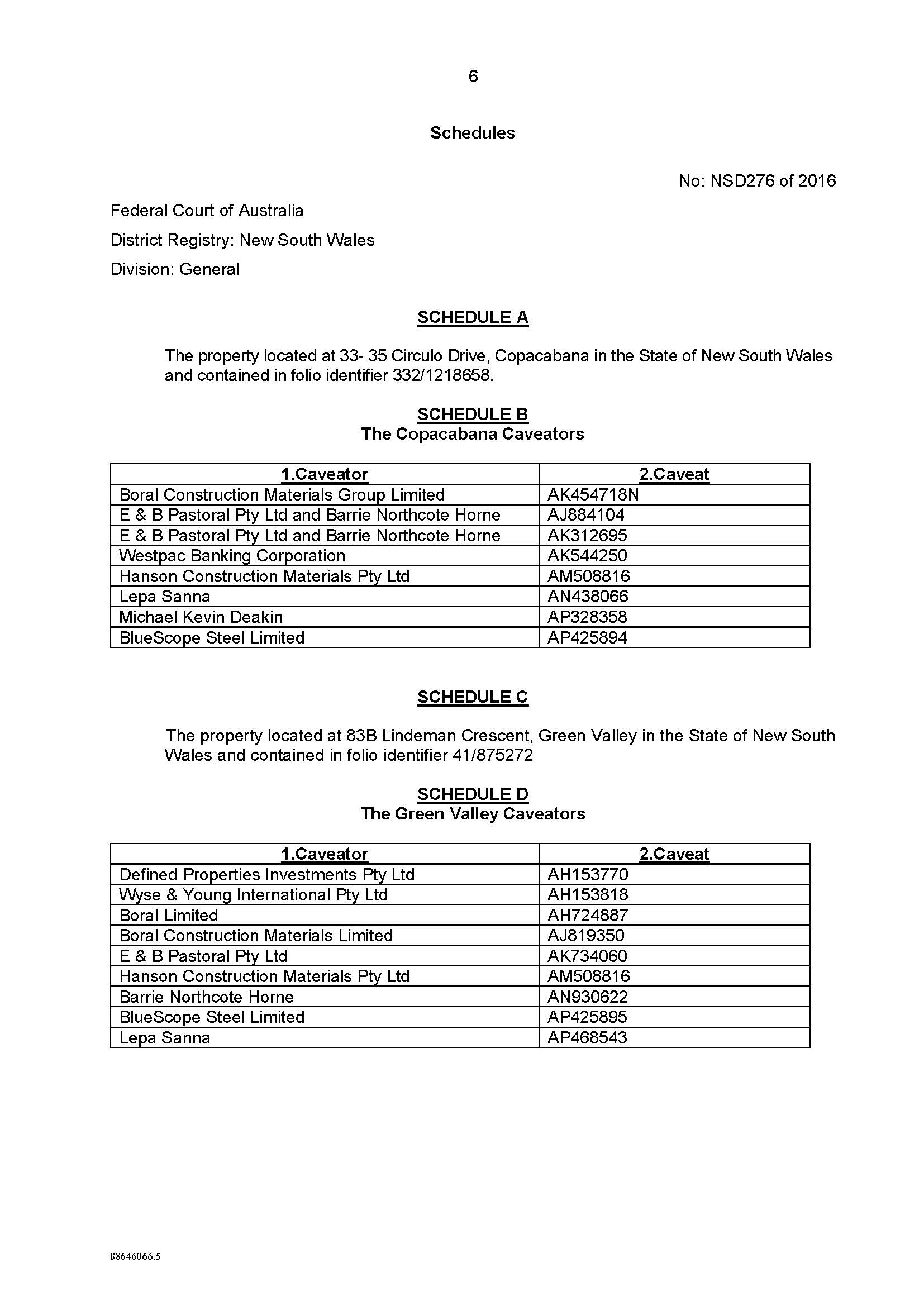
1. The applicant (Mr Weston) is empowered to offer the property referred to in Schedule A to these Orders (Copacabana Property) for sale and to sell that property by public auction with power to fix a reserve price or alternatively to sell the property by private treaty at the best available price.
2. In relation to the sale of the Copacabana Property at auction or by private treaty, Mr Weston is empowered:
(a) to obtain a valuation of the Copacabana Property by a registered valuer appointed by him;
(b) to effect insurance, pay any rates and charges, and incur any other reasonable expenses for the protection and maintenance of the Copacabana Property;
(c) to make all necessary adjustments of rates and taxes on settlement of the sale;
(d) to deduct from the proceeds of sale:
(i) the commission, valuation and legal costs and other expenses of any real estate agent employed by Mr Weston on the sale of the Copacabana Property;
(ii) his remuneration with respect to the sale and disbursement of the proceeds thereof calculated at the rates set out at tab 45 of the exhibit to Mr Weston’s affidavit sworn on 5 March 2020;
(iii) the legal expenses in connection with transferring the Copacabana Property to the purchaser;
(iv) the legal expenses of the interlocutory application filed on 6 March 2020;
(v) any taxes including but not limited to Capital Gains Tax, Land Tax and Goods and Services Tax (GST); and
(vi) the mortgagee(s) debts secured over the Copacabana Property being:
Westpac Banking Corporation Mortgage AH755748A.
The Green Valley Property
3. In relation to the sale of the property referred to in Schedule C to these Orders (Green Valley Property) at auction or by private treaty, the Section 66G Trustees appointed pursuant to paragraph 12 of these Orders be empowered:
(a) to obtain a valuation of the Green Valley Property by a registered valuer appointed by them;
(b) to effect insurance and incur any other reasonable expenses for the protection and maintenance of the Green Valley Property;
(c) to make all necessary adjustments of rates and taxes on settlement of the sale;
(d) to deduct from the proceeds of sale:
(i) the commission, valuation and legal costs and other expenses of any real estate agent employed by the Section 66G Trustees on the sale of the Green Valley Property;
(ii) the remuneration of the Section 66G Trustees with respect to the sale and disbursement of the proceeds thereof calculated at the rates set out at tab 45 of the exhibit to Mr Weston’s affidavit sworn on 5 March 2020;
(iii) the legal expenses in connection with transferring the Green Valley Property to the purchaser;
(iv) the legal expenses of the interlocutory application filed on 6 March 2020;
(v) any taxes including but not limited to Capital Gains Tax, Land Tax and GST; and
(vi) the mortgagee(s) debts secured over the Green Valley Property being: Permanent Mortgages Pty Ltd Mortgage 6470310G.
THE COURT ORDERS THAT:
The Copacabana Property
4. Pursuant to s 74MA of the Real Property Act 1900 (NSW) (Real Property Act), each of the parties in the first column of Schedule B to these Orders (Copacabana Caveators) shall withdraw the caveat lodged by that caveator within 14 days of the date of these Orders, failing which s 74MA of that Act will apply.
5. Within seven days of the date of these Orders, the respondent (Mr Sanna) is to deliver to Mr Weston any deeds or documents of title in his possession or under his control relating to the Copacabana Property which may properly be required for the completion of any sale of it.
6. Within 14 days of exchange of contracts for sale of the Copacabana Property, the New South Wales District Registrar of this Court be empowered to execute a transfer of the Copacabana Property which transfer will be prepared by Mr Weston (or on his behalf) and submitted to the New South Wales District Registrar of this Court for that purpose.
7. Within 21 days of the date of these Orders, Mr Weston must circulate to each of the parties to this proceeding by email costs estimates from the proposed valuers, real estate agents and legal representatives and an indication of each preferred professional proposed to be retained.
8. Mr Sanna may continue to reside in the Copacabana Property provided that he:
(a) allows all reasonable access to the Copacabana Property to Mr Weston or as Mr Weston may direct for the purpose of giving effect to these Orders; and
(b) within 14 days of receiving any council rates notice or utilities bill in relation to the Copacabana Property, pays to Mr Weston the amount of that notice or bill.
9. The payments referred to in paragraph 8(b) of these Orders are to be:
(a) made by way of electronic transfer to the following bank account:
Account Name: Lepa Sanna (Bankrupt Estate)
BSB: 182 222
Account No: 248164592; and
(b) dealt with as if they were proceeds of the sale of the Copacabana Property.
10. Notwithstanding paragraph 8 of these Orders, Mr Sanna must provide Mr Weston with vacant possession of the Copacabana Property on or before the earlier of:
(a) 14 days prior to the completion date of any exchanged contract for the sale of the Copacabana Property; or
(b) 13 August 2020.
11. After making the payments referred to in paragraph 2 of these Orders, Mr Weston is to pay the balance into Court.
The Green Valley Property
12. Pursuant to s 66G of the Conveyancing Act 1919 (NSW), Mr Weston and Ragu Nith be appointed as trustees (Section 66G Trustees) for the sale of the Green Valley Property.
13. The Green Valley Property immediately vest in the Section 66G Trustees as trustees for sale.
14. Within seven days of the date of these Orders, Mr Sanna is to deliver to the Section 66G Trustees any deeds or documents of title in his possession or under his control relating to the Green Valley Property which may properly be required for the completion of any sale of it.
15. The Section 66G Trustees are authorised and empowered to offer the Green Valley Property for sale and to sell that property by public auction with power to fix a reserve price or alternatively to sell the property by private treaty at the best available price.
16. Pursuant to s 74MA of the Real Property Act, each of the parties who appear in the first column of Schedule D to these Orders (Green Valley Caveators) shall withdraw the caveat lodged by that caveator within 14 days of the date of these Orders, failing which s 74MA of that Act will apply.
17. Within 21 days of the date of these Orders, the Section 66G Trustees must circulate to each of the parties to this proceeding by email costs estimates from the proposed valuers, real estate agents and legal representatives and an indication of each preferred professional proposed to be retained.
18. After making the payments referred to in paragraph 3 of these Orders, Mr Weston is to pay the balance into Court.
19. Grant liberty to the Section 66G Trustees to seek the advice of the Court on any matter arising from their appointment or these Orders.
Other
20. Liberty to the parties, and to any other person claiming an interest in the Copacabana Property or the Green Valley Property, to apply on two days’ notice with respect to any matter that may arise with respect to the sale of those properties or the distribution of the sale proceeds.
21. Pursuant to r 40.02(b) of the Federal Court Rules 2011 (Cth), Mr Sanna is to pay Mr Weston’s costs thrown away by reason of the adjournment of the application fixed for hearing on 16 April 2020, fixed in the sum of $4,550.90 (excluding GST).
THE COURT NOTES THAT:
22. Mr Sanna currently resides in the Copacabana Property.
Note: Entry of orders is dealt with in Rule 39.32 of the Federal Court Rules 2011.
MARKOVIC J:
1 By interlocutory application filed on 6 March 2020 (Trustee’s Application) Paul Gerard Weston in his capacity as trustee of the bankrupt estate of Lepa Sanna (now discharged) (Trustee) seeks orders which, if made, will permit him to sell two properties referred to respectively as the Copacabana Property and the Green Valley Property which are the subject of this proceeding and, in relation to the Green Valley Property only, related proceeding NSD619/2016 (together, the Transfer Proceedings).
2 For the reasons that follow, save in one respect in relation to the Copacabana Property, the orders sought by the Trustee should be made.
BACKGROUND
3 Prior to 8 May 2013 Ms Sanna, the respondent in proceeding NSD619/2016 (and since 16 April 2020 also a respondent to this proceeding), was the registered proprietor of the Copacabana Property which is situated at 33-35 Circulo Drive, Copacabana and had a half share interest in the Green Valley Property which is situated at 83B Lindeman Crescent, Green Valley.
4 On 12 January 2012 Australian Executor Trustees Limited (AETL), which held a mortgage over the Copacabana Property, obtained judgment for $1,840,309.83 in the Supreme Court of New South Wales (Supreme Court) against Ms Sanna.
5 By transfer registered no AH7557747 dated 8 May 2013 for consideration of $1 (Copacabana Transfer) Ms Sanna transferred the Copacabana Property to Corrado Sanna, her estranged husband and the respondent to this proceeding.
6 By unregistered transfer signed by Ms Sanna in about May 2013 for consideration of $1, Ms Sanna transferred her half share interest in the Green Valley Property to Mr Sanna (Green Valley Transfer).
7 On 10 December 2013 Ms Sanna became bankrupt and the Trustee became trustee of her bankrupt estate.
8 On or about 17 January 2014 the Trustee lodged a caveat over the Green Valley Property (Trustee’s Green Valley Caveat). On 22 July 2015, upon receiving a lapsing notice, the Trustee commenced proceeding 2015/00215624 against Ms Sanna in the Supreme Court seeking orders extending the operation of the Trustee’s Green Valley Caveat (Green Valley Caveat Proceeding).
9 In 2015 Wyse & Young International Pty Ltd (Wyse & Young), Wolgan Consulting Pty Ltd (Wolgan Consulting) and Defined Properties Investments Pty Ltd (Defined) commenced proceeding 2015/00217506 in the Supreme Court against Mr Sanna, his son and DCL Construction Group Pty Ltd (DCL) (Supreme Court Proceeding).
10 On 25 February 2016 the Trustee commenced this proceeding seeking declarations pursuant to s 120 or, in the alternative, s 121 of the Bankruptcy Act 1966 (Cth) (Act) that each of the Copacabana Transfer and the Green Valley Transfer is void against him and relief consequent upon the making of such declarations.
11 On 26 February 2016 by order made by the Supreme Court in the Green Valley Caveat Proceeding, that proceeding was transferred to this Court and became proceeding NSD619/2016 in this Court.
12 On 6 July 2016 orders were made in proceeding NSD619/2016 to the effect that the application filed in that proceeding be heard together with the application filed in this proceeding.
13 On 12-14 March 2018 the Transfer Proceedings were listed for hearing before me.
14 On 24 January 2019 I delivered judgment in the Transfer Proceedings: see Weston (Trustee) v Sanna [2019] FCA 32 (Weston v Sanna). At [6]-[7] of Weston v Sanna I noted that:
6 During the course of the hearing it became apparent that, in the event that the Trustee was successful in setting aside the Copacabana and Green Valley Transfers, the parties were not in a position to deal with the consequences that flowed from findings to that effect. In particular, late in the hearing, and after Mr Sanna had been cross-examined, counsel for Mr Sanna attempted to tender further evidence to establish that he had discharged certain liabilities which he said were secured over the Green Valley Property. In those circumstances, the parties agreed that the matter should proceed in two stages: the first being the determination of whether the Copacabana Transfer and the Green Valley Transfer are void against the Trustee pursuant to s 120 or s 121 of the Act; and the second being the consequences of such findings, assuming that the parties could not resolve that issue by consent between themselves.
7 These reasons deal with the first issue.
In relation to the “first issue” I relevantly found that each of the Copacabana Transfer and the Green Valley Transfer is void against the Trustee. The parties were ordered to bring in short minutes reflecting the Court’s reasons and, if required, to provide a proposed timetable for the second stage of the proceeding.
15 On 21 March 2019 the Transfer Proceedings were listed before the Court. On that date:
(1) in this proceeding the Court made declarations pursuant to s 121 of the Act that each of the Copacabana Transfer and the Green Valley Transfer is void against the Trustee and, among others, orders by consent that Mr Sanna execute all such instruments and do all such acts and things as necessary, including executing a transfer in registrable form, to cause title in the Copacabana Property to be conveyed to the Trustee, and that Mr Sanna file and serve any evidence in support of any claim as to the contributions that he contended that he had made to the Copacabana Property and the Green Valley Property. The proceeding was stood over for case management hearing to 23 May 2019 and the Trustee’s solicitors were ordered to provide a copy of the orders to Ms Sanna; and
(2) in proceeding NSD619/2016 the Court ordered by consent that the proceeding be stood over for case management hearing to 23 May 2019 and that the Trustee’s solicitors provide a copy of the orders to Ms Sanna.
16 As at the date of the hearing of the Trustee’s Application Mr Sanna had not appealed from the orders made on 21 March 2019 in this proceeding, obtained a stay of those orders or provided a transfer in registrable form for the Copacabana Property in accordance with those orders.
17 On 3 July 2019 orders were made in the Supreme Court Proceeding including orders that Mr Sanna pay each of Wyse & Young and Defined specified sums of money and, in light of a contention by the plaintiffs in that proceeding that some or all of the judgment sums are secured over the Copacabana Property and the Green Valley Property, that the Supreme Court Proceeding be transferred to this Court. The Supreme Court Proceeding became proceeding NSD1135/2019 in this Court. Of the parties to that proceeding, Wyse & Young, Wolgan Consulting and DCL are each now in liquidation.
18 The Trustee also contends that proceeds of sale from the subdivided lot of the Copacabana Property (the Copacabana Property was subdivided after its transfer to Mr Sanna and one of the subdivided lots was sold) were used, in part, to pay down debt on the Green Valley Property, for which Mr Sanna was jointly liable, and debt for which Mr Sanna was solely liable: see Weston v Sanna at [95]-[99]. The Trustee claims that Mr Sanna’s interest in the Green Valley Property is charged with some of that debt.
19 Given that the outstanding issue to be resolved in proceeding NSD1135/2019 concerns the question of entitlement to any of the proceeds of sale of the Copacabana Property and the Green Valley Property, that proceeding has, since its transfer to this Court, been listed together with the Transfer Proceedings.
Caveats lodged over the Copacabana Property and the Green Valley Property
20 There are nine caveats lodged against the Copacabana Property, including one by the Trustee and one by Ms Sanna, and 10 caveats lodged against the Green Valley Property, including one by the Trustee and one by Ms Sanna. Putting to one side the Trustee, Ms Sanna and Coates Hire Operations Pty Ltd (Coates Hire) (whose caveat was in evidence before me but who is not a caveator recorded on the title of the Copacabana Property), the evidence before me establishes that the caveators recorded on the titles of those properties are as follows:
(1) in relation to the Copacabana Property:
(a) Boral Construction Materials Group Limited (Boral Construction);
(b) E & B Pastoral Pty Ltd (E & B Pastoral) and Barrie Northcote Horne;
(c) Westpac Banking Corporation (Westpac);
(d) Hanson Construction Materials Pty Ltd (Hanson);
(e) Michael Kevin Deakin; and
(f) BlueScope Steel Ltd (BlueScope),
(together, Copacabana Caveators); and
(2) in relation to the Green Valley Property:
(a) Defined;
(b) Wyse & Young;
(c) Boral Limited (Boral);
(d) Boral Construction;
(e) E & B Pastoral;
(f) Hanson;
(g) Mr Horne; and
(h) BlueScope,
(together, Green Valley Caveators).
21 The Trustee has taken steps to ascertain the amount of and basis for the claims of each of the Copacabana Caveators and the Green Valley Caveators. In summary, according to the Trustee, the amount claimed by each is as follows:
(1) Copacabana Caveators:
(a) Boral Construction – $74,626.41 as at 14 January 2020;
(b) E & B Pastoral and Mr Horne – $120,000 as at 30 September 2015;
(c) E & B Pastoral and Mr Horne – $37,694.32 as at 18 February 2016;
(d) Westpac – $986,539.14 as at 3 April 2019;
(e) Hanson – $42,646.58 as at 17 December 2019;
(f) Mr Deakin – unknown;
(g) BlueScope – $121,414.53 as at 25 July 2019; and
(h) Coates Hire – unknown; and
(2) Green Valley Caveators:
(a) Defined – $530,622.73 as at 7 June 2019;
(b) Wyse & Young – $186,284.56 as at 4 July 2019;
(c) Boral – $74,626.41 as at 14 January 2020;
(d) Boral Construction – as above for Boral;
(e) E & B Pastoral – $150,000 as at 1 September 2016;
(f) Hanson – $42,646.58 as at 17 December 2019;
(g) Mr Horne – unknown; and
(h) BlueScope – $121,414.53 as at 25 July 2019.
22 Some but not all of the caveators are common to both the Copacabana Property and the Green Valley Property and, according to the Trustee, appear to claim the same debt against both properties. For that reason the Trustee is of the opinion that the order in which the properties are sold may have some bearing on the prospect that a caveator is paid from the sale proceeds. He notes, by way of example, that if a caveator only has an interest against one of the properties then it would be in that caveator’s interests for the other property to be sold first.
Valuations of the Copacabana Property and the Green Valley Property
23 The Trustee has obtained kerbside appraisals for each of the Copacabana Property and the Green Valley Property based on which the properties have the following estimated values:
Copacabana Property – $1.25 million to $1.3 million; and
Green Valley Property – $540,000 to $580,000.
Family Law Proceeding
24 Proceeding PAC2399/2018 was commenced in the Federal Circuit Court of Australia (Federal Circuit Court) between Ms Sanna as applicant and Mr Sanna as respondent (Family Law Proceeding).
25 On 23 September 2019 Ms Sanna filed an initiating application in the Family Law Proceeding in which she seeks five orders including relevantly (as written):
1. Matrimonial home to come back to applicant unencumbered.
2. Property Green Valley 50% proceeds.
26 In the Family Law Proceeding:
(1) on 14 November 2019 the Federal Circuit Court made orders including an order that:
Pursuant to section 114 Family Law Act 1975 and pending further order, [Mr Sanna] shall be and is hereby restrained from:
a. Dealing with, disposing of or in any way seeking to deal with title of [the Copacabana Property] and [the Green Valley Property]; and
b. Borrowing against, using as security for borrowings, or in any way increasing any encumbrance presently secured against title of the above two properties.
(2) on 11 February 2020 the Federal Circuit Court made orders including an order that:
(a) Ms Sanna give notice of that proceeding to the Trustee; and
(b) should the Trustee wish to participate in the proceeding or seek to be joined he is required to file a response prior to the next date on which that matter is listed before the court, being 26 March 2020.
27 The Trustee became aware of the Family Law Proceeding and the orders made by the Federal Circuit Court set out in the preceding paragraph on 14 February 2020 upon receipt of an email from Ms Sanna’s representative.
28 I was informed by the Trustee that by order made by the Federal Circuit Court on 26 March 2020 the Family Law Proceeding has been transferred from the Federal Circuit Court to the Family Court of Australia (Family Court).
Orders made on 16 April 2020
29 On 16 April 2020 the Trustee’s Application was listed before me for hearing. However, on the application of Mr Sanna the hearing was adjourned. At the time I made orders including that:
(1) Mr Sanna pay the costs of the Trustee, Defined and Wyse & Young thrown away by reason of the adjournment of the hearing of the Trustee’s Application;
(2) by 30 April 2020 the Trustee, Defined and Wyse & Young are to file and serve any application and affidavits in support as to the basis upon which the costs thrown away by reason of the adjournment should be payable by Mr Sanna; and
(3) each of the Copacabana Caveators, other than Coates Hire, and the Green Valley Caveators who in each case are not already parties to the proceeding, be joined as respondents to it.
30 As a result of the order set out in [29(2)] above:
(1) the Trustee has filed an application seeking an order that his costs thrown way by reason of the adjournment of the hearing of the Trustee’s Application be paid forthwith and in a lump sum; and
(2) Defined has filed submissions in which it contends that its costs thrown way by reason of the adjournment of the hearing of the Trustee’s Application be paid forthwith and in a lump sum.
Those applications are addressed at [104]-[132] below.
31 As a result of the order set out in [29(3)] above the following parties have been joined to this proceeding:
(1) Boral Construction;
(2) Boral;
(3) E & B Pastoral;
(4) Mr Horne;
(5) Westpac;
(6) Hanson;
(7) Ms Sanna;
(8) Mr Deakin;
(9) BlueScope;
(10) Defined; and
(11) Wyse & Young.
32 The Trustee has caused the Trustee’s Application and other related documents and orders to be served on each of the Copacabana Caveators and the Green Valley Caveators. With the exception of Defined, Wyse & Young and Ms Sanna, who each appeared at the hearing of the Trustee’s Application, as at the date of the hearing of the Trustee’s Application the position of each of the balance of the Copacabana Caveators and the Green Valley Caveators insofar as it is known by the Court is as follows:
(1) Boral, Boral Construction and Westpac have each filed a submitting notice;
(2) Hanson informed the Court that it did not intend to appear and that it neither consented to nor opposed the orders sought;
(3) BlueScope informed the Court that it consented to the orders sought by the Trustee and that it did not intend to participate in or appear at the hearing of the Trustee’s Application; and
(4) by letter dated 11 March 2020, E & B Pastoral and Mr Horne informed the Trustee’s solicitors that they “do not propose to seek to be joined to the current proceedings at present and take no position in relation to the orders sought from the Court”. The solicitors for E & B Pastoral and Mr Horne subsequently informed the Court that they did not hold instructions to appear at the hearing of the Trustee’s Application.
THE ATTITUDE OF THE PARTIES WHO APPEARED
33 Mr Sanna, Ms Sanna, Defined and Wyse & Young appeared at the hearing of the Trustee’s Application.
34 Only Ms Sanna objects to all of the orders sought by the Trustee in the Trustee’s Application. As to the other participating parties:
(1) Mr Sanna does not oppose the making of the orders in the Trustee’s Application save insofar as the Trustee seeks payment of a licence fee by him for his continued occupation of the Copacabana Property. That issue is addressed at [79]-[88] below;
(2) Defined supports the orders sought by the Trustee save for the identity of the trustees for sale of the Green Valley Property to be appointed pursuant to s 66G of the Conveyancing Act 1990 (NSW) (Conveyancing Act). That issue is addressed at [94]-[102] below; and
(3) Wyse & Young supports the Trustee’s Application and the form of the orders sought by the Trustee.
CONSIDERATION
Ms Sanna’s opposition
35 It is convenient first to address Ms Sanna’s position.
36 Ms Sanna is not legally represented. In order to assist the other parties and the Court, orders were made requiring Ms Sanna to articulate the basis of her objection to the Trustee’s Application by filing an interlocutory application setting out the grounds of her opposition and any relief she seeks and any evidence in support. Ms Sanna has done so and has also filed submissions on which she relies.
37 Ms Sanna’s interlocutory application filed on 12 May 2020 is lengthy and discursive in nature. However, the effect of it is that Ms Sanna objects to the orders sought by the Trustee in the Trustee’s Application and seeks:
(1) an order restraining or preventing the Trustee from selling the Copacabana Property and the Green Valley Property;
(2) to have the matter “heard correctly” and to be “re-examined to ensure a sound judgment in revealing the truth to point out the deficiencies”, I infer, in the Transfer Proceedings, in the decision in Weston v Sanna and in the Supreme Court Proceeding (now proceeding NSD1135/2019);
(3) if a sale of the Copacabana Property and the Green Valley Property is to take place, that the Trustee “exercise its powers to negotiate a lesser payment to the mortgagee of the Copacabana Property”;
(4) that the Trustee “present an itemised accounting review of the costs and expenses, which are still unknown, of the administration in relation to its remuneration and costs incurred, in relation to the current proceedings”;
(5) to have the Trustee’s costs reduced and paid by Mr Sanna and “the Dimitriou/Defined parties”; and
(6) an inquiry in relation to the quantum claimed by each of the Copacabana Caveators and the Green Valley Caveators. Ms Sanna asks that if the Court accedes to the orders sought in the Trustee’s Application that she be able to participate in choosing an agent and overseeing the sale to ensure that there is not a fire sale.
38 Ms Sanna also relies on an affidavit sworn by her on 8 May 2020. In that affidavit, Ms Sanna makes a number of bald assertions and serious allegations of misconduct against various people, including some who are not a party to this proceeding or any of the related proceedings. Given the nature of the evidence, it is not necessary, and I do not propose, to set out Ms Sanna’s evidence in detail. Many of the topics on which she gives evidence are either not relevant to the Trustee’s Application or concern issues which cannot be dealt with in the context of this proceeding. In summary Ms Sanna:
(1) sets out some of her personal history;
(2) attempts to give evidence and/or provide a response to matters which are the subject of findings in Weston v Sanna;
(3) makes allegations about her relationship with the solicitor who filed a notice of appearance and was on the record as her solicitor in proceeding NSD619/2016 at least up to and including 24 January 2019, the date on which judgment was delivered;
(4) makes assertions about her ability to participate in the Transfer Proceedings;
(5) sets out why she believes that the Family Law Proceeding should be determined prior to the sale of either the Copacabana Property or the Green Valley Property; and
(6) asks for the opportunity to “be properly heard and not denied natural justice prior to the determination of the [Trustee’s Application]”.
39 Ms Sanna’s submissions are to like effect. Once again I do not propose to set them out in detail. To the extent they are relevant to the Trustee’s Application Ms Sanna makes the following submissions:
(1) she contests the caveats lodged over the Copacabana Property and the Green Valley Property and contends that Mr Sanna should “take these debts with him, away from [her] Estate”;
(2) she contends that the sale of the Copacabana Property and the Green Valley Property should not proceed “until there is full disclosed clarity on matters to which [she] was not able to speak into that will assist with the determination of claims against the properties to obtain the best financial outcome” and contends that in the current market and in light of the novel coronavirus (COVID-19) pandemic it is not feasible to carry out any sale of the Copacabana Property and the Green Valley Property;
(3) she submits that “everyone but [her] was dealing with cases in [her] name and using [her] name without [her] instructions in relation to proceedings, even the Trustee, in his Chronology of 29 June 2016, prior to proceedings, was communicating directly with Mr Sanna and other representatives, who were not instructed by [her], instead of dealing with [her]”; and
(4) in relation to the Family Law Proceeding, she submits that she believes that “for the benefit of [her] case and Estate as a whole, that the Family Court of Australia will best suit the full outcome of these matters” taking into account the fact that she is now discharged from bankruptcy. She says that “should this Court be able to afford [her] the opportunity to bring about and reveal all aspects of contention beneficial for [her] Estate, including but not limiting the disciplining the deception of Mr Sanna and Mr Dimitriou, issue with the Trustee and to deal with the Family Law matters as a whole, [she is] happy to continue in this Court as [she does] not want to waste any further time, as the other parties have done”.
40 The balance of Ms Sanna’s submissions concern the Trustee’s conduct vis a vis her during the course of her bankruptcy, her dealings with Mr Sanna and some of the factual matters which were the subject of findings in Weston v Sanna.
41 Ms Sanna’s opposition to the orders sought by the Trustee broadly falls into two categories: first, she says that the further conduct of this matter and the sale of the Copacabana Property and the Green Valley Property should await the outcome of the Family Law Proceeding; and secondly, she says that the Court should not make the orders sought by the Trustee until such time as she has an opportunity to address the issues raised in the Transfer Proceedings. I address each of these contentions below.
The effect of the Family Law Proceeding
42 The orders made in the Family Law Proceeding in the period from 14 November 2019 to 11 February 2020 are set out at [26] above. According to the Trustee, as at 26 March 2020 no order had been made in that proceeding either joining him or otherwise impacting on his ability to deal with the property which vested in him pursuant to the Act. At the hearing of the Trustee’s Application, the Court was informed that the Family Law Proceeding was listed before a judge of the Family Court on the following day, 14 May 2020.
43 In her initiating application filed in the Family Law Proceeding under the heading “Type of orders sought” Ms Sanna indicates that she seeks “financial (property and/or maintenance)” orders. Relevantly, in that proceeding Ms Sanna seeks orders in relation to the Copacabana Property and the Green Valley Property. An issue arises as to whether orders can be made in the Family Law Proceeding in relation to property which has vested in the Trustee.
44 Although the Trustee had provided submissions in relation to this issue, I sought additional submissions in order to clarify one further issue that arose, namely the effect of an amendment to s 4 of the Family Law Act 1975 (Cth) (Family Law Act) on that court’s jurisdiction in the present circumstances. Both the Trustee and Ms Sanna provided additional submissions, although Ms Sanna did not engage with the issue that I had identified.
45 Ms Sanna submits that “the Estate matters needs to be heard in the Family Court of Australia due to the exceptional intentional circumstances of how [her] Estate has been handled and to the determination of the modes that were used in how the assets of the marriage are to be, and in part, were irregularly dealt with” including the validity of a binding financial agreement dated 16 December 2011, the sale of the Copacabana Property which purportedly took place in 2012, a power of attorney signed in 2012, a deed of loan and a transfer under s 90C of the Family Law Act. Ms Sanna provides further submissions in relation to these issues, raising matters which have already been the subject of consideration in the Transfer Proceedings.
46 Ms Sanna also refers to s 79 and s 79A of the Family Law Act and s 35 of the Act and says (as written):
As stated in my previous submissions: … “The Family Court has been given the task of balancing the competing claims of the bankrupt’s creditors and the non-bankrupt spouse on a “just and equitable” basis premised on specified criteria without any pre-conceived idea that one interest should prevail over the other.” – See S79, 79(2). The applicable rules of the Family Court may make provision for its jurisdiction in relation to dealing with bankruptcy (taking into consideration 4(6)):
Should this court be able to deal with the matters that the Family Law Court can in relation to the estate as a whole that is fine. However if it cannot then it seems that various section of the Family Court can deal with my Estate as a whole including but without limiting Sections 35 of the Bankruptcy Act, 79 & 79A of the Family Law Act in relation to altering of property interests, as stated in for example: …
Ms Sanna thereafter sets out parts of s 79 and s 79A of the Family Law Act and s 35 of the Act.
47 While I understand that Ms Sanna finds herself in a difficult position and, as I have already observed, is not legally represented and is doing the best she can, her submissions do not persuade me that I cannot or should not make the orders sought by the Trustee because of the Family Law Proceeding. Rather, as the Trustee submits, for the following reasons, neither the Federal Circuit Court nor the Family Court has power to grant any relief in relation to property that has vested in a trustee in bankruptcy, as is the case for the Copacabana Property and a half share of the Green Valley Property, in circumstances where the party seeking to make the challenge is a discharged bankrupt.
48 Section 39 of the Family Law Act, which concerns jurisdiction in matrimonial causes, relevantly provides:
(1) Subject to this Part, a matrimonial cause may be instituted under this Act:
(a) in the Family Court; or
…
49 The term “matrimonial cause” is comprehensively defined in s 4(1) of the Family Law Act. That definition includes:
matrimonial cause means:
…
(c) proceedings between the parties to a marriage with respect to the maintenance of one of the parties to the marriage; or
(caa) proceedings between:
(i) a party to a marriage; and
(ii) the bankruptcy trustee of a bankrupt party to the marriage;
with respect to the maintenance of the first‑mentioned party; or
(ca) proceedings between the parties to a marriage with respect to the property of the parties to the marriage or either of them, being proceedings:
(i) arising out of the marital relationship;
(ii) in relation to concurrent, pending or completed divorce or validity of marriage proceedings between those parties; or
(iii) in relation to the divorce of the parties to that marriage, the annulment of that marriage or the legal separation of the parties to that marriage, being a divorce, annulment or legal separation effected in accordance with the law of an overseas jurisdiction, where that divorce, annulment or legal separation is recognised as valid in Australia under section 104; or
(cb) proceedings between:
(i) a party to a marriage; and
(ii) the bankruptcy trustee of a bankrupt party to the marriage;
with respect to any vested bankruptcy property in relation to the bankrupt party, being proceedings:
(iii) arising out of the marital relationship; or
(iv) in relation to concurrent, pending or completed divorce or validity of marriage proceedings between the parties to the marriage; or
(v) in relation to the divorce of the parties to the marriage, the annulment of the marriage or the legal separation of the parties to the marriage, being a divorce, annulment or legal separation effected in accordance with the law of an overseas jurisdiction, where that divorce, annulment or legal separation is recognised as valid in Australia under section 104; or
…
(f) any other proceedings (including proceedings with respect to the enforcement of a decree or the service of process) in relation to concurrent, pending or completed proceedings of a kind referred to in any of paragraphs (a) to (eb), including proceedings of such a kind pending at, or completed before, the commencement of this Act.
50 In Fountain v Alexander (1982) 150 CLR 615 at 624 Gibbs CJ, in considering whether the Family Court had jurisdiction to vary an order that had been made in respect of a child of a marriage in circumstances where the application was made by strangers to the marriage and the respondents to that application were parties to the marriage, albeit one that had been dissolved, said the following about the meaning of the word “between” as used in the definition of “matrimonial cause”:
… Since there can only be two parties to a marriage, the word “between” in the phrase “proceedings between the parties to a marriage” is used in reference to a relationship between these two parties, but it is a relationship that divides rather than unites them, and it is reciprocal, in that each opposes the other. In other words, the phrase refers to proceedings in which one party to the marriage is contending against the other. If the parties to the marriage join together in a common interest in proceedings against other persons the proceedings are between the parties to the marriage on the one hand and the other persons on the other, but are not between the parties to the marriage.
51 In other words, as the Trustee submits, a proceeding in which the parties to a marriage have a joint interest in clawing back property from a trustee in bankruptcy to form part of the pool of matrimonial assets would not be “proceedings between the parties to a marriage”.
52 It follows that Ms Sanna can only seek to disturb the Trustee’s title to the Copacabana Property and the Green Valley Property if the Family Law Proceeding is a “matrimonial cause” as set out in paragraph (cb) within the definition of “matrimonial cause” in s 4(1) of the Family Law Act which concerns proceedings “between” a party to the marriage and the bankruptcy trustee of a bankrupt party to the marriage, that is the other party to the marriage, in relation to any vested bankruptcy property of the bankrupt party. As the Trustee submits, that construction is supported by the general scheme of the Act which vests the property of a bankrupt in a trustee after which the bankrupt has no right to bring or prosecute proceedings to protect or enhance or add to the property of which he or she has been divested on bankruptcy: see Cummings v Claremont Petroleum NL (1996) 185 CLR 124 at 136.
53 In Official Trustee in Bankruptcy & Galanis [2017] FamCAFC 20; (2017) 318 FLR 22 (Galanis) a Full Court of the Family Court (Bryant CJ, Aldridge and Austin JJ) considered the meaning of the phrase “the bankruptcy trustee of a bankrupt party to the marriage”. The question before the court was whether the Family Court had jurisdiction to determine the appellant’s claim that a financial agreement entered into between the first and second respondents to the appeal should be set aside pursuant to s 90K of the Family Law Act. Their Honours noted that the answer to that issue depended on the construction of paragraphs (cb) and (eab) within the definition of “matrimonial cause” in s 4(1) and s 4A of the Family Law Act, the latter of which concerns third party proceedings to set aside financial agreements.
54 At [38] the Full Court of the Family Court identified that the issue to be determined was “whether the use of the phrase ‘bankrupt party’ in definition (cb) is merely to distinguish that party from the non-bankrupt party to the marriage or whether it was intended to limit claims by trustees to those involving undischarged bankrupts – in other words, does the phrase have a temporal limitation?”. At [48]-[50] the Full Court said:
48 It is appropriate to mention here that the Official Trustee sought two orders from the Court: one setting aside the agreement and an order that 40 per cent of the net proceeds of the sale of the property be paid to it. As was properly conceded by counsel for the Official Trustee, the Court had jurisdiction to make the second order only if there was jurisdiction to make the first order. This was because, standing alone, the second order did not fall within one of the definitions of matrimonial cause, and could only be made if it were part of a justiciable cause in which the Court otherwise had jurisdiction.
49 The purpose of setting aside a financial agreement at the behest of a trustee in bankruptcy is to seek to recover property that would otherwise have been available to that trustee to distribute to creditors. That property can consist only of property that vested in the trustee at the commencement of the bankruptcy or was acquired by or devolved upon the bankrupt prior to his or her discharge from bankruptcy. The trustee has no interest in any property of a bankrupt acquired after discharge.
50 These factors lend support to the view that the use of the word “bankrupt” in definition (cb) is not otiose but is intended to have adjectival force so as to limit the phrase “bankrupt party” to meaning an undischarged bankrupt. This is the effect of the amendments to the sections dealing with maintenance and property applications, which were enacted at the same time. This construction is supported by the provisions of the Bankruptcy Act, which vest property held by the bankrupt at the time of his or her bankruptcy as well as property that is acquired whilst the bankrupt is an undischarged bankrupt.
55 At [54] their Honours noted that the effect of their reasoning was that a trustee in bankruptcy would not be able to apply to set aside a financial agreement entered into after a party’s discharge from bankruptcy. However, their Honours noted that the Trustee retained the property that had vested in him or her and could pursue any relevant legal or equitable remedies to recover it.
56 For completeness I note that after the decision in Galanis the Family Law Act and the Act were amended by the Civil Law and Justice Legislation Amendment Act 2018 (Cth). Relevantly, the Family Law Act was amended to include s 4(6) and s 35 of the Act was amended. In effect, s 4(6) of the Family Law Act removes the limitation on proceedings, imposed by paragraph (cb) to those where the bankrupt party has not been discharged. The combined effect of the amendments to the Family Law Act and the Act is to permit a trustee in bankruptcy to move the court to set aside financial agreements which have a detrimental effect on a bankrupt estate and thus to overcome the restriction on a trustee identified in Galanis. Those amendments do not otherwise affect the definition of “matrimonial cause” and the fact that the only definition which could apply so as to give the Family Court (or the Federal Circuit Court) jurisdiction to make orders in relation to property that has vested in the Trustee is paragraph (cb) within the definition of “matrimonial cause” in s 4(1) of the Family Law Act.
57 However, paragraph (cb) can have no application in this case where the Family Law Proceeding is between Ms Sanna and Mr Sanna. It is not clear whether the Trustee is a party to the Family Law Proceeding but even if he was, a proceeding as between Ms Sanna and the Trustee could not be a “matrimonial cause” within the meaning of paragraph (cb) because it would be a proceeding between the (discharged) bankrupt and her own trustee.
58 While Ms Sanna remains free to prosecute the Family Law Proceeding, any claim in that proceeding to property that has vested in the Trustee should not delay the making of the orders sought by the Trustee.
Should the Trustee’s Application be deferred or refused for any other reason?
59 Ms Sanna says the Court should not make the orders sought by the Trustee in order to give her an opportunity to address the issues raised in the Transfer Proceedings.
60 Ms Sanna did not participate in the Transfer Proceedings at the time they were heard by the Court. She now seeks to challenge the findings of the Court in that proceeding and, it seems, in the Supreme Court Proceeding. Ms Sanna wishes to lead evidence in the Transfer Proceedings that she says was not before the Court at the time the decision was made. She also alleges that she was denied “natural justice” in the Transfer Proceedings although it is not clear on what basis that allegation is made.
61 As I have already observed, Ms Sanna is the respondent in proceeding NSD619/2016, one of the Transfer Proceedings. She did not seek to appear at the hearing and the solicitor who was on the record for her during the course of the hearing, who also acted for Mr Sanna in this proceeding, did not make any submissions on her behalf.
62 If what Ms Sanna alleges is that the judgment in Weston v Sanna was obtained by fraud, a serious allegation, such an allegation must be made clearly, with the particulars of fraud identified with some precision. That allegation must be established by strict proof and, in the circumstances, should be raised by way of a separate proceeding: see Bhagat v Global Custodians Ltd [2002] FCAFC 51 at [44], [50]. To the extent that Ms Sanna alleges she was denied natural justice in proceeding NSD619/2016 that, again, is not a matter to be raised in, and at this stage of, this proceeding.
63 Ms Sanna otherwise raises issues about the Trustee’s costs and other general issues about the claims of the Copacabana Caveators and the Green Valley Caveators, albeit without leading any evidence in support of her assertions. Those are matters to be determined at a later stage once the Copacabana Property and the Green Valley Property have been sold and the issues in relation to the priorities of the various parties claiming on the balance of the available funds are before the Court.
64 Ms Sanna wishes to be involved in the sale process for the Copacabana Property and the Green Valley Property. The Trustee’s proposed orders envisage that, as she is now a party to this proceeding, she will be provided with costs estimates obtained by the Trustee either alone, in relation to the Copacabana Property, or jointly with the second person appointed as a trustee for sale pursuant to s 66G of the Conveyancing Act in relation to the Green Valley Property, for the expenses associated with the sale of the properties.
65 Ms Sanna’s opposition to the Trustee’s Application is not made out.
66 I turn to address each of the properties separately, given the different circumstances which apply to each.
The Copacabana Property
67 In Anscor Pty Ltd v Clout (Trustee) (2004) 135 FCR 469 at [43] Lindgren J (with whom Wilcox and Moore JJ relevantly agreed) set out a number of propositions in relation to the operation of s 120 of the Act, which expressly or by implication apply equally to s 121 of the Act, including:
(a) ‘Void’ in the expression ‘void against the trustee’ in s 120 (as in ss 121 and 122) means ‘voidable’, so that where the debtor/later bankrupt (or a transferee from the debtor) transfers property for no consideration or a consideration less than market value, within the time specified in the section, the transferee (and an acquirer from the transferee) takes a good title, but one which may, depending on the circumstances, be defeated if the trustee elects to avoid the transfer by the debtor/bankrupt …
…
(e) Section 120 does not vest property in the trustee in bankruptcy; it makes transfers of property void as against the trustee in bankruptcy. The vesting of property in the trustee in bankruptcy is provided for elsewhere in the Act, as noted below.
(f) Where a debtor becomes a bankrupt, there vests forthwith in the trustee in bankruptcy ‘the property of the bankrupt’, that is, relevantly, the property that belonged to, or was vested in, the bankrupt, at the commencement of the bankruptcy (ss 58, 115, 116, 5(1) (‘the property of the bankrupt’)). But, subject to, relevantly, s 120, s 123 will protect any transfers for full market value by the debtor between the commencement of the bankruptcy and the date of the bankruptcy, if the other conditions specified in that section are satisfied.
(g) The vesting in the trustee in bankruptcy does not take place upon the commencement of the bankruptcy; it takes place forthwith upon the debtor’s becoming a bankrupt. ….
(h) If the property the subject of a transfer made void by s 120 as a result of the trustee’s election to avoid, still exists in specie as at the commencement of the bankruptcy, it will vest in the trustee in bankruptcy forthwith upon the debtor’s becoming a bankrupt if it also still exists then (by reason of ss 58, 115, 116 and 5(1) (‘the property of the bankrupt’), subject always to the exceptions and the protections given to third parties found in s 120. From the date of the bankruptcy, the owner will have had the property in trust for the trustee in bankruptcy, and, if the owner sells it after that date, will be accountable to the trustee for the proceeds of sale as for money had and received: cf Brall at 384; Brady v Stapleton at 334; Alvaro at 426; Fiorino at 21. (In Fiorino, the sale by the bankrupt’s mother, to whom the bankrupt had given the property, took place after the making of the sequestration order and before avoidance by the trustee. Gummow J held that she had held the property on trust for the trustee in bankruptcy and came under a personal liability to him ‘to account for, as money had and received, the proceeds of the sale of the property by her’.)
…
68 As set out at [15(1)] above, on 21 March 2019 a declaration was made pursuant to s 121 of the Act that the Copacabana Transfer is void against the Trustee. The effect of the reasons in Weston v Sanna and the declaration subsequently made was, as the Trustee submits, to validate his position and confirm that the equitable ownership of the Copacabana Property is with the Trustee. But for the fact that, contrary to the orders made by the Court, Mr Sanna has not executed a transfer of the Copacabana Property, the Trustee would not require the assistance of the Court to bring about its sale.
69 It is because of Mr Sanna’s failure to comply with the Court’s earlier orders that the Trustee initially approached the Court seeking orders to effect an orderly sale of the Copacabana Property, with the balance of any proceeds of sale to be preserved to await the outcome of any dispute about claims and priorities in relation to those funds by the various Copacabana Caveators.
70 An additional intervening factor which requires the Trustee to seek the Court’s assistance is the order made in the Family Law Proceeding restraining Mr Sanna from dealing with the Copacabana Property (see [26(1)] above). It is for this reason that one of the orders sought by the Trustee is that a Registrar of this Court be empowered to execute a transfer of the Copacabana Property upon there being an exchange of contracts for sale of that property.
71 I am satisfied that the Court has power to make an order that a Registrar of this Court execute a transfer in registrable form. That is so for the following reasons.
72 The starting point is the Real Property Act 1900 (NSW) (Real Property Act) which relevantly includes:
(1) section 46(1) which provides:
Where land under the provisions of this Act is intended to be transferred, or any easement or profit à prendre affecting land under the provisions of this Act is intended to be created, the proprietor shall execute a transfer in the approved form.
Mr Sanna is the proprietor of the Copacabana Property. He failed to sign a transfer and is now restrained from doing so by the order made in the Family Law Proceeding.
(2) section 39(2) which permits the Registrar-General, at the Registrar-General’s discretion, to register a dealing notwithstanding any error therein or omission therefrom and, in such a case, the error or omission shall not invalidate the registration of the dealing;
(3) section 12D (rather than s 12F referred to by the Trustee in his note dated 14 May 2020) which is titled “Registrar-General’s Guidelines” and provides:
(1) The Registrar-General may publish such information as the Registrar-General considers appropriate for the guidance or assistance of persons in connection with the operation of this Act or any other Act under which the Registrar-General exercises titling and registry functions, including (without limitation) information concerning:
(a) the completion of forms, and
(b) the preparation and lodgment of dealings, plans and other documents for registration or recording, and
(c) the practices and procedures of the Registrar-General in the exercise of titling and registry functions.
(2) Information published under this section may be published as the Registrar-General’s Guidelines.
73 The Registrar-General’s Guidelines, made under s 12D of the Real Property Act, under the heading “Execution of dealing forms” and the subheading “Order of Court” state in relation to, relevantly, Real Property Act dealings that:
Execution of a dealing by an officer of the Court pursuant to an Order of the Court will not be questioned. Where the Court appoints a third party to execute the dealing, an office copy of the Order must accompany the dealing.
74 As set out at [15(1)] above, on 21 March 2019 the Court ordered that within 21 days of the date of its orders Mr Sanna was to execute all such instruments and do all such acts and things as are necessary (including executing a transfer in registrable form) to cause the title in the Copacabana Property to be conveyed to the Trustee. Mr Sanna failed to comply with that order.
75 Section 53(1) of the Federal Court of Australia Act 1976 (Cth) (FCA Act) provides:
Subject to the Rules of Court, a person in whose favour a judgment of the Court is given is entitled to the same remedies for enforcement of the judgment in a State or Territory, by execution or otherwise, as are allowed in like cases by the laws of that State or Territory to persons in whose favour a judgment of the Supreme Court of that State or Territory is given.
76 Rule 41.10 of the Federal Court Rules 2011 (Cth) (FCA Rules) relevantly provides:
(1) A party may apply to the Court to issue a writ, order or any other means of enforcement of a judgment or order that can be issued or taken in the Supreme Court of the State or Territory in which the judgment or order has been made, as if it were a judgment or order of that Supreme Court.
(2) An order made under subrule (1) authorises the Sheriff, when executing the orders of the Court, to act in the same manner as a similar officer of the Supreme Court of the State or Territory in which the order is being executed is entitled to act.
…
77 Section 94 of the Civil Procedure Act 2005 (NSW) provides:
(1) If any person does not comply with a judgment or order directing the person—
(a) to execute any conveyance, contract or other document, or
(b) to endorse any negotiable instrument,
the court may order that the conveyance, contract or other document be executed, or the negotiable instrument endorsed, by such person as the court may nominate for that purpose.
(2) A conveyance, contract, document or instrument that is executed or endorsed pursuant to an order under subsection (1) operates, and is for all purposes available, as if it had been executed or endorsed by the person originally directed to execute or endorse it.
78 Given Mr Sanna’s failure to comply with the Court’s order requiring him to execute all such instruments, including a transfer in registrable form, to cause the Copacabana Property to be conveyed to the Trustee, it is open to this Court to order that the transfer be executed by such a person as the Court may nominate for that purpose. To that end, the Trustee proposes that a Registrar of this Court, who pursuant to s 18N of the FCA Act is an officer of the Court, be appointed or, in lieu thereof, that the Trustee be appointed. In the circumstances, I am satisfied that a Registrar can be appointed and that it is appropriate to do so.
79 Mr Sanna raises one objection to the Trustee’s proposed orders in relation to the sale of the Copacabana Property.
80 Mr Sanna currently resides in the Copacabana Property. The Trustee seeks an order permitting Mr Sanna to continue to reside in that property provided that, among other things, he pays to the Trustee by way of a licence fee the sum of $4,200 on or before the first day of every month. It is the requirement for payment of the licence fee to which Mr Sanna objects.
81 Mr Sanna submits that there is no evidence justifying the amount of the licence fee sought and it is not clear on what basis it is sought in circumstances where Mr Sanna is yet to understand what loss there might be which the Trustee is trying to make good by payment of that fee. Mr Sanna observes that it may be that the Trustee suggests the Copacabana Property would otherwise be tenanted but, he submits, there is no evidence of the amount of rent that would be paid if that was so.
82 The Trustee submits that the amount of the proposed licence fee equates to the approximate amount payable by Mr Sanna to Westpac for interest on its loan to Mr Sanna secured over the Copacabana Property. The Trustee relies on a statement of account from St George Bank (a division of Westpac) dated 9 April 2019 for the period 19 October 2018 to 3 April 2019. The Trustee submits that that is the best information he has available to him to approximate the amount of interest payable on the loan.
83 The proposed order sought by the trustee is in the following terms:
9. Mr Sanna may continue to reside in the Copacabana Property provided that he:
…
(c) pays to Mr Weston by way of a licence fee the sum of $4,200 on or before the 1st of every month,
all such above payments to be by way of electronic transfer to the following bank account:
Account Name: Lepa Sanna (Bankrupt Estate)
BSB: 182 222
Account No: 248164592
any such funds to be dealt with as if they were proceeds of the sale of the Copacabana Property.
84 The Trustee submits that his intent is that there be no further loss of equity in the Copacabana Property during the period of Mr Sanna’s occupation particularly given his concern that Mr Sanna is not servicing the loan. However, there is no evidence about the loan, other than the statement of account referred to at [82] above, which shows that Mr Sanna made:
(1) payments of $4,000 on 19 October 2018 and 19 November 2018, in each case recorded as a “REPAYMENT” and which reduced the “LOAN BALANCE”; and
(2) payments of $1,000 and $3,000 on 3 January 2019 and $4,500 on 15 February 2019, in each case recorded as “BANK TRF” and which reduced the “LOAN BALANCE”.
85 The Trustee asks the Court to infer that the loan is not being serviced because Mr Sanna has not led any evidence to the contrary and because he “raises a concern about the loan being serviced”. The Trustee also submits that if, contrary to his concern, Mr Sanna is servicing the loan secured over the Copacabana Property then the effect of his proposed order will be to “transfer or change a payment that [Mr Sanna] would make to Westpac to a payment he will make to the Trustee, and the Trustee will use it to discharge obligations under the mortgage”.
86 The evidence about the status of the loan is scant. The Trustee relies on a statement of account that is more than one year old that was obtained under a subpoena issued in March 2019. He has taken no steps to obtain updated information. On the other hand, the issue having been raised, Mr Sanna has not put on any evidence about the status of the loan or to establish that he is making interest payments under the loan.
87 The intent of the order the Trustee seeks in this regard is to maintain the equity in the Copacabana Property to the extent possible. The Trustee says pragmatically that if Mr Sanna is meeting his repayment obligations then the order will have a neutral effect as he will simply pass the monthly licence fee payment on to Westpac. That is all well and good but it is not the Trustee who is obliged to make those repayments and there is nothing in the evidence to explain how the Trustee intends to do so nor does the proposed order make that clear. The terms of the proposed order state that any funds received will be “dealt with as if they were proceeds of the sale of the Copacabana Property”.
88 In the circumstances, there is insufficient evidence before me to make any finding or to draw any inference about the status of the loan and insufficient evidence about the way in which any payments made by Mr Sanna to the Trustee would be treated to make the order in the terms proposed by the Trustee about payment of the licence fee. My refusal to make that order should not be seen by Mr Sanna as any endorsement that he is justified in not meeting his obligations under the loan, if that is what is in fact occurring. To the contrary, that he continue to do so is critical to the maximisation of the equity in the Copacabana Property.
The Green Valley Property
89 As noted at [6] above, the transfer by which Ms Sanna purported to transfer her half interest in the Green Valley Property to Mr Sanna is unregistered. Accordingly, Ms Sanna remains registered on the title to that property. However, on her bankruptcy, her interest passed to the Trustee and, in equity, the Trustee is the half owner of that property and Mr Sanna is the other half owner.
90 Section 66G(1) of the Conveyancing Act provides:
Where any property (other than chattels) is held in co-ownership the court may, on the application of any one or more of the co-owners, appoint trustees of the property and vest the same in such trustees, subject to incumbrances affecting the entirety, but free from incumbrances affecting any undivided shares, to be held by them on the statutory trust for sale or on the statutory trust for partition.
91 Section 66F of the Conveyancing Act includes the following definitions:
(1)
“Co-ownership” means ownership whether at law or in equity in possession by two or more persons as joint tenants or as tenants in common; and
“co-owner” has a corresponding meaning and includes an incumbrancer of the interest of a joint tenant or tenant in common.
(2)
(a) Property held upon the “statutory trust for sale” shall be held upon trust to sell the same and to stand possessed of the net proceeds of sale, after payment of costs and expenses, and of the net income until sale after payment of costs, expenses, and outgoings, and in the case of land of rates, taxes, costs of insurance, repairs properly payable out of income, and other outgoings upon such trusts, and subject to such powers and provisions as may be requisite for giving effect to the rights of the co-owners,
…
92 In Callahan v O’Neill [2002] NSWSC 877 at [8] Young CJ in Eq said:
It is fairly clear that, as a general rule, any co-owner holding at least 50% of a parcel of real property is entitled almost as of right to an order for partition or sale under s 66G of the Conveyancing Act. It is only in situations where it would, under settled principles, be inequitable to permit such an application, including cases where there has been a contract not to make an application that the order may be refused. This appears from cases such as Ngatoa v Ford (1990) 19 NSWLR 72 and Williams v Legg (1993) 29 NSWLR 687.
93 It has been established that where a trustee in bankruptcy is a joint owner of a property, s 66G of the Conveyancing Act as picked up by s 79 of the Judiciary Act 1903 (Cth) confers power on this Court to order the sale of the property: see Coshott v Prentice (2014) 221 FCR 450 at [20].
94 Subject to Ms Sanna’s opposition which is addressed above, there was no dispute that an order should be made pursuant to s 66G of the Conveyancing Act appointing trustees for sale. In accordance with the terms of s 66G, which require that “trustees” be appointed, the Trustee proposes that two trustees be appointed and that Ragu Nith be appointed as the second trustee for sale with him. Against that, Defined submits that, while it accepts that an order should be made under s 66G of the Conveyancing Act appointing trustees for sale, it proposes that David Mansfield, who is described as being “of Deloitte”, be appointed as the second trustee to so act with the Trustee.
95 Defined submits that as part of the consideration of its right to oversee expenses for the orderly sale of the Copacabana Property and the Green Valley Property, and generally pursuant to its interest in those properties as a mortgagee, it seeks to have the Green Valley Property sold by the Trustee and its nominated appointee, Mr Mansfield, as trustees appointed pursuant to s 66G of the Conveyancing Act. Defined says that it seeks to appoint Mr Mansfield to protect its interest as a secured creditor and to assist with the orderly sale of the properties. It submits that Mr Mansfield has extensive experience in the corporate restructuring sector and has worked on formal engagements, both corporate and personal, and is a trustee in bankruptcy and official liquidator. In effect, Defined says that Mr Mansfield has vast experience in relation to the realisation and sale of assets, similar to the Trustee.
96 Defined submits that as part of his proposed orders the Trustee seeks that Defined release its “secured position” by causing it to withdraw its caveat over the Green Valley Property. Defined submits that it is content to do so provided its “protected status” as a secured creditor is preserved, and it is not deemed to have waived its rights or entitlements as a secured creditor over the Green Valley Property. It contends that that can best be achieved by its nominee, Mr Mansfield, being appointed as a co-trustee with the Trustee for the purposes of s 66G of the Conveyancing Act in relation to the Green Valley Property.
97 Insofar as Defined contends that it is secured it relies on findings made in the Supreme Proceeding in Wyse & Young International Pty Limited v Sanna [2019] NSWSC 683 at [162] and [263]. Defined submits that its position, at face value, is that of a secured creditor with rights against both the Green Valley Property and the Copacabana Property and that by appointing Mr Mansfield as a co-trustee pursuant to s 66G of the Conveyancing Act, the Court can ensure that the properties are sold promptly and at proper value, so as to enhance the pool of funds available to those creditors or parties that the Court finds have an entitlement, after determination of the priorities issues. Defined says that the appointment of Mr Mansfield provides comfort to it, will ensure that the sale process is undertaken expeditiously, that the properties are sold at a fair market price, and that the costs of undertaking the exercise are subject to the scrutiny of two independent trustees, both of considerable professional standing and significant experience.
98 Defined seeks to have Mr Mansfield appointed as a co-trustee without making any formal application to that effect, absent any evidence from Mr Mansfield as to his ability and willingness to take on that role and absent any evidence as to how the two trustees, from different firms, would work together and how Mr Mansfield would charge for his services, albeit Defined submits, without relying on any evidence, that it is anticipated that Mr Mansfield would charge on the same basis as the Trustee and it was on that basis that he would accept the appointment. Nor is there any suggestion from Defined that the proposed trustees, namely the Trustee and Mr Nith, would not act in accordance with their duties or otherwise in the best interests of the creditors and those parties who can demonstrate an interest in the proceeds of sale. Indeed, in its submissions, Defined eschewed any suggestion that was so. Rather, it said that its point was that it felt that its interests would be best protected by the appointment of Mr Mansfield and that his appointment would give a “level of comfort” to Defined in respect of the process and “a further means of checks and balances” which would benefit Defined and all other parties making a claim. Defined accepts that the appointment of Mr Mansfield would add some level of cost but submits that the appointment of two trustees, be it Messrs Weston and Nith or Messrs Weston and Mansfield, will, in any event, add to the cost.
99 The Court has not been provided with any evidence from either Messrs Nith or Mansfield about their ability to undertake the role as one of the trustees to be appointed pursuant to s 66G of the Conveyancing Act in relation to the Green Valley Property. However, I infer that Mr Nith is a colleague of the Trustee working in the same firm. There is no evidence, and indeed, no suggestion that the Trustee together with Mr Nith could not effectively carry out the sale of the Green Valley Property in the interests of all interested parties if they were both appointed as trustees pursuant to s 66G of the Conveyancing Act or that there is any reason to doubt their bona fides.
100 Mr Mansfield also may well be able to carry out that role. However, no proper basis has been put to the Court upon which Mr Mansfield should be appointed. In fact, on the basis of the material before me, I could not even be satisfied that Mr Mansfield was prepared to accept such an appointment nor of the charges he would make. I pause to note that Defined’s status is a matter which I understand remains in dispute and will be resolved on another occasion but critically there is, in any event, no suggestion that any claim it has, or its position, will be compromised if the Trustee and Mr Nith are appointed as trustees for sale pursuant to s 66G of the Conveyancing Act to sell the Green Valley Property.
101 On the evidence before me I would infer that the appointment of the Trustee and Mr Nith is the most cost-effective option, given the Trustee’s evidence as to the familiarity of his staff and solicitors with the various caveators and, it must follow, the estate more generally. Further, the appointment of two trustees from the same firm in the circumstances of this long running case is likely to result in other synergies which will increase efficiency and reduce cost. On the other hand, it is possible that the appointment of two trustees from different firms could add considerably to the cost of the sale of the Green Valley Property.
102 In those circumstances I can see no reason for the appointment of Mr Mansfield as a trustee pursuant to s 66G of the Conveyancing Act in lieu of Mr Nith as proposed by the Trustee. The order for the appointment of the trustees for sale pursuant to s 66G of the Conveyancing Act should be made in accordance with the Trustee’s proposed orders.
103 In its written submissions Defined also raises issues about where the surplus funds following the sale of the Copacabana Property and the Green Valley Property should be paid. However, those submissions were not pressed at the hearing. In any event, that is a matter which depends upon the resolution of the claims of all of the Copacabana Caveators and the Green Valley Caveators, a matter about which there is some dispute. The monies should be paid into Court as proposed by the Trustee.
THE TRUSTEE’S AND DEFINED’S COSTS APPLICATIONS
104 As set out at [29] above, on 16 April 2020 I made orders that Mr Sanna pay the costs of the Trustee, Defined and Wyse & Young thrown away by reason of the adjournment of the hearing of the Trustee’s Application on that date and that by 30 April 2020 the Trustee, Defined and Wyse & Young are to file and serve any application and affidavits in support as to the basis upon which those costs should be payable by Mr Sanna.
105 In accordance with the latter order the Trustee has filed an application seeking an order that his costs thrown away by reason of the adjournment be paid forthwith and in a lump sum fixed in the amount of $6,250.90 excluding GST or such other sum as the Court may determine together with an affidavit in support of Justin Bates, the solicitor for the Trustee, dated 30 April 2020.
106 Despite the order made on 16 April 2020 Defined has not filed any application or evidence but seeks by way of a submission an order that its costs thrown away by reason of the adjournment be paid forthwith and in a lump sum as determined by the Court. During oral submissions it also became apparent that Defined seeks its costs on an indemnity basis.
107 Wyse & Young does not seek any additional order in relation to the costs order made in its favour on 16 April 2020.
Relevant principles
108 Rule 40.02(b) of the FCA Rules permits a party entitled to costs to apply to the Court for an order that those costs be awarded in a lump sum instead of, or in addition to, any taxed costs.
109 The Court’s Cost Practice Note (GPN-Costs) (Costs PN) relevantly includes the following in relation to making an application for costs to be awarded in a lump sum:
Material in Support
4.10 Unless the Court otherwise directs, no formal application for a lump-sum costs order is required. However, in cases where a lump-sum costs procedure is to take place, the Costs Applicant should file an affidavit in support of the lump-sum claim (“Costs Summary”) in accordance with the timetable set by the judge. The Costs Summary should succinctly address the relevant matters set out in Part B of “Annexure A - Guide for Preparing a Costs Summary” and must also verify the matters set out in Part A of Annexure A.
4.11 The Costs Summary must be clear, concise and direct and not resemble a bill of costs in taxable form, nor should it contain submissions on the law. The intention of the lump-sum costs procedure is to streamline and expedite the determination or resolution of the quantum of costs question and not to replicate the taxation process.
4.12 Unless leave is given by the Court in advance of filing, the Costs Summary must not exceed 5 pages in length (omitting formal parts) or, in large or complex cases, no more than 10 pages. The Costs Applicant is not required to exhibit to the Costs Summary the source material verifying the costs and disbursements claimed. However, such material must be available at the costs hearing.
110 A costs respondent is entitled to file an affidavit in response to the matters raised in the Costs Summary: see [4.13] of the Costs PN.
111 In LFDB v MS S M (No 2) [2018] FCA 2062 at [6]-[8] I set out a summary of the principles which guide the Court’s power to order costs to be awarded in a lump sum as follows:
6 The Court’s power to order lump sum costs is discretionary and may be exercised whenever the circumstances warrant it: Su v Australian Fisheries Management Authority (No 3) [2008] FCA 2018 at [1] (Reeves J).
7 A Full Court of this Court (Allsop CJ, Besanko and Middleton JJ) in Paciocco v ANZ (No 2) (2017) 253 FCR 403 at [16]-[17] explained the following in relation to the Court making orders for lump sum costs:
16 On 25 October 2016 the Chief Justice issued the Central Practice Note: National Court Framework and Case Management (CPN-1) (‘Central Practice Note’) and the Costs Practice Note (GPN COSTS) (‘Costs Practice Note’). The Central Practice Note states that the determination of the quantum of costs of a successful party (in a proceeding) should not be delayed and, to this end, the Court will, where appropriate, facilitate the making of lump sum costs orders. The Costs Practice Note provides that the Court’s preference, wherever it is practicable and appropriate to do so, is to make a lump sum costs order so as to finalise costs and avoid potentially expensive and lengthy taxation hearings. It makes clear that the Court should now proceed on the basis that taxation “should be the exception” and confined to matters which are unable to be determined otherwise: Costs Practice Note at [3.3]. The guiding principles are to reduce delay and cost when quantifying costs: Costs Practice Note at [3.1].
17 The Costs Practice Note provides for the Court to make use of sophisticated costs orders and procedures, and to take such steps as it considers necessary to ensure that it has the requisite level of detail to make a costs determination that is fair, logical and reasonable and to avoid orders that lead to potentially expensive and lengthy taxation hearings: Costs Practice Note at [3.3].
8 In Bitek Pty Ltd v IConnect Pty Ltd (2012) 290 ALR 288; [2012] FCA 506 at [18] Kenny J said the following in relation to the determination of the appropriate quantum of a lump sum costs order:
18 The starting point for the fixing of costs is the charges rendered by the applicant’s solicitors: Beach Petroleum at FCR 124; ALR 165 and Hamod v New South Wales [2011] NSWCA 375 at [820] per Beazley JA (with whom Giles and Whealy JJA agreed). The sum of costs fixed should also be proportionate to the nature, including the complexity, of the case: see Canvas Graphics Pty Ltd v Kodak (A’asia) Ptd Ltd [1998] FCA 23. As Beazley JA said in Hamod, at [820], citing, among others, Beach Petroleum at FCR 123; ALR 164:
[820] The approach taken to estimate the costs to be ordered must be logical, fair and reasonable … This may involve an impressionistic discount of the costs actually incurred or estimated, in order to take into account the contingencies that would be relevant in any formal costs assessment … [Citations omitted.]
112 In Stone v Melrose Cranes & Rigging Pty Ltd, in the matter of Cardinal Project Services Pty Ltd (in liq) [2016] FCA 1113 at [55] I noted the following in relation to an application for an order that costs to be payable forthwith:
In McKellar v Container Terminal Management Services Limited [1999] FCA 1639 Weinberg J, in considering an application for an order for costs payable forthwith under the former O 62 r 3, summarised the authorities in relation to the rule as it then stood. The principles taken from those authorities and the circumstances in which such an order might be made were that:
(1) the discretion should be exercised in favour of a party who establishes that the demands of justice require a departure from the general practice and that it might be appropriate to use the rule where the final determination of the proceeding was far away: at [15] citing Life Airbag Company of Australia Pty Ltd v Life Airbag Company (New Zealand) Ltd (unreported, 22 May 1998) per Branson J;
(2) where there had been a long delay in close of pleadings by the pursuit of an ill-considered and perhaps unnecessary claim: at [16] citing Harris v Cigna Insurance Australia Ltd (1995) ATPR [41,445] per Kiefel J;
(3) where the effect of an interlocutory application might be to remove a cause of action from the dispute between the parties: at [18] citing from Mitanis v Pioneer Concrete (Vic) Pty Ltd & Ors (1988) ATPR [41,623] per Goldberg J;
(4) where an applicant had failed to file an amended statement of claim, despite a respondent’s suggestion that it do so and where the filing only occurred after a successful strike out application: at [19] citing Vasyli v AOL International Pty Limited & Anor (unreported, 2 September 1996) per Lehane J; and
(5) where there had been an omission to plead certain matters in the absence of which the matter could not proceed: at [20] citing Batten v CTMS Ltd [1999] FCA 1576 per Kiefel J.
113 As noted at [106] above, Defined seeks its costs on an indemnity basis. Pursuant to s 43(3)(g) of the FCA Act, the Court has power to award costs on an indemnity basis. In Colgate-Palmolive Company v Cussons Pty Limited (1993) 46 FCR 225 at 232-234, Sheppard J considered the Court’s discretion to order indemnity costs and so to depart from what his Honour described at 233 as the “settled practice” of ordering costs on a party/party basis, noting that in order to make such an order the “case must be such as to warrant the Court in departing from the usual course”. After setting out some of the circumstances which had been thought to warrant the exercise of the discretion and observing that the category of cases in which such an order might be made was not closed, his Honour said at 234 that “[t]he question must always be whether the particular facts and circumstances of the case in question warrant the making of an order for payment of costs other than on a party and party basis”.
114 I will consider each of the applications in turn.
The Trustee’s costs application
115 Based on the evidence given by Mr Bates, which is expressed to be a Costs Summary for the purposes of the Costs PN, the Trustee seeks his costs payable in a lump sum of $6,250.90 excluding GST and payable forthwith. Mr Bates sets out the basis upon which the amount sought has been calculated by reference to the time spent by the solicitors acting on the matter and their respective hourly rates, the amounts charged by counsel and disbursements limited to the filing fee in relation to the costs application. Mr Bates relevantly notes that the hourly rates for the solicitors working on the matter fall within the scale in Sch 3 to the FCA Rules and that the hourly rate claimed for counsel acting on the matter falls within the Court’s “National Guide to Counsel fees”.
116 Mr Bates also gives evidence based on his experience that, as a general rule of thumb, a costs assessor in assessing costs on a party/party basis will discount the solicitor component of the costs by up to 30% but will not apply a discount to disbursements, including counsel’s fees. On that basis Mr Bates has adjusted the amount sought by the Trustee in relation to the solicitors’ costs only, reducing that portion of the costs claimed by 30% to $2,849 excluding GST. In addition Mr Bates has applied a further discount of 15% to the total costs claimed, that is the reduced solicitors’ costs, counsel’s fees and other disbursements, making a total amount of $6,250.90. Mr Bates explains that this further discount has been applied to be sufficiently generous to Mr Sanna such that the process gives rise to no prejudice.
117 Mr Sanna does not rely on any evidence or other material in response to Mr Bates’ affidavit.
118 The Trustee submits that he seeks a lump sum costs order in circumstances where:
(1) the matter was fixed for hearing and Mr Sanna applied for an adjournment very late in the day because he claimed that he may have a form of equitable interest in the properties the subject of the Trustee’s Application but, ultimately, did not press that claim;
(2) other than in a minor way, Mr Sanna does not oppose the Trustee’s Application; and
(3) based on the Trustee’s evidence, there is real doubt about Mr Sanna’s capacity to pay a costs order.
119 The Trustee contends that the awarding of costs in a lump sum will avoid another layer of “assessment and formality” (I assume via a taxation) in relation to what is a relatively small amount for which the Trustee may never be remunerated. The Trustee submits that essentially a discrete costs order was made in his favour in relation to a proceeding where no costs order has yet been made. To that end, the Trustee observes that it is almost inevitable that he will be entitled to a costs order in relation to the whole of the proceeding but says that the reality of the situation is that Mr Sanna probably has no capacity to discharge a costs order.
120 The Trustee submits that Mr Sanna sought, and obtained, an indulgence and he now ought to pay the costs of that indulgence. If he does not, the Trustee will bear the costs in circumstances where there have been no recoveries in the estate and where, the Trustee submits, he and his legal advisors have been running the matter without receiving any remuneration. In those circumstances the Trustee submits that fairness dictates that the costs should be paid forthwith.
121 Mr Sanna’s starting point is that he was prepared to agree to an order that he pay the costs thrown away by reason of the adjournment of the hearing on 16 April 2020 payable on the usual basis, that is, upon a taxation. Mr Sanna notes that his position has not been accepted by the Trustee or Defined.
122 Mr Sanna submits that the Trustee claims costs for items which, in his view, are not properly costs thrown away in that they are for preparation which would not be “thrown away”. Mr Sanna explains that is so because the time spent on preparation would ultimately be time relevantly spent in relation to the hearing which in any event proceeded, albeit on another day. Mr Sanna notes that the hearing on 16 April 2020, when the adjournment application was made, ran for two hours and 16 minutes and that the Trustee’s costs thrown away should be confined to the time spent at that hearing.
123 In my opinion, the Trustee is entitled to assessment of his costs on a lump sum basis. The issue that arises is the quantum that should be awarded. In that regard I accept Mr Sanna’s submission that the costs claimed as set out in Mr Bates’ affidavit go beyond the costs which would be properly categorised as costs thrown away by reason of the adjournment. In particular, it is difficult to see how counsel’s costs for preparation on 15 April 2020, the day preceding the first date fixed for hearing, could be costs thrown away. This is particularly so when, as counsel for the Trustee noted, the application for an adjournment was made late and the Trustee was only notified of it on the morning of the hearing.
124 In those circumstances the Trustee’s costs should be reduced by the amount claimed for preparation by counsel on 15 April 2020, being $2,000 excluding GST. This means that the adjusted total costs amount is $5,354 excluding GST. When the further 15% discount is applied to that amount, the total costs amount is $4,550.90 excluding GST, which is the amount that I will order be paid by Mr Sanna.
125 The Trustee has not established that the demands of justice require a departure from the general practice and that his costs should be payable forthwith. As things presently stand it cannot be said that the final determination of the proceeding is far away nor is there any other circumstance present that would warrant an order of that nature. Mr Sanna only recently retained new solicitors who were unable to access his file. The adjournment was granted to allow those solicitors further time to consider whether Mr Sanna had a claim. It transpired that he did not. Those circumstances are not sufficient to warrant departure from the usual rule.
Defined’s costs application
126 Despite the orders made by the Court on 16 April 2020, Defined made its application for costs on a lump sum basis payable forthwith in its submissions. That application is not, as noted above, supported by any evidence. Defined submits that it assesses its costs of preparation and attendance at Court by way of telephone as follows:
a. Mr Adelstein appeared as advocate in Defined’s interests. He is an accredited specialist in advocacy with over 44 years’ experience. He expended just over 10 hours in preparation, including perusing material provided by Mr Weston’s legal representative, perusing late material from Ms Sanna and Solicitor for Mr Sanna and preparing for hearing.
b. The hearing on 16th April 2020 ran for over 2 hours 20 minutes.
c. Mr Adelstein’s hourly charge out rate is $600 plus GST.
d. A claim is made for 12.5 hours - $8,250.00.
127 Defined does not seek to reduce its costs in any way and claims all of its costs on a solicitor/client basis. When this issue was raised with the solicitor for Defined at the hearing on the adjourned date the Court was informed that in fact Defined seeks its costs on an indemnity basis. Defined submits that to the extent it has incurred any costs they were all wasted, that it ought not be responsible for any contribution to its costs and that the entirety of its costs should be borne by the party who sought the Court’s indulgence. In response to an inquiry as to why Defined was entitled to all of its costs of preparation, given that the order made in its favour was for costs thrown away by reason of the adjournment, Defined said that all of the time spent leading up to the hearing on 16 April 2020 was wasted because there was a need to review all of the material a second time in preparation for the hearing on the adjourned date.
128 Mr Sanna relied on the same submissions made in relation to the Trustee’s application for his costs (see [121]-[122] above) in response to Defined’s application for its costs.
129 For the following reasons Defined has not satisfied me that it is entitled to its costs on an indemnity basis, that its costs should be paid in a lump sum or that its costs should be payable forthwith.
130 First, the circumstances of this case do not warrant the Court departing from the making of an order that Mr Sanna pay Defined’s costs other than on the usual basis. Nothing was put by Defined by way of submission that satisfied me that that I should exercise my discretion in favour of making such an order beyond the fact that Mr Sanna sought, and was granted, an indulgence.
131 Secondly, for the same reasons set out at [125] above Defined is not entitled to an order that its costs be payable forthwith.
132 Finally, while the Court might be prepared to accept an application for lump sum costs made in an informal fashion, even in circumstances where orders had been made for the filing of an application, Defined’s application is not in an acceptable form. No affidavit has been provided in support of the application and the material included in the submissions falls well short of the requirements in annexure A to the Costs PN “Guide for Preparing a Costs Summary”. In the circumstances there is not adequate evidence or substantiation of the costs incurred such that I would be able properly to determine what amount should be paid on a lump sum basis.
CONCLUSION
133 For those reasons I will make the orders sought by the Trustee in the Trustee’s Application substantially in the form of the draft short minutes provided to the Court by the Trustee’s solicitors on 14 May 2020, but note that I decline to make an order in relation to payment of a licence fee by Mr Sanna. I will also make an order that Mr Sanna pay the Trustee’s costs of the hearing on 16 April 2020 fixed in the sum of $4,550.90.
134 I decline to make the orders sought by Defined in relation to its costs of the hearing on 16 April 2020.
I certify that the preceding one hundred and thirty-four (134) numbered paragraphs are a true copy of the Reasons for Judgment herein of the Honourable Justice Markovic. |
Associate:
Schedule of parties
No: NSD276/2016
Federal Court of Australia
District Registry: New South Wales
Division: General
Second Respondent | BORAL CONSTRUCTION MATERIALS GROUP LTD |
Third Respondent | E & B PASTORAL PTY LTD |
Fourth Respondent | BARRIE NORTHCOTE HORNE |
Fifth Respondent | WESTPAC BANKING CORPORATION |
Sixth Respondent | HANSON CONSTRUCTION MATERIALS PTY LTD |
Seventh Respondent | LEPA SANNA |
Eighth Respondent | MICHAEL KEVIN DEAKIN |
Ninth Respondent | BLUESCOPE STEEL LTD |
Tenth Respondent | DEFINED PROPERTIES INVESTMENTS PTY LTD |
Eleventh Respondent | WYSE & YOUNG INTERNATIONAL PTY LTD (IN LIQ) |
Twelfth Respondent | BORAL LIMITED |


