

FEDERAL COURT OF AUSTRALIA
Commonwealth of Australia v Harrison (No. 2) [2020] FCA 786
ORDERS
Applicant | ||
AND: | Respondent | |
DATE OF ORDER: |
THE COURT ORDERS THAT:
1. Pursuant to s 137 of the National Vocational Education and Training Regulator Act 2011 (Cth), the respondent is to pay to the Commonwealth of Australia pecuniary penalties as follows:
(a) $291,000.00 in respect of the contraventions of s 117(1) of the National Vocational Education and Training Regulator Act 2011 (Cth) referred to in paragraph 2 of the declarations made on 19 June 2019;
(b) $145,000.00 in respect of the contraventions of s 129 of the National Vocational Education and Training Regulator Act 2011 (Cth) referred to in paragraph 3 of the declarations made on 19 June 2019;
(c) $25,000.00 in respect of the contravention of s 127 of the National Vocational Education and Training Regulator Act 2011 (Cth) referred to in paragraph 4 of the declarations made on 19 June 2019;
(d) $50,000.00 in respect of the contraventions of s 131(1) of the National Vocational Education and Training Regulator Act 2011 (Cth) referred to in paragraph 6 of the declarations made on 19 June 2019; and
(e) $60,000 in respect of the contraventions of s 125 of the National Vocational Education and Training Regulator Act 2011 (Cth) referred to in paragraph 8 of the declarations made on 19 June 2019.
2. The respondent is to pay the applicant’s costs fixed in the amount of $100,000.00.
Note: Entry of orders is dealt with in Rule 39.32 of the Federal Court Rules 2011.
PERRY J:
1 The applicant, the Commonwealth, brings this proceeding on behalf of the Australian Skills Quality Authority (ASQA). ASQA is the National Vocational Education and Training (VET) Regulator (the Regulator) established by s 155 of the National Vocational Education and Training Regulator Act 2011 (Cth) (the NVR Act) and named by reg 15 of the National Vocational Education and Training Regulator Regulations 2011 (Cth).
2 On 19 June 2019, I made orders for judgment in default under r 5.23(2)(c) of the Federal Court Rules 2011 (Cth) (FCR) in favour of the Commonwealth against the respondent, Ms Donna Amanda Harrison (also known by the name Donna Amanda Hawthorn), and made declarations (the Declaration) upon admissions which the respondent was taken to have made by reason of that default: Commonwealth of Australia v Harrison [2019] FCA 937 (Harrison (No. 1)). The declarations declared that between January 2015 and November 2016, Ms Harrison either directly or through her business, Glow Salon, breached the NVR Act in offering to provide VET courses (or parts thereof), issuing documents that purported to be genuine VET statements of attainment or genuine VET qualifications, using and displaying “bogus” VET qualifications, and making false representations relating to VET courses. More specifically:
(1) Ms Harrison contravened s 117(1) of the Act on 134 occasions in the period between 23 January 2015 and 8 November 2016 because she offered to provide all or part of a VET course in South Australia to individuals in South Australia and Queensland, and in and throughout Australia via the Facebook page and Glow Salon websites, despite the fact that neither she nor Glow Salon were a registered training organisation (RTO) under the NVR Act (I note each representation on each page within a website constituted a separate contravention of the NVR Act);
(2) Ms Harrison issued VET statements of attainment and a VET qualification to individuals between 19 February 2015 and 26 April 2016 when they were not genuine VET statements of attainment or a genuine VET qualification contrary to ss 129 and 127 of the NVR Act respectively, as well as s 125;
(3) between 19 February 2015 and 29 April 2016, Ms Harrison falsely represented that five statements of attainment were genuine VET statements of attainment and one qualification was a genuine VET qualification contrary to s 125 of the NVR Act;
(4) on 27 July 2016, Ms Harrison contravened ss 131(1) and 125 of the NVR Act by obtaining and displaying bogus VET qualifications in her own name concerning hairdressing and training and assessment, and falsely represented that the qualifications were legitimate VET qualifications issued to her by an RTO; and
(5) between 29 March 2015 to 27 July 2016, Ms Harrison contravened s 125 of the NVR Act on six occasions because, in providing information to students and members of the public about VET courses or courses held out as such, Ms Harrison falsely represented that she was affiliated, partnered, or otherwise associated, with genuine RTOs.
3 Ms Harrison has not participated in any way in the proceeding at any stage, despite every reasonable opportunity being afforded to her. No steps in compliance with the FCR or Court orders have been taken by Ms Harrison and she has failed to attend any hearing and to defend the proceeding, including the hearing as to penalty and costs.
4 These reasons consider whether pecuniary penalties ought to be granted and, if so, the amount of the pecuniary penalties, as well as the appropriate order as to costs. The Commonwealth seeks an order pursuant to s 137 of the NVR Act that Ms Harrison pay a pecuniary penalty in respect of those contraventions and submits that a total penalty in the range of $345,000.00 to $555,000.00 would have the appropriate deterrent effect. The Commonwealth also seeks an order under FCR r 40.02(b) that Ms Harrison pay its costs of the proceeding in the lump sum of $100,000.00.
5 For the reasons set out below, I consider that all of the contraventions involved deliberate deceit by Ms Harrison and were serious, and that those which caused demonstrated loss and damage to specified individuals were particularly egregious. The latter also illustrate the harm which may be caused more broadly to consumers, the community, the economy and the integrity of the VET system where individuals are swindled into purchasing courses that are not nationally accredited and do not qualify them to pursue or further their desired careers contrary to what they have been led to believe.
6 For the reasons set out below, I consider that total civil penalties of $571,000.00 are appropriate in all of the circumstances to send the strong message of general and specific deterrence that is required. I also agree that it is appropriate to award the Commonwealth its costs fixed in the sum sought.
7 Section 137(4) of the NVR Act pursuant to which civil penalties are sought provides that the Court “must apply the rules of evidence and procedure for civil matters when hearing and determining an application for an order under this section”. A notation to that provision also explains that the standard of proof in civil proceedings is the balance of probabilities (referring to s 140 of the Evidence Act 1995 (Cth)).
8 With respect to the evidence relied upon in this case, first, as I held in Harrison (No. 1) at [17], Ms Harrison is taken to have admitted the facts alleged in the statement of claim filed on 5 April 2019. As such, as the Commonwealth submits, it is not required to prove those facts by evidence.
9 Secondly, the Commonwealth also relied upon the following affidavits in support of its submissions as to penalty.
(1) The affidavit of Ms Jacqueline Pellow affirmed on 1 August 2019 (Pellow affidavit): Ms Pellow is employed as a legal officer by ASQA and was the investigator with primary responsibility of ASQA’s investigation into the allegations that Ms Harrison had contravened the NVR Act. The Pellow affidavit provides a brief overview of that investigation which took more than 12 months to complete (leaving aside a period when it was on hold) and steps taken by ASQA investigators in undertaking the investigation. She also described a visit by her and another investigator to Ms Harrison’s home on 24 November 2016 where they handed Ms Harrison a letter inviting her to attend an interview with ASQA in relation to allegations that she had contravened the NVR Act. Ms Pellow explained that Ms Harrison did not contact ASQA as a result of the letter or at all.
(2) The affidavit of David John Garner sworn on 13 August 2019 (Garner affidavit): Mr Garner is employed by ASQA as the General Manager Regulatory Operations. Mr Garner gives a helpful overview of the VET sector and its regulatory framework. He also explains the means by which non-compliance with the NVR Act undermines the integrity of the VET sector in Australia and harms the interests of students in the system and the wider interests of industry, employers and members of the public who rely on the sector, and the challenges in detecting such non-compliance.
(3) The affidavits of Ms Kate Elizabeth Matthews (27 July 2019) (Matthews affidavit), Ms Tahlee Elise Bridges (30 July 2019) (Bridges affidavit), Ms Leanne Taylor (12 August 2019) (Taylor affidavit) and Mr Craig Alan Hasch (13 August 2019) (Hasch affidavit). Ms Bridges, Mr Matthews and Mr Hasch were among those to whom Ms Harrison offered to provide all or part of a VET course in contravention of the NVR Act. Ms Harrison also purported to issue VET statements of attainment which were not genuine to Ms Taylor and Ms Matthews, among others. Each of these consumer witnesses gave evidence about the significant harm suffered by them as a result of Ms Harrison’s contraventions.
10 With respect to Mr Garner’s expertise to express the opinions given in his affidavit, Mr Garner has been employed by ASQA for seven years and holds a Certificate IV in Training and Assessment and a Diploma of Quality Auditing. As General Manager Regulatory Operations, he has responsibility for implementing ASQA’s national regulatory strategy in accordance with strategic and operational plans, relevant legislation, and national standards. This includes monitoring compliance by RTOs and those intending to become registered training organisations within the VET Quality Framework, as well as managing key stakeholder relationships including with relevant state and territory government agencies. His role also requires him to regularly undertake analysis, provide strategic advice, and manage issues, relating to complex regulatory matters. Before his employment with ASQA and prior to the commencement of the NVR Act, Mr Garner was employed by the Queensland Department of Education and Training between January 2005 and June 2012 where he discharged similar functions under Queensland legislation. He also worked in and managed various training providers for approximately 13 years in such roles as Student Registrar, International Marketing Manager, and Principal. As such, I accept that Mr Garner has appropriate expertise and experience to express opinions on the matters addressed by him in his affidavit, and agree with the Commonwealth’s submission that Mr Garner’s evidence provides important contextual evidence relevant to relief with respect to Ms Harrison’s contraventions and the risk of harm to the VET sector which they occasioned.
11 I also agree with the Commonwealth’s submission that the affidavits address matters referred in s 137(3) of the NVR Act to which the Court must have regard in determining the pecuniary penalty to be imposed, including the circumstances in which the contraventions took place and the nature and extent of loss or damage suffered as a result of them. The evidence was relied upon only as to penalty and does not impermissibly seek to alter the pleaded case or concern matters which ought properly to have been pleaded: ACCC v Dataline.net.au [2006] FCA 1427; (2006) 236 ALR 665 (Dataline (FCA)) at [50] and [51] (Kiefel J (as her Honour then was)); ACCC v Dataline.net.au Pty Ltd (In Liq) [2007] FCAFC 146; (2007) 161 FCR 513 (Dataline (FCAFC)) at [55] (the Court); Hipages Group Pty Ltd v Reach Aussie Pty Ltd [2017] FCA 112 (Hipages) at [21] and [55] (Perry J). Furthermore, the Court may permit an applicant to lead evidence concerning the appropriateness of the relief sought provided that it does not depart from or supplement the pleaded case: Hipages at [21] and [55].
12 In addition the Commonwealth relied upon the affidavit of Mr Matthew Richard Garey affirmed on 4 September 2019 (Garey affidavit) in support of its application for a lump sum costs order. Mr Garey was the solicitor with ultimate responsibility for the conduct of the Commonwealth’s case. I accept that it is permissible for the Commonwealth to rely upon this evidence: Dataline (FCA) at [51].
3. THE VET REGULATORY FRAMEWORK
13 The objects of the NVR Act as specified in s 2A are:
(a) to provide for national consistency in the regulation of vocational education and training (VET); and
(b) to regulate VET using:
(i) a standards-based quality framework; and
(ii) risk assessments, where appropriate; and
(c) to protect and enhance:
(i) quality, flexibility and innovation in VET; and
(ii) Australia’s reputation for VET nationally and internationally; and
(d) to provide a regulatory framework that encourages and promotes a VET system that is appropriate to meet Australia’s social and economic needs for a highly educated and skilled population; and
(e) to protect students undertaking, or proposing to undertake, Australian VET by ensuring the provision of quality VET; and
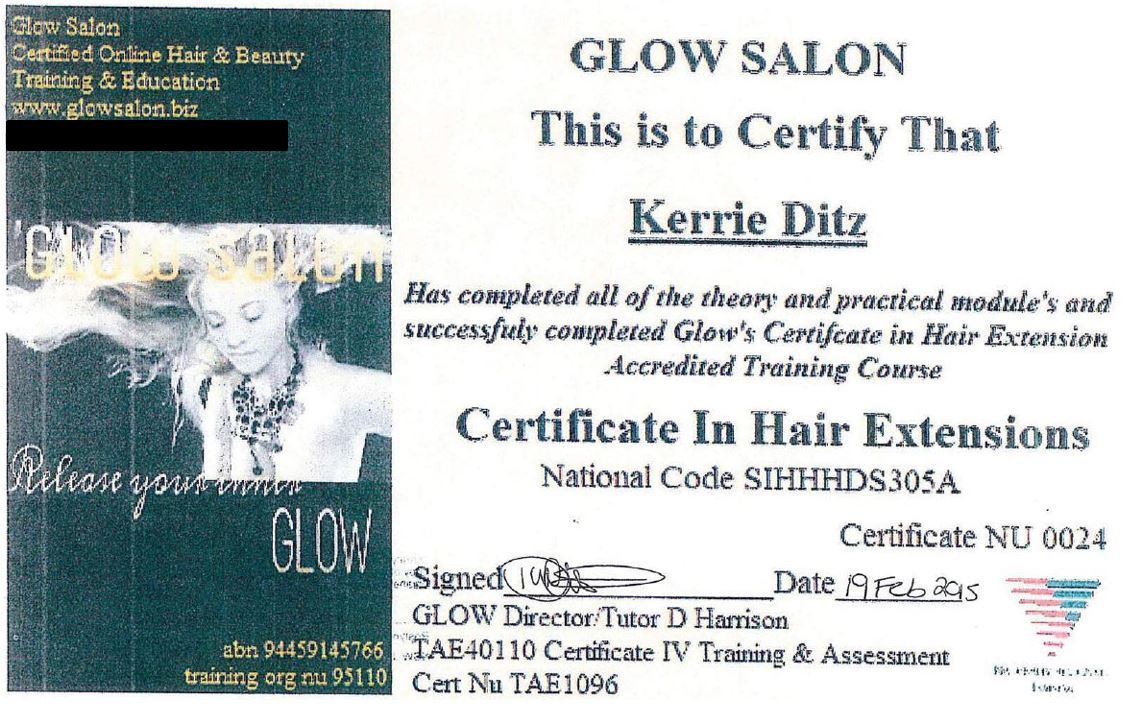
(f) to facilitate access to accurate information relating to the quality of VET
14 I have earlier explained the highly regulated scheme established by the NVR Act to give effect to these objects in Harrison (No. 1) at [8]-[14]; see also Commonwealth v Jones [2018] FCA 1008 (Jones) at [7]-[15] (Markovic J). Mr Garner’s evidence outlining the VET sector and its regulatory framework is consistent with this and is conveniently reproduced as follows:
9. The VET sector is primarily regulated by the NVR Act, the Australian Qualifications Framework (AQF) and the VET Quality Framework.
10. The AQF is the national policy for regulated qualifications in Australian education and training. It incorporates the qualifications from each education and training sector (including schools, VET and higher education) into a single comprehensive national qualifications framework. The AQF covers 10 levels of qualifications from Certificate I to doctoral degree. Each of these levels have defined learning outcomes which reflect the relative complexity, depth of achievement and the autonomy required of graduates to demonstrate that level of achievement.
11. Currently, the levels of qualifications available for issue in the VET sector are Certificate I - IV, Diploma, Advanced Diploma and Graduate Certificate and Graduate Diploma. The VET sector covers areas as diverse as engineering, architecture and building, agriculture, health, security, food and hospitality, traffic control, first aid and beauty services (to name but a few of the almost 700 job roles covered). Accordingly, VET enables students to gain qualifications and skills for many types of employment.
12. The object of the VET sector is to provide Australians with vocationally-oriented, post school qualifications. These qualifications serve various purposes including providing entry into or progression in the labour market and allowing students to move to higher levels of studies. VET qualifications also contribute to social inclusion and social mobility.
13. In Australia, there are currently more than 4,000 registered training organisations who, collectively, deliver VET courses to about 4.2 million people each year.
…
15. ASQA and the state government authorities in Victoria and Western Australia are responsible for authorising registered training organisations to issue AQF qualifications for VET. ASQA is the regulatory body for over 90% of registered training organisations nationally.
16. I am aware that the NVR Act requires all registered training organisations registered with ASQA to comply with the VET Quality Framework (see sections 17 and 22). The VET Quality Framework is comprised of intergovernmental agreements and legislative requirements, and is intended to achieve national consistency in the way registered training organisations are registered and monitored, and how standards in the VET sector are enforced. The VET Quality Framework includes the Standards for Registered Training Organisations 2015 and relevant requirements from the AQF
4.1 Section 137, NVR Act and the primacy of deterrence
15 The imposition of a civil penalty for a contravention of the NVR Act is governed by s 137 which provides as follows:
137 Federal Court or Federal Magistrates Court may impose pecuniary penalty
Application for order
(1) Within 6 years of a person (the wrongdoer) contravening a civil penalty provision, the National VET Regulator may apply on behalf of the Commonwealth to the Federal Court or the Federal Magistrates Court for an order that the wrongdoer pay the Commonwealth a pecuniary penalty.
Court may order wrongdoer to pay pecuniary penalty
(2) If the Federal Court or the Federal Magistrates Court is satisfied that the wrongdoer has contravened the civil penalty provision, the court may order the wrongdoer to pay to the Commonwealth for each contravention the pecuniary penalty that the court determines is appropriate (but not more than the amount specified for the provision).
Determining amount of pecuniary penalty
(3) In determining the pecuniary penalty, the Federal Court or the Federal Magistrates Court must have regard to all relevant matters, including:
(a) the nature and extent of the contravention; and
(b) the nature and extent of any loss or damage suffered as a result of the contravention; and
(c) the circumstances in which the contravention took place; and
(d) whether the person has previously been found to have engaged in any similar conduct by the court in proceedings under this Act.
16 Section 137(5) provides with respect to conduct contravening two (or more) provisions as in the present case that:
(5) If conduct contravenes 2 or more civil penalty provisions, proceedings may be instituted under this Act against a person for the contravention of any one or more of those provisions. However, the person is not liable to more than one pecuniary penalty for the same conduct.
17 The purpose of civil penalties “is primarily if not wholly protective in promoting the public interest in compliance”: Commonwealth v Director, Fair Work Building Industry Inspectorate [2015] HCA 46; (2015) 258 CLR 482 at [55] (French CJ, Kiefel, Bell, Nettle and Gordon JJ (with whose reasons Keane J agreed at [79])). Thus as Keane, Nettle and Gordon JJ explained in Australian Building and Construction Commissioner v Construction, Forestry, Mining and Energy Union [2018] HCA 3; (2018) 262 CLR 157 at [116] (with whose reasons Kiefel CJ agreed at [50]) with respect to the connection between the purpose of securing deterrence and the level of the civil penalty:
… Other things being equal, it is assumed that the greater the sting or burden of the penalty … the more potent will be the example that the penalty sets for other would-be contraveners and therefore the greater the penalty's general deterrent effect. Conversely, the less the sting or burden that a penalty imposes on a contravener, the less likely it will be that the contravener is deterred from further contraventions and the less the general deterrent effect of the penalty. Ultimately, if a penalty is devoid of sting or burden, it may not have much, if any, specific or general deterrent effect, and so it will be unlikely, or at least less likely, to achieve the specific and general deterrent effects that are the raison d'être of its imposition.
18 Such considerations as to the risk/benefit equation from the perspective of a potential wrongdoer are especially relevant where the benefit in contemplation is profit, as in this case: Australian Competition and Consumer Commission v Reckitt Benckiser (Australia) Pty Ltd [2016] FCAFC 181; (2016) 340 ALR 25 (Reckitt) at [151] (the Court).
19 As the Commonwealth submitted, the primacy of deterrence is equally applicable to the assessment of civil penalties under the NVR Act: Jones at [41]-[44] (Markovic J), Commonwealth v Restar [2016] FCA 657 at [37]-[42] (Flick J), Commonwealth v Reid [2018] FCA 579 at [26] (Flick J), and Commonwealth v King [2019] FCA 787 (King) at [18] (Perram J).
20 It follows that the various factors under s 137(3) of the NVR Act relevant to setting the penalty amount fall to be considered in the context of setting a penalty of appropriate deterrent value so as to ensure that the penalty is not regarded relevantly by others as an acceptable cost of doing business: see further e.g. Australian Competition and Consumer Commission v TPG Internet Pty Ltd [2013] HCA 54; (2013) 250 CLR 640 at [66], Singtel Optus Pty Ltd v Australian Competition and Consumer Commission [2012] FCAFC 20; (2012) 287 ALR 249 (Singtel Optus (FCAFC)) at [62] (the Court); and Australian Competition and Consumer Commission v Jetstar Airways Pty Ltd [2019] FCA 797; 136 ACSR 603 (Jetstar (2019)) at [50] (Perry J). It also follows that “the penalty should not be greater than is necessary to achieve this object; severity beyond that would be oppression”: NW Frozen Foods Pty Ltd v Australian Competition and Consumer Commission [1996] FCA 1134; (1996) 71 FCR 285 at 293 (Burchett and Kiefel JJ).
4.2 General deterrence considerations
21 I agree that the contraventions in the present case should attract penalties which will act as a strong general deterrent having regard to the following considerations.
22 First, protection of the integrity of the VET system is of vital importance in order to protect the Australian community and economy. As Mr Garner explained in his evidence:
14. VET is the primary mechanism used to provide workplace skills to the Australian community, following the completion of compulsory education. As such, VET is a significant contributor to Australia's domestic economy and plays an important role in Australia's economic growth and business productivity. In addition, the VET sector provides a substantial contribution to the export education market, which overall generates approximately 34 billion dollars in export earnings annually.
23 Conversely, non-compliance with the NVR Act undermines the integrity of the VET sector and harms not only the interests of students, but also the wider interests of industry, employers and members of the public who also rely upon the VET sector. As Mr Garner further explained:
19. First, where a person has not been properly assessed by an RTO as having fulfilled the requirements of a VET course, there is a risk that their skills and competencies will fall below the level expected by employers. This in turn may lead to failings in performance of work, and consequential reputational, financial or other damage to the relevant employer. Depending on the field of employment in which a person is engaged, failings in their performance also has the potential to cause harm to the personal health and safety of members of the public relying on their services.
20. Secondly, a person holding themselves out as having certified skills, evidenced by a certificate or statement of attainment, who does not have those skills, may have a negative impact on the perception of the value of either that specific VET qualification or statement of attainment or VET qualifications or statements of attainment more broadly. In this way, the utility and value of VET qualifications or statements of attainment may be undermined and the social and economic benefits which consistent and reliable VET qualifications and statements of attainment are intended to create are diminished.
21. Thirdly, if it is perceived that fake qualifications or statements can be relied upon, students may be discouraged from making the time and financial investments which are necessary to secure genuine VET qualifications and statements of attainment, and training providers may be emboldened to provide VET courses without obtaining the necessary registration to do so (which only serves to exacerbate the first two risks described above).
24 Secondly, while ASQA runs an active monitoring and investigation program to detect and address non-compliance, the scale and nature of the VET sector is such that the provision and use of fake certificates may readily go undetected. Mr Garner explained by way of example that in his experience it was not unusual for employers and other persons not to check an applicant’s qualifications but rather to accept documents purportedly evidencing qualifications at “face value”. Similarly, students undertaking training will not necessarily check the veracity of representations that the training is accredited or nationally recognised, especially where the training is referred to by a name and code which resembles a VET course name and code and as such appears to be legitimate. Nor will they necessarily seek confirmation that the provider is listed on the national register as an RTO. As a result the temptation to exploit the VET system for financial or personal gain, such as by creating fake VET statements of attainment or qualifications or purporting to provide VET training when not registered to do so, is likely to be strongest if the risk of being caught is perceived to be low. Sending a strong message about the seriousness and cost of being caught is therefore of the utmost importance in setting a penalty. In other words, as the Commonwealth submitted, “where non-compliance is detected in circumstances such as these, strongly deterrent penalties are necessary to make clear to other would-be wrongdoers that the risk of deterrence, small as they may see it to be, is simply not worth running” (Applicant’s Submissions on Penalty and Costs (ASPC) at [21]).
25 Thirdly, as the Full Court held in Flight Centre Limited v ACCC (No. 2) [2018] FCAFC 53; (2018) 260 FCR 68 at [71], in the setting of civil penalties “the flagrancy or other feature of conduct which may be seen to be relevant to the seriousness of the contravention will find its place in understanding the degree of deterrence that is necessary to be reflected in the size of the penalty.” Thus, while a lesser penalty may suffice to deter non-compliance of an isolated or careless nature, a stronger message is necessary to deter those who may be minded to contravene the NVR Act in a dishonest, deliberate, and sustained manner. In this regard, I agree with the Commonwealth that the present case falls in the latter category. In particular, as I found in Harrison (No. 1) and as the Commonwealth conveniently summarised:
Ms Harrison persisted over a period of nearly 2 years in offering to provide VET training, issuing false VET statements of attainment and qualifications, using “bogus” qualifications and making false or misleading representations about VET courses; she enhanced her deceptions, and her prospects of obtaining financial gain, by reiterating the legitimacy of training offered by her in communications with current and prospective students as well as in course in advertising material and by positively confirming her purported affiliation with genuine RTOs; Ms Harrison’s deceptions and offering VET courses included using the formal names and/or codes for, or names and/or codes which closely resembled, legitimate VET courses, in her communications and advertising and training materials; the statements and qualifications issued by Ms Harrison, and those used by her, were individually fabricated so as to closely resemble genuine VET statements and qualifications, including by referring to genuine RTOs and by including the Nationally Recognised Training Logo.
(ASPC at [22])
26 Specific deterrence is also a relevant factor in this case. In this regard, I found in Harrison (No. 1) at [79] that Ms Harrison’s conduct involved “a sustained pattern of behaviour undertaken in various ways including by offers to provide VET courses, the improper issuing of VET statements of attainment and qualifications, and false or misleading representations to individual clients and the public via representations on the Glow Salon websites, in contravention of the Act” (emphasis added). Furthermore, not only has Ms Harrison refused to engage with the regulator or participate in any way in these proceedings (Harrison (No. 1) at [75]), there is no evidence that she has taken any steps to acknowledge or remediate her contravening conduct. These considerations give the Court no comfort that, absent a sufficiently serious penalty, Ms Harrison will not engage in contravening conduct again. That said, I accept, as the Commonwealth submits, that a penalty which would have the requisite general deterrent effect would also be likely to have the necessary deterrent effect specifically on Ms Harrison (ASPC at [23]).
4.4 The intuitive synthesis approach
27 Finally, with respect to the ultimate task of weighing the various factors to assess the appropriate penalty, I recently explained in Jetstar (2019) (by analogy) that:
54 In common with criminal sentencing, the process of arriving at the appropriate civil penalty under the ACL (and its predecessor, the Trade Practices Act 1974 (Cth)) involves an intuitive or instinctive synthesis of all of the relevant factors rather than a sequential mathematical process: ACCC v Coles [2015] at [6] (Allsop CJ). This does not of course mean that all of the considerations which are relevant to criminal sentencing are also relevant to assessing an appropriate civil penalty. Rather it is the process itself which is the same. Instinctive synthesis in this sense was helpfully described by McHugh J in Markarian v The Queen [2005] HCA 25; (2005) 228 CLR 357 as meaning: “the method of sentencing by which the judge identifies all the factors that are relevant to the sentence, discusses their significance and then makes a value judgment as to what is the appropriate sentence given all the factors of the case” (at [51]); see also by analogy Barbaro v The Queen [2014] HCA 2; (2014) 253 CLR 58 (Barbaro) at [34]-[35] (French CJ, Hayne, Kiefel and Bell JJ).
5. The appropriate approach to the multiple contraventions
28 The conduct for which penalties are sought gave rise to 156 legally identifiable contraventions by Ms Harrison, as identified in the declarations already made. However, as the Commonwealth submitted, many of the contraventions are factually interrelated.
29 In these circumstances, attention should be given to three issues:
(1) the extent to which the conduct was truly “the same conduct” for the purposes of s 137(5) of the NVR Act;
(2) whether the separate acts giving rise to separate contraventions are nonetheless inextricably interrelated and may appropriately be grouped as a “course of conduct” for the purposes of assessing the appropriate penalty; and
(3) the totality principle which requires the Court to make a “final check” of the penalties to be imposed on a wrongdoer considered as a whole.
(See e.g. King at [20]-[23] and the authorities there cited)
30 The first two issues are addressed below, while I address the totality principle at the conclusion of these reasons. In this regard, as Foster J held in Clean Energy Regulator v MT Solar Pty Ltd [2013] FCA 205 at [82],
“the proper approach when applying the totality principle is to start by ascertaining the penalty which would be appropriate for each individual contravention and then to reduce the total of the amounts derived in this fashion for reasons of totality. It is undesirable to start with a single global total penalty and then to divide it among the individual contraventions in order to derive separate penalties.”
5.2 “The same conduct” for the purposes of s 137(5), NVR Act
31 It will be recalled that s 137(5) of the NVR Act provides that a person is not liable for more than one pecuniary penalty “for the same conduct”. I recently explained in Australian Competition and Consumer Commission v Birubi Art Pty Ltd (in liq) (No 3) [2019] FCA 996; 374 ALR 776 (Birubi) with respect to the meaning of that phrase in s 224(4) of the Australian Consumer Law, which is relevantly in the same terms, that:
62. Section 224(4) of the ACL provides that if conduct constitutes a contravention of two or more provisions (relevantly ss 29 and 33), a proceeding may be instituted under the ACL against a person in relation to the multiple contraventions but “a person is not liable to more than one pecuniary penalty under this section in respect of the same conduct” (emphasis added). As such, the section is directed to preventing multiple, and therefore cumulative, penalties being imposed on one contravener for the same conduct that constitutes a contravention of two or more provisions of the Act: Australian Competition and Consumer Commission v Yazaki Corporation [2018] FCAFC 73; (2018) 357 ALR 55 at [224] (the Court) (by analogy); Australian Competition and Consumer Commission v Jetstar Airways Pty Limited (No 2) [2017] FCA 205 at [13]-[17] (Foster J). As such, the provision is different from the course of conduct principle as the conduct must be truly “the same”, and not merely similar or repeated.
(emphasis added)
32 In other words, where multiple contraventions arise from the same wrongful act, that act should attract one penalty only.
33 Consistently with this, while declarations have been made that Ms Harrison has contravened provisions of the NVR Act on 156 occasions, I agree with the Commonwealth that a pecuniary penalty in respect of only 148 of those contraventions should be imposed as follows:
(1) 134 contraventions of s 117(1) of the NVR Act relating to offers to provide various VET courses or parts thereof (Offer contraventions);
(2) 5 contraventions of s 129 of the NVR Act relating to the issue of 5 false statements of attainment (Statement of Attainment contraventions), and not the 5 contraventions of s 125 arising out the same conduct;
(3) 1 contravention of s 127 of the NVR Act relating to the issue of a false VET qualification (VET Qualification contravention), and not the contravention of s 125 arising out the same conduct;
(4) 2 contraventions of s 131(1) of the NVR Act relating to the obtaining of 2 bogus VET qualifications (Bogus Qualification contraventions), and not the 2 contraventions of s 125 arising out the same conduct;
(5) 6 contraventions of s 125 of the NVR Act relating to false representations about Ms Harrison’s relationship with RTOs (or purported RTOs) (False representation contraventions).
5.3 The course of conduct principle and the maximum penalty
34 As the Commonwealth submits, while separate contraventions arising from separate acts should ordinarily attract separate penalties, the so-called course of conduct principle may apply “where separate acts, giving rise to separate contraventions, are nonetheless so inextricably interrelated that they should be viewed as one multi-faceted ‘course of conduct’” (ASPC at [30]). The Full Court recently considered the course of conduct principle in Australian Competition and Consumer Commission v Yazaki Corporation [2018] FCAFC 73; (2018) 262 FCR 243 (Yazaki), explaining that:
234. The “course of conduct” or “one transaction” principle means that consideration should be given to whether the contraventions arise out of the same course of conduct or the one transaction, to determine whether it is appropriate that a “concurrent” or single penalty should be imposed for the contraventions. The principle was explained by Middleton and Gordon JJ in Construction, Forestry, Mining and Energy Union v Cahill [2010] FCAFC 39; 194 IR 461 at [39]:
The principle recognises that where there is an interrelationship between the legal and factual elements of two or more offences for which an offender has been charged, care must be taken to ensure that the offender is not punished twice for what is essentially the same criminality. That requires careful identification of what is “the same criminality” and that is necessarily a factually specific enquiry.
(Emphasis omitted.)
35 Thus, as Jacobson J explained in Registrar of Aboriginal and Torres Strait Islander Corporations v Matcham (No 2) [2014] FCA 27; (2014) 97 ACSR 412 (Matcham):
200. What amounts to the “same conduct” or “same criminality” is a fact specific enquiry. It is a matter of judgment to be exercised according to the facts of each case. But the Court is not obliged to apply the principle if the resulting penalty fails to reflect the degree of criminality involved in the particular case: CFMEU v Cahill at [42]; see also AB v The Queen (1999) 198 CLR 111 at [14].
201. The general objective of the course of conduct principle is to ensure that the sentence or penalty fairly reflects the substance of the offending conduct, rather than a purely mathematical total for each separate offence which may be technically identified: [Clean Energy Regulator v MT Solar Pty Ltd [2013] FCA 205] at [75] and the authorities cited there.
(emphasis added)
36 This principle is embodied in ss 141(3) and (4) of the NVR Act which read as follows:
(3) Proceedings against a person for any number of orders to pay pecuniary penalties for contraventions of a civil penalty provision that are founded on the same facts, or form, or are part of, a series of contraventions of the same or a similar character, may be joined.
(4) The Federal Court or the Federal Circuit Court may make a single order to pay a pecuniary penalty for all the contraventions described in subsection (3), but the penalty must not exceed the sum of the maximum penalties that could be ordered if a separate penalty were ordered for each of the contraventions.
(emphasis added)
37 However, as s 141(4) provides, when applied, the principle does not convert the statutory maximum for one contravention into a maximum for the entire course of conduct: the maximum continues to apply to each contravention which forms part of the course of conduct: see also eg ACCC v Coles Supermarkets Australia Pty Ltd [2015] FCA 330; (2015) 327 ALR 540 (Coles) at [82]-[85] and [103] (Allsop CJ). While therefore the aggregation of offending conduct into a course or courses of conduct does not limit the maximum penalty, the course of conduct principle provides a useful “tool of analysis” in the civil penalty process which can, but need not necessarily, be used in the particular case: Yazaki at [235]; Australian Competition and Consumer Commission v Cement Australia [2017] FCAFC 159; (2017) 258 FCR 312 (Cement Australia) at [428] (the Court); Coles at [84]. Ultimately, the object remains to ensure that the penalties imposed are of appropriate deterrent value having regard to the actual, substantive wrongdoing: Cement Australia at [424] (the Court).
38 The Commonwealth submitted that the 134 legally distinct offer contraventions should be grouped into 24 overall courses of conduct. I agree for the reasons explained below.
5.4.1 The offers to provide VET courses to specific consumers (5 courses of conduct)
39 The Commonwealth submitted that the multiple contraventions involving offers to provide VET courses to specific consumers are appropriately treated as five courses of conduct, namely, offers to provide VET courses or parts thereof to Ms Kelly Bainbridge in Queensland, to Ms Tahlee Bridges alone in Queensland, to Ms Kate Matthews in South Australia, to Ms Bridges and others, and to Mr Craig Hasch in South Australia (statement of claim (SOC) at [15]-[57]; Declaration at [2](a) to (e)). I agree that it is appropriate to apply the course of conduct principle in this way for the reasons given by the Commonwealth, namely:
… Each occasion on which Ms Harrison offered to provide a VET course or courses (or part or parts thereof) to the individuals identified at [15]-[57] of the SOC should be treated as a separate course of conduct, regardless of how many VET courses (or parts) were the subject of each offer. For example, it is appropriate to group the four contraventions relating to the offer in January 2015 to provide Ms Bainbridge with four parts of a VET course into a single course of conduct, because those parts of VET courses were offered to her in a single transaction. The same reasoning applies to the four contraventions relating to Ms Harrison’s offer in March and April 2015 to provide Ms Matthews with four parts of a VET course.
The two occasions on which Ms Harrison offered to provide VET courses to Ms Bridges, in March 2015 and November 2015, should be regarded as 2 distinct courses of conduct. While they related to the same VET course (Certificate III in Hairdressing), the offers were made 7 months apart, they were made using different mediums (the first via private Facebook messages and the second via email), the second offer was for a course held out to be ‘new’ and ‘updated’ ‘Certificate 3’ and involved a ‘new RTO’ provider, and the second offer was made to a wider group of recipients of which Ms Bridges was just one. Accordingly, the offers were factually distinct from one another and involved separate and discrete acts of wrongdoing.
Consistently with the above analysis, the offer made to Mr Hasch between November 2015 and January 2016 should also be regarded as a separate course of conduct, as it was factually unrelated to the other contraventions.
(ASPC at [35] to [37]; emphasis added).
5.4.2 The offers to provide VET courses or parts thereof via Facebook (17 courses of conduct)
40 The Court made two declarations relating to contraventions by reason of the making of offers to provide VET courses (or parts thereof) via Facebook (SOC [58] to [157]; Declaration at [2](f) and (g)). The first declaration concerned 45 offers made on Facebook as at 2 August 2016, while the second concerned 40 offers made on Facebook which were visible as at 4 August 2016. These offers were made by way of a number of different Facebook posts posted by Ms Harrison on different dates and concerned numerous different VET courses or parts of courses.
41 I accept the Commonwealth’s submission that each post, including those made on the same date, “was individually drafted and each evinces a separate, deliberate decision by Ms Harrison to engage in the relevant contravening conduct.” In this regard, as the Commonwealth submitted, as well as relating to different varieties of VET courses or parts of such courses, each post contained different information concerning such matters as the availability of the course or courses being offered, contact details, costs, mode of study, and/or place of study. For example, posts on the Glow Salon Facebook page visible to the public as at 2 August 2016 included the following.
(1) On 6 May 2016, Ms Harrison posted a post on the Glow Salon Facebook page which identified the following courses as being available through Glow Salon: SIBBSKS504A Design and perform cosmetic tattooing; HLTIN402C Maintain infection control standards in office practice setting; and SIBBCCS301A Apply the principles of skin biology to beauty treatments (SOC at [58]-[59]). The post included information as to costs, and course contact, and contained descriptions and codes for each of the courses which were identical to those for units of competency which were part of at least one VET course available at that time (SOC at [60]-[61]).
(2) On 25 June 2016, Ms Harris posted a post on the Glow Salon Facebook page identifying the following courses as being available through Glow Salon: Cert 11 Salon Assistant; Cert 111 Barbering; Cert 111 Hairdressing; Design and Apply Cosmetic Tattoo; and Apply laser & ipl safety protocol (SOC at [82]). The post included information as to content and payment options for the courses, invited readers to “Contact me to book”, and stated that the courses were accredited (SOC at [83]-[84]). The descriptions of the courses closely resembled the description of VET courses or parts thereof available at that time in the same subject matter (SOC at [85]-[86]).
(3) On 17 May 2016, Ms Harrison posted a post on the Glow Salon Facebook Page identifying 30 different courses including for example, SIBBFAS303A Design and apply remedial camouflage makeup, SIBBNLS206A Use electric file equipment for nails, and SIHHHRS303A Perform chemical straightening and relaxing services (SOC at [67]). The post included information as to the cost of each course described as “accredited short course training”, and the descriptions and codes for the courses were identical to those for units of competency in at least one VET course available as at that time (SOC at [68]-[69]).
42 Furthermore, as these examples illustrate, while each of the posts was visible as at 2 or 4 August 2016, they were not all posted at the same time. To the contrary, in some cases there was a significant time lapse between the making of the offers. Thus the posts visible on 2 August 2016 spanned posts posted on: 6, 17 and 31 May 2016; 22, 25 and 27 June 2016; and 5 July 2016. Similarly, the posts visible on 4 August 2016 spanned posts posted on the Glow Salon Facebook page on: 10 February 2015; 7, 10, 14 and 29 March 2016; and 2 and 4 April 2016. It follows that it is appropriate to group these contraventions into courses of conduct according to the post by which the relevant offers were made, even though all of the Facebook posts were viewed and accessible to the public as at either 2 or 4 August 2016. This means for example that the offers made by Ms Harrison in the Facebook post on 17 May 2016 concerning 30 parts of a VET course (as described at [41(3)] above) should be considered as a single course of conduct, as should each of the posts posted on 6 May 2016 and 25 June 2016 (as described at [41(3)] above).
43 Applying this approach, I consider that it is appropriate to treat the 17 separate Facebook posts containing 85 offers to provide VET courses (or part thereof) as part of 17 separate courses of conduct.
5.4.3 Offers to provide VET courses (or parts thereof) via websites (2 courses of conduct)
44 The position is different with respect to the offers made by Ms Harrison on the glowsalon.biz and Glowacademy.webs.com websites which were viewed and accessible to the public on 5 August 2016 and 8 November 2016 respectively (SOC at [158]-[207]; Declaration at [2](h) and (i)). In respect of the glowsalon.biz website, the statement of claim refers to offers to provide 29 VET courses or parts thereof across the “Home”, “Certificates”, “Sign up”, and “Direct Debit Request” webpages located on the website (SOC at [158]-[191]). With respect to the Glowacademy.webs.com website, the statement of claim refers to offers to provide 9 VET courses or parts thereof which were displayed on two webpages of that website (“Home” and “Courses”) and accessible to the public on 8 November 2016 (SOC at [192]-[207]). However, the statement of claim does not plead the date when each offer was posted on the relevant website but only the dates on which they were viewed and are known to have been accessible to the public. For this reason I accept that the making of the offers to provide 29 VET courses or parts thereof on the glowsalon.biz website is appropriately treated as a single course of conduct, and the making of the offer to provide nine VET courses or parts thereof on the glowacademy.webs.com website is appropriately regarded as another single course of conduct (ASPC at [42]).
5.4.4 The Statement of Attainment contraventions (5 contraventions, 5 courses of conduct)
45 The declarations as to the contraventions relating to the issue of false statements of attainment were as follows:
3. In the period from 19 February 2015 to 26 April 2016, Ms Harrison contravened s 129 of the NVR Act on a total of 5 occasions when she purported to issue 5 statements as VET statements of attainment and on each occasion those statements were not genuine VET statements of attainment as follows:
(a) On 19 February 2015, Ms Harrison purported to issue Ms Kerrie-Ann Ditz a statement concerning hair extensions as a VET statement of attainment when that statement was not genuine.
(b) On 14 March 2015, Ms Harrison purported to issue Ms Bainbridge a statement concerning waxing, facial, lash and brow techniques as a VET statement of attainment when that statement was not genuine.
(c) On 22 December 2015, Ms Harrison purported to issue Ms Matthews a statement concerning designing and applying make-up and applying the principles of skin biology to beauty treatments as a VET statement of attainment when that statement was not genuine.
(d) On 19 April 2016, Ms Harrison purported to issue Ms Leanne Taylor a statement concerning cosmetic tattooing and applying the principles of skin biology to beauty treatments as a VET statement of attainment when that statement was not genuine.
(e) On 29 April 2016, Ms Harrison purported to issue Ms Ditz a statement concerning cosmetic tattooing and applying the principles of skin biology to beauty treatments as a VET statement of attainment when that statement was not genuine.
46 As is apparent from the terms of these paragraphs of the declarations, each of these contraventions were factually distinct and involved separate and discrete acts of wrongdoing. As the Commonwealth submitted:
… the statements relate to a range of different VET courses (or parts thereof); different people were impacted by the different contraventions; each of the contraventions occurred on a different date and, generally, a month or more elapsed between each; and the purported statements were uniquely fabricated in that they were specifically made and their contents tailored to suit the particular training given and/or recognition of prior learning and their particular recipient (see Annexures B to F of the SOC, which are copies of the relevant statements). While some statements share common features, they contain different dates, names and grades and it is evident that the creation and issue of each involved separate, different and distinct conduct by Ms Harrison.
(APSC at [43])
47 The last point made by the Commonwealth in this submission may be illustrated by reference to the contents of the certificate issued to Ms Ditz in hair extensions which read:
(Annexure B to the SOC)
48 Furthermore, as the Commonwealth also pointed out, the first statement issued to Ms Ditz followed the purported provision of “recognised prior learning” (SOC at [211]), whereas the statements issued to Ms Bainbridge, Ms Matthews and Ms Taylor, and the second statement issued to Ms Ditz, followed the provision of training (SOC at [220], [227], [237] and [244]).
49 In all of the circumstances, I am therefore satisfied that each of these contraventions are separate and distinct, and should not be treated as part of a course of conduct.
5.4.5 The VET Qualification contravention (1 contravention, 1 course of conduct)
50 The Declaration made on 19 June 2019 included a declaration that:
4. On 24 October 2015, Ms Harrison contravened s 127 of the NVR Act on 1 occasion when she purported to issue Ms Ditz a qualification concerning nail technology as a VET qualification when that statement was not genuine
51 The Commonwealth also submitted that this contravention involved separate, different and distinct conduct by Ms Harrison and therefore that the course of conduct principle did not apply to it. I agree. This contravention concerned a false VET qualification concerning nail technology issued by Ms Harrison to Ms Ditz on 24 October 2015. The false VET statements of attainment issued by Ms Harrison to Ms Ditz were issued earlier on 19 February 2015 and 29 April 2016 and concerned different purported VET courses, namely, hair extensions, and cosmetic tattooing and applying the principles of skin biology to beauty treatments. Furthermore, as the Commonwealth submitted, the false VET qualification created by Ms Harrison was “uniquely fabricated … revealing that it involved separate, different and distinct conduct by Ms Harrison.” Thus, the certificate read:

(Annexure G to the SOC)
52 As such, the contravention the subject of the declaration at [4] was factually distinct and should not be grouped with other contraventions and treated as part of a course of conduct.
5.4.6 The Bogus VET Qualification contraventions (2 contraventions, 2 courses of conduct)
53 Paragraph 6 of the Declaration declares that:
6. On 27 July 2016, Ms Harrison contravened s 131(1) of the NVR Act on 2 occasions because she created or otherwise obtained 2 bogus VET qualifications in her own name concerning hairdressing and training and assessment, and on 27 July 2016 displayed each of those 2 bogus VET qualifications in premises from which she conducted a business and purported to hold out each of them as a legitimate VET qualification
54 Again, these contraventions are factually distinct and should not be treated as part of the same course of conduct. The bogus qualifications are reproduced at Attachment H to the statement of claim. Notwithstanding that each of the bogus qualifications were purportedly issued by the same RTO (TAFESA) and were both displayed at Glow Salon’s premises as at 27 July 2016, they relate to different VET courses (“Certificate III in Hairdressing” and “Certificate IV in Training and Assessment”) and are otherwise different in appearance. As the Commonwealth submits, it can be inferred from these features that Ms Harrison made a separate conscious decision to fabricate or otherwise obtain and display each of the bogus qualifications (ASPC at [45]).
5.4.7 The False Representation contraventions (6 courses of conduct)
55 Paragraph 8 of the Declaration declares that between 29 March 2017 to 27 July 2016, Ms Harrison breached s 125 of the NVR Act on six occasions by reason of making false representations about her relationship with RTOs to students and members of the public about VET courses or courses held out as such: see SOC at [306]-[341]. Each of these representations are also factually distinct and separate and as such, I do not consider that they should be treated as part of the same courses of conduct, even where they were made to the same person (Ms Bridges). Rather, as the Commonwealth correctly submitted:
47. The first contravention occurred between 29 and 30 March 2015, when Ms Harrison made a false representation regarding Glow Salon’s purported relationship with Adelaide Institute of Hair and Beauty. That representation was made directly to Ms Bridges over private Facebook messages. The second contravention occurred more than 7 months later, when Ms Harrison made a further and distinct false representation, this time about Glow Salon’s purported relationship with a different purported RTO, Ainos Education. This representation was made by way of an email to a number of recipients, of which Ms Bridges was just one. That representation should be treated as separate and distinct from the third false representation made by Ms Harrison, this time on 25 November 2015, directly to Ms Bridges by the medium of a student enrolment form, about Glow Salon’s purported relationship with Ainos Education. Ms Harrison then made a fourth and distinct false representation on 27 January 2016, by email to a group of recipients of which Ms Bridges was just one, about Glow Salon’s purported relationship with a further different RTO, Sunbury College of Hair & Beauty. Nearly 2 months later, Ms Harrison made the separate and distinct decision to make the same representation to Ms Taylor, which constituted the fifth contravention. The final false representation was made on a poster displayed at Glow Salon’s premises, and is factually unrelated to the other contraventions.
(ASPC at [47])
56 In this regard, it is not sufficient to treat some or all of the False Representation contraventions as a single course of conduct merely because they share similar features. As Jacobson J held in Matcham at [215], that would represent a flawed approach “because it characterises the wrongful conduct at a high level of generality without regard to the distinctive features” of the wrongdoer’s conduct.
57 Section 137(2) provides that upon the Court being satisfied, as here, of a contravention of a civil penalty provision, the Court may order the wrongdoer to pay to the Commonwealth for each contravention, the pecuniary penalty that the Court determines is appropriate but not more than the specified maximum.
58 In Markarian v The Queen [2005] HCA 25; (2005) 228 CLR 357 at [31], Gleeson CJ, Gummow, Hayne and Callinan JJ held that:
… careful attention to maximum penalties will almost always be required, first because the legislature has legislated for them; secondly, because they invite comparison between the worst possible case and the case before the court at the time; and thirdly, because in that regard they do provide, taken and balanced with all of the other relevant factors, a yardstick. …
59 Numerous decisions of this Court have accepted that this reasoning applies equally to civil penalties (Reckitt at [155] (the Court)). Furthermore as the Full Court emphasised in Reckitt at [155]-[156], the maximum penalty must not be applied mechanically but rather “as one of a number of relevant factors, albeit an important one”. In this regard, the Court further explained that:
156. … Put another way, a contravention that is objectively in the mid-range of objective seriousness may not, for that reason alone, transpose into a penalty range somewhere in the middle between zero and the maximum penalty. Similarly, just because a contravention is towards either end of the spectrum of contraventions of its kind does not mean that the penalty must be towards the bottom or top of the range respectively. However, ordinarily there must be some reasonable relationship between the theoretical maximum and the final penalty imposed.
60 The maximum penalty prescribed for a contravention of:
(1) s 117 (the Offer contraventions), s 127 (the VET Qualification contravention) and s 129 (the Statement of Attainment contraventions) of the NVR Act, is 600 penalty units;
(2) s 131(1) (the Bogus Qualification contraventions) is 240 penalty units; and
(3) s 125 (the False representation contraventions) is 120 penalty units.
61 Section 3 of the NVR defines penalty unit by reference to s 4AA of the Crimes Act 1914 (Cth) which in turn specifies the amount of the penalty unit. The amount of the penalty unit is calculated at the time the contravention was committed: s 4F(1), Crimes Act 1914 (Cth) and King at [17] (Perram J).
62 The contraventions of the NVR Act by Ms Harrison took place between January 2015 and November 2016. Relevantly:
(1) from 28 December 2012 to 30 July 2015, the value of a penalty unit was $170.00; and
(2) from 31 July 2015 to 30 June 2017, the value of a penalty unit was $180.00.
(See the Crimes Legislation Amendment (Serious Drugs, Identity Crime and Other Measures) Act 2012 (Cth) sch 3 cl 7 and the Crimes Legislation Amendment (Penalty Unit) Act 2015 (Cth) sch 1 cl 2 respectively)
63 It follows, as the Commonwealth submits (ASPC at [56]), that if a separate penalty was imposed for 134 contraventions of s 117(1), five contraventions of s 129, one contravention of s 127, two contraventions of s 131(1) and six contraventions of s 125, the total maximum penalty that could be awarded is $15,208,800.00 as set out in the Penalty Analysis Table attached to the Commonwealth’s submissions. An amended version of that Table which includes an additional column setting out the penalty in fact imposed appears in the Schedule to these reasons.
6.2 The nature and extent of the contraventions (s 137(3)(a) and (c), NVR Act)
64 The factors to which regard must be had in determining the appropriate penalty are set out in s 137(3)(a) to (d) of the NVR Act, together with “all relevant matters” (quoted at [15] above).
65 The nature, extent and circumstances of the contraventions which are required to be taken into account by s 137(3)(a) and (c) of the NVR Act can be summarised as follows.
(1) With respect to the Offer contraventions, Ms Harrison published 123 offers to the world at large to provide VET courses or parts thereof using the Glow Salon’s Facebook page and websites (glowsalon.biz and Glowacademy.webs.com), as well as multiple offers to 5 specific individuals as found in the Declaration and described in the statement of claim. The contraventions persisted over a period from January 2015 to July 2016. The VET courses or parts of courses purportedly offered spanned a broad range of subject matter as I have earlier explained including: beauty treatments such as manicures, pedicures, and waxing; cosmetic tattooing; intense pulsed light and laser safety protocols; hairdressing and barbering; massage therapy and remedial massage; salon management; ear piercing, maintaining infection control standards in office practice settings; and training and assessment. As is apparent from the description of these courses, some involve training in procedures which have the capacity to impact adversely on the health of members of the public purchasing such services if not carried out correctly and with due care, such as cosmetic tattooing, ear piercing, and maintaining infection control standards. The offers related to training which could be undertaken online or across Australia including South Australia, Darwin, Tasmania, Sydney, and Queensland.
(2) All of the contraventions were made in the course of Ms Harrison conducting her business, Glow Salon. As the Commonwealth submitted, it can readily be inferred from the volume of offers, together with the diversity of purported VET courses and modes and locations of study offered that this was “a substantial commercial enterprise” and that the contravening conduct was “plainly motivated by monetary gain, as in nearly every case the offers were accompanied by information about cost of enrolment and related expenses” (ASPC at [63]). As earlier explained, it may also readily be inferred that Ms Harrison’s contraventions involved deliberate deception given among other things references to her training being “accredited” and “nationally recognised training”, the use of VET course descriptors (e.g. “AIBBSKS504A Design and perform cosmetic tattooing”), and the advertising of purported relationships or arrangements with RTOs when she must have known that such representations were false. As the Commonwealth submits, her deceit is further evidenced by her display of her own bogus qualifications in hairdressing and training and assessment which was no doubt intended to give the impression that she was qualified to deliver the training she offered and to issue statements of attainment and qualifications. As I earlier explained, these features of Ms Harrison’s conduct mean that this is a case where a particularly strong message is required to be given by the penalty in order to deter those who might otherwise be minded to contravene the NVR act in a dishonest, deliberate, and persistent way.
6.3 The nature and extent of any loss or damage suffered as a result of the contraventions (s 137(3)(b), NVR Act)
6.3.1 Damage to the VET sector and public interest
66 As I have earlier explained by reference to Mr Garner’s evidence, conduct of the kind engaged in by Ms Harrison undermines the integrity of the VET sector to the detriment of the VET sector, the economy and the public. This aligns with my finding in Harrison (No. 1) that:
79 … the conduct alleged involves a sustained pattern of behaviour undertaken in various ways including by offers to provide VET courses, the improper issuing of VET statements of attainment and qualifications, and false or misleading representations to individual clients and the public via representations on the Glow Salon websites, in contravention of the Act. Such behaviour undermines the protection which the Act is intended to afford to students and the public, and the integrity of the system of providing vocational education and training under the Act.
67 Furthermore, I agree with the Commonwealth as to the seriousness of the risks posed to public health and safety where persons unwittingly enter the workforce and provide services to the public on the erroneous basis that they have been properly trained and assessed by an accredited RTO in courses such as cosmetic tattooing, maintenance of infection control standards, waxing treatments, chemical straightening and bleaching, skincare, and intense pulsed light and laser safety protocols. As the Commonwealth submitted, “[i]t is plainly of great importance that those who practice in these areas of vocation, which involved physical contact with other persons, sometimes involving chemicals, lasers and sharp instruments, receive proper training by qualified training providers” (ASPC at [66]).
6.3.2 Loss and damage suffered by particular consumers
68 A number of the individuals who fell victim to contraventions of the NVR Act by Ms Harrison gave compelling evidence as to the loss and damage suffered by them as a result. Their evidence speaks eloquently not only as to their financial losses. It also speaks to their disappointment and stress on discovering that they had been misled, the irrecoverable loss of time and effort which they had invested in undertaking training in courses which they had been led to believe would be nationally accredited, and the long term adverse impacts of their experience on their capacity and motivation to pursue vocational training and education in the future which would equip them to pursue their desired careers. Their evidence emphasises the seriousness of Ms Harrison’s breaches of the Act vis a vis these individuals, and is also illustrative of some of the kinds of impacts of such contraventions on society and the economy more broadly to which Mr Garner’s evidence was directed. They reinforce my view that strong penalties are necessary in this case both for reasons of specific and general deterrence.
69 There was no evidence from certain individuals who were also the victims of contraventions by Ms Harrison as declared by me, namely, Ms Kelly Bainbridge and Ms Kerrie-Ann Ditz: see relevantly the Declaration at [2](a), [3](a), (b) and (e), [4], and [8](a).
70 Ms Matthews from South Australia was the victim of one of the Offer contraventions and a Statement of Attainment contravention (SOC [31]-[40] and [227]-[233]). Ms Matthews first saw an advertisement on Facebook in about March 2015 for training courses available through Glow Salon relating to beauty services, hairdressing, and make-up. She wanted to undertake formal training and receive qualifications, with the goal of eventually running her own beauty business from home. She thought that this would be a good way to earn some more money, while still caring for her three children. On 24 March 2015, she sent an email asking for more information about the training offered and explaining her intentions, saying “I intend to eventually run my own business from home” and “I have a young family (a 6yr 8yr & a 16 month old).” Following email exchanges in which Ms Harrison explained her study options in more detail, Ms Matthew spoke with Ms Harrison who assured Ms Matthews that the training was nationally recognised accredited training. Ms Matthews enrolled for a certificate in make-up on 20 April 2015 and shortly thereafter received an email from Ms Harrison attaching a number of documents including training materials described as:
(1) “Apply knowledge of skin biology to beauty treatments”;
(2) “Design and apply make-up”;
(3) “Design and apply remedial camouflage”; and
(4) “Design and apply make-up for photography”.
71 Ms Matthews completed the training materials between about 31 May and 20 December 2015, emailing completed materials to Ms Harrison from time to time. Ms Harrison also arranged for Ms Matthews to do some practical make-up training with a woman known to Ms Matthews as “Denise”. On about 22 December 2015, she received by post a certificate and statement of attainment relating to the make-up training which she had completed. In total, Ms Matthews paid $999.00 for the course, including $499.00 for the practical training provided by Denise.
72 She subsequently found out that neither Ms Harrison nor Glow Salon were registered training organisations and that the certificate and statement of attainment which she received were not nationally recognised. When she discovered that the training was not nationally recognised, she felt very disappointed. That disappointment had a long-term impact on her as she further explained:
About a year later, I started participating in a nationally recognised make-up course at TAFE SA but I only completed about six months of the course, partly because I was so disheartened by the training experience I had had with Ms Harrison and the fact that I had not received the qualification I had wanted. I no longer provide any make-up services and have not started my own beauty business
73 Nor did Ms Matthews receive any refund of the monies paid by her for the training, despite her requesting a refund from Ms Harrison.
74 Ms Bridges was the victim of two of the Offer contraventions and four of the False Representation contraventions (SOC at [24]-[30], [41]-[49] and [306]-[308]). In about March 2015, Ms Bridges wanted to complete a Certificate III in Hairdressing and as a result of searches on the Internet, found the Facebook page for Glow Salon. In correspondence through the Glow Salon Facebook page, Ms Bridges was advised that Adelaide Institute of Hair & Beauty Training (RTO number 40852) was Glow Salon’s “rto affiliate provider” and conducted all of Glow Salon’s final assessments. In the course of correspondence, Ms Bridges emphasised the need for the course to fully qualify her to work as a hairdresser and to give her a nationally recognised qualification. In response, she was assured that the course was accredited and none of the messages received by her suggested that she would not be qualified to work as a hairdresser at the end of the course.
75 On about 8 April 2015, Ms Bridges completed a Glow Salon enrolment form for the Certificate III in hairdressing and between 8 April 2015 and 1 June 2016, she received emails from Ms Harrison attaching various theoretical and practical assessments for her to complete. She returned those assessments to Ms Harrison by email as and when they were completed. Some of the emails from Ms Harrison also contained more general information about the Certificate III in Hairdressing course, including about registered training organisations said to be associated with Glow Salon. Ms Bridges decided to stop training with Glow Salon in about June 2016 given the lack of feedback and direction that she was receiving in relation to the work completed by her.
76 Ms Bridges made a number of payments to Ms Harrison for the course including approximately $4000.00 for course fees paid generally in instalments of $200.00 every two weeks, and $250.75 for four workbooks which referred on their front covers to a Certificate III in Hairdressing and included Glow Salon branding and contact details. None of those monies were refunded to Ms Bridges, despite her requests. On Ms Harrison’s instructions Ms Bridges also bought a hairdressing kit for about $375.00, various hairdressing products for about $500.00, a textbook for $119.95, and a number of other books.
77 She explained her experience and its impact upon her, both in the short-term and the long-term, in the following passages of her evidence:
12. In the course of my interactions with Ms Harrison relating to the Certificate III in Hairdressing, I became frustrated and annoyed about how unorganised the course appeared to be. In particular, on a number of occasions, Ms Harrison provided me with different information about registered training organisations, the costs of the course and what materials I was required to purchase. Ms Harrison also did not provide me with assessments on a regular basis, but rather she did so in an ad hoc fashion. This made it difficult for me to determine what work I had to complete and when I needed to complete it by.
13. It is difficult to estimate how much time I spent completing the theoretical and practical assessments provided to me by Ms Harrison. However, as I was working during this time, for about a year I regularly completed training during my lunch break and over the weekends. Since I stopped training, I have also spent a lot of time trying to get a refund from Ms Harrison. I have found this to be a very stressful and emotional process.
14. Because of the financial costs and stress which I have already been through in which I have decided described above, I have decided not to complete a Certificate III in Hairdressing with any other registered training organisation.
78 In late 2015 Mr Hasch decided that he wanted a change of career to become a hairdresser. After seeing an advertisement for Glow Salon on Gumtree, he contacted Ms Harrison by text message. He recalled that the Gumtree advertisement referred to a number of beauty related courses including a Certificate III in hairdressing and stated that Glow Salon’s training was “accredited”.
79 In late 2015 or early 2016, he met Ms Harrison at her house in South Australia where he completed an enrolment form and confirmed that he wanted to do a Certificate III in Hairdressing. He also paid $850.00 to Ms Harrison for a hairdressing kit and also $1000.00 as an upfront partial payment for the course. Between early 2016 and July 2016, he paid $106.00 to Ms Harrison on a weekly basis by direct debit.
80 Mr Hasch began hairdressing training in mid-February 2016 attending the Glow Salon’s premises in Elizabeth Park, South Australia, as well as Glow Salon premises in Blair Athol, South Australia, when they opened some time later. He recalled that on his first day of training, Ms Harrison handed him an “information pack” which included a document stating that “upon successful completion of cert 3 in hairdressing, Students will be issued a GLOW certificate and statement of attainment and also a National Training Certificate and Statement of Attainment from our 3rd-party RTO”.
81 Over the six month period during which he participated in training, Mr Hasch attended Glow Salon’s premises for about three days a week usually between 9am and 3pm. On these days he did not earn any income from his usual job in which he was self-employed and generally earned between $350.00 to $600.00 a day. In total, Mr Hasch estimated that he had spent 72 days undertaking the theoretical and practical training involved in the course. As such, a significant amount of income was lost by him in unknowingly wasting his time and money on an unaccredited course. Mr Hasch also purchased a hairdressing basin to install in his home which cost about $350.00 in order to practice his skills on friends. He later sold the basin for a cheaper price.
82 Mr Hasch ceased training with Glow Salon in late July 2016 when he was told by one of the staff at Glow Salon that Ms Harrison was not qualified to provide hairdressing training and after making enquiries with TAFE SA. By this stage, he had paid approximately $5,650.00 in total to Ms Harrison including for the hairdressing kit. He also purchased a textbook for $160.00 and had completed most of the activities in the book, writing answers to them in exercise books which were marked as a part of his course. Despite requesting a refund and Ms Harrison advising on at least one occasion that she would give him a refund, Mr Hasch never received any money back from Ms Harrison.
83 The time and money which he lost as a result of undertaking the course with Glow Salon had a lasting impact on Mr Hasch, depriving him of the opportunity to complete hairdressing training. As he explained in his evidence:
14. Sometime after July 2016, I called Adelaide Hair & Beauty to discuss my options for completing my hairdressing training. I decided not to complete my training with them, or anyone else, after I was told that the work which I had already completed would need to be reassessed and I still needed to complete another six months of additional training. I felt as though I could not afford this time and money commitment taking into account my other responsibilities. I am a single father. In 2016 my daughter was about six or seven years old and I had already been operating on a tight budget in order to do the Glow Salon training.
84 Mr Hasch also deposed to his extreme disappointment when he discovered that Ms Harrison was not qualified to provide training. He described the experiences as “‘gut wrenching’ because, by that time, I had put a lot of time, money and emotional energy into the training and thinking about my future.” He also explained that when he told his friends, he felt very embarrassed by what had occurred, although it should be said that the comprehensive nature of Ms Harrison’s deceit rendered it completely understandable that people should be misled into believing that the courses she offered were properly accredited.
85 Ms Taylor was the victim of one of the Statement of Attainment contraventions and one of the False Representation contraventions (SOC at [234]-[243] and [329]-[334]). These contraventions occurred in the context Ms Harrison offering Ms Taylor a Glow Salon franchise which she signed on 22 March 2016. Shortly thereafter, Ms Harrison and two other women attended Ms Taylor’s salon and provided training to her relating to cosmetic tattooing and facials (which was training she had identified that she had not yet completed in the correspondence which led to the franchise agreement). As a result, Ms Harrison gave her a so-called “Certificate in Cosmetic Tattooing” and “Statement of Attainment” which Ms Taylor believed meant that she was qualified to provide training and certificates in cosmetic tattooing courses. She did not pay for the training and certificates but understood that the training had been provided to her as part of the franchise agreement.
86 Ms Taylor subsequently provided training to, received payment from, and provided certificates to, a number of students in her capacity as a franchisee of Glow Salon until July 2016. That training and those certificates related to cosmetic tattooing, as well as other beauty courses in respect of which she held qualifications from other organisations. As best she could recall, in total she trained about five people in cosmetic tattoo training. Whenever she received payment from a student for training, she paid a portion of that money to Ms Harrison. During this period, it was her understanding that Glow Salon had agreements or arrangements with a number of different RTOs as a result of representations made to her by Ms Harrison.
87 On 29 July 2016, Ms Taylor received information which led her to believe that Glow Salon and Ms Harrison did not in fact have agreements or arrangements with any RTOs for the provision of training and courses. On 1 August 2016 she contacted ASQA to raise her concerns and to complain about Ms Harrison. She also stopped providing training, courses and certificates for Glow Salon including for cosmetic tattooing, cancelled all of the courses she was undertaking for Glow Salon, and refunded money to students who had not yet commenced training. She also sent an email to Ms Harrison in which she said that Ms Harrison should refund other students who had already completed training with Ms Taylor by that time although whether Ms Harrison in fact did so is not known. Ms Taylor described the impact of Ms Harrison’s conduct upon her in the following terms:
I became very upset and emotional after I found out that neither Ms Harrison nor Glow Salon had an arrangement with any registered training organisation and that the certificates [in “Cosmetic Tattooing” and “Statement of Attainment”] were not genuine. Among other things, I found it very stressful having to notify students that the training I had provided them had not been provided by a registered training organisation and organising refunds and cancellations. I worried a lot about my reputation and it has took me many months to recover emotionally.
6.4 Whether the respondent has previously engaged in similar conduct (s 137(3)(d), NVR Act)
88 With respect to the factor identified in s 137(3)(d), Ms Harrison has not previously been found by a Court to have contravened the NVR Act.
6.5 Co-operation with the regulator
89 There is no evidence of any meaningful co-operation with ASQA or of any attempt by Ms Harrison to acknowledge or remedy her wrongdoing. To the contrary, I earlier held in Harrison (No. 1) that:
75 … the evidence establishes that Ms Harrison has had every opportunity to participate in the proceeding and for whatever reason has not done so, even by taking the simple step of filing an address for service or responding to correspondence. Ms Harrison’s complete failure to participate in the proceeding despite having been served with the proceeding on 19 December 2018 (and deemed to have been served by 13 February 2019) indicates her unwillingness or inability to cooperate in having the matter ready for trial at all…
90 Furthermore, the evidence of Ms Matthews, Mr Hasch, and Ms Bridges is to the effect that Ms Harrison has failed to refund the significant sums which these consumers paid to her as a result of her deceitful conduct. (It is not known whether she refunded any monies to Ms Taylor’s students as Ms Taylor requested, although her conduct otherwise suggests that that was highly unlikely.) As such, there has been a complete lack of co-operation by Ms Harrison with the regulator which might have saved the Commonwealth from incurring substantial costs and conserving valuable court resources: cf e.g. Jetstar (2019) at [84]-[86] (Perry J). It follows that no discount in the civil penalty is warranted for co-operation.
7. Consideration of factors to reflect the various factors applying the intuitive synthesis approach and the totality principle
91 Applying the principles and factors to which I have referred above, it falls next to identify penalties having the appropriate deterrent value for the contravening conduct in this case.
92 First, the Commonwealth’s submissions as to the appropriate starting penalty ranges for Harrison’s contraventions were set out in a Penalty Analysis Table attached to the Commonwealth’s penalty submissions and reproduced in the Schedule to these reasons with an additional column setting out the penalty in fact imposed, as I have explained. I agree with the Commonwealth’s submission that the Table depicts appropriate starting penalty ranges save with respect to the contraventions relating to the individual consumers Ms Matthews, Ms Bridges, Mr Hasch, and Ms Taylor, where I considered that higher penalties were necessary to have the appropriate deterrent effect reflecting the seriousness of these contraventions and the demonstrated impact that they had upon these individuals.
93 In line with the principles which I have earlier explained, the statutory maximum for a single contravention provides a guide to an appropriate penalty for each course of conduct or single contravention as applicable, namely:
(1) $108,000.00 for the Offer contraventions of s 117(1) of the NVR Act, save for those referred to in items 1, 2, 3 and 6 of the Penalty Analysis Table where the maximum penalty for one contravention at the relevant time was $102,000.00 (see above at [60] and [62]);
(2) $108,000.00 for the Statement of Attainment contraventions of s 129 referred to at items 27, 28 and 29 of the Penalty Analysis Table and $102,000.00 for those referred to at items 25 and 26;
(3) $108,000.00 for the VET Qualification contravention of s 127 (item 30, Penalty Analysis Table);
(4) $43,200.00 for each of the two Bogus VET Qualification contraventions of s 131(1) (items 31 and 32, Penalty Analysis Table); and
(5) $21,600.00 for five False Representation contraventions of s 125 (items 34 to 38 inclusive, Penalty Analysis Table) and $20,400.00 for one False Representation contravention (item 33, Penalty Analysis Table).
94 I emphasise, however, that even where I have considered that it is appropriate to treat multiple contraventions as part of the same course of conduct, the course of conduct principle does not impose a cap upon the statutory maximum to be imposed for those contraventions.
95 Secondly, I refer to my findings at [65(2)] above as to the deliberately deceptive nature of all of the contraventions and the fact that Ms Harrison was plainly motivated by monetary gain. I also reiterate my findings at [21] to [26] as to the need to set strongly deterrent penalties to make it clear to other would-be wrongdoers and Ms Harrison that the risks of engaging in such egregious conduct is not worth running.
96 Thirdly, with respect to the Offer contraventions, the Commonwealth submitted that it was appropriate to impose a penalty reflecting a higher percentage of the statutory maximum for the five distinct offer contraventions involving offers to provide VET courses to specific consumers (and in particular, those who gave evidence), as opposed to the offers published generally to the public on Facebook and Glow Salon’s websites (comprising 19 courses of conduct). I agree with that approach given the following considerations.
(1) The offers made to specific consumers involved a greater degree of deception in the sense that they were made directly to the consumers in circumstances where Ms Harrison was aware of the significance to those individuals of obtaining accredited and/or nationally recognised qualifications and/or qualifications delivered by an RTO through arrangements with Glow Salon.
(2) Insofar as Ms Matthews, Ms Bridges, and Mr Hasch were concerned, Ms Harrison received a known financial benefit as a result of these offers.
(3) Insofar as Ms Matthews, Ms Bridges, Mr Hasch and Ms Taylor were concerned, the evidence established that Ms Harrison’s conduct resulted in financial loss to them, as well as distress, disappointment, and embarrassment, and had lasting impacts in terms of lost opportunities and/or motivation to retake training and obtain accredited qualifications through properly accredited VET courses.
(4) There is no evidence as to the “reach” of the offers published on Facebook and Glow Salon’s website, the financial benefit, if any, that Ms Harrison derived as a result of those offers, and any specific loss or damage occasioned by them.
97 Nonetheless, this should not be taken as suggesting otherwise than that all of the Offer contraventions were serious. I refer in this regard in particular to my findings at [65](1) and (2) above and emphasise in particular the number of offer contraventions, the lengthy period over which they took place, and the health risks which unaccredited training of many of the subjects taught by Ms Harrison/Glow Salon may ultimately pose for the general public.
98 Taking these factors into account and subject to the totality principle, I consider that it is appropriate to impose penalties of $20,000.00 for the courses of conduct comprising four contraventions of s 117(1) of the NVR Act relating to Ms Bainbridge, $25,000.00 for the courses of conduct comprising four contraventions of s 117(1) with respect to Ms Matthews, and $25,000.00 each for the two separate contraventions with respect to Ms Bridges and the contravention with respect to Mr Hasch. As I foreshadowed, I have carefully considered the Commonwealth’s submission that the appropriate range for these contraventions is $15,000.00- $20,000.00. However, I did not consider that that range would send the appropriately strong message of deterrence required, given the seriousness of these contraventions. Otherwise, I consider that the various courses of conduct comprised of the making of offers on Facebook and the Glow Salon websites should attract penalties at the upper range suggested by the Commonwealth, being $9,000.00 each.
99 Applying this approach, the Offer contraventions would cumulatively attract penalties in the sum of $291,000.00.
100 With respect to the Statement of Attainment and VET Qualification contraventions, I agree that each of these contraventions which represent a high degree of deliberate deceit should attract the same penalty in the amount of $25,000.00 because the conduct and the degree of wrongdoing are relevantly the same, subject to one caveat. That caveat reflects the fact that the consequences which flowed from the issue by Ms Harrison of the false statement of attainment to Ms Taylor were more serious because Ms Taylor relied upon it to provide training and certificates to students in cosmetic tattooing (Taylor affidavit at [11], [12] and [14]-[15]). She trained at least 5 students who no doubt believed at the time that they were qualified to undertake those procedures as a result and may in fact have carried out such procedures on consumers in reliance on that understanding. Having regard to these factors, I consider that the VET Statement of Attainment contravention relating to Ms Taylor should attract a penalty at the highest end of the range suggested by the Commonwealth, namely $45,000.00.
101 Regarding the Bogus Qualification contraventions, it can readily be inferred that the display by Ms Harrison of her own bogus qualifications were intended to convey that she was qualified to deliver the training offered by her, and to issue statements of attainment and qualifications, which were the subject of the other contraventions: see above at [65](2). As such, I agree that the Bogus Qualification contraventions were “foundational” in this sense to her deceitful conduct and therefore that they should attract a penalty reflecting a higher percentage of the statutory maximum than most of the other contraventions (as the Commonwealth submits at ASPC at [73.3]). As such, I consider that these should attract penalties in the amount of $25,000.00.
102 It will be recalled that there were six separate false representation contraventions, each of which concerned false representations by Ms Harrison about her relationship with RTOs (see at [55]-[56] above). I consider that the appropriate penalty with respect to each of these contraventions is $10,000.00, giving a total of $60,000.00.
103 As I have earlier explained, Ms Harrison has not co-operated at all with the regulator and as such, there is no discount to be considered on this basis.
104 Finally, as I recently held in Jetstar (2019) with respect to the totality principle:
59. … the Court must consider all of the contravening conduct and determine whether the total penalty for each offence aggregated together exceeds that which is proper for the entire contravening conduct involved (the totality principle): Mill v The Queen (1988) 166 CLR 59 (Mill) at 63 (the Court) (by analogy). As such, the totality principle operates as a final check of the penalties to be imposed on the respondent, considered as a whole. As Goldberg J explained in Australian Competition and Consumer Commission v Australian Safeway Stores Pty Ltd (1997) 145 ALR 36 (Safeway Stores) at 53:
The totality principle is designed to ensure that overall an appropriate sentence or penalty is [imposed] and that the sum of the penalties imposed for several contraventions does not result in the total of the penalties exceeding what is proper having regard to the totality of the contravening conduct involved.
60. The application of the totality principle will not necessarily result in a reduction in the penalty. Rather, as the parties submit, in cases where the Court considers that the cumulative total of the penalties to be imposed would be too high or too low, it should alter the final penalties to ensure that they are “just and appropriate”: Safeway Stores at 53 (quoting Mill at 63).
105 In the present case, the cumulative total of the penalties for 38 courses of conduct embodying 134 contraventions of the NVR Act is $571,000.00. I consider that the significant overlap in terms of wrongdoing is properly accounted for by the course of conduct approach which I have adopted and that the cumulative total, which exceeds only by $21,000.00 the cumulative total at the upper end of the range suggested by the Commonwealth, is just and appropriate and is not oppressive. As such, I do not consider that any discount is required for totality reasons.
106 The Commonwealth sought its costs on the basis of the ordinary rule that costs should follow the event. While the question of costs is a matter for the Court’s discretion, the general rule is that a successful party is entitled to its costs: Ruddock v Vadarlis (No 2) [2001] FCA 1865; (2001) 115 FCR 229 at 234-235 [11] (Black CJ and French J); Scott v Secretary, Department of Social Security (No 2) [2000] FCA 1450 at [2] (Beaumont and French JJ). The Commonwealth was wholly successful in its application, Ms Harrison chose not to defend the proceedings in any way, and there is no reason why it should be deprived of its costs.
107 The Commonwealth also seeks an order that costs be fixed in the sum of $100,000.00 pursuant to FCR r 40.02(b). The sum sought is exclusive of GST and includes professional fees and disbursements in the period 3 May 2018 to 2 September 2019, together with then anticipated fees and disbursements associated with the hearing on penalty and costs including issues of service associated with that hearing.
108 In support of this application, the applicant relies upon the affidavit of Matthew Richard Garey. Mr Garey was the Senior Executive Lawyer at the Australian Government Solicitor (AGS) with responsibility for supervising Nicolette Strauss, a Senior Lawyer at the AGS charged with the day to day conduct of this proceeding. Mr Garey has approximately 20 years’ experience in litigation and dispute resolution, and has been employed with AGS as a Senior Executive Lawyer since 2007.
109 Rule 40.02 of the FCR provides that:
A party or a person who is entitled to costs may apply to the court for an order that costs:
(a) awarded in their favour be paid other than as between party and party; or
(b) be awarded in a lump sum, instead of, or in addition to, any taxed costs; or
(c) be determined otherwise than by taxation.
110 I discussed the relevant principles in Soden v Croker (No. 3) [2016] FCA 249 (on which the Commonwealth relied) as follows:
7. The discretion to order costs as a lump sum must be exercised judicially and only after giving the parties an adequate opportunity to make submissions on the matter: Beach Petroleum NL v Johnson (No 2) (1995) 57 FCR 119 at 120 (von Doussa J) (Beach Petroleum); Julien v Secretary, Department of Employment and Workplace Relations (No 2) [2009] FCA 1259 (Julien) at [9] (Spender J)…
8. As the applicant submitted, the discretion to award a lump sum may be exercised where the Court is of the view it will avoid the expense, delay and protraction of litigation arising out of a taxation, whether the case be a complex or simple one: Ginos Engineers Pty Ltd v Autodesk Australia Pty Ltd [2008] FCA 1051 (Ginos) at [22] (Finn J); Beach Petroleum at 120. Furthermore, in making a lump sum estimate, the Court must be satisfied that it is “logical, fair and reasonable”: Ginos at [23]; Beach Petroleum at 123. As von Doussa J explained in Beach Petroleum at 123:
On the one hand the Court must be astute to prevent prejudice to the respondents by over estimating the cost, and on the other hand must be astute not to cause an injustice to the successful party by an arbitrary ‘fail safe’ discount on the cost estimates submitted to the Court....
9. Nonetheless, it is inconsistent with the terms of r 40.02 and the object in making lump-sum orders that the costs in issue be subjected to the detailed scrutiny often applied in taxations: Ginos at [23]. Rather, as Finn J held in Ginos, “[i]n specifying a lump sum, it is well accepted that it is appropriate to apply a ‘much broader brush’ than would be applied on a taxation” (ibid).
10 Examples of circumstances resulting in such an award were conveniently summarised by the applicant as including:
7.1 Where a taxation process was expected to be particularly complex (eg Beach Petroleum);
7.2 Where a party has shown a tendency not to comply with costs orders (Salfinger v Niugini Minister (Aust) Pty Ltd (No 5) [2008] FCA 1119);
7.3 Where a taxation process would be disproportionately expensive to the award of costs (Cameron v Secretary, Department of Human Services (No 2) [2015] FCA 1201); and
7.4 Where the financial circumstances of the parties would lead one to conclude that the costs were unlikely to be recovered (Julien; Hadid [v Lenfest Communication Inc [2000] FCA 481]).
111 The Commonwealth submitted that this was an appropriate case in which to make a fixed sum costs order having regard to the history of the matter “including the fact that Ms Harrison has refused to participate in these proceedings in any way, despite the Court and the Commonwealth going to considerable effort to give her every opportunity to do so.” In those circumstances, the Commonwealth submitted that it would not be consistent with the principles enshrined in s 37M of the Federal Court of Australia Act 1976 (Cth) (FCA Act) to require the Commonwealth to devote further time to, and incur the further expense of, having its costs taxed.
112 I agree that this is an appropriate case in which to exercise the discretion to make a fixed sum costs order. Ms Harrison’s complete lack of any engagement with these proceedings despite being given ample opportunity to do so renders it unlikely that she would participate in any taxation and therefore it is likely that the Commonwealth would incur unnecessary cost if it were required to go through the taxation process and that that process would also unnecessarily protract this litigation: ACCC v Marksun Australia Pty Ltd [2011] FCA 695 at [142]-[146] (Gilmour J).
113 I have carefully considered Mr Garey’s affidavit explaining:
(1) the categories of work which the Commonwealth has undertaken in the conduct of the litigation and estimating the proportion that each category of work constituted of the total professional fees claimed, including the then anticipated costs of the hearing on penalty, totalling $63,724.00 exclusive of GST; and
(2) disbursements in respect of counsel and otherwise, totalling $39,243.00;
114 Importantly, a discount of 25% has already been applied to the professional fees and disbursements summarised above in order to convert the Commonwealth’s solicitor and client fees to a party and party figure, but not to other disbursements (i.e. process servers, photocopying and filing fees): Garner affidavit at [13]. Given that discount I accept that the affidavit establishes that work has been undertaken by lawyers and law clerks at appropriate levels and charging appropriate rates. Applying a broad brush approach and rounding the total of $102,968.00 down, I accept that a lump sum costs order in the amount of $100,000.00 is appropriate.
115 For these reasons, I consider that penalties totalling $571,000.00 are appropriate and just for Ms Harrison’s conduct. An order should also be made that Ms Harrison is to pay the Commonwealth’s costs fixed in the sum of $100,000.00.
I certify that the preceding one hundred and fifteen (115) numbered paragraphs are a true copy of the Reasons for Judgment herein of the Honourable Justice Perry. |
Associate:
SCHEDULE: Applicant's Submissions - Penalty Analysis Table
Course of conduct | Date | NVR Act provision | Conduct | Statement of Claim | Penalty unit value ($) | Max. penalty for each contravention (units) | No. contrav-entions | Max penalty one contravention ($) | Max. penalty for all contraventions ($) | Proposed starting penalty range ($) - | Approx. % of stat max for one contravention | Approx. % of statutory max for all | PENALTY IMPOSED | ||
1 | 23-Jan-15 to 27-Jan-15 | 117(1) | Offer to provide 4 parts of a VET course to Kelly Bainbridge concerning waxing, facial, lash and brow treatments and skin biology | [15]-[23] | $170.00 | 600 | 4 | $102,000.00 | $408,000.00 | $15,000 | $20,000 | 17% | 4% | $20,000 | |
2 | 29-Mar-15 to 30-Mar-15 | 117(1) | Offer to provide 1 VET course to Tahlee Bridges concerning Certificate III in Hairdressing | [24]-[30] | $170.00 | 600 | 1 | $102,000.00 | $102,000.00 | $15,000 | $20,000 | 17% | 17% | $25,000 | |
3 | 29-Mar-15 | 117(1) | Offer to provide 4 parts of a VET course of Kate Matthews concerning skin biology and makeup | [31]-[40] | $170.00 | 600 | 4 | $102,000.00 | $408,000.00 | $15,000 | $20,000 | 17% | 4% | $25,000 | |
4 | 4-Nov-15 | 117(1) | Offer to provide 1 VET course to Tahlee Bridges and others concerning Certificate III in Hairdressing | [41]-[49] | $180.00 | 600 | 1 | $108,000.00 | $108,000.00 | $15,000 | $20,000 | 16% | 16% | $25,000 | |
5 | Nov-15 to Jan- 16 | 117(1) | Offer to provide 1 VET course to Craig Hasch concerning Certificate III in Hairdressing | [50]-[57] | $180.00 | 600 | 1 | $108,000.00 | $108,000.00 | $15,000 | $20,000 | 16% | 16% | $25,000 | |
6 | 10-Feb-15 | 117(1) | Offers on Facebook to provide 10 VET courses or parts thereof | [101]-[109] | $170.00 | 600 | 10 | $102,000.00 | $1,020,000.00 | $5,000 | $10,000 | 7% | 1% | $9000 | |
7 | 7-Mar-16 | 117(1) | Offers on Facebook to provide 9 VET courses or parts thereof | [101]-[102], [110]-[115] | $180.00 | 600 | 9 | $108,000.00 | $972,000.00 | $5,000 | $10,000 | 7% | 1% | $9000 | |
8 | 10-Mar-16 | 117(1) | Offers on Facebook to provide 2 VET courses | [101]-[102], [116]-[119] | $180.00 | 600 | 2 | $108,000.00 | $216,000.00 | $5,000 | $10,000 | 7% | 3% | $9000 | |
9 | 14-Mar-16 | 117(1) | Offers on Facebook to provide 3 VET courses | [101]-[102], [120]-[124] | $180.00 | 600 | 3 | $108,000.00 | $324,000.00 | $5,000 | $10,000 | 7% | 2% | $9000 | |
10 | 29-Mar-16 | 117(1) | Offers on Facebook to provide 5 VET courses | [101]-[102], [125]-[130] | $180.00 | 600 | 5 | $108,000.00 | $540,000.00 | $5,000 | $10,000 | 7% | 1% | $9000 | |
11 | 2-Apr-16 | 117(1) | Offers on Facebook to provide 4 VET courses | [101]-[102], [131]-[136] | $180.00 | 600 | 4 | $108,000.00 | $432,000.00 | $5,000 | $10,000 | 7% | 2% | $9000 | |
12 | 2-Apr-16 | 117(1) | Offer on Facebook to provide 1 part of a VET course | [101]-[102], [137]-[142] | $180.00 | 600 | 1 | $108,000.00 | $108,000.00 | $5,000 | $10,000 | 7% | 7% | $9000 | |
13 | 4-Apr-16 | 117(1) | Offers on Facebook to provide 5 VET courses | [101]-[102], [143]-[148] | $180.00 | 600 | 5 | $108,000.00 | $540,000.00 | $5,000 | $10,000 | 7% | 1% | $9000 | |
14 | 5-Apr-16 | 117(1) | Offer on Facebook to provide 1 VET course | [101]-[102], [149]-[153] | $180.00 | 600 | 1 | $108,000.00 | $108,000.00 | $5,000 | $10,000 | 7% | 7% | $9000 | |
15 | 6-May-16 | 117(1) | Offers on Facebook to provide 3 parts of a VET course | [59]-[62] | $180.00 | 600 | 3 | $108,000.00 | $324,000.00 | $5,000 | $10,000 | 7% | 2% | $9000 | |
16 | 6-May-16 | 117(1) | Offer on Facebook to provide 1 part of a VET course | [63]-[66] | $180.00 | 600 | 1 | $108,000.00 | $108,000.00 | $5,000 | $10,000 | 7% | 7% | $9000 | |
17 | 17-May-16 | 117(1) | Offers on Facebook to provide 30 parts of a VET course | [67]-[70] | $180.00 | 600 | 30 | $108,000.00 | $3,240,000.00 | $5,000 | $10,000 | 7% | 0% | $9000 | |
18 | 31-May-16 | 117(1) | Offer on Facebook to provide 1 part of a VET course | [71]-[76] | $180.00 | 600 | 1 | $108,000.00 | $108,000.00 | $5,000 | $10,000 | 7% | 7% | $9000 | |
19 | 22-Jun-16 | 117(1) | Offer on Facebook to provide 1 part of a VET course | [77]-[81] | $180.00 | 600 | 1 | $108,000.00 | $108,000.00 | $5,000 | $10,000 | 7% | 7% | $9000 | |
20 | 25-Jun-16 | 117(1) | Offers on Facebook to provide 5 VET courses or parts thereof | [82]-[87] | $180.00 | 600 | 5 | $108,000.00 | $540,000.00 | $5,000 | $10,000 | 7% | 1% | $9000 | |
21 | 27-Jun-16 | 117(1) | Offers on Facebook to provide 3 VET courses | [88]-[91] | $180.00 | 600 | 3 | $108,000.00 | $324,000.00 | $5,000 | $10,000 | 7% | 2% | $9000 | |
22 | 5-Jul-16 | 117(1) | Offer on Facebook to provide 1 part of a VET course | [92]-[96] | $180.00 | 600 | 1 | $108,000.00 | $108,000.00 | $5,000 | $10,000 | 7% | 7% | $9000 | |
23 | 5-Aug-16 | 117(1) | Offers on glowsalon.biz to provide 29 VET courses or parts of VET courses | [158]-[191] | $180.00 | 600 | 29 | $108,000.00 | $3,132,000.00 | $5,000 | $10,000 | 7% | 0% | $9000 | |
24 | 8-Nov-16 | 117(1) | Offers on glowacademy.webs.com to provide 9 VET courses or parts of VET courses | [192]-[207] | $180.00 | 600 | 9 | $108,000.00 | $972,000.00 | $5,000 | $10,000 | 7% | 1% | $9000 | |
25 | 19-Feb-15 | 129 | 1 VET statement of attainment issued to Kerrie-Ann Ditz concerning hair extensions | [211]-[219] | $170.00 | 600 | 1 | $102,000.00 | $102,000.00 | $15,000 | $20,000 | 17% | 17% | $25,000 | |
26 | 14-Mar-15 | 129 | 1 VET statement of attainment issued to Kelly Bainbridge concerning waxing, facial, lash and brow treatments | [220]-[226] | $170.00 | 600 | 1 | $102,000.00 | $102,000.00 | $15,000 | $20,000 | 17% | 17% | $25,000 | |
27 | 22-Dec-15 | 129 | 1 VET statement of attainment issued to Kate Matthews concerning skin biology and makeup | [227]-[233] | $180.00 | 600 | 1 | $108,000.00 | $108,000.00 | $15,000 | $20,000 | 16% | 16% | $25,000 | |
28 | 14-Apr-16 | 129 | 1 VET statement of attainment issued to Leanne Taylor concerning cosmetic tattooing and skin biology | [234]-[243] | $180.00 | 600 | 1 | $108,000.00 | $108,000.00 | $35,000 | $50,000 | 39% | 39% | $45,000 | |
29 | 26-Apr-16 | 129 | 1 VET statement of attainment issued to Kerrie-Ann Ditz concerning cosmetic tattooing and skin biology | [244]-[250] | $180.00 | 600 | 1 | $108,000.00 | $108,000.00 | $15,000 | $20,000 | 16% | 16% | $25,000 | |
30 | 24-Oct-15 | 127 | 1 VET qualification issued to Kerrie- Ann Ditz concerning nail technology | [251]-[258] | $180.00 | 600 | 1 | $108,000.00 | $108,000.00 | $15,000 | $20,000 | 16% | 16% | $25,000 | |
31 | 27-Jul-16 | 131(1) | Creation or obtaining of bogus VET qualification relating to Certificate III in Hairdressing | [290]-[299] | $180.00 | 240 | 1 | $43,200.00 | $43,200.00 | $15,000 | $25,000 | 46% | 46% | $25,000 | |
32 | 27-Jul-16 | 131(1) | Creation or obtaining of bogus VET qualification relating to Certificate IV in Training and Assessment | [290]-[299] | $180.00 | 240 | 1 | $43,200.00 | $43,200.00 | $15,000 | $25,000 | 46% | 46% | $25,000 | |
33 | 29-Mar-15 | 125 | False representation to Tahlee Bridges relating to affiliation with AIHB | [306]-[310] | $170.00 | 120 | 1 | $20,400.00 | $20,400.00 | $5,000 | $10,000 | 37% | 37% | $10,000 | |
34 | 4-Nov-15 | 125 | False representation to Tahlee Bridges and others relating to association with Ainos Education | [311]-[316] | $180.00 | 120 | 1 | $21,600.00 | $21,600.00 | $5,000 | $10,000 | 35% | 35% | $10,000 | |
35 | 25-Nov-15 | 125 | False representation to Tahlee Bridges relating to association with Ainos Education | [317]-[320] | $180.00 | 120 | 1 | $21,600.00 | $21,600.00 | $5,000 | $10,000 | 35% | 35% | $10,000 | |
36 | 27-Jan-16 | 125 | False representation to Tahlee Bridges and others relating to association with Sunbury College | [321]-[328] | $180.00 | 120 | 1 | $21,600.00 | $21,600.00 | $5,000 | $10,000 | 35% | 35% | $10,000 | |
37 | 23-Mar-16 | 125 | False representation to Leanne Taylor relating to association with Sunbury College | [329]-[334] | $180.00 | 120 | 1 | $21,600.00 | $21,600.00 | $10,000 | $15,000 | 58% | 58% | $10,000 | |
38 | 27-Jul-16 | 125 | False representation on poster about association with Advanced Careers College | [335]-[341] | $180.00 | 120 | 1 | $21,600.00 | $21,600.00 | $5,000 | $10,000 | 35% | 35% | $10,000 | |
Total: | 148 | $15,208,800.00 | $345,000 | $555,000 | 2.96% | $571,000 | |||||||||
Discount for cooperation | $345,000 | $555,000 | 2.96% | ||||||||||||
Reduction for totality principle | $345,000 | $555,000 | 2.96% | ||||||||||||


